PEUGEOT 3008
HANDBOOK
Access to the Handbook
From the appropriate Store, download the Scan
MyPeugeot application for smartphone.
Direct access to the Handbook.
The Handbook is available on the PEUGEOT website,
in the "Personal space" section or at the following
address:
http://public.servicebox.peugeot.com/ddb/
Then select:
- the vehicle,
- the print edition appropriate for the date of 1
st
registration of your
vehicle.
Download the content of the vehicle's Handbook.
Select:
- the language,
- the vehicle, its body style,
- the print edition of your handbook appropriate for the date of 1
st
registration of your vehicle.
This symbol indicates the latest
information available.
Welcome
Thank you for choosing a Peugeot 3008.
This document presents the information and recommendations required
for you to be able to explore your vehicle in complete safety.
Your vehicle will be fitted with only some of the equipment described in
this document, depending on its trim level, version and the specification
for the country in which it was sold.
The descriptions and illustrations are given as indications only.
Automobiles PEUGEOT reserves the right to modify the technical
specifications, equipment and accessories without having to update this
edition of the guide.
If ownership of your vehicle is transferred, please ensure this Complete
Handbook is passed on to the new owner.
In this document you will find all of the instructions and
recommendations on use that will allow you to enjoy your vehicle to the
fullest. It is strongly recommended that you familiarise yourself with it
as well as the Maintenance and Warranty Guide which will provide you
with information about warranties, servicing and roadside assistance
associated with your vehicle.
Key
Safety warning
Additional information
Contributes to the protection of the environment
Left-hand drive vehicle
Right-hand drive vehicle
2
.
.
Contents
Head-up digital screen 8
Warning and indicator lamps 11
Indicators 29
Manual test 35
Distance recorders 36
Lighting dimmer 36
Ambient lighting 36
Trip computer 37
Monochrome screen C 38
Touch screen 40
Remote control 48
Keyless Entry and Starting 50
Back-up procedures 54
Central locking 57
Anti-intrusion security 58
Alarm 58
Doors 60
Boot 61
Hands-free tailgate 62
Electric windows 65
Panoramic opening sunroof 67
Driving position 70
Front seats 71
Steering wheel adjustment 76
Mirrors 76
Rear seats 78
i-Cockpit Amplify function 80
Heating and Ventilation 81
Manual air conditioning 84
Semi-automatic mono-zone air conditioning 84
Automatic dual-zone air conditioning 86
Recirculation of the interior air 90
Front demist – defrost 90
Heated windscreen 91
Rear screen demist – defrost 91
Programmable heating 92
Front ttings 96
Courtesy lamps 102
Interior ambient lighting 103
Rear ttings 104
Boot ttings 105
Exterior lighting control stalk 109
Direction indicators 111
Headlamp adjustment 112
Automatic illumination of headlamps 112
Automatic headlamp dipping 114
Cornering lighting 116
Wiper control stalk 117
Automatic windscreen wipers 119
General safety recommendations 121
Hazard warning lamps 122
Horn 122
Emergency or assistance call 122
Electronic stability control (ESC) 124
Advanced Grip Control 127
Hill Assist Descent Control 128
Seat belts 129
Airbags 133
Child seats 137
Deactivating the front passenger airbag 138
ISOFIX mountings and child seats 143
i-Size child seats 146
Child lock 149
Instruments
Access
Overview
Ease of use and comfort
Lighting and visibility
Safety
Eco-driving
Instruments and controls 4
3
.
bit.ly/helpPSA
.
.
Contents
Driving recommendations 151
Anti-theft protection 152
Starting / Switching off the engine
with the key 152
Starting / Switching off the engine
with Keyless Entry and Starting 154
Electric parking brake 157
Manual gearbox 160
Automatic gearbox 161
Hill start assist 165
Dynamic pack 166
Gear shift indicator 167
Stop & Start 167
Under-ination detection 170
Memorising speeds 172
Recognition of speed limit signs and
recommendation 172
Speed limiter 176
Cruise control 178
Adaptive cruise control 180
Distance alert and Active Safety Brake 189
Fatigue detection system 192
Lane Departure Warning System 194
Active Lane Departure Warning System 195
Blind Spot Monitoring System 200
Parking sensors 202
Visiopark 1 – Visiopark 2 204
Park Assist 209
Fuel 216
Misfuel prevention (Diesel) 216
Compatibility of fuels 218
Towing device 219
Towbar with quickly detachable towball 220
Load reduction mode 223
Energy economy mode 223
Very cold climate screen 224
Snow chains 225
Fitting roof bars 225
Bonnet 226
Engine compartment 228
Checking levels 229
Checks 231
AdBlue
®
(BlueHDi engines) 234
Warning triangle 237
Running out of fuel (Diesel) 237
Tool kit 238
Temporary puncture repair kit 240
Spare wheel 243
Changing a bulb 247
Changing a wiper blade 252
Changing a fuse 253
12 V battery 257
Towing the vehicle 261
Engine technical data and towed loads 263
Petrol engines and towed loads 264
Diesel engines and towed loads 265
Dimensions 268
Identication markings 269
Driving Practical information
In the event of a breakdown
Technical data
Alphabetical index
Audio equipment and telematics
PEUGEOT Connect Nav
PEUGEOT Connect Radio
Bluetooth audio system
Access to additional videos
4
Overview
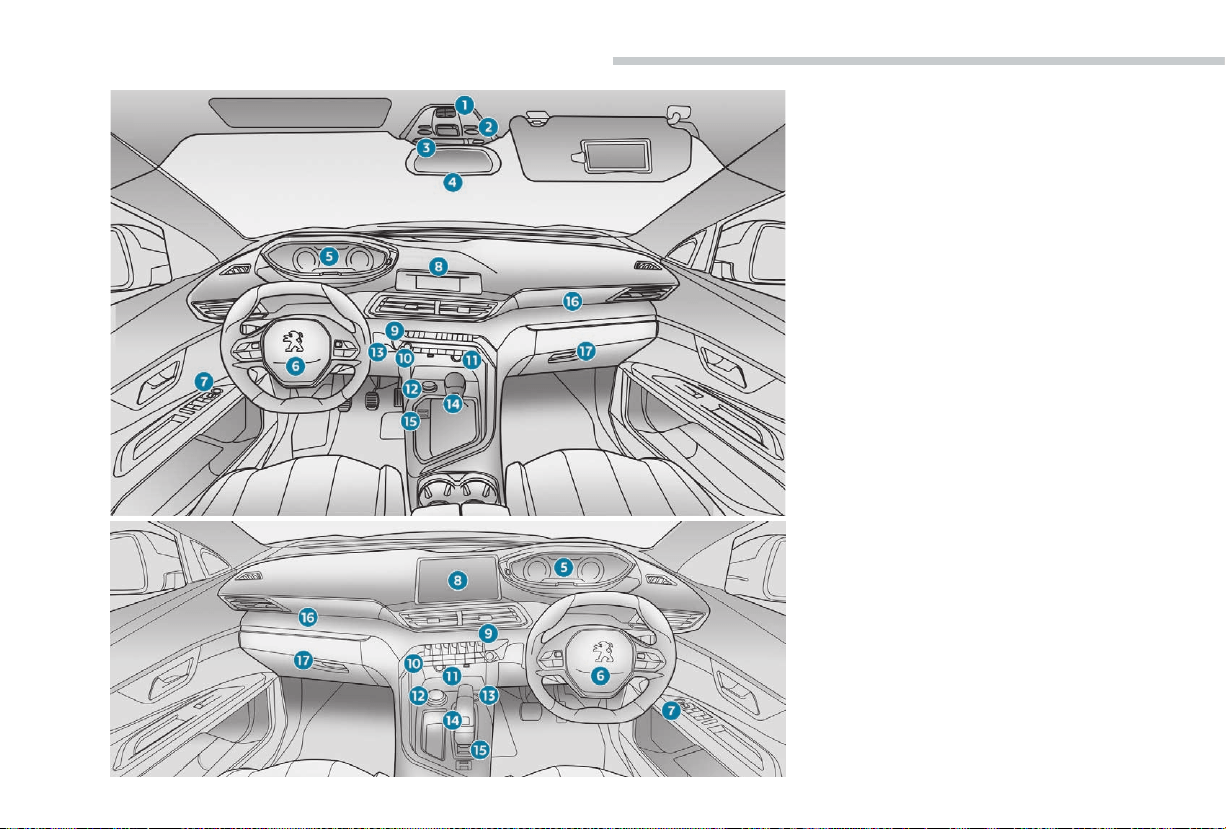
Instruments and controls
1. Sunroof and blind controls
2. Front courtesy / map reading lamps
3. Warning lamp display for the seat belts
and front passenger airbag
Emergency and assistance call buttons
4. Rear view mirror
5. Head-up digital screen
6. Horn
Driver front airbag
7. Door mirror and electric window control
panel
8. Monochrome screen with Bluetooth audio
system
or
Touch screen with PEUGEOT Connect
Radio or PEUGEOT Connect Nav
9. Hazard warning lamps
10. Air conditioning system controls
11. 12 V socket / USB socket
Wireless charger
12. Advanced Grip Control
Hill Assist Descent Control
13. Ignition switch
or
"START/STOP" button
14. Gearbox control
"SPORT" button
15. Electric parking brake
16. Front passenger airbag
17. Glove box
Deactivating the front passenger airbag
5
.Overview
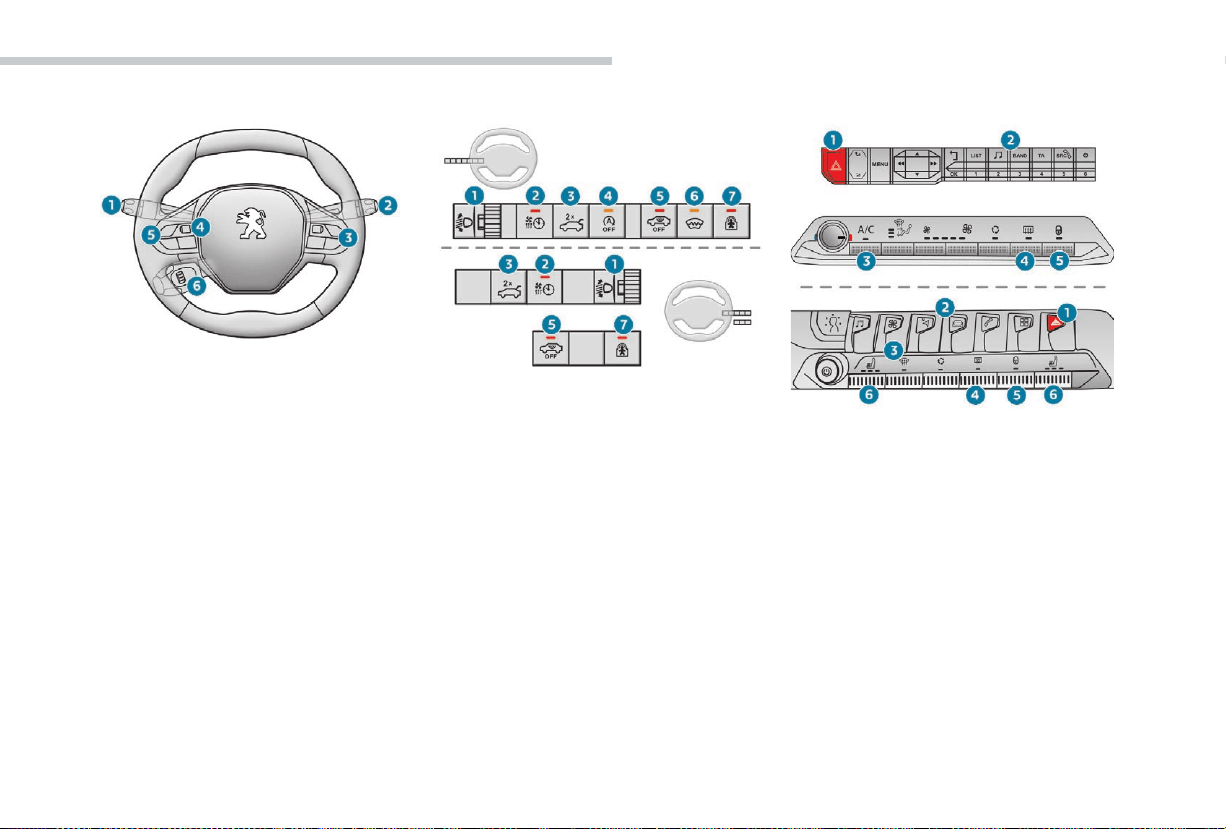
Steering mounted controls
Side switch panel
Central switch panel
1. External lighting / Direction indicators
control stalk
2. Wiper / Screenwash / Trip computer
control stalk
3. Audio system setting controls
4. Instrument panel display mode selection
wheel
5. Voice synthesis control
Volume adjustment
6. Speed limiter / Cruise control / Adaptive
cruise control with Stop function controls
1. Headlamp beam height adjustment wheel
2. Programmable heating operation
indicator lamp
3. Hands-free tailgate opening / closing
4. Deactivation of Stop & Start
5. Deactivation of the interior volumetric and
anti-tilt monitoring
6. Heated windscreen
7. Electric child lock
1. Hazard warning lamps switch
2. Bluetooth audio system controls
or
Touch screen controls with PEUGEOT
Connect Radio or PEUGEOT Connect
Nav
i-Cockpit Amplify function
3. Manual air conditioning system controls
or
Semi-automatic or automatic air
conditioning system controls
4. Rear screen demist / defrost control
5. Central locking control
6. Heated seats controls

6
Eco-driving
As a passenger, if you avoid connecting your
multimedia devices (film, music, video game
etc.), you will contribute towards limiting the
consumption of electrical energy, and so of fuel.
Disconnect your portable devices before
leaving the vehicle.
Eco-driving
Eco-driving is a range of everyday practices that allow the motorist to optimise their fuel consumption and CO
2
emissions.
Optimise the use of your
gearbox
With a manual gearbox, move off gently
and change up without waiting. During
acceleration change up early.
With an automatic gearbox, give preference
to automatic mode and avoid pressing the
accelerator pedal heavily or suddenly.
The gear shift indicator invites you to engage
the most suitable gear: as soon as the
indication is displayed in the instrument panel,
follow it straight away.
For vehicles fitted with an automatic gearbox,
this indicator appears only in manual mode.
Drive smoothly
Maintain a safe distance between vehicles,
use engine braking rather than the
brake pedal, and press the accelerator
progressively. These practices contribute
towards a reduction in fuel consumption and
CO
2
emissions and also help reduce the
background traffic noise.
If your vehicle has cruise control, make use of
the system at speeds above 25 mph (40 km/h)
when the traffic is flowing well.
Control the use of your electrical
equipment
Before moving off, if the passenger
compartment is too warm, ventilate it by
opening the windows and air vents before
using the air conditioning.
Above 31 mph (50 km/h), close the windows
and leave the air vents open.
Consider using equipment that can help
keep the temperature in the passenger
compartment down (sunroof blind and
window blinds, etc.).
Switch off the headlamps and front foglamps
when the ambient light level does not require
their use.
Avoid running the engine before moving off,
particularly in winter; your vehicle will warm up
much faster while driving.
Unless it has automatic regulation, switch off
the air conditioning as soon as the desired
temperature has been reached.
Switch off the demisting and defrosting
controls, if these are not automatically
managed.
Switch off the heated seat as soon as possible.

.
7
Eco-driving
Limit the causes of excess
consumption
Spread loads throughout the vehicle; place
the heaviest items in the bottom of the boot,
as close as possible to the rear seats.
Limit the loads carried in the vehicle and
reduce wind resistance (roof bars, roof rack,
bicycle carrier, trailer, etc.). Preferably, use a
roof box.
Remove roof bars and roof racks after use.
At the end of winter, remove snow tyres and
refit your summer tyres.
Observe the recommendations
on maintenance
Check the tyre pressures regularly, when cold,
referring to the label in the door aperture,
driver's side.
Carry out this check in particular:
- before a long journey,
- at each change of season,
- after a long period out of use.
Do not forget the spare wheel and the tyres on
any trailer or caravan.
Have your vehicle serviced regularly (engine
oil, oil filter, air filter, cabin filter, etc.) and
observe the schedule of operations in the
manufacturer's service schedule.
When filling the tank, do not continue after the
3
rd
cut-off of the nozzle to avoid overflow.
At the wheel of your new vehicle, it is only
after the first 1,900 miles (3,000 kilometres)
that you will see the fuel consumption settle
down to a consistent average.
With a BlueHDi Diesel engine, if the SCR
system is faulty, your vehicle becomes
polluting. As soon as possible, visit a
PEUGEOT dealer or a qualified workshop to
make your vehicle's level of nitrogen oxides
emissions compliant to the standard.
8
Instruments
Head-up digital screen
Customisable digital instrument panel.
Depending on the selected display mode,
some information may be hidden or shown in a
different way.
Digital screen
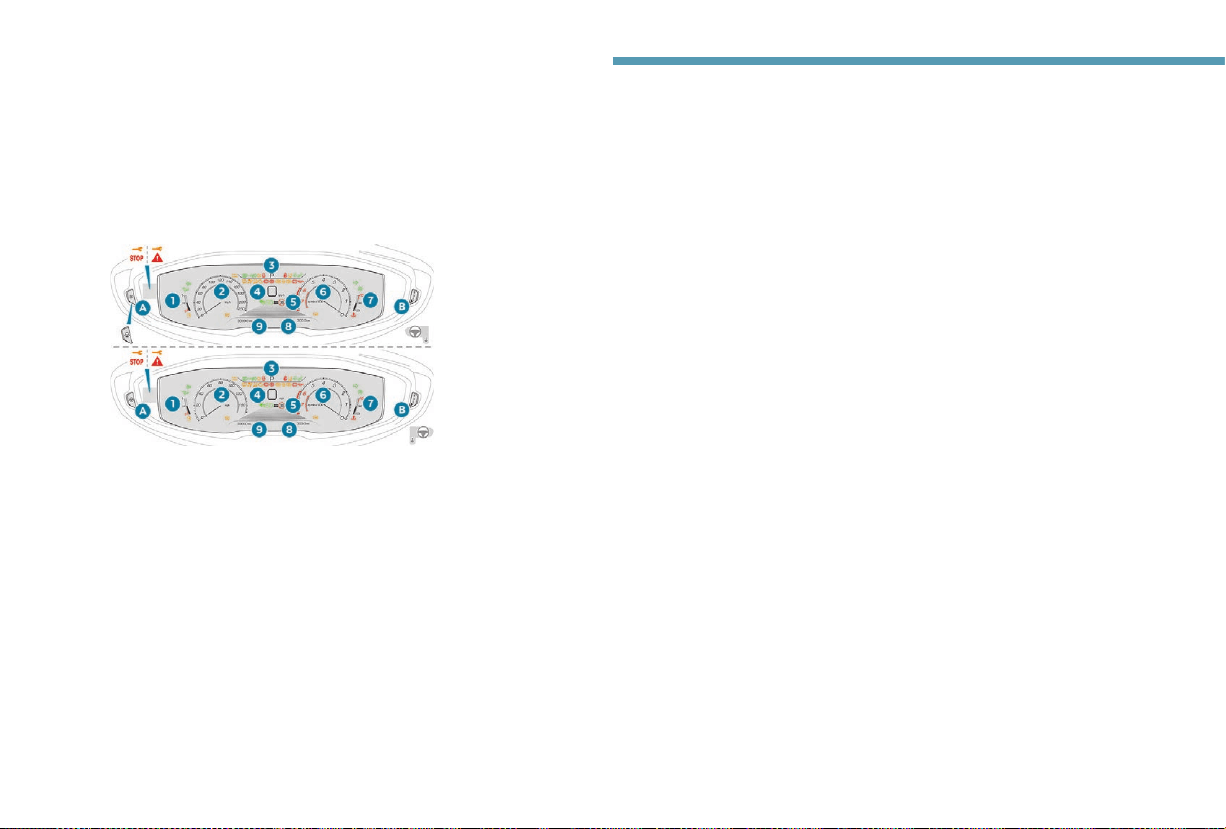
The representation below shows the "DIALS"
display mode.
6. Rev counter (x 1,000 rpm).
7. Engine coolant temperature indicator
(°Celsius).
8. Trip distance recorder (miles or km).
9. Total distance recorder (miles or km).
Control buttons
A. Lighting dimmer for the instruments and
controls* (available in night mode).
or
Instrument panel ambient lighting**.
B. Short press: start a manual test.
Long press: reset the service indicator or
trip distance recorder (depending on the
context).
Displays
Most warning and indicator lamps do not have
a fixed position.
The warning and indicator lamps in the second
line are displayed from right to left in order of
priority.
For certain functions that have indicator lamps
for both operation and for deactivation, there is
only one dedicated location.
Permanent information
Whatever the display mode selected, the
instrument panel displays:
- in fixed locations:
• gearbox and gear shift indicator
information,
• the fuel gauge,
• the engine coolant temperature indicator,
• the distance recorders.
- in variable locations:
• the digital speedometer,
• status or alert messages displayed
temporarily.
Optional information
Depending on the display mode selected and
active features, the following information may
be displayed:
- the rev counter,
- the trip computer,
- driving aids,
- the speed limiter or cruise control,
- the media currently playing,
- navigation instructions,
- engine information from the Dynamic Pack.
1. Fuel gauge.
2. Analogue speedometer (mph or km/h).
3. Gear shift indicator.
Selector mode and gear with an
automatic gearbox.
4. Digital speedometer (mph or km/h).
5. Cruise control or speed limiter setting,
display of speed limit signs.
* Versions with monochrome screen.
** Versions with touch screen.
9
1
Instruments
Customisation of the
instrument panel
** Versions with touch screen.
You can modify the appearance of the
instrument panel, by choosing:
- the instrument panel display colour**,
- a display mode.
Display language and units
They depend on the configuration of the
multifunction screen (configuration menu).
When travelling abroad, the speed must
be shown in the official units of the
country you are driving in (km/h, km or
mph, miles).
As a safety measure, these adjustments
must be carried out with the vehicle
stationary.
Choosing a display colour
This depends on the ambience activated by the
i-Cockpit Amplify function.
The possible choices are:
F "Relax": grey,
F "Boost": red,
F "Normal" (no ambience activated): blue.
For more information on the i-Cockpit Amplify
function, refer to the corresponding section.
Choice of display mode
Each mode corresponds to the type of
information displayed in the instrument panel.
- "DIALS": standard display of the analogue
and digital speedometers, the rev counter,
the fuel gauge, the engine coolant
temperature indicator and the distance
recorders.
- "NAVIGATION": standard display with, in
addition, the current navigation information
(map and navigation instructions).
- "DRIVING": standard display with, in
addition, the current driving aid systems
information.
- "MINIMAL": minimal display with digital
speedometer and the distance recorders
and, in the event of a warning only, the
fuel gauge and the coolant temperature
indicator.
- "TRIP COMPUTER"* minimal display
with, in addition, the rev counter, current
information and the trip recorder selected
(1 or 2).
or
- "PERSONAL"**: minimal display with,
in addition, the selection made from the
touch screen of the type of information
displayed in the customisable areas on
the left and right.
To modify the display mode of the instrument
panel:
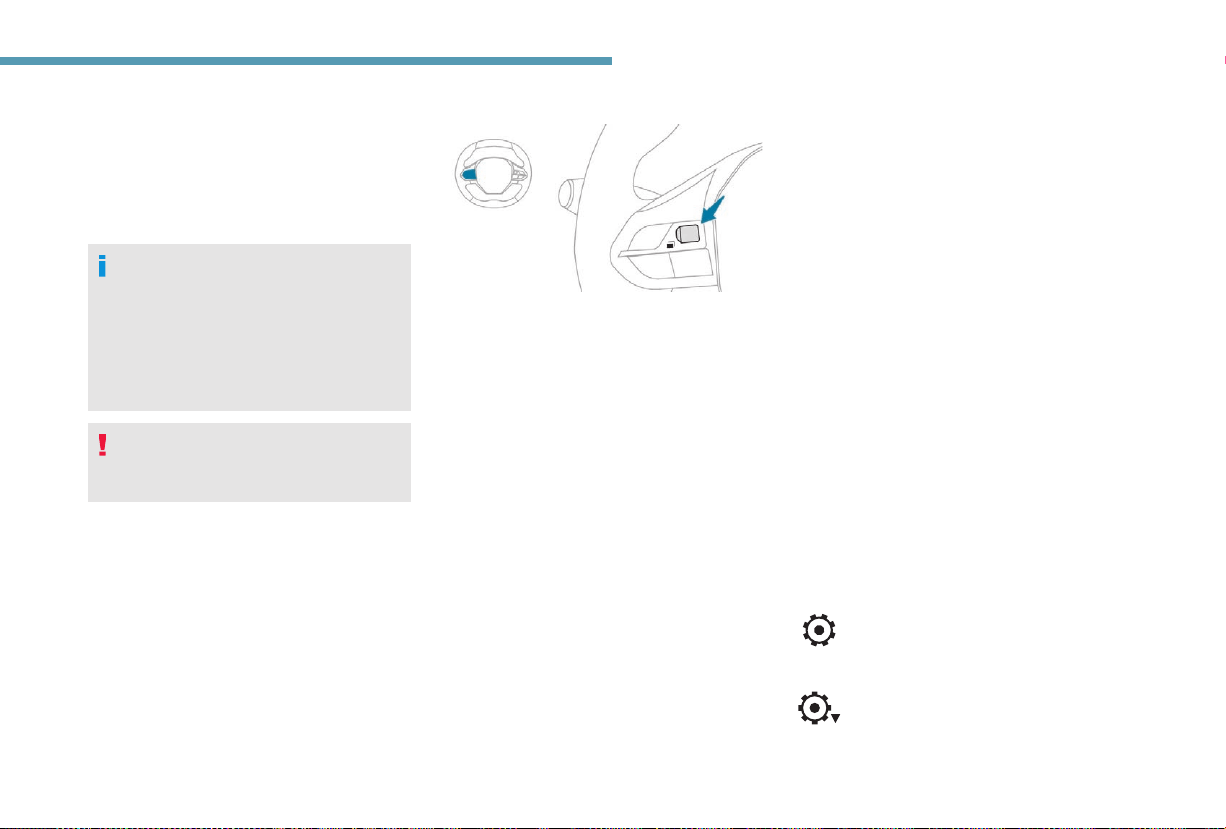
F Turn the wheel located on the left of the
steering wheel to display and scroll through
the different modes on the right-hand side
of the instrument panel.
F Once the selected display mode appears,
press on the wheel to validate.
The new display mode is applied instantly.
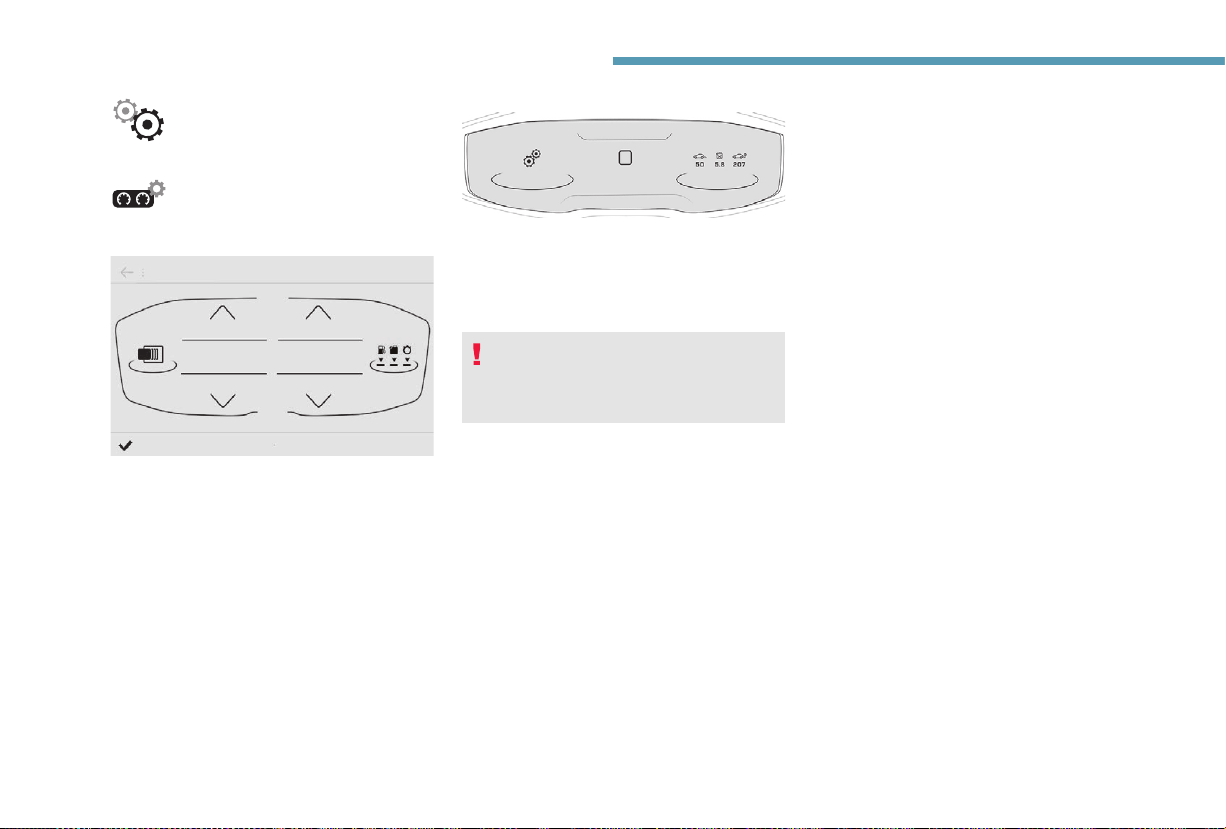
To enter settings for the "PERSONAL"
display mode and select the information to
be displayed in the customisable areas of the
instrument panel:
or
F Select the Settings menu in the
upper bar of the touch screen.
10
Instruments
* Versions with monochrome screen.
** Versions with touch screen.
F Select "Settings".
F Press the "Dashboard
configuration" button.
As a safety measure, these adjustments
must be carried out with the vehicle
stationary.
F For each customised displayed area, left
and right, select a type of information using
the corresponding scroll arrows in the
touch screen:
• "Driving aids",
• "Default" (empty),
• "Engine info" (Dynamic pack),
• "G-metres" (Dynamic pack),
• "Temperatures" (engine oil),
• "Media",
• "Navigation",
• "Trip computer",
• "Rev counter".
F Confirm to save and quit.
If the current display mode is "PERSONAL", the
new selection is displayed immediately.

11
1
Instruments
Warning and indicator lamps
When the ignition is
switched on
Certain warning lamps come on in the
instrument panel for a few seconds when the
ignition is switched on.
When the engine is started, these same
warning lamps should go off.
If they remain on, before moving off, refer to the
information on the warning lamp concerned.
Associated warnings
Most warning lamps in the instrument panel are
accompanied by the display of a message and
an audible signal.
Certain warning lamps may come on in
one of two modes: fixed (continuous) or
flashing.
Only by relating the type of illumination
to the operation of the vehicle can it be
determined whether the situation is normal
or a fault has occurred.
For more information, refer to the
corresponding tables of warning and
indicator lamps.
Warning lamps
When the engine is running or the vehicle
is being driven, illumination of one or more
of the following warning lamps indicates a
fault which requires action on the part of
the driver.
Any fault resulting in the illumination of a
warning lamp must be investigated further
using the associated alert message.
If you encounter any problems, contact a
PEUGEOT dealer or a qualified workshop.
Operation indicator lamps
If one or more of the following indicator lamps
come on, this confirms that the corresponding
system has been switched on.
Deactivation indicator
lamps
If one of the following indicator lamps comes
on, this confirms that the corresponding system
has been switched off intentionally.
This may be accompanied by the display of a
message and an audible signal.
12
Instruments
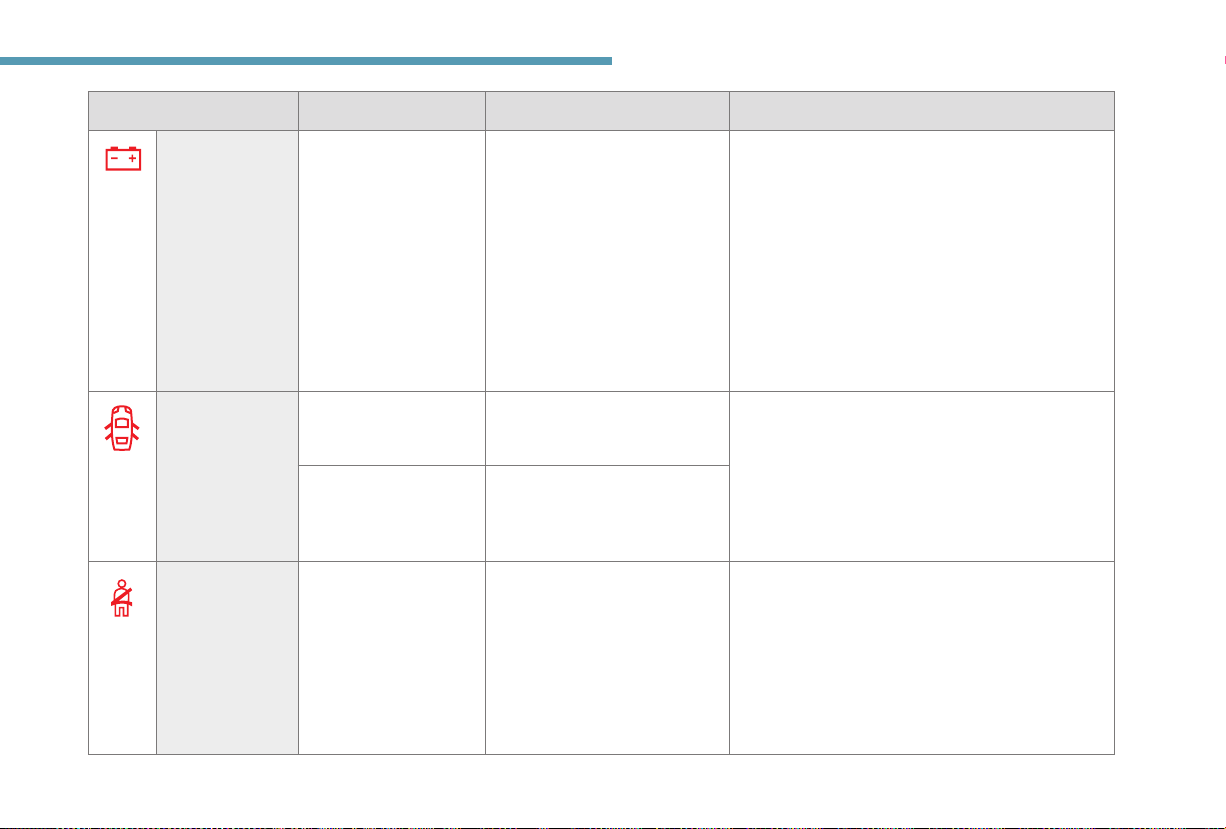
Warning / indicator lamp State Cause Action / Observations
Red warning / indicator lamps
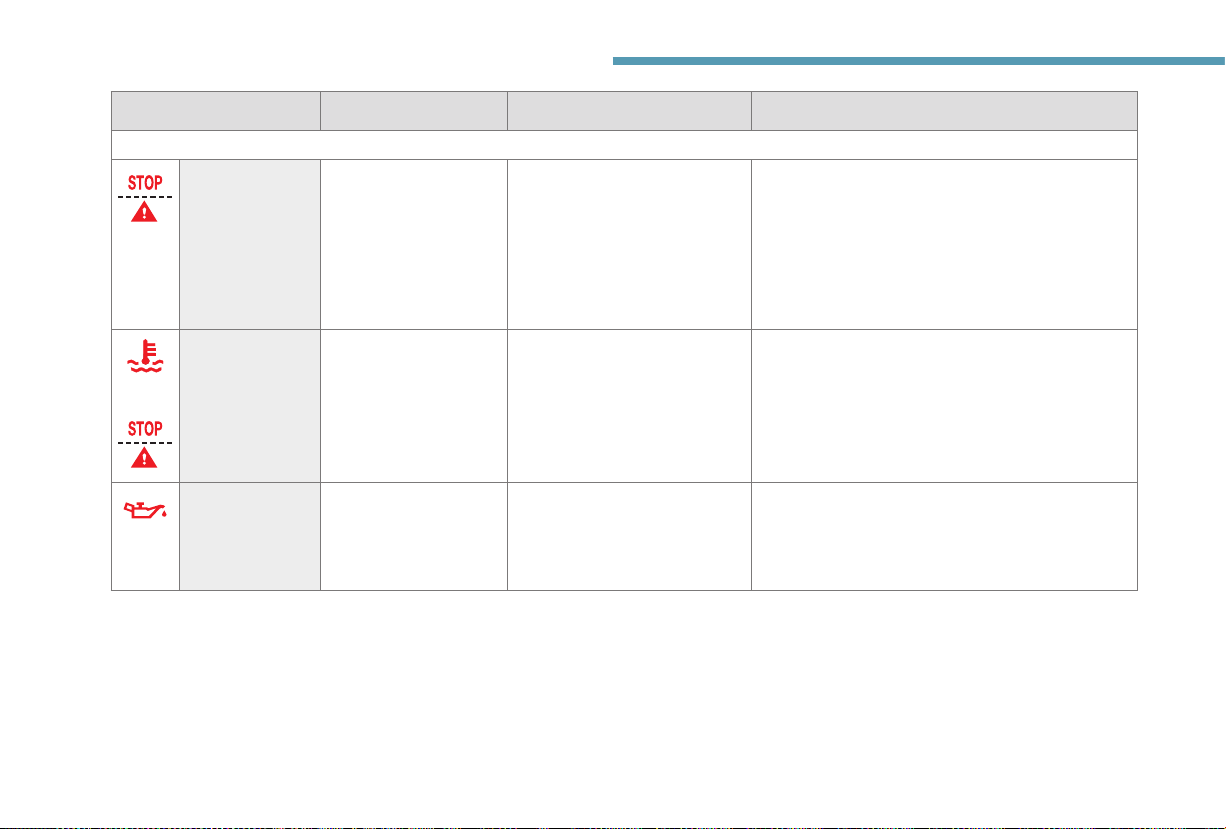
STOP Fixed, associated with
another warning lamp,
accompanied by the
display of a message and
an audible signal.
Illumination of this warning lamp
is related to a serious fault with
the engine, braking system,
power steering, automatic
gearbox or a major electrical
fault.
You must stop the vehicle as soon as traffic and
safety conditions permit.
Park, switch off the ignition and call a PEUGEOT
dealer or a qualified workshop.
+
Maximum
coolant
temperature
Fixed, accompanied by
the STOP warning lamp.
The temperature of the cooling
system is too high.
You must stop as soon as it is safe to do so.
Wait until the engine has cooled down before topping
up to the required level if necessary.
If the problem persists, contact a PEUGEOT dealer or
a qualified workshop.
Engine oil
pressure
Fixed. There is a fault with the engine
lubrication system.
You must stop as soon as it is safe to do so.
Park, switch off the ignition and contact a PEUGEOT
dealer or a qualified workshop.
13
1
Instruments
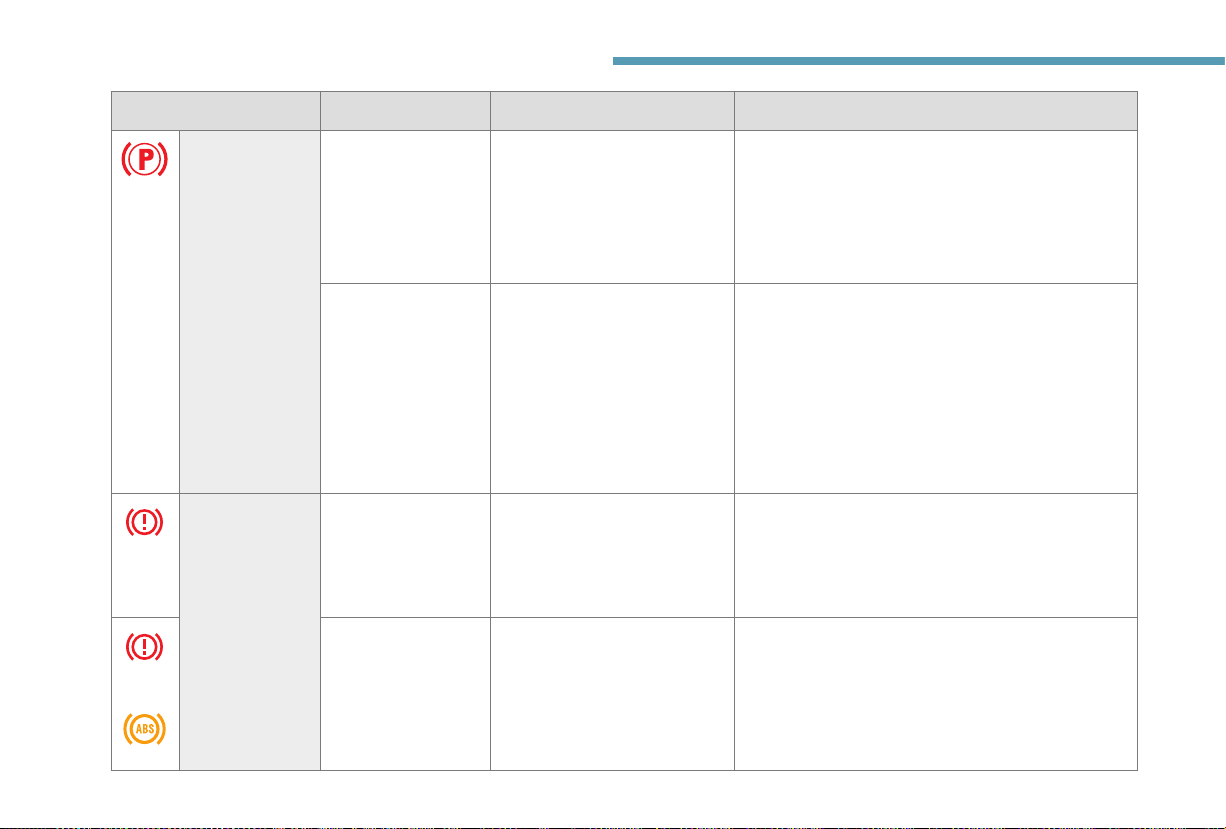
Warning / indicator lamp State Cause Action / Observations
Door(s) open Fixed, associated with a
message identifying the
door.
Speed below 6 mph (10 km/h), a
door or the boot is not properly
closed.
Close the door or boot.
Fixed, associated with a
message identifying the
door, together with an
audible signal.
Speed above 6 mph (10 km/h), a
door or the boot is not properly
closed.
Non-fastening /
unfastening of
the seat belts
Fixed. The driver and/or the front/rear
passenger has not fastened or
has unfastened their seat belt.
Pull the strap then insert the tongue in the buckle.
The illuminated dots represent the passengers that
have not fastened / unfastened their seat belt.
They come on:
- fixed for 30 about seconds on starting the vehicle,
- fixed from 0 to 12 mph (0 to 20 km/h) when driving,
- flashing above 12 mph (20 km/h), accompanied by
an audible signal for around 120 seconds.
Battery charge* Fixed. The battery charging circuit has
a fault (dirty or loose terminals,
slack or cut alternator belt, etc.).
The warning lamp should go off when the engine is
started.
If it does not go off, contact a PEUGEOT dealer or a
qualified workshop.
The battery charging level requires the vehicle to be
stopped immediately, as soon as road and safety
conditions permit.
If the electric parking brake does not work, immobilise
the vehicle:
F With a manual gearbox, engage a gear.
F With an automatic gearbox, put the chocks against
one of the wheels.
* Depending on the country of sale.
14
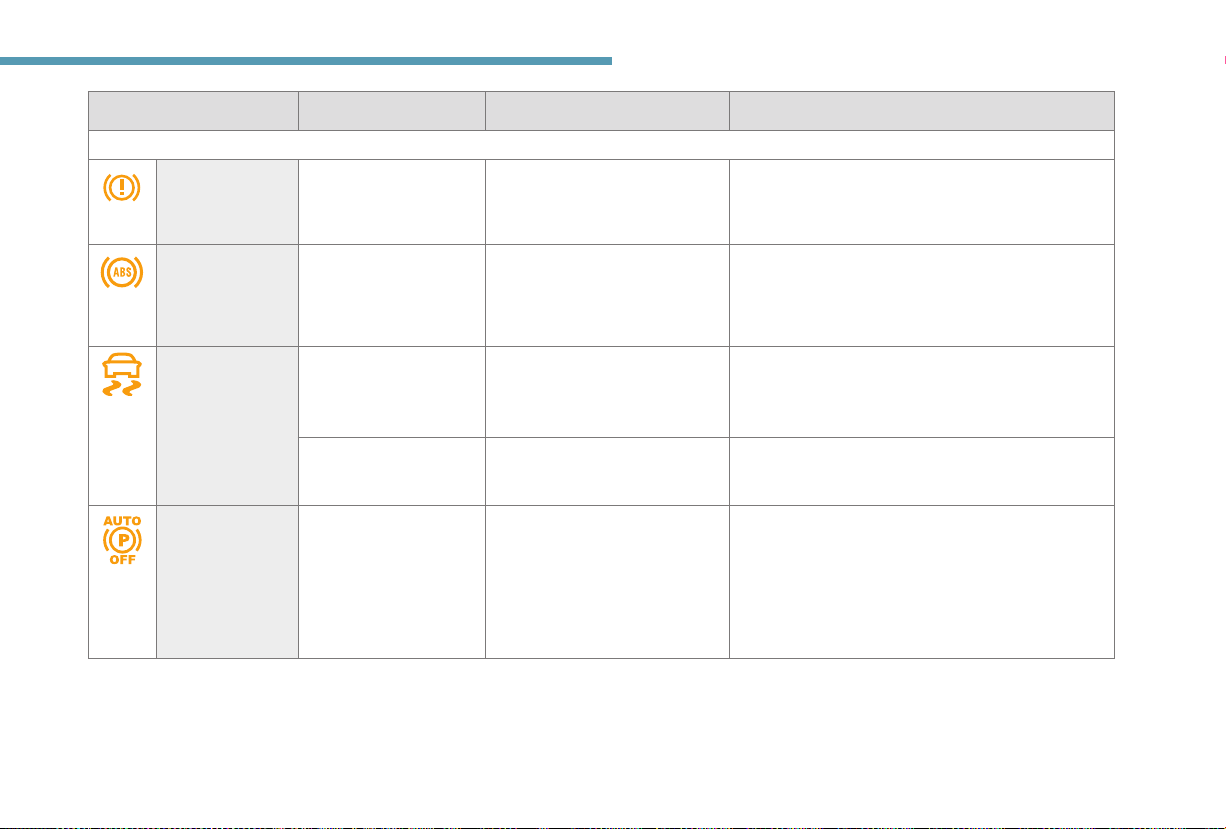
Instruments
Electric parking
brake
Fixed. The electric parking brake is
applied.
Release the parking brake to switch off the warning
lamp: with your foot on the brake pedal, briefly push the
parking brake control lever.
Observe the safety recommendations.
For more information on the Electric parking brake,
refer to the corresponding section.
Flashing. The electric parking brake is not
applied automatically.
The application/release is faulty.
You must stop as soon as it is safe to do so.
Park on level ground (horizontally).
With a manual gearbox, engage a gear.
With an automatic gearbox, place the gear selector in
mode P.
Switch off the ignition and contact a PEUGEOT dealer
or a qualified workshop.
Brakes Fixed. The brake fluid level has dropped
significantly.
You must stop as soon as it is safe to do so.
Top up with a fluid approved by PEUGEOT.
If the problem persists, have the system checked by a
PEUGEOT dealer or a qualified workshop.
+
Fixed, associated with
the ABS warning lamp.
The electronic brake force
distribution (EBFD) system is
faulty.
You must stop as soon as it is safe to do so.
Have it checked by a PEUGEOT dealer or a qualified
workshop.
Warning / indicator lamp State Cause Action / Observations
15
1
Instruments
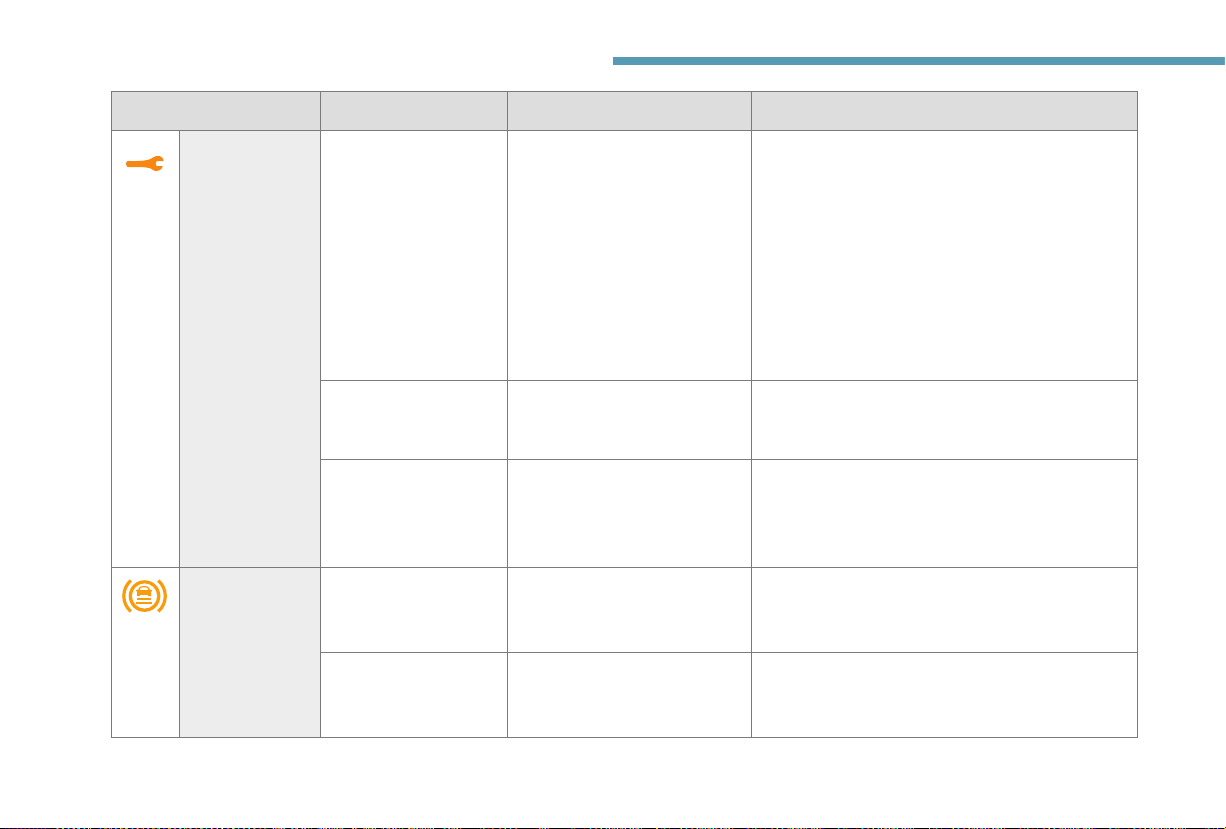
Warning / indicator lamp State Cause Action / Observations
Orange warning / indicator lamps
Braking Fixed. A minor fault with the braking
system.
Drive carefully.
Have the system checked by a PEUGEOT dealer or a
qualified workshop as soon as possible.
Anti-lock
Braking System
(ABS)
Fixed. The anti-lock braking system has
a fault.
The vehicle retains conventional braking.
Drive carefully at reduced speed and contact a
PEUGEOT dealer or a qualified workshop without
delay.
Dynamic stability
control
(DSC/ASR)
Flashing. The DSC/ASR regulation is
operating.
The system optimises traction and improves the
directional stability of the vehicle in the event of loss of
grip or trajectory.
Fixed. The DSC/ASR system has a fault. Have the system checked by a PEUGEOT dealer or a
qualified workshop.
Deactivation of
the automatic
functions of the
electric parking
brake
Fixed. The "automatic application" (on
switching off the engine) and
"automatic release" functions are
deactivated.
Activate the functions again.
For more information on the Electric parking brake,
refer to the corresponding section.
16
Instruments
Warning / indicator lamp State Cause Action / Observations
Service Temporarily on,
accompanied by the
display of a message.
One or more minor faults for
which there is no specific warning
lamp have been detected.
Identify the cause of the fault using the message
displayed in the instrument panel.
You can deal with some problems yourself, such as a
door open or the start of saturation of the particle filter
(as soon as the traffic conditions allow, regenerate the
filter by driving at a speed of at least 37 mph (60 km/h),
until the warning lamp goes off).
For any other problems, such as a fault with the tyre
under-inflation detection system, contact a PEUGEOT
dealer or a qualified workshop.
Fixed, accompanied by
the display of a message.
One or more major faults for
which there is no specific warning
lamp have been detected.
Identify the cause of the fault using the message
displayed in the instrument panel; you must then
contact a PEUGEOT dealer or a qualified workshop.
Fixed, associated with
the flashing and then
fixed display of the
service spanner.
The servicing interval has been
exceeded.
Only on BlueHDi Diesel versions.
Your vehicle must be serviced as soon as possible.
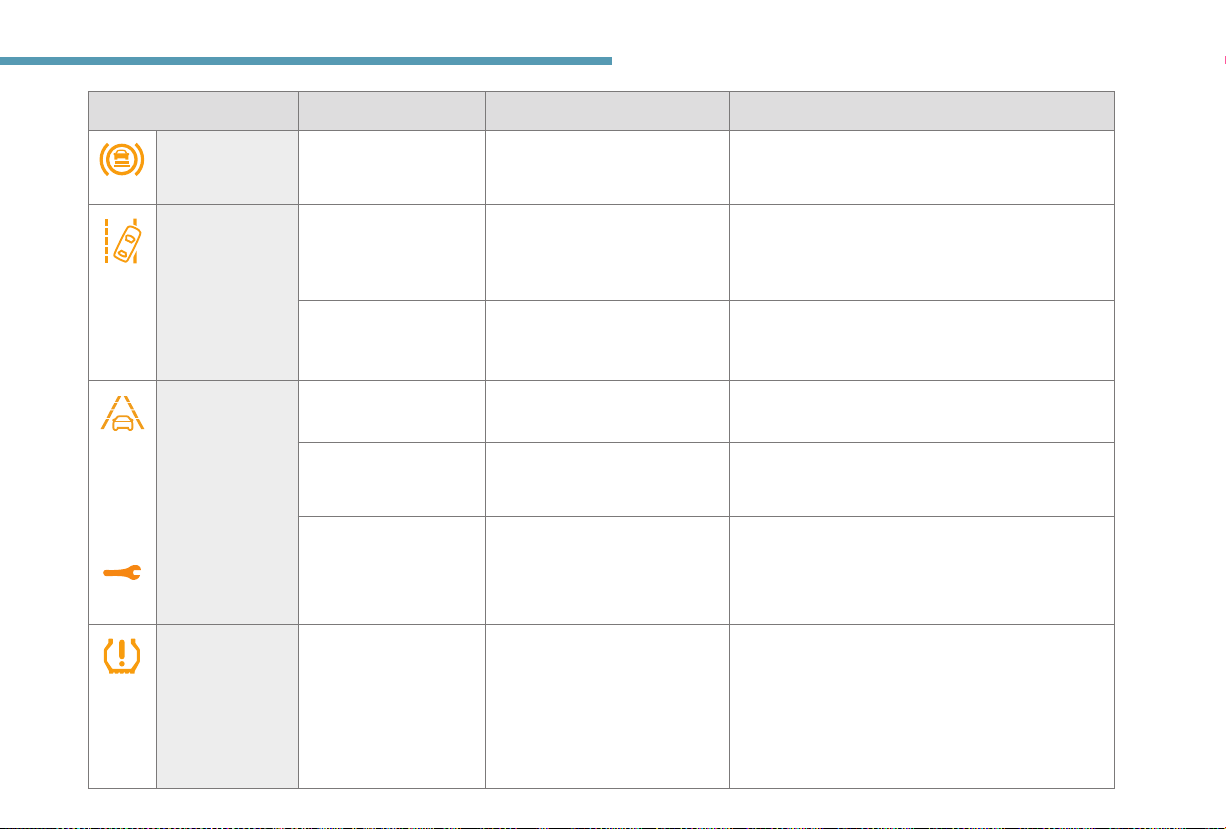
Distance Alert /
Active Safety
Brake
Flashing. The system is operating. The system brakes briefly so as to reduce the speed
of collision with the vehicle ahead.
Fixed, accompanied
by a message and an
audible signal.
The system has a fault. Have the system checked by a PEUGEOT dealer or a
qualified workshop.
17
1
Instruments
Warning / indicator lamp State Cause Action / Observations
Distance Alert /
Active Safety
Brake
Fixed, accompanied by a
message.
The system has been
deactivated, via the vehicle
configuration menu.
For more information on the Distance Alert / Active
Safety Brake system, refer to the corresponding
section.
Lane Departure
Warning System
Flashing, accompanied
by an audible signal.
A lane marking has been crossed
on the left or right.
Turn the steering wheel in the opposite direction to
return to the correct trajectory.
For more information on the Lane Departure
Warning System, refer to the corresponding section.
Fixed, accompanied by
the display of a message.
The system has a fault. Be vigilant and drive carefully.
Have the system checked by a PEUGEOT dealer or a
qualified workshop.
Active Lane
Departure
Warning System
Fixed.
The system has been automatically
deactivated or placed on standby.
For more information on the Active Lane Departure
Warning System, refer to the corresponding section.
Flashing. You are about to cross a broken
lane marking without operating
the direction indicators.
The system is activated, then corrects the trajectory
on the side of the lane marking detected.
+
Fixed, accompanied by
the display of a message,
an audible signal and the
Service warning lamp.
The system has a fault. Be vigilant and drive carefully.
Have the system checked by a PEUGEOT dealer or a
qualified workshop.
For more information on the Active Lane Departure
Warning System, refer to the corresponding section.
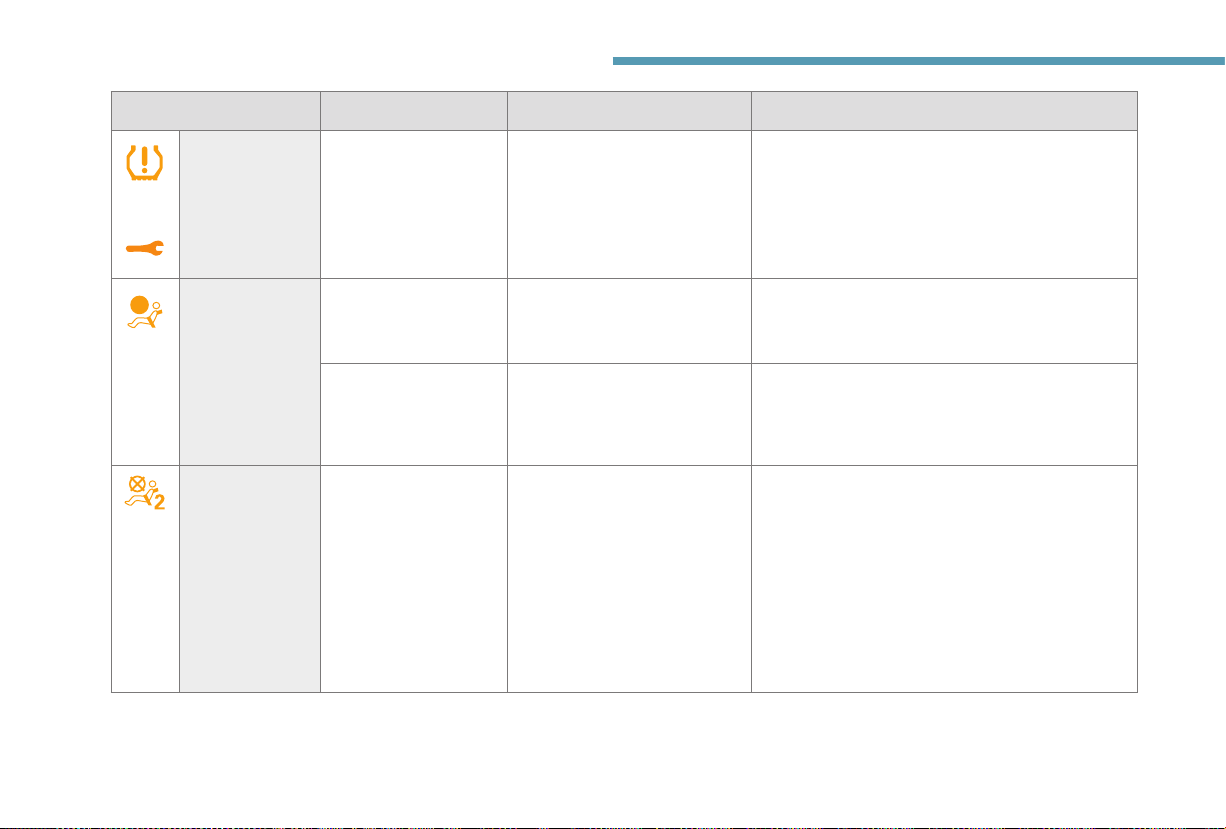
Under-inflation Fixed. The pressure in one or more
tyres is too low.
Check the pressure of the tyres as soon as possible.
This check should preferably be carried out when the tyres
are cold.
You must reinitialise the system after adjusting one or more
tyre pressures and after changing one or more wheels.
For more information on Under-inflation detection, refer
to the corresponding section.
18
Instruments
Warning / indicator lamp State Cause Action / Observations
+
Flashing then fixed,
accompanied by the
Service warning lamp.
The tyre pressure monitoring
system has a fault or no sensor
is detected on one of the wheels.
Under-inflation detection is no longer assured.
Have the system checked by a PEUGEOT dealer or
a qualified workshop.
Airbags Temporarily on. This warning lamp comes on for
a few seconds when you turn on
the ignition, then goes off.
This warning lamp should go off when the engine is started.
If it does not go off, contact a PEUGEOT dealer or a
qualified workshop.
Fixed. One of the airbag or seat belt
pretensioner systems has a fault.
Have them checked by a PEUGEOT dealer or a
qualified workshop.
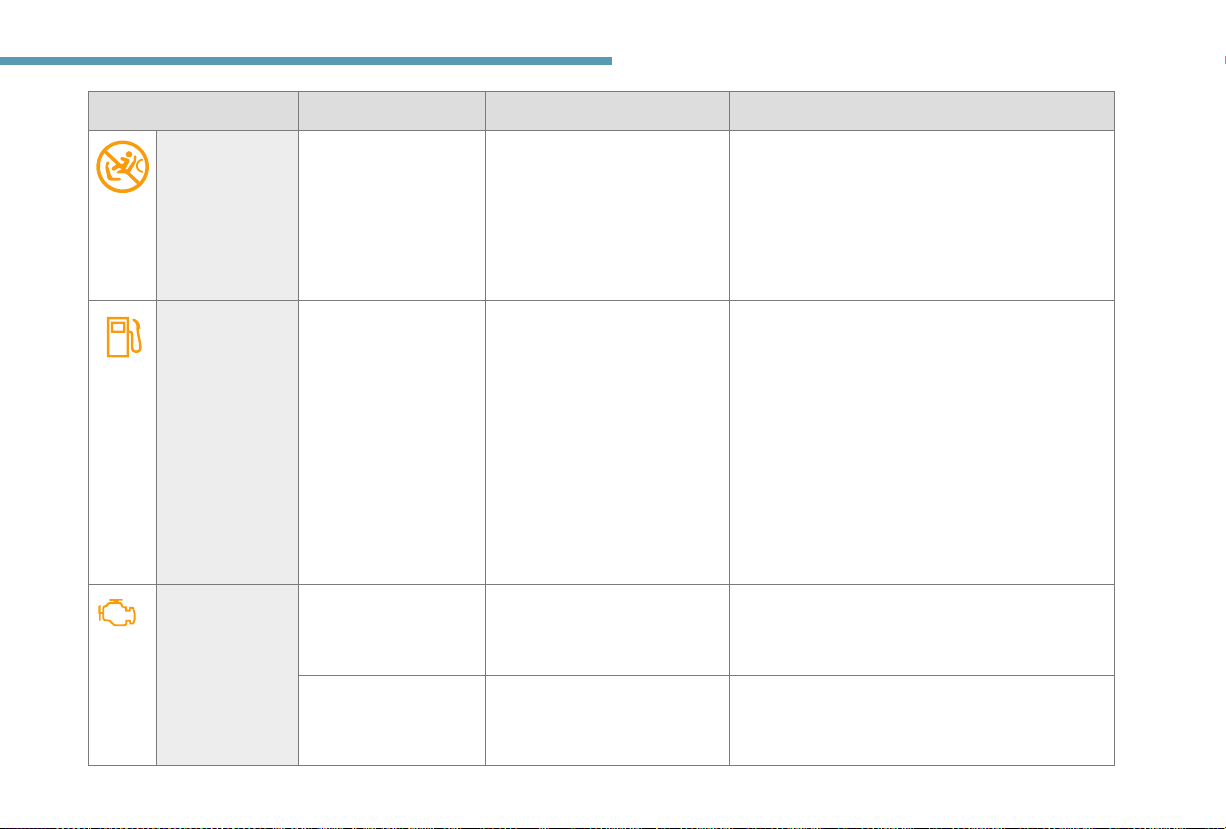
Front passenger
airbag
Fixed, in the seat belt
and front passenger
airbag warning lamps
display.
The control switch, located in
the glove box, is set to the "OFF"
position.
The front passenger airbag is
deactivated.
You can install a rearward facing
child seat, unless there is a fault
with the airbags (airbag warning
lamp on).
Set the control to the "ON" position to activate the
front passenger airbag. In this case, do not install a
rearward facing child seat on this seat.
19
1
Instruments
Warning / indicator lamp State Cause Action / Observations
Front passenger
airbag
Fixed, in the seat belt
and front passenger
airbag warning lamps
display.
The control switch, located in the
glove box, has been placed in the
ON position.
The front passenger airbag is
activated.
In this case, do not install a rearward facing child seat
on this seat.
Move the control switch to the OFF position to
deactivate the front passenger airbag. In this case, you
may install a rearward facing child seat, unless there is
a fault with the airbags (airbag warning lamp on).
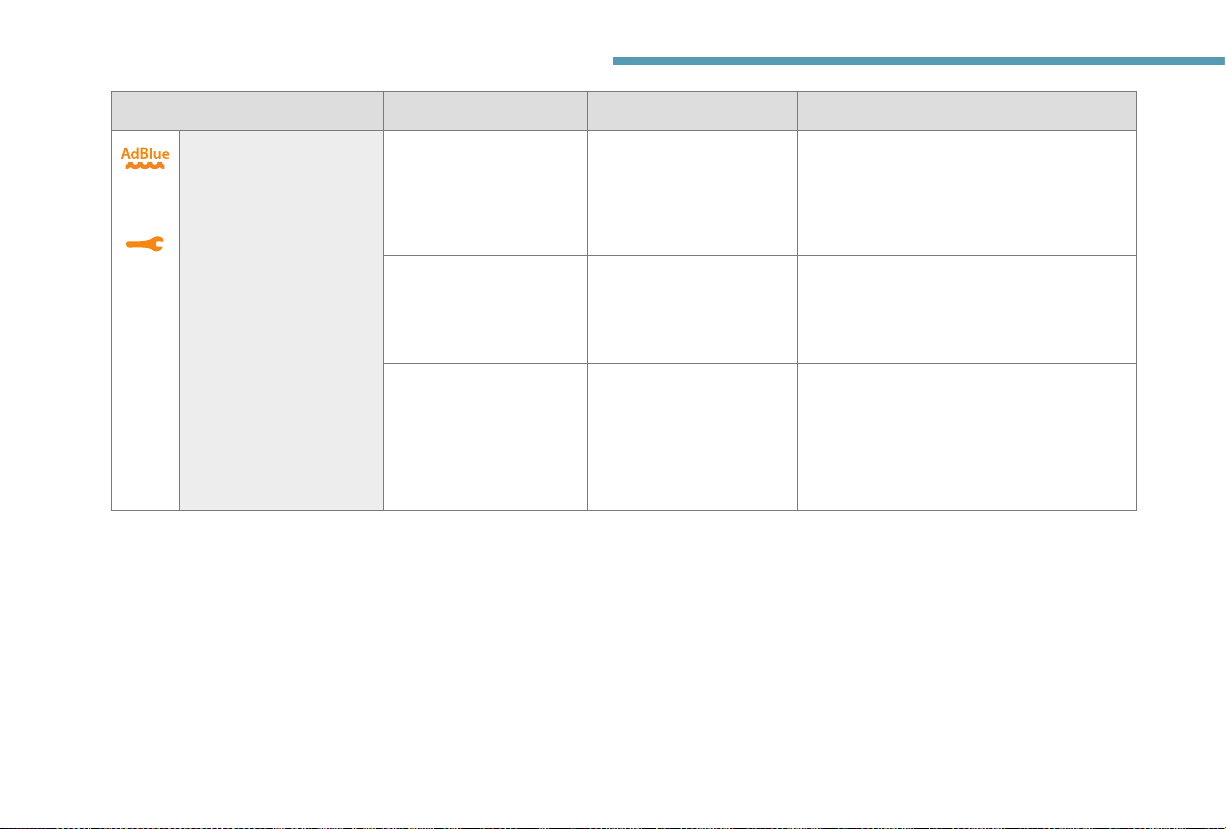
Low fuel level Fixed, with reserve level
shown in red, with the
display of a message and
an audible signal.
When it first comes on there
remains approximately 6 litres
of fuel in the tank.
You must refuel as soon as possible to avoid running
out of fuel.
This warning lamp will come on every time the ignition
is switched on, accompanied by a message and an
audible signal, until a sufficient addition of fuel is
made.
This audible signal and message are repeated with
increasing frequency as the fuel level drops and
approaches "0".
Fuel tank capacity: approximately 53 litres.
Never continue to drive until you run out of fuel as
this could damage the emission control and injection
systems.
Engine
diagnostic
system
Flashing. The engine management system
has a fault.
There is a risk that the catalytic converter will be
destroyed.
Have it checked by a PEUGEOT dealer or a qualified
workshop.
Fixed. The emission control system has
a fault.
The warning lamp should go off when the engine is
started.
If it does not go off, contact a PEUGEOT dealer or a
qualified workshop without delay.
20
Instruments
Warning / indicator lamp State Cause Action / Observations
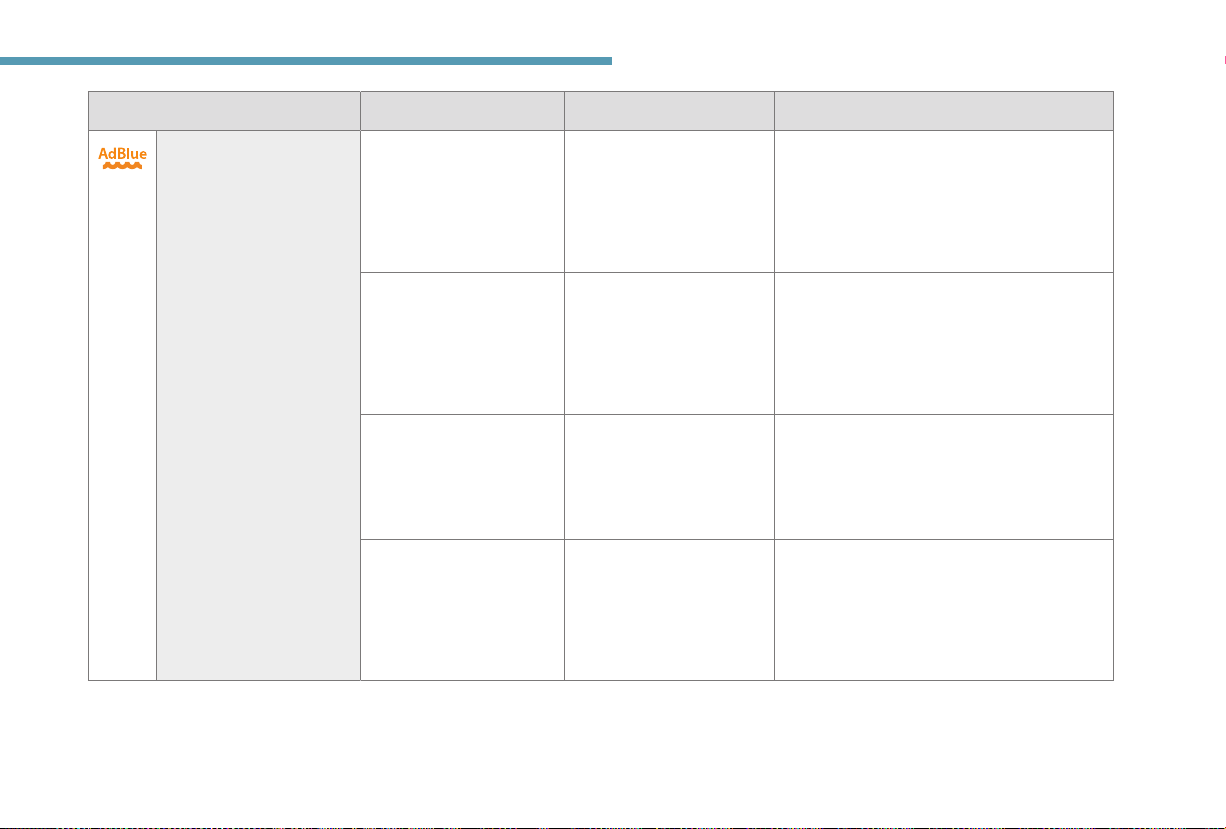
+
AdBlue
®
(with 1.6 BlueHDi and
2.0 BlueHDi 150 S&S
engines)
Fixed, on switching on the
ignition, accompanied by
an audible signal and a
message indicating the
remaining driving range.
The remaining driving range
is between 375 and 1,500
miles (600 and 2,400 km).
Top up the AdBlue
®
as soon as possible, or go
to a PEUGEOT dealer or a qualified workshop.
Flashing, accompanied
by an audible signal and
a message indicating the
remaining driving range.
The remaining driving
range is less than 375 miles
(600 km).
You must top up the AdBlue
®
to avoid a
breakdown or go to a PEUGEOT dealer or a
qualified workshop.
Flashing, accompanied
by an audible signal and
a message indicating that
starting is prevented.
The AdBlue
®
tank is empty:
the starting prevention
system required by
regulations prevents the
engine from restarting.
To be able to restart the engine, you must top
up the AdBlue
®
or go to a PEUGEOT dealer or
a qualified workshop.
It is essential to add at least 5 litres of AdBlue
®
to its tank.
21
1
Instruments
Warning / indicator lamp State Cause Action / Observations
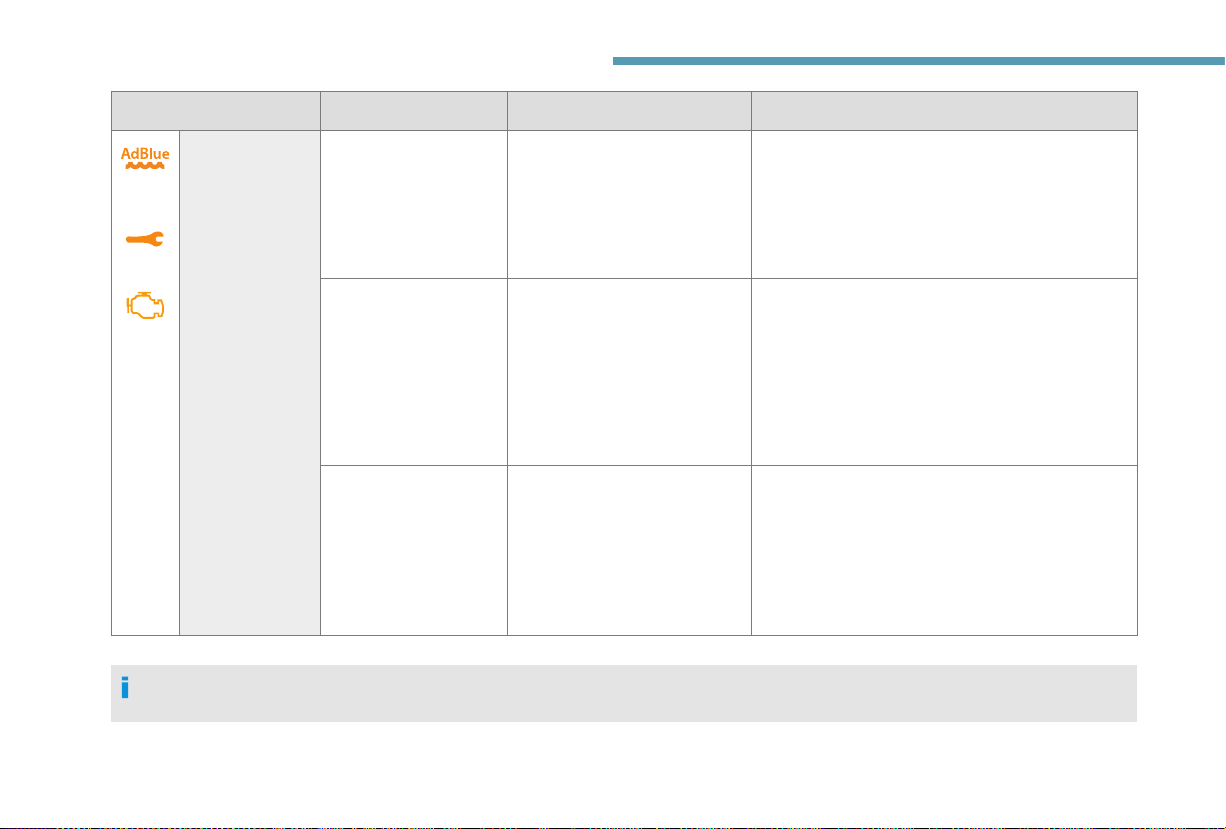
AdBlue
®
(with 1.5 BlueHDi 130 S&S
and 2.0 BlueHDi 180 S&S
engines)
Switched on for around
30 seconds when switching
on the ignition, accompanied
by a message indicating the
remaining driving range.
The remaining driving range
is between 500 and 1,500
miles (800 and 2,400 km).
Top up the AdBlue
®
.
You can add up to 10 litres of AdBlue
®
to its
tank.
Fixed, on switching on the
ignition, accompanied by
an audible signal and a
message indicating the
remaining driving range.
The remaining driving range
is between 60 and 500 miles
(100 and 800 km).
Top up the AdBlue
®
as soon as possible.
You can add up to 10 litres of AdBlue
®
to its
tank.
Flashing, accompanied
by an audible signal and
a message indicating the
remaining driving range.
The remaining driving
range is less than 60 miles
(100 km).
You must top up AdBlue
®
to avoid a
breakdown.
You can add up to 10 litres of AdBlue
®
to its
tank.
Flashing, accompanied
by an audible signal and
a message indicating that
starting is prevented.
The AdBlue
®
tank is empty:
the starting inhibition system
required by legislation
prevents starting of the
engine.
To be able to restart the engine, you must top
up the AdBlue
®
.
It is essential to add at least 5 litres of AdBlue
®
to its tank.
22
Instruments
Warning / indicator lamp State Cause Action / Observations
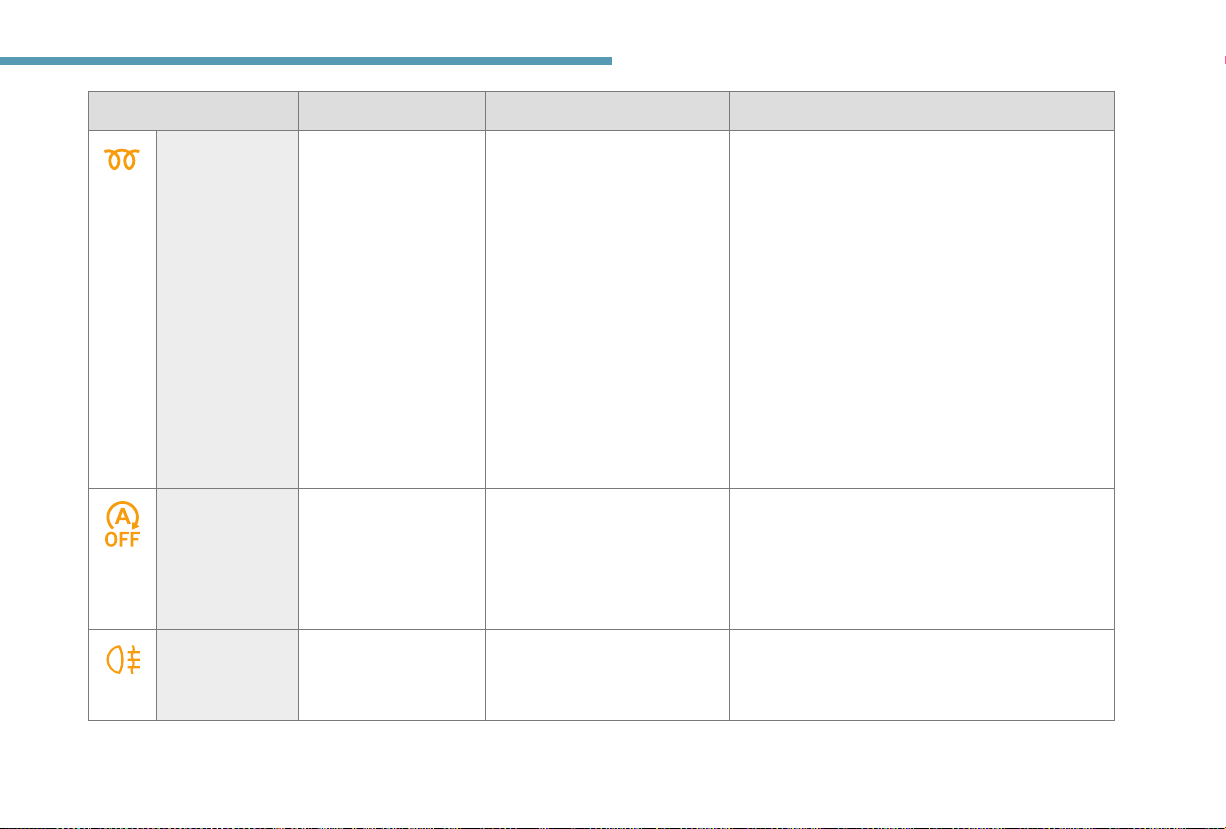
+
+
SCR emissions
control system
(BlueHDi Diesel)
Fixed, on switching on the
ignition, associated with
the Service and engine
diagnostic warning
lamps, accompanied by
an audible signal and a
message.
A fault with the SCR emissions
control system has been
detected.
This alert disappears once the exhaust emissions
return to normal levels.
Flashing, on switching
on the ignition,
associated with the
Service and engine
diagnostic warning
lamps, accompanied by
an audible signal and a
message indicating the
remaining driving range.
After confirmation of the fault with
the emissions control system,
you can drive for up to 685 miles
(1,100 km) before the engine
starting inhibition system is
triggered.
Contact a PEUGEOT dealer or a qualified workshop
without delay, to avoid a breakdown.
Flashing, on switching
on the ignition,
associated with the
Service and engine
diagnostic warning
lamps, accompanied by
an audible signal and a
message.
You have exceeded the
authorised driving limit following
confirmation of a fault with the
emissions control system: the
engine starting inhibition system
prevents starting of the engine.
To be able to restart the engine, you must call on a
PEUGEOT dealer or a qualified workshop.
For topping up or for more information on the AdBlue
®
(BlueHDi engines), refer to the corresponding section.
23
1
Instruments
Warning / indicator lamp State Cause Action / Observations
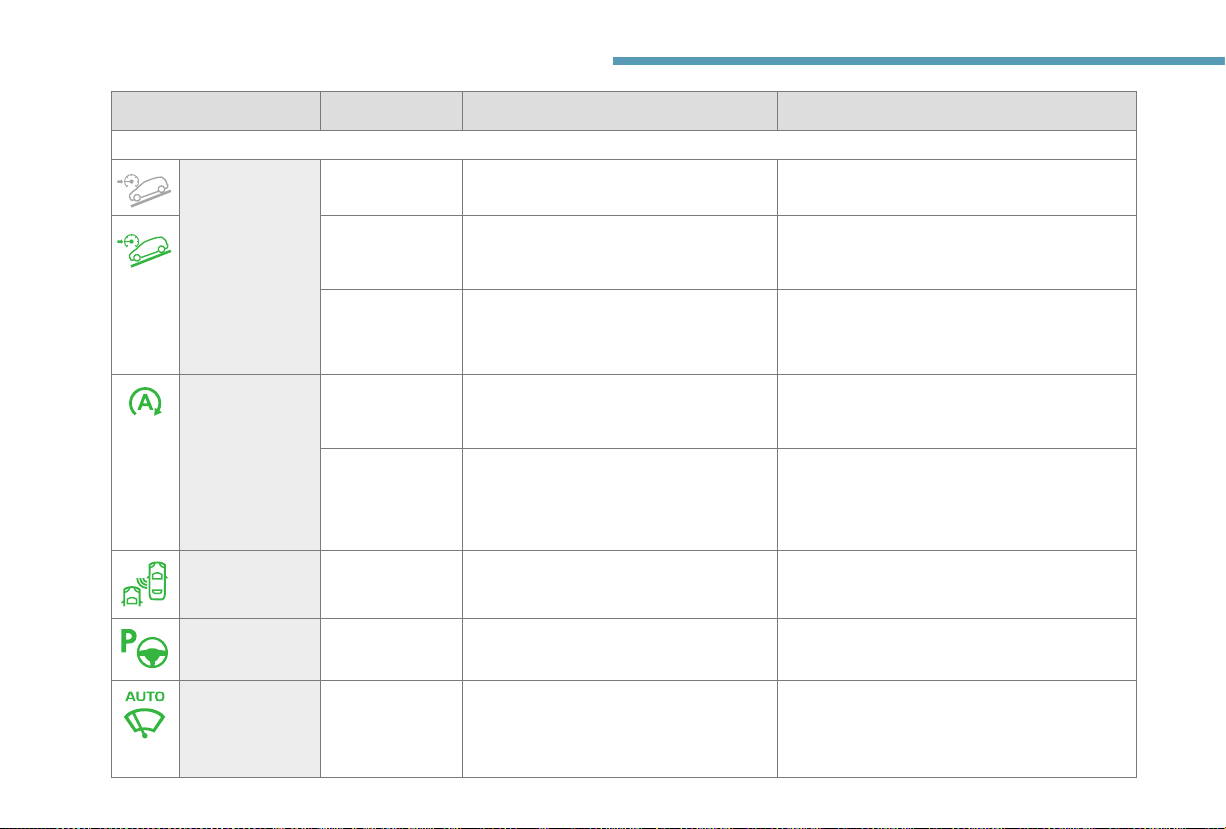
Diesel engine
pre-heating
Fixed. When the ignition is switched on
with a key in the ignition switch
or a starting instruction is made
using the "START/STOP" button,
the engine temperature makes
engine pre-heating necessary.
The period of illumination of the lamp is determined
by the climatic conditions (up to about thirty seconds
in severe winter conditions).
With a key in the ignition switch, wait until the lamp
goes off before starting.
With Keyless Entry and Starting, once it goes off,
starting is immediate, on the condition that the brake
pedal remains pressed with an automatic gearbox.
With Keyless Entry and Starting, once it goes off,
starting is immediate, on the condition that the clutch
pedal remains pressed with a manual gearbox.
If the engine does not start, switch the ignition off
and then on, wait until the lamp goes off again, then
start the engine.
Stop & Start Fixed, accompanied
by the display of a
message.
The Stop & Start system is
deactivated.
The engine will not switch off at the next traffic stop.
Reactivate the system by pressing the button again.
For more information on Stop & Start, refer to the
corresponding section.
Rear foglamps Fixed. The rear foglamps have been
switched on using the ring on the
lighting control stalk.
Turn the ring on the lighting control stalk rearwards to
switch off the rear foglamps.
24
Instruments
Warning / indicator lamp State Cause Action / Observations
Green warning / indicator lamps
Hill Assist
Descent Control
Fixed. The function has been activated, but is
paused because the speed is too high.
Between 19 and 31 mph (30 and 50 km/h), the
system is paused. Reduce the speed of the vehicle.
Fixed. The function has been activated, but
the conditions for regulation are not met
(gradient, gear engaged).
Flashing. The function is regulating the speed of the
vehicle.
The vehicle is being braked; the brake lamps come
on during the descent.
For more information on the Hill Assist Descent
Control function, refer to the corresponding section.
Stop & Start Fixed. When the vehicle stops (red lights, traffic
jams, etc.) the Stop & Start system puts the
engine into STOP mode.
The lamp goes off and the engine restarts
automatically in START mode, as soon as you
want to move off.
Flashing for a few
seconds, then
goes off.
STOP mode is temporarily unavailable.
or
START mode is invoked automatically.
For more information on Stop & Start, refer to the
corresponding section.
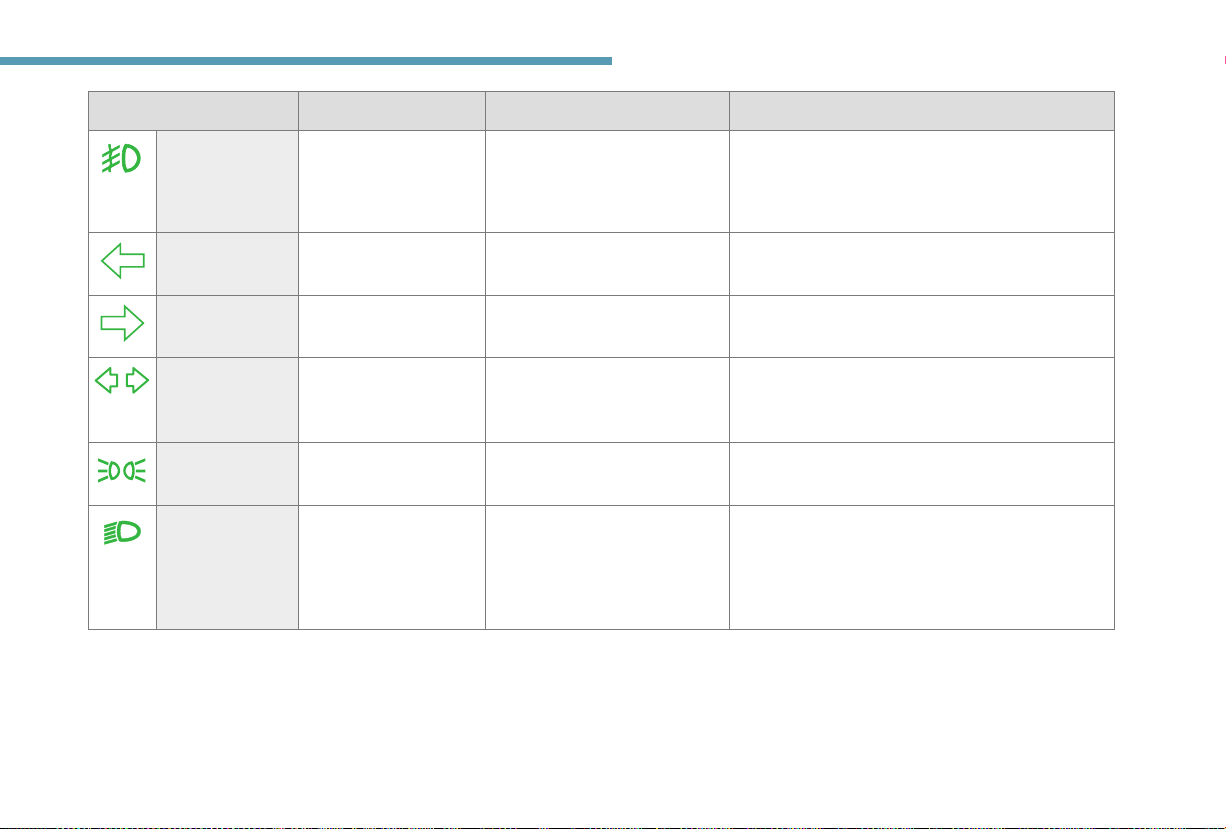
Blind Spot
Monitoring
System
Fixed. The function has been activated. For more information on the Blind Spot
Monitoring System, refer to the corresponding
section.
Park Assist Fixed. The function has been activated. For more information on the Park Assist, refer to
the corresponding section.
Automatic
wiping
Fixed. The wiper control stalk has been pushed
down.
Automatic front wiping is activated.
To deactivate automatic wiping, push the wiper
control stalk down again or put the wiper control
stalk in another position.
25
1
Instruments
Warning / indicator lamp State Cause Action / Observations
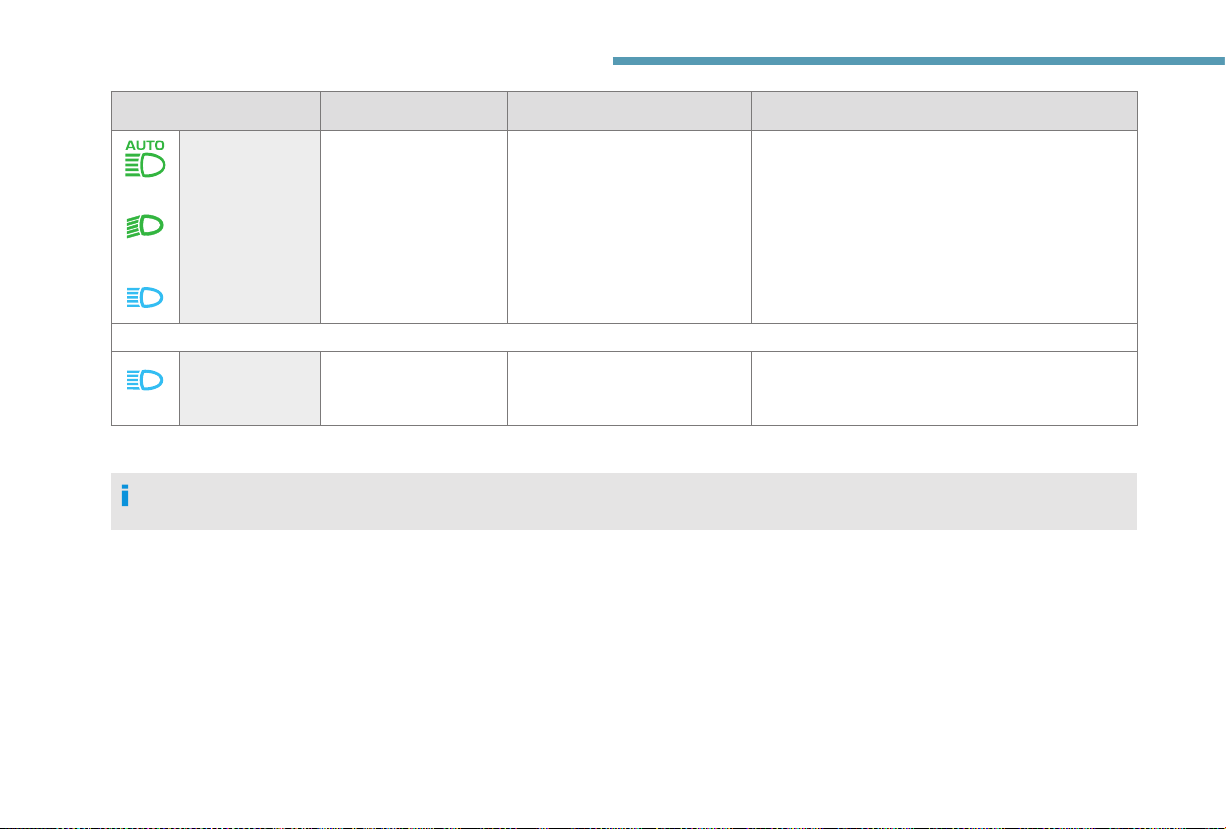
Front foglamps Fixed. The front foglamps have been
switched on using the ring on the
lighting control stalk.
Turn the ring on the lighting control stalk once
rearwards to switch off the foglamps.
Left-hand
direction
indicator
Flashing with audible
signal.
The lighting control stalk has
been moved down.
Right-hand
direction
indicator
Flashing with audible
signal.
The lighting control stalk has
been moved up.
Hazard warning
lamps
Flashing with audible
signal.
The hazard warning lamps
switch, located on the dashboard,
has been operated.
The left-hand and right-hand direction indicators and
their associated warning lamps flash simultaneously.
Sidelamps Fixed. The lighting control stalk is in the
"Sidelamps" position.
Dipped beam
headlamps
Fixed. The lighting control stalk is in
the "Dipped beam headlamps"
position or in the "AUTO"
position in conditions of low light.
26
Instruments
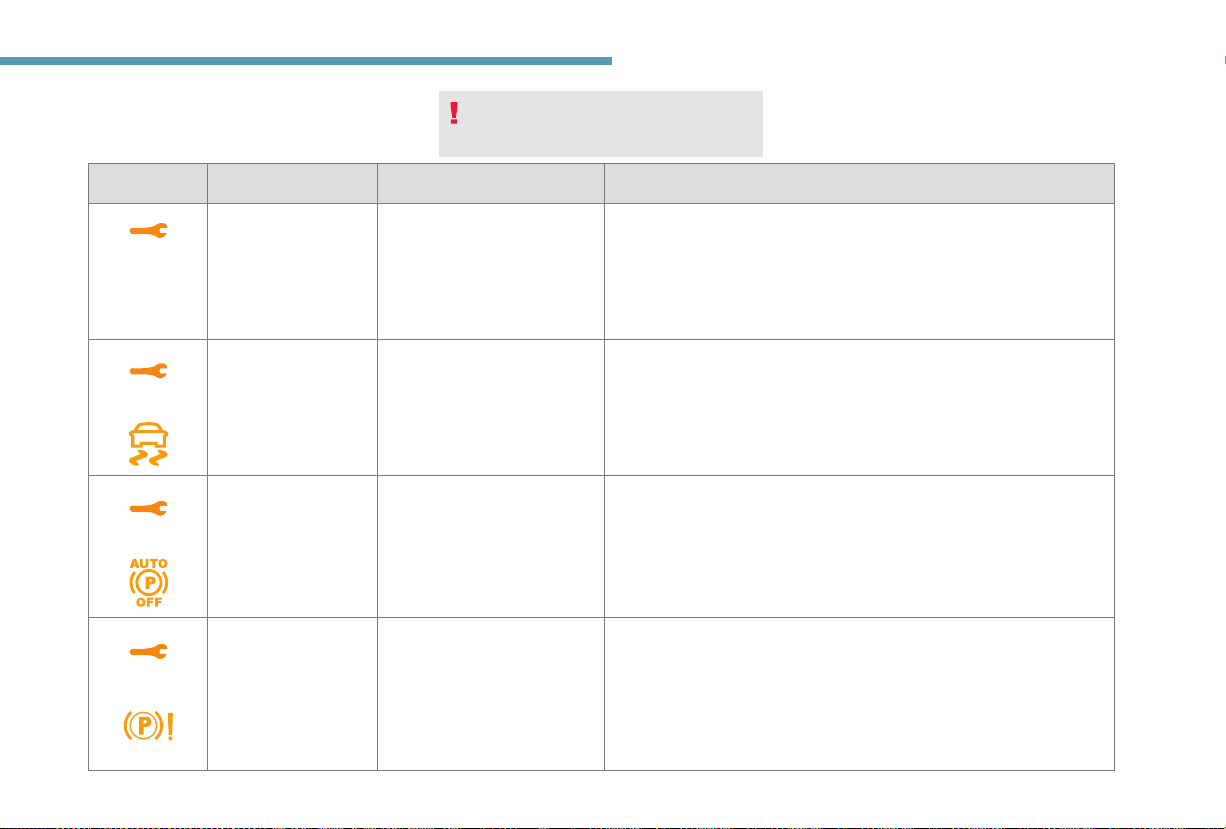
+
or
Automatic
headlamp
dipping
Fixed. The function has been activated
via the Vehicle / Driving menu
of the touch screen.
The lighting control stalk is in the
"AUTO" position.
The camera, placed at the top of the windscreen,
manages the main beam headlamps or dipped
beam headlamps operation, according to the outside
lighting and the driving conditions.
For more information on Automatic headlamp
dipping, refer to the corresponding section.
Warning / indicator lamp State Cause Action / Observations
Blue warning / indicator lamps
Main beam
headlamps
Fixed. The lighting control stalk has
been pulled towards you.
Pull the lever to return to dipped beam headlamps.
For more information on the Lighting control stalk, refer to the corresponding section.
27
1
Instruments
Warning /
indicator lamp
State Cause Action / Observations
It lights up,
accompanied by
the display of the
message "Parking
brake fault".
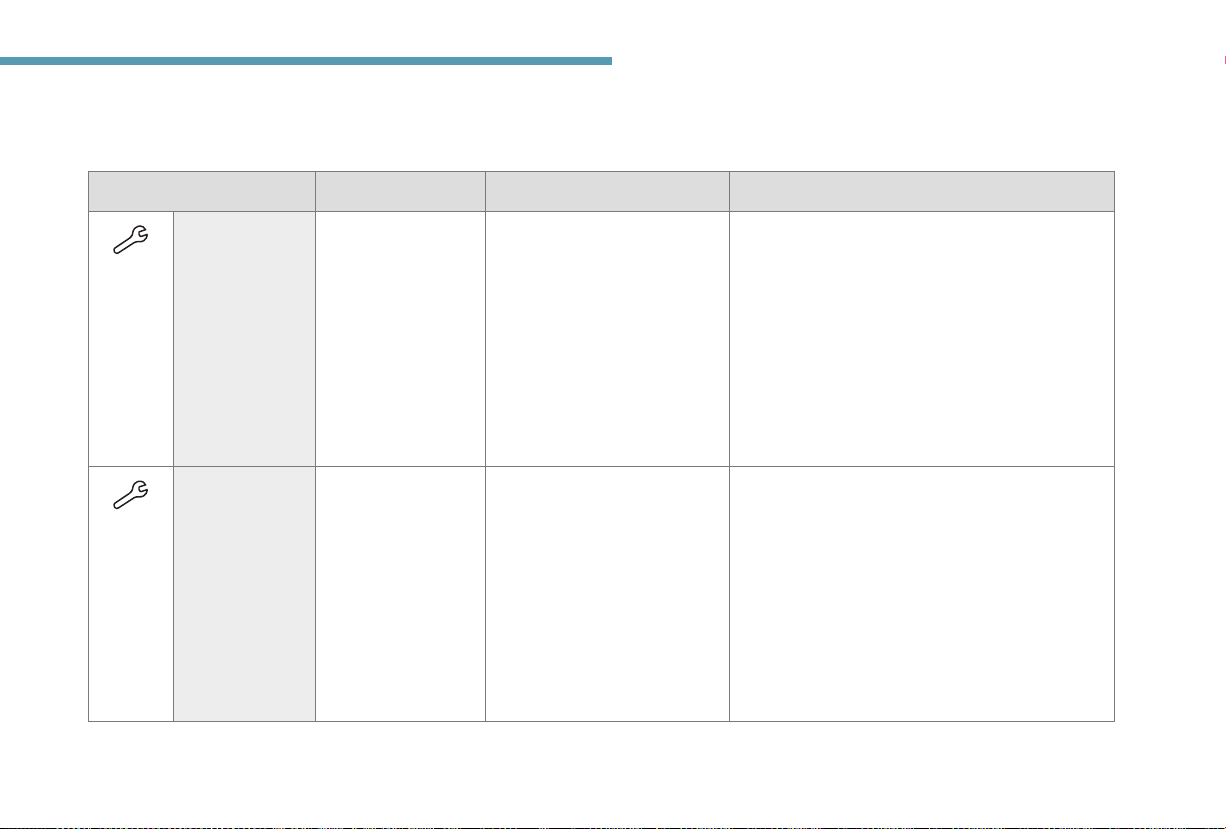
Automatic release is not
available.
If you attempt an automatic release, a help message is displayed upon
acceleration while the parking brake is applied, prompting you to use
manual release.
+
They light up,
accompanied by
the display of the
message "Parking
brake fault".
Emergency braking does not
have full power.
If automatic release is not available, a help message is displayed upon
acceleration while the parking brake is applied, prompting you to use
manual release.
+
They light up,
accompanied by
the display of the
message "Parking
brake fault".
Automatic application is not
available.
The electric parking brake control lever must be used.
The electric parking brake can only be used manually.
If automatic release is also not available, a help message is displayed
upon acceleration while the parking brake is applied, prompting you to
use manual release.
+
They light up,
accompanied by
the display of the
message "Parking
brake fault".
You can no longer immobilise
the vehicle with the engine
running.
If manual application and release are not working, the electric parking
brake control lever is faulty.
The automatic functions must be used at all times: they are
automatically reactivated in the event of failure of the control lever.
Electric parking brake
Contact a PEUGEOT dealer or a qualified
workshop as soon as possible.

28
Instruments
Warning /
indicator lamp
State Cause Action / Observations
+
+
They light up,
accompanied by the
display of the message
"Parking brake fault".
The parking brake is faulty:
manual and automatic
functions may not be working.
When stationary, to immobilise your vehicle:
F Pull and hold the control lever for approximately 7 to 15 seconds, until
the warning lamp comes on in the instrument panel.
If this procedure does not work, you should secure your vehicle as
follows:
F Park on a level surface.
F With a manual gearbox, engage a gear.
F With an automatic gearbox, select mode P, then put the supplied
chocks against one of the wheels.
Call on a PEUGEOT dealer or a qualified workshop.
+
+
+
They light up,
accompanied by the
display of the message
"Parking brake fault".
The parking brake does not
have the optimum performance
to park the vehicle in complete
safety in every situation.
You should secure your vehicle as follows:
F Park on a level surface.
F With a manual gearbox, engage a gear.
F With an automatic gearbox, select mode P, then put the supplied
chocks against one of the wheels.
Call on a PEUGEOT dealer or a qualified workshop.
For more information on the use of the Electric parking brake, refer to the corresponding section.
29
1
Instruments
Indicators
Service indicator
Warning / indicator lamp State Cause Action / Observations
Service spanner Fixed, temporary when
the ignition is switched
on.
There are between 620 miles
(1,000 km) and 1,900 miles
(3,000 km) before the next
service is due.
The service indicator is displayed for a few seconds on
the instrument panel. Depending on version:
- the distance recorder display line indicates the
distance remaining (in kilometres or miles) before
the next service is due.
- an alert indicates the distance remaining (in
kilometres or miles) as well as the period before
the next service is due.
The service spanner goes off after a few seconds.
The alert may be triggered close to the due date.
Fixed, when the
ignition is switched on.
Less than 620 miles (1,000 km)
remain before the next service
is due.
The service indicator is displayed for a few seconds on
the instrument panel. Depending on version:
- the distance recorder display line indicates the
distance remaining before the next service is due.
- an alert message indicates the distance remaining
as well as the period before the next service is due.
The service spanner remains on to show that a service
is required very soon.
The alert may be triggered close to the due date.
30
Instruments
The distance indicated (in miles or kilometres) is calculated according to the distance covered and the time elapsed since the last service.
Warning / indicator lamp State Cause Action / Observations
Service spanner Flashing then fixed,
when the ignition is
switched on.
The servicing interval has been
exceeded.
The service indicator is displayed for a few seconds
on the instrument panel. Depending on version:
- the distance recorder display line indicates the
distance travelled since the service was due. The
value is preceded by the "-" sign.
- an alert message indicates that the due date has
passed.
The service spanner remains on until the service has
been performed.
The alert is triggered when the due date has passed.
+
Flashing then fixed,
when the ignition
is switched on,
associated with the
Service warning
lamp.
Service date passed for BlueHDi
Diesel versions.
The service indicator is displayed for a few seconds
on the instrument panel. Depending on version:
- the distance recorder display line indicates the
distance travelled since the service was due. The
value is preceded by the "-" sign.
- an alert message indicates that the due date has
passed.
The service spanner remains on until the service has
been performed.
The alert is triggered when the due date has passed.

31
1
Instruments
Resetting the service indicator
The service indicator must be reset after each
service.
If you have carried out the service on your
vehicle yourself:
F switch off the ignition,
If you have to disconnect the battery
following this operation, lock the vehicle
and wait at least 5 minutes for the reset to
be registered.
Retrieving the service information
You can access the service information at any
time.
F press and hold the trip distance recorder
reset button,
F switch on the ignition; the distance recorder
display begins a countdown,
F release the button when "=0" is displayed;
the spanner disappears.
F Press the trip distance recorder reset
button.
The service information is displayed for a few
seconds, then disappears.
Engine oil level indicator
(Depending on version.)
On versions fitted with an electric oil level
indicator, the state of the engine oil level is
displayed in the instrument panel for a few
seconds, after the servicing information.
The level read will only be correct if the
vehicle is on level ground and the engine
has been off for more than 30 minutes.
Oil level correct
Oil level incorrect
This is indicated by the display of the message
"Oil level incorrect" in the instrument panel
screen, accompanied by the Service warning
lamp and an audible signal.

32
Instruments
If the low oil level is confirmed by a check using
the dipstick, the level must be topped up to
avoid damage to the engine.
For more information on Checking levels,
refer to the corresponding section.
Oil level indicator fault
This is signalled by the display of the message
"Oil level measurement invalid" in the
instrument panel.
Contact a PEUGEOT dealer or a qualified
workshop.
In the event of a fault with the electric
indicator, the oil level is no longer
monitored.
If the system is faulty, you must check
the engine oil level using the manual
dipstick located under the bonnet.
For more information on Checking
levels, refer to the corresponding
section.
Engine coolant
temperature gauge
With the engine running:
- in zone A, the temperature is correct,
- in zone B, the temperature is too high; this
warning lamp and the central STOP warning
lamp come on in the instrument panel,
accompanied by the display of a message
and an audible signal.
You MUST stop as soon as it is safe to do
so.
Wait a few minutes before switching off the
engine.
After first switching off the ignition, open
the bonnet cautiously and check the
coolant level.
For more information on Checking levels,
refer to the corresponding section.
AdBlue
®
range indicators
These range indicators are present only on
BlueHDi Diesel versions.
Once the AdBlue
®
tank is on reserve or after
detection of a fault with the SCR emissions
control system, when the ignition is switched
on, an indicator displays an estimate of the
distance that can be covered, the range, before
engine starting is prevented.
In the event of the risk of non-
starting related to a lack of
AdBlue
®
The engine starting prevention system
required by regulations is activated
automatically once the AdBlue
®
tank is
empty.
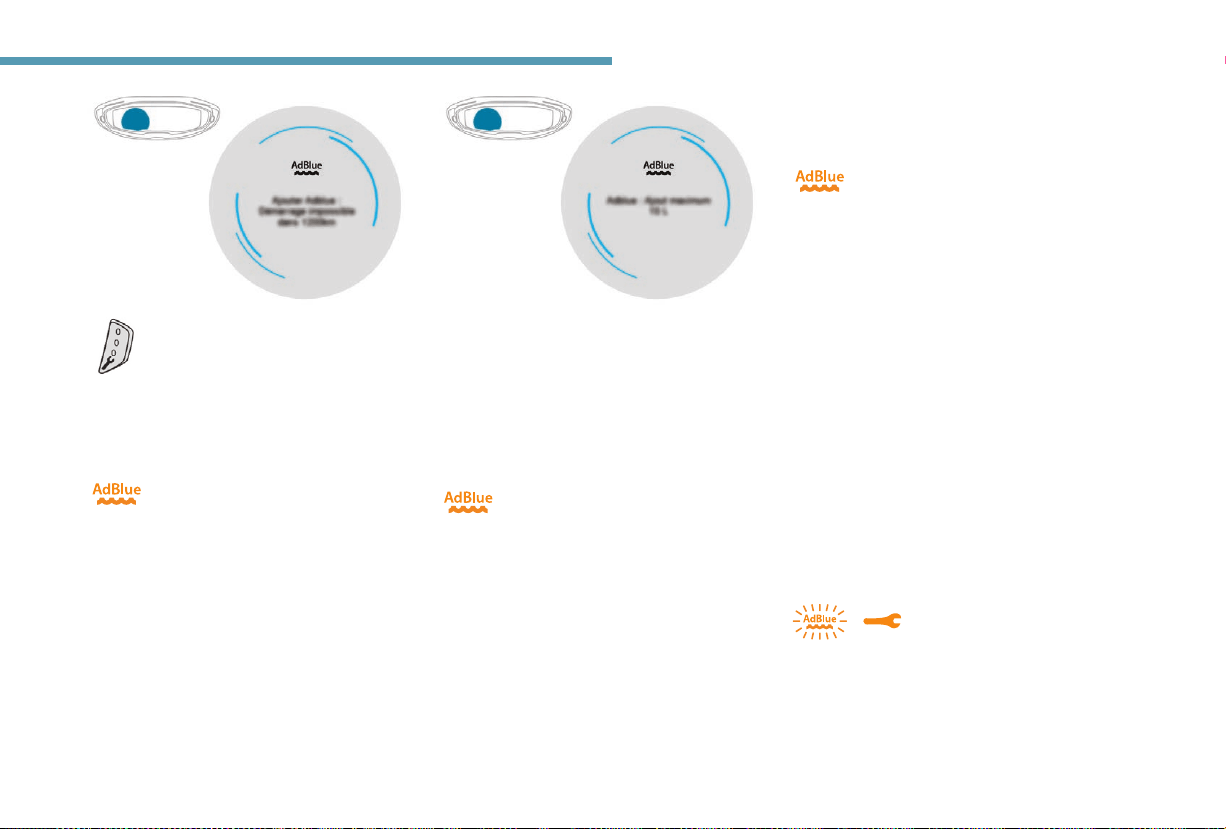
Range greater than 1,500 miles (2,400 km)
When switching on the ignition, there is no
automatic display of range in the instrument
panel.
33
1
Instruments
Pressing this button temporarily
displays the driving range.
Remaining range between 1,500 and
500 miles (2,400 and 800 km)
(with 1.5 BlueHDi 130 S&S and 2.0 BlueHDi
180 S&S engines)
Remaining range between 1,500 and
375 miles (2,400 and 600 km)
(with 1.6 BlueHDi 100 S&S, 1.6 BlueHDi
115 S&S, 1.6 BlueHDi 120 S&S and
2.0 BlueHDi 150 S&S engines)
When switching on the ignition, this warning
lamp comes on for about 30 seconds,
accompanied by an audible signal and the
display of a message (e.g. "Top up AdBlue:
Starting impossible in x miles") indicating
the remaining range expressed in miles or
kilometres.
The reserve level has been reached; it is
recommended that you top up as soon as
possible.
These messages are accompanied by the
recommendation to not top up with more than
10 litres of AdBlue.
When switching on the ignition, this warning
lamp comes on, accompanied by an audible
signal and the display of a message (e.g. "Top
up AdBlue: Starting impossible in x miles")
indicating the remaining range expressed in
miles or kilometres.
When driving, the message comes up every
185 miles (300 km) until the tank is topped up.
The reserve level has been reached; it is
recommended that you top up as soon as
possible.
Remaining range between 500 and 60 miles
(800 and 100 km)
(with 1.5 BlueHDi 130 S&S and 2.0 BlueHDi
180 S&S engines)
Remaining range less than 375 miles
(600 km)
(with 1.6 BlueHDi 100 S&S, 1.6 BlueHDi
115 S&S, 1.6 BlueHDi 120 S&S and
2.0 BlueHDi 150 S&S engines)
When switching on the ignition, this warning
lamp comes on, accompanied by an audible
signal (1 beep) and the display of a message
(e.g. "Top up AdBlue: Starting impossible
in x miles") indicating the remaining range
expressed in miles or kilometres.
When driving, the audible signal and the
message display are triggered every 60 miles
(100 km) until the level is topped up.
It is essential to top up as soon as possible and
before the tank is completely empty; otherwise
it will not be possible to restart the engine after
the next stop.
When switching on the ignition, this warning
lamp flashes, accompanied by the permanent
lighting of the Service warning lamp, an audible
signal and the display of a message (e.g. "Top
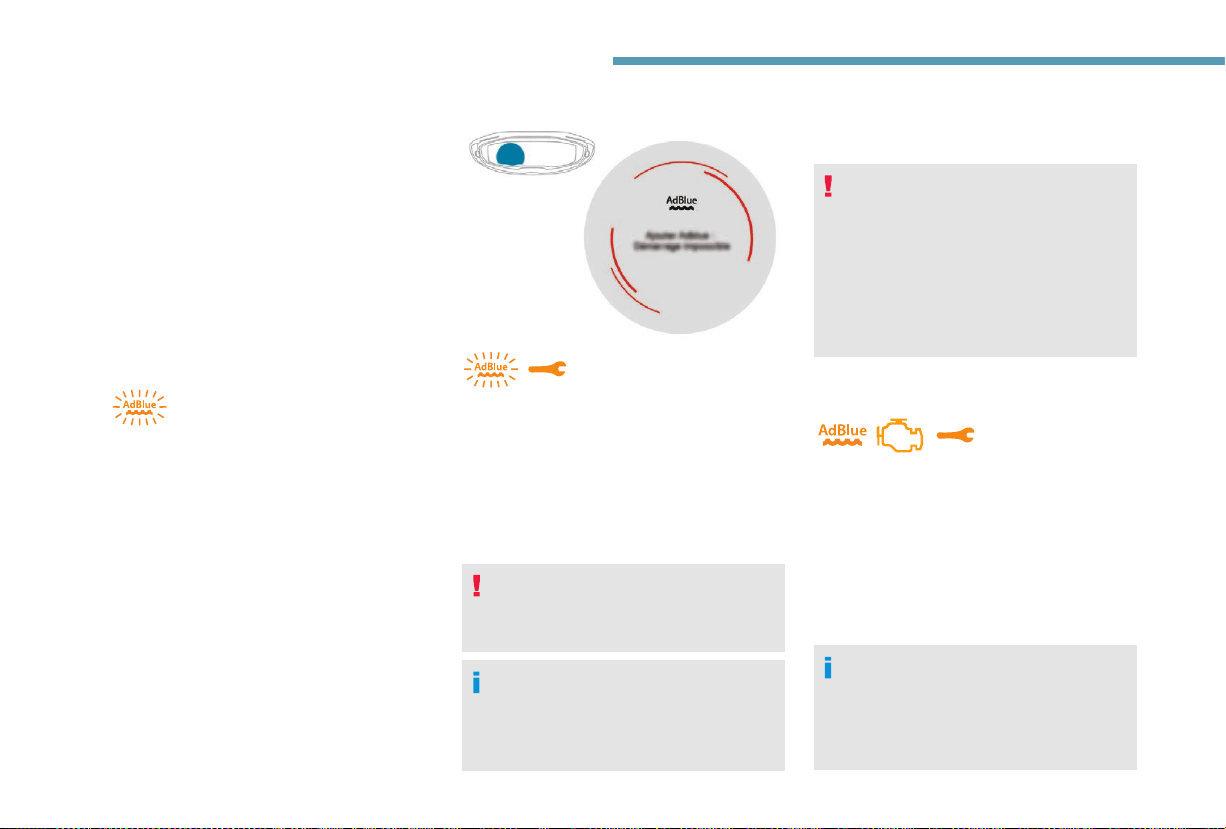
34
Instruments
up AdBlue: Starting impossible in x miles")
indicating the remaining range expressed in
miles or kilometres.
When driving, this message is displayed every
30 seconds until the AdBlue level has been
topped up.
It is essential to top up as soon as possible and
before the tank is completely empty; otherwise
it will not be possible to restart the engine after
the next stop.
Remaining range less than 60 miles (100 km)
(with 1.5 BlueHDi 130 S&S and 2.0 BlueHDi
180 S&S engines)
When driving, the audible signal and the
message display are triggered every 6 miles
(10 km) until the AdBlue tank is topped up.
It is essential to top up as soon as possible and
before the tank is completely empty; otherwise
it will not be possible to restart the engine after
the next stop.
Breakdown due to a lack of AdBlue
®
The AdBlue
®
tank is empty: the starting
prevention system required by legislation
prevents starting of the engine.
To be able to restart the engine, it is
essential to add at least 5 litres of AdBlue
®
to its tank.
For more information on AdBlue
®
(BlueHDi engines), and, in particular,
on topping up, refer to the corresponding
section.
When switching on the ignition, this warning
lamp flashes, accompanied by an audible
signal and the display of the message "Top up
AdBlue: Starting impossible".
In the event of a fault with the
SCR emissions control system
A system that prevents engine starting is
activated automatically from 685 miles
(1,100 km) after confirmation of a fault with
the SCR emissions control system.
Have the system checked by a PEUGEOT
dealer or a qualified workshop as soon as
possible.
In the event of the detection of a fault
If it is a temporary fault, the alert
disappears during the next journey,
after self-diagnostic checks of the SCR
emissions control system.
These warning lamps come on, accompanied
by an audible signal and the display of the
"Emissions fault" message.
The alert is triggered while driving as soon
as the fault is detected for the first time, then
when switching on the ignition for subsequent
journeys, while the fault persists.
When switching on the ignition, this warning
lamp flashes, accompanied by an audible
signal (1 beep) and the display of a message
(e.g. "Top up AdBlue: Starting impossible
in x miles") indicating the remaining range
expressed in miles or kilometres.
35
1
Instruments
During the permitted driving phase
(between 685 and 0 miles (1,100 and 0 km))
While driving, the message is displayed every
30 seconds while the fault with the SCR system
persists.
The alert is repeated when switching on the
ignition.
You should contact a PEUGEOT dealer or a
qualified workshop as soon as possible.
Otherwise you will not be able to restart the vehicle.
Starting prevented
You have exceeded the authorised driving
limit: the starting prevention system does
not allow the engine to be started.
To be able to restart the engine, you must call
on a PEUGEOT dealer or a qualified workshop.
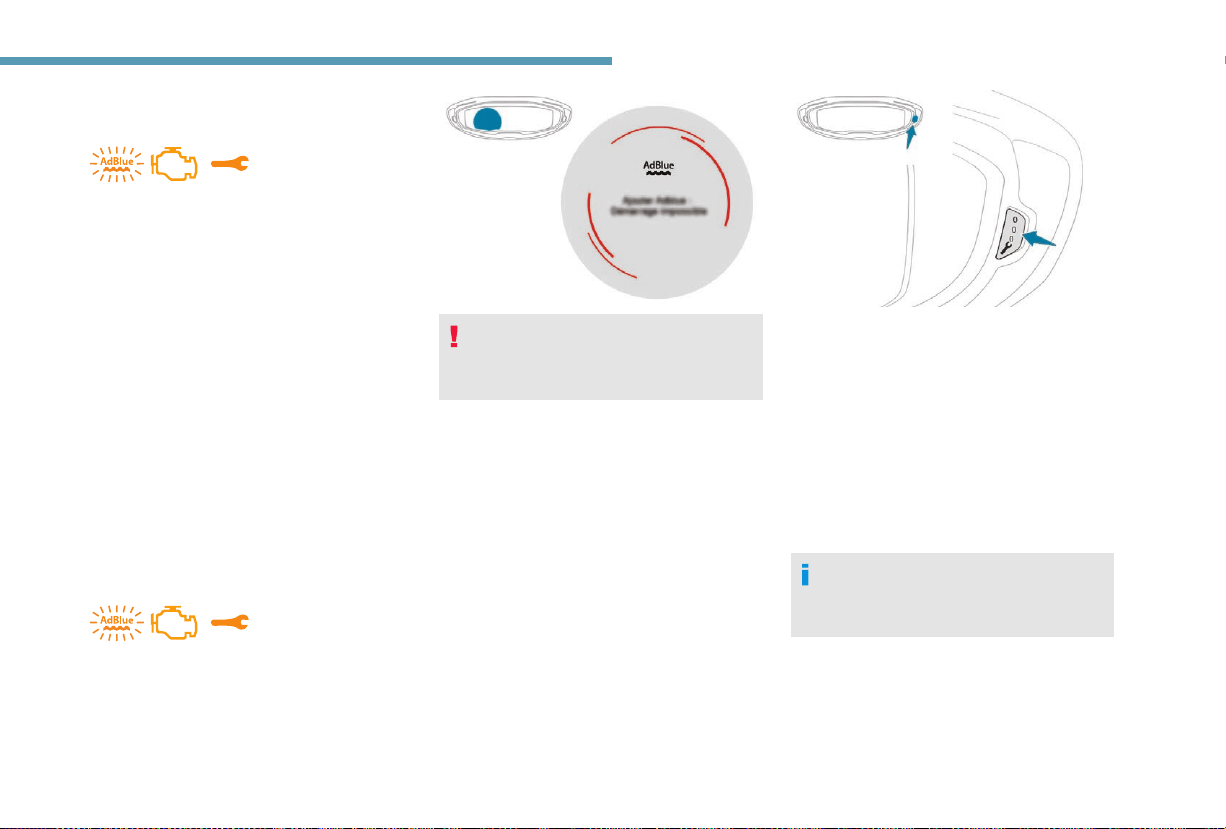
If a fault with the SCR emissions control system
is confirmed (after 31 miles (50 km) covered with
the permanent display of the message signalling
a fault), these warning lamps come on and the
AdBlue warning lamp flashes, associated with
an audible signal and the display of a message
(e.g. "Emissions fault: Starting prevented in
200 miles") indicating the remaining range
expressed in miles or kilometres.
Each time the ignition is switched on, these
warning lamps come on and the AdBlue
warning lamp flashes, accompanied by an
audible signal and the display of the message
"Emissions fault: Starting prevented".
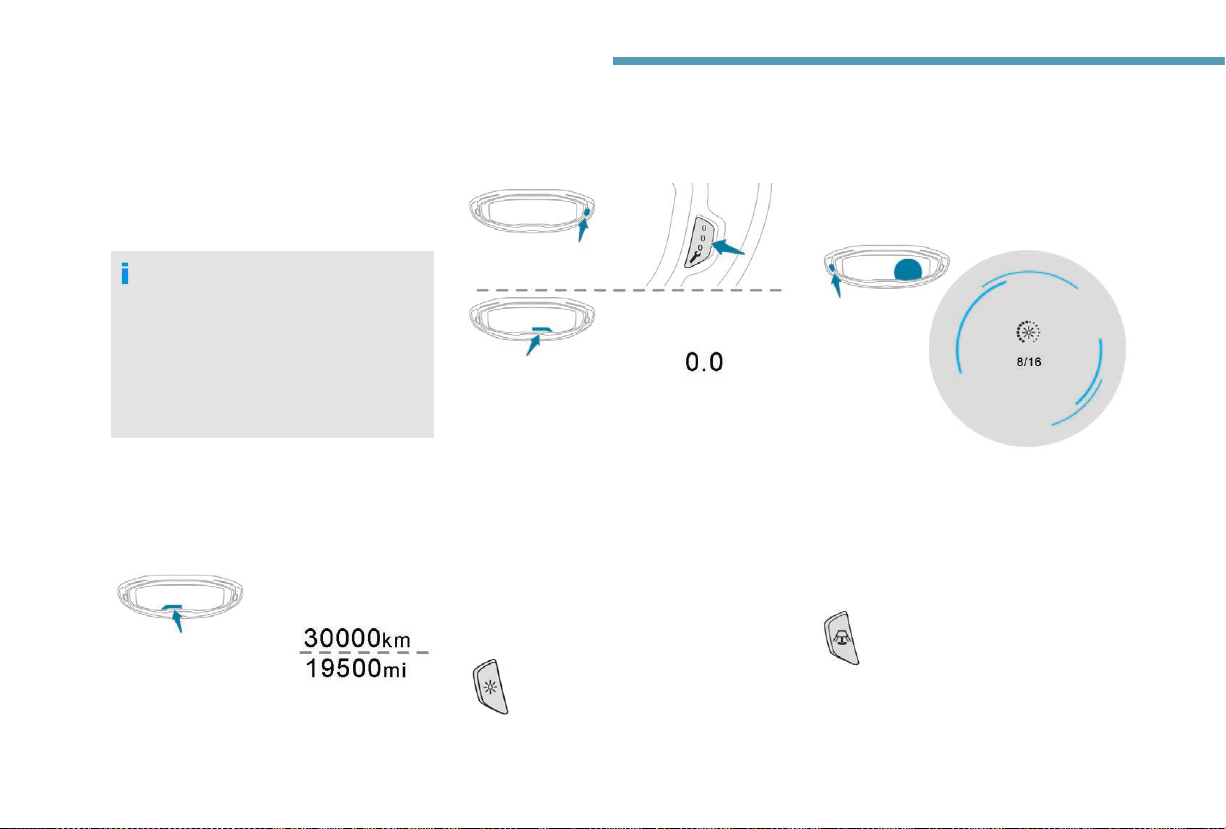
Manual test in the
instrument panel
This function allows you, at any time, to check
certain indicators and display the alerts log.
F With the engine running, briefly press this
button.
The following information is displayed in the
instrument panel:
- the engine oil level,
- when the next service is due,
- the driving range for the AdBlue and the
SCR system for BlueHDi Diesel versions,
- current alerts.
This information is also displayed
automatically every time the ignition is
switched on.
36
Instruments
Distance recorders
The total and trip distances are displayed for
thirty seconds when the ignition is switched off,
when the driver's door is opened and when the
vehicle is locked or unlocked.
When travelling abroad, you may have to
change the distance unit: the display of
road speed must be in the official units
(miles or km) for the country.
The change of units is done via the
screen configuration menu, with the
vehicle stationary.
Total distance recorder
It measures the total distance travelled by the
vehicle since its first registration.
Trip recorder
It measures the distance travelled since it was
reset by the driver.
Resetting the trip recorder
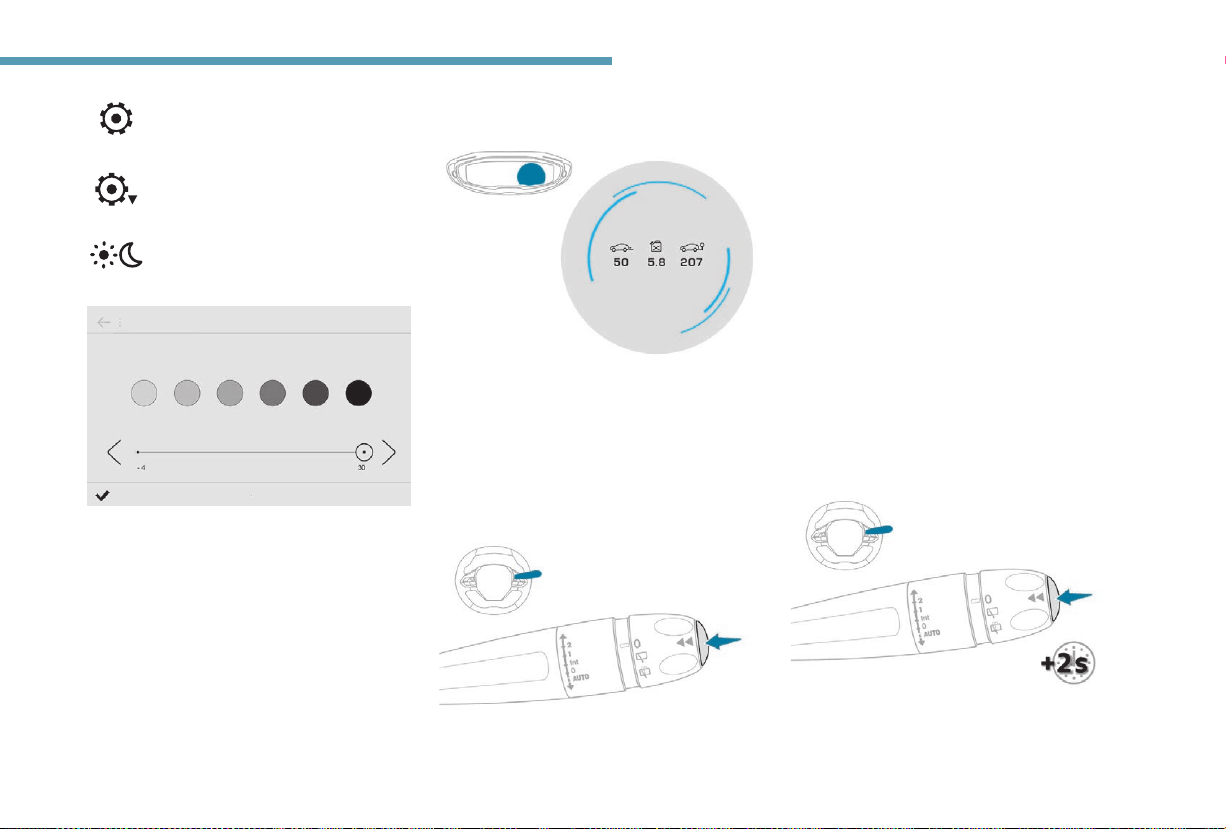
F With the ignition on, press the button until
zeroes appear.
Instrument panel lighting
dimmer
Version with monochrome screen
Only works when the vehicle lighting is on
("night" mode).
It allows the brightness of the instruments and
controls to be adjusted.
F Press this button to adjust the
brightness.
F When the lighting reaches the
minimum setting, release the
button, then press it again to
increase brightness.
or
F When the lighting reaches the maximum
setting, release the button, then press it
again to decrease brightness.
F Release the button once the desired level of
brightness is reached.
Instrument panel ambient
lighting
Version with touch screen
It allows the instrument panel ambient lighting
to be switched on or off.
The brightness of the instrument panel ambient
lighting is adjusted in the touch screen.
F Press this button.
37
1
Instruments
or
F Select the Settings menu in the
upper bar of the touch screen.
F Press the "Brightness" button.
F Adjust the brightness by pressing the
arrows or moving the cursor.
F Confirm to save and quit.
Trip computer
Information displayed about the current journey
(range, fuel consumption, average speed, etc.).
Trip computer data is displayed permanently
when you select the display mode "TRIP
COMPUTER" or "PERSONAL", depending on
the version.
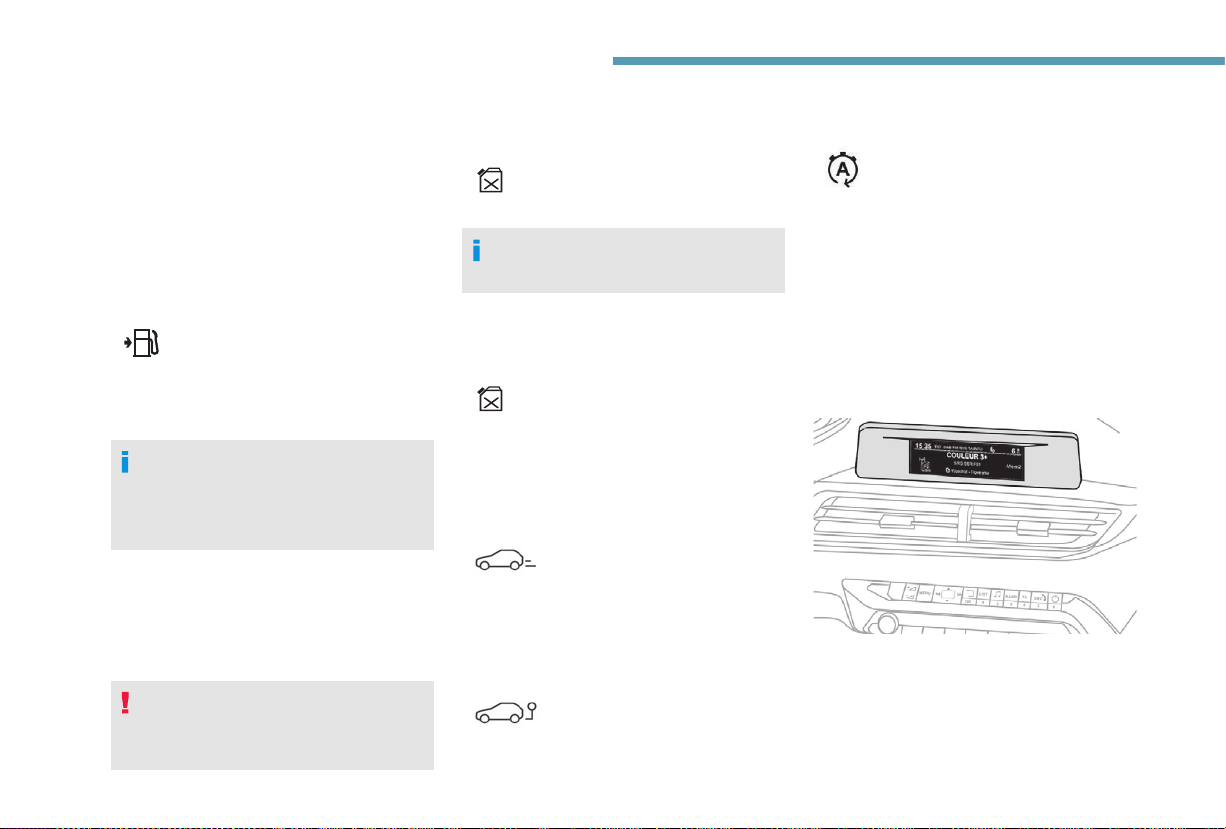
In all other display modes, pressing the end of
the wiper control stalk will cause this data to
appear temporarily in a specific window.
F Press this button, located on the end of the
wiper control stalk, to display the different
tabs in turn.
Display of data on the
instrument panel
- Instant information with:
• range,
• current fuel consumption,
• time counter of the Stop & Start.
- Journey "1" with:
• average speed,
• average fuel consumption,
• distance travelled,
for the first journey.
- Journey "2" with:
• average speed,
• average fuel consumption,
• distance travelled,
for the second journey.
Reset trip
F When the desired trip is displayed, press
the button on the end of the wiper control
stalk for more than 2 seconds.
38
Instruments
Monochrome screen C
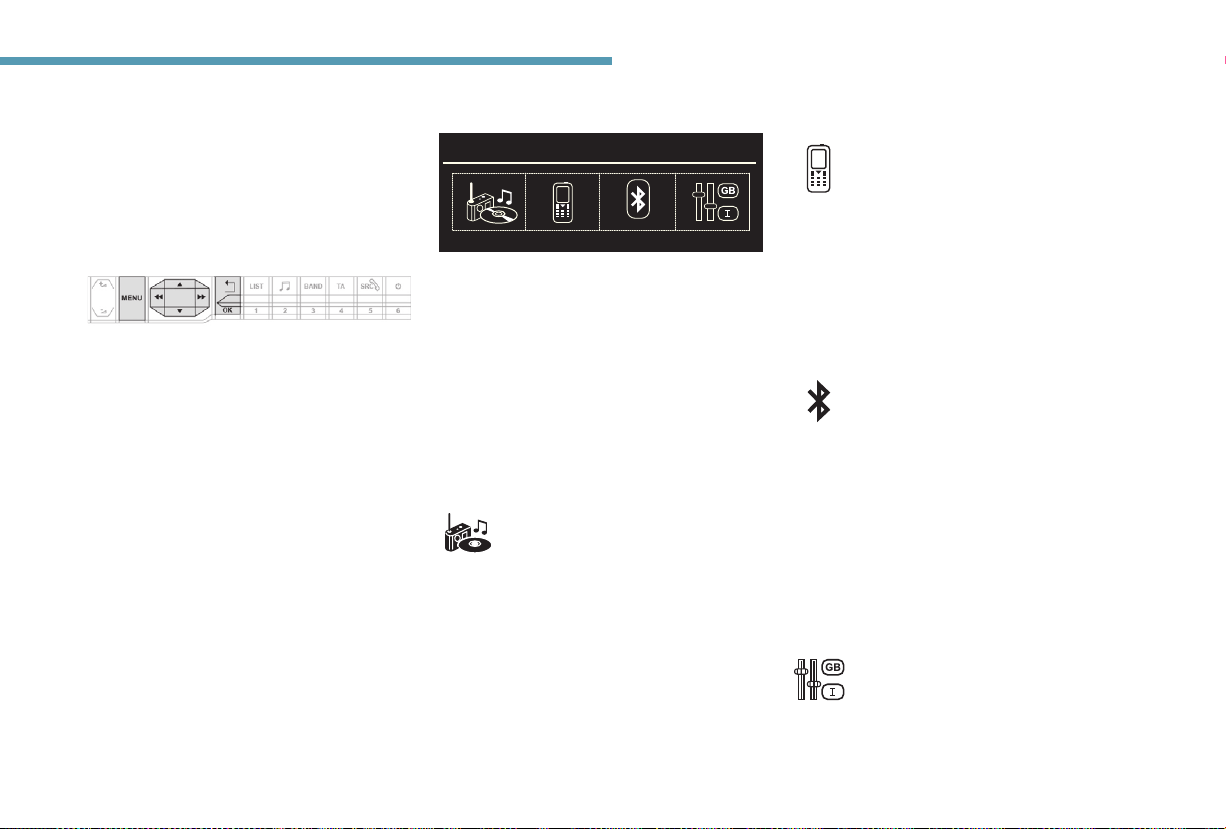
Displays
Depending on the context, it displays:
- time,
- date,
- exterior temperature (this flashes if there is
a risk of ice),
Trips "1" and "2" are independent and are used
identically.
Trip "1" allows daily calculations to be carried
out, for example, and trip "2" allows monthly
calculations.
A few definitions…
Range
(miles or km)
If dashes are displayed continuously while
driving in place of the digits, contact a
PEUGEOT dealer or a qualified workshop.
This value may vary following a change in
the style of driving or the terrain, resulting
in a significant change in the current fuel
consumption.
When the range falls below 19 miles (30 km),
dashes are displayed.
After filling with at least 5 litres of fuel, the
range is recalculated and is displayed if it
exceeds 62 miles (100 km).
The distance which can still be
travelled with the fuel remaining
in the tank (at the average fuel
consumption seen over the last few
miles (kilometres) travelled).
Current fuel consumption
(mpg or l/100 km or km/l)
Calculated over the last few seconds.
This function is only displayed from
19 mph (30 km/h).
Average fuel consumption
(mpg or l/100 km or km/l)
Calculated since the last trip
computer reset.
Average speed
(mph or km/h)
Calculated since the last trip
computer reset.
Distance travelled
(miles or km)
Calculated since the last trip
computer reset.
Stop & Start time counter
(minutes / seconds or hours /
minutes)
If your vehicle is fitted with Stop & Start, a time
counter calculates the time spent in STOP
mode during a journey.
It resets to zero every time the ignition is
switched on.
39
1
Instruments
- visual parking sensor information,
- audio source being listened to,
- telephone or hands-free kit information,
- settings menus for the screen and the
vehicle equipment.
Controls
From the audio system control panel, press:
F the "MENU" button to access the main
menu,
F the "5" or "6" buttons to scroll through the
items in the screen,
F the "7" or "8" buttons to change a setting
value,
F the "OK" button to confirm,
or
F the "Back" button to abandon the operation
in progress.
Main menu
F Press the MENU button:
- "Multimedia",
- "Telephone",
- "Connections",
- "Personalisation-configuration".
F Press the "7" or "8" button to select the
menu required, then confirm by pressing the
"OK" button.
"Multimedia" menu
With the audio system switched on,
this menu allows you to activate or
deactivate the functions associated
with use of the radio (Frequency
search (RDS), DAB / FM auto
tracking, Radio Text (TXT) display)
or to choose the media play mode
(Normal, Random, Random all,
Repeat).
For more information on the "Multimedia"
application, refer to the "Audio equipment and
telematics" section.
"Telephone" menu
With the audio system switched
on, this menu allows you to make a
call, view the calls log or the various
telephone directories.
For more information on the "Telephone"
application, refer to the "Audio equipment and
telematics" section.
"Connections" menu
With the audio system on, this
menu allows a Bluetooth device
(telephone, media player) to be
paired and the connection mode
to be defined (hands-free, playing
audio files).
For more information on the "Connections"
application, refer to the "Audio equipment and
telematics" section.
"Personalisation-
configuration" menu
This menu gives access to the
following functions:
- "Define the vehicle parameters",
- "Choice of language",
- "Display configuration".
40
Instruments
Touch screen
Dene the vehicle parameters
This menu allows the activation or deactivation
of the following equipment, depending on
version:
- "Access to the vehicle":
• "Remote control action".
For more information on the Remote control
and driver door selective unlocking in
particular, refer to the "Access" section.
- "Comfort":
• "Rear wipe in reverse gear".
For more information on the Wipers,
refer to the "Lighting and visibility"
section.
• "Parking assistance".
For more information on Parking
assistance, refer to the "Driving"
section.
• "Fatigue Detection System".
For more information on the Fatigue
detection system, refer to the "Driving"
section.
- "Driving assistance":
• "Auto. emergency braking".
For more information on the Active
Safety Brake, refer to the "Driving"
section.
• "Speed recommendation".
For more information on Speed limit
recognition, refer to the "Driving"
section.
• "Tyre inflation".
For more information on Under-
inflation detection and reinitialisation in
particular, refer to the "Driving" section.
Choice of language
This menu allows selection of the language
used by the screen and the instrument panel.
Display conguration
This menu gives access to the following
settings:
- "Choice of units",
- "Date and time adjustment",
- "Display parameters",
- "Brightness".
Adjusting the date and time
F Press the "7" or "8" button to display the
"Display configuration" menu, then press
OK.
F Press the "5" or "6" button to select the
"Date and time adjustment" button, then
press OK.
F Press the "7" or "8" button to select the
setting to modify. Confirm by pressing OK,
then modify the setting and confirm again to
save the modification.
F Adjust the settings one by one, confirming
with the OK button.
F Press the "5" or "6" button, then the OK
button to select the OK box and confirm or
the Back button to cancel.
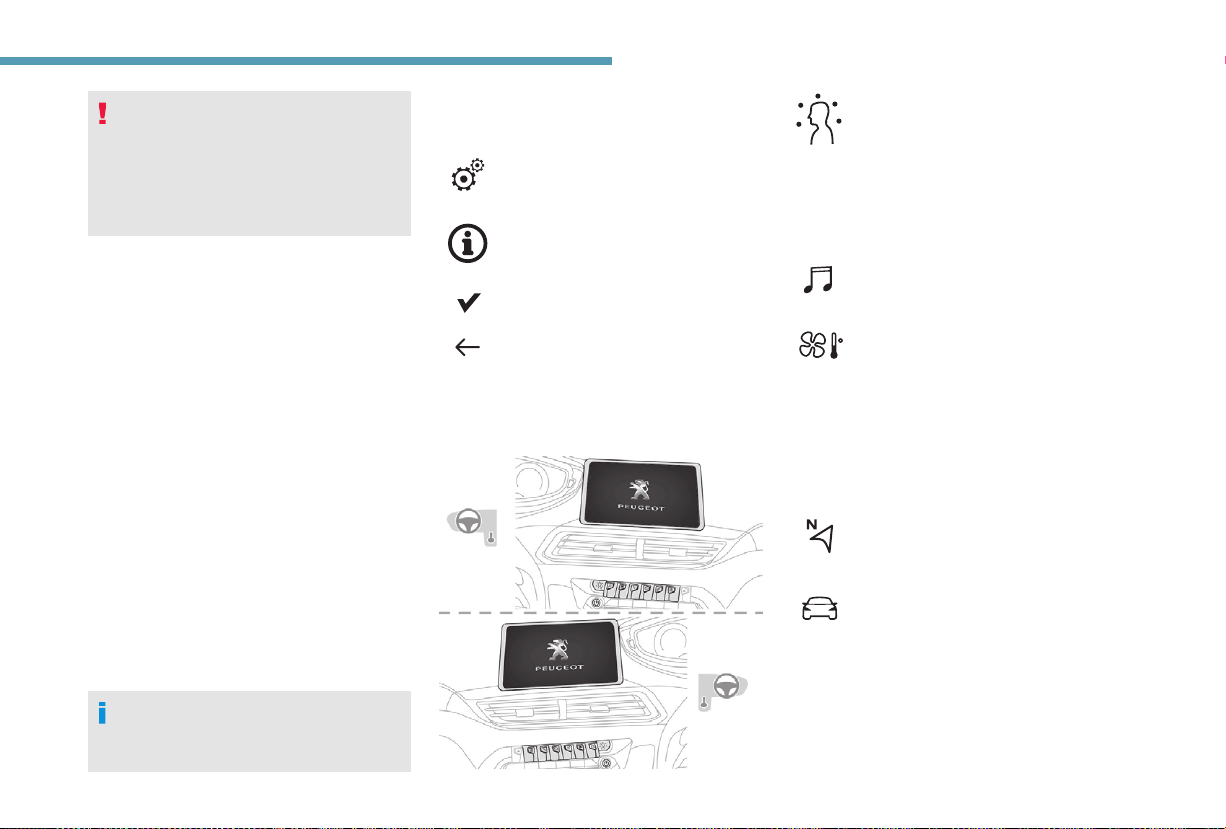
As a safety measure, the driver must only
carry out operations that require sustained
attention when stationary.
This system gives access to:
- the permanent display of the time and
the exterior temperature (a blue symbol
appears when there is a risk of ice),
- the heating/air conditioning controls,
- menus for adjusting settings for vehicle
functions and systems,
- audio system and telephone controls and
the display of associated information,
- the display of visual parking aids (visual
parking sensor information, Park Assist,
etc.),
- Internet services and the display of
associated information.
and, depending on equipment, allows:
- access to the navigation system controls
and the display of associated information.
41
1
Instruments
General operation
Recommendations
This screen is of the capacitive type.
Use is possible in all temperatures.
Do not use pointed objects on the touch
screen.
Do not touch the touch screen with wet hands.
Use a soft clean cloth to clean the touch
screen.
Principles
Use the buttons below the touch screen for
access to the menus, then press the virtual
buttons in the touch screen.
Some menus may display across two pages:
press the "OPTIONS" button to access the
second page.
After a few moments with no action on the
second page, the first page is displayed
automatically.
To deactivate or activate a function, select
"OFF" or "ON".
Use this button to adjust the settings
for a function.
Use this button for access to
additional information on the
function.
Use this button to confirm.
Use this button to return to the
previous page.
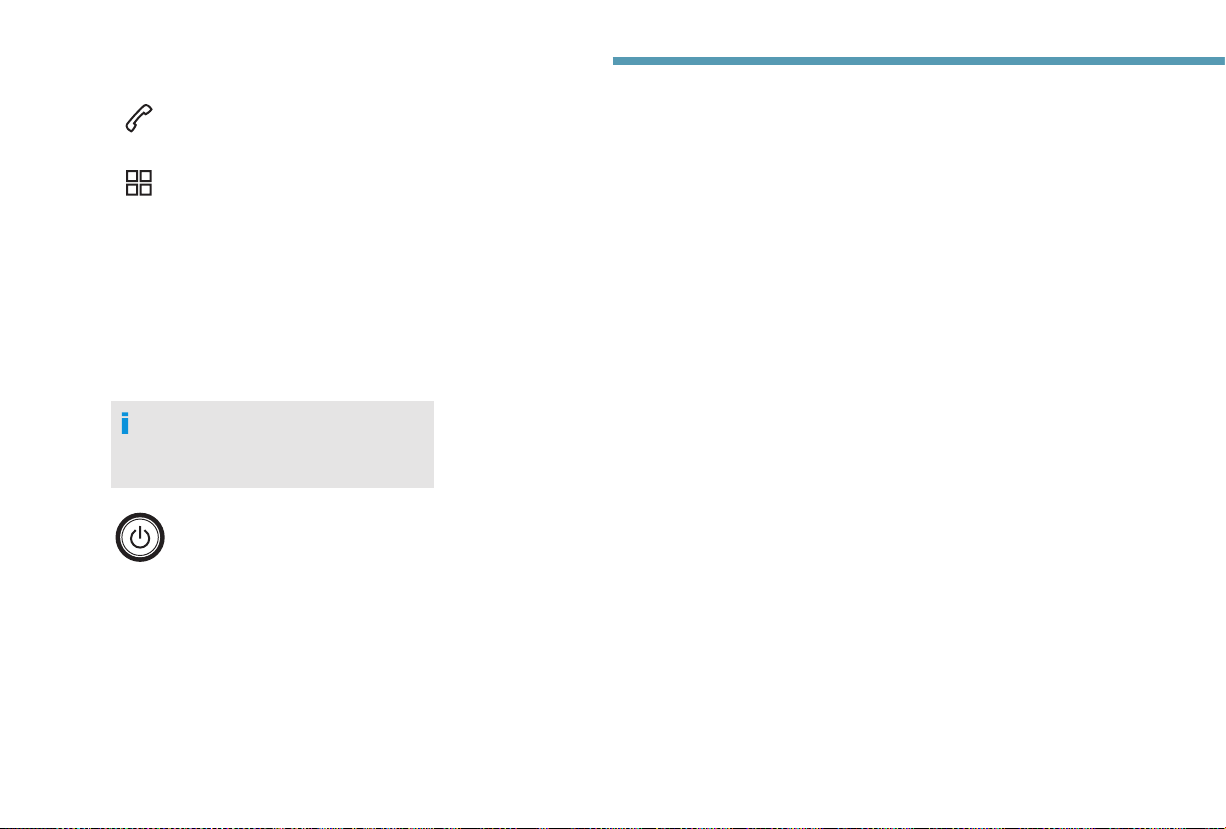
Menus
i-Cockpit Amplify function.
Allows a driving ambience to be
personalised.
Radio Media.
See the "Audio equipment and
telematics" section.
Air conditioning.
Allows control of the settings for
temperature, air flow, etc.
Connected Navigation or Mirror Screen*.
See the "Audio equipment and
telematics" section.
Vehicle or Driving*.
Allows the activation, deactivation
and adjustment of settings for
certain functions.
The functions accessible from this menu are
arranged under two tabs: "Vehicle settings"
and "Driving functions".
As a safety measure, the driver should
only carry out operations that require
close attention with the vehicle
stationary.
Some functions are not accessible when
driving.
For more information on the i-Cockpit
Amplify function, refer to the
corresponding section.
For more information on Semi-automatic
mono-zone air conditioning and Automatic
dual-zone air conditioning, refer to the
corresponding sections.
* Depending on equipment.
42
Instruments
Upper bar
Certain information is always displayed in the
upper bar of the touch screen:
- Time and exterior temperature (a blue
warning lamp appears when there is a risk
of ice).
- Repeat of the air conditioning information,
and direct access to the corresponding
menu.
- Summary of information from the Radio
Media, Telephone menus and navigation
instructions*.
- Notifications.
- Access to the Settings for the touch screen
and the digital instrument panel (date/time,
languages, units, etc.).
* Depending on equipment
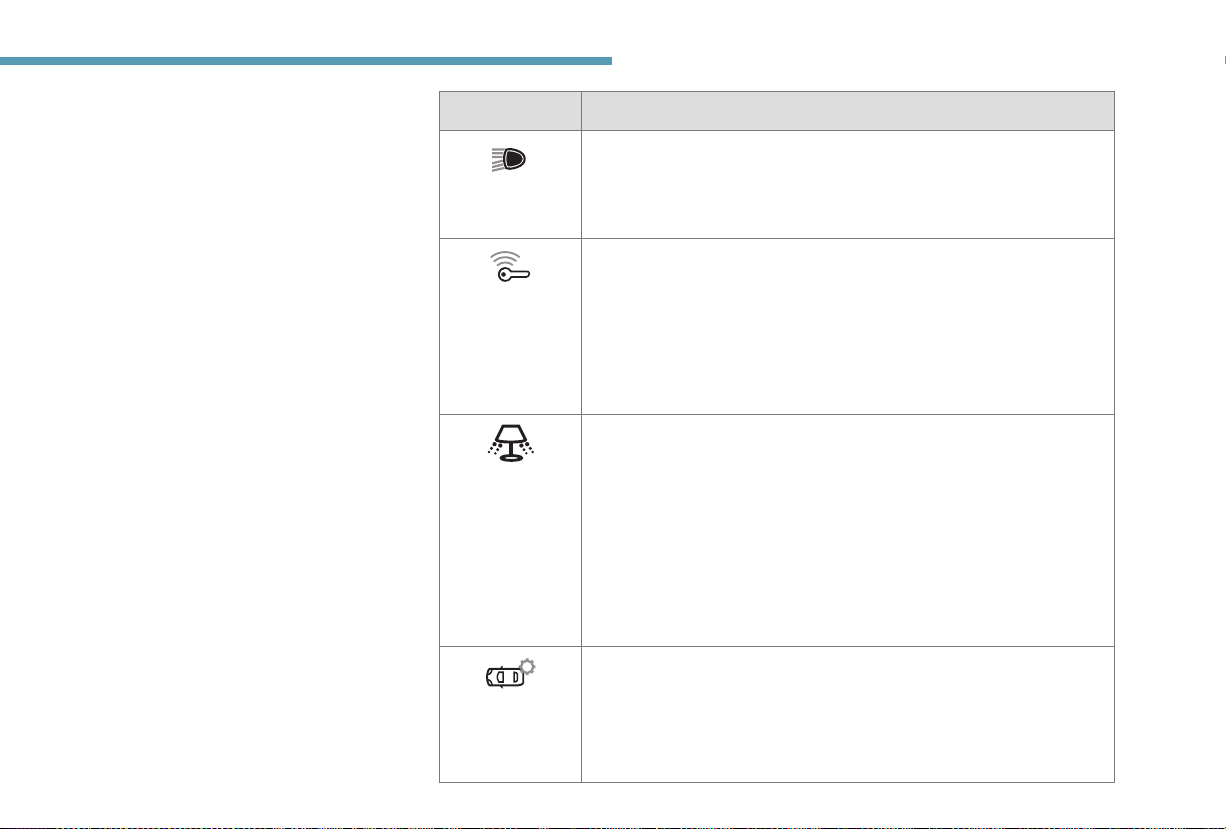
Telephone.
See the "Audio equipment and
telematics" section.
Applications.
Allows direct access to certain
i-Cockpit Amplify functions
(scented air freshener, etc.).
You can also press with three fingers
on the touch screen to display the menu
carousel.
Volume adjustment / mute.
See the "Audio equipment and
telematics" section.
For more information on the Scented air
freshener, refer to the corresponding section.
For the other functions, refer to the "Audio
equipment and telematics" section.
43
1
Instruments
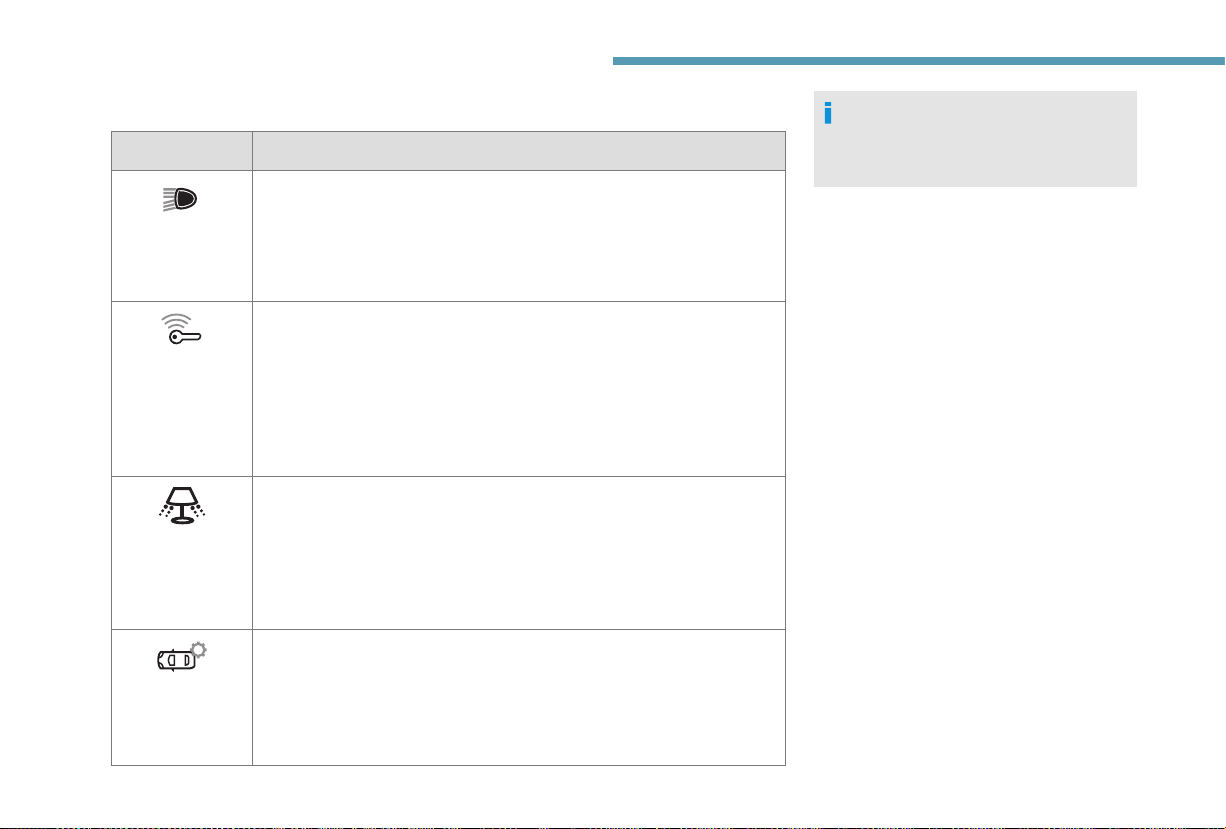
Vehicle / Driving menu
"Vehicle settings" tab
PEUGEOT Connect Nav
Families Functions
"Driving lighting"
- "Directional headlamps": activation / deactivation of cornering lighting.
"Vehicle access"
- "Remote control action: Unlock driver's door": activation / deactivation of
selective unlocking of the driver's door.
- "Unlock boot only": activation / deactivation of selective unlocking at the
tailgate.
- "Motorised tailgate": activation / deactivation of motorised operation of
the tailgate.
- "Hands-Free Tailgate Access": activation / deactivation of the hands-free
tailgate access system.
"Comfort lighting"
- "Rear wiper in reverse": activation / deactivation of the rear wiper on with
reverse gear.
- "Mirror adaptation in reverse": activation / deactivation of the automatic
door mirror tilt when engaging reverse gear.
- "Guide-me-home lighting": activation / deactivation of automatic guide-
me-home lighting.
- "Welcome lighting": activation / deactivation of exterior welcome lighting.
- "Ambient lighting": activation / deactivation of ambient lighting and
adjustment of brightness.
"Security"
- "Collision risk alert": activation / deactivation of the collision risk alert and
automatic emergency braking.
- "Recommended speed display": activation / deactivation of speed limit
sign recognition.
- "Fatigue Detection System": activation / deactivation of the driver fatigue
detection system.
44
Instruments
PEUGEOT Connect Radio
Families Functions
"Headlamps"
- "Directional headlamps": activation / deactivation of cornering lighting.
- "Guide-me-home lighting": activation / deactivation of automatic guide-
me-home lighting.
- "Welcome lighting": activation / deactivation of exterior welcome
lighting.
"Vehicle access"
- "Unlock driver's door": activation / deactivation of selective unlocking of
the driver's door.
- "Unlock boot only": activation / deactivation of selective unlocking at the
tailgate.
- "Motorised tailgate": activation / deactivation of motorised operation of
the tailgate.
- "Hands-Free Tailgate Access": activation / deactivation of the hands-
free tailgate access system.
"Comfort"
- "Rear wiper in reverse": activation / deactivation of the rear wiper on
with reverse gear.
- "Mirror adaptation in reverse": activation / deactivation of the automatic
door mirror tilt when engaging reverse gear.
- "Ambient lighting": activation / deactivation of ambient lighting and
adjustment of brightness.
"Security"
- "Collision risk alert": activation / deactivation of the collision risk alert
and automatic emergency braking.
- "Recommended speed display": activation / deactivation of speed limit
sign recognition.
- "Fatigue Detection System": activation / deactivation of the driver fatigue
detection system.
For more information on one of these
functions, refer to the corresponding
section.
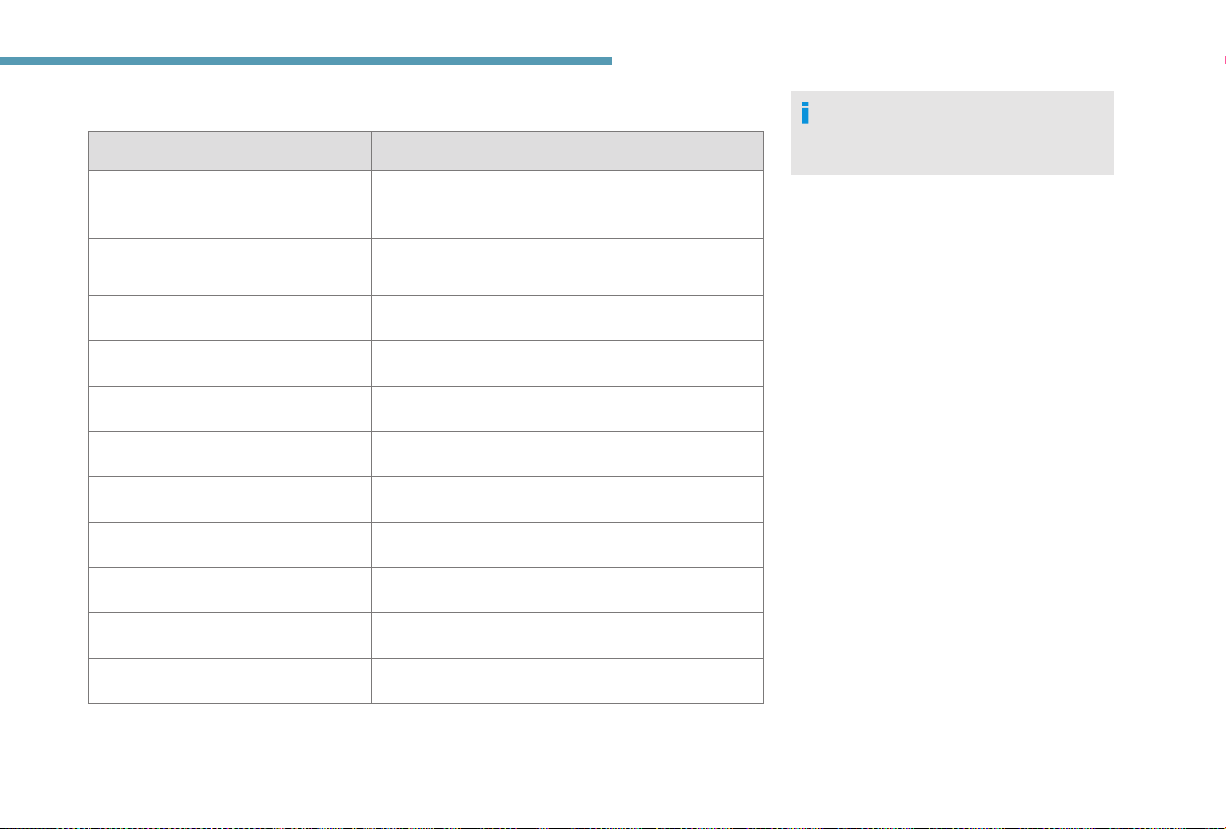
45
1
Instruments
"Driving functions" tab
Function Comment
"Adjusting Speeds" Memorisation of speed settings for the speed limiter or
programmable cruise control.
" Under-inflation initialisation" Reinitialisation of the under-inflation detection system.
"Lane departure warning system" Activation / deactivation of the function.
"Lane assist" Activation / deactivation of the function.
"Parking sensors" Activation / deactivation of the function.
"Park Assist" Activation / deactivation of the function.
"Automatic headlamp dip" Activation / deactivation of the function.
"Stop & Start" Activation / deactivation of the function.
"Blind spot sensors" Activation / deactivation of the function.
"Panoramic visual aid" Activation of the Visiopark 2 function.
"Traction control" Activation / deactivation of the function.
For more information on one of these
functions, refer to the corresponding
section.
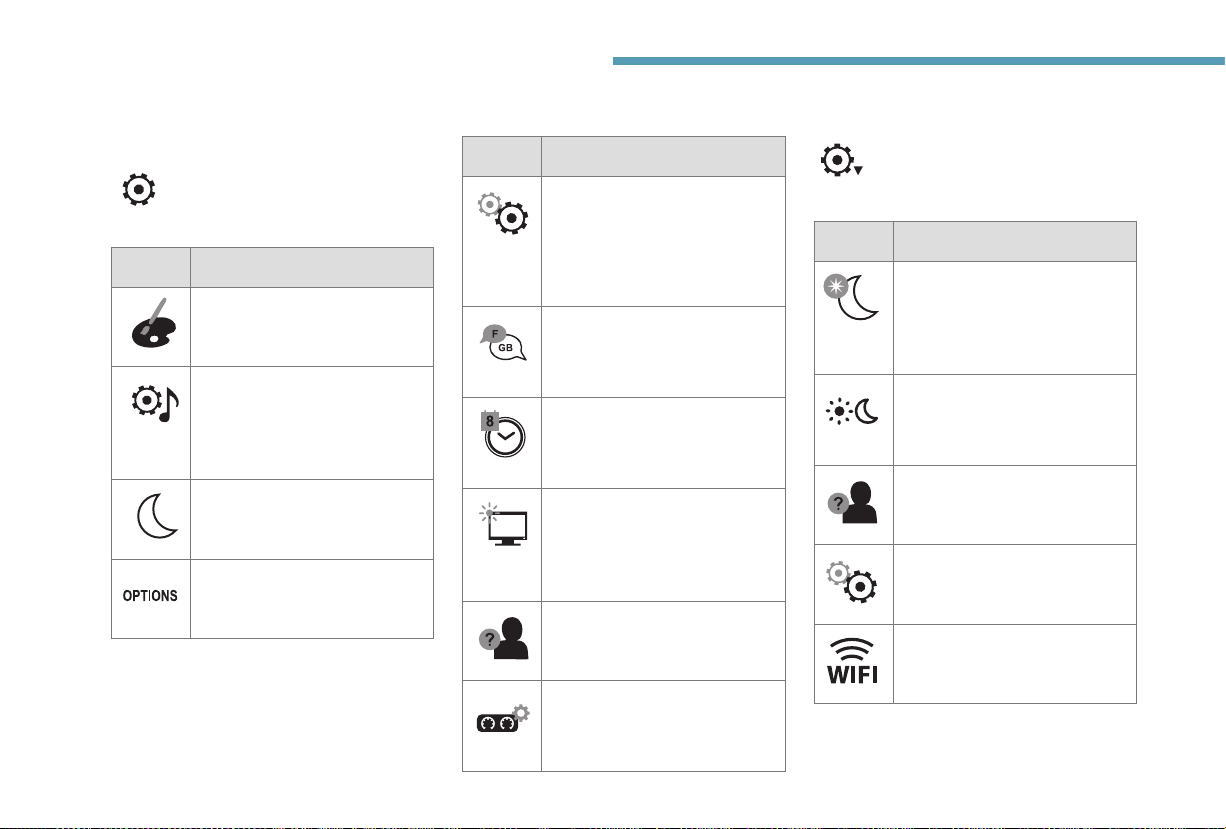
46
Instruments
Settings
PEUGEOT Connect Nav
The functions available through the
upper menu bar are detailed in the
table below.
Button Comments
Selection of a topic.
Audio settings (sound ambience,
distribution, level, voice volume,
ringer volume).
Switch off the screen.
Settings for the touch screen and
the digital instrument panel.
Button Comments
Choice of units:
- temperature (°Celsius or
°Fahrenheit),
- distances and fuel
consumption (l/100 km, mpg
or km/l).
Choice of display language on
the touch screen and digital
instrument panel.
Setting the date and time.
Option of synchronisation with
GPS.
Adjustment of the display
parameters (text scrolling,
animations, etc.) and brightness.
Choice and settings for three
user profiles.
Choice of the type of information
displayed in the digital instrument
panel.
Settings for the touch screen and the digital
instrument panel
Button Comments
Turn off the screen (black
screen).
To return to the current screen,
press the black screen or one of
the menu buttons.
Adjustment of the brightness of
the instrument panel ambient
lighting.
Choice and settings for three
user profiles.
Settings for the touch screen and
the digital instrument panel.
Activation and configuration of
the settings for the Wi-Fi.
PEUGEOT Connect Radio
The functions available through the
upper menu bar are detailed in the
table below.
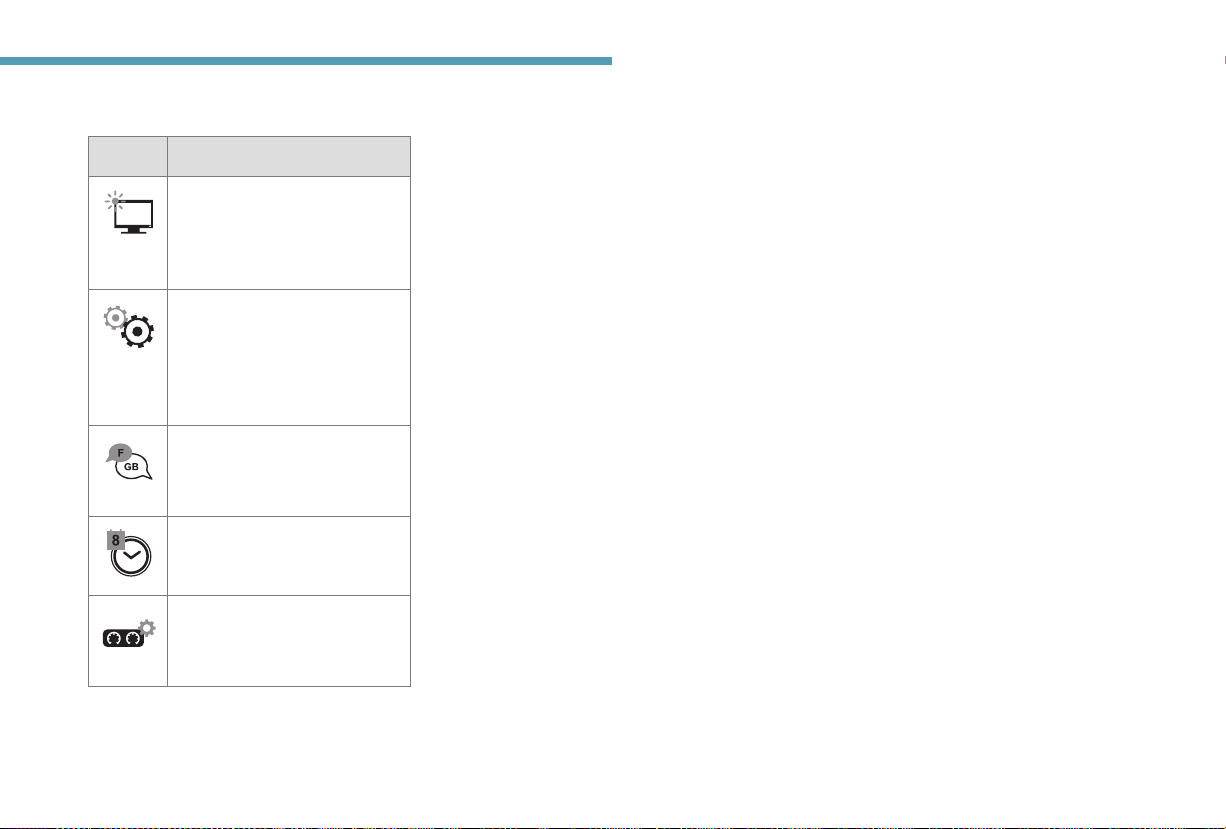
47
1
Instruments
Button Comments
Adjustment of the display
parameters (text scrolling,
animations, etc.) and brightness.
Choice of units:
- temperature (°Celsius or
°Fahrenheit),
- distances and fuel
consumption (l/100 km, mpg
or km/l).
Choice of display language on
the touch screen and digital
instrument panel.
Setting the date and time.
Choice of the type of information
displayed in the digital instrument
panel.
Settings for the touch screen and the digital
instrument panel
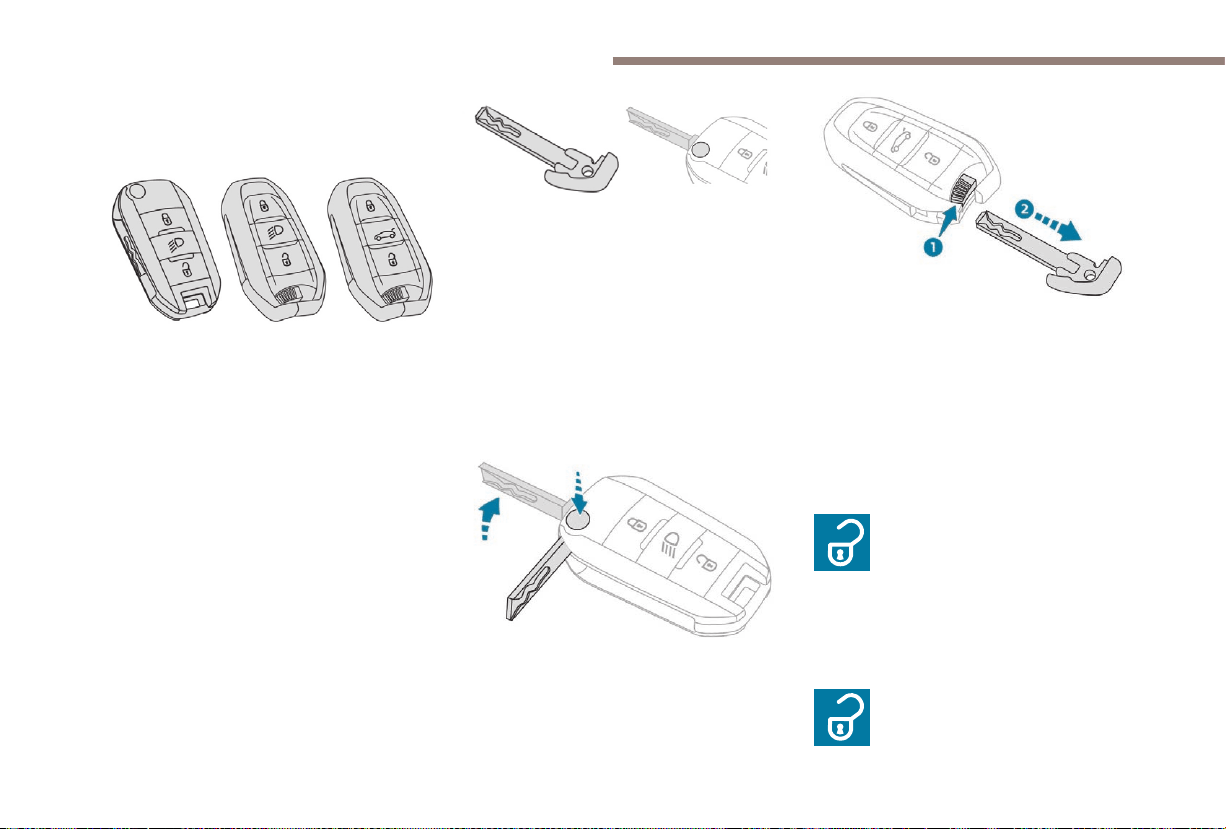
48
Acc ess
Remote control
General information
Ejecting the key
Unlocking the vehicle
Complete unlocking
F Press this button.
Selective unlocking
F Press this button.
F To unlock the other doors and
the boot, press this button again.
The remote control can be used for the
following functions, depending on version:
- unlocking / locking / deadlocking the
vehicle,
- unlocking – opening / closing the boot,
- turning the lighting on,
- folding / unfolding the door mirrors,
- activating / deactivating the alarm,
- opening the windows,
- closing the windows and the sunroof,
- locating the vehicle,
- vehicle immobiliser.
Version without Keyless Entry and Starting
F Press this button; the key is ejected from its
housing.
To avoid damaging the mechanism, first press
this button to fold it.
The key, integral with the remote control, can be
used for the following functions, depending on
version:
- unlocking / locking / deadlocking the vehicle,
- turning the mechanical child lock on or off,
- activating / deactivating the front passenger
airbag,
- back-up door locking,
- switching on the ignition and starting /
switching off the engine.
Version with Keyless Entry and Starting
F Pull on this button to remove the key from
the housing.
To return it to the housing, first pull on this
button.
Driver's door and fuel flap
The setting is done in the vehicle configuration
menu.
49
2
Acc ess
Opening the windows
Locking the vehicle
Normal locking
F Press this button.
An access that is not properly closed
(door or tailgate) prevents locking of the
vehicle. However, if your vehicle has an
alarm, this will be fully activated after
about 45 seconds.
If the vehicle is unlocked inadvertently
and there is then no action on the doors
or boot, the vehicle will automatically lock
itself again after about 30 seconds. If the
alarm was previously activated, it will be
reactivated automatically.
On the first press of the unlocking button,
flashing of the direction indicators for a few
seconds signals:
- complete or selective unlocking of the
vehicle for versions without alarm,
- deactivation of the alarm for other versions.
Depending on version, the door mirrors unfold.
Depending on version, pressing and
holding the unlocking buttons opens
the windows to the desired position.
The windows stop when you release
the button.
On the first press of the locking button,
illumination of the direction indicators for a few
seconds indicates:
- locking of the vehicle for versions without
alarm,
- activation of the alarm for other versions.
Depending on version, the door mirrors fold.
The automatic folding and unfolding of the
door mirrors with the remote control can
be deactivated by a PEUGEOT dealer or a
qualified workshop.
Deadlocking
F Within five seconds, press this
button again to deadlock the
vehicle.
For versions without alarm, deadlocking is
Deadlocking renders the interior door
controls inoperative.
It also deactivates the interior central
locking button on the dashboard.
Therefore, never leave anyone inside the
vehicle when it is deadlocked.
Maintaining pressure on the locking
button allows the windows and,
depending on version, the sunroof to
be closed to the desired position.
This operation also closes the
sunroof blind.
Ensure that nothing could prevent the
correct closing of the windows and
sunroof.
If, on versions with alarm, you want to
leave the windows and/or sunroof partly
open, you must first deactivate the
volumetric alarm protection.
For more information on the Alarm, refer
to the corresponding section.
confirmed by illumination of the direction
indicators for few seconds on the second press
of the locking button.
Closing the windows and sunroof
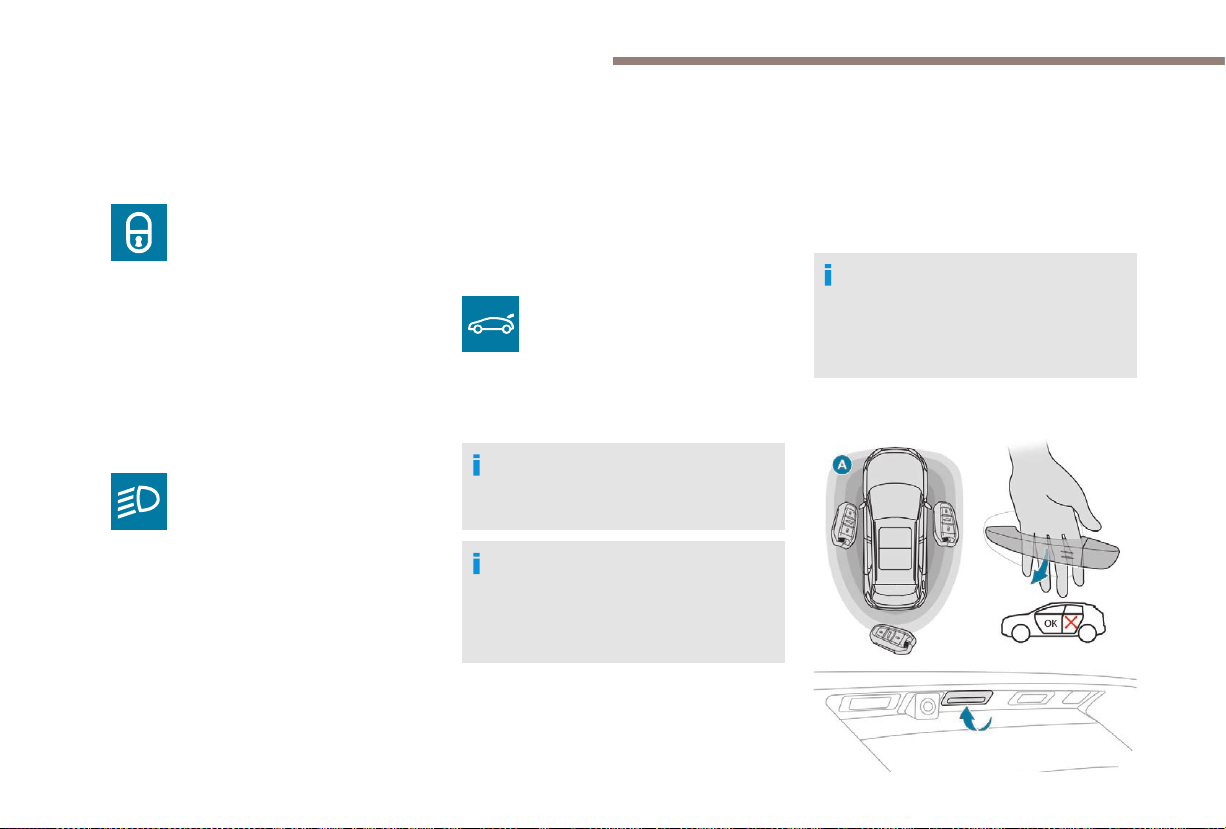
50
Acc ess
This function allows you to identify your vehicle
from a distance, particularly in poor light. Your
vehicle must be locked.
Welcome lighting
Selective unlocking and
opening of the tailgate
The settings for the selective tailgate unlocking
and motorised operation are made in the
vehicle configuration menu.
By default, selective tailgate unlocking is
activated and the motorised function is
deactivated.
F Make a long press on the button
to unlock the boot and trigger the
motorised opening of the tailgate.
If selective unlocking of the tailgate is
deactivated, pressing the unlocking button
unlocks the whole vehicle.
If motorised operation of the tailgate
is deactivated, pressing the unlocking
button releases the tailgate.
To lock the vehicle, it is necessary to
close the tailgate again.
Locating your vehicle
F Press this button.
This will switch on the courtesy lamps and door
mirror spot lamps and the direction indicators
will flash for around ten seconds.
Keyless Entry and
Starting
System that allows the unlocking, locking
and starting of the vehicle, while keeping the
electronic key in the recognition zone.
The electronic key can also be used as a
remote control.
For more information on the operation
of the Remote control, refer to the
corresponding section.
Unlocking the vehicle
The doors and fuel filler flap remain locked.
Availability of this function depends on version.
F Make a short press on this
remote control button.
The sidelamps, dipped beam headlamps,
number plate lamps and door mirror spotlamps
come on for 30 seconds.
Pressing again before the end of the timed
period switches off the lighting immediately.
51
2
Acc ess
Complete unlocking
F With the electronic key in recognition zone
A, pass your hand behind the door handle
of one of the front doors or press the tailgate
opening control (located in the centre).
If motorised operation of the tailgate is
activated, this action triggers its automatic
opening.
Opening the windows
Depending on version, keeping your hand
behind the door handle or maintaining the
press on the tailgate control allows the
windows to be opened to the desired position.
Flashing of the direction indicators for a few
seconds signals:
- the unlocking of the vehicle for versions
without alarm,
- the deactivation of the alarm for other
versions.
Depending on version, the door mirrors unfold.
Selective unlocking
Selective unlocking of the
tailgate
F Press the tailgate opening control to unlock
just the boot.
The doors remain locked.
If selective unlocking of the tailgate is
deactivated, pressing this control also
unlocks the doors.
Activation or deactivation of selective
unlocking of the tailgate is done in
the Vehicle / Driving menu of the
touch screen.
If one of the doors or the boot is still open
or if the electronic key for the Keyless
Entry and Starting system has been left
inside the vehicle, the central locking
does not take place.
However, the alarm (if fitted) will be fully
activated after about 45 seconds.
If the vehicle is unlocked inadvertently
and there is then no action on the doors
or boot, the vehicle will automatically lock
itself again after about 30 seconds.
If fitted to your vehicle, the alarm will also
be reactivated automatically.
The automatic folding and unfolding of
the door mirrors can be deactivated by a
PEUGEOT dealer or a qualified workshop.
As a safety measure (children on board),
never leave the vehicle without taking the
electronic key for the Keyless Entry and
Starting system with you, even for a short
period.
Be aware of the risk of theft when the
electronic key for the Keyless Entry and
Starting system is in one of the defined
zones with the vehicle unlocked.
Driver's door and fuel flap
F Pass your hand behind the driver's door
handle.
F To unlock the complete vehicle, pass your
hand behind the front passenger door
handle with the electronic key close to
the passenger door, or press the tailgate
The setting for selective unlocking of the
driver's door is managed in the vehicle
configuration menu.
When unlocking the driver's door, flashing
of the direction indicators for a few seconds
signals:
- the selective unlocking of the vehicle for
versions without alarm,
- the deactivation of the alarm for other
versions.
Depending on version, the door mirrors unfold.
opening control (located in the centre) with
the electronic key close to the rear of the
vehicle.
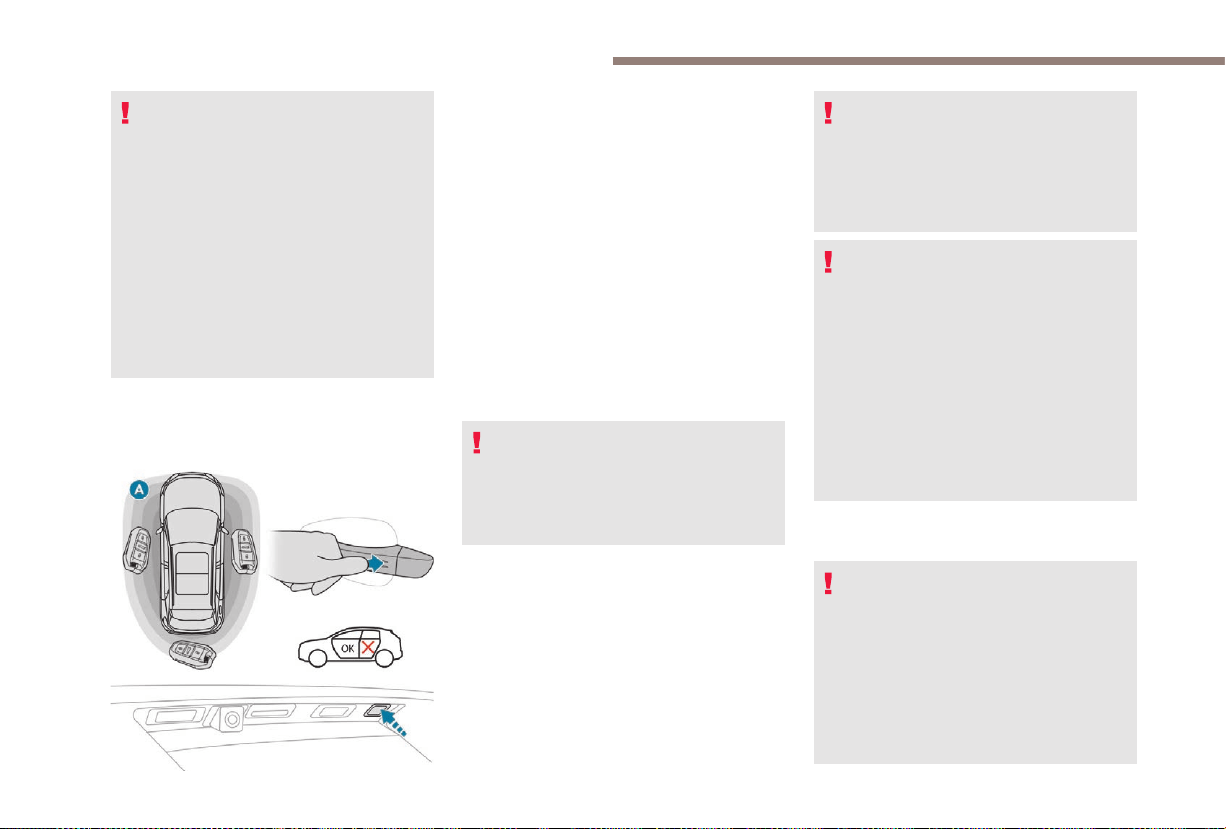
52
Acc ess
In order to preserve the battery in the
electronic key and the vehicle's battery,
the "hands-free" functions are put into
long-term standby after 21 days without
use. To restore these functions, press
one of the remote control buttons or start
the engine with the electronic key in the
reader.
For more information on starting with
Keyless Entry and Starting, refer to the
corresponding section.
Locking the vehicle
Normal locking
Closing the windows and sunroof
Maintaining pressure on the door handle or
the tailgate control allows the windows and,
depending on version, the sunroof to be closed
to the desired position.
This operation also closes the sunroof blind.
Ensure that nothing could prevent the
correct closing of the windows and
sunroof.
Be particularly aware of children when
operating the windows.
Illumination of the direction indicators for a few
seconds signals:
- locking of the vehicle for versions without
alarm,
- activation of the alarm for other versions.
Depending on version, the door mirrors fold.
For safety and theft protection reasons,
do not leave your electronic key in the
vehicle, even when you are close to it.
It is recommended that you keep it with
you.
Accumulations (water, dust, grime, salt
etc.) on the inner surface of the door
handle may affect detection.
If cleaning the inner surface of the door
handle using a cloth does not restore
detection, contact a PEUGEOT dealer or
a qualified workshop.
A sudden splash of water (stream of water,
high pressure jet washer, etc.) may be
identified by the system as the desire to
open the vehicle.
Deadlocking
Deadlocking renders the interior door
controls inoperative.
It also deactivates the interior central
locking button on the dashboard.
Therefore, never leave anyone inside the
vehicle when it is deadlocked.
F With the electronic key in recognition zone
A, press with your finger or thumb on the
door handle of one of the front doors (at the
markings) or on the locking control located
on the tailgate (on the right).
It is not possible to lock the vehicle if one of the
electronic keys is left inside the vehicle.
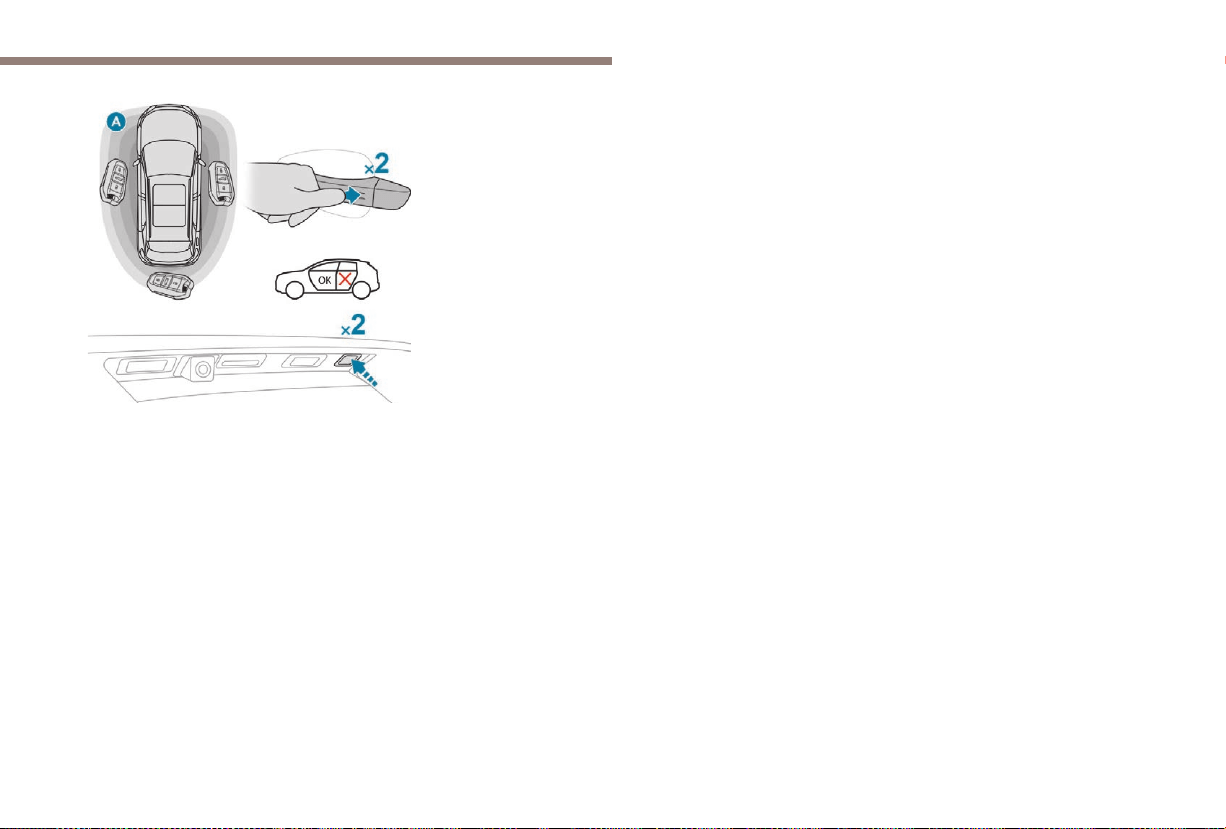
53
2
Acc ess
At the second press, illumination of the
direction indicators for a few seconds signals
the deadlocking of the vehicle for versions
without alarm.
F With the electronic key in recognition zone
A, press with your finger or thumb on the
door handle of one of the front doors (at the
markings) or on the locking control located
on the tailgate (on the right).
F Within five seconds, press one of these
locking controls again to deadlock the
vehicle.
At the first press on one of the locking controls,
illumination of the direction indicators for a few
seconds signals:
- the locking of the vehicle for versions
without alarm,
- the activation of the alarm for other
versions.
Depending on version, the door mirrors fold.
54
Acc ess
Do not throw away the remote control
batteries, they contain metals which are
harmful to the environment.
Take them to an approved collection
point.
Back-up procedures
Complete unlocking /
locking of the vehicle with
the key
These procedures should be used in the
following cases:
- remote control cell battery flat,
- remote control fault,
- vehicle in an area subject to strong
electromagnetic interference.
In the first case, you can also replace the
remote control cell battery.
Refer to the corresponding section.
In the second case, you can also reinitialise
the remote control.
Refer to the corresponding section.
Lost keys, remote control, electronic key
Visit a PEUGEOT dealer with the vehicle's
registration certificate, your personal
identification documents and if possible,
the label bearing the key code.
The PEUGEOT dealer will be able to
retrieve the key code and the transponder
code required to order a new key.
Electrical interference
The Keyless Entry and Starting electronic key
may not operate if close to certain electronic
devices: telephone, laptop computer, strong
magnetic fields, etc.
Remote control
The high frequency remote control is a
sensitive system; do not operate it while
it is in your pocket as there is a possibility
that it may unlock the vehicle, without you
being aware of it.
Do not repeatedly press the buttons of
your remote control out of range and out of
sight of your vehicle. You may stop it from
working and the remote control would have
to be reinitialised.
The remote control does not operate when
the key is in the ignition, even when the
ignition is switched off.
Locking the vehicle
Driving with the doors locked may make
access to the passenger compartment by
the emergency services more difficult in an
emergency.
As a safety precaution (with children on
board), remove the key from the ignition or
take the electronic key when you leave the
vehicle, even for a short time.
Anti-theft protection
Do not make any modifications to the
electronic engine immobiliser system; this
could cause malfunctions.
For vehicles with an ignition switch, do not
forget to remove the key and turn the steering
to engage the steering lock.
When purchasing a second-hand vehicle
Have the key codes memorised by a
PEUGEOT dealer, to ensure that the keys in
your possession are the only ones which can
start the vehicle.
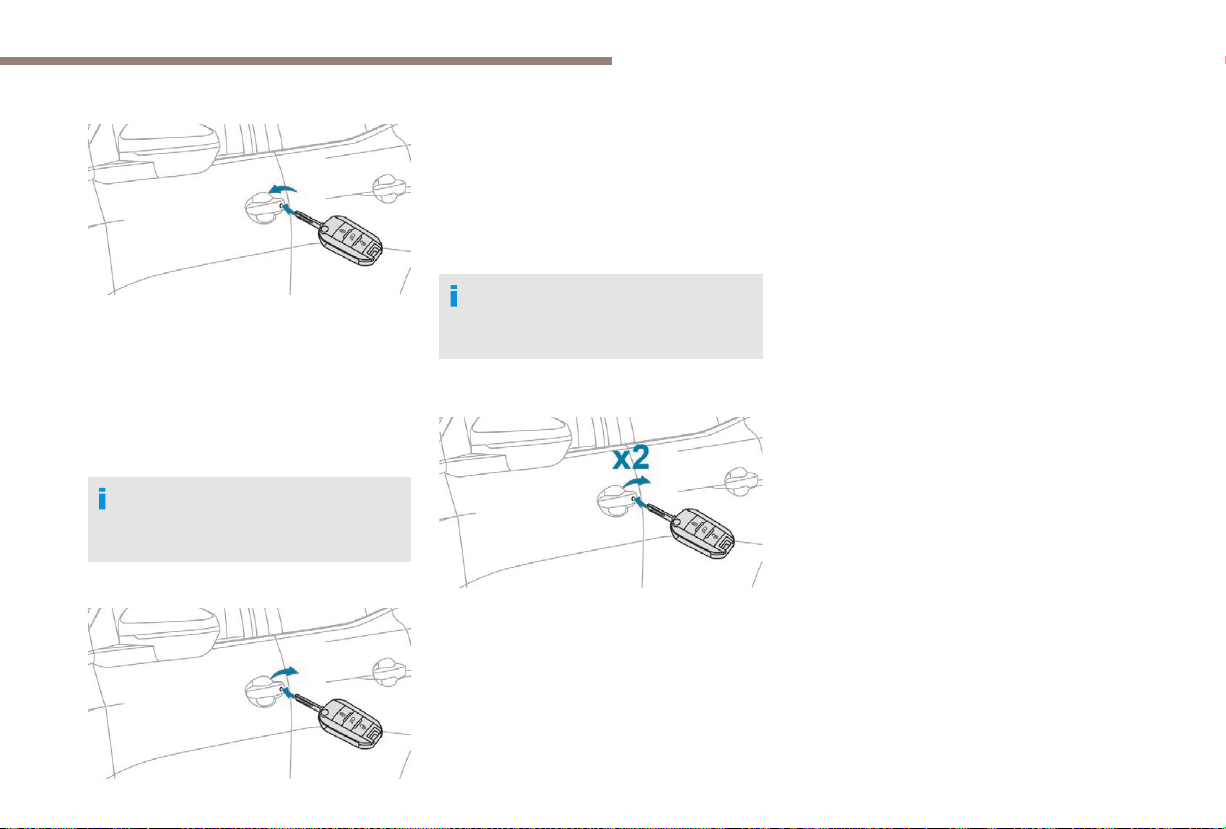
55
2
Acc ess
Unlocking
If the alarm is activated, the siren sounds
on opening the door; switch on the
ignition to stop it.
Normal locking
If your vehicle is fitted with an alarm, this
function will not be activated when locking
with the key.
Deadlocking
F Insert the key in the door lock barrel.
F Turn the key towards the front of the vehicle.
For versions without alarm, the unlocking is
confirmed by flashing of the direction indicators
for a few seconds.
Depending on version, the door mirrors unfold.
F Insert the key in the door lock barrel.
F Turn the key towards the rear of the vehicle.
For versions without alarm, the locking is
confirmed by flashing of the direction indicators
for a few seconds.
Depending on version, the door mirrors fold.
Without central locking
These procedures should be used in the
following cases:
- central locking fault,
- battery disconnected or discharged.
Driver's door
F Turn the key towards the rear of the vehicle
to lock it, or towards the front to unlock it.
F Insert the key in the door lock barrel.
F Turn the key towards the rear of the vehicle
to lock it.
F Within five seconds, turn the key towards
the rear of the vehicle again to deadlock it.
For versions without alarm, at the second
manoeuvre the deadlocking is confirmed by
flashing of the direction indicators for a few
seconds.
Depending on version, the door mirrors fold.
Passenger doors
Unlocking a door
F Pull the interior opening control for the door.
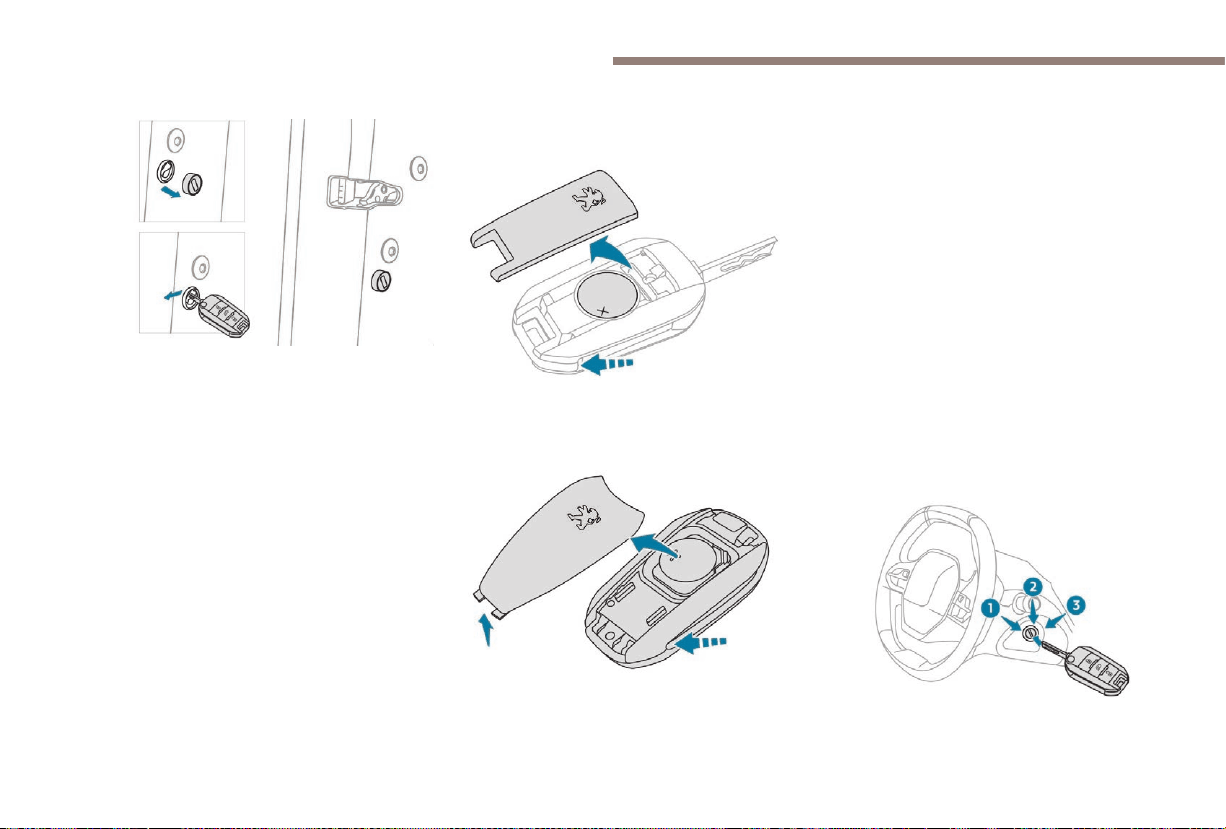
56
Acc ess
Locking
Changing the battery
A message is displayed on the instrument
panel screen when replacement of the battery
is needed.
Version without Keyless Entry and Starting
Battery type: CR1620 / 3 volts.
Version with Keyless Entry and Starting
Battery type: CR2032 / 3 volts.
F Fit the new battery into its housing
observing the polarity.
F Clip the cover onto the casing.
The remote control must be reinitialised after
replacing the battery.
For more information on reinitialising the
remote control, refer to the corresponding
section.
Reinitialising the remote
control
Following replacement of the battery or in
the event of a remote control fault, it may be
necessary to reinitialise the remote control.
Version without Keyless Entry
and Starting
F Open the doors.
F For the rear doors, check that the child lock
is not on.
Refer to the corresponding section.
F Remove the black cap on the edge of the
door, using the key.
F Without forcing, insert the key into the
aperture; then, without turning it, move the
latch sideways towards the inside of the
door.
F Remove the key and refit the black cap.
F Close the doors and check from the outside
that the vehicle is locked.
F Unclip the cover using a small screwdriver
at the cut-out.
F Remove the cover.
F Remove the discharged battery from its
housing.
F Switch off the ignition.
F Turn the key to position 2 (Ignition).
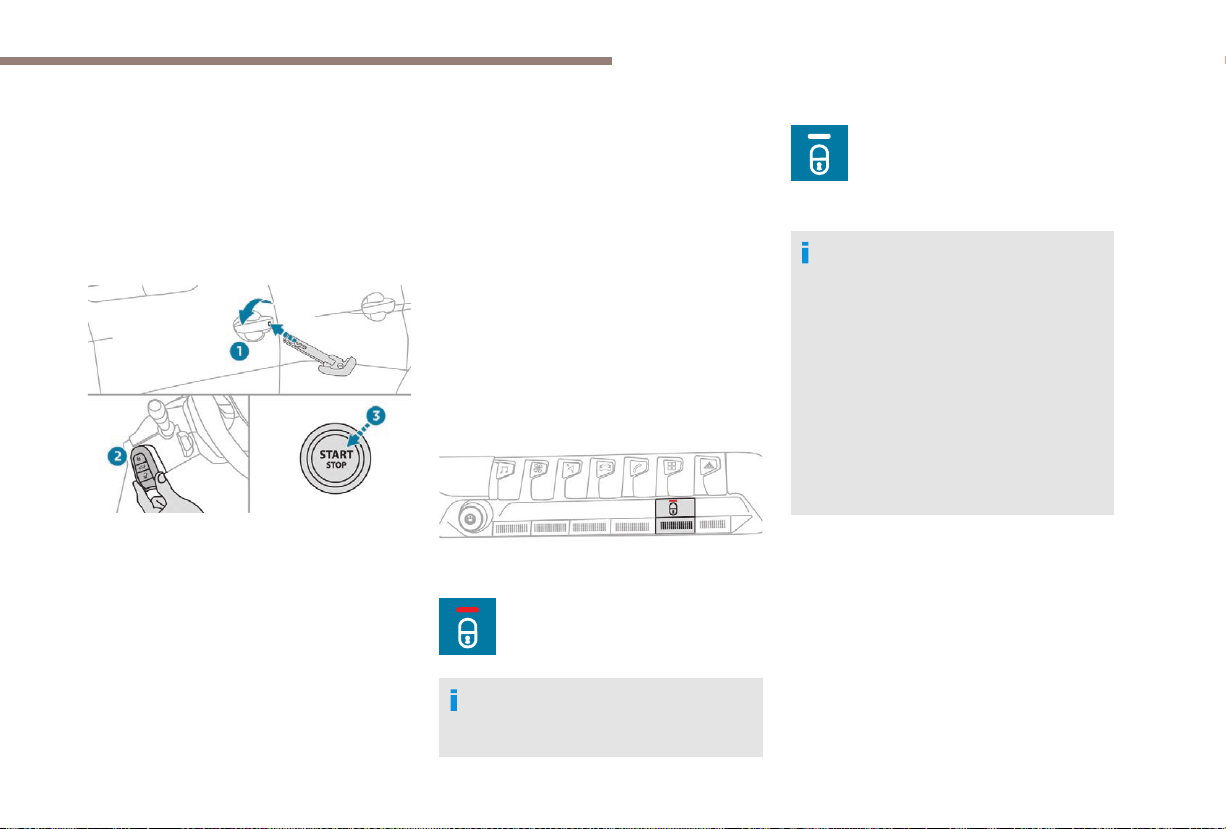
57
2
Acc ess
Version with Keyless Entry and
Starting
F With a manual gearbox, place the gear lever
in neutral then fully depress the clutch pedal.
F With an automatic gearbox, select position
P, then fully depress the brake pedal.
F Switch on the ignition by pressing the
"START/STOP" button.
The electronic key is now fully operational
again.
If the fault persists after reinitialisation, contact
a PEUGEOT dealer or a qualified workshop
without delay.
F Press the closed padlock button for a few
seconds.
F Switch off the ignition and remove the key
from the switch.
The remote control is now fully operational
again.
F Place the mechanical key (integral with
the remote control) in the lock to unlock
your vehicle.
F Place the electronic key against the back-up
reader on the steering column and hold it
there until the ignition is switched on.
Central locking
This function allows the doors and boot to be
locked or unlocked simultaneously from inside
the vehicle.
Manual mode
Locking
F Press this button to lock the
vehicle.
The red indicator lamp in the button
comes on.
If one of the doors is open, the central
locking from the inside does not take
place.
Unlocking
F Press this button again to unlock
the vehicle.
The red indicator lamp in the button
goes off.
When locking / deadlocking from the
outside
When the vehicle is locked or deadlocked
from the outside, the red indicator lamp
flashes and the button is inactive.
F After normal locking, pull one of the
interior door controls to unlock the
vehicle.
F After deadlocking, it is necessary to
use the remote control, Keyless Entry
and Starting or the integral key to
unlock the vehicle.
Automatic mode
This is the automatic central locking of the
vehicle when driving, also called anti-intrusion
security.
For more information on Anti-intrusion
security, refer to the corresponding section.
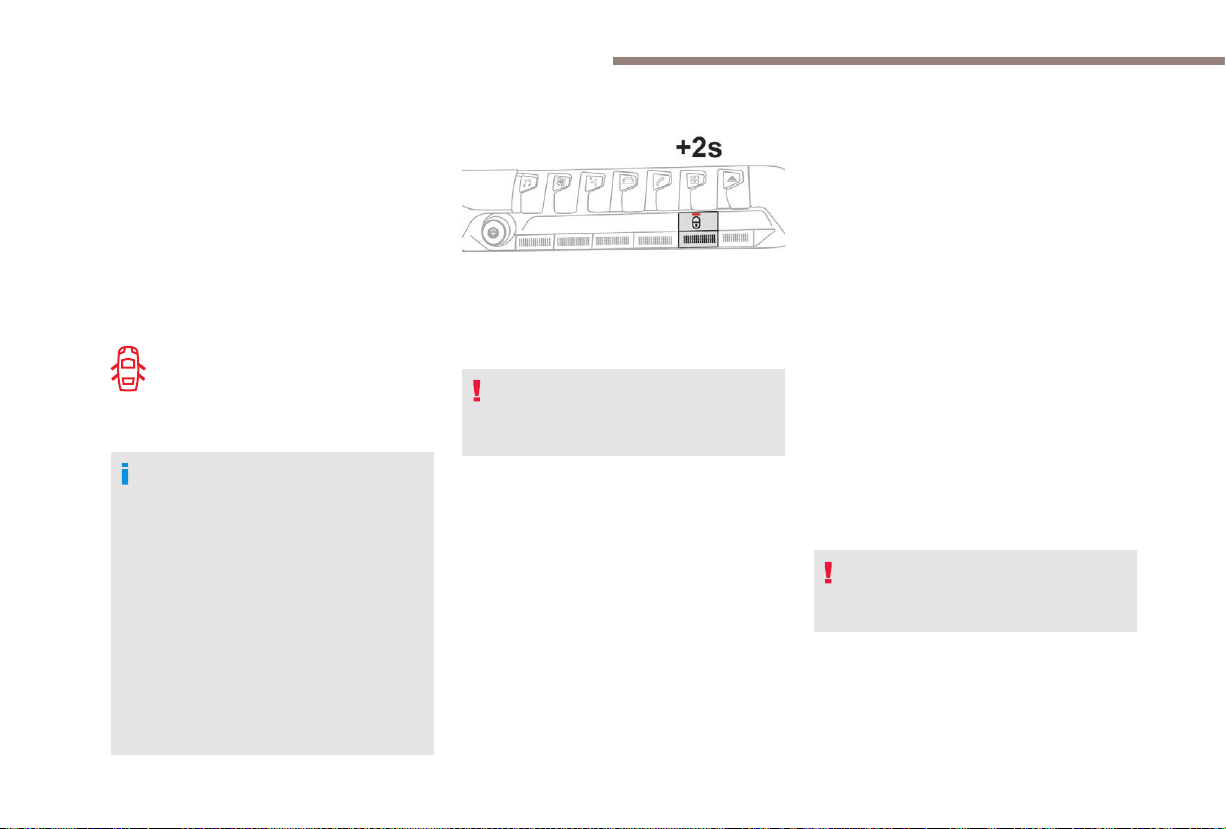
58
Acc ess
Anti-intrusion security
This system allows automatic simultaneous
locking of the doors and boot as soon as the
speed of the vehicle exceeds 6 mph (10 km/h).
Operation
If one of the doors or the boot is open, the
automatic central locking does not take place.
Carrying long or voluminous objects
If you want to drive with the boot open, you
should press the central locking button
to lock the doors. Otherwise, every time
the speed of the vehicle exceeds 6 mph
(10 km/h), the locks will rebound and the
alerts mentioned above will appear.
Pressing the central locking button
unlocks the vehicle.
Above 6 mph (10 km/h), this unlocking is
temporary.
Activation / Deactivation
Driving with the doors locked may render
access for the emergency services
difficult in an emergency.
Alarm
(Depending on version)
System which protects and provides a deterrent
against theft and break-ins. It provides the
following types of monitoring:
- perimeter monitoring
The system checks for opening of the vehicle.
The alarm is triggered if anyone tries to open a
door, the boot, the bonnet, etc.
- volumetric monitoring
The system checks for any variation in the
volume in the passenger compartment.
The alarm is triggered if anyone breaks a
window, enters the passenger compartment or
moves inside the vehicle.
- anti-tilt monitoring
The system checks for any change in the
attitude of the vehicle.
The alarm is triggered if the vehicle is lifted,
moved or knocked.
Self-protection function
The system checks for the putting out of
service of its components.
The alarm is triggered if the battery, the central
control or the siren wiring are put out of service
or damaged.
For all work on the alarm system, contact
a PEUGEOT dealer or a qualified
workshop.
This is signalled by the sound of
the locks rebounding, accompanied
by illumination of this symbol in the
instrument panel, an audible signal and
the display of an alert message.
You can activate or deactivate this function
permanently.
The state of the system stays in memory when
switching off the ignition.
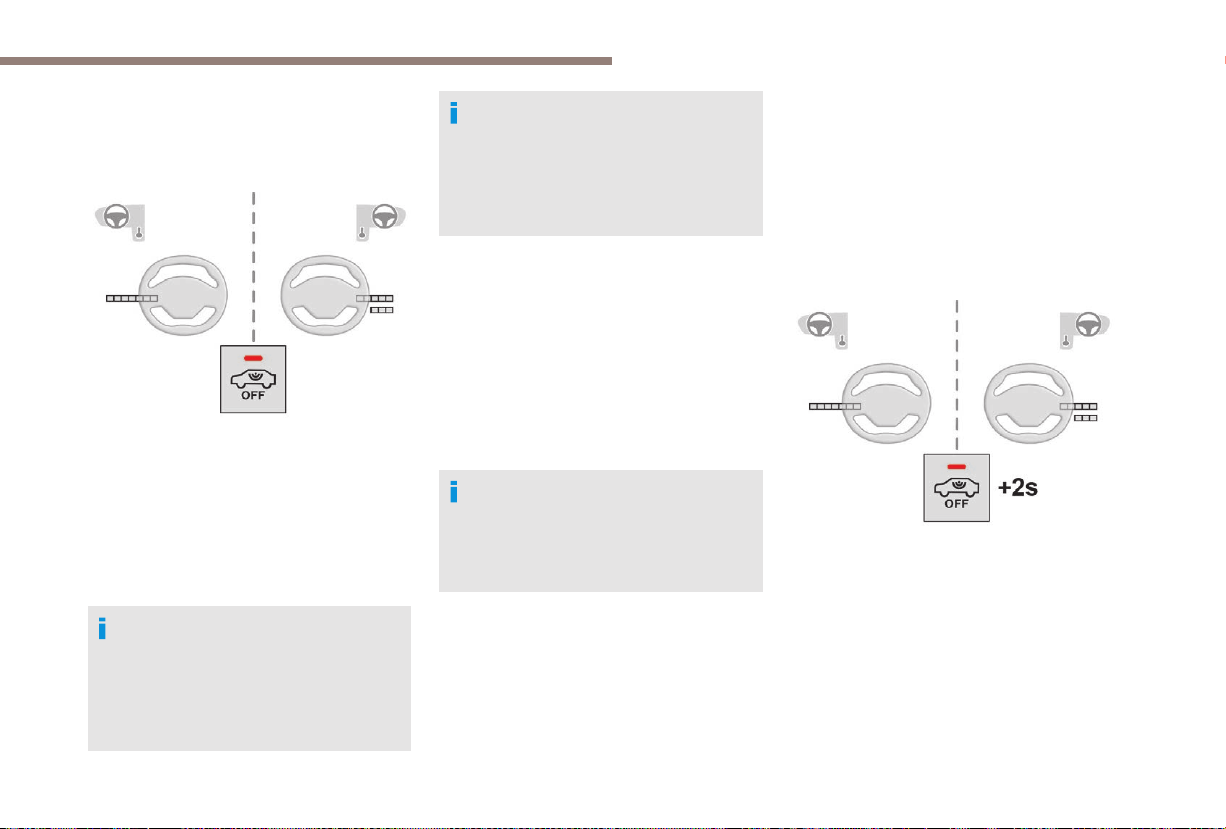
59
2
Acc ess
Locking the vehicle with full
alarm system
Activation
Following a vehicle locking request, the
perimeter monitoring is activated after
5 seconds and the interior volumetric and
anti-tilt monitoring after 45 seconds.
F Turn the ignition off and exit the vehicle.
F Lock the vehicle using the remote control or
the " Keyless Entry and Starting" system.
The monitoring system is active: the red
indicator lamp in the button flashes once per
second and the direction indicators come on for
about 2 seconds.
If an opening (door, boot or bonnet) is not
fully closed, the vehicle is not locked but
the exterior perimeter monitoring will be
activated after a delay of 45 seconds at
the same time as the interior volumetric
and anti-tilt monitoring.
Deactivation
F Press the unlocking button on the remote
control.
or
F Unlock the vehicle with the " Keyless Entry
and Starting" system.
The monitoring system is deactivated: the
indicator lamp in the button goes off and the
direction indicators flash for about 2 seconds.
When the vehicle automatically locks itself
again (as happens if a door or boot is not
opened within 30 seconds of unlocking),
the monitoring system is also reactivated
automatically.
Locking the vehicle
with exterior perimeter
monitoring only
Deactivate the interior volumetric and anti-tilt
monitoring to avoid unwanted triggering of the
alarm in certain cases such as:
Deactivating the interior
volumetric and anti-tilt
monitoring
F Switch off the ignition and within
10 seconds, press the button until the red
indicator lamp is on continuously.
F Get out of the vehicle.
F Immediately lock the vehicle using the
remote control or the " Keyless Entry and
Starting" system.
The exterior perimeter monitoring alone is
activated: the indicator lamp in the button
flashes once per second.
- leaving a pet in the vehicle,
- leaving a window or sunroof partially open,
- washing your vehicle,
- changing a wheel,
- having your vehicle towed,
- transport by ship.
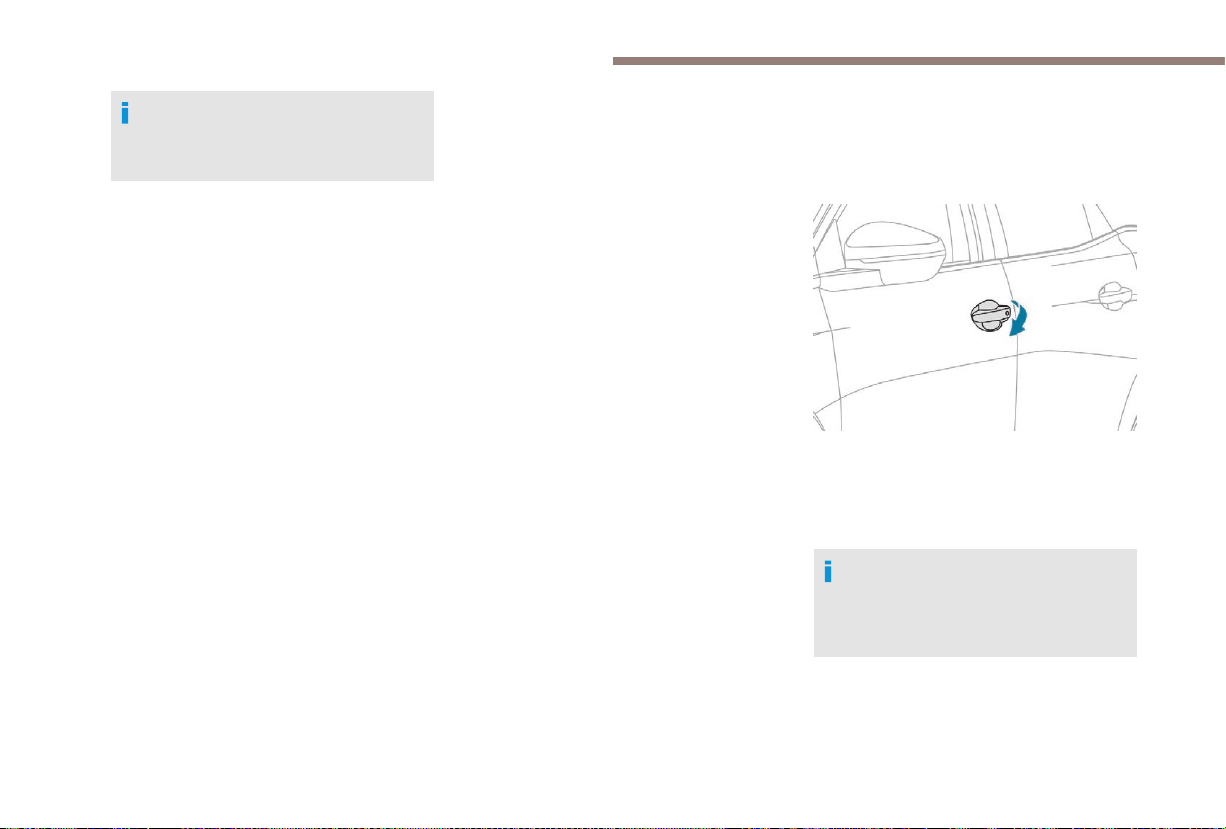
60
Acc ess
To be effective, the deactivation must
be carried out each time the ignition is
switched off.
Reactivating the interior
volumetric and anti-tilt monitoring
F Deactivate the exterior perimeter monitoring
by unlocking the vehicle with the remote
control or the " Keyless Entry and Starting"
system.
The indicator lamp in the button goes off.
F Reactivate all monitoring by locking the
vehicle with the remote control or the "
Keyless Entry and Starting" system.
The red indicator lamp in the button once again
flashes every second.
Triggering of the alarm
Failure of the remote
control
To deactivate the monitoring functions:
F unlock the vehicle using the key (integral to
the remote control) in the driver's door lock,
F open the door; the alarm is triggered,
F switch on the ignition; the alarm stops; the
indicator lamp in the button goes off.
Locking the vehicle without
activating the alarm
F Lock or deadlock the vehicle using the key
(integral to the remote control) in the driver's
door lock.
Malfunction
When the ignition is switched on, fixed
illumination of the red indicator lamp in the
button indicates a malfunction of the system.
Have it checked by a PEUGEOT dealer or a
qualified workshop.
This is indicated by sounding of the siren
and flashing of the direction indicators for
30 seconds.
The monitoring functions remain active until
the alarm has been triggered eleven times in
succession.
When the vehicle is unlocked using the remote
control or the " Keyless Entry and Starting"
system, rapid flashing of the red indicator
lamp in the button informs you that the alarm
was triggered during your absence. When
the ignition is switched on, this flashing stops
immediately.
Doors
Opening
From outside
When the selective unlocking is activated,
the first press of the remote control
unlocking button permits unlocking of the
driver's door only.
F After unlocking the vehicle or with the
electronic key of the Keyless Entry and
Starting system in the recognition zone, pull
the door handle.

61
2
Acc ess
From inside
F Pull the interior control lever of a front door;
this unlocks the vehicle completely.
With the selective unlocking activated:
- opening the driver's door unlocks the
driver's door only (if the vehicle has not
already been completely unlocked),
- opening one of the passenger doors
unlocks the rest of the vehicle.
Closing
When a door is not closed correctly:
- with the engine running or the
vehicle moving (speed below
6 mph (10 km/h)), this warning lamp
comes on, accompanied by an
alert message displayed for a few
seconds.
- with the vehicle moving (speed
above 6 mph (10 km/h)), in addition
to the warning lamp and alert
message, an audible signal sounds
for a few seconds.
Boot
Opening the tailgate
With the exterior tailgate control
When selective unlocking is activated, the
electronic key must be close to the rear of
the vehicle.
The tailgate is not designed to take a
bicycle carrier.
F With the vehicle unlocked or with the
electronic key of the Keyless Entry and
Starting system in the recognition zone,
press the central tailgate control.
F Raise the tailgate.
Closing the tailgate
F Lower the tailgate using the interior grips.
F Release the grips and press down on the
outside of the tailgate to close it.
If the tailgate is not properly closed:
- engine running, this warning
lamp and a message appear in the
instrument panel for a few seconds,
- vehicle moving (speed above
6 mph (10 km/h)), this warning
lamp and a message appear in the
instrument panel for a few seconds,
accompanied by an audible signal.
In the event of a fault or difficulties felt in
manoeuvring the tailgate when opening
or closing it, get it quickly checked by a
PEUGEOT dealer or a qualified workshop
to stop this issue getting worse and so
as to not cause the tailgate to drop, and
serious injuries.
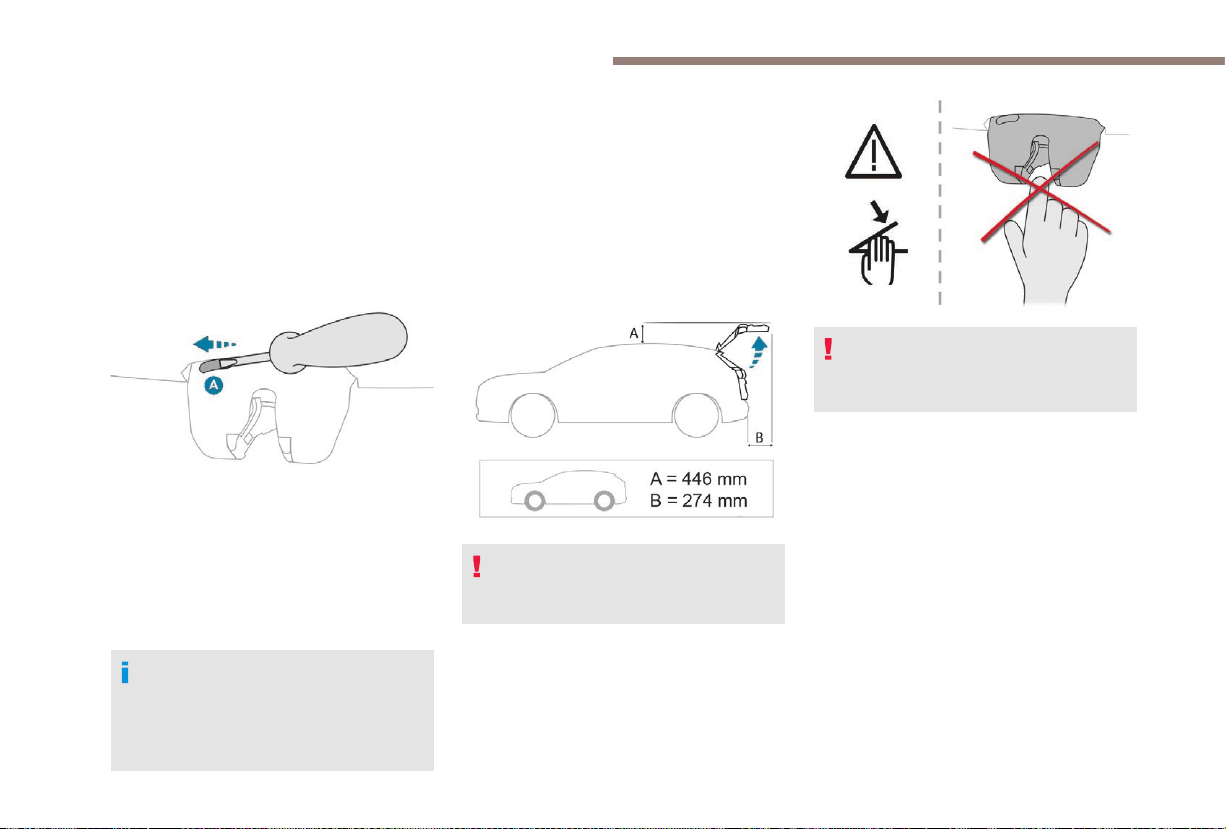
62
Acc ess
Back-up release
To manually unlock the boot in the event of
a battery or central locking failure.
Unlocking
F Fold the rear seats to gain access to the
lock from inside the boot.
Locking after closing
If the fault persists after closing again, the boot
will remain locked.
In the event of a fault with the central
locking system, it is essential to
disconnect the battery to lock the boot
and so ensure complete locking of the
vehicle.
Hands-free tailgate
General points
The motorised operation of the tailgate can be
activated or deactivated in the vehicle settings
menu.
The motorised tailgate must only be operated
with the vehicle stationary.
Check that there is enough space to
allow for the movement of the motorised
tailgate.
Never introduce a finger in the locking
system of the motorised tailgate – Risk of
a serious injury!
Safety anti-pinch
The motorised tailgate has an obstacle
detection system that automatically interrupts
and reverses its movement by a few degrees to
allow the obstacle to be cleared.
Please note that this anti-pinch system is not
active at the end of the closing travel (around
1 cm from completely closed).
F Insert a small screwdriver into hole A of the
lock to unlock the boot.
F Move the latch to the left.
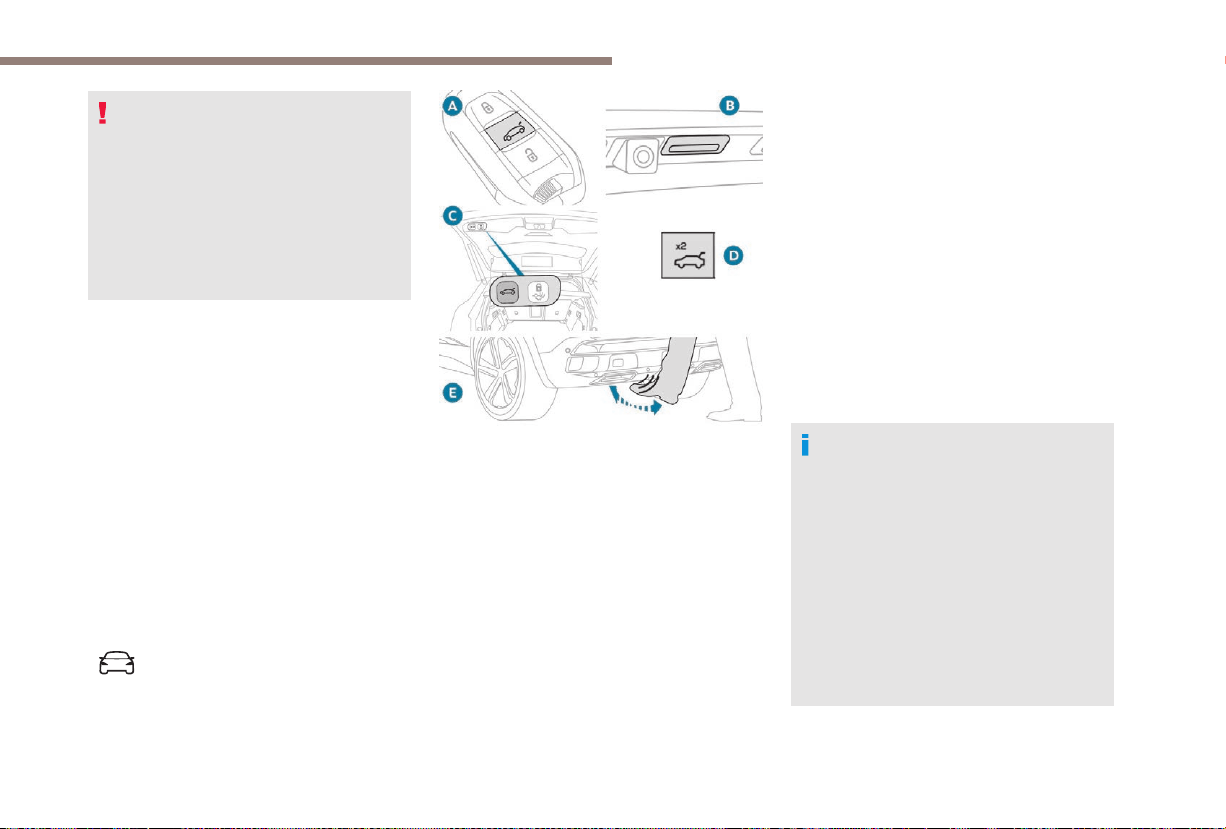
63
2
Acc ess
To avoid the risk of injury through pinching
or trapping, before and during operation of
the motorised tailgate:
- ensure that there is no person close to
the rear of the vehicle,
- watch the activity of your passengers,
particularly any children.
Bicycle carrier / Towbar
The motorised tailgate is not designed to
support a bicycle carrier.
When installing a bicycle carrier on a towbar
with connection of a cable to the towbar socket,
the motorised operation of the tailgate will be
automatically deactivated.
If using a towbar or bicycle carrier not
recommended by PEUGEOT, it is essential
to deactivate the motorised operation of the
tailgate.
Motorised operation
Activation / deactivation of the
motorised operation of the tailgate is
done in the Vehicle / Driving menu
of the touch screen.
There are several ways of operating the
tailgate:
Opening / Closing
F Press and hold the central button A of the
electronic key.
or
This function is deactivated by default.
A. using the electronic key of the Keyless
Entry and Starting system,
B. using the exterior tailgate control,
C. using the interior tailgate control,
D. using the control on the dashboard,
E. using the "hands-free access" procedure
below the rear bumper.
F Press the exterior tailgate control B with the
electronic key on your person.
or
F Press the interior tailgate control C (closing
only).
or
F Press twice in succession on the dashboard
control D.
or
F With the electronic key on your person, use
the "hands-free" access E by performing a
"kicking" movement below the rear bumper.
The command is confirmed by an audible
signal.
The tailgate opens, either completely
by default, or to the position memorised
beforehand.
If motorised operation is not activated,
these actions release the tailgate.
The request to open the tailgate with one
of the controls A, B or E enables you to
unlock the vehicle or the tailgate alone
beforehand, if selective unlocking of the
boot is activated.
Closing the tailgate with the "hands-free"
access function enables you to lock the
vehicle.
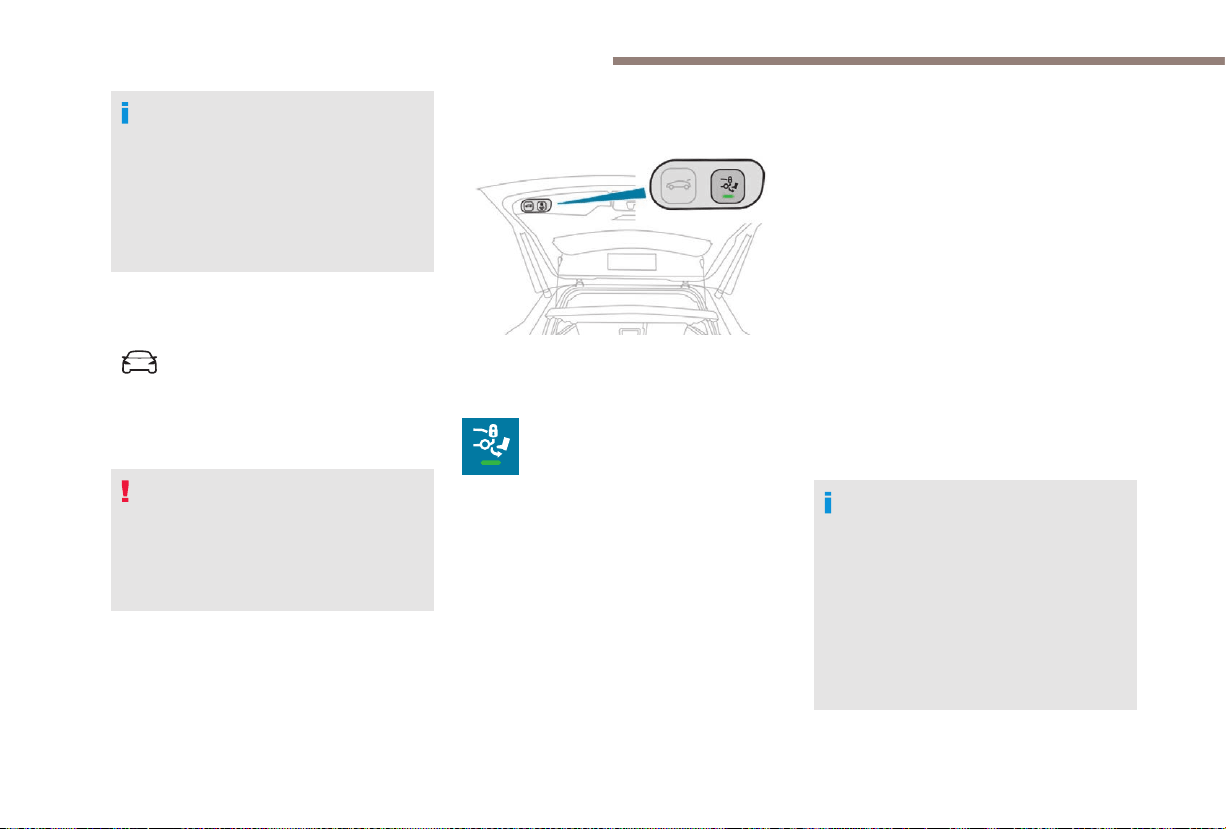
64
Acc ess
At any point, It is possible to interrupt the
operation of the tailgate.
Pressing one of these controls again
interrupts the movement that is underway.
Following the interruption of a movement,
pressing one of these controls again
reverses the movement.
Hands-Free Tailgate Access
Activation and deactivation of the
"Hands-Free Tailgate Access"
function is done in the Vehicle /
Driving menu of the touch screen.
Ensure that you are steady on your
feet before performing the quick foot
movement.
Take care not to touch the exhaust system
which may be hot – Risk of burns!
Automatic locking using the
"Hands-Free Tailgate Access"
function
F press this button; its green
indicator lamp will come on.
Pressing this button again
deactivates the function; its indicator
lamp goes off.
Memorising an opening
position
To limit the motorised tailgate opening angle:
F open the tailgate to the desired position,
F press button C or the exterior control B for
more than 3 seconds.
Memorisation of the maximum opening position
of the tailgate is confirmed by an audible signal.
To cancel the memorised position:
F stop the tailgate in an intermediate position,
F press button C or the exterior control B for
more than 3 seconds.
Cancellation of the memorised position is
confirmed by an audible signal.
Manual operation
The tailgate can be manoeuvred by hand, even
with motorised operation activated.
The tailgate must be immobile.
When opening and closing a motorised tailgate
manually, there is no assistance from gas
struts. Resistance to opening and closing is
therefore entirely normal.
This function is deactivated by default.
To activate automatic locking of the vehicle
when closing the tailgate using the Hands-Free
Tailgate Access function:
Repeatedly opening and closing of the
motorised tailgate can cause overheating
of its electric motor, after which opening
and closing will not be possible.
Allow at least 10 minutes for the electric
motor to cool down before operating the
tailgate again.
If you are unable to wait, operate it
manually.
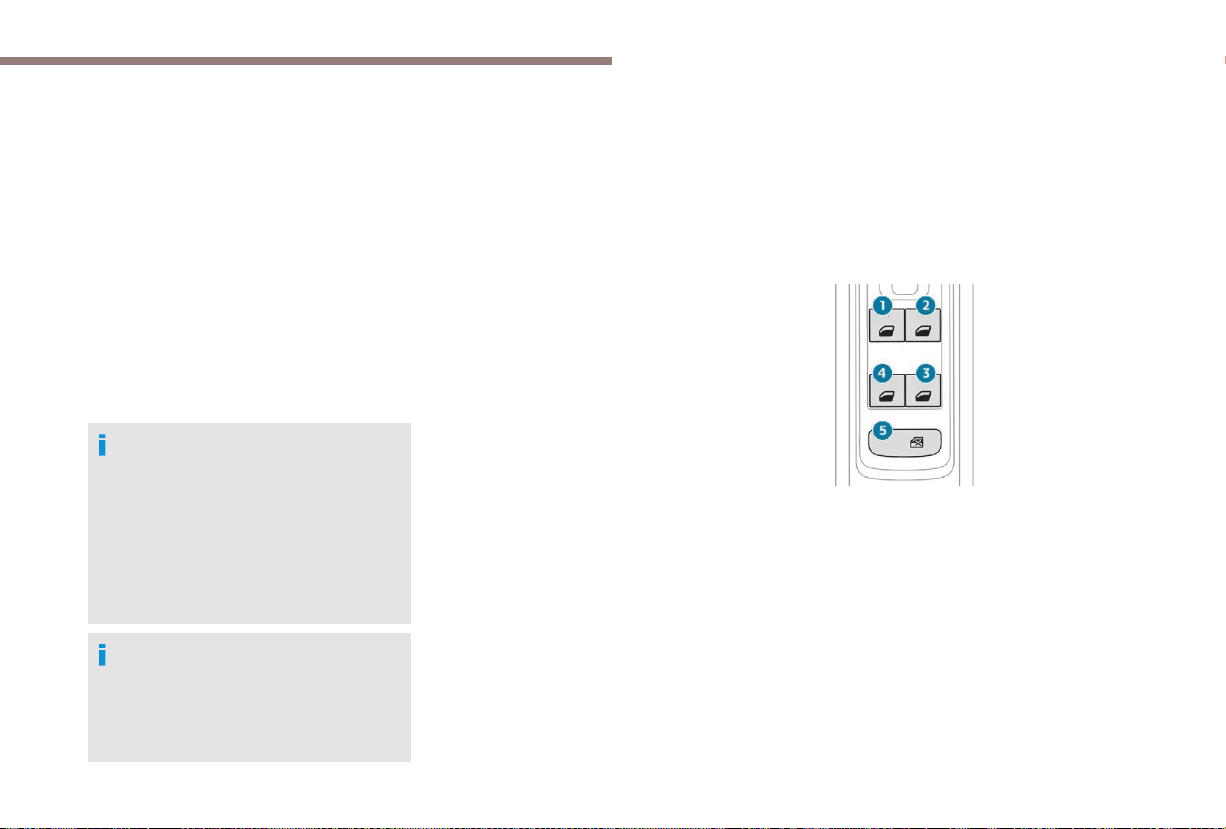
65
2
Acc ess
Reinitialising the
motorised tailgate
This operation is necessary where there is no
movement – after detection of an obstacle,
connecting or recharging the battery, etc.
F Open the tailgate manually, if necessary.
F Fully close the tailgate manually.
If the problem persists, contact a PEUGEOT
dealer or a qualified workshop.
Precautions in use
In wintry conditions
In the event of an accumulation of snow
on the tailgate, clear the snow before
commanding a motorised opening of the
tailgate.
The formation of ice can block the tailgate
and prevent its opening: wait until the ice
melts with the heating of the passenger
compartment.
When washing
When washing the vehicle in an automatic
car wash, do not forget to lock your vehicle
to avoid the risk of unexpected opening.
Recommendations related
to the "Hands-Free Tailgate
Access" function
If several kicking movements to operate the
tailgate have no effect, wait a few seconds
before trying again.
The function automatically deactivates in heavy
rain or following a build-up of snow.
If it does not work, check that the electronic key
is not exposed to a source of electromagnetic
pollution (smartphone, etc.).
The function may not work correctly with a
prosthetic leg.
The function may not work correctly if your
vehicle is fitted with a towbar.
- your vehicle is being serviced,
- you are accessing the spare wheel
(depending on version).
To avoid such operating problems, keep the
electronic key away from the recognition
zone or deactivate the "Hands-Free Tailgate
Access" function.
In some circumstances, the tailgate may open
or close by itself, particularly if:
- you hitch or unhitch a trailer,
- you fit or remove a bicycle carrier,
- you load or unload bicycles from a bicycle
carrier,
- you place or lift something behind the
vehicle,
- an animal approaches the rear bumper,
- you are washing your vehicle,
Electric windows
1. Left-hand front.
2. Right-hand front.
3. Right-hand rear.
4. Left-hand rear.
5. Deactivate the electric window switches
located at the rear seats.
Manual operation
To open or close the window, press or pull the
switch gently, without exceeding the resistance
point. The window stops as soon as the switch
is released.
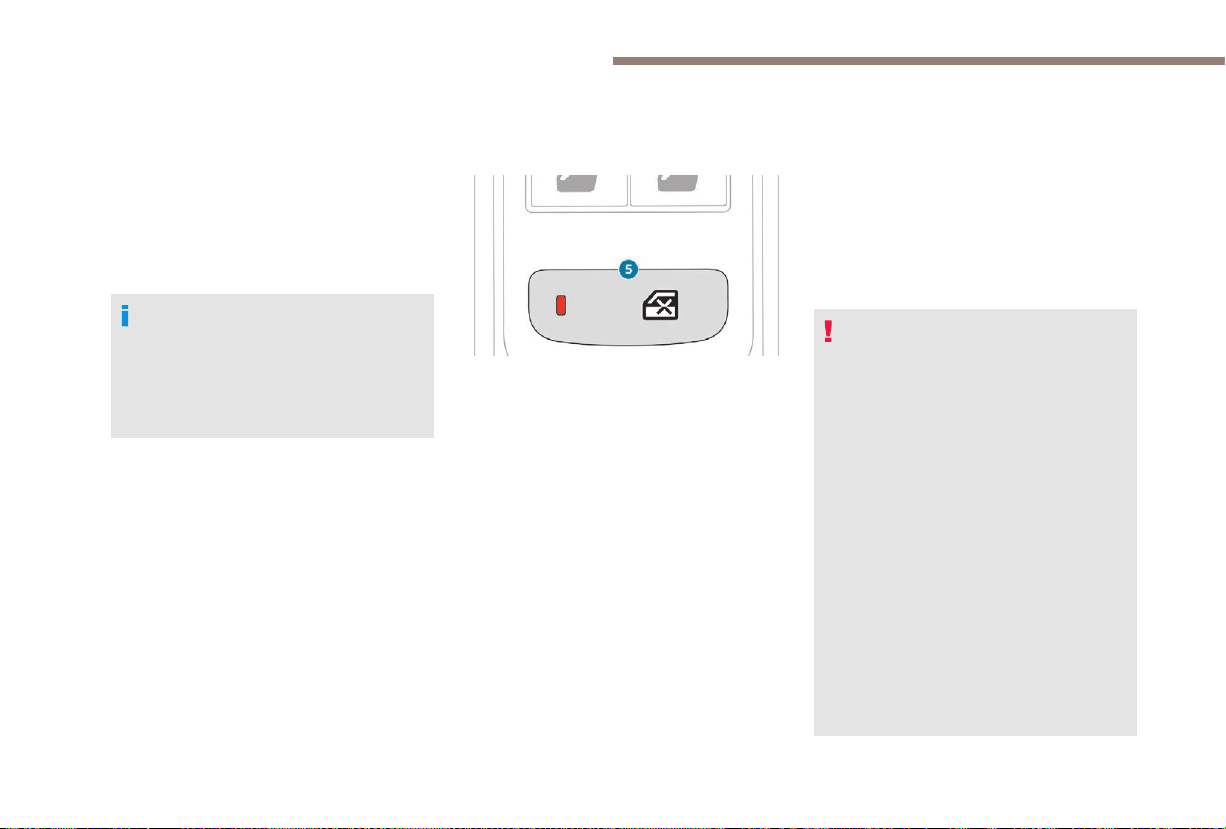
66
Acc ess
Automatic operation
To open or close the window, press or pull the
switch fully, beyond the resistance point: the
window opens or closes completely when the
switch is released. Pressing the switch again
stops the movement of the window.
The electric window switches remain
operational for approximately 45 seconds
after switching off the ignition.
Once this time has elapsed, the electric
windows will not operate. To reactivate
them, switch the ignition on again.
Safety anti-pinch
When the window rises and meets an obstacle,
it stops and immediately partially lowers again.
In the event of unwanted opening of the
window on closing, press the switch until the
window opens completely, then pull the switch
immediately until the window closes. Continue
to hold the switch for approximately one second
after the window has closed.
The safety anti-pinch function is not active
during this operation.
Deactivating the rear
controls for the rear
windows
The red indicator lamp in the button comes
on, accompanied by a message confirming
activation of the system. It remains on for as
long as the deactivation is maintained.
Use of the rear electric windows from the
driver's controls remains possible.
Reinitialising the electric
windows
Following reconnection of the battery, the
safety anti-pinch function must be reinitialised.
The safety anti-pinch function is not active
during these operations.
In the event of contact (pinching) during
operation of the windows, you must
reverse the movement of the window. To
do this, press the switch concerned.
When operating the passenger electric
window switches, the driver must ensure
that nothing is preventing correct closing
of the windows.
The driver must ensure that the
passengers use the electric windows
correctly.
Be particularly aware of children when
operating the windows.
Be aware of passengers or other persons
present when closing the windows using
the electronic key or the Keyless Entry
and Starting system.
For your children's safety, press switch 5
to prevent operation of the rear windows
irrespective of their positions.
For each window:
- bring the window down completely,
then bring it back up. It will go up by a
few centimetres each time. Perform the
operation until the window is fully closed,
- continue to pull the switch for at least one
second after reaching the window closed
position.

67
2
Acc ess
Panoramic opening
sunroof
The panoramic sunroof and its blind are
opened and closed using the buttons in the
roof console.
Ensure that any luggage or accessories
carried on the roof bars do not interfere
with the movement of the sunroof.
Do not place heavy loads on the fixed or
mobile glass of the sunroof.
Principles
Complete opening of the sunroof involves partly
raising the mobile glass, then sliding it over the
fixed glass.
The control buttons for the sunroof and blind
can be used:
- with the ignition on, if the state of charge of
the battery is adequate,
- with the engine running,
- in STOP mode with Stop & Start,
- during the 45 seconds after switching off
the ignition,
- during the 45 seconds after locking the
vehicle.
Before operating the sunroof or blind
control buttons, ensure that no object or
person might prevent the movement.
Operating the sunroof
Opening
With the sunroof fully closed or partly
raised:
F press and release the rear of
button B without going beyond
the point of resistance to fully
raise the sunroof.
F Press and hold the rear of button B without
going beyond the point of resistance; the
sunroof opens and stops when you release
the button.
A. Blind control button.
B. Sunroof control button.
Any intermediate position is possible.
Opening the roof involves opening the blind.
By contrast, the blind can remain open when
the roof is closed.
With the sunroof opened beyond the raised
position:
F press and release the rear of button B
without going beyond the point of resistance
to open the sunroof.
With the sunroof partly or fully closed:
F press and release the rear of button B going
beyond the point of resistance to fully open
the sunroof.
Any new action on this button interrupts the
movement.
If the sunroof is wet, following a shower
or washing the vehicle, wait until it is
completely dry before opening.
Do not operate the sunroof if it is covered
by snow or ice – Risk of damage!
Use only plastic scrapers to remove snow
or ice from the sunroof.
Do not put your head or arms through
the open sunroof when driving – Risk of
serious injury!
68
Acc ess
Closing
With the sunroof partially or fully
open:
F press and release the front of
button B going beyond the point
of resistance to fully close the
sunroof.
Any new action on this button
interrupts the movement.
F press and hold the front of button B without
going beyond the point of resistance; the
sunroof closes and stops when you release
the button.
Never leave the vehicle with the sunroof
open.
Anti-pinch system
If the sunroof encounters an obstacle when
closing, the movement is automatically
reversed.
The anti-pinch system is designed to be
effective at speeds of up to 75 mph (120 km/h).
Reinitialisation
Following reconnection of the battery or in
the event of a fault or jerky movement of
the sunroof, the opening sunroof must be
reinitialised:
F press the rear of button B until the sunroof
is fully open,
F press and hold the rear of button B again for
at least 3 seconds.
Check the condition of the sunroof seals
regularly (presence of dust or deposits,
dead leaves, etc.).
If using a car wash, check that the roof
is correctly closed in advance and keep
the tip of the high-pressure lance at least
30 centimetres from the seals.
Operating the sunroof blind
The closing movement of the blind is limited by
the position of the opening sunroof: the blind
cannot be further forward than the front of the
mobile glass.
Opening
F Press the rear of button A going
beyond the point of resistance to
fully open the blind.
Any new action on this button
interrupts the movement.
Closing
F Press the front of button A, going
beyond the point of resistance to
fully close the blind.
Any new action on this button
interrupts the movement.
Anti-pinch system
If the blind encounters an obstacle when
closing, the movement is automatically
reversed.
With the sunroof partially or fully open:
F press and release the front of button B
without going beyond the point of resistance
to close the sunroof to its raised position.
F press and release the front of button B
again to fully close the sunroof.
With the sunroof fully or partly raised:
F press and release the front of button B
without going beyond the point of resistance
to fully close the sunroof.
F Press and hold the rear of button A, without
going beyond the point of resistance; the
blind opens and stops when you release the
button.
F Press and hold the front of button A, without
going beyond the point of resistance; the
blind closes and stops when you release the
button.

69
2
Acc ess
Reinitialisation
Following reconnection of the battery or in the
event of a fault or jerky movement of the blind,
the blind must be reinitialised:
F press the rear of button A until the blind is
fully open,
F press and hold the rear of button A again for
at least 3 seconds.
During simultaneous closing of the
sunroof and the blind, if the blind catches
up with the sunroof, the blind then
suspends its movement and automatically
resumes when the sunroof stops.
When locking the vehicle, pressing and
holding the locking button simultaneously
closes the windows and the sunroof
and then the blind. The movements are
interrupted when you release the locking
button.
Never leave the electronic key inside the
vehicle if you get out of the vehicle, even
for a short time.
In the event of contact (pinching) when
closing the sunroof or blind, you should
reverse the movement of the sunroof or
blind. To do this, press the control button
in question.
The driver must ensure that passengers
use the sunroof and blind correctly.
Be particularly aware of children when
operating the sunroof or blind.
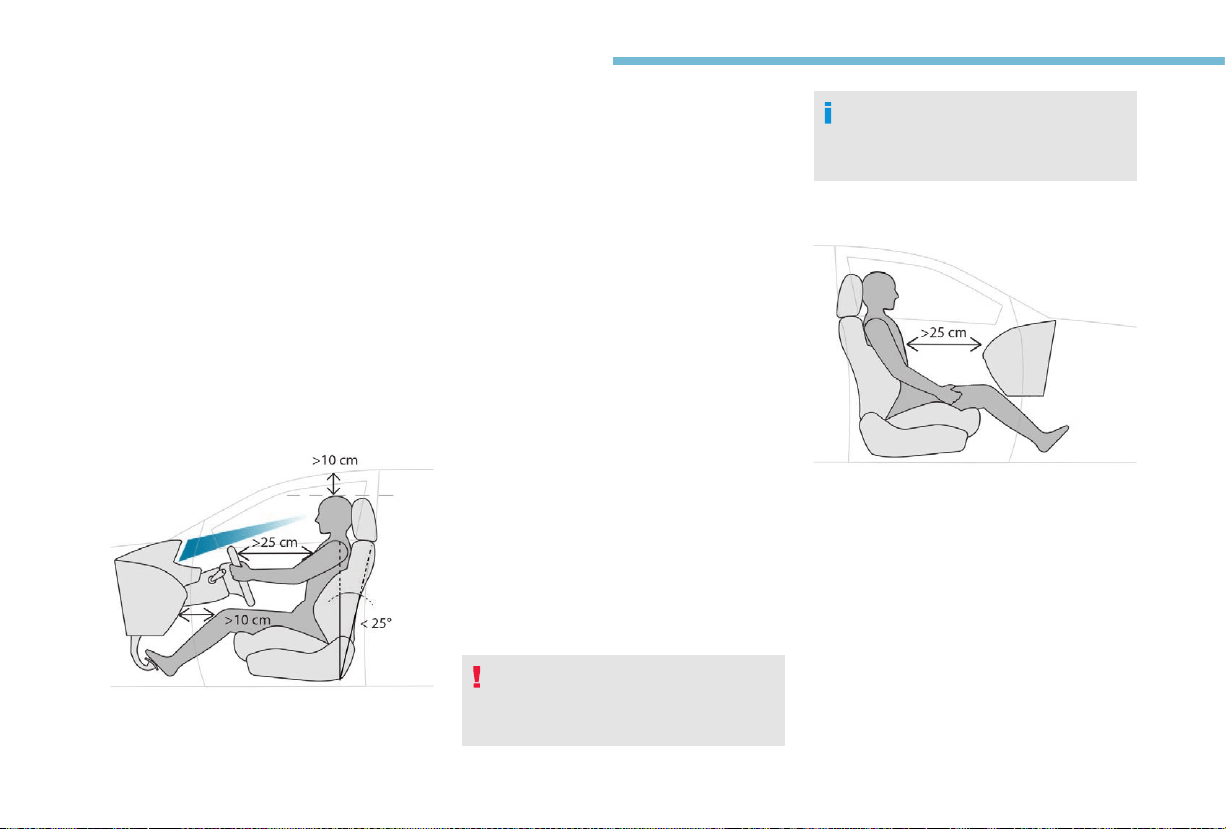
70
Ease of use and comfort
Driving position
Adopting a good driving position helps improve
your comfort and protection.
It also optimises interior and exterior visibility
as well as access to controls.
Sitting comfortably
Whether or not your vehicle has certain seat
adjustments described in this section depends
on the trim level and country of sale.
Driver's side
As a safety precaution, adjust the seats
only when the vehicle is stationary.
If your vehicle has electric seats, the
ignition must be on to adjust them.
Passenger's side
Sit fully back in the seat with your pelvis, back
and shoulders in contact with the seat backrest.
The cushion height should be set so your eyes
are looking at the centre of the windscreen.
The head room should be at least 4 in (10 cm).
Adjust the longitudinal position of the seat so
you can fully press the pedals with legs slightly
flexed.
The knee room should be at least 4 in
(10 cm) from the dashboard for access to the
dashboard controls.
Adjust the backrest angle to as vertical a
position as possible; never tilt it more than 25°.
Adjust the head restraint so that its upper edge
is level with the top of your head.
Adjust the length of the seat cushion to support
your thighs.
Adjust the lumbar support so that it conforms to
the shape of your spine.
Adjust the steering wheel so that it is at least
10 in (25 cm) from your sternum and your arms
are slightly bent.
The steering wheel should not hide the
instrument panel.
Sit fully back in the seat with your pelvis, back
and shoulders in contact with the seat backrest.
Adjust the longitudinal position of the seat
so that you are at a distance of at least 10 in
(25 cm) from the dashboard.
Adjust the head restraint so that its upper edge
is level with the top of your head.
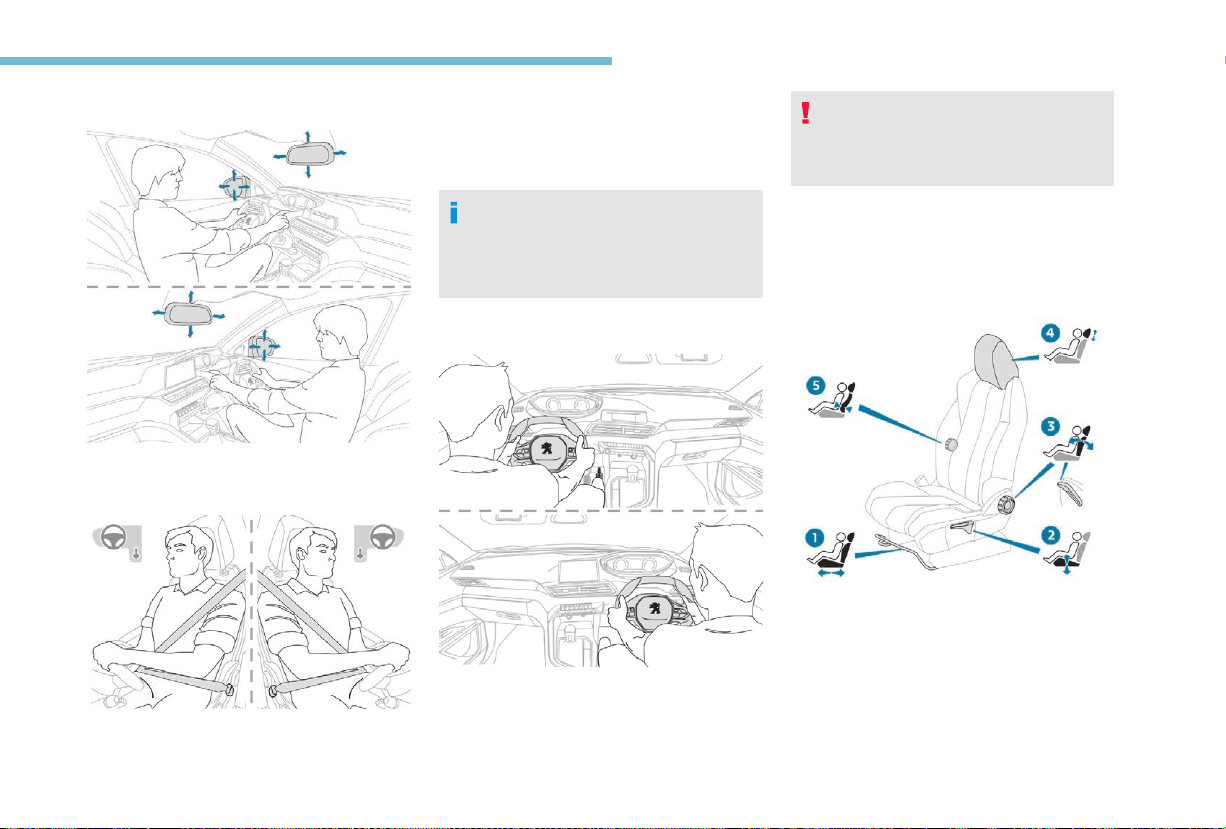
3
71
Ease of use and comfort
Before moving off
Adjust the interior and exterior door mirrors to
reduce blind spots.
Ensure that all passengers have fastened their
seat belts correctly.
If your vehicle has electric door mirrors,
the ignition must be on to adjust them.
When driving
Fasten your seat belt: place the diagonal belt in
the middle of your shoulder and adjust the lap
belt so that it is tightened across your pelvis.
Maintain a good driving position and hold the
steering wheel with both hands at the quarter
to three position, so that you can easily and
quickly reach the controls behind and near the
steering wheel.
Never adjust the seats or steering wheel
when driving.
Always keep your feet on the floor.
Front seats
Manual seats
1. Adjusting the seat forwards and backwards
F Raise the control bar and slide the seat
forwards or backwards.
F Release the bar to lock the seat in position
in one of the notches.
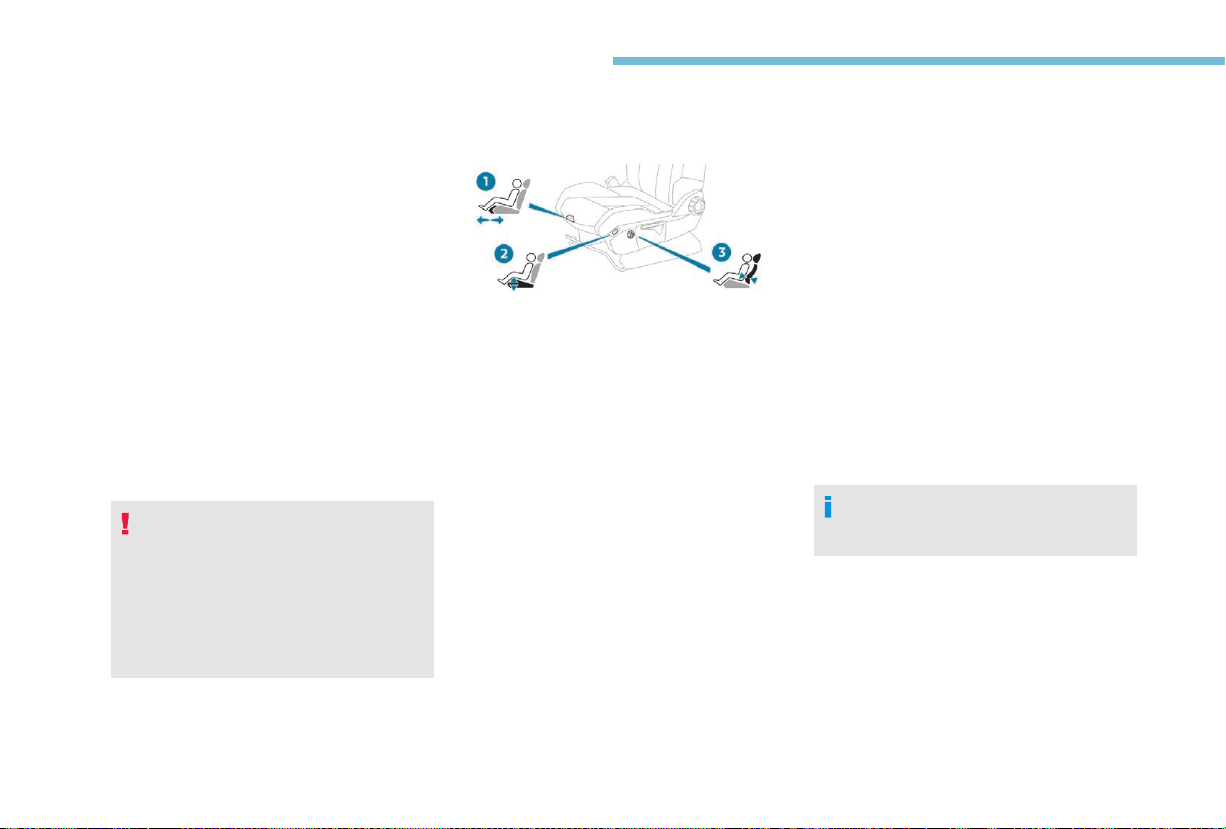
72
Ease of use and comfort
2. Adjusting the height of the seat cushion
F Raise or lower the control as many times as
needed to obtain the desired seat height.
3. Adjusting the seat backrest angle
F Turn the knob forwards or backwards to
recline the backrest to the desired angle.
or
F For a passenger seat that can be placed in
the table position, pull the handle and guide
the backrest forwards or backwards.
4. Adjusting the height of the head restraint
Refer to the corresponding section.
5. Adjusting the lumbar support
(only on the driver's seat)
F Turn the knob forwards or backwards to
increase or decrease the level of lumbar
support.
Before moving the seat backwards,
ensure that there is nothing that might
prevent the full travel of the seat.
There is a risk of trapping or pinching
passengers if present in the rear seats
or jamming the seat if large objects are
placed on the floor behind the seat.
"AGR" certified seats
Additional adjustments
1. Adjusting the length of the seat cushion
F Pull the handle forwards to release the
cushion, then move the front part of the seat
cushion forwards or backwards.
2. Adjusting the seat cushion angle electrically
F Press and hold the front or rear of the
control to raise or lower the front of the seat
cushion.
3. Adjusting the lumbar support electrically
The control allows independent adjustment of
the depth and vertical position of the lumbar
support.
F Press and hold the front or rear of the
control to increase or reduce the lumbar
support.
F Press and hold the top or bottom of the
control to raise or lower the lumbar support
area.
Placing the passenger seat
in the table position
The backrest of the passenger seat can be fully
folded forward and secured in this position.
This function, when associated with folding
of the backrest of the rear seats, helps in
transporting long and voluminous objects.
First steps:
F lower the head restraint,
F move the seat fully back to allow space for
the head restraint when folding,
F adjust the seat to the lowest position,
F check that there is nothing that might
interfere with folding of the backrest (seat
belt, child seat, items of clothing, bags, etc.).
Deactivation of the front passenger airbag
is recommended.
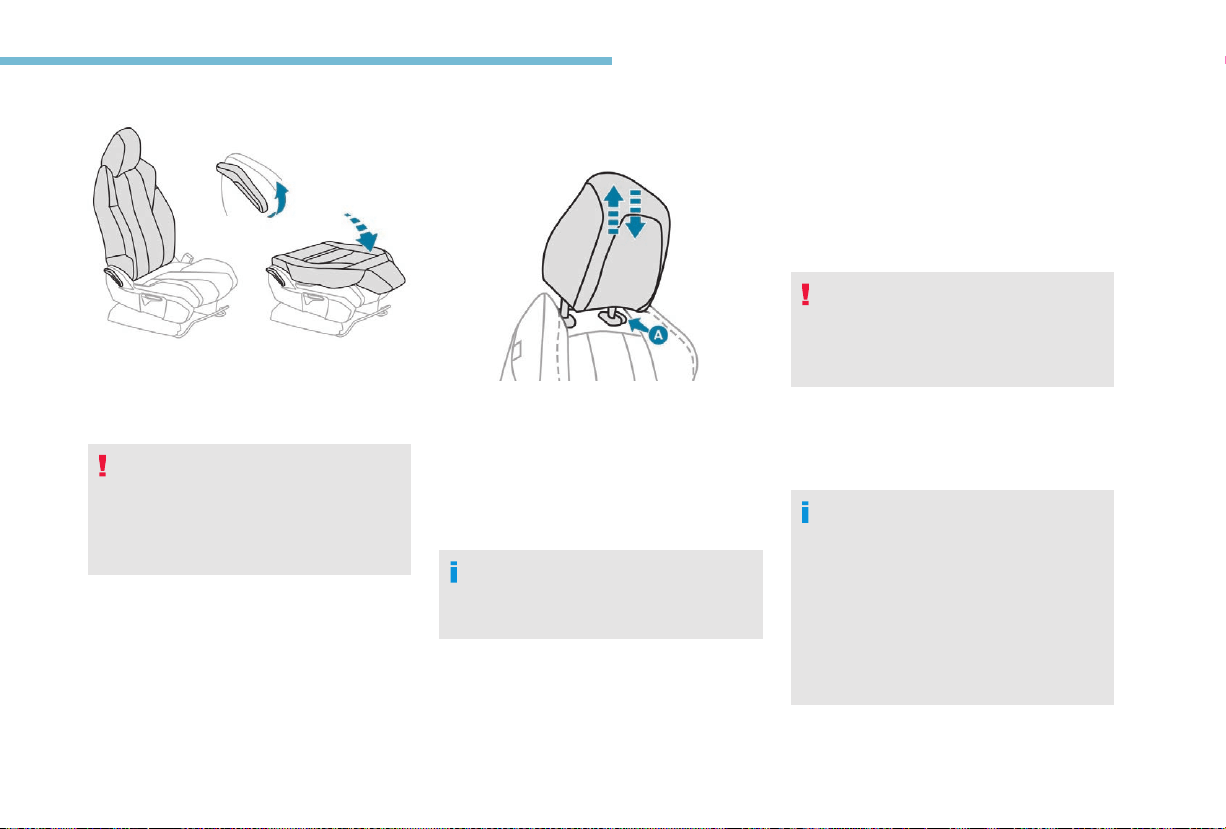
3
73
Ease of use and comfort
Folding the backrest
In this position, the backrest can support
a maximum load of 30 kg.
When sharp deceleration occurs, objects
placed on the folded backrest can turn
into projectiles.
Returning the backrest to the
normal position
F Pull the control fully up to release the
backrest.
F Tip the backrest fully forward.
F Pull the control fully up to release the
backrest.
F Raise the backrest and guide it back until it
latches into place.
F Check that the backrest has engaged
correctly.
Front head restraints
Adjusting the height
The adjustment is correct when the upper
edge of the head restraint is level with the
top of your head.
Removing a head restraint
F Pull the head restraint up as far as it will go.
F Press the lug A to release the head restraint
and remove it completely.
F Stow the head restraint securely.
Retting a head restraint
F Introduce the head restraint rods into the
guides in the seat backrest.
F Push the head restraint down as far as it will
go.
F Press the lug A to free the head restraint
and push it down.
F Adjust the height of the head restraint.
Never drive with the head restraints
removed; they should be in place and
correctly adjusted for the occupant of the
seat.
Upward:
F pull the head restraint up to the desired
position; the head restraint can be felt to
click into position.
Downward:
F press the lug A and push the head restraint
down to the desired position.
Driver's seat with electric
adjustment
To carry out these electric adjustments,
switch on the ignition or start the engine
if the vehicle has gone into energy
economy mode.
These are accessible for approximately
one minute after opening the
driver's door. They are deactivated
approximately one minute after
switching off the ignition.
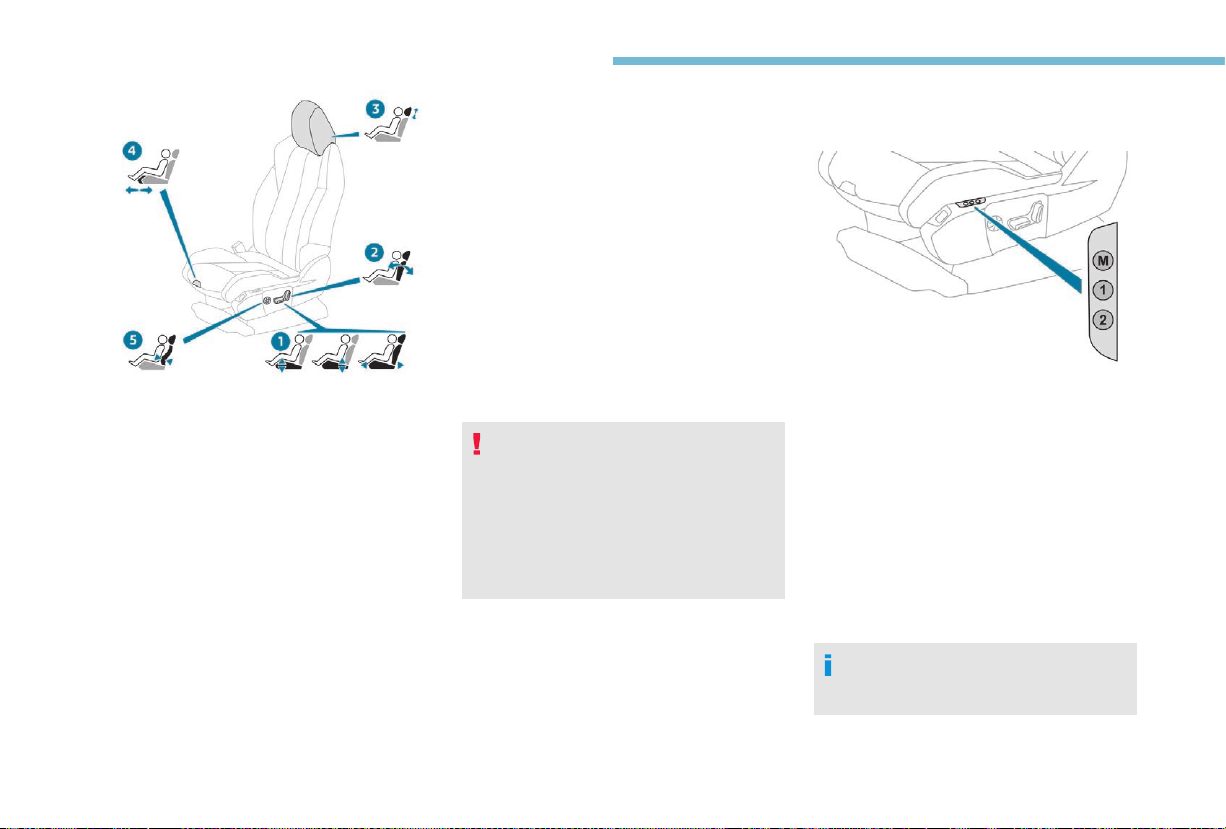
74
Ease of use and comfort
1. Adjusting the angle and height of the seat
cushion / Adjusting the seat forwards and
backwards
F Raise or lower the front of the control to
obtain the desired seat cushion angle.
F Raise or lower the rear of the control to
raise or lower the seat cushion.
F Slide the control forwards or backwards to
move the seat forwards or backwards.
2. Adjusting the seat backrest angle
F Turn the control forwards or backwards to
recline the backrest to the desired angle.
3. Adjusting the height of the head restraint
Refer to the corresponding section.
4. Adjusting the length of the seat cushion
F Pull the handle forwards to release the
cushion, then move the front part of the seat
cushion forwards or backwards.
5. Adjusting the lumbar support
The control allows independent adjustment of
the depth and vertical position of the lumbar
support.
F Press and hold the front or rear of the
control to increase or reduce the lumbar
support.
F Press and hold the top or bottom of the
control to raise or lower the lumbar support
area.
Before moving the seat backwards,
ensure that there is nothing that might
prevent the full travel of the seat.
There is a risk of trapping or pinching
passengers if present in the rear seats
or jamming the seat if large objects are
placed on the floor behind the seat.
Storing driving positions
Associated with adjustments of the electrical
driver's seat, this function allows two driving
positions to be memorised, to make these
adjustments easier if there are frequent driver
changes.
Storing a position
Using buttons M / 1 / 2
F Sit in the driver's seat.
F Switch on the ignition.
F Adjust your seat and the door mirrors.
F Press button M, then press button 1 or 2
within four seconds.
An audible signal indicates that the position has
been stored.
Storing a new position cancels the
previous position.
It takes account of the electric adjustments of
the seat and the door mirrors.
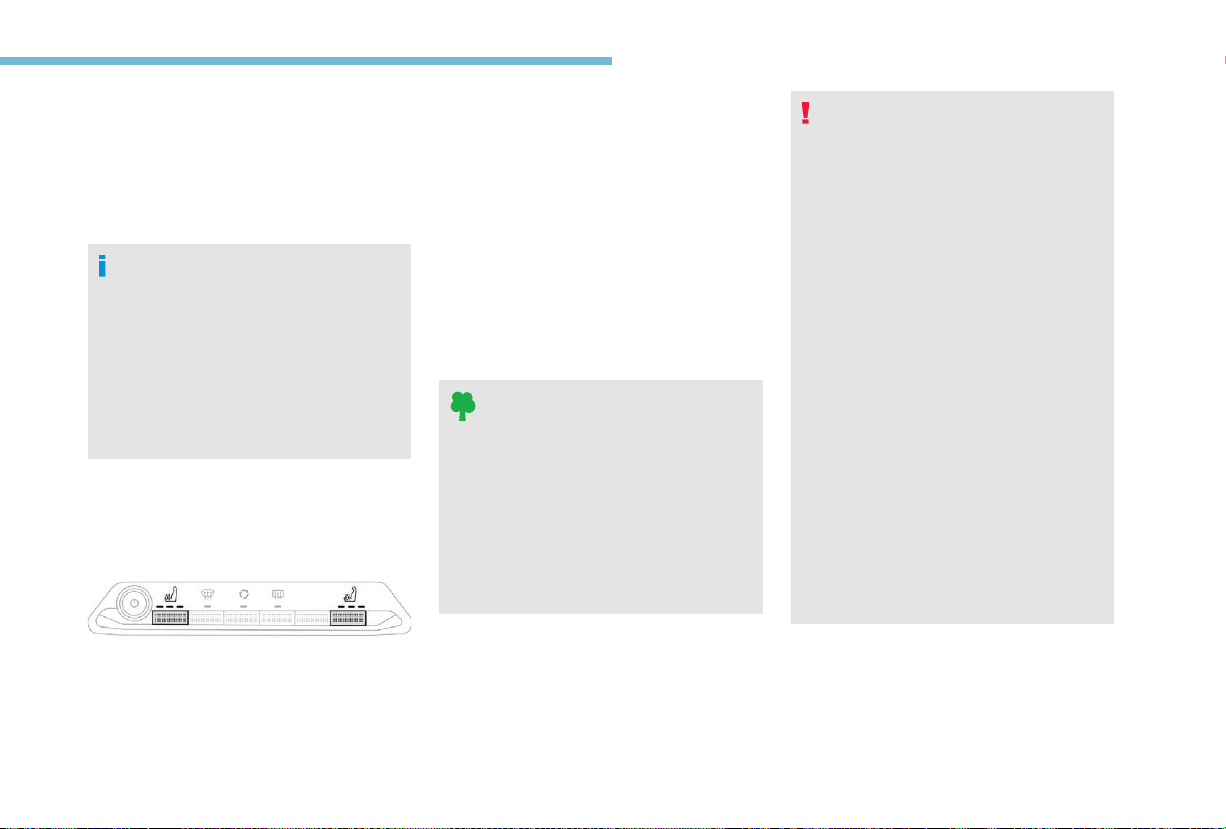
3
75
Ease of use and comfort
Recalling a stored position
Ignition on or engine running
F Press button 1 or 2 to recall the
corresponding position.
An audible signal confirms that adjustment is
complete.
You can interrupt the current movement
by pressing button M, 1 or 2 or by using
one of the seat controls.
A stored position cannot be recalled
while driving.
Recalling stored positions is deactivated
45 seconds after switching off the
ignition.
Heated seats
The function is active only with the engine
running.
Switching on
F Each press changes the level of heating; the
corresponding number of indicator lamps
come on:
• 1 orange indicator lamp = low.
• 2 orange indicator lamps = medium.
• 3 orange indicator lamps = high.
Switching off
F Press the button again until all the indicator
lamps are off.
The state of the system is not kept in memory
when the ignition is switched off.
Do not use the function when the seat is
not occupied.
Reduce the intensity of the heating as
soon as possible.
When the seat and passenger
compartment have reached an adequate
temperature, you can stop the function;
reducing the consumption of electrical
current reduces fuel consumption.
F Press the button corresponding to your
seat.
Prolonged use is not recommended for
those with sensitive skin.
There is a risk of burns for people whose
perception of heat is impaired (illness,
taking medication, etc.).
There is a risk of overheating the system
if material with insulating properties is
used, such as cushions or seat covers.
Do not use the system:
- if wearing damp clothing,
- if child seats are fitted.
To avoid breaking the heating element
in the seat:
- do not place heavy objects on the
seat,
- do not kneel or stand on the seat,
- do not place sharp objects on the
seat,
- do not spill liquids onto the seat.
To avoid the risk of short-circuit:
- do not use liquid products for
cleaning the seat,
- never use the heating function when
the seat is damp.
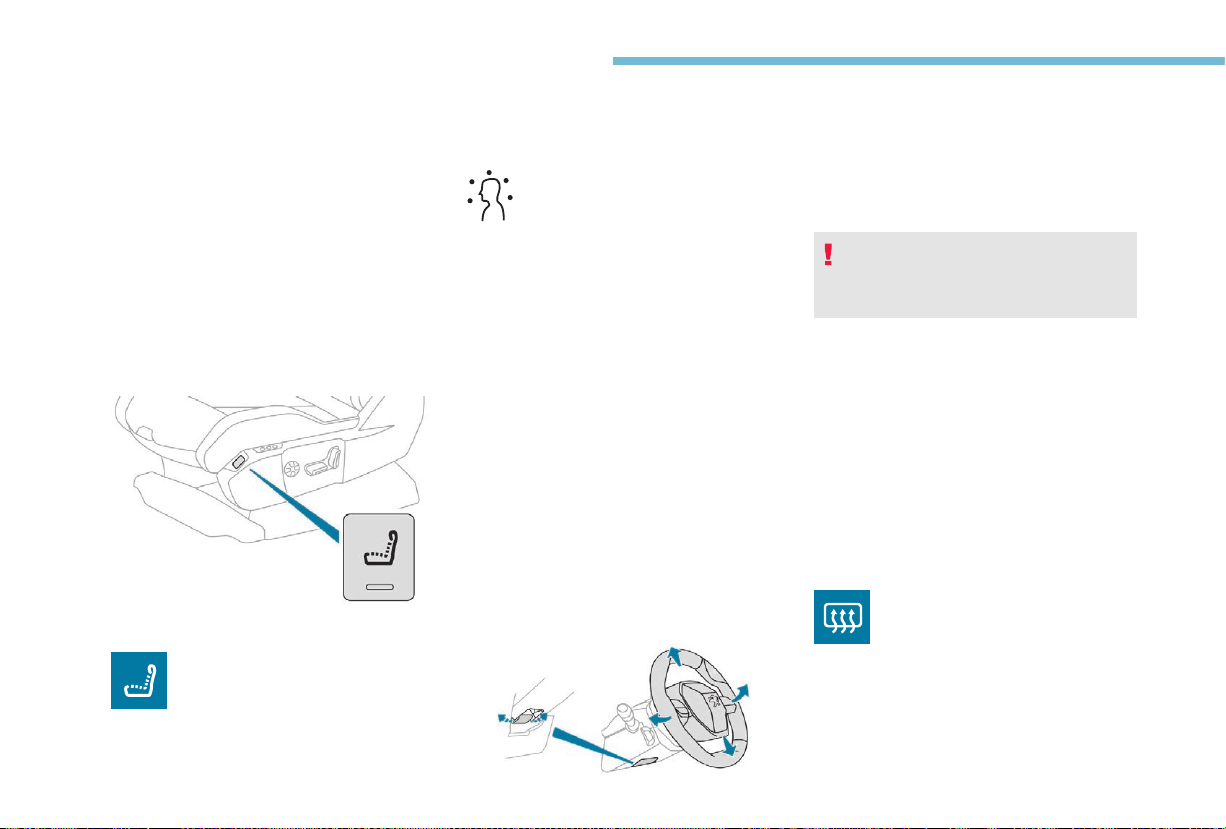
76
Ease of use and comfort
Multipoint massage
System with a choice of type of massage and
adjustment of its intensity.
This system operates with the engine running,
as well as in STOP mode of Stop & Start.
Activation / Settings
The massage settings are adjusted in the touch
screen.
The system is switched on, either directly using
the button on the front seat, or by activating
a personalised ambience with the i-Cockpit
Amplify function.
Using the button on the front seat:
The multipoint massages are also
managed by the i-Cockpit Amplify
function.
If you want to modify the settings:
F select another type of massage from the five
offered,
F select a massage intensity from the three
levels offered: "1" (Low), "2" (Normal) or
"3" (High).
The modifications are taken into account
immediately.
Once activated, the system starts a one hour
massage cycle, made up of sequences of
6 minutes of massage followed by 3 minutes at
rest.
The system stops automatically at the end of the
cycle; the indicator lamp in the button goes off.
Steering wheel adjustment
F When stationary, pull the control lever
to release the steering wheel adjustment
mechanism.
F Adjust the height and reach to suit your
driving position.
F Push the control lever to lock the steering
wheel adjustment mechanism.
As a safety measure, these adjustments
should only be carried out with the vehicle
stationary.
Mirrors
Door mirrors
Each fitted with an adjustable mirror glass
permitting the lateral rearward vision necessary
for overtaking or parking.
They can also be folded for parking in confined
spaces.
Demisting / Defrosting
If your vehicle is so equipped,
demisting / defrosting of the heated
door mirrors is performed when the
heated rear screen is switched on.
F Press this button; its green
indicator lamp comes on.
The system is activated immediately with the
last settings used and the settings page is
displayed on the touch screen.
If the settings suit you and you make no
changes, the display returns to its previous
state.
For more information on the i-Cockpit Amplify
function, refer to the corresponding section.
For more information on Rear screen demist –
defrost, refer to the corresponding section.
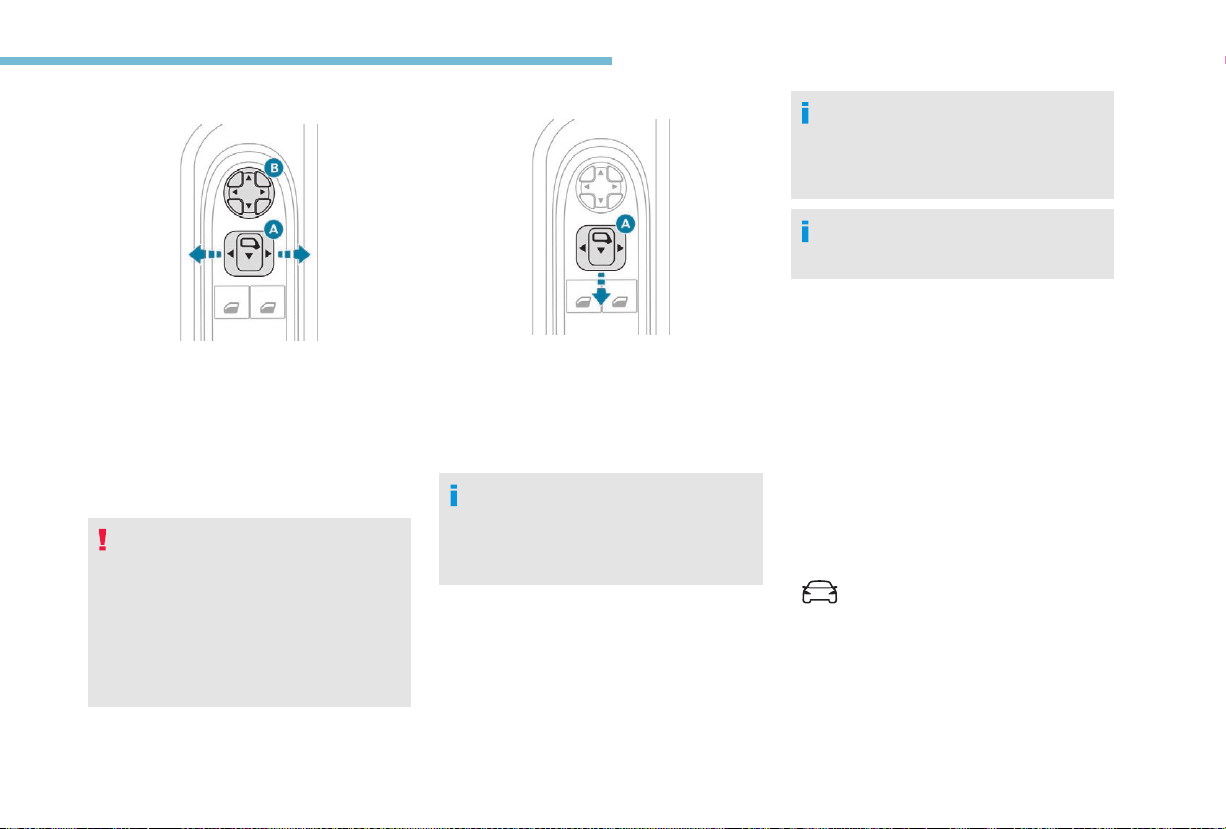
3
77
Ease of use and comfort
Adjustment
As a safety measure, the mirrors should
be adjusted to reduce the "blind spots".
The objects observed are, in reality,
closer than they appear.
Take this into account in order to
correctly judge the distance of vehicles
approaching from behind.
Folding
Unfolding
F Move control A to the right or to the left to
select the corresponding mirror.
F Move control B in any of the four directions
to adjust.
F Return control A to the central position.
F From outside: lock the vehicle using the
remote control or the key.
F From inside: with the ignition on, pull the
control A in the central position rearwards.
If the mirrors are folded using control A,
they will not unfold when the vehicle is
unlocked. Pull again on control A.
F From outside: unlock the vehicle using the
remote control or the key.
F From inside: with the ignition on, pull the
control A in the central position rearwards.
The folding and unfolding of the door
mirrors using the remote control can be
deactivated by a PEUGEOT dealer or a
qualified workshop.
If necessary the mirrors can be folded
manually.
Automatic tilting in reverse gear
System which provides a view of the ground
during parking manoeuvres in reverse gear.
With the engine running, on engaging reverse
gear, the mirror glasses tilt downwards.
They return to their initial position:
- a few seconds after coming out of reverse
gear,
- once the speed of the vehicle exceeds
6 mph (10 km/h),
- on switching off the engine.
This function is activated /
deactivated via the "Vehicle
settings" tab in the Vehicle /
Driving menu of the touch screen.
Rear view mirror
Equipped with an anti-dazzle system, which
darkens the mirror glass and reduces the
nuisance to the driver caused by the sun,
headlamps from other vehicles, etc.
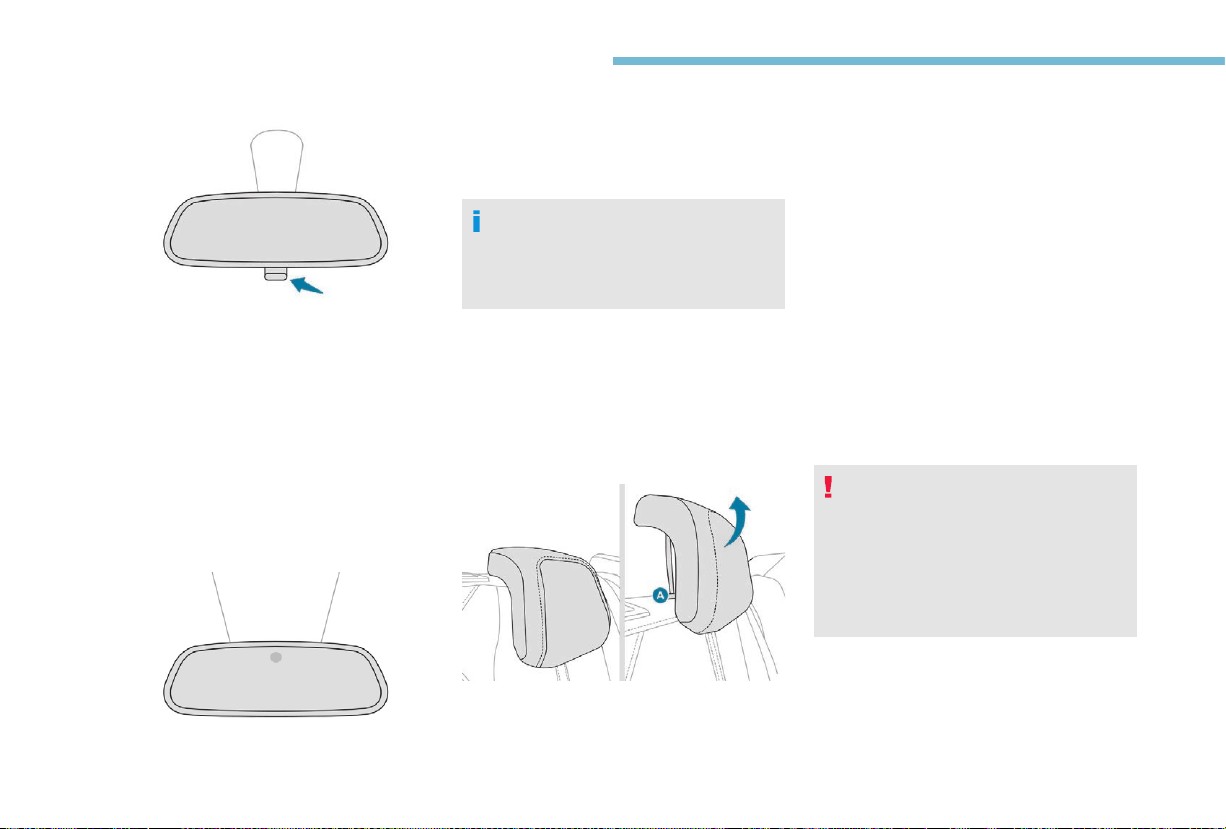
78
Ease of use and comfort
Manual model
Adjustment
F Adjust the mirror so that the glass is
directed correctly in the "day" position.
Day / night position
F Pull the lever to change to the "night" anti-
dazzle position.
F Push the lever to change to the normal
"day" position.
Automatic "electrochrome"
model
In order to ensure optimum visibility
during your manoeuvres, the mirror
lightens automatically when reverse gear
is engaged.
This system automatically and progressively
changes between day and night use by means
of a sensor measuring the light coming from the
rear of the vehicle.
Rear seats
Bench seat with a fixed cushion and split
folding backrests (2/3-1/3) to adapt the boot
load space.
Rear head restraints
The rear head restraints can be removed.
To remove a head restraint:
F pull the head restraint as far up as it will go,
F press the lug A to release the head restraint
and remove it completely,
F stow the head restraint.
To refit a head restraint:
F insert the head restraint rods into the guides
in the corresponding seat backrest,
F push the head restraint down as far as it will
go,
F press the lug A to release the head restraint
and push it down.
Never drive with passengers seated at
the rear when the head restraints are
removed; they must be in place and in the
high position.
The head restraint for the centre seat
and those for outer seats are not
interchangeable.
They have two positions:
- a high position, for when the seat is in use:
F pull the head restraint fully up.
- a low position, for stowing, when the seat
is not in use:
F press the lug A to release the head
restraint and push it fully down.
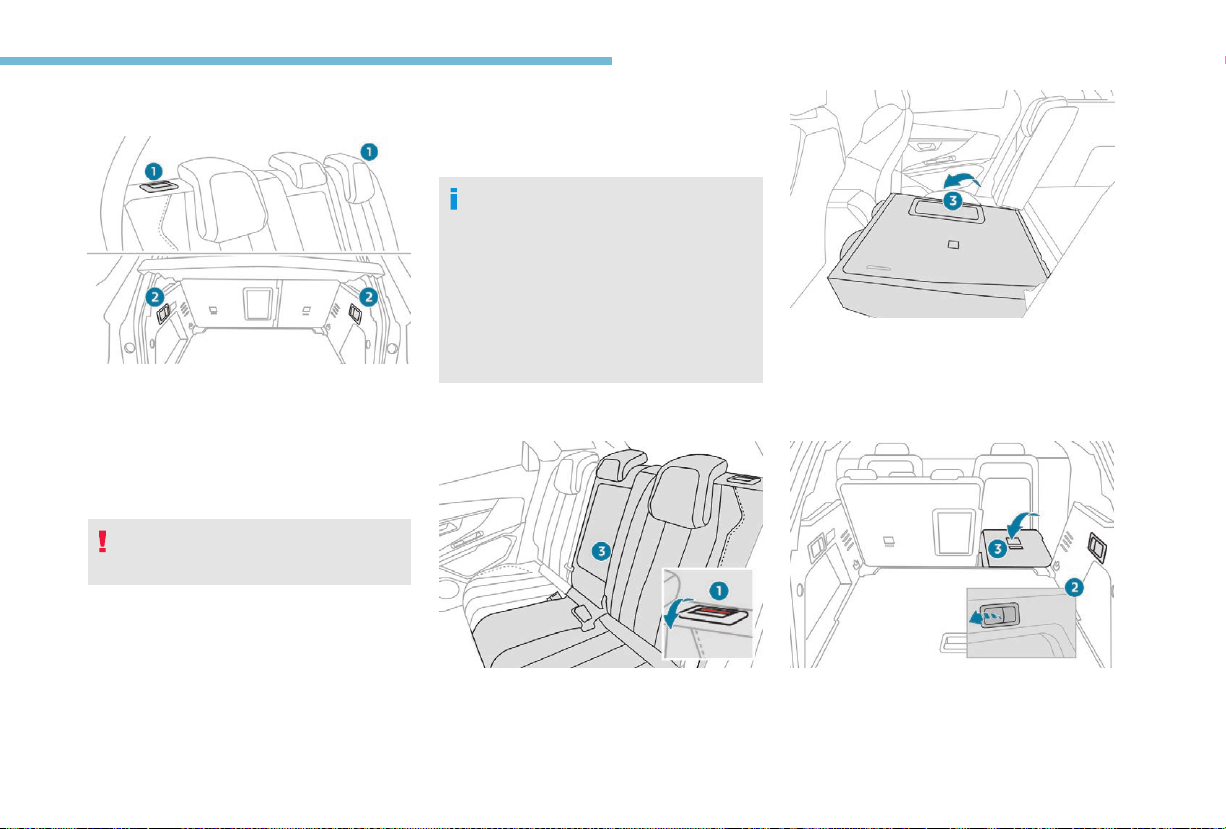
3
79
Ease of use and comfort
Folding the backrests
The folding of the backrest is
accompanied by a slight lowering of the
corresponding cushion.
To obtain a flat surface, it is necessary to
place the adjustable boot floor in the high
position.
When the backrest is released, the red
indicator is visible in the release grip.
Folding from the passenger
compartment
Folding from the boot
Each section of the backrest has two release
controls:
- a grip 1 on the outer edge of the backrest,
- a lever 2 on the boot side trim.
First steps:
F lower the head restraints,
Folding or unfolding the seat backrests must
only be done with the vehicle stationary.
F if necessary, move the front seats forward,
F fold away the rear armrest,
F check that nothing or no person might
interfere with the folding of the backrests
(clothing, luggage, etc.).
F Press the backrest release grip 1.
F Guide the backrest 3 down to the horizontal
position.
F check that the outer seat belts are lying
correctly on the backrests.
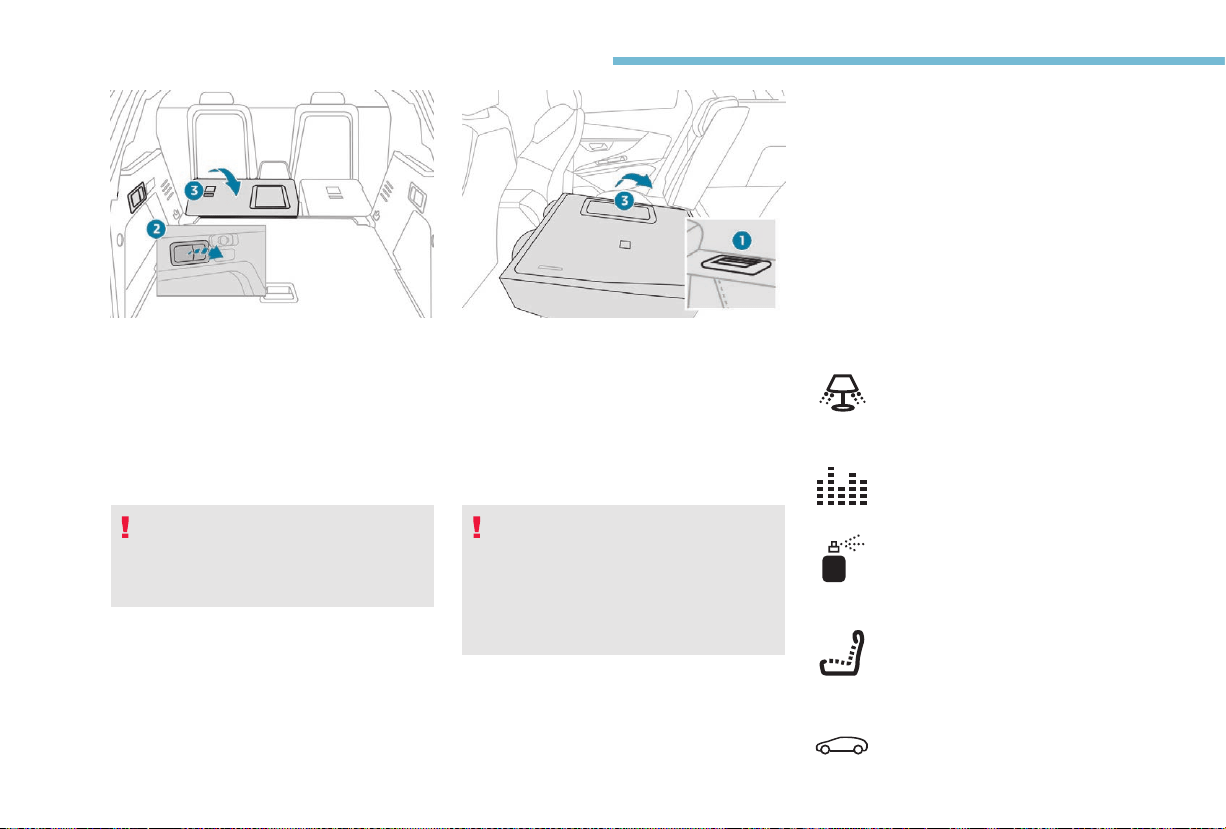
80
Ease of use and comfort
Please note: an incorrectly latched
backrest compromises the safety of
passengers in the event of sudden
braking or an impact.
The contents of the boot may be thrown
forward – Risk of serious injury!
i-Cockpit Amplify function
This function allows the driving ambiences to
be managed.
Specific system settings are offered for each
ambience.
These ambiences can be personalised in the
touch screen.
Content of an ambience
F Pull lever 2 towards you to unlock the
backrest.
The backrest 3 folds fully onto the cushion.
Returning the backrests to
their original position
First check that the outer seat belts are
lying vertically alongside the backrest
latching rings.
F Put the backrest 3 in the upright position
and push on it to latch it home.
F Check that the red indicator is no longer
visible in the release grip 1.
F Ensure that the outer seat belts are not
trapped during the manoeuvre.
An ambience is defined by the settings for each
of the following systems:
- the passenger compartment
ambient lighting,
(activation / deactivation and
adjustment of brightness)
- the audio ambience,
(choice of predetermined settings for
the audio system equaliser).
- scented air freshener,
(activation / deactivation, choice of
an air freshener and adjusting the
amount of diffusion).
- multipoint massage,
(selection of the seat, activation /
deactivation, selection of a type of
massage and a setting for intensity).
- Dynamic pack,
(activation / deactivation).
3
81
Ease of use and comfort
Access to the i-Cockpit
Amplify system home page
Direct access by this button
Access via the Applications menu
F Select "i-Cockpit Amplify".
Activating an ambience
From the home page:
F Select an ambience: "Relax" or "Boost".
Depending on the settings made for the
ambience, the systems are activated
immediately.
Deactivating an ambience
From the home page:
F Press "Deactivate ambience".
or
F Select another ambience.
The ambience is automatically deactivated
when the ignition is switched off.
Personalising an ambience
From the home page:
F Select an ambience to activate it.
It is possible to temporarily modify an
ambience at any time, by modifying
the settings for one or more of the
systems managed in the ambience,
without going via the i-Cockpit Amplify
function.
For example, you can deactivate or
modify the intensity of the current
massage by pressing the massage
activation button on your seat or
activate / deactivate the ambient
lighting in the passenger compartment
from the Vehicle / Driving menu.
In this case, the new settings
will not be saved as part of the
current ambience.
F Press "Settings" to display the settings
page for the ambience.
F Select a system for which you wish to
modify the settings.
F After making the modifications, press any
area of the screen outside the system
settings window to return to the ambience
settings page.
F After making all of the desired modifications
to settings, press "Save settings".
The modifications are taken into account
immediately.
Air intake
The air circulating in the passenger
compartment is filtered and originates either
from the outside via the grille located at the
base of the windscreen or from the inside in air
recirculation mode.
Controls
The incoming air follows various routes
depending on the controls selected by
the driver, the front passenger and rear
passengers, according to the level of
equipment .
The temperature control enables you to obtain
the level of comfort required by mixing the air of
the various circuits.
The air distribution control enables you to
select the air vents used in the passenger
compartment by the combined use of the
associated buttons.
The air flow control enables you to increase or
reduce the speed of the ventilation fan.
Depending on your vehicle, the controls are
accessible in the Air conditioning menu of the
touch screen or are grouped together on the
control panel of the centre console.
Heating and Ventilation
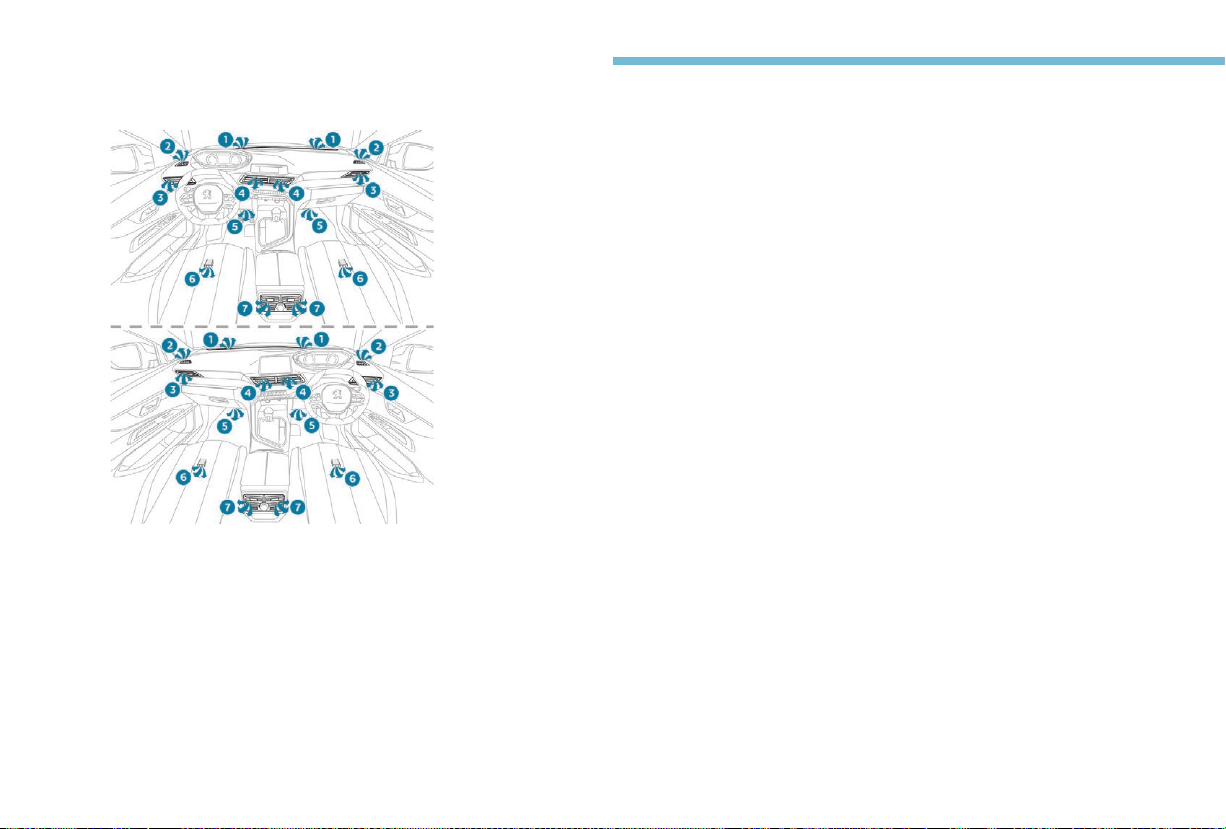
82
Ease of use and comfort
Air distribution
1. Windscreen demisting/defrosting vents.
2. Front side window demisting/defrosting
vents.
3. Side adjustable air vents.
4. Central adjustable air vents.
5. Air outlets to the front footwells.
6. Air outlets to the rear footwells.
7. Adjustable air vents.
To close the air vents:
F side vents; place the slider in the central
position, then move it sideways towards
the door.
F central vents; place the slider in the
central position, then move it sideways
towards you.
3
83
Ease of use and comfort
Recommendations for ventilation and
air conditioning
In order for these systems to be fully
effective, follow the operation and
maintenance guidelines below:
F To ensure that the air is distributed
evenly, keep the external air intake
grilles at the base of the windscreen,
the nozzles, the vents, the air outlets
and the air extractor in the boot free
from obstructions.
F Do not cover the sunshine sensor,
located on the dashboard; this is used
for regulation of the automatic air
conditioning system.
F Operate the air conditioning system for
at least 5 to 10 minutes once or twice
a month to keep it in perfect working
order.
F Ensure that the passenger
compartment filter is in good condition
and have the filter elements replaced
regularly. We recommend the use of
a combined passenger compartment
filter. Thanks to its special active
additive, it contributes to the purification
of the air breathed by the occupants
and the cleanliness of the passenger
compartment (reduction of allergic
symptoms, bad odours and greasy
deposits).
If after an extended stop in sunshine,
the interior temperature is very high,
first air the passenger compartment for
a few moments.
Put the air flow control at a setting high
enough to quickly change the air in the
passenger compartment.
The condensation created by the air
conditioning results in a discharge of
water under the vehicle which is perfectly
normal.
Stop & Start
The heating and air conditioning systems
only work when the engine is running.
To maintain a comfortable temperature
in the passenger compartment, you may
temporarily deactivate the Stop & Start
system.
For more information on Stop & Start,
refer to the corresponding section.
F To ensure correct operation of the
air conditioning system, you are also
advised to have it checked regularly
as recommended in the Warranty and
Maintenance Record.
F If the system does not produce cold air,
switch it off and contact a PEUGEOT
dealer or a qualified workshop.
When towing the maximum load on a steep
gradient in high temperatures, switching off
the air conditioning increases the available
engine power and so improves the towing
ability.
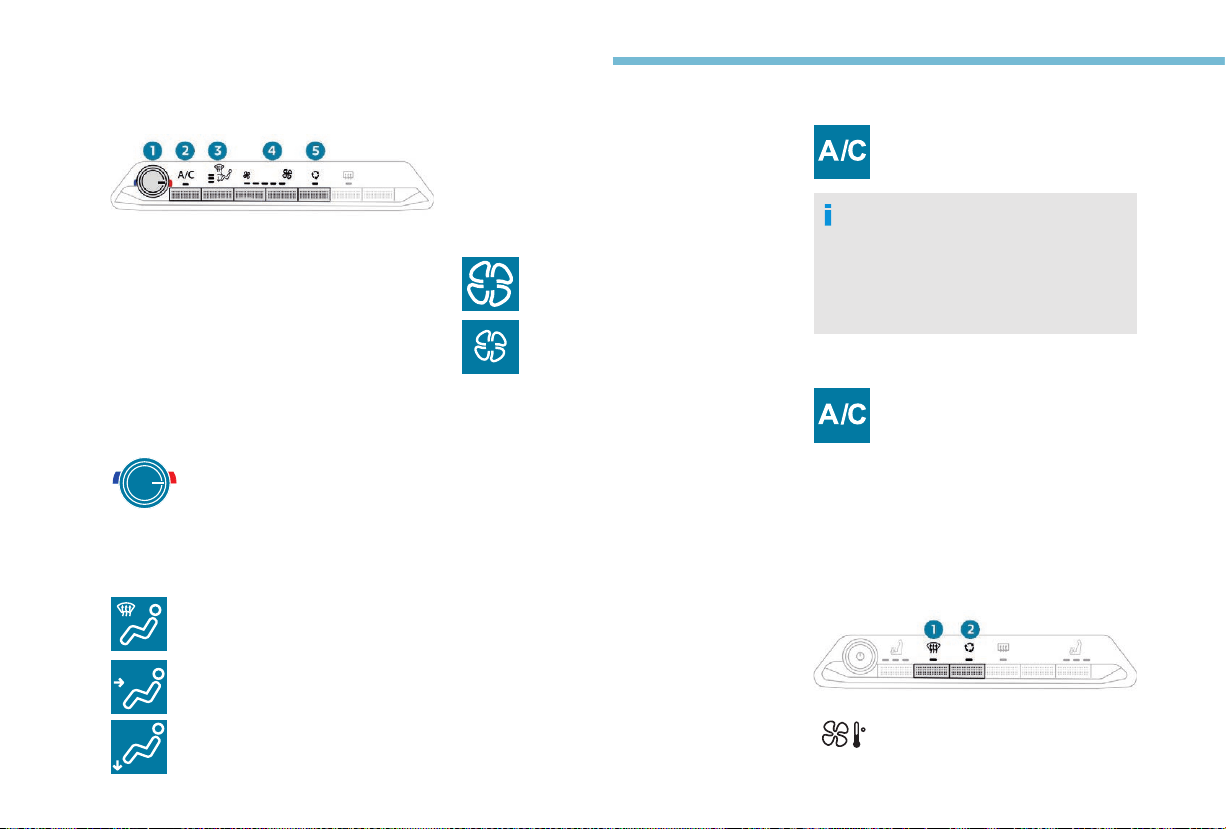
84
Ease of use and comfort
Manual air conditioning
1. Temperature settings.
2. Air conditioning On/Off.
3. Air distribution adjustment.
4. Air flow adjustment.
5. Recirculation of interior air.
The air conditioning system operates only with
the engine running.
Temperature adjustment
F Turn this knob from blue (cold)
to red (hot).
Air distribution adjustment
Windscreen and side windows.
Central and side vents.
Footwells.
F Press this button as many times as
necessary to obtain the desired air
distribution.
The air distribution can be adapted by combining
the corresponding orange indicator lamps.
Air flow adjustment
F Press the "large fan" or "small
fan" button to increase or
decrease the air flow.
The corresponding orange indicator
lamps come on.
If you keep pressing the "small fan" until all
of the indicator lamps go off (system off), the
temperature is no longer controlled.
A slight flow of air can still be felt, resulting from
the forward movement of the vehicle.
Air conditioning On / Off
The air conditioning is designed to operate
effectively in all seasons, with the windows
closed.
It enables you to:
- lower the temperature, in summer,
- increase the effectiveness of the demisting
in winter, above 3°C.
Switching on
F Press this button; its orange
indicator lamp comes on.
The air conditioning does not operate
when the air flow adjustment is set to off.
To obtain cool air more quickly, you can
activate recirculation of the interior air for
a few moments.
Switching off
F Press this button again; its
indicator lamp goes off.
Switching off the air conditioning may result in
some discomfort (humidity, condensation).
Semi-automatic mono-
zone air conditioning
Press the Air conditioning menu
button to display the system controls
page.
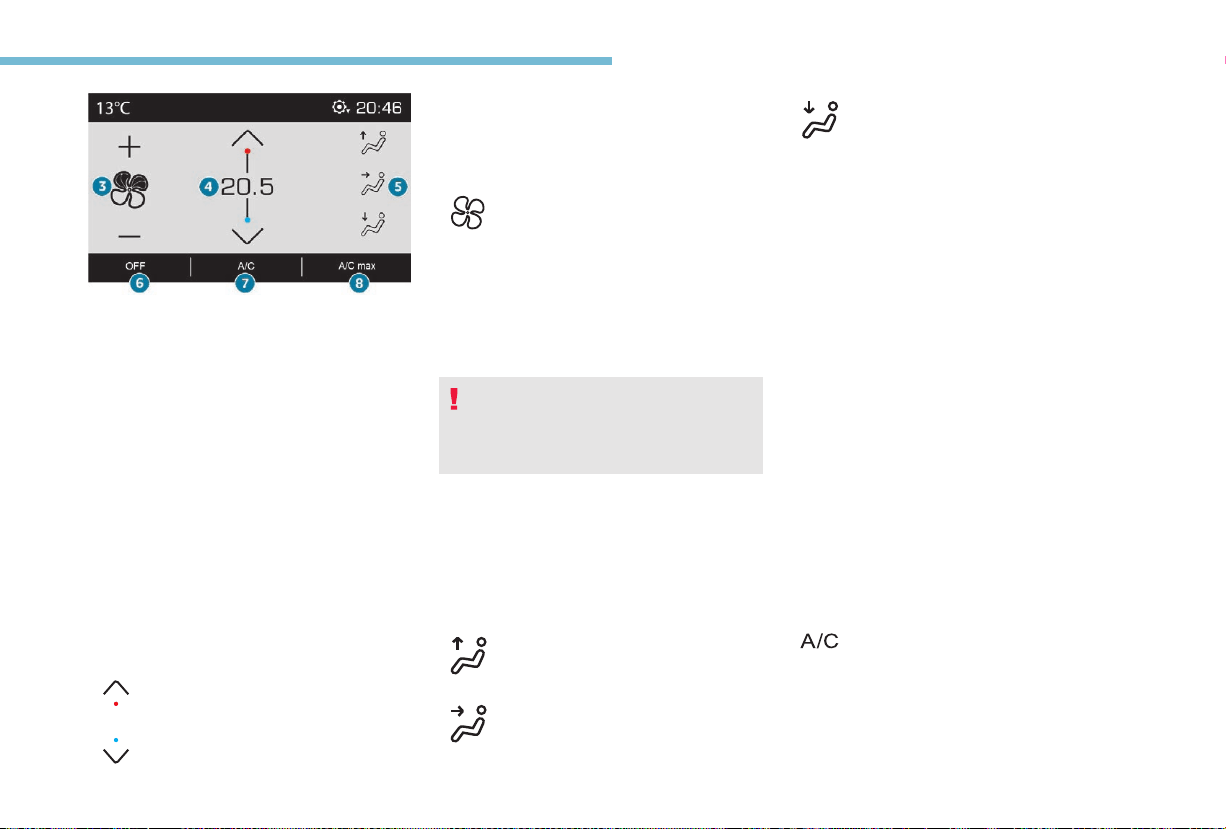
3
85
Ease of use and comfort
The air conditioning system operates only with
the engine running.
The temperature at the nozzles and vents
is regulated by the system according to the
temperature in the passenger compartment
and the temperature setting.
Temperature adjustment
F Press one of these buttons to
decrease (blue) or increase
(red) the value.
The value indicated corresponds to a level of
comfort and not to a precise temperature.
Air flow adjustment
1. Automatic visibility programme.
2. Recirculation of interior air.
3. Air flow adjustment.
4. Temperature adjustment.
5. Air distribution adjustment.
6. System off.
7. Air conditioning On / Off.
8. Maximum air conditioning.
Press one of these buttons to
increase (+) or decrease (-) the
speed of the booster fan.
The symbol for air flow (a fan) fills progressively
according to the air flow setting made.
By reducing the air flow to minimum, you are
stopping ventilation.
Air distribution adjustment
Avoid driving too long without ventilation –
Risk of condensation and deterioration of
air quality!
Footwells.
These buttons are used to arrange
the distribution of air in the passenger
compartment by combining several air outlets.
Windscreen and side windows.
Central and side vents.
The air distribution can be adapted by using
several buttons: illumination of the indicator
lamp confirms the presence of fan boosted air
in the direction indicated, the indicator lamp off
indicates the absence of fan boosted air in the
direction indicated.
For a uniform distribution of air in the
passenger compartment, the three buttons can
be activated simultaneously.
Air conditioning On / Off
The air conditioning is designed to operate
effectively in all seasons, with the windows
closed.
It enables you to:
- lower the temperature, in summer,
- increase the effectiveness of the demisting
in winter, above 3°C.
Switching on
F Press this button, its indicator
lamp comes on.
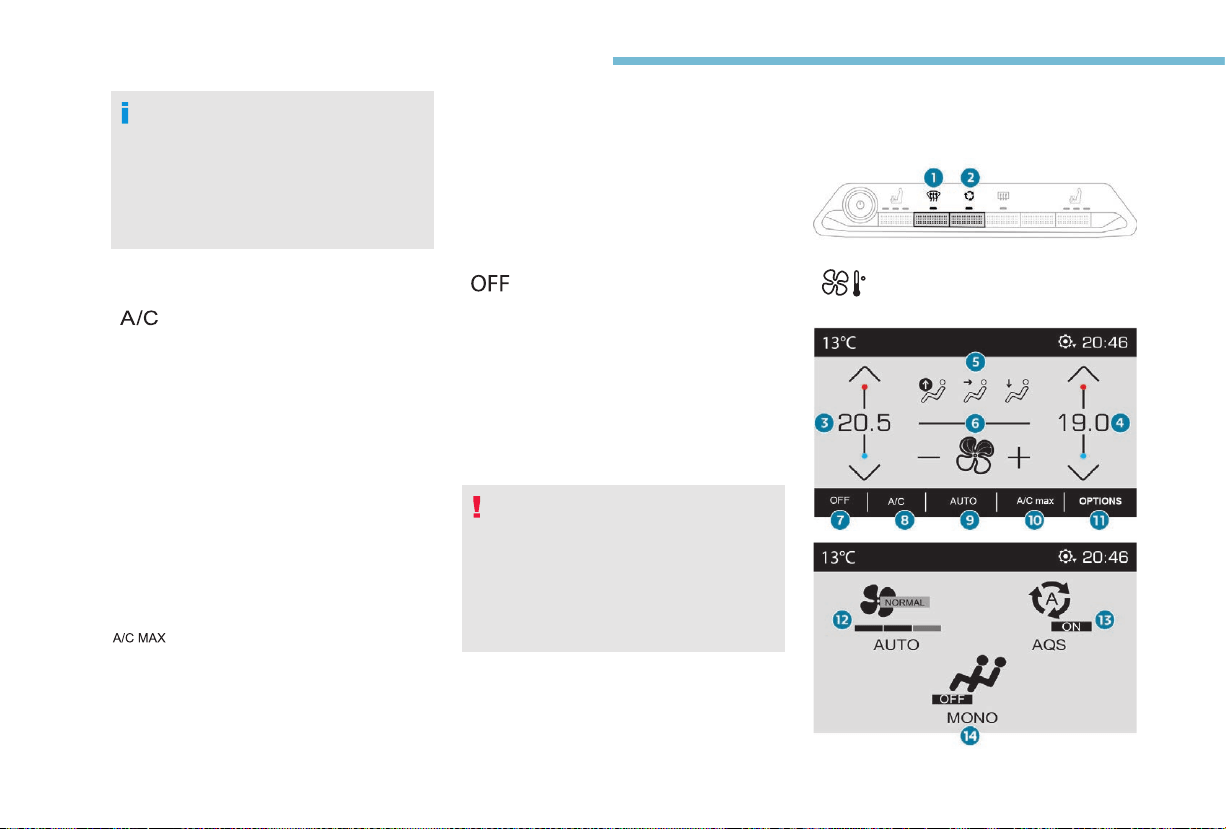
86
Ease of use and comfort
The air conditioning does not operate
when the air flow adjustment is set to off.
To obtain cool air more quickly, you can
use recirculation of the interior air for a
few moments. Then return to the intake of
exterior air.
Switching off
F Press this button again, its
indicator lamp goes off.
Switching off the air conditioning may result in
some discomfort (humidity, condensation).
Maximum air conditioning
This function allows faster cooling of the air in
the passenger compartment.
The system automatically adjusts the
temperature setting to the lowest possible, air
distribution towards the centre and outer vents,
air flow to maximum and activates recirculation
of interior air.
F Press this button to activate
the function; its indicator lamp
comes on.
Automatic visibility
programme
For more information on Front demist –
defrost, refer to the corresponding section.
Switching off the system
F Press this button; its indicator
lamp comes on and all other
indicator lamps of the system
go off.
Avoid driving for too long with the system
switched off – Risk of condensation and
deterioration of air quality!
Pressing any button reactivates the
system with the settings that were
previously in use.
Automatic dual-zone air
conditioning
Press the Air conditioning menu
button to display the system controls
page.
F Press this button again to deactivate the
function and return to the previous settings;
its indicator lamp goes off.
This action deactivates all functions of the air
conditioning system.
Temperature is no longer regulated. However,
a slight flow of air can still be felt, resulting from
the forward movement of the vehicle.

3
87
$872
)$67
$872
1250$/
62)7
$872
Ease of use and comfort
1. Automatic visibility programme.
2. Recirculation of interior air.
3. Temperature adjustment on the left side.
4. Temperature adjustment on the right side.
5. Air distribution adjustment.
6. Air flow adjustment.
7. System off.
8. Air conditioning On / Off.
9. Automatic comfort programme On / Off.
10. Maximum air conditioning.
11. Access to the secondary page.
12. Selection of settings for the automatic
comfort programme (Soft/Normal/Fast).
13. "AQS (Air Quality System)" function (with
pollution sensor).
14. Mono-zone / Dual-zone.
The air conditioning system operates with
the engine running, but the ventilation and its
controls are available with the ignition on.
Operation of the air conditioning and regulation
of temperature, air flow and air distribution in
the passenger compartment are automatic.
Temperature adjustment
The driver and front passenger can each
choose their own temperature setting.
The value indicated corresponds to a level of
comfort and not to a precise temperature.
Automatic comfort
programme
F Press this button to activate or
deactivate the automatic mode
of the air conditioning system.
F Press one of these buttons to
increase the value.
F Press one of these buttons to
decrease the value.
It is recommended that you avoid a difference of
more than 3°C in the settings for left and right.
When the indicator lamp in the button is on, the
air conditioning system operates automatically:
the system manages the temperature, air
flow and air distribution in the passenger
compartment in an optimum way according to
the comfort level you have selected.
It is possible to modulate the intensity of the
automatic comfort programme by choosing one
of three settings offered in the secondary page,
accessible from the "OPTIONS" button.
To change the current setting, shown by
illumination of the corresponding indicator
lamp, press this button repeatedly until the
desired setting is displayed:
"Normal": offers the best
compromise between a
comfortable temperature and
quiet operation (default setting).
"Fast": provides strong and
effective air flow.
Use the "Normal" or "Fast" setting to assure
the comfort of passengers in the rear seats.
This setting is associated with automatic mode
only. However, on deactivation of AUTO mode,
the indicator for the last setting remains on.
Changing the setting does not reactivate AUTO
mode if deactivated.
"Soft": provides soft and quiet
operation by limiting air flow.
88
Ease of use and comfort
In cold weather with the engine cold, the
air flow is increased gradually until the
comfort setting has been reached, in order
to limit the delivery of cold air into the
passenger compartment.
On entering the vehicle, if the interior
temperature is much colder or warmer
than the comfort setting requested, there
is no need to alter the value displayed
in order to reach more quickly the
required level of comfort. The system
compensates automatically and corrects
the temperature difference as quickly as
possible.
Automatic visibility
programme
For more information on Front demist –
defrost, refer to the corresponding section.
Air Quality System (AQS)
function
Using a pollution sensor, this function
automatically activates recirculation of the
interior air once it detects a certain level of
polluting substances in the exterior air.
To activate or deactivate the function, go to the
secondary page by pressing the "OPTIONS"
button.
Manual control
You can manually adjust one or more settings,
while retaining automatic control of the other
functions:
- air flow,
- air distribution.
As soon as you modify a setting, the indicator
lamp in the "AUTO" button goes off.
F Press this button again to
reactivate the automatic comfort
programme.
Air ow adjustment
F Press one of these buttons to
increase or decrease the speed
of the booster fan.
By reducing the air flow to minimum, you are
stopping ventilation.
"OFF" is displayed alongside the fan.
Avoid driving too long without ventilation –
Risk of condensation and deterioration of
air quality!
Air distribution adjustment
You can vary the distribution of air in the
passenger compartment using these three
buttons.
Windscreen and side windows.
Central and side vents.
When the air quality returns to a satisfactory
level, recirculation of interior air is automatically
deactivated.
This function is not designed to detect
unpleasant odours.
Recirculation is automatically activated when
the front screenwash is used or when reverse
gear is engaged.
The function does not operate if the exterior
temperature is below 5°C, to avoid the risk of
misting of the windscreen and side windows.
The air flow symbol (a fan) is filled in
progressively as the speed of the fan is
increased.
Footwells.
3
89
Ease of use and comfort
Each press on a button activates or deactivates
the function. The indicator lamp is on when the
button is activated. For a uniform distribution
of air in the passenger compartment, the three
buttons can be activated simultaneously.
In AUTO mode, the indicator lamps in all three
buttons are off.
Air conditioning On / Off
The air conditioning is designed to operate
effectively in all seasons, with the windows
closed.
It enables you to:
- lower the temperature, in summer,
- increase the effectiveness of the demisting
in winter, above 3°C.
Switching on
F Press this button, its indicator
lamp comes on.
The air conditioning does not operate
when the air flow adjustment is set to off.
Switching off
F Press this button again, its
indicator lamp goes off.
Maximum air conditioning
This function allows faster cooling of the air in
the passenger compartment.
The system automatically adjusts the
temperature setting to the lowest possible, air
distribution towards the centre and outer vents,
air flow to maximum and activates recirculation
of interior air.
Switching off the air conditioning may result in
some discomfort (humidity, condensation).
F Press this button to activate
the function; its indicator lamp
comes on.
F Press this button again to deactivate the
function and return to the previous settings;
its indicator lamp goes off.
Mono-zone / Dual-zone
The passenger temperature setting can be
linked to the driver's setting (mono-zone
function).
It is available in the secondary page by
pressing the "OPTIONS" button.
Ventilation with the
ignition on
When the ignition is switched on, you can use
the ventilation system to adjust the air flow
settings and the air distribution in the passenger
compartment depending on the battery charge.
This function does not operate the air conditioning.
System switch-off
F Press this button.
Its indicator lamp comes on and all
other indicator lamps for the system
go off.
This action deactivates all functions
of the air conditioning system.
Avoid driving for too long with the
ventilation off or the system deactivated –
Risk of misting and deterioration of the air
quality!
Pressing any button reactivates the
system with the settings that were
previously in use.
F Press this button to activate
the "MONO" function; its "ON"
status is displayed.
The function is automatically deactivated if the
passenger uses their temperature adjustment
buttons (dual-zone function).
By reducing the air flow to a minimum, you are
stopping ventilation.
Temperature is no longer regulated. A slight air
flow can still be felt however, resulting from the
forward movement of the vehicle.
90
Ease of use and comfort
Recirculation of the
interior air
The intake of exterior air prevents the formation
of mist on the windscreen and the side windows.
The recirculation of the interior air isolates the
passenger compartment from exterior odours
and fumes.
This function also allows the desired
temperature in the passenger compartment to
be reached in the shortest time.
F Press this button to activate the
function; its orange indicator
lamp comes on.
F Press this button again to deactivate the
function; its indicator lamp goes off.
Avoid prolonged use of the recirculation of
interior air – Risk of formation of mist and
deterioration of the air quality!
The system activates automatically when
reverse gear is engaged.
Front demist – defrost
With manual air
conditioning
F Adjust the temperature to maximum (red).
F Adjust the air flow to maximum; all of the
orange indicator lamps come on.
F Adjust the air distribution to the
"Windscreen" position; its associated
orange indicator lamp comes on.
F Check that the recirculation of interior air is
deactivated; its indicator lamp must be off.
F Switch on the air conditioning by pressing
the "A/C" button; its orange indicator lamp
comes on.
With Stop & Start, when the demisting,
air conditioning and air flow functions are
activated, STOP mode is not available.
With semi-automatic and
automatic air conditioning
Automatic visibility programme
F Press this button to demist or
defrost the windscreen and side
windows more quickly; its orange
indicator lamp comes on.
The system automatically manages the air
conditioning (depending on version), air
flow and air intake, and provides optimum
distribution towards the windscreen and side
windows.
F To switch it off, press this button; its
indicator lamp goes off.
The system allows the manual modification of
air flow without causing automatic deactivation
of the automatic visibility programme.
With Stop & Start, when demisting –
defrosting has been activated, STOP
mode is not available.
In wintry conditions, remove all snow or
ice on the camera on the windscreen
before moving off.
Otherwise, this can affect the function
of the equipment associated with the
camera.
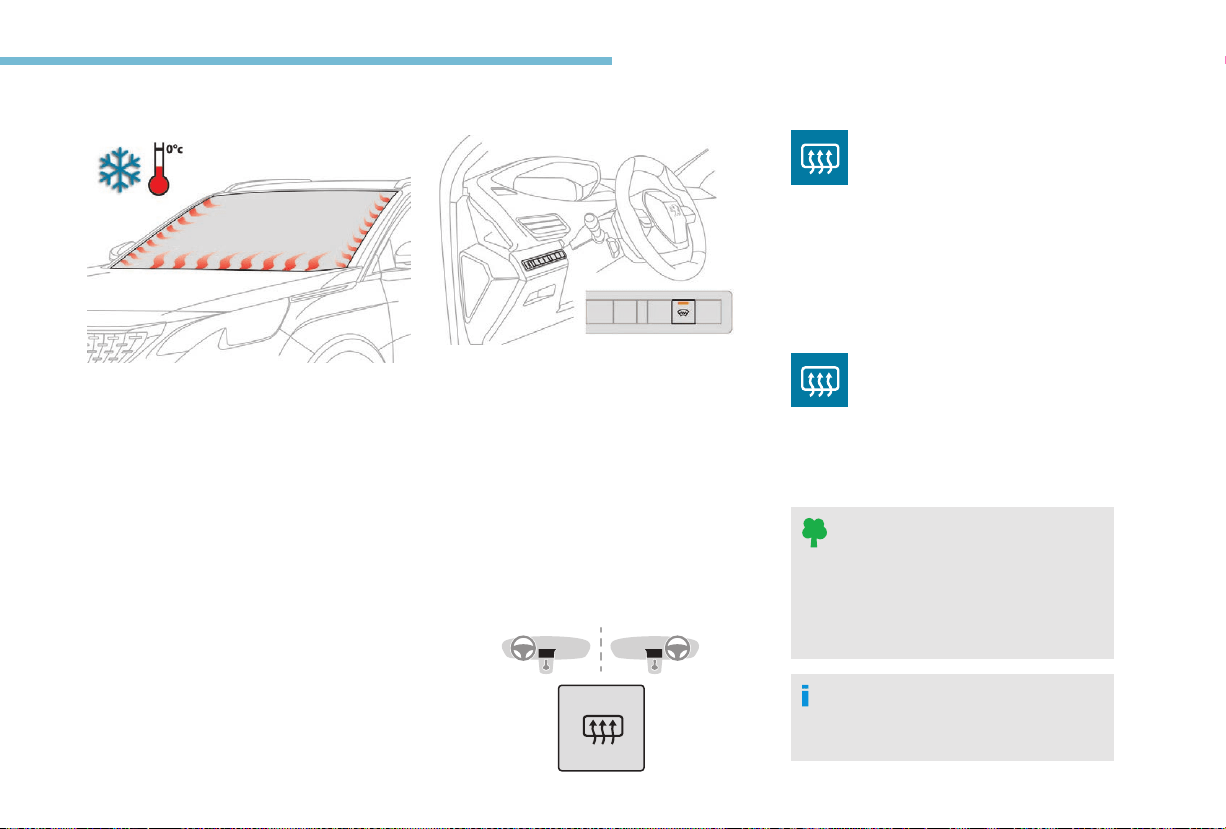
3
91
Ease of use and comfort
Heated windscreen
Switching on / off
F With the engine running, press this button;
its orange indicator lamp comes on.
The system is active if the exterior temperature
is below 0°C.
F Pressing the button again switches off the
system; its indicator lamp goes off.
The system is automatically deactivated every
time the engine is switched off.
In cold weather, this system heats the bottom of
the windscreen, as well as the areas alongside
the windscreen pillars.
Without changing the settings for the air
conditioning system, it allows faster release
of the windscreen wiper blades when they
are frozen to the windscreen and avoids
the accumulation of snow resulting from the
operation of the windscreen wipers.
Rear screen demist –
defrost
Switching on
F Press this button to demist/defrost
the rear screen and (depending
on version) the door mirrors.
The orange indicator lamp associated with the
button comes on.
Switching off
Demisting/defrosting switches off automatically
to prevent an excessive consumption of current.
F It is possible to stop the
demisting/defrosting operation
before it is switched off
automatically by pressing the
button again.
The indicator lamp associated with the button
goes off.
Switch off the demisting/defrosting of
the rear screen and door mirrors as
soon as appropriate, as lower current
consumption results in reduced fuel
consumption.
Rear screen demisting – defrosting can
only be operated when the engine is
running.
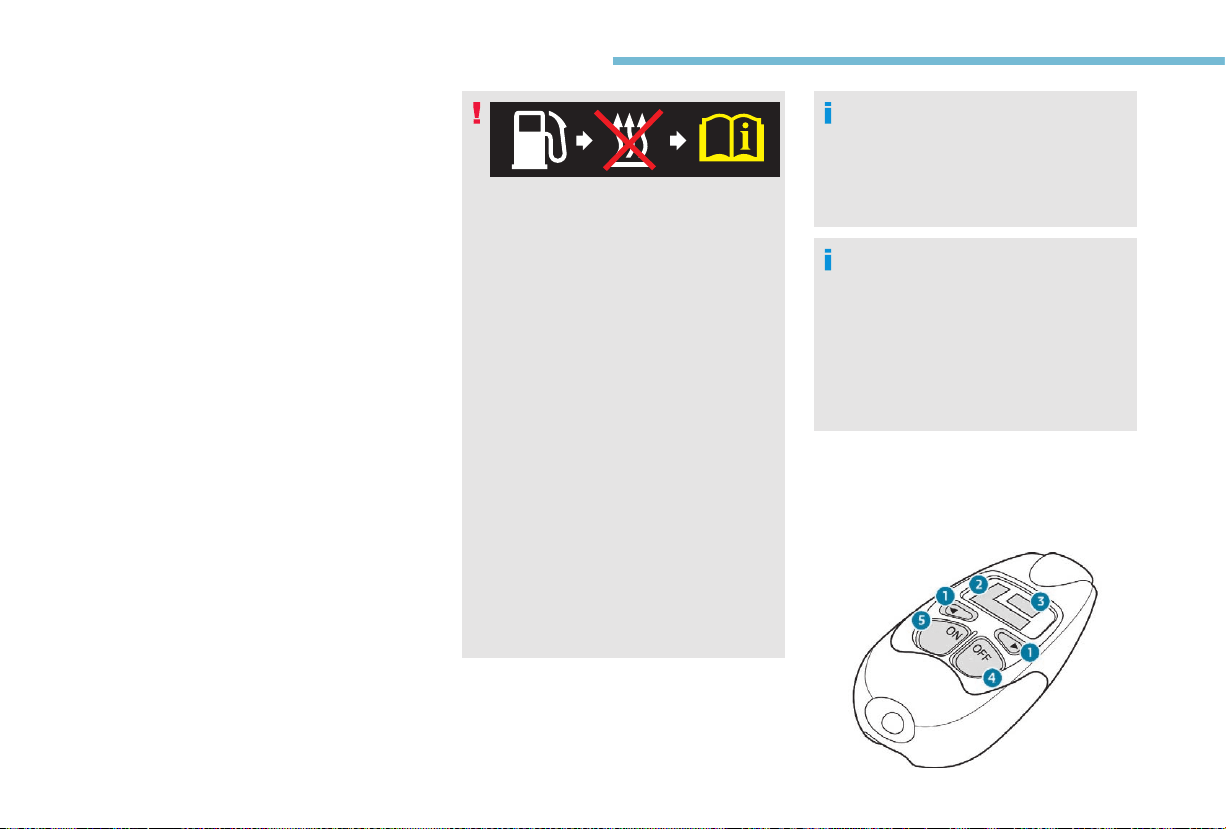
92
Ease of use and comfort
Programmable heating
The programmable heating operates
independently of the engine.
With the engine off, it preheats the coolant
circuit to ensure optimal engine operating
temperature as soon as it is started up.
The programmable heating is switched on
by the long range remote control. It may be
immediate or deferred depending on the
programming.
The volumetric alarm movement detector
may be disrupted by the programmable
heating air flows when it is operating.
To avoid any untimely triggering of the
alarm when using the programmable
heating, it is advisable that the volumetric
monitoring is deactivated.
Adapting the programmable heating
enables you to use it to preheat the
passenger compartment of your vehicle.
Contact a PEUGEOT dealer or a qualified
workshop.
Presentation
Remote control
Always switch off the programmable
heating when refuelling to avoid any risk of
fire or explosion.
The programmable heating is supplied by
the vehicle's fuel tank. Before use, ensure
that there is enough fuel left in the tank. If
the fuel in the tank is at the reserve level,
we strongly recommend that you do not
programme the heating.
To avoid the risks of poisoning or
asphyxia, the programmable heating must
not be used, even for short periods, in a
closed environment such as a garage or
workshop which are not equipped with an
exhaust gas extraction system.
Do not park the vehicle on a flammable
surface (dry grass, dead leaves, paper,
etc.) – Risk of fire!
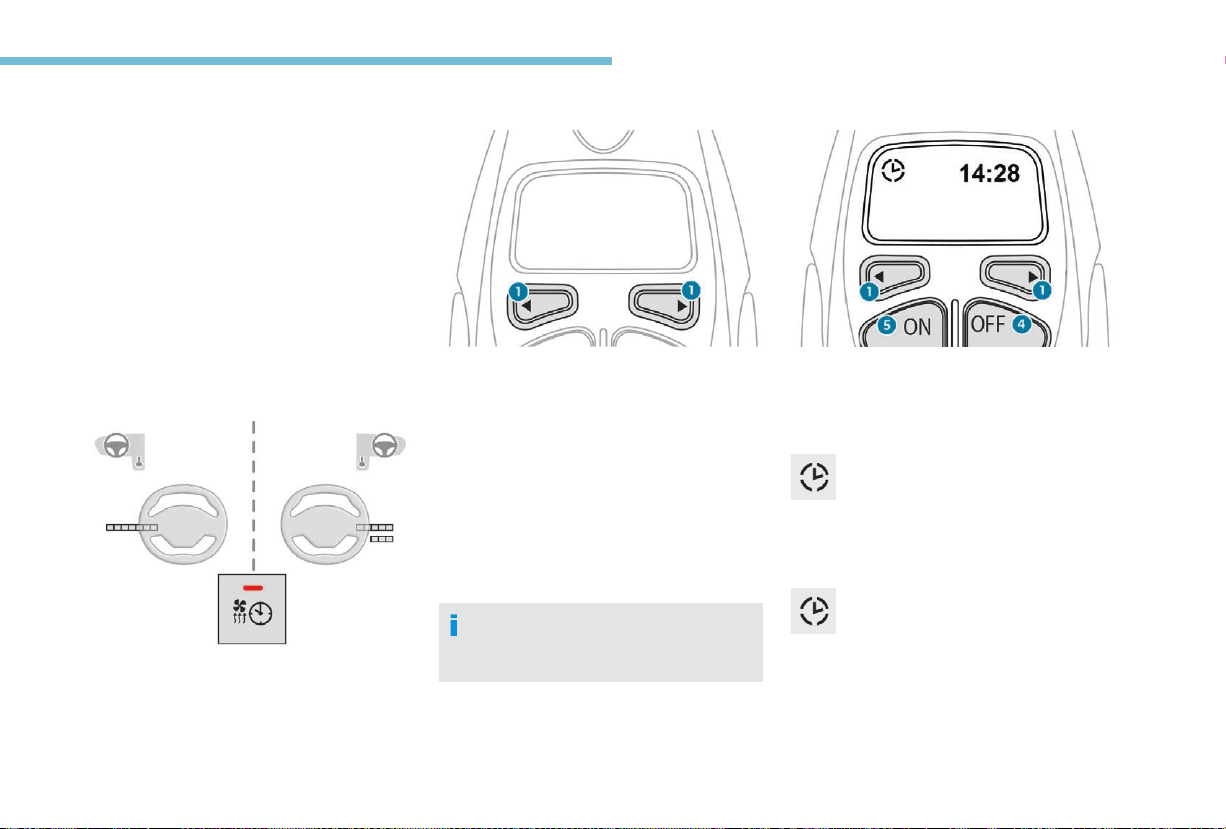
3
93
Ease of use and comfort
Operating indicator lamp
Function display
The passenger compartment temperature
information is only available when the
engine is off.
Setting the time
F Set the time with the buttons 1.
F Press simultaneously on buttons 4 and 5 to
save it.
on red: deferred switching on programmed.
flashing red: heating on.
off: heating off.
1. Functions scrolling menu buttons.
2. Function symbols:
clock, temperature, operating time,
programmed time, heater operation,
heating management.
3. Digital displays:
time, temperature, operating time,
programmed time or heating level.
4. Off button.
5. On button.
F Press the buttons 1 several times to display
the functions.
The first press on the left or right button
displays the time.
Then, the left button is used to scroll to the
programmed time then the heating level ("C1"
to "C5").
The right button is used to scroll to the
passenger compartment temperature then
the heater operating time when immediately
switched on.
F After having displayed the time using
the buttons 1, press on buttons 4 and 5
simultaneously within 10 seconds.
This symbol will flash.
This symbol will be displayed.
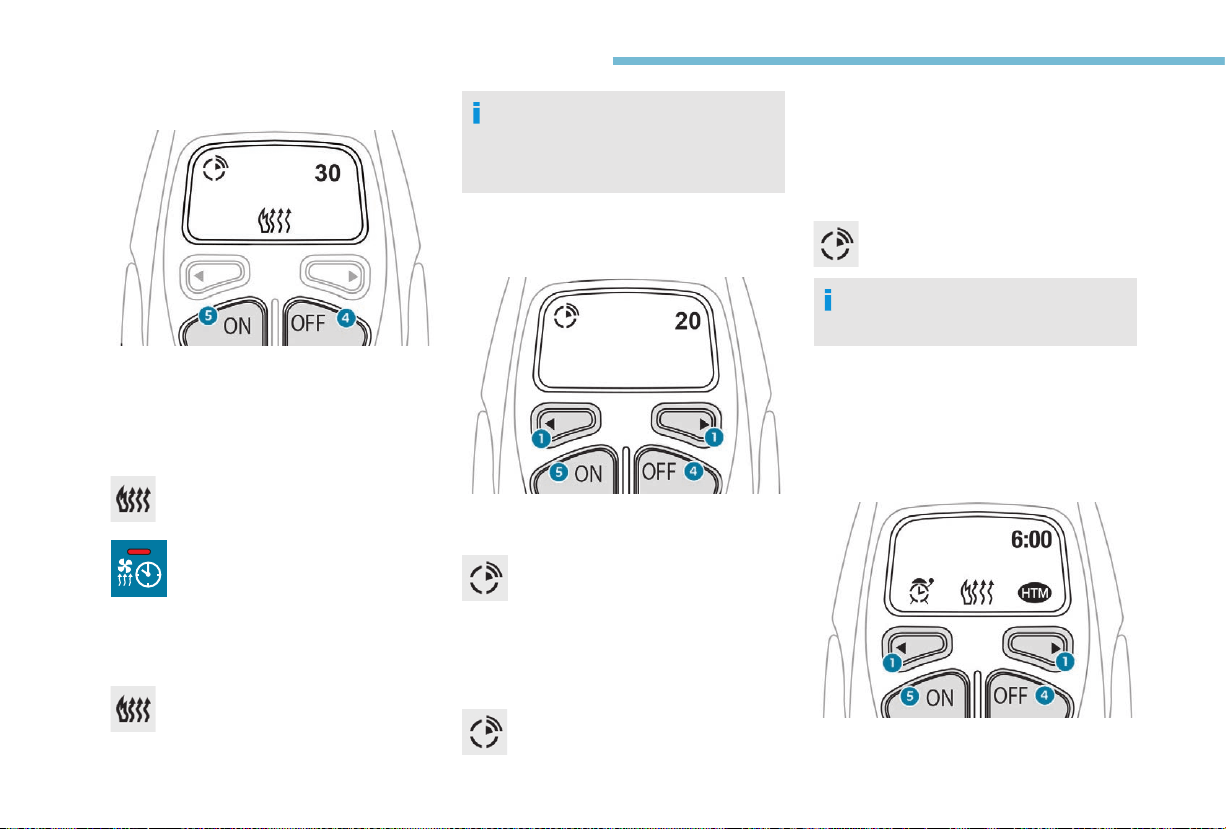
94
Ease of use and comfort
F Press button 5 until the message "OK" is
displayed.
When the signal has been received, the
message "OK" is displayed along with the
operating time.
F To deactivate the function, press button 4
until the message "OK" is displayed.
During these operations, if the message
"FAIL" is displayed, it means that the
signal has not been received. Restart the
procedure after having changed position.
Adjusting the operating time
F Press the buttons 1 to display the operating
time.
F After having displayed the operating time,
press buttons 4 and 5 simultaneously within
10 seconds.
F Adjust the operating time by pressing
buttons 1: in 10 minute increments to a
maximum of 30 minutes.
F Simultaneously press buttons 4 and 5 to
save the operating time.
The factory value setting is 30 minutes.
Deferred switching on
You must programme your departure time
for the system to automatically calculate the
optimal time to start the heater.
Immediate switching on
The heater starts and this symbol is
displayed.
This red indicator flashes during
heating.
This symbol and the indicator lamp
will turn off.
This symbol will be displayed.
This symbol will flash.
This symbol will be displayed.
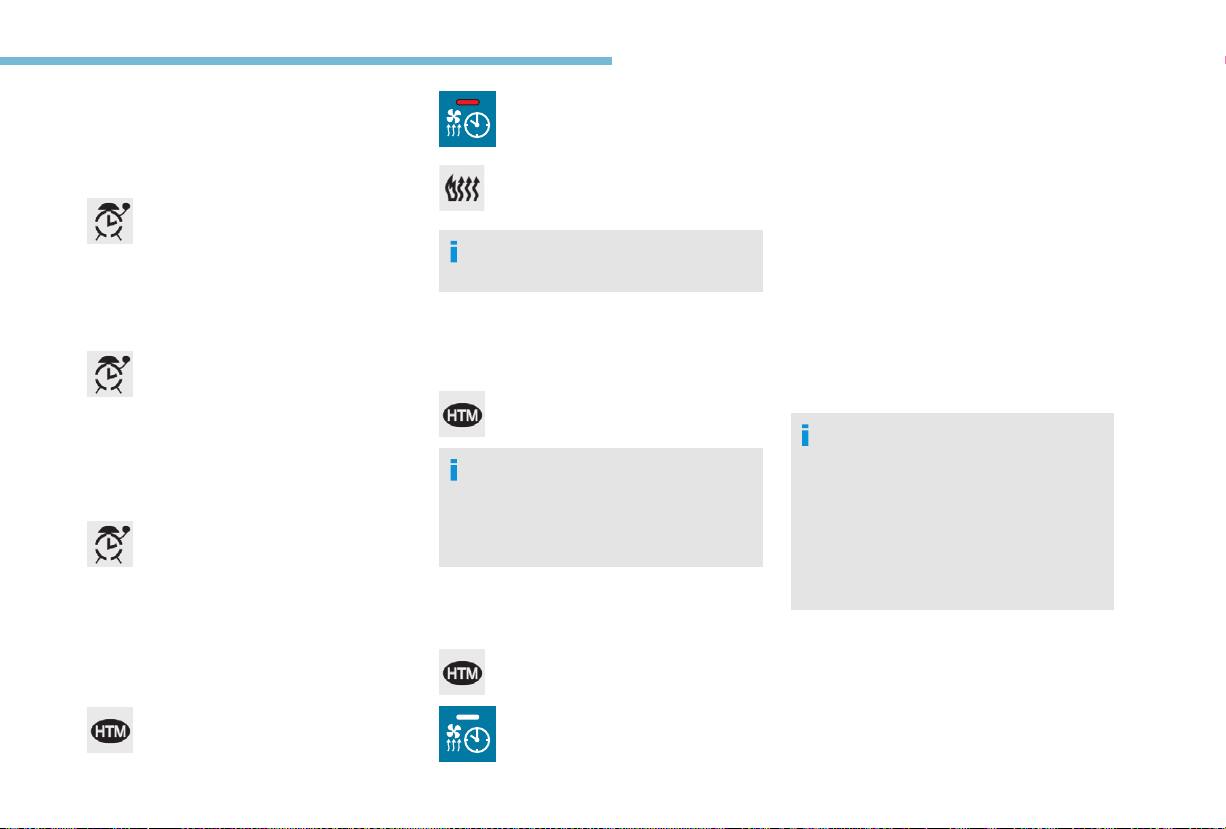
3
95
Ease of use and comfort
Programming the departure
time
F Press buttons 1 to display the programmed
time.
F After having displayed the programmed
time, press buttons 4 and 5 simultaneously
within 10 seconds.
F Set the time by pressing buttons 1.
F Simultaneously press buttons 4 and 5 to
save it.
Activation/Deactivation
F After having displayed the programmed
time using buttons 1, press button 5 until the
message "OK" is displayed.
HTM: Heat Thermo Management
F To deactivate the programming, press
button 4 until the message "OK" is
displayed.
During these operations, if the message
"FAIL" is displayed, it means that the
signal has not been received. Restart the
procedure after having changed position.
Stopping the heating
F Press button 5.
Changing the heating level
The system has 5 heating levels: C1 (lowest
level) to C5 (highest level).
F After having displayed the heating level
using buttons 1, press simultaneously on
buttons 4 and 5.
The letter "C" will flash.
F Adjust the heating level by pressing
button 1.
F Simultaneously press buttons 4 and 5 to
save the selected level.
The letter "C" will be displayed.
This symbol will be displayed.
This symbol will flash.
This symbol will be displayed.
When the signal has been received,
the message "OK" is displayed
along with this symbol.
This red indicator lamps comes on
until heating begins.
This symbol is displayed when the
heater starts.
This symbol will disappear.
This symbol remains on.
This indicator lamp goes off.
The presets are replaced by the new
entries. The programmed times are
memorised until the next change.
When the start time is activated, it is not
possible to change the heating level. You
must first deactivate the start time.
Operating fault
In the event of a fault with the programmable
heating, contact a PEUGEOT dealer or a
qualified workshop.

96
Ease of use and comfort
Changing the battery
The remote control is powered by a 6V-28L
battery, which is provided.
Information on the screen indicates when this
battery needs to be changed.
Front ttings
Do not throw away used batteries, take
them to an approved collection point.
F Unclip the case.
F Replace the battery observing the
polarities.
F Reinitialise the remote control.
Reinitialising the remote control
If the battery is disconnected or when changing
the battery, the remote control must be
reinitialised.
F After turning on the power, within the next
5 seconds, press button 4 for 1 second.
If the operation is successful, the message
"OK" will be displayed on the remote
control's screen.
If there is a fault, the message "FAIL" will
appear.
F Start the operation again.
1. Grab handle
2. Sun visor
3. Card holder
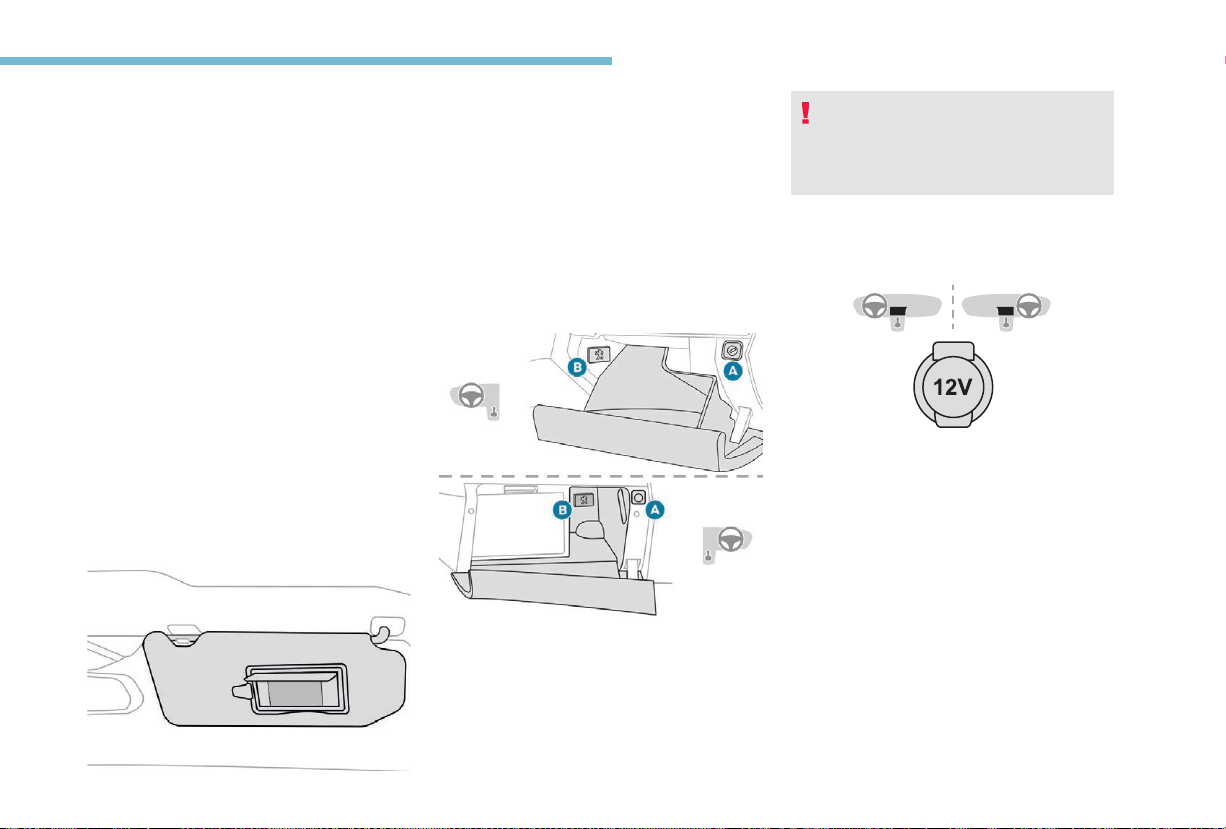
3
97
Ease of use and comfort
4. Storage compartment below the
steering wheel
5. Illuminated glove box
6. Door pockets
7. Scented air freshener
8. USB port
9. Front 12 V accessory socket (120 W)
10. Storage compartment or CD player or
Wireless charger
11. Storage compartment
12. Cup holder
13. Front armrest with storage
compartment
14. Rear 12 V accessory socket (120 W)
15. Storage compartment
16. 230 V socket
Sun visor
Component which protects against sunlight
from the front or the side, also equipped with an
illuminated vanity mirror.
Glove box
F To open the glove box, raise the handle.
The glove box is lit when the lid is opened.
It houses the front passenger airbag
deactivation switch A.
It also gives access to the housing for scented
air freshener B cartridges.
F With the ignition on, raise the concealing
flap; the mirror is illuminated automatically.
This sun visor is also equipped with a ticket
holder.
Never drive with the glove box open when
a passenger is at the front – it may cause
injury during sharp deceleration!
Cigarette lighter/12 V
accessory socket(s)
F To use the cigarette lighter, press it in
and wait a few seconds until it pops out
automatically.
F To use a 12 V accessory (max power:
120 W), remove the cigarette lighter and
connect a suitable adaptor.
You can use this socket to connect a telephone
charger, a bottle warmer, etc.
After use, put the cigarette lighter back into
place straight away.
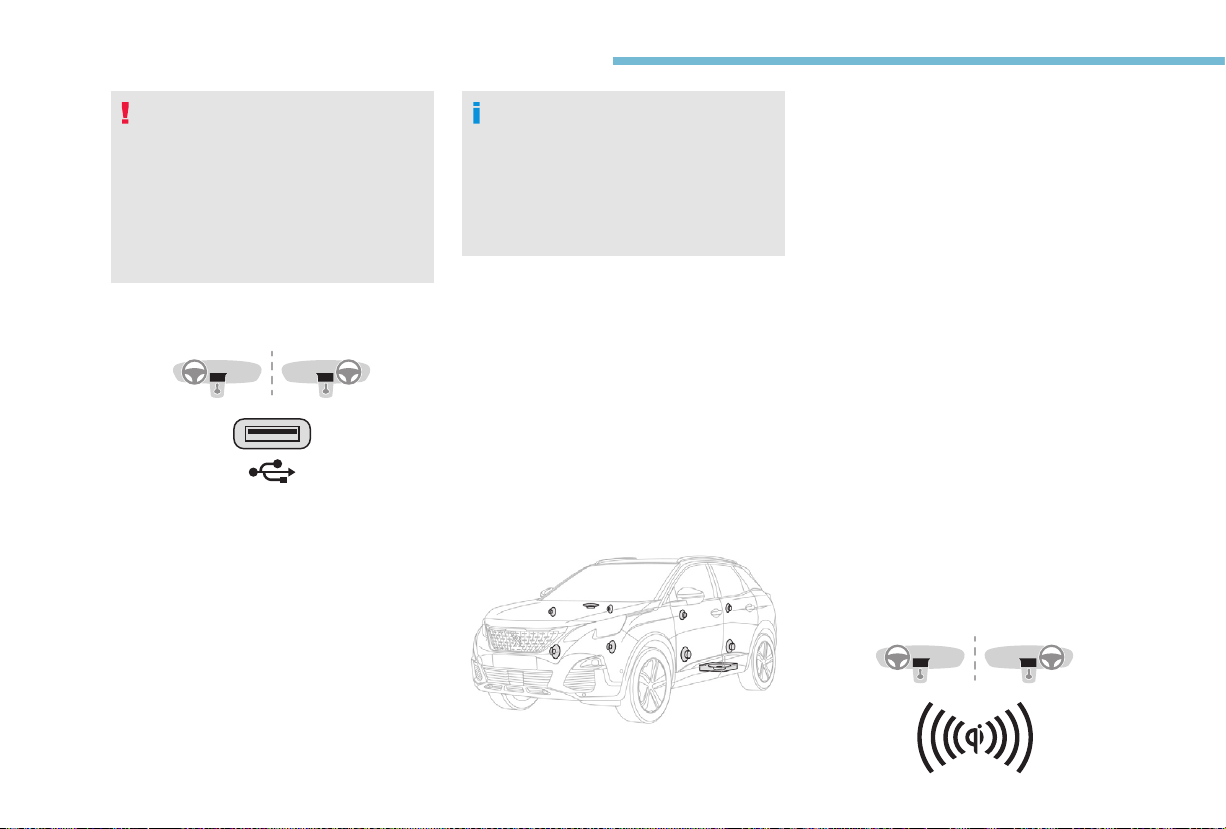
98
Ease of use and comfort
USB port
The USB port allows the connection of a
portable device, such as an iPod
®
-type digital
audio player, or a USB memory stick.
The USB reader reads your audio files which
are then transferred to the audio system and
played via the vehicle's loudspeakers.
These files are managed via the steering wheel
controls or from the audio system.
When connected to the USB port,
the portable device can be charged
automatically.
While charging, a message is displayed
if the power consumption of the portable
device exceeds the amperage supplied
by the vehicle.
For more details on the Audio equipment and
telematics, and particularly the USB port,
consult the corresponding section.
The USB port also allows a smartphone to be
connected by MirrorLink
TM
, Android Auto
®
or
CarPlay
®
, so that certain applications on the
smartphone can be used on the touch screen.
FOCAL
®
premium Hi-Fi
system
Wireless charger
The connection of an electrical device
not approved by PEUGEOT, such as a
USB charger, may adversely affect the
operation of vehicle electrical systems,
causing faults such as poor radio
reception or interference with displays
in the screens.
Your vehicle is equipped with a high-fidelity
acoustic system designed by the French brand
FOCAL
®
, a specialist in acoustics for more than
35 years and recognised throughout the world
for its patented innovations and its unique audio
signature. 10 speakers incorporating exclusive
FOCAL
®
technologies offer the pleasure of
pure and detailed sound inside the vehicle:
- High fidelity woofer / mid-range speakers:
Polyglass technology delivering balance
and precise sound.
- TNF tweeters: Inverted dome aluminium
technology giving optimum sound
dispersion and very detailed higher
frequencies.
- Sub-woofer: 200 mm triple coil Power
Flower
TM
technology for defined and
dynamic reproduction of lower frequencies.
- 12-way active amplification – 515 Watts:
Hybrid Class AB / Class D technology
providing breadth and finesse in the high
frequency signals, as well as real power in
the bass.
3
99
Ease of use and comfort
This system allows the wireless charging of a
portable device, such as a smartphone, using
the principle of magnetic induction, based on
the Qi 1.1 standard.
The portable device to be charged must be
compatible with the Qi standard, either by
design or by using a compatible holder or shell.
The charging zone is identified by the Qi symbol.
Operation
The charger works with the engine running and
in STOP mode of Stop & Start.
Charging is managed by the smartphone.
For versions with Keyless Entry and Starting,
operation of the charger may be interrupted
when opening a door or switching off the
ignition.
Charging
F First ensure that the charging zone is clear
of other articles.
F Place a portable device in the middle of the
charging zone.
F Once the portable device is detected, the
charge indicator lamp comes on in green.
The system only supports charging one
portable device at a time.
Do not leave any metal objects (coins,
keys, vehicle remote control, etc.) in
the charging area while a device is
being charged – risk of overheating or
interrupting the charging process!
Checking operation
The state of the charge indicator lamp allows
the operation of the charger to be monitored.
F Charging of the portable device's battery
then starts.
F Once the portable device's battery is fully
charged, the charge indicator lamp goes off.
Charge
indicator lamp
Meaning
Off Engine switched off.
No compatible portable
device detected.
Charging finished.
Fixed, green Compatible portable
device detected.
Charging.
Flashing, orange Foreign object detected in
the charging zone.
Portable device not well
centred in the charging
zone.
Fixed, orange Fault with the portable
device's battery meter.
Temperature of the
portable device's battery
too high.
Charger fault.
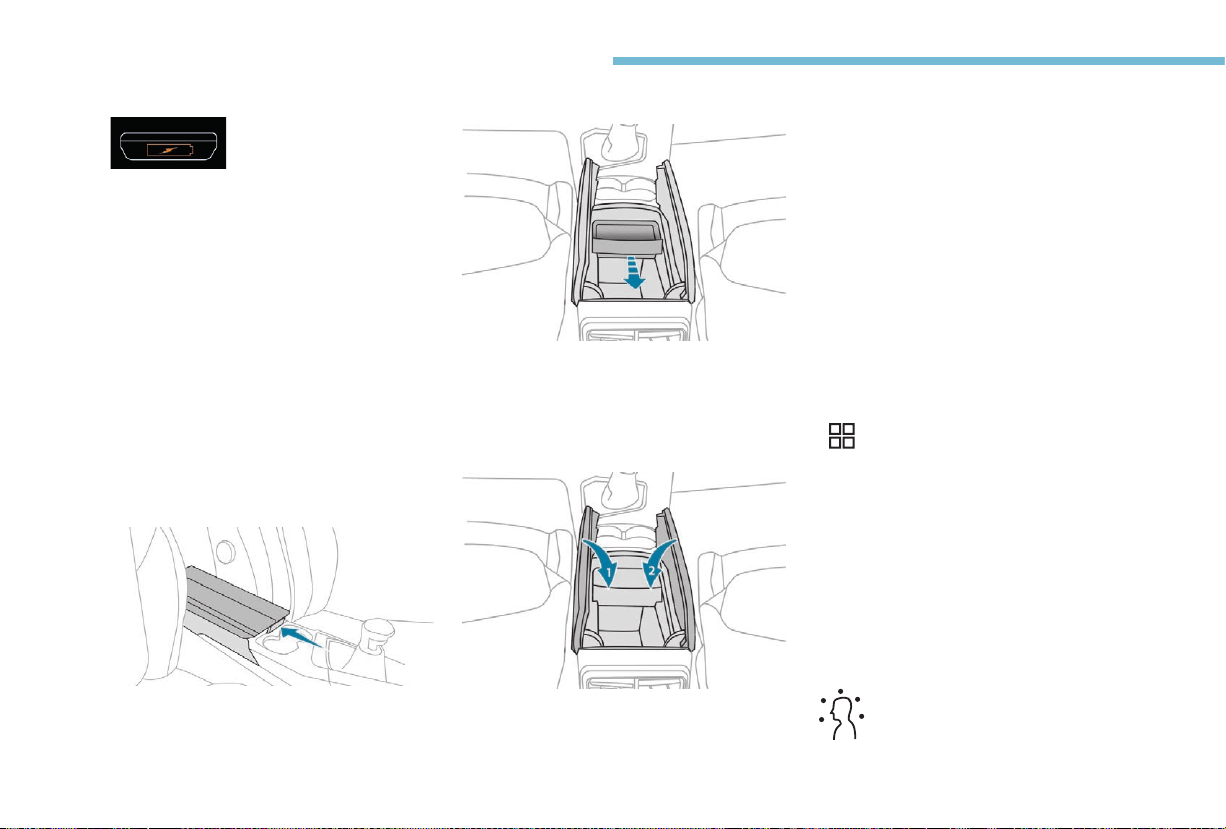
100
Ease of use and comfort
Front armrest
Comfort device for the driver and front
passenger.
It includes a refrigerated storage space.
Opening
Opening
Closing
Scented air freshener
A complete air freshener system for the
passenger compartment. It is supplied by a
three-fragrance cartridge.
This system operates only with the engine
running.
Activation / Settings
If the indicator lamp is lit orange:
- remove the portable device, then replace it
in the middle of the charging zone.
or
- remove the portable device and try again in
a quarter of an hour.
If the problem persists, have the system
checked by a PEUGEOT dealer or a qualified
workshop.
F Press the lever beneath the cover.
The cover opens in two parts.
The small removable tray can be installed in
front of or behind the storage space.
A ventilation nozzle circulates fresh air.
F Fold the two parts of the cover back.
The activation and adjustment of the air
freshener are done from the touch screen:
- either directly from the Applications menu,
- or by personalising an ambience for the
i-Cockpit Amplify function.
From the Applications menu:
The scented air freshener is also
managed by the i-Cockpit Amplify
function.
F select "Scented air freshener",
F select a fragrance from the three offered,
F select a delivery intensity to activate the
system,
or
F select "OFF" to deactivate it.
The changes are taken into account
immediately.
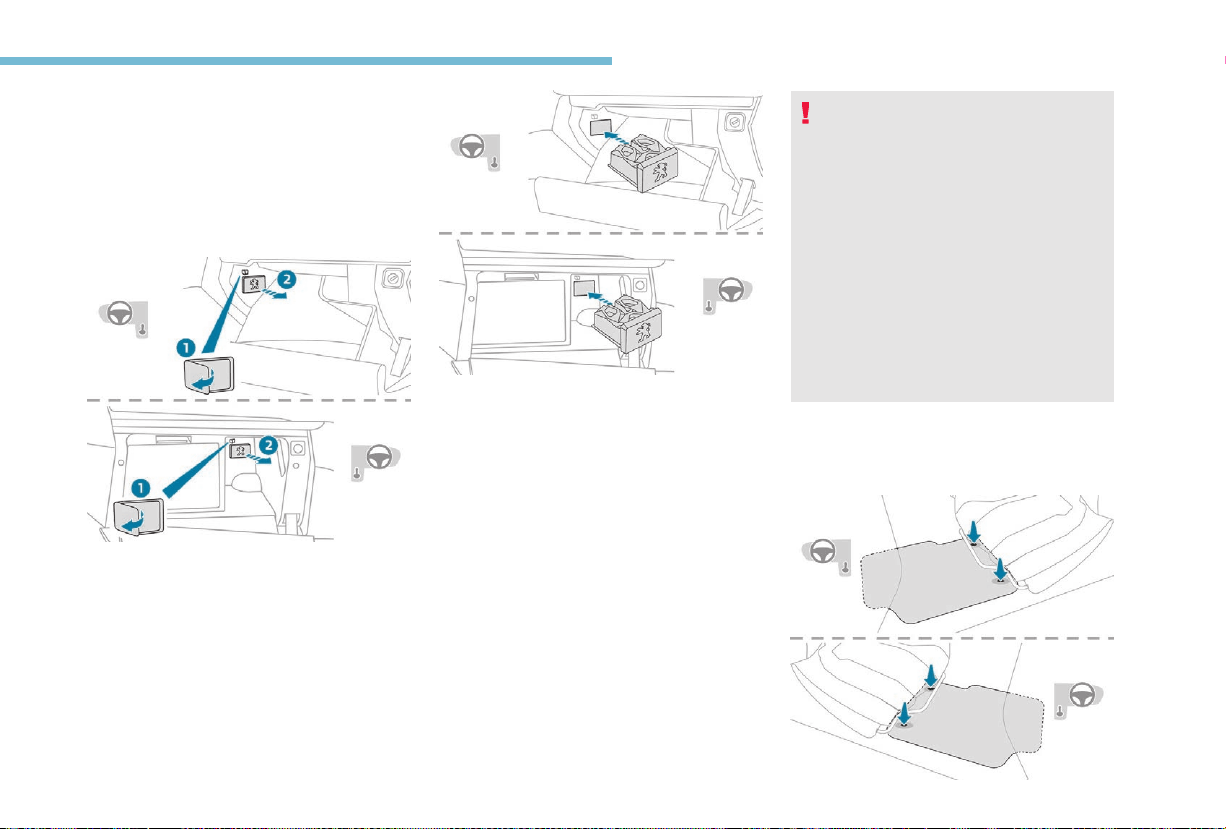
3
101
Ease of use and comfort
Changing the cartridge
Access to the cartridge is in the glove box.
F Ignition on, pull the tab 1 in the direction of
the arrow to release the used cartridge.
F Remove the used cartridge 2 from its
housing.
The air freshener stops working with the
cartridge removed.
F Remove the two seals from the new
cartridge.
F Insert the new cartridge into its housing
observing the direction of fitment.
The air freshener is ready to operate again.
Recommendations
For more information on the i-Cockpit Amplify
function, refer to the corresponding section.
Do not discard the original cartridge, which
serves as a blanking plug if the air freshener is
not used.
Retain the cartridge sealing caps which serve
as packaging if the cartridge is not used.
Replacement cartridges are available from
PEUGEOT dealers or from the brand's internet
website.
As a safety measure:
- use only the cartridges designed for
the system,
- do not try to fit or remove a cartridge
when driving,
- do not try to refill or dismantle the
cartridges.
Keep cartridges out of the reach of
children or pets.
Do not allow the fluid in the cartridge to
come into contact with the skin or eyes.
In the event of ingestion of the fluid in the
cartridge, consult a doctor, showing them
the product packaging or label.
Mats
Fitting
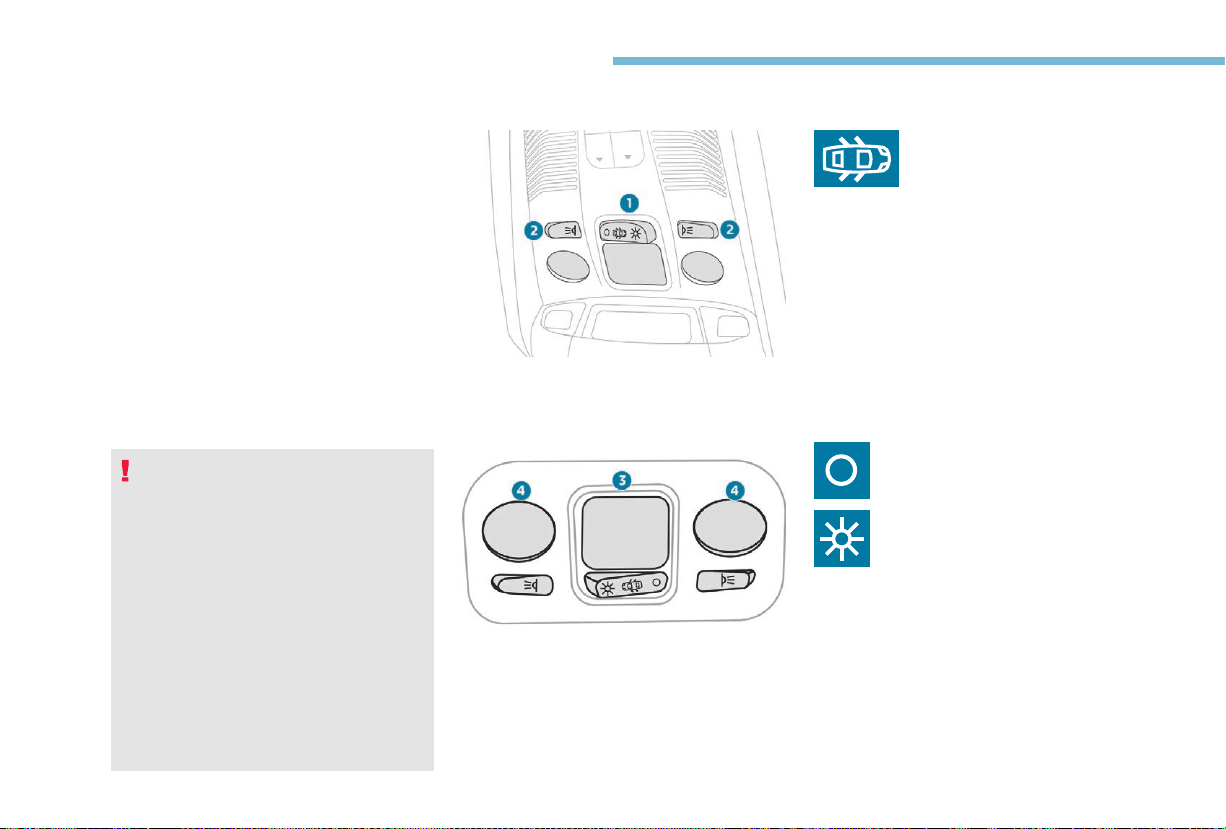
102
Ease of use and comfort
Retting
To refit the mat on the driver's side:
F position the mat correctly,
F reattach the fixings by pressing,
F check that the mat is secured correctly.
To avoid any risk of jamming of the pedals:
- only use mats which are suited to the
fixings already present in the vehicle;
these fixings must be used,
- never place one mat on top of another.
The use of mats not approved by
PEUGEOT may interfere with access to
the pedals and hinder the operation of the
cruise control / speed limiter.
The mats approved by PEUGEOT have
two fixings located below the seat.
Courtesy lamps
Front and rear courtesy lamps
In this position, the courtesy
lamp comes on gradually:
When fitting the mat for the first time, on the
driver's side use only the fixings provided in the
wallet attached.
The other mats are simply placed on the carpet.
Removing
To remove the mat on the driver's side:
F move the seat as far back as possible,
F unclip the fixings,
F remove the mat.
1. Front courtesy lamp
2. Front map reading lamps
- when the vehicle is unlocked,
- when the key is removed from the ignition,
- when opening a door,
- when the remote control locking button is
activated, in order to locate your vehicle.
It switches off gradually:
- when the vehicle is locked,
- when the ignition is switched on,
- 30 seconds after the last door is closed.
Permanently off.
Permanent lighting.
In permanent lighting mode, the lighting time
varies according to the circumstances:
- when the ignition is off, approximately ten
minutes,
- in energy economy mode, approximately
thirty seconds,
- with the engine running, unlimited.
3. Rear courtesy lamp
4. Rear map reading lamps
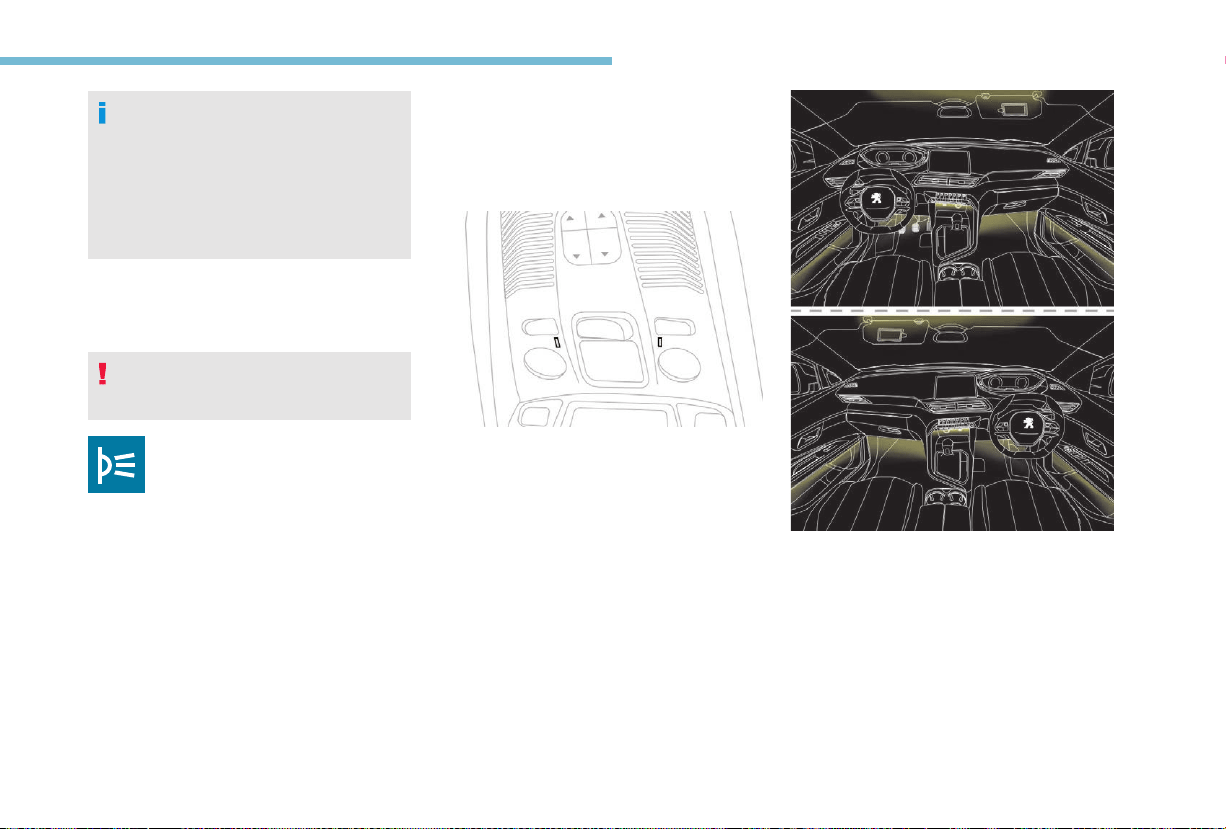
3
103
Ease of use and comfort
Front and rear map reading
lamps
Take care not to put anything in contact
with the courtesy lamps.
F With the ignition on, operate the
corresponding switch.
When the courtesy lamp is in the
"permanent lighting" position, the rear
courtesy lamp also comes on, except if it
is in the "permanently off" position.
To switch off the rear courtesy lamp, put it
in the "permanently off" position.
Interior ambient lighting
The dimmed passenger compartment lighting
improves visibility in the vehicle when the light
is poor.
At night, the interior ambient lighting comes
on automatically when the sidelamps are
switched on.
Depending on the version, the ambient lighting
includes:
- two LEDs located in the front courtesy lamp,
- a light source in the storage compartment at
the front of the centre console,
- a light source for each of the front footwells,
- illuminated guides on the front door panels
and on the sides of the centre console,
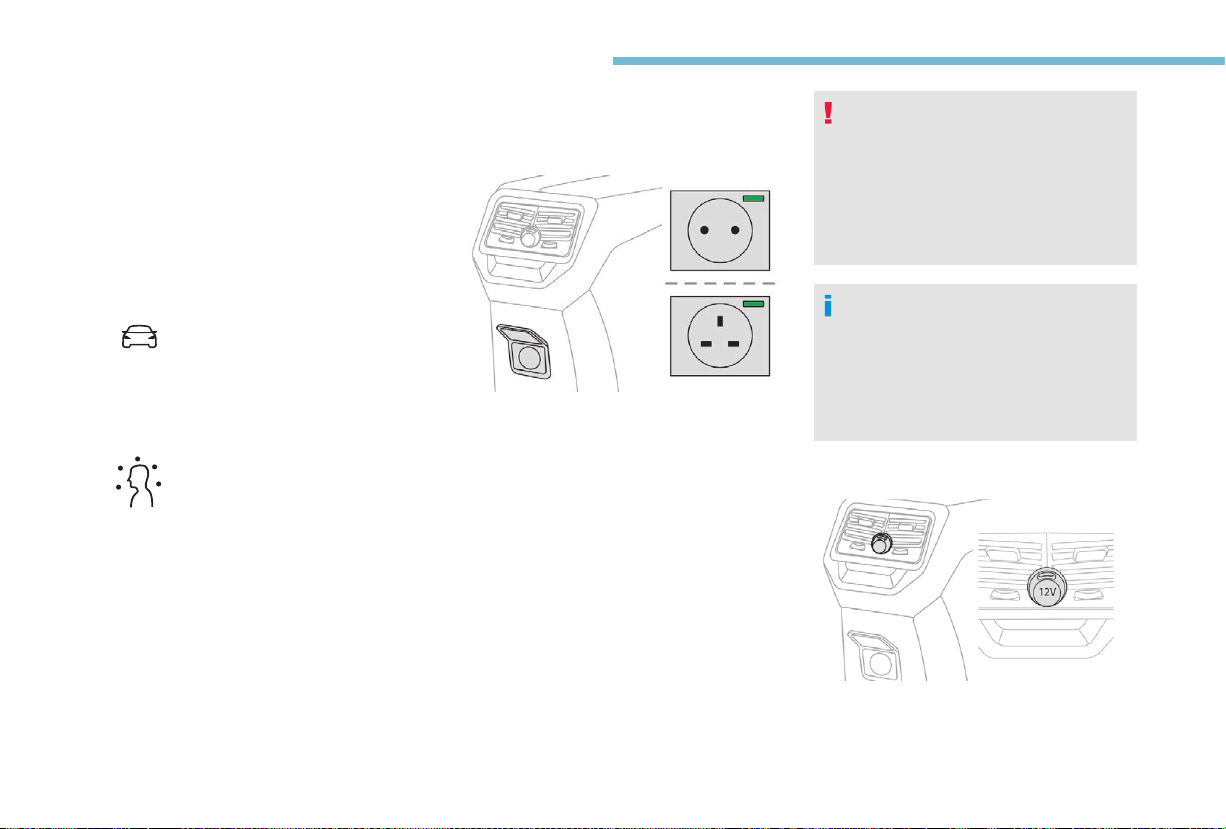
104
Ease of use and comfort
- illuminated bezels for the front cup holders,
- a light source for each of the front door
pockets,
- illuminated rails along the panoramic
sunroof blind.
The ambient lighting switches off automatically
when the sidelamps are switched off.
The interior ambient lighting can
be activated or deactivated and its
brightness adjusted in the Vehicle /
Driving menu of the touch screen.
The interior ambient lighting is also
managed by the i-Cockpit Amplify
function.
For more information on the
i-Cockpit Amplify function, refer
to the corresponding section.
Rear ttings
230 V / 50 Hz power socket
In the event of a fault, the green warning lamp
flashes.
Have it checked by a PEUGEOT dealer or a
qualified workshop.
12 V accessory socket
It is located at the back of the centre console
beneath a protective cover.
This socket (max. power: 150 W) operates with
the engine running, as well as in STOP mode of
Stop & Start.
F Raise the protective cover.
F Check that the green indicator lamp is on.
F Connect your multimedia or other electrical
device (telephone charger, laptop computer,
CD-DVD player, bottle warmer, etc.).
Connect only one device at a time to the
socket (no extension lead or multi-socket
connector).
Connect only devices with class II
insulation (shown on the device).
Do not use a device with a metal case
(electric shaver, etc.).
As a safety measure, when electrical
consumption is high and when required by
the vehicle's electrical system (particular
weather conditions, electrical overload,
etc.), the current supply to the socket will
be cut off; the green indicator lamp goes
off.
F To connect a 12 V accessory (max. power:
120 W), lift the cover and connect a suitable
adaptor.
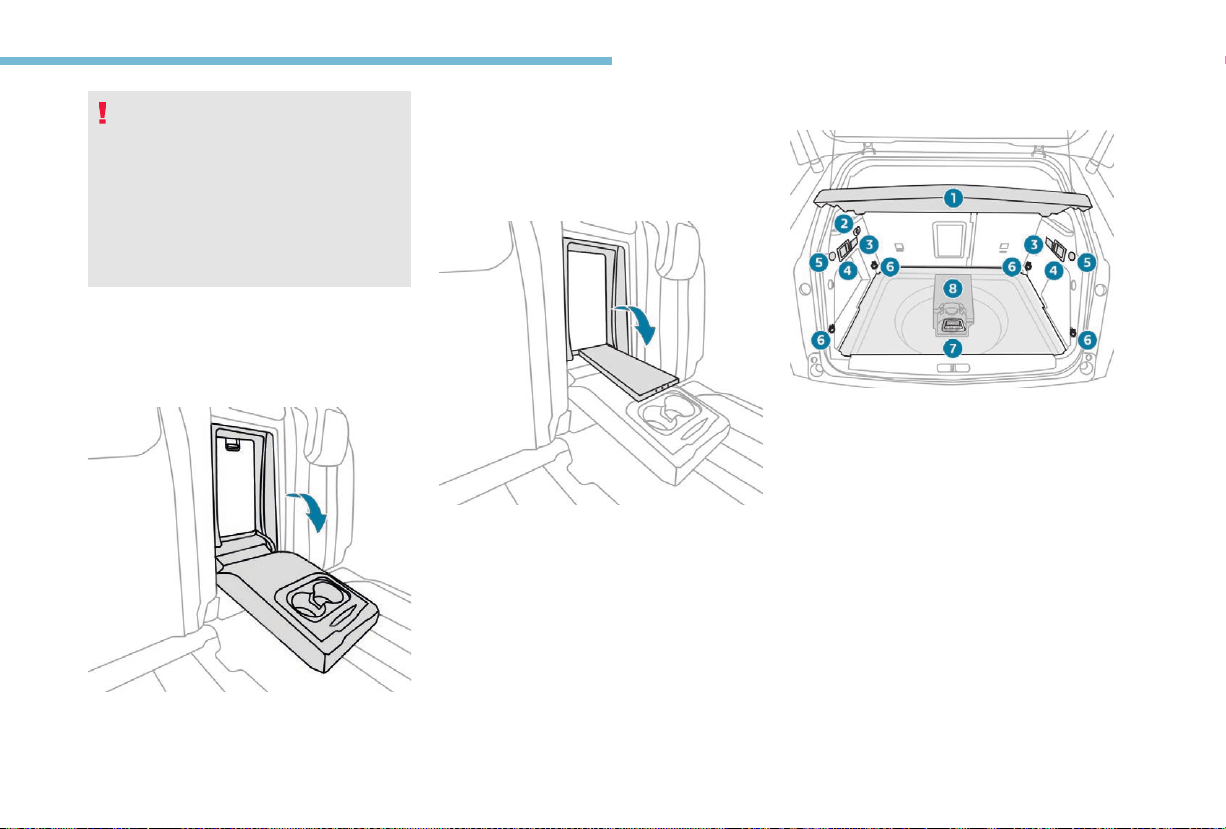
3
105
Ease of use and comfort
The connection of an electrical device
not approved by PEUGEOT, such as a
USB charger, may adversely affect the
operation of vehicle electrical systems,
causing faults such as poor radio
reception or interference with displays
in the screens.
Rear armrest
Comfort and storage arrangement for rear
passengers.
Ski flap
Mechanism for storing and transporting long
objects.
Opening
F Lower the rear armrest for a more
comfortable position.
The armrest incorporates two cup holders.
F Lower the rear armrest.
F Pull the flap handle downwards.
F Lower the flap.
F Load the objects from inside the boot.
Boot ttings
1. Load space cover
2. 12 V accessory socket (120 W)
3. Boot lighting
4. Rear seat folding controls
5. Hooks
6. Stowing rings
7. Adjustable boot floor (2 positions)
8. Storage well / Tool box under the floor
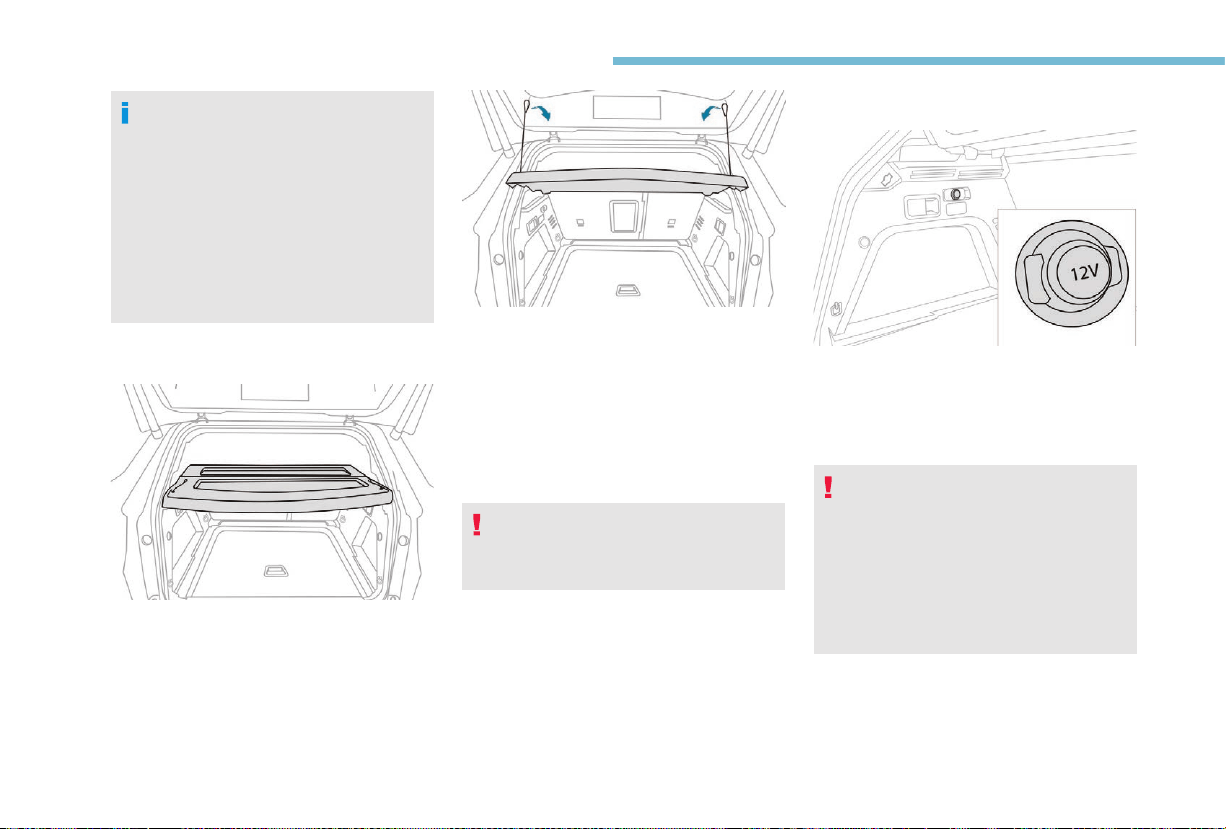
106
Ease of use and comfort
The stowing rings are designed to
secure luggage using different types of
retaining nets.
Such nets are available as an option or
as an accessory.
For more information, contact a
PEUGEOT dealer.
For the installation of a high load
retaining net, refer to the corresponding
section.
Load space cover
When sharp deceleration occurs, objects
placed on the load space cover can turn
into projectiles.
12 V accessory socket
The connection of an electrical device
not approved by PEUGEOT, such as a
USB charger, may adversely affect the
operation of vehicle electrical systems,
causing faults such as poor radio
reception or interference with displays
in the screens.
It is in two parts:
- a fixed part with an open storage space,
- a movable part which rises as the tailgate
opens, with an open storage space.
To remove the load space cover:
F unhook the two cords,
F gently lift the movable part, then unclip it on
each side,
F unclip the fixed part on each side, then
remove the load space cover.
The load space cover can be stowed under the
boot floor.
F To connect a 12 V accessory (max power:
120 W), remove the cap and connect an
appropriate adaptor.
F Switch on the ignition.
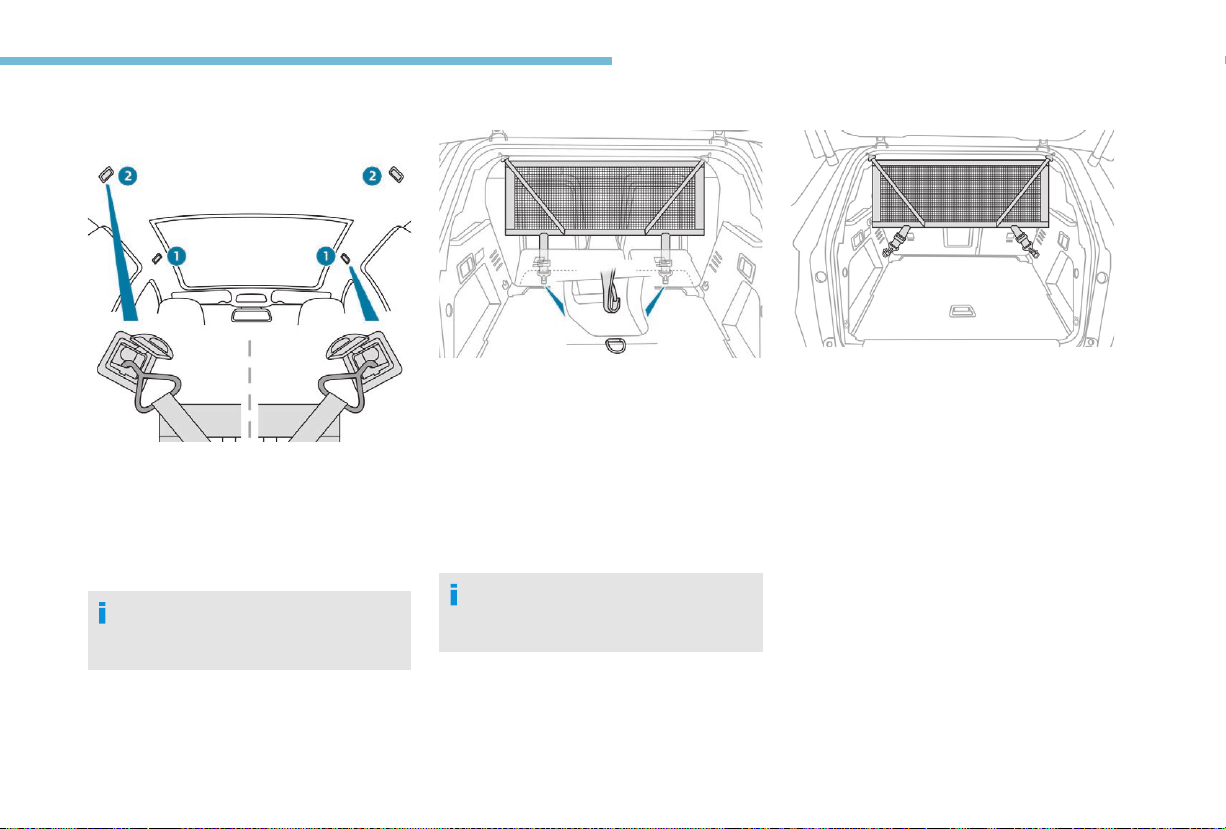
3
107
Ease of use and comfort
High load retaining net
It offers protection to the occupants when
very sharp braking occurs.
Behind the front seats
Once fitted, the net does not prevent
tipping of the backrests.
This removable net allows the entire load
volume to be used up to the roof:
- behind the front seats (1
st
row) when the
rear seats are folded down,
- behind the rear seats (2
nd
row) when the
load space cover is removed.
F Fold down the rear seats.
F Remove the cover trims on each side,
located on the upper part of the roof.
F Position the net's upper hooks in the roof.
F Attach the net's straps to the lower
anchoring points, located directly below the
fixings of the rear bench seat cushion.
F Pull on the straps to stretch the net.
Behind the rear seats
Boot floor
(2 positions)
This two-position floor allows the boot space
to be optimised using the lateral stops at the
edges:
- High position (100 kg max): to obtain a flat
floor up to the front seats, when the rear
seats are folded down.
- Low position (150 kg max): maximum boot
volume.
F Remove the load space cover.
F Remove the cover trims on each side,
located on the upper part of the roof.
F Position the net's upper hooks in the roof.
F Attach the straps of the net to the lower
rings, located on each side trim of the boot.
F Pull on the straps to stretch the net.
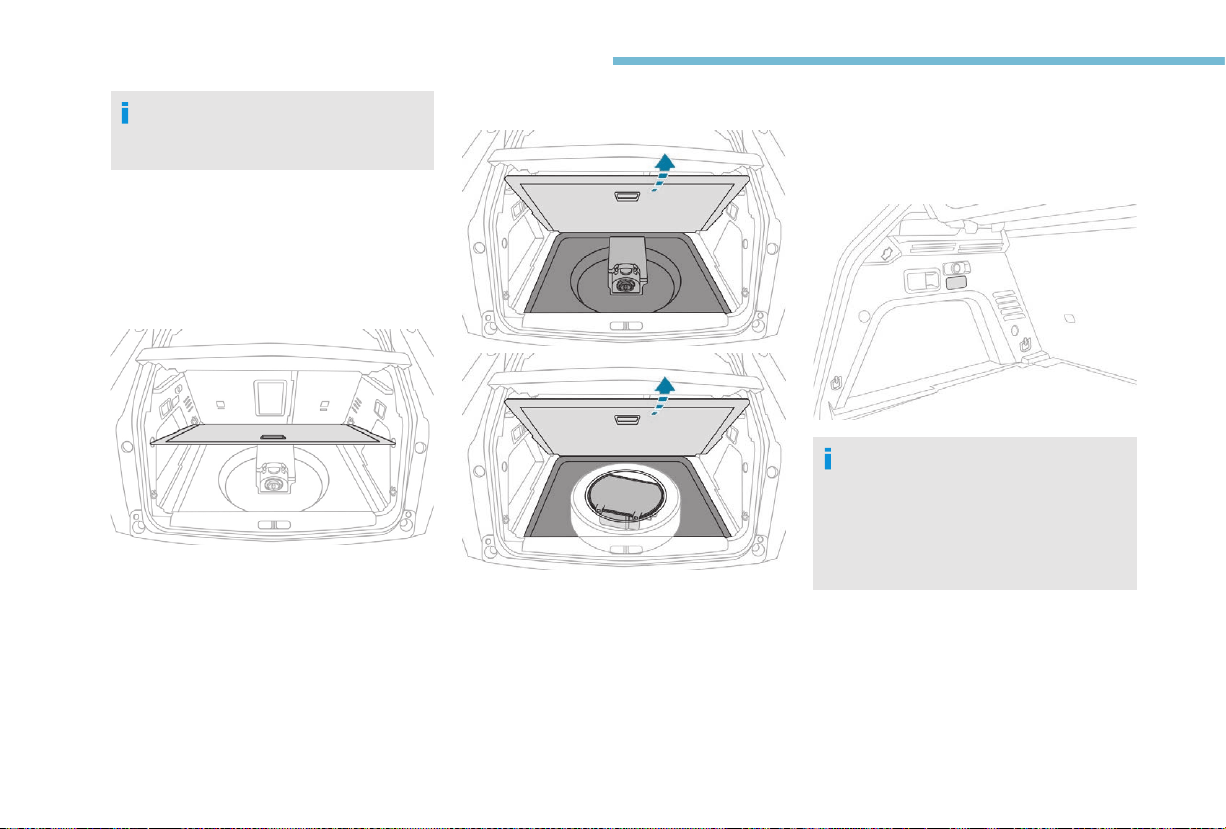
108
Ease of use and comfort
On certain versions, the adjustable boot
floor cannot be fitted in the low position.
To change the height:
F Lift and pull the floor towards you using the
central handle, then use the lateral stops to
move it.
F Push the floor all the way forwards to place
it in the desired position.
Storage well
Depending on the version, it includes:
- a temporary puncture repair kit with the
vehicle tools,
- a spare wheel with the vehicle tools.
It also allows storage of the load space cover.
Boot lighting
This comes on automatically when the boot is
opened and goes off automatically when the
boot is closed.
The lighting time varies according to the
circumstances:
- when the ignition is off, approximately
ten minutes,
- in energy economy mode,
approximately thirty seconds,
- with the engine running, unlimited.
To keep it in the inclined position:
F From the high position, lift the floor towards
the load space cover.
F Take it past the retractable stops, then rest
the floor on these stops.
F Raise the boot floor as much as possible to
access the storage well.
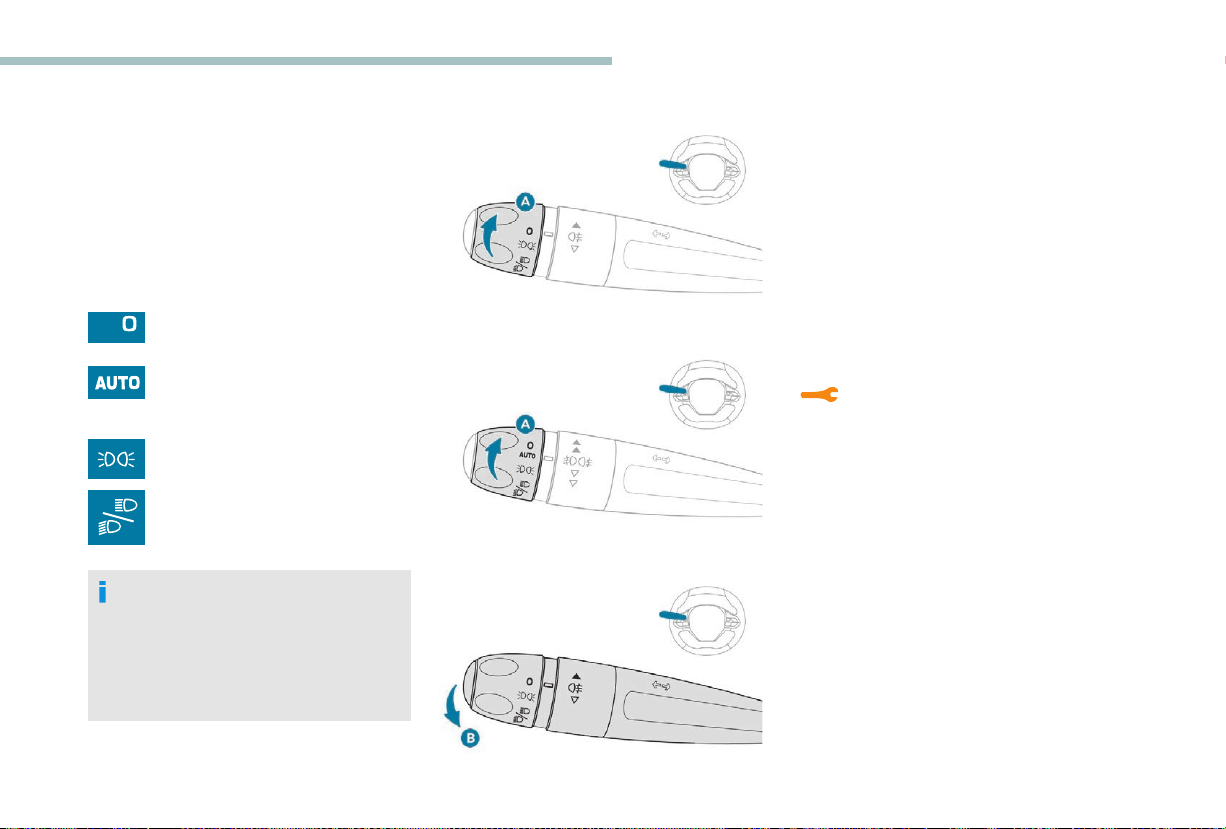
109
4
Lighting and visibility
Exterior lighting control
stalk
Main lighting
Selection of main lighting mode
F Turn ring A to align the desired symbol with
the marking.
Automatic illumination of headlamps.
Daytime running lamps / Dipped
beam / Main beam.
Sidelamps only.
Dipped or main beam headlamps.
"Highway function"
On versions fitted with "Full LED"
technology headlamps, the range of the
dipped beam headlamps is automatically
increased once the speed of the vehicle is
above 68 mph (110 km/h).
Without AUTO lighting
With AUTO lighting
Headlamp dipping
F Pull stalk B towards you to switch between
dipped and main beam headlamps or to
activate automatic headlamp dipping.
In the lighting off and sidelamps modes, the
driver can switch on the main beam headlamps
temporarily ("headlamp flash") by maintaining a
pull on the stalk.
Displays
Illumination of the corresponding indicator
lamp in the instrument panel confirms that the
lighting selected is on.
Lighting off (ignition off) /
Daytime running lamps (engine running).
A fault with a lamp is signalled by
the permanent illumination of this
warning lamp, accompanied by the
display of a message and an audible
signal.
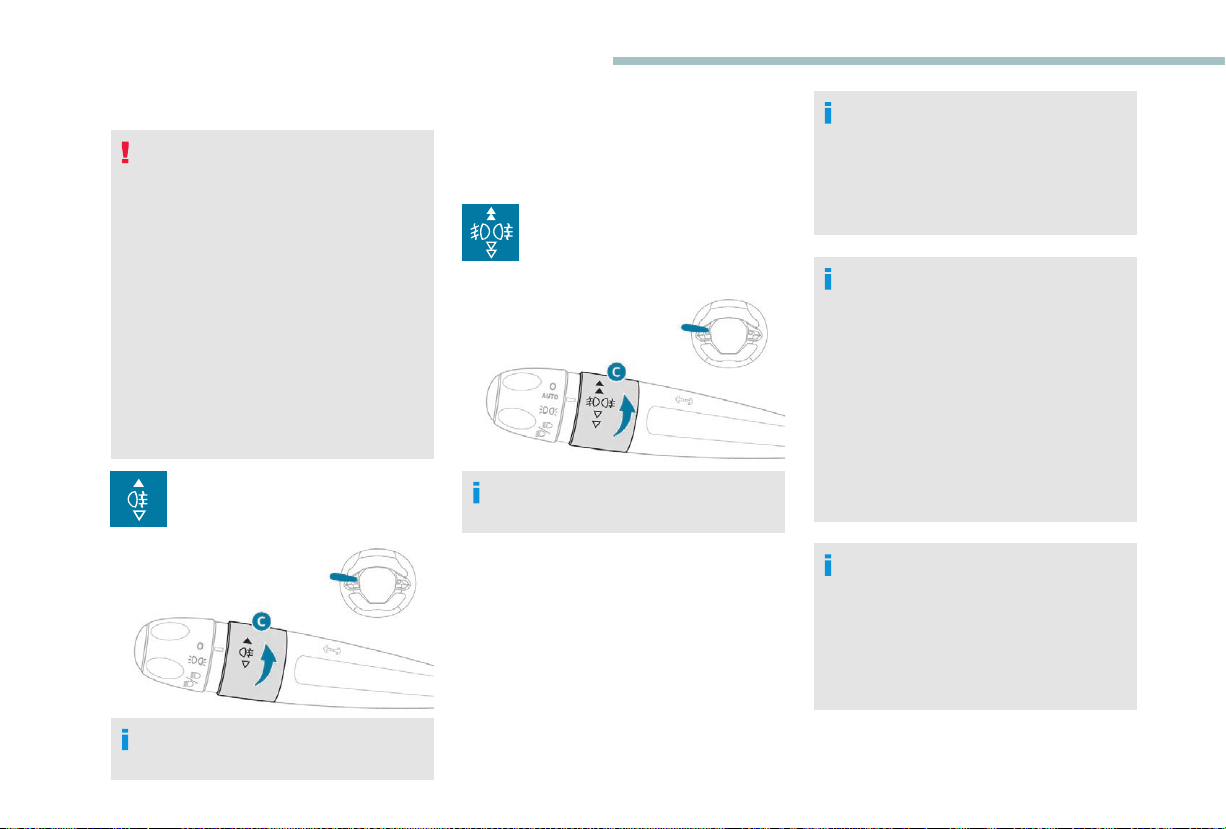
110
Lighting and visibility
Foglamps
In clear weather or rain, during the day
or at night, it is prohibited to switch on
the front or rear foglamps. In these
situations, the power of their beams may
dazzle other drivers. They should only
be used in fog or snow.
In these weather conditions, it is your
responsibility to switch on the foglamps
and dipped beam headlamps manually
as the sunshine sensor may detect
sufficient light.
Switch off the foglamps when they are
no longer necessary.
Rear foglamps
The main or dipped beam headlamps
must be on.
Rotate and release ring C:
F forwards to switch on the rear foglamps.
F backwards to switch them off.
Front and rear foglamps
The sidelamps or dipped or main beam
headlamps must be on.
Rotate and release ring C:
F once forwards to switch on the front
foglamps,
F forwards a second time to switch on the rear
foglamps.
F once backwards to switch off the rear
foglamps,
F backwards a second time to switch off the
front foglamps.
Switching off the lamps when the
ignition is switched off
On switching off the ignition, all of the
lamps turn off immediately, except for
dipped beam if automatic guide-me-home
lighting is activated.
Switching on the lamps after the
ignition is switched off
To reactivate the lighting control, rotate
ring A to the 0 position – lamps off, then
to the desired position.
On opening the driver's door a temporary
audible signal warns the driver that the
lighting is on.
They will go off automatically after a
period of time that depends on the state
of charge in battery (entering energy-
saving mode).
In some weather conditions (e.g. low
temperature or humidity), the presence
of misting on the internal surface of the
glass of the headlamps and rear lamps
is normal; it disappears after the lamps
have been on for a few minutes.

111
4
Lighting and visibility
Never look too closely at the luminous
beam of "Full LED" headlamps: risk of
serious eye injury.
Travelling abroad
If using your vehicle in a country that
drives on the other side of the road, the
headlamps must be adjusted to avoid
dazzling oncoming drivers.
Contact a PEUGEOT dealer or a qualified
workshop.
Daytime running lamps /
Sidelamps
The LEDs of these lamps light up automatically
when the engine starts, at the front and back of
the vehicle.
They provide the following functions:
- Daytime running lamps (lighting control
stalk at position "0" or "AUTO" with
adequate light level).
- Sidelamps (lighting control stalk at position
"AUTO" with low light levels or "Sidelamps
only" or "Dipped/main beam headlamps").
Direction indicators
F Left: lower the lighting control stalk passing
the point of resistance.
F Right: raise the lighting control stalk passing
the point of resistance.
If you forget to cancel the direction
indicators for more than twenty seconds,
the volume of the audible signal will
increase if the speed is above 37 mph
(60 km/h).
Three flashes
F Press briefly upwards or downwards,
without going beyond the point of
resistance; the direction indicators will flash
3 times.
On versions fitted with LED direction indicators,
the line of LEDs is illuminated sequentially.
The brightness of the daytime runnning lamps
is reduced during sequential operation of the
direction indicators.
Parking lamps
Side markers for the vehicle by illumination of
the sidelamps on the traffic side only.
F Depending on version, within one minute of
switching off the ignition, operate the lighting
control stalk up or down depending on the
traffic side (for example: when parking on
the left; lighting control stalk upwards; the
right-hand sidelamps come on).
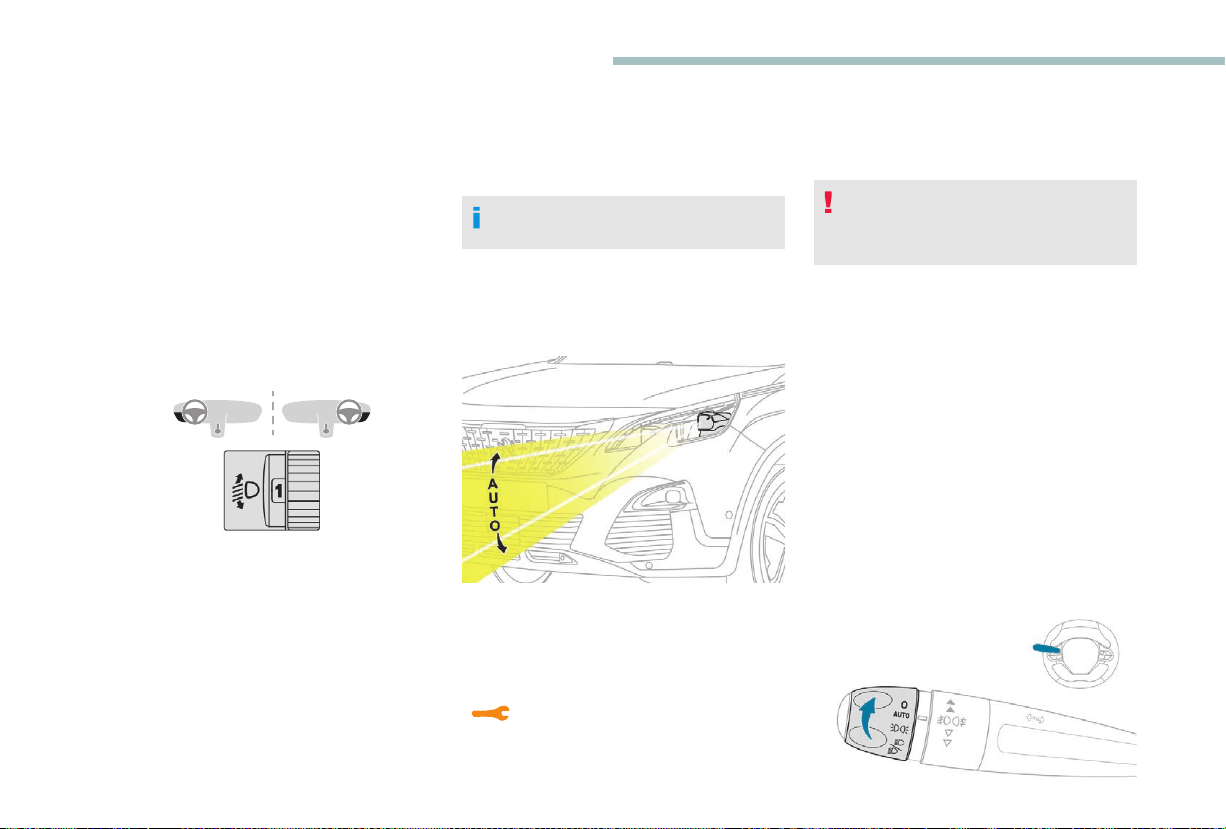
112
Lighting and visibility
Automatic adjustment of
"Full LED" technology
headlamps
If a fault occurs, this warning lamp
comes on in the instrument panel,
accompanied by a message and an
audible signal.
Do not touch the "Full LED" headlamps.
Risk of electrocution!
The system then places the headlamp beams
in the lowest position.
Have the system checked by a PEUGEOT
dealer or a qualified workshop.
Automatic illumination of
headlamps
This is confirmed by an audible signal and
illumination of the corresponding direction
indicator lamp in the instrument panel.
To switch off the parking lamps, return the
lighting control stalk to the central position.
Headlamp adjustment
Manual adjustment of
halogen headlamps
To avoid causing a nuisance to other road
users, the height of the halogen headlamps
should be adjusted according to the load in
the vehicle.
0 Driver only or driver + front passenger.
1 5 people.
2 Not used.
3 5 people + loads in the boot.
4 Not used.
5 Driver + loads in the boot.
6 Not used.
The initial setting is position "0".
This system automatically adjusts the height
of the beams from this type of headlamp,
according to the load in the vehicle, to avoid
causing a nuisance to other road users.
When a low level of ambient light is detected
by the sunshine sensor, the number plate
lamps, sidelamps and dipped beam headlamps
are switched on automatically, without any
action on the part of the driver. They may also
come on if rain is detected, at the same time as
automatic operation of the windscreen wipers.
As soon as the brightness returns to a
sufficient level or after the windscreen wipers
are switched off, the lamps are switched off
automatically.
Switching on
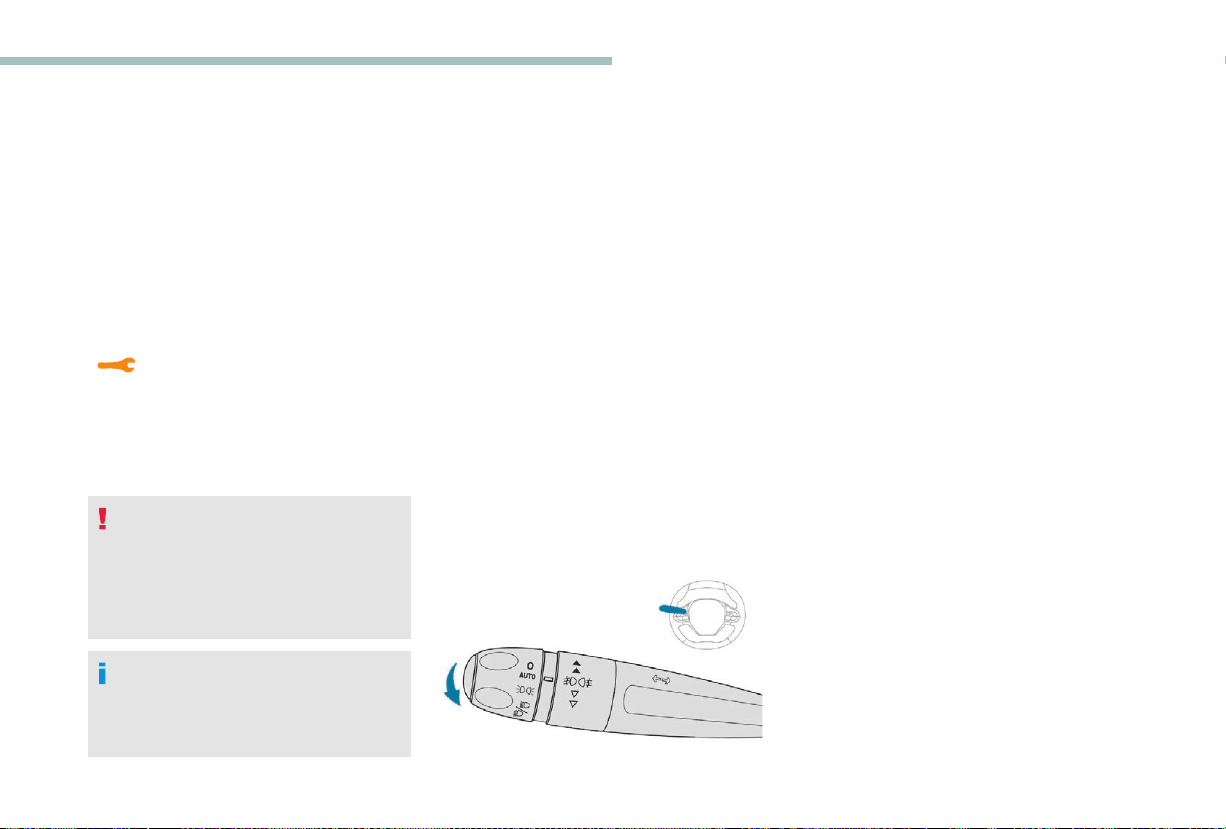
113
4
Lighting and visibility
F Turn the ring to the "AUTO" position.
When the function is activated, a message is
also displayed.
Switching off
F Turn the ring to another position.
Deactivation of the function is accompanied by
the display of a message.
Operating fault
In the event of a malfunction of the
sunshine sensor, the lighting comes
on, this warning lamp is displayed in
the instrument panel accompanied by
an audible signal and/or a message.
Contact a PEUGEOT dealer or a
qualified workshop.
Do not cover the sunshine sensor, linked
with the rain sensor and located at the
top centre of the windscreen behind the
rear view mirror; the associated functions
would no longer be controlled.
In fog or snow, the sunshine sensor may
detect sufficient light. In this case, the
lighting will not come on automatically.
Automatic guide-me-home
lighting
With the "Automatic illumination of headlamps"
function activated, under low ambient light, the
sidelamps, dipped beam headlamps and door
mirror spotlamps come on automatically when
the ignition is switched off.
Activation, deactivation and the duration of the
guide-me-home lighting are set in the vehicle
parameters menu in the screen.
Manual guide-me-home
lighting
The temporary illumination of the dipped beam
headlamps after the vehicle's ignition has been
switched off makes the driver's exit easier
when the light is poor.
Switching on
F With the ignition off, "flash" the headlamps
using the lighting control stalk.
F A further "headlamp flash" switches the
function off.
Switching off
For versions without "Automatic illumination
of headlamps", the manual guide-me-home
lighting switches off automatically after
30 seconds.
For versions with "Automatic illumination of
headlamps", the period of operation of the
manual guide-me-home lighting is the same
as that set for the automatic guide-me-home
lighting.
Automatic exterior welcome
lighting
With the "Automatic illumination of headlamps"
function activated, under low ambient light, the
sidelamps, dipped beam headlamps and door
mirror spotlamps come on automatically when
the vehicle is unlocked.
Activation, deactivation and the duration of the
exterior welcome lighting are set in the vehicle
parameters menu in the screen.
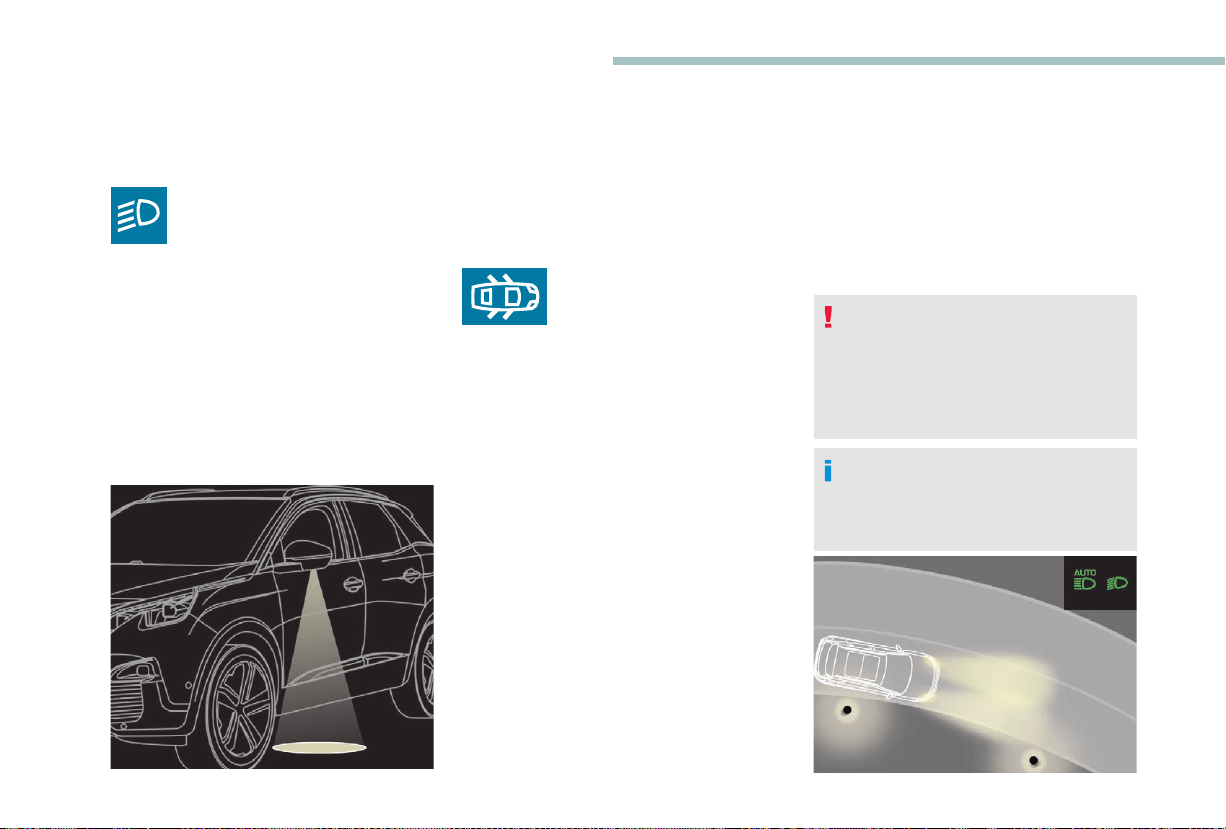
114
Lighting and visibility
Automatic headlamp
dipping
System which automatically changes between
dipped and main beam according to the
ambient light level and the driving conditions,
using a camera located at the top of the
windscreen.
This system is a driving aid.
The driver remains responsible for the
vehicle's lighting, its correct use for the
prevailing conditions of light, visibility,
traffic and observation of driving and
vehicle regulations.
The system will be operational as soon as
you have exceeded 16 mph (25 km/h).
If the speed drops below 9 mph (15 km/h),
the system no longer operates.
Welcome lighting
Availability of this function depends on version.
F Make a short press on this
remote control button.
The sidelamps, dipped beam headlamps,
number plate lamps and door mirror spotlamps
come on for 30 seconds.
Pressing again before the end of the timed
period switches off the lighting immediately.
Door mirror spotlamps
To make your approach to the vehicle easier,
these illuminate:
- the zones facing the driver's and
passenger's doors,
- the zones forward of the mirror and
rearward of the front doors.
Switching on
When the front courtesy lamp
switch is in this position,
the spotlamps come on
automatically:
Whatever the position of the front courtesy
lamp switch, they also come on with the
exterior welcome lighting and the guide-me-
home lighting.
- when you unlock the vehicle,
- on opening a door,
- when a request to locate the vehicle is
received from the remote control.
Switching off
They go off automatically after 30 seconds.

115
4
Lighting and visibility
Activation / Deactivation
F Turn the lighting control stalk ring to the
"AUTO" position.
The system state remains in memory when the
ignition is switched off.
F In the Vehicle / Driving menu,
select the "Driving functions"
tab, then "Automatic
headlamp dip".
Operation
If the ambient light level is sufficient and/or if
the traffic conditions do not allow illumination of
the main beam headlamps:
- dipped beam is maintained,
these indicator lamps come on
in the instrument panel.
If the ambient light level is very low and the
traffic conditions permit:
- main beam comes on
automatically: these indicator
lamps come on in the
instrument panel.
When the system detects thick fog, it
temporarily deactivates the function.
As soon as the vehicle leaves the area of thick
fog, the function reactivates automatically.
This indicator lamp goes off while
the function is deactivated.
Pause
If the situation requires a change of headlamp
beam, the driver can take over at any time.
F Flashing the headlamps pauses the function
and the system changes to "automatic
illumination of headlamps" mode:
- if the "AUTO" and "Dipped beam"
indicator lamps were on, the system
changes to main beam,
- if the "AUTO" and "Main beam" indicator
lamps were on, the system changes to
dipped beam.
To reactivate the system, flash the headlamps
again.
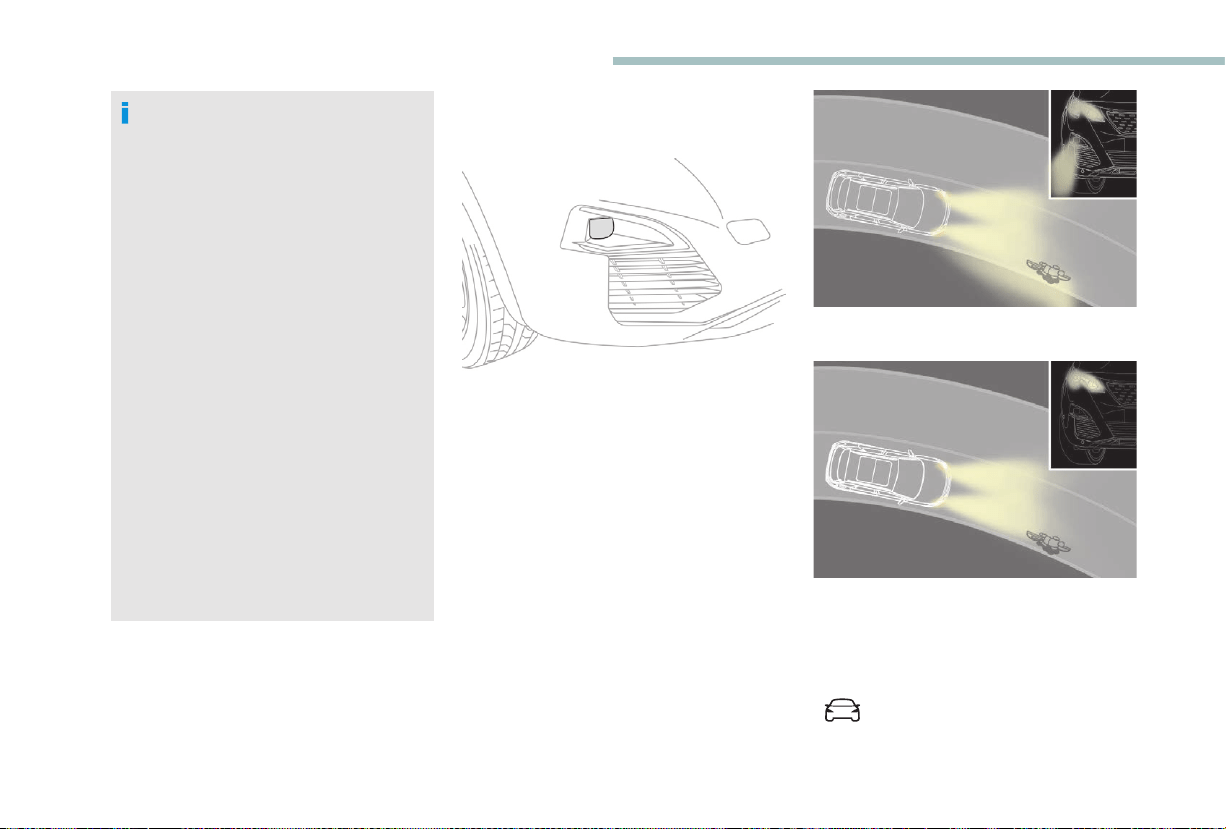
116
Lighting and visibility
Cornering lighting
The system may suffer interference or
not work correctly:
- under poor visibility conditions (snow,
heavy rain, etc.),
- if the windscreen is dirty, misted or
obscured (by a sticker, etc.) in front of
the camera,
- if the vehicle is facing highly
reflective signs.
When the system detects thick fog, it
temporarily deactivates the function.
The system is not able to detect:
- road users that do not have their own
lighting, such as pedestrians,
- vehicles whose lighting is obscured
(for example: vehicles running behind
a safety barrier on a motorway),
- vehicles at the top or bottom of a
steep slope, on winding roads, on
crossroads.
Present on vehicles fitted with "Full LED"
technology headlamps, this system makes
use of the beam from a front foglamp to
illuminate the inside of a bend, when the
main or dipped beam headlamps are on and
the vehicle speed is below 25 mph (40 km/h)
(urban driving, winding road, junctions,
parking manoeuvres, etc.).
With cornering lighting
Without cornering lighting
Activation / Deactivation
The cornering lighting can be
activated or deactivated in the
Vehicle / Driving menu of the touch
screen.
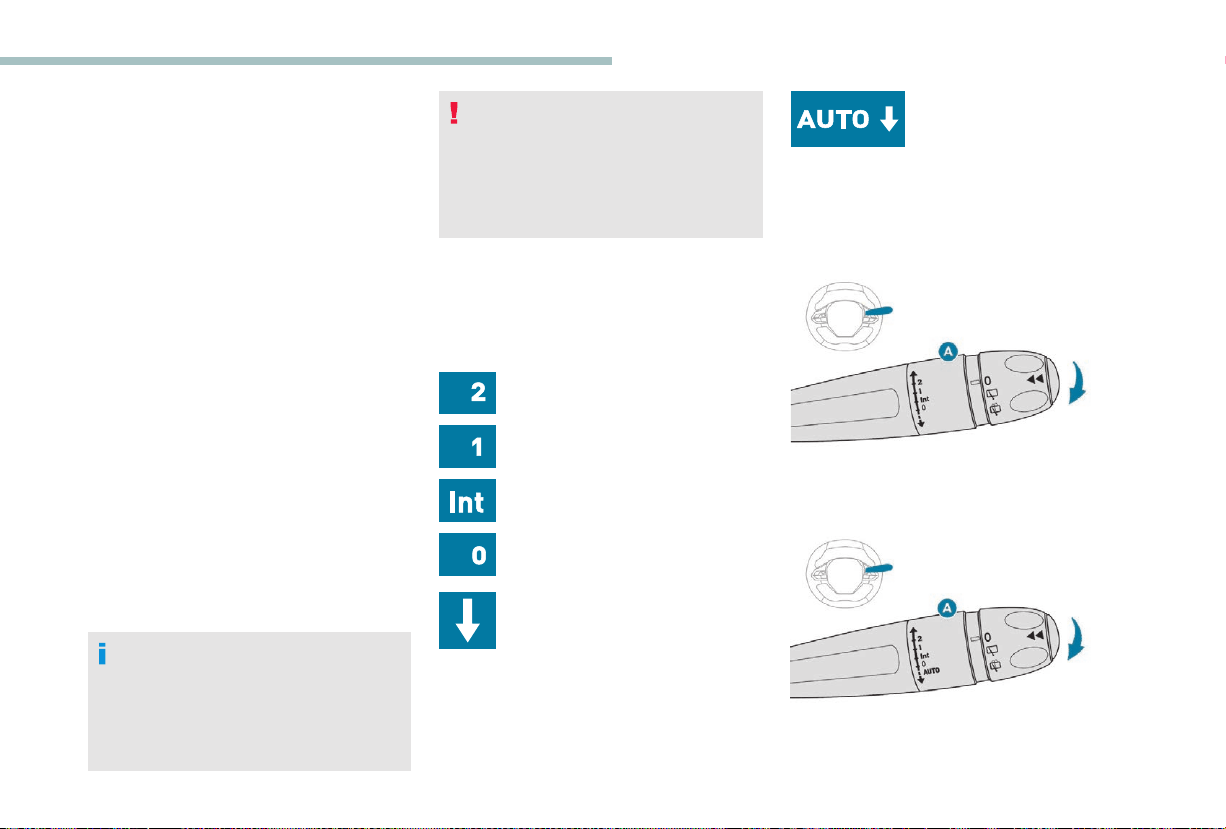
117
4
Lighting and visibility
Wiper control stalk
Switching on
This system starts:
- when the corresponding direction indicator
is switched on,
or
- from a certain angle of rotation of the
steering wheel.
Switching off
The system does not operate:
- below a certain angle of rotation of the
steering wheel,
- above 25 mph (40 km/h),
- when reverse gear is engaged.
Programming
Your vehicle may also include some functions
that can be configured:
- automatic rain sensitive windscreen wipers,
- rear wiping on engaging reverse gear.
In wintry conditions, remove snow, ice or
frost present on the windscreen, around
the wiper arms and blades and the
windscreen seal, before operating the
wipers.
Do not operate the wipers on a dry
windscreen. Under extremely hot or cold
conditions, ensure that the wiper blades
are not stuck to the windscreen before
operating the wipers.
Windscreen wipers
A. Wiping speed control stalk: raise or lower
the stalk to the desired position.
Single wipe (press downwards or
pull the stalk briefly towards you,
then release).
or
Automatic wiping (press
down, then release).
Single wipe (pull the stalk
briefly towards you).
Without AUTO wiping
With AUTO wiping
Fast wiping (heavy rain).
Normal wiping (moderate rain).
Intermittent wiping (proportional to
the speed of the vehicle).
Off.
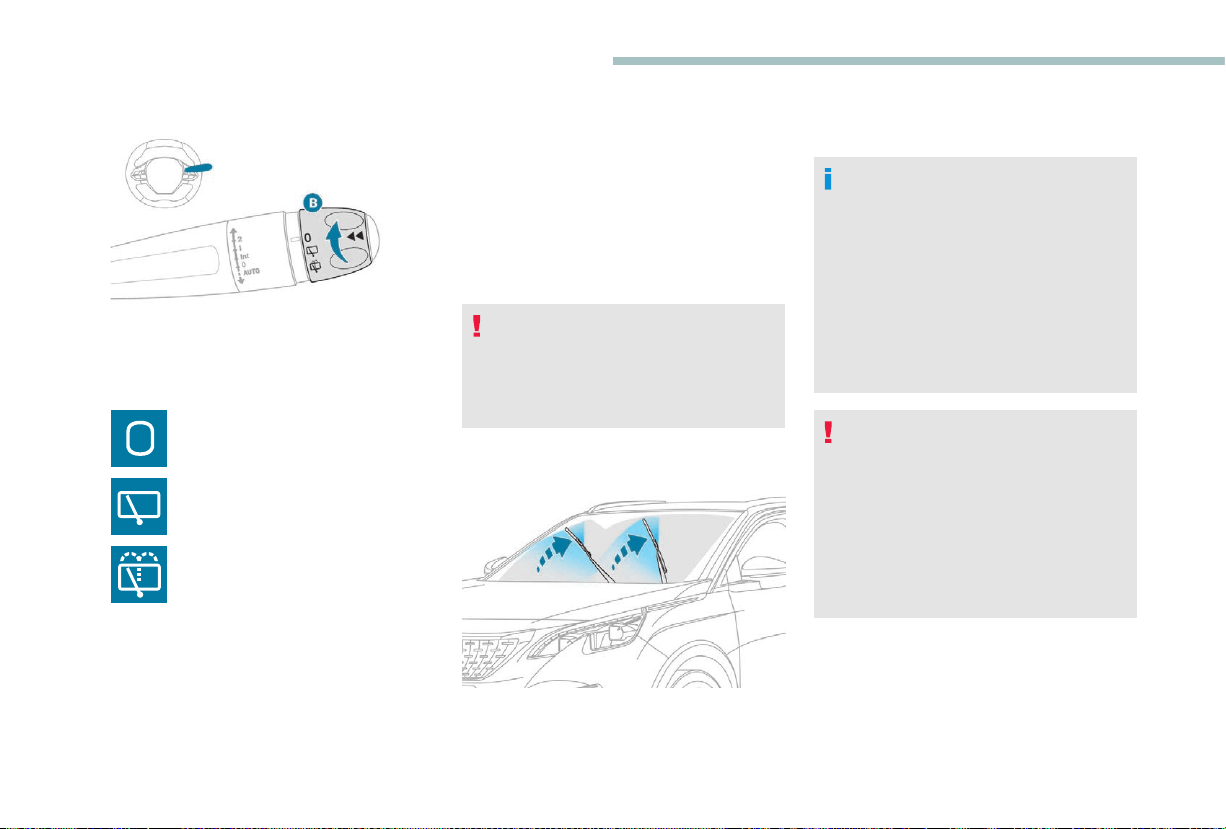
118
Lighting and visibility
Rear wiper
B. Rear wiper selection ring: turn the ring to
place the desired symbol against the marking.
Reverse gear
When reverse gear is engaged, the rear wiper
will come into operation automatically if the
front windscreen wipers are operating.
The system is activated or deactivated via the
vehicle settings menu in the screen.
This function is activated by default.
Off.
Intermittent wipe.
Wash-wipe.
Turn the ring fully; the rear screen wash, then
the rear wiper automatically operate for a set
duration.
In the event of snow or hard frost or if
a bicycle carrier is fitted to a towbar,
deactivate the automatic rear wiper via the
vehicle settings menu.
Front screenwash
F Pull the wiper control stalk towards you.
The screenwash and windscreen wiper operate
for as long as the control stalk is pulled.
The front screenwash includes a wiper
blade system with integral washer jets.
The screenwash fluid is sprayed along
the length of the wiper blade. This
improves visibility and reduces the
consumption of screenwash fluid.
In some cases, depending on the
contents or colour of the liquid and on
the outdoor brightness, the liquid spray
may be hardly noticeable.
To avoid damaging the wiper blades, do
not operate the windscreen washer if the
windscreen washer reservoir is empty.
Only operate the windscreen washer if
there is no risk of the fluid freezing on
the windscreen and hindering visibility.
Always use windscreen washer fluid
suitable for low temperatures during the
winter period.
Termination of the screenwash is followed by a
final wiping cycle.
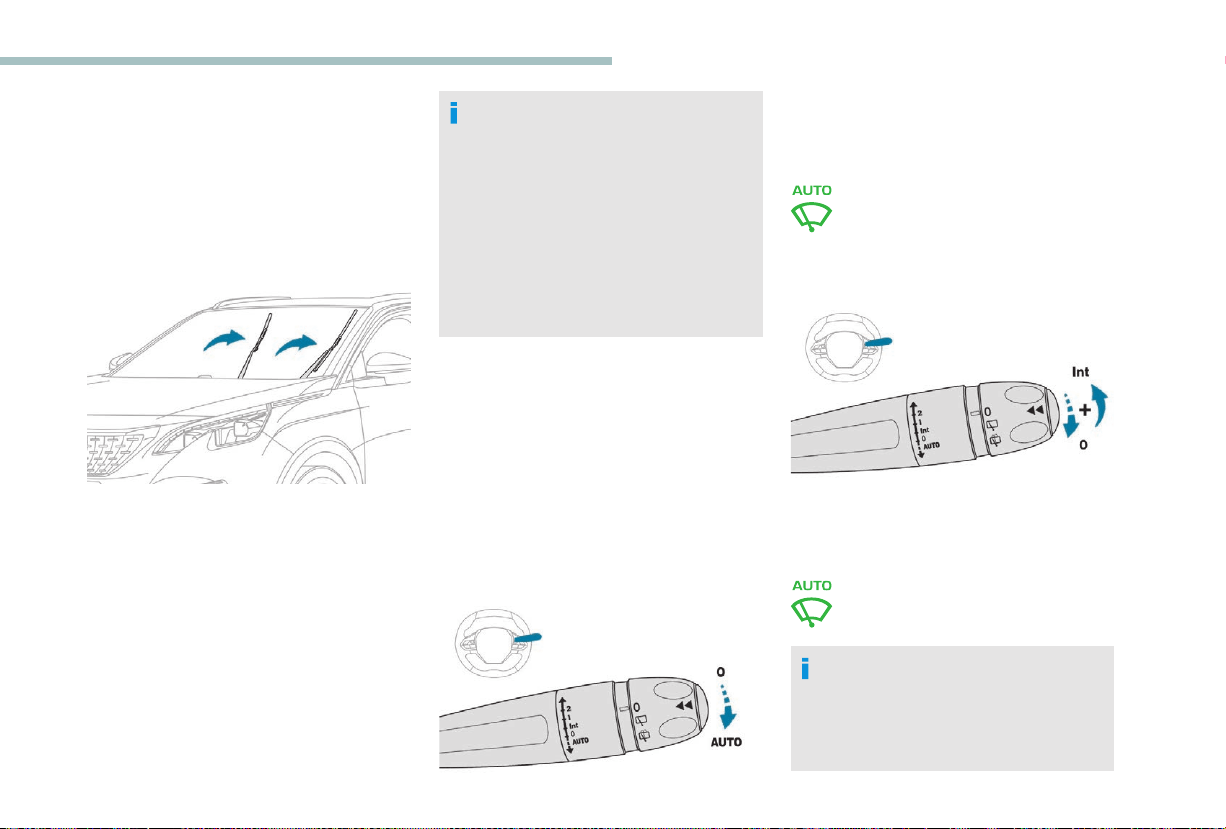
119
4
Lighting and visibility
Special position of the
windscreen wipers
This position is used for cleaning or
replacement of the wiper blades. It can also be
useful, in winter, to release the wiper blades
from the windscreen.
To maintain the effectiveness of the wiper
blades, it is advisable to:
- handle them with care,
- clean them regularly using soapy
water,
- avoid using them to retain cardboard
on the windscreen,
- replace them at the first signs of wear.
F In the minute following ignition switch-off,
any operation of the wiper control stalk will
position the wiper blades vertically.
F To park the wiper blades again, switch on
the ignition and operate the wiper stalk.
Automatic windscreen
wipers
The windscreen wipers operate automatically,
adapting their speed to the intensity of the rainfall
without any action on the part of the driver.
Detection of rainfall is by means of a sensor at
the top centre of the windscreen, behind the
rear view mirror.
Switching on
F Give a short downwards push to the
control stalk.
A wiping cycle confirms that the instruction
has been accepted.
This warning lamp comes on in the
instrument panel, accompanied by a
message.
Switching off
F Give the control stalk another brief push
downwards or place the control stalk in
another position (Int, 1 or 2).
The automatic rain sensitive windscreen
wipers must be reactivated by pushing
the control stalk downwards, if the
ignition has been off for more than one
minute.
This warning lamp goes off in the
instrument panel, accompanied by
a message.
120
Lighting and visibility
Malfunction
If a fault occurs with the automatic rain
sensitive wipers, the wipers will operate in
intermittent mode.
Have them checked by a PEUGEOT dealer or
a qualified workshop.
Do not cover the rain sensor, linked with
the sunshine sensor and located at the
top centre of the windscreen.
Switch off the automatic rain sensitive
wipers when using an automatic car wash.
In winter, it is advisable to wait until
the windscreen is completely clear of
ice before activating the automatic rain
sensitive wipers.

121
5
Safety
General safety
recommendations
Labels are attached in different places on
your vehicle. They include safety warnings
as well as identification information for
your vehicle. Do not remove them: they
are an integral part of your vehicle.
For any work on your vehicle, use a
qualified workshop that has the technical
information, skills and equipment required,
all of which a PEUGEOT dealer is able to
provide.
We draw your attention to the
following points:
- The fitting of electrical equipment
or accessories not approved by
PEUGEOT may cause excessive
current consumption and faults and
failures with the electrical system of
your vehicle. Contact a PEUGEOT
dealer for information on the range of
recommended accessories.
- As a safety measure, access to
the diagnostic socket, used for
the vehicle's electronic systems,
is reserved strictly for PEUGEOT
dealers or qualified workshops,
equipped with the special tools
required (risk of malfunctions of the
vehicle's electronic systems that
could cause breakdowns or serious
accidents). The manufacturer cannot
be held responsible if this advice is
not followed.
- Any modification or adaptation not
intended or authorised by PEUGEOT
or carried out without meeting the
technical requirements defined
by the manufacturer will result in
the suspension of the legal and
contractual warranties.
Installation of accessory radio
communication transmitters
Before installing a radio communication
transmitter, you must contact a
PEUGEOT dealer for the specification
of transmitters which can be fitted
(frequency, maximum power,
aerial position, specific installation
requirements), in line with the Vehicle
Electromagnetic Compatibility Directive
(2004/104/EC).
Depending on country regulations, some
safety equipment may be compulsory:
high visibility safety vests, warning
triangles, breathalysers, spare bulbs,
spare fuses, fire extinguisher, first aid kit,
mud flaps at the rear of the vehicle, etc.
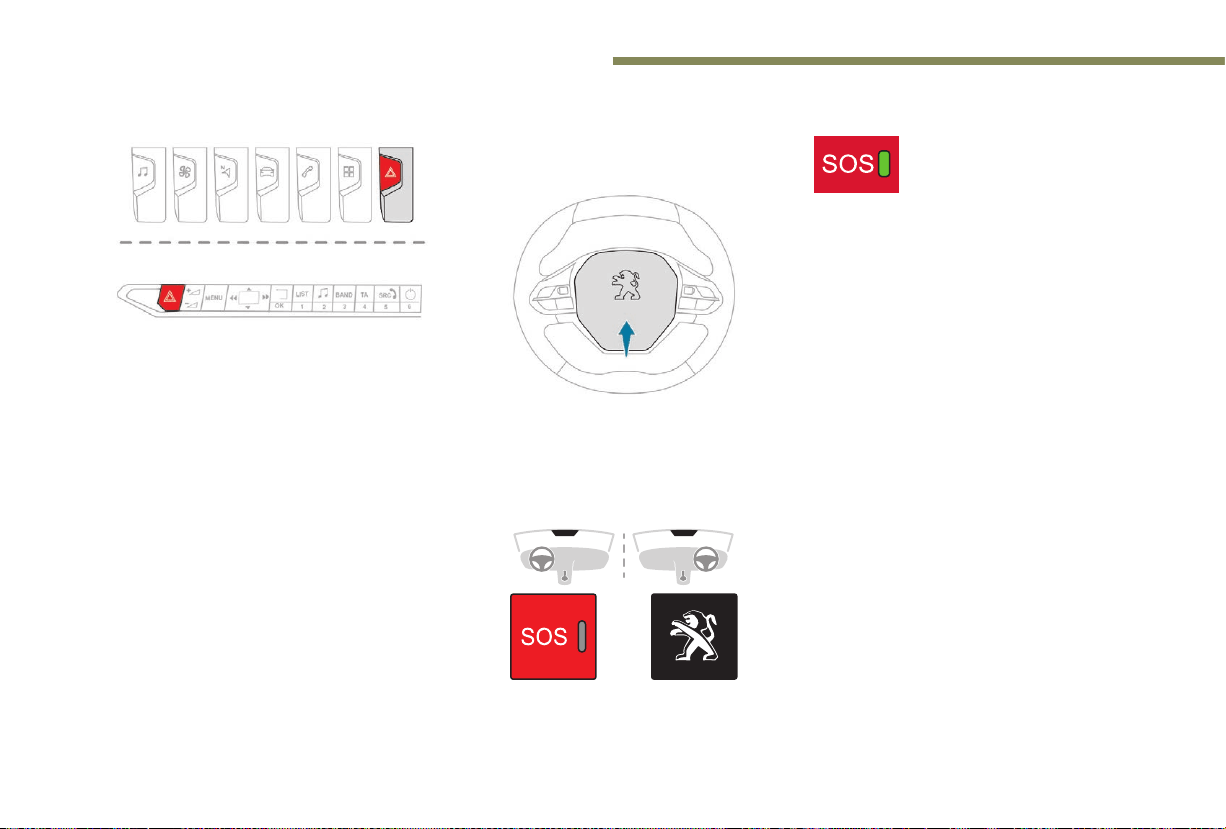
122
Safety
Hazard warning lamps
F When you press this red button, all four
direction indicators flash.
They can operate with the ignition off.
Automatic operation of
hazard warning lamps
When braking in an emergency, depending on
the force of deceleration, the hazard warning
lamps come on automatically. They switch off
automatically the first time you accelerate.
It is also possible to switch them off by pressing
the switch on the dashboard.
Horn
Audible warning system to alert other road
users to an imminent danger.
Emergency or assistance
call
Peugeot Connect SOS
** According to the geographic coverage
of "Peugeot Connect SOS", "Peugeot
Connect Assistance" and the official national
language chosen by the owner of the vehicle.
The list of countries covered and of
PEUGEOT CONNECT services is available
from dealers or on the website for your
country.
In an emergency, press this
button for more than 2 seconds.
The flashing green LED and
the voice message confirm
that the call has been made to
the "Peugeot Connect SOS"
service*.
Pressing this button again immediately cancels
the request; the green LED goes off.
The green LED remains on (without flashing)
when communication is established.
It goes off at the end of the call.
"Peugeot Connect SOS" immediately locates
your vehicle and contacts you in your own
language**, and – if necessary – requests that
relevant emergency services be dispatched**.
In countries where the service is not available,
or when the locating service has been
expressly declined, the call is sent directly
to the emergency services (112) without the
vehicle location.
F Press the central part of the multifunction
steering wheel.
* In accordance with the general conditions
of use for the service available from dealers
and subject to technological and technical
limitations.
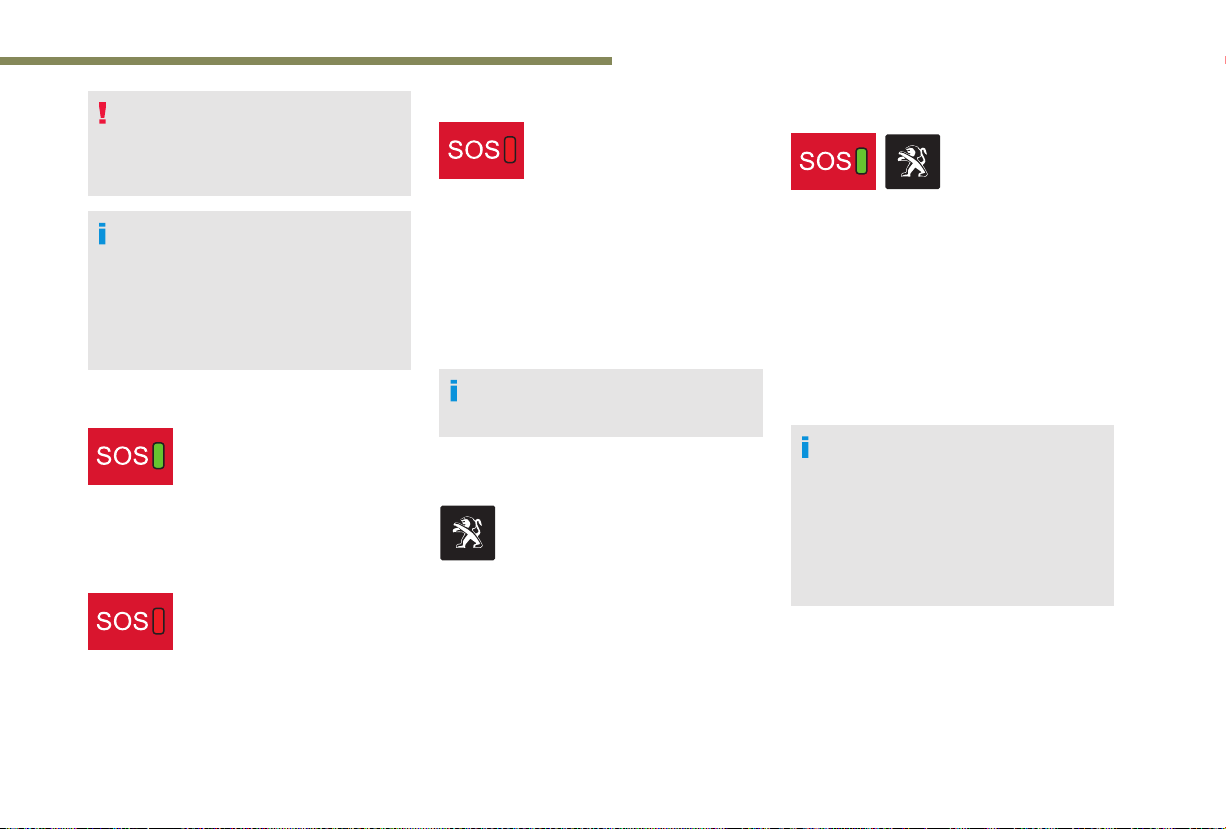
123
5
Safety
If an impact is detected by the airbag
control unit, an emergency call is made
automatically and independently of the
deployment of any airbags.
If you benefit from the Peugeot Connect
Packs offer with the SOS and assistance
pack included, there are additional
services available to you in your personal
space, via the website for your country.
Operation of the system
When the ignition is switched on,
the green indicator lamp comes
on for 3 seconds indicating that
the system is operating correctly.
For all countries except Russia, Belarus
and Kazakhstan.
For Russia, Belarus and Kazakhstan.
In either case, the emergency and assistance
calls may not function.
Contact a qualified repairer as soon as
possible.
The system's fault does not prevent the
vehicle from being driven.
If the red indicator lamp flashes
then goes off: there is a system
fault.
If the red indicator lamp is on continuously:
replace the back-up battery.
If the red indicator lamp is on
continuously: there is a system
fault.
If the red indicator lamp flashes: replace the
back-up battery.
Peugeot Connect Assistance
** According to the geographic coverage of
"Peugeot Connect SOS", "Peugeot Connect
Assistance" and the official national language
chosen by the owner of the vehicle.
The list of countries covered and of PEUGEOT
CONNECT services is available from dealers
or on the website for your country.
Press this button for more than
2 seconds to request assistance if
the vehicle breaks down.
A voice message confirms that the call has
been made**.
Pressing this button again immediately cancels
the request.
The cancellation is confirmed by a voice
message.
Geolocation
You can deactivate geolocation by
simultaneously pressing the "Peugeot Connect
SOS" and "Peugeot Connect Assistance"
buttons, followed by pressing "Peugeot
Connect Assistance" to confirm.
To reactivate geolocation, simultaneously
press the "Peugeot Connect SOS" and
"Peugeot Connect Assistance" buttons again,
followed by pressing "Peugeot Connect
Assistance" to confirm.
If you purchased your vehicle outside the
PEUGEOT network, we invite you to have
a dealer check the configuration of these
services and, if desired, modify it to suit
your wishes. In a multilingual country,
configuration is possible in the official
national language of your choice.

124
Safety
Electronic stability control
(ESC)
A set of the following Electronic Stability
systems:
- anti-lock braking system (ABS) and
electronic brake force distribution (EBFD),
- emergency braking assistance (EBA),
- wheel anti-slip regulation (ASR) or traction
control,
- dynamic stability control (DSC).
- trailer stability assist (TSA).
Definitions
Anti-lock braking system (ABS)
and electronic brake force
distribution (EBFD)
The ABS prevents wheel lock in the event of
emergency braking.
The electronic brake force distribution system
manages the braking pressure wheel by wheel.
Emergency braking assistance
In an emergency, this system enables you to
reach the optimum braking pressure more
quickly and therefore reduce the stopping
distance.
It is triggered in relation to the speed at which
the brake pedal is pressed. This is felt by a
reduction in the resistance of the pedal and an
increase in braking efficiency.
Anti-slip regulation (ASR)
This system optimises traction in order to
avoid wheel slip by acting on the brakes of
the driving wheels and on the engine. It also
improves the directional stability of the vehicle
on acceleration.
Dynamic stability control (DSC)
If there is a difference between the path
followed by the vehicle and that required by the
driver, this system monitors each wheel and
automatically acts on the brake of one or more
wheels and on the engine to return the vehicle
to the required path, within the limits of the laws
of physics.
Trailer stability assist (TSA)
This system allows control of the vehicle to be
retained when towing a trailer, so as to avoid
the risk of snaking.
Anti-lock braking system
(ABS) and electronic brake
force distribution (EBFD)
The fixed illumination of this warning
lamp signals that there is a fault with
the ABS.
Illumination of this warning lamp,
linked with the STOP and ABS
warning lamps, accompanied by
the display of a message and an
audible signal, signals that there is a
fault with the electronic brake force
distribution (EBFD).
For technical reasons and, in particular,
to improve the quality of PEUGEOT
CONNECT services services to
customers, the manufacturer reserves the
right to carry out updates to the vehicle's
on-board telematic system.
These systems improve the stability and
manoeuvrability of your vehicle when braking
and contribute towards improved control in
corners, in particular on poor or slippery road
surfaces.
The vehicle retains conventional braking.
Drive carefully at moderate speed.
Contact a PEUGEOT dealer or a qualified
workshop as soon as possible.
You must stop as soon as it is safe to do so.
Call on a PEUGEOT dealer or a qualified
workshop.
125
5
Safety
Normal operation of the ABS may make
itself felt by slight vibrations of the brake
pedal.
In emergency braking, press very
firmly and maintain this pressure.
When changing wheels (tyres and rims),
ensure that these are approved for your
vehicle.
After an impact, have these systems
checked by a PEUGEOT dealer or a
qualified workshop.
Intelligent traction control
system
Depending on version, your vehicle has a
system to help driving on snow: intelligent
traction control.
This system detects situations of poor surface
grip that could make it difficult to move off
or make progress on deep fresh snow or
compacted snow.
In these situations, the intelligent traction
control limits the amount of wheel spin to
provide the best traction and trajectory control
for your vehicle.
The use of snow tyres is strongly
recommended on surfaces offering low
levels of adhesion.
Anti-slip regulation
(ASR) / Dynamic stability
control (DSC)
Operation
These systems are activated automatically
every time the vehicle is started.
They come into operation in the event of a
problem with grip or trajectory.
Deactivation
In exceptional conditions (starting a vehicle
which is bogged down, stuck in snow, on soft
ground, etc.), it may be advisable to deactivate
the ASR system, so that the wheels can turn
freely and regain grip.
Deactivation of the function is done
in the Vehicle / Driving menu of the
touch screen.
This is indicated by flashing of this
warning lamp in the instrument panel.
Reactivate the system when grip conditions
allow.
It is confirmed by the display of a message.
The ASR system no longer acts on the
operation of the engine.
Reactivation
The ASR system is reactivated automatically
every time the ignition is switched back on or
from 31 mph (50 km/h).
Below 31 mph (50 km/h), you can reactivate it
manually:
Reactivation of the function is done
from the Vehicle / Driving menu of
the touch screen.
It is confirmed by the display of a message.
Operating fault
Illumination of this warning lamp,
accompanied by the display of a
message and an audible signal,
indicates a fault with the system.
Contact a PEUGEOT dealer or a qualified
workshop to have the systems checked.
126
Safety
ASR / DSC
These systems offer increased safety
in normal driving, but they should not
encourage the driver to take extra risks
or drive at high speed.
It is in conditions of reduced grip (rain,
snow, ice) that the risk of loss of grip
increases. It is therefore important
for your safety to keep these systems
activated in all conditions, and
particularly in difficult conditions.
The correct operation of these
systems depends on observation of
the manufacturer's recommendations
regarding as much the wheels (tyres
and rims), braking and electronic
components as the assembly and repair
procedures used by PEUGEOT dealers.
The use of snow tyres is recommended,
in order to be able to benefit from the
efficiency of these systems in winter
conditions.
In this case, it is essential to equip the
four wheels with tyres approved for your
vehicle.
Trailer stability assist
When towing, this system reduces the risk of
the vehicle or trailer swaying.
Operation
The system is activated automatically when the
ignition is switched on.
The electronic stability control system (ESC)
must not have any faults.
Between 37 and 99 mph (60 and 160 km/h), if
the system detects oscillations (snaking) in the
movement of the trailer, it acts on the brakes to
stabilise the trailer and, if necessary, reduces
engine power to slow down the vehicle.
For information on the weights and towed
loads, refer to the "Technical data" section or
the registration certificate for your vehicle.
For advice on driving safely when Towing a
trailer, refer to the corresponding section.
Malfunction
Should a fault occur with the system,
this warning lamp comes on in the
instrument panel, accompanied by
the display of a message and an
audible signal.
The trailer stability assist system offers
increased safety in normal driving,
provided that the recommendations on
towing a trailer are observed. It should
not encourage the driver to take risks,
such as towing a trailer in adverse
operating conditions (overloading,
failure to observe the trailer nose
weight, worn or under-inflated tyres,
faulty braking system, etc.) or drive at
too high a speed.
In certain cases, oscillation of the
trailer may not be detected by the ESC
system, particularly with a light trailer.
When driving on slippery or poor
surfaces, the system may not be able to
prevent sudden snaking of the trailer.
The correction is signalled by the
flashing of this indicator lamp in the
instrument panel and illumination of
the brake lamps.
If you continue to tow a trailer, reduce your
speed and drive carefully!
Contact a PEUGEOT dealer or a qualified
workshop to have the system checked.
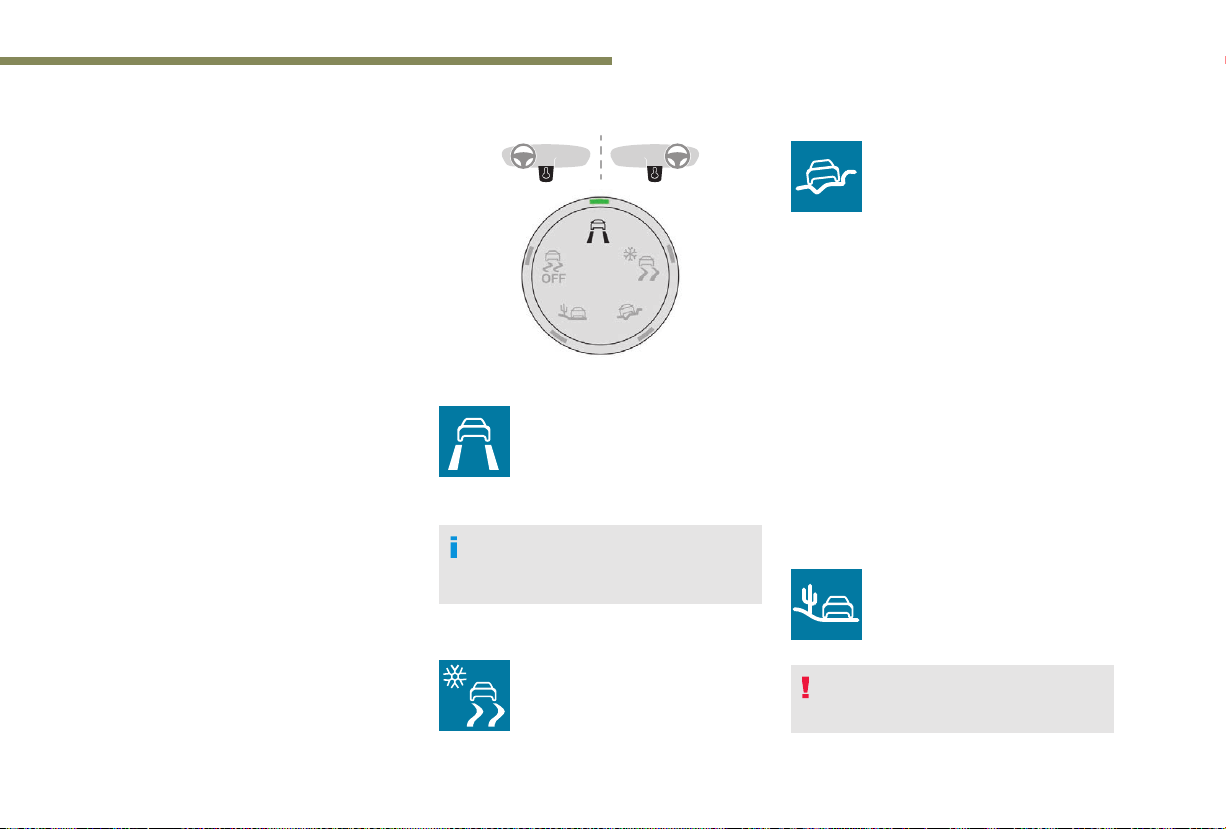
127
5
Safety
Advanced Grip Control
Special patented traction control system which
improves traction on snow, mud and sand.
This system, the operation of which has been
optimised for each situation, allows you to
manoeuvre in most conditions of poor grip
(encountered during touring use).
Associated with all-season M+S (Mud and
Snow) tyres, this system offers a compromise
between safety, adhesion and traction.
The accelerator pedal should be pressed
sufficiently to allow the system to use the power
of the engine. Operation at high engine speeds
is completely normal.
A five-position selector knob allows you to
choose the setting best suited to the driving
conditions encountered.
An indicator lamp associated with each mode
comes on, accompanied by the display of a
message to confirm your choice.
Operating modes
Standard (ESC)
This mode is calibrated for a low
level of wheel spin, based on the
different levels of grip normally
encountered on the road.
Every time the ignition is switched off, the
system automatically resets to this mode.
Snow
This mode adapts its strategy to
the conditions of grip encountered
for each of the two front wheels on
moving off.
(mode active up to 50 mph (80 km/h))
All terrain (mud, damp grass,
etc.)
This mode, when moving off, allows
considerable spin on the wheel with
the least grip to optimise clearing
of the mud and to regain grip. At
the same time, the wheel with the
most grip is controlled in such a
way as to transmit as much torque
as possible.
When moving, the system optimises wheel spin
to respond to the driver's requirements as fully
as possible.
(mode active up to 31 mph (50 km/h))
Sand
This mode allows little spin on the two driving
wheels at the same time to allow the vehicle to
move forward and limit the risks of getting stuck
in the sand.
(mode active up to 75 mph (120 km/h))
Do not use the other modes on sand as
the vehicle may become stuck.
F Place the knob in this position.
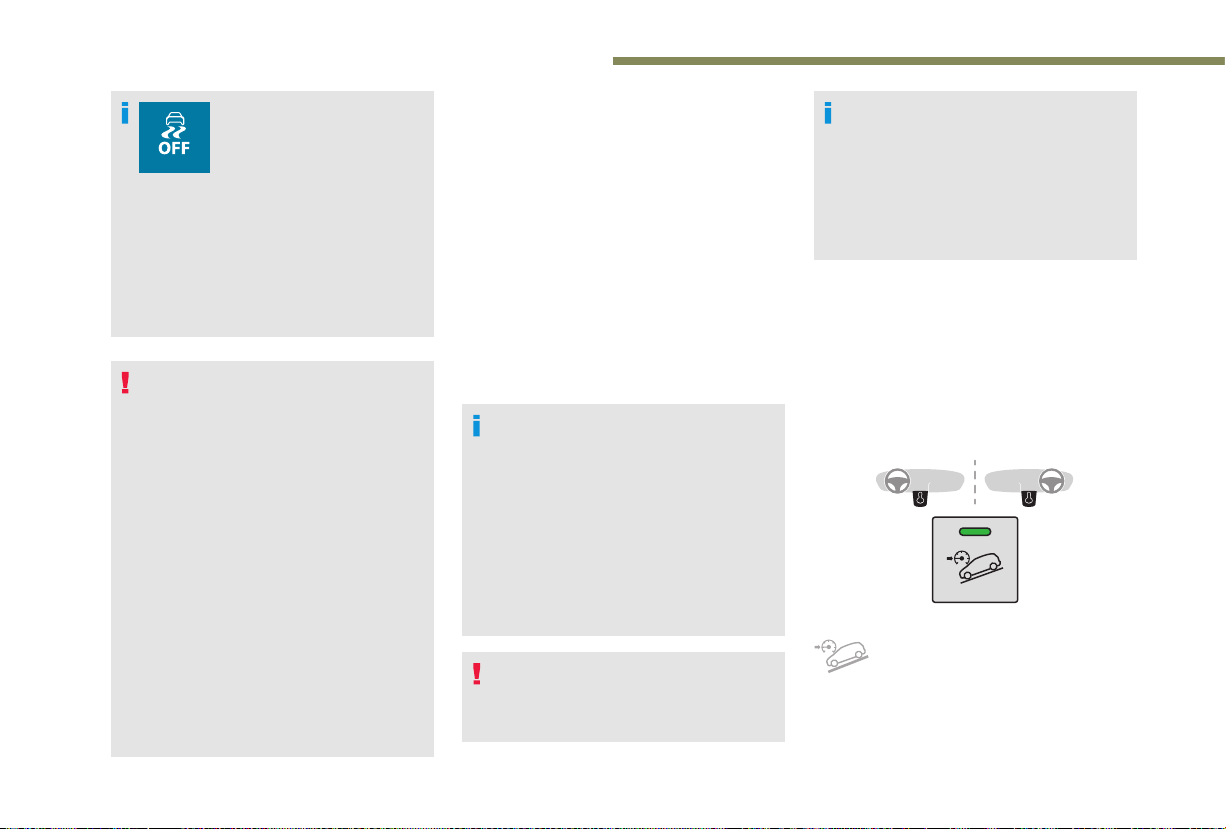
128
Safety
Recommendations
Your vehicle is designed principally to
drive on tarmac roads but it allows you to
occasionally drive on other less passable
terrain.
However, it does not permit off-road
driving such as:
- crossing and driving on terrain which
could damage the underbody or strip
away components (fuel pipe, fuel
cooler, etc.) due to obstacles or stones
in particular,
- driving on terrain with steep gradients
and poor grip,
- crossing a stream.
Hill Assist Descent
Control
System that provides assistance when
descending on loose or soft surfaces (gravel,
mud, etc.) or a steep gradient.
This system reduces the risk of slip or loss
of control of the vehicle when descending,
whether going forward or in reverse.
During a descent, it assists the driver in
maintaining a constant speed, depending
on the gear engaged, while progressively
releasing the brakes.
For the system to activate, the slope must
be greater than 5%.
The system can be used with the gearbox
in neutral.
Otherwise engage a gear corresponding
to the speed to prevent the engine stalling.
With an automatic gearbox, the system
can be used with the selector at N, D or R.
When the system is regulating, the Active
Safety Brake system is automatically
deactivated.
The system is not available:
- if the speed of the vehicle is above
43 mph (70 km/h),
- if the speed of the vehicle is being
controlled by the Adaptive cruise
control with Stop function, depending
on the type of gearbox.
Switching on
By default, the system is not selected.
The system's status is not saved when the
ignition is switched off.
The driver can select the system when
the engine is running, when the vehicle is
stationary or moving at speeds up to approx.
31 mph (50 km/h).
F To select the system, at a
speed below 31 mph (50 km/h),
press this button until its green
indicator lamp comes on; this
warning lamp comes on in grey
in the instrument panel.
You can deactivate the ASR
and DSC systems by turning
the knob to the "OFF" position.
The ASR and DSC systems will no longer
act on the engine operation or the brakes
in the event of an involuntary change of
trajectory.
These systems are reactivated
automatically from 31 mph (50 km/h) or
every time the ignition is switched on.
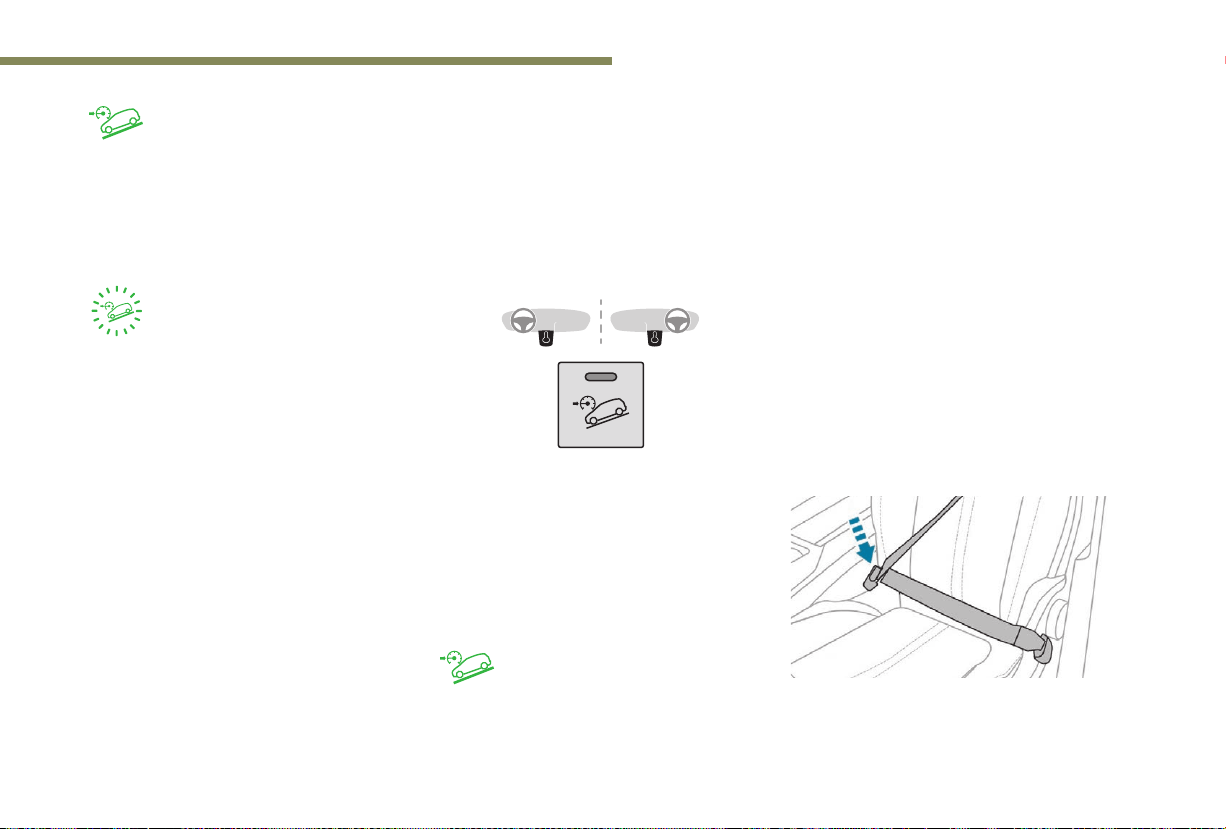
129
5
Safety
F When the vehicle begins its descent, you
can release the accelerator and brake
pedals; the system regulates the speed:
- if the gearbox is in first or
second gear, the speed
decreases and the warning lamp
flashes rapidly,
- if the gearbox is in neutral or if
the clutch pedal is depressed,
the speed decreases and the
warning lamp flashes slowly;
in this case, the maintained
descent speed is lower.
During a descent, with the vehicle stationary,
if you release the accelerator and brake pedals,
the system will release the brakes to set the
vehicle gradually in motion.
The brake lamps light up automatically when
the system is regulating.
If the speed exceeds 19 mph (30 km/h),
regulation is paused automatically, the warning
lamp goes back to grey in the instrument panel,
but the indicator lamp in the button remains on.
Switching off
Malfunction
If a fault occurs with the system, this
warning lamp comes on in green,
accompanied by the display of a
message in the instrument panel.
F Press this button until its indicator lamp
goes off; the indicator goes off in the
instrument panel.
Above 43 mph (70 km/h), the system is
automatically deactivated; the indicator lamp in
the button goes off.
Have it checked by a PEUGEOT dealer or a
qualified workshop.
Seat belts
Front seat belts
The front seat belts are fitted with a pyrotechnic
pretensioning and force limiting system.
This system improves safety in the front
seats in the event of a front or side impact.
Depending on the severity of the impact, the
pretensioning system instantly tightens the seat
belts against the body of the occupants.
The pretensioning seat belts are active when
the ignition is on.
The force limiter reduces the pressure of the
seat belt on the chest of the occupant, thus
improving their protection.
Fastening
F Pull the strap then insert the tongue in the
buckle.
F Check that the seat belt is fastened
correctly by pulling the strap.
F The system becomes active at a
speed below 19 mph (30 km/h);
this warning lamp comes on in
green in the instrument panel.
Regulation resumes automatically when the
speed falls below 19 mph (30 km/h) again, if the
slope and pedal release conditions are met.
You can depress the accelerator or brake pedal
again at any time.
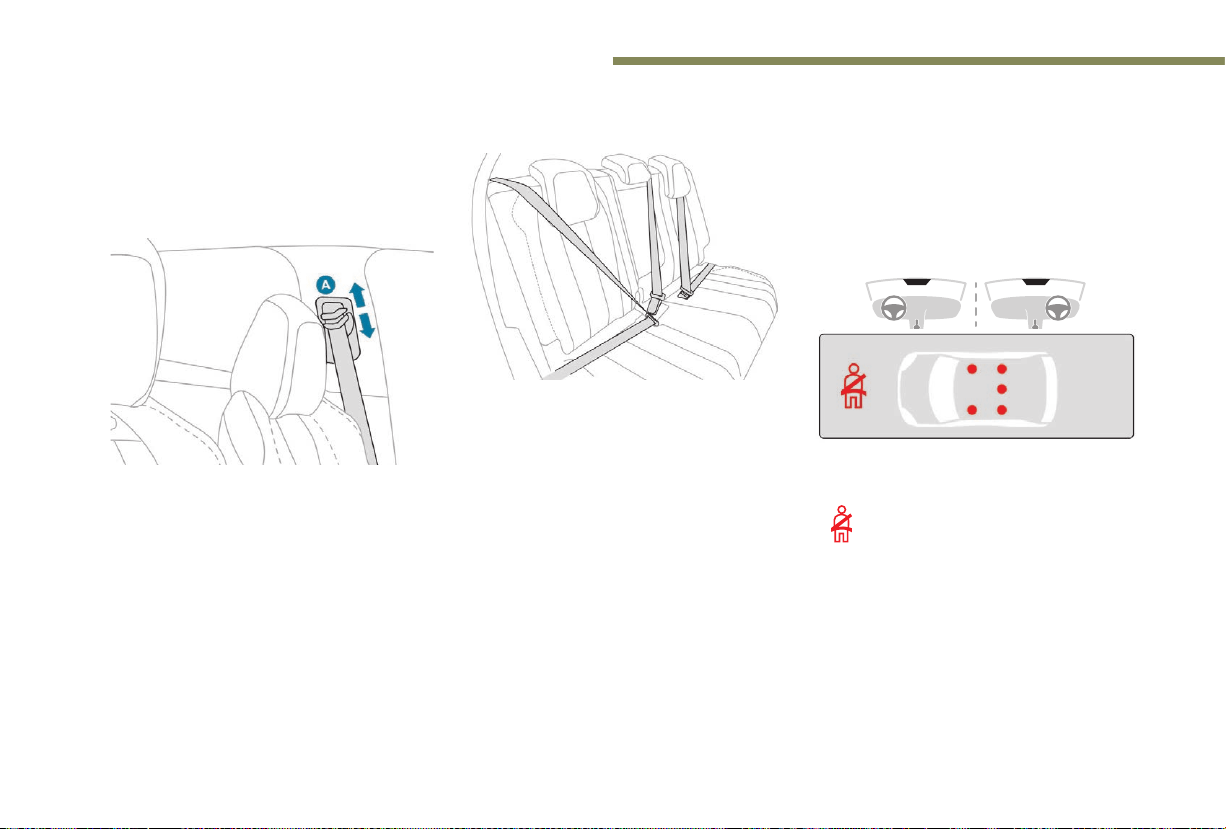
130
Safety
Height adjustment
Rear seat belts
Fastening
F Pull the strap then insert the tongue in the
buckle.
F Check that the seat belt is fastened
correctly by pulling the strap.
Unfastening
F Press the red button on the buckle.
F Guide the seat belt as it is reeled in.
Seat belt not fastened/
unfastened alerts
Not fastened/unfastened warning lamp
F To adjust the height of the anchorage point,
squeeze control A and slide it to the notch
desired.
Each of the rear seats has a belt, with three
fixing points and an inertia reel.
The outer seats are fitted with a pretensioning
and force limiting system.
For the centre seat, the buckle is held
horizontally by an elastic strap if the centre seat
belt is not being used.
It comes on in red on both the
instrument panel and the front
passenger airbag and seat belts
warning lamps display, once the
system detects that a seat belt is not
fastened or is unfastened.
Unfastening
F Press the red button on the buckle.
F Guide the seat belt as it is reeled in.
131
5
Safety
Seat belts not fastened/unfastened
identification warning lamp
Front seat belts not fastened
alerts
When the ignition is switched on, the warning
lamp and the corresponding indicators light up
if the driver and/or the front passenger have not
fastened their seat belts.
At speeds above 12 mph (20 km/h), these
warning lamps flash, accompanied by an
audible signal for two minutes. After that
period, these warning lamps remain lit until the
seat belts have been fastened.
Rear seat belts not fastened
alerts
It comes on in the display: the
illuminated red warning lamps
indicate the location of the not
fastened or unfastened seat
belts.
When the ignition is switched on, with the
engine running or the vehicle moving at speeds
above 12 mph (20 km/h), the warning lamp and
the corresponding indicators light up for around
thirty seconds, if one or more rear seat belts
are not fastened.
Seat belts unfastened alert
After the ignition is switched on, the warning
lamp and the corresponding indicators light up
if the driver and/or one or more passengers
unfasten their seat belts.
At speeds above 12 mph (20 km/h), these
warning lamps flash, accompanied by an
audible signal for two minutes. After that
period, these warning lamps remain lit until the
seat belts have been refastened.

132
Safety
Advice
The driver must ensure that passengers
use the seat belts correctly and that they
are all fastened before setting off.
Wherever you are seated in the vehicle,
always fasten your seat belt, even for short
journeys.
Do not interchange the seat belt buckles as
they will not fulfil their role fully.
The seat belts are fitted with an inertia reel
permitting automatic adjustment of the
length of the strap to your size. The seat
belt is stowed automatically when not in
use.
Before and after use, ensure that the seat
belt is reeled in correctly.
The lower part of the strap must be
positioned as low as possible on the pelvis.
The upper part must be positioned in the
hollow of the shoulder.
The inertia reels have an automatic locking
device at the time of a collision, during
sudden braking or if the vehicle turns over.
You can release the device by pulling the
strap firmly and then releasing it so that it
reels in slightly.
In order to be effective, a seat belt must:
- be tightened as close to the body as
possible,
- be pulled in front of you with a smooth
movement, checking that it does not twist,
- be used to restrain only one person,
- not show any signs of cuts or fraying,
- not be converted or modified to avoid
affecting its performance.
In accordance with current safety regulations,
for all repairs on your vehicle's seat belts, go
to a qualified workshop with the skills and
equipment needed, which a PEUGEOT dealer
is able to provide.
Have your seat belts checked regularly by a
PEUGEOT dealer or a qualified workshop,
particularly if the straps show signs of
damage.
Clean the seat belt straps with soapy water or
a textile cleaning product, sold by PEUGEOT
dealers.
After folding or moving a seat or rear bench
seat, ensure that the seat belt is positioned
and reeled in correctly.
Recommendations for children
Use a suitable child seat if the passenger is
less than 12 years old or shorter than one and
a half metres.
Never use the same seat belt to secure more
than one person.
Never allow a child to travel on your lap.
For more information on Child seats, refer to
the corresponding section.
In the event of an impact
Depending on the nature and seriousness
of the impact, the pyrotechnic device may
be deployed before and independently of the
airbags. Deployment of the pretensioners is
accompanied by a slight discharge of harmless
smoke and a noise, due to the activation of
the pyrotechnic cartridge incorporated in the
system.
In all cases, the airbag warning lamp comes
on.
Following an impact, have the seat belts
system checked and, if necessary, replaced, by
a PEUGEOT dealer or a qualified workshop.
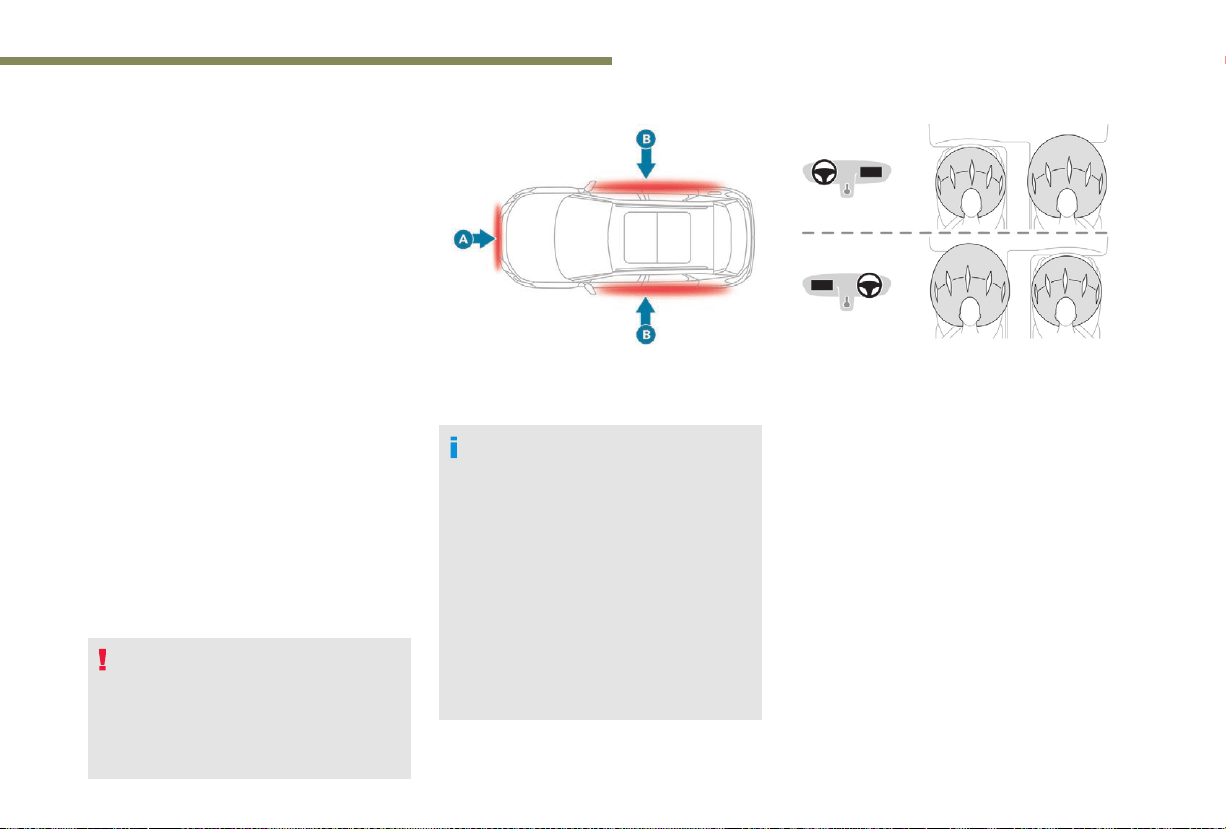
133
5
Safety
Airbags
General information
System designed to contribute towards
improving passenger safety (with the exception
of the rear centre passenger) in the event of
violent collisions. The airbags supplement the
action of the seat belts fitted with force limiters
(all except the centre rear passenger).
If a collision occurs, the electronic detectors
record and analyse the front and side impacts
sustained in the impact detection zones:
- in the case of a serious impact, the airbags
are deployed instantly and contribute
towards better protection of the occupants
of the vehicle (with the exception of the rear
centre passenger); immediately after the
impact, the airbags deflate rapidly so that
they do not hinder visibility or the exit of the
occupants,
- in the case of a minor or rear impact or
in certain rollover conditions, the airbags
may not be deployed; the seat belt
alone contributes towards ensuring your
protection in these situations.
The airbags do not operate when the
ignition is switched off.
This equipment will only deploy once. If a
second impact occurs (during the same or
a subsequent accident), the airbag will not
be deployed again.
Impact detection zones
A. Front impact zone.
B. Side impact zone.
The deployment of an airbag is
accompanied by a slight emission of
smoke and a noise, due to the detonation
of the pyrotechnic charge incorporated in
the system.
This smoke is not harmful, but sensitive
individuals may experience slight irritation.
The detonation noise associated with the
deployment of an airbag may result in a
slight loss of hearing for a short time.
Front airbags
System which protects the driver and front
passenger in the event of a serious front
impact, in order to limit the risk of injury to the
head and thorax.
The driver's airbag is fitted in the centre of the
steering wheel; the front passenger's airbag is
fitted in the dashboard above the glove box.
Deployment
The airbags are deployed (except the front
passenger airbag if it is deactivated) in the
event of a serious frontal impact to all or part
of the frontal impact zone A, in the longitudinal
centreline of the vehicle on a horizontal plane and
directed from the front to the rear of the vehicle.
The front airbag inflates between the thorax and
head of the front occupant of the vehicle and the
steering wheel, driver's side, and the dashboard,
passenger's side, to cushion their forward
movement.
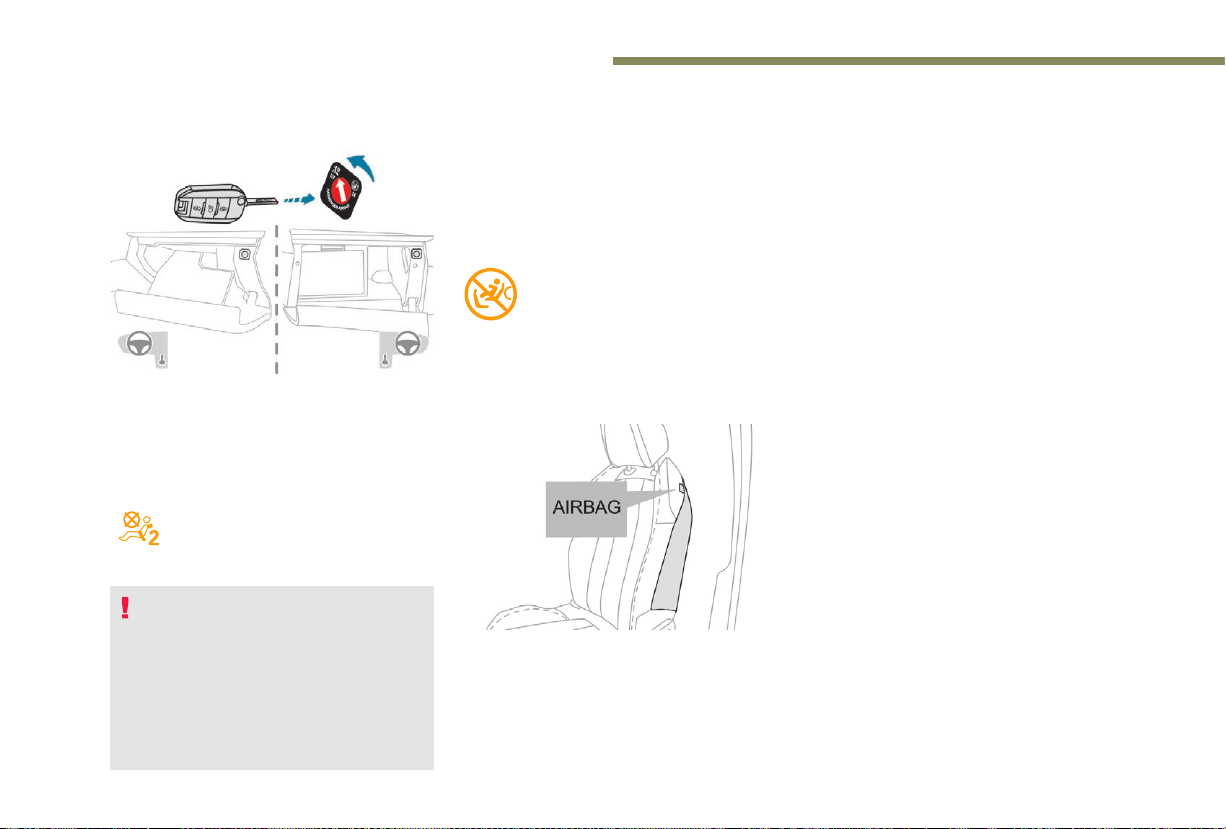
134
Safety
Deactivating the front passenger
airbag
F With the ignition off, insert the key in the
front passenger airbag deactivation switch.
F Turn it to the "OFF" position.
F Remove the key keeping the switch in the
new position.
When the ignition is switched on, this
warning lamp comes on in the seat
belt warning display screen. It stays
on while the airbag is deactivated.
To assure the safety of your child,
the front passenger airbag must
be deactivated when you install a
rearward facing child seat on the front
passenger seat.
Otherwise, the child risks being
seriously injured or killed if the airbag
is deployed.
Reactivating the front passenger
airbag
When you remove the child seat, with the
ignition off, turn the switch to the ON position
to reactivate the front airbag and so assure the
safety of your front passenger in the event of
an impact.
When the ignition is switched on,
this warning lamp comes on in the
seat belt warning display screen for
approximately one minute to signal
that the front airbag is activated.
Lateral airbags
Deployment
The lateral airbags are deployed on one side in
the event of a serious side impact applied to all
or part of the side impact zone, perpendicular
to the longitudinal centreline of the vehicle on a
horizontal plane and directed from the outside
towards the inside of the vehicle.
The lateral airbag inflates between the hip and
shoulder of the front occupant of the vehicle
and the corresponding door trim panel.
Curtain airbags
System contributing towards greater protection
for the driver and passengers (with the
exception of the rear centre passenger) in the
event of a serious side impact in order to limit
the risk of injury to the side of the head.
Each curtain airbag is built into the pillars and
the upper passenger compartment area.
Deployment
The curtain airbag is deployed at the same
time as the corresponding lateral airbag in the
event of a serious side impact applied to all or
part of the side impact zone B, perpendicular
to the longitudinal centreline of the vehicle on a
horizontal plane and directed from the outside
towards the inside of the vehicle.
The curtain airbag inflates between the front or
rear occupant of the vehicle and the windows.
System which protects the driver and front
passenger in the event of a serious side impact
in order to limit the risk of injury to the chest,
between the hip and the shoulder.
Each lateral airbag is fitted in the seat backrest
frame, door side.
135
5
Safety
Malfunction
If this warning lamp comes on in the
instrument panel, you must contact
a PEUGEOT dealer or a qualified
workshop to have the system
checked.
The airbags may no longer be deployed in the
event of a serious impact.
In the event of a minor impact or bump on
the side of the vehicle or if the vehicle rolls
over, the airbags may not be deployed.
In the event of a rear or front collision,
none of the lateral airbags are deployed.

136
Safety
Advice
For the airbags to be fully effective,
observe the safety recommendations
below.
Adopt a normal and upright sitting position.
Wear a correctly adjusted seat belt.
Do not leave anything between the occupants
and the airbags (a child, pet, object, etc.), nor
fix or attach anything close to or in the way of
the airbag release trajectory; this could cause
injuries during their deployment.
Never modify the original definition of your
vehicle, particularly in the area directly
around the airbags.
After an accident or if the vehicle has been
stolen, have the airbag systems checked.
All work on the airbag systems must be
perfomed by a PEUGEOT dealer or a
qualified workshop.
Even if all of the precautions mentioned
are observed, a risk of injury or of minor
burns to the head, chest or arms when an
airbag is deployed cannot be ruled out. The
bag inflates almost instantly (within a few
milliseconds) then deflates within the same
time discharging the hot gas via openings
provided for this purpose.
Front airbags
Do not drive holding the steering wheel by its
spokes or resting your hands on the centre
part of the wheel.
Passengers must not place their feet on the
dashboard.
Do not smoke as deployment of the airbags
can cause burns or the risk of injury from a
cigarette or pipe.
Never remove or pierce the steering wheel or
hit it violently.
Do not fit or attach anything to the steering
wheel or dashboard, this could cause injuries
in case of airbag deployment.
Do not attach anything to or hang anything
from the seat backrests (clothes, etc.) as
this could cause injuries to the thorax or arm
when the lateral airbag is deployed.
Do not sit with the upper part of the body any
nearer to the door than necessary.
The vehicle's front door panels include side
impact sensors.
A damaged door or any unauthorised or
incorrectly executed work (modification or
repair) on the front doors or their interior trim
could compromise the operation of these
sensors – risk of malfunction of the lateral
airbags!
Such work must only be done by a PEUGEOT
dealer or a qualified workshop.
Curtain airbags
Do not attach anything or hang anything to
the roof, as this could cause head injuries
when the curtain airbag is deployed.
If fitted to your vehicle, do not remove the
grab handles installed on the roof, they play a
part in securing the curtain airbags.
Lateral airbags
Use only approved covers on the seats,
compatible with the deployment of the lateral
airbags. For information on the range of seat
covers suitable for your vehicle, you can
contact a PEUGEOT dealer.
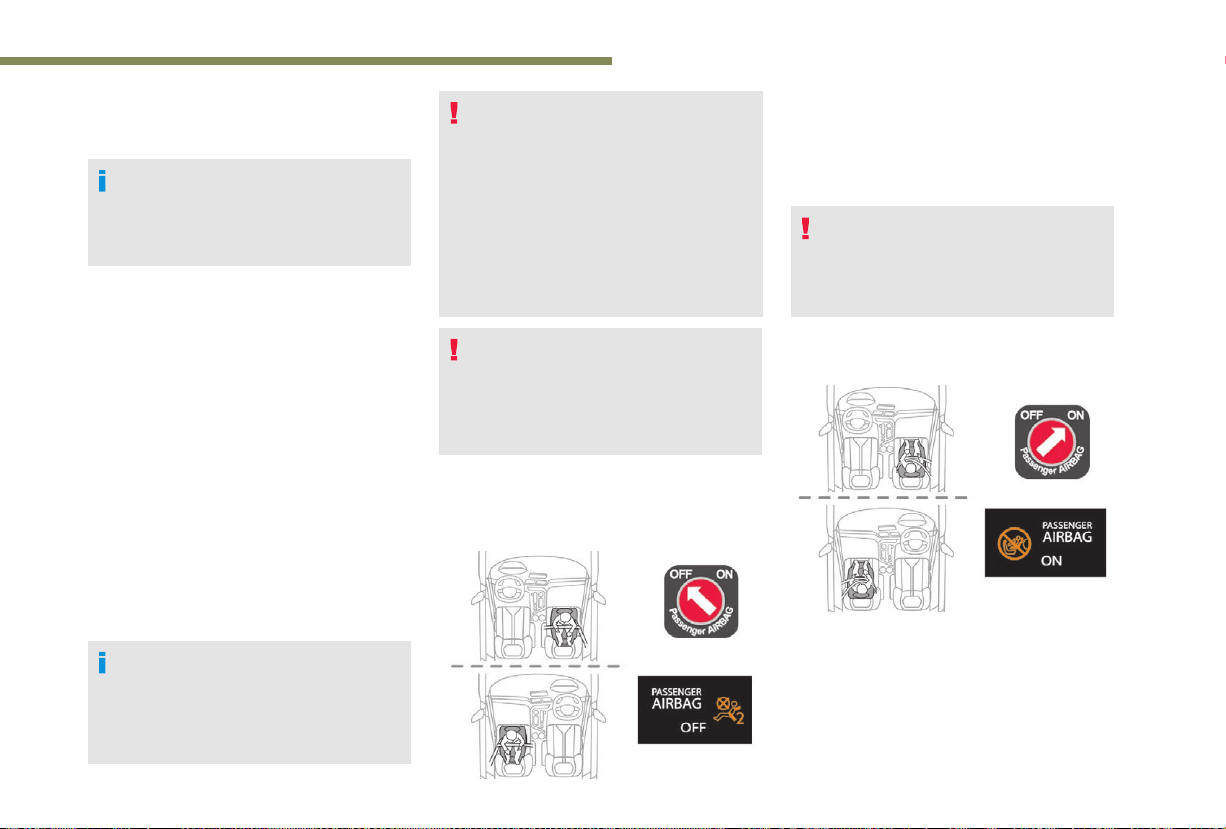
137
5
Safety
General points relating to
child seats
The regulations on carrying children are
specific to each country. Refer to the
legislation in force in your country.
For maximum safety, please observe the
following recommendations:
- In accordance with European regulations,
all children under the age of 12 or less
than one and a half metres tall must
travel in approved child seats suited to
their weight, on seats fitted with a seat belt
or ISOFIX mountings.
- Statistically, the safest seats in your
vehicle for carrying children are the rear
seats.
- A child weighing less than 9 kg must
travel in the rearward facing position
both in the front and in the rear.
It is recommended that children travel on
the rear seats of your vehicle:
- "rearward facing" up to the age of 3,
- "forward facing" over the age of 3.
Ensure that the seat belt is positioned and
tightened correctly.
For child seats with a support leg, ensure
that the latter is in firm and steady contact
with the floor.
In the front: if necessary, adjust the
passenger seat.
At the rear: if necessary, adjust the
relevant front seat.
Remove and stow the head restraint
before installing a child seat with backrest
on a passenger seat.
Refit the head restraint once the child seat
has been removed.
Child seat at the front
"Rearward facing"
When a "rearward facing" child seat is installed
on the front passenger seat, adjust the
vehicle seat to the fully back and highest
position, with the backrest straightened.
The front passenger airbag must be
deactivated. Otherwise, the child risks
being seriously injured or killed if the
airbag is deployed.
"Forward facing"
When a "forward facing" child seat is installed
on the front passenger seat, adjust the
vehicle seat to the fully back and highest
position, with the backrest straightened. Leave
the front passenger airbag active.
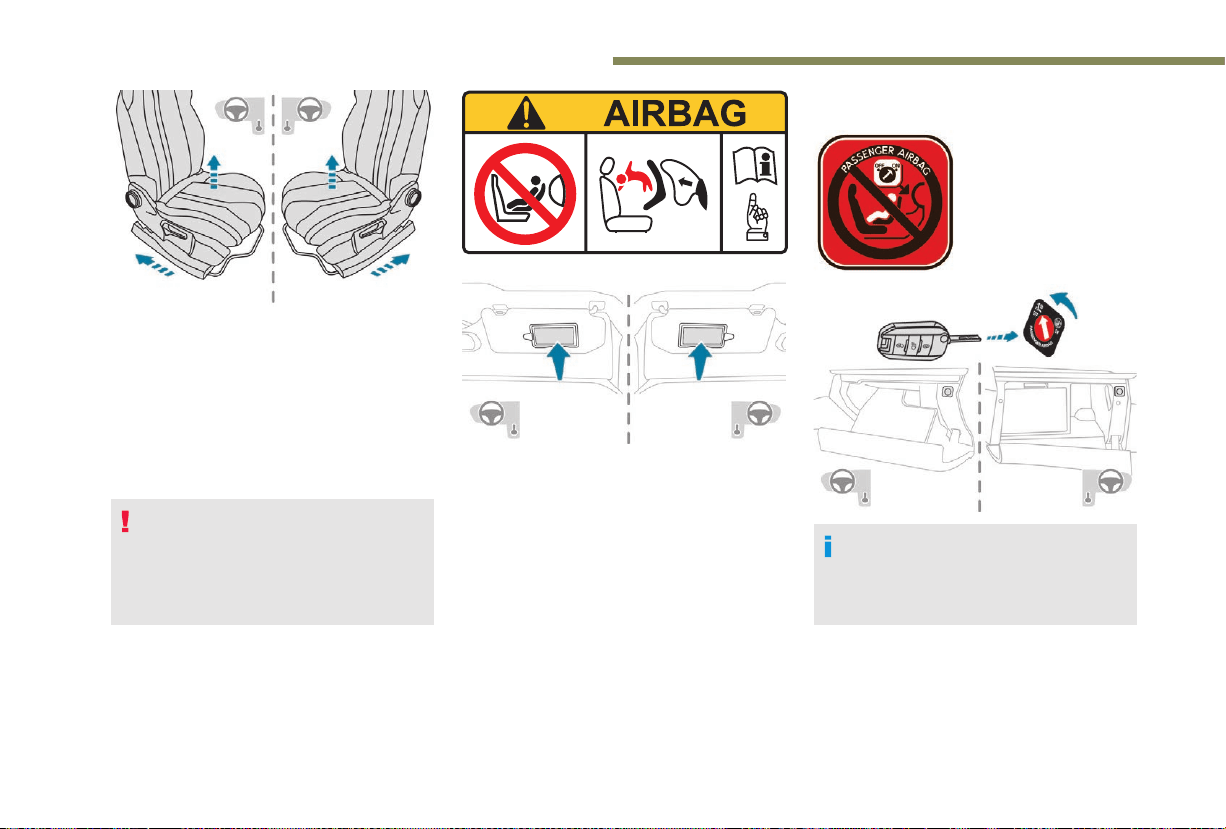
138
Safety
Passenger seat adjusted to the highest
position and in the maximum longitudinal
rear position.
Deactivating the front
passenger airbag
Never install a rearward facing child
restraint system on a seat protected by an
active front airbag. This could cause the
death of the child or serious injury.
The warning label present on both sides of the
passenger sun visor repeats this advice.
In line with current legislation, the following
tables contain this warning in all of the
languages required.
Passenger airbag OFF
For more information on Airbags
and particularly on deactivating the
front passenger airbag, refer to the
corresponding section.
139
5
Safety
AR
BG
НИКОГА НЕ инсталирайте детско столче на седалка с АКТИВИРАНА предна ВЪЗДУШНА ВЪЗГЛАВНИЦА. Това може да причини
СМЪРТ или СЕРИОЗНО НАРАНЯВАНЕ на детето.
CS
NIKDY neumisťujte dětské zádržné zařízení orientované směrem dozadu na sedadlo chráněné AKTIVOVANÝM čelním AIRBAGEM. Hrozí
nebezpečí SMRTI DÍTĚTE nebo VÁŽNÉHO ZRANĚNÍ.
DA
Brug ALDRIG en bagudvendt barnestol på et sæde, der er beskyttet af en AKTIV AIRBAG. BARNET risikerer at blive ALVORLIGT KVÆSTET
eller DRÆBT.
DE
Montieren Sie auf einem Sitz mit AKTIVIERTEM Front-Airbag NIEMALS einen Kindersitz oder eine Babyschale entgegen der Fahrtrichtung,
das Kind könnte schwere oder sogar tödliche Verletzungen erleiden.
EL
Μη χρησιμοποιείτε ΠΟΤΕ παιδικό κάθισμα με την πλάτη του προς το εμπρός μέρος του αυτοκινήτου, σε μια θέση που προστατεύεται από
ΜΕΤΩΠΙΚΟ αερόσακο που είναι ΕΝΕΡΓΟΣ. Αυτό μπορεί να έχει σαν συνέπεια το ΘΑΝΑΤΟ ή το ΣΟΒΑΡΟ ΤΡΑΥΜΑΤΙΣΜΟ του ΠΑΙΔΙΟΥ
EN
NEVER use a rearward facing child restraint on a seat protected by an ACTIVE AIRBAG in front of it, DEATH or SERIOUS INJURY to the
CHILD can occur
ES
NO INSTALAR NUNCA un sistema de retención para niños de espaldas al sentido de la marcha en un asiento protegido mediante un AIRBAG
frontal ACTIVADO, ya que podría causar lesiones GRAVES o incluso la MUERTE del niño.
ET
Ärge MITTE KUNAGI paigaldage "seljaga sõidusuunas" lapseistet juhi kõrvalistmele, mille ESITURVAPADI on AKTIVEERITUD. Turvapadja
avanemine võib last TÕSISELT või ELUOHTLIKULT vigastada.
FI
ÄLÄ KOSKAAN aseta lapsen turvaistuinta selkä ajosuuntaan istuimelle, jonka edessä suojana on käyttöön aktivoitu TURVATYYNY. Sen
laukeaminen voi aiheuttaa LAPSEN KUOLEMAN tai VAKAVAN LOUKKAANTUMISEN.
FR
NE JAMAIS installer de système de retenue pour enfants faisant face vers l'arrière sur un siège protégé par un COUSSIN GONFLABLE
frontal ACTIVÉ. Cela peut provoquer la MORT de l'ENFANT ou le BLESSER GRAVEMENT.
HR
NIKADA ne postavljati dječju sjedalicu leđima u smjeru vožnje na sjedalo zaštićeno UKLJUČENIM prednjim ZRAČNIM JASTUKOM. To bi
moglo uzrokovati SMRT ili TEŠKU OZLJEDU djeteta.
HU
SOHA ne használjon menetiránynak háttal beszerelt gyermekülést AKTIVÁLT (BEKAPCSOLT) FRONTLÉGZSÁKKAL védett ülésen. Ez a
gyermek HALÁLÁT vagy SÚLYOS SÉRÜLÉSÉT okozhatja.
IT
NON installare MAI seggiolini per bambini posizionati in senso contrario a quello di marcia su un sedile protetto da un AIRBAG frontale
ATTIVATO. Ciò potrebbe provocare la MORTE o FERITE GRAVI al bambino.

140
Safety
LT
NIEKADA neįrenkite vaiko prilaikymo priemonės su atgal atgręžtu vaiku ant sėdynės, kuri saugoma VEIKIANČIOS priekinės ORO
PAGALVĖS. Išsiskleidus oro pagalvei vaikas gali būti MIRTINAI arba SUNKIAI TRAUMUOTAS.
LV
NEKAD NEuzstādiet uz aizmuguri vērstu bērnu sēdeklīti priekšējā pasažiera sēdvietā, kurā ir AKTIVIZĒTS priekšējais DROŠĪBAS GAISA
SPILVENS. Tas var izraisīt BĒRNA NĀVI vai radīt NOPIETNUS IEVAINOJUMUS.
MT Qatt m'ghandek thalli tifel/tifla marbut f'siggu dahru lejn l-Airbag attiva, ghaliex tista' tikkawza korriment serju jew anke mewt lit-tifel/tifla
NL
Plaats NOOIT een kinderzitje met de rug in de rijrichting op een zitplaats waarvan de AIRBAG is INGESCHAKELD. Bij het afgaan van de
airbag kan het KIND LEVENSGEVAARLIJK GEWOND RAKEN
NO
Installer ALDRI et barnesete med ryggen mot kjøreretningen i et sete som er beskyttet med en frontal AKTIVERT KOLLISJONSPUTE,
BARNET risikerer å bli DREPT eller HARDT SKADET.
PL
NIGDY nie instalować fotelika dziecięcego w pozycji "tyłem do kierunku jazdy" na siedzeniu wyposażonym w CZOŁOWĄ PODUSZKĘ
POWIETRZNĄ w stanie AKTYWNYM. Może to doprowadzić do ŚMIERCI DZIECKA lub spowodować u niego POWAŻNE OBRAŻENIA
CIAŁA.
PT
NUNCA instale um sistema de retenção para crianças de costas para a estrada num banco protegido por um AIRBAG frontal ACTIVADO.
Esta instalação poderá provocar FERIMENTOS GRAVES ou a MORTE da CRIANÇA.
RO
Nu instalati NICIODATA un sistem de retinere pentru copii, dispus cu spatele in directia de mers, pe un loc din vehicul protejat cu AIRBAG
frontal ACTIVAT. Aceasta ar putea provoca MOARTEA COPILULUI sau RANIREA lui GRAVA.
RU
ВО ВСЕХ СЛУЧАЯХ ЗАПРЕЩАЕТСЯ использовать обращенное назад детское удерживающее устройство на сиденье, защищенном
ФУНКЦИОНИРУЮЩЕЙ ПОДУШКОЙ БЕЗОПАСНОСТИ, установленной перед этим сиденьем. Это может привести к ГИБЕЛИ
РЕБЕНКА или НАНЕСЕНИЮ ЕМУ СЕРЬЕЗНЫХ ТЕЛЕСНЫХ ПОВРЕЖДЕНИЙ
SK
NIKDY neinštalujte detské zádržné zariadenie orientované smerom dozadu na sedadlo chránené AKTIVOVANÝM čelným AIRBAGOM. Mohlo
by dôjsť k SMRTEĽNÉMU alebo VÁŽNEMU PORANENIU DIEŤAŤA.
SL
NIKOLI ne nameščajte otroškega sedeža s hrbtom v smeri vožnje, če je VARNOSTNA BLAZINA pred sprednjim sopotnikovim sedežem
AKTIVIRANA. Takšna namestitev lahko povzroči SMRT OTROKA ali HUDE POŠKODBE.
SR
NIKADA ne koristite dečje sedište koje se okreće unazad na sedištu zaštićenim AKTIVNIM VAZDUŠNIM JASTUKOM ispred njega, jer mogu
nastupiti SMRT ili OZBILJNA POVREDA DETETA.
SV
Passagerarkrockkudden fram MÅSTE vara avaktiverad om en bakåtvänd bilbarnstol installeras på denna plats. Annars riskerar barnet att
DÖDAS eller SKADAS ALLVARLIGT.
TR
KESİNLKLE HAVA YASTIĞI AKTİF olan ön koltuğa yüzü arkaya dönük bir çocuk koltuğu yerleştirmeyiniz. Bu ÇOCUĞUN ÖLMESİNE veya
ÇOK AĞIR YARALANMASINA sebep olabilir.
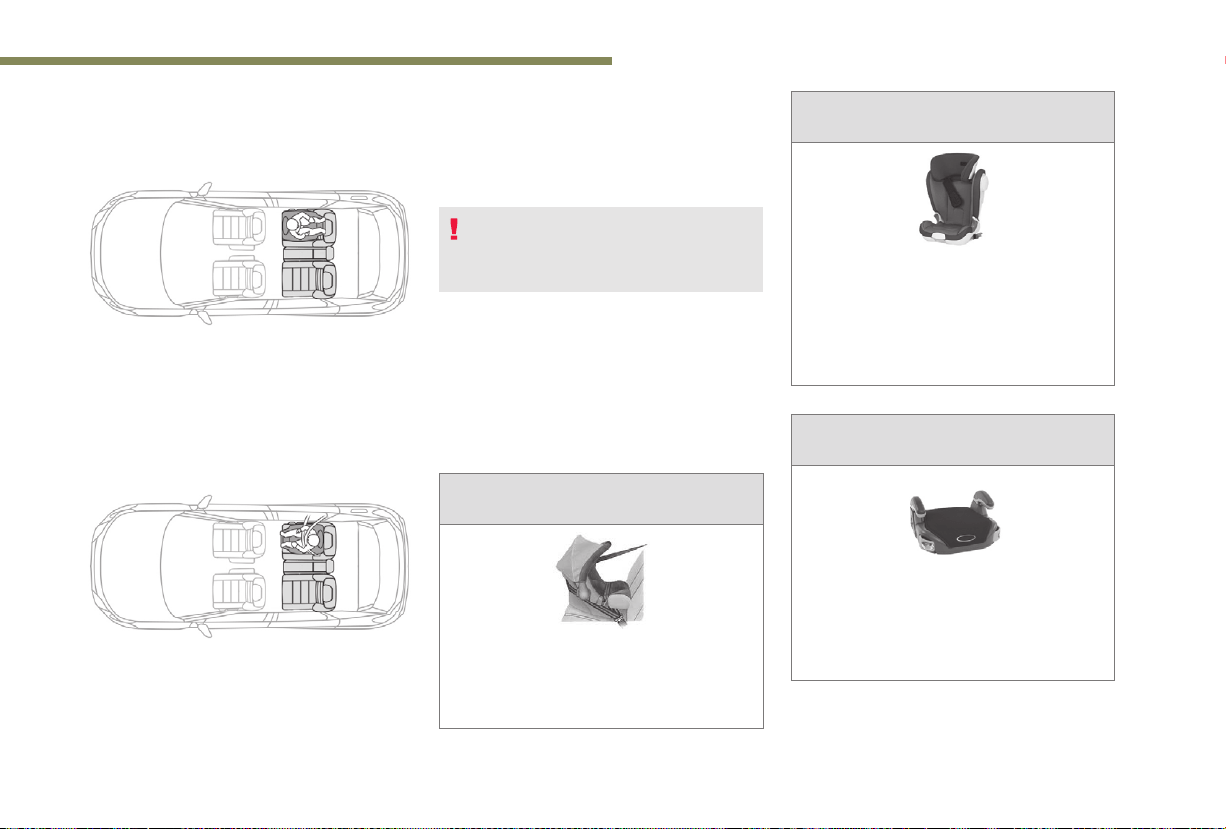
141
5
Safety
Child seat at the rear
"Rearward facing"
"Forward facing"
When a "forward facing" child seat is installed
on a rear passenger seat, move the vehicle's
front seat forward and straighten the backrest
so that the legs of the child in the "forward
facing" child seat do not touch the vehicle's
front seat.
Centre rear seat
A child seat with a support leg must never be
installed on the centre rear passenger seat.
The incorrect installation of a child seat in
a vehicle compromises the protection of
the child in the event of an accident.
When a "rearward facing" child seat is installed
on a rear passenger seat, move the vehicle's
front seat forward and straighten the backrest
so that the rearward facing child seat does not
touch the vehicle's front seat.
Recommended child
seats
Range of recommended child seats which are
secured using a three-point seat belt.
Group 0+: from birth to 13 kg
L1
"RÖMER Baby-Safe Plus"
Installed in the rearward facing position.
Groups 2 and 3: from 15 to 36 kg
L5
"RÖMER KIDFIX"
Can be fitted to the vehicle's ISOFIX
mountings.
The child is restrained by the seat belt.
Groups 2 and 3: from 15 to 36 kg
L6
"GRACO Booster"
The child is restrained by the seat belt.
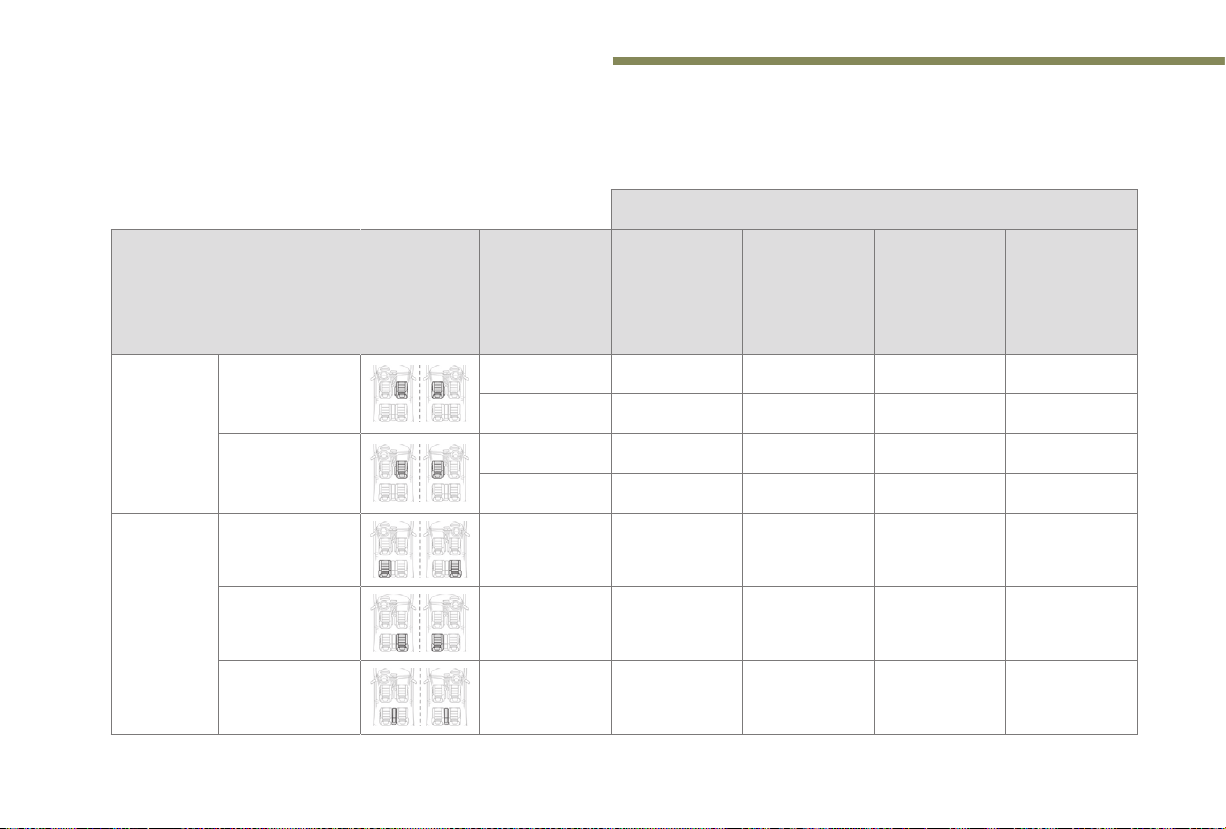
142
Safety
Locations for child seats secured using the seat belt
In accordance with European regulations, this table indicates the options for installing child seats secured using the seat belt and universally approved
(a) in relation to the weight of the child and the seat in the vehicle.
Weight of the child/indicative age
Seat position
Front passenger
airbag
Under 13 kg
(groups 0 (b)
and 0+)
Up to about
1 year
From 9 to 18 kg
(group 1)
From about 1 to
3 years
From 15 to 25 kg
(group 2)
From about 3 to
6 years
From 22 to 36 kg
(group 3)
From about 6 to
10 years
Row 1 (c)
Passenger seat
with height
adjustment*
Deactivated "OFF"
U U U U
Activated "ON" X UF UF UF
Passenger seat
without height
adjustment**
Deactivated "OFF"
U U U U
Activated "ON" X UF UF UF
Row 2 (d)
Seat behind the
driver's seat
U U U U
Seat behind the
passenger's seat
U U U U
Centre rear
seat (e)
U U U U
* Max. height position. ** Backrest straightened.
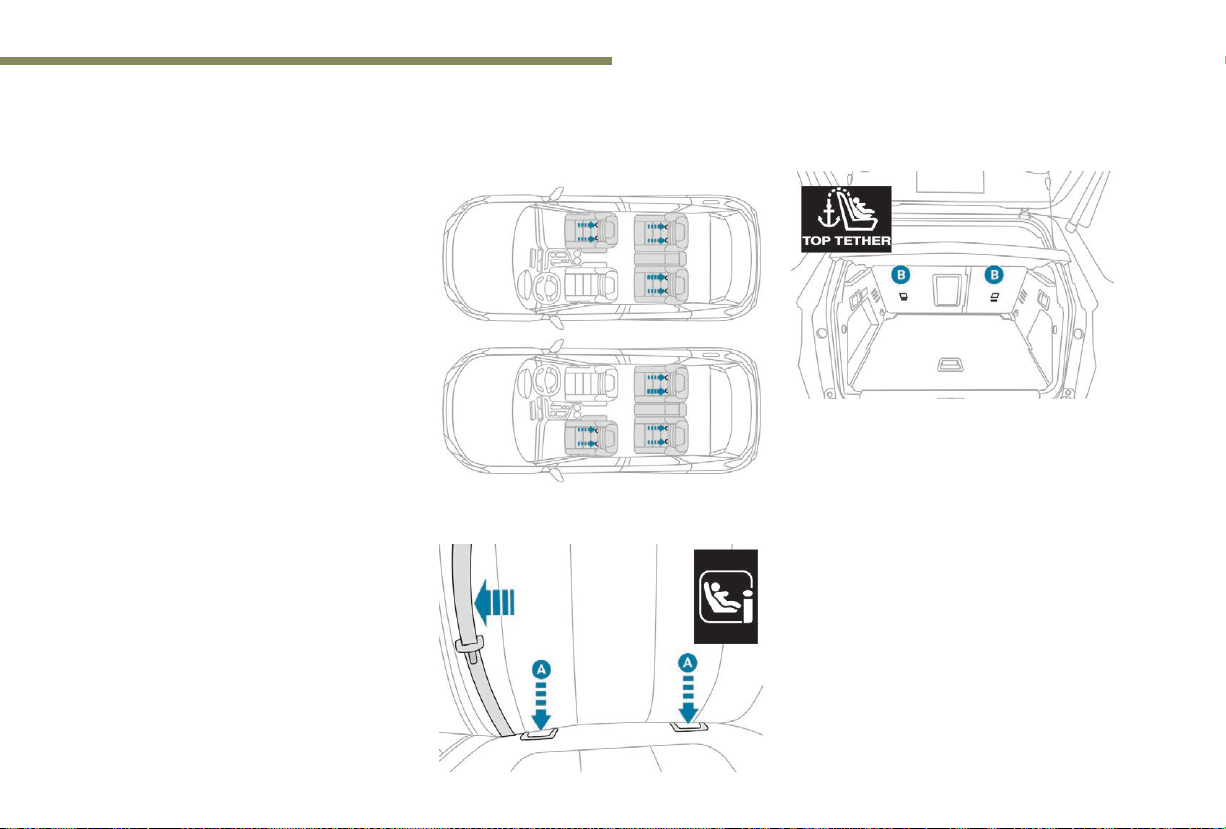
143
5
Safety
U: seat suitable for installing a child
seat secured using the seat belt and
universally approved for "rearward
facing" and/or "forward facing" use.
UF: seat suitable for installing a child
seat secured using the seat belt and
universally approved for "forward
facing" use.
X: seat not suitable for installing a child
seat of the weight group indicated.
(a) Universal child seat: child seat that can
be installed in all vehicles using the
seat belt.
(b) Group 0: from birth to 10 kg. Infant car
seats and "car cots" cannot be installed
on the front passenger seat.
(c) Refer to the current legislation in your
country before installing your child in
this seat.
(d) When installing a child seat on a rear
seat in a "rearward facing" or "forward
facing" position, move the front seat
forward then adjust the backrest to an
upright position to allow enough room
for the child seat and the child's legs.
(e) A child seat with a support leg must
never be installed on this seat.
'ISOFIX' mountings
The seats, shown below, are fitted with ISOFIX
compliant mountings:
There are three rings for each seat:
- two rings A, located between the vehicle's
seat backrest and cushion, indicated by a
marking,
This arrangement reduces forward tipping of
the child seat in the event of a front impact.
The ISOFIX mounting system ensures fast,
reliable and safe fitting of the child seat in your
vehicle.
ISOFIX child seats are fitted with two latches
which are secured on the two rings A.
Some seats also have an upper strap which is
attached to ring B.
- a ring B, behind the seat and identified by
a marking, referred to as the TOP TETHER
for fixing the upper strap.
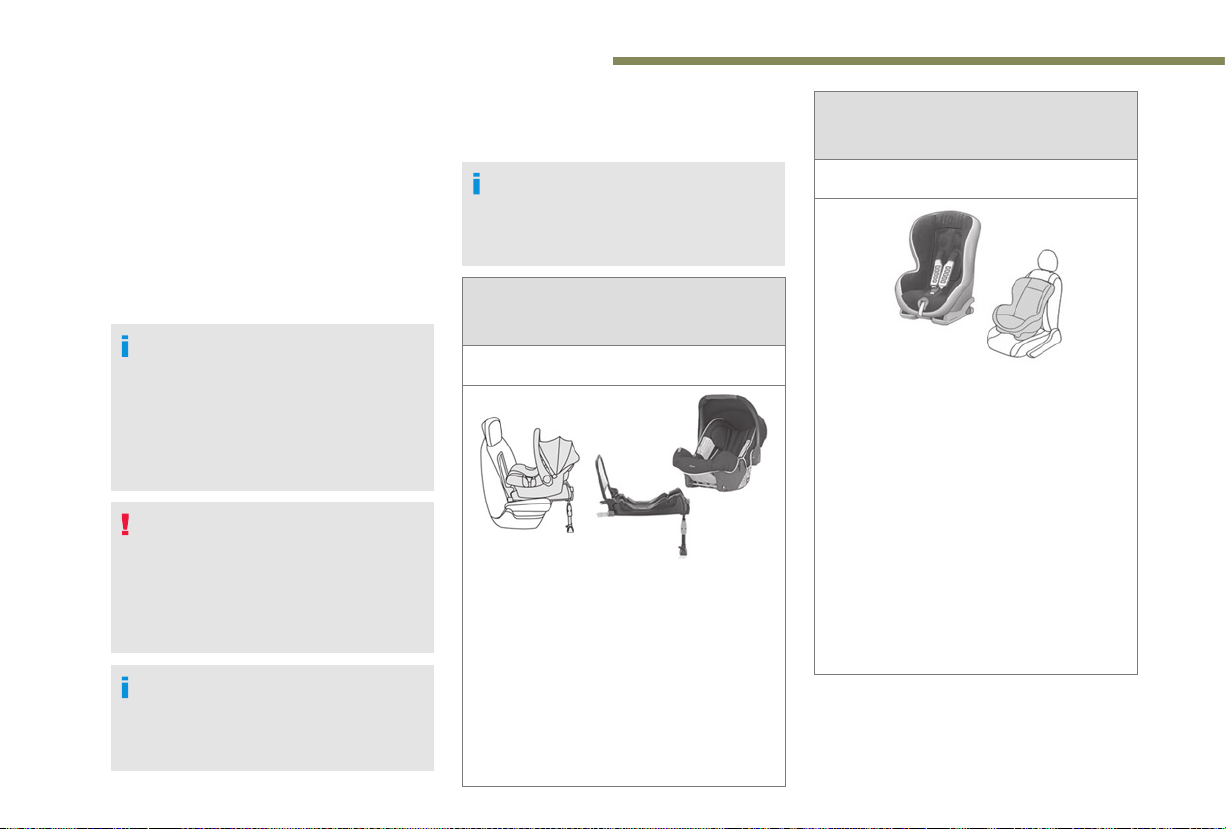
144
Safety
To secure the child seat to the TOP TETHER:
F remove and stow the head restraint before
installing the child seat on the seat (refit it
once the child seat has been removed),
F pass the upper strap of the child seat behind
the seat backrest, between the apertures
for the head restraint rods,
F fix the hook of the upper strap to ring B,
F tighten the upper strap.
When fitting an ISOFIX child seat to
the left-hand rear seat of the bench
seat, before fitting the seat, first move
the centre rear seat belt towards the
middle of the vehicle, so as to avoid
the seat interfering with the operation
of the seat belt.
The incorrect installation of a child seat
in a vehicle compromises the child's
protection in the event of an accident.
Strictly observe the fitting instructions
provided with the child seat.
For information on the possibilities for
installing ISOFIX child seats in your
vehicle, refer to the summary table.
Recommended ISOFIX
child seats
Also consult the installation notes from the
child seat's manufacturer to find out how
to install and remove the seat.
"RÖMER Baby-Safe Plus and its ISOFIX
base"
(size category: E)
Group 0+: from birth to 13 kg
Installed rearward facing using an ISOFIX
base which is attached to rings A.
The base has a support leg, height-
adjustable, which rests on the vehicle's floor.
This child seat can also be secured with a
seat belt. In this case, only the shell is used
and attached to the vehicle seat using the
three-point seat belt.
"RÖMER Duo Plus ISOFIX"
(size category: B1)
Group 1: from 9 to 18 kg
Installed only in the forward facing position.
Is attached to rings A and ring B, referred to
as TOP TETHER, using an upper strap.
Three seat body angles: sitting, reclining,
lying down.
This child seat can also be used on seats
not equipped with ISOFIX mountings. In
this case, it must be secured to the vehicle's
seat by the three-point seat belt. Adjust the
position of the vehicle's front seat so that the
child's feet are not touching the backrest.
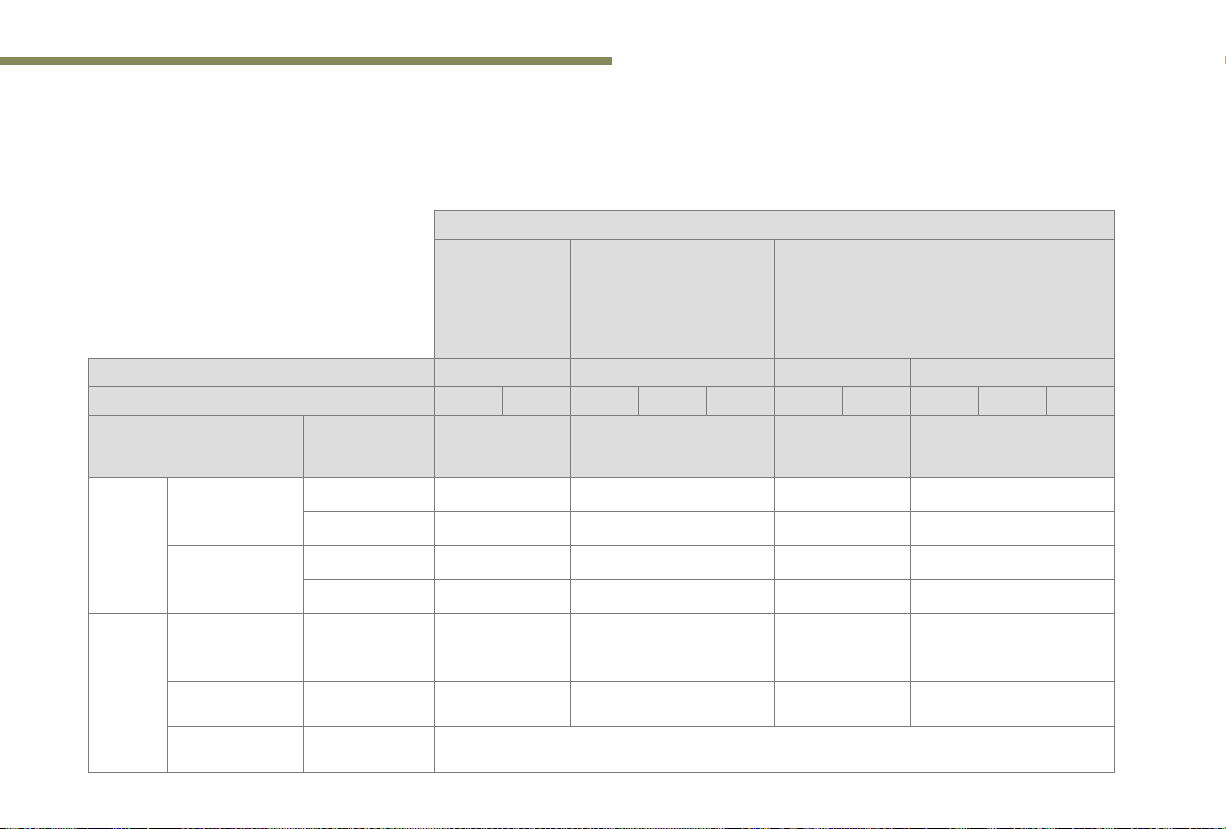
145
5
Safety
Summary table of locations for ISOFIX child seats
In line with European regulations, this table indicates the options for installing ISOFIX child seats on the vehicle seats fitted with ISOFIX mountings.
In the case of universal and semi-universal ISOFIX child seats, the ISOFIX size category, determined by a letter from A to G, is indicated on the child
seat next to the i-Size logo.
Weight of the child/indicative age
Under 10 kg
(group 0)
Up to about
6 months
Under 10 kg
Under 13 kg
(group 0)
(group 0+)
Up to about 1 year
From 9 to 18 kg
(group 1)
From about 1 to 3 years
Type of ISOFIX child seat Cot "Rearward facing"
"Rearward facing"
"Forward facing"
ISOFIX size category F G C D E C D A B B1
Seat
Front passenger
airbag
Row 1
(a)
Passenger seat
with height
adjustment
Deactivated "OFF"
X IL IL IUF / IL
Activated "ON" X X X IUF / IL
Passenger seat
without height
adjustment
Deactivated "OFF"
X IL IL IUF / IL
Activated "ON" X X X IUF / IL
Row 2
Seat behind the
driver's seat
IL (b) IL IL IUF / IL
Seat behind the
passenger seat
IL (b) IL IL IUF / IL
Centre rear seat Not ISOFIX

146
Safety
Locations for i-Size child
seats
i-Size child seats have two latches that engage
on the two rings A.
i-Size child seats also have:
- either an upper strap that is attached to
ring B,
- or a support leg resting on the vehicle floor,
compatible with the approved i-Size seat,
the role of which is to prevent the child seat
from tipping forward in the event of a collision.
For more information on ISOFIX mountings,
refer to the associated section.
IUF: seat suitable for installing an Isofix
Universal seat, "Forward facing",
secured using the upper strap.
IL: seat suitable for installing an Isofix
Semi-Universal seat which is either:
- "rearward facing" fitted with an
upper strap or a support leg,
- "forward facing" fitted with a
support leg,
- a cot fitted with an upper strap or
a support leg.
(a) Refer to the current legislation in your
country before installing a child at this
seating position.
(b) The installation of a cot on this seat
may prevent the use of one or more of
the other seats in this row.
For securing the upper strap using the ISOFIX
mountings, refer to the corresponding section.
X: seat is not suitable for the installation
of an ISOFIX seat or cot of the weight
group indicated.
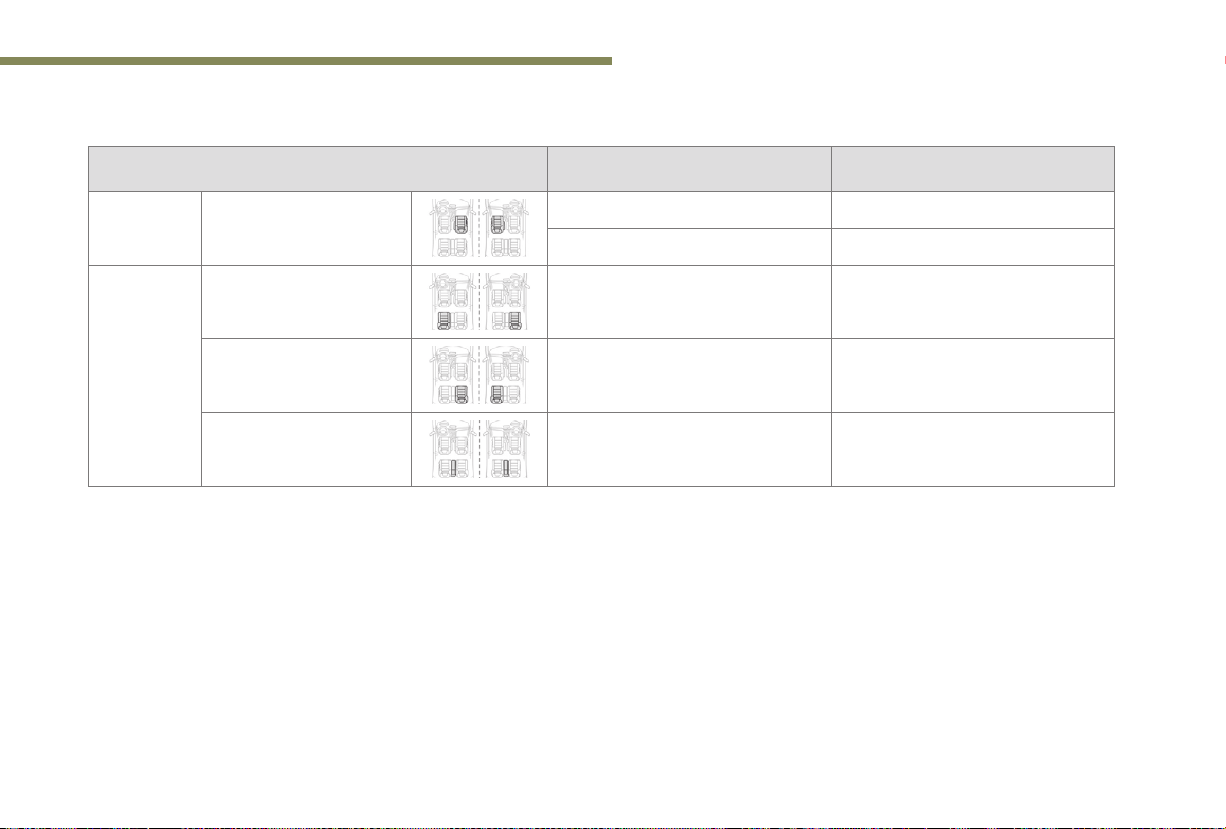
147
5
Safety
Seat Front passenger airbag i-Size restraint system
Row 1 (a) Passenger seat
Deactivated "OFF" i-U
Activated "ON" i-UF
Row 2
Seat behind the driver's seat i-U
Seat behind the passenger
seat
i-U
Centre rear seat Not i-Size
In accordance with the new European regulations, this table indicates the options for installing i-Size child seats on seats in the vehicle fitted with
ISOFIX mountings approved for i-Size.
i-U: suitable for i-Size restraint systems in
the "Universal" category, forward facing
and rearward facing.
i-UF: only suitable for i-Size restraint systems
in the "Universal" category, forward
facing.
X: seat is not suitable for i-Size restraint
systems in the "Universal" category.
(a) Refer to the current legislation in your
country before installing a child at this
seating position.

148
Safety
Advice
The incorrect installation of a child seat in a
vehicle compromises the child's protection
in the event of an accident.
Ensure that there is no seat belt or seat
belt buckle under the child seat, as this
could destabilise it.
Remember to fasten the seat belts or the
child seat harnesses keeping the slack
relative to the child's body to a minimum,
even for short journeys.
When installing a child seat using the seat
belt, ensure that the seat belt is tightened
correctly on the child seat and that it
secures the child seat firmly on the seat
of your vehicle. If your passenger seat is
adjustable, move it forwards if necessary.
At rear seating positions, always leave
sufficient space between the front seat
and:
- a rearward facing child seat,
- the child's feet for a child seat fitted
forward facing.
To do this, move the front seat forwards
and, if necessary, move its backrest into
the upright position.
For optimal installation of the forward
facing child seat, verify that its backrest is
as close as possible to the backrest of the
vehicle seat, if possible in contact with it.
The head restraint must be removed before
installing a child seat with a backrest on a
passenger seat.
Ensure that the head restraint is stored or
attached securely to prevent it from being
thrown around the vehicle in the event of
sharp braking. Refit the head restraint when
the child seat is removed.
Children in front
The legislation on carrying children on the
front passenger seat is specific to each
country. Refer to the legislation in force in
your country.
Deactivate the front passenger airbag when
a rearward facing child seat is installed on
the front passenger seat.
Otherwise, the child would risk being seriously
injured or killed if the airbag were deployed.
Installing a booster seat
The chest part of the seat belt must be
positioned on the child's shoulder without
touching the neck.
Ensure that the lap part of the seat belt
passes correctly over the child's thighs.
PEUGEOT recommends using a booster seat
with a backrest equipped with a belt guide at
shoulder level.
As a safety precaution, do not leave:
- a child or children alone and unattended in
a vehicle,
- a child or an animal in a vehicle which
is exposed to the sun, with the windows
closed,
- the keys within reach of children inside the
vehicle.
To prevent accidental opening of the doors
and rear windows, use the child lock.
Take care not to open the rear windows by
more than one third.
To protect young children from the rays of the
sun, fit side blinds on the rear windows.
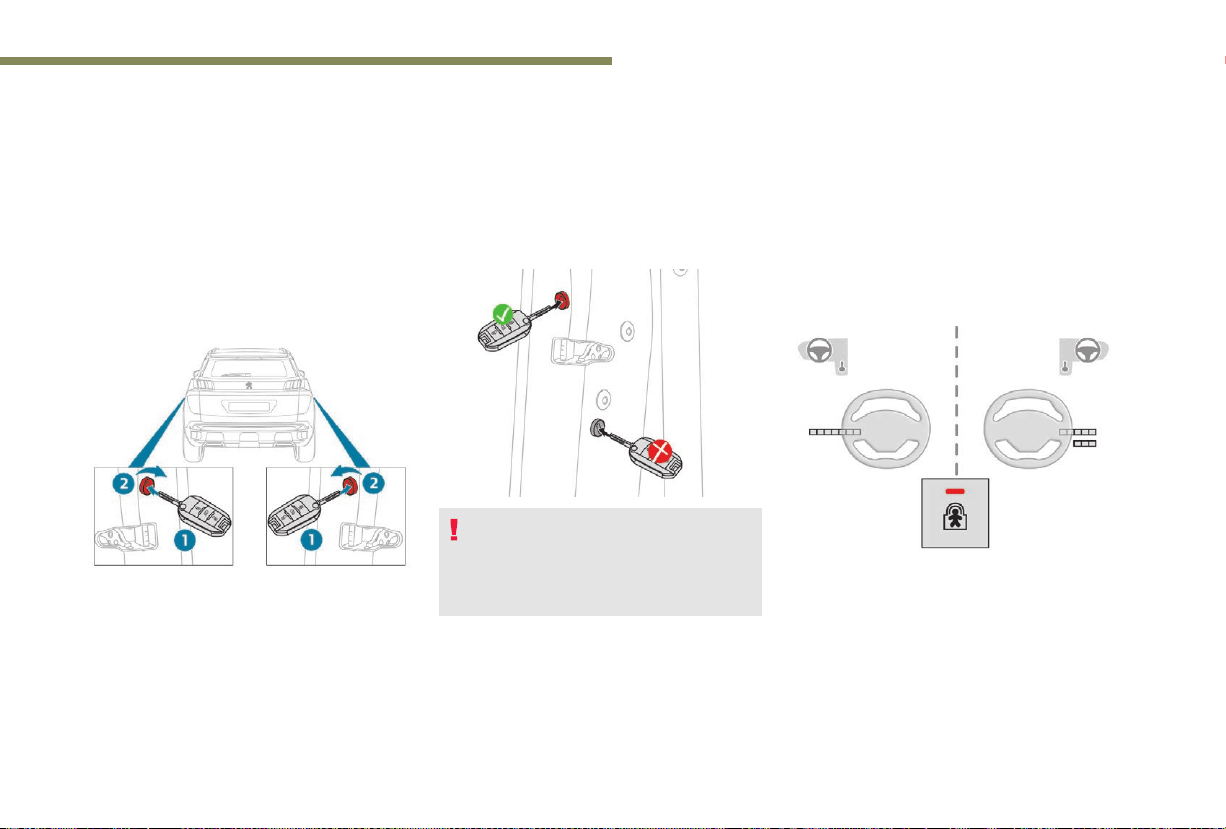
149
5
Safety
Manual child lock
Mechanical system to prevent opening of a rear
door using its interior control.
The control, red in colour, is located on the
edge of each rear door.
It is identified by a symbol marked on the
bodywork.
Locking
Unlocking
F Using the ignition key or the integral key,
depending on version, turn the red control
as far as it will go:
- to the left on the left-hand rear door,
- to the right on the right-hand rear door.
F Using the ignition key or the integral key,
depending on version, turn the red control
as far as it will go:
- to the right on the left-hand rear door,
- to the left on the right-hand rear door.
Do not confuse the child lock control,
which is red, with the back-up locking
control, which is black.
Electric child lock
Remote control system to prevent opening of
the rear doors using their interior controls.
The control is located on the dashboard,
driver's side.
Activation
F Press this button.
The red indicator lamp in the button comes on,
accompanied by the display of an activation
message.
This red indicator lamp remains on for as long
as the child lock is activated.

150
Safety
Deactivation
F Press this button again.
The indicator lamp in the button goes off,
accompanied by the display of a deactivation
message.
This indicator lamp remains off while the child
lock is deactivated.
This system is independent and in no
circumstances does it take the place of
the central locking control.
Check the status of the child lock each
time you switch on the ignition.
Always remove the key from the ignition
when leaving the vehicle, even for a short
time.
In the event of a serious impact, the
electric child lock is switched off
automatically to permit the exit of the rear
passengers.
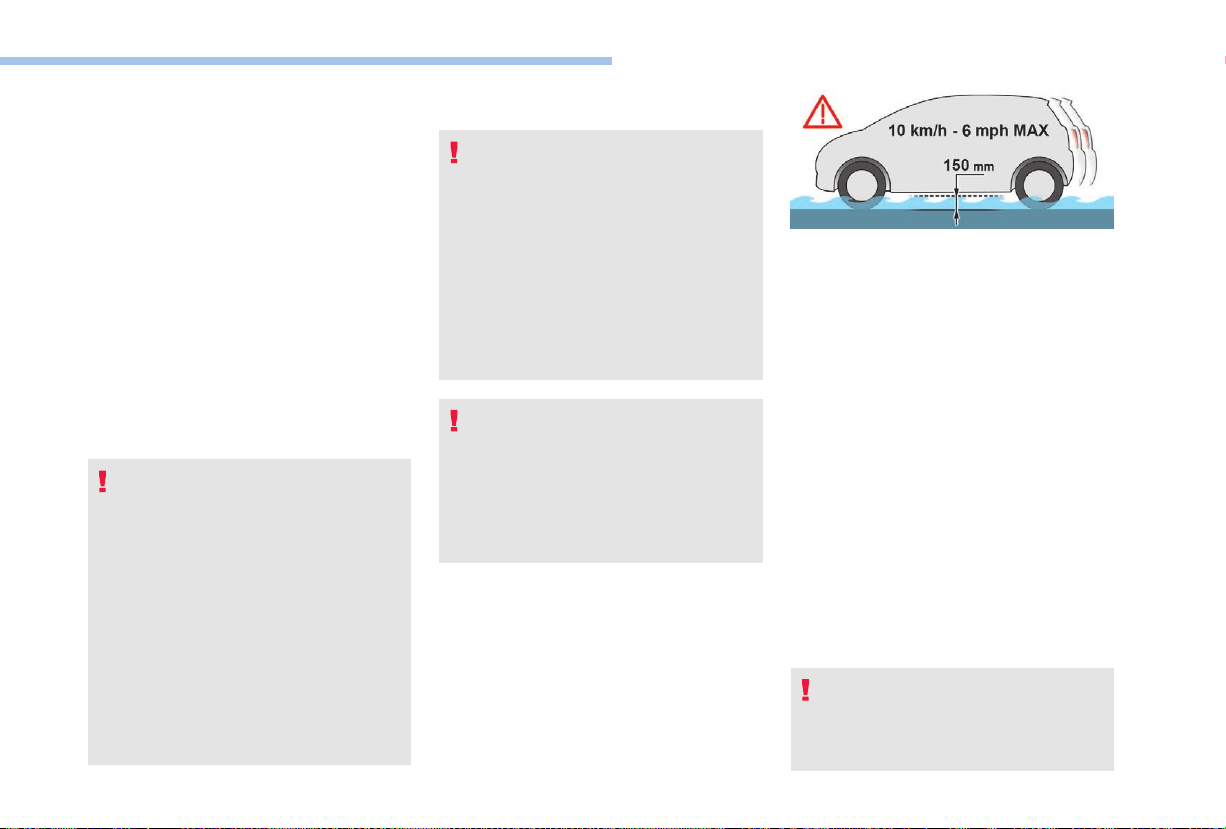
151
6
Driving
Driving recommendations
Observe the driving regulations and remain
vigilant whatever the traffic conditions.
Pay close attention to the traffic and keep your
hands on the wheel so that you are ready to
react at any time to any eventuality.
As a safety measure, the driver should only
carry out any operations that require close
attention when the vehicle is stationary.
On a long journey, a break every two hours is
strongly recommended.
In difficult weather, drive smoothly, anticipate
the need to brake and increase the distance
from other vehicles.
Never leave the engine running in
an enclosed area without adequate
ventilation: internal combustion engines
emit toxic exhaust gases, such as carbon
monoxide. There is a risk of poisoning and
death!
In very severe wintry conditions
(temperatures below -23°C), to guarantee
correct operation and the longevity of
the mechanical elements of your vehicle,
engine and gearbox, the engine must be
left running for 4 minutes before driving.
Important!
Never drive with the parking brake
applied – Risk of overheating and damage
to the braking system!
As the exhaust system of your vehicle
is very hot, even several minutes after
switching off the engine, never park or run
the engine on inflammable surfaces (dry
grass, fallen leaves, etc.): Risk of fire!
Never leave a vehicle unsupervised with
the engine running. If you have to leave
your vehicle with the engine running, apply
the parking brake and put the gearbox into
neutral or position N or P, depending on
the type of gearbox.
Driving on flooded roads
We strongly advise against driving on flooded
roads, as this could cause serious damage
to the engine or gearbox, as well as to the
electrical systems of your vehicle.
If you are obliged to drive through water:
- check that the depth of water does not
exceed 15 cm, taking account of waves that
might be generated by other users,
- deactivate the Stop & Start function,
- drive as slowly as possible without stalling.
Under no circumstances exceed 6 mph
(10 km/h),
- do not stop and do not switch off the engine.
On leaving the flooded road, as soon as
circumstances allow, make several light brake
applications to dry the brake discs and pads.
If in doubt about the state of your vehicle,
contact a PEUGEOT dealer or a qualified
workshop.
In case of towing
Driving with a trailer places greater
demands on the towing vehicle and
requires extra care from the driver.
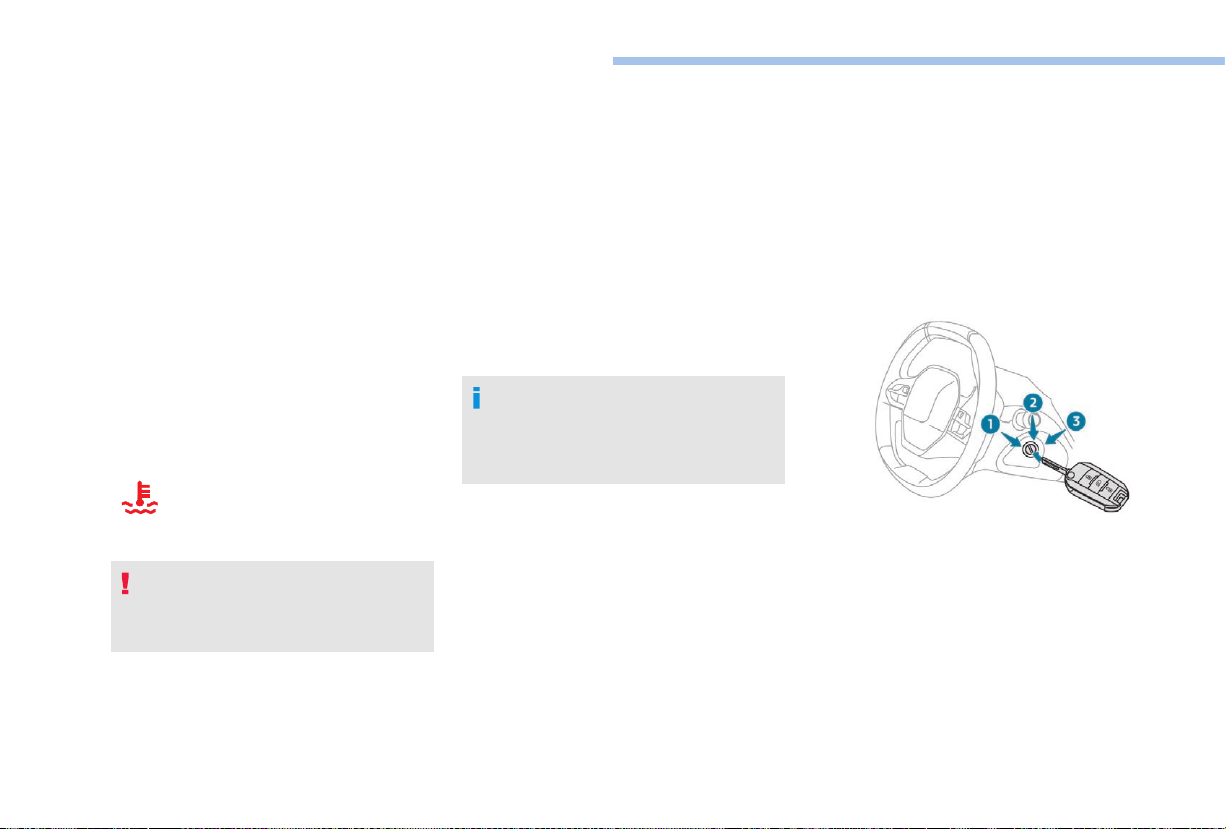
152
Driving
Side wind
F Take into account the increased sensitivity
to wind.
Cooling
Towing a trailer on a slope increases the
temperature of the coolant.
As the fan is electrically controlled, its cooling
capacity is not dependent on the engine speed.
F To lower the engine speed, reduce your
speed.
The maximum towable load on an incline
depends on the gradient and the exterior
temperature.
In all cases, keep a check on the coolant
temperature.
F If this warning lamp and the
STOP warning lamp come on,
stop the vehicle and switch off
the engine as soon as possible.
New vehicle
Do not pull a trailer before having
driven at least approximately 600 miles
(1,000 kilometres).
Braking
Towing a trailer increases the braking distance.
To avoid overheating of the brakes, the use of
engine braking is recommended.
Tyres
F Check the tyre pressures of the towing
vehicle and of the trailer, observing the
recommended pressures.
Lighting
F Check the electrical lighting and signalling
on the trailer and the headlamp beam height
of your vehicle.
For more information on Headlamp
adjustment, refer to the corresponding section.
The rear parking sensors will be
deactivated automatically to avoid the
audible signal if a genuine PEUGEOT
towbar is used.
Anti-theft protection
Electronic immobiliser
The keys contain an electronic chip which has
a secret code. When the ignition is switched
on, this code must be recognised in order for
starting to be possible.
A few seconds after switching off the ignition,
this system locks the engine control system,
therefore preventing the engine from being
started in the event of a break-in.
Starting / Switching off
the engine with the key
Key ignition switch
Ignition on position
If the system fails, as reported by a message,
the engine will not start.
Contact a PEUGEOT dealer.
It has 3 positions:
- Position 1 (Stop): inserting and removing
the key, steering column locked.
- Position 2 (Ignition on): steering column
unlocked, ignition on, Diesel preheating,
engine running.
- Position 3 (Starting).
It allows the use of the vehicle's electric
equipment or portable devices to be charged.
153
6
Driving
Once the state of charge of the battery drops
to the reserve level, the system switches to
energy economy mode: the power supply is
cut off automatically to preserve the remaining
battery charge.
Switching off the engine leads to a loss of
braking assistance.
Avoid attaching heavy objects to the key
or the remote control, which would weigh
down on its blade in the ignition switch
and could cause a malfunction.
Starting the engine
Parking brake applied:
F With a manual gearbox, place the gear
lever in neutral then depress the clutch
pedal fully.
F With an automatic gearbox, place the
gear selector in mode N or P then depress
the brake pedal fully.
F Insert the key into the ignition switch; the
system recognises the code.
F Unlock the steering column by
simultaneously turning the steering and
the key.
In certain cases, you may have to apply
significant force to move the steering
wheel (wheels on full lock, for example).
F With a petrol engine, operate the starter
motor by turning the key to position 3
without pressing the accelerator pedal,
until the engine starts. Once the engine is
running, release the key.
With petrol engines, after a cold start,
preheating the catalytic converter can
cause clearly-felt engine vibrations when
stationary, with the engine running, for
anything up to two minutes (accelerated
idle speed).
F With a Diesel engine, turn the key to
position 2, ignition on, to operate the engine
pre-heating system.
Wait until this warning lamp goes off
in the instrument panel then operate
the starter motor by turning the key
to position 3 without pressing the
accelerator pedal, until the engine
starts. Once the engine is running,
release the key.
In wintry conditions, the warning lamp
can stay on for a longer period. When the
engine is hot, the warning lamp does not
come on.
If the engine does not start straight
away, switch off the ignition. Wait a few
moments before operating the starter
motor again. If the engine does not start
after several attempts, do not keep trying:
you risk damaging the starter motor or
the engine. Contact a PEUGEOT dealer
or a qualified workshop.
In temperate conditions, do not let the
engine idle to warm up but move off
straight away and drive at moderate
speed.
Never leave the engine running in
an enclosed area without adequate
ventilation: internal combustion engines
emit toxic exhaust gases, such as carbon
monoxide. There is a risk of poisoning
and death!
In very extreme wintry conditions
(temperature below -23°C), to guarantee
correct operation and the longevity of
the mechanical elements of your vehicle,
engine and gearbox, the engine must be
left running for 4 minutes before starting
the vehicle.
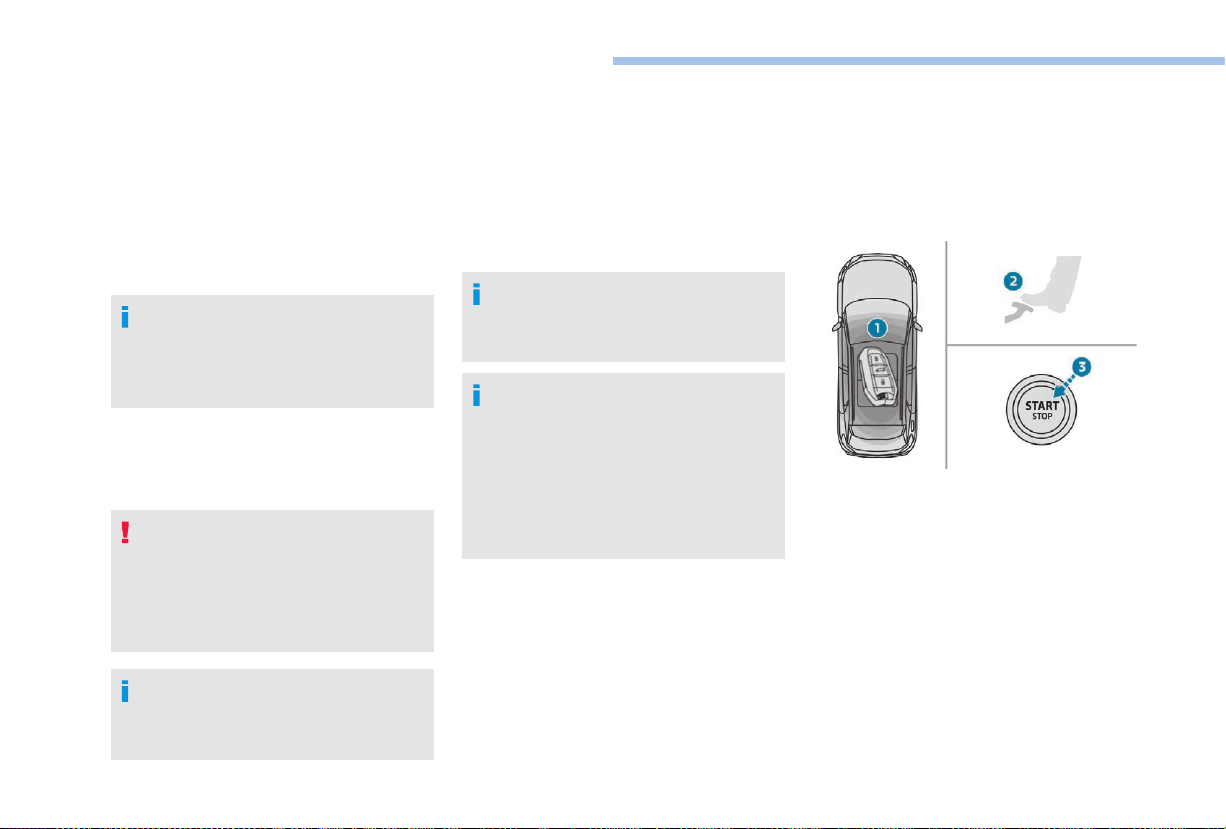
154
Driving
Switching off the engine
F Stop the vehicle.
F With the engine running in idle, turn the key
to position 1.
F Remove the key from the ignition switch.
F To lock the steering column, turn the
steering wheel until it locks.
To facilitate unlocking of the steering
column, it is recommended that the
wheels be returned to the straight ahead
position before switching off the engine.
F Check that the parking brake is correctly
applied, particularly on sloping ground.
Never switch off the ignition before the
vehicle is at a complete stop. With the
engine off, the braking and steering
assistance systems are also cut off: risk
of loss of control of the vehicle.
When you leave the vehicle, keep the key
with you and lock the vehicle.
Energy economy mode
After switching off the engine (position 1 –
Stop), for a maximum of 30 minutes you
can still use functions such as the audio and
telematic system, the wipers, dipped beam
headlamps, courtesy lamps, etc.
For more information on Energy
economy mode, refer to the
corresponding section.
Key left in
If the key has been left in the ignition
switch at position 2 (Ignition on), the
ignition will be switched off automatically
after one hour.
To switch the ignition back on, turn the
key to position 1 (Stop), then back to
position 2 (Ignition on).
Starting / Switching off
the engine with Keyless
Entry and Starting
Starting the engine
F With a manual gearbox, put the gear lever
into neutral.
F With the electronic key inside the vehicle,
fully depress the clutch pedal.
or
F With an automatic gearbox, place the gear
selector in P or N mode.
F With the electronic key inside the vehicle,
fully depress the brake pedal.
155
6
Driving
The presence of the Keyless Entry and
Starting electronic key in the recognition
zone is essential.
If the electronic key is not detected in this
zone, a message is displayed.
Move the electronic key into this zone so
that the engine can be started.
If there is still a problem, refer to the "Key
not detected – Back-up starting" section.
F Press the "START/STOP"
button while maintaining
pressure on the pedal until the
engine starts.
For Diesel engines, when the temperature is
negative and/or the engine is cold, the start
will only take place once the preheater warning
lamp is off.
"START/STOP" button again until the
engine is running.
F With an automatic gearbox, you should
keep the brake pedal fully depressed until
the warning lamp goes off and not press
the "START/STOP" button again until the
engine is running.
If one of the starting conditions is not met,
a reminder message is displayed in the
instrument panel.
In some circumstances, it is necessary to turn
the steering wheel slightly while pressing the
"START/STOP" button to assist unlocking of
the steering column; a message warns you
when this is needed.
The steering column unlocks and the engine
starts.
On certain versions with the EAT8 automatic
gearbox, the steering column does not lock.
If this warning lamp comes on after
pressing the "START/STOP" button:
F With a manual gearbox, you should keep
the clutch pedal fully depressed until the
warning lamp goes off and not press the
With petrol engines, after a cold start,
preheating the catalytic converter can
cause clearly-felt engine vibrations for
anything up to 2 minutes while stationary
with the engine running (accelerated idle
speed).
As a safety measure, never leave the
vehicle while the engine is running.
Switching off the engine
F Immobilise the vehicle, engine at idle.
F With a manual gearbox, put the gear lever
into neutral.
or
F With an automatic gearbox, place the gear
selector in mode P or N.
F With the electronic key inside the vehicle,
press the "START/STOP" button.
If the vehicle is not immobilised, the
engine will not stop.
Never leave your vehicle with the
electronic key still inside.
Switching off the engine leads to a loss of
braking assistance.
The engine stops and the steering column
locks.
In some circumstances, it is necessary to turn
the steering wheel to lock the steering column.
On certain versions with the EAT8 automatic
gearbox, the steering column does not lock.
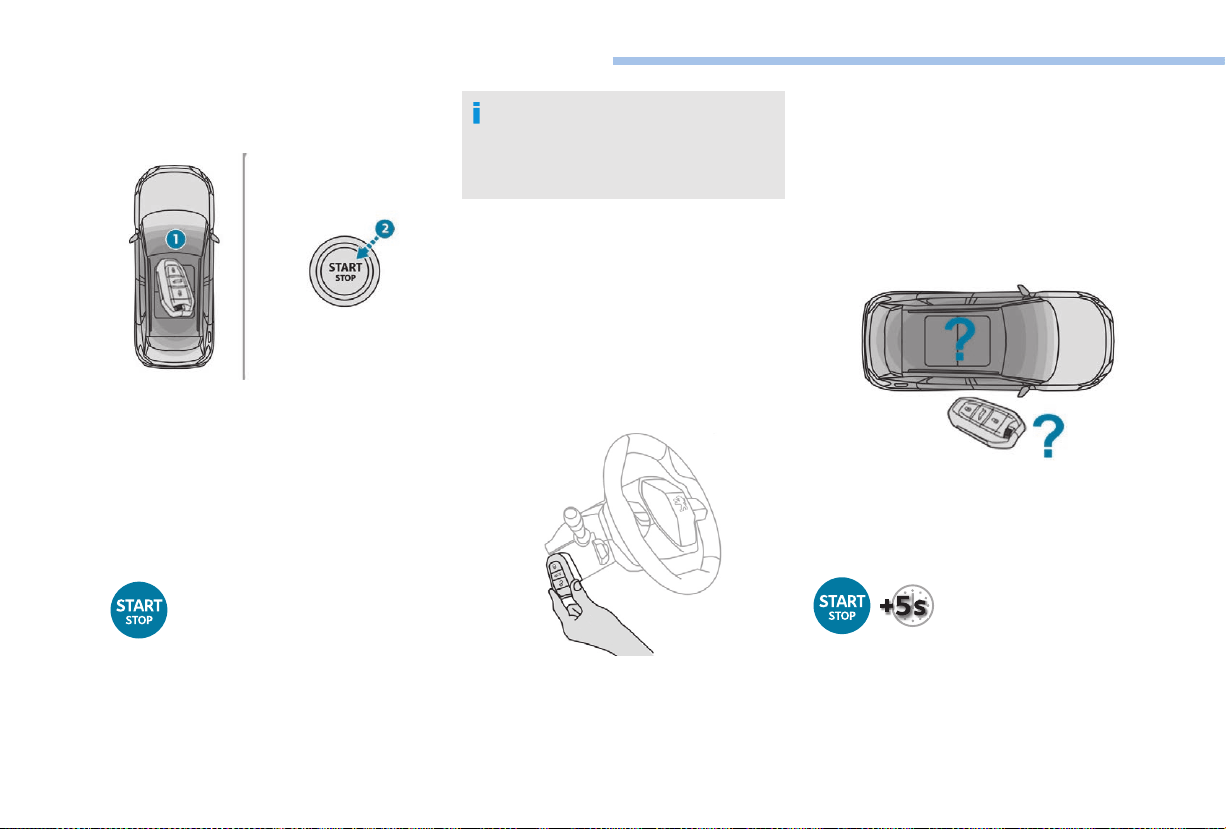
156
Driving
Switching the ignition on
(without starting)
This also allows some equipment to be
activated (examples: audio system, lighting,
etc.).
F Press the "START/STOP"
button, the instrument panel
comes on but the engine does
not start.
F Press this button again to switch off the
ignition and allow the vehicle to be locked.
With the ignition on, the system
automatically goes into energy economy
mode to maintain an adequate state of
charge in the battery.
Key not detected
Back-up starting
A back-up reader is fitted to the steering
column to allow the engine to be started if
the system does not detect the key in the
recognition zone, or when the battery in the
electronic key is discharged.
F With a manual gearbox, place the gear
lever in neutral, then fully depress the clutch
pedal.
F With an automatic gearbox, select
mode P, then fully depress the brake pedal.
F Press the "START/STOP" button.
The engine starts.
Back-up switch-off
With the Keyless Entry and Starting remote
control inside the vehicle, pressing the
"START/STOP" button, with no action on the
pedals, allows the ignition to be switched on.
F Place and hold the remote control against
the reader.
When the electronic key is not detected or is
no longer in the recognition zone, a message
appears in the instrument panel when closing a
door or trying to switch off the engine.
F To confirm the instruction to switch off the
engine, press the "START/STOP" button for
about five seconds.
In the event of a fault with the electronic key,
contact a PEUGEOT dealer or a qualified
workshop.
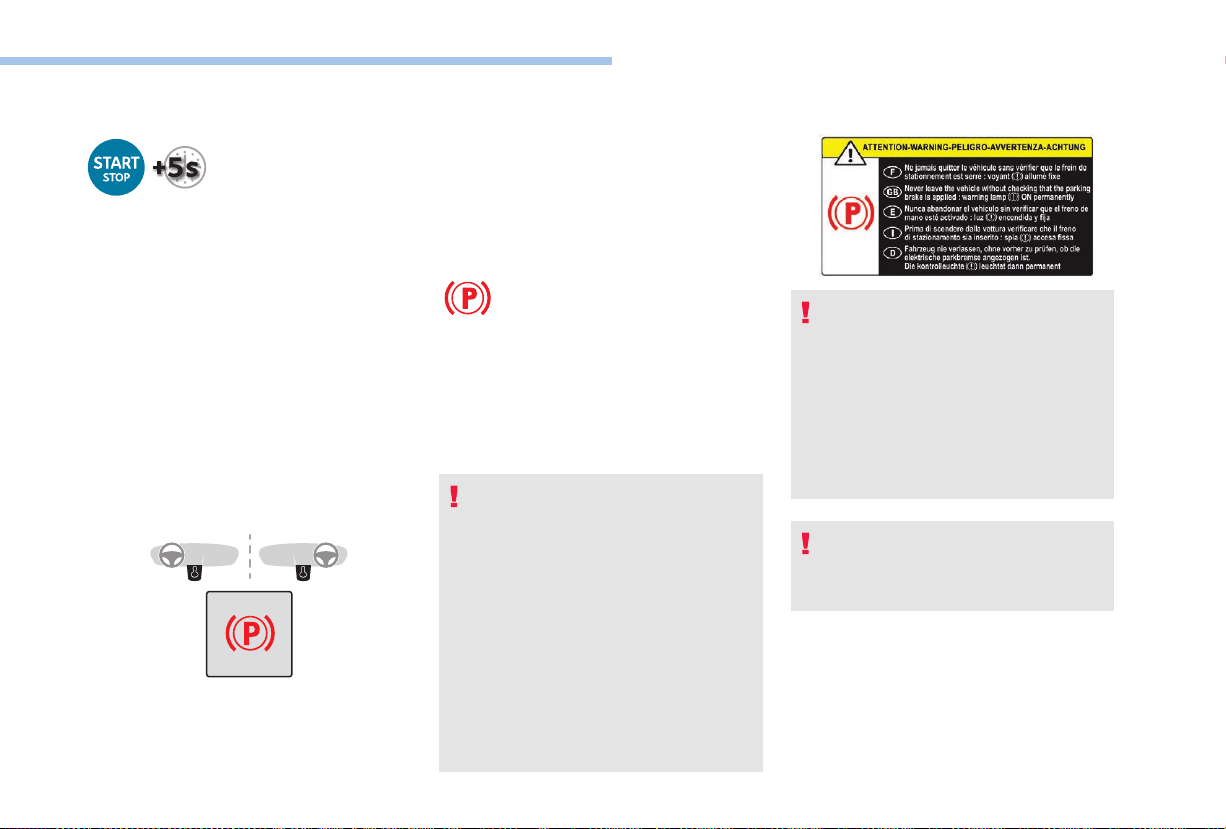
157
6
Driving
Emergency switch-off
Electric parking brake
The system allows, in automatic operation, the
application of the parking brake on switching
off the engine and release as the vehicle
moves off.
F by briefly pulling the control lever to apply
the brake,
F by briefly pushing the control lever, while
pressing the brake pedal, to release it.
Automatic mode is activated by default.
Indicator lamp
This indicator lamp comes on in the
instrument panel and in the control
lever to confirm the application of
the parking brake.
It goes off to confirm the release of the parking
brake.
This indicator lamp flashes on the control lever
when manual parking brake application or
release is performed.
In the event of a battery failure, the
electric parking brake no longer works.
As a safety measure with a manual
gearbox, if the parking brake is not
applied, immobilise the vehicle by
engaging a gear.
As a safety measure with an automatic
gearbox, if the parking brake is not
applied, immobilise the vehicle by
placing one of the chocks supplied
against one of the wheels.
Call on a PEUGEOT dealer or a qualified
workshop.
Label on door panel
Before leaving the vehicle, check that the
parking brake is applied: the indicator
lamps in the instrument panel and
the control lever must be on fixed, not
flashing.
If the parking brake is not applied, there
is an audible signal and a message is
displayed on opening the driver's door.
Never leave a child alone inside the
vehicle with the ignition on, as they could
release the parking brake.
In the event of an emergency only, the engine
can be switched off without conditions (even
when driving).
Press the "START/STOP" button for about five
seconds.
In this case, the steering column locks as soon
as the vehicle stops.
The driver can take over at any time to apply
or release the parking brake, by operating the
control lever:
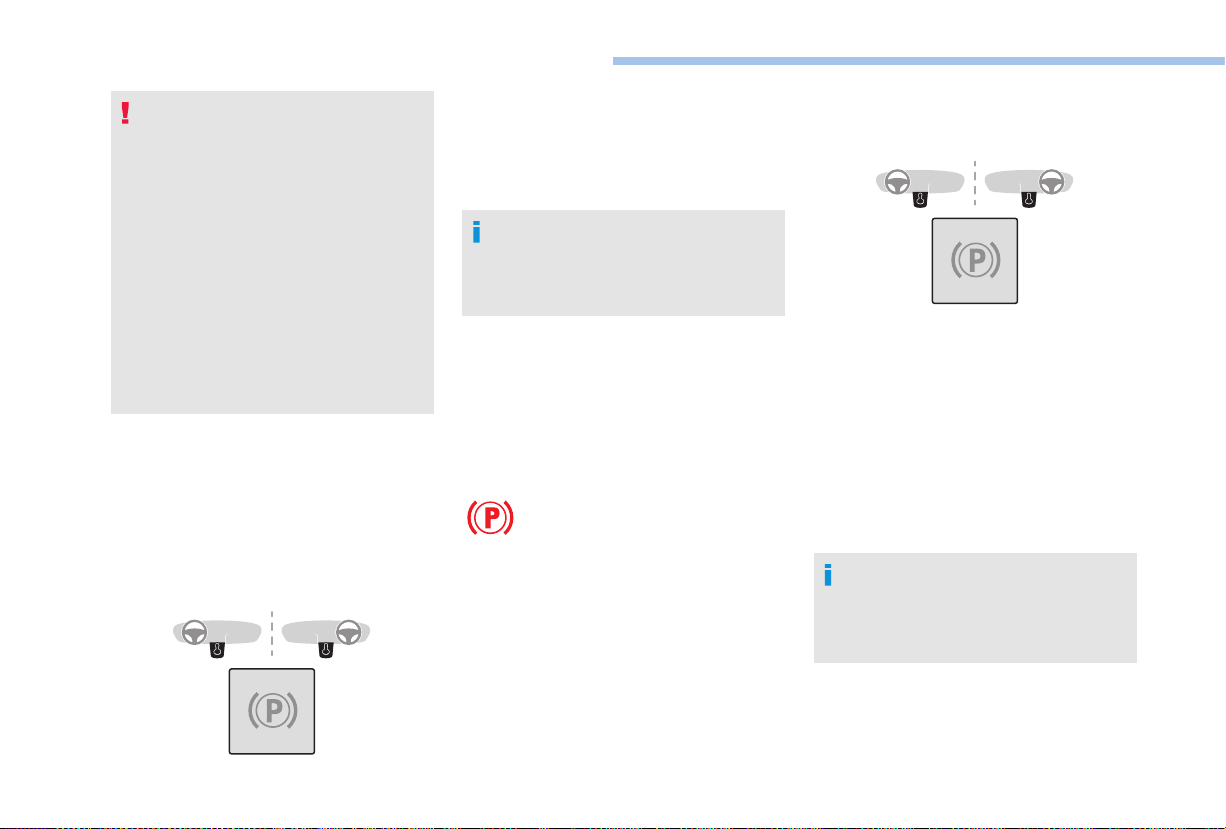
158
Driving
When towing, parking on a steep slope,
or if your vehicle is heavily laden, turn the
wheels towards the kerb and engage a
gear with a manual gearbox.
When towing, parking on a steep slope,
or if your vehicle is heavily laden, turn the
wheels towards the kerb and select mode
P with an automatic gearbox.
For towing, your vehicle is approved for
parking on slopes of up to 12%.
Manual operation
Manual release
Ignition on or engine running:
F press the brake pedal,
F while maintaining pressure on the brake
pedal, briefly push the control lever.
The complete release of the parking brake is
confirmed by the brake indicator lamp and the
P indicator lamp in the control lever going off,
accompanied by the display of the message
"Parking brake released".
If you push the control lever without
pressing the brake pedal, the parking
brake will not be released and a message
is displayed.
Manual application
Stationary vehicle:
F pull briefly on the control lever.
Confirmation of the instruction is signalled by
flashing of the indicator lamp in the control
lever.
Application of the parking brake
is confirmed by illumination of the
brake indicator lamp and the P
indicator lamp in the control lever,
accompanied by the display of the
message "Parking brake applied".
Automatic operation
Automatic release
Ensure first that the engine is running and the
driver's door is properly closed.
With a manual gearbox
F Fully depress the clutch pedal, engage 1
st
gear or reverse.
F Press the accelerator pedal and release the
clutch pedal.
With an automatic gearbox
F Press the brake pedal.
F Select position D, M or R.
F Release the brake pedal and press the
accelerator pedal.
With an automatic gearbox, if the brake
does not release automatically, check that
the front doors are correctly closed.
The electric parking brake releases
automatically and progressively when the
vehicle moves off.
The complete release of the parking brake is
confirmed by the brake indicator lamp and the
P indicator lamp in the control lever going off,
accompanied by the display of the message
"Parking brake released".
159
6
Driving
When stationary with the engine running,
do not depress the accelerator pedal
unnecessarily, you risk releasing the
parking brake.
Automatic application
With the vehicle stationary, the parking brake
is automatically applied when the engine is
switched off.
Application of the parking brake
is confirmed by illumination of
the brake indicator lamp and the
P indicator lamp in the control lever,
accompanied by the display of the
message "Parking brake applied".
Automatic application does not take place
if the engine stalls or goes into STOP
mode of Stop & Start.
With automatic operation, you can also
manually apply or release the parking
brake using the control lever.
Special cases
In some situations, you may need to operate
the parking brake manually.
Immobilisation of the vehicle
with the engine running
To immobilise the vehicle with the engine
running, briefly pull the control lever.
Application of the parking brake
is confirmed by illumination of the
brake indicator lamp and the P
indicator lamp in the control lever,
accompanied by the display of the
message "Parking brake applied".
Parking the vehicle with the
brake released
In very cold conditions (ice), it is
recommended that the parking brake not
be applied.
To immobilise your vehicle, engage a gear
or fit the chocks supplied against one of
the wheels.
Immobilisation of the vehicle with the
parking brake released
F Switch off the engine.
Illumination of the indicator lamps in the
instrument panel and control lever confirm
application of the parking brake.
F Switch on the ignition again, without
starting the engine.
The complete release of the parking
brake is confirmed by the brake
indicator lamp and the P indicator
lamp in the control lever going off,
accompanied by the display of the
message "Parking brake released".
F Switch off the ignition.
With an automatic gearbox, mode P is
automatically selected when the ignition
is switched off. The wheels are blocked.
For more information on the Automatic
gearbox, particularly in relation to
leaving the vehicle in free-wheeling
mode, refer to the corresponding section.
With an automatic gearbox, when
mode N is engaged, opening the
driver's door will cause an audible
signal to sound. It will stop when you
close the driver's door again.
F Release the parking brake manually by
pushing the control lever while keeping your
foot on the brake.
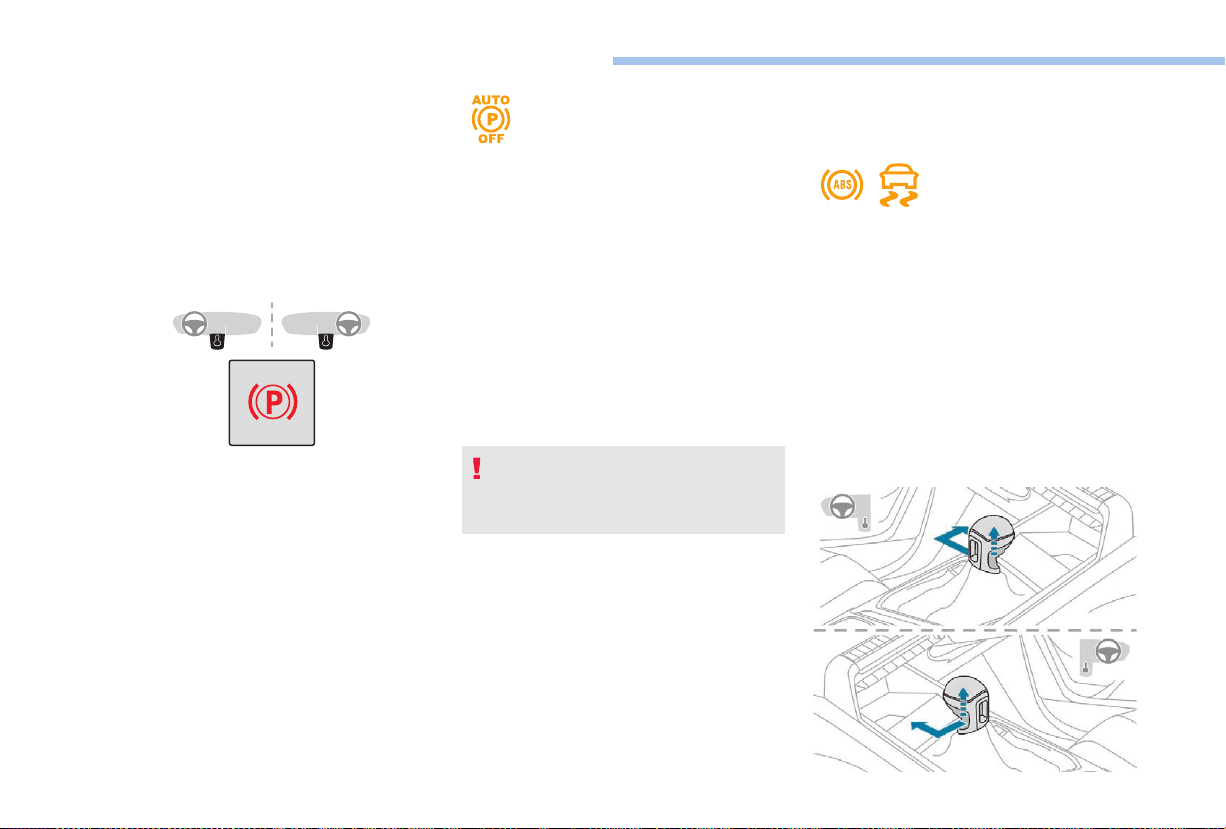
160
Driving
Deactivating automatic
operation
In some situations, for example when it is
extremely cold or during towing (caravan,
breakdown), it may be necessary to deactivate
automatic operation of the system.
F Start the engine.
F Apply the parking brake with the control
lever, if it is released.
F Take your foot off the brake pedal.
F Push and hold the control lever in the
release direction for at least 10 seconds and
no more than 15 seconds.
F Release the control lever.
F Press and hold the brake pedal.
F Pull the control lever in the application
direction for 2 seconds.
Deactivation of the automatic
functions is confirmed by
illumination of this indicator lamp in
the instrument panel.
F Release the control lever and the brake pedal.
From now on, the parking brake can only
be applied and released manually using the
control lever.
Repeat this procedure to reactivate automatic
operation.
Reactivation of automatic operation is
confirmed by the indicator lamp in the
instrument panel going off.
Emergency braking
The emergency braking should only be
used in an exceptional situation.
In the event of a failure in braking using the
brake pedal or in an exceptional situation (e.g.
driver taken ill, driver under instruction, etc.), a
continuous pull on the control lever will brake
the vehicle. Braking takes place while the
control lever is being pulled. It is interrupted if
the control lever is released.
The ABS and DSC systems ensure stability of
the vehicle during emergency braking.
If the ABS and DSC systems malfunction,
signalled by the illumination of one or both
warning lamps in the instrument panel, then
stability of the vehicle is no longer guaranteed.
In this event, stability must be assured by the
driver by repeating alternate "pull-release"
actions on the control lever until the vehicle is
immobilised.
6-speed manual gearbox
Engaging reverse gear
If the emergency braking malfunctions, the
message "Parking brake control faulty" will be
displayed in the instrument panel.
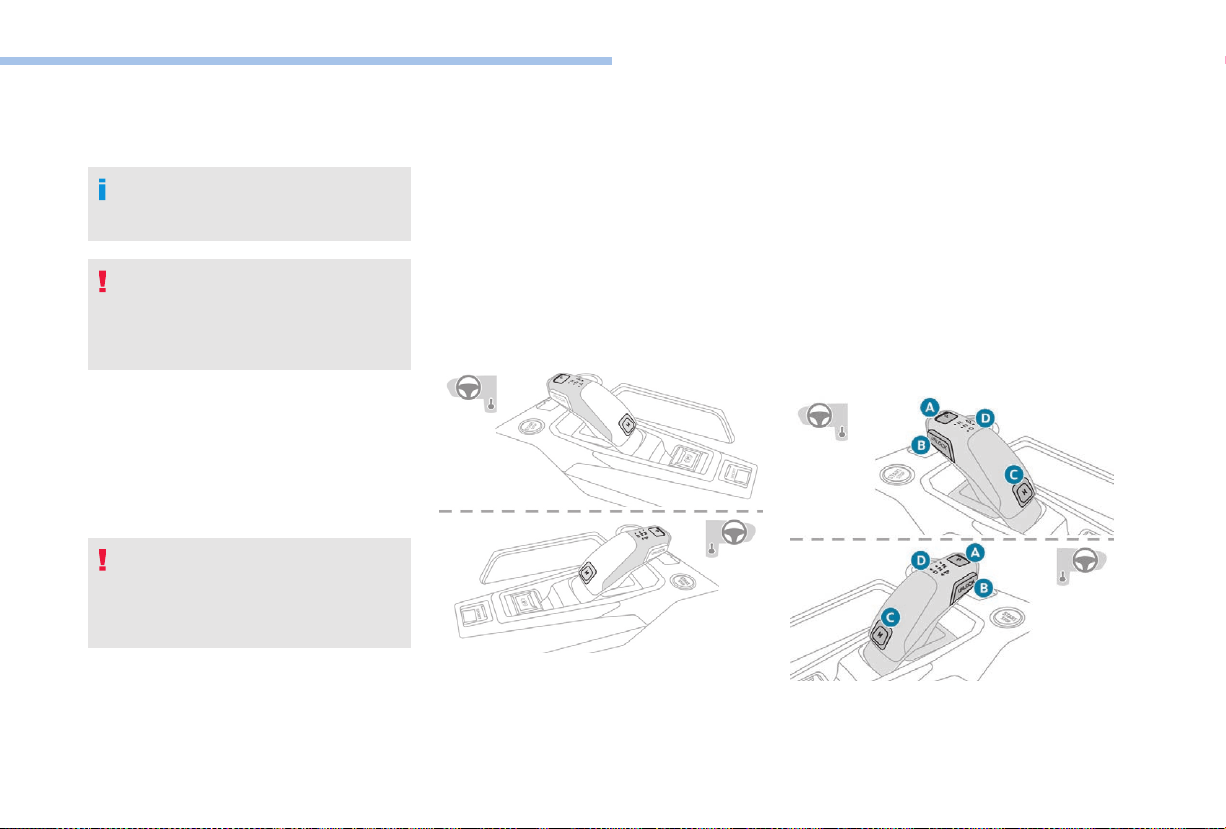
161
6
Driving
F Raise the trigger under the knob and move
the gear lever to the left then forwards.
Only engage reverse gear when the
vehicle is stationary with the engine at
idle.
As a safety precaution and to facilitate
starting of the engine, always select
neutral and depress the clutch pedal.
Engaging 5
th
or 6
th
gear
F Move the lever fully to the right to engage 5
th
or 6
th
gear.
Failure to follow this advice may cause
permanent damage to the gearbox
(engagement of 3
rd
or 4
th
gear by mistake).
Automatic gearbox
(EAT6 / EAT8)
Six or eight-speed automatic gearbox with push
selector. It also offers a manual mode with gear
changes via steering mounted paddles, located
behind the steering wheel.
Gearbox selector positions
N. Neutral.
For moving the vehicle with the ignition
off: in certain car washing machines,
when towing the vehicle, etc.
D. Automatic mode.
The gearbox manages gear changes
according to the style of driving, the road
profile and the vehicle load.
M. Manual mode.
The driver changes gear using the
controls at the steering wheel.
P. Park.
For parking the vehicle: the front wheels
are blocked.
R. Reverse.
Push selector
A. Button P.
To set the gearbox to P.
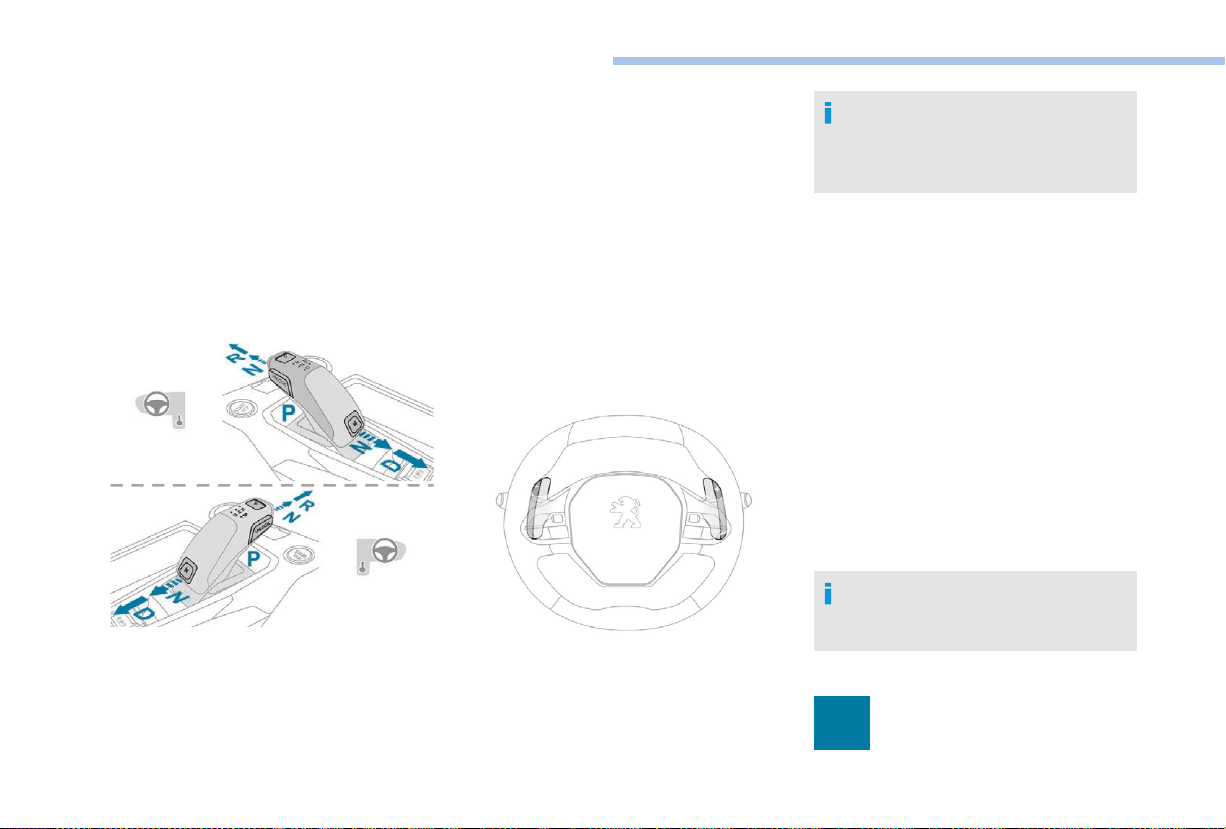
162
SPORT
Driving
Move the selector by pressing it forward
(N or R) or rearward (N or D) once or twice,
if necessary going beyond the point of
resistance.
The selector returns to its initial position when
released.
For example, from P to R, you can optionally
push forward twice without crossing the point
of resistance or push once crossing the point
of resistance:
- In the first case, the gearbox goes from P to
N, then from N to R.
- In the second case, the gearbox goes
directly from P to R.
Steering mounted controls
In mode M or D, the steering mounted control
paddles allow the driver to change gear
manually.
B. Unlock button.
To unlock the gearbox and come out of P,
with foot on the brake pedal, or change
to R.
This button should be pressed before
pressing the selector.
C. Button M.
To change from D to permanent manual
mode.
D. Gearbox state indicators (P, R, N, D).
The steering mounted control paddles
cannot be used to engage neutral or to
select or come out of reverse.
"Sport" button
With the engine running, when the programme
associated with the button is active, the
gearbox delays changing up for a more
dynamic driving style.
The programme is automatically deactivated
when the ignition is switched off.
Activating the Sport programme or the
Dynamic pack is not recommended in the
following situations:
- One of the special modes (other than the
standard mode) of Advanced Grip Control
is on.
- Low fuel level reached.
- Low AdBlue level reached.
Pressing this button has no effect when
a trailer is connected.
Sport programme
In mode D, pressing this button
activates the Sport programme.
"S" appears in the instrument panel.
F Pull the right-hand "+" paddle toward you
and release to change up a gear.
F Pull the left-hand "-" paddle toward you and
release to change down a gear.
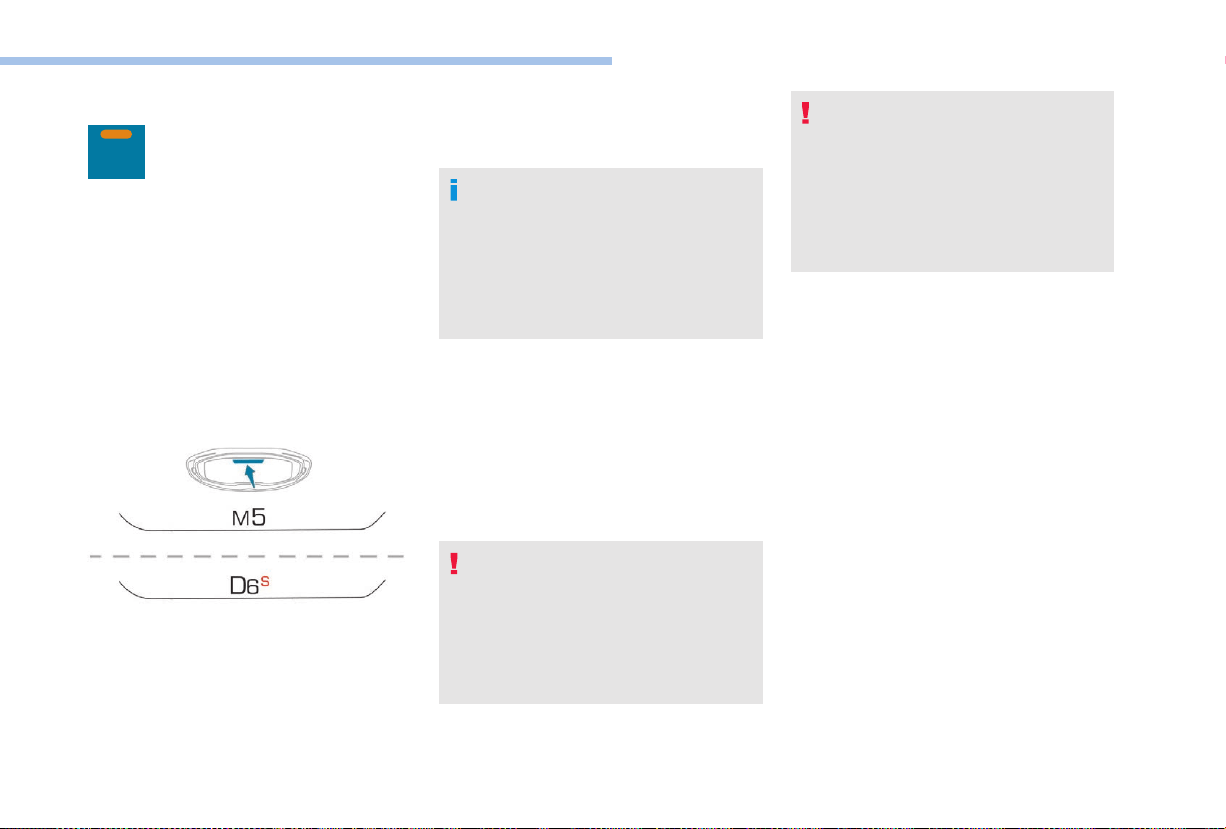
163
6
SPORT
Driving
Dynamic pack
The orange indicator lamp in the
button is on while the Dynamic pack
is activated.
Displays in the instrument
panel
If the driver's door is opened with the
ignition on, a message is displayed asking
you to put the gearbox into mode P.
The state of the gearbox is displayed in
the instrument panel for a few moments
after switching off the ignition.
Operation
You can activate or deactivate the function:
- by pressing this button,
or
- via the i-Cockpit Amplify function, by
modifying the setting for an ambience in the
touch screen.
For more information on the Dynamic Pack
and the i-Cockpit Amplify function, refer to
the corresponding section.
With the ignition on, the status of the gearbox is
displayed in the instrument panel:
P: park.
R: reverse.
N: neutral.
D1…D6 or D8: automatic mode.
S: Sport programme or Dynamic pack.
M1…M6 or M8: manual mode.
-: instruction not accepted in manual mode.
With the engine running, if it is necessary to
press the brake pedal or the Unlock button
in order to change mode, an alert message is
displayed in the instrument panel.
Only appropriate attempted changes of mode
are accepted.
With the engine running and the brakes
released, if R, D or M is selected, the
vehicle moves off, even without pressing
the accelerator pedal.
Never leave children unsupervised inside
the vehicle with the engine running.
Never press the accelerator and brake
pedals at the same time – Risk of damage
to the gearbox!
In the event of a battery failure, you
must place the chocks supplied with the
vehicle tools against one of the wheels to
immobilise the vehicle.
General points
To unlock the gearbox:
- from mode P:
F fully depress the brake pedal,
F press the Unlock button,
F while continuing to press the brake pedal
and the Unlock button, select another
mode.
- from neutral N, at a speed below 3 mph
(5 km/h):
F fully depress the brake pedal,
F while continuing to press the brake pedal,
select another mode.
To select reverse:
F slow down until you come to a stop,
F press the Unlock button,
F push forwards once or twice.
To select manual mode:
F with mode D selected in advance,
F press button M; the green indicator lamp in
the button comes on.

164
Driving
To switch off the ignition, the vehicle must be
stationary.
To put the vehicle in free-wheeling mode,
engine off:
F with the vehicle stationary, engine running,
select N,
F switch off the engine,
F within five seconds, switch the ignition on
again,
F with your foot on the brake pedal, push the
selector forwards or backwards once to
confirm N and manually release the electric
parking brake,
F switch off the ignition.
If you exceed the time limit of five seconds,
the gearbox engages mode P; you must then
restart the procedure.
If you open the driver's door when mode
N is engaged, an audible signal will
sound. It will stop when you close the
driver's door again.
Special aspects of automatic
mode
The gearbox selects the gear that offers
optimum performance, taking account of the
exterior temperature, the profile of the road, the
load on the vehicle and the style of driving.
For maximum acceleration without touching
the selector, press the accelerator fully down
(kick-down). The gearbox changes down
automatically or holds the gear selected until
the maximum engine speed is reached.
When braking, the gearbox changes down
automatically to provide effective engine
braking.
The steering mounted controls allow the driver
to temporarily select a gear, if the road and
engine speed permit.
Special aspects of manual mode
The change from one gear to another takes
place only if the road speed and engine speed
permit.
If the engine speed is too high or too low, the
gear selected flashes for a few seconds, then
the gear actually engaged is displayed.
Moving off
From mode P:
F Press the brake pedal firmly.
F Start the engine.
F Maintaining pressure on the brake pedal,
press the Unlock button.
F Push once or twice rearward to select the
automatic mode D, or forward to engage
reverse R.
From neutral N:
F Press the brake pedal firmly.
F Start the engine.
F Maintaining pressure on the brake pedal,
push rearward to select the automatic
mode D, or forward, while pressing the
Unlock button to engage reverse R.
Then, from P or N:
F Release the brake pedal.
F Accelerate progressively to automatically
release the electric parking brake.
F With the parking brake released, the vehicle
then moves off.
To quit manual mode:
F push forwards once to go back to D.
or
F press button M; the indicator lamp in the
button goes off.
165
6
Driving
In severe wintry conditions (temperature
below -23°C), it is recommended that the
engine be allowed to run for a few minutes
before moving off, to ensure the correct
operation and durability of the engine and
gearbox.
Stopping the vehicle
Whatever the state of the gearbox when the
ignition is switched off, mode P is engaged
automatically, with the exception of N, in
which case mode P will be engaged after a
delay of 5 seconds (allowing the change to
free-wheel).
Check that mode P has been engaged and
that the electric parking brake was applied
automatically; if not, apply it manually.
The corresponding indicator lamps
for the selector panel and the
electric parking brake control lever
must be on, as well as the ones in
the instrument panel.
Operating faults
Malfunction of the gearbox
This is signalled by the illumination
of this warning lamp, accompanied
by the display of a message and an
audible signal, when the ignition is
switched on.
Malfunction of the selector
In the event of a minor fault
In the event of a serious fault
Stop as soon as it is safe to do so, away
from the traffic, and call a PEUGEOT
dealer or a qualified workshop.
When the ignition is switched off, the
gearbox goes into mode P automatically.
The gearbox switches to back-up mode: drive
mode D is locked in third gear, the steering-
mounted control paddles are inoperative,
mode M is no longer available. You may feel a
pronounced jolt when engaging reverse. This
does not present any risk for the gearbox.
Do not drive faster than 62 mph (100 km/h),
keeping to the speed limit.
Go to a PEUGEOT dealer or a qualified
workshop.
You are alerted by this warning
lamp lighting up, accompanied by
the display of a message and an
audible signal.
In certain cases, the selector lamps may not
come on, but the state of the gearbox is still
displayed in the instrument panel.
You are alerted by the illumination of
this warning lamp.
Hill start assist
System which keeps your vehicle immobilised
temporarily (approximately 2 seconds) when
starting on a gradient, the time it takes to
move your foot from the brake pedal to the
accelerator pedal.
This system only operates when:
- the vehicle has been brought to a complete
stop, with your foot on the brake pedal,
- certain slope conditions are met,
- with the driver's door closed.
Drive cautiously and go to a PEUGEOT or a
qualified workshop.
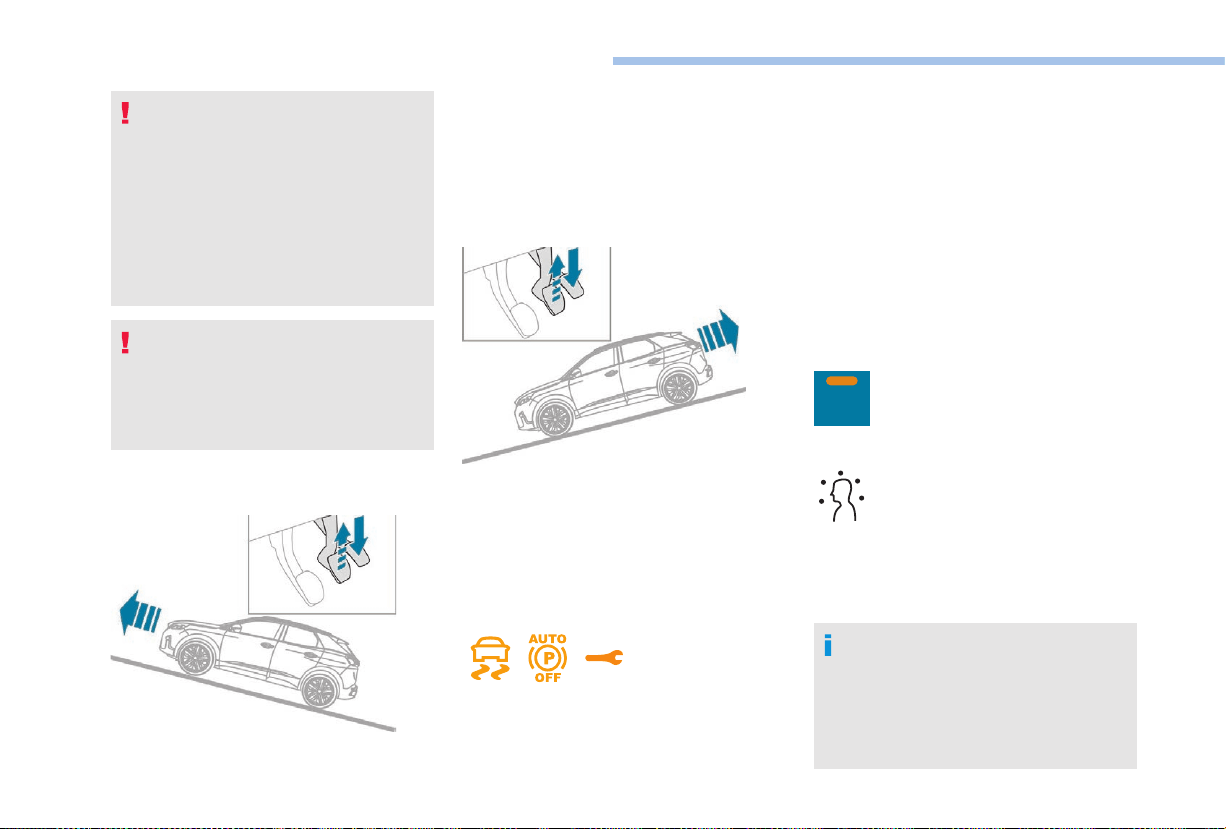
166
SPORT
Driving
The hill start assist function cannot be
deactivated. However, use of the parking
brake to immobilise the vehicle interrupts
its function.
Operation
On an ascending slope, with the vehicle
stationary, the vehicle is held for a short
time when you release the brake pedal:
- if you are in first gear or in neutral with a
manual gearbox,
- provided you are in mode D or M with an
automatic gearbox.
On a descending slope, with the vehicle
stationary and reverse gear engaged, the
vehicle is held for a short time when you
release the brake pedal.
Malfunction
Do not leave the vehicle while it is being
held temporarily by hill start assist.
If you need to leave the vehicle with the
engine running, apply the parking brake
manually then ensure that the parking
brake warning lamp and the indicator lamp
P in the lever of the electric parking brake
control are on fixed (not flashing).
If a fault in the system occurs, these warning
lamps come on. Contact a PEUGEOT dealer
or a qualified workshop to have the system
checked.
Dynamic pack
This pack influences:
- the acoustic ambience of the engine,
- the level of power assistance for the steering,
- acceleration.
- handling gear transitions with the automatic
gearbox,
- the display on the instrument panel of
information about the dynamic parameters of
the vehicle ("PERSONAL" mode).
Activation/Deactivation
F Press this button; the orange
indicator lamp in the button
comes on to confirm activation
of the function.
The Dynamic pack is also managed
by the i-Cockpit Amplify function.
For more information on the i-Cockpit Amplify
function, refer to the corresponding section.
If the orange indicator lamp flashes,
activation is not available (e.g. if Park
Assist is selected).
If the indicator lamp continues flashing
for a long time, contact a PEUGEOT
dealer or a qualified workshop.
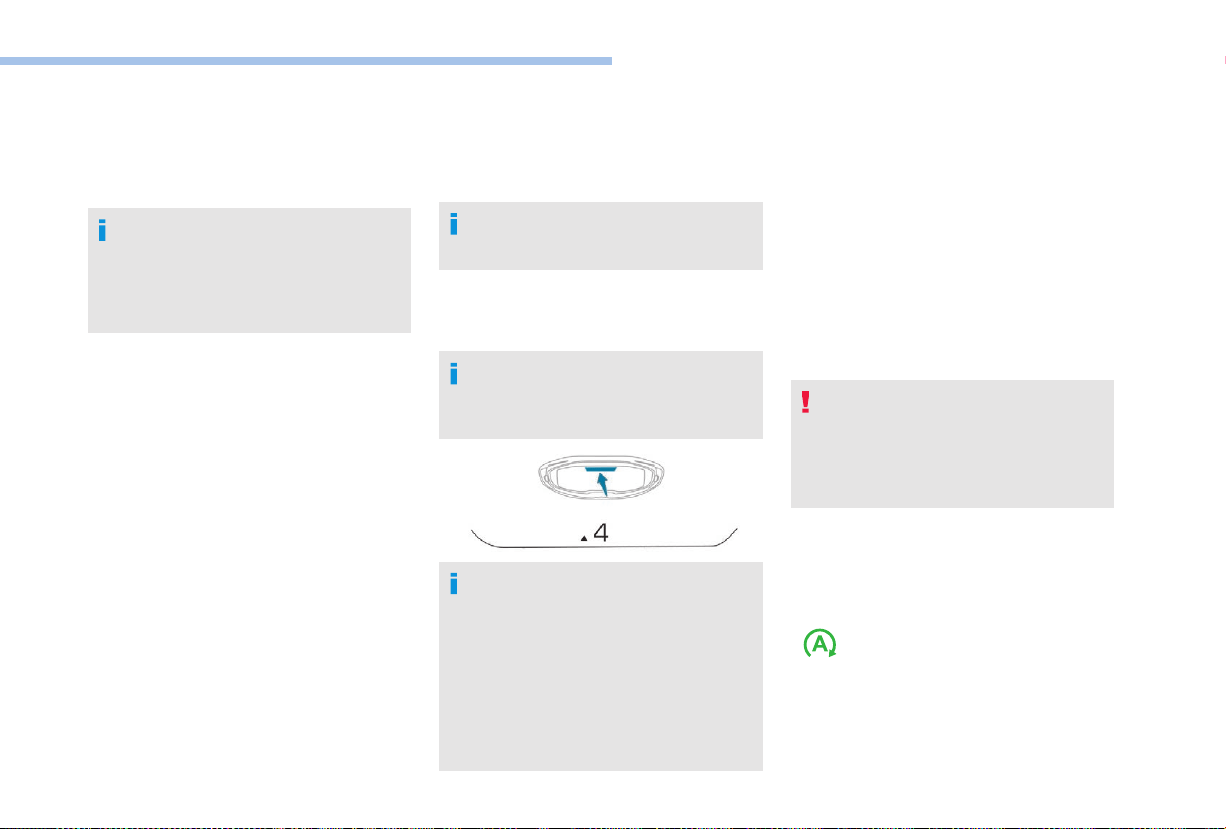
167
6
Driving
Displays
To show this information on the instrument
panel, select the "PERSONAL" mode and then
the type of information required.
This telemetry information (power
output, turbocharger pressure, torque,
longitudinal and lateral acceleration, etc.)
is given as a guide only.
Gear shift indicator
(Depending on engine.)
System which reduces fuel consumption by
recommending the most appropriate gear.
Operation
remains responsible for deciding whether or not
to follow the indications issued by the system.
This function cannot be deactivated.
With an automatic gearbox, the system is
only active in manual mode.
The information is displayed in the instrument
panel in the form of an arrow.
With a manual gearbox, the arrow may be
accompanied by the gear recommended.
The system adapts its gear shift
recommendation according to the driving
conditions (slope, load, etc.) and the
driver's requirements (power, acceleration,
braking, etc.).
The system never suggests:
- engaging first gear,
- engaging a lower gear,
- engaging reverse.
Depending on the driving situation and your
vehicle's equipment, the system may advise
you to skip one (or more) gear(s). You can
follow this instruction without engaging the
intermediate gears.
Gear shift recommendations are for information
only. In fact, the road layout, the traffic density
and safety remain the deciding factors when
choosing the best gear. The driver therefore
Stop & Start
The Stop & Start system puts the engine
temporarily into standby – STOP mode – during
stops in the traffic (red lights, traffic jams, etc.).
The engine restarts automatically – START
mode – as soon as you want to move off.
The restart takes place instantly, quickly and
silently.
Perfect for urban use, the Stop & Start system
reduces fuel consumption and exhaust
emissions as well as the noise level when
stationary.
Never refuel with the engine in STOP
mode; you must switch off the ignition with
the key or the "START/STOP" button.
Operation
Going into engine STOP mode
This indicator lamp comes on in the
instrument panel and the engine
goes into standby automatically:
- with a manual gearbox, at a speed below
2 mph (3 km/h) for 1.5 BlueHDi versions, or
with the vehicle stationary for 1.2 PureTech,
1.6 BlueHDi and 2.0 BlueHDi 150 versions,
168
Driving
when you place the gear lever in neutral and
release the clutch pedal,
- with an automatic gearbox, at a speed
below 12 mph (20 km/h) for 1.5 BlueHDi
and 2.0 BlueHDi 180 versions, or with the
vehicle stationary for other versions, when
you depress the brake pedal or place the
gear selector to mode N.
A time counter calculates the time spent in
STOP mode during the journey. It is reset to
zero every time the ignition is switched on with
the key or the "START/STOP" button.
For your comfort, during parking
manoeuvres, STOP mode is not available
for a few seconds after coming out of
reverse gear.
The Stop & Start does not affect the
operation of vehicle systems such as
braking, power steering, etc.
Special cases: STOP mode not
available
- the driver's seat belt is not fastened,
- the vehicle has not exceeded 6 mph
(10 km/h) since the last engine start (with
the key or the "START/STOP" button),
- the electric parking brake is applied or
being applied,
- the engine is needed to maintain a
comfortable temperature in the passenger
compartment,
- demisting is active,
- some temporary conditions (battery charge,
engine temperature, braking assistance,
exterior temperature, etc.) make this
necessary to ensure control of a system.
Going into engine START mode
This indicator lamp goes off and the
engine starts automatically:
Special cases: START mode
triggered automatically
As a safety measure or to maintain comfort
levels in the vehicle, START mode is triggered
automatically when:
- you open the driver's door,
- you unfasten the driver's seat belt,
- the speed of the vehicle exceeds 16 mph
(25 km/h) with the 2.0 BlueHDi 180 version
with automatic gearbox in mode D, or 2 mph
(3 km/h) with other versions,
- the electric parking brake is being applied,
- some specific conditions (battery charge,
engine temperature, braking assistance, air
conditioning setting, etc.) require it for the
control of a system or the vehicle.
In this case, this indicator lamp
flashes for a few seconds, then goes
off.
STOP mode is not invoked when:
- the vehicle is on a steep slope (rising or
falling),
- the driver's door is open,
In this case, this indicator lamp
flashes for a few seconds then goes
off.
This operation is perfectly normal.
- with a manual gearbox, when you fully
depress the clutch pedal,
- With an automatic gearbox:
• gear selector in mode D or M, when you
release the brake pedal,
• or gear selector in mode N and brake
pedal released, when you place the gear
selector in mode D or M,
• or when you engage reverse.
This operation is perfectly normal.
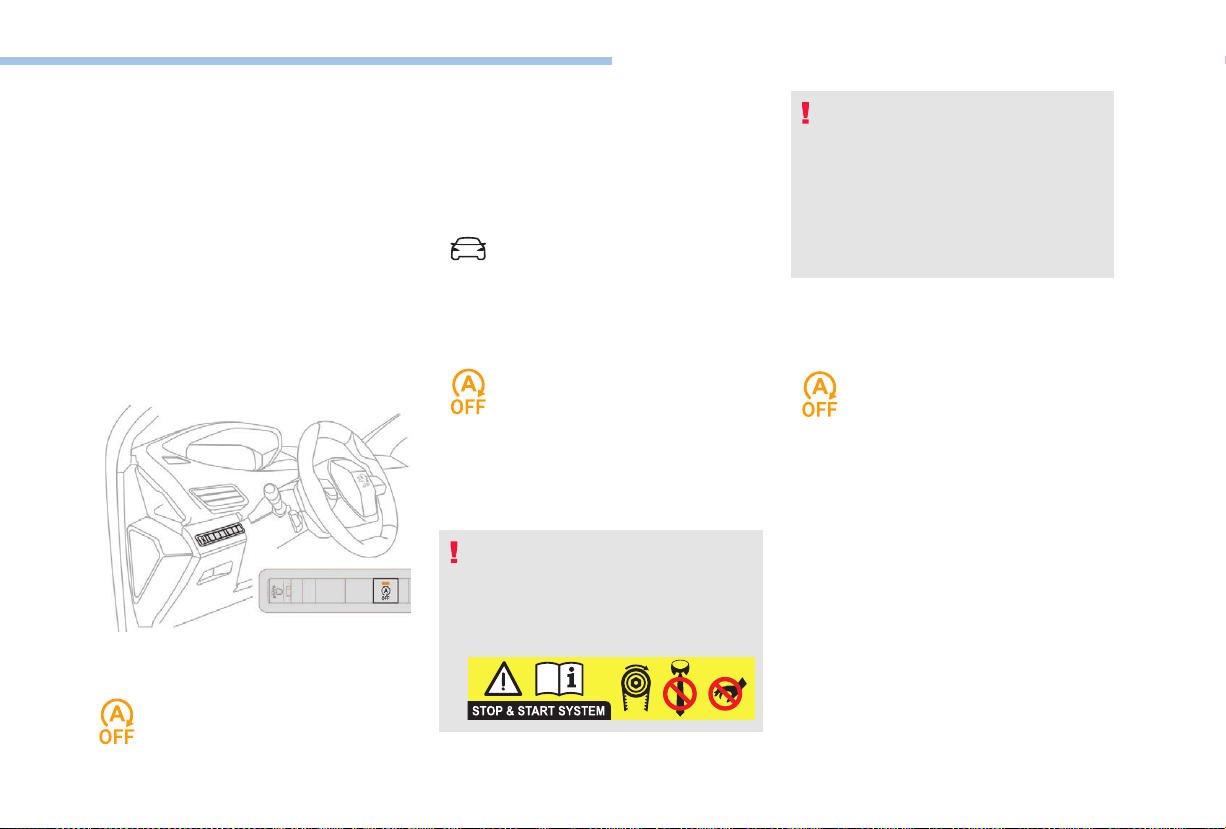
169
6
Driving
Deactivation / Reactivation
In certain circumstances, such as the need
to maintain the temperature in the passenger
compartment, it may be useful to deactivate
the Stop & Start system.
The system can be deactivated at any time,
once the ignition is switched on.
If the engine is in STOP mode, it restarts
immediately.
The Stop & Start system is reactivated
automatically every time the ignition is
switched on.
With the button on the dashboard
F Press this button; the associated orange
indicator lamp comes on.
Deactivation is confirmed by the
illumination of this indicator lamp
and the display of a message in the
instrument panel.
Pressing the button again reactivates the
system; the associated indicator lamp goes off.
The indicator lamp in the instrument panel goes
off, accompanied by the display of a message.
With the button on the touch screen
Activation and deactivation of the
system is done in the Vehicle /
Driving menu of the touch screen.
A new selection reactivates the system.
The indicator lamp in the instrument panel goes
off, accompanied by the display of a message.
Opening the bonnet
Before doing anything under the bonnet,
deactivate the Stop & Start system to
avoid any risk of injury resulting from an
automatic change to START mode.
Select the "Driving functions" then the "Stop
& Start" tab.
Deactivation is confirmed by the
illumination of this indicator lamp
and the display of a message in the
instrument panel.
Driving on flooded roads
Before driving in a flooded area, it
is strongly recommended that you
deactivate the Stop & Start system.
For more information on Driving advice,
particularly on flooded roads, refer to the
corresponding section.
Operating fault
In the event of a fault with the
system, this warning lamp
flashes for a few moments in the
instrument panel, then remains on,
accompanied by the display of a
message.
If a fault occurs in STOP mode, the engine
may stall.
All of the instrument panel warning lamps
come on.
It is then necessary to switch off the ignition
and start the engine again with the key or the
"START/STOP" button.
Have it checked by a PEUGEOT dealer or a
qualified workshop.

170
Driving
The Stop & Start system requires a
12 V battery of specific technology and
specification.
All work on this type of battery must be
carried out only by a PEUGEOT dealer or
a qualified workshop.
For more information on the 12 V battery,
refer to the corresponding section.
Under-ination detection
System which automatically checks the
pressures of the tyres while driving.
The system monitors the pressures in the four
tyres, once the vehicle is moving.
It compares the information given by the wheel
speed sensors with reference values, which
must be reinitialised every time the tyre
pressures are adjusted or a wheel changed.
The system triggers an alert as soon as it
detects a drop in the inflation pressure of one
or more tyres.
The under-inflation detection system does
not replace the need for vigilance on the
part of the driver.
This system does not avoid the need to
check the tyre pressures (including the
spare wheel) every month as well as
before a long journey.
Driving with under-inflated tyres worsens
road-holding, lengthens braking distances,
causes premature wear of the tyres,
particularly in adverse conditions (heavy
loads, high speeds, long journeys).
Driving with under-inflated tyres
increases fuel consumption.
The inflation pressures defined for your
vehicle can be found on the tyre pressure
label.
For more information on the
Identification markings, refer to the
corresponding section.
Checking tyre pressures
This check should be done when the tyres
are "cold" (vehicle stopped for 1 hour or
after a journey of less than 6 miles (10 km)
at moderate speeds).
Otherwise, add 0.3 bar to the pressures
shown on the label.
Snow chains
The system does not have to be
reinitialised after fitting or removing snow
chains.
Under-inflation alert
This warning is indicated by
continuous illumination of this lamp,
an audible signal and, depending on
the equipment installed, a message
displayed on the screen.
F Reduce speed immediately, avoid excessive
steering movements and sudden braking.
F Stop the vehicle as soon as it is safe to do
so.
The loss of pressure detected does not
always cause visible bulging of the tyre.
Do not satisfy yourself with just a visual
check.
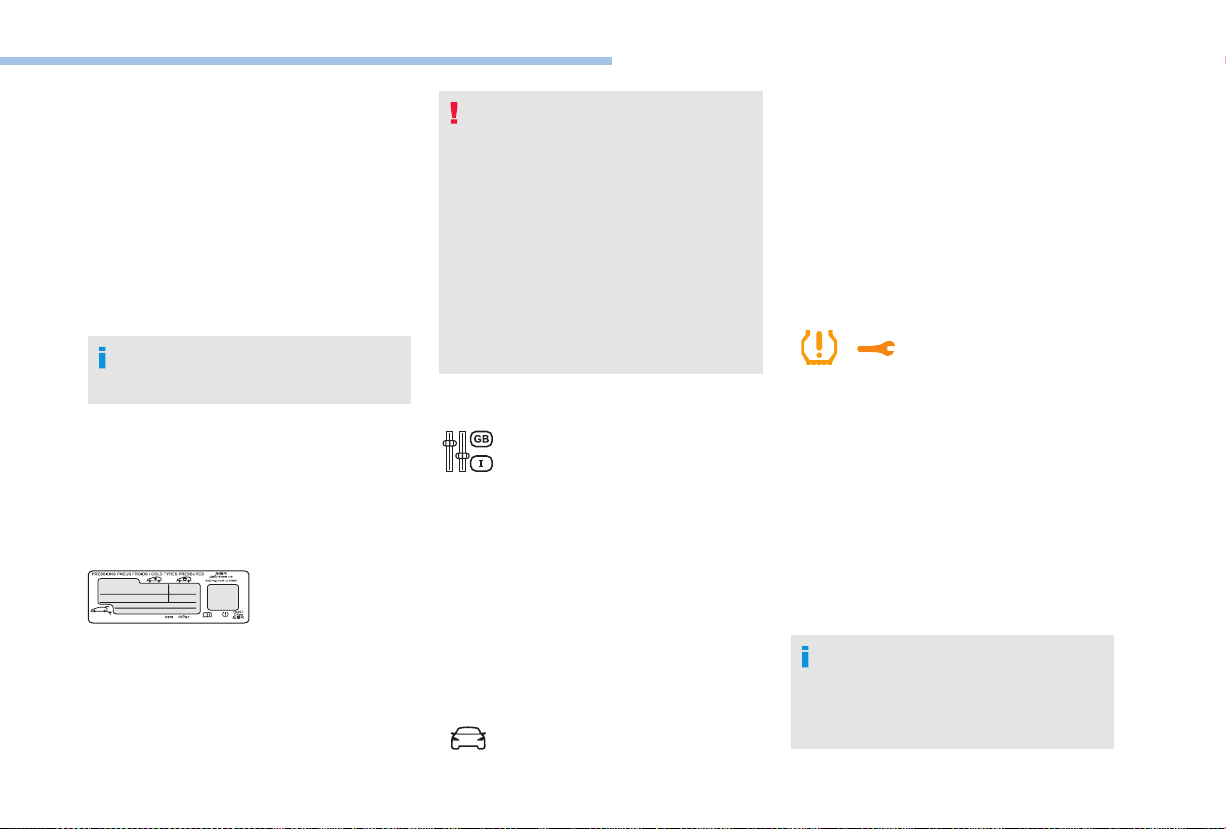
171
6
Driving
F If you have a compressor, such as the one
in the temporary puncture repair kit, check
the pressures of the four tyres when cold.
F If it is not possible to make this check
immediately, drive carefully at reduced
speed.
or
F In case of a puncture, use the temporary
puncture repair kit or the spare wheel
(depending on equipment).
The alert is kept active until the system is
reinitialised.
Reinitialisation
The system must be reinitialised after any
adjustment to the pressures of one or more
tyres, and after changing one or more wheels.
Before reinitialising the system, ensure
that the pressures of the four tyres
are correct for the conditions of use
of the vehicle and conform to the
recommendations on the tyre pressure
label.
The under-inflation alert can only be relied
on if the reinitialisation of the system has
been done with the pressures in the four
tyres correctly adjusted.
The under-inflation detection system
does not give a warning if a pressure is
incorrect at the time of reinitialisation.
Monochrome screen C
Reinitialisation of the function is
done in the "Personalisation-
configuration" menu of the screen.
Touch screen
Reinitialisation of the function is
done in the Vehicle / Driving menu
of the touch screen.
F Select the "Define the vehicle
parameters" menu.
F Select the "Driving assistance" menu.
F Select the "Tyre inflation" menu.
F Select the "Reinitialisation" function.
F Select "Yes" to confirm.
Reinitialisation is confirmed by an audible
signal.
F In this menu, select the "Vehicle settings"
tab.
F In the page, select the " Under-inflation
initialisation" function.
F Select "Yes" to confirm.
The reinitialisation is confirmed by the display
of a message and an audible signal.
Operating fault
In this case, under-inflation monitoring of the
tyres is no longer assured.
Have the system checked by a PEUGEOT
dealer or a qualified workshop.
Before doing anything to the system,
the pressures of the four tyres must be
checked and the system reinitialised.
The flashing and then fixed illumination of the
under-inflation warning lamp accompanied
by illumination of the Service warning lamp
indicates a fault with the system.
A message appears, accompanied by an
audible signal.
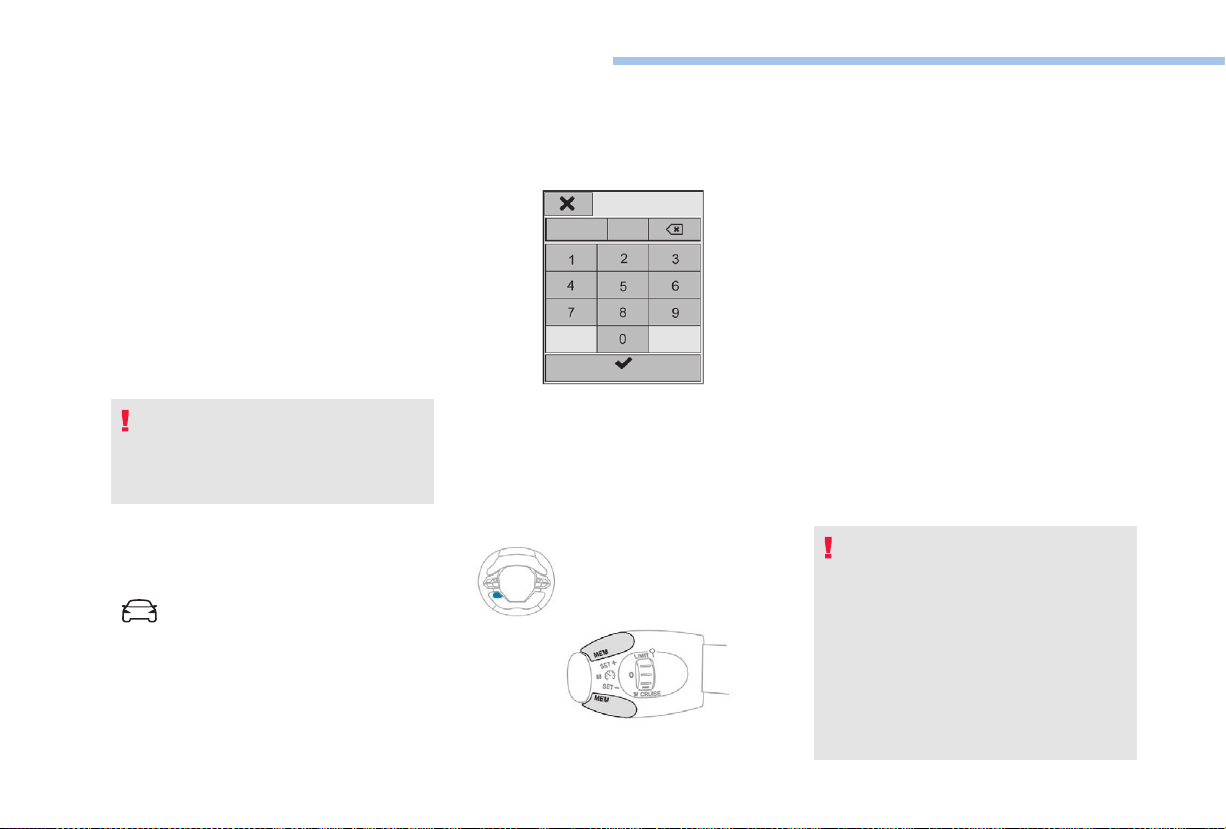
172
Driving
Memorising speeds
Linked to the speed limiter/programmable
cruise control, this function allows speed
settings to be registered which will then be
offered as settings for two systems: the speed
limiter (a maximum speed) and the cruise
control (cruising speed).
You can memorise up to 5 speed limits in the
system.
By default, some speed settings are already
memorised.
As a safety measure, the driver must
only modify the speed settings when
stationary.
Memorising speeds
This function can be accessed in the
Vehicle / Driving menu of the touch
screen.
F Tick the speed settings 1 to 5 that you want
to use.
F Select the speed setting you want to
change.
"MEM" button
Recognition of
speed limit signs and
recommendation
This system allows the speed limit detected by
the camera to be displayed in the instrument
panel.
Specific speed limits, such as those for heavy
goods vehicles, are not displayed.
The display of the speed limit in the instrument
panel is updated as you pass a speed limit sign
intended for cars (light vehicles).
The units for the speed limits (mph or
km/h) depend on the country you are
driving in.
It should be taken into account so that you
observe the speed limit.
For the system to operate correctly when
you change country, the units for speed in
the instrument panel must be those for the
country you are driving in.
F Enter the new value using the numeric
keyboard and confirm.
F By default, some speed settings are already
memorised.
F Select the "Driving functions" tab.
F Select the "Adjusting Speeds" function.
F Press "ON" to activate the function.
the cruise control.
For more information on the Speed limiter or
Cruise control, refer to the associated section.
With this button, you can select a memorised
speed setting to use with the speed limiter or
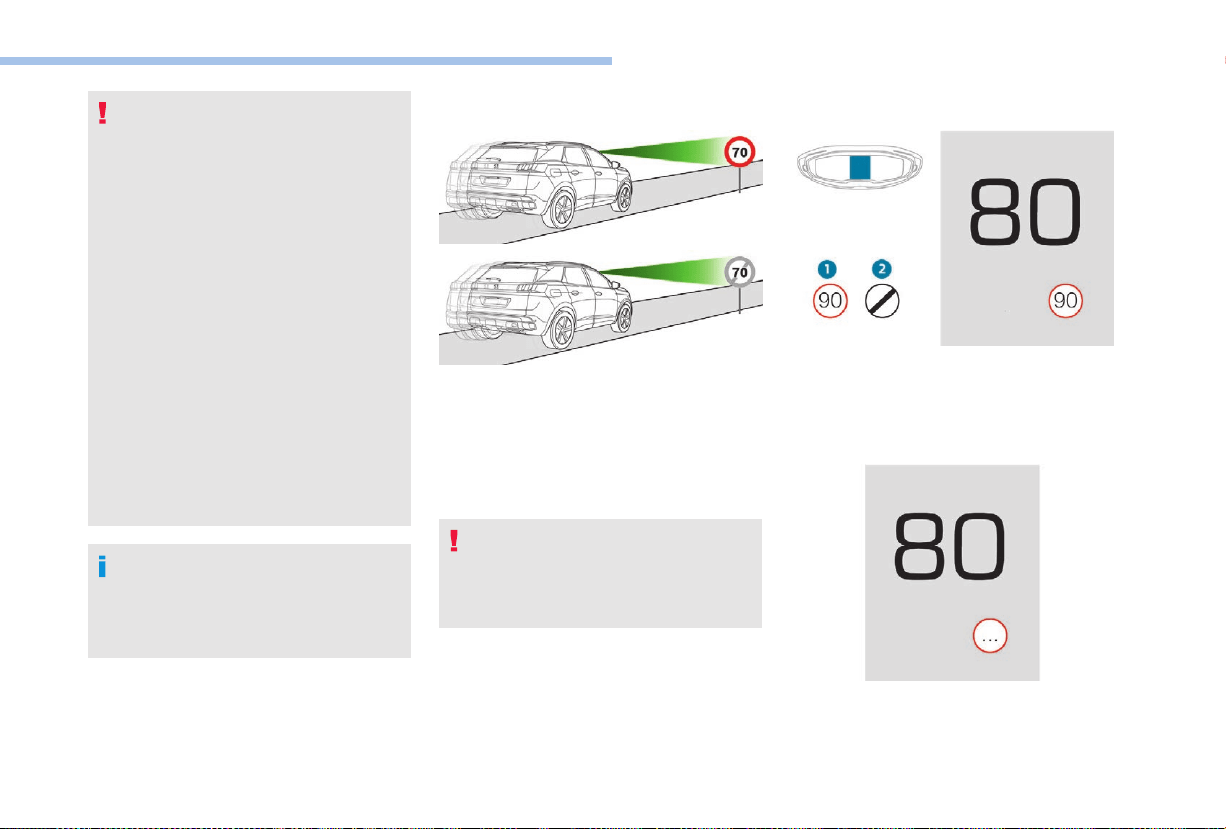
173
6
Driving
The automatic reading of road signs is a
driving assistance system and does not
always display speed limits correctly.
The speed limit signs present on the road
always take priority over the display by the
system.
The system cannot in any circumstances
replace the need for vigilance on the part
of the driver.
The driver must observe the driving
regulations and must adapt the speed of
the vehicle to suit the weather and traffic.
It is possible for the system to not display
the speed limit if it does not detect a
speed limit sign within a preset period.
The system is designed to detect signs
that conform to the Vienna Convention on
road signs.
To maintain correct operation of the
system: regularly clean the area in front
of the camera.
Principles
It is necessary to update your navigation
mapping regularly in order to receive
accurate information on speed limits from
the system.
Activation / Deactivation
This system allows the speed limit detected by
the camera to be displayed in the instrument
panel.
The system also processes speed limit details
from the navigation system mapping.
The system is activated or deactivated via the
vehicle configuration menu.
Displays on the instrument panel
1. Speed limit indication.
or
2. Indication of the end of the speed limit.
The system is active but is not detecting speed
limit information.
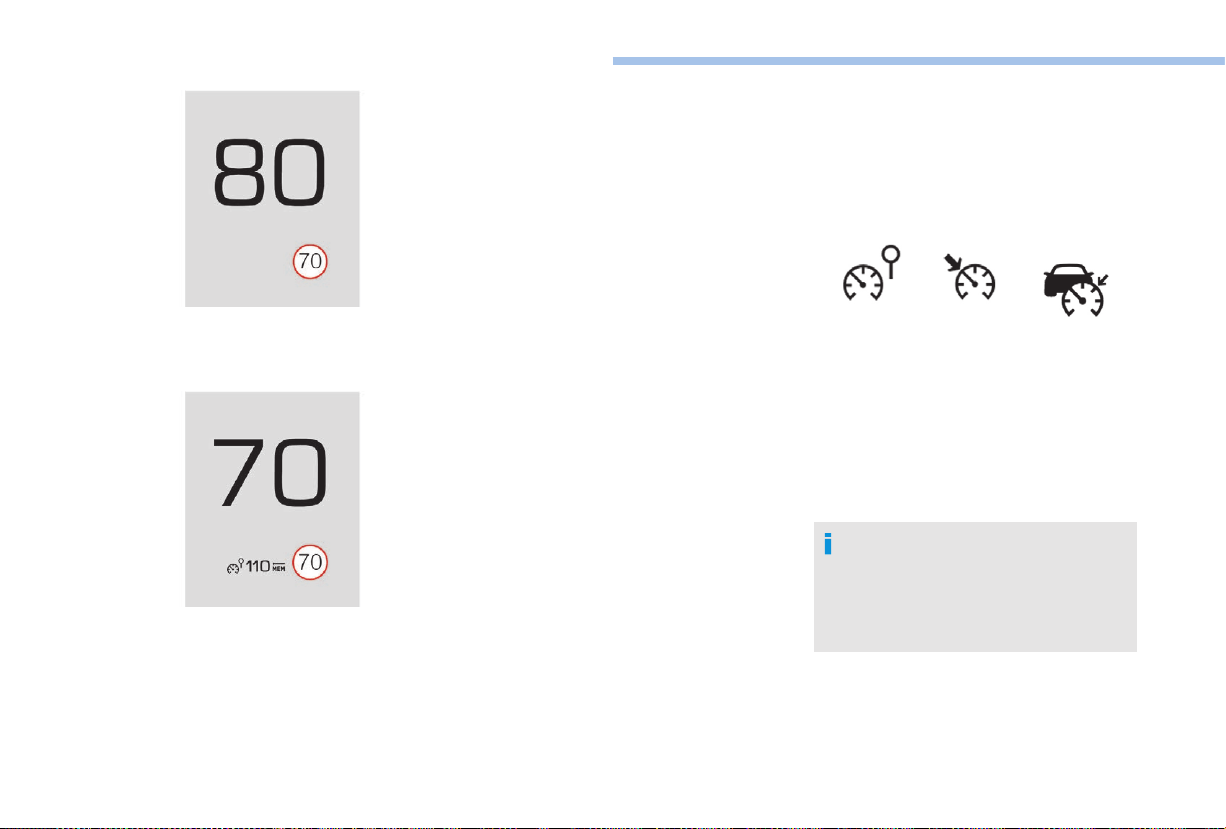
174
Driving
On detection of speed limit information, the
system displays the value.
"MEM" flashes, accompanied by a message –
with speed limiter or cruise control activated –
the system suggests recording the speed limit
as a new speed setting.
Operating limits
The legislation on speed limits is specific to
each country.
The system does not take account of reduced
speed limits in the following cases:
- poor weather (rain, snow),
- atmospheric pollution,
- trailer, caravan,
- driving with a space-saver type spare wheel
or snow chains fitted,
- puncture repair using the temporary repair
kit,
- young drivers, etc.
The following situations may interfere with the
operation of the system or prevent it working:
- poor visibility (inadequate street lighting,
falling snow, rain, fog),
- windscreen area located in front of the
camera dirty, misted, frost-covered, snow-
covered, damaged or covered by a sticker,
- fault with the camera,
- obsolete or incorrect mapping,
- hidden road signs (other vehicles,
vegetation, snow),
- speed limit signs that do not conform to the
standard, are damaged or distorted.
Memorising the speed
setting
This memorise function is in addition to the
display of Recognition of speed limit signs.
For more information on the Speed
limiter, Cruise control, or Adaptive
cruise control with Stop function, refer
to the corresponding sections.
The driver can choose to adapt the speed
setting to the speed limit suggested, by
pressing the memorise button for the speed
limiter, the standard cruise control and the
adaptive cruise control with Stop function.
This speed setting then replaces the previous
speed setting for the speed limiter and/or
cruise control.
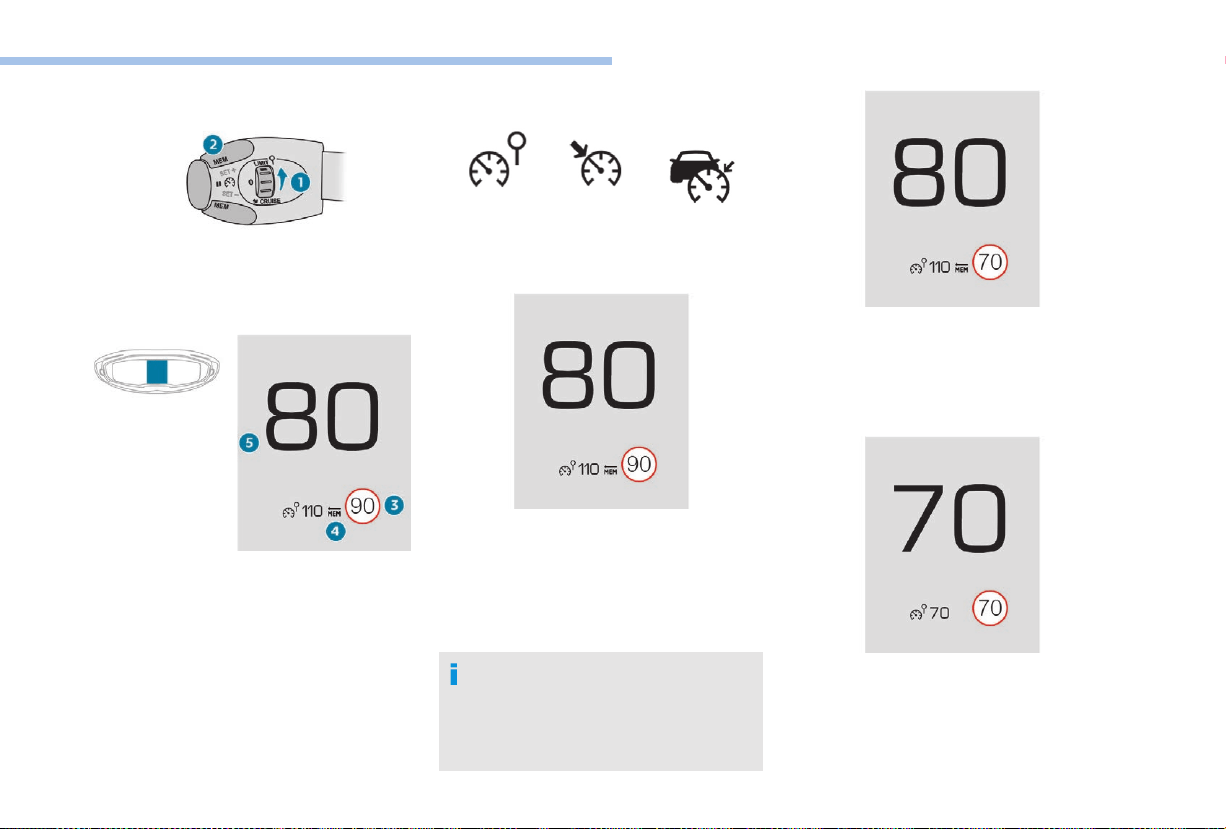
175
6
Driving
Steering mounted controls
Display on the instrument panel
1. Select speed limiter / cruise control mode.
2. Memorise a speed setting.
3. Speed limit indication.
4. Offer to memorise the speed.
5. Current speed setting.
Memorising the speed
F Switch on the speed limiter / cruise control.
Speed limiter / cruise control information is
displayed.
On detection of a sign offering a new speed
limit, the system displays the value and MEM
flashes for a few seconds to offer to make it a
new speed setting.
If there is a difference of less than 6 mph
(10 km/h) between the speed setting and
the speed displayed by the speed limit
sign recognition system, the MEM symbol
is not displayed.
F Make an initial press on button 2 to request
saving of the speed suggested.
A message is displayed to confirm the request.
F Press button 2 again to confirm and save
the new speed setting.
After a predetermined period, the screen
returns to the current display.
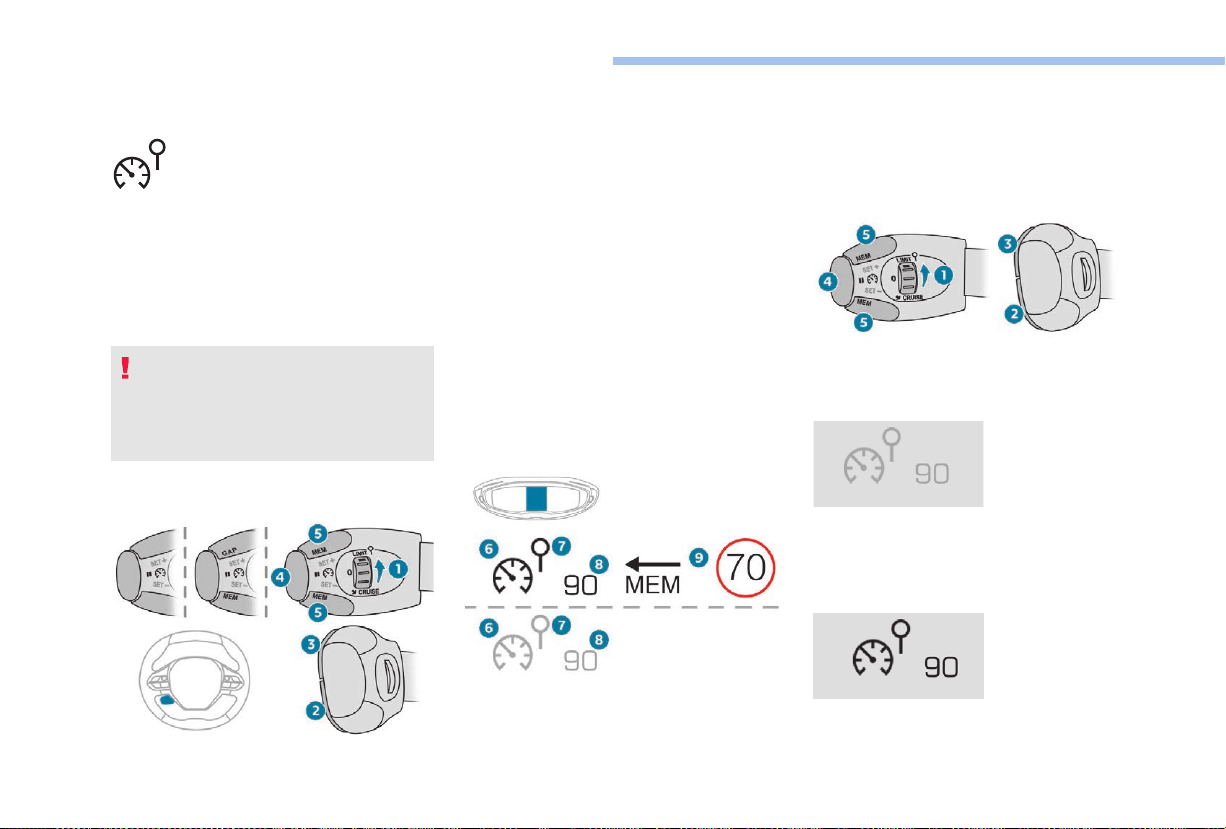
176
Driving
Speed limiter
System which prevents the
vehicle from exceeding the speed
programmed by the driver.
The speed limiter is switched on manually.
The minimum programmed speed is 19 mph
(30 km/h).
The programmed speed remains in the system
memory when the ignition is switched off.
The speed limiter is a driving aid that
cannot, in any circumstances, replace the
need to observe speed limits or the need
for vigilance on the part of the driver.
Steering mounted control
For more information on Memorising speeds
or Recognition of speed limit signs and
recommendation, refer to the associated
sections.
Displays on the instrument
panel
Switching on
F If the speed setting is suitable (last speed
setting programmed in the system), press
button 4 to switch the speed limiter on.
F Pressing button 4 again temporarily
interrupts the function (pause).
2. Decrease the programmed value.
3. Increase the programmed value.
4. Speed limiter On / Pause.
5. Depending on version:
Display of speed thresholds in the
memory with the programmable speed
limiter
or
Use the speed suggested by the speed
limit signs recognition system.
1. Select speed limiter mode.
6. Speed limiter On / Off indication.
7. Speed limiter mode selection indication.
8. Programmed speed value.
9. Speed suggested by the speed limit
sign recognition system (depending on
version).
F Turn thumbwheel 1 to the "LIMIT" position
to select the speed limiter; the function is
paused.
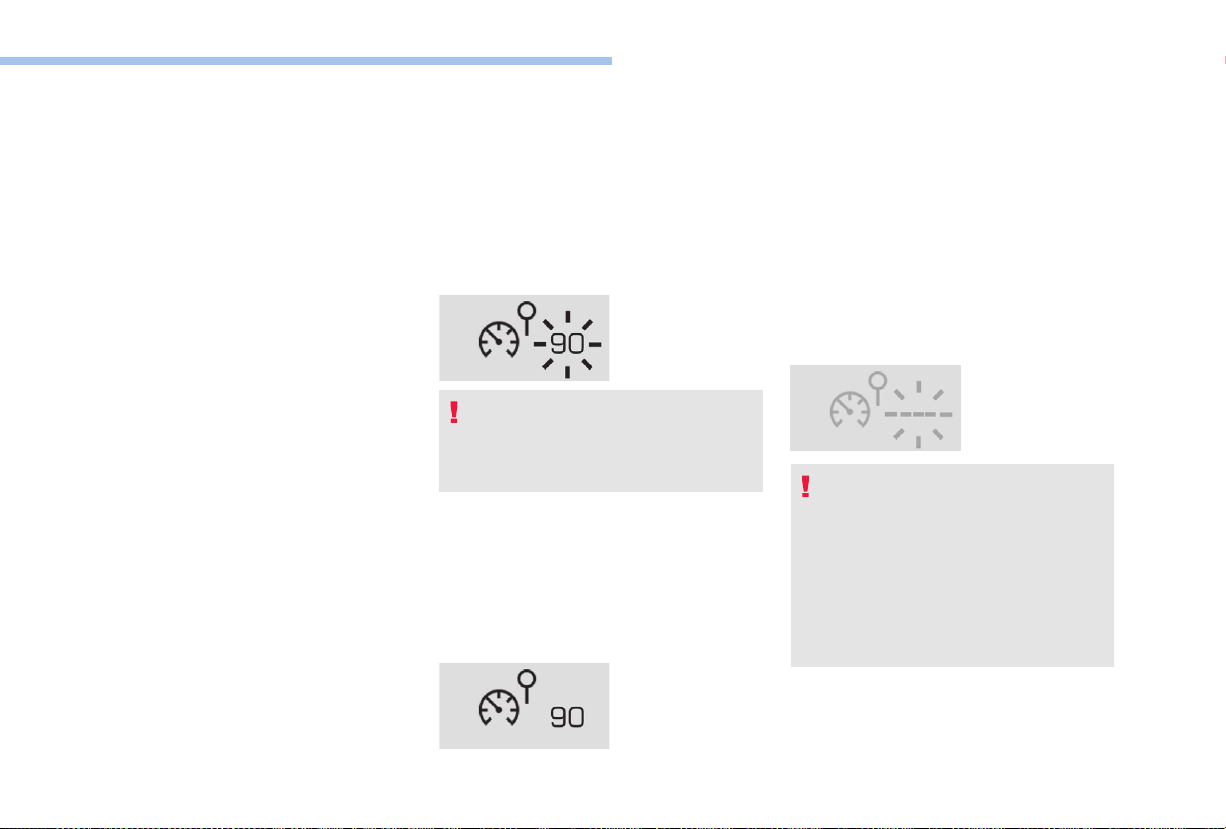
177
6
Driving
Adjusting the limit speed
setting
You do not have to switch the speed limiter on
in order to set the speed.
To modify the limit speed setting from the
current speed of the vehicle:
F in steps of +/- 1 mph (1 km/h), make
successive short presses on button 2 or 3,
F continuously, in steps of +/- 5 mph (5 km/h),
press and hold button 2 or 3.
To modify the limit speed setting using
memorised speeds and from the touch screen:
F press button 5 to display the six memorised
speed settings,
F press the button for the desired speed
setting.
This setting becomes the new limit speed.
To modify the speed limiter setting using
the speed suggested by the speed limit sign
recognition system:
F the speed suggested is displayed in the
instrument panel,
F make a first press on button 5; a message
is displayed to confirm the memorisation
request,
F press button 5 again to save the suggested
speed.
The speed displays immediately in the
instrument panel as the new speed setting.
Temporarily exceeding the
programmed speed
F If you want to temporarily exceed the
programmed limit speed, press firmly on
the accelerator pedal, going beyond the
point of resistance.
The speed limiter is deactivated temporarily
and the displayed programmed speed flashes.
On a steep descent or in the event of
sharp acceleration, the speed limiter will
not be able to prevent the vehicle from
exceeding the programmed speed.
When the limit speed is exceeded but this is not
due to action by the driver, there is an audible
signal to complete the alert.
Once the speed of the vehicle returns to
the programmed setting, the speed limiter
functions again: the display of the programmed
speed setting becomes steady again.
Switching off
F Turn the thumbwheel 1 to the "0" position:
the display of information on the speed
limiter disappears.
Malfunction
Flashing dashes indicate a fault with the speed
limiter.
Have it checked by a PEUGEOT dealer or a
qualified workshop.
The use of mats not approved by
PEUGEOT may interfere with the
operation of the speed limiter.
To avoid any risk of jamming of the pedals:
- ensure that the mat is positioned
correctly,
- do not fit one mat on top of another.
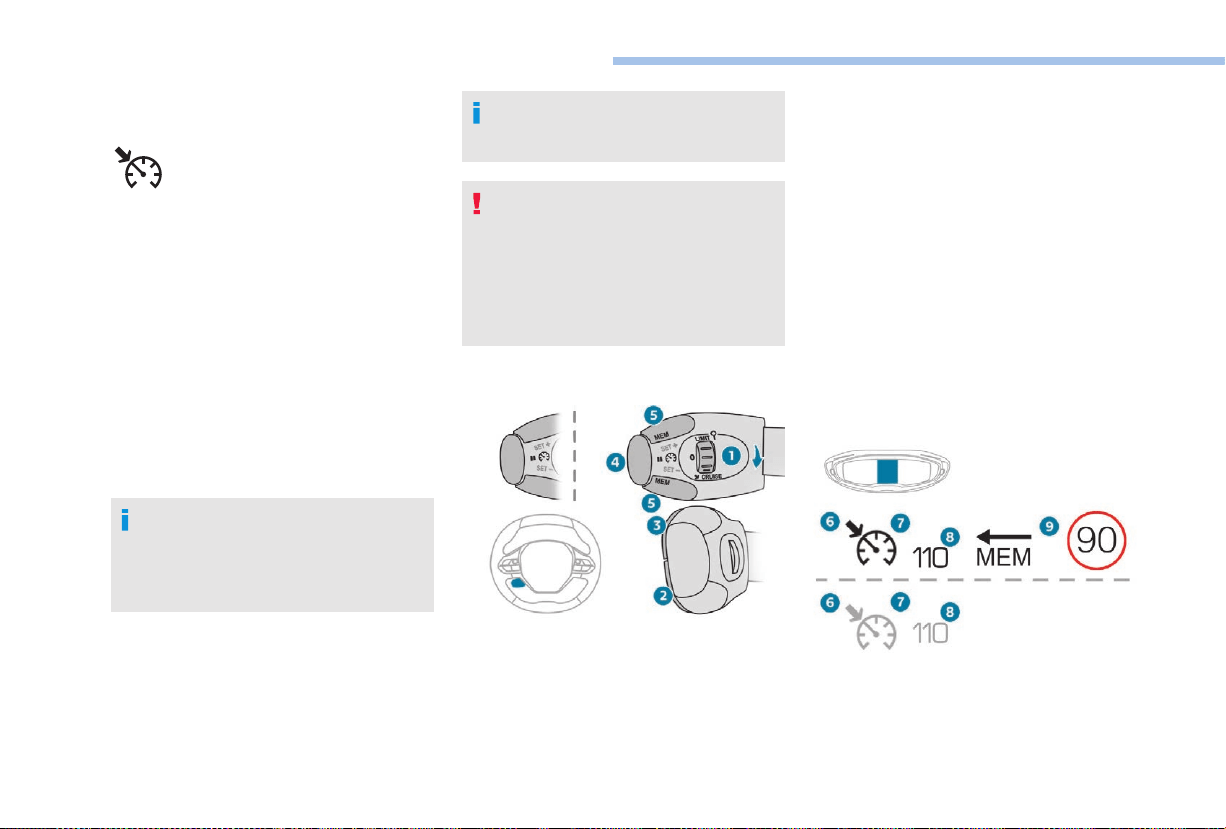
178
Driving
Cruise control
System which automatically
maintains the cruising speed of the
vehicle at a setting programmed by
the driver, without any action on the
accelerator pedal.
The cruise control is switched on manually.
It requires a minimum vehicle speed of 25 mph
(40 km/h).
With a manual gearbox, it requires the
engagement of third gear or higher.
With an automatic gearbox, it requires the
engagement of the selector in mode D or of
second gear or higher in mode M.
Speed regulation remains active after
changing gear on vehicles fitted with a
manual gearbox and Stop & Start.
The operation of the cruise control can be
interrupted (pause):
- by pressing control 4 or by pressing the
brake pedal,
- automatically, if operation of the dynamic
stability control system is triggered.
Switching off the ignition cancels any
programmed speed setting.
The cruise control system is a driving aid
that cannot, in any circumstances, replace
the need to observe speed limits, nor the
need for vigilance on the part of the driver.
As a safety measure, you are advised to
keep your feet near the pedals at all times.
Steering mounted control
For more information on Memorising speeds
or Recognition of speed limit signs and
recommendation, refer to the associated
sections.
Displays on the instrument
panel
1. Select cruise control mode.
2. Set the current speed of the vehicle as
the cruise setting or lower the cruise
setting.
3. Set the current speed of the vehicle as
the cruise setting or raise the cruise
setting.
4. Pause / Resume cruise control.
5. Depending on version:
Display of speed thresholds in the
memory with the programmable cruise
control
or
Use the speed suggested by the speed
limit signs recognition system.
6. Cruise control pause / resume indication.
7. Cruise control selection indication.
8. Value of the speed setting.
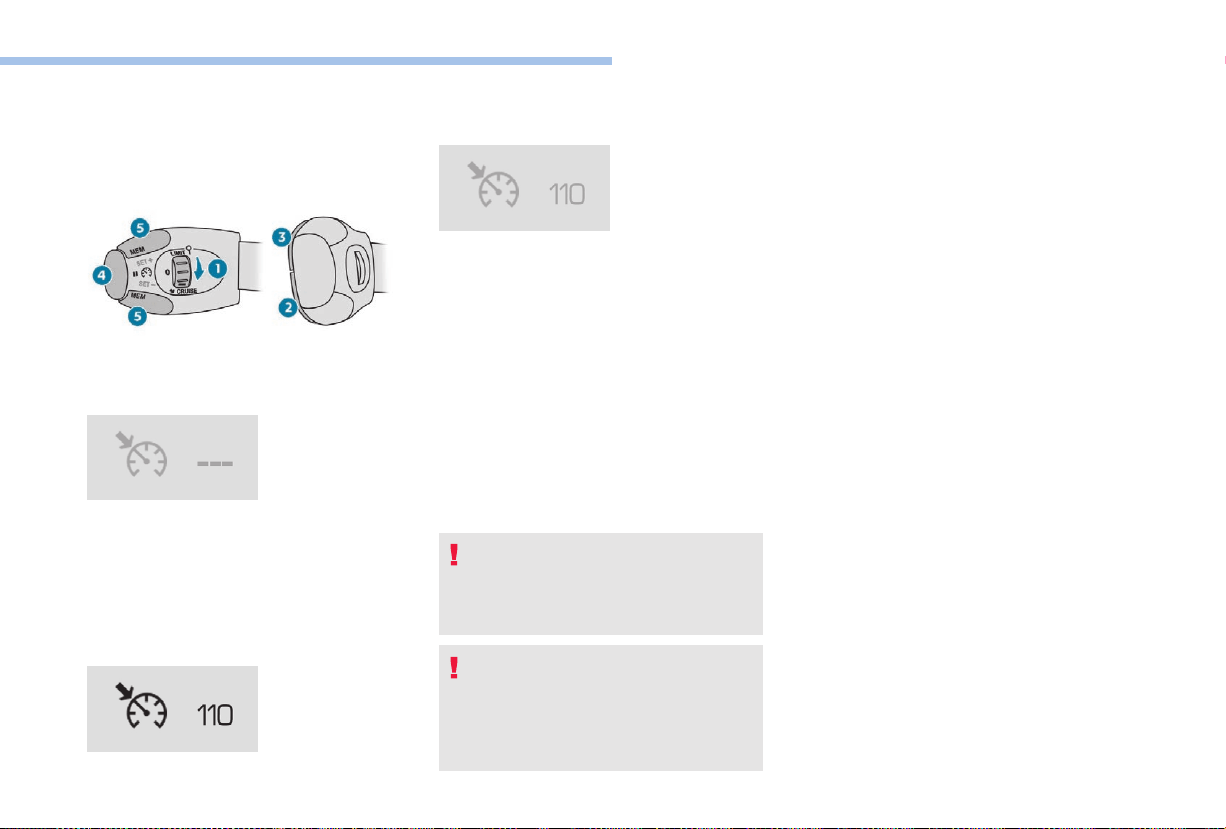
179
6
Driving
Switching on
F To start the cruise control and set a cruise
speed, once the vehicle has reached the
desired speed, press button 2 or 3: the
current speed of your vehicle becomes the
cruise speed setting.
You can release the accelerator pedal.
F Pressing button 4 temporarily interrupts the
function (pause).
9. Speed suggested by the speed limit
sign recognition system (depending on
version).
F Turn thumbwheel 1 to "CRUISE" to select
cruise control mode; the function is paused.
F Pressing button 4 again restores operation
of the cruise control (ON).
Modifying the cruise speed
setting
The cruise control must be active.
To modify the cruise speed setting from the
current speed of the vehicle:
F in steps of + or - 1 mph (1 km/h), make
repeated short presses on button 2 or 3,
F continuously, in steps of + or - 5 mph
(5 km/h), press and hold button 2 or 3.
Take care: pressing and holding button 2
or 3 results in a rapid change in the speed
of your vehicle.
As a precaution, it is recommended
that the cruise speed chosen be close
to the current speed of your vehicle, so
as to avoid any sudden acceleration or
deceleration of the vehicle.
To modify the cruise speed setting using
memorised speed settings and from the touch
screen:
F press button 5 to display the six memorised
speed settings,
F press the button for the desired speed
setting.
This setting becomes the new cruise speed.
To modify the cruise speed setting using
the speed suggested by the speed limit sign
recognition system:
F the speed suggested is displayed in the
instrument panel,
F make a first press on button 5; a message
is displayed to confirm the memorisation
request,
F press button 5 again to save the suggested
speed.
The speed displays immediately in the
instrument panel as the new speed setting.
Temporarily exceeding the
programmed speed
If needed (for overtaking, etc.) it is possible to
exceed the programmed speed by pressing the
accelerator pedal.
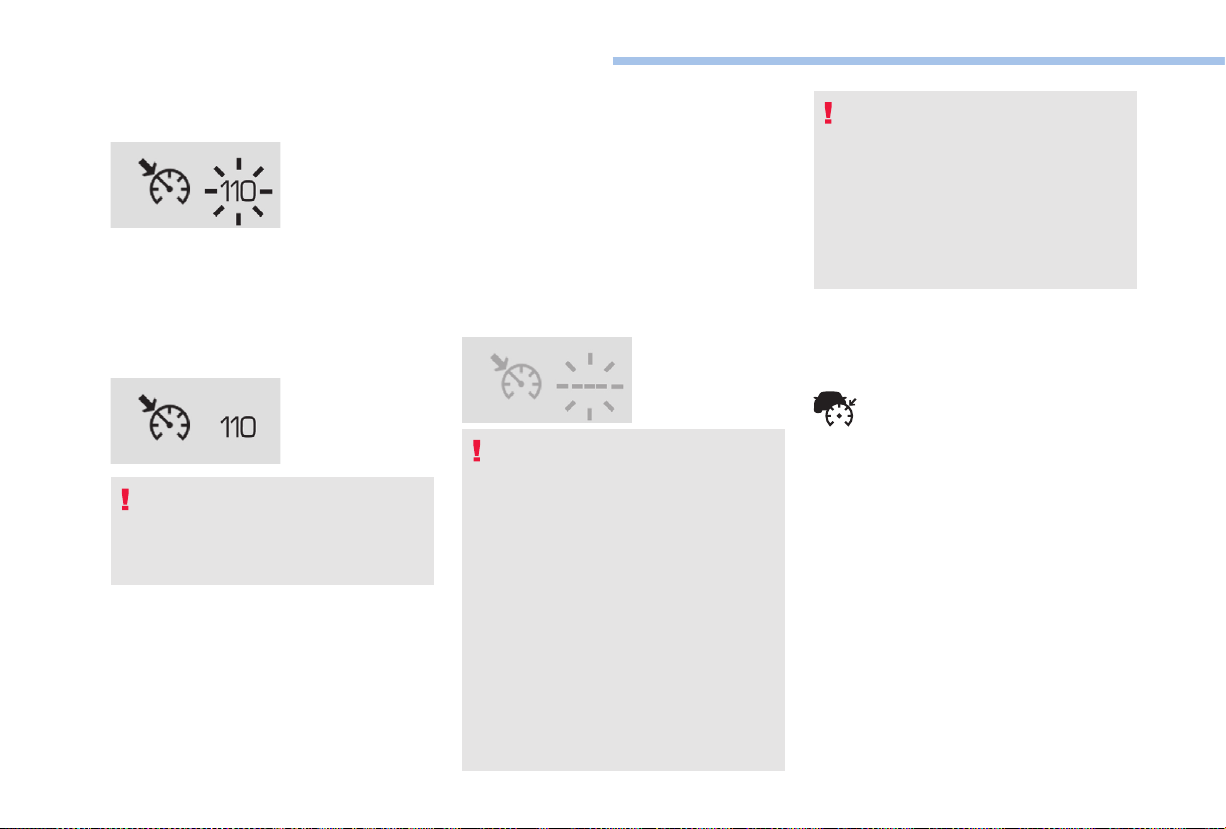
180
Driving
When descending a steep hill, the cruise
control system cannot prevent the vehicle
from exceeding the programmed speed.
You may have to brake to control the speed of
your vehicle. In this case, the cruise control is
automatically paused.
To activate the system again, with the speed
of the vehicle above 25 mph (40 km/h), press
button 4.
Switching off
F Turn the thumbwheel 1 to the "0" position:
the cruise control information disappears
from the screen.
Malfunction
Flashing dashes indicate a fault with the cruise
control system.
Have it checked by a PEUGEOT dealer or a
qualified workshop.
Use the cruise control only where the
driving conditions allow running at a
constant speed and at an adequate safe
distance.
Do not activate the cruise control in urban
areas, in heavy traffic, on winding or steep
roads, on slippery or flooded roads, or in
conditions of poor visibility (heavy rain,
fog, falling snow, etc.).
In some circumstances, it may not be
possible to maintain or reach the cruise
speed set: towing, vehicle heavily loaded,
steep climb.
The use of mats not approved by
PEUGEOT may interfere with the
operation of the cruise control.
To avoid any risk of jamming the pedals:
- ensure that the mat is positioned
correctly,
- do not fit one mat on top of another.
To return to the programmed speed, simply
release the accelerator pedal.
Once the vehicle has returned to the
programmed speed, the cruise control takes
over again: the display of the programmed
speed setting becomes steady again.
Adaptive cruise control
The cruise control is temporarily overridden
and the programmed speed setting flashes.
This system provides the following
functions:
- Automatic regulation of the
vehicle speed at the value
programmed by the driver.
- With a manual gearbox,
automatic adjustment of the
distance between your vehicle
and the one in front.
- With an automatic gearbox,
automatic adjustment of the
distance between your vehicle
and the one in front, which may
cause your vehicle to come to a
complete stop.
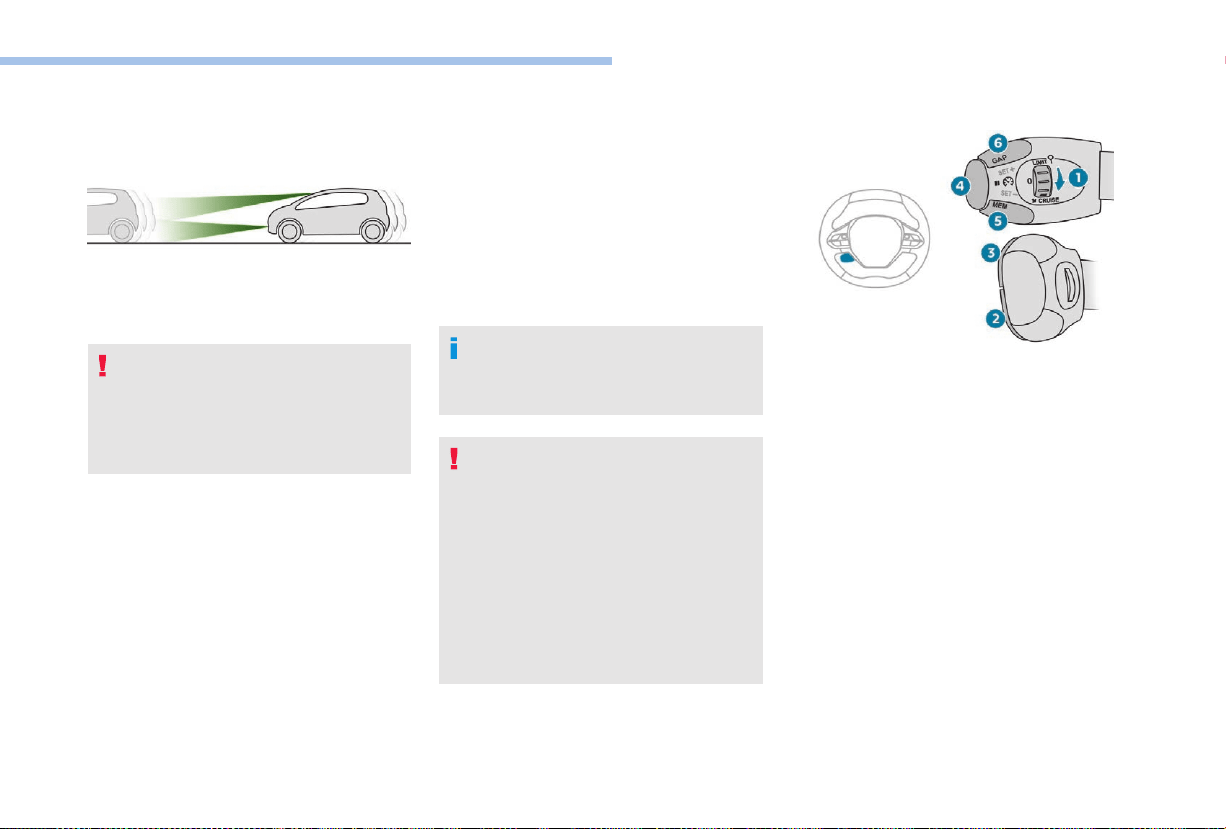
181
6
Driving
Principle of operation
The system automatically adapts the speed of
your vehicle to that of the vehicle in front, to
maintain a constant distance.
If the vehicle in front is driving more slowly, the
system slows, or even stops your vehicle, using
engine braking and the braking system (for
versions fitted with an automatic gearbox).
The brake lamps illuminate as soon as
the braking system is activated with
deceleration of the vehicle.
Primarily designed for driving on main
roads and motorways, this system only
works on moving vehicles, driving in the
same direction as your vehicle.
If the vehicle in front accelerates or changes
lane, the cruise control progressively
accelerates your vehicle to return to the
programmed speed.
If the driver operates a direction indicator to
overtake a slower vehicle, the cruise control
allows your vehicle to temporarily approach
the vehicle in front to assist the overtaking
manoeuvre, though never exceeding the
programmed speed.
The adaptive cruise control system
is a driving aid that cannot, in any
circumstances, replace the need to observe
speed limits and safety distances, nor the
need for vigilance on the part of the driver.
It is recommended that you always keep
your feet close to the pedals.
The driver must be ready to take back
control of their vehicle at any time,
using the brake or accelerator pedal as
appropriate.
Steering mounted control
1. Select cruise control mode.
2. Use the current speed as the speed
setting / Lower the speed setting.
3. Use the current speed as the speed
setting / Raise the speed setting.
4. Pause / Resume cruise control.
5. Use the speed suggested by the speed
limit signs recognition system (MEM).
6. Display and adjustment of the
programmed inter-vehicle distance.
For more information on Recognition of
speed limit signs and recommendation,
refer to the corresponding section.
It manages the acceleration and deceleration
of the vehicle by automatically acting on the
engine and the braking system.
To do so, it has a camera located at the top of
the windscreen and a radar located in the front
bumper.
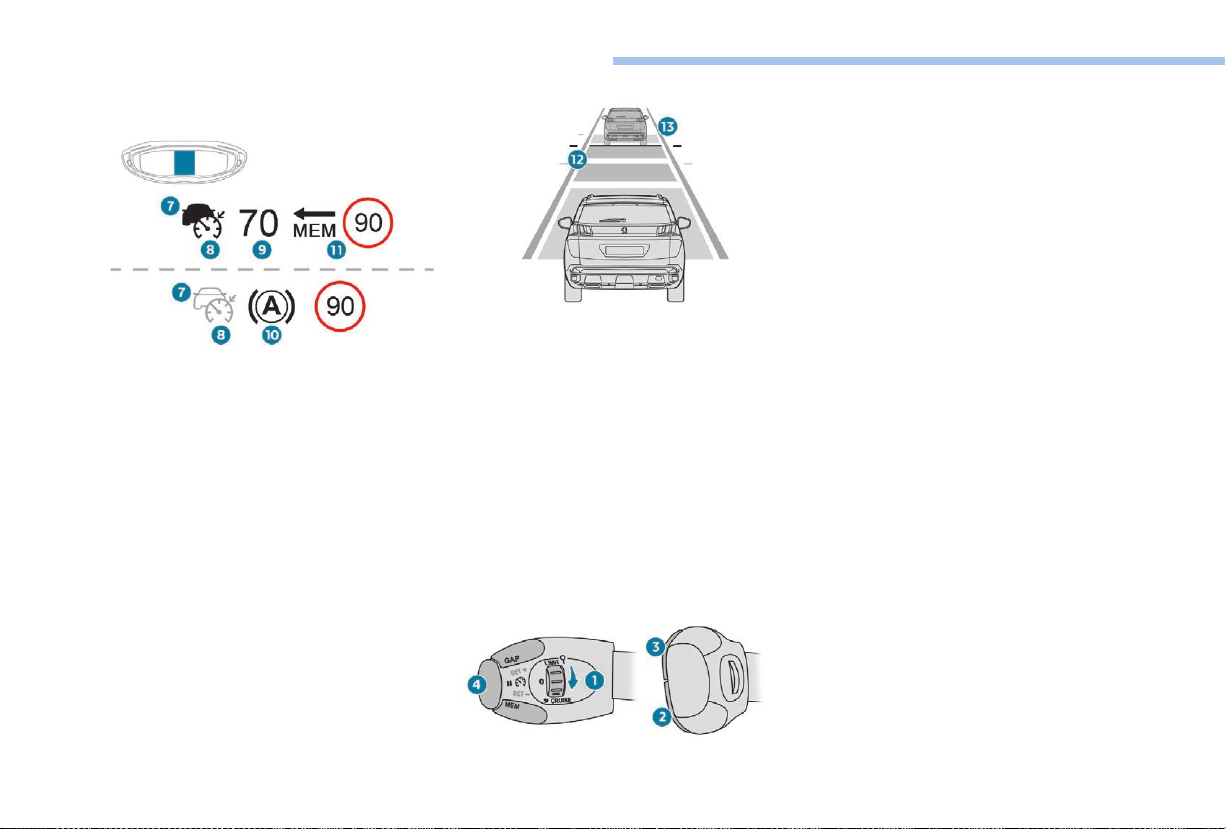
182
Driving
Displays on the instrument panel
Switching on
The cruise control is switched on manually.
The speed of the vehicle must be between 19
and 112 mph (30 and 180 km/h).
With an automatic gearbox: in mode D or M.
Pause
The adaptive cruise control can be paused
manually by:
- action by the driver:
• On button 4 (Pause).
• On the brake pedal.
• On the electric parking brake control.
• By changing from mode D to N with an
automatic gearbox.
- or automatically, if operation of the ESC
system is triggered for reasons of safety.
7. Indication of the presence / absence of a
target vehicle.
8. Indication of cruise control activation /
deactivation.
9. Value of the speed setting.
10. Indication that vehicle is held stationary.
11. Speed suggested by the speed limit
recognition system.
12. Inter-vehicle distance setting.
13. Position of vehicle detected by the radar.
This information is visible in the instrument
panel in the "DRIVING" display mode.
If a vehicle is detected, the symbol 7 is filled
with the colour associated with the cruise
control mode. By default, the symbol 7 is
empty.
In cruise control activated mode, the symbol
8 appears in green. By default, the symbol 8
appears in grey.
F With the engine running, turn the
thumbwheel 1 to the "CRUISE" position to
select cruise control mode: the function is
paused (displayed in grey).
F Vehicle moving, press one of the buttons
2 or 3: the current speed of your vehicle
becomes the cruise speed setting.
The cruise control starts operating (displayed
in green).
By default, the inter-vehicle distance is set at
"Normal" (2 dashes).
Otherwise, the last setting made will be used
when switching on the system.
Switching off the ignition cancels any speed
setting value chosen by the driver.
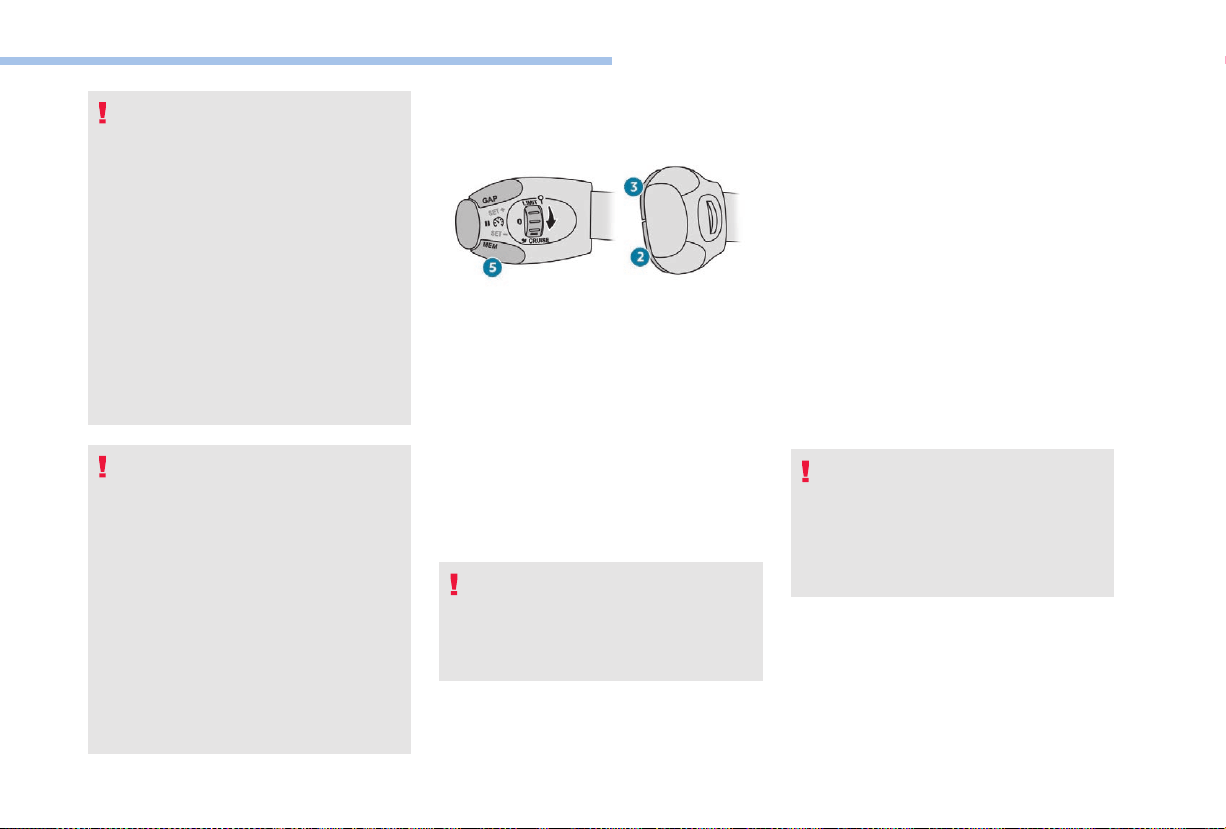
183
6
Driving
When the cruise control is paused, it
can only be reactivated when all of the
safety conditions are met. The message
"Activation not possible, conditions
unsuitable" is displayed while reactivation
is not possible.
To reactivate the function, the driver
must accelerate to reach at least 19 mph
(30 km/h), then press one of the buttons
2, 3 or 4.
As a safety measure, wait until the
current speed reaches the speed setting
to reactivate the function by pressing
button 4.
Versions fitted with an automatic
gearbox
Following braking of the vehicle bringing it
to a complete stop, the system holds the
vehicle stationary; the cruise control is
paused.
The driver should press the accelerator
pedal to move off, then reactivate the
system above 19 mph (30 km/h) by
pressing button 2, 3 or 4.
If the driver takes no action following
this immobilisation, the electric parking
brake is applied automatically after a few
minutes.
Modification of the speed
setting
Modication from the current
speed
F By successive short presses on button 2
or 3, to raise or lower the setting in steps of
1 mph (1 km/h).
F By a maintained press on button 2 or 3, to
raise or lower the setting in steps of 5 mph
(5 km/h).
Take care: the maintained press on button
2 or 3 will cause a very quick change in
the speed of your vehicle.
Engine running and cruise control on (green),
you can modify the speed setting.
Modication from the speed limit
sign recognition system
F The suggested speed is displayed in the
instrument panel.
F Make an initial press on button 5; a
message is displayed to confirm the
memorisation request.
F Press button 5 again to save the suggested
speed.
The speed displays immediately in the
instrument panel as the new speed setting.
For more information on Recognition of
speed limit signs and recommendation,
refer to the corresponding section.
As a precaution, it is recommended
that you select a cruise speed close to
the current speed of your vehicle, so
as to avoid any sudden acceleration or
deceleration of the vehicle.
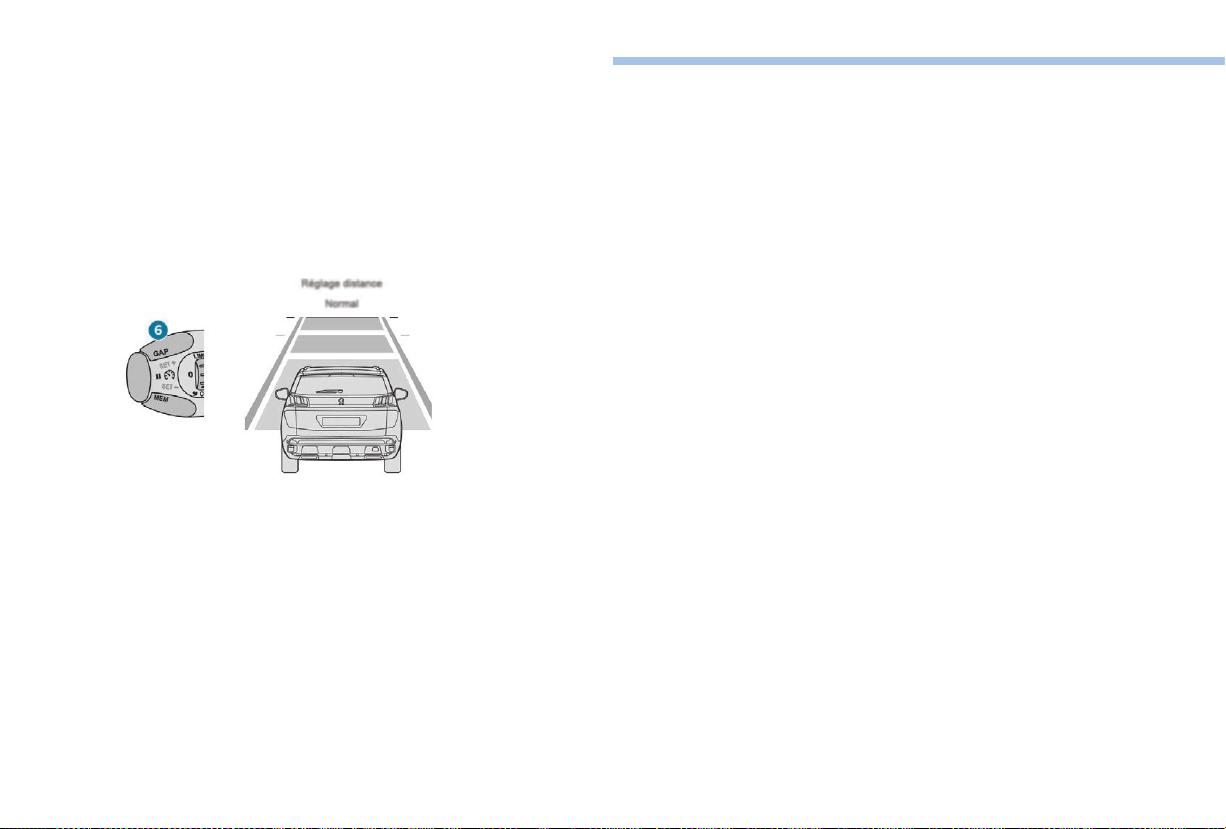
184
Driving
This setting remains in memory, whatever the
state of the system and when the ignition is
switched off.
Exceeding the programmed
setting
It is possible to exceed the speed setting
temporarily by depressing the accelerator
pedal.
The cruise control no longer manages the
braking system during this period.
Simply release the accelerator pedal to return
to the programmed speed.
If the programmed speed setting is exceeded,
the display of the speed setting disappears
and a message "Cruise control suspended"
is displayed until the accelerator pedal is
released.
Driving situations and
associated alerts
To benefit from all necessary information on
the instrument panel, you must previously
select the "DRIVING" display mode.
The table below describes the alerts and
messages displayed depending on the driving
situation.
The display of these alerts is not sequential.
Engine running and cruise control selected
(grey), you can change the inter-vehicle
distance setting:
F Press button 6 to display the selection
screen for inter-vehicle distance.
F By pressing button 6 repeatedly, cycle
through the predefined settings.
The selection screen closes after a few
seconds.
The change then takes effect.
Modification of the
programmed inter-vehicle
distance
Three threshold settings are suggested for the
inter-vehicle distance:
- "Distant" (3 dashes),
- "Normal" (2 dashes),
- "Close" (1 dash).
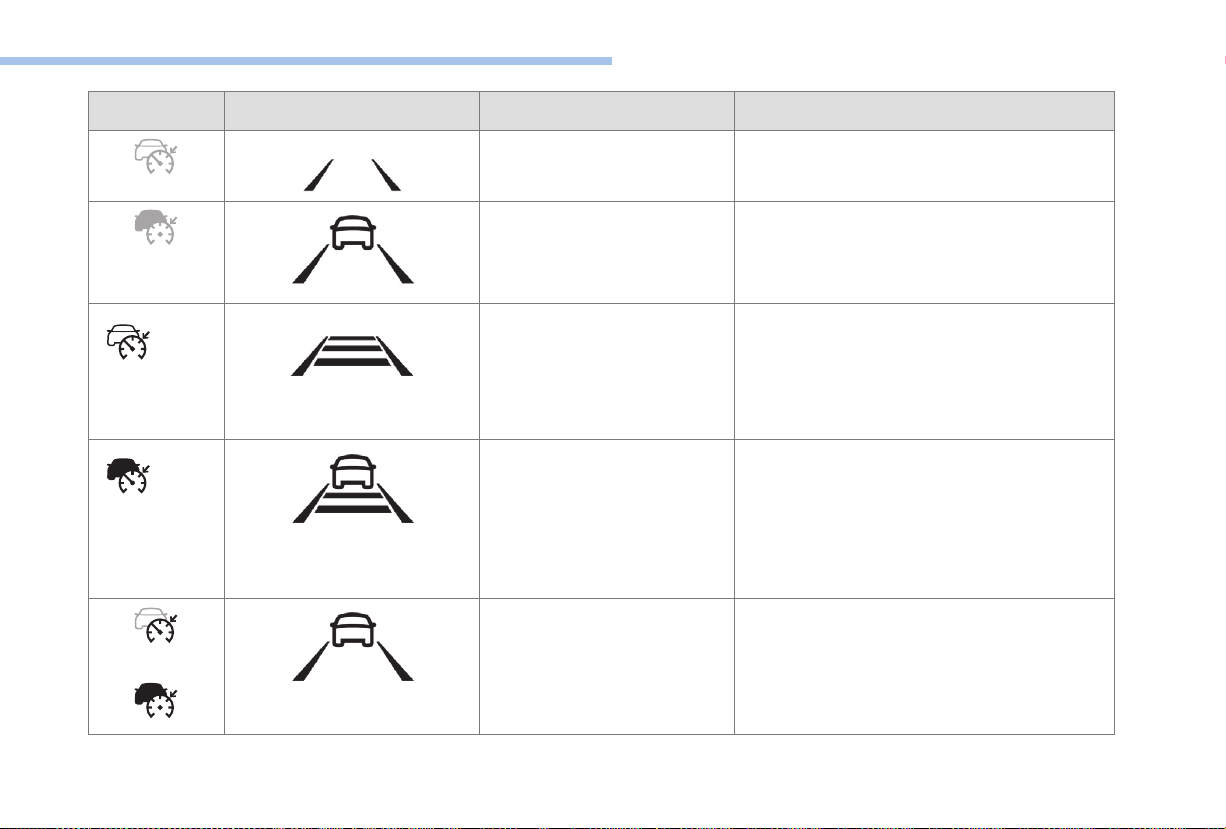
185
6
70
70
Driving
Indicator lamp Display Associated message Comments
"Cruise control paused" System paused.
No vehicle detected.
"Cruise control paused" System paused.
A vehicle has been detected.
according to the inter-vehicle
distance selected
"Cruise control on" System activated.
No vehicle detected.
according to the inter-vehicle
distance selected
"Cruise control on" System activated.
A vehicle has been detected.
or
"Cruise control suspended" System activated.
The driver has temporarily taken control of the
vehicle by accelerating.
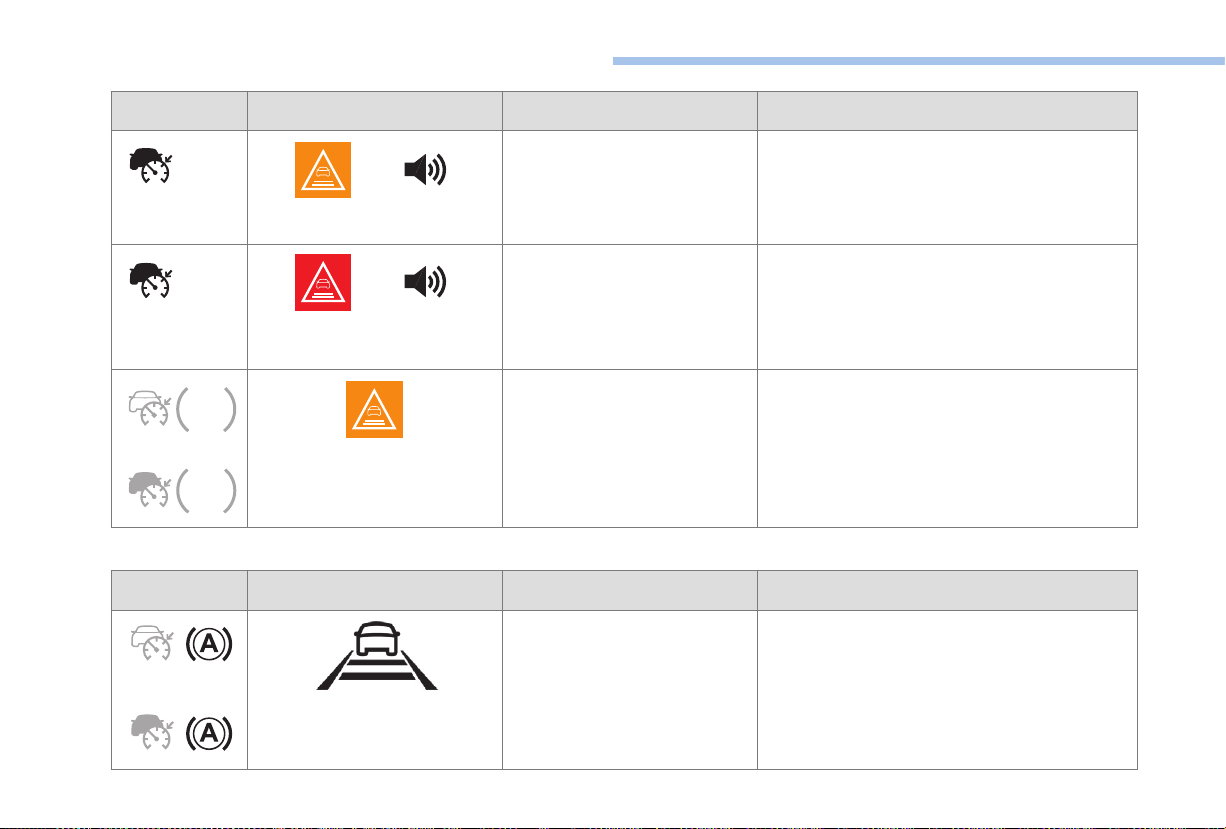
186
70
70
70
70
Driving
Indicator lamp Display Associated message Comments
+
(orange)
"Take back control of the vehicle" The driver must take back control of the vehicle
by accelerating or braking, depending on the
circumstances.
+
(red)
"Take back control of the vehicle" The system cannot manage the critical situation
alone (emergency braking of the target vehicle,
rapid insertion of another vehicle between the two
vehicles).
The driver must immediately take back control
of the vehicle.
or
(orange)
"Activation not possible, conditions
unsuitable"
The system refuses to activate the cruise control
(speed outside the operating range, winding road).
Versions fitted with an automatic gearbox
Indicator lamp Display Associated message Comments
or
according to the inter-vehicle
distance selected and the actual
distance from the target vehicle
"Cruise control paused"
(for a few seconds)
The system has brought the vehicle to a complete
stop and is holding it immobilised.
The driver must accelerate to move off again.
The cruise control remains paused until the driver
reactivates it with the speed of the vehicle above
19 mph (30 km/h).
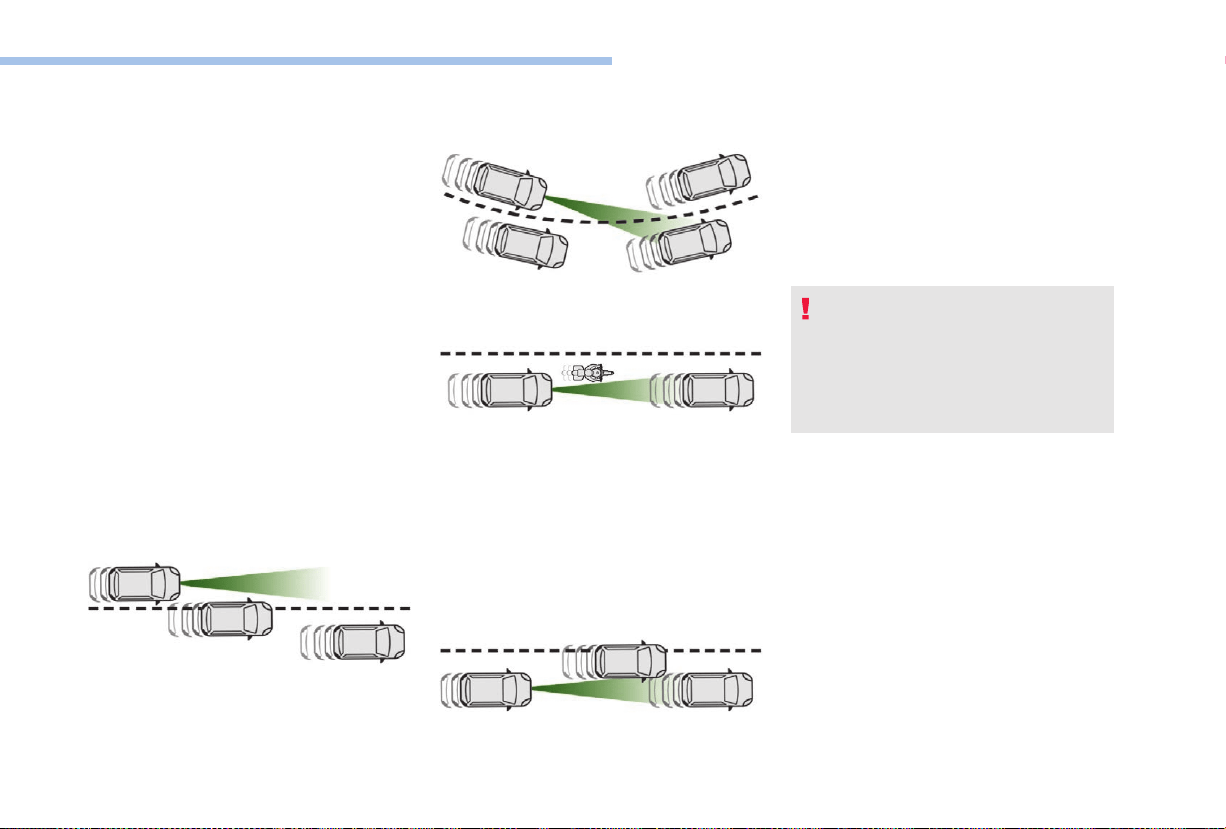
187
6
Driving
Following braking of the vehicle bringing it to
a complete stop, the system holds the vehicle
stationary; the cruise control is paused.
The driver must press the accelerator pedal
to move off again, then reactivate the system
above 19 mph (30 km/h), by pressing button
2, 3 or 4. If the driver takes no action following
the immobilisation, the electric parking brake is
applied automatically after a few minutes.
Operating limits
The system cannot exceed the limits of the
laws of physics.
Certain situations cannot be managed by the
system and require the driver to take back
control of the vehicle.
Cases of non-detection by the system:
- Pedestrians, some cyclists, animals.
- Stationary vehicles (traffic jam, breakdown,
etc.).
When the driver must suspend the cruise
control system:
Cases where the driver is encouraged to
take back control immediately:
- Excessively sharp deceleration of the
vehicle in front of you.
The system must not be activated in the
following situations:
- Use of the "space-saver" type spare wheel
(depending on version).
- Towing.
- Carrying long objects on roof bars.
- Following an impact on the windscreen
close to the camera or on the front bumper
(versions with radar).
Be particularly careful:
- When motorcycles are present and
when there are vehicles staggered
onto the traffic lane.
- When you enter a tunnel or cross a
bridge.
- Vehicles crossing the road lanes.
- Vehicles driving in the opposite direction.
- Vehicles in a tight bend.
- When approaching a roundabout.
- When following a narrow vehicle.
Reactivate cruise control when conditions
permit.
- When a vehicle sharply cuts in between
your vehicle and the one in front.

188
Driving
The cruise control operates by day and
night, in fog or moderate rainfall.
However, it is strongly recommended
that you always keep a safe distance
from vehicles ahead, according to the
driving conditions, the weather and the
road surface.
Use the cruise control only where
the driving conditions allow running
at a constant speed and keeping an
adequate safety distance.
Do not activate the cruise control in an
urban area where pedestrians are likely
to cross the road, in heavy traffic, on
winding or steep roads, on slippery or
flooded roads, when there is snowfall,
if the front bumper or the windscreen
is damaged, or when the brake lamps
have failed.
In certain circumstances, it may not
be possible for the speed setting to be
maintained or even attained: loaded
vehicle, ascending a steep hill, etc.
The system is not intended for the
following situations:
- if the front end of the vehicle has
been modified (addition of long-range
headlamps, painting of the front
bumper),
- driving on a racing circuit,
- running on a rolling road,
- use of snow chains, non-slip covers or
studded tyres.
The use of mats not approved by
PEUGEOT may interfere with the
operation of the cruise control.
To avoid any risk of jamming of the pedals:
- ensure that the mat is secured
correctly,
- do not fit one mat on top of another.
The camera may be disrupted or not
work in the following situations:
- poor visibility (inadequate street
lighting, falling snow, heavy rain,
dense fog, etc.),
- dazzle (headlamps of an oncoming
vehicle, low sun, reflections on
a damp road, leaving a tunnel,
alternating shade and light, etc.),
- camera or radar obstructed (mud,
frost, snow, condensation, etc.).
In these situations, detection
performance may be reduced.
Operation of the radar, located in the
front bumper, may be impaired by the
accumulation of dirt (dust, mud, etc.)
or in certain weather conditions (snow,
frost, etc.).
Clean the front bumper regularly.
Clean the windscreen regularly,
particularly the area in front of the
detection camera.
Do not allow snow to accumulate on
the bonnet or roof of the vehicle, as this
could obscure the camera.
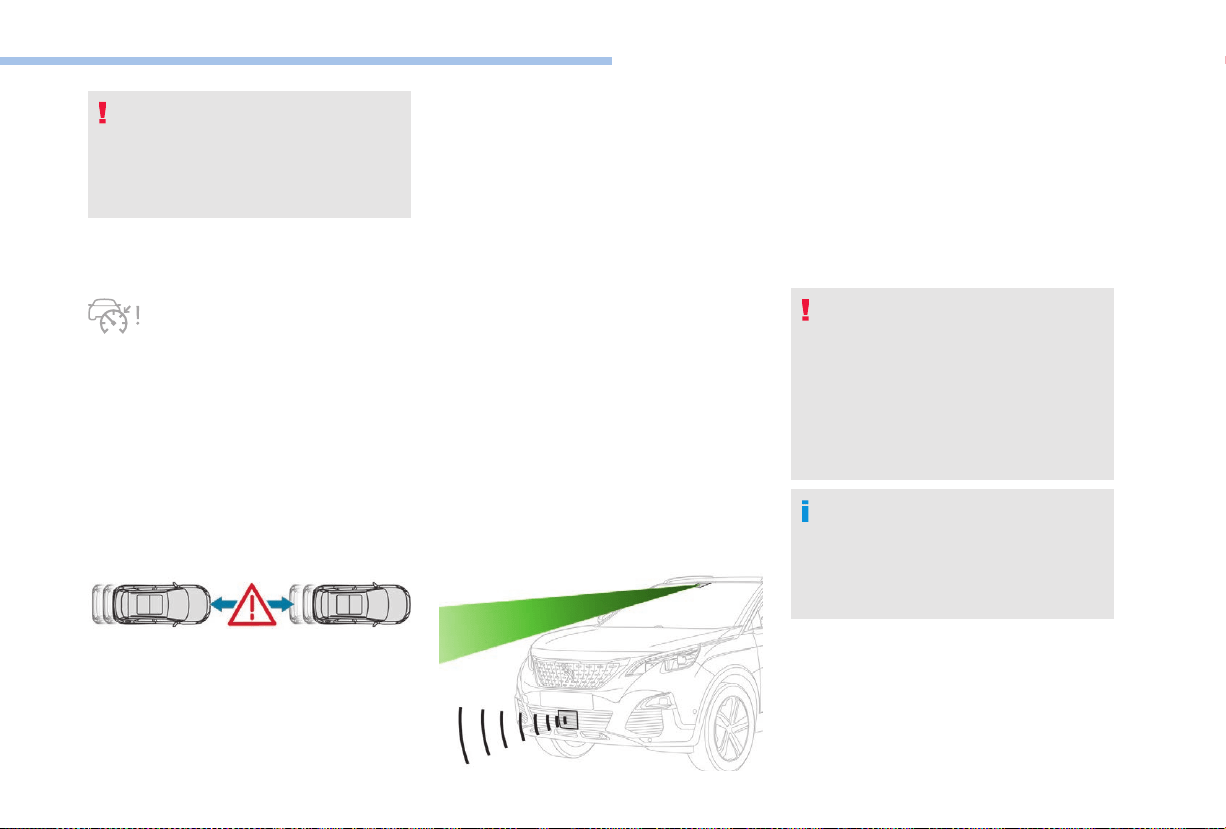
189
6
Driving
Operating fault
In the event of a fault with the cruise
control, you are alerted by the
illumination of this warning lamp
and the display of a message in the
instrument panel, accompanied by
an audible signal.
Have the system checked by a PEUGEOT
dealer or a qualified workshop.
Distance alert and Active
Safety Brake
This system is a driving aid that includes three
functions:
- Distance alert (alert if there is a risk of
collision),
- Intelligent emergency braking assistance,
Activation and operating
conditions
The vehicle has a camera located at the top of
the windscreen, and depending on the version,
a radar located in the front bumper.
If the front bumper is to be repainted or
touched up, contact a PEUGEOT dealer
or a qualified workshop. Certain types of
paint could interfere with the operation of
the radar.
- Active Safety Brake (automatic emergency
braking).
Distance alert: it warns the driver if their
vehicle is at risk of collision with the vehicle in
front or a pedestrian present in their traffic lane.
Intelligent emergency braking assistance:
it supplements the braking action taken by the
driver if this is inadequate.
Active Safety Brake: it intervenes following
the alert if the driver does not react quickly
enough and does not operate the vehicle's
brakes.
If the driver fails to act, it contributes towards
avoiding a collision or limiting its severity by
reducing the speed of your vehicle.
The system is active from about 4 mph (7 km/h)
and is deactivated below about 3 mph (5 km/h).
It takes account of:
- vehicles running in the same direction or
stationary,
- pedestrians in the traffic lane (bicycles,
motorcycles, animals and objects on the
road are not necessarily detected).
This system is designed to assist the
driver and improve road safety.
It is the driver's responsibility to
continuously monitor the state of the
traffic, observing the driving regulations.
This system does not avoid the need for
vigilance on the part of the driver.
As soon as the system detects a potential
obstacle, it prepares the braking circuit in
case automatic braking is needed. This
may cause a slight noise and a sense of
deceleration.
Operating limits
In the following cases, deactivating the system
via the vehicle's configuration menu is advised:
- when towing a trailer,
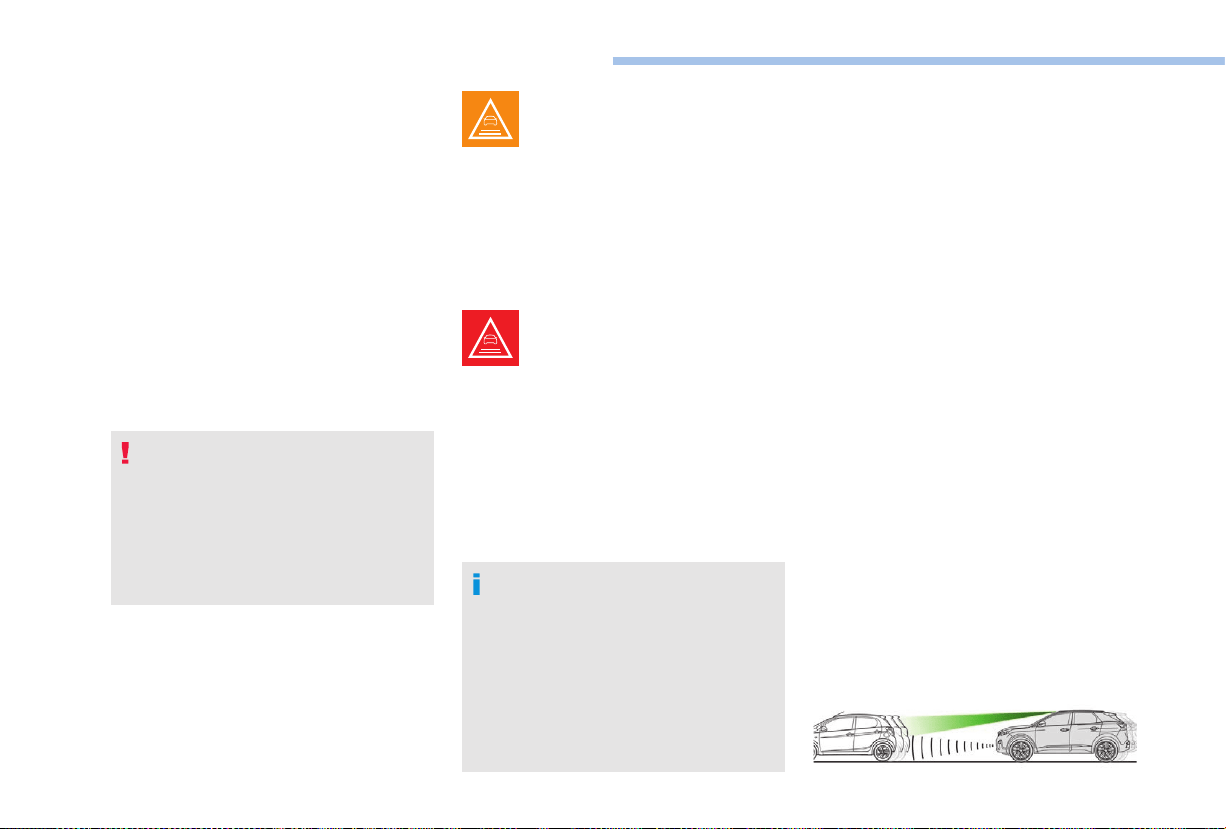
190
Driving
It is possible that warnings are not given,
are given too late or seem unjustified.
Consequently, always stay alert and be
prepared to react at any time to avoid an
accident.
Distance alert
Depending on the degree of risk of collision
detected by the system and the alert threshold
chosen by the driver, different levels of
alert can be triggered and displayed in the
instrument panel.
Level 1 (orange): visual alert only,
signalling to you that the vehicle in
front is very close.
The message "Vehicle close" is
displayed.
This level of alert is based on the inter-vehicle
time between your vehicle and the vehicle in
front.
Level 2 (red): visual and audible
alert, warning you that a collision is
imminent.
The message "Brake!" is displayed.
This level of alert is based on the time before
collision. It takes account of the vehicle
dynamics, the speed of your vehicle and the
one in front, the environmental conditions, the
operation of the vehicle (cornering, pedals
pressed, etc.) to trigger the alert at the best
moment.
Where the speed of your vehicle is too
high approaching another vehicle, the
first level of alert may not be displayed:
the level 2 alert may be displayed
directly.
Important: alert level 1 is never
displayed when the "Close" trigger
threshold has been selected.
- when carrying long objects on roof bars or a
roof rack,
- before using an automatic car wash, with
the engine running,
- before placing the vehicle on a rolling road
in a workshop,
- when the vehicle is being towed, with the
engine running,
- when a "space-saver" type spare wheel is
fitted (depending on version),
- following impact damage to the windscreen
close to the detection camera,
- if the front bumper has been damaged
(version with radar),
- if the brake lamps are not working.
Modifying the alert trigger
threshold
This threshold determines how you wish to be
warned of the presence of a vehicle moving
or stationary in front of you, or a pedestrian
present in your traffic lane.
The current threshold can be modified via the
vehicle configuration menu.
You can select one of three predefined
thresholds:
- "Distant",
- "Normal",
- "Close".
The last threshold selected is kept in memory
when the ignition is switched off.
Intelligent emergency
braking assistance
If the driver brakes, but not sufficiently to avoid
a collision, this system will supplement the
braking, within the limits of the laws of physics.
This assistance will only be provided if you
press the brake pedal.
Active Safety Brake
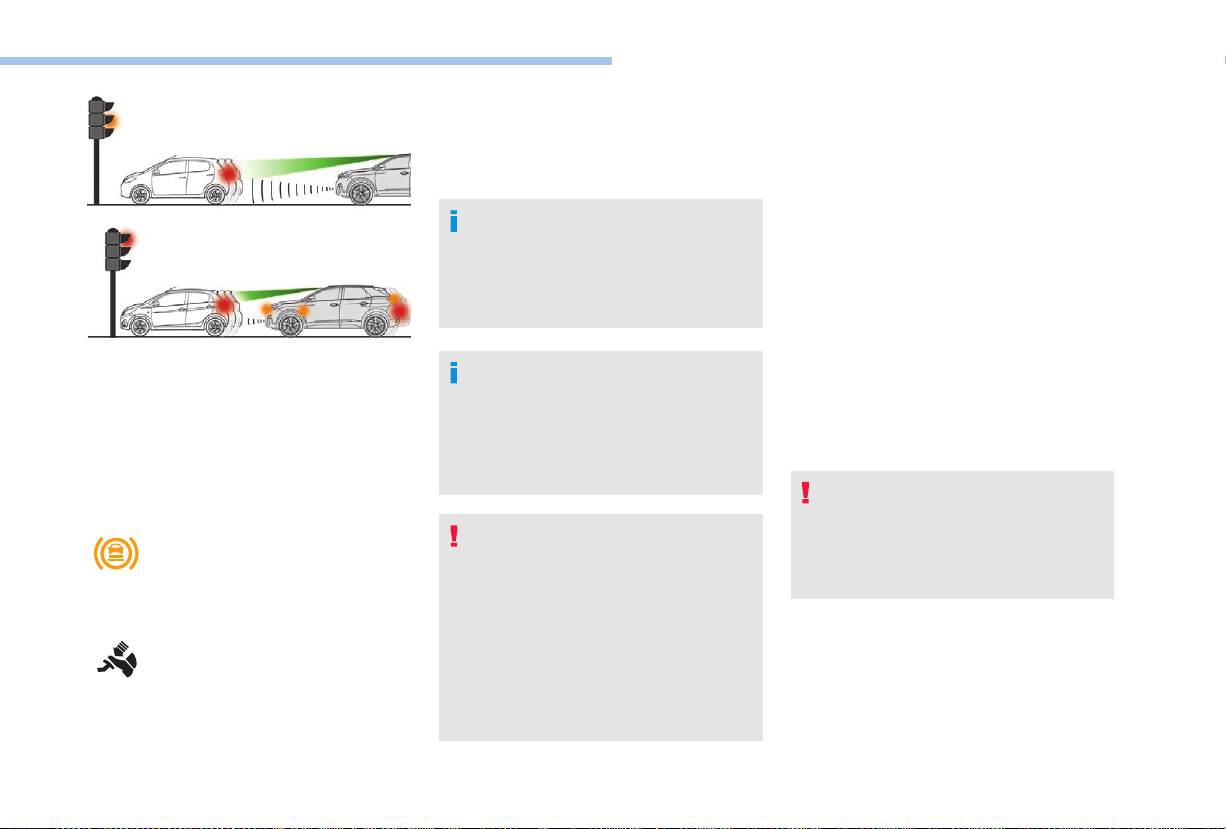
191
6
Driving
If the camera and/or radar have
confirmed the presence of a vehicle
or a pedestrian, this warning lamp
flashes once the function is acting
on the vehicle's brakes.
This function, also called automatic emergency
braking, aims to reduce the speed of impact or
avoid a frontal collision by your vehicle where
the driver fails to react.
Using a camera and, depending on the version,
radar, this function acts on the vehicle's braking
system.
Important: if operation of the
automatic emergency braking is
triggered, you should take back
control of your vehicle and brake
with the pedal to add to or finish the
automatic braking action.
The driver can take back control of the vehicle
at any time by sharply turning the steering
wheel and/or pressing the accelerator pedal.
The point at which braking is triggered
may be adjusted depending on the driving
actions of the driver, such as movement
of the steering wheel or actions at the
accelerator pedal.
Operation of the function may be felt by
slight vibration in the brake pedal.
If the vehicle comes to a complete stop,
the automatic braking is maintained for 1
to 2 seconds.
With a manual gearbox, in the event of
automatic emergency braking until the
vehicle comes to a complete stop, the
engine may stall.
With an automatic gearbox, in the event
of automatic emergency braking until the
vehicle comes to a complete stop, keep
the brake pedal pressed down to prevent
the vehicle from starting off again.
Specic conditions for
operation
The vehicle's speed must be between 3 mph
and 53 mph (5 km/h and 85 km/h) (versions
with camera alone) or 87 mph (140 km/h)
(versions with camera and radar) when a
moving vehicle is detected.
The vehicle's speed must not exceed 50 mph
(80 km/h) when a stationary vehicle is detected.
The vehicle's speed must not exceed 37 mph
(60 km/h) when a pedestrian is detected.
The ESC system must not be defective.
The DSC system must not be deactivated.
All passenger seat belts must be fastened.
Driving at a steady speed on roads with few
bends is required.
After an impact, the function automatically
stops operating. Consult a PEUGEOT
dealer or a qualified workshop to have the
system checked.
Deactivation / Activation
By default, the system is automatically
activated at every engine start.
The system can be deactivated or activated via
the vehicle settings menu.

192
Driving
Deactivation of the system is
signalled by the illumination of this
indicator lamp, accompanied by the
display of a message.
The camera may be disrupted or not
work in the following situations:
- poor visibility (inadequate street
lighting, falling snow, heavy rain,
dense fog, etc.),
- dazzle (headlamps of an oncoming
vehicle, low sun, reflections on
a damp road, leaving a tunnel,
alternating shade and light, etc.),
- camera or radar obstructed (mud,
frost, snow, condensation, etc.).
On versions with camera alone, this
message indicates to you that the
camera is obstructed: "Driving aids
camera: visibility limited, see user
guide".
In these situations, detection
performance may be reduced.
Clean the windscreen regularly,
particularly the area in front of the
camera.
The internal surface of the windscreen
can also become misted around the
camera. In humid and cold weather,
demist the windscreen regularly.
Do not allow snow to accumulate on
the bonnet or roof of the vehicle as this
could conceal the detection camera.
Clean the front bumper, especially
around the radar, removing mud, snow,
etc.
If the front bumper is to be repainted or
touched up, contact a PEUGEOT dealer
or a qualified workshop. Certain types of
paint could interfere with the operation of
the radar.
The system is automatically deactivated
after the use of the "space-saver" type
spare wheel is detected, or if a fault with
the side brake lamps is detected.
Malfunction
In the event of a fault with the
system, you are alerted by the
illumination of this warning lamp,
accompanied by the display of a
message and an audible signal.
Contact a PEUGEOT dealer or a qualified
workshop to have the system checked.
Fatigue detection system
It is recommended that you take a break as
soon as you feel tired or at least every two
hours.
Depending on version, the function either
has the "Driving time warning" only, or this
combined with the "Driver inattention alert".
The system cannot in any circumstances
replace the need for vigilance on the part
of the driver.
Do not take the wheel if you are tired.
Activation / Deactivation
The system is activated or deactivated via the
vehicle configuration menu.
For more information on the menu, refer
to the section covering your screen in the
"Instruments" section.
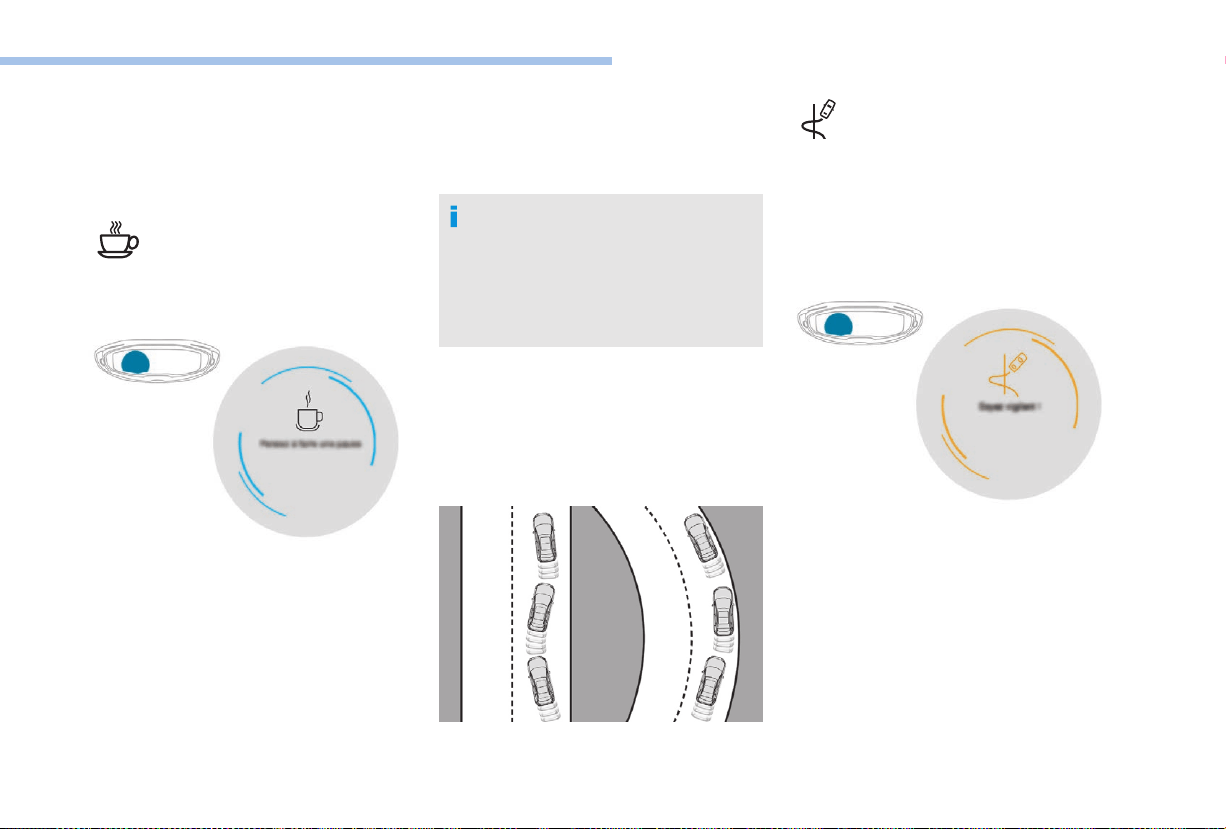
193
6
Driving
The state of the system stays in memory when
the ignition is switched off.
Driving time warning
The system triggers an alert once it
detects that the driver has not taken
a break after two hours of driving at
a speed above 40 mph (65 km/h).
The system resets itself if one of the following
conditions is met:
- engine running, the vehicle has been
stationary for more than 15 minutes,
This alert is issued via the display of a
message encouraging you to take a break,
accompanied by an audible signal.
If the driver does not follow this advice, the
alert is repeated hourly until the vehicle is
stopped.
- the ignition has been switched off for a few
minutes,
- the driver's seat belt is unfastened and their
door is open.
As soon as the speed of the vehicle drops
below 40 mph (65 km/h), the system goes
into standby.
The driving time is counted again once the
speed is above 40 mph (65 km/h).
Driver inattention alert
Depending on version, the "Driving time
warning" may be combined with the "Driver
inattention alert".
After three first level alerts, the system triggers
a new alert with the message "Take a break!",
accompanied by a more pronounced audible
signal.
When the system interprets the behaviour of
the vehicle as indicating a certain fatigue or
inattention threshold on the part of the driver, it
triggers the first level of alert.
The driver is then alerted by the message
"Take care!", accompanied by an audible
signal.
Using a camera placed at the top
of the windscreen, the system
assesses the driver's level of
vigilance by identifying variations
in trajectory compared to the lane
markings.
This system is particularly suited to fast roads
(speed higher than 40 mph (65 km/h)).
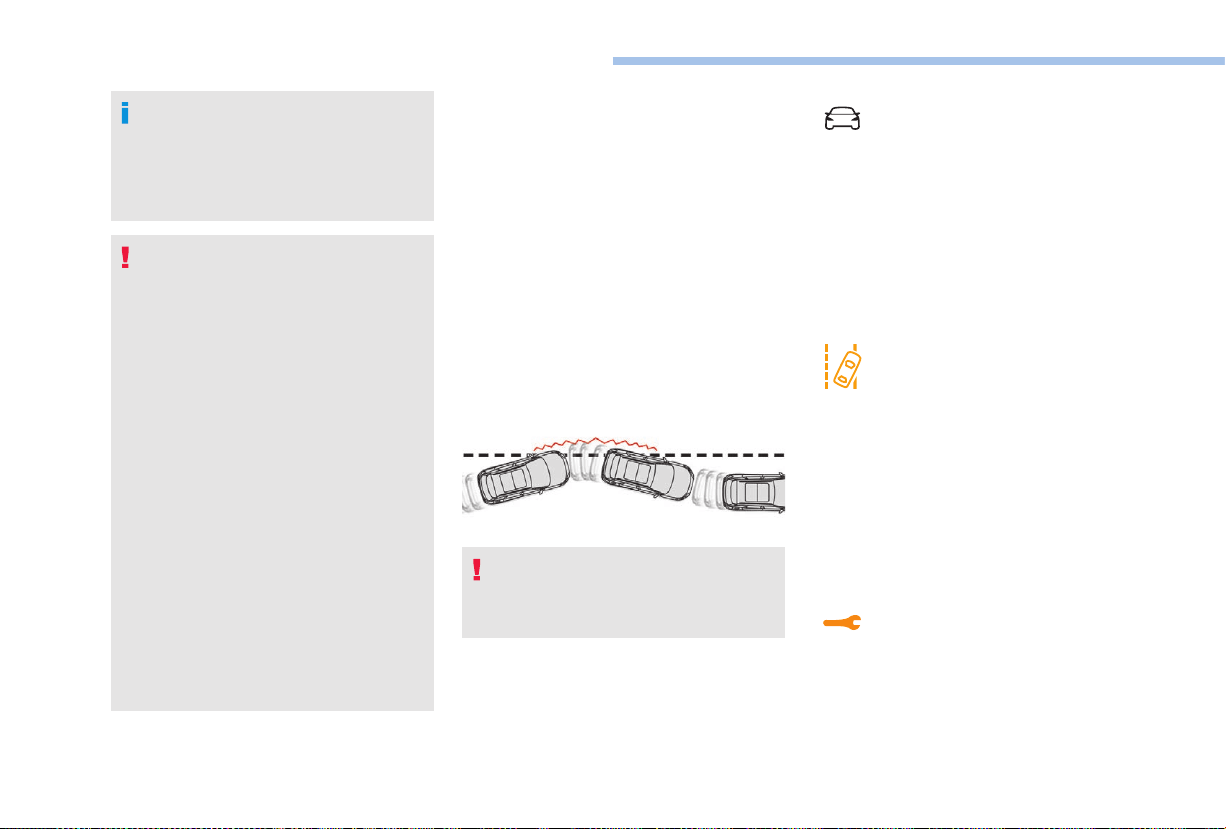
194
Driving
In certain driving conditions (poor road
surface or strong winds), the system may
give alerts independent of the driver's
level of vigilance.
The following situations may interfere
with the operation of the system or
prevent it working:
- poor visibility (inadequate lighting of
the roadway, falling snow, heavy rain,
dense fog, etc.),
- dazzle (headlamps of an oncoming
vehicle, low sun, reflections on
a damp road, leaving a tunnel,
alternating shade and light, etc.),
- windscreen area located in front of
the camera: dirty, misted up, frost-
covered, snow-covered, damaged or
covered by a sticker,
- lane markings absent, worn,
hidden (snow, mud) or multiple
(roadworks, etc.),
- close to the vehicle ahead (lane
markings not detected),
- roads that are narrow, winding, etc.
Lane Departure Warning
System
System which, using a camera which
recognises solid or broken lines, detects the
involuntary crossing of longitudinal traffic lane
markings on the ground.
To provide safe driving, the camera analyses
the image then, if the driver's attention drops
and the speed is higher than 37 mph (60 km/h),
triggers a warning if there is an unexpected
change of direction.
This system is particularly useful on motorways
and main roads.
Activation / Deactivation
This function cannot be deactivated on
versions without a touch screen.
This system is a driving aid which
cannot, in any circumstances, replace
the need for vigilance on the part of the
driver.
Activation and deactivation of the
system is done in the Vehicle /
Driving menu of the touch screen.
The system state remains in memory when the
ignition is switched off.
Detection
If an unexpected change of direction
is detected, you are alerted by
this warning lamp flashing in the
instrument panel and an audible
signal.
Operating fault
If a fault occurs, this warning lamp
comes on in the instrument panel,
accompanied by a message and an
audible signal.
Select the "Driving functions" then the "Lane
departure warning system" tab.
No warning is transmitted while the direction
indicator is active and for approximately
20 seconds after the direction indicator is
switched off.
Contact a PEUGEOT dealer or a qualified
workshop.
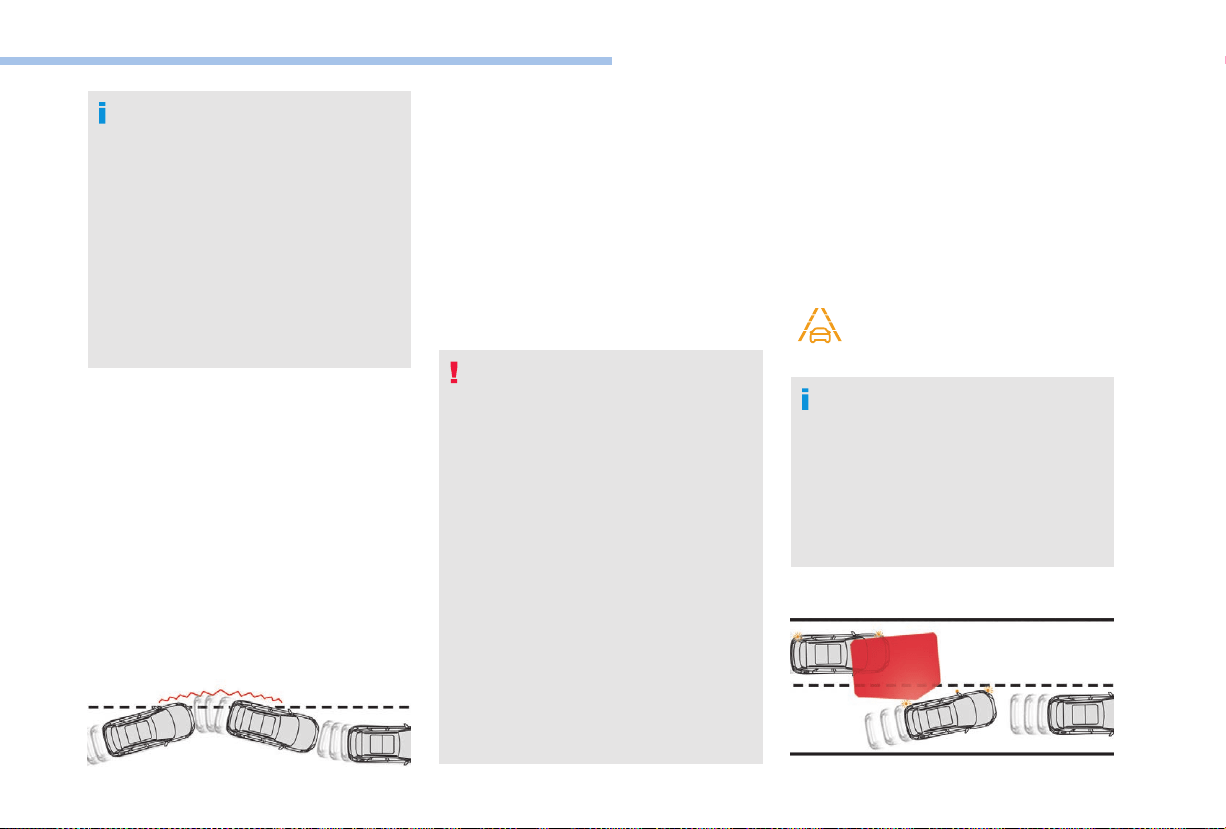
195
6
Driving
The detection may be impeded:
- if the markings on the road are worn,
- if there is little contrast between the
markings on the road and the road
surface,
- if the windscreen is dirty,
- in certain weather conditions: fog,
heavy rain, snow, shade, bright
sunlight or direct exposure to the sun
(low sun, leaving a tunnel, etc.).
Active Lane Departure
Warning System
Using a camera placed at the top of the
windscreen to identify lane markings on the
ground, this system corrects the trajectory of
the vehicle while alerting the driver if it detects
a risk of involuntary crossing of a line.
This system is particularly useful on motorways
and main roads.
Conditions for operation
The speed of the vehicle must be between 40
and 112 mph (65 and 180 km/h).
The carriageway must have at least one lane
marking (solid or broken) on the ground.
The driver must hold the wheel with both
hands.
The change of trajectory must not be
accompanied by operation of the direction
indicators.
The ESC system must be activated.
This system is a driving aid which cannot,
in any circumstances, replace the need
for vigilance on the part of the driver.
The driver should remain in control of the
vehicle in all circumstances.
The system helps the driver only when
there is a risk of the vehicle involuntarily
wandering from the lane it is being driven
on. It does not manage the safe driving
distance, the speed of the vehicle or the
brakes.
The driver must hold the steering wheel
with both hands in a way that allows
control to be taken back in circumstances
where the system is not able to intervene
(if lane markings disappear, for example).
It is necessary to observe the driving
regulations and take a break every two
hours.
This warning lamp flashes during
trajectory correction.
If the driver wishes to maintain the
trajectory of the vehicle, they can prevent
the correction by keeping a firm grip on
the wheel (during an avoiding manoeuvre,
for example).
The correction is interrupted if the
direction indicators are operated.
Operation
Once the system identifies a risk of the vehicle
involuntarily crossing one of the lane markings
detected, it makes the correction to the
trajectory required to return the vehicle to its
initial path.
The driver will then notice a turning movement
of the steering wheel.
196
Driving
If the system detects that the driver is not
holding the wheel firmly enough during
an automatic correction of trajectory,
it interrupts the correction. An alert is
triggered to encourage the driver to take
back control of the vehicle.
Driving situations and
associated alerts
To benefit from all necessary information on
the instrument panel, you must previously
select the "DRIVING" display mode.
While the direction indicators are on and for
a few seconds after switching them off, the
system considers that any change of trajectory
is voluntary and no correction is triggered
during this period.
However, with the "Blind Spot Monitoring
System" activated, if the driver starts changing
lane and another vehicle is detected in the
vehicle's blind spot, the system will correct
the trajectory of the vehicle even though the
direction indicators are on.
For more information on the Blind
Spot Monitoring System, refer to the
corresponding section.
The table below describes the alerts and
messages displayed depending on the driving
situation.
The display of these alerts is not sequential.
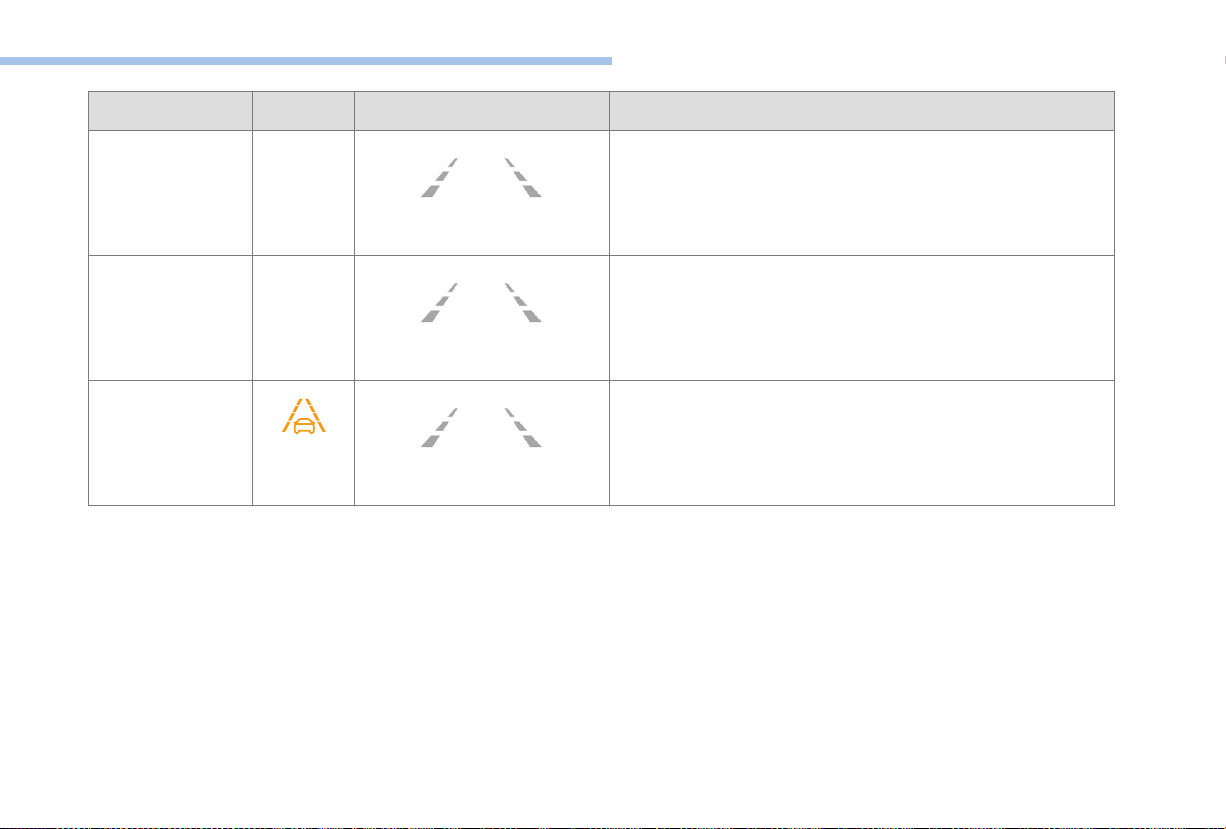
197
6
Driving
Status of the
function
Indicator
lamp
Display and associated message Comments
OFF
(grey)
System deactivated.
ON System active, conditions not met:
- speed below 40 mph (65 km/h),
- no lane marking recognised,
- ESC deactivated or operation triggered,
- "sporty" driving.
ON Automatic deactivation / standby of the system (for example: detection
of a trailer, use of the "space-saver" spare wheel provided with the
vehicle).
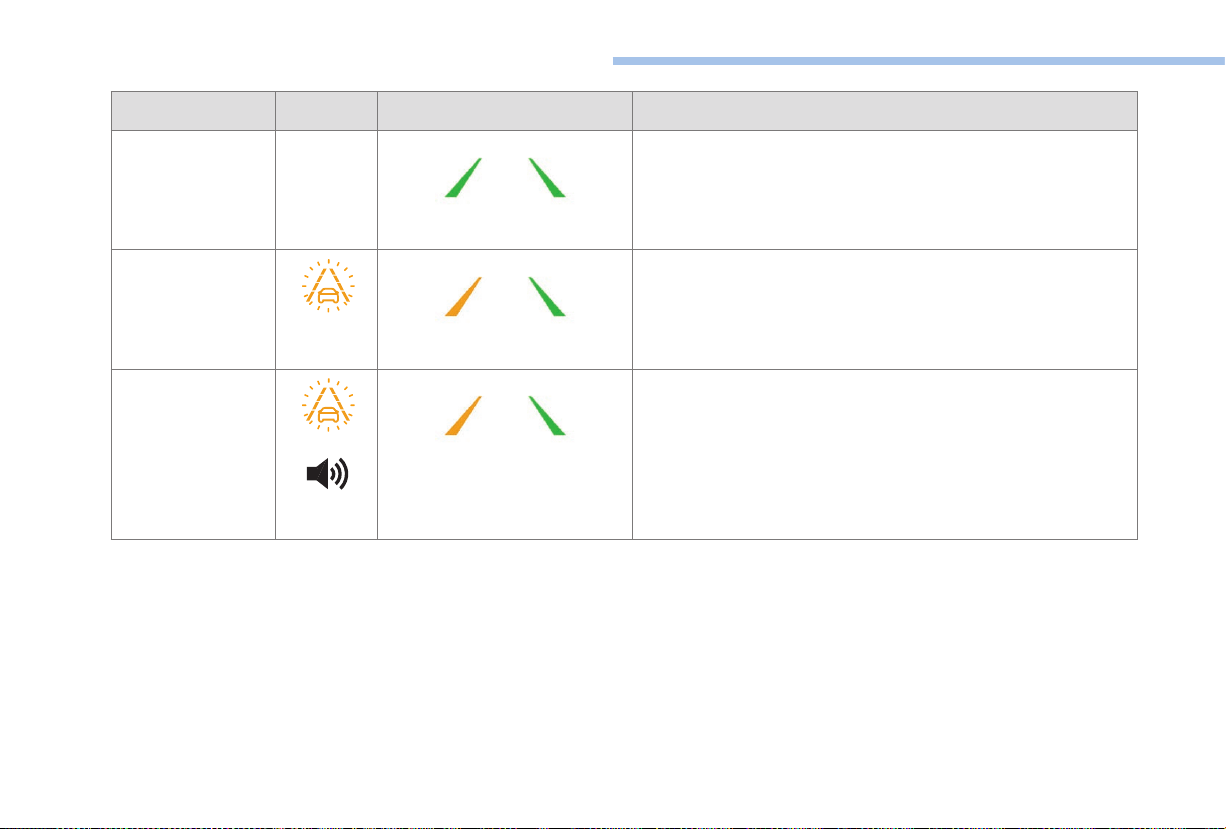
198
Driving
Status of the
function
Indicator
lamp
Display and associated message Comments
ON
(green)
Detection of lane markings.
Speed above 40 mph (65 km/h).
ON
(orange) / (green)
The system corrects the trajectory on the side where the risk of
involuntary crossing is detected (orange line).
ON
"Take back the wheel".
- If, during correction, the system detects that the driver has not held
the wheel for a few seconds, it interrupts the correction and returns
control to the driver.
- During correction of the trajectory, if the system determines that the
correction will not be enough and that a solid line is crossed (orange
line): the driver is warned that they must complete the correction of
the trajectory.
199
6
Driving
Operating limits
The system goes into standby automatically in
the following cases:
- ESC deactivated or operation triggered,
- Speed below 40 mph (65 km/h) or greater
than 112 mph (180 km/h),
- connected electrically to a trailer,
- use of the "space-saver" spare
wheel detected (as detection is not
immediate, deactivation of the system is
recommended),
- dynamic driving style detected, pressure on
the brake or accelerator pedal,
- driving where there are no lane markings,
- activation of the direction indicators,
- crossing the inside line on a bend,
- driving in a tight corner,
- inactivity by the driver detected during
correction.
The following situations may interfere
with the operation of the system or
prevent it working:
- conditions of poor visibility
(inadequate street lighting, snowfall,
rain, fog),
- dazzle (headlamps of an oncoming
vehicle, low sun, reflections on
a damp road, leaving a tunnel,
alternating shade and light),
- windscreen area located in front of
the camera: dirty, misted, frost-
covered, snow-covered, damaged or
covered by a sticker,
- lane markings absent, worn, hidden
(snow, mud) or multiple (roadworks),
- running close to the vehicle in front
(the lane markings may not be
detected),
- roads that are narrow, winding, etc.
Risk of undesirable operation
Activation / Deactivation
Activation and deactivation of the
system is done in the Vehicle /
Driving menu of the touch screen.
The system state remains in memory when the
ignition is switched off.
Deactivation of the system is recommended in
the following situations:
- driving on a road surface in poor condition,
- unfavourable climatic conditions,
- driving on slippery surfaces (ice).
Select the "Driving functions" then the "Lane
assist" tab.
Operating fault
In the event of a fault with the system, you are
alerted by the illumination of these warning
lamps in the instrument panel, accompanied by
the display of a message and an audible signal.
Have the system checked by a PEUGEOT
dealer or a qualified workshop.
The system is not intended for driving in the
following situations:
- driving on a speed circuit,
- driving with a trailer,
- driving on a rolling stand,
- driving on unstable surfaces.
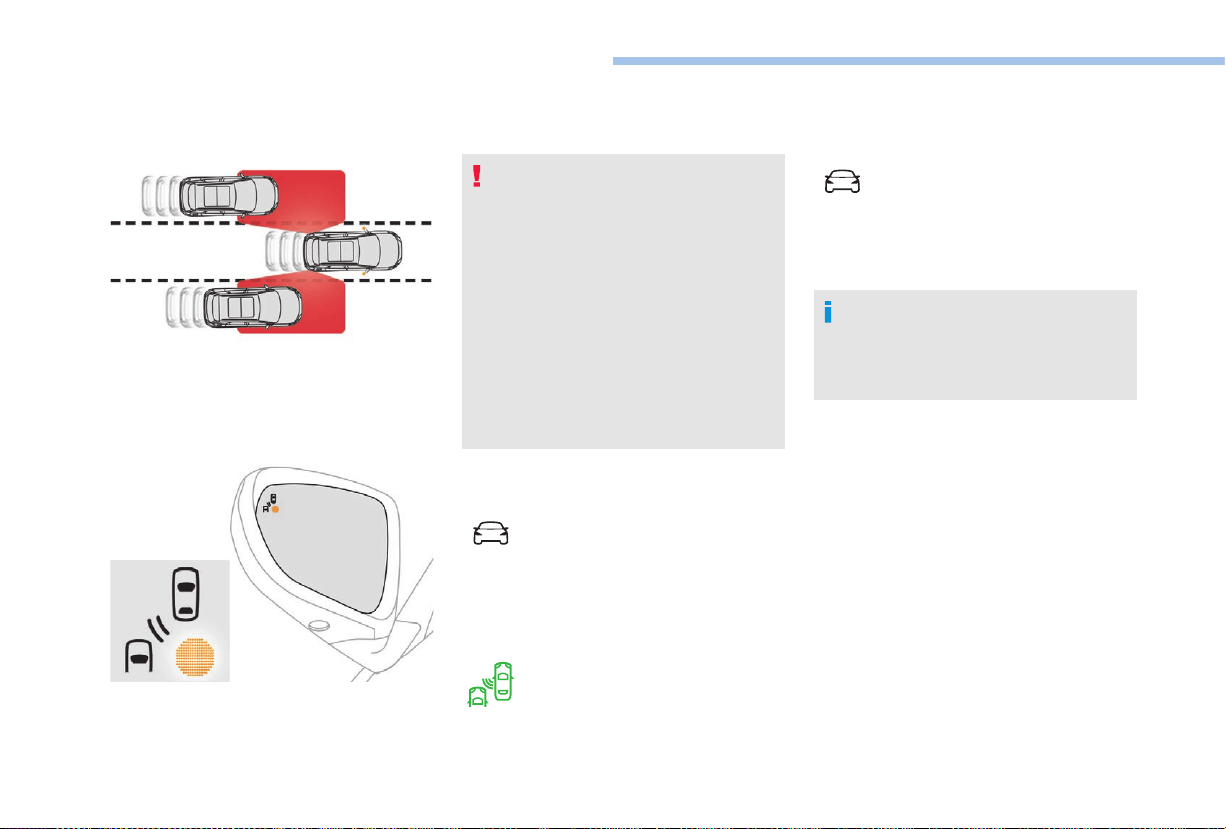
200
Driving
Blind Spot Monitoring
System
This system warns the driver of the presence of
another vehicle in the blind spot angle of their
vehicle (areas hidden from the driver's field
of vision), as soon as this presents a potential
danger.
- after a delay of about one second, when
overtaking a vehicle slowly.
This driving aid system is designed to
improve safety when driving and is in no
circumstances a substitute for the use
of the interior rear view mirror and door
mirrors. It is the driver's responsibility to
constantly check the traffic, to assess
the distances and relative speeds
of other vehicles and to predict their
movements before deciding whether to
change lane.
This system is a driving aid which
cannot, in any circumstances, replace
the need for vigilance on the part of the
driver.
Activation / Deactivation
Activation and deactivation of the
system is done in the Vehicle /
Driving menu of the touch screen.
Select the "Driving functions" then the "Blind
spot sensors" tab.
Sensors fitted in the front and rear bumpers
monitor the blind spots.
To deactivate the system, once
again select "Blind spot sensors"
in the "Driving functions" tab.
The indicator lamp goes off.
The system is automatically deactivated
when towing with a towbar approved by
PEUGEOT.
Operation
Sensors fitted in the front and rear bumpers
monitor the blind spots.
The alert is given by an orange warning lamp
coming on in the relevant door mirror, as soon
as a vehicle – car, lorry, bicycle – is detected.
The following conditions must be met for this:
- all vehicles are moving in the same direction
and in adjacent lanes,
- the speed of the vehicle must be between
7 and 87 mph (12 and 140 km/h),
- you overtake a vehicle with a speed
difference of less than 6 mph (10 km/h),
- a vehicle overtakes you with a speed
difference of less than 16 mph (25 km/h),
This indicator lamp lights up on the
instrument panel.
A warning lamp appears in the door mirror on
the side in question:
- immediately, when being overtaken,
The system state remains in memory when the
ignition is switched off.
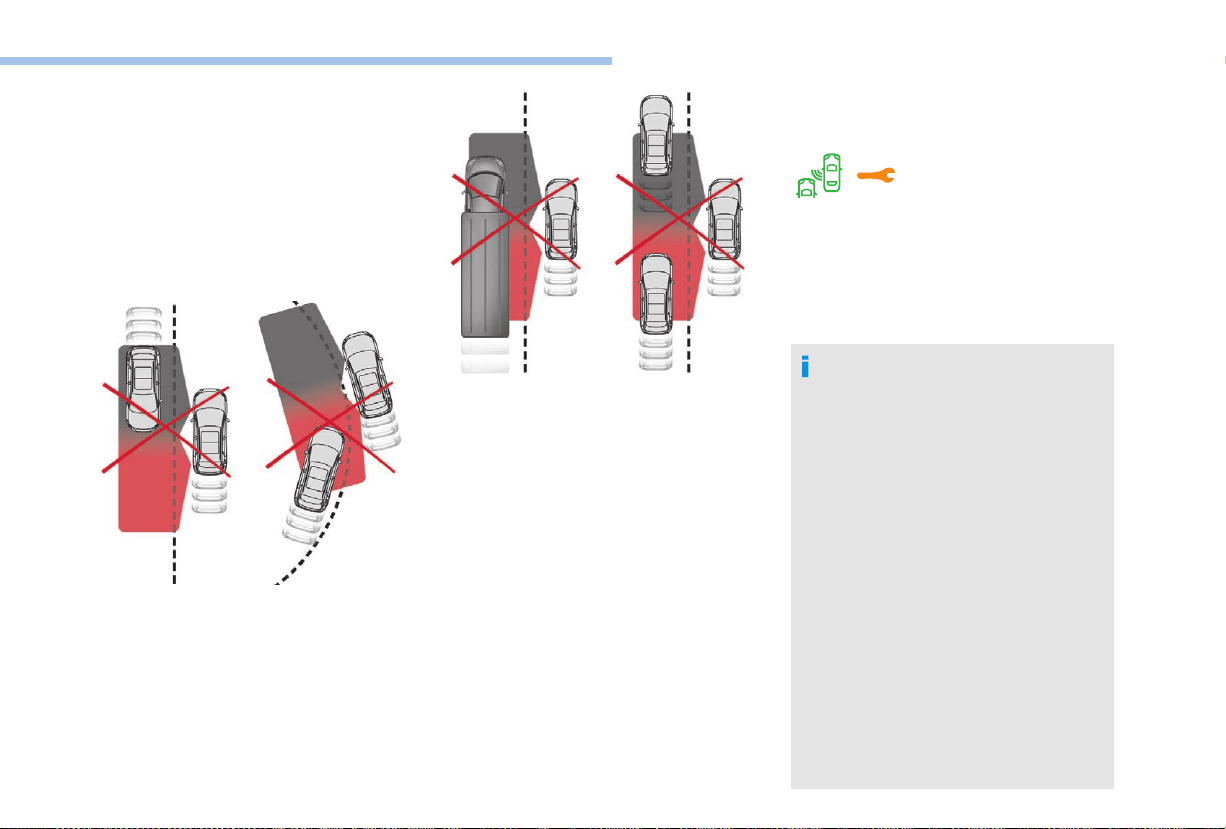
201
6
Driving
No alert will be given in the following situations:
- in the presence of non-moving objects
(parked vehicles, safety barriers, street
lamps, road signs, etc.),
- with vehicles moving in the opposite
direction,
- driving on a winding road or a sharp corner,
- when overtaking or being overtaken by a
very long vehicle (lorry, bus, etc.) which is
also in the rear blind spot and present in the
driver's front field of vision,
- when overtaking quickly,
- in very heavy traffic: vehicles detected in
front and behind are confused with a lorry or
a stationary object.
- the traffic is flowing normally,
- in the case of an overtaking manoeuvre,
if this is prolonged and the vehicle being
overtaken remains in the blind spot,
- you are driving on a straight or slightly
curved road,
- your vehicle is not towing a trailer, a
caravan, etc.
Operating fault
In the event of a fault with the system, this warning
lamp flashes for a few moments in the instrument
panel, accompanied by the Service warning lamp
coming on and the display of a message.
Contact a PEUGEOT dealer or a qualified
workshop to have the system checked.
The system may suffer temporary
interference in certain weather
conditions (rain, hail, etc.).
In particular, driving on a wet surface
or moving from a dry area to a wet area
can cause false alerts (for example, the
presence of a fog of water droplets in
the blind spot angle is interpreted as a
vehicle).
In bad or wintry weather, ensure that the
sensors are not covered by mud, ice or
snow.
Take care not to cover the warning zone
in the door mirrors or the detection
zones on the front and rear bumpers
with adhesive labels or other objects;
they may hamper the correct operation
of the system.
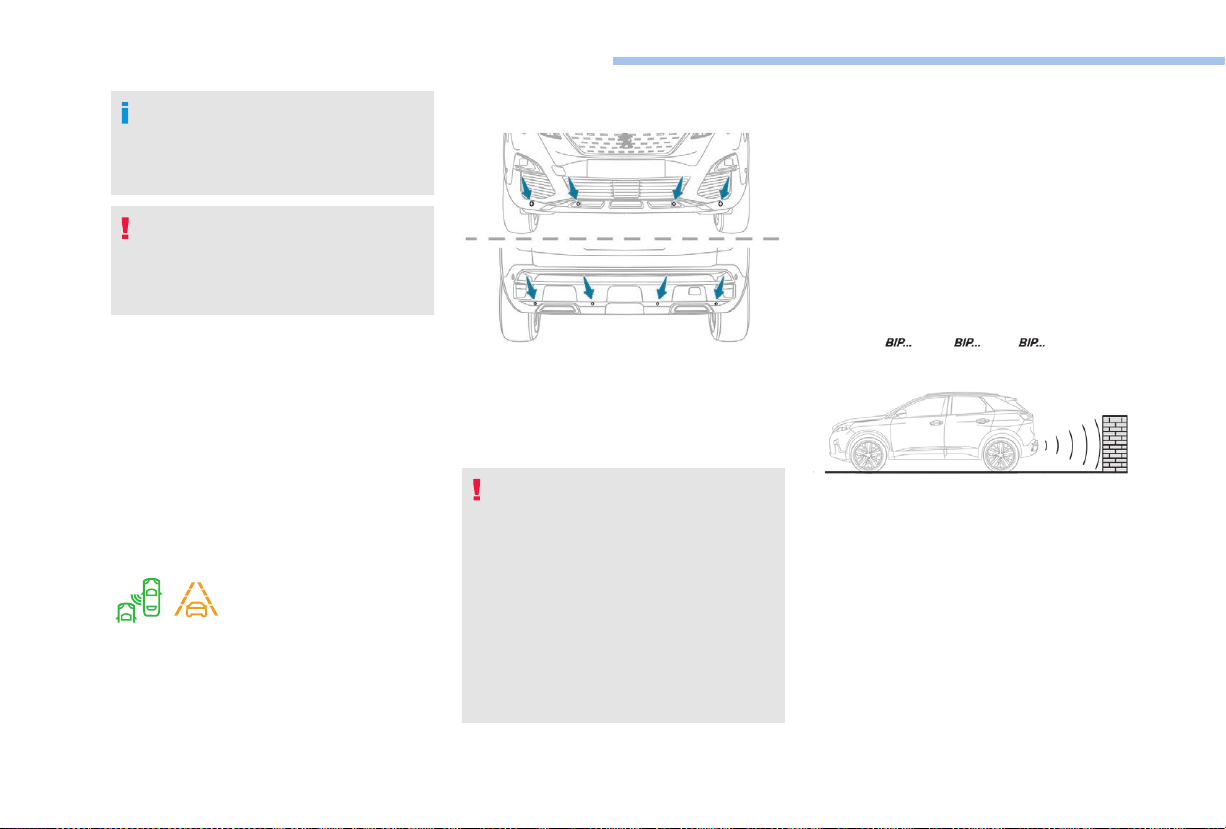
202
Driving
Active Blind Spot
Monitoring System
In addition to the fixed warning lamp in the door
mirror on the side in question, a correction of
trajectory will be felt if you cross a lane marking
with the direction indicators on, to help you
avoid a collision.
Conditions for operation
The following systems must be activated:
- Blind Spot Monitoring System,
- Active Lane Departure Warning System.
For more information on the Blind Spot
Monitoring System and the Active Lane
Departure Warning System, refer to the
corresponding sections.
Parking sensors
This function is a manoeuvring aid which
cannot, in any circumstances, replace
the need for vigilance on the part of the
driver.
The driver must remain attentive and stay
in control of their vehicle.
They must always check the vehicle's
surroundings before undertaking a
manoeuvre.
During the entire manoeuvre, the driver
must ensure that the space remains clear.
Rear parking sensors
The system is switched on by engaging reverse
gear.
This is confirmed by an audible signal.
The system is switched off when you come out
of reverse gear.
Audible assistance
The proximity information is given by an
intermittent audible signal, the frequency of
which increases as the vehicle approaches the
obstacle.
The sound emitted by the speaker (right or
left) indicates the side on which the obstacle is
located.
When the distance between the vehicle and
the obstacle becomes less than approximately
thirty centimetres, the audible signal becomes
continuous.
Using sensors located in the bumper, this
function warns of the proximity of obstacles
(e.g. pedestrian, vehicle, tree, barrier) entering
their field of detection.
The system is automatically deactivated
when towing with a towbar approved by
PEUGEOT.
High pressure jet wash
When washing your vehicle, direct the
lance at least 30 cm away from the
sensors.
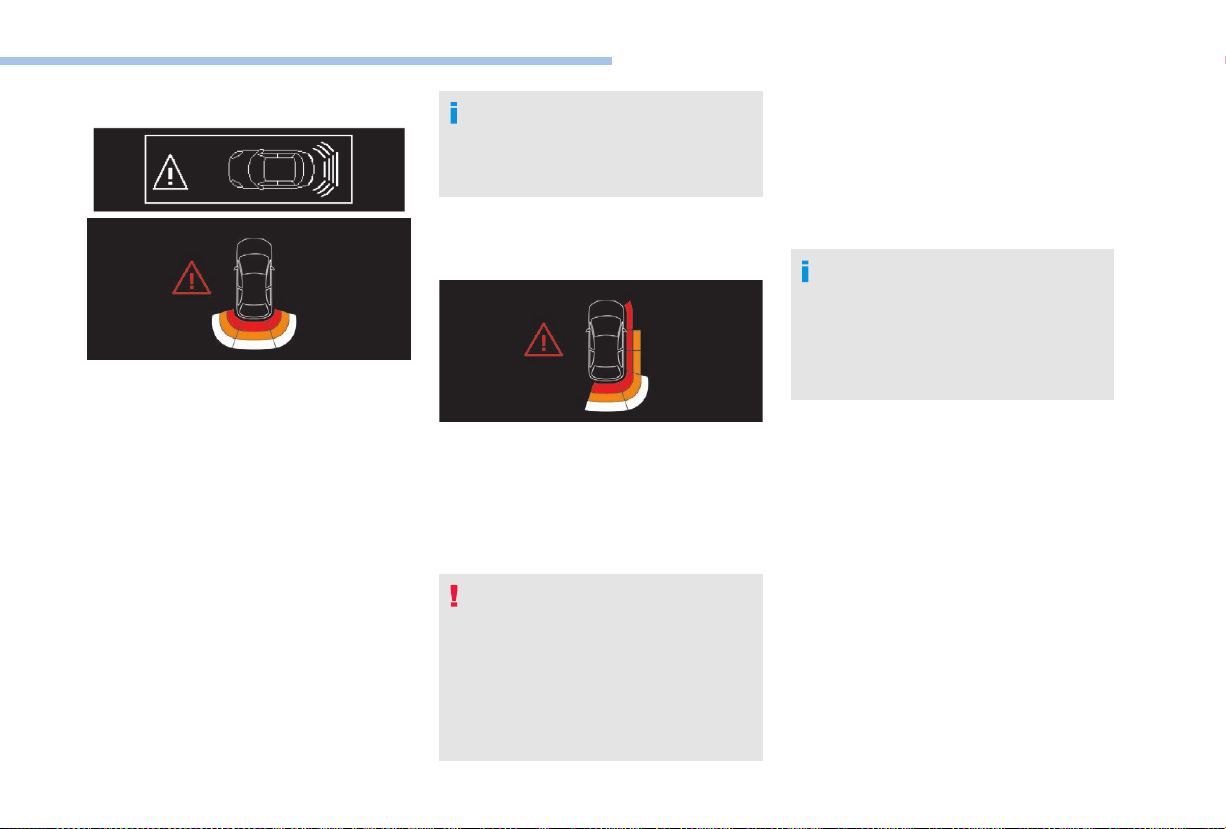
203
6
Driving
Visual assistance
It supplements the audible signal by displaying
bars on the screen that move progressively
nearer to the vehicle (white: more distant
obstacles; orange: close obstacles; red: very
close obstacles).
When the obstacle is very close, the "Danger"
symbol is displayed on the screen.
Front parking sensors
In addition to the rear parking sensors, the
front parking sensors are triggered when an
obstacle is detected in front and the speed of
the vehicle is still below 6 mph (10 km/h).
The front parking sensors are interrupted if
the vehicle stops for more than three seconds
in forward gear, if an obstacle is no longer
detected or when the speed of the vehicle
exceeds 6 mph (10 km/h).
The sound emitted by the speaker (front
or rear) locates the obstacle in relation to
the vehicle – in the vehicle trajectory, in
front or behind.
Side parking sensors
Using four additional sensors located on the
sides of the front and rear bumpers, the system
records the position of fixed obstacles during
the manoeuvre and signals them when they are
located by the sides of the vehicle.
Only fixed obstacles are signalled
correctly. Moving obstacles detected
at the beginning of the manoeuvre may
be signalled mistakenly, while moving
obstacles which appear at the sides of
the vehicle and which were not previously
recorded will not be signalled.
Deactivation/Activation
The system is activated or deactivated via the
vehicle settings menu in the screen.
The state of the system stays in the memory
when the ignition is switched off.
The rear parking sensors system will
be deactivated automatically if a trailer
or bicycle carrier is connected to a
towing device installed in line with the
manufacturer's recommendations.
The parking sensors are deactivated while the
Park Assist system is measuring a space.
For more information on Park Assist, refer to
the corresponding section.
Operating limits
- Certain obstacles located in the sensors'
blind spots may not be detected or no
longer be detected during the manoeuvre.
- Sounds such as those emitted by noisy
vehicles and machinery (e.g. lorries,
pneumatic drills, etc.) may interfere with the
vehicle's sensors.
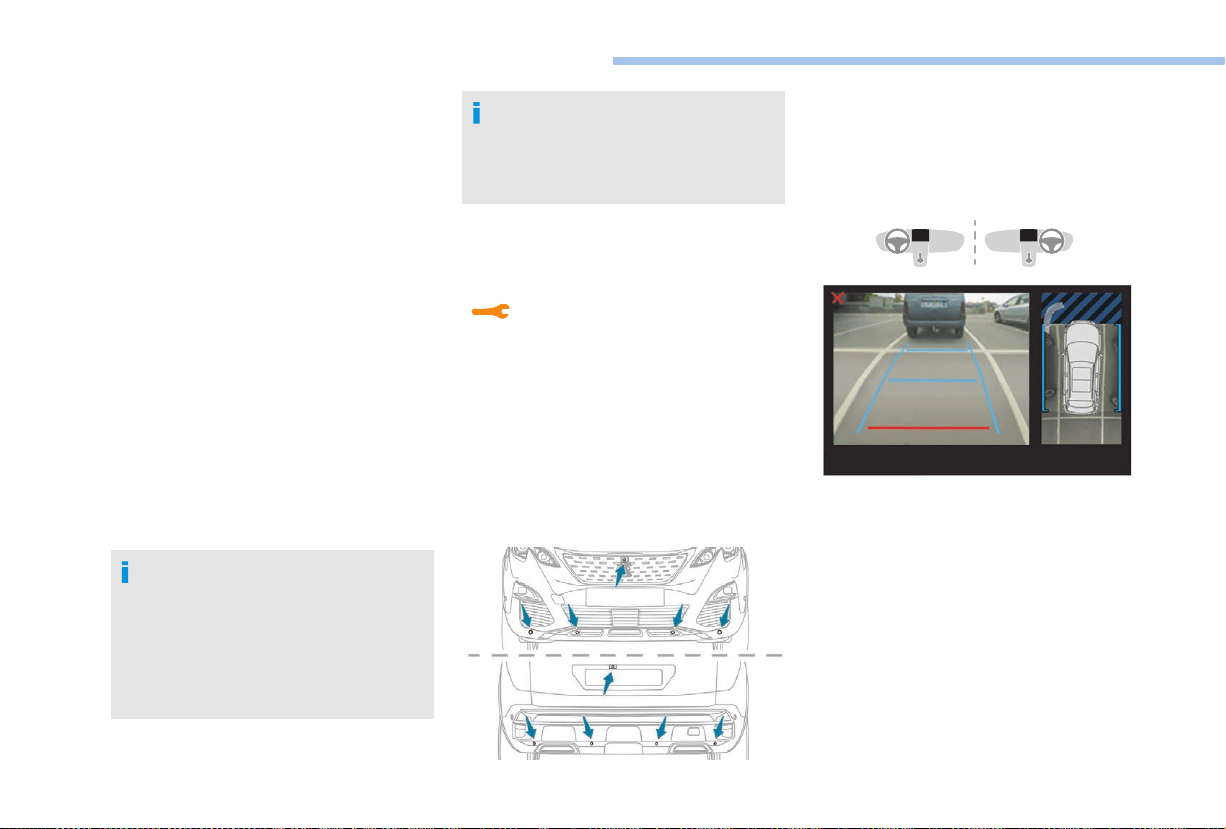
204
Driving
- Certain materials (fabrics) absorb sound
waves: pedestrians may not be detected.
- Accumulated snow or dead leaves on the
road surface can interfere with the vehicle's
sensors.
- A front or rear impact to the vehicle can
distort the settings of the sensors, which is
not always detected by the system: distance
measurements may be incorrect.
- The tilting of the vehicle if the boot is
very loaded can affect the distance
measurements.
- The sensors may be affected by poor
weather conditions (heavy rain, thick fog,
snowfall, etc.).
Recommendations on care
In bad or wintry weather, ensure that the
sensors are not covered with mud, ice or
snow. When reverse gear is engaged, an
audible signal (long beep) indicates that
the sensors may be dirty.
High pressure washing
When washing your vehicle, direct the
lance at least 30 cm away from the
sensors.
Operating fault
If a fault occurs when shifting
to reverse, this warning lamp
comes on in the instrument panel,
accompanied by a message and an
audible signal (short beep).
Contact a PEUGEOT dealer or a qualified
workshop to have the system checked.
Visiopark 1 – Visiopark 2
Different contextual views can be displayed in
the left-hand part:
- standard view,
- 180° view,
- zoom view.
With the engine running, these systems allow
views of your vehicle's close surroundings to
be displayed on the touch screen using one
camera for Visiopark 1 and two cameras for
Visiopark 2.
The screen is divided into two parts: on the
left, a contextual view; on the right, a view from
above the vehicle in its close surroundings.
The parking sensors supplement the
information on the view from above the vehicle.
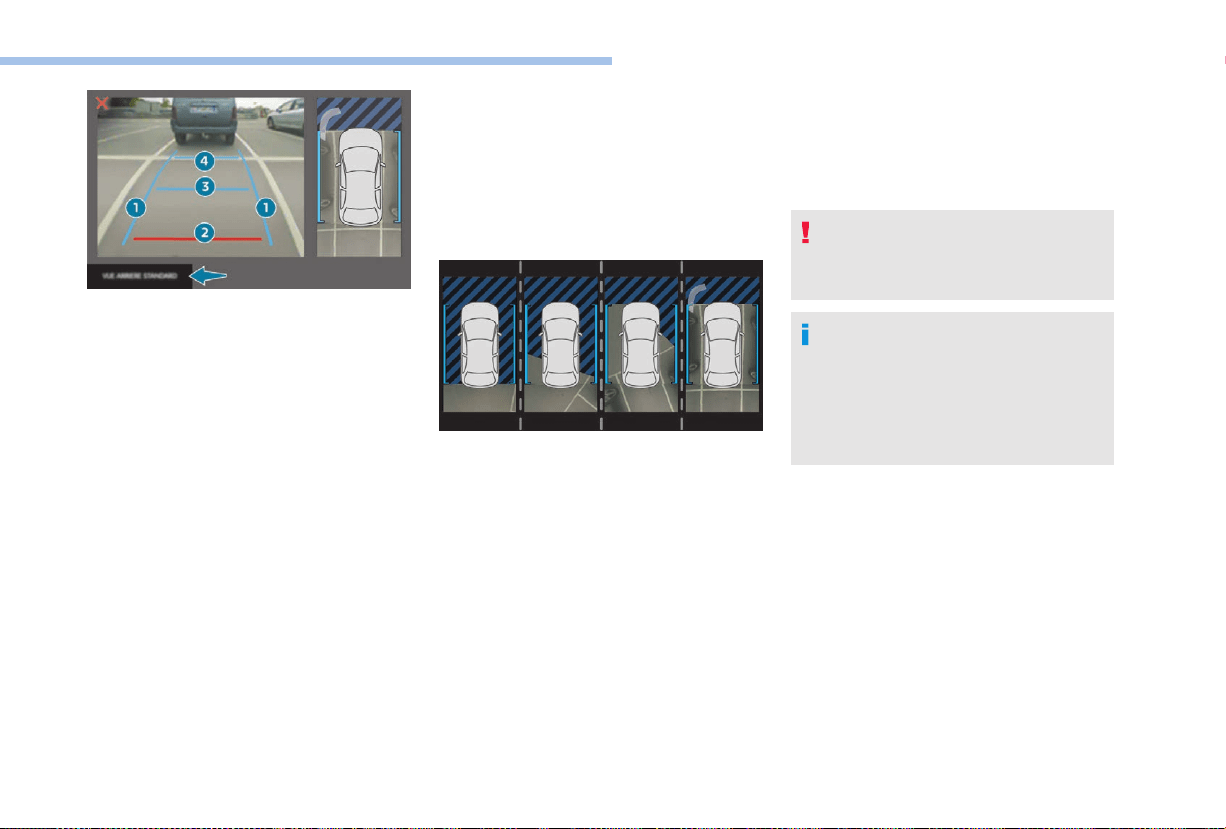
205
6
Driving
The blue lines 1 represent the width of your
vehicle, with the mirrors unfolded; their
direction changes depending on the position of
the steering wheel.
The red line 2 represents a distance of 30 cm
from the bumper; the two blue lines 3 and 4
represent 1 m and 2 m, respectively.
AUTO mode is activated by default.
In this mode, the system chooses the best view
to display (standard or zoom) according to the
information from the parking sensors.
You can change the type of view at any time
during a manoeuvre.
F Press the button in the bottom left-hand
corner of the touch screen.
F Select the type of view:
• "Standard view".
• "180° view",
• "Zoom view",
• "AUTO view".
The display is immediately updated with the
type of view selected.
The state of the system is not kept in memory
when the ignition is switched off.
Principle of operation
Using one or two cameras, the close
surroundings of the vehicle are recorded whilst
manoeuvring at low speed.
An image from above your vehicle in its close
surroundings is created in real time, as the
vehicle manoeuvre progresses.
This representation facilitates the alignment of
your vehicle when parking and allows obstacles
close to the vehicle to be seen.
This image is automatically deleted if the
vehicle remains stationary for too long.
When the function is activated, it is possible
that the central view is not displayed. If the
system is activated after the vehicle has
already been driven, the central view may be
completely displayed.
This system is a visual aid that cannot in
any circumstances replace the need for
vigilance on the part of the driver.
The images provided by the camera(s)
may be distorted by the relief.
In the presence of areas in shade, or in
conditions of bright sunlight or inadequate
lighting, the image may be darkened and
with lower contrast.
Recommendations on care
In bad or wintry weather, ensure that the
sensors and camera lenses are not covered
with mud, ice or snow.
Check the cleanliness of the camera lenses
regularly.
If necessary, clean the cameras with a soft,
dry cloth.
With Visiopark 2, the image is created using
both cameras, when going forward and when
reversing.
When washing your vehicle at high pressure,
direct the lance at least 30 cm away from the
cameras and parking aid sensors.
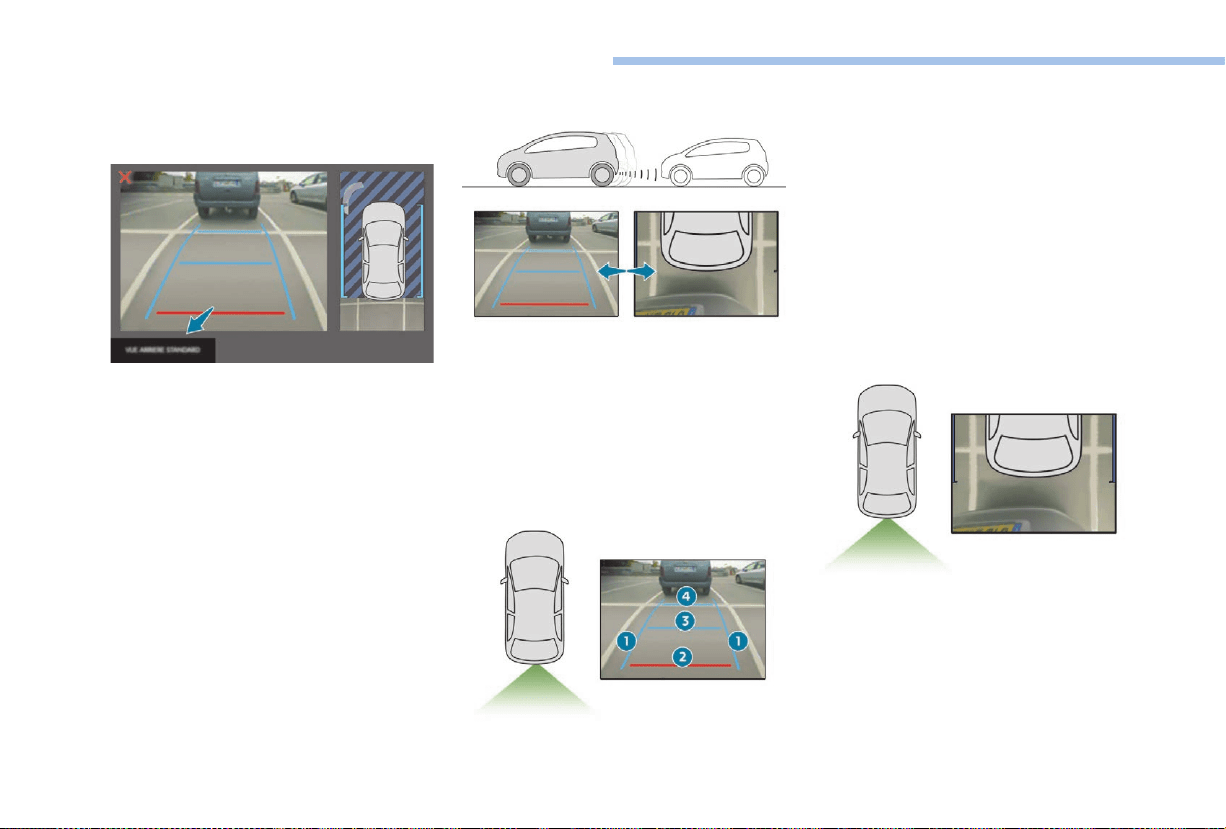
206
Driving
Visiopark 1
Rear vision
To activate the camera, located in the tailgate,
engage reverse and keep the speed of the
vehicle below 6 mph (10 km/h).
The system is deactivated:
- automatically above about 6 mph (10 km/h),
- automatically on opening the tailgate,
- when shifting out of reverse (the image
remains displayed for 7 seconds),
- by pressing the red cross in the top left-
hand corner of the touch screen.
AUTO mode
Standard view
This mode is activated by default.
Using sensors in the rear bumper, the
automatic view changes from a rear view to a
view from above, as an obstacle is approached
at the level of the red line (less than 30 cm)
during a manoeuvre.
Zoom view
The blue lines 1 represent the width of your
vehicle, with the mirrors unfolded; their
direction changes depending on the position of
the steering wheel.
The red line 2 represents a distance of 30 cm
from the bumper; the two blue lines 3 and 4
represent 1 m and 2 m, respectively.
This view is available with AUTO mode or in the
view selection menu.
The area behind the vehicle is displayed on the
screen.
The camera records the vehicle's surroundings
during the manoeuvre in order to create a
view from above the rear of the vehicle in its
near surroundings, allowing the vehicle to be
manoeuvred around obstacles nearby.
This view is available with AUTO mode or in the
view selection menu.
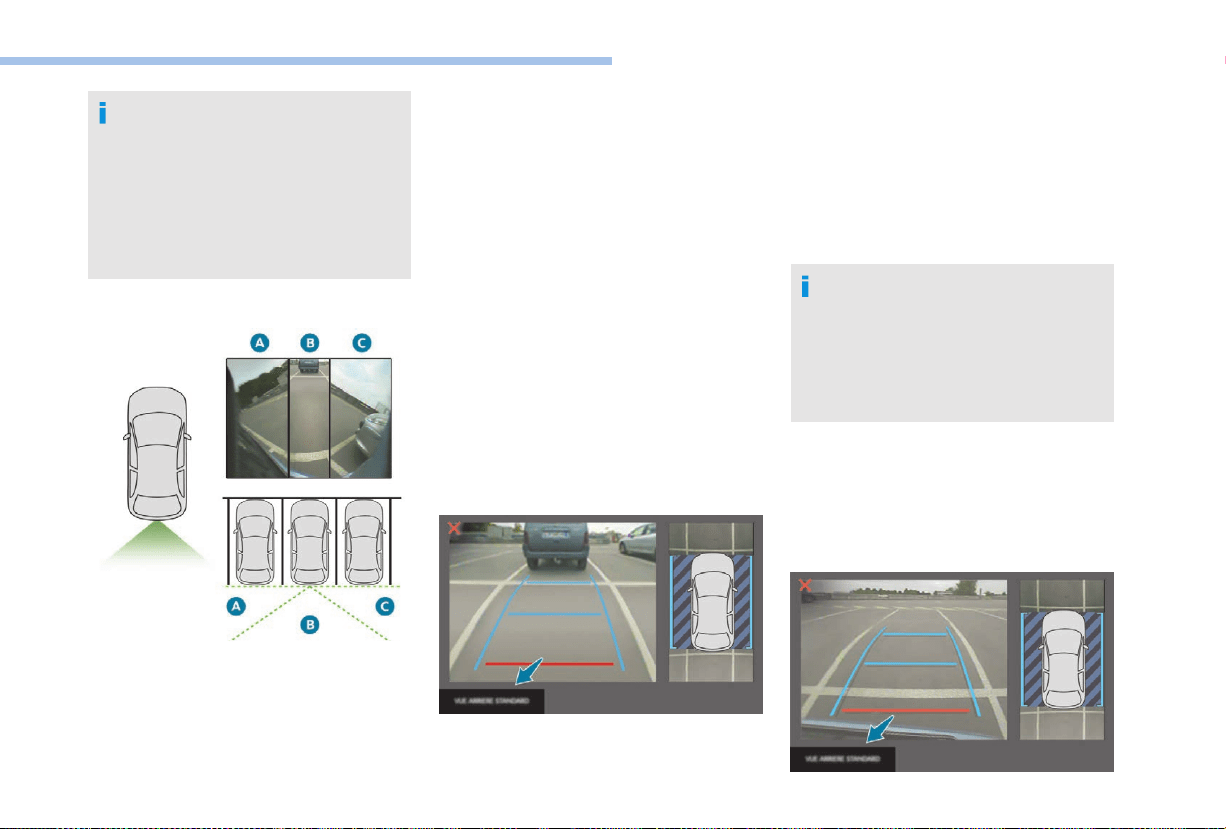
207
6
Driving
Obstacles may appear further away than
they actually are in reality.
It is important to check the sides of the
vehicle during the manoeuvre, using the
mirrors.
The rear parking sensors also provide
information on the vehicle's surroundings.
180° view
The 180° view facilitates reversing out of a
parking bay, making it possible to see the
approach of vehicles, pedestrians and cyclists.
This view is not recommended for carrying out
a complete manoeuvre.
Visiopark 2
The vehicle has a camera at the front, fitted
in the grille, and a camera at the rear, located
close to the tailgate opening control.
Using these cameras, the system displays
the vehicle's near surroundings in the touch
screen, offering views from the rear of the
vehicle (rear vision), when reverse gear is
engaged and views from the front of the vehicle
(front vision), when the gearbox is in neutral or
a gear is engaged.
Rear vision
It consists of 3 areas: left A, centre B and
right C.
This view is available only from the view
selection menu.
If a trailer or a bicycle carrier is fitted to
the towball, the zone behind the vehicle
on the top view goes dark.
The surroundings are reconstructed by
the front camera only.
The rear vision views are similar to those for
the Visiopark 1.
For more information on Visiopark 1, refer to
the corresponding section.
Front and rear vision
The system is deactivated:
- automatically above about 6 mph (10 km/h),
- when shifting out of reverse (the rear view
image is replaced by the front view image
for 7 seconds),
- by pressing the red cross in the top left-
hand corner of the touch screen.
The system activates automatically when
reverse gear is engaged.
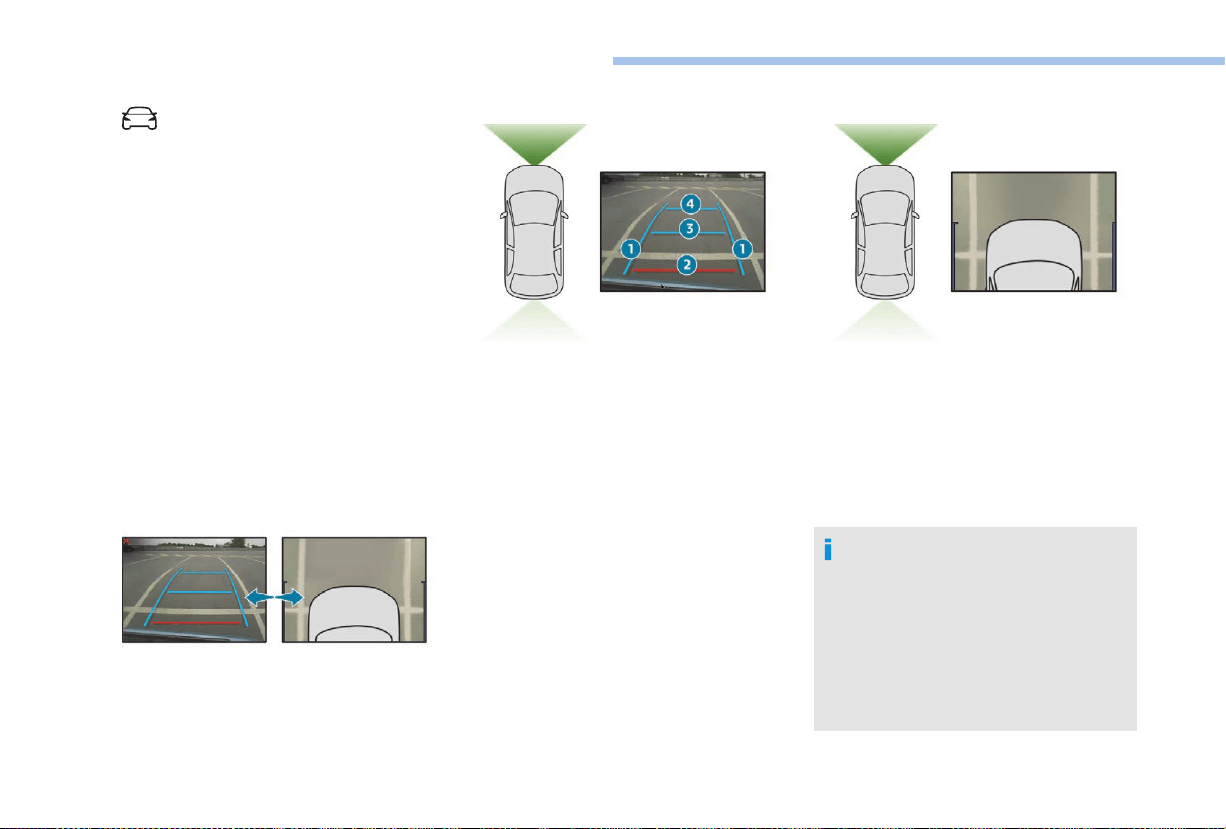
208
Driving
With the engine running and the
speed below 12 mph (20 km/h), the
system is activated via the Vehicle /
Driving menu of the touch screen:
F Select "Panoramic visual aid".
AUTO mode is displayed by default, with front
vision, if the gearbox is in neutral or with a
gear engaged, or with rear vision, if reverse is
engaged.
The system is deactivated:
- automatically above about 19 mph (30 km/h)
(the image disappears temporarily from
12 mph (20 km/h)),
- by pressing the red cross in the top left-
hand corner of the touch screen.
AUTO mode
This mode is activated by default.
Using sensors in the front bumper, the
automatic view changes from front view to the
view from above as an obstacle is approached
during a manoeuvre.
Standard view Zoom view
Obstacles may appear further away than
they actually are in reality.
It is important to check the sides of the
vehicle during the manoeuvre, using the
mirrors.
The front and rear parking sensors also
provide information on the vehicle's
surroundings.
The area in front of your vehicle is displayed in
the screen.
The blue lines 1 represent the width of your
vehicle, with the mirrors unfolded; their
direction changes depending on the position of
the steering wheel.
The red line 2 represents a distance of 30 cm
from the front bumper; the two blue lines 3 and
4 represent 1 m and 2 m, respectively.
This view is available with AUTO mode or in the
view selection menu.
The camera records the vehicle's surroundings
during the manoeuvre in order to create a
view from above the front of the vehicle in its
near surroundings, allowing the vehicle to be
manoeuvred around obstacles nearby.
This view is available with AUTO mode or in the
view selection menu.
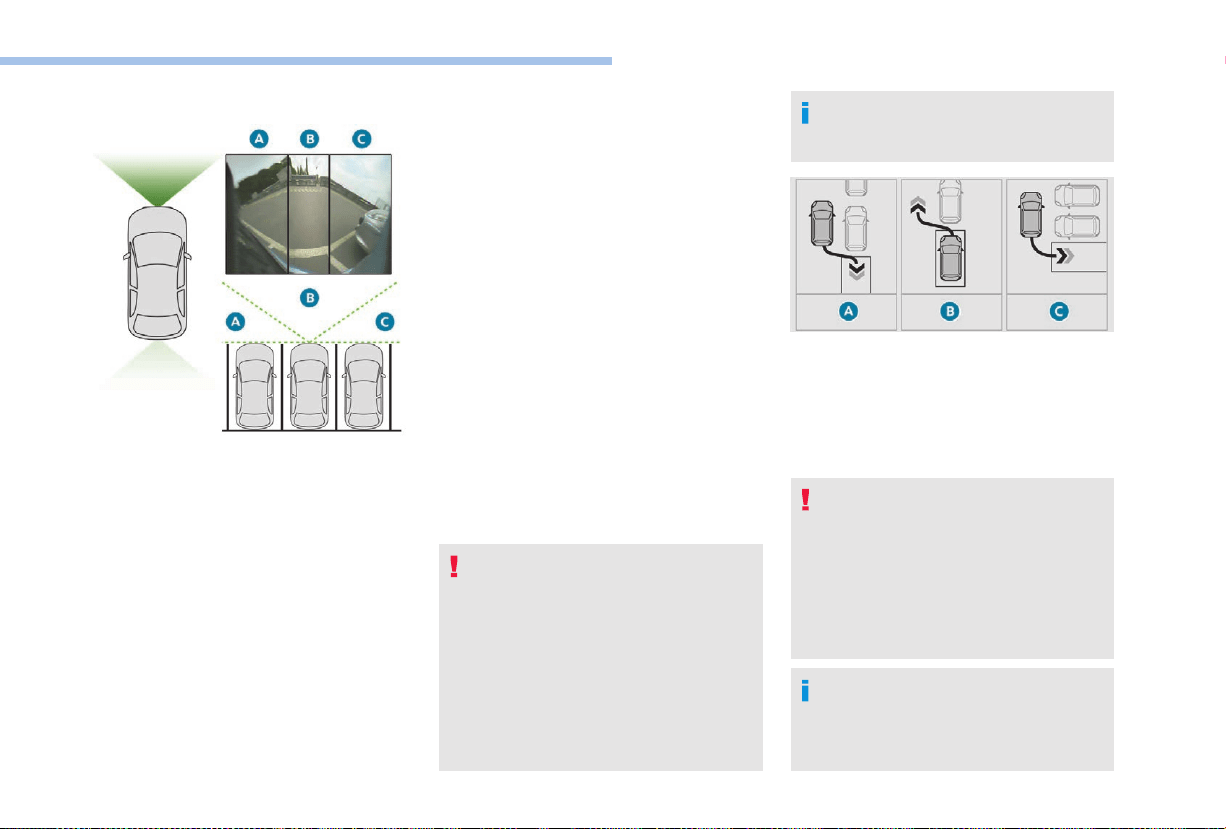
209
6
Driving
180° view
The 180° view assists with exiting from a
parking bay in forward gear, making it possible
to see the approach of vehicles, pedestrians
and cyclists.
This view is not recommended for carrying out
a complete manoeuvre.
It consists of 3 areas: left A, centre B and
right C.
This view is available only from the view
selection menu.
Park Assist
This system provides active assistance with
parking: it detects a parking space then
operates the steering system to park in this
space.
With a manual gearbox, the driver manages
the accelerator, brakes, gears and clutch.
With an automatic gearbox (EAT6 / EAT8),
the driver manages the accelerator, brakes
and gears.
During phases of entry into and exit from a
parking space, the system provides visual
and audible information to the driver in order
to make the manoeuvres safe. It may be
necessary to move forwards and backwards
more than once.
The driver can take control at any time by
gripping the steering wheel.
This manoeuvring assistance system
cannot, in any circumstances, replace
the need for vigilance on the part of the
driver.
The driver must remain in control of their
vehicle ensuring that the space remains
clear throughout the manoeuvre.
In some circumstances, the sensors may
not detect small obstacles located in
their blind spots.
The Park Assist system cannot work with
the engine off.
A. Entry into a parallel parking space.
B. Exit from a parallel parking space.
C. Bay parking.
During manoeuvring phases, the steering
wheel performs rapid turns: do not hold
the steering wheel, do not put your hands
between the spokes of the steering wheel.
Watch out for any object that could block
the manoeuvre (loose clothing, scarves,
ties, etc.) – injury risk!
When the Park Assist is active, it prevents
the Stop & Start going into STOP mode.
In STOP mode, activating Park Assist
restarts the engine.
The Park Assist system provides assistance for
the following manoeuvres:
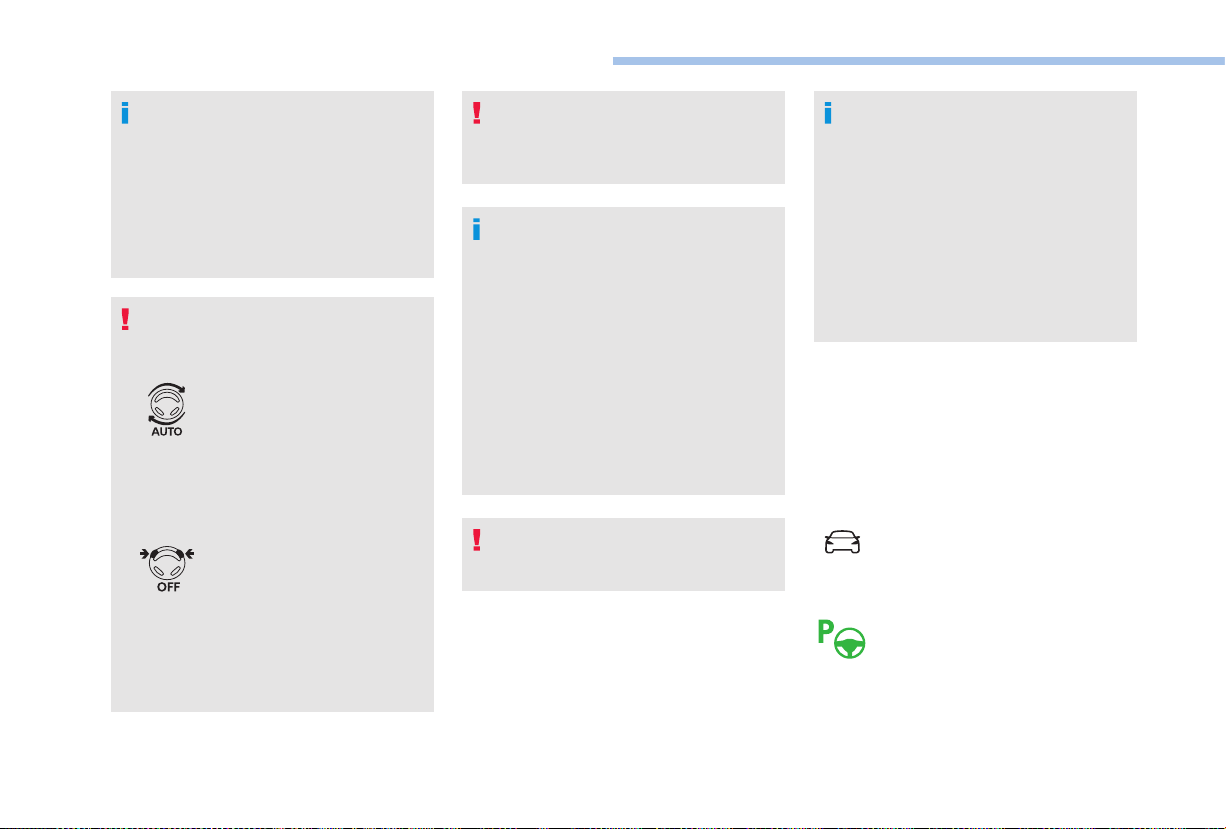
210
Driving
The Park Assist system takes control
of the assistance for a maximum of
4 manoeuvre cycles. The function is
deactivated after these 4 cycles. If you
think that your vehicle is not positioned
correctly, you should then take control of
the steering to carry out the manoeuvre.
The sequence of manoeuvres and the
driving instructions are displayed in the
instrument panel.
You should always check the surroundings
of your vehicle before starting a
manoeuvre.
The parking sensors function is
not available during parking space
measurement. It intervenes later when
manoeuvring to warn you that your
vehicle is approaching an obstacle: the
audible signal becomes continuous
when the obstacle is less than thirty
centimetres away.
If you have deactivated the parking
sensors, they are automatically
reactivated during assisted parking
manoeuvres.
Activation of the Park Assist deactivates
the Blind Spot Monitoring System.
During parking and exit from parking
manoeuvres, Visiopark 1 and Visiopark 2
functions may come into operation. They
facilitate monitoring of the surroundings
of the vehicle, by displaying additional
information in the instrument panel.
For more information on Visiopark 1 and
Visiopark 2, refer to the corresponding
section.
Operation
Assistance with parallel parking
manoeuvres
F When you have detected a parking space.
F Select "Park Assist" in the
Vehicle / Driving menu of the
touch screen to activate the
function.
This indicator lamp comes on in
the instrument panel to confirm the
activation of the system.
The assistance is activated:
the display of this symbol and
a speed limit indicate that
the steering manoeuvres are
controlled by the system: do
not touch the steering wheel.
The assistance is deactivated:
the display of this symbol
indicates that the steering
manoeuvres are no longer
controlled by the system:
you must take control of the
steering.
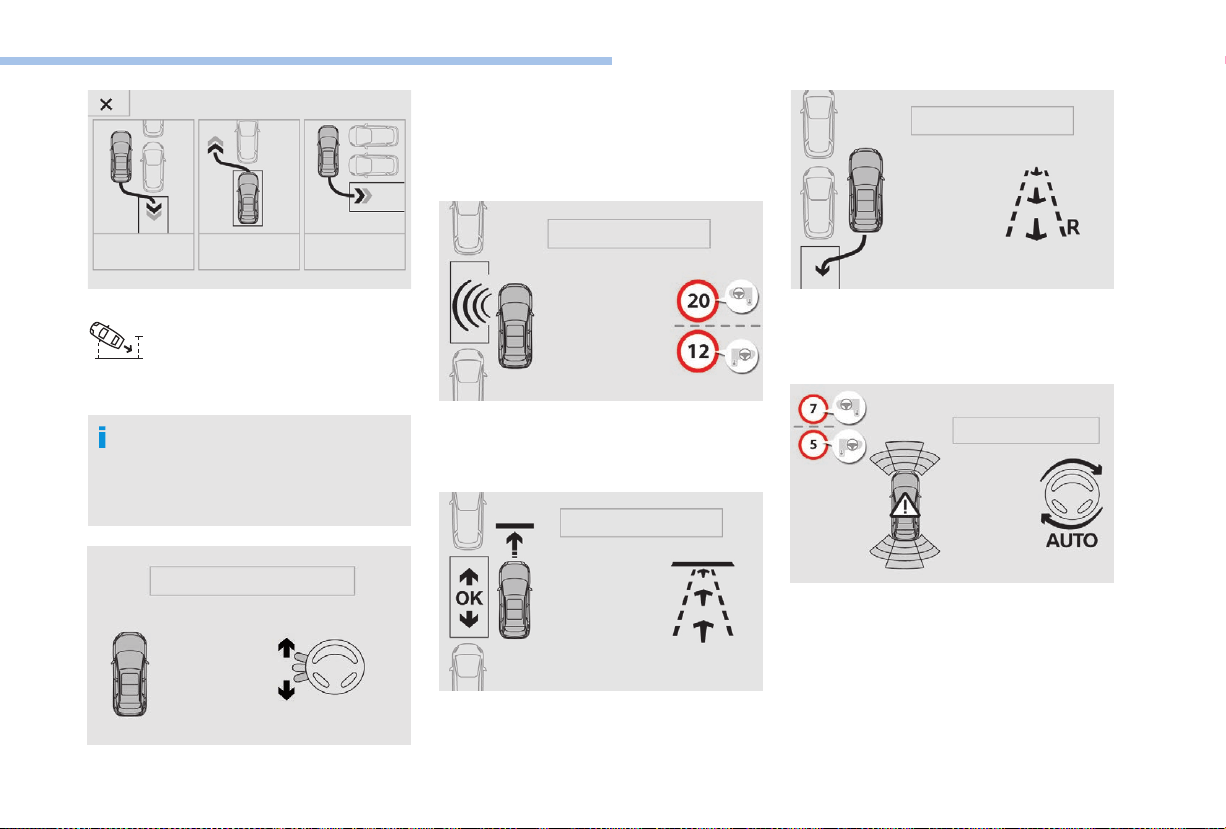
211
6
Driving
F Limit the speed of the vehicle to a
maximum of 12 mph (20 km/h) and
select "Enter parallel parking
space" on the touch screen.
To enter a parking space, the system
does not identify spaces that are clearly
smaller or larger than the vehicle.
F Operate the direction indicator on the
parking side chosen to activate the
measurement function. You should drive at
a distance of between 0.5 m and 1.5 m from
the row of parked vehicles.
F Drive slowly following the instructions until
the system finds a free space.
F Select reverse, release the steering wheel
and start moving without exceeding 4 mph
(7 km/h).
F Move forwards slowly until a message is
displayed, accompanied by an audible
signal, asking you to engage reverse gear.
F The assisted parking manoeuvre is in
progress.
Without exceeding 4 mph (7 km/h), move
forwards and backwards, aided by the
warnings from the "Parking sensors"
system, until the end of the manoeuvre is
indicated.
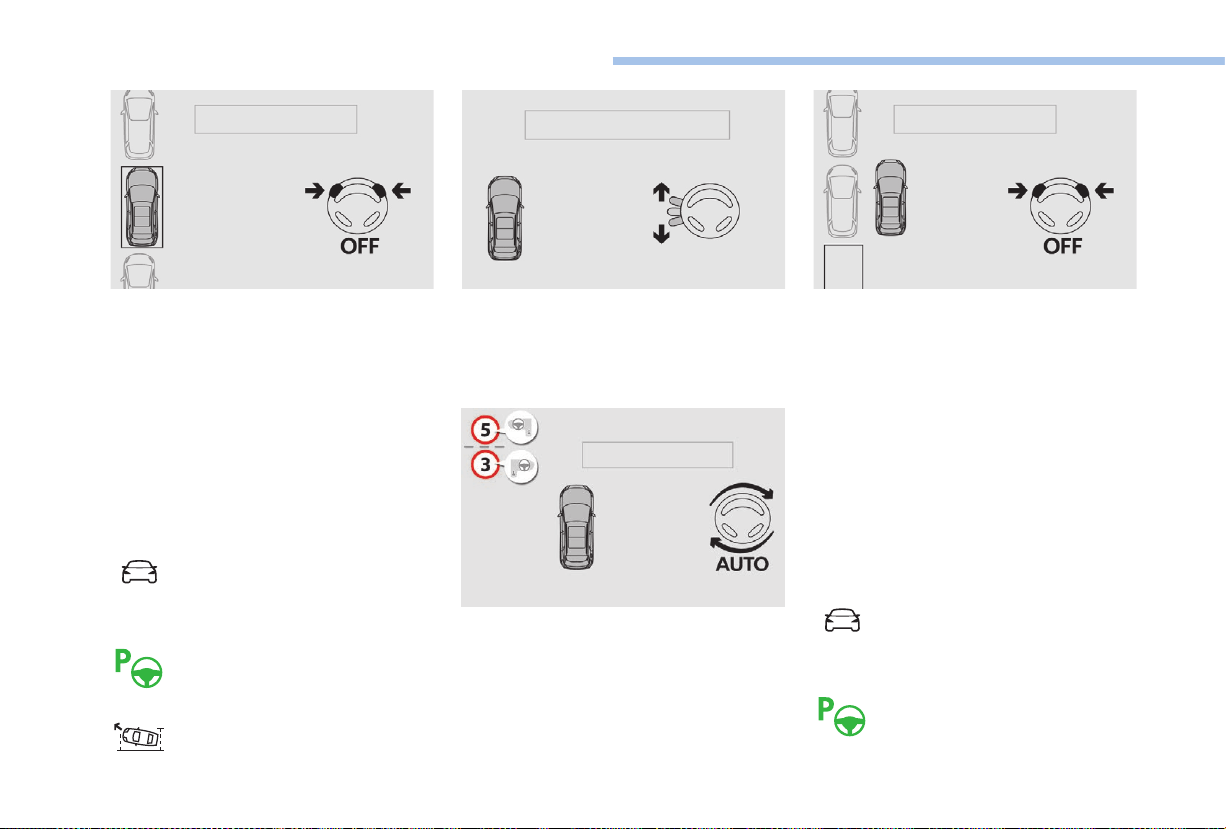
212
Driving
F At the end of the manoeuvre, the indicator
lamp goes out in the instrument panel,
accompanied by the display of a message
and an audible signal.
The assistance is deactivated: you can take
over control.
Assistance in exiting from a
parallel parking space
F When you want to leave a parallel parking
space, start the engine.
F Select "Park Assist" in the
Vehicle / Driving menu of the
touch screen to activate the
function.
This indicator lamp comes on in
the instrument panel to confirm the
activation of the system.
F Press "Exit parallel parking
space" on the touch screen.
Assistance with bay parking
manoeuvres
F When you have detected a parking space.
F Select "Park Assist" in the
Vehicle / Driving menu of the
touch screen to activate the
function.
This indicator lamp comes on in
the instrument panel to confirm the
activation of the system.
F Operate the direction indicator for the exit
side chosen.
F Engage reverse or forward gear and release
the steering wheel.
F The assisted parking manoeuvre is in
progress.
Without exceeding 3 mph (5 km/h), move
forwards and backwards, aided by the
warnings from the "Parking sensors" system,
until the end of the manoeuvre is indicated.
The manoeuvre is complete when the vehicle's
front wheels are clear of the parking space.
At the end of the manoeuvre, the indicator
lamp in the instrument panel goes off,
accompanied by the display of a message and
an audible signal.
The assistance is deactivated: you can take
over control.
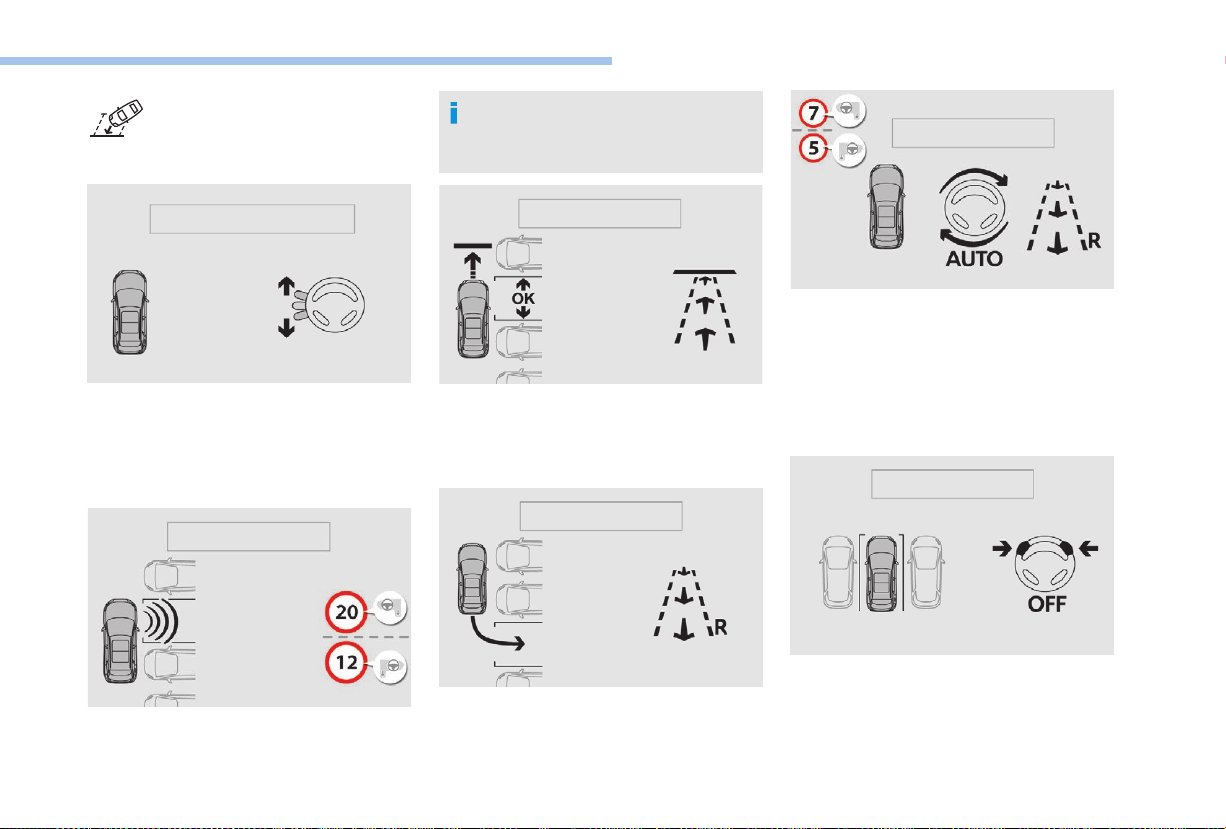
213
6
Driving
F Limit the speed of the vehicle to
a maximum of 12 mph (20 km/h)
and select "Enter bay parking
space" on the touch screen.
F Operate the direction indicator on the
parking side chosen to activate the
measurement function. You should drive at
a distance of between 0.5 m and 1.5 m from
the row of parked vehicles.
When several successive bays are found,
the vehicle will be directed towards the
last one.
F Drive slowly following the instructions until
the system finds a free space.
F Move forwards slowly until a message is
displayed, accompanied by an audible
signal, asking you to engage reverse gear.
F Select reverse, release the steering wheel
and start moving without exceeding 4 mph
(7 km/h).
F The assisted parking manoeuvre is in
progress.
Without exceeding 4 mph (7 km/h), follow
the instructions displayed in the instrument
panel, aided by the warnings from the
"Parking sensors" system, until the end of
the manoeuvre is indicated.
At the end of the manoeuvre, the indicator lamp
goes out in the instrument panel, accompanied by
the display of a message and an audible signal.
The assistance is deactivated: you can take
over control.
214
Driving
During a bay parking manoeuvre, the
Park Assist system is automatically
deactivated once the rear of the vehicle is
within 20 inches (50 cm) of an obstacle.
Deactivation
The system is deactivated by pressing the
control.
The system is deactivated automatically:
- on switching off the ignition,
- if the engine stalls,
- if no manoeuvre is performed within
5 minutes of selecting the type of manoeuvre
- after a prolonged stop of the vehicle during a
manoeuvre,
- if the wheel anti-slip regulation (ASR) is
triggered,
- if the speed of the vehicle exceeds the stated
limit,
- when the driver interrupts movement of the
steering wheel,
- after 4 manoeuvre cycles,
- on opening the driver's door,
- if one of the front wheels encounters an
obstacle.
The indicator lamp in the instrument panel goes
off and a message is displayed accompanied by
an audible signal.
The driver should then take back control of the
vehicle's steering.
If the system is deactivated during a
manoeuvre, the driver should reactivate it
to repeat the measurement.
Deactivation
The system is switched off automatically:
- when towing a trailer, connected electrically,
- if the driver's door is opened,
- if the speed of the vehicle is above 43 mph
(70 km/h).
To switch the system off for a prolonged period,
contact a PEUGEOT dealer or a qualified
workshop.
Operating faults
In the event of a fault, this warning
lamp flashes for a few seconds,
accompanied by an audible signal.
In the event of a fault with the
power steering, this warning lamp
is displayed in the instrument panel,
accompanied by a message.
If the lateral distance between your vehicle
and the space is too great, the system may
not be able to measure the space.
Any object projecting beyond the
dimensions of the vehicle (e.g. a ladder on
the roof or a towball) will not be taken into
account by the Park Assist system during
a manoeuvre.
In bad weather or in winter, ensure that
the sensors are not covered by dirt, ice
or snow.
In the event of a fault, have the system
checked by a PEUGEOT dealer or a
qualified workshop.
High pressure jet washing
When washing your vehicle, keep the lance at
least 12 inches (30 cm) away from the sensors.
If the fault occurs during the use of the system,
the warning lamp goes off.
Contact a PEUGEOT dealer or a qualified
workshop.
PEUGEOT & TOTAL
The PEUGEOT TOTAL team knows how to push back the limits
of performance to win victories in the most difficult conditions,
as confirmed by the first three places achieved in 2017.
To obtain these exceptional results, the Peugeot Sport teams
chose TOTAL QUARTZ for the Peugeot 3008 DKR, a high-tech
lubricant that protects the engine in the most severe conditions.
TOTAL QUARTZ protects your engine against the effects
of time.
TOTAL QUARTZ Ineo First is an ultra-high performance
lubricant, the result of collaboration between Peugeot and
Total's R&D teams. Specially formulated for the engines
in Peugeot vehicles, its innovative technology significantly
reduces CO
2
emissions and provides efficient protection to
keep your engine clean.
A PARTNERSHIP FOR
PERFORMANCE!
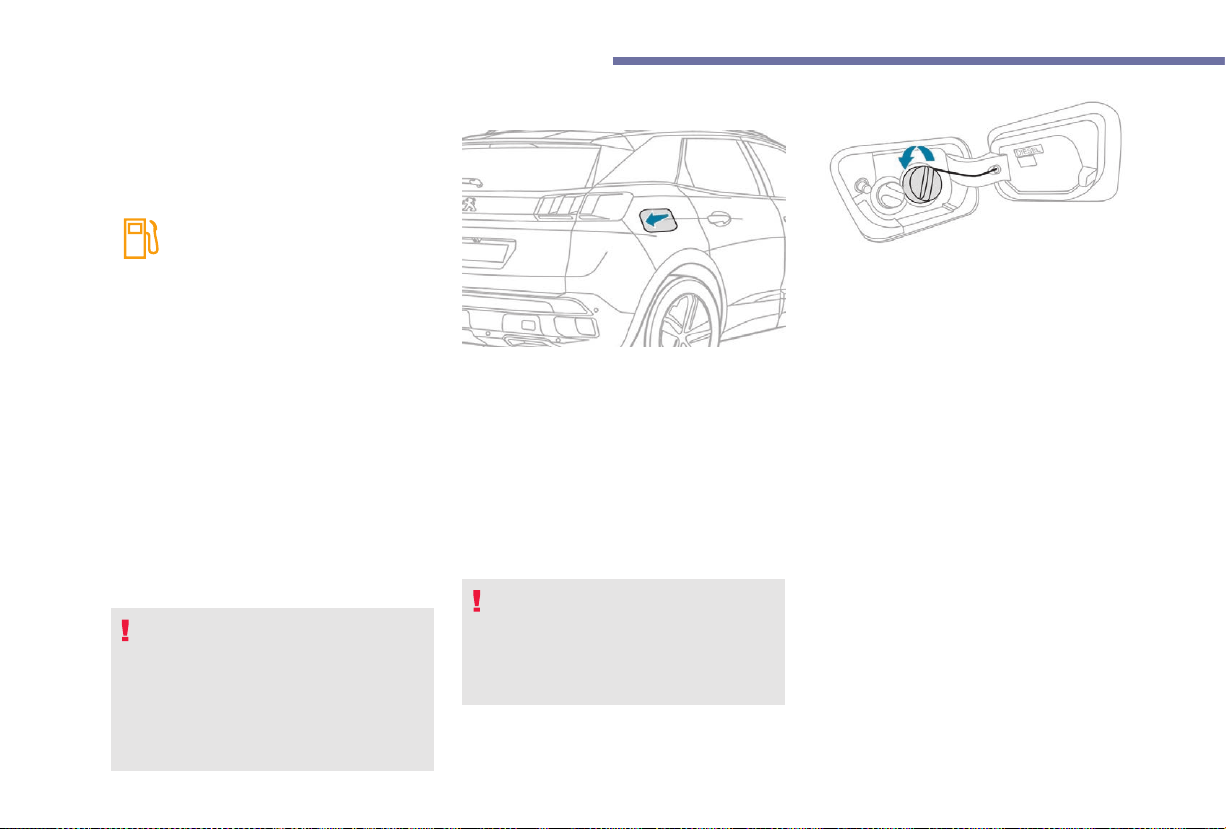
216
Practical information
Fuel
Fuel tank capacity: approximately 53 litres.
Reserve level: 6 litres.
Low fuel level
When the low fuel level is reached
in the fuel tank, this warning lamp
comes on in the instrument panel,
accompanied by the display of a
message and an audible signal.
When it first comes on, about
6 litres of fuel is left in the tank.
If your vehicle is fitted with Stop & Start,
never refuel with the engine in STOP
mode; you must switch off the ignition
using the key, or the START/STOP button
if your vehicle has Keyless Entry and
Starting.
Refuelling
If you have put in the wrong fuel for your
vehicle, you must have the fuel tank
drained and filled with the correct fuel
before starting the engine.
Once you have finished refuelling:
F Refit the filler cap.
F Turn it to the right.
F Close the fuel filler flap.
Misfuel prevention (Diesel)
(Depending on the country of sale.)
Mechanical device which prevents filling the
tank of a Diesel vehicle with petrol. It avoids
the risk of engine damage that can result from
filling with the wrong fuel.
Until sufficient fuel is added, this warning lamp
appears every time the ignition is switched on,
accompanied by the display of a message and
an audible signal. When driving, this message
and audible signal are repeated with increasing
frequency as the fuel level drops towards 0.
Refuel as soon as possible to avoid running out
of fuel.
For more information on Running out of fuel
(Diesel), refer to the corresponding section.
A label on the inside of the fuel filler flap
reminds you of the type of fuel to use,
depending on your engine type.
Additions of fuel must be of at least 5 litres, in
order to be registered by the fuel gauge.
Opening the filler cap may create a noise
caused by an inrush of air. This vacuum is
entirely normal, resulting from the sealing of the
fuel system.
To refuel in complete safety:
F You must switch off the engine.
F With the vehicle unlocked, press the rear
part of the filler flap.
F Turn the filler cap to the left.
F Remove the filler cap and hook it onto the
clip located on the inside of the filler flap,
F Fill up the tank completely, but do not
continue after the 3
rd
cut-off of the nozzle;
this could cause malfunctions.
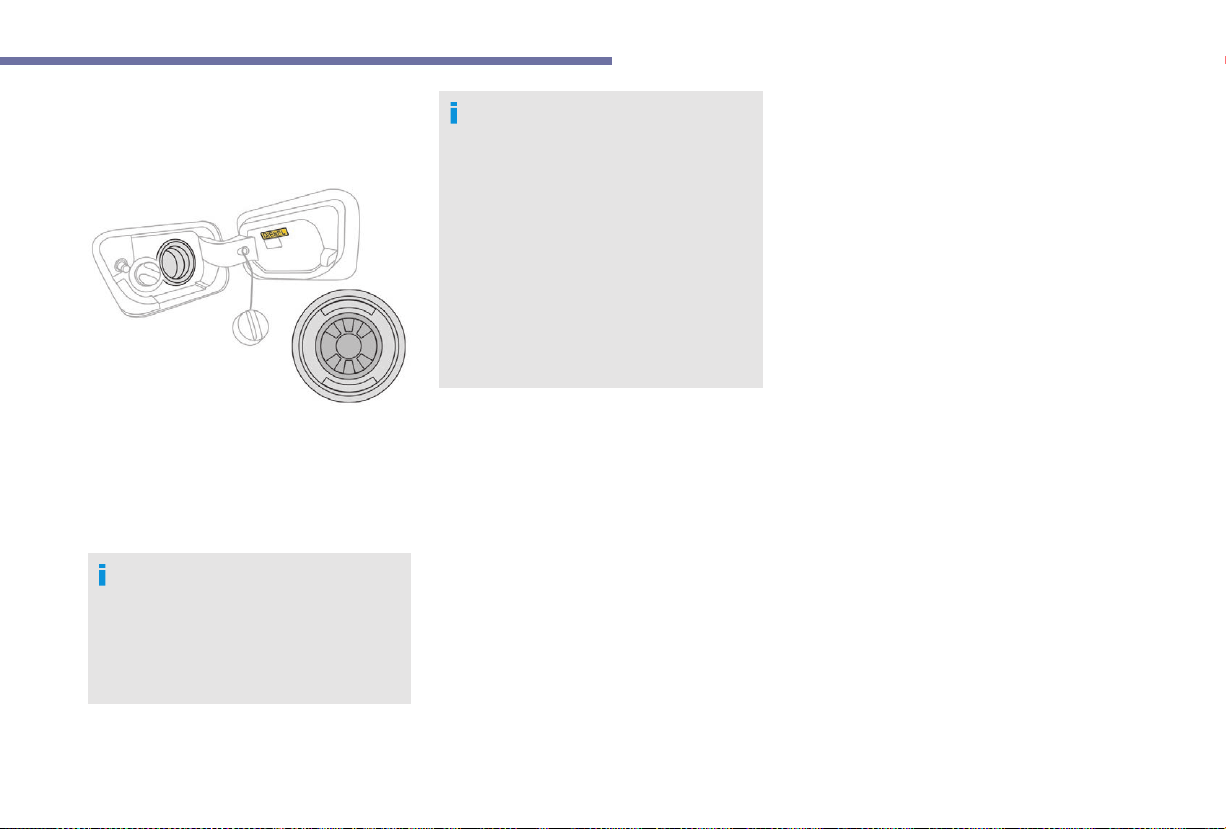
7
217
Practical information
Operation
When a petrol filler nozzle is introduced into
your Diesel tank, it comes into contact with the
flap. The system remains closed and prevents
filling.
Do not persist but introduce a Diesel type
filler nozzle.
It remains possible to use a fuel can to fill
the tank.
In order to ensure a good flow of fuel,
do not place the nozzle of the fuel can in
direct contact with the flap of the misfuel
prevention device and pour slowly.
Located in the filler neck, the misfuel prevention
device appears when the filler cap is removed.
Travelling abroad
As Diesel fuel pump nozzles may be
different in other countries, the presence
of the misfuel prevention device may
make refuelling impossible.
Not all Diesel vehicles are fitted with
misfuel protection, so before travelling
abroad, we recommend that you check
with the PEUGEOT dealer network,
whether your vehicle is suitable for the
fuel pumps in the country in which you
intend to travel.
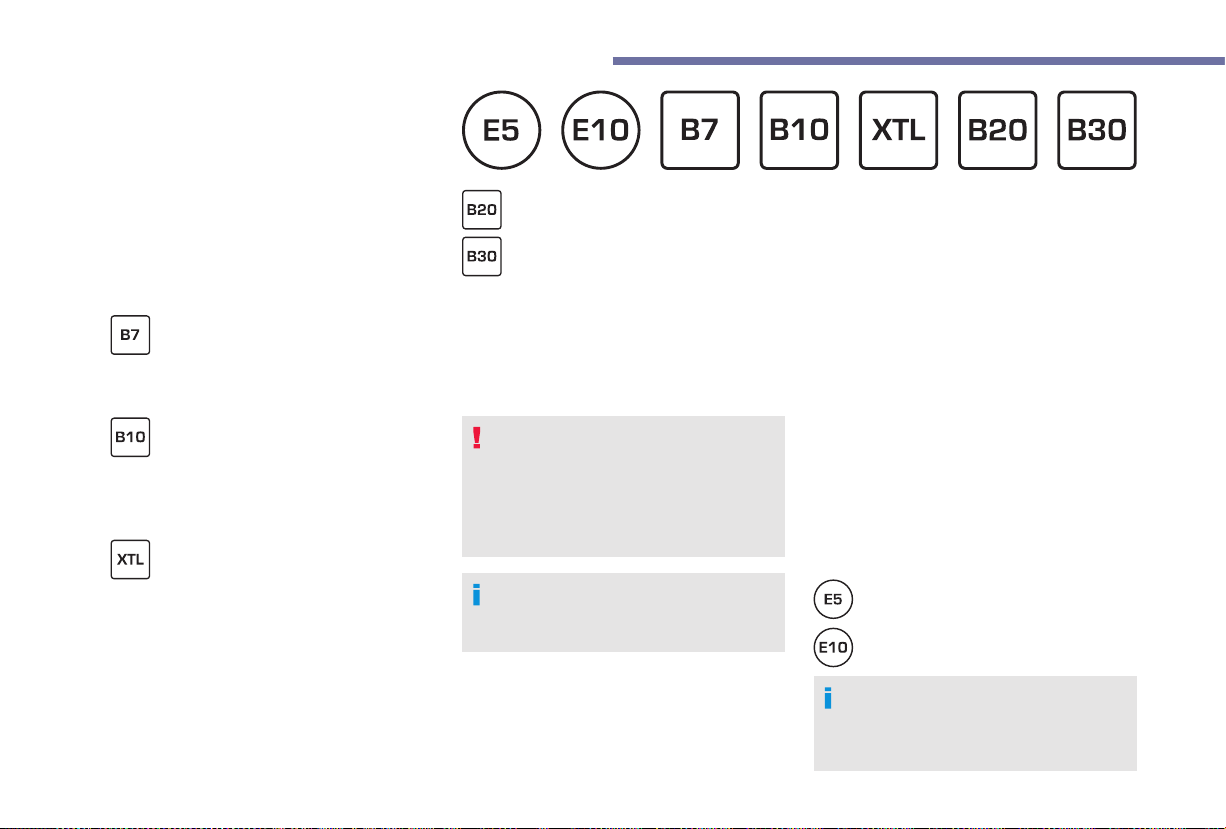
218
Practical information
Compatibility of fuels
Fuel used for Diesel
engines
The Diesel engines are compatible with
biofuels that conform to current and future
European standards and which can be
obtained from filling stations:
Diesel fuel that meets standard
EN590 mixed with a biofuel that meets
standard EN14214 (possibly containing
up to 7% Fatty Acid Methyl Ester).
Diesel fuel that meets standard
EN16734 mixed with a biofuel that
meets standard EN14214 (possibly
containing up to 10% Fatty Acid
Methyl Ester).
Paraffinic Diesel fuel that meets
standard EN15940 mixed with
a biofuel that meets standard
EN14214 (possibly containing up to
7% Fatty Acid Methyl Ester).
For more information, contact a PEUGEOT
dealer or a qualified workshop.
The use of any other type of (bio) fuel
(vegetable or animal oils, pure or diluted,
domestic fuel, etc.) is strictly prohibited
(risk of damage to the engine and fuel
system).
The only Diesel additives authorised for
use are those that meet the B715000
standard.
Diesel at low temperature
of the fuel supply circuit. To avoid this, we
recommend using winter-type Diesel fuel and
keeping the fuel tank more than 50% full.
If, despite this, at temperatures below -15°C
(+5°F) the engine has problems starting,
just leave the vehicle in a garage or heated
workshop for a little while.
Fuel used for petrol engines
The petrol engines are compatible with biofuels
that conform to current and future European
standards and which can be obtained from
filling stations:
Petrol that meets standard EN228,
mixed with a biofuel that meets
standard EN15376.
The only petrol additives authorised for
use are those that meet the B715001
standard.
The use of B20 or B30 fuel meeting
standard EN16709 is possible in
your Diesel engine. However, this
use, even occasional, requires strict
application of the special servicing
conditions referred to as "Arduous
conditions".
At temperatures below 0°C (+32°F), the
formation of paraffins in summer-type Diesel
fuels could entail an abnormal operation

7
219
Practical information
Travelling abroad
Certain fuels could damage the engine of
your vehicle.
In certain countries, the use of a particular
fuel may be required (specific octane
rating, specific trade name, etc.) to ensure
correct operation of the engine.
For any additional information, contact a dealer.
Towing device
Load distribution
F Distribute the load in the trailer so that the
heaviest items are as close as possible to
the axle and the nose weight approaches the
maximum permitted without exceeding it.
Air density decreases with altitude, thus
reducing engine performance. The maximum
towed load must be reduced by 10% for every
1,000 metres of altitude.
Use towing devices and their genuine
harnesses approved by PEUGEOT. It
is recommended that the installation be
performed by a PEUGEOT dealer or a
qualified workshop.
If the towbar is not fitted by a
PEUGEOT dealer, it must still be
fitted in accordance with the vehicle
manufacturer's instructions.
Important: for versions equipped with
the motorised tailgate with Hands-Free
Tailgate Access function, if a towing
device other than a genuine PEUGEOT
one is installed, it is imperative to visit
a PEUGEOT dealer or a qualified
workshop to recalibrate the detection
system: risk of Hands-Free Tailgate
Access function failure.
Certain driving assistance or
manoeuvring assistance functions are
automatically disabled if an approved
towbar is used.
Observe the maximum authorised
towable weight, indicated on your
vehicle's registration certificate, the
manufacturer's label as well as in the
Technical data section of this guide.
Complying with the maximum
authorised nose weight (ball joint)
also includes the use of accessories
(bicycle carriers, tow boxes, etc.).
Observe the legislation in force in the
country in which you are driving.
Vehicle equipped with motorised
tailgate with "Hands-Free Tailgate
Access" function
To avoid unwanted opening of the tailgate
when using the towing device:
- deactivate the Hands-Free Tailgate
Access function in advance in your
vehicle's configuration menu,
- or remove the electronic key from the
recognition zone, with the tailgate
closed.
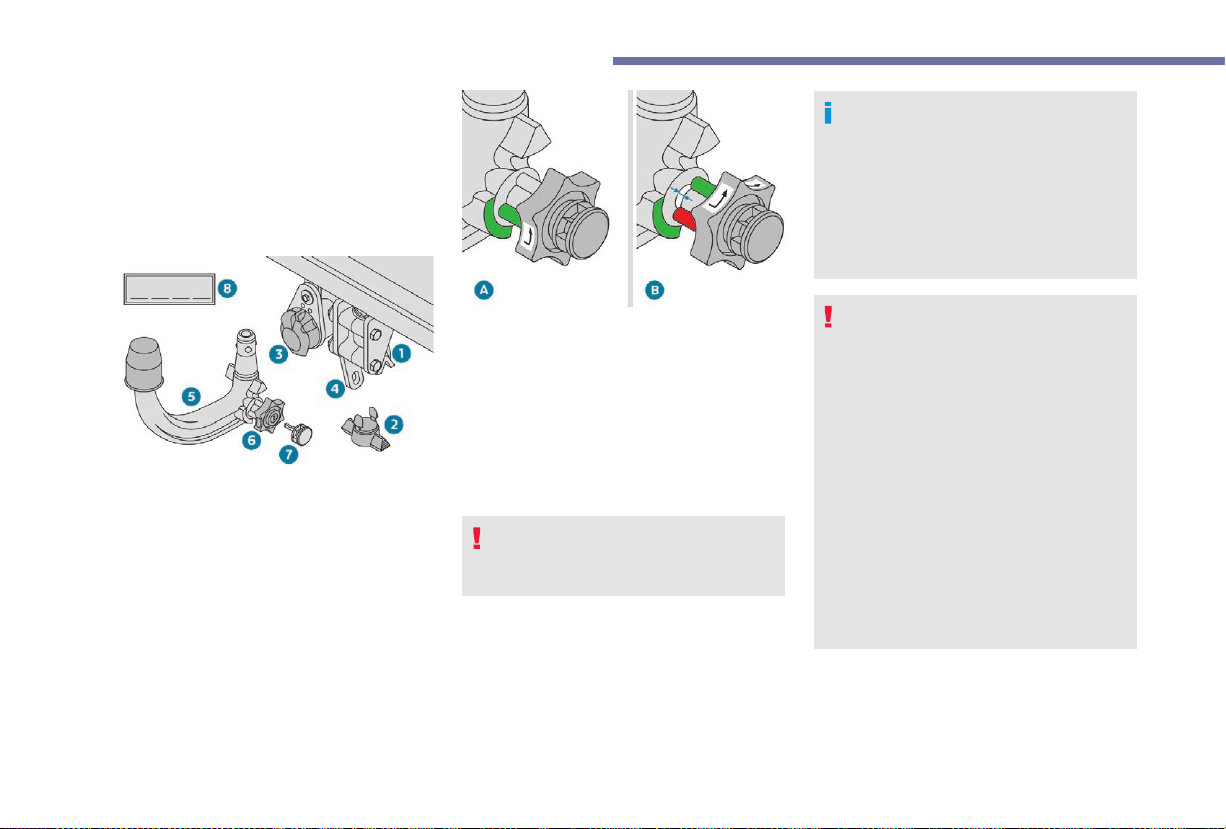
220
Practical information
Towbar with quickly
detachable towball
No tools are required to install or remove the
towball on this genuine towbar system.
Presentation
Trailers with LED lamps are not
compatible with the wiring harness of this
device.
To know the Technical data, and, in
particular, the towable weights for your
vehicle, refer to the corresponding
section.
To ensure complete safety while driving
with a Towbar system, refer to the
corresponding section.
Before each use
Check that the towball is correctly fitted,
verifying the follow points:
- the green mark on the locking wheel
is in line with the green mark on the
towball,
- the locking wheel is in contact with the
towball (position A),
- the security key lock is on and the key
removed; the locking wheel can no
longer be operated,
- the towball must not be able to move
in its carrier; test by shaking it with
your hand.
If the towball is not locked, the trailer can
detach – accident risk!
1. Carrier.
2. Protective plug.
3. Connection socket.
4. Safety eye.
5. Detachable towball.
6. Locking / unlocking wheel.
7. Security key lock.
8. Key reference label.
A. Locked position (the green marks are
opposite each other); the wheel is in
contact with the towball (no gap).
B. Unlocked position (red mark opposite
the green mark); the wheel is no longer
in contact with the towball (gap of around
5 mm).
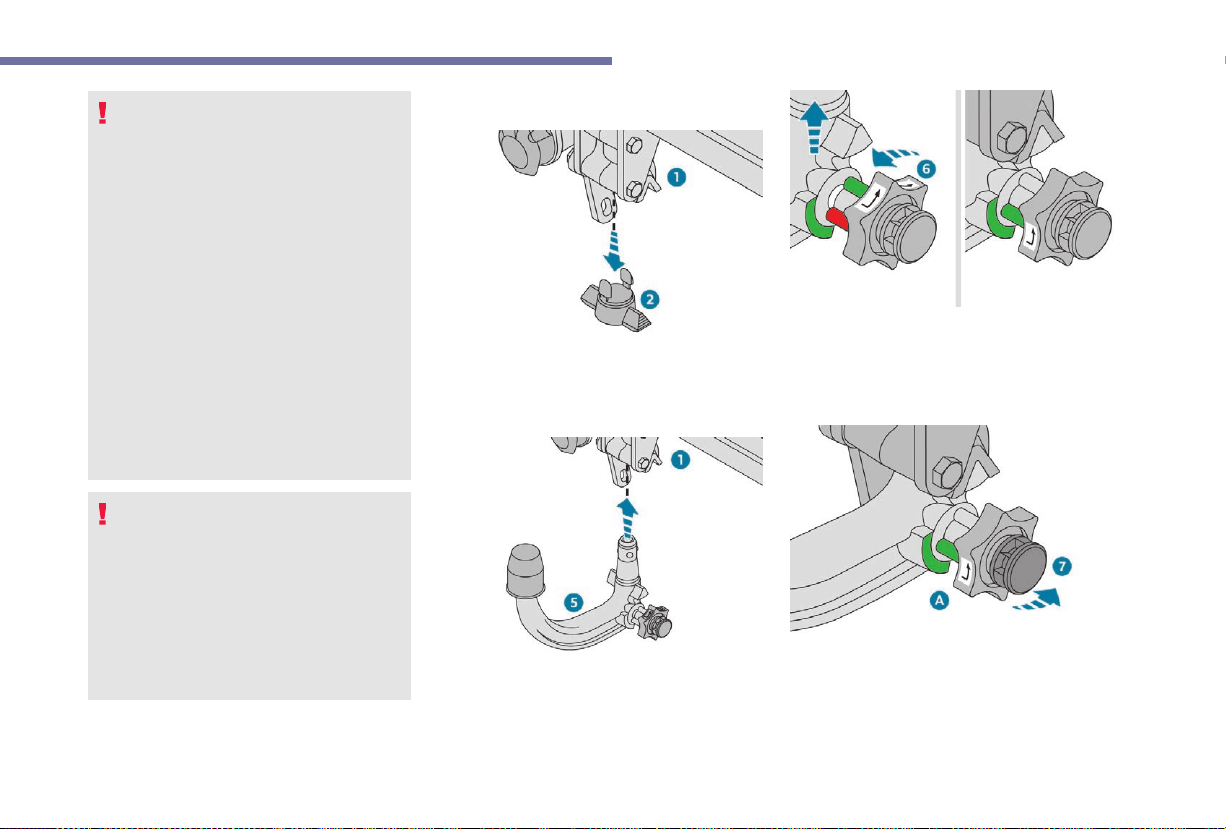
7
221
Practical information
During use
Never release the locking system with a
trailer or load carrier on the towball.
Never exceed the maximum authorised
weight for the vehicle – the Gross Train
Weight or GTW.
It is essential that the maximum
authorised load be complied with on
the towing device: if it is exceeded, this
device may detach from the vehicle,
which is a serious accident risk.
Check that the trailer lamps work
correctly.
Before setting off, check the adjustment
of the headlamp beam height.
For more information on Headlamp
adjustment, refer to the corresponding
section.
Following use
When travelling without a trailer or load
on a towbar-mounted carrier, the towball
must be removed and the protective plug
inserted in the carrier. This measure
applies particularly where the towball
might obscure visibility of the number
plate or its lighting.
Fitting the towball
F Below the rear bumper, remove the
protective plug 2 from the towball carrier 1.
F Insert the end of towball 5 into carrier 1 and
push it upwards; the locking will take place
automatically.
F The locking wheel 6 turns a quarter of a
turn anti-clockwise; take care to keep your
hands clear!
F Check that the mechanism has correctly
locked in to place (position A).
F Close the lock 7 using the key.

222
Practical information
Removing the towball
F Always remove the key. The key cannot be
removed when the lock is open.
F Clip the cap onto the lock.
F Remove the protective cover from the
towball.
F Attach the trailer to the towball.
F Attach the cable on the trailer to the safety
eye 4 on the carrier.
F Insert the trailer plug and give it a quarter
turn to connect it to socket 3 of the carrier.
F Give a quarter turn and pull the trailer plug
to disconnect it from socket 3 of the carrier.
F Detach the cable on the trailer from the
safety eye 4 on the carrier.
F Detach the trailer from the towball.
F Refit the protective cover to the towball.
F Remove the cap from the lock and press it
onto the head of the key.
F Insert the key into the lock 7.
F Open the lock using the key.
F Hold towball 5 firmly in one hand; using the
other hand, pull and turn locking wheel 6
fully in a clockwise direction; do not release
the locking wheel.
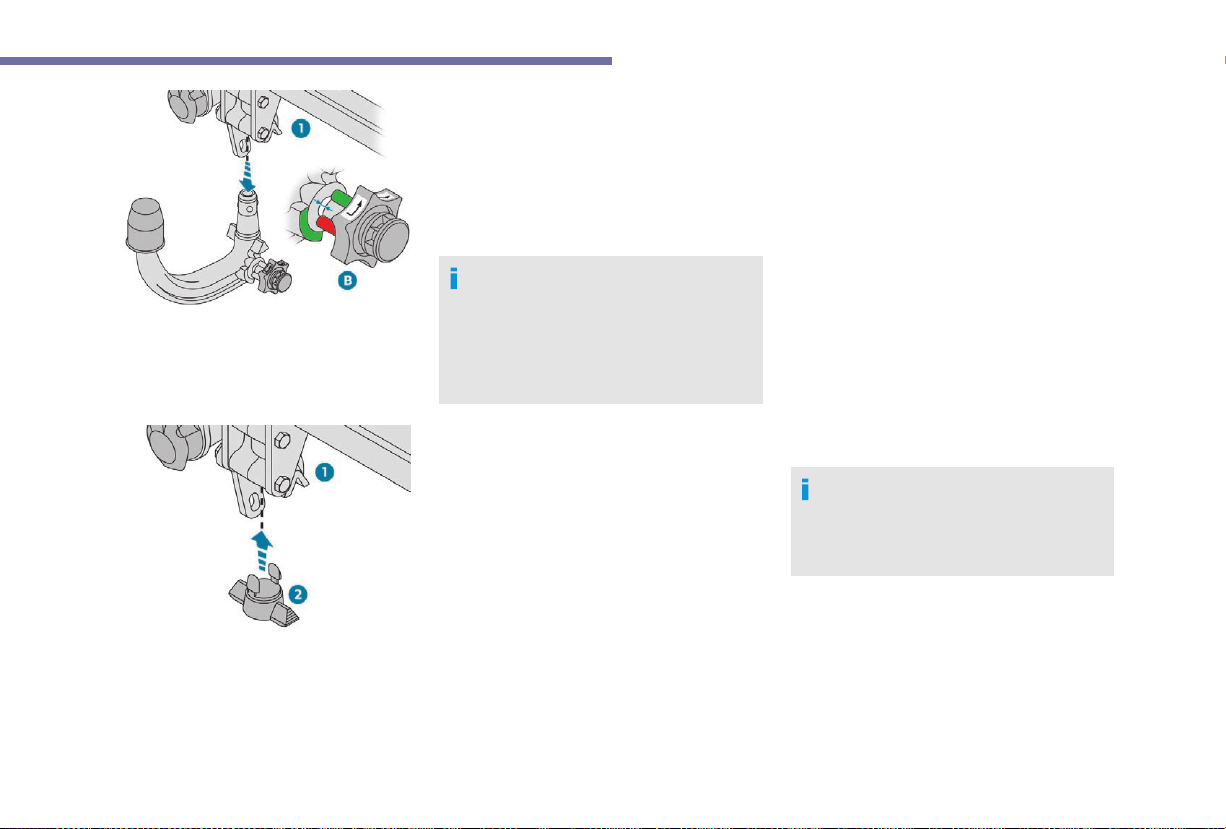
7
223
Practical information
Maintenance
Correct operation is only possible if the towball
and its carrier are kept clean.
Before cleaning the vehicle with a high-
pressure jet wash, the towball must be removed
and the protective plug fitted to the carrier.
Apply the label provided to a clearly visible
area, close to the carrier or in the boot.
Go to a PEUGEOT dealer or a qualified
workshop for any work on the towbar
system.
F Extract the towball from the bottom of its
carrier 1.
F Release the locking wheel; this automatically
stops in the unlocked position (position B).
F Refit protective plug 2 to carrier 1.
F Carefully stow the towball in its bag away
from knocks and dirt.
Load reduction mode
System which manages the use of certain
functions according to the level of charge
remaining in the battery.
When the vehicle is being driven, the load
reduction function temporarily deactivates
certain functions, such as air conditioning,
heated rear screen, etc.
The deactivated functions are reactivated
automatically as soon as conditions permit.
Energy economy mode
System which manages the duration of use of
certain functions to conserve a sufficient level
of charge in the battery.
After the engine has stopped, you can still use
functions such as the audio and telematics
system, windscreen wipers, dipped beam
headlamps, courtesy lamps, etc. for a
maximum combined duration of about forty
minutes.
Switching to this mode
A message appears in the instrument panel
screen indicating that the vehicle has switched
to economy mode and the active functions are
put on standby.
If a telephone call is being made at this
time, it will be maintained for around
10 minutes with the Bluetooth hands-free
system of your audio system.
Exiting the mode
These functions will be automatically restored
the next time the vehicle is used.
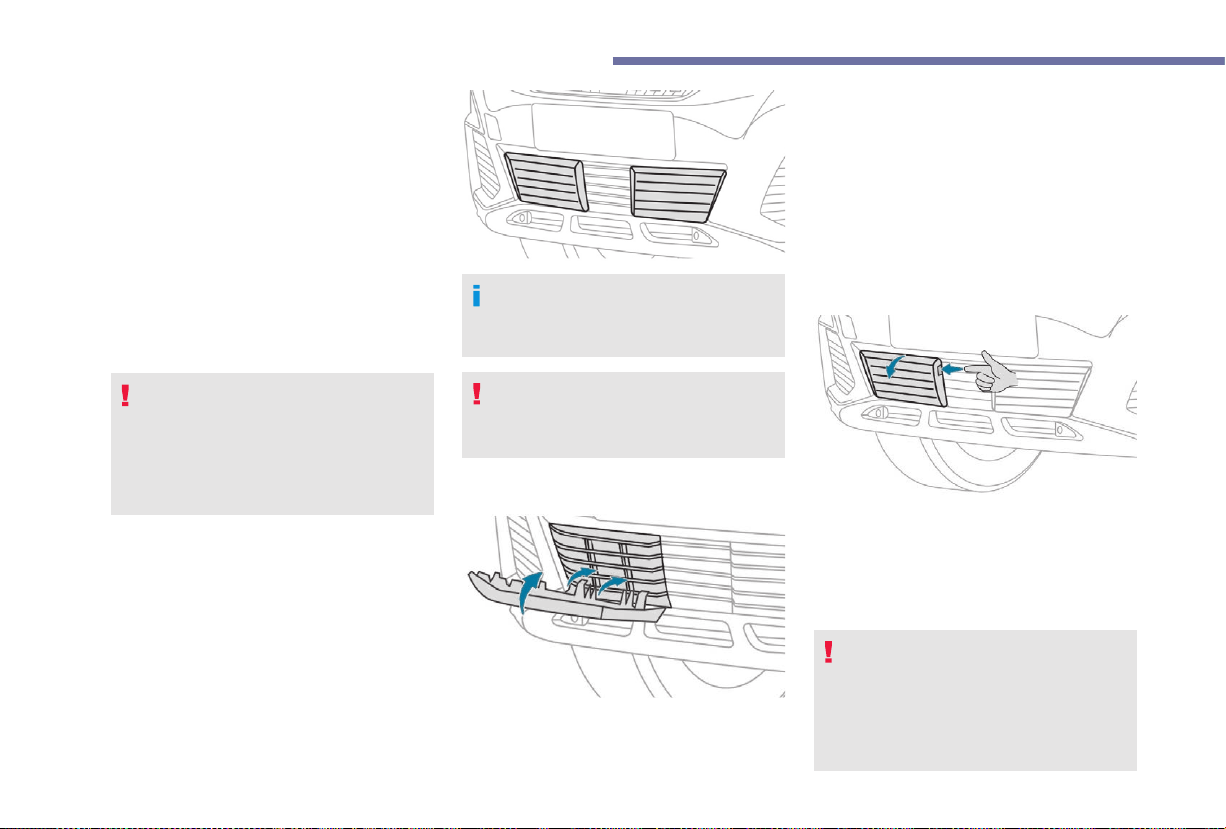
224
Practical information
A flat battery prevents the engine from
starting.
For more information on the 12 V battery,
refer to the corresponding section.
In order to restore the use of these functions
immediately, start the engine and let it run:
- for less than ten minutes, to use the
equipment for approximately five minutes,
- for more than ten minutes, to use the
equipment for up to approximately thirty
minutes.
Let the engine run for the duration specified to
ensure that the battery charge is sufficient.
Do not repeatedly and continuously restart the
engine in order to charge the battery.
Very cold climate screen
(Depending on country of sale.)
Prevents snow from accumulating at the
radiator cooling fan.
This removable device consists of two
elements to be attached to the front bumper.
For fitting and removing the screen, it is
recommended that you get in touch with a
PEUGEOT dealer or a qualified workshop.
Before fitting or removing a screen,
ensure that the engine is off and the
cooling fan has stopped.
Fitting
Removing
F Offer up the corresponding screen to the
lower grille in the bumper.
F First insert the two lower fixing brackets into
the bumper.
F Tilt the screen upwards until the three upper
fixing brackets click into the bumper.
F Check that the unit is firmly held by pressing
its edge.
Repeat these operations for the other screen.
F Insert a finger into the notch in the upper
part of the screen.
F Pull towards you to unclip the unit.
Repeat these operations for the other screen.
The very cold climate screen must be
removed:
- when the exterior temperature exceeds
10°C,
- when towing,
- at speeds above 75 mph (120 km/h).
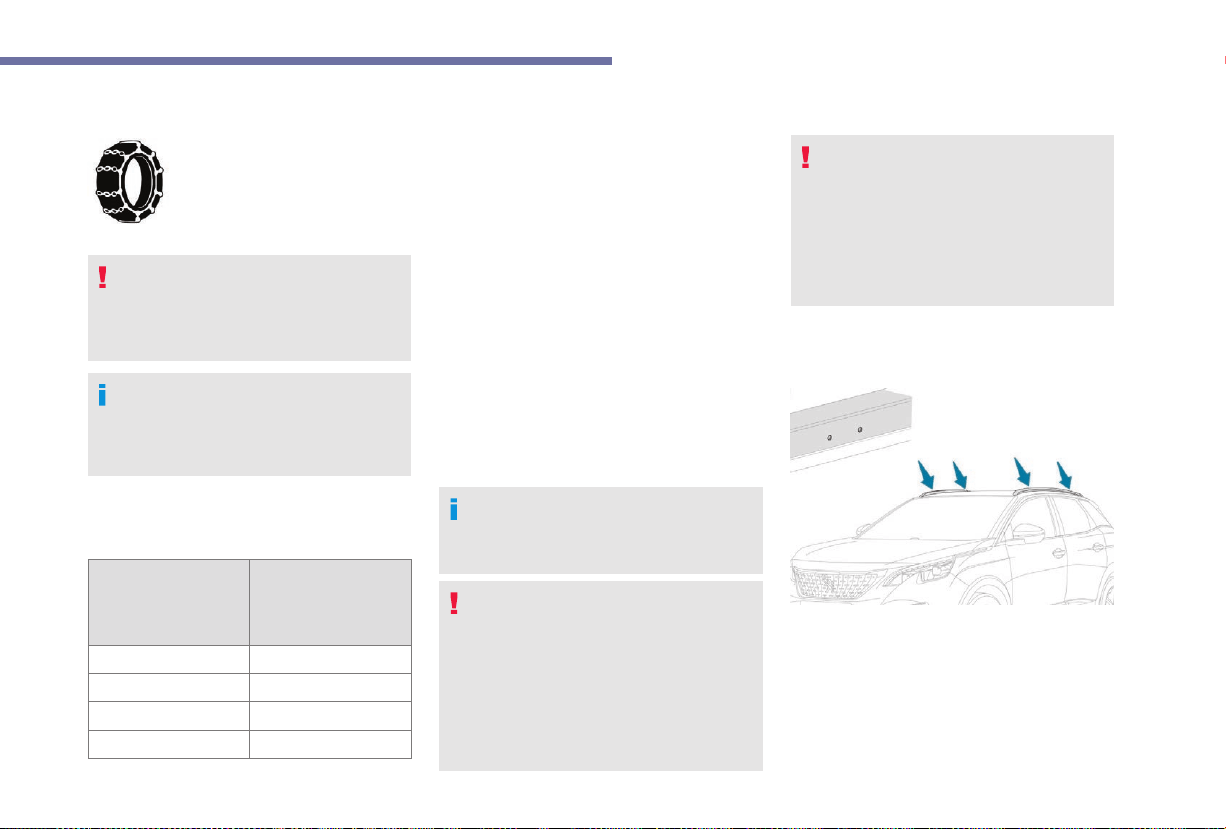
7
225
Practical information
Snow chains
In wintry conditions, snow chains
improve traction as well as the
behaviour of the vehicle when
braking.
Snow chains must be fitted only to the
front wheels. They must never be fitted to
"space-saver" type spare wheels.
Take account of the legislation in force in
your country on the use of snow chains
and the maximum authorised speed.
Use only the chains designed to be fitted to the
type of wheel fitted to your vehicle:
Installation tips
F If you have to fit the chains during a journey,
stop the vehicle on a flat surface on the side
of the road.
F Apply the parking brake and position any
wheel chocks to prevent movement of your
vehicle.
F Fit the chains following the instructions
provided by the manufacturer.
F Move off gently and drive for a few
moments, without exceeding 31 mph
(50 km/h).
F Stop your vehicle and check that the snow
chains are correctly tightened.
It is strongly recommended that before
you leave, you practise fitting the snow
chains on a level and dry surface.
Original tyre size Maximum link size
215/65 R17 9 mm
225/55 R18 9 mm
205/55 R19 9 mm
235/50 R19
cannot be fitted with chains
For more information on snow chains, contact a
PEUGEOT dealer or a qualified workshop.
Avoid driving with snow chains on roads
that have been cleared of snow to avoid
damaging your vehicle's tyres and the
road surface. If your vehicle is fitted with
alloy wheels, check that no part of the
chain or its fixings is in contact with the
wheel rim.
Fitting roof bars
As a safety measure and to avoid
damaging the roof, it is essential to use
the transverse bars approved for your
vehicle.
Observe the instructions on fitting and
use contained in the guide supplied with
the roof bars.
Fitting on longitudinal bars
The transverse bars must be fixed at the
engraved markings on the longitudinal bars.
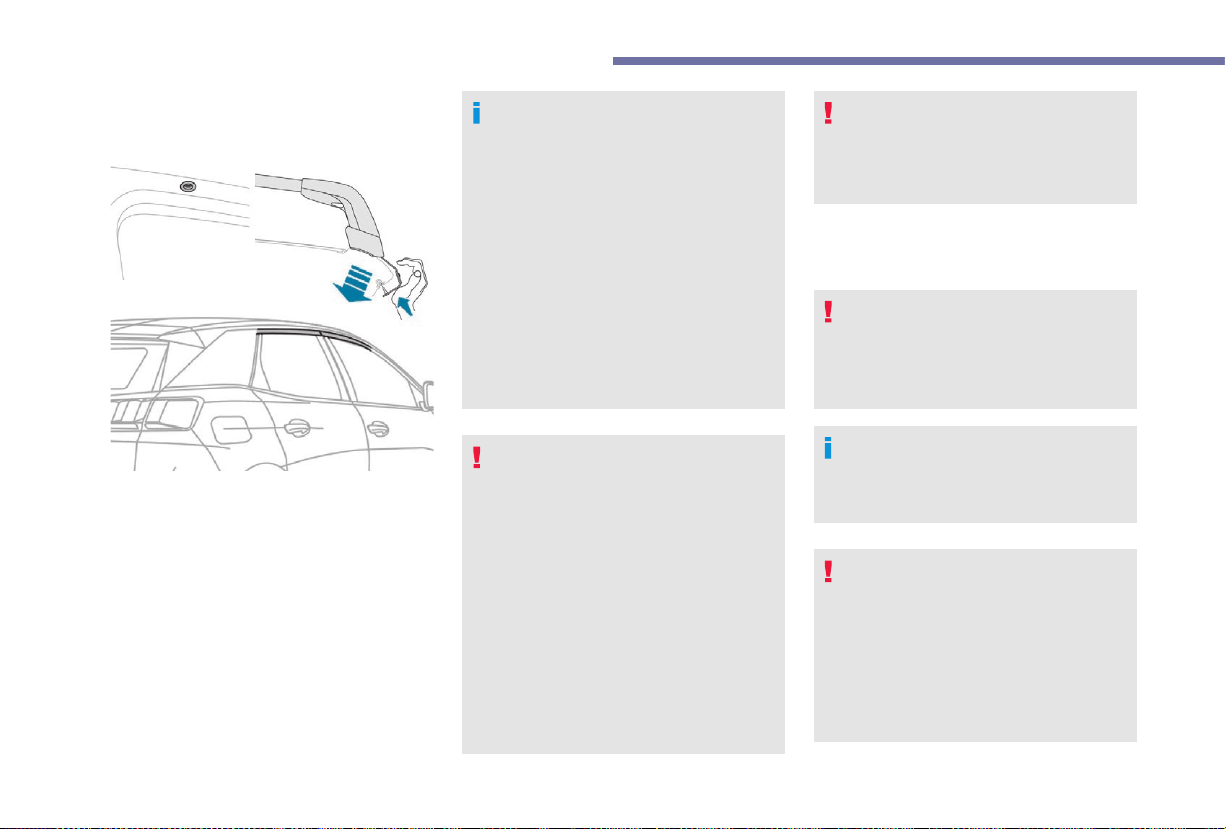
226
Practical information
Fitting directly to the roof
Recommendations
Distribute the load uniformly, taking care
to avoid overloading one of the sides.
Arrange the heaviest part of the load as
close as possible to the roof.
Lash the load securely.
Drive gently: the vehicle will be more
susceptible to the effects of side winds
and the stability of the vehicle may be
affected.
On a long journey, check the security of
the load at every stop.
Remove the roof bars once they are no
longer needed.
Sunroof
Check that the load does not pass below
the roof bars so that it does not impede
the movements of the sunroof.
You must only attach the transverse bars to
the four fixing points located in the roof frame.
These points are concealed by the vehicle
doors when the doors are closed.
The roof bar fixings have a stud which must be
inserted into the opening of each fixing point.
Maximum load distributed across the
transverse roof bars, for a load height not
exceeding 40 cm (except bicycle carrier):
80 kg.
For more information, contact a
PEUGEOT dealer or a qualified workshop.
If the height exceeds 40 cm, adapt the
speed of the vehicle to the profile of the
road to avoid damaging the roof bars and
the vehicle's anchorage points.
For transporting objects which are longer
than the vehicle, refer to local legislation.
Bonnet
Before doing anything under the bonnet,
deactivate the Stop & Start system to
avoid any risk of injury resulting from an
automatic change to START mode.
The location of the interior bonnet release
lever prevents opening of the bonnet when
the left-hand front door is shut.
When the engine is hot, handle the
exterior safety catch and the stay with
care (risk of burns), using the protected
area.
When the bonnet is open, take care not to
damage the safety catch.
Do not open the bonnet under very windy
conditions.
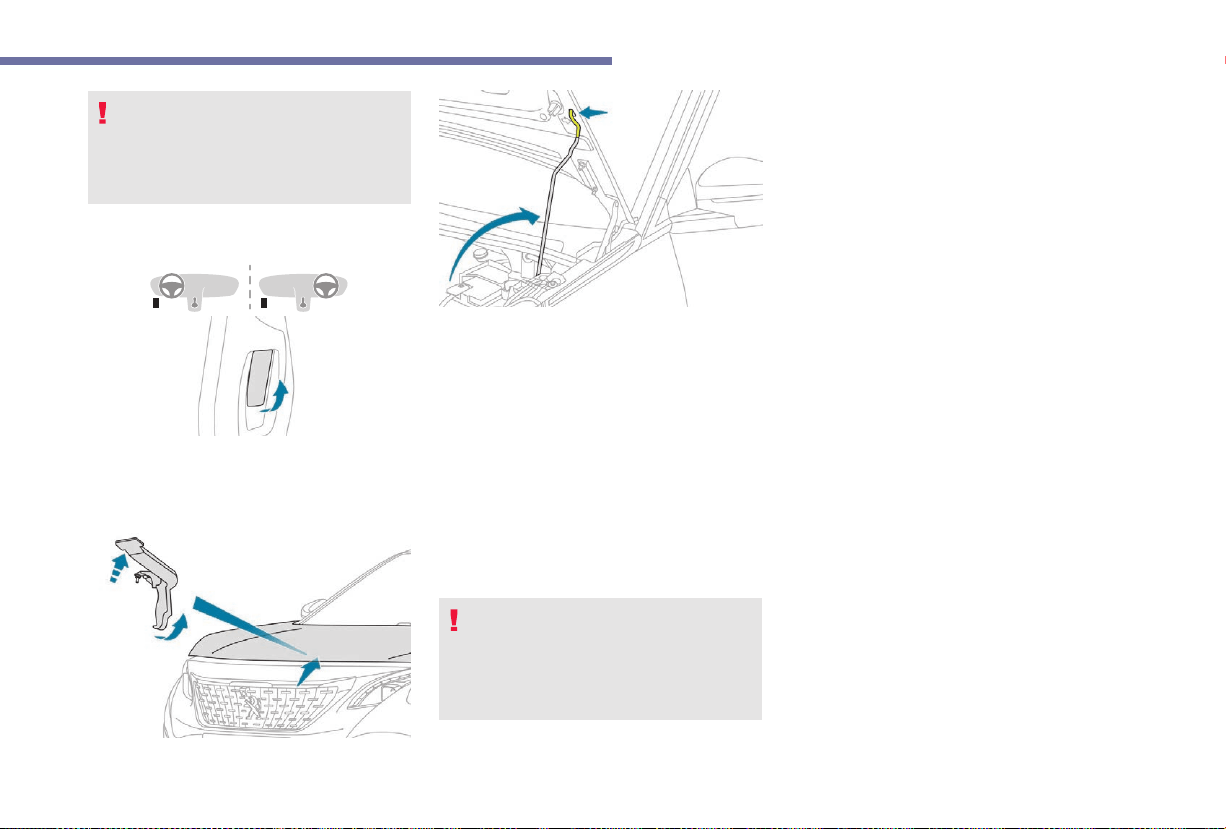
7
227
Practical information
The cooling fan may start after
switching off the engine: take care
with articles and clothing that might
be caught by the fan blades.
Opening
F Open the left-hand front door.
F Pull the release lever, located at the bottom
of the door aperture, towards you.
F Lift the safety catch and raise the bonnet.
F Unclip the stay from its housing and place it
in the support slot to hold the bonnet open.
Closing
F Take the stay out of the support slot.
F Clip the stay in its housing.
F Lower the bonnet and release it near the
end of its travel.
F Pull on the bonnet to check that it is fully
latched.
Because of the presence of electrical
equipment under the bonnet, it is
recommended that exposure to water
(rain, washing, etc.) be limited.
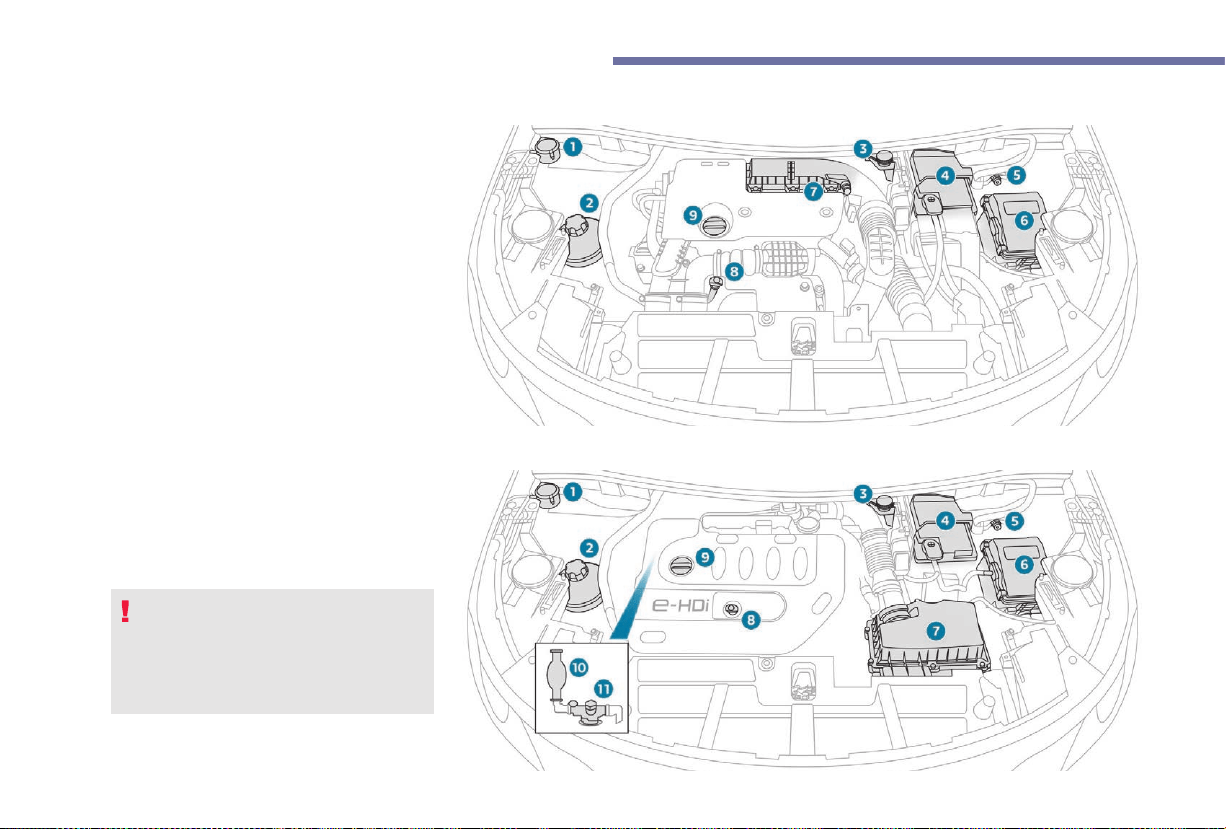
228
Practical information
Engine compartment
This engine example is given for illustration
purposes only.
The positions of the following elements may
change:
- Air filter.
- Engine oil dipstick.
- Engine oil filler cap.
- Priming pump.
- Degassing screw.
1. Screenwash fluid tank.
2. Coolant tank.
3. Brake fluid tank.
4. Battery / Fuses.
5. Remote earth point (-).
6. Fusebox.
7. Air filter.
8. Engine oil dipstick.
9. Engine oil filler cap.
10. Priming pump*.
11. Degassing screw*.
The Diesel fuel system operates under
very high pressure.
All work on this circuit must be carried out
only by a PEUGEOT dealer or a qualified
workshop.
Petrol engine(s)
Diesel engine(s)
* Depending on engine.
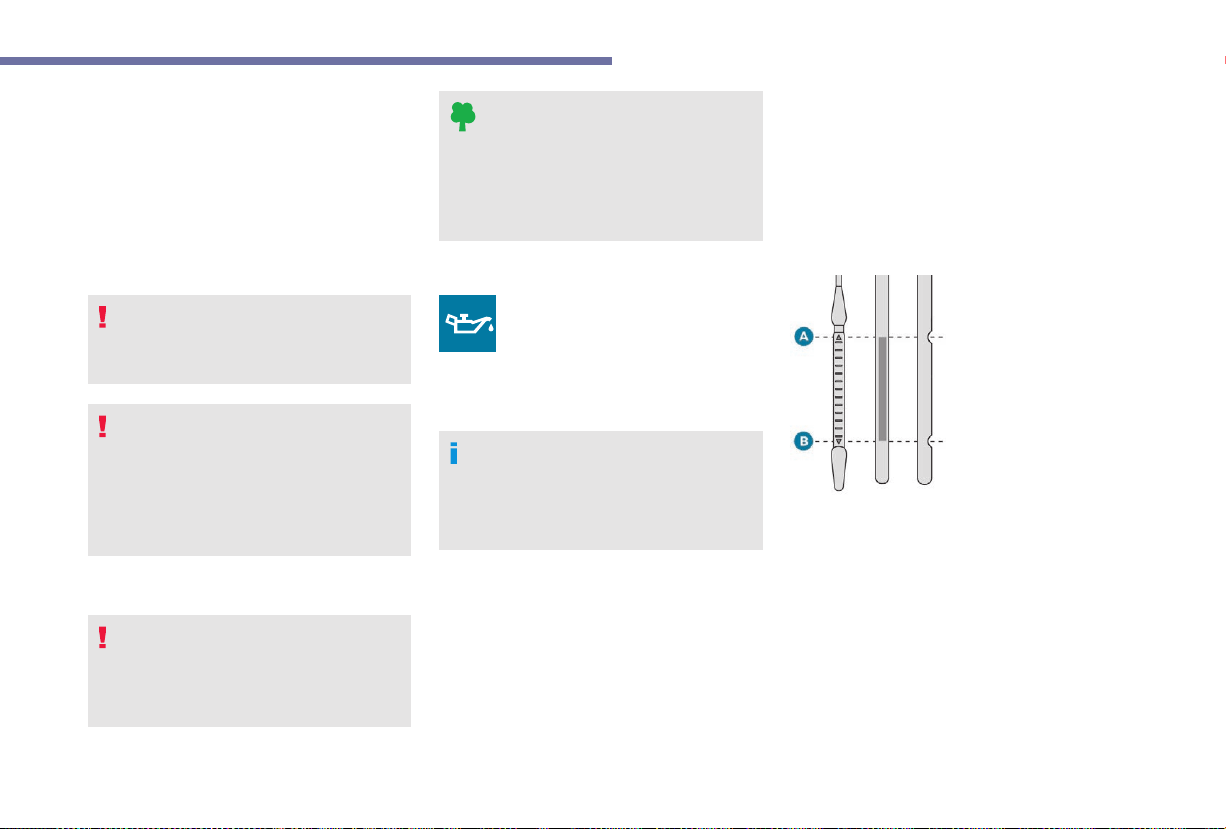
7
229
Practical information
Checking levels
Check all of these levels regularly, in line with
the manufacturer's service schedule. Top them
up if necessary, unless otherwise indicated.
If a level drops significantly, have the
corresponding system checked by a PEUGEOT
dealer or a qualified workshop.
The fluid must comply with the
manufacturer's recommendations and
with the vehicle's engine.
Take care when working under the
bonnet, as certain areas of the engine
may be extremely hot (risk of burns) and
the cooling fan could start at any time
(even with the ignition off).
Used products
Avoid prolonged contact of used oil or
fluids with the skin.
Most of these fluids are harmful to health
or indeed very corrosive.
Do not discard used oil or fluids into
sewers or onto the ground.
Take used oil to a PEUGEOT dealer or
a qualified workshop and dispose of it in
the containers reserved for this purpose.
Engine oil level
The check is carried out either when
the ignition is switched on using the
oil level indicator in the instrument
panel for vehicles equipped with an
electric gauge, or using the dipstick.
To ensure that the reading is correct, your
vehicle must be parked on a level surface
with the engine stopped for more than
30 minutes.
It is normal to top up the oil level between
two services (or oil changes). PEUGEOT
recommends that you check the level, and top
up if necessary, every 3,000 miles (5,000 km).
Checking using the dipstick
F Take the dipstick by its coloured grip and
pull it out completely.
F Wipe the end of the dipstick using a clean
non-fluffy cloth.
F Refit the dipstick and push fully down, then
pull it out again to make the visual check:
the correct level is between marks A and B.
A = MAX
B = MIN
If you find that the level is above the A mark or
below the B mark, do not start the engine.
- If the level is above the MAX mark (risk of
damage to the engine), contact a PEUGEOT
dealer or a qualified workshop.
- If the level is below the MIN mark, you must
top up the engine oil.
The location of the dipstick is shown in the
corresponding underbonnet layout view.
230
Practical information
Topping up the engine oil level
The location of the oil filler cap is shown in the
corresponding underbonnet layout view.
F Unscrew the oil filler cap to access the filler
opening.
F Add oil in small quantities, avoiding any
spills on engine components (risk of fire).
F Wait a few minutes before checking the
level again using the dipstick.
F Add more oil if necessary.
F After checking the level, carefully refit the oil
filler cap and the dipstick in its tube.
After topping up the oil, the check when
switching on the ignition with the oil
level indicator in the instrument panel
is not valid during the 30 minutes after
topping up.
Engine oil change
In order to maintain the reliability of the engine
and emissions control system, never use
additives in the engine oil.
Brake fluid level
The brake fluid level should be close
to the "MAX" mark. If it is not, check
the brake pad wear.
Changing the uid
Refer to the manufacturer's service schedule
for details of the interval for this operation.
Fluid specication
This fluid must conform to the manufacturer's
recommendations.
Coolant level
Check the coolant level regularly.
It is normal to top up the fluid
between two services.
A low coolant level presents a risk of serious
damage to your engine.
The coolant level should be close to the "MAX"
mark but should never exceed it.
If the level is close to or below the "MIN" mark,
it is essential to top up.
When the engine is hot, the temperature of the
coolant is regulated by the fan.
In addition, as the cooling system is
pressurised, wait at least one hour after
switching off the engine before carrying out any
work.
To avoid the risk of scalding when you need to
top up in an emergency, place a cloth around
the cap and unscrew the cap by two turns to
allow the pressure to drop.
Once the pressure has dropped, remove the
cap and top up to the required level.
The cooling fan may start after
switching off the engine: take care
with articles and clothing that might
be caught by the fan blades.
Fluid specication
This fluid must conform to the manufacturer's
recommendations.
Oil grade
Before topping up the oil or changing the oil,
check that the oil is the correct grade for your
engine and conforms to the manufacturer's
recommendations.
The check and top up must only be done with
the engine cold.
7
231
Practical information
Top up to the required level when
necessary.
Capacity of the tank:
- 5.3 litres for the "very cold climate"
versions.
- 2.2 litres for other versions.
Fluid specication
The screenwash fluid must be topped up with a
ready for use mix.
In winter (temperatures below zero), a fluid with
antifreeze must be used that is appropriate for
the prevailing conditions, in order to preserve
the elements of the system (pump, tank, ducts,
etc.).
Filling with pure water is prohibited under all
circumstances (risk of freezing, limestone
deposits, etc.).
Diesel fuel additive level
(Diesel with particle filter)
The additive reservoir low level is
indicated by fixed illumination of this
warning lamp, accompanied by an
audible signal and a message that
the particle filter additive level is
too low.
Topping up
The reservoir must be topped up without delay
by a PEUGEOT dealer or a qualified workshop.
AdBlue level
An alert is triggered once the reserve level is
reached.
To avoid the vehicle being immobilised as per
regulations, you must top up with AdBlue.
For more information on AdBlue and the SCR
system, and in particular topping it up, refer to
the corresponding section.
Screenwash fluid level
Checks
Unless otherwise indicated, check these
components in accordance with the
manufacturer's service schedule and
depending on your engine.
Otherwise, have them checked by a PEUGEOT
dealer or a qualified workshop.
12 V battery
The battery does not require any maintenance.
However, check regularly that the terminals
are correctly tightened (versions without quick
release terminals) and that the connections
are clean.
For more information on the precautions
to take before starting work on the 12 V
battery, refer to the corresponding
section.
Versions equipped with Stop & Start are
fitted with a 12 V lead-acid battery of
specific technology and specification.
Its replacement should be carried out
only by a PEUGEOT dealer or a qualified
workshop.
Filter, passenger compartment
Depending on the environment
(e.g. dusty atmosphere) and the
use of the vehicle (e.g. city driving),
replace it twice as often, if
necessary.
A clogged passenger compartment
filter may have an adverse effect on
the performance of the air conditioning
system and generate undesirable odours.
232
Practical information
Air filter
Depending on the environment
(e.g. dusty atmosphere) and the
use of the vehicle (e.g. city driving),
replace it twice as often, if
necessary.
Oil filter
Change the oil filter each time the
engine oil is changed.
Particle filter (Diesel)
The start of saturation of the particle
filter is indicated by the temporary
illumination of this warning lamp
accompanied by a message about
the risk of the filter clogging up.
As soon as the traffic conditions permit,
regenerate the filter by driving at a speed
of at least 37 mph (60 km/h) until the
warning lamp goes off.
If the warning lamp stays on, this indicates
a low Diesel additive level.
For more information on Checking levels,
refer to the corresponding section.
On a new vehicle, the first particle
filter regeneration operations may be
accompanied by a "burning" smell, which
is perfectly normal.
Following prolonged operation of the
vehicle at very low speed or at idle,
you may, in exceptional circumstances,
notice the emission of water vapour at the
exhaust on acceleration. This does not
affect the behaviour of the vehicle or the
environment.
Manual gearbox
The gearbox does not require any
maintenance (no oil change).
Automatic gearbox
The gearbox does not require any
maintenance (no oil change).
Brake pads
Brake wear depends on the style
of driving, particularly in the case
of vehicles used in town, over short
distances. It may be necessary to
have the condition of the brakes
checked, even between vehicle
services.
Unless there is a leak in the circuit, a drop in
the brake fluid level indicates that the brake
pads are worn.
Brake disc wear
For information on checking brake
disc wear, contact a PEUGEOT
dealer or a qualified workshop.
Electric parking brake
This system does not require any
routine servicing. However, in the
event of a problem, have the system
checked by a PEUGEOT dealer or a
qualified workshop.
7
233
Practical information
For more information on the Electric
parking brake, refer to the corresponding
section.
Wheels and tyres
The pressure must be checked on
all tyres, including the spare wheel,
when the tyres are "cold", at least
once a month and before a long
journey.
Using different size wheels and tyres from
those specified can affect the lifetime of tyres,
wheel rotation, ground clearance and the
speedometer reading and have an adverse
effect on road holding.
Fitting different tyres on the front and rear axles
can cause the ESC to mistime.
Only use products recommended by
PEUGEOT or products of equivalent
quality and specification.
In order to optimise the operation of
components as important as those in the
braking system, PEUGEOT selects and
offers very specific products.
After washing the vehicle, dampness, or
in wintry conditions, ice can form on the
brake discs and pads: braking efficiency
may be reduced. Make light brake
applications to dry and defrost the brakes.
The pressures given on the tyre pressure label
are valid for "cold" tyres. If you have driven for
more than 10 minutes or more than 6 miles
(10 kilometres) at more than 31 mph (50 km/h),
0.3 bar (30 kPa) should be added to the values
given on the label.
Under-inflation increases fuel consumption.
Non-compliant tyre pressure causes premature
wear on tyres and has an adverse effect on the
vehicle's road holding – Risk of an accident!
Driving with worn or damaged tyres reduces
braking efficiency and control of the vehicle's
steering. Regular inspections of the condition
of tyres (tread and sides) and rims are
recommended as well as making sure that
valves are fitted.
234
Practical information
AdBlue
®
(BlueHDi
engines)
To respect the environment and ensure
compliance with the Euro 6 standard, without
adversely affecting the performance or fuel
consumption of Diesel engines, PEUGEOT
has taken the decision to equip its vehicles
with a system that associates SCR (Selective
Catalytic Reduction) with a Diesel particle filter
(DPF) for the treatment of exhaust gases.
SCR system
Using a liquid called AdBlue
®
that contains
urea, a catalytic converter turns up to 85% of
the nitrogen oxides (NOx) into nitrogen and
water, which are harmless to health and the
environment.
The AdBlue
®
is contained in
a special tank holding about
17 litres.
An alert system is triggered automatically once
the reserve level is reached: you can then drive
for a further 1,500 miles (2,400 km) before the
tank is empty.
Once the AdBlue
®
tank is empty, a
system required by regulations prevents
starting of the engine.
If the SCR system is defective, the level
of emissions from your vehicle will no
longer meet the Euro 6 standard: your
vehicle becomes polluting.
In the event of a confirmed fault with the
SCR system, you must go to a PEUGEOT
dealer or a qualified workshop as soon as
possible: after travelling the distance of
685 miles (1,100 km), a system preventing
the engine starting will be triggered
automatically.
In either case, a range indicator gives you
the distance you can travel before the
vehicle is immobilised.
For more information on the Warning
and indicator lamps and the associated
alerts, refer to the corresponding section.
Freezing of the AdBlue
®
AdBlue
®
freezes at temperatures below
around -11°C.
The SCR system includes a heater for the
AdBlue
®
tank, allowing you to continue
driving in very cold conditions.
Supply of AdBlue
®
It is recommended that the AdBlue
®
is
topped up as soon as the first alert is
issued indicating that the reserve level
has been reached.
In order to ensure that the SCR system
operates correctly:
- Use only AdBlue
®
fluid that meets the
ISO 22241 standard.
- Never transfer AdBlue
®
to another
container: it would lose its purity.
- Never dilute AdBlue
®
with water.
You can obtain AdBlue
®
from a PEUGEOT
dealer or a qualified workshop.
You can also visit a service station
equipped with AdBlue
®
pumps specially
designed for private vehicles.
Never top up from an AdBlue
®
dispenser
reserved for heavy goods vehicles.
7
235
Practical information
Recommendations on storage
AdBlue
®
freezes at about -11°C and
deteriorates above 25°C. Containers should
be stored in a cool area and protected from
direct sunlight.
Under these conditions, the fluid can be kept
for at least a year.
If the fluid has frozen, it can be used once it
has completely thawed out.
Never store AdBlue
®
containers in your
vehicle.
Precautions for use
In certain conditions (high temperature, for
example), the risk of release of ammonia
cannot be excluded: do not inhale the fluid.
Ammonia vapour has an irritant effect on
mucous membranes (eyes, nose and throat).
Keep AdBlue
®
out of the reach of children,
in its original container.
Procedure
Before starting the top up procedure, ensure
that the vehicle is parked on a flat and level
surface.
In winter, check that the temperature of the
vehicle is above -11°C. If not, in freezing
weather, the AdBlue
®
cannot be poured into the
tank. Park your vehicle somewhere warmer for
a few hours before topping up.
In the event of an AdBlue
®
breakdown,
confirmed by the message "Add AdBlue:
Starting impossible", you must top up with
at least 5 litres.
Never pour AdBlue
®
into the Diesel fuel
tank.
If any AdBlue
®
is splashed, or if there
are any spillages on the side of the body,
rinse immediately with cold water or wipe
with a damp cloth.
If the fluid has crystallised, clean it off
using a sponge and hot water.
Important: in the event of a top-up after
a breakdown because of a lack of
AdBlue, you must wait around 5 minutes
before switching on the ignition, without
opening the driver's door, locking
the vehicle, introducing the key into
the ignition switch, or introducing
the key of the Keyless Entry and
Starting system into the passenger
compartment.
Switch on the ignition, then wait for
10 seconds before starting the engine.
F Switch off the ignition and remove the key
from the switch to switch off the engine.
or
F With Keyless Entry and Starting, press the
"START/STOP" button to switch off the
engine.
AdBlue
®
is a urea-based solution. This fluid
is non-flammable, colourless and odourless
(stored in a cool place).
In the event of contact with the skin, wash the
affected area with soap and running water. In
the event of contact with the eyes, immediately
rinse the eyes with large amounts of water
or with an eye wash solution for at least
15 minutes. If a burning sensation or irritation
persists, get medical attention.
If swallowed, immediately wash out the mouth
with clean water and then drink plenty of water.
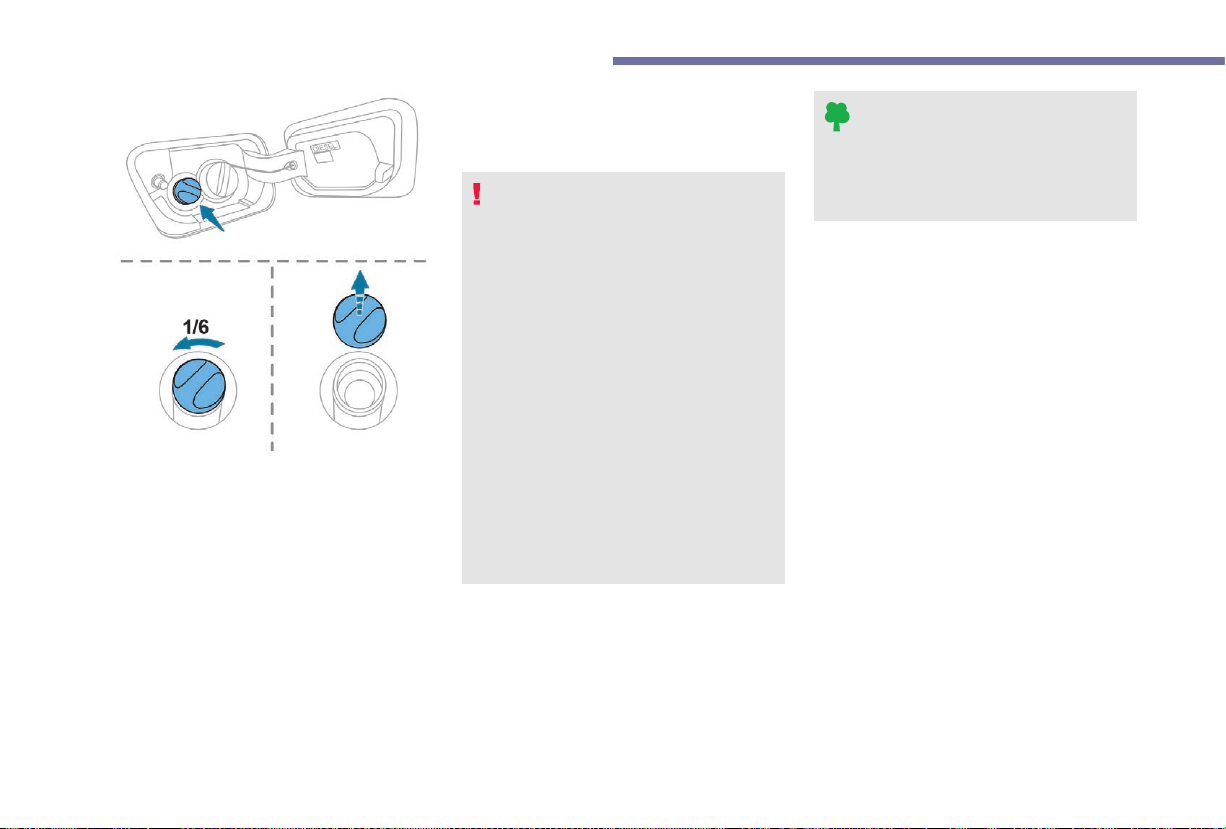
236
Practical information
F Obtain an AdBlue
®
container. After first
checking the use-by date, read the
instructions on the label carefully before
pouring the contents of the container or
bottle into your vehicle's AdBlue tank.
Or
F Insert the AdBlue
®
pump nozzle and refill
the tank until the nozzle stops automatically.
Important:
- To avoid overflowing the
AdBlue
®
tank, it is recommended:
• To top up between 10 and 13 litres
using AdBlue
®
containers.
Or
• To not keep on trying after the
nozzle's first automatic stop if you
are refuelling at a filling station.
- If your vehicle's AdBlue
®
tank
is completely empty – which is
confirmed by the alert messages
and the impossibility of starting
the engine – you must add at least
5 litres.
After relling
F Refit the blue cap to the tank filler and turn it
1/6 of a turn clockwise, to its stop.
F Close the fuel filler flap.
Do not dispose of AdBlue
®
containers in
the household waste.
Place them in a suitable container or
take them to your dealer.
F With the vehicle unlocked and the fuel filler
flap open, turn the blue cap of the AdBlue
®
tank 1/6 of a turn anti-clockwise.
F Release the blue cap.
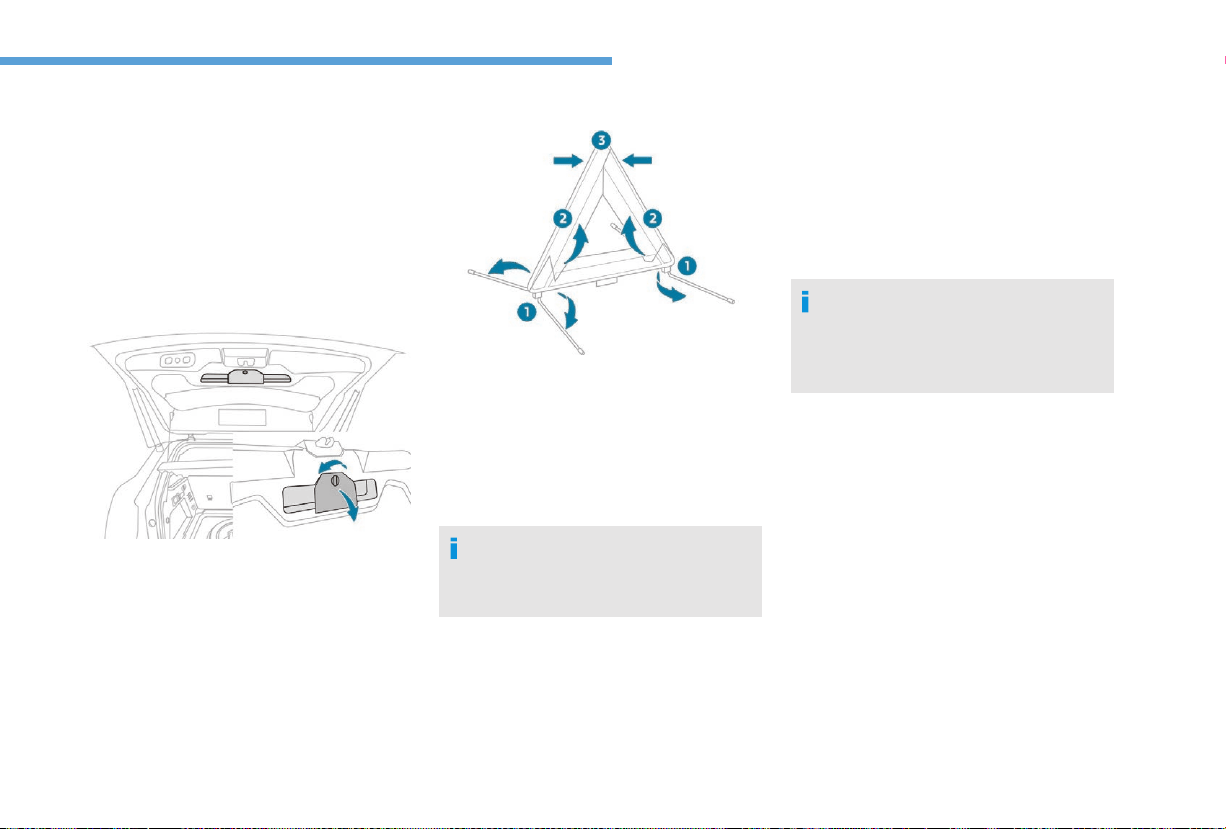
8
237
In the event of a breakdown
Warning triangle
As a safety precaution, before leaving your
vehicle to set up and install the triangle, switch
on the hazard warning lamps and put on your
high visibility vest.
Storage compartment
Assembling the triangle
For versions supplied with a triangle as original
equipment:
F remove the triangle from its case,
F unfold the legs,
F open out the two sides of the triangle,
F clip them together to complete the
assembly.
For other versions, refer to the
instructions provided with the triangle.
Positioning the triangle
There is a compartment in the interior trim of
the tailgate to store a triangle.
F Open the tailgate.
F Release the cover by turning the screw a
quarter turn anti-clockwise.
F Place the triangle behind the vehicle, as
required by local legislation.
Running out of fuel
(Diesel)
On vehicles fitted with Diesel engines, the fuel
system must be primed if you run out of fuel.
If the engine does not start first time, do not
keep trying, but start the procedure again from
the beginning.
For more information on Misfuel
prevention (Diesel), refer to the
corresponding section.
With 1.6 BlueHDi and 2.0
BlueHDi 150 S&S engines
F Fill the fuel tank with at least 5 litres of
Diesel.
F Switch on the ignition (without starting the
engine).
F Wait around 6 seconds and switch off the
ignition.
F Repeat the operation 10 times.
F Operate the starter to run the engine.
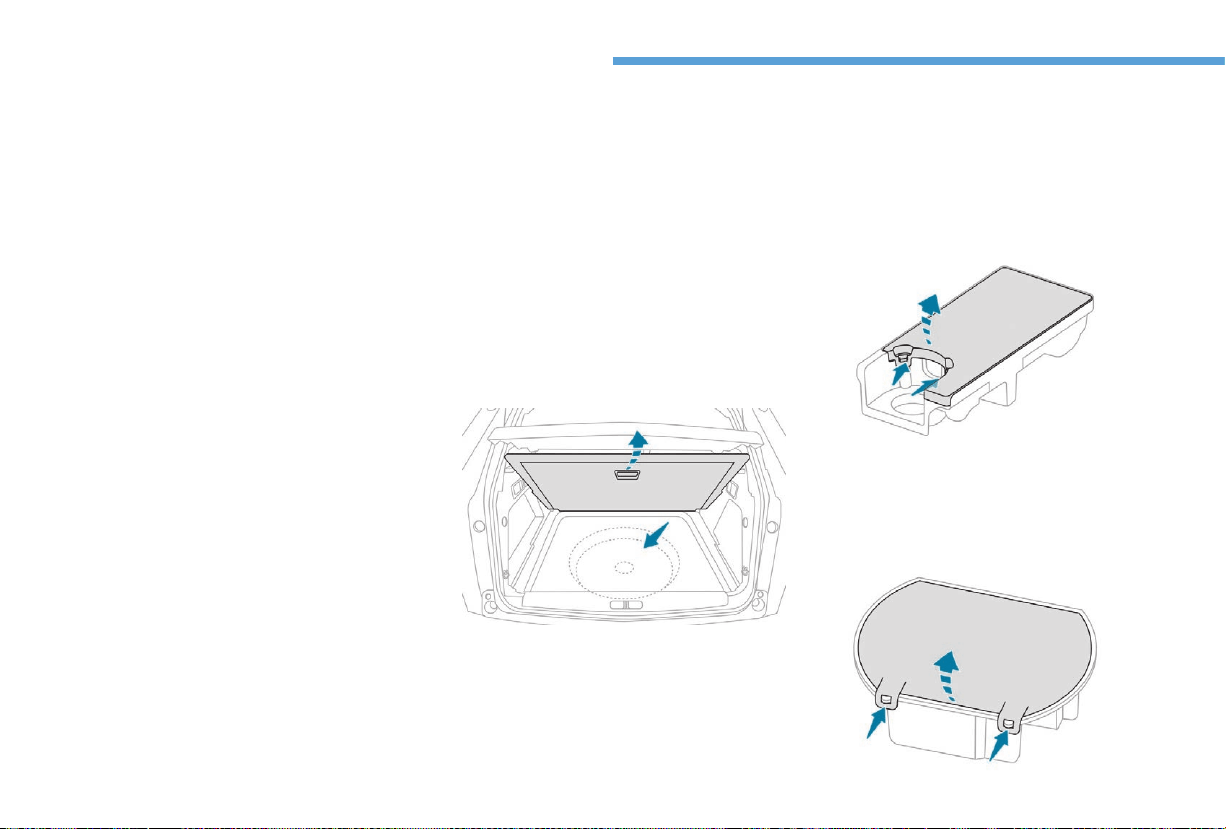
238
In the event of a breakdown
With 1.5 BlueHDi and 2.0
BlueHDi 180 S&S engines
F Fill the fuel tank with at least 5 litres of
Diesel.
F Switch on the ignition (without starting the
engine).
F Wait around 1 minute and switch off the
ignition.
F Operate the starter to run the engine.
If the engine does not start, repeat the
procedure.
With 2.0 HDi engines
F Put it back in place, clip in the cover and
ensure it is clipped in.
F Close the bonnet.
Tool kit
This is a set of tools provided with the vehicle.
Its content depends on your vehicle's
equipment:
- temporary puncture repair kit,
- spare wheel.
Access to the tools
F raise the floor past the two retractable
stops,
F lay the floor on these two stops to hold it up.
For versions with a temporary
puncture repair kit:
F unclip the two fixings to open its cover.
For versions with a spare wheel:
F Fill the fuel tank with at least five litres of
Diesel.
F Open the bonnet.
F If necessary, unclip the cover to access the
priming pump.
F Loosen the degassing screw.
F Use the priming pump until fuel appears in
the transparent tube.
F Retighten the degassing screw.
F Operate the starter until the engine starts (if
the engine does not start at the first attempt,
wait around 15 seconds before trying
again).
F If the engine does not start after a few
attempts, operate the priming pump again
then start the engine.
The main tools are stowed in the boot under
the floor.
For access to them:
F open the boot,
F place the adjustable boot floor in the high
position,
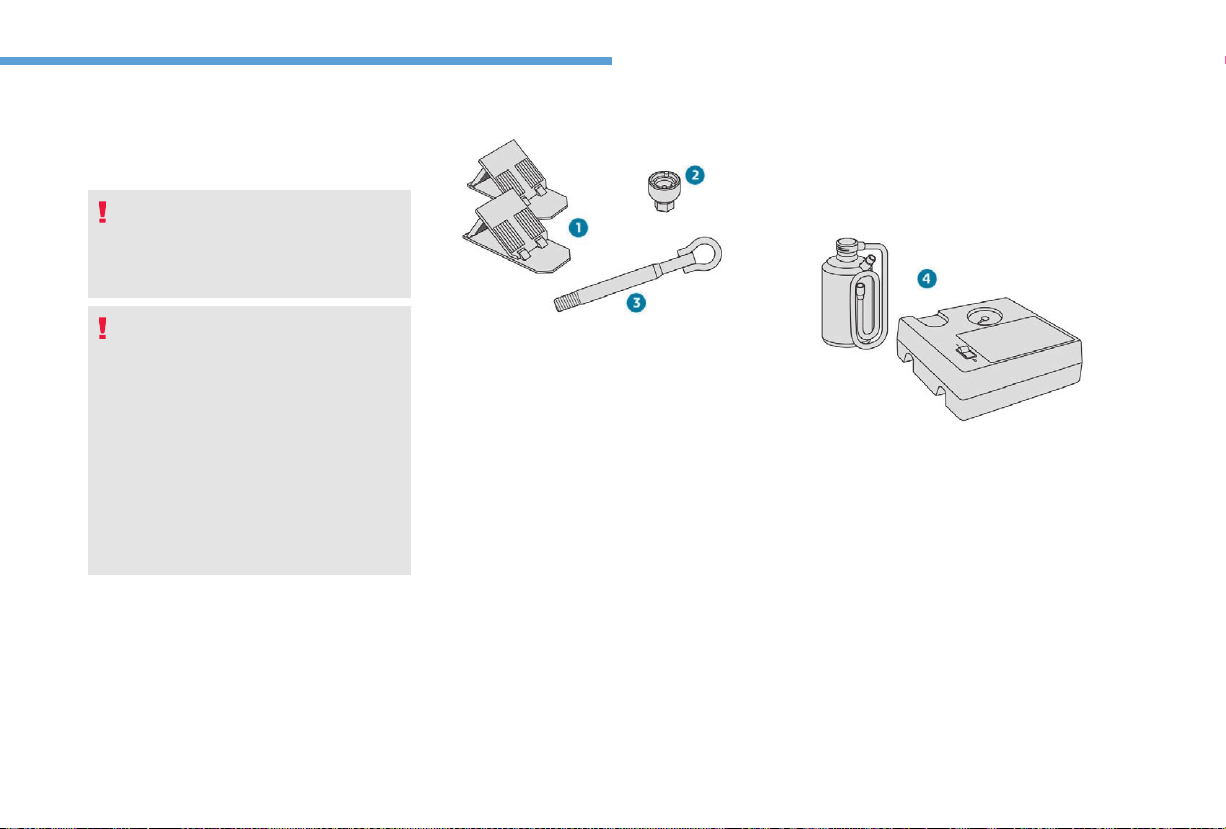
8
239
In the event of a breakdown
All of these tools are specific to your
vehicle and may vary depending on
equipment.
Do not use them for any other purposes.
The jack must only be used to change a
wheel with a damaged or punctured tyre.
Do not use any jack other than the one
supplied with this vehicle.
If the vehicle does not have its original
jack, contact a PEUGEOT dealer or a
qualified workshop to obtain the correct
jack for it.
The jack meets European standards,
as defined in the Machinery Directive
2006/42/CE.
The jack does not require any
maintenance.
List of tools
1. Chocks to immobilise the vehicle
(depending on equipment).
2. Socket for the security bolts (located in
the glove box) (depending on equipment).
For adapting the wheelbrace to the
special "security" bolts.
3. Removable towing eye.
For more information on Towing the vehicle
and using the removable towing eye, refer to
the corresponding section.
For versions with a temporary
puncture repair kit:
For more information on the Temporary
puncture repair kit, refer to the corresponding
section.
F unclip the storage box by pulling it up,
F unclip the two fixings to open its cover.
4. Temporary puncture repair kit.
Contains a 12 V compressor and a
cartridge of sealant to temporarily repair
the wheel and adjust the tyre pressure.
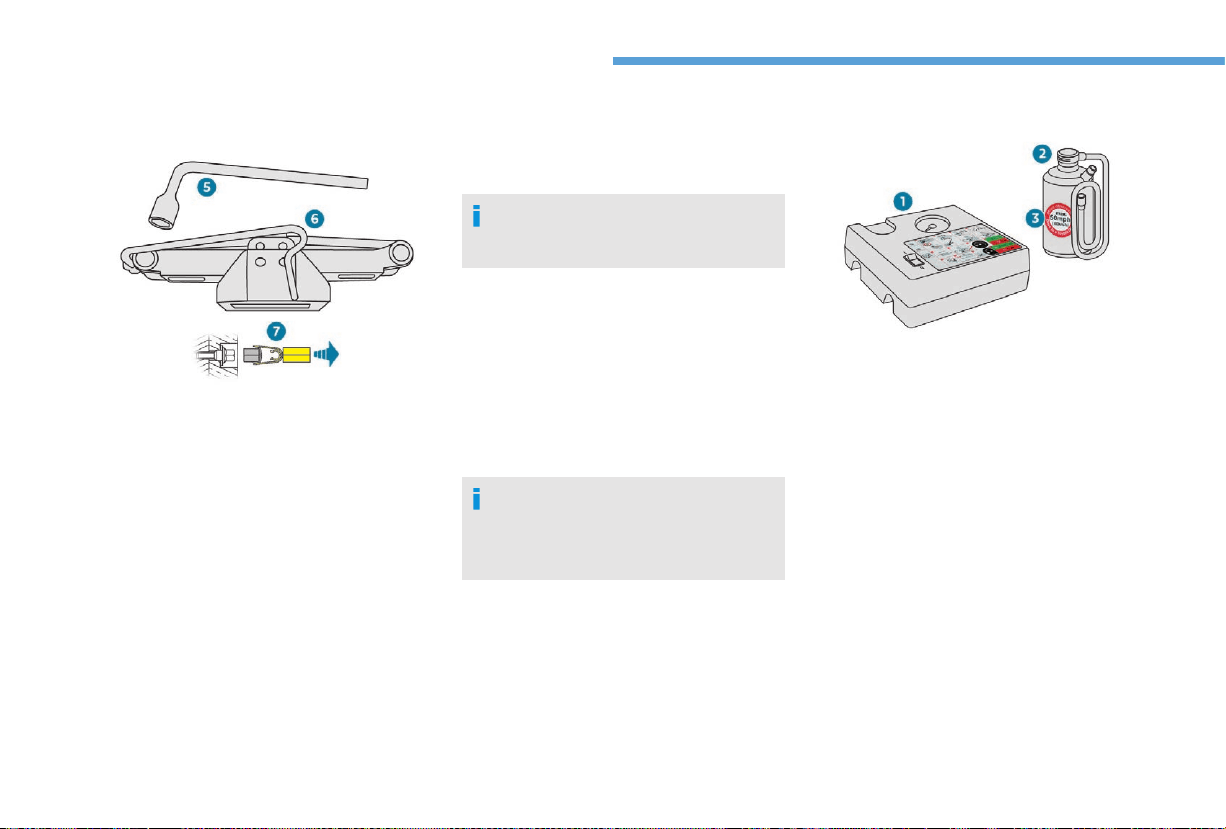
240
In the event of a breakdown
For more information on the Spare wheel, refer
to the corresponding section.
Temporary puncture
repair kit
Scan the QR code on page 3 to view
explanatory videos.
Comprising a compressor and a sealant
cartridge, it allows the temporary repair of
a tyre so that you can drive to the nearest
garage.
It is designed to repair most punctures which
could affect the tyre, located on the tyre tread
or shoulder.
The vehicle's electric system allows the
connection of the compressor for long
enough to inflate a tyre after a puncture
repair.
Composition of the kit
1. 12 V compressor, with integral pressure
gauge.
2. Sealant cartridge, with integral hose.
3. Speed limit sticker.
Repair procedure
F Park the vehicle without obstructing any
traffic and apply the parking brake.
F Follow the safety instructions (hazard
warning lamps, warning triangle, wearing
high visibility vest, etc.) according to the
legislation in force in the country where you
are driving.
F Switch off the ignition.
F Uncoil the pipe stowed under the
compressor.
For versions with a spare wheel:
5. Wheelbrace.
For removing the hub cap and removing
the wheel bolts.
6. Jack with integrated handle.
Used to raise the vehicle.
7. Wheel bolt cover remover (according to
equipment).
For removing the wheel bolt head
finishers on alloy wheels.
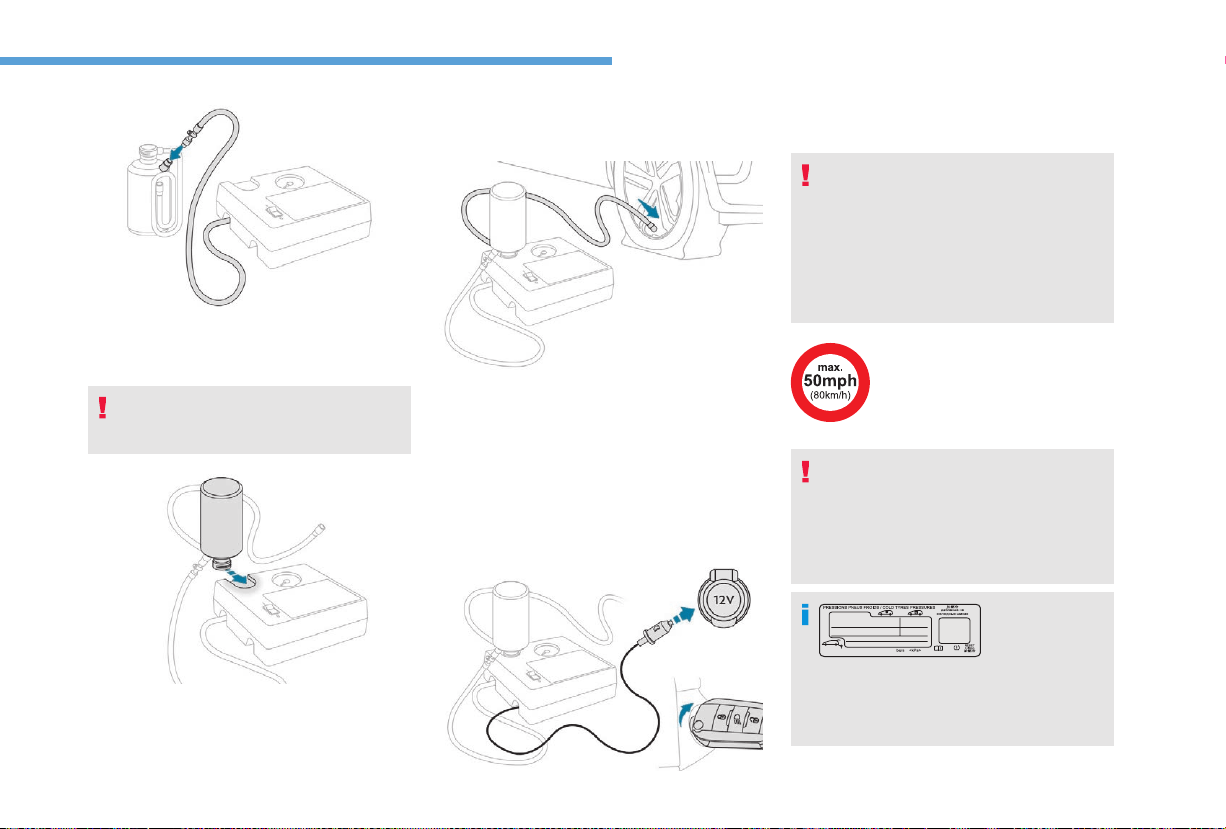
8
241
In the event of a breakdown
Avoid removing any foreign bodies which
have penetrated into the tyre.
F Connect the pipe from the compressor to
the bottle of sealant.
F Remove the valve cap from the tyre to be
repaired, and place it in a clean area.
F Check that the compressor switch is at
position "O".
F Fully uncoil the electric cable, stowed under
the compressor.
Only the 12 V sockets located at the front
of the vehicle and in the boot can be used
to power the compressor.
The 12 V socket located at the back of
the centre console is not suitable for this
purpose.
F Affix the speed limit sticker.
The speed limit sticker must be secured
to the interior of the vehicle in the driver's
field of vision, to remind you that a wheel
is in temporary use.
F Turn the sealant bottle over and secure it in
the notch provided on the compressor.
F Connect the hose from the bottle of sealant
to the valve of the tyre to be repaired and
tighten firmly.
F Connect the compressor's electric plug to
the vehicle's 12 V socket.
The tyre inflation pressures are given on
this label.

242
In the event of a breakdown
F Switch on the ignition.
If a pressure of 2 bars is not reached
after about 7 minutes, this indicates
that the tyre is not repairable; contact a
PEUGEOT dealer or a qualified workshop
for assistance.
F Replace the cap on the valve.
F Remove the kit.
F Remove and then store the bottle of sealant.
Take care, the sealant product is harmful
if swallowed and causes irritation to the
eyes.
Keep this product out of the reach of
children.
The use-by date of the fluid is marked on
the bottle.
After use, do not discard the bottle in
standard waste, take it to a PEUGEOT
dealer or an authorised waste disposal
site.
Do not forget to obtain a new bottle of
sealant, available from a PEUGEOT
dealer or a qualified workshop.
Do not exceed the speed of 50 mph
(80 km/h) when driving with a tyre
repaired using this type of kit.
Checking / adjusting tyre
pressures
You can also use the compressor,
without injecting sealant, to check and, if
necessary, adjust the tyre pressures.
F Remove the valve cap from the tyre and
keep it in a clean place.
F Uncoil the pipe stowed under the
compressor.
F Start the compressor by turning the switch
to position "l" until the pressure of the tyre
reaches 2.0 bars. The sealant product is
injected under pressure into the tyre; do not
disconnect the pipe of the valve during this
operation (risk of blowback).
F Place the switch in the "O" position.
F Disconnect the compressor's electric plug
from the vehicle's 12 V socket.
F Drive immediately for approximately three
miles (five kilometres), at reduced speed
(between 12 and 37 mph (20 and 60 km/h)),
to plug the puncture.
F Stop to check the repair and measure the
tyre pressure using the kit.
F Screw the pipe onto the valve and tighten
firmly.
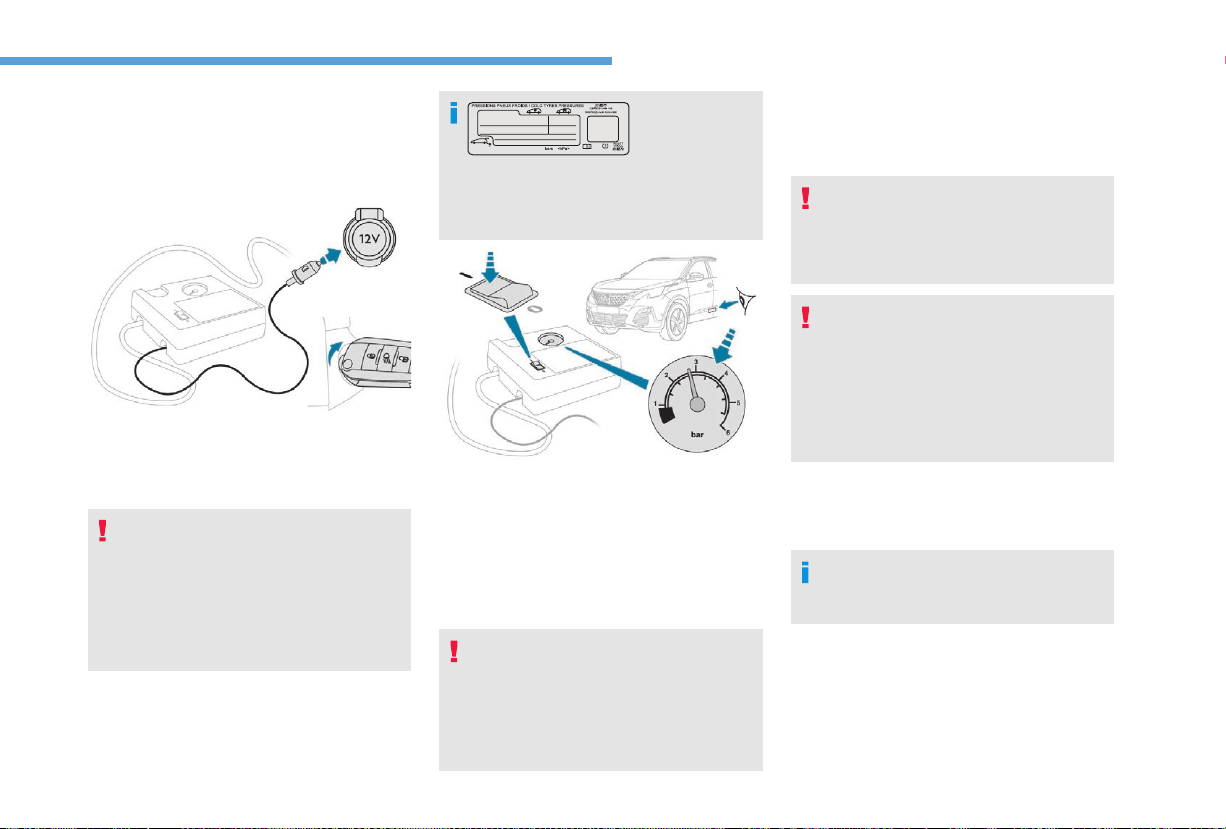
8
243
In the event of a breakdown
F Check that the compressor switch is at
position "O".
F Fully uncoil the electric cable, stowed under
the compressor.
Only the 12 V sockets located at the front
of the vehicle and in the boot can be used
to power the compressor.
The 12 V socket located at the back of
the centre console is not suitable for this
purpose.
F Connect the compressor's electric plug to
the vehicle's 12 V socket.
F Switch on the ignition.
The tyre inflation pressures are given on
this label.
If a pressure of 2 bars is not reached
after 7 minutes, this indicates that
the tyre is not repairable; contact a
PEUGEOT dealer or a qualified workshop
for assistance.
F Once the correct pressure is reached, put
the switch to the "O" position.
F Remove the kit then stow it.
Do not drive more than 125 miles
(200 km) with the repaired tyre; see a
PEUGEOT dealer or a qualified workshop
to change the tyre.
Should the pressure of one or more tyres
be adjusted, it is necessary to reinitialise
the under-inflation detection system.
For more information on Under-inflation
detection, refer to the corresponding
section.
F Start the compressor by placing the switch
at position "I" and adjust the pressure to the
value shown on the vehicle's tyre pressure
label. To deflate: press the black button
located on the compressor pipe, near the
valve connection.
Spare wheel
Scan the QR code on page 3 to view
explanatory videos.
Procedure for changing a damaged wheel with
the spare wheel using the tools provided with
the vehicle.
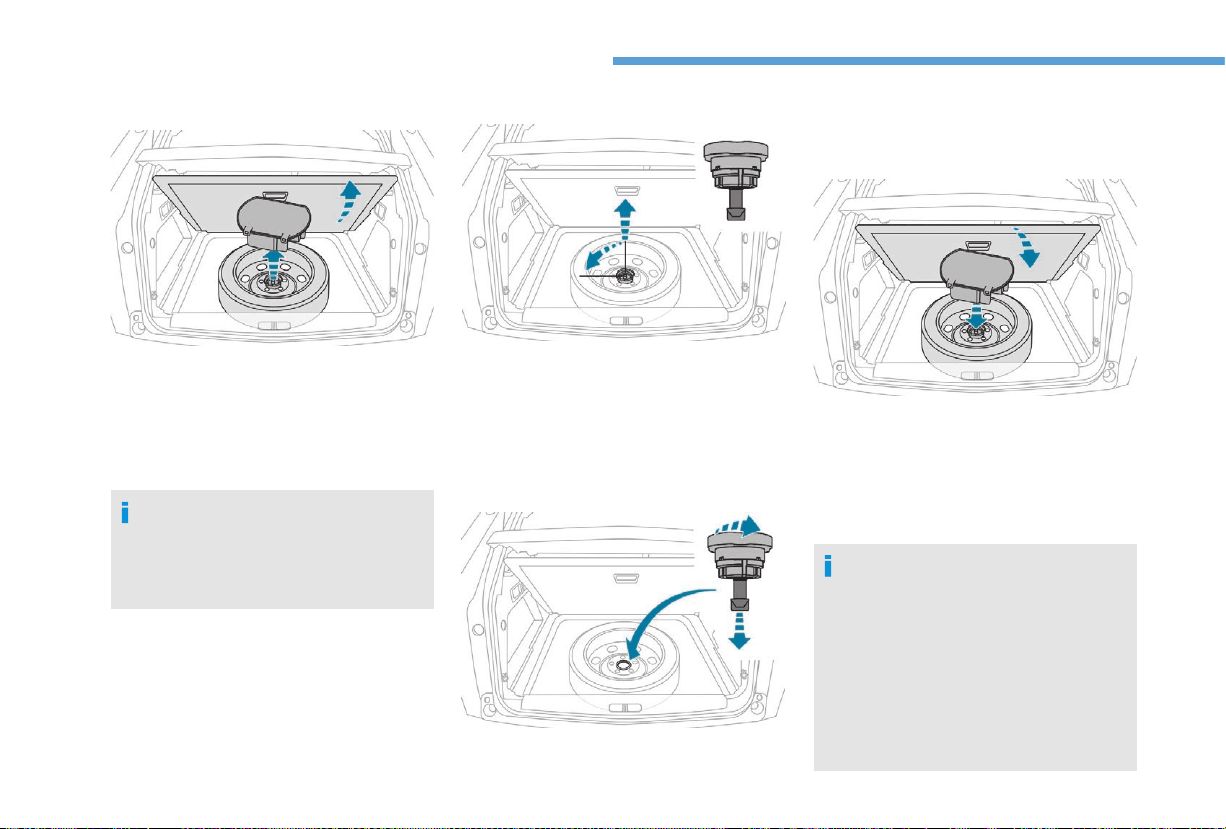
244
In the event of a breakdown
Access to the spare wheel
The spare wheel is installed in the boot under
the floor.
For access to the spare wheel, first refer to
section on Access to the tools.
Depending on version, the spare wheel is
a standard size steel or alloy wheel.
For some countries of sale, it is the
"space saver" type.
Removing the wheel
F Slacken the central nut.
F Remove the fixing parts (nut and bolt).
F Raise the spare wheel towards you from the
rear.
F Take the wheel out of the boot.
Putting the wheel back in place
Removing a wheel
Wheel with wheel trim
When removing the wheel, first remove
the wheel trim by pulling at the valve
aperture using the wheelbrace.
When refitting the wheel, after
tightening the wheel bolts, refit the wheel
trim, starting by placing its aperture in
line with the valve and then pushing it into
place all round its edge with the palm of
your hand.
F Put the wheel back in its housing.
F Slacken the nut on the bolt by a few turns.
F Position the fixing parts (nut and bolt) in the
middle of the wheel.
F Tighten fully until the central nut clicks, to
retain the wheel correctly.
F Return the tool box to the middle of the
wheel and clip it in place.
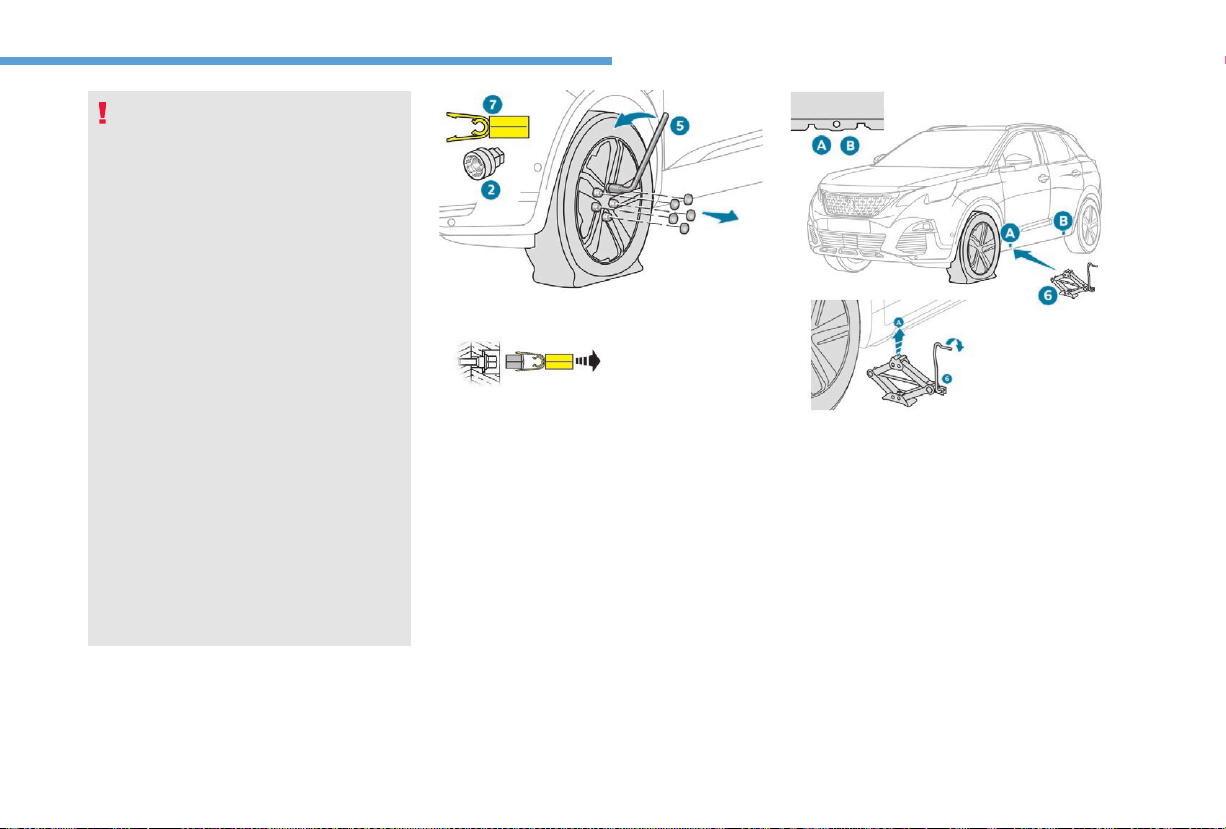
8
245
In the event of a breakdown
Parking the vehicle
Immobilise the vehicle where it does not
block traffic: the ground must be level,
stable and non-slippery.
Apply the parking brake, unless it is
programmed to be in automatic mode;
switch off the ignition and with a manual
gearbox, engage first gear so as to lock
the wheels.
Apply the parking brake, unless it is
programmed to be in automatic mode;
switch off the ignition and with an
automatic gearbox, select mode P so as
to lock the wheels.
Check that the parking brake warning
lamps in the instrument panel are on
fixed (not flashing).
The occupants must get out of the
vehicle and wait where they are safe.
If necessary, place a chock under the
wheel diagonally opposite the wheel to
be changed.
Never go underneath a vehicle raised
using a jack; use an axle stand.
F To remove the wheel bolt cover on each of
the bolts, use tool 7 (alloy wheels).
F Fit the security socket 2 on the wheelbrace 5
to slacken the security bolt.
F Slacken the other bolts using the
wheelbrace 5 only.
F Place the foot of the jack 6 on the ground
and ensure that it is directly below the front
A or rear B jacking point provided on the
underbody, whichever is closest to the
wheel to be changed.
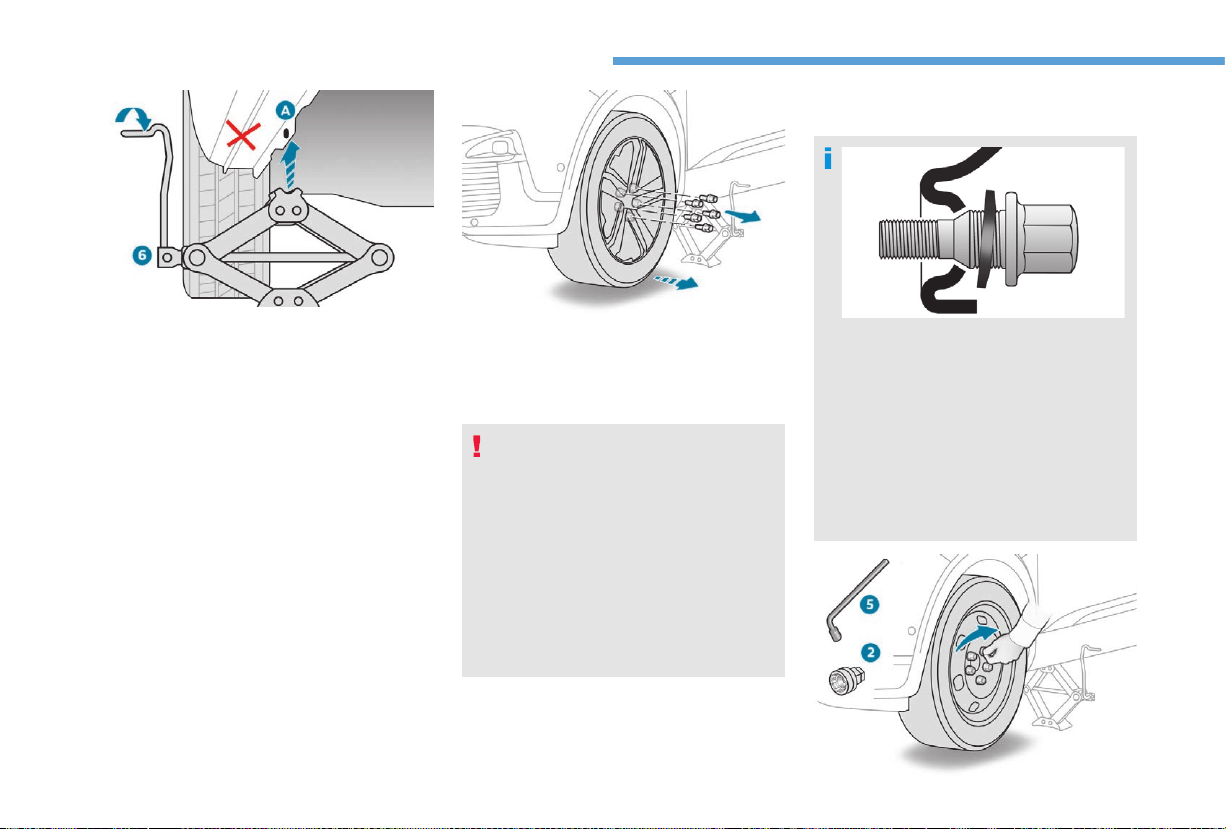
246
In the event of a breakdown
Fitting a wheel
Ensure that the jack is stable. If the
ground is slippery or loose, the jack may
slip or drop – Risk of injury!
Take care to position the jack strictly at
one of the jacking points A or B under
the vehicle, ensuring that the head of the
jack is centred under the contact area on
the vehicle. Otherwise, there is a risk of
damage to the vehicle and/or of the jack
dropping – Risk of injury!
F Extend the jack 6 until its head comes
into contact with the jacking point A or B,
whichever is used; the contact area A or
B on the vehicle must be properly inserted
into the central part of the head of the jack.
F Raise the vehicle until there is sufficient
space between the wheel and the ground
to admit the spare (not punctured) wheel
easily.
F Remove the bolts and store them in a clean
place.
F Remove the wheel.
Fitting a steel or "space-saver" spare
wheel
If your vehicle is fitted with alloy wheels,
when tightening the bolts on fitting it is
normal to notice that the washers do
not come into contact with the steel or
"space-saver" spare wheel. The wheel
is secured by the conical contact of each
bolt.
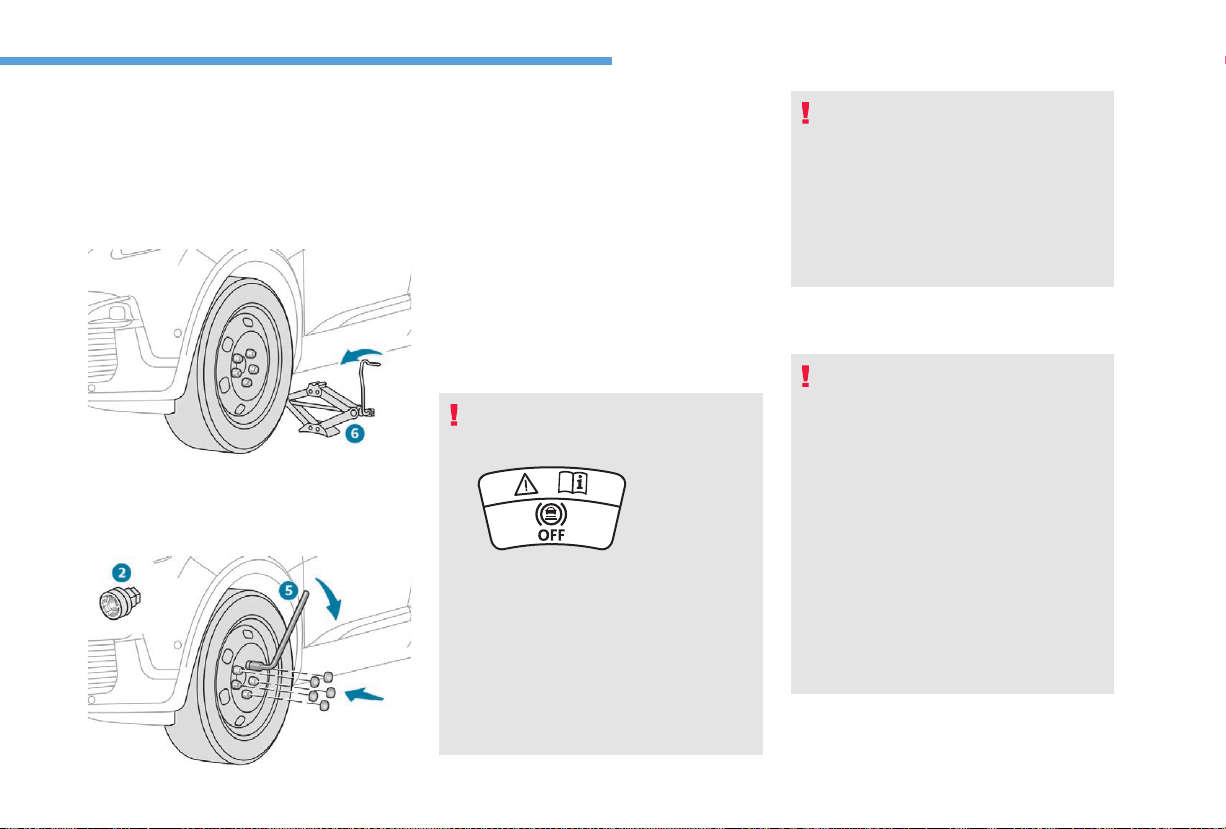
8
247
In the event of a breakdown
After changing a wheel
Put the punctured wheel in the boot or,
depending on version, remove the central cover
first to store it beneath the floor in place of the
spare wheel.
With a "space-saver" type spare wheel
Visit a PEUGEOT dealer or a qualified
workshop as soon as possible to have the
tightness of the bolts and the pressure of
the spare wheel checked.
Have the punctured tyre examined. After
inspection, the technician will advise you
on whether the tyre can be repaired or if it
must be replaced.
The following is recommended:
- deactivate some driving aid functions
(Active Safety Brake, Adaptive cruise
control with Stop function, etc.), as
indicated on the label attached to the
wheel,
- do not exceed the maximum
authorised speed of 50 mph
(80 km/h).
F Put the wheel in place on the hub.
F Screw in the bolts by hand as far as possible.
F Pre-tighten the security bolt using the
wheelbrace 5 fitted with the security
socket 2.
F Pre-tighten the other bolts using
wheelbrace 5 only.
F Lower the vehicle again fully.
F Fold jack 6 and detach it.
F Tighten the security bolt using the
wheelbrace 5 fitted with the security socket 2.
F Tighten the other bolts using wheelbrace 5
only.
F Refit the bolt covers to the bolts (depending
on equipment).
F Store the tools.
Changing a bulb
The headlamps have polycarbonate
lenses with a protective coating:
F do not clean them using a dry or
abrasive cloth, nor with a detergent
or solvent product,
F use a sponge and soapy water or a
pH neutral product,
F when using a high pressure washer
on persistent marks, do not keep the
lance directed towards the lamps or
their edges for too long, so as not to
damage their protective coating and
seals.
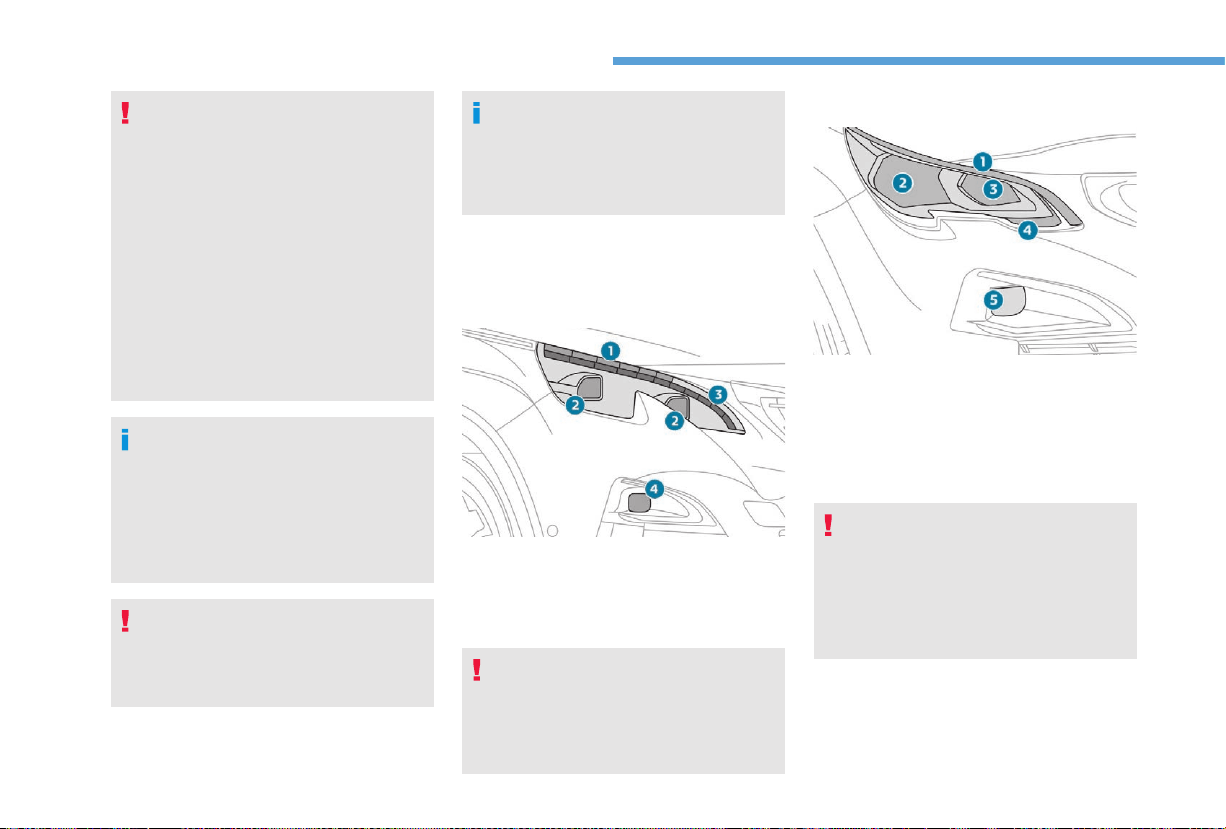
248
In the event of a breakdown
Changing a bulb must only be done with
the ignition off and after the headlamp
has been switched off for several
minutes – Risk of serious burns!
F Do not touch the bulb directly with
your fingers, use a lint-free cloth.
It is essential only to use anti-ultraviolet
(UV) type bulbs, so as not to damage the
headlamp.
Always replace a failed bulb with a
new bulb with the same type and
specification.
In some weather conditions (e.g. low
temperature or humidity), the presence
of misting on the internal surface of the
glass of the headlamps and rear lamps
is normal; it disappears after the lamps
have been on for a few minutes.
Light emitting diodes (LED)
For the replacement of this type of bulb,
you must contact a PEUGEOT dealer or a
qualified workshop.
Halogen bulbs
To ensure good quality lighting, check
that the bulb is correctly positioned in its
housing.
Front lamps
Model with "Full LED" headlamps
1. Direction indicators (LED).
2.
Main beam/dipped beam headlamps (LED).
3.
Daytime running lamps/sidelamps (LED).
4. Light-emitting diodes (LED).
Do not touch the "Full LED" headlamps.
Risk of electrocution!
Call on a PEUGEOT dealer or a qualified
workshop.
Model with halogen headlamps
1. Daytime running lamps / sidelamps
(LED).
2. Dipped beam headlamps (H7).
3. Main beam headlamps (HB3).
4. Direction indicators (PWY24W).
5. Foglamps (H11).
Opening the bonnet / Access to bulbs
Engine warm, proceed with caution –
Risk of burns!
Take care with objects or clothing that
could be caught in the blades of the
engine fan – Risk of strangulation!
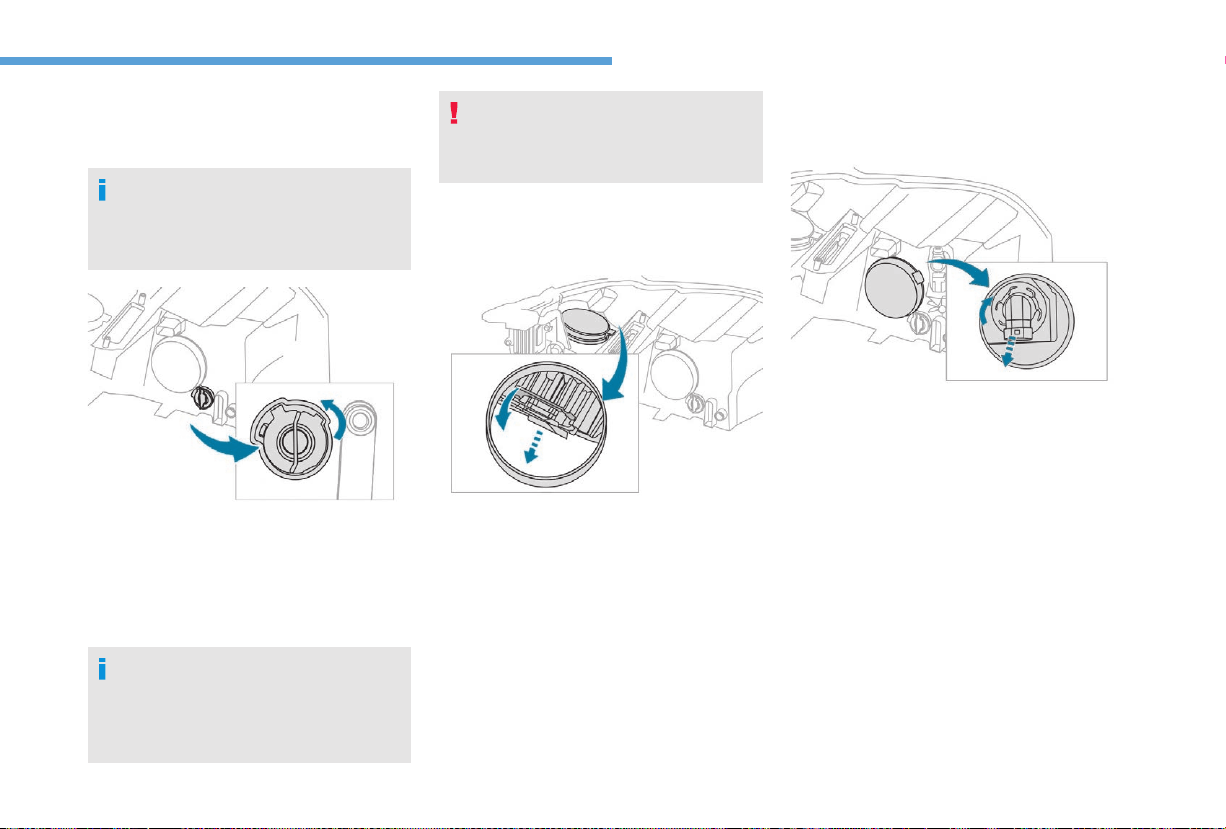
8
249
In the event of a breakdown
Changing direction indicator
bulbs (on models with halogen
headlamps)
Quicker flashing of the direction indicator
lamp (left or right) indicates the failure of
one of the bulbs on the corresponding
side.
F Turn the bulb holder a quarter turn and pull
it out.
F Turn the bulb a quarter turn, pull it out and
fit a new bulb.
To refit, carry out these operations in reverse
order.
Amber colour bulbs, such as the direction
indicators, must be replaced by bulbs
with identical colour and specifications.
To refit, close the protective cover very
carefully to guarantee the leak-tightness
of the lamp.
Changing dipped beam headlamp
bulbs (on models with halogen
headlamps)
F Remove the protective cover by pulling the
tongue.
F Pull the connector back to disconnect it.
F Pull the bulb back to extract it.
F Replace the bulb.
To refit, carry out these operations in reverse
order.
Changing main beam headlamp
bulbs (on models with halogen
headlamps)
F Remove the protective cover by pulling the
tongue.
F Turn the bulb holder a quarter turn and pull
it out.
F Pull the bulb out and replace it.
To refit, carry out these operations in reverse
order.
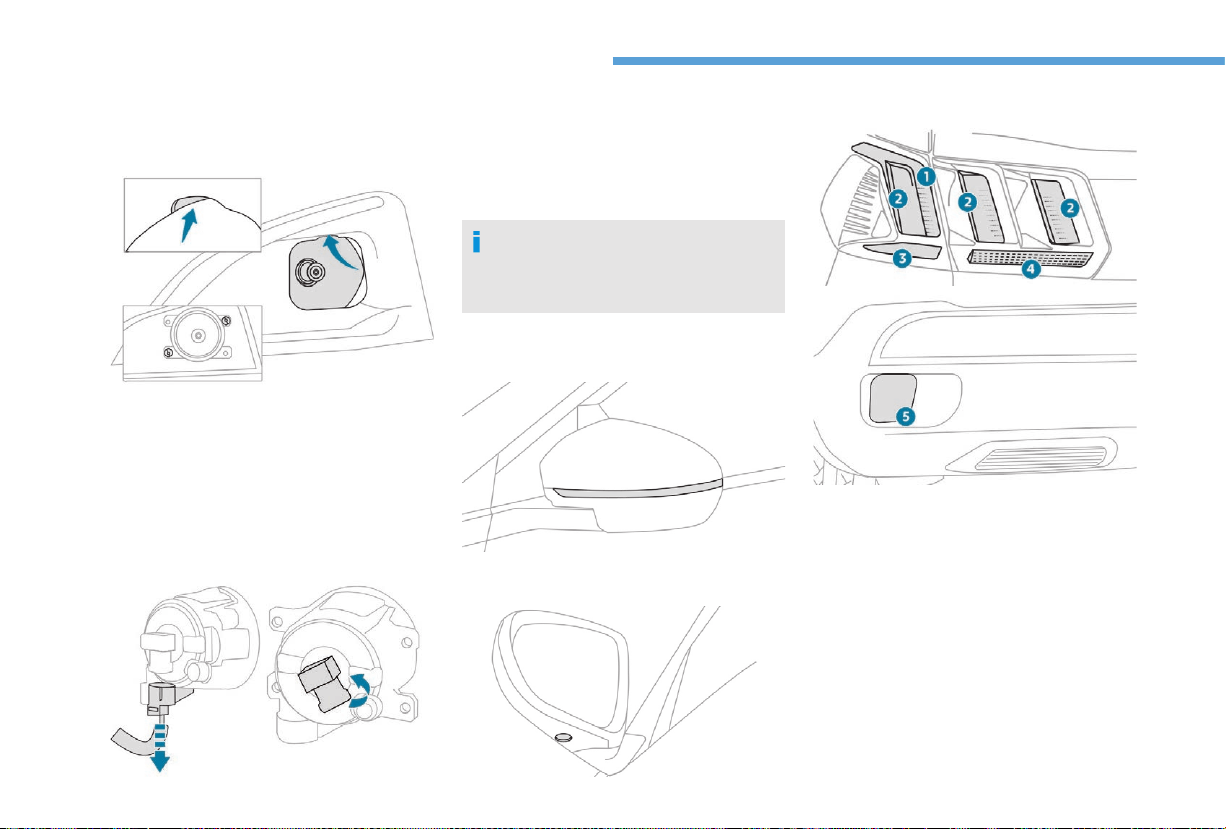
250
In the event of a breakdown
To replace this type of bulb, you can also
contact a PEUGEOT dealer or a qualified
workshop.
Direction indicator side repeaters
(LED)
Side spotlamps (LED)
Rear lamps
1. Brake lamps (LED).
2. Sidelamps/daytime running lamps
(LED).
3. Direction indicators (WY16W amber).
4. Reversing lamps (W16W).
5. Foglamp (P21W).
Changing foglamp bulbs (on
models with halogen headlamps)
F Introduce a flat screwdriver in the hole in
the trim.
F Pull and lever to unclip the foglamp trim.
F With a Torx screwdriver, remove the two
module fixing screws.
F Remove the module from its housing.
F Disconnect the bulb holder connector.
F Turn the bulb holder a quarter turn and pull
it out.
F Change the assembly.
To refit, carry out these operations in reverse
order.
LEDs: light-emitting diodes.

8
251
In the event of a breakdown
Direction indicators (on the
wings)
To refit, carry out these operations in reverse
order.
Reversing lamps (on the tailgate)
To refit, carry out these operations in reverse
order.
F Open the tailgate then unclip the access
cover on the side in question.
F Unblock the lamp fixing nut with a 10 mm
box spanner.
F To avoid losing the nut if it drops into the
wing trim, first place a cloth below it.
F Manually unscrew and remove the lamp
fixing nut.
F Disengage the retaining clip, while pushing
the lamp out slightly.
F From the outside, carefully remove the lamp
by pulling it to the rear, then up.
F Disconnect the lamp connector.
F Turn the bulb holder a quarter turn using a
standard pair of pliers and pull it out.
F Pull the bulb out and replace it.
F Open the tailgate, then insert a flat
screwdriver into the cut-out to unclip the
access cover on the side in question.
F Unblock the lamp fixing nut with a 10 mm
box spanner.
F Manually unscrew and remove the lamp
fixing nut.
F Disengage the retaining clip, while pushing
the lamp out slightly.
F From the outside, carefully remove the lamp
by pulling it to the rear.
F Disconnect the lamp connector by pressing
on each side.
F Turn the bulb holder a quarter turn and pull
it out.
F Pull the bulb out and change it.
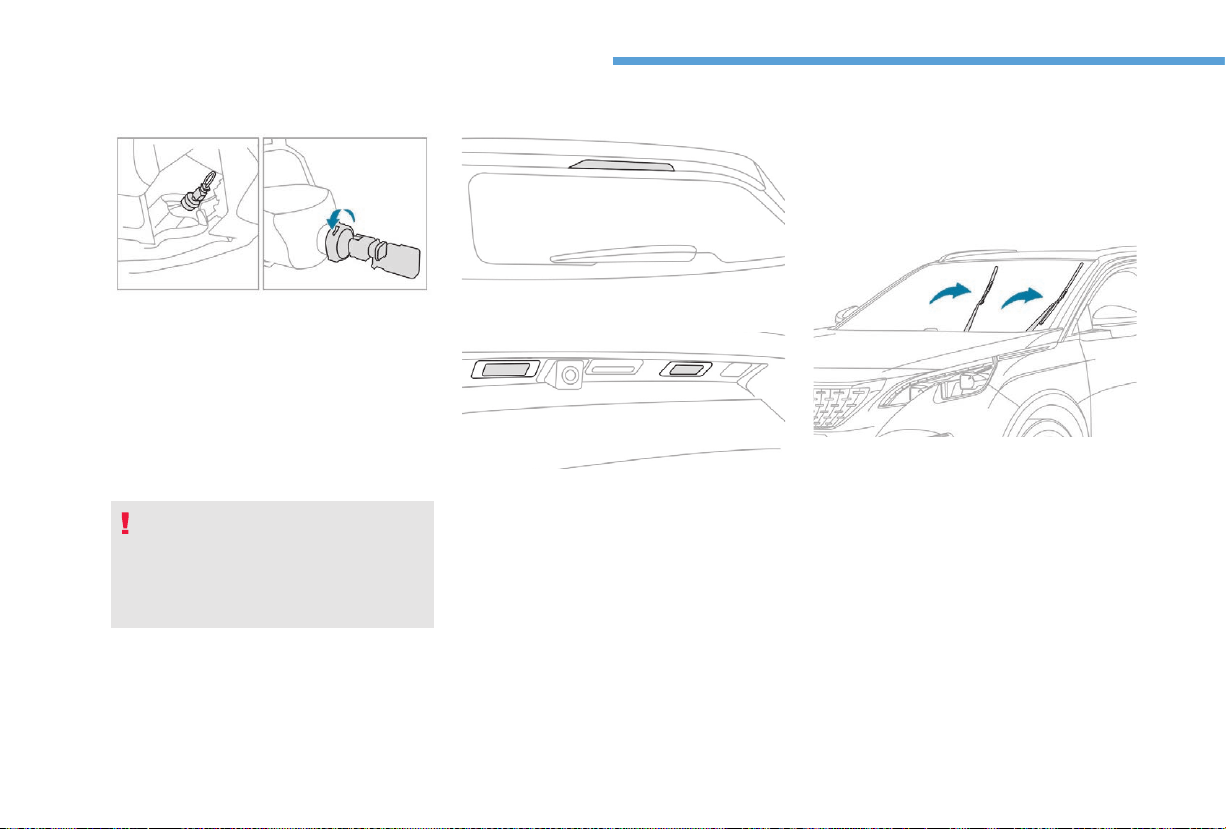
252
In the event of a breakdown
If changing a bulb within a few minutes
of switching off the ignition, take care not
to touch the exhaust – there is a risk of
burns!
Third brake lamp (LED)
Licence plate lamps
F Insert a thin screwdriver into the slot in the
lens.
F Push it out to unclip it.
F Remove the lens.
F Pull the bulb out and change it.
Changing a wiper blade
Before removing a front
wiper
Removing
F Lift the corresponding wiper arm away from
the windscreen.
F Unclip and remove the wiper blade.
Refitting
F Position and clip the new wiper blade to the
arm.
F Carefully lower the wiper arm.
Foglamps
These bulbs are replaced from outside the rear
bumper:
F Pass your hand under the bumper,
F Turn the bulb holder a quarter turn and
remove it,
F Turn the bulb a quarter turn, pull it out and
change it.
To refit, carry out these operations in reverse
order.
F Within one minute after switching off the
ignition, operate the wiper control stalk to
position the wiper blades in the middle of
the windscreen (maintenance position).
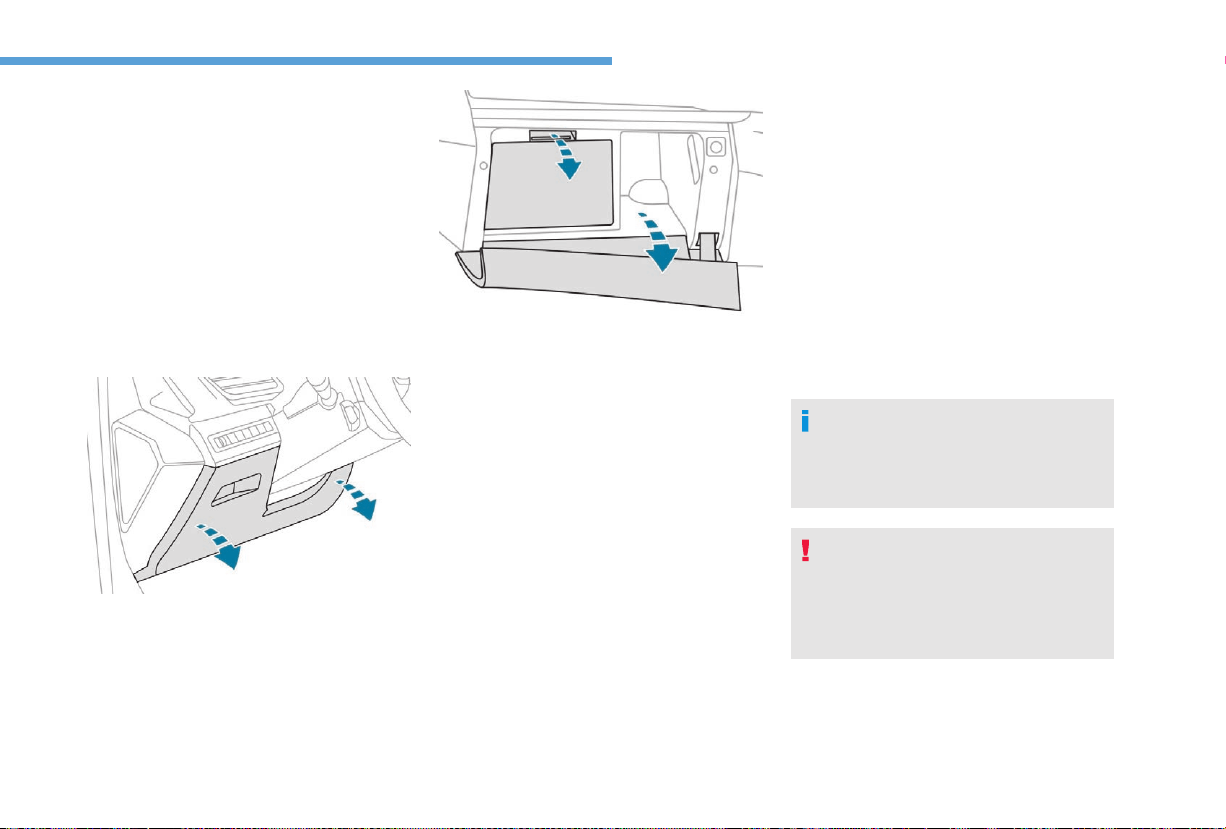
8
253
In the event of a breakdown
After refitting a front wiper
F Switch on the ignition.
F Operate the wiper control stalk again to
park the wiper blades.
Changing a fuse
Access to tooling
The extraction tweezers are located behind the
fusebox cover.
F Unclip the cover by pulling at the top left,
then right.
F Disengage the cover completely and turn it
over.
F Take the tweezers from their housing.
F Open the glove box.
F Press on the centre handle of the fusebox
cover.
F Lower the cover completely.
F Take the tweezers from their housing.
Changing a fuse
Before changing a fuse:
F identify the cause of the failure and correct it,
F switch off all electrical consumers,
F immobilise the vehicle and switch off the
ignition,
F identify the defective fuse using the current
allocation tables and diagrams.
To work on a fuse, you must:
F use the special tweezers to extract the fuse
from its housing and check the condition of
its filament,
F always replace the defective fuse with a
fuse of the same rating (same colour); using
a different rating could cause a malfunction
(risk of fire).
If the fault recurs after replacing a fuse, have
the electrical system checked by a PEUGEOT
dealer or a qualified workshop.
The fuse allocation tables and the
corresponding diagrams are available
from a PEUGEOT dealer or a qualified
workshop.
The replacement of a fuse not shown
in the allocation tables may cause a
serious malfunction of your vehicle.
Contact a PEUGEOT dealer or a qualified
workshop.
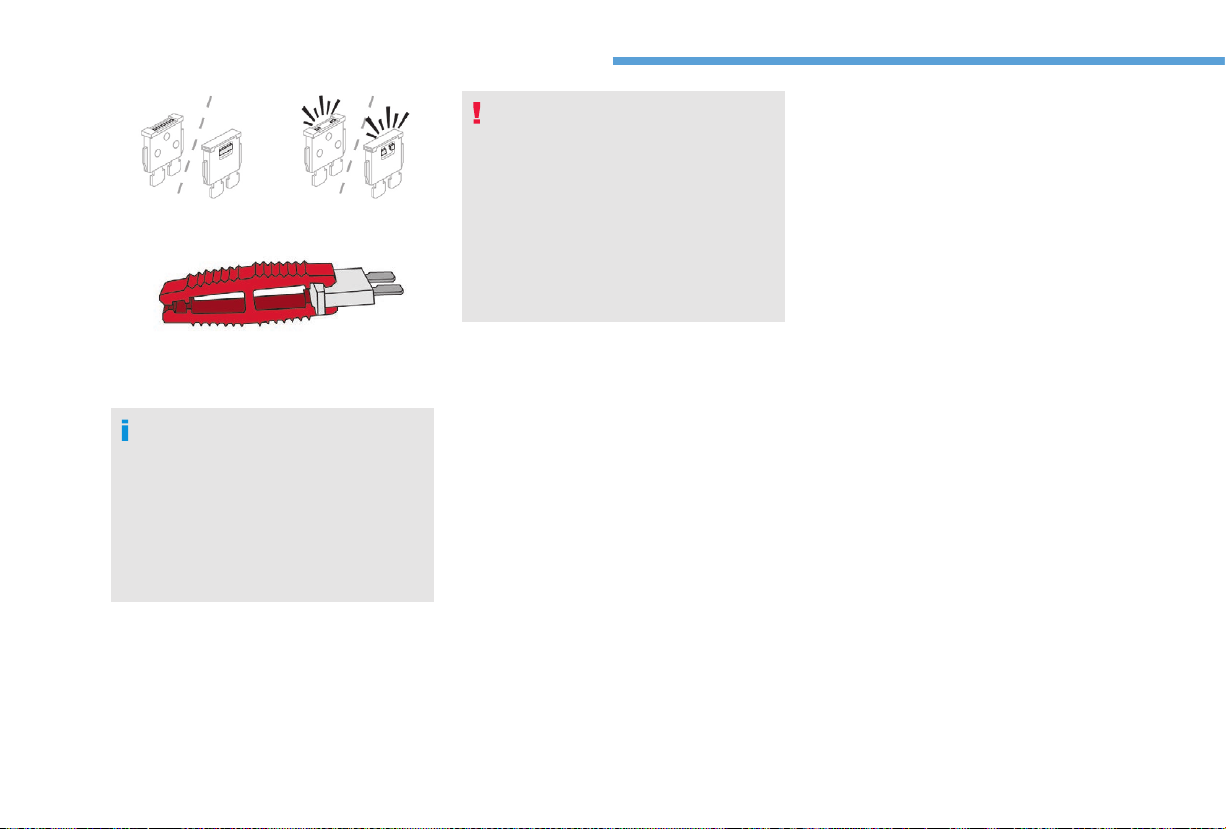
254
In the event of a breakdown
Good Faulty
Tweezers
Installing electrical accessories
Your vehicle's electrical system is
designed to operate with standard or
optional equipment.
Before installing other electrical
equipment or accessories on your
vehicle, contact a PEUGEOT dealer or
a qualified workshop.
PEUGEOT will not accept responsibility
for the cost incurred in repairing your
vehicle or for rectifying malfunctions
resulting from the installation of
accessories not supplied and not
recommended by PEUGEOT and
not installed in accordance with its
instructions, in particular when the
combined consumption of all of the
additional equipment connected exceeds
10 milliamperes.
Fuses in the dashboard
The fusebox is placed in the lower dashboard
(left-hand side).
To access the fuses, follow the same procedure
as that described for accessing the tool kit for
changing fuses.
For more information on Access to tooling,
refer to the corresponding section.
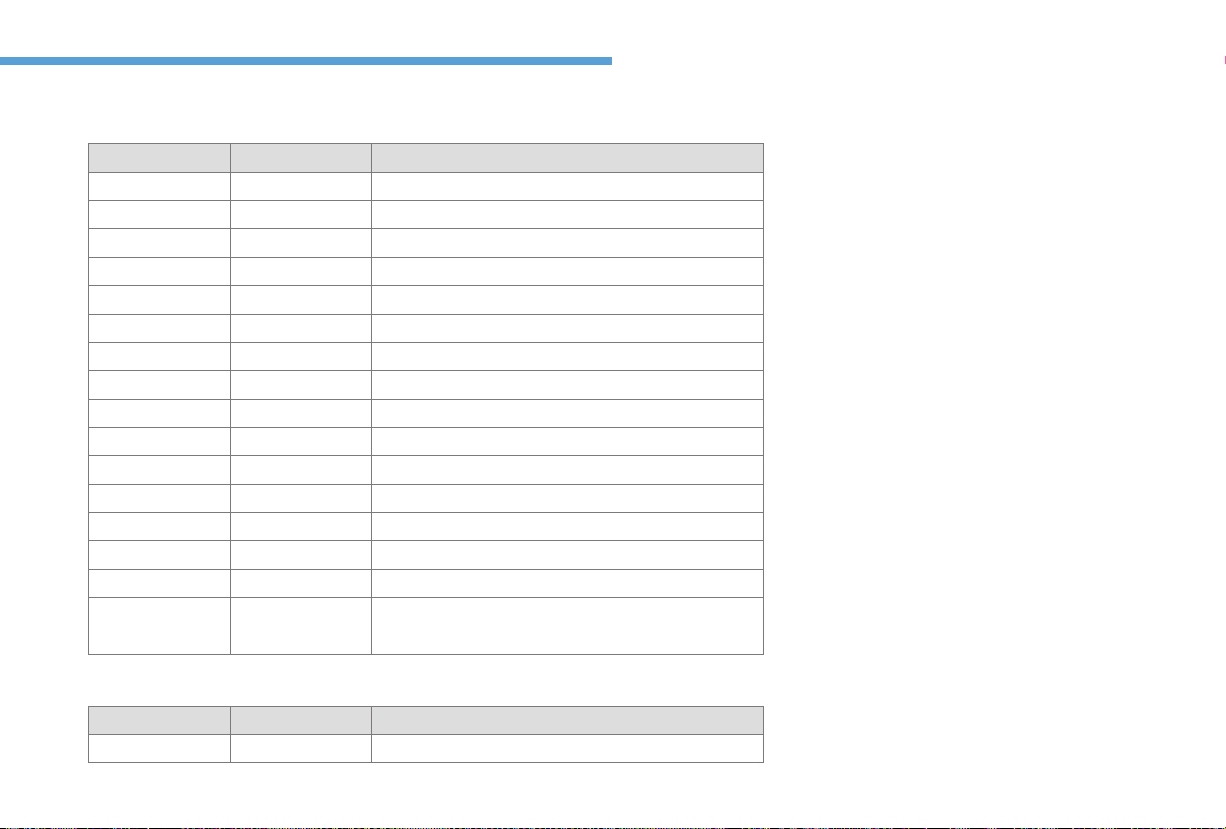
8
255
In the event of a breakdown
Version 1 (Full)
Box 1
Fuse N° Rating (A) Functions
F1 3 A Keyless Entry and Starting.
F2 5 A Multifunction screen.
F5 5 A Reversing camera, parking sensors.
F7 10 A Hi-Fi amplifier.
F8 20 A Rear wiper.
F10 30 A Locks.
F11 30 A Locks.
F17 10 A Boot 12 V accessory socket.
F18 5 A Emergency and assistance calls.
F22 3 A Glove box lighting.
F26 3 A Seat belts not fastened warning lamps display.
F27 3 A Rain / sunshine sensor.
F31 5 A Airbags.
F33 15 A Front 12 V accessory socket
F35 5 A Instrument panel.
F36 20 A
Audio system, touch screen, CD player, audio/
navigation system.
Fuse N° Rating (A) Functions
F17 10 A Storing driving positions.
Box 2
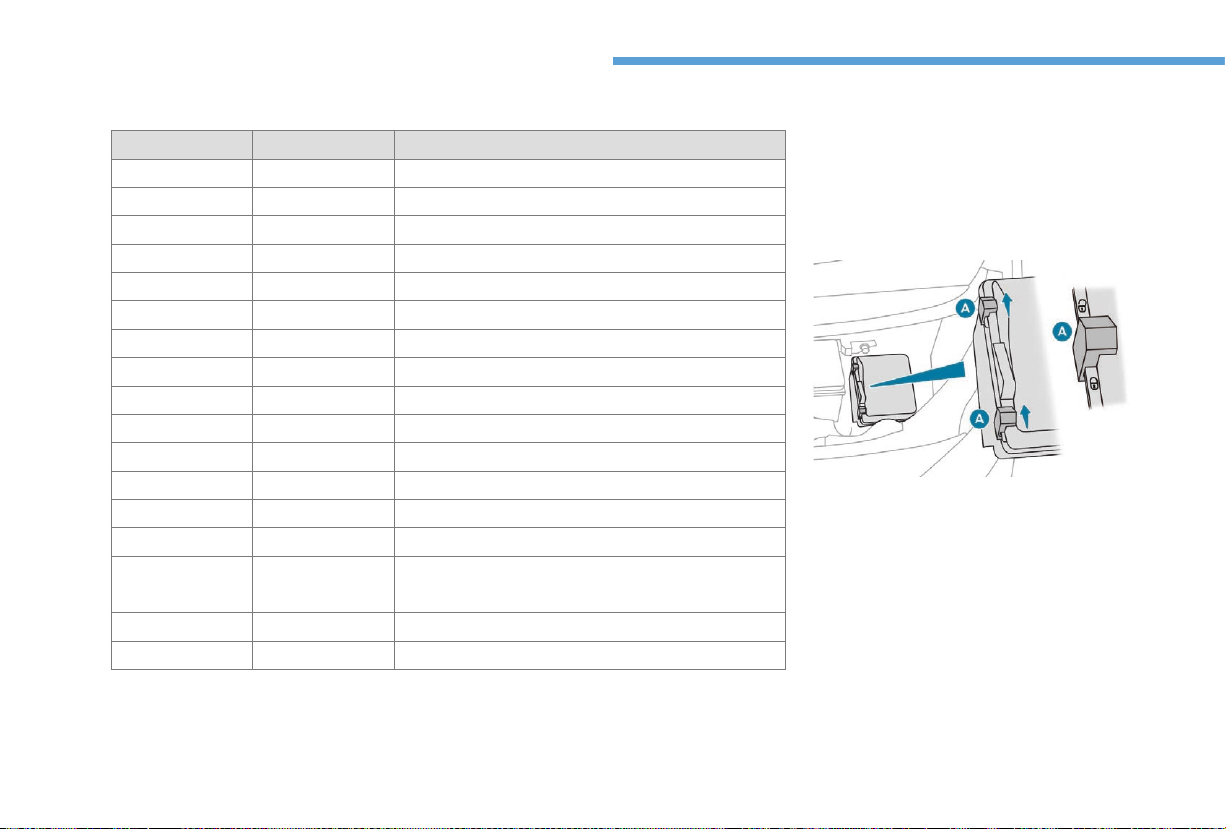
256
In the event of a breakdown
Version 2 (Eco)
Fuse N° Rating (A) Functions
F4 15 A Horn.
F5 20 A Front screenwash pump.
F6 20 A Rear screenwash pump.
F7 10 A 12 V accessory socket.
F8 20 A Rear wiper.
F10 30 A Locks.
F11 30 A Locks.
F14 5 A Alarm siren.
F17 5 A Instrument panel.
F22 3 A Rain / sunshine sensor.
F24 5 A Reversing camera, parking sensors.
F25 5 A Airbags.
F27 5 A Alarm.
F28 5 A Emergency and assistance calls.
F29 20 A
Audio system, touch screen, CD player, audio/
navigation system.
F32 15 A Cigarette lighter.
F36 5 A Glove box lighting.
Engine compartment fuses
The fusebox is placed in the engine
compartment near the battery.
Access to the fuses
F Release the two latches A.
F Remove the cover.
F Change the fuse.
F When you have finished, close the cover
carefully then engage the two latches A, to
ensure correct sealing of the fusebox.
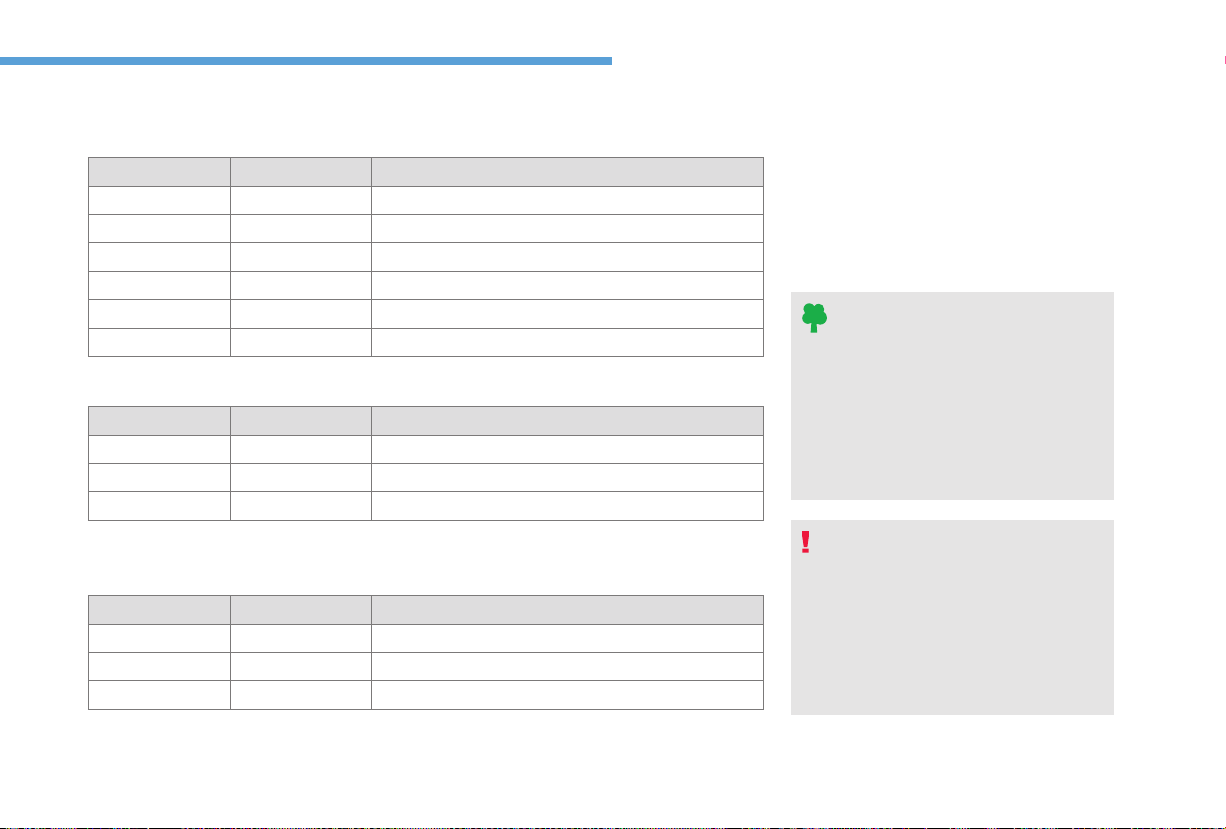
8
257
In the event of a breakdown
12 V battery
Procedure for starting the engine using another
battery or charging a discharged battery.
Version 1 (Full)
Fuse N° Rating (A) Functions
F14 15 A Screenwash pump.
F15 5 A Power steering.
F20 25 A Screenwash pump.
F22 15 A Horn.
F23 15 A Right-hand main beam headlamp.
F24 15 A Left-hand main beam headlamp.
Fuse N° Rating (A) Functions
F8 30 A Diesel emissions control system (AdBlue)
F12 15 A Automatic gearbox.
F14 5 A Automatic gearbox.
Version 2 (Eco)
Fuse N° Rating (A) Functions
F16 25 A Front foglamps.
F18 10 A Right-hand main beam headlamp.
F19 10 A Left-hand main beam headlamp.
Box 1
Box 2
General points
Lead-acid starter batteries
Batteries contain harmful substances
such as sulphuric acid and lead.
They must be disposed of in
accordance with regulations and must
not, in any circumstances, be discarded
with household waste.
Take used remote control batteries and
vehicle batteries to a special collection
point.
Protect your eyes and face before
handling the battery.
All operations on the battery must be
carried out in a well ventilated area and
away from naked flames and sources
of sparks, so as to avoid the risk of
explosion or fire.
Wash your hands afterwards.
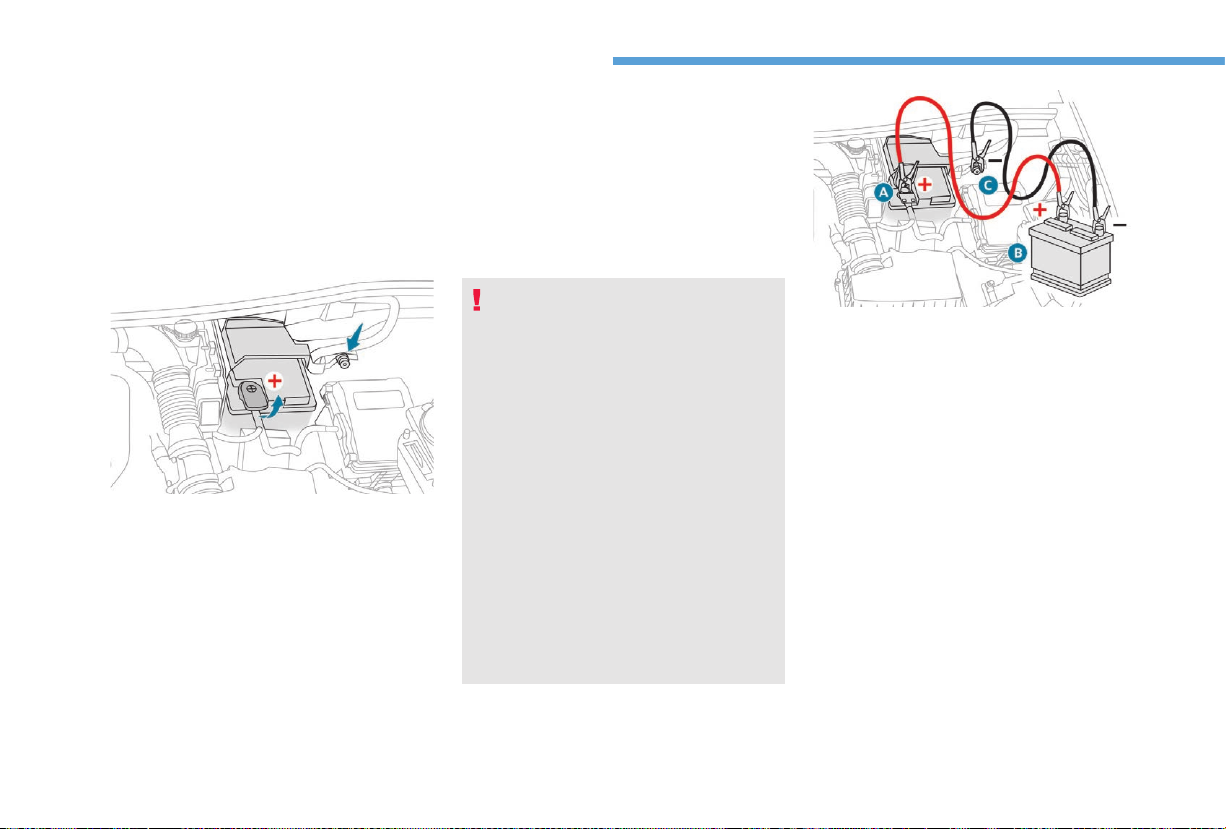
258
In the event of a breakdown
Access to the battery Starting using another
battery
When your vehicle's battery is discharged, the
engine can be started using a backup battery
(external or from another vehicle) and jump
leads or using a battery booster.
Never try to start the engine by
connecting a battery charger.
Never use a 24 V or higher battery
booster.
Check beforehand that the backup
battery has a nominal voltage of 12 V and
a capacity at least equal to that of the
discharged battery.
The two vehicles must not be in contact
with each other.
Switch off all the electrical consumers
on both vehicles (audio system, wipers,
lighting, etc.).
Make sure that the jump leads are not
close to moving parts of the engine (fan,
belts, etc.).
Do not disconnect the (+) terminal while
the engine is running.
The battery is located under the bonnet.
For access to the (+) terminal:
F unlock the bonnet by activating the internal
release lever, then the external safety catch.
F lift the bonnet, then fix it in place with its rod.
(+) Positive terminal.
It has a quick-release clamp.
(-) Negative terminal.
As the battery's negative terminal is not
accessible, a remote earth point is placed near
the battery.
F Lift the plastic cover on the (+) terminal, if
your vehicle has one.
F Connect the red cable to the positive
terminal (+) of flat battery A (at the metal
elbow) then to the positive terminal (+) of
backup battery B or the booster.
F Connect one end of the green or black
cable to the negative terminal (-) of backup
battery B or the booster (or an earth point
on the other vehicle).
F Connect the other end of the green or black
cable to earth point C on the broken down
vehicle.
F Start the engine of the vehicle with the
good battery and leave it running for a few
minutes.
F Operate the starter on the broken down
vehicle and let the engine run.
If the engine does not start straight away,
switch off the ignition and wait a few moments
before trying again.
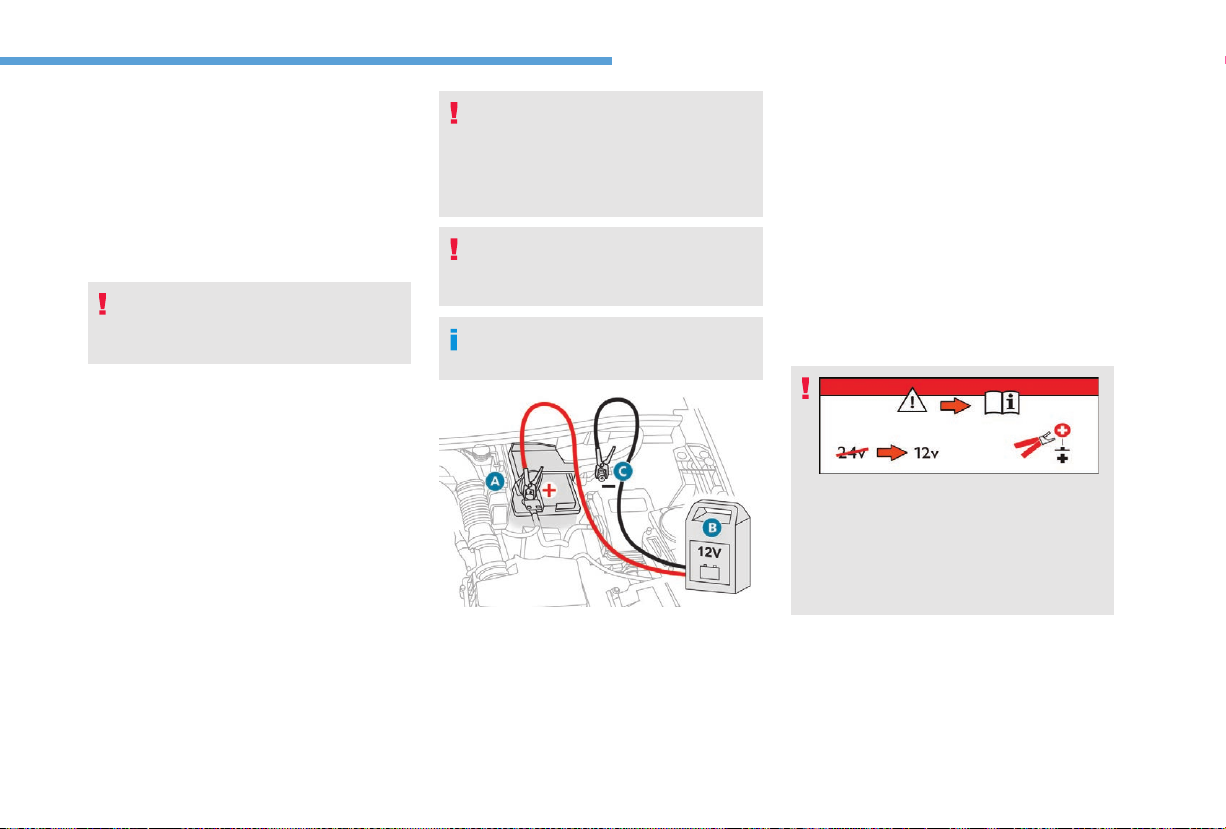
8
259
In the event of a breakdown
F Wait for it to return to idle.
F Disconnect the jump lead cables in reverse
order.
F Refit the plastic cover to the (+) terminal, if
your vehicle has one.
F Allow the engine to run for at least
30 minutes, by driving or with the vehicle
stationary, so that the battery reaches an
adequate state of charge.
If your vehicle has an automatic gearbox,
do not try to start the engine by pushing
the vehicle.
Charging the battery using
a battery charger
For optimum service life of the battery, it is
essential to maintain an adequate state of
charge.
In some circumstances it may be necessary to
charge the battery:
- if you only use your vehicle for short
journeys,
- if the vehicle is to be taken off the road for
several weeks.
Contact a PEUGEOT dealer or a qualified
workshop.
If you wish to charge your vehicle's
battery yourself, use only a charger
compatible with lead-acid batteries with
a nominal voltage of 12 V.
Follow the instructions provided by the
manufacturer of the charger.
Never reverse polarities.
It is not necessary to disconnect the
battery.
F Switch off the ignition.
F Switch off all electrical consumers (audio
system, lighting, wipers, etc.).
F Switch off charger B before connecting the
cables to the battery, so as to avoid any
dangerous sparks.
F Ensure that the charger cables are in good
condition.
F Raise the plastic cover, if your vehicle has
one, on the (+) terminal.
F Connect charger B cables as follows:
- the positive (+) red cable to the (+)
terminal of battery A,
- the negative (-) black cable to earth point
C on the vehicle.
F At the end of the charging operation, switch
off charger B before disconnecting the
cables from battery A.
If this label is present, it is essential to
use only a 12 V charger to avoid causing
irreversible damage to the electrical
components related to the Stop & Start
system.
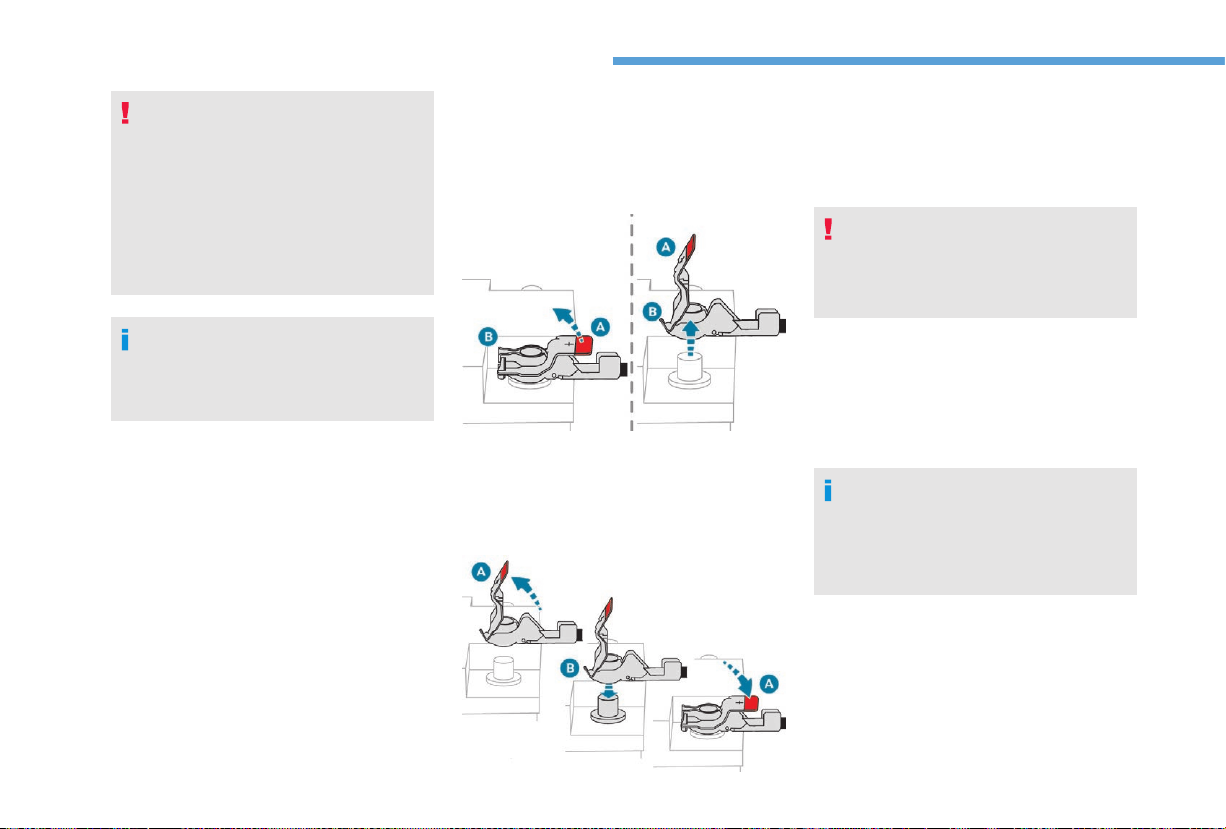
260
In the event of a breakdown
Some functions, including Stop & Start,
are not available if the battery is not
sufficiently charged.
Disconnecting the battery
In order to maintain an adequate state
of charge for starting the engine, it is
recommended that the battery be disconnected
if the vehicle is taken out of service for a long
period.
Before disconnecting the battery:
F close all openings (doors, tailgate, windows,
sunroof),
F switch off all electrical consumers (audio
system, wipers, lighting, etc.),
F switch off the ignition and wait for four
minutes.
Quick-release terminal clamp
Disconnecting the (+) terminal
Reconnecting the (+) terminal
Do not force the lever as locking will not
be possible if the clamp is not positioned
correctly; start the procedure again.
F Raise the lever A fully to release the
clamp B.
F Remove the clamp B by lifting it off.
F Raise the lever A fully.
F Refit the open clamp B on the (+) terminal.
F Push the clamp B fully down.
F Lower the lever A to lock the clamp B.
Following reconnection of the battery
After reconnecting the battery, turn on the
ignition and wait 1 minute before starting
the engine, in order to enable the electronic
systems to initialise.
For right-hand drive vehicles, when the
total distance recorder has reached
62 miles (100 km), it is necessary to wait
approx. 15 minutes before starting the
engine.
Never try to charge a frozen battery – risk
of explosion!
If the battery has frozen, have it checked
by a PEUGEOT dealer or by a qualified
workshop who will check that the internal
components have not been damaged and
that the container has not cracked, which
would mean a risk of toxic and corrosive
acid leaking.
At the battery, it is only necessary to
disconnect the (+) terminal.
However, if minor problems persist following
this operation, contact a PEUGEOT dealer or a
qualified workshop.
Referring to the corresponding section, you
must yourself reinitialise or reset certain
systems, such as:
- the key with remote control or electronic key
(depending on version),
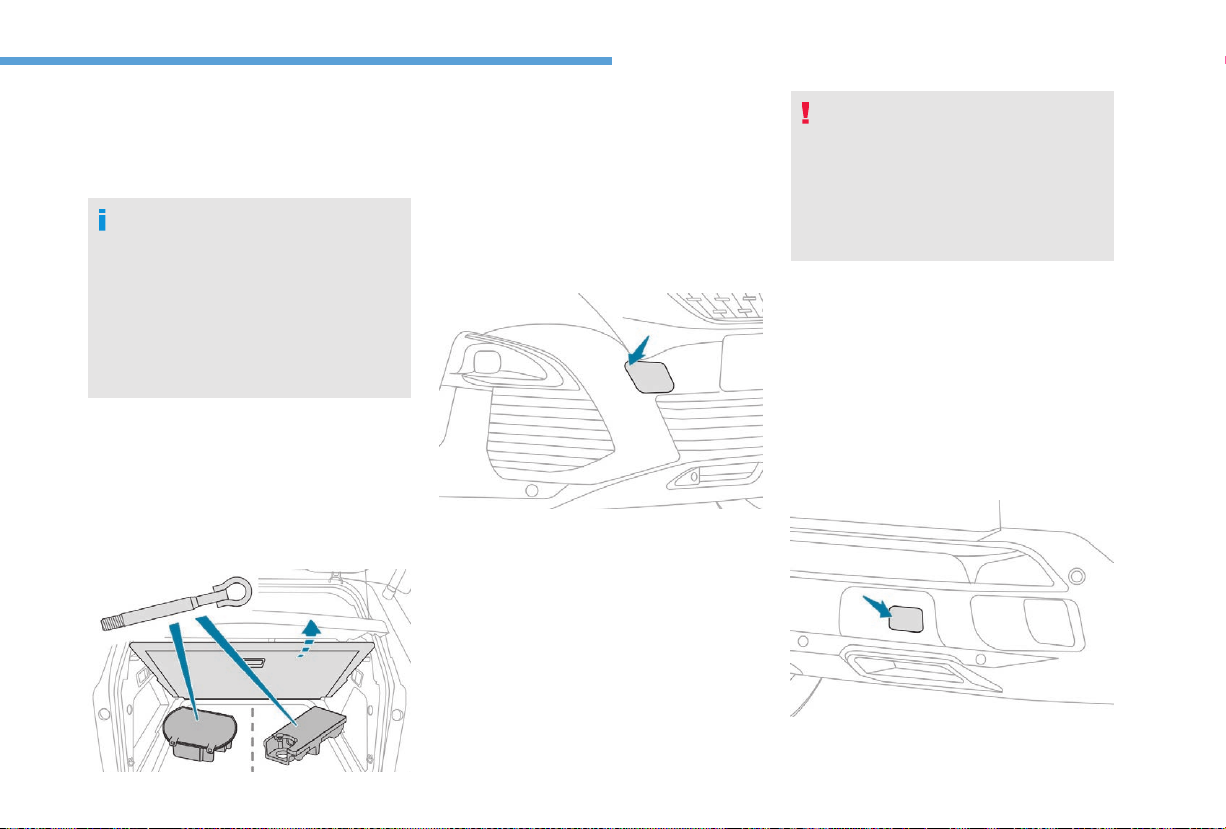
8
261
In the event of a breakdown
The Stop & Start system may not be
operational during the trip following the
first engine start.
In this case, the system will only be
available again after a continuous
period of immobilisation of the vehicle,
a period which depends on the exterior
temperature and the state of charge of
the battery (up to about 8 hours).
- the sunroof and its electric blind,
- the electric windows,
- the date and time,
- the preset radio stations.
Towing the vehicle
Procedure for having your vehicle towed or
for towing another vehicle using a removable
towing eye.
Access to the tools
The towing eye is stored in a toolbox, under the
boot floor.
For more information on Access to the tools,
refer to the corresponding section.
Towing your vehicle
F On the front bumper, unclip the cover by
pressing on its top left corner.
F Screw the towing eye in fully.
F Install the towing arm.
F Place the gearbox in neutral.
Failure to follow this instruction may
cause damage to some components
(braking, transmission, etc.) and the
absence of braking assistance when the
engine is restarted.
F Unlock the steering and release the parking
brake.
F Switch on the hazard warning lamps on
both vehicles.
F Set off gently, drive slowly and for a short
distance.
Towing another vehicle
F On the rear bumper, unclip the cover by
pressing at the left.

262
In the event of a breakdown
F Screw the towing eye in fully.
F Install the towing arm.
F Switch on the hazard warning lamps on
both vehicles.
F Move off gently, drive slowly and for a short
distance.
General recommendations
Observe the legislation in force in your
country.
Ensure that the weight of the towing
vehicle is higher than that of the towed
vehicle.
The driver must remain at the wheel of
the towed vehicle and must have a valid
driving licence.
When towing a vehicle with all four
wheels on the ground, always use an
approved towing arm; rope and straps are
prohibited.
The towing vehicle must move off gently.
When the vehicle is towed with its
engine off, there is no longer braking and
steering assistance.
In the following cases, you must always
call on a professional recovery service:
- vehicle broken down on a motorway
or fast road,
- four-wheel drive vehicle,
- when it is not possible to put the
gearbox into neutral, unlock the
steering, or release the parking brake,
- when it is not possible to tow a vehicle
with an automatic gearbox, engine
running,
- towing with only two wheels on the
ground,
- where there is no approved towbar,
etc. available.
263
9
Technical data
Engine technical data and
towed loads
Engines
The engine characteristics are given in the
vehicle's registration document, as well as in
sales brochures.
The maximum power corresponds to
the value type-approved on a test bed,
under conditions defined in European
legislation (Directive 1999/99/EC).
For more information, contact a PEUGEOT
dealer or a qualified workshop.
Weights and towed loads
The weights and towed loads relating to your
vehicle are given in the registration document,
as well as in sales brochures.
These values are also given on the
manufacturer's plate or label.
For more information, contact a PEUGEOT
dealer or a qualified workshop.
The GTW values and the towable loads listed
are valid for a maximum altitude of 1,000 metres.
The towable load must be reduced by steps of
10% for each additional 1,000 metres.
The maximum authorised nose weight
corresponds to the weight permitted on the
towbar.
GTW: Gross train weight.
When exterior temperatures are high,
the vehicle performance may be limited
in order to protect the engine. When the
exterior temperature is higher than 37°C,
limit the towed weight.
Towing using a lightly loaded vehicle can
adversely affect roadholding.
Braking distances are increased when
towing a trailer.
When using a vehicle to tow, never
exceed a speed of approximately 60 mph
(100 km/h) (observe the local legislation
in force).
If the exterior temperature is high, it is
recommended that the engine be allowed
to idle for 1 to 2 minutes after the vehicle
comes to a stop, to facilitate its cooling.

264
Technical data
Petrol engines and towed loads
Engines
1.2 litre PureTech
130 S&S
1.2 litre PureTech
130 S&S
1.2 litre PureTech
130 S&S
1.6 litre THP
150
1.6 litre THP
165
1.6 litre THP
165 S&S
Gearboxes
BVM6
(Manual
6-speed)
BVM6
(Manual
6-speed)
EAT6
(Auto.
6-speed)
EAT6
(Auto.
6-speed)
EAT6
(Auto.
6-speed)
EAT6
(Auto.
6-speed)
Codes
LHK
(EB2ADTS
MB6 STT)
CRK
(EB2DTS MCM
STT)
CRQ – CXQ
(EB2DTS AT6III
STT)
(EB2DTSM
AT6III STT)
KUM
(EP6FDTMD
AT6III)
KNM
(EP6FDTM
AT6III)
KHQ
(EP6FDT AT6III
STT)
Model codes
M…
RHNSJ/C1B
RHNSJ/C1F
RHNYH/C1B
RHNYH/C1F
-
RHNYH/C1K
RHNYW/C1B
RHNYW/C1F
RHNWW/C1B
RHNWW/C1F
45GXV/C1A
45GXW/C1A
45GYV/C1A
45GYW/C1A
45GZW/C1B
45GZW/C1F
Cylinder capacity (cm³) 1,199 1,199 1,199 1,598 1,598 1,598
Max power: EU standard (kW) 96 96 96 110 121.4 121.4
Fuel Unleaded Unleaded Unleaded Unleaded Unleaded Unleaded
Braked trailer (within the GTW limit) (kg)
on a 10% or 12% gradient
1,400 1,400-1,300 1,200 600 600 1,550
Unbraked trailer (kg) 690 660 670 600 600 685
Maximum authorised nose weight (kg) 56 80 80 70 70 80
265
9
Technical data
Diesel engines and towed loads
Engines 1.5 litre BlueHDi 130 S&S 1.5 litre BlueHDi 130 S&S
Gearboxes
BVM6
(Manual 6-speed)
EAT8
(Auto. 8-speed)
Codes
MAK
(DV5RC ML6O STT)
MA1
(DV5RC ATN8 STT)
Model codes
M…
CYHZJ/C2B
CYHZJ/C2F
CYHZJ/C2K
CYHZR/C2B
CYHZR/C2F
CYHZR/C2K
Cylinder capacity (cm³) 1,499 1,499
Max power: EU standard (kW) 96 96
Fuel Diesel Diesel
Braked trailer (within the GTW limit) (kg)
on a 10% or 12% gradient
1,500 1,300
Unbraked trailer (kg) 745 750
Maximum authorised nose weight (kg) 70 52

266
Technical data
Engines
1.6 litre BlueHDi
100 S&S
1.6 litre BlueHDi
115 S&S
1.6 litre BlueHDi
115 S&S
1.6 litre BlueHDi
120 S&S
1.6 litre BlueHDi
120 S&S
Gearboxes
BVM
(Manual
5-speed)
BVM6
(Manual
6-speed)
EAT6
(Auto. 6-speed)
BVM6
(Manual
6-speed)
EAT6
(Auto. 6-speed)
Codes
KEJ
(DV6FD BE4
STT)
LAK
(DV6FC ML6C
STT)
LAQ
(DV6FC AT6III
STT)
KDK
(DV6FC ML6C
STT)
KDQ
(DV6FC AT6III
STT)
Model codes
M…
CBHYB/C2B
CBHYB/C2F
CBHYB/C2B
CBHYB/C2F
CBHXW/C2B
CBHXW/C2F
CBHZH/C2B
CBHZH/C2F
-
CBHZH/C2K
CBHZW/C2B
CBHZW/C2F
Cylinder capacity (cm³) 1,560 1,560 1,560 1,560 1,560
Max power: EU standard (kW) 73 85 85 88 88
Fuel Diesel Diesel Diesel Diesel Diesel
Braked trailer (within the GTW limit) (kg)
on a 10% or 12% gradient
1,300 1,500 1,300 1,500-1,400 1,300
Unbraked trailer (kg) 680 685 695 685 695
Maximum authorised nose weight (kg) 80 80 80 80 80

267
9
Technical data
Engines 2.0 litre HDi 150 2.0 litre HDi 150
2.0 litre BlueHDi 150
S&S
2.0 litre BlueHDi 180
S&S
Gearboxes
BVM6
(Manual 6-speed)
EAT6
(Auto. 6-speed)
BVM6
(Manual 6-speed)
EAT8
(Auto. 8-speed)
Codes
LR6
(DW10FD ML6C)
LRM
(DW10FD AM6III)
KBK
(DW10FD ML6C STT)
KA1
(DW10FC AMN8 STT)
Model codes
M…
JAHXG/C2A
JAHXG/C2E
JAHXL/C2A
JAHXL/C2E
JAHXV/C2A
JAHXV/C2E
JAHRH/C2B
JAHRH/C2F
JAHSH/C2B
JAHSH/C2F
JAHXH/C2B
JAHXH/C2F
JEHZP/C2B
JEHZP/C2F
-
JEHZP/C2K
Cylinder capacity (cm³) 1,997 1,997 1,997 1,997
Max power: EU standard (kW) 110 110 110 130
Fuel Diesel Diesel Diesel Diesel
Braked trailer (within the GTW limit) (kg)
on a 10% or 12% gradient
600 600 2,000 2,000
Unbraked trailer (kg) 600 600 745 745-750
Maximum authorised nose weight (kg) 70 70 80 80
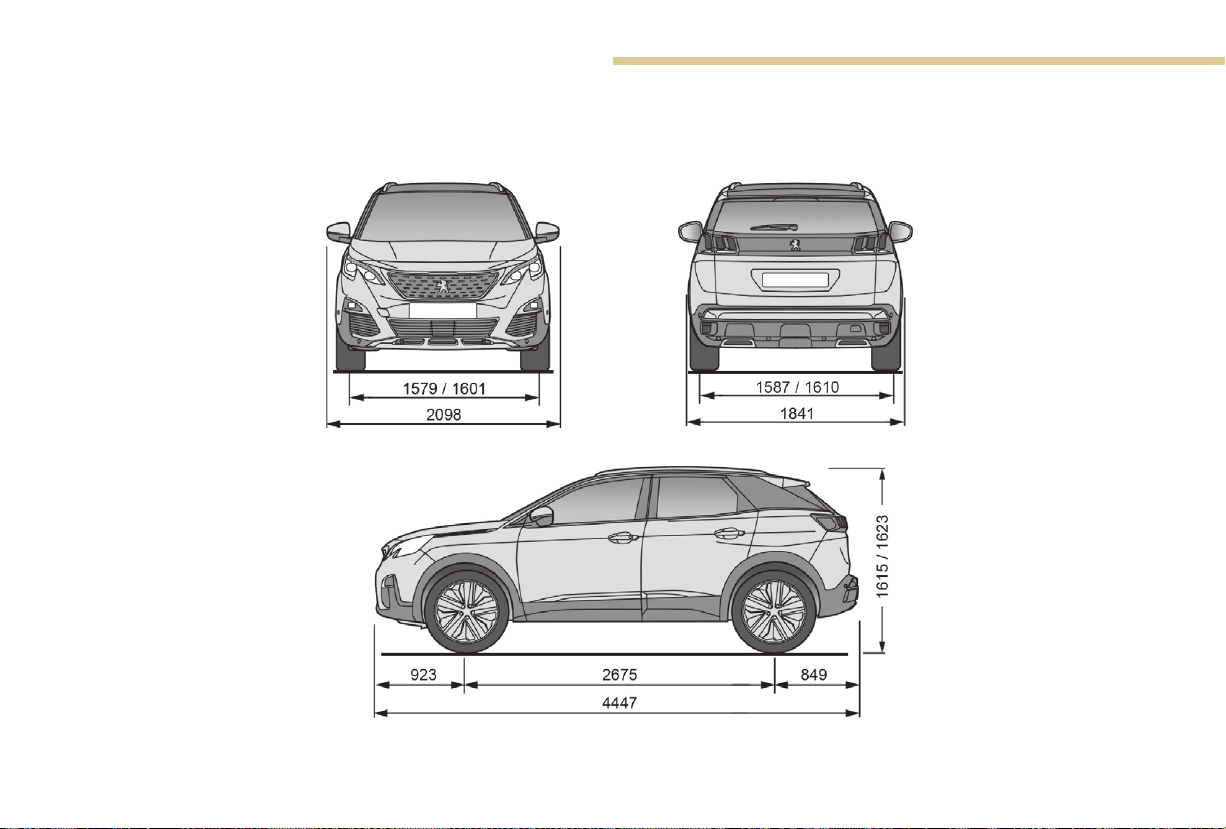
268
Technical data
Dimensions (in mm)
These dimensions have been measured on an unladen vehicle.
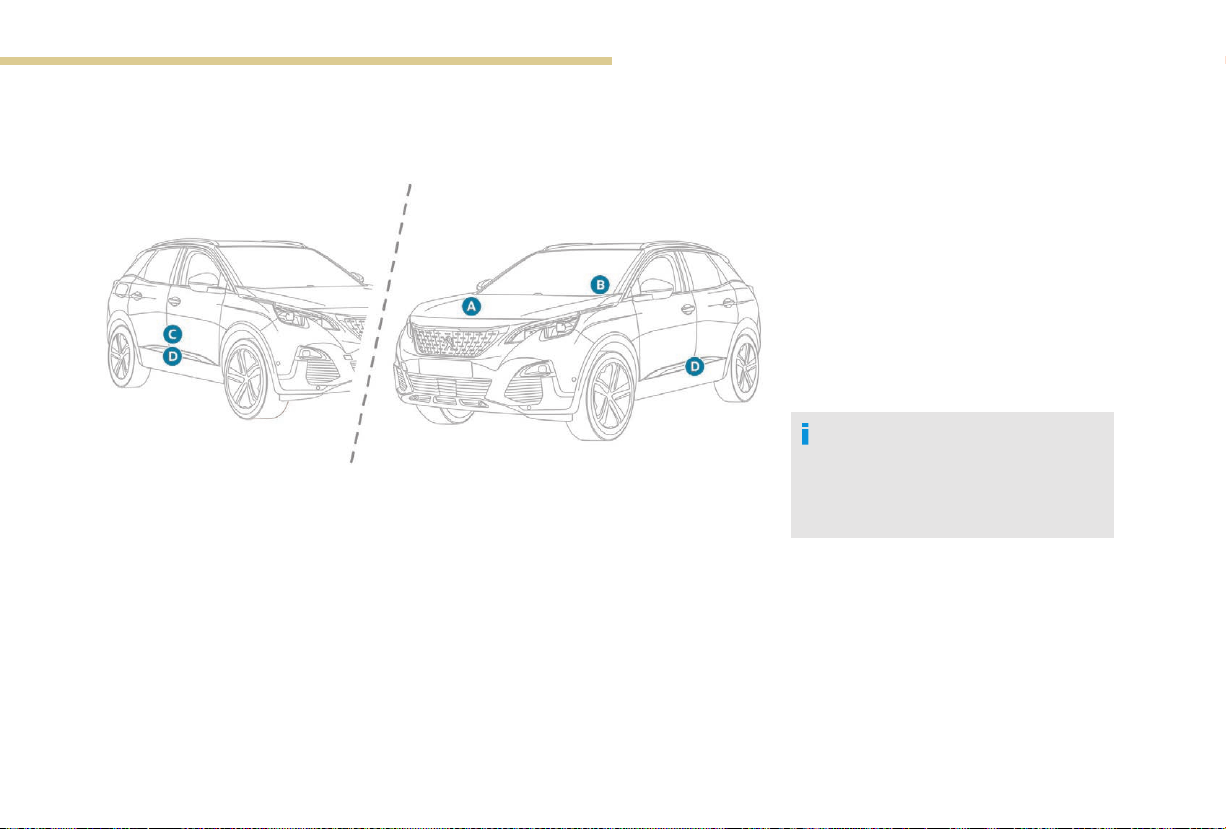
269
9
Technical data
Identication markings
Different visible markings for the identification
and localisation of your vehicle.
A. Vehicle identification number (V.I.N.),
under the bonnet.
The number is engraved on the body structure.
B. Vehicle identification number (V.I.N.), on
the dashboard.
The number is on a label, visible through the
windscreen.
C. Manufacturer's label.
This tamperproof label is affixed to the right-
hand door.
It bears the following information:
- the name of the manufacturer,
- the European Whole Vehicle Type Approval
number,
- the vehicle identification number (V.I.N.),
- the maximum authorised vehicle weight (the
Gross Vehicle Weight or GVW),
- the maximum authorised vehicle + trailer
weight (the Gross Train Weight or GTW),
- the maximum weight on the front axle,
- the maximum weight on the rear axle.
D. Tyres / paint code label.
This label is affixed to the driver's door
aperture.
It bears the following information about the
tyres:
- the tyre pressures, unladen and laden,
- the tyre specification, made up of the
dimensions and type as well as the load and
speed indices,
- the spare tyre pressure.
It also indicates the paint colour code.
The vehicle may be originally equipped
with tyres with higher load and speed
indices than those indicated on the label,
without affecting inflation pressure.

270
1
.
PEUGEOT Connect Nav
PEUGEOT Connect Nav
GPS satellite navigation –
Applications – Multimedia
audio system – Bluetooth
®
telephone
Contents
First steps 2
Steering mounted controls 3
Menus 3
Voice commands 5
Navigation 11
Connected navigation 13
Applications 16
Radio 21
DAB radio (Digital Audio Broadcasting) 22
Media 23
Telephone 25
Settings 29
Frequently asked questions 32
The different functions and settings
described vary according to the version
and configuration of your vehicle.
As a safety measure and because it
requires sustained attention by the
driver, the pairing of a Bluetooth mobile
telephone with the Bluetooth hands-free
system of your audio system must be
done with the vehicle stationary and the
ignition on.
The system is protected in such a way
that it will only operate in your vehicle.
The display of the message Energy
Economy Mode signals that a change to
standby is imminent.
The link below gives access to OSS
(Open Source Software) codes for the
system.
https://www.groupe-psa.com/fr/oss/
https://www.groupe-psa.com/en/oss/
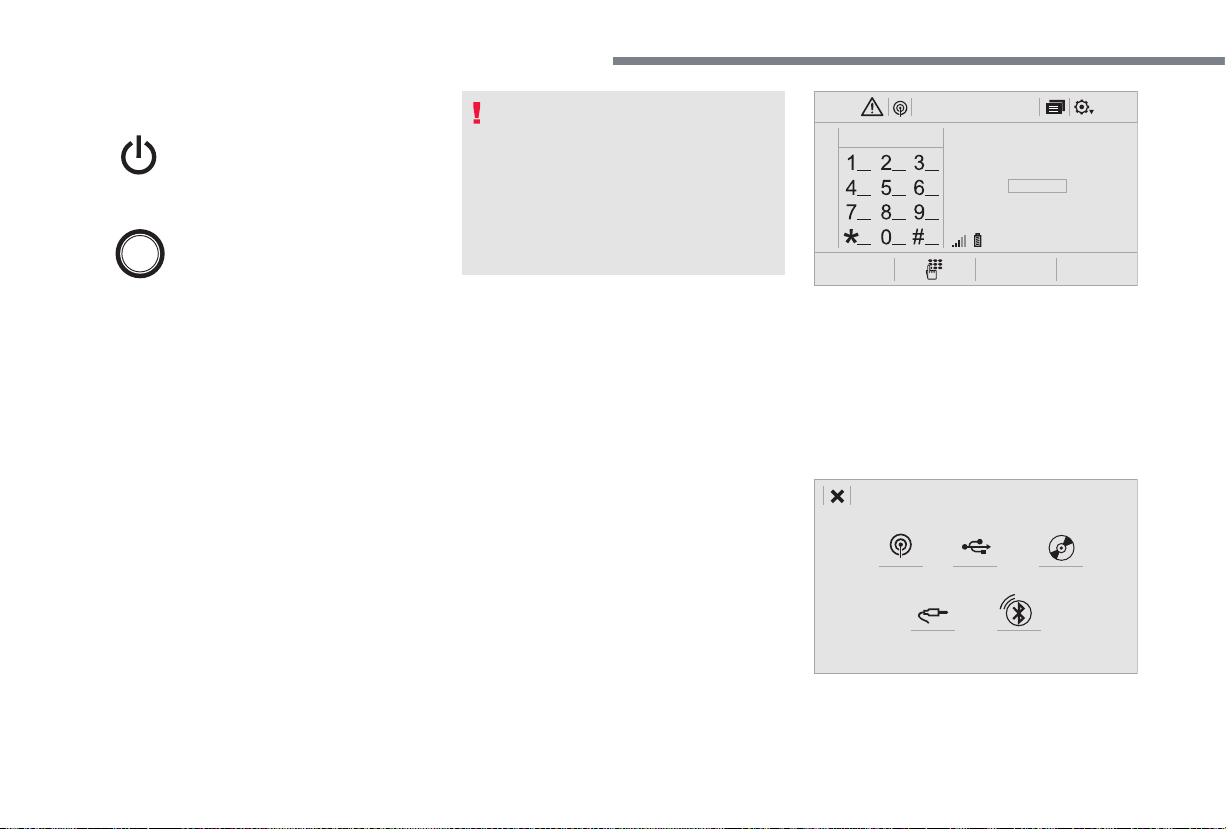
2
12:1318,5 21,523 °C
PEUGEOT Connect Nav
First steps
With the engine running, a press
mutes the sound.
With the ignition off, a press turns
the system on.
Adjustment of the volume.
Use the buttons either side of or below the
touch screen for access to the menus, then
press the virtual buttons in the touch screen.
Depending on the model, use the "Source" or
"Menu" buttons on the left of the touch screen
for access to the menus, then press the virtual
buttons in the touch screen.
You can display the menus at any time by
pressing the screen briefly with three fingers.
All of the touch areas of the screen are white.
Press the cross to go back a level.
Press "OK" to confirm.
The touch screen is of the "capacitive"
type.
To clean the screen, use a soft, non-
abrasive cloth (e.g. spectacles cloth) with
no additional product.
Do not use sharp objects on the screen.
Do not touch the screen with wet hands.
* Depending on equipment.
Certain information is displayed permanently in
the upper band of the touch screen:
- Reminder of the air conditioning information
(depending on version), and direct access to
the corresponding menu.
- Go directly to the selection of the audio
source, to the list of radio stations (or list of
titles depending on the source).
- Go to the message notifications, emails,
map updates and, depending on the
services, the navigation notifications.
- Go to the settings for the touch screen and
the digital instrument panel.
Selecting the audio source (depending on version):
- FM / DAB* / AM* radio stations.
- USB memory stick.
- CD Player (depending on model).
- Media player connected via the auxiliary socket
(depending on model).
- Telephone connected via Bluetooth* and
Bluetooth multimedia broadcast* (streaming).
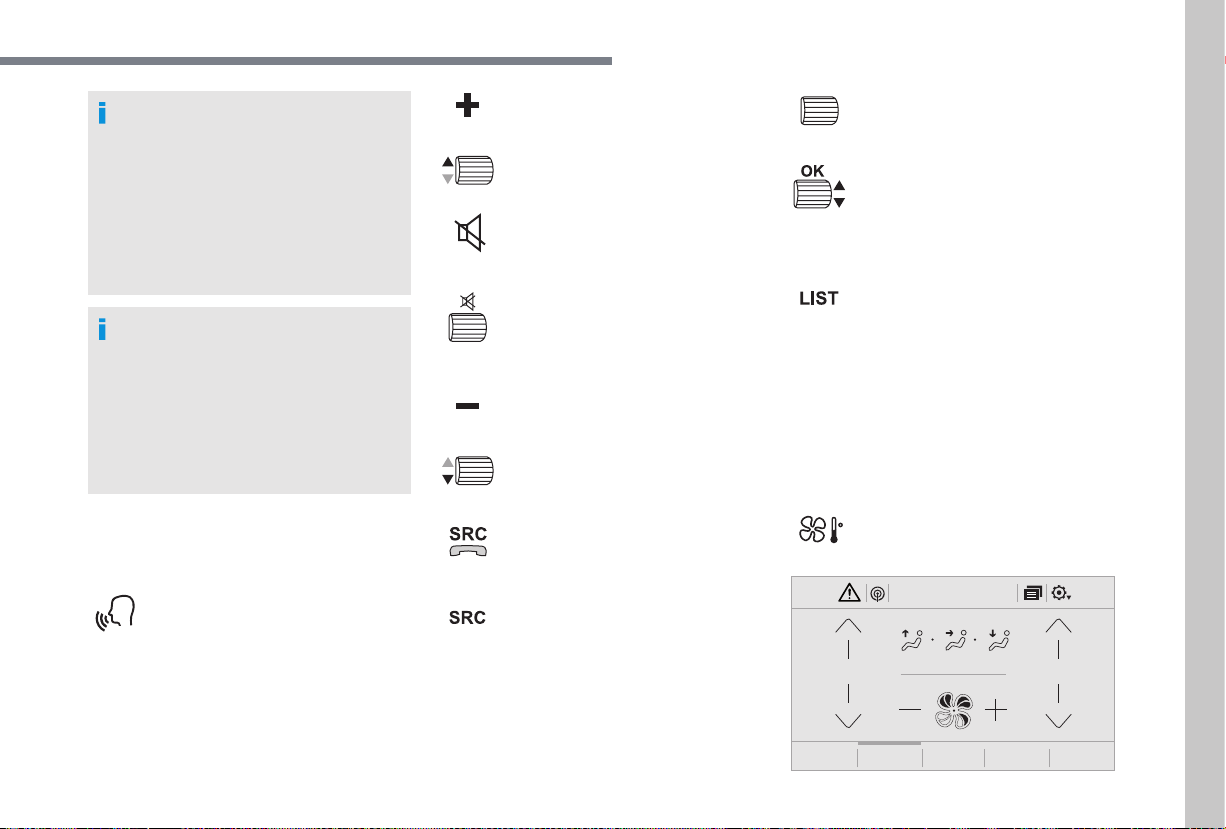
3
.
21,518,5
12:1323 °C
PEUGEOT Connect Nav
In the "Settings" menu you can create
a profile for just one person or a group
of people with common points, with the
possibility of entering a multitude of
settings (radio presets, audio settings,
navigation history, contact favourites,
etc.); these settings are taken into
account automatically.
In very hot conditions, the volume may
be limited to protect the system. It may go
into standby (screen and sound off) for at
least 5 minutes.
The return to normal takes place after
the temperature in the passenger
compartment drops.
Steering mounted controls
Depending on model
Voice commands:
This control is located on the
steering wheel or at the end of the
lighting control stalk (depending on
model).
Short press, system voice
commands.
Long press, smartphone voice
commands via the system.
or
Increase volume.
or
Mute / Restore the sound.
Or
Mute by pressing the volume
increase and decrease buttons
simultaneously.
Restore the sound by pressing one
of the two volume buttons.
or
Decrease volume.
or
Media (short press): change the
multimedia source.
Telephone (short press): start
telephone call.
Call in progress (short press):
access telephone menu.
Telephone (long press): reject an
incoming call, end call; when no call
is in progress, access telephone
menu.
or
Radio (rotate): automatic search for
the previous / next station.
Media (rotate): previous / next track,
move in a list.
Short press: confirm a selection; if
nothing selected, access to presets.
Radio: display the list of stations.
Media: display the list of tracks.
Radio (press and hold): update the
list of stations received.
Menus
Depending on model / Depending on version
Air conditioning
Manage the different temperature
and air flow settings.
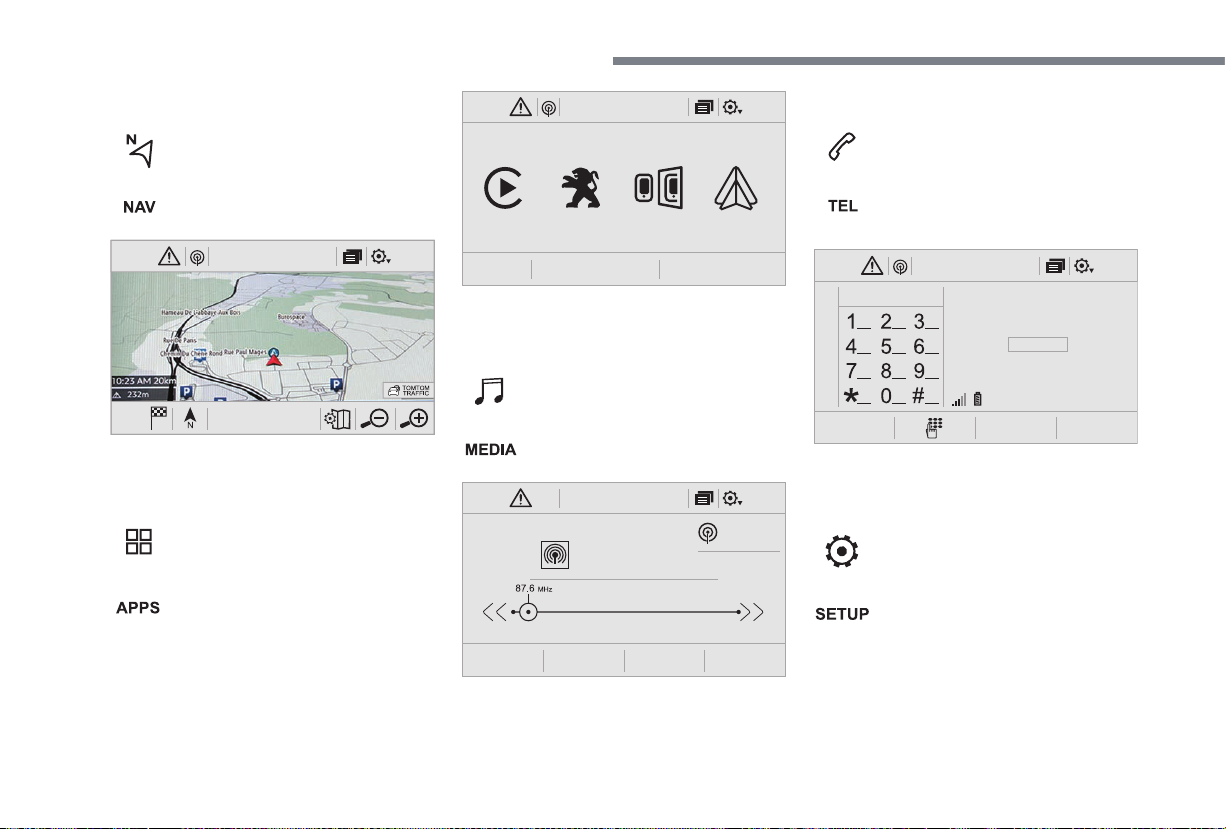
4
12:1318,5 21,523 °C
FM/87.5 MHz
87.5MHz
12:1318,5 21,523 °C
12:1318,5 21,523 °C
12:1318,5 21,523 °C
PEUGEOT Connect Nav
Connected navigation
or
Enter navigation settings and
choose a destination.
Use services available in real time,
depending on equipment.
Applications
or
Operate certain applications on
a smartphone connected via
CarPlay
®
, MirrorLink
TM
or Android
Auto.
Check the state of the Bluetooth
®
and Wi-Fi connections.
Radio Media
Telephone
or
Connect a telephone via Bluetooth
®
,
read messages and emails and send
quick messages.
Settings
or
Configure a personal profile and/
or configure the sound (balance,
ambience, etc.) and the display
(language, units, date, time, etc.).
or
Select an audio source, a radio
station, display photographs.
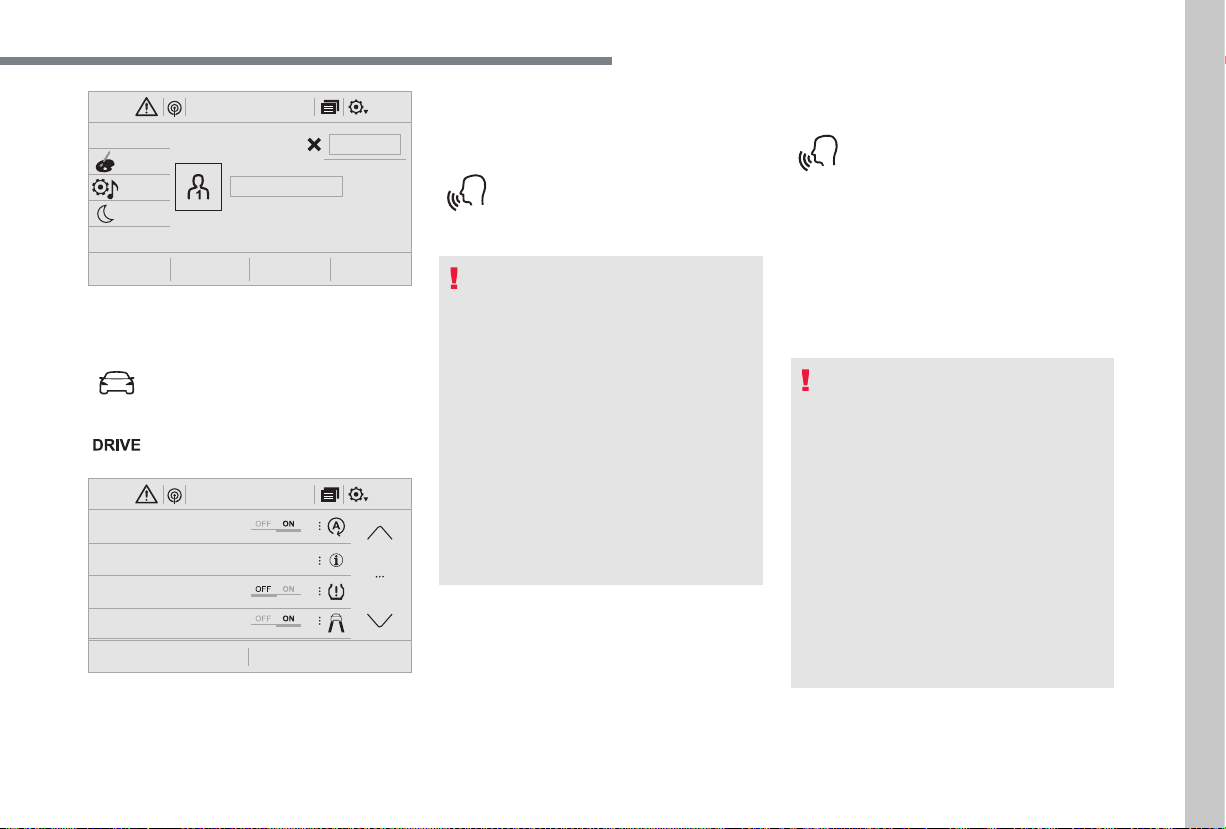
5
.
12:1318,5 21,523 °C
12:1318,5 21,523 °C
PEUGEOT Connect Nav
Vehicle
or
Activate, deactivate or configure
certain vehicle functions.
Voice commands
Steering mounted controls
Pressing this button activates the
voice commands function.
To ensure that voice commands are
always recognised by the system, please
observe the following recommendations:
- speak in a normal tone without
breaking up words or raising your
voice.
- always wait for the "beep" (audible
signal) before speaking.
- for best operation, it is recommended
that the windows and sunroof
be closed to avoid extraneous
interference (depending on version).
- before making a voice command, ask
other passengers not to speak.
First steps
Example of a "voice command" for
navigation:
"Navigate to address, 11 Regent
Street, London".
Example of a "voice command" for
the radio and media:
"Play artist, Madonna".
Example of a "voice command" for
the telephone:
"Call David Miller".
The voice commands, with a choice of
12 languages (English, French, Italian,
Spanish, German, Dutch, Portuguese,
Polish, Turkish, Russian, Arabic,
Brazilian), are made using the language
previously chosen and set in the system.
For some voice commands, there are
alternative synonyms.
Example: Guide to / Navigate to /
Go to / …
The voice commands in Arabic for:
"Navigate to address" and "Display POI
in the city" are not available.
6
PEUGEOT Connect Nav
Information – Using the system
Press the Push To Talk voice
command button and tell me
what you'd like after the tone.
Remember you can interrupt
me at any time by pressing
this button. If you press it
again while I'm waiting for
you to speak, it'll end the
conversation. If you need to
start over, say "cancel". If you
want to undo something, say
"undo". And to get information
and tips at any time, just say
"help". If you ask me to do
something and there's some
information missing that I need,
I'll give you some examples
or take you through it step by
step. There's more information
available in "beginner" mode.
You can set the dialogue mode
to "expert" when you feel
comfortable.
Global voice commands
These commands can be made from any
screen page after pressing the "Voice
command" or "Telephone" button located
on the steering wheel, as long as there is
no telephone call in progress.
Voice commands Help messages
Help There are lots of topics I can help you with.
You can say: "help with phone", "help with
navigation", "help with media" or "help with
radio". For an overview on how to use voice
controls, you can say "help with voice controls".
Voice command help
Navigation help
Radio help
Media help
Telephone help
Set dialogue mode as <…> Choose "beginner" or "expert" mode.
Select profile <…> Select profile 1, 2 or 3.
Yes Say "yes" if I got that right. Otherwise, say "no"
and we'll start that again.
No
7
.
PEUGEOT Connect Nav
"Navigation" voice
commands
These commands can be made from any
screen page after pressing the "Voice
command" or "Telephone" button located
on the steering wheel, as long as there is
no telephone call in progress.
Voice commands Help messages
Navigate home To start guidance or add a stopover, say
"navigate to" and then the address or contact
name. For example, "navigate to address 11
Regent Street, London", or "navigate to contact,
John Miller". You can specify if it's a preferred
or recent destination. For example, "navigate
to preferred address, Tennis club", "navigate to
recent destination, 11 Regent Street, London".
Otherwise, just say, "navigate home". To see
points of interest on a map, you can say things
like "show hotels in Banbury" or "show nearby
petrol station". For more information you can
ask for "help with route guidance".
Navigate to work
Navigate to preferred address <…>
Navigate to contact <…>
Navigate to address <…>
Show nearby POI <…>
Remaining distance To get information about your current route,
you can say "tell me the remaining time",
"distance" or "arrival time". Try saying "help
with navigation" to learn more commands.
Remaining time
Arrival time
Stop route guidance
Depending on the country, give the
destination instructions (address) in the
language used by the system.
8
PEUGEOT Connect Nav
These commands can be made from any
screen page after pressing the "Voice
command" or "Telephone" button located
on the steering wheel, as long as there is
no telephone call in progress.
Voice commands Help messages
Tune to channel <…> You can pick a radio station by saying "tune
to" and the station name or frequency. For
example "tune to channel Talksport" or "tune to
98.5 FM". To listen to a preset radio station, say
"tune to preset number". For example "tune to
preset number five".
What's playing To display the details of the current "track",
"artist" and "album", you can say "What's
playing".
Play song <…> Use the command "play" or "listen to" to select
the type of music you'd like to hear. You can
pick by "song", "artist", or "album". Just say
something like "play artist, Madonna", "play
song, Hey Jude", or "play album, Thriller".
Play artist <…>
Play album <…>
Media voice commands are available
only for a USB connection.
"Radio Media" voice
commands
9
.
PEUGEOT Connect Nav
"Telephone" voice
commands
If a telephone is connected to the system,
these voice commands can be issued
from any main screen page after pressing
the "Telephone" button on the steering
wheel, as long as there is no telephone
call in progress.
If there is no telephone connected by
Bluetooth, a voice message announces:
"Please first connect a telephone", and
the voice session will be closed.
Voice commands Help messages
Call contact <…>* To make a phone call, say "call" followed by
the contact name, for example: "Call David
Miller". You can also include the phone
type, for example: "Call David Miller at
home". To make a call by number, say "dial"
followed by the phone number, for example,
"Dial 07776 835 417". You can check your
voicemail by saying "call voicemail". To
send a text, say "send quick message to",
followed by the contact, and then the name
of the quick message you'd like to send. For
example, "send quick message to David
Miller, I'll be late". To display the list of calls,
say "display calls". For more information on
SMS, you can say "help with texting".
Dial <…>*
Display contacts*
Display calls*
Call (message box | voicemail)*
* This function is available only if the
telephone connected to the system supports
downloading of contacts and recent calls
and if the download has been done.
10
PEUGEOT Connect Nav
If a telephone is connected to the system,
these voice commands can be issued
from any main screen page after pressing
the "Telephone" button on the steering
wheel, as long as there is no telephone
call in progress.
If there is no telephone connected by
Bluetooth, a voice message announces:
"Please first connect a telephone", and
the voice session will be closed.
Voice commands Help messages
Send text to <…> To hear your messages, you can say "listen to
most recent message". When you want to send
a text, there's a set of quick messages ready
for you to use. Just use the quick message
name and say something like "send quick
message to Bill Carter, I'll be late". Check the
phone menu for the names of the supported
messages.
Please say "call" or "send quick message to",
and then select a line from the list. To move
around a list shown on the display, you can
say "go to start", "go to end", "next page" or
"previous page". To undo your selection, say
"undo". To cancel the current action and start
again, say "cancel".
Listen to most recent message*
The system only sends pre-recorded
"Quick messages".
"Text message" voice
commands
* This function is available only if the
telephone connected to the system supports
downloading of contacts and recent calls
and if the download has been done.
11
.
PEUGEOT Connect Nav
Navigation
Choice of a destination
To a new destination
or
Press Navigation to display the
primary page.
Press the "MENU" button to go to the
secondary page.
Select "Enter address".
Select the "Country".
Enter the "City", the "Street" and the
"Number" and confirm by pressing
on the suggestions displayed.
Press "OK" to select the "Guidance
criteria".
And / Or
Select "See on map" to select the
"Guidance criteria".
Press "OK" to start navigation.
Zoom out / zoom in using the touch
buttons or with two fingers on the screen.
In order to be able to use the navigation,
it is necessary to fill in the "City", the
"Street" and the "Number" on the
virtual keyboard or take it from the list in
"Contact" or in the "History" of addresses.
Without confirmation of the street number,
you will be guided to one end of the street.
To a recent destination
or
Press Navigation to display the
primary page.
Press the "MENU" button to go to the
secondary page.
Select "My destinations".
Select the "Recent" tab.
Select the address chosen in the list to display
the "Guidance criteria.
Press "OK" to start navigation.
Select "Position" to visualise the arrival
point geographically.
To "My home" or "My work"
or
Press Navigation to display the
primary page.
Press the "MENU" button to go to the
secondary page.
Select "My destinations".
Select the "Preferred" tab.
Select "My home".
Or
Select "My work".
Or
Select a preset favourite destination.
12
PEUGEOT Connect Nav
Press the "MENU" button to go to the
secondary page.
Select "My destinations".
Select the "Contact" tab.
Select a contact in the list to start navigation.
Towards points of interest
(POI)
Points of Interest (POI) are listed in different
categories.
or
Press Navigation to display the
primary page.
Press the "MENU" button to go to the
secondary page.
Select "Points of interest".
Select the "Travel", or "Leisure"
or "Commercial" or "Public" or
"Geographic" tab.
Or
Select "Search" to enter the name
and address of a POI.
Press "OK" to start calculation of
the route.
To a point on the map
or
Press Navigation to display the
primary page.
Explore the map by sliding a finger on the
screen.
Select the destination by pressing on the map.
Tap the screen to place a marker
and display the sub-menu.
Towards a contact
or
Press Navigation to display the
primary page.
Press this button to start navigation.
Or
Press this button to save the
address displayed.
A long press on an item opens a list of
POIs nearby.
Towards GPS coordinates
or
Press Navigation to display the
primary page.
Explore the map by sliding a finger on the
screen.
Press this button to display the world
map.
Using the grid, select by zoom the
desired country or region.
Press this button to enter the GPS
coordinates.
13
.
PEUGEOT Connect Nav
A marker is displayed in the middle
of the screen, with the "Latitude"
and "Longitude" coordinates.
Press this button to start navigation.
Or
Press this button to save the
address displayed.
OR
Press this button to enter the value
for "Latitude" using the virtual
keypad.
And
Press this button to enter the value
for "Longitude" using the virtual
keypad.
TMC (Traffic Message
Channel)
TMC (Traffic Message Channel)
messages are linked to a European
standard on the broadcasting of traffic
information via the RDS system on FM
radio, transmitting traffic information in
real time.
The TMC information is then displayed
on a GPS Navigation system map and
taken into account straight away during
navigation, so as to avoid accidents,
traffic jams and closed roads.
The display of danger zones depends on
the legislation in force and subscription to
the service.
Connected navigation
Depending on version
Depending on the equipment level of the vehicle
Network connection provided by
the vehicle
OR
Network connection provided by
the user
Connected navigation
connection
As a safety measure and because it
requires sustained attention by the driver,
using a smartphone when driving is
prohibited.
All operations must be done with the
vehicle stationary.
For access to connected navigation, you
can use the connection provided by the
vehicle via the "Emergency or assistance
call" services or use your smartphone as
a modem.
Activate and enter settings for sharing
the smartphone connection.
14
PEUGEOT Connect Nav
Network connection provided by
the user
Connect a USB cable.
The smartphone charges when
connected by a USB cable.
Bluetooth connection
Wi-Fi connection
Restrictions of use:
- With CarPlay
®
, connection sharing is
only with a Wi-Fi connection.
- With MirrorLink
TM
, connection sharing
is only with a USB connection.
The quality of services depends on the
quality of the network connection.
Network connection provided by
the vehicle
The system is automatically
connected to the modem included
for the "Emergency or assistance
calls" services and does not require
a connection provided by the user
via their smartphone.
With the arrival of "TOMTOM
TRAFFIC", the services are
available.
The services offered with connected
navigation are as follows.
A Connected Services pack:
- Weather,
- Filling stations,
- Car park,
- Traffic,
- POI local search.
A Danger zone pack (option).
The processes and standards are
constantly changing; for the communication
process between the smartphone and the
system to work correctly, we recommend
that you update the operating system of
the smartphone as well as the date and
time of the smartphone and the system.
Settings specific to
connected navigation
In the "Settings" menu you can create
a profile for just one person or a group
of people with common points, with the
possibility of entering a multitude of
settings (radio presets, audio settings,
navigation history, contact favourites,
etc.); these settings are taken into
account automatically.
or
Press Navigation to display the
primary page.
Press the "MENU" button to go to the
secondary page.
USB connection
Activate the Bluetooth function on
the telephone and ensure that it is
visible to all (see the "Applications"
section).
Select a Wi-Fi network found by the
system and connect to it (see the
"Applications" section).
15
.
PEUGEOT Connect Nav
Select "Settings".
Select "Map".
Activate or deactivate:
- "Allow declaration of danger
zones".
- "Guidance to final destination
on foot"
- "Authorise sending
information"
These settings must be made
according to each profile.
Select "Alerts".
Activate or deactivate "Warn of
danger zones".
Select this button.
Activate: Give an audible warning
For access to connected navigation, you
have to select the option: "Authorise
sending information".
The display of danger zones depends on
the legislation in force and subscription to
the service.
Declaration of "Danger
zones"
To distribute information on the
declaration of danger zones, you should
check the option: "Allow declaration of
danger zones".
or
Press Navigation to display the
primary page.
Press the "Declare a new danger
zone" button located in the upper
bar of the touch screen
Select the option "Type" to choose
the type of "danger zone".
Select the "Speed" option and enter
it using the virtual keypad.
Press "OK" to save and distribute
the information.
"Danger zones" pack
updates
Press Settings to display the
primary page.
Press the "OPTIONS" button to go to the
secondary page.
Select "System settings".
Select the "System info" tab.
Select "View" to display the versions
of the different modules installed in
the system.
Select "Update(s) due".
You can download the system and map
updates from the Brand's website.
The update procedure can also be found
on the website.
16
PEUGEOT Connect Nav
Display the weather
or
Press Navigation to display the
primary page.
Press this button to display the list of
services.
Select "View map".
Select "Weather".
Press this button to display primary
information.
Press this button to display the
detailed weather information.
The temperature displayed at 6 a.m. will
be the maximum temperature for the day.
The temperature displayed at 6 p.m.
will be the minimum temperature for the
night.
Applications
Internet Browser
or
Press Applications to display the
primary page.
Press "Connectivity" to go to the "Internet
Browser" function.
Press "Internet Browser" to display the
browser home page.
Select your country of residence.
Press "OK" to save and start the
browser.
Connection to the internet is via one of
the network connections provided by the
vehicle or the user.
Connectivity
or
Press Applications to display the
primary page.
Press "Connectivity" to go to the CarPlay
®
,
MirrorLink
TM
or Android Auto functions.
Applications
or
Press Applications to display the
primary page.
Press "Applications" to display the
applications home page.
CarPlay
®
smartphone
connection
As a safety measure and because it
requires sustained attention by the driver,
using a smartphone when driving is
prohibited.
All operations must be done with the
vehicle stationary.
17
.
PEUGEOT Connect Nav
The synchronisation of a personal
smartphone allows users to display
applications compatible with the
smartphone's CarPlay
®
technology on the
vehicle screen when the smartphone's
CarPlay
®
function has been previously
activated.
As the processes and standards are
constantly changing, it is recommended
that you keep your smartphone's
operating system updated.
For the list of eligible smartphones, go
to the Brand's internet website in your
country.
Connect a USB cable. The
smartphone charges when
connected by a USB cable.
or
Press on "Telephone" to display the
CarPlay
®
interface.
Or
Connect a USB cable. The
smartphone charges when
connected by a USB cable.
or
From the system, press "Applications"
to display the primary page.
Press "Connectivity" to go to the CarPlay
®
function.
Press "CarPlay" to display the
CarPlay
®
interface.
On connecting the USB cable, the
CarPlay
®
function deactivates the
system's Bluetooth
®
mode.
MirrorLink
TM
smartphone
connection
As a safety measure and because it
requires sustained attention by the driver,
using a smartphone when driving is
prohibited.
All operations must be done with the
vehicle stationary.
The synchronisation of a personal
smartphone allows users to display
applications adapted for the
smartphone's MirrorLink
TM
technology on
the vehicle screen.
The processes and standards
are constantly changing. For the
communication process between the
smartphone and the system to operate,
it is essential that the smartphone be
unlocked; update the operating system
of the smartphone as well as the date
and time of the smartphone and the
system.
For the list of eligible smartphones, go
to the Brand's internet website in your
country.
As a safety measure, applications
can only be viewed with the vehicle
stationary; display is interrupted once the
vehicle is moving.
The MirrorLink
TM
function requires the
use of a compatible smartphone and
applications.
When connecting a smartphone
to the system, it is recommended
that Bluetooth
®
be started on the
smartphone.
18
PEUGEOT Connect Nav
Connect a USB cable. The
smartphone charges when
connected by a USB cable.
or
From the system, press
"Applications" to display the
primary page.
Press "Connectivity" to go to the MirrorLink
TM
function.
Press "MirrorLink
TM
" to start the
application in the system.
Depending on the smartphone, it may be
necessary to activate the MirrorLink
TM
function.
In the process, several screen
pages relating to certain functions
are displayed.
Accept to start and complete the
connection.
Once connection is established, a page
is displayed with the applications already
downloaded to your smartphone and adapted
to MirrorLink
TM
technology.
Access to the different audio sources remains
accessible in the margin of the MirrorLink
TM
display, using touch buttons in the upper bar.
Access to the menus for the system is possible
at any time using the dedicated buttons.
There may be a wait for the availability of
applications, depending on the quality of
your network.
Android Auto smartphone
connection
As a safety measure and because it
requires sustained attention by the driver,
using a smartphone when driving is
prohibited.
All operations must be done with the
vehicle stationary.
The synchronisation of a personal
smartphone allows users to display
applications adapted for the
smartphone's Android Auto technology
on the vehicle screen.
The processes and standards
are constantly changing. For the
communication process between the
smartphone and the system to operate,
it is essential that the smartphone be
unlocked; update the operating system
of the smartphone as well as the date
and time of the smartphone and the
system.
For the list of eligible smartphones, go
to the Brand's internet website in your
country.
As a safety measure, applications
can only be viewed with the vehicle
stationary; display is interrupted once the
vehicle is moving.
The "Android Auto" function requires
the use of a compatible smartphone and
applications.
Connect a USB cable. The
smartphone charges when
connected by a USB cable.
or
From the system, press
"Applications" to display the
primary page.
Press "Connectivity" to go to the "Android
Auto" function.
Press "Android Auto" to start the
application in the system.
In the process, several screen
pages relating to certain functions
are displayed.
Accept to start and complete the
connection.
19
.
PEUGEOT Connect Nav
Different audio sources remain accessible in
the margin of the Android Auto display, using
touch buttons in the upper bar.
Access to the menus for the system is possible
at any time using the dedicated buttons.
In Android Auto mode, the function to
display the menus by pressing the screen
briefly with three fingers is deactivated.
There may be a waiting time for the
availability of applications, depending on
the quality of your network.
Bluetooth
®
connection
As a safety measure and because they
require prolonged attention on the part
of the driver, the operations for pairing
of the Bluetooth mobile telephone with
the Bluetooth hands-free system of your
audio system must be carried out with the
vehicle stationary and the ignition on.
Activate the Bluetooth function on the
telephone and ensure that it is "visible to
all" (telephone configuration).
Procedure from the telephone
Select the system name in the list of
devices detected.
In the system, accept the connection request
from the telephone.
To complete the pairing, whichever
procedure used (from the telephone or
from the system), ensure that the code
is the same in the system and in the
telephone.
Procedure from the system
or
Press Applications to display the
primary page.
Press the "OPTIONS" button to go to the
secondary page.
Press "Bluetooth connection".
Select "Search".
The list of telephones detected is
displayed.
If the pairing procedure fails, it is
recommended that you deactivate and
then reactivate the Bluetooth function in
your telephone.
Select the name of the chosen
telephone in the list.
Depending on the type of telephone,
you may be asked to accept or not the
transfer of your contacts and messages.
Connection sharing
The system offers to connect the telephone
with 3 profiles:
- "Telephone" (hands-free kit, telephone
only),
- "Streaming" (streaming: wireless playing of
the audio files on the telephone),
- "Mobile internet data".
20
PEUGEOT Connect Nav
The "Mobile internet data" profile
must be activated for connected
navigation (where the vehicle does not
have "Emergency and assistance call"
services), having first activated sharing of
this connection on your smartphone.
Select one or more profiles.
Press "OK" to confirm.
Wi-Fi connection
Network connection by the smartphone's Wi-Fi.
or
Press Applications to display the
primary page.
Press the "OPTIONS" button to go to the
secondary page.
Select "Wi-Fi network
connection".
Select the "Secured" or "Not
secured" or "Stored" tab.
Select a network.
Using the virtual keypad, enter the
"Key" for the Wi-Fi network and the
"Password".
Press "OK" to start the connection.
The Wi-Fi connection and the sharing of
the Wi-Fi connection are exclusive.
Wi-Fi connection sharing
Creation of a local Wi-Fi network by the
system.
or
Press Applications to display the
primary page.
Press the "OPTIONS" button to go to the
secondary page.
Select "Share Wi-Fi connection".
Select the "Activation" tab to activate or
deactivate sharing of the Wi-Fi connection.
And / Or
Select the "Settings" tab to change the name
of the system network and the password.
Press "OK" to confirm.
To protect against unauthorised access
and make your systems as secure as
possible, the use of a complex security
code or password is recommended.
Manage connections
or
Press Applications to display the
primary page.
Press the "OPTIONS" button to go to the
secondary page.
Select "Manage connection".
With this function you can view the access
to connected services, the availability of
connected services and modify the connection
mode.
21
.
PEUGEOT Connect Nav
Radio
Selecting a station
or
Press Radio Media to display the
primary page.
Press "Frequency".
Press one of the buttons for an
automatic search for radio stations.
Or
Move the cursor for a manual search
for frequencies up or down.
Or
or
Press Radio Media to display the
primary page.
Press the "OPTIONS" button to go to the
secondary page.
Select "Radio stations" in the
secondary page.
Press "Frequency".
Enter the values using the virtual
keypad.
First enter the units then click on the
decimals zone to enter the figures
after the decimal point.
Press "OK" to confirm.
Radio reception may be affected by the
use of electrical equipment not approved
by the Brand, such as a USB charger
connected to the 12 V socket.
The external environment (hills, buildings,
tunnels, basement car parks, etc.) may
block reception, including in RDS mode.
This is a normal effect of the way in
which radio waves are transmitted and
does not indicate any failure of the audio
equipment.
Presetting a station
Select a radio station or frequency.
(refer to the corresponding section)
Press "Presets".
Make a long press on one of the
buttons to preset the station.
Activating / Deactivating RDS
or
Press Radio Media to display the
primary page.
Press the "OPTIONS" button to go to the
secondary page.
Select "Radio settings".
Select "General".
Activate / Deactivate "Station
follow".
Press "OK" to confirm.
RDS, if activated, allows you to continue
listening to the same station by automatic
retuning to alternative frequencies.
However, in certain conditions, coverage
of an RDS station may not be assured
throughout the entire country as
radio stations do not cover 100% of
the territory. This explains the loss of
reception of the station during a journey.
22
PEUGEOT Connect Nav
Display text information
The "Radio Text" function allows
information transmitted by the radio
station and related to the station or the
song playing to be displayed.
or
Press Radio Media to display the
primary page.
Press the "OPTIONS" button to go to the
secondary page.
Select "Radio settings".
Select "General".
Activate / Deactivate "Display radio
text".
Press "OK" to confirm.
Play TA messages
The TA (Traffic Announcement) function
gives priority to TA alert messages.
To operate, this function needs good
reception of a radio station that carries
this type of message. While traffic
information is being broadcast, the
current media is automatically interrupted
so that the TA message can be heard.
Normal play of the media previously
playing is resumed at the end of the
message.
Select "Announcements".
Activate / Deactivate "Traffic
announcement".
Press "OK" to confirm.
DAB (Digital Audio
Broadcasting) radio
Terrestrial Digital Radio
Digital radio provides higher quality
reception.
The different "multiplexes" offer a choice
of radio stations arranged in alphabetical
order.
or
Press Radio Media to display the
primary page.
Select the audio source.
Press "Band" to select the "DAB" waveband.
DAB-FM auto tracking
"DAB" does not cover 100% of the
territory.
When the digital radio signal is poor,
"DAB-FM tracking" allows you to
continue listening to the same station,
by automatically switching to the
corresponding FM analogue station (if
there is one).
or
Press Radio Media to display the
primary page.
Press the "OPTIONS" button to go to the
secondary page.
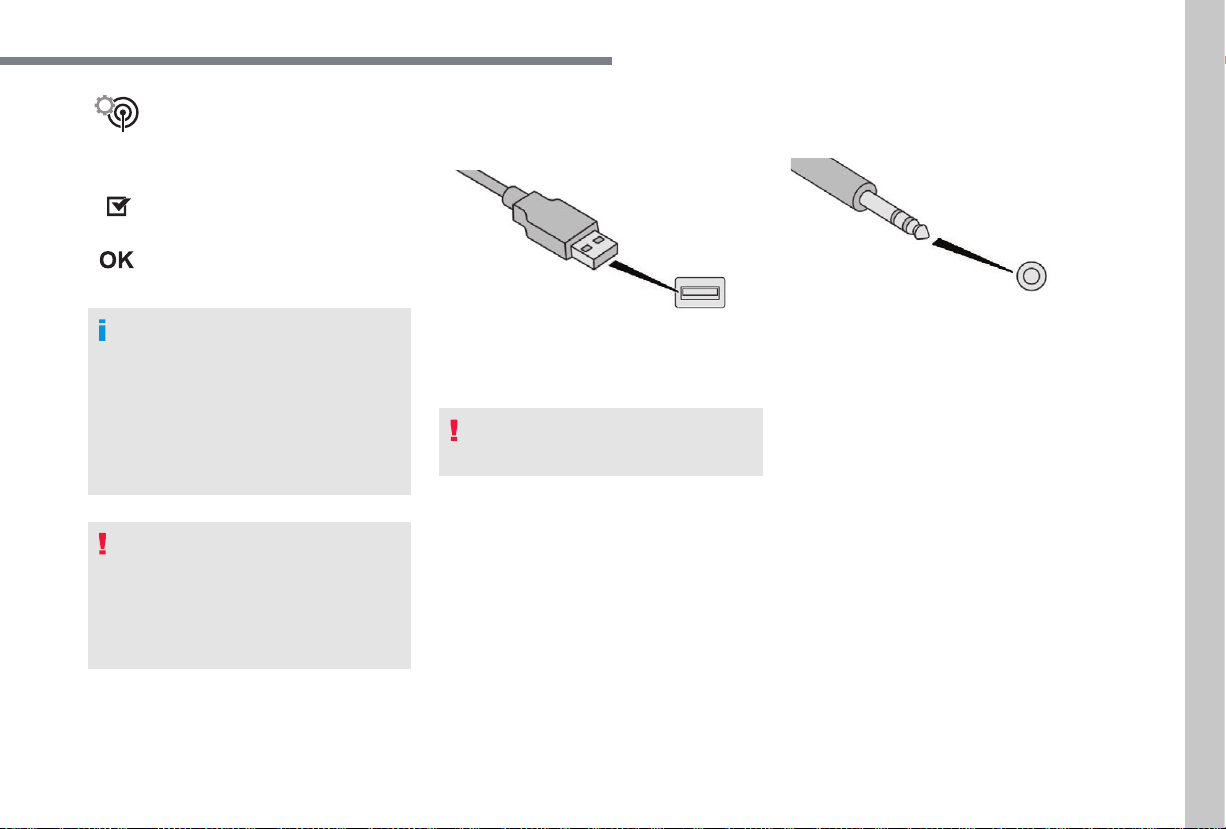
23
.
PEUGEOT Connect Nav
Select "Radio settings".
Select "General".
Activate / Deactivate "Station
follow".
Press "OK".
If "DAB-FM tracking" is activated, there
is a difference of a few seconds when the
system switches to FM analogue radio
with sometimes a variation in volume.
Once the digital signal quality is restored,
the system automatically changes back
to "DAB".
If the "DAB" station being listened to is
not available on FM ("DAB-FM" option
greyed out), or "DAB-FM tracking" is not
activated, the sound will cut out while the
digital signal is too weak.
Media
USB
Insert the USB memory stick in the USB port or
connect the USB device to the USB port using
a suitable cable (not supplied).
To protect the system, do not use a USB
hub.
The system builds playlists (in temporary
memory), an operation which can take from
a few seconds to several minutes at the first
connection.
Reduce the number of non-music files and the
number of folders to reduce the waiting time.
The playlists are updated every time the
ignition is switched off or a USB memory stick
is connected. The lists are memorised: if they
are not modified, the subsequent loading time
will be shorter.
Auxiliary socket (AUX)
(depending on model / depending on equipment)
This source is only available if "Auxiliary input"
has been checked in the audio settings.
Connect the portable device (MP3 player, etc.)
to the auxiliary Jack socket using an audio
cable (not supplied).
First adjust the volume on your portable device
(to a high level). Then adjust the volume of your
audio system.
Display and management of the controls are
via the portable device.
CD player
(depending on model / depending on
equipment)
Insert the CD in the player.
24
PEUGEOT Connect Nav
Selecting the source
or
Press Radio Media to display the
primary page.
Select "Source".
Choose the source.
Bluetooth
®
audio streaming
Streaming allows you to listen to music from
your smartphone.
The Bluetooth profile must be activated, first
adjust the volume on your portable device (to a
high level).
Then adjust the volume of your audio system.
If play does not start automatically, it may be
necessary to start the audio playback from the
telephone.
Control is from the portable device or by using
the system's touch buttons.
Once connected in streaming mode, the
telephone is considered to be a media
source.
Connecting Apple
®
players
Connect the Apple
®
player to the USB port
using a suitable cable (not supplied).
Play starts automatically.
Control is via the audio system.
The classifications available are those of
the portable device connected (artists /
albums / genres / playlists / audiobooks /
podcasts).
The default classification used is by
artists. To modify the classification used,
return to the first level of the menu then
select the desired classification (playlists
for example) and confirm to go down
through the menu to the desired track.
The version of software in the audio system
may not be compatible with the generation of
your Apple
®
player.
Information and advice
The system supports USB mass storage
devices, BlackBerry
®
devices or Apple
®
players via USB ports. The adapter cable
is not supplied.
Device management is done by the audio
system controls.
Other peripherals, not recognised on
connection, must be connected to the
auxiliary socket using a Jack cable (not
supplied) or via Bluetooth streaming,
depending on compatibility.
To protect the system, do not use a USB
hub.
The audio equipment will only play audio files
with ".wma", ".aac", ".flac", ".ogg" and ".mp3"
file extensions and with a bit rate of between
32 Kbps and 320 Kbps.
It also supports VBR (Variable Bit Rate) mode.
No other file types (".mp4", etc.) can be read.
Files of the ".wma" type should be to the wma 9
standard.
The sampling rates supported are 32, 44 and
48 kHz.
25
.
PEUGEOT Connect Nav
It is advisable to restrict file names to
20 characters, without using special
characters (e.g. " " ? . ; ù) so as to avoid any
reading or display problems.
Use only USB keys in FAT32 format (File
Allocation Table).
It is recommended that the original USB
cable for the portable device is used.
In order to be able to play a burned CDR or
CDRW, select standards ISO 9660 level 1, 2 or
Joliet if possible when burning the CD.
If the disc is burned in another format, it may
not be played correctly.
It is recommended that the same burning
standard is always used on an individual disc,
with the lowest speed possible (4x maximum)
for the best acoustic quality.
In the particular case of a multi-session CD, the
Joliet standard is recommended.
Telephone
Pairing a Bluetooth
®
telephone
As a safety measure and because it
requires sustained attention by the
driver, the pairing of a Bluetooth mobile
telephone with the Bluetooth hands-free
system of your audio system must be
done with the vehicle stationary and the
ignition on.
Activate the Bluetooth function on the
telephone and ensure that it is "visible to
all" (telephone configuration).
Procedure from the telephone
Select the system name in the list of
devices detected.
In the system, accept the connection request
from the telephone.
To complete the pairing, whichever
procedure used (from the telephone or
from the system), ensure that the code
is the same in the system and in the
telephone.
Procedure from the system
or
Press Telephone to display the
primary page.
Press "Bluetooth search".
Or
Select "Search".
The list of telephones detected is
displayed.
If the pairing procedure fails, it is
recommended that you deactivate and
then reactivate the Bluetooth function in
your telephone.
Select the name of the chosen
telephone in the list.
Connection sharing
The system offers to connect the telephone
with 3 profiles:
- "Telephone" (hands-free kit, telephone
only),
- "Streaming" (streaming: wireless playing of
the audio files on the telephone),
- "Mobile internet data".
26
PEUGEOT Connect Nav
Activation of the profile; "Mobile internet
data" is obligatory for connected
navigation having first activated sharing
of this connection on your smartphone.
Select one or more profiles.
Press "OK" to confirm.
Depending on the type of telephone,
you may be asked to accept or not the
transfer of your contacts and messages.
Automatic reconnection
On return to the vehicle, if the last
telephone connected is present again,
it is automatically recognised and within
about 30 seconds of switching on the
ignition, the connection is established
without any action on your part (Bluetooth
activated).
To modify the connection profile:
or
Press Telephone to display the
primary page.
Press the "OPTIONS" button to go to the
secondary page.
Select "Bluetooth connection" to
display the list of paired devices.
Press the "details" button.
Select one or more profiles.
Press "OK" to confirm.
The ability of the system to connect
to just one profile depends on the
telephone.
All three profiles may connect by default.
The services available depend on
the network, the SIM card and the
compatibility of the Bluetooth devices
used. Check the instructions for your
telephone and with your service provider
for the services to which you have access.
The profiles compatible with the system
are: HFP, OPP, PBAP, A2DP, AVRCP,
MAP and PAN.
Go to the Brand's website for more information
(compatibility, additional help, etc.).
Managing paired telephones
This function allows the connection or
disconnection of a peripheral device as
well as the deletion of a pairing.
or
Press Telephone to display the
primary page.
Press the "OPTIONS" button to go to the
secondary page.
Select "Bluetooth connection" to
display the list of paired devices.
Press on the name of the telephone
chosen in the list to disconnect it.
Press again to connect it.
27
.
PEUGEOT Connect Nav
Deleting a telephone
Select the basket at top right of the
screen to display a basket alongside
the telephone chosen.
Press the basket alongside the
telephone chosen to delete it.
Receiving a call
An incoming call is announced by a ring and a
superimposed display in the screen.
Make a short press on the steering
mounted PHONE button to accept
an incoming call.
And
Make a long press
on the steering mounted PHONE
button to reject the call.
Or
Select "End call".
Making a call
Using the telephone is not recommended
while driving.
Park the vehicle.
Make the call using the steering mounted
controls.
Calling a new number
or
Press Telephone to display the
primary page.
Enter the phone number using the
digital keypad.
Press "Call" to start the call.
Calling a contact
or
Press Telephone to display the
primary page.
Or make a long press
on the steering mounted PHONE
button.
Select "Contact".
Select the desired contact from the list offered.
Select "Call".
Calling a recently used
number
or
Press Telephone to display the
primary page.
Or
Make a long press
on the steering mounted button.
Select "Calls".
Select the desired contact from the list offered.
28
PEUGEOT Connect Nav
It is always possible to make a call
directly from the telephone; as a safety
measure, first park the vehicle.
Managing contacts / entries
or
Press Telephone to display the
primary page.
Select "Contact".
Select "Create" to add a new
contact.
In the "Telephone" tab, enter the telephone
numbers for the contact.
In the "Address" tab, enter the addresses for
the contact.
In the "Email" tab, enter the email addresses
for the contact.
The "Email" function allows email
addresses to be entered for a contact, but
the system is not able to send emails.
Managing messages
or
Press Telephone to display the
primary page.
Press the "OPTIONS" button to go to the
secondary page.
Select "Messages" to display the list
of messages.
Select the "All" or "Sent" or
"Incoming" tab.
Select the detail of the message
chosen in one of the lists.
Press "Answer" to send a quick
message stored in the system.
Press "Call" to start the call.
Press " Play" to hear the message.
Access to "Messages" depends on the
compatibility of the smartphone and the
integral system.
Depending on the smartphone, access to
your messages or email may be slow.
The services available depend on
the network, the SIM card and the
compatibility of the Bluetooth devices
used.
Check in the manual for your smartphone
and with your service provider for the
services available to you.
Managing quick messages
or
Press Telephone to display the
primary page.
Press the "OPTIONS" button to go to the
secondary page.
Select "Quick messages" to display
the list of messages.
31
.
PEUGEOT Connect Nav
Move the cursor to adjust the
brightness of the screen and/or of
the instrument panel.
or
Press Settings to display the
primary page.
Press the "OPTIONS" button to go to the
secondary page.
Select "System settings".
Select "Units" to change the units of distance,
fuel consumption and temperature.
Select "Factory settings" to return to the initial
settings.
Returning the system to factory settings
activates the English language by default.
Select "System info" to display the versions of
the different modules installed in the system.
Select the language
or
Press Settings to display the
primary page.
Press the "OPTIONS" button to go to the
secondary page.
Select "Languages" to change the
language.
Setting the date
or
Press Settings to display the
primary page.
Press the "OPTIONS" button to go to the
secondary page.
Select "Setting the time-date".
Select "Date".
Press on this button to define the
date.
Press "OK" to confirm.
Select the display format of the date.
Adjustment of the time and date is only
available if "GPS synchronisation" is
deactivated.
The change between winter and summer
time is done by changing the time zone.
Setting the time
or
Press Settings to display the
primary page.
Press the "OPTIONS" button to go to the
secondary page.
Select "Setting the time-date".
Select "Time".
Press this button to adjust the time
using the virtual keypad.
32
PEUGEOT Connect Nav
Press "OK" to confirm.
Press this button to define the time
zone.
Select the display format for the time
(12h / 24h).
Activate or deactivate
synchronisation with GPS (UTC).
Press "OK" to confirm.
The system does not automatically
manage the change between winter and
summer time (depending on country).
Colour schemes
As a safety measure, the procedure
for changing the colour scheme is only
possible when the vehicle is stationary.
or
Press Settings to display the
primary page.
Select "Colour schemes".
Select a colour scheme in the list
then press "OK" to confirm.
Every time the colour scheme is
changed, the system restarts, temporarily
displaying a black screen.
Frequently asked
questions
The following information groups together the
answers to the most frequently asked questions
concerning your audio system.

34
PEUGEOT Connect Nav
Radio
QUESTION RESPONSE SOLUTION
The reception quality of the tuned radio station
gradually deteriorates or the stored stations are
not working (no sound, 87.5 MHz is displayed,
etc.).
The vehicle is too far from the transmitter of
the station or no transmitter is present in the
geographical area.
Activate the "RDS" function by means of the
short-cut menu to enable the system to check
whether there is a more powerful transmitter in
the geographical area.
The environment (hills, buildings, tunnels,
basement car parks, etc.) block reception,
including in RDS mode.
This phenomenon is normal and does not
indicate a failure of the audio equipment.
The aerial is absent or has been damaged (for
example when going through a car wash or into
an underground car park).
Have the aerial checked by a dealer.
The altitude is not displayed. On starting, the initialisation of the GPS may
take up to 3 minutes to receive more than
4 satellites correctly.
Wait until the system has started up completely
so that there is GPS coverage by at least
4 satellites.
Depending on the geographical environment
(tunnel, etc.) or the weather, the conditions of
reception of the GPS signal may vary.
This behaviour is normal. The system is
dependent on the GPS signal reception
conditions.
My navigation is no longer connected. During start-up and in certain geographical
areas, the connection may be unavailable.
Check that the connected services are
activated (settings, contract).
35
.
PEUGEOT Connect Nav
I cannot find some radio stations in the list of
stations received.
The name of the radio station changes.
The station is not received or has changed its
name in the list.
Some radio stations send other information
in place of their name (the title of the song for
example).
The system interprets these details as the
station name.
Press on the "Update list" button in the "Radio
stations" secondary menu.
QUESTION RESPONSE SOLUTION
Playback of my USB memory stick starts only
after a very long wait (around 2 to 3 minutes).
Some files supplied with the memory stick
may greatly slow down access to reading
the memory stick (multiplication by 10 of the
catalogue time).
Delete the files supplied with the memory stick
and limit the number of sub-folders in the file
structure on the memory stick.
The CD is ejected every time or is not played. The CD is upside down, cannot be read, does
not contain audio files or contains audio files of
a format not recognised by the audio system.
The CD has been recorded in a format that is
not compatible with the player (udf, etc.).
The CD is protected by an anti-pirating system
not recognised by the audio system.
Check that the CD is inserted in the player the
right way up.
Check the condition of the CD: the CD cannot
be played if it is too badly damaged.
Check the content in the case of a recorded
CD: consult the advice in the "AUDIO" section.
The audio system CD does not read DVDs.
Due to poor quality, certain burned CDs will not
be read by the audio system.
Media

36
PEUGEOT Connect Nav
There is a long waiting period following the
insertion of a CD or connection of a USB
memory stick.
Upon insertion of a new key, the system reads
a certain amount of data (directory, title, artist,
etc.). This may take from a few seconds to a
few minutes.
This is perfectly normal.
The CD sound is of poor quality. The CD used in scratched or of poor quality. Insert good quality CDs and store them in
suitable conditions.
The audio settings (bass, treble, ambience) are
unsuitable.
Return bass and treble settings to 0, without
selecting an ambience.
Some information characters in the currently
playing media are not displayed correctly.
The audio system does not display some types
of characters.
Use standard characters to name tracks and
folders.
Playback of streaming files does not start. The connected device does not automatically
launch playback.
Start playback from the device.
Names of tracks and playing time are not
displayed on the audio streaming screen.
The Bluetooth profile does not allow the
transfer of this information.
37
.
PEUGEOT Connect Nav
Telephone
QUESTION RESPONSE SOLUTION
I cannot connect my Bluetooth telephone. The telephone's Bluetooth function may be
switched off or the telephone may not be
visible.
Check that your telephone has Bluetooth
switched on.
Check in the telephone settings that it is
"visible to all".
The Bluetooth telephone is not compatible with
the system.
You can check the compatibility of your
telephone at the Brand's website (services).
The volume of the telephone connected in
Bluetooth mode is inaudible.
The sound depends on both the system and
the telephone.
Increase the volume of the audio system, to
maximum if required, and increase the volume
of the telephone if necessary.
Ambient noise affects the quality of the
telephone call.
Reduce the ambient noise level (close the windows,
reduce the booster fan speed, slow down, etc.).
Some contacts are duplicated in the list. The options for synchronising contacts are
synchronising the contacts on the SIM card,
the contacts on the telephone, or both. When
both synchronisations are selected, some
contacts may be duplicated.
Select "Display SIM card contacts" or "Display
telephone contacts".
The contacts are listed in alphabetical order. Some telephones offer display options.
Depending on the settings chosen, contacts
can be transferred in a specific order.
Modify the telephone directory display settings.
The system does not receive SMS. The Bluetooth mode does not permit sending
SMS text messages to the system.

38
PEUGEOT Connect Nav
Settings
QUESTION RESPONSE SOLUTION
When changing the setting of treble and bass,
the equalizer setting is deselected.
When changing the equalizer setting, the treble
and bass settings are reset.
The selection of an equalizer setting imposes
the settings for treble and bass and vice versa.
Modify the treble and bass or equalizer settings
to obtain the desired musical ambience.
When changing the balance setting,
distribution is deselected.
When changing the distribution setting, the
balance setting is deselected.
The selection of a distribution setting imposes
the balance settings and vice versa.
Modify the balance setting or the distribution
setting to obtain the desired sound quality.
There is a difference in sound quality between
the different audio sources.
To allow for optimal listening quality, the
audio settings can be tailored to different
sound sources, which can generate audible
differences when changing source.
Check that the audio settings are adapted to
the sources listened to. It is recommended that
the audio settings (Bass:, Treble:, Balance)
be adjusted to the middle position, select the
"None" musical ambience and set the loudness
correction to the "Active" position in CD mode
or to the "Inactive" position in radio mode.
When the engine is off, the system switches off
after several minutes of use.
When the engine is switched off, the system's
operating time depends on the state of charge of
the battery.
The switch-off is normal: the system automatically
goes into energy economy mode and switches off
to maintain an adequate charge in the battery.
Start then vehicle's engine to increase the
charge of the battery.
The date and time cannot be set. Setting of the date and time is only available
if the synchronisation with the satellites is
deactivated.
Settings menu / Options / Time-Date setting.
Select the "Time" tab and deactivate the "GPS
synchronisation" (UTC).
1
.
PEUGEOT Connect Radio
PEUGEOT Connect Radio
Multimedia audio system –
Applications – Bluetooth
®
telephone
Contents
First steps 2
Steering mounted controls 3
Menus 4
Applications 5
Radio 6
DAB radio (Digital Audio Broadcasting) 8
Media 9
Telephone 11
Settings 16
Frequently asked questions 18
The different functions and settings
described vary according to the version
and configuration of your vehicle.
As a safety measure and because it
requires sustained attention by the
driver, the pairing of a Bluetooth mobile
telephone with the Bluetooth hands-free
system of your audio system must be
done with the vehicle stationary and the
ignition on.
The system is protected in such a way
that it will only operate in your vehicle.
The display of the message Energy
Economy Mode signals that a change to
standby is imminent.
The link below gives access to OSS
(Open Source Software) codes for the
system.
https://www.groupe-psa.com/fr/oss/
https://www.groupe-psa.com/en/oss/
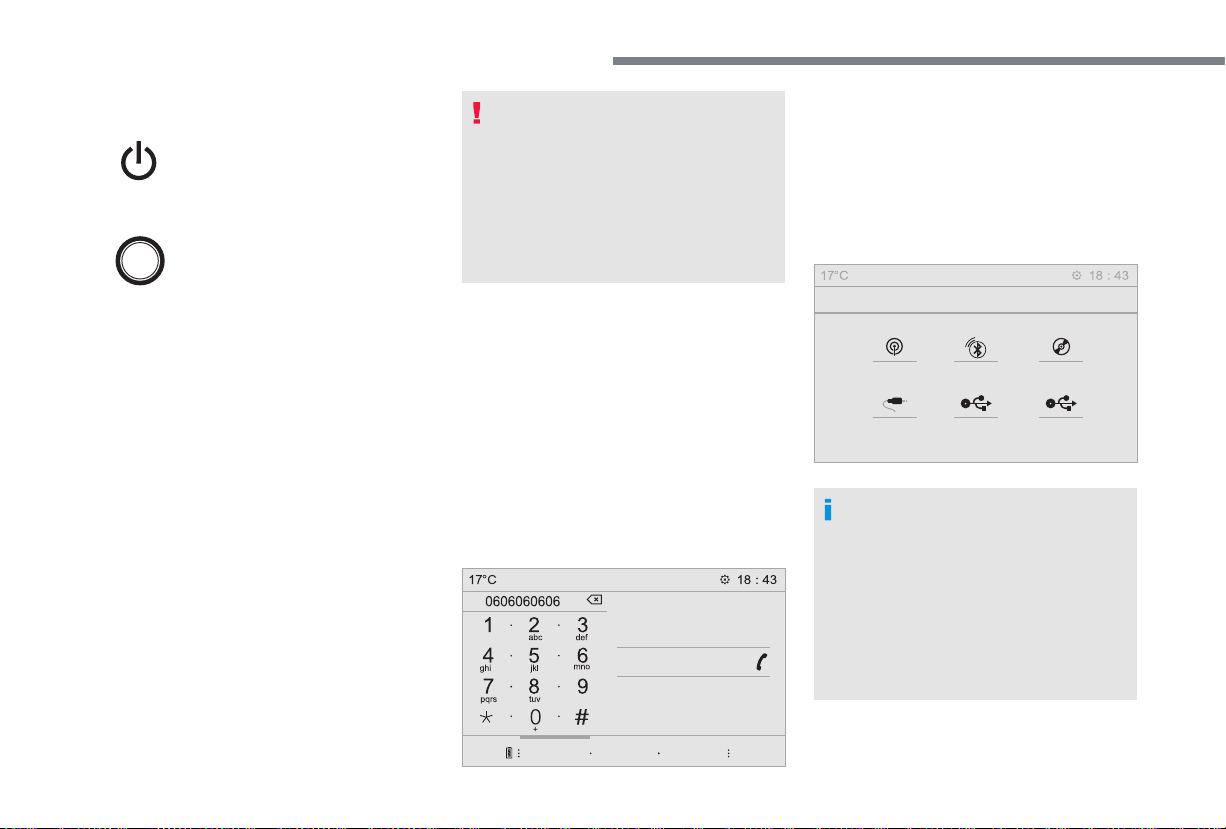
2
PEUGEOT Connect Radio
First steps
With the engine running, a press
mutes the sound.
With the ignition off, a press turns
the system on.
Adjustment of the volume.
Use the buttons on either side of or below the
touch screen for access to the menus, then
press the virtual buttons in the touch screen.
Depending on the model, use the "Source" or
"Menu" buttons on the left of the touch screen
for access to the menus, then press the virtual
buttons in the touch screen.
You can display the menus at any time by
pressing the screen briefly with three fingers.
All of the touch areas of the screen are white.
Press in the grey zone to go back a level or
confirm.
Press the back arrow to go back a level or
confirm.
The touch screen is of the "capacitive"
type.
To clean the screen, use a soft, non-
abrasive cloth (e.g. spectacles cloth) with
no additional product.
Do not use sharp objects on the screen.
Do not touch the screen with wet hands.
* Depending on equipment.
Certain information is displayed permanently in
the upper band of the touch screen:
- Reminder of the air conditioning information
(depending on version), and direct access to
the corresponding menu.
- Reminder of the Radio Media and
Telephone menu information.
- Access to the Settings of the touch screen
and digital instrument panel.
Selecting the audio source (depending on version):
- FM / DAB* / AM* radio stations.
- Telephone connected via Bluetooth* and
Bluetooth multimedia broadcast* (streaming).
- CD player (depending on model).
- USB memory stick.
- Media player connected via the auxiliary
socket (depending on model).
In the "Settings" menu you can create
a profile for just one person or a group
of people with common points, with the
possibility of entering a multitude of
settings (radio presets, audio settings,
ambiences, etc.); these settings are taken
into account automatically.
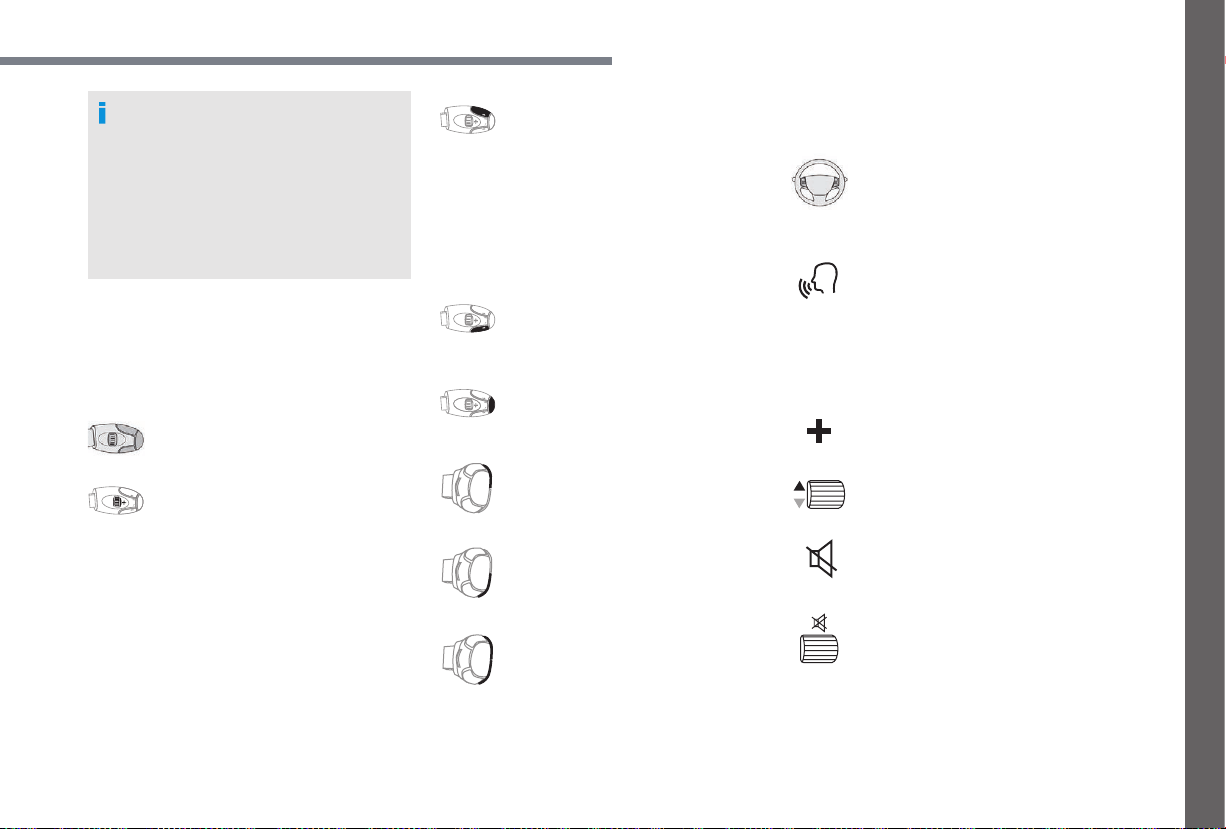
3
.
PEUGEOT Connect Radio
In very hot conditions, the volume may
be limited to protect the system. It may go
into standby (screen and sound off) for at
least 5 minutes
The return to normal takes place when
the temperature in the passenger
compartment has dropped.
Steering mounted controls
Steering mounted
controls – Type 1
Radio:
Select the previous / next preset
radio station.
Select the previous / next item in a
menu or a list.
Media:
Select the previous / next track.
Select the previous / next item in a
menu or a list.
Radio:
Short press: display the list of radio
stations.
Long press: update the list.
Media:
Short press: display the list of
folders.
Long press: display the available
sorting options.
Change audio source (radio; USB;
AUX if equipment connected; CD;
streaming).
Confirm a selection.
Increase volume.
Decrease volume.
Mute / Restore sound by
simultaneously pressing the
increase and decrease volume
buttons.
Steering mounted
controls – Type 2
Depending on model.
Voice commands:
This control is located on the
steering wheel or at the end of the
lighting control stalk (depending on
model).
Short press, smartphone voice
commands via the system.
or
Increase volume.
or
Mute / Restore the sound.
Or
Mute by pressing the volume
increase and decrease buttons
simultaneously.
Restore the sound by pressing one
of the two volume buttons.
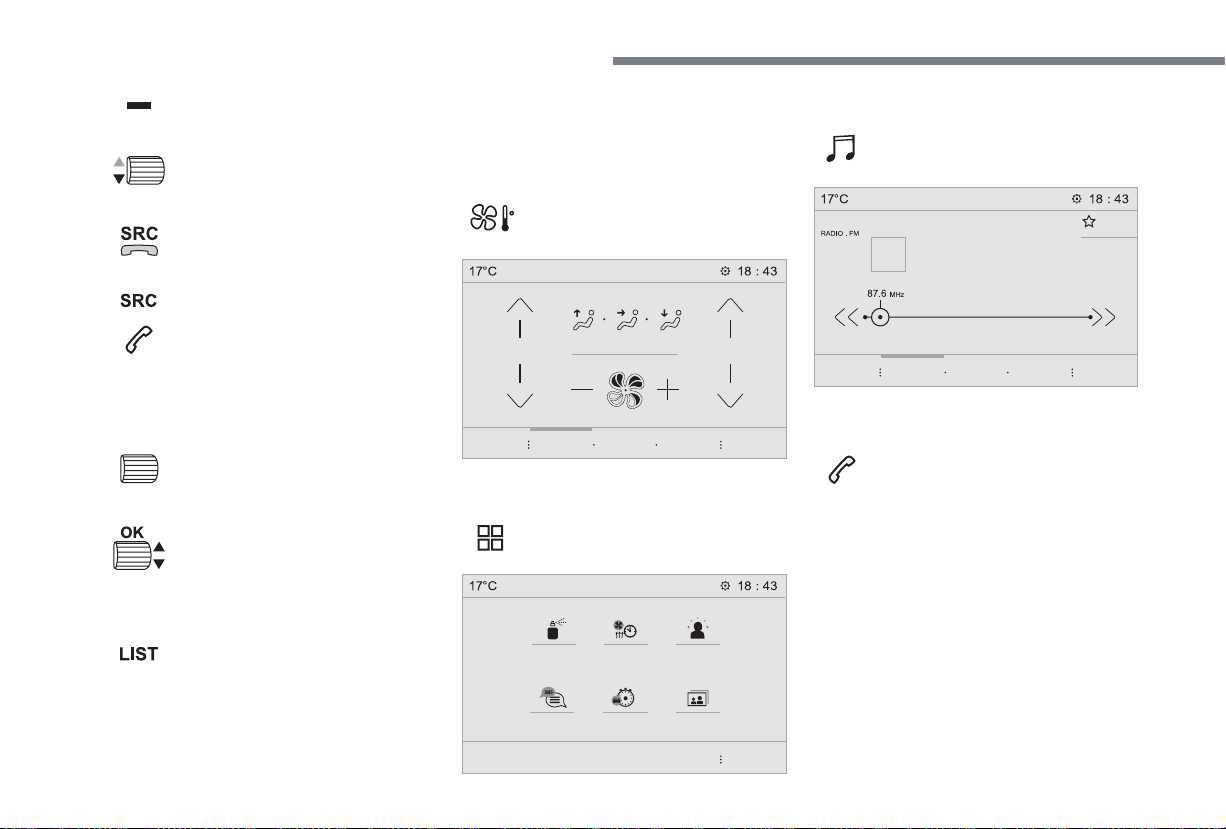
4
21,518,5
PEUGEOT Connect Radio
or
Decrease volume.
or
Media (short press): change the
multimedia source.
Telephone (short press): start
telephone call.
Call in progress (short press):
access telephone menu.
Telephone (long press): reject an
incoming call, end call; when no call
is in progress, access telephone
menu.
or
Radio (rotate): previous / next
preset.
Media (rotate): previous / next track,
move in a list.
Short press: confirm a selection; if
nothing selected, access to presets.
Radio: display the list of stations.
Media: display the list of tracks.
Radio (press and hold): update the
list of stations received.
Menus
Depending on model / Depending on version
Air conditioning
Manage various temperature and air
flow settings.
Applications
Access configurable equipment.
Radio Media
Select an audio source or radio
station.
Telephone
Connect a telephone by Bluetooth
®
.
Operate certain applications on
a smartphone connected via
MirrorLink
TM
, CarPlay
®
or Android
Auto.
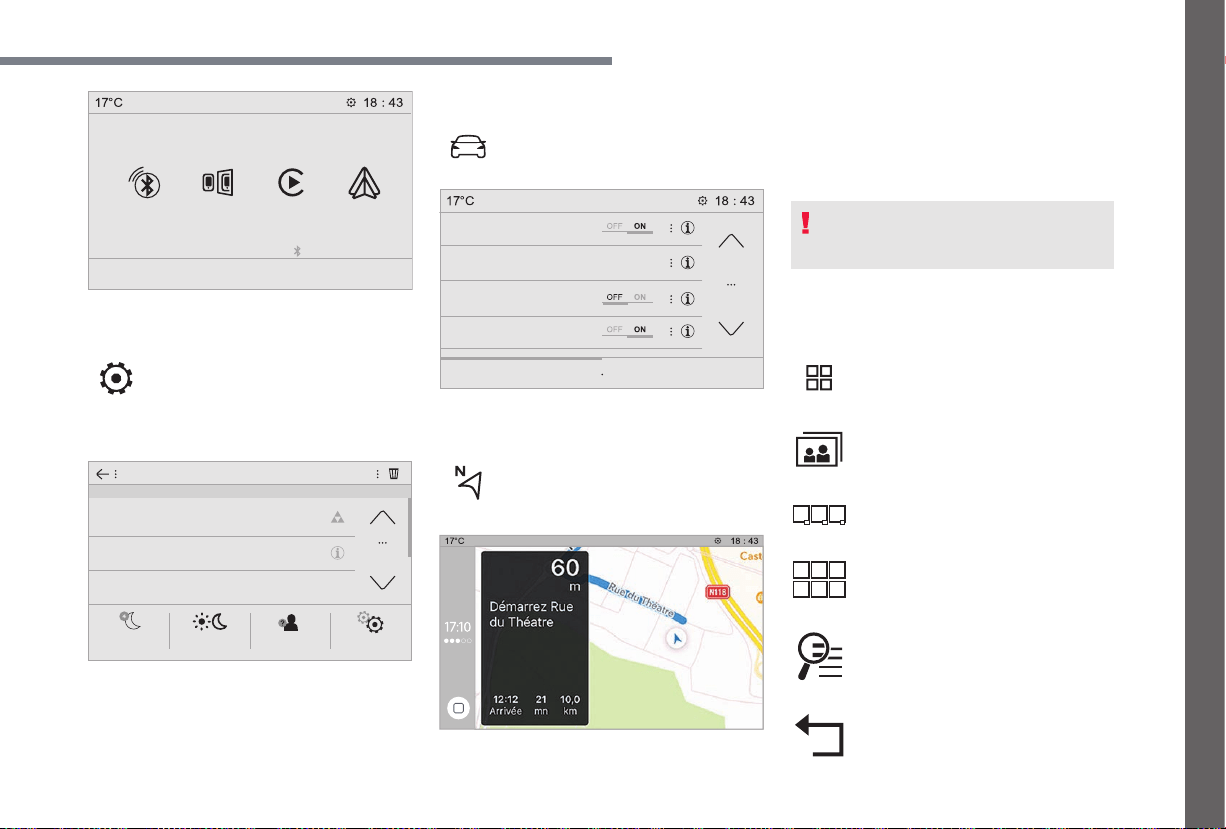
5
.
PEUGEOT Connect Radio
Settings
Configure a personal profile and/
or configure the sound (balance,
ambience, etc.) and the display
(language, units, date, time, etc.).
Driving
Activate, deactivate or configure
certain vehicle functions.
Navigation
Configure the guidance and select
your destination via MirrorLink
TM
,
CarPlay
®
or Android Auto.
Applications
Viewing photos
Insert a USB memory stick in the USB port.
To protect the system, do not use a USB
hub.
The system can read folders and image files in
the formats: .tiff; .gif; .jpg/jpeg; .bmp; .png.
Press Applications to display the
primary page.
Press "Photos".
Select a folder.
Select an image to view.
Press this button to display the
details of the photo.
Press the back arrow to go back a
level.
6
PEUGEOT Connect Radio
Managing messages
Press Applications to display the
primary page.
Press "SMS".
Select the "SMS" tab.
Press this button to select the
display settings for messages.
Press this button to search for a
contact.
Select the "Quick messages" tab.
Press this button to select the
display settings for messages.
Radio
Selecting a station
Press Radio Media to display the
primary page.
Press one of the buttons for an
automatic search for radio stations.
Or
Move the cursor for a manual search
for frequencies up or down.
Or
Press the frequency.
Enter the FM and AM waveband
values using the virtual keypad.
Press "OK" to confirm.
Radio reception may be affected by the
use of electrical equipment not approved
by the Brand, such as a USB charger
connected to the 12 V socket.
The external environment (hills, buildings,
tunnels, basement car parks, etc.) may
block reception, including in RDS mode.
This is a normal effect of the way in
which radio waves are transmitted and
does not indicate any failure of the audio
equipment.
Changing waveband
Press Radio Media to display the
primary page.
Press the "OPTIONS" button to go to the
secondary page.
Press "Band" to change waveband.
Press in the grey zone to confirm.
Presetting a station
Select a radio station or frequency.
Make a short press on the star
outline. If the star is solid, the radio
station is already preset.
Or
Select a radio station or frequency.
Press "Preset".
Make a long press on one of the
buttons to preset the station.
7
.
PEUGEOT Connect Radio
Activating / Deactivating RDS
Press Radio Media to display the
primary page.
Press the "OPTIONS" button to go to the
secondary page.
Activate / Deactivate "RDS".
Press in the grey area to confirm.
The RDS, if activated, enables you to
continue listening to the same station
by automatically retuning to alternative
frequencies. However, in certain
conditions, coverage of this RDS station
may not be assured throughout the entire
country as radio stations do not cover
100% of the territory. This explains the loss
of reception of the station during a journey.
Display text information
The "Radio Text" function allows
information transmitted by the radio
station and related to the station or the
song playing to be displayed.
Press Radio Media to display the
primary page.
Press the "OPTIONS" button to go to the
secondary page.
Activate / Deactivate "News" / "Info".
Press in the grey zone to confirm.
Play TA messages
The TA (Traffic Announcement) function
gives priority to TA alert messages.
To operate, this function needs good
reception of a radio station that carries
this type of message. While traffic
information is being broadcast, the
current media is automatically interrupted
so that the TA message can be heard.
Normal play of the media previously
playing is resumed at the end of the
message.
Press Radio Media to display the
primary page.
Press the "OPTIONS" button to go to the
secondary page.
Activate / Deactivate "TA".
Press in the grey zone to confirm.
Audio settings
Press Radio Media to display the
primary page.
Press the "OPTIONS" button to go to the
secondary page.
Press "Audio settings".
Select the "Tone" or "Balance"
or "Ringtones" or "Sound" tab to
configure the audio settings.
Press the back arrow to confirm.
8
PEUGEOT Connect Radio
In the "Tone" tab, the Ambience audio
settings, as well as Bass, Medium and
Treble are different and independent for
each audio source.
In the "Balance" tab, the All
passengers, Driver and Front only
settings are common to all sources.
In the "Sound" tab, activate or deactivate
"Volume linked to speed", "Auxiliary
input" and "Touch tones".
The balance / distribution (or
spatialisation with the Arkamys
©
system)
is audio processing that allows the quality
of the sound to be adapted according to
the number of passengers in the vehicle.
Onboard audio: the Arkamys
©
Sound
Staging optimises the balance /
distribution of sound in the passenger
compartment.
DAB (Digital Audio
Broadcasting) radio
Terrestrial Digital Radio
Digital radio provides higher quality
reception.
The different "multiplexes" offer a choice
of radio stations arranged in alphabetical
order.
Press Radio Media to display the
primary page.
Press the "OPTIONS" button to go to the
secondary page.
Press "Waveband" to select the
"DAB band".
Press in the grey zone to confirm.
FM-DAB Tracking
"DAB" does not cover 100% of the
territory.
When the digital radio signal is poor,
the "FM-DAB Tracking" allows you to
continue listening to the same station,
by automatically switching to the
corresponding FM analogue station (if
there is one).
Press Radio Media to display the
primary page.
Press the "OPTIONS" button to go to the
secondary page.
Activate / Deactivate "FM-DAB
Tracking".
Press in the grey zone to confirm.
If "FM-DAB Tracking" is activated, there
is a difference of a few seconds when the
system switches to FM analogue radio
with sometimes a variation in volume.
When the digital signal quality becomes
good, the system automatically switches
back to "DAB".
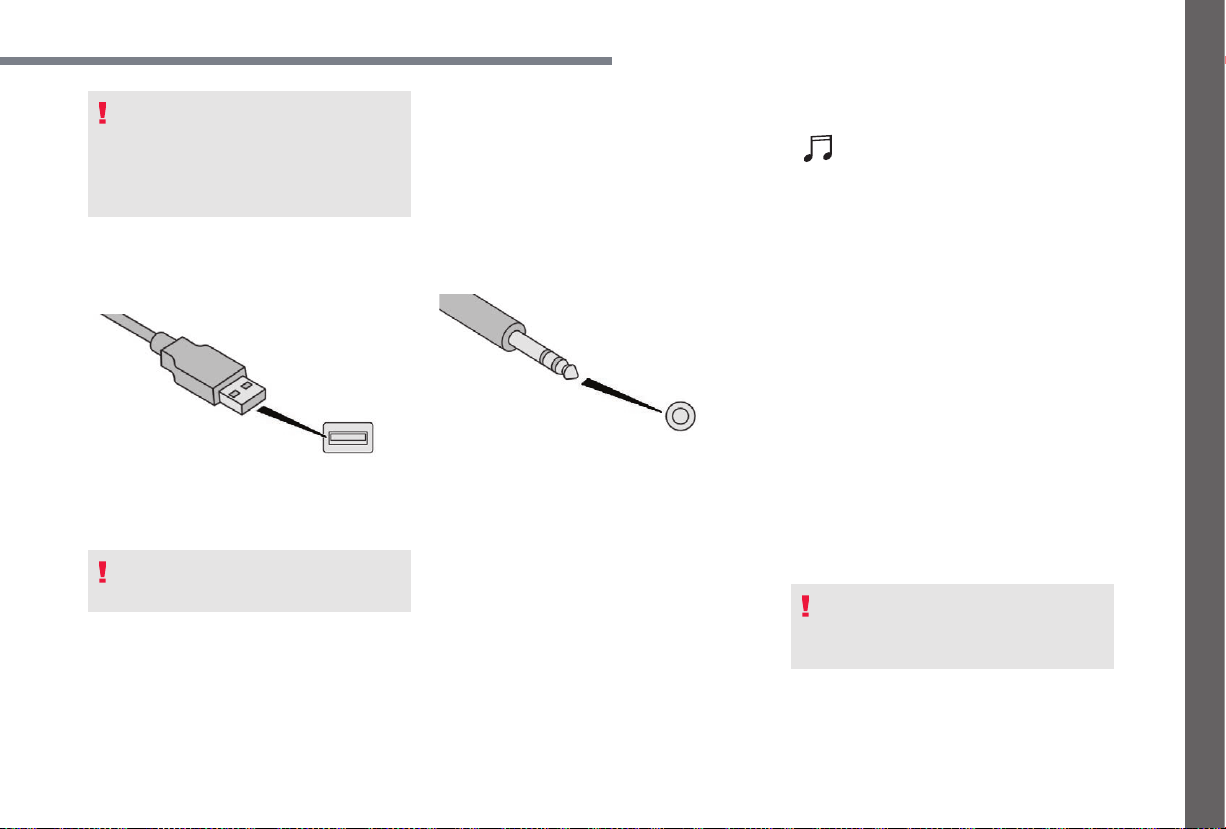
9
.
PEUGEOT Connect Radio
If the "DAB" station being listened to is
not available on FM, or if the "FM-DAB
Tracking" is not activated, the sound
will cut out while the digital signal is too
weak.
Media
USB port
Insert the USB memory stick in the USB port or
connect the USB device to the USB port using
a suitable cable (not supplied).
To protect the system, do not use a USB
hub.
The system builds playlists (in temporary
memory), an operation which can take from
a few seconds to several minutes at the first
connection.
Reduce the number of non-music files and the
number of folders to reduce the waiting time.
The playlists are updated every time the
ignition is switched off or a USB memory stick
is connected. The lists are memorised: if they
are not modified, the subsequent loading time
will be shorter.
Auxiliary socket (AUX)
(depending on model / depending on equipment)
This source is only available if "Auxiliary input"
has been checked in the audio settings.
Connect the portable device (MP3 player, etc.)
to the auxiliary Jack socket using an audio
cable (not supplied).
First, adjust the volume on your portable device
(to a high level). Then adjust the volume of your
audio system.
Display and management of the controls are
via the portable device.
Selecting the source
Press Radio Media to display the
primary page.
Press the "SOURCES" button.
Choose the source.
Bluetooth
®
audio streaming
Streaming allows you to listen to music from
your smartphone.
The Bluetooth profile must be activated, first
adjust the volume on your portable device (to a
high level).
Then adjust the volume of your system.
If play does not start automatically, it may be
necessary to start the audio playback from the
smartphone.
Control is from the portable device or by using
the system's touch buttons.
Once connected in Streaming mode, the
smartphone is considered to be a media
source.
10
PEUGEOT Connect Radio
Connecting Apple
®
players
Connect the Apple
®
player to the USB port
using a suitable cable (not supplied).
Play starts automatically.
Control is via the audio system.
The classifications available are those
of the portable device connected
(artists / albums / genres / playlists /
audiobooks / podcasts), you can also use
a classification structured in the form of
a library.
The default classification used is by
artist. To modify the classification used,
return to the first level of the menu then
select the desired classification (playlists
for example) and confirm to go down
through the menu to the desired track.
The version of software in the audio system
may not be compatible with the generation of
your Apple
®
player.
Information and advice
The system supports USB Mass Storage
devices, BlackBerry
®
devices or Apple
®
players via USB ports. The adapter cable
is not supplied.
Device management is done by the audio
system controls.
Other peripherals, not recognised on
connection, must be connected to the
auxiliary socket using a Jack cable (not
supplied) or via Bluetooth streaming,
depending on compatibility.
To protect the system, do not use a USB
hub.
The audio equipment will only play audio files
with ".wav", ".wma", ".aac", ".ogg" and ".mp3"
file extensions and with a bit rate of between
32 Kbps and 320 Kbps.
It also supports VBR (Variable Bit Rate) mode.
No other file types (".mp4", etc.) can be read.
Files of the ".wma" type should be to the wma 9
standard.
Sampling frequencies supported are 11, 22, 44
and 48 kHz.
It is advisable to restrict file names to
20 characters, without using special
characters (e.g. " " ? . ; ù) so as to avoid any
reading or display problems.
Use only USB memory sticks in FAT32 format
(File Allocation Table).
It is recommended that the original USB
cable for the portable device be used.
In order to be able to play a burned CDR or
CDRW, select standards ISO 9660 level 1, 2 or
Joliet if possible when burning the CD.
If the disc is burned in another format, it may
not be played correctly.
It is recommended that the same burning
standard be always used on an individual disc,
with the lowest speed possible (4x maximum)
for the best acoustic quality.
In the particular case of a multi-session CD, the
Joliet standard is recommended.
11
.
PEUGEOT Connect Radio
Telephone
MirrorLink
TM
smartphone
connection
As a safety measure and because it
requires sustained attention by the driver,
using a smartphone when driving is
prohibited.
All operations must be done with the
vehicle stationary.
The synchronisation of a personal
smartphone allows users to display
applications adapted for the
smartphone's MirrorLink
TM
technology on
the vehicle screen.
The processes and standards
are constantly changing. For the
communication process between the
smartphone and the system to operate,
it is essential that the smartphone be
unlocked; update the operating system
of the smartphone as well as the date
and time of the smartphone and the
system.
For the list of eligible smartphones, go
to the Brand's internet website in your
country.
As a safety measure, applications
can only be viewed with the vehicle
stationary; display is interrupted once the
vehicle is moving.
The "MirrorLink
TM
" function requires a
compatible smartphone and applications.
Telephone not connected by
Bluetooth
®
Connect a USB cable. The
smartphone charges when
connected by a USB cable.
From the system, press
"Telephone" to display the primary
page.
Press "MirrorLink™" to start the
application in the system.
Depending on the smartphone, it may be
necessary to activate the "MirrorLink™"
function.
During the procedure, several
screen pages relating to certain
functions are displayed.
Accept to start and complete the
connection.
When connecting a smartphone
to the system, it is recommended
that Bluetooth
®
be started on the
smartphone.
Telephone connected by
Bluetooth
®
From the system, press
"Telephone" to display the primary
page.
Press the "PHONE" button to display the
secondary page.
Press "MirrorLink
TM
" to start the
application in the system.
Once the connection is established, a page
is displayed with the applications already
downloaded to your smartphone and adapted
to MirrorLink
TM
technology.
Access to the different audio sources remains
accessible in the margin of the MirrorLink
TM
display, using touch buttons in the upper bar.
Access to the menus for the system is possible
at any time using the dedicated buttons.
There may be a wait for the availability of
applications, depending on the quality of
your network.
12
PEUGEOT Connect Radio
CarPlay
®
smartphone
connection
As a safety measure and because it
requires sustained attention by the driver,
using a smartphone when driving is
prohibited.
All operations must be done with the
vehicle stationary.
The synchronisation of a personal
smartphone allows users to display
applications compatible with the
smartphone's CarPlay
®
technology on the
vehicle screen when the smartphone's
CarPlay
®
function has been previously
activated.
As the processes and standards are
constantly changing, it is recommended
that you keep your smartphone's
operating system updated.
For the list of eligible smartphones, go
to the Brand's internet website in your
country.
Connect a USB cable. The
smartphone charges when
connected by a USB cable.
From the system, press Telephone
to display the CarPlay
®
interface.
Or
If the smartphone is already
connected by Bluetooth
®
.
Connect a USB cable. The
smartphone charges when
connected by a USB cable.
From the system, press
"Telephone" to display the primary
page.
Press the "PHONE" button to go to the
secondary page.
Press "CarPlay" to display the
CarPlay
®
interface.
On connecting the USB cable, the
CarPlay
®
function deactivates the
system's Bluetooth
®
mode.
You can go to the CarPlay
®
navigation at any time by pressing
the system's Navigation button.
Android Auto smartphone
connection
As a safety measure and because it
requires sustained attention by the driver,
using a smartphone when driving is
prohibited.
All operations must be done with the
vehicle stationary.
On your smartphone, download the
Android Auto application.
The synchronisation of a personal
smartphone allows users to display
applications adapted for the
smartphone's Android Auto technology
on the vehicle screen.
The processes and standards
are constantly changing. For the
communication process between the
smartphone and the system to operate,
it is essential that the smartphone be
unlocked; update the operating system
of the smartphone as well as the date
and time of the smartphone and the
system.
For the list of eligible smartphones, go
to the Brand's internet website in your
country.
13
.
PEUGEOT Connect Radio
As a safety measure, applications
can only be viewed with the vehicle
stationary; display is interrupted once the
vehicle is moving.
The "Android Auto" function requires the
use of a compatible smartphone and
applications.
Telephone not connected by
Bluetooth
®
Connect a USB cable. The
smartphone charges when
connected by a USB cable.
From the system, press
"Telephone" to display the primary
page.
Press "Android Auto" to start the
application in the system.
Depending on the smartphone, it may be
necessary to activate the "Android Auto"
function.
During the procedure, several
screen pages relating to certain
functions are displayed.
Accept to start and complete the
connection.
When connecting a smartphone
to the system, it is recommended
that Bluetooth
®
be started on the
smartphone
Telephone connected by
Bluetooth
®
From the system, press
"Telephone" to display the primary
page.
Press the "PHONE" button to display the
secondary page.
Press "Android Auto" to start the
application in the system.
Different audio sources remain accessible in
the margin of the Android Auto display, using
touch buttons in the upper bar.
Access to the menus for the system is possible
at any time using the dedicated buttons.
There may be a wait for the availability of
applications, depending on the quality of
your network.
Pairing a Bluetooth
®
telephone
As a safety measure and because it
requires sustained attention by the
driver, the pairing of a Bluetooth mobile
telephone with the Bluetooth hands-free
system of your audio system must be
done with the vehicle stationary and the
ignition on.
Activate the Bluetooth function on the
telephone and ensure that it is "visible to
all" (telephone configuration).
Procedure from the telephone
Select the name of the system in the
list of devices detected.
In the system, accept the connection request
from the telephone.
To complete the pairing, whichever
procedure used (from the telephone or
from the system), ensure that the code
is the same in the system and in the
telephone.
14
PEUGEOT Connect Radio
Procedure from the system
Press Telephone to display the
primary page.
Press "Bluetooth search".
The list of telephones detected is
displayed.
Select the name of the chosen
telephone in the list.
If the pairing procedure fails, it is
recommended that you deactivate and
then reactivate the "Bluetooth" function in
your telephone.
Depending on the type of telephone,
you may be asked to accept or not the
transfer of your contacts and messages.
Automatic reconnection
On return to the vehicle, if the last
telephone connected is present again,
it is automatically recognised and within
about 30 seconds of switching on the
ignition, the connection is established
without any action on your part
(Bluetooth activated).
To modify the connection profile:
Press Telephone to display the
primary page.
Press the "PHONE" button to go to the
secondary page.
Press "Bluetooth connection" to
display the list of paired devices.
Press the "details" button of a paired
device.
The system offers to connect the telephone
with 3 profiles:
- "Telephone" (hands-free kit, telephone
only),
- "Streaming" (streaming: wireless playing of
the audio files on the telephone),
- "Internet data".
Select one or more profiles.
Press "OK" to confirm.
The ability of the system to connect
to just one profile depends on the
telephone.
All three profiles may connect by default.
The services available depend on
the network, the SIM card and the
compatibility of the Bluetooth devices
used. Check the instructions for your
telephone and with your service provider
for the services to which you have access.
The profiles compatible with the system
are: HFP, OPP, PBAP, A2DP, AVRCP,
MAP and PAN.
Go to the Brand's website for more information
(compatibility, additional help, etc.).
Managing paired telephones
This function allows the connection or
disconnection of a peripheral device as
well as the deletion of a pairing.
Press Telephone to display the
primary page.
15
.
PEUGEOT Connect Radio
Press the "PHONE" button to go to the
secondary page.
Press "Bluetooth connection" to
display the list of paired devices.
Press on the name of the telephone
chosen in the list to disconnect it.
Press again to connect it.
Deleting a telephone
Press the basket at the top right
of the screen to display a basket
alongside the telephone chosen.
Press the basket alongside the
telephone chosen to delete it.
Receiving a call
An incoming call is announced by a ring and a
superimposed display in the screen.
Make a short press on the steering
mounted PHONE button to accept
an incoming call.
And
Make a long press
on the steering mounted PHONE
button to reject the call.
Or
Press "End call".
Making a call
Using the telephone is not recommended
while driving.
Park the vehicle.
Make the call using the steering mounted
controls.
Calling a new number
Press Telephone to display the
primary page.
Enter the phone number using the
digital keypad.
Press "Call" to start the call.
Calling a contact
Press Telephone to display the
primary page.
Or make a long press
on the steering mounted PHONE
button.
Press "Contacts".
Select the desired contact from the list offered.
Press "Call".
Calling a recently used
number
Press Telephone to display the
primary page.
Or
Make a long press
on the steering mounted button.
16
PEUGEOT Connect Radio
Press "Recent calls".
Select the desired contact from the list offered.
It is always possible to make a call
directly from the telephone; as a safety
measure, first park the vehicle.
Setting the ringtone
Press Telephone to display the
primary page.
Press the "OPTIONS" button to go to the
secondary page.
Press "Ring volume" to display the
volume bar.
Press the arrows or move the cursor
to set the ring volume.
Settings
Profile settings
As a safety measure and because it
requires the sustained attention of the
driver, changes to settings must only be
done with the vehicle stationary.
Press Settings to display the
primary page.
Press "Profiles".
Select "Profile 1" or "Profile 2" or "Profile 3"
or "Common profile".
Press this button to enter a name for
the profile using the virtual keypad.
Press "OK" to save.
Press the back arrow to confirm.
Press this button to activate the
profile.
Press the back arrow again to
confirm.
Press this button to initialise the
profile selected.
Adjust brightness
Press Settings to display the
primary page.
Press Brightness.
Move the cursor to adjust the brightness
of the screen and/or of the instrument
panel (depending on version).
Press in the grey zone to confirm.
Modifying system settings
Press Settings to display the
primary page.
17
.
PEUGEOT Connect Radio
Press "Configuration" to go to the
secondary page.
Press "System configuration".
Select "Units" to change the units of distance,
fuel consumption and temperature.
Press "Factory settings" to return to the initial
settings.
Returning the system to factory settings
activates the English language by default
(depending on version).
Select "System info" to display the versions of
the different modules installed in the system.
Press the back arrow to confirm.
Press Settings to display the
primary page.
Press "Configuration" to go to the
secondary page.
Press "Screen configuration".
Press "Brightness".
Move the cursor to adjust the brightness
of the screen and/or of the instrument
panel (depending on version).
Press "Animation".
Activate or deactivate: "Automatic
scrolling".
Select "Animated transitions".
Press the back arrow to confirm.
Select the language
Press Settings to display the
primary page.
Press "Configuration" to go to the
secondary page.
Select "Language" to change the
language.
Press the back arrow to confirm.
Setting the time
Press Settings to display the
primary page.
Press "Configuration" to go to the
secondary page.
Press "Date and time".
Select "Time".
Press this button to adjust the time
using the virtual keypad.
Press "OK" to save the time.
Press this button to define the time
zone.
Select the display format for the time
(12h / 24h).
18
PEUGEOT Connect Radio
Activate or deactivate
synchronisation with GPS (UTC).
Press the back arrow to save the
settings.
The system does not automatically
manage the change between winter and
summer time (depending on the country
of sale).
Setting the date
Press Settings to display the
primary page.
Press "Configuration" to go to the
secondary page.
Press "Date and time".
Select "Date".
Press on this button to define the
date.
Press the back arrow to save the
date.
Select the display format of the date.
Press the back arrow again to
confirm.
Adjustment of the time and date is only
available if "GPS Synchronisation" is
deactivated.
The change between winter and summer
time is done by changing the time zone.
Frequently asked
questions
The following information groups together the
answers to the most frequently asked questions
concerning your audio system.
19
.
PEUGEOT Connect Radio
Radio
QUESTION RESPONSE SOLUTION
The reception quality of the tuned radio station
gradually deteriorates or the stored stations are
not working (no sound, 87.5 MHz is displayed,
etc.).
The vehicle is too far from the transmitter of
the station or no transmitter is present in the
geographical area.
Activate the "RDS" function by means of the
upper band to enable the system to check
whether there is a more powerful transmitter in
the geographical area.
The environment (hills, buildings, tunnels,
basement car parks, etc.) block reception,
including in RDS mode.
This phenomenon is normal and does not
indicate a failure of the audio equipment.
The aerial is absent or has been damaged (for
example when going through a car wash or into
an underground car park).
Have the aerial checked by a dealer.
I cannot find some radio stations in the list of
received stations.
The name of the radio station changes.
The station is not received or has changed its
name in the list.
Press the round arrow on the "List" tab of the
"Radio" page.
Some radio stations send other information
in place of their name (the title of the song for
example).
The system interprets these details as the
station name.
20
PEUGEOT Connect Radio
Media
QUESTION RESPONSE SOLUTION
Playback of my USB memory stick starts only
after a very long wait (around 2 to 3 minutes).
Some files supplied with the memory stick
may greatly slow down access to reading
the memory stick (multiplication by 10 of the
catalogue time).
Delete the files supplied with the memory stick
and limit the number of sub-folders in the file
structure on the memory stick.
Some information characters in the currently
playing media are not displayed correctly.
The audio system does not display some types
of characters.
Use standard characters to name tracks and
folders.
Playback of streaming files does not start. The connected device does not automatically
launch playback.
Start playback from the device.
Names of tracks and playing time are not
displayed on the audio streaming screen.
The Bluetooth profile does not allow the
transfer of this information.
21
.
PEUGEOT Connect Radio
Telephone
QUESTION RESPONSE SOLUTION
I cannot connect my Bluetooth telephone. The telephone's Bluetooth function may be
switched off or the telephone may not be
visible.
Check that your telephone has Bluetooth
switched on.
Check in the telephone settings that it is
"visible to all".
The Bluetooth telephone is not compatible with
the system.
You can check the compatibility of your
telephone at the Brand's website (services).
The volume of the telephone connected in
Bluetooth mode is inaudible.
The sound depends on both the system and
the telephone.
Increase the volume of the audio system, to
maximum if required, and increase the volume
of the telephone if necessary.
Ambient noise affects the quality of the
telephone call.
Reduce the ambient noise level (close the windows,
reduce the booster fan speed, slow down, etc.).
The contacts are listed in alphabetical order. Some telephones offer display options.
Depending on the settings chosen, contacts
can be transferred in a specific order.
Modify the telephone directory display settings.

22
PEUGEOT Connect Radio
Settings
QUESTION RESPONSE SOLUTION
When changing the setting of treble and bass,
the equalizer setting is deselected.
When changing the equalizer setting, the treble
and bass settings are reset.
The selection of an equalizer setting imposes
the settings for treble and bass and vice versa.
Modify the treble and bass or equalizer settings
to obtain the desired musical ambience.
When changing the balance setting,
distribution is deselected.
When changing the distribution setting, the
balance setting is deselected.
The selection of a distribution setting imposes
the balance settings and vice versa.
Modify the balance setting or the distribution
setting to obtain the desired sound quality.
There is a difference in sound quality between
the different audio sources.
To allow for optimal listening quality, the
audio settings can be tailored to different
sound sources, which can generate audible
differences when changing source.
Check that the audio settings are adapted
to the sources listened to. Adjust the audio
functions to the middle position.
When the engine is off, the system switches off
after several minutes of use.
When the engine is switched off, the system's
operating time depends on the state of charge of
the battery.
The switch-off is normal: the system automatically
goes into energy economy mode and switches off
to maintain an adequate charge in the battery.
Turn the ignition on to increase the charge of
the battery.
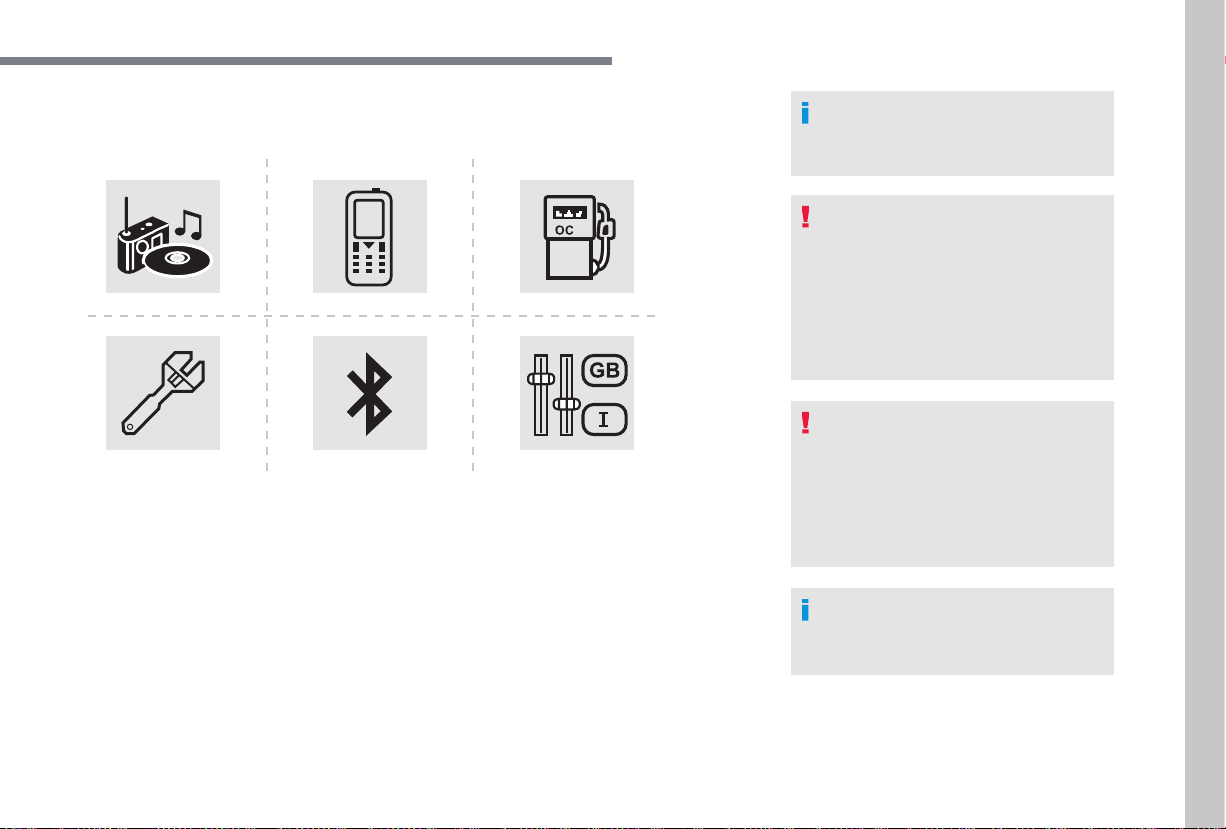
1
.
Bluetooth
®
audio system
Bluetooth
®
audio system
Contents
First steps 2
Steering mounted controls 2
Menus 4
Radio 4
DAB radio (Digital Audio Broadcasting) 6
Media 7
Telephone 10
Frequently asked questions 14
The different functions and settings
described vary according to the version
and configuration of your vehicle.
As a safety measure and because it
requires sustained attention by the
driver, the pairing of a Bluetooth mobile
telephone with the Bluetooth hands-free
system of your audio system must be
done with the vehicle stationary and the
ignition on.
Your audio system is coded in such a way
that it will only operate in your vehicle.
All work on the system must be
carried out exclusively by a dealer or
qualified workshop, to avoid any risk of
electrocution, fire or mechanical faults.
To avoid discharging the battery, the
audio system may switch off after a few
minutes if the engine is not running.
2
Bluetooth
®
audio system
First steps
Press: On / Off.
Rotate: adjust volume.
Short press: change audio source
(radio; USB; AUX (if equipment
connected); CD; streaming).
Long press: display the Telephone
menu (if a telephone is connected).
Adjust audio settings:
Front/rear fader; left/right balance;
bass/treble; loudness; audio
ambience.
Activation / Deactivation of
automatic volume adjustment (linked
to the speed of the vehicle).
Radio:
Short press: display the list of radio
stations.
Long press: update the list.
Media:
Short press: display the list of
folders.
Long press: display the available
sorting options.
Select the screen display mode,
between:
Date; Audio functions; Trip
computer; Telephone.
Confirm or display contextual menu.
Buttons 1 to 6.
Short press: select the preset radio
station.
Long press: preset a radio station.
Radio:
Automatic step by step search up /
down for radio stations.
Media:
Select previous / next CD, USB,
streaming track.
Scroll in a list.
Radio:
Manual step by step search up /
down for radio stations.
Select previous / next MP3 folder.
Media:
Select previous / next folder / genre /
artist / playlist on the USB device.
Scroll in a list.
Abandon the current operation.
Go up one level (menu or folder).
Access to the main menu.
Activate / Deactivate TA (traffic
announcements).
Long press: select type of
announcement.
Selection of FM / DAB / AM
wavebands.
Steering mounted controls
Steering mounted
controls – Type 1
Radio:
Select the previous / next preset
radio station.
Select the previous / next item in a
menu or a list.
Media:
Select the previous / next track.
Select the previous / next item in a
menu or a list.
3
.
Bluetooth
®
audio system
Radio:
Short press: display the list of radio
stations.
Long press: update the list.
Media:
Short press: display the list of
folders.
Long press: display the available
sorting options.
Other than telephone call:
Short press: changing audio source
(radio; USB; AUX (if equipment
connected); CD; streaming),
confirmation if the "Telephone"
menu is open.
Long press: open the "Telephone"
menu.
In the event of a telephone call:
Short press: accept the call.
Long press: reject the call.
During a telephone call:
Short press: open the contextual
telephone menu.
Long press: end the call.
Confirm a selection.
Increase volume.
Decrease volume.
Mute / Restore sound by
simultaneously pressing the
increase and decrease volume
buttons.
Steering mounted
controls – Type 2
Access to the main menu.
Increase volume.
Mute / Restore the sound.
Decrease volume.
Other than telephone call:
Short press: changing audio source
(radio; USB; AUX (if equipment
connected); CD; streaming),
confirmation if the "Telephone"
menu is open.
Long press: open the "Telephone"
menu.
In the event of a telephone call:
Short press: accept the call.
Long press: reject the call.
During a telephone call:
Short press: open the contextual
telephone menu.
Long press: end the call.
Start voice recognition on your
smartphone via the system.
Radio:
Short press: display the list of radio
stations.
Long press: update the list.
Media:
Short press: display the list of
folders.
Long press: display the available
sorting options.
4
Bluetooth
®
audio system
Radio:
Select the previous / next preset
radio station.
Select the previous / next item in a
menu or a list.
Media:
Select the previous / next track.
Select the previous / next item in a
menu or a list.
Press the thumbwheel: confirm.
Menus
Depending on version.
"Multimedia": Media settings, Radio
settings.
"Telephone": Call, Directory
management, Telephone
management, Hang up.
"Trip computer".
"Maintenance": Diagnosis, Warning
log, etc.
"Connections": Manage
connections, search for devices.
"Personalisation-configuration":
Define the vehicle parameters,
Choice of language, Display
configuration, Choice of units, Date
and time adjustment.
Press the "MENU" button.
Move from one menu to another.
Enter a menu.
Radio
Selecting a station
Press the SOURCE button
repeatedly and select the radio.
Press this button to select a
waveband (FM / AM / DAB).
Press one of the buttons for an
automatic search for radio stations.
Press one of the buttons to carry out
a manual search up / down for radio
frequencies.
Press this button to display the list of
stations received locally.
To update this list, press for more
than two seconds. The sound is cut
while updating.
RDS
The external environment (hills, buildings,
tunnels, basement car parks, etc.) may
block reception, including in RDS mode.
This is a normal effect of the way in
which radio waves are transmitted and
does not indicate any failure of the audio
equipment.
If RDS is not available, the RDS symbol
appears struck out in the screen.
5
.
Bluetooth
®
audio system
The RDS, if activated, enables you to
continue listening to the same station
by automatic retuning to alternative
frequencies. However, in certain
conditions, coverage of an RDS station
may not be assured throughout the entire
country as radio stations do not cover
100% of the territory. This explains the loss
of reception of the station during a journey.
Short procedure
In "Radio" mode, press the OK button to
activate or deactivate RDS directly.
Long procedure
Press the MENU button.
Select "Audio functions".
Press OK.
Select the "FM waveband
preferences" function.
Press OK.
Select "Frequency tracking
(RDS)".
Press OK, RDS is displayed on the
screen.
Play TA messages
The TA (Traffic Announcement) function
gives priority to TA alert messages.
To operate, this function needs good
reception of a radio station that carries
this type of message. When a traffic
report is transmitted, the current audio
source (Radio, CD, etc.) is interrupted
automatically to play the TA message.
Normal play of the media previously
playing is resumed at the end of the
message.
Take care when increasing the volume
while listening to TA messages. The
volume may prove too high on return to
the original audio source.
Press the TA button to activate or
deactivate traffic messages.
Receiving INFO messages
The INFO function gives priority to
TA alert messages. To be active, this
function needs good reception of a
radio station that transmits this type
of message. When a message is
transmitted, the current audio source
(Radio, CD, USB, etc.) is interrupted
automatically to receive the INFO
message. Normal play of the media
previously playing is resumed at the end
of the message.
Make a long press on this button to
display the list of categories.
Select or deselect categories.
Activate or deactivate the reception
of the corresponding messages.
Display TEXT INFOS
Radio text is information transmitted by
the radio station related to the station's
current programme or song.
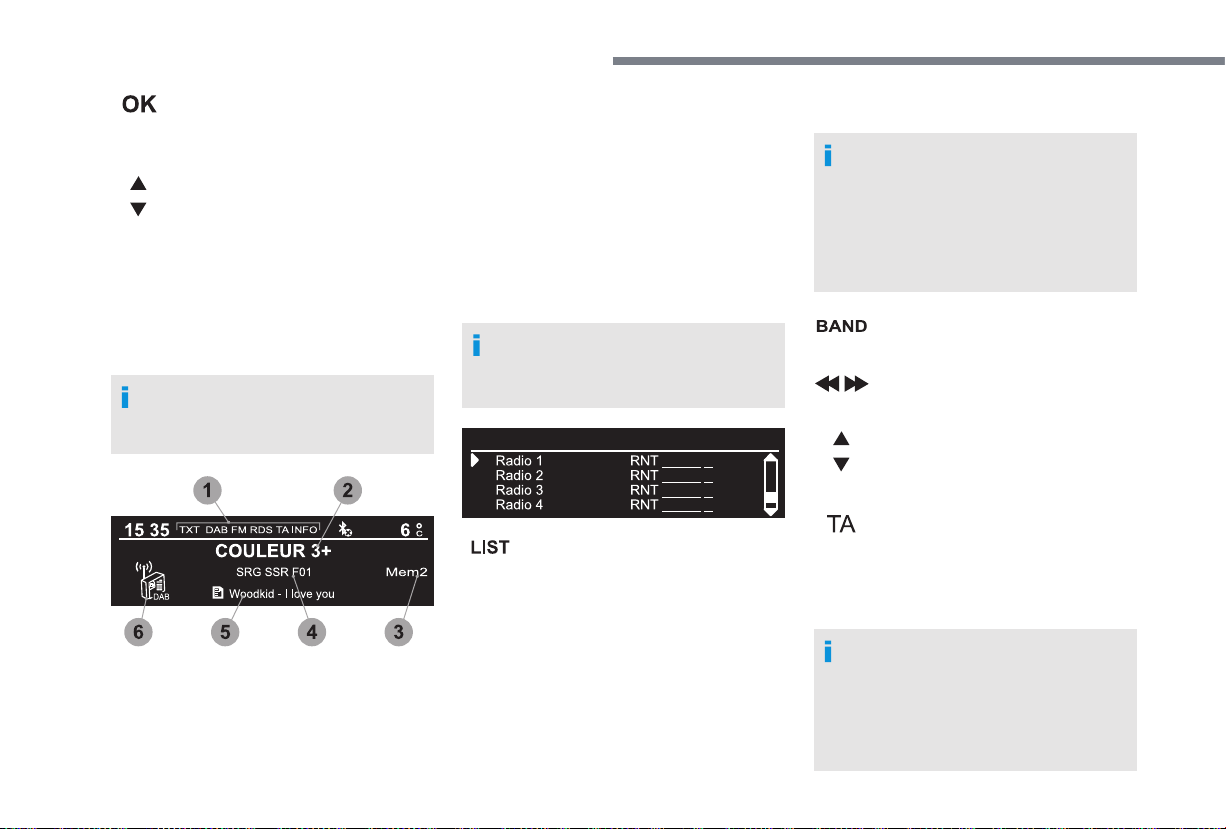
6
Bluetooth
®
audio system
When the radio station is displayed
in the screen, press OK to display
the contextual menu.
Select "RadioText (TXT) display"
and confirm OK to save.
DAB (Digital Audio
Broadcasting) radio
Depending on version
If the current DAB radio station is not
available on FM, "DAB FM" is struck out.
When changing region, an update of the
list of preset radio stations is advisable.
Display of the list of all radio stations
and "multiplexes".
Terrestrial digital radio
Digital radio provides a superior audio
quality and also additional categories of
traffic announcements (TA INFO).
The different "multiplex / ensemble"
services offer a choice of radio stations
in alphabetical order.
Change of band (FM1, FM2, DAB,
etc.)
1 Options display: if active but not available,
the display will be struck out.
2 Display of the name of the current station.
3 Preset stations, buttons 1 to 6.
Short press: select the preset radio station.
Long press: memorise a radio station.
4 Display the name of the "multiplex" service
being used, also called "ensemble".
5 Display RadioText (TXT) for the current
radio station.
6 Represents the signal strength for the band
being listened to.
Change of station within the same
"multiplex / ensemble".
Starting of a search for the previous /
next "multiplex / ensemble".
Long press: selection of the
categories of news desired among
Transport, News, Entertainment and
Special Flash (available depending
on the station).
When the radio station is displayed in
the screen, press "OK" to display the
contextual menu.
(Frequency search (RDS), DAB / FM
auto tracking, RadioText (TXT) display,
Information on the station, etc.)
7
.
Bluetooth
®
audio system
DAB / FM station tracking
"DAB" does not have 100% coverage of
the country.
When the digital signal is weak,
"DAB / FM auto tracking" allows you to
continue listening to the same station,
by automatically switching to the
corresponding analogue FM station (if it
exists).
When the "DAB / FM auto tracking" is
active, the DAB station will be selected
automatically.
Press the MENU button.
Select "Multimedia" and confirm.
Select "DAB / FM auto tracking"
and confirm.
If "DAB / FM auto tracking" tracking is
enabled, there is a lag of a few seconds
when the system switches to the
analogue FM station sometimes with a
change in volume.
If the "DAB" station you are listening to is
not available on FM ("DAB / FM" option
struck out), or if "DAB / FM auto tracking"
is not on, the sound will be cut when the
digital signal is too weak.
Media
USB port
To protect the system, do not use a USB
hub.
Any additional equipment connected to
the system must conform to the standard
of the product or standard IEC 60950-1.
Insert the USB memory stick into the USB port
or connect the USB device to the USB port
using a suitable cable (not supplied).
The system changes automatically to "USB"
source.
The system builds playlists (in temporary
memory), an operation which can take from
a few seconds to several minutes at the first
connection.
Reduce the number of non-music files and the
number of folders to reduce the waiting time.
Playlists are updated every time a new USB
memory stick is connected.
When the USB port is used, the portable
device charges automatically.
Play mode
The play modes available are:
- Normal: the tracks are played in order,
depending on the classification of the
selected files.
- Random: the tracks in an album or folder
are played in a random order.
- Random on all media: all of the tracks
saved in the media are played in random
order.
8
Bluetooth
®
audio system
- Repeat: the tracks played are only those
from the current album or folder.
Press this button to display the
contextual menu for the Media
function.
Press this button to select the
chosen play mode.
Press this button to confirm.
The choice made is displayed at the top of the
screen.
Choosing a track to play
Press one of these buttons to go to
the previous / next track.
Press one of these buttons to go to
the previous / next folder.
File classication
Make a long press on this button to
display the different classifications.
Select by "Folder" / "Artist" /
"Genre" / "Playlist".
Depending on availability and type
of device used.
Press OK to select the desired
classification, then press OK again
to confirm.
Playing les
Make a short press on this button to
display the chosen classification.
Navigate in the list using the left /
right and up / down buttons.
Confirm the selection by pressing
OK.
Press one of these buttons to go to
the previous / next track in the list.
Press and hold one of these buttons
for fast forward or rewind.
Press one of these buttons to go
to the previous / next "Folder" /
"Artist" / "Genre" / "Playlist"* in
the list.
Auxiliary socket (AUX)
(depending on model / depending on equipment)
* Depending on availability and the type of
device used.
Connect a portable device (MP3 player, etc.) to
the auxiliary Jack socket using an audio cable
(not supplied).
Any additional equipment connected to
the system must conform to the standard
of the product or standard IEC 60950-1.
Press the SOURCE button several
times in succession and select
"AUX".
First adjust the volume on your portable device
(to a high level). Then adjust the volume of your
audio system. Display and management of the
controls are via the portable device.
Do not connect a device to both the
auxiliary Jack socket and the USB port at
the same time.
9
.
Bluetooth
®
audio system
CD player
Insert circular compact discs only.
Some anti-pirating systems, on original discs
or CDs copied using a personal recorder, may
cause faults which are no reflection on the
quality of the original player.
Insert a CD in the player, play begins
automatically.
External CD players connected via the
USB port are not recognised by the
system.
To play a disc which has already
been inserted, press the SOURCE
button several times in succession
and select "CD".
Press one of the buttons to select a
track on the CD.
Press the LIST button to display the
list of tracks on the CD.
Press and hold one of these buttons
for fast forward or rewind.
Playing an MP3 compilation
Insert an MP3 compilation in the CD player.
The audio equipment searches for all of the
music tracks, which may take anything between
a few seconds and several tens of seconds,
before play begins.
On a single disc, the CD player can
read up to 255 MP3 files spread over 8
directory levels.
However, it is advisable to keep to a limit
of two levels to reduce the access time
before the CD is played.
The folder structure is not observed
during playback.
All of the files are displayed on a single
level.
To play a disc which has already
been inserted, press the SOURCE
button several times in succession
and select "CD".
Press one of the buttons to select a
folder on the CD.
Press one of the buttons to select a
track on the CD.
Press the LIST button to display
the list of directories of the MP3
compilation.
Press and hold one of these buttons
for fast forward or rewind.
Bluetooth
®
audio streaming
Streaming allows music files on the telephone
to be played via the vehicle's loudspeakers.
Connect the telephone.
(Refer to the "Pairing a Bluetooth
®
telephone" section).
Activate the streaming source by
pressing SOURCE.
In certain cases, play of the audio
files must be initiated from the
keypad.
Audio files can be selected using the buttons
on the audio system control panel and the
steering mounted controls. The contextual
information can be displayed in the screen.
If the telephone supports the function. The
audio quality depends on the quality of
transmission by the telephone.
10
Bluetooth
®
audio system
Connecting Apple
®
players
Connect the Apple
®
player to the USB port
using a suitable cable (not supplied).
Play starts automatically.
Control is via the audio system.
The classifications available are those of the
portable device connected (artists / albums /
genres / playlists).
The version of software in the audio system
may not be compatible with the generation of
your Apple
®
player.
Information and advice
The CD player can play files with ".mp3",
".wma", ".wav" and ".aac" file extensions, with a
bit rate of 32 to 320 Kbps.
It also supports TAG mode (ID3 tag, WMA
TAG).
No other file types (".mp"4, etc.) can be read.
Files of the ".wma" type should be to the wma 9
standard.
The sampling rates supported are 11, 22, 44
and 48 kHz.
Files of the ".wma" type should be to the wma 9
standard.
The sampling rates supported are 11, 22, 44
and 48 kHz.
File names should have fewer than 20 characters,
avoiding special characters (e.g. " ? ; ù) so as to
avoid any reading or display problems.
In order to be able to play a burned CDR or
CDRW, select standards ISO 9660 level 1, 2, or
Joliet, if possible, when burning the CD.
If the disc is burned in another format, it may
not be played correctly.
It is recommended that the same burning
standard be always used on an individual disc,
with the lowest speed possible (4x maximum)
for the best acoustic quality.
In the particular case of a multi-session CD, the
Joliet standard is recommended.
To protect the system, do not use a USB hub.
Use only USB memory sticks formatted
FAT 32 (File Allocation Table).
Via the USB port, the system can play audio
files with the extension ".mp3", ".wma", ".wav",
".cbr", ".vbr" with a bit rate of 32 to 320 Kbps.
No other file types (".mp4", etc.) can be read.
It is recommended that you use genuine
Apple
®
USB cables for correct operation.
Telephone
Pairing a Bluetooth
®
telephone
As a safety measure and because they
require prolonged attention on the part
of the driver, the operations for pairing
of the Bluetooth mobile telephone with
the Bluetooth hands-free system of your
audio system must be carried out with the
vehicle stationary and the ignition on.
Activate the telephone's Bluetooth
function and ensure that it is "visible to
all" (telephone configuration).
The services available depend on
the network, the SIM card and the
compatibility of the Bluetooth telephone
used.
Check the instructions for your telephone
and with your service provider for the
services to which you have access.
11
.
Bluetooth
®
audio system
Procedure from the telephone
Select the name of the system in the
list of devices detected.
Procedure from the system
Press the MENU button.
Select "Connections".
Confirm with OK.
Select "Search for a device".
Confirm with OK.
A window is displayed with a search in progress
message.
In the list of devices detected, select a
telephone to pair. Only one telephone can be
paired at a time.
Completing the pairing
To complete the pairing, whichever
procedure is used (from the telephone or
from the system), ensure that the code
is the same in the system and in the
telephone.
If pairing fails, the number of attempts is not
restricted.
A message appears in the screen confirming
the pairing.
Information and advice
The "Telephone" menu gives access to the
following functions in particular: "Directory", if
your telephone equipment is fully compatible,
"Call log", "View paired devices".
Depending on the type of telephone, you may
be asked to accept or confirm access by the
system to each of these functions.
Go to the Brand's website for more
information (compatibility, more help,
etc.).
Manage connections
The telephone connection automatically
includes hands free operation and audio
streaming.
The ability of the system to connect
to just one profile depends on the
telephone. Both profiles may connect by
default.
Press the MENU button.
Select "Connections".
Confirm with OK.
Select "Connections
management" and confirm. The list
of paired devices is displayed.
Confirm with OK.
Indicates that a device is connected.
A number indicates the profile of the
connection with the system:
- 1 for media or 1 for telephone.
- 2 for media and telephone.
12
Bluetooth
®
audio system
Indicates connection of the audio
steaming profile.
Indicates the hands-free telephone
profile.
Select a telephone.
Confirm with OK.
Then select and confirm:
- "Connect telephone" /
"Disconnect telephone":
to connect / disconnect the
telephone or the hands-free kit
only.
- "Connect media player" /
"Disconnect media player":
to connect / disconnect
streaming only.
- "Connect telephone +
media player" / "Disconnect
telephone + media player":
to connect / disconnect the
telephone (hands-free kit and
streaming).
- "Delete connection": to delete
the pairing.
When you delete a pairing in the
system, remember to delete it from your
telephone as well.
Confirm with OK.
Receiving a call
An incoming call is announced by a ring and a
superimposed display in the screen.
Select the "YES" tab in the screen
using the buttons.
Confirm with OK.
Press this button at the steering
mounted controls to accept the call.
Making a call
In the "Telephone" menu.
Select "Call".
Select "Dial".
Or
Select "Directory".
Or
Select "Calls list".
Confirm with OK.
Press this button for more than
two seconds for access to your
directory, then navigate using the
thumb wheel.
Ending a call
In the "Telephone" menu.
Select "End call".
Confirm with OK to end the call.
During a call, press one of these
buttons for more than two seconds.
The system accesses the telephone's
contacts directory, depending on its
compatibility, and while it is connected
via Bluetooth.
13
.
Bluetooth
®
audio system
With certain telephones connected by
Bluetooth you can send a contact to the
directory of the audio system.
Contacts imported in this way are saved
in a permanent directory visible to all,
whatever the telephone connected.
The menu for the directory is not
accessible if it is empty.
Managing calls
During a call, press OK to display
the contextual menu.
End call
In the contextual menu, select
"Hang up" to end the call.
Confirm with OK.
Microphone off
(so that the caller cannot hear)
In the contextual menu:
- select "Micro OFF" to switch off
the microphone.
- deselect "Micro OFF" to switch
the microphone on.
Confirm with OK.
Telephone mode
In the contextual menu:
- select "Telephone mode" to
transfer the call to the telephone
(for example, to leave the vehicle
while continuing a conversation).
- deselect "Telephone mode" to
transfer the call to the vehicle.
Confirm with OK.
If the contact has been cut off, when you
reconnect on returning to the vehicle,
the Bluetooth connection will be restored
automatically and sound returned to the
system (depending on the compatibility of the
telephone).
In some cases, the Telephone mode must be
activated from the telephone.
Interactive voice response
From the contextual menu, select
"DTMF tones" and confirm to use
the digital keypad to navigate in the
interactive voice response menu.
Confirm with OK.
Consultation call
From the contextual menu, select
"Switch" and validate to return to a
call left on hold.
Confirm with OK.
Directory
To access the directory, press and
hold SRC/TEL.
Select "Directory" to see the list of
contacts.
Confirm with OK.
14
Bluetooth
®
audio system
To modify the contacts saved in the
system, press MENU then select
"Telephone" and confirm.
Select "Directory management"
and confirm.
You can:
- "Consult an entry",
- "Delete an entry",
- "Delete all entries".
The system accesses the
telephone's contacts directory,
depending on its compatibility, and
while it is connected via Bluetooth.
With certain telephones connected
by Bluetooth you can send a contact
to the directory of the audio system.
Contacts imported in this way are
saved in a permanent directory
visible to all, whatever the telephone
connected.
The menu for the directory is not
accessible if it is empty.
Voice recognition
This function allows you to use your
smartphone's voice recognition via the system.
To start voice recognition, depending on the
type of steering mounted controls:
Make a long press on the end of the lighting
control stalk.
OR
Press this button.
Voice recognition requires the use of a
compatible smartphone first connected to
the vehicle by Bluetooth.
Frequently asked
questions
The following information groups together the
answers to the most frequently asked questions
concerning your audio system.
15
.
Bluetooth
®
audio system
QUESTION RESPONSE SOLUTION
With the engine off, the audio system switches
off after a few minutes of use.
When the engine is switched off, the audio
system operating time depends on the state of
charge of the battery.
The switch-off is normal: the audio system
switches to economy mode and switches off to
prevent discharging the vehicle's battery.
Turn the ignition on to increase the charge of
the battery.
The message "the audio system is overheated"
appears on the display.
In order to protect the installation if the
surrounding temperature is too high, the audio
system switches to an automatic thermal
protection mode leading to a reduction in
volume or the CD play stopping.
Switch the audio system off for a few minutes
to allow the system to cool.
Radio
QUESTION RESPONSE SOLUTION
There is a difference in sound quality between
the different audio sources (radio, CD, etc.).
To allow for optimal listening quality, the audio
settings (Volume, Bass, treble, Ambience,
Loudness) can be tailored to different
sound sources, which can generate audible
differences when changing source (radio, CD,
etc.).
Check that the audio settings (Volume, Bass,
Treble, Ambience and Loudness) are adapted
to the sources listened to. It is advisable to set
the audio functions (Bass, Treble, Front-Rear
Balance and Left-Right Balance) to the middle
position, select the musical ambience "None"
and set the loudness correction to the "Active"
position in CD mode or to the "Inactive"
position in radio mode.

16
Bluetooth
®
audio system
The preset stations do not function (no sound,
87.5 MHz is displayed, etc.).
An incorrect waveband is selected. Press the BAND button to return to the
waveband (FM, FM2, DAB, AM) on which the
stations are preset.
The traffic announcement (TA) is displayed.
I do not receive any traffic information.
The radio station is not part of the regional
traffic information network.
Tune to a radio station which broadcasts traffic
information.
The reception quality of the tuned radio station
gradually deteriorates or the stored stations are
not working (no sound, 87.5 MHz is displayed,
etc.).
The vehicle is too far from the transmitter of
the station or no transmitter is present in the
geographical area.
Activate the RDS function to allow the system
to see if a more powerful transmitter is within
the geographic area.
The environment (hills, buildings, tunnels,
basement car parks, etc.) block reception,
including in RDS mode.
This phenomenon is normal and does not
indicate a failure of the audio equipment.
The aerial is absent or has been damaged (for
example when going through an automatic car
wash or in an underground car park).
Have the aerial checked by a dealer.
Sound cut-outs of 1 to 2 seconds in radio
mode.
During this brief sound cut-out, the RDS
searches for another frequency giving better
reception of the station.
Switch off the RDS function if the phenomenon
is too frequent and always on the same route.
17
.
Bluetooth
®
audio system
Media
QUESTION RESPONSE SOLUTION
The Bluetooth connection is cut. The battery of the peripheral device may not be
sufficiently charged.
Charge the battery of the peripheral device.
The message "USB device error" is displayed
in the screen.
The USB memory stick is not recognised.
The USB memory stick may be corrupt.
Reformat the USB memory stick.
The CD is ejected every time or is not played. The CD is upside down, cannot be read, does
not contain audio files or contains audio files of
a format not recognised by the audio system.
The CD is protected by an anti-pirating system
not recognised by the audio system.
- Check that the CD is inserted in the player
the right way up.
- Check the condition of the CD: the CD
cannot be played if it is too badly damaged.
- Check the content in the case of a recorded
CD: consult the advice in the "Audio"
section.
- Due to insufficient quality, certain burned
CDs will not be read by the audio system.
The CD sound is of poor quality. The CD used in scratched or of poor quality. Insert good quality CDs and store them in
suitable conditions.
The audio settings (bass, treble, ambience) are
unsuitable.
Return bass and treble settings to 0, without
selecting an ambience.
I am unable to play the music files on my
smartphone via the USB port.
Depending on the smartphone, access by the
audio system to music on the smartphone may
have to be approved on the latter.
Manual activate the MTP profile on the
smartphone (USB settings menu).

18
Bluetooth
®
audio system
QUESTION RESPONSE SOLUTION
I am unable to access my voicemail. Few telephones or service providers allow the
use of this function.
Call the voicemail, via the telephone menu,
using the number provided by your operator.
I am unable to access my directory of contacts. Check the compatibility of your telephone.
You did not give access to your contacts when
pairing the telephone.
Accept or confirm access by the system to the
contacts on your telephone.
I am unable to continue a conversation when
getting into my vehicle.
Telephone mode is activated. Deselect telephone mode to transfer the call to
the vehicle.
I am unable to pair my telephone by Bluetooth. Telephones (models, versions of operating
systems) have their own specific aspects in the
pairing procedure and some telephones are not
compatible.
Before starting the pairing procedure, delete
the pairing of the telephone from the system
and of the system from the telephone, so as to
see the compatibility of the telephones.
Telephone

267
.
Alphabetical index
A
180° rear vision .....................................206-207
Accessories ..........................................121, 156
Active Safety Brake.....................16-17, 189-191
AdBlue
®
............................................ 20, 32, 234
Additive, Diesel .............................................232
Adjusting headlamps ....................................112
Adjusting head restraints ................................73
Adjusting seats ........................................... 71-73
Adjusting the air distribution ..................... 87-89
Adjusting the air flow ................................. 87-89
Adjusting the date ......................... 38-40, 31, 18
Adjusting the height and reach
of the steering wheel ....................................76
Adjusting the lumbar support ..................... 71-73
Adjusting the seat belt height ................129-130
Adjusting the temperature ........................ 87-89
Adjusting the time ......................... 38-40, 31, 17
Advanced Grip Control ..........................127-128
Advice on driving ...................................151-152
Airbags ............................................18, 133, 138
Airbags, curtain ......................................134-136
Airbags, front..................................133-134, 136
Airbags, lateral ......................................134, 136
Air conditioning .........................................84-86
Air conditioning, automatic .............................83
Air conditioning, dual-zone automatic ..... 86, 90
Air conditioning, manual .....................83-84, 90
Air conditioning, mono-zone ............... 84-86, 90
Air intake ................................................... 87-89
Air vents .................................................... 81-82
Alarm ............................................................... 58
Amplifier, audio ...............................................98
Anti-lock braking system (ABS) ..............15, 124
Apple CarPlay connection ........................16, 12
Armrest, front ................................................100
Armrest, rear .................................................105
Assistance call .......................................122-123
Assistance, emergency braking ...........124, 190
Audio streaming (Bluetooth) ...................24, 9, 9
B
Backrest, folding ........................................72-73
Battery .....................13, 223, 231, 257-258, 260
Battery charge (warning lamp) .......................13
Battery, charging ...................................259-260
Battery, remote control .............................54, 56
Blind ................................................................67
Blind spot monitoring system ..........24, 200-202
Blind spot monitoring system, active ......24, 202
Blind spot sensors ..........................24, 200-201
BlueHDi ............................. 32, 35, 234, 237-238
Bluetooth (hands-free) ........25-26, 13-14, 10-11
Bluetooth (telephone) ......................25-27, 13-15
Bonnet ...................................................226-227
Boot ............................................. 61-62, 64, 108
Brake discs ............................................ 232-233
Brake lamps ..................................................250
Brakes ........................................ 14-15, 232-233
Braking assistance system ........................... 124
Braking, automatic emergency ... 16-17, 189-191
Braking, emergency ......................................160
Brightness .......................................................16
Bulbs .............................................................248
Bulbs (changing) ....................247-248, 250-252
C
Cable, audio ................................................23, 9
Cable, Jack .................................................23, 9
Capacity, fuel tank ........................................216
Cartridge, fragrance ..............................100-101
CD ..................................................... 23-24, 9, 9
CD, MP3 ............................................ 23-24, 9, 9
Central locking .......................................... 51, 57
Changing a bulb .....................247-248, 250-252
Changing a fuse ............................ 253-254, 256
Changing a wheel .........................238-240, 243
Changing a wiper blade .................119, 252-253
Changing the remote control battery .............. 56
Charger, induction .....................................98-99
Charger, wireless ...................................... 98-99
Checking the engine oil level ............................. 31
Checking the levels .................................. 229-231
Checking tyre pressures (using the kit) ... 240, 242
Checks .......................................... 228, 231-233
Child lock ................................................149-150
Children .................................................. 142-146
Children (safety) .....................................149-150
Child seats ............. 132, 137-138, 141-142, 148
Child seats, conventional .......................141-142
Child seats, i-Size .........................................146
Child seats, ISOFIX ...............................143-146
Cigarette lighter ..............................................97
Closing the boot ..................................49, 52, 61
Closing the doors .......................... 49, 51-52, 61
Configuration, vehicle .........................38-43, 46
Connection, Bluetooth ........19, 25-27, 13-15, 11
Connection, MirrorLink .........................17, 11-12
Connection, Wi-Fi network .............................20
Connectivity ....................................................98
Container, AdBlue
®
.......................................235
Control, emergency boot release ...................62
Control, emergency door ................................54
Control, heated seats ......................................75
Controls, steering mounted ...................161-165
Control stalk, lighting .................25-26, 109, 111
Control stalk, wipers .............................. 117-120
Courtesy lamps ......................................102-103
Cover, load space .........................................106
Cruise control ....172, 174-175, 178-184, 187, 189
Cruise control, adaptive with
Stop function .........174-175, 180-184, 187, 189
Cruise control by speed limit
recognition ........................................... 174-175
Cup holder .......................................................96
Customisation ...................................................9

268
Alphabetical index
D
DAB (Digital Audio
Broadcasting) – Digital radio ............22, 8, 6-7
Date (setting) .................................38-40, 31, 18
Daytime running lamps ......................... 111, 248
Deactivating the passenger airbag 133-134, 138
Deadlocking ..............................................49, 52
Defrosting ........................................................90
Defrosting, front ..............................................90
Demisting ........................................................90
Demisting, front ...............................................90
Demisting, rear ................................................91
Dials and gauges ..............................................8
Dimensions ...................................................268
Dipstick ............................................31, 229-230
Direction indicators .................. 25, 111, 248-251
Display screen, instrument panel .................167
Distance alert ~ Collision Risk Alert ............. 189
Door pockets ...................................................96
Doors ...............................................................60
Doors, rear .............................................149-150
Driver's attention warning .............................193
Driving ........................................................70-71
Driving abroad...............................................111
Driving positions (storing) ..........................74-75
Driving time warning ..............................192-193
Dynamic pack ........................................166-167
Dynamic stability control (DSC) ............. 124-128
E
Economy mode .............................................223
Electronic brake force distribution (EBFD) ... 124
Electronic stability control (ESC) .................. 124
Emergency braking assistance (EBA) ..........124
Emergency call ......................................122-123
Emergency switching off ........................156-157
G
Gauge, fuel....................................................216
Gearbox, automatic ...............161-169, 232, 259
Gearbox, manual ...........160-161, 165-169, 232
Gear lever, automatic gearbox ..............161-165
Gear lever, manual gearbox ..................160-161
Gear shift indicator ~ Gear
efficiency indicator .....................................167
Glove box ........................................................97
GPS ................................................................. 12
Grab handles ..................................................96
H
Hands-free access ..........................................64
Hands-free tailgate ...................................62, 64
Hazard warning lamps ..........................122, 237
Headlamp adjustment ...................................112
Headlamps, automatic dipping ........ 26, 114-116
Headlamps, automatic
illumination ................................... 109, 112-113
Headlamps, dipped beam ..........25-26, 248-249
Headlamps, halogen .............................112, 248
Headlamps, main beam ..................26, 248-249
Head restraints, front ......................................73
Head restraints, rear ................................. 78-80
Heating .................................... 81-82, 84-86, 90
Heating, additional ..........................................92
Heating, programmable ..................................92
Hi-Fi system ....................................................98
Hill Assist Descent Control
(HADC) ..........................................24, 128-129
Hill start assist ....................................... 165-166
Horn...............................................................122
Emissions control system, SCR ...................234
Energy economy mode .................................223
Engine compartment ....................................228
Engine, Diesel ...............218, 228, 237, 265, 267
Engine oil pressure .........................................12
Engine, petrol ...............................218, 228, 264
Engines .........................................263-265, 267
Environment ....................................................54
F
Fatigue detection ...................................192-193
Filling the AdBlue
®
tank ................................235
Filling the fuel tank .................................216-218
Filter, air .................................................231-232
Filter, oil .........................................................232
Filter, particle .........................................231-232
Filter, passenger compartment ..............231-232
Fitting a wheel ....................................... 244-247
Fitting roof bars .....................................225-226
Fittings, boot .................................................105
Fittings, interior ......................................... 96-97
Fittings, rear ..................................................104
Flap, fuel filler .........................................216-217
Foglamps ......................................................110
Foglamps, front ........ 25, 110, 116-117, 248, 250
Foglamps, rear ...................................... 110, 252
Folding the rear seats ............................... 78-80
Frequency (radio) .......................................21-22
Fuel................................................................218
Fuel tank.................................................216-217
Fusebox, engine compartment .....................256
Fuses .............................................253-254, 256

269
.
Alphabetical index
Massage function ...........................................76
Massage, multi-point ......................................76
Mat .........................................................101-102
Memorising a speed .....................................172
Menu ...............................................................12
Menu, main .......................................................4
Menus (audio) ........................................3-5, 4-5
Messages ........................................................ 28
Messages, quick .............................................28
Mirror, rear view .........................................77-78
Mirrors, door.........................76-77, 91, 200-201
Mirror, vanity ...................................................97
Misfuel prevention .................................. 216-217
Motorised tailgate .....................................62-64
Mountings, ISOFIX .......................................143
MP3 CD .............................................................9
N
Net, high load retaining ................................. 107
Number plate lamps ......................................252
O
Obstacle detection ........................................202
Oil change ............................................. 229-230
Oil consumption .................................... 229-230
Oil, engine ....................................... 12, 229-230
On-board tools .............................. 108, 238-240
Opening the bonnet ..............................226-227
Opening the boot ......................................51, 61
Opening the doors ....................................51, 60
Opening the fuel filler flap .............................216
Opening the windows .....................................48
L
Labels, identification .....................................269
Lamp, boot ....................................................108
Lamps, parking ............................................. 111
Lamps, rear ...................................................250
Lane Departure Warning
System (LDWS) .................................... 17, 194
Lane Departure Warning
System (LDWS), Active ................ 17, 195, 202
LEDs – Light-emitting diodes .......111, 248, 250
Level, brake fluid ...........................................230
Level, Diesel additive .............................231-232
Level, engine coolant ..............................32, 230
Level, engine oil .............................. 31, 229-230
Levels and checks ................................228-231
Level, screenwash fluid ........................118, 231
Light-emitting diodes – LEDs .......111, 248, 250
Lighting ............................................................ 26
Lighting, cornering .................................116-117
Lighting dimmer ..............................................36
Lighting, exterior ...........................................109
Lighting, guide-me home .................50, 113-114
Lighting, interior .....................................102-103
Lighting, mood ........................................36, 103
Lighting, welcome .........................................113
Loading ......................................... 107, 225-226
Load reduction mode ....................................223
Locating your vehicle ......................................50
Locking ............................................... 49, 52, 54
Locking from the inside ...................................57
Locking the doors ...........................................62
Long objects, transporting ............................105
Low fuel level ................................................216
M
Map reading lamps ................................102-103
Markings, identification .................................269
I
i-Cockpit amplify
function ...............76, 80-81, 100-101, 166-167
Ignition .............................................154, 156, 28
Ignition on......................................................156
Immobiliser, electronic ............................54, 152
Indicator, AdBlue
®
range ................................. 32
Indicator, coolant temperature ........................ 32
Indicator, engine oil level ..........................31, 35
Indicator lamps, operation ........................ 11, 15
Indicators, direction ..............................111, 249
Inflating tyres ................................................233
Inflating tyres (using the kit) ..................240, 242
Instrument panel ................................8-9, 35-37
Intelligent Traction Control ............................125
Internet browser ..............................................16
ISOFIX ..........................................................144
ISOFIX mountings.........................................143
J
Jack .....................................239-240, 243, 23, 9
Jump starting ................................................258
K
Key ........................................................... 48, 54
Key, electronic ............................................51-52
Keyless Entry and Starting .... 51-52, 54, 154-155
Key not recognised ................................156-157
Key with remote control ................................152
Kit, hands-free ....................25-26, 13-14, 10-11
Kit, temporary puncture repair ......238-240, 242

270
Alphabetical index
P
Pads, brake ........................................... 232-233
Paint ..............................................................269
Paint colour code ..........................................269
Parcel shelf, rear ........................................... 106
Park Assist ............................................ 209-210
Parking brake ........................................232-233
Parking brake, electric ............... 14, 27, 157-160
Parking sensors, audible and visual .............202
Parking sensors, front ...................................203
Parking sensors, rear....................................202
PEUGEOT Connect Nav ...................................1
PEUGEOT Connect Radio ...............................1
Plates, identification......................................269
Player, Apple
®
.....................................24, 10, 10
Player, MP3 CD ........................................... 23, 9
Player, USB ...................................... 98, 23, 9, 7
Port, USB ......................................... 98, 23, 9, 7
Pre-heater, Diesel ...........................................23
Pressures, tyres ....................................233, 243
Pre-tensioning seat belts .............................. 132
Priming the fuel system .........................237-238
Profiles ......................................................30, 16
Protecting children ... 133-134, 137-138, 141-146
Puncture ................................................240, 242
R
Radio .........................................21, 24, 6, 9, 4-5
Radio, digital (Digital Audio
Broadcasting – DAB) ............................22, 8, 6
Range, AdBlue ..........................................32-34
RDS ....................................................... 21-22, 7
Rear screen, demisting ................................... 91
Recharging the battery ......................... 259-260
Reduction of electrical load ..........................223
Regeneration of the particle filter .................232
Reinitialisation of the under-
inflation detection system ...........................171
Reinitialising the remote control .....................56
Reminder, key in ignition ............................... 154
Remote control .........................48-49, 51-52, 54
Removing a wheel ................................ 244-247
Removing the mat ..................................101-102
Replacing bulbs .....................247-248, 250-252
Replacing fuses ....................................253-254
Replacing the air filter ............................231-232
Replacing the oil filter ...................................232
Replacing the passenger
compartment filter ...............................231-232
Reservoir, screenwash .................................231
Resetting the service indicator ....................... 31
Resetting the trip recorder ..............................36
Reset trip ......................................................... 37
Rev counter .......................................................8
Reversing camera .........................................206
Reversing lamps ................................... 250-251
Roof bars ...............................................225-226
Running out of fuel (Diesel) ...................237-238
S
Safety, children ........133-134, 137-138, 141-146
Saturation of the particle filter (Diesel) .........232
Scented air freshener ............................100-101
Screen menu map ...........................................12
Screen, monochrome ...............................38-40
Screen, multifunction (with audio system) ........4
Screens, very cold conditions .....................224
Screenwash, front .........................................118
Screenwash, rear ..........................................118
SCR (Selective Catalytic Reduction) ............234
Seat belts .......................................129-132, 141
Seat belts, rear ..............................................130
Seats, electric ............................................74-75
Seats, front ...........................................71, 74-75
Seats, heated .................................................. 75
Seats, rear .................................................78-80
Selector, gear ......................................... 161-165
Serial number, vehicle ..................................269
Service indicator .......................................29, 35
Servicing .........................................................29
Settings, equipment ............................38-43, 46
Settings, system ........................................30, 16
Sidelamps .....................................111, 248, 250
Side repeater ................................................250
Ski flap ..........................................................105
Snow chains .......................................... 170, 225
Snow screen .................................................224
Socket, 12 V accessory ..................97, 104, 106
Socket, 230 V ................................................ 104
Socket, auxiliary ......................................23, 9, 8
Socket, Jack ............................................23, 9, 8
Speakers .........................................................98
Speed limiter .................................. 172, 174-177
Speed limit recognition ..........................172-173
Speedometer ....................................................8
Stability control (ESC)....................124, 126-128
Starting a Diesel engine ...............................218
Starting the engine .......................................152
Starting the vehicle ...........27, 151-155, 161-165
Starting using another battery .......156-157, 258
Station, radio ..................................... 21-22, 6, 4
Stay, bonnet .......................................... 226-227
Steering mounted controls, audio ........3, 3, 2-3
Steering wheel, adjustment ............................76
Stopping the vehicle .........27, 151-155, 161-165
Stop & Start ..............................
23-24, 38, 83, 90, 167-169, 216, 226, 231, 261
Storage ......................................96-97, 100, 105
Storage box ...................................................108
Storage compartments ...................................96

271
.
Alphabetical index
W
Warning and indicator lamps .......................... 11
Warning lamp, braking system ..................14-15
Warning lamp, Diesel engine pre-heater .......23
Warning lamp, driver's seat
belt not fastened .........................................130
Warning lamps .................................... 11, 14, 35
Warning lamp, seat belts ..............................130
Warning lamp, Service....................................16
Weights .........................................263-265, 267
Welcome lighting.....................................50, 114
Wheel, spare .................233, 238-240, 243-244
Window controls .............................................65
Windscreen, heated ........................................ 91
Wiper blades (changing) ................119, 252-253
Wiper, rear.....................................................118
Wipers .......................................24, 117, 119-120
Wipers, automatic rain sensitive .....117, 119-120
Storage wells ........................................105, 108
Storing driving positions ............................74-75
Stowing rings ................................................105
Sunroof, panoramic ........................................67
Sun visor .........................................................97
Switching off the engine ...............................152
Synchronising the remote control ................... 56
T
Table position .............................................72-73
Tables of fuses ..............................................256
Tailgate ............................................................ 61
Tank, fuel ................................................216-217
Technical data ............................... 264-265, 267
Telephone ..........98-99, 25-29, 13-16, 10-11, 13
Telephone, Bluetooth with voice recognition ...14
Temperature, coolant ...................................... 32
Third brake lamp ...........................................252
Three flashes (direction indicators) ..............111
Ticket holder ...................................................96
Time (setting) ................................ 38-40, 31, 17
TMC (Traffic info) ............................................13
Tool box .........................................................108
Tools ...................................... 238-239, 238-240
Total distance recorder ...................................36
Touch screen...........................................98, 1, 1
Touch screen ~
Touch screen tablet ......................... 40, 43, 46
Towball, quickly detachable ..................220-223
Towbar ....................................126, 151-152, 219
Towed loads ..................................263-265, 267
Towing another vehicle .................................261
Traction control (ASR) ...........................124-128
Traffic information (TA) .....................................5
Traffic information (TMC) ................................13
Trailer .....................................126, 151-152, 219
Trailer stability assist (TSA) .......................... 126
Trajectory control systems ............................124
Triangle, warning...........................................237
Trip computer .............................................37-38
Trip distance recorder .....................................36
Tyres .............................................................. 233
Tyre under-inflation detection .........18, 170, 243
U
Under-inflation (detection) ............................170
Unlocking ..................................................48, 51
Unlocking from the inside ...............................57
Unlocking the boot .................................... 50-51
Unlocking the doors ........................................62
Unlocking the tailgate ............................... 50-51
Updating the date ......................................31, 18
Updating the time ......................................31, 17
USB ...................................................23-24, 9, 7
V
Ventilation ...........................................81-86, 90
Very cold climate screen (snow shield) ........224
Visibility ...........................................................90
Vision, 180° forward .....................................207
Visiopark .......................................................204
Visiopark 1 – Visiopark 2 ..............................207
Voice commands .........................................5-10



10-17
Automobiles PEUGEOT declares, by application
of the provisions of the European legislation
(Directive 2000/53) relating to End of Life
Vehicles, that it achieves the objectives set by this
legislation and that recycled materials are used in
the manufacture of the products that it sells.
Reproduction or translation of all or part of
this document is prohibited without written
authorisation from Automobiles PEUGEOT.
Printed in the EU
Anglais

www.peugeot.com ANG. 17P84.0040*17P84.0040*