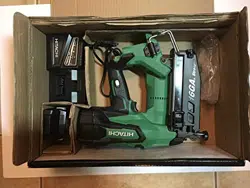
The information contained in this Manual is designed to assist you in the safe operation of the Nailer.
Some illustrations in this Manual may show details or attachments that differ from those on your own Nailer.
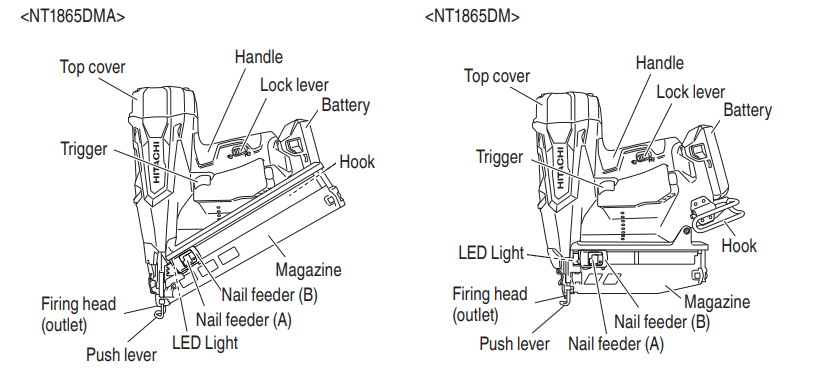
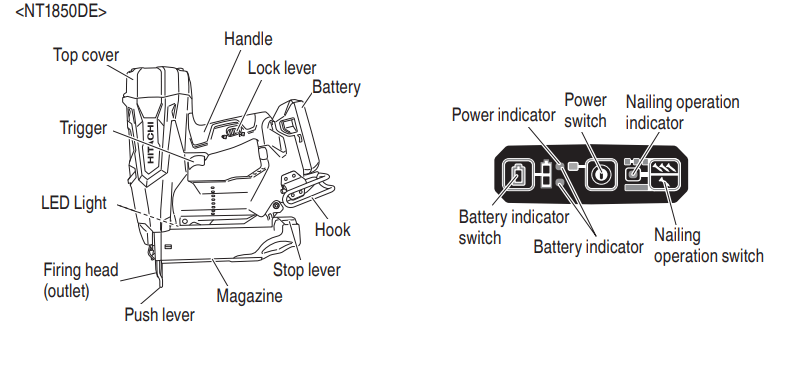
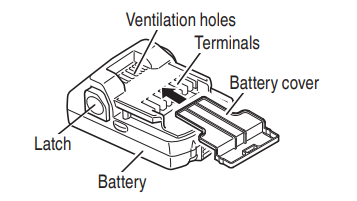
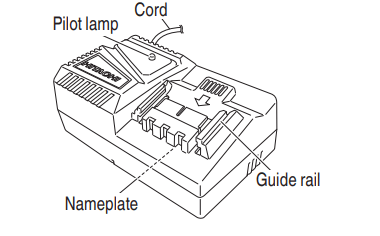
NAME OF PARTS
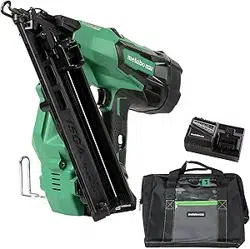
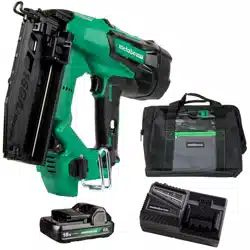
Cordless Finish Nailer
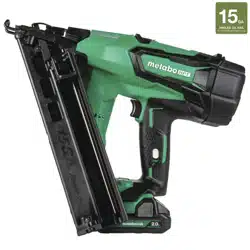
Cordless Brad Nailer
Battery (BSL1830C)
Battery Charger (UC18YFSL)
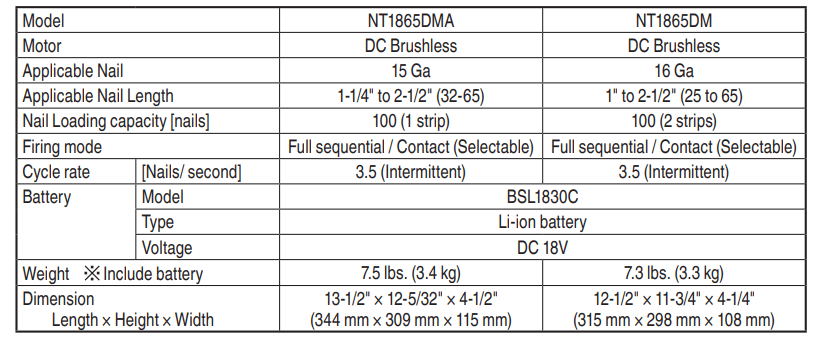
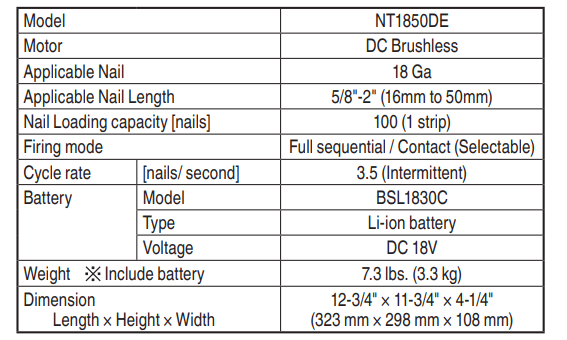
SPECIFICATIONS
Cordless Finish Nailer
Cordless Brad Nailer
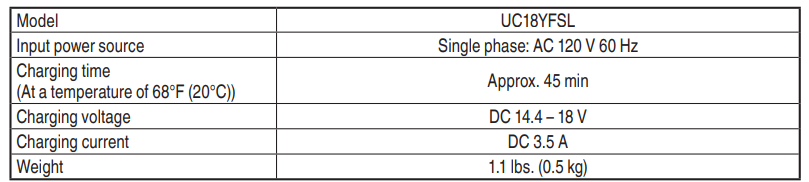
Battery Charger
NOTE The charging time may vary according to temperature and power source voltage.
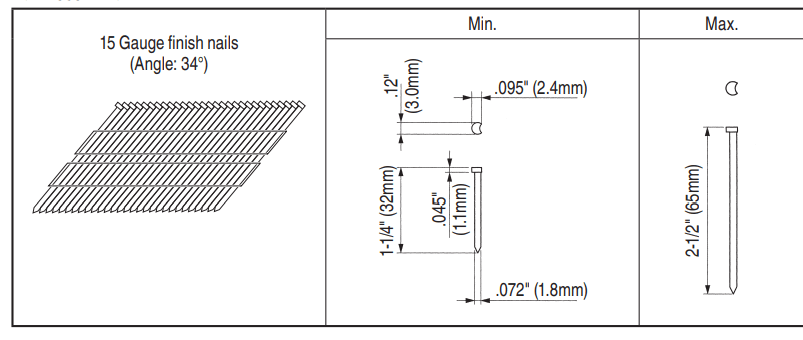
NAIL SELECTION
WARNING
Be sure to use only the genuine HITACHI nails for the NT1865DM, NT1865DMA or the NT1850DE. The use of any other nails can result in tool malfunction and/or nail breakdown, leading to serious injuries.
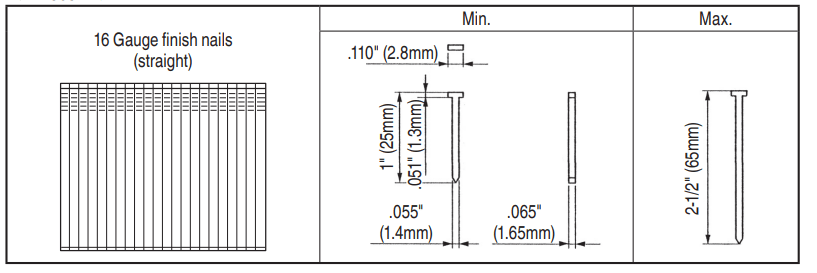
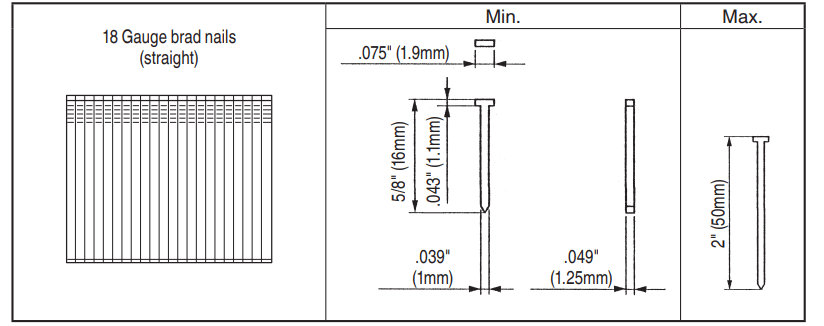
Only nails shown in the Table below can be driven with this Nailer.
Dimensions of nails
<NT1865DMA>
<NT1865DM>
<NT1865DM>
ACCESSORIES
DANGER
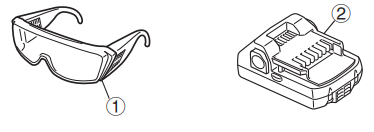
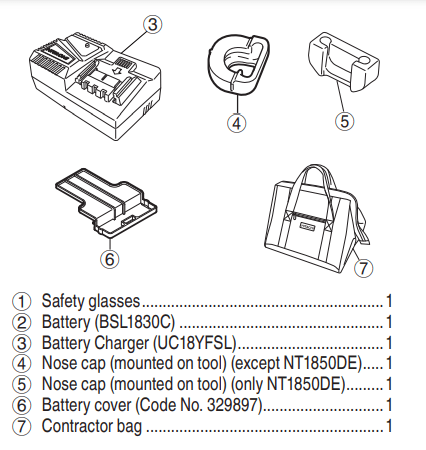
Accessories other than those shown below can lead to malfunction and resulting injuries.
STANDARD ACCESSORIES
OPTIONAL ACCESSORIES
sold separately
BATTERY (BSL1830C)
NOTE Accessories are subject to change without any obligation on the part of HITACHI.
APPLICATIONS
<NT1865DMA, NT1865DM>
Nailing as finishing process for areas around the doors, windows as well as edgings.
Securing the bottom of drawers. Making various cases and cabinets.
<NT1850DE>
Cabinet and picture frame assembly, furniture trim.
On-site and mobile home trim and molding.
REMOVAL AND INSTALLATION METHOD OF BATTERY
CAUTION
Be sure keep the fingers away from the trigger and push lever away from the wood.
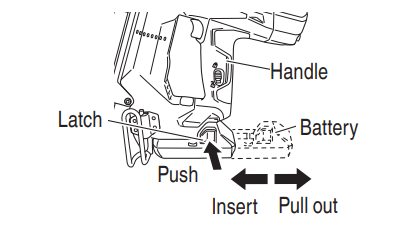
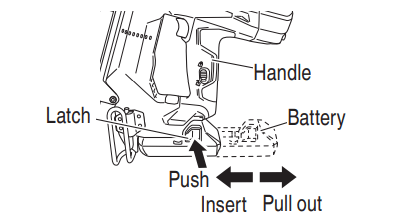
How to install the battery. Align the battery with the groove in tool handle and slip it into place. Always insert it all the way until it locks in place with a little click, If not, it may accidentally fall out of the tool, causing injury to you or someone around you.
How to remove the battery. Withdraw battery from the tool handle while pressing the latch (2 pcs) of the battery.
CHARGING METHOD
NOTE
Before plugging into the receptacle, make sure the following points.
The power source voltage is stated on the nameplate.
The cord is not damaged.
WARNING
Do not charge at voltage higher than indicated on the nameplate.
If charged at voltage higher than indicated on the nameplate, the charger will burn up.
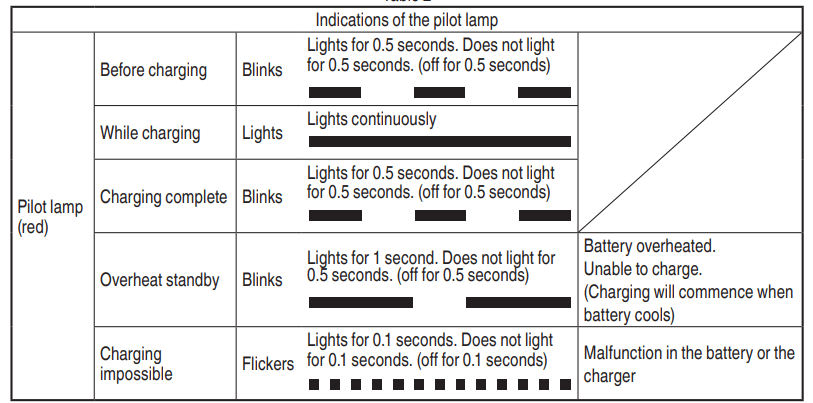
Connect the charger’s power cord to a receptacle. When the power cord is connected, the charger’s pilot lamp will blink in red. (At 1-second intervals) WARNING Do not use the electrical cord if damaged. Have it repaired immediately.
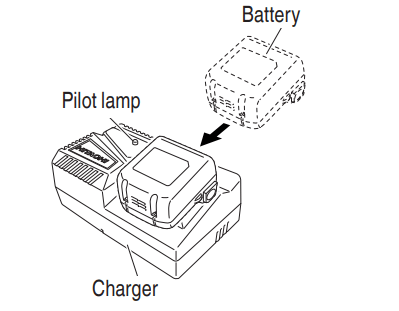
Insert the battery to the battery charger. Insert the battery into the battery charger as shown in the figure.
Charging When the battery is connected to the battery charger, charging will commence and the pilot lamp will light in red. (See Table 2) NOTE If the pilot lamp flikers in red, pull out the plug from the receptacle and check if the battery is properly mounted. When the battery is fully charged, the pilot lamp will blink in red slowly. (At 1-second intervals)(See Table 2)
Pilot lamp indication The indications of the pilot lamp will be as shown in Table 2, according to the condition of the charger or the rechargeable battery Table2
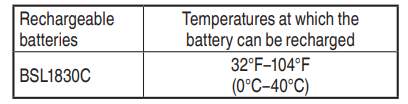
Regarding the temperature of the rechargeable battery. The temperatures for rechargeable batteries are as shown in the Table 3, and batteries that have become hot should be cooled for a while before being recharged. Table 3 Recharging ranges of batteries
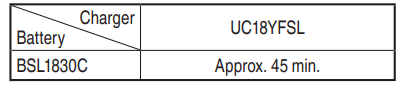
Regarding recharging time (At 68°F (20°C)) Table 4 Charging time NOTE The charging time may vary according to temperature and power source voltage.
Disconnect battery charger from the receptacle. CAUTION Do not pull the plug out of the receptacle by pulling on the cord. Make sure to grasp the plug when removing from receptacle to avoid damaging cord.
Remove the battery from the battery charger. Supporting the battery charger with hand, pull out the battery from the battery charger.
How to make the batteries perform longer
Recharge the batteries before they become completely exhausted. When you feel that the power of the tool becomes weaker, stop using the tool and recharge its battery. If you continue to use the tool and exhaust the electric current, the battery may be damaged and its life will become shorter.
Avoid recharging at high temperatures. A rechargeable battery will be hot immediately after use. If such a battery is recharged immediately after use, its internal chemical substance will deteriorate, and the battery life will be shortened. Leave the battery and recharge it after it has cooled for a while.
CAUTION
When the battery charger has been continuously used, the battery charger will be heated, thus constituting the cause of the failures. Once the charging has been completed, give 15 minutes rest until the next charging.
If the battery is charged while it is heated because it has been left for a long time in a location subject to direct sunlight or because the battery has just been used, the pilot lamp of the charger lights for 1 second, does not light for seconds (off for 0.5 seconds). In such a case, first let the battery cool, then start charging.
When the pilot lamp flickers rapidly in red (at second intervals), check for and take out any foreign objects in the charger’s battery installation hole. If there are no foreign objects, it is probable that the battery or charger is malfunctioning. Take it to your authorized
Service Center.
BEFORE OPERATION
Read section titled “SAFETY” (pages 5 – 12).
Make sure of the followings before operation.
PREPARING THE BATTERY
Read section titled “SAFETY, IMPORTANT SAFETY INSTRUCTIONS FOR BATTERY CHARGER” (page 9).
You must charge the battery before use. The charging method of battery is shown in page 17 - 19.
HOW TO OPERATE OPERATION PANEL
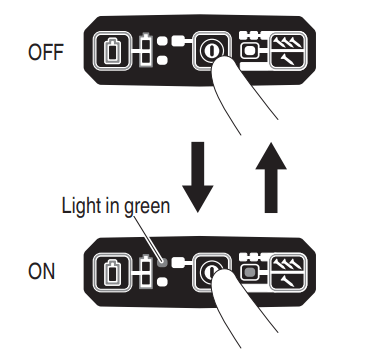
(1) Power switch ON
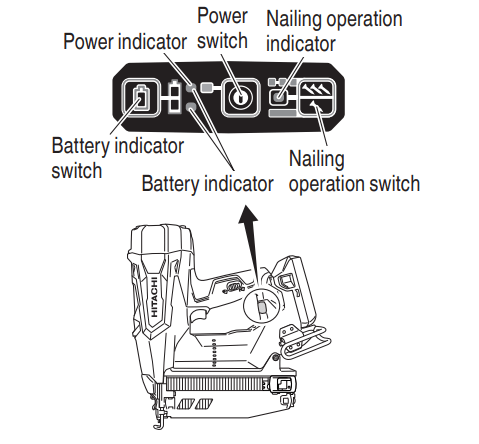
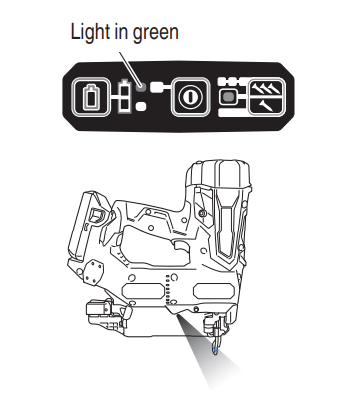
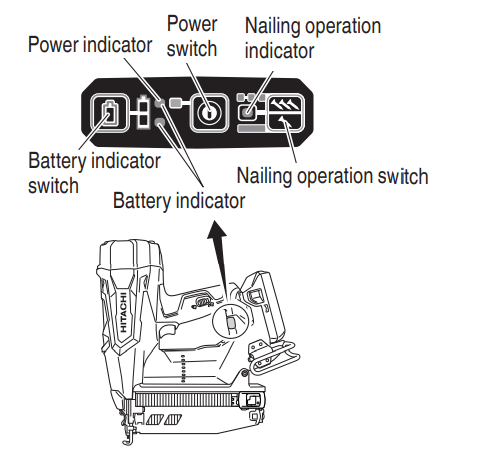
Under the condition of “Power switch OFF”, push and hold on Power switch more than 1 second, then power indicator lights in Green.
NOTE
Do not press the push lever and/or pull the trigger during the process of turning the power switch ON. Doing so will prevent the power switch from turning ON.
(2) Power switch OFF
Under the condition of “Power switch ON”, push and hold on Power switch more than 1 second, then power indicator goes off .
Under the condition of “Power switch ON”, functions below are active.
(3) Select Nailing operation mode
(Full sequential actuation / Contact actuation)
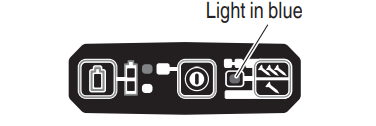
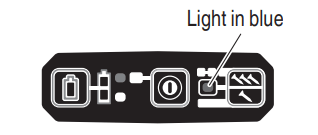
After power switch turn ON, always set in Full sequential actuation mode as initial. (Nailing operation indicator light in blue.)
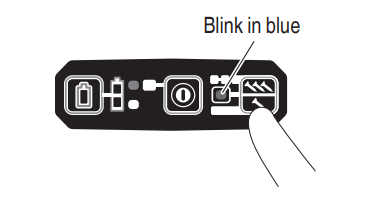
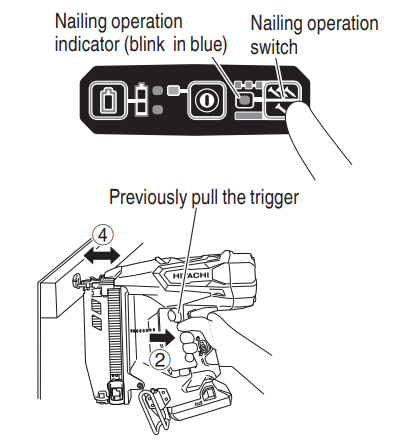
To change nailing operation mode, push Nailing operation switch once. Every pushing, mode will change between “Full sequential” and “Contact”. Lighting (Blue):
FULL SEQUENTIAL ACTUATION MECHANISM, Blinking (Blue):
CONTACT ACTUATION MECHANISM
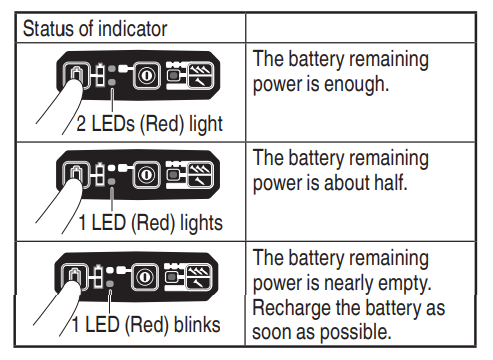
(4) Check Remaining battery level
When pressing the battery indicator switch, the battery indicator shows Remaining battery level by status of LED lamp as below.
(5)Other functions
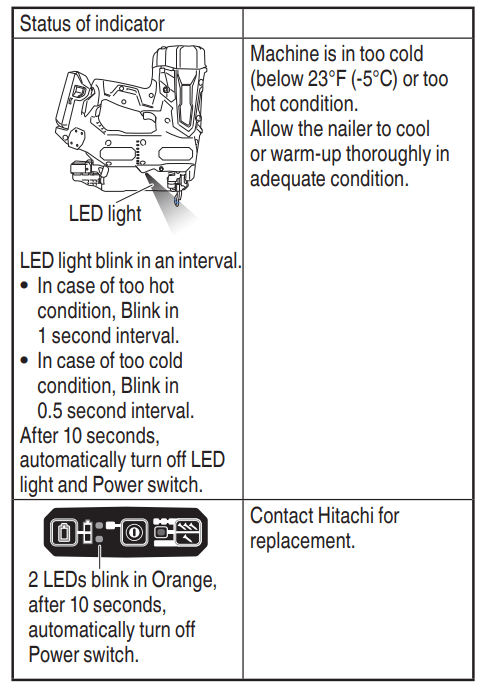
In case of operation error, LED lamps show as below.
(6) How to use the LED light
While the power switch on, the LED light will automatically light up the tip portion of the tool.
CAUTION
Do not expose directly your eye to the light by looking into the light. If your eye is continuously exposed to the light, your eye will be hurt.
Wipe off any dirt or grime attached to the lens of the LED light with a soft cloth, being careful not to scratch the lens. Scratches on the lens of the LED light can result in decreased brightness.
TESTING THE NAILER
DANGER
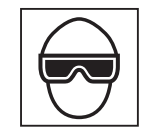
Operators and others in work area MUST wear safety glasses with side shields which conforms to ANSI Z87.1 specifications.
WARNING
Make sure the trigger is locked when not firing nails.
This Nailer has a lock mechanism to prevent the nails from being fired.
Set the lock lever at the position to lock the trigger.
Slide the lock lever to the position when the
Nailer is to be used, and to the position when it is not in use.
Never use Nailer unless push lever is operating properly. The machine employs a preventive mechanism for unloaded operation.
The machine enters a state where the push lever cannot be pushed up. This takes place when the magazine is not loaded with nails or when the remaining number of nails becomes less than 6 or 9.
CAUTION
Use caution not to throw the push lever tip onto wood.
Before actually beginning the nailing work, test the Nailer by using the checklist below. Conduct the tests in the following order.
If abnormal operation occurs, stop using the Nailer and contact a Hitachi authorized service center immediately.
(1) REMOVE ALL NAILS AND BATTERY FROM NAILER.
ALL SCREWS MUST BE TIGHTENED.
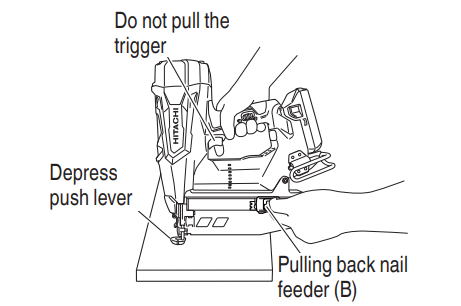
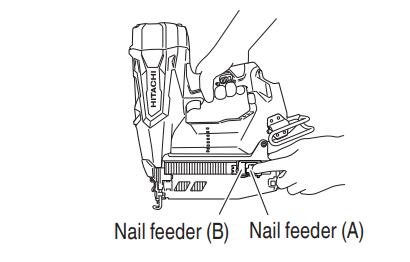
THE PUSH LEVER AND TRIGGER MUST MOVE SMOOTHLY with pulling back the nail feeder (B). (NT1850DE: Unnecessary to pulling back nail feeder)
(2) Installing the battery.
Do not operate the push lever or trigger while installing the battery.
(3) Turn on the Power switch.
Turn on the Power switch by push and hold on Power switch more than 1 second.
Make sure the power indicator is lighting in green, and nailing operation indicator is lighting in blue. (FULL SEQUENTIAL ACTUATION MECHANISM,)
NOTE
Do not press the push lever and/or pull the trigger during the process of turning the power switch ON. Doing so will prevent the power switch from turning ON.
[Auto power off ]
When the power is turned on but the Nailer is not used for 30 minutes, the Nailer is automatically turned off . To turn on again, press the power switch.
WARNING
Never leave the Nailer with the power on. This could result in an accident.
Nailing operation indicator
Lighting (Blue):
FULL SEQUENTIAL ACTUATION MECHANISM,
Blinking (Blue):
CONTACT ACTUATION MECHANISM)
(4) Make sure the battery indicator is not blinking.
If the battery indicator is blinking in red, the battery doesn’t have enough power and it needs to be charged.
Remove the finger from the trigger and press the push lever against the workpiece with pulling back the nail feeder (B).
THE NAILER MUST NOT OPERATE.
(5) Separate the push lever from the workpiece. Next, point the nailer downward, with pulling back the nail feeder (B), pull the trigger and then wait in that position for 5 seconds or longer.
THE NAILER MUST NOT OPERATE.
(6) Without touching the trigger, depress the push lever against the workpiece with pulling back the nail feeder (B). Next, pull the trigger.
THE NAILER MUST OPERATE.
Hold the trigger back and depress the push lever against the workpiece again.
THE NAILER MUST NOT OPERATE.
Separate the finger from the trigger. Next, is operated again.
THE NAILER MUST OPERATE.
(7) Separate the push lever from the workpiece, pull the trigger. Depress the push lever against the workpiece within seconds.
THE NAILER MUST NOT OPERATE.
(8)Set the nailing operation indicator blinking ON mode. (CONTACT ACTUATION MECHANISM) Push the nailing operation switch once, make sure that the indicator is blinking Blue.
Separate the push lever from the workpiece, pull the trigger.
Depress the push lever against the workpiece within 2 seconds.
THE NAILER MUST OPERATE
(9) vIf no abnormal operation is observed, you may load nails in the Nailer. Drive nails into the workpiece that is the same type to be used in the actual application.
THE NAILER MUST OPERATE PROPERLY.
LOADING NAILS
WARNING
When loading nails into Nailer,
remove battery from the nailer;
do not pull trigger;
do not depress push lever; and
keep nailer pointed downward.
<NT1865DMA, NT1865DM>
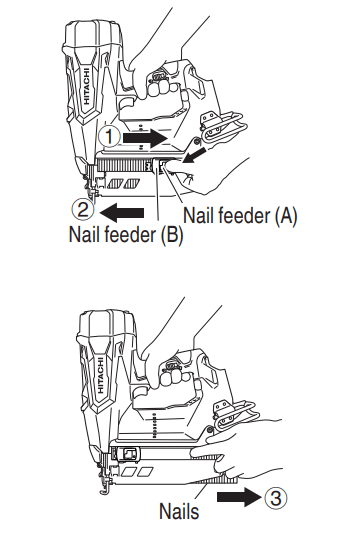
2-Action Nail Feeding!
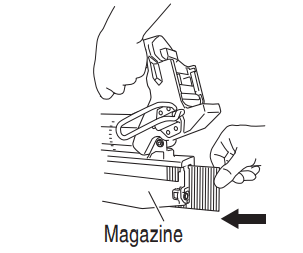
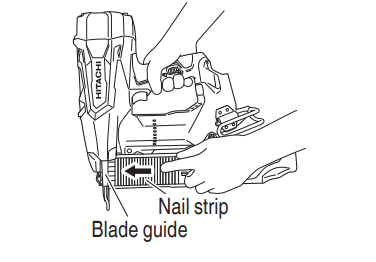
Insert nail strip into the back of the magazine.
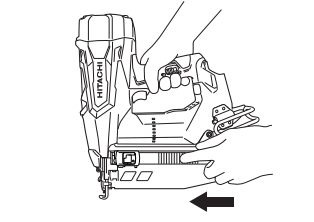
Slide the nail strip forward in the magazine.
Push the nail feeder (A) to engage the nail feeder (B) to the nail strip.
NOTE
Quietly push the nail feeder (A) and nail feeder (B) against the nail. If the nail feeder (A) and nail feeder (B) are released from backward the magazine and bumped against the nail, the connecting adhesive of the nail can be damaged.
Use nail strip of more than 10 nails.
Use an unbroken nail strip with nails of all the same length.
The Nailer is now ready to operate.
Removing the nails:
Pull the nail feeder (B) backward.
Return the nail feeder (B) forward quietly while pushing the nail feeder (A).
Pull out nails from the back of the magazine.
<NT1850DE>
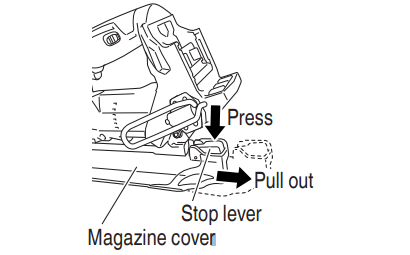
Lightly press the stop lever and gently pull out the magazine cover.
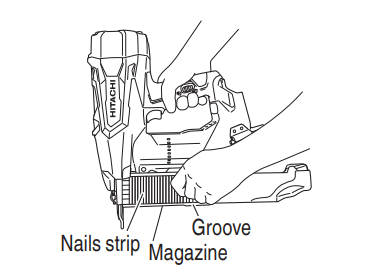
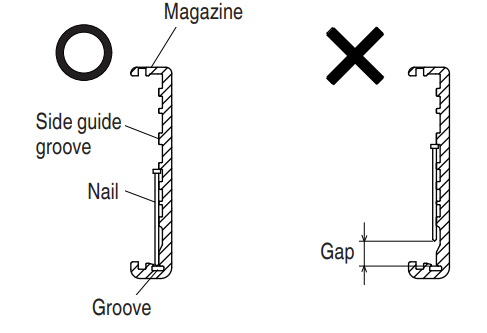
Set nail strip into the magazine and keep the points of nails in contact with Groove. NOTE The nails shown in page 15 - 16 can be loaded onto the side guide groove of the magazine without any adjustment. Always keep the points of nails in contact with Groove.
Slide the nail strip into the blade guide.
Confirm that nail strip is placed with side guide grooves and Groove properly, then push the magazine cover forward to be latched.
NAILER OPERATION
Read section titled “SAFETY” (pages 5 – 12).
DANGER
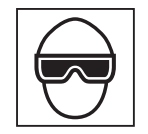
Operators and others in work area MUST wear safety glasses with side shields which conforms to ANSI Z87.1 specifications.
WARNING
NEVER point tool at yourself or others in work area.
Keep fingers AWAY from trigger when not driving nails to avoid accidental firing.
Do not use the electrical cord if damaged. Have it repaired immediately.
Choice of triggering method is important. Please read and understand “METHODS OF OPERATION” found below.
Before starting work, check the nailing operation switching device. This Hitachi nailer includes a nailing operation switching device. Before starting work, make sure that the switching device is properly set. If the switching device is not set properly, the nailer will not operate correctly.
Never place your face, hands or feet near firing head when using.
Do not drive nails on top of other nails or with Nailer at too steep of an angle; nails can ricochet and hurt someone.
Do not drive nails into thin boards or near corners and edges of workpiece. Nails can be driven through or away from workpiece and hit someone.
Never drive nails from both sides of a wall at the same time. Nails can be driven into and through the wall and hit a person on the opposite side.
Never use Nailer which is defective or operating abnormally.
Do not use Nailer as hammer.
Remove all remaining fasteners and battery from nailer when:
doing maintenance and inspection;
checking proper operation of push lever and trigger;
attaching or removing the nose cap;
cleaning a jam;
it is not in use;
leaving work area;
moving it to another location; and
handing it to another person.
Remove battery from Nailer when:
loading nails;
turning the adjuster.
This Hitachi nailer is equipped with a nailer operation switching device.
Use FULL SEQUENTIAL ACTUATION MECHANISM or CONTACT ACTUATION MECHANISM in accordance with the work to be performed.
Explanation of the various nailing operations
FULL SEQUENTIAL ACTUATION MECHANISM: First, press the push lever against the wood; next, pull the trigger to drive the nail.
CONTACT ACTUATION MECHANISM: First, pull the trigger; next, press the push lever against the wood to drive the nail. If the trigger is held back, a nail will be driven each time the push lever is pressed against the wood.
The NT1865DMA, NT1865DM employs a preventive mechanism for unloaded operation.
The NT1865DMA, NT1865DM enters a state where the push lever cannot be pushed up. This takes place when the magazine is not loaded with nails or when the remaining number of nails becomes less than 6 or 9.
CAUTION
Use caution not to throw the push lever tip onto wood when the push lever cannot be pushed up.
METHODS OF OPERATION
This Nailer is equipped with the push lever and does not operate unless the push lever is depressed. There are two methods of operation to drive nails with this Nailer.
They are:
Intermittent operation (Trigger fire):
Continuous operation (Push lever fire):
(1) Intermittent operation (Trigger fire)
Use the FULL SEQUENTIAL ACTUATION MECHANISM setting.
WARNING
For intermittent operation, Set the nailing operation switch to FULL SEQUENTIAL ACTUATION MECHANISM (Nailing operation indicator is light in blue.) (i.e. Set to SINGLE ACTUATION MECHANISM.)
To avoid double firing or accidental firing due to recoil.
Set to FULL SEQUENTIAL ACTUATION MECHANISM.
Pull the trigger rapidly and firmly.
Set the nailing operation switch to FULL SEQUENTIAL ACTUATION MECHANISM Nailing operation indicator is light in blue.) to set to FULL SEQUENTIAL ACTUATION MECHANISM). Set the switching device to the nailing operation indicator light in blue mode completely as shown in the diagram. Otherwise, it will be set to CONTACT ACTUATION MECHANISM.)
Position the nail outlet on the workpiece with finger off the trigger.
Depress the push lever firmly until it is completely depressed.
Pull the trigger to drive a nail.
Remove finger from the trigger and lift the tool off the wood surface completely.
To continue nailing in a separate location, move the nailer along the wood, repeating steps - as required.
NOTE
Operations and should be done within seconds of each other. If more than 2 seconds pass after , the Nailer will not work properly. If this happens, retry from
(2) Continuous operation (Push lever fire) Using CONTACT ACTUATION MECHANISM
WARNING
To avoid double firing or accidental firing due to recoil.
Do not press the nailer against the wood with excessive force.
Separate the nailer from the wood as it recoils after nailing.
Set the nailing operation switch to CONTACT ACTUATION MECHANISM (Nailing operation indicator is blink in blue.) to set to CONTACT ACTUATION MECHANISM). (Set the switching device to the nailing operation indicator blink in blue completely as shown in the diagram. Otherwise, it will not operate properly.)
Pull the trigger with the Nailer off the workpiece.
Depress the push lever against the workpiece to drive a nail.
Move the Nailer along the workpiece with a bouncing motion.
Each depression of the push lever will drive a nail.
As soon as the desired number of nails have been driven, remove finger from the trigger.
NOTE
Operations and should be done within seconds of each other. If more than 2 seconds pass after the Nailer will not work properly. If this happens, retry from.
WARNING
Keep your finger off the trigger except during nailing operation, because serious injury could result if the push lever accidentally contacts you or others in work area.
Keep hands and body away from the discharge area. This Hitachi nailer may bounce from the recoil of driving a nail and unwanted subsequent nail may be driven, possibly causing injury.
ADJUSTING THE NAILING DEPTH
To assure that each nail penetrates to the same depth, be sure that the Nailer is always held firmly against the workpiece.
If nails are driven too deep or shallow into the workpiece, adjust the nailing in the following order
Remove the battery from the Nailer.
If nails are driven too deep, turn the adjuster to the shallow side.
Adjustments are in half-turn increments.
If nails are driven too shallow, turn the adjuster to the deep side.
Stop turning the adjuster when a suitable position is reached for a nailing test.
Connect the battery to the Nailer. ALWAYS WEAR SAFETY GLASSES. Perform a nailing test.
Remove the battery from the Nailer.
Choose a suitable position for adjuster.
USING THE BELT HOOK
WARNING
When using the belt hook, turn off the power switch (green light “OFF”). Pay sufficient attention so that the main equipment does not fall. If the toll falls, there is a risk of accident.
Do not attach the tip toll when carrying the toll with the belt hook suspended from a waist belt.
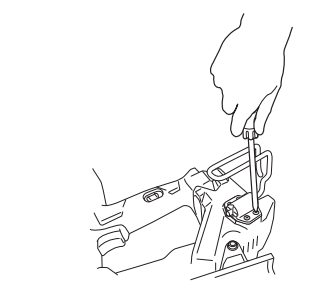
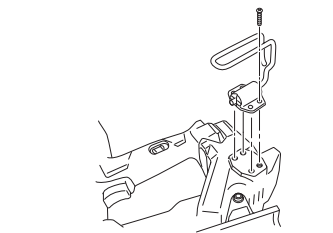
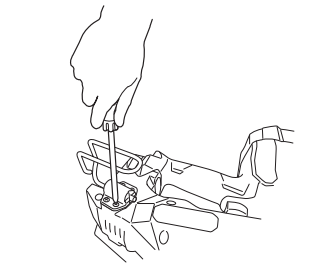
Hook can be installed on the left or right side.
Securely hold the main unit and remove the screw using a screwdriver.
Remove the hook and hook plate.
Install the hook on the other side and securely fasten with screw.
USING THE NOSE CAP
WARNING
When attaching or detaching the nose cap, be sure to remove your finger from the trigger and remove all remaining fasteners and the battery from the nailer.
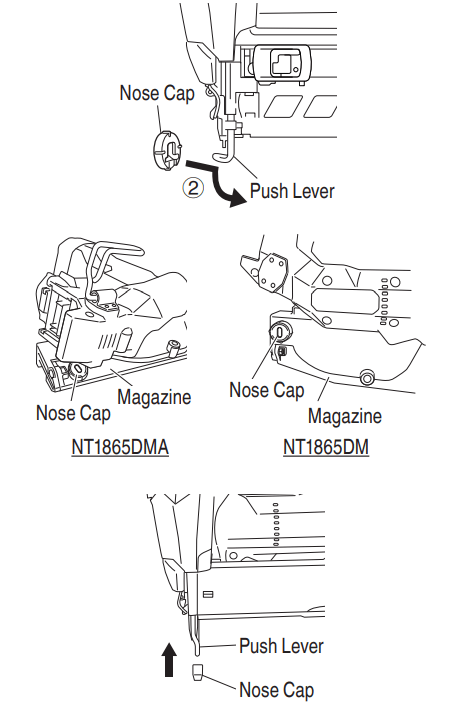
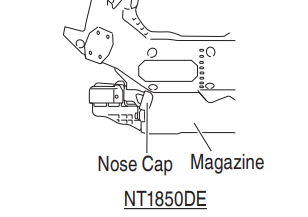
If you like to protect the surface of workpiece against scratches or markings made by the push lever, attach the accessory nose cap to the push lever.
Remove all remaining fasteners and battery from nailer.
Put the nose cap to the toe of the push lever.
The nose cap is marked to indicate the exit point of the nail, making alignment easier.
When not using the nose cap, secure in the storage compartment located on the reverse side of the magazine.
NOTE
The nose cap may reduce nailing depth due to its thickness. Re-adjustment of nailing depth is required.
CLEARING A JAM
If nails are jammed in firing head, remove it, and adjust the nailing in the following order.
CAUTION
Remove the battery from the Nailer.
Remove the battery from the Nailer.
Remove all nails.
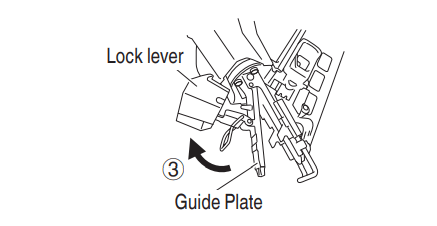
Release the Lock lever and open guide plate.
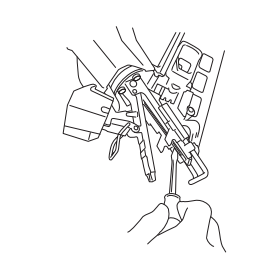
Remove the jammed nail with a slotted-head screwdriver. CAUTION
NEVER hit the driver blade.
NEVER point the tool at yourself or another person, to avoid risk of injury by mis-firing. Even if the battery is removed from the nailer, there is still energy of compressed air remaining inside
Close guide plate and latch.
NOTE
In case of frequent jam, contact a Hitachi authorized service center.
MAINTENANCE
NOTE
The information contained in this Manual is designed to assist you in the safe maintenance of the Nailer.
Some illustrations in this Manual may show details or attachments that differ from those on your own Nailer.
MAINTENANCE AND INSPECTION
<Nailer>
Read section titled “SAFETY” (pages 5 – 12).
WARNING
Remove battery and all remaining fasteners from Nailer when:
doing maintenance and inspection; and
clearing a jam.
Inspecting the magazine
Remove battery.
Clean the magazine. Remove dust and wooden chips which may have accumulated in the magazine.
Storing
Do not store the Nailer, and battery in a cold weather environment. Keep them in a warm area.
When not in use, the Nailer, and battery should be stored in a warm and dry place. Keep it out of reach of children.
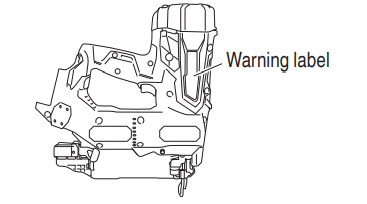
WARNING LABEL Change the WARNING LABEL if missing or damaged. A new WARNING LABEL is available from a Hitachi authorized service center.
Maintenance chart (See page 30)
Operator troubleshooting (See page 30 – 31)
Disposal of the exhausted battery WARNING Do not dispose of the exhausted battery. The battery must explode if it is incinerated. The product that you have purchased contains a rechargeable battery. The battery is recyclable. At the end of it’s useful life, under various state and local laws, it may be illegal to dispose of this battery into the municipal waste stream. Check with your local solid waste officials for details in your area for recycling options or proper disposal.
Storage Storing in a place below 104°F (40°C) and out of the reach of children. NOTE Storing lithium-ion batteries Make sure the lithium-ion batteries have been fully charged before storing them. Prolonged storage (3 months or more) of batteries with a low charge may result in performance deterioration, significantly reducing battery usage time or rendering the batteries incapable of holding a charge. However, significantly reduced battery usage time may be recovered by repeatedly charging and using the batteries two to five times. If the battery usage time is extremely short despite repeated charging and use, consider the batteries dead and purchase new batteries.
Service parts list
CAUTION
Repair, modification and inspection of Hitachi Power Tools must be carried out by a Hitachi Authorized Service Center. This Parts List will be helpful if presented with the tool to the Hitachi Authorized Service Center when requesting repair or other maintenance. In the operation and maintenance of power tools, the safety regulations and standards prescribed in each country must be observed.
MODIFICATIONS
Hitachi Power Tools are constantly being improved and modified to incorporate the latest technological advancements. Accordingly, some parts may be changed without prior notice.
Important notice on the batteries for the Hitachi cordless power tools
Please always use one of our designated genuine batteries. We cannot guarantee the safety and performance of our cordless power tool when used with batteries other than these designated by us, or when the battery is disassembled and modified (such as disassembly and replacement of cells or other internal parts).
SERVICE AND REPAIRS
WARNING
Only service personnel trained by Hitachi, distributor or employer shall repair the Nailer.
Use only parts supplied or recommended by Hitachi for repair.
All quality Nailers will eventually require servicing or replacement of parts because of wear from normal use.
NOTE
Specifications are subject to change without any obligation on the part of HITACHI.
Maintenance chart
Operator troubleshooting
Most minor problems can be resolved quickly and easily using the table below.
If problems persist, contact a Hitachi authorized service center for assistance.
PROBLEM
CHECK METHOD
CORRECTION
Power switch doesn’t turn on. Turn on once, but turn off automatically.
Low battery charge.
Charge the battery.
Damaged internal electronics.
Contact Hitachi for replacement.
Push lever and/or trigger is ON state ?
Keep push lever and trigger in OFF state.
Keep no operation over 30 minutes ?
(Auto-power off function)
Push and hold power switch more than 1 second to switch “ON”
Nailer doesn’t operate (Power switch ON).
Nailer not enough pressed against workpiece.
Hold nailer firmly and press to the workpiece completely.
Trigger not enough pulled.
Pull the trigger firmly.
More than 2 seconds pass from push lever ON to trigger ON (or trigger ON to push lever ON).
Make sure that less than 2 seconds pass between push lever ON and trigger ON (or between trigger ON and push lever ON).
Preventive mechanism activated. (No nails, or too few fasteners remaining) (NT1865DMA / NT1865DM only)
Reload the nails into magazine.
Lock lever(Trigger lock function) is "ON” position.
Set Lock lever to “OFF” position. (Refer to page 20 – 21)
Set Lock lever to “OFF” position. (Refer to page 20 – 21)
Allow the nailer to cool or warm-up throughly in adequate condition.
Damaged internal electronics.
Contact Hitachi for replacement.
Nailer operates, but no nail is driven.
Magazine is dirty.
Blow and wipe clean the magazine.
Check for a jam.
Clear a jam (refer to page 28).
Driver blade worn or damaged?
Contact Hitachi for replacement.
Ribbon spring weakened or damaged?
Replace ribbon spring.
Nail feeder damaged?
Replace nail feeder.
Check for proper nails.
Use only recommended nails.
Weak drive.
Slow to cycle.
Check position of nailing depth adjustment adjuster.
Readjust according to page 26 – 27.
Driver blade worn?
Contact Hitachi for replacement.
Compressed air pressure has become low.
Contact Hitachi for replacement.
Damaged internal electronics.
Contact Hitachi for replacement.
Drives too deep.
Check position of nailing depth adjustment adjuster.
 the position to lock the trigger.
 position when the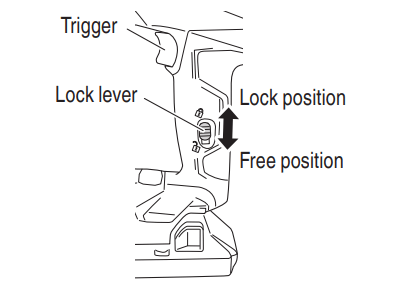
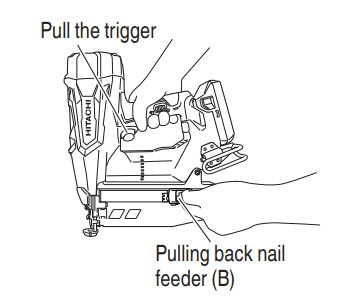
 Without touching the trigger, depress the push lever against the workpiece with pulling back the nail feeder (B). Next, pull the trigger.
 Hold the trigger back and depress the push lever against the workpiece again.
 Separate the finger from the trigger. Next,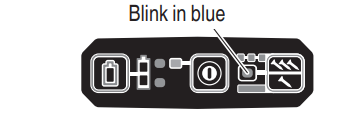
 Set the nailing operation switch to FULL SEQUENTIAL ACTUATION MECHANISM Nailing operation indicator is light in blue.) to set to FULL SEQUENTIAL ACTUATION MECHANISM). Set the switching device to the nailing operation indicator light in blue mode completely as shown in the diagram. Otherwise, it will be set to CONTACT ACTUATION MECHANISM.)
 Position the nail outlet on the workpiece with finger off the trigger.
 Depress the push lever firmly until it is completely depressed.
 Pull the trigger to drive a nail.
 Remove finger from the trigger and lift the tool off the wood surface completely.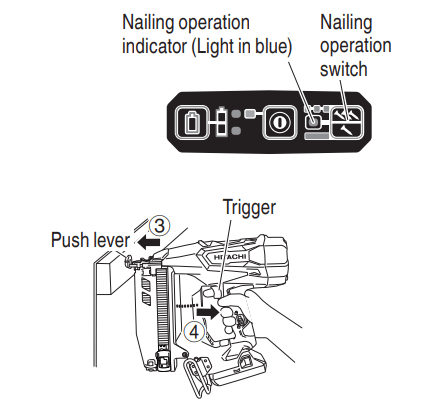
 Remove the battery from the Nailer.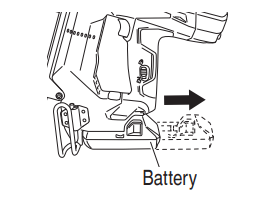
 If nails are driven too deep, turn the adjuster to the shallow side.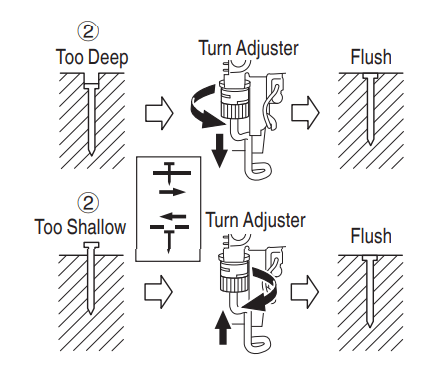
 Stop turning the adjuster when a suitable position is reached for a nailing test.
 Connect the battery to the Nailer. ALWAYS WEAR SAFETY GLASSES. Perform a nailing test.
 Remove the battery from the Nailer.
 Choose a suitable position for adjuster.