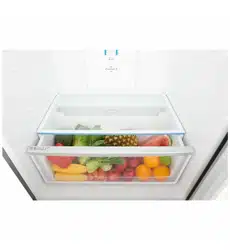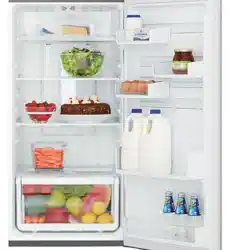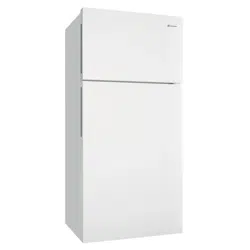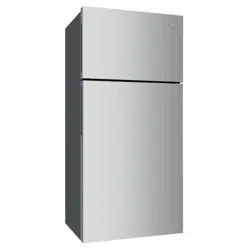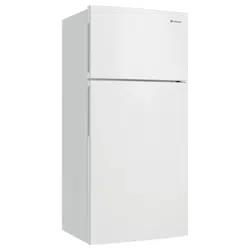
Top Mount Frost Free Refrigerator Freezer
Important safety instructions . . . . . . . . . . . . . 3
WTM1800WC features . . . . . . . . . . . . . . 4
WTM2000WC features . . . . . . . . . . . . . . 5
Installing your new appliance . . . . . . . . . . . . 6
Ventilation around your appliance. . . . . . . . . 6
Installing your refrigerator . . . . . . . . . . . .6-7
Initial start-up . . . . . . . . . . . . . . . . . . . 7
Using your appliance . . . . . . . . . . . . . . .7-8
Making ice . . . . . . . . . . . . . . . . . . 8
Removing/replacing chiller door & drawer . . . . . . 9
Replacing the lamp (WTM1800WC) . . . . . . . . 9
Replacing the lamp (WTM2000WC) . . . . . . . . 10
General information . . . . . . . . . . . . . . . . 11
Cleaning the appliance . . . . . . . . . . . . . 11
Safety . . . . . . . . . . . . . . . . . . . . . 11
Switching off your appliance . . . . . . . . . . . 11
Reversing the door opening direction . . . . . . . . 12
Troubleshooting . . . . . . . . . . . . . . . . . . 14
Warranty . . . . . . . . . . . . . . . . . . . . . 15
Congratulations and thank you for choosing our
refrigerator/freezer. We are sure you will find your new
appliance a pleasure to use. Before you use the appliance,
we recommend that you read through the relevant sections
of this manual, which provides a description of your
appliance and its functions.
To avoid the risks that are always present when you use
an electric appliance, it is important that the appliance is
installed correctly and that you read the safety instructions
carefully to avoid misuse and hazards.
We recommend that you keep this instruction booklet
for future reference and pass it on to any future owners.
After unpacking the appliance, please check it is not
damaged. If in doubt, do not use the appliance but contact
your local customer care centre.
TIPS & INFORMATION
If you find
the refrigerator is damaged or marked, you must report it
within 7 days if you wish to claim for damage/marks
under the manufacturers warranty. This does not affect
your statutory rights.
ENVIRONMENTAL TIPS
• Most of the packing materials are recyclable. Please
dispose of those materials through your local recycling
depot or by placing them in appropriate collection
containers.
• If you wish to discard this product, please contact
your local authorities and ask for the correct method
of disposal.
Please read the user manual carefully and store in a handy
place for later reference.
The symbols you will see in this booklet have these meanings:
WARNING
CAUTION
TIPS & INFORMATION
ENVIRONMENTAL TIPS
Meanings of symbols used in this manual are shown below:
WARNING
• If pressurised aerosol containers bear the word
‘flammable’ and/or a small flame symbol,
do not store them inside any refrigerator or
freezer. If you do so you may cause an explosion.
• When you dispose of your old refrigerators and freezers,
remove any doors. Children can suffocate if they get
trapped inside.
• This appliance contains insulation formed with ammable
blowing gases. Avoid safety hazards by carefully
disposing of this appliance.
WARNING
The refrigerator must be plugged into its own
dedicated 220-240V, 50Hz AC electrical outlet.
The plug must be accessible when the refrigerator is
in position.
It is essential the power point is properly earthed to
ground. Consult a qualified electrician if you are unsure.
Don’t use extension cords or adapter plugs with this
refrigerator.
If the power cord is damaged, have it replaced by a
qualified service technician.
Unplug the refrigerator before cleaning it, or changing
the light bulb to avoid electric shock.
Never unplug the refrigerator by pulling the electrical
cord as this may damage it. Grip the plug firmly and
pull straight out.
Choose a location for your refrigerator that isn’t too cold.
The ambient room temperature should be above 10°C.
Stand your refrigerator in a dry place – avoid areas
of high moisture or humidity.
Don’t put the refrigerator in frosty or unprotected areas
like a garage or on the verandah.
Keep the refrigerator out of direct sunlight.
Don’t locate the refrigerator near stoves, fires or heaters.
When installed correctly, your refrigerator should:
– Have adequate space at the back and sides
for air circulation (refer to page 6).
– Be aligned to the surrounding cupboards.
– Have doors that will self-close from a partially
open position.
WARNING
This appliance may contain a small quantity of environmentally
friendly, but flammable, non-synthetic R600a refrigerant:
• Ensure that the tubing of the refrigerant circuit is not
damaged during transportation and installation.
• The room for installing appliance must be at least 1m
3
per
8g of refrigerant. The amount of refrigerant charged in the
appliance can be found on the rating plate on the appliance.
• Keep ventilation openings in the appliance enclosure or
in the built-in structure, clear of obstruction.
• Do not use mechanical devices or other means to
accelerate the defrosting process, other than those
recommended by the manufacturer.
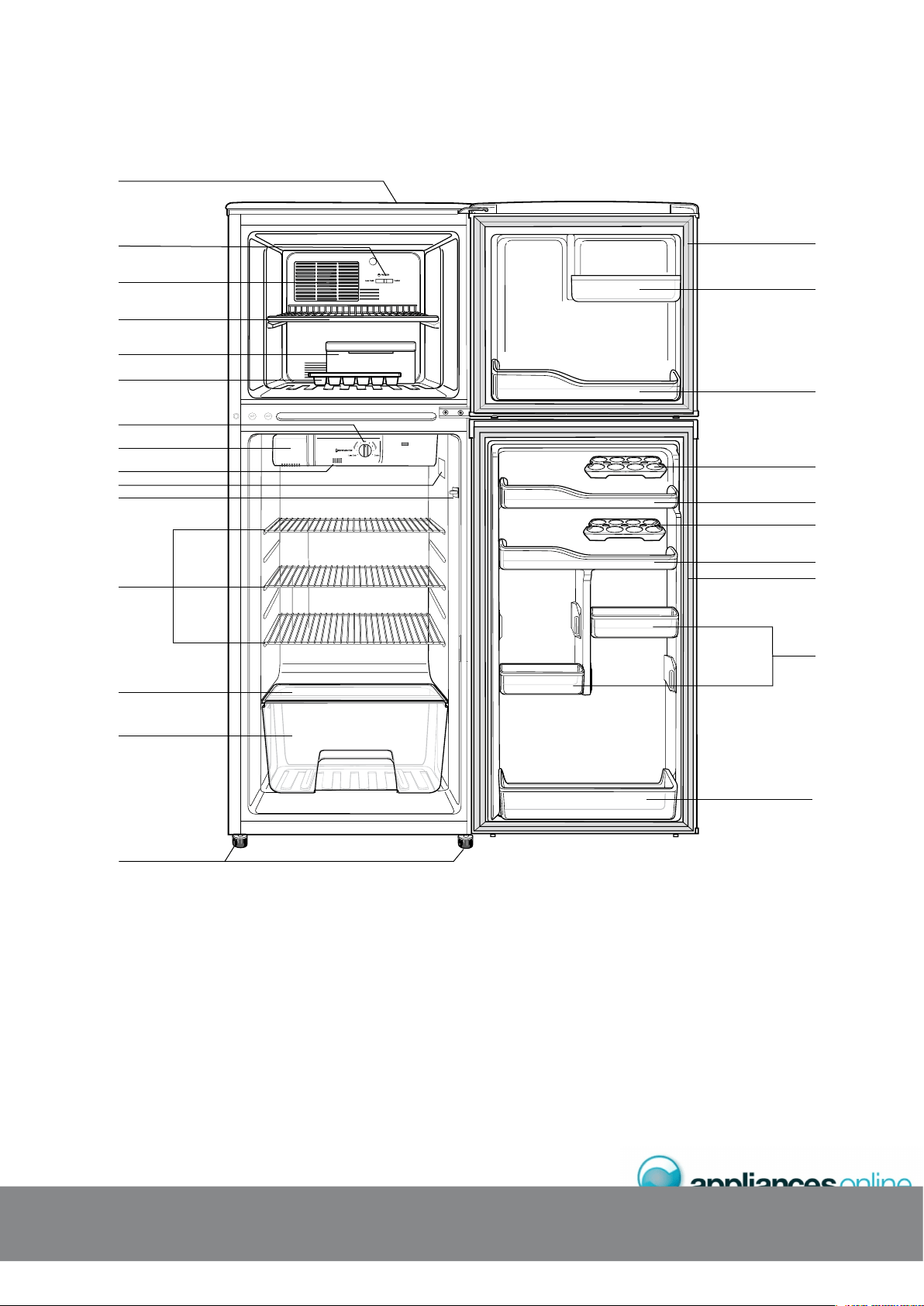
1 Top cover
2 Freezer control slide
3 Fan housing
4 Wire freezer shelf
5 Ice bin
6 Ice tray
7 Refrigerator control knob
8 Light
9 Temperature sensor
10 Fast chill zone sticker
11 Light switch
12 Wire shelves
13 Crisper cover
14 Vegetable crisper
15 Levelling legs
16 Door gaskets/seals
17 Top freezer bin
18 Bottom freezer bin
19 Egg trays
20 Full width fridge door bin
21 Half width fridge door bin
22 Bottom fridge door bin
1
7
2
3
4
8
10
11
12
9
5
6
13
14
19
19
20
20
21
22
16
16
17
18
15
Features may vary depending on model. Not all models will have features listed.
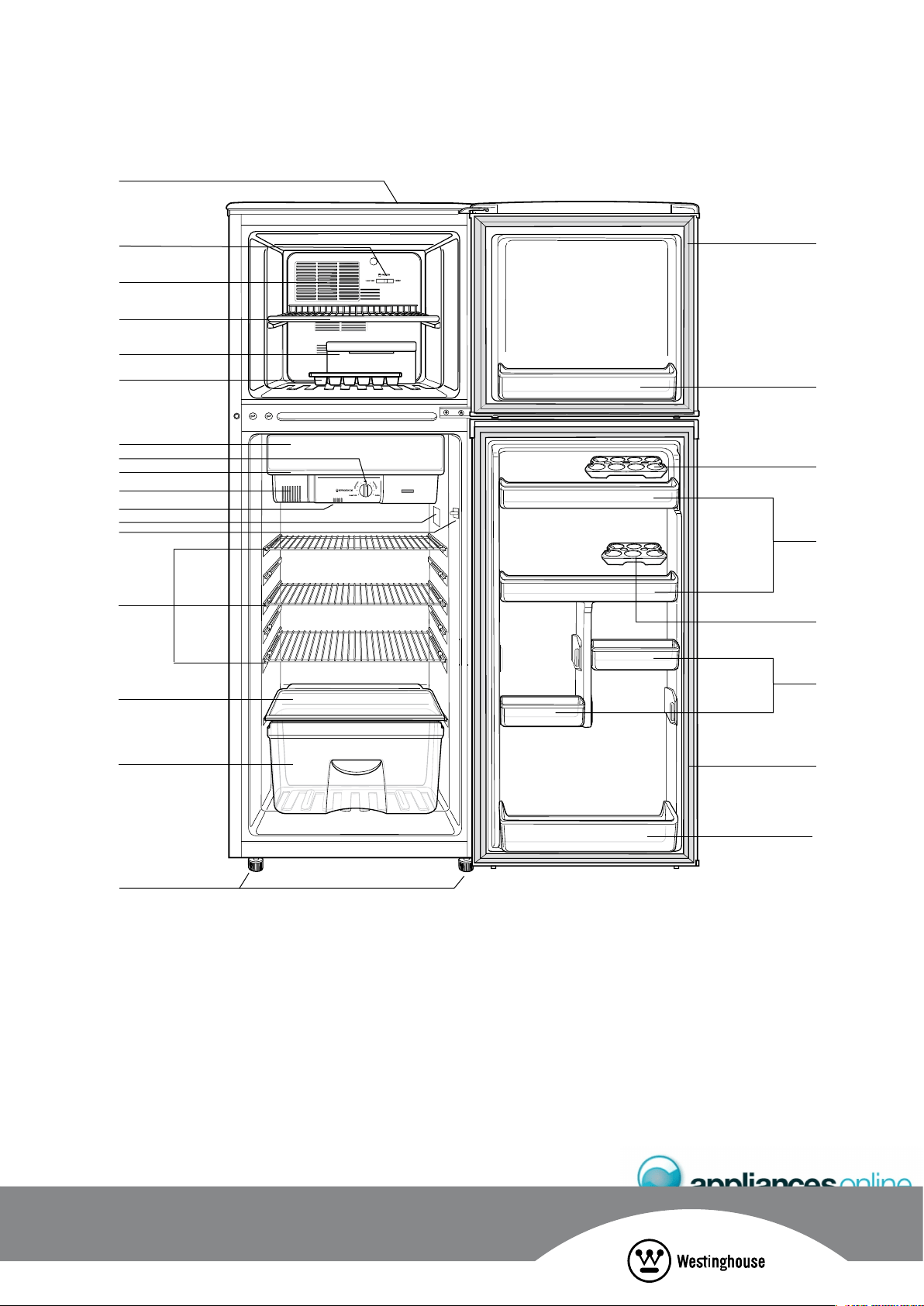
1 Top cover
2 Freezer control slide
3 Fan housing
4 Wire freezer shelf
5 Ice bin
6 Ice tray
7 Chiller door
8 Refrigerator control knob
9 Chiller drawer
10 Light
11 Temperature sensor
12 Fast chill zone sticker
13 Light switch
14 Wire shelves
15 Crisper cover
16 Vegetable crisper
17 Levelling legs
18 Door gaskets/seals
19 Freezer bin
20 Egg trays
21 Full width fridge door bin
22 Half width fridge door bin
23 Bottom fridge door bin
1
2
3
4
7
9
10
11
12
13
14
8
5
6
15
16
20
22
18
21
20
23
18
19
17
Features may vary depending on model. Not all models will have features listed.
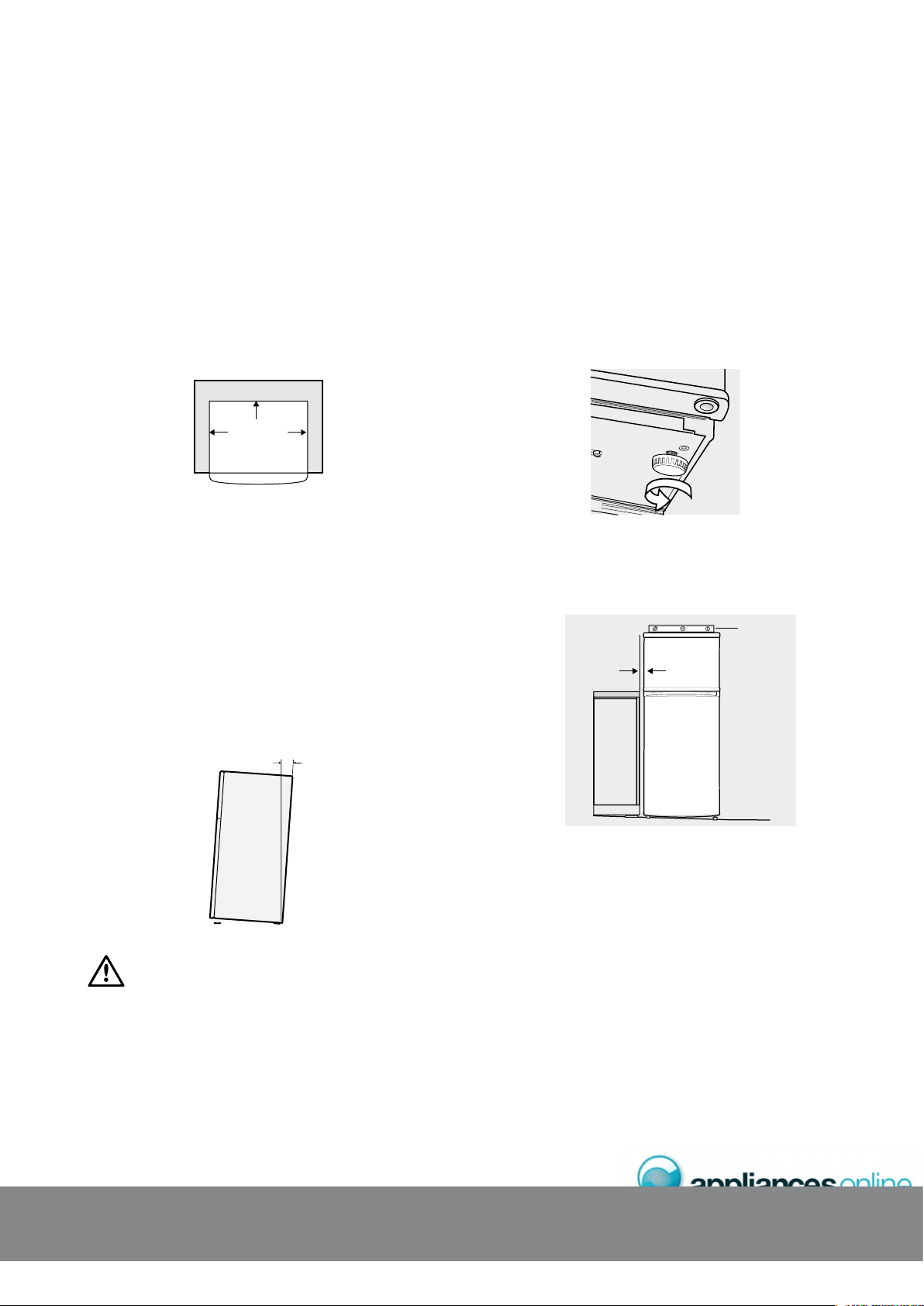
Before you move your appliance into the place where it
will operate, check that it will have adequate clearance.
Clearance is required for air circulation and too little
clearance may affect the performance of your appliance.
We recommend minimum clearances of:
• 30mm on each side.
• 25mm above the refrigerator.
• 50mm minimum/75mm maximum behind the refrigerator
NOTE:
Doors are designed to sit proud of cabinetry (not flush).
The clearances shown above are the recommended
minimum clearances. The clearance at the rear must not
exceed 75mm.
The appliance should arrive with the front levelling feet
wound up. The appliance may need to be tilted backward
at the top by about 10-15mm from vertical (see diagram
below). This will allow the door to gravitate to the closed
position. The complete closure of the door seal is reliant on
manually pushing the door closed to provide a consistent
door seal.
CAUTION
The rollers are designed for forward or backward movement
only. They are not castors. Moving the refrigerator sideways
may damage your floor and the rollers.
1. Move the appliance into its final position.
2. If the appliance is not tilting back as described earlier,
minor adjustments can be made to the two front
levelling legs by turning the feet in an anticlockwise
direction (below). This will increase the height of
the feet. If you have difficulty turning the foot, have
someone tilt the appliance back to gain better access.
If it is not tilted back enough and the levelling legs are
fully extended, additional packing might be required
(see note 4 for appropriate materials).
3. Compare the alignment of the appliance to the
surrounding cupboard. The top of the appliance should
be level from side to side (see diagram below). If
you need to adjust the level, use the levelling feet as
detailed in step 2.
4. If the appliance now rocks from one corner to the
opposite rear corner, this means that the floor is uneven.
You may need to put some packing under the ridge to
the rear of the appliance. You could use thin pieces of
solid material such as thin board, vinyl floor tiles
or laminate.
5. You may now need to fine tune the installation by
repeating steps 2, 3 and 4.
6. Wipe off any dust that has accumulated during shipping
and clean following the directions on page 11.
7. Plug the appliance into the power point. Don’t use a
double adaptor or extension cord.
8. It is recommended that you let the appliance operate
for an hour or two (three hours for a freezer) before you
put any food in it. This will confirm that it is operating
correctly and make the conditions appropriate for
food storage.
Congratulations! You have successfully installed your
refrigerator/freezer.
10 –15mm
Height adjustable
front rollers
50mm (75mm max)
30mm
30mm
Recommended
airspace
CABINET
DOOR
parallel to
cupboards
spirit level
Your appliance was cleaned and polished before it left
the factory. Before use, dust and wipe over inside and out
using a clean dry cloth. This product is designed to operate
on a power supply of 220/240 volts 50Hz. Connect to
a separate power point with a correctly earthed three pin
socket. Do not use double adaptors.
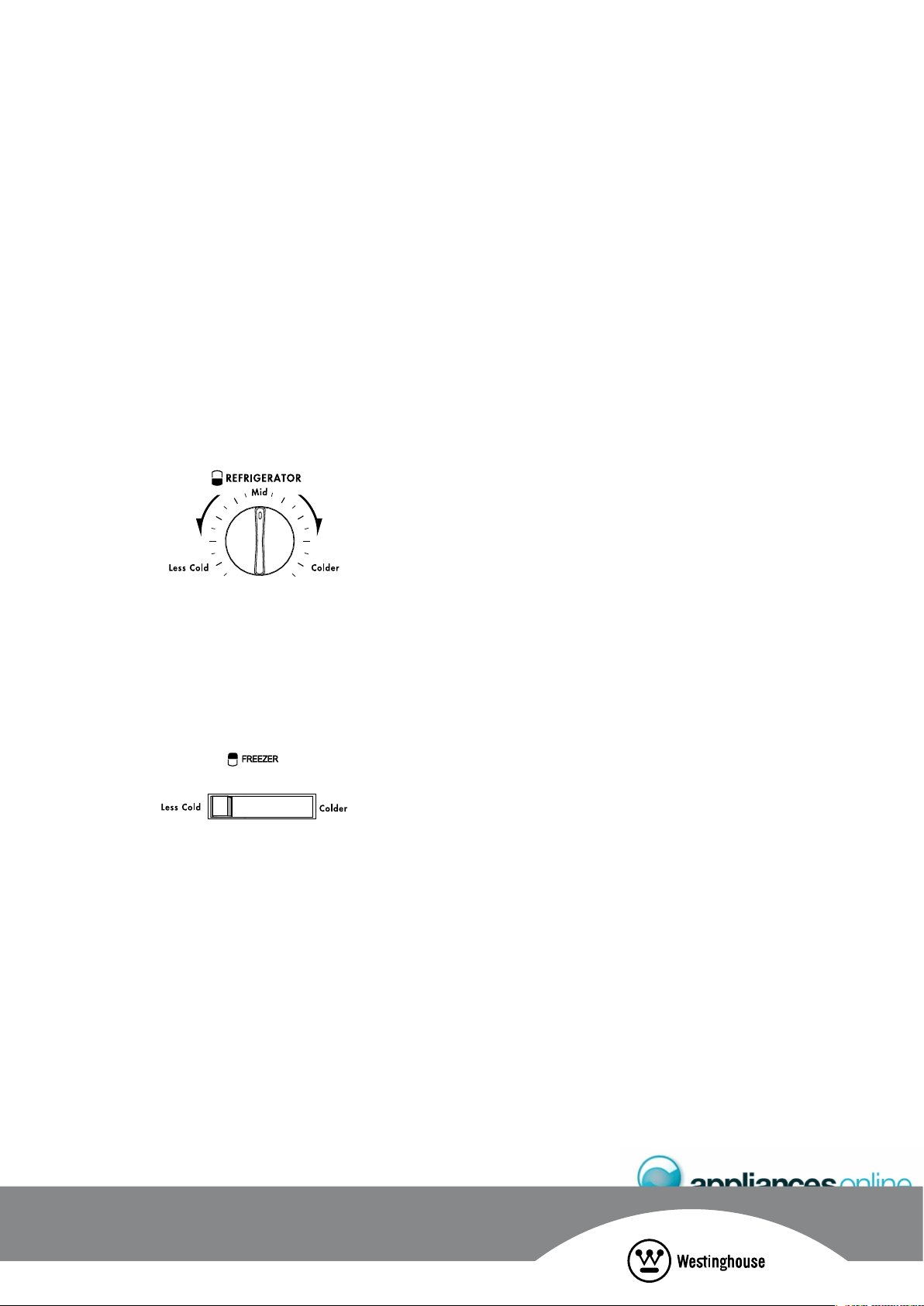
To make the appliance operate you must turn the knob
clockwise. For all models, ‘Less Cold’ corresponds to the
warmest temperature while ‘Colder’ the coldest. When the
ambient room temperature is 16°C, a setting of half way
between ‘Less Cold’ and ‘Mid’ would be appropriate.
When the ambient room temperature is 25°C, a setting of
half way between ‘Mid’ and ‘Colder’ could be selected.
The freezer slide control is used to balance the air flow
between the freezer and the refrigerator compartments.
The main temperature control is the control knob in the
refrigerator compartment. For optimum performance position
the freezer control on ‘Less Cold’. If the food is not frozen
enough you may be required to move the slide control (or
knob) towards the ‘Colder’ position
When you change temperature settings, make small
adjustments and wait 24 hours before assessing whether
you need to make further changes.
Defrosting takes place automatically. The defrost water
flows down to the evaporating tray, which is located in the
machine compartment and is evaporated automatically.
The refrigerator/freezer transfers heat from food placed
inside to the outside air. This process makes the rear and
sides of the outer cabinet feel warm to touch, particularly at
initial start up. This is normal.
Make sure you fully close the freezer door after loading
or removing food. If the door is left partly open, a heavy
frost will coat the inside of the freezer. Ensure that bins and
shelves are pushed all the way in to prevent the door being
held open.
If the unit is unplugged, power lost, or turned off you must
wait 5 minutes before restarting the unit. If you attempt to
restart before this time delay, the freezer will not start.
• Try not to leave the door open for too long, especially in
warm and humid climates.
• It is recommended that you wrap all food in freezer bags.
• Corned or pickled products (containing salts) must NOT
be stored in the freezer unless thoroughly sealed. Salts
cause metal oxidisation.
• In some circumstances (particularly after recent opening
and closing of the door) you may experience a heavier
than normal resistance when opening the door. Should
this occur wait a minute or two between openings to
stabilise the air pressure within the cabinet.
• If going away for an extended period, turn your freezer
off, remove all foods and dry interior thoroughly. Unplug
the freezer from the electrical outlet and leave the
door open.
• If there is a power failure, do not open the door. Frozen
foods will stay frozen for up to 24 hours depending
on temperature and load conditions if the door is kept
closed.
•It is recommended that to ensure safe food storage, the
freezer operates for 3 hours with the door closed before
being stocked with food. It is also recommended that
you wait until the following day before you purchase
additional food, either frozen or unfrozen, to stock
your freezer.
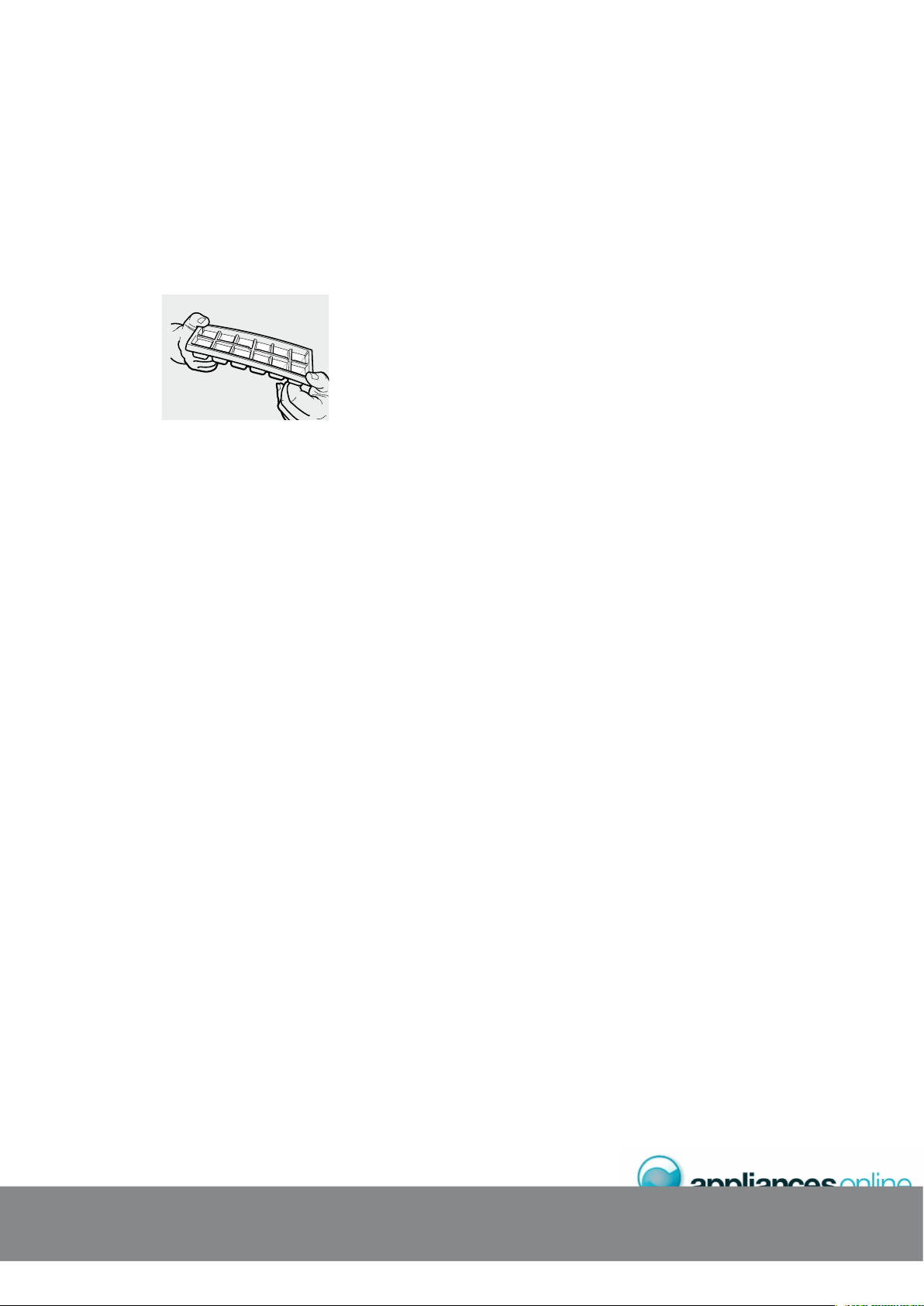
To make ice cubes, fill the ice tray with water and place
it in the ice box. Avoid filling above the ice box grid to
facilitate ice release. To remove ice cubes easily, run water
on the tray before gently twisting the tray and inverting.
Refrigerator Compartment
• Store fresh food in the refrigerator compartment. How
food is frozen and thawed is an important factor in
maintaining its freshness and flavour.
• Do not store fruit that spoils easily at low temperatures,
such as bananas, pineapples and melons.
• Give hot food time to cool prior to storing. Placing hot
food in the refrigerator could spoil other food and lead to
higher power bills.
• When storing, cover food with cling wrap or store in
a container with a lid. This will prevent moisture from
evaporating and helps food keep its taste and nutrients.
• Do not block air vents with food. Unhampered circulation
of chilled air keeps refrigerator temperatures even.
• Do not open the door frequently. Opening the door
allows warm air into the refrigerator causing temperatures
to rise.
• Avoid placing moist food deep inside refrigerator shelves.
It could freeze upon direct contact with the cold air
straight from the vents.
• Always clean fruit and vegetables prior to refrigeration.
These should be washed and wiped to prevent adjacent
foods from spoiling.
• When storing eggs in the trays provided, ensure that
they are fresh and always store them in an upright
position to keep them fresh longer.
Freezer Compartment
• Do not store bottles in the freezer compartment as they
may break when frozen.
• Do not re-freeze food that has been thawed.
• When storing frozen foods like ice cream for an
extended period, place it on the freezer shelf not in
the door bin.
The reversing of doors or replacement of light bulbs is
not covered by warranty. Assistance, if required can be
arranged by calling our service centre on 13 13 49.
Normal service call and labour charges apply.
1. Switch off the power at the power point and remove the
cord by pulling the plug.
2. Remove the screw from the centre of the control panel.
3. Apply pressure with your finger tip to the top centre of
the light lens. This will release a catch on the back face
of the lens that holds it to the light housing.
4. Remove the lens.
5. Unscrew the light bulb in an anti-clockwise direction.
6. Screw the new light bulb into place using a cloth. Do
not allow your fingers to touch the new bulb as the
oils from your skin can cause hot spots on the globe,
shortening its life.
7. Clip the light lens on and replace the screw.
8. Wait 5 minutes to ensure pressures in the refrigeration
system are equalised, before turning the refrigerator on
at the power point.
WARNING
Never insert your finger into the light bulb socket.
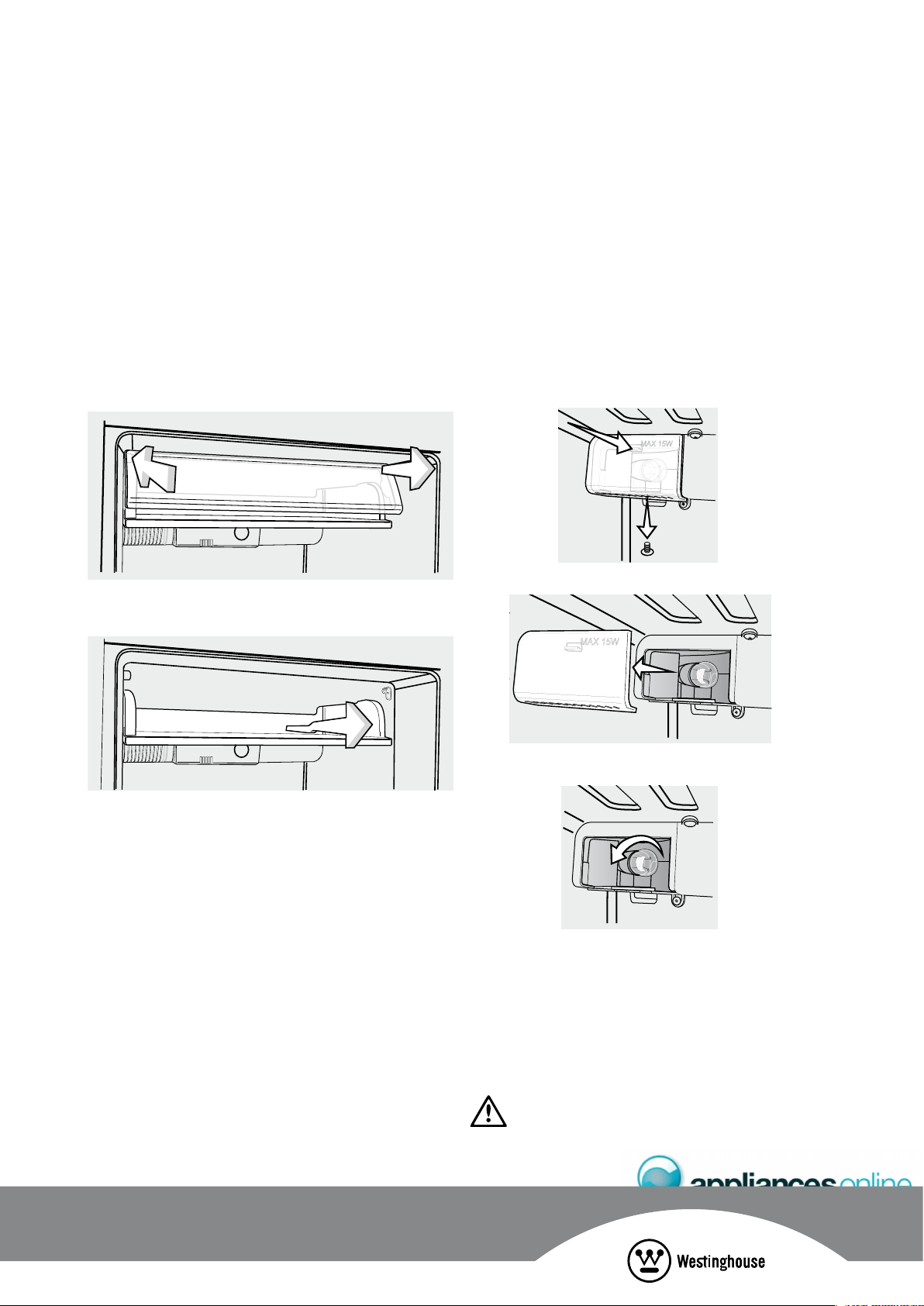
In order to access the light housing, the chiller door and
chiller drawer need to be removed.
There is a node on each side at the top of the chiller door.
These ‘nodes’ allow the door to swivel open and shut and
also secure the door to ‘C ’ shaped clips on each side of
the refrigerator liner. The clip on the left liner wall faces the
back of the refrigerator, while the clip on the right liner wall
faces the front. To remove the door, push back against the
left top corner of the door, while pulling the top right corner
of the door forward.
Remove the chiller door.
To replace the chiller door, slot the node on the top left
hand corner of the chiller door, left into the clip on the
cabinet lining. Push the node on the top right corner of the
chiller door, back into the clip on the cabinet lining.
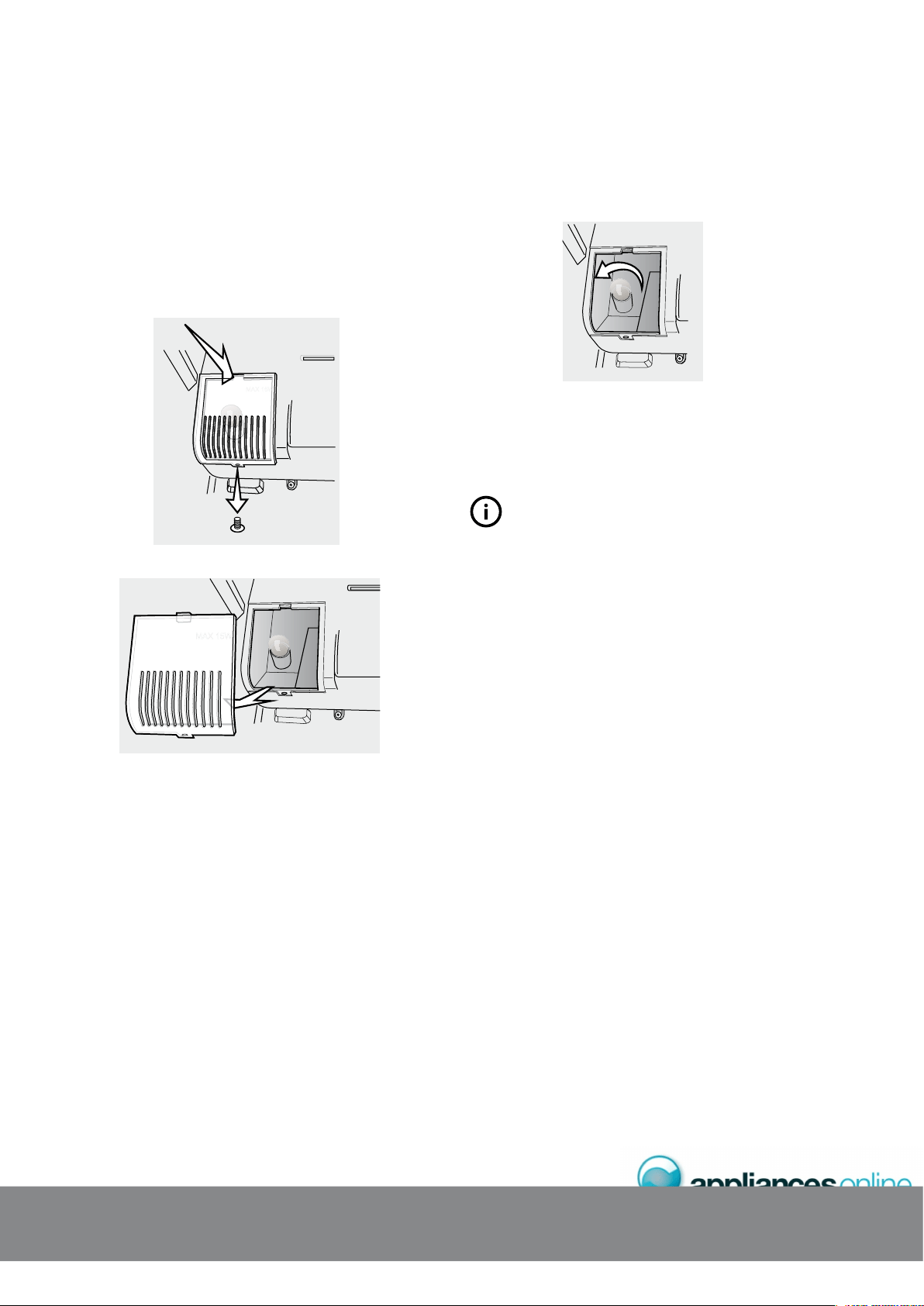
5. Unscrew the light bulb in an anti-clockwise direction.
6. Screw the new light bulb into place using a cloth. Do
not allow your fingers to touch the new bulb as the
oils from your skin can cause hot spots on the globe,
shortening its life.
7. Clip the light lens on and replace the screw.
TIPS & INFORMATION
Not all 15 watt screw-in lamps will fit the lamp housing.
Appropriate replacement lamps can be purchased from
Electrolux or by calling 13 13 50.
1. Switch off the power at the power point and remove the
cord by pulling the plug.
2. Remove the screw from the centre of the control panel.
3. Apply pressure with your finger tip to the top centre of
the light lens. This will release a catch on the back face
of the lens that holds it to the light housing.
4. Remove the lens.
WARNING
BEFORE CLEANING: Turn the refrigerator off at the power
point and unplug the cord to prevent any chance of
electrocuting yourself.
You should only clean the doors with lukewarm soapy
water and a soft cloth.
Your stainless steel refrigerator is manufactured from
mark-resistant stainless steel. This stainless steel has
a special advanced protective coating that eases
the removal of marks such as fingerprints and water
spots. To keep its appearance, clean it regularly with
lukewarm soapy water and a soft cloth.
CAUTION
Never use stainless steel cleaners, abrasive pads or other
cleaners that will scratch the surface. Damage to the
appliance after delivery is not covered by your warranty.
Clean the inside of your refrigerator regularly with a
soft cloth, unscented mild soap and lukewarm water.
Thoroughly dry all surfaces and removable parts and
avoid getting water on the controls. Replace removable
parts, plug power cord in and switch the power on
before returning the food.
Always keep door seals clean by washing them with
a mild detergent and warm water, followed by a
thorough drying. Sticky food and drink can cause seals
to stick to the cabinet and tear when you open the
door.
CAUTION
Never use hot water, solvents, commercial kitchen cleaners,
aerosol cleaners, metal polishes, caustic or abrasive cleaners,
or scourers to clean your refrigerator. Many commercially
available cleaning products and detergents contain solvents
that will damage your refrigerator. Use only a soft cloth with an
unscented mild soap and lukewarm water.
If your refrigerator has telescopic extension slides, simply
wipe them with a damp cloth to clean them and never
immerse them in water.
This appliance is not intended for use by persons (including
children) with reduced physical, sensory or mental
capabilities, or lack of experience and knowledge, unless
they have been given supervision or instruction concerning
use of the appliance by a person responsible for their
safety. Children should be supervised to ensure that they do
not play with the appliance.
Check the power point is properly earthed – if you are not
sure get an electrician to check it.
Switch off and unplug the refrigerator at the power point
before you clean or move it.
If the power supply cord is damaged, have it replaced by
the manufacturer, service agent or similarly qualified person.
Never let children play with the refrigerator.
Never store spray cans, explosive fluids or flammable liquids
in the refrigerator.
Never store fizzy drinks in the freezer compartment.
Never lick icy foods when they first come out of the freezer.
This can burn your your lips and mouth.
Never try to repair the refrigerator yourself.
Never use electric heaters or dryers to defrost the freezer
because you can receive an electric shock.
Never use electrical appliances inside the food storage areas.
This appliance contains insulation formed with flammable
blowing gases. For safety reasons, take care when you
dispose of it.
Do not damage the appliance circuit.
WARNING
When you dispose of your old refrigerator or freezer, remove
any doors to prevent children from being trapped inside.
WARNING
This appliance may contain a small quantity of environmentally
friendly, but flammable, non-synthetic R600a refrigerant:
• Ensure that the tubing of the refrigerant circuit is not
damaged during transportation and installation.
• The room for installing appliance must be at least 1m3 per
8g of refrigerant. The amount of refrigerant charged in the
appliance can be found on the rating plate on the appliance.
• Keep ventilation openings in the appliance enclosure or
in the built-in structure, clear of obstruction.
• Do not use mechanical devices or other means to
accelerate the defrosting process, other than those
recommended by the manufacturer.
• The room for installing appliance must be at least 1m
3
per 8g of refrigerant. The amount of refrigerant charged
in the appliance can be found on the rating plate on
the appliance.
If you switch your refrigerator for an extended
period, follow these steps to reduce the chances of mould:
1. Remove all food.
2. Remove the power plug from the power point.
3. Thoroughly clean and dry the Interior.
4. Ensure that all the doors are wedged open slightly for
air circulation.
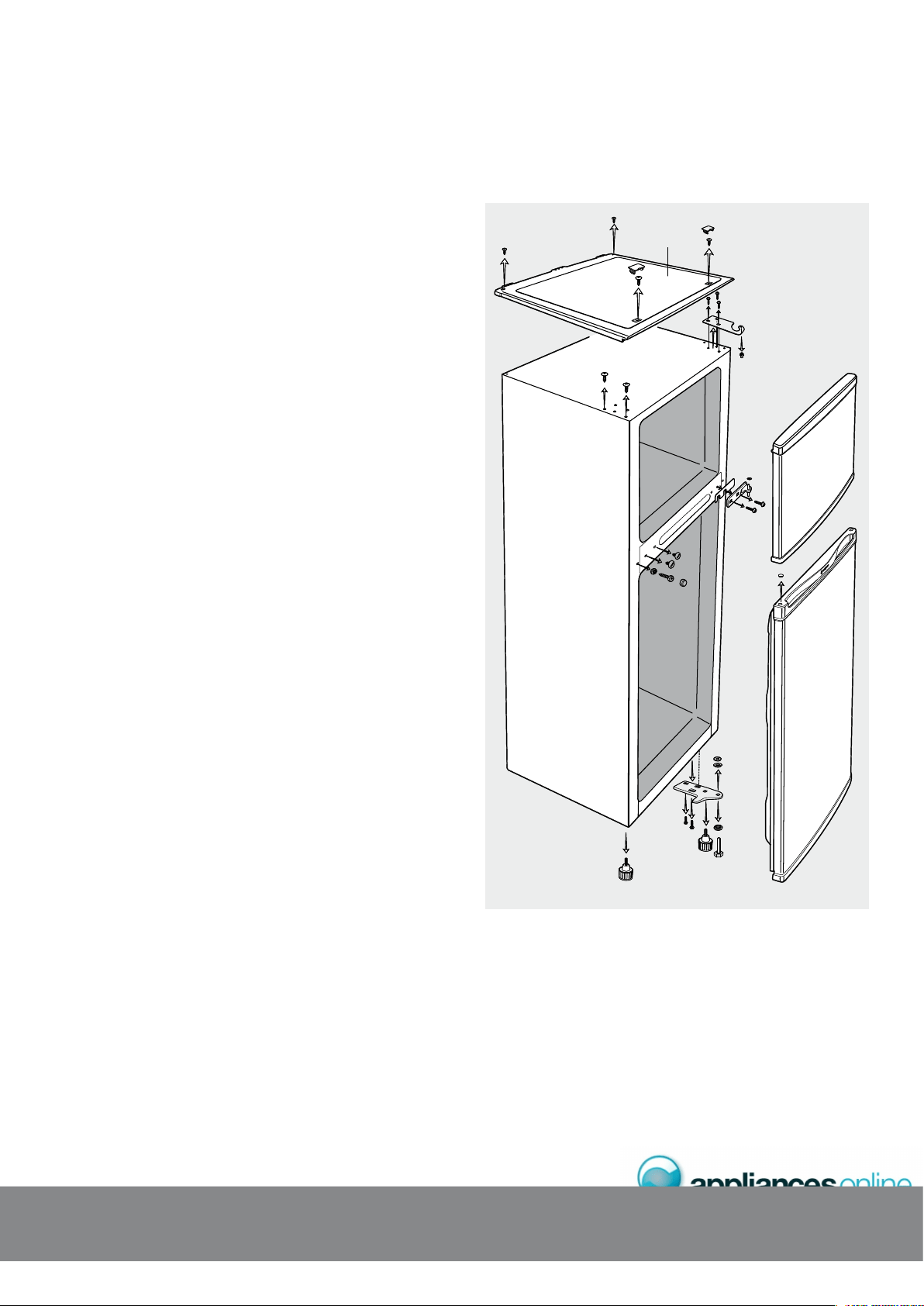
In this example, the operation is reversed from right side
hinging to left side hinging.
• Turn off the appliance
• Unplug the power cable
• Remove all food from the appliance
• Remove shelves and baskets
• Do not lay the appliance down at on its back as this will
impair its operation.
• When tilting the appliance to access the underside,
support it so that it will not fall to the floor.
NOTE: All parts removed must be retained to reinstall
the door. Ensure washers are reassembled in original order.
• In the front of the panel (1) on top of the freezer
compartment there are 2 rectangular plugs (2). Use a flat
bladed screwdriver as a lever to gently remove them.
• Use a Phillips head screwdriver to remove the screws (3)
that the plugs were concealing.
• There are 2 round holes in the back of the top panel (1).
Remove the screws (4) from these holes.
• The top panel (1) can now be removed.
• Hold the freezer door in the closed position while
removing the 3 screws (5) that secure the top hinge (6).
• The freezer door can now be lifted off along with the
top hinge.
• Remove the top hinge pin (7) from the hole in the top of
the freezer door.
• Now unscrew the hinge pin (7) from the hinge (6). Turn
the hinge over and screw the pin (7) in from the other
side of the hinge (6).
• On the left top of the appliance are 2 screws (8)
which need to be removed and re-inserted into the
corresponding holes on the right top of the appliance.
• While supporting the refrigerator compartment door,
remove the 2 screws (9) securing the centre hinge (10) to
the cabinet.
• Remove the hinge (10), the plastic washer on the top pin
and the plastic gasket behind the hinge and carefully put
the door aside.
1
2
2
3
3
5
6
7
8
10
11
16
15
14
17
18
9
12
13
4
4
Right sided hinging assembly
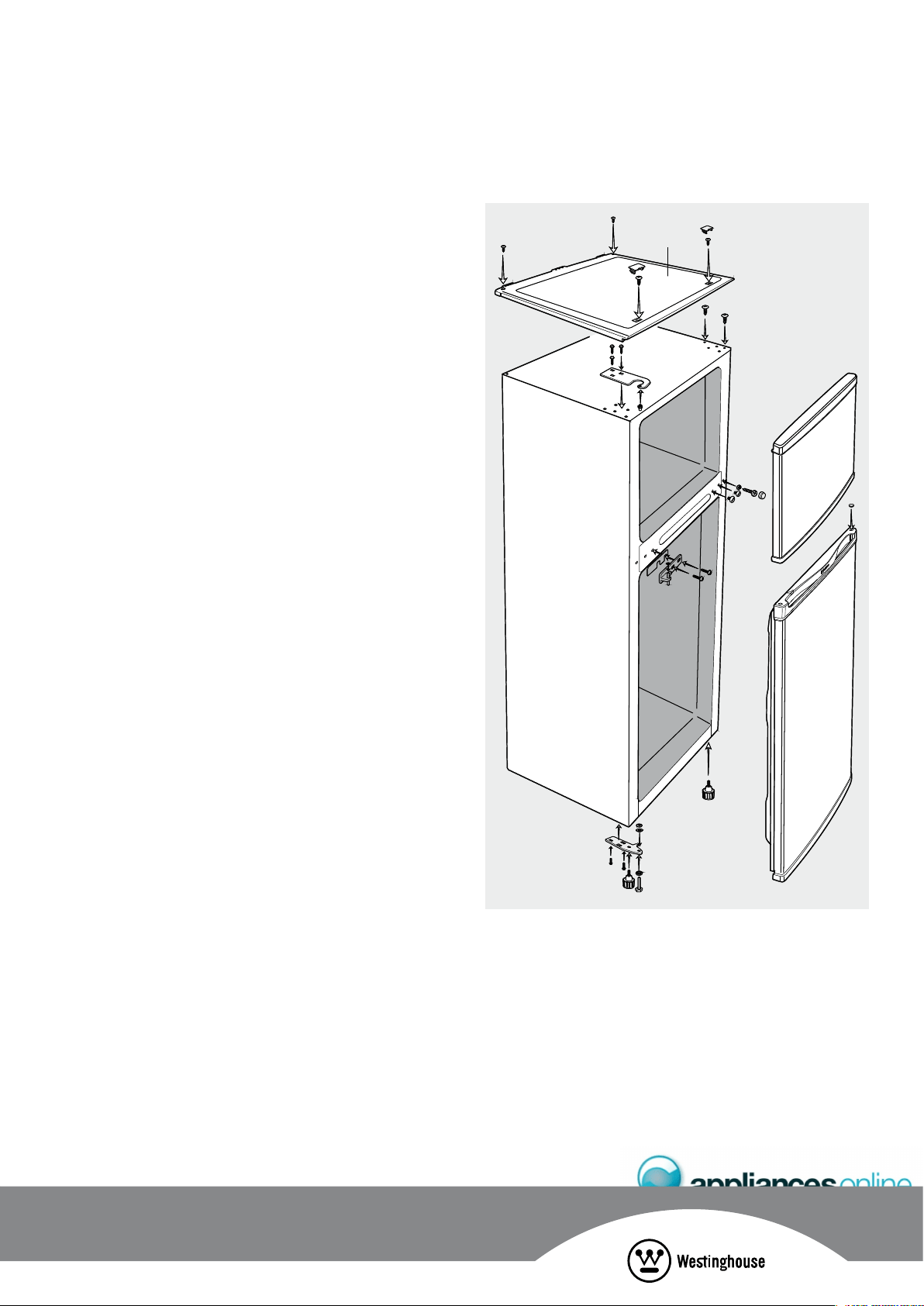
• Remove the plug (11) – if supplied with your appliance –
from the hole in the top left of the refrigerator door and
press firmly into the hole on the top right of the door
• Remove the cap, screw and washer (12) from the far
left of the centre frame and re-insert in the far right of the
centre frame.
• Use a at bladed screw driver to remove the 2 plastic
screws (13) from the left side of the centre cabinet. Re-
insert them into the holes to which the centre hinge (10)
was previously fitted.
• If possible, get help to secure the fridge as it will need
to be tilted back in order to remove the two screws (14)
that secure the inge (15) to the bottom right side of the
appliance.
• Unscrew the left front foot (16) and transfer it to the
corresponding hole under the right bottom corner.
• Unscrew the foot (17) and remove it from the bottom
hinge (15) then screw the foot (17) in from the other side
of the hinge (15).
• Unscrew the hinge pin (18) from the bottom hinge (15)
then secure it on the reverse side of the bottom hinge
(15). Make sure all washers are reinstalled in their
original order.
• With the refrigerator door in the closed position, secure
the bottom hinge (15) – previously removed from the
other side – onto the bottom left corner, tightening the 2
screws (14) firmly.
• With the bottom pin of the middle hinge (10) lodged in
the hole on the top left of the refrigerator compartment
door, secure the reversed middle hinge (10) and the
reversed gasket to the left of mid cabinet using the 2
hinge screws (9).
• Put the plastic washer on the middle hinge (10) top pin,
then mount the freezer door on the middle hinge (10)
top pin.
• With the reassembled top hinge pin (7) located in the
hole in the top inside left corner of the freezer door, fix
the hinge (6) to the top left corner of the appliance using
the 3 top hinge screws (5).
• Replace the top cover (1) using screws (3) and (4).
Replace the rectangular hole plugs.
1
2
2
3
3
8
5
7
6
10
11
16
15
14
17
18
9
12
13
4
4
Left sided hinging assembly
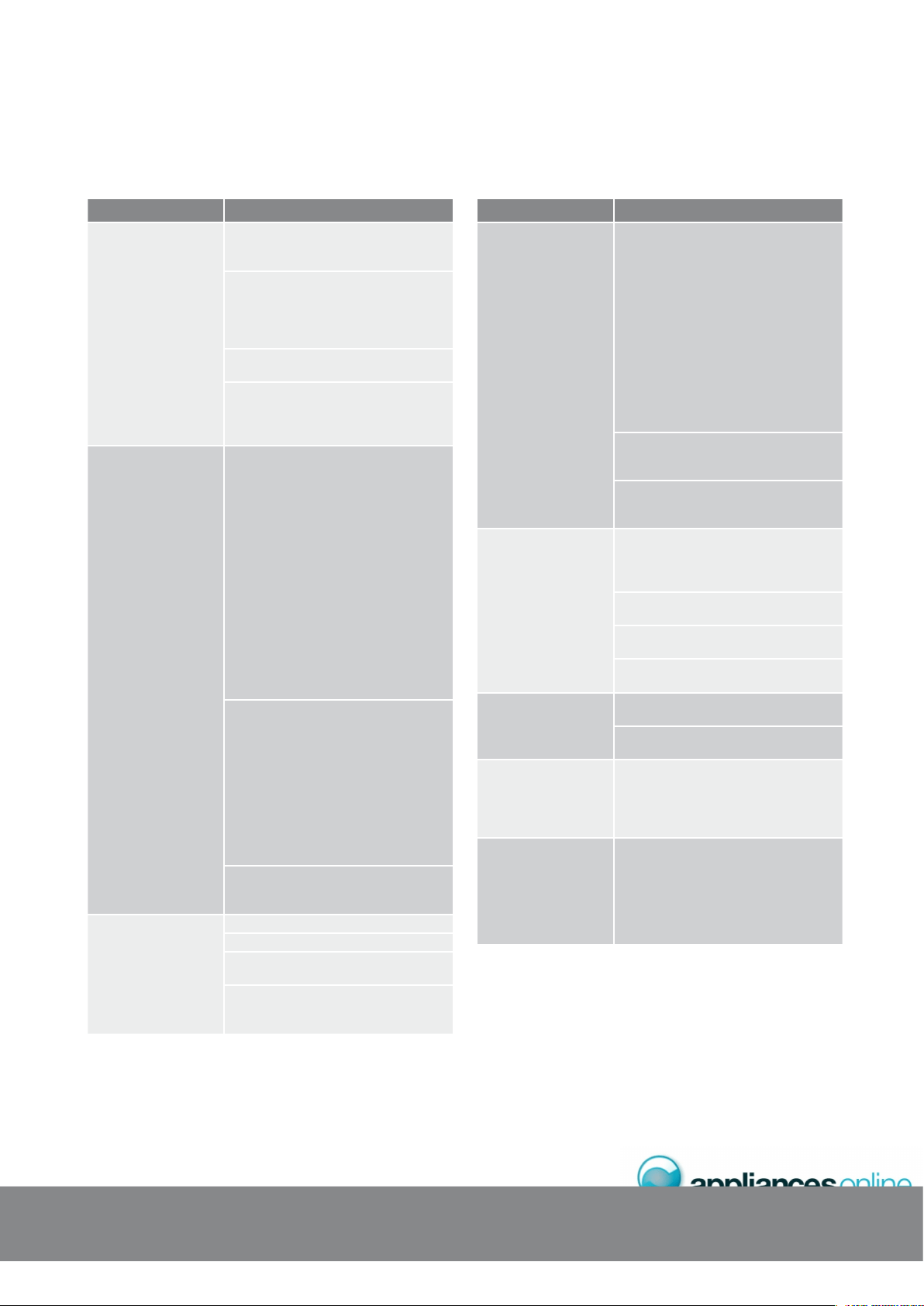
Refrigerator is not
operating
•
Check that the power cord is plugged
into the power outlet properly and that
the outlet is switched ‘ON’.
• Try running another appliance from the
power outlet. If no power is coming
from the outlet you may have blown
a fuse or tripped a circuit of your
household power supply.
• Try adjusting the temperature control to
a slightly “colder” position.
• It is normal for the freezer fan NOT to
operate during the automatic defrost
cycle, or for a short time after the
appliance is switched on.
When there is
refrigerator/freezer
noise
Modern refrigerators/freezers with
increased storage capacity use high
speed compressors. These can provide
a seemingly high level of sound which is
quite normal. Normal operational sounds
include:
• Occasional gurgling, similar to water
boiling.
• Air ow noise (air circulates because of
a small fan).
• A popping noise heard during
automatic defrost.
• A clicking noise heard just before
the compressor starts (this is just
the automatic switching action of
the temperature control, turning the
compressor on or off).
Other strange sounds may mean that
you need to check and take action. For
example, noises may mean that:
• The cabinet is not level.
• The oor is uneven or weak.
• Bottles are badly placed and rattling.
• There are vibrations from an object
on top of or behind or beside the
refrigerator.
• The back of the refrigerator cabinet is
touching the wall.
Remember it is quite normal for noise to
seem louder just after the refrigerator
starts operating.
If there are odours
inside the refrigerator
• The interior may need cleaning.
• Some foods produce odours.
• Some containers and wrapping can
cause odours.
• Ask yourself if the odour started about
the same time you started storing
something unusual.
When the motor
seems to run more than
expected
Your new refrigerator has a large fridge
and freezer section to keep cool. So it is
normal to frequently hear the sound of the
motor. However, to keep operation to a
minimum check the following:
• Are doors kept open too long or too
often?
• Are controls set too cold? See
‘Controlling the temperature’ on
page 7.
• Have large amounts of warm food just
recently been stored? Summer, festive
seasons and holidays usually mean a
lot more work for your refrigerator.
• If the day is hot or the room is very
warm, the refrigerator will need to run
more than normal.
• The refrigerator will run more that
normal just after you install it or when it
has been turned off for a long time.
If the temperature in the
refrigerator is too warm
• Check that the appliance has enough
clearance at the sides, back and top.
Refer to the installation instructions on
page 6.
• Refer to ‘Controlling the temperature’
on page 7.
• You may have kept the door open too
long or too frequently.
• Food containers or packaging may be
holding a door open.
If the temperature in the
refrigerator is too cold
• Refer to ‘Controlling the temperature’
on page 7.
• Increase the temperature to avoid high
energy consumption.
If heavy frosting occurs
in the freezer
Make sure you fully close the freezer and
fridge doors. If the doors are left open,
a heavy frost will coat the inside of the
freezer. If a frost develops, remove it and
take care to properly close the doors.
If water drips on the
floor
The defrost water tray, (located at the
back or underneath of the cabinet) may
not be properly positioned, or the drain
tube may not be properly positioned to
direct water into this tray. You may need
to pull the refrigerator away from the wall
to check the tray and tube.
If you have a problem, and the problem persists after you
have made the checks mentioned above, contact your
nearest approved Service Centre or the dealer you bought
the refrigerator from. Be ready to quote the model number,
9-digit PNC and 8-digit serial number, which is stated on
the label inside the refrigerator compartment.
This document sets out the terms and conditions of product warranties for
Electrolux branded appliances. It is an important document. Please keep it
with your proof of purchase documents in a safe place for future reference
should you require service for your Electrolux appliance.
General Terms and Conditions
1. In this warranty
(a) ‘Electrolux’ means Electrolux Home Products Pty Ltd ABN 51 004 762 341
in respect of Appliances purchased in Australia and Electrolux (NZ) Limited in
respect of Appliances purchased in New Zealand;
(b) ‘Appliance’ means any Electrolux product purchased by you accompanied by
this document;
(c) ‘Warranty Period’ means
(i) where you use the Appliance for personal, domestic or household purposes
in Australia the period of ‘24’ months and in New Zealand the period of ‘24’
months;
(ii) where you use the Appliance for commercial purposes, in Australia the
period of ‘3’ months and in New Zealand the period of ‘3’ months, (if the
period stated is 0 months you are not covered by this product warranty)
following the date of original purchase of the Appliance;
(d) ‘you’ means the purchaser of the Appliance not having purchased the appliance
for re-sale, and ‘your’ has a corresponding meaning.
2. This warranty only applies to Appliances purchased and used in Australia or
New Zealand and is in addition to (and does not exclude, restrict, or modify in any
way) any non-excludable statutory warranties in Australia or New Zealand.
3. Electrolux warrants that, when dispatched from an Electrolux warehouse,
the Appliance is free from defects in materials and workmanship for the
Warranty Period.
4. During the Warranty Period Electrolux or its Authorised Service Centre will, at no
extra charge if your appliance is readily accessible without special equipment, and
subject to these terms and conditions, repair or replace any parts which it considers
to be defective. You agree that any replaced Appliances or parts become the
property of Electrolux. This warranty does not apply to light globes, batteries, filters
or similar perishable parts.
5. Parts and Appliances not supplied by Electrolux are not covered by this warranty.
6. Where you are within an Electrolux service area, this warranty covers the cost of
transport of the Appliance to and from Authorised Service Centres of Electrolux and
travelling costs for representatives of the Authorised Service Centre to and from your
home or business. If you are outside an Electrolux service area, you will bear these
costs. For information about whether you are within an Electrolux service area,
please phone 13 13 49 in Australia, or 0800 10 66 10 in
New Zealand.
7. Proof of purchase is required before you can make a claim under this warranty.
8. You may not make a claim under this warranty unless the defect claimed is due
to faulty or defective parts or workmanship. Electrolux is not liable in the following
situations (which are not exhaustive):
(a) The Appliance is damaged by:
(i) accident
(ii) misuse or abuse, including failure to properly maintain or service
(iii) normal wear and tear
(iv) power surges, electrical storm damage or incorrect power supply
(v) incomplete or improper installation
(vi) incorrect, improper or inappropriate operation
(vii) insect or vermin infestation.
(b) The Appliance is modified without authority from Electrolux in writing.
(c) The Appliance’s serial number or warranty seal has been removed
or defaced.
(d) The Appliance was serviced or repaired by anyone other than Electrolux or its
Authorised Service Centres.
9. This warranty, the contract to which it relates and the relationship between you
and Electrolux are governed by the law applicable in the Australian State where the
Appliance was purchased or the law applicable in New Zealand if the Appliance was
purchased in New Zealand. Where the Appliance was purchased in New Zealand for
business purposes the Consumer Guarantee Act does not apply.
Limitation of Liability
10. To the extent permitted by law:
(a) Electrolux excludes all warranties other than as contained in this document;
(b) Electrolux shall not be liable for any loss or damage whether direct or indirect or
consequential arising from your purchase, use or non-use of
the Appliance.
11. Provisions of the Trade Practices Act and State consumer legislation in Australia, and
the Consumer Guarantees Act, the Sale of Goods Act and the Fair Trading Act in
New Zealand, imply warranties or conditions, or impose obligations, upon Electrolux
which cannot be excluded, restricted or modified. To the extent permitted by law, the
liability of Electrolux (if any) arising out of or in relation to the Appliance or any services
supplied by Electrolux shall be limited (where it is fair and reasonable to do so),:
(a) in the case of Appliances, at its option, to the replacement or repair of the
Appliances or the supply of equivalent products or the payment of the cost
of replacing the Appliances or having the Appliances repaired or of acquiring
equivalent Appliances. Upon being replaced, parts and Appliances become the
property of Electrolux; or
(b) in the case of services, at its option, to the supply of the services again or the
payment of the cost of having the services re-supplied; and in the case of
Appliances or services supplied in New Zealand, loss or damage whether direct
or indirect or consequential that is reasonably foreseeable.
Privacy
You acknowledge that in the event that you make a warranty claim it will be necessary for
Electrolux and its Authorised Service Centres to exchange information in relation to you
to enable Electrolux to meet its obligations under this warranty.
EXTENDED WARRANTIES AND INDEMNITY
Sealed Refrigeration System Warranty
For a further period of three years following the expiry of the Warranty period,
Electrolux or its agent will supply replacements for, or at the sole option of
Electrolux, repair, all parts it finds defective in the Sealed Refrigeration System
which comprises: compressor, condenser, evaporator, dryer and tubing. During
this three year period you will pay for the costs of labour (including any call out
or service fees), and freight if necessary in replacing defective parts in the Sealed
Refrigeration System. You will pay for the costs of transport of the Appliance if
further service is required and the costs of parts or repairs to parts other than
those included in the Sealed Refrigeration System
Frozen Food indemnity
Subject to the following exclusions, Electrolux will indemnify you for a period of 24
months from the date of purchase of the Appliance against any loss or damage to
frozen foodstuffs due to a Sealed Refrigeration System breakdown. This indemnity
will be limited to:
(a) in the case of freezers with a capacity of less than 400 litres – AU$150
(b) in the case of freezers with a capacity of 400 litres or more – AU$300
This indemnity does not cover loss or damage to frozen foodstuffs occasioned by:
(a) failure to plug in the freezer to a properly connected power supply or failure
to switch on the power point
(b) accidental removal of the plug from the power point or switching off the
power supply;
(c) failure to keep the door or lid of the freezer closed
(d) the introduction of abnormal heat loads to the freezer;
(e) failure to observe the operating and installation instructions supplied with the
freezer; and
(f) failure to defrost the freezer at recommended intervals on chest freezers or
non frost free models
Warranty
FOR SALES IN AUSTRALIA AND NEW ZEALAND
APPLIANCE: WESTINGHOUSE TOP MOUNT FROST FREE REFRIGERATOR FREEZER.
Important Notice
Before Calling a Service Technician please check carefully the operating instructions, service booklet and the warranty terms and conditions.
FOR SERVICE
or to find the address of your nearest
state service centre in Australia
PLEASE CALL 13 13 49
For the cost of a local call (Australia only)
SERVICE AUSTRALIA
ELECTROLUX HOME PRODUCTS
www.electrolux.com.au
FOR SPARE PARTS
or to find the address of your nearest
state spare parts centre in Australia
PLEASE CALL 13 13 50
For the cost of a local call (Australia only)
FOR SERVICE
or to find the address of your nearest
authorised service centre in New Zealand
FREE CALL 0800 10 66 10
(New Zealand only)
SERVICE NEW ZEALAND
ELECTROLUX HOME PRODUCTS
www.electrolux.co.nz
FOR SPARE PARTS
or to find the address of your nearest
state spare parts centre in New Zealand
FREE CALL 0800 10 66 20
(New Zealand only)
AUSTRALIA
phone: 1300 363 640
fax: 1800 350 067
email: [email protected]
web: www.westinghouse.com.au
NEW ZEALAND
phone: 09 573 2384
fax: 0800 363 600
email: [email protected]
web: www.westinghouse.co.nz
For more information on all Westinghouse appliances,
or for dimension and installation information, call into your retailer,
phone or email our customer care team or visit our website:
Top Service encompasses the after sales service
provided by The Electrolux Group to consumers
including delivery, home service and spare parts.
© 2009 Electrolux Home Products Pty Ltd ABN 51 004 762 341
Print code: WFRITMFFUM Issue Date: Jun09
Part number: F1704