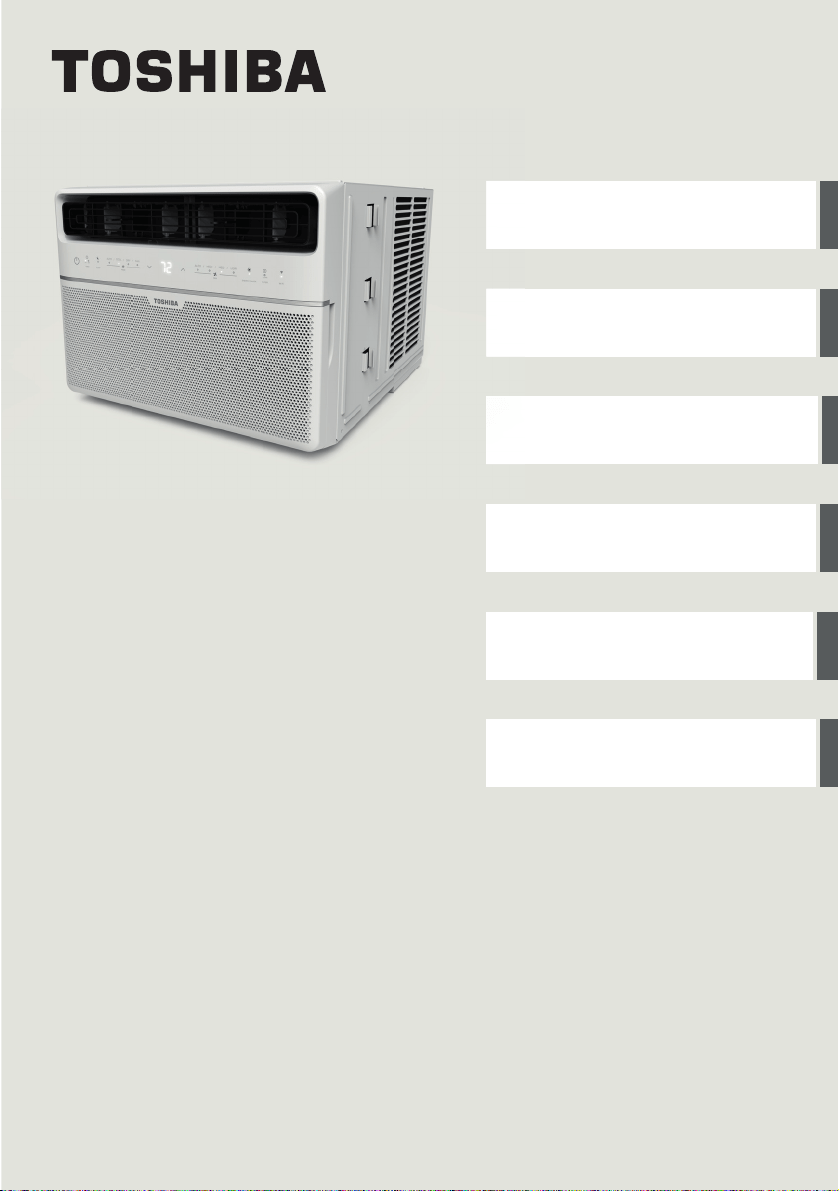
USER MANUAL
Safety Precautions
Operating Instructions
Installation Instructions
Remote Control and App
Instructions
Troubleshooting Tips
Care and Cleaning
RAC-WK1513ESCWRU
Window Type
Room Air Conditioner
Warning notices: Before using this product,
please read this manual carefully and keep
it for future reference.
The design and specications are subject to
change without prior notice for product
improvement. Consult with your dealer or
the manufacturer for details.
version A - 07 - 2020 us.toshiba-lifestyle.com
S
a
f
Op
I
n
s
version A - 09 - 2020 (PREVIEW05)
Page 2 User Manual
Read This Manual
Inside you’ll find many helpful hints on how to use and maintain your air conditioner properly. Just
a little preventive care on your part can save you a great deal of time and money over the life of
your air conditioner. You’ll find many answers to common problems in the troubleshooting tips -
you should be able to fix most of them quickly before calling service. These instructions may not
cover every possible condition of use, so common sense and attention to safety is required when
installing, operating and maintaining this product.
Owner’s Manual
Safety Precautions .................................................................................................................... 3
Operating Instructions ............................................................................................................ 8
Installation Instructions ....................................................................................................... 12
Care and Cleaning ................................................................................................................. 21
Troubleshooting Tips ............................................................................................................ 22
Remote Control and App Instructions ........................................................................... 24
• This appliance is not intended for use by persons (including children) with reduced physical,
sensory or mental capabilities or lack of experience and knowledge, unless they have been
given supervision or instruction concerning use of the appliance by a person responsible for
their safety.
• For support, please call the Service Center at 1-855-204-5313.
• Children should be supervised to ensure that they do not play with the air conditioner.
• The appliance shall be installed in accordance with national wiring regulations.
• Do not operate your air conditioner in a humid room such as a bathroom or laundry room.
CAUTION
User Manual Page 3
SAFETY PRECAUTIONS
To prevent injury to the user or other people and property damage, the instructions shown here must be
followed. Incorrect operation due to ignoring of instructions may cause harm or damage. The level of risk
is shown by the following indications.
Safety
Precautions
WARNING
This symbol indicates a hazardous situation which, if not avoided,
could result in death or serious injury.
CAUTION
This symbol indicates a hazardous situation, which, if not avoided,
could result in minor or moderate injury.
NOTICE
This symbol addresses practices not related to physical injury.
• Be sure the air conditioner has been securely and correctly installed according to the
installation instructions in this manual. Save this manual for possible future use in removing or
installing this unit.
• Plug in power cord plug properly.
Otherwise, it may cause electric shock or re due to excess heat generation.
• Do not modify power cord length or share the outlet with other appliances as it may cause
electric shock or re due to overheating.
• Always ensure e ective grounding.
Incorrect grounding may cause electric shock.
• Unplug the unit if you notice unusual sounds or smells or smoke coming from it.
A damaged product may cause re and electric shock.
• Ventilate room before operating the air conditioner if there is a gas leakage from another
appliance.
• Do not operate or stop the unit by inserting or pulling out the power cord plug.
• Do not operate with wet hands or in very humid environments.
It may cause electric shock.
• Do not allow water to come into contact with any electric parts.
It may cause failure or electric shock.
• Do not use the socket if it is loose or damaged.
It may cause re and electric shock.
• Do not use or keep the power cord close to heating appliances.
It may cause re and electric shock.
• Do not use any devices or materials for installation that are not recommended in this manual.
• Do not disassemble or modify unit.
It may cause failure and electric shock.
WARNING
Page 4 User Manual
Safety
Precautions
• Do not damage or use an alternate power cord.
It may cause re and electric shock.
If the power cord is damaged, it must be replaced by the manufacturer or an authorized service
center or a similarly quali ed person in order to avoid a hazard.
• Do not direct air ow straight into persons to avoid possible health hazard.
• Do not open the unit during operation.
It may cause electric shock.
• Do not use the power cord near ammable gas or combustibles, such as gasoline, benzene,
thinner, etc.
It may cause an explosion or re.
• Do not let children hang on the air conditioner or bracket.
A serious injury may occur.
• Avoid re hazard or electric shock. Do not use an extension cord or an adaptor plug. Do not
remove any prongs from the power cord.
• Be sure the air conditioner is properly grounded. To minimize shock and re hazards, proper
grounding is important. The power cord is equipped with a three-prong grounding plug for
protection against shock hazards.
• Your air conditioner must be used in a properly grounded wall receptacle. If the wall receptacle
you intend to use is not adequately grounded or protected by a time delay fuse or circuit
breaker, have a quali ed electrician install the proper receptacle. Ensure the receptacle is
accessible after the unit installation.
• Be sure the electrical service is adequate for the model you have chosen. This information can be
found on the serial plate, which is located on the side of the cabinet and behind the grille.
• Do not drink the drain water. It may contain mold and bacteria that can lead to death if ingested.
• When the air lter is to be removed, do not touch the metal parts of the unit.
It may cause injury.
• When the unit needs cleaning, switch o , and turn o the circuit breaker.
Do not clean unit when power is on as it may cause re, electric shock or injury.
• Do not place obstacles around air inlets or inside of air outlet.
It may cause failure or accident.
• Clean with a soft cloth only. Do not use strong detergents that contain wax or thinners as it may
damage the product.
• Use caution when unpacking and installing. Sharp edges could cause injury.
• Do not clean the air conditioner with water.
Water may enter the unit and degrade the insulation which could lead to electric shock.
WARNING
CAUTION
User Manual Page 5
Safety
Precautions
• Do not put a pet or house plant where it will be exposed to direct air ow.
This could injure the pet or harm the plant.
• Hold the plug by the head of the power plug when taking it out.
Otherwise, it may cause electric shock and damage.
• Ensure that the installation is properly secured to prevent the product from potentially falling.
• Do not place heavy objects on the power cord and ensure that the cord is not compressed.
Otherwise, there is danger of re or electric shock.
• If water is spilled on the unit, turn o the unit and switch o the circuit breaker. Isolate supply by
taking the power-plug out and contact a quali ed service technician.
• Do not use near gas stove or other gas burning appliances, as air ow may a ect gas
combustion.
• Do not use for any purpose other than room comfort.
Do not use this air conditioner to preserve precision devices, food, pets, plants, and art objects.
It may cause deterioration.
• Turn o the main power switch if the unit is not to be used for an extended time.
• Always insert the lters securely. Clean lter once every two weeks.
Operation without lters may cause failure.
CAUTION
Page 6 User Manual
Safety
Precautions
WARNING
This symbol shows that this appliance used a ammable refrigerant.
If the refrigerant is leaked and exposed to an external ignition source,
there is a risk of re.
CAUTION
This symbol shows that the operation manual should be read carefully.
CAUTION
This symbol shows that a service personnel should be handling this
equipment with reference to the installation manual.
CAUTION
This symbol shows that information is available such as the operating
manual or installation manual.
EXPLANATION OF SYMBOLS DISPLAYED ON THE UNIT
• Do not try to accelerate the defrosting process or methods of cleaning that are not
recommended by the manufacturer.
• The appliance shall be stored in a room without a continuously operating ignition source (for
example, open ames or an operating gas appliance) or an ignition source (for example, an
operating electric heater) close to the appliance. The appliance shall also be stored in a room
without ignition sources.
• Do not pierce or burn.
• Be aware that the refrigerants may not contain an odor.
• Keep ventilation openings clear of obstruction.
• Unit is only to be serviced by a Toshiba authorized servicer, please call Customer Service at
1-855-204-5313 for support.
• Flammable refrigerant R32 is used within air conditioner. Please follow the instructions carefully
to handle, install, clean, and service the air conditioner to avoid damage or hazard. Do not
dispose of air conditioner in regular trash. Contact quali ed agency for proper disposal.
• No open re or devices that generate spark/arcing shall be around the air conditioner to avoid
causing ignition of the ammable refrigerant used. Please follow the instructions carefully to
store or maintain the air conditioner to prevent mechanical damage from occurring.
WARNING
User Manual Page 7
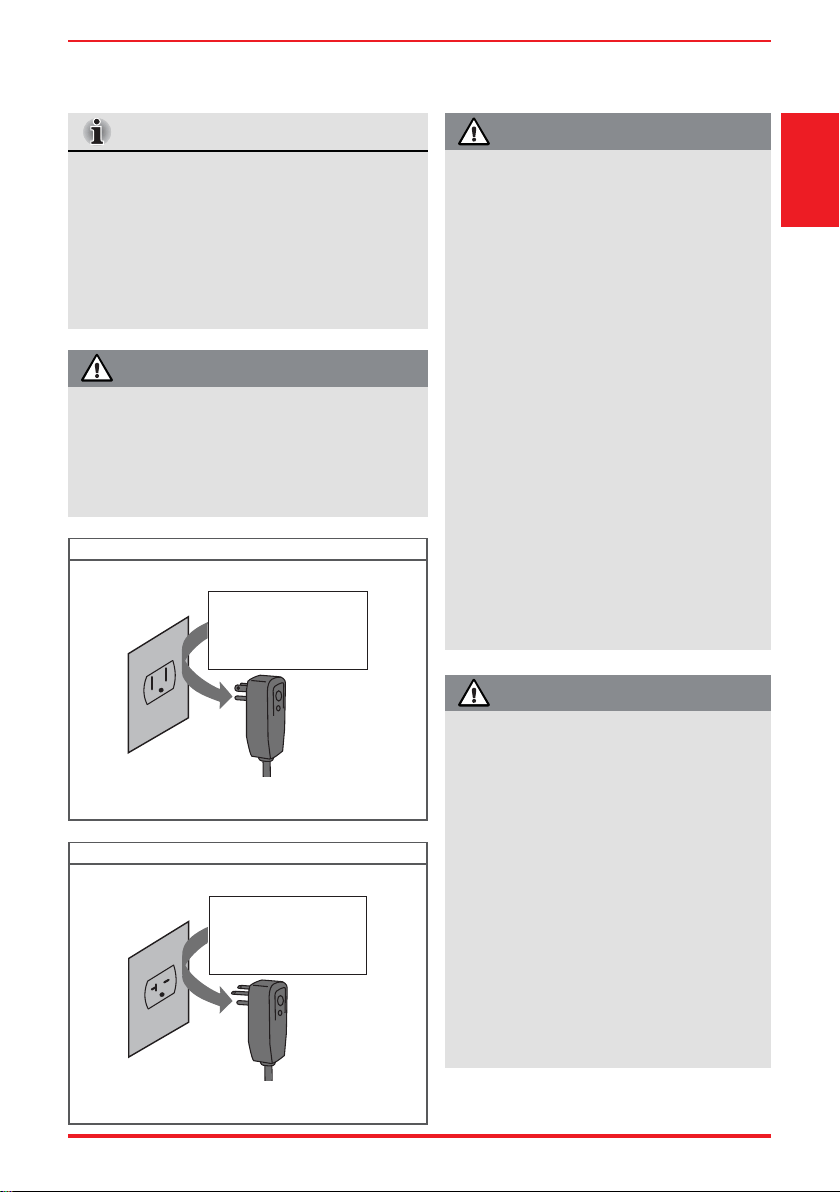
The power supply cord with this air conditioner
contains a current detection device designed
to reduce the risk of re.
In the event that the power supply cord is
damaged, it can not be repaired. It must be
replaced with a cord from the manufacturer.
Safety
Precautions
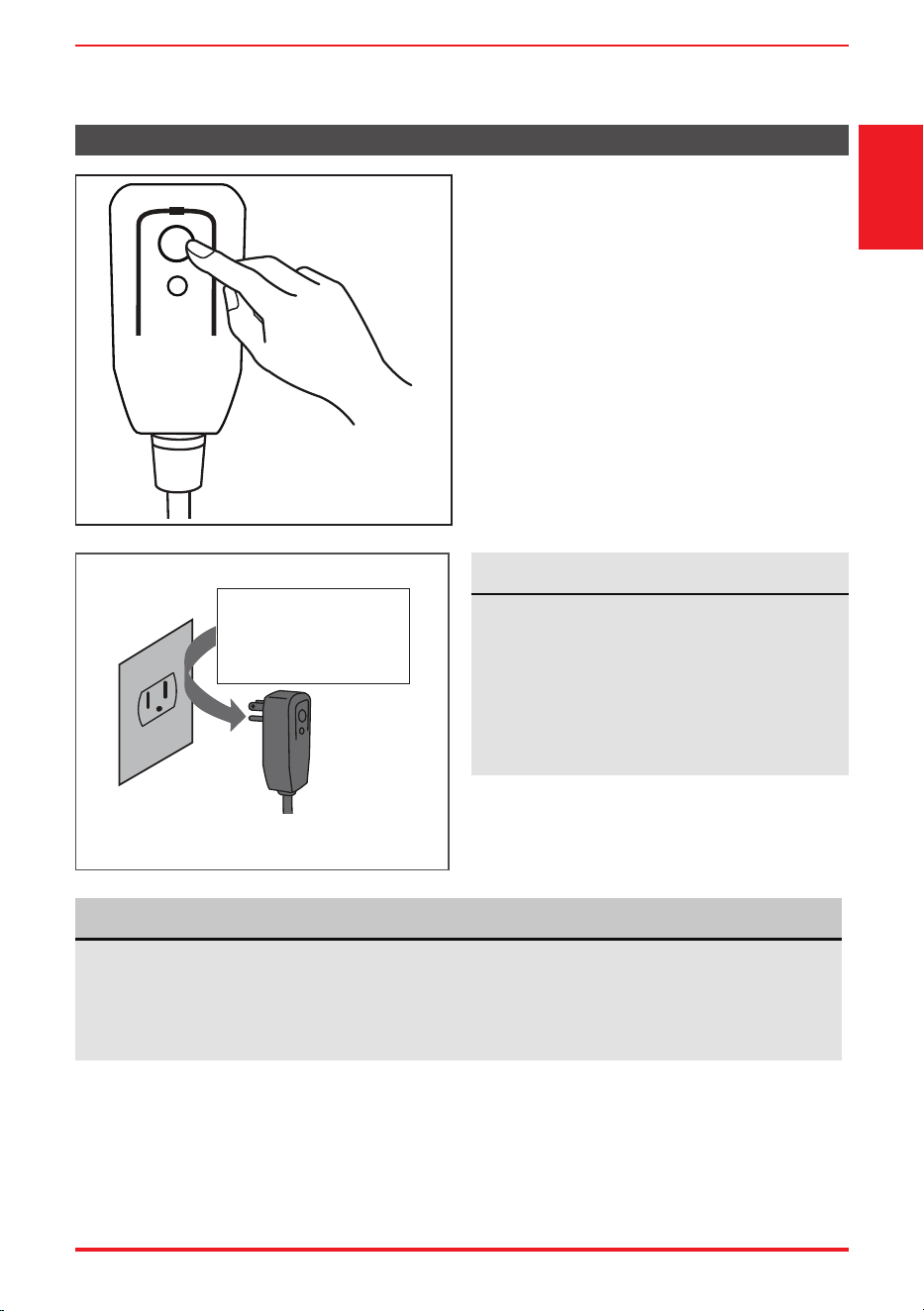
• Do not use this device to turn the unit on or o .
• Always make sure the RESET button is pushed in for correct operation.
• The power supply cord must be replaced if it fails to reset when either the TEST button is pushed,
or it can not be reset. Please contact Customer Service.
Grounding type wall receptacle
Do not, under any
circumstances, cut,
remove or bypass
the grounding prong.
Power supply cord with 3-prong grounding
plug and current detection device.
The power supply cord contains a current
measuring device that detects damage to the
power cord. Test your power supply cord as
follows:
1. Plug in the air conditioner.
2. The power supply cord will have TWO
buttons on the plug head. Press the TEST
button. You will notice a click as the RESET
button pops out.
3. Press the RESET Button. You will notice a click
as the button engages.
4. The power supply cord is now supplying
electricity to the unit. (On some products this
is also indicated by a light on the plug head.)
RESET
TEST
Plug in & press RESET
Operation of Current Device
NOTICE
NOTICE
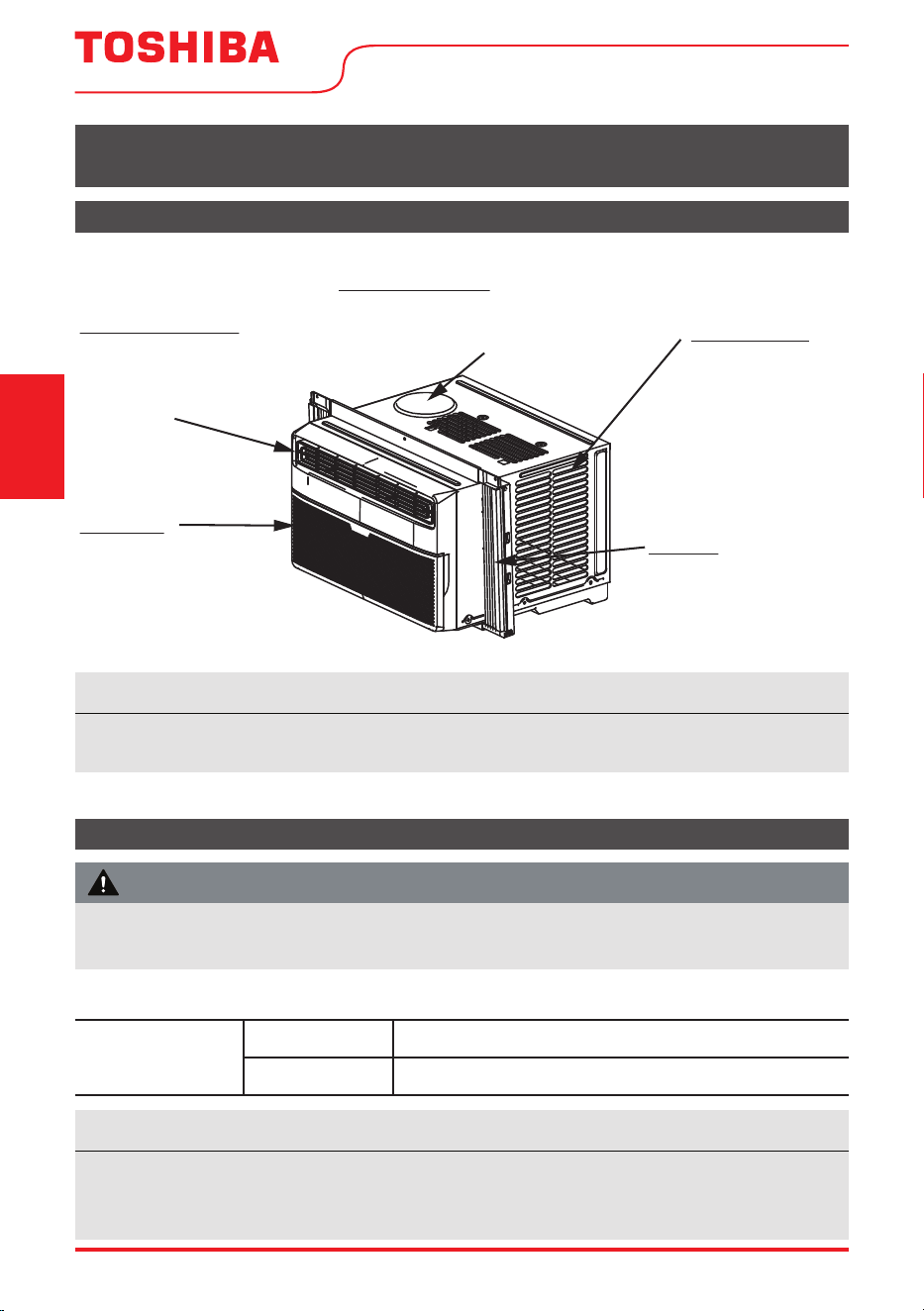
Page 8 User Manual
Normal Sounds
OPERATING INSTRUCTIONS
Operating
Instructions
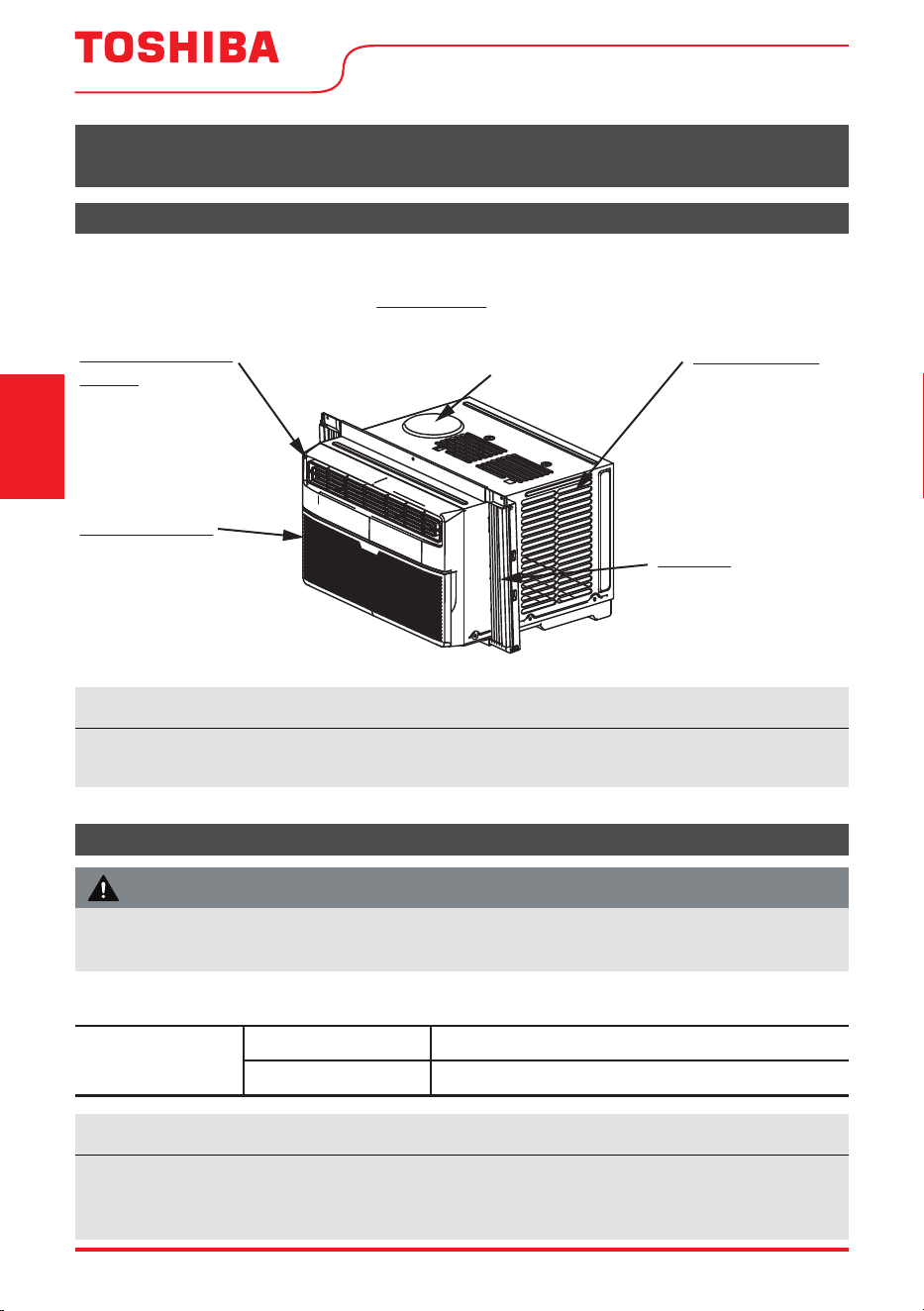
RAC-WK15 Models
Gurgle/Hiss
Gurgling or hissing
noises may be heard due
to refrigerant flowing
through evaporator
during normal operation.
Sound of Rushing Air
In front of the unit, you
may hear the sound of
rushing air being moved
by the fan.
Vibration
Unit may vibrate and make
noise because of poor wall
or window construction or
incorrect installation.
Trickling Sound
Droplets of water
hitting condenser
during normal
operation may cause
a trickling sound.
High Pitched Sound
High efficiency compressors may
have a high pitched sound during
cooling cycle.
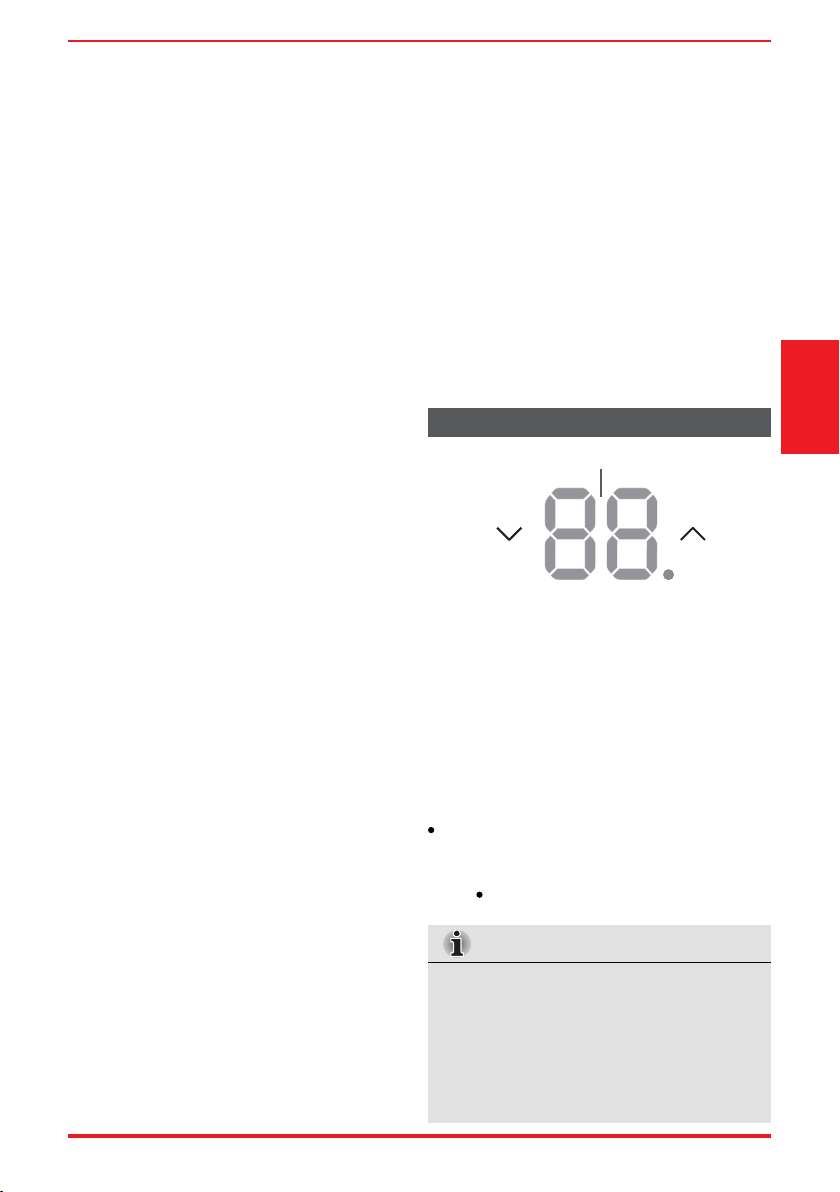
All the pictures in this manual are for illustrative purposes only. The actual appearance of the air
conditioner you purchased may vary slightly, but its operation and functions will be similar.
NOTICE
Air Conditioner Features (general)
This air conditioner is designed to be operated under the following conditions:
Cooling Operation
Outdoor temp.: 64 ~ 109°F / 18 ~ 43°C
Indoor temp.: 62 ~ 90°F / 17 ~ 32°C
To reduce the risk of fire, electrical shock, or injury to people or property, read the SAFETY
PRECAUTIONS before operating this appliance.
WARNING
• The relative humidity of room should be less than 80%. If the unit is used in a condition with a
relative humidity over 80%, there will be condensed water on the surface of the unit.
• Performance may be reduced outside of these operating temperatures.
NOTICE
User Manual Page 9
Operating
Instructions
To begin operating the air conditioner, follow these steps:
1. Set the temperature to the coldest setting.
2. Set the control to HIGH COOL.
3. Adjust the louver for comfortable air ow (see Air Directional Louvers).
4. Once the room feels cool, adjust to the temperature you nd most comfortable.
5. Make sure that the air ow inside and outside are not obstructed.
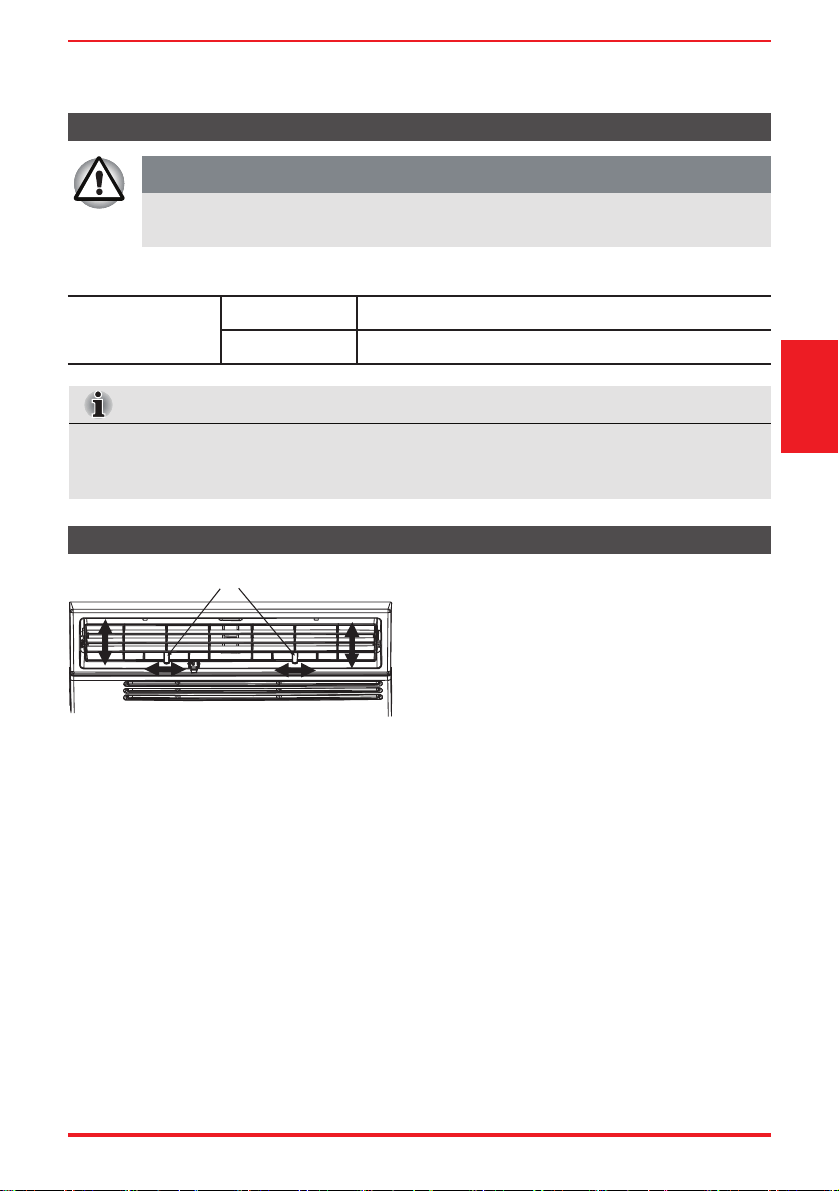
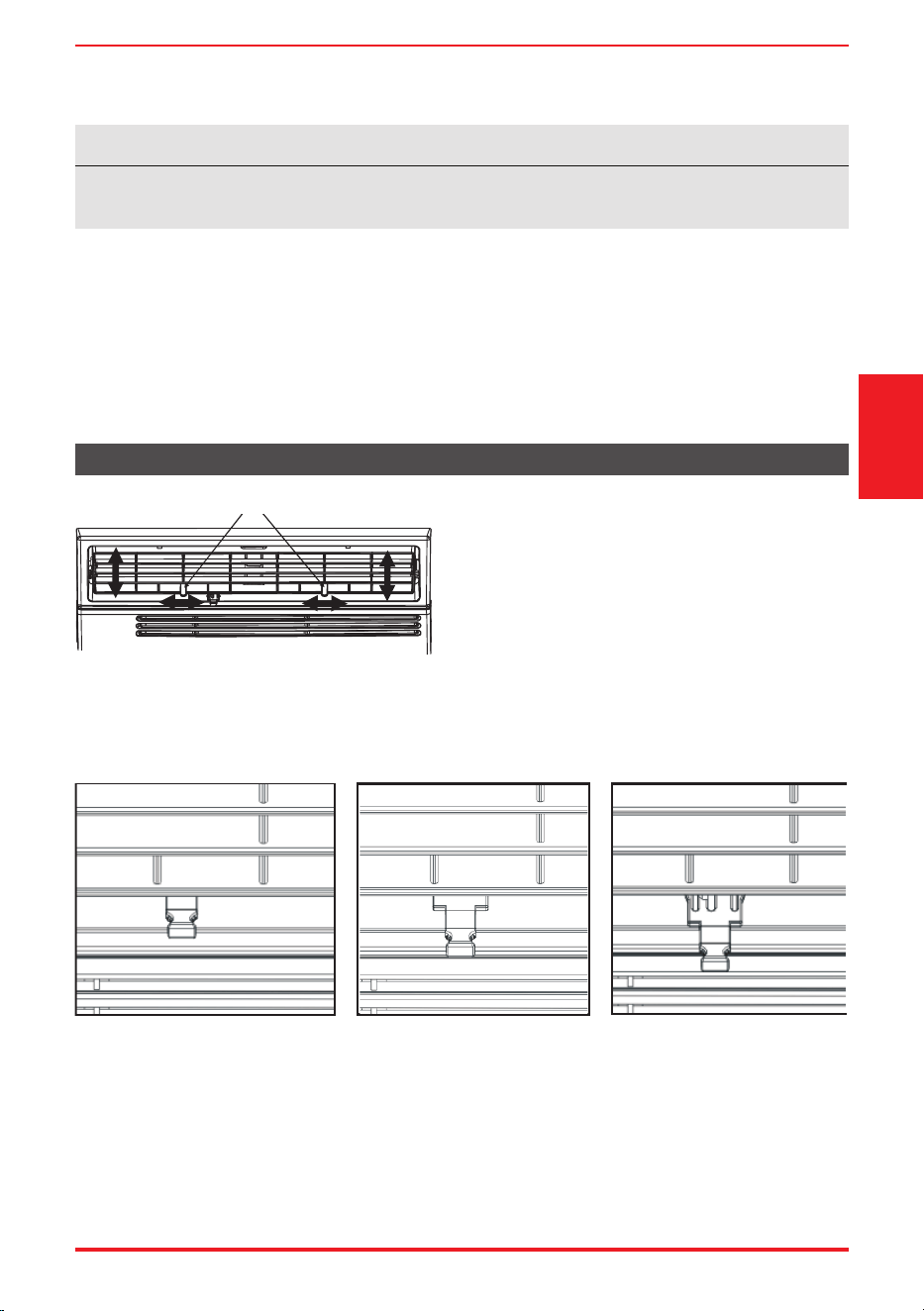
Air Directional Louvers
The louvers will allow you to direct the air ow Left
or Right, or Up and Down (optional on some models)
throughout the room as needed.
Move the Levers from side to side until the desired
LEFT/RIGHT direction is obtained.
You can also move the LEFT lever to adjust air ow
UP/DOWN as needed.
Levers
Air Direction
Always wait 3 minutes when turning the unit o and then on again, or when changing from cool to
fan and back to cool. This prevents damage from occurring to the compressor.
NOTICE
The Fresh Air Vent allows the air conditioner to:
1. Recirculate inside air – Vent Closed (See Fig. A)
2. Draw fresh air into the room - Vent Open (See Fig. B)
3. Exchange air from the room and draw fresh air into the room - Vent and Exhaust Open (See Fig. C).
FRESH AIR VENT CONTROL
Fig. A (VENT CLOSED) Fig. B (VENT OPEN) Fig. C (VENT & EXHAUST OPEN)
Page 10 User Manual
Operating
Instructions
TO TURN UNIT ON OR OFF:
Press Power button to turn unit on or o .
NOTE: The unit will automatically initiate the Energy
Saver function under Cool, Dry, Auto modes.
TO CHANGE TEMPERATURE SETTING:
Press UP/DOWN button to change temperature
setting.
NOTE: Press or hold either UP (
) or DOWN ( )
button until the desired temperature is seen on the
display.
This temperature will be automatically maintained
anywhere between 62°F (17°C) and 86°F (30°C). If
you want to display the actual room temperature,
see To Operate on Fan Only section.
TO ADJUST FAN SPEEDS:
Press the Fan Button to change the fan speed
between four settings – Auto, Low, Med, or High. The
fan will operate on Low Speed automatically when
set to Dry Mode.
On Auto mode,the fan operates on Auto fan speed
automatically and cannot be changed.
SLEEP FEATURE:
Press Sleep button to initiate the sleep mode. In
this mode the selected temperature will increase by
2°F (1°C) 30 minutes after the mode is selected.
The temperature will then increase by another 2°F/
1(or 2)°C after an additional 30 minutes. This new
temperature will be maintained for 7 hours before it
returns to the originally selected temperature.
The Sleep mode program can be cancelled at any time
during operation by pressing the Sleep button again.
CHECK FILTER FEATURE:
The Check Filter feature is a reminder to clean the
air filter for a more efficient operation. The light
will illuminate after 250 hours of operation. After
cleaning the filter, press the Filter button to reset
the Check Filter function turning the light off.
ENERGY SAVER FEATURE (ECO):
Press Energy Saver button to initiate this function.
This function is available on COOL, DRY, AUTO (only
AUTO-COOLING and AUTO-FAN) modes. The fan will
continue to run for 3 minutes after the compressor
shuts off. The fan then cycles on for 2 minutes at
10 minute intervals until the room temperature
is above the set temperature, at which time the
compressor turns back on and Cooling resumes.
TO SELECT THE OPERATING MODE:
To choose the operating mode, press the Mode
button. Each time you press the button, a mode is
selected in a sequence that goes from Auto, Cool,
Dry and Fan.
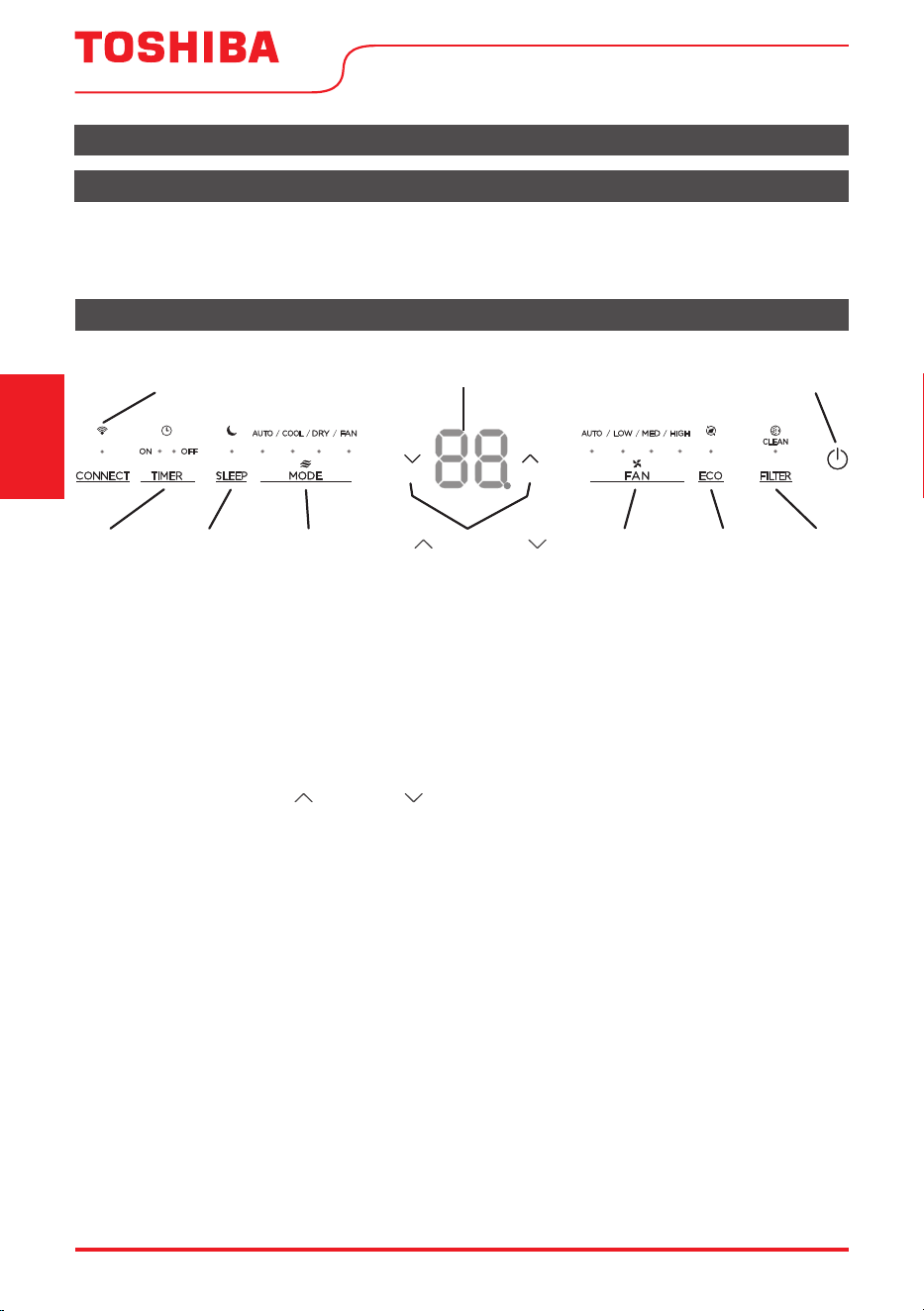
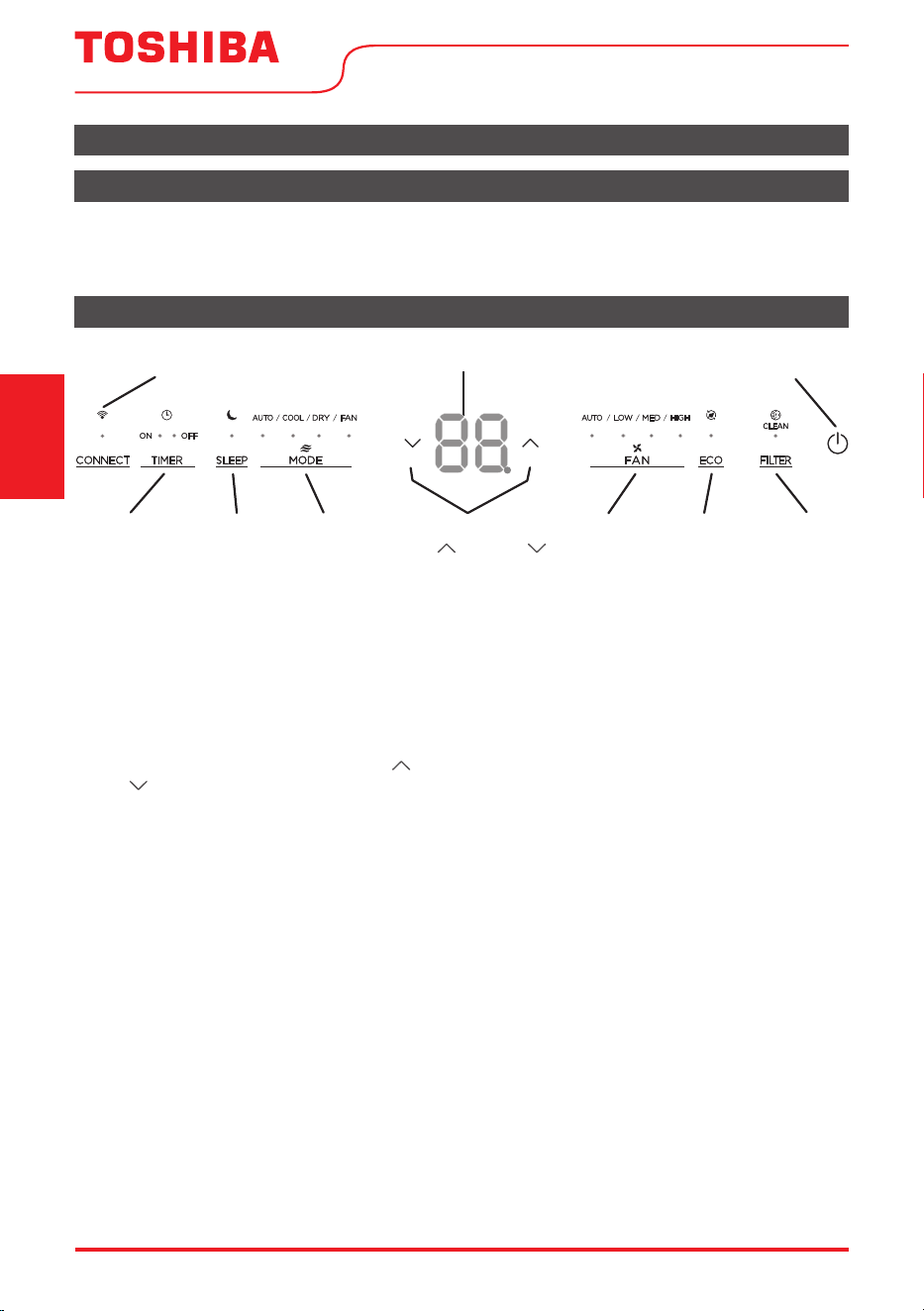
Key Pad Features
Energy
Saver
LED
Display
Clean
Filter
Timer
Button
Power
Button
Sleep
Button
Fan
Button
Up ( ) and Down ( )
Buttons
Mode
Button
Connect Indicator Light
(Smart models only)
Before you begin, thoroughly familiarize yourself with the control panel as shown below and all its
functions, then follow the symbol for the functions you desire. The unit can be controlled by the unit
control alone or with the remote.
Electronic Control Operating Instructions
Air Conditioner Features
User Manual Page 11
Operating
Instructions
The indicator light adjacent will be illuminated and
remain on once the mode is selected.
When the unit is turned o and back on via the power
button, the unit will automatically switch on the Energy
Saver function for the following modes:
Cool, Dry, Auto.
When operating on Auto mode:
- When you set the air conditioner to AUTO mode,
it will automatically select cooling or fan only
operation depending on what temperature you
have selected and the current room temperature.
- The air conditioner will control room temperature
automatically according to temperature you’ve set.
- The fan speed is automatically controlled based on
the temperature setting and room temperature and
cannot be adjusted.
When operating on Fan Only:
- Use this function when cooling is not desired, such
as for room air circulation or to exhaust stale air (on
some models, remember to open the vent during
this function, but keep it closed during cooling for
maximum cooling e ciency.) You can choose any
fan speed you prefer.
- During this function, the display will show the actual
room temperature, not the set temperature as in the
cooling mode.
- In Fan Only mode, the temperature is not adjusted.
When operating on Dry mode:
- In this mode, the air conditioner will generally
function as a dehumidi er. Since the conditioned
space is a closed or sealed area, some degree of
cooling will occur.
TIMER: AUTO START/STOP FEATURE:
- When the unit is on, press the Timer button. The
“Timer o ” LED indicator light will illuminate
indicating the Auto stop feature has been activated.
- When the unit is o , press the Timer button. The
“Timer on” LED indicator light will illuminate
indicating the Auto start feature has been activated.
- When the time of TIMER ON is displayed, press the
Timer button again. The TIMER OFF indicator light
illuminates. It indicates the Auto Stop program
has initiated.
- Press or hold the UP (
) or DOWN ( ) button to
change the Auto time by 0.5 hour increments, up to 10
hours, then at 1 hour increments up to 24 hours. The
control will count down the time remaining until start.
- The selected time will register in 5 seconds,
and the system will automatically revert back
to display the previous temperature setting or
room temperature when the unit is on. (when
the unit is o , there is no display.)
- Turning the unit ON or OFF at any time or
adjusting the timer setting to 0.0 will cancel
the Auto Start/Stop timed program.
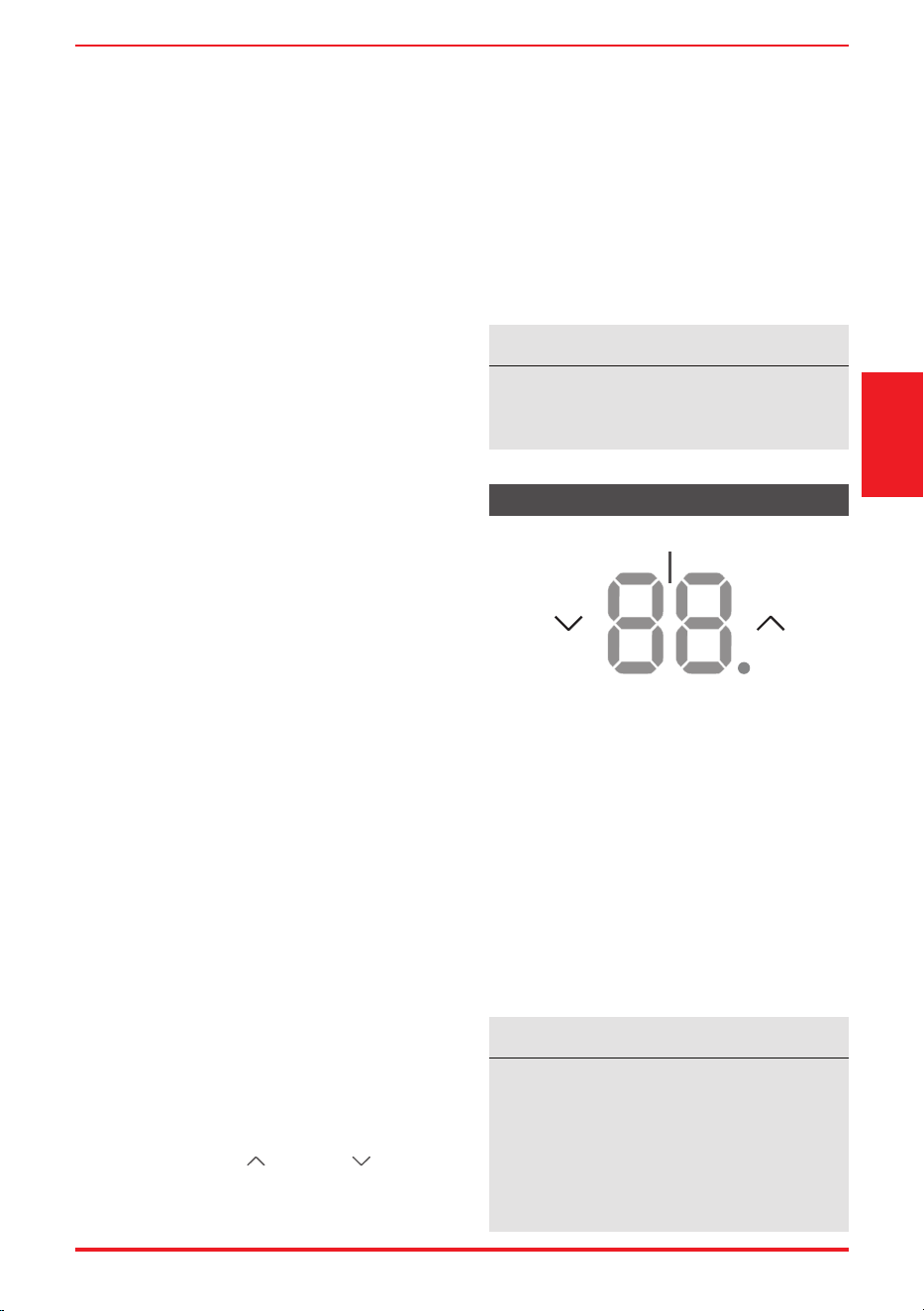
Displays
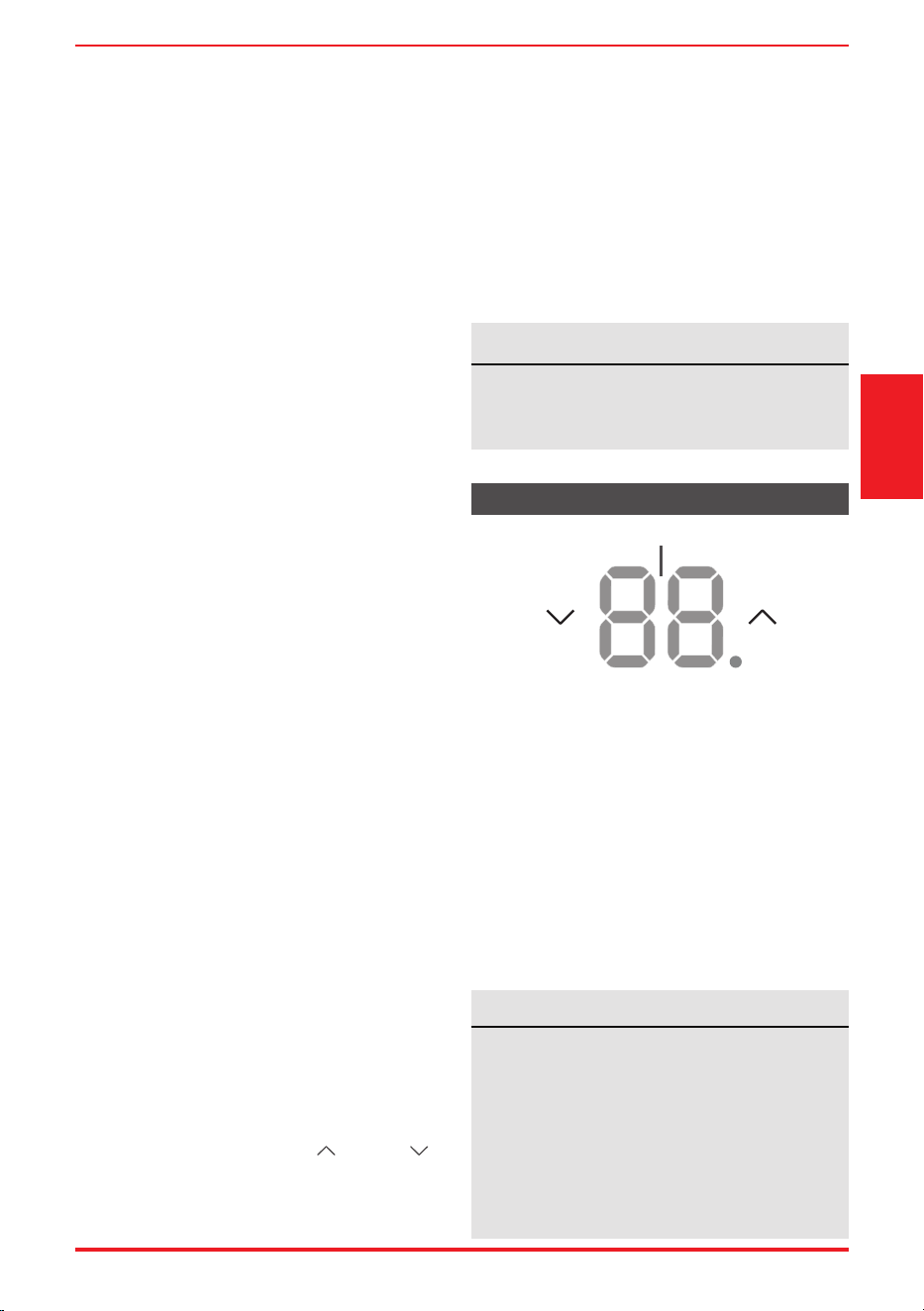
DISPLAYS:
Shows the set temperature in “°C” or “°F” and the
Auto-timer settings. While on Fan Only mode, it shows
the room temperature. If the room temperature is too
high or low, it will display”HI” or “LO”.
Error codes:
AS - Room temperature sensor error - Unplug the
unit and plug it back in. If error repeats, call
for service.
ES - Evaporator temperature sensor error -
Unplug the unit and plug it back in. If error
repeats, call for service.
DISPLAYS
• To change the AC between Celsius and
Fahrenheit scales, press the temperature
control arrows at the same time for 5 seconds.
• If the unit shuts o unexpectedly due to the
power outage, it will restart with the previous
function setting automatically when the
power resumes.
NOTICE
To cancel timer operation, press and hold the
timer button for 2 seconds until the beep/
buzzer is heard.
NOTICE
Page 12 User Manual
Before You Begin
Read these instructions completely and
carefully.
• IMPORTANT - Save these instructions.
• IMPORTANT - Observe all governing
codes and ordinances.
We recommend that two people install
this product.
Proper installation is the responsibility of
the installer.
Product failure due to improper
installation is not covered under the
Limited Warranty.
You MUST use all supplied parts and
use proper installation procedures as
described in these instructions when
installing this air conditioner.
Do not, under any circumstances, cut or
remove the third (ground) prong from
the power cord.
Do not change the plug on the power
cord of the air conditioner.
Aluminum house wiring may present
special problems - consult a qualified
electrician.
When handling the unit, be careful to
avoid cuts from sharp metal edges and
aluminum fins on front and rear coils.
Please wear cut-resistance gloves
Installation
Instructions
WARNING
Save carton and these Installation
Instructions for future reference.
The carton is the best way to store the
unit when not in use.
NOTICE
INSTALLATION INSTRUCTIONS
Perform a preliminary check of your installation per
Preliminary Instruction steps 1-5.
Unit Height: 17-5/8”
Unit Width: 23-5/8”
Min. Window Opening: 18-1/2”
Min. Window Width: 28”
Max. Window Width: 40-1/2”
Preliminary Instructions
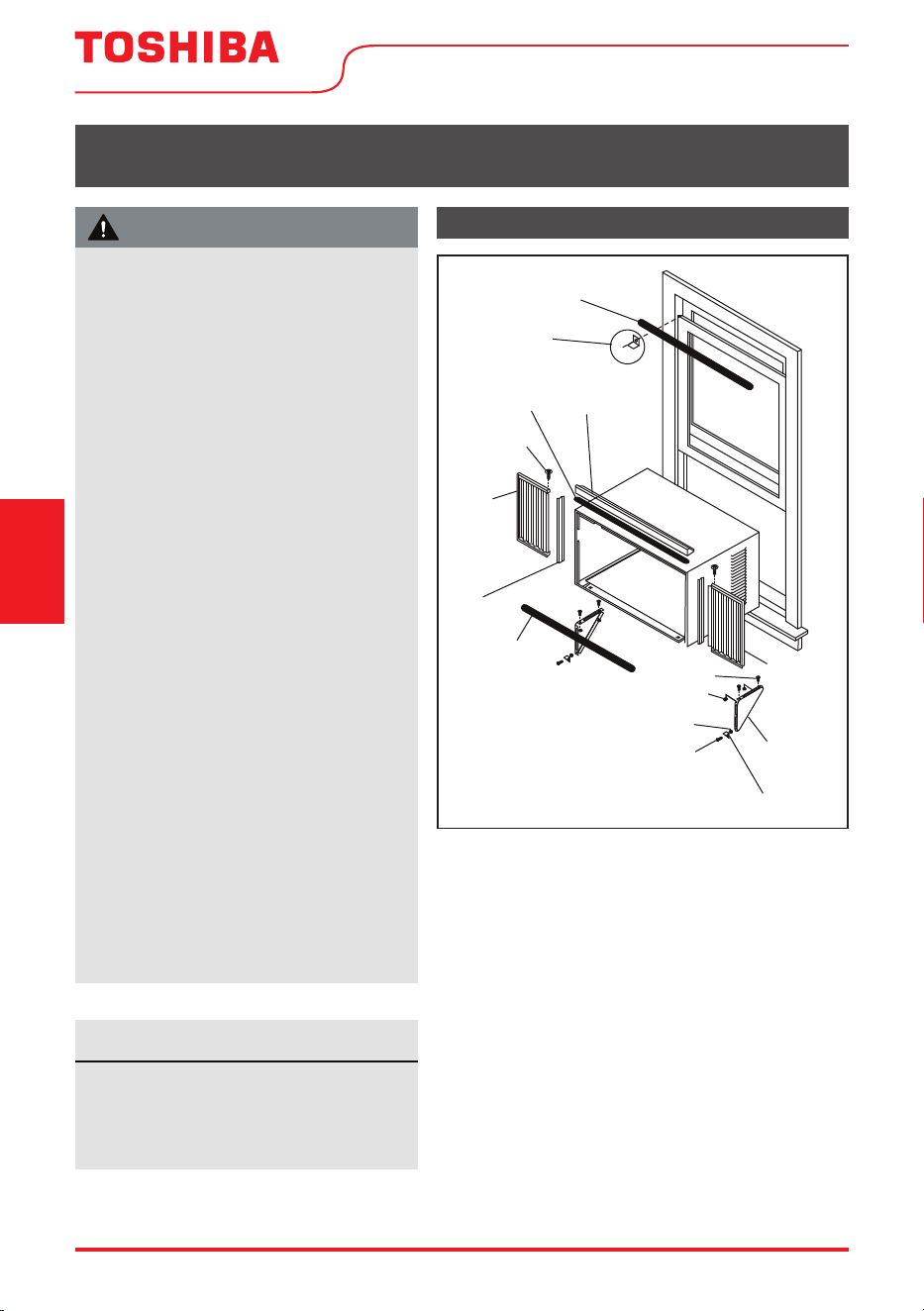
Window Sash Seal
Top RailFoam Gasket
3/4” Long Flat Head Bolt
Sill Angle Bracket
1 /2” Long
Screw and
Locknuts
Window
Support
Bracket
Accordion
Panel
Assembly
(Right)
Side
Retainer
Washer Head
Locking
Screw
Bottom Rail
Seal to Unit
Accordion
Panel
Assembly
(Left)
Safety Lock and
3/4” (or 1/2” ) Long
Hex Head Screw
Locknuts
User Manual Page 13
Tools You Will Need
Tools You May Use
Installation
Instructions
Phillips
Screwdriver
Level
Flathead
Screwdriver
Pencil
Ruler or tape measure
Scissors or knife
1. Check window opening size - the mounting parts furnished with
this air conditioner are made to install in a wooden sill double-
hung window. The standard parts are for window dimensions
listed above. Open sash to a minimum of 19” (483 mm). See Fig. D.
2. Check condition of window - all wood parts of window must be
in good shape and able to rmly hold the needed screws. If not,
make repairs before installing unit.
3. Check for anything that could block air ow - check the area outside
of window for things such as shrubs, trees, or awnings. Inside, be
sure furniture, drapes, or blinds will not stop proper air ow.
4. Check the available electrical service - Power supply must be the
same as that shown on the unit serial nameplate. Power cord is
48 in long. The outlet should be within reach of the power cord.
5. Carefully unpack air conditioner - Remove all packing material.
Protect oor or carpet from damage. Two people should be used
to move and install unit.
SASH
Storm Window Frame
or Other Obstruction
19” MIN.
1/2” MIN.
Fig. D
Preliminary Instructions (cont.)
Hardware (Packed with the unit)
Accordion Panel Insulation and weather stripping
is for ENERGY STAR models only.
NOTICE
7/16” Locking screw and
Flat washer for accordion panels
2 ea.
3/4” (or 1/2”) Long
Hex-head Screw
7
Safety Lock 1
1/2” Long screw
and Locknut
4 ea.
3/4” Long Flathead Bolt
and Locknut
2 ea.
Sill Angle Bracket
2
Long hex-head locking screw
for top rail, side retainer
5/16” Length
10
Cabinet Foam Insert
2
Window sash seal foam
1
Weather stripping
(10” *3/4” *1/12” )
5
2
2
2
Safety Lock
(for Vinyl-Clad window)
Locking screw #10 X 1/4” panhead
Phillips screws (for Vinyl-Clad window)
Accordion Panel Insulation
Lock Frame (For Wooden
windows) (on some models)
3/4” Long Screw (on some models)
2
2
Page 14 User Manual
Installation
Instructions
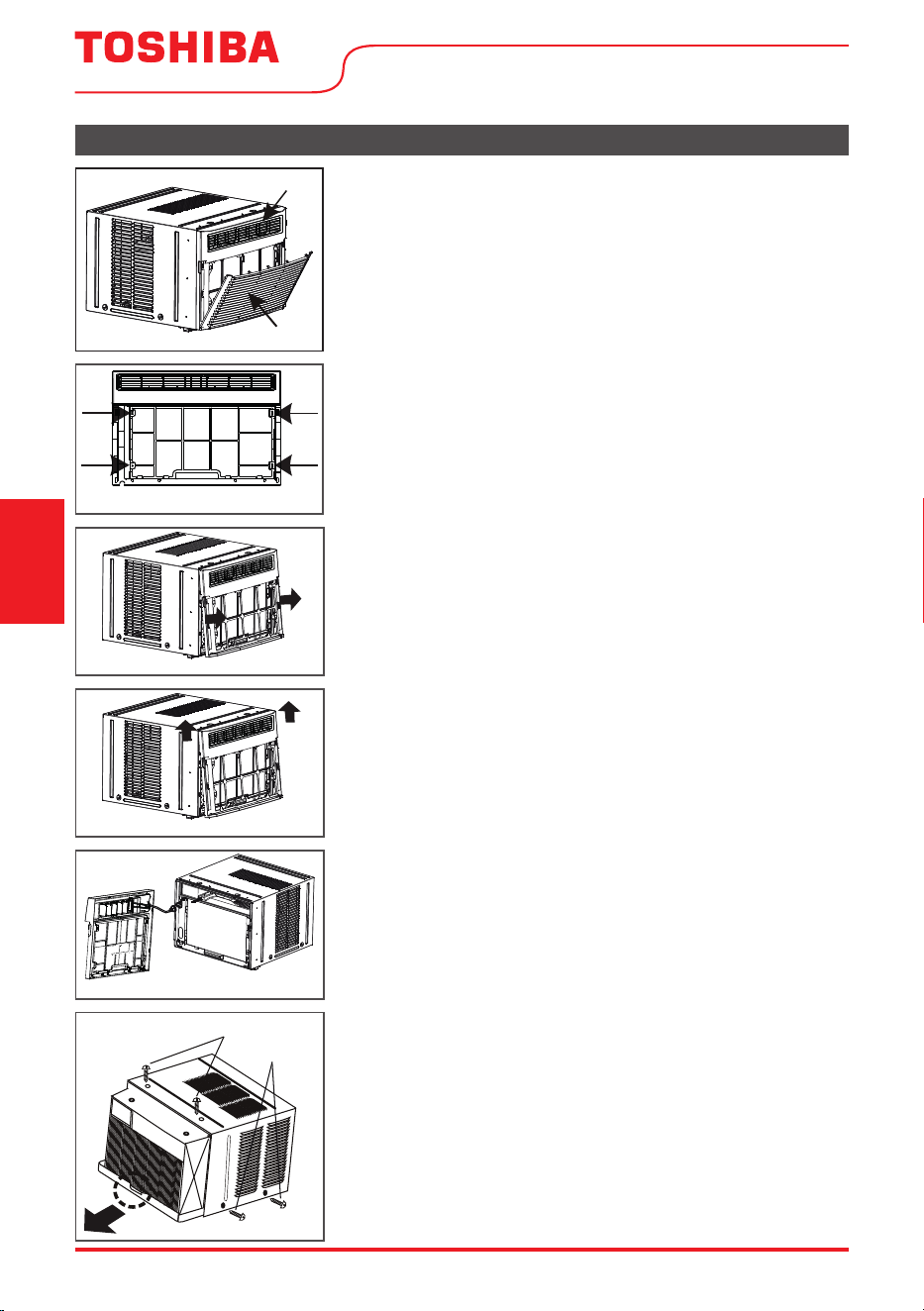
1. Remove Air Conditioner from Cabinet
A. Pull down front grille and remove lter. (See Fig. 1).
B. Lift front grille upwards and place to one side.
C. Locate the four front screws and remove. These screws will be
needed to re-install the front panel (see Fig. 2).
D. Push metal cabinet side to release plastic tabs on each side of
front panel (see Fig. 3).
E. Gently lift front panel o unit (see Fig. 3A).
F. Disconnect the connector plug of the display panel from the
unit and place front panel to one side (see Fig. 4).
G. Remove shipping screws from top of unit and also on the
side by the base if installed (see Fig. 5).
H. Hold the cabinet while pulling on the base pan handle, and
carefully remove the unit.
Fig. 2
Fig. 3
Fig. 4
Fig. 3A
Front Panel
Front Grille
Fig. 1
Shipping
Screws
Fig. 5
User Manual Page 15
Installation
Instructions
2. Prepare the Cabinet
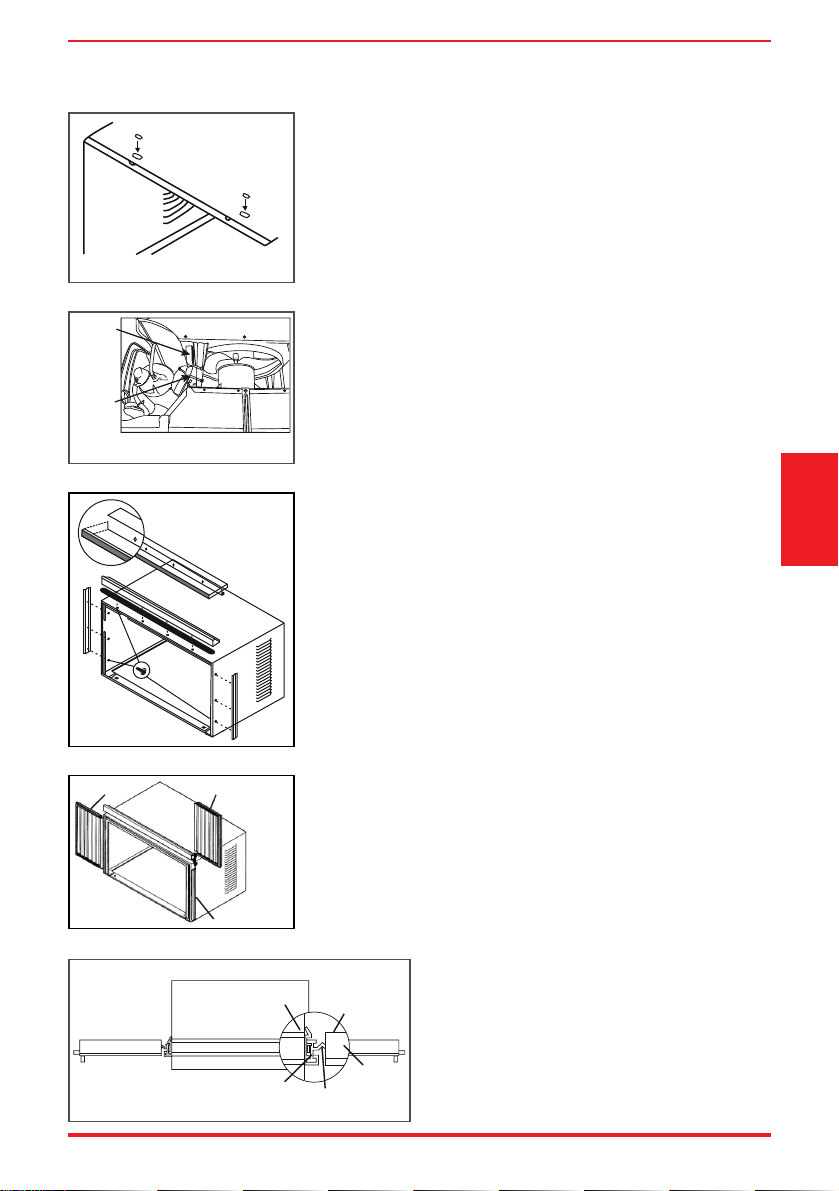
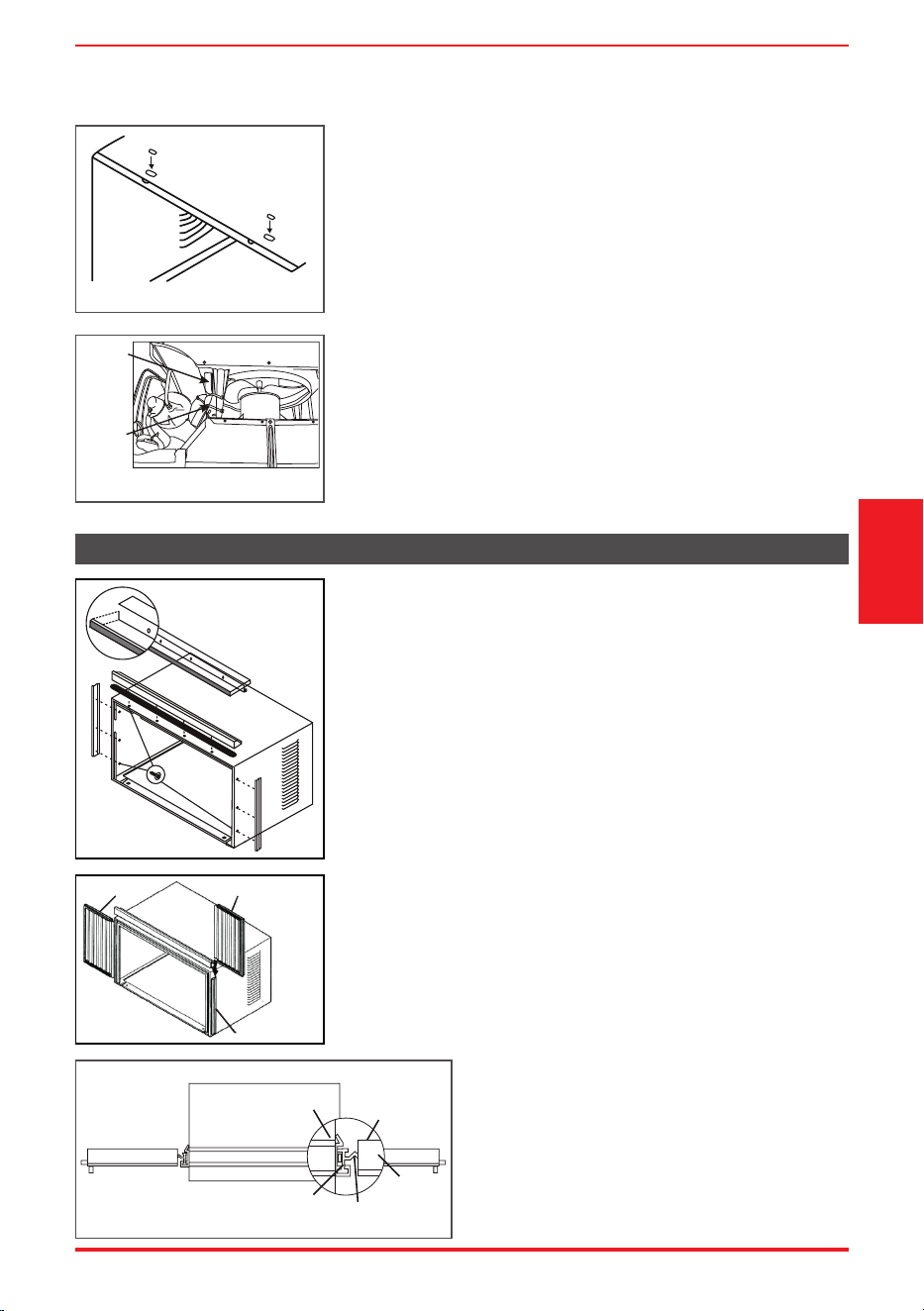
I. Add two foam inserts to holes in top of cabinet where shipping
screws were removed from (see Fig. 6).
J. Your unit may come with internal packaging. This packaging
must be removed prior to installing the air conditioner back
into the cabinet. (see Fig. 7).
Fig. 6
Fig. 7
Shipping
Packaging
Plastic
Tie
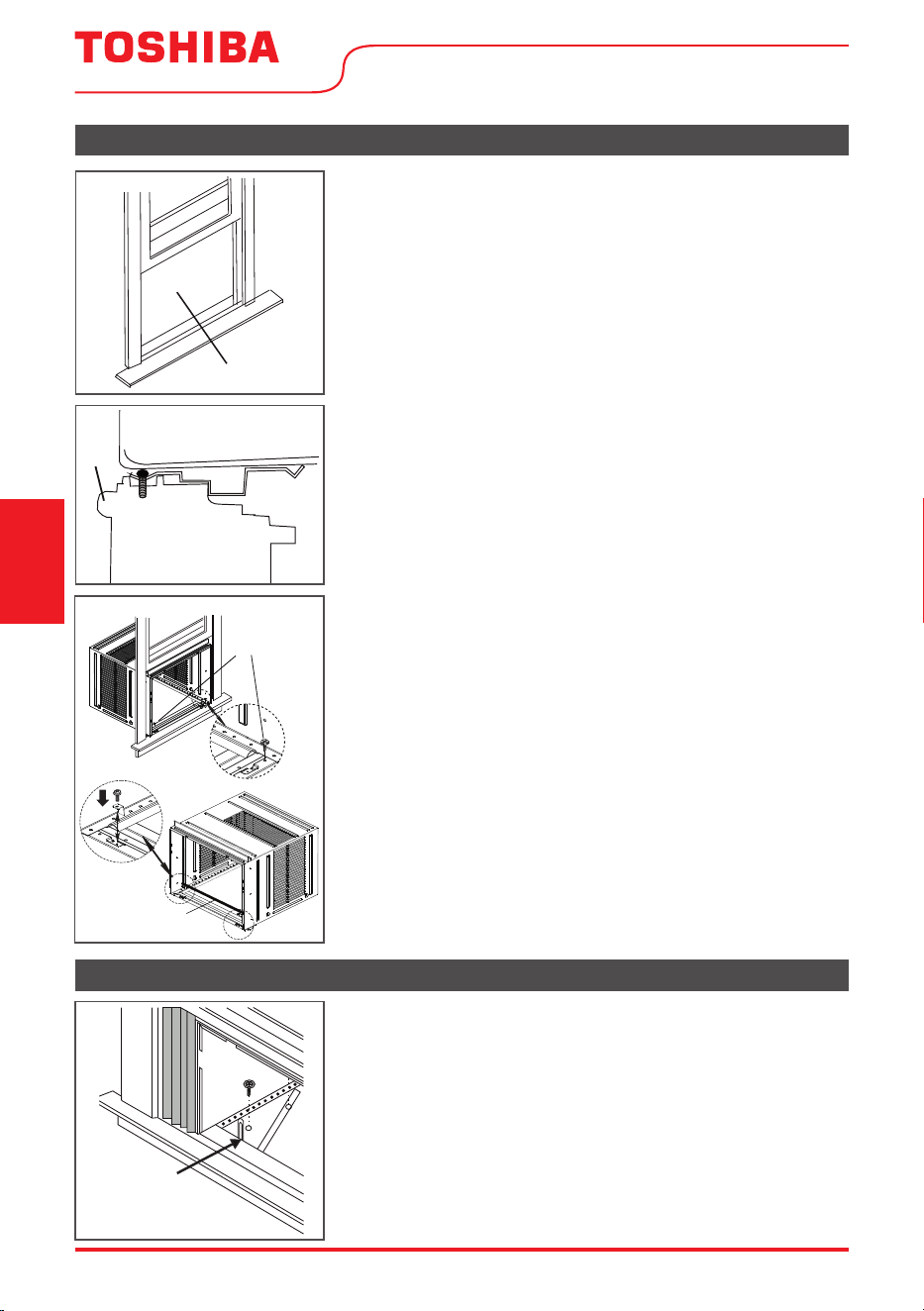
A. Place cabinet on oor, a bench, or a table.
B. Attach foam gasket to top rail above holes as shown in Fig. 6.
C. Install top rail and side retainers to cabinet as shown in Fig. 8
(10 screws).
Fig. 8
5/16” long
hex-head
Plastic Frame
Side Retainer
Window
Accordion
Panel
Fig. 9
D. Slide 1 section of window accordion panel into side retainer on
the side of the cabinet (see Fig. 9 & Fig. 10). Do both sides.
E. Insert top and bottom legs of window accordion panel frame
into channel in the top rail and bottom rail. Do both sides.
F. Insert washer head locking 7/16” screws (2) into
holes in top leg of accordion panel frame (see
step 6). Do not completely tighten.
Allow leg to slide freely. Screws will be
tightened after section 6.
TOP VIEW
Air Conditioner
Cabinet
Plastic
Frame
Locking
Screw
Hole
Window
Accordion Panel
“I” Section
Fig. 10
Page 16 User Manual
Installation
Instructions
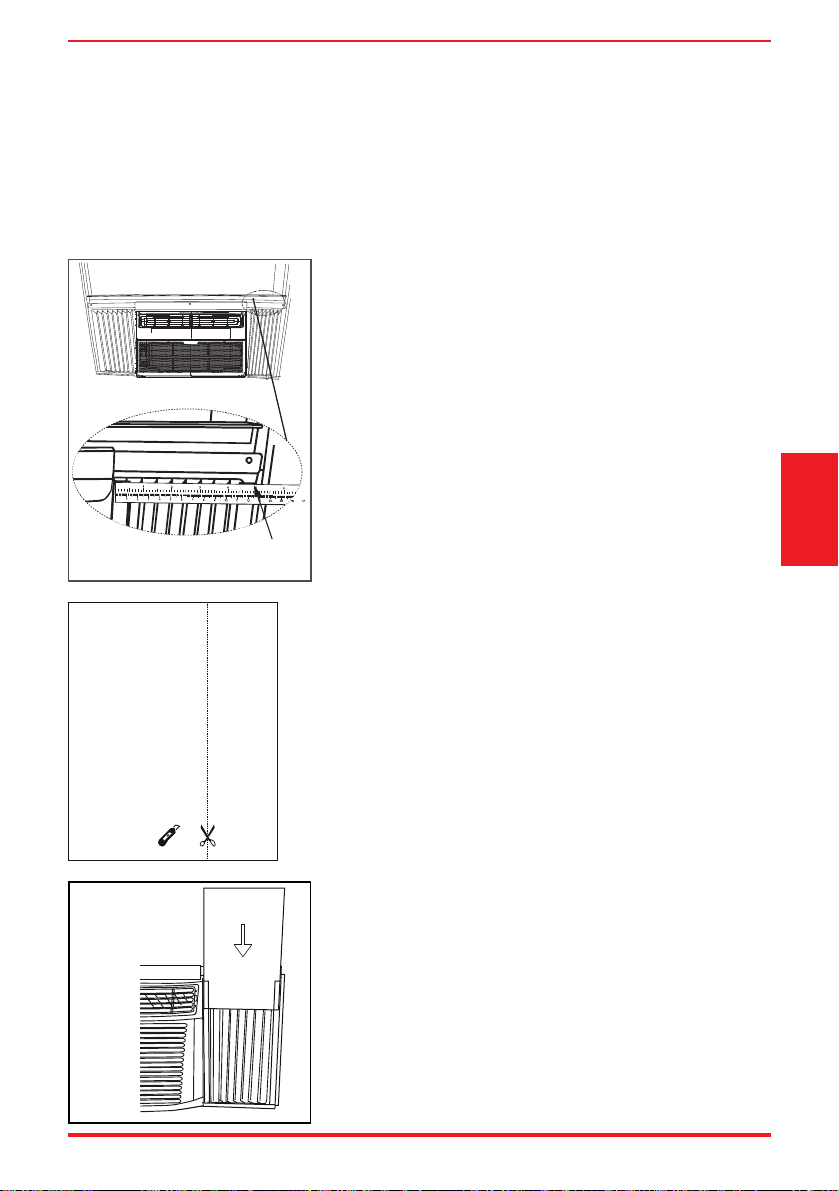
A. Open window and mark center of window sill as shown (Fig. 11).
B. Place the cabinet in the window with the cabinet bottom rmly
seated over the window sill as shown. Bring window down
temporarily behind top rail to hold cabinet in place (Fig. 12).
C. Shift cabinet left or right as needed to line up center of
cabinet on center line marked on sill.
D. For wooden window: Fasten cabinet to window inner sill with
two 1/2” long hex head screws into holes (Fig.13A). (You may
wish to pre-drill pilot holes.)
For Vinyl-Clad window: Place two safety locks into the holes
located in the bottom of the cabinet and drive two #10X1/4”
pan-head Phillips locking screws through the safety locks
into the cabinet as shown (Fig.13B).
A. #10 X 1/4” pan-head Phillips screws
B. Safety Lock (Only for Vinyl-Clad Window)
C. Bottom Rail Foam Seal
E. Remove protective strip from adhesive side of Bottom Rail
Foam Seal. Apply Seal over screws fastening bottom rail to
window inner sill.
Fig. 11
Sill
Fig. 12
Mark
Fig. 14
FIG.13A
1/2″ long
HEX-HEAD
SCREW
A
B
FIG.13B
C
3. Install Cabinet
4. Install Support Brackets
A. Hold each support bracket ush against outside of sill, and tight
to bottom of cabinet as shown in Fig. 14. Mark brackets at top
level of sill, and remove.
User Manual Page 17
Installation
Instructions
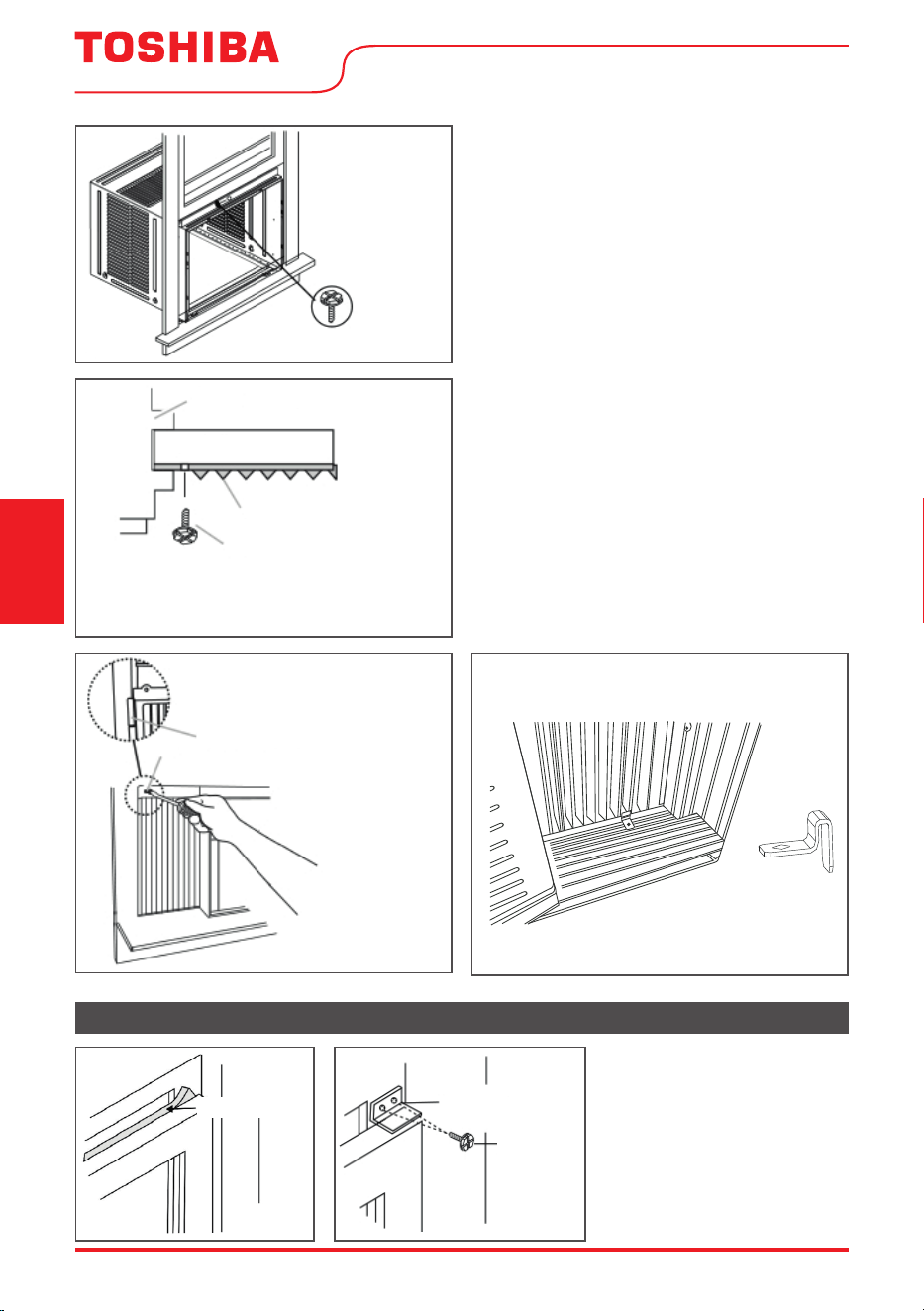
Window Sash
About 1
1/4”
to 1
5/8”
Measure from
the cabinet
edge
Side
Louvers
Window Sill
Sill Angle
Bracket
Fig. 15
Fig. 14A
Right
Left
Locknut
Sill Angle
Bracket
Flathead Bolt
2 Each Required For
Each Support Bracket
1/2” Long Screws
and Locknuts
A. Carefully raise window to expose accordion
panel locking screws. Loosen screws so
accordion panels slide easily.
B. Extend panels to ll window opening
completely. Tighten locking screws on top
(Fig. 17).
C. Close window behind top rail.
Fig. 16
1/2” Long
Screws and
Locknuts
Fig. 17
7/16”
Locking
Screw and
Washer
Locking Screw
Check that air conditioner is tilted back
about 1-1/4 in to 1-5/8 in (tilted about 3° to
4° downward to the outside). After proper
installation, condensate should not drain from
the over ow drain hole during normal use.
Adjust the slope if otherwise (Fig.15).
NOTICE
5. Secure Accordion Panels
B. Assemble sill angle bracket to support brackets
at the marked position (Fig. 14A). Hand tighten
only so adjustments can be made later.
C. Install support brackets (with sill angle
brackets attached) to correct hole in bottom
of cabinet as shown in Fig. 16.
D. Tighten all 6 bolts securely.
Page 18 User Manual
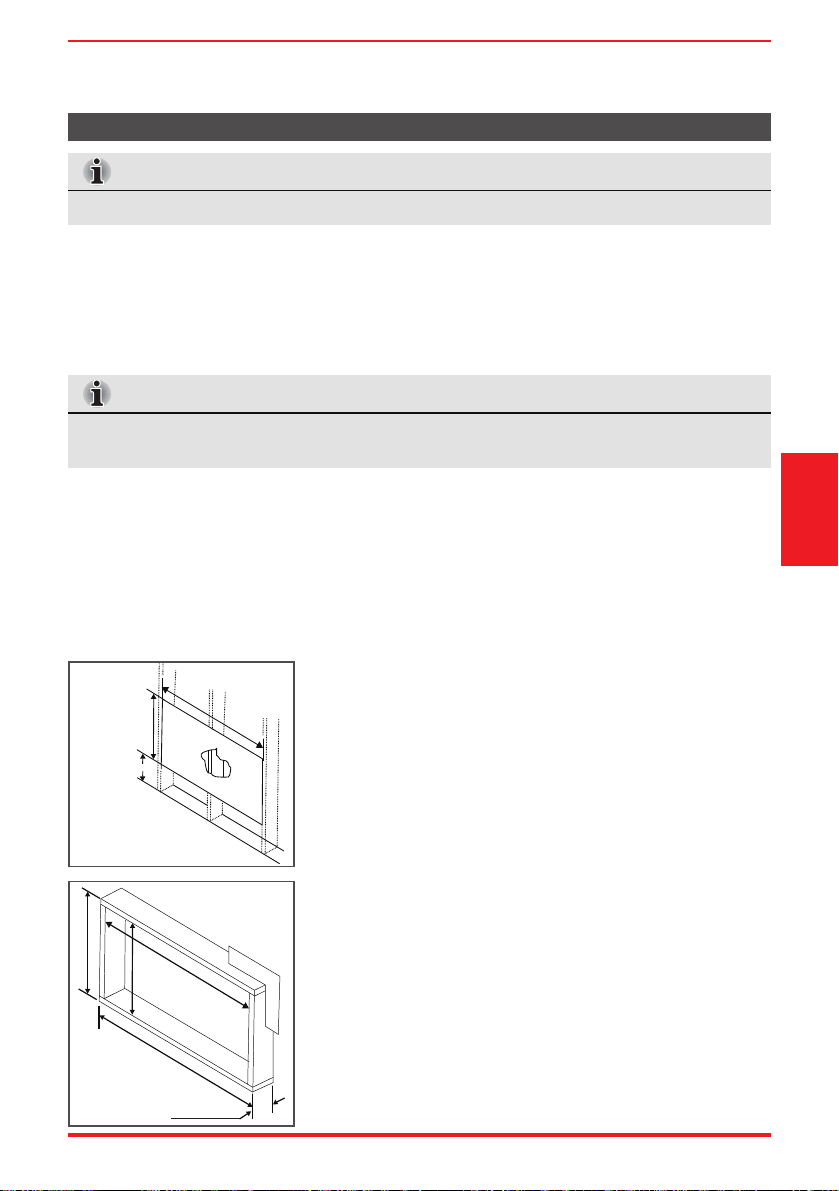
3/4” (or 1/2” )
long Hex-head
screw
Fig. 17A
D. Use a 3/32” drill bit to drill a starter hole
through the middle hole of the top rail into
the window sash frame. Drive one 3/4” (or
1/2”) HEX-HEAD locking screw through the
hole just drilled as shown (Fig. 17A).
Fig. 18
A. 3/4” (or 1/2”) Long Hex Head Screw
B. Left-Hand Accordion Panel Frame
C. Window Sash Frame
Window Sash Frame
A
B
C
E. Extend the accordion panels out against the
window frame.
F. Use a 1/8” drill bit to drill a starter hole
through the hole in the top leg of each
accordion panel frame into the window sash
(Fig. 18 and Fig. 18A). Connect with one 3/4”
(or 1/2”) long hex head screw.
G. Attach the Lock Frames to the window sill
using two 3/ 4 (19mm) screws (Fig.18B) (on
some models).
Window Sash
Seal
Fig. 19
Safety Lock
3/4” (or 1/2” )
Long
Hex-head
Screws
Fig. 19A
Weather seal
A
A. 3/4” (or 1/2”) long
hex head screw
Weather seals
Fig. 18A
A. Trim sash seal to fit window
width. Insert into space
between upper and lower
sashes (Fig. 19).
B. Attach right angle safety
lock (Fig. 19A).
6. Install Window Sash Seal and Safety Lock
Fig. 18B
Fig. 18B
Installation
Instructions
User Manual Page 19
A. Lift air conditioner and carefully slide into cabinet leaving 6” protruding.
B. DO NOT press or apply pressure to controls or nned coils.
C. Be sure chassis is rmly seated towards rear of cabinet.
D. Installation of front is the reverse of removal outlined in Section 1.
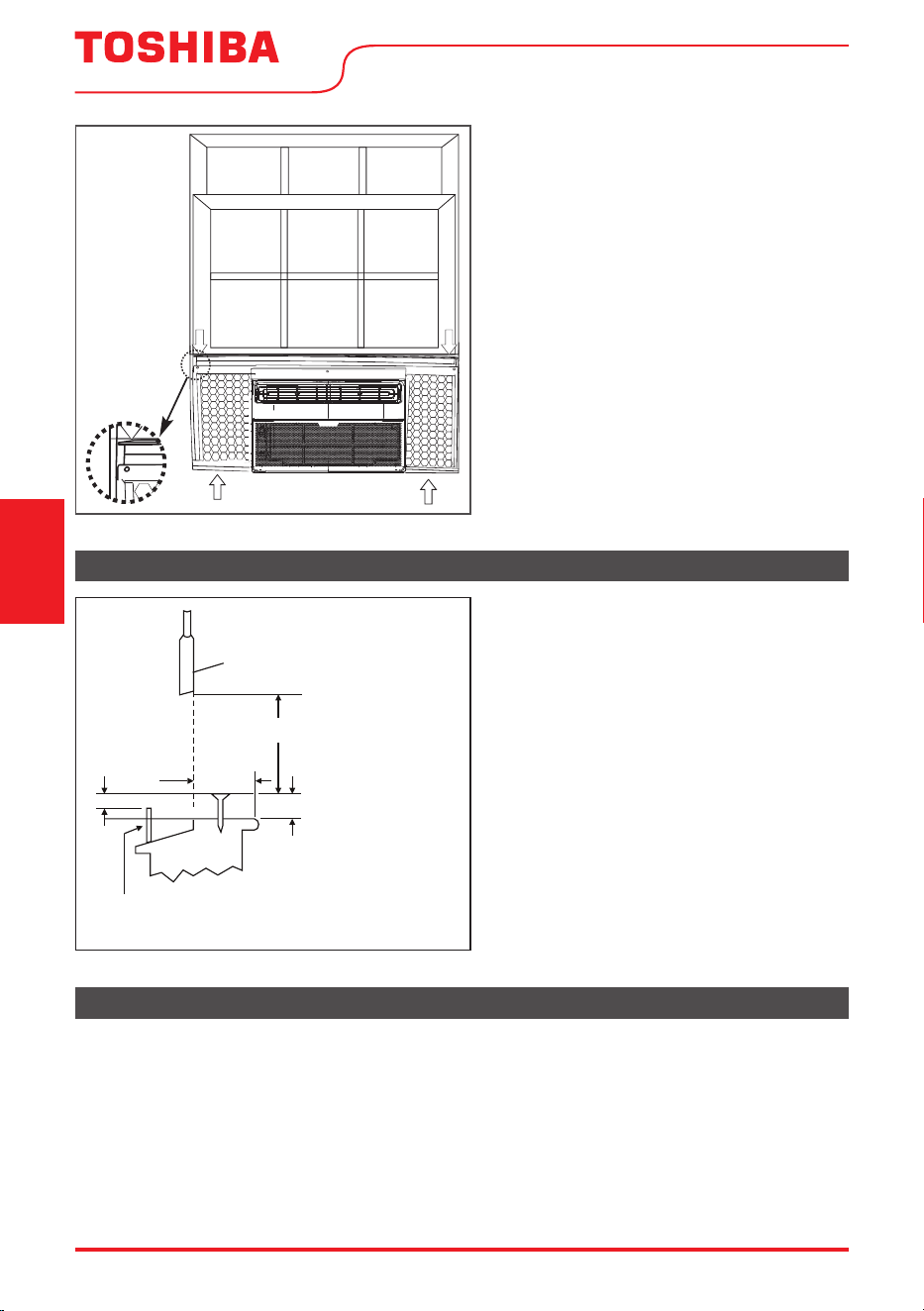
In order to minimize air leaks and ensure optimal insulation, it is
necessary to install the included accordion panel insulation to
the side curtain. Follow the instructions below.
A. After the unit is installed in the window, measure the inner
width of the side curtain as shown (Fig. 20).
Measure the inner width
of the side curtain
Fig. 20
Fig. 21
or
B. Mark a line on the provided accordion panel insulation that
is 1/8” (3 mm) less than the measured width in step 1, then
cut the Accordion Panel Insulation along the line (Fig. 21).
Fig. 22
C. Slide the accordion panel insulation into the side curtain.
The side with the pattern should facing indoors. (Fig. 22).
D. Repeat on the other side.
7. Install Air Conditioner into Cabinet
8. Install Insulation and Weather Stripping (ENERGY STAR models only)
Installation
Instructions
Page 20 User Manual
If AC is Blocked by Storm Window
Fig. 23
E. In order to minimize air leaks between
the room air conditioner and the window
opening, trim the weather stripping to the
proper length, peel o the protective backing
and plug any gaps if needed (Fig. 23).
Removing AC From Window
Installation
Instructions
Check your storm windows – if your storm
window frame does not allow for the
clearance required, correct it by either
removing the storm window - if able, or by
adding a piece of wood as shown in Fig. 24.
SASH
19” MIN.
Storm Window Frame
or Other Obstruction
Board thickness as
required. Mount along
entire sill by
adequately fastening
with nails or screws
1/2” MIN.
1/2” MIN.
Fig. 24
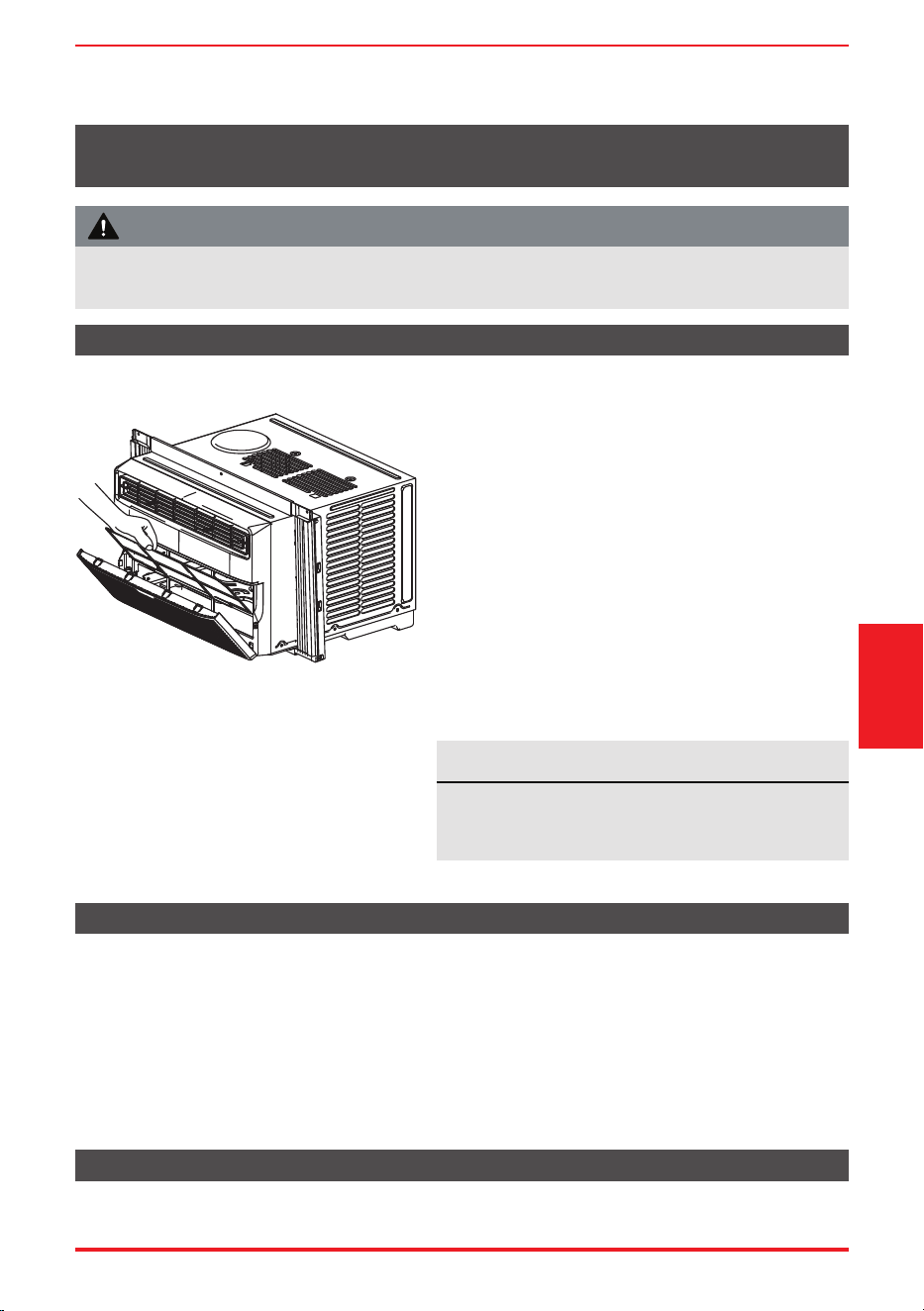
• Turn AC o , and disconnect power cord.
• Remove sash seal from between windows, and unscrew safety lock.
• Remove screws installed through frame and frame lock.
• Remove the accordion panel insulation (ENERGY STAR models only).
• Slide the accordion panels into the rails to close.
• Keeping a rm grip on air conditioner, raise the sash and carefully remove.
• Be careful not to spill any standing water while lifting unit from window. Store parts WITH air conditioner.
User Manual Page 21
Air Filter Cleaning
Cabinet Cleaning
Winter Storage
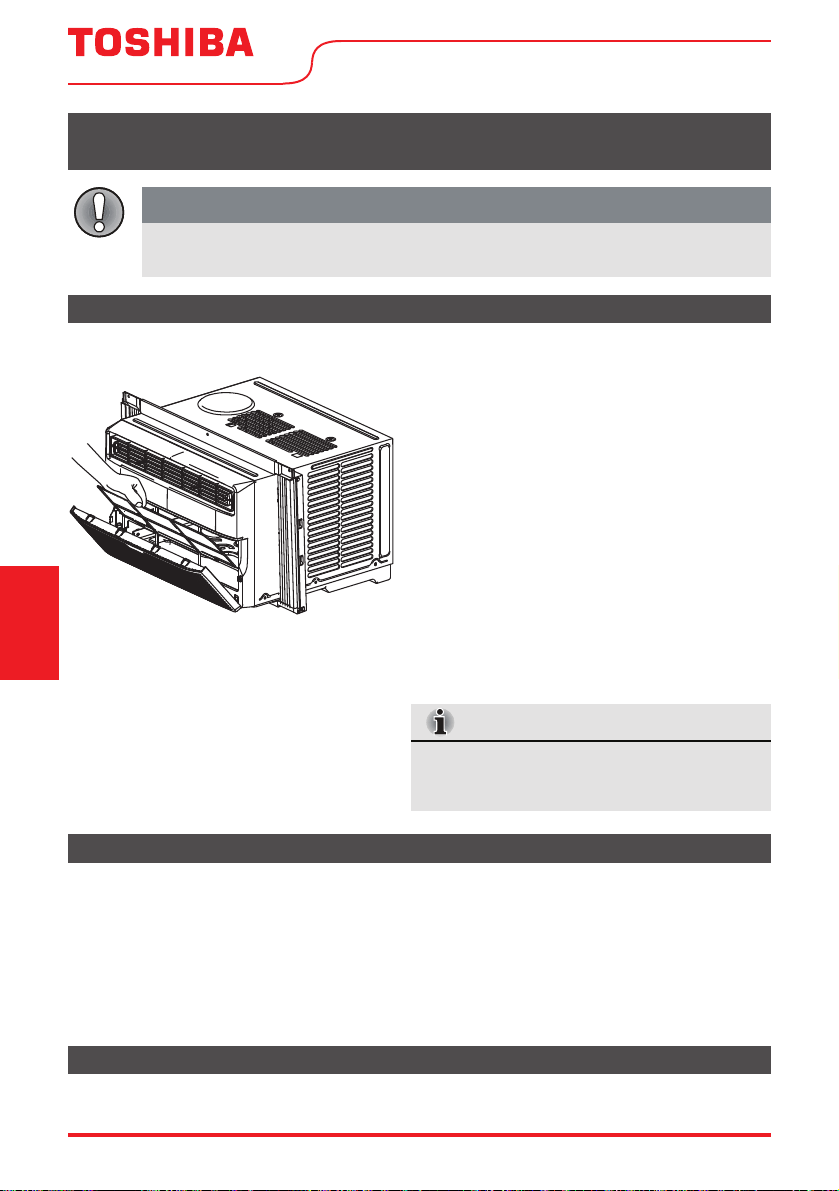
The air lter should be checked at least once a month to
see if cleaning is necessary. Trapped particles in the lter
can build up and cause an accumulation of frost on the
cooling coils.
• Push the vent handle to the Vent Closed position
(where applicable).
• Open the front panel.
• Grasp the lter by the center and pull up and out.
• Wash the lter using liquid dishwashing detergent
and warm water. Rinse lter thoroughly.
• Gently shake excess water from the lter. Be sure the
lter is thoroughly dry before replacing.
• You may also vacuum the lter clean rather than
washing.
• Be sure to unplug the air conditioner to prevent shock or re hazard. The cabinet and front may be
dusted with an oil-free cloth or washed with a cloth dampened in a solution of warm water and mild
liquid dishwashing detergent. Rinse thoroughly and wipe dry.
• Never use harsh cleansers, wax or polish on the cabinet front.
• Be sure to wring excess water from the cloth before wiping around the controls. Excess water in or
around the controls may cause damage to the air conditioner.
• Plug in air conditioner.
If you plan to store the air conditioner during the winter, remove it carefully from the window
according to the installation instructions. Cover it with plastic or return it to the original carton.
CARE AND CLEANING
Care and Cleaning
Models RAC-WK15
Clean your air conditioner occasionally to keep it looking new. Be sure to unplug the unit before
cleaning to prevent shock or fire hazards.
CAUTION
Never use hot water over 104°F (40°C) to clean the
air lter. Never attempt to operate the unit without
the air lter.
NOTICE
Page 22 User Manual
TROUBLESHOOTING TIPS
Troubleshooting
Tips
Before calling for service, review this list. It may save you time and expense. This list includes common
occurrences that are not the result of defective workmanship or materials in this appliance.
Problem Solution
Air conditioner
does not start.
Wall plug disconnected. Push plug rmly into wall outlet.
Circuit breaker tripped. Reset circuit breaker.
Check if the light on the plug is on. If it is o , press the RESET button.
Power is OFF. Turn power ON.
Unit turned o and then on quickly. Turn unit o and wait 3 minutes before
restarting.
Air from unit
does not feel cold
enough.
Room temperature below 62°F (17°C). Cooling may not occur until room
temperature rises above 62°F (17°C).
Temperature sensor behind the air lter is touching the cold coil. Try to move it
so it does not contact the cold coil.
Reset to a lower temperature.
Compressor shut-o by changing modes. Wait approximately 3 minutes and
listen for compressor to restart when set in the COOL mode.
Check for potential obstructions blocking the outdoor intake/exhaust. Clear any
obstructions.
Air conditioner
cooling, but
room is too
warm- ice forming
on cooling coil
behind air filter.
Outdoor temperature below 64°F (18°C). To defrost the coil, set to FAN ONLY
mode.
Air lter may be dirty. Clean lter. Refer to Care and Cleaning section. To defrost,
set to FAN ONLY mode.
Thermostat set too cold for night-time cooling. To defrost the coil, set to FAN
ONLY mode. Then, set temperature to a higher setting.
Air conditioner
cooling, but room
is too warm- NO
ice forming on
cooling coil
behind air filter.
Dirty or restricted air lter. Clean lter. Refer to Care and Cleaning section. To
defrost, set to FAN ONLY mode.
Temperature is set too high, set temperature to a lower setting.
Air directional louvers positioned improperly. Position louvers for better air
distribution.
Front of unit is blocked by drapes, blinds, furniture, etc. - restricts air distribution.
Clear obstruction in front of unit.
Any open doors, windows, or registers may allow cold air to escape. Close any
doors, windows, or registers.
The room may be too warm. Allow additional time to remove “stored heat” from
walls, ceiling, oor and furniture.
User Manual Page 23
Problem Solution
Air conditioner
turns on and o
rapidly.
Dirty air lter- air restricted. Clean air lter.
Outside temperature extremely hot. Set FAN speed to a higher setting to bring
air past cooling coils more frequently.
Check for potential obstructions blocking the outdoor intake/exhaust. Clear any
obstructions.
Noise when unit is
cooling.
Air movement sound. This is normal. If too loud, set to a slower FAN setting.
Window vibration - poor installation. Refer to installation instructions or check
with installer.
Water dripping
INSIDE when unit
is cooling.
Improper installation. Tilt air conditioner slightly to the outside to allow water
drainage.
Refer to installation instructions - check with installer.
Water dripping
OUTSIDE when
unit is cooling.
Unit removing large quantity of moisture from humid room. This is normal
during excessively humid days.
Remote sensing
deactivating
prematurely (some
models).
Remote control not located within range. Place remote control within 16,4 feet &
180°, radius of the front of the unit, and pointed
in the general direction of the air conditioner unit.
Remote control signal obstructed. Remove obstruction.
Room too cold. Temperature setting too low. Increase temperature setting.
Noise when unit
starts.
A “da-da” sound may occur for thirty seconds when the unit is turned on due to
the compressor starting. It is normal.
Unit will not
connect to WiFi
or App does not
work.
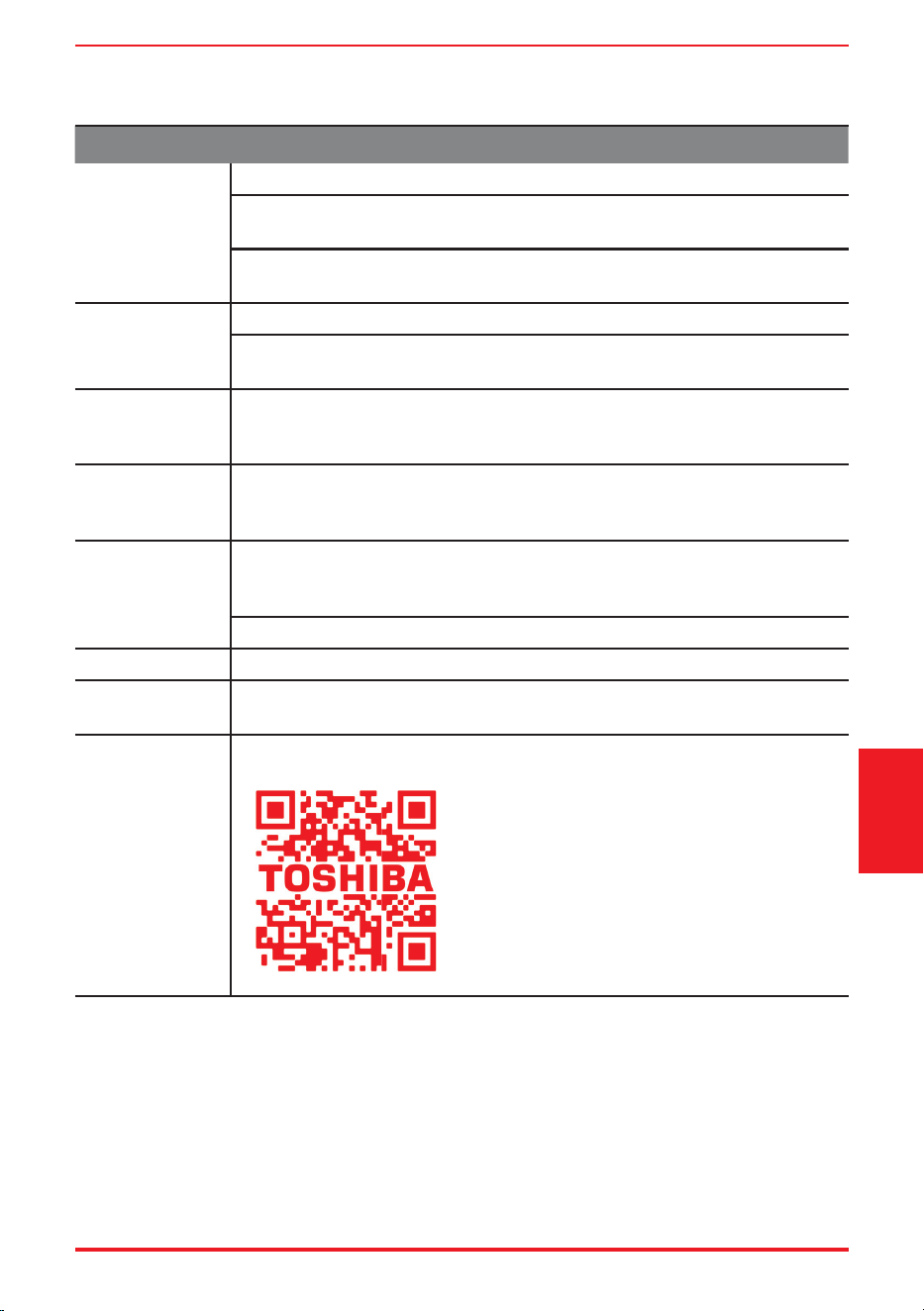
For additional support and troubleshooting tips, follow the link in this QR code:
Troubleshooting
Tips
Page 24 User Manual
Handling the Remote Control
REMOTE CONTROL AND APP INSTRUCTIONS
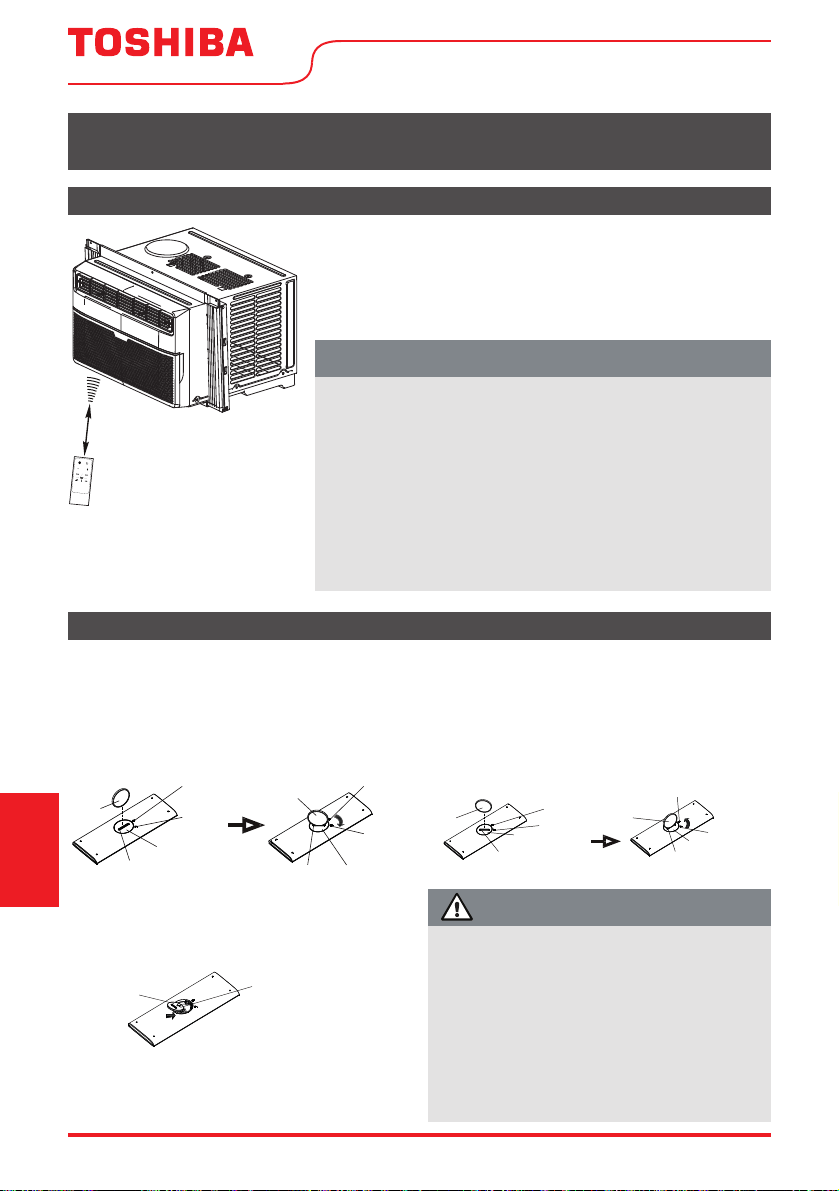
Location of the remote control
Use the remote control within a distance of 16.4 ft (5 meters)
from the air conditioner, pointing it towards the receiver.
Reception is confirmed by a beep.
Operating
Instructions
(With Remote)
16.4 ft (5 meters)
Replacing the Battery
• The air conditioner will not operate if curtains, doors or other
materials block the signals from the remote control to the unit.
• Prevent any liquid from spilling onto the remote control. Do
not expose the remote control to direct sunlight or heat.
• If the infrared signal receiver on the indoor unit is exposed to
direct sunlight, the air conditioner may not function properly.
Use curtains to prevent the sunlight from falling on the receiver.
• If other electrical appliances react to the remote control,
either move these appliances or consult your local dealer.
NOTICE
CR20
2
5
CR20
25
1
2
1
2
+
A
B
Insulation piece
Complete the following steps simultaneously:
1. Slightly press tab “A” in the direction of arrow 1.
2. Pull “B” in the direction of arrow 2.
1. Only use a CR2025 battery.
2. Do not leave the battery in the remote control if it is not
going to be used for 2 or 3 months.
3. Dispose of used batteries properly.
NOTICE
First remove the insulation piece (if available) and then install the
battery according to the following steps.
NOTICE

User Manual Page 25
Remote Control Specifi cations
Model RG15C/E
Rated Voltage 3.0V (Lithium battery CR2025)
Lowest Voltage of CPU Emitting Signal 2.4 V
Signal Receiving Range 16.4 ft (5 m)
Environment -5 °C ~ 60 °C (23°F ~ 140°F)
Operating
Instructions
(With Remote)
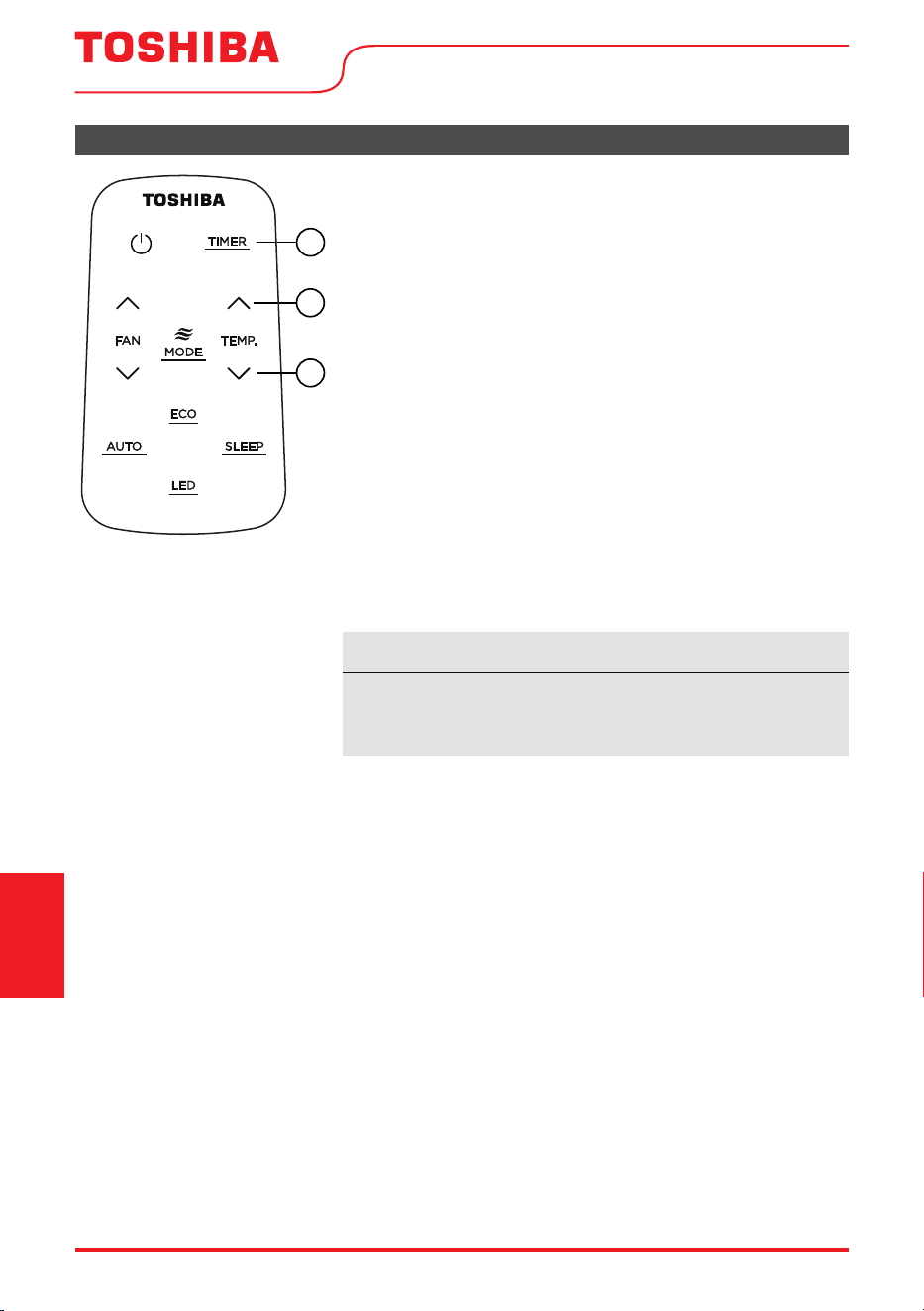
Function Buttons
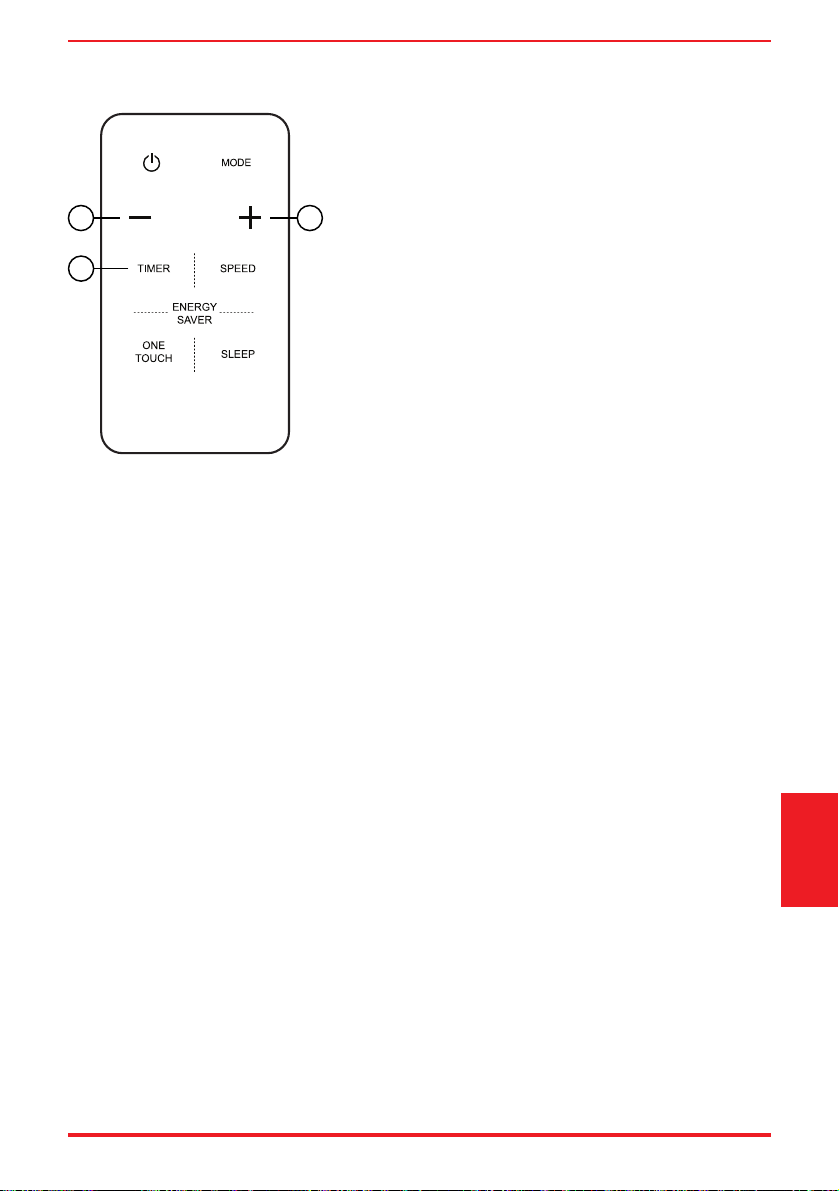
MODE button
Press this button to select the
desired operation mode.
TEMP UP button
Press this button to increase
the indoor temperature
setting.
FAN UP button
Press this button to increase
the desired fan speed.
SLEEP button
Press this button to activate
the Sleep mode. This function
is available on COOL or AUTO
mode only and will maintain
the most comfortable
temperature for you while
saving energy. For more
details, see “sleep operation”
in “USER’S MANUAL.”
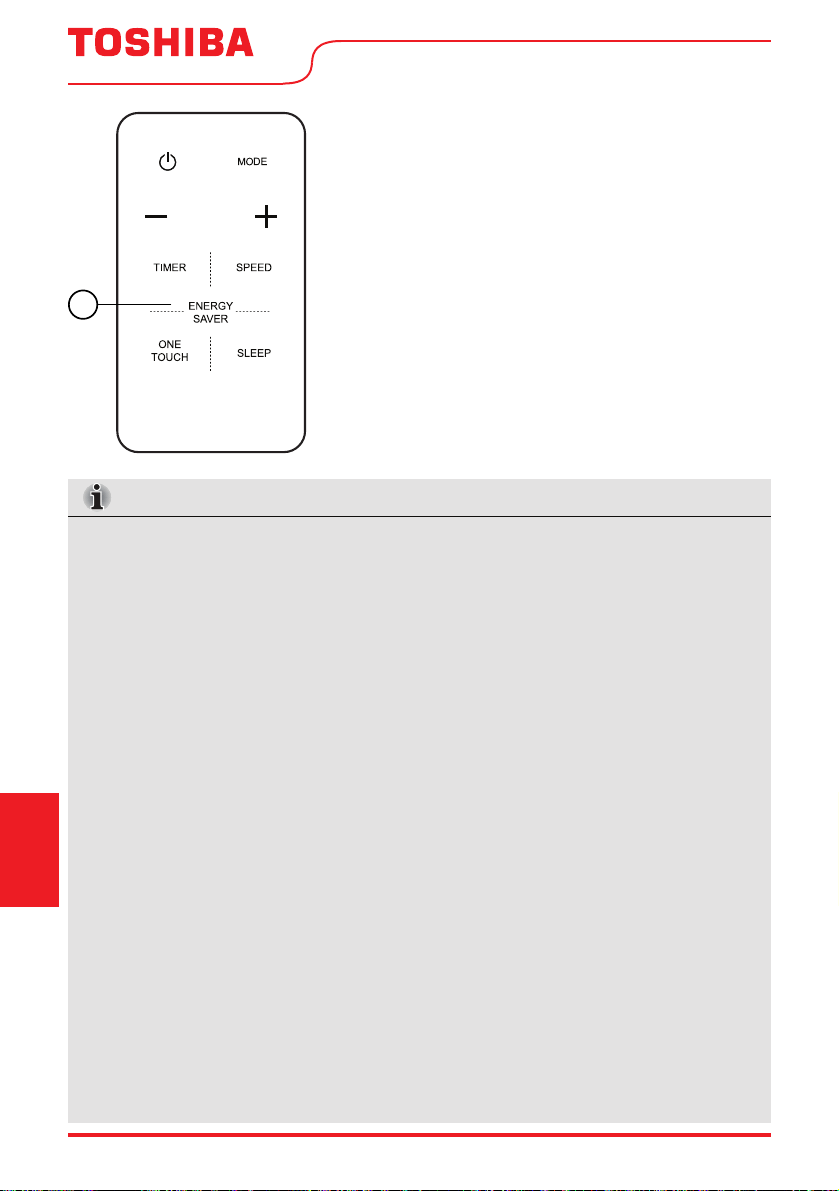
ECO button
Press this button to activate
the Energy saving mode.
Press it again to stop the
function (on some models).
TEMP DOWN button
Press this button to decrease
the indoor temperature
setting.
FAN DOWN button
Press this button to decrease
the desired fan speed.
TIMER button
Press this button to activate
the “Auto Start” or “Auto
Stop” program.
ON/OFF button
Operation starts when this
button is pressed and stops
when the button is pressed
again.
NOTE: If the unit has ENERGY
SAVER function, it will initiate
automatically the Energy
Saver function under Cool, Dry,
and Auto (only Auto-Cooling
and Auto-Fan) modes.
LED button
Press this button to turn
o the unit display lights.
Pressing this button again
will turn the display lights
back on. Pressing any button
on the unit or remote while
the display is o will activate
the lights for three seconds
and then turn back o .
AUTO button
Press this button to set fan
speed to auto.
Page 26 User Manual
How to Use the Buttons
Operating
Instructions
(With Remote)
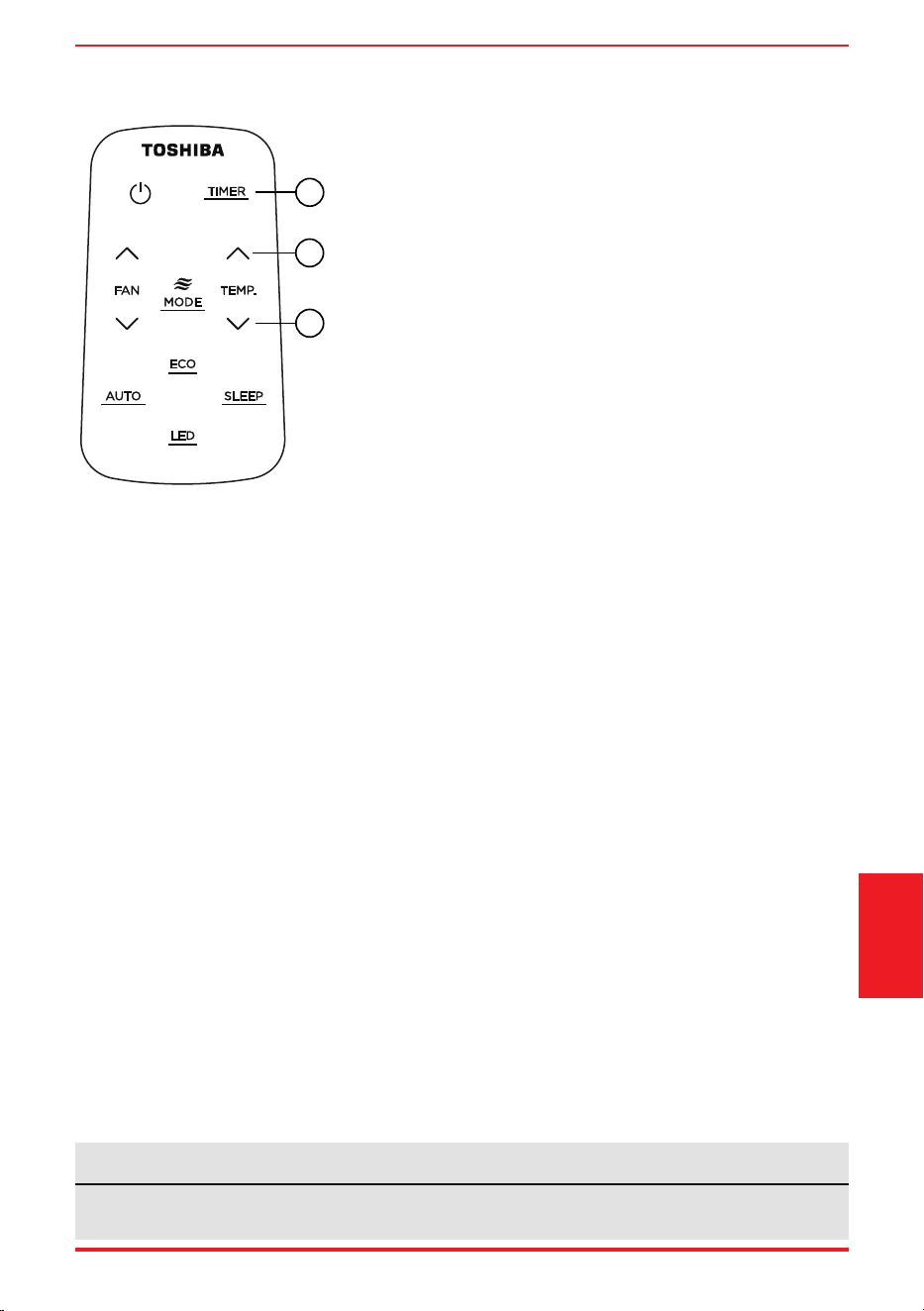
Timer operation
Press the TIMER button to initiate the Auto-start and Auto-stop
setting program of the unit.
To set the Auto-start/stop time.
1. Press the TIMER button. When the TIMER ON indicator is
displayed on the LED window of the air conditioner, it
indicates the Auto Start setting program is initiated. When
the TIMER OFF indicator is displayed on the LED window
of the air conditioner, it indicates the Auto Stop setting
program is initiated.
2. Press or hold the TEMP UP/DOWN to change the Auto time. The
control will count down the time remaining until start/stop.
3. The selected time will register in 5 seconds and the air
conditioner will automatically revert back to display the
previous temperature setting.
4. Turning the unit ON or OFF at any time will cancel the Auto
Start/stop function.
1
2
2
To cancel the TIMER setting, push the TIMER button and press
or hold the TEMP UP/DOWN until 0 hour is displayed on the LCD
window of the air conditioner.
NOTICE
User Manual Page 27
Operating
Instructions
(With Remote)
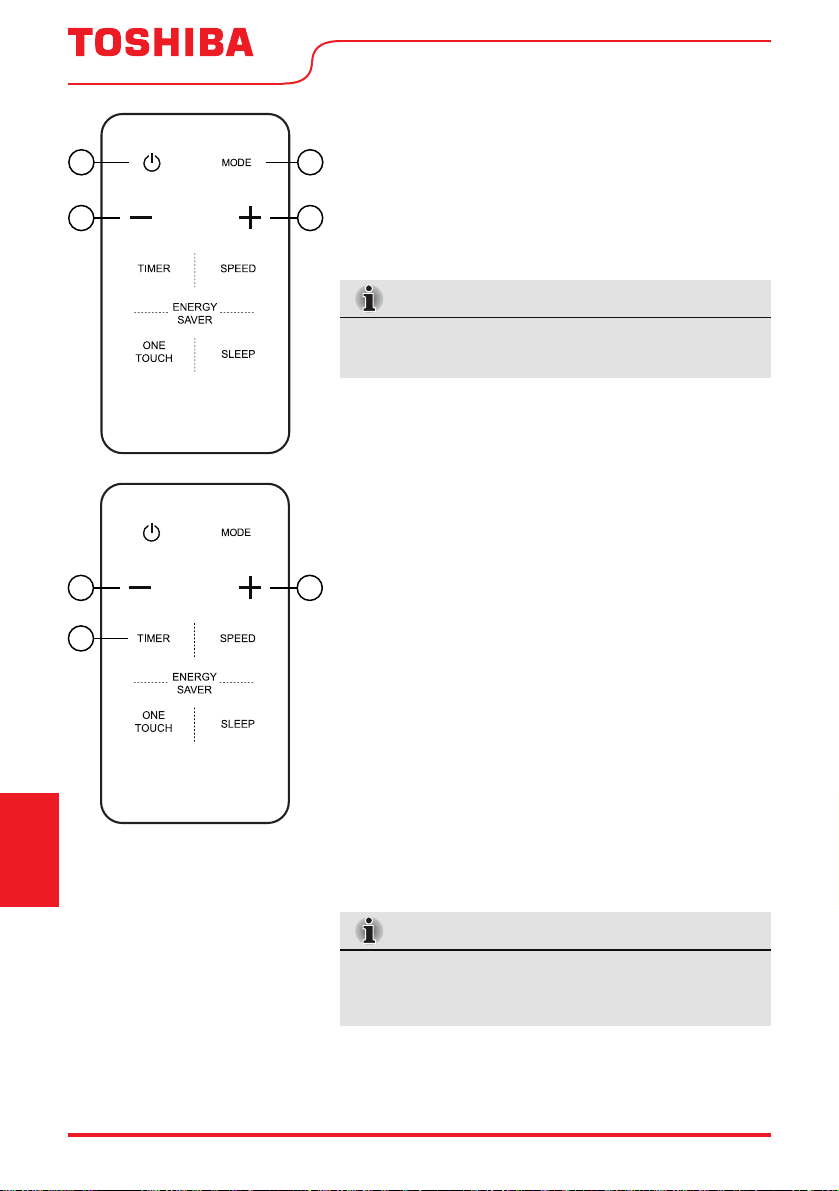
COMBINED TIMER
(Setting both ON and OFF timers simultaneously)
AUTO STOP >AUTO START
(On > Stop > Start operation)
This feature is useful when you want to stop the air conditioner after
you go to bed, and start it again in the morning when you wake up
or when you return home.
Example:
To stop the air conditioner 2 hours after setting and start it again
10 hours after setting.
1. Press the TIMER button until the TIMER OFF indicator is
displayed on the LED display of the air conditioner.
2. Use the TEMP UP/DOWN button to display “2.0” on the LED
display of the air conditioner.
3. Press the TIMER button again to display the TIMER OFF on the
LED display of the unit.
4. Use the TEMP UP/DOWN button to display “10” on the LED
display of the unit.
5. Wait for 5 seconds until the previous display appears in LED
window.
AUTO START > AUTO STOP
(O > Start > Stop operation)
This feature is useful when you want to start the air conditioner
before you wake up and stop it after you leave the house.
Example:
To start the air conditioner 5 hours after setting, and stop it 8 hours
after setting.
1. Press the TIMER button until the TIMER ON indicator is
displayed on the LED display of the air conditioner.
2. Use the TEMP UP/DOWN button to display “5.0” on the LED
display of the air conditioner.
3. Press the TIMER button again to display the TIMER OFF on the
LED display of the unit.
4. Use the TEMP UP/DOWN button to display “8.0” on the LED
display of the unit.
5. Wait for 5 seconds until the previous display appears in LED
window.
1
2
2
Changes or modifications not approved by the party responsible for compliance could void users
authority to operate the equipment.
NOTICE
Page 28 User Manual
We hereby declare that this AC is in compliance with the essential requirements and other relevant
provisions of Directive 1999/5/EC.
1. Supports operating systems: iOS 7+ or Android 4+.
2. In the event of a OS update, there may be a delay between the update of the OS and a related
software update during which your OS may or may not be supported until a new version is
released. Your speci c mobile phone or problems in your network may prevent the system
from working and Toshiba will not be responsible for any problems that could be caused by
incompatibility or network issues.
3. This Smart AC only supports WPA-PSK/WPA2-PSK (recommended) encryption.
Please check the Toshiba Lifestyle website, us.toshiba-lifestyle.com, for updated information.
4. To ensure proper scanning of the QR code, your smart phone must have at least a 5-megapixel
camera.
5. Due to unstable network connectivity, requests may time out. If this happens, re-run the network
con guration.
6. Due to unstable network connectivity, commands may time out. If this happens, the smartphone
app and the actual product may display con icting information. The information displayed on the
actual product is always the most accurate available. Refresh the app to re-sync.
DECLARATION OF CONFORMITY
SPECIFICATION OF WIRELESS MODULE
PRECAUTIONS
Operating
Instructions
(With Remote)
Toshiba will not be responsible for any problems that could be caused by incompatibility or network
issues, your wireless router and mobile phone.
NOTICE
Model: US-OSK103 Dimensions: 41 x 24 x 5 (mm)
Standard: IEEE 802.11 b/g/n Operation Temperature: 0°C ~ 45°C / 32°F ~ 113°F.
Antenna Type: External omnidirectional Antenna Operation Humidity: 10% ~ 85%
Frequency: 2.4 GHz (wireless) Power Input: DC 5V/300 mA
Maximum Transmitted Power: 15 dBm Max
User Manual Page 29
Devices required to use the Smart AC:
1. Smart Phone with compatible iOS or Android system.
2. Wireless Router
3. Smart Air Conditioner
SYSTEM OVERVIEW
Operating
Instructions
(With Remote)
DOWNLOAD AND INSTALL THE APP
Android QR code Apple QR code
Scan to download app.
• You can also go to Google Play or App Store and search for Toshiba NA AC. For more information,
please refer to Toshiba Lifestyle website: us.toshiba-lifestyle.com.
All the images in this manual are for reference only, your product and app may look slightly di erent.
The actual product and app instructions have to be considered.
NOTICE
Page 30 User Manual
CREATE YOUR ACCOUNT
• Make sure your smartphone is connected to your wireless router and your wireless router has a
working 2.4GHz internet connection.
• It is recommended to activate your account immediately to be able to recover your password by email.
Operating
Instructions
(With Remote)
6.1 Press “Sign Up”. 6.2 Enter your email address and password.
6.3 Press “Registration”. 6.4 If you forget your password, press
“Forgot password?” on the main
menu and enter your email address.
Then press “Reset Password”.
• Make sure your smartphone is able to connect to the wireless network which will be used.
• Make sure also that the device is not connecting to other networks in range.
NOTICE

User Manual Page 31
ADDITIONAL APP AND SMART HOME FUNCTIONS
Operating
Instructions
(With Remote)
For additional instructions regarding the features of the app and Smart Home skill capabilities, scan
the QR code below.

Page 32 User Manual
MANUAL DEL USUARIO
Precauciones de Seguridad
Instrucciones de Operación
Instrucciones de Instalación
Instrucciones del Control
Remoto y del App
Soluciones de Problemas
Mantenimento Y Limpieza
RAC-WK1513ESCWRU
Tipo de Ventana/Pared
Aire Acondicionado de Cuarto
Avisos de advertencia: antes de usar este
producto, lea atentamente este manual y
consérvelo para futuras referencias.
El diseño y las especicaciones están sujetos
a cambios sin previo aviso para la mejora
del producto. Consulte con su distribuidor o
fabricante para obtener más detalles.
versión A - 09 - 2020 us.toshiba-lifestyle.com
P
r
e
I
n
s
I
n
s
versión A - 09 - 2020 (PREVIEW05)
Page 34 User Manual
Lea este Manual
En su interior encontrará muchos consejos útiles sobre como usar y mantener su acondicionador
de aire correctamente. Unos pocos cuidados por su parte pueden ahorrar una gran cantidad de
tiempo y dinero, alargando la vida útil de su acondicionador de aire. Encontrará muchas respuestas
a los problemas más comunes en el cuadro de solución de problemas – Podrá resolver la mayoría de
ellos rápidamente antes de llamar al servicio técnico. Estas instrucciones pueden no cubrir todas las
condiciones posibles de uso, así que sentido común y atención a la seguridad é necesario al instalar,
operar y mantener este producto.
Manual del propietario
Precauciones de Seguridad ............................................................................................... 35
Instrucciones de Operación ............................................................................................... 40
Instrucciones de Instalación .............................................................................................. 47
Mantenimiento y Limpieza ................................................................................................ 53
Soluciones de Problemas ................................................................................................... 54
Instrucciones del Control Remoto y del App .............................................................. 56
• Para obtener asistencia, llame el Central de Servicio Técnico al 1-855-204-5313.
• Este aparato no está diseñado a ser utilizado por personas (incluidos niños) con capacidades
físicas, sensoriales o mentales reducidas o falta de experiencia y conocimientos, a menos que
hayan recibido supervisión o instrucción sobre el uso del aparato por parte de una persona
responsable de su seguridad.
• Los niños deben supervisarse para asegurar que ellos no jueguen con el acondicionador de aire.
• El aparato deberá ser instalado de acuerdo con la norma nacional de instalación eléctrica.
• No utilizar su acondicionador de aire en una habitación húmeda, como un baño o una
lavandería.
PRECAUCIÓN
User Manual Page 35
PRECAUCIONES DE SEGURIDAD
Para evitar daños al usuario u otras personas y a la propiedad, las instrucciones que se muestran aquí
deben ser seguidas. Las operaciones incorrectas por la ignora de las instrucciones podría causar perjuicios
o lesiones. El nivel de riesgo está clasi cado por las siguientes indicaciones.
Precauciones
de Seguridad
ADVERTENCIA
Este símbolo indica una situación peligrosa que, si no evitada, podría
causar la muerte o lesiones graves.
PRECAUCIÓN
Este símbolo indica una situación peligrosa que, si no evitada, podría
resultar en lesiones leves o moderadas.
AVISO
Este símbolo aborda las prácticas no relacionadas con lesiones
físicas.
• Asegúrese de que el acondicionador de aire se ha instalado de forma segura y correcta de
acuerdo con las instrucciones de instalación de este manual. Guarde este manual para un posible
uso futuro en la extracción o instalación de esta unidad.
• Enchúfalo en el enchufe de alimentación eléctrica correctamente.
• De lo contrario, puede causar una descarga eléctrica o un incendio debido a la excesiva
generación de calor.
• No modi car la longitud del cable de alimentación ni comparta la tomacorriente con
otros aparatos, ya que puede provocar una descarga eléctrica o un incendio debido al
sobrecalentamiento.
• Asegúrese siempre de una conexión a tierra e caz.
Una conexión a tierra incorrecta puede provocar una descarga eléctrica.
• Desenchufar la unidad si nota sonidos extraños o olores o humo proveniente de ella.
Un producto dañado puede causar incendio y descarga eléctrica.
• Ventile la habitación antes de utilizar el acondicionador de aire si hay una fuga de gas desde
otros aparatos.
• No accione ni detenga la unidad insertando o extrayendo el enchufe de la tomacorriente.
• No lo maneje con las manos mojadas o en ambientes muy húmedos.
Puede causar una descarga eléctrica.
• No permita que el agua entre en contacto con ninguna pieza eléctrica.
Puede causar fallas o descarga eléctrica.
• No lo use el enchufe si está suelto o dañado.
Puede causar incendio y descarga eléctrica.
• No lo use ni mantenga el cable de alimentación cerca de los aparatos de calefacción.
Puede causar incendio y descarga eléctrica.
• No lo use ningún dispositivo o material para la instalación que no se recomiende en este manual.
ADVERTENCIA
Page 36 User Manual
Precauciones
de Seguridad
• No desmonte ni modi que la unidad.
Puede causar fallas y descarga eléctrica.
• No dañe ni utilice un cable de alimentación alternativo.
Puede causar incendio y descarga eléctrica.
Si el cable de alimentación está dañado, debe ser reemplazado por el fabricante o un centro de
servicio técnico autorizado o una persona igualmente cali cada para evitar un peligro.
• No dirija el ujo de aire directamente a las personas para evitar posibles riesgos para la salud.
• No abra la unidad durante el funcionamiento.
Puede causar descarga eléctrica.
• No utilice el cable de alimentación cerca de gases in amables o combustibles, como gasolina,
benceno, diluyente, etc.
Puede causar una explosión o un incendio.
• No deje que los niños cuelguen el acondicionador de aire o el soporte.
Puede ocurrir una lesión grave.
• Evite el peligro de incendio o la descarga eléctrica. No utilice un cable de extensión ni un
enchufe adaptador. No extraiga ninguna clavija del cable de alimentación.
• Asegúrese de que el acondicionador de aire esté correctamente conectado a tierra. Para
minimizar descargas eléctricas y riesgos de incendio, es importante realizar una conexión a
tierra adecuada. El cable de alimentación está equipado con un enchufe de conexión a tierra
de tres clavijas para la protección contra los riesgos de choque.
• Su acondicionador de aire debe utilizarse en una tomacorriente de pared correctamente
conectado a tierra. Si la tomacorriente de pared que tiene intención de utilizar no está
adecuadamente conectada a tierra o protegida por un fusible de retardo de tiempo o un
disyuntor, pida a un electricista cuali cado que instale una tomacorriente adecuada. Asegúrese
de que la tomacorriente sea accesible después de la instalación de la unidad.
• Asegúrese de que el servicio eléctrico es adecuado para el modelo que ha elegido. Esta
información se puede encontrar en la placa de serie, que se encuentra en el lado del gabinete y
detrás de la rejilla.
• No beba el agua de drenaje. Puede contener moho y bacterias que pueden conducir a la muerte.
• Cuando se va a quitar el ltro de aire, no toque las partes metálicas de la unidad.
Puede causar lesiones.
• Cuando la unidad necesite limpieza, apague la unidad y apague el disyuntor.
No limpie la unidad cuando la alimentación esté encendida, eso puede provocar un incendio,
una descarga eléctrica o lesiones.
• No coloque obstáculos alrededor de las entradas de aire o dentro de la salida de aire.
Puede causar fallas o un accidente.
ADVERTENCIA
PRECAUCIÓN
User Manual Page 37
Precauciones
de Seguridad
PRECAUCIÓN
• Limpie solo con un paño suave. No utilice detergentes fuertes que contengan cera o diluyentes,
ya que puede dañar el producto.
• Tenga cuidado al desempacar e instalar. Los bordes a lados podrían causar lesiones.
• No limpie el acondicionador de aire con agua.
• El agua puede entrar en la unidad y degradar el aislamiento que podría conducir a una descarga
eléctrica.
• No lo guarda una mascot o plantas donde sera expuesto al ujo del aire directo.
Podría hacer daño a su mascot o planta.
• Sujete el enchufe junto a la cabeza cuando sacarlo.
De lo contrario, puede causar descarga eléctrica y daños.
• Asegúrese de que la instalación esté correctamente segura para prevenir el producto de posibles
quedas.
• No conecte objetos pesados en el cable de alimentación y asegúrese de que el cable no esté
comprimido.
De lo contrario, hay peligro de incendio o descarga eléctrica.
• Si hay agua derramada en la unidad, apague la unidad y apague el disyuntor. Aísle el suministro
tomando el enchufe y contacte un personal de servicio técnico cuali cado.
• No lo use cerca de estufas de gas o otros aparatos de combustión de gas, ya que el ujo de aire
puede afectar a la combustión de gas.
• No usar para ningún otro propósito que no sea la comodidad de la habitación.
No utilice este acondicionador de aire para conservar instrumentos de precisión, alimentos,
animales, plantas y objetos de arte. Puede causar deterioro.
• Apague el disyuntor si la unidad no se va a ser utilizada por un tiempo prolongado.
• Siempre inserte los ltros de forma segura. Limpie el ltro una vez cada dos semanas.
El funcionamiento sin ltros puede causar un error.
Page 38 User Manual
Precauciones
de Seguridad
ADVERTENCIA
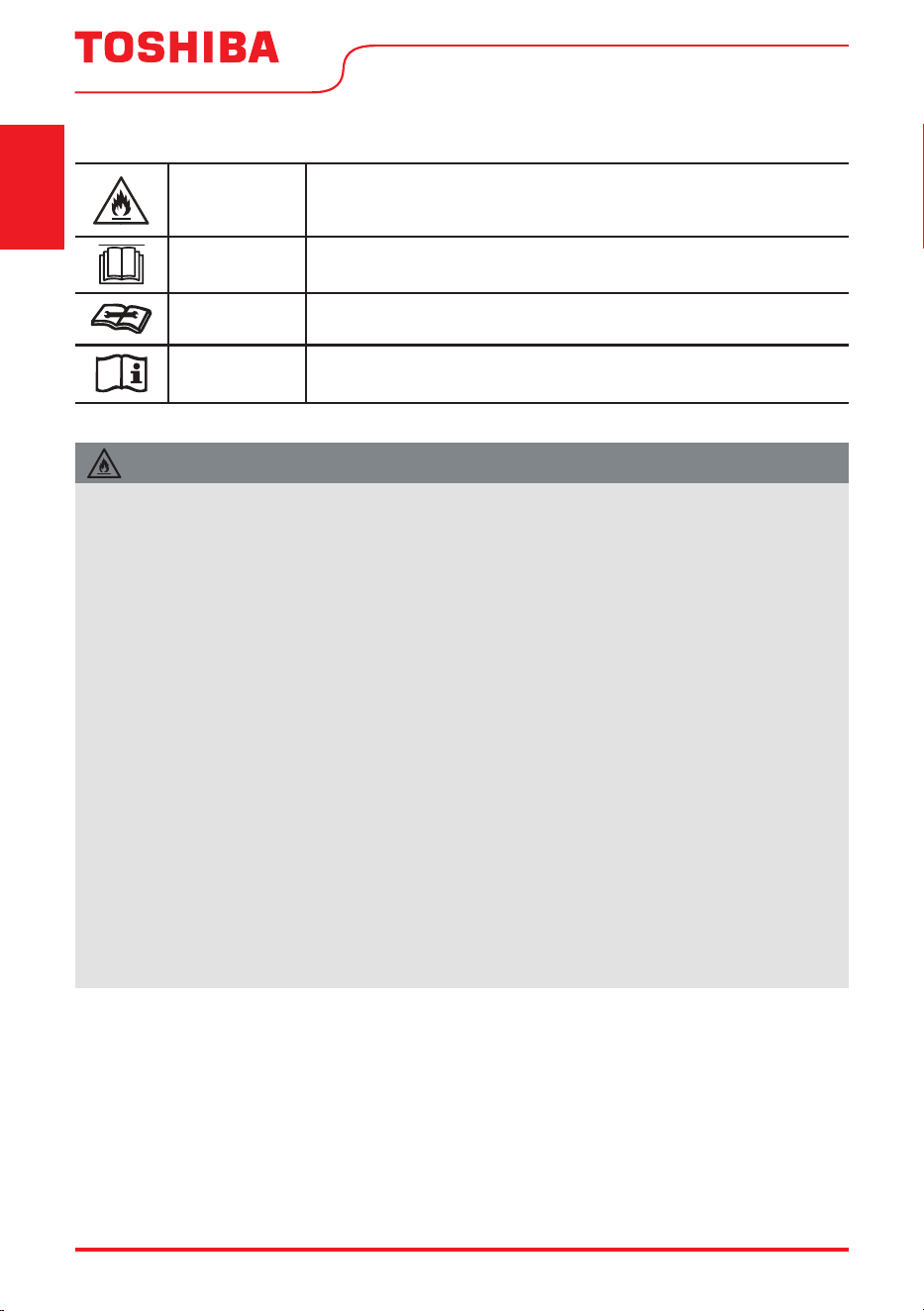
Este símbolo muestra que este aparato ha utilizado un refrigerante
in amable. Si el refrigerante está ltrado y exposto a una fuente de
ignición externa, hay riesgo de incendio.
PRECAUCIÓN
Este símbolo muestra que el manual de instrucciones debe leerse
cuidadosamente.
PRECAUCIÓN
Este símbolo muestra que un personal de servicio técnico debe
manipular este equipo con referencia al manual de instalación.
PRECAUCIÓN
Este símbolo muestra que la información está disponible, tanto al
manual de instrucciones o al manual de instalación.
EXPLICACIÓN DE LOS SÍMBOLOS MOSTRADOS EN LA UNIDAD
• No intente acelerar el proceso de descongelación o los métodos de limpieza que no son
recomendados por el fabricante.
• El aparato debe ser ubicado en una habitación sin fuentes de ignición en funcionamiento
continuo (por ejemplo, llamas abiertas o un aparato de gas en funcionamiento) o fuentes de
ignición comunes (por ejemplo, un calentador eléctrico en funcionamiento) cerca del aparato.
El aparato también debe ser ubicado en una habitación sin cualquer otra fuente de ignición.
• No perforar ni quemar.
• Tenga en cuenta que los refrigerantes pueden no contener olor.
• Mantenga las aberturas de ventilación libres de obstrucciones.
• La unidad solo debe ser atendida por un centro de asistencia autorizada Toshiba, llame al
Servicio al Cliente al 1-855-204-5313 para obtener asistencia técnica.
• El refrigerante in amable R32 se usa dentro del acondicionador de aire. Siga las instrucciones
cuidadosamente para manejar, instalar, limpiar y reparar el acondicionador de aire para evitar
daños o peligros. No deseche el acondicionador de aire en la basura común. Contacte la agencia
cuali cada para la eliminación adecuada.
• No maneje fuego ni dispositivos que generen chispas alrededor del acondicionador de aire
para evitar causar la ignición del refrigerante in amable utilizado. Siga cuidadosamente las
instrucciones para ubicar o arreglar el acondicionador de aire para evitar que se produzcan
daños mecánicos.
ADVERTENCIA
User Manual Page 39
El cable de energía que acompaña este
acondicionador de aire contiene un dispositivo
de detección de corriente diseñado para
reducir el riesgo de incendio.
En el caso del cable de energía esté dañado, no
se puede reparar. Debe sustituirlo por un cable
del fabricante.
Precauciones
de Seguridad
• No utilice este dispositivo para encender o apagar la unidad.
• Asegúrese siempre de que el botón RESET esté pulsado para una operación correcta .
• El cable de energía debe ser reemplazado si lo falla al reiniciar mismo cuando el botón TEST esté
pulsado o no se puede reiniciarse. Póngase en contacto con el servicio de atención al cliente.
Toma de Tierra Tipo Pared Receptáculo
Do not, under any
circumstances, cut,
remove or bypass
the grounding prong.
Power supply cord with 3-prong grounding
plug and current detection device.
El cable de energía contiene un dispositivo de
medición que detecta daños en el proprio cable.
Pruebelo de la siguiente manera:
1. Enchufe el acondicionador de aire.
2. El cable de energía tendrá DOS botones en
el cabezal del enchufe. Pulse el botón TEST.
Notará un clic a medida que aparezca el
botón RESET.
3. Pulse el botón RESET. Notará un clic a medida
que el botón se activa.
4. El cable de energía ahora está energizando la
unidad. (En algunos productos esto también
se indica mediante una luz en el cabezal del
enchufe.)
RESET
TEST
Enchufe y pulse
el botón RESET
Operación del dispositivo de corriente
AVISO
AVISO
Nunca, en ningún
caso, corte, remueve
ni pasar por la
conexión a la tierra.
Cable de energía con enchufe de conexión a tierra de
3 clavijas y dispositivo de detección de corriente.
Page 40 User Manual
Sonidos normales
INSTRUCCIONES DE OPERACIÓN
RAC-WK15 Models
Sonido Agudo
Compresores de alto rendimiento
pueden presentar un sonido agudo
durante el ciclo de enfriamiento.
Vibración
La unidad puede vibrar y
hacer ruido debido a una
estructura débil de la
ventana, o a una
instalación incorrecta.
Sonido de Goteo
Las gotas de agua que
caen sobre el
condensador durante
la normal operación
pueden producir
sonidos de goteo.
Sonido de Corriente
del Aire
Delante de la unidad, es
posible que escuche el
sonido de corriente de aire
debido al movimiento del
ventilador.
Gorgoteo/Silbido
Un sonido parecido a un
"gorgoteo o silbido" puede
escucharse debido al
refrigerante pasando a través
del evaporador durante una
normal operación.
Todas las ilustraciones de este manual son para explicar sólo. La apariencia real del acondicionador
de aire que compró puede variar ligeramente, pero su operación y funciones serán similares.
AVISO
Instrucciones
de Operación
Características del condicionador de aire (general)
Este acondicionador de aire está diseñado para funcionar en las siguientes condiciones:
Operación de
enfriamiento
Temperatura exterior: 64 ~ 109°F / 18 ~ 43°C
Temperatura interior: 62 ~ 90°F / 17 ~ 32°C
Para reducir el riesgo de incendio, descargas eléctricas o lesiones a personas o propiedades, lea las
PRECAUCIONES DE SEGURIDAD antes de utilizar este aparato.
ADVERTENCIA
• La humedad relativa de la habitación debe ser inferior al 80%. Si la unidad esté utilizada en una condición
con una humedad relativa superior al 80%, habrá agua condensada en la super cie de la unidad.
• El rendimiento puede reducirse fuera de estas temperaturas de operación.
AVISO
User Manual Page 41
Instrucciones
de Operación
Para comenzar a operar el acondicionador de aire, siga estos pasos:
1. Ajuste la temperatura a la con guración más fría.
2. Ajuste el control a HIGH COOL.
3. Ajuste la rejilla para un ujo de aire cómodo (consulte Rejillas Direccionales del Aire).
4. Una vez que la habitación se encuentra fresca, ajuste a la temperatura que siente más confortable.
5. Asegúrese de que el ujo del aire dentro y fuera no esté obstruido.
Rejillas direccionales del aire
Las rejillas le permitirán dirigir el aire a la Izquierda
o a la Derecha, o Arriba y Abajo (opcional en
algunos modelos) por toda la habitación según sea
necesario.
Mueva las palancas de lado a lado hasta que
la dirección deseada IZQUIERDA/DERECHA sea
obtenida.
También puede mover la palanca IZQUIERDA para
ajustar el ujo de aire hacia ARRIBA/ABAJO según
sea necesario.
Por favor, espere siempre por 3 minutos entre apagado y encendido de la unidad, y cuando cambie
de modo frío a ventilador y de vuelta. Esto evitará que el compresor se sobrecaliente.
AVISO
Levers
Air Direction
Dirección del Aire
Palancas
La ventilación de aire fresco permite al acondicionador de aire:
1. Recircular el aire interior – Ventilación Cerrada (Ver Fig. A)
2. Sacar aire fresco a la habitación – Ventilación Abierta (Ver Fig. B)
3. Cambiar el aire de la habitación y exprimir el aire fresco en la habitación - Ventilación y Salida
Abiertas (ver Fig. C).
CONTROL DE VENTILACIÓN DE AIRE FRESCO
Fig. A (VENTILACIÓN CERRADA) Fig. B (VENTILACIÓN ABIERTA) Fig. C (VENT Y SALIDA ABIERTAS)
Page 42 User Manual
Antes de comenzar, familiarícese completamente con el panel de control como se muestra a continuación y
todas sus funciones, luego siga el símbolo de las funciones que desee. La unidad se puede controlar solo con el
control de la unidad, con el control remoto o con la aplicación (algunos modelos).
Instrucciones de operación del control electrónico
Características del acondicionador de aire
Instrucciones
de Operación
PARA ENCENDER O APAGAR LA UNIDAD:
Pulse el botón de encendido para encender o apagar la
unidad.
NOTA: La unidad iniciará automáticamente la función de
Ahorro de Energía en los modos Frío, Seco y Automático.
PARA CAMBIAR EL AJUSTE DE TEMPERATURA:
Pulse el botón UP/DOWN para cambiar el ajuste de
temperatura.
NOTA: Pulse o mantenga pulsado el botón UP (
) o
DOWN (
) hasta que se vea la temperatura deseada
en el visor.
Esta temperatura se mantendrá automáticamente en
cualquier lugar entre 62 °F (17 °C) y 86 °F (30 °C). Si desea
visualizar la temperatura ambiente actual, consulte la
sección Cuando se opera en modo Solo Ventilador.
PARA AJUSTAR LAS VELOCIDADES DEL VENTILADOR:
Pulse el botón Ventilador para cambiar la velocidad
del ventilador entre cuatro ajustes: Automático, Bajo,
Medio o Alto. El ventilador funcionará a baja velocidad
automáticamente cuando se establece en modo Seco.
En el modo Automático, el ventilador funciona
automáticamente a velocidad del ventilador automático
así que no se puede cambiar.
FUNCIÓN SUEÑO:
Pulse el botón SLEEP para iniciar el modo de sueño. En
este modo, la temperatura seleccionada aumentará en
2 °F (1 °C) 30 minutos después de seleccionar el modo.
La temperatura aumentará en otros 2°F (1°C) después
de 30 minutos adicionales. Esta nueva temperatura se
mantendrá durante 7 horas antes de que vuelva a la
temperatura seleccionada originalmente.
El programa de modo de suspensión se puede cancelar
en cualquier momento durante el funcionamiento
pulsando de nuevo el botón SLEEP.
FUNCIÓN DE REVISIÓN DEL FILTRO:
La función Revisión del Filtro es un recordatorio
para limpiar el ltro de aire para una operación más
e ciente. La luz se iluminará después de 250 horas de
funcionamiento. Después de limpiar el ltro, pulse el
botón FILTRO para restablecer la función Revisión del
Filtro apagando la luz.
FUNCIÓN DE AHORRO DE ENERGIA (ECO):
Pulse el botón ENERGY SAVER para iniciar esta función.
Esta función está disponible en los modos COOL, DRY,
AUTO (solo AUTO-COOLING y AUTOFAN). El ventilador
seguirá funcionando durante 3 minutos después de que
el compresor se apague. A continuación, el ventilador se
enciende durante 2 minutos a intervalos de 10 minutos
hasta que la temperatura ambiente quede por encima de la
temperatura establecida, momento en el que el compresor
vuelve a encenderse y se reanuda el enfriamiento.
PARA SELECCIONAR EL MODO DE FUNCIONAMIENTO:
Para seleccionar el modo de funcionamiento, pulse
el botón MODO. Cada vez que pulsar el botón, se
selecciona un modo en una secuencia que va desde
Automático, Frío, Seco y Ventilador. La luz indicadora
adyacente se iluminará y permanecerá encendida una
vez seleccionado el modo.
Cuando la unidad se apaga y vuelve a encenderse
a través del botón POWER, la unidad encenderá
automáticamente la función de Ahorro de Energía para
los siguientes modos: Frío, Seco, Automático.
Características del teclado
Ahorro de
Energía
Visor
LED
Filtro de
Limpieza
Botón
Temporizador
Botón Power
Encender/Apagar
Botón
Sueño
Botón
Ventilador
Botones
Arriba (
) y Abajo ( )
Botón
Modo
Luz Indicadora de conexión
(Solo modelos Smart)
User Manual Page 43
Instrucciones
de Operación
Cuando se opera en modo Automático:
- Al ajustar el acondicionador de aire al modo AUTO,
seleccionará automáticamente el enfriamiento o el
funcionamiento solo del ventilador dependiendo
de la temperatura que haya seleccionado y de la
temperatura ambiente actual.
- El acondicionador de aire controlará la temperatura
ambiente automáticamente de acuerdo con la
temperatura que haya establecido.
- La velocidad del ventilador se controla
automáticamente en función del ajuste de
temperatura y la temperatura ambiente así que no
se puede ajustar.
Cuando se opera en modo Solo Ventilador:
- Utilice esta función cuando no se desee enfriamiento,
como para la circulación de aire del ambiente o para
expulsar el aire viejo (en algunos modelos, recuerde
abrir la ventilación durante esta función, pero
manténgala cerrada durante el enfriamiento para una
máxima e ciencia.) Puede elegir cualquier velocidad
del ventilador que pre era.
- Durante esta función, el visor mostrará la
temperatura ambiente real, no la temperatura
establecida como en el modo de enfriamiento.
- En el modo Solo Ventilador, la temperatura no es
ajustada.
Cuando se opera en modo Seco:
- En este modo, el acondicionador de aire
generalmente funcionará como un deshumidi cador.
Dado que el espacio acondicionado es un área
cerrada o sellada, se producirá algún grado de
enfriamiento.
FUNCIÓN TEMPORIZADOR: Función Início Automático /
Parada Automática:
- Cuando la unidad esté encendida, pulse el botón
TIMER. La luz LED indicadora “Timer o ” se iluminará
indicando que se ha activado la función de parada
automática.
- Cuando la unidad esté apagada, pulse el botón
TIMER. La luz LED indicadora “Timer on” se iluminará
indicando que se ha activado la función de inicio
automático.
- Cuando aparecer la hora en el TIMER ON, pulse de
nuevo el botón TIMER. La luz indicadora TIMER OFF
va a iluminarse. Esto indica que se ha iniciado el
programa Parada Automática.
- Mantenga pulsado el botón UP (
) o DOWN ( )
para cambiar la hora automática en incrementos de
0,5 horas, hasta 10 horas, y luego en incrementos de
1 hora, hasta 24 horas. El control contará el tiempo
restante hasta el inicio.
Visualizaciones en la Pantalla
Muestra la temperatura ajustada en “C” o “F” y los
ajustes del temporizador automático. Mientras
está en el modo Solo Ventilador, muestrará la
temperatura ambiente. Si la temperatura ambiente
es demasiado alta o baja, mostrará “HI” (high) o
“LO” (low).
Códigos de error:
AS - Error del sensor de temperatura ambiente -
Desenchufe la unidad y vuelva a enchufarla. Si se
repite el error, llame al servicio técnico.
ES - Error del sensor de temperatura del evaporador -
Desenchufe la unidad y vuelva a enchufarla. Si se
repite el error, llame al servicio técnico.
DISPLAYS
• Para cambiar el acondicionador de aire entre las
escalas Celsius y Fahrenheit, presione las echas
de control de temperatura al mismo tiempo
durante 5 segundos.
• Si el equipo apagar inesperadamente debido
al corte de energía, se pondrá en marcha
automáticamente con la misma con guración
de la función anterior una vez que se reponga la
alimentación.
AVISO
Para cancelar la función del temporizador, pulse
y mantenga pulsado el botón TIMER durante 2
segundos hasta que se escuche el pitido.
AVISO
- El tiempo seleccionado se registrará en 5 segundos,
y el sistema revertirá automáticamente para mostrar
la con guración de la temperatura anterior o la
temperatura ambiente cuando la unidad está encendida.
(cuando la unidad está apagada, no hay visor.)
- Encender o apagar la unidad en cualquier momento
o ajustar el temporizador a 0.0 cancelará el tiempo
programado de inicio/parada automática.
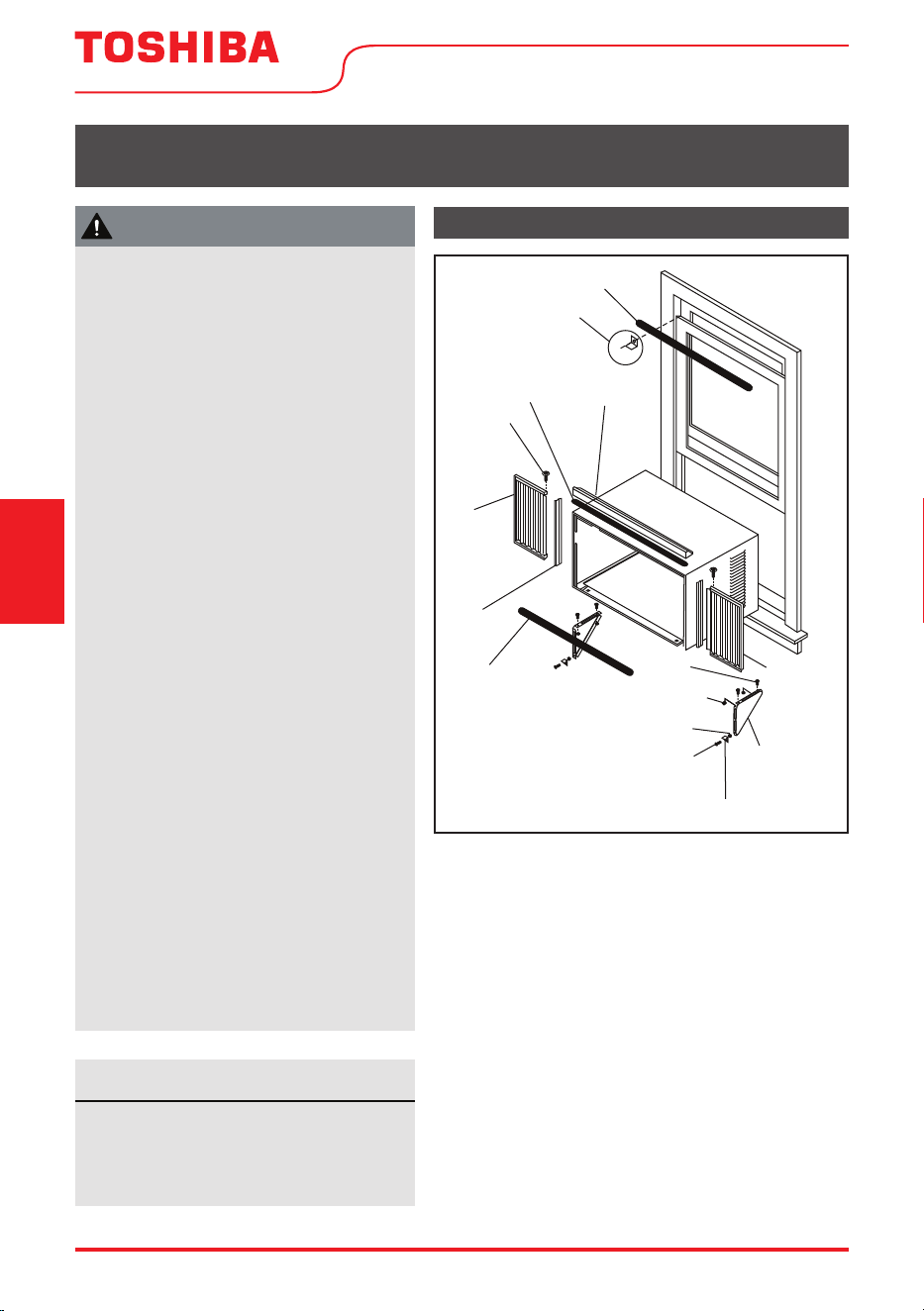
Page 44 User Manual
INSTRUCCIONES DE INSTALACIÓN
Antes de empezar
Lea estas instrucciones completa y
cuidadosamente.
• IMPORTANTE - Guarde estas
instrucciones.
• IMPORTANTE - Observe todos los
códigos y ordenanzas que rigen.
Recomendamos que dos personas instalen
este producto.
Una instalación adecuada es
responsabilidad del instalador.
El fallo del producto debido a una
instalación incorrecta no está cubierto por
esta garantía.
DEBE utilizar todas las piezas suministradas
y utilizar los procedimientos de
instalación adecuados como se describe
en estas instrucciones al instalar este
acondicionador de aire.
No corte ni retire, bajo ninguna
circunstancia, la tercera clavija (tierra) del
cable de energía.
No cambie el enchufe del cable de energía
del acondicionador de aire.
Casas con cableado de aluminio pueden
presentar problemas especiales - consulte
a un electricista cali cado.
Al manipular el equipo, tenga el cuidado
de evitar cortes en los bordes metálicos
a lados o aletas de aluminio que se
encuentran en los serpentines delanteros
y traseros.
ADVERTENCIA
Guarde la caja y estas instrucciones de
instalación para futuras referencias. La
caja es la mejor manera de almacenar el
equipo cuando no está en uso.
AVISO
Realice una comprobación preliminar de su
instalación a través de los pasos 1 hasta 5 de las
Instrucciónes Preliminares.
Altura de la unidad: 17-5/8”
Anchura de la unidad: 23-5/8”
Apertura mínima de la ventana: 18-1/2”
Ancho mínimo de la ventana: 28”
Ancho máximo de la ventana: 40-1/2”
Instrucciones preliminares
Sello de banda de ventana
Carril superiorJunta de espuma
Tornillo largo cabeza
plana 3/4”
Soporte angular de alféizar
Tornillo
largo 1 /2” y
tuerca trava
Escuadra
de soporte
de la
ventana
Conjunto
panel
acordión
(derecho)
Retenedor
lateral
Tornillo de
bloqueo con
arandela en la
cabeza
Sello de fondo
carril a la unidad
Conjunto
panel
acordión
(izquierdo)
Cerradura de seguridad
y tornillo lago de
cabeza Hexagonal
3/4” (o 1/2” )
Tuerca trava
Instrucciones
de Instalación
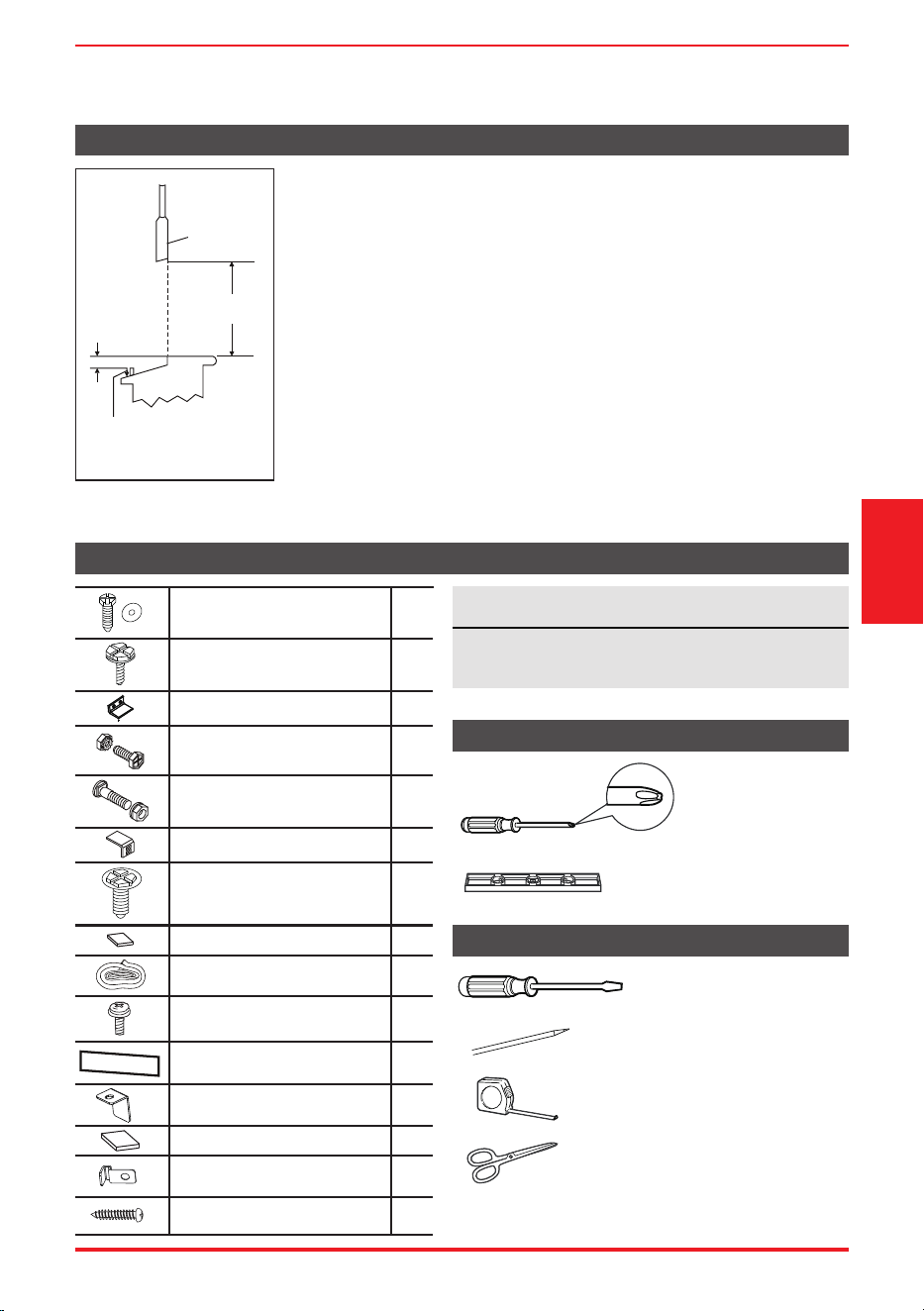
User Manual Page 45
Herramientas que necesitará
Herramientas que puede usar
Destornillador
Rango
Destornillador
Lápiz
Regla o cinta métrica
Tijera o cuchillo
1. Cheque el tamaño de la abertura de la ventana - las piezas de montaje amuebladas con
este acondicionador de aire están hechas para instalar en una ventana con un alféizar
doble de madera. Las piezas estándar son para dimensiones de ventana enumeradas
anteriormente. Abra la pestana a un mínimo de 19” (483 mm). Véase Fig. D.
2. Cheque el estado de la ventana - todas las partes de madera de la ventana deben
estar en buena forma y ser capaces de sostener rmemente los tornillos necesarios.
De lo contrário, realice reparaciones antes de instalar la unidad.
3. Compruebe si hay algo que pueda bloquear el ujo de aire: compruebe el área fuera de
la ventana en busca de cosas como arbustos, árboles o toldos. En el interior, asegúrese
de que los muebles, cortinas o persianas no detengan el ujo de aire adecuado.
4. Cheque el servicio eléctrico disponible - La fuente de alimentación debe ser la
misma que la que se muestra en la placa de identi cación de serie de la unidad.
El cable de alimentación es de 48 en largo. La tomacorriente debe estar al alcance
del cable de alimentación.
5. Desempaquete cuidadosamente el acondicionador de aire - Retire todo el material
del empaque. Proteja el suelo o la alfombra de posibles daños. Se aconseja utilizar
dos personas para mover e instalar la unidad.
Instrucciones preliminares (cont.)
Hardware (Embalado con la unidad)
El aislamiento del panel de acordeón y la banda
adesiva son solo para los modelos ENERGY STAR.
AVISO
Tornillo de bloqueo 7/16” y
Arandela plana para paneles acordeón
2 cd.
Tornillo largo de cabeza
hexagonal 3/4” (o 1/2”)
Tornillo de bloqueo largo de cabeza
hexagonal para carril superior
(cumpr. 5/16”), retenedor lateral.
7
1
4 cd.
2 cd.
Soporte de ángulo de umbral
2
10
Inserto de espuma para gabinete
2
Espuma de sellado de hoja
de ventana
1
Espuma de aislamiento
(10” *3/4” *1/12” )
5
2
2
2
Bloqueo de seguridad
(para Ventanas de vinilo)
Bloqueo de marco (para Ventanas de
vinilo) (solo para algunos modelos)
Tornillo largo 3/4”
(solo para algunos modelos)
Tornillo de bloqueo panhead
#10x1/4”
Tornillo Phillips (para Ventanas de vinilo)
Aislamiento del panel de acordeón
2
2
Bloqueo de seguridad
Tornillo largo 1/2” y
tuerca de bloqueo
Tornillo largo de cabeza 3/4”
y tuerca de bloqueo
Instrucciones
de Instalación
SASH
Storm Window Frame
or Other Obstruction
19” MIN.
1/2” MIN.
Fig. D
Marco de la ventana
contra tormentas u otras
obstrucciones.
Banda de
ventana
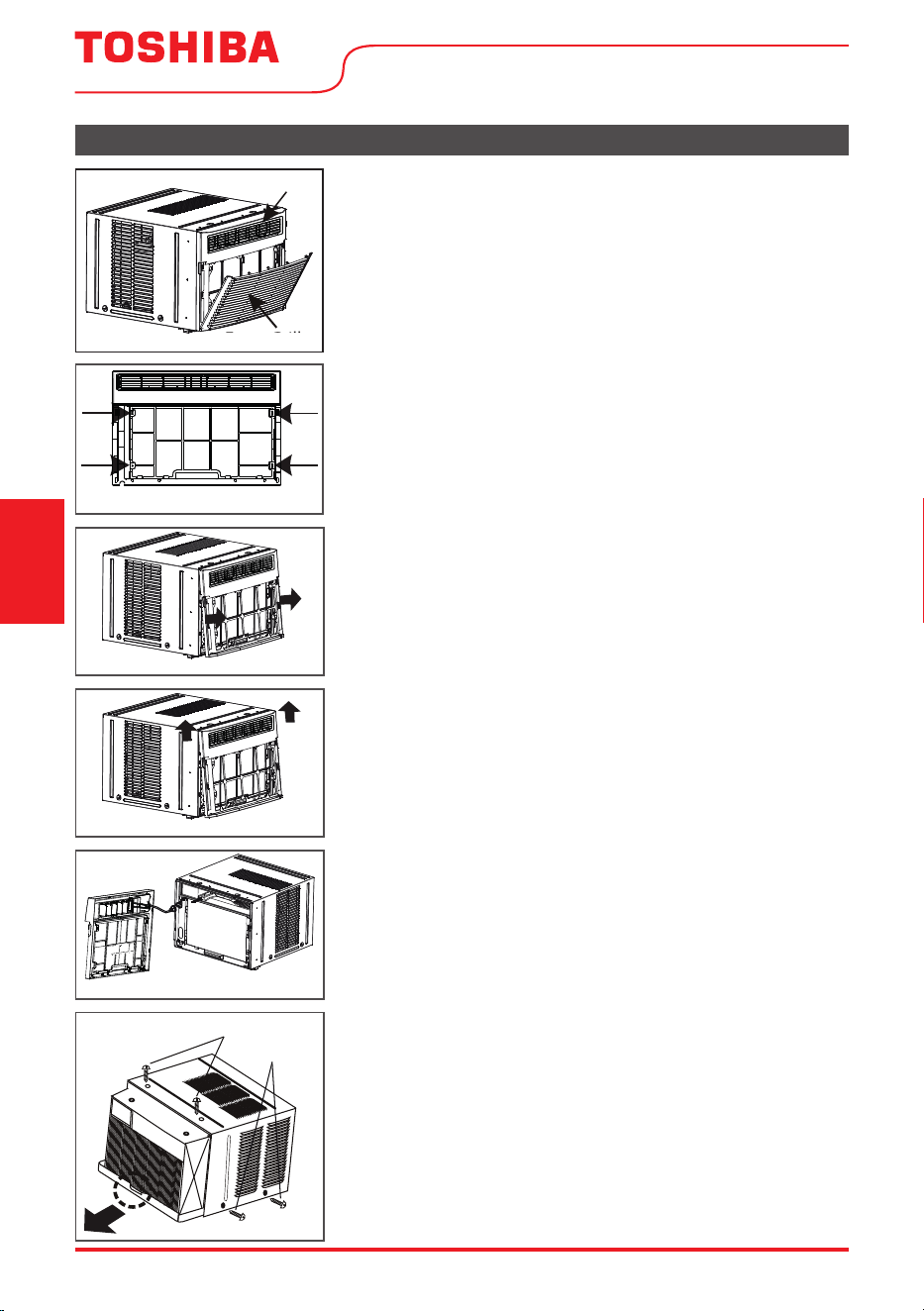
Page 46 User Manual
Instrucciones
de Instalación
1. Retirar el Acondicionador de Aire del Gabinete
A. Tire la rejilla delantera hacia abajo y retire el ltro. (Véase la Fig. 1).
B. Levante la rejilla delantera hacia arriba y colóquela a un lado.
C. Localice los cuatro tornillos delanteros y retirelos. Estos tornillos
serán necesarios para volver a instalar el panel frontal (véase la
Fig. 2).
D. Empuje el lado del gabinete metálico para liberar las pestañas
de plástico en ambos lados del panel frontal (véase la Fig. 3).
E. Levante suavemente el panel frontal de la unidad (véase la
Fig. 3A).
F. Desconecte de la unidad el conector del panel de visualización
y coloque el panel frontal a un lado (véase la Fig. 4).
G. Retire los tornillos de la parte superior de la unidad y
también en el lado por la base caso estea instalada (véase la
Fig. 5).
H. Sujete el gabinete mientras tira la manija de la bandeja de la
base y retire cuidadosamente la unidad.
Fig. 2
Fig. 3
Fig. 4
Fig. 3A
Front Panel
Front Grille
Fig. 1
Panel frontal
Rejilla delantera
Shipping
Screws
Fig. 5
Tornillos
de envió
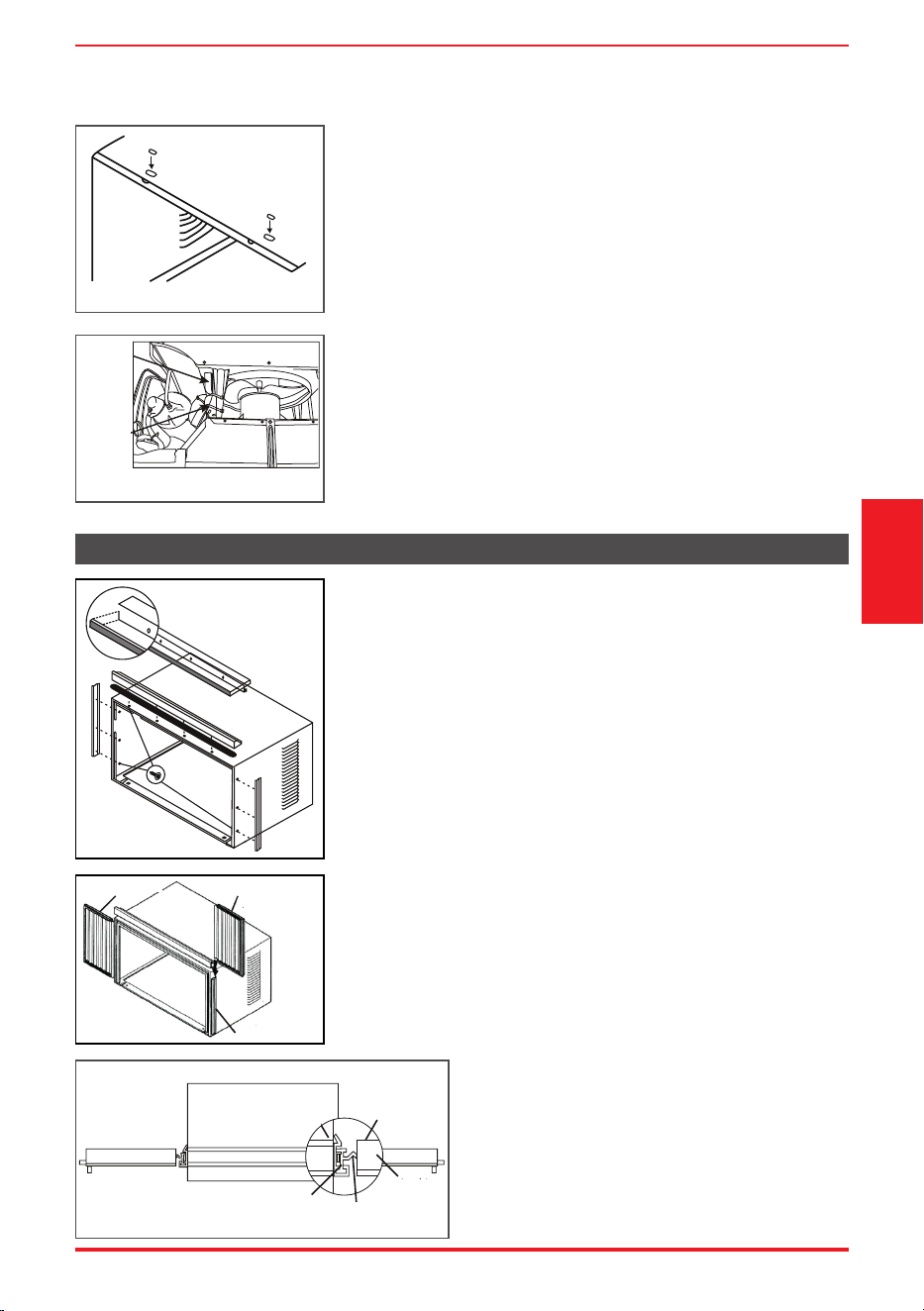
User Manual Page 47
Instrucciones
de Instalación
2. Preparación del Gabinete
I. Añadir dos insertos de espuma a los ori cios de la parte superior
del gabinete donde se quitaron los tornillos de envío (véase la
Fig. 6).
J. Su unidad puede venir con un empaque interior. Este empaque
debe retirarse antes de instalar de vuelta el acondicionador de
aire en el gabinete. (véase la Fig. 7).
Fig. 6
A. Coloque el gabinete sobre el piso, un banco o una mesa.
B. Fije la junta de espuma al carril superior por encima de los
ori cios como se muestra en la Fig. 6.
C. Instale el carril superior y los retenedores laterales en el
gabinete como se muestra en la Fig. 8 (10 tornillos).
D. Deslice 1 etapa del panel de acordeón de la ventana a través
del retenedor lateral y en el lateral del gabinete (véase la Fig. 9
y Fig. 10). Hacer en ambos lados.
E. Inserte las piernas superior e inferior del marco del panel de
acordeón de la ventana a través del canal y en el carril superior y
el carril inferior. Hacer en ambos lados.
Plastic Frame
Side Retainer
Window
Accordion
Panel
Fig. 9
Marco de plástico
Retenedor lateral
Panel de
relleno de
ventana
Fig. 10
TOP VIEW
Air Conditioner
Cabinet
Plastic
Frame
Locking
Screw
Hole
Window
Accordion Panel
“I” Section
Sección “I”
Marco de
plástico
Panel de
relleno de ventana
Acondicionador
de aire
Gabinete del
Agujero de
tornillo de
bloqueo
VISTA SUPERIOR
Fig. 7
Shipping
Packaging
Plastic
Tie
Empaque
interior
Lazo
plástico
Fig. 8
5/16” long
hex-head
Tornillo largo
de cabeza
hex. 5/16”
F. Inserte tornillos de bloqueo de 7/16” con la
arandela en los ori cios de la pierna superior del
marco del panel de acordeón (ver paso 6). No
apriete completamente. Deje que la pierna se
deslice libremente. Los tornillos serán apretados
después de la sección 6.
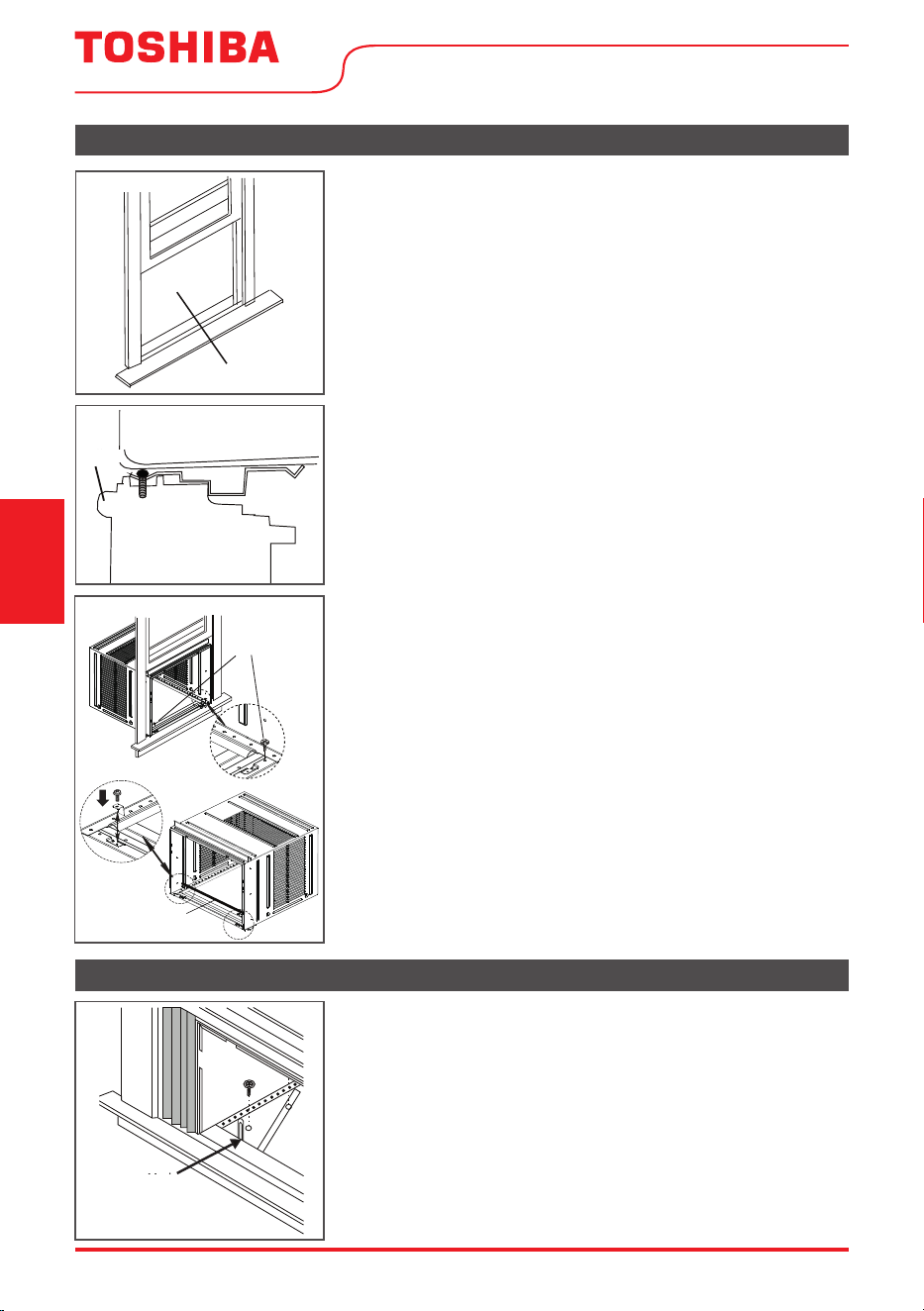
Page 48 User Manual
Instrucciones
de Instalación
A. Abra la ventana y marque el centro del alféizar de la ventana,
como se muestra (Fig. 11).
B. Coloque el gabinete en la ventana con la parte inferior
rmemente asentada sobre el alféizar como se muestra. Baje
la ventana temporalmente por detrás del carril superior para
mantener el gabinete en su lugar (Fig. 12).
C. Mova el gabinete a la izquierda o a la derecha según sea
necesario para alinear el centro del gabinete con el centro de
la línea marcada en el alféizar.
D. Para ventana de madera: Fije el gabinete al alféizar interior
de la ventana con dos tornillos de cabeza larga hexagonal de
1/2” en los orifícios (Fig.13A). (Si lo desea, pre-perforar y crear
orifícios guías.)
Para la ventana de vinillo: Coloque dos bloqueos de seguridad
en los ori cios situados en la parte inferior del gabinete y
conduzca dos tornillos Phillips Panhead #10X de 1/4” a través
de los bloqueos de seguridad en el gabinete como se muestra
(Fig.13B).
A. Tornillos Phillips Panhead #10X de 1/4”
B. Bloqueo de seguridad (solo para ventanas de vinilo)
C. Sello de espuma del carril inferior
E. Retire la tira protectora del lado adhesivo del sello de espuma
del carril inferior. Aplique el sello sobre los tornillos que fijan
el carril inferior al alféizar interior de la ventana.
Fig. 11
Sill
Fig. 12
3. Instalación del Gabinete
4. Instalación del Soporte de la Ventana
A. Sujete igualmente cada soporte de ventana contra el exterior
delalféizar, y aprete hasta la parte inferior del gabinete como
se muestra en la Fig. 14. Marque los suportes según el nivel
superior del alféizar y retírelos.
Taburete
Mark
Fig. 14
Marca
FIG.13A
1/2″ long
HEX-HEAD
SCREW
A
B
FIG.13B
C
Tornillos largos
cabeza hex. 1/2”
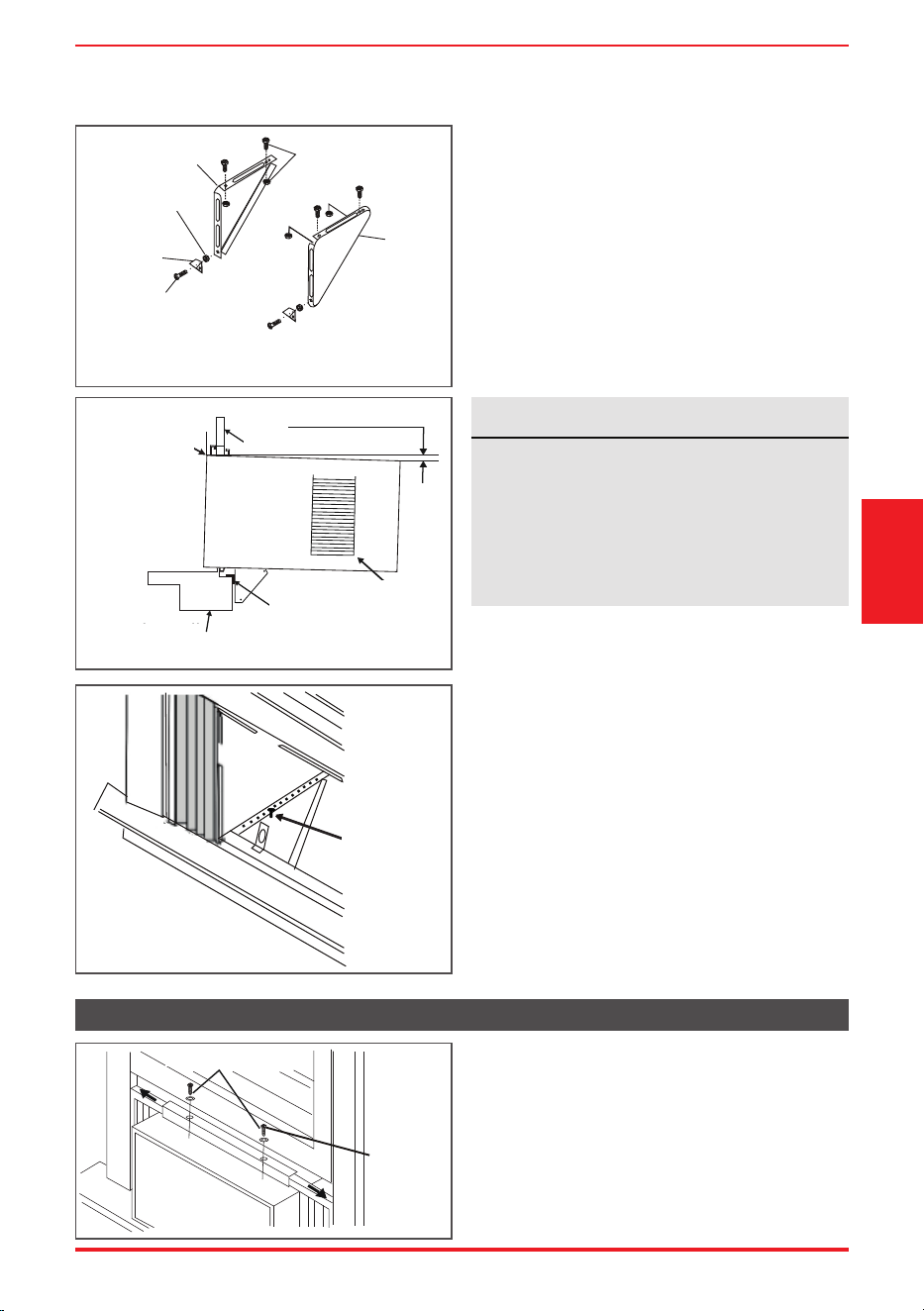
User Manual Page 49
Instrucciones
de Instalación
A. Levante cuidadosamente la ventana para
exponer los tornillos de bloqueo del panel
de acordeón. A oje los tornillos para que los
paneles de acordeón se deslicen fácilmente.
B. Extienda los paneles para cubrir
completamente la apertura de la ventana.
Apriete los tornillos de bloqueo en la parte
superior (Fig. 17).
C. Cierre la ventana por detrás del carril superior.
Asegúrese que el acondicionador de aire esté
inclinado hacia atrás alrededor de 1-1/4” a 1-5/8”
(inclinado alrededor de 3° a 4° hacia abajo y
hacia el exterior). Después de la instalación
adecuada, el condensado no debe drenarse del
ori cio de drenaje durante el uso normal.
De lo contrario, ajustar la inclinación (Fig.15).
AVISO
5. Fixación de los Paneles de Acordeón
B. Posicione el soporte angular del alféizar
para apoyar los soportes de ventana en la
posición marcada (Fig. 14A). Apriete a mano
temporalmente así que los ajustes nales se
puedan hacer más tarde.
C. Instale los soportes de ventana (con los
soportes de angulares de alféizar conectados)
para emparejar el ori cio en la parte inferior
del gabinete como se muestra en la Fig. 16.
D. Apriete los 6 tornillos de forma segura.
Fig. 14A
Right
Left
Locknut
Sill Angle
Bracket
Flathead Bolt
2 Each Required For
Each Support Bracket
1/2” Long Screws
and Locknuts
Escuadra
de fijación
delalféizar
2 Cada requerida para
cada escuadra de soporte
Perno de
cabeza plana
Contratuerca
Izquierda
Derecha
Tornillos largos
1/2” y contratuerca
Fig. 16
1/2” Long
Screws and
Locknuts
Tornillos
largos 1/2” y
contratuerca
Fig. 17
7/16”
Locking
Screw and
Washer
Locking Screw
Tornillos de bloqueo
Tornillos
de
bloqueo
7/16” y
arandela
Window Sash
About 1
1/4”
to 1
5/8”
Measure from
the cabinet
edge
Side
Louvers
Window Sill
Sill Angle
Bracket
Fig. 15
Acerca de 1.
1/4
” a 1.
5/8
”
Alféizar de la
ventana
Marco de la Ventana
Soporte
angular de
alféizar
Rejillas
laterales
Medir desde
el borde del
gabinete
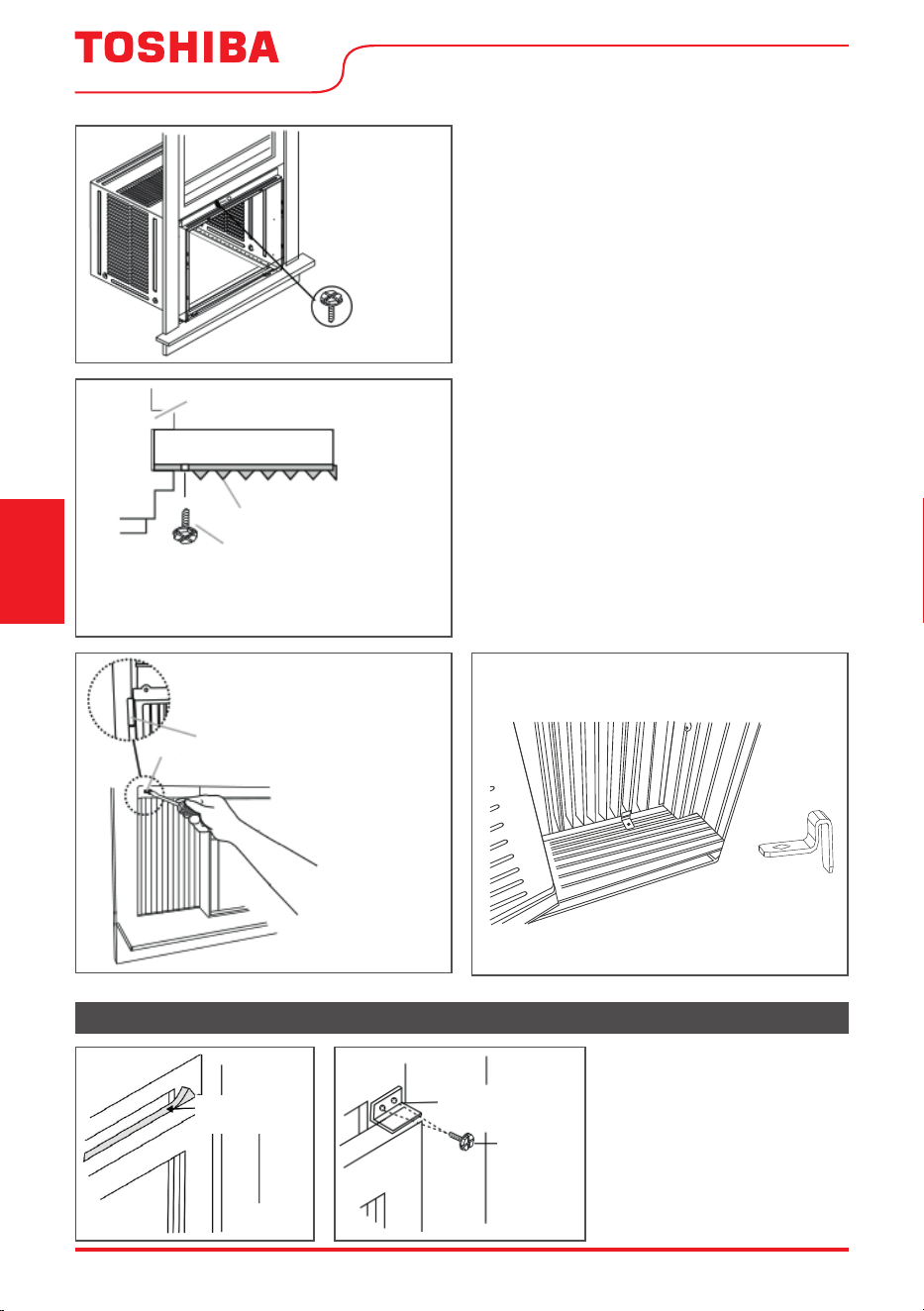
Page 50 User Manual
Instrucciones
de Instalación
D. Utilice una broca de 3/32” para perforar y
crear un orificio guía centrado en el carril
superior y en el marco de la ventana.
Conduzca un tornillo de cabeza hexagonal
de 3/4” (o 1/2”) a través del orificio que acaba
de perforar como se muestra (Fig. 17A).
E. Extienda los paneles de acordeón contra el
marco de la ventana.
F. Utilice una broca de 1/8” para perforar y crear
un ori cio guía y a través del ori cio en la
pierna superior de cada marco del panel de
acordeón y en el marco de la ventana (Fig. 18
y Fig. 18A). Conduzca un tornillo de cabeza
hexagonal de 3/4” (o 1/2”).
G. Fije los marcos de bloqueo al alféizar de
la ventana utilizando dos tornillos de 3/4”
(19mm) (Fig.18B) (en algunos modelos).
Safety Lock
3/4” (or 1/2” )
Long
Hex-head
Screws
Fig. 19A
Weather seal
A
A. Tornillo largo de
cabeza hexagonal
3/4” (o 1/2”)
Bandas Adesivas
Fig. 18A
A. Recorte la Faja selladora
para ajustar con el ancho
de la ventana. Insertar en
el espacio entre los marcos
superior e inferior (Fig. 19).
B. Fije el bloqueo de
seguridad a un ángulo
adecuado (Fig. 19A).
6. Instalación de la Faja Selladora de Ventana y del Bloqueo de Seguridad
Fig. 18B
Fig. 18B
3/4” (or 1/2” )
long Hex-head
screw
Fig. 17A
Tornillos largos
cabeza hex.
3/4” (o 1/2”)
Fig. 18
A. 3/4” (or 1/2”) Long Hex Head Screw
B. Left-Hand Accordion Panel Frame
C. Window Sash Frame
Window Sash Frame
A
B
C
A. Tornillo largo de cabeza hexagonal 3/4” (o 1/2”)
B. Marco del panel del acordeón izquierdo
C. Marco de la ventana
Marco de la ventana
Tornillo
largo de
cabeza
hexagonal
de 3/4”
(o 1/2”)
Bloqueo de seguridad
Window Sash
Seal
Fig. 19
Faja selladora
de ventana
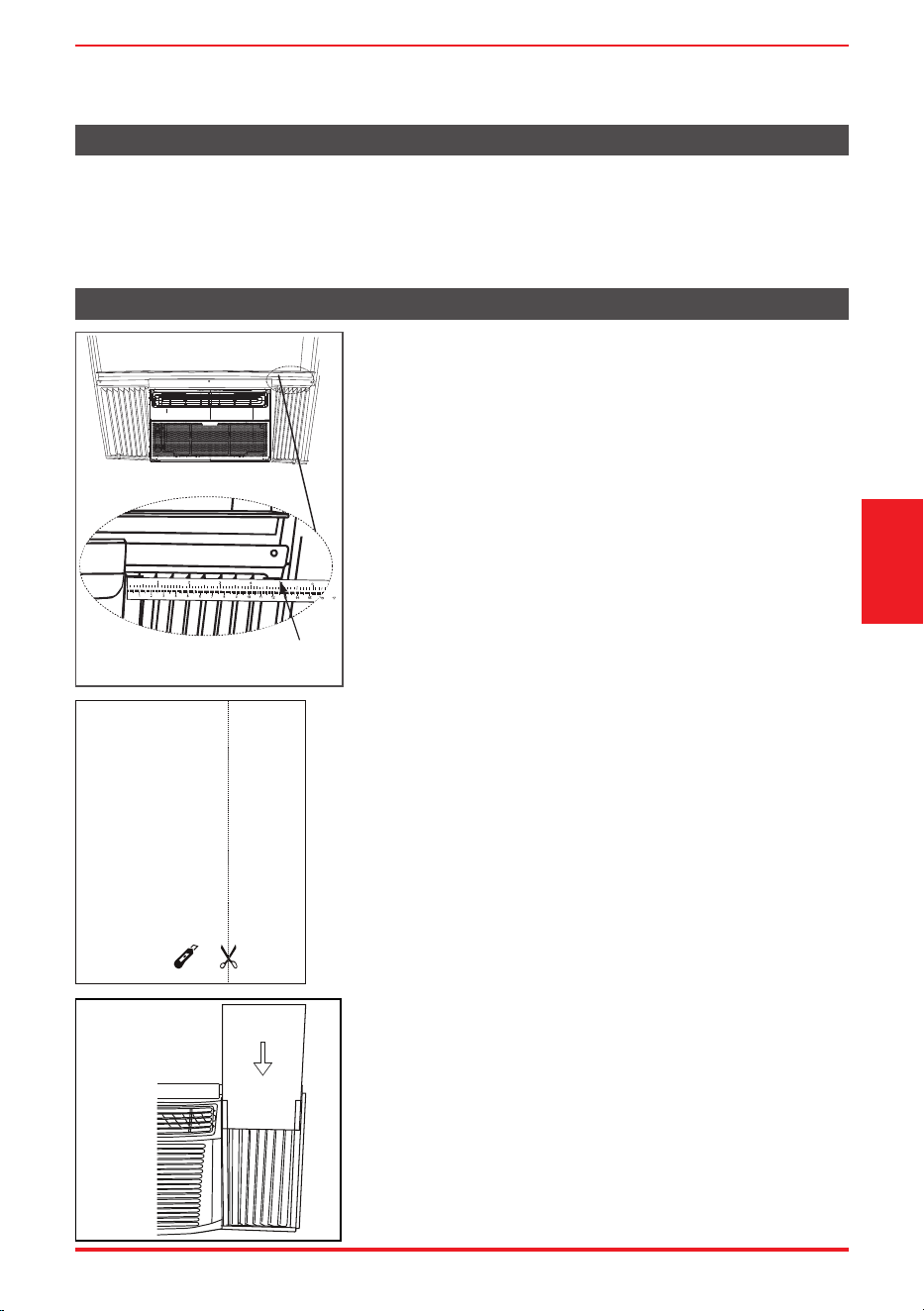
User Manual Page 51
Instrucciones
de Instalación
A. Levante el acondicionador de aire y deslice cuidadosamente en el gabinete dejando 6” sobresaliendo.
B. NO presione ni aplique presión a los controles o a las aletas de los serpentines.
C. Asegúrese de que el chasis esté rmemente asentado hacia la parte trasera del gabinete.
D. La instalación del frente es el reverso de la eliminación descrito en la Sección 1.
Con el n de minimizar las fugas de aire y garantizar un
aislamiento óptimo, es necesario instalar el aislamiento del
panel de acordeón conectado en la cortina lateral. Siga las
instrucciones que se indican a continuación.
A. Después de instalar la unidad en la ventana, mida el ancho
interior de la cortina lateral como se muestra (Fig. 20).
B. Marque una línea en el aislamiento del panel de acordeón
que sea 1/8” (3 mm) menor que la anchura medida en el
paso 1, luego corte el Aislamiento del Panel de Acordeón a
lo largo de la línea (Fig. 21).
Fig. 22
C. Deslice el aislamiento del panel de acordeón en la cortina
lateral. El lado patrón debe estar orientado hacia el interior.
(Fig. 22).
D. Repita en el otro lado.
7. Instalación del Acondicionador de Aire en el Gabinete
8. Instalación del Aislamiento y Banda Adesiva (solo modelos ENERGY STAR)
Measure the inner width
of the side curtain
Fig. 20
Mida el ancho interior
de la cortina lateral
Fig. 21
or
o
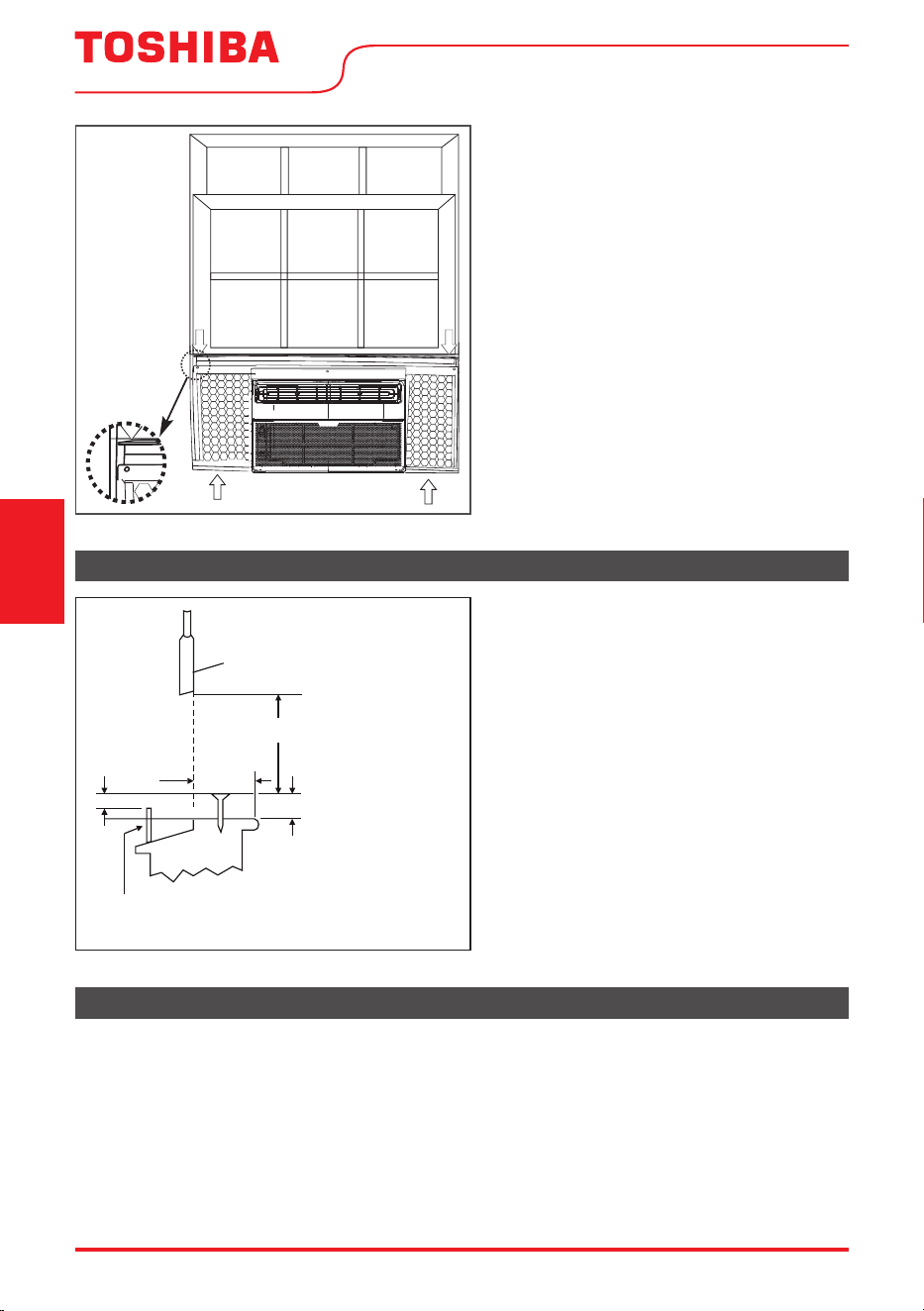
Page 52 User Manual
Instrucciones
de Instalación
Si el Acondicionador del Aire está Bloqueado por la Ventana de Tormenta
Fig. 23
E. Con el n de minimizar las fugas de aire
entre el aire acondicionado de la habitación
y la abertura de la ventana, recorte la banda
adesiva a la longitud adecuada, despegue
el respaldo protector y enchufe cualquier
hueco si es necesario (Fig. 23).
Asegúrese de que las ventanas de tormenta
– si el marco de la ventana de tormenta no
permite un espacio libre requerido, corríjalo
quitando la ventana de tormenta - si es
posible, o agregando un pedazo de madera
como se muestra en la Fig. 24.
Eliminar el Acondicionador del Aire de la Ventana
• Apague el Acondicionador del Aire y desconecte el cable de alimentación.
• Retire el sello de espuma de la hoja entre las ventanas y desenrosque el bloqueo jado.
• Retire los tornillos instalados a través de los marcos de la hoja superior y del panel lateral.
• Retire el aislamiento del panel de acordeón (solo modelos ENERGY STAR).
• Cierre (deslice) los paneles de acordeón en los carriles para cerrar.
• Manteniendo un agarre rme en el acondicionador de aire, levante la faja y retire cuidadosamente.
• Tenga cuidado de no derramar el agua restante mientras levante la unidad desde la ventana.
Guarda las partes CON el acondicionador de aire.
SASH
19” MIN.
Storm Window Frame
or Other Obstruction
Board thickness as
required. Mount along
entire sill by
adequately fastening
with nails or screws
1/2” MIN.
1/2” MIN.
Fig. 24
Banda de ventana
Espesor de tablero
según se requiera, a
lo largo de taburete
completo. Sujete con
dos clavos o tornillos.
Marco de la ventana contra
tormentas u otra obstrucción
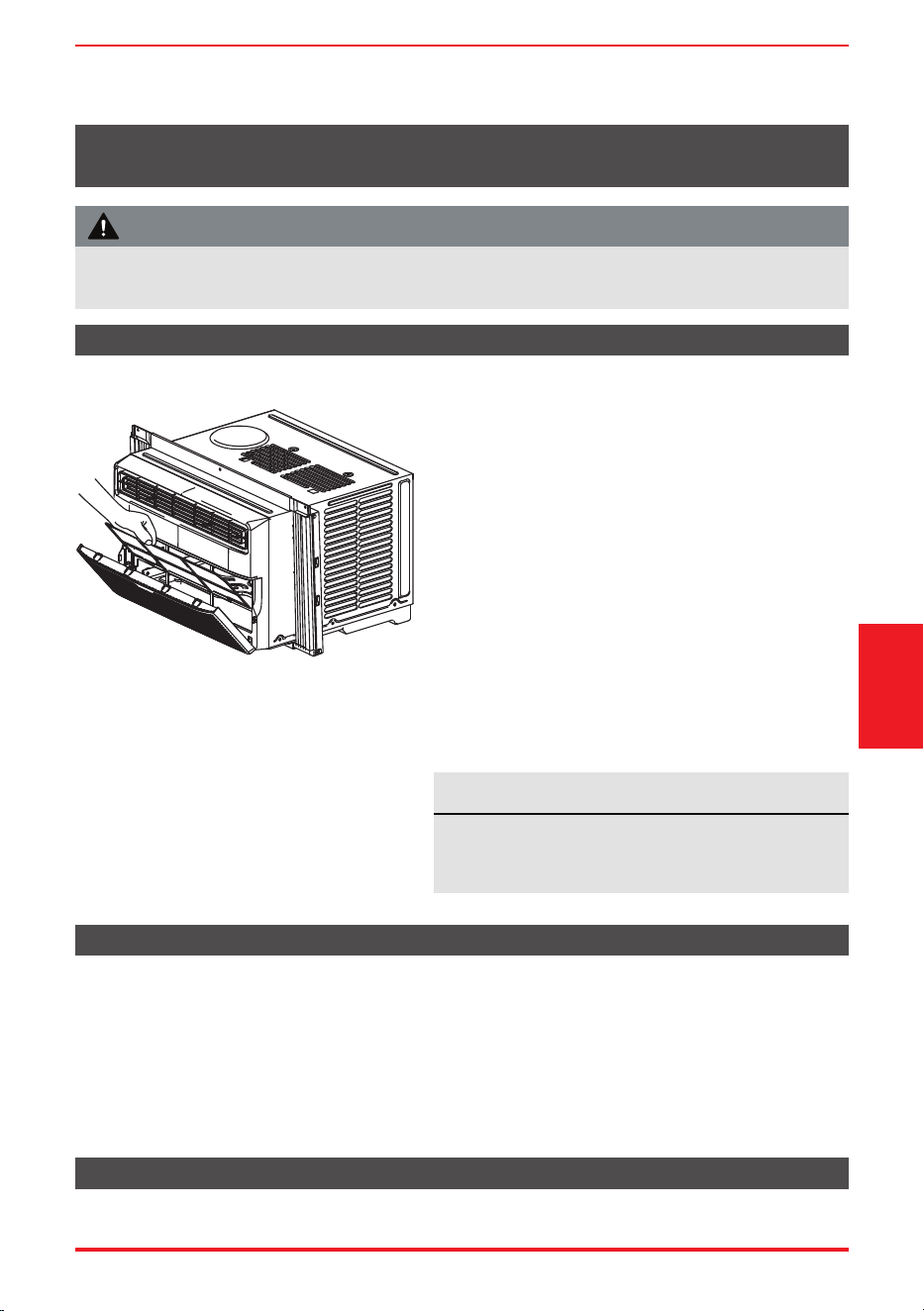
User Manual Page 53
Limpieza del fi ltro de aire
Limpieza del gabinete
Almacenamiento en invierno
El ltro de aire deberá revisarse cuando menos una
vez al mes para veri car si es necesario limpiarlo.
Las partículas atrapadas en el ltro podrían crear y
acumular escarcha en los serpentines de enfriamiento.
• Empuje la manija de ventilación a la posición de
Ventilación Cerrada (cuando aplicable).
• Abra el panel frontal.
• Sujete el filtro por el centro y tire hacia arriba y
hacia afuera.
• Lave el filtro con detergente líquido neutro y agua
tibia. Enjuague bien el filtro.
• Sacuda suavemente el exceso de agua del filtro.
Asegúrese de que el filtro esté completamente
seco antes de reemplazarlo.
• También puede aspirar el filtro limpio en lugar de
lavarlo.
• Asegúrese de desenchufar el acondicionador de aire para evitar descargas eléctricas o un incendio.
El gabinete y el frente pueden ser desempolvados con un paño sin aceites o lavados con un paño
humedecido en una solución de agua tibia y detergente líquido neutro. Enjuagar bien y secar.
• Nunca utilice limpiadores agresivos, cera o esmalte en la parte delantera del gabinete.
• Asegúrese de escurrir el exceso de agua del paño antes de limpiar alrededor de los controles. El
exceso de agua dentro o alrededor de los controles puede causar daños en el acondicionador del aire.
• Enchufe el el acondicionador del aire.
Si planea almacenar el aparato de aire acondicionado durante el invierno, remuévalo cuidadosamente de la
ventana de acuerdo a las instrucciones de montaje. Cúbralo con plástico o devuélvalo al embalaje original.
MANTENIMIENTO Y LIMPIEZA
Cuidado y Limpieza
Modelos RAC-WK15
Limpie su acondicionador de aire de vez en cuando para mantenerlo con un aspecto nuevo.
Asegúrese de desenchufar la unidad antes de limpiarla para evitar descargas eléctricas o incendios.
PRECAUCIÓN
Nunca utilice agua caliente a más de 104 ºF (40 ºC)
para limpiar el ltro de aire. Nunca intente operar la
unidad sin el ltro de aire.
AVISO
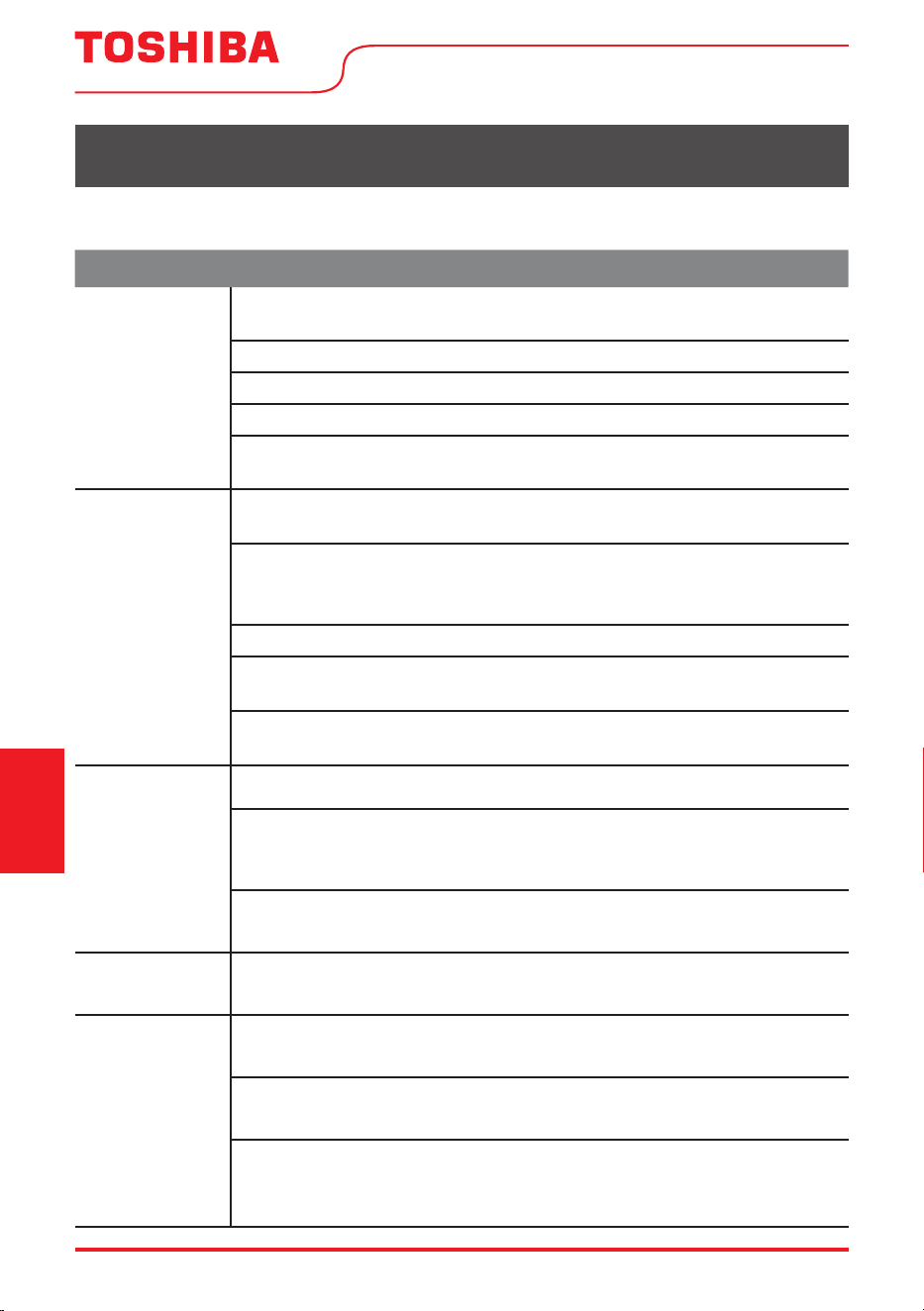
Page 54 User Manual
SOLUCIONES DE PROBLEMAS
Solución
de Problemas
Antes de llamar al servicio técnico, revise esta lista. Puede ahorrarle una gran cantidad de tiempo y dinero. Esta
lista incluye ocurrencias comunes que no son consecuencia de un trabajo o materiales defectuosos en el equipo.
Problema Solución
El aire
acondicionado no
pone en marcha.
Enchufe desconectado de la toma de pared. Inserte rmemente el enchufe en la toma de
pared.
El cortacircuitos está disparado. Restablecer cortacircuitos.
Compruebe si la luz del enchufe está encendida. Si está apagada, pulse el botón RESET.
La unidad está apagada. Encienda la unidad.
La unidad apaga y encende rápidamente. Apague la unidad y espere 3 minutos antes de
reiniciar.
El aire de la
unidad no enfría
adecuadamente.
Temperatura ambiente por debajo de 62 °F (17 °C). Es posible que no se produzca un
enfriamiento hasta que la temperatura ambiente suba por encima de 17 °C.
El sensor de temperatura detrás del ltro de aire está tocando los serpentines de
enfriamiento. Trate de moverlo para que no entre en contacto con los serpentines de
enfriamiento.
Restablezca a una temperatura más baja.
Compresor se apaga al moverse los modos de temperatura. Espere aproximadamente 3
minutos y escuche si el compresor se reinicie cuando se establece en el modo COOL.
Compruebe si hay posibles obstrucciones que bloqueen la entrada/salida al aire libre.
Limpie cualquier obstrucción.
El acondicionador
de aire se enciende y
apaga rápidamente.
Filtro de aire sucio o ujo de aire restringido. Limpie el ltro de aire.
Temperatura exterior extremadamente caliente. Establezca la velocidad del FAN en una
con guración más alta para que el aire pase por los serpentines de enfriamiento con más
frecuencia.
Compruebe si hay posibles obstrucciones que bloqueen la entrada/salida al aire libre.
Despeje cualquier obstrucción.
Habitación
demasiado fría.
Con guración de temperatura demasiado baja. Aumente la temperatura.
Acondicionador de
aire enfriándose,
pero el ambiente está
demasiado templado
- formación de
escarcha en los
serpentines de
enfriamiento detrás
del ltro de aire.
Temperatura exterior por debajo de 64°F (18°C). Para descongelar los serpentines, ajuste
al modo FAN ONLY.
El ltro de aire puede estar sucio. Limpie el ltro. Consulte la sección Cuidado y Limpieza.
Para descongelar, establezca el modo FAN ONLY.
El termostato está demasiado frío para el enfriamiento nocturno. Para descongelar los
serpentines, ajuste al modo FAN ONLY. A continuación, ajuste la temperatura a una
con guración más alta.
User Manual Page 55
Problema Solución
Acondicionador de
aire enfriándose,
pero el ambiente
está demasiado
templado - NO
hay formación de
escarcha en los
serpentines de
enfriamiento detrás
del ltro de aire.
Filtro de aire sucio o restringido. Limpie el ltro. Consulte la sección Cuidado y Limpieza.
Para descongelar, establezca el modo FAN ONLY.
La temperatura está con gurada demasiado alta, ajuste la temperatura a una
con guración más baja.
Rejillas direccionales de aire colocadas incorrectamente. Pivotee las rejillas hasta obtener
una mejor distribución del aire.
La parte delantera de la unidad está bloqueada por cortinas, persianas, muebles, etc. -
restringe la distribución del aire. Limpie posibles obstrucciónes en frente a la unidad.
Cualquier puerta, ventana o registro abierto puede permitir que el aire frío escape. Cierre
las puertas, ventanas o registros.
La habitación puede estar demasiado templado. Conceda algo más de tiempo para
remover el calor “almacenado” en paredes, techos, suelos y muebles.
Ruido cuando la
unidad se está
enfriando.
Sonido de movimiento del aire. Esto es normal. Si es demasiado fuerte, ajuste el modo
FAN a una con guración más lenta.
Vibración de la ventana - mala instalación. Consulte las instrucciones de instalación o
consulte al instalador.
El agua gotea en
el interior cuando
la unidad se está
enfriando.
Instalación incorrecta. Incline el aire acondicionado ligeramente hacia el exterior para
permitir el drenaje del agua.
Consulte las instrucciones de instalación o consulte al instalador.
El agua gotea en
el exterior cuando
la unidad se está
enfriando.
Unidad removiendo una gran cantidad de humedad de un ambiente húmedo. Esto es
normal durante días excesivamente húmedos.
Detección remota
de desactivación
prematura (algunos
modelos).
El control remoto no se encuentra dentro del alcance. Coloque el control remoto a
distancia dentro de 16,4 pies y 180°, en un radio de la parte delantera de la unidad y
apuntando en la dirección general del acondicionador de aire.
Señal del control remoto obstruida. Retire la obstrucción
Ruido cuando se
inicia la unidad.
Un sonido “da-da” puede ocurrir durante treinta segundos cuando la unidad está
encendida debido al arranque del compresor. Es normal.
La unidad no se
conecta al WiFi o
la aplicación no
funciona (algunos
modelos).
P
ara obtener más ayuda y consejos de solución de problemas, siga el link de este código QR:
Solución
de Problemas
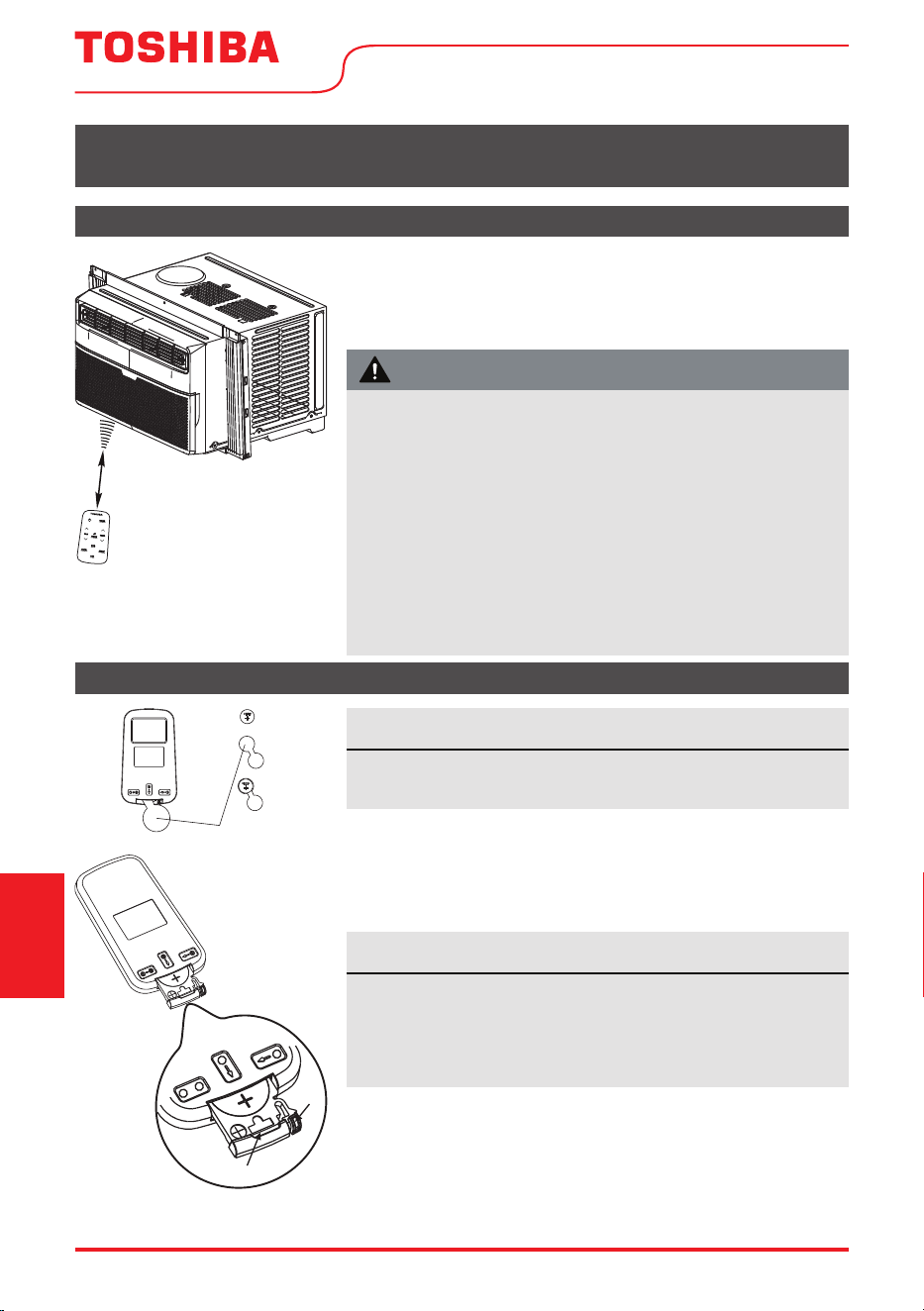
Page 56 User Manual
Manejo del Control Remoto
INSTRUCCIONES DEL CONTROL REMOTO Y DEL APP
Ubicación del control remoto
Utilice el control remoto a distancia a una distancia de 5 metros del
acondicionador de aire, apuntando hacia el receptor. La recepción se
con rma con un pitido.
Instrucciones
del control remoto
y del App
16.4 ft (5 metros)
Sustitución de la Batería
CR20
2
5
CR20
25
1
2
1
2
+
A
B
Insulation piece
• El acondicionador de aire no funcionará si las cortinas, puertas
u otros materiales bloquean las señales del control remoto a la
unidad.
• Evite que cualquier líquido se derrame sobre el mando a distancia.
No exponga el mando a distancia a la luz solar directa ni al calor.
• Si el receptor de señal infrarroja de la unidad interior está
expuesto a la luz solar directa, es posible que el acondicionador
de aire no funcione correctamente. Utilice cortinas para evitar que
la luz del sol caiga sobre el receptor.
• Si otros aparatos eléctricos reaccionan al control remoto, mueva
estos aparatos o consulte a su distribuidor local.
PRECAUCIÓN
Complete los siguientes pasos simultáneamente:
1. Presione ligeramente la opción “A” en la dirección de la echa 1.
2. Tire de “B” en la dirección de la echa 2.
1. Utilice únicamente una batería CR2025.
2. No deje la batería en el control remoto si no se va a
utilizarlo durante 2 o 3 meses.
3. Deseche las pilas usadas correctamente.
AVISO
Primero retire la pieza de aislamiento (si está disponible) y entonces
instale la batería de acuerdo con los siguientes pasos
AVISO
Pieza de aislamiento
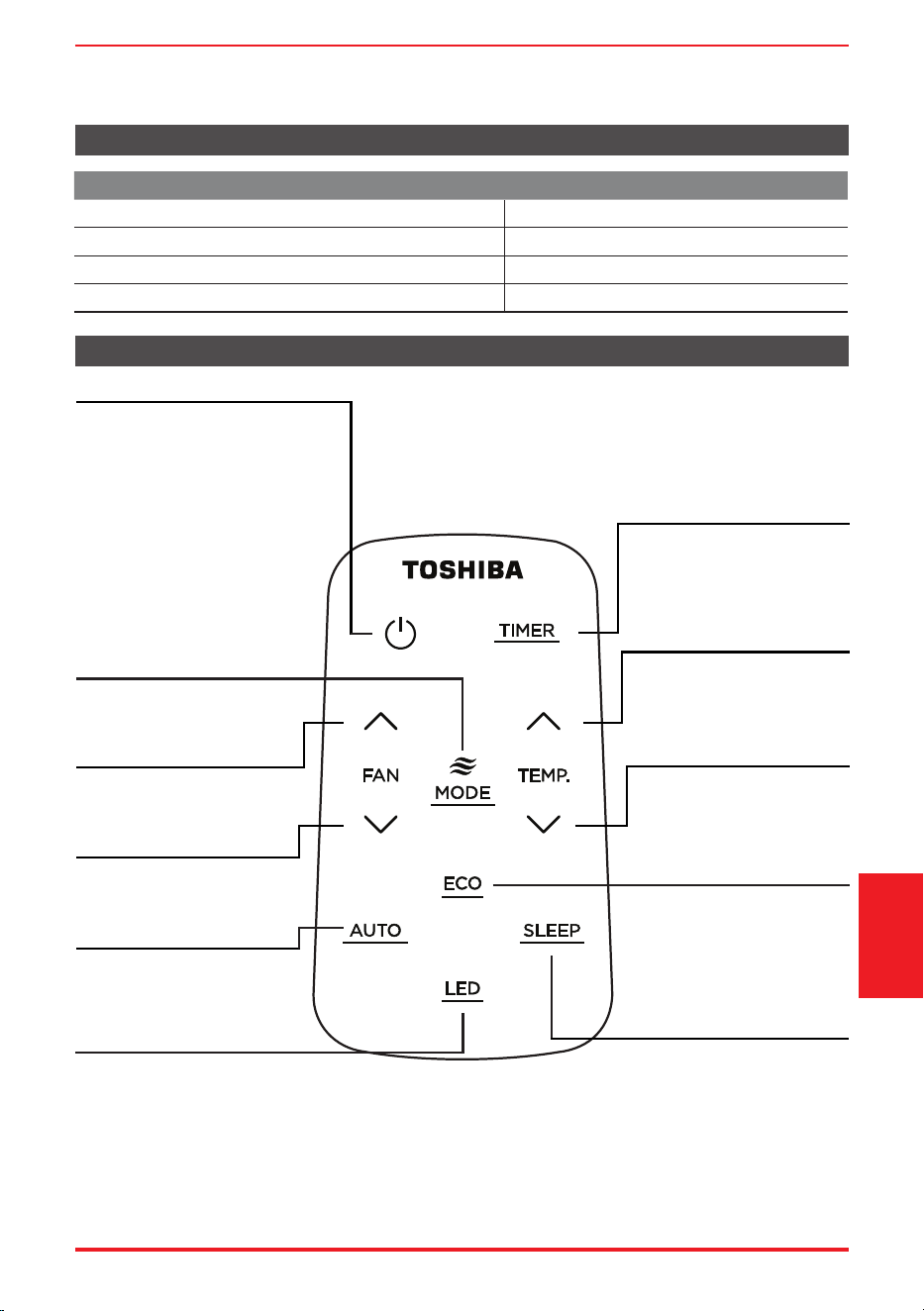
User Manual Page 57
Especifi caciones del control remoto
Modelo RG15C/E
Voltaje 3.0V (batería de litio CR2025)
Voltaje más bajo de la señal de emisión de la CPU 2.4 V
Alcance de recepción de señal 16.4 pies (5 m)
Entorno -5 °C ~ 60 °C (23°F ~ 140°F)
Instrucciones
del control remoto
y del App
Función de los Botones
Botón MODE
Pulse este botón para seleccionar
el modo de operación deseado.
Botón TEMP UP
Pulse este botón para
aumentar la con guración de
la temperatura interior.
Botón FAN UP
Pulse este botón para aumentar la
velocidad deseada del ventilador.
Botón SLEEP
Pulse este botón para activar el
modo de Suspensión. Esta función
solo está disponible en modo
COOL o AUTO y mantendrá la
temperatura más cómoda para
usted mientras ahorra energía.
Para obtener más información,
consulte la función de Suspención
en “MANUAL DEL USUARIO.”
Botón ECO
Pulse este botón para activar
el modo de ahorro de
energía. Púlselo de nuevo
para detener la función (en
algunos modelos).
Botón TEMP DOWN
Pulse este botón para
reducir la con guración de la
temperatura interior.
Botón FAN DOWN
Pulse este botón para reducir la
velocidad deseada del ventilador.
Botón TIMER
Pulse este botón para activar el
programa “Inicio Automático”
o “Parada Automática”.
Botón ON/OFF
La unidad se enciende
cuando se pulsa este botón
y se apaga cuando pulsarlo
nuevamente.
NOTA: Si la unidad tiene la
función ENERGY SAVER, iniciará
automáticamente la función de
ahorro de energía en los modos
Cool, Dry y Auto (solo Auto-
Cooling y Auto-Fan).
Botón LED
Pulse este botón para apagar las luces
indicadoras de la unidad. Al volver a
pulsar este botón, se volverán a encender
las luces indicadoras. Al pulsar cualquier
botón de la unidad o del control remoto
mientras el visor está apagado, se
activarán las luces durante tres segundos
y, a continuación, se apagarán.
Botón AUTO
Pulse este botón para ajustar
automáticamente la velocidad
del ventilador
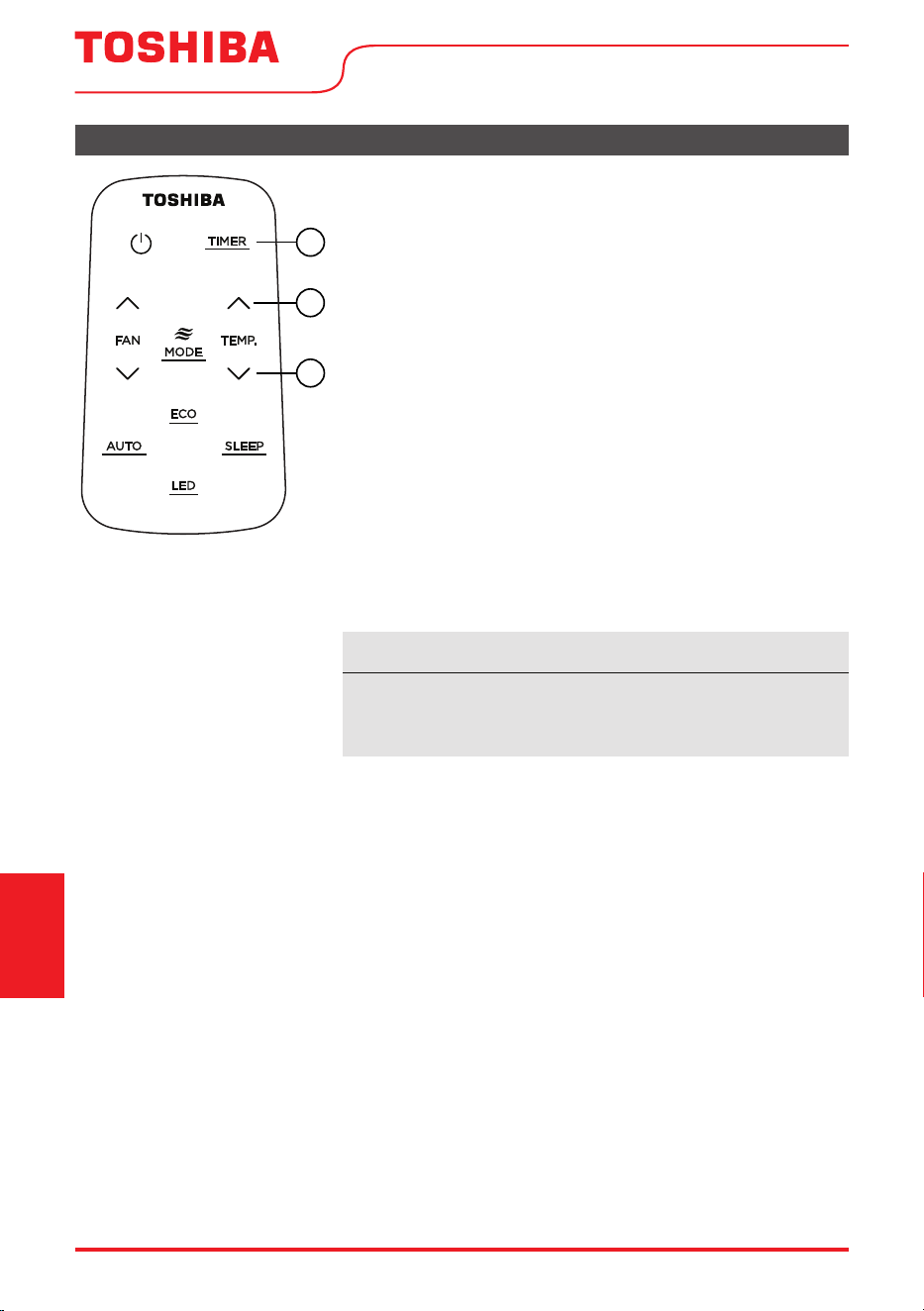
Page 58 User Manual
Cómo usar los botones
Instrucciones
del control remoto
y del App
Función Temporizador
Pulse el botón TIMER para iniciar el programa de ajuste de inicio
automático y de parada automática de la unidad.
Para ajustar la hora de inicio/parada automática.
1. Pulse el botón TIMER. Cuando el indicador TIMER ON
aparecer en el visor LED del acondicionador de aire,
indica que se ha iniciado el programa de ajuste de inicio
automático. Cuando el indicador TIMER OFF aparecer en
el visor LED del acondicionador de aire, indica que se ha
iniciado el programa de ajuste de parada automática.
2. Mantenga pulsado el TEMP UP/DOWN para cambiar la hora
automática. El control contará el tiempo restante hasta el inicio/
parada.
3. El tiempo seleccionado se registrará en 5 segundos y el
acondicionador de aire volverá automáticamente a mostrar el
ajuste de temperatura anterior.
4. Encender o apagar la unidad en cualquier momento, cancelará
la función de inicio/parada automática.
1
2
2
Para cancelar el ajuste TIMER, pulse el botón TIMER y, a
continuación, pulse o mantenga pulsado TEMP UP/DOWN hasta
que aparezca 0 horas en el visor LED del acondicionador de aire.
AVISO
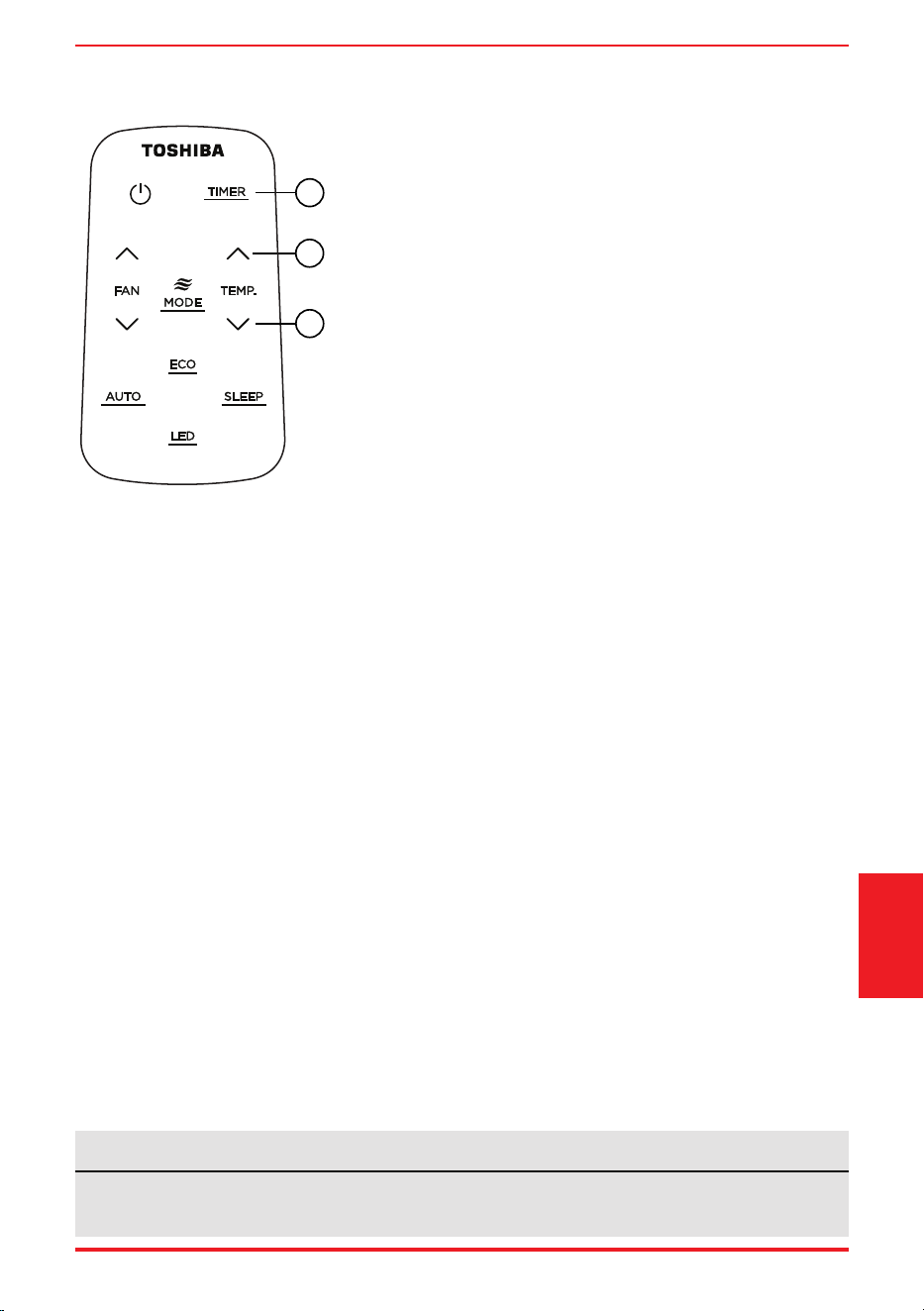
User Manual Page 59
Instrucciones
del control remoto
y del App
TEMPORIZADOR COMBINADO
(Ajuste simultáneo de los temporizadores ON y OFF)
PARADA AUTOMÁTICA > INICIO AUTOMÁTICO
(Activado > Detener > Iniciar operación)
Esta función es útil cuando desea detener el acondicionador de aire
después de irse a la cama, y iniciar de nuevo por la mañana cuando
se despierta o cuando regresa a casa.
Ejemplo:
Para detener el acondicionador de aire 2 horas después de
la con guración e iniciarlo de nuevo 10 horas después de la
con guración.
1. Pulse el botón TIMER hasta que muestre TIMER OFF en el
indicador LED del acondicionador de aire.
2. Utilice el botón TEMP UP/DOWN para mostrar “2.0” en el
indicador LED del acondicionador de aire.
3. Pulse de nuevo el botón TIMER hasta que muestre TIMER OFF
en el indicador LED de la unidad.
4. Utilice el botón TEMP UP/DOWN para mostrar “10” en el
indicador LED de la unidad.
5. Espere 5 segundos hasta que la indicación anterior aparezca en
el visor LED.
INICIO AUTOMÁTICO > PARADA AUTOMÁTICA
(Desactivado > Iniciar > Detener operación)
Esta función es útil cuando se desea iniciar el acondicionador de
aire antes de despertar y detenerlo después de salir de la casa.
Ejemplo:
Para iniciar el acondicionador de aire 5 horas después de la
con guración, y detenerlo 8 horas después de la con guración.
1. Pulse el botón TIMER hasta que muestre TIMER ON en el
indicador LED del acondicionador de aire.
2. Utilice el botón TEMP UP/DOWN para mostrar “5.0” en el
indicador LED del acondicionador de aire.
3. Pulse de nuevo el botón TIMER hasta que muestre TIMER OFF
en el indicador LED de la unidad.
4. Utilice el botón TEMP UP/DOWN para mostrar “8.0” en el
indicador LED de la unidad.
5. Espere 5 segundos hasta que la indicación anterior aparezca en
el visor LED.
1
2
2
Los cambios o modi caciones no aprobados por la parte encargada del cumplimiento de las
regulaciones podrían invalidar la autoridad del usuario para operar el equipo.
AVISO
Page 60 User Manual
Declaramos que este Acondicionador de Aire cumple los requisitos esenciales y otras disposiciones
pertinentes de la Directiva 1999/5/CE.
1. Soporte para los sistemas operativos: iOS 7+ o Android 4+..
2. En el caso de una actualización del sistema operativo, puede haber un retraso entre la actualización
del sistema operativo y una actualización de software durante la cual su sistema operativo puede
o no ser compatible hasta que una nueva versión sea lanzada. Su teléfono móvil especí co o
problemas en su red pueden impedir que el sistema funcione y Toshiba no será responsable de
ningún problema que pueda ser causado por incompatibilidad o problemas de red.
3. Este acondicionador de aire inteligente solo permite el cifrado WPA-PSK/WPA2-PSK (recomendado).
Consulte la dirección web de Toshiba Lifestyle, us.toshiba-lifestyle.com, para obtener informaciónes
actualizadas.
4. Para garantizar el escaneo adecuado del código QR, su smart phone debe tener al menos una
cámara de 5 megapíxeles.
5. Debido a la conectividad de red inestable, las solicitudes pueden agotar el tiempo de espera. Si
esto sucede, vuelva a ejecutar la con guración de red.
6. Debido a la conectividad de red inestable, los comandos pueden agotar el tiempo de espera. Si
esto sucede, la aplicación del Smartphone y el producto actual pueden presentar información
con ictiva. La información presentada en el producto actual es siempre la más precisa disponible.
Actualice la aplicación para volver a sincronizarla
DECLARACIÓN DE CONFORMIDAD
ESPECIFICACIÓN DEL MÓDULO INALÁMBRICO
PRECAUCIONES
Instrucciones
del control remoto
y del App
Toshiba no será responsable de ningún problema que pueda ser causado por incompatibilidad o
problemas de red, su router inalámbrico y teléfono móvil.
AVISO
Modelo: US-OSK103 Dimensiones: 41 x 24 x 5 (mm)
Estándar: IEEE 802.11 b/g/n
Temperatura de funcionamiento: 0°C ~ 45°C /
32°F ~ 113°F.
Tipo de antena: Antena omnidireccional externa
Frecuencia: 2.4 GHz (inalámbrico) Humedad de funcionamiento: 10% ~ 85%
Potencia máxima transmitida: 15 dBm Max Entrada de potencia: DC 5V/300 mA
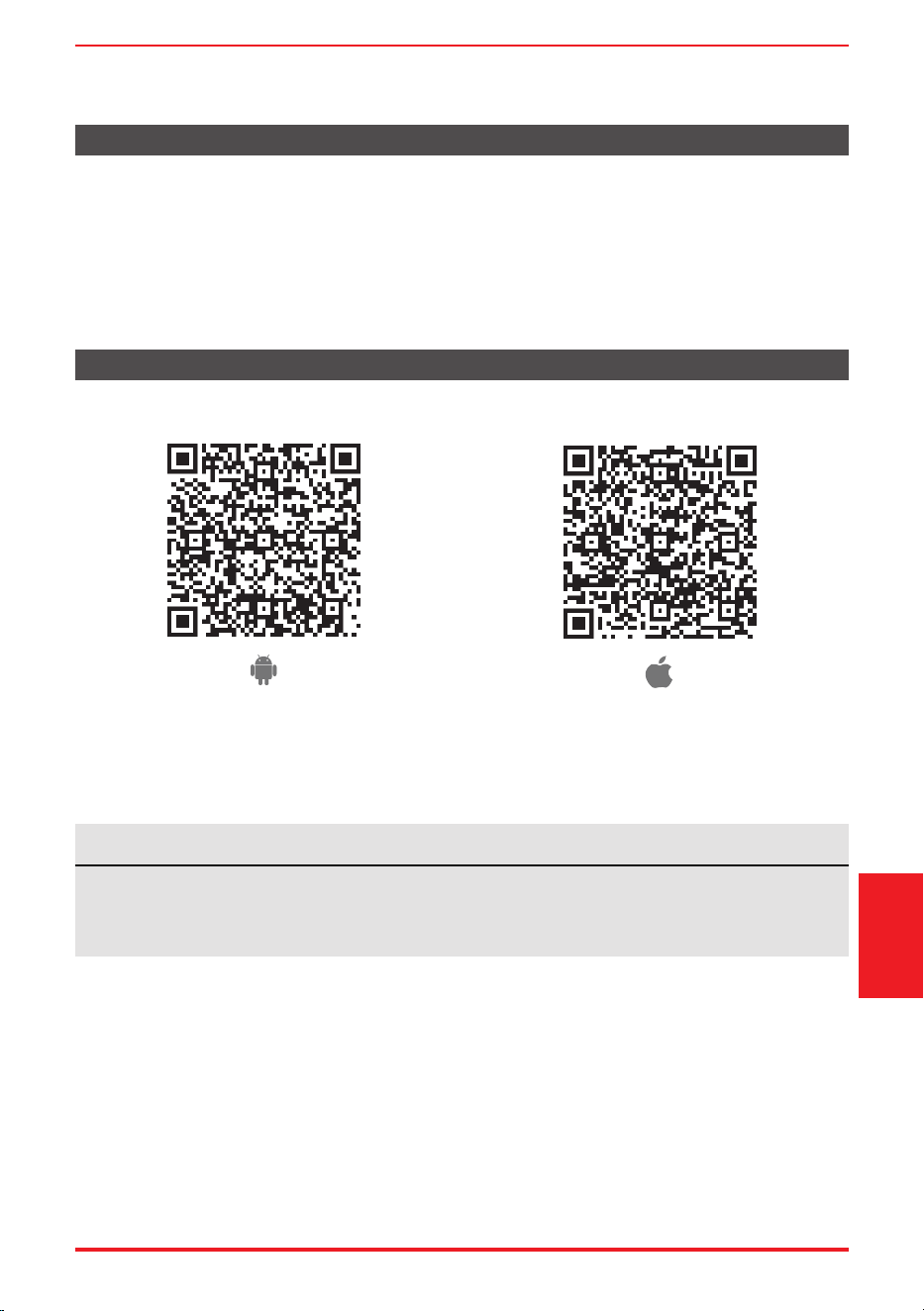
User Manual Page 61
Dispositivos necesarios para utilizar el Acondicionador de aire inteligente:
1. Smartphone con sistema iOS o Android compatible.
2. Router inalámbrico
3. Acondicionador de aire Inteligente
VISIÓN GENERAL DEL SISTEMA
Instrucciones
del control remoto
y del App
DESCARGAR E INSTALAR LA APLICACIÓN
Código QR de Android Código QR de Apple
Escanear para descargar la aplicación.
• También puede ir a Google Play o App Store y buscar Toshiba NA AC. Para obtener más
información, consulte la página web de Toshiba Lifestyle: us.toshiba-lifestyle.com.
Todas las imágenes de este manual son solo para referencia, su producto y aplicación pueden tener
un aspecto ligeramente diferente. Las instrucciones reales del producto y de la aplicación deben ser
consideradas.
AVISO
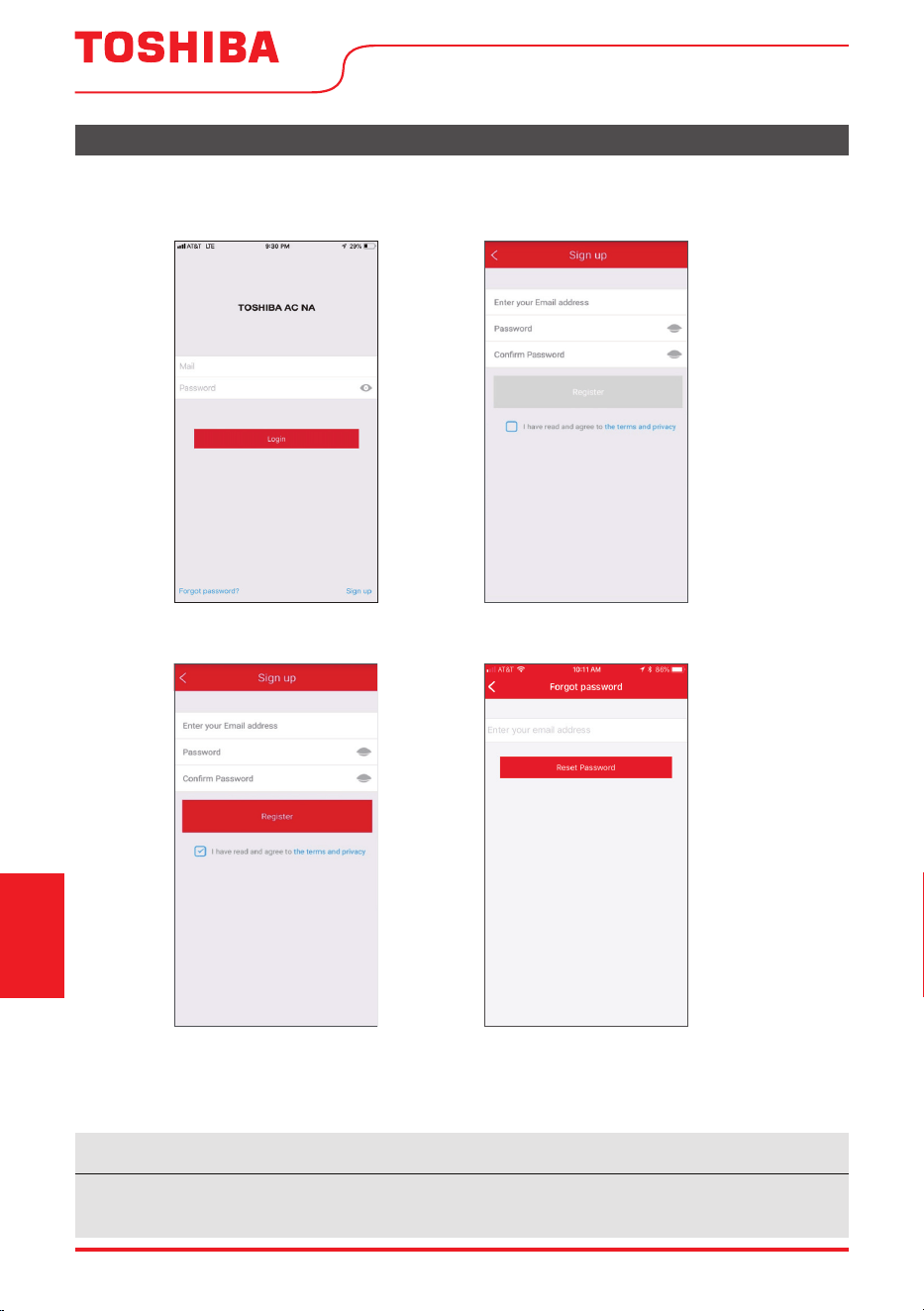
Page 62 User Manual
CREA TU CUENTA
• Asegúrese de que su Smartphone esté conectado a su router inalámbrico y que su router inalámbrico tenga
una conexión a Internet de 2,4 GHz.
• Se recomienda activar su cuenta inmediatamente para poder recuperar su contraseña por correo electrónico.
Instrucciones
del control remoto
y del App
6.1 Pulse “Registrarse”.
6.2 Introduzca su dirección de correo
electrónico y contraseña.
6.3 Pulse “Registro”.
6.4 En caso de que olvide su contraseña, pulse
“¿Olvidó su contraseña?” en el menú principal e
introduzca su dirección de correo electrónico.
A continuación, pulse “Restablecer contraseña”.
• Asegúrese de que su Smartphone es capaz de conectarse a la red inalámbrica que se utilizará.
• Asegúrese también de que el dispositivo no se está conectando a otras redes al alcance.
AVISO
User Manual Page 63
FUNCIONES ADICIONALES DE LA APLICACIÓN Y SMART HOME
Instrucciones
del control remoto
y del App
Para obtener instrucciones adicionales sobre las características de la aplicación y las capacidades del
sistema Smart Home, escanee el código QR a continuación

WARNING: Chemical Burn Hazard. Keep batteries away from children.
This product contains a lithium button/coin cell battery. If a new or used lithium button/coin cell battery is swallowed
or enters the body, it can cause severe internal burns and can lead to death in as little as 2 hours. Always completely
secure the battery compartment. If the battery compartment does not close securely, stop using the product, remove
the batteries, and keep it away from children. If you think batteries might have been swallowed or placed inside any
part of the body, seek immediate medical attention.
ADVERTENCIA: PELIGRO DE QUEMADURA QUÍMICA. MANTENGA LAS
PILAS ALEJADAS DE LOS NIÑOS.
Este producto contiene una batería de celda tipo moneda/botón. Si una batería de celda tipo moneda/botón nueva o
usada llegara a ser ingerida o que se la han colocada dentro de alguna parte del cuerpo, causaría quemaduras internas
graves en solo 2 horas y puede causar la muerte. Garantize siempre la seguridad del compartimiento de la batería. Si el
compartimiento de la batería no queda bien cerrado, deje de utilizar el producto, remova la batería y manténgala alejada
de los niños. Si sospecha que alguien ingirió la batería o que la colocó dentro de alguna parte del cuerpo, busque atención
médica de inmediato.

