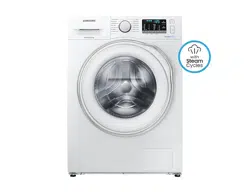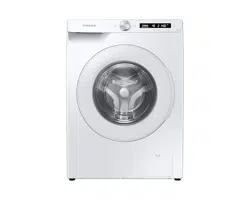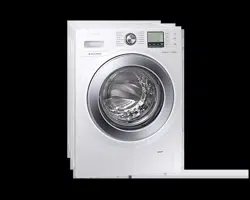
Washing Machine
User manual
WW11R64****
Untitled-1 1 2/12/2019 11:48:21 AM
English2
Contents
Contents
Safety information 4
What you need to know about the safety instructions 4
Important safety symbols 4
Important safety precautions 5
Critical installation warnings 6
Installation cautions 8
Critical usage warnings 8
Usage cautions 10
Critical cleaning warnings 13
Installation 14
What’s included 14
Installation requirements 16
Step-by-step installation 18
Environment 26
Before you start 27
Initial settings 27
Laundry guidelines 27
Detergent drawer guidelines 31
Operations 34
Control panel 34
Simple steps to start 36
Cycle overview 37
Special features 39
Maintenance 41
Drum clean 41
Smart Check
42
Emergency drain 43
Cleaning 44
Recovery from freezing 48
Care against an extended time of non-use 48
Untitled-1 2 2/12/2019 11:48:22 AM
English4
Safety information
Congratulations on your new Samsung washing machine. This manual contains important
information on the installation, use and care of your appliance. Please take some time to
read this manual to take full advantage of your washing machine’s many benets and
features.
What you need to know about the safety instructions
Please read this manual thoroughly to ensure that you know how to safely and efciently
operate the extensive features and functions of your new appliance. Please store the
manual in a safe location close to the appliance for future reference. Use this appliance
only for its intended purpose as described in this instruction manual.
Warnings and Important Safety Instructions in this manual do not cover all possible
conditions and situations that may occur. It is your responsibility to use common sense,
caution and care when installing, maintaining and operating your washing machine.
Because the following operating instructions cover various models, the characteristics of
your washing machine may differ slightly from those described in this manual and not
all warning signs may be applicable. If you have any questions or concerns, contact your
nearest service centre or nd help and information online at www.samsung.com.
Important safety symbols
What the icons and signs in this user manual mean:
WARNING
Hazards or unsafe practices that may result in severe personal injury, death and/or
property damage.
CAUTION
Hazards or unsafe practices that may result in personal injury and/or property damage.
CAUTION
To reduce the risk of re or explosion, follow these basic precautions.
NOTE
Indicates that a risk of personal injury or material damage exists.
Safety information
Untitled-1 4 2/12/2019 11:48:22 AM
English 5
Safety information
These warning signs are here to prevent injury to yourself and others.
Please follow them explicitly.
After reading this manual, store it in a safe place for future reference.
Read all instructions before using the appliance.
As with any equipment that uses electricity and moving parts, potential hazards exist.
To safely operate this appliance, familiarize yourself with its operation and exercise care
when using it.
Important safety precautions
WARNING
To reduce the risk of re, electric shock, or injury to persons
when using your appliance, follow basic precautions, including the
following:
1. This appliance is not to be used by persons (including children)
with reduced physical, sensory or mental capabilities, or lack
of experience and knowledge, unless they have been given
supervision or instruction concerning use of the appliance by a
person responsible for their safety.
2. For use in Europe: This appliance can be used by children aged
from 8 years and above and persons with reduced physical,
sensory or mental capabilities or lack of experience and
knowledge if they have been given supervision or instruction
concerning use of the appliance in a safe way and understand
the hazards involved. Children shall not play with the appliance.
Cleaning and user maintenance shall not be made by children
without supervision.
3. Children should be supervised to ensure that they do not play with
the appliance.
Untitled-1 5 2/12/2019 11:48:22 AM

Safety information
English6
Safety information
4. If the supply cord is damaged, it must be replaced by the
manufacturer, its service agent or similarly qualied persons in
order to avoid a hazard.
5. The new hose-sets supplied with the appliance are to be used and
old hose-sets should not be reused.
6. For appliances with ventilation openings in the base, a carpet must
not obstruct the openings.
7. For use in Europe: Children of less than 3 years should be kept
away unless continuously supervised.
8. CAUTION: In order to avoid a hazard due to inadvertent resetting
of the thermal cut-out, this appliance must not be supplied through
an external switching device, such as a timer, or connected to a
circuit that is regularly switched on and off by the utility.
9. This appliance is intended to be used in household only and it is
not intended to be used such as:
- staff kitchen areas in shops, ofces and other working
environments;
- farm houses;
- by clients in hotels, motels and other residential type
environments;
- bed and breakfast type environments;
- areas for communal use in blocks of ats or in launderettes.
Critical installation warnings
WARNING
The installation of this appliance must be performed by a qualied technician or service
company.
• Failure to do so may result in electric shock, re, an explosion, problems with the
product, or injury.
Untitled-1 6 2/12/2019 11:48:22 AM

English 7
Safety information
The appliance is heavy, therefore take care when lifting it.
Plug the power cord into a wall socket that meets local electrical specications. Use the
socket for this appliance only, and do not use an extension cord.
• Sharing a wall socket with other appliances using a power strip or extending the power
cord may result in electric shock or re.
• Ensure that the power voltage, frequency, and current are the same as those of the
product specications. Failure to do so may result in electric shock or re. Plug the
power plug into the wall socket rmly.
Remove all foreign substances such as dust or water from the power plug terminals and
contact points using a dry cloth on a regular basis.
• Unplug the power plug and clean it with a dry cloth.
• Failure to do so may result in electric shock or re.
Plug the power plug into the wall socket so that the cord is running towards the oor.
• If you plug the power plug into the socket in the opposite direction, the electric wires
within the cable may be damaged and this may result in electric shock or re.
Keep all packaging materials out of the reach of children as these may be dangerous.
• If a child places a bag over its head, it may suffocate.
When the appliance, power plug or power cord is damaged, contact your nearest service
centre.
This appliance must be properly grounded.
Do not ground the appliance to a gas pipe, plastic water pipe, or telephone line.
• This may result in electric shock, re, an explosion, or problems with the product.
• Never plug the power cord into a socket that is not grounded correctly and make sure
that it is in accordance with local and national regulations.
Do not install this appliance near a heater or any inammable material.
Do not install this appliance in a humid, oily or dusty location, or in a location exposed to
direct sunlight or water (rain drops).
Do not install this appliance in a location exposed to low temperatures.
• Frost may cause the tubes to burst.
Do not install this appliance in a location where gas may leak.
• This may result in electric shock or re.
Do not use an electric transformer.
• This may result in electric shock or re.
Do not use a damaged power plug, damaged power cord, or loose wall socket.
Untitled-1 7 2/12/2019 11:48:22 AM

Safety information
English8
Safety information
• This may result in electric shock or re.
Do not pull or excessively bend the power cord.
Do not twist or tie the power cord.
Do not hook the power cord over a metal object, place a heavy object on the power cord,
insert the power cord between objects, or push the power cord into the space behind the
appliance.
• This may result in electric shock or re.
Do not pull the power cord when unplugging the power plug.
• Unplug the power plug by holding the plug.
• Failure to do so may result in electric shock or re.
This appliance should be positioned so that the power plug, the water supply taps, and the
drain pipes are accessible.
Installation cautions
CAUTION
This appliance should be positioned in such a way that the power plug is easily accessible.
• Failure to do so may result in electric shock or re due to electric leakage.
Install your appliance on a solid, level oor that can support its weight.
• Failure to do so may result in abnormal vibrations, movement, noise, or problems with
the product.
Critical usage warnings
WARNING
If the appliance is ooded, turn off the water & power supplies immediately and contact
your nearest service centre.
• Do not touch the power plug with wet hands.
• Failure to do so may result in electric shock.
If the appliance generates a strange noise, a burning smell, or smoke, unplug the power
plug immediately and contact your nearest service centre.
• Failure to do so may result in electric shock or re.
In the event of a gas leak (such as propane gas, LP gas, etc.), ventilate immediately
without touching the power plug. Do not touch the appliance or power cord.
Untitled-1 8 2/12/2019 11:48:22 AM

English 9
Safety information
• Do not use a ventilating fan.
• A spark may result in an explosion or re.
Do not let children play in or on the washing machine. In addition, when disposing of the
appliance, remove the washing machine door lever.
• If trapped inside the product, children may suffocate to death.
Make sure to remove the packaging (sponge, styrofoam) attached to the bottom of the
washing machine before using it.
Do not wash items contaminated with gasoline, kerosene, benzene, paint thinner, alcohol
or other inammable or explosive substances.
• This may result in electric shock, re, or an explosion.
Do not open the washing machine door by force while it is operating (high-temperature
washing/drying/spinning).
• Water owing out of the washing machine may result in burns or cause the oor to be
slippery. This may result in injury.
• Opening the door by force may result in damage to the product or injury.
Do not insert your hand under the washing machine while an operation is in progress.
• This may result in injury.
Do not touch the power plug with wet hands.
• This may result in electric shock.
Do not turn the appliance off by unplugging the power plug while an operation is in
progress.
• Plugging the power plug into the wall socket again may cause a spark and result in
electric shock or re.
Do not let children or the inrm use this washing machine without proper supervision. Do
not let children climb in or onto the appliance.
• This may result in electric shock, burns or injury.
Do not insert your hand or a metal object under the washing machine while it is operating.
• This may result in injury.
Do not unplug the appliance by pulling the power cord. Always grip the plug rmly and
pull it straight out of the outlet.
• Damage to the power cord may cause a short-circuit, re and/or electric shock.
Do not attempt to repair, disassemble, or modify the appliance yourself.
• Do not use a fuse (such as copper, steel wire, etc.) other than a standard fuse.
• When the appliance needs to be repaired or reinstalled, contact your nearest service
centre.
Untitled-1 9 2/12/2019 11:48:23 AM
Safety information
English10
Safety information
• Failure to do so may result in electric shock, re, problems with the product, or injury.
If the water supply hose comes loose from the water tap and oods the appliance, unplug
the power plug.
• Failure to do so may result in electric shock or re.
Unplug the power plug when the appliance is not being used for long periods of time or
during a thunder or lightning storm.
• Failure to do so may result in electric shock or re.
If any foreign substance enters into the appliance, unplug the power plug and contact
your nearest Samsung Customer Service.
• This may result in electric shock or re.
Do not let children (or pets) play in or on your washing machine. The washing machine
door does not open easily from the inside and children may be seriously injured if trapped
inside.
Usage cautions
CAUTION
When the washing machine is contaminated by a foreign substance such as detergent,
dirt, food waste, etc., unplug the power plug and clean the washing machine using a damp,
soft cloth.
• Failure to do so may result in discolouration, deformation, damage, or rust.
The front glass may be broken by a strong impact. Take care when using the washing
machine.
• If the glass is broken, it may result in injury.
After a water supply failure or when reconnecting the water supply hose, open the water
tap slowly.
Open the water tap slowly after a long period of non-use.
• The air pressure in the water supply hose or the water pipe may damage a product
part or result in a water leak.
If a draining error occurs during an operation, check if there is a draining problem.
• If the washing machine is used when it is ooded because of a draining problem, it
may result in electric shock or re.
Insert the laundry into the washing machine completely so that the laundry does not get
caught in the door.
Untitled-1 10 2/12/2019 11:48:23 AM

English 11
Safety information
• If laundry gets caught in the door, it may result in damage to the laundry or the
washing machine, or result in a water leak.
Turn the water supply off when the washing machine is not being used.
• Ensure that the screws on the water supply hose connector are properly tightened.
Ensure that the rubber seal and front door glass are not contaminated by a foreign
substance (e.g. waste, thread, hair, etc.).
• If a foreign substance is caught in the door or the door is not completely closed, it may
cause a water leak.
Open the water tap and check if the water supply hose connector is rmly tightened and
that there is no water leak before using the product.
• If the screws on the water supply hose connector are loose, it may result in a water
leak.
The product you have purchased is designed for domestic use only.
Using the product for business purposes qualies as a product misuse. In this case, the
product will not be covered by the standard warranty provided by Samsung and no
responsibility can be attributed to Samsung for malfunctions or damages resulting from
such misuse.
Do not stand on the appliance or place objects (such as laundry, lighted candles, lighted
cigarettes, dishes, chemicals, metal objects, etc.) on the appliance.
• This may result in electric shock, re, problems with the product, or injury.
Do not spray volatile material such as insecticide onto the surface of the appliance.
• As well as being harmful to humans, this may result in electric shock, re or problems
with the product.
Do not place objects that generate electromagnetic elds near the washing machine.
• This may result in injury due to a malfunction.
Water drained during a high-temperature wash or drying cycle is hot. Do not touch the
water.
• This may result in burns or injury.
If the water temperature is high before drain, it take time until the temperature goes
down, and it can be different depending on internal temperature.
Do not wash, spin, or dry water-proof seats, mats, or clothing (*) unless your appliance has
a special cycle for washing these items.
(*): Woollen bedding, rain covers, shing vests, ski pants, sleeping bags, diaper covers,
sweat suits, and bicycle, motor cycle and car covers, etc.
Untitled-1 11 2/12/2019 11:48:23 AM

Safety information
English12
Safety information
• Do not wash thick or hard mats even if the washing machine mark is on the care label.
This may result in injury or damage to the washing machine, walls, oor, or clothing
due to abnormal vibrations.
• Do not wash throw rugs or doormats with rubber backing. The rubber backing may
come off and stick to inside the drum, and this may result in malfunction such as a
drainage error.
Do not operate the washing machine when the detergent drawer is removed.
• This may result in electric shock or injury due to a water leak.
Do not touch the insides of the drum during or just after drying as it is hot.
• This may result in burns.
Do not insert your hand into the detergent drawer.
• This may result in injury as your hand may be caught by the detergent input device.
• The liquid detergent guide (applicable models only) is not used for powder detergent.
Remove the guide when using powder detergent.
Do not place any objects (such as shoes, food waste, animals) other than laundry into the
washing machine.
• This may result in damage to the washing machine, or injury and death in the case of
pets due to the abnormal vibrations.
Do not press the buttons using sharp objects such as pins, knifes, ngernails, etc.
• This may result in electric shock or injury.
Do not wash laundry contaminated by oils, creams or lotions usually found in skincare
shops or massage clinics.
• This may cause the rubber seal to become deformed and result in a water leak.
Do not leave metal objects such as safety pins, hair pins or bleach in the drum for long
periods of time.
• This may cause the drum to rust.
• If rust starts appearing on the surface of the drum, apply a (neutral) cleansing agent to
the surface and use a sponge to clean it. Never use a metal brush.
Do not use dry cleaning detergent directly and do not wash, rinse, or spin laundry
contaminated by dry cleaning detergent.
• This may result in spontaneous combustion or ignition due to the heat from the
oxidation of the oil.
Do not use water from water cooling/heating devices.
• This may result in problems with the washing machine.
Do not use natural hand-washing soap for the washing machine.
Untitled-1 12 2/12/2019 11:48:23 AM
English 13
Safety information
• If it hardens and accumulates inside the washing machine, it may result in problems
with the product, discolouration, rust, or bad odours.
Place socks and brassieres in a washing net and wash them with the other laundry.
Do not wash large laundry items such as bedding in the washing net.
• Failure to do so may result in injury due to abnormal vibrations.
Do not use hardened detergent.
• If it accumulates inside the washing machine, it may result in a water leak.
Make sure that the pockets of all the clothing items to be washed are empty.
• Hard, sharp objects such as coins, safety pins, nails, screws, or stones can cause
extensive damage to the appliance.
Do not wash clothing with large buckles, buttons or other heavy metal objects.
Sort the laundry by colour on the basis of its colorfastness and select the recommended
cycle, water temperature and additional functions.
• This may result in discolouration or fabric damage.
Take care that children’s ngers are not caught in the door when you close it.
• Failure to do so may result in injury.
Critical cleaning warnings
WARNING
Do not clean the appliance by spraying water directly onto it.
Do not use a strong acidic cleaning agent.
Do not use benzene, thinner or alcohol to clean the appliance.
• This may result in discolouration, deformation, damage, electric shock or re.
Before cleaning or performing maintenance, unplug the appliance from the wall socket.
• Failure to do so may result in electric shock or re.
Untitled-1 13 2/12/2019 11:48:23 AM
English14
Installation
Follow these instructions carefully to ensure proper installation of the washing machine
and to prevent accidents when doing laundry.
What’s included
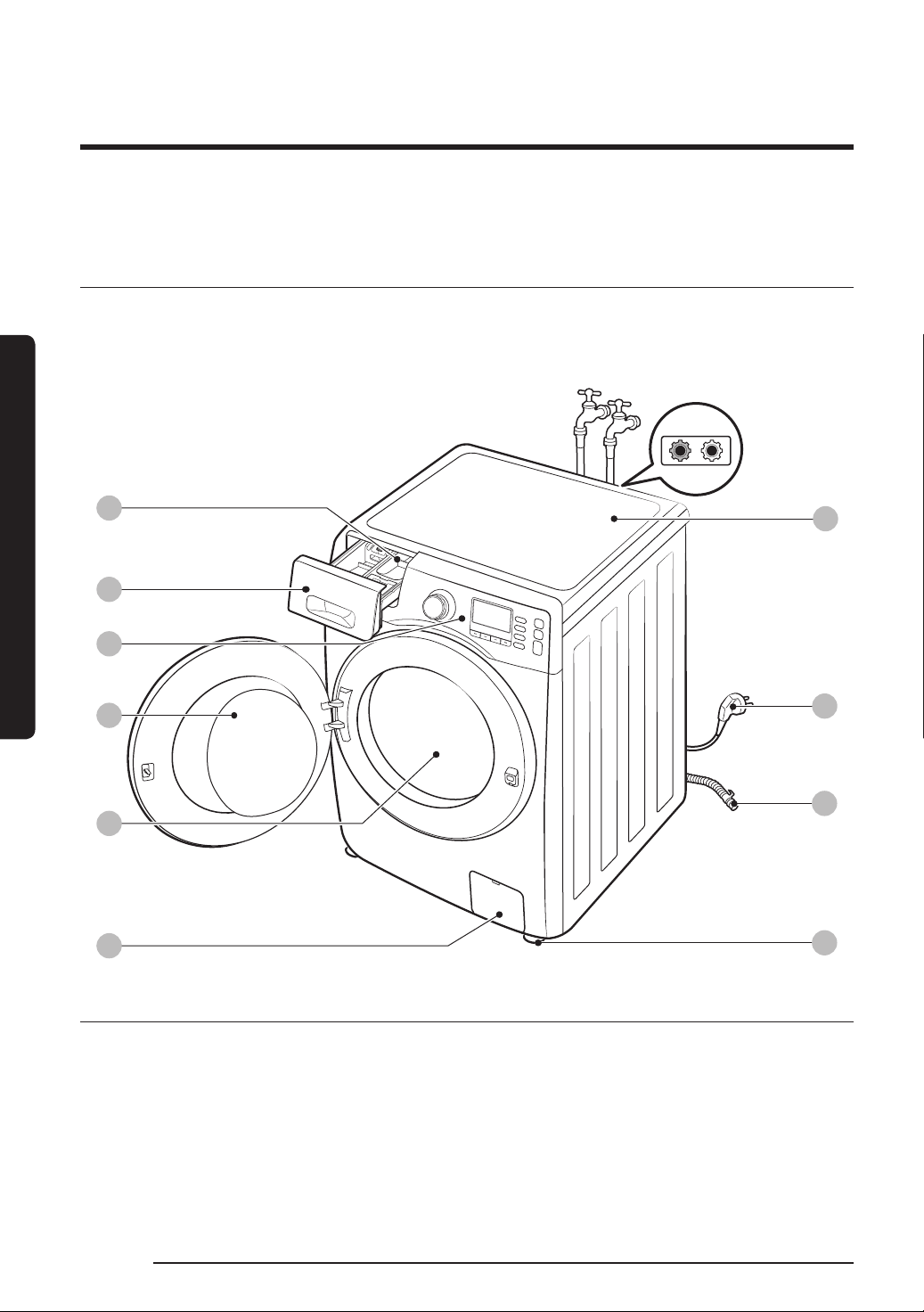
Make sure all the parts are included in the product package. If you have a problem with
the washing machine or the parts, contact a local Samsung customer centre or the retailer.
10
06
01
02
04
05
03
07
09
08
01 Release lever 02 Detergent drawer 03 Control panel
04 Door 05 Drum 06 Filter cover
07 Worktop 08 Power plug 09 Drain hose
10 Levelling feet
Installation
Untitled-1 14 2/12/2019 11:48:23 AM
English 15
Installation
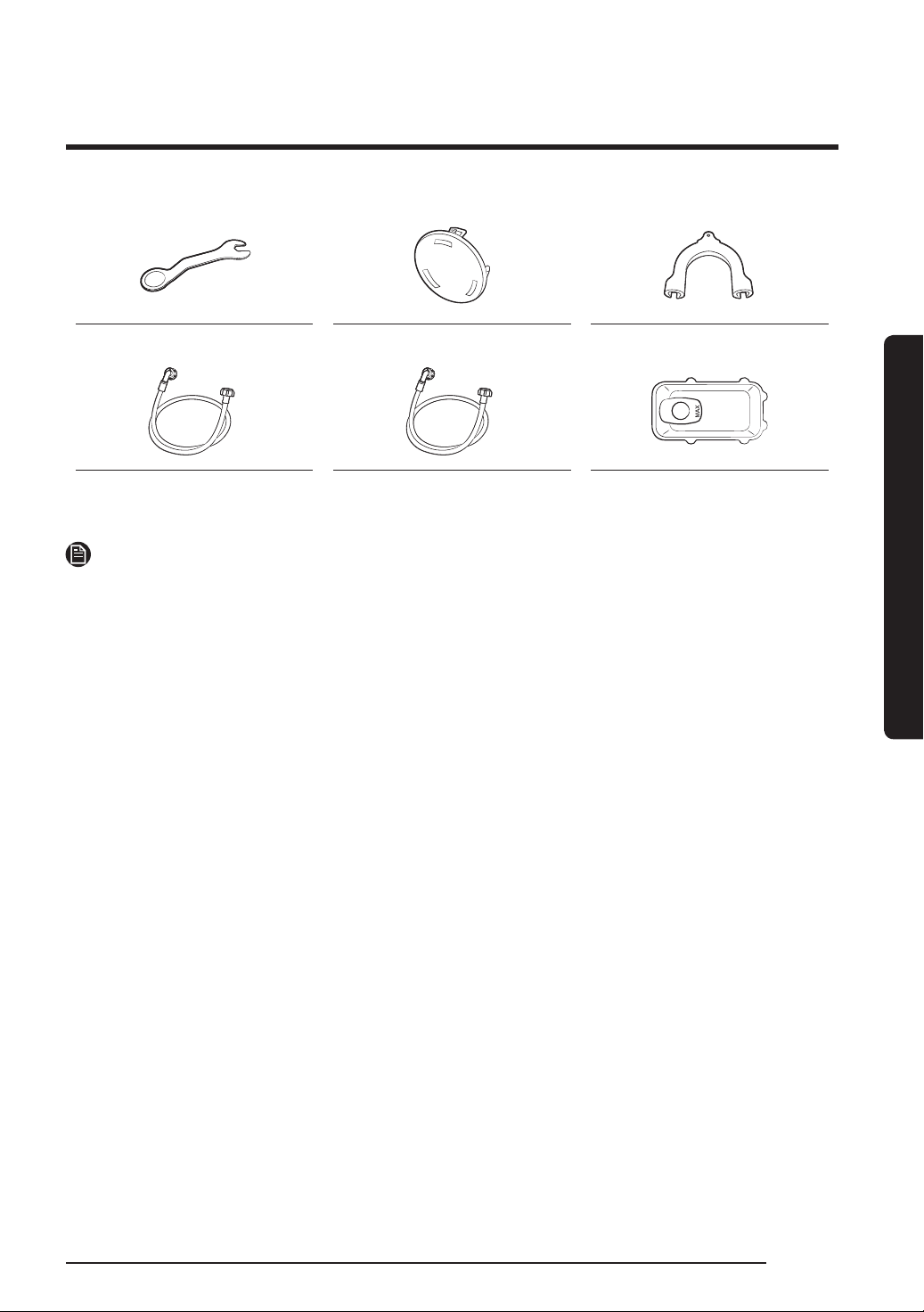
Spanner Bolt caps Hose guide
Cold water hose Hot water hose
(applicable models only)
Liquid detergent container
(applicable models only)
NOTE
Bolt caps: The provided number (3 to 6) of bolt caps depends on the model.
Untitled-1 15 2/12/2019 11:48:24 AM
Installation
English16
Installation
Installation requirements
Electrical supply and grounding
• AC 220-240 V / 50 Hz fuse or circuit
breaker is required.
• Use an individual branch circuit.
Connect only the washing machine to
the circuit.
To ensure proper grounding, the washing
machine comes with a power cord
featuring a three-prong grounding plug for
use in a properly installed and grounded
outlet.
Check with a qualied electrician or
service person if you are not sure about
the grounding.
Do not modify the provided plug. If it does
not t the outlet, call a qualied electrician
to install a proper outlet.
WARNING
• Do NOT use an extension cord.
• Use only the power cord that comes
with the washing machine.
• Do NOT connect the ground wire to
plastic plumbing, gas lines, or hot water
pipes.
• Improperly connected grounding
conductors may cause electric shock.
Water supply
A proper water pressure for this washing
machine is between 50 kPa and 800 kPa.
Water pressure less than 50 kPa may
cause the water valve not to close
completely. Or, it may take longer to ll
the drum, causing the washing machine
to turn off. Water taps must be within
120 cm from the rear of the washing
machine so that the provided inlet hoses
reach the washing machine.
To reduce the risk of leaks:
• Make sure water taps are easily
accessible.
• Turn off the taps when the washing
machine is not in use.
• Check for any leaks at the water inlet
hose ttings on a regular basis.
CAUTION
Before using the washing machine for
the rst time, check all connections at the
water valve and taps for any leaks.
Drain
Samsung recommends a standpipe 60-90
cm high. The drain hose must be connected
through the hose clip to the standpipe, and
the standpipe must fully cover the drain
hose.
Untitled-1 16 2/12/2019 11:48:24 AM
English 17
Installation
Flooring
For best performance, the washing
machine must be installed on a solid oor.
Wood oors may need to be reinforced
to minimise vibration and/or unbalanced
loads. Carpeting and soft tile surfaces do
not provide good resistance to vibrations
and may cause the washing machine to
move slightly during the spin cycle.
CAUTION
Do NOT install the washing machine on a
platform or a poorly supported structure.
Water temperature
Do not install the washing machine in
areas where water may freeze as the
washing machine always retains some
water in its water valves, pumps, and/or
hoses. Frozen water left in the connection
parts may cause damage to belts, the
pump, and other components of the
washing machine.
Alcove installation
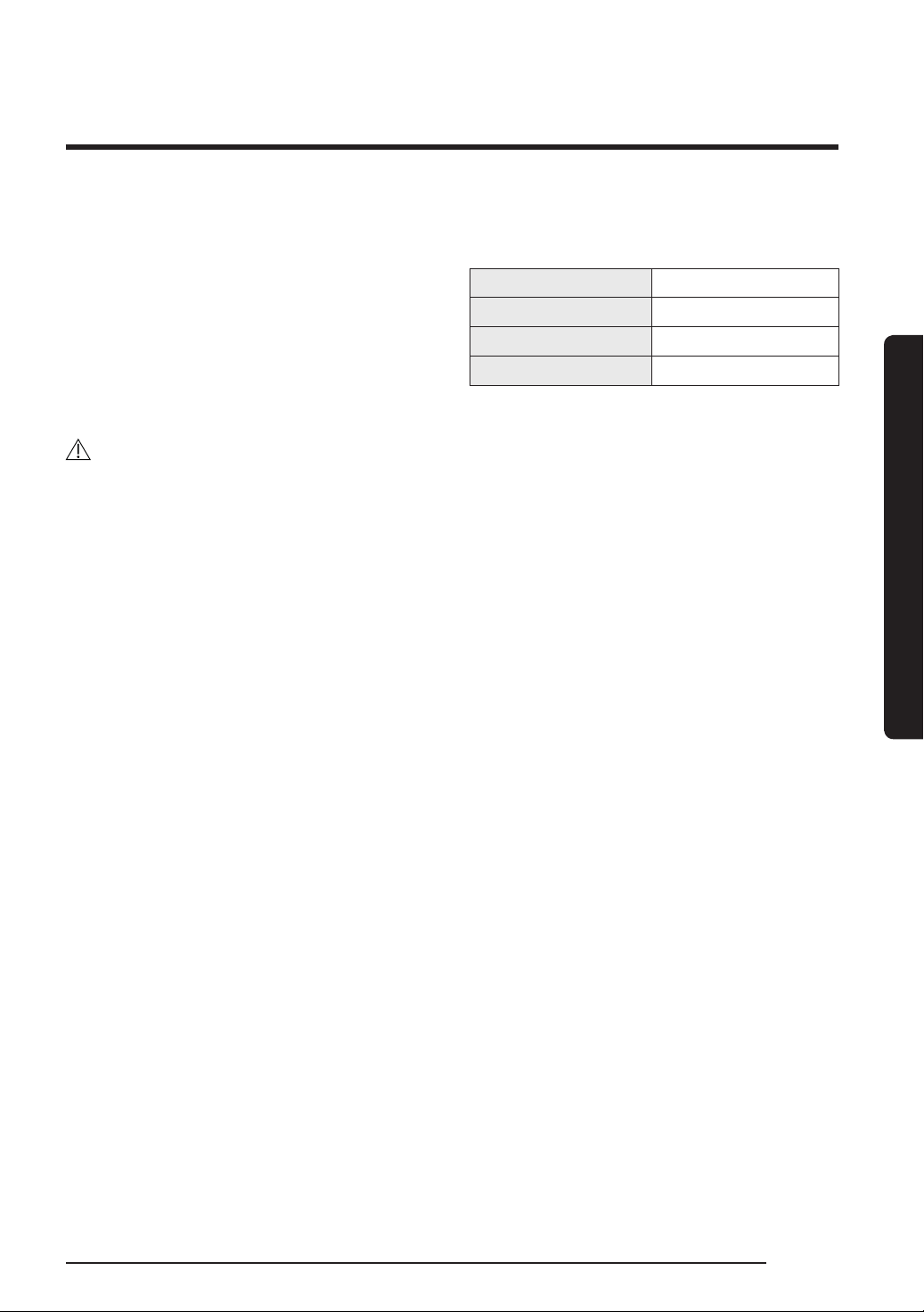
Minimum clearance for stable operation:
Sides 25 mm
Top 25 mm
Rear 50 mm
Front 550 mm
If both the washing machine and a dryer
are installed in the same location, the front
of the alcove must have at least a 550 mm
unobstructed air opening. Your washing
machine alone does not require a specic
air opening.
Untitled-1 17 2/12/2019 11:48:24 AM
Installation
English18
Installation
Step-by-step installation
STEP 1 Select a location
Location requirements:
• A solid, level surface without carpeting or ooring that may obstruct ventilation
• No direct sunlight
• Adequate room for ventilation and wiring
• Ambient temperature always higher than the freezing point (0 °C)
• Away from a heat source
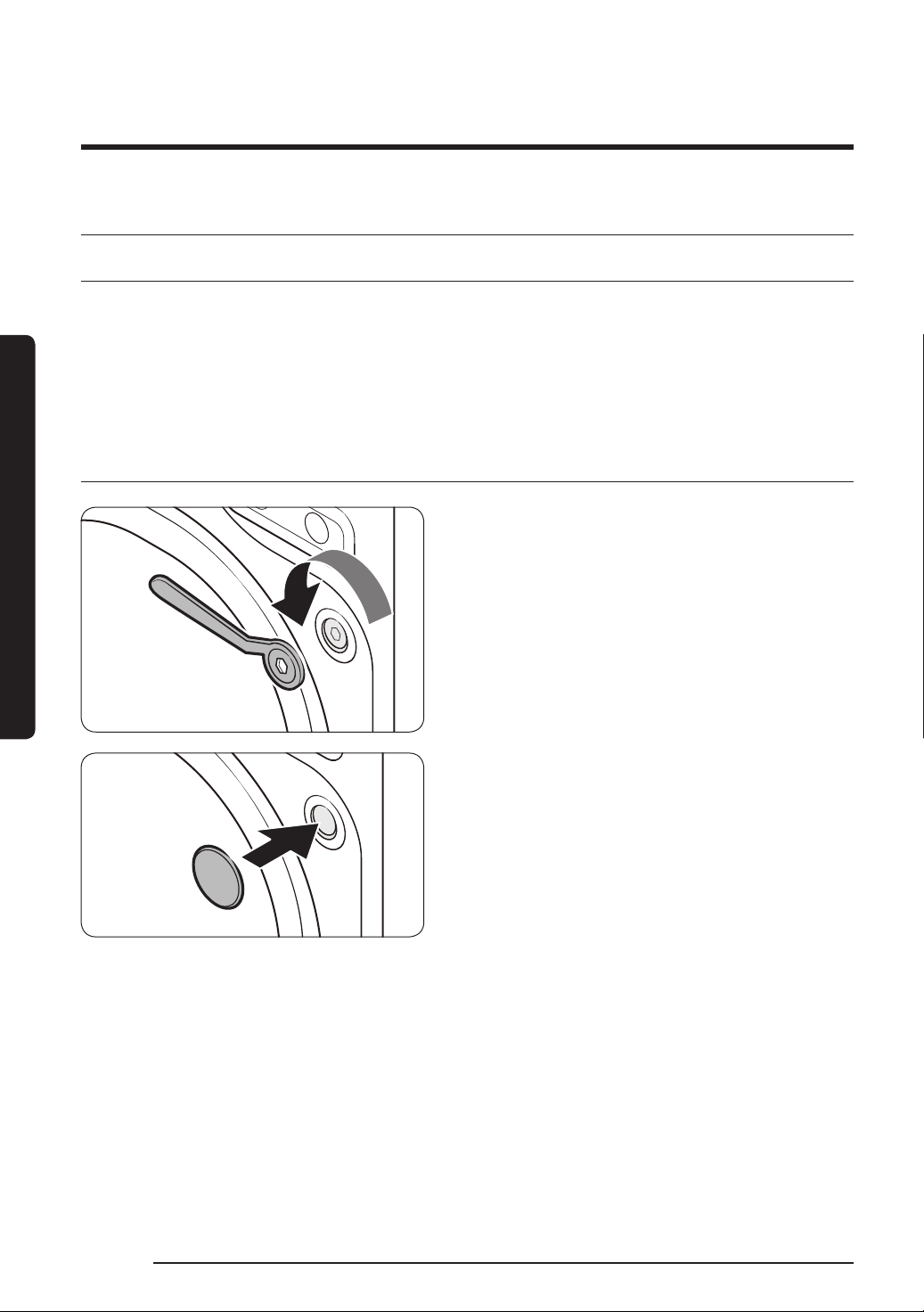
STEP 2 Remove the shipping bolts
Unpack the product package and remove
all shipping bolts.
1. Loosen all shipping bolts on the rear of
the machine using the supplied spanner.
2. Fill the holes with the supplied plastic
bolt caps.
Keep the shipping bolts for future use.
Untitled-1 18 2/12/2019 11:48:25 AM
English 19
Installation
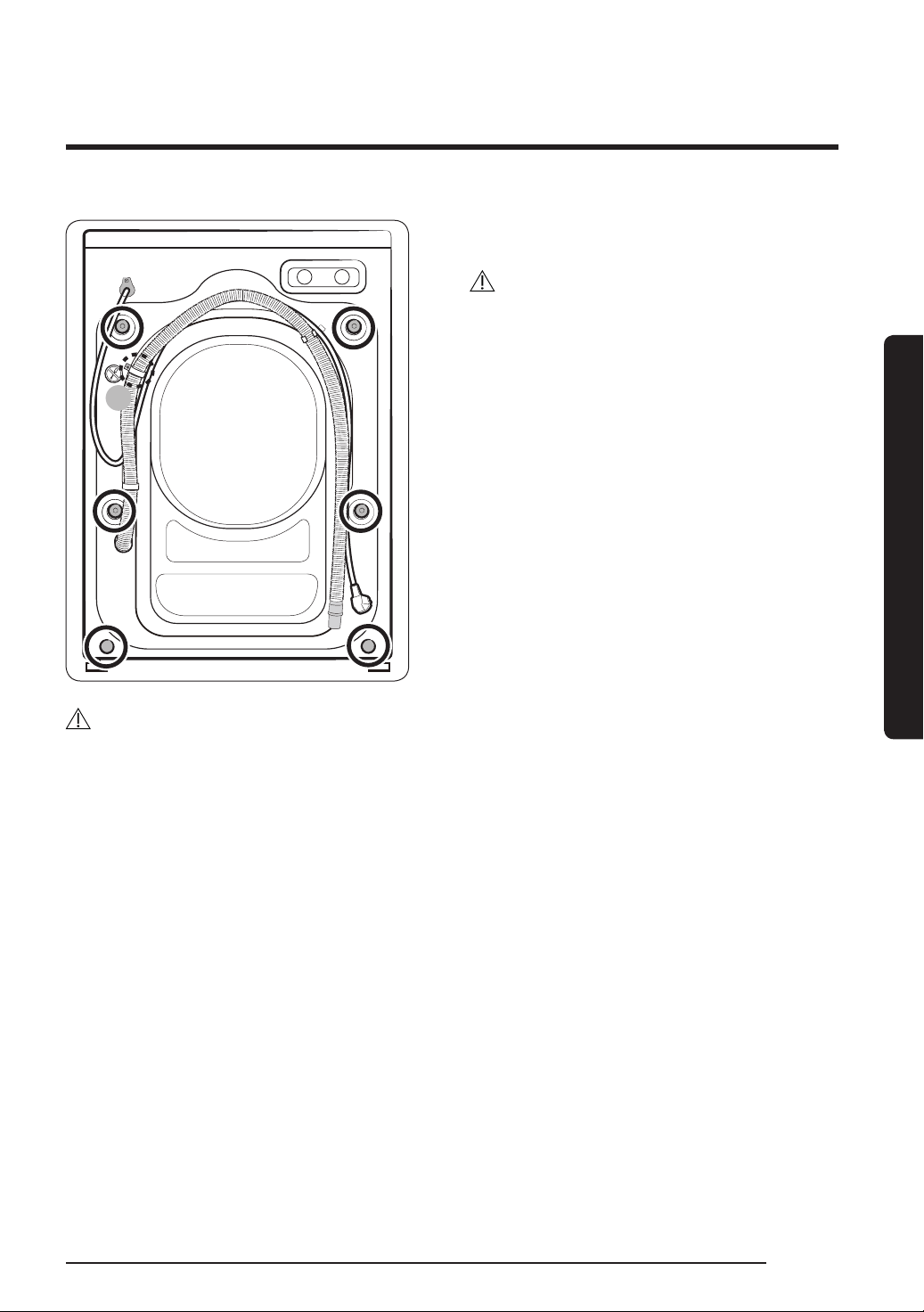
A
3. Close all plastic bolt caps on the rear of
the washing machine.
CAUTION
Do not remove the screw (A) that xes the
hose clip.
WARNING
Packaging materials can be dangerous to children. Dispose all packaging material (plastic
bags, polystyrene, etc.) out of children’s reach.
Untitled-1 19 2/12/2019 11:48:25 AM
Installation
English20
Installation
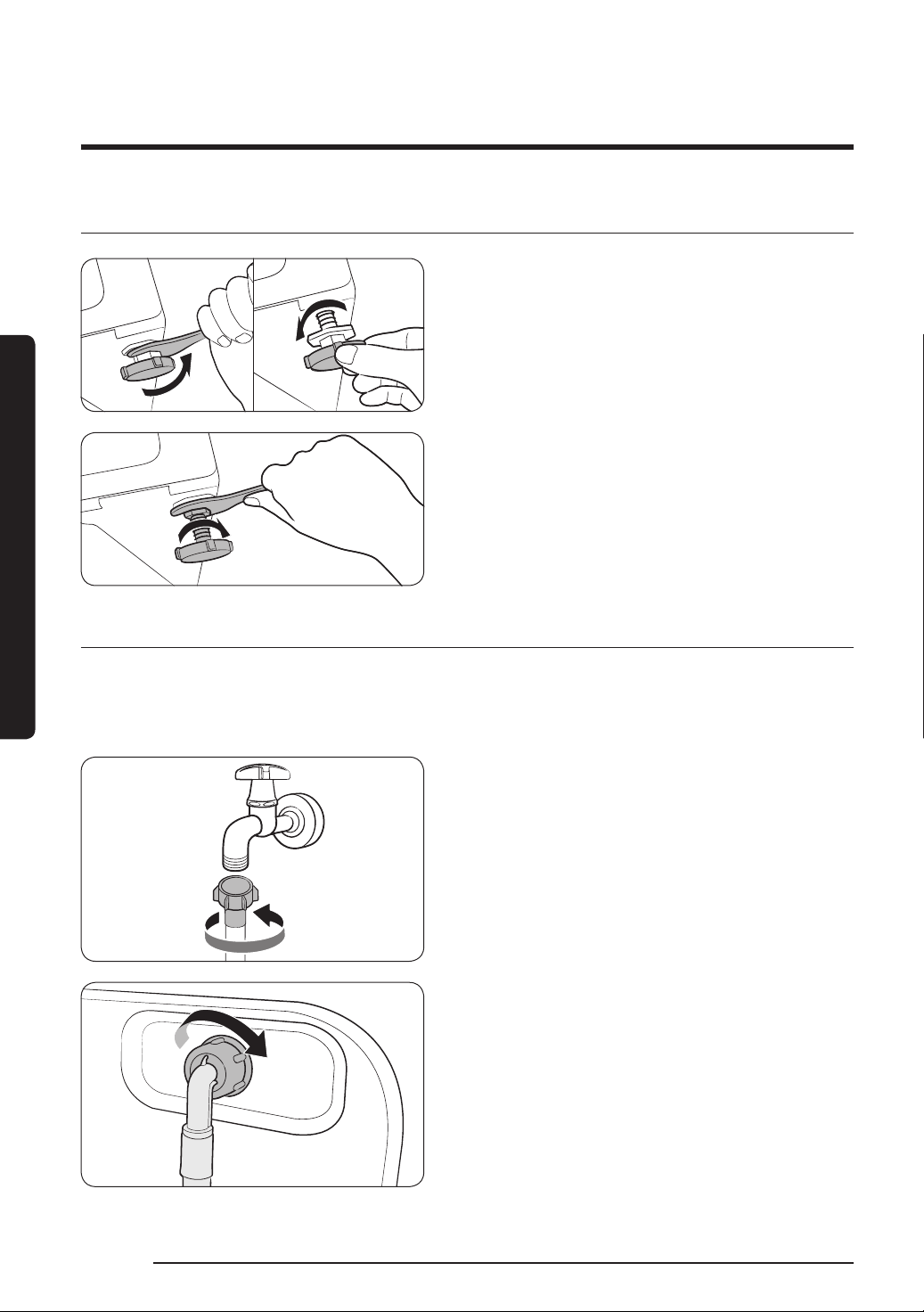
STEP 3 Adjust the levelling feet
1. Gently slide the washing machine into
position. Excessive force may damage
the levelling feet.
2. Loosen the nut with a spanner, and
then adjust the levelling feet to level
the washing machine.
3. When levelling is complete, tighten the
nuts using the spanner.
STEP 4 Connect the water hose
The provided water hose may differ depending on the model. Please follow the instruction
according to the provided water hose.
Connecting to a threaded water tap
1. Connect the water hose to the water
tap, and then turn the connector
clockwise as shown.
2. Connect the other end of the water
hose to the inlet valve on the back of
the washing machine. Turn the hose
clockwise to tighten.
Untitled-1 20 2/12/2019 11:48:26 AM
English 21
Installation
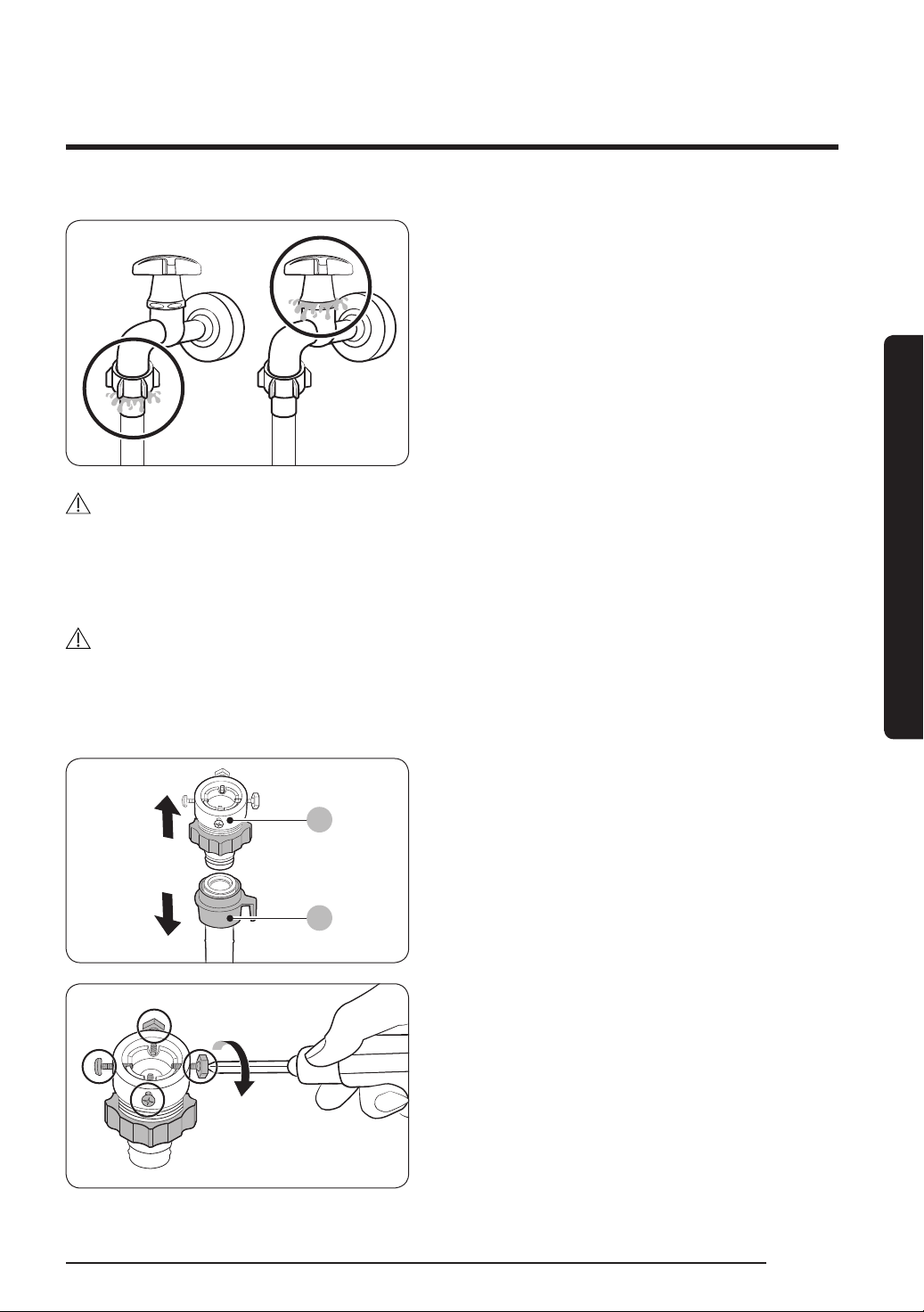
3. Open the water tap and check if there
are any leaks around the connection
areas. If there are water leaks, repeat
the steps 1-2.
WARNING
If there is a water leak, stop operating the washing machine and disconnect from the
electrical supply. Then, contact a local Samsung service centre in case of a leak from
the water hose, or contact a plumbing technician in case of a leak from the water tap.
Otherwise, this may cause electric shock.
CAUTION
Do not stretch the water hose by force. If the hose is too short, replace the hose with a
longer, high-pressure hose.
Connecting to a non-threaded water tap
A
B
1. Remove the adaptor (A) from the water
hose (B).
2. Use a Phillips screwdriver to loosen
four screws on the adaptor.
Untitled-1 21 2/12/2019 11:48:27 AM
Installation
English22
Installation
C
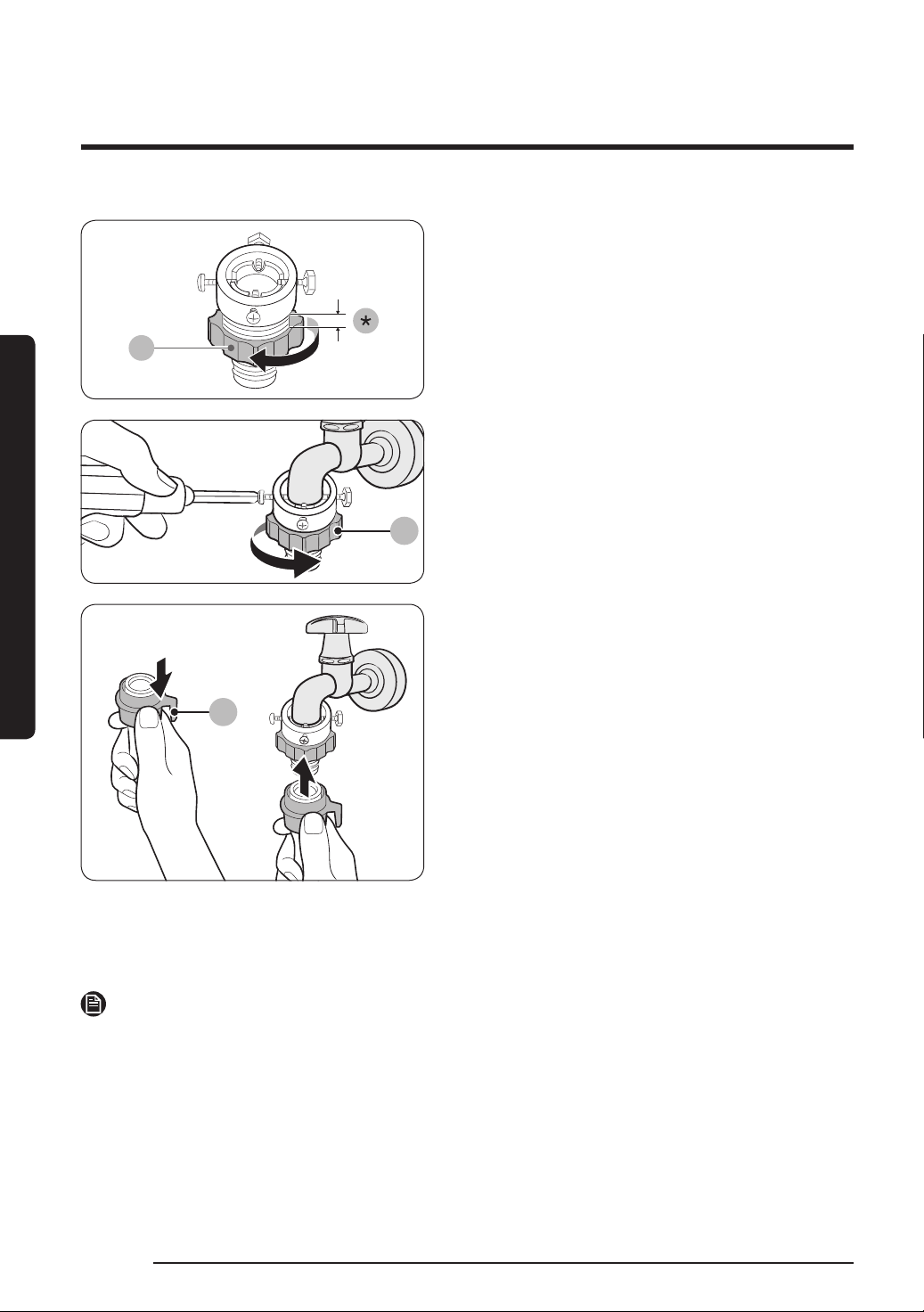
3. Hold the adaptor and turn part (C) in
the arrow direction to loosen it by 5
mm (*).
C
4. Insert the adaptor onto the water tap,
and then tighten the screws while
lifting the adaptor.
5. Turn part (C) in the arrow direction to
tighten it.
D
6. While pulling down part (D) on the
water hose, connect the water hose to
the adaptor. Then, release part (D). The
hose ts into the adaptor with a clicking
sound.
7. To complete connecting the water hose,
see 2 and 3 on the “Connecting to a
threaded water tap” section.
NOTE
• After connecting the water hose to the adaptor, check if it is connected properly by
pulling the water hose downwards.
• Use a popular type of water taps. If the tap is square-shaped or too big, remove the
spacer ring before inserting the tap into the adaptor.
Untitled-1 22 2/12/2019 11:48:27 AM
English 23
Installation
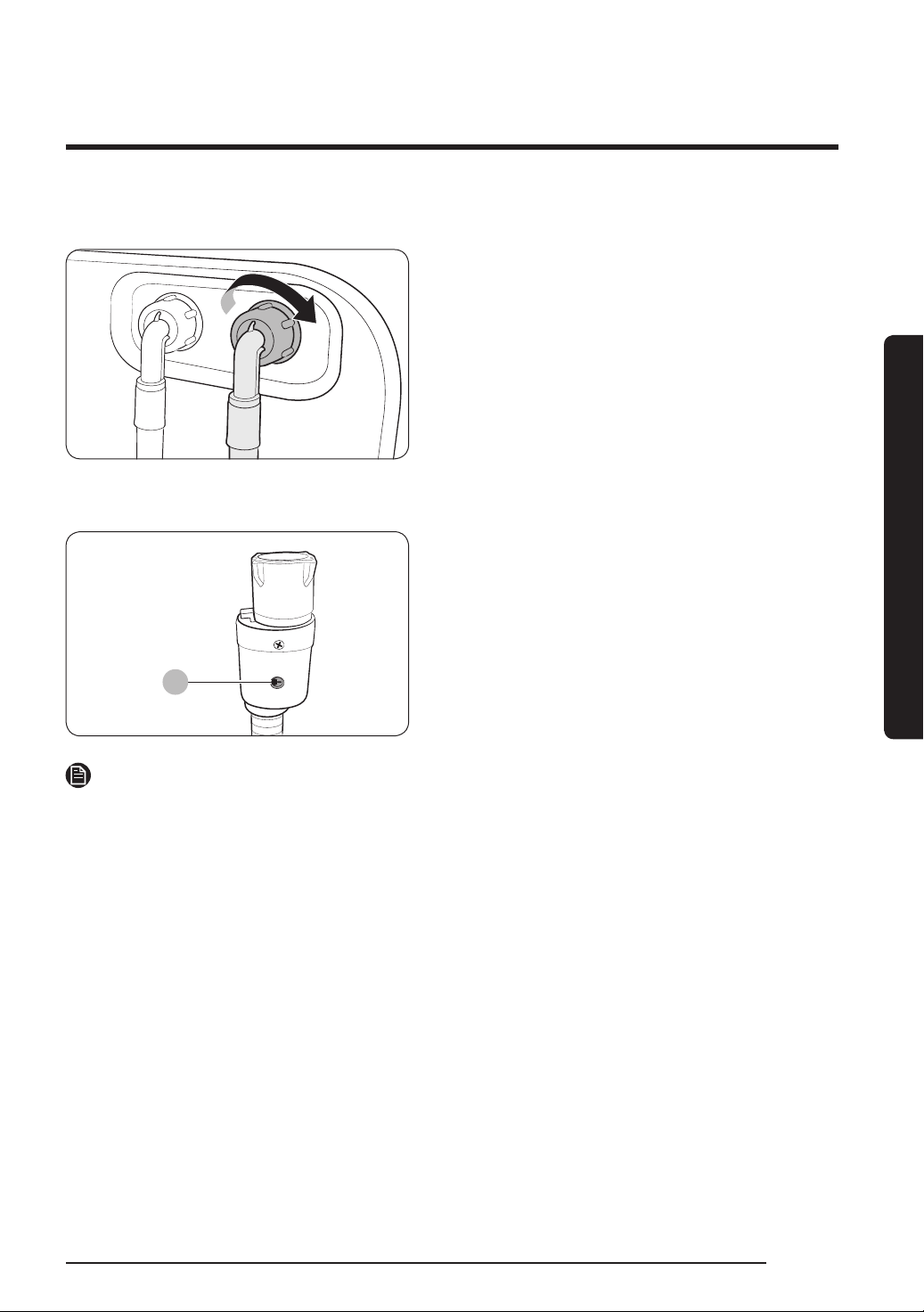
For models with an additional hot water inlet:
1. Connect the red end of the hot water
hose to the hot water inlet on the back
of the machine.
2. Connect the other end of the hot water
hose to the hot water tap.
Aqua stop hose (applicable models only)
A
The aqua stop hose alerts users of a risk
of water leaks. It senses the water ow
and turns red on the centre indicator (A) in
case of a leak.
NOTE
The end of the aqua stop hose must be tted to the water tap and not the machine.
Untitled-1 23 2/12/2019 11:48:28 AM
Installation
English24
Installation
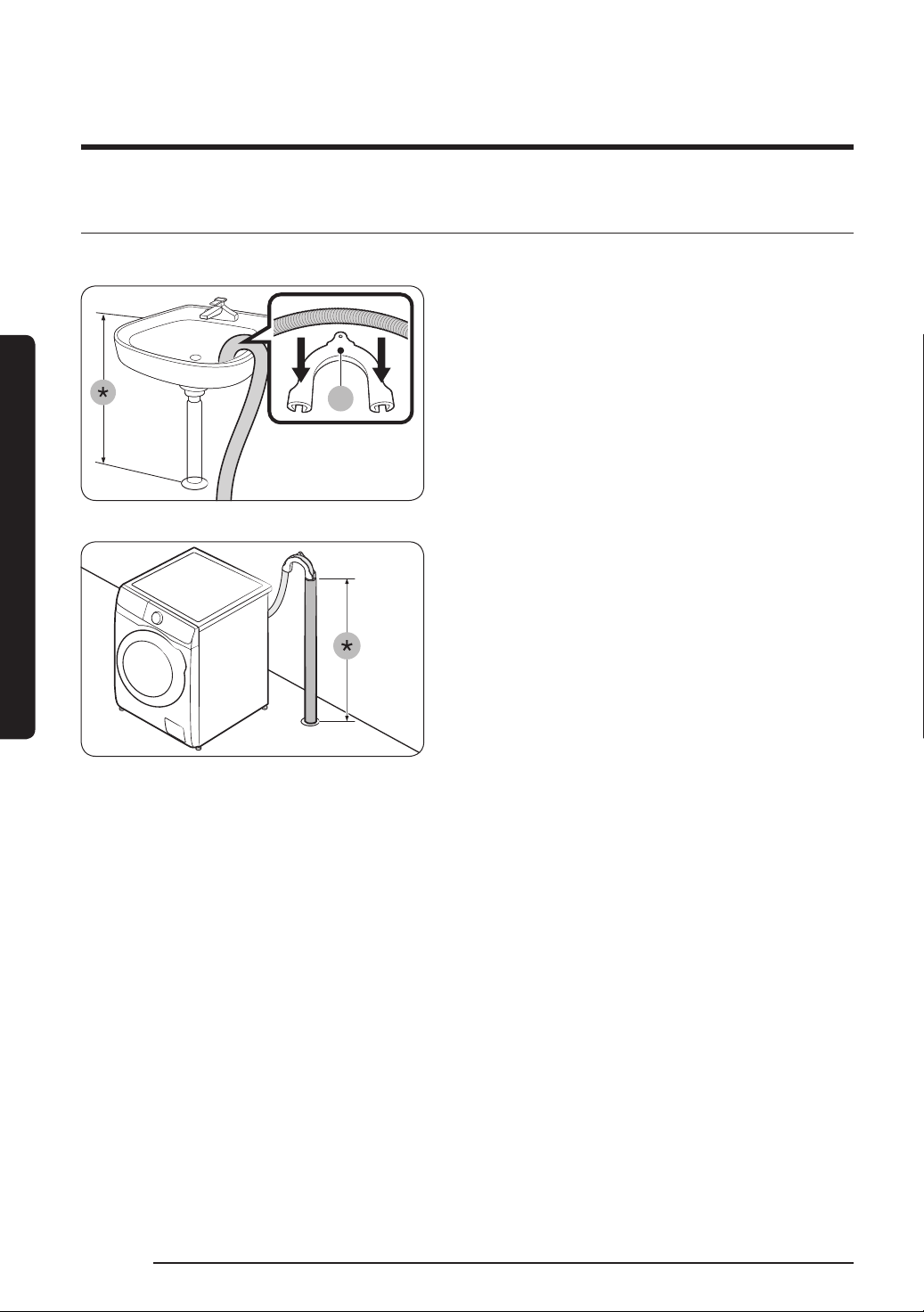
STEP 5 Position the drain hose
The drain hose can be positioned in three ways:
A
Over the edge of a wash basin
The drain hose must be placed at a height
of between 60 cm and 90 cm (*) from the
oor. To keep the spout of the drain hose
bent, use the supplied plastic hose guide
(A). Secure the guide to the wall using a
hook to ensure stable drainage.
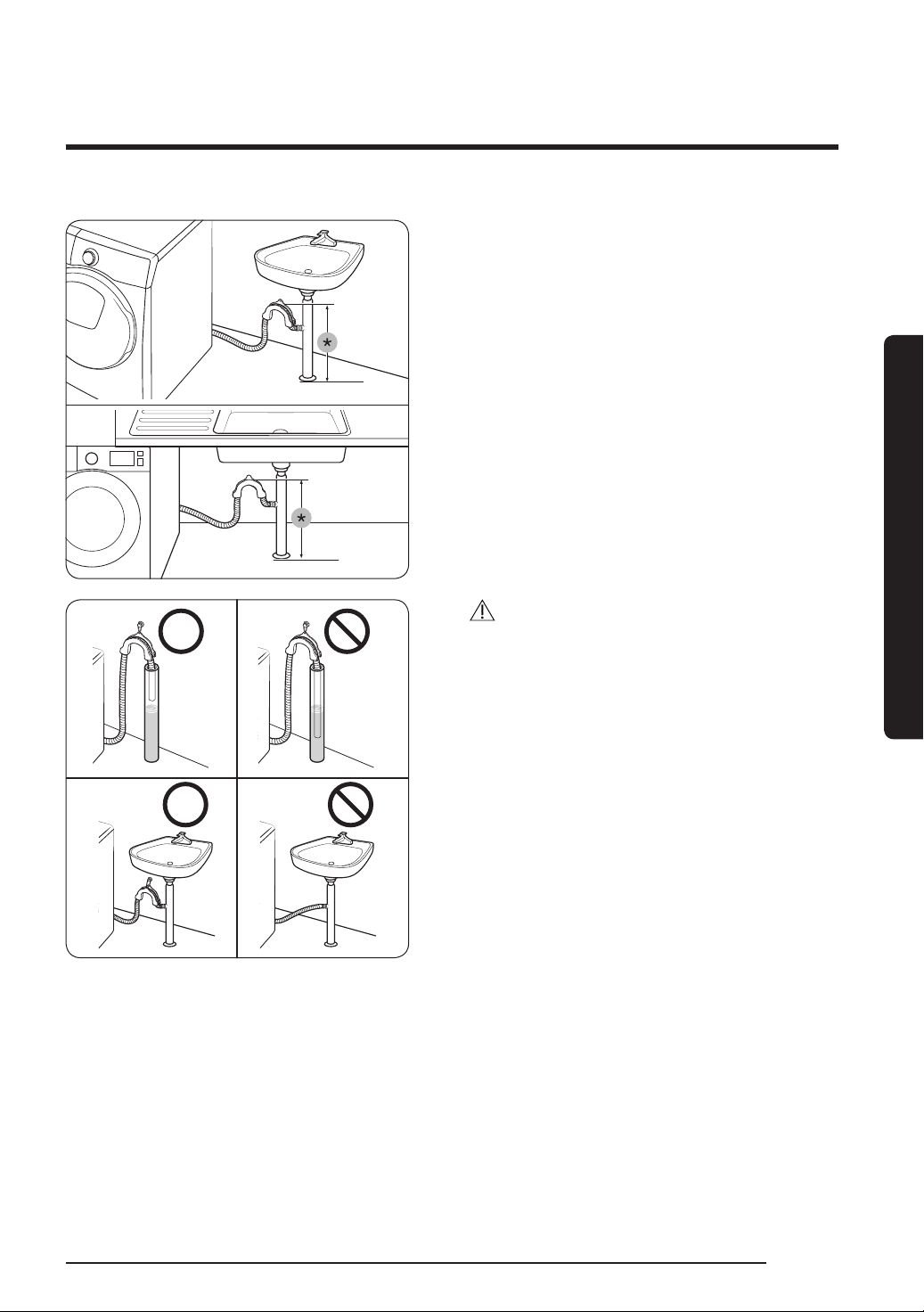
In a drain pipe
The drain pipe should be between 60 cm
and 90 cm high (*). It is advisable to use a
65 cm high vertical pipe.
• To ensure the drain hose stays in
position, use the plastic hose guide
provided (see the gure).
• To prevent the siphoning of water ow
during drainage, make sure to insert the
drain hose 15 cm in the drain pipe.
• To prevent the drain hose from moving
around, secure the hose guide to the
wall.
Drain standpipe requirements:
• Minimum diameter of 5 cm
• Minimum carry-away capacity of
60 litres per minute
Untitled-1 24 2/12/2019 11:48:28 AM
English 25
Installation
In a sink drain pipe branch
The drain pipe branch mush be above the
sink siphon so that the end of the hose is
at least 24 in. (60 cm) above the ground.
(*) : 24 in. (60 cm)
CAUTION
Do not put the drain hose in places of
stagnant water or ponding. The water may
ow back to the washing machine.
Untitled-1 25 2/12/2019 11:48:29 AM

Installation
English26
Installation
STEP 6 Power on
Plug the power cord into an AC 220-240 V / 50 Hz approved electrical outlet protected by
a fuse or circuit breaker. Then, press Power to turn on the washing machine.
Environment
Please dispose of the packaging materials for this product in an “environmentally friendly”
manner. For further detail, please contact your local area authority.
Untitled-1 26 2/12/2019 11:48:29 AM
English 27
Before you start
Initial settings
Run calibration (recommended)
Calibration ensures accurate weight detection by the washing machine. Make sure the
drum is empty before running calibration.
1. Power off, and then power on the washing machine.
2. Press and hold Temp. and Delay End simultaneously for 3 seconds to enter the
Calibration mode. The "Cb" message appears.
- The buttons may differ with the models. Check your model.
3. Press Start/Pause to run the Calibration cycle. The drum will rotate clockwise and
counter-clockwise for about 3 minutes.
4. When the cycle is complete, "0" appears on the display and the washing machine will
turn off automatically. The washing machine is now ready for use.
Laundry guidelines
STEP 1 Sort
Sort the laundry according to these criteria:
• Care Label: Sort the laundry into cottons, mixed bres, synthetics, silks, wools, and
rayon.
• Colour: Separate whites from colours.
• Size: Mixing different sized items together in the drum improves the washing
performance.
• Sensitivity: Wash delicate items separately. For pure, new woolen items, curtains, and
silk items, check the labels on the items.
NOTE
Make sure to check the care label on all clothing, and sort clothing accordingly before
starting the wash.
Before you start
Untitled-1 27 2/12/2019 11:48:29 AM
Before you start
English28
Before you start
STEP 2 Empty pockets
Empty all the pockets of your laundry items
• Metal objects such as coins, pins, and buckles on clothing may damage other laundry
items as well as the drum.
Turn clothing with buttons and embroideries inside out
• If trousers or jacket zippers are open while washing, the drum may be damaged.
Zippers should be closed and xed with a string.
• Clothing with long strings may become entangled with other clothes. Make sure to tie
the strings before starting the wash.
STEP 3 Use a laundry net
• Brassieres (machine washable) must be placed in a laundry net. Metal parts of the
brassieres may break through and tear other laundry items.
• Small, light clothing such as socks, gloves, stockings, and handkerchiefs may become
caught around the door. Place them inside a ne laundry net.
• Do not wash the laundry net by itself without other laundry. This may cause abnormal
vibrations that could move the washing machine and result in injury.
STEP 4 Prewash (if necessary)
Select the Pre Wash option for the selected cycle if the laundry is heavily soiled. Do not
use the Pre Wash option when detergent is manually added into the drum.
STEP 5 Determine the load capacity
Do not overload the washing machine. Overloading may cause the washing machine to
not wash properly. For the load capacity for the type of clothing, see page 37.
NOTE
When washing bedding or bedding covers, the wash time may be lengthened or the spin
efciency may be reduced. For bedding or bedding covers, the recommended maximum
spin cycle speed is 800 rpm, and the load capacity is 2.0 kg or less.
CAUTION
• Unbalanced laundry may reduce the spinning performance.
• Make sure the laundry is fully inserted in the drum and not caught in the door.
• Do not slam the door. Close the door gently. Otherwise, the door may not be closed
properly.
Untitled-1 28 2/12/2019 11:48:29 AM
English 29
Before you start
STEP 6 Add the correct detergent type
The type of detergent depends on the type of fabric (cotton, synthetic, delicate items,
wool), colour, wash temperature, and degree of soiling. Make sure to use the laundry
detergent that is designed for automatic washing machines.
NOTE
• Follow the detergent manufacturer’s recommendations based on the weight of the
laundry, the degree of soiling, and the hardness of the water in your local area. If you
are not sure about the water hardness, contact a local water authority.
• Do not use detergent that tends to harden or solidity. This detergent may remain after
the rinse cycle, blocking the drain outlet.
• Powdered detergent should be thoroughly dissolved in a small amount of warm water
before adding to the machine.
• If too many bubbles occur during a cycle, a message of “Sud” will be displayed.
CAUTION
When washing wool using the WOOL
cycle, use a detergent dedicated to wool items. If
used with the WOOL cycle, powder detergent may remain on the laundry and discolour
the laundry.
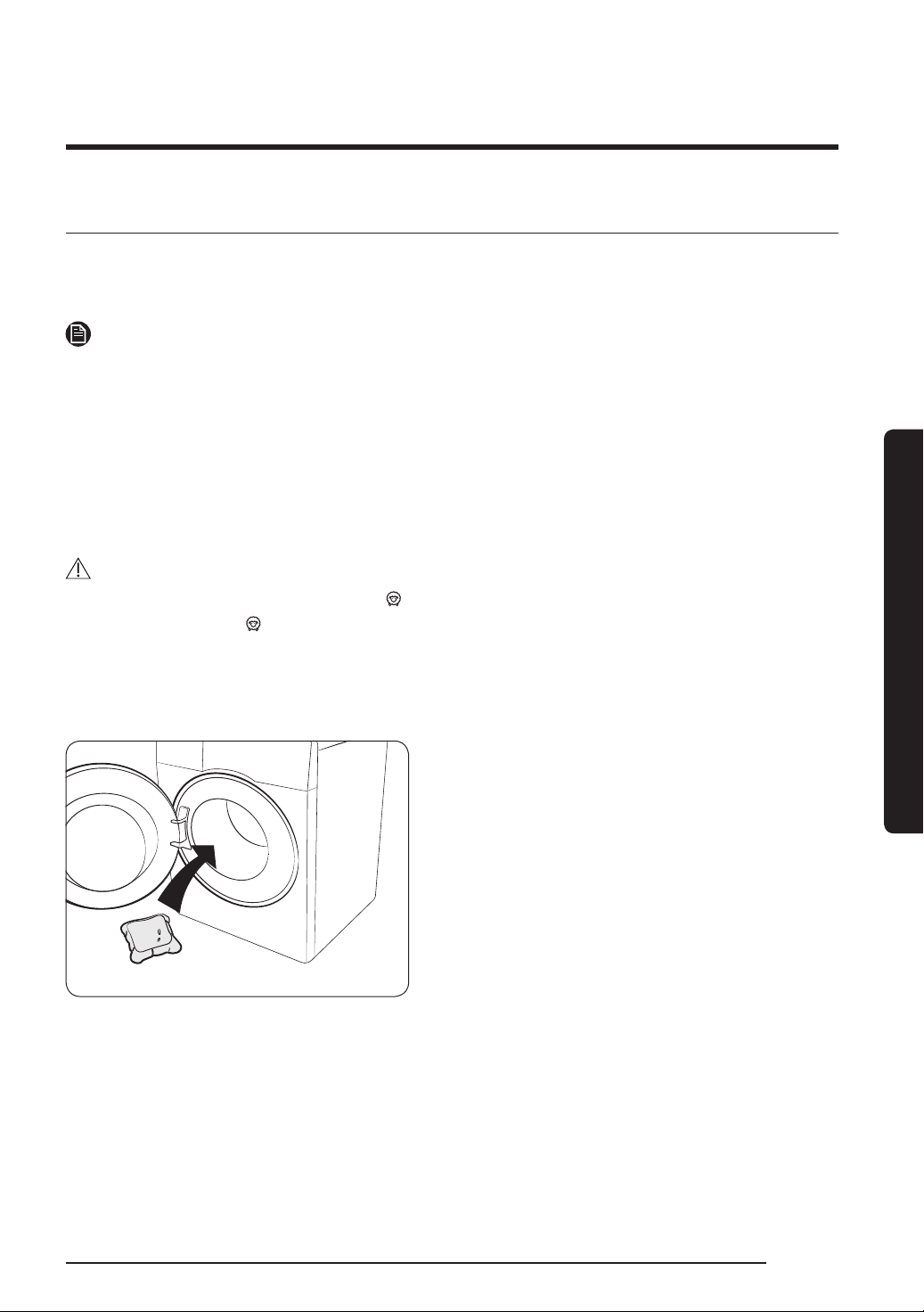
Laundry capsules
To get the best results from using laundry capsules, please follow these instructions.
1. Put the capsule in the bottom of the
empty drum towards the rear.
Untitled-1 29 2/12/2019 11:48:29 AM
Before you start
English30
Before you start
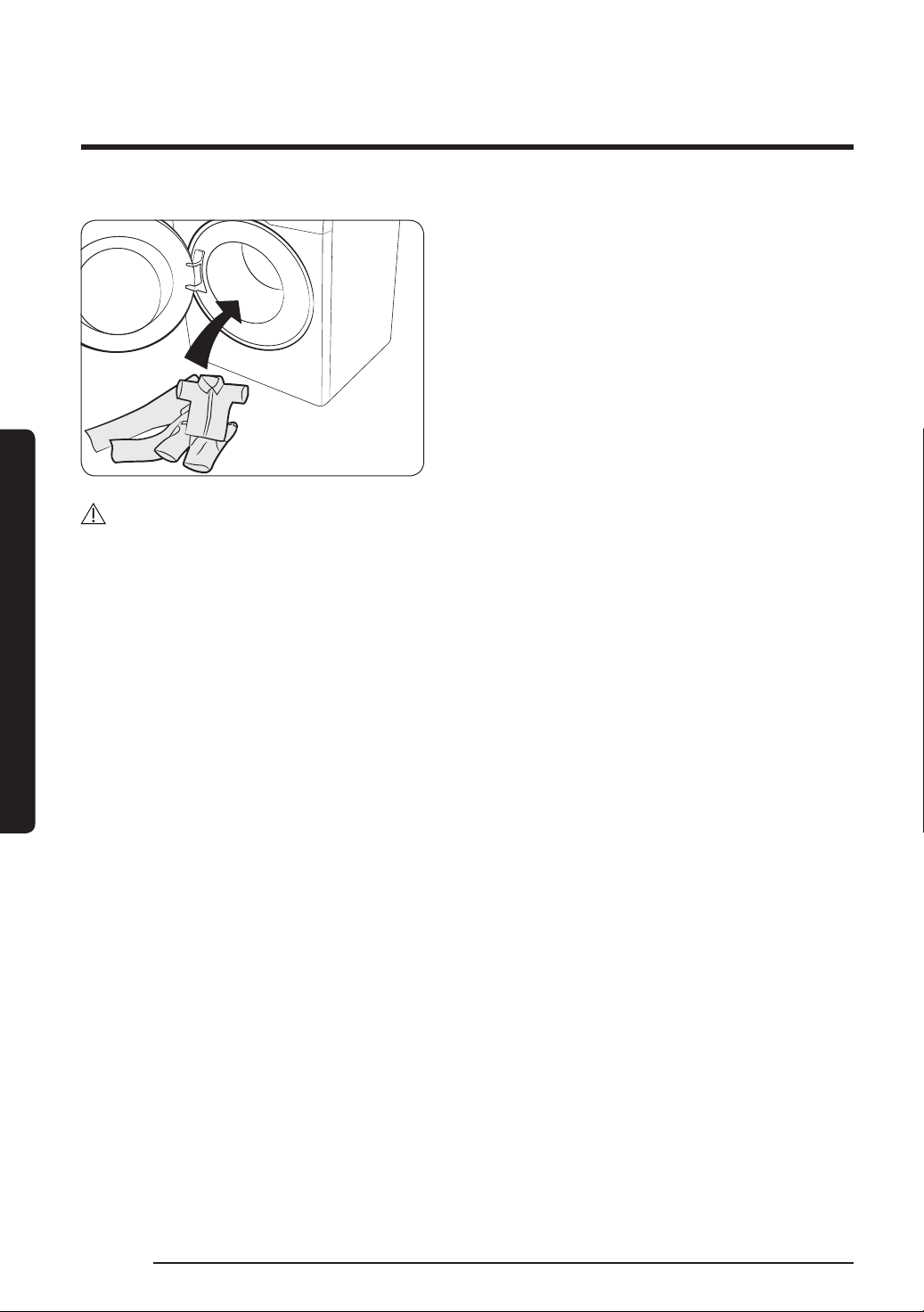
2. Put the laundry in the drum on top of
the capsule.
CAUTION
For cycles using cold water or cycles that complete in less than one hour, the capsule may
not dissolve completely.
Untitled-1 30 2/12/2019 11:48:30 AM
English 31
Before you start
Detergent drawer guidelines
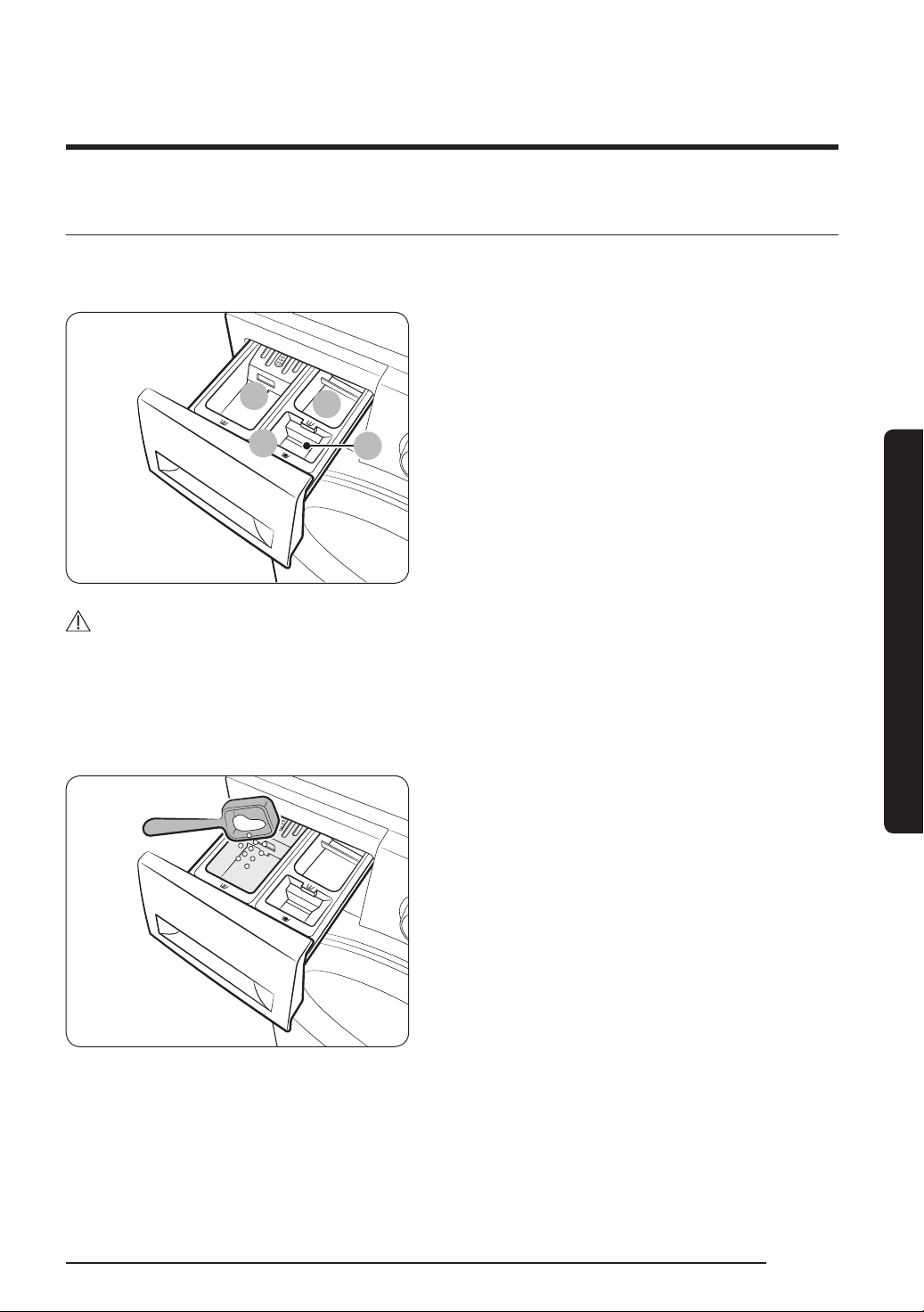
The washing machine provides a three-compartment dispenser for prewash, main-wash,
and softener.
đǹ
D
A
B
C
A. Prewash compartment: Add prewash
detergent.
B. Main-wash compartment: Add main-
wash detergent, water softener,
soaking detergent, bleach, and/or
stain removers.
C. Softener compartment: Add fabric
softener. Do not exceed the max line
(D).
CAUTION
• Do not use the following types of detergent in the drawer:
- Tablet or capsule types
- Ball or net types
To add washing agents to the detergent drawer
đǹ
1. Slide open the detergent drawer.
2. Apply laundry detergent to the main-
wash compartment as instructed or
recommended by the manufacturer. To
use liquid detergent, see page 33.
Untitled-1 31 2/12/2019 11:48:30 AM
Before you start
English32
Before you start
đǹ
đǹ
A
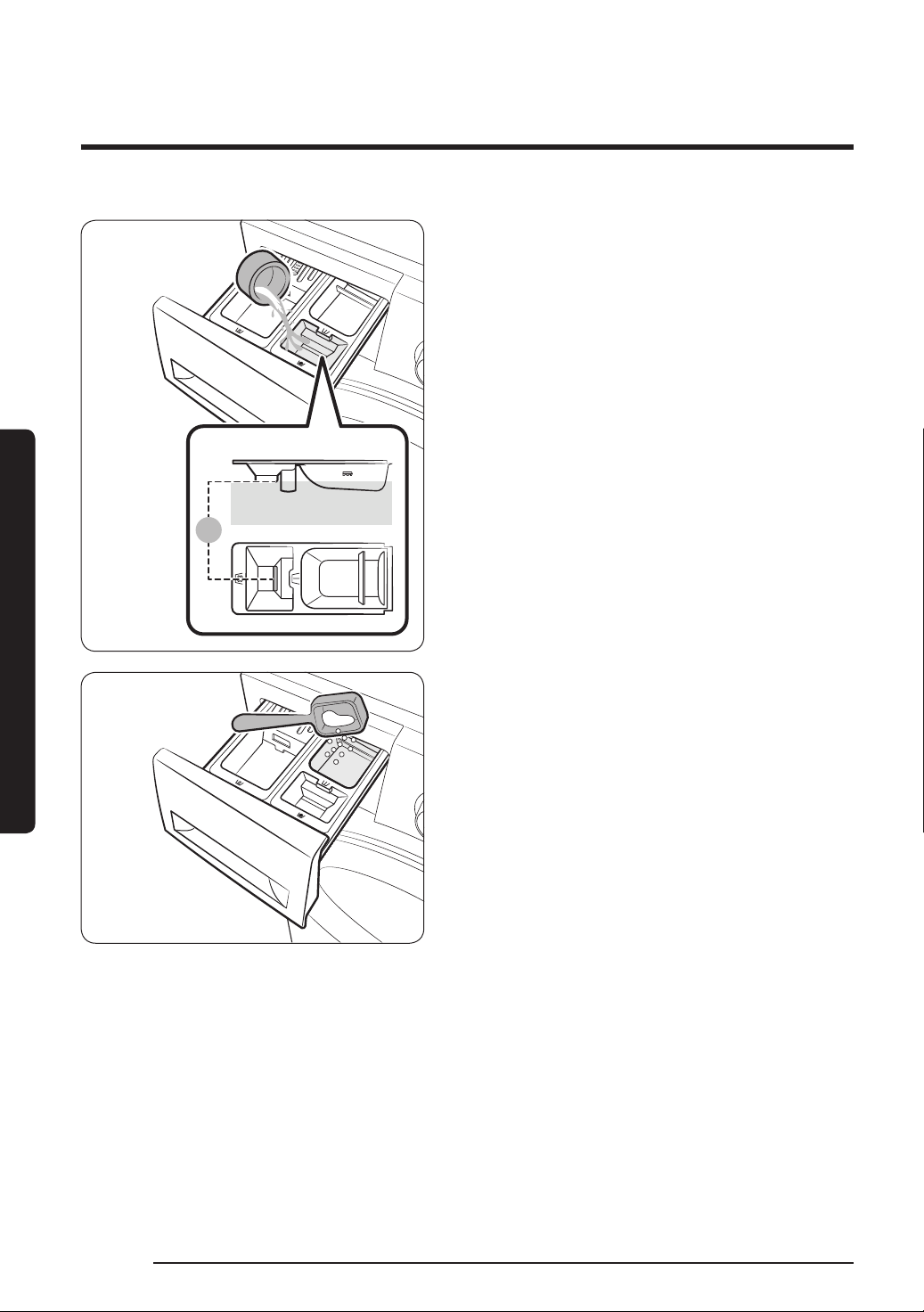
3. Apply fabric softener to the softener
compartment. Do not exceed the max
line (A).
đǹ
4. If you want to prewash, apply prewash
detergent to the prewash compartment
as instructed or recommended by the
manufacturer.
5. Close the detergent drawer.
Untitled-1 32 2/12/2019 11:48:31 AM
English 33
Before you start
đǹ
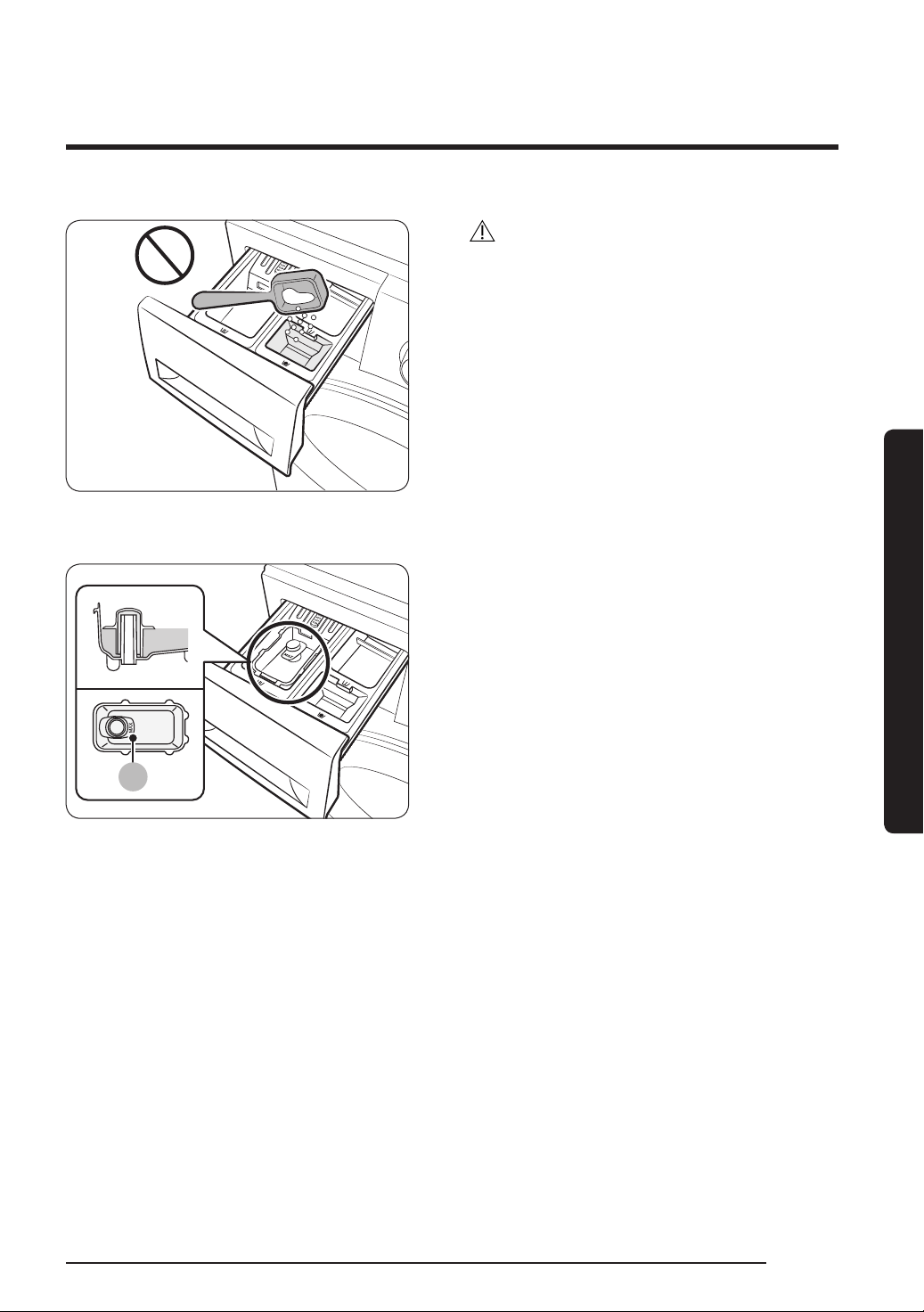
CAUTION
• Do not apply powder detergent to the
liquid detergent container.
• Concentrated fabric softener must be
diluted with water before applied.
• Do not apply main-wash detergent to
the softener compartment.
To use liquid detergent manually (applicable models only)
đǹ
A
First insert the provided liquid detergent
container in the main-wash compartment.
Then, apply liquid detergent to the
container below the marked max line (A).
Untitled-1 33 2/12/2019 11:48:31 AM
English34
Operations
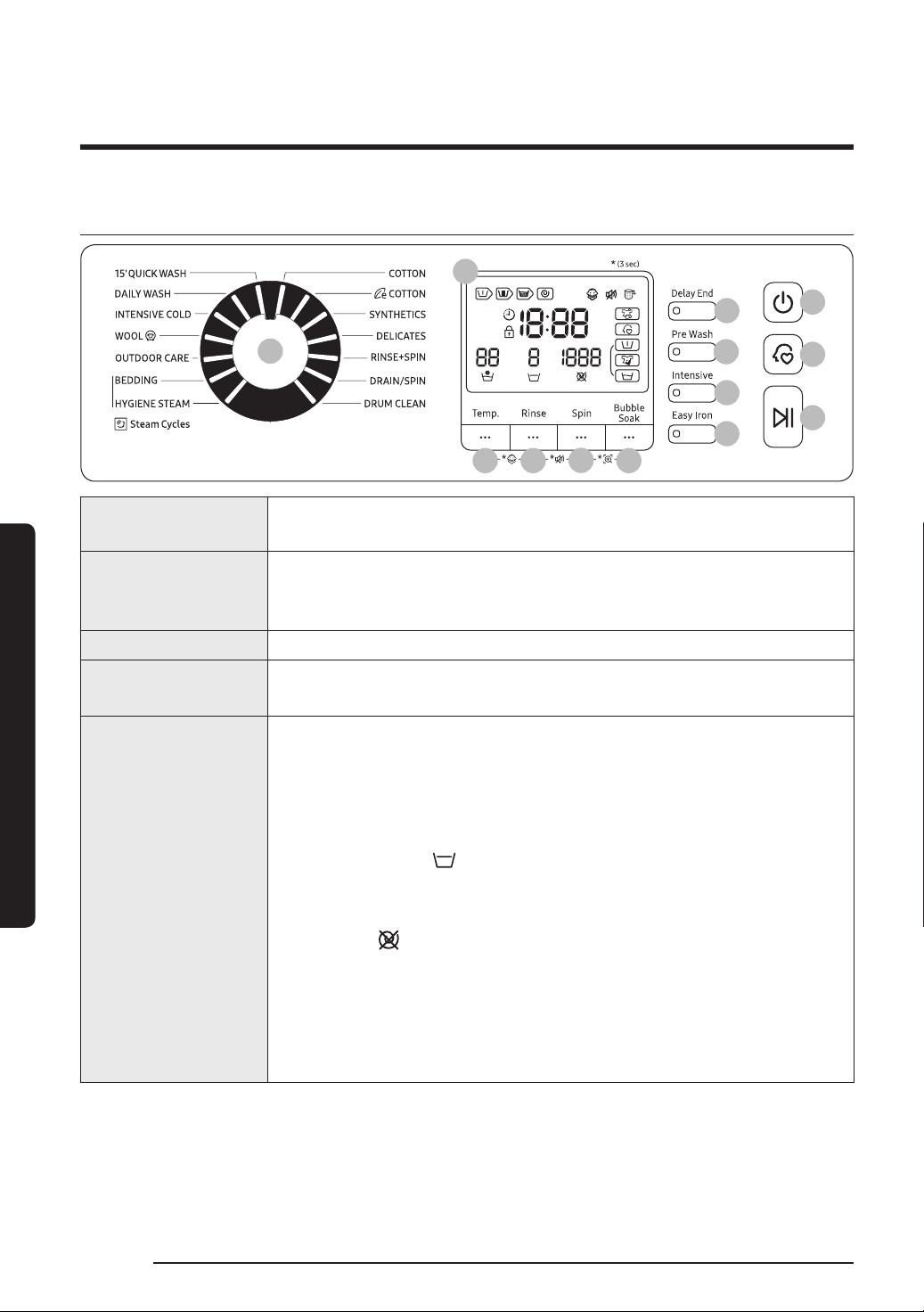
Control panel
02
03 04
05
06
07
08
09
10
11
12
13
01
01 Cycle selector
Turn the dial to select a cycle. (For more information about wash
cycles, see page 37.)
02 Display
The display shows current cycle information and estimated time
remaining, or an information code if the washing machine needs
to be checked.
03 Temp. Press to change the water temperature for the current cycle.
04 Rinse
Press to change the rinse count for the current cycle.
• You can select 1 to 5 rinses.
05 Spin
Press to change the spinning speed for the current cycle.
• Rinse Hold: The nal rinse process is suspended so that the
laundry remains in the water. To unload the laundry, run a
drain or spin process.
- To use the Rinse Hold option, press Spin repeatedly until the
Rinse Hold (
) indicator turns on.
• No Spin: The drum does not rotate after the nal drain process.
- To use the No Spin option, press Spin repeatedly until the No
Spin (
) indicator turns on.
• Spin Only: To run the Spin Only cycle, press Spin for 3 seconds.
When the cycle time and spinning speed appear, press Spin
repeatedly until a desired spinning speed is selected. Then,
press Start/Pause to start the cycle. The spinning time depends
on the selected cycle.
Operations
Untitled-1 34 2/12/2019 11:48:32 AM
English 35
Operations
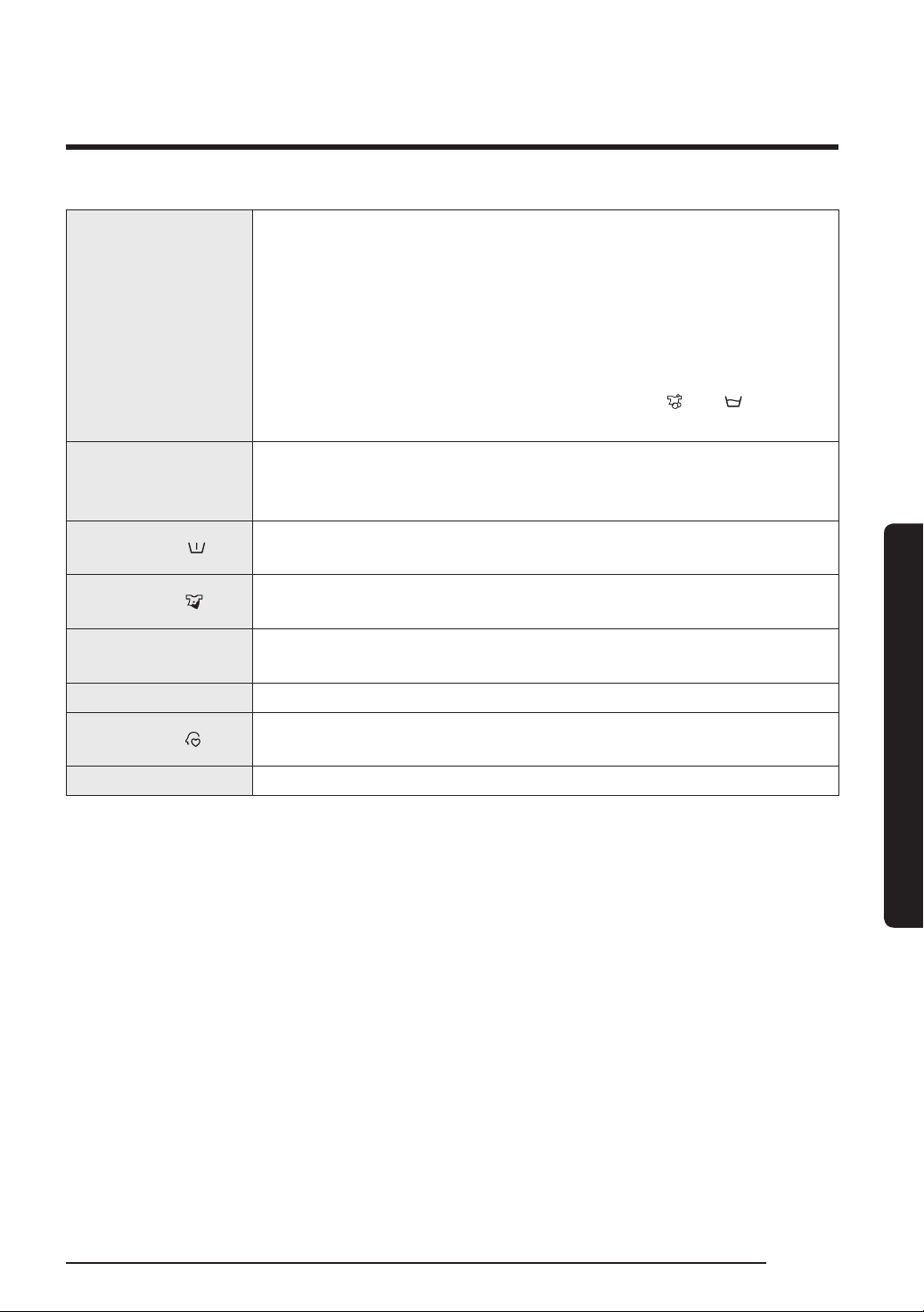
06 Bubble Soak
Press to activate/deactivate the Bubble Soak function. This
function helps remove a wide variety of stubborn stains.
• Bubble Soak helps remove a variety of stubborn stains.
• With Bubble Soak selected, laundry is thoroughly soaked in
water bubbles for effective washing.
• Bubble Soak is available with and adds up to 30 minutes to
these cycles: COTTON, SYNTHETICS, and BEDDING.
• When the Bubble Soak function is activated,
and indicators
turns on.
07 Delay End
Set the washing machine to nish your wash automatically at
later time. Choose a delay of between 1 to 24 hours (in 1 hour
increments).
08 Pre Wash
Press to add a preliminary washing process before the main wash
cycle.
09 Intensive
Press to wash badly soiled laundry. Selecting this option will add
additional operation time to the selected cycle.
10 Easy Iron
Press to reduce wrinkles on the laundry by decreasing the
spinning speed.
11 Power Press to turn the washing machine on or off.
12 My Cycle
Create your own washing cycle with preferred settings and use
the cycle with a single button push.
13 Start/Pause Press to start or stop operation.
Untitled-1 35 2/12/2019 11:48:33 AM
Operations
English36
Operations
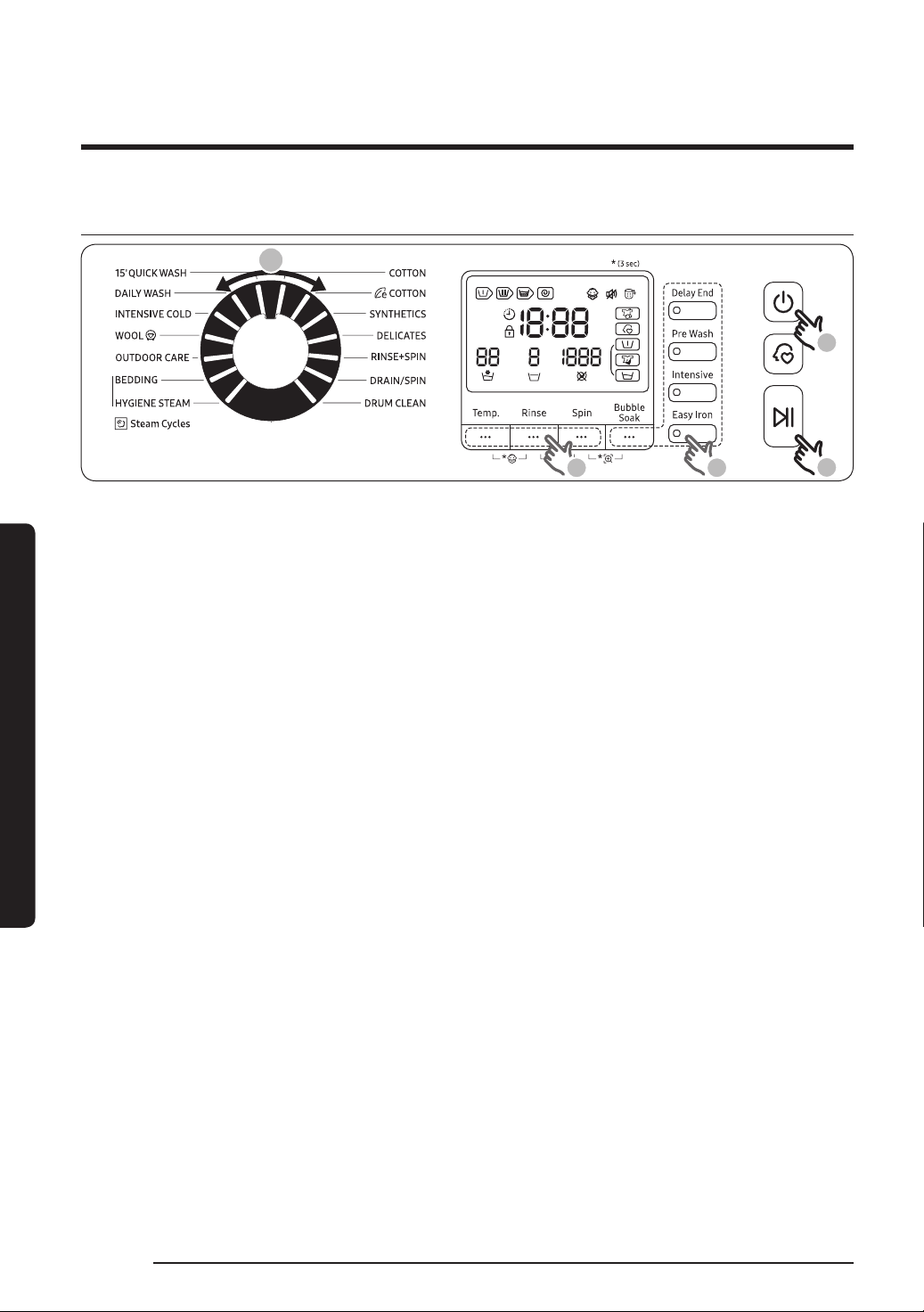
Simple steps to start
1
5
2
3 4
1. Press Power to turn on the washing machine.
2. Turn the Cycle selector to select a cycle.
3. Change the cycle settings (Temp., Rinse, and Spin) as necessary.
4. Select desired options as necessary.
5. Press Start/Pause.
To change the cycle during operation
1. Press Start/Pause to stop operation.
2. Select a different cycle, and repeat steps 2-4 above as necessasry.
3. Press Start/Pause again to start the new cycle.
Untitled-1 36 2/12/2019 11:48:33 AM
English 37
Operations
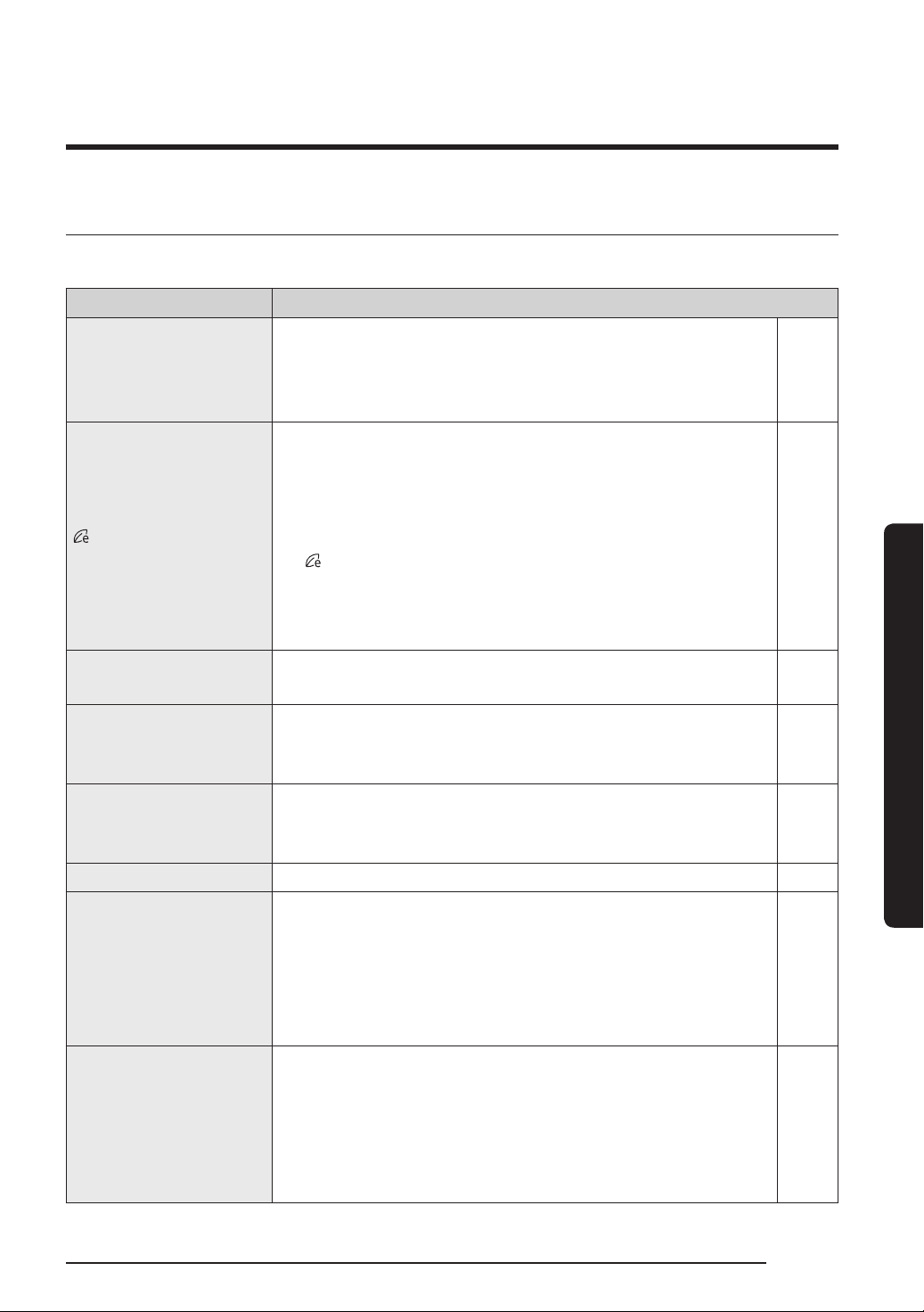
Cycle overview
Standard cycles
Cycle Description & Max load (kg)
COTTON
• For cottons, bed linens, table linens, underwear,
towels, or shirts. The washing time and the number
of rinses are automatically adjusted according to the
load.
MAX
COTTON
• Optimal performance with lower energy for cotton
fabrics, bed linens, table linens, underwear, towels, or
shirts.
For energy saving, the actual washing temperature
may be lower than specied.
•
COTTON, 40 °C, 2 rinses, Intensive, 1400 rpm spin is
suitable for a normally soiled cotton load. Energy and
water labelling test programme in accordance with
AS/NZS 2040.
MAX
SYNTHETICS
• For blouses or shirts that are made of polyester
(diolen, trevira), polyamide (perlon, nylon), or the like.
6.0
DELICATES
• For sensitive fabrics as rayon, viscose and synthetics
blended bre.
• For best performance, use liquid detergent.
2.0
RINSE+SPIN
• For loads that needs rinsing and spinning only.
• You can also select this cycle for additional rinsing
and spinning process after running other cycle.
-
DRAIN/SPIN • Select this cycle to drain the water and spin the drum. MAX
DRUM CLEAN
• Cleans the drum by removing dirt and bacteria from
it.
• Perform once every 40 washes with no detergent or
bleach added.
• Make sure the drum is empty.
• Do not add any drum cleaning agents.
-
15' QUICK WASH
For lightly soiled items in less than 2.0 kg that you want
to wash quickly.
• Use less than 20 g of detergent. Using more than 20 g
of detergent may leave detergent residue.
• For liquid detergent, use a max of 20 ml of liquid
detergent.
2.0
Untitled-1 37 2/12/2019 11:48:34 AM
Operations
English38
Operations
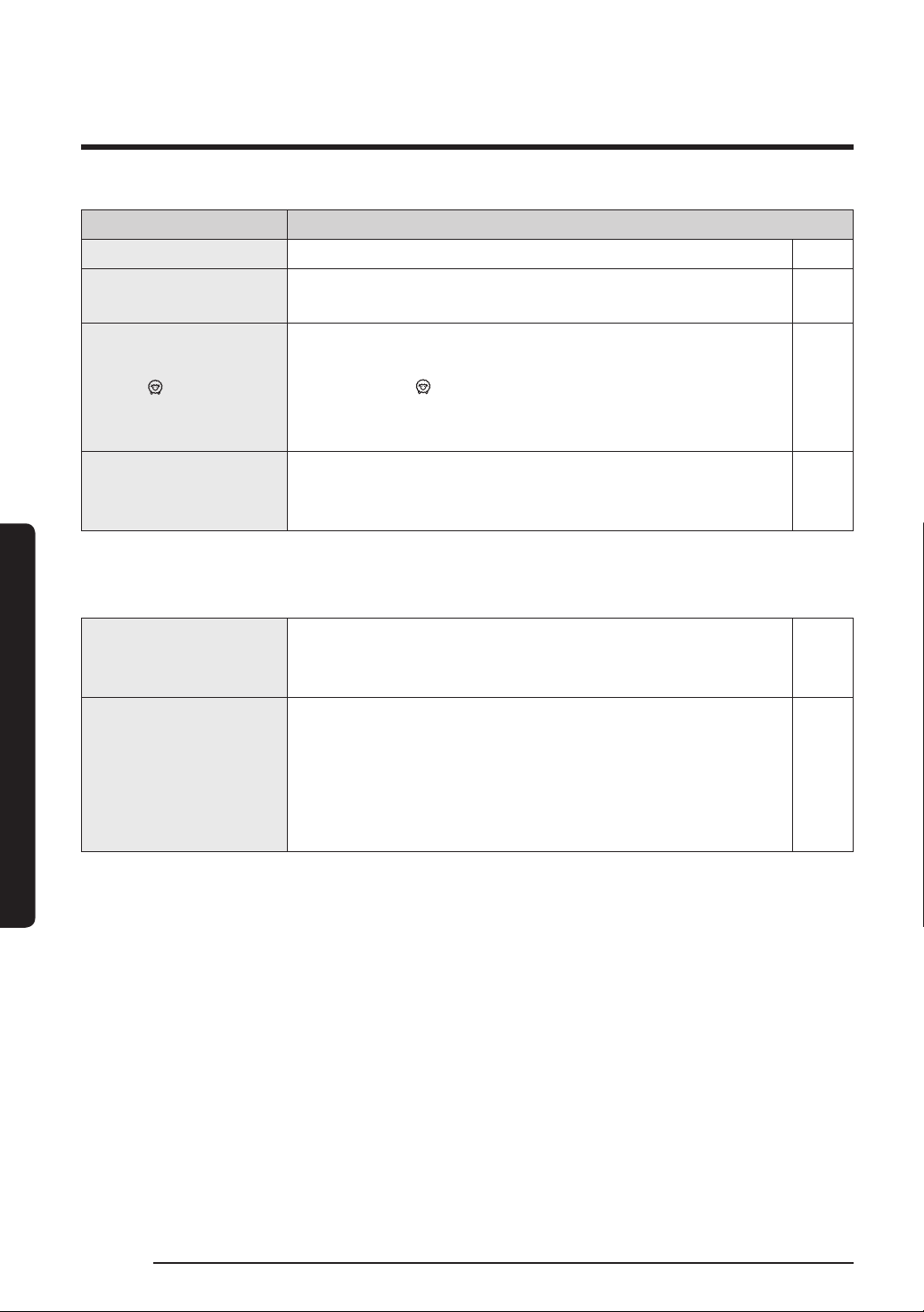
Cycle Description & Max load (kg)
DAILY WASH • For everyday items such as underwear and shirts. 5.0
INTENSIVE COLD
• A low-temperature bubble cycle helps reduce power
consumption.
6.0
WOOL
• Specic for machine-washable wool for loads less
than 2.0 kg.
• The WOOL cycle features ne pulsating and soaking
to protect the wool bres from shrinkage/distortion.
• A neutral detergent is recommended.
2.0
OUTDOOR CARE
• For outdoor clothes, skiwear, and sportswear that are
made of functional materials such as spandex, stretch,
and micro-bre.
2.0
Steam Cycles
Steam may not be visible or present during the cycle. This is normal.
BEDDING
• For bed spreads, bed sheets, bedding covers, etc.
• For best results, wash only 1 type of bedding and
make sure the load weighs less than 2.5 kg.
2.5
HYGIENE STEAM
• Cotton and linen fabric which have been in direct
contact with the skin, e.g. underwear. For optimum
hygiene results select a temperature of 60 °C or
above.
• Steam cycles feature allergy care and bacteria
elimination (sterilize).
6.0
Untitled-1 38 2/12/2019 11:48:34 AM
English 39
Operations
Special features
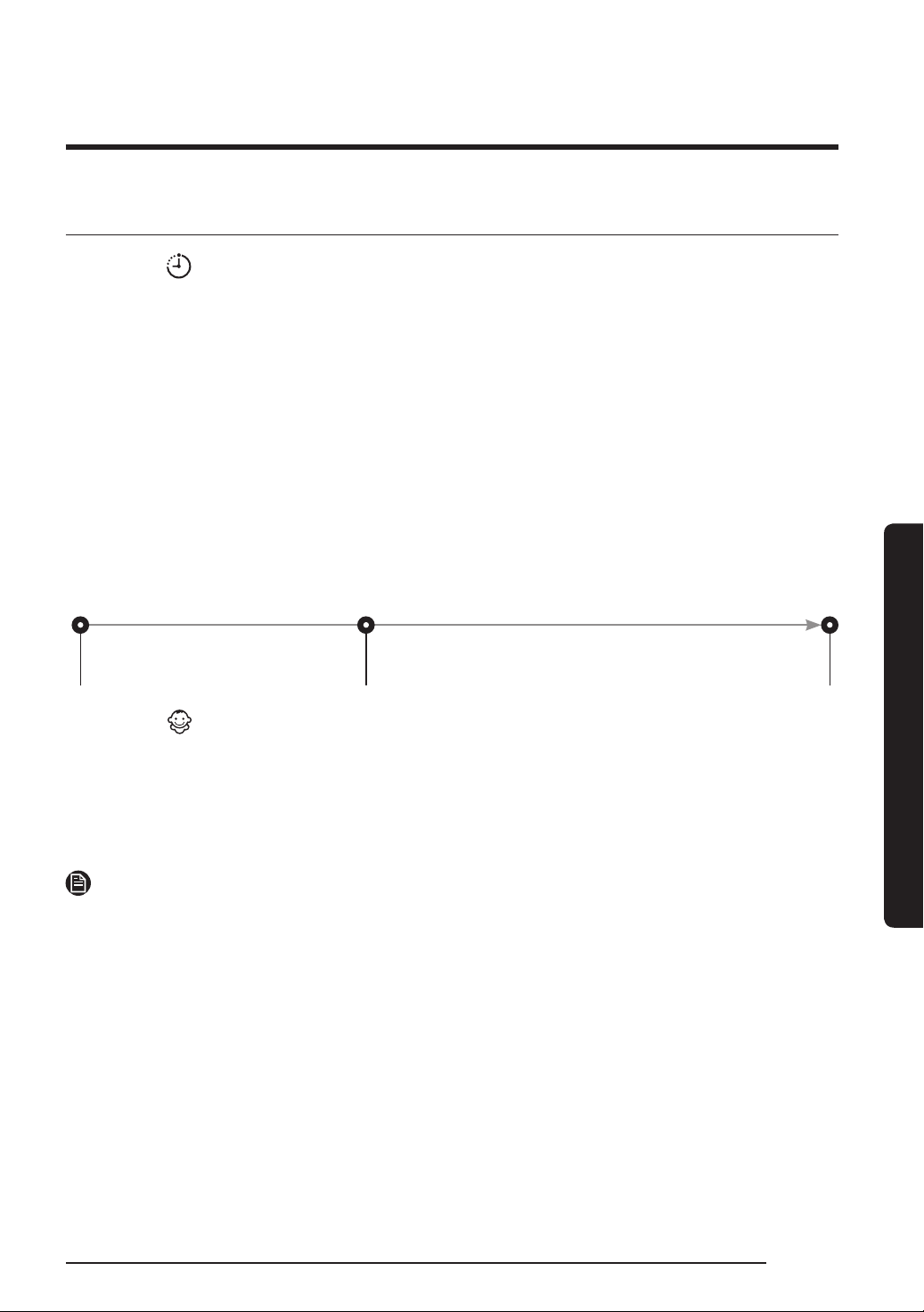
Delay End
You can set the washing machine to nish your wash automatically at a later time by
choosing a delay of between 1 to 24 hours (in 1 hour increments). The hour displayed
indicates the time the wash will nish.
1. Select a cycle. Then, change the cycle settings if necessary.
2. Press Delay End repeatedly until a desired end time is set.
3. Press Start/Pause.
4. To cancel Delay End, restart the washing machine by pressing Power.
Real-life case
You want to nish a two-hour cycle 3 hours from now. To do this, you add the Delay End
option to the current cycle with a 3-hour setting, and then press Start/Pause at 2:00 pm.
The washing machine starts operating at 3:00 pm and ends at 5:00 pm. Provided below is
the time line for this example.
2:00 pm
Set Delay End to 3 hours
3:00 pm
Start
5:00 pm
End
Child Lock
To prevent accidents by children, Child Lock locks all buttons except for Power.
• To set the Child Lock function, hold down Temp. and Rinse simultaneously for
3 seconds.
• To release the Child Lock function, hold down Temp. and Rinse simultaneously for
3 seconds.
NOTE
• In the Child Lock state, you must rst release the Child Lock if you want to add
detergent or laundry.
• Your setting will be kept even after restarting the machine.
Untitled-1 39 2/12/2019 11:48:34 AM
Operations
English40
Operations
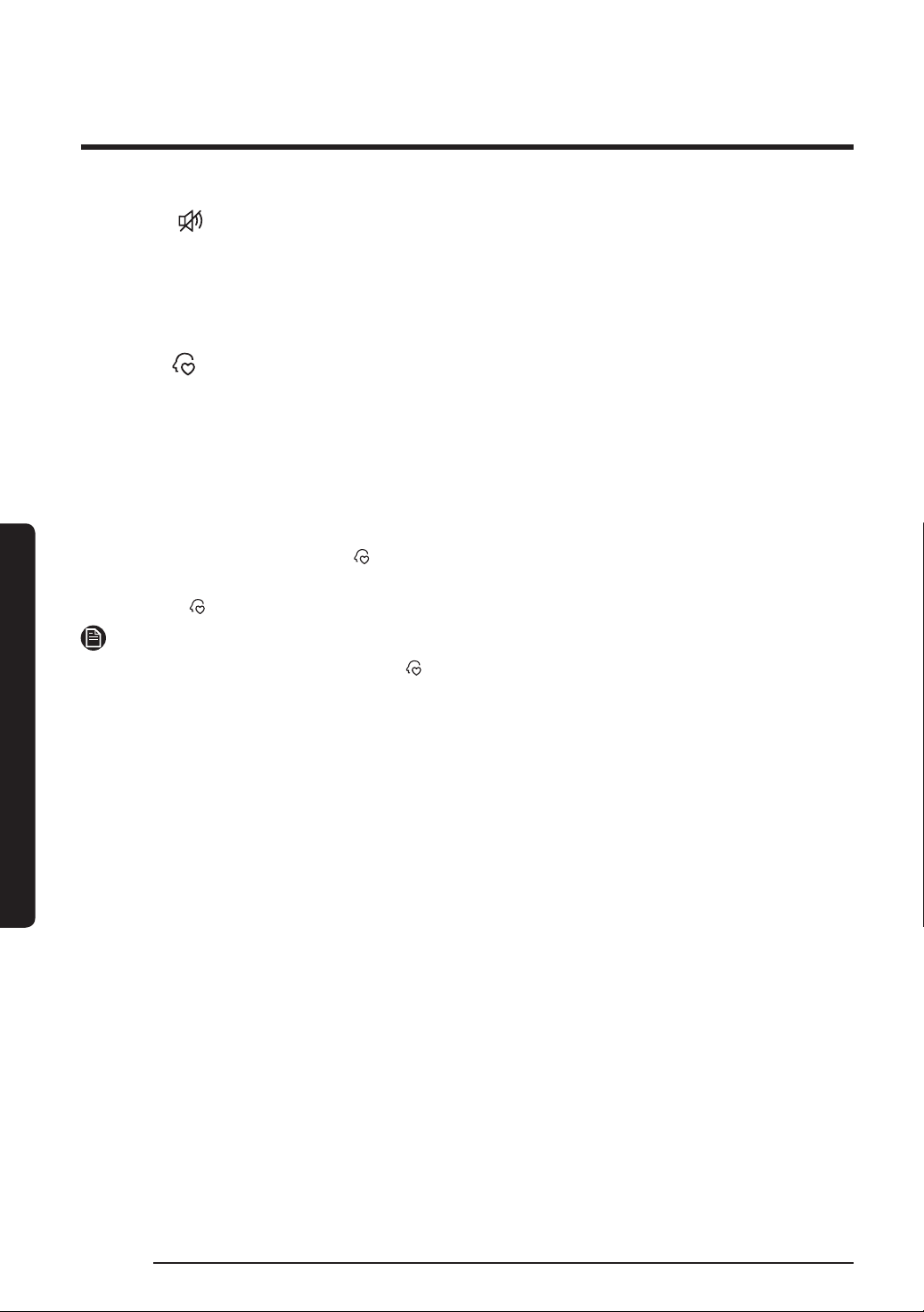
Alarm Off
You can turn on or off the alarm sound. When the alarm is off, the melody of cycle
completion and the power-off beep will not sound. However, the other sounds stay active.
• Press and hold Rinse and Spin for 3 seconds to turn on or off the alarm.
• Your setting will be kept even after restarting the appliance.
My Cycle
Create your own washing cycle with preferred settings and use the cycle with the push of
a single button.
To create your own cycle
1. Turn the Cycle selector to select a cycle.
2. Change the cycle settings (Temp., Rinse, and Spin) as necessary.
3. Add an option to your preference.
4. Press and hold the My Cycle
button for 3 seconds to save your settings. Applicable
indicators blink for 3 seconds. Once you save the cycle, you can use it by pressing the
My Cycle button.
NOTE
If you press and release the My Cycle
button within 3 seconds, the previously saved
cycle and options appear.
Untitled-1 40 2/12/2019 11:48:35 AM
English 41
Maintenance
Keep the washing machine clean for best performance and to lengthen its life cycle.
Drum clean
Perform this cycle regularly to clean the drum and to remove bacteria from it.
1. Press Power to turn on the washing machine.
2. Turn the Cycle selector to select DRUM CLEAN.
3. Press Start/Pause.
CAUTION
Do not use any cleaning agents for cleaning the drum. Chemical residue in the drum may
cause damage to the laundry or the drum of the washing machine.
DRUM CLEAN reminder
• The DRUM CLEAN reminder blinks on the control panel once every 40 washes. It is
advisable to perform DRUM CLEAN regularly.
• When you rst see this reminder blinking, you can ignore the reminder for 6
consecutive washes. From the 7
th
wash, the reminder no longer appears. However, it
appears again on the second 40
th
wash.
• Even after the last process is terminated, the "0" message may remain.
• You can record the running count of the DRUM CLEAN cycle by pressing the Power
button. This does not stop or turn off the machine but marks your cycle count.
• Even if "0" does not disappear, the machine operates normally.
• It is recommended to run the cycle regularly for hygienic purposes.
Maintenance
Untitled-1 41 2/12/2019 11:48:35 AM
Maintenance
English42
Maintenance
Smart Check
To enable this function, you must rst download the Samsung Smart Washer app at the
Play Store or the App Store, and install it on a mobile device featuring a camera function.
The Smart Check function has been optimised for Galaxy & iPhone series (applicable
models only).
1. When the washing machine detects an issue to check, an information code appears
on the display. To enter Smart Check mode, press and hold Spin and Bubble Soak
simultaneously for 3 seconds.
2. The washing machine starts the self-diagnosis procedure and displays an information
code if a problem is detected.
3. Run the Samsung Smart Washer app on your mobile device, and tap Smart Check.
4. Put the mobile device close to the washing machine’s display so that the smartphone
camera and the washing machine face each other. Then, the information code will be
recognised automatically by the app.
5. When the information code is recognised correctly, the app provides detailed
information about the problem with applicable solutions.
NOTE
• The function name, Smart Check, may differ depending on the language.
• If the washing machine reects light on the display, the app may fail to recognise the
information code.
• If the app fails to recognise the Smart Check code consecutively, enter the information
code manually onto the app screen.
Untitled-1 42 2/12/2019 11:48:35 AM
English 43
Maintenance
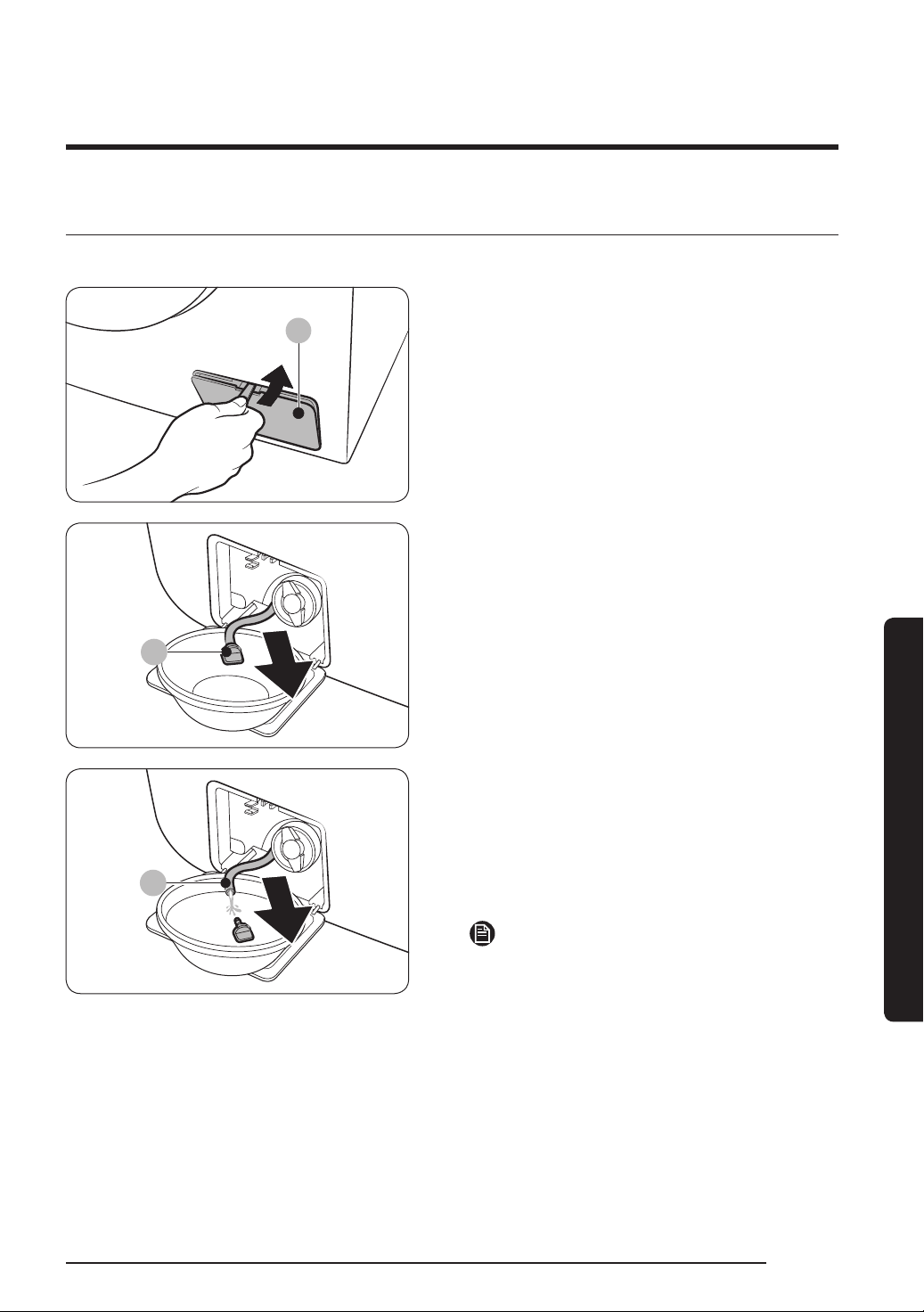
Emergency drain
In case of a power failure, drain the water inside the drum before taking out the laundry.
A
1. Turn off the washing machine, and then
unplug the power cord.
2. Open the lter cover (A) using a coin or
thin metal object.
A
3. Put an empty, spacious container
around the cover, and stretch the
emergency drain tube to the container
while holding the tube cap (A).
B
4. Open the tube cap and let water in the
emergency drain tube (B) ow into the
container.
5. When done, close the tube cap, and
reinsert the tube. Then, close the lter
cover.
NOTE
Use a spacious container because the
water in the drum may be more than
expected.
Untitled-1 43 2/12/2019 11:48:35 AM
Maintenance
English44
Maintenance
Cleaning
Surface of the washing machine
Use a soft cloth with a nonabrasive household detergent. Do not spray water onto the
washing machine.
Mesh lter
Clean the mesh lter of the water hose once or twice a year.
1. Turn off the washing machine, and
unplug the power cord.
2. Close the water tap.
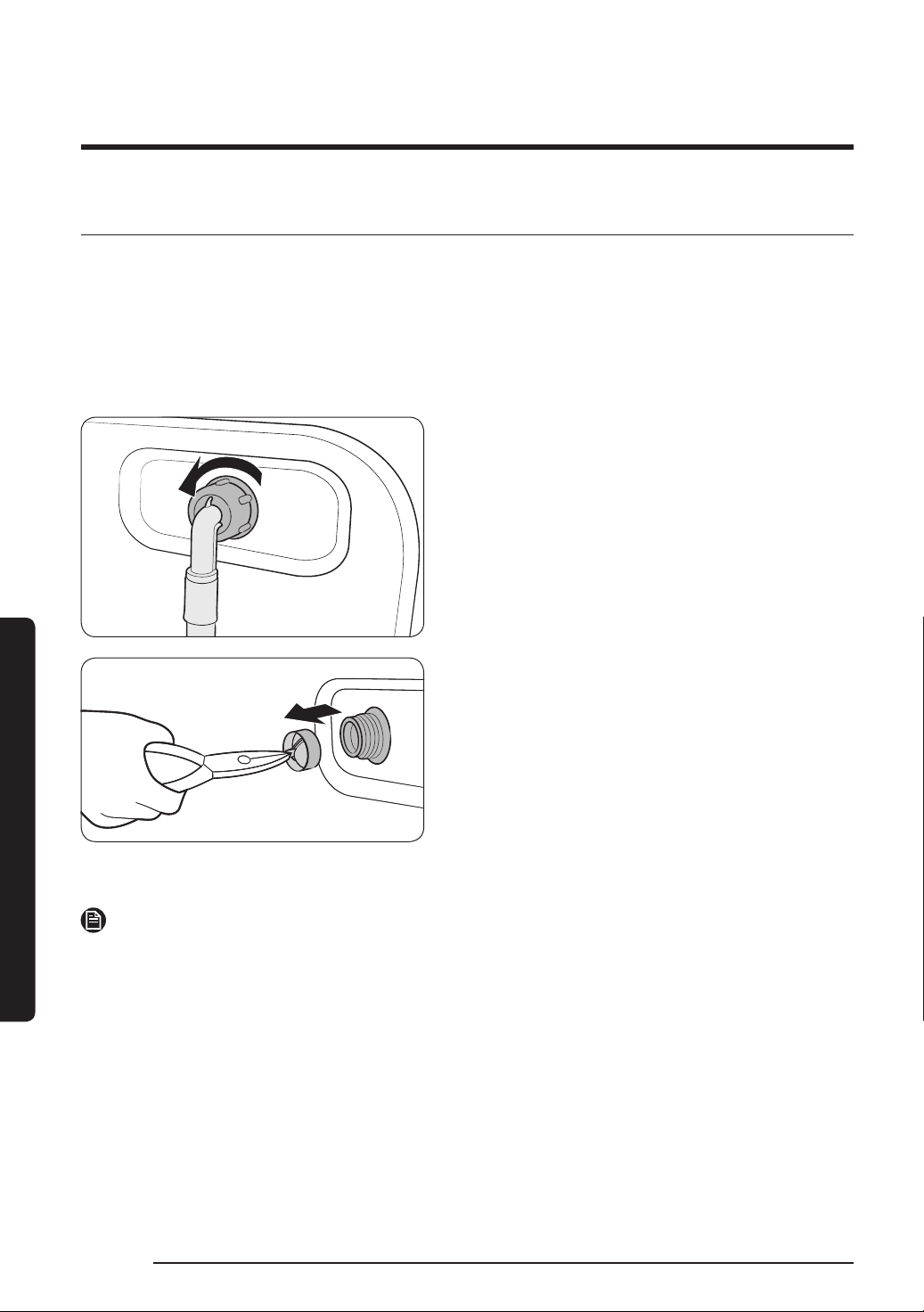
3. Loosen and disconnect the water hose
from the back of the washing machine.
Cover the hose with a cloth to prevent
water from gushing out.
4. Use pliers to pull out the mesh lter
from the inlet valve.
5. Thoroughly clean the mesh lter in
water.
6. Completely dry the mesh lter. Do not
dry in direct sunlight.
7. Reinsert the mesh lter, and then
reconnect the water hose.
8. Open the water tap.
NOTE
If the mesh lter is clogged, the “4C” information code appears on the washing machine’s
display screen.
Untitled-1 44 2/12/2019 11:48:36 AM
English 45
Maintenance
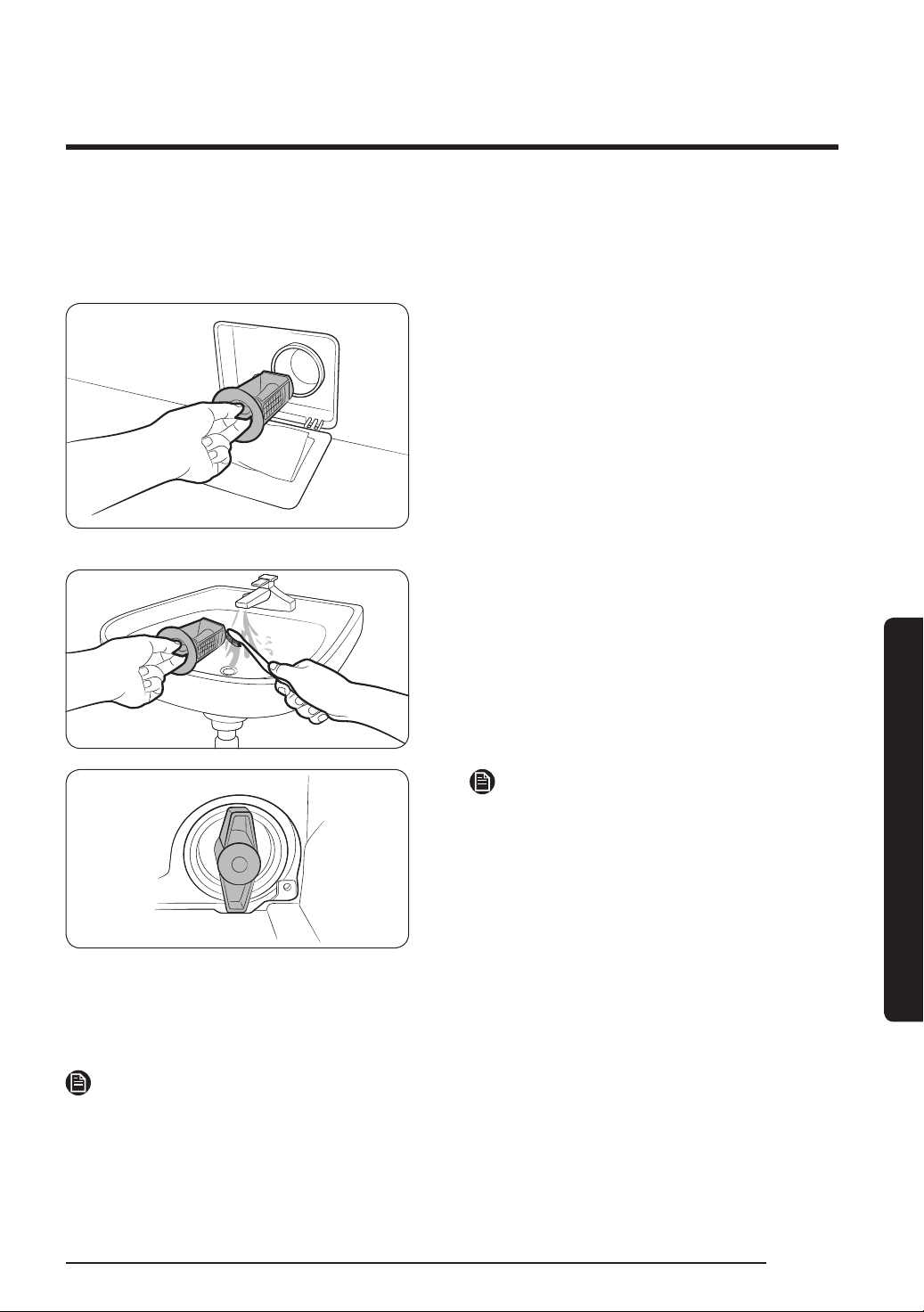
Pump lter
It is advisable to clean the pump lter 5 or 6 times a year to prevent its clogging. A
clogged pump lter may reduce the bubble effect.
1. Turn off the washing machine, and
unplug the power cord.
2. Open the lter cover using a coin or
key.
3. Drain the remaining water inside the
drum. See the Emergency drain section
on page 43.
4. Turn the pump lter knob
counterclockwise, and then drain the
remaining water.
5. Clean the pump lter using a soft brush.
Make sure the drain pump propeller
inside the lter is not clogged.
6. Reinsert the pump lter, and then turn
the lter knob clockwise.
7. Close the lter cover.
NOTE
• Some pump lters feature a safety
knob that is designed to prevent
accidents by children. To open the
safety knob of the pump lter, push in
and turn it counterclockwise. The spring
mechanism of the safety knob helps
open the lter.
• To close the safety knob of the pump
lter, turn it clockwise. The spring
makes a rattling sound, which is normal.
NOTE
If the pump lter is clogged, the “5C” information code appears on the washing machine’s
display screen.
Untitled-1 45 2/12/2019 11:48:37 AM
Maintenance
English46
Maintenance
CAUTION
• Make sure the lter knob is closed properly after cleaning the lter. Otherwise, this
may cause a leak.
• Make sure the lter is inserted properly after cleaning it. Otherwise, this may cause an
operational failure or a leak.
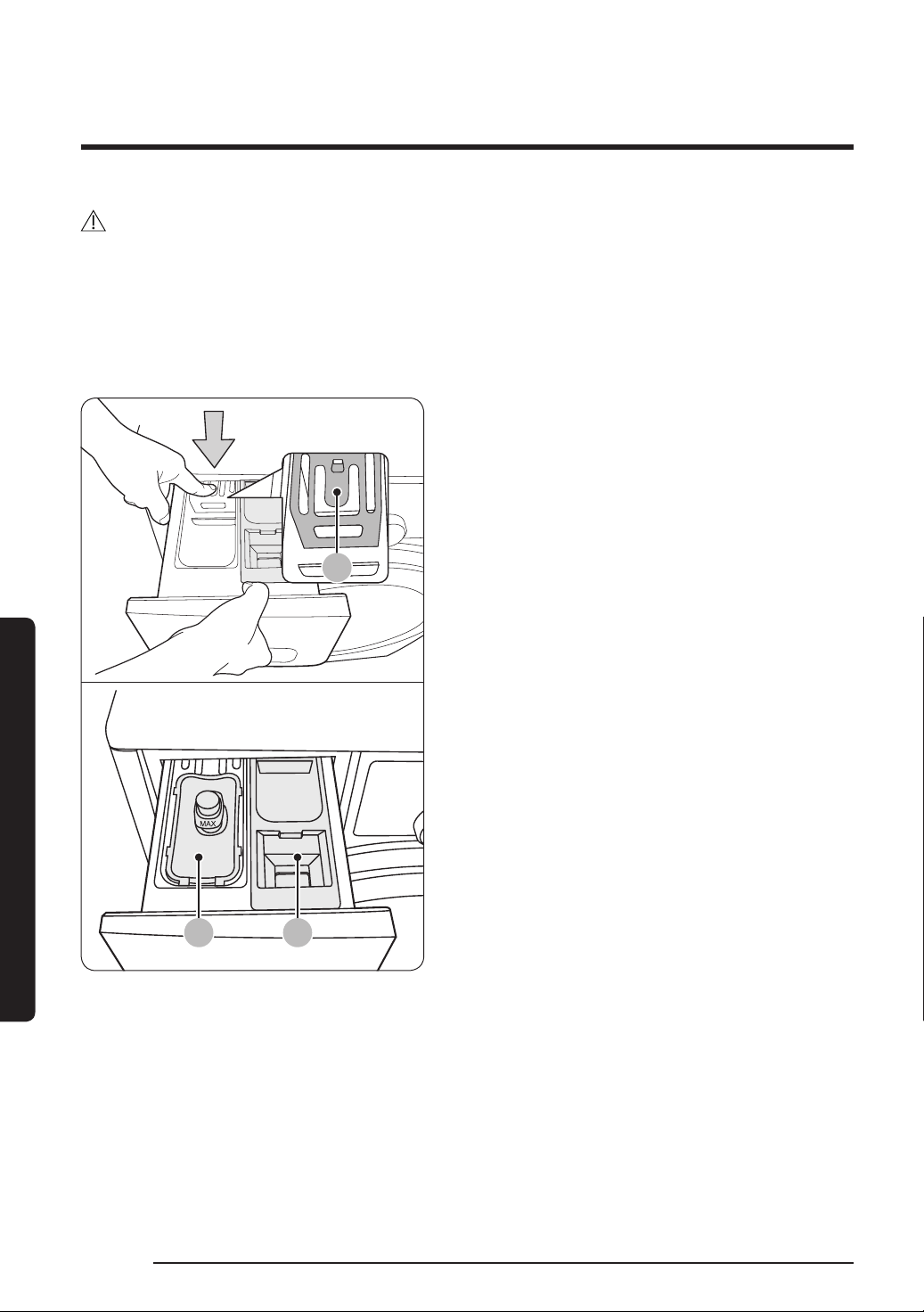
Detergent drawer
A
B C
1. Open the drawer.
2. While holding down the release lever
(A), remove the drawer.
3. Remove the liquid detergent container
(B) and softener divider (C) from the
drawer.
Untitled-1 46 2/12/2019 11:48:37 AM
English 47
Maintenance
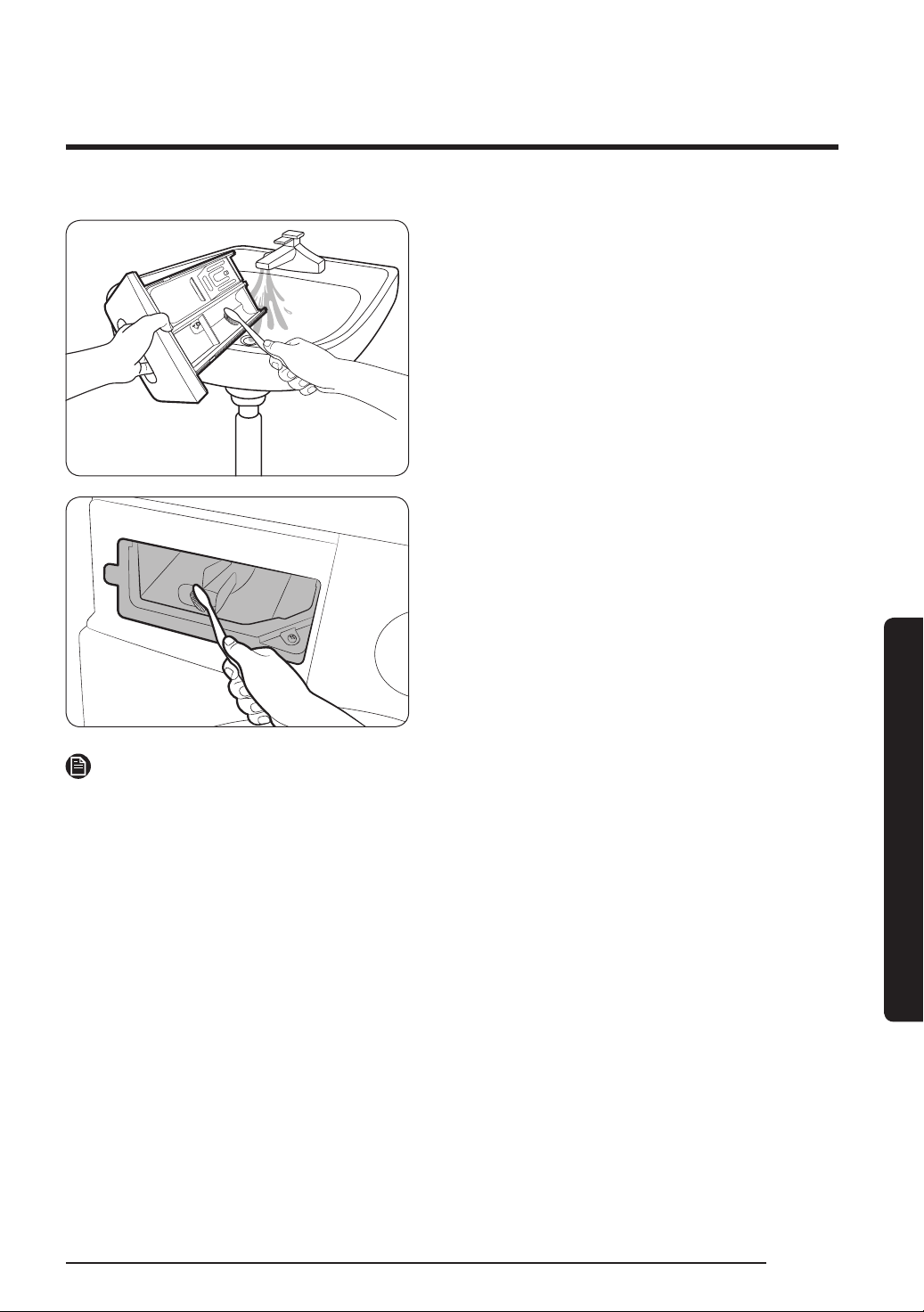
4. Clean the drawer components in
running water using a soft brush.
5. Clean the drawer recess using a soft
brush.
6. Reinsert the liquid detergent container
and the softener divider.
7. Slide the drawer inward to close it.
NOTE
To remove remaining detergent, run the RINSE+SPIN cycle with the drum empty.
Untitled-1 47 2/12/2019 11:48:37 AM
Maintenance
English48
Maintenance
Recovery from freezing
The washing machine may freeze when the temperature in its location drops below 0 °C.
1. Turn off the washing machine, and then unplug the power cord.
2. Pour warm water over the water tap to loosen the water hose.
3. Disconnect the water hose, and then soak it in warm water.
4. Pour warm water into the drum and leave it for about 10 minutes.
5. Reconnect the water hose to the water tap.
NOTE
If the washing machine still doesn’t operate normally, repeat the steps above.
Care against an extended time of non-use
Avoid leaving the washing machine unused for an extended time. However, if you intend
to leave the washing machine unused for a long period of time, follow the directions
below:
1. Press Power, and then turn the Cycle selector to RINSE+SPIN.
2. Empty the drum, and then press Start/Pause.
3. When the cycle is complete, close the water taps and disconnect the water hoses.
4. Turn off the washing machine, and then unplug the power cord.
5. Open the door to let air circulate through the drum.
Untitled-1 48 2/12/2019 11:48:37 AM
English 49
Troubleshooting
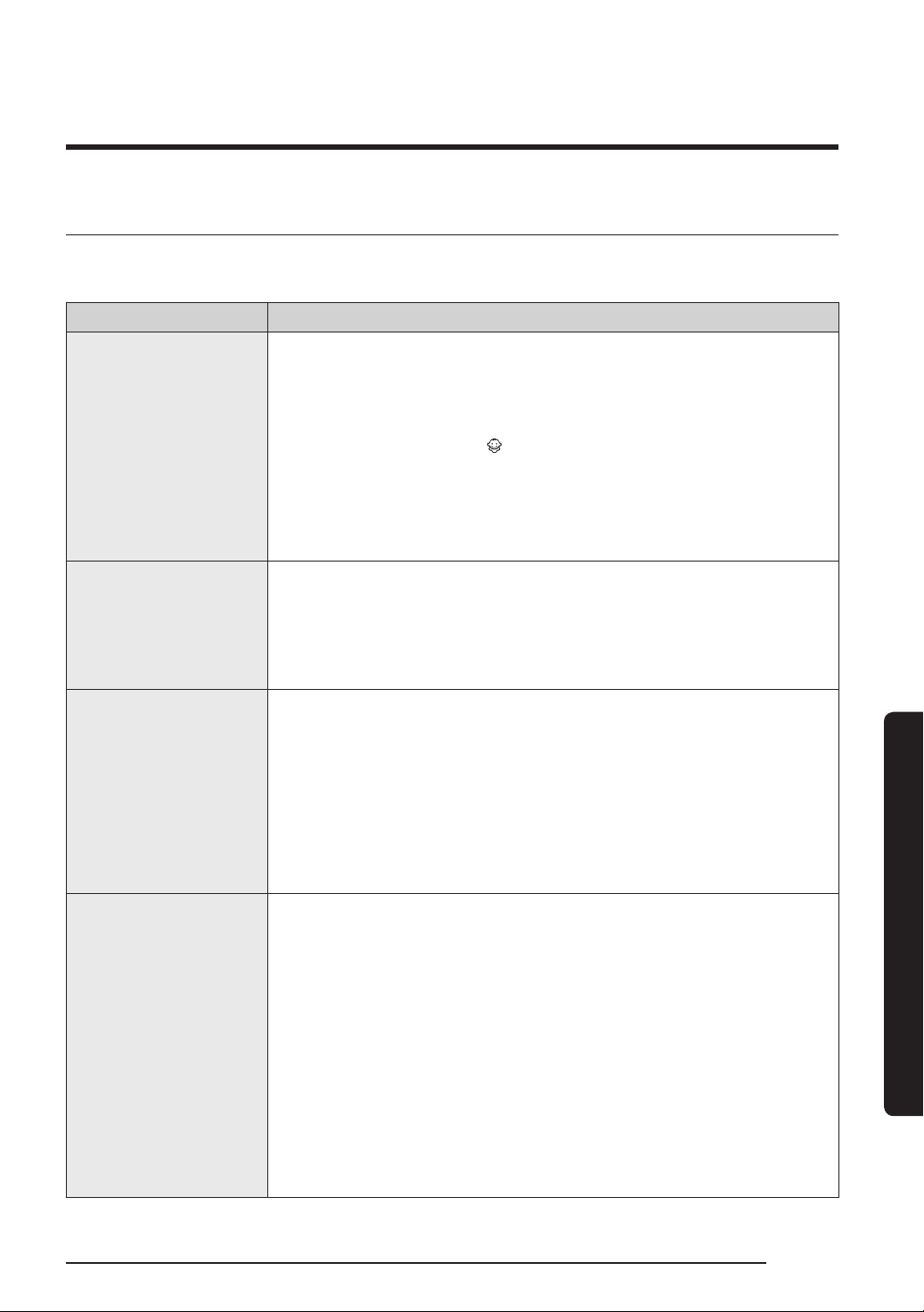
Checkpoints
If you encounter a problem with the washing machine, rst check the table below and try
the suggestions.
Problem Action
Does not start.
• Make sure the washing machine is plugged in.
• Make sure the door is properly closed.
• Make sure the water taps are open.
• Press Start/Pause to start the washing machine.
• Make sure Child Lock
is not activated.
• Before the washing machine starts to ll, it will make a series
of clicking noises to check the door lock and does a quick
drain.
• Check the fuse or reset the circuit breaker.
Water supply is
insufcient, or no
water is supplied.
• Fully open the water tap.
• Make sure the door is properly closed.
• Make sure the water supply hose is not frozen.
• Make sure the water supply hose is not kinked or clogged.
• Make sure there is sufcient water pressure.
After a cycle,
detergent remains
in the detergent
drawer.
• Make sure the washing machine is running with sufcient
water pressure.
• Make sure the detergent is added to the centre of the
detergent drawer.
• Make sure the rinse cap is inserted properly.
• If using granular detergent, make sure the detergent selector
is in the upper position.
• Remove the rinse cap and clean the detergent drawer.
Excessive vibrations
or makes noise.
• Make sure the washing machine is installed on a level, solid
oor that is not slippery. If the oor is not level, use the
levelling feet to adjust the height of the washing machine.
• Make sure the shipping bolts are removed.
• Make sure the washing machine is not contacting any other
object.
• Make sure the laundry load is balanced.
• The motor can cause noise during normal operation.
• Overalls or metal-decorated clothes can cause noise while
being washed. This is normal.
• Metal objects such as coins can cause noise. After washing,
remove these objects from the drum or lter case.
Troubleshooting
Untitled-1 49 2/12/2019 11:48:37 AM
Troubleshooting
English50
Troubleshooting
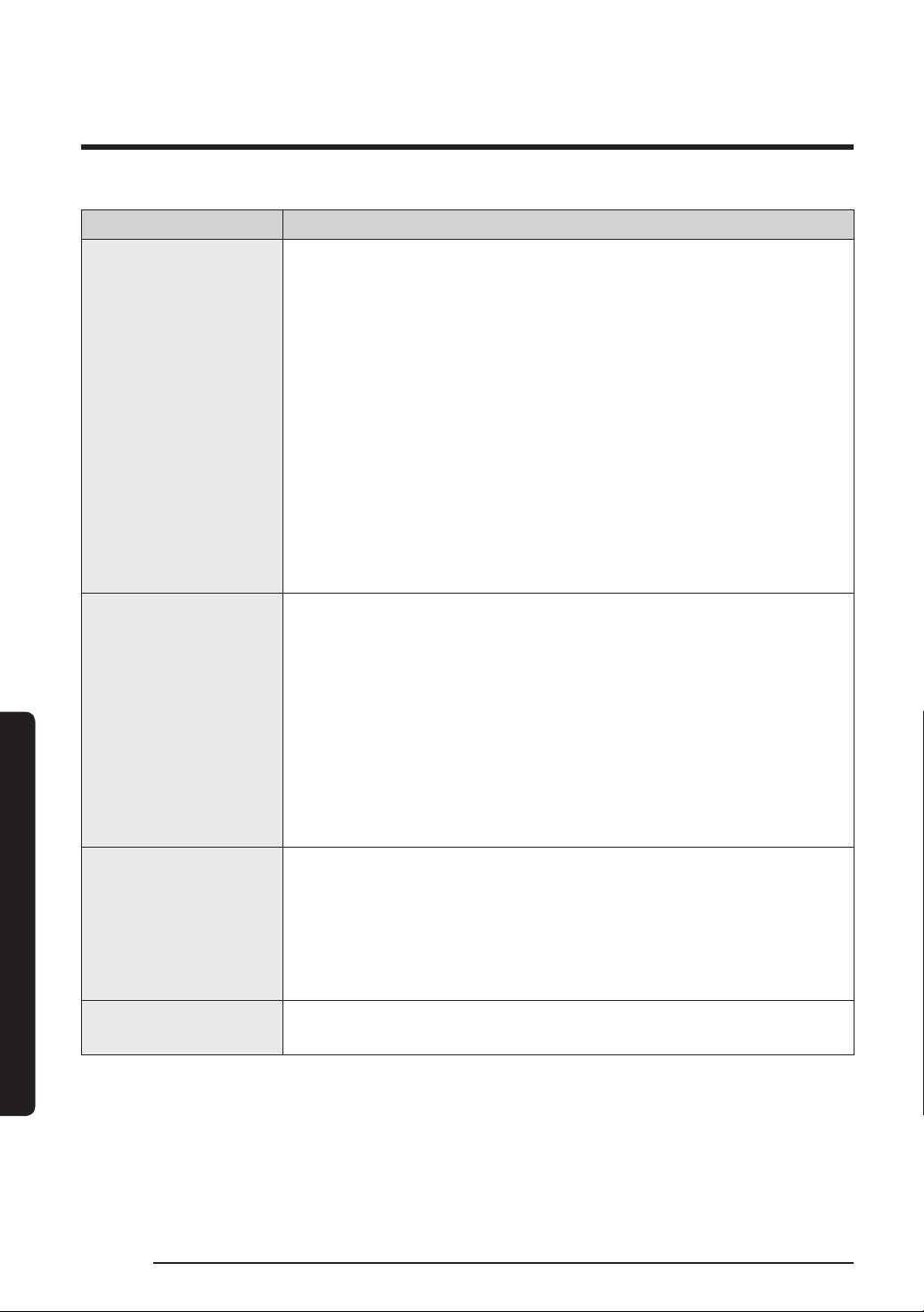
Problem Action
Does not drain and/
or spin.
• Make sure the drain hose is straightened all the way to the
drain system. If you encounter a drain restriction, call for
service.
• Make sure the debris lter is not clogged.
• Close the door and press Start/Pause. For your safety, the
washing machine will not tumble or spin unless the door is
closed.
• Make sure the drain hose is not frozen or clogged.
• Make sure the drain hose is connected to a drain system that
is not clogged.
• If the washing machine is not supplied with sufcient power,
the washing machine temporarily will not drain or spin. As
soon as the washing machine regains sufcient power, it will
operate normally.
The door does not
open.
• Press Start/Pause to stop the washing machine.
• It may take a few moments for the door lock mechanism to
disengage.
• The door will not open until 3 minutes after the washing
machine has stopped or the power turned off.
• Make sure all the water in the drum is drained.
• The door may not open if water remains in the drum. Drain
the drum and open the door manually.
• Make sure the door lock light is off. The door lock light turns
off after the washing machine has drained.
Excessive suds.
• Make sure you use the recommended types of detergent as
appropriate.
• Use high efciency (HE) detergent to prevent oversudsing.
• Reduce the detergent amount for soft water, small loads, or
lightly soiled loads.
• Non-HE detergent is not recommended.
Cannot apply
additional detergent.
• Make sure the remaining amount of detergent and fabric
softener is not over the limit.
Untitled-1 50 2/12/2019 11:48:38 AM
English 51
Troubleshooting
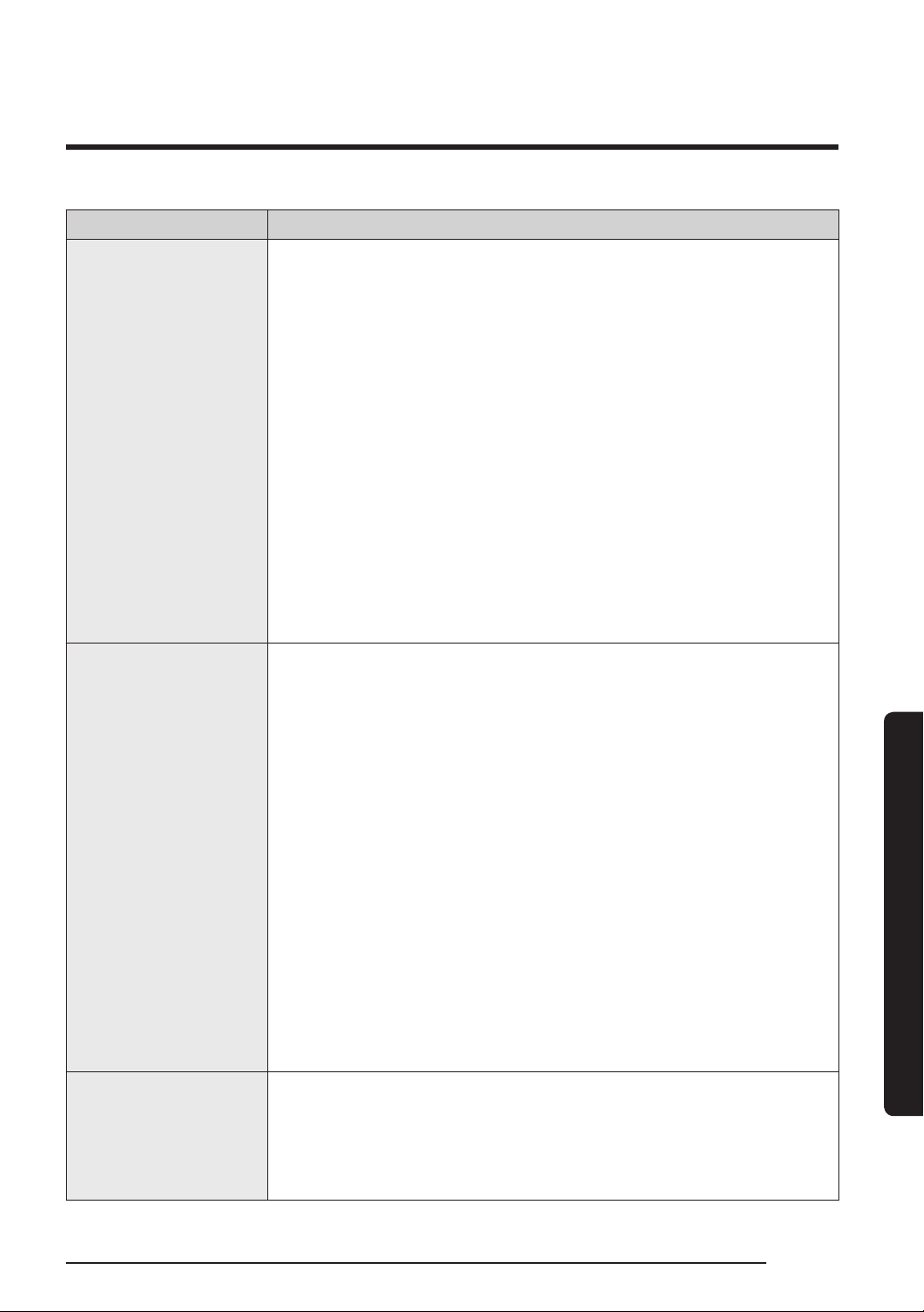
Problem Action
Stops.
• Plug the power cord into a live electrical outlet.
• Check the fuse or reset the circuit breaker.
• Close the door and press Start/Pause to start the washing
machine. For your safety, the washing machine will not
tumble or spin unless the door is closed.
• Before the washing machine starts to ll, it will make a series
of clicking noises to check the door lock and does a quick
drain.
• There may be a pause or soak period in the cycle. Wait briey
and the washing machine may start.
• Make sure the mesh lter of the water supply hose at the
water taps is not clogged. Periodically clean the mesh lter.
• If the washing machine is not supplied with sufcient power,
the washing machine temporarily will not drain or spin. As
soon as the washing machine regains sufcient power, it will
operate normally.
Fills with the wrong
water temperature.
• Fully open both taps.
• Make sure the temperature selection is correct.
• Make sure the hoses are connected to the correct taps. Flush
water lines.
• Make sure the water heater is set to supply a minimum
120 °F (49 °C) hot water at the tap. Also, check the water
heater capacity and recovery rate.
• Disconnect the hoses and clean the mesh lter. The mesh
lter may be clogged.
• While the washing machine lls, the water temperature may
change as the automatic temperature control feature checks
incoming water temperature. This is normal.
• While the washing machine lls, you may notice just hot and/
or just cold water going through the dispenser when cold or
warm temperatures are selected. This is a normal function
of the automatic temperature control feature as the washing
machine determines the water temperature.
Load is wet at the
end of a cycle.
• Use the High or Extra High spin speed.
• Use high efciency (HE) detergent to reduce oversudsing.
• Load is too small. Small loads (one or two items) may become
unbalanced and not spin completely.
• Make sure the drain hose is not kinked or clogged.
Untitled-1 51 2/12/2019 11:48:38 AM
Troubleshooting
English52
Troubleshooting
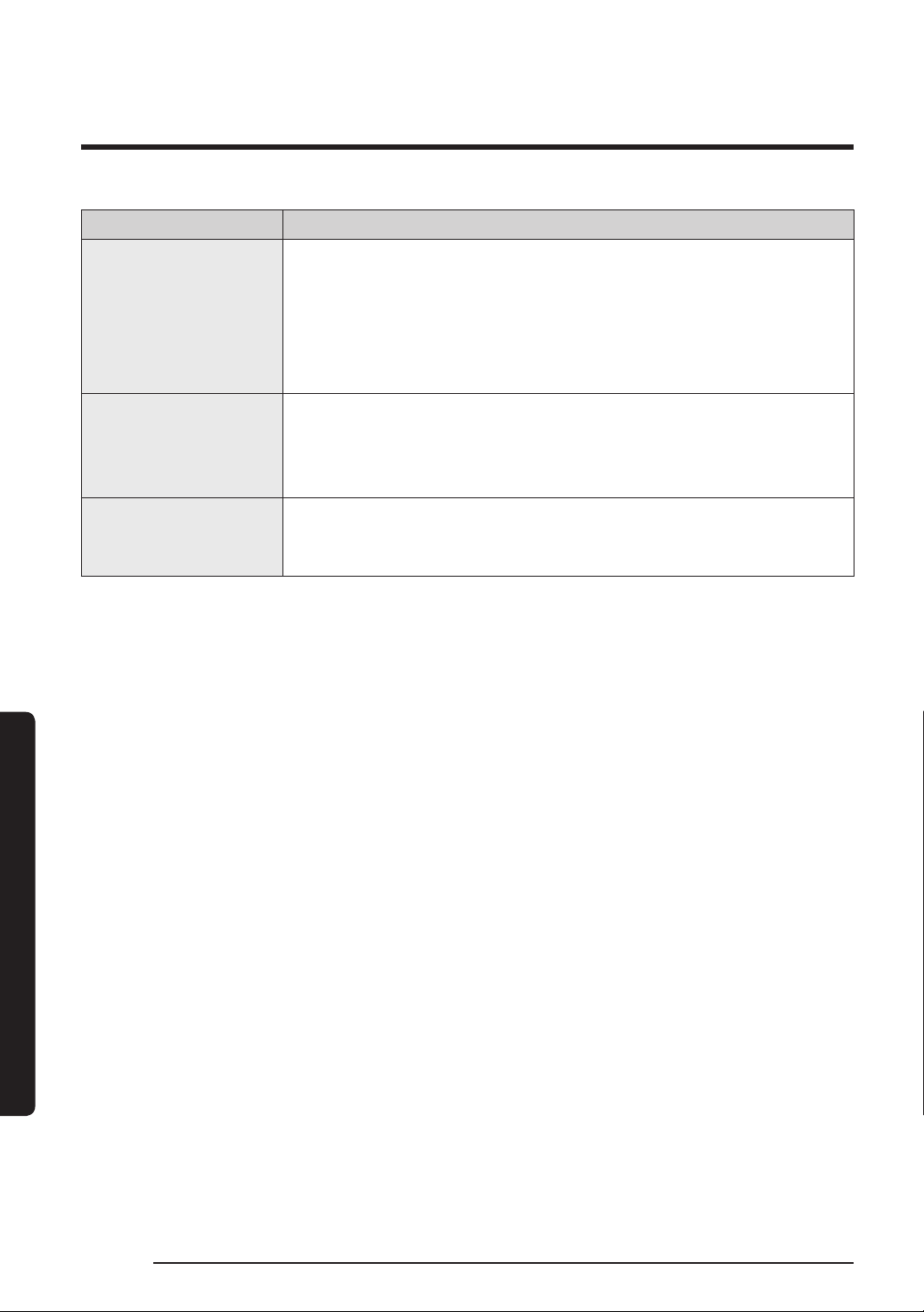
Problem Action
Leaks water.
• Make sure the door is properly closed.
• Make sure all hose connections are tight.
• Make sure the end of the drain hose is correctly inserted and
secured to the drain system.
• Avoid overloading.
• Use high efciency (HE) detergent to prevent oversudsing.
Has odours.
• Excessive suds collect in recesses and can cause foul odours.
• Run cleansing cycles to sanitise periodically.
• Clean the door seal (diaphragm).
• Dry the washing machine interior after a cycle has nished.
No bubbles are seen
(Bubbleshot models
only).
• Overloading may screen bubbles.
• Severely contaminated laundry may not generate bubbles.
If a problem persists, contact a local Samsung service centre.
Untitled-1 52 2/12/2019 11:48:38 AM
English 53
Troubleshooting
Information codes
If the washing machine fails to operate, you may see an information code on the screen.
Check the table below and try the suggestions.
Code Action
4C
Water is not supplied.
• Make sure the water taps are open.
• Make sure the water hoses are not clogged.
• Make sure the water taps are not frozen.
• Make sure the washing machine is operating with sufcient water
pressure.
• Make sure that the cold water tap and the hot water tap are
properly connected.
• Clean the mesh lter as it may be clogged.
• All buttons will be disabled for 3 minutes after the information
code appears.
• When the "4C" message appears, the machine drains water for 3
minutes. In the meantime, the Power button will be disabled.
4C2
• Make sure the cold water supply hose is rmly connected to the
cold water tap. If it is connected to the hot water tap, the laundry
may be deformed with some cycles.
5C
Water is not draining.
• Make sure the drain hose is not frozen or clogged.
• Make sure the drain hose is positioned correctly, depending on the
connection type.
• Clean the debris lter as it may be clogged.
• Make sure the drain hose is straightened all the way to the drain
system.
• If the information code remains, contact a customer service centre.
dC
Operating the washing machine with the door open.
• Make sure the door is properly closed.
• Make sure laundry is not caught in the door.
OC
Water has overowed.
• Restart after spinning.
• If the information code remains on the display, contact a local
Samsung service centre.
Untitled-1 53 2/12/2019 11:48:38 AM
Troubleshooting
English54
Troubleshooting
Code Action
LC, LC1
Check the drain hose.
• Make sure the end of the drain hose is not placed on the oor.
• Make sure the drain hose is not clogged.
• If the information code remains, contact a customer service centre.
Ub
Spinning does not work.
• Make sure laundry is spread out evenly.
• Make sure the washing machine is on a at, stable surface.
• Redistribute the load. If only one item of clothing needs washing,
such as a bathrobe or pair of jeans, the nal spin result might be
unsatisfactory, and an “Ub” check message will be shown in the
display.
3C
Check the drum motor for operation.
• Try restarting the cycle.
• If the information code remains, contact a customer service centre.
UC
The electronic control needs to be checked.
• Check if power is supplied properly.
• If the information code remains, contact a customer service centre.
Low voltage detected.
• Check if the power cord is plugged in.
• If the information code remains, contact a customer service centre.
HC
High temperature heating check.
• If the information code remains, contact a customer service centre.
1C
The Water Level sensor is not working properly.
• Turn the machine off, and restart the cycle.
• If the information code remains, contact a customer service centre.
AC
Check communications between main and sub PBAs.
• Turn the machine off, and restart the cycle.
• If the information code remains, contact a customer service centre.
8C
The MEMS sensor is not working properly.
• Turn the machine off, and restart the cycle.
• If the information code remains, contact a local Samsung service
centre.
DC1
The Main Door lock/unlock is not working properly.
• Turn the machine off, and restart the cycle.
• If the information code remains, contact a local Samsung service
centre.
Untitled-1 54 2/12/2019 11:48:38 AM
English 55
Troubleshooting
Code Action
0
The machine does not turn off automatically after the last spinning
process, and the "0" message remains.
• The machine operates normally without running the DRUM CLEAN
cycle. However, it is recommended to run the cycle for hygienic
purposes.
If any information code keeps appearing on the screen, contact a local Samsung service
centre.
Untitled-1 55 2/12/2019 11:48:38 AM
English56
Specications
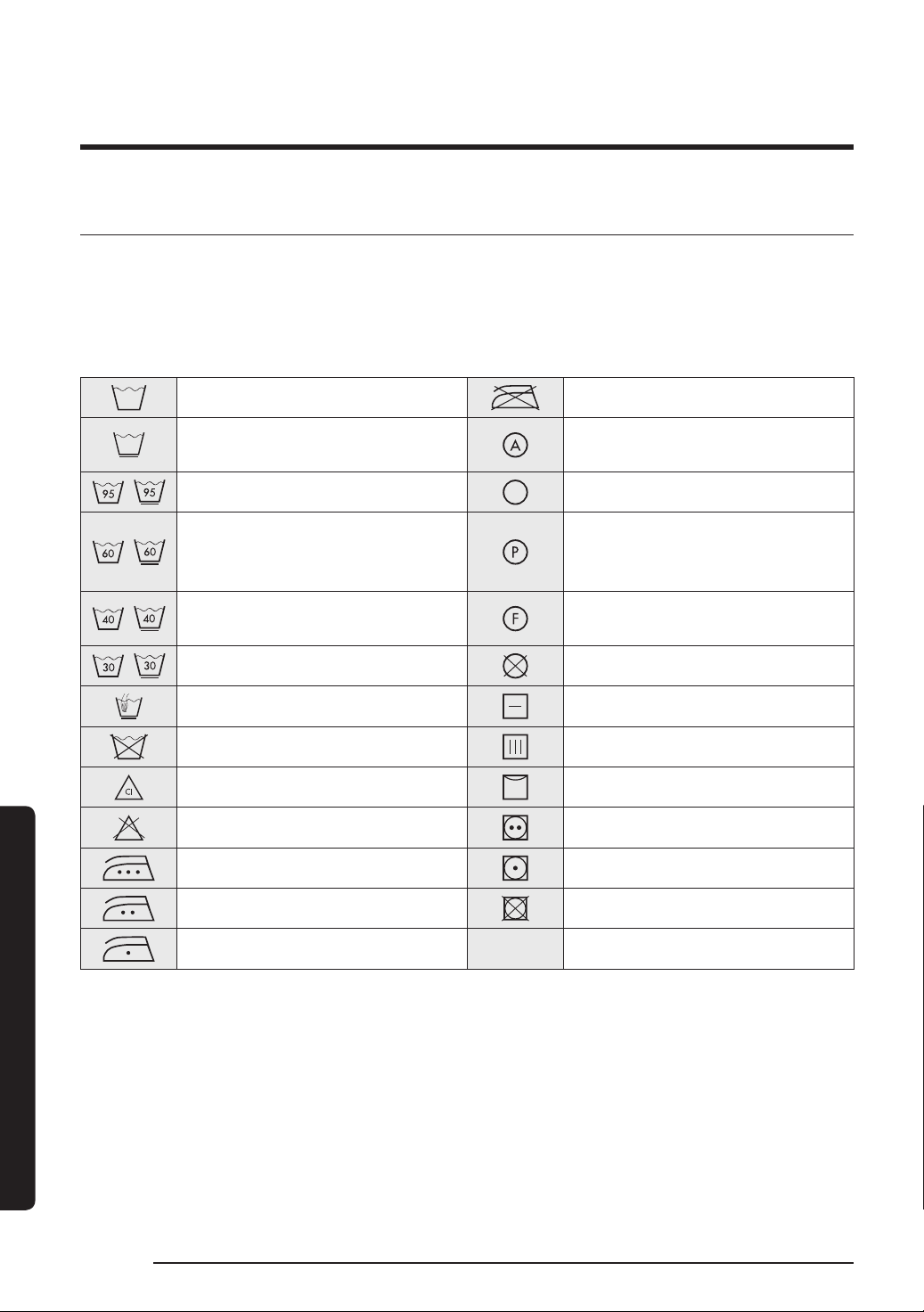
Fabric care chart
The following symbols provide garment care directions. The care labels include four
symbols in this order: washing, bleaching, drying and ironing (and dry cleaning when
necessary). The use of symbols ensures consistency among garment manufacturers of
domestic and imported items. Follow the care label directions to maximise garment life
and reduce laundry problems.
Resistant material Do not iron
Delicate fabric
Can be dry cleaned using any
solvent
Item can be washed at 95 °C Dry clean
Item can be washed at 60 °C
Dry clean with perchloride,
lighter fuel, pure alcohol or
R113 only
Item can be washed at 40 °C
Dry clean with aviation fuel,
pure alcohol or R113 only
Item can be washed at 30 °C Do not dry clean
Hand wash only Dry at
Dry clean only Can be hung to dry
Can be bleached in cold water Dry on clothes hanger
Do not bleach Tumble dry, normal heat
Can be ironed at 200 °C max Tumble dry, reduced heat
Can be ironed at 150 °C max Do not tumble dry
Can be ironed at 100 °C max
Specications
Untitled-1 56 2/12/2019 11:48:42 AM
English 57
Specications
Protecting the environment
• This appliance is manufactured from recyclable materials. If you decide to dispose of
this appliance, please observe local waste disposal regulations. Cut off the power cord
so that the appliance cannot be connected to a power source. Remove the door so that
animals and small children cannot get trapped inside the appliance.
• Do not exceed the detergent quantities recommended in the detergent manufacturer’s
instructions.
• Use stain removal products and bleaches before the wash cycle only when strictly
necessary.
• Save water and electricity by only washing full loads (the exact amount depends upon
the cycle used).
Untitled-1 57 2/12/2019 11:48:42 AM
Specications
English58
Specications
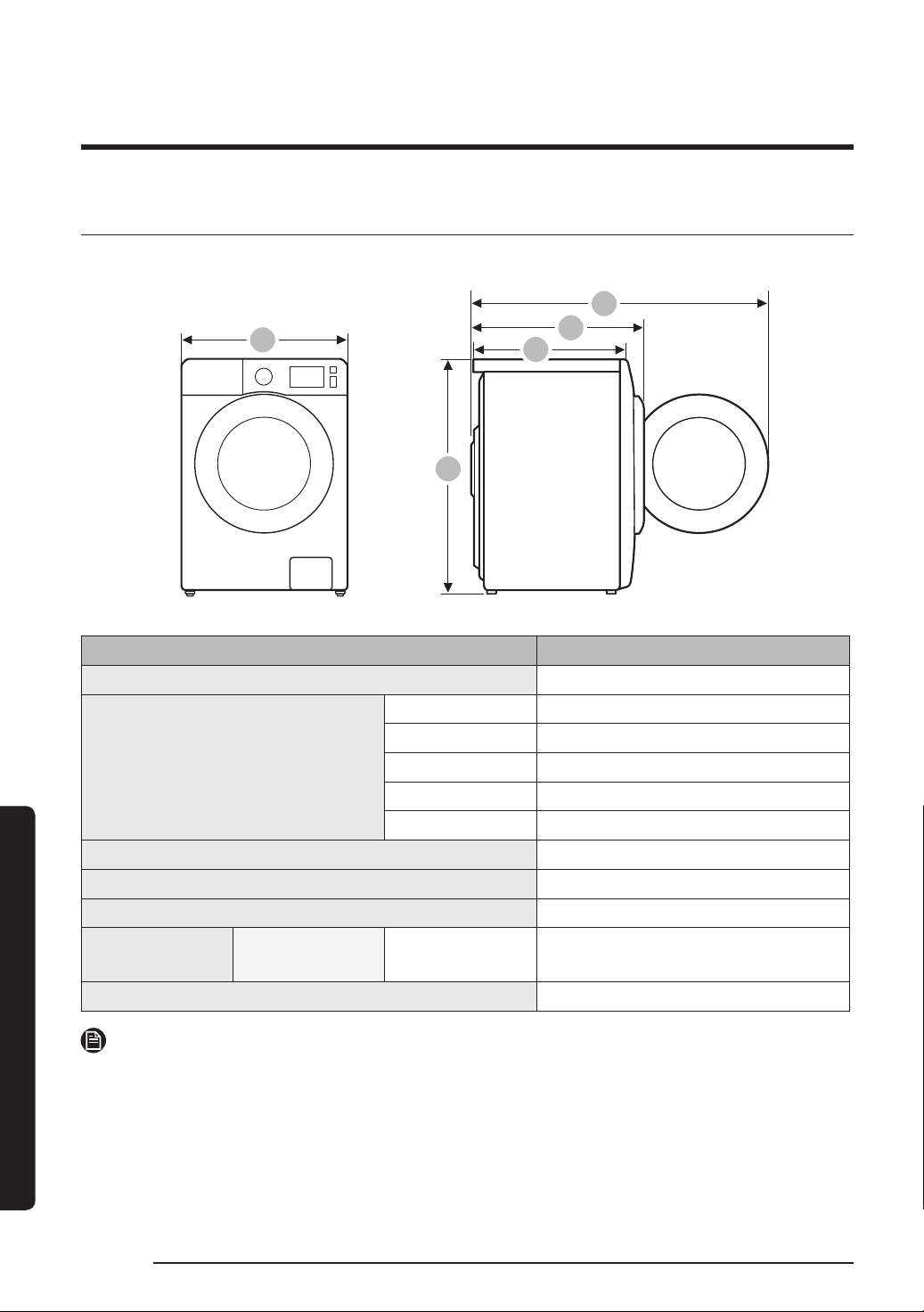
Specication sheet
“*” Asterisk(s) means variant model and can be varied (0-9) or (A-Z).
A
B
C
D
E
Type Front loading washing machine
Model name WW11R64****
Dimensions
A (Width) 600 mm
B (Height) 850 mm
C (Depth) 600 mm
D 680 mm
E 1120 mm
Water pressure 50-800 kPa
Net weight 70.0 kg
Wash and spin capacity 11.0 kg
Power
consumption
Washing and
heating
AC 220-240 V /
50 Hz
1900-2300W
Spin revolutions 1400 rpm
NOTE
The design and specications are subject to change without notice for quality
improvement purposes.
Untitled-1 58 2/12/2019 11:48:43 AM

Memo
Untitled-1 59 2/12/2019 11:48:43 AM
QUESTIONS OR COMMENTS?
COUNTRY CALL OR VISIT US ONLINE AT
AUSTRALIA
1300 362 603 (Other)
1300 425 299 (HHP)
www.samsung.com/au/support
NEW ZEALAND
0800 726 786 (All Product)
0800 6 726 786 (Support for
Smart Mobile Devices)
www.samsung.com/nz/support
DC68-04042A-00
Untitled-1 60 2/12/2019 11:48:43 AM