DVQX1774ZB
M0219KZ1029
Basic Owner’s Manual
Digital Camera
Model No.
DC-FZ1000M2
Please read these instructions carefully before using this product, and save this manual
for future use.
More detailed owner’s manual is available in “Owner’s Manual for advanced features
(PDF format)”. To read it, download it from the website. (→89)
Register online at http://shop.panasonic.com/support (U.S. customers only)
P
If you have any questions, visit:
USA : http://shop.panasonic.com/support
Canada : www.panasonic.ca/english/support
DVQX1774 (ENG)
2
Dear Customer,
Thank you for choosing Panasonic!
You have purchased one of the most sophisticated and reliable products on the market
today. Used properly, we’re sure it will bring you and your family years of enjoyment.
Please take time to fill in the information below. The serial number is on the tag located
on the underside of your camera. Be sure to retain this manual as your convenient
camera information source.
Date of Purchase Dealer Phone No.
Dealer Purchased From Model No.
Dealer Address Serial No.
Please note that the actual controls and components, menu items, etc. of your Digital
Camera may look somewhat different from those shown in the illustrations in this Owner’s
Manual.
Carefully observe copyright laws.
• Recording of pre-recorded tapes or discs or other published or broadcast material for
purposes other than your own private use may infringe copyright laws. Even for the
purpose of private use, recording of certain material may be restricted.
For the U.S.A. and Canada only
A lithium ion battery that is recyclable powers the product you have
purchased. Please call 1-800-8-BATTERY for information on how to
recycle this battery.
Information for Your Safety
WARNING:
To reduce the risk of fire, electric shock or product damage,
• Do not expose this unit to rain, moisture, dripping or splashing.
• Use the recommended accessories.
• Do not remove covers.
• Do not repair this unit by yourself. Refer servicing to qualified service
personnel.
The socket outlet shall be installed near the equipment and shall be easily accessible.
■
Product identification marking
Product Location
Digital camera Bottom

DVQX1774 (ENG)
3
THE FOLLOWING APPLIES ONLY IN THE U.S.A.
Certification and Compliance
Please select as follows:
→ [Setup] → [Approved Regulations]
Contains FCC ID : VPYLB1JS955
This transmitter must not be co-located or operated in conjunction with any other
antenna or transmitter.
This equipment complies with FCC radiation exposure limits set forth for an uncontrolled
environment and meets the FCC radio frequency (RF) Exposure Guidelines. This
equipment has very low levels of RF energy that is deemed to comply without testing of
specific absorption rate (SAR).

DVQX1774 (ENG)
4
THE FOLLOWING APPLIES ONLY IN THE U.S.A.
FCC Note:
This equipment has been tested and found to comply with the limits for a Class B digital
device, pursuant to Part 15 of the FCC Rules. These limits are designed to provide
reasonable protection against harmful interference in a residential installation. This
equipment generates, uses, and can radiate radio frequency energy and, if not installed
and used in accordance with the instructions, may cause harmful interference to radio
communications. However, there is no guarantee that interference will not occur in a
particular installation. If this equipment does cause harmful interference to radio or
television reception, which can be determined by turning the equipment off and on, the
user is encouraged to try to correct the interference by one or more of the following
measures:
• Reorient or relocate the receiving antenna.
• Increase the separation between the equipment and receiver.
• Connect the equipment into an outlet on a circuit different from that to which the
receiver is connected.
• Consult the dealer or an experienced radio/TV technician for help.
FCC Caution: To assure continued compliance, follow the attached installation
instructions and use only shielded interface cables with ferrite core when connecting to
computer or peripheral devices.
Any unauthorized changes or modifications to this equipment would void the user’s
authority to operate this device.
This device complies with Part 15 of the FCC Rules. Operation is subject to the
following two conditions: (1) This device may not cause harmful interference, and (2)
this device must accept any interference received, including interference that may
cause undesired operation.
Supplier’s Declaration of Conformity
Trade Name: Panasonic
Model No.: DC-FZ1000M2
Responsible Party: Panasonic Corporation of North America
Two Riverfront Plaza, Newark, NJ 07102-5490
Support Contact: http://shop.panasonic.com/support
DVQX1774 (ENG)
5
THE FOLLOWING APPLIES ONLY IN CANADA.
Certification and Compliance
Please select as follows:
→ [Setup] → [Approved Regulations]
CAN ICES-3(B)/NMB-3(B)
Contains IC : 772C-LB1JS955
This device contains licence-exempt transmitter(s)/receiver(s) that comply with
Innovation, Science and Economic Development Canada’s licence-exempt RSS(s).
Operation is subject to the following two conditions:
(1) This device may not cause interference.
(2) This device must accept any interference, including interference that may cause
undesired operation of the device.
The available scientific evidence does not show that any health problems are
associated with using low power wireless devices. There is no proof, however, that
these low power wireless devices are absolutely safe. Low power Wireless devices emit
low levels of radio frequency energy (RF) in the microwave range while being used.
Whereas high levels of RF can produce health effects (by heating tissue), exposure
of low-level RF that does not produce heating effects causes no known adverse
health effects. Many studies of low-level RF exposures have not found any biological
effects. Some studies have suggested that some biological effects might occur, but
such findings have not been confirmed by additional research. DC-FZ1000M2 (HMN is
1JS1903) has been tested and found to comply with ISED radiation exposure limits set
forth for an uncontrolled environment and meets RSS-102 of the ISED radio frequency
(RF) Exposure rules.

DVQX1774 (ENG)
6
■
About the battery pack
CAUTION
Battery pack (Lithium ion battery pack)
• Use the specified unit to recharge the battery pack.
• Do not use the battery pack with equipment other than the specified unit.
• Do not get dirt, sand, liquids, or other foreign matter on the terminals.
• Do not touch the plug terminals (+ and −) with metal objects.
• Do not disassemble, remodel, heat or throw into fire.
If any electrolyte should come into contact with your hands or clothes, wash it off
thoroughly with water.
If any electrolyte should come into contact with your eyes, never rub the eyes. Rinse
eyes thoroughly with water, and then consult a doctor.
CAUTION
• Danger of explosion if battery is incorrectly replaced. Replace only with the type
recommended by the manufacturer.
• When disposing of the batteries, please contact your local authorities or dealer and
ask for the correct method of disposal.
• Do not heat or expose to flame.
• Do not leave the battery(ies) in a car exposed to direct sunlight for a long period of time
with doors and windows closed.
Warning
Risk of fire, explosion and burns. Do not disassemble, heat above 60 °C (140 °F) or
incinerate.

DVQX1774 (ENG)
7
■
About the AC adaptor (supplied)
CAUTION!
To reduce the risk of fire, electric shock or product damage,
• Do not install or place this unit in a bookcase, built-in cabinet or in another
confined space. Ensure this unit is well ventilated.
AC adaptor
This AC adaptor operates on AC between 110V and 240V.
But
• In the U.S.A. and Canada, the AC adaptor must be connected to a 120V AC power
supply only.
• When connecting to an AC supply outside of the U.S.A. or Canada, use a plug
adaptor to suit the AC outlet configuration.
■
Cautions for Use
• Do not use any other USB connection cables except the supplied one.
• Use a “High Speed HDMI micro cable” with the HDMI logo.
Cables that do not comply with the HDMI standards will not work.
“High Speed HDMI micro cable” (Type D - Type A plug, up to 2 m (6.6 feet) long)
• Always use a genuine Panasonic shutter remote control (DMW-RS2: optional).
• Do not use the Stereo microphone cables with the length of 3 m (9.8 feet) or more.
Keep this unit as far away as possible from electromagnetic equipment (such as
microwave ovens, TVs, video games etc.).
• If you use this unit on top of or near a TV, the pictures and/or sound on this unit may be
disrupted by electromagnetic wave radiation.
• Do not use this unit near cell phones because doing so may result in noise adversely
affecting the pictures and/or sound.
• Recorded data may be damaged, or pictures may be distorted, by strong magnetic
fields created by speakers or large motors.
• Electromagnetic wave radiation may adversely affect this unit, disturbing the pictures
and/or sound.
• If this unit is adversely affected by electromagnetic equipment and stops functioning
properly, turn this unit off and remove the battery or disconnect AC adaptor. Then
reinsert the battery or reconnect AC adaptor and turn this unit on.
Do not use this unit near radio transmitters or high-voltage lines.
• If you record near radio transmitters or high-voltage lines, the recorded pictures and/or
sound may be adversely affected.

DVQX1774 (ENG)
8
• To clean your camera, remove the battery, the DC coupler (DMW-DCC8: optional)
or a card, or disconnect the power plug from the outlet, and wipe with a soft, dry
cloth.
• Do not press the monitor with excessive force.
• Do not press the lens with excessive force.
• Do not allow camera to come into contact with pesticides or volatile substances
(can cause surface damage or coating to peel).
• Do not keep rubber or plastic products in contact with the camera for a long
period of time.
• Do not use solvents such as benzine, thinner, alcohol, kitchen detergents, etc.,
to clean the camera, since it may deteriorate the external case or the coating may
peel off.
• Do not leave the camera with the lens facing the sun, as rays of light from the
sun may cause it to malfunction.
• Always use the supplied cords and cables.
• Do not extend the supplied cord or cable.
• While the camera is accessing the card (for an operation such as picture writing,
reading, deletion, or formatting), do not turn off the camera or remove the battery,
card, AC adaptor (DMW-AC10PP: optional) or DC coupler (DMW-DCC8: optional).
Furthermore, do not subject the camera to vibration, impact or static electricity.
• The data on the card may be damaged or lost due to electromagnetic waves, static
electricity or breakdown of the camera or the card. We recommend storing important
data on a PC etc.
• Do not format the card on your PC or other equipment. Format it on the camera only to
ensure proper operation.
• The battery is not charged when the camera is shipped. Charge the battery
before use.
• The battery is a rechargeable lithium ion battery. If the temperature is too high or
too low, the operating time of the battery will become shorter.
• The battery becomes warm after using and during and after charging. The camera also
becomes warm during use. This is not a malfunction.
• Do not leave any metal items (such as clips) near the contact areas of the power
plug or near the batteries.
• Store the battery in a cool and dry place with a relatively stable temperature.
(Recommended temperature: 15 °C to 25 °C (59 °F to 77 °F), Recommended humidity:
40%RH to 60%RH)
• Do not store the battery for a long time while fully charged. When storing the
battery for a long period of time, we recommend charging it once a year. Remove the
battery from the camera and store it again after it has completely discharged.

DVQX1774 (ENG)
9
Contents
■
Information for Your Safety ................ 2
Preparations/Basics
■
Before use ......................................... 10
■
Standard accessories ....................... 11
■
Digital Camera Accessory System
... 12
■
Names and Functions
of Main Parts ..................................... 13
■
About the Card .................................. 15
■
Quick Start Guide .............................. 16
Attaching the Lens Cap ...............................16
Attaching the Shoulder Strap ......................16
Attaching the Lens Hood .............................17
Inserting the battery and/or
SD memory card (optional) .........................18
Charging the battery ....................................19
Opening the Monitor ....................................21
Setting the clock ..........................................21
[LVF] button
(Recording pictures using the viewfinder) ...22
Holding the camera .....................................22
Shutter button (Taking pictures) ..................23
■
Basic operations ............................... 24
■
Setting the menu ............................... 30
Recording
■
Taking pictures
with automatic settings
(Intelligent Auto Mode) ..................... 32
■
Taking pictures with Auto Focus ..... 34
■
Taking pictures with
Manual Focus .................................... 36
■
Focus, Brightness (Exposure) and
Color tone Settings ........................... 37
■
Selecting a Drive Mode
([Burst] / [Self Timer]) ....................... 41
■
Recording with the 4K Photo
function .............................................. 42
■
Adjusting the focus after recording
([Post Focus] / [Focus Stacking]) .... 45
■
Taking Pictures with Time Lapse
Shot/Stop Motion Animation ............ 47
■
Taking Pictures While Adjusting
a Setting Automatically
(Bracket Recording) .......................... 49
■
Taking pictures with flash ................ 51
■
Recording Motion Picture/
4K Motion Picture ............................. 52
Playback
■
Viewing your pictures ....................... 56
■
Deleting pictures ............................... 58
Menu
■
Menu list ............................................ 59
Wi-Fi/Bluetooth
■
What you can do with the
Wi-Fi
®
/Bluetooth
®
function ............... 71
■
Operating the camera
by connecting it to a smartphone ... 72
Others
■
Downloading software ...................... 78
■
List of monitor/viewfinder
displays .............................................. 79
■
Q&A
Troubleshooting ................................ 82
■
Specifications .................................... 86
■
Reading the Owner’s Manual
(PDF format) ...................................... 89
■
Limited Warranty
(ONLY FOR U.S.A.) ............................ 90
■
Limited Warranty
(ONLY FOR CANADA) ....................... 93
DVQX1774 (ENG)
10
Preparations/Basics
Before use
■
Camera handling
Keep the camera away from excessive vibration, force, or pressure.
●
Avoid using the camera under the following conditions, which may damage the lens,
monitor, viewfinder, or camera body. This may also cause the camera to malfunction or
prevent recording.
• Dropping or hitting the camera against a hard surface
• Pushing with excessive force on the lens or monitor
The camera is not dust resistant, splash resistant, or waterproof.
Avoid using the camera in places with excessive dust or sand, or where water can
come into contact with the camera.
If sand, dust, or liquids such as water droplets adhere to the monitor, wipe them off
with a dry soft cloth.
●
Not doing so may cause the monitor to respond incorrectly to touch operations.
■
Condensation (When the lens, the monitor, or viewfinder, is fogged up)
●
Condensation may occur when the camera is exposed to sudden changes of
temperature or humidity. Avoid these conditions, which may make the lens, monitor, or
viewfinder dirty, cause mold, or damage the camera.
●
If condensation does occur, turn off the camera and wait about two hours before using
it. Once the camera adjusts to the surrounding temperature, the fogging will clear
naturally.
■
When in use
Do not keep objects such as credit cards that may be influenced magnetically
close to this unit. The data on these objects may become corrupted and unusable.
■
About the symbols in the text
Indicates that the menu can be set by pressing [MENU/SET] button.
Steps for setting a menu item are described as follows:
→ [Rec] → [Quality] → [ ]
In Recording modes that show icons in black, you can select and execute indicated
menus and functions.
•
(Custom Mode) has different functions depending on the recording mode that is
registered.
Recording mode:
DVQX1774 (ENG)
11
Preparations/Basics
Standard accessories
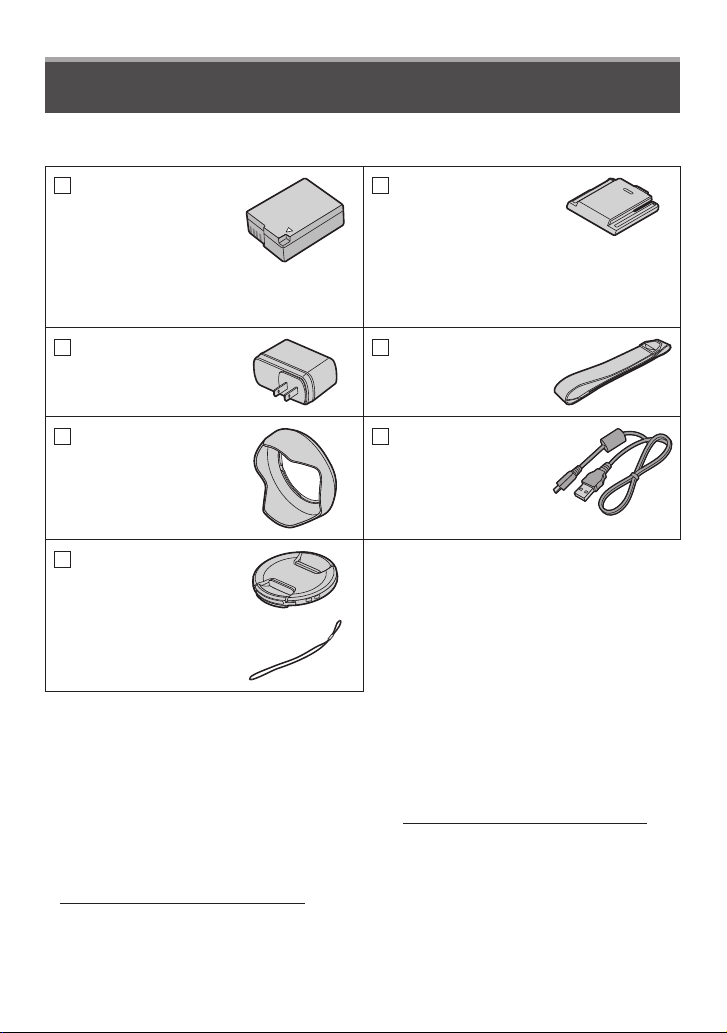
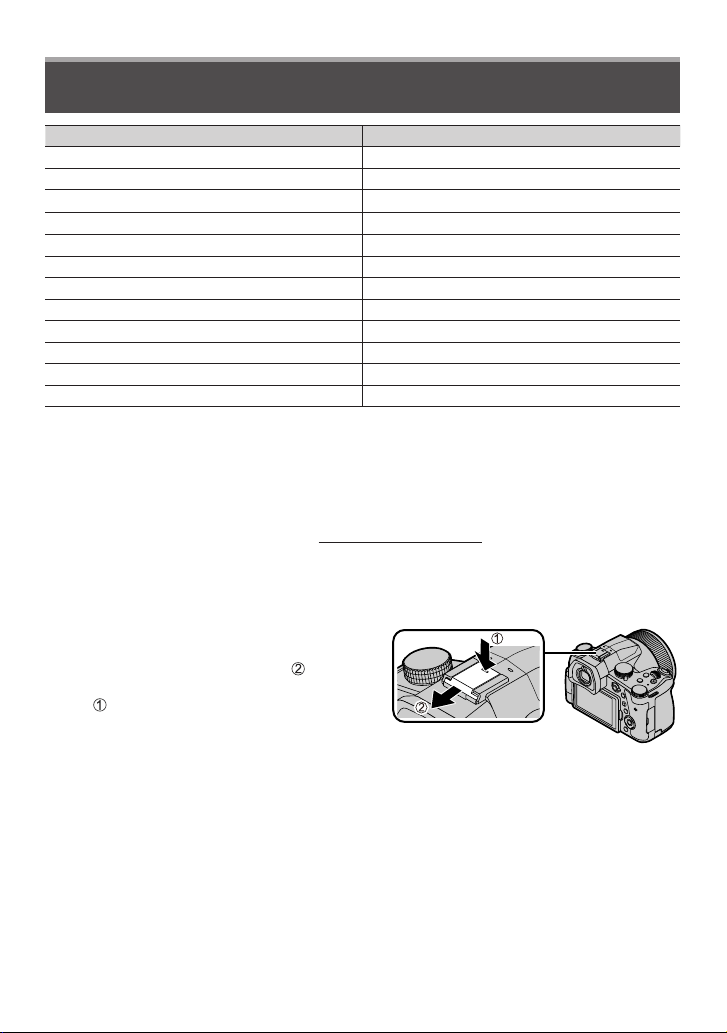
Check that all the accessories are supplied before using the camera. Part numbers are as
of February 2019. These may be subject to change.
Battery pack
DMW-BLC12PP
• Charge the battery before use.
• Battery pack is indicated as battery pack
or battery in the text.
Hot shoe cover
SKF0106K
(This is attached to the camera at the time
of purchase.)
AC adaptor
VSK0815F
Shoulder Strap
DVPW1002Z
Lens hood
SYQ0081
USB connection
cable
K1HY04YY0106
Lens cap/
Lens cap string
1ZE1DCFZ1000M2Z
• Cards are optional. (SD Memory Card, SDHC Memory Card and SDXC Memory Card
are indicated as card in the text.)
(For U.S.A. only)
• If accessories are lost, customers can visit us at http://shop.panasonic.com/support for
further information about obtaining replacement parts.
(For Canada only)
• If any accessories are lost, customers in Canada should visit our support page at
www.panasonic.ca/english/support for further information about obtaining replacement
parts.
• Please dispose of all packaging appropriately.
• The illustrations and screens in this manual may differ from the actual product.
Preparations/Basics
DVQX1774 (ENG)
12
Digital Camera Accessory System
Description Accessory#
Battery pack DMW-BLC12
Battery charger DMW-BTC12
AC adaptor
DMW-AC10
DC coupler
DMW-DCC8
Flash DMW-FL200L, DMW-FL360L, DMW-FL580L
Shutter remote control DMW-RS2
LED video light VW-LED1
Stereo shotgun microphone DMW-MS2
Stereo microphone VW-VMS10
MC protector DMW-LMCH62
PL filter (Circular type) DMW-LPL62
Shoulder Strap DMW-SSTG9
The AC adaptor (optional) can only be used with the designated Panasonic DC coupler (optional).
The AC adaptor (optional) cannot be used by itself. When using an AC adaptor (optional), use the
AC cable supplied with the AC adaptor.
●
Part numbers are as of February 2019. These may be subject to change.
●
Some optional accessories may not be available in some countries.
●
(For U.S.A. only)
To order optional accessories please visit http://shop.panasonic.com or your local Photo Specialty
Dealer.
■
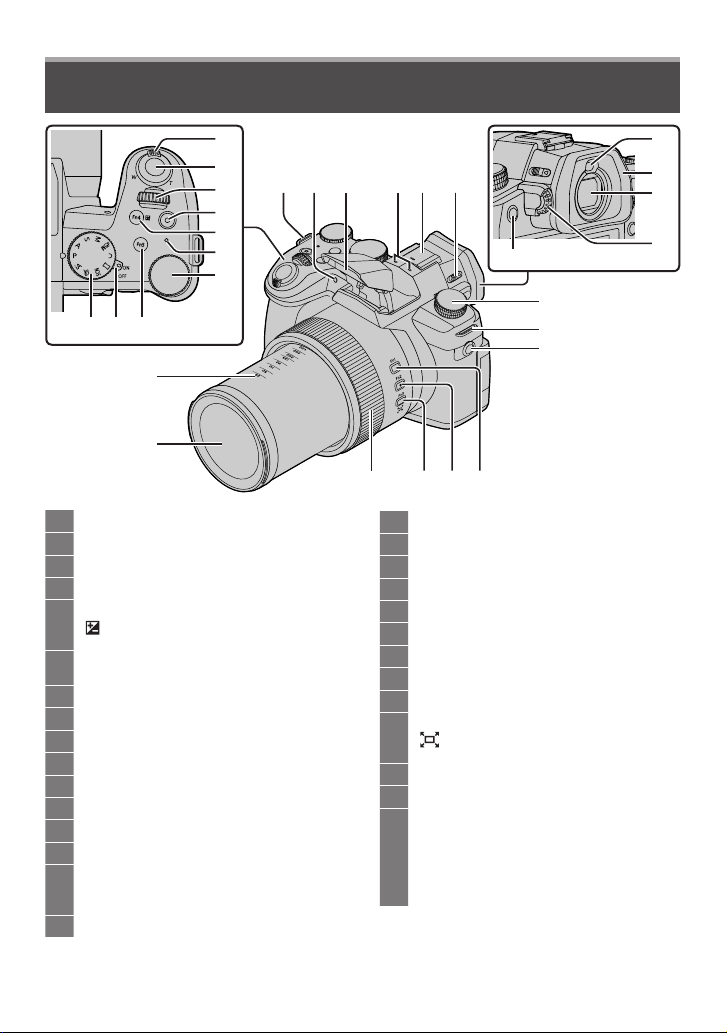
Removing the Hot Shoe Cover
Remove the hot shoe cover by pulling it in
the direction indicated by arrow
while
pressing it in the direction indicated by
arrow .
DVQX1774 (ENG)
13
Preparations/Basics
Names and Functions of Main Parts
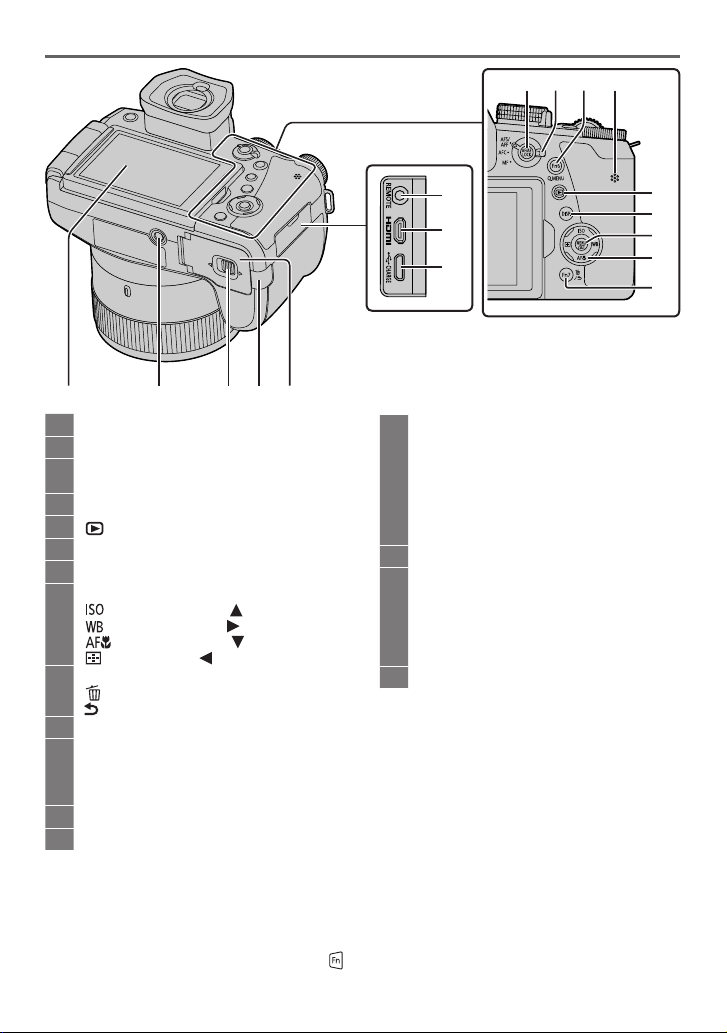
1
2
3
4
5
6
7
8 9 10
13 11
17
18
19
20
21
14 12 15 16
11
22
23
24 25 26
28
29
27
1
Zoom lever (→24)
2
Shutter button (→23)
3
Front dial (→26)
4
Motion picture button (→52)
5
[Fn4] button (→31) /
[
] (Exposure Compensation) button
(→37)
6
Charging lamp (→20) /
WIRELESS connection lamp (→71)
7
Rear dial (→26)
8
[Fn5] button (→31)
9
Camera [ON/OFF] switch (→21)
10
Mode dial (→25)
11
Shoulder strap eyelet (→16)
12
Self-timer indicator / AF Assist Lamp
13
Flash (→51)
14
Stereo microphone
15
Hot shoe (Hot shoe cover) (→12)
Keep the hot shoe cover out of reach of
children to prevent swallowing.
16
Flash open lever (→51)
17
Eye sensor (→22)
18
Eyecup
19
Viewfinder (→22)
20
Diopter adjustment dial (→22)
21
[Fn8] button (→31) / [LVF] button (→22)
22
Drive mode dial (→41)
23
[MIC] socket
24
[Fn1] button (→31)
25
[Fn2] button (→31)
26
[Fn3] button (→31) /
[
] ([Zoom Compose Assist]) button
(→24)
27
Control ring (→26)
28
Lens
29
Focal distance indication (as with a
35 mm film camera)
Values assume an aspect ratio of [3:2].
(When recording motion pictures, refer
to the focal length displayed on the
screen.)
Preparations/Basics
DVQX1774 (ENG)
14
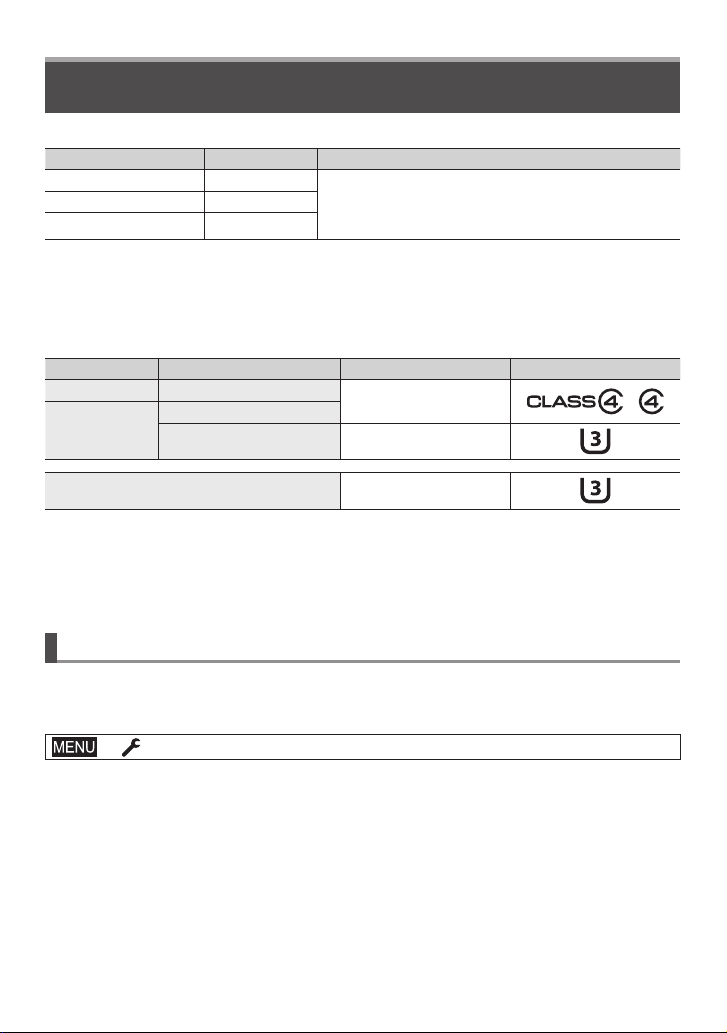
Function buttons [Fn9] to [Fn13] are touch icons.
They can be displayed by touching the [ ] tab on the recording screen.
30
[AF/AE LOCK] button (→37)
31
Focus mode lever (→34, 36)
32
[Fn6] button (→31) /
[Q.MENU] button (→31)
33
Speaker
34
[ ] (Playback) button (→56)
35
[DISP.] button (→27)
36
[MENU/SET] button (→27)
37
Cursor button (→27)
[
] (ISO sensitivity) ( ) (→38)
[
] (White balance) ( ) (→39)
[
] ([Macro Mode]) ( ) (→35)
[
] ([AF Mode]) ( ) (→35)
38
[Fn7] button (→31) /
[
] (Delete) button (→58) /
[
] (Cancel) button (→30)
39
[REMOTE] socket
40
[HDMI] socket
You can view pictures on a TV screen by
connecting your camera to your TV with
the HDMI micro cable.
41
[USB/CHARGE] socket (→19)
42
Card/Battery door (→18)
30 31 32 33
34
35
36
37
38
39
40
41
42 44 43 45 46
43
DC coupler cover (→12)
• Always use a genuine Panasonic AC
adaptor (DMW-AC10PP: optional).
(→12)
• When using an AC adaptor, ensure
that the Panasonic DC coupler (DMW-
DCC8: optional) and AC adaptor
(DMW-AC10PP: optional) are used.
44
Release lever (→18)
45
Tripod mount
Do not attach this unit to tripods that
have screws with a length of 5.5 mm
(0.22 inch) or more. Doing so may
damage this unit or the unit may not be
secured properly on the tripod.
46
Touch screen (→29) / monitor (→79)
DVQX1774 (ENG)
15
Preparations/Basics
The following SD standard-based cards can be used.
Type of Card Capacity Notes
SD Memory Cards 512 MB – 2 GB • This unit is compatible with UHS-
UHS Speed Class 3
standard SDHC/SDXC memory cards.
• Operation of the cards listed on the left has been
confirmed with Panasonic brand card.
SDHC Memory Cards 4 GB – 32 GB
SDXC Memory Cards 48 GB – 128 GB
■
About motion picture/4K photo recording and speed class ratings
Use a card that meets the following ratings of the SD Speed Class or UHS Speed Class.
• SD Speed Class and UHS Speed Class are the speed standards regarding continuous
writing. Confirm the SD speed by checking the card label or other card related
materials.
[Rec Format] [Rec Quality] Speed class Label example
[AVCHD] All
Class 4 or higher
[MP4]
[FHD]/[HD]
[4K]/[High Speed Video] UHS Speed Class 3
When recording in 4K Photo /
[Post Focus]
UHS Speed Class 3
• Latest information:
https://panasonic.jp/support/global/cs/dsc/
(This site is available in English only.)
●
Keep the memory card out of reach of children to prevent swallowing.
Formatting the card (initialization)
Format the card before recording a picture with this unit.
Since data cannot be recovered after formatting, make sure to back up necessary
data in advance.
→ [Setup] → [Format]
About the Card
Preparations/Basics
DVQX1774 (ENG)
16
Quick Start Guide
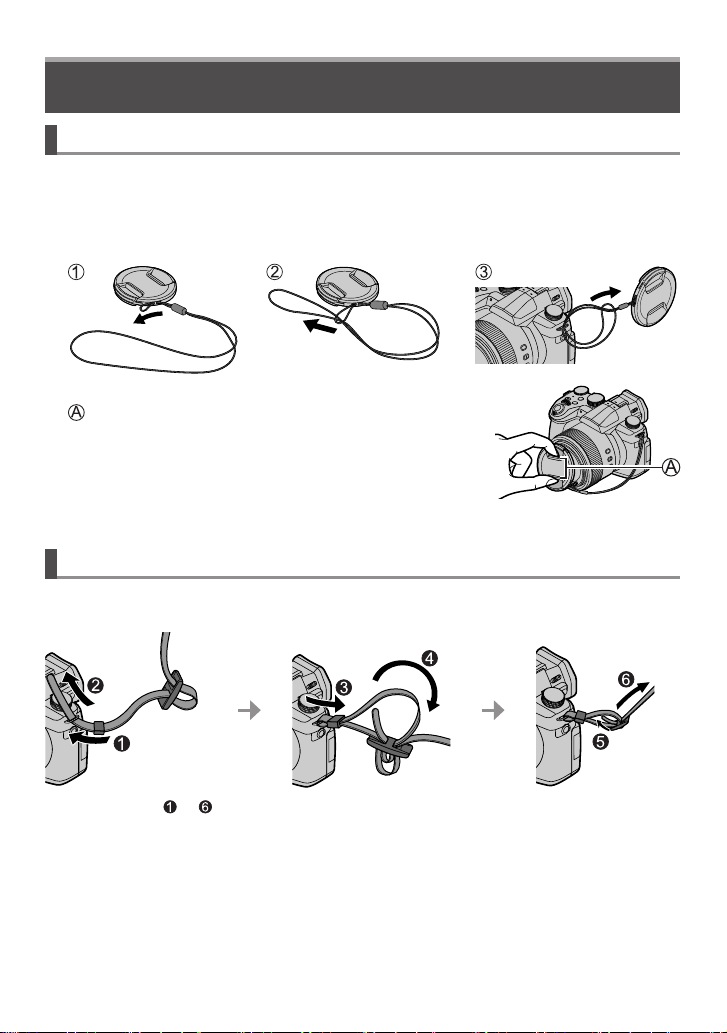
Attaching the Lens Cap
Cover the lens with the lens cap to protect it when you are not taking pictures.
• Do not hang or swing around the camera with the lens cap string.
• Make sure to detach the lens cap when turning this unit on.
• Be careful that the lens cap string does not become entangled with the shoulder strap.
1
Use the lens cap string (supplied) to attach the lens cap to the camera
2
Attach the lens cap
Pinch here to attach or detach the cap.
●
Keep the lens cap string out of reach of children to prevent swallowing.
Attaching the Shoulder Strap
We recommend attaching the shoulder strap when using the camera to prevent it from
dropping.
• Perform steps to and then attach the other side of the shoulder strap.
• Use the shoulder strap around your shoulder.
– Do not wrap the strap around your neck. It may result in injury or accident.
• Do not leave the shoulder strap where an infant can reach it.
– It may result in an accident by mistakenly wrapping around the neck.
DVQX1774 (ENG)
17
Preparations/Basics
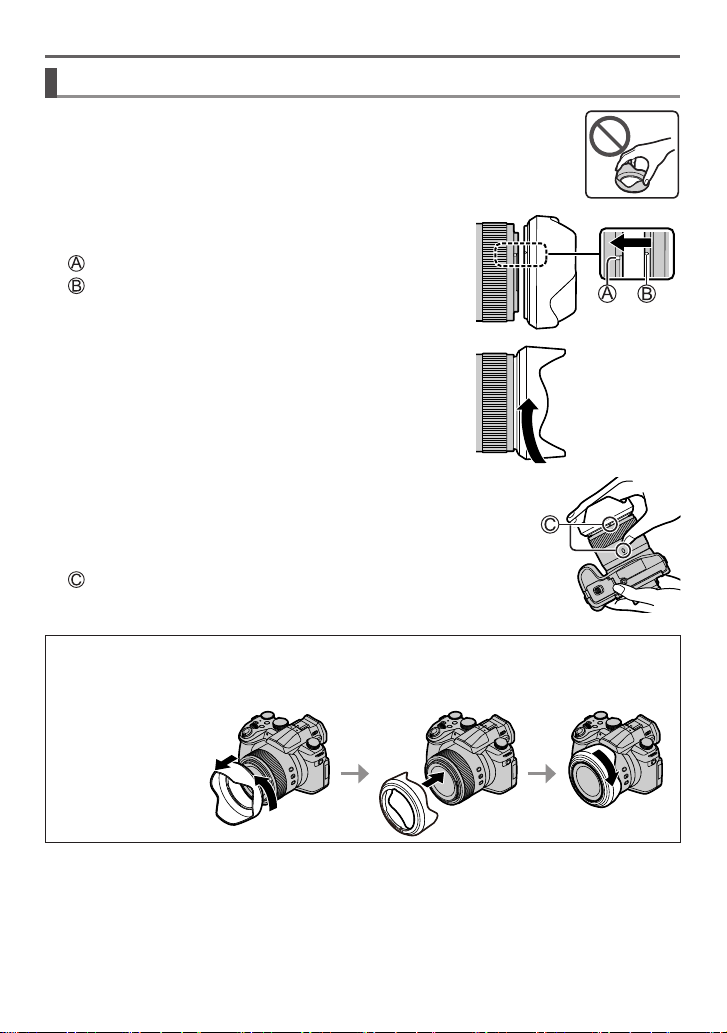
Attaching the Lens Hood
• Do not hold the lens hood in such a way that it will be bent.
• Make sure that the camera is turned off.
• Be sure to close the flash beforehand.
1
Align the mounting mark on the lens hood a little
above the mounting mark on the tip of the lens
Mounting mark on the tip of the lens
Mounting mark on the lens hood
2
Turn the lens hood in the direction of the arrow to
secure it
3
Continue to rotate the lens hood until you hear a “click”
even if you feel some stiffness, and then align the mark on
the bottom of the camera
• Make sure the lens hood is secured properly and its reflection does not
fall on images.
Rotate until the marks are aligned
●
If you attach the lens hood while using the flash, the flash light would be blocked by the lens hood
causing the bottom part of images to be darkened (vignetting) and also making it impossible to
modulate the light. It is recommended to remove the lens hood before using the flash.
●
Temporarily Storing the Lens Hood
Preparations/Basics
DVQX1774 (ENG)
18
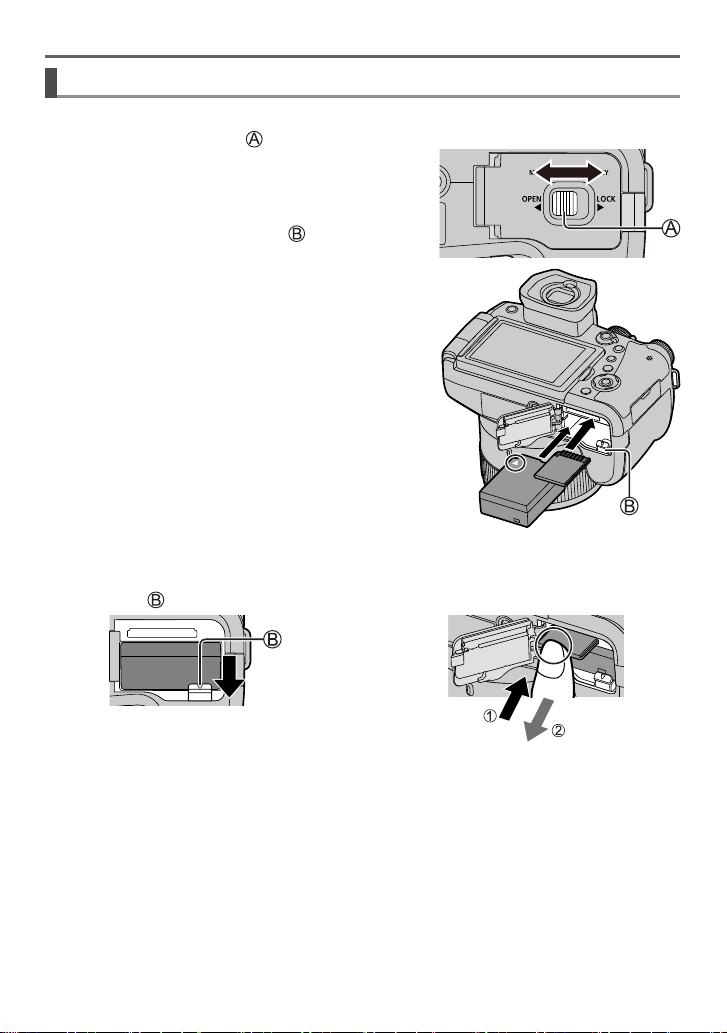
Inserting the battery and/or SD memory card (optional)
Make sure that the camera is turned off.
1
Slide the release lever ( ) to the [OPEN]
position and open the card/battery door
[OPEN] [LOCK]
2
Insert the battery and card, making sure that
their orientation is correct
• Battery: Insert the battery all the way firmly and check
that it is locked by lever (
).
• Card: Insert the card all the way firmly until it clicks. Do
not touch the terminal.
3
Close the door
Slide the release lever to the [LOCK] position.
■
To remove
• To remove battery
Move lever (
) in direction of arrow.
• To remove card
Press the center of the card.
Press
Pull out
●
Always use genuine Panasonic batteries (DMW-BLC12PP).
●
If you use other batteries, we cannot guarantee the quality of this product.
●
Turn the camera off and wait for the “LUMIX” display on the monitor to clear before removing the
card or battery.
DVQX1774 (ENG)
19
Preparations/Basics
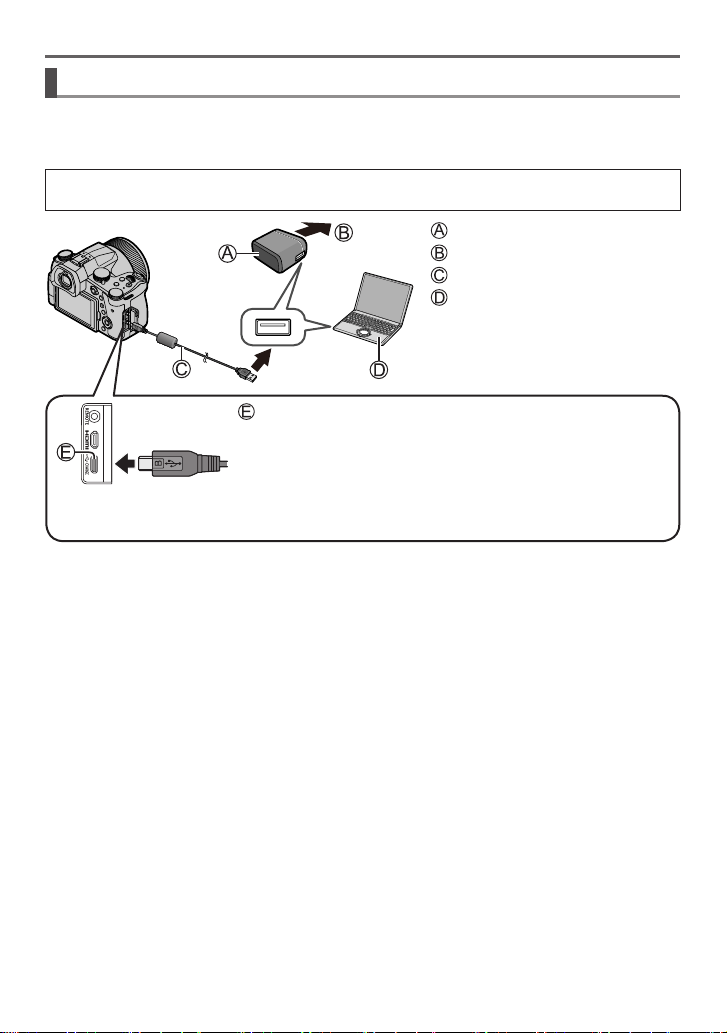
Charging the battery
• The battery that can be used with this unit is DMW-BLC12PP.
• We recommend charging in a location where the ambient temperature is between
10 °C and 30 °C (50 °F to 86 °F) (same for the battery temperature).
Insert the battery into the camera.
Make sure that the camera is turned off.
[USB/CHARGE] socket
• This terminal is located at the bottom when the camera is in an
upright position.
• Always check the direction of the socket, and hold the plug straight to insert or remove it. (If the
cable is inserted in the wrong direction, the socket could become deformed and cause faulty
operation.) Also, do not insert into the wrong socket. Doing so may cause damage to this unit.
AC adaptor (supplied)
To the electrical outlet
USB connection cable (supplied)
Computer
• Turn on the computer.
Preparations/Basics
DVQX1774 (ENG)
20
Charging from the power outlet
Connect the AC adaptor (supplied) and this camera with the USB connection cable
(supplied), and insert the AC adaptor (supplied) into the power outlet.
Charging from a computer
Connect the computer and this camera with the USB connection cable (supplied).
■
Charging lamp indications
Charging lamp (Red)
On Charging in progress
Off
Charging complete (After charging stops, disconnect the
camera from the electrical outlet or your computer.)
Flashing Charging error (→82)
■
Charging time
When using the AC adaptor (supplied) Approx. 180 min.
• The charging time indicated above is the time required for charging in case
when the battery is completely used up. The time required for charging differs
depending on conditions of battery usage. Charging takes longer in cases when
temperatures are either high or low and when the battery has not been used for a
long period of time.
• The time required for charging through the computer varies depending on the power
supply capacity of the computer.
●
Do not use any other USB connection cables except the supplied one.
●
Do not use any other AC adaptors except the supplied one.
DVQX1774 (ENG)
21
Preparations/Basics
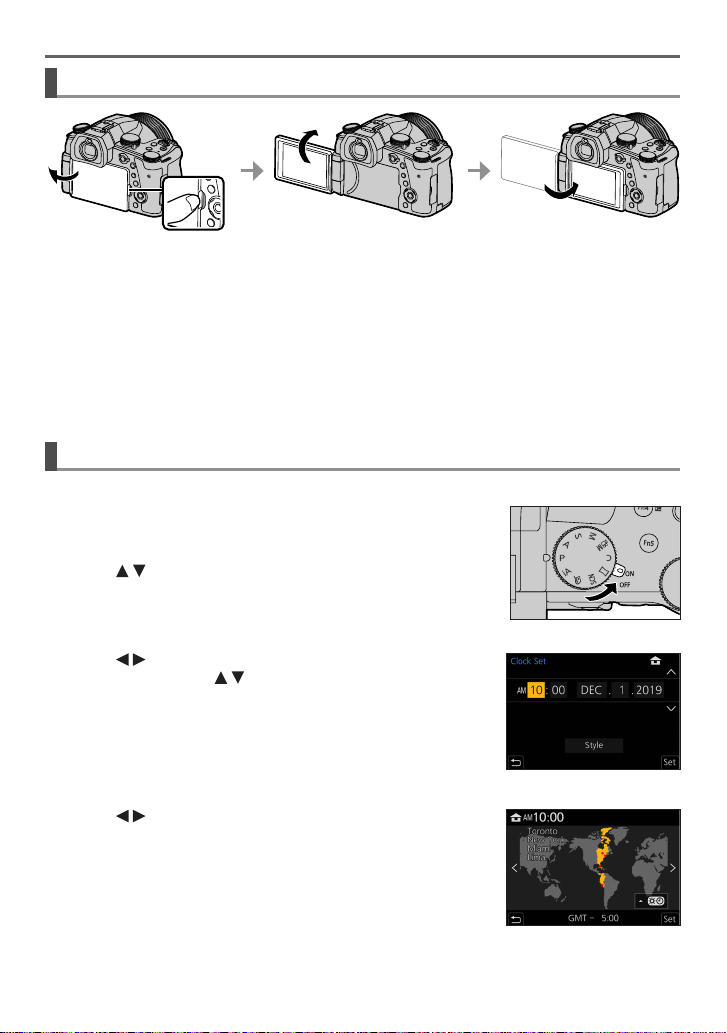
Opening the Monitor
1
2
3
1
Place your finger in the cleft on the right side of the monitor and open the
monitor toward the left side (maximum 180°)
2
It can be rotated 180° to the direction of the lens
3
Return the monitor to its original position
●
Only rotate the monitor after opening it wide enough, and be careful not to use excessive
force. Doing so may cause damage to this unit.
●
When not using the monitor it is recommended that you close it with the screen facing inward to
prevent dirt and scratches.
Setting the clock
The clock is not set when the camera is shipped.
1
Turn the camera on
2
Press [MENU/SET]
3
Press to select the language and press
[MENU/SET]
• The [Please set the clock] message appears.
4
Press [MENU/SET]
5
Press to select the items (year, month, day, hour,
minute), and press to set
6
Press [MENU/SET]
7
When [The clock setting has been completed.] is
displayed, press [MENU/SET]
8
When [Please set the home area] is displayed, press [MENU/SET]
9
Press to set your home area and press
[MENU/SET]
Preparations/Basics
DVQX1774 (ENG)
22
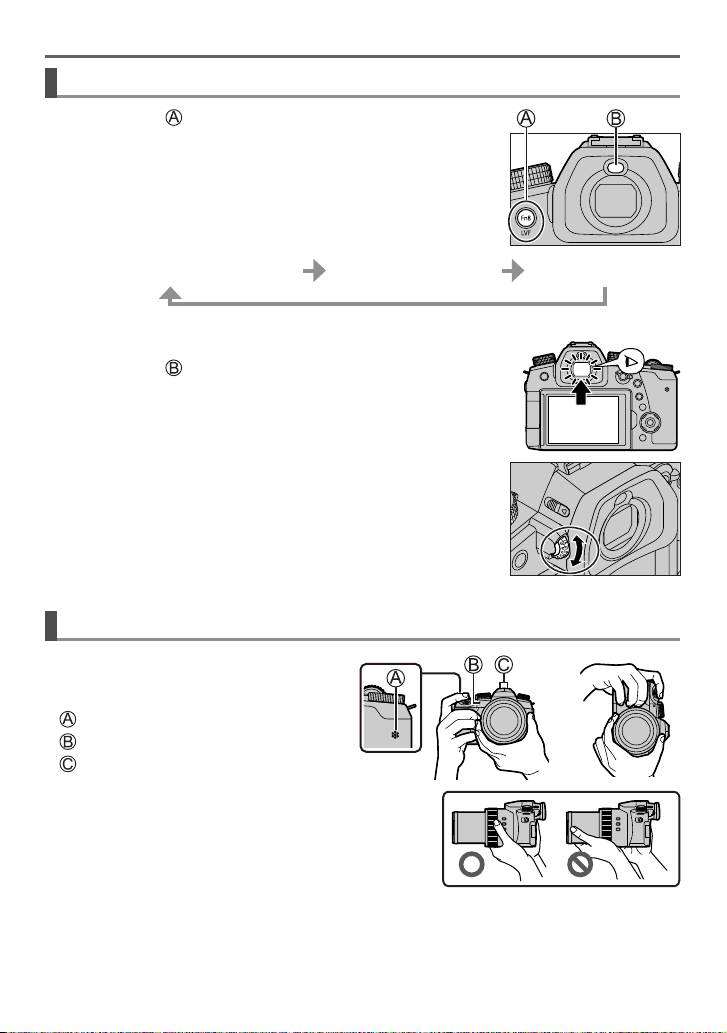
[LVF] button (Recording pictures using the viewfinder)
1
Press [LVF] ( ) button
Automatic switching between
viewfinder and monitor
Viewfinder display
Monitor display
■
Automatic switching between viewfinder and monitor
The eye sensor (
) automatically switches the display to
viewfinder when your eye or an object moves close to the
viewfinder. When the eye or object moves away from the
viewfinder, the camera returns to monitor display.
■
About diopter adjustment
Rotate the diopter adjustment dial to adjust until you are able
to clearly see the characters displayed in the viewfinder.
●
If [LVF Display Speed] is set to [ECO 30fps] when the viewfinder
is used, the camera can be operated for a longer period since
battery drainage is reduced.
Holding the camera
• Do not block the flash, AF Assist Lamp,
microphone, or speaker with your
fingers or other objects.
Speaker
AF Assist Lamp
Microphone
• Do not hold the lens barrel as you take pictures.
There is a risk that your finger will be trapped as the
lens retracts.
DVQX1774 (ENG)
23
Preparations/Basics
■
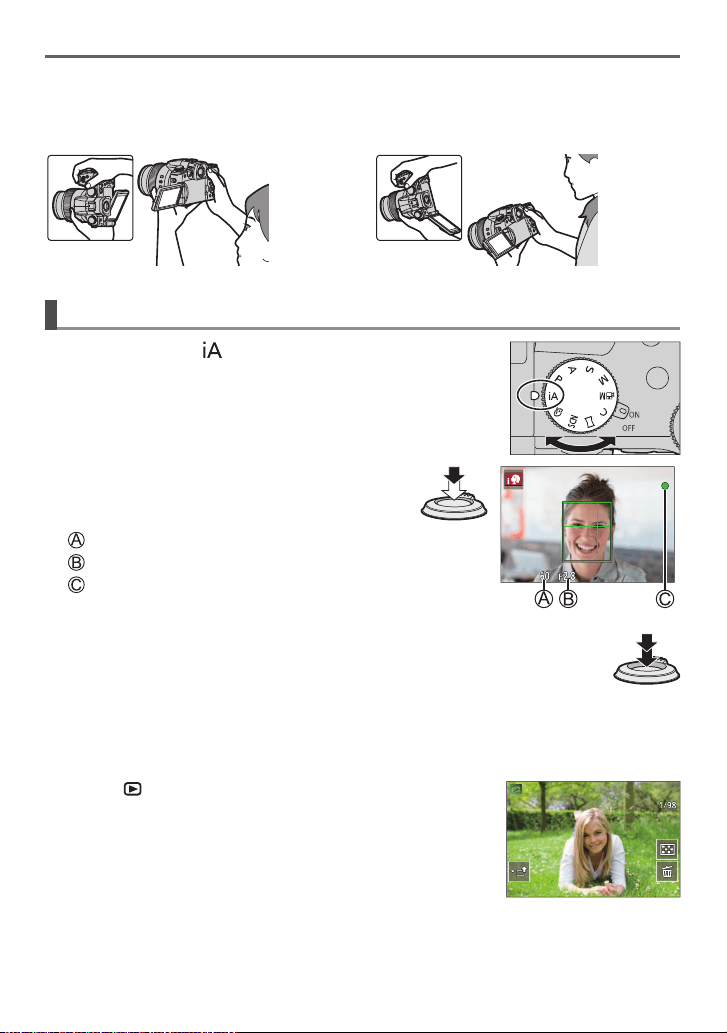
Free angle shooting
The monitor can be rotated to suit your needs. This is convenient as it allows you to take
pictures from various angles by adjusting the monitor.
Taking pictures at high angle Taking pictures at low angle
Shutter button (Taking pictures)
1
Set mode dial to [ ]
• The camera automatically optimizes the main settings.
• For details on the recording modes, refer to (→25).
2
Press the shutter button halfway (press
lightly) to focus on the subject
Shutter speed
Aperture value
Focus display (Green)
( When focus is aligned: illuminated
When focus is not aligned: flashing)
3
Press the shutter button fully (push the button all the way), and take
the picture
●
Pictures can be taken only when the image is correctly focused as long as the [Focus/
Release Priority] is set to [FOCUS].
■
Check the picture you have taken
Press the [
] (Playback) button. (→56)
Preparations/Basics
DVQX1774 (ENG)
24
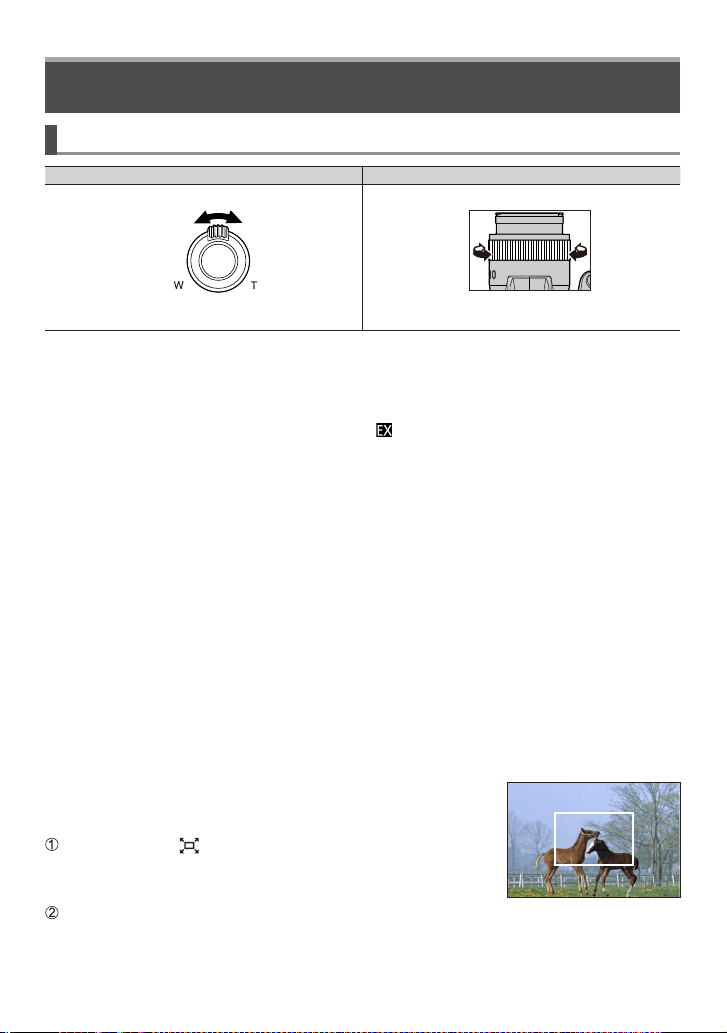
Zoom lever (Use zoom)
Zoom lever
Control ring
1
Move the zoom lever
Capture a
wider area
(wide-angle)
Enlarge the
subject
(telephoto)
• The zoom speed varies according to how
far you rotate the lever.
1
Turn the control ring
←
Capture a
wider area
(wide-
angle)
→
Enlarge the
subject
(telephoto)
“Control ring”(→26)
Optical Zoom:
You can zoom in without degrading the picture quality.
Maximum magnification: 16x
Extended optical zoom:
This function works when picture sizes with [ ] have been selected in [Picture Size].
Extended optical zoom allows you to zoom in using a higher zoom ratio than optical
zoom, without degrading the picture quality.
Maximum magnification: 32x
1
1
Including the optical zoom ratio. The maximum zoom ratio varies depending on the picture size.
[i.Zoom]:
Set the [i.Zoom] in the [Rec]/[Motion Picture] menu to [ON].
You can use the camera’s intelligent resolution technology to increase the zoom ratio
up to 2x
2
higher than the original zoom ratio with limited deterioration of picture quality.
2
Up to 1.5x the original zoom ratio when [Picture Size] is set to [S]
[Digital Zoom]:
Set the [Digital Zoom] in the [Rec]/[Motion Picture] menu to [ON].
You can zoom in up to 4x the original zoom magnification. When [Digital Zoom] is used
simultaneously with [i.Zoom], you can increase the combined zoom ratio up to 4x.
Note that, with Digital Zoom, enlarging will decrease picture quality.
• When [Monitor Display Speed] is set to [ECO 30fps], Digital Zoom is not
available (setting at the time of purchase).
• When [LVF Display Speed] is set to [ECO 30fps], Digital Zoom is not available.
■
[Zoom Compose Assist] button (Using the Zoom
Compose Assist function)
If you lose the subject while zoomed in:
Press and hold [ ] ([Zoom Compose Assist]) button
• A frame indicating the original zoom magnification (angle of view)
will appear.
When you find the subject:
Align the frame with the subject and release your finger
from the button
Basic operations
DVQX1774 (ENG)
25
Preparations/Basics
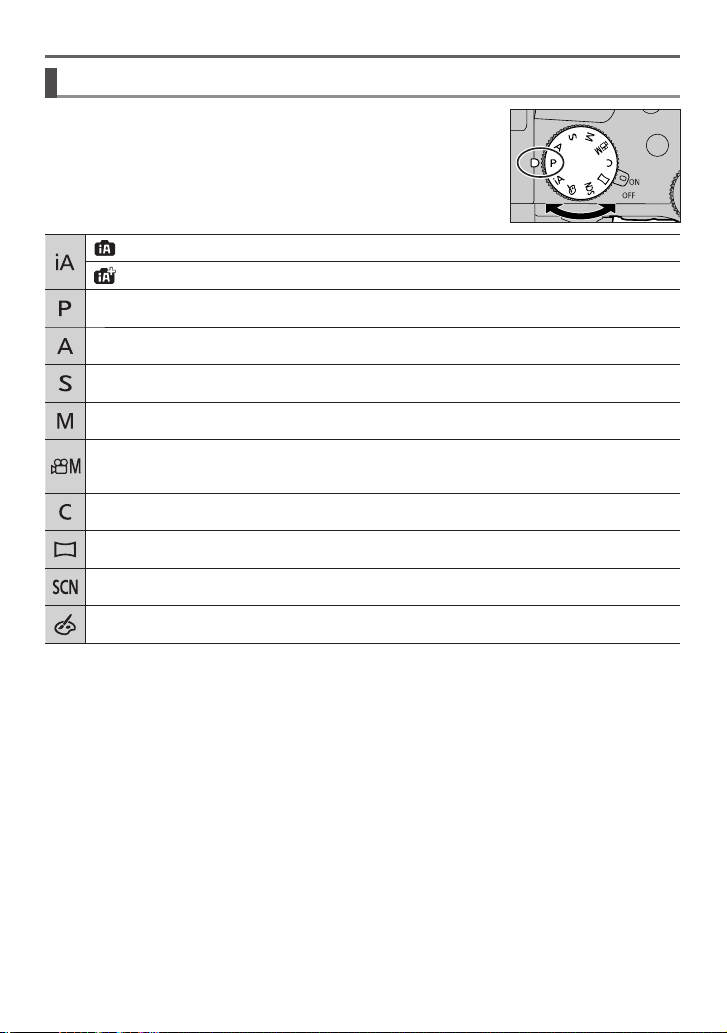
Mode dial (Select the recording mode)
1
Set to the desired recording mode
• Rotate the mode dial slowly to select the desired mode.
Intelligent Auto Mode (→32)
Intelligent Auto Plus Mode (→32)
Program AE Mode
Take pictures with automatic shutter speed and aperture value settings.
Aperture-Priority AE Mode
Determine aperture, then take pictures.
Shutter-Priority AE Mode
Determine shutter speed, then take pictures.
Manual Exposure Mode
Determine aperture and shutter speed, then take pictures.
Creative Video Mode (→53)
Determine aperture, shutter speed and ISO sensitivity, then record motion pictures.
• You cannot take still pictures.
Custom Mode
Take pictures using pre-registered settings.
Panorama Shot Mode
Take panorama pictures.
Scene Guide Mode
Take pictures that match the scene being recorded.
Creative Control Mode
Take pictures by selecting your preferred picture effect.
Preparations/Basics
DVQX1774 (ENG)
26
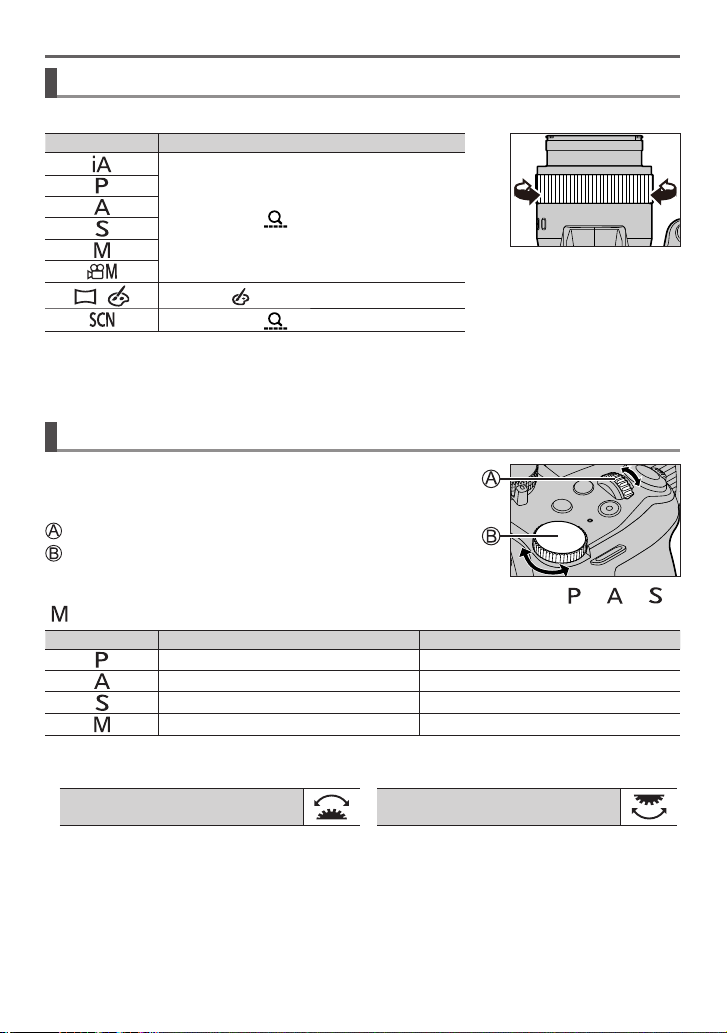
Control ring
You can use the control ring to change the settings for recording.
Mode dial
Control ring
Step Zoom
/
Picture effects change
Step Zoom
When Manual Focus is set, the control ring is assigned to focus adjustment.
●
You can change to your preferred settings using [Control Ring] from the [Custom] ([Operation])
menu.
Front dial/Rear dial
Rotating:
Selection of items or setting of values is performed during
the various settings.
Front dial
Rear dial
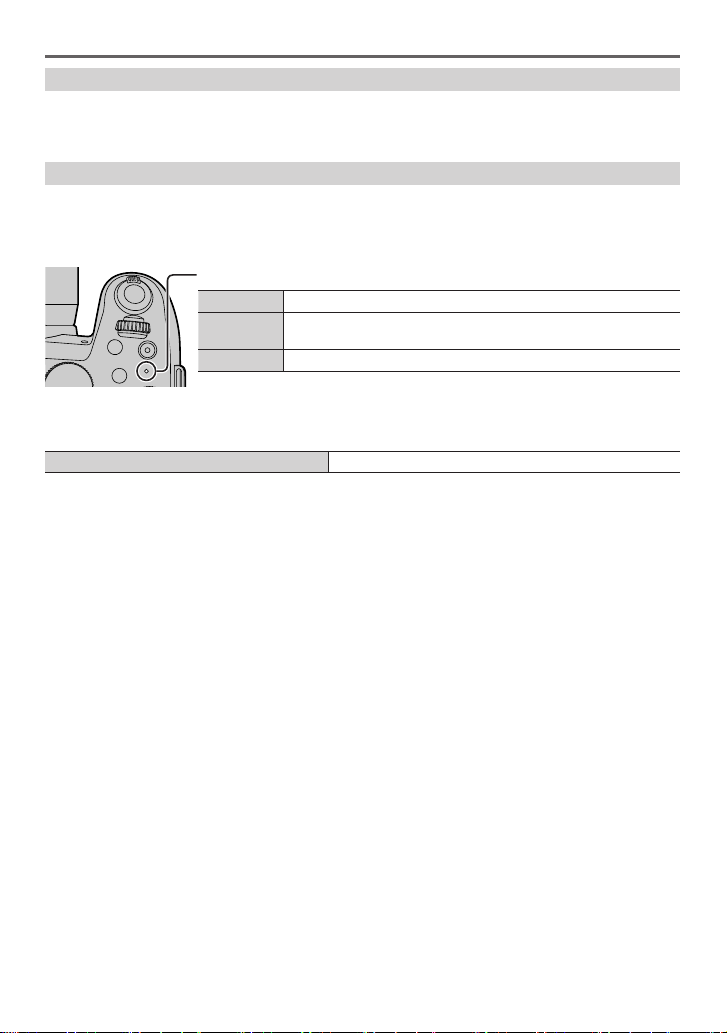
Allows you to set the aperture, shutter speed, and other settings when in [ ] / [ ] / [ ] /
[ ] modes.
Mode dial Front dial Rear dial
Program Shift Program Shift
Aperture value Aperture value
Shutter speed Shutter speed
Aperture value Shutter speed
• This owner’s manual describes operations of the front dial/rear dial as follows:
Turn the front dial
Rotate the rear dial
DVQX1774 (ENG)
27
Preparations/Basics
Cursor button / [MENU/SET] button (Selecting/setting items)
Pressing the cursor button:
Selection of items or setting of values etc., is performed.
Pressing [MENU/SET]:
Confirmation of setting contents, etc., is performed.
• This owner’s manual expresses the up, down, left, and right of the cursor button as
.
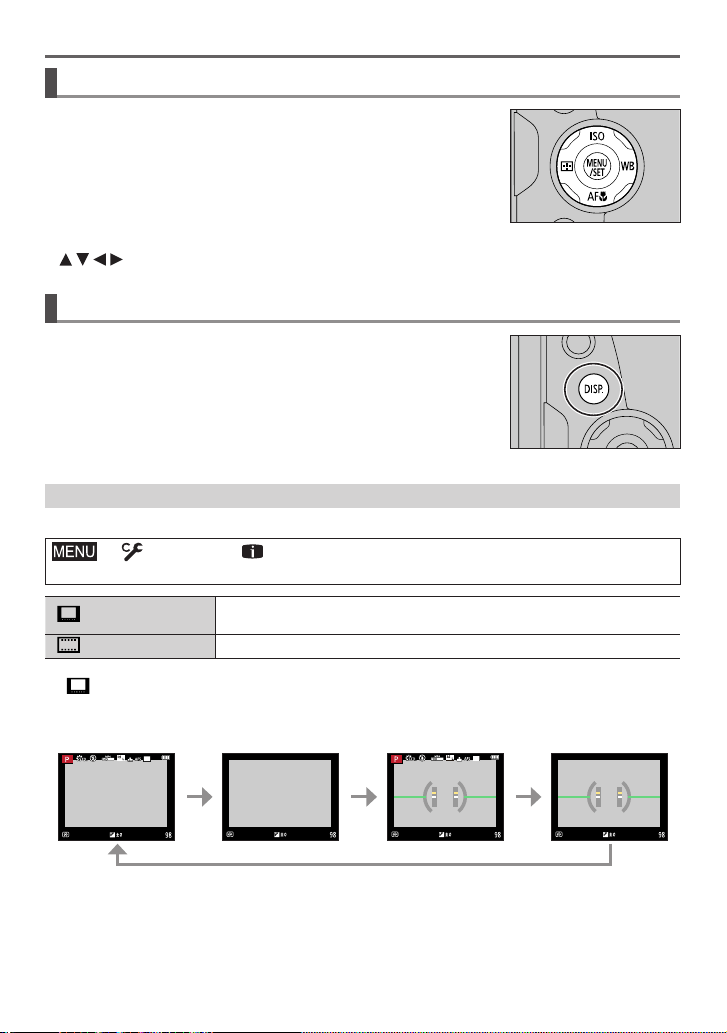
[DISP.] button (Switching the display information)
1
Press [DISP.] button to switch the display
During recording
You can switch the viewfinder/monitor display method.
→ [Custom] → [Monitor / Display] → [LVF/Monitor Disp. Set]
→ [LVF Disp. Set] or [Monitor Disp. Set]
[ ] (viewfinder style)
Scales down images slightly so that you can better review the
composition of the images.
[
] (monitor style)
Scales images to fill the entire screen so that you can see their details.
■
[ ] Live View Finder style display layout (Example of viewfinder style display)
With information Without information
With information
+
level gauge
Without information
+
level gauge
60
p
60
p
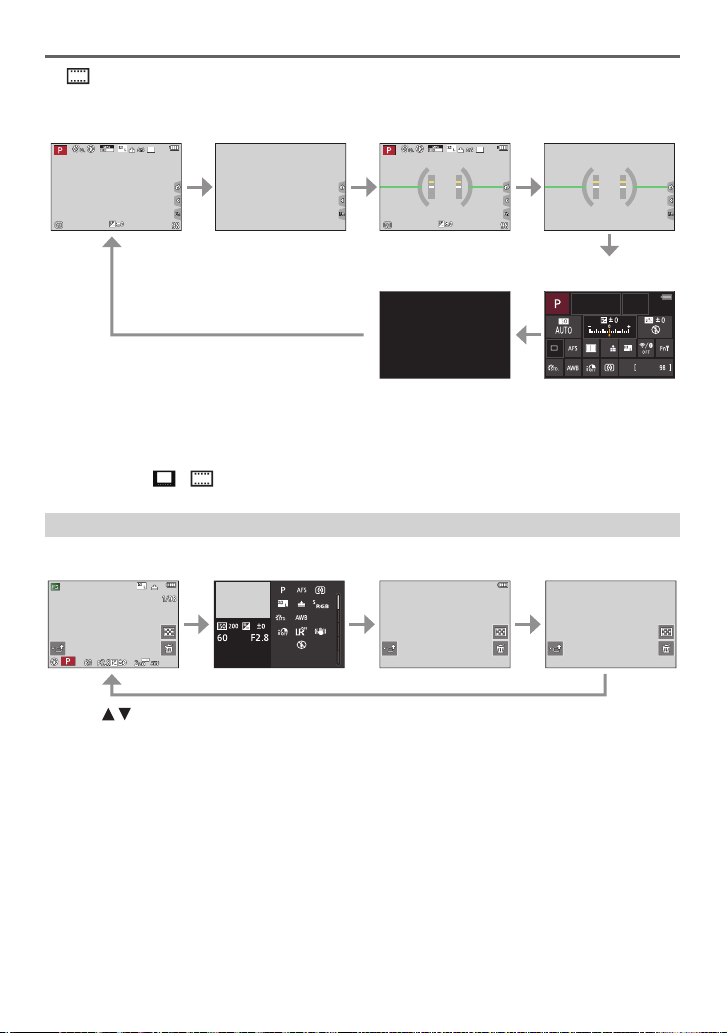
Preparations/Basics
DVQX1774 (ENG)
28
■
[ ] Monitor style display layout (Example of monitor style display)
With information Without information
With information
+
level gauge
Without information
+
level gauge
60
p
60
p
Turned off
Monitor recording
information screen
This screen is displayed only when [Monitor Info. Disp.] in the [Custom] ([Monitor / Display]) menu is
set to [ON]. Settings can be adjusted directly by touching each of the items displayed on the screen.
●
With [Fn Button Set] in the [Custom] ([Operation]) menu, you can assign [LVF/Monitor Disp. Style] to
a function button. Each time you press the assigned function button, the display style of the monitor
or viewfinder ([
]/[ ]), whichever is currently in use, will change.
During playback
With information
Detailed information
display
1
Without information
([Highlight])
2
Without information
100-0001
1/5
AM10:00 DEC. 1.2019
1
Press to switch between the following display modes:
– Detailed information display
– Histogram display
– Photo style, Highlight shadow display
– White balance display
– Lens information display
2
This screen is displayed only when [Highlight] in the [Custom] ([Monitor / Display]) menu is set to
[ON].
DVQX1774 (ENG)
29
Preparations/Basics
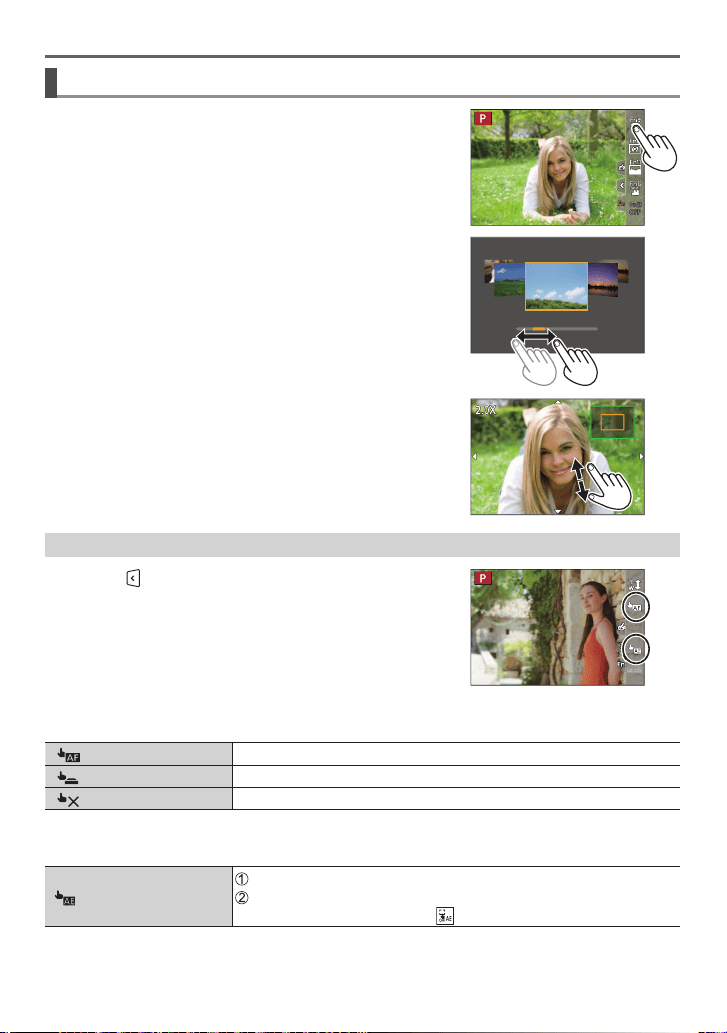
Touch screen (Touch operations)
Touch
To touch and release the touch screen.
Drag
To touch and slide your finger across the touch screen.
Pinch (spread/pinch)
On the touch screen, spread (pinch out) your 2 fingers to
zoom in, and pinch (pinch in) your 2 fingers to zoom out.
Taking Pictures Using the Touch Function
1
Touch [ ]
2
Touch an icon
■
Touch AF, Touch Shutter
The icon switches every time you touch it.
[
] (Touch AF)
Focuses on the position you touch.
[
] (Touch shutter)
Focuses on the touched position before recording takes place.
[
] (OFF)
Touch AF and Touch Shutter are disabled.
■
[Touch AE]
You can easily optimize the brightness for a touched position.
[
] ([Touch AE])
Touch the subject you want to optimize the brightness for
Touch [Set]
• To cancel the function, touch [ ] .
Preparations/Basics
DVQX1774 (ENG)
30
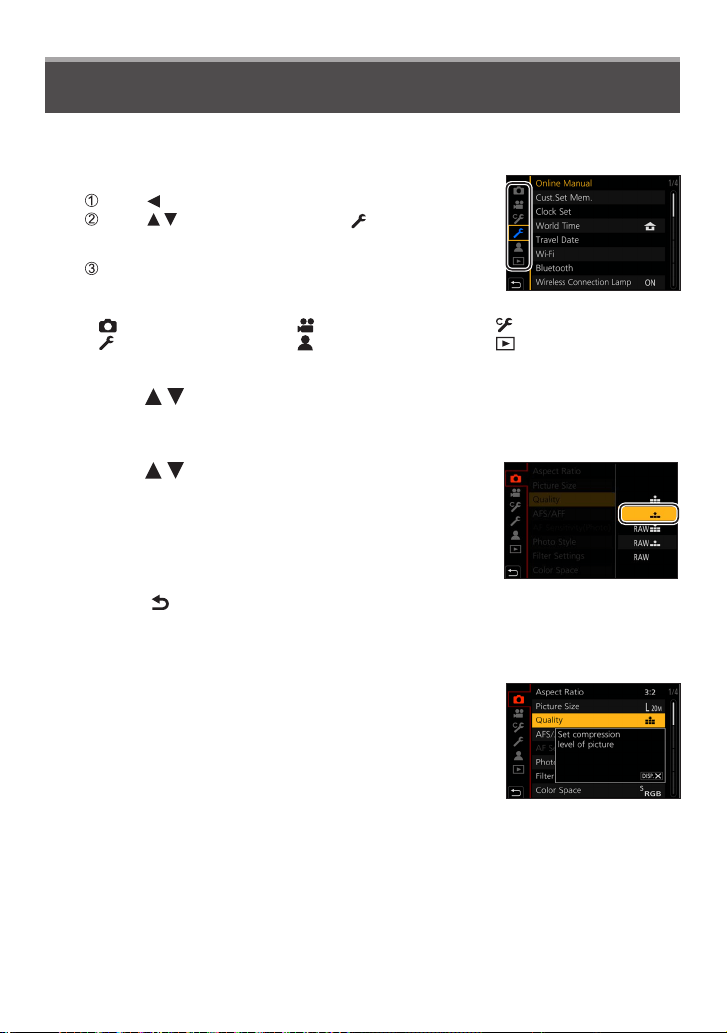
Setting the menu
1
Press [MENU/SET] to bring up the menu
2
Switch the menu type
Press
Press to select a tab such as [ ]
• You can also select the menu toggle icons by rotating the
front dial.
Press [MENU/SET]
■
Menu types
•
[Rec]
• [Setup]
• [Motion Picture]
• [My Menu]
•
[Custom]
• [Playback]
• Menus to be displayed in each recording mode (→59)
3
Press to select the menu item and press [MENU/SET]
• The menu item can also be selected by rotating the rear dial.
• You can also switch to the next page by rotating the zoom lever.
4
Press to select the setting and press
[MENU/SET]
• The setting can also be selected by rotating the rear
dial.
• The setting methods vary depending on the menu
item.
5
Press [ ] button repeatedly until the recording or playback
screen reappears
• The menu screen can also be exited by pressing the shutter button halfway.
●
You can display an explanation on the menu by pressing the [DISP.]
button while you select a menu item or setting.
●
The menu items that cannot be set are grayed out. In some setting
conditions, the reason the setting is disabled is displayed when you
press [MENU/SET] if you select a grayed-out menu item.
DVQX1774 (ENG)
31
Preparations/Basics
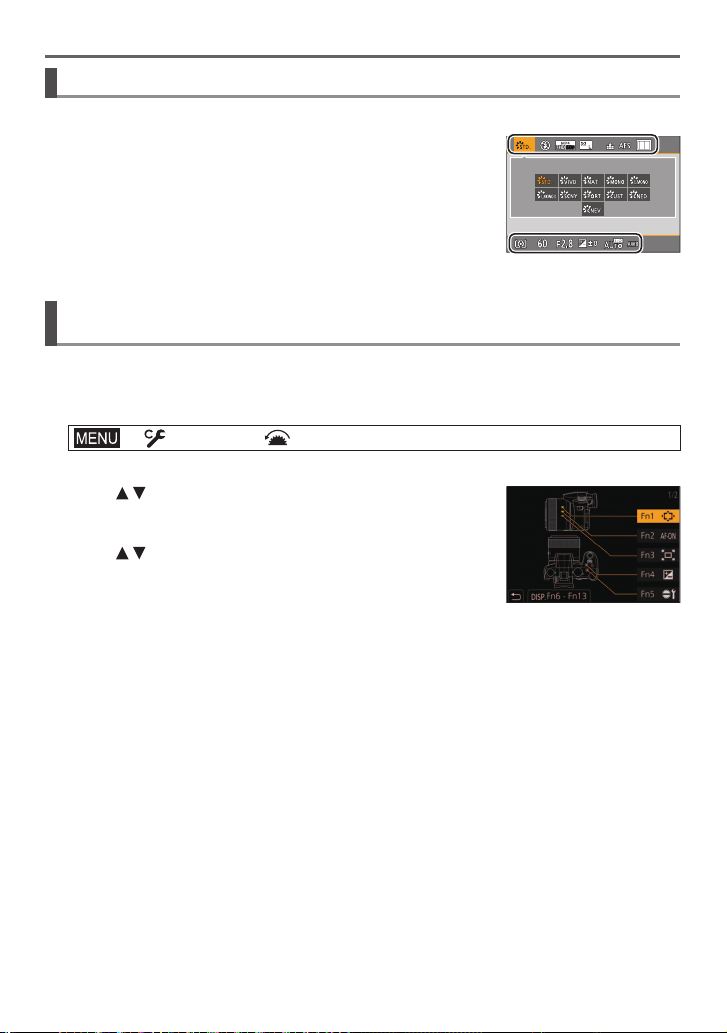
Calling frequently-used menus instantly (Quick Menu)
You can easily call some of the menu items and set them during recording.
1
Press [Q.MENU] button
60
p
60
p
2
Rotate the front dial to select a menu item
3
Rotate the rear dial to select the setting
4
Press [Q.MENU] button to close the Quick menu
Assigning frequently used functions to the buttons
(Function buttons)
You can assign frequently-used functions to particular buttons ([Fn1] - [Fn8]) or icons
displayed on the screen ([Fn9] - [Fn13]).
1
Set the menu
→ [Custom] → [Operation] → [Fn Button Set]
Settings: [Setting in REC mode] / [Setting in PLAY mode]
2
Press to select the function button you want to
assign a function to and press [MENU/SET]
• You can press [DISP.] button to switch pages.
3
Press to select the function you want to assign
and press [MENU/SET]
●
The screen displayed in Step
3
can be displayed by holding a function button ([Fn1] to [Fn8]) for
2 seconds.
●
Certain functions cannot be assigned to some function buttons.
DVQX1774 (ENG)
32
Recording
Taking pictures with automatic settings
(Intelligent Auto Mode)
This mode is recommended for those who want to point and shoot as the camera
optimizes settings to match the subject and recording environment.
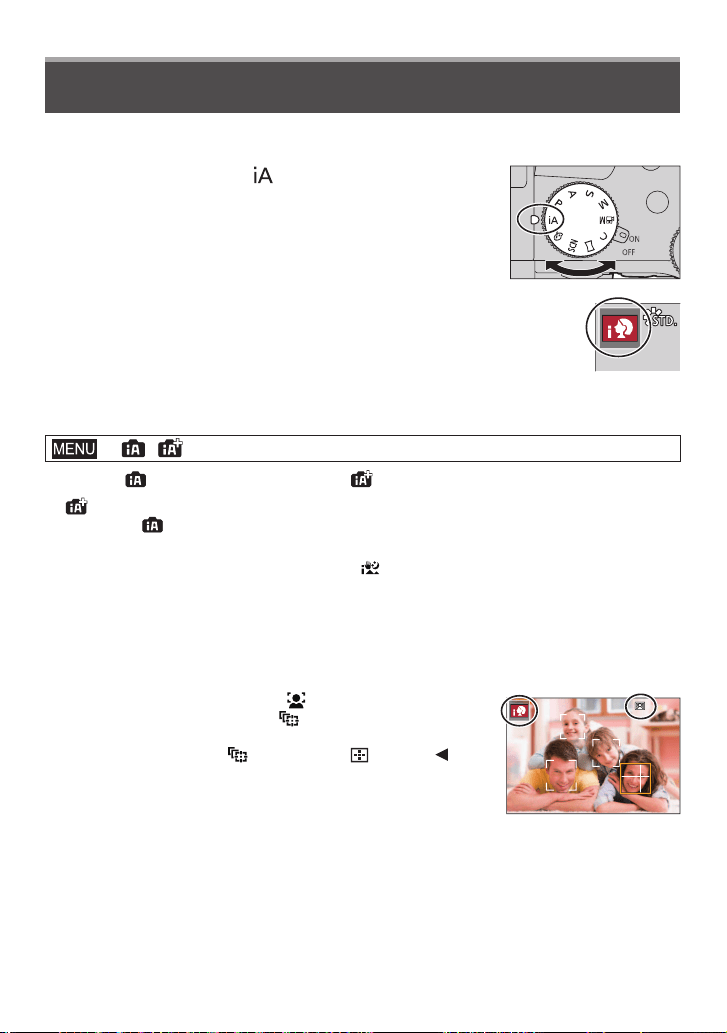
1
Set mode dial to [ ]
• At the time of purchase, the mode is set to Intelligent
Auto Plus Mode.
2
Point the camera at the subject
• When the camera identifies the optimal scene, the icon switches to
the one for that scene. (Automatic Scene Detection)
■
Switching between Intelligent Auto Plus Mode and Intelligent Auto Mode
→ / [Intelligent Auto] → [Intelligent Auto Mode]
Settings: [
] (Intelligent Auto Mode) / [ ] (Intelligent Auto Plus Mode)
• [ ] allows you to adjust some settings such as the brightness and color tone while
also using [ ] for other settings so that you can record pictures more suited to your
preferences. (→33)
●
When [iHandheld Night Shot] is set to [ON] and [ ] is detected while taking handheld night shots,
pictures of the night scenery will be taken at a high burst speed and composed into a single picture.
●
When [iHDR] is set to [ON] and there is, for example, strong contrast between the background and
the subject, multiple still pictures are recorded with differing exposures and combined to create a
single still picture rich in gradation.
■
Auto Focus (Face/Eye Detection)
[AF Mode] is automatically set to [
]. If you touch the
subject, the camera switches to [ ] and the AF tracking
function starts operating.
• You can also switch to [ ] by pressing [ ] button ( ).
Align the AF tracking area with the subject and press the
shutter button halfway to operate the AF tracking function.
DVQX1774 (ENG)
33
Recording
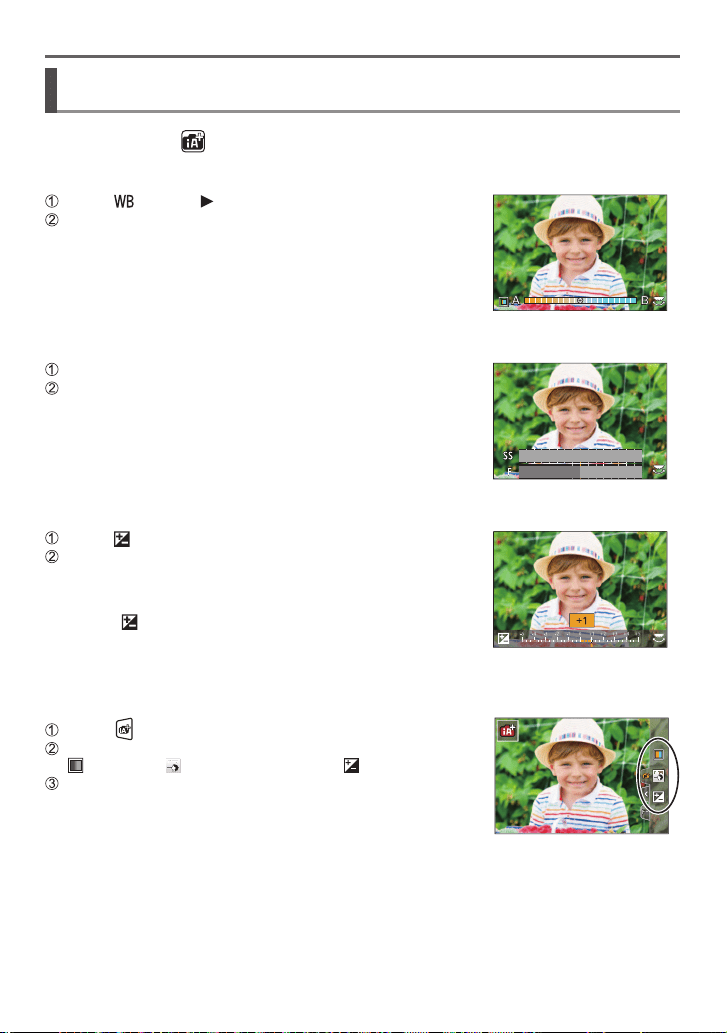
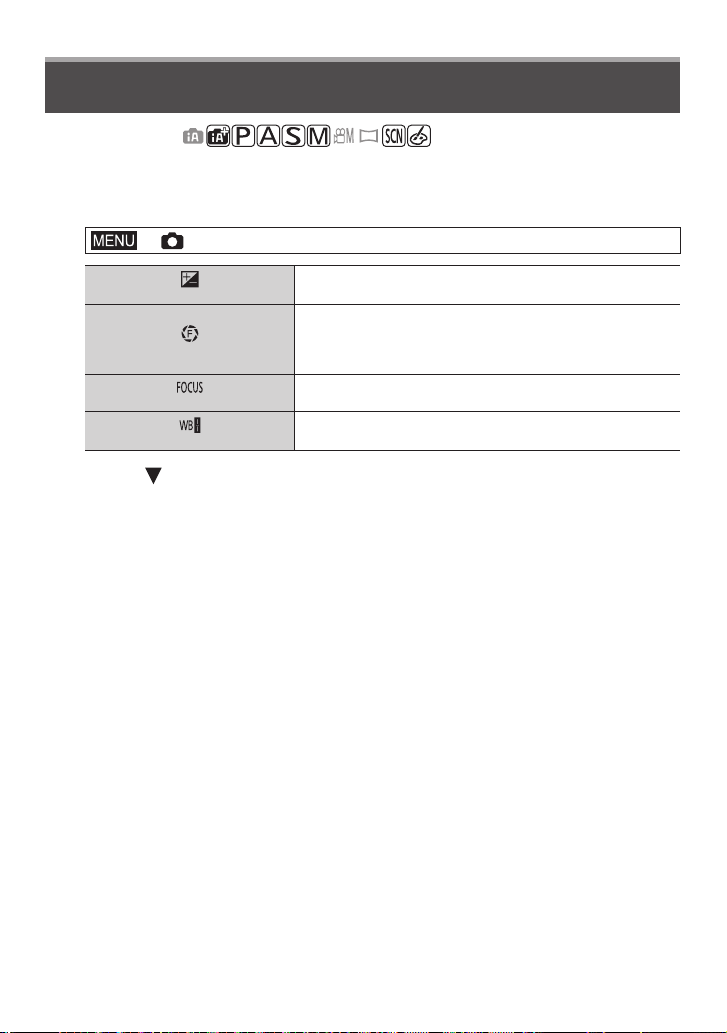
Taking pictures with customized coloring, blurriness of the
background and brightness
Recording mode:
■
Setting coloring
Press [ ] button ( ) to display the setting screen
Rotate the rear dial to adjust color
• Press [MENU/SET] to return to the recording screen.
■
Defocusing the background (Defocus control function)
Press [Fn7] button to display the setting screen
5.64.02.8
250 125 60 30 15
Rotate the rear dial to set the blurriness of the background
• Press [MENU/SET] to return to the recording screen.
• Pressing [Fn7] button on the setting screen will cancel the setting.
■
Setting brightness
Press [ ] button
Rotate the rear dial to compensate the brightness
• You can change the setting content on the exposure
compensation screen from [Exposure Comp. Disp. Setting] in the
[Custom] ([Operation]) menu.
• Press [
] button again to return to the recording screen.
■
With touch screen operations
Touch [ ]
Touch the item you want to set
[ ]: Coloring / [ ]: Degree of defocusing / [ ]: Brightness
Drag the slide bar or exposure meter to set
• Press [MENU/SET] to return to the recording screen.
Recording
DVQX1774 (ENG)
34
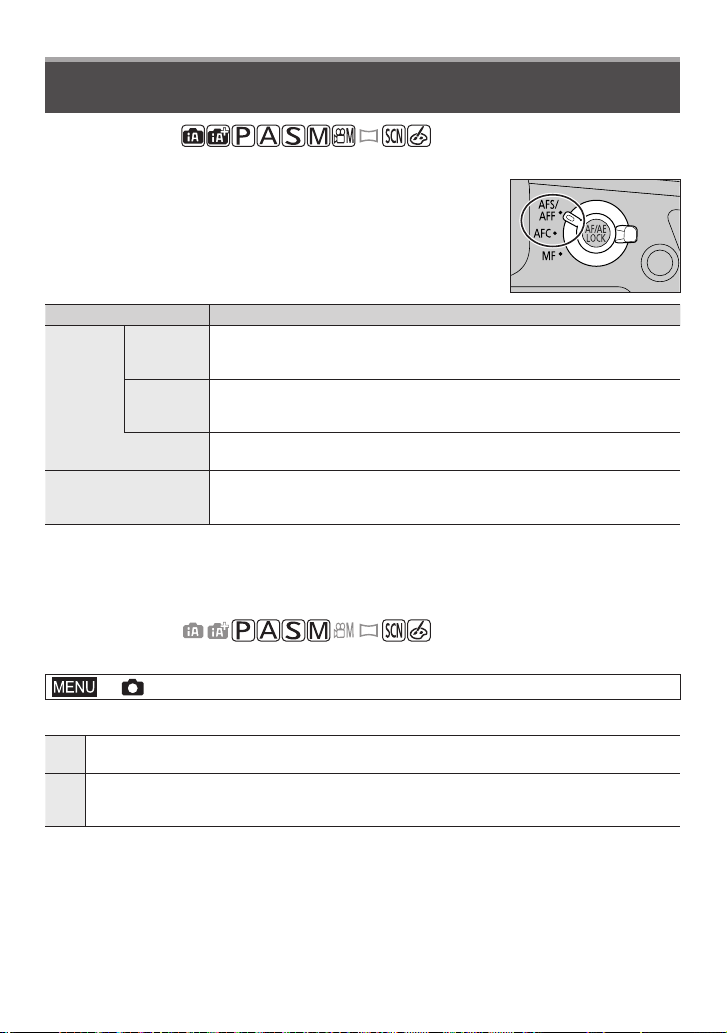
Taking pictures with Auto Focus
Recording mode:
Set the focusing operation to be performed when the shutter button is pressed halfway.
1
Set the focus mode lever to [AFS/AFF] or
[AFC]
• It is fixed to [AFS] when Panorama Shot Mode is set.
Settings The movement of the subject and the scene
[AFS/AFF]
[AFS]
(Auto Focus
Single)
Subject is still (Scenery, anniversary photograph, etc.)
Focus is set automatically when the shutter button is pressed halfway.
Focus will be fixed while it is pressed halfway.
[AFF]
(Auto Focus
Flexible)
Movement cannot be predicted (Children, pets, etc.)
If the subject moves while the shutter button is pressed halfway, the focus
is corrected to match the movement automatically.
You can switch the setting with [AFS/AFF] in the [Rec]/[Motion Picture]
menu.
[AFC]
(Auto Focus Continuous)
Subject is moving (Sport, trains, etc.)
While the shutter button is pressed halfway, focusing is constantly
performed to match the movement of the subject.
When the subject is moving, the focusing is performed by predicting the subject position at the time
of recording. (Movement prediction)
■
Setting the tracking sensitivity of the focus position
Recording mode:
This item works only when the Focus Mode is set to [AFF] or [AFC].
→ [Rec] → [AF Sensitivity(Photo)]
Settings: [-2] to [+2]
+
When the distance to the subject changes drastically, the camera re-adjusts the focus
immediately. You can bring different subjects into focus one after another.
–
When the distance to the subject changes drastically, the camera waits for a short period
of time before re-adjusting the focus. This allows you to prevent the focus from being
accidentally re-adjusted when, for example, an object crosses the camera.
DVQX1774 (ENG)
35
Recording
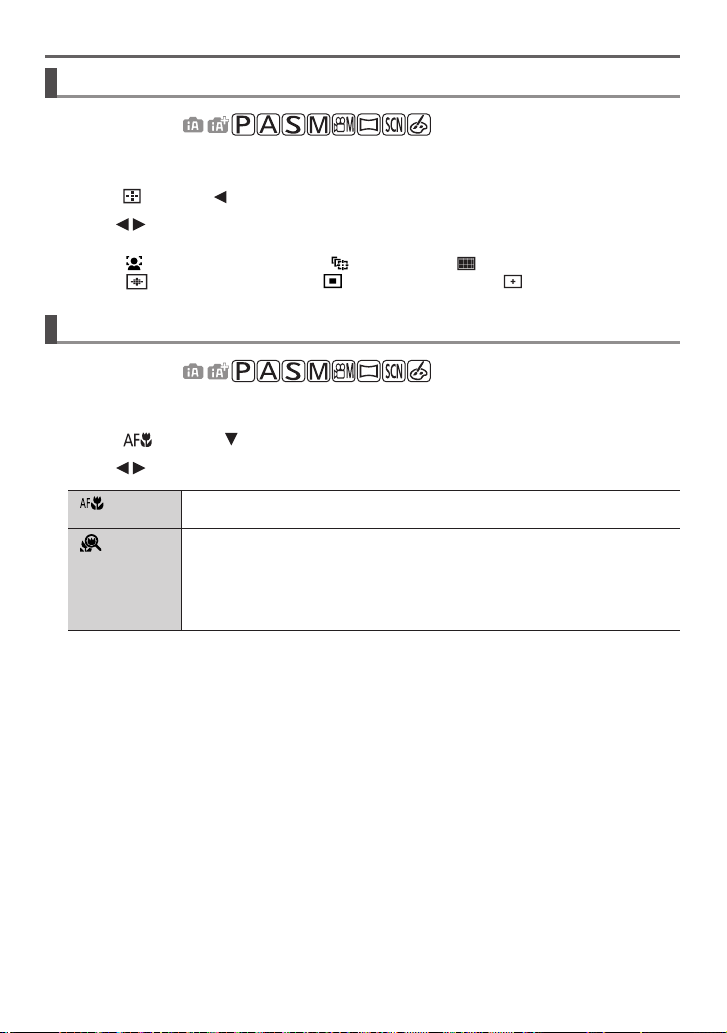
Switching [AF Mode]
Recording mode:
This allows the focusing method that suits the positions and number of the subjects to be
selected.
1
Press [ ] button ( )
2
Press to select Auto Focus mode and press [MENU/SET]
Settings: [
] (Face/Eye Detection) / [ ] (Tracking) / [ ] (49-area-focusing) /
[ ] etc. (Custom Multi) / [ ] (1-area-focusing) / [ ] (Pinpoint-focusing)
Taking close-up pictures (Macro recording)
Recording mode:
This mode allows you to take close-up pictures of a subject, e.g. when taking pictures of
flowers.
1
Press [ ] button ( )
2
Press to select the item and press [MENU/SET]
[ ]
([AF Macro])
You can take pictures of a subject as close as 3 cm (0.098 feet) from the lens
by rotating the zoom lever upmost to Wide.
[
]
([Macro Zoom])
Use this setting to get close to the subject and then further enlarge when
taking the picture. You can take a picture with the Digital Zoom up to 3x while
maintaining the distance to the subject for the extreme Wide position (3 cm
(0.098 feet)).
• Note that enlarging will decrease picture quality.
• Zoom range will be displayed in blue (digital zoom range).
●
You may be unable to select the items, depending on the recording mode and other settings.
Recording
DVQX1774 (ENG)
36
Taking pictures with Manual Focus
Recording mode:
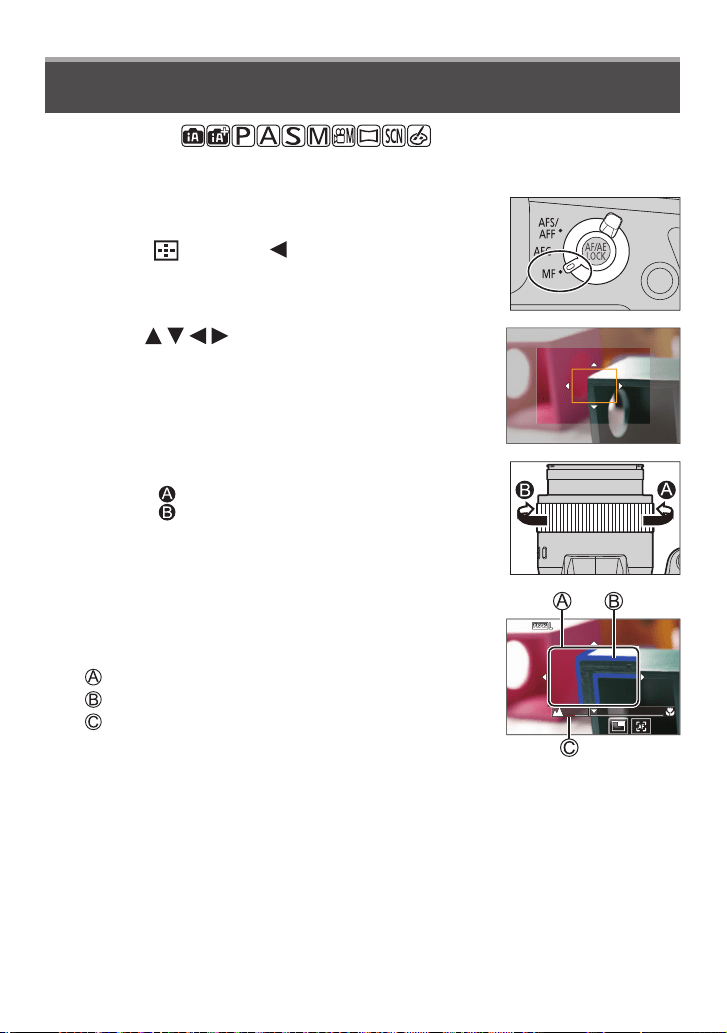
Manual Focus is convenient when you want to lock the focus to take pictures or when it is
difficult to adjust focus using Auto Focus.
1
Set the focus mode lever to [MF]
2
Press [ ] button ( )
3
Press to adjust the focus
position, and press [MENU/SET]
• The screen changes to the assist screen and an
enlarged display appears. (MF Assist)
• To return the focus position to the center, press [DISP.]
button.
4
Turn the control ring to adjust focus
Rotate to side: Focuses on nearby subject
Rotate to side: Focuses on faraway subject
• Color is added to the portions of the image that are in
focus. (Peaking)
• You can check whether the point of focus is to the near
side or to the far side. (MF Guide)
MF Assist (Enlarged screen)
Peaking
MF Guide
5
Press the shutter button halfway
• The recording screen will be displayed.
DVQX1774 (ENG)
37
Recording
Focus, Brightness (Exposure) and Color tone Settings
Taking pictures by locking the focus and/or exposure
(AF/AE Lock)
Recording mode:
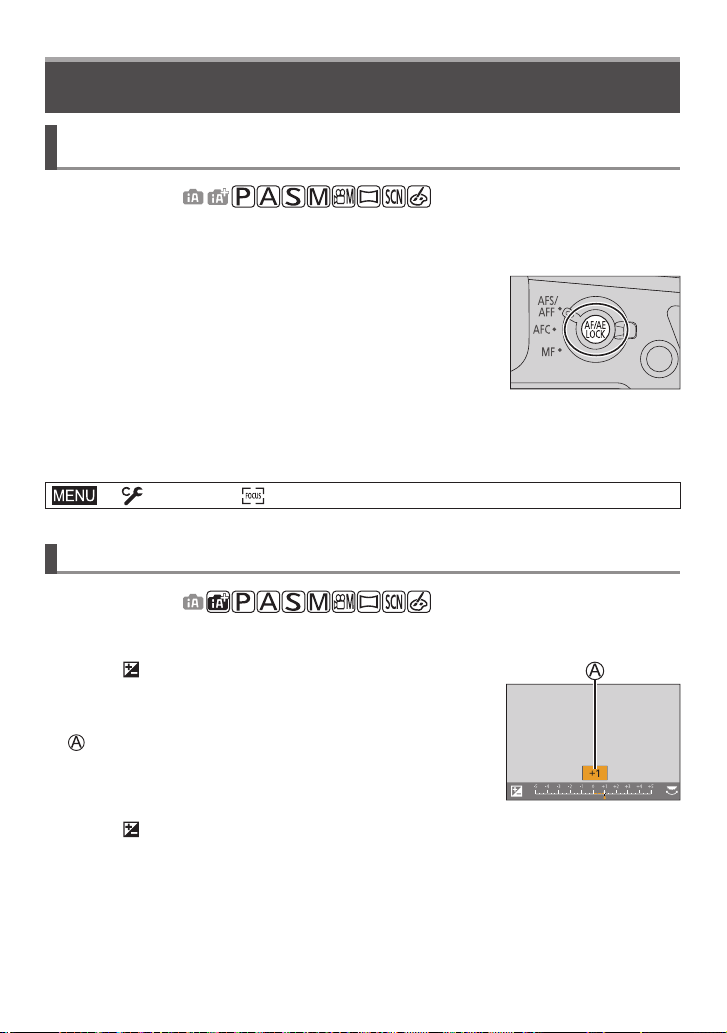
You can use the AF/AE Lock function to fix the focus and exposure in advance and
change the composition of the picture when recording. This function is convenient when
you want to focus on the edge of the screen or when your subject is back-lit.
1
Point the camera at the subject
2
Lock the focus and/or exposure while you press and
hold [AF/AE LOCK] button
• When you release [AF/AE LOCK] button, the focus and/or
exposure lock is canceled.
3
While you press and hold [AF/AE LOCK] button, move the camera to compose
the picture you want to take and fully press the shutter button
■
Setting the function of [AF/AE LOCK]
→ [Custom] → [Focus / Release Shutter] → [AF/AE Lock]
Taking pictures with Exposure Compensation
Recording mode:
Corrects the exposure when there is a backlight or when the subject is too dark or too
bright.
1
Press [ ] button
2
Rotate the rear or front dial to compensate the
exposure
Exposure Compensation
• You can change the setting content on the exposure
compensation screen from [Exposure Comp. Disp. Setting] in the
[Custom] ([Operation]) menu.
3
Press [ ] to set
• You can also press the shutter button halfway to set.
●
In Manual Exposure Mode, you can correct the exposure only when the ISO sensitivity is set to
[AUTO].
Recording
DVQX1774 (ENG)
38
Setting the ISO Sensitivity
Recording mode:
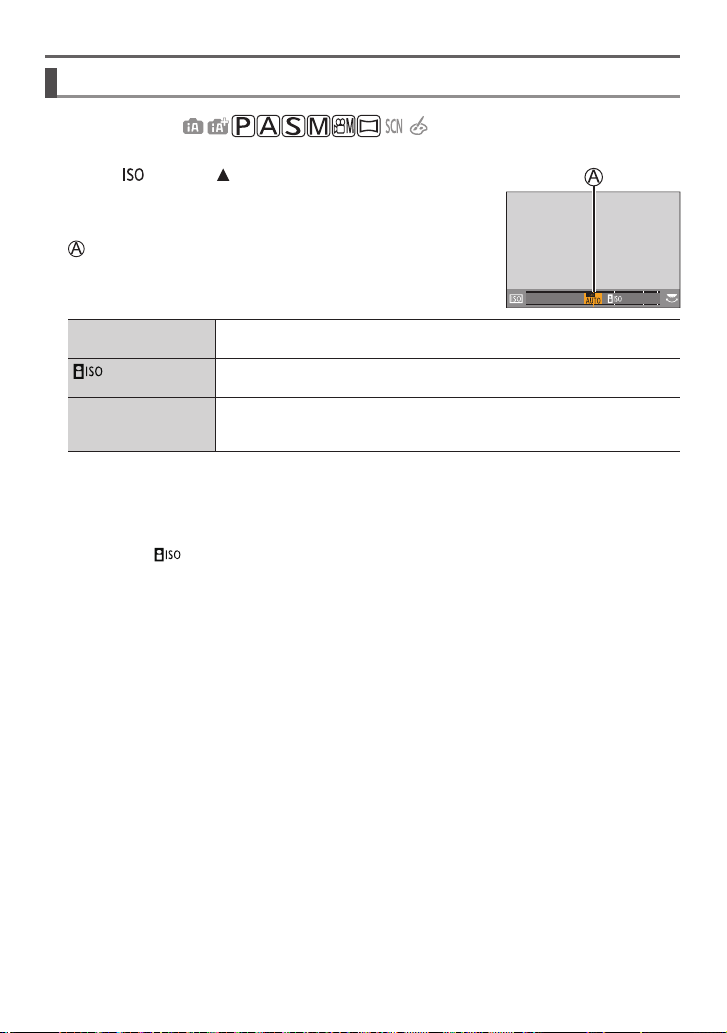
Set ISO sensitivity (sensitivity to lighting).
1
Press [ ] button ( )
1
25
2
0
2
Select the ISO sensitivity by rotating the rear or front
dial
ISO sensitivity
• You can change the setting content on the ISO sensitivity screen
from [ISO Displayed Setting] in the [Custom] ([Operation]) menu.
AUTO
ISO sensitivity is automatically set in a range up to 3200
1
depending on
the brightness of a subject.
(Intelligent ISO)
ISO sensitivity is automatically set in a range up to 3200
1
depending on
the movement and brightness of a subject.
[L.80]
2
/ [L.100]
2
/
from [125] to
[12800] / [H.25600]
2
ISO sensitivity is fixed at the selected setting.
1
When [ISO Auto Upper Limit (Photo)] in the [Rec] menu is set to [AUTO].
2
Only when [Extended ISO] in the [Custom] ([Exposure]) menu is [ON].
3
Press [MENU/SET] to set
• You can also press the shutter button halfway to set.
●
Cannot select [ ] in the following cases:
• Shutter-Priority AE Mode
• Manual Exposure Mode
●
You can use the following ISO sensitivity settings when recording in Creative Video Mode, when
recording 4K photos, or when recording using [Post Focus].
• [AUTO], [125] to [6400] ([L.80] to [6400] when [Extended ISO] is set to [ON])
DVQX1774 (ENG)
39
Recording
Adjusting the White Balance
Recording mode:
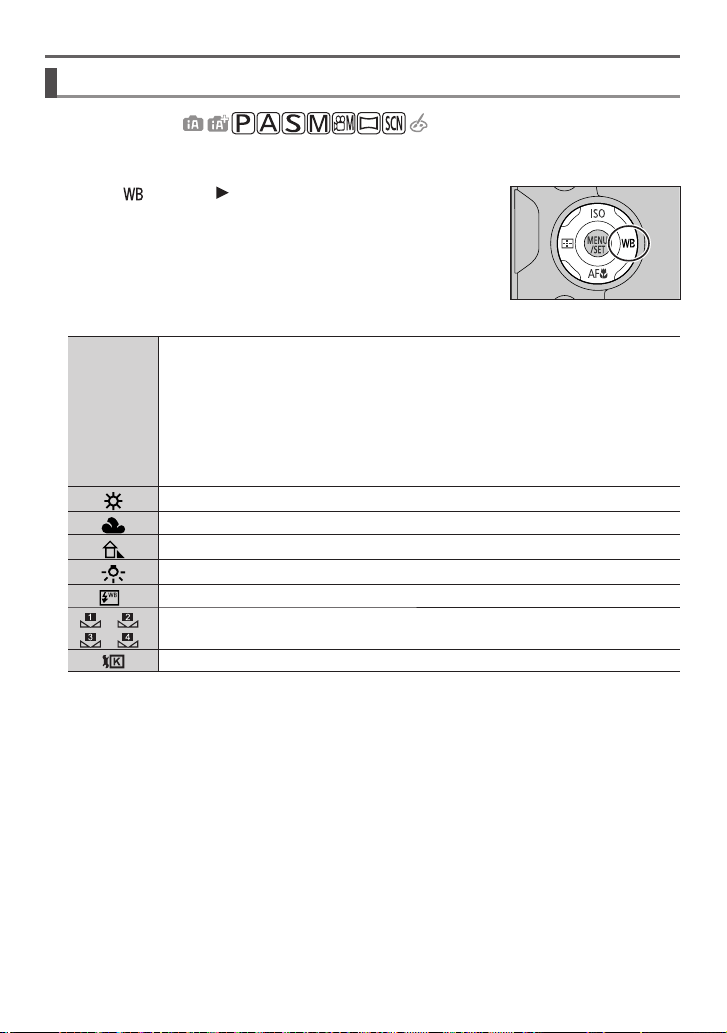
This item adjusts to the color of white which is closest to what is seen by the eye in
accordance with the light source.
1
Press [ ] button ( )
2
Rotate the rear or front dial to select the White Balance
[AWB]/
[AWBc]/
[AWBw]
Automatic adjustment in accordance with the light source.
• Under a light source (such as an incandescent light) that produces reddish
pictures:
– [AWBc] gives higher priority to the original colors of the subject and reduces
the reddish hue.
– [AWBw] gives higher priority to what is seen by the eye and retains the
reddish hue.
• When the white balance is set to [AWBc] or [AWBw], the adjustment effect may
be similar to that of [AWB], depending on the light source.
[
]
Adjust to the color under a clear sky.
[ ]
Adjust to the color under a cloudy sky.
[
]
Adjust to the color in the shade.
[ ]
Adjust to the color under incandescent lights.
[
]
Adjust to the color that is optimal for taking pictures using the flash.
[ ]/[ ] /
[ ]/[ ]
Use the White Balance value that was set manually.
[
]
You can set the White Balance using color temperature.
The [AWB] setting is applied while recording motion pictures, recording 4K photos, or recording
in [Post Focus].
3
Press [MENU/SET] to set
• You can also press the shutter button halfway to set.
Recording
DVQX1774 (ENG)
40
■
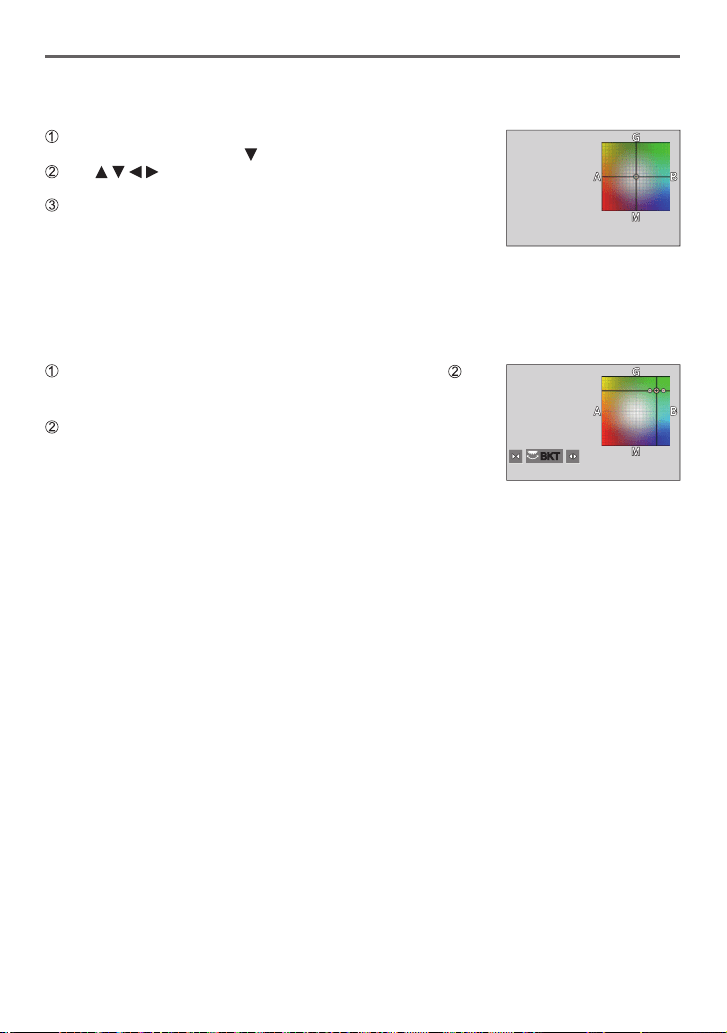
Performing White Balance fine adjustments
White Balance settings can be individually fine-tuned if colors still do not appear as
anticipated.
In step
2
of “Adjusting the White Balance” (→39), select the
White Balance and press
Use to perform White Balance fine adjustments
• Pressing [DISP.] button resets the position back to the center.
Press [MENU/SET] to finalize the setting
• Press the shutter button halfway to return to the recording screen.
■
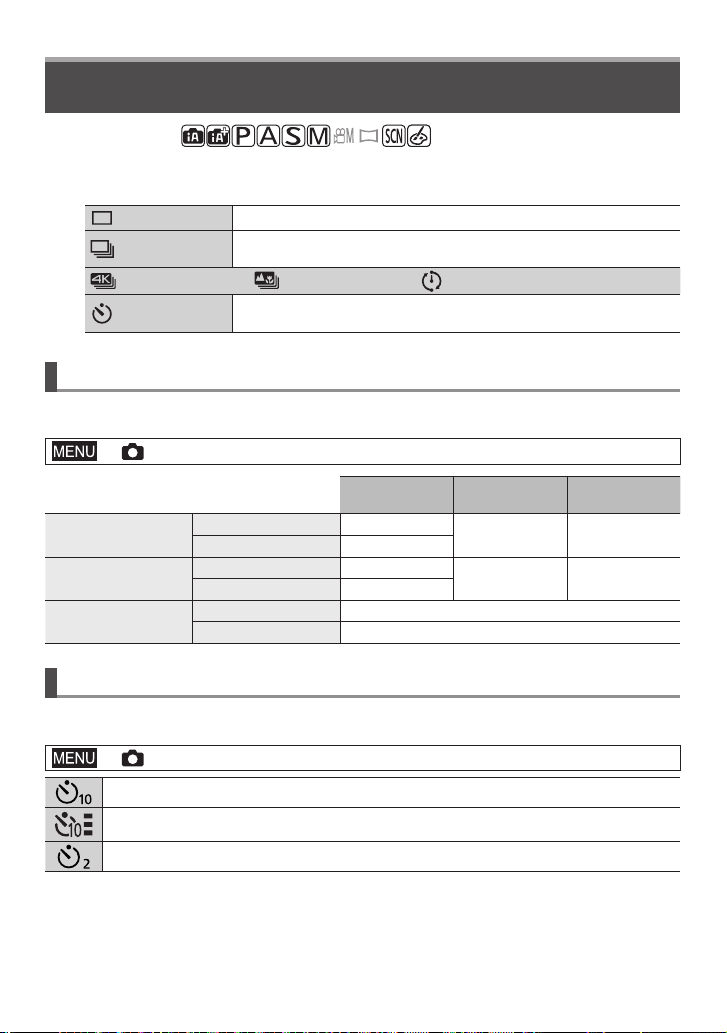
Bracket recording using White Balance
Bracket settings are performed based on the fine adjustment values for White Balance,
and three pictures with different coloring are automatically recorded when the shutter
button is pressed once.
Perform fine adjustments of the White Balance in step of
“Performing White Balance fine adjustments” (above) and
rotate the rear dial to perform the Bracket setting
BKTBKT
Press [MENU/SET] to finalize the setting
• Press the shutter button halfway to return to the recording screen.
DVQX1774 (ENG)
41
Recording
Selecting a Drive Mode
([Burst] / [Self Timer])
Recording mode:
You can switch the operation to be performed when you press the shutter button.
1
Rotating the drive mode dial
[Single] When the shutter button is pressed, only one picture is recorded.
[Burst]
The pictures are recorded in succession while the shutter button is
pressed.
[4K PHOTO] (→42) / [Post Focus] (→45) / [Time Lapse/Animation] (→47)
[Self Timer]
When the shutter button is pressed, recording takes place after the set
time has elapsed.
Burst function
■
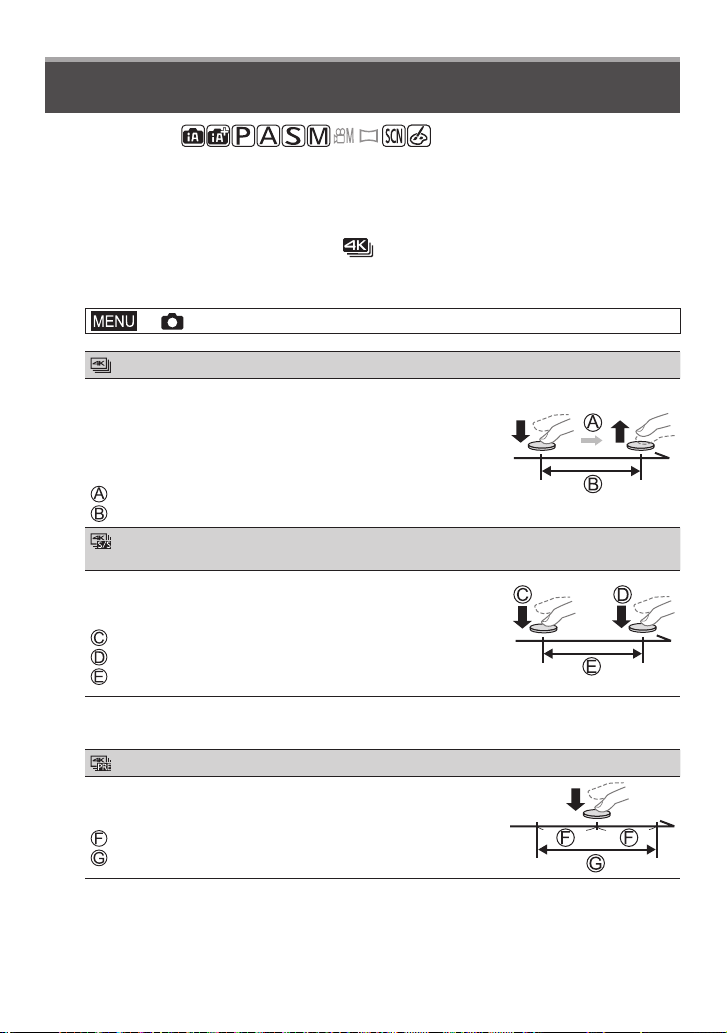
Setting [Burst Rate]
→ [Rec] → [Burst Rate]
[H] (High speed)
[M] (Middle
speed)
[L] (Low speed)
Speed (pictures/sec.)
[AFS] / [MF] 12
7 2
[AFF] / [AFC] 7
Live View during
burst recording
[AFS] / [MF] None
Available Available
[AFF] / [AFC] Available
Number of
recordable pictures
With RAW files 26 or more
Without RAW files 100 or more
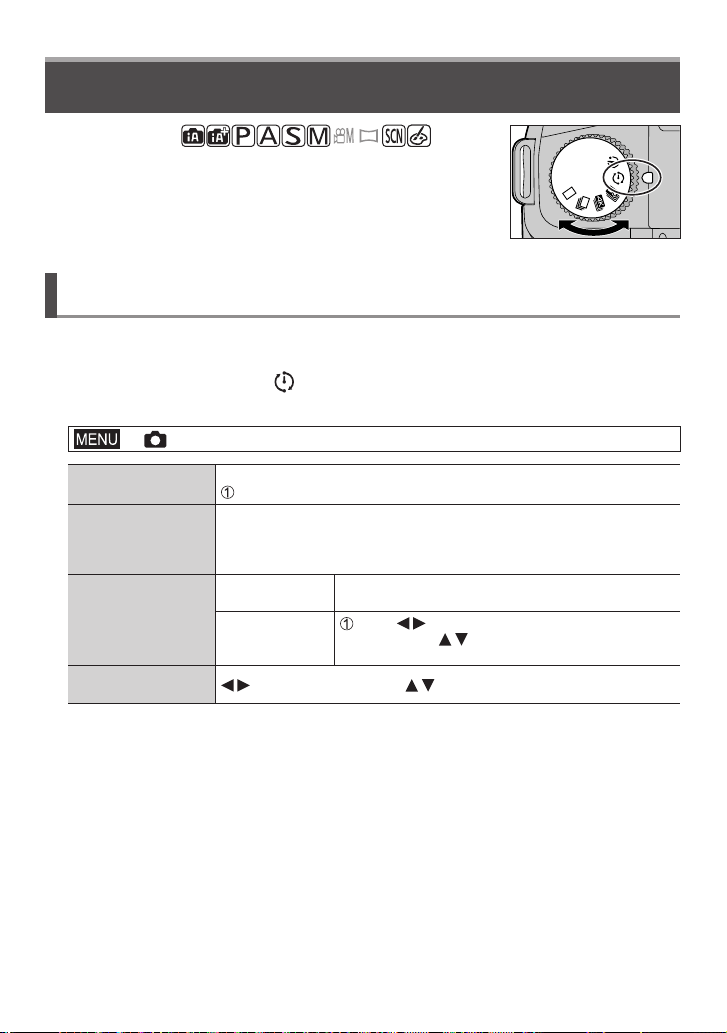
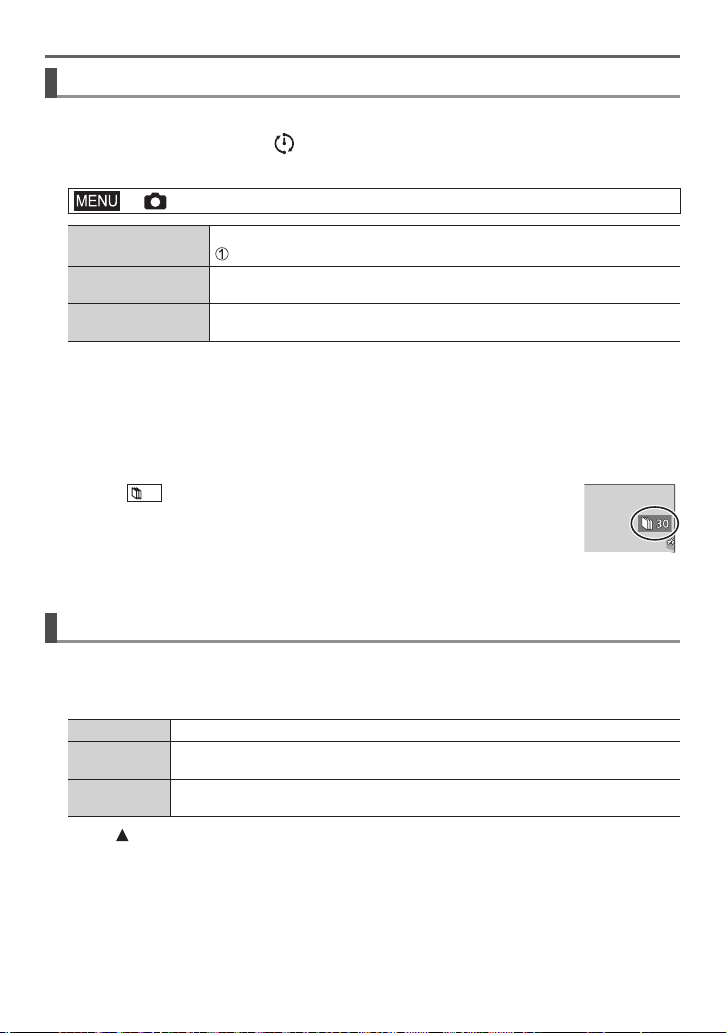
Taking pictures with self-timer
■
Setting the self-timer operation
→ [Rec] → [Self Timer]
The shutter is activated after 10 seconds.
The shutter is activated after 10 seconds and three pictures are taken at intervals of
approximately 2 seconds.
The shutter is activated after 2 seconds.
Recording
DVQX1774 (ENG)
42
Recording with the 4K Photo function
Recording mode:
You can take burst pictures of approximately 8 million pixels with a burst rate of 30 fps.
You can select and save a frame from the burst file.
• To record pictures, use a UHS Speed Class 3 card.
• When recording, the angle of view becomes narrower.
1
Set the drive mode dial to [ ]
2
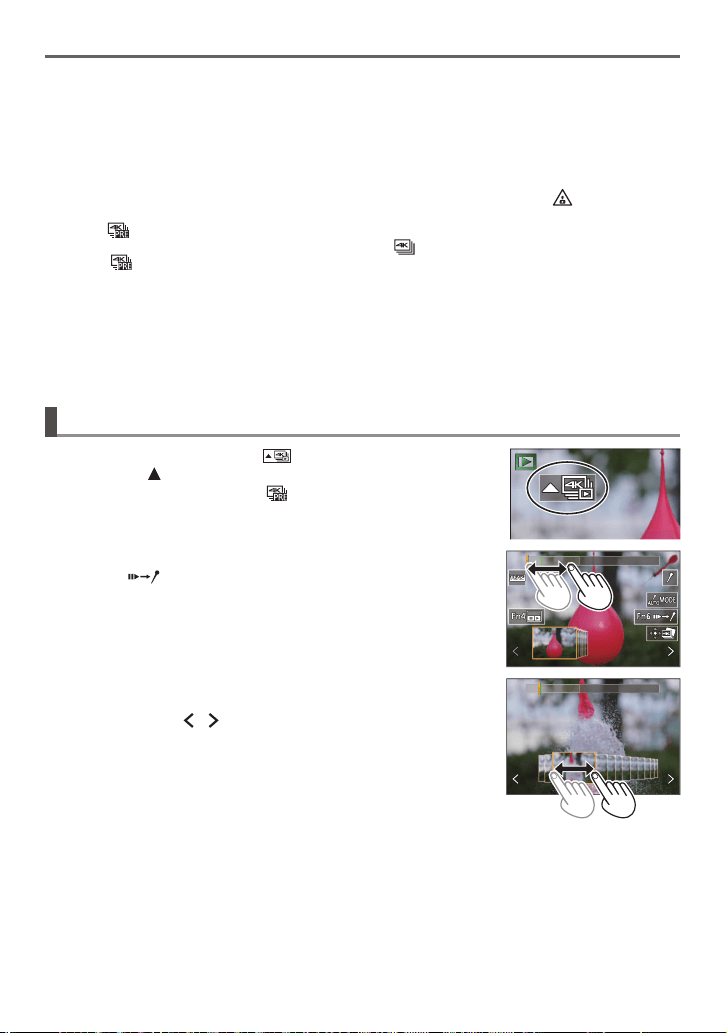
Select the recording method
→ [Rec] → [4K PHOTO]
[4K Burst]
For capturing the best shot of a fast-moving subject
Burst recording is performed while the shutter button is pressed
and held.
• Recording will start approximately 0.5 seconds after you press
the shutter button fully. Therefore, press the button fully slightly
in advance.
Press and hold
Recording is performed
[4K Burst(S/S)]
“S/S” is an abbreviation of “Start/Stop”.
For capturing unpredictable photo opportunities
Burst recording starts when the shutter button is pressed and
stops when pressed again.
Start (First)
Stop (Second)
Recording is performed
●
When you press the [Fn6] button while recording, you can add a marker. (Up to 40 markers
for each recording.) When selecting and saving pictures from a 4K burst file, you can skip to
the positions where you added markers.
[4K Pre-Burst]
For recording as needed whenever a photo opportunity arises
Burst recording is performed for approximately 1 second before
and after the moment that the shutter button is pressed.
Approximately 1 second
Recording is performed
DVQX1774 (ENG)
43
Recording
3
Press the shutter button halfway to exit the menu
4
Press the shutter button to perform recording
• Burst pictures are saved as a single 4K burst file in the MP4 format.
• When [Auto Review] is enabled, the picture selection screen will be displayed automatically.
●
If the surrounding temperature is high or 4K photos are recorded continuously, [ ] may be
displayed and recording may be stopped halfway through. Wait until the camera cools down.
●
When [ ] ([4K Pre-Burst]) is set, the battery drains faster and the camera temperature
rises. (to protect itself, the camera may switch to [
] ([4K Burst]))
Select [
] ([4K Pre-Burst]) only when recording.
●
Recording stops when the continuous recording time exceeds 29 minutes and 59 seconds.
When using an SDHC memory card, files are split into smaller picture files for recording and
playback if the file size exceeds 4 GB. (You can continue to record pictures without interruption.)
If using an SDXC memory card, you can record pictures in a single file even if the size is greater
than 4 GB.
●
When you perform [Light Composition] or [Sequence Composition], we recommend using a tripod
and shutter remote control (DMW-RS2, optional) to prevent camera shake. (→12)
Selecting pictures from 4K burst file and saving
1
Select a picture with the [ ] on the playback screen,
and press
• In the case of recording with [ ] ([4K Pre-Burst]), proceed to
the step
3
.
2
Drag the slide bar to perform rough scene selection
• When [ ] is touched, the marker operation screen appears.
(→44)
3
Drag to select the frame you want to save as a picture
• To continuously rewind/forward the scene or frame-by-frame,
touch and hold [
]/[ ] .
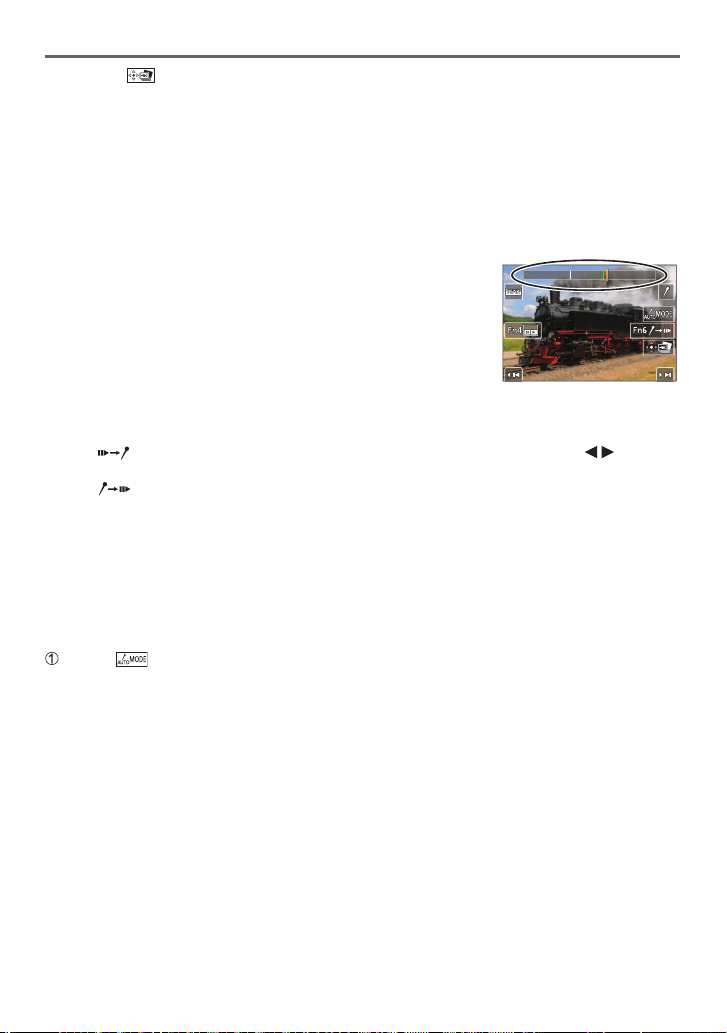
Recording
DVQX1774 (ENG)
44
4
Touch [ ] to save the picture
• The selected picture will be saved as a new picture in the JPEG format separate from the 4K
burst file.
●
If you use [4K PHOTO Bulk Saving] in the [Playback] menu, you can bulk save 5 seconds’ worth of
4K recording.
■
Marker
When selecting and saving pictures from a 4K burst file, you can select pictures easily by
skipping between marked positions.
White marker: This is manually set during recording or
playback.
Green marker: This is automatically set by the camera during
recording. (Auto Marking function
1
)
1
The camera automatically sets markers on scenes in which a face
or the movement of a subject is detected. (Up to 10 markers are
displayed for each file.)
(Example: At the scene when a vehicle passes by, a balloon bursts,
or a person turns around)
Marker operation screen
■
Skips to the marked positions
When [
] is touched, the marker operation screen appears. You can use to skip
to a marked position to select a picture.
Touch [
] to return to the original operation.
• In the following cases, markers may not be set by the Auto Marking function depending
on the recording conditions and the status of subjects.
– The camera is moving because of panning or jitter
– The movement of a subject is slow/small, or the subject is small
– A face is not facing front
■
Switches a marker to be displayed
Touch [ ]
Settings: [Auto] / [Face Priority] / [Motion Priority] / [Off]
2
2
Displays manually set markers only
DVQX1774 (ENG)
45
Recording
Adjusting the focus after recording
([Post Focus] / [Focus Stacking])
Recording mode:
You can record 4K burst pictures while changing the focus point and then select a focus
point after recording. This function is best for non-moving subjects.
• To record pictures, use a UHS Speed Class 3 card.
• We recommend using a tripod to perform [Focus Stacking].
• During recording, the angle of view will be narrower.
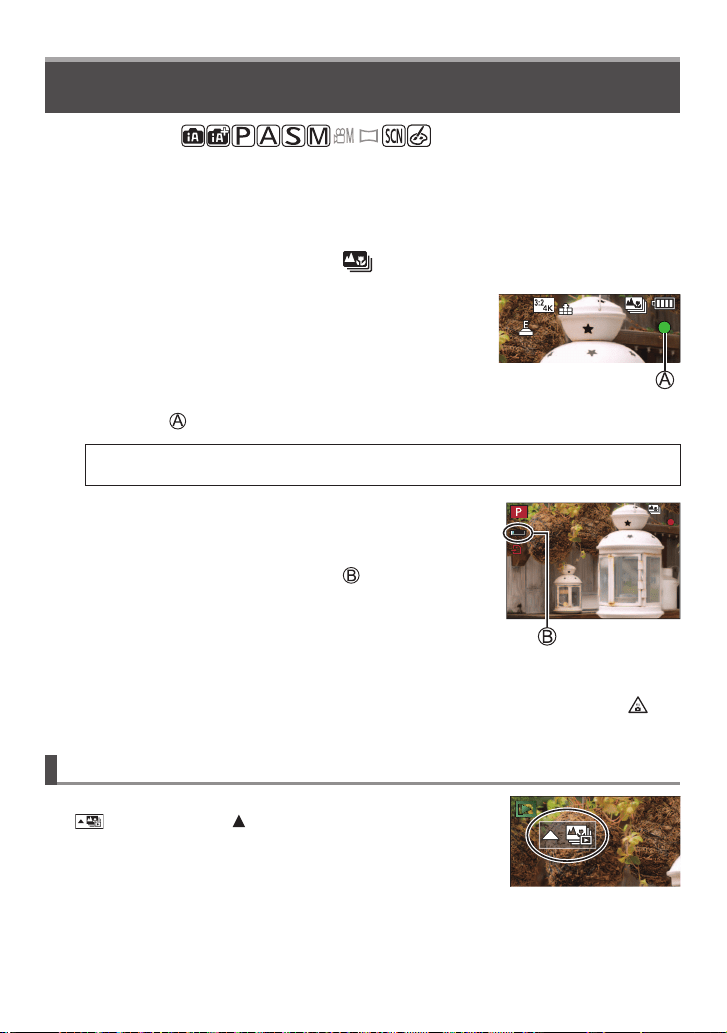
1
Set the drive mode dial to [ ]
2
Determine the composition and press the
shutter button halfway
• Auto Focus activates and automatically detects the
focus point on the screen. (While the shutter button
pressed halfway, shake may be seen on the screen.)
• If there is no focus point on the screen, the Focus
indicator ( ) blinks and you cannot record.
From halfway pressing the shutter button to completion of recording
• Do not change the distance to subject or the composition.
3
Press the shutter button fully to start
recording
• The focus point changes automatically while recording.
When the recording progress bar ( ) disappears,
recording automatically ends.
• The data will be saved as a single file in the MP4
format.
• If [Auto Review] is set, a screen will automatically
appear that lets you select the focus point. (→45)
●
If the surrounding temperature is high or [Post Focus] recording is performed continuously, [ ]
may be displayed and recording may be stopped halfway through. Wait until the camera cools down.
Select the focus point and save the picture ([Post Focus])
1
On the playback screen, select the image with the
[ ] icon and press
Recording
DVQX1774 (ENG)
46
2
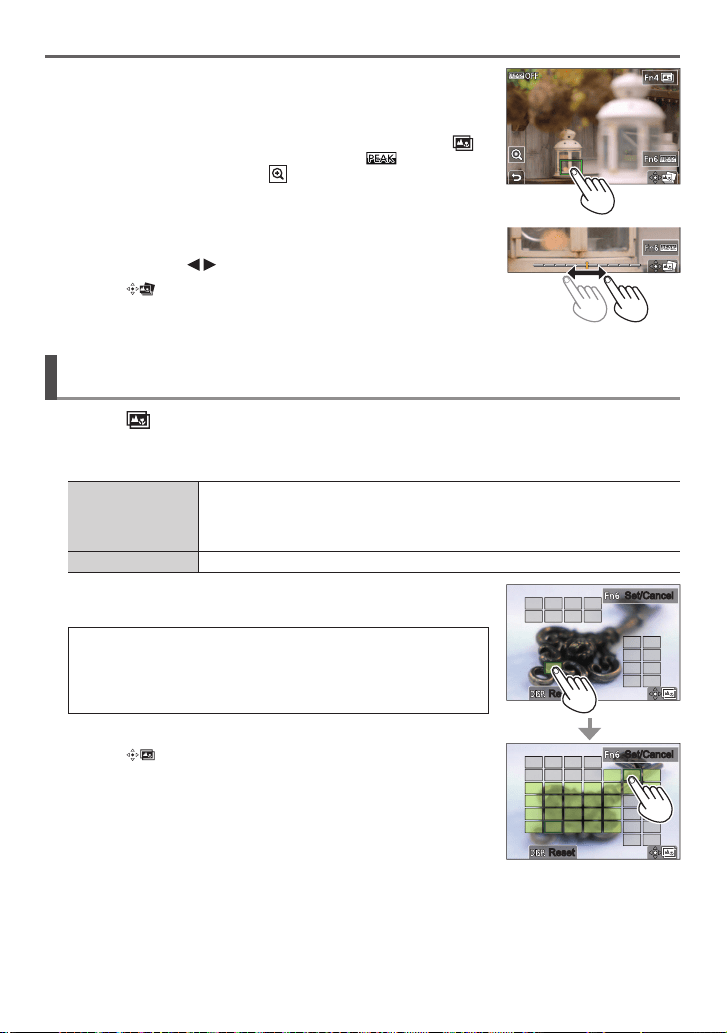
Touch the focus point
• If there are no pictures with the focus on the selected point, a red
frame will be displayed, and pictures cannot be saved.
• The edge of the screen cannot be selected.
• To switch to the [Focus Stacking] operations screen, touch [
] .
• To highlight in-focus portion with color, touch [
] .
• To enlarge the display, touch [
] .
• You can make fine adjustments to the focus by dragging the
slide bar during enlarged display. (The same operation can be
performed using
.)
3
Touch [ ] to save the picture
• The selected picture will be saved as a new separate file in the
JPEG format.
Select the focus range to combine and create a single picture
([Focus Stacking])
1
Touch [ ] on screen in step
2
of “Select the focus point and save the picture
([Post Focus])”
2
Choose a stacking method and touch it
[Auto Merging]
Automatically select photos suitable for stacking and combine them into one
picture.
• Choose by giving preference to near-focus pictures.
• Perform the focus stacking and save the picture.
[Range Merging] Combine the pictures with the selected focus position into one picture.
(When selecting [Range Merging])
Set/CancelSet/Cancel
ResetReset
Set/CancelSet/Cancel
ResetReset
3
Touch the focus point
• Select positions at two or more points.
• Focus points between the selected two positions will be
selected.
• Positions that cannot be selected, or that would produce an
unnatural result will be grayed out.
• Touch a position again to deselect it.
4
Touch [ ] to combine and save the picture
• The picture will be saved in JPEG format.
●
Only pictures taken using [Post Focus] on this camera are eligible for
[Focus Stacking].
DVQX1774 (ENG)
47
Recording
Taking Pictures with Time Lapse Shot/Stop Motion
Animation
Recording mode:
You can take pictures with Time Lapse Shot or Stop Motion
Animation.
• The pictures are recorded as a set of group pictures.
• Complete the date and time settings in advance. (→21)
Taking pictures automatically at set intervals
[Time Lapse Shot]
The camera can automatically take pictures of subjects such as animals or plants as time
elapses and create a motion picture.
1
Set the drive mode dial to [ ]
2
Set the menu
→ [Rec] → [Time Lapse/Animation]
[Mode] To switch between Time Lapse Shot and Stop Motion Animation
Select [Time Lapse Shot]
[Shooting Interval
Setting]
[ON]: Sets the time from recording start time to the next recording start
time.
[OFF]: After recording is finished, the next recording is started without
any interval.
[Start Time] [Now] Starts the recording by fully-pressing the shutter
button.
[Start Time Set]
Press to select the item (hour and/or
minute), and
to set the start time, and press
[MENU/SET]
[Image Count] /
[Shooting Interval]
: Select the item (digit) / : Setting / [MENU/SET]: Set
Can be set only when [Shooting Interval Setting] is set to [ON].
3
Press the shutter button halfway to exit the menu
4
Focus on the subject and take a picture
• The recording starts by fully-pressing the shutter button.
●
After recording is finished, a confirmation screen will appear asking whether you want to continue
and create a motion picture. To create a motion picture, select [Yes] and proceed to “Creating
motion pictures from recorded pictures” (→48).
Recording
DVQX1774 (ENG)
48
Creating stop motion animation [Stop Motion Animation]
You can stitch still pictures to create stop motion animation.
1
Set the drive mode dial to [ ]
2
Set the menu
→ [Rec] → [Time Lapse/Animation]
[Mode] To switch between Time Lapse Shot and Stop Motion Animation
Select [Stop Motion Animation]
[Auto Shooting] [ON]: Takes pictures automatically at a set recording interval.
[OFF]: Takes pictures manually, one frame at a time.
[Shooting Interval] (Only when [Auto Shooting] is set to [ON])
Set the interval used for [Auto Shooting].
3
Press the shutter button halfway to exit the menu
4
Focus on the subject and take a picture
5
Move the subject to decide on the composition
• Repeat the recording of still pictures in the same way. Up to 9,999 frames can be recorded.
• When you turn off the camera during recording, a message to restart recording will appear when
you turn on the camera.
6
Touch [ ] to end the recording
• You can also end the recording by selecting [Time Lapse/Animation] in the [Rec]
menu, and then pressing [MENU/SET].
• When [Auto Shooting] is set to [ON], select [End] on the confirmation screen. (If
you select [Pause], press the shutter button fully to resume recording.)
Creating motion pictures from recorded pictures
To create motion pictures after taking pictures, follow the steps below.
1
Select the motion picture creation method
• [Rec Format]: [MP4]
[Rec Quality] Sets the picture quality of the motion picture.
[Frame Rate]
Set the number of frames per second. The higher the number is, the smoother
the motion picture will be.
[Sequence]
[NORMAL]: Stitches the still pictures in the recording sequence.
[REVERSE]: Stitches the still pictures in the reverse order of recording.
2
Press to select [OK] and press [MENU/SET]
• You can also create a motion picture using [Time Lapse Video]/[Stop Motion Video] in the
[Playback] menu.
DVQX1774 (ENG)
49
Recording
Taking Pictures While Adjusting a Setting
Automatically (Bracket Recording)
Recording mode:
You can take multiple pictures while automatically adjusting a setting by pressing the
shutter button.
1
Set the menu
→ [Rec] → [Bracket] → [Bracket Type]
(Exposure Bracket)
Press the shutter button to perform recording while adjusting
the exposure. (→50)
(Aperture Bracket)
Press the shutter button to perform recording while adjusting
the aperture. (→50)
• Available in Aperture-Priority AE Mode or when the ISO
sensitivity is set to [AUTO] in Manual Exposure Mode.
(Focus Bracket)
Press the shutter button to perform recording while adjusting
the focus position. (→50)
(White Balance Bracket)
Press the shutter button once to take three pictures with
different white balance settings automatically. (→40)
2
Press to select [More Settings] and then press [MENU/SET]
• For information on [More Settings], refer to the page that describes each function.
• Press the shutter button halfway to exit the menu.
3
Focus on the subject and take a picture
• When Exposure Bracket is selected, the bracket display flashes until all of the
pictures you have set are taken. If you change the bracket settings or turn off
the camera before all of the pictures you have set are taken, the camera restarts
recording from the first picture.
■
To cancel [Bracket]
Select [OFF] in step
1
.
Recording
DVQX1774 (ENG)
50
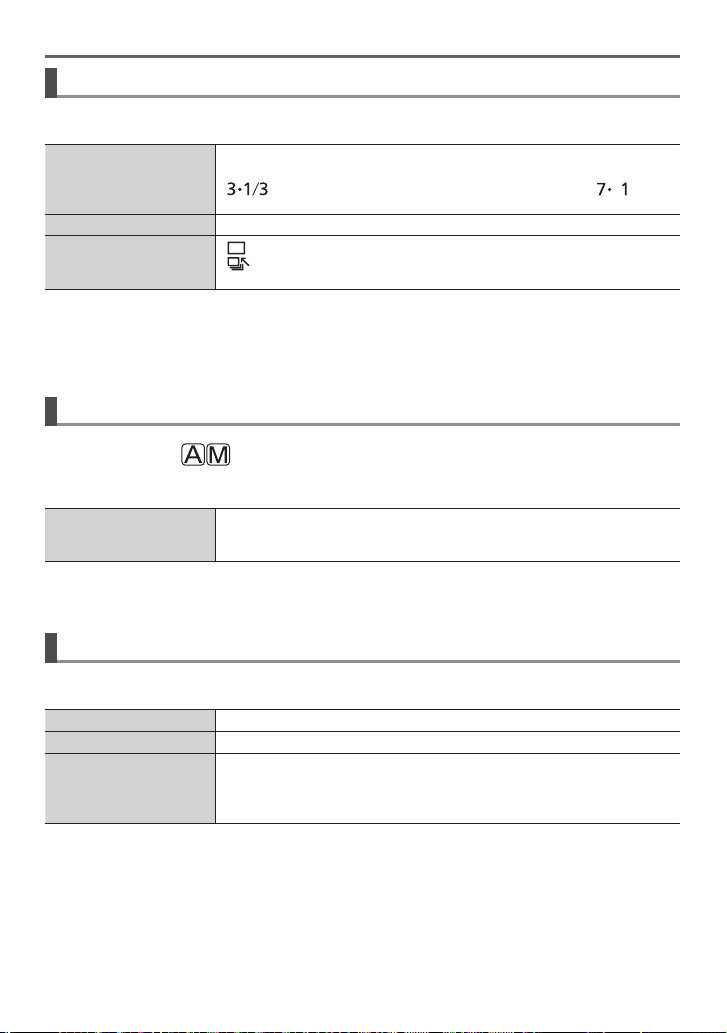
Exposure Bracket
■
About [More Settings] (step
2
in (→49))
[Step]
Sets the number of pictures to be taken and the exposure compensation
range.
[
] (Takes three pictures with an interval of 1/3 EV) to [ ]
(Takes seven pictures with an interval of 1 EV)
[Sequence] Sets the order in which pictures are taken.
[Single Shot Setting]
[ ] : Takes one picture each time you press the shutter button.
[
] : Takes all the pictures set to be taken when you press the shutter
button once.
Not available for burst recording. When using burst recording, if you press and hold the shutter
button, recording will be performed continuously until a specified number of pictures are taken.
●
When taking pictures using Exposure Bracket after setting the Exposure Compensation value, the
pictures taken are based on the selected Exposure Compensation value.
Aperture Bracket
Recording mode:
■
About [More Settings] (step
2
in (→49))
[Image Count]
[3]/[5]: Takes a specified number of pictures with different aperture
values within the range based on the initial aperture value.
[ALL]: Takes pictures using all aperture values.
• When using burst recording, if you press and hold the shutter button, recording will be
performed until a specified number of pictures are taken.
Focus Bracket
■
About [More Settings] (step
2
in (→49))
[Step] Sets the interval between focus positions.
[Image Count]
Sets the number of pictures to be taken.
[Sequence]
[0/–/+]: Takes pictures with different focus positions within the range
based on the initial focus position.
[0/+]: Takes pictures with different focus positions toward the far side
based on the initial focus position.
Not available for burst recording. When using burst recording, if you press and hold the shutter
button, recording will be performed continuously until a specified number of pictures are taken.
●
Pictures taken with Focus Bracket are displayed as a set of group pictures.
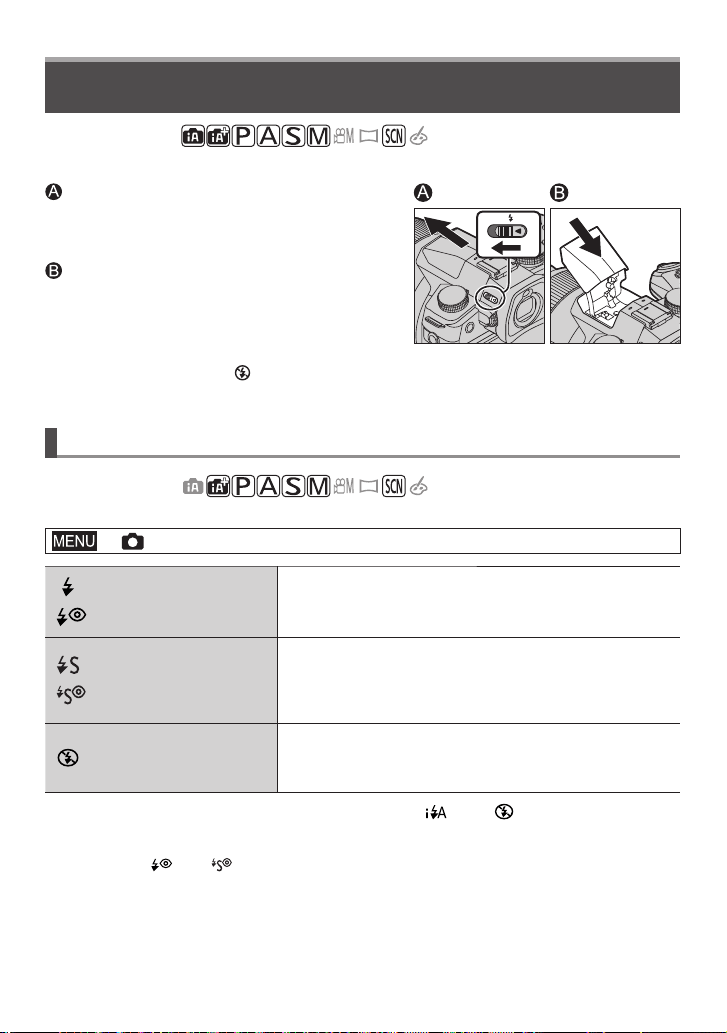
DVQX1774 (ENG)
51
Recording
Taking pictures with flash
Recording mode:
■
Open/Close the built-in flash
To open the flash
Slide the flash open lever.
• Be careful when opening the flash as the flash will
jump out.
To close the flash
Press the flash until it clicks.
• Be careful not to catch a finger or any other part of
your body or any object when you close the flash.
• Forcibly closing the flash can damage the camera.
• Be sure to close the built-in flash when not in use.
• The flash setting is fixed to [
] (Forced Flash Off)
while the flash is closed.
Changing Flash Mode
Recording mode:
Set the flash to match the recording.
→ [Rec] → [Flash] → [Flash Mode]
: [Forced Flash On]
: [Forced On/Red-Eye]
The flash is activated every time regardless of the recording
conditions.
• Use this when your subject is back-lit or under
fluorescent light.
: [Slow Sync.]
: [Slow Sync./Red-Eye]
Takes brighter pictures such as pictures of subjects against a
nightscape by decreasing the shutter speed when firing a flash.
• Ideal for taking pictures of people against a nightscape.
• Using a slower speed can cause motion blur. We
recommend using a tripod.
: Forced Flash Off
Always takes pictures without flash under all recording
conditions.
• Ideal for taking pictures where the use of flash is
prohibited.
• In Intelligent Auto Plus Mode, the setting items are [ ] and [ ] .
The flash is activated twice. The interval between the first and second flash is
longer when [ ] or [ ] is set. The subject should not move until the second
flash is activated.
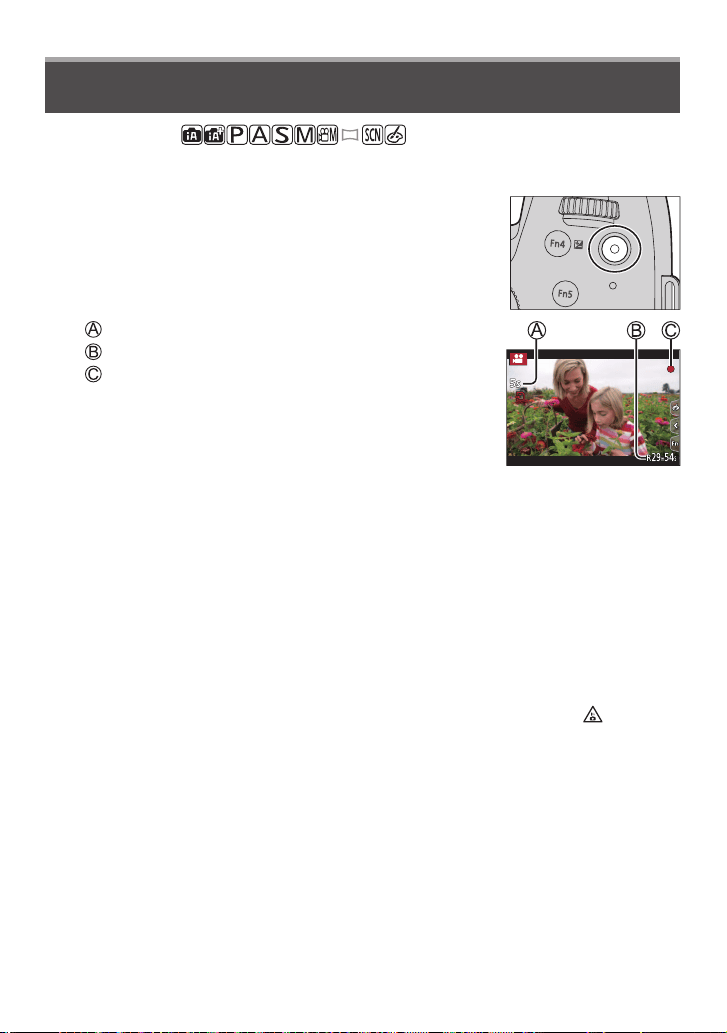
Recording
DVQX1774 (ENG)
52
Recording Motion Picture/4K Motion Picture
Recording mode:
You can record full high-definition quality images that comply with the AVCHD standard,
as well as motion pictures or 4K motion pictures recorded in MP4.
1
Press the motion picture button to start
recording
Elapsed recording time
Remaining recording time
Recording (lights up in red)
• Recording of motion picture appropriate for each
motion picture mode is possible.
• Immediately release the motion picture button after
pressing it.
• If you press the shutter button down fully, you can take
still pictures while recording motion pictures. (Except
for in Creative Video Mode)
2
Press the motion picture button again to end recording
●
To record 4K motion pictures, use a UHS Speed Class 3 card.
●
When you record 4K motion pictures, the angle of view will be narrower than motion pictures of
other sizes.
●
To ensure highly accurate focus, 4K motion pictures are recorded at reduced Auto Focus speeds. It
may be difficult to focus on the subject with Auto Focus, but this is not a malfunction.
●
With recording in a quiet environment, the sound of aperture, focus and other actions may
be recorded in motion pictures. This is not a malfunction.
The focus operation during recording of motion pictures can be set to [OFF] in [Continuous AF].
●
If the surrounding temperature is high, or a motion picture is recorded continuously, [ ] is
displayed and recording may be stopped halfway through. Wait until the camera cools down.
DVQX1774 (ENG)
53
Recording
■
Setting the format, picture size and recording frame rate
→ [Motion Picture] → [Rec Format]
Settings: [AVCHD] / [MP4]
→ [Motion Picture] → [Rec Quality]
When [AVCHD] is selected:
[FHD/28M/60p]
1
/ [FHD/17M/60i] / [FHD/24M/30p] / [FHD/24M/24p]
●
[AVCHD] motion pictures:
Files are split into smaller motion picture files for recording when the file size exceeds 4 GB.
●
Motion pictures with [Rec Quality] setting of [FHD/28M/60p]/[FHD/17M/60i] in [AVCHD]:
Recording stops when the continuous recording time exceeds 29 minutes and 59 seconds.
When [MP4] is selected:
[4K/100M/30p]
2
/ [4K/100M/24p]
2
/ [FHD/28M/60p] / [FHD/20M/30p] / [HD/10M/30p]
●
MP4 motion pictures with a [Rec Quality] size of [FHD] or [HD]:
Files are split into smaller motion picture files for recording and playback when the file size exceeds
4 GB. (You can continue to record motion pictures without interruption.)
●
Motion pictures with [Rec Quality] setting of [FHD/28M/60p] in [MP4]:
Recording stops when the continuous recording time exceeds 29 minutes and 59 seconds.
●
MP4 motion pictures with a [Rec Quality] size of [4K]:
Recording stops when the continuous recording time exceeds 29 minutes and 59 seconds.
When using an SDHC memory card, files are split into smaller motion picture files for recording
and playback if the file size exceeds 4 GB. (You can continue to record motion pictures without
interruption.)
If using an SDXC memory card, you can record a motion picture in a single file even if the size is
greater than 4 GB.
1
AVCHD Progressive
2
4K motion pictures
Recording Motion Pictures in Creative Video Mode
Recording mode:
The operation for changing the aperture value, shutter speed or ISO sensitivity is the
same as the operation for setting the mode dial to [ ], [ ], [ ] or [ ] (except Program
Shift Mode).
1
Set mode dial to [ ]
2
Set the menu
→ [Creative Video] → [Exposure Mode]
Settings: [P] / [A] / [S] / [M]
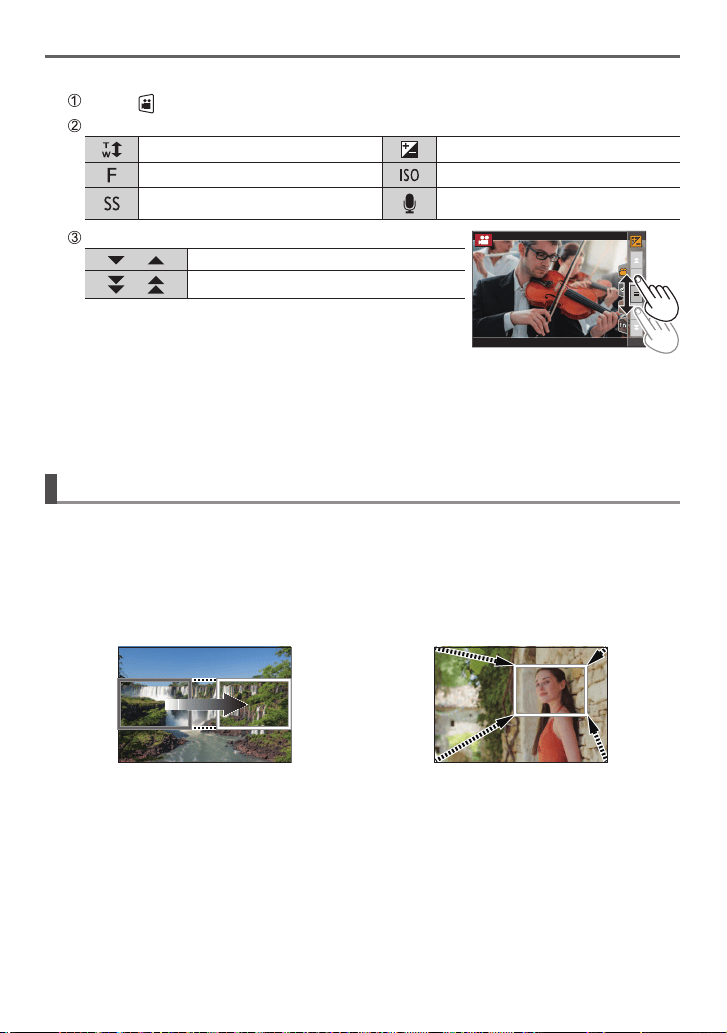
Recording
DVQX1774 (ENG)
54
3
Press the motion picture button (or shutter button) to start recording
Touch [ ] (Cannot be used during [High Speed Video] recording.)
Touch icon
Zoom
Exposure Compensation
Aperture value
ISO sensitivity
Shutter speed
[Sound Rec Level Adj.]
Drag the slide bar to set
[ ] / [ ] Changes the setting slowly
[
] / [ ]
Changes the setting quickly
Using touch icons allows silent operation while recording
motion pictures.
4
Press the motion picture button (or shutter button) to stop recording
●
The ISO sensitivity can be set within the following range.
• [AUTO], [125] to [6400] ([L.80] to [6400] when [Extended ISO] is set to [ON])
[4K Live Cropping]
By cropping your motion picture down from the 4K angle of view to Full High Definition,
you can record a motion picture that pans and zooms in/out while leaving the camera in a
fixed position.
• Hold the camera firmly in place while recording.
• A motion picture will be recorded at [FHD/20M/30p] under [MP4].
• The angle of view narrows.
Pan Zoom in
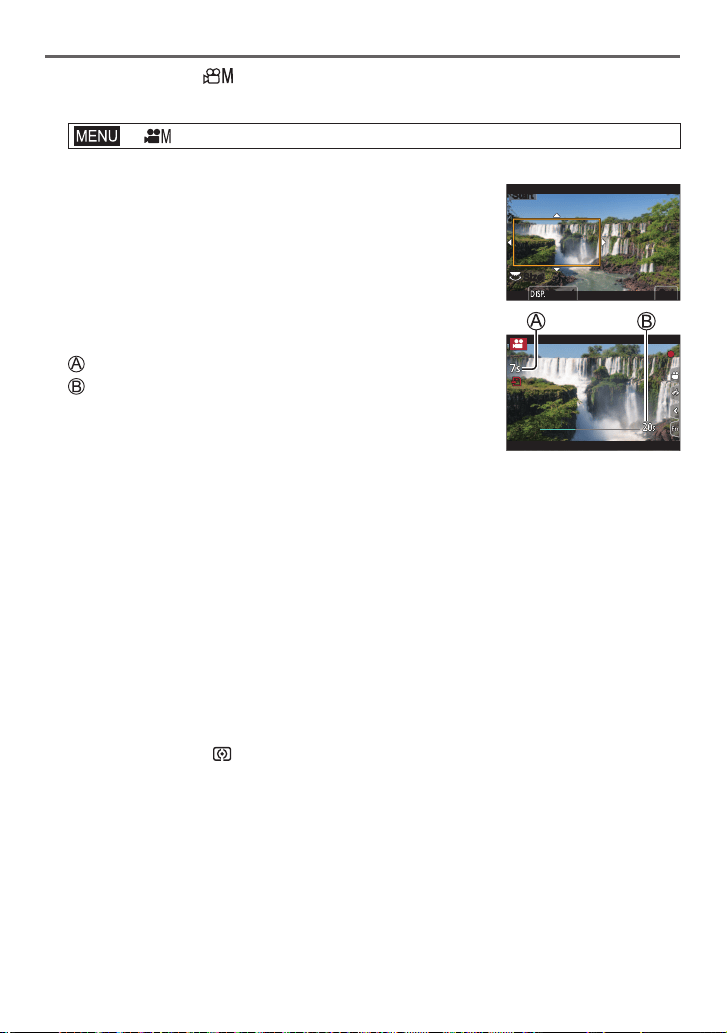
DVQX1774 (ENG)
55
Recording
1
Set mode dial to [ ]
2
Set the menu
→ [Creative Video] → [4K Live Cropping]
Settings: [40SEC] / [20SEC] / [OFF]
3
Set the crop start frame and press [MENU/SET] to set
• Set the crop end frame as well.
• When making settings for the first time, a crop start frame of size
1920×1080 is displayed.
• Move the frame by touching it or using the cursor button. You can
adjust the frame size by pinching out/pinching in or rotating the
rear or front dial.
SizeSize
StartStart
Reset
Reset
SetSet
4
Press the motion picture button (or the shutter button)
to start recording
Elapsed recording time
Set operating time
• Immediately release the motion picture button (or the shutter
button) after pressing it.
• When the set operating time has elapsed, recording
automatically ends. To end recording midway, press the motion
picture button (or the shutter button) again.
●
When you want to zoom in/out, set different angles of view for the cropping start and end frames.
For example, to zoom in, set a larger angle of view for the start frame and a smaller angle of view
for the end frame.
■
Changing the position and size of a crop frame
Press [Fn7] button while the recording screen is displayed, and perform step
3
.
■
To cancel [4K Live Cropping] recording
Set [OFF] in step
2
.
●
[4K Live Cropping] recording cannot be performed when [High Speed Video] is set.
●
Focus is adjusted and fixed in the crop start frame.
●
[Continuous AF] is set to [OFF].
●
[Metering Mode] will be [ ] (Multi Metering).
●
You cannot zoom in/out during [4K Live Cropping] recording.
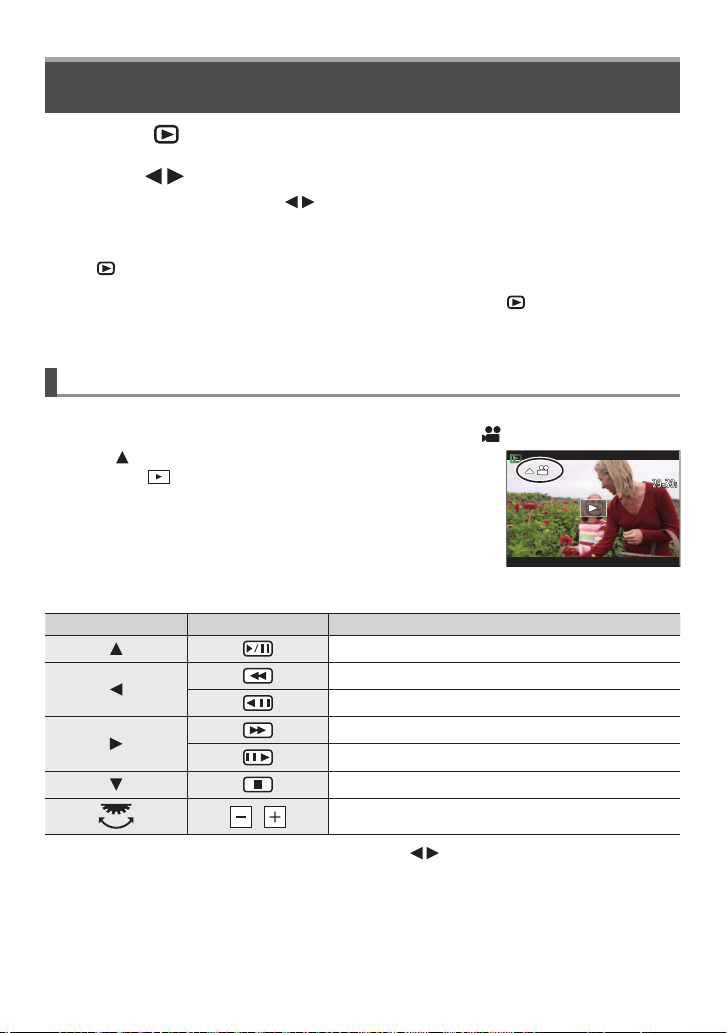
DVQX1774 (ENG)
56
Playback
Viewing your pictures
1
Press [ ] (Playback) button
2
Press to select a picture to be displayed
• When you press and hold , the pictures are displayed one after another.
■
Ending Playback
Press [
] (Playback) button again or press the shutter button halfway.
●
The playback screen appears if the camera is turned on while pressing [ ] (Playback) button.
●
When [Lens Retraction] is set to [ON], the lens barrel is retracted after approx. 15 seconds as the
camera is switched to the playback screen from the recording screen.
Viewing motion pictures
This unit was designed to play motion pictures using the AVCHD and MP4 formats.
• Motion pictures are displayed with the motion picture icon ([ ]).
1
Press to start playback
• Touching [ ] in the middle of the screen allows you to play
back motion pictures.
■
Operations during motion picture playback
Operation Touch operation Description
Play / pause
Fast rewind
1
Single-frame rewind
2
(while paused)
Fast forward
1
Single-frame forward (while paused)
Stop
/
Volume down / Volume up
1
The fast forward or rewind speed increases if you press again.
2
Motion pictures recorded in [AVCHD] are rewound frame by frame approximately every
0.5 seconds.
• If you press [MENU/SET] during a pause, you can create a picture from a motion
picture.
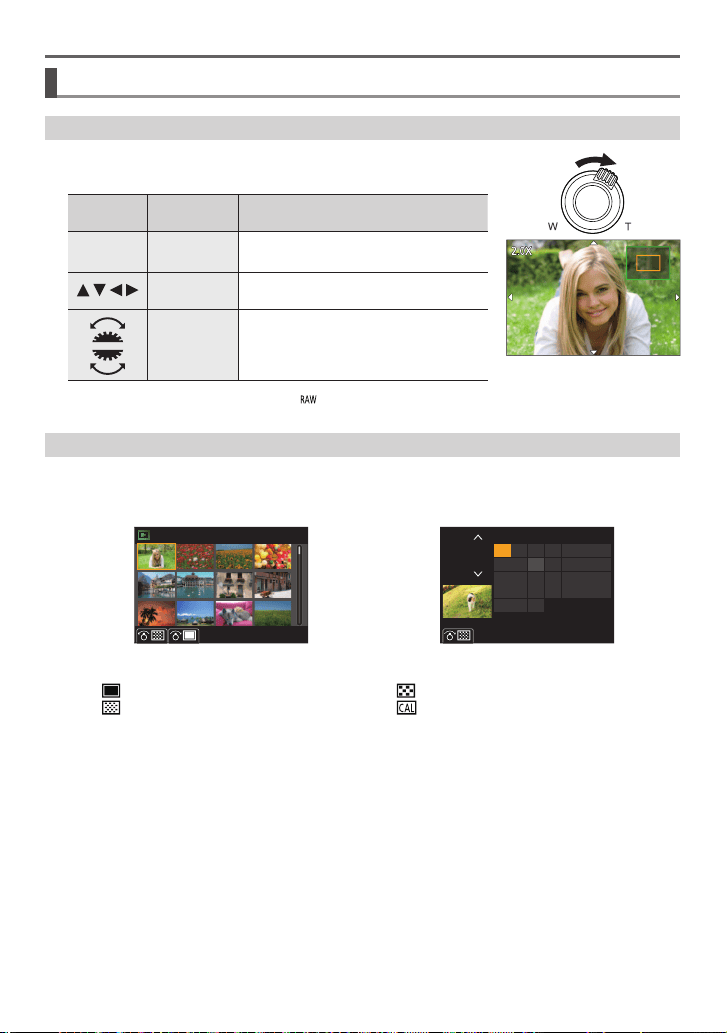
DVQX1774 (ENG)
57
Playback
Switching the Playback Method
Zooming in and viewing “Playback Zoom”
1
Move the zoom lever toward T side
1x → 2x → 4x → 8x → 16x
Operation
Touch
operation
Description
—
Pinch out /
Pinch in
Enlarges/reduces the screen in small
steps.
Drag
Moves the enlarged area (during
enlarged display).
—
Forwards/rewinds a picture while
maintaining the same zoom
magnification and zoom position
(during enlarged display).
●
Pictures recorded with [Quality] set to [ ] can be enlarged up to 8x.
“Multi Playback”/“Calendar Playback”
1
Move the zoom lever toward W side
1-picture screen (full-screen) → 12-picture screen → 30-picture screen → Calendar screen
• Move the lever to the T side to return.
2019
12
SUN MON TUE WED THU FRI SAT
765432
14131211109
212019181716
282726252423
3130
1
8
15
22
29
Multi Playback Calendar Playback
• It is possible to switch the playback screen by touching the following icons.
– [
]: 1-picture screen – [
]: 12-picture screen
– [
]: 30-picture screen – [
]: Calendar screen
• The screen can be switched gradually by dragging the screen up or down.
• Pictures displayed with [!] cannot be played back.
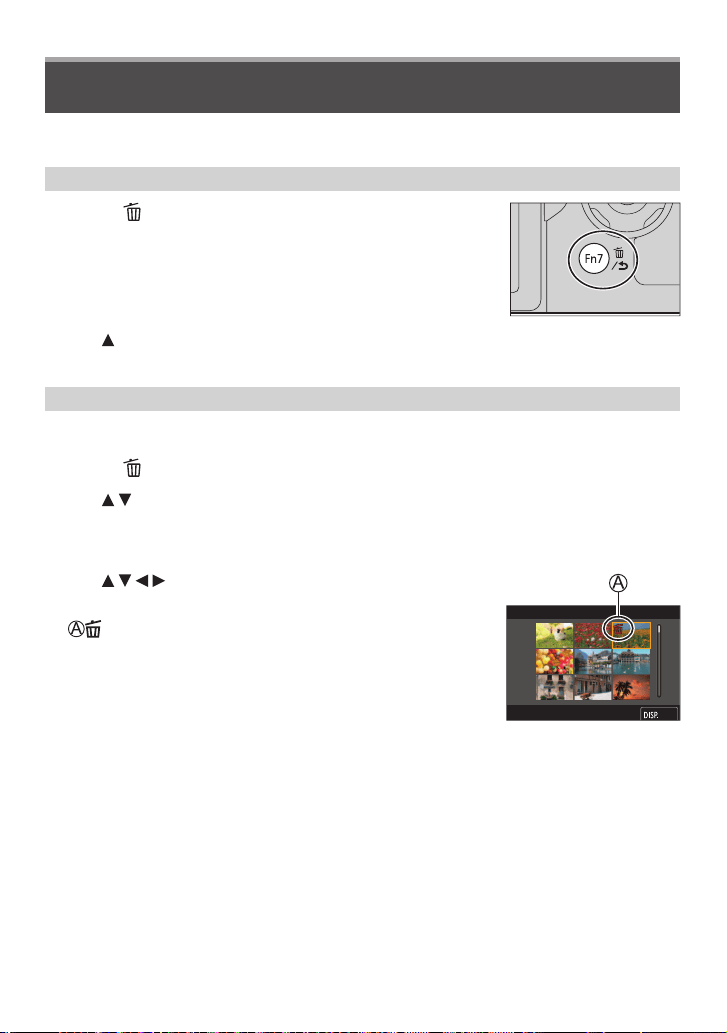
Playback
DVQX1774 (ENG)
58
Deleting pictures
Deleted pictures cannot be recovered.
[Delete Single]
1
Press [ ] button to delete displayed picture
2
Use to select [Delete Single] and press [MENU/SET]
To delete multiple (up to 100
)/To delete all pictures
A picture group is handled as 1 picture. (All the pictures in the selected picture group
are deleted.)
1
Press [ ] button while viewing a picture
2
Use to select [Delete Multi]/[Delete All] and press [MENU/SET]
• You can select [Delete All Non-rating] in [Delete All] if there are pictures that have been set as
[Rating].
(When [Delete Multi] is selected)
3
Use to select picture and press [MENU/SET]
(repeat)
Picture selected
• To cancel → Press [MENU/SET] again.
OKOK
4
Press [DISP.] button to execute
• May take time depending on number of pictures deleted.
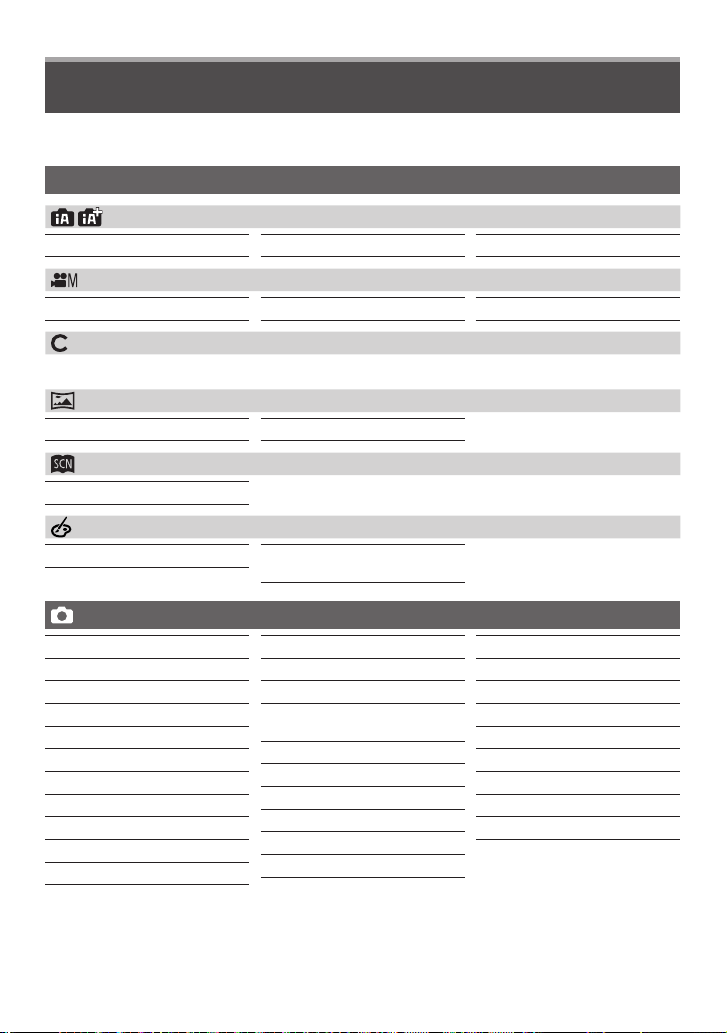
DVQX1774 (ENG)
59
Menu
Menu list
• You can display an explanation on the menu by pressing the [DISP.] button while you
select a menu item or setting. (→30)
Menus to be displayed in each recording mode
[Intelligent Auto]
[Intelligent Auto Mode] [iHandheld Night Shot] [iHDR]
[Creative Video]
[Exposure Mode] [High Speed Video] [4K Live Cropping]
[Custom Mode]
You can select your preferred custom setting from [Set1], [Set2], and [Set3].
[Panorama Shot]
[Direction] [Picture Size]
[Scene Guide]
[Scene Switch]
[Creative Control]
[Filter Effect]
[Simultaneous Record w/o
Filter]
[Aspect Ratio]
[Picture Size]
[Quality]
[AFS/AFF]
[AF Sensitivity(Photo)]
[Photo Style]
[Filter Settings]
[Color Space]
[Metering Mode]
[Highlight Shadow]
[i.Dynamic]
[i.Resolution]
[Flash]
[Red-Eye Removal]
[ISO Auto Upper Limit
(Photo)]
[Min. Shtr Speed]
[Long Shtr NR]
[Diffraction Compensation]
[Stabilizer]
[i.Zoom]
[Digital Zoom]
[Burst Rate]
[4K PHOTO]
[Self Timer]
[Time Lapse/Animation]
[Silent Mode]
[Shutter Type]
[Bracket]
[HDR]
[Multi Exp.]
[Rec]
Menu
DVQX1774 (ENG)
60
[Rec Format]
[Rec Quality]
[Snap Movie]
[Continuous AF]
[ISO Auto Upper Limit
(Video)]
[Flkr Decrease]
[Level Shot]
[Picture Mode in Rec.]
[Sound Rec Level Disp.]
[Sound Rec Level Adj.]
[Sound Rec Level Limiter]
[Wind Noise Canceller] /
[Wind Cut]
[Special Mic.]
[Zoom Mic]
[Motion Picture]
[Custom]
[Exposure]
[ISO Increments]
[Extended ISO]
[Exposure Comp. Reset]
[Focus / Release Shutter]
[AF/AE Lock]
[AF/AE Lock Hold]
[Shutter AF]
[Half Press Release]
[Quick AF]
[Eye Sensor AF]
[Pinpoint AF Setting]
[AF Assist Lamp]
[Direct Focus Area]
[Focus/Release Priority]
[Focus Switching for Vert
/ Hor]
[Loop Movement Focus
Frame]
[AF Area Display]
[AF+MF]
[MF Assist]
[MF Assist Display]
[Operation]
[Fn Button Set]
[ISO Displayed Setting]
[Exposure Comp. Disp.
Setting]
[Q.MENU]
[Dial Set.]
[Control Ring]
[Operation Lock Setting]
[Video Button]
[Video Rec. Button
(Remote)]
[Touch Settings]
[Zoom lever]
[Zoom Compose Assist]
[Monitor / Display]
[Auto Review]
[Monochrome Live View]
[Constant Preview]
[Peaking]
[Histogram]
[Guide Line]
[Center Marker]
[Highlight]
[Zebra Pattern]
[Expo.Meter]
[MF Guide]
[LVF/Monitor Disp. Set]
[Monitor Info. Disp.]
[Rec Area]
[Remaining Disp.]
[Menu Guide]
[Lens / Others]
[Lens Position Resume]
[Lens Retraction]
[Face Recog.]
[Profile Setup]
The menu items are common for both [Rec] and [Motion Picture] menus. (Common menu items are
indicated in the [Rec] menu list only) If a setting in one menu is changed, the setting with the same
name in other menu will also be changed automatically.

DVQX1774 (ENG)
61
Menu
[Online Manual]
[Cust.Set Mem.]
[Clock Set]
[World Time]
[Travel Date]
[Wi-Fi]
[Bluetooth]
[Wireless Connection Lamp]
[Beep]
[Economy]
[Monitor Display Speed]
[LVF Display Speed]
[Monitor Display]/
[Viewfinder]
[Monitor Luminance]
[m/ft]
[Eye Sensor]
[USB Mode]
[TV Connection]
[Language]
[Version Disp.]
[Folder / File Settings]
[No.Reset]
[Reset]
[Reset Network Settings]
[Level Gauge Adjust.]
[Demo Mode]
[Approved Regulations]
[Format]
[Setup]
[My Menu Setting]
[My Menu]
[Slide Show]
[Playback Mode]
[Protect]
[Rating]
[Title Edit]
[Face Rec Edit]
[RAW Processing]
[4K PHOTO Bulk Saving]
[Light Composition]
[Sequence Composition]
[Clear Retouch]
[Text Stamp]
[Resize]
[Cropping]
[Rotate]
[Video Divide]
[Time Lapse Video]
[Stop Motion Video]
[Rotate Disp.]
[Picture Sort]
[Delete Confirmation]
[Playback]
[Aspect Ratio]
Recording mode:
This allows you to select the aspect ratio of the pictures to suit printing or the playback
method.
→ [Rec] → [Aspect Ratio]
[4:3] Aspect ratio of a 4:3 TV
[3:2] Aspect ratio of standard film cameras
[16:9] Aspect ratio of high-definition TV, etc.
[1:1] Aspect ratio of a square image
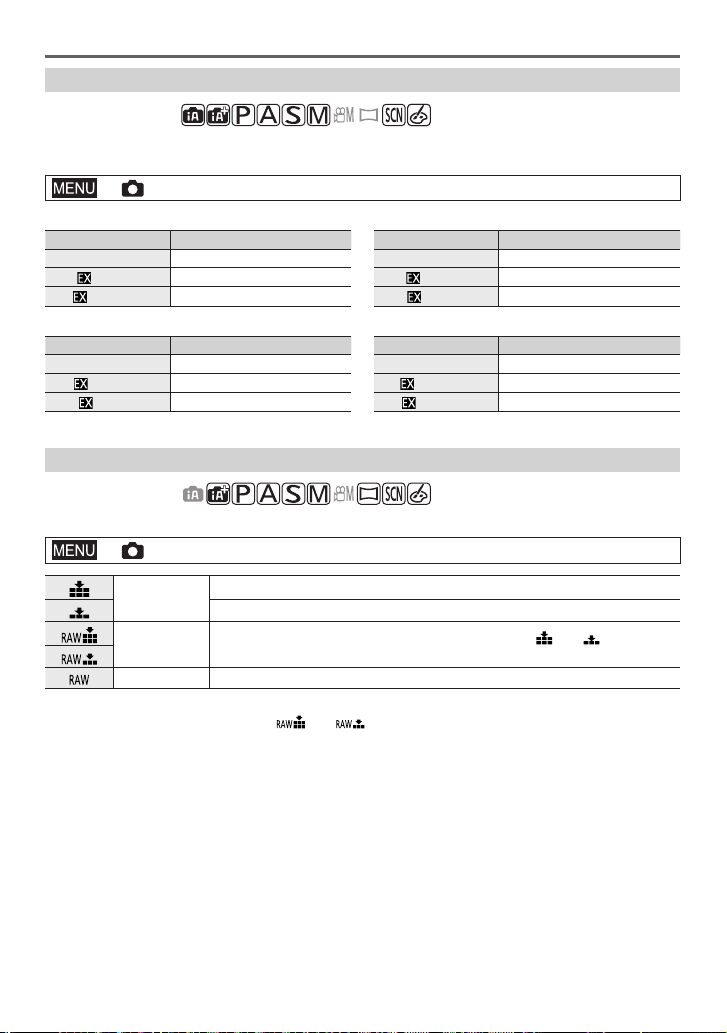
Menu
DVQX1774 (ENG)
62
[Picture Size]
Recording mode:
The higher the numbers of pixels, the finer the detail of the pictures will appear even
when they are printed onto large sheets.
→ [Rec] → [Picture Size]
When [4:3] is selected
Settings [Picture Size]
[L] (17.5M) 4864×3648
[
M] (9M)
3456×2592
[ S] (4.5M)
2432×1824
When [3:2] is selected
Settings [Picture Size]
[L] (20M) 5472×3648
[
M] (10M)
3888×2592
[ S] (5M)
2736×1824
When [16:9] is selected
Settings [Picture Size]
[L] (17M) 5472×3080
[
M] (8M)
3840×2160
[
S] (2M)
1920×1080
When [1:1] is selected
Settings [Picture Size]
[L] (13.5M) 3648×3648
[
M] (6.5M)
2592×2592
[ S] (3.5M)
1824×1824
[Quality]
Recording mode:
Set the compression rate used for storing pictures.
→ [Rec] → [Quality]
[ ]
JPEG
Gives priority to picture quality and saves pictures in JPEG file format.
[
] Saves pictures in JPEG file format using standard picture quality.
[
]
RAW + JPEG
Saves pictures in both RAW and JPEG file format ([
] or [ ])
simultaneously.
[
]
[
] RAW Saves pictures in RAW file format.
●
A RAW still picture is always recorded at [3:2] (5472×3648).
●
If you delete a picture recorded in [ ] or [ ] from the camera, the corresponding RAW and
JPEG pictures are also deleted.
• You can develop the RAW file pictures using [RAW Processing] in the [Playback] menu.
(→67)
• To develop and edit RAW file pictures on a PC, use the software (Ichikawa Soft
Laboratory’s “SILKYPIX Developer Studio”). To get this software, download it from the
supplier’s website and install it on your PC. (→78)
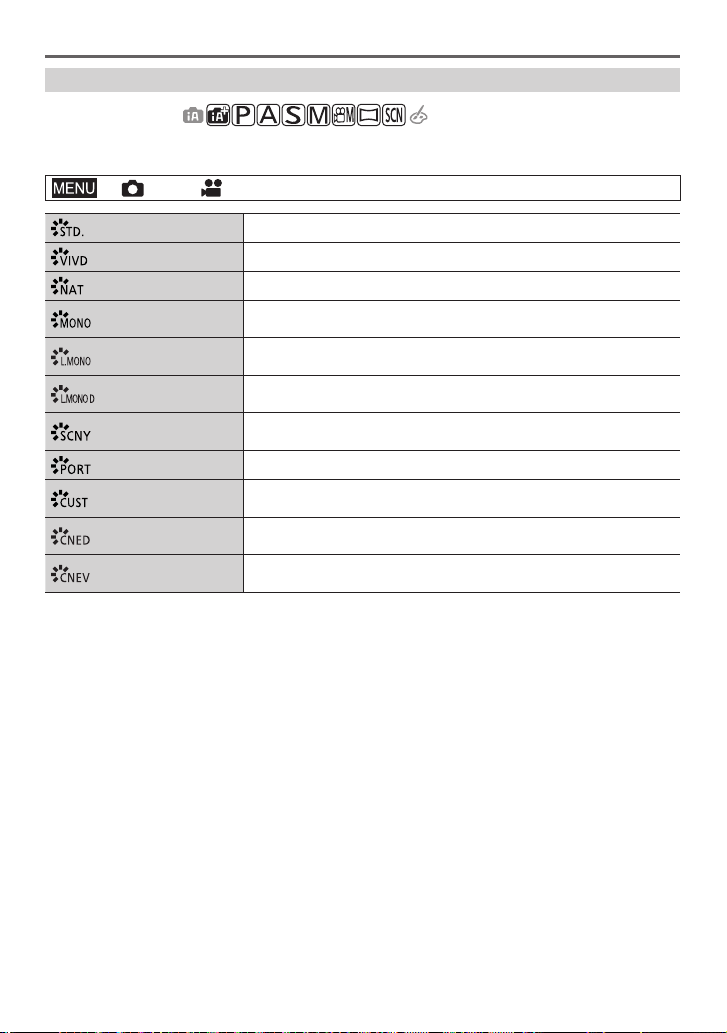
DVQX1774 (ENG)
63
Menu
[Photo Style]
Recording mode:
You can adjust the colors and picture quality according to the concept of the picture that
you want to create.
→ [Rec] / [Motion Picture] → [Photo Style]
[Standard] Standard setting.
[Vivid]
Setting with slightly high contrast and saturation.
[Natural]
Setting with slightly low contrast.
[Monochrome]
Setting that creates a picture using monochrome shades of gray
only, such as black and white.
[L.Monochrome]
Setting that creates a monochrome picture using rich shades of gray
with deep solid black tones.
[L.Monochrome D]
Setting that creates a dynamic monochrome picture with
emphasized highlights and shadows.
[Scenery]
Setting that creates a picture using vivid colors for the blue sky and
green.
[Portrait]
Setting that produces the look of a healthy complexion.
[Custom]
Setting for using colors and picture quality that were registered in
advance.
[Cinelike D]
Gives priority to the dynamic range by using a gamma curve
designed to create film-like images. Suited for editing.
[Cinelike V]
Gives priority to the contrast by using a gamma curve designed to
create film-like images.
This setting is not available in Intelligent Auto Plus Mode.
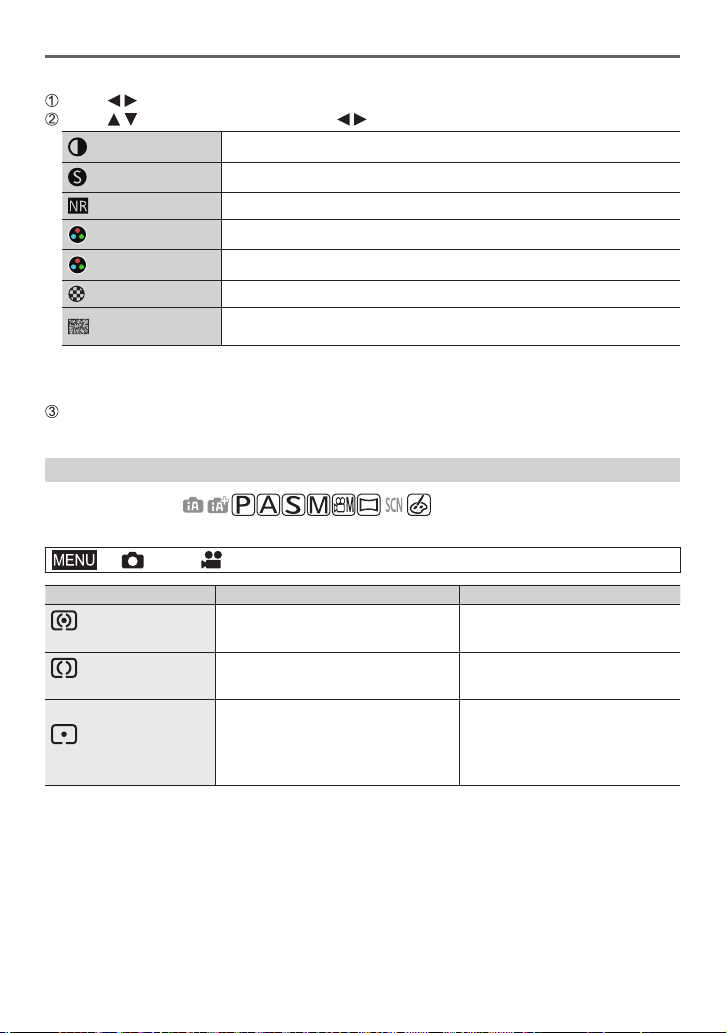
Menu
DVQX1774 (ENG)
64
■
Adjusting the picture quality
Press to select the type of Photo Style
Press to select an item and press to adjust
[Contrast] [+] / [–]
[Sharpness] [+] / [–]
[Noise Reduction] [+] / [–]
[Saturation]
1
[+] / [–]
[Color Tone]
1
[+] / [–]
[Filter Effect]
2
[Yellow] / [Orange] / [Red] / [Green] / [Off]
[Grain Effect]
2
[Low] / [Standard] / [High] / [Off]
Sets the graininess in a picture.
1
[Color Tone] is displayed only when [Monochrome], [L.Monochrome] or [L.Monochrome D] is
selected. Otherwise, [Saturation] is displayed.
2
Displayed only when [Monochrome], [L.Monochrome] or [L.Monochrome D] is selected.
Press [MENU/SET]
[Metering Mode]
Recording mode:
You can change the metering method used for measuring brightness.
→ [Rec] / [Motion Picture] → [Metering Mode]
[Metering Mode] Brightness measurement position Conditions
(Multiple)
Whole screen
Normal usage
(produces balanced pictures)
(Center weighted)
Center and surrounding area Subject in center
(Spot)
Center of [+] (spot metering target)
Great difference between
brightness of subject and
background
(e.g. person in spotlight on stage,
backlighting)
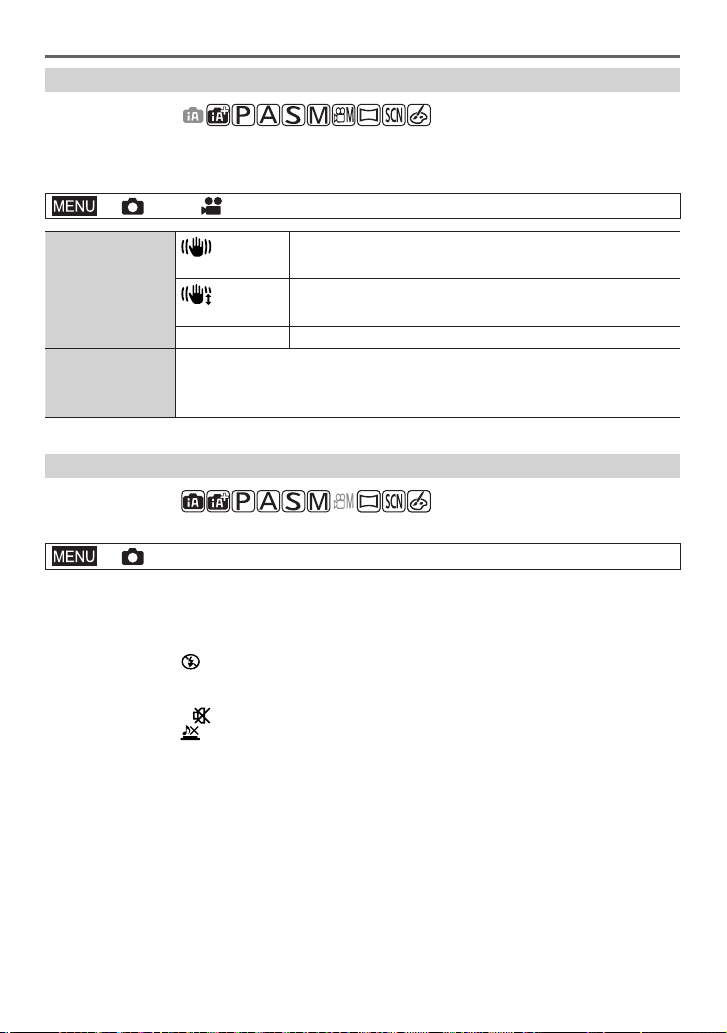
DVQX1774 (ENG)
65
Menu
[Stabilizer]
Recording mode:
Automatically detects and prevents jitter. For motion picture recording, the 5-Axis Hybrid
Image Stabilizer function is available. It uses both the optical stabilizer of the lens and the
electronic stabilizer of the camera’s sensor.
→ [Rec] / [Motion Picture] → [Stabilizer]
[Operation Mode]
(Normal)
Corrects vertical and horizontal jitter.
(Panning)
Corrects vertical jitter. This setting is ideal for panning. We
recommend using the Viewfinder.
[OFF] [Stabilizer] does not work.
[E-Stabilization
(Video)]
Corrects jitters that occur in 5 directions during motion picture recording,
namely the vertical direction, horizontal direction, rotation axis, vertical rotation,
and horizontal rotation (5-axis Hybrid Image Stabilizer function).
[ON] / [OFF]
[Silent Mode]
Recording mode:
Disabling the beeps and flash at the same time.
→ [Rec] → [Silent Mode]
Settings: [ON] / [OFF]
• This mode will mute sounds from the speaker and disable the flash and AF Assist
Lamp.
The settings for the following functions are fixed:
– [Flash Mode]: [
] (Forced Flash Off)
– [Shutter Type]: [ESHTR]
– [AF Assist Lamp]: [OFF]
– [Beep Volume]: [ ] (Off)
– [Shutter Vol.]: [ ] (Off)
●
Even when this mode is set to [ON], the following lamps/indicators will light or flash.
• Self-timer indicator
• WIRELESS connection lamp
●
The operation sounds of this camera such as the lens aperture sound are not muted.
●
Be sure to pay special attention to the privacy, the likeness rights, etc. of the subject when
you use this function. Use at your own risk.
Menu
DVQX1774 (ENG)
66
[Shutter Type]
Recording mode:
You can take pictures using two types of shutter modes: the mechanical shutter and
electronic shutter.
→ [Rec] → [Shutter Type]
[AUTO]
The shutter mode automatically switches based on the recording conditions and
shutter speed.
[MSHTR]
Uses only the mechanical shutter mode to take a picture.
Shutter Speed (seconds): B (Bulb)
1
, 60 - 1/4000
[ESHTR]
2
Uses only the electronic shutter mode to take a picture.
Shutter Speed (seconds): 1 - 1/16000
1
This setting is available only in Manual Exposure Mode.
2
The flash is fixed to the [ ] (Forced Flash Off) setting.
[Monitor Display Speed] / [LVF Display Speed]
Sets the display speed of the monitor or viewfinder.
→ [Setup] → [Monitor Display Speed] / [LVF Display Speed]
[ECO 30fps] Minimizes power consumption and the operating time is extended.
[60fps]
You can display a moving subject in fluid motion. This setting is ideal for recording
fast-moving subjects.
●
When [Monitor Display Speed] or [LVF Display Speed] (or both) is set to [ECO 30fps], Digital Zoom
is not available.
●
The [Monitor Display Speed]/[LVF Display Speed] setting does not affect the recorded picture.
[My Menu]
You can register frequently used menus and display them on [My Menu]. Up to 23 menus
can be registered.
→ [My Menu] → [My Menu Setting]
[Add] Select and register a menu to be displayed on [My Menu].
[Sorting]
Change the order of the menus to be displayed on [My Menu]. Select the
menu whose order you want to change and set the new location.
[Delete]
Delete a registered menu from the [My Menu] display.
[Delete Item]: Select and delete a menu from the displayed menus.
[Delete All]: Delete all displayed menus.
[Display from My Menu]
Set a screen to be displayed when the menu screen is displayed.
[ON]: Displays [My Menu]
[OFF]: Displays the last menu used
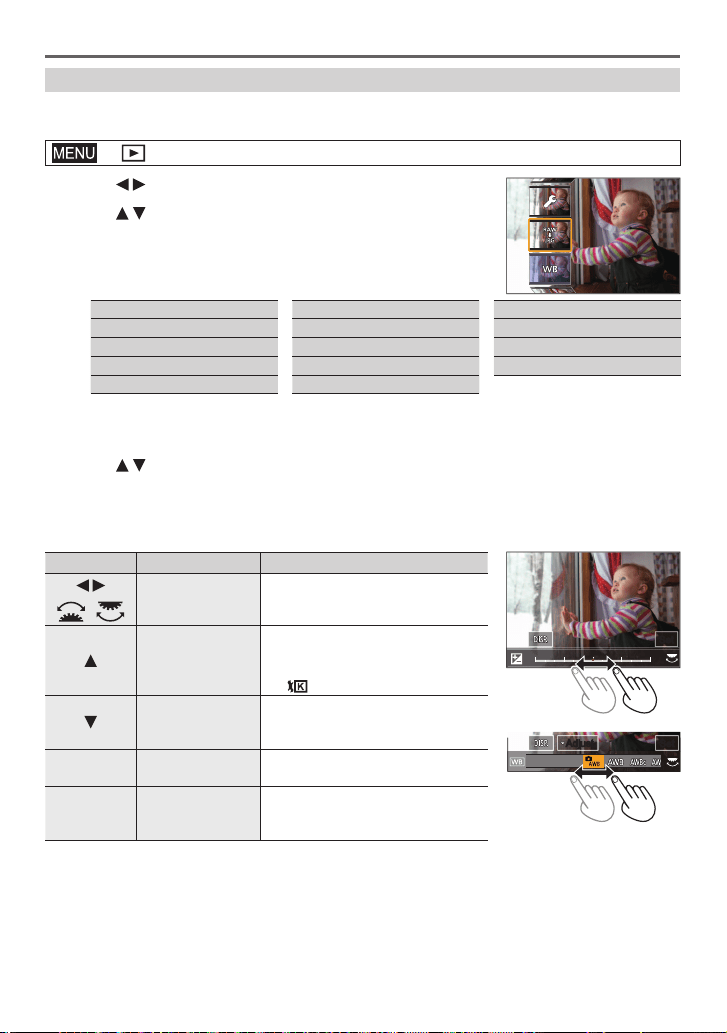
DVQX1774 (ENG)
67
Menu
[RAW Processing]
You can use the camera to develop still pictures that were recorded in RAW format. The
created still pictures are saved in JPEG format.
→ [Playback] → [RAW Processing]
1
Press to select RAW file and press [MENU/SET]
2
Press to select the item and then press
[MENU/SET] to set
• The following items can be set. The settings used during
recording are applied at the time of setting.
[White Balance]
[Brightness correction]
[Photo Style]
[i.Dynamic]
[Contrast]
[Highlight]
[Shadow]
[Saturation] / [Color Tone]
[Filter Effect]
[Grain Effect]
[Noise Reduction]
[i.Resolution]
[Sharpness]
[More Settings]
3
Press [MENU/SET] to finalize the setting
• The screen in step
2
reappears. To set another item, repeat steps
2
to
3
.
4
Press to select [Begin Processing] and press [MENU/SET]
■
Setting each item
When you select an item, the setting screen appears.
Operation Touch operation Description
Drag Used to make adjustments
/
[WB K Set]
Used to display the color
temperature setting screen
(Only when [White Balance] is set
to [
] )
[Adjust.]
Used to display the White Balance
fine adjustment screen
(Only when [White Balance] is set)
[DISP.] [DISP.]
Used to display the comparison
screen
[MENU/SET] [Set]
Used to finalize an adjustment you
just made and to return to the item
selection screen
-2 -1 0 +1 +2
SetSet
Adjust.Adjust.
SetSet
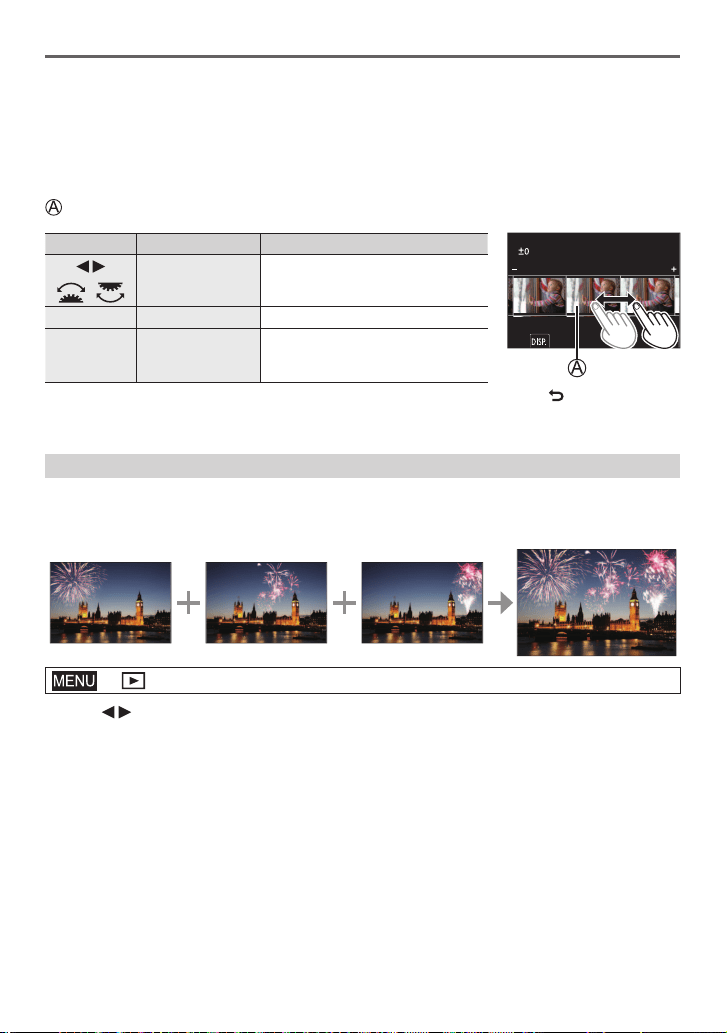
Menu
DVQX1774 (ENG)
68
• If you have selected [Noise Reduction], [i.Resolution], or [Sharpness], the comparison
screen is not displayed.
• You can also zoom in by quickly touching the display twice. (If the display was enlarged,
it returns to the same magnification ratio.)
The following operating methods are available to make adjustments on the comparison
screen.
Current setting
Operation Touch operation Description
Drag Used to make adjustments
/
[DISP.] [DISP.] Used to return to the setting screen
[MENU/SET] [Set]
Used to finalize an adjustment you
just made and to return to the item
selection screen
SetSet
• If you touch the picture at the center, it will be enlarged. If you touch [ ], the picture will
be reduced to the original size.
[Light Composition]
Select multiple frames from 4K burst files that you wish to combine. Parts of the image
that are brighter than the preceding frame will be superimposed on the preceding frame
to combine the frames into one picture.
→ [Playback] → [Light Composition]
1
Use to select the 4K burst files and press [MENU/SET]
2
Choose the combining method and press [MENU/SET]
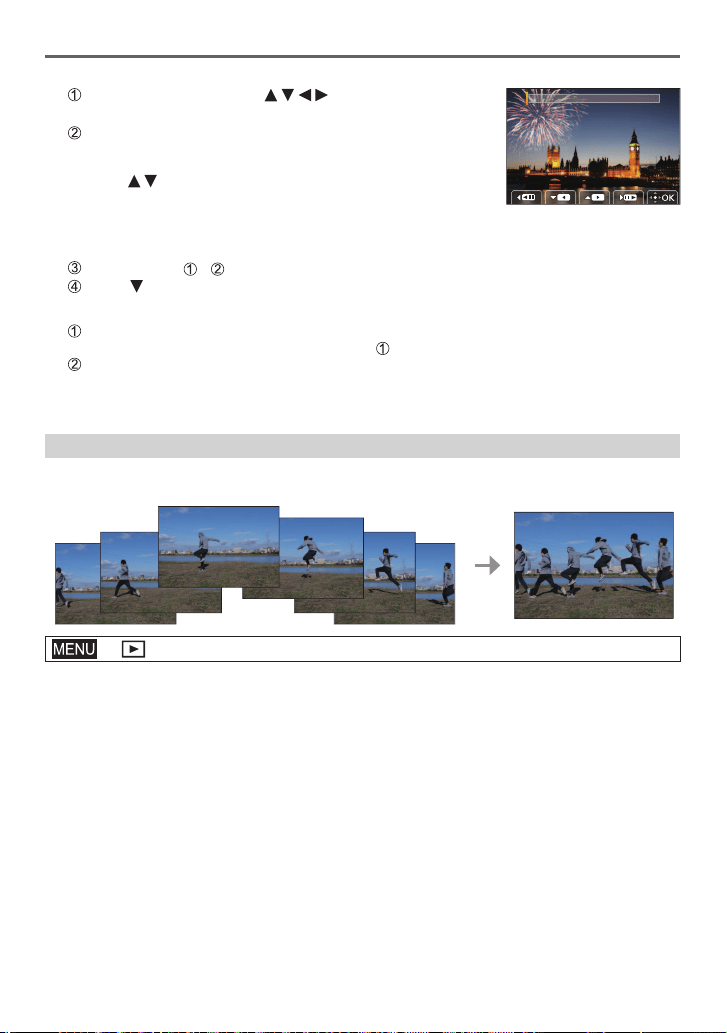
DVQX1774 (ENG)
69
Menu
■
[Composite Merging]: Selecting frames to combine
Drag the slide bar or use to select the frames
to combine
Press [MENU/SET]
• The selected frames are remembered, and the display goes to
the preview screen.
• Use
to select items and press [MENU/SET] to perform
the following operations.
– [Next]: Lets you select more frames for combining.
– [Reselect]: Discards the frame selected immediately before and lets you select a different
image.
Repeat steps - to select more frames to combine (up to 40 frames)
Press to select [Save] and press [MENU/SET]
■
[Range Merging]: Selecting a range to combine
Select the frame of the first picture and then press [MENU/SET]
• The selection method is the same as in step of [Composite Merging] setting.
Select the frame of the last picture and then press [MENU/SET]
●
The picture will be saved in JPEG format.
[Sequence Composition]
Select multiple frames from a 4K burst file to create a sequence composition of a moving
subject into one picture.
→ [Playback] → [Sequence Composition]
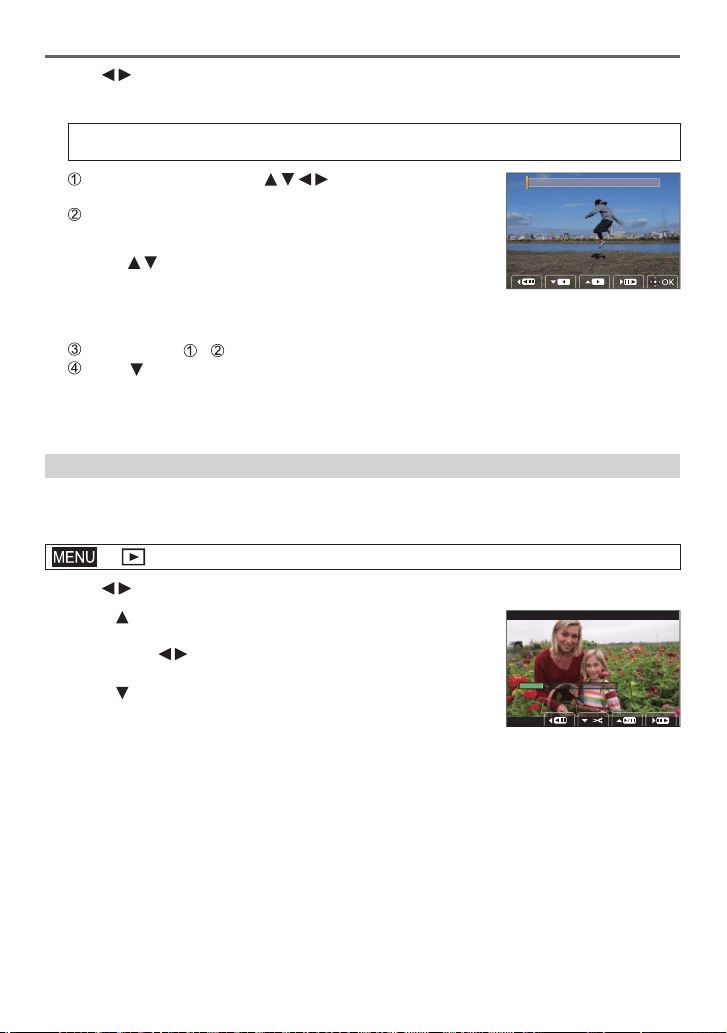
Menu
DVQX1774 (ENG)
70
1
Use to select the 4K burst files and press [MENU/SET]
2
Select frames to combine
Select the frames so that the moving subject will not overlap on the preceding or subsequent
frames. (The sequence composition may not be created properly if the subject overlaps.)
Drag the slide bar or use to select the frames
to combine
Press [MENU/SET]
• The selected frames are remembered, and the display goes to
the preview screen.
• Use
to select items and press [MENU/SET] to perform
the following operations.
– [Next]: Lets you select more frames for combining.
– [Reselect]: Discards the frame selected immediately before and lets you select a different
image.
Repeat steps - to select more frames to combine (from 3 to 40 frames)
Press to select [Save] and press [MENU/SET]
●
We recommend using a tripod to take pictures for Sequence Composition.
●
The picture will be saved in JPEG format.
[Video Divide]
A single motion picture can be split into 2 parts. This is convenient when you want to keep
just the necessary scenes, or if you wish to delete unnecessary scenes to increase free
space on your card, such as when traveling.
→ [Playback] → [Video Divide]
1
Use to select a motion picture to split and press [MENU/SET]
2
Press at where you want to split a motion picture to
pause it
• If you press while paused, you can make finer adjustments
to the splitting positions in a motion picture.
3
Press
• The original motion picture that was split does not remain.
●
Motion pictures cannot be divided at a location close to the start or end of the motion picture.
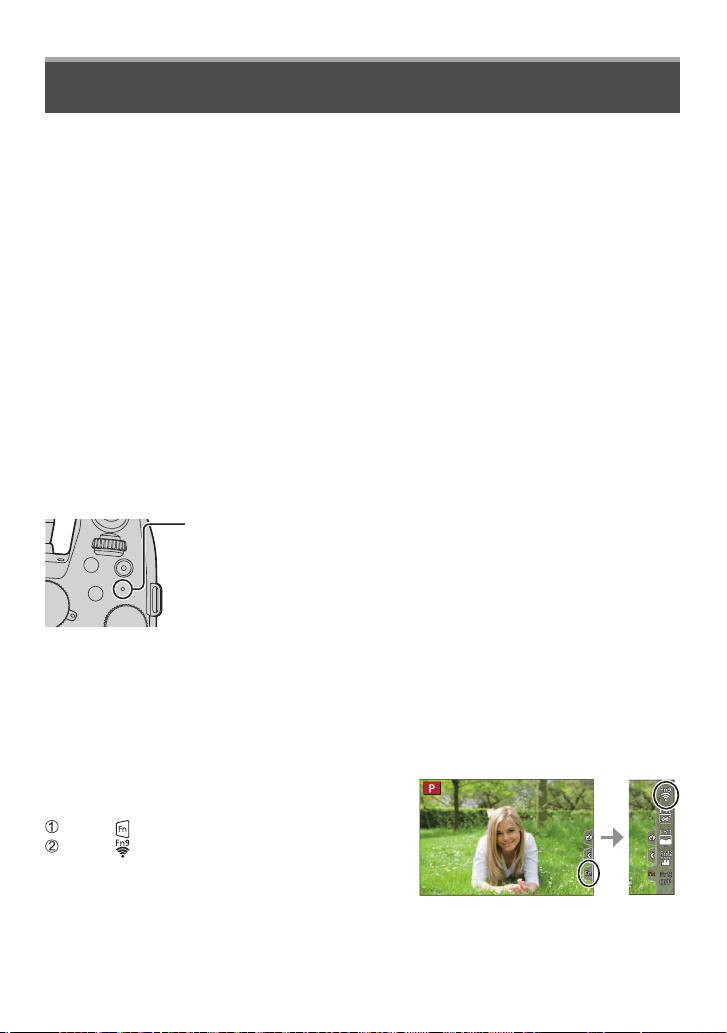
DVQX1774 (ENG)
71
Wi-Fi/Bluetooth
What you can do with the Wi-Fi
®
/Bluetooth
®
function
Operating the camera by connecting it to a smartphone
• Operating the shutter button of the camera using a smartphone (remote recording)
(→76)
• Playing back or saving images stored on the camera, or uploading them on social
media sites (→77)
• Combining motion pictures recorded with Snap Movie according to your preference on
a smartphone
Expanding the scope of applications by connecting the camera to a smartphone
compatible with Bluetooth Low Energy
• Pairing (connection setup) (→72)
• Turning on/off the camera with a smartphone (→75)
• [B] (Bulb) recording
• Transferring recorded images to a smartphone automatically
• Writing location information of a smartphone on a recorded image (→77)
• Synchronizing the camera’s clock with a smartphone
●
This manual uses the term “smartphone” for both smartphones and tablets unless it is necessary to
distinguish between them.
●
For details, refer to “Owner’s Manual for advanced features (PDF format)”.
■
Lighting of the WIRELESS connection lamp (Blue)
Lit: When the Wi-Fi/Bluetooth function is ON or connected
Blinking: When sending picture data by operating the camera
• In [Wireless Connection Lamp] in the [Setup] menu, you can set the lamp so
that it will not light/flash.
■
[Wi-Fi] button
In this owner’s manual, a function button to which [Wi-Fi] is assigned is referred to as the
[Wi-Fi] button. (At the time of purchase, [Wi-Fi] is assigned to [Fn9] in recording mode,
and [Fn5] in playback mode.)
• For details on the function button, refer to (→31)
To start up the Wi-Fi function
(When in recording mode):
Touch [ ]
Touch [ ]
●
The camera cannot be used to connect to a public wireless LAN connection.
Wi-Fi/Bluetooth
DVQX1774 (ENG)
72
Operating the camera by connecting it to a
smartphone
Installing the smartphone app “Panasonic Image App”
Supported OS
Android™: Android 4.4 or later
(Android 5.0 or higher is required to use the Bluetooth function)
iOS: iOS 9.3 or later
(The Bluetooth function cannot be used with the iPad 2)
Connect your device to a network
(Android) Select “Google Play™ Store”
(iOS) Select “App Store”
Enter “Panasonic Image App” or “LUMIX” into the search box
Select “Panasonic Image App” and install it
• Use the latest version.
• Supported OS versions as of February 2019. Supported OS versions may be changed
without prior notice.
• The service may not be able to be used properly depending on the type of smartphone
being used.
For the latest information on the “Image App”, refer to the support site below.
https://panasonic.jp/support/global/cs/dsc/
(This site is available in English only.)
• When downloading the app on a mobile phone network, high packet communication
fees may be incurred depending on the details of your contract.
• For details about the operating procedure, etc., refer to [Help] in the “Image App” menu.
• When you operate the “Image App” on the smartphone that is connected to the
camera via Wi-Fi, [Help] in the “Image App” may not be displayed depending on the
smartphone. In this case, after terminating the connection to the camera, reconnect the
smartphone to a mobile phone network or to a Wi-Fi router, and then display [Help] in
the “Image App”.
• Some of the screens and information provided in this document may be different
depending on the supported operating system and “Image App” version.
Connecting the camera to a smartphone compatible with
Bluetooth Low Energy
You can connect the camera to a smartphone via a Bluetooth connection.
Supported
smartphones
Android: Android 5.0 or higher equipped with Bluetooth 4.0 or higher
(excluding those that do not support Bluetooth low energy)
iOS: iOS 9.3 or higher (excluding the iPad 2)
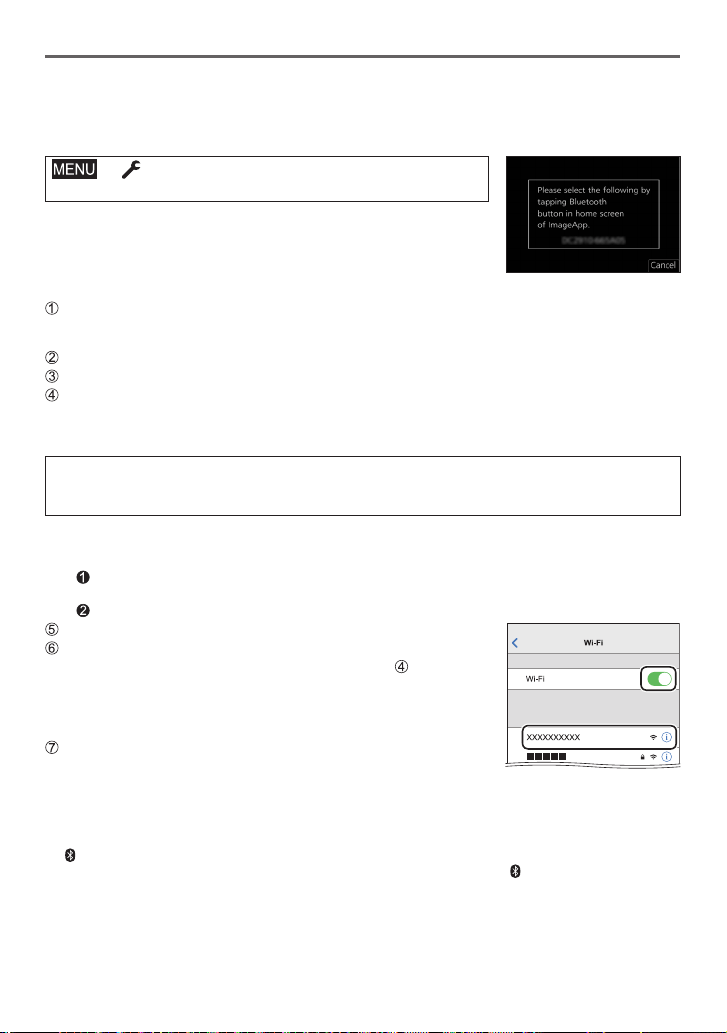
DVQX1774 (ENG)
73
Wi-Fi/Bluetooth
■
First-time connection
You need to set up pairing (connection) for the first time only. When pairing is set up, a
Wi-Fi connection is made automatically.
(On the camera)
→ [Setup] → [Bluetooth] → [Bluetooth]
→ [SET] → [Pairing]
• The camera enters pairing standby mode and displays its
device name.
(On your smartphone)
Start “Image App”
• If a message is displayed indicating that the smartphone is searching for cameras, close the
message.
Select [Bluetooth]
Turn on the Bluetooth
Select the device name displayed on the camera’s screen from the [Camera enable to
be registered] list
• Bluetooth connection between the camera and the smartphone will be made.
(For Android devices) A Wi-Fi connection will be made by selecting [Connection].
If you are using an Android device, follow the steps up to here to complete the
setup.
Proceed to the steps below only if you are using an iOS device.
• If [Wi-Fi Password] (→74) is set to [OFF] on the camera, select [Wi-Fi Setup]. (At the time of
purchase, [Wi-Fi Password] is set to [OFF])
• If [Wi-Fi Password] is set to [ON] on the camera, you need to install the profile.
Install the profile
• If the smartphone is locked with a passcode, enter the passcode to unlock the smartphone.
Exit the browser
Turn on the Wi-Fi function in the setting menu
On the Wi-Fi setting screen, select the SSID displayed on
the camera (The device name selected in step )
• If the SSID is not displayed, it may be displayed after the Wi-Fi
function is turned off and on.
• When you need to change the connected device, follow the on-
screen message to change the setting.
Start “Image App”
• The paired smartphone will be registered as a paired device after
connected via Wi-Fi.
●
To make a connection with the paired smartphone for the second and subsequent times, enable the
Bluetooth function of the camera and set the Bluetooth for “Image App” on your smartphone to ON.
Then, select a camera (device name) to be connected from the [Camera registered] list.
●
[ ] is displayed on the recording screen when a Bluetooth device is connected. If the Bluetooth
function is enabled, but the smartphone is not connected, the displayed [
] is semi-transparent.
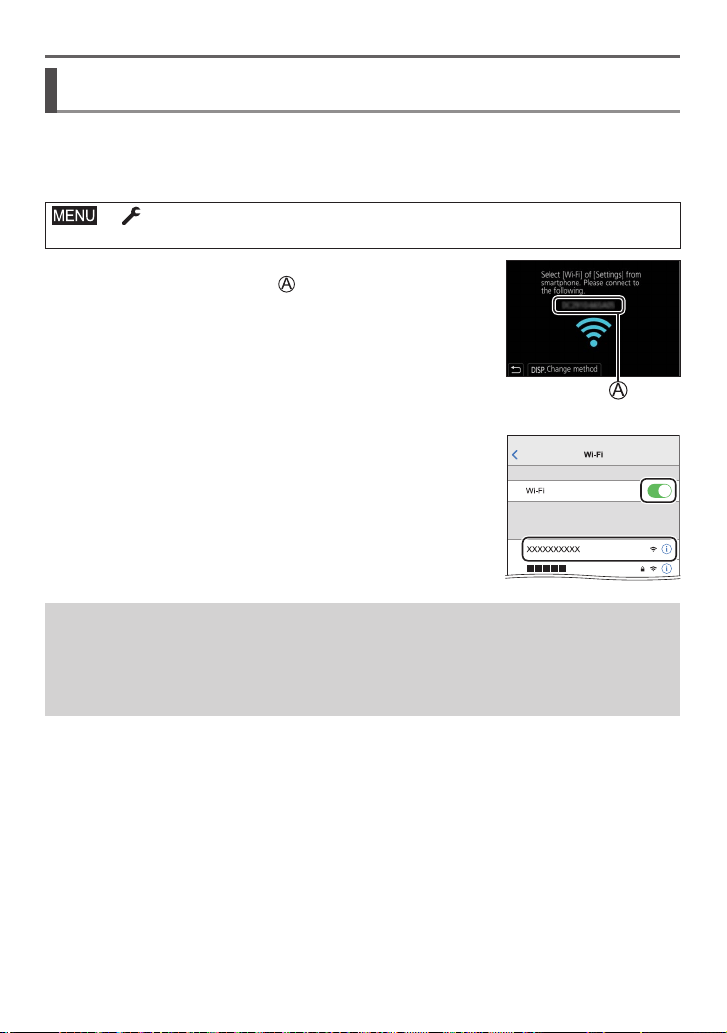
Wi-Fi/Bluetooth
DVQX1774 (ENG)
74
Connecting the camera to a smartphone that does not support
for Bluetooth Low Energy
You can easily establish a Wi-Fi connection on this unit without entering a password on
your smartphone.
(On the camera)
→ [Setup] → [Wi-Fi] → [Wi-Fi Function] → [New Connection]
→ [Remote Shooting & View]
• The information required for directly connecting your
smartphone to this unit (SSID (
)) is displayed.
• You can also display the information by pressing the
function button that [Wi-Fi] function is assigned.
(On your smartphone)
1
Turn on the Wi-Fi function in the setting menu
2
Select the SSID displayed on the screen of the camera
3
Start “Image App”
• When the connection confirmation screen appears on the
camera, select [Yes] and press [MENU/SET]. (Only when making
a connection for the first time.)
[Wi-Fi Password] is set to [OFF] at the time of purchase. When you start a Wi-Fi
connection, be sure to verify that the device displayed on the camera’s connection
confirmation screen is really the device you want to connect to. Even if the wrong device
is displayed, you will still be connected to it if you select “Yes”. If there seem to be other
Wi-Fi enabled devices in the vicinity, we recommend that you set [Wi-Fi Password] to
[ON]. For details, refer to “Owner’s Manual for advanced features (PDF format)”.
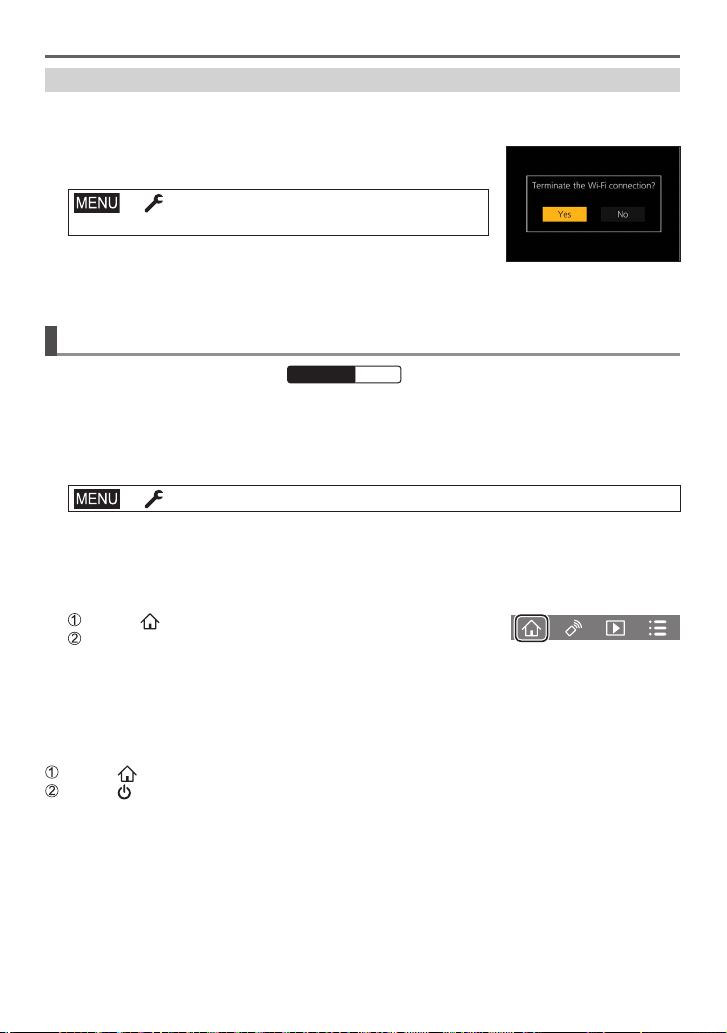
DVQX1774 (ENG)
75
Wi-Fi/Bluetooth
Closing the Wi-Fi connection
1
Set the camera to Recording Mode
• Press the shutter button halfway to return to recording mode.
2
Select the camera’s menu items to terminate the Wi-Fi
connection
→ [Setup] → [Wi-Fi] → [Wi-Fi Function]
→ [Yes]
3
On the smartphone, close “Image App”
Turning on/off the camera with a smartphone
Wireless connectivity required:
Bluetooth Wi-Fi
This function allows you to turn on the camera from a distant location and take pictures or
view images on the camera even when it is in your bag.
1
Make a Bluetooth connection to the smartphone (→72)
2
Select the camera’s menu
→ [Setup] → [Bluetooth] → [Remote Wakeup] → [ON]
3
Set the Camera [ON/OFF] switch to [OFF]
4
On the smartphone, start up the “Image App”, and set the Bluetooth function to
a state in which a connection can be made (standby state)
5
Operate the smartphone
Select [ ]
Select [Remote operation]
• The camera automatically turns on, allowing it to make a Wi-Fi connection automatically.
(iOS devices) Depending on the connection status of the smartphone, you may need to
change the connected device on the Wi-Fi setup screen. Follow the on-screen message on
the smartphone to change the setting.
■
Turning off the camera with the smartphone
Select [ ]
Select [ OFF]
●
When [Remote Wakeup] is set to [ON], the Bluetooth function continues to operate even after the
camera is turned off, thus causing the battery to drain.
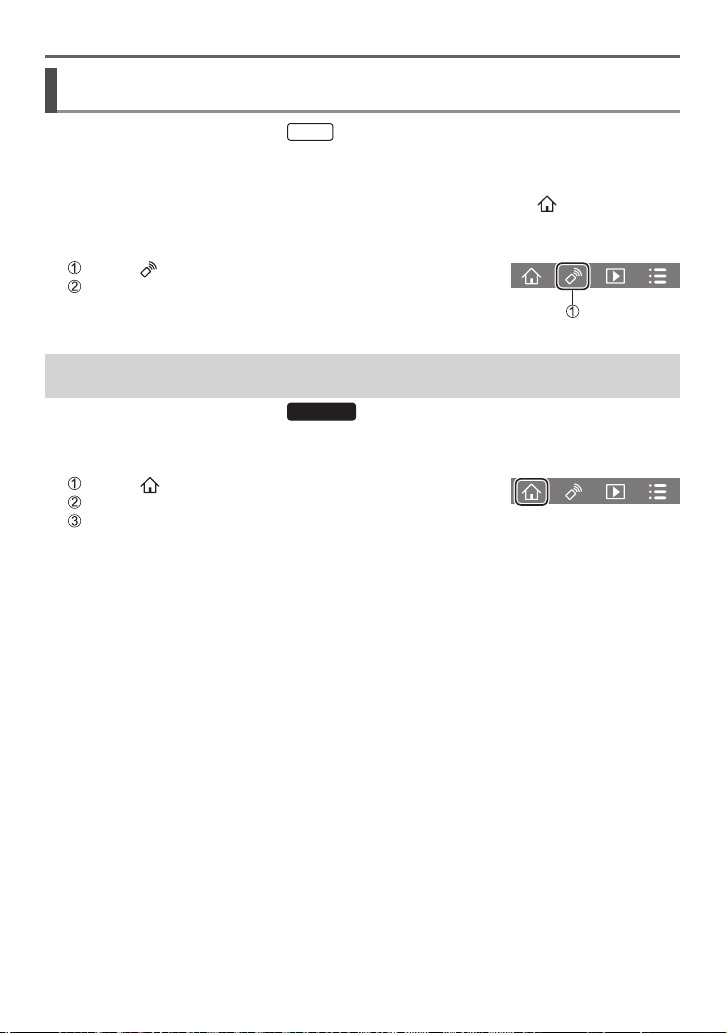
Wi-Fi/Bluetooth
DVQX1774 (ENG)
76
Operating the shutter button of the camera using a
smartphone (remote recording)
Wireless connectivity required:
Wi-Fi
1
Connect to a smartphone (→74)
2
Operate the smartphone
If the camera is already connected to the smartphone via Bluetooth, select [ ] → [Remote
operation].
(iOS devices) When you need to change the connected device on the Wi-Fi setup screen, follow
the on-screen message to change the setting.
Select [ ]
Take pictures
• The recorded images are saved in the camera.
• Some settings are not available.
Using the smartphone to operate the shutter button via a Bluetooth
connection only
Wireless connectivity required:
Bluetooth
1
Make a Bluetooth connection to the smartphone (→72)
2
Operate the smartphone
Select [ ]
Select [Shutter Remote Control]
Take pictures
●
[Shutter Remote Control] is available only when the Camera [ON/OFF] switch is set to [ON].
●
Read the [Help] in the “Image App” menu for further details on how to operate [Shutter Remote
Control] of “Image App”.
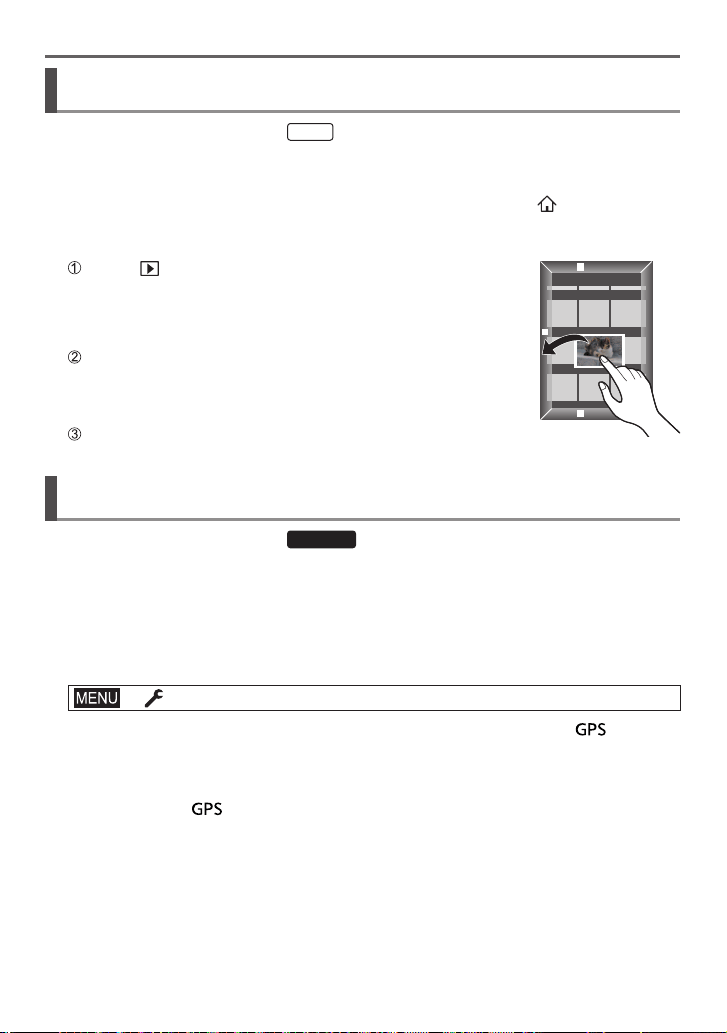
DVQX1774 (ENG)
77
Wi-Fi/Bluetooth
Playing back or saving images stored on the camera, or
uploading them on social media sites
Wireless connectivity required:
Wi-Fi
1
Connect to a smartphone (→74)
2
Operate the smartphone
If the camera is already connected to the smartphone via Bluetooth, select [ ] → [Remote
operation].
(iOS devices) When you need to change the connected device on the Wi-Fi setup screen, follow
the on-screen message to change the setting.
Select [ ]
• You can switch a device of pictures to be displayed using the icon
at the top left on the screen. Select [LUMIX] to display a picture
saved in the camera.
(Playing back a picture)
When the picture is touched, it is played back at a larger
size
(Saving and sending pictures to web services such as
SNS)
Press and hold the picture and drag it
Writing location information of a smartphone on a recorded
image
Wireless connectivity required:
Bluetooth
The smartphone sends its location information to the camera via Bluetooth, and the
camera performs recording while writing the acquired location information.
Preparation
Enable the GPS function on the smartphone.
1
Make a Bluetooth connection to the smartphone (→72)
2
Select the camera’s menu
→ [Setup] → [Bluetooth] → [Location Logging] → [ON]
• The camera will enter a mode where location information can be recorded and [ ] will be
displayed on the recording screen.
3
Take pictures on the camera
• Location information will be written to the recorded pictures.
●
When the displayed [ ] is semi-transparent, location information is not acquired, so data cannot
be written.

DVQX1774 (ENG)
78
Others
Downloading software
Download and install software to edit and play back images with a PC.
●
To download the software, your PC must be connected to the Internet.
●
It may take time to download the software in some communication environments.
PHOTOfunSTUDIO 10.0 AE (Windows
®
10 / 8.1 / 7)
You can capture still pictures or motion pictures to your PC, or organize captured pictures
by categorizing by recording date, model name of the digital camera used to record, etc.
You can also correct still pictures, edit motion pictures, or write to DVD.
The software is available for download until the end of March 2024.
https://panasonic.jp/support/global/cs/soft/download/d_pfs10ae.html
• For details about information such as the operating environment or operating method,
refer to the “Owner’s Manual for advanced features (PDF format)” or the operating
instructions of “PHOTOfunSTUDIO” (PDF format).
SILKYPIX Developer Studio SE
(Windows
®
10 / 8.1 / 7, Mac OS X v10.10, v10.11, macOS 10.12 - 10.14)
This software develops and edits RAW file pictures. Edited pictures can be saved in a file
format such as JPEG or TIFF that can be displayed on a PC, etc.
http://www.isl.co.jp/SILKYPIX/english/p/
• For details on the operating environment and how to use the SILKYPIX Developer
Studio, refer to the “Help” or the Ichikawa Soft Laboratory’s support website.
LoiLoScope 30 day full trial version (Windows
®
10 / 8.1 / 8 / 7)
Motion pictures can be edited easily.
http://loilo.tv/product/20
• For more information on how to use LoiLoScope and its operating environment, read
the LoiLoScope manual available for download at the website.
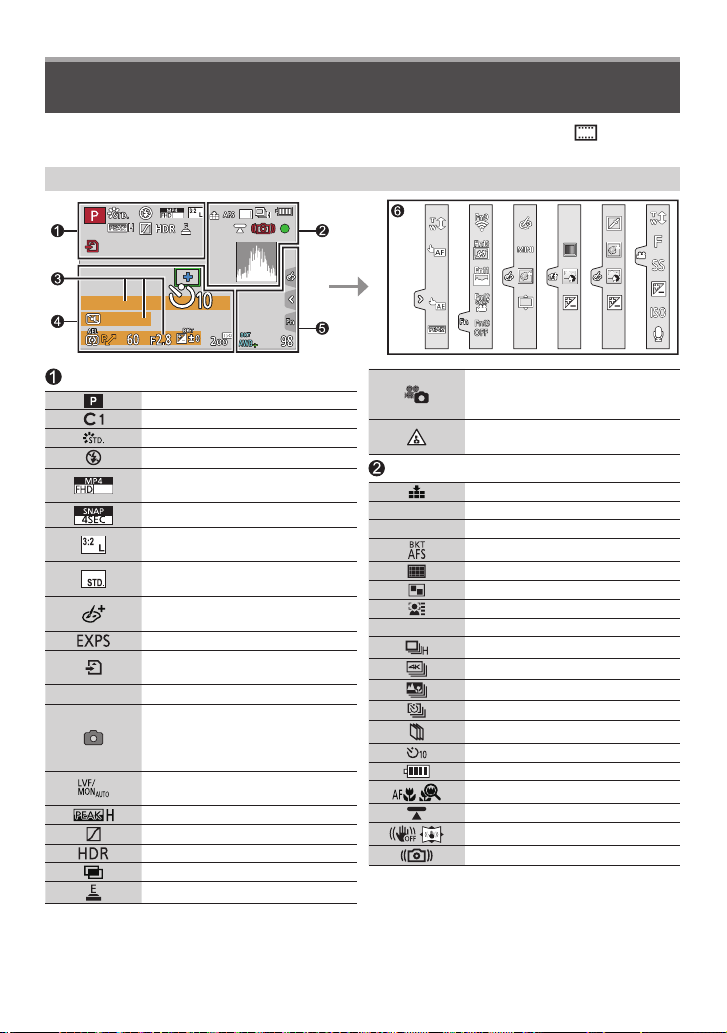
DVQX1774 (ENG)
79
Others
List of monitor/viewfinder displays
Recording mode (→25)
Custom Set
[Photo Style] (→63)
Flash setting (→51)
60p
[Rec Format]/
[Rec Quality] (→53)
[Snap Movie]
[Aspect Ratio] (→61)/
[Picture Size] (→62)
Image size (Panorama Shot
Mode)
Picture effect (Filter)
adjustment display
Types of picture effects (Filter)
Card (displayed only during
recording)
XXhXXmXXs
Elapsed recording time
1
Simultaneous recording
indicator (When taking still
pictures while recording a
motion picture)
Automatic switching between
viewfinder and monitor (→22)
[Peaking]
[Highlight Shadow]
[HDR]/[iHDR]
[Multi Exp.]
Electronic shutter
• The following images are examples of when the display screen is set to [ ] (monitor
style) in the monitor.
In recording
60
p
Picture-taking during motion
picture recording (Photo
Priority)
Overheat indicator
(→43, 45, 52)
[Quality] (→62)
120fps [High Speed Video]
AFS Focus Mode (→34, 36)
Focus Bracket (→50)
[AF Mode] (→35)
[Pull Focus] ([Snap Movie])
[Face Recog.]
AFL AF Lock (→37)
Burst (→41)
[4K PHOTO] (→42)
[Post Focus] (→45)
[Time Lapse Shot] (→47)
[Stop Motion Animation] (→48)
[Self Timer] (→41)
Battery indicator
Macro recording (→35)
[Level Shot]
[Stabilizer] (→65)
Jitter alert
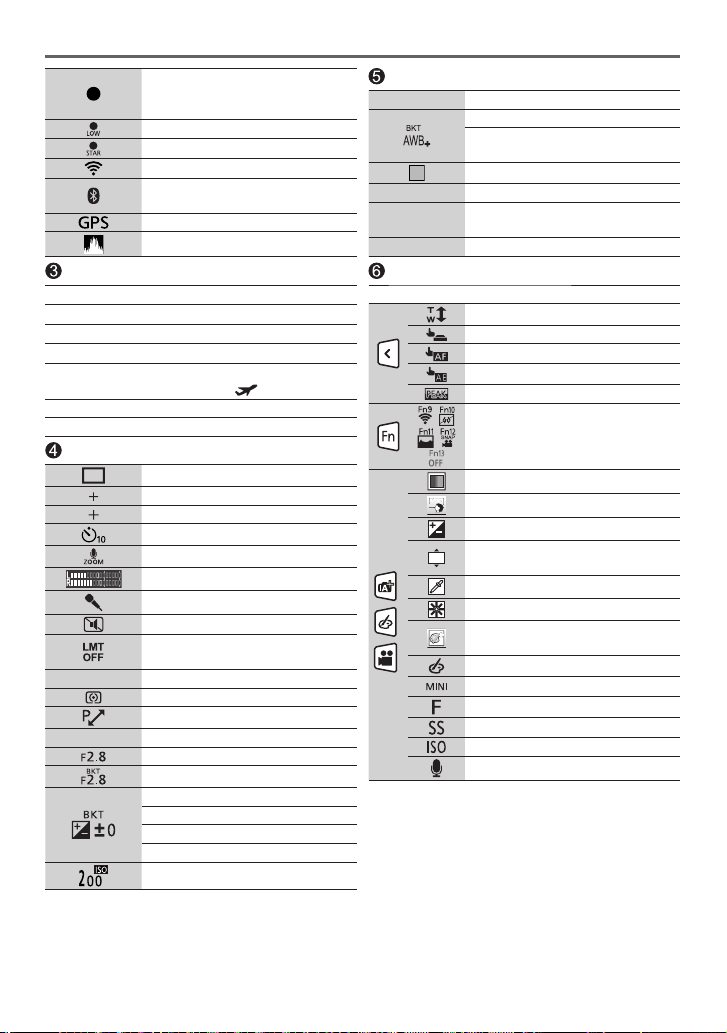
Others
DVQX1774 (ENG)
80
AWBc White Balance (→39)
White Balance Bracket (→40)
White Balance Fine Adjustment
(→40)
Coloring
98 Number of recordable pictures
r20
Maximum number of pictures
that can be taken continuously
RXXmXXs
Available recording time
1
Touch tab
Touch zoom
Touch Shutter (→29)
Touch AF (→29)
[Touch AE] (→29)
[Peaking]
Function buttons (→31)
Coloring (→33)
Defocus control function (→33)
Brightness (exposure) (→33)
Type of defocus ([Miniature
Effect])
[One Point Color]
[Sunshine]
Picture effect (Filter)
adjustment display
Picture effects ON or OFF
Picture effects (Filter)
Aperture value (→54)
Shutter speed (→54)
ISO sensitivity (→54)
[Sound Rec Level Adj.] (→54)
Focus (Lights green.) (→23)/
Recording state (Lights up in
red.) (→52)
Focus (Under low illumination)
Focus (Starlight AF)
Wi-Fi connection status
Bluetooth connection status
(→73)
Location Logging (→77)
Histogram
Name
2
Travel elapsed days
3
Age in years/months
2
Location
3
Current date/time
3
Travel destination setting
3
:
Exposure meter
Zoom (→24)
AF area
Spot metering target (→64)
[Center Marker]
[Self Timer] (→41)
[Zoom Mic]
[Sound Rec Level Disp.]
External Microphone
[Silent Mode] (→65)
[Sound Rec Level Limiter]
([OFF])
AEL AE Lock (→37)
[Metering Mode] (→64)
Program Shift
60 Shutter speed
Aperture value
Aperture Bracket (→50)
Exposure Compensation (→37)
Exposure Bracket (→50)
Brightness (exposure) (→33)
Manual Exposure Assist
ISO sensitivity (→38)
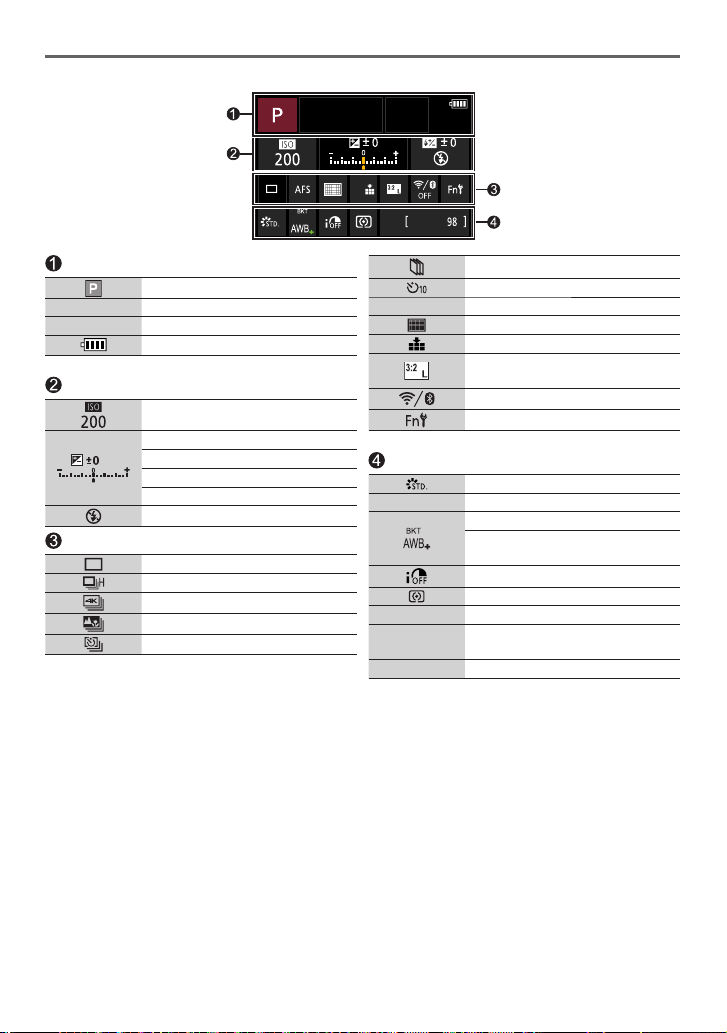
DVQX1774 (ENG)
81
Others
■
On-monitor recording information
Recording mode (→25)
1/60 Shutter speed
F2.8 Aperture value
Battery indicator
ISO sensitivity (→38)
Exposure Compensation (→37)
Exposure Bracket (→50)
Brightness (exposure) (→33)
Manual Exposure Assist
Flash setting (→51)
[Single] (→41)
[Burst] (→41)
[4K PHOTO] (→42)
[Post Focus] (→45)
[Time Lapse Shot] (→47)
[Stop Motion Animation] (→48)
[Self Timer] (→41)
AFS Focus Mode (→34, 36)
[AF Mode] (→34)
[Quality] (→62)
[Aspect Ratio] (→61)/
[Picture Size] (→62)
Wi-Fi/Bluetooth (→71)
Function button setting (→31)
[Photo Style] (→63)
AWB White Balance (→39)
White Balance Bracket (→40)
White Balance Fine Adjustment
(→40)
[i.Dynamic]
[Metering Mode] (→64)
98 Number of recordable pictures
r20
Maximum number of pictures
that can be taken continuously
RXXmXXs
Available recording time
1
1
[h], [m] and [s] indicate “hour”, “minute” and “second”.
2
This is displayed for about 5 seconds when the camera is turned on if the [Profile Setup] setting is
set.
3
This is displayed for about 5 seconds when the camera is turned on, after setting the clock and after
switching from Playback Mode to Recording mode.
• The information displayed, such as histograms, magnifications, and numeric values, are
only for the purpose of reference.
F2.81/60
Others
DVQX1774 (ENG)
82
Q&A
Troubleshooting
• Performing [Reset] in the [Setup] menu may resolve the issue.
• Further information is provided in the “Owner’s Manual for advanced features (PDF
format)”. Check it together with the information in this section.
The charging lamp blinks.
• Charging is being performed in a place with extremely high or low temperature.
→ Reconnect the USB connection cable (supplied) and retry charging in a place where
ambient temperature is 10 °C to 30 °C (50 °F to 86 °F) (temperature conditions also apply
to the battery itself).
• Charging is not possible if the power supply capacity of the computer is low.
Camera does not work even if the camera is turned on. Camera switches off as soon as the
camera is turned on.
• Battery needs recharging.
→ Charge the battery. (→19)
The battery runs down quickly.
• When [
] ([4K Pre-Burst]) has been selected, the battery drains faster. Select [ ] ([4K Pre-
Burst]) only when recording.
Multiple pictures are taken when I press the shutter button just once.
Check the following settings. If any of them apply, multiple pictures will be taken.
• Drive Mode is set to other than [Single]. (→41)
→ Set Drive Mode to [Single].
• Bracket recording is set. (→49)
→ If any of the [
] icons (ex. [ ], [ ], [ ], [ ], etc.) is displayed on the screen, bracket
recording is set. Under [Bracket] in the [Rec] menu, set [Bracket Type] to [OFF].
Focus not aligned correctly.
• Subject outside of focus range.
• [Focus/Release Priority] is set to [RELEASE]. (→60)
• [Shutter AF] is set to [OFF]. (→60)
• AF Lock is set inappropriately. (→37)
• If there are fingerprints or dirt on the lens, the focus may be set to the lens and not the subject.
Recorded pictures are blurred. The stabilizer function ineffective.
• Shutter speed is slower in dark locations and the stabilizer function is less effective.
→ Use a tripod and the self-timer (→41) when using a slower shutter speed.
Striping or flicker may appear under lighting such as fluorescent lighting and LED lighting
fixture.
• This is a characteristic of MOS sensors which serve as the camera’s pickup sensors. This is not a
malfunction.
• If you are taking still pictures using the electronic shutter, the striping may be reduced by setting a
slower shutter speed.
• When noticeable flicker or striping is seen under lighting such as a fluorescent or LED lighting
fixture in the motion picture recording mode, you can reduce the flicker or striping by setting up
[Flkr Decrease] (→60) and fixing the shutter speed. You can set the shutter speed manually in the
Creative Video Mode. (→25)
DVQX1774 (ENG)
83
Others
Subject appears skewed in pictures.
• If you take a picture of a moving subject in the electronic shutter mode, motion picture recording
mode, or 4K photo recording mode, the subject in the picture may be skewed in some cases.
This is characteristic of MOS sensors which serve as the camera’s pickup sensors. This is not a
malfunction.
Brightness or coloring of recorded picture different from real life.
• When recording under fluorescent or LED lighting fixture etc., increasing the shutter speed may
introduce slight changes to brightness and color. These are a result of the characteristics of the
light source and do not indicate a malfunction.
• When recording subjects in extremely bright locations or recording under fluorescent lighting, LED
lighting fixture, mercury lamp, sodium lighting etc., the colors and screen brightness may change or
horizontal striping may appear on the screen.
4K photo recording stops before finishing.
• When the ambient temperature is high or recording of the 4K Photo function is performed
continuously, the camera may display [
] and stop the recording. Wait until the camera cools
down.
Cannot record motion pictures.
• When a large capacity card is used, you may not be able to take a picture for a while after you turn
on the camera.
Motion picture recording stops midway.
• When the ambient temperature is high or motion picture is recorded continuously, the camera may
display [
] and stop the recording. Wait until the camera cools down.
• The speed class of a required card varies depending on [Rec Format] and [Rec Quality] of a motion
picture. Be sure to use a card of the recommended speed class (→15).
Sometimes focus adjustment with Auto Focus mode is difficult while recording 4K motion
pictures.
• This may occur when taking a picture by reducing the Auto Focus speed in order to adjust the
focus at high precision. This is not a malfunction.
No flash emitted.
• The flash becomes unavailable in the following cases.
– The flash is closed. (→51)
– Flash set to [
] (Forced Flash Off).
• The flash is fixed to [
] (Forced Flash Off) in the following cases:
– During motion picture recording
– When recording 4K photos
– When recording using [Post Focus]
– When using the electronic shutter
– When [HDR] is set to [ON]
– When [Silent Mode] is set to [ON]
– When a picture effect in [Filter Effect] of [Filter Settings] is set
• Set [Shutter Type] to [AUTO] or [MSHTR]. (→59)
• Set [Silent Mode] to [OFF]. (→59)

Others
DVQX1774 (ENG)
84
The monitor/viewfinder is turned off although the camera is turned on.
• If no operations are performed during the set time period [Auto LVF/Monitor Off] (→22) is activated,
and the monitor/viewfinder turns off.
• When a hand or an object is close to the eye sensor, the monitor display mode could be switched
to viewfinder display mode. (→22)
Cannot view pictures. There are no recorded pictures.
• A card is not inserted in the camera.
• Has the file name of the picture been changed on a computer? If so, it cannot be played back on
the camera.
→ It is recommended to use the “PHOTOfunSTUDIO” software (→78) to write pictures from PC to
card.
• Set [Playback Mode] to [Normal Play]. (→61)
A Wi-Fi connection cannot be established. Radio waves get disconnected. Wireless access
point is not displayed.
General tips for using a Wi-Fi connection
• Use within the communication range of the wireless LAN network.
• Is any device, such as a microwave oven, cordless phone, etc., that uses 2.4 GHz frequency
operated nearby?
→ Radio waves may get interrupted when used simultaneously. Use them sufficiently away from
the device.
• When the battery indicator is flashing red, the connection with other equipment may not start or the
connection may be disrupted. (A message such as [Communication error] is displayed.)
• When this unit is placed on a metal table or shelf, the connection may not be established easily.
Use the camera away from metal surfaces.
About a wireless access point
• Check if the wireless access point to connect is in operating state.
• Check the radio wave condition of the wireless access point.
→ Perform the connection closer to the wireless access point.
→ Move the location or change the angle of the wireless access point.
• It may not display even if the radio waves exist depending on the setting of the wireless access
point.
→ Turn off the wireless access point and then turn it back on.
• Is the network SSID of the wireless access point set not to broadcast?
→ It may not be detected when it is set not to broadcast. Enter and set the network SSID.
Alternatively, set the network SSID of the wireless access point to broadcast.

DVQX1774 (ENG)
85
Others
It takes time to transmit an image to the WEB service.
Transmission of the image fails midway. There is an image that could not be transmitted.
• Is the size of the image too large?
→ Transmit after dividing the motion picture with [Video Divide].
→ Reduce the image size at [Size], and then send.
• It may take longer time to transmit when distance to the wireless access point is far.
→ Transmit closer to the wireless access point.
• File format of the picture that can be sent differs depending on the destination.
The lens makes a clicking noise.
• When the camera is turned on or off, the lens is moved, or an aperture operation is performed,
such a noise may be heard. This is not a malfunction.
• When the brightness changes after a zooming operation or moving the camera, the lens may make
a noise while adjusting the aperture. This is not a malfunction.
Zooming stops instantaneously.
• When using the Extended optical zoom, the zooming action will stop temporarily. This is not a
malfunction.
Camera is hot.
• Camera may become a little warm during use, but this does not affect performance or quality.
Clock is incorrect.
• If you do not use the camera for a long time, the clock may be reset.
→ Reset the clock (→21).
DVQX1774 (ENG)
86
Others
Specifications
Digital Camera: Information for your safety
Power Source DC 8.4 V (8.4 V )
Power
Consumption
1.9 W (When recording with monitor)
2.9 W (When recording with viewfinder)
1.5 W (When playing back with monitor)
1.5 W (When playing back with viewfinder)
Camera effective
pixels
20,100,000 pixels
Image sensor 1″ MOS sensor,
total pixel number 20,900,000 pixels
Primary color filter
Lens Optical 16x zoom
f=9.1 mm to 146 mm
(35 mm film camera equivalent: 25 mm to 400 mm)
Max. Wide: F2.8 to F11
Max. Tele: F4.0 to F11
Image Stabilizer Optical method
Focus range AF:
30 cm (0.98 feet) (Max. Wide)/1 m (3.3 feet) (Max. Tele) to
AF Macro/MF/Intelligent Auto/Motion picture:
3 cm (0.098 feet) (Max. Wide)/1 m (3.3 feet) (Max. Tele) to
Shutter system Electronic shutter + Mechanical shutter
Minimum
Illumination
Approx. 9 lx (when i-Low light is used, the shutter speed is
1/30th of a second)
Shutter speed Still picture:
B (Bulb) (Max. approx. 120 seconds), 60 seconds to 1/4000th of
a second (When the mechanical shutter is used),
1 second to 1/16000th of a second (When the electronic shutter
is used)
Motion picture:
1/25th of a second to 1/16000th of a second (When
[FHD/24M/24p] is set in [AVCHD]),
1/2 second to 1/16000th of a second (When [Exposure Mode] is
set to [M] in Creative Video Mode and [MF] is selected),
1/30th of a second to 1/16000th of a second (Other than the
above)
Exposure (AE) Program AE (P)/Aperture-priority AE (A)/
Shutter-priority AE (S)/Manual exposure (M)
Exposure Compensation (1/3 EV steps, -5 EV to +5 EV)

DVQX1774 (ENG)
87
Others
Metering Mode Multiple/Center weighted/Spot
Monitor 3.0″ TFT LCD (3:2) (Approx. 1,240,000 dots)
(field of view ratio about 100%)
Touch screen
Viewfinder 0.39″ OLED Live Viewfinder (4:3)
(Approx. 2,360,000 dots)
(field of view ratio about 100%)
[Approx. 0.74x (35 mm film camera equivalent), with 50 mm lens
at infinity; -1.0 m
-1
]
(with diopter adjustment -4 to +4 diopter)
Flash Built-in pop up flash
AUTO, AUTO/Red-Eye Reduction, Forced ON,
Forced ON/Red-Eye Reduction, Slow Sync.,
Slow Sync./Red-Eye Reduction, Forced OFF
Microphones Stereo
Speaker Monaural
Recording media SD Memory Card/SDHC Memory Card
/SDXC Memory Card
UHS- UHS Speed Class 3
Recording file
format
Still picture RAW/JPEG (based on Design rule for Camera File system,
based on Exif 2.31 standard)
4K Photo MP4
Motion picture AVCHD Progressive/AVCHD/MP4
Audio compression
format
AVCHD: Dolby Audio™ (2 ch)
MP4: AAC (2 ch)
Interface
[MIC] Ø3.5 mm jack
[REMOTE] Ø2.5 mm jack
[HDMI] Micro HDMI Type D
[USB/CHARGE] USB 2.0 (High Speed)/USB 2.0 Micro-B
Dimensions Approx. 136.2 mm (W) × 97.2 mm (H) × 131.5 mm (D)
[5.36″ (W) × 3.83″ (H) × 5.18″ (D)]
(excluding the projection part)
Mass (weight) With card and battery: Approx. 810
(1.79 lb)
Excluding card and battery: Approx. 758 (1.67 lb)
Operating
temperature
0 °C to 40 °C (32 °F to 104 °F)
Operating humidity 10%RH to 80%RH
Language select [ENGLISH] / [DEUTSCH] / [FRANÇAIS] / [ESPAÑOL] /
[PORTUGUÊS] / [ITALIANO] / [繁體中文] / [日本語]
DVQX1774 (ENG)
88
Others
■
Wireless transmitter
Wireless LAN
Compliance standard
IEEE 802.11b/g/n (standard wireless LAN protocol)
Frequency range used
(central frequency)
2412 MHz to 2462 MHz (1 to 11 ch)
Encryption method Wi-Fi compliant WPA™/WPA2™
Access method Infrastructure mode
Bluetooth function
Compliance standard
Bluetooth Ver. 4.2 (Bluetooth Low Energy (BLE))
Frequency range used
(central frequency)
2402 MHz to 2480 MHz
■
AC adaptor
(Panasonic VSK0815F): Information for your safety
Input: 110 V – 240 V 50/60 Hz 0.25 A
Output: 5.0 V
1.8 A
■
Battery pack (lithium-ion)
(Panasonic DMW-BLC12PP): Information for your safety
Voltage/capacity: 7.2 V/1200 mAh
The symbols on this product (including the accessories) represent the following:
AC
DC
Class II equipment (The construction of the product is double-insulated.)
Specifications are subject to change without notice.
DVQX1774 (ENG)
89
Others
Reading the Owner’s Manual
(PDF format)
More detailed operating instructions are available in “Owner’s Manual for advanced
features (PDF format)”. To read it, download it from the website.
https://panasonic.jp/support/dsc/oi/index.html?model=DC-FZ1000M2&dest=P
• Click the desired language.
■
Confirming URLs and QR codes with the camera
→ [Setup] → [Online Manual]
Settings: [URL display] / [QR Code display]
• The URL or QR code will be displayed on the camera monitor.
●
You will need Adobe Reader to browse or print the Owner’s Manual (PDF format). You can
download and install a version of Adobe Reader that you can use with your OS from the following
website. (As of February 2019)
http://www.adobe.com/products/acrobat/readstep2.html
This product incorporates the following software:
(1) the software developed independently by or for Panasonic Corporation,
(2) the software owned by third party and licensed to Panasonic Corporation,
(3) the software licensed under the GNU General Public License, Version 2.0 (GPL V2.0),
(4) the software licensed under the GNU LESSER General Public License, Version 2.1 (LGPL V2.1),
and/or
(5) open source software other than the software licensed under the GPL V2.0 and/or LGPL V2.1.
The software categorized as (3) - (5) are distributed in the hope that it will be useful, but WITHOUT
ANY WARRANTY, without even the implied warranty of MERCHANTABILITY or FITNESS FOR A
PARTICULAR PURPOSE. Please refer to the detailed terms and conditions thereof displayed by
selecting [MENU/SET] → [Setup] → [Version Disp.] → [Software info].
At least three (3) years from delivery of this product, Panasonic will give to any third party who
contacts us at the contact information provided below, for a charge no more than our cost of physically
performing source code distribution, a complete machine-readable copy of the corresponding source
code covered under GPL V2.0 or LGPL V2.1, as well as the respective copyright notice thereof.
Contact Information: [email protected]
The source code and the copyright notice are also available for free in our website below.
https://panasonic.net/cns/oss/index.html
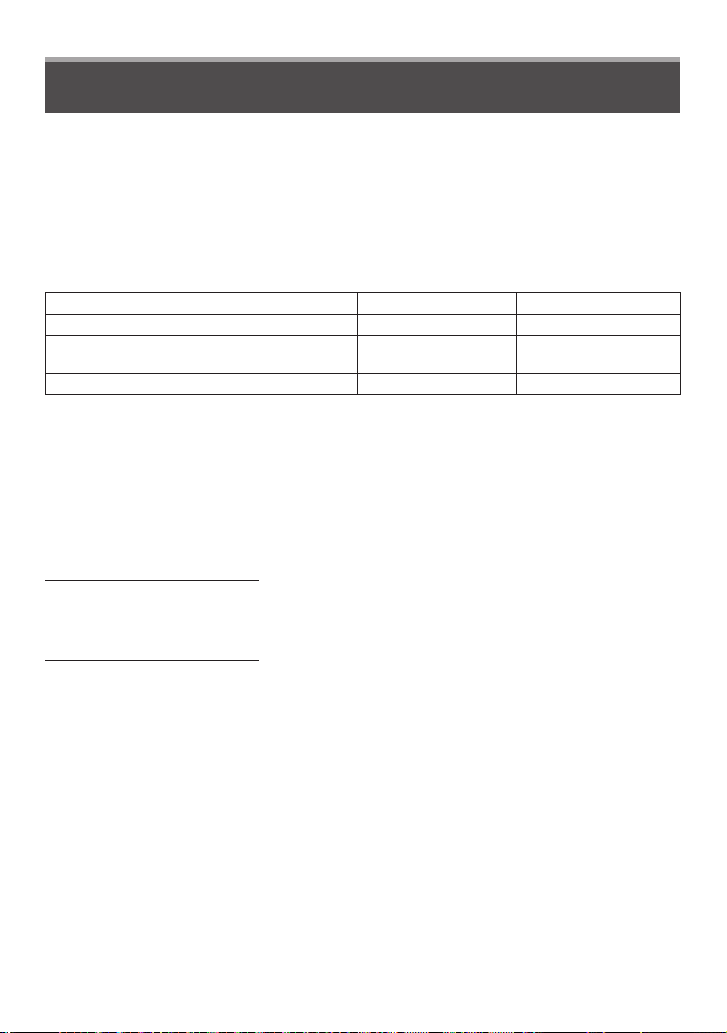
DVQX1774 (ENG)
90
Others
Limited Warranty (ONLY FOR U.S.A.)
Panasonic Products Limited Warranty
Limited Warranty Coverage (For USA Only)
If your product does not work properly because of a defect in materials or workmanship, Panasonic
Corporation of North America (referred to as “the warrantor”) will, for the length of the period indicated
on the chart below, which starts with the date of original purchase (“warranty period”), at its option
either (a) repair your product with new or refurbished parts, (b) replace it with a new or a refurbished
equivalent value product, or (c) refund your purchase price. The decision to repair, replace or refund
will be made by the warrantor.
Product or Part Name Parts Labor
Digital Camera 1 Year 1 Year
All included Accessories
(Except Non-Rechargeable Batteries)
90 Days Not Applicable
Only Non-Rechargeable Batteries 10 Days Not Applicable
During the “Labor” warranty period there will be no charge for labor. During the “Parts” warranty
period, there will be no charge for parts. This Limited Warranty excludes both parts and labor for non-
rechargeable batteries, antennas, and cosmetic parts (cabinet). This warranty only applies to products
purchased and serviced in the United States. This warranty is extended only to the original purchaser
of a new product which was not sold “as is”.
Mail-In Service--Online Repair Request
Online Repair Request
To submit a new repair request and for quick repair status visit our Web Site at
http://shop.panasonic.com/support.
When shipping the unit, carefully pack, include all supplied accessories listed in the Owner’s Manual,
and send it prepaid, adequately insured and packed well in a carton box. When shipping Lithium Ion
batteries please visit our Web Site at
http://shop.panasonic.com/support as Panasonic is committed to providing the most up to date
information. Include a letter detailing the complaint, a return address and provide a daytime phone
number where you can be reached. A valid registered receipt is required under the Limited Warranty.

DVQX1774 (ENG)
91
Others
IF REPAIR IS NEEDED DURING THE WARRANTY PERIOD, THE PURCHASER WILL BE
REQUIRED TO FURNISH A SALES RECEIPT/PROOF OF PURCHASE INDICATING DATE OF
PURCHASE, AMOUNT PAID AND PLACE OF PURCHASE. CUSTOMER WILL BE CHARGED FOR
THE REPAIR OF ANY UNIT RECEIVED WITHOUT SUCH PROOF OF PURCHASE.
Limited Warranty Limits and Exclusions
This warranty ONLY COVERS failures due to defects in materials or workmanship, and DOES
NOT COVER normal wear and tear or cosmetic damage. The warranty ALSO DOES NOT COVER
damages which occurred in shipment, or failures which are caused by products not supplied by the
warrantor, or failures which result from accidents, misuse, abuse, neglect, mishandling, misapplication,
alteration, faulty installation, set-up adjustments, misadjustment of consumer controls, improper
maintenance, power line surge, lightning damage, modification, introduction of sand, humidity or
liquids, commercial use such as hotel, office, restaurant, or other business or rental use of the product,
or service by anyone other than a Factory Service Center or other Authorized Servicer, or damage that
is attributable to acts of God.
THERE ARE NO EXPRESS WARRANTIES EXCEPT AS LISTED UNDER “LIMITED WARRANTY
COVERAGE”.
THE WARRANTOR IS NOT LIABLE FOR INCIDENTAL OR CONSEQUENTIAL DAMAGES
RESULTING FROM THE USE OF THIS PRODUCT, OR ARISING OUT OF ANY BREACH OF THIS
WARRANTY.
(As examples, this excludes damages for lost time, travel to and from the servicer, loss of or damage
to media or images, data or other memory or recorded content. The items listed are not exclusive, but
for illustration only.)
ALL EXPRESS AND IMPLIED WARRANTIES, INCLUDING THE WARRANTY OF
MERCHANTABILITY, ARE LIMITED TO THE PERIOD OF THE LIMITED WARRANTY.
Some states do not allow the exclusion or limitation of incidental or consequential damages, or
limitations on how long an implied warranty lasts, so the exclusions may not apply to you.
This warranty gives you specific legal rights and you may also have other rights which vary from state
to state. If a problem with this product develops during or after the warranty period, you may contact
your dealer or Service Center. If the problem is not handled to your satisfaction, then write to:
Consumer Affairs Department
Panasonic Corporation of North America
661 Independence Pkwy
Chesapeake, VA 23320
PARTS AND SERVICE, WHICH ARE NOT COVERED BY THIS LIMITED WARRANTY, ARE YOUR
RESPONSIBILITY.
DVQX1774 (ENG)
92
Others
for all your Panasonic gear
Go to
http://shop.panasonic.com/support
Get everything you need to get the most out of your Panasonic products
Accessories & Parts for your Camera, Phone, A/V products, TV,
Computers & Networking, Personal Care, Home Appliances, Headphones,
Batteries, Backup Chargers & more…
Customer Services Directory
For Product Information, Operating Assistance, Parts, Owner’s Manuals,
Dealer and Service info go to http://shop.panasonic.com/support
For the hearing or speech impaired TTY: 1- 877-833-8855
As of July 2015

DVQX1774 (ENG)
93
Others
Limited Warranty (ONLY FOR CANADA)
Panasonic Canada Inc.
5770 Ambler Drive, Mississauga, Ontario L4W 2T3
PANASONIC PRODUCT – LIMITED WARRANTY
Panasonic Canada Inc. warrants this product to be free from defects in material and workmanship
under normal use and for a period as stated below from the date of original purchase agrees to, at
its option either (a) repair your product with new or refurbished parts, (b) replace it with a new or a
refurbished equivalent value product, or (c) refund your purchase price. The decision to repair, replace
or refund will be made by Panasonic Canada Inc.
Digital Camera One (1) year, parts and labour
Digital Camera Peripherals One (1) year, parts and labour
Digital Camera Accessories Ninety (90) days, parts and labour
This warranty is given only to the original purchaser, or the person for whom it was purchased as
a gift, of a Panasonic brand product mentioned above sold by an authorized Panasonic dealer in
Canada and purchased and used in Canada, which product was not sold “as is”, and which product
was delivered to you in new condition in the original packaging.
IN ORDER TO BE ELIGIBLE TO RECEIVE WARRANTY SERVICE HEREUNDER, A PURCHASE
RECEIPT OR OTHER PROOF OF DATE OF ORIGINAL PURCHASE, SHOWING AMOUNT PAID
AND PLACE OF PURCHASE IS REQUIRED

DVQX1774 (ENG)
94
Others
LIMITATIONS AND EXCLUSIONS
This warranty ONLY COVERS failures due to defects in materials or workmanship, and DOES
NOT COVER normal wear and tear or cosmetic damage. The warranty ALSO DOES NOT COVER
damages which occurred in shipment, or failures which are caused by products not supplied by
Panasonic Canada Inc., or failures which result from accidents, misuse, abuse, neglect, mishandling,
misapplication, alteration, faulty installation, set-up adjustments, misadjustment of consumer controls,
improper maintenance, improper batteries, power line surge, lightning damage, modification,
introduction of sand, humidity or liquids, commercial use such as hotel, office, restaurant, or other
business or rental use of the product, or service by anyone other than a Authorized Servicer, or
damage that is attributable to acts of God.
Dry cell batteries, printer ink cartridge and paper are also excluded from coverage under this warranty.
Rechargeable batteries are warranted for ninety (90) days from date of original purchase.
THIS EXPRESS, LIMITED WARRANTY IS IN LIEU OF ALL OTHER WARRANTIES, EXPRESS OR
IMPLIED, INCLUDING ANY IMPLIED WARRANTIES OF MERCHANTABILITY AND FITNESS FOR
A PARTICULAR PURPOSE. IN NO EVENT WILL PANASONIC CANADA INC. BE LIABLE FOR ANY
SPECIAL, INDIRECT OR CONSEQUENTIAL DAMAGES RESULTING FROM THE USE OF THIS
PRODUCT OR ARISING OUT OF ANY BREACH OF ANY EXPRESS OR IMPLIED WARRANTY. (As
examples, this warranty excludes damages for lost time, travel to and from the Authorized Servicer,
loss of or damage to media or images, data or other memory or recorded content. This list of items is
not exhaustive, but for illustration only.)
In certain instances, some jurisdictions do not allow the exclusion or limitation of incidental or
consequential damages, or the exclusion of implied warranties, so the above limitations and
exclusions may not be applicable. This warranty gives you specific legal rights and you may have
other rights which vary depending on your province or territory.
WARRANTY SERVICE
For product operation, repairs and information assistance, please visit our Support page :
www.panasonic.ca/english/support

DVQX1774 (ENG)
95
●
SDXC Logo is a trademark of SD-3C, LLC.
●
The terms HDMI and HDMI High-Definition Multimedia Interface, and the HDMI Logo are
trademarks or registered trademarks of HDMI Licensing Administrator, Inc. in the United States
and other countries.
●
HDAVI Control™ is a trademark of Panasonic Corporation.
●
“AVCHD”, “AVCHD Progressive” and the “AVCHD Progressive” logo are trademarks of Panasonic
Corporation and Sony Corporation.
●
Dolby, Dolby Audio, and the double-D symbol are trademarks of Dolby Laboratories.
●
Adobe is a trademark or registered trademark of Adobe Systems Incorporated in the United States
and/or other countries.
●
Pentium is a trademark of Intel Corporation in the U.S. and/or other countries.
●
Windows is either registered trademark or trademark of Microsoft Corporation in the United States
and/or other countries.
●
iMovie, Mac, OS X and macOS are trademarks of Apple Inc., registered in the U.S. and other
countries.
●
iPad, iPhone, iPod, and iPod touch are trademarks of Apple Inc., registered in the U.S. and other
countries.
●
App Store is a service mark of Apple Inc.
●
Google, Android and Google Play are trademarks of Google LLC.
●
The Bluetooth
®
word mark and logos are registered trademarks owned by Bluetooth SIG, Inc. and
any use of such marks by Panasonic Corporation is under license. Other trademarks and trade
names are those of their respective owners.
●
The Wi-Fi CERTIFIED™ Logo is a certification mark of Wi-Fi Alliance
®
.
●
The Wi-Fi Protected Setup™ Logo is a certification mark of Wi-Fi Alliance
®
.
●
“Wi-Fi
®
” is a registered trademark of Wi-Fi Alliance
®
.
●
“Wi-Fi Protected Setup™”, “WPA™”, and “WPA2™” are trademarks of Wi-Fi Alliance
®
.
●
QR Code is a registered trademark of DENSO WAVE INCORPORATED.
●
This product uses “DynaFont” from DynaComware Corporation. DynaFont is a registered
trademark of DynaComware Taiwan Inc.
●
Other names, company names, and product names mentioned in these instructions are
trademarks or registered trademarks of the companies concerned.

Panasonic Corporation of North America
Two Riverfront Plaza, Newark, NJ 07102-5490
http://shop.panasonic.com
Panasonic Canada Inc.
5770 Ambler Drive
Mississauga, Ontario
L4W 2T3
www.panasonic.com
© Panasonic Corporation 2019
Printed in China