
Use & Care / Installation Manual
Manual de Uso y Cuidado / Instalación
English / Español
Models/Modelos 233.51403, 233.51413
Kenmore Elite
®
Range Hood
Campana de cocina
P/N 99045662-002A
Sears Brands Management Corporation,
Hoff man Estates, IL 60179 USA
www.kenmore.com
TM
®
2
READ AND SAVE THESE INSTRUCTIONS
TABLE OF CONTENTS
SECTION ................................................................... PAGE
Warranty ....................................................................................... 2
Safety Instructions ....................................................................... 3
Operation ...................................................................................... 4
Cleaning ........................................................................................ 5
Parts Included With Hood ......................................................... 6
Parts Not Included With Hood ................................................. 6
Tools Needed ............................................................................... 6
Equivalent Duct Length Chart ................................................... 7
Install Ductwork .......................................................................... 8
Prepare The Hood .................................................................8-10
Prepare The Hood Location ................................................ 11-16
EZ1 One-Person Installation ........................................ 11-13
Install The Hood (EZ1 Brackets) .......................................14
Standard Installation (without EZ1 Brackets) ................15
Install The Hood (Standard Installation) ........................16
Connect The Wiring ...................................................................17
Install The Filters ........................................................................17
Service Parts ...............................................................................18
KENMORE ELITE LIMITED WARRANTY
5. Damage to or failure of this appliance, including discoloration
or surface rust, if it is not correctly operated and maintained
according to all supplied instructions.
6. Damage to or failure of this appliance, including discoloration
or surface rust, resulting from accident, alteration, abuse,
misuse or use for other than its intended purpose.
7. Damage to or failure of this appliance, including discoloration
or surface rust, caused by the use of detergents, cleaners,
chemicals or utensils other than those recommended in
all instructions supplied with the product.
8. Damage to or failure of parts or systems resulting from
unauthorized modifi cations made to this appliance.
9. Service to an appliance if the model and serial plate is
missing, altered, or cannot easily be determined to have the
appropriate certifi cation logo.
Disclaimer of implied warranties; limitation of remedies
Customer’s sole and exclusive remedy under this limited warranty
shall be product repair or replacement as provided herein. Implied
warranties, including warranties of merchantability or fi tness for a
particular purpose, are limited to one year for the range hood
and thirty days for painted or bright metal parts, or the shortest
period allowed by law. Seller shall not be liable for incidental
or consequential damages. Some states and provinces do not
allow the exclusion or limitation of incidental or consequential
damages, or limitation on the duration of implied warranties
of merchantability or fi tness, so these exclusions or limitations
may not apply to you.
This warranty applies only while this appliance is used in the
United States.
This warranty gives you specifi c legal rights, and you may also
have other rights which vary from state to state.
Sears Brands Management Corporation,
Hoff man Estates, IL 60179
WITH PROOF OF SALE, the following warranty coverage applies
when this appliance is correctly installed, operated and
maintained according to all supplied instructions.
FOR ONE YEAR from the date of sale this appliance is warranted
against defects in material or workmanship. A defective appliance
will receive free repair or replacement at option of seller. This
ONE YEAR coverage does not apply to the fi nish of any painted
or bright metal part.
FOR THIRTY DAYS from the date of sale, any painted or bright
metal part of this product will be replaced free of charge if its
fi nish is defective in material or workmanship.
For warranty coverage details to obtain free repair or replacement,
visit the web page: www.kenmore.com/warranty
All warranty coverage is void if this product is ever used for
other than private household purposes.
This warranty covers ONLY defects in material and workmanship,
and will NOT pay for:
1. Expendable items that can wear out from normal use, including but
not limited to fi lters, belts, bags or screw-in base light bulbs.
2. A service technician to clean or maintain this appliance, or to
instruct the user in correct appliance installation, operation
and maintenance.
3. Service calls to correct appliance installation not performed
by Sears authorized service agents, or to repair problems
with house fuses, circuit breakers, house wiring, and plumbing
or gas supply systems resulting from such installation.
4. Damage to or failure of this appliance resulting from
installation not performed by Sears authorized service agents,
including installation that was not in accord with electrical,
gas or plumbing codes.
KENMORE ELITE LIMITED WARRANTY
3
WARNING
TO REDUCE THE RISK OF FIRE, ELECTRIC SHOCK, OR
INJURY TO PERSONS, OBSERVE THE FOLLOWING:
1. Use this unit only in the manner intended by the
manufacturer. If you have questions, contact the
manufacturer at the address listed in the warranty.
2. Before servicing or cleaning unit, switch power off at
service panel and lock the service disconnecting means
to prevent power from being switched on accidentally.
When the service disconnecting means cannot be locked,
securely fasten a prominent warning device, such as a tag,
to the service panel.
3. Installation work and electrical wiring must be done by a
qualifi ed person(s) in accordance with all applicable codes
and standards, including fi re-rated codes and standards.
4. Sufficient air is needed for proper combustion and
exhausting of gases through the fl ue (chimney) of fuel
burning equipment to prevent backdrafting. Follow the
heating equipment manufacturer’s guideline and safety
standards such as those published by the National Fire
Protection Association (NFPA), and the American Society
for Heating, Refrigeration and Air Conditioning Engineers
(ASHRAE), and the local code authorities.
5. When cutting or drilling into wall or ceiling, do not damage
electrical wiring and other hidden utilities.
6. To reduce the risk of fi re or electric shock, do not use this
range hood with an additional speed control device.
7. Ducted fans must always be vented to the outdoors.
8. To reduce the risk of fi re, use only metal ductwork.
9. This unit must be grounded.
TO REDUCE THE RISK OF A RANGE TOP GREASE FIRE:
1. Never leave surface units unattended at high settings.
Boilovers cause smoking and greasy spillovers that may
ignite. Heat oils slowly on low or medium settings.
2. Always turn hood ON when cooking at high heat or when
cooking fl aming foods.
3. Clean ventilating fans frequently. Grease should not be
allowed to accumulate on fan or fi lter.
4. Use proper pan size. Always use cookware appropriate
for the size of the surface element.
WARNING
TO REDUCE THE RISK OF INJURY TO PERSONS IN THE
EVENT OF A RANGE TOP GREASE FIRE, OBSERVE THE
FOLLOWING:*
1. SMOTHER FLAMES with a close-fi tting lid, cookie sheet,
or metal tray, then turn off the burner. BE CAREFUL TO
PREVENT BURNS. If the fl ames do not go out immediately,
EVACUATE AND CALL THE FIRE DEPARTMENT.
2. NEVER PICK UP A FLAMING PAN - You may be burned.
3. DO NOT USE WATER, including wet dishcloths or towels
- a violent steam explosion will result.
4. Use an extinguisher ONLY if:
A. You know you have a Class ABC extinguisher and you
already know how to operate it.
B. The fi re is small and contained in the area where it
started.
C. The fi re department is being called.
D. You can fi ght the fi re with your back to an exit.
* Based on “Kitchen Fire safety Tips” published by NFPA.
CAUTION
1. For general ventilating use only. Do not use to exhaust
hazardous or explosive materials and vapors.
2. To avoid motor bearing damage and noisy and/or
unbalanced impellers, keep drywall spray, construction
dust, etc. off power unit.
3. For best capture of cooking impurities, your range hood
should be mounted so that the top of the hood is 18-30”
above the cooking surface.
4. Use only with range hood cord-connection kits that have
been investigated and found acceptable for use with this
model range hood.
5. Please read specifi cation label on product for further
information and requirements.
SAFETY INSTRUCTIONS
!
NOTE
If hood is to be installed Non-Ducted:
Purchase non-ducted fi lters and attach them to the hybrid
fi lters.
!
INTENDED FOR DOMESTIC COOKING ONLY.
!
“Non-ducted Filters” available by calling
1-844-553-6667
4
OPERATION
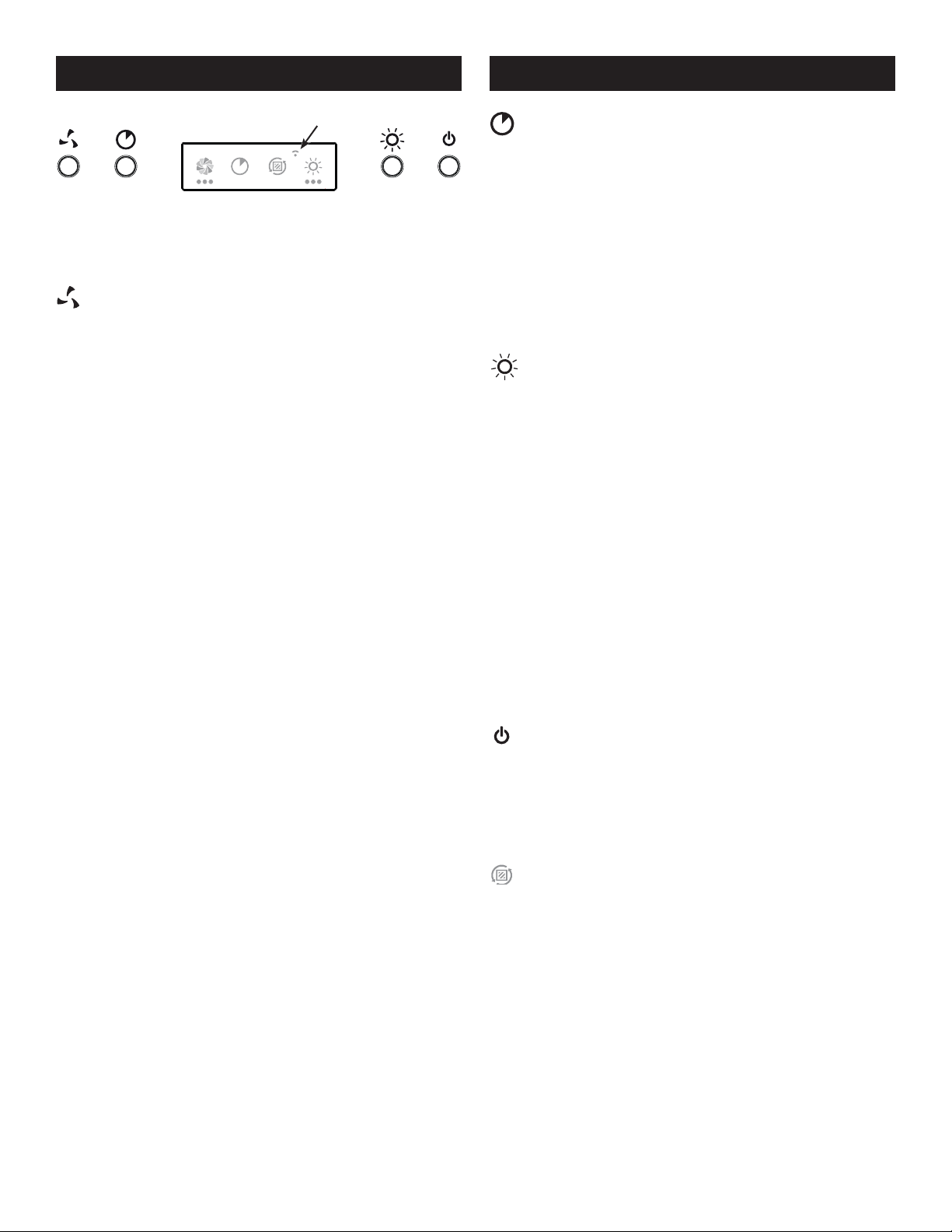
BLOWER ACTIVATION/SPEED LEVEL CHANGE/
FILTER INDICATOR RESET
When blowers are OFF, press on this push button to turn ON
the blowers at the last saved speed. If there was no speed
saved, the blowers will be set on LOW speed.
NOTE: When LOW speed is activated from OFF, the
blowers start on MEDIUM speed for a very short
lapse of time, and then resume to LOW speed.
To change the blower speed, press on this push button again
until the desired speed is reached (from LOW to MEDIUM to
HIGH speed to OFF). Each time a blower speed is activated,
a rotating blower icon appears on left side of LCD screen,
with dot(s) under it (the rotation speed shows the chosen
speed: slow for LOW with one dot, faster for MEDIUM with
2 dots and fastest for HIGH with 3 dots).
When blowers are on (no matter the speed level), press and
hold this push button until the blower icon disappears from
the LCD screen; this will turn off the blowers and save the
blower speed chosen.
Heat Sentry™
This hood is equipped with a protective device that activates
the blowers when an abnormally high heat level is detected
while the blowers are activated. During the Heat Sentry
activation, this device takes control of the blowers and set
them on MEDIUM speed while all dots under the blower
icon blink. However, the lights can be still controlled. The
blowers will remain on MEDIUM speed until the heat is back
to normal, they then return to the speed previously selected.
NOTE: When excessive heat is detected, Heat Sentry will
shut off both blowers and lights while all dots under
the blower icon will blink faster. Both blowers and
lights will remain off until the ambient temperature
cools down; the blowers will then start on MEDIUM
speed (the lights can be controlled again). The
blowers will remain on MEDIUM speed until the heat
is back to normal, they then return to the speed
previously selected.
1
NOTE: At range hood start-up or after a power failure,
a small icon (1) appears shortly (for ± 2 seconds) on
LCD screen; this is normal.
DELAY OFF
When the blowers are on, press this button to activate the
delay function. This icon appears on LCD screen beside the
blower icon to indicate the function is on. The blowers will
continue to operate for 10 minutes and then, will shut off
automatically (both blower and delay icons will disappear
from LCD screen). When Delay off is activated, it is possible
to change the blower speed by pressing on blower push
button without aff ecting the remaining time of the delay.
To cancel the delay off function before the end of the
10-minute cycle, press again on delay off push button.
ON LIGHTING/LIGHT INTENSITY CHANGE
Press this push button to turn on the lights at the last saved
intensity; the light icon appears on right side of LCD screen
and the number of dots below it shows which light intensity
is on (one dot for LOW, two dots for MEDIUM and three
dots for HIGH).
To change the light intensity, press the push button until the
desired level is reached (from HIGH intensity, pressing again
will shut off the lights).
When lights are on (no matter the light intensity), press and
hold this push button until the light icon disappears from the
LCD screen; this will shut off the lights and save the chosen
light intensity.
The LED modules included with this hood are the latest in
LED cooktop illumination technology specially designed
to operate in the elevated temperatures of cooking -
off ering bright lighting and lasting up to 25 times as long
as a standard bulb and greater reliability than typical
replacement LED bulbs.
MASTER ON/OFF
Press this push button to turn on the ligths and the blowers
at the last saved intensity. When either lights or blowers are
ON, pressing on this push button will memorize the current
blower speed and lighting level prior to shut them OFF.
FILTER CLEANING REMINDER
This icon appears on LCD screen 30 seconds after turning
OFF the blowers when it is time to clean hood and fi lters
(refer to Cleaning and Maintenance on page 5). This
happens every time the blowers are turned OFF until the
fi lter cleaning reminder has been reset. Once the cleaning
is done, reset the fi lter cleaning reminder by pressing on
blower activation push button for 3 seconds while the icon
appears on LCD screen for 30 seconds.
OPERATION

5
WARNING: To reduce the risk of electric shock,
disconnect from power supply before cleaning.
Hybrid fi lters
Clean frequently using hot water and a mild detergent or
in your dishwasher. The hybrid fi lters should be washed
approximately every month depending on the amount of
usage. Wash more often if your cooking style generates
greater grease - like frying foods or wok cooking.
Non-ducted recirculation fi lters
(available separately - see page 6)
The non-ducted recirculation fi lters should be changed
every 3 to 6 months. Replace more often if your cooking
style generates extra grease, such as frying and wok
cooking. Refer to installation instructions included with
non-ducted recirculation fi lters.
Stainless steel hood surfaces
Do:
• Regularly wash with clean cloth or rag soaked with
warm water and mild soap or liquid dish detergent.
• Always clean in the direction of original polish lines.
• Always rinse well with clear water (2 or 3 times) after
cleaning. Wipe dry completely.
• You may also use a specialized household stainless
steel cleaner.
Don’t:
• Use any steel or stainless steel wool or any other
scrapers to remove stubborn dirt.
• Use any harsh or abrasive cleansers.
• Allow dirt to accumulate.
• Let plaster dust or any other construction residues
reach the hood. During construction/renovation, cover
the range hood to make sure no dust sticks to the
stainless steel surface.
Avoid when choosing a detergent:
• Any cleaners that contain bleach will attack stainless
steel.
• Any products containing: chloride, fl uoride, iodide,
bromide will deteriorate surfaces rapidly.
• Any combustible products used for cleaning such
as acetone, alcohol, ether, benzol, etc., are highly
explosive and should never be used close to a range.
Blower assembly
The center of the fan wheels should be cleaned frequently.
Use a clean cloth soaked with warm detergent solution.
The motors are permanently lubricated and never need
oiling. If the motor bearings make excessive or unusual
noise, replace the motor with the exact service motor. The
fan wheel should also be replaced.
CLEANING
6
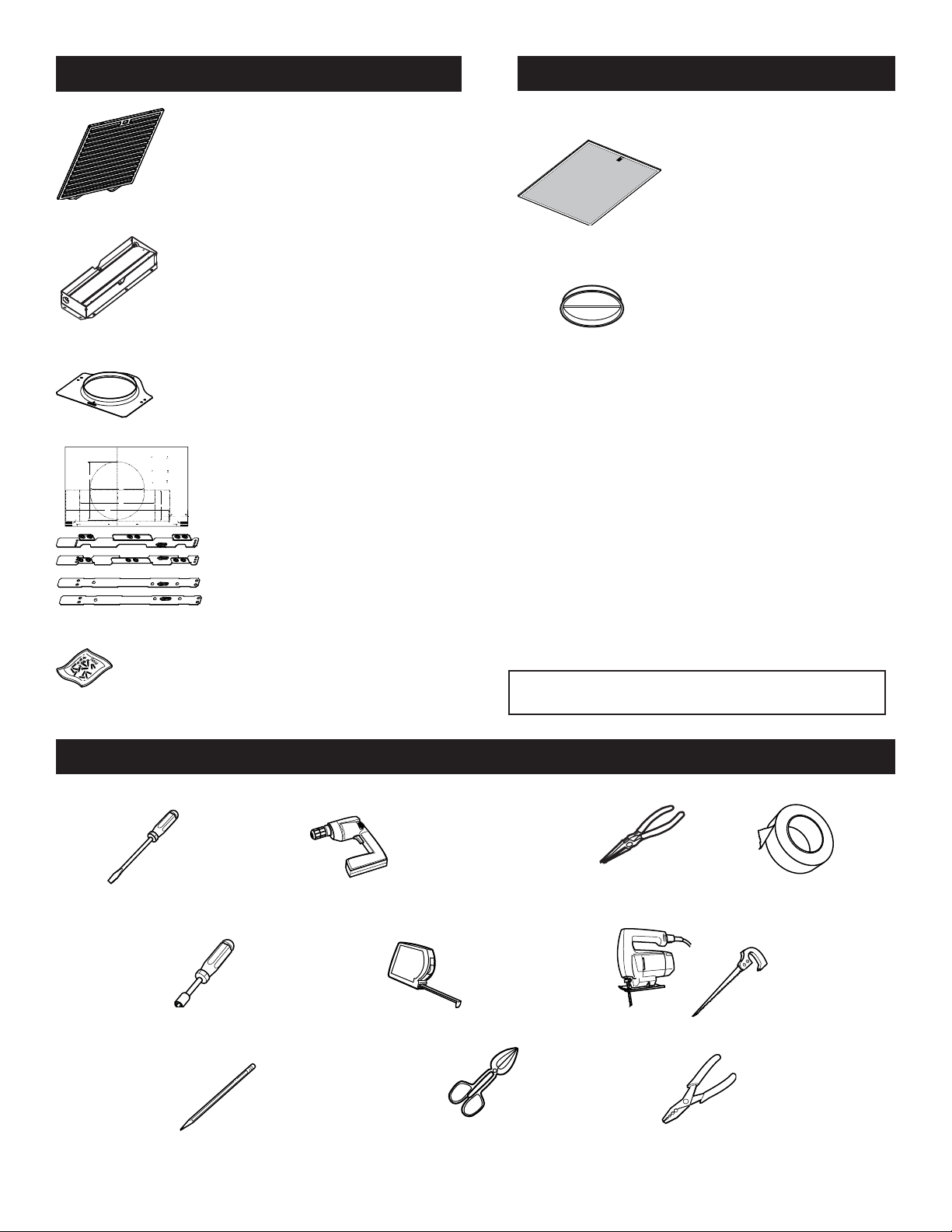
PARTS INCLUDED WITH HOOD
TOOLS NEEDED FOR HOOD INSTALLATION
Hybrid Grease Filters
(2 per hood)
Parts Bag
(4 no. 8-18 x 1/2" metal screws,
6 no. 8 x 5/8" round head wood screws,
6 no. 8 x 1/2" countersunk wood screws)
Screwdriver
(Flat & Phillips no. 2)
Nutdriver
11/32"
Tape
Measure
Drill
(with 1/8" and
7/64" drill bits,
and 1½" hole saw)
Sabre Saw
Keyhole
Saw
-or-
Metal Foil
Duct Tape
Wire
Stripper
PARTS NOT INCLUDED WITH HOOD
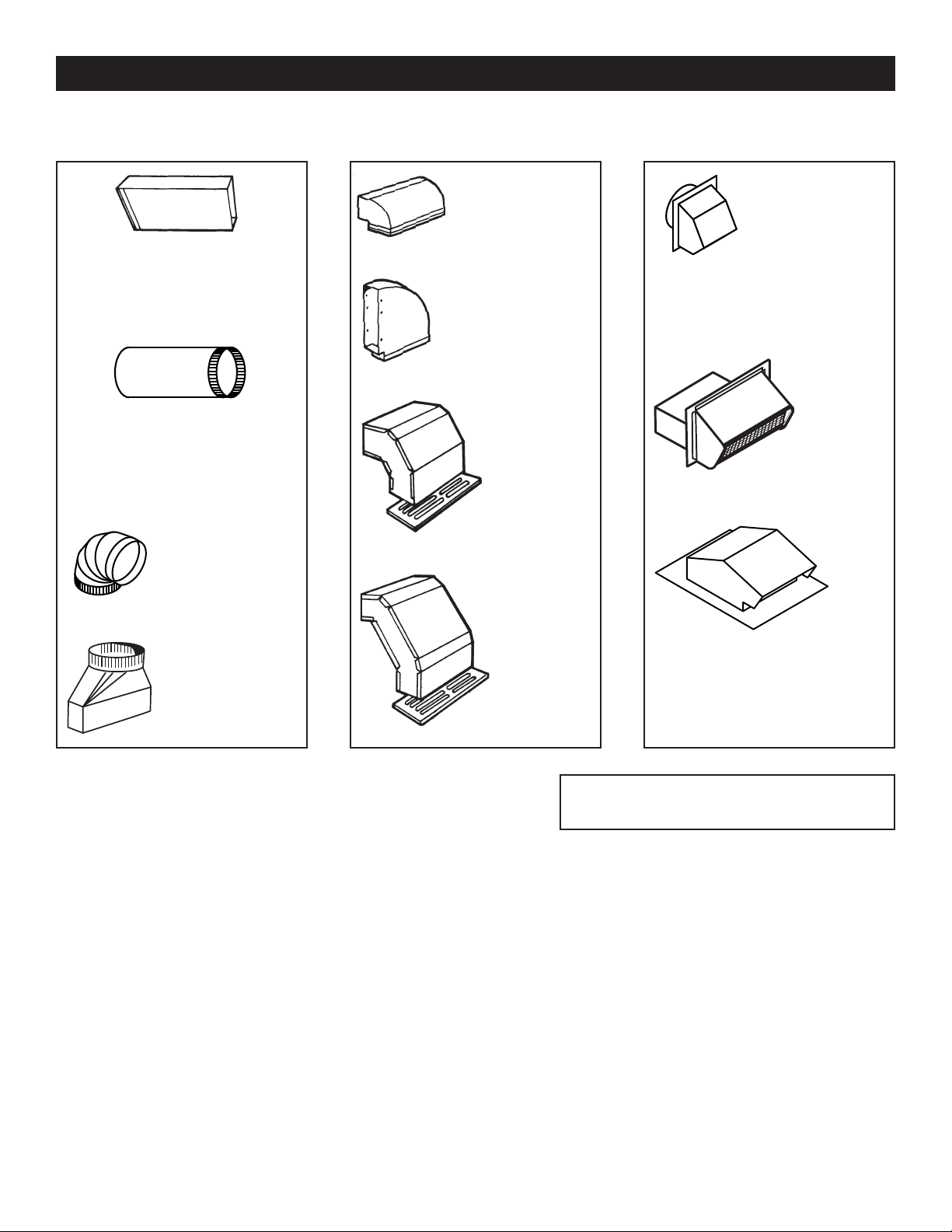
OPTIONAL PARTS (purchase separately)
3¼” x 10”
Damper / Duct Connector
C
L
AB
Apoyar este borde contra la pared de atrásPlace this edge against back wall
VERTICAL EXHAUST
S
A
A
V
RTICAL EX
= 3¼” x 10”
= 3¼” x 14”
RECTANGULAR DUCTING7” ROUND DUCTING
OR
Use this template for marking; do not attempt to cut out the ducting hole through it.
NOTE: These cutouts are clearance holes; they do not need to be the exact size of ducting.
= 3¼ po x 10 po
= 3¼ po x 14 po
CONDUIT RECTANGULAIRECONDUIT ROND DE 7 PO
OU
= 3¼ pulg. x 10 pulg.
= 3¼ pulg. x 14 pulg.
CONDUCTO RECTANGULARCONDUCTO REDONDO
DE
7 PULG.
O
Appuyer ce bord au mur arrière
Utiliser ce gabarit pour marquer vos repères; ne pas tenter de découper
le trou pour le conduit à travers le gabarit.
NOTE : Les découpes incluent le jeu nécessaire à l’installation; elles ne doivent pas
être du format exact des conduits.
Use esta plantilla para crear marcados; no trate de cortar el
agujero del conducto a través de la plantilla.
NOTA: To be translated in Spanish.
MARK WHERE INDICATED
FOR THE APPROPRIATE SIZE DUCT OPENING
MARQUER LES REPÈRES AUX ENDROITS INDIQUÉS SELON
LE FORMAT DE CONDUIT UTILISÉ
TITLE TO BE TRANSLATED IN SPANIS H
Electrical access hole center
A = single blower hood
B = double blower hood
Centre du trou pour fil
d’alimentation électrique
A = hotte ventilateur simple
B = hotte ventilateur double
To be translated in Spanish
Electrical access hole center
A = single blower hood
B = double blower hood
4¼”
10½”
14½”
8”
7½”
C
C
C
Bend template along graduated
scale when installing to framed
cabinet.
Pour une installation sous une
armoire à fond en retrait, utiliser les
lignes pour mesurer l’épaisseur du
décalage causé par le mur de
l’armoire et plier le gabarit en
conséquence.
To be translated in Spanish.
EZ1 One person Installation Kit
(including template for
ducting, printed both sides,
and installation brackets)
7” Round Duct Connector
Long Nose
Pliers
HR0064
Sheet Metal
Shears
Pencil
Non-Ducted Recirculation Filters
(Non-ducted hoods only)
(2 per hood)
Part Nos.:
S97020466 (30-in. width hoods)
S97020467 (36-in. width hoods)
7-inch Round Damper
(For use with 7-inch Round Duct)
Part No. 59183
“Parts Not Included With Hood” available by calling
1-844-553-6667
7
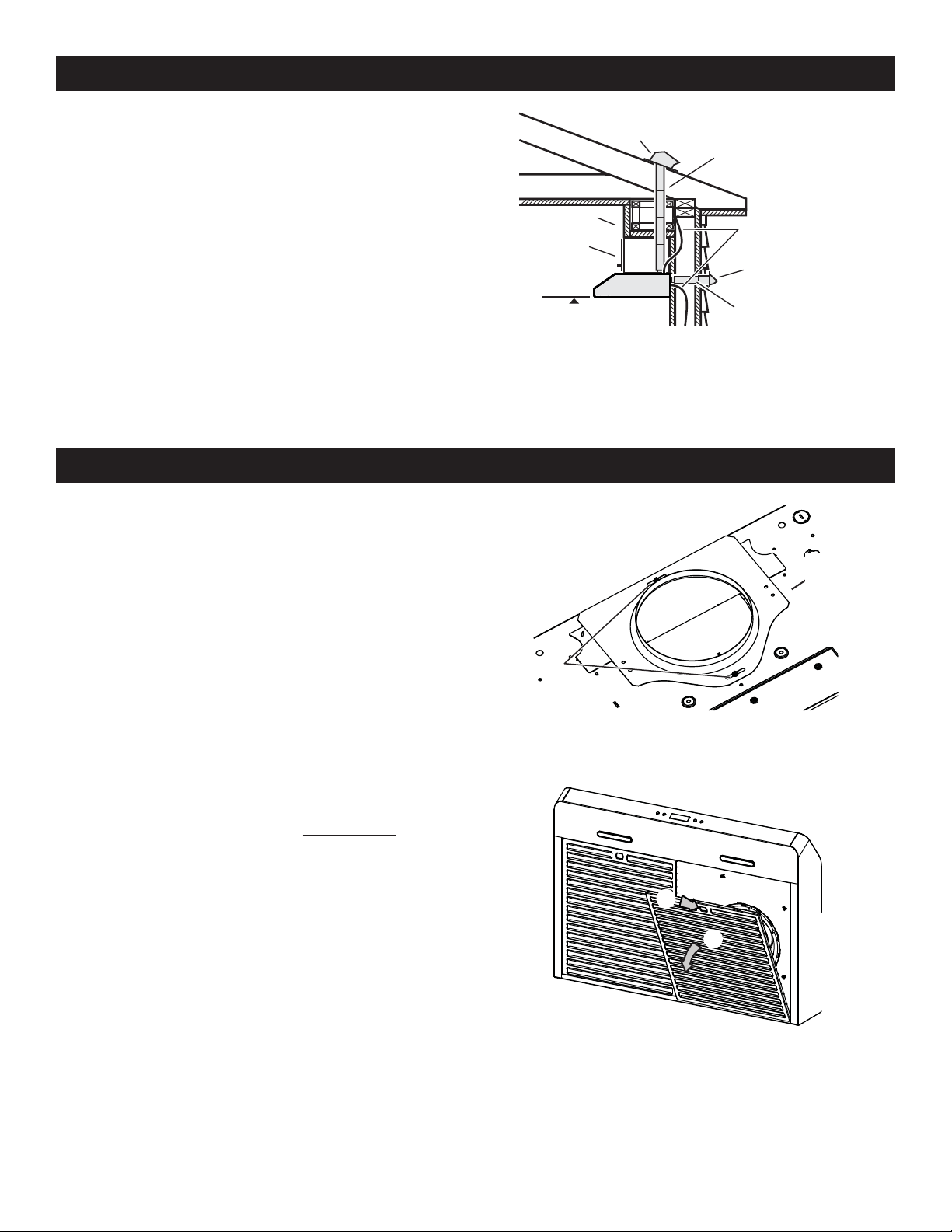
EQUIVALENT DUCT LENGTH CHART
Straight Duct
3¼-in. x 10-in. x 2-ft. long
Equivalent length
2 ft.
7-in. Round Elbow
Equivalent length
8 ft.
3¼-in. x 10-in.
Right-angle Elbow
Equivalent length
8.5 ft.
3¼-in. x 10-in.
Right-angle Flat Elbow
Equivalent length
24 ft.
3¼-in. x 10-in.
Right-angle
Short Eave
Elbow
Equivalent length
15 ft.
3¼-in. x 10-in.
Right-angle
Long Eave
Elbow
Equivalent length
15 ft.
3¼-in. x 10-in.
Wall Cap
Equivalent
length
45 ft.
(7-ft. w/o
damper)
Roof Cap
(accepts 7-in. round
or 3¼-in. x 10-in. duct)
Equivalent length
30 ft. (7-ft. w/o damper)
Kenmore range hoods are designed to perform effi ciently when attached to long runs of duct. As a point of reference, this
hood will function at approximately 80% of its rated air fl ow when 30 equivalent feet of 7" round ductwork is attached.
Use this chart to calculate the equivalent duct length of your system.
Straight Duct
7-in. round x 2-ft. long
Equivalent length
2 ft.
3¼-in. x 10-in. to
7-in. Round
Transition
Equivalent length
5.5 ft.
7-in. Round
Wall Cap
Equivalent length
34 ft.
(6-ft. w/o damper)
“Ducting Accessories” available by calling
1-844-553-6667
8
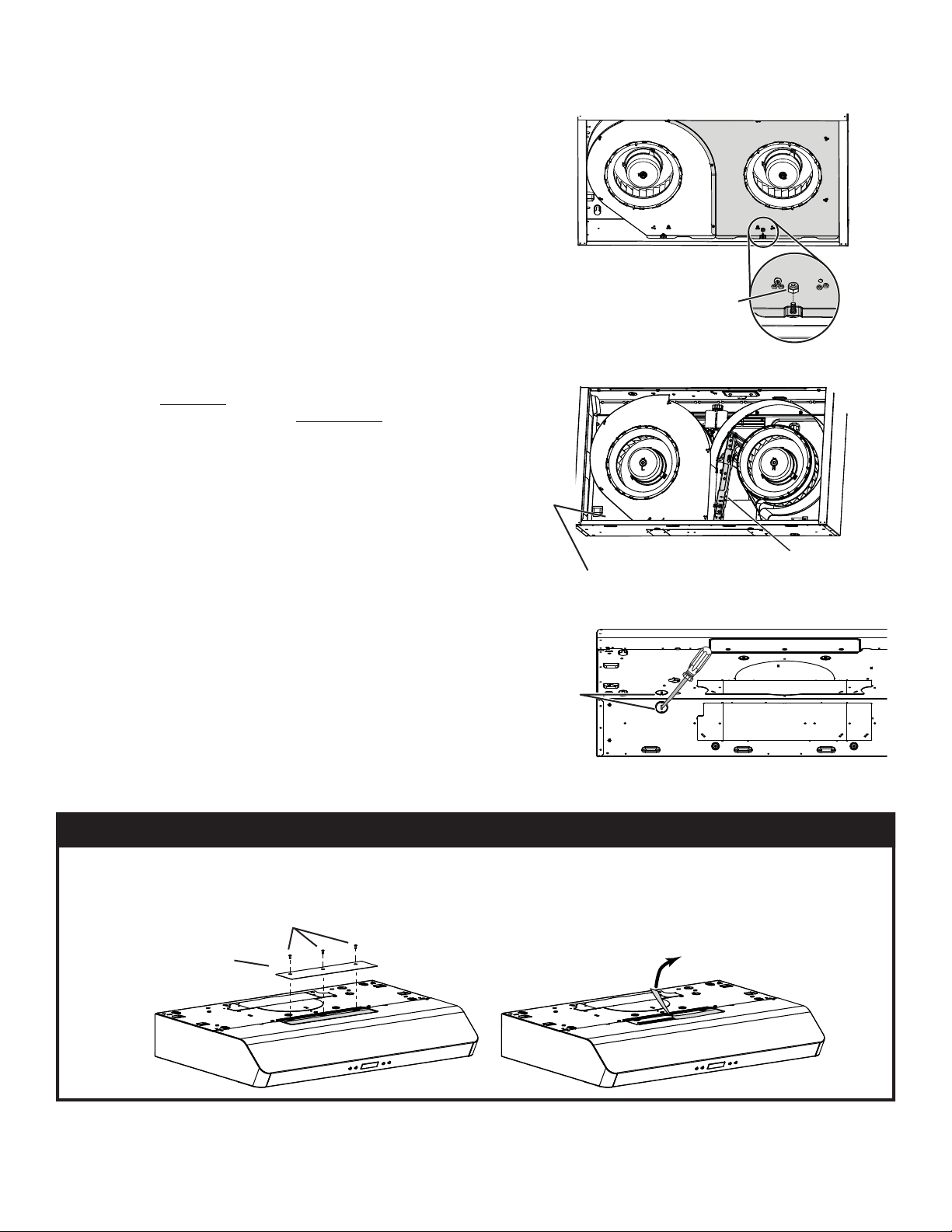
SOFFIT
18" MIN - 30" MAX
ABOVE
COOKING SURFACE
CABINET
3¼" X 10" DUCT
(FOR HORIZONTAL DISCHARGE)
WALL CAP
ROOF CAP
3¼" X 10" OR
7" ROUND DUCT
(FOR VERTICAL
DISCHARGE
)
HOUSE WIRING
(TOP OR BACK OF HOOD)
HOOD
1. Determine whether hood will discharge vertically (3¼” x 10”
or 7” Round) or horizontally (3¼” x 10” only).
2. Run ductwork between the hood location and a roof cap
or wall cap.
3. Choose a straight, short duct run to allow the hood to
perform most effi ciently. Long duct runs, elbows and
transitions will reduce the performance of the hood. Use
as few of them as possible. When possible, use at least
2 foot straight runs before any turns. Larger ductwork may
be required for best performance with longer duct runs.
4. Install wall cap or roof cap (sold separately). Connect
metal ductwork to cap and work back towards the hood
location. Use 2” metal foil duct tape to seal the joints
between ductwork sections.
INSTALL DUCTWORK (DUCTED INSTALLATION ONLY)
NOTE: Distances over 30” are at the installer and user
discretion.
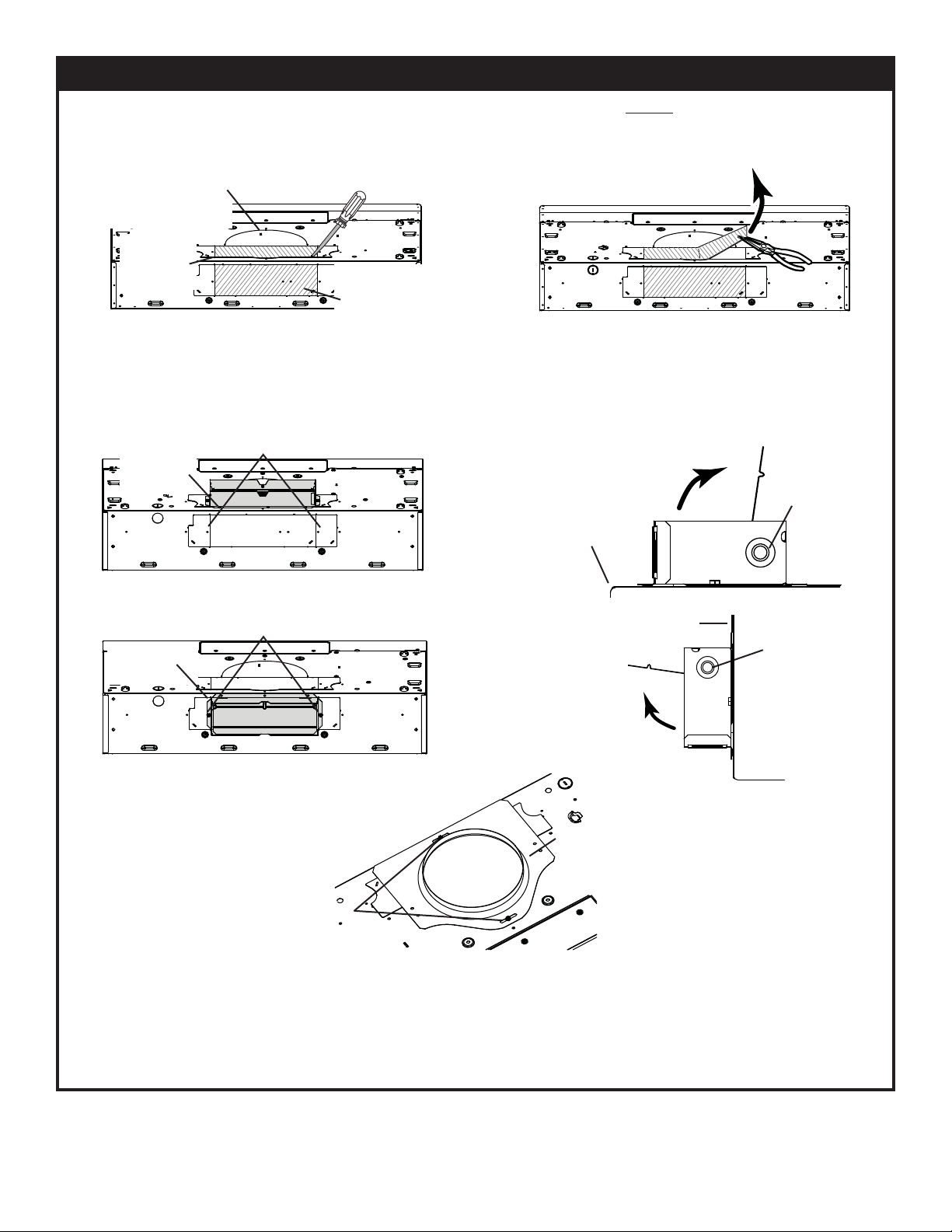
1. If present, remove all protective polyfi lm from the hood
and/or parts. Remove 7” Round Duct Plate from top/
back of hood (see illustration at right). Keep the screws
for further use.
PREPARE THE HOOD
2. Using the fi nger cup, remove the Hybrid Filters from the
hood by pushing down and tilting fi lters out.
7” ROUND
DUCT PLATE
SCREWS
B
C
9
3. Using a 11/32” nut driver, remove the lock nut retaining
the fl ange of the right blower cover plate (shaded part
on illustration beside) to the inner back of hood (see
inset). Remove the right cover plate retaining screws
(7 screws), then set the blower cover along with its screws
and nut aside.
NOTE: Sightly lift up the cover plate before sliding it towards
the left to remove it.
1
2
3
45
6
7
BACK OF HOOD
LOCK NUT
ELECTRICAL
POWER
CABLE
KNOCKOUT
5. Remove Electrical Power Cable Knockout from top (vertical
exhaust) or back (horizontal exhaust) of hood. For knockout
removed from back of hood, install an appropriate strain
relief, 1/2” diameter (not included). For knockout removed
from top of hood, the strain relief will be installed later.
EZ1
BRACKETS
4. Remove the parts bag, taped on the inner back of hood,
near the left corner. Remove the EZ1 brackets from inside
the hood by cutting off the tie wrap. Discard the tie wrap.
PARTS BAG LOCATION
RECIRCULATION
COVER PLATE
SCREWS
NON-DUCTED INSTALLATIONS ONLY
6. Remove 3 screws retaining the recirculation cover plate to the hood. Discard this plate with its screws. Peel off and
discard the membrane (shaded part in illustration below) covering the recirculation grille, ensuring the openings are
totally cleared.
10
DUCTED INSTALLATIONS ONLY
7. Remove 3¼” x 10” vertical, 3¼” x 10” horizontal (both are the rectangular central knockout plates, see hatched
areas), or 7-inch round knockout plate as appropriate for your ducting method (see FIGURES 1 A and 1 B).
3¼” X 10”
DAMPER
ASSEMBLY
SCREWS
3¼” X 10”
DAMPER
ASSEMBLY
SCREWS
7” ROUND
KNOCKOUT PLATE
(ALSO REMOVE VERTICAL
KNOCKOUT PLATE)
3¼” X 10”
VERTICAL
KNOCKOUT
PLATE
3¼” X 10”
HORIZONTAL
KNOCKOUT
PLATE
FIGURE 1 A FIGURE 1 B
NOTE: To accommodate off -center ductwork, the 7” round duct plate can be installed up to 1/2” on either side of
the hood center.
7” ROUND
DUCT
PLATE
SCREWS
FIGURE 3
FIGURE 2 A
TOP/BACK
EDGE OF
HOOD
DAMPER
FLAP
PIVOT
FIGURE 2 B
BACK OF
HOOD
DAMPER
FLAP
PIVOT
8. Attach 3¼” x 10” Damper Assembly on top OR back of hood (if using 3¼” x 10” duct; shaded part in FIGURE 2 A)
or 7” Round Duct Plate (if using 7-inch round duct, FIGURE 3) over the knockout opening. When installed, the 3¼” x 10”
damper assembly must open as shown in FIGURE 2 B.
TIP: Insert a small length of duct over the 3¼” x 10” damper assembly (for rectangular ducting) or 7” round (for round
ducting) and seal the joint using aluminum foil duct tape to ease connection with the house ductwork.
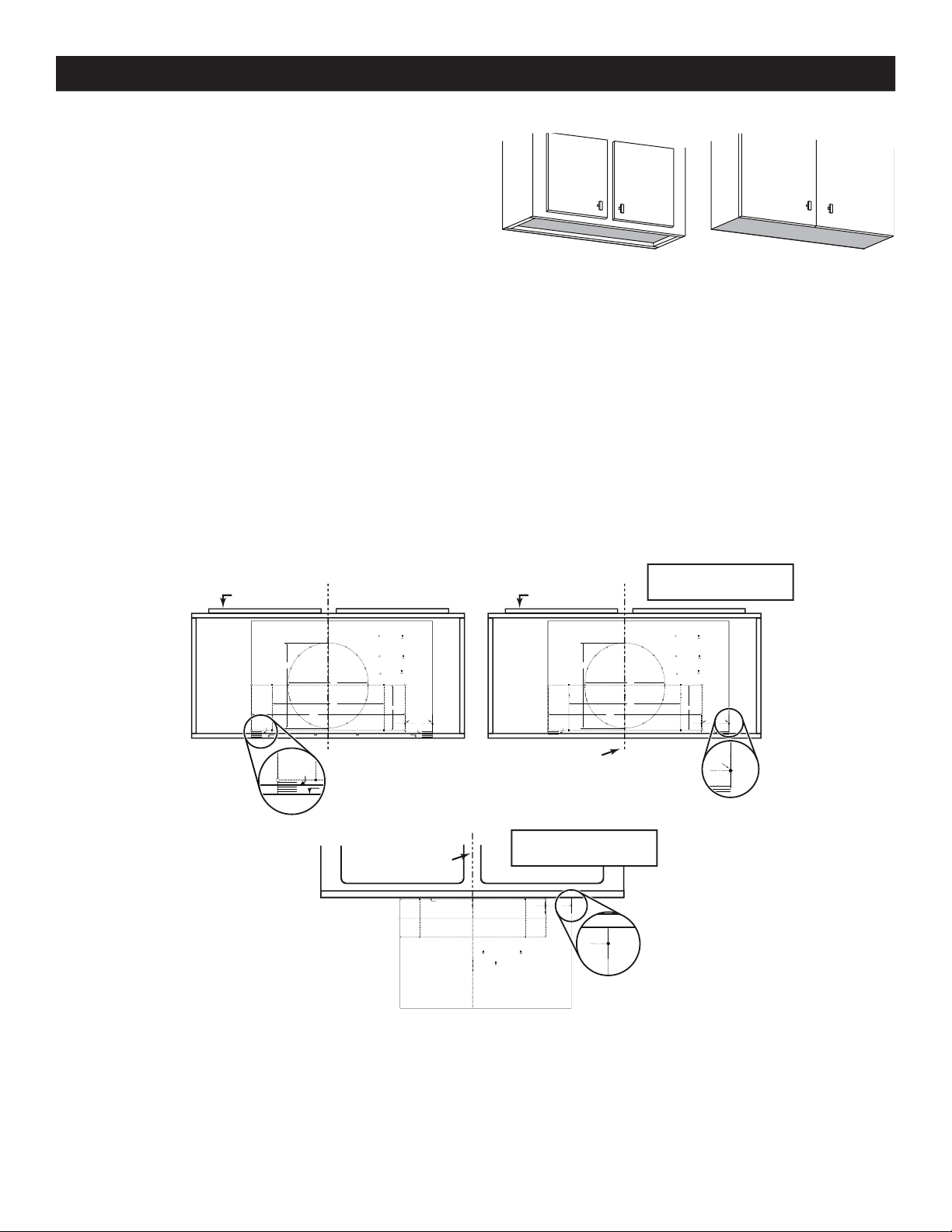
11
PREPARE THE HOOD LOCATION
NOTE: Before starting installation, read all the steps
of these instructions.
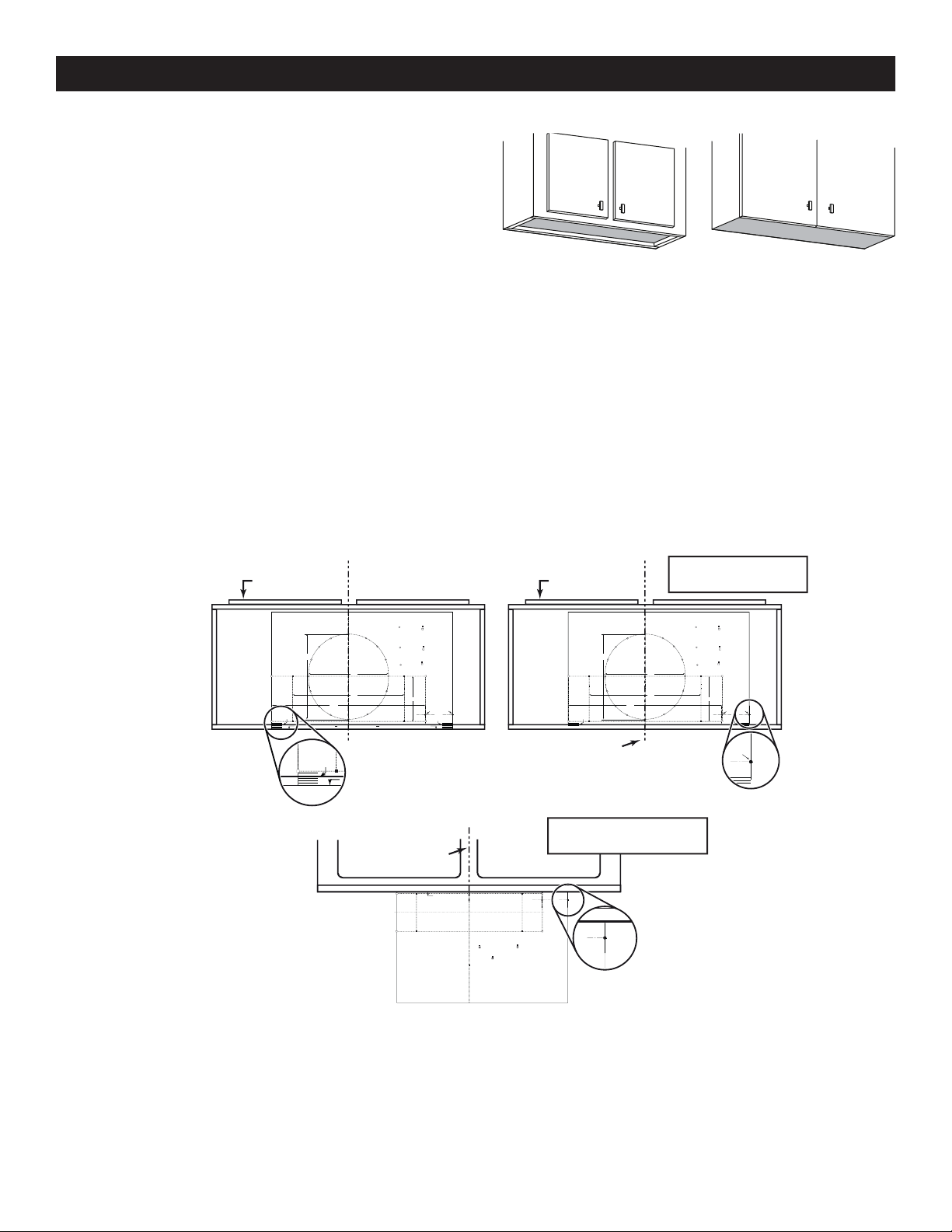
Use the illustration beside to identify your kitchen cabinet
type.
EZ1 One-person installation system
This manual covers 2 kinds of installation: the standard
(without EZ1 brackets) and the EZ1 one-person installation
system (using included template and brackets). For the
standard installation, go to page 15.
FRAMED CABINET FRAMELESS CABINET
CABINET FRONT
C
L
AB
Apoyar este borde contra la pared de atrásPlace this edge against back wall
VERTICAL EXHAUST
A
S
A
A
V
RTICAL EX
= 3¼” x 10”
= 3¼” x 14”
RECTANGULAR DUCTING7” ROUND DUCTING
OR
Use this template for marking; do not attempt to cut out the ducting hole through it.
NOTE: These cutouts are clearance holes; they do not need to be the exact size of ducting.
= 3¼ po x 10 po
= 3¼ po x 14 po
CONDUIT RECTANGULAIRECONDUIT ROND DE 7 PO
OU
= 3¼ pulg. x 10 pulg.
= 3¼ pulg. x 14 pulg.
CONDUCTO RECTANGULARCONDUCTO REDONDO
DE
7 PULG.
O
Appuyer ce bord au mur arrière
Utiliser ce gabarit pour marquer vos repères; ne pas tenter de découper
le trou pour le conduit à travers le gabarit.
NOTE : Les découpes incluent le jeu nécessaire à l’installation; elles ne doivent pas
être du format exact des conduits.
Use esta plantilla para crear marcados; no trate de cortar el
agujero del conducto a través de la plantilla.
NOTA: To be translated in Spanish.
MARK WHERE INDICATED
FOR THE APPROPRIATE SIZE DUCT OPENING
MARQUER LES REPÈRES AUX ENDROITS INDIQUÉS SELON
LE FORMAT DE CONDUIT UTILISÉ
TITLE TO BE TRANSLATED IN SPANISH
Electrical access hole center
A = single blower hood
B = double blower hood
Centre du trou pour fil
d’alimentation électrique
A = hotte ventilateur simple
B = hotte ventilateur double
To be translated in Spanish
Electrical access hole center
A = single blower hood
B = double blower hood
4¼”
10½”
14½”
8”
7½”
C
C
C
Bend template along graduated
scale when installing to framed
cabinet.
Pour une installation sous une
armoire à fond en retrait, utiliser les
lignes pour mesurer l’épaisseur du
décalage causé par le mur de
l’armoire et plier le gabarit en
conséquence.
To be translated in Spanish.
P
C
CABINET FRONT
C
L
AB
VERTICAL EXHAUST
A
S
A
A
V
RTICAL EX
= 3¼” x 10”
= 3¼” x 14”
RECTANGULAR DUCTING7” ROUND DUCTING
OR
Use this template for marking; do not attempt to cut out the ducting hole through it.
NOTE: These cutouts are clearance holes; they do not need to be the exact size of ducting.
= 3¼ po x 10 po
= 3¼ po x 14 po
CONDUIT RECTANGULAIRECONDUIT ROND DE 7 PO
OU
= 3¼ pulg. x 10 pulg.
= 3¼ pulg. x 14 pulg.
CONDUCTO RECTANGULARCONDUCTO REDONDO
DE
7 PULG.
O
Utiliser ce gabarit pour marquer vos repères; ne pas tenter de découper
le trou pour le conduit à travers le gabarit.
NOTE : Les découpes incluent le jeu nécessaire à l’installation; elles ne doivent pas
être du format exact des conduits.
Use esta plantilla para crear marcados; no trate de cortar el
agujero del conducto a través de la plantilla.
NOTA: To be translated in Spanish.
MARK WHERE INDICATED
FOR THE APPROPRIATE SIZE DUCT OPENING
MARQUER LES REPÈRES AUX ENDROITS INDIQUÉS SELON
LE FORMAT DE CONDUIT UTILISÉ
TITLE TO BE TRANSLATED IN SPANISH
Electrical access hole center
A = single blower hood
B = double blower hood
Centre du trou pour fil
d’alimentation électrique
A = hotte ventilateur simple
B = hotte ventilateur double
To be translated in Spanish
Electrical access hole center
A = single blower hood
B = double blower hood
4¼”
10½”
14½”
8”
7½”
C
C
C
Bend template along graduated
scale when installing to framed
cabinet.
Pour une installation sous une
armoire à fond en retrait, utiliser les
lignes pour mesurer l’épaisseur du
décalage causé par le mur de
l’armoire et plier le gabarit en
conséquence.
To be translated in Spanish.
ELECTRICAL
ACCESS HOLE
LOCATION (B)
(
IN CABINET BOTTOM)
CENTER LINE
FOLD TEMPLATE ALONG GRADUATED
SCALE
WHEN INSTALLING TO FRAMED
CABINET
.
B
VERTICAL
EXHAUST DUCTING
EZ1 installation is designed for use with kitchen cabinets that have the same width designation as the range hood width.
If the cabinet is greater than 1/2” wider than the range hood width, please use the standard installation method.
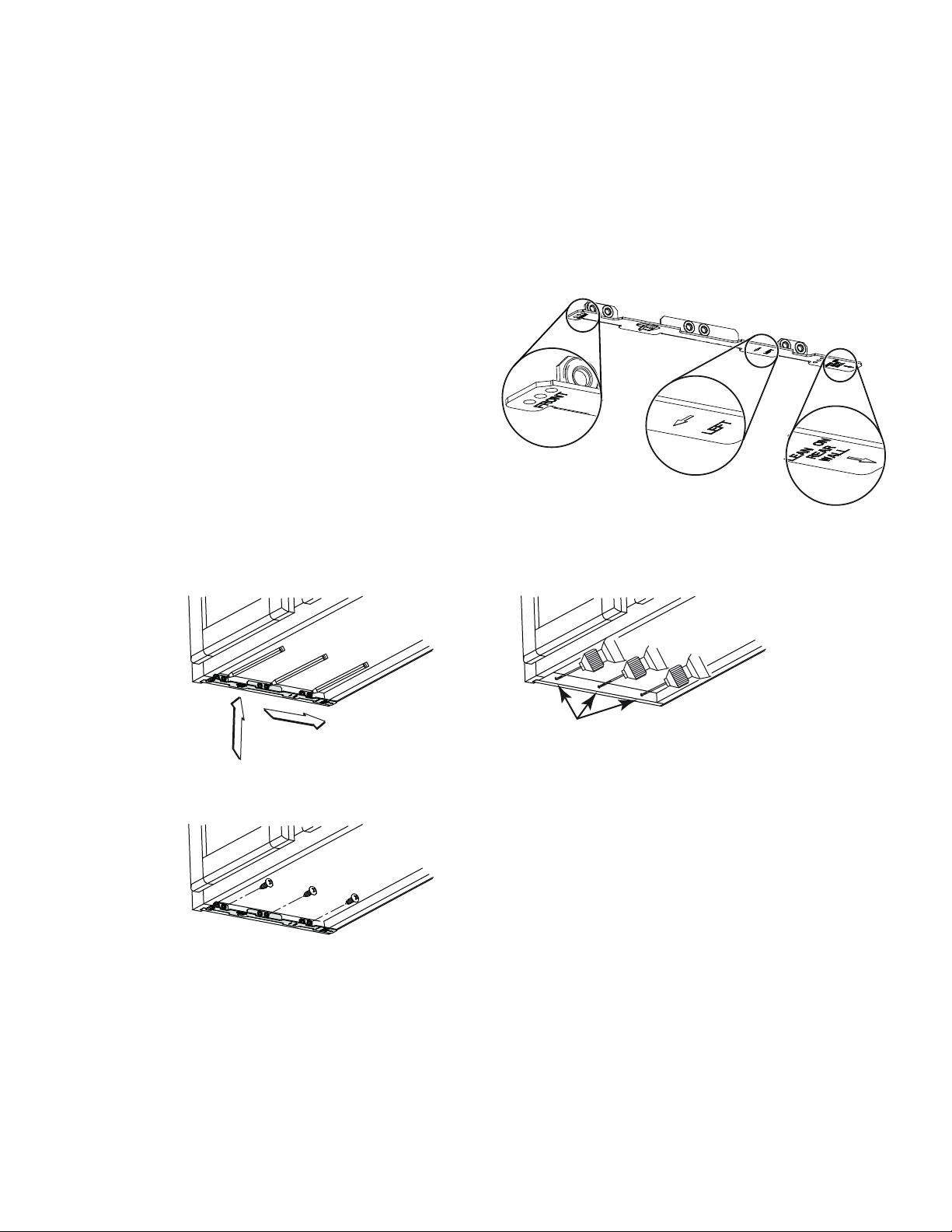
1. Use the proper template for vertical OR horizontal
disharge (included) for placement of ductwork and
electrical cutout in cabinet or wall. For a non-ducted
installation, DO NOT cut a duct access hole, only cut the
hole for electrical wiring. If replacing a hood and plan to
use the existing duct and electrical, steps 2 to 5 may not
be necessary. If so, skip to step 6.
2. Measure and mark the hood center line on cabinet bottom.
3. Align the center line on template with the hood center
line marked on the bottom of the cabinet, placing the
edge (where indicated) of the template against back
wall. When using with framed cabinet for vertical exhaust
installation, fold over rear edge of template equal to the
depth of the cabinet frame at the wall (use graduations
on template, C locations on template). Tape the template
in place.
NOTE: When facing the installation, A and B (on
template) must be at right.
ELECTRICAL
ACCESS HOLE
LOCATION (B)
(
IN WALL)
CENTER LINE
C
L
AB
Place this edge against
cabinet bottom.
Appuyer ce bord contre le bas
de l’armoire.
Apoyar este borde contra
la base del armario.
HORIZONTAL EXHAUST
T
T
= 3¼ pulg. x 10 pulg.
= 3¼ pulg. x 14 pulg.
CONDUCTO RECTANGULAR
= 3¼” x 10”
= 3¼” x 14”
RECTANGULAR DUCTING
= 3¼ po x 10 po
= 3¼ po x 14 po
CONDUIT RECTANGULAIRE
MARK WHERE INDICATED
FOR THE APPROPRIATE SIZE DUCT OPENING
MARQUER LES REPÈRES AUX ENDROITS INDIQUÉS SELON
LE FORMAT DE CONDUIT UTILISÉ
TITLE TO BE TRANSLATED IN SPANISH
Use this template for marking; do not attempt to cut out the ducting hole through it.
NOTE: These cutouts are clearance holes; they do not need to be the exact size of ducting.
Utiliser ce gabarit pour marquer vos repères; ne pas tenter de découper
le trou pour le conduit à travers le gabarit.
NOTE : Les découpes incluent le jeu nécessaire à l’installation; elles ne doivent pas
être du format exact des conduits.
Use esta plantilla para crear marcados; no trate de cortar el
agujero del conducto a través de la plantilla.
NOTA: To be translated in Spanish.
Electrical access hole center
A = single blower hood
B = double blower hood
Centre du trou pour fil
d’alimentation électrique
A = hotte ventilateur simple
B = hotte ventilateur double
To be translated in Spanish
Electrical access hole center
A = single blower hood
B = double blower hood
B
ess hole center
wer hood
wer hood
HORIZONTAL
EXHAUST DUCTING
12
4. Drill a 1/8” dia. pilot hole for house wiring,
at B location on template.
5. Use a sharp pencil or 1/8” drill bit to mark the locations
for the appropriate duct access holes (16 locations for
7” round duct, or 4 corner locations for rectangular duct).
Remove the template.
6. Draw the border for the exhaust ducting by linking its
marks (16 for round duct and 4 for rectangular duct), then
cut the opening in the cabinet bottom (vertical exhaust)
or in the wall (horizontal exhaust). Drill the house wiring
hole by using a 1½” hole saw centered with the pilot hole
previously made in 4.
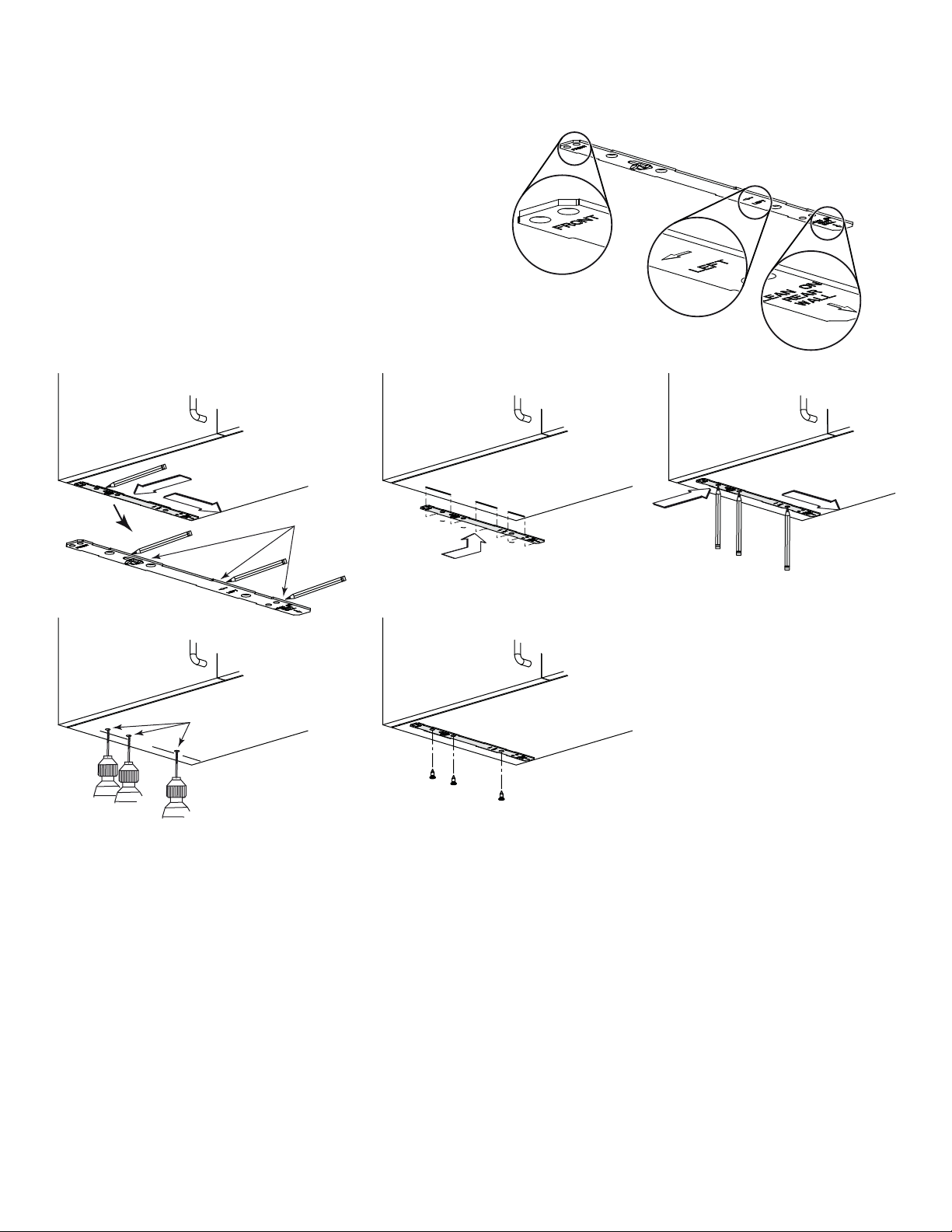
FRAMED CABINET
Refer to the marking on the brackets to determine the
correct installation side and orientation.
7. Install the proper installation brackets according to the
type of cabinet (framed or frameless). See below.
7/64”
XY
Z
Mate the corresponding bracket to the cabinet side
frame, while placing rear end of bracket against the
wall. Use a pencil to mark 3 holes (there are 6 holes
but only 3 are necessary).
Remove the bracket. Using a 7/64” drill bit, drill 3 holes
where marked.
Assemble the bracket to the side frame using a Phillips
screwdriver and 3 provided no. 8 x 5/8” wood screws.
Repeat for the other side frame.
13
[ \
7/64”
X
3 X
Y
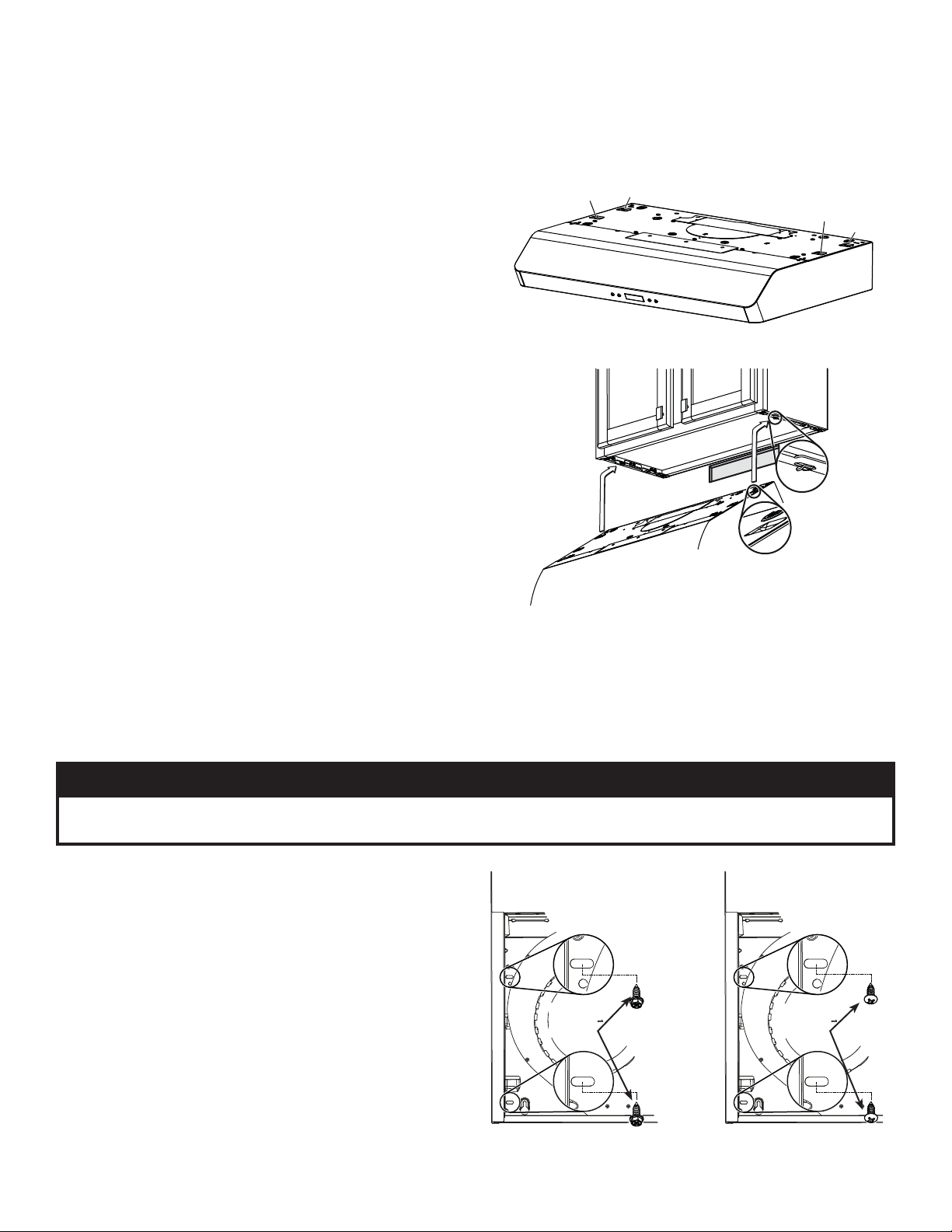
Z
Align the corresponding bracket to the cabinet side,
while placing rear end of bracket against the wall.
Draw a line on the outer edge of the bracket (as shown).
Slide the bracket towards the center of cabinet and
align the outside edge of the bracket with the marked
line, keeping the rear end edge leaning on the wall.
Use a pencil to mark 3 holes.
Remove the bracket. Using a 7/64” drill bit, drill 3 holes
where marked.
Assemble the bracket to the cabinet bottom using a
Phillips screwdriver and 3 provided countersunk wood
screws. Repeat for the other cabinet side
.
FRAMELESS CABINET
Refer to the marking on the brackets to determine the
correct installation side and orientation.
14
A
B
D
C
HORIZONTAL EXHAUST INSTALLATION ONLY
A
B
Install the hood (EZ1 brackets)
NOTE: The following procedure applies to both
framed or frameless cabinet installations.
1. Run house power cable between service panel and
hood location.
2. There are 2 pairs of recessed holes on each side of the
top of the hood (on rear: A and B, on front C and D on
illustration beside); these holes allow the range hood to
hang on the brackets (previously installed).
3. Temporarily hang the hood on the brackets using its
2 recessed REAR HOLES (A and B). While holding the
hood, run the house power cable into the hood through
the strain relief previously installed i
n step 5 on page 9.
4. Unhook the rear holes from the brackets and hang the
hood using its 2 recessed FRONT HOLES (C and D).
While holding the hood, go to step 6.
VERTICAL EXHAUST INSTALLATION ONLY
5. Hang the hood on the brackets using the 2 recessed
FRONT HOLES (C and D). While holding the hood,
tighten an appropriate strain relief, 1/2” diameter (not
included) to the power cable, then insert the strain relief
in the knockout hole.
DUCTED INSTALLATIONS ONLY
6. Connect the ductwork to the hood and use metal foil duct tape to make joints secure and air-tight. Make sure the
damper assembly (or round duct plate) enters the ductwork and that the damper opens and closes freely.
FRAMED CABINET FRAMELESS CABINET
WOOD
SCREWS
METAL
SCREWS
7. For framed cabinet, secure the hood to the EZ1 brackets
using 4 no. 8-18 x 1/2” metal screws (screws included in
parts bag). Insert 2 screws per side, in the slots
(as shown in inset on illustration beside).
8. For frameless cabinet, secure the hood to the cabinet
using 4 no. 8 x 5/8” round head wood screws (screws
included in parts bag). Insert 2 screws per side, in the
slots (as shown in inset on illustration beside).
9. Attach power cable to the hood using the strain relief.
15
3¼” x 10”
VERTICAL DUCTING
3¼” x 10”
HORIZONTAL DUCTING
7” ROUND
VERTICAL DUCTING
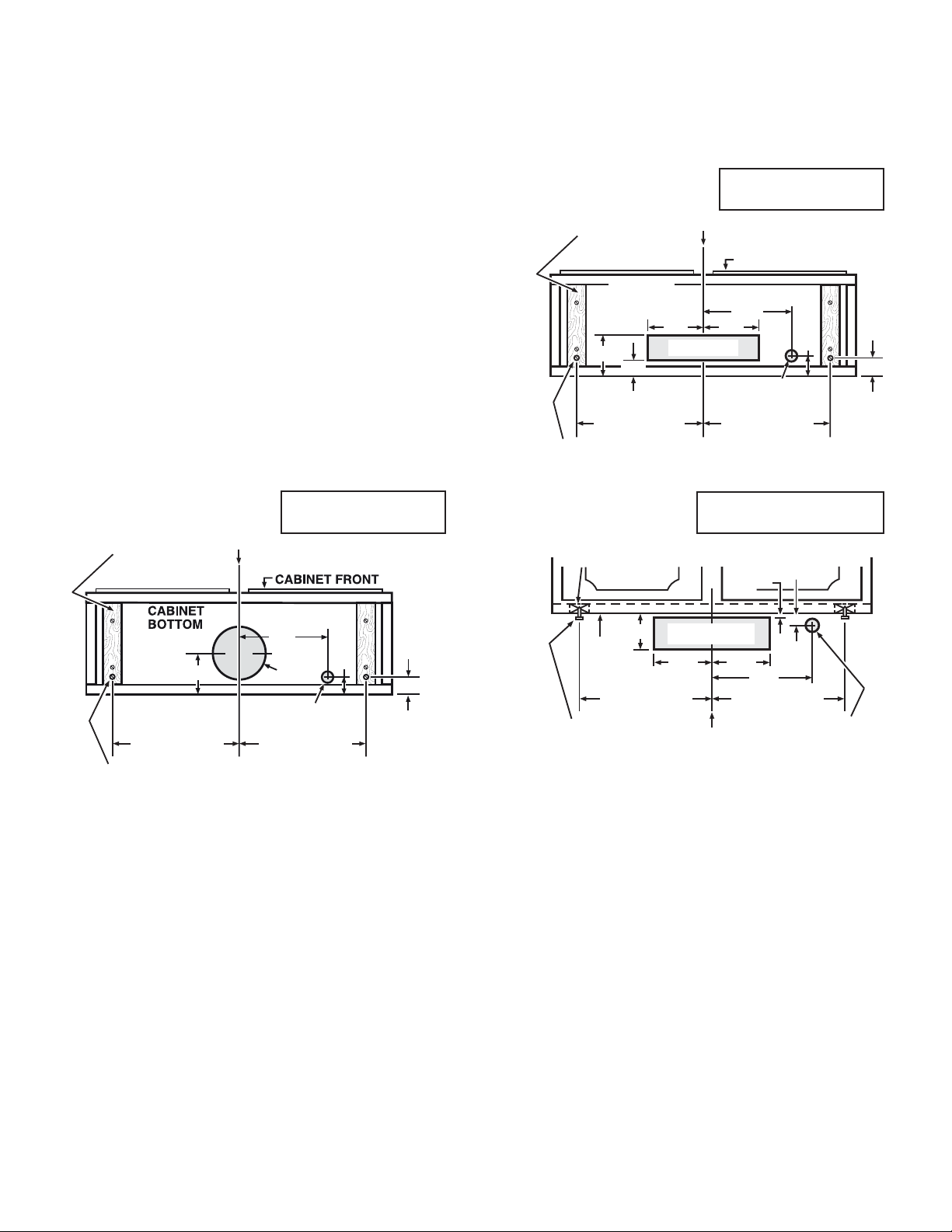
1. Use these diagrams for proper placement of ductwork
and electrical cutout in cabinet or wall.
For a non-ducted installation, DO NOT cut a duct access
hole, only cut the hole for electrical wiring
Standard Installation (without EZ1 brackets)
VERTICAL DUCT
ACCESS HOLE
5¼"
5¼"
CENTER LINE
ELECTRICAL ACCESS
HOLE (
IN CABINET BOTTOM)
WOOD SHIMS
(
RECESSED-BOTTOM
CABINETS
ONLY)
CABINET FRONT
3/4"
1⅜"
1½"
9¾"
4
7
/16"
CABINET
BOTTOM
REAR HOOD MOUNTING SCREWS (2)
12⅞" (30" HOOD)
15⅞" (36"
HOOD)
12⅞" (30"
HOOD)
15⅞" (36"
HOOD)
CABINET
BOTTOM
CABINET FRONT
HORIZONTAL DUCT
ACCESS HOLE
REAR HOOD
MOUNTING
SCREWS (2)
ELECTRICAL
ACCESS HOLE
(
IN WALL)
3⅞"
CENTER
LINE
WOOD SHIMS
(
RECESSED-BOTTOM
CABINETS
ONLY)
13/16"
3/16"
5¼"
5¼"
9¾"
12⅞" (30"
HOOD)
15⅞" (36"
HOOD)
12⅞" (30"
HOOD)
15⅞" (36"
HOOD)
4¹¹/16"
8" DIA.
HOLE
7-IN. ROUND
7-IN. ROUND
DUCT
DUCT
ACCESS
ACCESS
HOLE
HOLE
7-IN. ROUND
DUCT
ACCESS
HOLE
1½"
1⅜"
9¾"
CENTER LINE
ELECTRICAL ACCESS
HOLE (
IN CABINET BOTTOM)
REAR HOOD MOUNTING SCREWS (2)
WOOD SHIMS
(
RECESSED-BOTTOM
CABINETS
ONLY)
12⅞" (30" HOOD)
15⅞" (36"
HOOD)
12⅞" (30"
HOOD)
15⅞" (36"
HOOD)
2. Install part-way two (2) ROUND HEAD no. 8 x 5/8”
mounting screws into shims/cabinet, according to the
proper diagram above, the other 2 ROUND HEAD
no. 8 x 5/8” mounting screws will be used later. (Mounting
screws are included in parts bag, but wood shims and
shim mounting screws are not included).
16
Install the Hood (Standard Installation)
1. Run house power cable between service panel and hood
location. For hood with power cable access located on
back of hood, run the house power cable into the hood
through the strain relief previously installed in step 5 on
page 9. For hood with power cable access located on
top, tighten the strain relief to the power cable before
inserting the strain relief in the knockout hole.
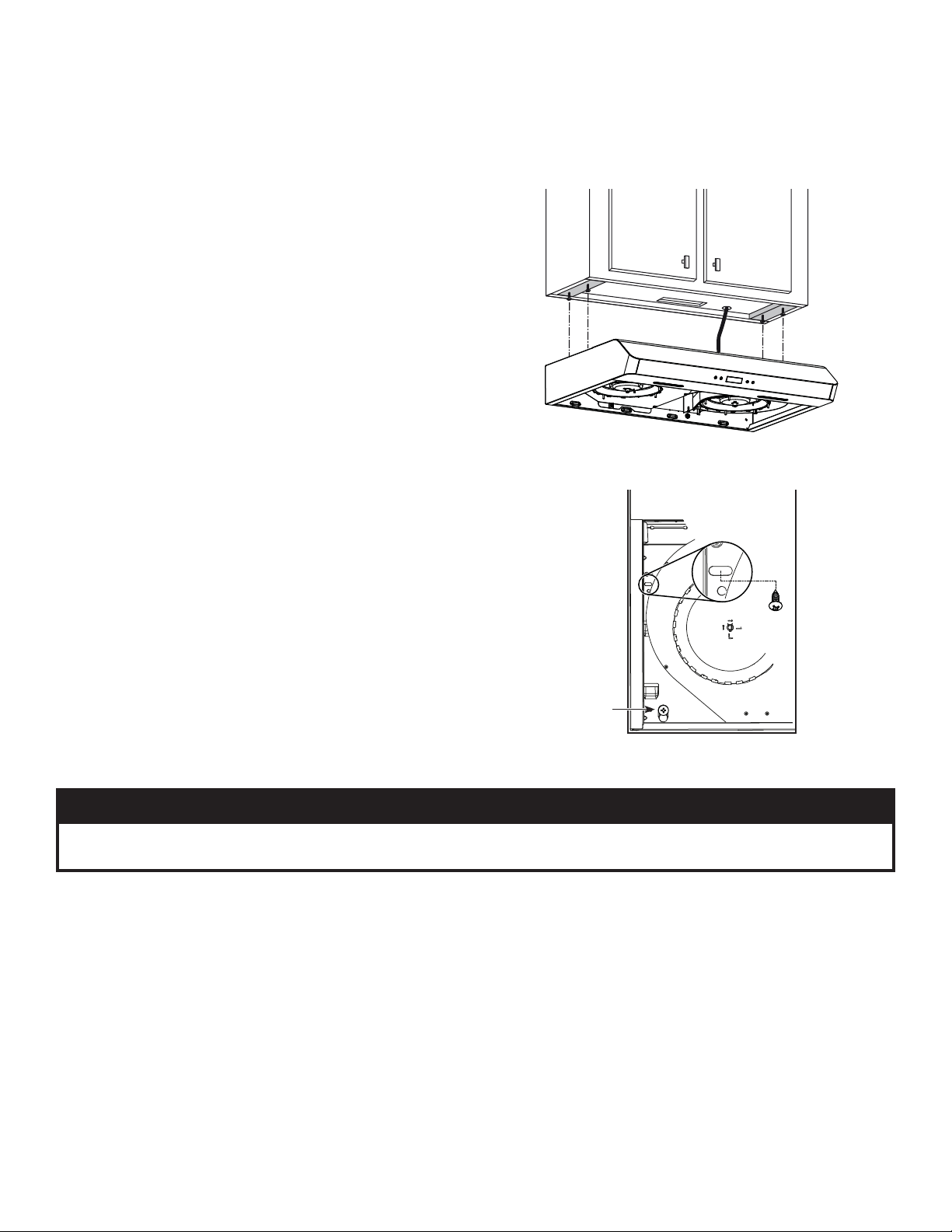
2. Hang hood from (2) mounting screws previously installed.
Slide hood back towards wall until mounting screw heads
are engaged in narrow end of keyhole slots in top of hood.
Tighten screws securely and maintain a hold on the hood
until completing step 3.
DUCTED INSTALLATIONS ONLY
4. Connect the ductwork to the hood and use metal foil duct tape to make joints secure and air-tight. Make sure the
damper assembly (or round duct plate) enters the ductwork and that the damper opens and closes freely.
NOTE: Two installers are recommended because of the weight of this hood.
BACK OF HOOD
S
CREW PREVIOUSLY
TIGHTENED IN STEP 2
3. Secure the hood to the cabinet using 2 no. 8 x 5/8” round
head wood screws (screws ncluded in parts bag). Insert
1 screw per side, in the slots (as shown beside. Attach
power cable to the hood using the strain relief.
17
WARNING: Risk of electric shock. Electrical wiring
must be done by qualifi ed personnel in accordance
with all applicable codes and standards. Before
connecting wires, switch power off at service panel
and lock service disconnecting means to prevent
power from being switched on accidentally.
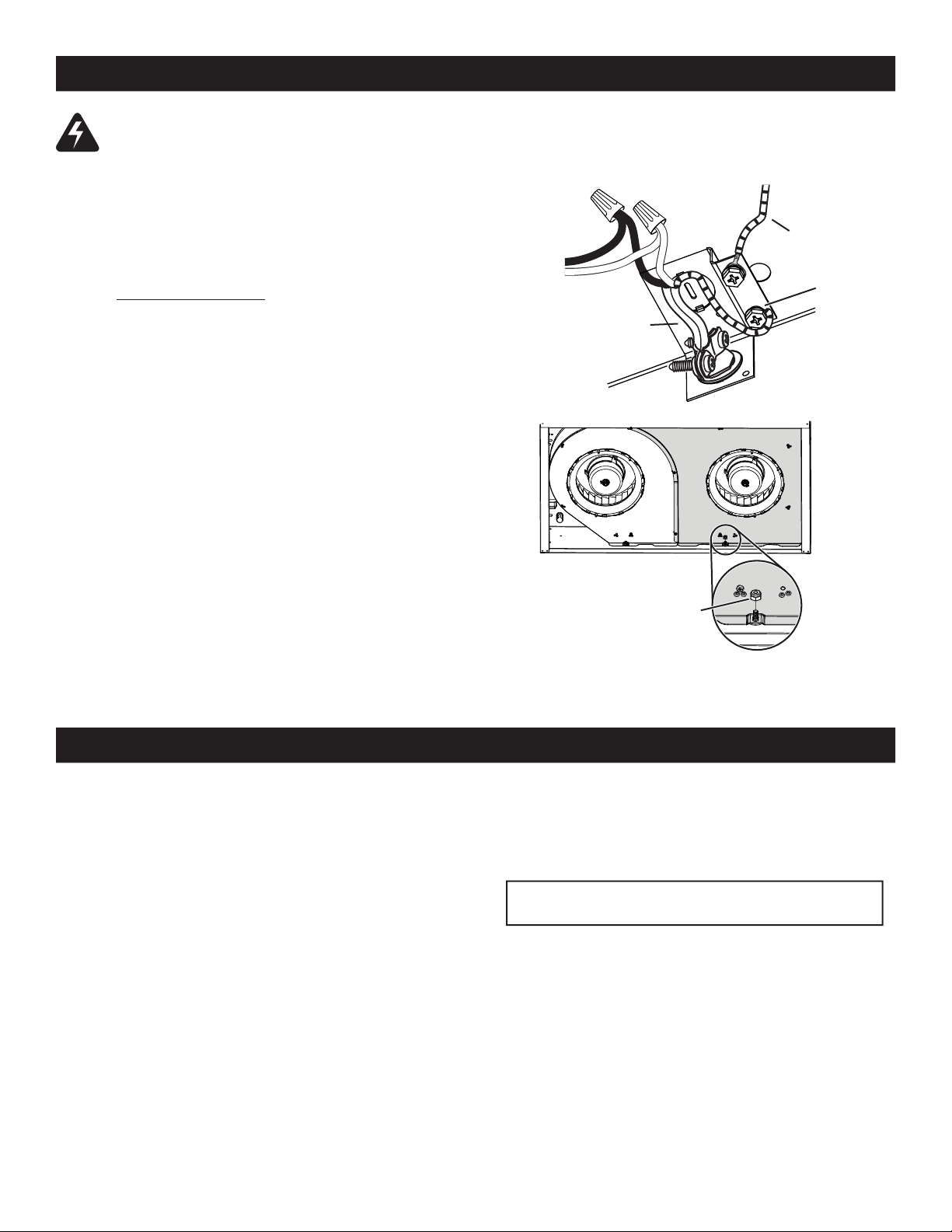
1. Connect House Power Cable to range hood wiring: BLACK
to BLACK, WHITE to WHITE and GREEN or bare wire
under GREEN ground screw.
2. Reinstall the blower cover plate (shaded part on illustration
beside) using the lock nut and7screws previously removed
in step 3 on page 9. Pay attention to screw 1 location; from
back of hood point of view, it must be located on left side
of the lock nut (see inset).
CONNECT THE WIRING
MOTORS
GROUND
WIRE
HOUSE
POWER
CABLE
GROUND
SCREW
1
2
3
45
6
7
BACK OF HOOD
LOCK NUT
1
Ducted Installation Only:
Re-install grease fi lters removed in step 2 on page 8,
under “Prepare the Hood”.
INSTALL THE FILTERS
“Non-ducted Filters” available by calling
1-844-553-6667
Non-ducted Installation Only:
Purchase two non-ducted fi lters (see part number in Service
parts list). Attach the non-ducted fi lters following instructions
packed with the non-ducted fi lters.
18
SERVICE PARTS
1
2
3
4
7
5
6
9
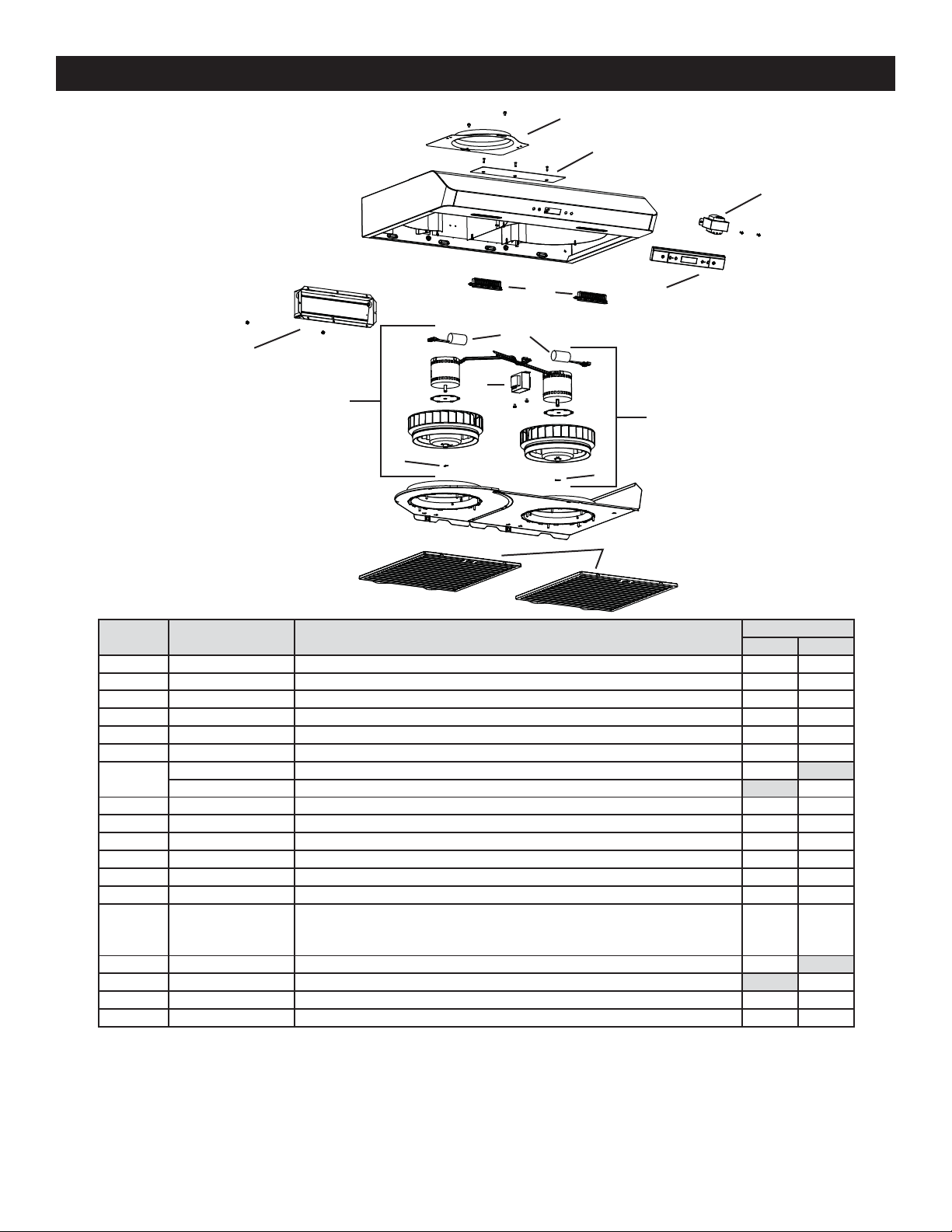
KEY NO. PART NO. DESCRIPTION
QUANTITY
51403 51413
1 S97020031 R
ECIRCULATION COVER PLATE, STAINLESS STEEL (INCLUDING SCREWS)11
2 SR680508 7'' R
OUND DUCT PLATE (INCLUDING SCREWS)11
3 S97020534 3¼”
X 10” DAMPER ASSEMBLY (INCLUDING SCREWS)11
4 S97020412 C
APACITOR 22
5 S97020842 B
LOWER ASS'Y CW (INCLUDING ITEMS 4 AND 6 AND HARDWARE)11
6 SR99420635 C
LIP FOR FANPELLER 11
7
S97020204-002 G
REASE FILTER - HYBRID - TYPE C1 (SET OF 2) 1
S97020204-003 G
REASE FILTER - HYBRID - TYPE D1 (SET OF 2) 1
8 S97020843 B
LOWER ASS'Y CCW (INCLUDING ITEMS 4 AND 6 AND HARDWARE)11
9 S97020797 A
UTOTRANSFORMER (WITH SCREWS)11
10 S97020444 LED
MODULE (PAIR)11
11 S97020438 LCD C
ONTROL (WITH SCREWS)11
12 S97020445 T
RANSFORMER 24 V 18 VA (WITH SCREWS)11
* S97020796 W
IRE HARNESS WITH AUTOTRANSFORMER AND FUSE 11
* S97020360
P
ARTS BAG INCLUDING: 4 METAL SCREWS NO. 8-18 X 1/2”,
6 ROUND HEAD NO. 8 X 5/8” WOOD SCREWS,
6 NO. 8 X 1/2” COUNTERSUNK SCREWS
11
* S97020466 N
ON-DUCTED FILTER - TYPE XC (SET OF 2) (NON-DUCTED INSTALLATION ONLY)1
* S97020467 N
ON-DUCTED FILTER - TYPE XD (SET OF 2) (NON-DUCTED INSTALLATION ONLY)1
* S99527587 N
ON-DUCTED FILTER CLIP KIT (INCLUDES 4 CLIPS)11
* S97020470 E
ASY INSTALL KIT (INCLUDING HARDWARE)11
Order replacement parts by PART NO. - not by KEY NO.
* Not illustrated
8
6
10
11
12
REPLACEMENT PARTS
In order to ensure your unit remains in good working condition, you must use the manufacturer genuine replacement parts only. The
manufacturer genuine replacement parts are specially designed for each unit and are manufactured to comply with all the applicable
certifi cation standards and maintain a high standard of safety. Any third party replacement part used may cause serious damage and
drastically reduce the performance level of your unit, which will result in premature failing. To purchase the genuine replacement parts
listed above, call 1-844-553-6667.
19
LEA Y CONSERVE ESTAS INSTRUCCIONES
TABLA DE CONTENIDO
SECCIÓN ............................................................... PÁGINA
Garantía .......................................................................................19
Instrucciones de seguridad ......................................................20
Operación ....................................................................................21
Limpieza ......................................................................................22
Piezas incluidas con la campana ........................................... 23
Piezas no incluidas con la campana ..................................... 23
Herramientas necesarias .......................................................... 23
Cuadro de largo equivalentes de conducto .........................24
Instale los conductos .................................................................25
Prepare la campana ..........................................................25-27
Prepare la ubicación para la campana ..........................28-33
Instalación EZ1 por una persona ...............................28-30
Instale la campana (Soportes EZ1) .................................31
Instalación normal (Sin soportes EZ1) ........................... 32
Instale la campana (Instalación normal) ...................... 33
Conecte el cableado ................................................................34
Instale los fi ltros .........................................................................34
Piezas de servicio ...................................................................... 35
GARANTÍA LIMITADA DE KENMORE ELITE
4. Daños en el aparato o fallos causados en él debidos
a una instalación no realizada por técnicos de servicio
autorizados de Sears, incluyendo en ello los casos de
instalación no conformes con los códigos de electricidad,
gas y plomería.
5. Daños en el aparato o fallos causados en él — entre
ellos la descoloración o la oxidación superfi cial— si no
se usa correctamente o no se le da mantenimiento de
acuerdo con todas las instrucciones dadas.
6. Daños en el aparato o fallos causados en él — entre ellos
la descoloración o la oxidación superfi cial— debidos a
un accidente, alteración, abuso, mal uso o uso distinto al
previsto.
7. Daños en el aparato o fallos causados en él — entre
ellos la descoloración o la oxidación superfi cial— debidos
al uso de detergentes, limpiadores, productos químicos
o utensilios distintos a los recomendados en todas las
instrucciones dadas con el producto.
8. Daños en piezas o sistemas del aparato o fallos causados
en ellos debidos a modifi caciones no autorizadas hechas
en el aparato.
9. Gastos de servicio en un aparato cuya placa con el
modelo y número de serie ha desaparecido, ha sido
alterada o no pueda comprobarse fácilmente que lleva
el logo de certifi cación apropiado.
Denegación de garantías implícitas; limitación de los
recursos
El único recurso de que dispone el cliente conforme a
esta garantía limitada será la reparación o la sustitución
del producto, tal y como aquí se indica. Las garantías
implícitas, tales como las garantías de comerciabilidad o
de idoneidad para un determinado propósito, se limitan a
un año para la campana de cocina y a treinta días para las
piezas pintadas o metálicas brillantes, o al periodo más
corto que permita la ley. El vendedor no será responsable
de los daños incidentales o derivados. Algunos estados y
provincias no permiten que se excluyan o limiten los daños
incidentales o derivados o que se limite la duración de
las garantías implícitas de comerciabilidad o idoneidad;
en tales casos, estas exclusiones o limitaciones no se aplican
a usted.
Esta garantía sólo se aplica cuando el aparato se usa en
Estados Unidos.
Esta garantía le concede derechos legales específi cos,
y usted puede tener también otros derechos que varían
de un estado a otro.
Sears Brands Management Corporation,
Hoff man Estates, Illinois 60179
GARANTÍA LIMITADA DE KENMORE ELITE
La garantía siguiente se aplica, CON UN COMPROBANTE
DE VENTA, cuando este aparato se instala, se utiliza y se
mantiene de acuerdo con todas las instrucciones dadas.
Este aparato está garantizado DURANTE UN AÑO, a partir
de la fecha de venta, contra los defectos de material
y de mano de obra. Un aparato defectuoso será reparado
o sustituido, se gún decida el vendedor. El periodo de garantía
de UN AÑO no se aplica al acabado de las piezas
pintadas o de las piezas metálicas brillantes.
Durante un plazo de TREINTA DÍAS a partir de la fecha
de compra, las piezas pintadas o metálicas brillantes de
este producto serán sustituidas sin gastos si su acabado
tiene defectos de material o de mano de obra.
Para mayor información sobre la forma de obtener una
reparación o una sustitución gratuita, sírvase consultar la
página web www.kenmore.com/warranty
La garantía queda anulada si este producto se utiliza
alguna vez con fi nes distintos al uso doméstico privado.
Esta garantía cubre ÚNICAMENTE los defectos de material
y mano de obra y NO los siguientes casos:
1. Artículos fungibles que pueden desgastarse con el uso
normal, tales como fi ltros, correas, bolsas o bombillas.
2. Gastos generados por un técnico de servicio para
limpiar o dar mantenimiento a este aparato o para dar
instrucciones al usuario sobre la instalación, funcionamiento
y mantenimiento correctos del aparato.
3. Solicitudes de servicio para corregir una instalación
del aparato no realizada por técnicos de servicio
autorizados de Sears o para reparar problemas de los fusibles,
disyuntores y cableado domésticos y de los sistemas de
plomería o de alimentación de gas causados por dicha
instalación.
20
INSTRUCCIONES DE SEGURIDAD
!
PREVISTO PARA COCINAR DOMÉSTICO SOLAMENTE.
!
ADVERTENCIA
PARA REDUCIR EL RIESGO DE INCENDIO, CHOQUE
ELÉCTRICO, O LESIÓN A PERSONAS, OBSERVE LO
SIGUIENTE:
1. Utilice esta unidad sólo en la manera prescrita por el
fabricante. Si tiene usted alguna pregunta, comuniqúese
con el fabricante a la dirección o al télefono indicados
en la garantía.
2. Antes de efectuar algún servicio o limpieza, se debe
desconectar la corriente eléctrica en el armario de
circuitos y asegurarlo con llave para evitar que la corriente
sea conectada accidentalmente. Cuando el medio de
desconexión del servicio no puede ser trabado, sujete un
dispositivo de advertencia evidente, tal como una etiqueta,
al panel de servicio.
3. Todo trabajo do instalación y cableado eléctrico debe ser
realizado por personal califi cado y de acuerdo con todos
los códigos y normas pertinentes, incluyendo los códigos
y normas relacionados con construcción clasifi cada para
incendio.
4. Aire sufi ciente es necesario para facilitar la combustión
adecuada y la salida apropiada de gases por la chimenea
de la unidad y para evitar corrientes de aire invertidas.
Siga las instrucciones y medidas de seguridad del
fabricante del equipo y de las sociedades profesionales de
equipos do calentadores y los reglamentos de seguridad
locales.
5. Al cortar o perforar la pared o el techo, no dañe el
cableado eléctrico y otros servicios públicos ocultos.
6. Para reducir el riesgo de incendio o de descarga eléctrica,
no utilice esta campana con un dispositivo de control de
velocidad adicional.
7. Los ventiladores con conducto deberán siempre tener una
salida hacia el exterior.
8. Para reducir el riesgo de incendio, use sólo conductos de
metal.
9. Esta unidad se debe instalar con conexión a tierra.
PARA REDUCIR EL RIESGO DE UN INCENDIO POR GRASA
EN LA ESTUFA:
1. Nunca deje las unidades de superfi cie sin supervisión
cuando tengan ajustes altos. Los reboses pueden provocar
humo y derrames grasosos que se pueden incendiar.
Caliente lentamente el aceite en un ajuste bajo o medio.
2. Siempre ENCIENDA la campana cuando cocine con alta
temperatura o cuando cocine alimentos que se puedan
incendiar.
3. Limpie con frecuencia los ventiladores. No debe permitir
que la grasa se acumule en el ventilador ni en el fi ltro.
4. Utilice un sartén de tamaño adecuado. Siempre utilice el
utensilio adecuado al tamaño del elemento do superfi cie.
ADVERTENCIA
PARA REDUCIR EL RIESGO DE LESIONES A PERSONAS EN
CASO DE INCENDIO DE GRASA EN LA ESTUFA, OBSERVE
LO SIGUIENTE:*
1. APAGUE LAS LLAMAS con una tapa ajustada, plancha
para galletitas o charola decorativa, y luego apague la
hornilla. TENGA CUIDADO DE EVITAR QUEMADURAS. Si
las llamas no se apagan de inmediato, EVACÚE EL LUGAR
Y LLAME AL DEPARTAMENTO DE BOMBEROS.
2. NUNCA LEVANTE UNA SARTEN QUE ESTÉ EN LLAMAS
- Usted se podrá quemar.
3. NO UTILICE AGUA, incluyendo toallas de cocina mojadas
- puede resultar una explosión de vapor violenta.
4. Utilice un extintor SOLAMENTE si:
A. Usted sabe que tiene un extintor de clase ABC y ya
sabe utilizarlo.
B. El incendio es pequeño y contenido dentro del área
donde se inició.
C. Los bomberos han sido avisados.
D. Usted puede combatir el incendio con una salida a su
espalda.
* Basado en las recomendaciones para “Seguridad en la
Cocina” publicadas por NFPA de los EE.UU.
PRECAUCIÓN
1. Solamente para uso general de ventilación. No utilice para
descargar materiales peligrosos o materiales y vapores
explosivos.
2. Para evitar daños al cojinete del motor y evitar que las
paletas del ventilador emitan mucho ruido o estén fuera
de equilibrio, mantenga el motor libre de pelusa, polvo,
etc.
3. Para obtener mejores resultados en la captura de
impurezas, la parte superior de la campana debe estar
montada de forma tal que la campana quede de 18-30”
de distancia de la superfi cie de la estufa.
4. Use sólo kits de cable de conexión para campana de
cocina cuyo uso ya se haya estudiado y aprobado para
este modelo de campana.
5. Por favor, lea la etiqueta de especifi caciones del producto
para mayores informaciones y requerimientos.
!
NOTA
Si se instalará la campana en un sistema sin conductos:
• Compre dos fi ltros de recirculación y Instale los fi ltros
de recirculación siguiendo las instrucciones que vienen
con los fi ltros.
“Filtros de recirculación”
disponibles llamando al
1-844-553-6667
21
VENTILADOR IMPELENTE: ACTIVACIÓN, CAMBIO
DE VELOCIDAD, REINICIO DEL INDICADOR DE LOS
FILTROS
Cuando el ventilador impelente esté APAGADO, presione este
botón pulsador para ENCENDER el ventilador en la última
velocidad guardada. Si no se guardó ninguna velocidad, el
ventilador se situará en la velocidad BAJA.
NOTA: Cuando se active la velocidad BAJA a partir del
ventilador APAGADO, éste empieza a funcionar
a velocidad MEDIA brevemente y luego pasa a
velocidad BAJA.
Para cambiar la velocidad del ventilador impelente, presione
de nuevo este botón pulsador hasta alcanzar la velocidad
deseada (de velocidad BAJA pasará a MEDIA y luego a
ALTA). Si presiona de nuevo el botón tras la velocidad ALTA, el
ventilador se APAGARÁ. Cada vez que se activa la velocidad
del ventilador, aparece el icono de un ventilador girando en
el lado izquierdo de la pantalla LCD, con uno o varios puntos
debajo. La velocidad con la que gira indica la velocidad
seleccionada: lento para la velocidad BAJA (un punto),
más rápido para la velocidad MEDIA (2 puntos) y máxima
velocidad para la velocidad ALTA (3 puntos).
Cuando el ventilador esté encendido, en cualquier velocidad,
mantenga presionado este botón pulsador hasta que
desaparezca el icono del ventilador de la pantalla LCD; de
este modo, se apagará el ventilador y se guardará la última
velocidad seleccionada.
Heat Sentry ™
Esta campana viene equipada con un dispositivo de protección
que activa el ventilador impelente al detectar un nivel de calor
anormalmente alto cuando el ventilador está activado. Cuando
el dispositivo Heat Sentry está activado, toma el control del
ventilador y lo pone en la velocidad MEDIA. Entre tanto, todos
los puntos del icono del ventilador parpadean.
Sin embargo, las luces se pueden controlar. El ventilador
seguirá en velocidad MEDIA hasta que el calor alcance un
nivel normal, momento en el que el ventilador volverá a la
velocidad seleccionada anteriormente.
NOTA: Cuando se detecta un calor excesivo, el dispositivo
Heat Sentry apaga el ventilador y las luces mientras
que todos los puntos debajo del icono del ventilador
parpadean más rápidamente. El ventilador y las luces
permanecerán apagados hasta que la temperatura
ambiente se enfríe; luego, el ventilador empezará
a funcionar a velocidad MEDIA (las luces pueden
controlarse de nuevo). El ventilador funcionará a
velocidad MEDIA hasta que el calor vuelva a la
situación normal, momento en el que el ventilador
volverá a la velocidad seleccionada anteriormente.
1
NOTA: Al poner en marcha la campana de la cocina o tras
un corte de corriente, en la pantalla LCD aparecerá
brevemente ( ± 2 segundos) un pequeño icono (1); es
normal.
PARADA RETARDADA
Cuando el ventilador esté encendido, presione este botón
pulsador para activar la función de retardo. Este icono aparece
en la pantalla LCD al lado del icono del ventilador para indicar
que la función está activada. El ventilador seguirá funcionando
durante 10 minutos y luego se apagará automáticamente (el
icono del ventilador y el de parada retardada desaparecerán
de la pantalla LCD). Cuando la función de parada retardada
está activada, se puede cambiar la velocidad del ventilador
presionando el botón pulsador del ventilador sin que ello
afecte el tiempo de retardo restante.
Para anular la función de parada retardada antes de que
acabe el ciclo de 10 minutos, presione de nuevo en el botón
pulsador de parada retardada.
OPERACIÓN
ILUMINACIÓN, CAMBIO DE INTENSIDAD DE LAS
LUCES
Presione este botón pulsador para encender las luces con la
intensidad que se guardó la última vez. En la parte derecha
de la pantalla LCD aparecerá el icono de la luz; el número de
puntos que aparecen debajo del icono indica la intensidad
de las luces (un punto signifi ca intensidad BAJA; dos puntos,
intensidad MEDIA y tres punto, intensidad ALTA).
Para cambiar la intensidad de las luces, presione el botón
pulsador hasta lograr el nivel deseado (si presiona una vez
más con las luces en intensidad ALTA, las luces se apagarán).
Cuando las luces estén encendidas, independientemente de la
intensidad, mantenga presionado este botón pulsador hasta
que desaparezca el icono de la luz de la pantalla LCD; de
este modo, se apagarán las luces y se guardará la intensidad
elegida.
Los módulos LED incluidos con esta campana extractora
constituyen la más avanzada tecnología de iluminación LED
de superfi cies de cocción. Diseñados específi camente para
operar a temperaturas elevadas de cocción, estas luces LED
ofrecen una iluminación muy clara, duran hasta 25 veces más
tiempo que los focos estándar y son mucho más fi ables que las
lámparas LED de recambio comunes.
ENCENDIDO/APAGADO PRINCIPAL
Presione este botón pulsador para encender las luces y el
ventilador impelente en los niveles de intensidad guardados la
última vez. Cuando las luces o el ventilador estén ENCENDIDOS,
al presionar este botón pulsador se memorizará la velocidad
del ventilador y la intensidad de las luces en ese momento
antes de APAGARLOS.
RECORDATORIO DE LIMPIEZA DE LOS FILTROS
Este icono aparece en la pantalla LCD 30 segundos después
de APAGAR el ventilador cuando llega el momento de limpiar
la campana y los fi ltros (consulte la sección Limpieza y
mantenimiento en la página 22). Esto ocure cada vez que el
ventilador impelente esté APAGADO hasta que el recordatorio
de limpieza de los fi ltros esta reinicie. Una vez terminada la
limpieza, reinicie el recordatorio de limpieza de los fi ltros
presionando el botón pulsador de activación del ventilador
durante 3 segundos) cuando la duración de 30 segundos de la
aparición del icono.
OPERACIÓN

22
LIMPIEZA
ADVERTENCIA: Para reducir el riesgo de una
descarga eléctrica, desconecte el suministro
eléctrico antes de limpiar la unidad.
Filtros híbridos
Limpie frecuentemente los fi ltros con agua caliente y un
detergente suave. Los fi ltros se pueden lavar en lavaplatos. Se
debe lavar los fi ltros de malla de aluminio aproximadamente
cada mes, dependiendo de su uso. Lávelos con mayor
frecuencia si su forma de cocinar genera más grasa - como,
por ejemplo, frituras o ‘wok’.
Filtros de recirculación
(disponibles por separado – ver página 23)
Los fi ltros de recirculación deberían cambiarse cada 3 a
6 meses. Sustitúyalo con mayor frecuencia si su tipo de
cocina genera más grasa, por ejemplo si fríe o cocina con
wok. Consulte las instrucciones de instalación que vienen
con el fi ltro de recirculación.
Superfi cies de acero inoxidable de la campana
A hacer:
• Lávelo regularmente con un trapo limpio empapado con
una disolución de agua tibia y jabón suave o detergente
para lavar vajillas.
• Limpie siempre en la dirección de las líneas de pulido.
• Enjuague siempre bien con agua limpia (2 o 3 veces)
después de limpiar. Séquelo completamente.
• También puede usar un producto limpiador doméstico
para acero inoxidable.
A no hacer:
• Usar lana de acero o de acero inoxidable o un rascador
para quitar la suciedad más incrustada.
• Usar productos limpiadores agresivos o abrasivos.
• Dejar que se acumule la suciedad.
• Permitir que el polvo de yeso u otros residuos de
construcción entren en contacto con la campana.
Durante los trabajos de construcción o renovación,
cubra la campana para evitar que el polvo se adhiera
a las superfi cies de acero inoxidable.
Al elegir un detergente, evite:
• Los productos limpiadores que contengan blanqueador
(lejía) ya que dañarán el acero inoxidable.
• Los productos que contengan: cloruro,
fl uoruro,
yoduro, bromuro, ya que deteriorarán las superfi cies
rápidamente.
• Los productos combustibles que se usan para limpiar,
tales como: acetona, alcohol, éter, benzol, etc., ya que
son muy explosivos y no deberían usarse nunca cerca
de una cocina.
Montaje de los ventiladores
Los motores estan lubricados permanentemente y no
necesitan engrase nunca. Si los rodamientos de uno motor
hacen un ruido excesivo o no habitual, sustituya este motor
por otro idéntico. También se debería sustituir su rueda
. El
centro de las ruedas de los ventiladores deberian limpiarse
con frecuencia. Use un trapo limpio empapado con una
disolución de agua tibia y detergente.
23
PIEZAS INCLUIDAS CON LA CAMPANA
HERRAMIENTAS NECESARIAS PARA LA INSTALACIÓN DE LA CAMPANA
Filtros de grasa híbrido
(2 por campana)
Bolsa de piezas
(4 tornillos para metal n.° 8-18 x 1/2",
6 tornillos de cabeza redonda
para madera n.° 8 x 5/8", 6 tornillos
embuditos para madera n.° 8 x 1/2")
Destornillador
(chato y Phillips)
Cinta métrica
Perforadora
(con broca de 1/8",
broca de 7/64", y
serrucho de calar
de 1½")
Cinta adhesiva
metálica
para conductos
Pelador de
cable
PIEZAS NO INCLUIDAS CON LA CAMPANA
PIEZAS OPTATIVAS (compra separada)
Regulador de tiro
redondo de 7"
(Para uso con conducto
redondo de 7"
Pieza N.° 59183
Conjunto de la clapeta
de retención
3¼” x 10”
C
L
AB
Apoyar este borde contra la pared de atrásPlace this edge against back wall
VERTICAL EXHAUST
S
A
A
V
RTICAL EX
= 3¼” x 10”
= 3¼” x 14”
RECTANGULAR DUCTING7” ROUND DUCTING
OR
Use this template for marking; do not attempt to cut out the ducting hole through it.
NOTE: These cutouts are clearance holes; they do not need to be the exact size of ducting.
= 3¼ po x 10 po
= 3¼ po x 14 po
CONDUIT RECTANGULAIRECONDUIT ROND DE 7 PO
OU
= 3¼ pulg. x 10 pulg.
= 3¼ pulg. x 14 pulg.
CONDUCTO RECTANGULARCONDUCTO REDONDO
DE
7 PULG.
O
Appuyer ce bord au mur arrière
Utiliser ce gabarit pour marquer vos repères; ne pas tenter de découper
le trou pour le conduit à travers le gabarit.
NOTE : Les découpes incluent le jeu nécessaire à l’installation; elles ne doivent pas
être du format exact des conduits.
Use esta plantilla para crear marcados; no trate de cortar el
agujero del conducto a través de la plantilla.
NOTA: To be translated in Spanish.
MARK WHERE INDICATED
FOR THE APPROPRIATE SIZE DUCT OPENING
MARQUER LES REPÈRES AUX ENDROITS INDIQUÉS SELON
LE FORMAT DE CONDUIT UTILISÉ
TITLE TO BE TRANSLATED IN SPANIS H
Electrical access hole center
A = single blower hood
B = double blower hood
Centre du trou pour fil
d’alimentation électrique
A = hotte ventilateur simple
B = hotte ventilateur double
To be translated in Spanish
Electrical access hole center
A = single blower hood
B = double blower hood
4¼”
10½”
14½”
8”
7½”
C
C
C
Bend template along graduated
scale when installing to framed
cabinet.
Pour une installation sous une
armoire à fond en retrait, utiliser les
lignes pour mesurer l’épaisseur du
décalage causé par le mur de
l’armoire et plier le gabarit en
conséquence.
To be translated in Spanish.
Sistema de instalación EZ1
por una persona
(incluso plantilla para
instalación de conductos,
impresa por ambos lados,
y soportes de instalación)
Conector de conducto
redondo de 7”
Pinzas de
punta
HR0064
Tijera para
hojalatero
Sierra
de punta
Serrucho
de punta
-o-
Destornillador
para tuercas
11/32"
Lápiz
Filtros de recirculación
(Campana sin conducto
unicamente)
(2 por campana)
Piezas:
N.° S97020466 (anchura de 30'')
N.° S97020467 (anchura de 36'')
Las “Piezas no incluidas con la campana” están
disponibles llamando al 1-844-553-6667
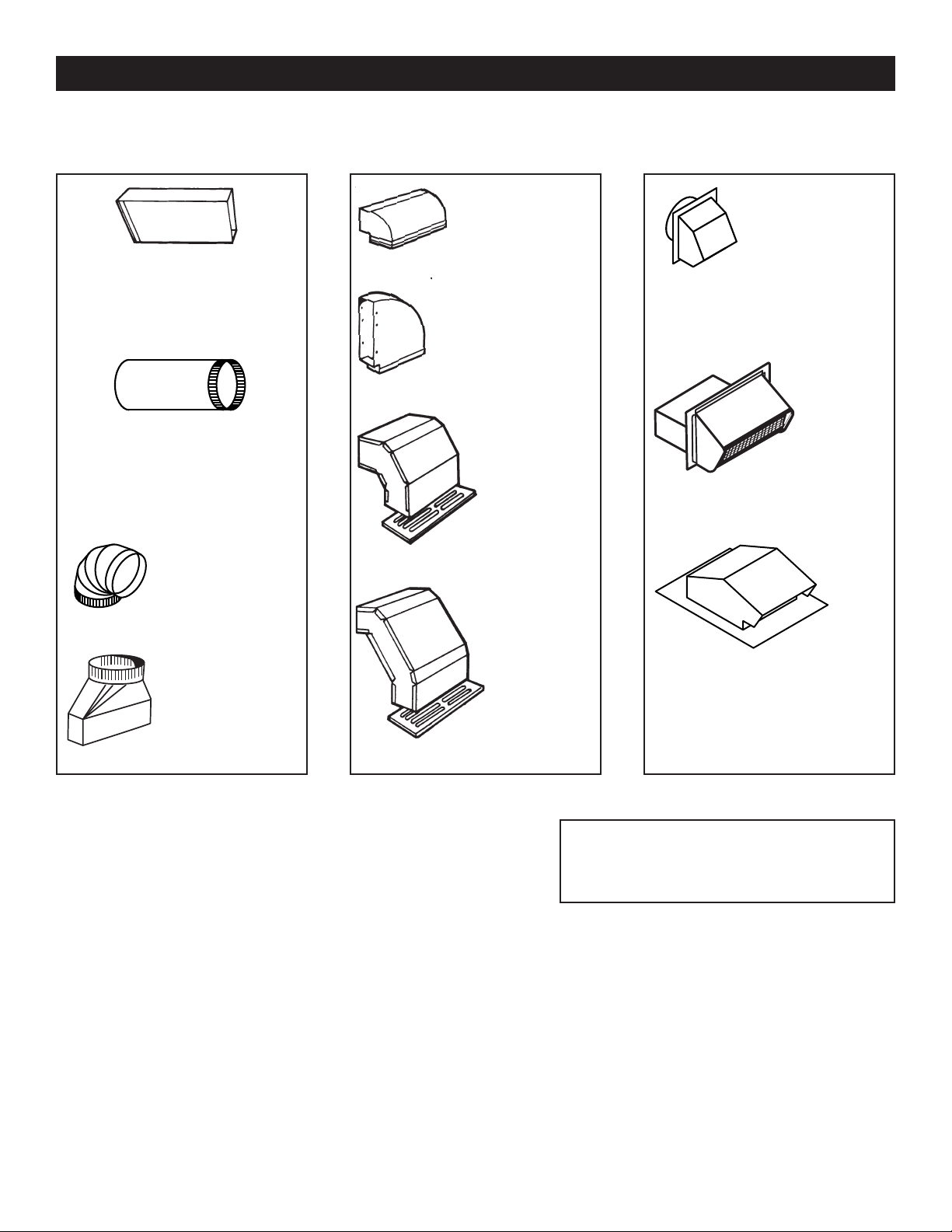
24
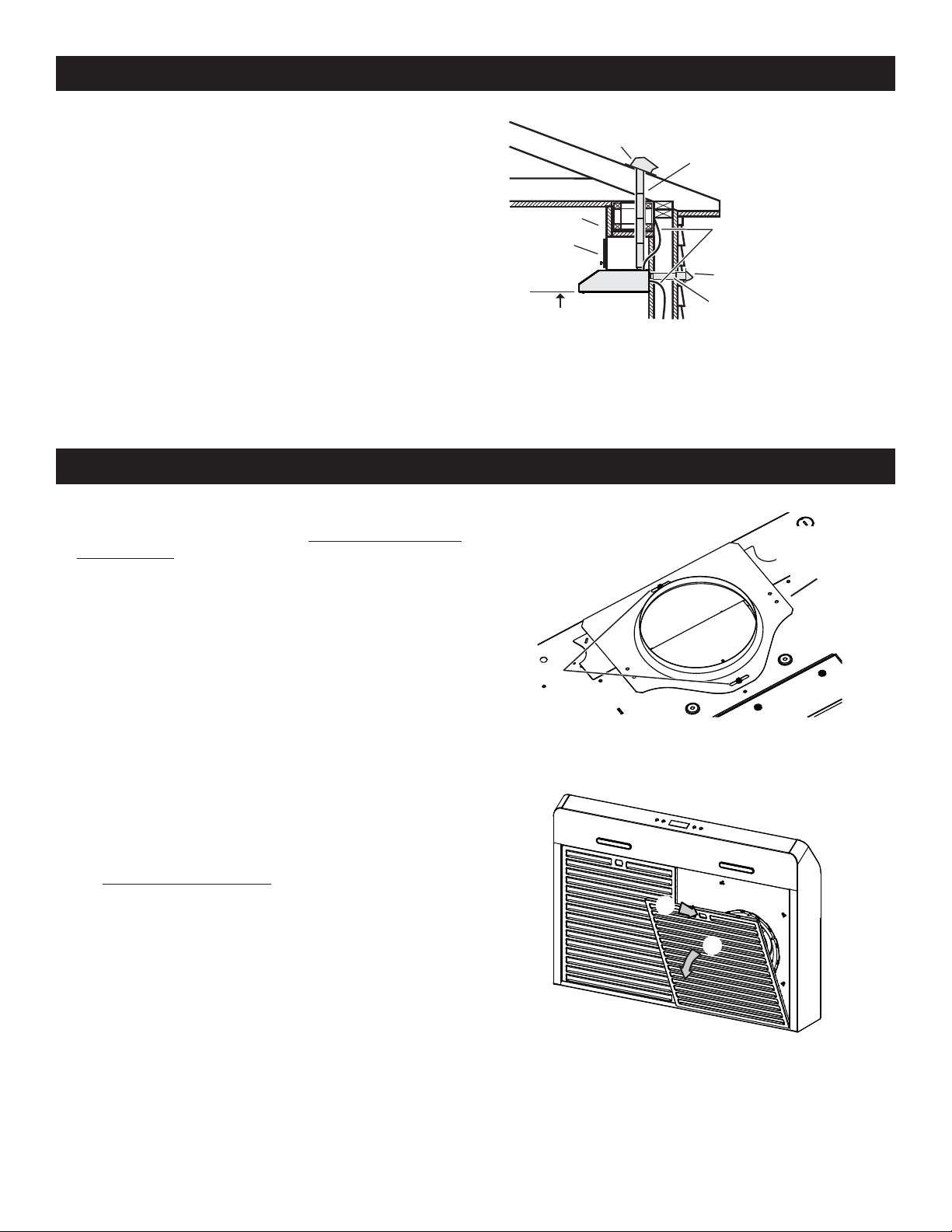
CUADRO DE LARGO EQUIVALENTE DE CONDUCTO
Conducto recto
3¼-pulg. x 10-pulg. x 2-pies
de largo. Largo equivalente
2 pies
Acodado redondo
de 7 pulg.
Largo equivalente
8 pies
3¼-pulg. x 10-pulg.
Acodado con
ángulo recto
Largo equivalente
8.5 pies
3¼-pulg. x 10-pulg.
Acodado plano con
ángulo recto
Largo equivalente
24 pies
3¼-pulg. x 10-pulg.
Acodado
con alero corto
y ángulo recto.
Largo equivalente
15 pies
3¼-pulg. x 10-pulg.
Acodado
con alero largo
y ángulo recto
Largo equivalente
15 pies
3¼-pulg. x 10-pulg.
Tapón de
pared
Largo
equivalente
45 pies
(7 pies sin
regulador de
tiro)
Tapón de techo
(acepta ducto de 7-pulg. redondo
o de 3¼-pulg. x 10-pulg.). Largo
equivalente 30 pies
(7 pies] sin regulador de tiro)
Las campanas de cocina Kenmore fueron diseñadas para su desempeño efi ciente cuando se las sujeta a largos recorridos
de conducto. Como punto de referencia, esta campana funcionará a aproximadamente el 80% de su fl ujo de aire nominal
cuando se le sujeta 30 pies equivalentes de conducto redondo de 7". Utilice esta cuadro para calcular el largo equivalente
de conducto de su sistema.
Conducto recto
7-pulg. alrededor x 2 pies
de largo. Largo equivalente
2 pies
3¼-pulg. x 10-pulg.
a 7-pulg.
Transición redondo
Largo equivalente
5.5 pies
7-pulg. Tapón de
pared redondo
Largo equivalente
34 pies
(6 pies sin regulador
de tiro)
“Accesorios para conductos” modelo
disponibles llamando al
1-844-553-6667
25
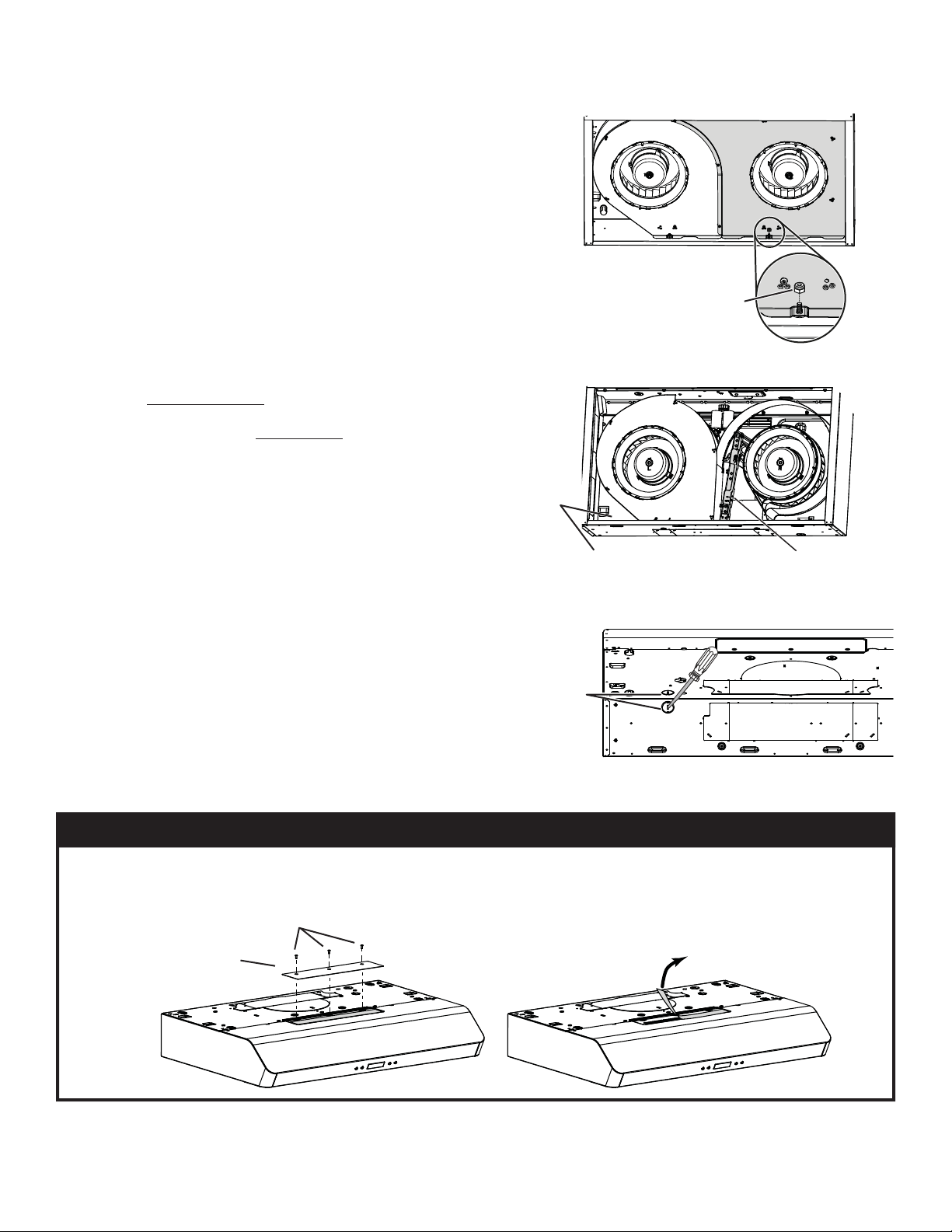
INTRADÓS
18” MÍN - 30” MÁX POR ENCIMA
DE
LA SUPERFICIE DE LA COCINA
ARMARIO
CONDUCTO DE 3¼” X 10”
(P
ARA EVACUACIÓN HORIZONTAL)
CAPUCHÓN MURAL
CAPUCHÓN PARA TEJADO
CONDUCTO DE 3¼” X 10”
O 7” REDONDO
(PARA EVACUACIÓN VERTICAL)
CABLEADO DE LA VIVIENDA
(PARTE SUPERIOR OR TRASERA
DE
LA CAMPANA)
CAMPANA
1. Determine si la campana evacuará verticalmente
(conducto redondo de 3¼” x 10” o 7”) u horizontalmente
(conducto de 3¼” x 10” únicamente).
2. Decida por dónde pasarán los conductos entre la
campana y el exterior.
3. Elija un paso recto y corto para que la campana funcione
de la forma más efi caz. Los recorridos largos, los codos
y las transiciones reducen el desempeño de la campana.
Use los menos posible. Cuando pueda, prevea al menos
2 pies de conducto recto antes de cualquier giro. Pueden
ser necesarios conductos más anchos para lograr mejor
desempeño cuando los conductos más largos giran.
4. Instale un capuchón mural o un capuchón para tejado
(se venden por separado). Conecte el conducto metálico
al capuchón y vuelva al lugar donde se encuentra la
campana. Use cinta adhesiva metálica de 2” para sellar
las juntas entre los tramos de los conductos.
INSTALE LOS CONDUCTOS (iNSTALACIONES CANALIZADAS ÚNICAMENTE)
NOTA: Las distancias superiores a 30” son a discreción
del instalador y del usuario.
1. De haberla, retire de la campana y de todas las piezas
la película protectora. Retire el conector de conducto
redondo de 7” de la parte superior trasera de la campana
(véase la ilustración al lado).
PREPARE LA CAMPANA
2. Use el orifi cio de agarre para retirar de la campana
los fi ltros de grasa híbridos empujando hacia abajo e
inclinando los fi ltros hacia fuera.
TORNILLOS
B
C
CONECTOR DE
CONDUCTO
REDONDO DE 7”
26
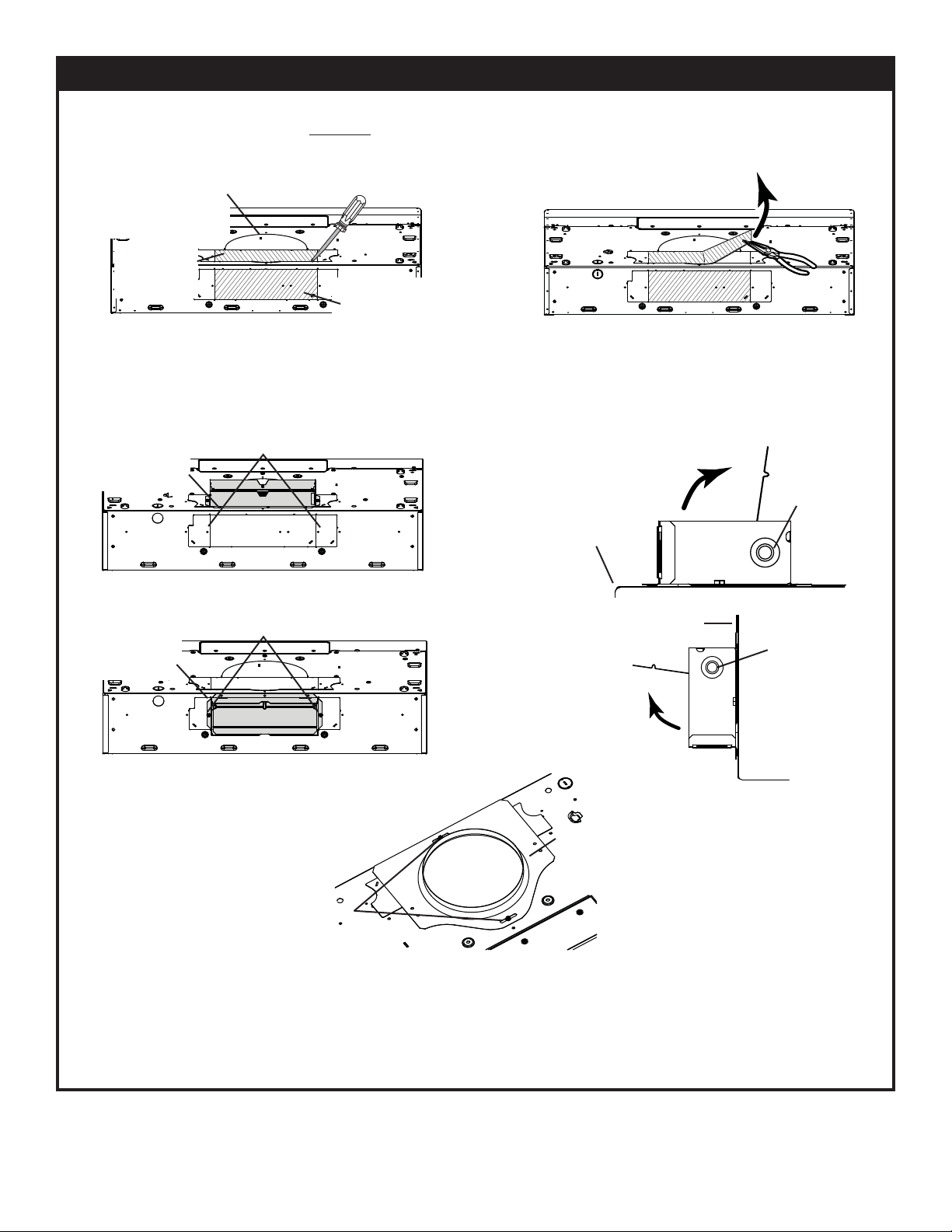
SOPORTES
EZ1
PLACA DE
CUBIERTA DE
RECIRCULACIÓN
PARTE
PUNZONADA
PARA EL
CABLE DE
ALIMENTACIÓN
ELÉCTRICA
5. Retire la parte punzonada para el cable de alimentación
eléctrica desde la parte superior (salida vertical) o desde
la parte trasera (salida horizontal) de la campana. Para
la parte punzonada quitado desde la parte trasera de la
campana, instale una descarga de presión adecuada de
1/2” de diámetro (no incluida). Para la parte punzonada
quitado desde la parte superior de la campana, la
descarga de presión será instalada más tarde.
3. Utilice un destornillador para tuercas de 11/32” para
remover la tuerca de bloqueo que sujetan el reborde
de la placa de cubierta derecha (parte sombreada de
la ilustración al lado) a la parte trasera interna de la
campana (vease el recuadro). Retire los 7 tornillos que
sujetan la placa de cubierta derecha, después desmonte
la placa de cubierta y consérvelo con su tornillos y tuerca
de bloqueo.
NOTA: Levante ligeramente la placa de cubierta antes de
deslizarla hacia la izquierda para sacarla.
PARTE TRASERA
DE LA CAMPANA
TUERCA DE
BLOQUEO
1
2
3
45
6
7
4. Retire la bolsa de piezas que esta sujeta con cinta
adhesiva a la campana; en la esquina inferior izquierda
de la campana. Retire los soportes EZ1 del interior de la
campana cortando la tira de amarre, y quite esta tira
de amarre
UBICACIÓN DE LA
BOLSA DE PIEZAS
TORNILLOS
INSTALACIÓN SIN CONDUCTOS ÚNICAMENTE
6. Retire los 3 tornillos que sujetan la placa de cubierta de recirculación a la campana. Deseche esta placa y los
tornillos. Remueva la membrana (parte sombreada de la ilustración de abajo) cubriendo la reja de recirculación,
asegurándose que las aperturas están totalmente despejadas.
27
INSTALACIÓN CON CONDUCTOS ÚNICAMENTE
TORNILLOS
TORNILLOS
TORNILLOS
FIGURA 3
FIGURA 2 A FIGURA 2 B
7. Retire la placa punzonada vertical de 3¼” x 10”, la placa punzonada horizontal de 3¼” x 10” (ambos están las
placas punzonadas rectangular centrales, veanse las zonas rayadas), o la placa punzonada redonda de 7 pulgadas,
según el modo de evacuación elegido (véanse las FIGURAS 1 A y 1 B).
FIGURA 1 A FIGURA 1 B
PLACA PUNZONADA
REDONDA DE 7”
(RETIRE TAMBIÉN LA PLACA
PUNZONADA VERTICAL)
PLACA
PUNZONADA
VERTICAL
DE 3¼” X 10”
PLACA
PUNZONADA
HORIZONTAL
DE 3¼” X 10”
8. Instale el conjunto de la clapeta de 3¼” x 10” en la parte superior O en la parte trasera de la campana
(si se usa el conducto de 3¼” x 10”; parte sombreada de la
FIGURA 2 A de abajo) o el conector de conducto
redondo de 7” (si se usa el conducto redondo de 7 pulgadas, FIGURE 3) por encima de la abertura punzonada.
Una vez instalado, el conjunto de la clapeta de 3¼” x 10” debe abrirse como se ve en la FIGURA 2 B.
CONJUTO DE
LA CLAPETA
DE 3¼” X 10”
CONJUTO DE
LA CLAPETA
DE 3¼” X 10”
PIVOTE DE LA
COMPUERTA
PIVOTE DE LA
COMPUERTA
BORDE
SUPERIOR
TRASERO DE
LA CAMPANA
PARTE TRASERA
DE LA CAMPANA
CONECTOR DE
CONDUCTO
REDONDO
DE 7”
NOTA: Para adaptarse a un conducto descentrado, el conector de conducto redondo de 7” puede instalarse hasta 1/2”
de cada lado del centro de la campana.
CONSEJO: Introduzca una pequeña longitud de conducto en el conjunto de la clapeta de 3¼” x 10” (para un
conducto rectangular) o en la placa para conducto redondo de 7” (para un conducto redondo) y selle la
junta con cinta adhesiva de aluminio para facilitar la conexión con los conductos de la vivienda.
28
PREPARE LA UBICACIÓN DE LA CAMPANA
NOTA: Antes de empezar la instalación, lea todas las
etapas de estas instrucciones.
Use la ilustración de la derecha para reconocer su tipo de
armario de cocina.
Sistema de instalación EZ1 por una persona
Este manual cubre 2 tipos de instalación: la normal (sin
soportes EZ1) y la instalación EZ1 por una persona (usando
la plantilla y los soporte provistos). Para la instalación normal,
vaya a la página 31.
ARMARIO CON ARMAZÓN ARMARIO SIN ARMAZÓN
C
L
AB
Apoyar este borde contra la pared de atrásPlace this edge against back wall
VERTICAL EXHAUST
A
S
A
A
V
RTICAL EX
= 3¼” x 10”
= 3¼” x 14”
RECTANGULAR DUCTING7” ROUND DUCTING
OR
Use this template for marking; do not attempt to cut out the ducting hole through it.
NOTE: These cutouts are clearance holes; they do not need to be the exact size of ducting.
= 3¼ po x 10 po
= 3¼ po x 14 po
CONDUIT RECTANGULAIRECONDUIT ROND DE 7 PO
OU
= 3¼ pulg. x 10 pulg.
= 3¼ pulg. x 14 pulg.
CONDUCTO RECTANGULARCONDUCTO REDONDO
DE
7 PULG.
O
Appuyer ce bord au mur arrière
Utiliser ce gabarit pour marquer vos repères; ne pas tenter de découper
le trou pour le conduit à travers le gabarit.
NOTE : Les découpes incluent le jeu nécessaire à l’installation; elles ne doivent pas
être du format exact des conduits.
Use esta plantilla para crear marcados; no trate de cortar el
agujero del conducto a través de la plantilla.
NOTA: To be translated in Spanish.
MARK WHERE INDICATED
FOR THE APPROPRIATE SIZE DUCT OPENING
MARQUER LES REPÈRES AUX ENDROITS INDIQUÉS SELON
LE FORMAT DE CONDUIT UTILISÉ
TITLE TO BE TRANSLATED IN SPANISH
Electrical access hole center
A = single blower hood
B = double blower hood
Centre du trou pour fil
d’alimentation électrique
A = hotte ventilateur simple
B = hotte ventilateur double
To be translated in Spanish
Electrical access hole center
A = single blower hood
B = double blower hood
4¼”
10½”
14½”
8”
7½”
C
C
C
Bend template along graduated
scale when installing to framed
cabinet.
Pour une installation sous une
armoire à fond en retrait, utiliser les
lignes pour mesurer l’épaisseur du
décalage causé par le mur de
l’armoire et plier le gabarit en
conséquence.
To be translated in Spanish.
P
C
C
L
AB
VERTICAL EXHAUST
A
S
A
A
V
RTICAL EX
= 3¼” x 10”
= 3¼” x 14”
RECTANGULAR DUCTING7” ROUND DUCTING
OR
Use this template for marking; do not attempt to cut out the ducting hole through it.
NOTE: These cutouts are clearance holes; they do not need to be the exact size of ducting.
= 3¼ po x 10 po
= 3¼ po x 14 po
CONDUIT RECTANGULAIRECONDUIT ROND DE 7 PO
OU
= 3¼ pulg. x 10 pulg.
= 3¼ pulg. x 14 pulg.
CONDUCTO RECTANGULARCONDUCTO REDONDO
DE
7 PULG.
O
Utiliser ce gabarit pour marquer vos repères; ne pas tenter de découper
le trou pour le conduit à travers le gabarit.
NOTE : Les découpes incluent le jeu nécessaire à l’installation; elles ne doivent pas
être du format exact des conduits.
Use esta plantilla para crear marcados; no trate de cortar el
agujero del conducto a través de la plantilla.
NOTA: To be translated in Spanish.
MARK WHERE INDICATED
FOR THE APPROPRIATE SIZE DUCT OPENING
MARQUER LES REPÈRES AUX ENDROITS INDIQUÉS SELON
LE FORMAT DE CONDUIT UTILISÉ
TITLE TO BE TRANSLATED IN SPANISH
Electrical access hole center
A = single blower hood
B = double blower hood
Centre du trou pour fil
d’alimentation électrique
A = hotte ventilateur simple
B = hotte ventilateur double
To be translated in Spanish
Electrical access hole center
A = single blower hood
B = double blower hood
4¼”
10½”
14½”
8”
7½”
C
C
C
Bend template along graduated
scale when installing to framed
cabinet.
Pour une installation sous une
armoire à fond en retrait, utiliser les
lignes pour mesurer l’épaisseur du
décalage causé par le mur de
l’armoire et plier le gabarit en
conséquence.
To be translated in Spanish.
B
PARTE
DELANTERA
DEL ARMARIO
UBICACIÓN DEL
ORIFICIO DE ACCESO
DEL CABLE ELÉCTRICO (B)
(
EN LA PARTE INFERIOR DEL ARMARIO)
LÍNEA CENTRAL
D
OBLE LA PLANTILLA A LO LARGO DE LA
ESCALA GRADUADA AL INSTALAR LA CAMPANA
EN
UN ARMARIO CON ARMAZÓN.
PARTE
DELANTERA
DEL ARMARIO
CONDUCTOS DE
SALIDA VERTICAL
La instalación EZ1 está pensada para armarios de cocina que tienen la misma anchura que la de la campana. Si el
armario es 1/2” más ancho que la campana, use el modo de instalación normal.
1. Use la plantilla adecuada para la evacuación vertical
U horizontal (incluidas) para colocar los conductos y la
alimentación eléctrica en el armario o en la pared. Para
una instalación sin conductos, NO corte el orifi cio de
acceso al conducto; corte sólo el orifi cio para el cableado
eléctrico. Si sustituye una campana y prevé usar el conducto
y la alimentación eléctrica existentes, puede que las
etapas 2 a 5 no sean necesarias. De ser el caso, pase a
la etapa 6.
2. Mida y marque la línea central de la campana en la
parte inferior del armario.
3. Alinee la línea central de la plantilla con la línea central
de la campana marcada en la parte inferior del armario,
colocando el borde (donde se indica) de la plantilla contra
la pared trasera. Cuando se use un armario con armazón
para una instalación con salida vertical, pliegue hacia
atrás el borde de la plantilla en una medida equivalente a
la profundidad del armazón del armario en la pared (use
las graduaciones de la plantilla, puntos C de la plantilla).
Sujete la plantilla con cinta adhesiva.
NOTA: Si se sitúa frente a la instalación, A y B (en la
plantilla) deben estar a la derecha.
C
L
AB
Place this edge against
cabinet bottom.
Appuyer ce bord contre le bas
de l’armoire.
Apoyar este borde contra
la base del armario.
HORIZONTAL EXHAUST
T
T
= 3¼ pulg. x 10 pulg.
= 3¼ pulg. x 14 pulg.
CONDUCTO RECTANGULAR
= 3¼” x 10”
= 3¼” x 14”
RECTANGULAR DUCTING
= 3¼ po x 10 po
= 3¼ po x 14 po
CONDUIT RECTANGULAIRE
MARK WHERE INDICATED
FOR THE APPROPRIATE SIZE DUCT OPENING
MARQUER LES REPÈRES AUX ENDROITS INDIQUÉS SELON
LE FORMAT DE CONDUIT UTILISÉ
TITLE TO BE TRANSLATED IN SPANISH
Use this template for marking; do not attempt to cut out the ducting hole through it.
NOTE: These cutouts are clearance holes; they do not need to be the exact size of ducting.
Utiliser ce gabarit pour marquer vos repères; ne pas tenter de découper
le trou pour le conduit à travers le gabarit.
NOTE : Les découpes incluent le jeu nécessaire à l’installation; elles ne doivent pas
être du format exact des conduits.
Use esta plantilla para crear marcados; no trate de cortar el
agujero del conducto a través de la plantilla.
NOTA: To be translated in Spanish.
Electrical access hole center
A = single blower hood
B = double blower hood
Centre du trou pour fil
d’alimentation électrique
A = hotte ventilateur simple
B = hotte ventilateur double
To be translated in Spanish
Electrical access hole center
A = single blower hood
B = double blower hood
B
ess hole center
wer hood
wer hood
LÍNEA
CENTRAL
UBICACIÓN DEL
ORIFICIO DE ACCESO
DEL CABLE ELÉCTRICO (B)
(
EN LA PARED
)
CONDUCTOS DE
SALIDA HORIZONTAL
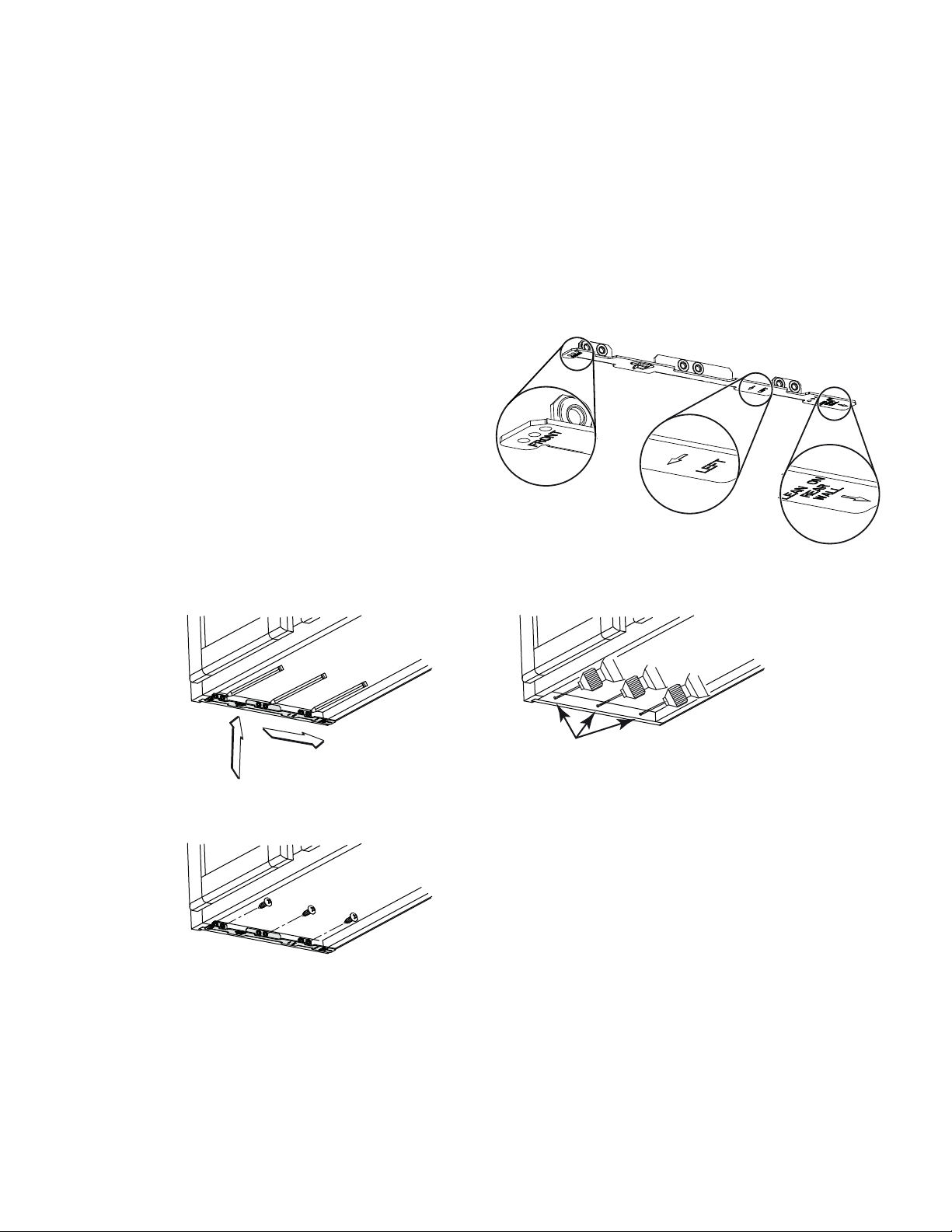
29
Consulte las marcas de los soporte para establecer el
lado y la orientación correctos de la instalación (marcas
en ingles solamente: front = frente, left = izquierda, lean
on rear wall = appoyar contra la pared de atrás).
Acople el soporte correspondiente a la armazón
lateral del armario colocando la parte de atrás del
soporte contra la pared. Use un lápiz para marcar
3 orifi cios (hay 6 orifi cios pero sólo se necesitan 3
).
Retire el soporte. Use una broca de 7/64” para
taladrar 3 orifi cios donde los marcara.
7. Instale los soporte de instalación adecuados según el tipo
de armario (con armazón o sin armazón). Véase abajo.
Una el soporte al armazón lateral con un destornillador
Phillips y 3 tornillos para madera n.° 8 x 9/16” provistos.
Repita la operación en el otro lado del armazón.
ARMARIO CON ARMAZÓN
7/64”
XY
Z
4. Taladre un orifi cio piloto de 1/8” de diámetro para el
cableado de la vivienda, en el punto B de la plantilla.
5. Use un lápiz afi lado o una broca de 1/8” para marcar
los puntos para los orifi cios de acceso de los conductos
(16 puntos para un conducto redondo de 7”, o 4 puntos
en las esquinas para un conducto rectangular). Retire la
plantilla.
6. Dibuje el borde de la evacuación de salida uniendo los
puntos (16 puntos para un conducto redondo de 7” y 4
puntos para un conducto rectangular), corte la abertura
en la parte inferior del armario (salida vertical) o en
la pared (salida horizontal). Taladre el orifi cio para el
cableado de la vivienda usando un serrucho de calar de
1½” centrándolo en el orifi cio piloto hecho en la etapa 4.
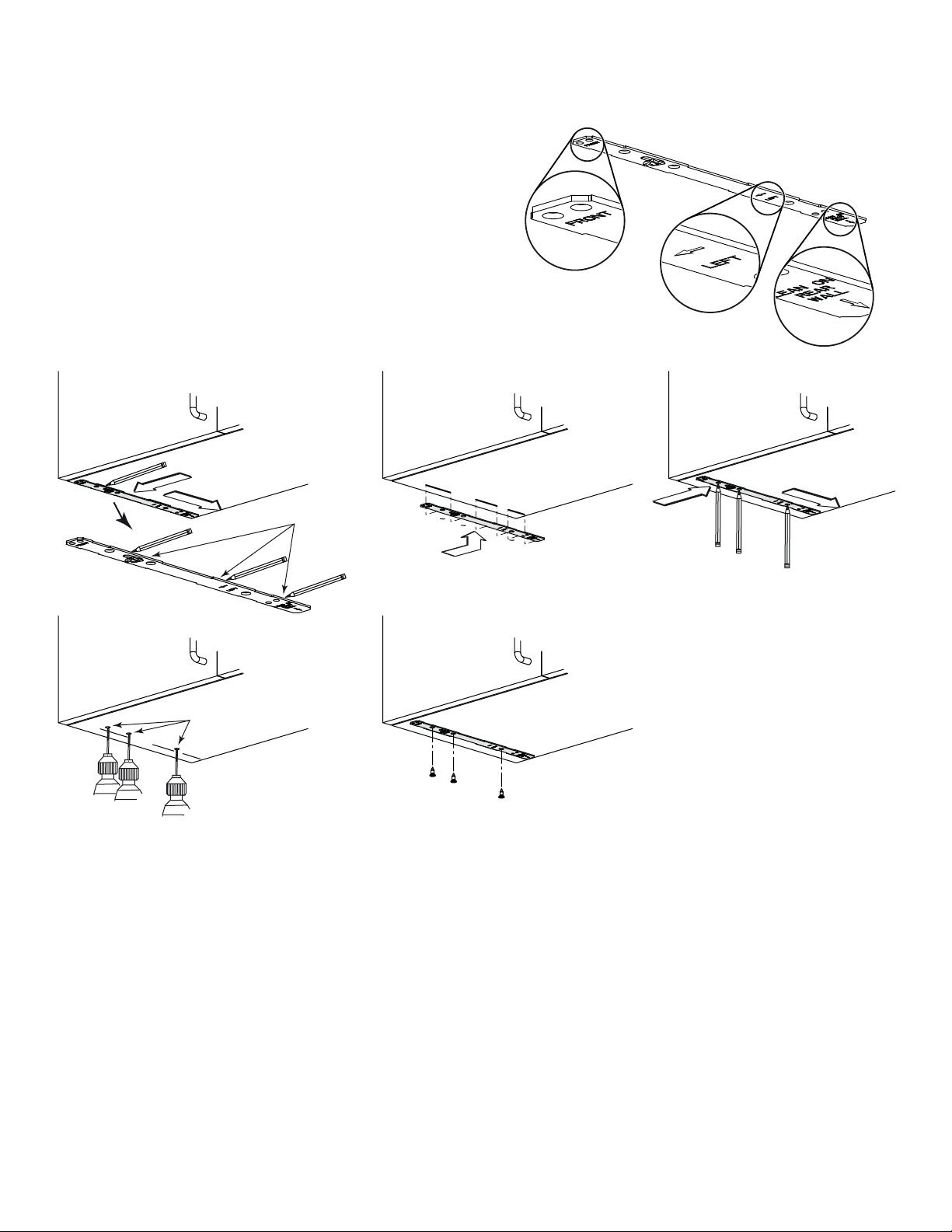
30
Alinee el soporte correspondiente al lado del armario,
colocando al mismo tiempo la parte trasera del
soporte contra la pared. Dibuje una línea a lo largo del
borde exterior del soporte (como se muestra).
Coloque el soporte en el centro del armario y alinee el
borde lateral con la línea marcada manteniendo la
parte trasera apoyada en la pared.
Consulte las marcas de los soporte para establecer el
lado y la orientación correctos de la instalación (marcas
en ingles solamente: front = frente, left = izquierda, lean
on rear wall = appoyar contra la pared de atrás).
Use un lápiz para marcar 3 orifi cios.
Retire el soporte. Use una broca de 7/64” para
taladrar 3 orifi cios donde los marcara.
Una el soporte a la parte inferior del armario con un
destornillador Phillips y 3 tornillos embutidos para
madera provistos. Repita la operación en el otro lado
del armario.
ARMARIO SIN ARMAZÓN
[ \
7/64”
X
3 X
Y
Z
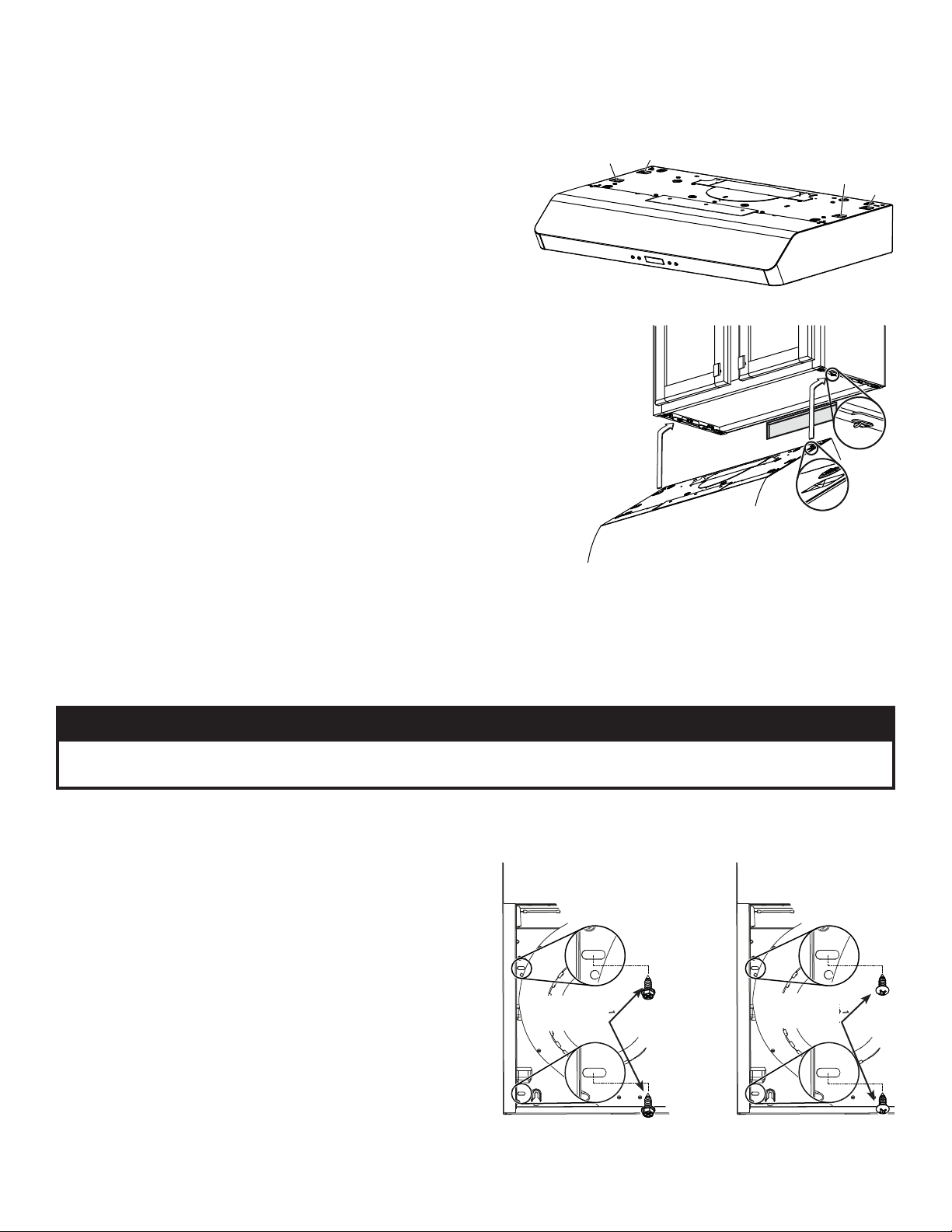
31
INSTALACIÓN CON SALIDA HORIZONTAL
Instale la campana (Soportes EZ1)
NOTA: El procedimiento siguiente se aplica a las instalaciones
en armarios con armazón y sin armazón.
1. Lleve el cable de alimentación de la vivienda del
tablero de servicio al lugar de la campana.
2. Hay 2 pares de orifi cios rebajados en cada lado de
la parte superior de la campana (en la parte trasera:
A y B, en la parte delantera C y D en la ilustración de
derecha); estos orifi cios permiten colgar la campana a
los soportes (instalados previamente).
3. Cuelgue provisionalmente la campana de los soportes por
medio de los dos (2) ORIFICIOS TRASEROS rebajados
(A y B). Mientras sujeta la campana, lleve el cable de
alimentación de la vivienda hasta la campana a través
de la descarga de presión instalada previamente en la
etapa 5 en la página 26.
4. Desenganche los orifi cios traseros de los soportes y
cuelgue la campana por medio de los dos (2) ORIFICIOS
DELANTEROS rebajados (C y D). Mientras sujeta la campana,
pase a la etapa 6.
INSTALACIÓN CON SALIDA VERTICAL
5. Cuelgue la campana a los soportes usando los dos (2)
ORIFICIOS DELANTEROS rebajados (C y D). Mientras
sujeta la campana, apriete una descarga de presión
adecuada de 1/2” de diámetro (no incluida) al cable de
alimentación, después inserte la descarga de presión en
el orifi cio punzonado.
INSTALACIÓN CON CONDUCTOS ÚNICAMENTE
6. Conecte los conductos a la campana y use cinta adhesiva metálica para sellar las juntas. Asegúrese de que el conjunto
de la clapeta (o la placa del conducto redondo) entra en el conducto y que la clapeta se abre y se cierra sin difi cultad.
ARMARIO
CON ARMAZÓN
ARMARIO
SIN ARMAZÓN
7. En los armarios con armazón, sujete la campana a los
soportes EZ1 por medio de los (4) tornillos para metal no
8-18 x 1/2” (los tornillos vienen en la bolsa de piezas).
Introduzca (2) tornillos en cada lado, en las ranuras (como
se ve en los detalles de la ilustración de derecha).
8. En los armarios sin armazón, sujete la campana al
armario por medio de los (4) tornillos de cabeza redonda
para madera no 8 x 5/8” (los tornillos vienen en la bolsa
de piezas). Introduzca (2) tornillos en cada lado, en las
ranuras (como se ve en los detalles de la ilustración de
derecha).
A
B
9. Sujete el cable de alimentación a la campana por medio
de la descarga de presión.
TORNILLOS
PARA METAL
TORNILLOS
PARA MADERA
A
B
D
C
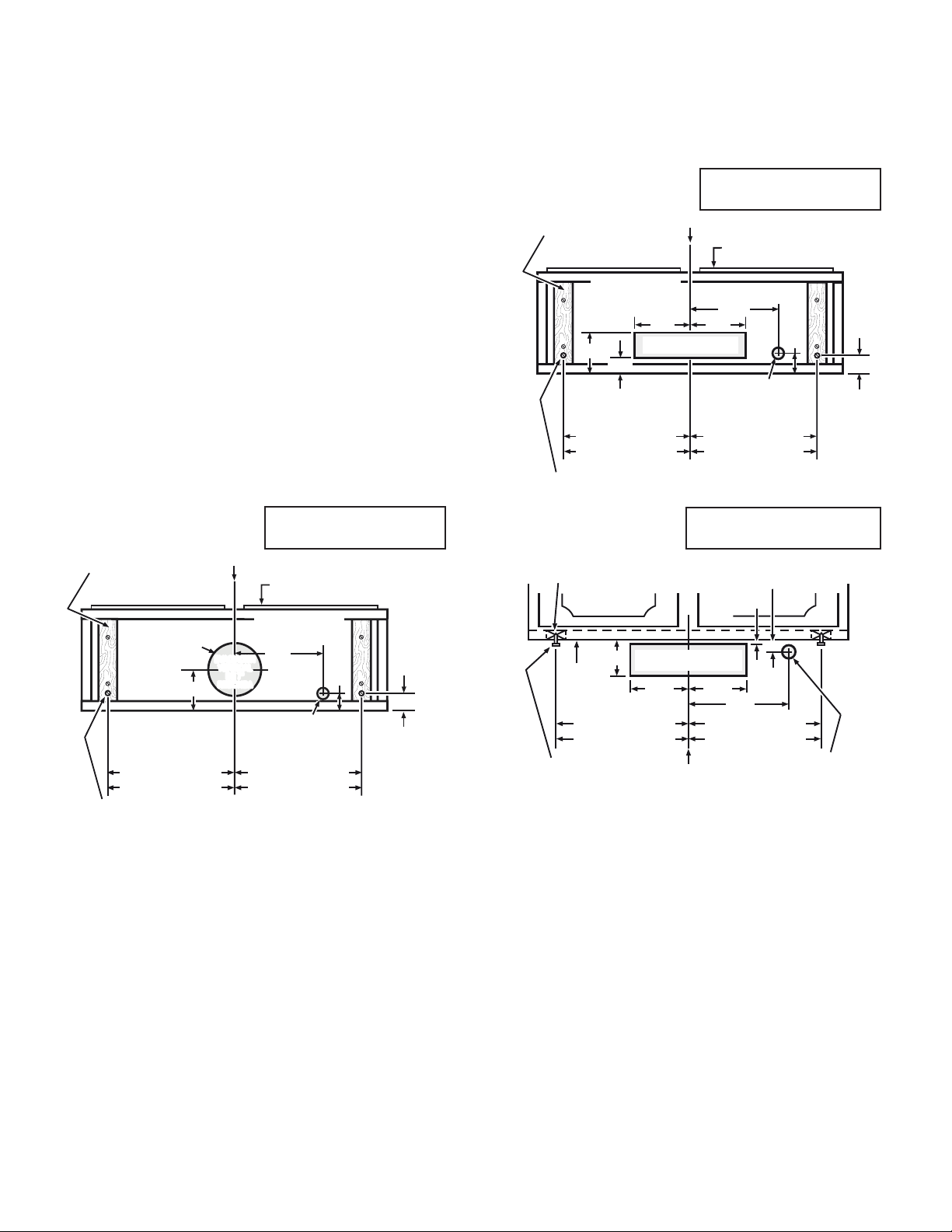
32
EVACUACIÓN VERTICAL
DE 3¼” x 10”
EVACUACIÓN HORIZONTAL
DE 3¼” x 10”
EVACUACIÓN VERTICAL
DE 7” REDONDA
1. Use el diagrama adecuado de abajo para colocar los
conductos y la alimentación eléctrica en el armario o en
la pared.
Para una instalación sin conductos, NO corte el orifi cio
de acceso al conducto; corte sólo el orifi cio para el
cableado eléctrico.
5¼"
5¼"
LÍNEA CENTRAL
3/4"
1Ǫ"
1½"
9¾"
4
7
/16"
TORNILLOS TRASEROS DE MONTAJE DE LA CAMPANA (2)
ORIFICIO PARA
ALIMENTACIÓN
ELÉCTRICA (
EN LA PARTE
INFERIOR
DEL ARMARIO)
CALZOS DE MADERA
(
ARMARIO CON PARTE INFERIOR
REBAJADA
ÚNICAMENTE)
PARTE INFERIOR
DEL ARMARIO
PARTE DELANTERA
DEL ARMARIO
ORIFICIO DE ACCESO PARA
CONDUCTO VERTICAL
12Ǭ"(CAMPANA DE 30")
12Ǭ"(
CAMPANA DE 30")
15Ǭ"(CAMPANA DE 36")
15Ǭ"(
CAMPANA DE 36")
3Ǭ"
13/16"
3/16"
5¼"
5¼"
9¾"
ORIFICIO PARA
ALIMENTACIÓN ELÉCTRICA
(
EN LA PARED)
LÍNEA
CENTRAL
TORNILLOS TRASEROS
DE MONTAJE DE
LA CAMPANA (2)
PARTE
INFERIOR
DEL ARMARIO
CALZOS DE MADERA
(
ARMARIO CON PARTE INFERIOR
REBAJADA
ÚNICAMENTE)
PARTE DELANTERA DEL ARMARIO
ORIFICIO DE ACCESO PARA
CONDUCTO HORIZONTAL
12Ǭ"(CAMPANA DE 30") 12Ǭ"(CAMPANA DE 30")
15Ǭ"(CAMPANA DE 36") 15Ǭ"(CAMPANA DE 36")
4¹¹/16"
1½"
Ǫ
9¾"
PARTE INFERIOR
DEL ARMARIO
LÍNEA CENTRAL
CALZOS DE MADERA
(
ARMARIO CON PARTE INFERIOR
REBAJADA
ÚNICAMENTE)
PARTE DELANTERA
DEL ARMARIO
TORNILLOS TRASEROS DE MONTAJE DE LA CAMPANA (2)
ORIFICIO PARA
ALIMENTACIÓN
ELÉCTRICA (
EN LA PARTE
INFERIOR
DEL ARMARIO)
EVACIACIóN
VERTICAL
DE 7"
REDONDA
EVACUACIÓN
VERTICAL
DE 7"
REDONDA
ORIFICIO DE 8"
DE DIÁMETRO
12Ǭ"(CAMPANA DE 30") 12Ǭ"(CAMPANA DE 30")
15Ǭ"(CAMPANA DE 36") 15Ǭ"(CAMPANA DE 36")
2. Instale parcialmente dos (2) tornillos de montaje de
CABEZA REDONDA n.° 8 x 5/8” en el calzo o en el
armario, de acuerdo con el diagrama adecuado de
arriba. Los otros dos tornillos de CABEZA REDONDA
n.° 8 x 5/8” estarán utilizados mas tárde. (Los tornillos
de montaje vienen en la bolsa de piezas, pero los calzos
de madera y los tornillos de montaje de los calzos no
están incluidos.)
Instalación normal (sin soportes EZ1)
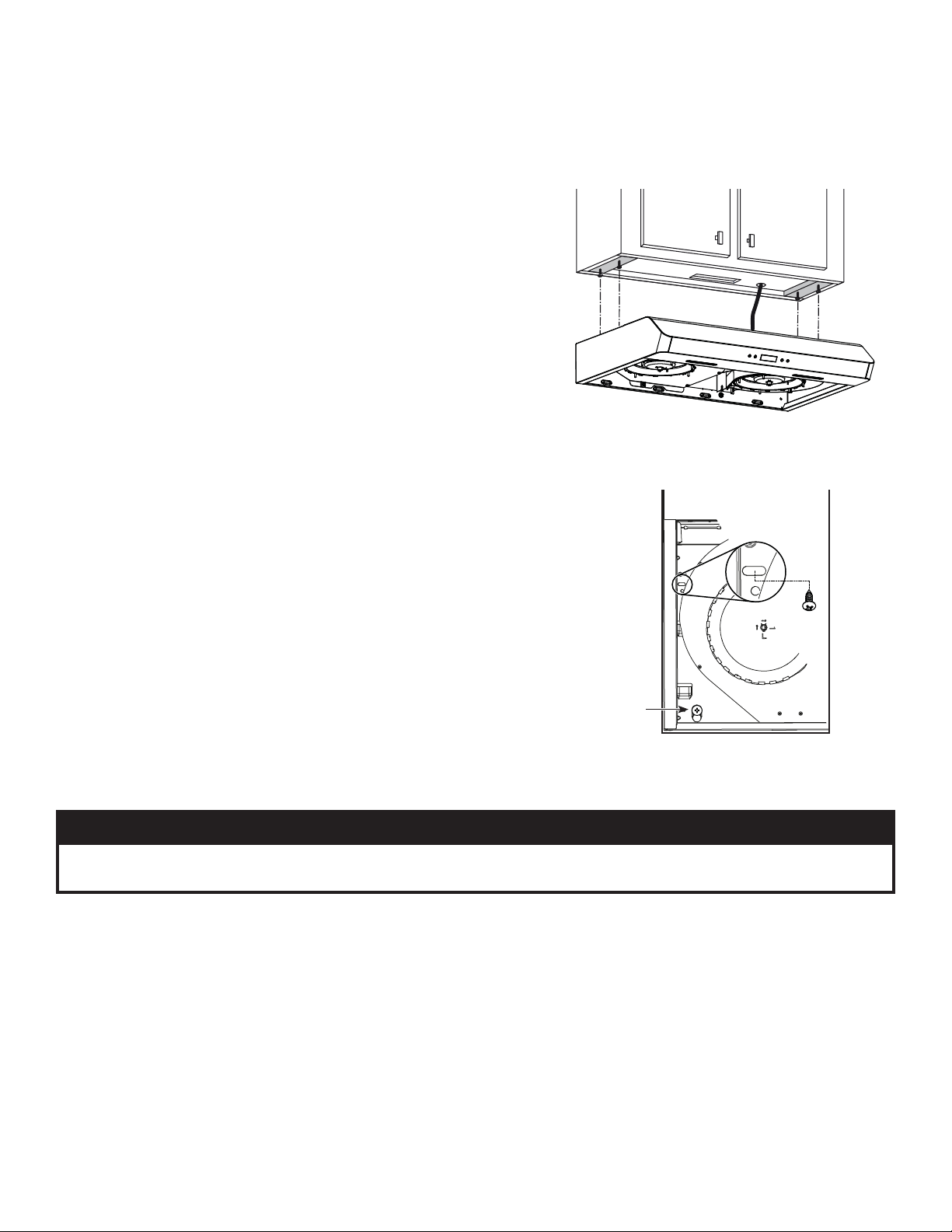
33
INSTALACIÓN CON CONDUCTOS ÚNICAMENTE
4. Conecte los conductos a la campana y use cinta adhesiva metálica para sellar las juntas. Asegúrese de que el conjunto
de la clapeta (o la placa del conducto redondo) entra en el conducto y que la clapeta se abre y se cierra sin difi cultad.
Instale la campana (Instalación normal)
1. Lleve el cable de alimentación de la vivienda del tablero
de servicio al lugar de la campana. Si el orifi cio de acceso
del cable alimentación de la campana este en su parte
trasera, lleve el cable de alimentación de la vivienda a
la campana a través de la descarga de presión instalada
previamente en la etapa 5 en la página 26. Si el orifi cio
del cable alimentación de la campana este en su parte
superior, sujete una descarga de presión adecuada de
1/2” de diámetro (no incluida) al cable de alimentación
antes de insertar este descarga de presión a través el
orifi cio y sujete el cable de alimentación a la campana.
2. Cuelgue la campana de los dos 2 tornillos de montaje
instalados previamente. Coloque de nuevo la campana
contra la pared hasta que las cabezas de los tornillos
de montaje se introduzcan en el extremo estrecho de
las ranuras de los orifi cios en forma de cerradura en
la parte superior de la campana. Apriete los tornillos
fi rmemente y sostenga la campana hasta que la etapa
3 esta terminada.
NOTA: Debido al peso de esta campana, se aconseja quela instalen dos instaladores.
PARTE TRASERA
DE LA CAMPANA
T
ORNILLO APRETADO
PREVIAMENTE A LA ETAPA 2
3. Sujete la campana al armario por medio de dos tornillos
de montaje de CABEZA REDONDA n.° 8 x 5/8” (los
tornillos vienen en la bolsa de piezas). Introduzca 1 tornillo
en cada lado, en las ranuras (como se ve en los detalles
de la ilustración al lado). Sujete el cable de alimentación
a la campana usando la descarga de presión.
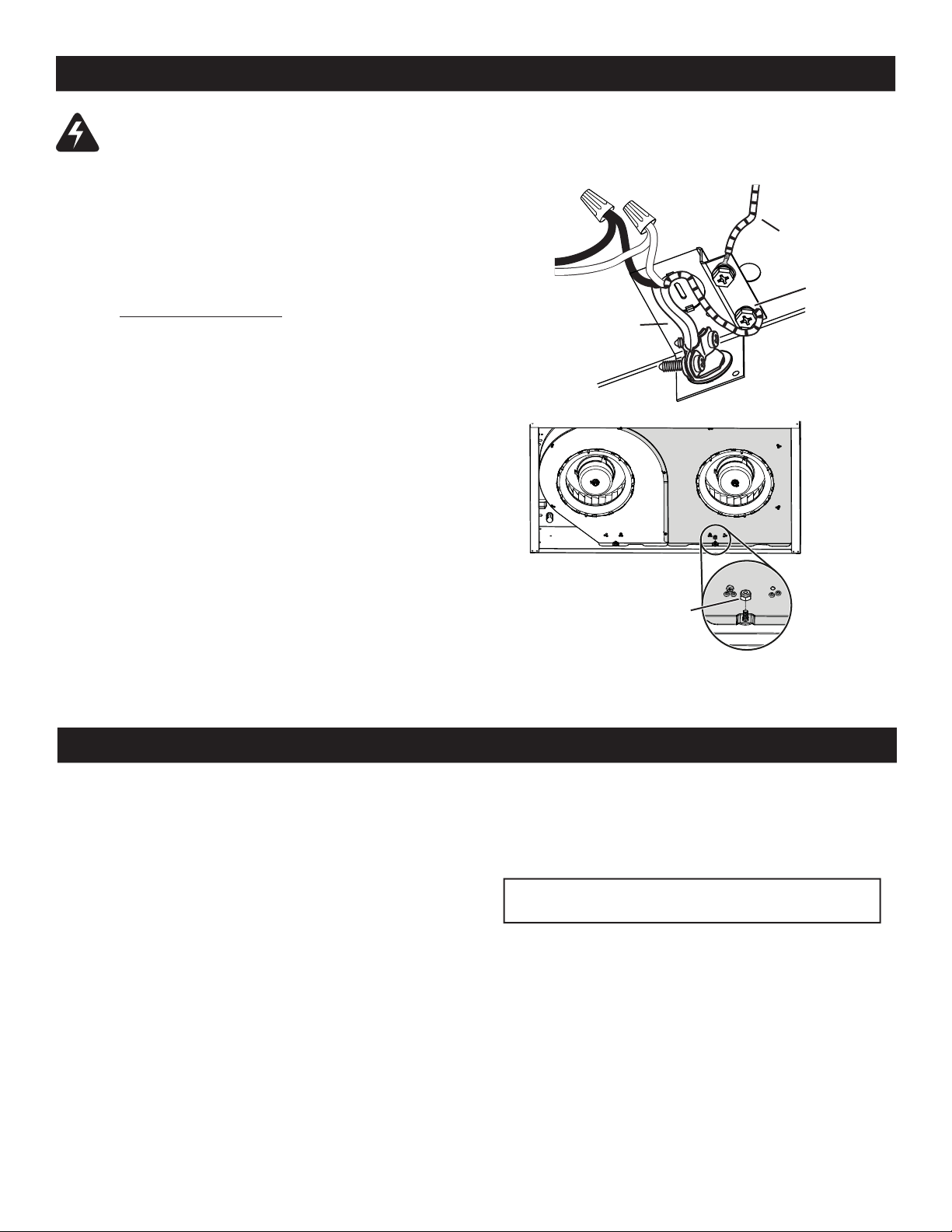
34
ADVERTENCIA: Riesgo de descarga eléctrica. El
cableado eléctrico debe hacerlo personal cualifi cado
de acuerdo con los códigos y normas aplicables.
Antes de conectar los hilos, corte la corriente en el
tablero de servicio y bloquee éste para evitar que
se ponga en marcha accidentalmente.
1. Conecte el cable de alimentación de la vivienda al
cableado de la campana: El hilo NEGRO con el NEGRO,
el BLANCO con el BLANCO y el VERDE o el hilo pelado
con el tornillo VERDE de tierra.
CONECTE EL CABLEADO
HILO DE
TIERRA DE LOS
MOTORES
CABLE DE
ALIMENTACIÓN
DE LA VIVIENDA
TORNILLO
DE TIERRA
2. Reinstalar la placa de cubierta del ventilador (parte
sombreada de la ilustración al lado) utilizado la tuerca
de bloqueo y los tornillos previamente quitados en la
etapa 3 en la página 26. Prestar atención a la ubicación
del tornillo 1, desde el punto de vista de la parte trasera
de la campana, su ubicación debe ser a la izquierda de
la tuerca de bloqueo (vease el recuadro).
1
2
3
45
6
7
1
PARTE TRASERA
DE LA CAMPANA
TUERCA DE
BLOQUEO
Instalación con conductos únicamente:
Vuelva a instalar los fi ltros de grasa que quitó en la etapa 2 ,
en la página 25 (sección “Prepare la campana”).
INSTALE LOS FILTROS
Instalación sin conductos únicamente:
Compre dos fi ltros para instalación sin conductos (vea el
número de pieza en piezas de servicio). Instale los fi ltros
de recirculación siguiendo las instrucciones que vienen con
los fi ltros.
“Filtros de recirculación”
disponibles llamando al
1-844-553-6667
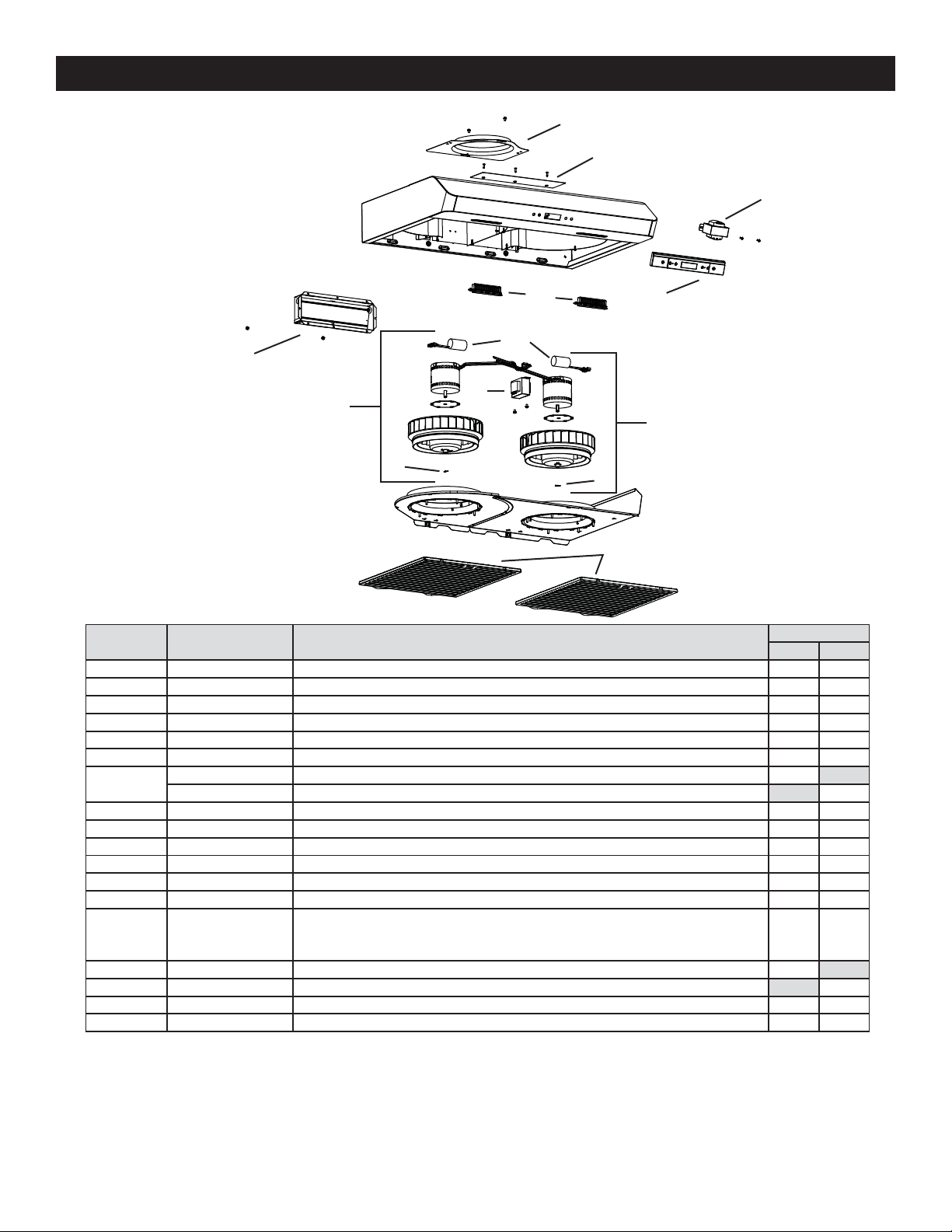
35
PIEZAS DE SERVICIO
Pida piezas de reposición por su PIEZA NO. – no por su CLAVE N.°
* No ilustrado
1
2
3
4
7
5
6
9
CLAVE N.° PIEZA N.° DESCRIPCIÓN
CANTIDAD
51403 51413
1 S97020031 RP
LACA DE CUBIERTA DE RECIRCULACIÓN, ACERO INOX. (INCLUYE TORNILLOS)11
2 SR680508 C
ONECTOR DE CONDUCTO REDONDO DE 7'' (INCLUYE TORNILLOS)11
3 S97020534 C
ONJUNTO DE CLAPETA DE 3¼” X 10” (INCLUYE TORNILLOS)11
4 S97020412 C
ONDENSADOR 22
5 S97020842 M
ONTAJE DEL VENTILADOR ROTACIÓN A DERECHA (INCL. N.° 4, N.° 6 Y FERRERIA DE MONTAJE)1 1
6 SR99420635 C
LIP DE LA HÉLICE 11
7
S97020204-002 F
ILTRO DE GRASA - HíBRIDO - TYPO C1 (JUEGO DE 2) 1
S97020204-003 F
ILTRO DE GRASA - HíBRIDO - TYPO D1 (JUEGO DE 2) 1
8 S97020843 M
ONTAJE DEL VENTILADOR ROTACIÓN A IZQUIERDA (INCL. N.° 4, N.° 6 Y FERRERIA DE MONTAJE)1 1
9 S97020797 A
UTOTRANSFORMADOR (INCLUYE TORNILLOS)11
10 S97020444 M
ÓDULO DE LED (JUEGO DE 2) 1 1
11 S97020438 C
ONTROL CON PANTALLA DE CRiSTAL LíQUIDO (INCLUYE TORNILLOS)11
12 S97020445 T
RANSFORMADOR 24 V 18 VA (INCLUYE TORNILLOS)11
* S97020796 H
ARNÉS DE HILOS CON AUTOTRANSFORMADOR Y FUSIBLE 11
* S97020360
B
OLSA DE PIEZAS, INCLUYE: 4 TORNILLOS PARA METAL N.° 8-18 X 1/2”,
6
TORNILLOS DE CABEZA REDONDA PARA MADERA N.° 8 X 9/16”,
6 TORNILLOS EMBUTIDOS N.° 8 X 1/2”
11
* S97020466 F
ILTRO DE RECIRCULACIÓN - TYPO XC (JUEGO DE 2) (INST. SIN CONDUCTOS úNICAMENTE)1
* S97020467 F
ILTRO DE RECIRCULACIÓN - TYPO XD (JUEGO DE 2) (INST. SIN CONDUCTOS úNICAMENTE)1
* S99527587 J
UEGO DE SUJETADORES PARA FILTROS DE CARBÓN – INCLUYE 4 SUJETADORES 11
* S97020470 E
QUIPO PARA FÁCIL INSTALACIÓN (INCLUYE TORNILLOS)11
8
6
10
11
12
REPUESTOS
Para que el aparato esté en buenas condiciones, use sólo repuestos genuinos del fabricante unicamente. Estas piezas se han diseñado
especialmente para cada unidad y se han fabricado conforme a las normas de certifi cación aplicables y un elevado nivel de seguridad.
El uso de repuestos de otros fabricantes podría causar daños graves y reducir radicalmente el desempeño de la unidad, causando así
fallas prematuras. Para compra los repuestos genuinos que fi guran arriba, llamando 1-844-553-6667.
Kenmore ®
Customer Care Hotline
To schedule in-home repair service
or order replacement parts
Para pedir servicio de reparación
a domicilio, y ordenar piezas
1-844-553-6667
www. kenmore. com
®
