en
Instruction Manual and Installation Instruction
Washer

2
Your new washing machine
You have chosen a Bosch washing machine.
Please take a few minutes to read and become familiar with the
advantages of your washing machine.
To meet the high quality demands required by Bosch, every washing
machine that leaves our factory is carefully checked to ensure that
it functions correctly and is in perfect condition.
For more information on our products, accessories, replacement
parts and services, see our website www.bosch-home.com or
contact our after-sales service centres.
If the operating and installation instructions describe different
models, any differences will be pointed out at the relevant points in
the text.
Read these operating and installation instructions before switching
on the washing machine

3
Table of contents
Operating instructions
General safety information ......................................................... 4
Environmental protection/economy tips .................................. 6
Before washing for the first time ............................................... 8
Preparing and sorting the laundry ............................................ 8
Detergents and care products .................................................10
Programmes ...............................................................................12
Washing options ........................................................................13
Washing .......................................................................................14
Cleaning and care .....................................................................16
What to do if... ............................................................................19
After-sales service .....................................................................22
Installation instructions
Installation instructions .............................................................23
Appendix
Consumption rates ....................................................................27
Table of programmes ...............................................................28
Index .............................................................................................29

4
General safety information
Intended use
– For private domestic use only.
– The washer dryer is suitable for machine washable textiles and hand
washable wool and for drying certain types of textiles according to care
instructions.
– The appliance is suitable for operation with cold mains water and
commercially available detergents and care products which are
suitable for use in a washer dryer.
– Always follow the manufacturer's instructions when dosing
all detergents, cleaning aids, cleaning products and cleaning agents.
– The washer dryer may be operated by children from 8 years of age, by
persons who have limited physical, sensory or mental abilities and by
persons who have inadequate experience or knowledge, provided
they are supervised or have been instructed by a responsible
person.Children must not perform any cleaning or maintenance work
without supervision.
– Keep children under the age of 3 years away from the washer dryer.
– Keep pets away from the washer dryer.
– Install and operate the washer dryer in a room which has an outflow.
This washer-dryer complies with the relevant safety regulations.
Electrical safety
Warning
Danger of death!
Danger of death if live parts are touched.
– When disconnecting the mains plug, always pull the plug
itself and not the cable, otherwise the cable could be
damaged.
– Never touch or hold the mains plug with wet hands.
Risk of injury
Warning
Risk of injury!
– If the washer dryer is lifted using projecting parts (e.g. the
washer dryer door), these components may break off and
cause injuries.
– Do not lift the washer dryer by its projecting parts.
– If you climb onto the washer dryer, the worktop may break and
cause injuries.
– Do not climb onto the washer dryer.
– If you lean/support yourself on the open door, the washer
dryer may overturn and cause injuries.
– Do not lean on the open washer dryer door.
– If you reach into the rotating drum, you may injure your hands.
– Do not grip the rotating drum. Wait until the drum stops
rotating.
Warning
Risk of scalding!
– When washing at high temperatures, you may be scalded
if you touch the hot washing water (e.g. if draining hot
washing water into a washbasin).
– Do not touch the hot washing water.
– If a drying programme was interrupted, the washer dryer
and laundry may be very hot. Select Intensive Dry Ù or
Low Heat Dry ^ and select 15 min drying time to cool
down the washing and then remove.

5
Safety for children
Warning
Danger of death!
If children play with the washer dryer, they may get into life-
threatening situations or injure themselves.
– Do not leave children unattended near the washer dryer.
–Do not let children play with the washer dryer.
Warning
Danger of death!
Children may lock themselves in appliances, putting their
lives at risk.
For appliances that have reached the end of their service
life:
– Disconnect the mains plug.
– Cut through the mains cable and remove it, along with plug.
– Destroy the lock on the washer dryer door.
Warning
Risk of choking!
Children may become wrapped in packaging/film or packing
parts if allowed to play with them, or they may pull them over
their heads and suffocate.
Keep packaging, film and packaging parts out of the reach
of children.
Warning
Risk of poisoning!
Detergents and care products may be poisonous if
consumed.
Keep detergents and care products out of the reach of
children.
Warning
Eye / skin irritation!
Detergents and care products may cause irritation if they
come into contact with the eyes or skin.
Keep detergents and care products out of the reach of
children.
Warning
Risk of injury!
When you wash/dry at high temperatures, the glass in the
washer dryer door gets hot.
Do not let children touch the hot washer dryer door.

6
Environmental protection/economy
tips
– Separate out the various waste materials of the packaging and take
them to the nearest collection point.
– Always fill the appliance with the maximum amount of laundry for each
programme.
– Wash normally soiled laundry without a prewash.
– Measure the detergent according to the manufacturer's instructions
and in line with the local water hardness.
– If the laundry is subsequently dried in a tumble drier, select the spin
speed according to the tumble drier manufacturer's instructions
.
WEEE
)
This appliance is labelled in accordance with European Directive 2012/
19/EU concerning used electrical and electronic appliances (waste
electrical and electronic equipment - WEEE).
The guideline determines the framework for the return and recycling of
used appliances as applicable throughout the EU.
7
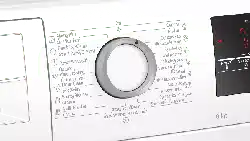
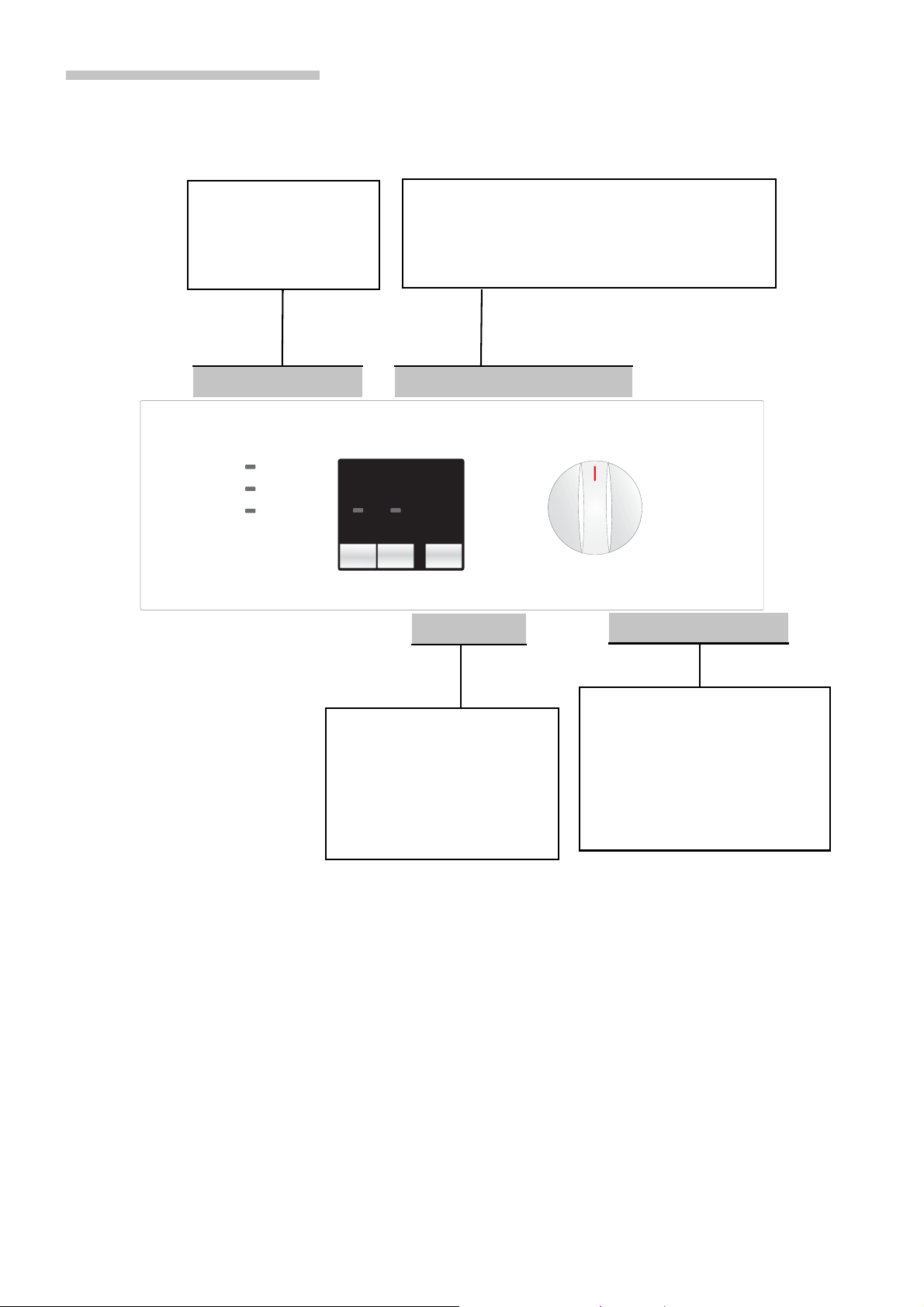
Control panel
Function selection buttons with indicator lights
Show the selected settings:
– $ Flot antiarrugas: Rinse stop
–
C 0: reduce maximum spin speed by
200 rpm (depending on model).
Function selection buttons
Operating condition
Indicator lights for
programme progress
Shows the programme
progress and the
programme status.
Programme selector page 12
Switches the washing machine
on and off and for selecting the
programme, turnable in both
directions.
Do not change the position of the
programme selector during
washing.
Programme selector
% Inicio/ Pausa
% Inicio/Pausa (Start/Pause)
button page 13.
Starts the selected
programme.
– Reset function:
Resets to the original
settings page 15.
8
Before washing for the first time
The washing machine was tested before leaving the factory.
In order to remove any testing water which may be remaining, run the first
washing cycle without any laundry.
Make sure that the transport locks on the back of the washing machine
have been removed page 24.
Do not load any laundry.
Close the loading door.
Turn on the water tap.
Pull out the detergent drawer.
Add ½ a measuring cup of detergent to compartment II page 10.
Do not use detergents for woollens or delicates (these cause foaming).
Close the detergent drawer.
Turn the program selector to a 60°C programme.
Press the % Inicio/Pausa (Start/Pause) button.
At the end of the programme, set the programme selector to
Stop (Off).
Open the door.
Leave the loading door open in order that the inside of the washing
machine can dry.
Preparing and sorting the laundry
Sorting laundry for
washing
– Check the manufacturer's care instructions and care labels.
The laundry may be damaged if you do not observe the fabric care
symbols. Knitwear made of wool or which contains a proportion of wool
must have the label “machine-washable”.
– Wash white laundry separately from coloureds.
– Sort according to type, colour, level of soiling and temperature.
New coloured laundry should be washed separately.
Risk of discolouration.
– Unhemmed or torn items should not be washed in the machine, as they
may fray.
– Do not exceed the permissible load capacity page 27.
i
i
i
9
Only wash laundry with the following care labels:
Laundry with care symbol Do not wash.
Preparing laundry for
washing
Loose foreign bodies (e.g. coins, paper-clips, needles, nails) may damage
the laundry and components of the washing machine (e.g. the drum).
Empty the pockets of all items.
Brush any sand out of pockets and collars.
Pretreat any stains.
Close zips, do up cover buttons.
Remove curtain fittings or place curtains in a laundry bag.
Wash the following in a laundry bag/pillowcase:
– Delicates, (e.g. tights, curtains),
– small items of laundry (e.g socks or handkerchief),
– underwired bras (the underwiring may come loose during the
washing process and cause damage).
Turn trousers, knitwear and jersey fabrics, e.g. hosiery, T-shirts or
sweatshirts, inside out.
Loading the laundry
Before loading the washing machine, make sure that there are no
inappropriate objects or pets in the drum.
Risk of explosion. Items that have been pretreated with cleaning agents
containing solvents, e.g. stain remover or stain solvent, must be carefully
rinsed by hand before they are loaded into the machine.
Unfold the laundry and place it loosely into the drum.
Load large and small items together.
Check the maximum drum loads,
programme table page 27.
Take care not to trap items of laundry between the door and the rubber
seal.
Close the door. You will hear it click shut.
Measure out appropriate amounts of detergent and care products and
pour into the machine.
Turn on the water tap.
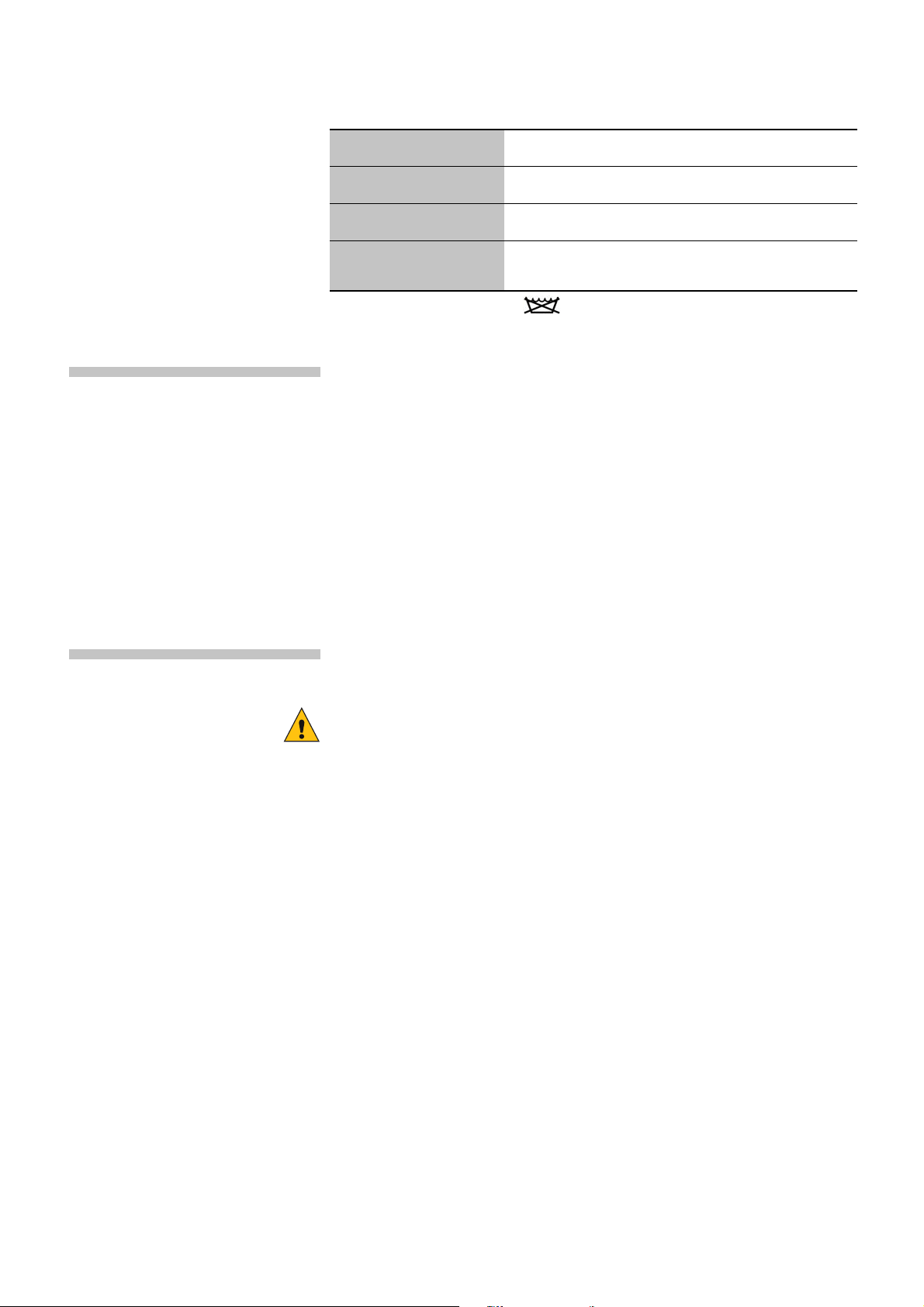
Sorting laundry according
to the information on the
care labels
Care label Type of laundry
<;
Cottons 90 °C.
:98
Coloureds 60 °C, 40 °C, 30 °C.
BA>
Easy-care 60 °C, 40 °C, 30 °C.
uFAE>
Hand- and machine-washable silk and wool, cold,
40 °C, 30 °C.
10
Detergents and care products
Detergent drawer
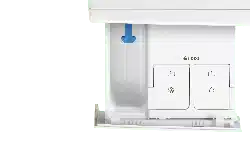
The detergent drawer is divided into three compartments
Compartment I : Detergent for prewash.
Compartment II : Detergent for main wash.
Compartment i : Liquid additives such as starch and fabric softener.
Additives are automatically flushed into the machine during the last wash
cycle.
– Do not exceed the maximum capacity, otherwise compartment i may
be emptied too early.
– Dilute viscous additives with water before adding them to the detergent
drawer compartment to prevent blockages.
Liquid detergent insert: must be folded down before liquid detergents
are used.
To do this:
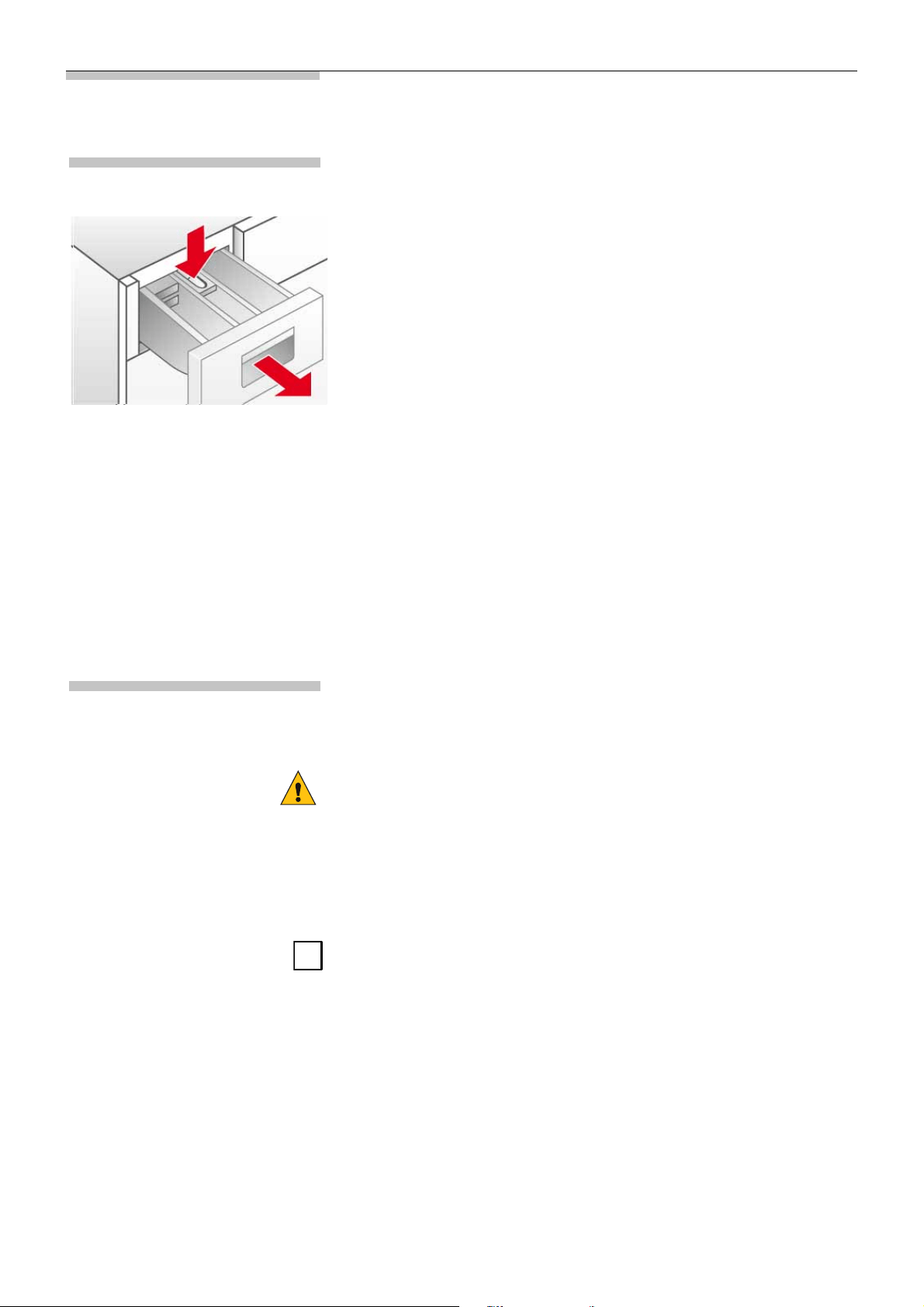
Pull out the detergent drawer as far as the stop.
Press on the blue zone marked PUSH and fully remove the detergent
drawer page 16.
Pull the blue insert in compartment II fully forward and fold
downwards.
Insert the detergent drawer.
Do not use the insert (push upwards):
– with gel-type detergents and washing powder, or
– if using programmes with +Prewash.
Detergents and care
products
Risk of poisoning
Keep detergents and care products out of the reach of children.
Risk of injury
Exercise caution when opening the detergent drawer. There may still be
detergent residues left in the drawer.
Select the correct dosage for the detergent according to:
– the amount of laundry,
– the instructions of the detergent manufacturer,
– how dirty the laundry is,
– water hardness. You can find out about the water hardness in your area
from your local waterworks.
Using the correct dosage reduces the impact on the environment and
gives a good washing result.
II
I
i
II
I
i
i

11
Correct selection of detergent
The care label is crucial for selecting the correct detergent, temperature and
treatment of the laundry. ~ See also www.sartex.ch
If you visit www.cleanright.eu, you will find further information on detergents,
care products and cleaning agents for domestic use.
Standard detergent with optical brighteners
Suitable for boil-washable white laundry made from linen or cotton
Programme: Cottons/
cold - max. 90 °C
Detergent for colours without bleach or optical brighteners
Suitable for coloured laundry made from linen or cotton
Programme: Cottons/
cold - max. 60 °C
Detergent for colours/delicates without optical brighteners
Suitable for coloured laundry made from easy-care fibres, synthetic fibres
Programme: Easy-Care/
cold - max. 60 °C
Detergent for delicates
Suitable for delicate, fine fabrics, silk or viscose
Programme: Delicate/Silk/
cold - max. 40 °C
Detergent for woollens
Suitable for wool
Wool programme/
cold - max. 40 °C
Normally soiled laundry
Set the programme.
Add all the detergent, according to the manufacturer's instructions, to
compartment II of the detergent drawer.
– Only use pH-neutral wool detergent for woollens programmes.
– Add fabric softener to compartment i.
Heavily soiled laundry
Set programme with prewash.
Add 1/4 of the recommended amount of detergent to compartment I
of the detergent drawer and 3/4 of the detergent to compartment II.
Only use liquid detergent for the main wash cycle.
To do this:
Add the recommended amount of detergent to a liquid detergent
measuring aid and place it in the drum.
or
After folding down the liquid detergent insert, pour the detergent into
compartment II of the detergent drawer.
Use the scale on the liquid detergent insert as a guide for the dosage of
liquid detergent.
If compartment II is used for washing powder, the liquid detergent insert
must be folded up.
Measuring washing powder
i
Measuring liquid detergent
i
i

12
Programmes
Programme selector
The programme selector is used to set the washing programmes.
Washing programmes
Algodón / Algodao (Cottons)
Suitable for hard-wearing fabrics, heat-resistant fabrics made from cotton
or linen.
– Coloureds up to 60 °C.
– Whites up to 60 °C.
Algodón / Algodao (Cottons) 40°C/60°C û/ú
The programmes (standard programmes, indicated by ü) are suitable
for cleaning normally soiled cotton fabrics and are the most efficient with
respect to combined energy and water consumption.
Sintéticos (easy-care) (cold*, 40°C, 60°C)
Washing programme for less robust fabrics made of cotton, linen,
synthetic fibre or blended fabrics. Sorting by colour is recommended.
Delicados (Delicates) frio (cold*)
Low heat programme for delicate, washable fabrics, e.g. made of silk,
satin, synthetic fibre or blended fabrics (e.g. curtains). Gentle spinning
between wash cycles and reduced final spin speed.
Lana/La (Wool) (cold*, 30°C)
Wool becomes matted under the influence of heat, moisture and move-
ment. The woollens programme takes account of these properties and
finds the optimum way between drum standstill and movement.
Suitable for hand- or machine-washable fabrics made from wool or a wool
blend.
Special programmes
O / C (Rinse + Spin)
Wash cycle followed by spinning. Fabric softener or starch can also be
used in this programme.
C (Spin)
Separate spin cycle; Detergent solution or water used for rinsing are
emptied before the spin cycle starts.
[ (Empty)
Emptying of the water used for rinsing without final spin cycle after
selecting a washing programme with the setting
D (Rinse stop).
(*Depending on model)

13
Washing options
Button C 0
The maximum spin speed* (*depending on model, programme table
page 27) is reduced by 200 rpm. This programme reduces the
formation of creases.
By repeatedly starting and stopping drum spinning, the unbalanced load
detection system ensures that the laundry is evenly distributed. For safety
reasons, the speed of the final spin is reduced or the spin cycle is not run
if the laundry is very unevenly distributed.
$ button Flot
antiarrugas
(Rinse stop)
The laundry remains in the last water used for rinsing. Suitable for
delicate fabrics and curtains page 14
% Inicio/Pausa button
(Start/Pause)
Press % Inicio/ Pausa (Start/Pause) to start the selected programme.
Programme progress
Display of programme progress by indicator lights lighting up:
preparado (ready)
lavar (wash)
- After switching on the washing machine, the indicator lights
lavar (wash) (preparado (ready) flash.
- When the programme is started, lavar (wash) remains constantly lit.
aclar / enx. (rinse)
- The light remains lit during rinsing.
- Rinse stop selected: all indicator lights are switched off. Button
D 0
(Rinse stop) flashes.
centrifugar (spin)
- Light remains lit during spinning.
- When spinning has finished, centrifugar (spin) (terminado (finished))
flashes.
terminado (finished)
Unbalanced load detection
system

14
Washing
Washing
Set the programme selector to the desired programme,
e.g. Resistentes/ Algod. (Cottons) 60°C.
The lavar (wash) (preparado (ready)) indicator light flashes
Where required, reduce the spin speed or select $ Flot antiarrugas
(Rinse stop) page 13.
Load the laundry page 9.
– Observe the maximum load,
Programme table page 27.
Press the % Inicio/Pausa (Start/Pause) button.
– The washing programme starts.
–The lavar (wash) indicator light lights up.
End of the programme
The washing programmes are automatically ended.
Set the programme selector to Stop (Off).
Remove the washing from the drum.
Leave the loading door open in order that the inside of the washing
machine can dry.
Turn off the water tap.
If the spin function was deactivated at the start of washing,
$ Flot antiarrugas (Rinse stop) (Without final spin = laundry remains in
the last water used for rinsing), the washing programme is stopped after
the last rinse.
In order to drain the rinsing water and, if required, spin the laundry:
Set the programme selector to centrifugar (spin).
- By pressing the
C 0 button, the spin speed can be reduced by 200
rpm. The water is emptied and the washing machine spins.
The maximum spin speed depends on the selected washing programme.
If you do not wish to spin the laundry:
Set the programme selector to [ (Empty). The water is emptied but
the washing machine does not spin. The programme has finished
when the terminado (finished) indicator light flashes.
Set the programme selector to Stop (Off).
Remove the laundry.
Leave the loading door open in order that the inside of the washing
machine can dry.
Programme change
You have selected an incorrect programme by mistake:
Select the programme again and press
% Inicio/Pausa (Start/Pause). The new programme starts from the
beginning.
$ Flot antiarrugas (Rinse stop)
i

15
Programme termination
Press and hold the % Inicio/Pausa (Start/Pause) button for three
seconds.
For washing programmes at high temperatures:
– Cooling the laundry: select O / C (Rinse + Spin).
–Select % Inicio/Pausa (Start/Pause).
For programmes with a low temperature:
–Select O / C (Rinse + Spin) or [ (Empty).
–Select % Inicio/Pausa (Start/Pause).
Reset function
– You can use the Reset function to return to the original settings. To do
this, press and hold the % Inicio/Pausa (Start/Pause) button until all
three programme progress lights light up.
16
Cleaning and care
Safety information
Risk of electric shock.
The appliance must first be disconnected from the mains. Never clean
the washing machine with a jet of water.
Risk of explosion
Never clean the washing machine with solvents.
Risk of scalding
Hot detergent solution must be allowed to cool before being drained.
Housing and control
panel
– Remove detergent residues immediately.
– Wipe away with a soft, damp cloth.
– Cleaning with a jet of water is prohibited.
Washing drum
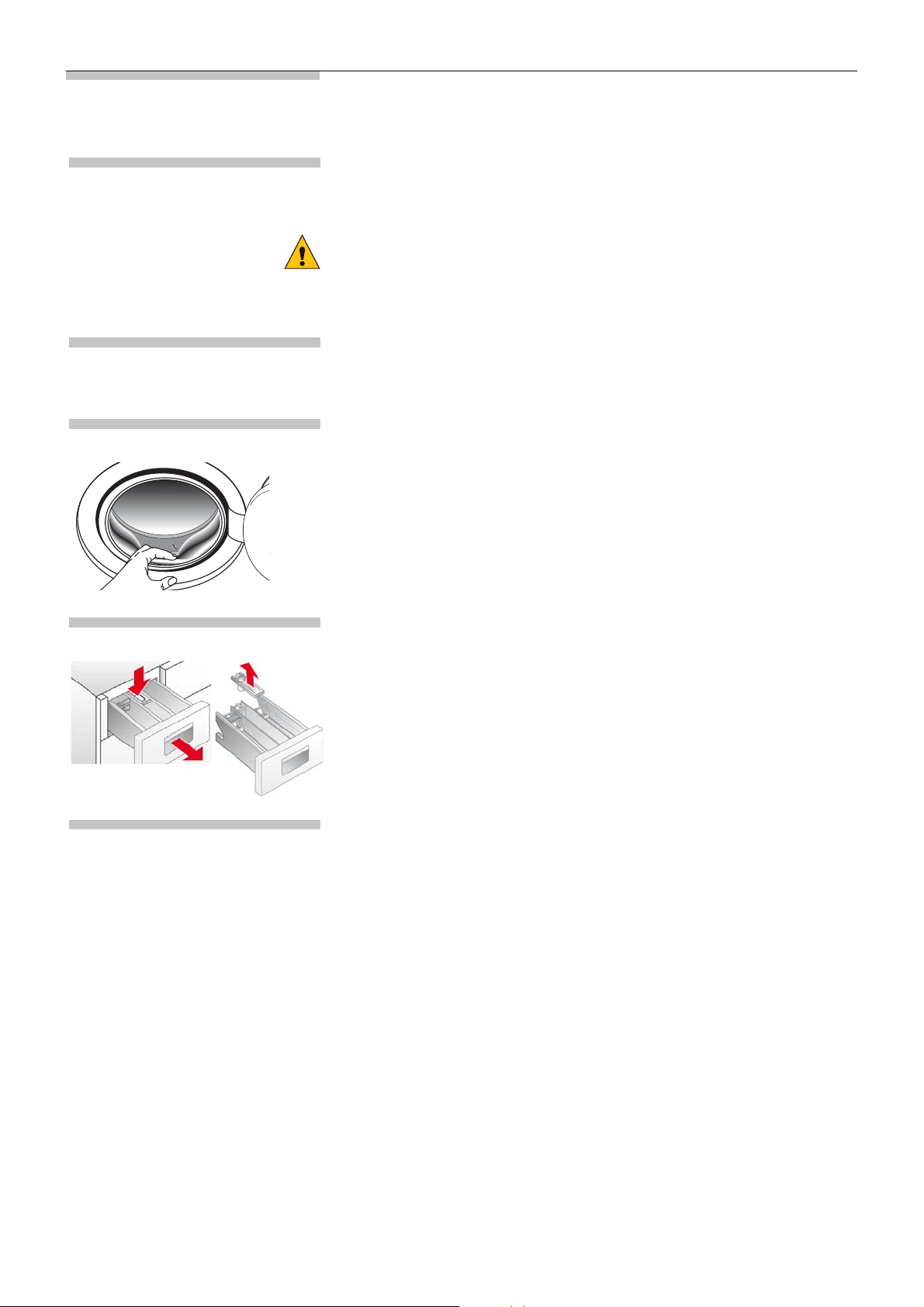
– Remove any foreign bodies from the drum and rubber seals.
– Leave the loading door open in order that drum can dry.
– Use chlorine-free cleaning agents. Follow the information provided by
the manufacturer. Never use steel wool.
Detergent drawer
If there are detergent or care product residues:
Pull out the detergent drawer as far as the stop.
Press on the zone marked PUSH and take out the detergent drawer.
Clean the detergent drawer guide.
Remove the fabric softener compartment insert.
Clean the detergent drawer and fabric softener compartment insert
under running water.
Insert the fabric softener compartment insert.
Insert the detergent drawer.
Descaling the washing
machine
Not necessary if the correct measures of detergent are used but, if still
required, follow the information provided by the descaler manufacturer.
Suitable descalers can be ordered via our website or from our after-sales
service page 22.
17
Detergent solution
pump
Notes on blockages
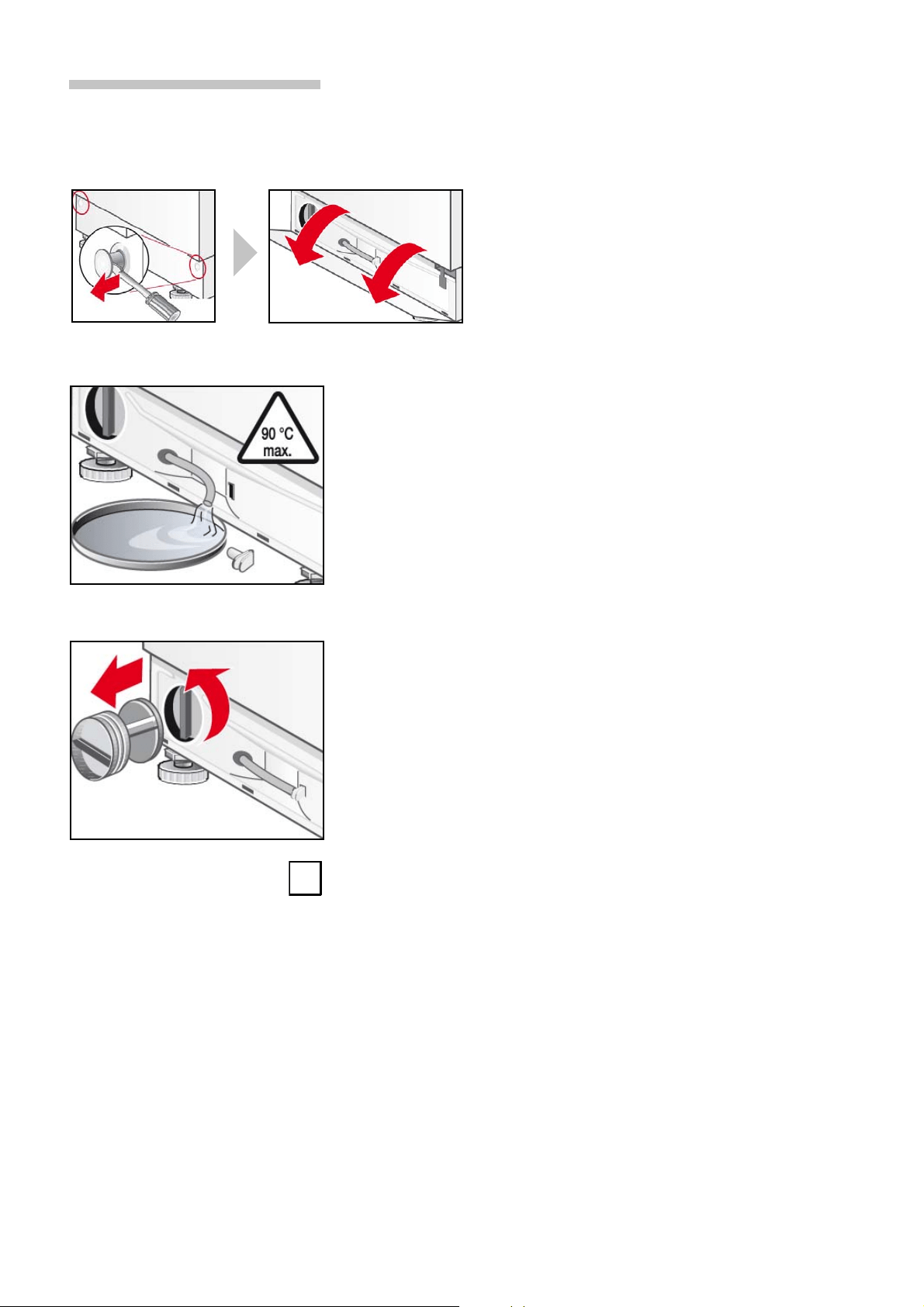
Remove the drain hose from its retainer.
Remove the sealing cap from the drain tube and allow the water to
drain off.
– The container for the drained water may have to be emptied several
times.
– When no more water emerges, refit the sealing cap.
Place the drain hose into the retainer.
Carefully unscrew the pump cover (remaining water).
– Clean the interior, pump cover threads and pump housing (it must
be possible to turn the impeller).
Replace the pump cover and screw it down.
Place the servicing flap into the 4 clip-in slots and fasten to the housing
with the lock pin.
To prevent detergent flowing unused into the outlet the next time laundry
is washed:
Pour 1 litre of water into compartment II and start the Empty programme.
Set the programme selector to Stop (Off).
Use a screwdriver to release the lock pins.
Fold up the servicing panel and remove it
upwards.
Draining the water
Cleaning the detergent solution pump
i
18
Filter in the water inlet
*Water inlet hose depending on model
If no water, or an insufficient amount of water, runs into the washing
machine, first release the water pressure in the inlet hose:
Turn off the water tap.
Select any programme (except O / C (Rinse + Spin) / [ (Empty).
Press the % Inicio/Pausa (Start/Pause) button.
Allow the programme to run for approximately 40 seconds.
Set the programme selector to Stop (Off).
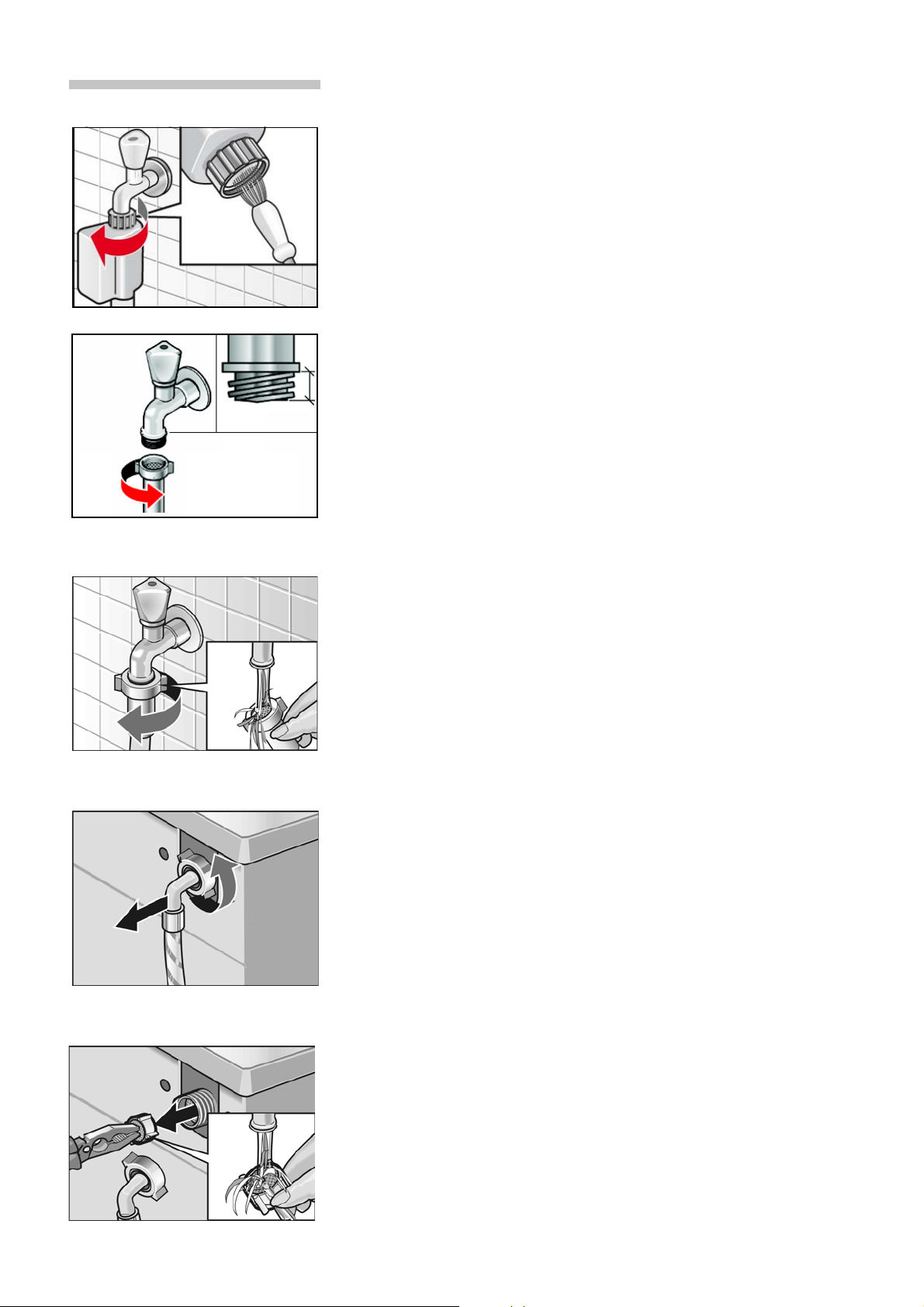
Unplug the mains plug from the socket.
Unscrew the water inlet hose from the tap.
Clean the filter with a small brush.
Reconnect the hose.
Turn on the water tap.
Check whether water comes out of the end of the hose.
If water is escaping, check that the filter is correctly seated.
Remove the hose from the water tap.
Rinse out the filter under running water.
Connect the hose.
Remove the hose from the rear of the washing machine.
Pull out the filter and rinse out under running water.
Insert the filter and connect the hose.
Turn on the tap and check whether water still escapes. If water still
escapes, check that the filter is seated correctly.
Turn off the water tap.
Cleaning the filter on the tap
Cleaning the filter on the washing machine
Cleaning the filter on the washing machine
19
What to do if...
Risk of electric shock.
Repairs must only be carried out by customer services or authorised
technicians.
If repairs are needed, or if you cannot rectify a fault yourself with the help
of the following table:
Set the programme selector to Off.
Disconnect the washing machine from the mains.
Turn off the tap.
Call the after-sales service page 22.
Other fault codes are intended exclusively for the after-sales service.
Note down the fault code for the after-sales service.
Fault Possible cause Remedial action
Programme does not start. Start/Pause button not pressed? Press the % Inicio/Pausa
(Start/Pause) button.
Power failure? Start programme immediately:
Press the % Inicio/Pausa
(Start/Pause) button.
The door is not properly closed. Close the door.
Plug not inserted properly into socket. Insert plug correctly.
Washing machine not react-
ing.
Programme fault? You can use the Reset function to
return to the original settings. To do
this, press and hold the % Inicio/Pausa
(Start/Pause) button until all three
programme progress lights light up.
The water is not drained. Outlet hose is twisted. Fit the outlet hose correctly.
Detergent solution pump is blocked. Clean the detergent solution pump
page 17.
Detergent residues in the
detergent drawer.
Damp or lumpy detergent. Clean and dry the detergent drawer
page 16.
Use the measuring aid for liquid
detergent.
Fault code rapid flashing of the
following indicator lights
Remedial action
lavar (wash) The door is not properly closed. Close the door.
centrifugar (spin) +
lavar (wash) +
C 0
Water is not flowing in. See Fault Water not running in.
aclar / enx. (rinse) + lavar
(wash) + $ Flot
antiarrugas (Rinse stop)
The water is not drained. See Fault Water is not emptied.
20
Water is not flowing in. The mains plug is not correctly
plugged in.
Plug in the mains plug correctly.
The door is not properly closed. Close the door.
The tap is not turned on. Turn on the tap.
Filter in the water inlet hose is blocked Clean the filter in the water inlet hose
page 18.
The water inlet hose is pinched or
kinked.
Check the water inlet hose.
Intense vibrations during
spinning.
The washing machine is not correctly
levelled.
Level the washing machine
page 24.
The transport locks have not been re-
moved.
Remove the transport locks
page 24.
Constant inflow of water.
The water is pumped out
again directly through the
outlet hose.
Outlet hose fitted too low. Fit the outlet hose correctly
page 26.
No water can be seen in the
drum.
Not a fault. During certain programmes the water
level is below the visible range.
Water emerges from
beneath the washing
machine.
Inlet hose screw connection is leaking. Tighten the screw connection.
Outlet hose is leaking. Have the outlet hose replaced by the
after-sales service.
Water pump cover not properly closed. Clean the detergent solution pump
page 17.
Foam escapes from
detergent drawer.
Too much detergent has been used. Only use fabric-compatible detergent
which is suitable for use in washing
machines.
Make sure that you use the correct
dosage.
Several attempts to start
spinning.
Not a fault.
The unbalanced load detection system
attempts to redistribute an unbalanced
load by repeatedly starting to spin.
Always wash large and small items
together.
Washing is not spun
properly.
Large items are not distributed evenly
in the drum. Spin speed is
automatically reduced for safety
reasons.
Always wash large and small items
together.
Washing results not
satisfactory.
Soiling heavier than assumed. Select a suitable programme, e.g. a
programme with prewash. Pretreat
stains if necessary.
Too little or incorrect detergent used. Use the correct dosage of a suitable
detergent, in accordance with the
manufacturer's instructions.
Maximum load exceeded. Select the correct load for the
programme.
Detergent residues on the
washing.
Some phosphate-free detergents
contain water-insoluble residues which
appear on washing as light specks.
Rinse washing again or change to
liquid detergent.
Brush washing after drying.
21
Grey residues on the
washing.
Soiling caused by ointments, grease or
oil
Wash the laundry using the maximum
detergent dosage and the maximum
permissible temperature – see the
care label.
Amount of detergent too low.
Programme terminated
unexpectedly.
% Inicio/Pausa (Start/Pause) button
selected by mistake.
Press the button again to restart the
programme.
The fabric softener is not
completely flushed in or too
much water remains in the
compartment i
The fabric softener compartment insert
is not correctly attached or is blocked.
Clean the fabric softener compartment
insert and fit it correctly in the
compartment i page 16.
No response from the
indicator lights.
Power failure. Programme will continue when power
is restored. If washing is removed
during a power failure, first drain off the
water, page 17. Check whether:
- the plug is plugged into the socket
correctly
-the circuit breaker (fuse) has tripped.
Call the after-sales service.
The door cannot be opened.
D (Rinse stop) selected. Select the programme[ (Empty) and
press % Inicio/Pausa (Start/Pause).
The programme is running or the door
is locked for safety reasons.
Wait until the End indicator light
flashes.
Power failure. Unlock the loading door mechanically.
Set the programme selector to
Stop (Off).
Select any programme. The washing
machine checks whether opening the
loading door is possible. Otherwise,
see Programme termination
page 15.
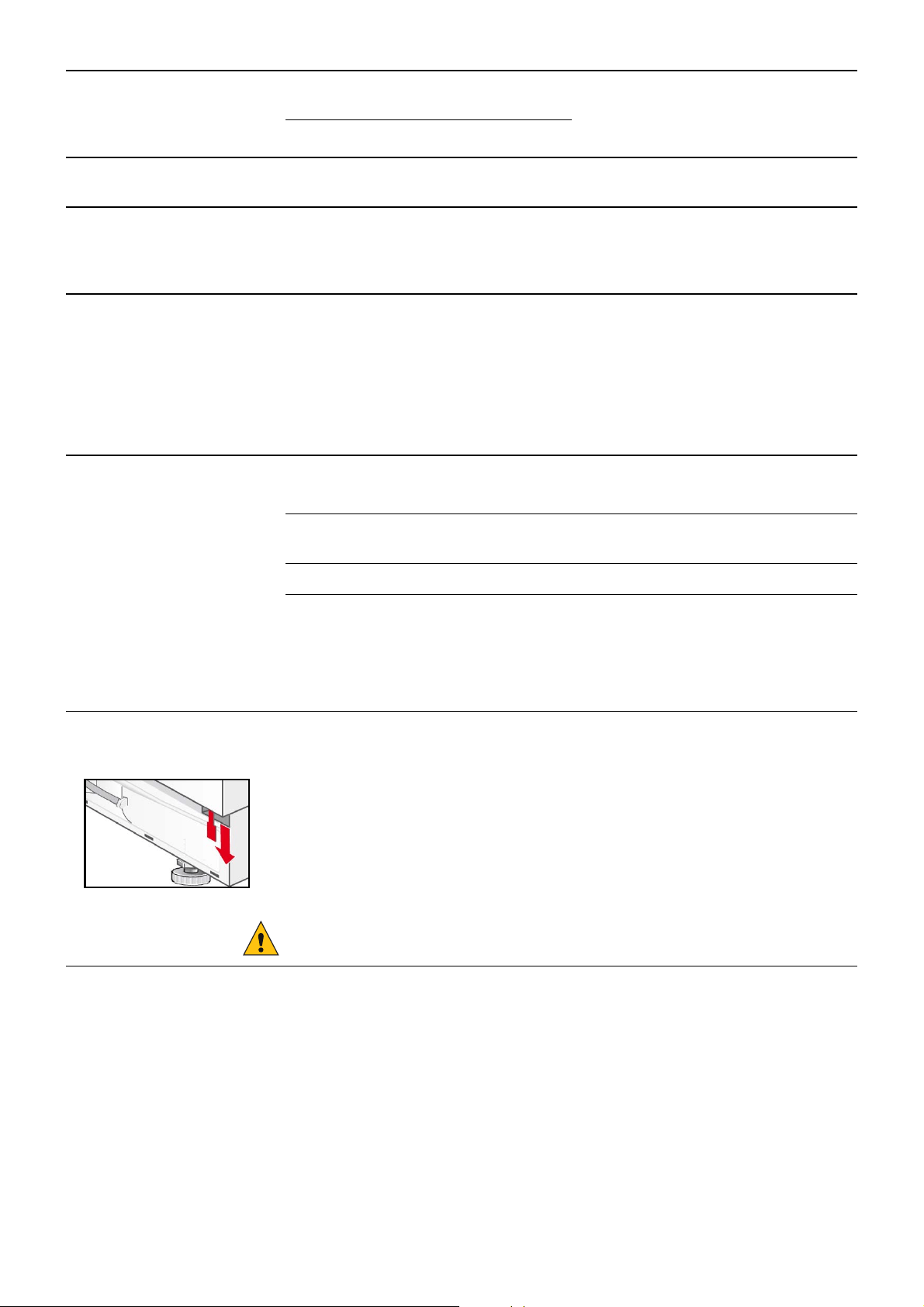
Emergency release In order to unlock the door mechanically in the event of a power failure, you will
have to:
set the programme selector to Stop (Off) and unplug the mains plug from
the socket.
open the base panel and drain out the water page 17.
pull the emergency release downwards and open the loading door at the
same time.
– Before opening the loading door, make sure that there is no water or hot
washing water in the appliance.
Under no circumstances open the door with the emergency release while the
drum is still turning.
If you cannot correct a fault yourself (switching on/off) or a repair is required:
– Set the programme selector to Stop (Off) and unplug the mains plug from the socket.
– Turn off the tap and call the after-sales service
page 22.

22
After-sales service
Before you call the after-sales service, please check first whether you can
correct the fault yourself page 19.
You will be charged if a technician is called out, even during the warranty
period.
You can find your nearest after-sales service here or in the enclosed after-
sales service directory (depending on model).
Please give the after-sales service the product number (E-no.) and
production number (FD) of the appliance.
Enter the numbers of your appliance here.
You can find this information on the rating plate in the frame of the loading
door.
Please help us to avoid unnecessary after-sales service call-outs by
quoting the appliance and production numbers. This will also save you the
related additional costs.
Trust the expertise of the manufacturer. Contact us for assistance. In
this way, you can rest assured that the repair will be carried out by trained
service technicians using original spare parts.
O GB 0344 892 8979 (Calls charged at local or mobile rate)
O IE 01450 2655 (0.03 € per minute at peak. Off peak 0.0088 € per
minute)
23
Installation instructions
Safety information
The Washing machine is very heavy. Exercise caution when lifting.
Do not operate the washing machine if it shows visible signs of damage.
If you are in any doubt, please consult with the after-sales service or your
dealer.
Do not install the washing machine outdoors or in areas which are prone
to frost Frozen hoses may tear or burst. The washing machine could
suffer damage.
Do not stand the washing machine upside down or place it on its side.
Do not lift the washing machine by any of the protruding parts
(e.g. loading door).
Remove the transport locks and cross connectors and store in a safe
place.
In addition to the instructions provided in this document, special
regulations from the relevant water and electric utility companies may
apply.
If in doubt, have a technician connect the appliance.
Included with the
appliance
On the rear of the washing machine/drum:
–Water outlet hose
–Water inlet hose
– Mains cable with plug
– Instruction manual and booklet containing after-sales service
addresses
Moisture may remain in the drum following the final inspection which
every washing machine undergoes before leaving the factory.
Num-
ber
Description
5 Covers for openings left after removing the transport locks
1 Spanner for removing the transport locks and adjusting the feet
1 1 24-40 mm dia. hose clamp for connection to a siphon
1 Door template
2 Door hinges with screws
1 Screw with washer for decor door
24
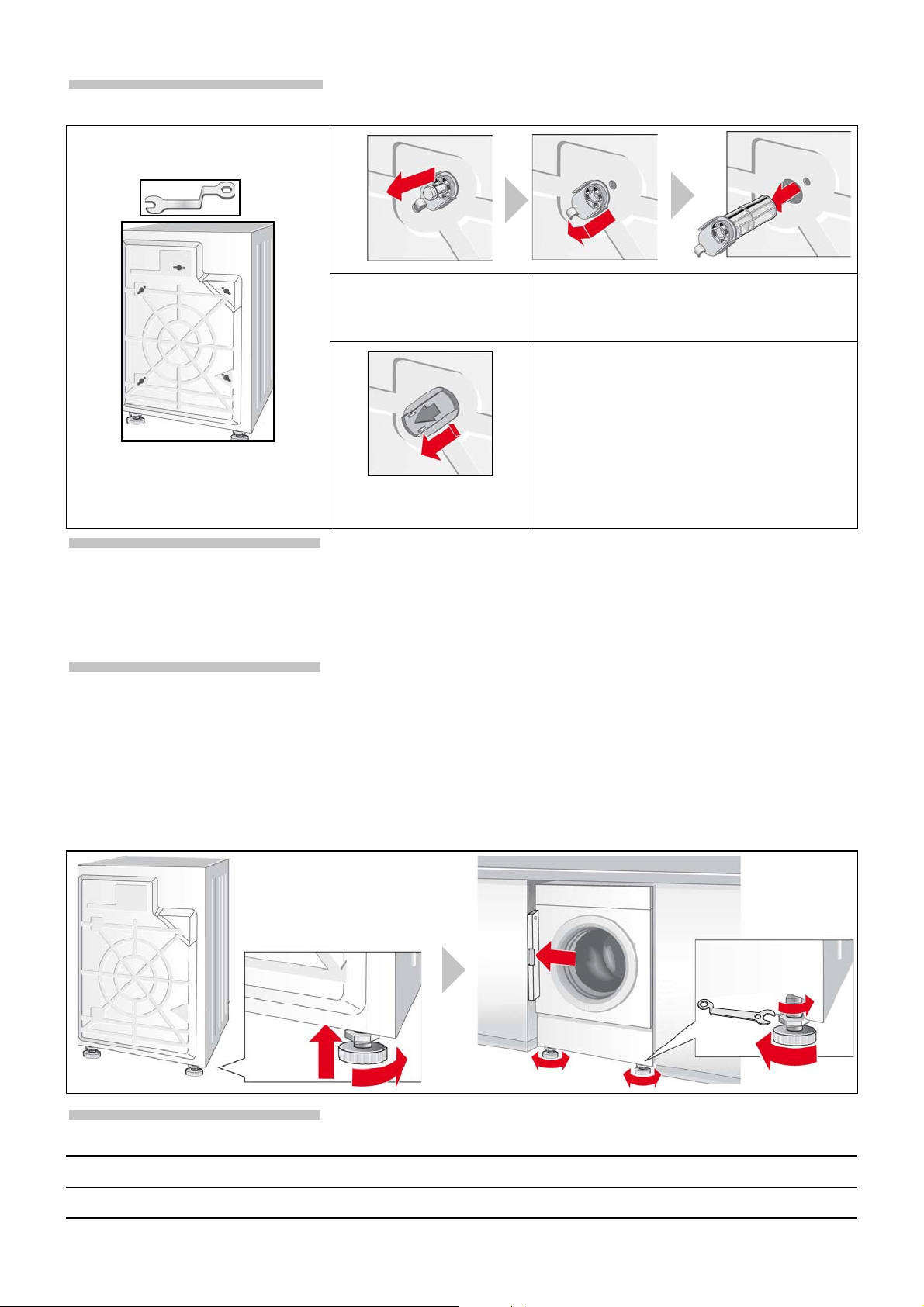
Removing the transport locks
Unscrew all four screws
using the spanner
supplied.
Completely remove all transport locks and
take the mains cable out of the retainers.
Insert the protective
covers.
– Before using the appliance for the first
time, ensure that all transport locks have
been removed and kept safe for any
subsequent transport.
– For transporting at a later stage: You must
make sure that the transport locks are
refitted, which will prevent the washing
machine from being damaged.
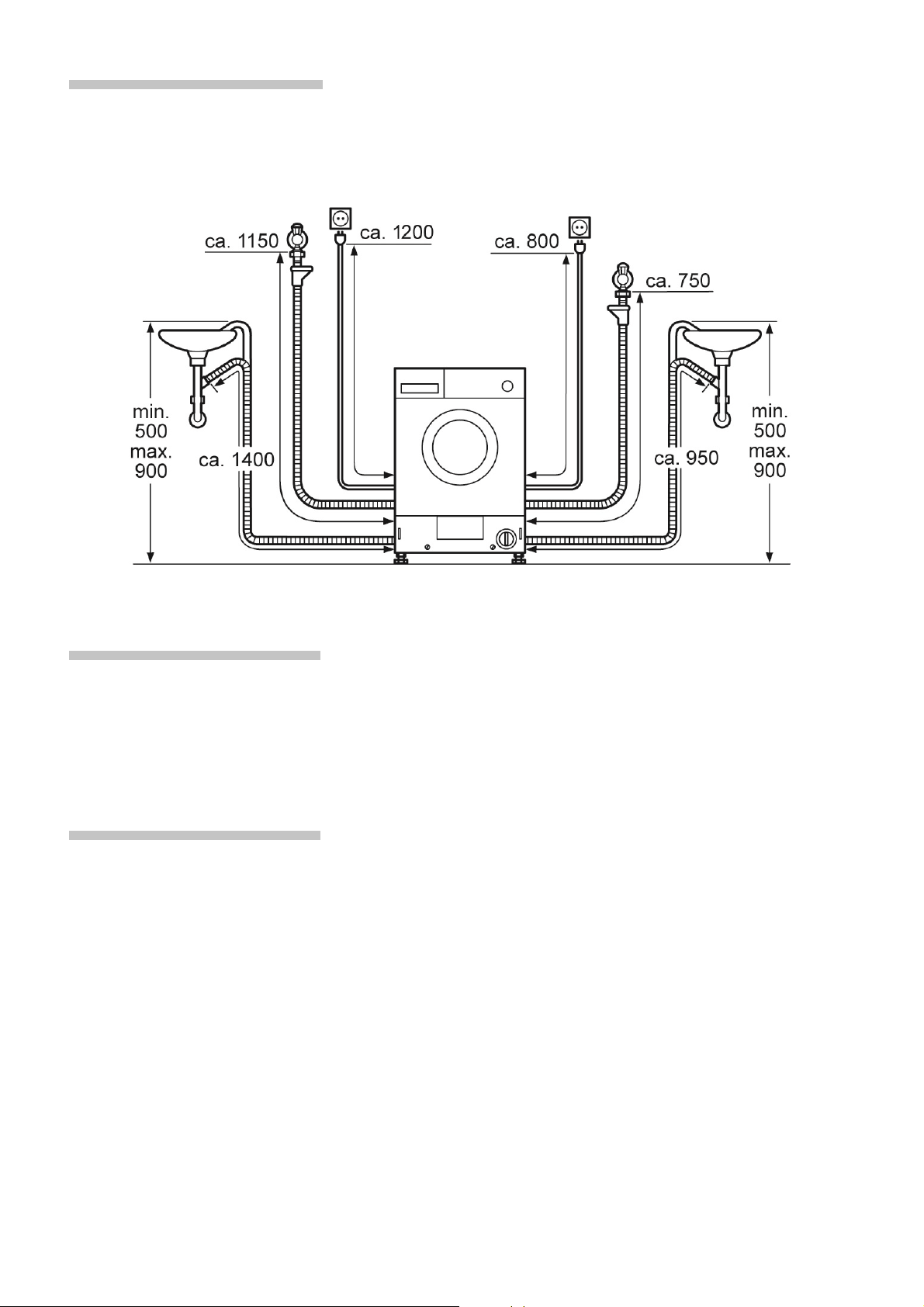
Positioning and
levelling
– Appliance stability is essential to ensure that the washing machine
does not “creep” during spin cycles.
– The installation area must be firm, clean and level.
– Parquet floors and soft floor coverings, e.g. carpets or foam-backed
floor coverings, are unsuitable.
Levelling
Intense noise, vibrations and “wandering” may be the result of incorrect
levelling.
– All four appliance feet must stand firmly on the ground.
– The washing machine must not rock.
– Check the alignment of the washing machine with a spirit level and
adjust if necessary.
– The washing machine must not rest against the side panels of the
installation recess.
– The lock nuts on the front feet of the appliance must be screwed firmly
against the housing with the spanner.
.
Dimensions
Width x depth x height 596 mm x 585 mm x 818 mm
Weight 76 kg
25
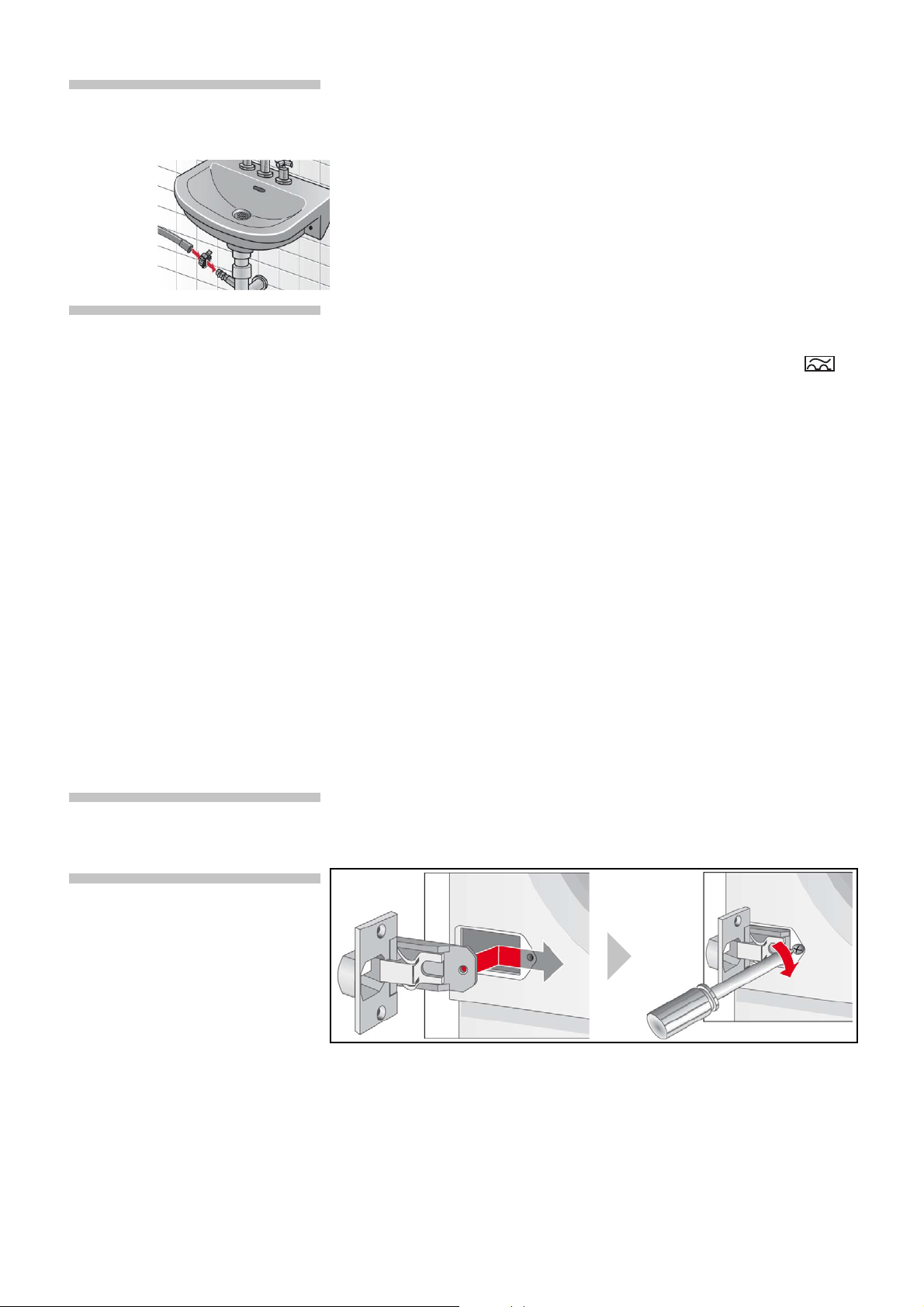
Hose and cable lengths
Left-hand connection or Right-hand connection
Water connection
– To prevent leaks or water damage, you must observe the instructions
in this section.
– N.B.: Operate the washing machine only with cold drinking water.
– Do not connect to the mixer tap of an unpressurised hot water boiler.
– If in doubt, have a technician connect the appliance.
– Do not use a used inlet hose. Only use the inlet hose supplied or one
which was purchased from an authorised specialist retailer.
– The water inlet and outlet hoses can be routed to the left of right,
depending on installation conditions.
Water inlet
Do not allow the water inlet hose to be:
– Kinked or squashed, modified and cut (strength no longer guaranteed).
Note the water pressure in the mains supply:
– The water pressure should be between 50-900 kPa (0.5-9 bar) (at least
8 litres of water per minute flow when the tap is open).
– If the water pressure is higher, a pressure reducing valve must be
installed.
Connect the inlet hose to the ¾" cold water tap.
Tighten the screw connections only by hand. Do not remove the filter from
the inlet hose.
After connecting the water inlet hose:
– Open the water tap carefully, checking the leak tightness of the connec-
tion points.
– N.B.: The screw connection is under mains water pressure.
–
26
Water outlet
– Do not kink the outlet hose or pull it lengthways.
– Height difference between the installation surface and the drain:
max. 90 cm, min. 50 cm.
Secure the connection point with the 24-40 mm hose clamp.
Electrical connection
The washing machine must only be connected to an alternating current
via a properly installed earthed socket.
Only use earth-leakage circuit breakers with the following symbol:
The mains voltage must correspond to the voltage specifications on the
washing machine (rating plate).
The connected load and fuse required are specified on the rating plate.
Make sure that:
– the mains plug fits the socket.
– the cable cross-section is adequate.
– the earthing system is properly installed.
– the appliance is not standing on the mains cable,
– the mains plug is accessible at all times.
Changes to the mains cable may only be carried out by a qualified
electrician.
Do not use multiple plugs/adapters or extension cables.
Mains plug:
– Do not insert the plug into the socket or pull it out if your hands are wet.
– When removing the plug from the socket, pull on the plug body only,
not the cable.
– Never pull the plug out during operation.
Fitting the door hinges
to the washing machine
After the washing machine has been installed in the fitted kitchen, it can
be concealed by a door. In this case, the hinges included in the delivery
must be fitted to the washing machine.
Drainage into a siphon
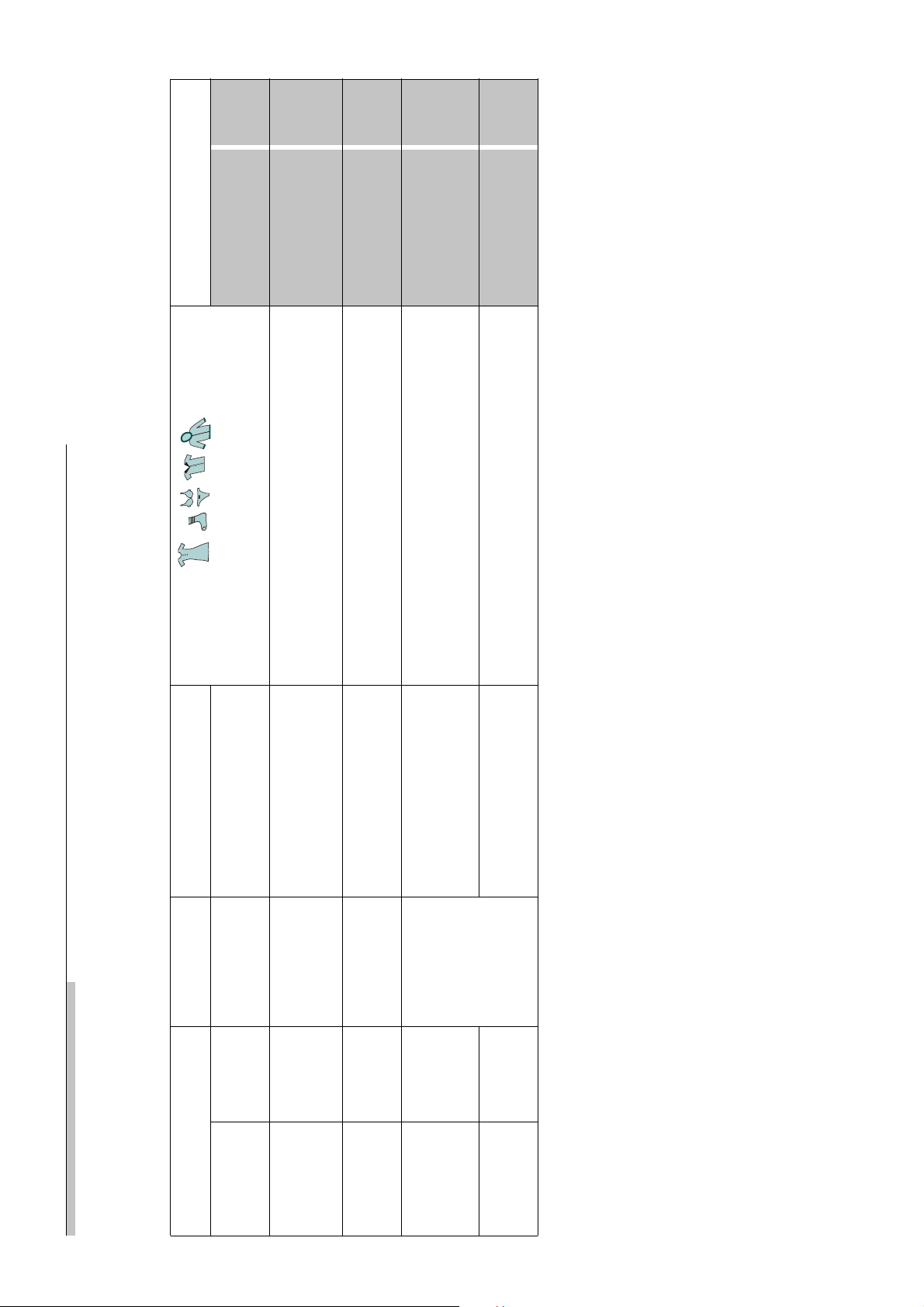
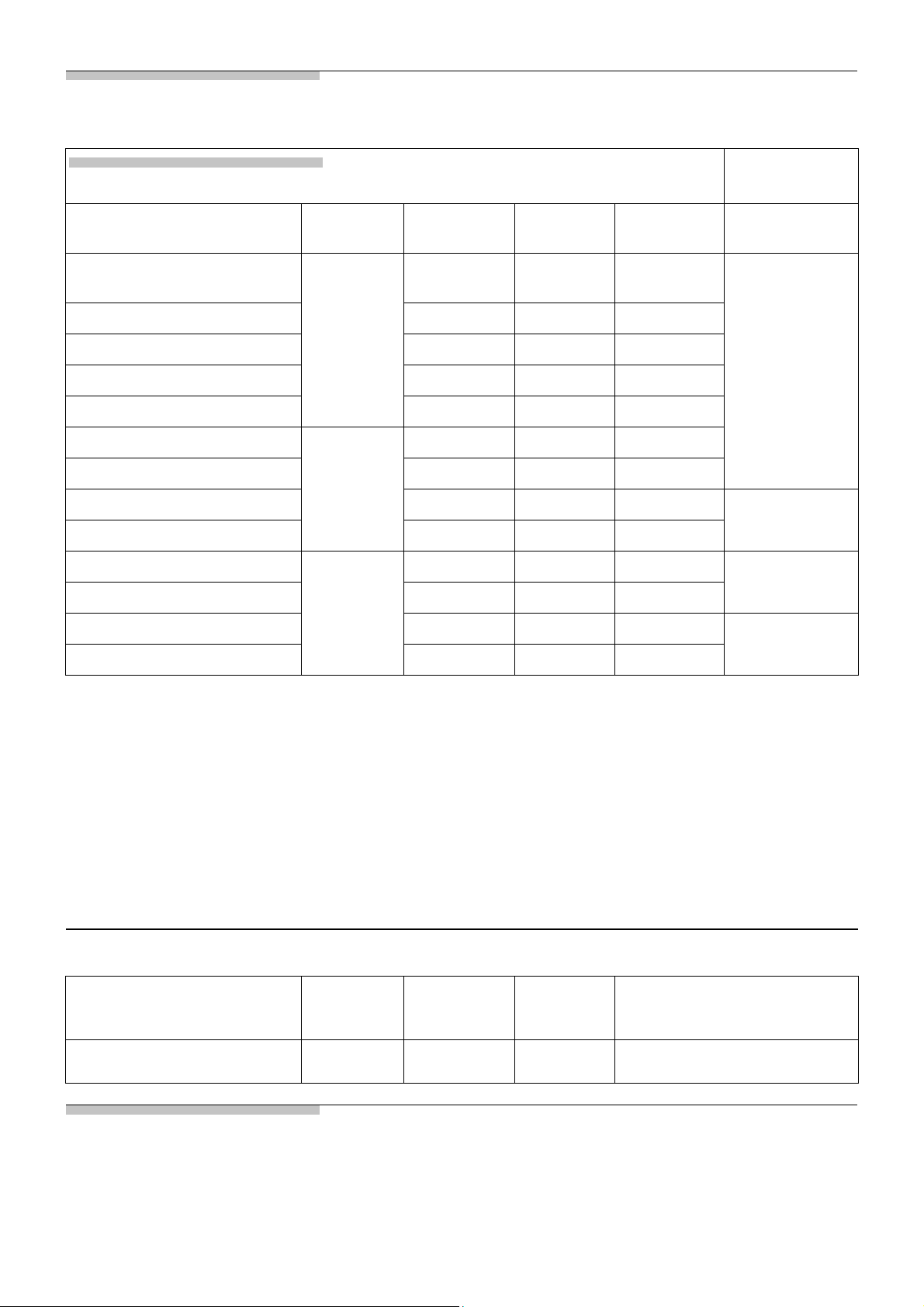
Table of programmes
Observe the information on care labels, fabric type and load quantity.
*Programmes and options depend on the model
Type of laundry Options*
Programmes* °C max. load max. spin speed*
$ Flot antiarrugas
(Rinse stop)
C 0
Resistentes/
Algod.
(Cottons)
cold-60
7 kg
1200 rpm Hard-wearing fabrics, heat-resistant fabrics made of
cotton or linen.
G G
Sintéticos
(easy-care)
cold-40
3.5 kg
800 rpm Easy-care fabrics made of cotton, linen, synthetic
fibre or blended fabrics.
G G
Delicados
(Delicates)
cold
2kg
600 rpm For delicate, washable fabrics, e.g. made of silk,
satin, synthetic fibres or blended fabrics
(e.g. curtains).
G A
Lana/La (Wool)
cold-30 800 rpm Suitable for hand or machine-washable fabrics
made from wool or a wool blend.
G G
28
Consumption rates
Power consumption in “off mode” = 0,20 W
Power consumption in “stand-by mode” = 0,80 W
Washing
Programme Load Power* Water* Programme
duration*
Residual
moisture**
Algodón (cottons)
frio (cold)
7 kg
0.23 kWh 59 l 1:51 h
58 %
Algodón (cottons) 20 °C 0.35 kWh 62 l 2:00 h
Algodón (cottons) 40 °C 0.85 kWh 62 l 2:00 h
Algodón (cottons) 60 °C 1.25 kWh 70 l 2:30 h
Algodón(cottons) 90 °C 2.50 kWh 70 l 2:30 h
Algodón eco (cottons) 40 °C
3.5 kg
0.67 kWh 38 l 2:30 h
Algodón eco (cottons) 60 °C 0.82 kWh 38 l 2:30 h
sintéticos (easy-care) 60 °C 0.89 kWh 38 l 1:52 h 30%
sintéticos (easy-care) 40 °C 0.65 kWh 45 l 1:43 h
delicado (delicates) frio (cold)
2kg
0.05 kWh 35 l 0:36 h 55 %
delicado (delicates) 30 °C 0.10 kWh 49 l 1:00 h
lana/la u (wool) frio (cold) 0.05 kWh 49 l 0:47 h 40 %
lana/la u (wool) 30 °C 0.25 kWh 49 l 1:00 h
Programme setting for testing in accordance with applicable standard EN60456.
Note on comparative tests: When testing the test programmes, wash the specified load using the maximum spin speed.
*The values may deviate from the indicated values depending on water pressure, water hardness and supply temperature,
ambient temperature, type, amount and soiling of the laundry, detergent used, fluctuations in the power supply and which
additional functions are selected.
** Information on residual moisture based on programme-dependent spin-speed limit and maximum loads.
PROGRAMME SETTING FOR TESTING AND ENERGY LABELLING IN ACCORDANCE WITH EU DIREC-
TIVE 2010/30/EU WITH COLD WATER (15 ºC). The programme temperature information is based on
the temperature stated on the care label for the fabrics. The actual washing temperature may deviate
from stated programme temperature for energy-saving reasons.
Algodón (cottons) 60 °C: max spin.
Algodón (cottons) 40 °C: max spin.
Programme Option Load
Annual
energy
consumption
Annual water consumption
Algodón (cottons)
40/60 °C
no option 7/3,5 kg 198 kWh 10340 l

29
C
Care information
-Washing 9
Care product 10
Cleaning
-Control panel 16
-Detergent drawer 16
-Detergent solution pump
17
-Drum 16
-Housing 16
-Water inlet hose 18
Connection fittings 25
Consumption rates 28
Control panel 7
-Cleaning 16
Cottons
-Programmes 12, 14
D
delicado (delicates)
-Programmes 28
Delicates
-Programmes 12, 27
Descaling 16
Detergent 10
-Liquid detergent insert 10,
11
Liquid detergent insert 11
Detergent drawer
-Cleaning 16
-Description 10
Detergent solution pump
-Cleaning 17
Dimensions 24
Display
-Fault message 19
Door 14
Draining the water 17
Drum
-Cleaning 16
E
Easy-care
-Programmes 12, 27
Economy tips 6
Electrical connection 26
Emergency release 21
Empty 12
-Special programmes 12,
14, 15, 18, 21
End of the programme 14
Environmental protection 6
F
Fault message 19
Faults 19
Filter
-Water inlet hose 18
First wash 8
Function selection buttons 7
H
Hazard warnings
-Detergent 10
Housing
-Cleaning 16
I
Included with the appliance 23
Installation surface 23
L
Laundry
-Loading 9
-Preparing for washing 9
-Sorting for washing 8
Levelling 24
Liquid detergent insert 10
P
Power 28
Programme change 14
Programme duration 28
Programme progress
-Control panel 7
Programme selector 7, 12
Programme termination 15
R
Remedial action 19
Reset function 15
resistentes algod. (cottons)
-Programmes 28
resistentes algod. (cottons)
extra
-Programmes 28
Rinse + Spin
-Special programmes 12,
15, 18
Rinse stop
-Control panel 7
S
Safety information 4, 16, 19, 23
Special programmes 12
Spin
-Special programmes 12
Spin speed
-Control panel 7
-Washing options 13
Start/Pause
-Button 13
-Control panel 7
T
Table of programmes 27
Transport locks 24
U
Unbalanced load detection
system 13
W
Washing 14
Washing options
-Indicator lights 7
Washing programmes 12
Water 28
Water inlet 25
Water inlet hose
-Cleaning 18
Water outlet 26
WEEE 6
Woollens
-Programmes 12
Index



Robert Bosch Hausgeräte GmbH
Carl-Wery-Straße 34
81739 München
DEUTSCHLAND
WIA20001EE
03.2015
9001112233