LCD
TV
Please
read
Information
Manual
included
together
before
reading
this
manual
and
operating
your
set.
Retain
it
for
future
reference.
Record
model
number
and
serial
number
of
the
set.
See
the
label
attached
on
the
back
cover
and
quote
this
information
to
your
dealer
when
you
require
service.
P/NO
:
3828TUL320G(0507-REV01)
Printed
in
Korea
OWNER'S
MANUAL
MODEL:
32LX2R
**
26LX2R
**

2
Owner's
Manual
1.5V
1
.
5
V
Power
Cord
T
V
F
A
V
O
U
R
IT
E
Q
V
I
E
W
P
O
W
E
R
1
2
3
4
5
6
7
8
0
9
A
U
D
IO
T
E
X
T
P
I
P
C
A
B
L
E
Z
O
O
M
-
Z
O
O
M
+
P
S
M
S
S
M S
T
B
SL
E
E
P
I
/
II
M
E
N
U
A
R
C
V
C
R
D
V
D
M
O
D
E
O
K
I
N
P
U
T
T
V
P
IP
P
R
P
I
P
P
R
+
S
W
A
P
P
IP
IN
P
U
T
V
O
L
P
R
M
U
T
E
L
I
S
T
E
X
I
T
Remote
Control
/
Batteries
Ensure
that
the
following
accessories
are
included
with
your
TV.
If
any
accessory
is
missing,
please
contact
the
dealer
from
where
you
purchased
the
product.
Accessories
DVI-D
cable
(PC)
DVI
to
D-Sub
cable
(PC)
Audio
cable
(PC)
Twister
Holder
Polishing
Cloth
Polish
the
screen
with
the
cloth.
2-TV
Brackets,
2-Wall
Brackets
(option)
2-TV
Bracket
Bolts
(option)

3
Contents
Contents
Introduction
Operation
2
Accessories
5
Controls
6
Connection
Options
8
Remote
Control
Key
Functions
10
Swivel
stand
(option)
Setting
up
TV
stations
Basic
operation
Installation
11
Basic
Connection
12
External
Equipment
Connections
12
Antenna
Connection
12
Headphone
Socket
13
VCR
Setup
14
Monitor
Out
Setup
15
DVD
Setup
16
STB
(
Set-Top
Box)
Setup
18
Cable
TV
Setup
19
External
AV
Source
Setup
20
PC
Setup
21
Supported
display
resolution
21
Power
Cord
Connection
22
Turning
On/Off
the
TV
22
Volume
Adjustment
22
Programme
selection
22
On
screen
language
selection
23
How
to
adjust
the
OSD
screen
24
Auto
programme
tuning
25
Manual
programme
tuning
26
Fine
tuning
26
Assigning
a
station
name
27
Programme
edit
28
Favourite
programme
28
Calling
the
programme
table
29
PSM
(Picture
Status
Memory)
29
CSM
(Colour
Status
Memory)
30
Function
30
ACM
(Active
Colour
Management)
31
sRGB
31
Manual
Picture
Adjustment
32
SSM
(Sound
Status
Memory)
32
SRS
WOW
33
AVL
(Auto
Volume
leveler)
33
Manual
Sound
Adjustment
34
TV
Speaker
35
I/II
36
Clock
Setup
36
On/Off
Time
37
Auto
Sleep
37
Sleep
Timer
Picture
adjustment
Sound
adjustment
Time
menu

4
Reference
Operation
38
Child
Lock
38
Demo
39
Lightening
Logo
40
Auto
Configure
40
Manual
Configure
41
XGA
Mode
41
Picture
Size
Zoom
42
Picture
format
(ARC)
43
Screen
Position
43
Cinema
44
NR
(Noise
Reduction)
44
Reset
to
original
factory
value
(Initializing)
45
Main
Picture
Input
45
Watching
DW/PIP
46
PIP
Input
47
Win.
Size/Position
48
PIP
Transparency
50
Switch
on/off
50
SIMPLE
text
50
TOP
text
(option)
51
FASTEXT
51
Special
teletext
functions
52
Troubleshooting
Checklist
53
Product
Specifications
54
Programming
the
Remote
control
55
Programming
Codes
57
IR
codes
59
External
Control
Device
Setup
;
RS-232C
63
How
to
join
the
product
assembly
to
the
wall
to
protect
the
set
tumbling
(option)

5
-
This
is
a
simplified
representation
of
front
panel.
-
Here
shown
may
be
somewhat
different
from
your
TV.
INPUT
Button
Volume
(F/G)
Buttons
Programme
(
E
/
D
)
Buttons
MENU
Button
OK
Button
ON/OFF
Button
Remote
Control
Sensor
Power/Standby
Indicator
(
)
?
illuminates
red
in
standby
mode.
?
illuminates
green
when
the
set
is
switched
on.
Intelligent
Eye
Adjusts
picture
according
to
the
surrounding
conditions.
Controls
Controls
Introduction
Introduction
Stand
(option)

6
R
L
COMPONENT2
AUDIO
VIDEO
HDMI
PC
SOUND
RS-232C
INPUT
(CONTROL/SERVICE)
REMOTE
CONTROL
DVI
INPUT
(PC/DTV
INPUT)
Antenna
AC
IN
S-VIDEO
PR
PB
Y
R
L
VIDEO
COMPONENT
1
AUDIO
VIDEO
AUDIO
R
L
AV
VIDEO
AUDIO
R
L
MONITOR
OUT
VARIABLE
AUDIO
OUT
R
L
COMPONENT2
input
(Y,PB,PR
/
Audio)
Headphone
Socket
Remote
Control
Port
COMPONENT1
input
(Y,PB,PR
/
Audio)
HDMI
(High
Definition
Multimedia
Interface)
input
RS-232C
Input
Variable
AUDIO
OUT
ports
DVI
Input
(PC/DTV
Input)
AV
(Video/Audio)
Input
Antenna
Input
AC
Input
Connection
Options
(Model:
32LX2R
Connection
Options
(Model:
32LX2R
**
**
)
)
Introduction
Introduction
S-Video
Input
Stand
(option)
Monitor
Out
PC
SOUND
Input

7
Connection
Options
(Model:
26LX2R
Connection
Options
(Model:
26LX2R
**
**
)
)
R
L
COMPONENT2
AUDIO
VIDEO
HDMI
PC
SOUND
REMOTE
CONTROL
DVI
INPUT
(PC/DTV
INPUT)
Antenna
AC
IN
AV
VARIABLEAUDIO
OUT
RS-232C
INPUT
(CONTROL
/SERVICE
PORT)
S-VIDEO
AUDIO
VIDEO
VIDEO
R
R
L
AUDIO
R
L
L
R
PR PB
Y
L
VIDEO
COMPONENT
1
AUDIO
MONITOR
OUT
COMPONENT2
input
(Y,PB,PR
/
Audio)
Headphone
Socket
PC
SOUND
Input
Remote
Control
Port
COMPONENT1
input
(Y,PB,PR
/
Audio)
HDMI
(High
Definition
Multimedia
Interface)
input
RS-232C
Input
Variable
AUDIO
OUT
ports
DVI
Input
(PC/DTV
Input)
AV
(Video/Audio)
Input
Antenna
Input
AC
Input
S-Video
Input
Stand
(option)
Monitor
Out

8
TV
FAVOURITE
Q.VIEW
POWER
123
456
78
0
9
A
U
D
I
O
*
P
I
P
CABLE
ZO
O
M
-
ZO
O
M+
PS
M
S
S
M
S
T
B
S
L
E
E
P
I
/
I
I
M
E
N
U
ARC
V
C
R
DVD
MODE
OK
POSITION
SIZE
PIP
INPUT
T
V
P
I
P
P
R
-
P
I
P
P
R
+
S
W
A
P
P
I
P
I
N
P
U
T
VOL
PR
MUTE
LIST
E
X
I
T
MODE
Selects
the
remote
operating
modes.
:TV,
DVD,
VCR,
AUDIO,
CABLE
or
STB
PIP
BUTTONS
PIP
(Refer
to
p.46)
Switches
the
sub
picture
PIP,
DW,
Multi
PIP
or
off
mode.
PIP
PR
-
/+
(Refer
to
p.49)
Selects
a
programme
for
the
sub
picture.
SWAP
(Refer
to
p.49)
Alternates
between
main
and
sub
picture.
PIP
INPUT
(Refer
to
p.46)
Selects
the
input
mode
for
the
sub
picture.
SIZE
(Refer
to
p.47)
Adjusts
the
sub
picture
size.
POSITION
(Refer
to
p.47)
Moves
the
sub
picture
to
D
/
E
or
F
/
G
direction.
*
COLOURED
BUTTONS
:
These
buttons
are
used
for
teletext
(only
TELETEXT
models)
or
Programme
edit.
ZOOM-/ZOOM+
Enlarges
or
reduces
the
main
picture
size.
SLEEP
Sets
the
sleep
timer.
(Refer
to
p.37)
SSM
(Sound
Status
Memory)
Recalls
your
preferred
sound
setting.
(Refer
to
p.32)
PSM
(Picture
Status
Memory)
Recalls
your
preferred
picture
setting.
(Refer
to
p.29)
I/II
?
Selects
the
sound
output.
*
:
No
function
Remote
Control
Key
Functions
Remote
Control
Key
Functions
Introduction
Introduction
TV
Returns
to
TV
viewing
from
any
mode.
POWER
switches
the
set
on
from
standby
or
off
to
standby.
INPUT
If
you
press
the
button
once,
the
input
source
OSD
will
appear
on
screen
as
shown.
Press
the
D
/
E
button
and
then
OK
button
to
select
the
desired
input
source
(TV,
AV
,
S-Video,
Component
1,
Component
2,
DVI
PC/DVI
DTV,
or
HDMI
PC/
HDMI
DTV).
1
1
1
1
AV
S-Video
Component
1
Component
2
DVI
PC
HDMI
PC
TV
Input
(Without
TELETEXT)

9
TV
FAVOURITE
Q.VIEW
POWER
123
456
78
0
9
A
U
D
I
O
T
E
X
T
P
I
P
CABLE
Z
OO
M
-
ZO
OM
+
PSM
S
S
M
S
T
B
S
L
E
E
P
I
/
I
I
M
E
N
U
ARC
V
C
R
DVD
MODE
OK
POSITION
TIME
REVEAL
?
MODE
M
MIX
SIZE
HOLD
INDEX
i
INPUT
T
V
P
I
P
P
R
-
P
I
P
P
R
+
S
W
A
P
P
I
P
I
N
P
U
T
VOL
PR
MUTE
LIST
E
X
I
T
TELETEXT
BUTTONS
(option)
These
buttons
are
used
for
teletext.
For
further
details,
see
the
'Teletext'
section
(Refer
to
p.50).
MENU
Selects
a
menu.
ARC
Selects
your
desired
picture
format
(Refer
to
p.42).
EXIT
Clears
all
on-screen
displays
and
returns
to
TV
viewing
from
any
menu.
D
/
E
/F/G(up/down/left/right)
Selects
or
adjusts
an
item
in
the
menu.
OK
Accepts
your
selection
or
displays
the
current
mode.
VOL
(Volume)
D
/
E
Adjusts
the
volume.
MUTE
Switches
the
sound
on
or
off.
LIST
Displays
the
programme
table
(Refer
to
p.28).
PR
(Programme)
D
/
E
Selects
a
programme.
0-9
number
buttons
?
Selects
a
programme.
?
Selects
numbered
items
in
a
menu.
FAVOURITE
Displays
the
selected
favourite
programme
(Refer
to
p.28).
Q.VIEW
Returns
to
the
previously
viewed
programme.
VCR/DVD
Control
buttons
Controls
a
LG
video
cassette
recorder
or
DVD.
2
2
2
(With
TELETEXT)
1

10
Installing
Batteries
Open
the
battery
compartment
cover
on
the
back
side.
Insert
two
1.5V
AA
size
batteries
in
correct
polarity
(+
with
+,
-
with
-).
Don't
mix
old
or
used
batteries
with
new
ones.
Close
the
cover.
*
Use
a
remote
control
at
7
meter
distance
and
30
degree
(left/right/up/down)
within
the
receiving
unit
scope.
*
Dispose
of
used
batteries
in
the
recycle
bin
to
prevent
environment.
TV
POWER
A
UD
IO
PI
P
CABLE
ZOOM
-
Z
OOM
+
ST
B
S
LE
E
P
V
CR
DVD
MODE
INPUT
TV
1
2
3
-
The
TV
can
be
conveniently
swiveled
on
its
stand
30°
to
the
left
or
right
to
provide
the
optimum
viewing
angle.
Swivel
Stand
(option)
Remote
Control
Key
Functions
Remote
Control
Key
Functions
Introduction
Introduction

11
4
inches
4
inches
4
inches
4
inches
4
inches
For
proper
ventilation,
allow
a
clearance
of 4"
on
each
side
and
from
the
wall.
Detailed
installation
instructions
are
available
from
your
dealer,
see
the
optional
Tilt
Wall
Mounting
Bracket
Installation
and
Setup
Guide.
Wall
Mount:
Horizontal
installation
Desktop
Pedestal
Installation
4
inches
4
inches
4
inches
4
inches
For
proper
ventilation,
allow
a
clearance
of 4"
on
each
side
and
from
the
wall.
Hold
the
cover
with
both
hands
and
pull
it
backward.
Connect
the
cables
as
necessary.
To
connect
an
additional
equipment,
see
the
External
equipment
Connections
section.
Align
the
holes
on
the
TV
back
panel
with
the
protuberances
on
the
back
cover
and
insert
the
back
cover.
Pull
the
cables
through
the
spac-
ing
on
the
set
and
bundle
the
cables
using
the
supplied
twister
holder.
1
2
3
Ana
HDMI
PCSOUND
RS-
32CINPUT
CONTROL/SRVICE)
REMOTE
CONTROL
DVIINPUT
(PC/DTV
NPUT)
R
VA LE
AUD
OUT
VIDEO
AUDO
AUDO
VIDEO
AV
MONTOR
OUT
L
R
L
R
COMPONENT1
SVDEO
Basic
Connection
Basic
Connection
Installation
Installation

12
External
Equipment
Connections
External
Equipment
Connections
Installation
Instruction
Installation
Instruction
Antenna
Connection
-
For
optimum
picture
quality,
adjust
antenna
direction.
-
An
antenna
cable
and
converter
are
not
supplied.
To
prevent
the
equipment
from
damage,
never
plug
in
any
power
cords
until
you
have
finished
connecting
all
equipment.
?
In
poor
signal
areas,
to
get
better
picture
quality,
install
a
sig-
nal
amplifier
to
the
antenna
as
shown
to
the
right.
?
If
signal
needs
to
be
split
for
two
TVs,
use
an
antenna
sig-
nal
splitter
for
connection.
Signal
Amplifier
UHF
VHF
Multi-family
Dwellings/Apartments
(Connect
to
wall
antenna
socket)
Single-family
Dwellings
/Houses
(Connect
to
wall
jack
for
outdoor
antenna)
Outdoor
Antenna
Wall
Antenna
Socket
VHF
Antenna
UHF
Antenna
RF
Coaxial
Wire
(75
ohm)
Turn
clockwise
to
tighten.
Antenna
Antenna
Headphone
Socket
1
2
Plug
the
headphone
into
the
headphone
socket.
To
adjust
the
headphone
volume,
press
the
VOL
D
/
E
button.
If
you
press
the
MUTE
button,
the
sound
from
the
headphone
is
switched
off.
R
L
COMPONENT2
AUDIO
VIDEO
-
You
can
listen
to
the
sound
through
the
headphone.
?
While
you
are
listening
to
sound
through
a
headphone,
TV
speakers
will
not
be
heard.
1

13
-
To
avoid
picture
noise
(interference),
leave
an
adequate
distance
between
the
VCR
and
TV.
-
Typically
a
frozen
still
picture
from
a
VCR.
If
the
4:3
picture
format
is
used;
the
fixed
images
on
the sides
of
the
screen
may
remain
visible
on
the
screen.
VCR
Setup
When
connecting
with
an
antenna
cable
1
2
3
Antenna
PR
PB
Y
R
L
VIDEO
COMPONENT
1
AUDIO
S-VIDEO
OUT
IN
(R)
AUDIO
(L)
VIDEO
ANT
OUT
ANT
IN
Connect
the
ANT
OUT
socket
of
the
VCR
to
the
Antenna
socket
on
the
set.
Connect
the
antenna
cable
to
the
ANT
IN
socket
of
the
VCR.
Press
the
PLAY
button
on
the
VCR
and
match
the
appropriate
programme
between
the
TV
and
VCR
for
viewing.
1
2
TV
Back
panel
(32inch)
VCR
When
connecting
with
a
RCA
cable
S-VIDEO
OUT
IN
(R)
AUDIO
(L)
VIDEO
ANT OUT
ANT
IN
PC
SOUND
DVI
INPUT
(PC/DTV
INPUT)
S-VIDEO
VIDEO
AUDIO
R
L
AV
VIDEO
AUDIO
R
L
MONITOR
OUT
VCR
1
1
2
3
Connect
the
AUDIO/VIDEO
jacks
between
TV
and
VCR.
Match
the
jack
colours
(Video
=
yellow,
Audio
Left
=
white,
and
Audio
Right
=
red)
Insert
a
video
tape
into
the
VCR
and
press
PLAY
on
the
VCR.
(Refer
to
the
VCR
owner's
manual.)
Select
AV
input
source
with
using
the
INPUT
button
on
the
remote
control.
AV
VARIABLE
AUDIO
OUT
RS-232C
INPUT
(CONTROL
/SERVICE
PORT)
S-VIDEO
AUDIO
VIDEO
VIDEO
R
R
L
AUDIO
R
L
L
S-VIDEO
OUT
IN
(R)
AUDIO
(L)
VIDEO
ANT
OUT
ANT
IN
MONITOR
OUT
VCR
TV
Back
panel
(32inch)
TV
Back
panel
(26inch)
1
S-VIDEO
OUT
IN
(R)
AUDIO
(L)
VIDEO
ANT
OUT
ANT
IN
Antenna
R
PR PB
Y
L
VIDEO
COMPONENT
1
AUDIO
TV
Back
panel
(26inch)
VCR
2
1

14
When
connecting
with
an
S-Video
cable
PC
SOUND
DVI
INPUT
(PC/DTV
INPUT)
S-VIDEO
VIDEO
AUDIO
R
L
AV
VIDEO
AUDIO
R
L
MONITOR
OUT
S-VIDEO
OUT
IN
(R)
AUDIO
(L)
VIDEO
ANT
OUT
ANT
IN
VCR
1
1
2
2
3
4
Connect
the
S-VIDEO
output
of
the
VCR
to
the
S-VIDEO
input
on
the
set.
The
picture
quality
is
improved;
com-
pared
to
connecting
a
regular
VCR
to
the
Video
input.
Connect
the
AUDIO
jacks
between
TV
and
VCR.
Insert
a
video
tape
into
the
VCR
and
press
PLAY
on
the
VCR.
(Refer
to
the
VCR
owner's
manual.)
Select
S-Video
input
source
with
using
the
INPUT
button
on
the
remote
control.
External
Equipment
Connections
External
Equipment
Connections
Installation
Instruction
Installation
Instruction
AV
VARIABLE
AUDIO
OUT
RS-232C
INPUT
(CONTROL
/SERVICE
PORT)
S-VIDEO
AUDIO
VIDEO
R
R
L
L
S-VIDEO
OUT
IN
(R)
AUDIO
(L)
VIDEO
ANT
OUT
ANT
IN
VIDEO
AUDIO
R
L
MONITOR
OUT
VCR
1
2
TV
Back
panel
(32inch)
TV
Back
panel
(26inch)
Monitor
Out
Setup
1
2
Connect
the
second
TV
or
monitor
to
the
TV's
MONITOR
OUT
jacks.
See
the
Operating
Manual
of
the
second
TV
or
monitor
for
further
details
regarding
that
device's
input
settings.
S-VIDEO
IN
(R)
AUDIO
(L)
VIDEO
S-VIDEO
PR
PB
Y
R
L
VIDEO
COMPONENT
1
AUDIO
VIDEO
AUDIO
R
L
AV
VIDEO
AUDIO
R
L
MONITOR
OUT
-
The
TV
has
a
special
signal
output
capability
which
allows
you
to
hook
up
a
second
TV
or
monitor.
?
TV,
or
AV
input
sources
can
be
used
for
Monitor
out.
?
When
connecting
with
external
audio
equipments,
such
as
amplifiers
or
speakers,
please
turn the
TV
speakers
off.
(Refer
to
p.34)
TV
Back
panel
(32inch)
S-VIDEO
IN
(R)
AUDIO
(L)
VIDEO
AV
S-VIDEO
AUDIO
VIDEO
R
L
R
PR PB
Y
L
VIDEO
COMPONENT
1
AUDIO
VIDEO
AUDIO
R
L
MONITOR
OUT
TV
Back
panel
(26inch)

15
DVD
Setup
When
connecting
with
a
component
cable
S-VIDEO
PR
PB
Y
R
L
VIDEO
COMPONENT
1
AUDIO
VIDEO
AUDIO
R
L
AV
VIDEO
AUDIO
R
L
MONITOR
OUT
BR
(R)
AUDIO
(L)
DVD
TV
Back
panel
(32inch)
R
L
COMPONENT2
AUDIO
VIDEO
BR
(R)
AUDIO
(L)
DVD
1
1
2
2
AV
S-VIDEO
AUDIO
V DEO
R
R
PR PB
Y
L
VIDEO
COMPONENT
1
AUDIO
VIDEO
AUDIO
R
L
MONITOR
OUT
B R
(L)AUDIO(R)
DVD
TV
Back
panel
(26inch)
1
2
3
4
5
Connect
the
video
outputs
(Y,
PB,
PR)
of
the
DVD
to
the
COMPONENT
VIDEO
(Y,
PB,
PR)
jacks
on
the
set.
Connect
the
audio
outputs
of
the
DVD
to
the
COM-
PONENT
AUDIO
jacks
on
the
set.
Turn
on
the
DVD
player,
insert
a
DVD.
Select
Component
1
input
source
with
using
the
INPUT
button
on
the
remote
control.
-
If
connected
to
Component
2,
select
Component
2
input
source.
Refer
to
the
DVD
player's
manual
for
operating
instructions.
?
Component
Input
ports
To
get
better
picture
quality,
connect
a
DVD
player
to
the
component
input
ports
as
shown
below.
YPB
PR
Component
ports
on
the
TV
Y
Y
Y
Y
Pb
B-Y
Cb
PB
Pr
R-Y
Cr
PR
Video
output
ports
on
DVD
player
TV
side
panel
(32,
26inch)

16
STB
(
Set-Top
Box)
Setup
External
Equipment
Connections
External
Equipment
Connections
Installation
Installation
When
connecting
with
a
HDMI
cable
1
2
3
Connect
the
HDMI
output
of
the
DVD
player
to
the
HDMI
jack
on
the
set.
Select
HDMI
DTV
input
source
with
using
the
INPUT
button
on
the
remote
control.
Refer
to
the
DVD
player's
manual
for
operating
instructions.
?
TV
can
receive
the
video
and
audio
signal
simultaneously
with
using
a
HDMI
cable.
HDMI
RS-232C
INPUT
(CONTROL/SERVICE)
REMOTE
CONTROL
VARIABLE
AUDIO
OUT
R
L
HDMI
OUTPUT
DVD
1
1
HDMI
OUTPUT
HDMI
DVI
INPUT
(PC/DTV
INPUT)
DVD
When
connecting
with
a
component
cable
1
2
3
4
Connect
the
video
outputs
(Y,
PB,
PR)
of
the
digital
set-top
box
to
the
COMPONENT
VIDEO
(Y,
PB,
PR)
jacks
on
the
set.
Connect
the
audio
outputs
of
the
digital
set-top
box
to
the
COMPONENT
AUDIO
jacks
on
the
set.
Turn
on
the
digital
set-top
box.
(Refer
to
the
owner's
manual
for
the
digital
set-top
box.)
Select
Component
1
input
source
with
using
the
INPUT
button
on
the
remote
control.
-
If
connected
to
Component
2,
select
Component
2
input
source.
TV
Back
panel
(32inch)
TV
Back
panel
(26inch)
S-VIDEO
PR
PB
Y
R
L
VIDEO
COMPONENT
1
AUDIO
VIDEO
AUDIO
R
L
AV
VIDEO
AUDIO
R
L
MONITOR
OUT
BR
(R)
AUDIO
(L)
DTV
Receiver
(Set-top
Box)
TV
Back
panel
(32inch)
1
2
AV
S-VIDEO
AUDIO
V DEO
R
R
PR PB
Y
L
VIDEO
COMPONENT
1
AUDIO
VIDEO
AUDIO
R
L
MONITOR
OUT
B R
(L)AUDIO(R)
DTV
Receiver
(Set-top
Box)
TV
Back
panel
(26inch)
1
2

17
(R)
AUDIO
(L)
DVI-DTV
OUTPUT
HDMI
PC
SOUND
RS-232C
INPUT
(CONTROL/SERVICE)
REMOTE
CONTROL
DVI
INPUT
(PC/DTV
INPUT)
VARIABLE
AUDIO
OUT
R
L
HDMI
RS-232C
INPUT
(CONTROL/SERVICE)
REMOTE
CONTROL
VARIABLE
AUDIO
OUT
R
L
HDMI-DTV
OUTPUT
When
connecting
with
a
HDMI
cable
1
1
1
2
3
Connect
the
HDMI
output
of
the
digital
set-top
box
to
the
HDMI
jack
on
the
set.
Turn
on
the
digital
set-top
box.
(Refer
to
the
owner's
manu-
al
for
the
digital
set-top
box.)
Select
HDMI
DTV
input
source
with
using
the
INPUT
but-
ton
on
the
remote
control.
DTV
Receiver
(Set-top
Box)
When
connecting
with
a
DVI
cable
1
1
2
2
3
4
Connect
the
DVI
output
of
the
digital
set-top
box
to
the
DVI
INPUT
(PC
/
DTV
INPUT)
jack
on
the
set.
Connect
the
audio
outputs
of
the
set-top
box
to
the
PC
SOUND
jack
on
the
set.
Turn
on
the
digital
set-top
box.
(Refer
to
the
owner's
manual
for
the
digital
set-
top
box.)
Select
DVI
DTV
input
source
with
using
the
INPUT
button
on
the
remote
control.
DTV
Receiver
(Set-top
Box)
HDMI
DVI
INPUT
(PC/DTV
INPUT)
HDMI-DTV
OUTPUT
DTV
Receiver
(Set-top
Box)
(R)
AUDIO
(L)
DVI-DTV
OUTPUT
HDMI
PC
SOUND
REMOTE
CONTROL
DVI
INPUT
(PC/DTV
INPUT)
1
2
DTV
Receiver
(Set-top
Box)
?
TV
can
receive
the
video
and
audio
signal
simul-
taneously
with
using
a
HDMI
cable.
TV
Back
panel
(32inch)
TV
Back
panel
(26inch)
TV
Back
panel
(32inch)
TV
Back
panel
(26inch)

18
External
Equipment
Connections
External
Equipment
Connections
Installation
Installation
Cable
TV
Setup
-
After
subscribing
to
a
local
cable
TV
service
and
installing
a
converter,
you
can
watch
cable
TV
programmes.
-
For
further
cable
TV
information,
contact
a
local
cable
service
provider.
When
connecting
with
a
RCA
cable
PC
SOUND
DVI
INPUT
(PC/DTV
INPUT)
S-VIDEO
VIDEO
AUDIO
R
L
AV
VIDEO
AUDIO
R
L
MONITOR
OUT
TV
VCR
VIDEO
(R)
AUDIO
(L)
S-VIDEO
Cable
Box
1
1
VARIABLE
AUDIO
OUT
RS-232C
INPUT
(CONTROL
/SERVICE
PORT)
R
L
TV
VCR
VIDEO
(R)
AUDIO
(L)
S-VIDEO
AV
S-VIDEO
AUDIO
VIDEO
R
L
VIDEO
AUDIO
R
L
MONITOR
OUT
Cable
Box
1
2
3
Connect
the
AUDIO/VIDEO
jacks
between
TV
and
Cable
Box.
Match
the
jack
colours
(Video
=
yellow,
Audio
Left
=
white,
and
Audio
Right
=
red)
Select
AV
input
source
with
using
the
INPUT
button
on
the
remote
control.
Select
programmes
with
the
cable
box
remote
control.
When
connecting
with
an
S-Video
cable
PC
SOUND
DVI
INPUT
(PC/DTV
INPUT)
S-VIDEO
VIDEO
AUDIO
R
L
AV
VIDEO
AUDIO
R
L
MONITOR
OUT
TV
VCR
VIDEO
(R)
AUDIO
(L)
S-VIDEO
1
1
2
2
3
4
Connect
the
S-VIDEO
output
of
the
Cable
Box
to
the
S-VIDEO
input
on
the
set.
The
picture
quality
is
improved.
Connect
the
AUDIO
jacks
between
TV
and
Cable
Box.
Select
S-Video
input
source
with
using
the
INPUT
button
on
the
remote
control.
Select
programmes
with
the
cable
box
remote
control.
AV
S-VIDEO
AUDIO
VIDEO
R
L
VIDEO
AUDIO
R
L
MONITOR
OUT
VARIABLE
AUDIO
OUT
RS-232C INPUT
(CONTROL
/SERVICE
PORT)
R
L
TV
VCR
VIDEO
(R)
AUDIO
(L)
S-VIDEO
1
2
TV
Back
panel
(32inch)
TV
Back
panel
(26inch)
TV
Back
panel
(32inch)
TV
Back
panel
(26inch)
Cable
Box
Cable
Box

19
S-VIDEO
VIDEO
AUDIO
R
L
AV
VIDEO
AUDIO
R
L
MONITOR
OUT
RL
AUDIO
VIDEO
S-VIDEO
Camcorder
Video
Game
Set
1
1
2
3
Connect
the
AUDIO/VIDEO
jacks
between
TV
and
external
equipment.
Match
the
jack
colours
(Video
=
yellow,
Audio
Left
=
white,
and
Audio
Right
=
red).
Select
AV
input
source
with
using
the
INPUT
button
on
the
remote
control.
Operate
the
corresponding
external
equipment.
Refer
to
external
equipment
operating
guide.
External
AV
Source
Setup
When
connecting
with
a
RCA
cable
RL
AUDIO
VIDEO
S-VIDEO
AV
S-VIDEO
AUDIO
VIDEO
R
L
VIDEO
AUDIO
R
L
MONITOR
OUT
Camcorder
Video
Game
Set
1
When
connecting
with
an
S-Video
cable
S-VIDEO
VIDEO
AUDIO
R
L
AV
VIDEO
AUDIO
R
L
MONITOR
OUT
RL
AUDIO
VIDEO
S-VIDEO
1
1
2
2
3
4
Connect
the
S-VIDEO
output
of
the
external
equipment
to
the
S-VIDEO
input
on
the
set.
The
picture
quality
is
improved.
Connect
the
AUDIO
jacks
between
TV
and
external
equipment.
Select
S-Video
input
source
with
using
the
INPUT
button
on
the
remote
control.
Operate
the
corresponding
external
equipment.
Refer
to
external
equipment
operating
guide.
AV
S-VIDEO
AUDIO
VIDEO
R
L
VIDEO
AUDIO
R
L
MONITOR
OUT
RL
AUDIO
VIDEO
S-VIDEO
1
2
Camcorder
Video
Game
Set
Camcorder
Video
Game
Set
TV
Back
panel
(32inch)
TV
Back
panel
(26inch)
TV
Back
panel
(32inch)
TV
Back
panel
(26inch)

20
External
Equipment
Connections
External
Equipment
Connections
Installation
Installation
Connect
the
DVI
output
of
the
PC
to
the
HDMI
jack
on
the
set.
Connect
the
PC
audio
output
to
the
PC
SOUND
jack
on
the
set.
Turn
on
the
PC
and
the
set.
Select
HDMI
PC
input
source
with
using
the
INPUT
button
on
the
remote
control.
PC
Setup
1
2
3
4
Connect
the
TV
to
the
PC
with
the
PC
cable.
Connect
the
PC
audio
output
to
the
TV's
PC
SOUND
input.
Turn
on
the
PC.
Select
DVI
PC
input
source
with
using
the
INPUT
button
on
the
remote
control.
HDMI
PC
SOUND
DVI
INPUT
(PC/DTV
INPUT)
NOTE
Connect
the
signal
cable
(DVI-D
cable,
Not
DVI
to
D-Sub
cable)
from
the
DVI
output
socket
of
the
PC
to
the
DVI
input
socket
of
the
set
when
using
a
PC
with
DVI
output.
In
some
video
cards,
DVI-Analog
output
may
not
be
supported.
When
connecting
with
a
HDMI
to
DVI
cable
When
connecting
with
a
DVI-D
cable
or
a
DVI
to
D-Sub
cable
1
2
3
4
DVI
OUPUT
AUDIO
HDMI
PC
SOUND
RS-232C
INPUT
(CONTROL/SERVICE)
REMOTE
CONTROL
VARIABLE
AUDIO
OUT
R
L
1
PC
?
If
the
PC
has
a
DVI
output
and
no
HDMI
output,
a
separated
audio
connection
is
necessary.
?
It's
not
available
to
connect
with
a
HDMI
to
DVI
cable
to
the
DVI
INPUT
jack
on
the
set.
PC
DVI
OUPUT
AUDIO
HDMI
PC
SOUND
REMOTE
CONTROL
DVI
INPUT
(PC/DTV
INPUT)
PC
HDMI
PC
SOUND
REMOTE
CONTROL
DVI
INPUT
(PC/DTV
INPUT)
PC
1
TV
Back
panel
(32inch)
TV
Back
panel
(26inch)
TV
Back
panel
(32inch)
TV
Back
panel
(26inch)

21
AC
IN
-
Connect
the
power
cord
correctly
as
shown.
Power
Cord
Connection
Resolution
Horizontal
Frequency(kHz)
Vertical
Frequency(Hz)
Supported
display
resolution
DPM
(Display
Power
Management)
mode
If
the
PC
goes
to
power
saving
mode,
the
monitor
automatically
switches
to
DPM
mode.
If
you
don't
use
the
PC
cable
provided,
DPM
mode
may
not
work.
-
DPM
mode
is
not
available
in
HDMI
PC
mode.
Note
a.
For
optimum
picture
quality,
use
standard
WXGA
1360x768
computer
output
at
a
60Hz
refresh
rate.
Using
other
formats
(VGA,
SVGA,
etc.)
or
refresh
rates
may
result
in
reduced
picture
quality.
(To
change
the
computer
video
output
format,
please
refer
to
the
operating
manual
for
the
computer
you
are
using).
b.
If
the
message
No
signal
appears
on
the
screen,
adjust
the
PC
output
to
a
format
listed
in
the
Monitor
Display
Specifications
table.
c.
The
synchronization
input
form
for
Horizontal
and
Vertical
frequencies
is
separate.
720
x
400
640
x
480
800
x
600
832
x
624
1024
x
768
(XGA)
1280
x
768
(WXGA)
1360
x
768
(WXGA)
1366
x
768
(WXGA)
31.468
31.469
37.500
37.879
46.875
49.725
48.363
56.470
60.123
47.776
47.720
47.720
70
60
75
60
75
75
60
70
75
60
60
60
A
PC
(Monitor
Display
Specifications)
A
DTV
480i
576i
480p
576p
720p
1080i
Mode
Component
o
o
o
o
o
o
DVI
(DTV)
x
x
o
o
o
o
HDMI
(DTV)
x
x
o
o
o
o
Terminal

22
TV
POWER
S
S
M
I
/
I
I
OK
INPUT
VOL
PR
MUTE
M
E
N
U
E
X
I
T
0
123
456
789
Press
the
MENU
button
and
then
D/E
button
to
select
the
Special
menu.
Press
the
G
button
and
then
D
/
E
button
to
select
Language.
Press
the
G
button
and
then
D
/
E
button
to
select
your
desired
language.
All
the
on
screen
displays
will
appear
in
the
selected
language.
Press
the
OK
button.
Press
the
EXIT
button
to
return
to
TV
viewing.
On
screen
language
selection
Basic
Operation
Basic
Operation
Operation
Operation
First,
make
all
equipment
connections.
Connect
the
AC
power
cord
into
the
TV,
then
plug
the
power
cord
into
a
wall
outlet.
Press
the
POWER
button
located
on
the
TV
to
turn
on
the
TV.
The
power
indicator
will
light.
?
In
the
standby
mode,
press
the
POWER,
PR
D/E
,
TV,
INPUT
or
number
but-
tons
on
the
remote
control
to
turn
on
the
TV.
If
you
want
to
turn
the
TV
off,
press
the
POWER
button
located
on
the
remote
control.
If
you
intend
to
be
away
on
vacation,
disconnect
the
plug
from
the
wall
outlet.
1
2
Turning
On/Off
the
TV
Press
the
VOL
D/E
button
to
adjust
the
volume.
If
you
want
to
switch
the
sound
off,
press
the
MUTE
button.
You
can
cancel
this
function
by
pressing
the
MUTE,
VOL
D/E
,
I/II
or
SSM
button.
1
2
1
2
3
4
5
Volume
Adjustment
Press
the
PR
D
/
E
or
NUMBER
buttons
to
select
a
programme
number.
1
Programme
selection

23
S
TATION
G
PICTURE
SOUND
TIME
SPECIAL
SCREEN
PIP/DW
Auto
programme
Manual
programme
Programme
edit
Favourite
programme
STATION
PICTURE
G
SOUND
TIME
SPECIAL
SCREEN
PIP/DW
PSM
CSM
ACM
Contrast
90
Brightness
55
Colour
55
Sharpness
60
STATION
PICTURE
SOUND
G
TIME
SPECIAL
SCREEN
PIP/DW
SSM
SRS
WOW
AVL
Balance
0
Treble
50
Bass
50
TV
speaker
STATION
PICTURE
SOUND
TIME
G
SPECIAL
SCREEN
PIP/DW
Clock
Off
time
On
time
Auto
sleep
STATION
PICTURE
SOUND
TIME
SPECIAL
G
SCREEN
PIP/DW
Language
Child
lock
Set
ID
Demo
Logo
light
S
TATION
PICTURE
SOUND
TIME
SPECIAL
SCREEN
G
PIP/DW
Auto
config.
Manual
config.
XGA
Mode
ARC
Zoom
+/-
Position
Cinema
NR
Reset
S
TATION
PICTURE
SOUND
TIME
SPECIAL
SCREEN
PIP/DW
G
Input
DW
PIP
PIP
Input
Win.
size
Win.
position
PIP
Transparency
Press
the
MENU
button
and
then
D
/
E
button
to
display
each
menu.
Press
the
G
button
and
then
D
/
E
button
to
select
a
menu
item.
Change
the
setting
of
an
item
in
the
sub
or
pull-down
menu
with
F
/
G
button.
You
can
move
to
the
higher
level
menu
by
pressing
the
OK
or
MENU
button.
1
2
3
How
to
adjust
the
OSD
screen
STATION
menu
PICTURE
menu
SOUND
menu
PIP/DW
menu
TIME
menu
SPECIAL
menu
SCREEN
menu
Note
a.
The
OSD
(On
Screen
Display)
function
enables
you
to
adjust
the
screen
status
conveniently
since
it
pro-
vides
graphical
presentation.
b.
In
this
manual,
the
OSD
(On
Screen
Display)
may
be
different
from
your
TV's
because
it
is
just
example
to
help
the
TV
operation.
c.
In
the
teletext
mode,
menus
are
not
displayed

24
Setting
up
TV
stations
Setting
up
TV
stations
-
All
stations
that
can
be
received
are
stored
by
this
method.
It
is
recommended
that
you
use
auto
programme
during
installation
of
this
set.
Auto
programme
tuning
S
TATION
PICTURE
SOUND
TIME
SPECIAL
SCREEN
PIP/DW
Prev.
Menu
Manual
programme
Programme
edit
Favourite
programme
System
BG
Storage
from
1
Start
Press
the
MENU
button
and
then
D
/
E
button
to
select
the
STATION
menu.
Press
the
G
button
and
then
D/E
button
to
select
Auto
programme.
Press
the
G
button
and
then
D/E
button
to
select
System.
Press
the
F
/
G
button
to
select
a
TV
system
menu;
BG
:
PAL
B/G,
SECAM
B/G
(Europe/East
Europe)
I
:
PAL
I/II
(U.K./Ireland)
DK
:
PAL
D/K,
SECAM
D/K
(East
Europe)
M
:
(USA/Korea/Philippines)
Press
the
D
/
E
button
to
select
Storage
from.
Press
the
F
/
G
button
or
NUMBER
buttons
to
select
the
beginning
pro-
gramme
number.
If
you
use
NUMBER
buttons,
any
number
under
10
is
entered
with
a
numeric
'0'
in
front
of
it,
i.e.'05'
for
5.
Press
the
D
/
E
button
to
select
Start.
Press
the
G
button
to
begin
auto
programming.
All
receivable
stations
are
stored.
Option:
In
Australia,
if
no
station
name
can
be
assigned
to
a
station,
the
channel
number
is
assigned
and
stored
as
-----
followed
by
a
num-
ber
see
'Assigning
a
station
name'
section
to
assign
the
station
name.
To
stop
auto
programming,
press
the
MENU
button.
When
auto
programming
is
completed,
the
Programme
edit
menu
appears
on
the
screen.
See
the
Programme
edit section
to
edit
the
stored
pro-
gramme.
Press
the
EXIT
button
to
return
to
normal
TV
viewing.
1
2
3
4
5
6
7
8
9
Up
to
100
TV
stations
can
be
stored
by
programme
numbers
(0
to
99).
Once
you
have
preset
the
stations,
you
will
be
able
to
use
the
D/E
or
NUMBER
buttons
to
scan
the
stations
you
have
programmed.
Stations
can
be
tuned
using
automatic
or
manual
modes.
Auto
programme
G
STATION
G
PICTURE
SOUND
TIME
SPECIAL
SCREEN
PIP/DW
Auto
programme
Manual
programme
Programme
edit
Favourite
programme

25
-
Manual
programme
lets
you
man-
ually
tune
and
arrange
the
stations
in
whatever
order
you
desire.
Manual
programme
tuning
STATI
ON
PICTURE
SOUND
TIME
SPECIAL
SCREEN
PIP/DW
Prev.
Menu
Auto
programme
Programme
edit
Favourite
programme
Storage
5
System
BG
Band
V/UHF
Channel
5
Fine
Search
Name
C05
Press
the
MENU
button
and
then
D/E
button
to
select
the
STATION
menu.
Press
the
G
button
and
then
D
/
E
button
to
select
Manual
programme.
Press
the
G
button
and
then
D
/
E
button
to
select
Storage.
Press
the
F
/
G
button
or
NUMBER
buttons
to
select
the
desired
pro-
gramme
number
(0
to
99).
If
you
use
NUMBER
buttons,
any
number
under
10
is
entered
with
a
numeric
'0'
in
front
of
it,
i.e.
'05'
for
5.
Press
the
D/E
button
to
select
System.
Press
the
F
/
G
button
to
select
a
TV
system
menu;
BG
:
PAL
B/G,
SECAM
B/G
(Europe/East
Europe)
I
:
PAL
I/II
(U.K./Ireland)
DK
:
PAL
D/K,
SECAM
D/K
(East
Europe)
M
:
(USA/Korea/Philippines)
Press
the
D/E
button
to
select
Band.
Press
the
F
/
G
button
to
select
V/UHF
or
Cable.
Press
the
D/E
button
to
select
Channel.
You
can
select
the
desired
programme
number
with
the
F
/
G
button
or
number
buttons.
If
possible,
select
the
programme
number
directly
with
the
number
buttons.
Any
number
under
10
is
entered
with
a
numeric
'0'
in
front
of
it,
i.e.
'05'
for
5.
Press
the
D
/
E
button
to
select
Search.
Press
the
F
/
G
button
to
commence
searching.
If
a
station
is
found
the
search
will
stop.
Press
the
OK
button
to
store
it.
To
store
another
station,
repeat
steps
3
to
13.
Press
the
EXIT
button
to
return
to
normal
TV
viewing.
1
2
3
4
5
6
7
8
9
10
11
12
13
14
15
Manual
programme
G
STATION
G
PICTURE
SOUND
TIME
SPECIAL
SCREEN
PIP/DW
Auto
programme
Manual
programme
Programme
edit
Favourite
programme

26
Setting
up
TV
stations
Setting
up
TV
stations
-
Normally
fine
tuning
is
only
neces-
sary
if
reception
is
poor.
Fine
tuning
Assigning
a
station
name
-
You
can
assign
a
station
name
with
five
characters
to
each
pro-
gramme
number.
STATION
PICTURE
SOUND
TIME
SPECIAL
SCREEN
PIP/DW
Auto
programme
Programme
edit
Favourite
programme
Storage
5
System
BG
Band
V/UHF
Channel
5
Fine
F
G
Search
Name
C05
Store
STATION
PICTURE
SOUND
TIME
SPECIAL
SCREEN
PIP/DW
Auto
programme
Programme
edit
Favourite
programme
Store
Storage
5
System
BG
Band
V/UHF
Channel
5
Fine
Search
Name
G
C05
Press
the
MENU
button
and
then
D/E
button
to
select
the
STATION
menu.
Press
the
G
button
and
then
D
/
E
button
to
select
Manual
programme.
Press
the
G
button
and
then
D
/
E
button
to
select
Fine.
Press
the
F
/
G
button
to to
fine
tune
for
the
best
picture
and
sound.
Press
the
OK
button
to
store
it.
Press
the
EXIT
button
to
return
to
normal
TV
viewing.
Press
the
MENU
button
and
then
D/E
button
to
select
the
STATION
menu.
Press
the
G
button
and
then
D/E
button
to
select
Manual
programme.
Press
the
G
button
and
then
D
/
E
button
to
select
Name.
Press
the
G
button
and
then
D/E
button.
You
can
use
a
blank,
+,
-,
the
number
0
to
9
and
the
alphabet
A
to
Z.
Press
the
F
/
G
button
to
select
the
position
and
make
your
choice
of
the
second
character,
and
so
on.
Press
the
OK
button
to
store
it.
Press
the
EXIT
button
to
return
to
normal
TV
viewing.
1
2
3
4
5
6
1
2
3
4
5
6
7
Manual
programme
G
Manual
programme
G
STATION
G
PICTURE
SOUND
TIME
SPECIAL
SCREEN
PIP/DW
Auto
programme
Manual
programme
Programme
edit
Favourite
programme
STATION
G
PICTURE
SOUND
TIME
SPECIAL
SCREEN
PIP/DW
Auto
programme
Manual
programme
Programme
edit
Favourite
programme

27
-
This
function
enables
you
to
delete
or
skip
the
stored
pro-
grammes.
Also
you
can
move
some
stations
to
other
pro-
gramme
numbers
or
copy
a
blank
station
data
into
the
select-
ed
programme
number.
Programme
edit
STATION
PICTURE
SOUND
TIME
SPECIAL
SCREEN
PIP/DW
Prev.
Menu
Auto
programme
Manual
programme
Favourite
programme
To
set
Prev.
DEFG
Menu
Programme
edit
0-
- -- -
5C05
1BLN2
6C07
7C55
3C04
8S27
4C05
9S29
2C01
Delete
Move
Copy
Skip
Press
the
MENU
button
and
then
D
/
E
button
to
select
the
STATION
menu.
Press
the
G
button
and
then
D/E
button
to
select
Programme
edit.
Press
the
G
button
to
display
the
Programme
edit
menu.
A
Deleting
a
programme
1.
Select
a
programme
to
be
deleted
with
the
D
/
E
/
F
/
G
button.
2.
Press
the
RED
button
twice.
The
selected
programme
is
deleted,
all
the
following
programmes
are
shifted
up
one
position.
A
Copying
a
programme
1.
Select
a
programme
to
be
copied
with
the
D
/
E
/
F
/
G
button.
2.
Press
the
GREEN
button.
All
the
following
programmes
are
shifted
down
one
position.
A
Moving
a
programme
1.
Select
a
programme
to
be
moved
with
the
D
/
E
/
F
/
G
button.
2.
Press
the
YELLOW
button.
3.
Move
the
programme
to
the
desired
programme
number
with
the
D
/
E
/
F
/
G
button.
4.
Press
the
YELLOW
button
again
to
release
this
function.
A
Skipping
a
programme
number
1.
Select
a
programme
number
to
be
skipped
with
the
D
/
E
/
F
/
G
button.
2.
Press
the
BLUE
button.
The
skipped
programme
turns
to
blue.
3.
Press
the
BLUE
button
again
to
release
the
skipped
programme.
When
a
programme
number
is
skipped
it
means
that
you
will
be
unable
to
select
it
using
the
D
/
E
button
during
normal
TV
viewing.
If
you
want
to
select
the
skipped
programme,
directly
enter
the
programme
number
with
the
NUMBER
buttons
or
select
it
in
the
programme
edit
or
table
menu.
Press
the
EXIT
button
to
return
to
normal
TV
viewing.
1
2
3
4
Programme
edit
G
S
TATION
G
PICTURE
SOUND
TIME
SPECIAL
SCREEN
PIP/DW
Auto
programme
Manual
programme
Programme
edit
Favourite
programme

28
Favourite
programme
Calling
the
programme
table
STATION
PICTURE
SOUND
TIME
SPECIAL
SCREEN
PIP/DW
Prev.
Menu
Auto
programme
Manual
programme
Programme
edit
FG
0
BLN2
- - - - -- -
- - - - -- -
- - - - -- -
- - - - -- -
- - - - -- -
- - - - -- -
- - - - -- -
Press
the
MENU
button
and
then
D/E
button
to
select
the
STATION
menu.
Press
the
G
button
and
then
D/E
button
to
select
Favourite
programme.
Press
the
G
button.
Press
the
D/E
buttontoselect-
- - - - -
-.
Select
a
desired
programme
with
the
F
/
G
button
or
NUMBER
buttons.
Any
number
under
10
is
entered
with
a
numeric
'0'in
front
of
it,
i.e.'05'
for
5.
To
store
another
programme,
repeat
steps
4
to
5.
You
can
store
up
to
8
programmes.
Press
the
EXIT
button
to
return
to
normal
TV
viewing.
1
2
3
4
5
6
7
Favourite
programme
G
-
You
can
check
the
programmes
stored
in
the
memory
by
displaying
the
programme
table.
123
456
789
M
E
N
U
ARC
OK
P
I
P
P
R
-
P
IP
P
R
+
S
W
A
P
P
I
P
I
N
P
U
T
VOL
MU
E
X
I
T
LIST
-
This
function
lets
you
select
your
favourite
programmes
directly.
-
Repeatedly
press
the
FAVOURITE
but-
ton
to
select
stored
favourite
pro-
grammes.
Q.VIEW
123
456
8
0
9
FAVOURITE
A
Displaying
programme
table
Press
the
LIST
button
to
display
the
Programme
table
menu.
The
programme
table
appears
on
the
screen.
One
programme
table
con-
tains
ten
programmes
as
below.
A
Selecting
a
programme
in
the
programme
table
Select
a
programme
with
the
D
/
E
/
F
/
G
button.
Then
press
the
OK
but-
ton.
The
set
switches
to
the
chosen
programme
number.
A
Paging
through
a
programme
table
There
are
10
programme
table
pages
in
which
contain
100
programmes.
Pressing
the
D
/
E
/
F
/
G
button
repeatedly
turns
the
pages.
Press
the
EXIT
button
to
return
to
normal
TV
viewing.
Note
a.
You
may
find
some
blue
programmes.
They
have
been
set
up
to
be
skipped
by
auto
programming
or
in
the
programme
edit
mode.
b.
Some
programmes
with
the
channel
number
shown
in
the
pro-
gramme
table
indicate
there
is
no
station
name
assigned.
DEFG
0-
- -- -
5C05
1BLN2
6C07
7C55
3C04
8S27
4C05
9S29
2C01
STATION
G
PICTURE
SOUND
TIME
SPECIAL
SCREEN
PIP/DW
Auto
programme
Manual
programme
Programme
edit
Favourite
programme
Setting
up
TV
stations
Setting
up
TV
stations

29
-
For
initialized
values
(reset
to
default
settings),
select
the
Normal
option.
-
When
adjusting
colour
temperature
options
(Red,
Green,
or
Blue)
manually,
CSM
automatically
changes
to
User.
-
This
function
adjusts
the
set
for
the
best
picture
appearance.
-
When
adjusting
Contrast,
Brightness,
Colour,
Sharpness,
and
Tint
(NTSC
only)
manually,
PSM
automatically
changes
to
User.
-
Dynamic,
Standard,
and
Mild
are
programmed
for
optimum
pic-
ture
reproduction
at
the
factory
and
cannot
be
changed.
-
When
the
Intelligent
eye
function
is
on,
picture
is
automatically
adjusted
to
most
suitable
accord-
ing
to
the
surrounding
conditions.
-
You
can
also
use
the
PICTURE
menu
to
adjust
PSM.
CSM
(Colour
Status
Memory)
STATION
PICTURE
SOUND
TIME
SPECIAL
SCREEN
PIP/DW
Prev.
Menu
PSM
ACM
Contrast
90
Brightness
55
Colour
55
Sharpness
60
Cool
Normal
Warm
User
Red
0
Green
0
Blue
0
Press
the
MENU
button
and
then
D
/
E
button
to
select
the
PICTURE
menu.
Press
the
G
button
and
then
D
/
E
button
to
select
CSM.
Press
the
G
button
and
then
D/E
button
to
select
Cool,
Normal,
Warm,
or
User.
?
Cool
:
To
see
less
intense
colors
with
more
blue.
?
Normal
:
To
initialize
values
(reset
to
default
settings).
?
Warm
:
To
enhance
hotter
colors
such
as
red.
?
User
:
To
adjust
red,
green,
blue
to
any
colour
temperature
you
prefer.
1.
Press
the
D
/
E
button
to
select
User.
2.
Press
the
G
button
and
then
D/E
button
to
select
Red,
Green,
or
Blue.
3.
Press
the
F
/
G
button
to
make
appropriate
adjustments.
Press
the
EXIT
button
to
return
to
normal
TV
viewing.
Picture
adjustment
Picture
adjustment
PSM
(Picture
Status
Memory)
Dynamic
Press
the
PSM
button
repeatedly
to
select
the
picture
appearance
setup
option
as
shown
below:
Intelligent
Eye,
Dynamic,
Standard,
Mild,
or
User.
1
2
3
4
PSM
1
CSM
G
STATION
PICTURE
G
SOUND
TIME
SPECIAL
SCREEN
PIP/DW
PSM
CSM
ACM
Contrast
90
Brightness
55
Colour
55
Sharpness
60

30
-
XD
is
LG's
unique
picture
improv-
ing
technology
to
display
a
real
HD
source
through
an
advanced
digital
signal
processing
algorithm.
-
When
selecting
PSM
options
(Dynamic,
Standard,
or
Mild),
XD
automatically
changes
to
On.
If
XD
setting
is
Off,
PSM
is
automat-
ically
change
to
User
and
ACM
function
is
not
available.
-
XD
function
is
not
available
in
DVI
PC/HDMI
PC
mode.
Function
STATION
PICTURE
SOUND
TIME
SPECIAL
SCREEN
PIP/DW
Prev.
Menu
PSM
CSM
ACM
Contrast
90
Brightness
55
Colour
55
Sharpness
60
On
Off
Press
the
MENU
button
and
then
D
/
E
button
to
select
the
PICTURE
menu.
Press
the
G
button
and
then
D
/
E
button
to
select
XD.
Press
the
G
button
and
then
D/E
button
to
select
On
or
Off.
Press
the
EXIT
button
to
return
to
normal
TV
viewing.
1
2
3
4
G
STATI
ON
PICTURE
G
SOUND
TIME
SPECIAL
SCREEN
PIP/DW
PSM
CSM
ACM
Contrast
90
Brightness
55
Colour
55
Sharpness
60
-
Adjust
the
ACM
to
select the
desired
skin
colour
option.
-
ACM
function
is
available
in
all
modes
except
DVI
PC/HDMI
PC
mode.
ACM
(Active
Colour
Management)
STATI
ON
PICTURE
SOUND
TIME
SPECIAL
SCREEN
PIP/DW
Prev.
Menu
PSM
CSM
Contrast
90
Brightness
55
Colour
55
Sharpness
60
Fleshtone
0
Greentone
0
Bluetone
0
Press
the
MENU
button
and
then
D
/
E
button
to
select
the
PICTURE
menu.
Press
the
G
button
and
then
D/E
button
to
select
ACM
.
Press
the
G
button
and
then
D
/
E
button
to
select
Fleshtone,
Greentone,
or
Bluetone.
Press
the
F
/
G
button
to
make
appropriate
adjustments.
Press
the
EXIT
button
to
return
to
normal
TV
viewing.
1
2
3
4
5
ACM
G
S
TATION
PICTURE
G
SOUND
TIME
SPECIAL
SCREEN
PIP/DW
PSM
CSM
ACM
Contrast
90
Brightness
55
Colour
55
Sharpness
60
Picture
adjustment
Picture
adjustment

31
STATION
PICTURE
SOUND
TIME
SPECIAL
SCREEN
PIP/DW
Prev.
Menu
PSM
CSM
ACM
Brightness
55
Colour
55
Sharpness
60
-
You
can
adjust
picture
Contrast,
Brightness,
Colour,
Sharpness
and
Tint
(NTSC
only)
to
the
levels
you
prefer.
Manual
Picture
Adjustment
Press
the
MENU
button
and
then
D/E
button
to
select
the
PICTURE
menu.
Press
the
G
button
and
then
D
/
E
button
to
select
the
desired
picture
option
(Contrast,
Brightness,
Colour,
or
Sharpness).
Press
the
F
/
G
button
to
make
appropriate
adjustments.
Press
the
EXIT
button
to
return
to
normal
TV
viewing.
?
Only
Contrast
and
Brightness
are
displayed
in
PC
mode.
1
2
3
4
Contrast
90
G
S
TATION
PICTURE
G
SOUND
TIME
SPECIAL
SCREEN
PIP/DW
PSM
CSM
ACM
Contrast
90
Brightness
55
Colour
55
Sharpness
60
-
When
the
set
was
connected
to
external
equipment
with
sRGB
function,
it
adjusted
a
colour
dif-
ference
to
display
the
equal
image
each
other.
-
sRGB
function
is
available
in
DVI
PC/HDMI
PC
mode.
sRGB
STATION
PICTURE
SOUND
TIME
SPECIAL
SCREEN
PIP/DW
Prev.
Menu
PSM
CSM
Contrast
90
Brightness
55
On
Off
Press
the
MENU
button
and
then
D
/
E
button
to
select
the
PICTURE
menu.
Press
the
G
button
and
then
D/E
button
to
select
sRGB.
Press
the
G
button
and
then
D/E
button
to
select
On
or
Off.
Press
the
EXIT
button
to
return
to
normal
TV
viewing.
1
2
3
4
sRGB
G
STATION
PICTURE
G
SOUND
TIME
SPECIAL
SCREEN
PIP/DW
PSM
CSM
sRGB
Contrast
90
Brightness
55
Note

32
Sound
adjustment
Sound
adjustment
SSM
(Sound
Status
Memory)
-
The
SRS
WOW
function
plays
back
the
mono
or
stereo
sound
input
with
the
dynamic
surround
effects.
It
will
provide
rich
and
pro-
found
sound
tone.
-IfyousettheSRSWOWON,
Treble/Bass
can
not
be
adjusted.
SRS
WOW
STATION
PICTURE
SOUND
TIME
SPECIAL
SCREEN
PIP/DW
Prev.
Menu
SSM
AVL
Balance
0
Treble
50
Bass
50
TV
speaker
On
Off
Press
the
MENU
button
and
then
D/E
button
to
select
the
SOUND
menu.
Press
the
G
button
and
then
D/E
button
to
select
SRS
WOW.
Press
the
G
button
and
then
D
/
E
button
to
select
On
or
Off.
Press
the
EXIT
button
to
return
to
normal
TV
viewing.
is
a
trademark
of
SRS
Labs,
Inc.
technology
is
incorporated
under
license
from
SRS
Labs,
Inc.
1
2
3
4
-
SSM
lets
you
enjoy
the
best
sound
without
any
special
adjust-
ment
because
the
TV
sets
the
appropriate
sound
options
based
on
the
program
content.
-
When
adjusting
sound
equalizer
manually,
SSM
automatically
switches
to
User.
-
Flat,
Music,
Movie,
and
Sports
are
preset
for
good
sound
quality
at
the
factory
and
are
not
adjustable.
-
You
can
also
use
the
SOUND
menu
to
adjust
SSM.
Flat
Press
the
SSM
button
repeatedly
to
select
the
picture
appearance
setup
option
as
shown
below:
Flat,
Music,
Movie,
Sports,
or
User.
1
SRS
WOW
G
SSM
STATION
PICTURE
SOUND
G
TIME
SPECIAL
SCREEN
PIP/DW
SSM
SRS
WOW
AVL
Balance
0
Treble
50
Bass
50
TV
speaker

33
-
Adjust
the
sound
to
suit
your
taste
and
room
situations.
-
AV
L
automatically
keeps
on
an
equal
volume
level
even
if
you
change
programmes.
Manual
Sound
Adjustment
AVL
(Auto
Volume
leveler)
STATION
PICTURE
SOUND
TIME
SPECIAL
SCREEN
PIP/DW
Prev.
Menu
SSM
SRS
WOW
Balance
0
Treble
50
Bass
50
TV
speaker
On
Off
STATI
ON
PICTURE
SOUND
TIME
SPECIAL
SCREEN
PIP/DW
Prev.
Menu
SSM
SRS
WOW
AVL
Treble
50
Bass 50
TV
speaker
L
R
Press
the
MENU
button
and
then
D
/
E
button
to
select
the
SOUND
menu.
Press
the
G
button
and
then
D/E
button
to
select
AV
L
.
Press
the
G
button
and
then
D/E
button
to
select
On
or
Off.
Press
the
EXIT
button
to
return
to
normal
TV
viewing.
Press
the
MENU
button
and
then
D
/
E
button
to
select
the
SOUND
menu.
Press
the
G
button
and
then
D
/
E
button
to
select
the
desired
sound
option
(Balance,
Treble,
or
Bass).
Press
the
G
button
and
then
F
/
G
button
to
make
desired
adjustment.
Press
the
EXIT
button
to
return
to
normal
TV
viewing.
1
2
3
4
1
2
3
4
AVL
G
Balance
0
G
STATION
PICTURE
SOUND
G
TIME
SPECIAL
SCREEN
PIP/DW
SSM
SRS
WOW
AVL
Balance
0
Treble
50
Bass
50
TV
speaker
STATI
ON
PICTURE
SOUND
G
TIME
SPECIAL
SCREEN
PIP/DW
SSM
SRS
WOW
AVL
Balance
0
Treble
50
Bass 50
TV
speaker

34
-
You
can
adjust
internal
speaker
status.
-
If
you
want
to
use
your
external
hi-
fi
stereo
system,
turn
off
the
inter-
nal
speakers
of the
set.
TV
Speaker
STATION
PICTURE
SOUND
TIME
SPECIAL
SCREEN
PIP/DW
Prev.
Menu
SSM
SRS
WOW
AVL
Balance
0
Treble
50
Bass
50
Press
the
MENU
button
and
then
D/E
button
to
select
the
SOUND
menu.
Press
the
G
button
and
then
D/E
button
to
select
TV
Speaker.
Press
the
G
button
and
then
D
/
E
button
to
select
On
or
Off.
Press
the
EXIT
button
to
return
to
normal
TV
viewing.
1
2
3
4
TV
Speaker
GOn
Off
Sound
adjustment
Sound
adjustment
STATI
ON
PICTURE
SOUND
G
TIME
SPECIAL
SCREEN
PIP/DW
SSM
SRS
WOW
AVL
Balance
0
Treble
50
Bass 50
TV
speaker

35
A
Stereo/Dual
reception
When
a
programme
is
selected,
the
sound
information
for
the
station
appears
after
the
programme
number
and
station
name
disappear.
Broadcast
On
Screen
Display
Mono
MONO
Stereo
STEREO
Dual
DUAL
I
?
Mono
sound
selection
In
stereo
reception
if
the
stereo
signal
is
weak,
you
can
switch
to
mono
by
pressing
the
I/II
button
twice.
In
mono
reception
the
depth
of
sound
is
improved.
To
switch
back
to
stereo,
press
the
I/II
button
twice
again.
?
Language
selection
for
dual
language
broadcast
If
a
programme
is
received
in
two
languages
(dual
language),
you
can
switch
to
DUAL
I,
DUAL
II
or
DUAL
I+II
by
pressing
the
I/II
button
repeatedly.
DUAL
I
sends
the
primary
broadcast
language
to
the
loudspeakers.
DUAL
II
sends
the
secondary
broadcast
language
to
the
loud-speakers.
DUAL
I+II
sends
a
separate
language
to
each
loudspeaker.
A
NICAM
reception
(option)
If
your
set
is
equipped
with
the
receiver
for
NICAM
reception,
the
high
quality
NICAM
(Near
Instantaneous
Companding
Audio
Multiplex)
digital
sound
can
be
received.
Sound
output
can
be
selected
according
to
the
type
of
received
broadcast
as
follows
by
pressing
the
I/II
button
repeatedly.
1.
When
NICAM
mono
is
received,
you
can
select
NICAM
MONO
or
FM
MONO.
2.
When
NICAM
stereo
is
received,
you
can
select
NICAM
STEREO
or
FM
MONO.
If
the
stereo
signal
is
weak,
switch
to
FM
mono.
3.
When
NICAM
dual
is
received,
you
can
select
NICAM
DUAL
I,
NICAM
DUAL
II
or
NICAM
DUAL
I+II
or
MONO.
When
FM
mono
is
selected
the
display
MONO
appears
on
the
screen.
A
Sound
output
selection
In
AV
mode,
you
can
select
output
sound
for
the
left
and
right
loud-speakers.
Repeatedly
press
the
I/II
button
to
select
the
sound
output.
L+R
:
Audio
signal
from
audio
L
input
is
sent
to
left
loud-speaker
and
audio
sig-
nal
from
audio
R
input
is
sent
to
right
loud-speaker.
L+L
:
Audio
signal
from
audio
L
input
is
sent
to
left
and
right
loud-speakers.
R+R
:
Audio
signal
from
audio
R
input
is
sent
to
left
and
right
loud-speakers.
TV
FAVOURITE
Q.VIEW
POWER
123
456
78
0
9
A
U
D
I
O
T
E
X
T
P
I
P
CABLE
ZO
OM
-
Z
OOM
+
P
SM
S
S
M
S
T
B
M
E
N
U
ARC
V
C
R
DVD
MODE
OK
INPUT
T
V
P
I
P
P
R
-
P
IP
P
R
+
S
W
A
P
P
I
P
I
N
P
U
T
VOL
PR
MUTE
LIST
I
/
I
I
I/II

36
T
T
ime
Menu
ime
Menu
-
The
off
time
automatically
switches
the
set
to
standby
at
the
preset
time.
-
You
must
set
the
time
correctly
before
using
on/off
time
function.
-
If
current
time
setting
is
erased
by
a
power
failure
or
the
set
is
unplugged,
reset
the
clock.
Clock
Setup
On/Off
time
STATION
PICTURE
SOUND
TIME
SPECIAL
SCREEN
PIP/DW
Prev.
Menu
Off
time
On
time
Auto
sleep
--:-
-
STATION
PICTURE
SOUND
TIME
SPECIAL
SCREEN
PIP/DW
Prev.
Menu
Clock
Off
time
Auto
sleep
On
Off
00:00
Volume
30
Programme
0
Press
the
MENU
button
and
then
D
/
E
button
to
select
the
TIME
menu.
Press
the
G
button
and
then
D/E
button
to
select
Clock.
Press
the
G
button
and
then
D/E
button
to
set
the
hour.
Press
the
G
button
and
then
D
/
E
button
to
set
the
minutes.
Press
the
EXIT
button
to
return
to
normal
TV
viewing.
Press
the
MENU
button
and
then
D
/
E
button
to
select
the
TIME
menu.
Press
the
G
button
and
then
D/E
button
to
select
Off
time
or
On
time.
Press
the
G
button
and
then
D
/
E
button
to
select
On.
?
To
cancel
On/Off
time
function,
press
the
D/E
button
to select
Off.
Press
the
G
button
and
then
D
/
E
button
to
set
the
hour.
Press
the
G
button
and
then
D
/
E
button
to
set
the
minutes.
Only
On
time
function;
Press
the
G
button
and
then
D
/
E
button
to
adjust
volume
level
and
programme
number.
Press
the
EXIT
button
to
return
to
normal
TV
viewing.
1
2
3
4
5
1
2
3
4
5
6
7
Clock
G
Note
a.
In
the
event
of
power
interruption
(disconnection
or
power
failure),
the
clock
must
be
reset.
b.
Two
hours
after
the
set
is
switched
on
by
the
on
time
function
it
will
automatically
switch
back
to
standby
mode
unless
a
button
has
been
pressed.
c.
Once
the
On
or
Off
Time
is
set,
these
functions
operate
daily
at
the
preset
time.
d.
Off
Time
function
overrides
On
Time
function
if
they
are
set
to
the
same
time.
e.
The
set
must
be
in
standby
mode
for
the
On
Time
to
work.
On
time
G
S
TATION
PICTURE
SOUND
TIME
G
SPECIAL
SCREEN
PIP/DW
Clock
Off
time
On
time
Auto
sleep
STATI
ON
PICTURE
SOUND
TIME
G
SPECIAL
SCREEN
PIP/DW
Clock
Off
time
On
time
Auto
sleep

37
-Ifsettoonandthereisnoinput
signal,
the
TV
turns
off
automati-
cally
after
10
minutes.
Auto
Sleep
Sleep
Timer
z
z
STATION
PICTURE
SOUND
TIME
SPECIAL
SCREEN
PIP/DW
Prev.
Menu
Clock
Off
time
On
time
On
Off
- --
Min
Press
the
MENU
button
and
then
D
/
E
button
to
select
the
TIME
menu.
Press
the
G
button
and
then
D/E
button
to
select
Auto
sleep.
Press
the
G
button
and
then
D/E
button
to
select
On
or
Off.
Press
the
EXIT
button
to
return
to
normal
TV
viewing.
Press
the
SLEEP
button
repeatedly
to
select
the
number
of
minutes.
First
the
'
---
'
option
appears
on
the
screen,
followed
by
the
following
sleep
timer
options:
10,
20,
30, 60,
90,
120,
180,
and
240
minutes.
The
timer
begins
to
count
down
from
the
number
of
minutes
selected.
To
view
the
remaining
sleep
time,
press
the
SLEEP
button
once.
To
cancel
the
sleep
time,
repeatedly
press
the
SLEEP
button
until
the
display
'
---
'
appears.
1
2
3
4
1
2
3
4
Auto
sleep
G
TV
POWER
A
U
D
I
O
T
E
X
T
P
I
P
CABLE
ZO
O
M-
ZO
P
S
S
S
M
M
E
N
U
ARC
V
C
R
DVD
MODE
OK
INPUT
T
V
P
I
P
P
R
-
P
IP
P
R
+
S
W
A
P
P
I
P
I
N
P
U
T
VOL
PR
MUTE
LIST
E
X
I
T
S
L
E
E
P
Note
a.
To
view
the
remaining
sleep
time,
press
the
SLEEP
button
once.
b.
When
you
switch
the
set
off,
the
set
releases
the
preset
sleep
time.
STATI
ON
PICTURE
SOUND
TIME
G
SPECIAL
SCREEN
PIP/DW
Clock
Off
time
On
time
Auto
sleep

38
Special
Menu
Special
Menu
Child
Lock
S
TATION
PICTURE
SOUND
TIME
SPECIAL
SCREEN
PIP/DW
Prev.
Menu
Language
Set
ID
Demo
Logo
light
On
Off
-
Use
it
to
see
the
difference
between
XD
demo
on
and
XD
Demo
off.
-
XD
Demo
function
is
not
avail-
able
in
DVI
PC/HDMI
PC
mode.
STATION
PICTURE
SOUND
TIME
SPECIAL
SCREEN
PIP/DW
Prev.
Menu
Language
Child
lock
Set
ID
Logo
light
To
Start
Demo
Press
the
MENU
button
and
then
D
/
E
button
to
select
the
SPECIAL
menu.
Press
the
G
button
and
then
D/E
button
to
select
XD
Demo.
Press
the
G
button
to
start
XD
Demo.
To
stop
XD
Demo,
press
the
EXIT
button.
1
2
3
4
Child
lock
G
-
The
TV
can
be
set
so
that
the
remote
control
handset
is
needed
to
control
it.
This
feature
can
be
used
to
prevent
unauthorized
viewing.
Press
the
MENU
button
and
then
D
/
E
button
to
select
the
SPECIAL
menu.
Press
the
G
button
and
then
D
/
E
button
to
select
Child
lock.
Press
the
G
button
and
then
D
/
E
button
to
select
On
or
Off.
Press
the
EXIT
button
to
return
to
normal
TV
viewing.
1
2
3
4
Demo
G
TM
Off
TM
On
STATION
PICTURE
SOUND
TIME
SPECIAL
G
SCREEN
PIP/DW
Language
Child
lock
Set
ID
Demo
Logo
light
STATION
PICTURE
SOUND
TIME
SPECIAL
G
SCREEN
PIP/DW
Language
Child
lock
Set
ID
Demo
Logo
light
Exit
Menu
Note
a.
This
set
programmed
to
remember
which
option
it
was
last
set
to
even
if
you
turn
the
set
off.
b.
In
Child
lock
'On',
if
the
set
is
turned
off,
press
the
POWER,
INPUT,
PR
D
/
E
button
on
the
set
or
POWER,
INPUT,
PR
D
/
E
or
NUMBER
buttons
on
the
remote
control.
c.
With
the
Child
lock
On,
the
display
'Child
lock
on'
appears
on
the
screen
if
any
button
on
the
front
panel
is
pressed
while
viewing
the
set.

39
-
If
you
select
on,
logo
of
TV
front
panel
turns
the
lamp
on.
Lightening
Logo
STATION
PICTURE
SOUND
TIME
SPECIAL
SCREEN
PIP/DW
Prev.
Menu
Language
Child
lock
Set
ID
Demo
On
Off
Press
the
MENU
button
and
then
D/E
button
to
select
the
SPECIAL
menu.
Press
the
G
button
and
then
D/E
button
to
select
Logo
light.
Press
the
G
button
and
then
D
/
E
button
to
select
On
or
Off.
Press
the
EXIT
button
to
return
to
normal
TV
viewing.
1
2
3
4
Logo
light
G
STATION
PICTURE
SOUND
TIME
SPECIAL
G
SCREEN
PIP/DW
Language
Child
lock
Set
ID
Demo
Logo
light

40
Screen
Menu
Screen
Menu
-
Manual
config.
function
is
avail-
able
in
DVI
PC
(RGB)
or
Component
(480p,
576p,
720p,
1080i)
mode
only.
-
If
the
picture
isn't
clear
after
auto
adjustment
and
especially
that
characters
are
still
trembling,
adjust
the
picture
phase
manually.
-
To
correct
the
screen
size,
adjust
Clock.
-
In
Component
[480i,
576i]
mode,
H-position/V-Position
function
is
not
available.
Manual
Configure
STATION
PICTURE
SOUND
TIME
SPECIAL
SCREEN
PIP/DW
Prev.
Menu
Auto
config.
XGA
Mode
ARC
Zoom
+/-
Position
Cinema
NR
Reset
Phase
10
Clock
0
H-Position
0
V-Position
0
-
Auto
config.
function
is
available
in
DVI
PC
(RGB)
mode
only.
-
Automatically
adjusts
picture
position
and
minimizes
image
shaking.
-
After
adjustment,
if
the
image
is
still
not
correct,
your
TV
is
functioning
properly
but
needs
further
adjust-
ment.
-
Automatically
adjusts
the
screen
position,
clock,
and
phase.
(The
displayed
image
will
disappear
for
a
fewseconds
while
Auto-configu-
ration
is
in
progress.)
Auto
Configure
STATION
PICTURE
SOUND
TIME
SPECIAL
SCREEN
PIP/DW
Prev.
Menu
Manual
config.
XGA
Mode
ARC
Zoom
+/-
Position
Cinema
NR
Reset
To
set
Press
the
MENU
button
and
then
use
D
/
E
button
to
select
the
SCREEN
menu.
Press
the
G
button
and
then
use
D
/
E
button
to
select
Auto
config..
Press
the
G
button
to
start
Auto
configure.
?
If
the
position
of
the
image
is
still
not
correct,
try
Auto
adjustment
again.
Press
the
MENU
button
and
then
use
D/E
button
to
select
the
SCREEN
menu.
Press
the
G
button
and
then
use
D
/
E
button
to
select
Manual
config..
Press
the
G
button
and
then
use
D
/
E
button
to
select
Phase,
Clock,
H-
Position,
or
V-Position.
?
Phase
:
This
function
allows
you
to
remove
any
horizontal
noise
and
clear
or
sharpen
the
image
of
characters.
?
Clock
:
This
function
is
to
minimize
any
vertical
bars
or
stripes
visible
on
the
screen
background.
And
the
horizontal
screen
size
will
also
change.
?
H-Position
/
V-Position
:
This
function
is
to
adjust
picture
to
left/right
and
up/down
as
you
prefer.
Press
the
F
/
G
button
to
make
appropriate
adjustments.
Press
the
EXIT
button
to
return
to
normal
TV
viewing.
1
2
3
1
2
3
4
5
Auto
config.
G
Manual
config.
G
STATION
PICTURE
SOUND
TIME
SPECIAL
SCREEN
G
PIP/DW
Auto
config.
Manual
config.
XGA
Mode
ARC
Zoom
+/-
Position
Cinema
NR
Reset
STATION
PICTURE
SOUND
TIME
SPECIAL
SCREEN
G
PIP/DW
Auto
config.
Manual
config.
XGA
Mode
ARC
Zoom
+/-
Position
Cinema
NR
Reset

41
-
When
enlarging
or
reducing
the
picture,
the
screen
may
be
display
unnatural
picture.
-
You
can
also
enlarge
or
reduce
the
pic-
ture
size
with
ZOOM
-
/ZOOM
+
on
the
remote
control
and
then
adjust
the
main
picture
position
with
the
D
/
E
/
F
/
G
buttons
in
enlarged
picture
mode.
-
Zoom
+
/
-
function
is
not
available
in
DVI
PC
mode.
Picture
Size
Zoom
STATI
ON
PICTURE
SOUND
TIME
SPECIAL
SCREEN
PIP/DW
Prev.
Menu
Press
the
MENU
button
and
then
use
D/E
button
to
select
the
SCREEN
menu.
Press
the
G
button
and
then
use
D
/
E
button
to
select
Zoom
+
/
-.
Press
the
G
button
and
then
F
/
G
button
to
enlarge
or
reduce
the
picture
size.
?
The
adjustment
range
of
zoom
is
100~300.
Press
the
EXIT
button
to
return
to
normal
TV
viewing.
1
2
3
4
100
%
F
G
Auto
config.
Manual
config.
XGA
Mode
ARC
Position
Cinema
NR
Reset
Zoom
+/-
G
TV
POWER
A
U
D
I
O
T
E
X
CABLE
S
T
B
V
C
R
DVD
MODE
INPUT
T
V
ZOOM
-
ZOOM
+
STATION
PICTURE
SOUND
TIME
SPECIAL
SCREEN
G
PIP/DW
Auto
config.
Manual
config.
XGA
Mode
ARC
Zoom
+/-
Position
Cinema
NR
Reset
-
XGA
Mode
function
is
available
in
DVI
PC
(RGB)
mode
and
XGA/WXGA
mode
only.
-
For
more
improved
or
better
pic-
ture
quality,
select the
same
mode
corresponding
to
computer
resolu-
tion.
XGA
Mode
STATI
ON
PICTURE
SOUND
TIME
SPECIAL
SCREEN
PIP/DW
Prev.
Menu
Press
the
MENU
button
and
then
use
D
/
E
button
to
select
the
SCREEN
menu.
Press
the
G
button
and
then
use
D
/
E
button
to
select
XGA
Mode.
Press
the
G
button
and
then
use
D
/
E
button
to
select
desired
mode.
From
this
point
on,
the
adjustment
starts.
1
2
3
Auto
config.
Manual
config.
ARC
Zoom
+/-
Position
Cinema
NR
Reset
XGA
Mode
G
1024x768
1280x768
1360x768
1366x768
STATI
ON
PICTURE
SOUND
TIME
SPECIAL
SCREEN
G
PIP/DW
Auto
config.
Manual
config.
XGA
Mode
ARC
Zoom
+/-
Position
Cinema
NR
Reset

42
Screen
Menu
Screen
Menu
Picture
format
(ARC)
TV
FAVOURITE
Q.VIEW
POWER
123
456
78
0
9
A
U
D
I
O
T
E
X
T
P
I
P
CABLE
Z
OO
M
-
ZOO
M+
S
S
T
B
S
L
E
E
P
I
/
I
I
M
E
N
V
C
R
DVD
MODE
OK
INPUT
T
V
P
I
P
P
R
-
P
IP
P
R
+
S
W
AP
P
I
P
I
N
P
U
T
VOL
PR
MUTE
LIST
X
I
T
ARC
-
You
can
watch
TV
in
various
picture
formats;
Spectacle,
Full,
Original,
4:3,
16:9,
14:9,
Zoom.
Repeatedly
press
the
ARC
button
to
select
your
desired
picture
format.
-
You
can
also
use
the
SCREEN
menu
to
adjust
ARC.
Spectacle
When
your
TV
receives
the
wide
screen
signal,
it
will
lead
you
to
adjust
the
picture
horizontally,
in
a
nonlinear
proportion,
to
fill
the
entire
screen.
Full
When
your
TV
receives
the
wide
screen
signal,
it
will
lead
you
to
adjust
the
picture
horizontally
or
vertically,
in
a
linear
proportion,
to
fill
the
entire
screen
fully.
Original
When
your
TV
receives
the
wide
screen
signal,
it
will
be
automatically
changed
to
the
picture
format
to
be
sent.
4:3
This
picture
format
is
4
to
3
of
general
TV.
16:9
You
can
enjoy
the
cinema
(the
picture
format
of
16:9)
or
general
TV
programme
through
the
16:9
mode.
The
screen
16:9
is
viewed
just
like
that
but the
screen
4:3
is
magnified
to
the
left
and
right
so
that
the
screen
16:9
is
full.
14:9
You
can
enjoy
the
picture
format
of
14:9
or
general
TV
programme
through
the
14:9
mode.
The
screen
14:9
is
viewed
just
like
that
the
screen
4:3
is
magnified
to
the
upper
/
lower
and
left
/
right.
Zoom
You
can
enjoy
the
cinema
in
a
vast
screen
through
the
Zoom
mode.
The
screen
4:3
is
magnified
to
the
upper
/
lower
and
left
/
right
sides
so
that
the
screen
16:9
is
full.
The
bottom
and
top
of
the
picture
may
be
lost.
Spectacle
Note
a.
In
PC
(DVI
or
HDMI)
mode
only
16:9
and
4:3
aspect
ratios
are
available.
b.
In
the
DW
(Double
Window)
mode,
ARC
function
isn't
available.
c.
In
Component
mode
only
4:3,
16:9
and
Zoom
aspect
ratios
are
available.

43
-
When
you
watch
the
movie,
this
function
adjusts
the
set
to
the
best
picture
appearance.
-
Cinema
function
is
available
in
TV,
AV
,
S-Video,
or
Component
(480i,
576i)
mode.
Cinema
STATION
PICTURE
SOUND
TIME
SPECIAL
SCREEN
PIP/DW
Prev.
Menu
Press
the
MENU
button
and
then
use
D/E
button
to
select
the
SCREEN
menu.
Press
the
G
button
and
then
use
D
/
E
button
to
select
Cinema.
Press
the
G
button
and
then
D/E
button
to
select
On
or
Off.
Press
the
EXIT
button
to
return
to
normal
TV
viewing.
1
2
3
4
Auto
config.
Manual
config.
XGA
Mode
ARC
Zoom
+/-
Position
NR
Reset
Cinema
G
On
Off
STATION
PICTURE
SOUND
TIME
SPECIAL
SCREEN
G
PIP/DW
Auto
config.
Manual
config.
XGA
Mode
ARC
Zoom
+/-
Position
Cinema
NR
Reset
-
When
screen
is
enlarged,
you
can
change
the
position
of the
picture.
-
Position
function
is
not
available
in
DVI
PC
mode.
-
Position
function
is
available
after
adjusting
Zoom
+
/
-
.
Screen
Position
STATION
PICTURE
SOUND
TIME
SPECIAL
SCREEN
PIP/DW
Prev.
Menu
Press
the
MENU
button
and
then
use
D/E
button
to
select
the
SCREEN
menu.
Press
the
G
button
and
then
use
D
/
E
button
to
select
Position.
Press
the
G
button
and
then
D
/
E
/
F
/
G
button
to
adjust
the
position.
Press
the
EXIT
button
to
return
to
normal
TV
viewing.
1
2
3
4
Auto
config.
Manual
config.
XGA
Mode
ARC
Zoom
+/-
Cinema
NR
Reset
Position
G
D
F
G
E
STATION
PICTURE
SOUND
TIME
SPECIAL
SCREEN
G
PIP/DW
Auto
config.
Manual
config.
XGA
Mode
ARC
Zoom
+/-
Position
Cinema
NR
Reset

44
-
You
can
initialize
Zoom
+/-,
Position,
Manual
Config.,
PIP
size,
PIP
posi-
tion
and
sub
picture
size
for
twin
pic-
ture.
-
This
function
operates
in
every
mode.
To
initialize
the
adjusted
value.
Reset
to
original
factory
value
(Initializing)
STATION
PICTURE
SOUND
TIME
SPECIAL
SCREEN
PIP/DW
Prev.
Menu
Auto
config.
Manual
config.
XGA
Mode
ARC
Zoom
+/-
Position
Cinema
NR
To
set
Press
the
MENU
button
and
then
use
D
/
E
button
to
select
the
SCREEN
menu.
Press
the
G
button
and
then
use
D
/
E
button
to
select
Reset.
Press
the
G
button
to
start
Reset.
The
display
OK
will
appear.
1
2
3
Reset
G
STATION
PICTURE
SOUND
TIME
SPECIAL
SCREEN
G
PIP/DW
Auto
config.
Manual
config.
XGA
Mode
ARC
Zoom
+/-
Position
Cinema
NR
Reset
-
You
can
select
3D
NR
or
MPEG
NR
to
reduce
the
picture
noise
which
may
appear
on
the
screen
during
watching
the
TV.
-
This
function
is
not
available
for
use
in
DVI
PC,
HDMI
PC
mode.
-
3D
NR
is
not
available
for
use
in
Component,
DVI
DTV,
HDMI
DTV
mode.
NR
(Noise
Reduction)
STATION
PICTURE
SOUND
TIME
SPECIAL
SCREEN
PIP/DW
Prev.
Menu
Press
the
MENU
button
and
then
use
D
/
E
button
to
select
the
SCREEN
menu.
Press
the
G
button
and
then
use
D
/
E
button
to
select
NR.
Press
the
G
button
and
then
use
D/E
button
to
select
3D
NR
or
MPEG
NR.
Press
the
F
/
G
button
to
make
appropriate
adjustments.
?
The
adjustment
range
of
3D
NR
is
0~2.
?
The
adjustment
range
of
MPEG
NR
is
0~15.
Press
the
EXIT
button
to
return
to
normal
TV
viewing.
1
2
3
4
5
Auto
config.
Manual
config.
XGA
Mode
ARC
Zoom
+/-
Position
Cinema
Reset
NR
G
3D
NR
0
MPEG
NR
0
STATION
PICTURE
SOUND
TIME
SPECIAL
SCREEN
G
PIP/DW
Auto
config.
Manual
config.
XGA
Mode
ARC
Zoom
+/-
Position
Cinema
NR
Reset
Screen
Menu
Screen
Menu

45
PIP
PIP
(Picture-In-Picture)
/
DW
(Double
(Picture-In-Picture)
/
DW
(Double
W
W
indow)
Menu
indow)
Menu
-
You
can
also
select
the
desired
input
with
the
INPUT
button
on
the
remote
control.
Main
Picture
Input
Press
the
MENU
button
and
then
use
D/E
button
to
select
the
PIP/DW
menu.
Press
the
G
button
and
then
use
D/E
button
to
select
Input.
Press
the
G
button
and
then
D
/
E
button
to
select
TV,
AV
,
S-Video,
Component
1,
Component
2,
DVI
PC/DVI
DTV,
or
HDMI
PC/
HDMI
DTV.
Press
the
EXIT
button
to
return
to
normal
TV
viewing.
1
2
3
4
STATION
PICTURE
SOUND
TIME
SPECIAL
SCREEN
PIP/DW
G
Input
DW
PIP
PIP
Input
Win.
size
Win.
position
PIP
Transparency
-
PIP
lets
you
view
2
different
inputs
(sources)
on
your
TV
screen
at
the
same
time.
One
source
will
be
large,
and
the
other
source
will
show
a
smaller
inset
image.
-
DW
(Double
Window)
mode
splits
the
screen
into
2,
allowing
2
pic-
ture
sources
to
be
shown
on
the
TV
screen
at
the
same
time.
Each
source
is
given
half
the
screen.
-
You
can
also
select
the
DW/PIP
with
the
PIP
button
on
the
remote
control.
Watching
DW/PIP
S
TATION
PICTURE
SOUND
TIME
SPECIAL
SCREEN
PIP/DW
Prev.
Menu
Input
PIP
PIP
Input
Win.size
Win.position
PIP
Transparency
Press
the
MENU
button
and
then
use
D/E
button
to
select
the
PIP/DW
menu.
Press
the
G
button
and
then
use
D/E
button
to
select
DW
or
PIP.
Press
the
G
button
and
then
D/E
button
to
select
the
item.
Press
the
EXIT
button
to
return
to
normal
TV
viewing.
DW
G
1
2
3
4
S
TATION
PICTURE
SOUND
TIME
SPECIAL
SCREEN
PIP/DW
G
Input
DW
PIP
PIP
Input
Win.
size
Win.
position
PIP
Transparency
DW1
DW2
Off
STATION
PICTURE
SOUND
TIME
SPECIAL
SCREEN
PIP/DW
Prev.
Menu
DW
PIP
PIP
Input
Win.size
Win.position
PIP
Transparency
Input
G
TV
AV
S-Video
Component
1
Component
2
DVI
HDMI
PC
PC

46
-
You
can
also
select
the
desired
input
for
the
sub
picture
with
the
PIP
INPUT
button
on
the
remote
control.
PIP
Input
STATI
ON
PICTURE
SOUND
TIME
SPECIAL
SCREEN
PIP/DW
Prev.
Menu
Input
DW
PIP
Win.size
Win.position
PIP
Transparency
Press
the
MENU
button
and
then
use
D
/
E
button
to
select
the
PIP/DW
menu.
Press
the
G
button
and
then
use
D/E
button
to
select
PIP
Input.
Press
the
G
button
and
then
D/E
button
to
select
TV,
AV,
S-Video,
Component
1,
Component
2,
DVI,
or
HDMI.
Press
the
EXIT
button
to
return
to
normal
TV
viewing.
PIP
Input
G
1
2
3
4
STATI
ON
PICTURE
SOUND
TIME
SPECIAL
SCREEN
PIP/DW
G
Input
DW
PIP
PIP
Input
Win.
size
Win.
position
PIP
Transparency
TV
AV
S-Video
Component
1
Component
2
DVI
HDMI
A
Press
the
PIP
button
to
access
the
sub
picture.
Each
press
of
PIP
changes
the
PIP
options
as
shown
below.
You
can
hear
the
main
picture
sound
in
PIP
mode.
Exchange
the
main
and
sub
picture
to
hear
the
sub
picture
sound.
TV
POWER
123
456
789
A
U
D
I
O
CABLE
ZO
OM+
PSM
S
T
B
S
L
E
E
P
I
/
I
I
RC
V
C
R
DVD
MODE
OK
INPUT
T
V
P
I
P
P
R
-
P
IP
P
R
+
S
WA
P
P
I
P
I
N
P
U
T
VOL
PR
MUTE
LIST
E
X
I
T
P
I
P
PIP
Mode
DW1
Mode
DW2
Mode
POP
Mode
PIP
Off
T
E
X
T
P
I
P
Z
OO
M
-
ZOO
M+
PS
M
S
SM
S
L
E
E
P
I
/
I
I
M
E
N
U
ARC
OK
P
I
P
P
R
-
P
I
P
P
R
+
S
W
E
X
I
T
P
I
P
I
N
P
U
T
A
POP
(Picture-out-of-Picture
:
Programme
scan)
Use
POP
to
search
the
programmes
of
all
the
memo-
rized
programmes
one-by-one
on
the
3
POP
screen,
while
the
main
picture
source
remains.
Use
the
SWAP
button
to
enlarge
the
selected
channel
being
searched
on
the
POP
screen
to
shift
it
for
viewing
on
the
Main
picture.
Note
:
Run
Auto
programme
function
before
using
POP
mode.
A
Press
the
PIP
INPUT
button
to
select
the
input
source
for
the
sub
picture.
X
:
not
available
PIP/DW
POP
TV
AV
S-Video
Component
1
Component
2
DVIPC/DVIDTV
HDMI
PC
/
HDMI
DTV
All
(Except
TV)
-
26
inch
All
-
32
inch
All
(Except
AV)
All
(Except
S-Video)
All
(Except
Component
1)
All
(Except
Component
2)
All
(Except
DVI,
HDMI)
All
(Except
DVI,
HDMI)
X
TV
Main
picture
Sub
picture
PIP
PIP
(Picture-In-Picture)
/
DW
(Double
(Picture-In-Picture)
/
DW
(Double
W
W
indow)
Menu
indow)
Menu

47
A
Sub
Picture
Size
Adjustment
Press
the
SIZE
button
and
then
F
/
G
button
to
adjust
the
sub
picture
size.
Using
the
SIZE
button
in
DW1,
DW2
modes,
main
and sub
picture
are
adjusted
simultaneously.
Using
the
SIZE
button
in
PIP
mode,
sub
picture
is
adjusted.
A
Moving
the
Sub
Picture
(PIP
mode
only)
Press
the
POSITION
button.
Repeatedly
press
the
D/E/
F
/
G
button
until
desired
posi-
tion
is
achieved.
The
sub
picture
moves
up/down
or
left/right.
-
+
F
Win.size
G
Win.position
Win.
Size/Position
?
MODE
M
MIX
HOLD
EX
POSITION
SIZE
POSITION
SIZE
PIP
STATION
PICTURE
SOUND
TIME
SPECIAL
SCREEN
PIP/DW
Prev.
Menu
Input
DW
PIP
PIP
Input
Win.position
PIP
Transparency
Press
the
MENU
button
and
then
use
D
/
E
button
to
select
the
PIP/DW
menu.
Press
the
G
button
and
then
use
D
/
E
button
to
select
Win.
size
or
Win.
position.
?
Win.
size
:
Press
the
F
/
G
button
to
adjust
the
sub
picture
size.
?
Win.
position
:
Press
the
D
/
E
/
F
/
G
button
until
desired
position
is
achieved.
Press
the
EXIT
button
to
return
to
normal
TV
viewing.
Win.
size
G
STATION
PICTURE
SOUND
TIME
SPECIAL
SCREEN
PIP/DW
Prev.
Menu
Input
DW
PIP
PIP
Input
Win.size
PIP
Transparency
Win
position
G
1
2
3
-
+
F
G
D
F
G
E
-
You
can
also
adjust
the
Win.
size/Win.
position
with
the
SIZE/POSITION
button
on
the
remote
control.

48
PIP
PIP
(Picture-In-Picture)
/
DW
(Double
(Picture-In-Picture)
/
DW
(Double
W
W
indow)
Menu
indow)
Menu
-
This
function
is
to
make
the
PIP
clear
or
opaque.
PIP
Transparency
STATION
PICTURE
SOUND
TIME
SPECIAL
SCREEN
PIP/DW
Prev.
Menu
Input
DW
PIP
PIP
Input
Win.size
Win.position
0
Press
the
MENU
button
and
then
use
D/E
button
to
select
the
PIP/DW
menu.
Press
the
G
button
and
then
use
D/E
button
to
select
PIP
Transparency.
Press
the
G
button
and
then
use
F
/
G
button
to
make
appropriate
adjustments.
?
The
adjustment
range
of
is
0~10.
Press
the
EXIT
button
to
return
to
normal
TV
viewing.
PIP
Transparency
G
1
2
3
4
STATION
PICTURE
SOUND
TIME
SPECIAL
SCREEN
PIP/DW
G
Input
DW
PIP
PIP
Input
Win.
size
Win.
position
PIP
Transparency

49
Main
Picture
DW1
PIP
Sub
Picture
SWAP
Main
Picture
Sub
Picture
SWAP
DW2
SWAP
Main
Picture
Sub
Picture
A
Programme
Selection
for
Sub
Picture
Press
the
PIP
PR
+/-
button
to
select
a
programme
for
the
sub
picture.
The
selected
programme
number
is
displayed
just
below
the
programme
number
of
main
picture.
A
Swapping
between
main
and sub
pictures
Press
the
SWAP
button
to
exchange
the
main
and
sub
pictures.
TV
FAVOURITE
Q.VIEW
POWER
123
456
78
0
9
A
U
D
I
O
T
E
X
T
P
I
P
CABLE
Z
OO
M
-
ZOO
M+
PS
M
SS
M
S
T
B
S
L
E
E
P
I
/
I
I
M
E
N
U
ARC
V
C
R
DVD
MODE
OK
INPUT
T
V
VOL
PR
MUTE
LIST
E
X
I
T
P
I
P
P
R
-
P
I
P
P
R
+
S
W
A
P
Note
a.
In
some
case
of
PIP/DW
mode,
picture
quality
can
be
different
between
main
picture
and
sub
picture.
the
sub
picture
may
appear
poor
as
compared
to
main
picture.

50
Teletext
(or
TOP
text)
is
an
optional
function,
therefore
only
a
set
with
the
teletext
system
can
receive
the
teletext
broad-
cast.
Teletext
is
a
free
service
broadcast
by
most
TV
stations
which
gives
up-to-the-minute
information
on
news,
weather,
televi-
sion
programmes,
share
prices
and
many
other
topics.
The
teletext
decoder
of
this
TV
can
support
the
SIMPLE,
TOP
and
FASTEXT
systems.
SIMPLE
(standard
teletext)
con-
sists
of
a
number
of
pages
which
are
selected
by
directly
entering
the
corresponding
page
number.
TOP
and
FASTEXT
are
more
modern
methods
allowing
quick
and
easy
selection
of
teletext
information.
Press
the
TEXT
button
to
switch
to
teletext.
The
initial
page
or
last
page
appears
on
the
screen.
Two
page
numbers,
TV
station
name,
date
and
time
are
displayed
on
the
screen
headline.
The
first
page
number
indicates
your
selection,
while
the
second
shows
the
current
page
displayed.
Press
the
TEXT
button
to
switch
off
teletext.
The
previous
mode
reappears.
A
Page
selection
1.
Enter
the
desired
page
number
as
a
three
digit
number
with
the
NUMBER
buttons.
If
during
selection
you
press
a
wrong
number,
you
must
complete
the
three
digit
number
and
then
reenter
the
correct
page
number.
2.
The
PR
D
/
E
buttons
can
be used
to
select
the
preceding
or
following
page.
A
Programming
a
colour
button
in
LIST
mode
If
the
TV
is
in
SIMPLE
text,
TOP
text
or
FASTEXT
mode,
press
the button
to
switch
to
LIST
mode.
Four
teletext
page
numbers
of
your
choice
can
be
colour
coded and
easily
selected
by
pressing
the
corresponding
coloured
button
on
the
remote
control
handset.
1.
Press
a
coloured
button.
2.
Using
the
NUMBER
buttons,
select
the
page
you
wish
to
programme.
3.
Press
the
OK
button.
Then
the
selected
page
is
stored
as
the
selected
page
number
by
blinking
once.
From
now
on,
you
can
select
this
page
with
the
same
coloured
button.
4.
The
three
other
coloured
buttons
are
programmed
in
this
way.
M
The
user
guide
displays
four
fields-red,
green,
yellow
and
blue
at
the
bottom
of
the
screen.
The
yellow
field
denotes
the
next
group
and
the
blue
field
indicates
the
next
block.
A
Block
/
group
/
page
selection
1.
With
the
blue
button
you
can
progress
from
block
to
block.
2.
Use
the
yellow
button
to
proceed
to
the
next
group
with
automatic
overflow
to
the
next
block.
3.
With
the
green
button
you
can
proceed
to
the
next
existing
page
with
automatic
overflow
to
the
next
group.
Alternatively
the
PR
D
button
can
be
used.
4.
The
red button
permits
to
return
to
previous
selection.
Alternatively
the
PR
E
button
can
be
used.
A
Direct
page
selection
Corresponding
to
the
SIMPLE
teletext
mode,
you
can
select
a
page
by
entering
it
as
a
three
digit
number
using
the
NUM-
BER
buttons
in
TOP
mode.
T
T
eletext
(option)
eletext
(option)

51
The
teletext
pages
are
colour
coded
along
the
bottom
of
the
screen
and
are
selected
by
pressing
the
corresponding
coloured
button.
A
Page
selection
1.
Press
the
button
to
select
the
index
page.
2.
You
can
select
the
pages
which
are
colour
coded
along
the
bottom
line
with
the
same
coloured
buttons.
3.
Corresponding
to
the
SIMPLE
teletext
mode,
you
can
select
a
page
by
entering
its
three
digit
page
number
with
the
NUMBER
buttons
in
FASTEXT
mode.
4.
The
PR
D
/
E
buttons
can
be
used
to
select
the
preceding
or
following.
REVEAL
Press
this
button
to
display
concealed
information,
such
as
solutions
of
riddles
or
puzzles.
Press
this
button
again
to
remove
the
information
from
the
display.
SIZE
Selects
double
height
text.
Press
this
button
to
enlarge
the
top
half
of
the
page.
Press
this
button
again
to
enlarge
the
bottom
half
of
the
page.
Press
this
button
again
to
return
to
the
normal
display.
UPDATE
Displays
the
TV
picture
on
the
screen
while
waiting
for
the
new
teletext
page.
The
display
will
appear
at
the
top
left
hand
corner
of
the
screen.
When
the
updated
page
is
available
then
display
will
change
to
the
page
number.
Press
this
button
to
view
the
updated
teletext
page.
HOLD
Stops
the
automatic
page
change
which
will
occur
if
a
teletext
page
consists
of
2
or
more
sub
pages.
The
number
of
sub
pages
and
the
sub
page
displayed
is,
usually,
shown
on
the
screen
below
the
time.
When
this
button
is
pressed
the
stop
symbol
is
displayed
at
the
top
left-hand
corner
of
the
screen
and
the
automatic
page
change
is
inhibited.
To
continue
press
this
button
again.
MIX
Displays
the
teletext
pages
superimposed
on
the
TV
picture.
To
switch the
TV
picture
off
press
this
button
again.
TIME
When
viewing
a
TV
programme,
press
this
button
to
display
the
time
at
the
top
right
hand
corner
of
the
screen.
Press
this
button
again
to
remove
the
display.
In
the
teletext
mode,
press
this
button
to
select
a
sub
page
number.
The
sub
page
number
is
displayed
at
the
bottom
of
the
screen.
To
hold
or
change
the
sub
page, press
the
RED/GREEN,
D
/
E
or
NUMBER
buttons.
Press
again
to
exit
this
function.
i
?

52
T
T
roubleshooting
Checklist
roubleshooting
Checklist
Reference
Reference
The
video
function
does
not
work.
No
picture
&
No
sound
No
or
poor
color
or
poor
picture
?
Adjust
Color
in
menu
option.
?
Keep
a
sufficient
distance
between
the
product
and
the
VCR.
?
Try
another
channel.
The
problem
may
be
with
the
broadcast.
?
Are
the
video
cables
installed
properly?
?
Activate
any
function
to
restore
the
brightness
of
the
picture.
Picture
appears
slowly
after
switching
on
?
This
is
normal,
the
image
is
muted
during
the
product
startup
process.
Please
contact
your
service
center,
if
the
picture
has
not
appeared
after
five
minutes.
Horizontal/verti-
cal
bars
or
pic-
ture
shaking
?
Check
for
local
interference
such
as
an
electrical
appliance
or
power
tool.
Poor
reception
on
some
channels
?
Station
or
cable
product
experiencing
problems,
tune
to
another
station.
?
Station
signal
is
weak,
reorient
antenna
to
receive
weaker
station.
?
Check
for
sources
of
possible
interference.
Lines
or
streaks
in
pictures
?
Check
antenna
(Change
the
direction
of
the
antenna).
?
Check
whether
the
product
is
turned
on.
?
Try
another
channel.
The
problem
may
be
with
the
broadcast.
?
Is
the
power
cord
inserted
into
wall
power
outlet?
?
Check
your
antenna
direction
and/or
location.
?
Test
the
wall
power
outlet,
plug
another
product's
power
cord
into
the
outlet
where
the
product's
power
cord
was
plugged
in.
The
remote
control
doesn't
work
The
operation
does
not
work
normally.
?
Check
to
see
if
there
is
any
object
between
the
product
and
the
remote
control
causing
obstruction.
?
Are
batteries
installed
with
correct
polarity
(+
to
+,
-
to
-)?
?
Correct
remote
operating
mode
set:
TV,
VCR
etc.?
?
Install
new
batteries.
Power
is
suddenly
turned
off
?
Is
the
sleep
timer
set?
?
Check
the
power
control
settings.
Power
interrupted
?
No
broadcast
on
station
tuned
with
Auto
off
activated.

53
Screen
color
is
unstable
or
single
color
?
Check
the
signal
cable.
?
Reinstall
the
PC
video
card.
The
signal
is
out
of
range.
There
is
a
problem
in
PC
mode.
(Only
PC
mode
applied)
?
Adjust
resolution,
horizontal
frequency,
or
vertical
frequency.
?
Check
it
whether
the
signal
cable
is
connected
or
loose.
?
Check
the
input
source.
Vertical
bar
or
stripe
on
back-
ground
&
Horizontal
Noise
&
Incorrect
position
?
Work
the
Auto
configure
or
adjust
clock,
phase,
or
H/V
position.
?
The
specifications
shown
above
may
be
changed
without
prior
notice
for
quality
improvement.
Product
Specifications
Product
Specifications
Power
Requirement
Power
Consumption
Television
System
Programme
Coverage
External
Antenna
Impedance
32LX2R**
:
AC
100-240V~
50/60Hz
2.0A
26LX2R**
:
AC
100-240V~
50/60Hz
1.5A
32LX2R**
:
140W
26LX2R**
:
115W
PAL/SECAM
B/G/D/K,
PAL
I/II,
NTSC-M
VHF:
NZ1
~
E12,
UHF:
E21
~
E69,
CATV:
S1
~
S20,
HYPER:
S21
~
S47
75Ω
The
audio
function
does
not
work.
Picture
OK
&
No
sound
?
Press
the
VOL
or
VOLUME
button.
?
Sound
muted?
Press
MUTE
button.
?
Try
another
channel.
The
problem
may
be
with
the
broadcast.
?
Are
the
audio
cables
installed
properly?
?
Check
whether
the
TV
Speaker
is
On
in
the
SOUND
menu.
Unusual
sound
from
inside
the
product
?
A
change
in
ambient
humidity
or
temperature
may
result
in
an
unusual
noise
when
the
product
is
turned
on
or
off
and
does
not
indicate
a
fault
with
the
product.
No
output
from
one
of
the
speakers
?
Adjust
Balance
in
menu
option.

54
Programming
a
code
into
a
remote
mode
The
remote
control
is
a
multi-brand
or
universal
remote
control.
It
can
be
pro-
grammed
to
operate
most
remote-controllable
devices
of
other
manufacturers.
Note
that
the
remote
control
may
not
control
all
models
of
other
brands.
1.
Test
your
remote
control.
To
find
out
whether
your
remote
control
can
operate
the
component
without
pro-
gramming,
turn
on
the
component
such
as
a
VCR
and
press
the
corresponding
mode
button
(such
as
a
DVD
or
VCR)
on
the
remote
control,
while
pointing
at
the
component.
Test
the
POWER
and
PR
D
/
E
buttons
to
see
if
the
component
responds
properly.
If
not,
the
remote
requires
programming
to
operate
the
device.
2.
Turn
on
the
component
to
be
programmed,
then
press
the
corresponding
mode
button
(such
as a
DVD
or
VCR)
on
the
remote
control.
The
remote
control
button
of
desired
device
is
lighted.
3.
Press
the
MENU
and
MUTE
buttons
simultaneously,
the
remote
control
is
ready
to
be
programmed
for
the
code.
4.
Enter
a
code
number
using
the
number
buttons
on
the
remote
control.
Programming
code
numbers
for
the
corresponding
component
can
be
found
on
the
following
pages.
Again,
if
the
code
is
correct,
the
device
will
turn
off.
5.
Press
the
MENU
button
to
store
the
code.
6.
Test
the
remote
control
functions
to
see
if
the
component
responds
properly.
If
not,
repeat
from
step
2.
POWER
PR
MUTE
M
E
N
U
A
U
D
I
O
CABLE
S
T
B
V
C
R
DVD
MODE
T
V
123
456
789
Programming
the
Remote
control
Programming
the
Remote
control
Reference
Reference

55
Programming
Codes
Programming
Codes
AIWA
034
AKAI
016 043
046
124
125
146
AMPRO
072
ANAM
031
033
103
AUDIO
DYNAMICS
012
023 039 043
BROKSONIC
035 037
129
CANON
028
031
033
CAPEHART
108
CRAIG
003 040
135
CURTIS
MATHES
031
033
041
DAEWOO
005 007
010 064
065
108
110
111
112
116 117 119
DAYTRON
108
DBX
012
023 039 043
DYNATECH
034
053
ELECTROHOME
059
EMERSON
006 017
025 027
029
031
034 035
036
037 046
101
129
131
138 153
FISHER
003 008
009 010
FUNAI
034
GE
031
033 063
072
107
109 144 147
GO
VIDEO
132
136
HARMAN
KARDON
012
045
HITACHI
004 018
026 034
043
063
137 150
INSTANTREPLAY
031
033
JCL
031
033
JCPENNY
012
013
015 033
040
066
101
JENSEN
043
JVC
012
031
033 043
048
050 055 060
130
150
152
KENWOOD
014 034
039 043
047 048
LG
(GOLDSTAR)
001
012
013 020
101
106
114
123
LLOYD
034
LXI
003 009
013 014
017 034
101
106
MAGIN
040
MAGNAVOX
031
033
034
041
067 068
MARANTZ
012
031
033 067
069
MARTA
101
MATSUI
027 030
MEI
031
033
MEMOREX
003 010
014
031
033 034
053
072
101
102
134 139
MGA
045 046
059
MINOLTA
013 020
MITSUBISHI
013 020
045 046
049
051
059
061
151
MTC
034 040
MULTITECH
024 034
NEC
012
023
039 043
048
NORDMENDE
043
OPTONICA
053 054
PANASONIC
066 070 074
083
133 140
145
PENTAX
013 020
031
033
063
PHILCO
031
034
067
PHILIPS
031
033
034 054
067
071
101
PILOT
101
PIONEER
013
021
048
PORTLAND
108
PULSAR
072
QUARTZ
011
014
QUASAR
033 066 075
145
RCA
013 020
033 034
040
041
062
063
107 109
140 144
145 147
REALISTIC
003 008 010
014
031
033
034 040
053 054
101
RICO
058
RUNCO
148
SALORA
014
SAMSUNG
032
040
102
104
105 107
109
112
113 115
120
122
125
SANSUI
022
043 048
135
SANYO
003 007 010
014
102
134
SCOTT
017 037
112
129
131
SEARS
003 008
009 010
013 014
017 020
031
042
073
081
101
SHARP
031
054
149
SHINTOM
024
SONY
003 009
031
052
056 057
058 076
077 078
149
SOUNDESIGN
034
STS
013
SYLVANIA
031
033 034
059
067
SYMPHONIC
034
TANDY
010 034
TATUNG
039 043
TEAC
034 039 043
TECHNICS
031
033 070
TEKNIKA
019
031
033
034
101
THOMAS
034
TMK
006
TOSHIBA
008 013
042
047
059
082
112
131
TOTEVISION
040
101
UNITECH
040
VECTOR
RESEARCH
012
VICTOR
048
VIDEO
CONCEPTS
012
034
046
VIDEOSONIC
040
WARDS
003 013 017
024
031
033
034 040
053 054
131
YAMAHA
012
034 039
043
ZENITH
034 048 056
058
072
080
101
Brand
Codes
Brand
Codes
Brand
Codes
Brand
Codes
A
VCRs
AIWA
014 028 070
096
125 129 139
229
230
AKAI
163
ANAM
003 014 017
023
059
106 189
216
217 235 236
BURMECTER
252
CARVER
086
CLARION
199
DAEWOO
027 053 060
084
102
148 198
221
DENON
015 075
130 143
FANTASIA
071
FINEARTS
022
FISHER
089 099
LG
(GOLDSTAR)
001 021
024
0
2
9
087
107 108
110
190
191
192
210
211
212
239
HAITAI
034 035
188
222
HARMAN/KARDON
068
JVC
004 013
141
MCS
104
INKEL
037 058
062
069
078 079 095
121
122
149 150 151
152
153 154
155
157 158 159
160
189
207
222
224
225 226 227
243
247
KEC
185 186 187
KENWOOD
038 050 067
089
170
171
197
206
215
222
KOHEL
030
NAD
045 046
LOTTE
014 016 036
098
100
172
173
174
175 176 177
178
179 180
181
183
201
202
208
213
214 219 223
232
238 240
LXI
103
MAGNAVOX
111
MCINTOSH
049
MARANTZ
002
018 020
025
034
041 081
090
097
112
MEMOREX
107
NAD
046
ONKYO
013 040
041
047
048 056 057
132
133 140
OPTIMUS
158
PANASONIC
007 033 064
113
142
220
241 251
PENNEY
104
PHILIPS
026
112
143
PIONEER
039
042
043
063
065
091
093
094
115
123 127
250
QUASAR
113
RCA
080
RCX
092
REALISTIC
103 106
SAMSUNG
124 145 146
182
193 194 195
203
204 244 245 246
SANSUI
011
135 138 144
SANYO
019 083 234
SCOTT
106 186
SHARP
031
032
051
052
072 082
117
119
156 184 199
200
206 209
SHERWOOD
005 006
158
SONY
044 045
109
114
118
126
248 249
TAEKWANG
012
020 073
074
076 077
105 161
162
163 164
165
166 167 168
169
205
231
233
242
TEAC
010 085
106
136
185 187
237
TECHNICS
101
113
128
134
147
218
TOSHIBA
137
THE
061
VICTOR
088
131
WARDS
089
YAMAHA
054 055 066
092
199
Brand
Codes
Brand
Codes
Brand
Codes
Brand
Codes
A
AUDIO

56
APEX
DIGITAL
022
DENON
020 014
GE
005 006
HARMAN
KARDON
027
JVC
012
LG
(GOLDSTAR)
001
010 016 025
MAGNAVOX
013
MARANTZ
024
MITSUBISHI
002
NAD
023
ONKYO
008 017
PANASONIC
003 009
PHILIPS
013
PIONEER
004 026
PROCEED
021
PROSCAN
005 006
RCA
005 006
SAMSUNG
011
015
SONY
007
THOMPSON
005 006
TOSHIBA
019 008
YAMAHA
009 018
ZENITH
010 016 025
Brand
Codes
Brand
Codes
Brand
Codes
Brand
Codes
A
DVD
ABC
003 004 039
042
046
052
053
AJIN
112
ANTRONIK
014
ARCHER
005 007 014 024
CABLE
STAR
026
CENTURION
092
CENTURY
007
CITIZEN
007
COLOUR
VOICE
065 090
COMBANO
080
081
COMTRONICS
019 030
DIAMOND
023
EAGLE
020 030 040
EASTERN
057
062
066
ELECTRICORD
032
GE
072
GEMINI
008
022
025 054
GI
052
074
GOLDEN
CHANNEL
030
HAMLIN
049 050 055
HITACHI
052
055
HOSPITALITY
070 077
JERROLD
002
003 004
008
009 010
052
069
074
LG
(GOLDSTAR)
001
106
101
005
M-NET
037
MACOM
033
MAGNAVOX
010
012
064 079
MEMOREX
100
MOVIE
TIME
028
032
NSC
015 028 038 071
073
OAK
016
031
037 053
PANASONIC
044 047
PARAGON
100
POST
NEWS
WEEK
016
PHILIPS
006
012
013
020
065 085 090
PIONEER
034
051
052
063
076
PRUCER
059
PTS
011
048
071
072
073 074
PULSAR
100
RCA
047
REGAL
049 050
REGENCY
057
REMBRANT
025
SAMSUNG
102
107
030 068
SCIENTIFIC
ATLANTA
003
011
041
042
043 045 046
SHERITECH
022
SIGNAL
030
SIGNATURE
052
SL
MARX
030
SPRUCER
047 078
STARCOM
002
004 008 009
STARGATE
008 030
TADIRAN
030
TAEKWANG
110
TAIHAN
105
TANDY
017
TEXSCAN
029
TOCOM
039 040 056
TOSHIBA
100
UNIKA
007 014 024
UNITED
CABLE
004 053
UNIVERSAL
005 007 014
024
026 027
032
035
VIEWSTAR
012
015 018
086
087 088 089
ZENITH
100
114
060 093
Brand
Codes
Brand
Codes
Brand
Codes
Brand
Codes
A
CABLE
ALPHASTAR
DSR
123
AMPLICA
050
BIRDVIEW
051
126 129
CHANNEL
MASTER
013 014 015
0
1
8
036 055
CHAPARRAL
008 009
012
077
CITOH
054
CURTIS
MATHES
050
145
DRAKE
005 006 007
010
011
052
112
116
141
DX
ANTENNA
024 046 056 076
ECHOSTAR
038 040 057
058
093 094 095
096
097 098 099
100
122
ELECTRO
HOME
089
EUROPLUS
114
FUJITSU
017
021
022
027
133 134
GENERAL
INSTRUMENT
003 004 016
0
2
9
031
059
101
HITACHI
139 140
HOUSTON
TRACKER
033 037 039
05
1
057
104
HUGHES
068
JANIEL
060
147
JERROLD
061
KATHREIN
108
LEGEND
057
LG
(GOLDSTAR)
001
LUTRON
132
LUXOR
062
144
MEMOREX
057
MACOM
010 059 063
064
065
NEXTWAVE
028
124 125
NORSAT
069 070
PACE SKY
SATELLITE
143
PANASONIC
060
142
PANSAT
121
PERSONAL
CABLE
117
PHILIPS
071
PICO
105
PRESIDENT
019
102
PRIMESTAR
030
110
111
PROSAT
072
RCA
066
106
REALISTIC
043 074
SAMSUNG
123
SCIENTIFIC
ATLANTA
032
138
SATELLITE
SERVICE
CO
028 035 047
057
085
SONY
103
STARCAST
041
SUPER
GUIDE
020
124 125
TEECOM
023 026 075
087
088 090
107
130
137
TOSHIBA
002
127
UNIDEN
016 025
042
043
044 045 048 049
078 079 080 086
101
135 136
VIEWSTAR
115
WINEGARD
128 146
ZENITH
081
082
083
084
091
120
Brand
Codes
Brand
Codes
Brand
Codes
Brand
Codes
A
STB
Programming
Codes
Programming
Codes
Reference
Reference

57
IR
codes
IR
codes
G
Connect
your
wired
remote
control
to
the
Remote
Control
port
on
the
TV.
G
Output
waveform
Single
pulse,
modulated
with
37.917KHz
signal
at
455KHz
G
Configuration
of
frame
G
Repeat
code
G
Lead
code
?
1st
frame
Low
custom
code
Lead
code
High
custom
code
Data
code
Data
code
TC
Tf
T1
C0
Carrier
frequency
FCAR
=
1/TC
=
fOSC/12
Duty
ratio
=
T1/TC
=
1/3
?
Repeat
frame
C1C2C3C4C5C6C7C0C1C2C3C4C5C6C7D0D1D2D3D4D5D6D7D0D1D2D3D4D5D6D7
Repeat
code
9ms
4.5
ms
0.55
ms
9ms
2.25
ms
G
Bit
description
G
Frame
interval
:
Tf
The
waveform
is
transmitted
as
long
as a
key
is
depressed.
?
Bit "0"
Tf
Tf
Tf=108ms
@455KHz
0.56
ms
0.56
ms
1.12
ms
?
Bit
"1"
2.24
ms

58
0F
TV
Remote
Control
Button
08
POWER
Remote
Control
Button
0B
INPUT
Remote
Control
Button
C4
POWER
ON
Discrete
IR
Code
(Only
Power
On)
C5
POWER
OFF
Discrete
IR
Code
(Only
Power
OFF)
60
PIP
Remote
Control
Button
5D
ZOOM-
Remote
Control
Button
5C
ZOOM+
Remote
Control
Button
0E
SLEEP
Remote
Control
Button
20
TEXT
(option)
Remote
Control
Button
52
SSM
Remote
Control
Button
4D
PSM
Remote
Control
Button
0A
I/II
Remote
Control
Button
43
MENU
Remote
Control
Button
79
ARC
Remote
Control
Button
5B
EXIT
Remote
Control
Button
07
F
Remote
Control
Button
06
G
Remote
Control
Button
40
D
Remote
Control
Button
41
E
Remote
Control
Button
44
OK
Remote
Control
Button
72
PIP
PR-
Remote
Control
Button
71
PIP
PR+
Remote
Control
Button
63
SWAP
Remote
Control
Button
61
PIP
INPUT
Remote
Control
Button
72
RED
Remote
Control
Button
71
GREEN
Remote
Control
Button
63
YELLOW
Remote
Control
Button
61
BLUE
Remote
Control
Button
02
VOL
D
Remote
Control
Button
03
VOL
E
Remote
Control
Button
00
PR
D
Remote
Control
Button
01
PR
E
Remote
Control
Button
09
MUTE
Remote
Control
Button
53
LIST
Remote
Control
Button
10~19
Number
Key
0~
9
Remote
Control
Button
1E
FAVOURITE
Remote
Control
Button
1A
Q.VIEW
Remote
Control
Button
64
SIZE
Remote
Control
Button
62
POSITION
Remote
Control
Button
70
INDEX
(option)
Remote
Control
Button
65
HOLD
(option)
Remote
Control
Button
26
TIME
(option)
Remote
Control
Button
2A
REVEAL
(option)
Remote
Control
Button
24
MIX
(option)
Remote
Control
Button
22
MODE
(option)
Remote
Control
Button
IR
codes
IR
codes
Reference
Reference

59
External
Control
Device
Setup
;
RS-232C
External
Control
Device
Setup
;
RS-232C
-
Connect
the
RS-232C
input
jack
to
an
external
control
device
(such
as a
computer
or
an
A/V
control
system)
and
control
the
TV's
functions
externally.
-
Connect
the
serial
port
of
the
control
device
to
the
RS-232C
jack
on
the
TV
back
panel.
-
RS-232C
connection
cable
is
not
supplied
with
the
TV.
RS-232C
Setup
RS-232C
Setup
RS-232C
INPUT
(CONTROL/SERVICE)
RS-232C
INPUT
(CONTROL
/SERVICE
PORT)
PC
No.
Pin
name
1
No
connection
2
RXD
(Receive
data)
3
TXD
(Transmit
data)
4
DTR
(DTE
side
ready)
5
GND
6
DSR
(DCE
side
ready)
7
RTS
(Ready
to
send)
8
CTS
(Clear
to
send)
9
No
Connection
1
5
6
9
2
3
5
4
6
7
8
RXD
TXD
GND
DTR
DSR
RTS
CTS
TXD
RXD
GND
DSR
DTR
CTS
RTS
PC
7-Wire
Configurations
(Standard
RS-232C
cable)
D-Sub
9
3
2
5
6
4
8
7
TV
D-Sub
9
2
3
5
4
6
7
8
RXD
TXD
GND
DTR
DSR
RTS
CTS
TXD
RXD
GND
DTR
DSR
RTS
CTS
PC
3-Wire
Configurations
(Not
standard)
D-Sub
9
3
2
5
4
6
7
8
TV
D-Sub
9
T
T
ype
of
Connector;
D-Sub
9-Pin
Male
ype
of
Connector;
D-Sub
9-Pin
Male
RS-232C
Configurations
RS-232C
Configurations
(32inch)
(26inch)
or

60
External
Control
Device
Setup
;
RS-232C
External
Control
Device
Setup
;
RS-232C
Reference
Reference
?
Error
messages
1.
Illegal
ID
:
If
Wrong
or
no
ID
in
the
command
is
written.
2.
B_TokenLength
!=2
:
If
the
first
argument
of
the
command
does
not
equals
to
2.
3.
Error
==TOKEN_ERROR
:
If
some
Special
character
or
Numeric
are
written
to
the
first
argument
of
the
command
or
wrong
Space
position
is
written
to
the
first
argument
of
the
command.
4.
Illegal
Opcodes
:
If
the
Wrong
Alphabet
is
written
to
the
first
argu-
ment
of
the
command.
5.
Illegal
Params
:
If
the
Wrong
parameter
is
supplied
to
the
end
of
the
command
line
(means
that
value
of
the
parameter
that
is
not
sup-
ported).
*
:
Refer
to
'02~03.
Input
Select'
on
page
61
?
Baud
rate
:
9600
bps
(UART)
?
Data
length
:
8
bits
?
Parity
:
None
?Stopbit:1bit
?
Communication
code
:
ASCII
code
*
Use
a
crossed
(reverse)
cable.
Communication
Parameters
Communication
Parameters
Transmission
*
[Command
1]:
First
command.
(k,
x
or
m)
*
[Command
2]:
Second
command.
*
[Set
ID]:
You
can
adjust
the
set
ID
to
choose
desired
monitor
ID
number
in
Special
menu.
Adjustment
range
is
1
~
99.
When
selecting
Set
ID
'0',
every
connected
TV
set
is
controlled.
Set
ID
is
indicated
as
decimal
(1~99)
on
menu
and
as
Hexa
decimal
(0x0~0x63)
on
transmission/receiving
protocol.
*
[DATA]:
To
transmit
command
data.
Transmit
'FF'
data
to
read
status
of
command.
*
[Cr]:
Carriage
Return
ASCII
code
'0x0D'
*
[
]:
ASCII
code
'space
(0x20)'
[Command1][Command2][
][Set
ID][
][Data][Cr]
T
T
ransmission
/
Receiving
Protocol
ransmission
/
Receiving
Protocol
OK
Acknowledgement
*
The
Monitor
transmits
ACK
(acknowledgement)
based
on
this
format
when
receiving
normal
data.
At
this
time,
if
the
data
is
data
read
mode,
it
indicates
present
status
data.
If
the
data
is
data
write
mode,
it
returns
the
data
of
the
PC
computer.
[Command2][
][Set
ID][
][OK][Data][x]
Error
Acknowledgement
*
The
Monitor
transmits
ACK
(acknowledgement)
based
on
this
format
when
receiving
abnormal
data
from
non-viable
func-
tions
or
communication
errors.
[Command2][
][Set
ID][
][NG][Data][x]
01.
Power
ka0~1
02.
Input
Select
(Main
Picture)
x
b
03.
Input
Select
(Sub
Picture)
x
y
04.
Aspect
Ratio
kc0~6
05.
Screen
Mute
kd0~1
06.
Volume
Mute
ke0~1
07.
Volume
Control
kf0~64
08.
Contrast
kg0~64
09.
Brightness
kh0~64
10.
Colour
ki0~64
11.
Tint
kj0~64
12.
Sharpness
kk0~64
13.
OSD
Select
kl0~1
14.
Key
Lock
km0~1
15.
Balance
kt0~64
16.
Programme
Select
(Main
TV
Input)
m
a
0
~
63
17.
Programme
Select
(Sub
TV
Input)
m
b
0~1
18.
Key
m
c
KeyCode
COMMAND
1
COMMAND
2
DATA
(Hexa)
Command
Reference
List
Command
Reference
List
*
*
STATION
PICTURE
SOUND
TIME
SPECIAL
SCREEN
PIP/DW
Prev.
Menu
Language
Child
lock
Demo
Logo
light
1
Set
ID
Set
ID
-
Use
this
function
to
specify
a
monitor
ID
number.
-
Refer
to
'Real
Data
Mapping
1'.
See
page
61.
1.
Press
the
MENU
button
and
then
use
D/E
button
to
select
the
Special
menu.
2.
Press
the
G
button
and
then
use
D/E
button
to
select
Set
ID.
3.
Press
the
G
button
and
then
use
F
/
G
button
to
adjust
Set
ID
to
choose
the
desired
monitor
ID
number.
The
adjustment
range
ofSetIDis1~99.
4.
Press
the
OK
button
to
save.
Set
ID
G
Data
1:
Illegal
Code
2:
not
support
function
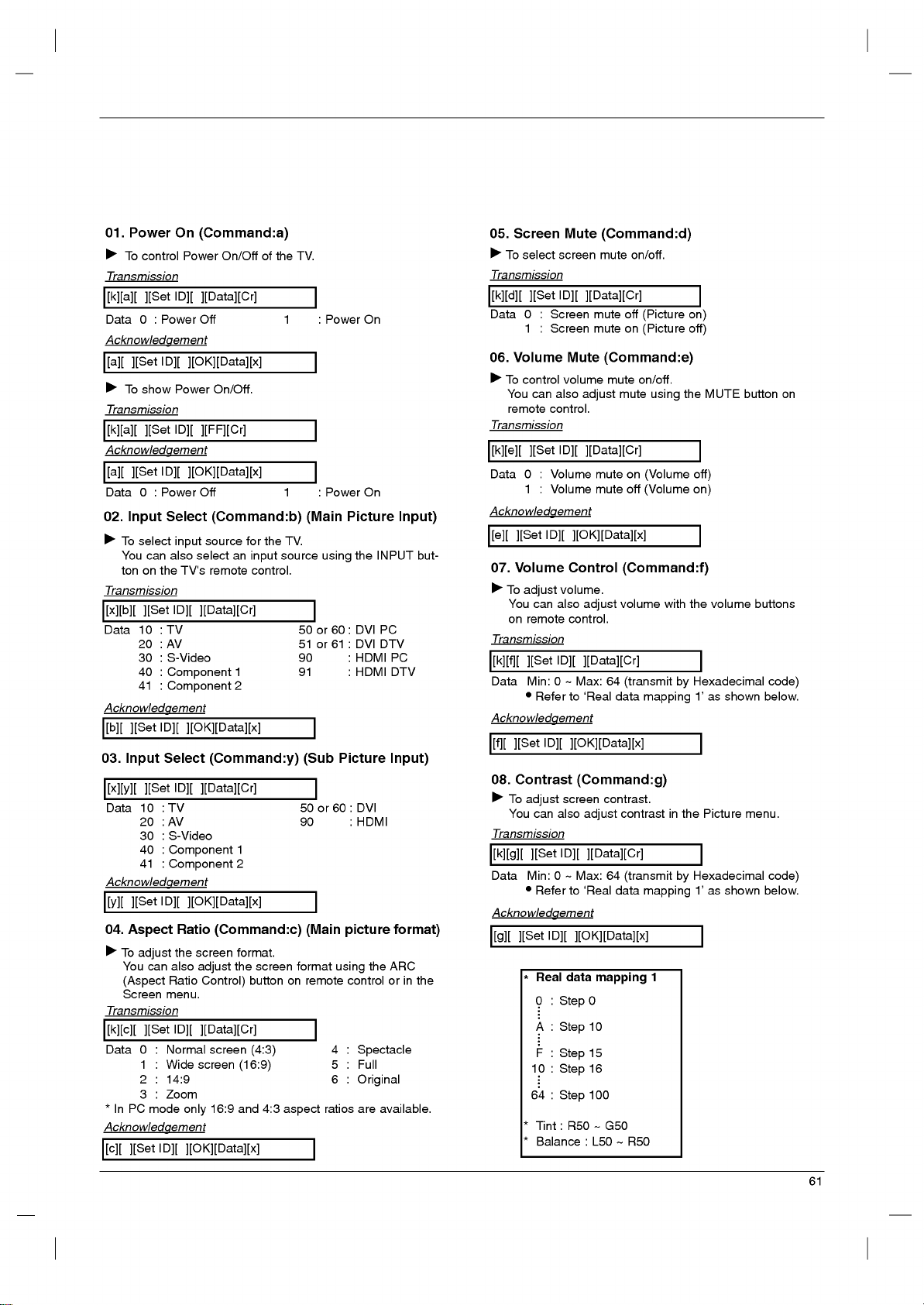
61
02.
Input
Select
(Command:b)
(Main
Picture
Input)
G
To
select
input
source
for
the TV.
You
can
also
select
an
input
source
using
the
INPUT
but-
ton
on
the
TV's
remote
control.
Transmission
Data
10
:TV
20
:AV
30
:
S-Video
40
:
Component
1
41
:
Component
2
50or60:DVIPC
51or61:DVIDTV
90
:
HDMI
PC
91
:
HDMI
DTV
[x][b][
][Set
ID][
][Data][Cr]
Data
10
:TV
20
:AV
30
:
S-Video
40
:
Component
1
41
:
Component
2
50or60:DVI
90
:
HDMI
[x][y][
][Set
ID][
][Data][Cr]
Acknowledgement
[y][
][Set
ID][
][OK][Data][x]
Acknowledgement
[b][
][Set
ID][
][OK][Data][x]
01.
Power
On
(Command:a)
G
To
control
Power
On/Off
of
the
TV.
Transmission
Data
0
:
Power
Off
1
:PowerOn
[k][a][
][Set
ID][
][Data][Cr]
Acknowledgement
[a][
][Set
ID][
][OK][Data][x]
G
To
show
Power
On/Off.
Transmission
Data
0
:
Power
Off
1
:PowerOn
[k][a][
][Set
ID][
][FF][Cr]
Acknowledgement
[a][
][Set
ID][
][OK][Data][x]
*
Real
data
mapping
1
0
:Step0
A:Step10
F:Step15
10:Step16
64
:
Step
100
*
Tint:R50~G50
*
Balance
:
L50
~
R50
06.
Volume
Mute
(Command:e)
G
To
control
volume
mute
on/off.
You
can
also
adjust
mute
using
the
MUTE
button
on
remote
control.
Transmission
Data
0
:
Volume
mute
on
(Volume
off)
1
:
Volume
mute
off
(Volume
on)
[k][e][
][Set
ID][
][Data][Cr]
Acknowledgement
[e][
][Set
ID][
][OK][Data][x]
04.
Aspect
Ratio
(Command:c)
(Main
picture
format)
G
To
adjust
the
screen
format.
You
can
also
adjust
the
screen
format
using
the
ARC
(Aspect
Ratio
Control)
button
on
remote
control
or
in
the
Screen
menu.
Transmission
Data
0
:
Normal
screen
(4:3)
1
:
Wide
screen
(16:9)
2:14:9
3:Zoom
4
:
Spectacle
5:Full
6
:
Original
[k][c][
][Set
ID][
][Data][Cr]
Acknowledgement
[c][
][Set
ID][
][OK][Data][x]
05.
Screen
Mute
(Command:d)
G
To
select
screen
mute
on/off.
Transmission
Data
0
:
Screen
mute
off
(Picture
on)
1
:
Screen
mute
on
(Picture
off)
[k][d][
][Set
ID][
][Data][Cr]
07.
Volume
Control
(Command:f)
G
To
adjust
volume.
You
can
also
adjust
volume
with
the
volume
buttons
on
remote
control.
Transmission
Data
Min:
0
~
Max:
64
(transmit
by
Hexadecimal
code)
?
Refer
to
'Real
data
mapping
1'
as
shown
below.
[k][f][
][Set
ID][
][Data][Cr]
Acknowledgement
[f][
][Set
ID][
][OK][Data][x]
08.
Contrast
(Command:g)
G
To
adjust
screen
contrast.
You
can
also
adjust
contrast
in
the
Picture
menu.
Transmission
Data
Min:
0
~
Max:
64
(transmit
by
Hexadecimal
code)
?
Refer
to
'Real
data
mapping
1'
as
shown
below.
[k][g][
][Set
ID][
][Data][Cr]
Acknowledgement
[g][
][Set
ID][
][OK][Data][x]
*
In
PC
mode
only
16:9
and
4:3
aspect
ratios
are
available.
03.
Input
Select
(Command:y)
(Sub
Picture
Input)

62
10.
Colour
(Command:i)
G
To
adjust
the
screen
colour.
You
can
also
adjust
colour
in
the
Picture
menu.
Transmission
Data
Min:
0
~
Max:
64
(transmit
by
Hexadecimal
code)
?
Refer
to
'Real
data
mapping
1'.
See
page
61.
[k][i][
][Set
ID][
][Data][Cr]
Acknowledgement
[i][
][Set
ID][
][OK][Data][x]
11.
Tint
(Command:j)
G
To
adjust
the
screen
tint.(NTSC
M
input
only)
You
can
also
adjust
tint
in
the
Picture
menu.
Transmission
Data
Min:
0
~
Max:
64
(transmit
by
Hexadecimal
code)
?
Refer
to
'Real
data
mapping
1'.
See
page
61.
[k][j][
][Set
ID][
][Data][Cr]
Acknowledgement
[j][
][Set
ID][
][OK][Data][x]
14.
Key
Lock
(Command:m)
G
To
lock
the
front
panel
controls
on
the
TV.
Transmission
[k][m][
][Set
ID][
][Data][Cr]
Acknowledgement
Data
0:
Lock
off
1:
Lock
on
?
If
you're
not
using
the
front
panel
controls
on
the
TV,
use
this
mode.
When
main
power
is
on/off,
remote
control
lock
is
released.
[m][
][Set
ID][
][OK][Data][x]
16.
Programme
Select
(Command:m
a)
(Main
TV
Input)
G
Tune
channel
to
following
Physical/major/minor
number.
Transmission
[m][a][
][Set
ID][
][Data0][Cr]
Acknowledgement
[a][
][Set
ID][
][OK][Data0][x]
[a][
][Set
ID][
][NG][Data0][x]
G
To
adjust
the
screen
sharpness.
You
can
also
adjust
sharpness
in
the
Picture
menu.
Transmission
12.
Sharpness
(Command:k)
Data
Min:
0
~
Max:
64
(transmit
by
Hexadecimal
code)
?
Refer
to
'Real
data
mapping
1'.
See
page
61.
[k][k][
][Set
ID][
][Data][Cr]
Acknowledgement
[k][
][Set
ID][
][OK][Data][x]
13.
OSD
Select
(Command:l)
G
To
select
OSD
(On
Screen
Display)
mute
on/off.
Transmission
[k][l][
][Set
ID][
][Data][Cr]
Acknowledgement
Data
0:
OSD
mute
on
1:
OSD
mute
off
[l][
][Set
ID][
][OK][Data][x]
Data0:
Programme
Number
Min
:
0
~
Max
:
63(transmit
by
Hexadecimal
code)
18.
Key
(Command:m
c)
G
To
send
IR
remote
key
code.
Transmission
[m][c][
][Set
ID][
][Data][Cr]
Acknowledgement
[c][
][Set
ID][
][OK][Data][x]
Data:
Key
code
(Refer
to
P.58)
17.
Programme
Select
(Command:m
b)
(Sub
TV
Input)
G
Tune
channel
to
following
Physical/major/minor
number.
Transmission
[m][b][
][Set
ID][
][Data
0][Cr]
Acknowledgement
[b][
][Set
ID][
][OK][Data0][x]
[b][
][Set
ID][
][NG][Data0][x]
Data0:
Programme
Number
Min
:
0
~
Max
:
63(transmit
by
Hexadecimal
code)
09.
Brightness
(Command:h)
G
To
adjust
screen
brightness.
You
can
also
adjust
brightness
in
the
Picture
menu.
Transmission
Data
Min:
0
~
Max:
64
(transmit
by
Hexadecimal
code)
?
Refer
to
'Real
data
mapping
1'.
See
page
61.
[k][h][
][Set
ID][
][Data][Cr]
Acknowledgement
[h][
][Set
ID][
][OK][Data][x]
15.
Balance
(Command:t)
G
To
adjust
balance.
Transmission
[k][t][
][Set
ID][
][Data][Cr]
Acknowledgement
Data
Min:
0
~
Max:
64
(transmit
by
Hexadecimal
code)
?
Refer
to
'Real
data
mapping
1'.
See
page
61.
[t][
][Set
ID][
][OK][Data][x]
External
Control
Device
Setup
;
RS-232C
External
Control
Device
Setup
;
RS-232C
Reference
Reference

63
How
to
join
the
product
assembly
to
the
wall
to
protect
the
set
tumbling
How
to
join
the
product
assembly
to
the
wall
to
protect
the
set
tumbling
(option)
(option)
Set
it
up
close
to
the
wall
so
the
product
doesn't
fall
over
when
it
is
pushed
backwards.
The
instructions
shown
below
is
a
safer
way
to
set
up
the
product,
which
is
to
fix
it
on
the
wall
so
the
product
does-
n't
fall
over
when
it
is
pulled
in
the
forward
direction.
It
will
prevent
the
product
from
falling
forward
and
hurting
peo-
ple.
It
will
also
prevent
the
product
from
damage
caused
by
fall.
Please
make
sure
that
children
don't
climb
on
or
hang
from
the
product.
Please
set
it
up
carefully
so
the
product
doesn't
fall
over.
Notes
?
When
moving
the
product
to
another
place
undo
the
ropes
first.
?
Use
a
product
holder
or
a
cabinet
that
is
big
and
strong
enough
for
the
size
and
weight
of
the
product.
?
To
use
the
product
safely
make
sure
that
the
height
of
the
bracket
that
is
mounted
on
the
wall
is
same
as
that
of
the
product.
2
The
Product
Back
Side
1
3
Use
the
bracket
and
the
bolt
to
fix
the
product
to
the
wall
as
shown
in
the
picture.
Secure
the
bracket
with
the
bolt
(not
provided
as
parts
of
the
product,
must
purchase
separately)
on
the
wall.
Use
a
sturdy
rope
(not
provided
as
parts
of
the
product,
must
purchase
separately)
to
tie
the
product.
It
is
safer
to
tie
the
rope
so
it
becomes
horizontal
between
the
wall
and
the
product.
1
2
3