
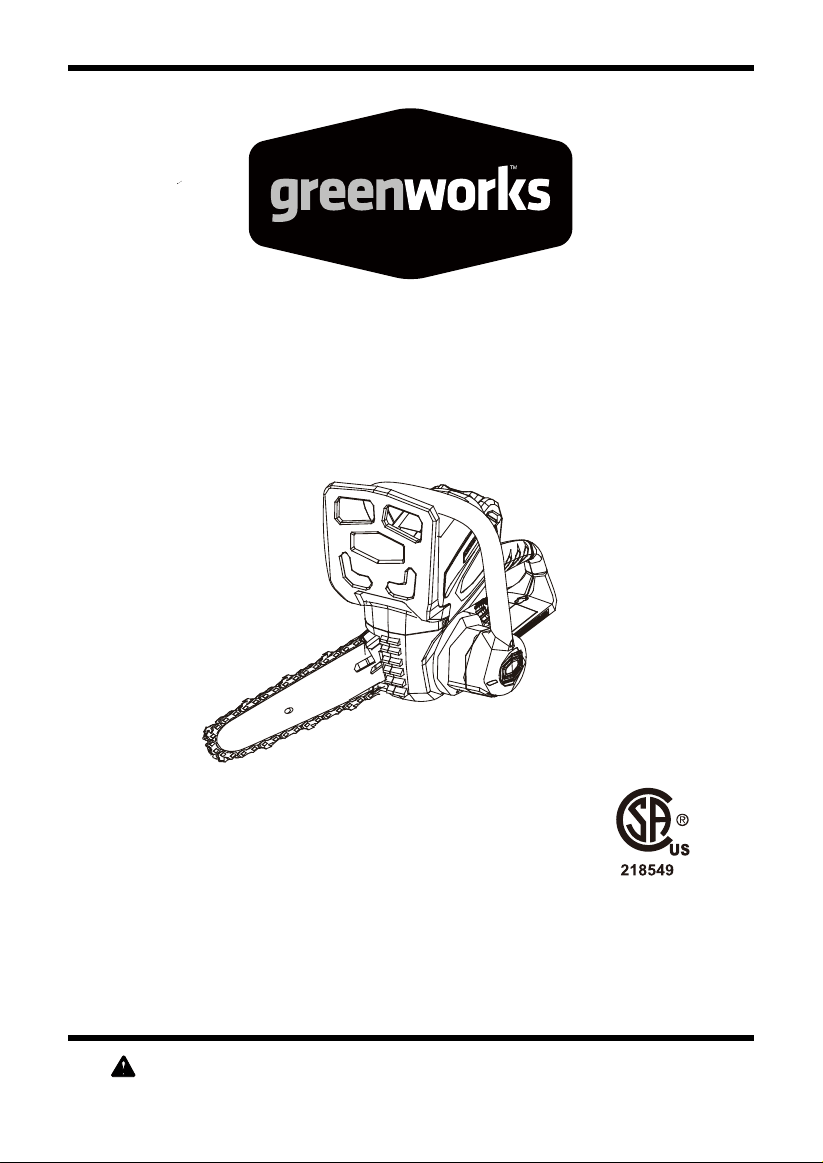
40V LITHIUM-ION CHAINSAW
2000219
Read all safety rules and instructions carefully before operating this tool.
Owner’s Manual
TOLL-FREE HELPLINE: 1-888-90WORKS
(888.909.6757)
www.GreenWorksTools.com

2
CONTENTS
Contents .............................................................................................................................. 2
Product specications .......................................................................................................... 2
General safety rules ............................................................................................................ 3
Symbols ............................................................................................................................. 10
Know your chainsaw .......................................................................................................... 12
Assembly instruction .......................................................................................................... 13
Operation .................................................................................................................. ..........16
Maintenance...........................................................................................................................25
Environmentally safe battery disposal.................................................................................. 35
Troubleshooting......................................................................................................................36
Warranty..................................................................................................................................37
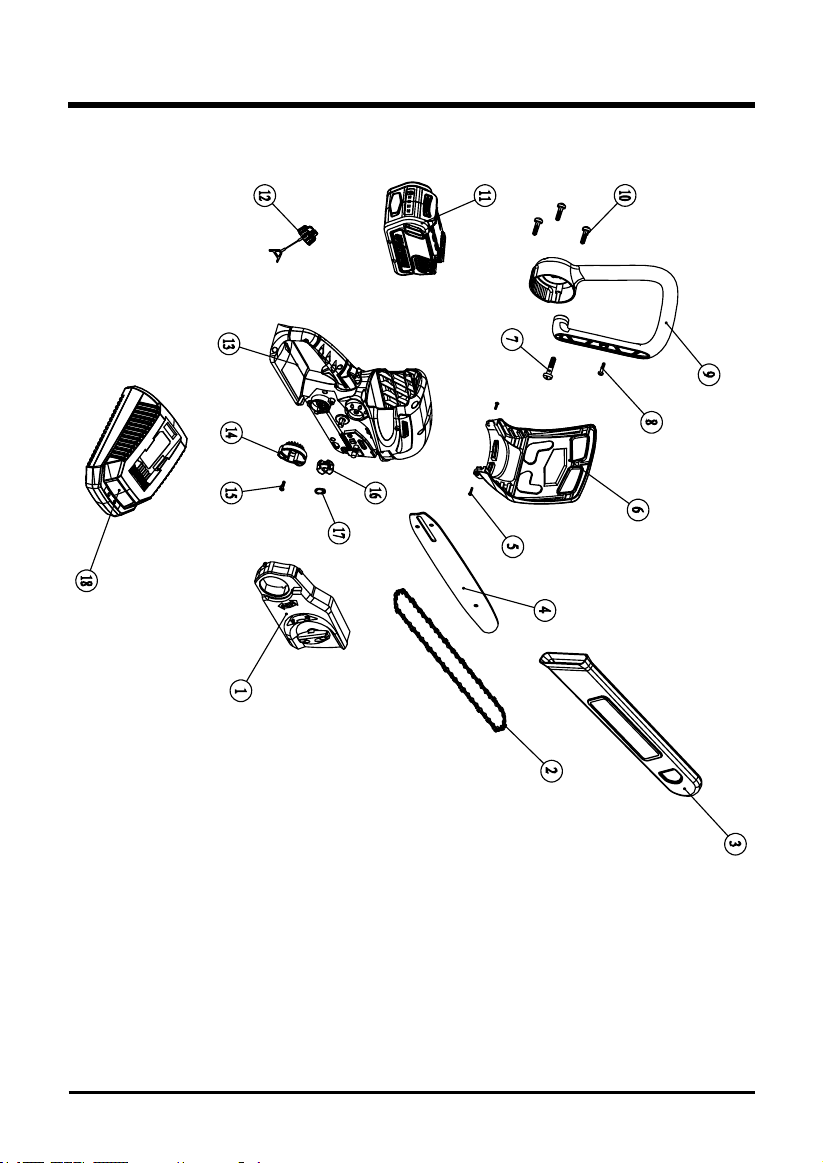
Exploded View ................................................................................................................... 38
Part List ............................................................................................................................. 39
PRODUCT SPECIFICATIONS
40V LITHIUM-ION CHAIN SAW
Type .........................................................................................Cordless, battery-powered
Motor ............................................................................................................. 40V Brushed
Bar length ...........................................................................................................12” (30cm)
Chain pitch .....................................................................................................3/8” (0.95cm)
Chain gauge .............................................................................................0.050" (0.127cm)
Chain type ............................................................................................ 91PJ045X(Oregon)
Chain Bar.....................................................................................12"120SDEA041(Oregon)
Chain Prole...........................................................................................................S Series
Chain oil tank capacity ..................................................................................1.8 oz (50 ml)
Weight........................................................................................................... 4.4kg
(
9.7 lbs)

3
GENERAL SAFETY RULES
WARNING
Read and understand all instructions before using this product. Failure to follow all
instructions listed below may result in electric shock, re, and/or serious personal injury.
WORK AREA SAFETY
• Keep work area clean and well lit. Cluttered or dark areas invite accidents.
• Donotoperatechainsawinexplosiveatmospheres,suchasinthepresenceofammable
liquids, gases, or dust. Chaisaws create sparks which may ignite the dust or fumes.
• Keep all children, bystanders, visitors, and animals out of the work area while starting or
cutting with the chainsaw. Distractions can cause you to lose control.
ELECTRICAL SAFETY
• Avoid body contact with earthed or grounded surfaces such as pipes, radiators, ranges
and refrigerators. There is an increased risk of electric shock if your body is earthed or
grounded.
• Do not expose the chainsaw to rain or wet locations. Water entering a chaisaw will increase
the risk of electric shock.
• If operating a power tool in a damp location is unavoidable, use a residual
current
device protected supply. Use of an RCD reduce the risk of electric shock.
• A battery-operated tool with integral batteries or a separate battery pack must be
rechargedonlywiththespeciedchargerforthebattery.A charger that may be suitable for
one type of battery may create a risk of re when used with another battery.
PERSONAL SAFETY
• Stay alert, watch what you are doing and use common sense when operating a
chaisaw.
Donotuseachaisawwhileyouaretiredorundertheinuenceofdrugs,alcoholor
medication. A moment of inattention while operating chaisaws may result in serious personal
injury.
• Use safety equipment. Always wear eye protection. Safety equipment such as dust mask,
non-skid safety shoes, hard hat, or hearing protection used for appropriate conditions will reduce
personal injuries.
• Avoid accidental starting. Ensure the switch is in the off-position before plugging in.
Carrying power tools with your nger on the switch or plugging in power tools that have the
switch on invites accidents.
• Remove any adjusting key or wrench before turning the power tool on. A wrench or a key
left attached to a rotating part of the chaisaw may result in personal injury.
• Do not overreach. Keep proper footing and balance at all times. This enables better control
of the chainsaw in unexpected situation.
• Dress properly. Do not wear loose clothing or jewellery. Keep your hair, clothing and
gloves away from moving parts. Loose clothes, jewellery or long hair can be caught in moving
parts.
• If devices are provided for the connection of dust extraction and collection facilities,
ensure these are connected and properly used. Use of these devices can reduce dust-
related hazards.

4
CHAINSAW USE AND CARE
• Do not force the chainsaw. Use the correct chainsaw for your application. The correct
chainsaw will do the job better and safer at the rate for which it was designed.
• Do not use the chainsaw if the switch does not turn it on and off. Any chainsaw that cannot
be controlled with the switch is dangerous and must be repaired.
• Disconnect the plug from the power source before making any adjustments changing
accessories, or storing chainsaws. Such preventive safety measures reduce the risk of
starting the chainsaw accidentally.
• Store idle chainsaws out of the reach of children and do not allow persons unfamiliar
with the chainsaw or these instructions to operate the chainsaw. Chainsaws are dangerous
in the hands of untrained users.
• Maintain chainsaws. Check for misalignment or binding of moving parts, breakage of
parts and any other condition that may affect the chainsaw’s operation. If damaged, have
the chainsaw repaired before use. Many accidents are caused by poorly maintained chainsaws.
• Keep cutting tools sharp and clean. Properly maintained cutting tools with sharp cutting edges
are less likely to bind and are easier to control.
• Use the chainsaw, accessories and tool bits etc. in accordance with these instructions,
taking into account the working conditions and the work to be performed. Use of the
chainsaw for operations different from those intended could result in a hazardous situation.
SERVICE
• Haveyourchainsawservicedbyaqualiedrepairpersonusingonlyidentical
replacement parts. This will ensure that the safety of the chainsaw is maintained.
BATTERY & CHARGER
USE ONLY GREENWORKS APPROVED REPLACEMENT BATTERIES, OTHER BATTERIES
MAY CAUSE INJURY OR DAMAGE TO THE CHAINSAW. Use only GREENWORKS batteries
(Model# 29462 or 29472). Use only GREENWORKS charger (Model# 29482).
BATTERY SAFETY RULES
• Ensure the switch is in the off position before inserting battery pack.
• Rechargeonlywiththechargerspeciedbythemanufacturer. A charger that is suitable for
one type of battery pack may create a risk of re when used with another battery pack.
• Usepowertoolsonlywithspecicallydesignatedbatterypacks. Use of any other battery
packs may create a risk of injury and re.
• When battery pack is not in use, keep it away from other metal objects, like paper clips,
coins, keys, nails, screws, or other small metal objects, that can make a connection from
one terminal to another. Shorting the battery terminals together may cause burns or a re.
• Under abusive conditions, liquid may be ejected from the battery; avoid contact. If
contactaccidentallyoccurs,ushwithwater.If liquid contacts eyes, additionally seek
medical help. Liquid ejected from the battery may cause irritation or burns.
• Battery tools do not have to be plugged into an electrical outlet; therefore, they are
always in operating condition. Be aware of possible hazards when not using your battery tool
or when changing accessories. Following this rule will reduce the risk of electric shock, re, or
serious personal injury.
GENERAL SAFETY RULES
CAUTION

5
GENERAL SAFETY RULES
• Donotplacebatterytoolsortheirbatteriesnearreorheat. This will reduce the risk of
explosion and possibly injury.
• Do not crush, drop or damage battery pack. Do not use a battery pack or charger that has
been dropped or received a sharp blow. A damaged battery is subject to explosion. Properly
dispose of a dropped or damaged battery immediately.
• Batteries can explode in the presence of a source of ignition, such as a pilot light. To
reduce the risk of serious personal injury, never use any cordless product in the presence
ofopename.An exploded battery can propel debris and chemicals. If exposed, ush with
water immediately. Do not charge battery tool in a damp or wet location. Following this rule will
reduce the risk of electric shock.
• For best results, your battery tool should be charged in a location where the temperature
is more than 45°F but less than 104°F. To reduce the risk of serious personal injury, do not
store outside or in vehicles.
• Under extreme usage or temperature conditions, battery leakage may occur. If liquid
comes in contact with your skin, wash immediately with soap and water. If liquid gets into
your eyes, ush them with clean water for at least 10 minutes, then seek immediate medical
attention. Following this rule will reduce the risk of serious personal injury.
• When battery pack is not in use, keep it away from other metal objects like: paper clips,
coins, keys, nails, screws, or other small metal objects that can make a connection from
one terminal to another. Shorting the battery terminals together may cause sparks, burns, or a
re.
• Always remove battery pack from your tool when you are assembling parts, making
adjustments, cleaning, or when not in use. Removing battery pack will prevent accidental
starting that could cause serious personal injury.
• Always remove battery pack before storing the device. When battery becomes fully charged,
unplug the charger from the power supply and remove the battery pack from the charger.
• Always wear eye protection with side shields marked to comply with ANSI Z87.1, along
with hearing protection. Failure to do so could result in objects being thrown into your eyes
and other possible serious injuries.
• Keep battery pack dry, clean, and free from oil and grease. Always use a clean cloth when
cleaning. Never use brake uids, gasoline, petroleum-based products, or any solvents to clean
battery pack.
• Do not open or mutilate the battery. Released electrolyte is corrosive and may cause damage
to the eyes or skin. It may be toxic if swallowed.
PROPER CARE FOR BATTERY
Off-season storage
To obtain the longest possible battery life, we suggest the following:
• Remove the battery pack from the charger once it is fully charged and ready for use. For battery
pack storage longer than 30 days:
• Store the battery pack where the temperature is below 80°F and away from moisture.
• Store battery packs in a 30%-50% charged condition.
• Every two months of storage, charge the pack as normal.
CHARGER SAFETY RULES
• Charge the mower battery in a dry area that is protected from the weather. Do not expose
the mower or the charger to rain. Do not charge the battery in a wet location. Operate the
battery charger in temperatures between 45° and 104°F. In order to reduce the risk of electric
shock, use only the charger that is provided by the manufacturer to charge the battery.

6
GENERAL SAFETY RULES
SPECIFIC SAFETY WARNINGS
• Keep all parts of the body away from the saw chain when the chain saw is operating.
Before you start the chain saw, make sure the saw chain is not contacting anything. A
moment of inattention while operating chain saws may cause entanglement of your clothing or
body with the saw chain.
• Always hold the chain saw with your right hand on the rear handle and your left hand on
the front handle. Holding the chain saw with a reversed hand conguration increases the risk of
personal injury and should never be done.
• Hold the chaisaw by insulated gripping surfaces only, because the saw chain may contact
hidden wiring or its own cord. Saw chains contacting a “live” wire may make exposed metal
parts of the chaisaw “live” and could give the operator an electric shock.
• Always use two hands when operating the chainsaw.
• Contact of the guide-bar tip with any object should be avoided.
• Tip contact may cause the guide bar to move suddenly upward and backward, which may
cause serious injury.
• Wear safety glasses and hearing protection. Further protective equipment for head,
hands, legs and feet is recommended. Adequate protective clothing will reduce personal injury
by ying debris or accidental contact with the saw chain.
• Do not operate a chain saw in a tree. Operation of a chain saw while up in a tree may result in
personal injury.
• Alwayskeepproperfootingandoperatethechainsawonlywhenstandingonxed,
secure and level surface. Slippery or unstable surfaces such as ladders may cause a loss of
balance or control of the chain saw.
• When cutting a limb that is under tension be alert for spring back. When the tension in the
wood bres is released the spring loaded limb may strike the operator and/or throw the chain
saw out of control.
• Use extreme caution when cutting brush and saplings. The slender material may catch the
saw chain and be whipped toward you or pull you off balance.
• DO NOT ABUSE THE CHARGE CORD. Never carry the charger by the cord. Do not disconnect
the charger from the outlet or from the mower by pulling the charger cord.
• Do not use a damaged charger. Replace the charger cords or the charger immediately.
• Keep the mower and the charger away from water, heat sources (radiators, heaters,
stoves,etc.),ames,andchemicals.
• Make sure the battery pack is secured in the charger before beginning operation.
• The battery pack will become slightly warm to the touch while charging. This is normal and
does not indicate a problem.
• Do not place the charger and battery pack in an area of extreme heat or cold. They will
work best at normal room temperature.
• When batteries become fully charged, unplug the charger from the power supply and
remove the battery pack.
WARNING
When transporting or servicing unit, always remove the battery.
7
GENERAL SAFETY RULES
W A R N I N G (PROPOSITION 65)
Some dust created by power sanding, sawing, grinding, drilling, and other construction activities
contains chemicals known to cause cancer, birth defects or other reproductive harm. Some
examples of these chemicals are:
• Lead from lead-based paints
• Crystalline silica from bricks and cement and other masonry products, and
• Arsenic and chromium from chemically treated lumber.
Your risk of exposure to these chemicals varies depending on how often you do this type of work.
To reduce your exposure to these chemicals, work inven a well-ventilated area, and work with
approved safety equipment, such as dust masks that are specially designed to lter out microscopic
particles.
WARNING
When using an cordless chainsaw, basic safety precaution should be always followed to reduce the
risk of re, electric shock, and injury to persons, including the following:
CHILD SAFETY
Tragic accidents can occur if the operator is not aware of the presence of children.
• Keep children out of the working area and under the watchful care of a responsible adult.
• Do not allow children under the age of 14 to operate this blower. Children who are 14
years of age and older must read and understand the operating instructions and safety
rules in this manual and must be trained and supervised by a parent.
• Stay alert, and turn the blower off if a child or any other person enters the working area.
• Use extreme care when approaching blind corners, doorways, shrubs, trees, or other
objects that may obscure your view of a child who may run into the path of the blower.
• Carry the chain saw by the front handle with the chain saw switched off and away from
yourbody.Whentransportingorstoringthechainsawalwaysttheguidebarcover.
Proper handling of the chain saw will reduce the likelihood of accidental contact with the moving
saw chain.
• Follow instructions for lubricating, chain tensioning and changing accessories.
Improperly tensioned or lubricated chain may either break or increase the chance for kickback.
• Keep handles dry, clean, and free from oil and grease. Greasy, oily handles are slippery
causing loss of control.
• Cut wood only. Do not use chain saw for purposes not intended. For example: do not use
chain saw for cutting plastic, masonry or non-wood building materials. Use of the chain
saw for operations different than intended could result in a hazardous situation.
SAVE THESE INSTRUCTIONS
8
GENERAL SAFETY RULES
WARNING
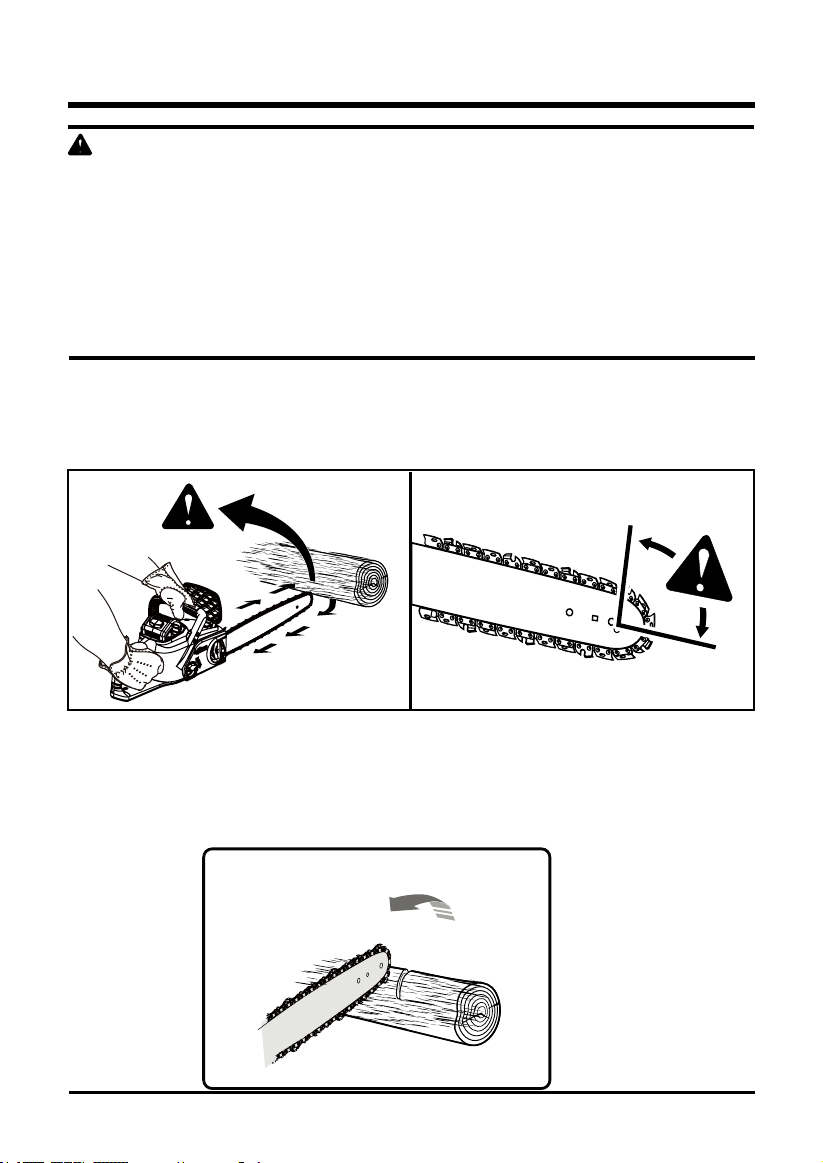
Kickback may occur when the moving chain contacts an object at the upper portion of
the tip of the guide bar or when the wood closes in and pinches the saw chain in the
cut. Contact at the upper portion of the tip of the guide bar can cause the chain to dig
into the object and stop the chain for an instant. The result is a lightning fast reverse
reaction which kicks the guide bar up and back toward the operator. If the saw chain is
pinched along the top of the guide bar, the guide bar can be driven rapidly back toward the
operator. Either of these reactions can cause loss of saw control which can result in
serious injury. Do not rely exclusively upon the safety devices built into the saw. As
a chainsaw user, you should take several steps to keep your cutting jobs free from
accident or injury.
Fig. 2
Rotational
Kickback
Kickback
Danger Zone
CAUSES AND OPERATOR PREVENTION OF KICKBACK
1.Maintainarmgrip,withthumbsandngersencirclingthechainsaw
handles, with both hands on the saw and position your body and arm to allow
you to resist kickback forces. Kickback forces can be controlled by the operator, if
proper precautions are taken. Do not let go of the chain saw.
2. Do not overreach and do not cut above shoulder height. This helps prevent
unintended tip contact and enables better control of the chain saw in unexpected
situations.
3.Onlyusereplacementbarsandchainsspeciedbythemanufacturer.Incorrect
replacement bars and chains may cause chain breakage and/or kickback.
4. Follow the manufacturer’s sharpening and maintenance instructions for the
saw chain. Decreasing the depth gauge height can lead to increased kickback.
9
GENERAL SAFETY RULES
LOW-KICKBACK SAW CHAIN
The rakers (depth gauges) ahead of each cutter can minimize the force of a kickback reaction
by preventing the cutters from digging in too deeply at the kickback zone. Only use replacement
chain that is equivalent to original chain or has been certied as low kickback chain per ANSI
B175.1. Low-kickback/skip tooth saw chain is a chain that has met the kickback performance
requirements of ANSI B175.1 - 1991. When tested on the representative sample of chainsaws
below 3.8 c.i.d. specied in ANSI B175.1 - 1991. As saw chains are sharpened during their
useful life, they lose some of the low-kickback qualities and extra caution should be used.
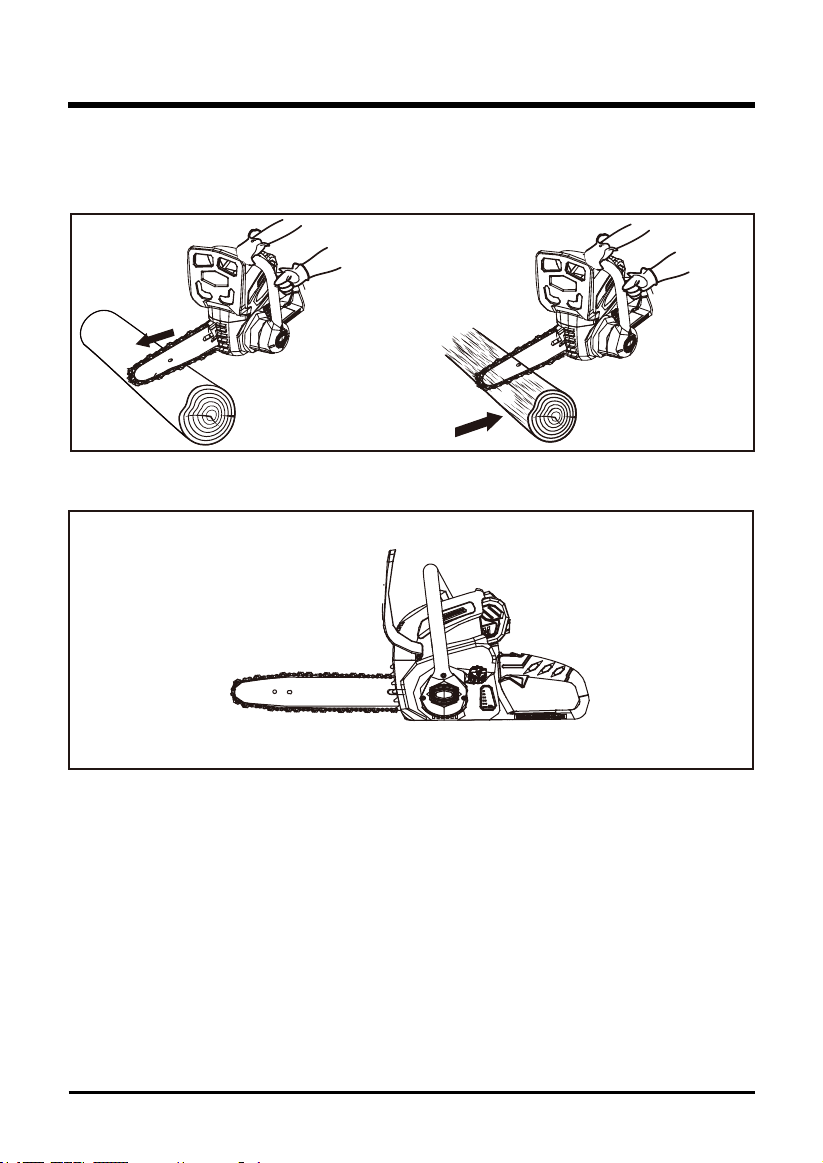
Push and pull - This reaction force is always opposite to the direction the chain is moving where
wood contact is made. Thus, the operator must be ready to control the PULL when cutting on the
bottom edge of the bar, and PUSH when cutting along the top edge. (See Figure 3)
Fig. 3
PULL
PUSH
UNDERSTANDING YOUR CHAINSAW SAFETY DEVICES
Fig. 4
10
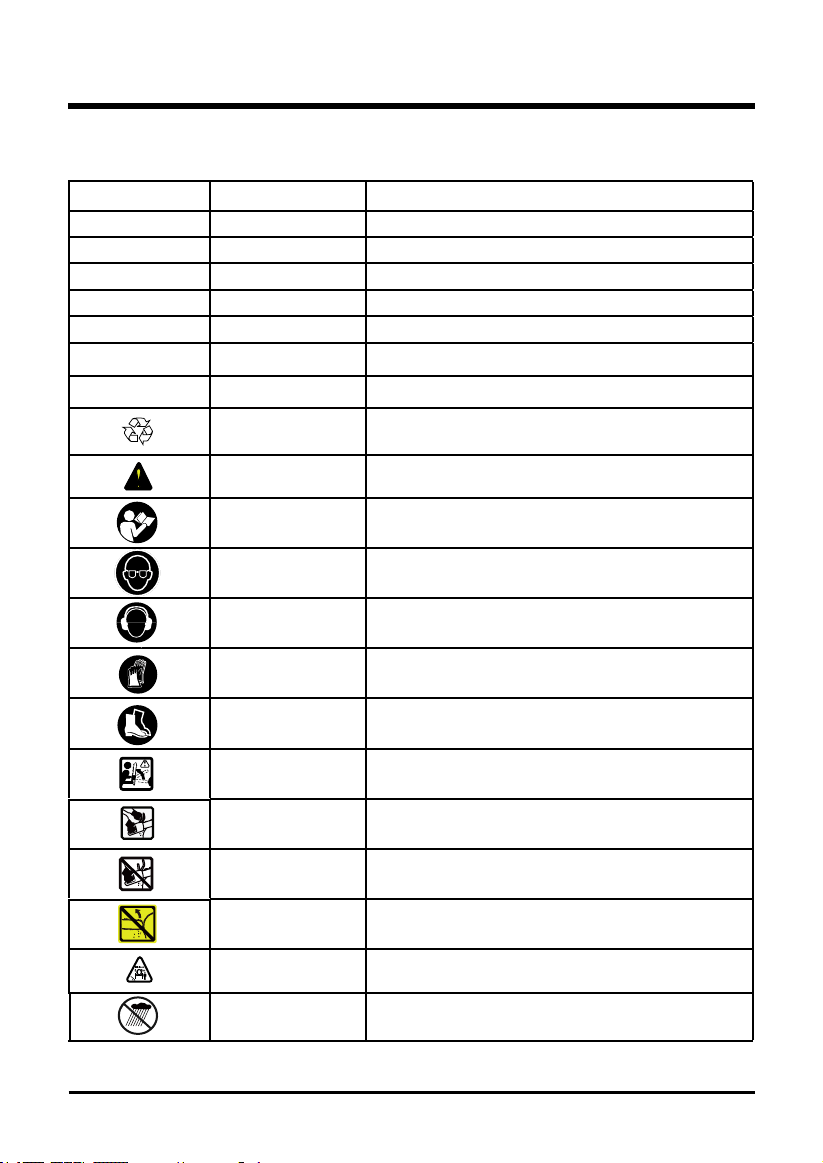
Some of the following symbols may be used on this product. Please study them and learn their
meaning. Proper interpretation of these symbols will allow you to operate the product better and safer.
SYMBOLS
SYMBOLS DESIGNATION EXPLANATION
V
A
Hz
Hertz Frequency (cycles per second).
W
Watts Power.
hrs
n
o
No Load Speed Rotational speed, at no load.
/ min
Per Minute
Revolutions, strokes, surface speed, orbits etc., per
minute.
Lithium-ion Battery
Recycling
Designates that this tool is in compliance with
lithium-ion battery recycling program requirements.
Safety Alert Symbol Precautions that involve your safety.
Read the Instruction
Manual
To reduce the risk of injury, user must read and
understand the Instruction manual before using this
product.
.
.
Gloves
Wear non-slip, heavy-duty protective gloves when
handling the chainsaw and the blade.
Safety Footwear
Wear non-slip safety footwear when using this
equipment.
Kickback DANGER! Beware of kickback.
Operate With Two
Hands
Hold and operate the saw properly with both hands.
One Handed Do not operate the saw using only one hand.
Bar Nose Contact Avoid bar nose contact.
Keep Bystanders
Away
Keep all bystanders at least 50’ (15 m) away.
Volts Voltage.
Amperes
Current
.
Hours Time.
Eye Protection Wear eye protection when operating this equipment.
Wear Ear Protection Wear ear protection when operating this equipment.
Wet Conditions Alert Do not expose to rain or use in damp locations.
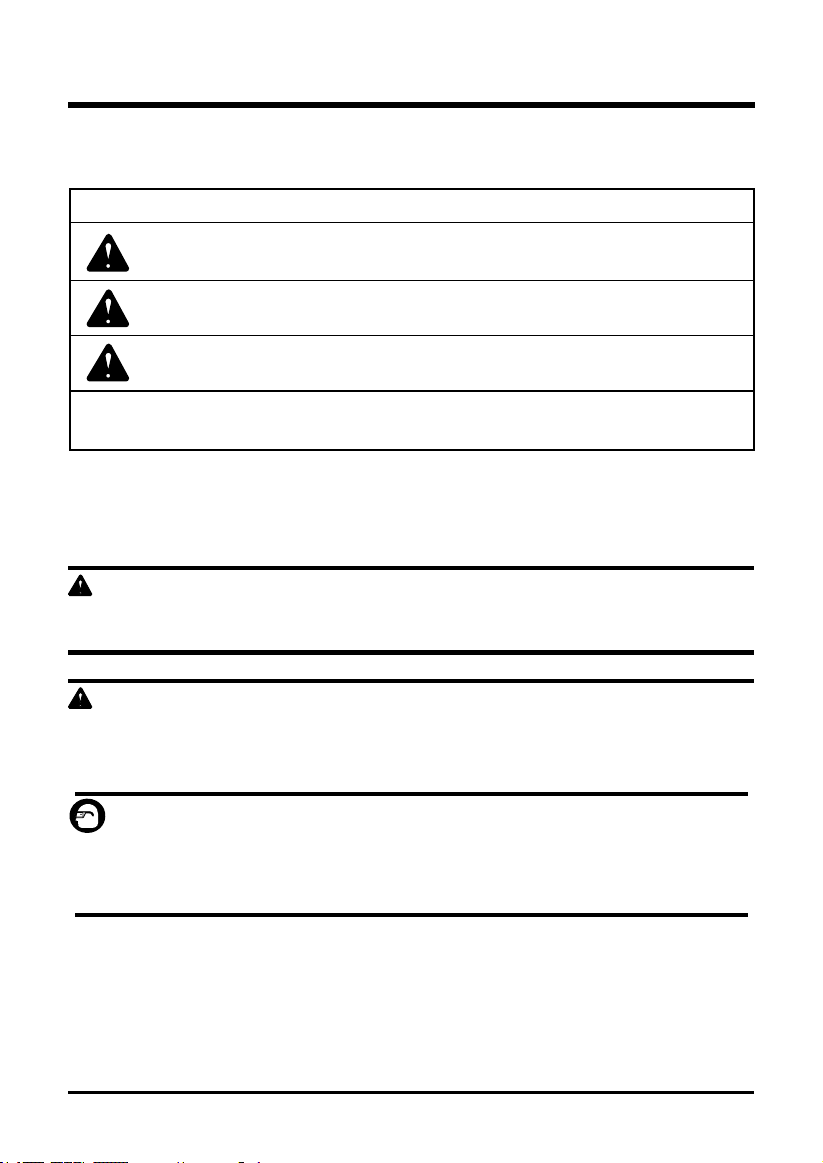
The following signal words and meanings are intended to explain the levels of risk associated
with this product.
SERVICE
Servicing requires extreme care and knowledge and should be performed only by a qualied
service technician. For service we suggest you return the product to your nearest AUTHORIZED
SERVICE CENTER for repair. When servicing, use only identical replacement parts.
DANGER Indicates an imminently hazardous situation, which, if not
avoided, will result in death or serious injury.
WARNING Indicates a potentially hazardous situation, which, if not avoided,
could result in death or serious injury.
CAUTION Indicates a potentially hazardous situation, which, if not avoided,
may result in minor or moderate injury.
CAUTION (Without Safety Alert Symbol) Indicates a situation that may
result in property damage.
SYMBOLS
SAVE THESE INSTRUCTIONS
11
SYMBOL SIGNAL MEANING
WARNING
• Not use for wet materials.
• Disconnect before cleaning or changing accessories.
WARNING
To avoid serious personal injury, do not attempt to use this product until you have read this
Owner’s Manual thoroughly and understand it completely. If you do not understand the warnings
and instructions in this Owner’s Manual, do not use this product. Call the Toll-free Helpline (1-
888-909-6757) for assistance.
The operation of any power tool can result in foreign objects being thrown into your eyes,
which can result in severe eye damage. Before operating a power tool, always wear safety
goggles, safety glasses with side shields, or a full face shield when needed. We recommend a
Wide Vision Safety Mask for use over eyeglasses or standard safety glasses with side shields.
Always use eye protection that is marked to comply with ANSI Z87.1.
12
KNOW YOUR CHAINSAW
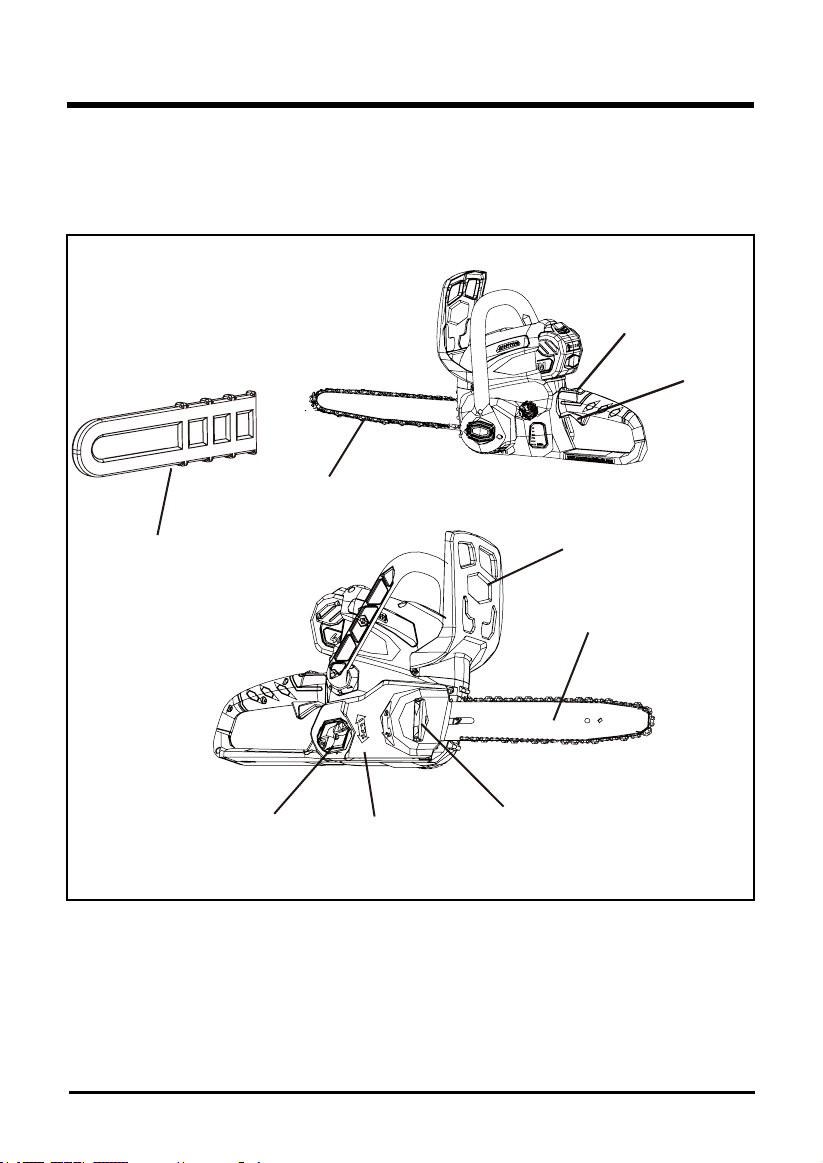
Read this operator's manual and safety rules before operating your chainsaw. Compare the
illustration in Figure 5 to your chainsaw in order to familiarize yourself with the location of various
controls and adjustments. Save this manual for future reference.
Switch Lock
Fig. 5
Scabbard
Front Hand
Guard
Chain Cover
Chain Tension
knob
Chain Cover
Lock knob
Guide Bar
Low Kickback Saw Chain
Switch Trigger
13
ASSEMBLY INSTRUCTION
WARNING
UNPACKING
This product has been shipped completely assembled.
• Carefully remove the product and any accessories from the box. Make sure that all items
listed in the package contents section are included.
• Inspect the product carefully to make sure no breakage or damage occurred during shipping.
• Do not discard the packing material until you have carefully inspected and satisfactorily
operated the product.
• If any parts are damaged or missing, please call 1.888.909.6757 for assistance.
PACKING LIST
• Chainsaw
• Scabbard
• Owner’s Mannual
• Black bag
• Bar and chain
• Battery and Charger
If any parts are damaged or missing, do not operate this product until the parts are replaced.
Using a product with damaged or missing parts could result in serious personal injury.
WARNING
Do not attempt to modify this product or create accessories not recommended for use with this
product. Any such alteration or modication is misuse and could result in a hazardous condition
leading to possible serious personal injury.
WARNING
Do not insert the battery until assembly is complete. Failure to comply could result in accidental
starting and possible serious personal injury.
14
ADDING BAR AND CHAIN LUBRICANT
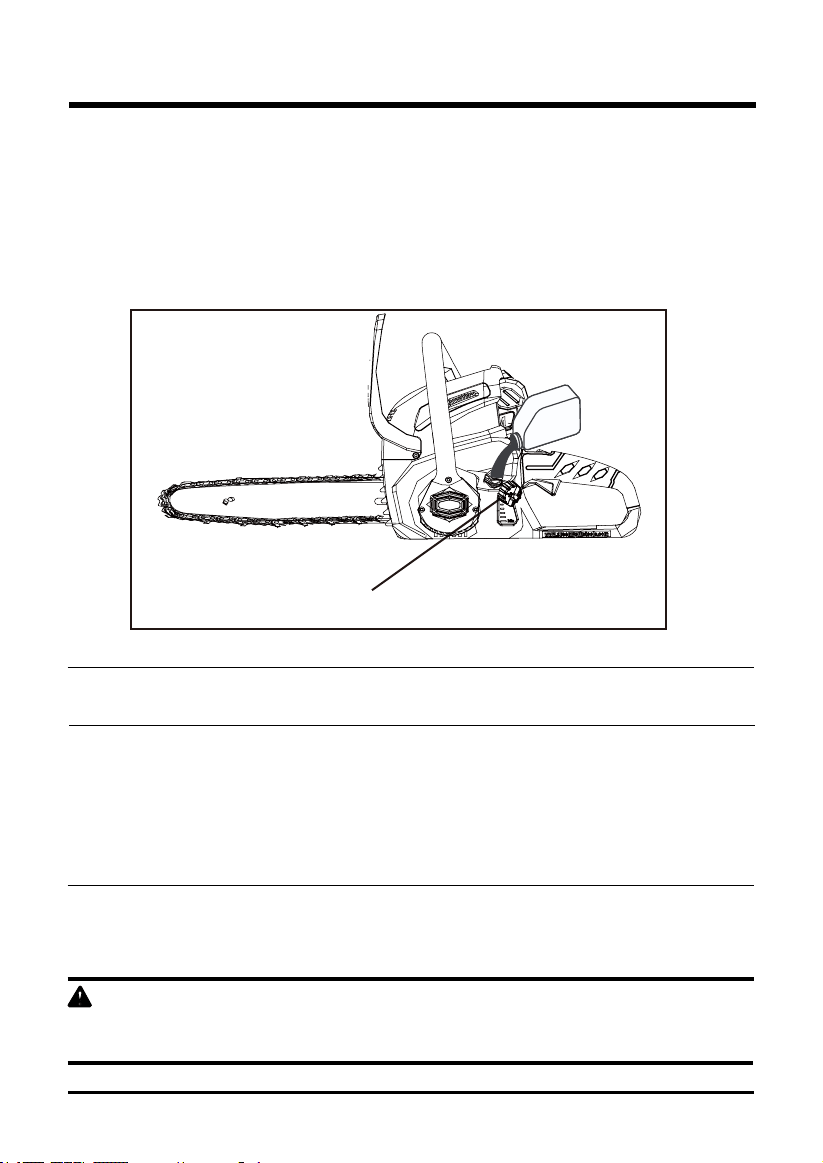
Use a bar and chain lubricant with this product. It is designed for chains and chain oilers, and is
formulated to perform over a wide temperature range with no dilution required.
• Remove oil cap.
• Carefully pour the bar and chain oil into the tank.
• Wipe off excess oil and replace cap.
• Check and ll the oil tank when quick view oil indicator is below the MIN. line.
• Repeat as needed.
NOTE:
Chainsaw comes from the factory with no bar and chain oil added. The level should also be
checked after every 10 minutes of use and relled as needed.
NOTE:
• Do not use dirty, used or otherwise contaminated oils. Damage may occur to the bar or
chain.
• It is normal for oil to seep from the saw when not in use. To prevent seepage, empty the oil
tank after each use then run for one minute. When storing the unit for a long period of time
(three months or longer) be sure the chain is lightly lubricated; this will prevent rust on the
chain and bar sprocket.
To preserve natural resources, please recycle or dispose of oil properly. Consult your local waste
authority for information regarding available recycling and/disposal options.
NOTE: There is foam inserted inside the oil reservoir to lter dirt and debris from the oil pump.
DO NOT remove the foam.
IMPORTANT
ASSEMBLY INSTRUCTION
Oil Reservoir Cap
L
u
b
ric
a
n
t
WARNING
Follow these instructions in order to avoid injury and to reduce the risk of electric shock or re:
• Replace the battery pack or the charger immediately if the battery case or charger cord is
damaged.
• Verify that the switch is in the OFF position before inserting or removing the battery pack.
• Verify that the battery pack is removed and the switch is in the OFF position before inspecting,
adjusting, or performing maintenance on any part of the chainsaw.
• Read, understand, and follow the instructions contained in the section entitled Charging
Procedure.
15
ASSEMBLY INSTRUCTION
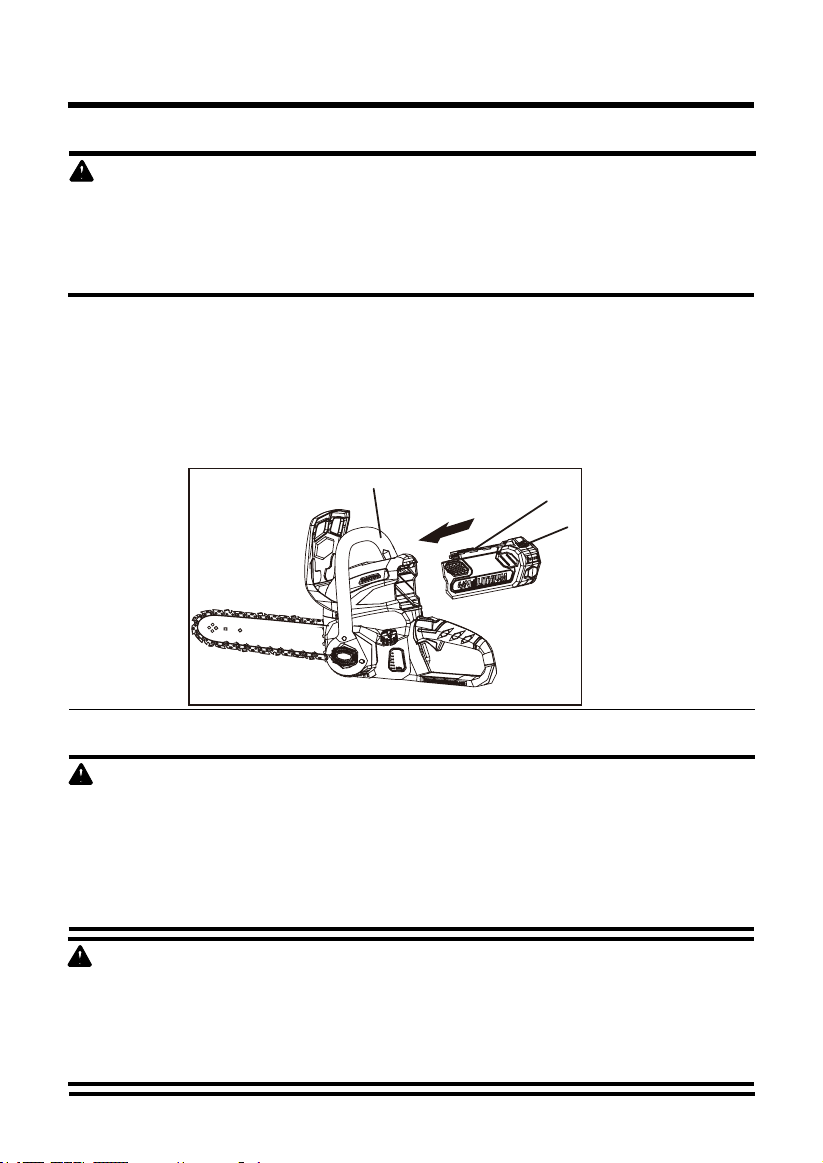
NOTE: The battery pack ts into the handle snugly in order to prevent accidental dislodging. It
may require a strong pull to remove it.
TO REMOVE THE BATTERY:
1. Press the battery release button (1) on the chainsaw. This will cause the battery to raise out of
the tool slightly.
2. Grasp the chainsaw (2) rmly and pull the battery out of the handle.
INSTALLING THE BATTERY PACK
• Align the rails (3) of the battery pack with the cavity.
• Grasp the chainsaw (2).
• Push the battery pack into the handle until the latch locks into place.
• Do not use force when inserting the battery pack. It should slide into position and “click”.
Fig. 7
2
1
3
BATTERY PACK (See Figure 7)
IMPORTANT
The battery pack is not charged when it is purchased. Before using the chain saw for the rst
time, place the battery pack in the battery charger and charge it fully. Be sure to read all safety
precautions, and follow the instructions in the section entitled Charging Procedure. With regular
use, the battery will require shorter charging times. When storing the chain saw for a prolonged
period of time, remove the battery. When the chain saw is going to be used again, charge the
battery pack for at least a full charging period. This product has no memory effect.
IMPORTANT
This lithium-ion battery pack is equipped with an internal circuit breaker which will automatically
shut off the power to the tool and then reset itself once cooled. Follow these steps if an overload
occurs while under heavy use:
1. Release the power switch and restart tool by depressing switch.
2. The battery may need to be removed for approximately 1 minute, allowed to cool, and then
reinstalled for use.
16
OPERATION
STARTING AND STOPPING THE CHAIN SAW
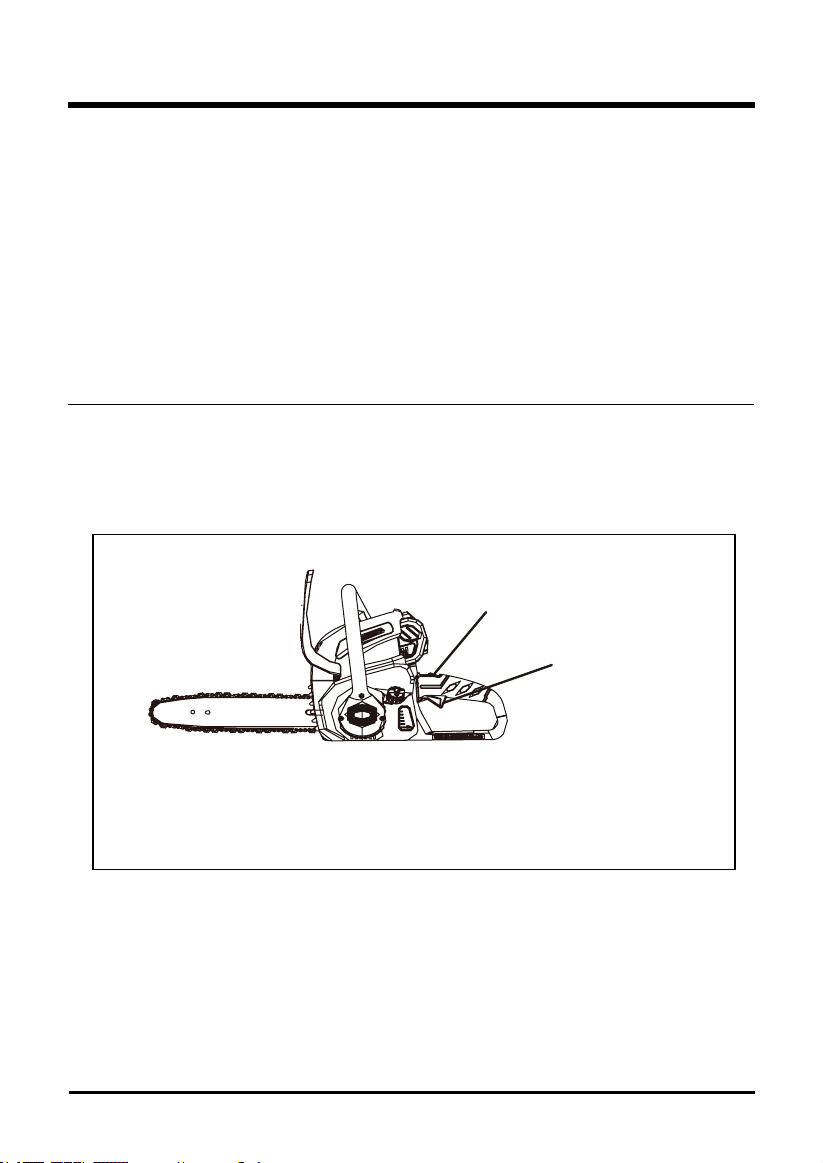
A. To start the chainsaw:
• Make sure chain tension is at desired setting. Refer to adjusting the chain tension in the Care
and Maintenance section of this manual.
• Make sure the chain cover lock knob is tight to the chain cover.
• Make sure no objects or obstructions are in the immediate vicinity which could come in contact
with the bar and chain.
• Fit the battery into the chainsaw.
• Press in the safety lock. This makes the trigger switch operational.
• Press and hold the trigger switch and keep it pressed for continued operation.
NOTE: It is normal for the chain to coast to a stop once the trigger switch is released.stop once the
trigger switch is released.
B. To stop the chainsaw:
• Release the trigger switch.
• Upon release of the trigger switch, the safety lock will be automatically reset to the lock position.
Switch Lock
Switch Trigger
Fig. 8
17
OPERATION
WARNING
PREPARING FOR CUTTING
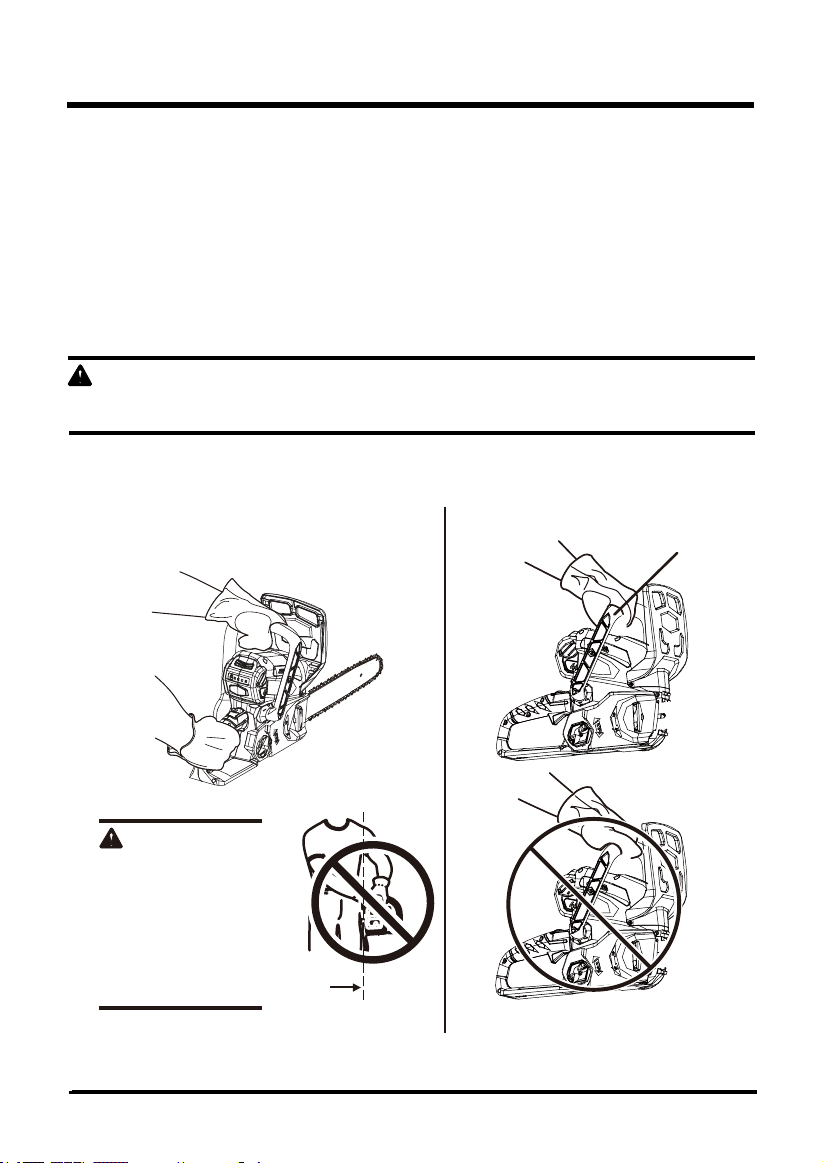
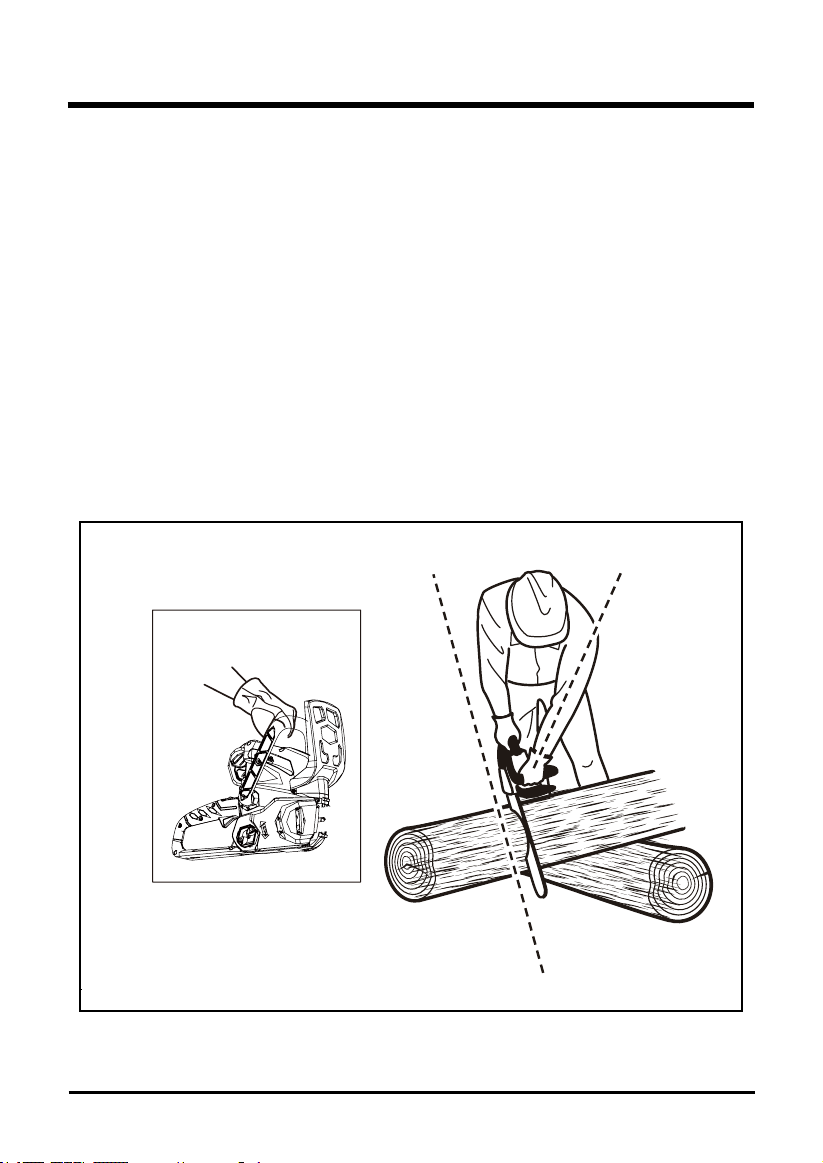
A. Proper grip on handles
See General Safety Rules for appropriate safety equipment.
• Wear non-slip gloves for maximum grip and protection.
• Hold the saw rmly with both hands. Always keep your left hand on the front handle and your
right hand on the rear handle so that your body is to the left of the chain line.
• Maintain a proper grip on the saw whenever the motor is running. The ngers should
encircle the handle and the thumb is wrapped under the handlebar. This grip is least likely
to be broken by a kickback or other sudden reaction of the saw. Any grip in which the thumb
and ngers are on the same side of the handle is dangerous because a slight kick of the saw
can cause loss of control.
Never use a left-handed (cross-handed) grip or any stance that would place your body or arm
across the chain line.
Fig. 9
PROPER HAND
GRIP POSITION
CHAIN
LINE
Proper Grip
IMPROPER GRIP
WARNING
DO NOT operate the
switch trigger with your
left hand and hold the
front handle with your
right hand. Never allow
any part of your body
to be in the chain line
while operating a saw.
18
OPERATION
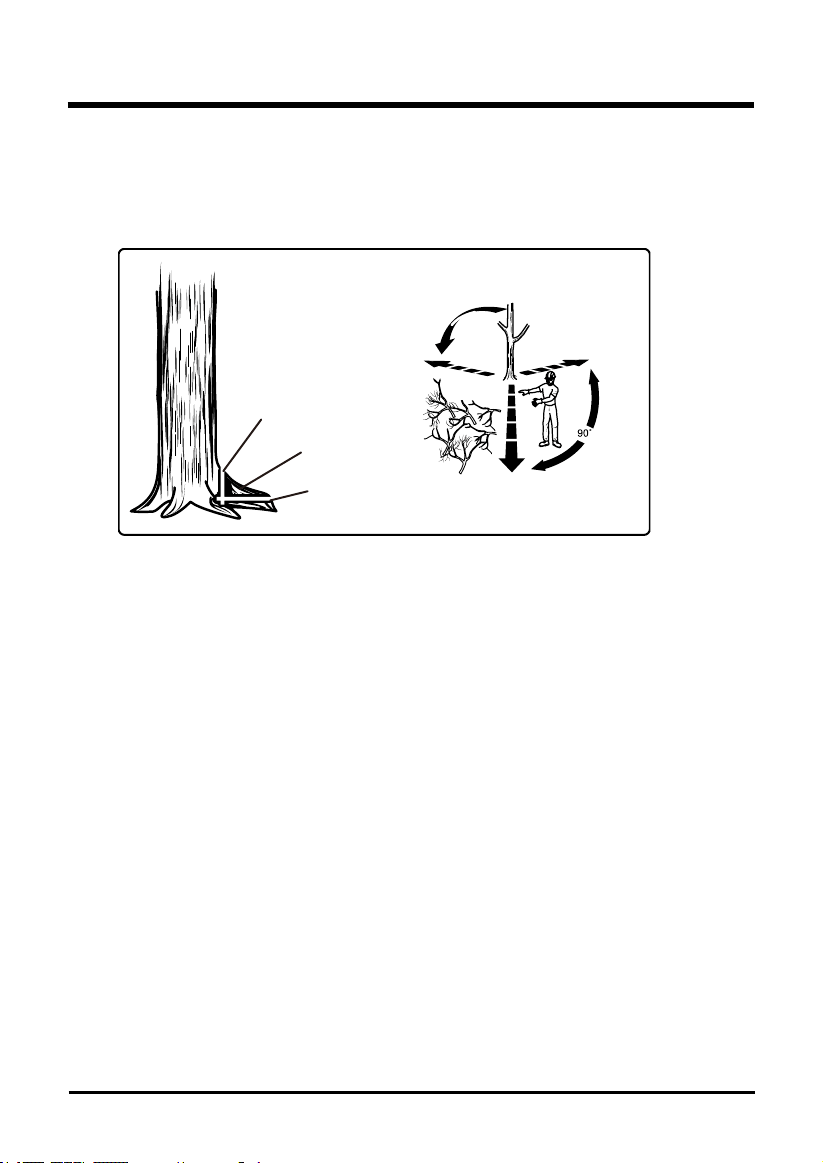
PROPER CUTTING STANCE
• Balance your weight with both feet on solid ground.
• Keep left arm with elbow locked in a “straight arm” position to withstand any kickback force.
• Keep your body to the left of the chain line.
• Keep your thumb on underside of front handle.
BASIC OPERATING/CUTTING PROCEDURES
Practice cutting a few small logs using the following technique to get the “feel” of using the saw
before you begin a major sawing operation.
• Take the proper stance in front of the wood.
• Press the safety lock and squeeze the trigger switch then release the safety lock and let the
chain accelerate to full speed before entering the cut.
• Begin cutting with the saw against the log.
• Keep the unit running the entire time you are cutting, maintain a steady speed.
• Allow the chain to cut for you; exert only light downward pressure. Forcing the cut could result in
damage to the bar, chain, or motor.
• Release the trigger switch as soon as the cut is completed, allowing the chain to stop. If you run
the saw without a cutting load, unnecessary wear can occur to the chain, bar, and unit.
• Do not put pressure on the saw at the end of the cut.
THUMB ON UNDERSIDE
OF HANDLE BAR
Chain Line
Straight Arm
Fig. 10
19
OPERATION
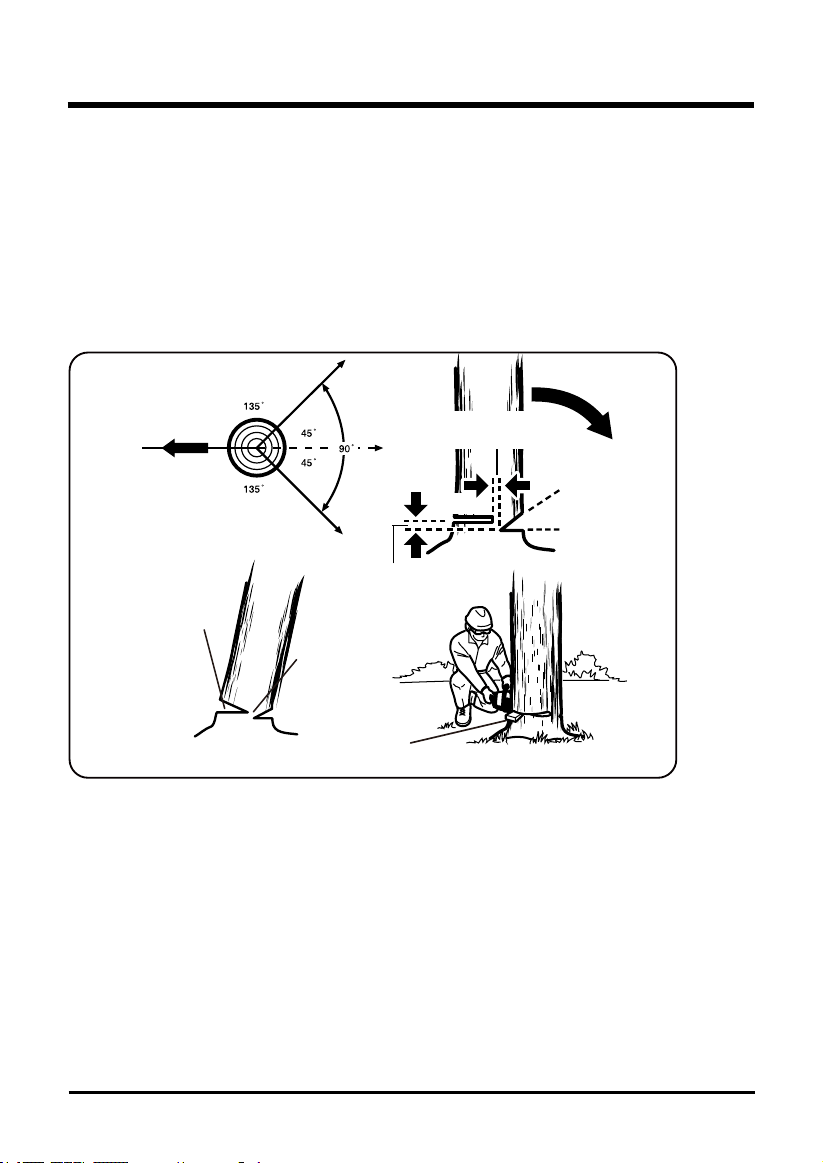
REMOVING BUTTRESS ROOTS
A buttress root is a large root extending from the trunk of the tree above the ground. Remove
large buttress roots prior to felling. Make the horizontal cut into the buttress rst, followed by the
vertical cut. Remove the resulting loose section from the work area. Follow the correct tree felling
procedure as stated in Proper Procedure For Tree Felling after you have removed the large
buttress roots.
PROPER PROCEDURE FOR TREE FELLING
• Felling a tree — When bucking and felling operations are being performed by two or
more persons at the same time, the felling operation should be separated from the bucking
operation by a distance of at least twice the height of the tree being felled. Trees should not
be felled in a manner that would endanger any person, strike any utility line or cause any
property damage.
If the tree does make contact with any utility line, the utility company should be notied
immediately.
• Operator should keep on the uphill side of terrain as the tree is likely to roll or slide after it is
felled.
• Pick your escape route (or routes in case the intended route is blocked). Clear the
immediate area around the tree and make sure there are no obstructions in your planned
path of retreat. Clear the path of safe retreat approximately 135° from the planned line of fall.
• Consider the force and direction of the wind, the lean and balance of the tree, and the
location of large limbs. These things inuence the direction in which the tree will fall. Do not
try to fell a tree along a line different from its natural line of fall.
• Remove dirt, stones, loose bark, nails, staples, and wire from the tree where felling cuts are
to be made.
• Notched Undercut. Cut a notch about 1/3 the diameter of the trunk on the side of the tree.
Make the notch cuts so they intersect at a right angle to the line of fall. This notch should be
cleaned out to leave a straight line. To keep the weight of the wood off the saw, always make
the lower cut of the notch before the upper cut.
Vertical Cut
Loose
section
Horizontal
Cut
Planned Line
of fall
135°from planned
line of fall
Path of
safe
retreat
20
OPERATION
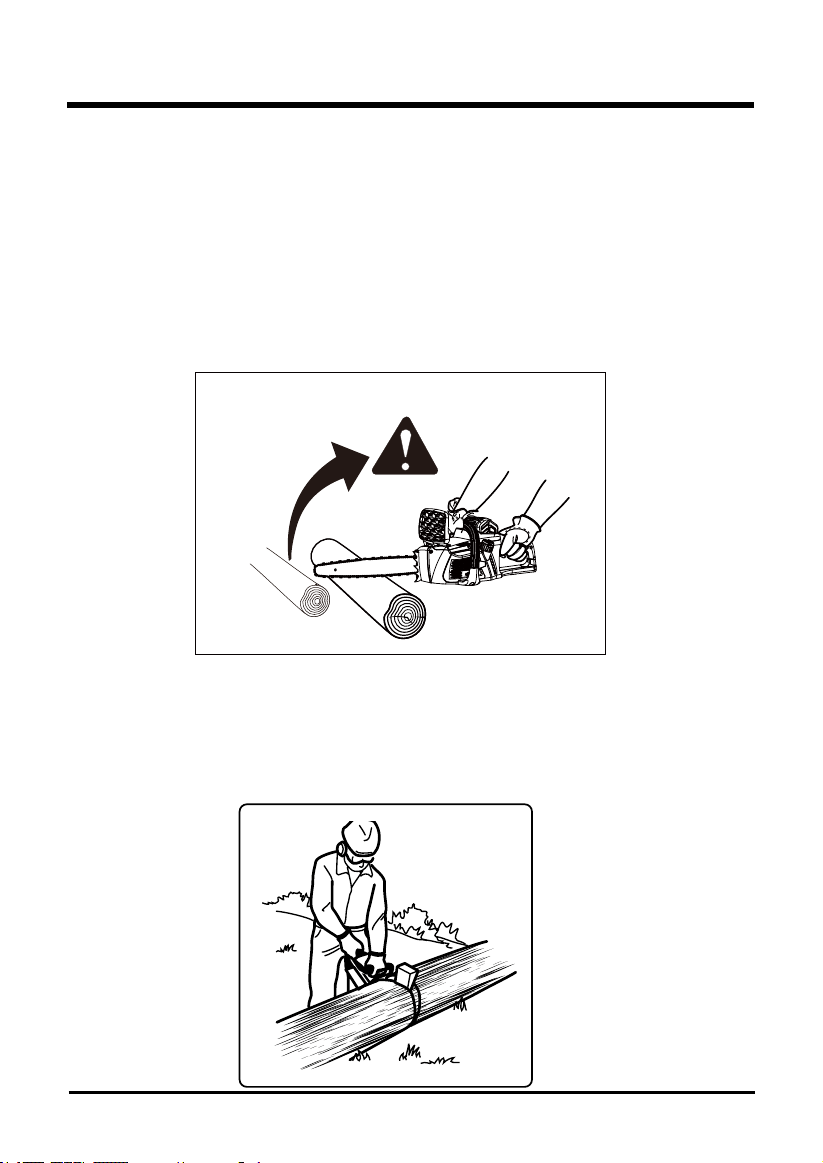
• Felling Backcut. As the felling cut gets close to the hinge, the tree should begin to fall.
If there is any chance the tree may not fall in the desired direction or it may rock back
and bind the saw chain, stop cutting before the felling cut is complete and use wedges
of wood, plastic or aluminum to open the cut and drop the tree along its desired line of
fall. Make the backcut level and horizontal, and at a minimum of 2 in. (5 cm) above the
horizontal cut of the notch.
• On large diameter trees, stop the back cut before it is deep enough for the tree to either fall or
settle back on the stump. Then insert soft wooden or plastic wedges into the cut so they do.
• As tree starts to fall, stop the chainsaw and put it down immediately. Retreat along the
cleared path, but watch the action in case something falls your way.
2” (5cm
)
Notch-
Approx.
1/3
Diameter
of trunk
Planned Line
of fall
Path of
safe retreat
Back cut
Hinge
Wedge
Back cut
Hinge
2in. (5cm) OR 1/10 DIA
21
OPERATION
BUCKING
Bucking is the term used for cutting a fallen tree to the desired log length.
• Always make sure your footing is secure and your weight is distributed evenly on both feet.
• Cut only one log at a time.
• Support small logs on a saw horse or another log while bucking.
• Keep a clear cutting area. Make sure that no objects can contact the guide bar nose and
chain during cutting as this can cause kickback. Refer to Kickback earlier in this manual.
• When bucking on a slope, always stand on the uphill side of the log. To maintain complete
control of the chainsaw when cutting through the log, release the cutting pressure near
the end of the cut without relaxing your grip on the chainsaw handles. Do not let the chain
contact the ground. After completing the cut, wait for the saw chain to stop before you move
the chainsaw. Always stop the motor before moving from tree to tree.
BUCKING WITH A WEDGE
If the wood diameter is large enough for you to insert a soft bucking wedge without touching
the chain, you should use the wedge to hold the cut open to prevent pinching.
KICKBACK
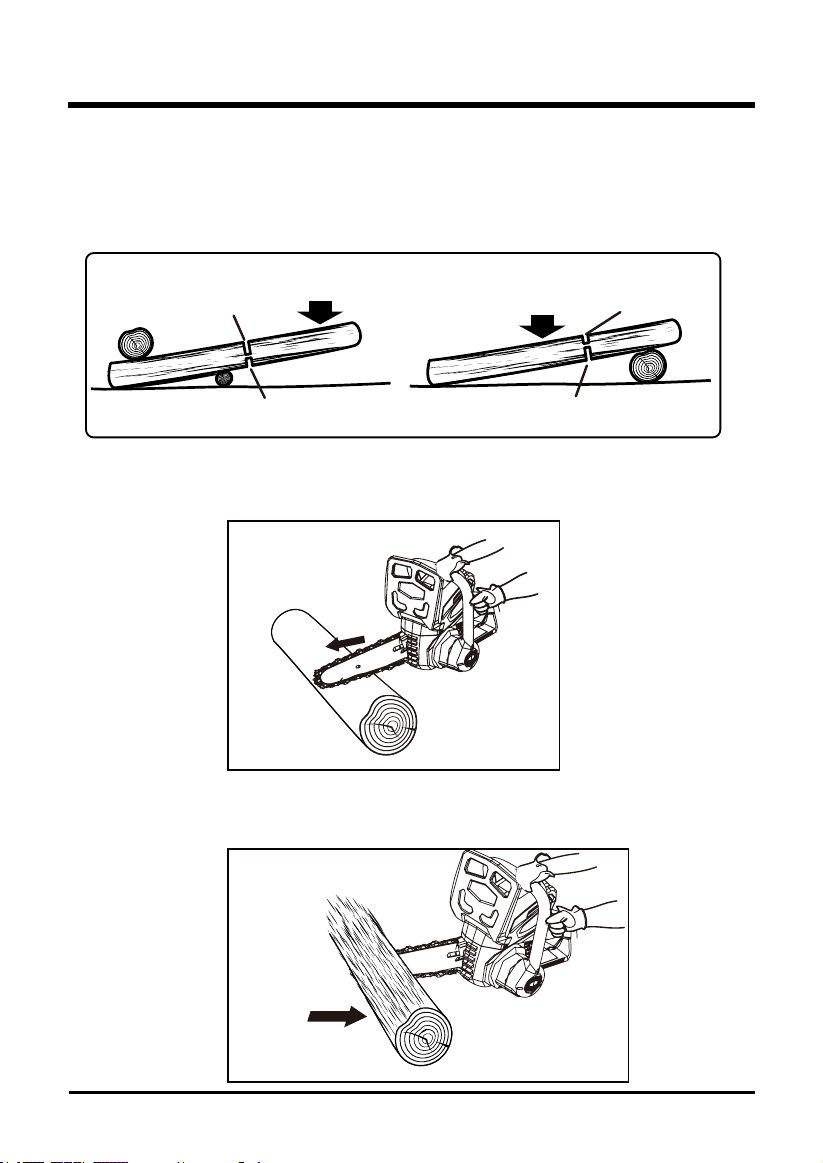
22
BUCKING LOGS UNDER STRESS
When the log is supported on one end, cut 1/3 the diameter from the underside. Then make
the nished cut by overbucking to meet the rst cut. When the log is supported on both ends,
cut 1/3 of the diameter from the top overback. Then make the nished cut by under bucking
the lower 2/3 to meet the rst cut.
OPERATION
Log Supported At One End
Finishing Cut
Load
1St Cut 1/3 Dia
Log Supported At Both Ends
Load 1St Cut 1/3 Dia
Finishing Cut
OVERBUCKING
Begin on the top side of the log with the bottom of the saw against the log; exert light pressure
downward. Note that the saw will tend to pull away from you.
UNDERBUCKING
Begin on the under side of the log with the top of the saw against the log; exert light pressure
upward. During under bucking, the saw will tend to push back at you. Be prepared for this
reaction and hold the saw rmly to maintain control.
OVERBUCKING
UNDERBUCKING
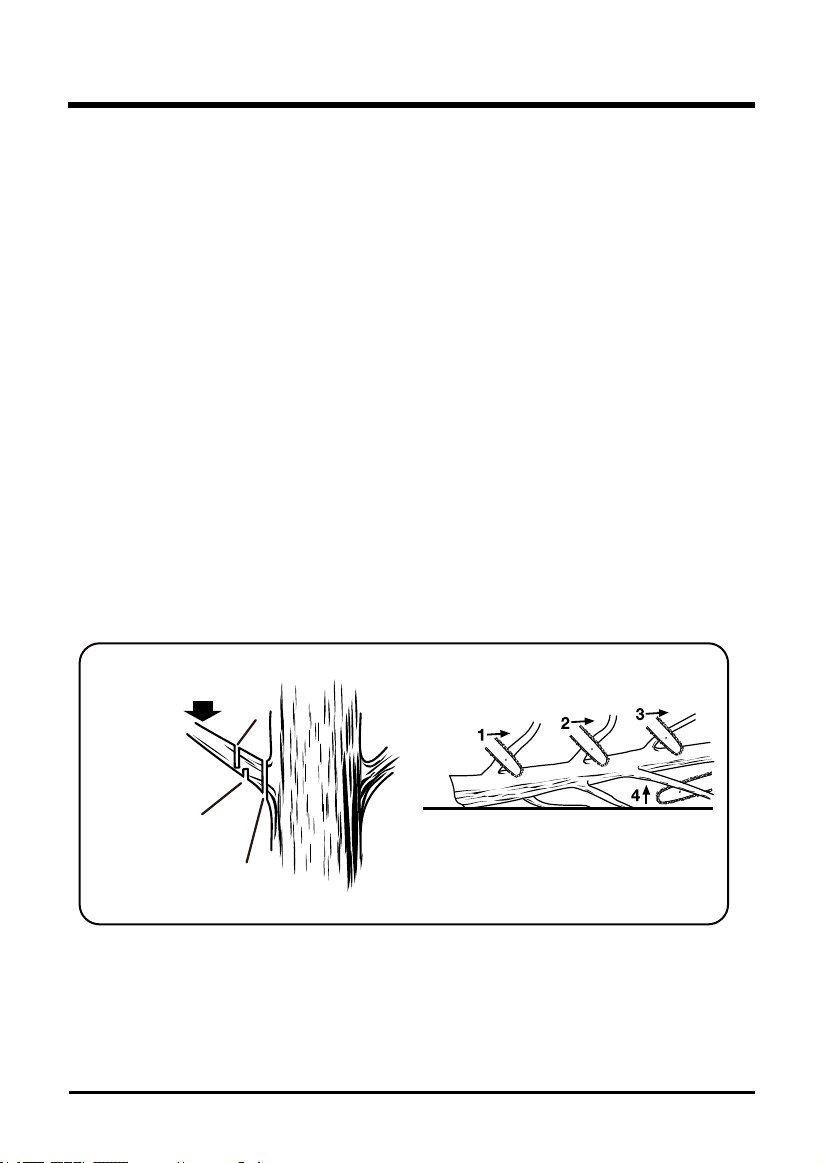
23
OPERATION
LIMBING
Limbing is removing branches from a fallen tree.
• Work slowly, keeping both hands on the chainsaw with a rm grip. Always make sure your
footing is secure and your weight is distributed evenly on both feet.
• Leave the larger support limbs under the tree to keep the tree off the ground while cutting.
• Limbs should be cut one at a time. Remove the cut limbs from the work area often to help.
• Keep the work area clean and safe.
• Branches under tension should be cut from the bottom up to avoid binding the chainsaw.
• Keep the tree between you and the chainsaw while limbing. Cut from the side of the tree
opposite the branch you are cutting.
PRUNING
Pruning is trimming limbs from a live tree.
• Work slowly, keeping both hands on the chainsaw with a rm grip. Always make sure your
footing is secure and your weight is distributed evenly on both feet.
• Do not cut from a ladder. This is extremely dangerous. Leave this operation for
professionals.
• Do not cut above chest height as a saw held higher is difcult to control against kickback.
• When pruning trees it is important not to make the nishing cut next to the main limb or
trunk until you have cut off the limb further out to reduce the weight. This prevents stripping
the bark from the main member.
• Underbuck the branch 1/3 through for your rst cut.
• Your second cut should overbuck to drop the branch off.
• Now make your nishing cut smoothly and neatly against the main member so the bark will
grow back to seal the wound.
Cut Limbs One At A Time And
Leave Support Limbs Under
Tree Until Log Is Cut
Load
Second
cut
First Cut 1/3
Diameter
Finishing
Cut
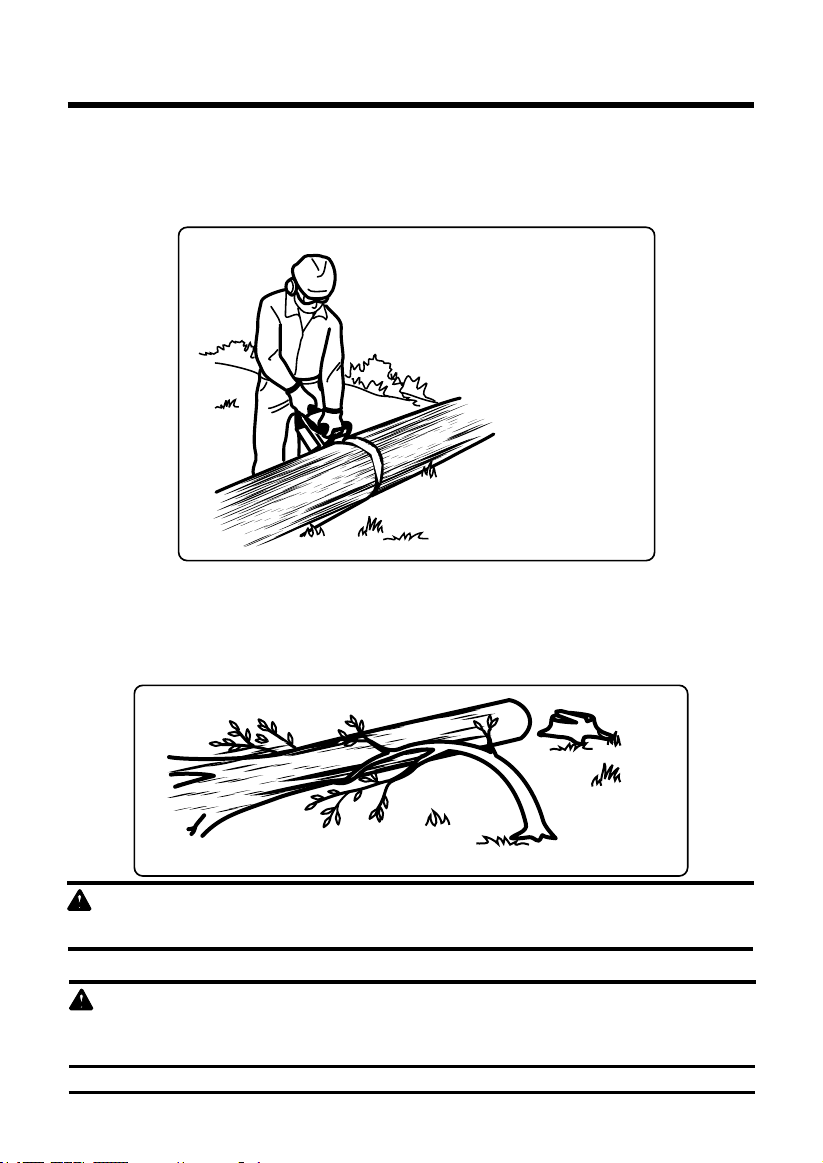
24
OPERATION
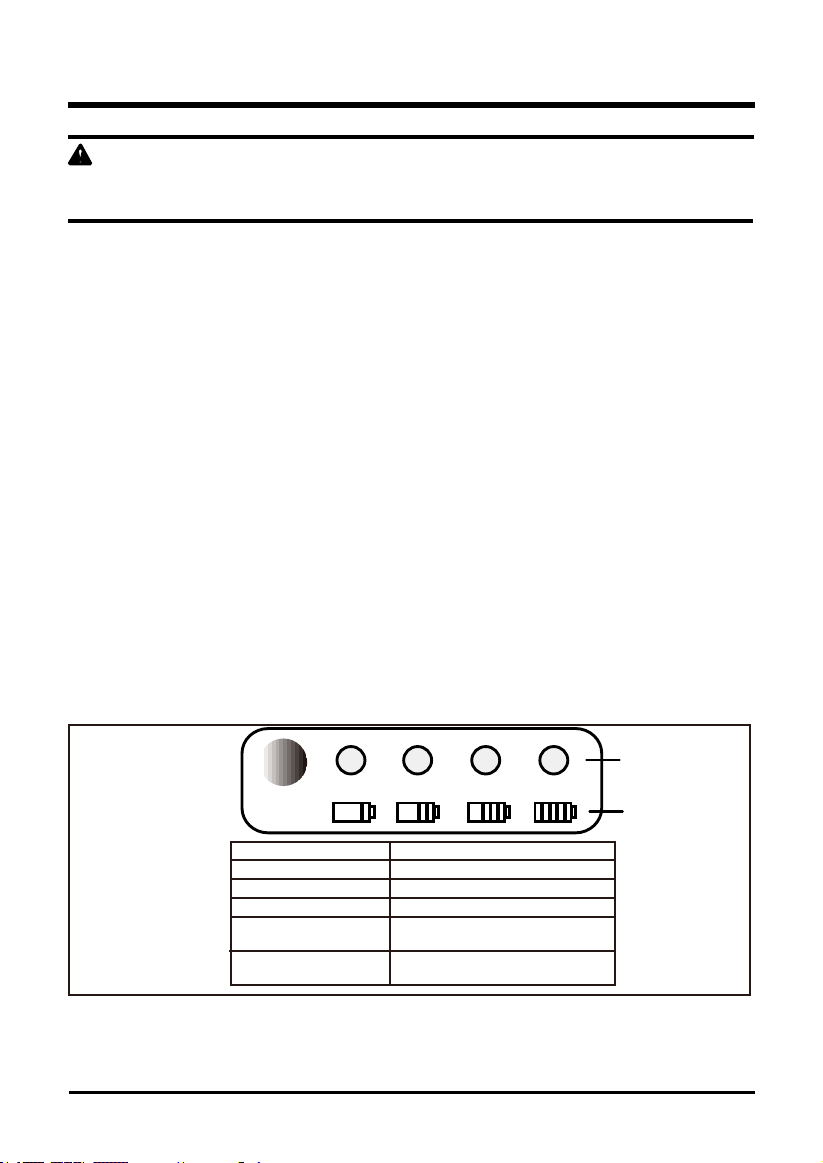
When bucking on a slope always stand on the uphill side of the log. when cutting through to
maintain complete control release the cutting pressure near the end of the cut without relaxing
your grip on the chainsaw handle. Don’t let the chain contact the ground. After completing the
cut wait for the saw chain to stop before you move the chainsaw. Always stop the motor before
moving from tree to tree.
Bucking a log
Stand on uphill side when
cutting because log may roll
CUTTING SPRINGPOLES
A springpole is any log, branch, rooted stump, or sapling which is bent under tension by other
wood so that it springs back if the wood holding it is cut or removed. On a fallen tree, a rooted
stump has a high potential of springing back to the upright position during the bucking cut to
separate the log from the stump. Watch out for springpoles — they are dangerous.
SPRINGPOLE
WARNING
If the limbs to be pruned are above chest height, hire a professional to perform the pruning.
WARNING
Springpoles are dangerous and could strike the operator, causing the operator to lose control of
the chainsaw. This could result in severe or fatal injury to the operator.

25
WARNING
MAINTENANCE
GENERAL MAINTENANCE
Avoid using solvents when cleaning plastic parts. Most plastics are susceptible to damage from
various types of commercial solvents and may be damaged by their use. Use clean cloths to
remove dirt, dust, lubricant, grease, etc., rmly to maintain control.
• Do not at any time let brake uids, gasoline, petroleum-based products, penetrating oils,
etc., come in contact with plastic parts. Chemicals can damage, weaken, or destroy plastic,
which may result in serious personal injury.
LUBRICATION
• All of the bearings in this product are lubricated with a sufcient amount of high grade
lubricant for the life of the unit under normal operating conditions. Therefore, no further
lubrication is required.
• When servicing, use only identical replacement parts. Use of any other parts may create a
hazard or cause product damage.
• Always wear safety goggles or safety glasses with side shields during power tool operation
or when blowing dust. If the operation is dusty, also wear a dust mask.
WARNING
WARNING
Never start the motor before installing the guide bar, chain, chain cover, and chain cover lock
knob. Without all these parts in place, the clutch can y off or explode, exposing the user to
possible serious injury.
• To avoid serious personal injury, read and understand all the safety instructions in this
section.
• Before performing any maintenance, make sure the battery is removed. Failure to heed this
warning could result in serious personal injury.
WARNING
Always wear gloves when handling the bar and chain; these components are sharp and may
contain burrs.
Never touch or adjust the chain while the motor is running. The saw chain is very sharp; always
wear protective gloves when performing maintenance to the chain to avoid possible serious
lacerations.
NOTE: When replacing the guide bar and chain, always use the specied bar and chain listed in
the bar and chain combinations section later in this manual.
26
MAINTENANCE
BATTERY PACK
• Store the battery pack fully charged.
• Once the charging light turns green, remove the battery from the charger and disconnect the
charger from the outlet.
• After charging, the battery pack may be stored on the charger, as long as the charger is not
plugged in.
CLEANING
Remove the battery pack.
1. Brush or blow dust and debris out of the air vents using compressed air or a vacuum. Keep
the air vents free of obstructions, sawdust, and wood chips. Do not spray, wash, or immerse the
air vents in water.
2. Wipe off the housing and the plastic components using a moist, soft cloth. Do not use strong
solvents or detergents on the plastic housing or plastic components. Certain household cleaners
may cause damage, and may cause a shock hazard.
WARNING
CHECKING BATTERY CAPACITY
Press the Battery Capacity Indicator (BCI) button. The lights will illuminate according to the
battery’s current power level. See chart below:
In order to avoid personal injury and the risk of re and electric shock, remove the battery pack
before adjusting, inspecting, or cleaning the chainsaw.
BATTERY CAPACITY
INDICATOR (BCI) BUTTON
LIGHT METRE
BATTERY METRE
Lights Capacity
4 Green Lights The battery is at full capacity
3 Green Lights The battery is at 75% capacity
2 Green Lights The battery is at 50% capacity
1 Green Light
Lights go out
The battery is at 25% c apacity and re-
quires charging soon
The battery i s less than 10% c apacity
and requires charging immediately
27
MAINTENANCE
CHARGING PROCEDURE (See Figure 11. )
NOTE:The battery is not shipped fully charged. It is recommended to fully charge before rst
use to ensure that maximum run time can be achieved. This lithium-ion battery will not develop a
memory and may be charged at any time. A fully discharged battery pack will require approximately
90 minutes to fully charge from a discharged state.
1. Plug the charger into an AC power outlet.
2. Insert the battery pack (3) into the charger.
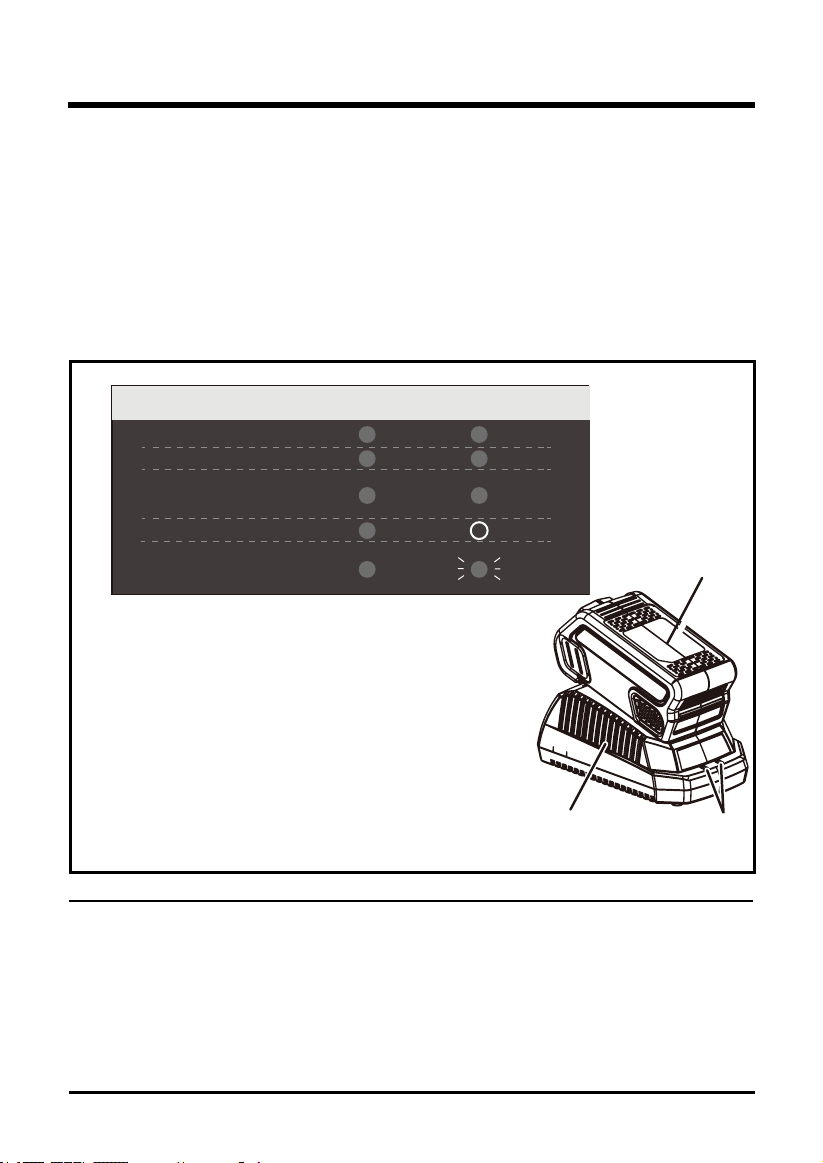
This is a diagnostic charger. The Charger LED Lights will illuminate in specic order to
communicate the current battery status. They are as follows:
BATTERY CHARGER
3
1
2
False Defect Note:
When the battery is inserted into the charger, and the status
LED flashes, remove the battery from the charger for 1
minute, then reinsert. If the status LED indicates normal than
the battery pack is good. If the status LED is still blinking,
remove the battery pack and unplug the charger. Wait 1
minute and plug the charger back in and reinsert the battery
pack. If the status LED indicates normal than the battery
pack is good. If the status LED is still blinking then the
battery pack is defective and needs to be replaced.
NOTE: When the red indictor ickers, pull out the battery from the charger and insert again within
2 hours. If the indictor shows charging, that means the battery is good. After 2 hours, please pull
out the battery and also pull out the AC power plug of the charger for 1 miniute, and then insert
the AC power plug and the battery again. If the indictor shows charging, that means the battery is
good. If not, the battery needs to be changed.
CHARGING PROCEDURE (LED INDICATOR)
BATTERY IS CHARGING:
FULLY CHARGED:
BATTERY IS TOO WARM:
(REMOVE FOR APPROX. 30
MINUTES TO ALLOW TO COOL)
DEFECTIVE BATTERY:
(REMOVE AND REPLACE WITH
NEW BATTERY IF THIS OCCURS)
NO BATTERY PRESENT
RED RED
GREEN
ORANGE
OFF
RED
RED
RED
RED
RED
BLINKING
28
MAINTENANCE
CHECKING THE CHARGE
If the battery pack does not charge properly:
• Check the current at the power outlet with another tool. Make sure that the outlet is not turned off.
• Check that the charger contacts have not been shorted by debris or foreign material.
• If the surrounding air temperature is not normal room temperature, move the charger and battery
pack to a lockation where the temperature is between 45°F and 104°F.
NOTE: If the battery and the charger won’t be used for a long time, please remove the battery from
the charger and pull out the AC power plug.
WARNING
If the battery is inserted into the charger when warm or hot, the CHARGING LED indicator light
on the charger may switch on and illuminate ORANGE. If this occurs allow the battery to cool
outside of the charger from approximately 30 minutes.
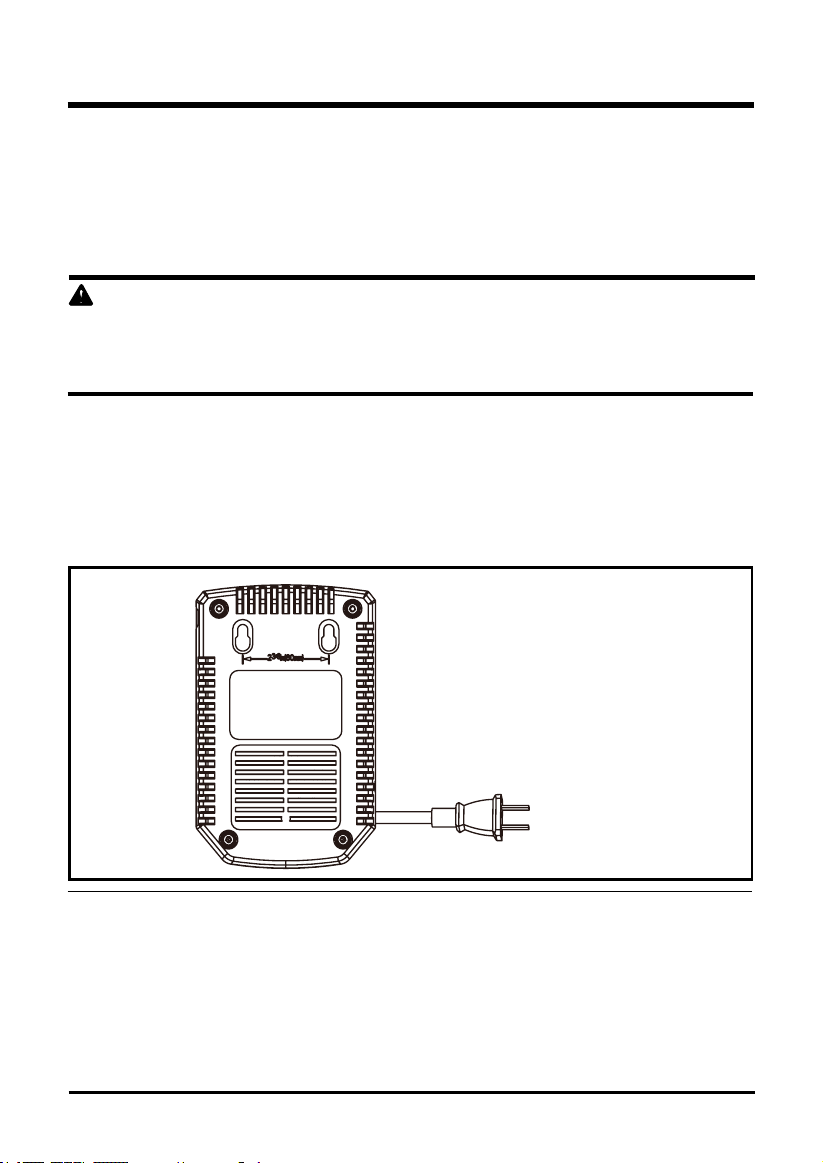
CHARGER MOUNTING
1. This charger can be installed hanging on a wall using two screws (not supplied)
2. Locate the placement for the charger to be wall mounted.
3. If fastening to wood studs use 2 wood screws.
4. Drill two holes 2 3/8” (6 cm) on center ensuring they are level.
5. If fastening to drywall use wall anchors and screws to secure the charger to the wall.
29
MAINTENANCE
CHAIN & BAR ASSEMBLY
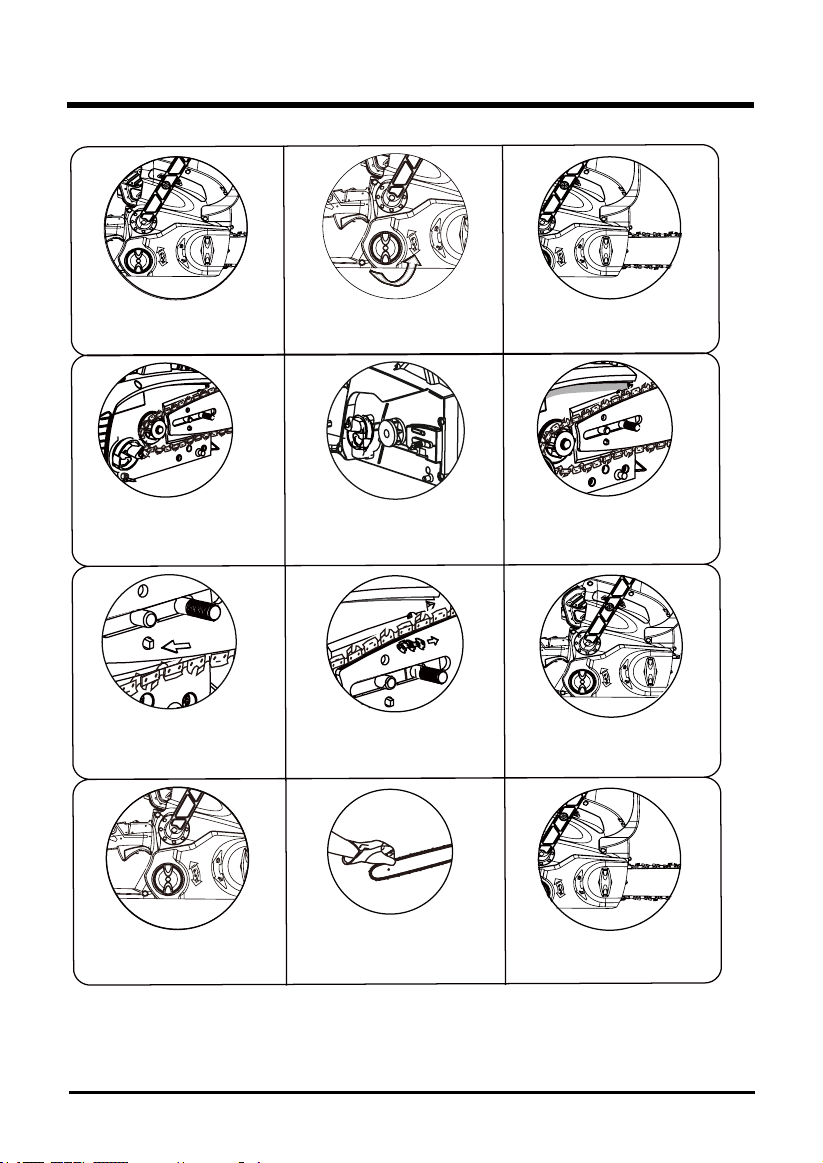
1. To remove the side cover
, loosen
the locking knob one full turn
counterclockwise.
2. Then loosen the chain tension knob 2
or 3 turns.
3. Now totally rem
ove the locking knob
and rem
ove the side cove
r.
Fig.1 Fig.2 Fig.3
4. The bar and chain can now be rem
oved
by lifting it away from
the main body of
the saw and releasing the chain from
the drive pulley.
5. The chainsaw can now be cleaned with
a brush and or rag to rem
ove sawdust
and oil.
6. To replace the bar and chain, loop the
chain over the drive pulley and place
the bar against the centre alignm
ent
groove.
Fig.4 Fig.5
Fig.6
7. Ensure that the adjusting block is
located in the tensioning hole on
the chain bar.
8. And that the rubber block and chai
n
bar are free from
oil, as this helps to
keep tension on the chain.
9. Replace the side cover and locking
knob, but do not tighten.
Fig.8 Fig.9
10. Turn the tension knob Clockwise
to tighten the chain.
NOTE:
- Chains stretch with use, check and tension often.
- Never tension a warm chain before storing, as chains shrink when cool,
this can damage chain, bar and saw.
11. Until there is enough play that the
chain can be pulled away from
the ba
r,
but not so m
uch that the runners can
be pulled out of the bar.
12. Once you have the correct tension,
fully tighten the locking knob.
Fig.10 Fig.11 Fig.12
ASTIN
BLOC
30
MAINTENANCE
ADJUSTING THE CHAIN TENSION
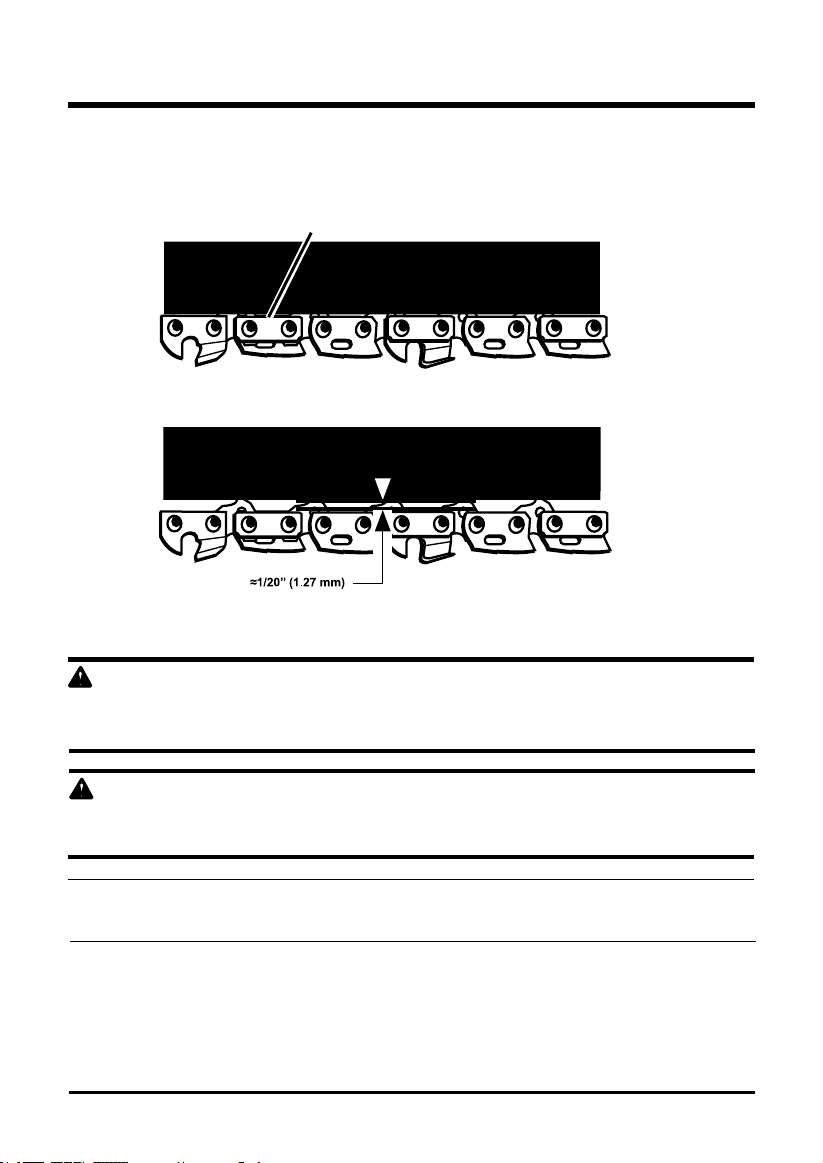
• Rotate the chain cover lock knob clockwise to secure. Re-tension the chain whenever the ats
on the drive links hang out of the bar groove.
WARNING
Never touch or adjust the chain while the motor is running. The chainsaw is very sharp. Always
wear protective gloves when performing maintenance on the chain.
WARNING
A chain tensioned while warm may be too tight upon cooling. Check the “cold tension” before
next use.
NOTE: During normal saw operation, the temperature of the chain increases. The drive links of a
correctly tensioned warm chain will hang approximately 1/16 in. (1.3 mm) out of the bar groove.
NOTE: New chains tend to stretch; check the chain tension frequently and tension as required.
Flats on drive links
31
MAINTENANCE
CHAIN MAINTENANCE
Use only a low-kickback chain on this saw. This fast-cutting chain provides kickback
reduction when properly maintained. For smooth and fast cutting, maintain the chain
properly. The chain requires sharpening when the wood chips are small and powdery, the chain
must be forced through the wood during cutting, or the chain cuts to one side.During maintenance
of the chain, consider the following:
• Improper ling angle of the side plate can increase the risk of severe kickback.
• Raker (depth gauge) clearance.
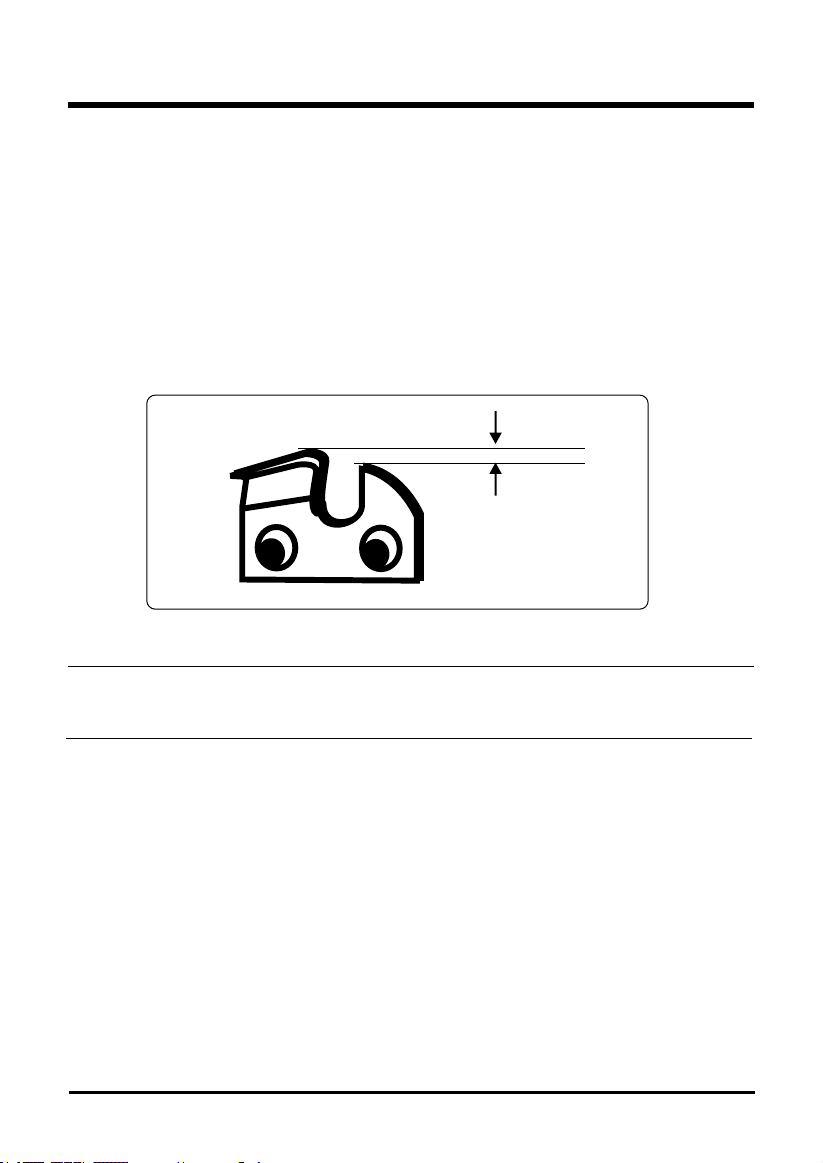
• Too low-- increases the potential for kickback.
• Not low enough-- decreases cutting ability.
• If the cutter teeth hit hard objects such as nails or stones, or are abraded by mud or sand
on the wood, have an authorized service center sharpen the chain.
1/32 in. (0.6 mm)
Raker (Depth Gauge) Clearance
NOTE: Inspect the drive sprocket for wear or damage when replacing the chain. If signs of wear
or damage are present in the areas indicated, have the drive sprocket replaced by an authorized
service center.
NOTE: If you do not fully understand the correct procedure for sharpening the chain after reading
the instructions that follow, have the saw chain sharpened by an authorized service center or
replace with a recommended low-kickback chain.
32
MAINTENANCE
Sharpening the cutterS
• Be careful to le all cutters to the specied angles and to the same length, as fast cutting
can be obtained only when all cutters are uniform.
• Tension the chain prior to sharpening. Refer to Adjusting The Chain Tension.
• Use a 5/32 in. (4 mm) diameter round le and holder. Do all of your ling at the midpoint
of the bar.
• Keep the le level with a top plate of the tooth. Do not let the le dip or rock.
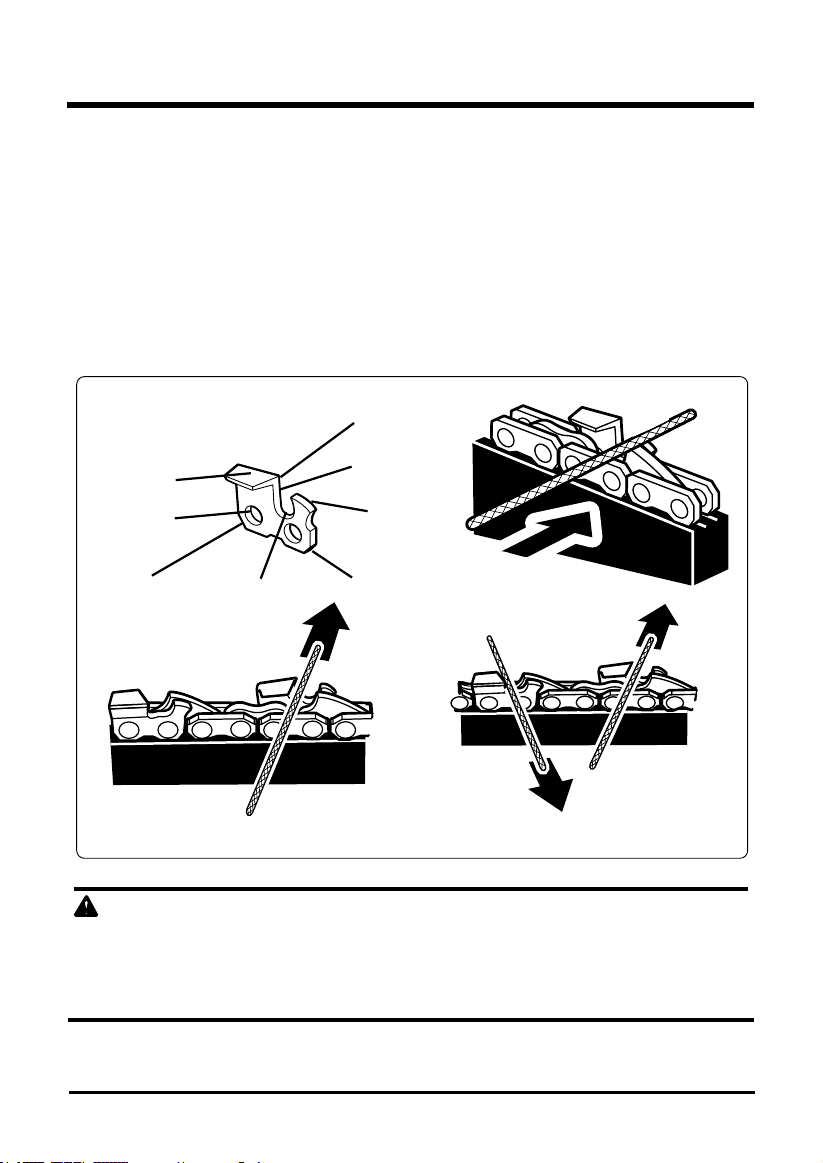
• Using light but rm pressure. Stroke towards the front corner of the tooth.
• Lift the le away from the steel on each return stroke.
• Put a few rm strokes on every tooth. File all left hand cutters in one direction. Then move
to the other side and le the right hand cutters in the opposite direction.
• Remove lings from the le with a wire brush.
Top Place
Rivet Hole
Heel
Gullet
Side Plate
Depth Gauge
Toe
Left hand
Cutters
Right hand
Cutters
Cutting Corner
Parts Of A Cutter
WARNING
• Make sure the battery is removed from the chainsaw before you work on the saw.
• The saw chain is very sharp. Always wear protective gloves when performing maintenance
to the chain to prevent serious personal injury.
• A dull or improperly sharpened chain can cause excessive motor speed during cutting,
which may result in severe motor damage.
33
MAINTENANCE
TOP PLATE FILING ANGLE
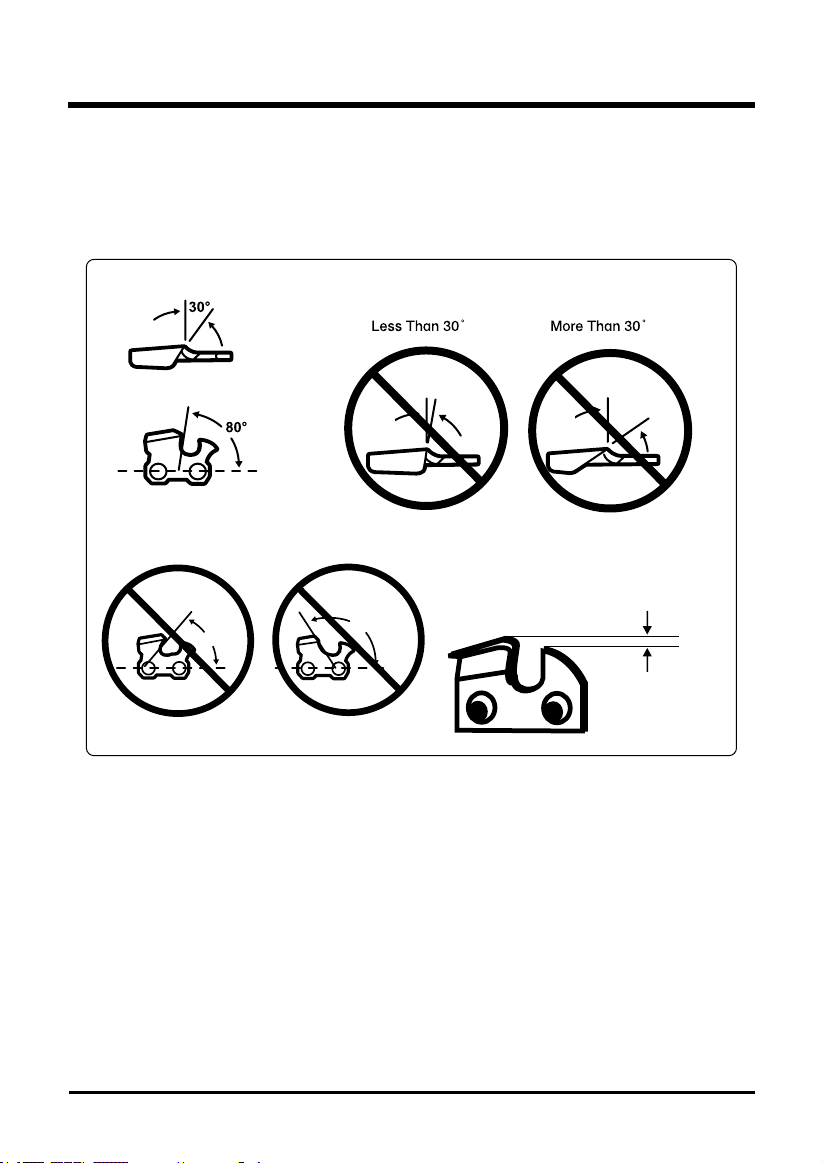
• CORRECT 30° – le holders are marked with guide marks to align le properly to produce
correct top plate angle.
• LESS THAN 30° – for cross cutting.
• MORE THAN 30° – feathered edge dulls quickly.
SIDE PLATE ANGLE
• Correct 80° – Produced automatically if you use the correct diameter le in the le
holder.
• Hook – “Grabs” and dulls quickly; increases the potential of kickback. Results from using
a le with a diameter too small or a le held too low.
• Backward Slope – Needs too much feed pressure; causes excessive wear to the bar and
chain. Results from using a le with a diameter too large or le held too high.
Top Place Filling Angle
Side Plate Filling Angle
Correct
Incorrect
Incorrect
Hook
Backward Slope
Raker (Depth Gauge) Clearance
1/32”
(0.6 mm)
34
MAINTENANCE
SIDE PLATE ANGLE
• Maintain the depth gauge at a clearance of 1/32 in. (0.6 mm). Use a depth gauge tool
for checking the depth gauge clearances.
• Every time the chain is led, check the depth gauge clearance.
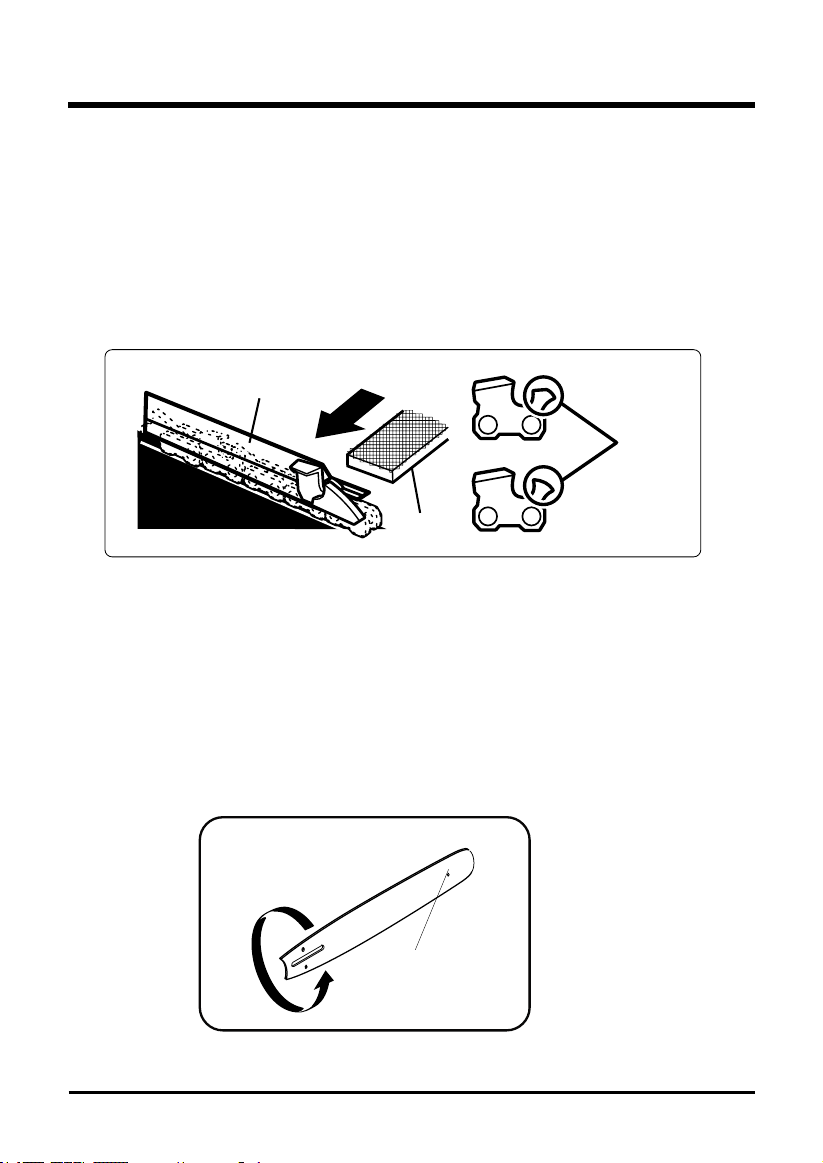
• Use a at le and a depth gauge jointer to lower all gauges uniformly. Use a 1/32 in.
• (0.6 mm) depth gauge jointer. After lowering each depth gauge, restore original shape
by rounding the front. Be careful not to damage adjoining drive links with the edge of
the le.
• Depth gauges must be adjusted with the at le in the same direction the adjoining
cutter was led with the round le.
• Use care not to contact cutter face with at le when adjusting depth gauges.
Depth Gauge Jointer
Flat file
Restore
Original
shape by
Rounding
the front
MAINTAINING THE GUIDE BAR
Every week of use, reverse the guide bar on the saw to distribute the wear for maximum bar
life.
The bar should be cleaned every day of use and checked for wear and damage. Feathering or
burring of the bar rails is a normal process of bar wear. Such faults should be smoothed with a
le as soon as they occur. A bar with any of the following faults should be replaced:
• Wear inside the bar rails that permits the chain to lay over sideways
• Bent guide bar
• Cracked or broken rails
• Spread rails
Lubricate guide bars weekly with a sprocket at their tip. Using a grease syringe,
lubricate weekly in the lubricating hole. Turn the guide bar and check that the
lubrication holes and chain groove are free from impurities.
Lubricating hole
35
ENVIRONMENTALLY SAFE BATTERY DISPOSAL
The batteries used in this chainsaw's battery pack contain the following toxic and corrosive mate-
rial: LITHIUM-ION.
WARNING
Toxic materials must be disposed of in a specic manner in order to prevent
contamination of the environment. Before disposing of damaged or worn out Lithium-
Ion battery packs, contact your local waste disposal agency or the local Environmental
Protection Agency for information and specic instructions. Take the batteries to a local
recycling and/or disposal center that is certied for disposal. If the battery pack cracks
or breaks, whether it leaks or nort, do not recharge it and do not use it. Dispose of it
and replace it with a new battery pack.
DO NOT ATTEMPT TO REPAIR IT!
Follow these instructions and to avoid damage to the environment:
• Cover the battery's terminals with heavy-duty adhesive tape.
• Do not attempt to remove or destroy any of the components of the battery pack.
• Do not attempt to open the battery pack.
• If a leak develops, the electrolytes that are released are corrosive and toxic. Do not get
the solution in the eyes or on the skin, and do not swallow it.
• Do not place batteries in regular household trash.
• DO NOT incinerate batteries.
• DO NOT place batteries where they will become part of any waste landll or municipal
solid waste stream.
• Dispose of batteries at a certied recycling or disposal center.

36
TROUBLESHOOTING
PROBLEM POSSIBLE SOLUTION
Bar and chain running
hot and smoking.
Check chain tension for
overtightened condition.
Tension chain. Refer to Chain earlier in this
manual.
Chain oil tank empty. Check oil tank.
motor runs, but chain
is not rotating.
Chain tension too tight. Refer to Chain Tension Guide earlier in this
manual.
Check guide bar and chain
assembly.
Refer to Replacing the Bar and Chain
earlier in this manual.
Check guide bar and chain for
damage.
Remove batery, after removing the battery
from chainsaw, take off the side cover
by removing the chain cover has been
removed, remove the bar and chain.
Before inserting the battery pack into the
unit with the bolt and chain removed. Clean
all the debris from the side of the saw. After
all is cleaned, insert battery and run the
chainsaw. If the sprocket is spining your
motor is OK. If the sprocket is not spinning
call customer service at 1-888-909-6757.
Motor runs, chain
rotates but does not
cut.
Dull chain. Sharpen chain.
Chain on backwards. Reverse direction of chain.
Chainsaw does not
start.
Battery is not charged
.
Place battery in to the charge and allow
charging up to 1 hour (2Ah) or 2 hours
(4Ah).
Switch is defective
.
Call our customer service number at
1-888-909-6757 for a service dealer or
replacement parts.

37
LIMITED FOUR-YEAR WARRANTY
GREENWORKS™ hereby warranties this product, to the original purchaser with proof of
purchase, for a period of four (4) years against defects in materials, parts or workmanship.
GREENWORKS™, at its own discretion will repair or replace any and all parts found to be
defective, through normal use, free of charge to the customer. This warranty is valid only for
units which have been used for personal use that have not been hired or rented for industrial/
commercial use, and that have been maintained in accordance with the instructions in the
owners’ manual supplied with the product from new.
Battery carries a two (2) year warranty against defects in workmanship and materials. Batteries
must be charged in accordance with the operator’s manuals directions and regulations in order
to be valid.
ITEMS NOT COVERED BY WARRANTY:
1. Any part that has become inoperative due to misuse, commercial use, abuse, neglect,
accident, improper maintenance, or alteration; or
2. The unit, if it has not been operated and/or maintained in accordance with the owner's
manual; or
3. Normal wear, except as noted below;
4. Routine maintenance items such as lubricants, blade sharpening;
5. Normal deterioration of the exterior nish due to use or exposure.
GREENWORKS HELPLINE (1 888 90WORKS):
Warranty service is available by calling our toll-free helpline, 9am to 5pm EST. at 1-888-909-6757
(1-888-90WORKS).
TRANSPORTATION CHARGES:
Transportation charges for the movement of any power equipment unit or attachment are the
responsibility of the purchaser. It is the purchaser’s responsibility to pay transportation charges
for any part submitted for replacement under this warranty unless such return is requested in
writing by GREENWORKS.
38
EXPLODED VIEW

39
PARTS LIST
ITEM NO. PART NO. DESCRIPTION QTY
1 311001889 Side cover assembly 1
2 31101420-1 12'' Chain 1
3 34114155-1 Scabbard 1
4 31100581-3 12'' Bar 1
5 32201583 Screw 2
6 34103581 Guard 1
7 3220404D Screw 1
8 3220740 Screw 1
9 34102581A Auxiliary handle 1
10 32201517 Screw 24
11 31103976(BK) 40V2Ah Battery Pack 1
12 311021889 Oil Cap Assembly 1
13 311011889 Housing assembly 1
14 34108583C Tension knob 1
15 32201517 Screw 1
16 33902102-2 Sprocket 1
17 3290875-1 C-Clip 1
18 31102998 Charger 1

TOLL-FREE HELPLINE: 1-888-90WORKS
(888.909.6757)
Rev: 00 (09-10-15)