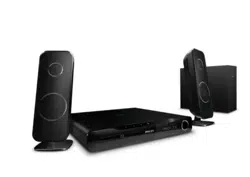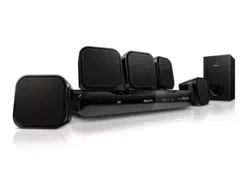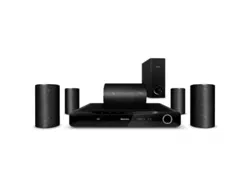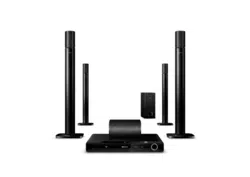
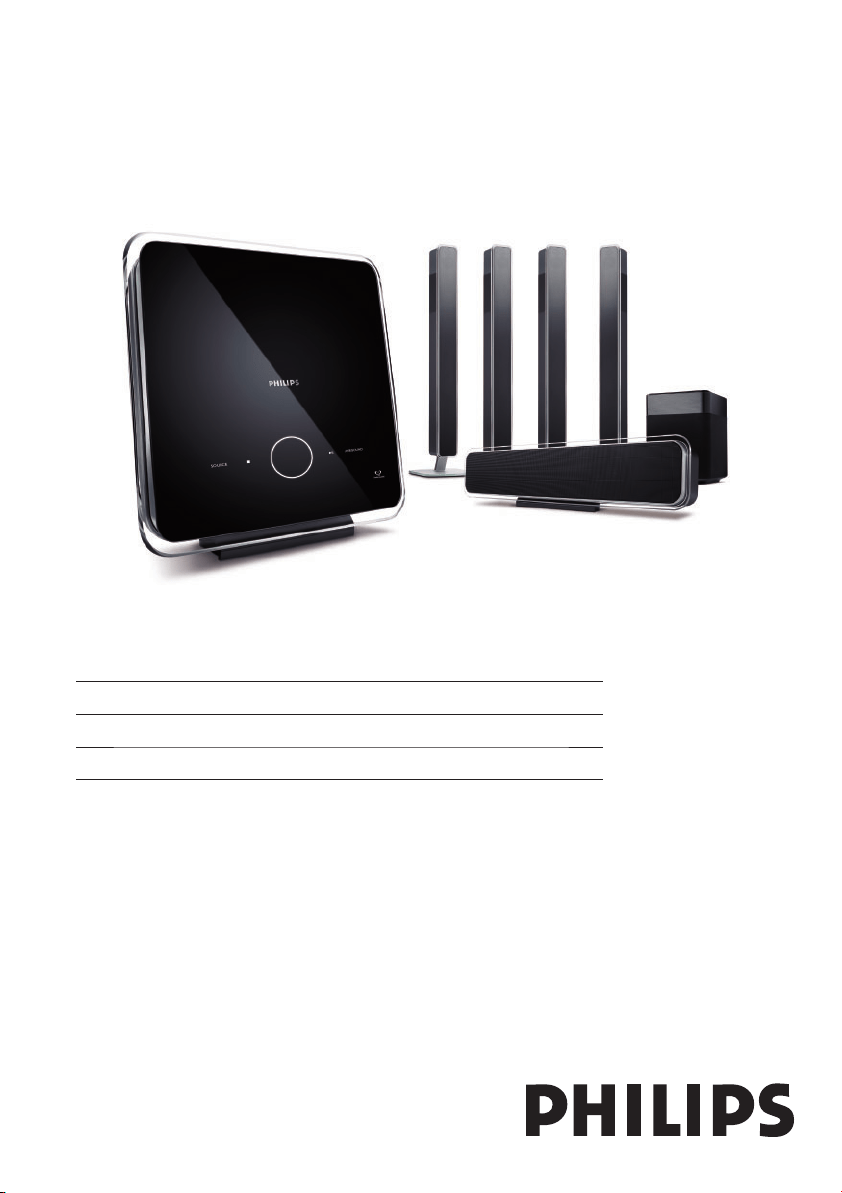
HTS9810
Register your product and get support at
www.philips.com/welcome
EN DVD Home Theatre System 5
ES_LA Sistema Home Theatre DVD 53
PT_BR DVD Home Theater System 101
2
AVISO IMPORTANTE
México
Es necesario que lea cuidadosamente su instructivo
de manejo.
Descriptión: Reproductor de Disco de Video Digital
Modelo: HTS9810
Alimentacón: 120 V / 230 V~50-60 Hz Switcheable
Consumo: 120 W
Importador: Philips Mexicana, S.A. de C.V.
Domicilio: Av. La Palma No. 6,
Col. San Fernando, La Herradura
Huixquilucan, Edo de Mexico
C.P. 52784, Mexico
Localidad y Tel.: Tel. 52 69 90 00
Exportador: Philips Electronics HK, Ltd.
País de Origen: China
N
o
de Serie:
LEA CUIDADOSAMENTE ESTE INSTRUCTIVO
ANTES DE USAR SU APARATO.
Philips Mexicana, S.A. de C.V. no se hace
responsable por daños o desperfectos causados por:
– Maltrato, descuido o mal uso, presencia de
insectos o roedores (cucarachas, ratones etc.).
– Cuando el aparato no haya sido operarado
de acuerdo con el instructivo del uso, fuera
de los valores nominales y tolerancias de las
tensiones (voltaje), frecuencia (ciclaje) de
alimentación elétrica y las características
que deben renuir las instalaciones auxiliares.
– Por fenómenos naturales tales como:
temblores, inundaciones, incendios, descargas
electricas, rayos etc. o delitos causados por
terceros (choques asaltos, riñas, etc.).
3
NOTE: This equipment has been tested and found to
comply with the limits for a Class B digital device, pursuant
to Part 15 of the FCC Rules. These limits are designed to
provide reasonable protection against harmful interference
in a residential installation. This equipment generates, uses
and can radiate radio frequency energy and, if not installed
and used in accordance with the in
structions, may cause
harmful interference to radio communications. However,
there is no guarantee that interference will not occur in a
particular installation.
If this equipment does cause harmful interference to radio
or television reception, which can be determined by turning
the equipment off and on, the user is encouraged to try to
correct the in
terference by one or more of the following
measures:
- Reorient or relocate the receiving antenna.
- Increase the separation between the equipment and
receiver.
- Connect the equipment into an outlet on a circuit different
from that to which the receiver is connected.
- Consult the dealer or an experienced radio/TV technician
for help.
‘CONSUMERS SHOULD NOTE THAT NOT ALL HIGH
DEFINITION TELEVISION SETS ARE FULLY
COMPATIBLE WITH THIS PRODUCT AND MAY CAUSE
ARTIFACTS TO BE DISPLAYED IN THE PICTURE. IN
CASE OF 525 OR 625 PROGRESSIVE SCAN PICTURE
PROBLEMS, IT IS RECOMMENDED THAT THE USER
SWITCH THE CONNECTION TO THE ‘STANDARD
DEFINITION’ OUTPUT. IF THERE ARE QUESTIONS
REGARDING OUR TV SET COMPATIBILITY WITH THIS
MODEL 525p AND 625p DVD PLAYER, PLEASE
CONTACT OUR CUSTOMER SERVICE CENTER.’
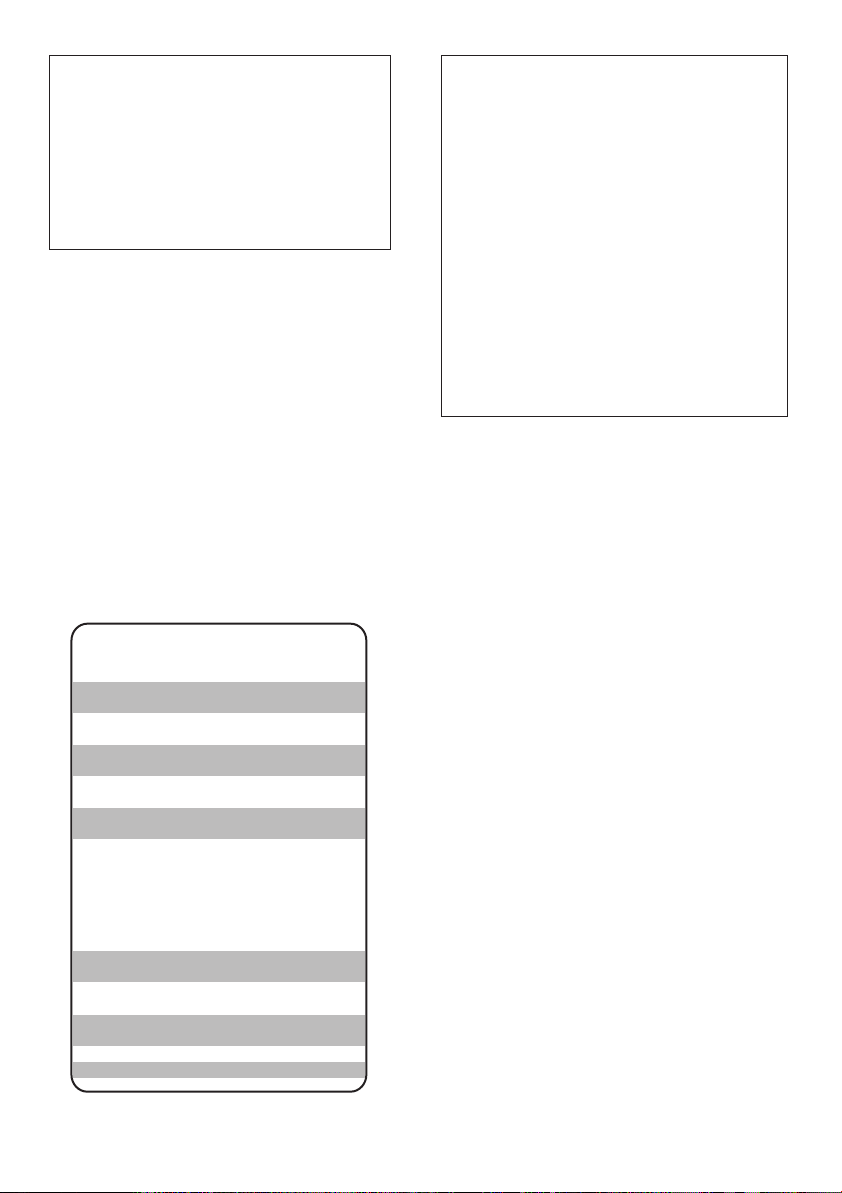
“Evite o uso prolongado do aparelho
com volume superior a 85 decibéis pois
isto poderá prejudicar a sua audição.”
Nível de Exemplos
Decibéis
30 Biblioteca silenciosa,
sussurros leves
40 Sala de estar, refrigerador,
quarto longe do trânsito
50 Trânsito leve, conversação
normal, escritório silencioso
60 Ar condicionado a uma distância
de 6 m, máquina de costura
70 Aspirador de pó, secador de cabelo,
restaurante ruidoso
80 Tráfego médio de cidade, coletor
de lixo, alarme de despertador
a uma distância de 60 cm
OS RUÍDOS ABAIXO PODEM SER PERIGOSOS
EM CASO DE EXPOSIÇÃO CONSTANTE
90 Metrô, motocicleta, tráfego de
caminhão, cortador de grama
100 Caminhão de lixo, serra elétrica,
furadeira pneumática
120 Show de banda de rock em frente
às caixas acústicas, trovão
140 Tiro de arma de fogo, avião a jato
180 Lançamento de foguete
4
LASER
Type Semiconductor laser •
GaAIAs
Wave length 650 - 660 nm (DVD)•
784 - 796 nm (CD)
Output Power 1.46 mW (DVD)•
160 uW (CD)
Beam divergence 60 degrees•
Manufactured under license from Dolby
Laboratories. Dolby, Pro Logic and the double-D
symbol are trademarks of Dolby Laboratories.
Manufactured under license under U.S. Patent
#’s: 5,451,942; 5,956,674; 5,974,380; 5,978,762;
6,487,535 & other U.S. and worldwide patents
issued & pending. DTS and DTS Digital
Surround are registered trademarks and the
DTS logos and Symbol are trademarks of DTS,
Inc. © 1996-2007 DTS, Inc. All Rights Reserved.
DivX, DivX Ultra Certifi ed, and associated logos
are trademarks of DivX, Inc. and are used under
license.
Offi cial DivX® Ultra Certifi ed product.
Plays all versions of DivX ® video (including
DivX ® 6) with enhanced playback of DivX®
media fi les and the DivX® Media Format.
Windows Media and the Windows logo are
trademarks, or registered trademarks of
Microsoft Corporation in the United States and/
or other countries.
HDMI, and HDMI logo and High-Defi nition
Multimedia Interface are trademarks or
registered trademarks of HDMI licensing LLC.
The USB-IF Logos are trademarks of Universal
Serial Bus Implementers Forum, Inc.
ENERGY STAR and the ENERGY
STAR mark are registered U.S. marks
CLASS 1
LASER PRODUCT
‘DCDi’ is a trademark of Faroudja, a division of
Genesis Microchip, Inc.

English
EN 5
Contents
Contents
1 Important 6
Safety and important notice 6
2 Your product 7
Features highlight 7
Product overview 8
3 Connect 11
Place the unit 11
Connect video cables 12
Connect junction box 14
Connect rear wireless speakers 14
Connect front and centre speakers to
subwoofer 15
Connect radio antenna 15
Connect audio cables/other devices 16
Mount the DVD Home Theatre unit 18
4 Get started 19
Prepare the remote control 19
Find the correct viewing channel 20
Start Ambisound setup 20
Turn on Progressive Scan 22
Optimise wireless transmission 23
Adjust speakers output 24
Activate EasyLink control 25
Select a play source 26
5 Play 27
Play from disc 27
Play video 28
Play music 31
Play photo 32
Play from USB device 33
Play from portable media player 34
Play from radio 34
6 Adjust sound 37
Control the volume 37
Adjust Bass/Treble 37
Select Ambisound 37
Select a preset sound effect 38
7 Adjust settings 39
General setup 39
Audio setup 41
Video setup 43
Preference Setup 46
8 Additional information 48
Update software 48
Care 48
Specifi cations 49
9 Troubleshooting 50
10 Glossary 52
6 EN
Recycle notice
This electronic equipment contains a large
number of materials that can be recycled or
reused if disassembled by a specialised
company. If you are disposing of an old
machine, please take it to a recycling centre.
Please observe the local regulations regarding
disposal of packaging materials, exhausted
batteries and old equipment.
Copyright notice
This product incorporates copyright protection
technology that is protected by method claims
of certain U.S. patents and other intellectual
property rights owned by Macrovision
Corporation and other rights owners. Use of
this copyright protection technology must be
authorised by Macrovision Corporation, and is
intended for home and other limited viewing
uses only unless otherwise authorised by
Macrovision Corporation. Reverse engineering
or disassembly is prohibited.
1 Important
Safety and important notice
Warning!
Risk of fi re or electric shock!
Ensure that air can circulate freely through the •
ventilation holes on this unit. Allow at least 5~10 cm
clearance around the unit.
Never place this unit, remote control or batteries •
near naked fl ames or other heat sources, including
direct sunlight.
Never place this unit on other electrical equipment.•
Keep away from this unit during lightning storms.•
Never remove the casing of this unit. Please leave all •
maintenance work to qualifi ed personnel.
Keep this unit away from water, moisture and liquid-
•
fi lled objects.
Caution!
Remove batteries if they are exhausted or if the •
remote control is not to be used for a long time.
Do not mix batteries (old and new or carbon and •
alkaline, etc.).
Batteries contain chemical substances, they should
•
be disposed of properly.
Visible and invisible laser radiation when open.
•
Avoid exposure to beam.
Where the MAINS plug or an appliance coupler is
•
used as the disconnect device, the disconnect device
shall remain readily operable.
English
EN 7
Your product
2 Your product
Congratulations on your purchase, and
welcome to Philips! To fully benefi t from the
support that Philips offers, register your product
at www.philips.com/welcome.
This DVD Home Theatre is designed to
complement your home perfectly. Enjoy the
DVD Home Theatre with 9.1 multi-channel
surround sound and excellent picture quality.
Features highlight
Video upscaling to 1080p
You can now watch the DVDs in the highest
picture quality available for your HDTV. This
DVD Home Theatre offers full high-defi nition
video playback up to 1080p resolution for an
amazing viewing experience. A highly detailed
picture and increased sharpness delivers a more
true-to-life picture.
EasyLink
EasyLink uses the HDMI CEC (Consumer
Electronics Control) industry standard protocol
to share functionality with all HDMI CEC
compliant devices over HDMI. It enables the
connected devices to control each other with a
single remote control.
Note
Philips does not guarantee 100% interoperability •
with all HDMI CEC devices.
Ambisound
Philips Ambisound technology reproduces
multi-channel surround sound with fewer
speakers to give an embracing surround
experience without the hassle of setting up a
full range of speaker systems.
USB direct and MP3 link
Simply plug your USB device into the USB
socket to play your MP3/WMA/JPEG/DivX fi les;
or plug your portable media player to the MP3
LINK socket to enjoy the music play in superb
sound quality.
Sync the audio output with the video play
This DVD Home Theatre provides you the
feature of delaying the audio output if the video
signals that go directly to the TV is slower than
the audio streams.
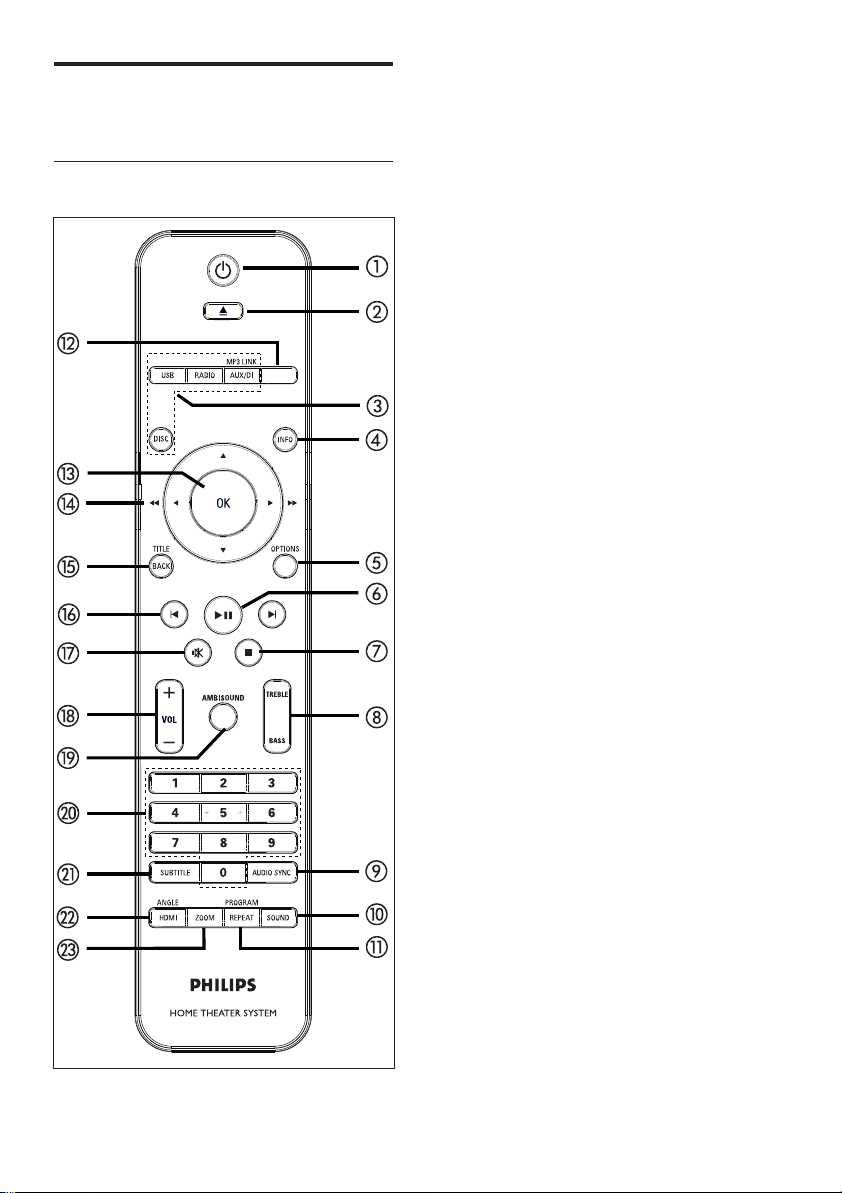
Region codes
DVD movies are usually not released at the
same time in all regions of the world, thus all
DVD players are programmed to a specifi c
region code.
Countries DVD region code
Asia Pacifi c,
Taiwan, Korea
ALL
3
Australia,
New Zealand
ALL
4
China
ALL
6
India
ALL
5
8 EN
Product overview
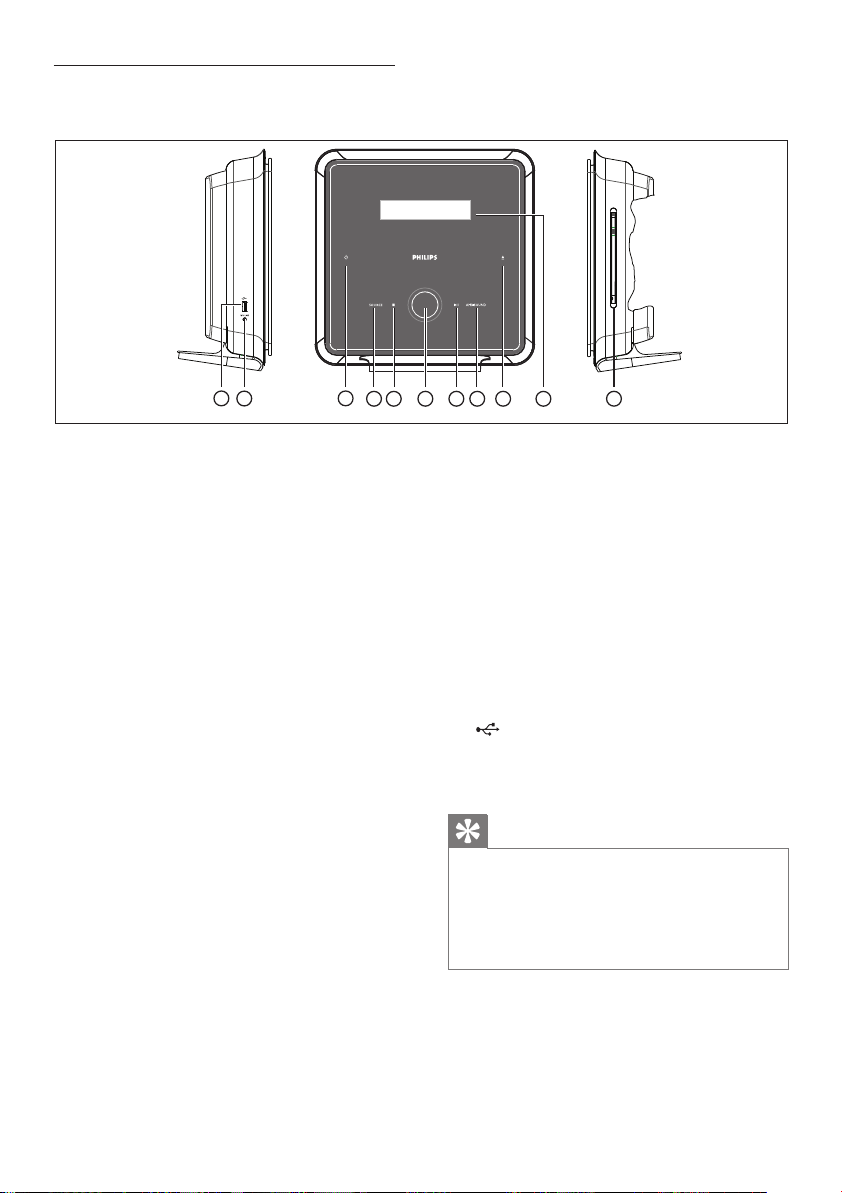
Remote control
CINEMA
LIGHTS
a 2
Turn on this unit or turn off to standby •
mode.
Press and hold to turn off this unit and •
all the HDMI CEC compliant TV/
devices (for EasyLink control only).
b Z (Eject)
Eject or pull in the disc.•
c Source buttons
DISC• : switch to DISC mode. While in
disc mode, access or exit disc menu.
USB• : switch to USB mode.
RADIO• : switch to FM or AM/MW
band.
AUX/DI /MP3 LINK• : switch to
AUX 1-2-3 INPUT, OPTICAL INPUT
1-2, COAXIAL INPUT or MP3 LINK
that corresponds to the socket you
used to connect the external device.
d INFO
Display the current status or disc •
information.
Display photo fi les in 12 thumbnails •
view.
e OPTIONS
Access or exit Options menu (this •
menu provides various setting options).
f u (Play/Pause)
Start or pause disc play.•
RADIO• : start auto radio installation
(only available for fi rst time setup).
g x (Stop)
Stop disc play.•
RADIO• : press and hold to erase the
current preset radio station.

English
EN 9
Your product
h TREBLE / BASS
Switch to treble or bass mode. Then •
press VOL +- to set its level setting.
i AUDIO / SYNC
Select an audio language/channel. •
Press and hold to access audio sync •
setting. Then press VOL +- to set
the audio delay time.
RADIO• : toggle between FM stereo and
mono mode.
j SOUND
Select a predefi ned sound effect.•
k REPEAT / PROGRAM
Select various repeat or shuffl e modes; •
turns off repeat or shuffl e mode.
RADIO• : press this button to start
manual radio preset.
RADIO• : press and hold this button to
start automatic radio preset.
l CINEMA LIGHTS
Turn on/off the lights on the speaker •
stands to create the cinema ambiance if
the cinema light is enabled.
Press and hold to enable or disable •
cinema lights feature.
m OK
Confi rm an entry or selection.•
n Cursor buttons (v V b B)
Navigate through the on-screen menu.•
Press left or right for fast backward or •
forward search.
RADIO•
: press up or down to tune the
radio frequency.
RADIO• : press left or right to start auto
search.
o BACK / TITLE
Return to the previous display menu.•
For DVD, go to title menu.•
For VCD version 2.0 or SVCD with •
PBC turned on: return to the menu
during playback.
p í/ ë (Previous/Next)
Skip to the previous or next title/•
chapter/track.
RADIO• : select a preset radio station.
q H (Mute)
Mute or restore the volume.•
r VOL +-
Adjust the volume level.•
s AMBISOUND
Select different types of surround sound •
output.
t Numeric buttons
Enter a preset number or item to play.•
u SUBTITLE
• Select DVD or DivX subtitle language.
v HDMI / ANGLE
Select a video resolution setting for •
HDMI output.
Press and hold to select a different •
viewing angle of a DVD movie.
w ZOOM
Zoom in or out the picture on the TV.•
10 EN
1
2
3
4
5 6 7
8
9
10
11
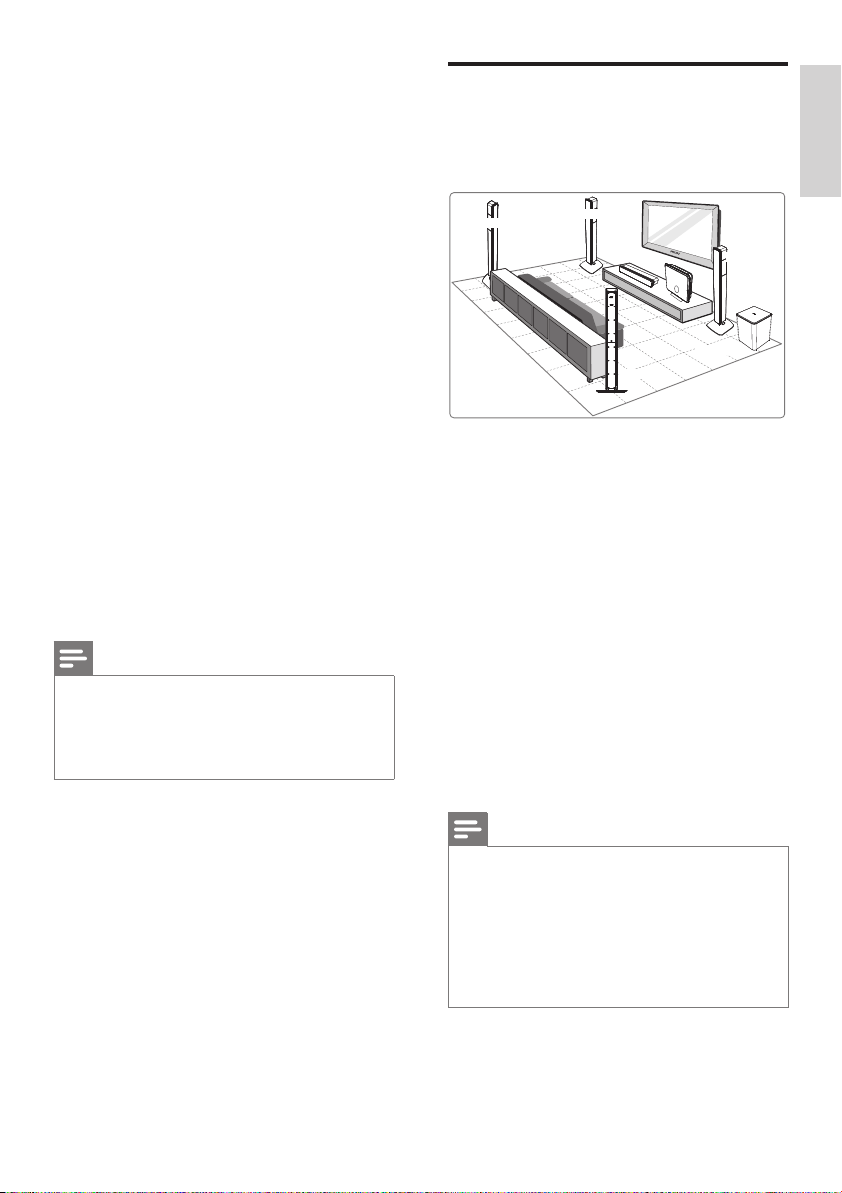
Main unit
a 2 (Standby)
Turn on this unit or turn off to standby •
mode.
Press and hold to turn on this unit from •
low power standby mode.
b SOURCE
Select a play media: DISC, USB, RADIO •
FM, RADIO AM/MW, OPTICAL
INPUT 1-2, COAXIAL INPUT,
AUX 1-2-3 INPUT or MP3 LINK.
c x (Stop)
Stop disc play.•
RADIO• : press and hold to erase the
current preset radio station.
d Volume control
Adjust the volume level.•
e u (Play/Pause)
Start or pause disc play.•
RADIO• : start auto radio installation
(only available for fi rst time setup).
f AMBISOUND
Select different types of surround sound •
output.
g Z (Eject)
Eject or pull in the disc.•
h Display panel
Right side panel
i Disc compartment
Left side panel
j MP3 LINK socket
To connect portable audio player.•
k (USB) socket
• To connect USB fl ash drive, USB
memory reader or digital camera.
Tip
Control buttons on this DVD Home Theatre unit are •
operated through touch screen display. The control
displays will be dimly lit after one second of inactivity.
To change the brightness of the touch screen display, •
see chapter ‘Adjust settings’ - [ General Setup ] >
[ Display Dim ].
English
EN 11
Connect
3 Connect
This section describes the basic connections
required for this DVD Home Theatre unit
before it can be used.
Basic connections:
Place the unit•
Connect• video cables
Connect junction box•
Connect rear wireless speakers•
Connect front and centre speakers to •
subwoofer
Connect radio antenn• a
Optional connections:
Connect audio cables/other device• s
Connect audio from T• V
Connect audio from cable box/•
recorder/game console
Connect portable media player•
Connect USB device•
• Mount the DVD Home Theatre unit
Note
Refer to the type plate at the rear or bottom of the •
product for identifi cation and supply ratings.
Before you make or change any connections, ensure
•
that all the devices are disconnected from the power
outlet.
Place the unit
You can place the main unit on top of a table
or mount it on the wall.
REAR LEFT
FRONT LEFT
REAR RIGHT
FRONT RIGHT
SUBWOOFER
1 Place this DVD Home Theatre unit near to
the TV.
2 Place the speaker system as per the
diagram shown above.
Find the most suitable placement based •
on your room layout and set up to
ensure optimum sound performance.
3 Place the subwoofer at the corner of the
room or at least one metre away from the
TV.
4 Place the junction box behind the TV, shelf
or table.
Use the supplied velcro strip for fi xing •
purpose.
Note
Rear speakers are labelled as REAR LEFT / RIGHT.•
Front speakers are labelled as FRONT LEFT / •
RIGHT.
To avoid magnetic interference or unwanted noise,
•
never place the speakers too close to the TV or any
radiation devices.
Install this unit near the AC outlet where the AC
•
power plug can be easily reached.
12 EN
Connect video cables
This section describes how to connect this
DVD Home Theatre unit to your TV so to
enable viewing of disc play.
Select the best video connection that your TV
can support.
Option 1:• Connect to HDMI socket (for a
HDMI, DVI or HDCP-compliant TV).
Option 2:• Connect to component video
socket (for a standard TV or Progressive
Scan TV).
Option 3:• Connect to Video (CVBS) socket
(for a standard TV).
Note
You must connect this unit directly to a TV.•
Option 1: Connect to HDMI socket
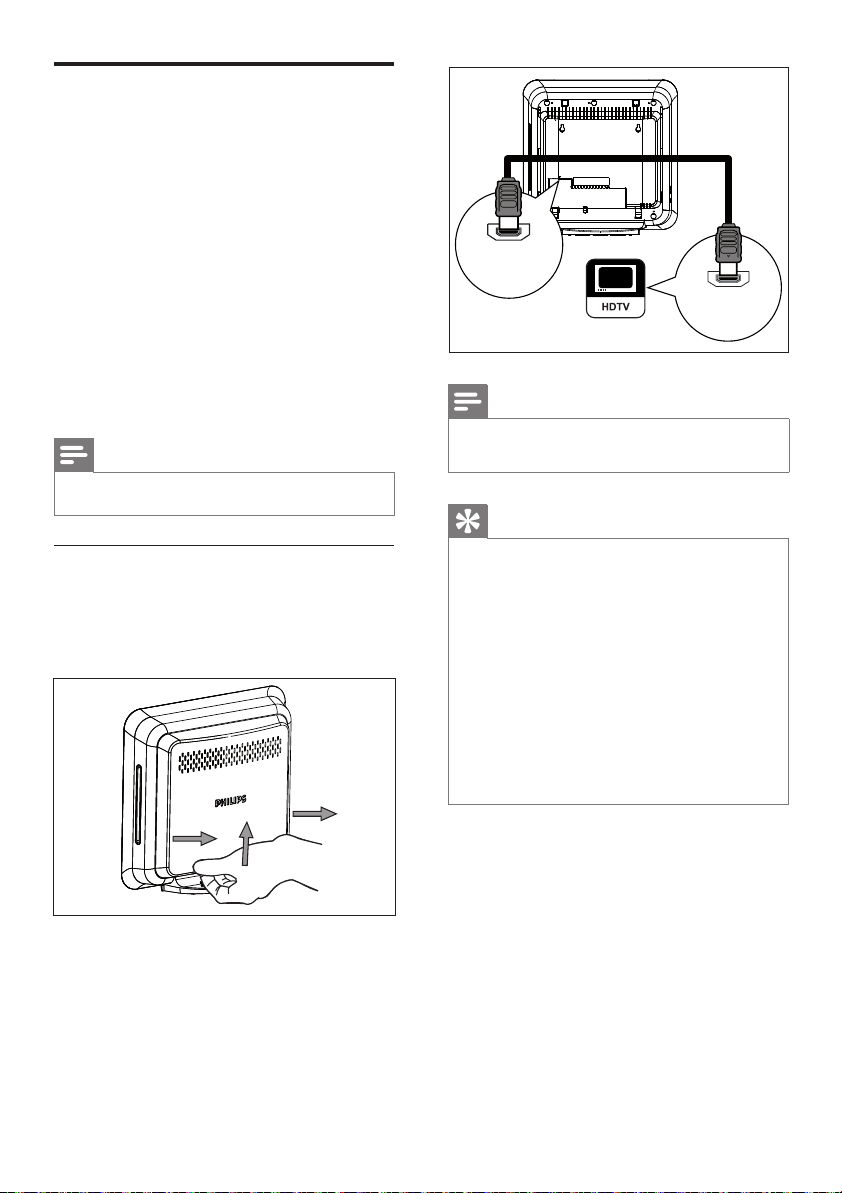
1 Before you connect, remove the rear
cover of the main unit by pushing it
upwards and outwards.
2 Connect a HDMI cable (supplied) from the
HDMI OUT on this unit to the HDMI IN
socket on your TV.
HDMI IN
HDMI
OUT
Note
The HDMI connector is only compatible with HDMI •
compliant TVs and DVI-TVs.
Tip
To optimise the video output, see chapter ‘Adjust •
settings’ > [ Video Setup ] > [ Advanced Picture ]
for details.
This unit is HDMI CEC compatible. It enables
•
connected TV/device to control each other over
HDMI, see chapter ‘Activate EasyLink control’ for
details.
Use a HDMI/DVI adaptor in case your TV has only
•
a DVI connection. An extra audio connection is
needed to complete this connection.
To route the audio from your TV to this DVD Home •
Theatre unit, connect an audio cable from the audio
input on this unit to the audio output on your TV.
This type of connections provide best picture quality.•
English
EN 13
Connect
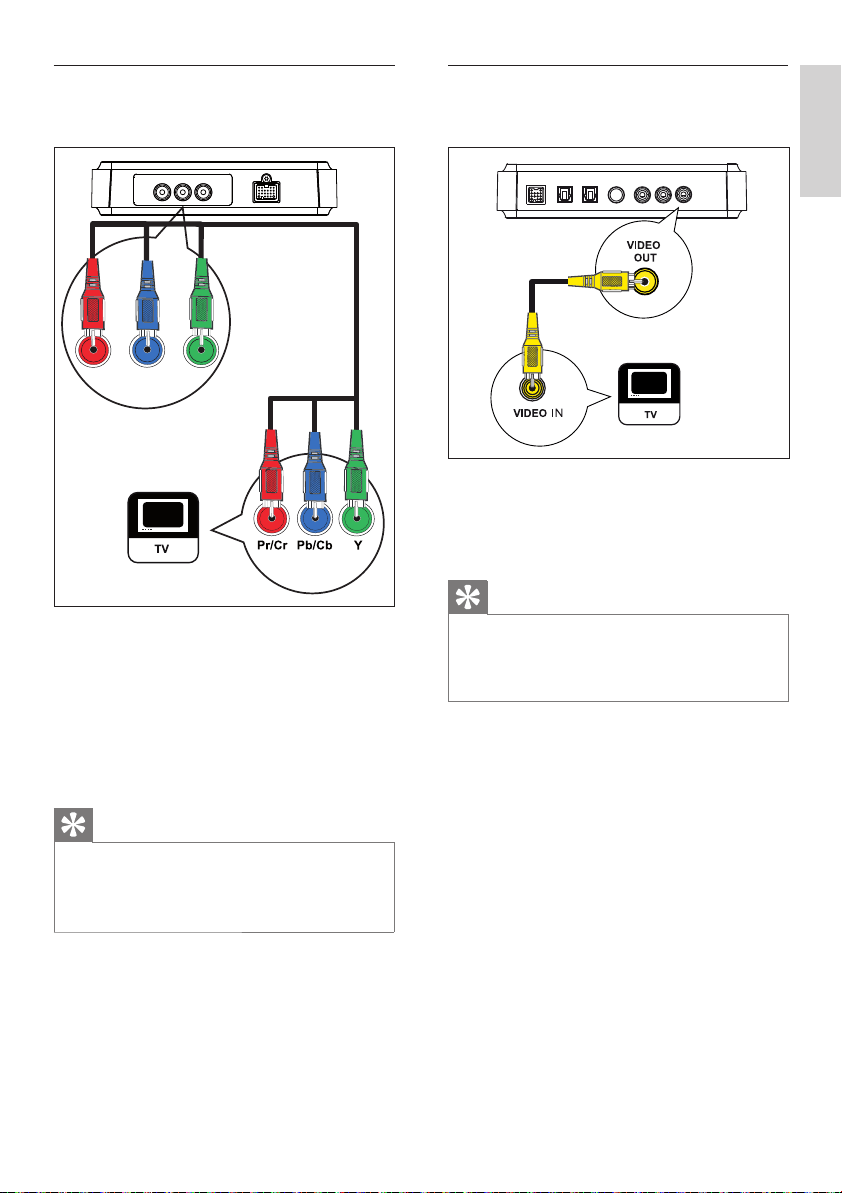
Option 2: Connect to component
video socket
Pr Pb Y
1 Connect the component video cables (not
supplied) from the Y P
B PR sockets on this
unit to the component video input sockets
on your TV.
If a progressive scan TV is used, you •
may turn on the progressive scan mode
(see chapter ‘Turn on Progressive Scan’
for details).
Tip
The component video input socket on your TV may •
be labelled as Y Pb/Cb Pr/Cr or YUV.
This type of connections provide good picture
•
quality.
Option 3: Connect to Video (CVBS)
socket
1 Connect a composite video cable
(supplied) from the VIDEO OUT socket
on this unit to the video input socket on
your TV.
Tip
The video input socket on your TV may be labelled •
as A/V IN, VIDEO IN, COMPOSITE or BASEBAND.
This type of connections provide standard picture
•
quality.
14 EN
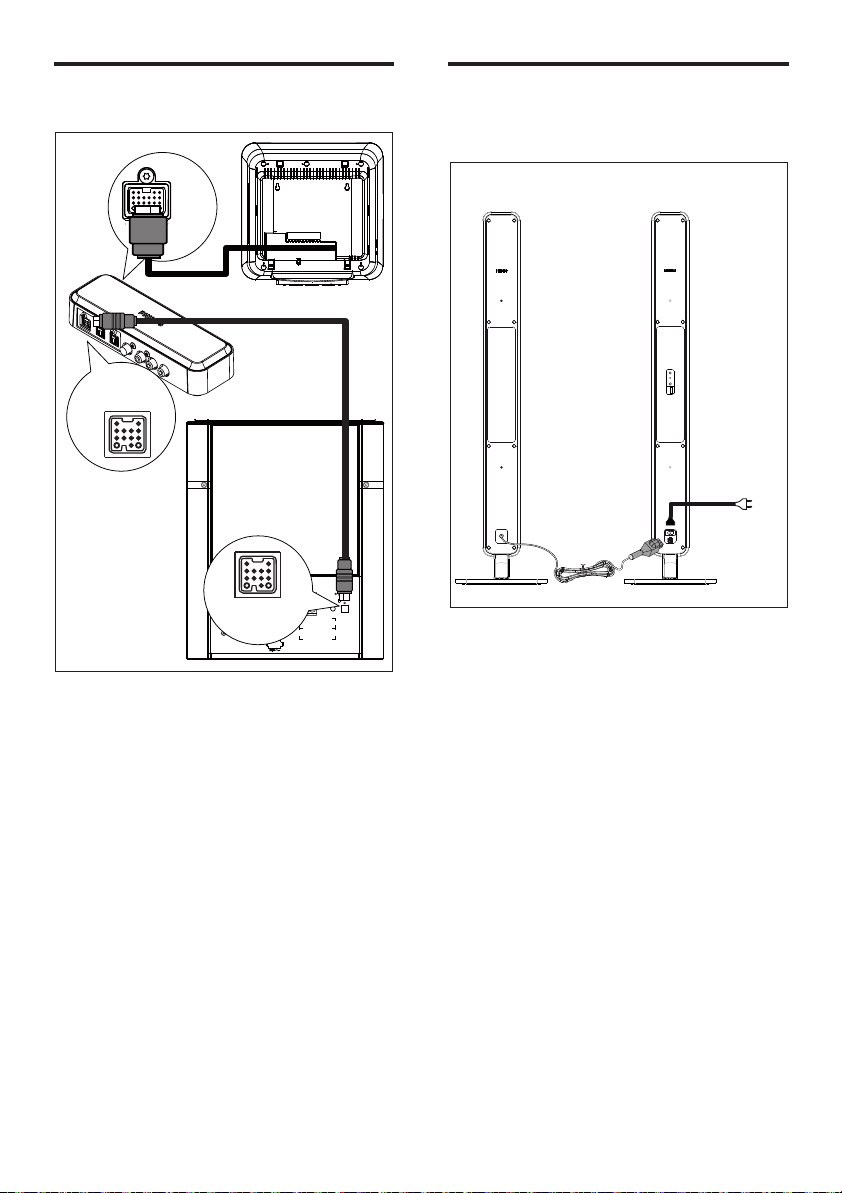
Connect junction box
TO JUNCTION
BOX
TO
MAIN
UNIT
TO
SUBWOOFER
1
2
1 Unwind the DC cable from the main unit
and connect it to the TO MAIN UNIT
socket on the junction box.
Once complete, close the main unit •
rear cover.
2 Connect interconnect cable between TO
SUBWOOFER socket on the junction box
and TO JUNCTION BOX socket on the
subwoofer.
Connect rear wireless
speakers
REAR
RIGHT
REAR
LEFT
2
1
1 Connect the cable from the right rear
speaker to the left rear speaker socket.
2 Connect the power cord from the left rear
speaker to the power outlet when all the
required connections are complete.
English
EN 15
Connect
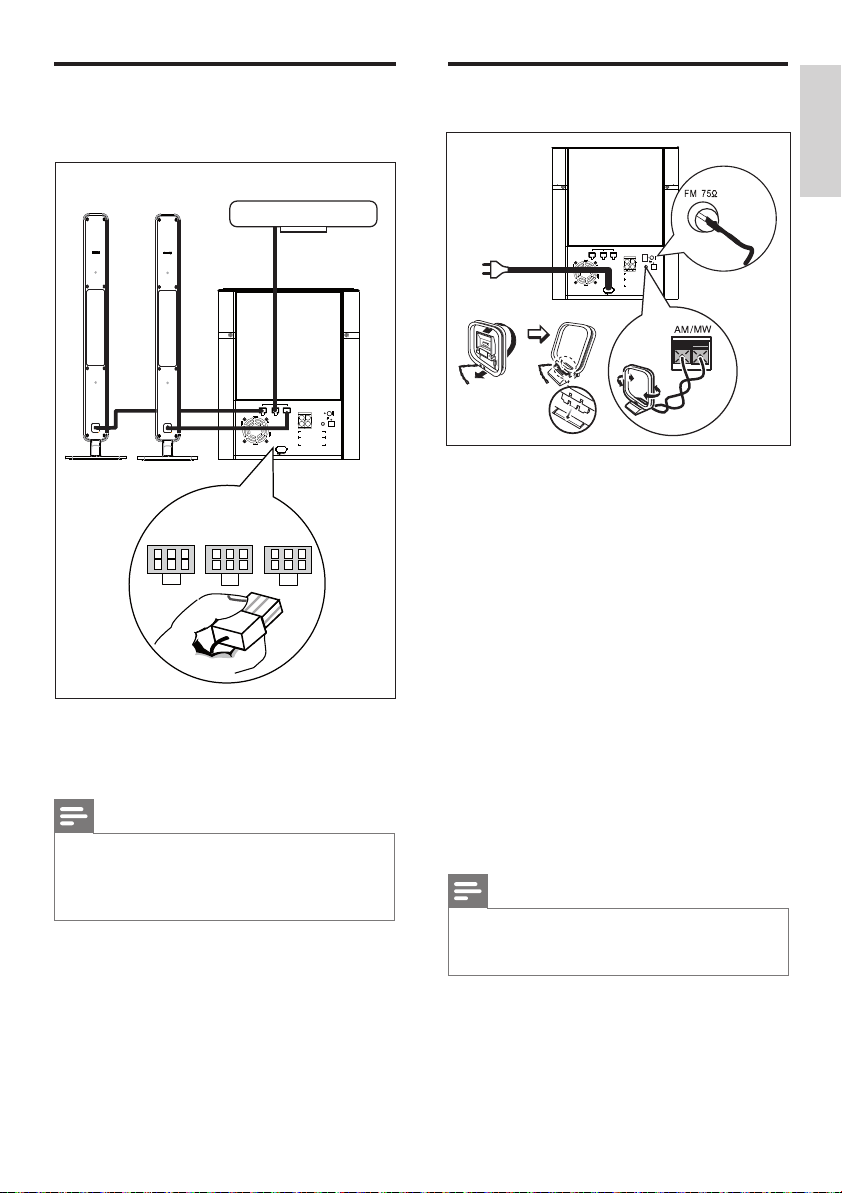
Connect front and centre
speakers to subwoofer
FRONT
RIGHT
FRONT
LEFT
CENTER
CENTERRIGHT LEFT
1 Connect the centre, left front and right
front speakers to the matching sockets on
the subwoofer.
Note
Ensure that the front portion of the plug is fully •
inserted into the socket.
To disconnect the Ambisound speakers, press down
•
the catch on the plug before pulling out.
Connect radio antenna
3
4
1
2
1 Stand the AM/MW loop antenna
(supplied) upright to fi x its claw into the
slot.
2 Connect the AM/MW loop antenna to the
AM/MW socket. Then place the AM/MW
loop antenna on a shelf, or attach it to a
stand or wall.
3 Connect the FM antenna (supplied) to the
FM75Ω socket on the subwoofer (for
some models, this cable has been
connected). Extend the FM antenna and
fi x its ends to the wall.
4 Connect the power cord when all the
required connections are complete and
you are ready to enjoy this DVD Home
Theatre unit.
Note
Before connect to power outlet, ensure that the •
voltage selector (at the rear of this unit) is set to the
local power line voltage.
16 EN
Connect audio cables/other
devices
This section describes how you can route the
sound from other devices to this DVD Home
Theatre unit in order to enjoy sound output or
audio play with multi-channel surround
capabilities.
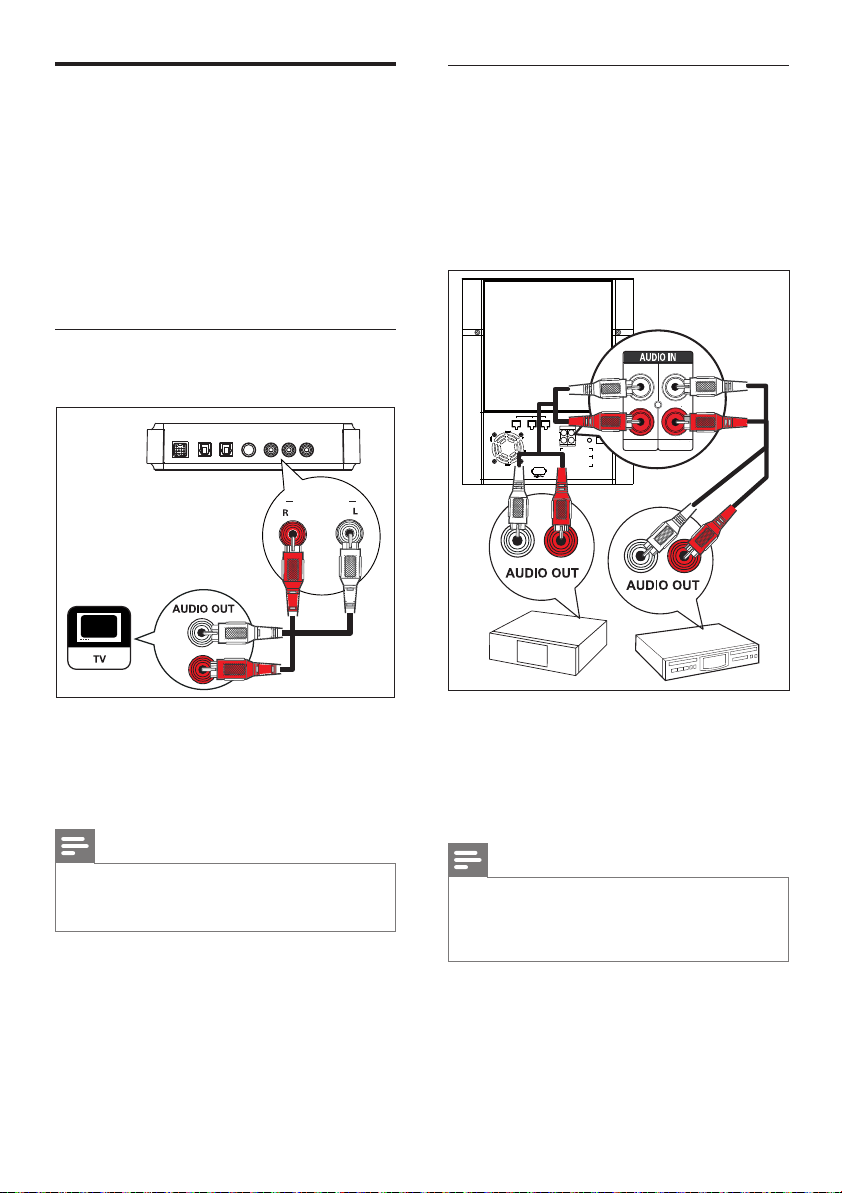
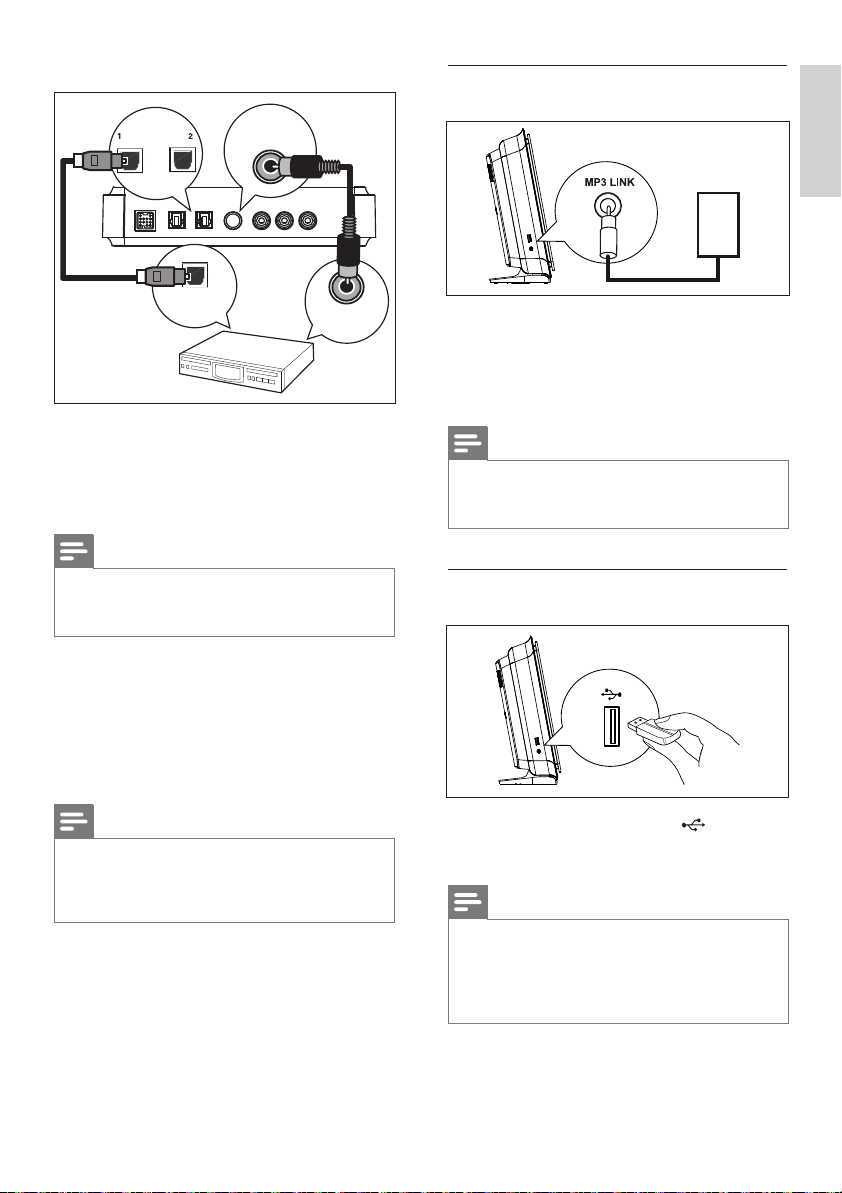
Connect audio from TV
(also used for EasyLink control)
AUX 1
AUDIO IN
1 Connect an audio cable (not supplied)
from the AUDIO IN-AUX1 sockets on
the junction box to the AUDIO OUT
sockets on your TV.
Note
To listen to the audio output from this connection, •
press AUX/DI /MP3 LINK repeatedly until ‘AUX1
INPUT’ is displayed on the display panel.
Connect audio from cable box/
recorder/game console
You can choose to connect to analogue or
digital socket depending on the device
capabilities.
Connect to analogue sockets
AUX 2
AUX 3
R
L
1 Connect an audio cable (not supplied)
from the AUDIO IN-AUX2 or AUX3
sockets on the subwoofer to the AUDIO
OUT sockets on the device.
Note
To listen to the audio output from this connection, •
press AUX/DI /MP3 LINK repeatedly until ‘AUX2
INPUT’ or ‘AUX3 INPUT’ is displayed on the display
panel.
English
EN 17
Connect
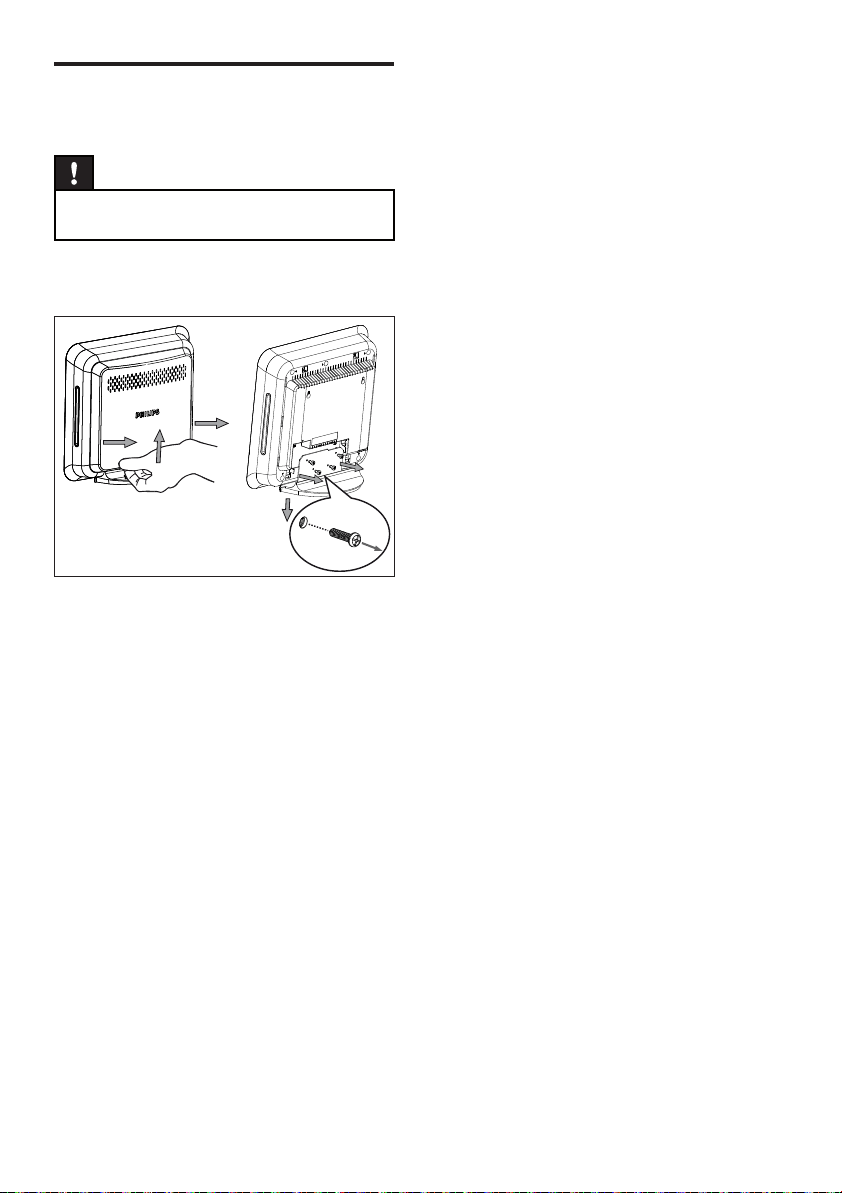
Connect to digital/optical socket
COAXIAL
DIGITAL IN
OPTICAL OUT
COAXIAL
DIGITAL OUT
OPTICAL
DIGITAL-IN
1 Connect a coaxial cable (not supplied)
from the COAXIAL DIGITAL IN socket
on the junction box to the COAXIAL/
DIGITAL OUT socket on the device.
Note
To listen to the audio output from this connection, •
press AUX/DI /MP3 LINK repeatedly until
‘COAXIAL INPUT’ is displayed on the display panel.
or
1 Connect an optical cable (not supplied)
from the OPTICAL DIGITAL IN 1 or 2
socket on the junction box to the
OPTICAL OUT socket on the device.
Note
To listen to the audio output from this connection, •
press AUX/DI /MP3 LINK repeatedly until
‘OPTICAL INPUT 1’ or ‘OPTICAL INPUT 2’ is
displayed on the display panel.
Connect portable media player
MP3
1 Connect a 3.5mm stereo audio cable
(supplied) from the MP3 LINK socket on
this unit to the phone socket on your
portable media player (such as MP3 player).
Note
To listen to the audio output from this connection, •
press AUX/DI /MP3 LINK repeatedly until ‘MP3
LINK’ is displayed on the display panel.
Connect USB device
1 Connect the USB device to (USB)
socket on this unit.
Note
This DVD Home Theatre unit can only play/view •
MP3, WMA/WMV9, DivX (Ultra) or JPEG fi les that
are stored on such devices.
To listen to the audio output from this connection,
•
press USB.
18 EN
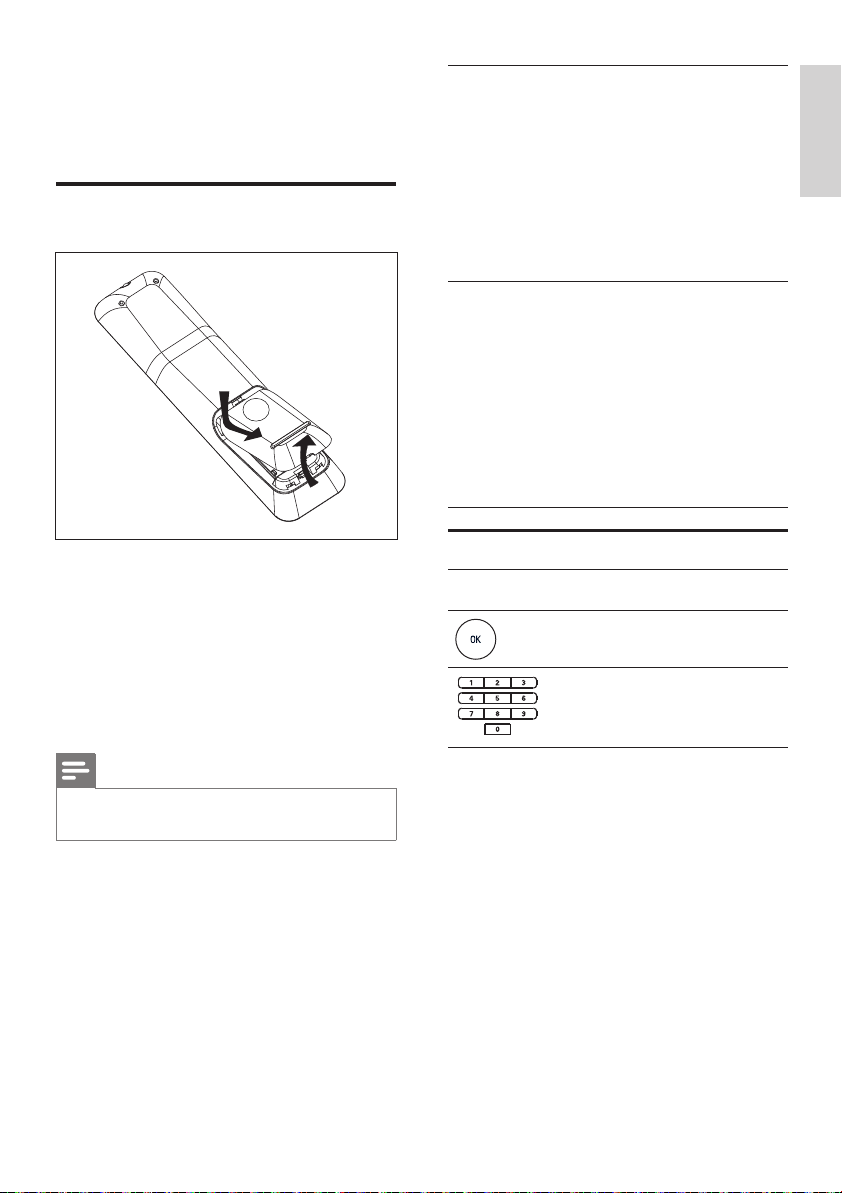
Mount the DVD Home
Theatre unit
Caution!
Risk of personal injury and damage to the unit. •
Allow only qualifi ed persons to mount the unit.
1 Pull up the catch to remove the main unit
rear cover.
2 Remove the screws and detach the DVD
Home Theatre stand.
3 Place two screws on the wall.
The distance between two screws is •
15cm.
4 Hook the DVD Home Theatre unit fi rmly
onto the screws, slide through the key
holes to lock into position.
English
EN 19
Get started
4 Get started
Prepare the remote control
1 Push to open the battery compartment
cover.
2 Insert two batteries type R03 or AAA.
Match the indications (+-) inside the
battery compartment.
3 Close the cover.
Note
If you are not going to use the remote control for a •
long time, remove the batteries.
Control a play source
1 Select the source you wish to control by
pressing the DISC, USB, RADIO or
AUX/DI/MP3 LINK button.
2 Then select the desired function (for
example í, ë).
Navigate through the menu
1 Point the remote control directly at the
remote sensor on this unit and select the
desired function.
2 Use the following buttons on the remote
control to navigate through the on-screen
menus.
Button Action
v V
Move up or down.
b B
Move left or right.
Confi rm a selection.
Enter numbers.
20 EN
Find the correct viewing
channel
1 Press 2 to turn on the DVD Home
Theatre unit.
2 Press DISC to switch to disc mode
3 Turn on the TV and switch it to the
correct video-in channel.
You may go to the lowest channel on •
your TV, then press the Channel Down
button on your TVs remote control
until you see the Video In channel.
You may press • ° button repeatedly
on your TVs remote control.
Usually this channel is between the •
lowest and highest channels and may
be called FRONT, A/V IN, VIDEO, etc..
Tip
See TVs user manual on how to select the correct •
input on your TV.
Start Ambisound setup
When you turn on this unit for the fi rst time,
follow the instructions on the TV to complete
the Ambisound setup in order to obtain the
best possible surround sound effect.
Note
Before you start, ensure that you have made all the •
required connections.
Complete the Ambisound setup for this unit before
•
you insert a disc to play.
1 Press DISC to switch to disc mode
2 Turn on the TV and switch it to the
correct video-in channel.
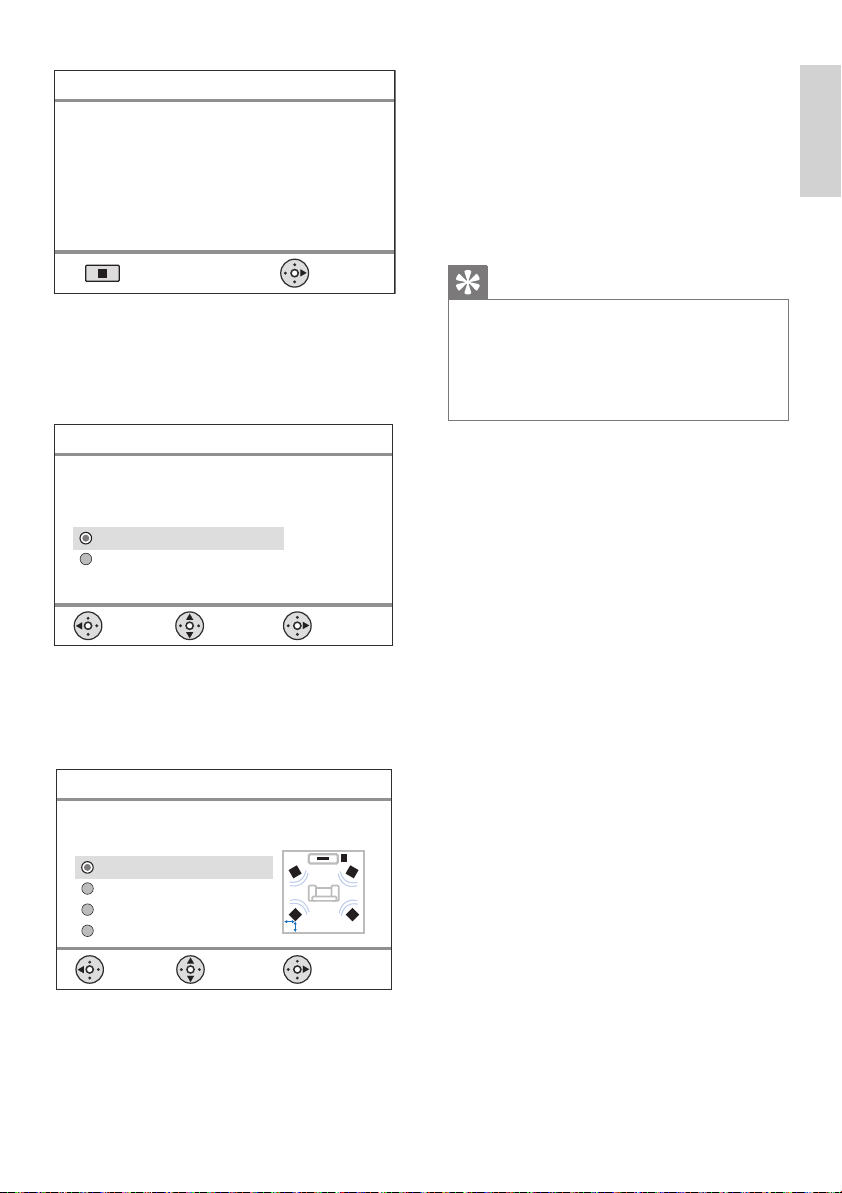
Language menu is displayed.
Please choose your language:
OSD Language
Select
Change
English
Português
Espanõl
Stop: Exit
3 Select a language for on-screen display,
then press B.
A welcome message is displayed.
English
EN 21
Get started
The next few steps will help you set up your
Home Theater System to match your
listening environment.
To optimize the Ambisound surround effect for your
home, please begin with this simple setup.
Stop: Exit
Continue
Welcome
To skip the Ambisound setup, press • x
to exit.
4 Press B to continue.
[ Room Acoustics ] menu is displayed.
Please select the type of walls that surround
your room:
Select
Room Acoustics
Back
Change
Soft (Curtains, open space)
Hard (Concrete, wood)
5 Select the condition of the room, then
press B.
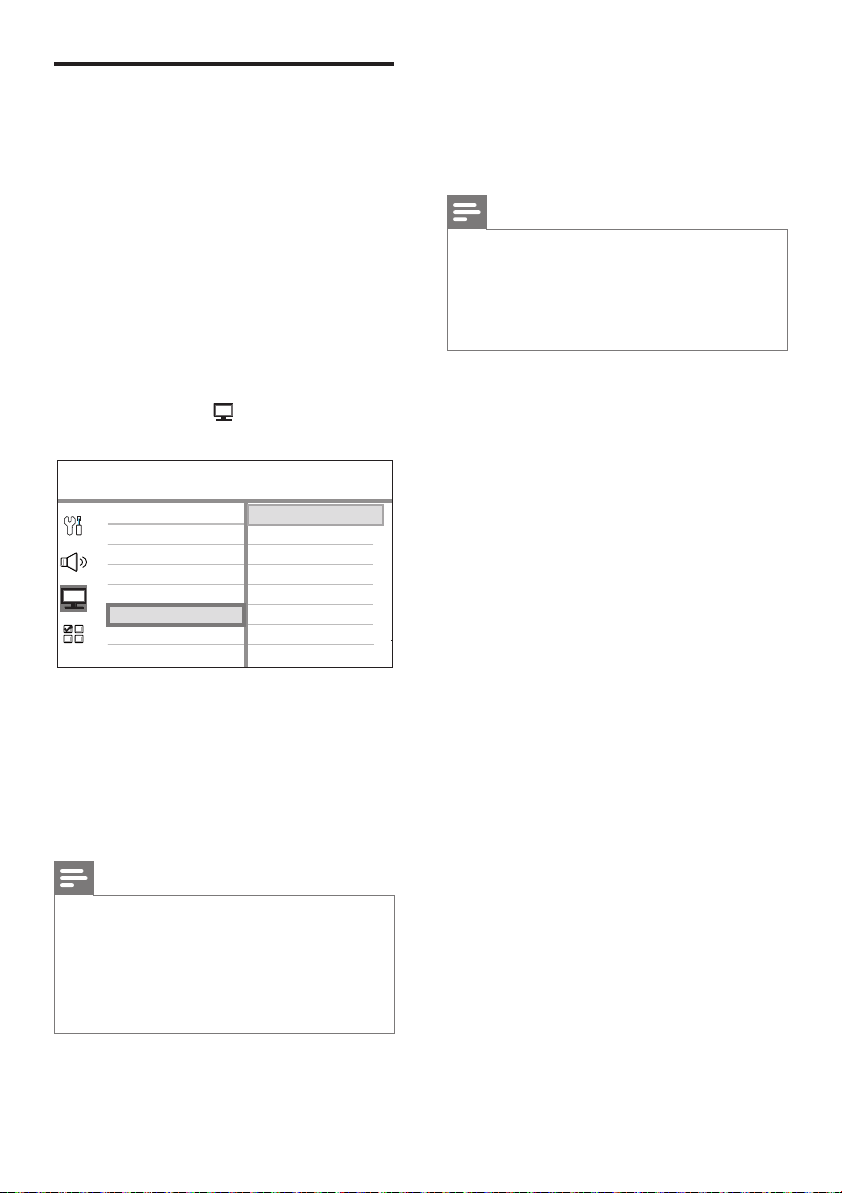
[ Rear Speaker Placement ] menu is
displayed.
Select the placement of the rear speakers
in your room:
Select
Rear Speaker Placement
Back
Change
Against side wall (>0.5m)
Against both wall (>0.5m)
Against back wall (>0.5m)
Against both wall (<0.5m)
6 Select the rear speakers placement in the
room, then press B.
7 The speaker setting is complete, press B to
exit.
This DVD Home Theatre unit is now ready for
use.
Tip
To change the menu display language, see chapter •
‘Adjusting settings’ - [ General setup ] > [ OSD
Language ] for details.
If you connect this unit to a HDMI CEC compliant
•
TV using a HDMI cable, it switches automatically to
the menu display language as per your TV setting.
22 EN
Turn on Progressive Scan
If you connect this unit to TV with the
component video connection (see chapter
‘Connect video cables - Option 2: Connect to
component video jack’ for details), you can turn
on the progressive scan output if your TV
supports progressive scan.
1 Turn on the TV to the correct viewing
channel for this unit.
2 Press DISC.
3 Press OPTIONS.
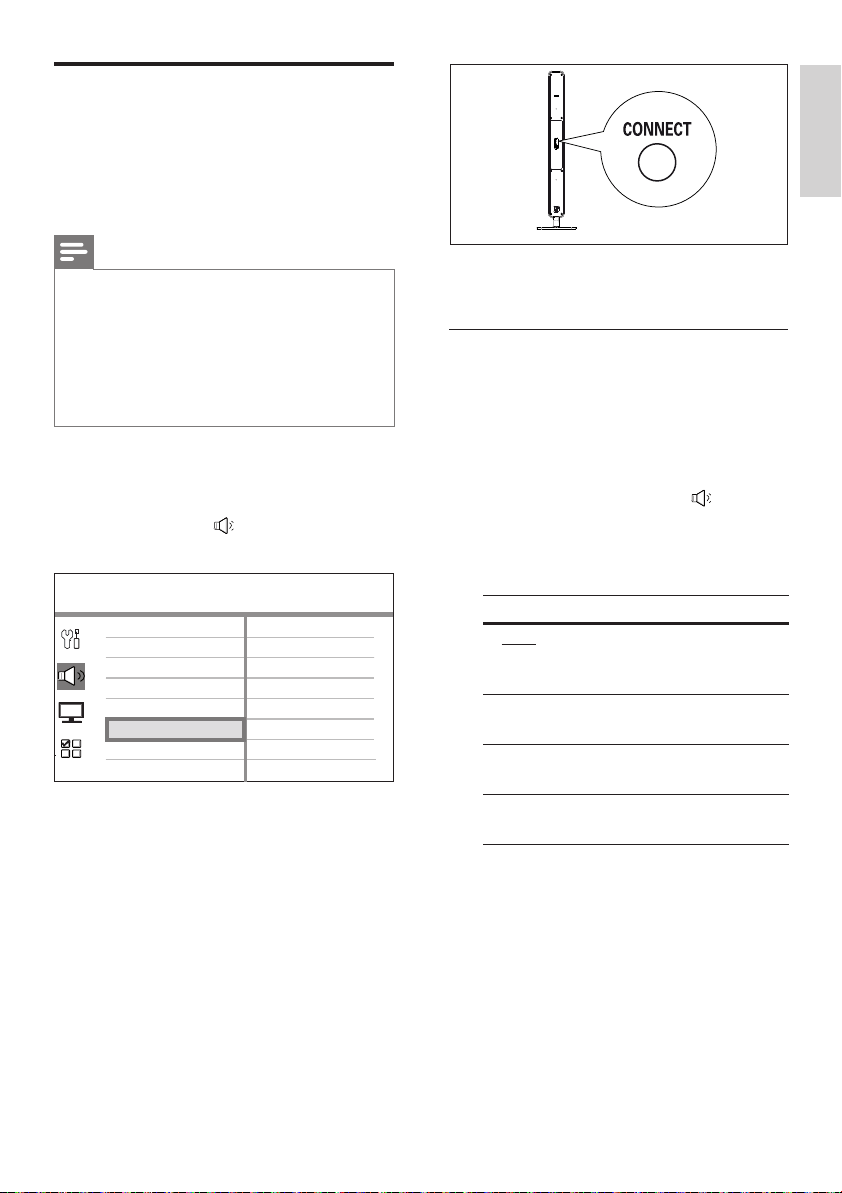
4 Press V to select [ Video Setup ] in the
menu, then press B.
On
Off
Picture Settings
Advanced Picture
TV Display
TV Type
Progressive
Video Setup
Closed Caption
5 Select [ Progressive ] > [ On ]
,
then press
OK.
A warning message is displayed.
6
To proceed, select [ OK ] in the menu
and press OK.
The progressive setup is complete.
Note
If a blank/distorted screen is displayed, wait for 15 •
seconds for the auto recover.
If no picture displayed, turn off the progressive scan •
mode as follows:
1) Press Z to open the disc compartment.
2) Press B.
3) Press SUBTITLE.
7 To exit the menu, press OPTIONS.
8 You can now turn on the progressive scan
mode on your TV (see the TV user
manual).
Note
There are some progressive scan TVs that are •
not fully compatible with this unit, resulting in an
unnatural picture when playing back a DVD VIDEO
disc in the progressive scan mode. In such case, turn
off the progressive scan feature on this unit and your
TV.
English
EN 23
Get started
Optimise wireless
transmission
After connecting the speakers and subwoofer,
you can adjust the wireless settings to optimise
the wireless performance.
Note
Before you start, ensure that the left rear speaker •
and subwoofer are connected to the power outlets.
The wireless receiver is built into the left rear
•
speaker and the transmitter is built into the
subwoofer.
For optimum wireless transmission, ensure that there •
is no obstructions between the left rear speaker and
subwoofer.
1 Press DISC.
2 Press OPTIONS.
3 Press V to select [ Audio Setup ] in
the menu, then press B.
Audio Setup
Ambisound Setup
HDMI Audio
Speaker Volume
Speaker Delay
Night Mode
Wireless
Pair Receiver
Switch Channel
4 Select [ Wireless ] > [ Pair Receiver ]
,
then press OK.
5 Press and hold CONNECT on the left
rear speaker to start pairing the receiver to
the transmitter.
The light fl ashes while in pairing mode.
A confi rmation message is displayed
once the pairing process is complete.
Pairing has to be done within 30 •
seconds and audio is muted during this
process.
REAR
LEFT
6 Press OK to confi rm and exit.
Change the frequency channel
You can change the frequency channel of this
wireless system if the transmission signal is
interfering with other wireless devices/networks
in your home.
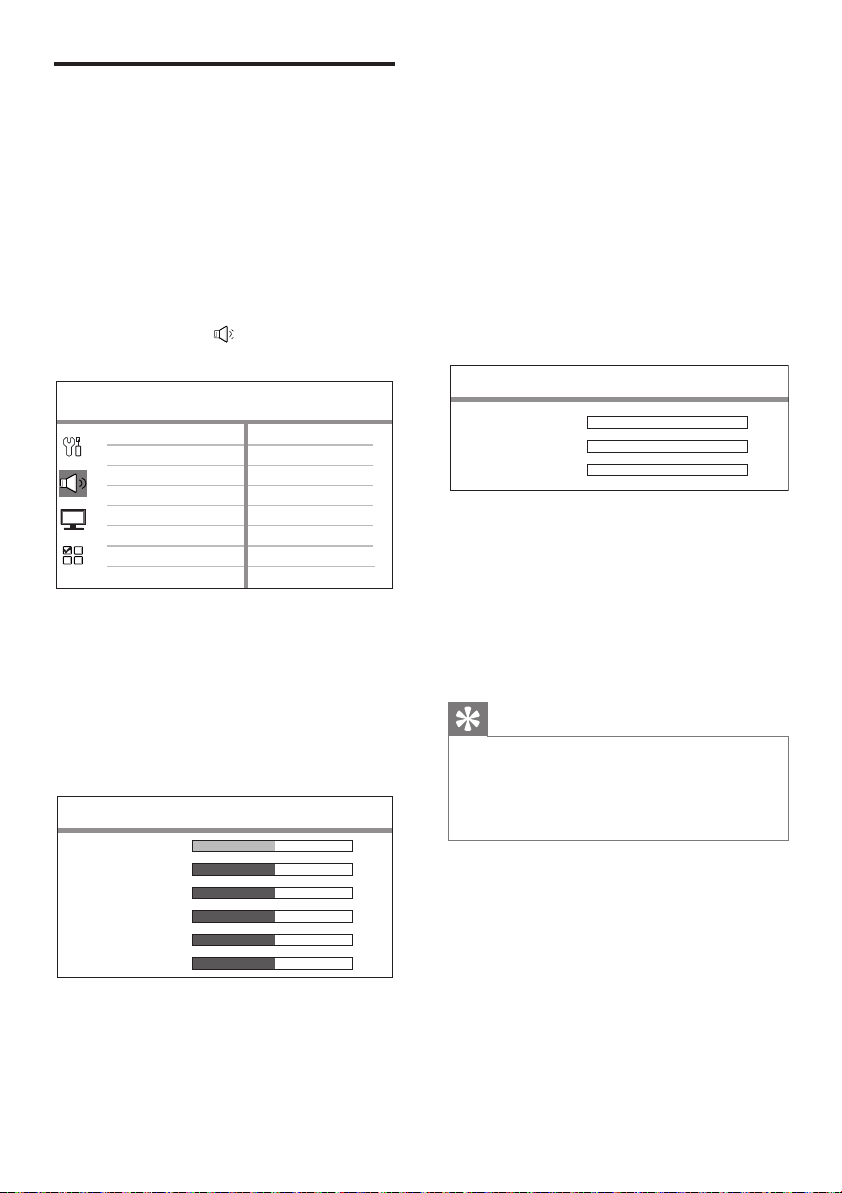
1 Press OPTIONS, then select [ Audio
Setup ].
2 Select [ Wireless ] > [ Switch Channel ]
,
then press OK.
Options Descriptions
[ Auto ] It selects the best
channel to operate
automatically.
[ Channel A ] Frequency corresponding
to Wi-Fi channel 1.
[ Channel B ] Frequency corresponding
to Wi-Fi channel 6.
[ Channel C ] Frequency corresponding
to Wi-Fi channel 11.
3 Press vV to select a setting, then press
OK.
4 To exit the menu, press OPTIONS.
24 EN
Adjust speakers output
Ideally the distance between listening position
and all the speakers should be the same. If not,
change the speaker settings based on their
distance from the listening position in order to
obtain the best possible surround sound.
1 Press DISC.
2 Press OPTIONS.
3 Press V to select [ Audio Setup ] in the
menu, then press B.
Audio Setup
Ambisound Setup
HDMI Audio
Speaker Volume
Speaker Delay
Night Mode
Wireless
You cannot access speaker setup •
options if this Home Theatre unit is not
in a complete stop mode. In such case,
press x twice.
To set the speakers volume level
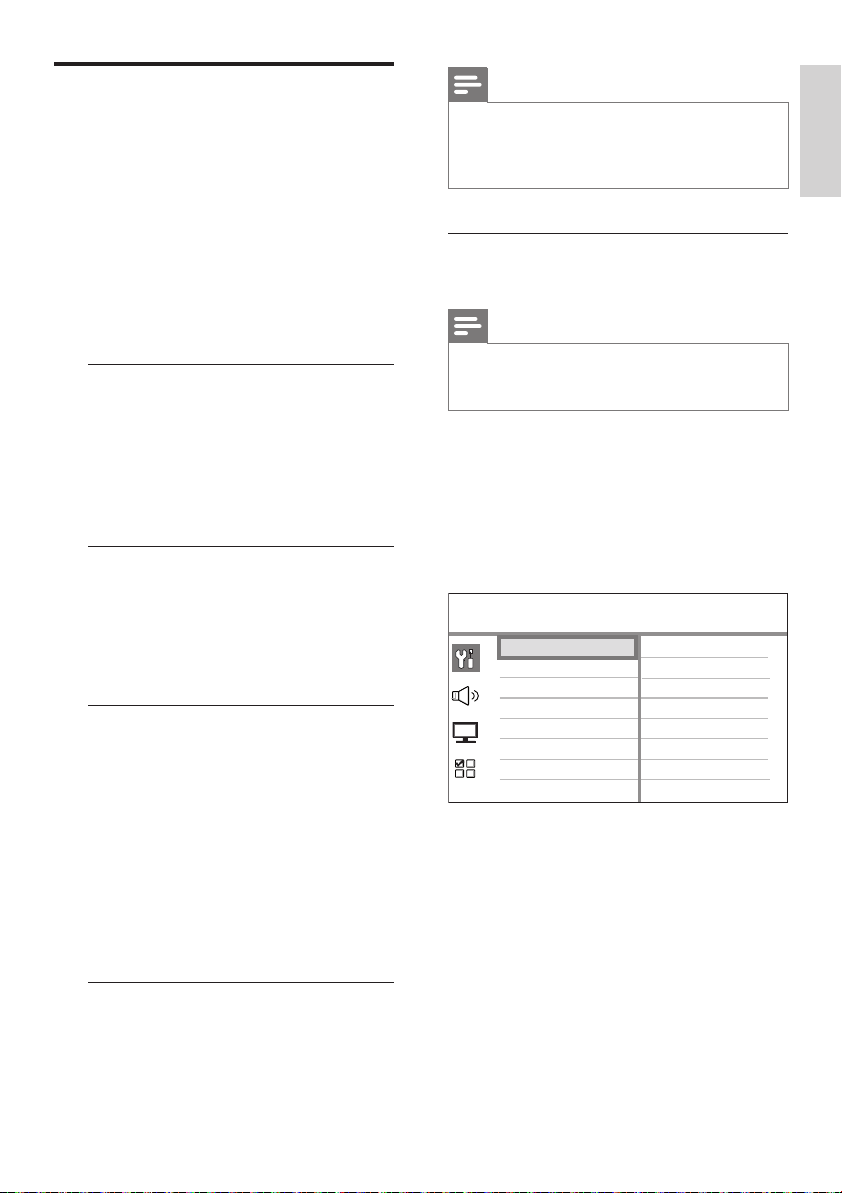
4 Select [ Speakers Volume ] in the menu,
then press B.
Speakers Level Setup
Front Left
Front Right
Center
Subwoofer
Rear Left
Rear Right
0dB
0dB
0dB
0dB
0dB
0dB
5 Press b B to adjust the volume level, then
press OK.
The test tone is emitted from the
speaker which you are adjusting.
Repeat the above setting for other •
speakers until all the speakers output
level sounds equally balance.
To set the output delay time (centre and rear
speakers only)
6 Select [ Speakers Delay ] in the menu,
then press B.
Speakers Delay Setup
Center
Rear Left
Rear Right
0ms
0ms
0ms
7 Press b B to set the delay time, then press
OK.
Repeat the above setting for other •
speakers until the sound output from
different speakers reach the listening
position at the same time.
8 To exit the menu, press OPTIONS.
Tip
Set longer delay time if the centre or rear speakers •
are closer to the listening position than the front
speakers.
1ms setting for every 30cm distance between the •
speaker and the listening position.
English
EN 25
Get started
Activate EasyLink control
This feature is only applicable if this unit is
connected to HDMI CEC compliant TV/device.
It enables all the linked devices response or
react to certain commands simultaneously with
one touch control.
1 Turn on the HDMI CEC operations on
your TV and other connected devices. See
TVs/devices manual for details.
2 You can now enjoy the EasyLink controls.
One touch play [ Auto Wake-up TV ]
When you press PLAY button, this unit will
wake-up from standby mode and start disc
play (if a video disc is found in the disc
compartment) and it will also turn on your
TV and switch to the correct viewing
channel.
One touch power off [ System Standby ]
When you press and hold STANDBY
button, it will turn off this unit and all the
linked devices to standby.
This unit also responses to standby
command from other HDMI CEC devices.
One touch audio input switching [ System
Audio Control ]
This unit is able to render the audio signals
from the active source. It switches
automatically to the corresponding audio
input and output the sound from its
speaker system.
Before you can enjoy this function, you •
have to map the audio inputs to the
connected devices.
You can use any HDMI CEC TV/device •
remote control to adjust the volume.
Note
To enable one touch play function, a video disc must •
be placed in the disc compartment before operation.
Philips does not guarantee 100% interoperability
•
with all HDMI CEC compliant devices.
Map the audio inputs to the
connected devices
Note
Before you start, ensure that an audio connection •
has been made between this unit and your TV/
devices.
1 Press DISC.
2 Press OPTIONS.
[ General Setup ] menu is displayed.
3 Press B.
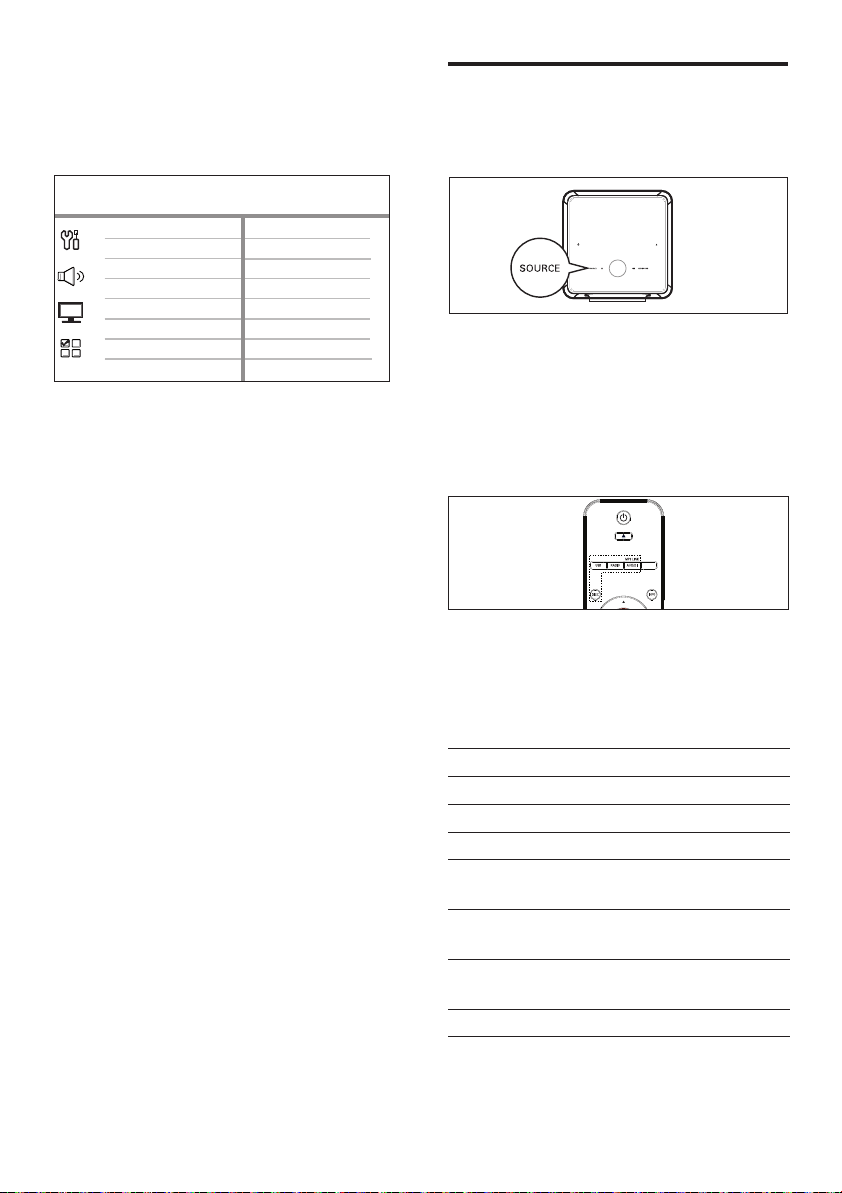
4 Select [ EasyLink ], then press B.
Screen Saver
DivX(R) VOD Code
Sleep Timer
Display Dim
Disc Lock
OSD Language
EasyLink
Standby Mode
General Setup
Auto Wake-up TV
System Standby
System Audio Control
Audio Input Mapping
[ Auto Wake-up TV ]• and [ System
Standby ] functions are turned on by
default in the factory.
5 Select [ System Audio Control ] > [ On ],
then press OK.
6 Select [ Audio Input Mapping ], then press
OK.
26 EN
7 Select [ OK ] in the menu, then press OK
to start scanning of devices.
Once complete, audio input mapping
menu is displayed.
AUX3 Input
AUX2 Input
Digital Input
AUX1 Input
Audio Input Mapping
TV
Other (non-HDMI)
For example, if your TV audio is •
connected to the AUX IN-AUX 1
sockets on this unit, select [ AUX1
Input ] and map with the TV (brand
name) at the right panel.
8 Select the audio input of this unit that is
used to connect to other HDMI device
(e.g. AUX1 Input, AUX2 Input), then press
B.
9 Select the correct connected device, then
press OK.
Repeat steps 8~9 to map other •
connected devices.
10 To exit the menu, press OPTIONS.
Select a play source
On the main unit
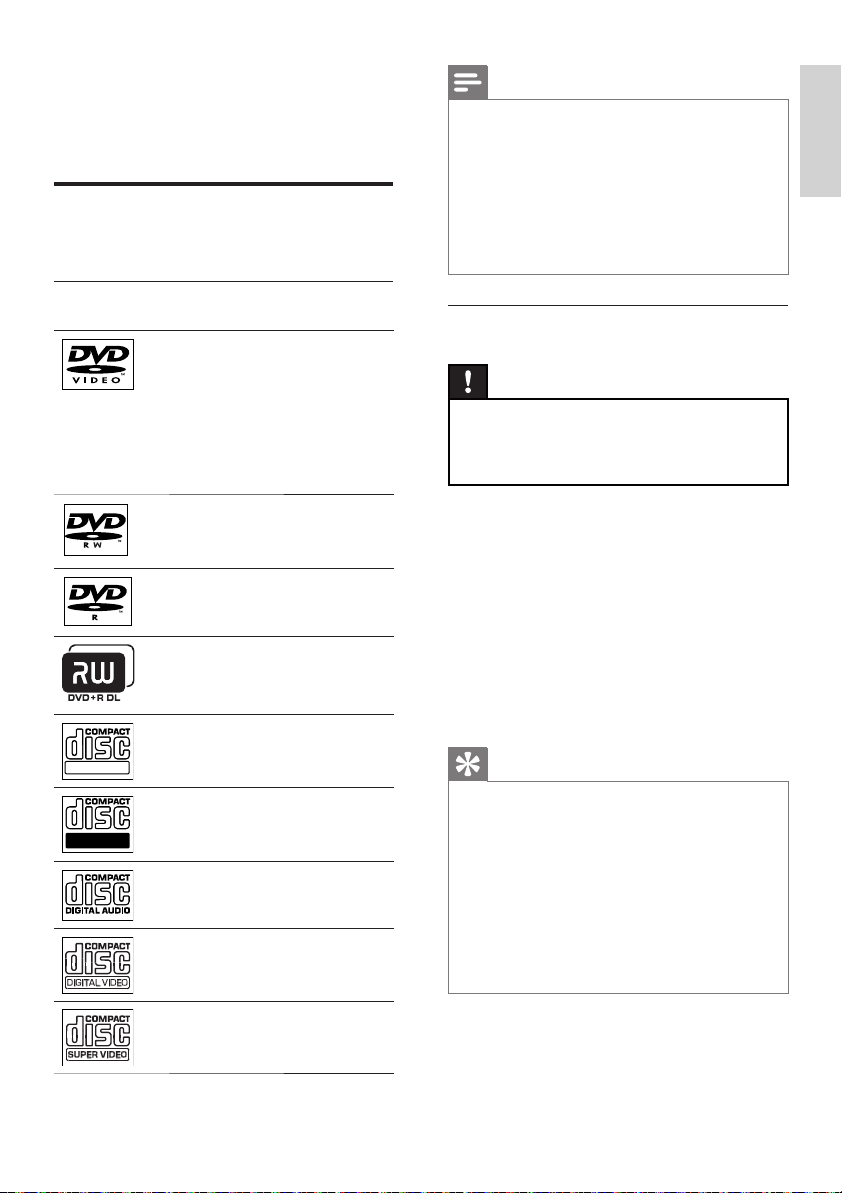
1
Press SOURCE repeatedly to select:
DISC > USB > RADIO FM > RADIO
AM/MW > OPTICAL INPUT 1-2 >
COAXIAL INPUT > AUX 1-2-3 INPUT
> MP3 LINK > DISC ...
On the remote control
Press • DISC to switch to DISC mode.
Press • USB to switch to USB mode.
Press • RADIO to switch to FM or AM/MW
band.
Press • AUX/DI /MP3 LINK repeatedly to
select other external devices.
Display Device connected to
AUX1 INPUT AUDIO IN-AUX1 sockets.
AUX2 INPUT AUDIO IN-AUX2 sockets.
AUX3 INPUT AUDIO IN-AUX3 sockets.
OPTICAL
INPUT 1
OPTICAL DIGITAL IN-1
socket.
OPTICAL
INPUT 2
OPTICAL DIGITAL IN-2
socket.
COAXIAL
INPUT
COAXIAL DIGITAL IN
socket.
MP3 LINK MP3 LINK socket.
English
EN 27
Play
5 Play
Play from disc
Playable discs
DVD Video
Region 3 (Asia Pacifi c, •
Taiwan, Korea)
Region 4 (Australia, New •
Zealand)
Region 6 (China)•
Region 5 (India)•
DVD±RW (DVD Rewritable)
DVD±R (DVD Recordable)
DVD+R DL (DVD+R Double
Layer)
ReWritable
CD-RW (CD-Rewritable)
Recordable
CD-R (CD-Recordable)
Audio CD (Compact Disc
Digital Audio)
Video CD
Formats 1.0, 1.1, 2.0•
Super Video CD
Note
DVDs and DVD players are designed with regional •
restrictions. Ensure that the DVD video you play is
for the same region zone as your player (indicated
on its rear).
This unit can support playback of the following fi le
•
formats: MP3/WMA/JPEG/DivX/WMV9.
About WMV9 - this unit only supports Main Profi le
•
(low level) and Simple Profi le. Advanced Profi le and
DRM-protected video fi les are not supported.
Play a disc
Caution!
Never place any objects other than discs into the •
disc compartment.
Ensure ample space is available at the right hand side
•
for ease of disc handling.
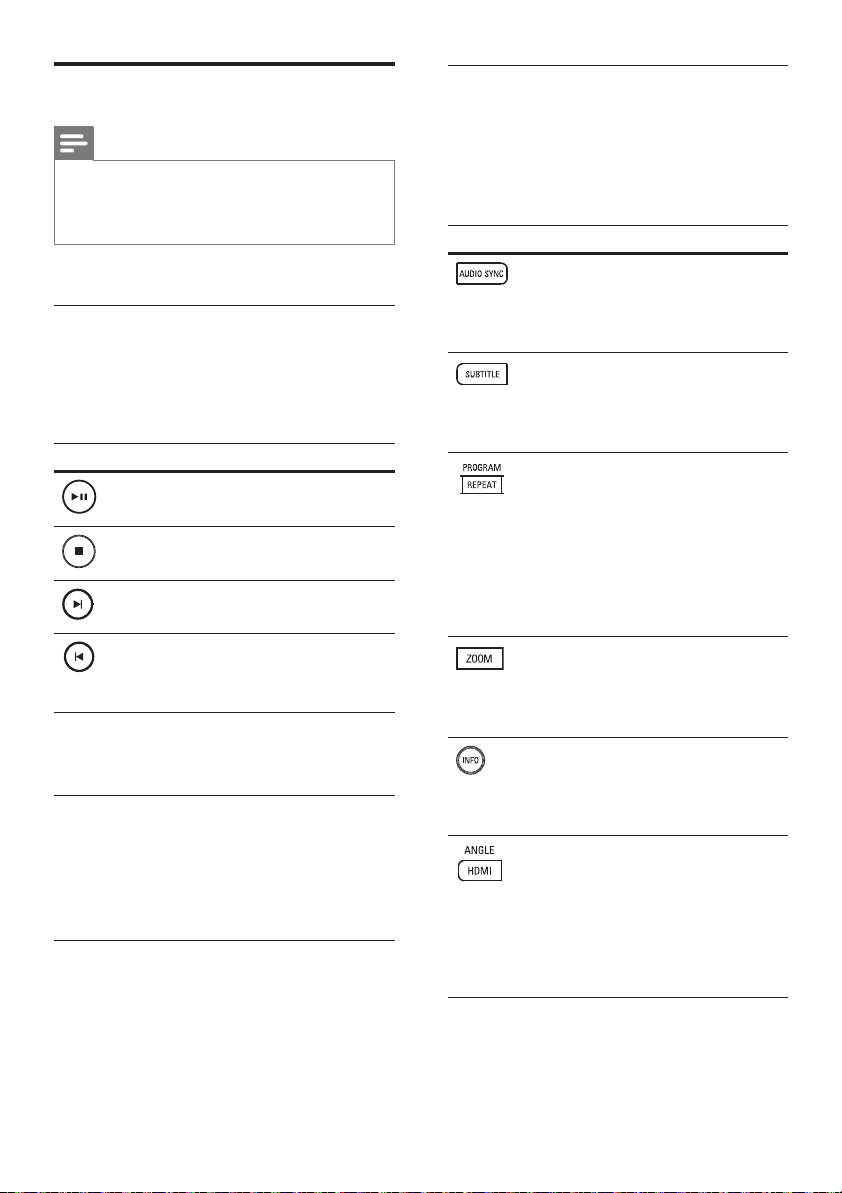
1 Insert a disc with its label facing out.
For double-sided disc, load the side to •
play faces out.
To view disc play, turn on the TV to •
the correct viewing channel for this
DVD Home Theatre unit.
2 To stop disc play, press x.
3 To remove the disc, press Z.
Tip
If the password entry menu is displayed, you have to •
enter the 4-digit password before it can be played.
Screen saver displays automatically if the disc play
•
is stopped for about 15 minutes. To wake up from
screen saver, press DISC.
This unit automatically switches to standby mode if
•
you do not press any buttons within 30 minutes after
a disc has stopped playing.
The cinema lights on the speaker stands will gradually •
turn off when you start movie play. To turn it on,
press CINEMA LIGHTS.
28 EN
Play video
Note
For video disc, playback always resumes from the •
point where it was last stopped. To start playback
from the beginning, press í while the message is
displayed.
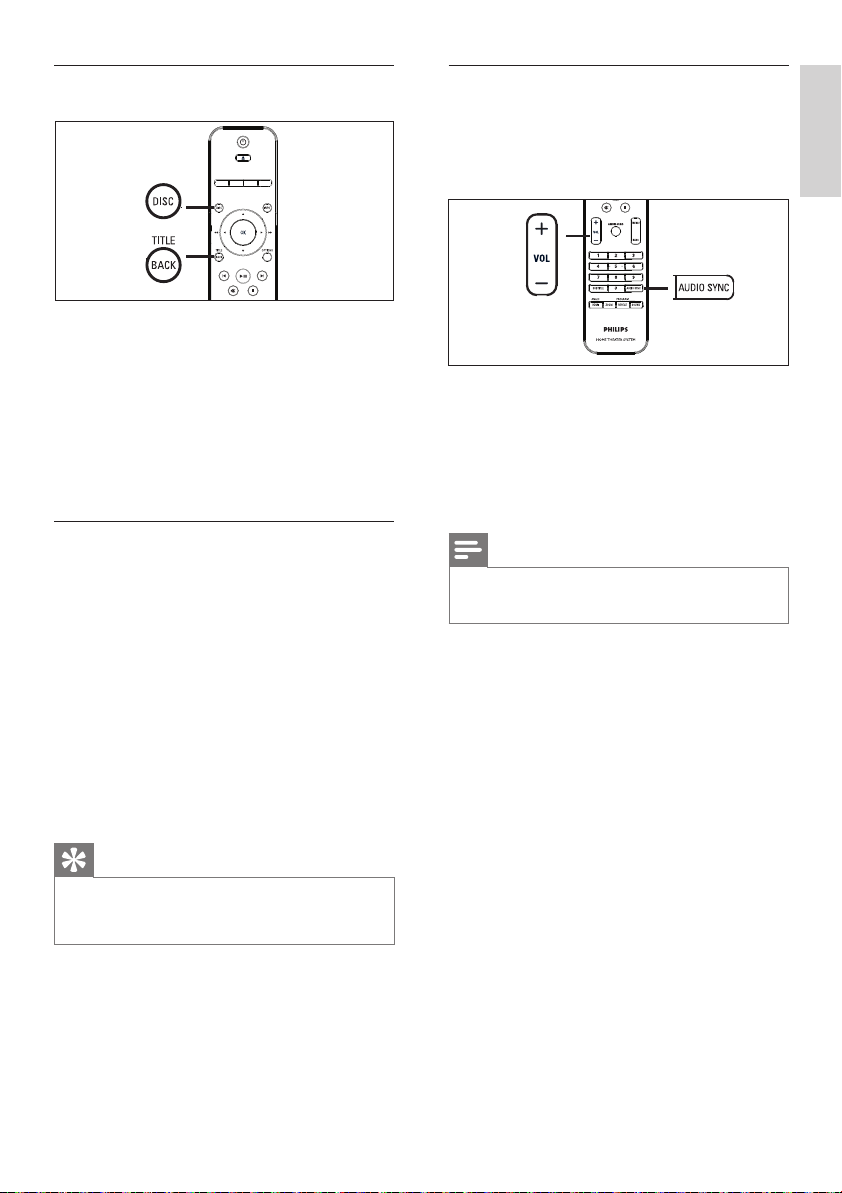
Control a title
1 Play a title.
2 Use the remote control to control the title.
Button Action
Pause/ resume play.
Stop play.
Jump to the next title/chapter.
Return to the beginning of the
current title/chapter or jump to
the previous title/chapter.
m M
Search backward/ forward.
To change search speed, •
press this button repeatedly.
v V
Slow motion reverse/ forward
play.
To change play speed, press •
this button repeatedly.
For VCD, only forward play •
is possible.
Change video play
1 Play a title.
2 Use the remote control to change the
video play.
Button Action
Change audio language.
Only applicable to discs •
with multiple audio
language or channel.
Change subtitle language.
Only applicable to discs •
with multiple subtitle
language.
Toggle through various repeat/
shuffl e play mode; or turn off
repeat mode.
Repeat options vary •
depending on the disc type.
For VCDs, repeat play is •
only possible when the PBC
mode is turned off.
Zoom in/out.
To pan through the zoomed •
image, press the cursor
buttons.
Display current play status.
You can change the video •
play options here without
interrupting disc play.
Press and hold to view DVD
play from different camera
angles.
Only applicable to DVDs •
that contain sequences
recorded from different
camera angles.
English
EN 29
Play
Access DVD menu
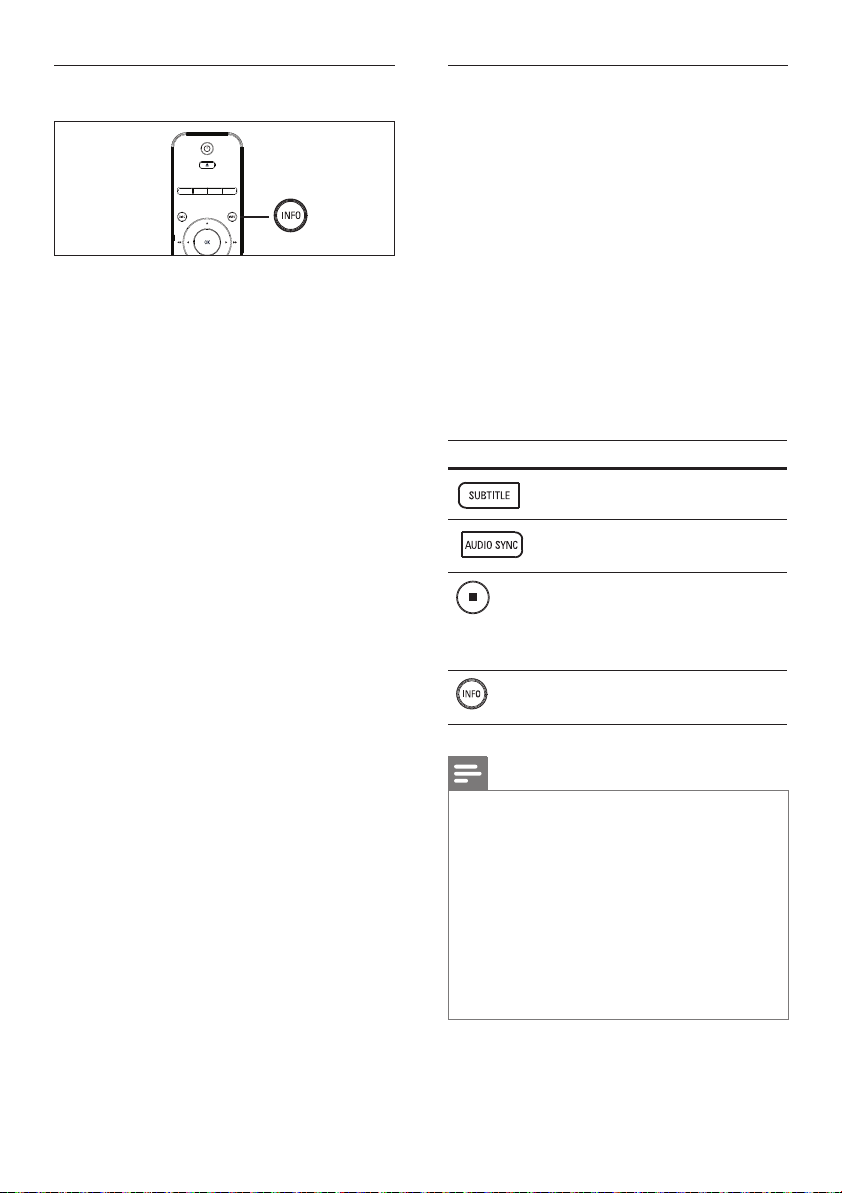
1 Press DISC to access disc main menu.
2 Select a play option, then press OK.
In some menus, press • number buttons
to input your selection.
To return to the title menu during •
playback, press TITLE.
Access VCD menu
The PBC (Playback Control) for VCD is turned
on by default in the factory. When you load in
a VCD, the contents menu is displayed.
1 Press vV to select a play option, then
press OK to start play.
If PBC is off, it skips the menu and starts •
play from the fi rst title.
During playback, you can press • BACK
to return to the menu (if the PBC
mode is on).
Tip
The default setting for PBC is on. To change the •
default setting, see chapter ‘Adjust settings’ -
[ Preference Setup ] > [ PBC ] for details.
Sync audio output with video play
If the video play is slower than the audio output
(sound does not match with the pictures,) you
can delay the audio output to match the video.
1 Press and hold AUDIO / SYNC until
‘AUDIO SYNC XXX’ is displayed.
‘XXX’ denotes the delay time.•
2 Within fi ve seconds, press VOL +- to
set the delay time for audio output.
Note
If the volume control is not used within 5 seconds, it •
resumes normal volume control function.
30 EN
Quick skip play to a specifi c time
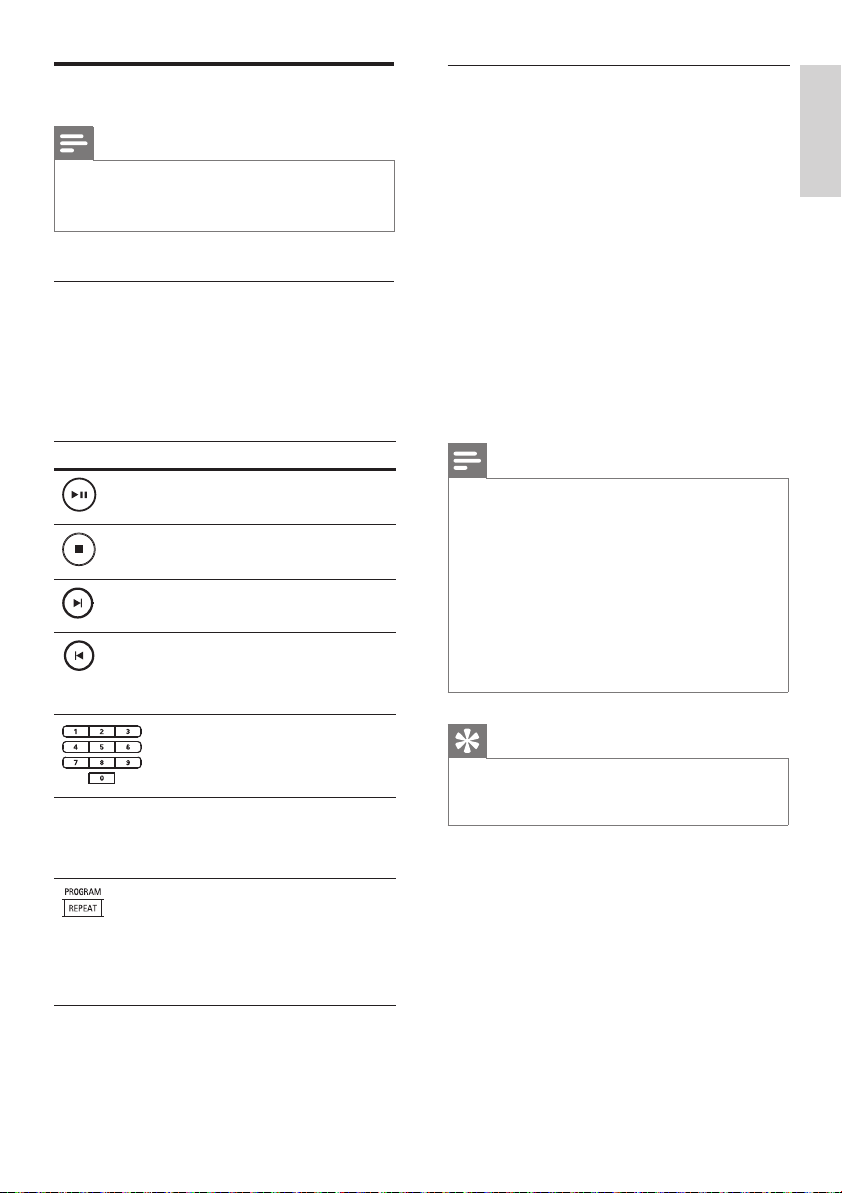
1 During playback, press INFO.
The disc status menu is displayed.
2 Select the current elapsed playing time in
the menu, then press OK.
[ TT Time ]• (title time)
[ CH Time ] • (chapter time)
[ Disc Time ] • (disc time)
[ Track Time ] • (track time)
3 Press the number buttons to change the
time where you want to skip to, then press
OK.
Play DivX® video
DivX video is a digital media format that retains
high quality despite a high rate of compression.
This unit is DivX® Certifi ed that allows you to
enjoy DivX video.
1 Insert a disc or USB that contains the DivX
videos.
2 Press DISC or USB.
A contents menu is displayed.
3 Select a title to play, then press u.
4 Use the remote control to control the
title.
Button Action
Change subtitle language.
Change audio language/track.
Stop play.
For DivX Ultra video, press •
this button again to display
the contents menu.
Display DivX Ultra video
information.
Note
Only those DivX videos that were rented or •
purchased using the DivX registration code of this
unit can be played (see chapter ‘Adjust settings’ >
[ General Setup ] > [ DivX(R) VOD Code ] for
details).
If the subtitle does not appear correctly, change the
•
subtitle language (see chapter ‘Adjust settings’ -
[ Preference Setup ] > [ DivX Subtitle ] for details).
The subtitle can only be displayed up to an average
•
of 45 characters.
This unit can play DivX video fi les that are up to 4GB •
in size.
English
EN 31
Play
Play music
Note
For some commercial audio disc, playback may •
resume from the point where it was last stopped. To
start playback from fi rst track, press í.
Control a track
1 Play a track.
2 Use the remote control to control the
track.
Button Action
Pause/ resume play.
Stop play.
Jump to the next track.
Return to the beginning of the
current track or jump to the
previous track.
Direct input the track number.
m M
Search backward/ forward.
To change search speed, •
press this button repeatedly.
Toggle through various repeat/
shuffl e play mode; or turn off
repeat mode.
Repeat options vary •
depending on the disc type.
Play MP3/WMA music
MP3/WMA is a type of highly compressed
audio fi le (fi les with .mp3 or .wma extensions).
1 Insert a disc or USB that contains the MP3/
WMA music.
2 Press DISC or USB.
A contents menu is displayed.
3 Select a folder, then press OK.
4 Select a track to play, then press u.
To return to the main menu, press • v
until ‘Previous’ folder is selected, then
press OK.
Note
For CDs recorded in multiple sessions, only the fi rst •
session is played.
This unit does not support MP3PRO audio format.
•
If any special characters are present in the MP3 track •
name (ID3) or album name, it might not be displayed
correctly on the screen because these characters are
not supported.
Some WMA is protected by Digital Rights
•
Management (DRM), it cannot be played on this unit.
Folders/fi les exceed the supported fi le limit of this
•
unit will not be displayed or played.
Tip
To display the data disc contents without folders, see •
chapter ‘Adjust settings’ - [ Preference Setup ] >
[ MP3/JPEG Nav ] for details.
32 EN
Play photo
Play photos as slideshow
This unit can play JPEG photos (fi les with .jpeg
or .jpg extensions).
1 Insert a disc or USB that contains the JPEG
photos.
2 Press DISC or USB.
For a Kodak disc, the slideshow begins
automatically.
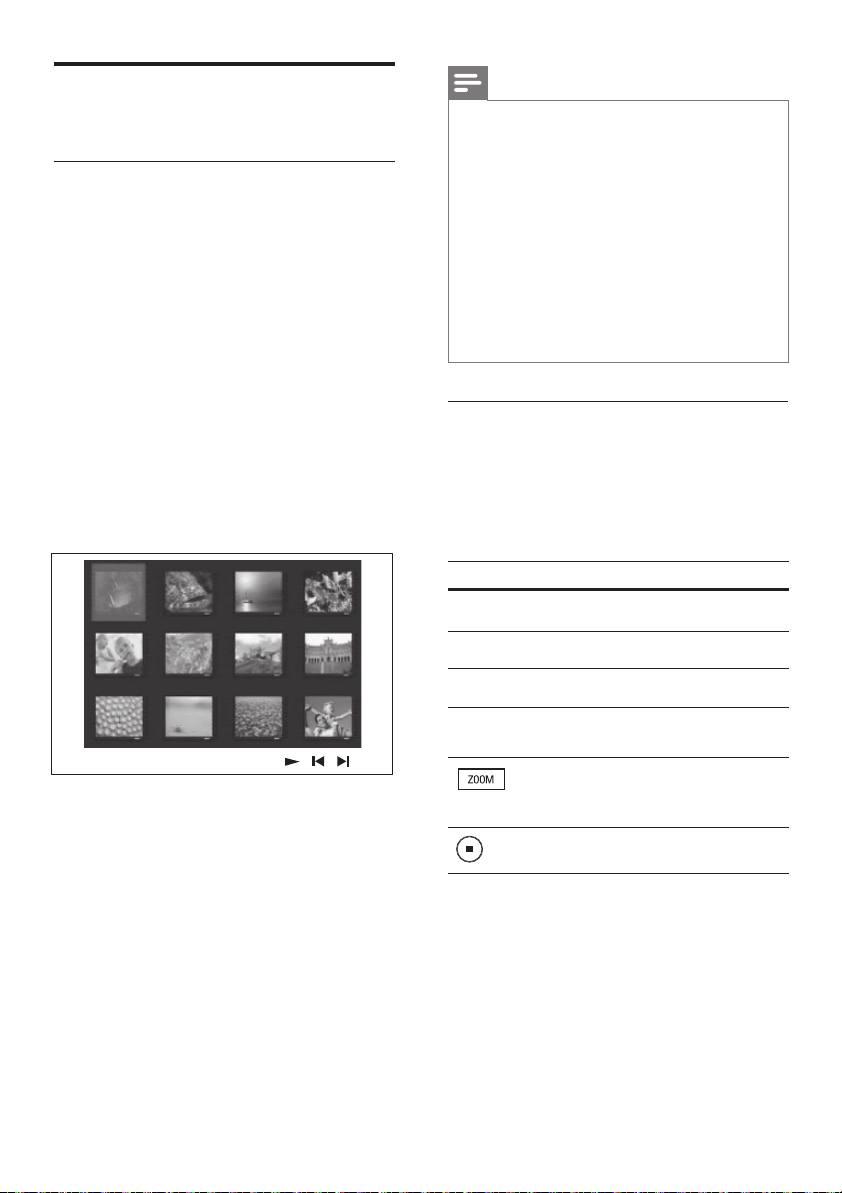
For a JPEG disc, the photo menu is
displayed.
3 Select the folder/album you want to play.
To preview the photos in the folder/•
album, press INFO.
To go to previous or next screen •
display, press í / ë.
To select a photo, press the cursor •
buttons.
To display the selected photo only, •
press OK.
4 Press u to start slideshow play.
To return to the menu, press • BACK.
Note
It may require longer time to display the disc •
contents on the TV due to the large number of
songs/photos compiled onto one disc.
If the JPEG photo is not recorded with an ‘exif ’
•
type fi le, the actual thumbnail picture will not be
shown on the display. It will be replaced with a ‘blue
mountain’ thumbnail picture.
This unit can only display digital camera pictures
•
according to the JPEG-EXIF format, typically used by
almost all digital cameras. It cannot display Motion
JPEG and pictures in formats other than JPEG, or
sound clips associated with pictures.
Folders/fi les exceed the supported fi le limit of this
•
unit will not be displayed or played.
Control photo play
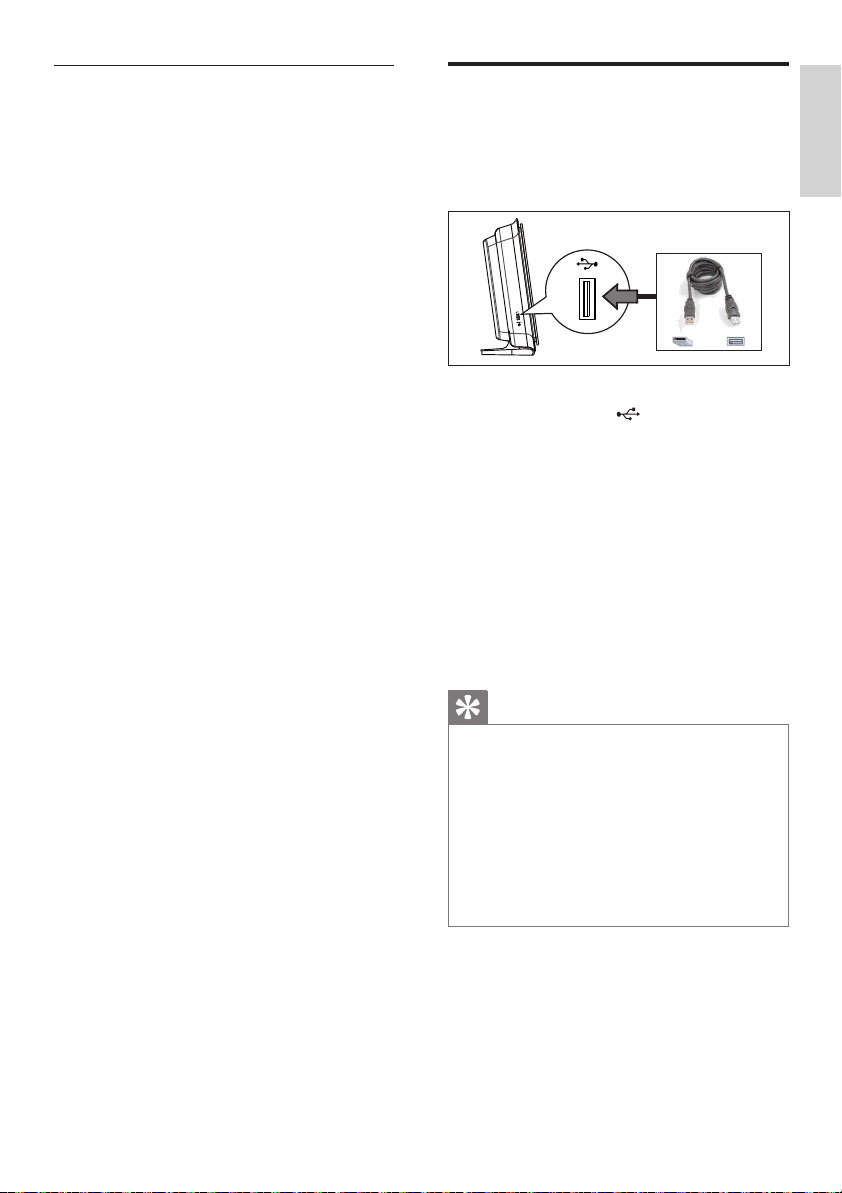
1 Play photo slideshow.
2 Use the remote control to control the
photo.
Button Action
b
Skip to the previous photo.
B
Skip to the next photo.
v
Rotate the photo clockwise.
V
Rotate the photo anti-
clockwise.
Zoom in/ out.
Play will pause while in •
zoom mode.
Stop play.
English
EN 33
Play
Play musical slideshow
Play MP3/WMA music fi les and JPEG photo
fi les simultaneously to create musical slideshow.
The MP3/WMA and JPEG fi les must be stored
on the same disc or USB device.
1 Play MP3/WMA music.
2 Navigate to the photo folder/album and
press u to start slideshow play.
Slideshow begins and continues till the
end of the photo folder or album.
Audio continues to play till the end of
the disc.
To return to the menu, press • BACK.
3 To stop slideshow play, press x.
4 To stop music play, press x again.
Play from USB device
This unit can only play/view MP3, WMA/
WMV9, DivX (Ultra) or JPEG fi les that are
stored on such devices.
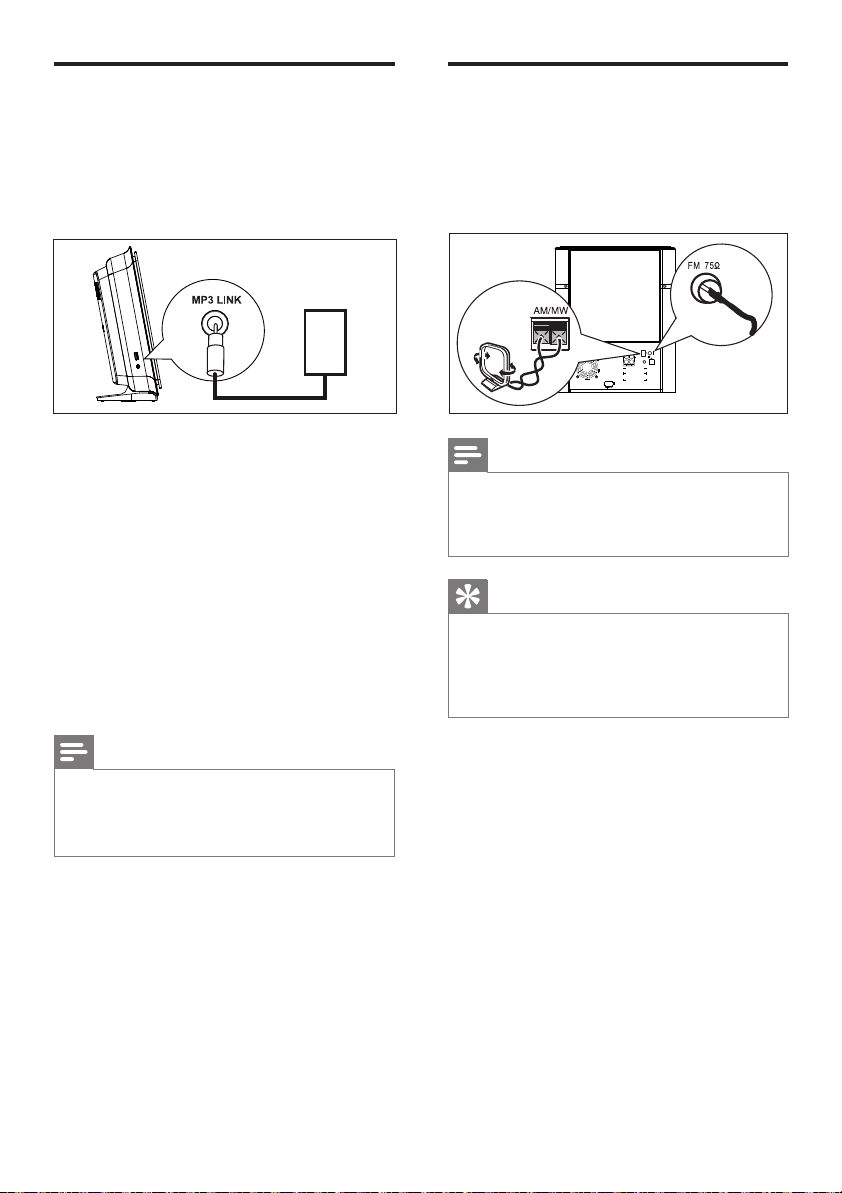
1 Connect USB fl ash drive or USB memory
card reader to the
(USB) socket on
this unit.
2 Press USB.
A contents menu is displayed.
3 Select a fi le to play, then press u.
For more information, see chapters •
‘Play music, Play photo, Play video’ for
details.
4 To stop play, press x or remove the USB
device.
Tip
If the device does not fi t into the USB socket, •
connect it through a USB extension cable.
If a multiple USB card reader is used, only one of the
•
connected USB drive contents can be accessed.
If a USB HDD is used, ensure that an auxiliary
•
power cord connected to the USB HDD for proper
operations.
Digital cameras that use PTP protocol or require
•
additional programme installation when connected
to a PC are not supported.
34 EN
Play from portable media
player
Simply connect your portable media player (e.g.
MP3 player) to this unit to enjoy superb sound
quality from your music collections.
MP3
1 Connect a 3.5mm stereo audio cable
(supplied) from the MP3 LINK socket on
this unit to the ‘headphone’ socket on your
portable media player.
2 Press AUX/DI /MP3 LINK repeatedly until
‘MP3 LINK’ is displayed.
3 Start play on your portable media player.
See chapter ‘Adjust Sound’ to enhance •
the audio output.
4 To stop play, press STOP button on your
portable media player.
Note
Control playback is only possible on your portable •
media player.
Stop play on the portable media player before you
•
switch to other play media/source.
Play from radio
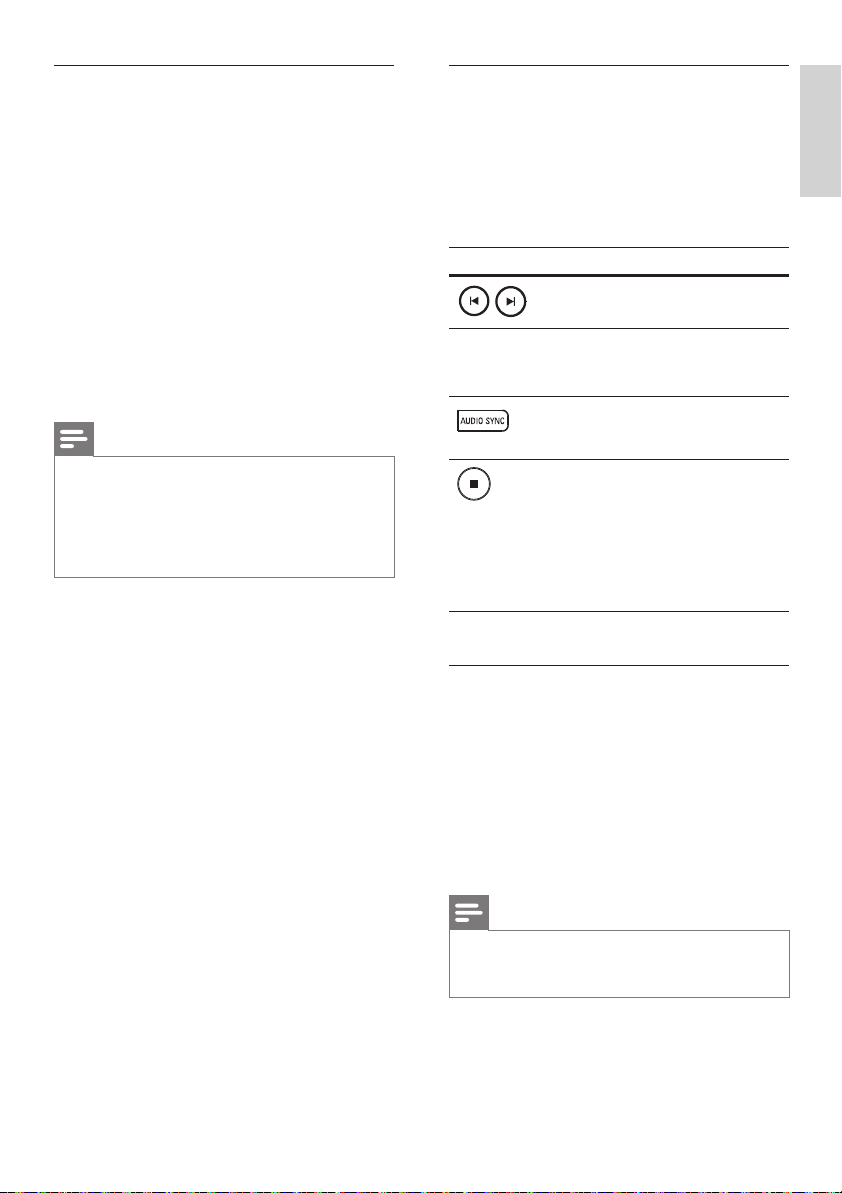
Check if the FM antenna has been connected
to the subwoofer. If not, connect the supplied
FM antenna to the FM 75Ω socket and fi x its
ends to the wall.
Note
For China/Latin America region only, if you want to •
receive AM/MW radio band, connect the AM/MW
loop antenna (supplied) to the AM/MW sockets on
the subwoofer.
Tip
For better FM stereo reception, connect an external •
FM antenna (not supplied).
Position the antenna as far away as possible from
•
your TV, VCR or other radiation source to prevent
unwanted interference.
English
EN 35
Play
First time tuning
The fi rst time when you access ‘RADIO’ mode,
follow the instructions to install the radio
stations.
1 Press RADIO.
’AUTO INSTALL ... PRESS PLAY’ is
displayed.
2 Press u.
All detected radio stations are stored.
Once complete, it tunes to the fi rst
preset radio station.
To stop auto tuning, press • x.
Note
This unit can store up to a maximum of 40 radio •
stations (and 20 radio stations from AM/MW band).
If auto installation is not activated or less than 5
•
radio stations are stored, ‘AUTO INSTALL’ will be
displayed again the next time you turn on to radio
mode.
Listen to radio
1 Press RADIO repeatedly to select ‘FM’ or
‘AM/MW’ band.
2 Use the remote control to control the
radio.
Button Action
Select a preset radio station.
m M
Tune the radio frequency
backward/ forward.
Toggle between FM stereo
and FM mono mode.
Press and hold this button to
delete the preset station from
the preset list.
The preset number for •
other radio stations
remain unchanged
Reinstall all the radio stations
1 Press RADIO repeatedly to select ‘FM’ or
‘AM/MW’ band.
2 Press and hold PROGRAM until
‘STARTING INSTALL’ is displayed.
All previously stored radio stations will
be replaced.
Note
If no stereo signal is detected or less than 5 stations •
are detected during radio installation, ‘CHECK
ANTENNA’ is displayed.

36 EN
Search and store radio stations
individually
1 Press RADIO repeatedly to select ‘FM’ or
‘AM/MW’ band.
2 Press m M.
The radio frequency indication starts to
change until a radio station is detected.
3 Repeat step 2 until you tune to the radio
station you wish to store.
To fi netune the radio frequency, press •
vV.
4 Press PROGRAM.
If no action is carried out within 20 •
seconds after the above step, it exits
the preset mode.
5 Press í ë (or the number buttons) to
select a preset number to store.
6 Press PROGRAM to confi rm.
Change tuning grid
In some countries, the frequency step between
adjacent channels in FM band is 50 kHz or
100 kHz (AM/MW band is 9 kHz or 10 kHz).
Note
This feature only applicable for certain region.•
Change tuning grid erases all preset radio stations.•
1 Press RADIO repeatedly to select ‘FM’ or
‘AM/MW’ band.
2 Press x.
3 Press and hold u until ‘GRID 9’ or
‘GRID 10’ is displayed.
‘GRID 9’ for FM 50 kHz (or AM 9 kHz) •
and ‘GRID 10’ for FM 100 kHz (or AM
10 kHz).
English
EN 37
Adjust sound
6 Adjust sound
Control the volume
1
Press VOL +- to increase or decrease
the volume level.
To mute the volume, press • H.
To restore the volume, press • H again
or press the volume button.
Adjust Bass/Treble
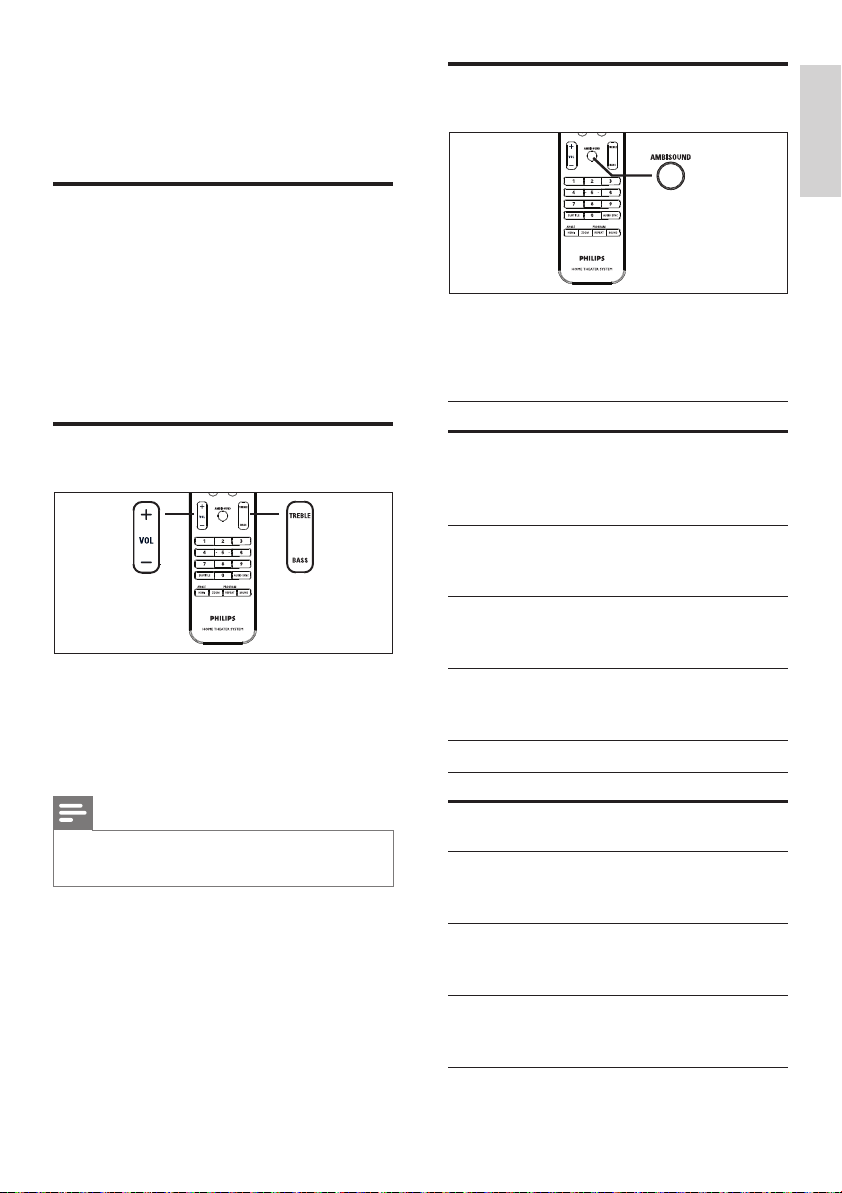
1 Press BASS / TREBLE.
2 Press VOL +-repeatedly to set the
level for low (BASS) or high (TREBLE)
tone.
Note
If the volume control is not used within 10 seconds, it •
resumes normal volume control function.
Select Ambisound
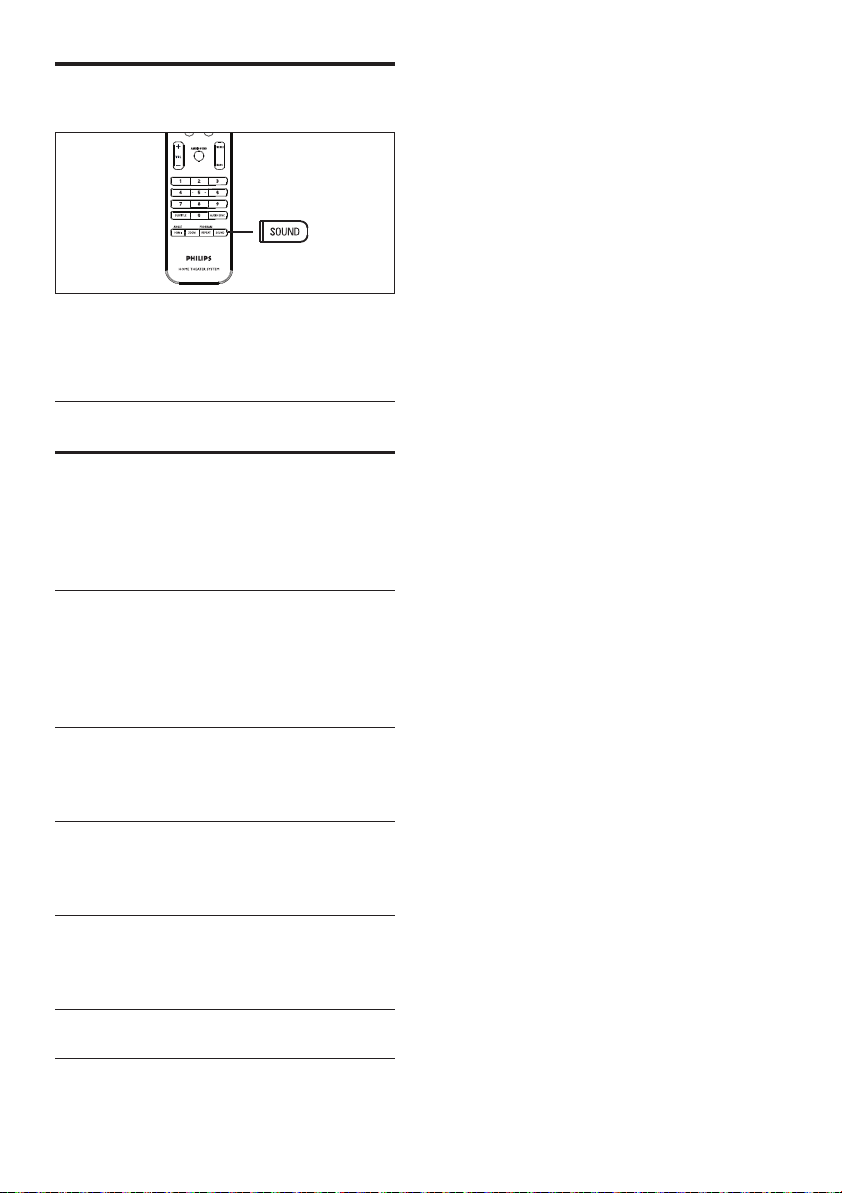
1 Press AMBISOUND repeatedly to select a
best Ambisound output that most suits the
video or music you play.
DVD/Multi-channel source
AMBISOUND
9.1
(default setting)
9.1 multi-channel output
with embracing Ambisound.
Ideal for maximised movie
experience.
MULTI-
CHANNEL 5.1
5.1 multi-channel output for
a standard movie
experience.
AMBISOUND
STEREO 9.1
Duplicate Ambisound
stereo to front and rear
speakers. Ideal for a party.
AMBISOUND
STEREO
Enhanced stereo sound
from your two front
speakers.
CD/Stereo source
STEREO
(default setting)
Stereo sound from your
two front speakers.
AMBISOUND
STEREO
Enhanced stereo sound
from your two front
speakers.
AMBISOUND
STEREO 9.1
Duplicate Ambisound
stereo to front and rear
speakers. Ideal for a party.
MULTI-
CHANNEL 9.1
Create a multi-channel
movie experience from
stereo/VCD sources..
38 EN
Select a preset sound effect
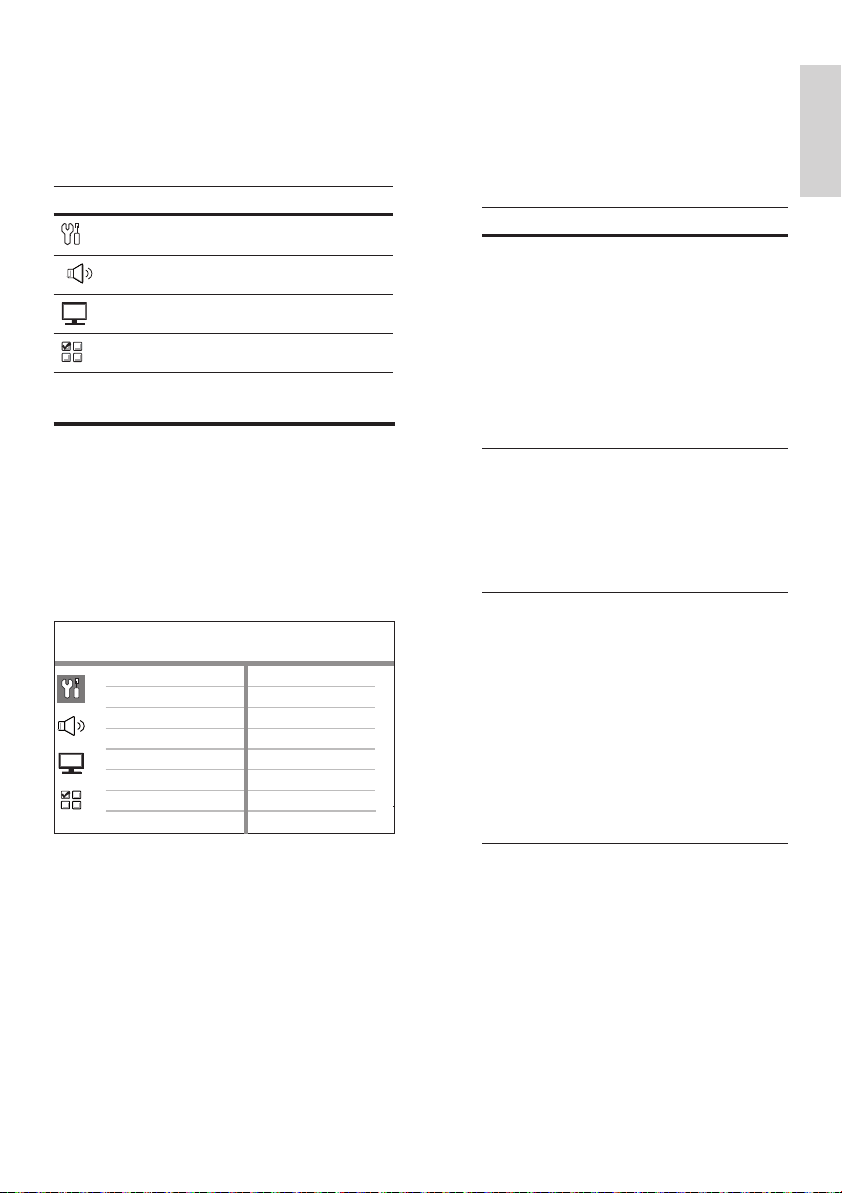
1 Press SOUND repeatedly to select a
sound effect that most suits the video or
music you play.
Video /
Music /
Descriptions
ACTION /
ROCK /
Enhanced low and high
range for great sounding
movie effects and
atmosphere. Great for
action movies and rock/pop
music.
DRAMA /
JAZZ
Clear mid and high range.
Recreates the atmosphere
of a live club with the artist
just in front of you. Good
for Jazz music and watching
dramas.
CONCERT /
CLASSIC
Flat and pure sound mode.
Ideal for listening to classical
music and watching live
concert DVDs.
GAMING /
PARTY
Slightly enhanced low range
and strong mid range ideal
for party music and video
gaming.
SPORTS
Moderate mid range and
surround effects for clear
vocals and the atmosphere
of a live sports venue.
NEWS
Enhanced mid range for
clear vocals/speech.
English
EN 39
Adjust settings
7 Adjust settings
This section describes the various setting
options of this unit.
Symbol Options
[ General Setup ]
[ Audio Setup ]
[ Video Setup ]
[ Preference Setup ]
General setup
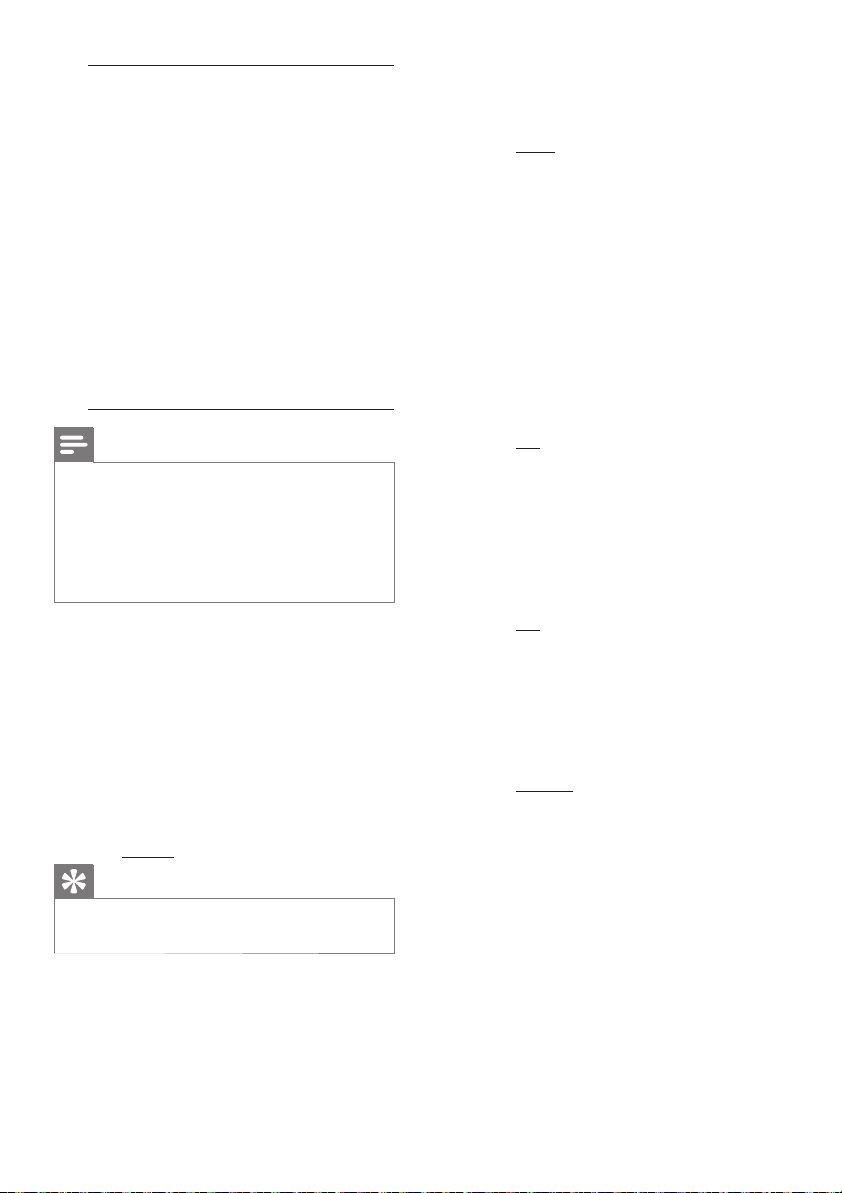
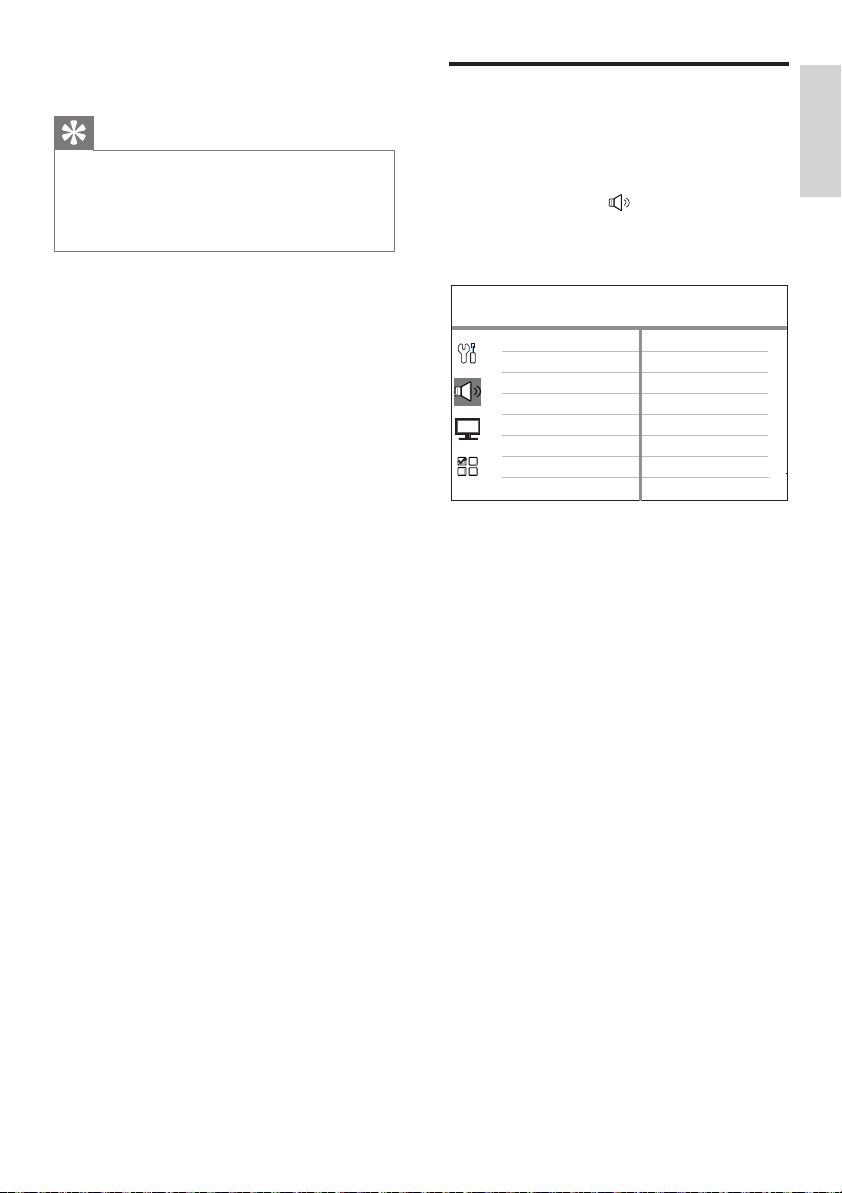
1
Press OPTIONS.
[ General Setup ] menu is displayed.
2 Press B.
3 Select an option, then press OK.
General Setup
Screen Saver
DivX(R) VOD Code
Sleep Timer
Display Dim
Disc Lock
OSD Language
EasyLink
Standby Mode
See the explanations of the above •
options in the following pages.
4 Select a setting, then press OK.
To return to the previous menu, press •
BACK.
To exit the menu, press • OPTIONS.
[ EasyLink ]
This feature is only applicable if this unit is
connected to HDMI CEC compliant TV/
device. It enables all the linked devices
response or react to certain commands
simultaneously with one touch control.
Options Descriptions
[ Auto Wake-
up TV ]
It wake-ups your TV
automatically when you
press PLAY to power up
this unit and start disc
play (if a video disc is
found in the disc
compartment).
To disable this feature, •
select [ Off ]
.
[ System
Standby ]
Respond to standby
command from other
HDMI CEC compliant
TV/devices.
To disable this feature, •
select [ Decline ].
[ System Audio
Control ]
It enables this DVD
Home Theatre unit to
switch automatically to
the audio input of the
active device.
To enable this feature, •
select [ On ]. Then
proceed to [ Audio
Input Mapping ] to
scan and map all the
connected devices.
40 EN
[ Audio Input
Mapping ]
Map the audio input to
the connected TV/
devices correctly to
enable automatic
switching of input source.
Press 1. OK to start
scanning of devices.
Select the audio input 2.
to map (e.g. AUX1
Input, AUX2 Input),
then press B.
Select the correct 3.
device that connected
to this audio input,
then press OK.
Note
Your TV and other connected devices must be •
compliant with HDMI CEC.
You must turn on the HDMI CEC operations on
•
your TV/devices before you can enjoy the EasyLink
controls. See your TVs/devices manual for details.
Philips does not guarantee 100% interoperability
•
with all HDMI CEC compliant devices.
[ Disc Lock ]
Set play restriction for a specifi c discs.
Before you start, place the disc in the disc
compartment (maximum 40 discs can be
locked).
[ Lock ] • – restrict access to the current
disc. The next time you want to play
this disc or unlock it, you need to enter
the password.
[ • Unlock ] – all discs can be played.
Tip
To set or change your password, go to •
[ Preference Setup ] > [ Password ].
[ Display Dim ]
Change the brightness level of the display
panel to suit the lighting in your room.
[ • 100% ] – normal brightness.
[ 70% ]• – medium brightness.
[ 40% ]• – dimmest display.
[ OSD Language ]
Select the default on-screen menu
language.
[ Screen Saver ]
Turn off or on the screen saver mode. It
helps to protect the TV screen from being
damage due to over exposure to a static
image for too long.
[ • On ] – set the screen saver to appear
after 15 minutes of inactivity (for
example, in pause or stop mode).
[ Off ]• – disable screen saver mode.
[ Sleep Timer ]
Switch to standby automatically after the
preset time.
[ • Off ] – disable sleep mode.
[ 15, 30, 45, 60 mins ]• – select the
count down time before it switches to
standby.
[ Standby Mode ]
Set the standby mode.
[ • Normal ] – normal standby power
consumption.
[ Low Power ]• – low standby power
consumption. However, it requires
longer time to power up.
English
EN 41
Adjust settings
[ DivX(R) VOD Code ]
Display the DivX® registration code.
Tip
Enter this unit’s DivX registration code when you •
rent or purchase video from www.divx.com/vod.
The DivX videos rented or purchased through the
DivX® VOD (Video On Demand) service can be
played only on the device to which it is registered.
Audio setup
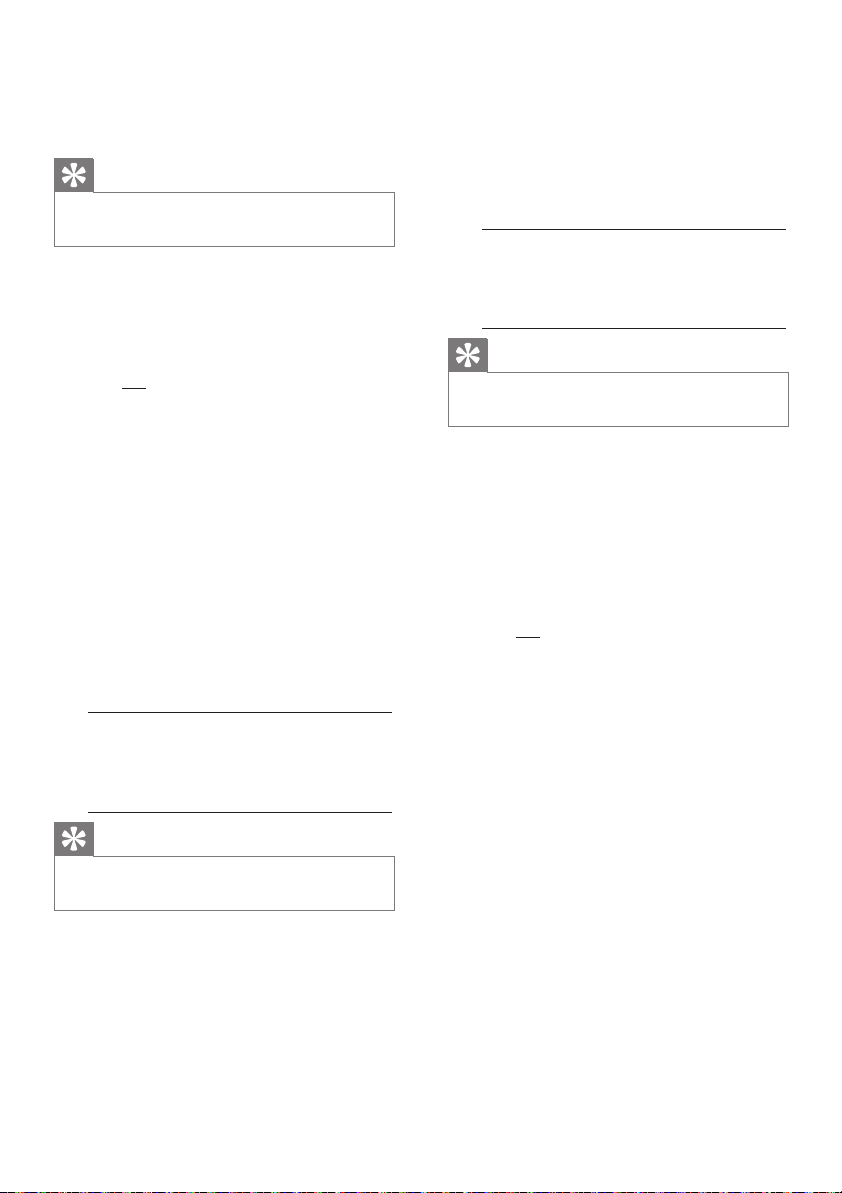
1
Press OPTIONS.
[ General Setup ] menu is displayed.
2 Press V to select [ Audio Setup ], then
press B.
3 Select an option, then press OK.
Audio Setup
Ambisound Setup
HDMI Audio
Speaker Volume
Speaker Delay
Night Mode
Wireless
4 Select a setting, then press OK.
To return to the previous menu, press •
BACK.
To exit the menu, press • OPTIONS.
42 EN
[ Ambisound Setup ]
Change the Ambisound setup by selecting
the room environment and rear speakers
placement.
Tip
See chapter ‘Get Started - Start Ambisound setup’ •
for detailed information.
[ HDMI Audio ]
When you connect this unit and TV with
HDMI cable, select the audio output
setting for this connection.
[ • On ] – the sound is output through
both your TV and this speaker system.
If the audio format on the disc is not
supported, it will be downmixed to
two-channel sound (linear-PCM).
[ Off ]• – disable audio output from
your TV. The sound is only output
through this speaker system.
[ Speakers Volume ]
When all the speakers are not placed in an
equal distance from the listening position,
change the volume level of the speakers so
that for those placed closer to the listening
position will not sound too loud.
To start, press 1. OK.
Select a speaker in the menu, then 2.
press b B to adjust the volume level.
Press 3. OK to confi rm and exit.
Tip
The test tone is emitted from the speaker while •
adjusting volume level.
[ Speakers Delay ]
When the centre or rear speakers are
placed closer to the listening position than
the front speakers, set the delay time for
these speakers so that the sound outputs
from all speakers reach the listening
position at the same time.
To start, press 1. OK.
Select a speaker in the menu, then 2.
press b B to set the delay time.
Press 3. OK to confi rm and exit.
Tip
1ms setting for every 30cm distance between the •
speaker and the listening position.
[ Night Mode ]
Make loud sound level softer and soft
sound level louder so that you can watch
the DVD movies at a low volume, without
disturbing others.
[ On ]• – for quiet viewing at night
(DVDs only).
[ • Off ] – enjoy surround sound with a
full dynamic range.
English
EN 43
Adjust settings
[ Wireless ]
Set up the wireless system for the rear
speakers to enable audio output in
multichannel mode.
[ Pair Receiver ] • – pair the receiver (in
the left rear speaker) with the
transmission signal code of the
transmitter (in the subwoofer).
To start, press 1. OK.
Press 2. CONNECT on the left rear
speaker for 3 seconds.
When pairing process is complete, 3.
press OK to confi rm and exit.
[ Switch Channel ] • – switch to another
frequency channel to minimise
interference with other wireless devices
in the room.
Options Descriptions
[ Auto ] It selects the best
channel to operate
automatically.
[ Channel A ] Frequency corresponding
to Wi-Fi channel 1.
[ Channel B ] Frequency corresponding
to Wi-Fi channel 6.
[ Channel C ] Frequency corresponding
to Wi-Fi channel 11.
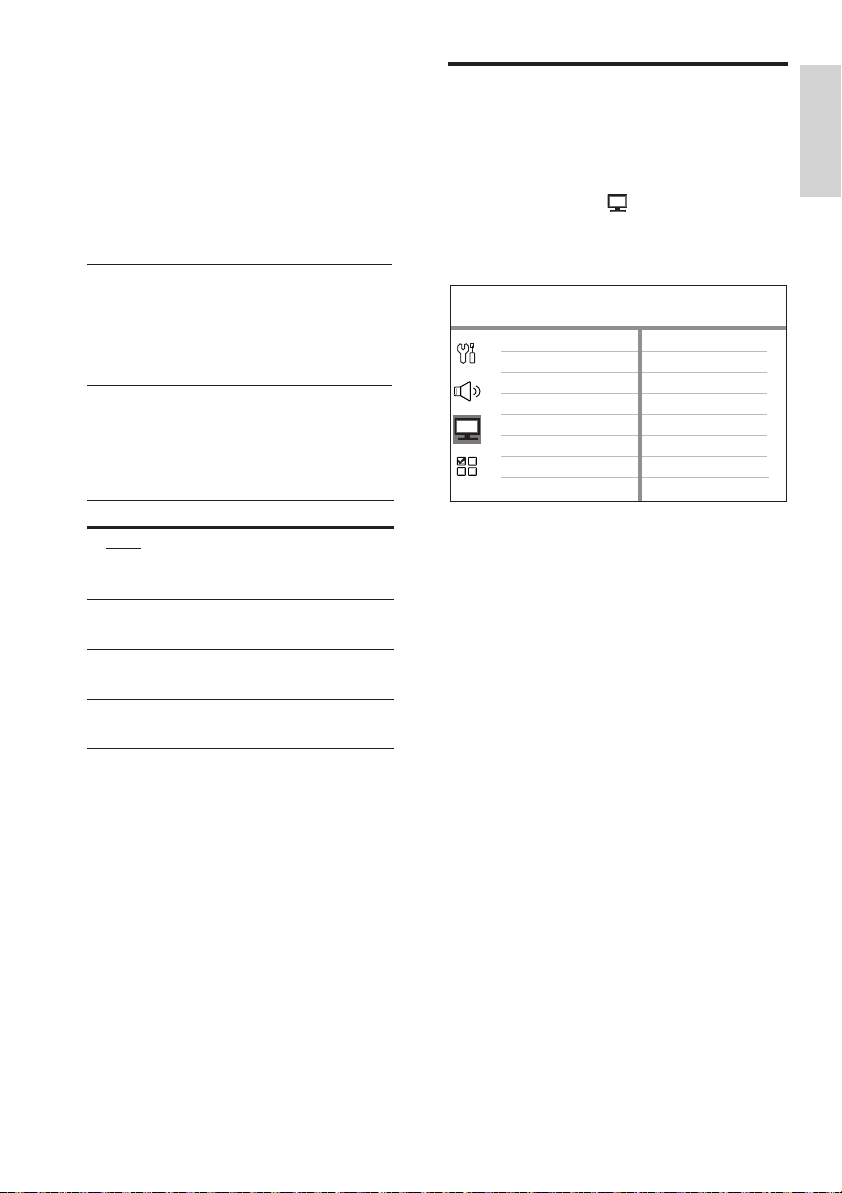
Video setup
1
Press OPTIONS.
[ General Setup ] menu is displayed.
2 Press V to select [ Video Setup ], then
press B.
3 Select an option, then press OK.
Video Setup
Picture Settings
Advanced Picture
TV Display
TV Type
Progressive
Closed Caption
See the explanations of the above •
options in the following pages.
4 Select a setting, then press OK.
To return to the previous menu, press •
BACK.
To exit the menu, press • OPTIONS.
44 EN
[ TV Type ]
Change this setting only if the video does
not appear correctly. By default, this
setting matches the most common setting
for TVs in your country.
[ PAL ]• – for PAL-system TV.
[ NTSC ]• – for NTSC-system TV.
[ Multi ]• – for TV that is compatible
with both PAL and NTSC.
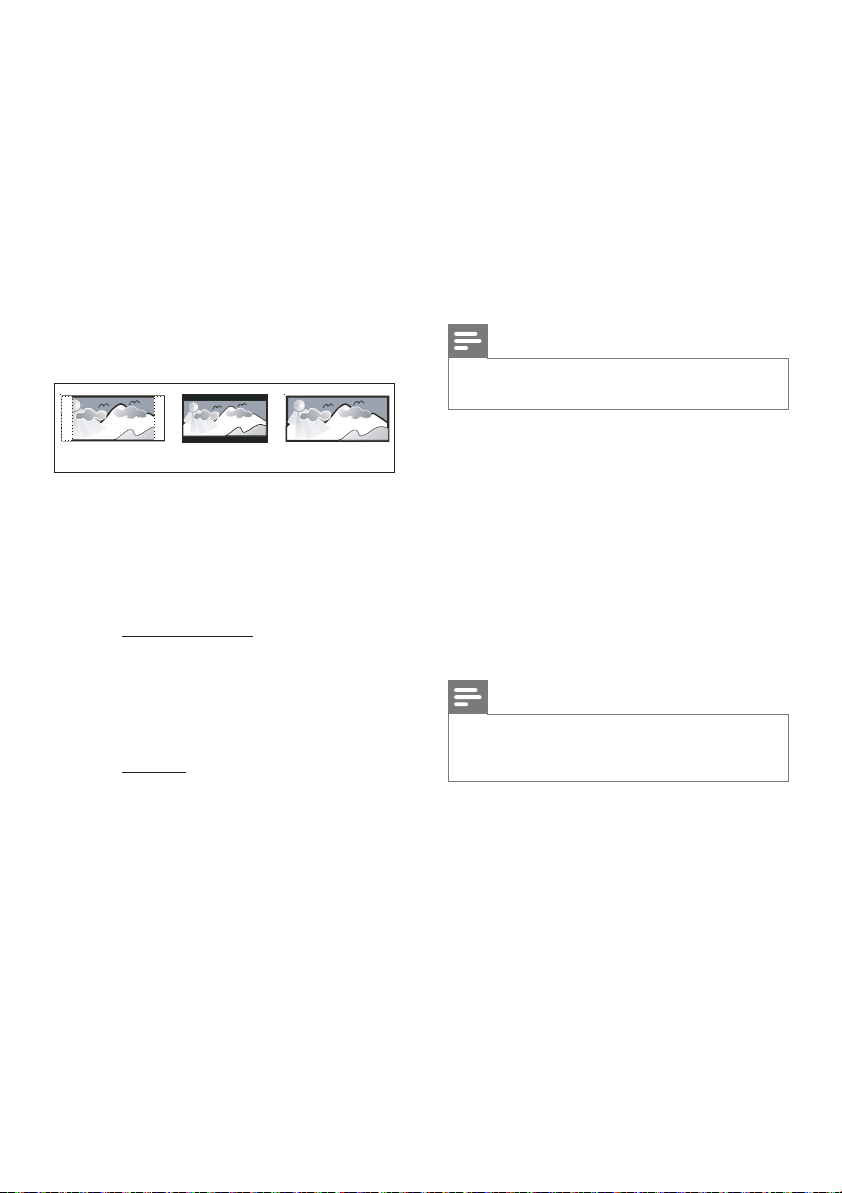
[ TV Display ]
Select the screen format according to how
you want the picture to appear on your
TV.
4:3 Letter Box (LB)
4:3 Pan Scan (PS)
16:9 (Wide Screen)
[ 4:3 Pan Scan ]• – for standard TV, a
full-height screen display with the sides
trimmed.
[ 4:3 Letter Box ]• – for standard TV, a
‘wide-screen’ display with black bars on
the top and bottom.
[ • 16:9 Wide Screen ] – for wide-screen
TV (frame ratio 16:9).
[ Picture Settings ]
Select a predefi ned set of picture colour
settings or customise your personal setting.
[ • Standard ] – original colour setting.
[ Bright ]• – vibrant colour setting.
[ Soft ]• – warm colour setting.
[ Personal ]• – customise the colour
setting. Set the level of brightness,
contrast, tint and colour saturation in
the menu, then press OK.
[ Advanced Picture ]
This is an advanced setting to optimise the
video output. This option is only applicable
for video connection through HDMI or
Component Video with Progressive Scan
output.
[ DCDi ] • – Turn on or off Directional
Correlation Deinterlacing feature. It fi lls
the missing lines to optimise video
content. It is especially effective during
slow motion play.
Note
DCDi setting is only available for progressive scan •
output.
[ Gamma ] • – Adjust picture intensity.
Positive values bring out the detail in
dark scenes, while negative values
emphasise contrast.
[ Chroma Delay ] • – Adjust the colour
of an image element (pixel) to produce
a perfect and clear picture.
[ True Life ] • – Increase the contrast
and colour intensity to produce a more
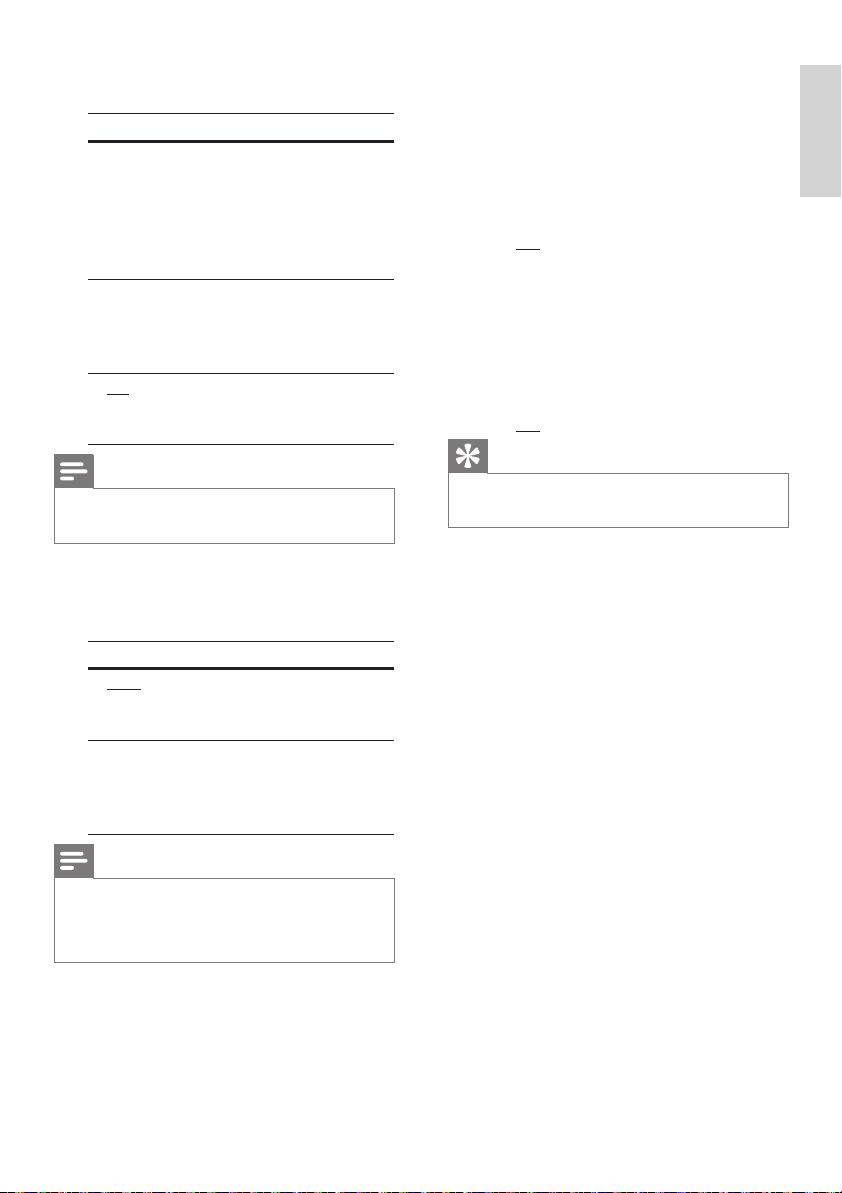
dynamic picture.
Note
To adjust the above settings, select an option and •
press OK. Then press cursor left or right to change
the value/level setting and press OK to confi rm.
English
EN 45
Adjust settings
[ Wide Screen Format ] • – defi ne the
wide screen format for disc play.
Options Descriptions
[ Superwide ] Centre position of the
screen is stretched less
than the side. This
setting is only applicable
if the video resolution is
set to 720p or 1080i/p.
[ 4:3 Pillar
Box ]
No stretching of the
picture. Black bars are
displayed on both sides
of the screen.
[ Off ] Picture will be displayed
according to the format
of the disc.
Note
This setting is only available if you have set the • [ TV
Display ] setting to [ 16:9 Wide Screen ].
[ HDMI Video ] • – select a video
resolution that is compatible with your
TV display capability.
Options Descriptions
[ Auto ] It detects and selects the
best supported video
resolution automatically.
[ 480p, 576p,
720p, 1080i,
1080p ]
Select a video resolution
that best supported by
your TV. See your TVs
manual for details.
Note
If the setting is not compatible with your TV, a •
blank screen appears. Wait for 15 seconds for auto
recover or press HDMI repeatedly until the picture
appears.
[ Closed Caption ]
(for certain region only)
Turn on or off display captions.
[ On ]• – show the sound effects in
subtitle. Only applicable to disc with
Closed Caption information included
and your TV supports this feature.
[ • Off ] – disable closed caption.
[ Progressive ]
If your TV can support progressive signals,
you can activate the progressive scan
mode of this unit.
[ On ]• – turn on progressive scan
mode.
[ • Off ] – disable progressive scan mode.
Tip
See chapter ‘Get Started - Turn on Progressive Scan’ •
for detailed information.
46 EN
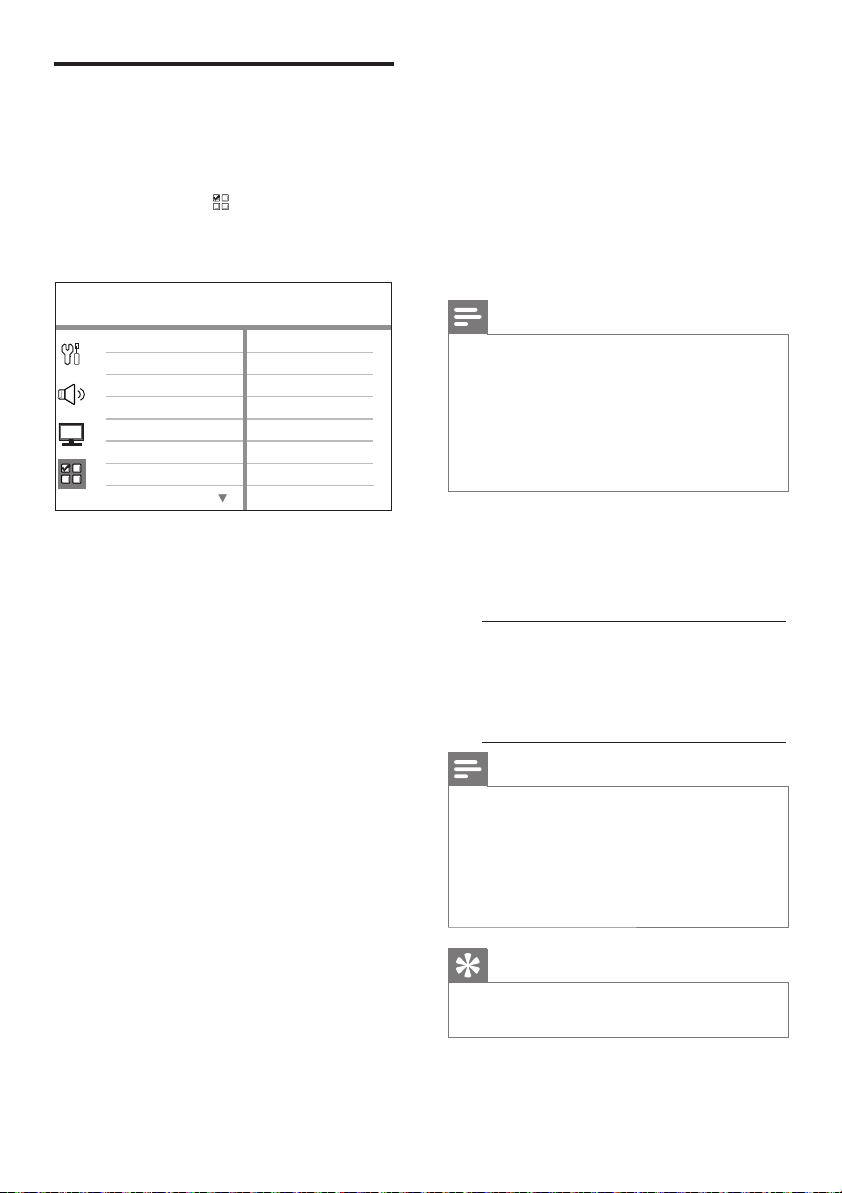
Preference Setup
1
Press OPTIONS.
[ General Setup ] menu is displayed.
2 Press V to select [ Preference Setup ],
then press B.
3 Select an option, then press OK.
Preference Setup
Parental
PBC
Disc Menu
Password
DivX Subtitle
Subtitle
Audio
MP3/JPEG Nav
See the explanations of the above •
options in the following pages.
4 Select a setting, then press OK.
To return to the previous menu, press •
BACK.
To exit the menu, press • OPTIONS.
[ Audio ]
Select the default audio language for
DVDs.
[ Subtitle ]
Select the default subtitle language for
DVDs.
[ Disc Menu ]
Select the menu language for DVDs.
Note
If the language you have set is not available on the •
disc, the disc uses its own default language.
For some DVDs, the subtitle/audio language can only
•
be changed from the disc menu.
To select the languages that are not listed in the
•
menu, select [ Others ]. Then check the Language
Code list at the back of this user manual and enter
the respective 4-digit language code.
[ Parental ]
Restrict access to DVDs that are unsuitable
for your children. These types of DVDs
must be recorded with ratings.
To start, press 1. OK.
Select a rating level in the menu, then 2.
press OK.
Press the 3. number buttons to enter
your 4-digit password.
Note
Rated DVDs above the level you set in • [ Parental ]
require a password to be played.
The ratings are country-dependent. To allow all discs •
to play, select ‘8’.
Some DVDs have ratings printed on them but are
•
not recorded with ratings. This function has no
effect on such DVDs.
Tip
To set or change your password, go to•
[ Preference Setup ] > [ Password ].
English
EN 47
Adjust settings
[ PBC ]
For VCDs/SVCDs recorded with PBC
(playback control,) you can access the disc
contents through an interactive menu.
[ • On ] – an index menu is displayed
when you load a disc for play.
[ Off ]• – skip the menu and start play
from the fi rst title.
[ MP3/JPEG Nav ]
Turn off or on MP3/WMA folder display
when you play a media that contains MP3/
WMA fi les.
[ • With Menu ] – display the folders of
MP3/WMA fi les.
[ Without Menu ]• – display all the fi les.
[ Password ]
Follow the instructions on the TV to set or
change the password for locked discs and
play restricted DVDs.
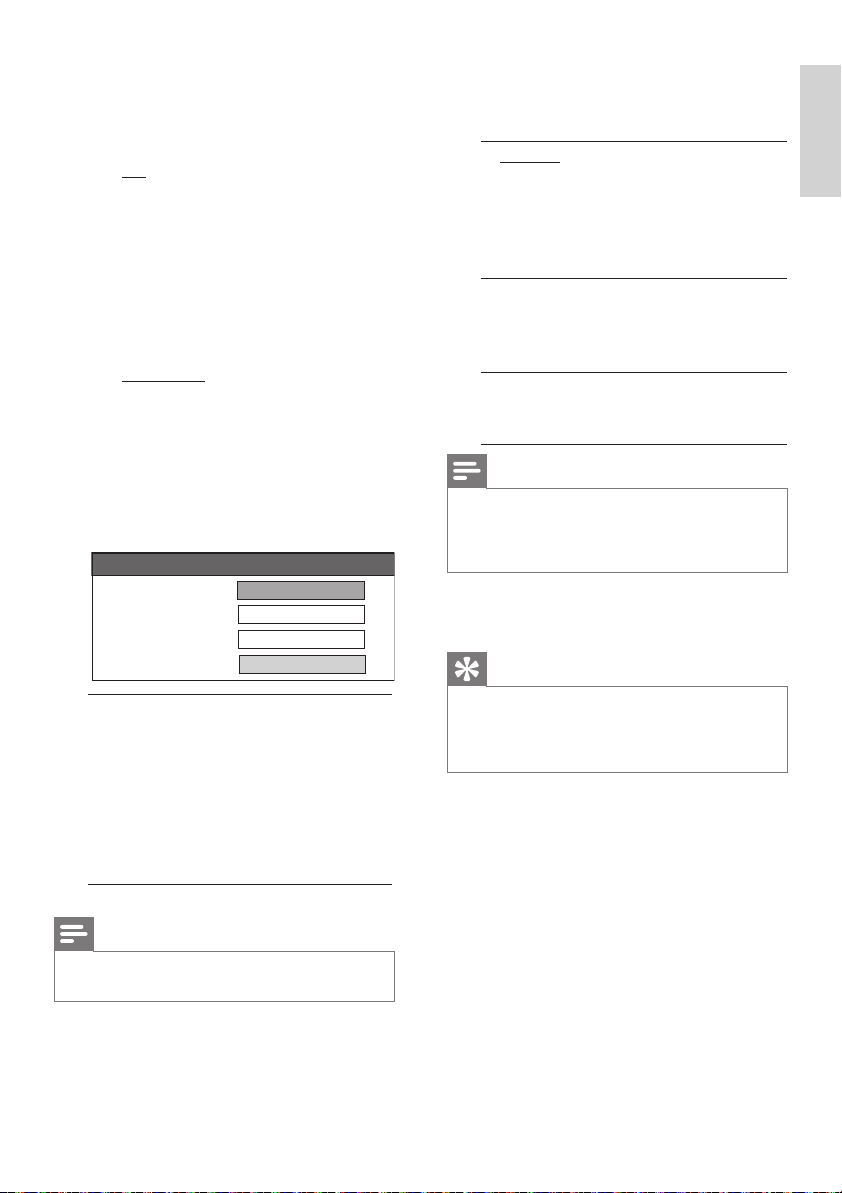
Old Password
New Password
Confirm PWD
OK
Change Password
Press the 1. number buttons to
enter ‘0000’ or your last set 4-digit
password at [ Old Password ] fi eld.
Enter the new password at 2. [ New
Password ] fi eld.
Enter the new password again at 3.
[ Confi rm PWD ] fi eld.
Press 4. OK to exit the menu.
Note
If you forget your 4-digit password, enter ‘0000’ •
before you set a new password.
[[ DivX Subtitle ]
Select a character set that supports the
DivX subtitle.
[ Standard ] English, Irish, Danish,
Estonian, Finnish, French,
German, Italian, Portuguese,
Luxembourgish, Norwegian
(Bokmål and Nynorsk),
Spanish, Swedish, Turkish
[ Central
Europe ]
Polish, Czech, Slovak,
Albanian, Hungarian,
Slovene, Croatian, Serbian
(Latin script), Romanian
[ Cyrillic ] Belarusian, Bulgarian,
Ukrainian, Macedonian,
Russian, Serbian
Note
Ensure that the subtitle fi le has the exact same fi le •
name as the movie fi le. If for example the fi lename of
the movie is ‘Movie.avi’, then you will need to name
the text fi le ‘Movie.sub’ or ‘Movie.srt’.
[ Version Info ]
Display the software version of this unit.
Tip
This information is required when you want to fi nd •
out if a newest software version is available at the
Philips website that you may download and install on
this unit.
[ Default ]
Reset all the settings of this unit to factory
default, except for [ Disc Lock ],
[ Password ] and [ Parental ] settings
remain unchanged.
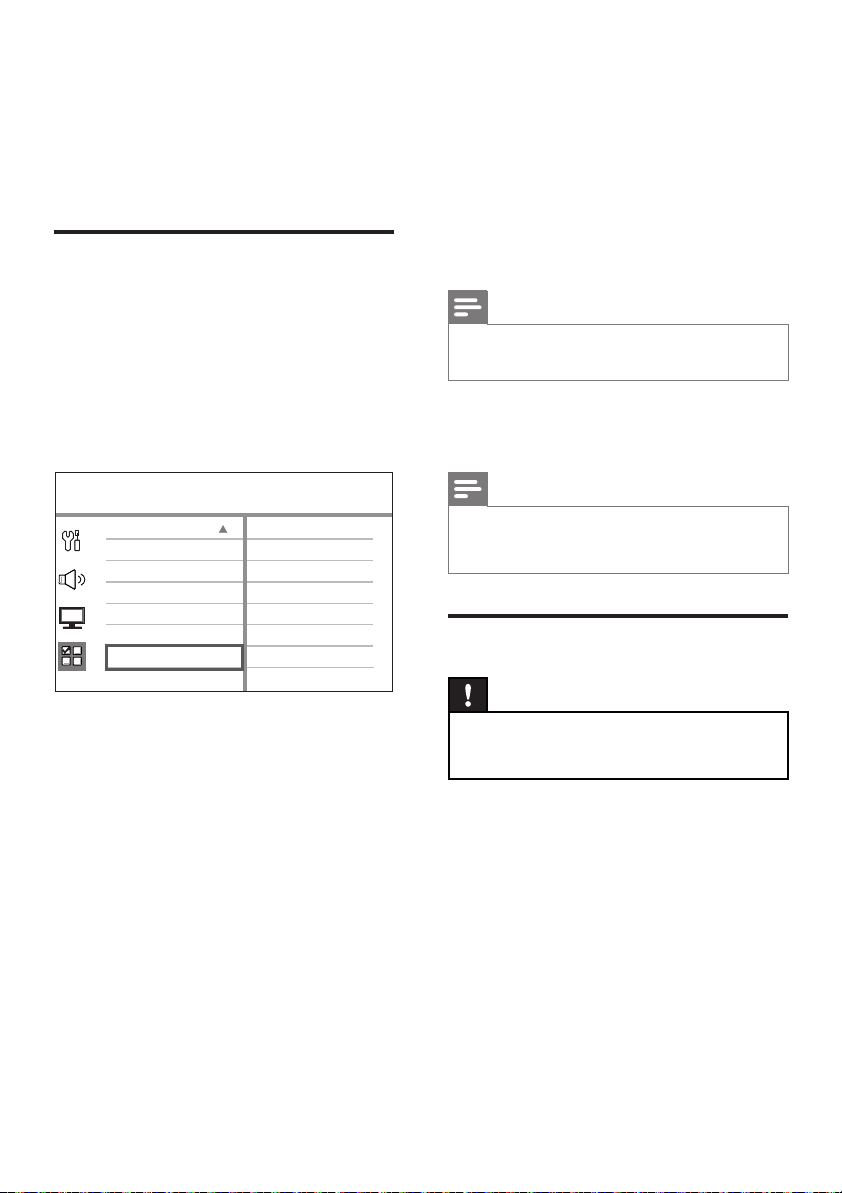
48 EN
8 Additional
information
Update software
Philips provides software updates to ensure that
this unit is compatible with the newest formats.
To check the updates, compare the current
software version of this unit with the latest
software version available at the Philips website.
1 Press OPTIONS.
Preference Setup
Parental
PBC
Disc Menu
Password
DivX Subtitle
Version Info
Default
MP3/JPEG Nav
2 Select [ Preference Setup ] > [ Version
Info ], then press OK.
3 Write down the version number, then
press OPTIONS to exit the menu.
4 Go to www.philips.com/support to check
the latest software version available for this
unit.
5 If the latest software version is higher than
the software version of this unit, download
it and store onto a CD-R or USB fl ash
drive
6 Connect the software update cable
(supplied) between SOFTWARE UPDATE
socket on the left rear speaker and
subwoofer.
7 Insert the CD-R or USB fl ash drive to this
unit.
8 Press DISC or USB, then follow the
instruction on the TV to confi rm update
operation.
Note
Do not remove the CD-R or USB when software •
updating is in progress.
9 Once software update is complete, this
unit turns off to standby automatically.
Note
We recommend that you disconnect the power cord •
for a few seconds and connect again to reboot the
system.
Care
Caution!
Never use solvents such as benzene, thinner, •
cleaners available commercially, or anti-static sprays
intended for discs.
Clean discs
Wipe the disc with a micro fi bre cleaning cloth
from the centre to the edge in a straight line
movement.
Clean main unit screen
Wipe the screen surface with a micro fi bre
cleaning cloth.

English
EN 49
Additional information
Specifi cations
Note
Specifi cation and design are subject to change •
without notice.
Accessories supplied
Quick Start Guide•
Remote control and batteries•
Composite video cable•
HDMI cable •
3.5mm stereo audio cable•
Interconnect cable (connect between junction box •
and subwoofer)
Software cable•
2 power cables•
Subwoofer •
1 centre, 2 front and 2 rear speakers•
Junction box•
Velcro tape (to fi x the junction box)•
FM wire antenna / AM-MW loop antenna•
Round-to-Flat pin adaptor (for certain region only)•
Micro fi bre cleaning cloth•
Amplifi er
Total output power (Home Theatre): 800W RMS •
(10% THD)
Frequency response: 20 Hz - 20 kHz / ±3dB•
Signal-to-noise ratio: > 65 dB (CCIR)•
Disc
Laser Type: Semiconductor•
Disc diameter: 12cm / 8cm•
Video decording: MPEG1/ MPEG2 / DivX / •
DIvX Ultra / WMV9
Video DAC: 12 bits, 148 MHz•
Signal system: PAL / NTSC•
Video S/N: 56 dB •
Audio DAC: 24 bits / 192 kHz•
Frequency response: 4 Hz - 20 kHz (44.1 kHz)•
4 Hz - 22 kHz (48 kHz)
4 Hz - 44 kHz (96 kHz)
PCM: IEC 60958•
Dolby Digital, DTS: IEC60958, IEC61937•
Wireless rear speakers
Power supply: 110-127V / 220-240V, ~50-60 Hz•
For China: 220-240V, ~50Hz
Power consumption: 60 W •
Standby power consumption: < 0.5W•
USB
Compatibility: Hi-Speed USB (2.0)•
Class support: UMS (USB Mass Storage Class)•
Radio
Tuning range: FM 87.5-108 MHz (50/100 kHz),•
MW 531-1602 kHz (9 kHz)
MW 530-1700 kHz (10 kHz)
26dB quieting sensitivity: FM 20 dBf, MW 4μV/m•
IF rejection ratio: FM 60 dB, MW 45 dB•
Signal-to-noise ratio: FM 60 dB, MW 40 dB•
Harmonic distortion: FM 3%, MW 5%•
Frequency response: FM 180 Hz - 10 kHz /±6dB•
Stereo separation: FM 26 dB (1 kHz)•
Stereo Threshold: FM 23.5 dB•
Power (Subwoofer)
Power supply: 110-127V / 220-240V, ~50-60 Hz•
For China: 220-240V, ~50Hz
Power consumption: 120 W •
Standby power consumption•
Normal: < 4 W •
Low standby: < 0.3 W •
System: Bass Refl ex System•
Impedance: 4 ohm•
Speaker drivers: 165 mm (6 1/2”) woofer•
Frequency response: 35 Hz - 200 Hz•
Dimensions (WxHxD): 336 x 424.5 x 366 (mm)•
Weight: 12.7 kg•
Main unit
Dimensions (WxHxD): 304.2 x 309.8 x 130.1 (mm)•
Weight: 3.7 kg•
Junction Box
Dimensions (WxHxD): 168 x 37 x 65 (mm)•
Weight: 0.2 kg•
Speakers
System: full range satellite•
Speaker impedance: 4 ohm (centre), •
6 ohm (Front/Rear)
Speaker drivers: •
Centre: 1x 2.5” woofer + 1x 1.5” tweeter•
Front/Rear: 2x 2.5” woofer + 1x 1.5” tweeter •
Frequency response: 150 Hz - 20 kHz•
Dimensions (WxHxD): •
Centre: 435.4 x 103.8 x 95.4 (mm)•
Front/Rear: 275 x 1117.8 x 288 (mm)•
Weight: •
Centre: 1.54 kg•
Front/ Rear: 6.32 kg / 7.14 kg•
50 EN
9 Troubleshooting
Main unit
The buttons on this unit do
not work.
Disconnect this unit from the power outlet for a few minutes, •
then connect again.
Ensure that the interconnect cable from the subwoofer is •
connected to the DVD Home Theatre unit.
Picture
No picture. See TVs manual for correct video input channel selection. •
Change the TV channel until you see the DVD screen.
Press • DISC.
If this happens when you change the TV type setting, you have •
to switch to its default mode:
Press 1. Z to eject the disc (if any).
Press 2. b (for TV type).
Press 3. SUBTITLE.
No picture on HDMI
connection.
Check if the HDMI cable is faulty. Replace a new HDMI cable.•
If this happens when you change the HDMI video resolution, •
press HDMI repeatedly until the picture appears.
Warning!
Risk of electric shock. Never remove the casing of •
this unit.
To keep the warranty valid, never try to repair the system yourself.
If you encounter problems when using this unit, check the following
points before requesting service. If the problem remains unsolved,
register your product and get support at www.philips.com/welcome.

English
EN 51
Troubleshooting
Sound
No sound. Ensure that the audio cables are connected and press the •
correct input source (for example, AUX/DI /MP3 LINK, USB) to
select the device you want to play.
No sound on HDMI
connection.
You may not hear any sound from the HDMI output if the •
connected device is non-HDCP compliant or only DVI-
compatible.
Ensure that the • [ HDMI Audio ] setting is turned on.
No sound from TV
programmes.
Connect an audio cable from the AUDIO input on this unit to •
the AUDIO output on your TV. Then press AUX/DI /MP3
LINK repeatedly to select the corresponding audio input source.
Interference on rear
wireless speakers or
existing wireless network in
your home.
Switch to another frequency channel. •
Press 1. OPTIONS.
Select 2. [ Audio Setup ] > [ Wireless ] > [ Switch Channel ]
in the menu, then press OK.
Select a channel option, then press 3. OK.
No sound from rear
wireless speakers.
Check if all the connections to the wireless speakers are •
properly connected and connect the power cable.
Press • AMBISOUND to turn on the Ambisound mode.
See chapter ‘Getting Started - Optimise wireless transmission’ •
for proper wireless setup.
Play
DivX video fi les cannot be
played.
Ensure that the DivX fi le is encoded according to the ‘Home •
Theatre Profi le’ with the DivX encoder.
Ensure that the DivX video fi le is complete. •
DivX subtitle are not
displayed correctly.
Ensure that the subtitle fi le name is the same as the movie fi le •
name.
Select the correct character set. See chapter ‘Adjust Settings - •
Preference Setup - [ DivX Subtitle ]’.
The contents of the USB
fl ash drive cannot be read.
The USB fl ash drive format is not compatible with this unit.•
Drive is formatted with different fi le system which is not •
supported by this unit (e.g. NTFS).
Maximum size of memory supported is 160GB.•

52 EN
10 Glossary
Aspect ratio
Aspect ratio refers to the length to height ratio
of TV screens. The ratio of a standard TV is
4:3, while the ratio of a high-defi nition or wide
TV is 16:9. The letter box allows you to enjoy
a picture with a wider perspective on a standard
4:3 screen.
DivX
The DivX code is a patent-pending, MPEG-4
based video compression technology,
developed by DivX Networks, Inc., that can
shrink digital video to sizes small enough to be
transported over the internet, while maintaining
high visual quality.
Dolby Digital
A surround sound system developed by Dolby
Laboratories containing up to six channels of
digital audio (front left and right, surround left
and right, centre and subwoofer).
HDMI
High-Defi nition Multimedia Interface (HDMI) is
a high-speed digital interface that can transmit
uncompressed high defi nition video and digital
multichannel audio. It delivers high quality
picture and sound quality, completely free from
noise. HDMI is fully backward-compatible with
DVI.
As required by the HDMI standard, connecting
to HDMI or DVI products without HDCP
(High-bandwidth Digital Content Protection)
will result in no Video or Audio output.
HDCP
High-bandwidth Digital Content Protection is a
specifi cation that provides a secure transmission
of digital contents between different devices (to
prevent unauthorised copyright).
JPEG
A very common digital still picture format. A
still-picture data compression system proposed
by the Joint Photographic Expert Group, which
features small decrease in image quality in spite
of its high compression ratio. Files are
recognised by their fi le extension ‘JPG or JPEG’.
MP3
A fi le format with a sound data compression
system. ‘MP3’ is the abbreviation of Motion
Picture Experts Group 1 (or MPEG-1) Audio
Layer3. By using the MP3 format, one CD-R or
CD-RW can contain about 10 times more data
than a regular CD. Files are recognised by their
fi le extension ‘.MP3’.
MPEG
Motion Picture Experts Group. A collection of
compression systems for digital audio and
video.
Progressive Scan
The progressive scan displays twice the number
of frames per seconds than ordinary TV system.
It offers higher picture resolution and quality.
WMA
Windows Media™ Audio. Refers to an audio
compression technology developed by
Microsoft Corporation. WMA data can be
encoded by using Windows Media Player
version 9 or Windows Media Player for
Windows XP. Files are recognised by their fi le
extension ‘WMA’.
WMV
Windows Media Video. Refers to a video
compression technology developed by
Microsoft Corporation. WMV content can be
encoded by using Windows Media® Encoder 9
series. Files are recognised by their fi le
extension ‘WMV’.

149
Abkhazian 6566
Afar 6565
Afrikaans 6570
Amharic 6577
Arabic 6582
Armenian 7289
Assamese 6583
Avestan 6569
Aymara 6589
Azerhaijani 6590
Bahasa Melayu 7783
Bashkir 6665
Belarusian 6669
Bengali 6678
Bihari 6672
Bislama 6673
Bokmål, Norwegian 7866
Bosanski 6683
Brezhoneg 6682
Bulgarian 6671
Burmese 7789
Castellano, Español 6983
Catalán 6765
Chamorro 6772
Chechen 6769
Chewa; Chichewa; Nyanja 7889
9072
Chuang; Zhuang 9065
Church Slavic; Slavonic 6785
Chuvash 6786
Corsican 6779
Česky 6783
Dansk 6865
Deutsch 6869
Dzongkha 6890
English 6978
Esperanto 6979
Estonian 6984
Euskara 6985
6976
Faroese 7079
Français 7082
Frysk 7089
Fijian 7074
Gaelic; Scottish Gaelic 7168
Gallegan 7176
Georgian 7565
Gikuyu; Kikuyu 7573
Guarani 7178
Gujarati 7185
Hausa 7265
Herero 7290
Hindi 7273
Hiri Motu 7279
Hrwatski 6779
Ido 7379
Interlingua (International)7365
Interlingue 7365
Inuktitut 7385
Inupiaq 7375
Irish 7165
Íslenska 7383
Italiano 7384
Ivrit 7269
Japanese 7465
Javanese 7486
Kalaallisut 7576
Kannada 7578
Kashmiri 7583
Kazakh 7575
Kernewek 7587
Khmer 7577
Kinyarwanda 8287
Kirghiz 7589
Komi 7586
Korean 7579
Kuanyama; Kwanyama 7574
Kurdish 7585
Lao 7679
Latina 7665
Latvian 7686
Letzeburgesch; 7666
Limburgan; Limburger 7673
Lingala 7678
Lithuanian 7684
Luxembourgish; 7666
Macedonian 7775
Malagasy 7771
Magyar 7285
Malayalam 7776
Maltese 7784
Manx 7186
Maori 7773
Marathi 7782
Marshallese 7772
Moldavian 7779
Mongolian 7778
Nauru 7865
Navaho; Navajo 7886
Ndebele, North 7868
Ndebele, South 7882
Ndonga 7871
Nederlands 7876
Nepali 7869
Norsk 7879
Northern Sami 8369
North Ndebele 7868
Norwegian Nynorsk; 7878
Occitan; Provencal 7967
Old Bulgarian; Old Slavonic 6785
Oriya 7982
Oromo 7977
Ossetian; Ossetic 7983
Pali 8073
Panjabi 8065
Persian 7065
Polski 8076
Português 8084
Pushto 8083
Russian 8285
Quechua 8185
Raeto-Romance 8277
Romanian 8279
Rundi 8278
Samoan 8377
Sango 8371
Sanskrit 8365
Sardinian 8367
Serbian 8382
Shona 8378
Shqip 8381
Sindhi 8368
Sinhalese 8373
Slovensky 8373
Slovenian 8376
Somali 8379
Sotho; Southern 8384
South Ndebele 7882
Sundanese 8385
Suomi 7073
Swahili 8387
Swati 8383
Svenska 8386
Tagalog 8476
Tahitian 8489
Tajik 8471
Tamil 8465
Tatar 8484
Telugu 8469
Thai 8472
Tibetan 6679
Tigrinya 8473
Tonga (Tonga Islands) 8479
Tsonga 8483
Tswana 8478
Türkçe 8482
Turkmen 8475
Twi 8487
Uighur 8571
Ukrainian 8575
Urdu 8582
Uzbek 8590
Vietnamese 8673
Volapuk 8679
Walloon 8765
Welsh 6789
Wolof 8779
Xhosa 8872
Yiddish 8973
Yoruba 8979
Zulu 9085
中文
Language code
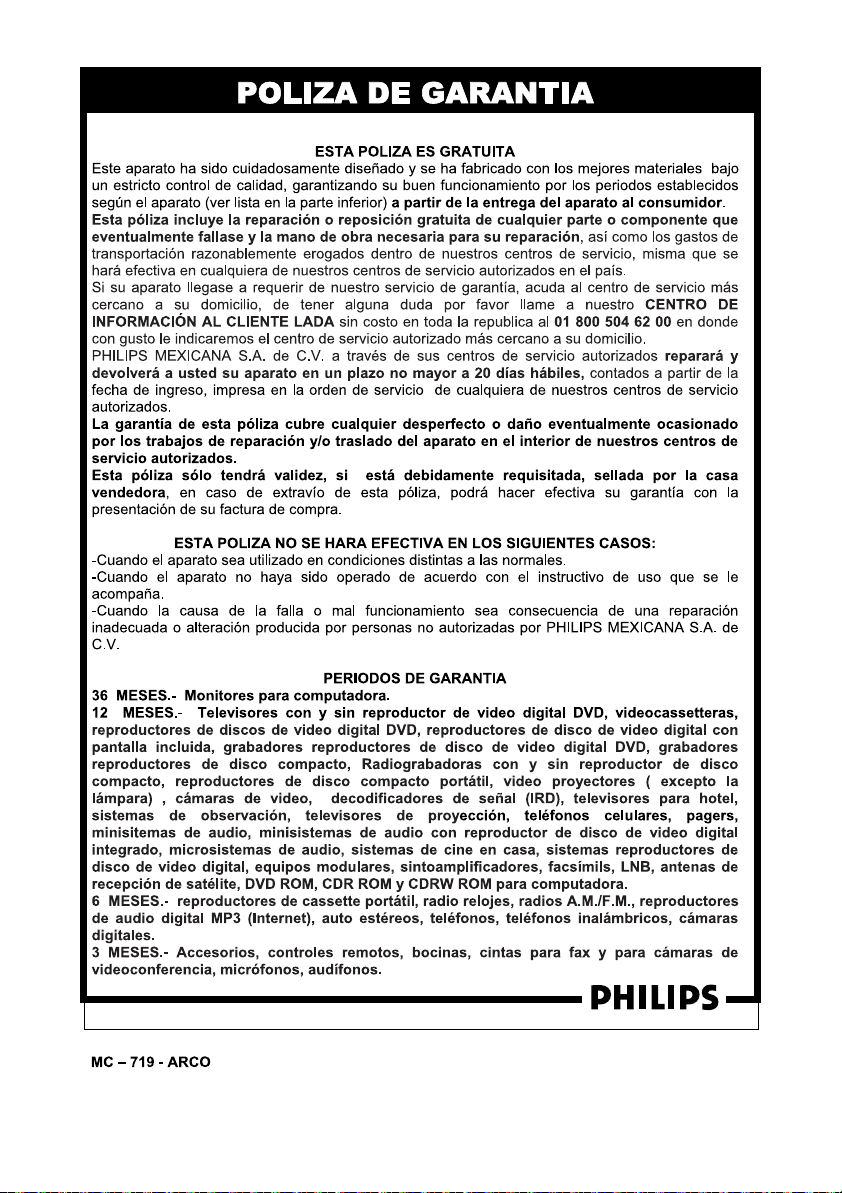
150
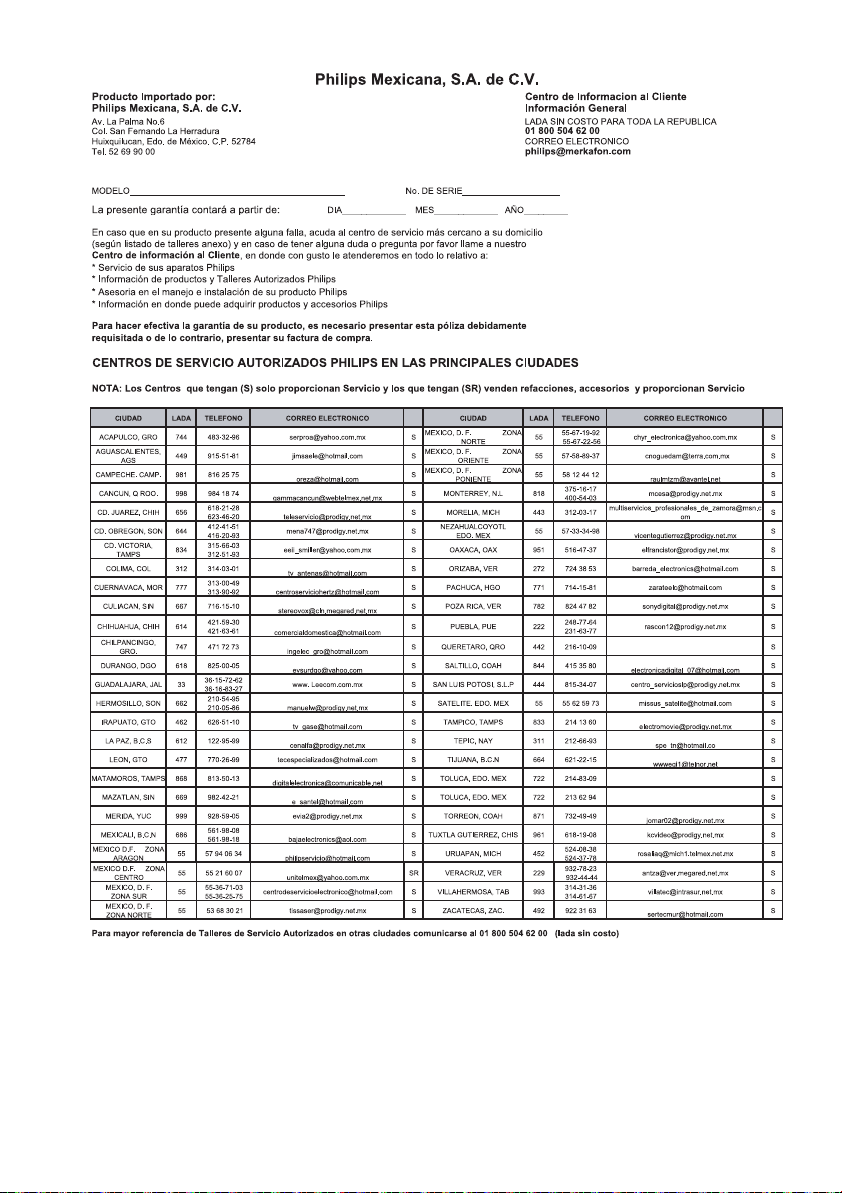
151
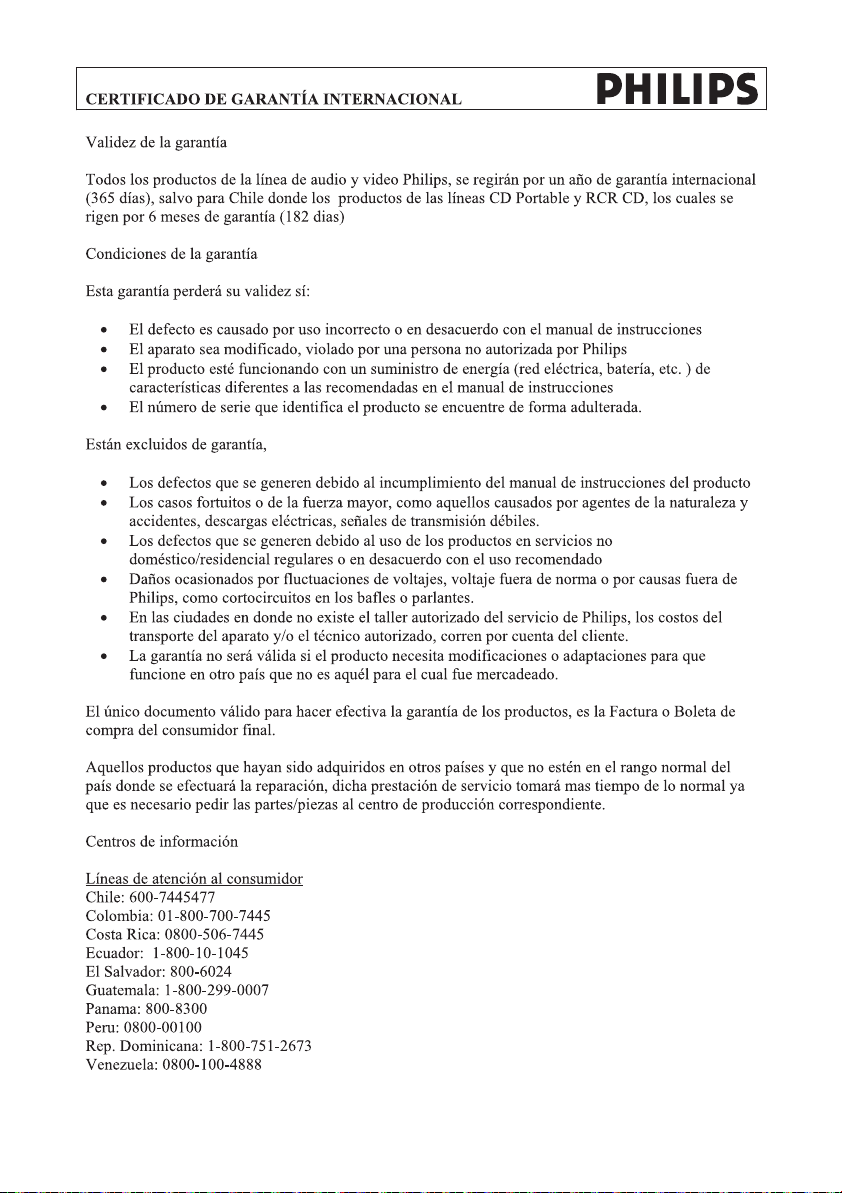
152

153
L
ISTA DE
S
ERVIÇO
A
UTORIZADO - BRASIL
ACR E
BARRA S FRANCISCO 27-37562245 BELO HORIZONTE 31-32257262 PORTO TROMBETAS 93-35491606
28402453-82OLETSAC23442233-86LUSODORIEZURC 22353253-39MERATNAS66045223-13ETNOZIROHOLEB
44902443-13ETNOZIROHOLEB88222273-72ANITALOC24671223-86OCNARBOIR
91918143-13ETNOZIROHOLEB55341633-72IRAPARAUG61194223-86OCNARBOIR
PARAÍBA
8212123-38EDNARGANIPMAC00775923-13ETNOZIROHOLEB84101733-72SERAHNIL
ALAGO AS
SG 3722163-38ACNAREPSE00019443-13ETNOZIROHOLEB35117273-72AHLAPADLEIRBA
9511172-38ARIBARAUG37372012-13ETNOZIROHOLEB60833673-72SUETAMOAS7632225-28ACARIPARA
98696423-38AOSSEPOAOJ88022353-13MITEB33219823-72AHLEVALIV73271423-28OIECAM
44064423-38AOSSEPOAOJ60921253-73OHCAPSEDMOB99833223-72AIROTIV2543124-28SOIDNISODARIEMLAP
06401223-38AOSSEPOAOJ11522253-73OHCAPSEDMOB50311823-28SERAMLAPSODOAINU
GOÍAS
CARANGOLA 32-37412017 NOVA FLORESTA 83-3741014
AM AP Á
9742382-38EPAS39221453-53AISSAC2653423-26SILOPANA
1421363-38AENALOS83611373-13SAHNOGNOC1181656-46UCAC4395712-69APACAM
48773673-13ETEIAFALSNOC8782354-46SAVONSADLAC0801182-69ANATNAS
49921933-13MEGATNOC6872144-46OALATAC
PARANÁ
AM AZ O NAS
5061745-64EREPMA16435933-13MEGATNOC6618136-16ASOMROF
ENOROC59091923-26AINAIOG53033363-29SUANAM LF 28712343-14ANINOTNA40811483-13ONAICIRBA
60352243-34ANARACUPA90031273-83OLEVRUC80929223-26AINAIOG66333663-29SUANAM
3273572-34SAGNOPARA35321223-73SILOPONIVID27225943-49ABUTAIOG25242323-29SUANAM
1815825-44DNAIRBUAETAHCSISSA77141233-73AGIMROF0481115-26SAMUHNI
BAHIA
1171245-34SETNARIEDNAB97253243-43LATURF4811154-26IREMAPI
ALAGOINHAS 75-4211128 ITAPURANGA 62-3551484 GOV. VALADARES 33-32716650 CAMPO MOURAO 44-35238970
50045223-54LEVACSAC19831553-53EPUXAUG73801343-46ARAIBMUTI29571163-77SARIERRAB
2482926-44ETRONAIC42141553-53EPUXAUG6081373-26ARASSUJ5334184-77APALADSUSEJMOB
46743333-14ABITIRUC23322283-13AGNITAPI9158226-16AINAIZUL1832144-77ODAMURB
19784623-14ABITIRUC81261383-13ARIBATI9528166-46SORIENIM38114543-77ETITEAC
19343523-14ABITIRUC51311263-53ABUJATI3311164-46OIRODSERIP88281263-17IRACAMAC
92033253-54UCAUGIODZOF62311433-73ACIRECEPATI0231793-26AMLAIR76728723-57SATNADORECIC
TI37101263-46EDREVOIR9382126-57SAMLASADZURC APECERICA
37-33411326 FOZ DO IGUACU 45-35234115
03233253-64OARTLEBOCSICNARF86421423-73ANUATI5051505-26EDADNIRT4541724-57ADANALPSE
52353263-24AVAUPARAUG13128623-43ABATUIUTI5821753-26UCAURU1815182-37SILOPANUE
2611645-34ITIABI90921583-13EDAVELNOMOAOJ28823223-57ANATNASEDARIEF
FEIRA
DE SANTANA 75-2213427
MARANHÃ O
3681852-34AROPIBI21112583-13EDAVELNOMOAOJ
73312243-24ITARI72311653-83ORIEHNIPOAOJ98818353-99AIDNALIACA46614523-37UDNAG
01422263-14APAL48524803-23AROFEDZIUJ49721263-99LABACAB5995132-37SUEHLI
3502524-44ADNAOL41515123-23AROFEDZIUJ3110145-99SASLAB20201463-47ECERI
GAL5331137-89ANILORAC85321523-57ABAREBATI 20014233-34ANIRDNOL39431623-73ATARPADAO
5331332-44IRAUGADNAM88191283-53SARVAL77321253-99SAIXAC77773163-37ANUBATI
02646223-44AGNIRAM53741333-33UCAUHNAM4631174-89AHNIDAPAHC3003162-77AGNITEPATI
08524623-54ARIENAIDEM28022483-43OLEMRACETNOM77211663-99ODOC32311263-47ANIBOCAJ
6003252-24ARIEMLAP88811953-53SANIMEDOTNASETNOM24921663-99ODOC14145253-37EIUQEJ
40852243-14AUGANARAP52981223-83SORALCSETNOM15313743-89OTENOHLEOC65461163-47ORIEZAUJ
68724223-64OCNARBOTAP43342273-23EAIRUM96944253-99ZIRTAREPMI20011163-47ORIEZAUJ
09562223-24ASSORGATNOP9142175-53OHNIBMAZUM24132463-99SARIERDEP1204873-17SATIERFEDORUAL
15205463-74ORGENOIR56121263-33EUQUNAN51813663-99ARTUDETNEDISERP8091424-57ABITIRUM
7491652-34AIDNALOR62021453-13AMILAVON35573563-89SENIATNAS94311823-57OSNOFAOLUAP
22522823-14SIAHNIPSODJS44441333-73ARIEVILO1851422-89RAMABIREDESOJOAS0981134-77SEOCOP
9241565-54UCAUGIODLEUGIMS96361323-73SANIMEDARAP63232323-89SIULOAS3581672-57LABMOPODARIEBIR
7411742-44EFATNAS57912323-73SANIMEDARAP67251323-89SIULOAS95637423-17RODAVLAS
5031435-64ETSEO'DEGROJOAS05211763-83UTACARAP0005762-17RODAVLAS
07027023-17RODAVLAS
M ATO GROSSO
90814353-34ANITALPOINOTNAOTS24341253-53SOSSAP
44062723-24ABROBOCAMELET88522283-43SANIMEDSOTAP06421253-66ATSEROLFATLA33265333-17RODAVLAS
17422523-54ODELOT13511383-43OINICORTAP6271184-66AIAUGARAOTLA17131423-57ORAMAOTNAS
33213263-44AMARAUMU23261723-73IUGNATIP4931104-66SAGRAGODARRAB3413145-47MIFNOBODROHNES
23641733-73IHMUIP12403263-56ABAIUC49711623-57AHNIRRES
STO
ANTONIO JESUS 75-36314470 LUCAS DO RIO VERDE 65-5491333 POCOS DE CALDAS 35-37121866
PERNAM BUCO
TEIXEIRA DE FREITAS 73-30111600 PONTES E LACERDA 65-2662326 POCOS DE CALDAS 35-37224448 BELO JARDIM 81-37261918
P2861894-66ETSELODAREVAMIRP0173146-57ACNELAV ONTE NOVA 31-38172486 CABO STO AGOSTINHO 81-35211823
VITORIA DA CONQUISTA 77-34241183 RONDONOPOLIS 66-4233888 POUSO ALEGRE 35-34212120 CAMARAGIBE 81-34581246
53202273-18URAURAC49031353-53OSIARAPOAITSABESS2954135-66PONIS
CEARÁ
4721778-18ATSEROLF45021353-53OSIARAPOAITSABESS1341623-56ARRESADARAGNAT
BREJO SANTO 88-5310133 VARZEA GRANDE 65-6826502 SANTOS DUMONT 32-32516369 G ARANHUNS 87-37611090
58001673-78SNUHNARAG60381733-23IERLEDOAOJOAS9100196-88SUETARC
1052125-88OTARC
M ATO GROSSO DO SUL
24113343-18ATSILUAP85211823-73ETNOMOINOTNAOTS
99331323-18EFICER13852253-33INOTOOLIFOET3451184-76IABMAMA60557823-58AZELATROF
11126212-18EFICER82728483-13OETOMIT40824233-76EDNARGOPMAC55588004-58AZELATROF
24065643-18EFICER62632353-23ABU0451383-76EDNARGOPMAC32213563-88ANIPAIBI
09092643-18EFICER02523333-43ABAREBU8983123-76EDNARGOPMAC21501853-88UTAUGI
U7117124-76SODARUOD0302136-88ACOPIPATI 90361783-78ORIEUGLAS63632123-43AIDNALREB
U4421244-76AMEHNIVI76621153-88ETRONODORIEZAUJ BERLANDIA
34-32360764 SERRA TALHADA 87-38311401
98872223-53AHNIGRAV6842164-76IARIVAN8391324-88ETRONODORIEOMIL
84511373-83AMLAPADAEZRAV1583144-76ANIDARDNAAVON1721485-88SORO
PIAUÍ
67312523-68ROIAMOPMAC02413183-43ETNAZAV3134134-76AROPATNOP50601163-88LARBOS
4511225-98ONAIROLF00081983-13ASOCIV0597254-76ETNAHLIRBOIR63331763-88AUGNAIT
6601264-98SARIEO7002125-76SAOGALSERT3321436-88ARAJABU
PARÁ
7782223-68ABIANRAP
SIAREGSANIMLAREDEFOTIRTSID
4441224-98SOCIP27221573-19ABUTETEABA
53155143-98SOCIP00409623-19MELEB40172923-53SANEFLA89896223-16AILISARB
53531223-68ANISERET09012423-19MELEB4321127-33ARANEMLA66661033-16AILISARB
52803223-68ANISERET00112643-19AMENAPAC07921373-53SADARDNA0484655-16AMAG
81641223-68ANISERET25051273-19LAHNATSAC23111663-43AXARA
ESPÍRITO SANTO
5451815-39ABUTIATI96819663-43AXARA
1981123-49ABARAM55431533-73SOCRA94362553-82ERGELA
RIO DE JANEIRO
61221383-22ANAOPABATISUSEJB6112745-39SODIBO37411343-73IUBMAB15216523-72ZURCARA
06061672-12OXORDROFLEB87701103-19SANIMOGARAP38201333-23ANECABRAB24112373-72UDNAUGOXIAB
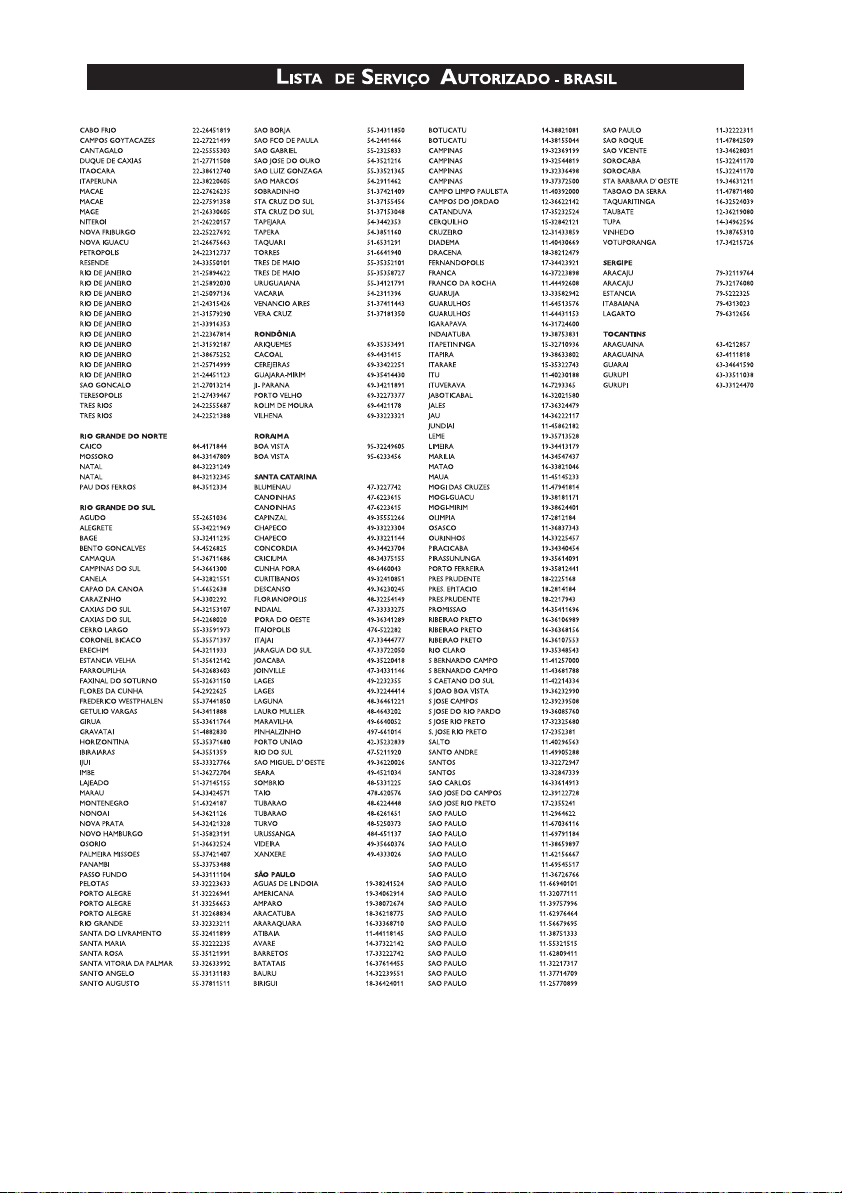
154
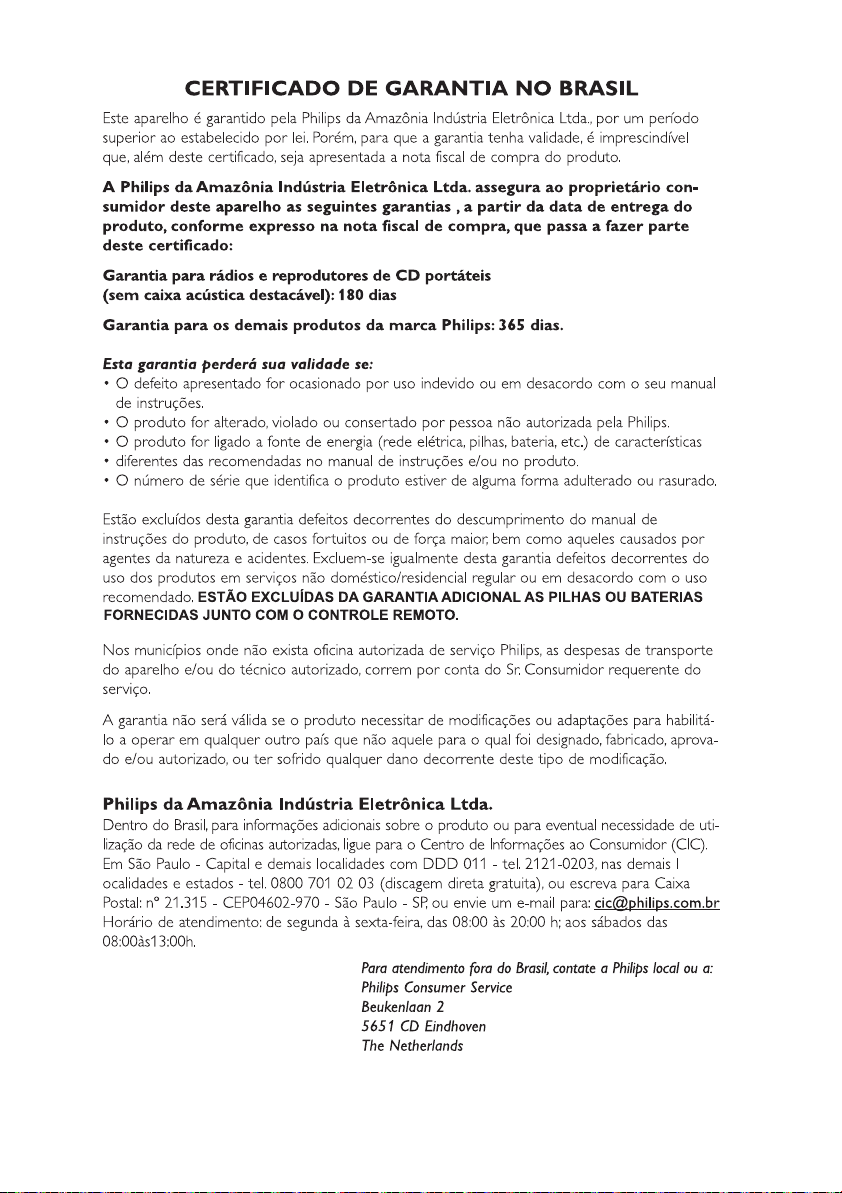
155
156
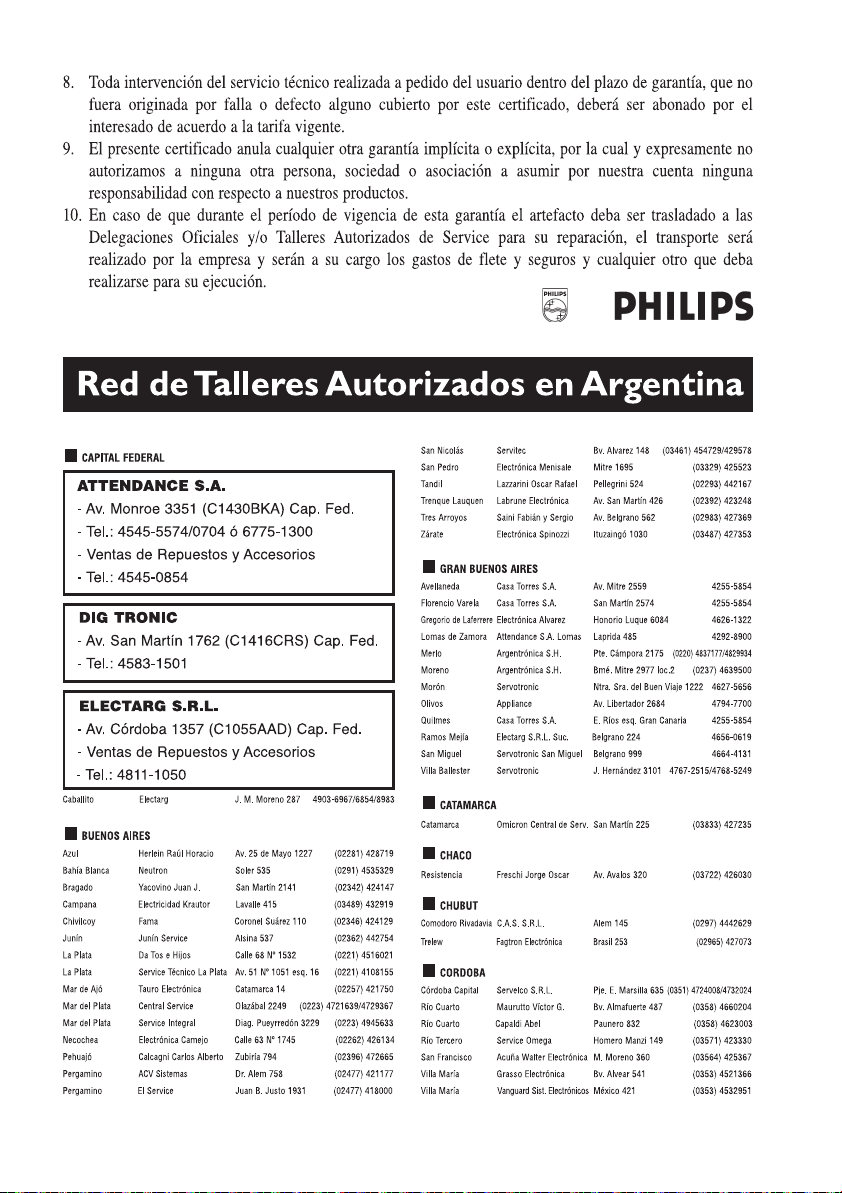
157

© 2008 Philips Consumer Lifestyle
All right reserved
12nc: 3139 245 30992
sgpjp-0841/59-3