
2
Contents
3WARNING
3PRECAUTIONS
8 Guide to Parts and Controls
Getting Started
11 1: Checking Supplied Accessories
11 2: Connecting to a TV or a Sound Bar/AV Amplifier
13 3: Network Connection
14 4: Easy Setup
15 Home screen display
Playback
16 Playing a Disc
16 Enjoying Blu-ray 3D
16 Enjoying 4K Ultra HD Blu-ray
16 Playing from a USB Device
17 Playing files on a Home Network
17 Listening to Audio through a BLUETOOTH® Device
19 Available Options
Settings and Adjustments
21 Using the Settings Displays
Additional Information
28 Troubleshooting
33 Specifications
35 Playable discs
36 Playable types of files
Index
42 Index
3
Owner’s Record
The model and serial numbers are located at the
rear of the unit. Record the serial number in the
space provided below. Refer to them whenever
you call upon your Sony dealer regarding this
product.
Model No.______________
Serial No.______________
For Customers in the USA
If this product is not working properly, please
call 1-800-222-SONY(7669).
For Customers in Canada
If this product is not working properly, please
contact our Customer Information Service
Center at 1-877-899-7669 or write to us at:
Customer Information Service 115 Gordon Baker
Road, Toronto, Ontario, M2H 3R6
WARNING
To reduce the risk of fire or electric shock, do not
expose this apparatus to rain or moisture.
To avoid electrical shock, do not open the
cabinet. Refer servicing to qualified personnel
only.
Do not expose batteries or appliances with
battery-installed to excessive heat, such as
sunshine and fire.
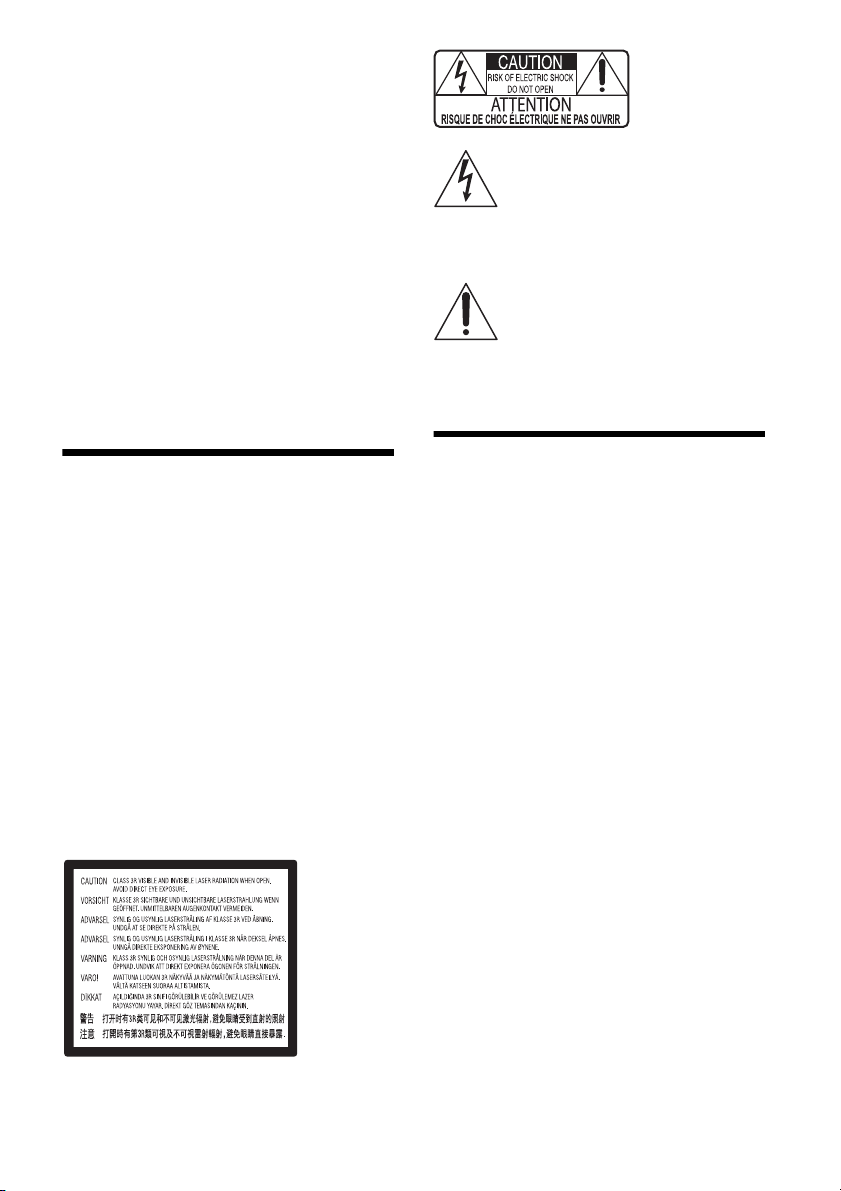
CAUTION
Risk of explosion if the battery is replaced by an
incorrect type.
The use of optical instruments with this product
will increase eye hazard. As the laser beam used
in this product is harmful to eyes, do not attempt
to disassemble the cabinet.
Refer servicing to qualified personnel only.
This label is located on the laser protective
housing inside the enclosure.
This symbol is intended to alert the
user to the presence of uninsulated
“dangerous voltage” within the
product’s enclosure that may be of
sufficient magnitude to constitute a
risk of electric shock to persons.
This symbol is intended to alert the
user to the presence of important
operating and maintenance
(servicing) instructions in the
literature accompanying the
appliance.
PRECAUTIONS
• To reduce the risk of fire or electric shock,
do not expose this appliance to dripping or
splashing, and do not place objects filled
with liquids, such as vases, on the
appliance.
• Install this unit so that the AC power cord
can be unplugged from the wall socket
immediately in the event of trouble.
• Place the player in a location with adequate
ventilation to prevent heat build-up in the
player.
• To reduce the risk of fire, do not cover the
ventilation opening of the appliance with
newspapers, tablecloths, curtains, etc.
• Do not cover ventilation openings.
This equipment is not intended to be used
on soft support (like beddings, blankets
etc.).
• Do not expose the appliance to naked flame
sources (for example, lighted candles).
• Do not install this player in a confined
space, such as a bookshelf or similar unit.
• Do not place the player outdoors, in
vehicles, on ships, or on other vessels.
4
• If the player is brought directly from a cold
to a warm location, or is placed in a very
damp room, moisture may condense on the
lenses inside the player. Should this occur,
the player may not operate properly. In this
case, remove the disc and leave the player
turned on for about half an hour until the
moisture evaporates.
• Do not install the player in an inclined
position. It is designed to be operated in a
horizontal position only.
• Do not place metal objects in front of the
front panel. It may limit reception of radio
waves.
• Do not place the player in a place where
medical equipment is in use. It may cause a
malfunction of medical instruments.
• If you use a pacemaker or other medical
device, consult your physician or the
manufacturer of your medical device before
using the wireless LAN function.
• Do not place heavy or unstable objects on
the player.
• Do not place any objects other than discs on
the disc tray. Doing so may cause damage
to the player or the object.
• Take out any discs from the tray when you
move the player. If you don’t, the disc may
be damaged.
• Disconnect the AC power cord and all other
cables from the player when you move the
player.
• The player is not disconnected from the AC
power source as long as it is connected to
the wall outlet, even if the player itself has
been turned off.
• Disconnect the player from the wall outlet if
you are not going to use the player for a
long time. To disconnect the AC power
cord, grasp the plug itself; never pull the
cord.
• Observe following points to prevent the AC
power cord being damaged. Do not use the
AC power cord if it is damaged, as doing so
may result in an electric shock or fire.
– Do not pinch the AC power cord between
the player and wall, shelf, etc.
– Do not put anything heavy on the AC
power cord or pull on the AC power cord
itself.
• Do not turn up the volume while listening to
a section with very low level inputs or no
audio signals. Your ears and the speakers
may be damaged when the sound level
reaches the peak.
• Clean the cabinet, panel, and controls with
a soft cloth. Do not use any type of abrasive
pad, scouring powder or solvent such as
alcohol or benzine.
• Do not use cleaning discs or disc/lens
cleaners (including wet or spray types).
These may cause the apparatus to
malfunction.
• In the events that this player is repaired,
repaired parts may be collected for reuse or
recycling purposes.
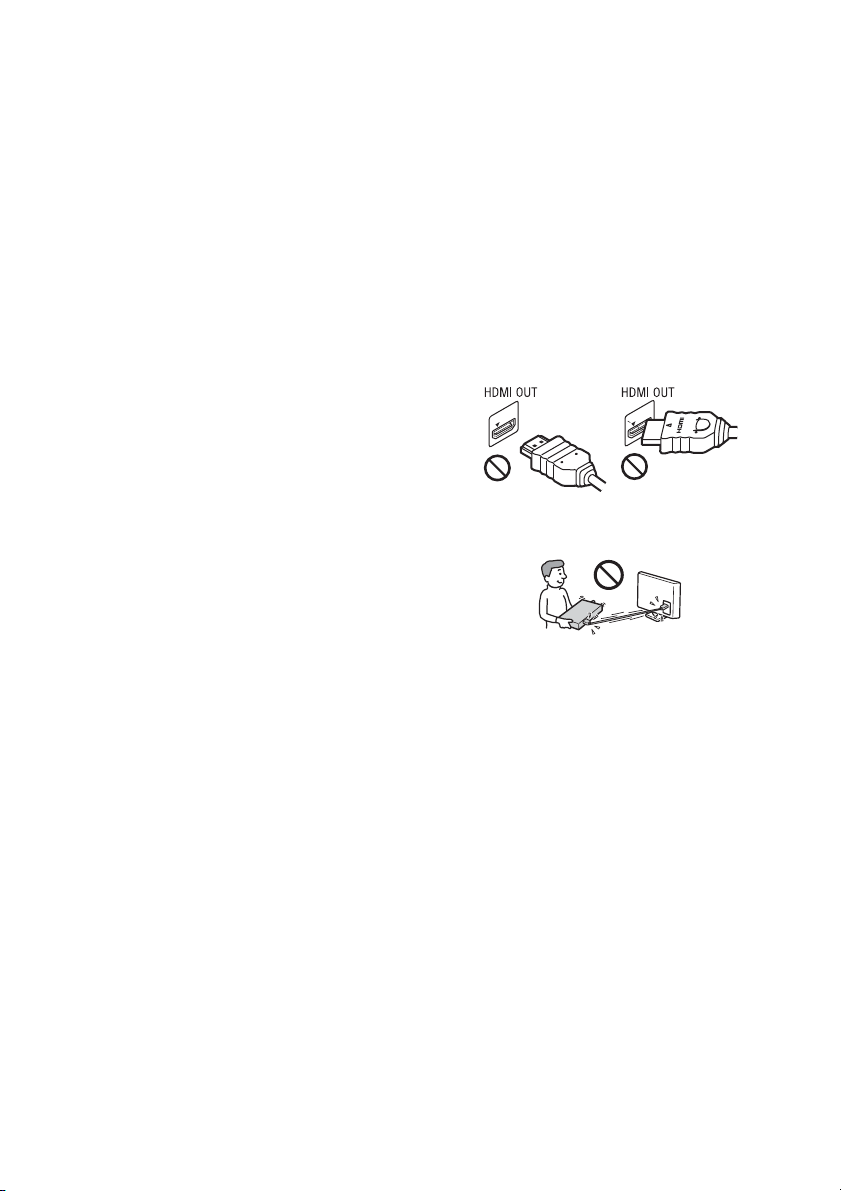
• Observe the following as improper handling
may damage the HDMI OUT jack and the
connector.
– Carefully align the HDMI OUT jack on the
rear of the player and the HDMI connector
by checking their shapes. Make sure the
connector is not upside down or tilted.
– Be sure to disconnect the HDMI cable
when moving the player.
– Hold the HDMI connector straight when
connecting or disconnecting the HDMI
cable. Do not twist or force the HDMI
connector into the HDMI OUT jack.

5
For United States customers. Not applicable in
Canada, including in the province Of Quebec.
Pour les consommateurs Aux États-Unis. Non
applicable au Canada, y compris la province
de Québec.
FCC WARNING
You are cautioned that any changes or
modifications not expressly approved in this
manual could void your authority to operate
this equipment.
If you have any questions about this product:
Visit: www.sony.com/support
Contact: Sony Customer Information Service
Center at 1-(800)-222-7669
Write: Sony Customer Information Service
Center 12451 Gateway Blvd., Fort Myers, FL
33913
Supplier’s Declaration of Conformity
Trade Name: SONY
Model: UBP-X800M2
Responsible Party: Sony Electronics Inc.
Address: 16535 Via Esprillo, San Diego, CA
92127 U.S.A.
Telephone Number: 858-942-2230
This device complies with part 15 of the FCC
rules. Operation is subject to the following
two conditions: (1) This device may not cause
harmful interference, and (2) this device must
accept any interference received, including
interference that may cause undesired
operation.
This equipment must not be co-located or
operated in conjunction with any other
antenna or transmitter.
The shielded Interface cable (LAN cable) and
bundled HDMI Cable or High Speed HDMI
Cable with Cable Type Logo must be used
with the equipment in order to comply with
the limits for a digital device pursuant to
Subpart B of Part 15 of FCC Rules.
This equipment has been tested and found to
comply with the limits for a Class B digital device,
pursuant to Part 15 of the FCC Rules. These limits
are designed to provide reasonable protection
against harmful interference in a residential
installation. This equipment generates, uses,
and can radiate radio frequency energy and, if
not installed and used in accordance with the
instructions, may cause harmful interference to
radio communications. However, there is no
guarantee that interference will not occur in a
particular installation. If this equipment does
cause harmful interference to radio or television
reception, which can be determined by turning
the equipment off and on, the user is
encouraged to try to correct the interference by
one or more of the following measures:
– Reorient or relocate the receiving antenna.
– Increase the separation between the
equipment and receiver.
– Connect the equipment into an outlet on a
circuit different from that to which the
receiver is connected.
– Consult the dealer or an experienced radio/TV
technician for help.
FCC Radiation Exposure Statement:
This equipment complies with FCC radiation
exposure limits set forth for an uncontrolled
environment and meets the FCC radio
frequency (RF) Exposure Guidelines. This
equipment has very low levels of RF energy
that is deemed to comply without maximum
permissive exposure evaluation (MPE).
Contains FCC ID : MCLJ 20H0 86
Data transmission is always initiated by
software, which is the passed down through
the MAC, through the digital and analog
baseband, and finally to the RF chip. Several
special packets are initiated by MAC. These
are the only ways the digital baseband
portion will turn on the RF transmitter, which
it then turns off at the end of the packet.
Therefore, the transmitter will be on only
while one of the aforementioned packets is
being transmitted. In other words, this device
automatically discontinue transmission in
case of either absence of information to
transmit or operational failure.
Frequency Tolerance : ± 20 ppm
5150 - 5350 MHz band is restricted to indoor
operations only.

6
Important Safety Instructions
1) Read these instructions.
2) Keep these instructions.
3) Heed all warnings.
4) Follow all instructions.
5) Do not use this apparatus near water.
6) Clean only with dry cloth.
7) Do not block any ventilation openings.
Install in accordance with the
manufacturer’s instructions.
8) Do not install near any heat sources such
as radiators, heat registers, stoves, or
other apparatus (including amplifiers) that
produce heat.
9) Do not defeat the safety purpose of the
polarized or grounding-type plug.
A polarized plug has two blades with one
wider than the other. A grounding type
plug has two blades and a third grounding
prong. The wide blade or the third prong
are provided for your safety. If the
provided plug does not fit into your outlet,
consult an electrician for replacement of
the obsolete outlet.
10)Protect the power cord from being walked
on or pinched particularly at plugs,
convenience receptacles, and the point
where they exit from the apparatus.
11) Only use attachments/accessories
specified by the manufacturer.
12)Use only with the cart, stand, tripod,
bracket, or table specified by the
manufacturer, or sold with the apparatus.
When a cart is used, use caution when
moving the cart/apparatus combination to
avoid injury from tip-over.
13)Unplug this apparatus during lightning
storms or when unused for long periods of
time.
14)Refer all servicing to qualified service
personnel. Servicing is required when the
apparatus has been damaged in any way,
such as power-supply cord or plug is
damaged, liquid has been spilled or
objects have fallen into the apparatus, the
apparatus has been exposed to rain or
moisture, does not operate normally, or
has been dropped.
For Customers in Canada
IC Radiation Exposure Statement:
This equipment complies with ISED radiation
exposure limits set forth for an uncontrolled
environment and meets RSS-102 of the ISED
radio frequency (RF) Exposure rules as this
equipment has very low levels of RF energy.
Contains IC : 2878D-J20H086
• 5 150 - 5 350 MHz band is restricted to
indoor operations only.
• High-power radars are allocated as primary
users (i.e. priority users) of the bands 5 250 -
5350MHz and 5650- 5850 MHz and that
these radars could cause interference and/
or damage to LE-LAN devices.
On watching 3D video images
Some people may experience discomfort
(such as eye strain, fatigue, or nausea) while
watching 3D video images. Sony
recommends that all viewers take regular
breaks while watching 3D video images. The
length and frequency of necessary breaks will
vary from person to person. You must decide
what works best. If you experience any
discomfort, you should stop watching the 3D
video images until the discomfort ends;
consult a doctor if you believe necessary. You
should also review (i) the instruction manual
and/or the caution message of any other
device used with, or Blu-ray Disc contents
played with this product and (ii) our website
(http://esupport.sony.com/) for the latest
information. The vision of young children
(especially those under six years old) is still
under development. Consult your doctor
(such as a pediatrician or eye doctor) before
allowing young children to watch 3D video
images. Adults should supervise young
children to ensure they follow the
recommendations listed above.
This device contains licence-exempt
transmitter(s)/receiver(s) that comply with
Innovation, Science and Economic
Development Canada’s licence-exempt RSS(s).
Operation is subject to the following two
conditions:
(1) This device may not cause interference; and
(2) This device must accept any interference,
including interference that may cause
undesired operation of the device.

7
If you have any questions or problems
concerning your player, please consult your
nearest Sony dealer.
About wireless LAN security
Since communication via the wireless LAN
function is established by radio waves, the
wireless signal may be susceptible to
interception. To protect wireless
communication, this player supports various
security functions. Be sure to correctly
configure the security settings in accordance
with your network environment.
No Security
Although you can easily make settings,
anyone can intercept wireless
communication or intrude into your wireless
network, even without any sophisticated
tools. Keep in mind that there is a risk of
unauthorized access or interception of data.
WEP
WEP applies security to communications to
prevent outsiders from intercepting
communications or intruding into your
wireless network. WEP is a legacy security
technology that enables older devices, which
do not support TKIP/AES, to be connected.
WPA-PSK (TKIP), WPA2-PSK (TKIP)
TKIP is a security technology developed to
correct the deficiencies of WEP. TKIP assures
a higher security level than WEP.
WPA-PSK (AES), WPA2-PSK (AES)
AES is a security technology that uses an
advanced security method that is distinct
from WEP and TKIP.
AES assures a higher security level than WEP
or TKIP.
Notes About the Discs
• To keep the disc clean,
handle the disc by its
edge. Do not touch the
surface.
Dust, fingerprints, or
scratches on the disc may
cause it to malfunction.
• Do not expose the disc to direct sunlight or
heat sources such as hot air ducts, or leave
it in a car parked in direct sunlight as the
temperature may rise considerably inside
the car.
• After playing, store the disc in its case.
• Clean the disc with a
cleaning cloth. Wipe the disc
from the center out.
• Do not use solvents such as
benzine, thinner,
commercially available disc/
lens cleaners, or anti-static
spray intended for vinyl LPs.
• If you have printed the disc’s label, dry the
label before playing.
• Do not use the following discs.
– A lens cleaning disc.
– A disc that has a non-standard shape
(e.g., card, heart).
– A disc with a label or sticker on it.
– A disc that has cellophane tape or sticker
adhesive on it.
• Do not resurface the playing side of a disc to
remove surface scratches.
IMPORTANT NOTICE
Caution: This player is capable of holding a
still video image or on-screen display image
on your television screen indefinitely. If you
leave the still video image or on-screen
display image displayed on your TV for an
extended period of time you risk permanent
damage to your television screen. Plasma
display panel televisions and projection
televisions are susceptible to this.
8
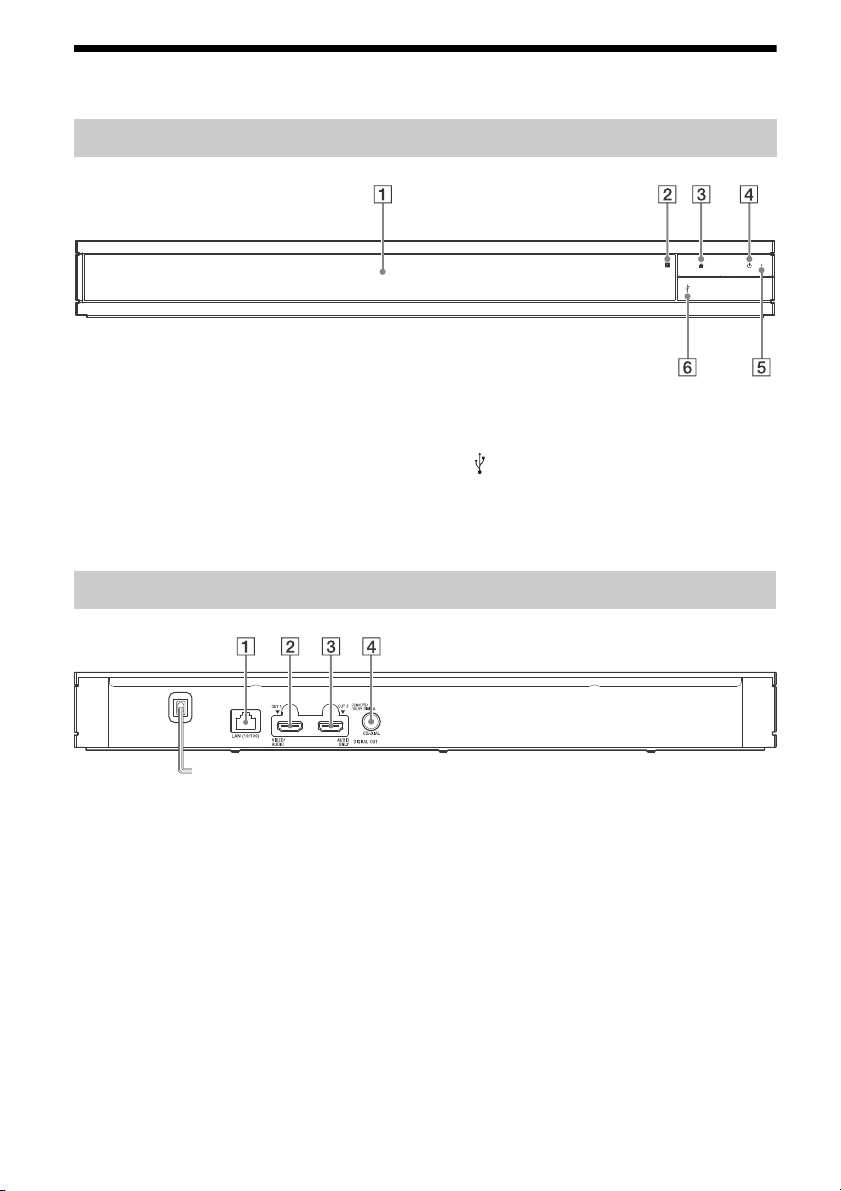
Guide to Parts and Controls
Door tray
Remote sensor
(open/close)
(on/standby)
Turns on the player, or sets to standby
mode.
Power indicator
Lights up when the player is turned on.
(USB) jack cover
Open the cover to connect a USB device
to this jack. See page 16.
LAN (10/100) terminal
HDMI OUT 1 jack (VIDEO/AUDIO)
Outputs digital video and audio signal.
HDMI OUT 2 jack (AUDIO ONLY)
Outputs digital audio signal only.
Please remove the attached sticker to use
the jack.
DIGITAL OUT (COAXIAL) jack
Front panel
Rear panel
9
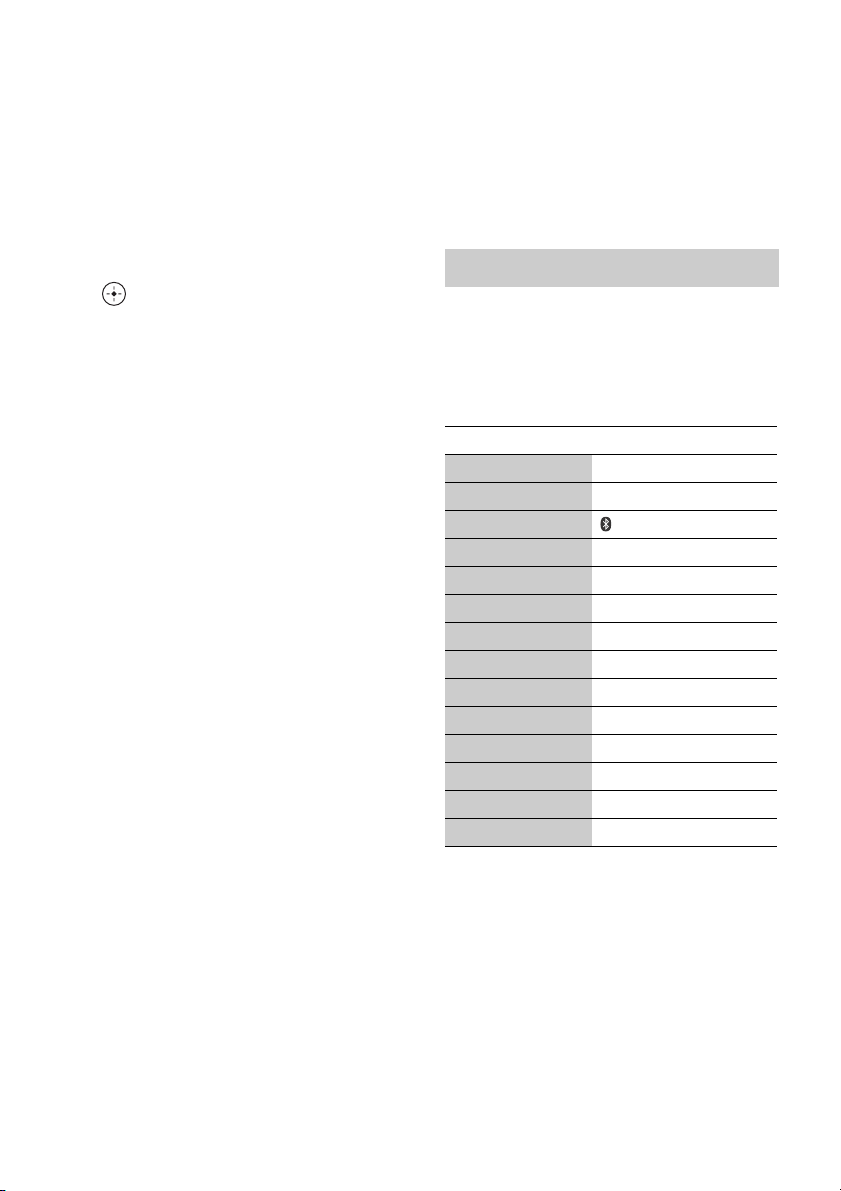
The available functions of the remote are
different depending on the disc or the
situation.
PLAY, TV VOL +, and AUDIO buttons have a
tactile dot. Use the tactile dot as a reference
when operating the player.
The player automatically returns to standby
mode if no button on the player or remote is
pressed for more than 20 minutes.
OPEN/CLOSE
Opens or closes the disc tray.
TV (on/standby)
Turns on the TV, or sets to standby mode.
(on/standby)
Turns on the player, or sets to standby
mode.
NET SERVICE
Returns to the previous online service
portal.
TV INPUT
Switches between TV and other input
sources.
BLUETOOTH (page 17)
• Scan device list will appear if this player
has no paired Bluetooth device.
• Connect to the last connected device if
this player has a paired Bluetooth
device. If the connection fails, scan
device list will appear.
• Disconnect the connected Bluetooth
device.
Color buttons (YELLOW/BLUE/RED/
GREEN)
Shortcut keys for interactive functions.
FAVORITE (page 15)
Accesses the application registered as
favorite.
NETFLIX
Accesses the Netflix online service. For
further Netflix online service details, visit
the following website and check the FAQ:
http://www.sony.com/bluraysupport/
TOP MENU
Opens or closes the Ultra HD Blu-ray/BD/
DVD’s Top Menu.
POP UP/MENU
Opens or closes the Ultra HD Blu-ray/BD/
DVD’s menu.
OPTIONS (page 19)
Displays the available options on the
screen.
RETURN
Returns to the previous display.
///
Moves the highlight to select a displayed
item.
Remote
10
• / as a shortcut key to launch track
search window and input track number
during music CD playback.
• / as a shortcut key to rotate photo
clockwise/counterclockwise by 90
degrees.
• / as a shortcut key to perform seek
functions during Home Network video
playback.
• / as a shortcut key to change still
image when it is enabled to change.
ENTER
Enters the selected item.
HOME
Enters the player’s home screen.
/ (fast reverse/fast forward)
• Fast reverse/fast forward the disc when
pressed during playback. The search
speed changes each time you press the
button.
• Plays in slow motion when pressed for
more than one second in pause mode.
• Plays one frame at a time when pressed
for a short time in pause mode.
PLAY
Starts or re-starts playback.
PREV/NEXT
Skips to the previous/next chapter, track,
or file.
PAUSE
Pauses or re-starts playback.
SUBTITLE (page 25)
Selects the subtitle language when multi-
lingual subtitles are recorded on Ultra HD
Blu-ray/BD/DVD.
STOP
Stops playback and remembers the stop
point (resume point).
The resume point for a title/track is the
last point you played or the last photo for
a photo folder.
AUDIO (page 25)
Selects the language track when multi-
lingual tracks are recorded on Ultra HD
Blu-ray/BD/DVD.
Selects the sound track on CDs.
MUTING
Turns off the TV sound temporarily.
TV VOL +/–
Adjusts the TV volume.
DISPLAY
Displays the playback information on the
screen.
To lock the disc tray (Child Lock)
You can lock the disc tray to avoid accidental
opening of the tray.
While the player is turned on, press STOP,
HOME, and then TOP MENU on the remote to
lock or unlock the tray.
Press and hold TV , and then press and
hold the TV manufacturer’s code using the
remote button for more than 2 seconds.
Example: If your TV is Hitachi, press and hold
TV , and then press and hold TV INPUT for
more than 2 seconds.
This player’s remote may not work with your TV,
depending on the model or model year of the
TV. In such a case, use the remote supplied with
your TV.
Code numbers of controllable TVs
Manufacturer Remote Button
Sony (Default) NET SERVICE
Hitachi TV INPUT
LG/Goldstar/NEC BLUETOOTH
Toshiba Color button (YELLOW)
RCA Color button (BLUE)
Mitsubishi/MGA Color button (RED)
Pioneer Color button (GREEN)
Sharp FAVORITE
Panasonic NETFLIX
Samsung TOP MENU
Philips POP UP/MENU
Vizio 1 RETURN
Vizio 2 OPTIONS
Vizio 3 HOME
11
Getting Started
Getting Started
1: Checking Supplied Accessories
• Remote commander (remote) (1)
• Size AAA (R03) batteries (2)
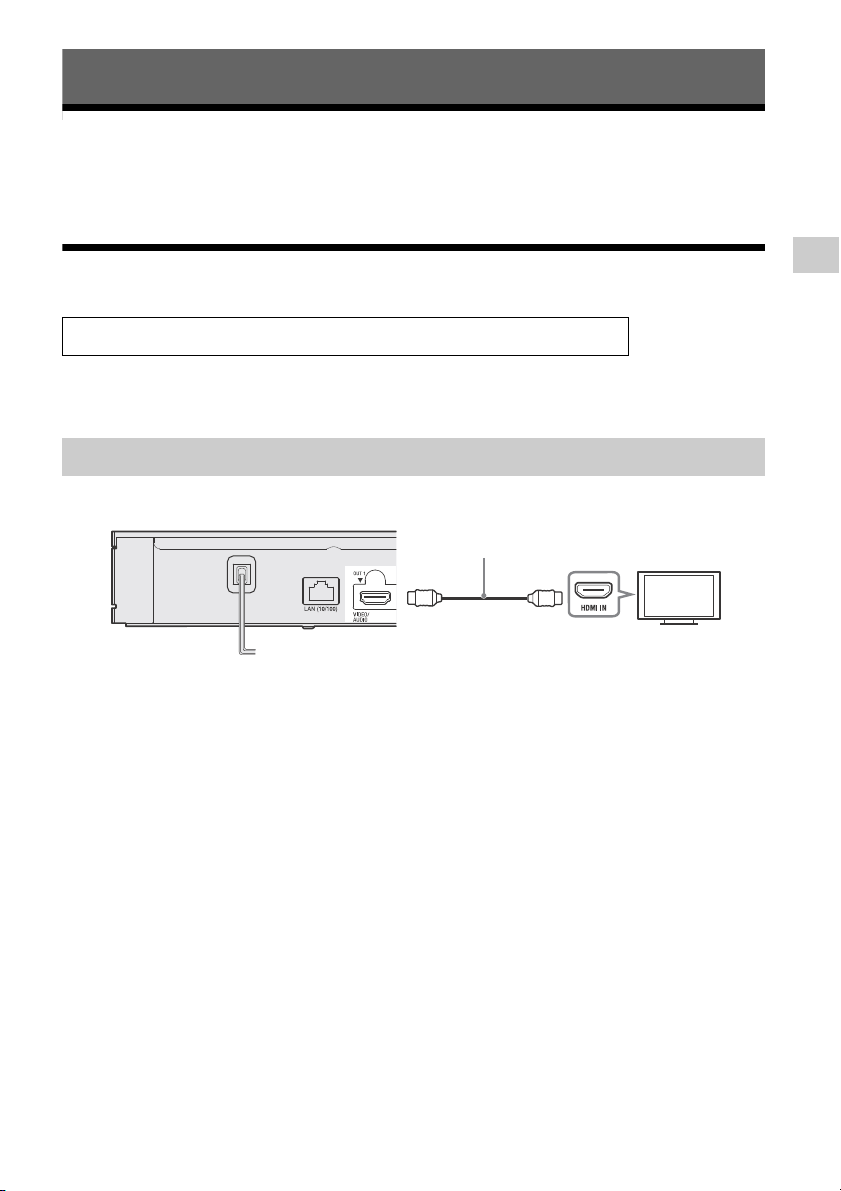
2: Connecting to a TV or a Sound Bar/AV Amplifier
Various connection methods can be used to enjoy the player. Select a connection method
according to the functions and jacks on your Sound Bar/AV amplifier (receiver).
* Premium High Speed HDMI Cable or High Speed HDMI Cable that supports 18 Gbps bandwidth.
• To enjoy images in higher-definition HDMI formats (4K 60p/Ultra HD, 4K HDR, Dolby Vision, etc.),
connect a TV that supports the video format to the player.
• To display images in higher-definition HDMI formats, you need to connect the player to your TV using
a Premium High Speed HDMI Cable that supports 18 Gbps bandwidth (not supplied).
• If you are using BRAVIA TV, adjust the TV’s “HDMI signal format” setting. For details, refer to the TV’s
instruction manual.
• To enjoy Dolby Vision, set [Dolby Vision Output] under [Screen Settings] on the player (page 22).
• If a Sound Bar/AV amplifier (receiver) is directly connected to the TV, refer to the connection methods
on page 12.
• The connection method when connecting the player to the TV through a Set Top Box (Cable/Satellite
Box) varies depending on your Set Top Box (Cable/Satellite Box). For details, refer to the instruction
manual of the Set Top Box (Cable/Satellite Box).
• If you encounter any problems or need more information, refer to “
Troubleshooting” (page 28).
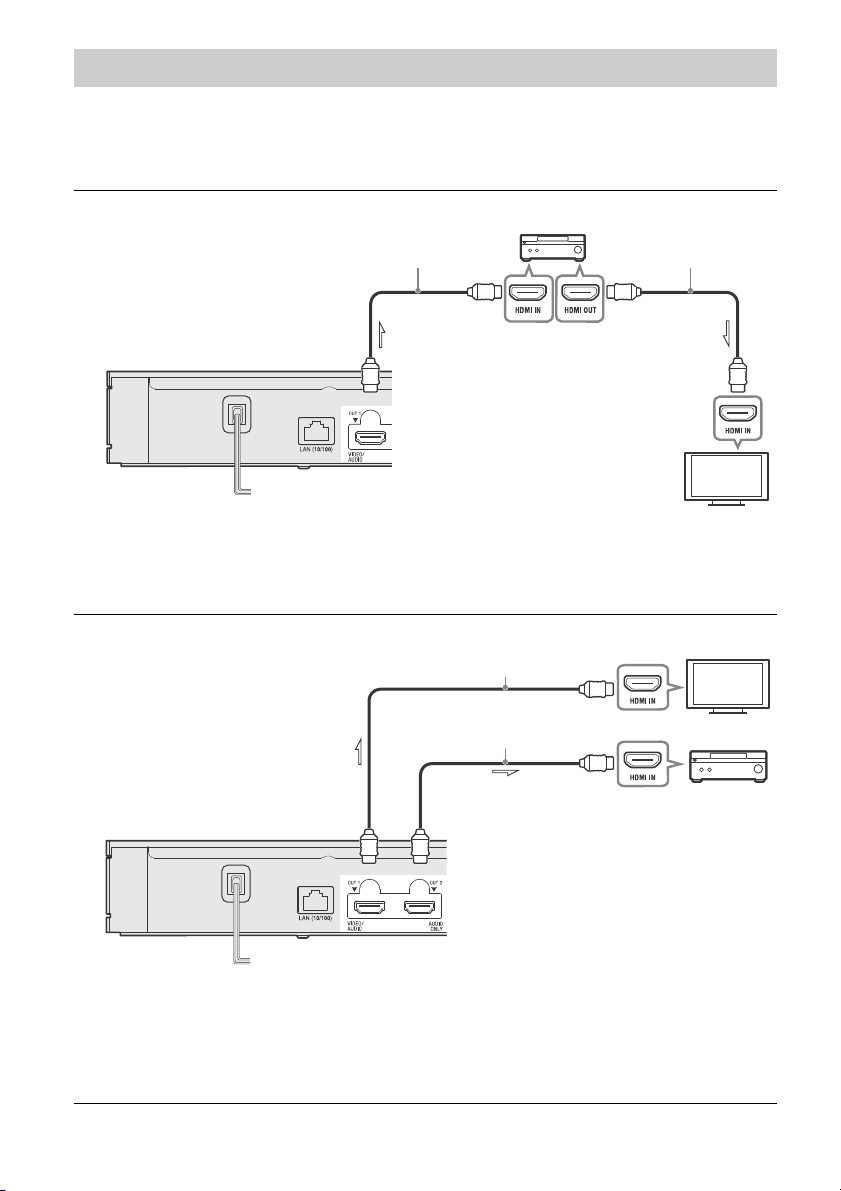
Do not connect the AC power cord until you have made all the connections.
Connecting to your TV
HDMI Cable*
(not supplied)
To HDMI OUT 1
jack
12
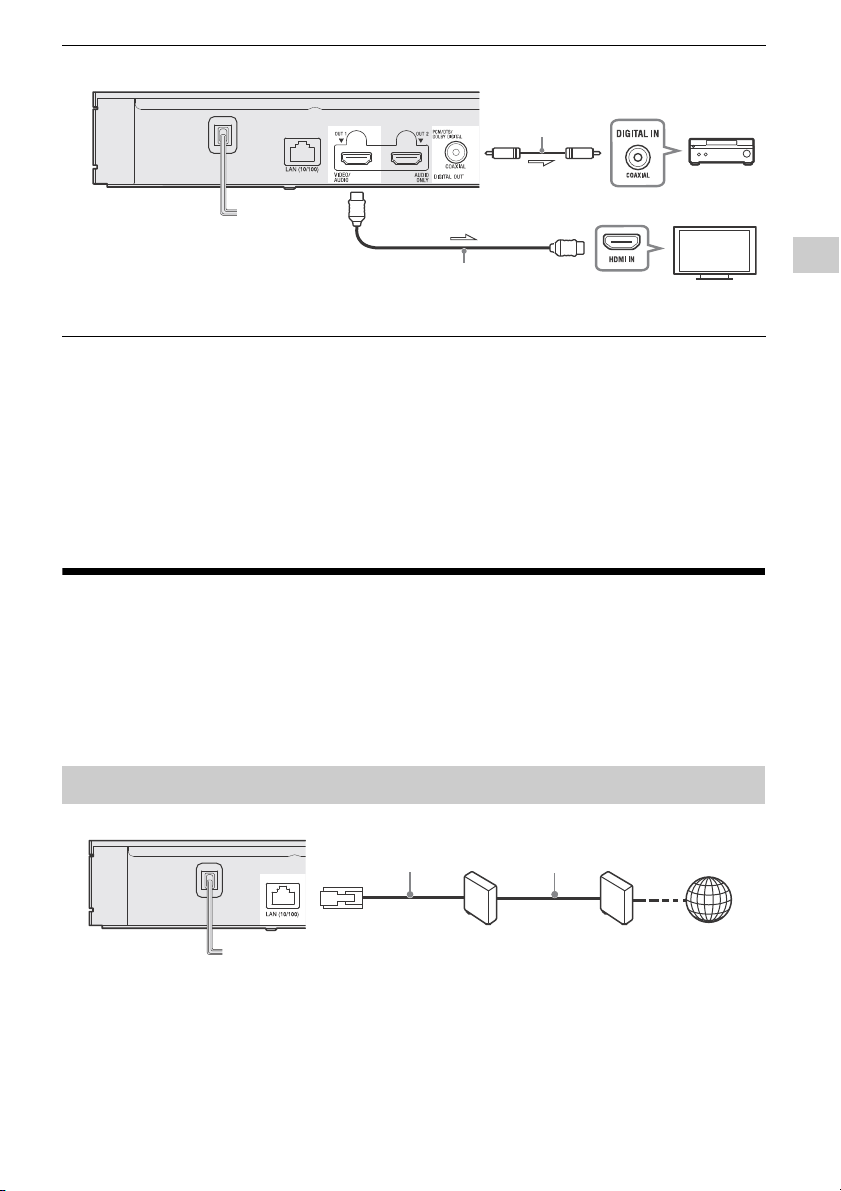
Select a connection method according to the functions and jacks on your Sound Bar/AV amplifier
(receiver). The following are examples of the main connection methods.
For details on your Sound Bar/AV amplifier (receiver), refer to the instruction manual supplied
with the Sound Bar/AV amplifier (receiver).
Connecting to your TV via a Sound Bar/AV amplifier (receiver)
4K Sound Bar/AV amplifier (receiver) with HDMI IN
Non-4K Sound Bar/AV amplifier (receiver) with HDMI IN
When you connect your TV and a Sound Bar/AV amplifier (receiver) using an HDMI Cable (not
supplied), no sound may be output, or you may be unable to switch the input to the player. Refer to
“Troubleshooting” (page 28).
If selecting this connection method, set [HDMI Audio Output] in [System Settings] to [HDMI1] or
[Auto] (page 26).
To enjoy Bitstream (Dolby/DTS), set [BD Secondary Audio] in [Audio Settings] (page 24).
To enjoy display of images in higher-definition HDMI formats (4K 60p/Ultra HD, 4K HDR, Dolby
Vision, etc.), all connected devices need to support the video format.
HDMI Cable*
(not supplied)
HDMI Cable*
(not supplied)
To HDMI OUT 1 jack
Audio/Video
signals
Audio/Video
signals
High Speed HDMI Cable
(not supplied)
HDMI Cable* (not supplied)
Video signals
Audio signals
To HDMI OUT 2 jackTo HDMI OUT 1 jack
If selecting this connection method, set [HDMI Audio Output] in [System Settings] to [HDMI2] or
[Auto] (page 26).
13
Getting Started
* Premium High Speed HDMI Cable or High Speed HDMI Cable that supports 18 Gbps bandwidth.
• To display images in higher-definition HDMI formats, you need to connect the player to your TV using
a Premium High Speed HDMI Cable that supports 18 Gbps bandwidth (not supplied).
• To enjoy Dolby Vision, set [Dolby Vision Output] under [Screen Settings] on the player (page 22).
• The connection method when connecting the player to the TV through a Set Top Box (Cable/Satellite
Box) varies depending on your Set Top Box (Cable/Satellite Box). For details, refer to the instruction
manual of the Set Top Box (Cable/Satellite Box).
• If you encounter any problems or need more information, refer to “
Troubleshooting” (page 28).
3: Network Connection
If you are not going to connect the player to a network, proceed to “4: Easy Setup” (page 14).
• For details on settings for network connection, see [Network Settings] (page 26).
• When the player is connected to the Internet and there is a software update, the update notification
automatically appears on the screen.
The use of a shielded and straight interface cable (LAN cable) is recommended.
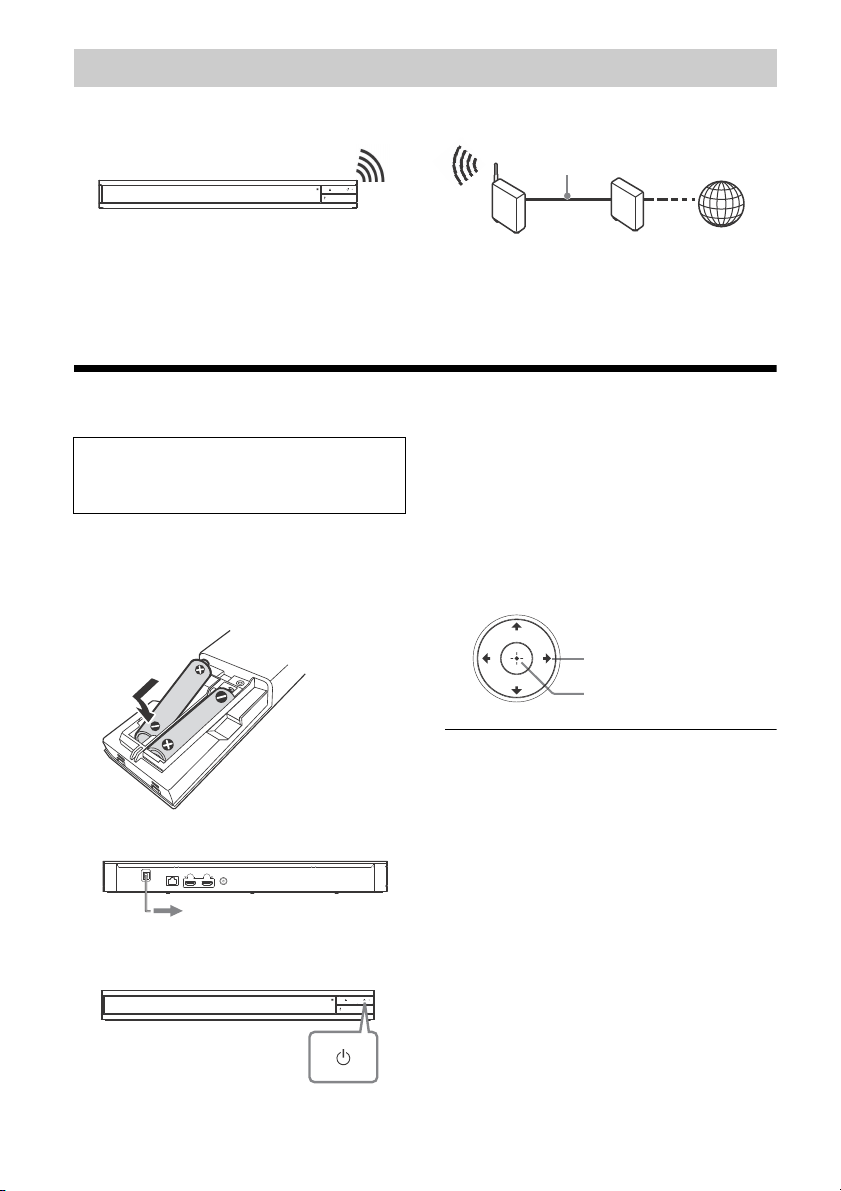
Non-4K Sound Bar/AV amplifier (receiver) without HDMI IN
Wired Setup
Coaxial digital cable
(not supplied)
HDMI Cable* (not supplied)
Video signals
Audio signals
To
HDMI OUT 1
jack
If selecting this connection method, set [HDMI Audio Output] in [System Settings] to [HDMI1] or
[Auto] (page 26).
ModemRouter Internet
LAN cable
(not supplied)
LAN cable
(not supplied)
14
No cable assembly required between the player and the wireless LAN router.
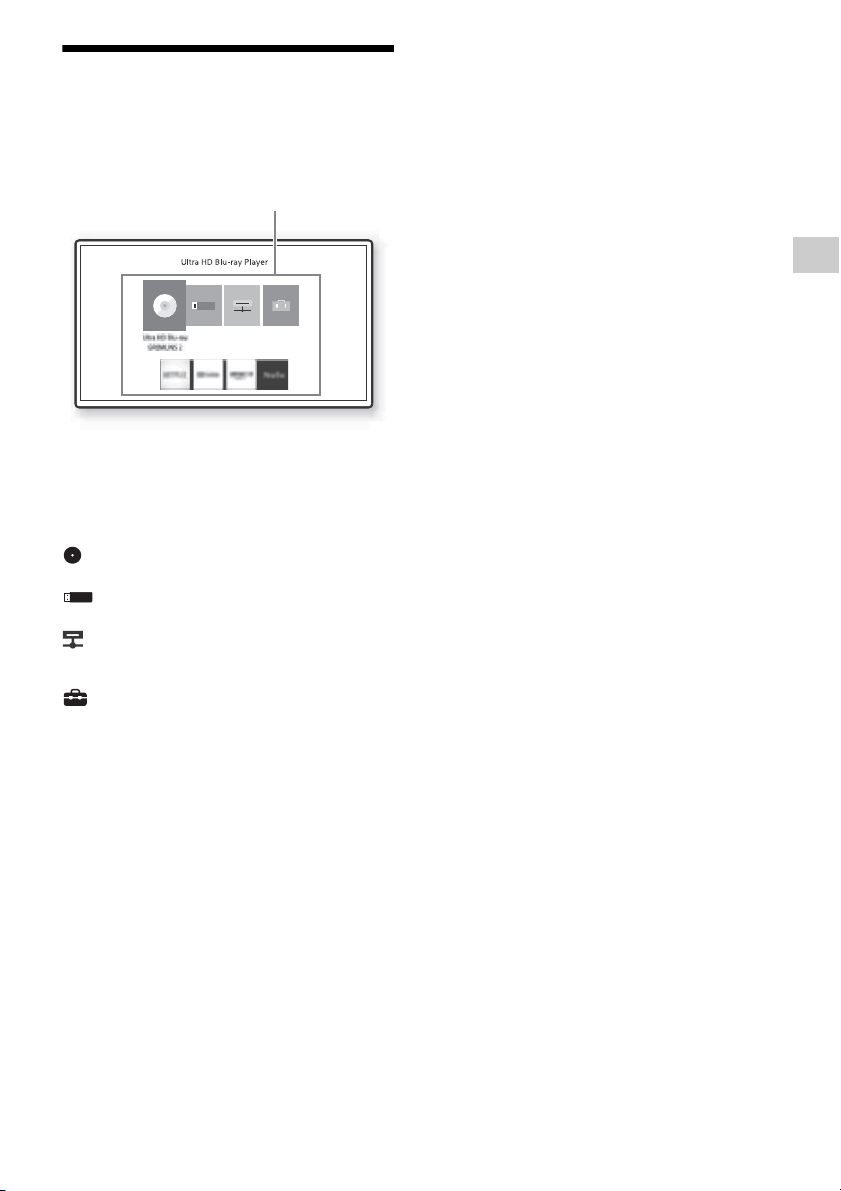
4: Easy Setup
1 Insert two size AAA (R03) batteries by
matching the + and – ends on the batteries
to the markings inside the battery
compartments of the remote.
2 Plug the player into the AC outlet.
3 Press to turn on the player. Power
indicator lights up.
4 Turn on the TV and press TV INPUT on the
remote to set the input selector. This will
show the signal from the player on your TV
screen.
5 Perform [Easy Setup].
Follow the on-screen instructions to make
the basic settings using /// and
press ENTER on the remote.
• When [Easy Setup] is complete, the player will
automatically find the available network.
• If there is no output or black screen appears,
refer to “Troubleshooting” (page 28).
Wireless Setup
Wireless LAN
Router
Modem Internet
LAN cable
(not supplied)
When turned on for the first time
Wait for a short while before the player
turns on and starts [Easy Setup].
to AC outlet
ENTER
///
15
Getting Started
Home screen display
The home screen appears when you press
HOME. Select an application using ///
, and press ENTER.
The following applications are displayed on
the home screen.
The network service application icons are
displayed in the lower part of the screen after
an internet connection is established.
(Disc):
Plays a disc.
[USB device]:
Plays content from a USB device (page 16).
[Media Server]:
Plays a file from a Home Network server via
the player (page 17).
[Setup]:
Adjusts the player’s settings (page 21).
Disc/USB device/Media Server/Network
Services can be registered to the FAVORITE
remote button as a favorite.
While selecting an application icon, you can
select [Register as Favorite] from the option
menu to register it.
If you register another item as a favorite, the
previous favorite will be replaced with the new
one.
Application
16
Playback
Playing a Disc
You can play Ultra HD Blu-ray discs, BDs,
DVDs and CDs. For “Playable discs”, see
page 35.
1 Press OPEN/CLOSE, and place a disc on
the disc tray.
Place the disc’s side with character or
image facing up.
For double-sided discs, place the side you
want to play facing down.
2 Press OPEN/CLOSE to close the disc
tray.
Playback starts.
If playback does not start automatically,
select the [Video], [Music], or [Photo]
category in (Disc), and press ENTER or
PLAY.
(Mixed disc) contains data contents. Press
OPTIONS on the remote and select [Data
Contents] to display any available contents.
Enjoying Blu-ray 3D
1 Prepare for Blu-ray 3D disc playback.
• Connect the player to your 3D-
compatible devices using a High Speed
HDMI Cable.
• Set [3D Output Setting] and [TV Screen
Size Setting for 3D] in [Screen Settings]
(page 23).
2 Insert a Blu-ray 3D disc.
The operation method differs depending
on the disc. Refer to the instruction
manual supplied with the disc.
Also refer to the instruction manuals supplied
with your TV and the connected device.
3D playback is not available when [Dolby Vision
Output] in [Screen Settings] is set to [On].
Enjoying 4K Ultra HD Blu-ray
1 Prepare for 4K Ultra HD Blu-ray playback.
• Connect the player to a TV that supports
4K 60p using a Premium High Speed
HDMI Cable that supports 18 Gbps
bandwidth (not supplied).
• If you are using BRAVIA TV, adjust the
TV’s “HDMI signal format” setting. For
details, refer to the TV’s instruction
manual.
2 Insert a 4K Ultra HD Blu-ray disc.
The operation method differs depending
on the disc. Refer to the instruction
manual supplied with the disc.
When playing a 4K Ultra HD Blu-ray disc with no
disc key, it may require network connection
depending on the network environment and
official key server (Studio).
Playing from a USB Device
For “Playable types of files”, see page 36.
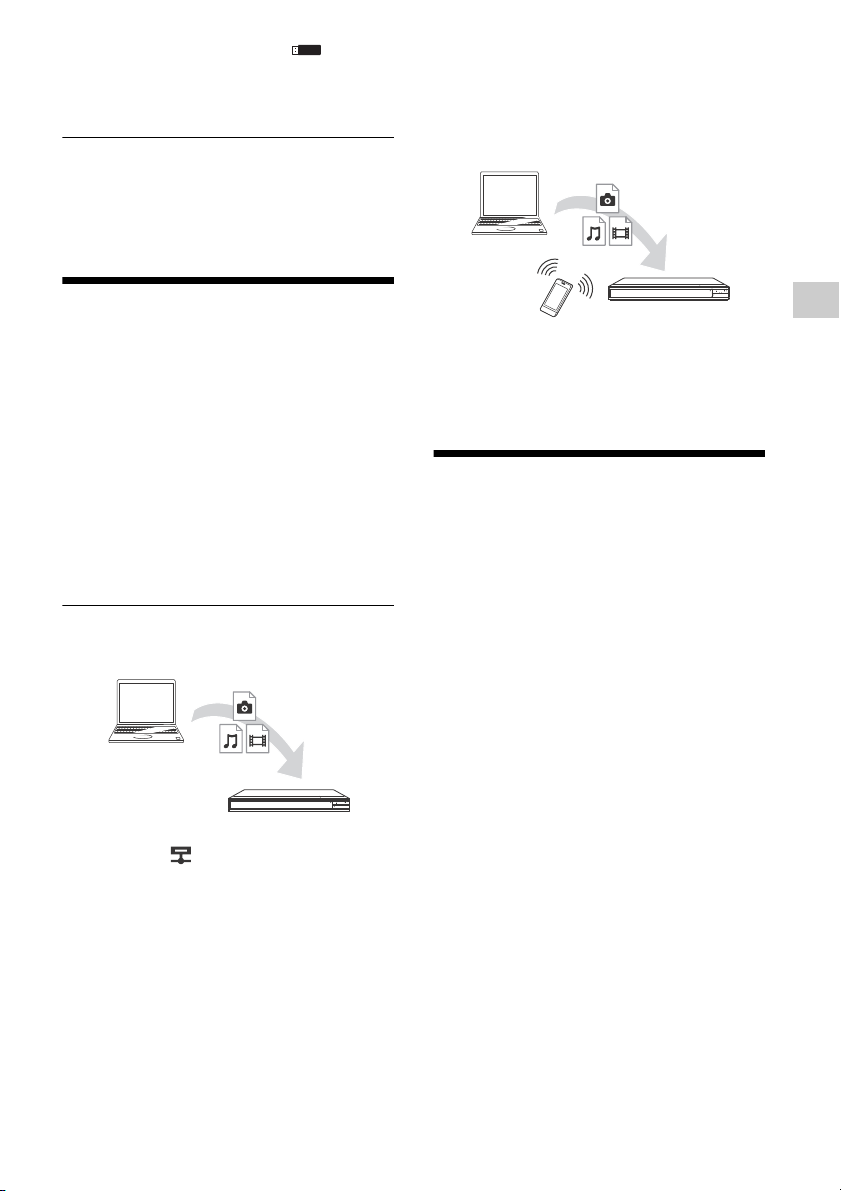
1 Open the USB jack cover.
2 Connect the USB device to the USB jack on
the player.
17
Playback
3 On the home screen, select [USB
device] using /, and press ENTER.
4 Select the [Video], [Music], or [Photo]
category using /, and press ENTER.
To avoid data corruption or damage to the USB
device, turn off the player when connecting or
removing the USB device.
Playing files on a Home
Network
A Home Network-compatible product can
play video/music/photo files stored on
another Home Network-compatible product
via a network.
Prepare to use Home Network.
1 Connect the player to a network (page 13).
2 Prepare the other necessary Home
Network-compatible products. Refer to
the instruction manual supplied with the
product.
To play a file from a Home Network server via
the player (Home Network player)
Select the [Video], [Music], or [Photo]
category from [Media Server] on the
home screen, then choose the file you want
to play.
To play a file from a Home Network server via
another product (Renderer)
When you play files from a Home Network
Server on the player, you can use a Home
Network Controller-compatible product (a
phone, etc.), to control playback.
Control the player using a Home Network
controller. Refer to the instruction manual
supplied with the Home Network controller.
Listening to Audio through a
BLUETOOTH® Device
Through a Bluetooth connection, you can
wirelessly transmit music from the player to a
Bluetooth device and listen to the music on
the device.
When connecting a device with the player for
the first time via a Bluetooth connection,
pairing* (device registration) is required.
Pair your Bluetooth device with the player
beforehand. Once Bluetooth devices are
paired, you do not need to pair them again.
You can pair up to nine Bluetooth devices
with the player. If a tenth device is paired, the
oldest paired or connected device will be
deleted.
* Pairing is the operation of registering
Bluetooth devices to each other before
connecting them.
This function is only supported with Bluetooth
speakers or Bluetooth headphones. You cannot
transmit music, etc. from a smartphone or
computer and listen to it on the player.
Server
Player
Server
Controller
Renderer

18
Example:
Connecting to a Bluetooth device
Set [Bluetooth Mode] in [Bluetooth Settings]
to [On] (page 24) before pairing a Bluetooth
device with this player.
1 Place the Bluetooth device within 1 meter
from the player.
2 Turn on your Bluetooth device and the
Bluetooth function of the device.
– If you are connecting the device with
the player for the first time, set the
device to the pairing mode.
– Refer to the instruction manual of your
Bluetooth device for details on the
pairing mode settings. Once Bluetooth
devices are paired, you do not need to
pair them again.
3 On the home screen, select [Setup]
using /, and press ENTER.
4 Select [Bluetooth Settings] - [Device List]
using / and ENTER.
The devices available for a Bluetooth
connection will be displayed.
5 Press / repeatedly to select the device
you want, and press ENTER.
When the Bluetooth connection is
established, the device name will appear
on the TV screen.
• While displaying the playback screen, you can
also display the device list by pressing
OPTIONS on the remote and selecting
[Bluetooth Device] (page 19).
• You can quickly reestablish a connection with
the last connected Bluetooth device using
BLUETOOTH on the remote.
After performing “Connecting to a Bluetooth
device” (page 18),
1 Start playback content.
2 Adjust the volume of the Bluetooth device
first. If the volume level is still low/high,
press OPTIONS on the remote during
playback screen and select [Bluetooth
Volume], then press / to adjust the
volume.
• The player cannot output sound to Bluetooth
devices that do not support SCMS-T content
protection.
• Certain content cannot be output to Bluetooth
devices due to copyright protection.
• Some Bluetooth device does not support
volume control.
• Do not use high volume from the start or for a
long period. Your ears and the audio device
may be damaged.
• Noise or sound skipping may occur depending
on the connected
Bluetooth device and the
circumstances.
Disconnecting the Bluetooth device
Perform any of the following steps:
– Press BLUETOOTH on the remote
(page 9).
– Disable the Bluetooth function on the
Bluetooth device.
– Turn off the player or the Bluetooth device.
Before you turn off your Bluetooth device, turn
down the volume level of your TV to avoid
sudden high volume outbursts.
Smartphone Player
Speaker
Headphone
or
Listening to Audio through a
Bluetooth device

19
Playback
You can enjoy audio playback from this
player via a Bluetooth device and HDMI
output simultaneously.
To set this function, perform any of the
following steps:
– Set [Bluetooth Output] in [Bluetooth
Settings] to [Bluetooth + HDMI].
– Press OPTIONS on the remote during any
playback and select [Bluetooth Output],
then select [Bluetooth + HDMI].
• Same audio content is output via Bluetooth
device and HDMI output.
• This feature cannot establish Surround system.
• HDMI audio format may be changed.
• Audio output timing between HDMI and
Bluetooth may not synchronize.
• If the Bluetooth speaker is far from the player,
in a different room, or separated by a wall,
Bluetooth connection will be unstable.
Available Options
Various settings and playback operations are
available by pressing OPTIONS. The available
items differ depending on the situation.
Common options
[Repeat Setting]
*1
: Sets the repeat mode.
[Play]/[Stop]: Starts or stops the playback.
[Play from beginning]: Plays the item
from the beginning.
[Bluetooth Output]
*2
: Switches between
audio output from Bluetooth device only or
from both Bluetooth device and HDMI
output during Bluetooth connection.
[Bluetooth Device]
*2
: Displays Bluetooth
device list.
[Bluetooth Volume]*
2
: Displays the
Bluetooth volume control view. This option
item is only available when the Bluetooth
device is connected.
[Accessibility]
*3*4
:
– [Screen Reader]
– [Enlarge]
– [Closed Captions] (For US customers
only)
*5
Video only
[3D Output Setting]*
6
: Sets whether or not
to output 3D video automatically.
[A/V SYNC]: Adjusts the gap between
picture and sound, by delaying the sound
output in relation to the picture output (0
to 120 milliseconds).
[Display Info Position]: Shifts the display
position of playback information to the
center of the screen.
[Subtitle Shift]: Shifts the display position
of Ultra HD Blu-ray/BD/DVD subtitles
upward or downward.
[HDR Conversion]
*7
: Converts High
Dynamic Range (HDR) signal to Standard
Dynamic Range (SDR) signal when the
player is connected to a TV or a Projector
that does not support HDR input. A picture
is more similar to HDR when larger value is
selected, but lowers overall brightness.
[Video Settings]
*6*8
:
– [Picture Quality Mode]: Selects the
picture settings for different lighting
environments.
[Direct]
[Brighter Room]
*9
[Theater Room]
*9
[Auto]: Noise reduction (NR) mode
control depends on media and
contents.
[Custom1]/[Custom2]
[FNR]: Reduces the random noise
appearing in the picture.
[BNR]: Reduces the mosaic-like block
noise in the picture.
[MNR]: Reduces minor noise around
the picture outlines (mosquito noise).
[Contrast]
[Brightness]
[Color]
[Hue]
[Pause]: Pauses the playback.
[Title Search]: Searches for a title on Ultra
HD Blu-ray/BD/DVD VIDEO and starts
playback from the beginning.
[Chapter Search]: Searches for a chapter
and starts playback from the beginning.
Listening to Audio through a
Bluetooth device and HDMI output

20
Video and Music Only
[Top Menu]: Displays the Ultra HD Blu-ray/
BD/DVD’s Top Menu.
[Menu]/[Popup Menu]: Displays the Ultra
HD Blu-ray/BD’s Pop-up Menu or DVD’s
menu.
[Audio]: Switches the language track when
multilingual tracks are recorded on Ultra
HD Blu-ray/BD/DVD. Selects the sound
track on CDs.
[Subtitle]: Switches the subtitle language
when multilingual subtitles are recorded
on Ultra HD Blu-ray/BD/DVD.
[Closed Captions] (For US customers
only): Selects closed caption format when
available.
[Angle]: Switches to other viewing angles
when multi-angles are recorded on Ultra
HD Blu-ray/BD/DVD.
[Number Entry]: Selects the number by
using /// key on the remote.
Music only
[Track Search]: Searches the track number
during music CD playback.
[Add Slideshow BGM]: Registers music
files in the USB memory as slideshow
background music (BGM).
[Shuffle Setting]: Set to [On] to playback
music files in randomized order.
[Group Search]: Searches for the group
number during DVD AUDIO playback.
Photo only
[Slideshow Speed]: Changes the
slideshow speed.
[Slideshow Effect]: Sets the effect for
slideshows.
[Slideshow BGM]
*10
:
– [Off]: Turns off the function.
– [My Music from USB]: Sets the music files
registered in [Add Slideshow BGM].
– [Play from Music CD]: Sets the tracks in
CD-DAs.
[2D Playback]
*11
: Sets playback to 2D
image.
[Change Display]: Switches between [Grid
View] and [List View].
[View Image]: Displays the selected
photo.
[Slideshow]: Plays a slideshow.
[Rotate Left]: Rotates the photo
counterclockwise by 90 degrees.
[Rotate Right]: Rotates the photo
clockwise by 90 degrees.
*1
[Repeat Setting] is not available during BDJ
titles playback or HDMV interactive title.
*2
[Bluetooth Output], [Bluetooth Device] and
[Bluetooth Volume] are not available during
Home Network photo playback.
*3
[Accessibility] is only available when
[Accessibility Shortcut] in [Accessibility
Settings] is set to [On].
*4
[Accessibility] is not available during photo or
music playback.
*5
[Closed Captions] is only available during
video playback.
*6
Not available when [Dolby Vision Output] in
[Screen Settings] is set to [On].
*7
[HDR Conversion] is only available during HDR
video playback, when your display device is
not compatible with HDR display, or when
[HDR Output] in [Screen Settings] is set to
[Off].
*8
[Video Settings] output may not be
significantly observed with normal eyes.
*9
[Brighter Room] and [Theater Room] are not
available during HDR video playback.
*10
[Slideshow BGM] is not available during Home
Network photo playback.
*11
[2D Playback] is only available during 3D
photo playback.
21
Settings and Adjustments
Settings and Adjustments
Using the Settings Displays
Select [Setup] on the home screen when
you need to change the settings of the
player.
The default settings are underlined.
1 On the home screen, select [Setup]
using /, and press ENTER.
2 Select the setup category icon using /,
and press ENTER.
[Update via Internet]
Updates the player’s software using available
network. Make sure that the network is
connected to the Internet. See “3: Network
Connection” (page 13).
• If an update notification screen appears when
you turn the power on while this player is
connected to the Internet, follow the on-
screen instructions to update it.
[Update via USB Memory]
Updates the player’s software using USB
memory. Create a folder named “UPDATE”
and all the update files must be stored in this
folder. The player can recognize up to
500 files/folders in a single layer including
the update files/folders.
• We recommend performing the software
update every 2 months or so.
• If your network condition is poor, visit
http://www.sony.com/bluraysupport/ to
download the latest software version and
update via USB memory.
You can also get information about update
functions from the website.
• Make sure to operate the player using the
supplied remote when updating.
[Screen Reader Settings]
[Screen Reader]
[On]: Turns on the function.
[Off]
: Turns off the function.
[Speech Rate]
[Very Fast] / [Fast] / [Normal]
/ [Slow] / [Very
Slow]: Sets the reading speed.
[Speech Volume]
[High] / [Medium]
/ [Low]: Sets the reading
volume.
[Prioritize Speech Audio]
[On]: Lowers the background sound volume
when the sound overlaps with the read-out
speech or the auditory signal.
[Off]
: Turns off the function.
[Speech Verbosity]
[High]: Read-out in detailed style.
[Low]
: Read-out in simplified style.
This setting works with Netflix service only.
[Enlarge]
[On]: Text is displayed in large size.
[Off]
: Text is displayed in normal size.
[Auto-Scroll Speed]
[Fast] / [Normal]
/ [Slow] / [Very Slow]: Sets
the speed of automatic text scrolling.
[Accessibility Shortcut]
[On]: Turns on the shortcut in options
window.
[Off]
: Turns off the shortcut.
[BRAVIA Mode]
[On]
: Sets [Dolby Vision Output], [4K Upscale
Setting], and [Video Settings] to the mode
optimized for BRAVIA.
[Off]: Turns off the function.
[Software Update]
[Accessibility Settings]
[Screen Settings]

22
[HDR Output]
[Auto]
: Outputs HDR signal depending on
contents and HDMI-SINK capability.
Conversion function is applied when content
is HDR and HDMI-SINK does not support HDR.
[Off]: Always output SDR.
[Dolby Vision Output]
[On]: Output 4K/Dolby Vision signals via 4K/
Dolby Vision-compatible devices.
[
Off]: Automatically outputs HDR signals
when you connect any 4K/HDR or 4K/Dolby
Vision-compatible equipment.
When [On] is selected, 3D playback is not
available.
[Display Type]
[TV]
: Select this when the player is connected
to TV.
[Projector]: Select this when the player is
connected to Projector.
[HDR Conversion] will be adjusted according to
the display type you select. Even though same
setting value of [HDR Conversion] is selected,
dynamic range of picture is different.
[Output Video Resolution]
Normally select [Auto].
[24p Output]
Outputs 24p video signals only when you
connect a 24p-compatible TV via an HDMI
connection and the [Output Video
Resolution] is set to [Auto], [1080p] or [4K].
[Ultra HD Blu-ray/BD-ROM]
[Auto]
: Outputs 24 Hz video signals only
when you connect a 24p-compatible TV using
the HDMI OUT jack.
[On]: Turns on the function.
[Off]: Select this when your TV is not
compatible with 24p video signals.
[DVD-ROM]
[Auto]: Outputs 24 Hz video signals only
when you connect a 24p-compatible TV using
the HDMI OUT jack.
[
Off]: Select this when your TV is not
compatible with 24p video signals.
[Data content]
This function is available for playback
contents stored in USB memory or data disc.
[Auto]
: Outputs 24 Hz video signals only
when you connect a 24p-compatible TV using
the HDMI OUT jack.
[Off]: Select this when your TV is not
compatible with 24p video signals.
[Network content]
This function is available for playback
contents from other network, such as Home
Network, etc.
[Auto]: Outputs 24 Hz video signals only
when you connect a 24p-compatible TV using
the HDMI OUT jack.
[
Off]: Select this when your TV is not
compatible with 24p video signals.
[4K Upscale Setting]
[Auto1
]: When playing back video other than
4K, outputs 2K (1920 × 1080) video signals if
connected to Sony 4K-compatible
equipment, and outputs 4K video signals if
connected to non-Sony 4K-compatible
equipment.
The signals are upconverted to 4K video
signals by the equipment.
[Auto2]: Automatically outputs 4K video
signals when you connect 4K-compatible
equipment.
[Off]: Turns off the function.
• If your Sony equipment is not detected when
[Auto1] is selected, the setting will have the
same effect as the [Auto2] setting.
• When playing back photos or playing back
video through network services, the same
effect as the [Auto2] setting is applied
regardless of this setting.
• During 3D playback of 3D video, the same
effect as the [Off] setting is applied regardless
of this setting.
• Depending on the connected equipment and
combination with other settings, the display
may not match this setting.
[YCbCr/RGB (HDMI)]
[Auto
]: Automatically detects the connected
TV type, and switches to the matching color
setting.
[YCbCr (4:2:2)]: Outputs YCbCr 4:2:2 video
signals.
[YCbCr (4:4:4)]: Outputs YCbCr 4:4:4 video
signals.
[RGB]: Outputs RGB video signals.
23
Settings and Adjustments
Not available when [Dolby Vision Output] is set
to [On].
[HDMI Deep Color Output]
[Auto]
: Outputs 12bit/10bit video signals
when the connected TV is compatible with
Deep Color.
[Off]: Select this when the picture is unstable
or colors appear unnatural.
Not available when [Dolby Vision Output] is set
to [On].
[IP Content NR]
[Auto]
/ [Strong] / [Medium] / [Mild]: Adjust
the picture quality for Internet content.
[Off]: Turns off the function.
[3D Output Setting]
[Auto]
: Normally select this.
[Off]: Select this to display all content in 2D or
to enjoy 4K output using 3D content.
Not available when [Dolby Vision Output] is set
to [On].
[TV Screen Size Setting for 3D]
Sets the screen size of your 3D-compatible
TV.
Not available when [Dolby Vision Output] is set
to [On].
[TV Type]
[16:9]
: Select this when connecting to a wide-
screen TV or a TV with a wide mode function.
[4:3]: Select this when connecting to a 4:3
screen TV without a wide mode function.
[Screen Format]
[Full]: Select this when connecting to a TV
with a wide mode function. Displays a 4:3
screen picture in 16:9 aspect ratio even on a
wide-screen TV.
[Normal]
: Changes the picture size to fit the
screen size with the original picture aspect
ratio.
[DVD Aspect Ratio]
[Letter Box]
: Displays a wide picture with
black bands on the top and bottom.
[Pan & Scan]: Displays a full-height picture on
the entire screen, with trimmed sides.
[Cinema Conversion Mode]
[Auto]
: Normally select this. The player
automatically detects whether the material is
video-based or film-based, and switches to
the appropriate conversion method.
[Video]: The conversion method suited for
video-based material will always be selected
regardless of the material.
[Pause Mode]
[Auto]
: Normally select this. Dynamic moving
pictures appear without blurring.
[Frame]: Displays static pictures at high
resolution.
[Digital Audio Output]
[Auto]
: Normally select this. Outputs audio
signals according to the status of the
connected devices.
[PCM]: Outputs PCM signals from the
DIGITAL
OUT (COAXIAL)/
HDMI OUT jack. Select this if
there is no output from the connected device.
This function is disabled during connection with
a Bluetooth device. Audio format may be
changed during Bluetooth connection.
[DSD Output Mode]
[Auto]: Outputs DSD signal from HDMI OUT
jack when playing Super Audio CD & DSD
format file (if the connected device also
supports DSD).
Outputs LPCM signal from HDMI OUT jack
when playing Super Audio CD & DSD format
file (if the connected device does not support
DSD).
[Off]
: Outputs PCM signals from HDMI OUT
jack when playing Super Audio CD and DSD
format file.
This function is disabled during connection with
a Bluetooth device. Audio format may be
changed during Bluetooth connection.
[Audio Settings]

24
[BD Secondary Audio]
[On]: Outputs the audio obtained by mixing
the interactive and secondary audio to the
primary audio.
[Off]
: Outputs the primary audio only. Select
this to output Bitstream (Dolby/DTS) signals
to a Sound Bar/AV amplifier (receiver).
To enjoy Bitstream (Dolby/DTS) signals, set [BD
Secondary Audio] to [Off] and [Digital Audio
Output] to [Auto].
[DTS Neo:6]
[Cinema]/[Music]: Outputs the simulated
multi-channel sound from 2 channel sources
via the HDMI OUT jack according to the
capability of the connected device using
[Cinema]/[Music] mode.
[Off]
: Outputs the sound with its original
number of channels via the HDMI OUT jack.
When [DTS Neo:6] is set to [Cinema] or [Music],
[DSEE HX] cannot be set to [On].
[48kHz/96kHz/192kHz PCM]
[48kHz]
/[96kHz]/[192kHz]: Sets the sampling
frequency for the PCM signals output from
the DIGITAL OUT (COAXIAL) jack.
Some device does not support [96kHz] and
[192kHz] sampling frequency.
[DSEE HX]
[On]: Upscales the audio file to a High-
Resolution Audio file and reproduces the
clear high-range sound which is often lost.
[Off]
: Turns off the function.
Source must be 2ch and 44.1/48 kHz.
[Audio DRC]
[Auto]
: Performs playback at the dynamic
range specified by the disc (BD-ROM only).
Other discs are played back at the [On] level.
[On]: Performs playback at a standard
compression level.
[Off]: No compression works. A more
dynamic sound is produced.
[Downmix]
[Surround]: Outputs audio signals with
surround effects. Select this when connecting
an audio device that supports Dolby
Surround (Pro Logic) or DTS Neo:6.
[Stereo]
: Outputs audio signals without
surround effects. Select this when
connecting an audio device that does not
support Dolby Surround (Pro Logic) or DTS
Neo:6.
For “Listening to Audio through a
BLUETOOTH® Device”, see page 17.
[Bluetooth Mode]
[On]
: Enables Bluetooth settings and
functions.
[Off]: Disables Bluetooth settings and
functions.
[Device List]
Displays a list of paired and detected
Bluetooth receivers when [Bluetooth Mode]
is set to [On].
[Bluetooth Codec - AAC] / [Bluetooth
Codec - LDAC]
This function is enabled when [Bluetooth
Mode] is set to [On].
[On]
: Enables AAC/LDAC codec.
[Off]: Disables AAC/LDAC codec.
This function is disabled during connection with
a Bluetooth device.
LDAC is an audio coding technology developed
by Sony that enables the transmission of High-
Resolution (Hi-Res) Audio content, even over a
Bluetooth connection. Unlike other Bluetooth
compatible coding technologies such as SBC, it
operates without any down-conversion of the
Hi-Res Audio content*, and allows
approximately three times more data** than
those other technologies to be transmitted over
a Bluetooth wireless network with
unprecedented sound quality, by means of
efficient coding and optimized packetization.
* Excluding DSD format contents.
** In comparison with SBC (Subband Coding)
when the bitrate of 990 kbps (96/48 kHz) or
909 kbps (88.2/44.1 kHz) is selected.
[Bluetooth Settings]
25
Settings and Adjustments
[Wireless Playback Quality]
This function is enabled when [Bluetooth
Mode] and [Bluetooth Codec - LDAC] is set to
[On]. If video streaming via Wi-Fi is unstable,
please select [Connection] in below setting
and Wi-Fi connection will be stable.
[Auto]: Sets the transmission data rate for
LDAC automatically.
[Sound Quality]: The highest data rate is
used. It is recommended for listening to
music, but audio playback may become
unstable if the link quality is not sufficient.
[Standard]
: A medium data rate is used. This
provides a balance between sound quality
and playback stability.
[Connection]: Stability is prioritized. The
sound quality may be reasonable and the
connection status will most likely be stable.
[Bluetooth Output] (page 19)
[Bluetooth]
: Outputs audio from Bluetooth
device.
[Bluetooth + HDMI]: Outputs audio from both
Bluetooth device and HDMI output.
[BD/DVD Menu Language]
Selects the default menu language for Ultra
HD Blu-ray/BD/DVD VIDEO.
Select [Select Language Code], and enter the
code for your language, referring to
“Language code list” (page 40).
[Audio Language]
Selects the default audio language for Ultra
HD Blu-ray/BD/DVD VIDEO.
When you select [Original], the language
given priority in the disc is selected.
Select [Select Language Code], and enter the
code for your language, referring to
“Language code list” (page 40).
[Subtitle Language]
Selects the default subtitle language for Ultra
HD Blu-ray/BD/DVD VIDEO.
Select [Select Language Code], and enter the
code for your language, referring to
“Language code list” (page 40).
[BD Hybrid Disc Playback Layer]
[BD]
: Plays BD layer.
[DVD/CD]: Plays DVD or CD layer.
[BD Internet Connection]
[Allow]: Allows Internet connection from BD
contents.
[Do not allow]
: Prohibits Internet connection
from BD contents.
[Delete BD Data]
Deletes data in the USB memory.
All data stored in the buda folder will be
erased.
[DVD-Audio Playback]
[DVD-Audio]
: Plays DVD AUDIO content.
[DVD-Video]: Plays DVD VIDEO content only.
[Password]
Sets or changes the password for the
Parental Control function. A password allows
you to set a restriction on Ultra HD Blu-ray/
BD/DVD VIDEO and Internet video playback.
If necessary, you can differentiate the
restriction levels for Ultra HD Blu-ray/BD/DVD
VIDEO and Internet video.
[Parental Control Area Code]
Playback of some Ultra HD Blu-ray/BD/DVD
VIDEO or Internet video can be limited
according to the geographic area. Scenes
may be blocked or replaced with different
scenes. Follow the on-screen instructions and
enter your four-digit password.
[BD Parental Control] /
[DVD Parental Control]/
[Internet Video Parental Control]
By setting Parental Control, scenes can be
blocked or replaced with different scenes.
Follow the on-screen instructions and enter
your four-digit password.
[Internet Video Unrated]
[Allow]
: Allows the playback of unrated
Internet videos.
[Block]: Blocks the playback of unrated
Internet videos.
[BD/DVD Viewing Settings]
[Parental Control Settings]

26
[Super Audio CD Playback Layer]
[Super Audio CD]
: Plays the Super Audio CD
layer.
[CD]: Plays the CD layer.
[Super Audio CD Playback Channel]
[DSD 2ch]: Plays the 2ch area.
[DSD Multi]
: Plays the multi-channel area.
[OSD Language]
Selects on-screen display language for your
player.
[Closed Caption Settings] (For US
customers only)
Customizes the format of Closed Caption
displayed.
Select [Original] in [Text Settings] setting to
disable.
[HDMI Settings]
By connecting Sony components that are
compatible with HDMI functions with a High
Speed HDMI Cable, operation is simplified.
[Control for HDMI]
[On]
: The following BRAVIA Sync features are
available:
– One-Touch Play
–System Power-Off
– Language Follow
[Off]: Turns off the function.
For details, refer to the instruction manual
supplied with the TV or components. To enable
the BRAVIA Sync features, connect your TV via
the HDMI OUT 1 jack.
[Linked to TV-off]
[Valid]
: Automatically turns off the player
when the connected TV enters standby mode
(BRAVIA Sync).
[Invalid]: Turns off the function.
[HDMI Audio Output]
[Auto]
: Outputs audio signal via HDMI OUT 2
jack if it is connected to a device and the
device is turned on. Otherwise, outputs audio
signal via HDMI OUT 1 jack.
[HDMI1]: Outputs audio signal via HDMI OUT 1
jack.
[HDMI2]: Outputs audio signal via HDMI OUT
2 jack.
[Quick Start Mode]
[On]: Shortens the startup time when turning
on the player.
[Off]
: Reduces standby power consumption.
[Auto Display]
[On]
: Automatically displays information on
the screen when changing the viewing titles,
picture modes, audio signals, etc.
[Off]: Displays information only when you
press DISPLAY.
[Software Update Notification]
[On]
: Sets the player to inform you of newer
software version information (page 21).
[Off]: Turns off the function.
[Device Name]
Displays the player’s name. The player’s
name can be changed.
[System Information]
Displays the player’s software version
information and the MAC address.
[Software License Information]
Displays information about the Software
License.
[Internet Settings]
Connect the player to the network
beforehand. For details, see “3: Network
Connection” (page 13).
[Wired Setup]: Select this when you connect
to a router using a LAN cable.
[Wireless Setup]
: Select this when you use
the wireless LAN that is built into the player
for wireless network connection.
For further details, visit the following website
and check the FAQ contents:
http://www.sony.com/bluraysupport/
[Music Settings]
[System Settings]
[Network Settings]
27
Settings and Adjustments
[Network Connection Status]
Displays the current network status.
[Network Connection Diagnostics]
Checks for the proper network connection by
running the network diagnostics.
[Connection Server Settings]
Sets whether or not to display the connected
server.
[Auto Home Network Access Permission]
[On]
: Allows automatic access from newly
detected Home Network controller-
compatible product.
[Off]: Turns off the function.
[Home Network Access Control]
Displays a list of Home Network controller-
compatible products and sets whether or not
to accept commands from the controllers in
the list.
[Remote Start]
[On]: Allows you to turn on the player by a
device linked via a network.
[Off]
: Turns off the function.
See “4: Easy Setup” (page 14).
[Reset to Factory Default Settings]
Resets the player settings to the factory
default by selecting the group of settings. All
the settings within the group will be reset.
[Initialize Personal Information]
Erases your personal information stored in
the player.
If you dispose, transfer or resell the player,
please delete all Personal Information for
security purposes. Please take the appropriate
measures such as logging out after using a
network service.
[Easy Setup]
[Resetting]

28
Additional Information
Troubleshooting
If a problem occurs while operating the
player, use this troubleshooting guide to help
remedy the problem before requesting
repairs. If the problem persists, consult your
nearest Sony dealer.
The player does not turn on even when you
press on the remote or the player.
• Turn off the player and disconnect the AC
power cord (mains lead). Wait for more than
2 minutes, and then reconnect the AC
power cord (mains lead) and turn on the
player.
No picture or the picture is not output
correctly.
• Check that all the cables are securely
connected (page 11).
• Switch the input selector on your TV to
display the signal from the player.
• Reset the [Output Video Resolution] to the
lowest resolution by pressing STOP,
HOME, and then POP UP/MENU on the
remote.
• Try the following: Turn the player off and
on again. Turn the connected equipment
off and on again. Disconnect and then
reconnect the HDMI cable.
• The HDMI OUT jack is connected to a DVI
device that does not support copyright
protection technology.
• Check the [Output Video Resolution]
settings in [Screen Settings] (page 22).
• For Ultra HD Blu-ray/BD-ROM/DVD-ROM/
Data content/Network content, check the
[24p Output] settings in [Screen Settings]
(page 22).
• For 4K output, please make sure that the
player is connected to 4K display that
supports HDCP2.2 capable HDMI input
using Premium High Speed HDMI Cable or
High Speed HDMI Cable that supports
18 Gbps bandwidth (page 11).
4K Ultra HD video is not output.
• Check the following.
– Connect the player to a TV that
supports 4K 60p using a Premium High
Speed HDMI Cable that supports
18 Gbps bandwidth (not supplied).
– If you are using BRAVIA TV, adjust the
TV’s “HDMI signal format” setting.
For details, refer to the TV’s instruction
manual.
– Make sure that the playback content is
4K Ultra HD video.
The display language on the screen
switches automatically when connected to
the HDMI OUT jack.
• When [Control for HDMI] in [HDMI Settings]
is set to [On] (page 26), the display
language on the screen automatically
switches according to the language setting
of the connected TV (if you change the
setting on your TV, etc.).
No sound or the sound is not output
correctly.
• Check that all the cables are securely
connected (page 11).
• Switch the input selector on your Sound
Bar/AV amplifier (receiver) so that the audio
signals of the player are output from your
Sound Bar/AV amplifier (receiver).
• If the audio signal does not come through
the
DIGITAL OUT (COAXIAL)/
HDMI OUT jack,
check the [Digital Audio Output] settings in
[Audio Settings] (page 23).
• For HDMI connections, try the following:
Turn the player off and on again. Turn
the connected equipment off and on again.
Disconnect and then reconnect the HDMI
cable.
• For HDMI connections, if the player is
connected to a TV through a Sound Bar/AV
amplifier (receiver), try connecting the
HDMI cable directly to the TV. Also refer to
the instruction manual supplied with the
Sound Bar/AV amplifier (receiver).
• The HDMI OUT jack is connected to a DVI
device (DVI jacks do not accept audio
signals).
• The device connected to the HDMI OUT jack
does not support the audio format of the
player. Check [Audio Settings] (page 23).
• Check the [HDMI Audio Output] settings in
[System Settings] (page 26).
Power
Picture
Sound

29
Additional Information
No sound is output from a Sound Bar/AV
amplifier connected to the HDMI OUT 2
jack.
• Even when you connect the player to a TV
through a Sound Bar/AV amplifier
(receiver), the input source may not switch
to the player depending on the settings.
Check the following.
– The HDMI cable is connected to the
HDMI OUT 2 jack on the player and the
HDMI input jack on the Sound Bar/AV
amplifier. Do not connect the cable to
the HDMI output jack on the Sound
bar/AV amplifier.
– The player is selected as the input
source on the Sound Bar/AV amplifier.
• If the problem persists after checking the
above, try the following.
– Set [Control for HDMI] in [System
Settings] to [Off]. When you set it to
[Off], the BRAVIA Sync features are
disabled
*1
.
– If the Sound Bar/AV amplifier is
connected to an ARC-compatible HDMI
input jack on your TV, remove the HDMI
cable from the jack. After you
disconnect the cable, the Sound Bar/
AV amplifier will no longer output
sound from the TV
*1
.
• When you connect the player to a Sound
Bar/AV amplifier via the HDMI OUT 2 jack,
make sure that [HDMI Audio Output] in
[System Settings] is set to [HDMI2] or [Auto]
(page 26).
The HD Audio (Dolby Digital Plus, Dolby
TrueHD, DTS-HD High Resolution Audio,
DTS-HD Master Audio, Dolby Atmos
*2
and
DTS:X
*3
) is not output by bitstream.
• Set [BD Secondary Audio] in [Audio
Settings] to [Off] (page 24).
• Check that the Sound Bar/AV amplifier
(receiver) is compatible with each HD Audio
format.
The interactive audio is not output.
• Set [BD Secondary Audio] in [Audio
Settings] to [On] (page 24).
Message Code 3 [Audio outputs
temporarily muted. Do not adjust the
playback volume. The content being played
is protected by Cinavia and is not
authorized for playback on this device. For
more information, see http://
www.cinavia.com. Message Code 3]
appears on the screen when playing a disc.
• The audio track of the video that you are
playing contains a Cinavia code indicating
that it is an unauthorized copy of
professionally-produced content (page 39).
*1
To output the sound, connect your TV and the
Sound Bar/AV amplifier using an optical
digital cable.
*2
Dolby Atmos is a trademark of Dolby
Laboratories.
*3
DTS:X is a registered trademark and/or
trademark of DTS, Inc. in the United States
and/or other countries.
The disc does not play.
• The disc is dirty or skewed.
• The disc is upside down. Insert the disc with
the playback side facing down.
• The disc has a format that cannot be played
back by this player (page 35).
• The player cannot play a recorded disc that
is not correctly finalized or the disc is not in
Mastered disc format.
• The region code on the BD/DVD does not
match the player.
The player does not detect a USB device
connected to the player.
• Make sure that the USB device is securely
connected to the USB jack.
• Check if the USB device or the USB cable is
damaged.
• Check if the USB device is turned on.
• If the USB device is connected via a USB
hub, connect the USB device directly to the
player.
Disc
USB device

30
The picture/sound is poor/certain
programs display a loss of detail, especially
during fast-motion or dark scenes.
• Picture/sound quality may be improved by
changing the connection speed.
Recommended connection speed is of at
least 2.5 Mbps for standard definition video,
10 Mbps for high definition video and at
least 25 Mbps for Ultra HD video (depending
on the service provider).
Internet streaming via Wi-Fi is unstable
when connected with Bluetooth device
using LDAC.
• Set [Wireless Playback Quality] in [Bluetooth
Settings] to [Connection] (page 24).
There is no options menu during Internet
streaming.
• Options menu is not available during
Internet streaming.
The player cannot connect to the network.
• Check the network connection (page 13)
and the network settings (page 26).
The PC cannot connect to the Internet after
[Wi-Fi Protected Setup™ (WPS)] is
performed.
• The wireless settings of the router may
change automatically if you use the Wi-Fi
Protected Setup function before adjusting
the settings of the router. In this case,
change the wireless settings of your PC
accordingly.
You cannot connect the player to the
wireless LAN router.
• Check if the wireless LAN router is on.
• Move the player and the wireless LAN router
closer to each other.
• Move the player away from devices that use
a 2.4 GHz frequency band such as a
microwave, Bluetooth or digital cordless
device, or turn off such devices.
The desired wireless router do not appear
in the wireless network list.
• Press RETURN to return to the previous
screen, and try wireless setup again. If the
desired wireless router is still not detected,
select [New connection registration] to
perform [Manual registration].
The message [A new software version is
available. Please go to the “Setup” section
of the menu and select “Software Update”
to perform the update.] appears on the
screen when turning the player on.
• See [Software Update] (page 21) to update
the player to a newer software version.
Bluetooth connection cannot be done/
completed.
• Set [Bluetooth Mode] to [On] (page 24).
• Make sure the Bluetooth device is turned on
and the Bluetooth function is enabled.
• Move the Bluetooth device closer to the
player.
• Connect the player and the Bluetooth
device again. You may need to cancel the
connection with the player using your
Bluetooth device first.
• Delete pairing information once from the
device list and connected device, before
retrying connection.
• Connection may not be possible if other
Bluetooth devices are present around the
player. In this case, turn off the other
Bluetooth devices.
• The connection registration information has
been erased. Perform the connection
operation again.
There is no sound, the sound skips or
fluctuates, or the connection is lost.
• DVD AUDIO cannot be played via Bluetooth
device due to DRM.
• Move the Bluetooth device closer to the
player.
• Make sure the player is not receiving any
interference from a Wi-Fi network, other
Bluetooth device, other 2.4 GHz wireless
device, or microwave oven.
• Check that the Bluetooth connection is
properly made between the player and the
Bluetooth device.
Internet streaming
Network connection
Bluetooth connection

31
Additional Information
• Connect the player and the Bluetooth
device again.
• Keep the player away from metal objects or
surfaces.
The [Control for HDMI] function does not
work (BRAVIA Sync).
• Check that your TV is connected via the
HDMI OUT 1 jack.
• Check that [Control for HDMI] in [HDMI
Settings] is set to [On] (page 26).
• If you change the HDMI connection, turn the
player off and on again.
• If power failure occurs, set [Control for
HDMI] in [HDMI Settings] to [Off], then set
[Control for HDMI] in [HDMI Settings] to [On]
(page 26).
• Check the following and refer to the
instruction manual supplied with the
component.
– the connected component is
compatible with the [Control for HDMI]
function.
– the connected component’s setting for
the [Control for HDMI] function is
correct.
• When you connect the player to a TV
through a Sound Bar/AV amplifier
(receiver),
– if the Sound Bar/AV amplifier (receiver)
is not compatible with the [Control for
HDMI] function, you may be unable to
control the TV from the player.
– if you change the HDMI connection,
disconnect and reconnect the AC
power cord, or a power failure occurs,
try the following: Switch the input
selector of the Sound Bar/AV amplifier
(receiver) so that the picture from the
player appears on the TV screen. Set
[Control for HDMI] in [HDMI Settings] to
[Off], then set [Control for HDMI] in
[HDMI Settings] to [On] (page 26). Refer
to the instruction manual supplied with
the Sound Bar/AV amplifier (receiver).
The System Power-Off function does not
work (BRAVIA Sync).
• Check that [Control for HDMI] and [Linked to
TV-off] in [HDMI Settings] are set to [On] and
[Valid] (page 26).
Playback does not start from the beginning
of content.
• Press OPTIONS, and select [Play from
beginning].
Playback does not start from the resume
point where you last stopped playing.
• The resume point may be cleared from
memory depending on the disc when
– you open the disc tray.
– you disconnect the USB device.
– you play other content.
– you turn off the player.
Message Code 1 [Playback stopped. The
content being played is protected by
Cinavia and is not authorized for playback
on this device. For more information, see
http://www.cinavia.com. Message Code 1]
appears on the screen when playing a disc.
• The audio track of the video that you are
playing contains a Cinavia code indicating it
was intended for presentation using
professional equipment only and is not
authorized for playback by consumers
(page 39).
The disc tray does not open and you cannot
remove the disc even after you press
OPEN/CLOSE.
• While the player is turned on, press STOP,
HOME, and then TOP MENU on the remote
to unlock the tray and disable the Child Lock
(page 10).
• Try the following: Turn the player off, and
disconnect the AC power cord.
Reconnect the AC power cord while
pressing down OPEN/CLOSE on the
player. Keep pressing down OPEN/
CLOSE on the player until the tray opens.
Remove the disc.
• The disc tray will not respond during
Internet streaming (e.g. Netflix) even after
you press OPEN/CLOSE.
The message [[EJECT] Key is currently
unavailable.] appears on the screen after
OPEN/CLOSE is pressed.
• Contact your nearest Sony dealer or local
authorized Sony service facility.
Control for HDMI (BRAVIA Sync)
Others

32
The player does not respond to any button.
• Moisture has condensed inside the player
(page 4).
About software update
• If your network condition is poor, visit
http://www.sony.com/bluraysupport/ to
download the latest software version and
update via USB memory. You can also get
information about update functions from
the website.
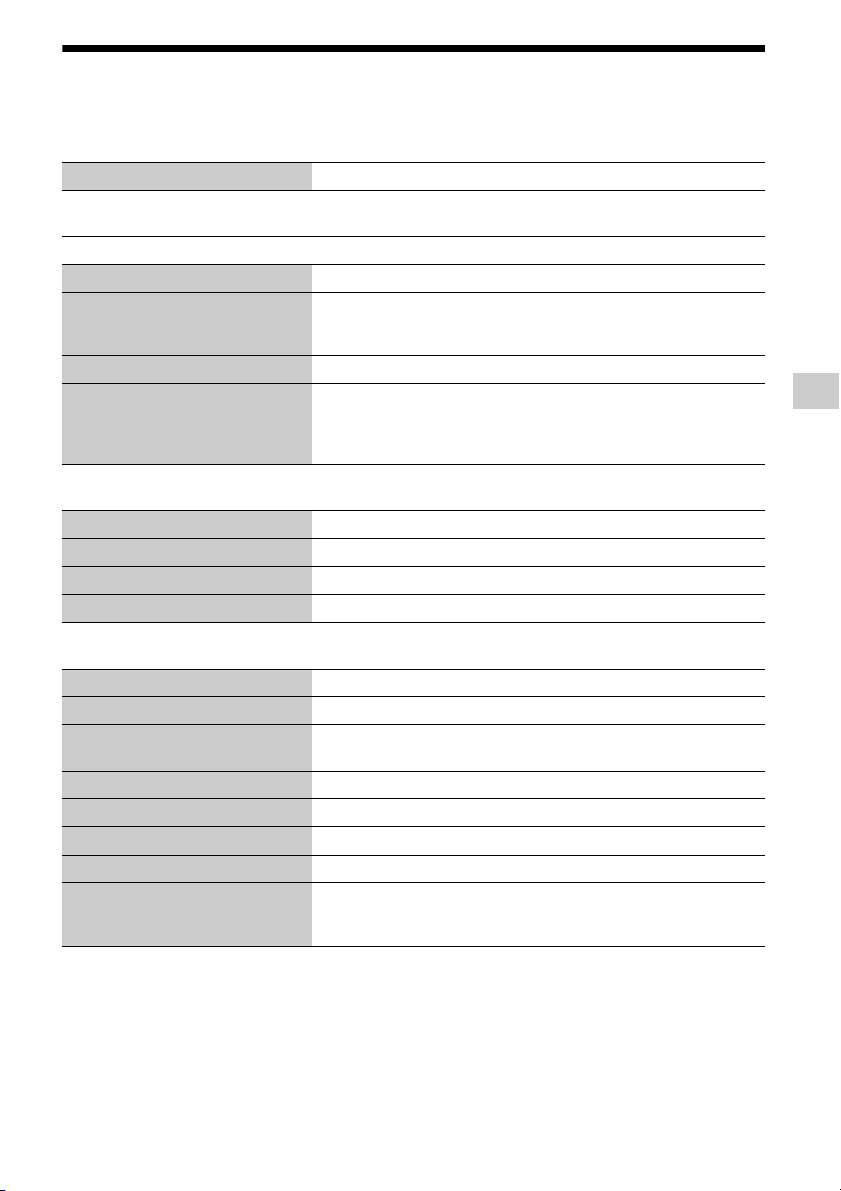
33
Additional Information
Specifications
Specifications and design are subject to change without notice.
System
Inputs and outputs
Wireless
Bluetooth
Laser Semiconductor laser
Jack name Jack type/Output level/Load impedance
DIGITAL OUT (COAXIAL) Phono jack /0.5 Vp-p/75 ohms
HDMI OUT 1*/2
HDMI 19-pin standard connector
* Only HDMI OUT 1 supports video output.
LAN (10/100) 10BASE-T/100BASE-TX Terminal
USB
USB jack Type A (For connecting a USB memory, memory
card reader, digital still camera, and digital video camera)*
* Do not use for power charging purposes.
Wireless LAN standard Protocol IEEE802.11a/b/g/n
Frequency range 2.4 GHz, 5 GHz band
Modulation DSSS and OFDM
Bluetooth Version Bluetooth Specification v4.1
Communication system Bluetooth Specification v4.1
Output Bluetooth Specification Power Class 1
Maximum communication
range
Line of sight approx. 30 m
Frequency band 2.4 GHz
Modulation method FHSS
Compatible Bluetooth Profiles A2DP v1.2, AVRCP v1.3
Supported Codecs SBC, AAC, LDAC
Transmission range (A2DP)
• 20 Hz - 40,000 Hz (LDAC in sampling 96 kHz and transmit
by 990 kbps)
• 20 Hz - 20,000 Hz (in sampling 44.1 kHz)

34
General
Power requirements Rating: Input 120 V AC, 60 Hz
Power consumption 15 W
Dimensions (approx.)
430 mm × 265 mm × 50 mm (17 in. × 10
1
/
2
in. × 2 in.)
(width × depth × height) incl. projecting parts
Mass (approx.) 3.8 kg (8 lb
2
/
5
oz)
Operating temperature 5 ºC to 35 ºC (41 ºF to 95 ºF)
Operating humidity 25 % to 80 %

35
Additional Information
Playable discs
*1
Since the Blu-ray Disc specifications are new
and evolving, some discs may not be playable
depending on the disc type and the version.
The audio output differs depending on the
source, connected output jack, and selected
audio settings.
*2
BD-RE: Ver.2.1, BD-R: Ver.1.1, 1.2, 1.3 including
organic pigment type BD-R (LTH type). The
BD-Rs recorded on a PC cannot be played if
postscripts are recordable.
*3
A CD or DVD disc will not play if it has not been
correctly finalized or the disc is not in
Mastered disc format. For more information,
refer to the instruction manual supplied with
the recording device.
*4
Some DVD AUDIO discs have hidden group
and need password entry. Refer to the disc for
the password.
Discs that cannot be played
• BDs with cartridge
•BDXLs
•DVD-RAMs
• HD DVDs
•PHOTO CDs
• Data part of CD-Extras
•Super VCDs
• Audio material side on DualDiscs
Note on Discs
This product is designed to playback discs
that conform to the Compact Disc (CD)
standard. DualDiscs and some of the music
discs encoded with copyright protection
technologies do not conform to the Compact
Disc (CD) standard, therefore, these discs
may not be playable by this product.
Note on playback operations of Ultra HD
Blu-ray/BD/DVD
Some playback operations of Ultra HD Blu-
ray/BD/DVD may be intentionally set by
software producers. Since this player plays
Ultra HD Blu-ray/BD/DVD according to the
disc contents the software producers
designed, some playback features may not
be available.
Note about double-layer Ultra HD Blu-ray/BD/
DVD and triple-layer Ultra HD Blu-ray
The playback pictures and sound may be
momentarily interrupted when the layers
switch.
Region code (BD/DVD VIDEO only)
Your player has a region code printed on the
rear of the unit and will only play BD/DVD
VIDEO labeled with identical region codes or
.
Blu-ray
Disc
*1
Ultra HD Blu-ray, BD-ROM,
BD-R
*2
/BD-RE
*2
DVD
*3
DVD-ROM, DVD-R/
DVD-RW, DVD+R/DVD+RW
DVD AUDIO
*4
CD
*3
CD-DA (Music CD),
CD-ROM, CD-R/CD-RW,
Super Audio CD
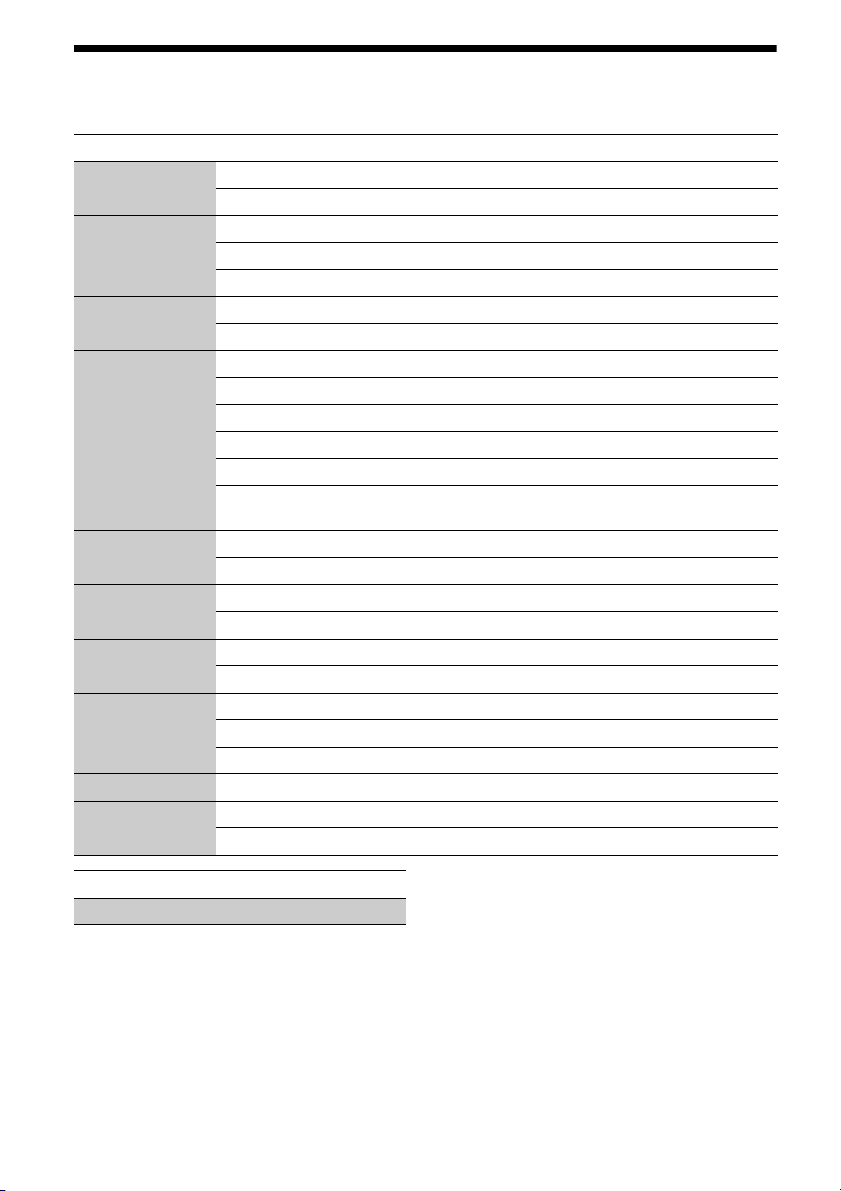
36
Playable types of files
Video
Codec Container Extension With Audio
MPEG-1 Video
*1
PS .mpg, .mpeg Dolby Digital, DTS, LPCM, MPEG
MKV .mkv Dolby Digital, LPCM, AAC, MP3, Vorbis
MPEG-2 Video
*2
PS
*3
.mpg, .mpeg Dolby Digital, DTS, LPCM, MPEG
TS
*4
.m2ts, .mts Dolby Digital, DTS, LPCM, MPEG, AAC
MKV
*1
.mkv Dolby Digital, LPCM, AAC, MP3, Vorbis
Xvid
AVI .avi Dolby Digital, LPCM, WMA9, MP3
MKV .mkv Dolby Digital, LPCM, AAC, MP3, Vorbis
MPEG4/AVC/
H.264
*5
MKV
*1
.mkv Dolby Digital, LPCM, AAC, MP3, Vorbis
MP4
*1
.mp4, .m4v AAC
TS
*1
.m2ts, .mts Dolby Digital, DTS, LPCM, MPEG, AAC
Quick Time
*6
.mov Dolby Digital, LPCM, AAC, MP3
FLV
*6
.flv, .f4v LPCM, AAC, MP3
3gpp/
3gpp2
*6
.3gp, .3g2,
.3gpp, .3gp2
AAC
VC1
*1
TS .m2ts, .mts Dolby Digital, DTS, LPCM, MPEG, AAC
MKV .mkv Dolby Digital, LPCM, AAC, MP3, Vorbis
WMV9
*1*7
ASF .wmv, .asf WMA9, WMA 10 Pro
MKV .mkv Dolby Digital, LPCM, AAC, MP3, Vorbis
Motion JPEG
*6
Quick Time .mov Dolby Digital, LPCM, AAC, MP3
AVI .avi Dolby Digital, LPCM, AAC, MP3
HEVC/H.265
MKV .mkv Dolby Digital, LPCM, AAC, MP3, Vorbis
MP4 .mp4, .m4v AAC
TS .m2ts, .mts Dolby Digital, DTS, LPCM, MPEG, AAC
VP6 FLV .flv MP3
VP8/VP9
Webm .webm Vorbis
MKV .mkv Dolby Digital, LPCM, AAC, MP3, Vorbis
Format
AVCHD (Ver.2.0)
*1*8*9*10
37
Additional Information
Music
Photo
*1
The player may not play this file format on a
Home Network server.
*2
The player can only play standard definition
video on a Home Network server.
*3
The player does not play DTS format files on a
Home Network server.
*4
The player can only play Dolby Digital format
files on a Home Network server.
*5
The player can support AVC up to Level 5.2.
*6
The player does not play this file format on a
Home Network server.
*7
The player can support WMV9 up to
Advanced Profile.
*8
The player can support frame rate up to
60 fps.
*9
The player plays AVCHD format files that are
recorded on a digital video camera, etc. The
AVCHD format disc will not play if it has not
been correctly finalized.
*10
The player can play AVCHD 3D format.
*11
The player can play “.mka” files.
This file cannot be played on a Home Network
server.
*12
The player does not play coded file such as
Lossless.
*13
The player does not play DST encoded files.
*14
The player does not play animated PNG or
animated GIF files.
*15
For MPO files other than 3D, the key image or
the first image is displayed.
*16
The player does not support 16bit BMP files.
The player supports HDR video formats such as
HDR10, HLG (Hybrid Log Gamma), and Dolby
Vision.
• Some files may not play depending on the file
format, file encoding, recording condition, or
Home Network server condition.
• Playable formats differ depending on the
connected device or network service.
For details, refer to the format information for
the connected device or content.
• Some files edited on a PC may not play.
• Some files may not be able to perform fast
forward or fast reverse function.
• The player does not play coded files such as
DRM.
• The player can recognise the following files or
folders in BDs, DVDs, CDs and USB devices:
– up to folders in the 9th layer, including the
root folder.
– up to 500 files/folders in a single layer.
• The player can recognise the following files or
folders stored in the Home Network server:
– up to folders in the 19th layer.
– up to 999 files/folders in a single layer.
• The player can support frame rate:
– up to 60 fps for AVCHD (MPEG4/AVC) only.
– up to 30 fps for other video codecs.
• The player can support video bit rate up to
40 Mbps.
• Some USB devices may not work with this
player.
• The player can recognise Mass Storage Class
(MSC) devices (such as flash memory or an
HDD), Still Image Capture Device (SICD) class
devices and 101 keyboard.
• The player may not play high bit rate video and
audio files on DATA CDs smoothly. It is
recommended to play such files using DATA
DVDs or DATA BDs.
Codec Extension
MP3 (MPEG-1 Audio Layer
III)
*11
.mp3
AAC/HE-AAC
*11
.m4a, .aac
*6
WMA9 Standard .wma
WMA 10 Pro
*12
.wma
LPCM
*11
.wav
FLAC
*1
.flac, .fla
Dolby Digital
*6*11
.ac3
DSF
*1
.dsf
DSDIFF
*1*13
.dff
AIFF
*1
.aiff, .aif
ALAC
*1
.m4a
Vorbis .ogg
Monkey’s Audio .ape
Format Extension
JPEG
.jpeg, .jpg,
.jpe
PNG .png
*14
GIF .gif
*14
MPO .mpo
*6*15
BMP .bmp
*6*15
WEBP .webp
*6

38
• Oracle and Java are registered trademarks of
Oracle and/or its affiliates. Other names may
be trademarks of their respective owners.
• Manufactured under license from Dolby
Laboratories. Dolby, Dolby Vision, Dolby Audio
and the double-D symbol are trademarks of
Dolby Laboratories.
• For DTS patents, see http://patents.dts.com.
Manufactured under license from DTS, Inc.
DTS, the Symbol, DTS and the Symbol
together, DTS-HD, and the DTS-HD logo are
registered trademarks and/or trademarks of
DTS, Inc. in the United States and/or other
countries. © DTS, Inc. All Rights Reserved.
• The terms HDMI™, HDMI High-Definition
Multimedia Interface, Premium High Speed
HDMI Cable, and the HDMI Logo are
trademarks or registered trademarks of HDMI
Licensing Administrator, Inc.
• Blu-ray Disc™, Blu-ray™, BD-Live™,
BONUSVIEW™, Ultra HD Blu-ray™ word marks
and logos are trademarks of the Blu-ray Disc
Association.
• Blu-ray 3D™ and Blu-ray 3D™ logo are
trademarks of the Blu-ray Disc Association.
• “DVD Logo” is a trademark of DVD Format/
Logo Licensing Corporation.
• “DVD+RW”, “DVD-RW”, “DVD+R”, “DVD-R”,
“DVD VIDEO”, “DVD AUDIO”, “Super Audio CD”
and “CD” logos are trademarks.
• “BRAVIA” is a trademark of Sony Corporation.
• MPEG Layer-3 audio coding technology and
patents licensed from Fraunhofer IIS and
Thomson.
• This product incorporates proprietary
technology under license from Verance
Corporation and is protected by U.S. Patent
7,369,677 and other U.S. and worldwide
patents issued and pending as well as
copyright and trade secret protection for
certain aspects of such technology. Cinavia is a
trademark of Verance Corporation. Copyright
2004-2010 Verance Corporation. All rights
reserved by Verance. Reverse engineering or
disassembly is prohibited.
• Windows Media is either a registered trademark
or trademark of Microsoft Corporation in the
United States and/or other countries.
This product is protected by certain intellectual
property rights of Microsoft Corporation. Use
or distribution of such technology outside of
this product is prohibited without a license
from Microsoft or an authorized Microsoft
subsidiary.
Content owners use Microsoft PlayReady™
content access technology to protect their
intellectual property, including copyrighted
content. This device uses PlayReady
technology to access PlayReady-protected
content and/or WMDRM-protected content. If
the device fails to properly enforce restrictions
on content usage, content owners may require
Microsoft to revoke the device’s ability to
consume PlayReady-protected content.
Revocation should not affect unprotected
content or content protected by other content
access technologies. Content owners may
require you to upgrade PlayReady to access
their content. If you decline an upgrade, you
will not be able to access content that requires
the upgrade.
•Vewd
® Core. Copyright 1995-2019 Vewd
Software AS. All rights reserved.
And right expression: This software is being
provided on an <<as is>> basis.
Vewd and its suppliers disclaim all warranties
regarding the software, either express or
implied, statutory or otherwise, including
without limitation warranties of functionality,
fitness for a particular purpose or
noninfringement.
• WPA™, WPA2™ and Wi-Fi Protected Setup™
are trademarks of Wi-Fi Alliance.
• The Wi-Fi CERTIFIED Logo is a certification
mark of Wi-Fi Alliance.
• The Bluetooth
® word mark and logos are
registered trademarks owned by Bluetooth
SIG, Inc. and any use of such marks by Sony
Corporation is under license. Other trademarks
and trade names are those of their respective
owners.
• LDAC™ and LDAC logo are trademarks of Sony
Corporation.
• “DSEE HX” is a trademark of Sony Corporation.
• All other trademarks are trademarks of their
respective owners.
• Other system and product names are generally
trademarks or registered trademarks of the
manufacturers. ™ and
® marks are not
indicated in this document.
Copyrights and Trademarks
39
Additional Information
Copy Protection
Please be advised of the advanced content
protection systems used in Ultra HD Blu-ray™,
Blu-ray Disc™ and DVD media. These systems,
called AACS (Advanced Access Content System)
and CSS (Content Scramble System), may
contain some restrictions on playback, analog
output, and other similar features. The operation
of this product and the restrictions placed may
vary depending on the date of purchase, as the
governing board of the AACS may adopt or
change its restriction rules after the time of
purchase.
Cinavia Notice
This product uses Cinavia technology to limit the
use of unauthorized copies of some
commercially-produced film and videos and
their soundtracks. When a prohibited use of an
unauthorized copy is detected, a message will
be displayed and playback or copying will be
interrupted.
More information about Cinavia technology is
provided at the Cinavia Online Consumer
Information Center at http://www.cinavia.com.
To request additional information about Cinavia
by mail, send a postcard with your mailing
address to: Cinavia Consumer Information
Center, P.O. Box 86851, San Diego, CA, 92138,
USA.
Software License Information
For EULA (End User License Agreement), please
refer to END USER LICENSE AGREEMENT sheet
supplied with this player.
USING YOUR PRODUCT INDICATES YOUR
ACCEPTANCE OF THIS AGREEMENT.
For details of the other software licenses, please
select [Setup] on the home screen and refer
to [Software License Information] in [System
Settings].
This product contains software that is subject to
the GNU General Public License (“GPL”) or GNU
Lesser General Public License (“LGPL”). These
licenses establish that customers have the right
to acquire, modify, and redistribute the source
code of said software in accordance with the
terms of the GPL or the LGPL.
The source code for the software used in this
product is subject to the GPL and LGPL, and is
available on the Web. To download, please visit
the following website:
http://oss.sony.net/Products/Linux
Please note that Sony cannot respond to any
inquiries regarding the content of this source
code.

40
Privacy Policy
For Privacy Policy, please refer to [Privacy Policy]
in the option menu on each network service
icon.
Network services, content and software of this
product may be subject to individual terms and
conditions and changed, interrupted or
discontinued at any time and may require fees,
registration and credit card information.
For details, see [BD/DVD Viewing Settings]
(page 25).
The language spellings conform to the ISO
639: 1988 (E/F) standard.
Language code list
Code Language
1027 Afar 1028 Abkhazian
1032 Afrikaans 1039 Amharic
1044 Arabic 1045 Assamese
1051 Aymara 1052 Azerbaijani
1053 Bashkir 1057 Byelorussian
1059 Bulgarian 1060 Bihari
1061 Bislama 1066 Bengali
1067 Tibetan 1070 Breton
1079 Catalan 1093 Corsican
1097 Czech 1103 Welsh
1105 Danish 1109 German
1130 Bhutani;
Dzongkha
1142 Greek
1144 English 1145 Esperanto
1149 Spanish 1150 Estonian
1151 Basque 1157 Persian
1165 Finnish 1166 Fiji
1171 Faroese 1174 French
1181 Frisian 1183 Irish
1186 Scots Gaelic 1194 Galician
1196 Guarani 1203 Gujarati
1209 Hausa 1217 Hindi
1226 Croatian 1229 Hungarian
1233 Armenian 1235 Interlingua
1239 Interlingue 1245 Inupiak
1248 Indonesian 1253 Icelandic
1254 Italian 1257 Hebrew
1261 Japanese 1269 Yiddish
1283 Javanese 1287 Georgian
1297 Kazakh 1298 Greenlandic;
Kalaallisut
1299 Cambodian;
Khmer
1300 Kannada
1301 Korean 1305 Kashmiri
1307 Kurdish 1311 Kirghiz
1313 Latin 1326 Lingala
1327 Laothian; Lao 1332 Lithuanian
1334 Latvian 1345 Malagasy
1347 Maori 1349 Macedonian
1350 Malayalam 1352 Mongolian
1353 Moldavian 1356 Marathi
1357 Malay 1358 Malese;
Maltese
1363 Burmese 1365 Nauru
1369 Nepali 1376 Dutch
1379 Norwegian 1393 Occitan
1403 Oromo 1408 Oriya
1417 Punjabi;
Panjabi
1428 Polish
1435 Pashto;
Pushto
1436 Portuguese
1463 Quechua 1481 Rhaeto-
Romance
1482 Kirundi; Rundi 1483 Romanian
1489 Russian 1491 Kinyarwanda
1495 Sanskrit 1498 Sindhi
1501 Sangho;
Sango
1502 Serbo-
Croatian
1503 Singhalese;
Sinhalese
1505 Slovak
1506 Slovenian 1507 Samoan
1508 Shona 1509 Somali
1511 Albanian 1512 Serbian
1513 Siswati; Swati 1514 Sesotho;
Sotho southern
1515 Sundanese 1516 Swedish
1517 Swahili 1521 Tamil
1525 Telugu 1527 Tajik
1528 Thai 1529 Tigrinya
1531 Turkmen 1532 Tagalog
1534 Setswana;
Tswana
1535 Tonga; Tonga
islands
1538 Turkish 1539 Tsonga
1540 Tatar 1543 Twi
1557 Ukrainian 1564 Urdu
1572 Uzbek 1581 Vietnamese
1587 Volapük 1613 Wolof
1632 Xhosa 1665 Yoruba
1684 Chinese 1697 Zulu
1703 Not specified
Code Language

41
Additional Information
For details, see [Parental Control Area Code]
(page 25).
Parental control/area code
Code Area
2044 Argentina 2047 Australia
2046 Austria 2057 Belgium
2070 Brazil 2090 Chile
2092 China 2093 Colombia
2115 Denmark 2165 Finland
2174 France 2109 Germany
2200 Greece 2219 Hong Kong
2248 India 2238 Indonesia
2239 Ireland 2254 Italy
2276 Japan 2304 Korea
2333 Luxembourg 2363 Malaysia
2362 Mexico 2376 Netherlands
2390 New Zealand 2379 Norway
2427 Pakistan 2424 Philippines
2428 Poland 2436 Portugal
2489 Russia 2501 Singapore
2149 Spain 2499 Sweden
2086 Switzerland 2543 Taiwan
2528 Thailand 2184 United
Kingdom
2586 Vietnam

42
Index
Numerics
[24p Output] 22
[3D Output Setting]
19, 23
[4K Upscale Setting]
22
A
[Audio] 20
[Audio Settings]
23
B
[BD/DVD Viewing
Settings]
25
BD-R/BD-RE
35
BD-ROM
35
[Bluetooth Settings]
24
[BRAVIA Mode]
21
BRAVIA Sync
26, 31
C
CD-DA 35
CD-R/CD-RW
35
CD-ROM
35
[Chapter Search]
19
Child Lock
10
[Control for HDMI]
26, 31
D
[Digital Audio Output] 23
[Dolby Vision Output]
22
[DSD Output Mode]
23
[DSEE HX]
24
DVD+R/DVD+RW
35
DVD-R/DVD-RW
35
DVD-ROM
35
F
Finalized 29, 35, 37
H
[HDMI Deep Color Output]
23
[HDR Conversion]
19
[HDR Output]
22
Home screen
15
I
[Internet Settings] 26
L
[Linked to TV-off] 26
M
MAC address 26
[Media Server]
15, 17
[Music Settings]
26
N
[Network Settings] 26
O
One-Touch Play 26
P
[Parental Control Settings]
25
Q
[Quick Start Mode] 26
R
Region code 35
Remote
9
[Repeat Setting]
19
[Resetting]
27
Resume point
10, 31
Router
13, 26
S
[Screen Settings] 21
[Setup]
15
[Shuffle Setting]
20
[Slideshow]
20
[Software Update]
21
[Subtitle]
10, 20
Super Audio CD
26, 35
System Power-Off
31
[System Settings]
26
T
[Title Search] 19
Top Menu
9, 20
[TV Screen Size Setting for
3D]
23
[TV Type]
23
U
Ultra HD Blu-ray 35
[USB device]
15, 16
V
[Video Settings] 19
W
Wireless LAN 7, 14
Y
[YCbCr/RGB (HDMI)] 22
I
n
d
ex
Index

43
http://www.sony.net/
© 2019 Sony Corporation Printed in Malaysia
4-740-822-11(1)
For Your Convenience
Software Updates
The software of this player may be updated in the future.
Please visit the following website:
http://www.sony.com/bluraysupport/
Before Inquiries
Please confirm the following details:
• Investigate with “Troubleshooting” (page 28) to help remedy the
problem.
• Turn off the player and disconnect the AC power cord. Wait for more than
2 minutes and then reconnect the AC power cord.
