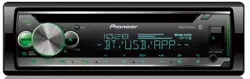
* When this unit’s blue/white lead is connected to the vehicle’s auto-antenna relay control terminal, the vehicle’s antenna extends when this unit’s source is turned on. To retract the antenna, turn the source off.
Display indication
Detaching the front panel
Detach the front panel to prevent theft. Remove any cables and devices attached to the front panel and turn off the unit before detaching it.
Preparing the remote control
Remove the insulation sheet before use.
Setting the clock (CLOCK SET)
When you turn the ignition switch to ON after installation, [SET UP :YES] appears in the display.
1. Press the M.C. dial.
The setup menu disappears after 30 seconds of no operation. If you prefer not to set at this time, turn the M.C. dial to select [NO], then press to confirm.
2. Turn the M.C. dial to adjust the hour, then press to confirm.
The indicator moves to the minute setting automatically.
3. Turn the M.C. dial to adjust the minute, then press to confirm. [QUIT] appears.
4. Turn the M.C. dial to select [YES], then press to confirm.
Canceling the demonstration display (DEMO OFF)
Press the M.C. dial to display the main menu.
Turn the M.C. dial to select [SYSTEM], then press to confirm.
Turn the M.C. dial to select [DEMO OFF], then press to confirm.
Turn the M.C. dial to select [YES], then press to confirm.
INITIAL settings
Press and hold SRC/OFF until the unit turns off.
Press the M.C. dial to display the main menu.
Turn the M.C. dial to select [INITIAL], then press to confirm.
Turn the M.C. dial to select an option, then press to confirm.
Using Pioneer ARC APP
You can operate the unit from Pioneer ARC APP installed on an Android device. In some cases, you can control aspects of the application, such as source selection, pause, etc., by using the unit.
For details on what operations are available on the application, see the application’s help section.
Making a connection with Pioneer ARC APP
1. Connect this unit with the mobile device. • Android device via USB (page 6)
2. Press the M.C. dial to display the main menu.
3. Turn the M.C. dial to select [SYSTEM], then press to confirm.
4. Turn the M.C. dial to select [ANDROID WIRED], then press to confirm.
5. Turn the M.C. dial to select [APP CONTROL] for an Android device connected via USB.
If [ON] is selected in [P.APP AUTO ON] (page 9), Pioneer ARC APP on the Android device starts automatically, and all the steps are finished.
6. Press SRC/OFF to select any source.
7. Launch Pioneer ARC APP on the mobile device.
Listening to music on Android
Press SRC/OFF to select [ANDROID].
Basic operations
Settings
You can adjust various settings in the main menu.
1. Press the M.C. dial to display the main menu.
2. Turn the M.C. dial to select one of the categories below, then press to confirm.
• FUNCTION settings (page 8)
• AUDIO settings (page 8)
• SYSTEM settings (page 9)
• ILLUMINATION settings (page 9)
• MIXTRAX settings (page 9)
3. Turn the M.C. dial to select the options, then press to confirm.
FUNCTION settings
The menu items vary according to the source.
AUDIO settings
*1 Not available when [SUB.W/SUB.W] is selected in [SP-P/O MODE] in the INITIAL settings (page 5).
*2 Not available when [REAR/REAR] is selected in [SP-P/O MODE] in the INITIAL settings (page 5).
*3 Not available when [OFF] is selected in [SUB.W].
SYSTEM settings
You can also access to these menus when the unit is turned off.
ILLUMINATION settings
MIXTRAX settings
Connections/Installation
This unit
Power cord
Perform these connections when not connecting a rear speaker lead to a subwoofer.
Perform these connections when using a subwoofer without the optional amplifier
To power cord input
Left
Right
Front speaker
Rear speaker
White
White/black
Gray
Gray/black
Green
Green/black
Violet
Violet/black
Black (chassis ground) . Connect to a clean, paint-free metal location.
Yellow. Connect to the constant 12 V supply terminal.
Red. Connect to terminal controlled by the ignition switch (12 V DC).
Blue/white. Connect to the system control terminal of the power amp or auto-antenna relay control terminal (max. 300 mA 12 V DC).
Subwoofer (4 Ω)
When using a subwoofer of 2 Ω, be sure to connect the subwoofer to the violet and violet/black leads of this unit. Do not connect anything to the green and green/black leads.
Not used.
Subwoofer (4 Ω) × 2
Power amp (sold separately)
Perform these connections when using the optional amplifier.
System remote control Connect to blue/white cable.
Power amp (sold separately)
Connect with RCA cables (sold separately)
To rear output or subwoofer output
Rear speaker or subwoofer
Installation
DIN mount installation
Insert the supplied mounting sleeve into the dashboard.
Secure the mounting sleeve by using a screwdriver to bend the metal tabs (90°) into place.
• Make sure that the unit is installed securely in place. An unstable installation may cause skipping or other malfunctions.
When not using the supplied mounting sleeve
1. Determine the appropriate position where the holes on the bracket and the side of the unit match.
2. Tighten two screws on each side.
• Use either truss (5 mm × 9 mm) or flush surface (5 mm × 9 mm) screws, depending on the bracket screw holes.
Removing the unit (installed with the supplied mounting sleeve)
1. Remove the trim ring.
• Releasing the front panel allows easier access to the trim ring.
• When reattaching the trim ring, point the side with the notched tab down.
2. Insert the supplied extraction keys into both sides of the unit until they click into place.
3. Pull the unit out of the dashboard.
To secure the front panel
The front panel can be secured with the supplied screw.
Troubleshooting
The display automatically returns to the normal display.
→ No operations have been made for about 30 seconds.
– Perform an operation.
The repeat play range changes unexpectedly.
→ Depending on the repeat play range, the selected range may change when another folder or track is being selected or during fast forwarding/reversing.
– Select the repeat play range again.
A subfolder is not played back.
→ Subfolders cannot be played when [FLD] (folder repeat) is selected.
– Select another repeat play range.
The sound is intermittent.
→ You are using a device, such as a cellular phone, that may cause audible interference.
– Move electrical devices that may be causing the interference away from the unit.
Error messages
Common
AMP ERROR
→ This unit fails to operate or the speaker connection is incorrect.
→ The protective circuit is activated.
– Check the speaker connection.
– Turn the ignition switch OFF and back to ON again. If the message remains, contact your dealer or an authorized Pioneer Service Station for assistance.
NO XXXX (NO TITLE, for example)
→ There is no embedded text information.
– Switch the display or play another track/file.
CD player
ERROR-07, 11, 12, 17, 30
→ The disc is dirty.
– Clean the disc.
→ The disc is scratched.
– Replace the disc.
ERROR-07, 10, 11, 12, 15, 17, 30, A0
→ There is an electrical or mechanical error.
– Turn the ignition switch OFF and back to ON, or switch to a different source, then back to the CD player.
ERROR-15
→ The inserted disc is blank.
– Replace the disc.
ERROR-23
→ Unsupported CD format.
– Replace the disc.
FORMAT READ
→ Sometimes there is a delay between the start of playback and when you start to hear any sound.
– Wait until the message disappears and you hear sound.
NO AUDIO
→ The inserted disc does not contain any playable files.
– Replace the disc.
SKIPPED
→ The inserted disc contains DRM protected files.
– The protected files are skipped.
PROTECT
→ All the files on the inserted disc are embedded with DRM.
– Replace the disc.
USB device
FORMAT READ
→ Sometimes there is a delay between the start of playback and when you start to hear any sound.
– Wait until the message disappears and you hear sound.
NO AUDIO
→ There are no songs.
– Transfer the audio files to the USB device and connect.
→ The connected USB device has security enabled.
– Follow the USB device instructions to disable the security.
SKIPPED
→ The connected USB device contains DRM protected files.
– The protected files are skipped.
PROTECT
→ All the files on the connected USB device are embedded with DRM.
– Replace the USB device.
N/A USB
→ The connected USB device is not supported by this unit.
– Disconnect your device and replace it with a compatible USB device.
HUB ERROR
→ The USB device connected via a USB hub is not supported by this unit.
– Connect the USB device directly to this unit using a USB cable.
CHECK USB
→ The USB connector or USB cable has short-circuited
– Check that the USB connector or USB cable is not caught in something or damaged.
→ The connected USB device consumes more than maximum allowable current.
– Disconnect the USB device and do not use it. Turn the ignition switch OFF and back to ACC or ON. Connect only compliant USB devices.
ERROR-19
→ Communication failed.
– Perform one of the following operations, then return to the USB source.
• Turn the ignition switch OFF and back to ON.
• Disconnect the USB device.
• Change to a different source.
ERROR-23
→ USB device was not formatted properly.
– Format the USB device with FAT12, FAT16 or FAT32.
STOP
→ There are no songs in the current list.
– Select a list that contains songs.
Specifications
General
Power source: 14.4 V DC (10.8 V to 15.1 V allowable)
Grounding system: Negative type
Maximum current consumption: 10.0 A
Dimensions (W × H × D):
DIN
Chassis: 178 mm × 50 mm × 165 mm (7 in. × 2 in. × 6-1/2 in.)
Nose: 188 mm × 58 mm × 17 mm (7- 3/8 in. × 2-1/4 in. × 5/8 in.)
D
Chassis: 178 mm × 50 mm × 165 mm (7 in. × 2 in. × 6-1/2 in.)
Nose: 170 mm × 46 mm × 17 mm (6- 3/4 in. × 1-3/4 in. × 5/8 in.)
Weight: 1 kg (2.2 lbs)
Audio
Maximum power output:
• 50 W × 4 ch/4 Ω (for no subwoofer)
• 50 W × 2 ch/4 Ω + 70 W × 1 ch/2 Ω (for subwoofer)
Continuous power output:
22 W × 4 (50 Hz to 15 000 Hz, 5 % THD, 4 Ω load, both channels driven)
Load impedance: 4 Ω (4 Ω to 8 Ω allowable)
Preout maximum output level: 2.0 V
Loudness contour: +10 dB (100 Hz), +6.5 dB (10 kHz) (volume: –30 dB)
Q: I somehow turned off the fade adjustment on my pioneer mixtrax car stereo and it’s now stuck on the front speakers only and I can’t find the fader. I have a balance but no fade? Reply