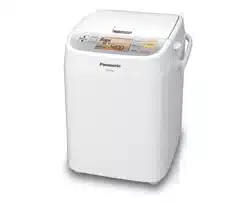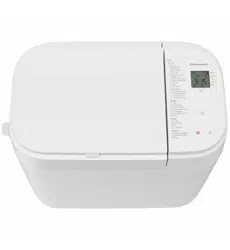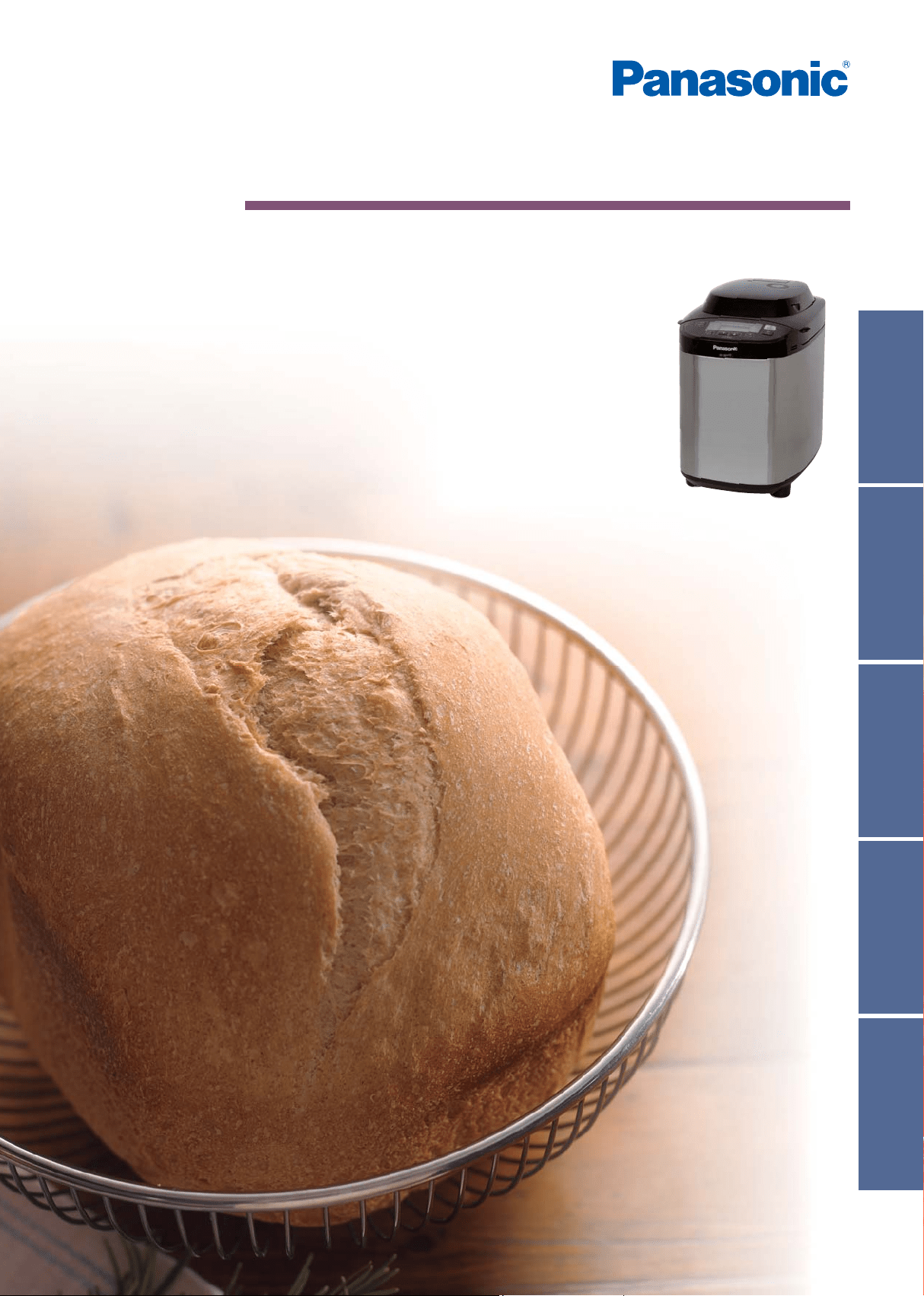
Automatic Bread Maker
OPERATING INSTRUCTIONS AND RECIPES (Household Use)
Model No.
SD-ZB2512
Before Use How to Use Recipes How to Clean Troubleshooting
Thank you for purchasing this Panasonic product.
z
Please read these instructions carefully before using this product and
save this manual for future use.
z
This product is intended for household use only.
2
Contents
Before Use
z
Safety Instructions ································································································································································· 3
z
Accessories/Parts Identification ················································································································································ 6
z
Bread-making Ingredients ······················································································································································· 8
How to Use
z
List of Bread Types and Baking Options ····································································································································10
z
Baking Bread ······································································································································································12
z
When adding extra ingredients ················································································································································14
z
Baking Brioche ····································································································································································15
z
Baking Savoury ···································································································································································16
z
Rustic Sourdough/Rustic Sourdough Dough
STAGE 1 Making Sourdough starter ········································································································································18
STAGE 2 Baking Rustic Sourdough ·········································································································································19
STAGE 2 Making Rustic Sourdough Dough ·······························································································································20
z
Making Dough ·····································································································································································21
z
Making Brioche Dough ··························································································································································22
z
Making Savoury Dough ·························································································································································23
z
Baking Rustic Scone ·····························································································································································24
z
Baking Cake ·······································································································································································26
z
Making Jam ········································································································································································27
z
Making Compote ··································································································································································28
Recipes
z
Bread Recipes ·····································································································································································29
z
Gluten Free Recipes ·····························································································································································33
z
Dough Recipes ····································································································································································35
z
Cake Recipes ······································································································································································43
z
Jam Recipes ·······································································································································································44
z
Compote Recipes ································································································································································44
How to Clean
z
Care & Cleaning ··································································································································································45
To Protect the Non-stick Finish
z
To protect the non-stick finish ·················································································································································46
Troubleshooting
z
Troubleshooting ···································································································································································47
z
WARRANTY ·······································································································································································51
z
Specification ·······································································································································································52
3
Safety Instructions
Please make sure to follow these instructions.
In order to prevent accidents or injuries to the user, other people, and damage to property,
please follow the instructions below.
Q The following charts indicate the degree of damage caused by
wrong operation.
Warning:
Indicates serious injury or death.
Caution:
Indicates risk of injury or property damage.
Q The symbols are classified and explained as follows.
This symbol indicates prohibition.
This symbol indicates requirement
that must be followed.
Warning
Do not use the appliance if the power cord or power plug is
damaged or the power plug is loosely connected to the power
outlet.
(It may cause an electric shock, or fire due to short circuit.)
e
If the supply cord is damaged, it must be replaced by the manufacturer, its
service agent or similarly qualified person in order to avoid a hazard.
Do not damage the power cord or power plug.
(It may cause an electric shock, or fire due to short circuit.)
Following actions are strictly prohibited. (Modifying, placing near heating elements,
bending, twisting, pulling, putting heavy objects on top, and bundling the cord.)
Do not plug or unplug the power cord with wet hands.
(It may cause an electric shock.)
Do not exceed voltage on the outlet and do not use alternate
current other than listed on the appliance.
(It may cause an electric shock or fire.)
Ɣ
Make sure the voltage supplied to the appliance is the same as your local supply.
Ɣ
Plugging other devices into the same outlet may cause an electric overheating.
Insert the power plug firmly.
(Otherwise it may cause an electric shock and fire caused by the heat that may
generate around the plug.)
Before Use
4
Warning
Clean the power plug regularly.
(A soiled power plug may cause insufficient insulation due to the moisture and lint
build-up, which may cause a fire.)
e
Unplug the power plug, and wipe with the dry cloth.
Discontinue using the appliance immediately and unplug in
the unlikely event that this appliance stops working properly.
(It may cause smoking, fire, electric shock or burn.)
e.g. for abnormal or breaking down
Ɣ
The power plug and the power cord become abnormally hot.
Ɣ
The power cord is damaged or power failure.
Ɣ
The main body is deformed or is abnormally hot.
Ɣ
The appliance makes abnormal turning noise during use.
e
Unplug the appliance immediately and consult a Panasonic dealer and have it
serviced by an authorised technician.
Do not touch, block or cover the steam vent holes during use.
(It may cause a burn.)
Ɣ
Especially pay attention for children.
Do not disassemble, repair or modify this appliance.
(It may cause a fire, electric shock or injury.)
e
Consult a Panasonic dealer and have it serviced by an authorised technician.
Do not immerse the appliance in water or splash it with water.
(It may cause an electric shock, or catch a fire due to short circuit.)
This appliance is not intended for use by persons (including
children) with reduced physical, sensory or mental capabilities, or
lack of experience and knowledge, unless they have been given
supervision or instruction concerning use of the appliance by a
person responsible for their safety.
Children should be supervised to ensure that they do not play with
the appliance.
(It may cause burns, injury or electric shock.)
Caution
Make sure to hold the power plug when unplugging the power
plug.
(Otherwise it may cause an electric shock, or fire due to short circuit.)
Safety Instructions
Please make sure to follow these instructions.
5
Caution
Unplug the power plug when the appliance is not in use.
(Otherwise it may cause an electric shock, or fire due to electric leakage.)
Please unplug and allow the appliance to cool down before
cleaning it.
(It may cause a burn.)
Do not allow the power cord to hang over the edge of the table
or touch a hot surface.
(It may cause a burn or injury.)
Do not remove the bread pan or unplug the Bread Maker
during use.
(It may cause a burn or injury.)
Do not use the appliance on following places.
Ɣ
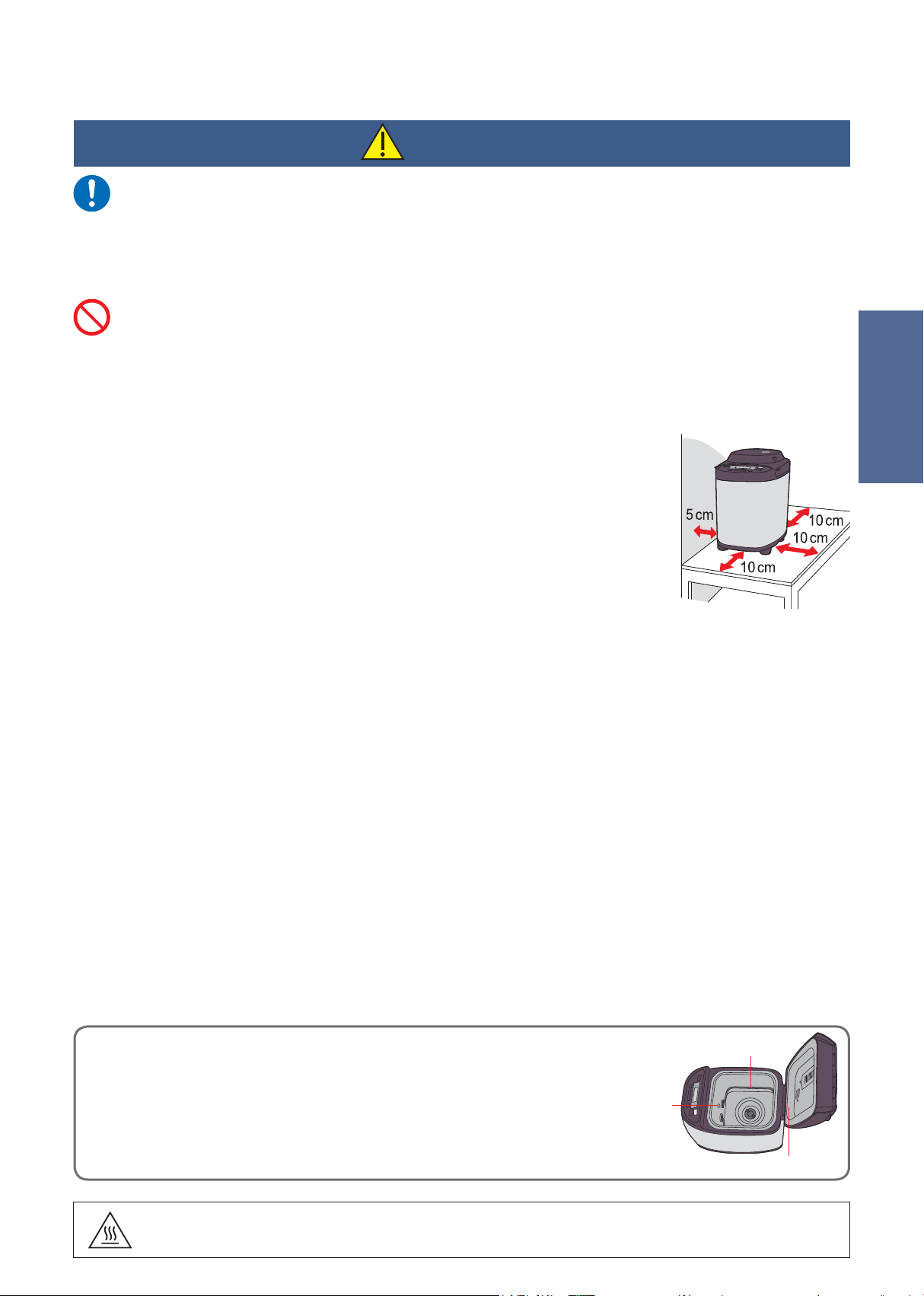
Position the Bread Maker on a firm, dry, clean, flat heatproof
worktop at least 10 cm (4 inches) from the edge of the worktop.
(It may cause the appliance to slip and fall from the worktop.)
Ɣ
Do not place on uneven surfaces, on electrical appliances such as
a refrigerator, on materials such as tablecloths or on carpet, etc.
(It may cause falling or a fire.)
Ɣ
During baking the unit heats up. The Bread Maker should be
placed at least 5 cm (2 inches) from adjacent walls and other objects.
(It may cause a discolouration or deformation.)
Do not touch hot area such as bread pan, inside of unit,
heating element or inside of the lid while the appliance is in
use or after cooking.
The temperature of accessible surfaces may be high when the
appliance is operating.
(The surfaces get hot during use which cause burns.)
e
To avoid burns, always use oven gloves when removing the bread pan or the
finished bread. (Do not use wet oven gloves.)
Also take care when removing the finished bread or kneading blade.
Do not use an external timer etc.
Ɣ
This appliance is not intended to be operated by means of an external timer or
separate remote-control system. (It may cause a burn or injury.)
Important Information
z
Do not use the appliance outdoors, in the immediate vicinity of heat sources or in rooms of high humidity.
(It may cause a malfunction or deformation.)
z
Do not use excessive force on the parts as is illustrated on the right.
(It may cause a malfunction or deformation.)
Temperature sensor
Heating element
Inside of the lid
Before Use
This symbol on the product indicates “hot surface and should not be touched without
caution”.
6
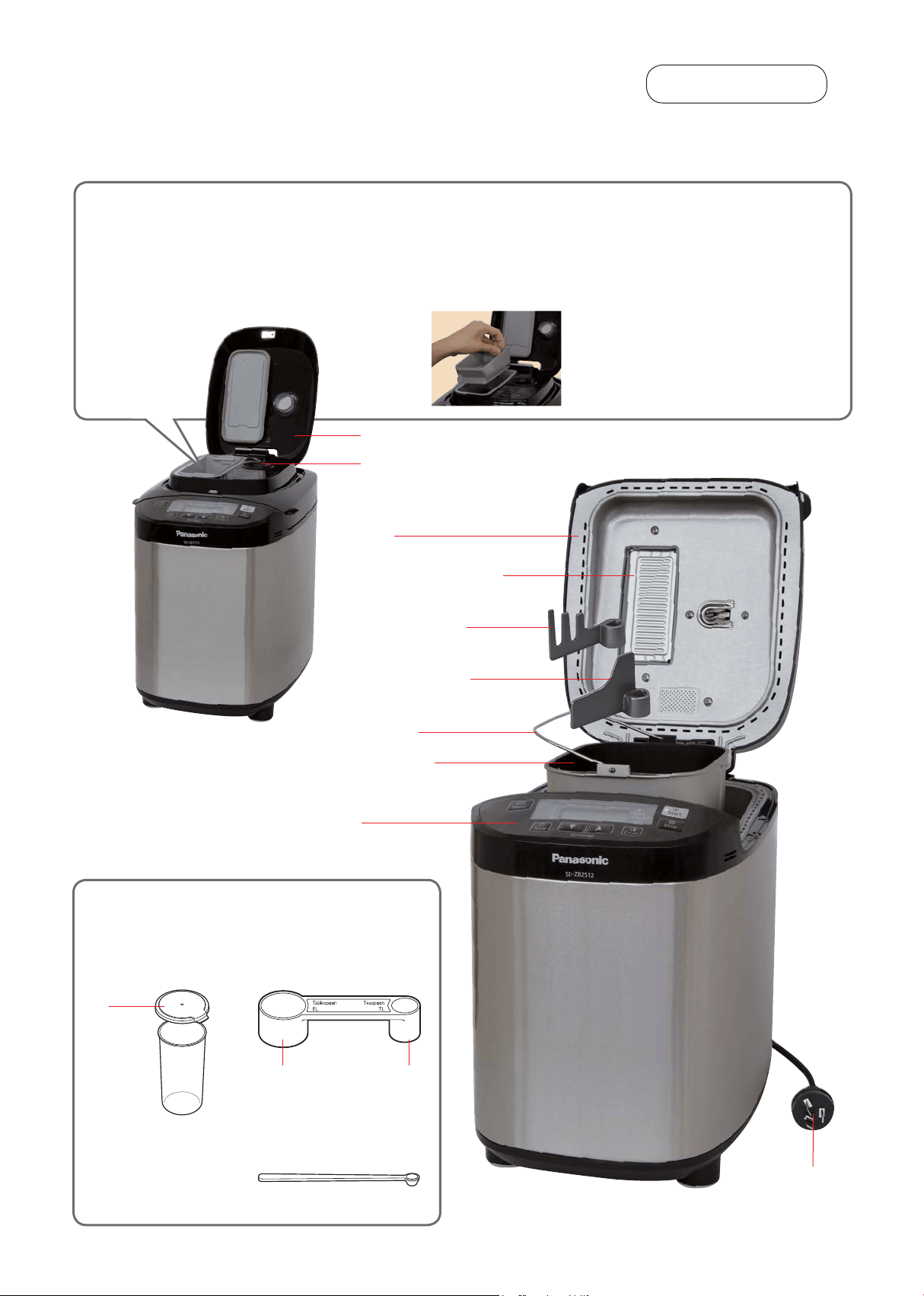
Raisin nut dispenser
The ingredients placed in the raisin nut dispenser will drop into the bread pan automatically upon selecting the
menu with raisin (3, 4, 7, 16, 20, 21, 23 and 31).
Turn to P. 14 for ingredients which may be placed in the raisin nut dispenser.
Never operate the Bread Maker without the dispenser being in place.
Accessories/Parts Identification
Main Unit
Accessories
Sourdough cup × 2
To measure out liquids, make
sourdough starter
Measuring spoon
To measure out sugar, salt, yeast, etc.
Sourdough starter spoon
To measure out sourdough starter yeast
•
10 mL increments
approx. 0.1 g
(max. 550 mL)
Plug
Bread pan
Control panel
Lid
Handle
Raisin nut dispenser
flap
Kneading blade
(rye bread)
Kneading blade
(wheat bread)
Dispenser lid
Yeast dispenser
Lid
(15 mL) (5 mL)
Tablespoon
•
1
»2 marking
Teaspoon
•
1
»4,
1
»2,
3
»4
markings
7
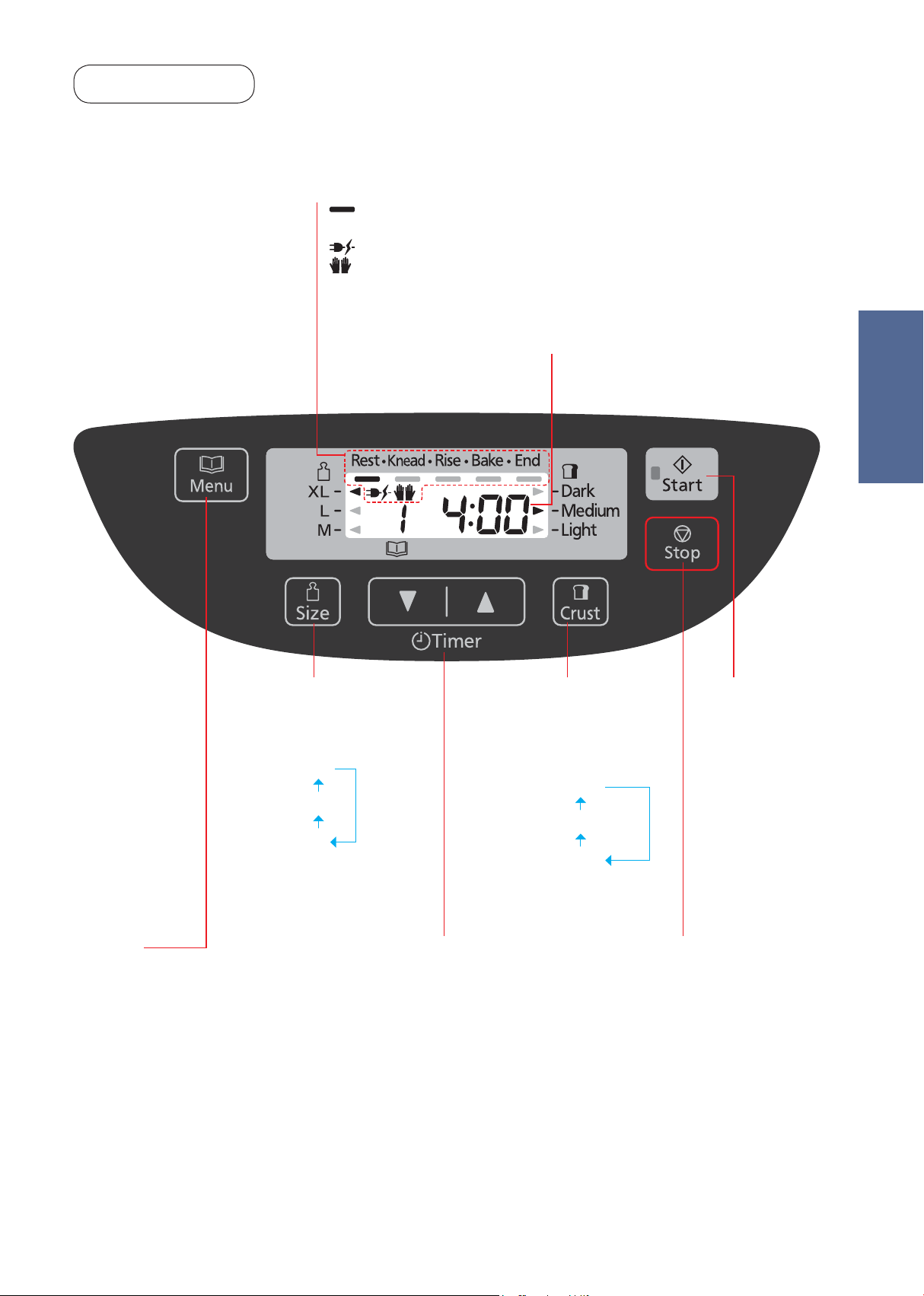
Control Panel
This picture shows all words and symbols, but during operation only those relevant will be displayed.
Menu
Press this pad to choose menu. Menu number will
display and each time this pad is pressed, menu
number will change to the next choice.
(Hold the pad to advance more quickly)
See P. 10 and 11 for menu number.
Q
Operation status
: displayed for the current stage of the programme. Ingredients are being regulated on
the ‘Rest’ stage before kneading.
: displayed when there is a problem with the power supply.
: displayed when adding ingredients manually on menu 4, 13, 21 and 29.
Q
Time remaining until ready
Also when adding ingredients manually,
display will show the time until adding extra
ingredients in the programme.
Size
Press this pad to choose
size. See P. 10 for
available menu.
•
XL
•
L
•
M
Crust
Press this pad to
choose crust colour.
See P. 10 for available
menu.
•
Dark
•
Medium
•
Light
Start
The start light will flash
during programme
selection. Press the start
pad when programming
is completed.
When the start pad is
pressed, the start light
will stop flashing and
become constant.
Stop
If you wish to change the
programme, you must stop the
operation by holding down the
stop pad for more than 1 second.
The start light will go off. Then
re-programme accordingly.
Timer
Set delay timer (time until bread is
ready) or set the baking/cooking
time for menu 18, 32 and 33.
µŸ¶ 3UHVVWKLVSDGWRLQFUHDVHWKH
time.
µź¶ 3UHVVWKLVSDGWRGHFUHDVH
the time.
Before Use
8
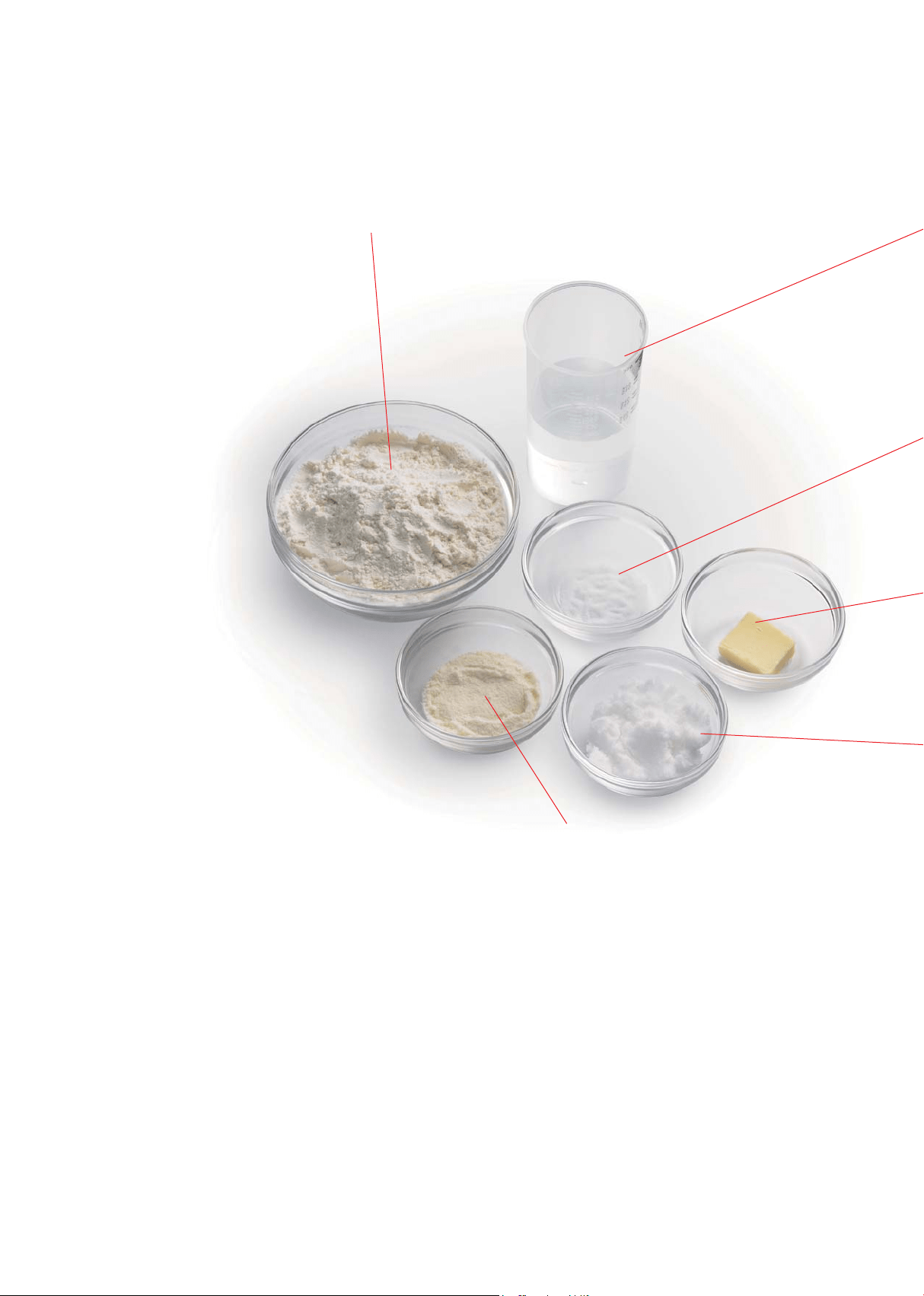
Bread-making Ingredients
Flour
Main ingredient of bread, produces gluten. (helps the bread to rise,
gives it a firm texture)
z
Use strong flour. Do not use soft or plain flour.
z
Flour must be weighed on scales.
Strong flour is milled from hard wheat
and has a high content of protein which is
necessary for the development of gluten.
Carbon dioxide produced during fermentation
is trapped within the elastic network of
gluten, thus making the dough rise.
Bread flour
Made by grinding wheat
kernel, excluding bran and
germ. The best kind of flour
for baking bread is a flour
marked ‘for bread baking’.
z
Do not use plain or self-raising flour
as a substitute for bread flour.
Whole wheat
flour
Made by grinding entire wheat
kernel, including bran and germ.
Makes very health-giving bread.
This bread is lower in height and
heavier than bread baked with
bread flour.
Rye flour
Made by grinding rye kernel. Contains more iron,
magnesium and potassium, which are necessary for human’s
health, than bread flour. But there isn’t enough gluten.
Makes dense, heavy bread. Do not use more than stated quantity
(could overload motor). (use in menu 8 or 24)
Dairy Products
Add flavour and nutritional value.
z
If you use milk instead of water, the nutritional value of
the bread will be higher, but do not use in timer setting as
it may not keep fresh overnight.
e Reduce the amount of water proportionally to the
amount of milk.
Spelt flour
In the wheat family but is a completely different species genetically.
Although it contains gluten some gluten-intolerant people can digest it. (Consult your doctor.)
Makes loaves with a flat/slightly sunken crust.
Spelt wholegrain flour bread becomes low height and dense compared with spelt white flour bread.
We will recommend spelt white flour to be used more than the half of the entire flour.
z
There is Spelt (Triticum spelta) suitable for baking bread and Einkorm wheat (Triticum monococcum: also it is called small spelt) which is not
suitable for baking bread are sold as spelt. Please use spelt. (use in menu 15, 16, 30, or 31)
Other flour
Products milled from other grains (i.e. corn meal, rice, millet, soy, oat, buckwheat, barley flours).
•
Do not use more than stated quantity (hinders rising and texture).
•
Should not be used as substitute for bread flour.
•
Gluten Free - see P. 33.
z
Coarse ingredients such as flours with whole grains or the addition of nuts and seeds may damage the bread pan’s non-stick finish.
Brown flour
10-15% of wheat grain removed during milling.

9
Water
z
Use normal tap water.
z
Use tepid water if using menu 2, 6, 8, 14 or 24 in a cold room.
z
Use chilled water if using menu 8, 9, 13, 15, 16, 24, 25, 29, 30 or
31 in a hot room.
z
Always measure out liquids using the sourdough cup provided.
Salt
Improves the flavour and strengthens gluten to
help the bread rise.
z
The bread may lose size/flavour if measuring is inaccurate.
Fat
Adds flavour and softness to the bread.
z
Using butter (unsalted) or margarine is recommended.
Sugar
(granulated sugar, brown sugar, honey,
treacle etc)
Food for the yeast, sweetens and adds flavour to
the bread, changes the colour of the crust.
z
Use less sugar if using raisins or other fruits, which contain
fructose.
Dry Yeast
Enables the bread to rise.
z
Be sure to use dry yeast that does not require pre-fermentation (do not use fresh yeast or dry yeast requiring
fermentation before using)
z
Yeast which has ‘Easy Blend’, ‘Fast Action’ or ‘Easy Bake’ written on the packet is recommended.
z
When using yeast from sachets, seal the sachet again immediately after use, and keep in the refrigerator. To store
follow manufacturers instructions but use opened individual sachets within 48 hours.
If using a bread mix...
■
Bread mixes including yeast
➀
Place a 500 g mix in the bread pan, then add water.
(Follow instructions on the packet for the quantity of water)
➁
Select menu 2– ‘Large’ size setting.
z
With some mixes, it is not clear how much yeast is
included, so some trial and error may be required to
obtain optimum results.
■
Bread mix with separate yeast sachet
➀
First place the bread mix in the bread pan, then the
water. Then place the measured yeast in the yeast
dispenser.
•
Bread Maker Capacity
400–600 g mix (for a loaf), 250–600 g mix (for a dough)
➁
Set the machine according to the type of flour included
in the mix, and start the baking.
•
Bread flour, brown flour e menu 1
•
Whole wheat, multigrain flour e menu 5
•
rye flour e menu 8
■
Baking brioche with brioche mix
z
Select the menu 13 or 2 ‘MEDIUM’ size-‘LIGHT’ crust
colour. (P. 49)
■
You can make your bread taste better by adding other
ingredients:
Eggs
Improve the nutritional value and
colouring of the bread. (Water amount
must be reduced proportionally)
Beat eggs when adding them.
Bran
Increases the bread’s fibre content.
•
Use max. 50 g.
Wheat germ
Gives the bread a nuttier flavour.
•
Use max. 50 g.
Spices, herbs
Enhance the flavour of the bread.
•
Only use a small amount (1–2 tbsp).
Before Use
10
List of Bread Types and Baking Options
Q
Function Availability and Time Required
•Time required for each process will differ according to room temperature.
Options Processes
Menu
Number
Menu
Size Crust
Timer
Rest Knead Rise Bake Tot al
Bake
1 Basic
OOO
30 min–
60 min
15–30 min
½
4
1 hr 50 min–
2 hr 20 min
50–55 min
4 hr–
4 hr 5 min
2 Basic Rapid
OO
——
15–20 min
approx. 1 hour
35–40 min
1 hr 55 min–
2 hr
3 Basic Raisin
O
O
½
1
O
30 min–
60 min
15–30 min
½
4
1 hr 50 min–
2 hr 20 min
50 min 4 hours
4 Savoury
OOO
30 min–
60 min
25–30 min
½
4
1 hr 45 min–
2 hr 10 min
50–55 min
4 hr–
4 hr 5 min
5 Whole wheat
O
—
O
1 hr–
1 hr 40 min
15–25 min
½
4
2 hr 10 min–
2 hr 50 min
50 min 5 hours
6
Whole wheat
Rapid
O
——
15 min–
25 min
15–25 min
½
4
1 hr 30 min–
1 hr 40 min
45 min 3 hours
7
Whole wheat
Raisin
O
—
O
1 hr–
1 hr 40 min
15–25 min
½
4
2 hr 10 min–
2 hr 50 min
50 min 5 hours
8 Rye
——
O
45 min–
60 min
approx.
10 min
1 hr 20 min–
1 hr 35 min
1 hour 3 hr 30 min
9 French
——
O
40 min–
2 hr 5 min
10–20 min
2 hr 45 min–
4 hr 10 min
55 min 6 hours
10
Rustic
Sourdough
——
O
½
3
0 min–
55 min
45–55 min
½
5
2 hr 25 min–
3 hr 10 min
55 min 5 hours
11 Italian
——
O
30 min–
1 hr
10–15 min
2 hr 25 min–
3 hr
50 min 4 hr 30 min
12 Sandwich
——
O
1 hr–
1 hr 40 min
15–25 min
½
4
2 hr 10 min–
2 hr 50 min
50 min 5 hours
13 Brioche
—
O
½
1
—
30 min
25–45 min
½
4
1 hr 25 min 50 min 3 hr 30 min
14 Gluten Free
—
O
½
2
——
15–20 min 40–45 min 50–55 min
1 hr 50 min–
1 hr 55 min
15 Speciality
O
—
O
30 min–
1 hr 15 min
15–30 min
½
4
1 hr 50 min–
2 hr 45 min
55 min 4 hr 30 min
16
Speciality
Raisin
O
—
O
30 min–
1 hr 15 min
15–30 min
½
4
1 hr 50 min–
2 hr 45 min
55 min 4 hr 30 min
17 Rustic Scone
——— —
10 min
—
65 min 1 hr 15 min
18 Bake only
——————
30 min–
1 hr 30 min
30 min–
1 hr 30 min
¼
1 Only ‘Light’ or ‘Medium’ available.
¼
2 Only ‘Medium’ or ‘Dark’ available.
¼
3 Can be set up to 9 hours, all others up to 13 hours.
¼
4 There is a period of rise during the knead period.
¼
5 There is a period of rest during the knead period.
• The Bread Maker will operate for a short time during the rise period (to ensure optimal gluten development).

11
Options Processes
Menu
Number
Menu
Size Crust
Timer
Rest Knead Rise Bake Tot al
Dough
19 Basic
———
30 min–
50 min
15–30 min
½
4
1 hr 10 min–
1 hr 30 min
—
2 hr 20 min
20 Basic Raisin
———
30 min–
50 min
15–30 min
½
4
1 hr 10 min–
1 hr 30 min
—
2 hr 20 min
21 Savoury
———
30 min–
50 min
25–30 min
½
4
1 hr 5 min–
1 hr 20 min
—
2 hr 20 min
22 Whole wheat
———
55 min–
1 hr 25 min
15–25 min
½
4
1 hr 30 min–
2 hr
—
3 hr 15 min
23
Whole wheat
Raisin
———
55 min–
1 hr 25 min
15–25 min
½
4
1 hr 30 min–
2 hr
—
3 hr 15 min
24 Rye
———
45 min–
60 min
approx.
10 min
——
2 hours
25 French
———
40 min–
1 hr 45 min
10–20 min
1 hr 35 min–
2 hr 40 min
—
3 hr 35 min
26
Rustic
Sourdough
———
0–40 min 45–55 min
1 hr 5 min–
1 hr 35 min
—
2 hr 30 min
27
Sourdough
starter
——— — —
24 hours
—
24 hours
28 Pizza
——
O
(Knead)
10–18 min
(Rise)
7–15 min
(Knead)
approx. 10 min
(Rise)
approx. 10 min
45 min
29 Brioche
———
30 min
25–45 min
½
4
35 min
—
1 hr 50 min
30 Speciality
———
30 min–
1 hr 5 min
15–30 min
½
4
1 hr 10 min–
1 hr 55 min
—
2 hr 45 min
31
Speciality
Raisin
———
30 min–
1 hr 5 min
15–30 min
½
4
1 hr 10 min–
1 hr 55 min
—
2 hr 45 min
32 Jam
———————
1 hr 30 min–
2 hr 30 min
33 Compote
———————
1 hr–
1 hr 40 min
How to Use
12
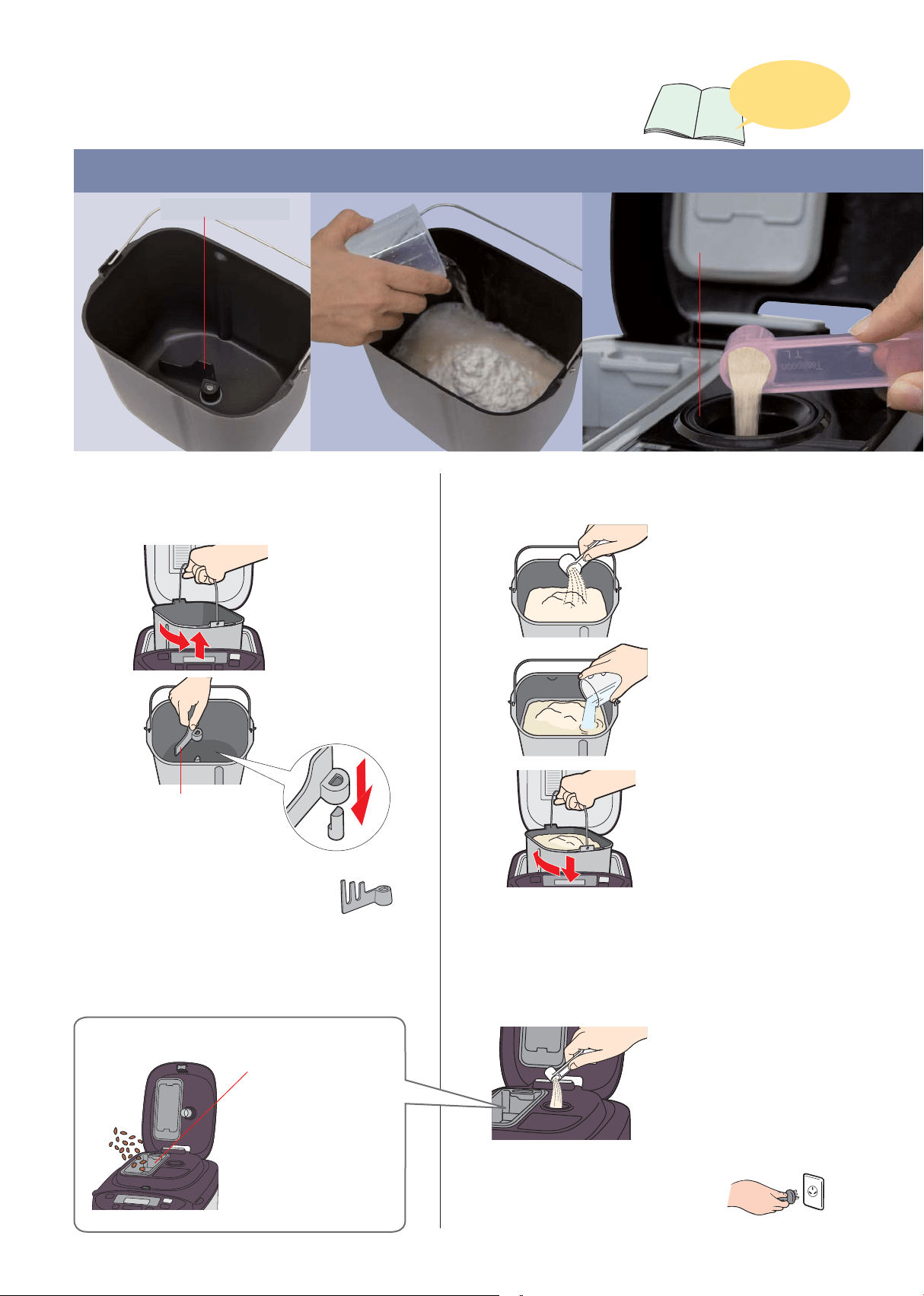
Place the ingredients in the bread pan
Kneading blade
Yeast dispenser
1
Remove the bread pan and
set the kneading blade
➀
Twist the bread pan round.
➁
Remove the bread pan.
➂
Place the kneading
blade firmly into the shaft.
Check around the shaft
and inside the kneading
blade and ensure that
they are clean. (P. 45)
•
When baking rye bread, use the
specified kneading blade.
• The kneading blade fits loosely into place, but it must
touch the bottom of the bread pan.
2
Place the measured ingredients
in the bread pan
➀
Place the dry ingredients except
dry yeast.
(flour, sugar, salt, etc.)
• Flour must be weighed on
scales.
➁
Pour in the water and any other
liquids.
➂
Wipe off any moisture and flour
from the outside of the bread
pan.
➃
Place the bread pan inside
the Bread Maker by turning it
slightly from right to left. Fold
the handle down.
➄
Close the lid.
• Don’t open the lid until bread
is complete (affects bread
quality).
3
Place the dry yeast in the yeast
dispenser
If the yeast dispenser is wet, absorb
wetness with tissue etc.
(Do not rub the yeast dispenser,
otherwise the yeast will not drop
into the bread pan due to static.)
4
Plug the Bread Maker
into a 230–240 V socket
Baking bread with added ingredients (P. 14)
Clean and dry
beforehand
➀
Open the dispenser lid.
➁
Place the ingredients.
➂
Close the lid.
Baking Bread
Turn to P. 29–32
for bread recipes
13
How to Use
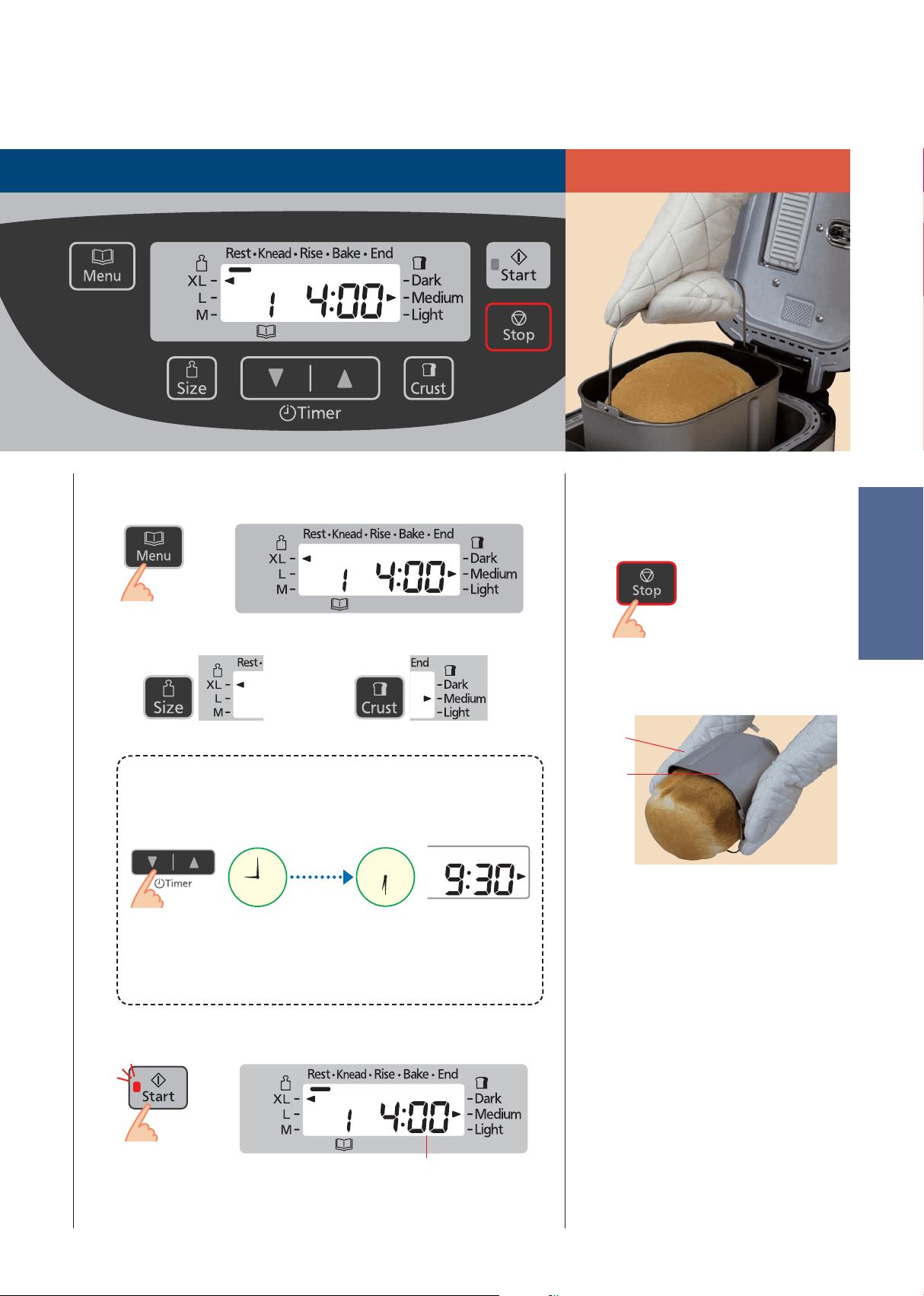
Set the programme and start Remove the bread
5
Select a bake menu
(The display shows when menu ‘1’ is selected.)
Q
To change the size
Q
To change the crust colour
O
Turn to P. 10 for menu, availability of size and crust.
Q
To set the timere
e.g. It is 9:00 PM now, and you want the bread to be ready at 6:30 the next
morning.
e Set the timer to ‘9:30’ (9 hours 30 minutes from now).
12
9
6
3
12
9
6
3
9hr 30min
from now
Current time Ready time
•
Pressing the pad once will advance the timer by 10 minutes (hold to
advance more quickly).
•
Can be set up to 9 hours when using menu 10.
6
Press ‘Start’
Estimated time until the selected programme is complete
z
When ‘Start’ was pressed at first, menu 1 will start.
7
Turn off the power
when the bread is ready
(machine beeps 8 times and the bar at
‘End’ flashes.)
8
Remove the bread
immediately,
Bread pan
Oven glove
allow to cool, for example, on a wire rack
9
Unplug (holding the
plug) after use
z
If you do not press ‘stop’ and remove
the bread from the unit to cool it, the
Bread Maker will proceed to keep warm
to reduce condensation of steam within
the loaf.
z
However, this will accelerate the
browning of the crust, therefore, upon
completion of baking, switch off the unit,
remove the bread immediately from the
unit to cool it.
z
If you leave the bread to cool down
in the bread pan, it will cause
condensation. Therefore, cool on a wire
rack to ensure optimum quality of the
loaf.
14
When adding extra ingredients
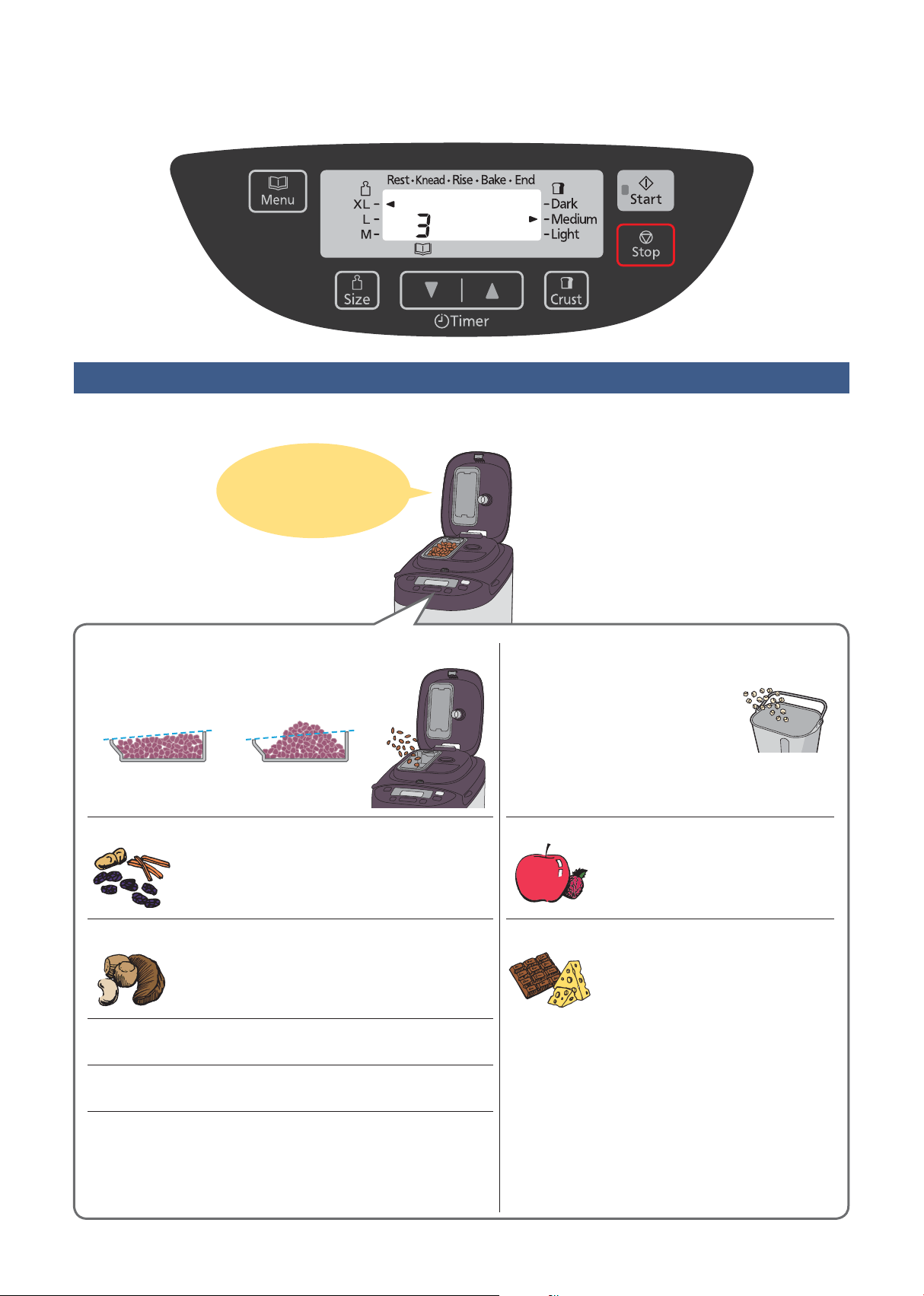
Adding extra ingredients to bread or dough
By selecting a menu with Raisin (3, 4, 7, 16, 20, 21, 23 or 31), you can mix your favourite ingredients into the dough to make all kinds of
flavoured breads.
Simply place the extra
ingredients in the dispenser or the
bread pan before start
Dry ingredients,
insoluble ingredients
e Place the extra ingredients in the raisin nut
dispenser and set the machine.
Correct Incorrect
e Do not overfill the raisin nut dispenser.
Moist/viscous ingredients, soluble
ingredients*
e Place these ingredients together
with the others into the bread pan.
Dried fruits
z
Cut up roughly into approx. 5mm cubes.
z
Sugar-coated ingredients may stick to the raisin nut
dispenser and not fall into the bread pan.
Fresh fruits, fruits pickled in alcohol
z
Only use quantities as in the recipe, as
the water content of the ingredients will
affect your bread.
Nuts
z
Chop finely.
z
Nuts impair the effect of gluten, so avoid using too
much.
Cheese, chocolate
* These ingredients cannot be placed in the raisin nut
dispenser as they would stick to it and not fall into the
bread pan.
z
Chop chocolate finely.
z
Cut the cheese into 1 cm cubes.
z
Recommended to the course of Savoury.
Seeds
z
Using large, hard seeds may scratch the coating of
the dispenser and bread pan.
Herbs
z
Use up to 1–2 tbsp of dried herbs. For fresh herbs,
follow the instructions in the recipe.
Bacon,
salami, olive,
dry tomato
z
Sometimes oily ingredients may stick to the raisin nut
dispenser and not fall into the bread pan.
z
Cut the bacon and the salami into 1 cm cubes.
z
Cut the olive into
1
»4.
z
Recommended to the course of Savoury.
•
Follow the recipe for the quantities for each ingredient.
15
Baking Brioche
1
42, 3
Bread flour 400 g
Salt 1 tsp
Sugar 3 tbsp
Butter (Cut into 2 cm cubes and keep in
refrigerator)
50 g
Powdered milk 2 tbsp
Eggs (Medium) 2 (100 g)
Water 180 mL
Dry yeast 1½ tsp
* Butter for added later (Cut into 1–2 cm
cubes and keep in refrigerator)
70 g
•
For addition of ingredients with*, follow programming
instructions below.
Preparations
(P. 12)
➀
Cut the butter for adding later for 1–2 cm cubes and keep them in refrigerator.
➁
Set the kneading blade into the bread pan.
➂
Place the ingredients in the bread pan in the order listed in the recipe.
➃
Set the bread pan into the main unit, and plug the machine into the socket.
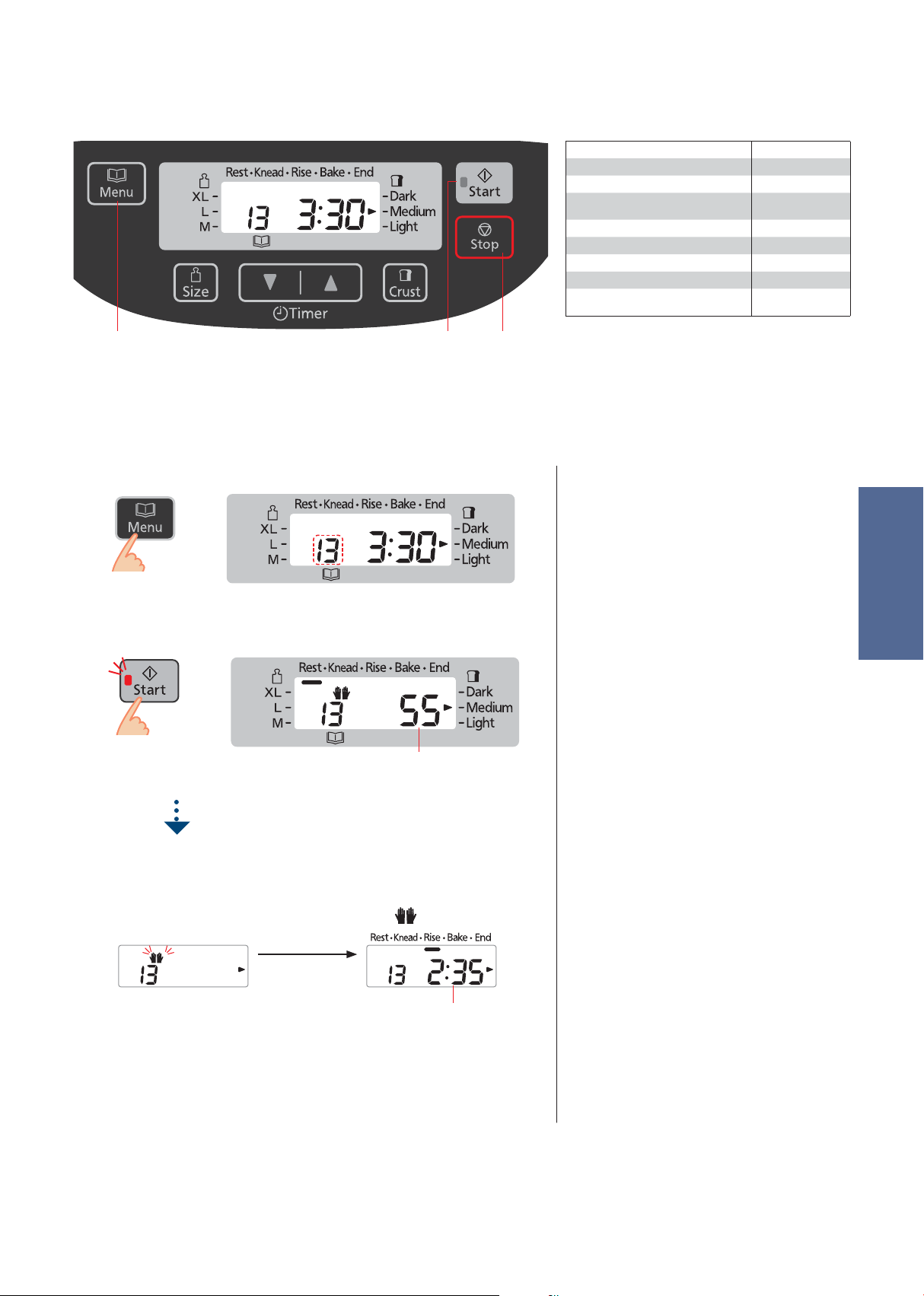
1
Select menu ‘13’
[Simple way to bake brioche]
Add butter with other
ingredients at the beginning.
z
Cut the butter into 2 cm cubes and place them
into the bread pan at the same time as the other
ingredients.
z
Follow the steps shown on the left. However,
when the machine beeps on step 3 to add extra
butter, please leave as it is.
z
Time required for completion is 3 hrs 30 minutes.
* When butter is added at the beginning, flavour,
texture and rising of bread are a little different from
the time bread is baked with extra butter added in
later.
z
A ‘Rest’ process will begin immediately after
starting, followed by ‘Knead’ and ‘Rise’.
2
Start the machine
Time until adding the extra butter or ingredients
O
The start light will come on.
3
Add additional butter when the beep
sounds, then press ‘Start’ again
Complete placing the additional cubed butter while ‘ ’ is flashing.
After the Start
pad is pressed
Display indicates remaining time until completion of the programme
O
When adding extra ingredients such as raisins,
add them with the butter. (Use max. 150 g for
ingredients)
O
Even without pressing the Start pad, kneading
will continue after 5 min. It does not continue
kneading immediately, even if the Start pad is
pressed after adding butter or ingredients.
O
Do not add butter after display shows remaining
time. (P. 49)
4
Press ‘Stop’ and remove bread
when machine beeps 8 times and the bar at ‘End’ flashes
O
The flashing start light will go off.
How to Use
16
Baking Savoury
1
42, 3
Q
To cancel/stop once
started
(hold for more than
1 second)
Preparations
(P. 12)
➀
Set the kneading blade into the bread pan.
➁
Place the ingredients in the bread pan in the order listed in the recipe.
➂
Set the bread pan into the main unit, and plug the machine into the socket.
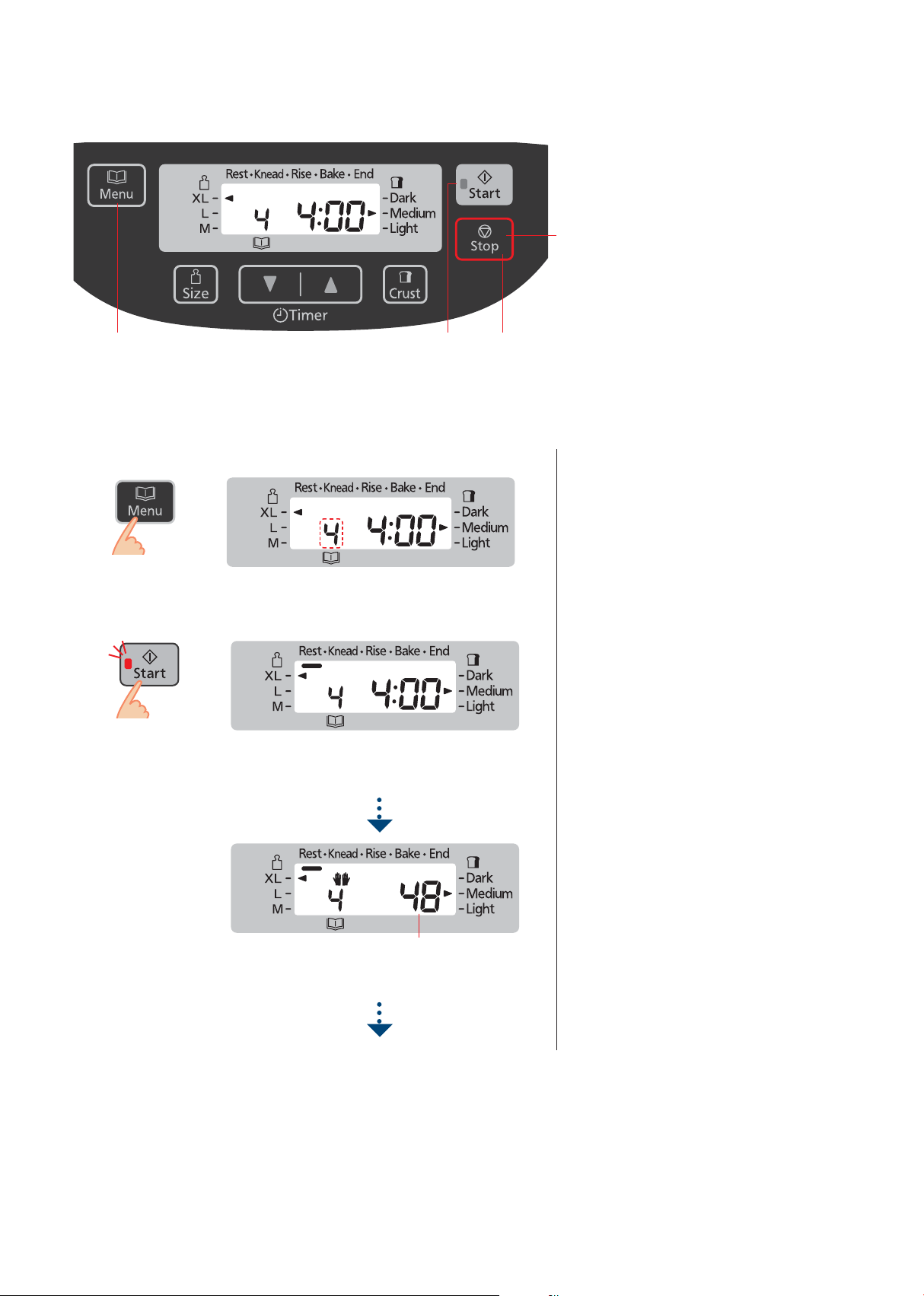
1
Select menu ‘4’
2
Start the machine
O
The start light will come on.
O
Remaining time until placing the extra ingredients is displayed, after the time
for placing is settled.
Time until adding the extra ingredients
* The above is for high-temperature case.
‘28’ is displayed in low-temperature case.
17
Turn to P. 30 for
bread recipes
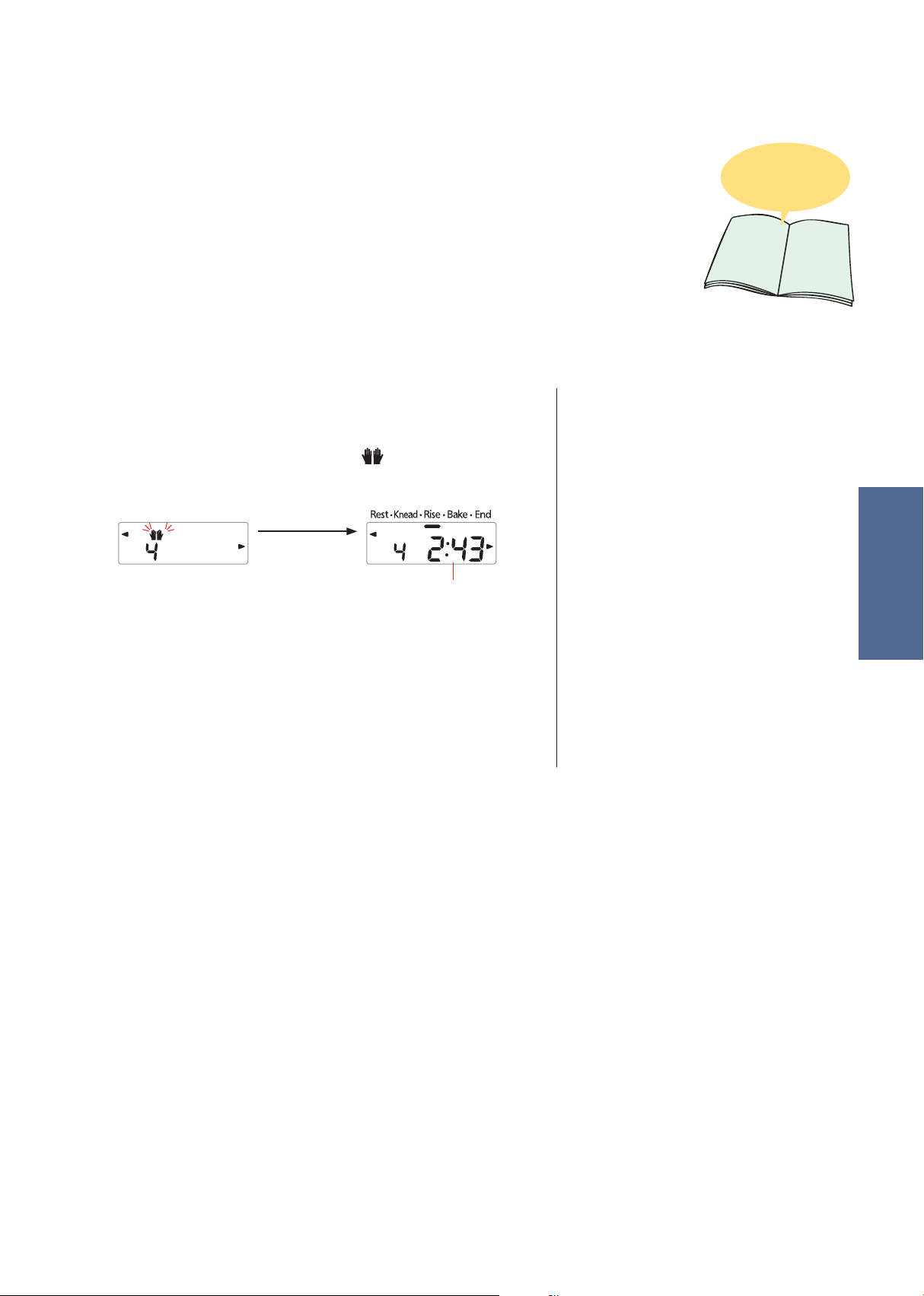
3
Add additional ingredients when the beep
sounds, then press ‘Start’ again
Complete placing the extra ingredients while ‘ ’ is flashing.
Even without add extra ingredients and pressing the Start pad, ‘Knead’ and
‘Bake’ starts automatically after 5 min.
After the Start
pad is pressed
Display indicates remaining time until completion of the programme
* The above is for high-temperature case.
Remaining time is changed depending on the room temperature.
Low-temperature: 3:00–3:03
High-temperature: 2:40–2:43
O
For ingredients, use max. 100 g as size-M, 125 g
as size-L or 150 g as size-XL.
O
Even without pressing the Start pad, kneading
will continue after 5 min. It does not continue
kneading immediately, even if the Start pad is
pressed after adding ingredients.
O
Do not add ingredients after display shows
remaining time. (P. 49)
O
Add automatically and manually extra ingredients
list
Add automatically: Bacon, Olive, Green bean
Add manually: Cheese, Chocolate (frozen),
Onions (finely diced)
4
Press ‘Stop’ and remove bread
when machine beeps 8 times and the bar at ‘End’ flashes
O
The flashing start light will go off.
How to Use
18
Rustic Sourdough/Rustic Sourdough Dough
STAGE 1 Making Sourdough starter
1
32
Turn to P. 42 for
sourdough starter
recipe
Q
To cancel/stop once
started
(hold for more than
1 second)
Preparations
(P. 12)
➀
Mix all the ingredients well in the sourdough cup.
(Remove the kneading blade)
➁
Put the lid on the sourdough cup.
➂
Place the sourdough cup in the bread pan.
➃
Set the bread pan into the main unit, and plug the machine into the socket.
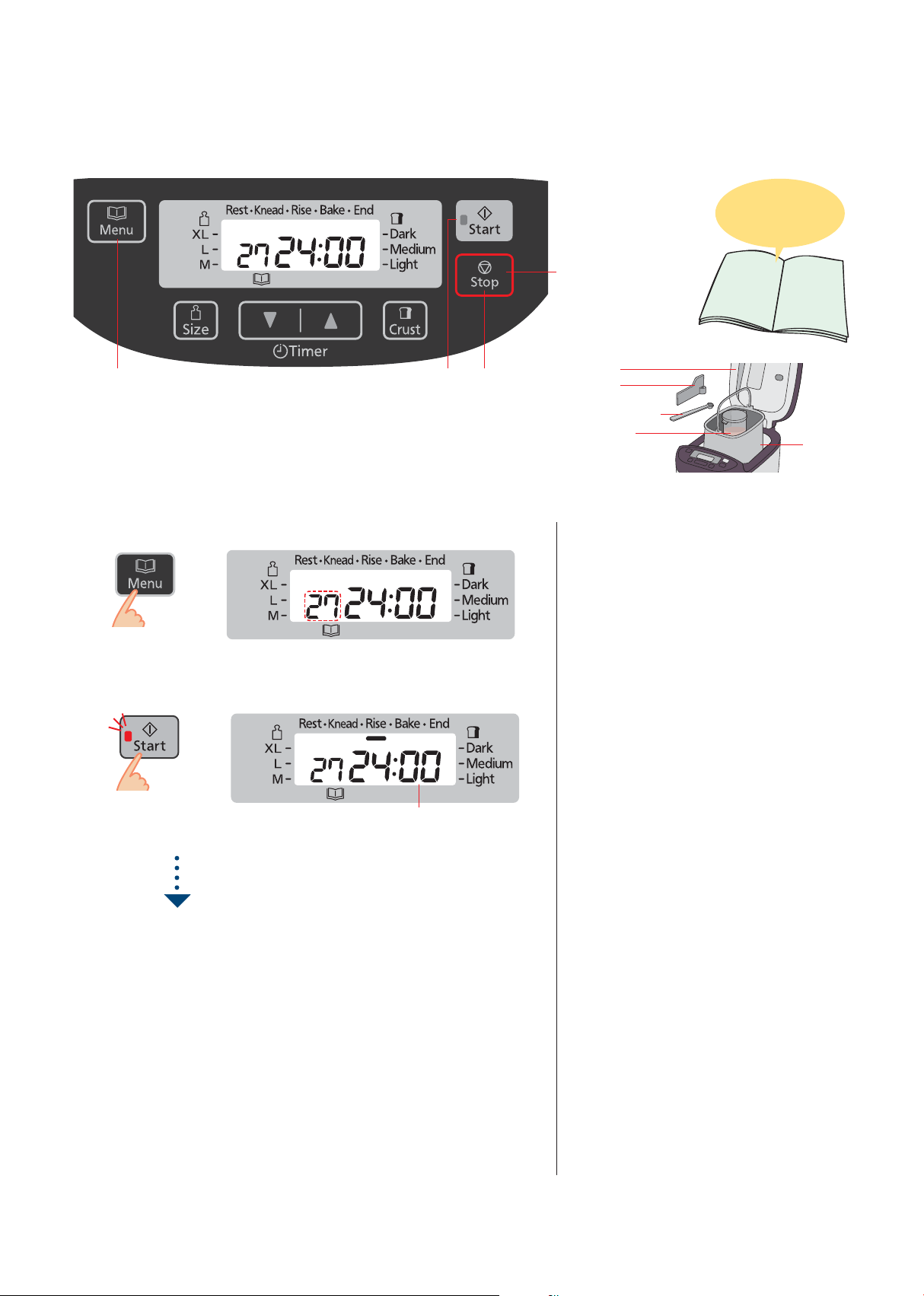
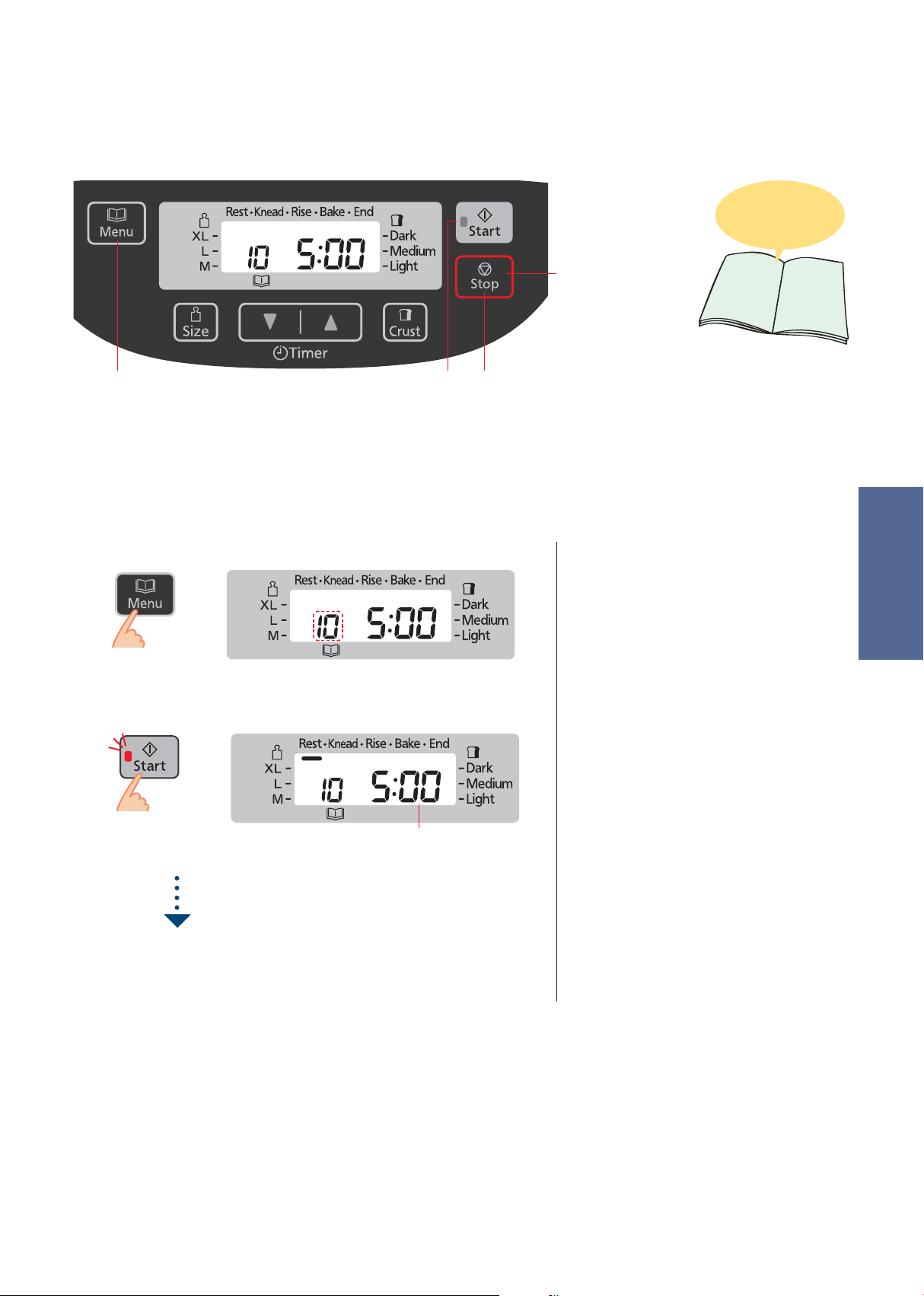
1
Select menu ‘27’
O
Timer is not available on menu 27.
O
If you select a wrong menu, the sourdough cup
would be melted.
2
Start the machine
Estimated time until the selected programme is complete
O
The start light will come on.
O
Do not take out the sourdough cup until the
programme is complete.
3
Press ‘Stop’ and remove the sourdough
cup immediately
when machine beeps 8 times and the bar at ‘End’ flashes
O
The flashing start light will go off.
Store the sourdough starter in the
refrigerator
O
If you leave the sourdough starter in the bread maker, fermenting power
decreases and the bread dose not rise.
O
Make sure to store it in the refrigerator, and use up all within 1 week.
(If the sourdough starter is stored in the freezer or at room temperature,
fermenting power is lost.)
O
Do not mix the new sourdough starter and the old
sourdough starter.
O
If the sourdough starter is made well, it smells
sour and like alcohol.
(When the room temperature is over 30°C, the
sourdough starter goes bad.)
Remove the
kneading blade.
Sourdough starter spoon
Two sourdough cups can be set at a time.
Sourdough cup
(Keep clean and
use the sourdough
starter only)
Bread pan
Lid
19
STAGE 2 Baking Rustic Sourdough
1
32
Turn to P. 32 for
bread recipes
Q
To cancel/stop once
started
(hold for more than
1 second)
Preparations
(P. 12)
➀
Set the kneading blade into the bread pan.
➁
Tip the sourdough starter in the bread pan.
➂
Place the ingredients in the bread pan in the following order:
bread flour ĺ salt ĺ water.
➃
Set the bread pan into the main unit, and plug the machine into the socket.
➄
Place the dry yeast in the yeast dispenser.
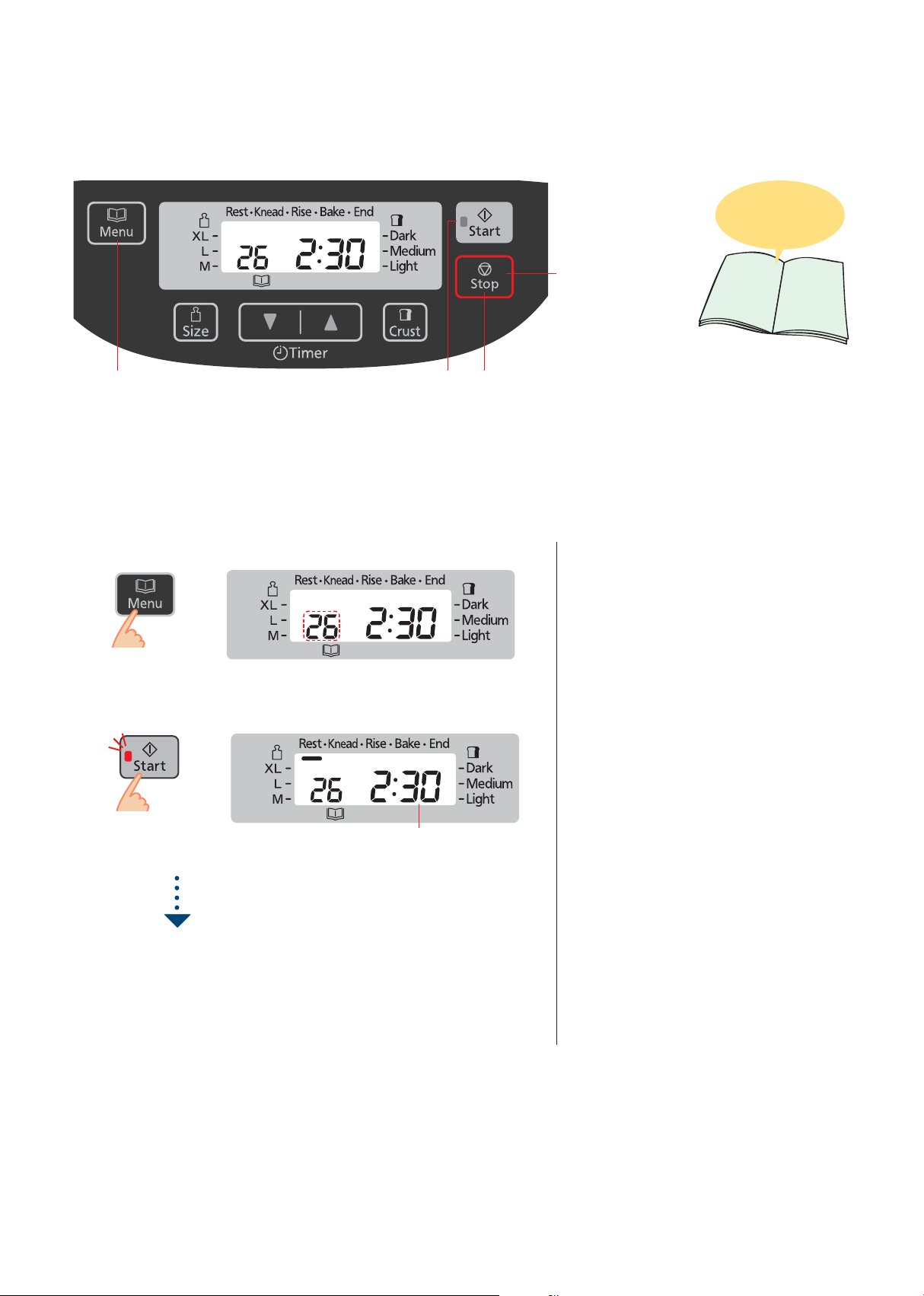
1
Select menu ‘10’
O
When the room temperature is over 30°C, the
bread does not turn out well.
2
Start the machine
Estimated time until the selected programme is complete
O
The start light will come on.
3
Press ‘Stop’ and remove bread
when machine beeps 8 times and the bar at ‘End’ flashes
O
The flashing start light will go off.
How to Use
20
Rustic Sourdough/Rustic Sourdough Dough
STAGE 2 Making Rustic Sourdough Dough
1
32
Turn to P. 35 for
dough recipes
Q
To cancel/stop once
started
(hold for more than
1 second)
Preparations
(P. 12)
➀
Set the kneading blade into the bread pan.
➁
Tip the sourdough starter in the bread pan.
➂
Place the ingredients in the bread pan in the following order:
bread flour ĺ salt ĺ water.
➃
Set the bread pan into the main unit, and plug the machine into the socket.
➄
Place the dry yeast in the yeast dispenser.
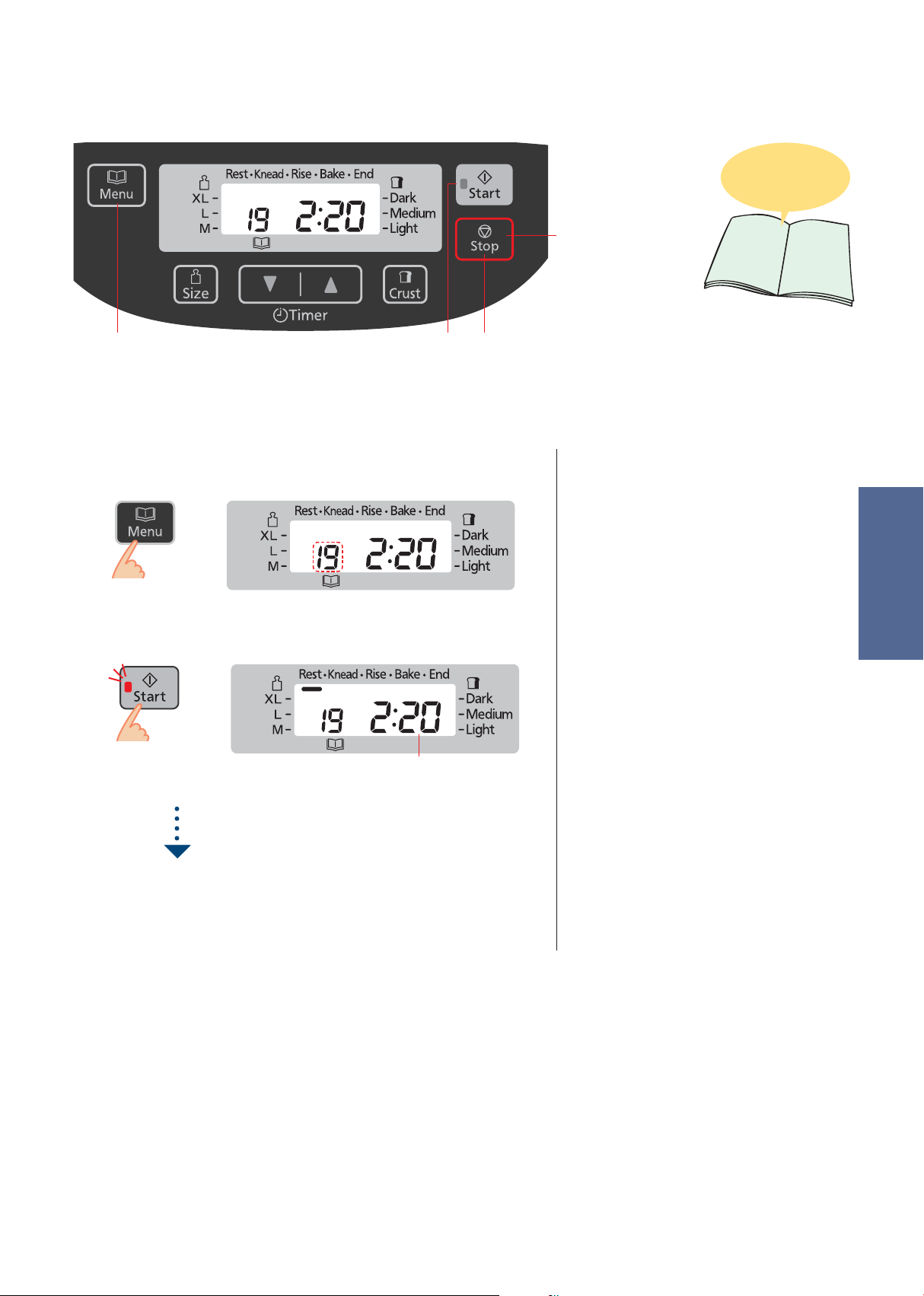
1
Select menu ‘26’
O
Timer is not available on Dough menus
(except menu 28).
2
Start the machine
Estimated time until the selected programme is complete
O
The start light will come on.
3
Press ‘Stop’ and remove dough
when machine beeps 8 times and the bar at ‘End’ flashes
O
The flashing start light will go off.
O
Shape the finished dough and allow it to rise for
the second time according to the recipe, then
bake in the oven.
21
Making Dough
1
32
Turn to P. 35 for
dough recipes
Q
To cancel/stop once
started
(hold for more than
1 second)
Preparations
(P. 12)
➀
Place the kneading blade into the bread pan.
➁
Place the ingredients in the bread pan in the order listed in the recipe.
➂
Set the bread pan into the main unit, and plug the machine into the socket.
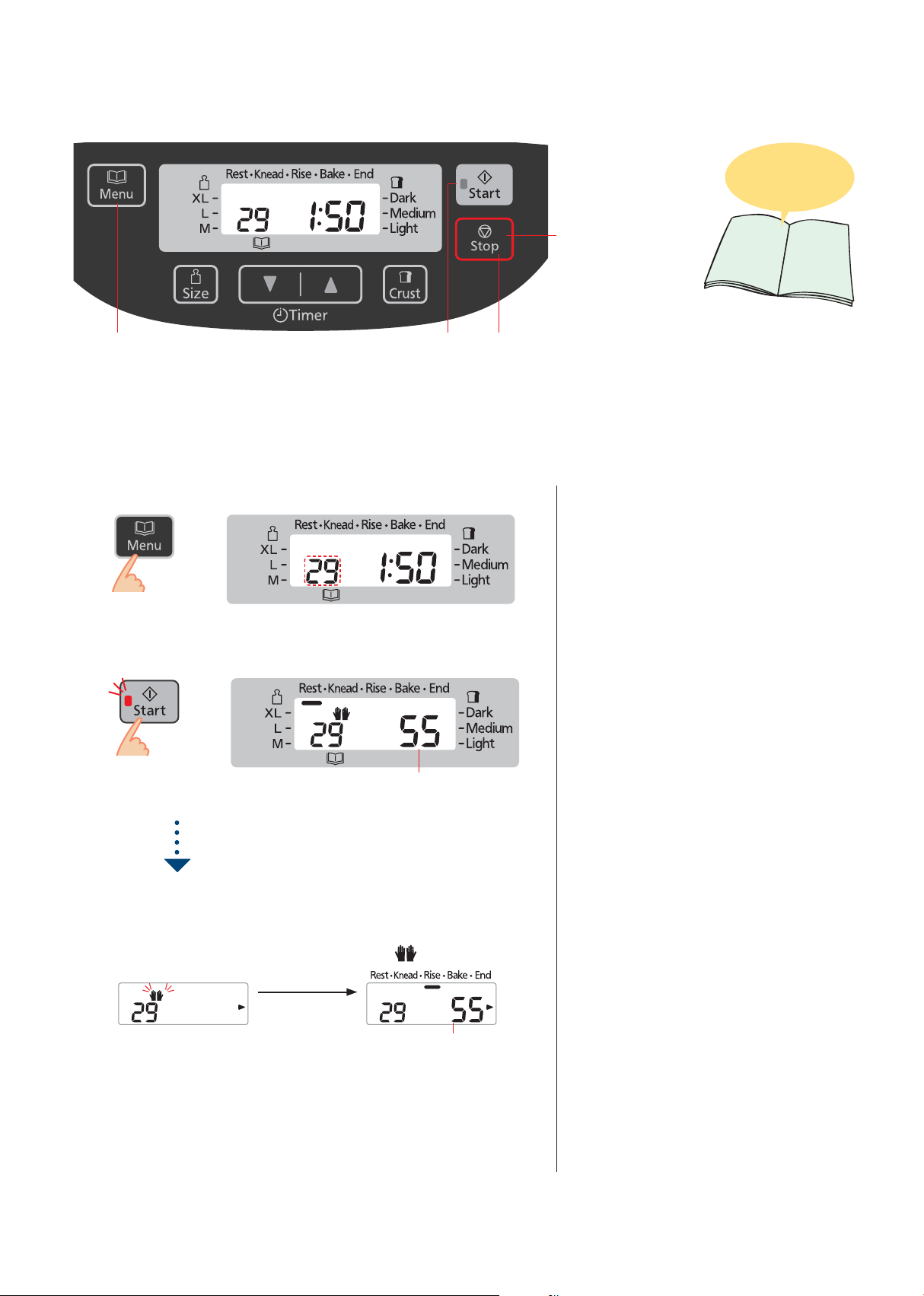
1
Select dough menu
(The display shows when menu ‘19’ is selected.)
O
Timer is not available on Dough menus
(except menu 28).
O
If you would like to add extra ingredients to your
dough, see P. 14.
2
Start the machine
Estimated time until the selected programme is complete
O
The start light will come on.
O
For menus other than 27, 28, 32 and 33, a ‘Rest’
process will begin immediately after starting,
followed by ‘Knead’ and ‘Rise’.
3
Press ‘Stop’ and remove dough
when machine beeps 8 times and the bar at ‘End’ flashes
O
The flashing start light will go off.
z
Shape the finished dough and allow it to rise for
the second time according to the recipe, then
bake in the oven.
How to Use
22
Making Brioche Dough
1
42, 3
Turn to P. 41 for
dough recipes
Q
To cancel/stop once
started
(hold for more than
1 second)
Preparations
(P. 12)
➀
Cut the butter for adding later for 1–2 cm cubes and keep them in refrigerator.
➁
Set the kneading blade into the bread pan.
➂
Place the ingredients in the bread pan in the order listed in the recipe.
➃
Set the bread pan into the main unit, and plug the machine into the socket.
1
Select menu ‘29’
O
Timer is not available on Dough menus
(except menu 28).
[Simple way to make brioche]
Add butter with other
ingredients at the beginning.
z
Cut the butter into 2 cm cubes and place them
into the bread pan at the same time as the other
ingredients.
z
Follow the steps shown on the left. However,
when the machine beeps on step 3 to add extra
butter, please leave as it is.
z
Time required for completion is 1 hr 50 minutes.
* When butter is added at the beginning, flavour,
texture and rising of bread are a little different from
the time bread is baked with extra butter added in
later.
z
A ‘Rest’ process will begin immediately after
starting, followed by ‘Knead’ and ‘Rise’.
2
Start the machine
Time until adding the extra butter or ingredients
O
The start light will come on.
3
Add additional butter when the beep
sounds, then press ‘Start’ again
Complete placing the additional cubed butter while ‘ ’ is flashing.
After the Start
pad is pressed
Display indicates remaining time until completion of the programme
O
When adding extra ingredients such as raisins,
add them with the butter. (Use max. 150 g for
ingredients)
O
Even without pressing the Start pad, kneading
will continue after 5 min. It does not continue
kneading immediately, even if the Start pad is
pressed after adding butter or ingredients.
O
Do not add butter after display shows remaining
time. (P. 49)
4
Press ‘Stop’ and remove dough
when machine beeps 8 times and the bar at ‘End’ flashes
O
The flashing start light will go off.
O
Shape the finished dough and allow it to rise for
the second time according to the recipe, then
bake in the oven.
23
Making Savoury Dough
1
42, 3
Turn to P. 35 for
dough recipes
Q
To cancel/stop once
started
(hold for more than
1 second)
Preparations
(P. 12)
➀
Set the kneading blade into the bread pan.
➁
Place the ingredients in the bread pan in the order listed in the recipe.
➂
Set the bread pan into the main unit, and plug the machine into the socket.
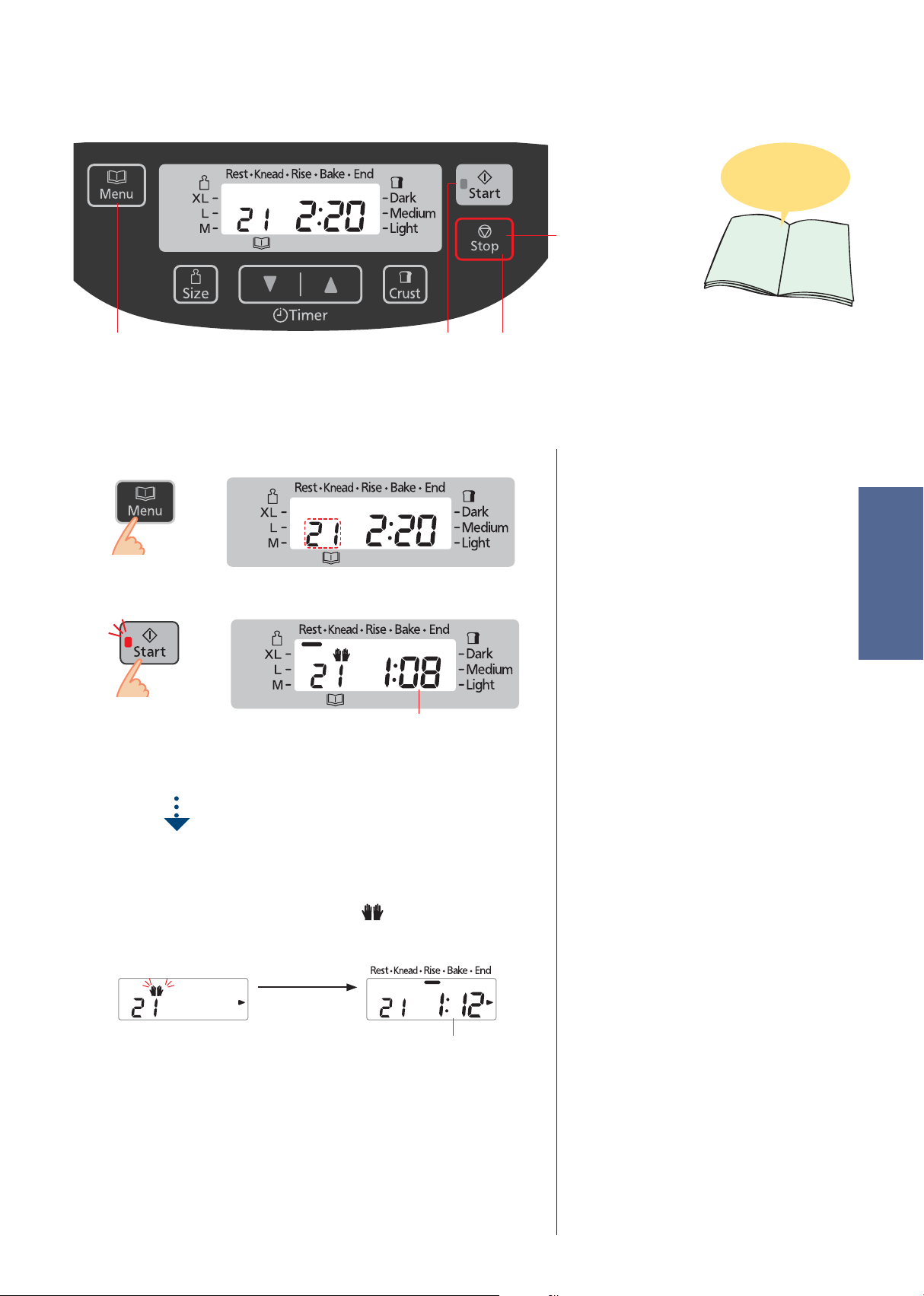
1
Select menu ‘21’
O
Timer is not available on Dough menus
(except menu 28).
2
Start the machine
Time until adding the extra ingredients
* The above is for high-temperature case.
‘58’ is displayed in low-temperature case.
O
The start light will come on.
3
Add additional ingredients when the beep
sounds, then press ‘Start’ again
Complete placing the extra ingredients while ‘ ’ is flashing.
Even without add extra ingredients and pressing the Start pad, ‘Knead’ and
‘Bake’ starts automatically after 5 min.
After the Start
pad is pressed
Display indicates remaining time until completion of the programme
* The above is for high-temperature case.
Remaining time is changed depending on the room temperature.
Low-temperature: 1:20–1:22
High-temperature: 1:10–1:12
O
For ingredients, use max. 100 g as size-M, 125 g
as size-L or 150 g as size-XL.
O
Even without pressing the Start pad, kneading
will continue after 5 min. It does not continue
kneading immediately, even if the Start pad is
pressed after adding ingredients.
O
Do not add ingredients after display shows
remaining time. (P. 49)
O
See P. 17 for Add automatically and manually
extra ingredients list.
4
Press ‘Stop’ and remove dough
when machine beeps 8 times and the bar at ‘End’ flashes
O
The flashing start light will go off.
O
Shape the finished dough and allow it to rise for
the second time according to the recipe, then
bake in the oven.
How to Use
24
Baking Rustic Scone
1
72, 4, 6
Turn to P. 32 for
bread recipes
Q
To cancel/stop once
started
(hold for more than
1 second)
Preparations
(P. 12)
➀
Set the kneading blade into the bread pan.
➁
Place the ingredients in the bread pan in the following order:
mixture of eggs and milk ĺ yoghurt ĺ other ingredients.
➂
Set the bread pan into the main unit, and plug the machine into the socket.
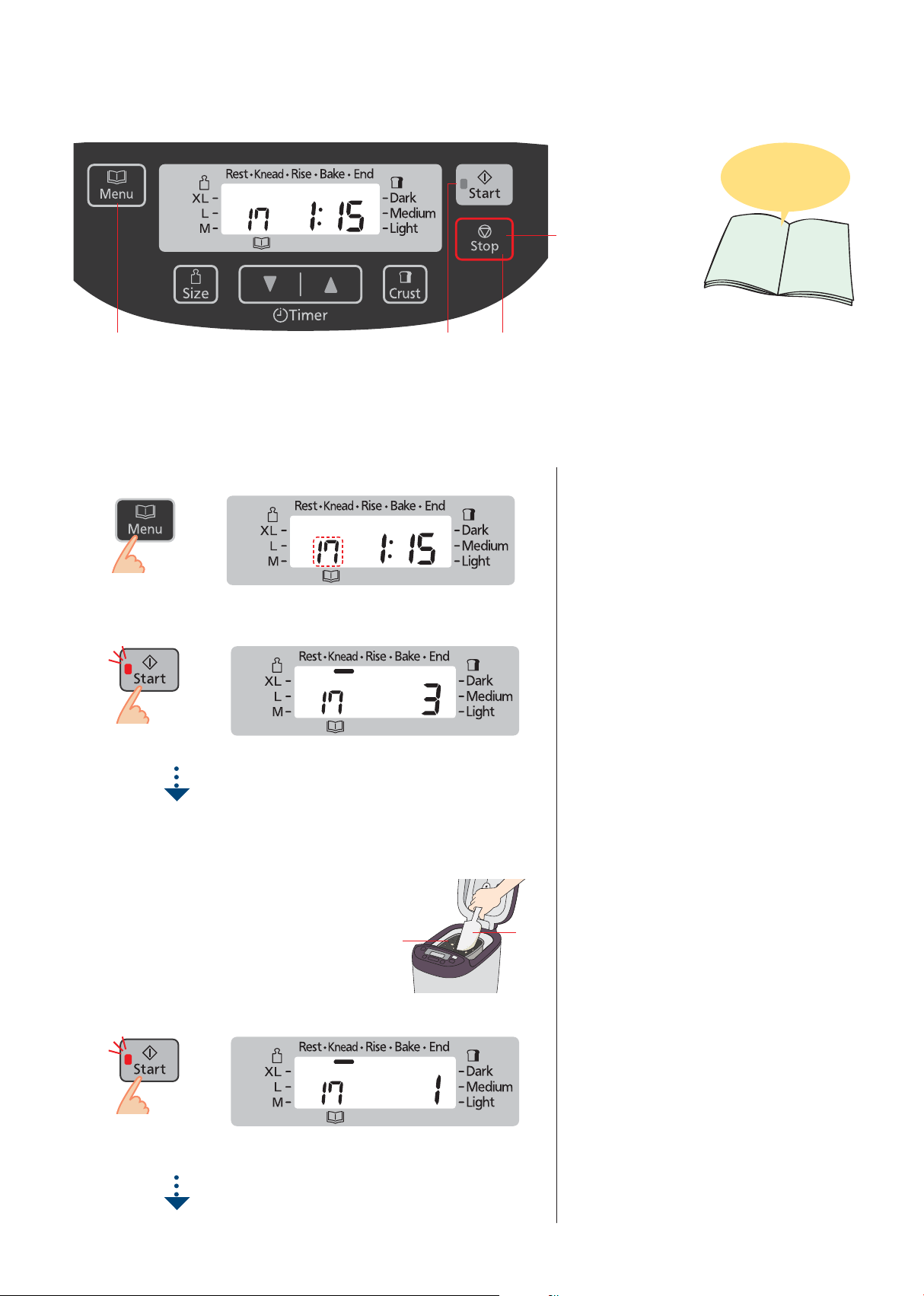
1
Select menu ‘17’
O
The Rustic Scone is different from a loaf using dry
yeast.
O
Timer is not available on menu 17.
(The Timer pad only sets the duration of the
baking time.)
O
You can mix your favourite ingredients (Nuts,
Raisin, Chocolate chips, etc) and place them
into the bread pan at the same time as the other
ingredients.
(Use max. 150 g for ingredients.)
2
Start the machine
O
After 3 minutes
3
Open the lid and scrape off the flour
within 3 minutes when the beep sounds
Bread pan
Rubber
spatula
O
Use the rubber spatula to avoid damaging the
bread pan with non-stick finish. Do not use the
metal spatula.
O
After 3 minutes have passed in step 3, the beeps
sound and ‘Knead’ starts automatically.
4
Press ‘Start’ again
O
Do not press ‘Stop’.
O
After 1 minute
25
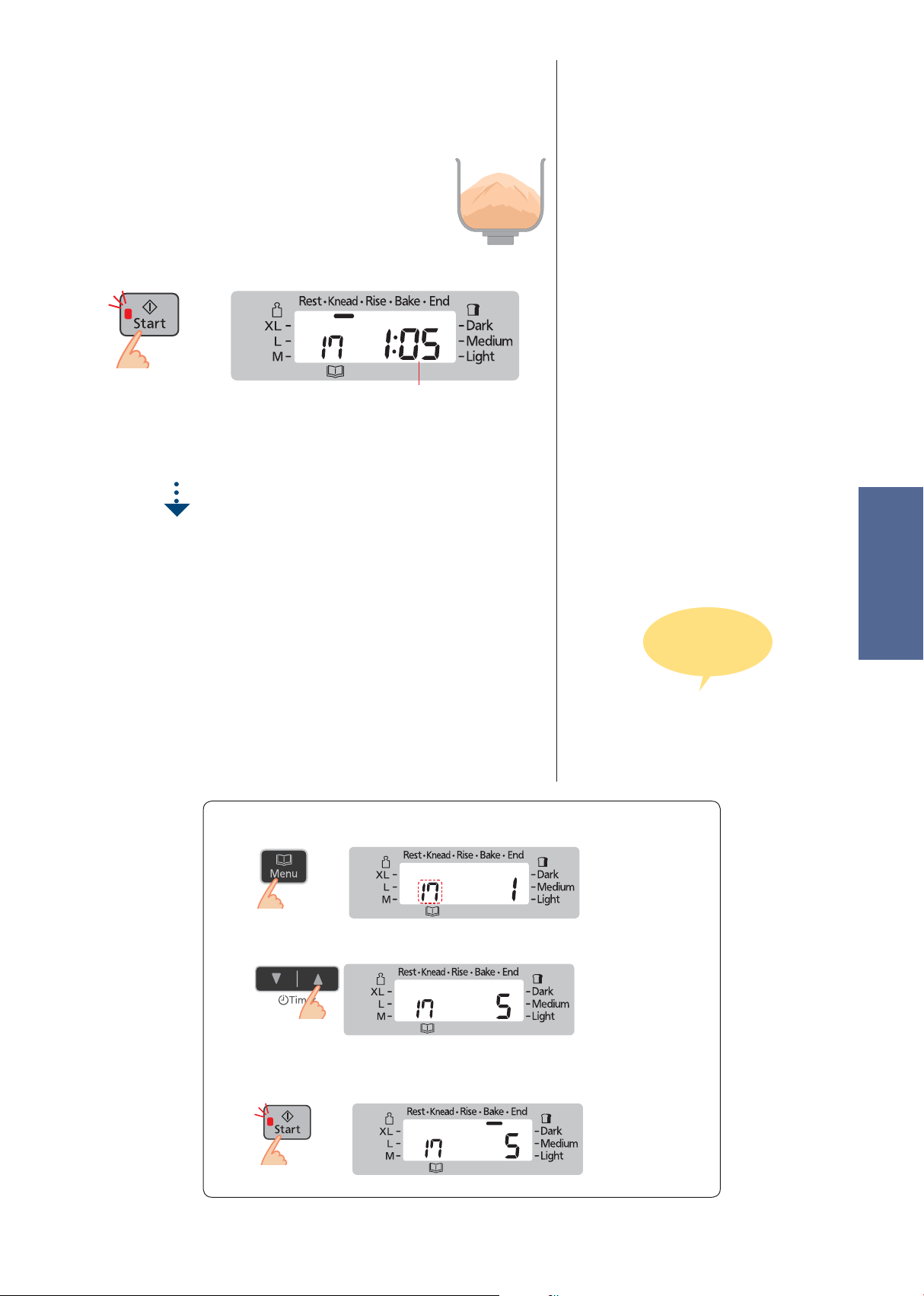
5
Open the lid and scrape off the dough,
shape the surface of the dough within
3 minutes, when the beep sounds
O
After 3 minutes have passed in step 5, the beeps
sound and ‘Bake’ starts automatically. (The
surface of the rustic scone became uneven,
because you did not shape the surface of the
dough.)
6
Press ‘Start’ again
Estimated time until the selected programme is complete
Display indicates remaining time until completion of the programme
Remaining time: 1:11–1:05
O
Do not press ‘Stop’.
O
The start light will come on.
7
Press ‘Stop’ when the machine beeps and the bar at ‘End’ flashes,
check that baking is complete, and
remove the bread pan
O
The flashing start light will go off.
Q
If baking is not complete e Do the following
➀
–
➂
(Additional cooking time can be made up to twice. Each time should be
within 20 minutes. The timer will start again from 1 minute when the unit is
hot. Increase the time by pressing the timer pad as required.)
O
If you shake well and remove the rustic scone
from the bread pan, the rustic scone will be lose
shape.
Be careful!
It’s hot!
O
To check whether baking is complete, insert a
skewer into the centre of the rustic scone – it is
ready if there is no mixture stuck to the skewer
when you remove it.
➀
Select menu ‘17’
➁
Set the baking time
O
Can be set up to 1–20 minutes.
➂
Start the machine
How to Use
26
Baking Cake
1
4
2
3
Turn to P. 43 for
cake recipe
Q
To cancel/stop once
started
(hold for more than
1 second)
Preparations
➀
Prepare the ingredients according to the recipe.
➁
Line the bread pan with greaseproof paper
and pour in the mixed ingredients.
➂
Set the bread pan into the main unit, and plug the machine
into the socket.
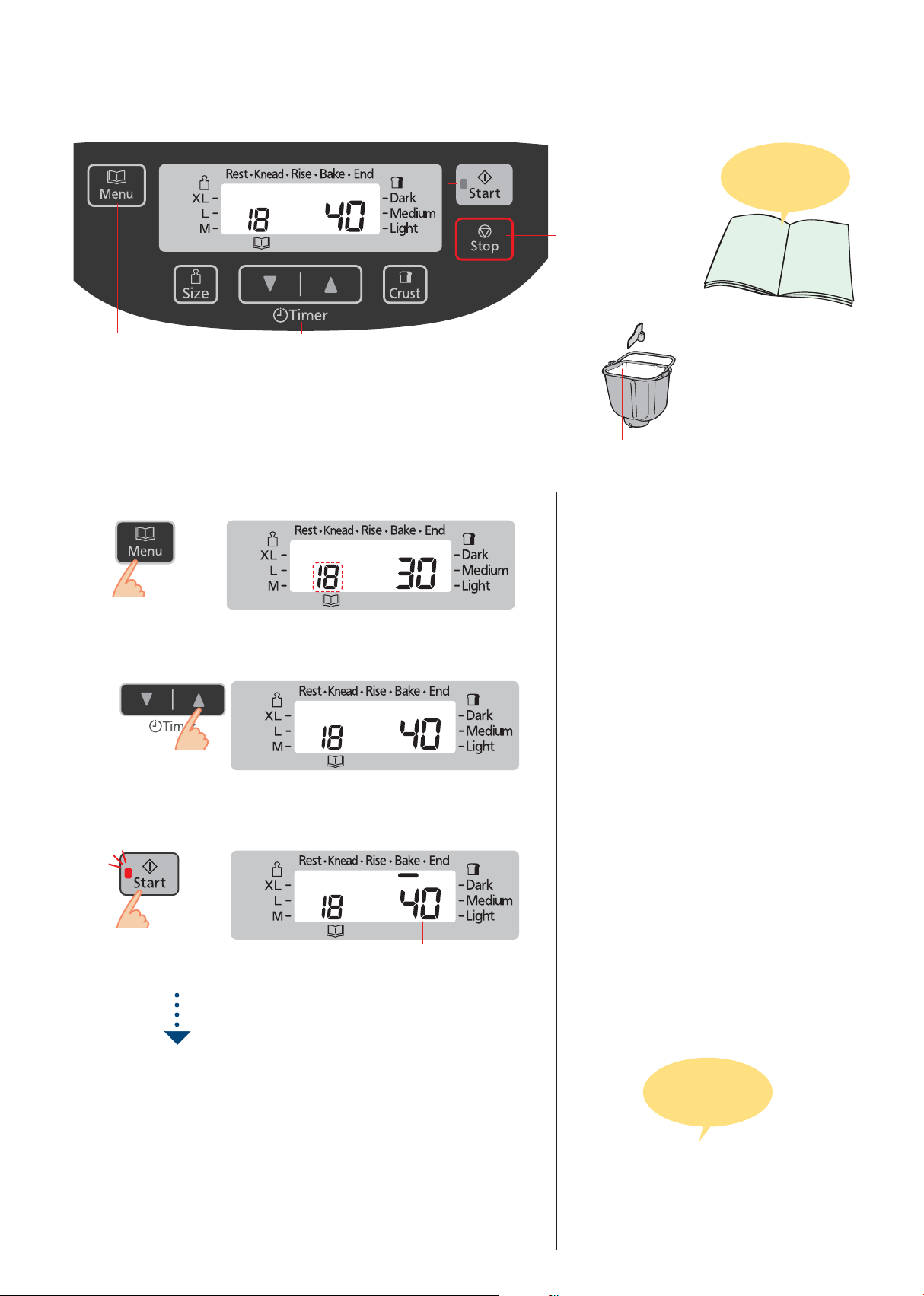
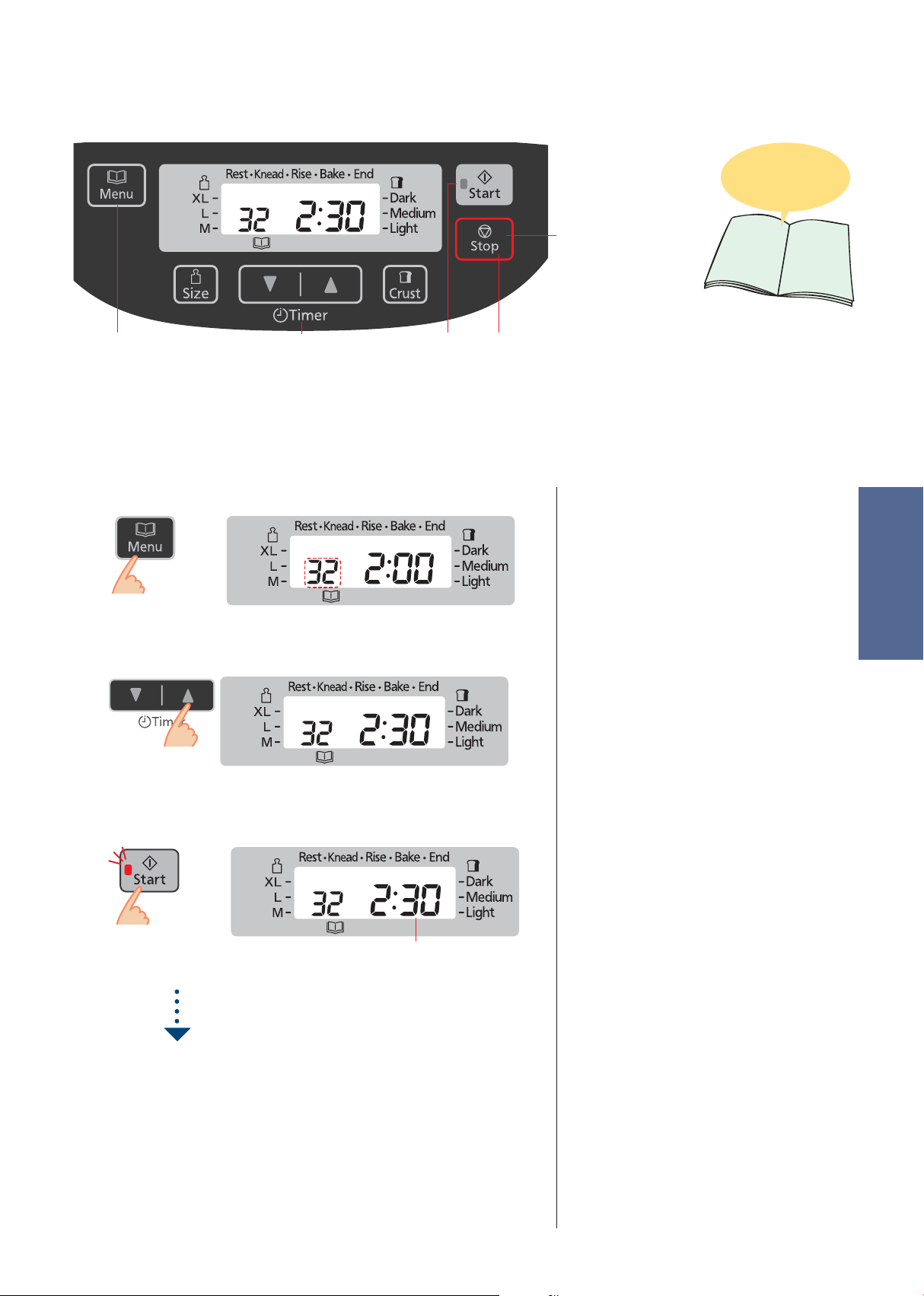
1
Select menu ‘18’
O
Timer is not available on menu 18.
(The Timer pad only sets the duration of the
baking time.)
2
Set the baking time
3
Start the machine
Estimated time until the selected programme is complete
O
The start light will come on.
4
Press ‘Stop’ when the machine beeps and the bar at ‘End’ flashes,
check that baking is complete, and
remove the bread pan
O
The flashing start light will go off.
Q
If baking is not complete e Repeat steps 1–3
(Additional cooking time can be made up to twice.
Each time should be within 50 minutes.
The timer will start again from 1 minute when the unit is hot.
Increase the time by pressing the timer pad as required.)
Be careful!
It’s hot!
O
To check whether baking is complete, insert a
skewer into the centre of the cake or tea bread
– it is ready if there is no mixture stuck to the
skewer when you remove it.
•
Line with greaseproof paper. (Cake or tea bread
will burn if directly touches the bread pan.)
•
Remove the kneading blade
27
Making Jam
1
4
2
3
Turn to P. 44 for
jam recipes
Q
To cancel/stop once
started
(hold for more than
1 second)
Preparations
➀
Prepare the ingredients according to the recipe.
➁
Put the kneading blade into the bread pan.
➂
Place the ingredients into the bread pan in the following order:
KDOIRIWKHIUXLWVĺKDOIRIWKHVXJDUĺUHPDLQGHURIIUXLWVĺUHPDLQGHURIVXJDU
➃
Set the bread pan into the main unit, and plug the machine into the socket.
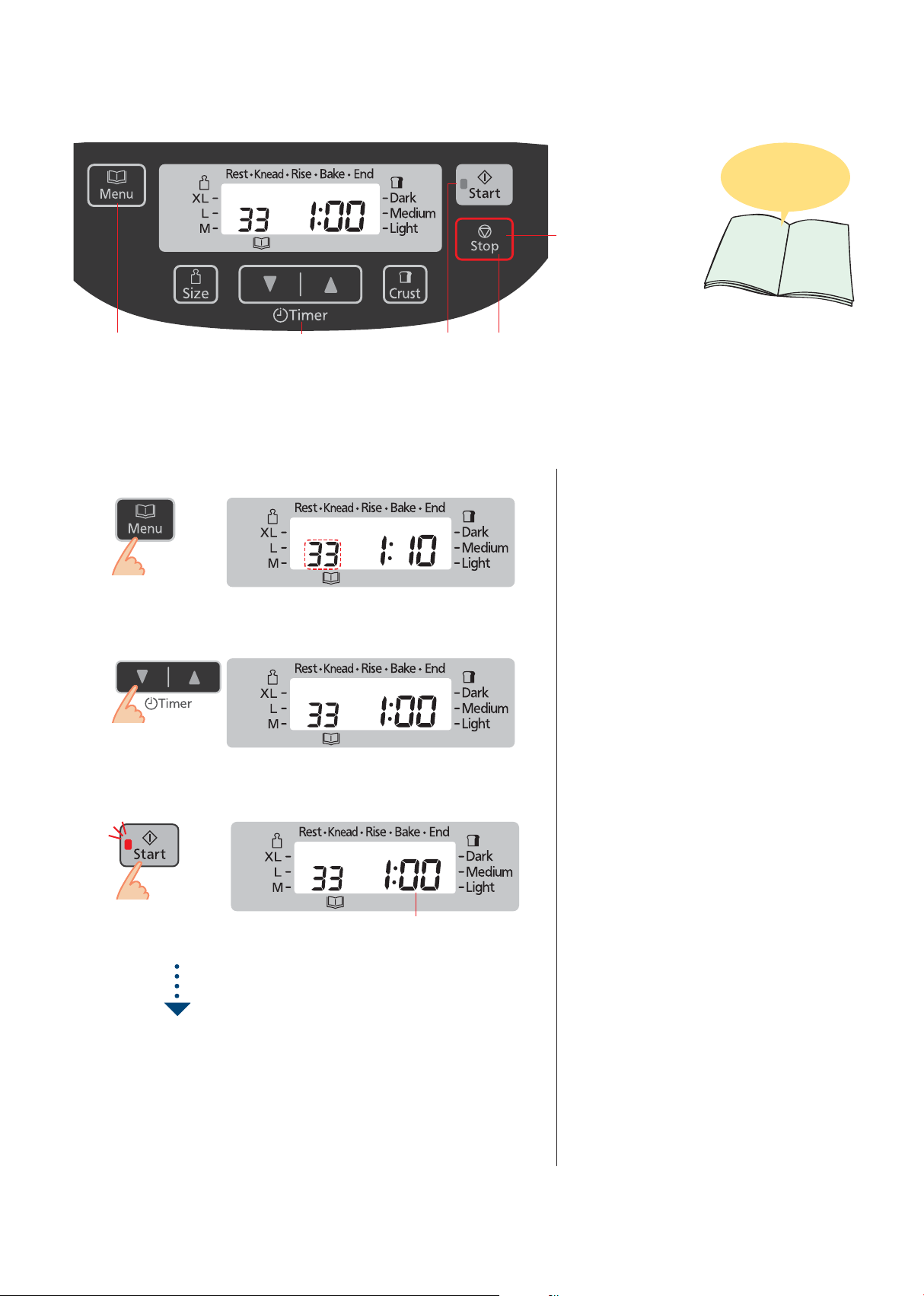
1
Select menu ‘32’
O
Timer is not available on menu 32.
(The Timer pad only sets the duration of the
cooking time.)
O
It is necessary to have an adequate amount of
sugar, acid, and pectin to make firm set jam.
O
Depending on the type of pectin, it may be better
to increase or decrease the amount of it.
O
Fruits with a high level of pectin set easily. Fruits
with less pectin do not set well.
O
Use freshly ripened fruits. Over or under ripe
fruits do not set firmly.
O
The recipes in this book make soft set jams.
This is due to lower levels of sugar.
O
Follow the recipe for the quantity for each
ingredient.
•
Do not increase or decrease the quantities of
fruits. It may cause the jam to boil over or scorch.
•
Do not increase the quantity of sugar more than
half quantities of fruits.
It may cause the jam to boil over or scorch.
When decrease the quantity of sugar, jam does
not set firm.
* When the acidity of the fruit is strong, you can
decrease quantity of the lemon juice but if it is
decreased too much, jam does not set firm.
O
When the cooking time is short, fruit bits can
remain partially and the jam may become watery.
•
The jam will continue to set as it cools.
Be careful not to over cook.
2
Set the cooking time
3
Start the machine
Estimated time until the selected programme is complete
O
The start light will come on.
4
Press ‘Stop’ and remove jam
when machine beeps 8 times and the bar at ‘End’ flashes
O
The flashing start light will go off.
Q
If the cooking is not complete e Repeat steps 1–3
(Additional cooking time can be made up to twice. Each time should be
within 10–40 minutes. The timer will start again from 1 minute when the unit
is hot. Increase the time by pressing the timer pad as required.)
O
Put the finished jam into the container as soon as
possible. Please take care of the burn when you
take out jam.
O
Jam can burn if it is left in the bread pan.
O
Store the jam in a cool, dark place. Due to the
lower levels of sugar the shelf life is not as long
as shop bought varieties. Once open, refrigerate
and consume shortly after opening.
How to Use
28
Making Compote
1
4
2
3
Turn to P. 44 for
compote recipes
Q
To cancel/stop once
started
(hold for more than
1 second)
Preparations
➀
Prepare the ingredients according to the recipe. (Remove the kneading blade.)
➁
Place the ingredients into the bread pan in the following order:
IUXLWVĺVXJDUĺOLTXLG
➂
Set the bread pan into the main unit, and plug the machine into the socket.
1
Select menu ‘33’
O
Timer is not available on menu 33.
(The Timer pad only sets the duration of the
cooking time.)
O
Follow the recipe for the quantities for each
ingredient.
•
Do not increase or decrease the quantities of
fruits. It may cause the compote to boil over or
scorch.
2
Set the cooking time
3
Start the machine
Estimated time until the selected programme is complete
O
The start light will come on.
4
Press ‘Stop’ and remove compote
when machine beeps 8 times and the bar at ‘End’ flashes
O
The flashing start light will go off.
Q
If the cooking is not complete e Repeat steps 1–3
(Additional cooking time can be made up to twice. Each time should be
within 10–40 minutes. The timer will start again from 1 minute when the unit
is hot. Increase the time by pressing the timer pad as required.)
29
Bread Recipes
Turn to P. 35–42 for
dough recipes
[1 Basic]
[2 Basic Rapid]
[3 Basic Raisin]
(bread or brown flour)
: Timer can be used for recipes
with this symbol (4–13 hours)
White Loaf
Menu ‘1’ (4hr)
MLXL
Bread flour 420 g 520 g 620 g
Salt 1 tsp 2 tsp 2 tsp
Powdered milk 2 tsp 1½ tbsp 1¾ tbsp
Sugar 1 tbsp 1 tbsp 1½ tbsp
Butter 15 g 20 g 25 g
Water 290 mL 360 mL 420 mL
Dry yeast 1¼ tsp 1½ tsp 1½ tsp
Rapid White Loaf
Menu ‘2’ (1hr 55min–2hr)
MLXL
Bread flour 420 g 520 g 620 g
Salt 1½ tsp 2 tsp 2 tsp
Powdered milk 1 tbsp 1½ tbsp 2 tbsp
Sugar 1 tbsp 2 tbsp 2 tbsp
Butter 15 g 20 g 25 g
Water 290 mL 360 mL 430 mL
Dry yeast 1½ tsp 2¼ tsp 2¼ tsp
Garlic Herb Bread
Menu ‘1’ (4hr)
MLXL
Bread flour 420 g 520 g 620 g
Salt 1 tsp 2 tsp 2 tsp
Powdered milk 2 tsp 1½ tbsp 1¾ tbsp
Sugar 1 tbsp 1 tbsp 1½ tbsp
Butter 15 g 20 g 25 g
Crushed garlic 1 tsp 2 tsp 2 tsp
Fresh herbs, chopped 2 tbsp 3 tbsp 3 tbsp
Water 290 mL 360 mL 420 mL
Dry yeast 1¼ tsp 1½ tsp 1½ tsp
Kumara Bread
Menu ‘1’ (4hr)
MLXL
Bread flour 420 g 520 g 620 g
Salt 1 tsp 2 tsp 2 tsp
Powdered milk 2 tsp 1½ tbsp 1¾ tbsp
Butter 15 g 20 g 25 g
Mashed kumara ѿFXS ½ cup ҀFXS
Honey 1 tbsp 1 tbsp 1 tbsp
Cinnamon ½ tsp 1 tsp 2 tsp
Water 290 mL 340 mL 390 mL
Dry yeast 1¼ tsp 1½ tsp 1½ tsp
Cheese & Mustard Loaf
Menu ‘1’ (4hr)
MLXL
Bread flour 420 g 520 g 620 g
Salt 1 tsp 2 tsp 2 tsp
Powdered milk 2 tsp 1½ tbsp 1¾ tbsp
Sugar 1 tbsp 1 tbsp 1½ tbsp
Butter 15 g 20 g 25 g
Mustard powder 1 tsp 2 tsp 3 tsp
Cracked pepper ½ tsp 1 tsp 2 tsp
Cheese ¼ cup ½ cup ¾ cup
Worcestershire sauce 1 tbsp 2 tbsp 3 tbsp
Water 280 mL 310 mL 370 mL
Dry yeast 1¼ tsp 1½ tsp 1½ tsp
Mexican Chilli Loaf
Menu ‘1’ (4hr)
MLXL
Bread flour 420 g 520 g 620 g
Salt 1 tsp 2 tsp 2 tsp
Powdered milk 2 tsp 1½ tbsp 1¾ tbsp
Sugar 1 tbsp 1 tbsp 1½ tbsp
Butter 15 g 20 g 25 g
Chilli powder ¼ tsp ½ tsp 1 tsp
Tomato paste 2 tsp 1 tbsp 2 tbsp
Corn, cooked 2 tbsp ¼ cup ½ cup
Cumin ½ tsp 1 tsp 2 tsp
Oregano ½ tsp 1 tsp 2 tsp
Water 280 mL 330 mL 380 mL
Dry yeast 1¼ tsp 1½ tsp 1½ tsp
Curry & Onion Loaf
Menu ‘1’ (4hr)
MLXL
Bread flour 420 g 520 g 620 g
Salt 1 tsp 2 tsp 2 tsp
Powdered milk 2 tsp 1½ tbsp 1¾ tbsp
Sugar 1 tbsp 1 tbsp 1½ tbsp
Butter 15 g 20 g 25 g
Curry powder 2 tsp 1 tbsp 2 tbsp
Onion flakes 2 tsp 1 tbsp 1¼ tbsp
Water 290 mL 360 mL 420 mL
Dry yeast 1¼ tsp 1½ tsp 1½ tsp
Rosemary & Pinenuts Loaf
Menu ‘3’ (4hr)
MLXL
Bread flour 420 g 520 g 620 g
Salt 1 tsp 2 tsp 2 tsp
Powdered milk 2 tsp 1½ tbsp 1¾ tbsp
Sugar 1 tbsp 1 tbsp 1½ tbsp
Butter 15 g 20 g 25 g
Rosemary 1 tbsp 2 tbsp 3 tbsp
Water 290 mL 360 mL 420 mL
Dry yeast 1¼ tsp 1½ tsp 1½ tsp
* Pinenuts 2 tbsp 3 tbsp 4 tbsp
•
To raise bread, use strong high protein flour (Bread flour or Bakers flour).
•
Bread improver contain Vitamin C, and there is an effect to improve volume of bread.
Please add it at the time of the recipe which using a lot of whole wheat flour.
•
100% whole wheat bread is not recommended because it does not rise well.
•
When using ORGRAN for gluten free bread, upper side comes to dent easily.
•
When using ORGRAN for gluten free bread, always use chilled water.
How to Use Recipes
•
For addition of ingredients with*, see the instructions on P. 14.
30
Bread Recipes
[4 Savoury]
(bread flour)
: Timer can be used for recipes
with this symbol (4–13 hours)
Bacon & Cheese
Menu ‘4’ (4hr)
MLXL
Bread flour 420 g 520 g 600 g
Salt 1 tsp 2 tsp 2 tsp
Powdered milk 2 tsp 1½ tbsp 1¾ tbsp
Sugar 1 tbsp 1 tbsp 1½ tbsp
Butter 15 g 20 g 25 g
Water 290 mL 360 mL 410 mL
Dry yeast 1¼ tsp 1½ tsp 1½ tsp
* Bacon, cooked 50 g 65 g 75 g
* Cheese, 1 cm 50 g 60 g 75 g
Mix Olive
Menu ‘4’ (4hr)
MLXL
Bread flour 420 g 520 g 600 g
Salt 1 tsp 2 tsp 2 tsp
Powdered milk 2 tsp 1½ tbsp 1¾ tbsp
Sugar 1 tbsp 1 tbsp 1½ tbsp
Butter 15 g 20 g 25 g
Water 290 mL 360 mL 410 mL
Dry yeast 1¼ tsp 1½ tsp 1½ tsp
* Mix olive 100 g 125 g 150 g
Wholemeal Loaf 75%
Menu ‘5’ (5hr)
MLXL
Whole wheat flour 300 g 370 g 450 g
Bread flour 100 g 125 g 150 g
Salt 1 tsp 2 tsp 2 tsp
Powdered milk 2 tsp 1½ tbsp 1¾ tbsp
Sugar 1 tbsp 1 tbsp 1½ tbsp
Butter 15 g 20 g 25 g
Water 300 mL 360 mL 420 mL
Bread improver, optional ¼ tsp ½ tsp ½ tsp
Dry yeast 1¼ tsp 1½ tsp 1¾ tsp
Wholemeal Loaf 50%
Menu ‘5’ (5hr)
MLXL
Whole wheat flour 200 g 250 g 300 g
Bread flour 200 g 250 g 300 g
Salt 1 tsp 2 tsp 2 tsp
Powdered milk 2 tsp 1½ tbsp 1¾ tbsp
Sugar 1 tbsp 1 tbsp 1½ tbsp
Butter 15 g 20 g 25 g
Water 300 mL 360 mL 420 mL
Bread improver, optional ¼ tsp ½ tsp ½ tsp
Dry yeast 1¼ tsp 1½ tsp 1¾ tsp
Rapid Wholemeal Loaf 75%
Menu ‘6’ (3hr)
MLXL
Whole wheat flour 300 g 370 g 450 g
Bread flour 100 g 125 g 150 g
Salt 1½ tsp 2 tsp 2 tsp
Powdered milk 1 tbsp 1 tbsp 1½ tbsp
Sugar ½ tbsp 1 tbsp 2 tbsp
Butter 15 g 20 g 25 g
Water 300 mL 350 mL 420 mL
Bread improver, optional ¼ tsp ½ tsp ½ tsp
Dry yeast 1½ tsp 2 tsp 2¼ tsp
Rosemary & Thyme Loaf
Menu ‘5’ (5hr)
MLXL
Whole wheat flour 300 g 370 g 450 g
Bread flour 100 g 125 g 150 g
Salt 1 tsp 2 tsp 2 tsp
Powdered milk 2 tsp 1½ tbsp 1¾ tbsp
Sugar 1 tbsp 1 tbsp 1½ tbsp
Butter 15 g 20 g 25 g
Rosemary 1 tbsp 2 tbsp 3 tbsp
Thyme 1 tbsp 2 tbsp 3 tbsp
Water 300 mL 360 mL 420 mL
Bread improver, optional ¼ tsp ½ tsp ½ tsp
Dry yeast 1¼ tsp 1½ tsp 1¾ tsp
Dried Tomato, Cheese & Tomato Juice
Menu ‘4’ (4hr)
MLXL
Bread flour 420 g 520 g 600 g
Salt 1 tsp 2 tsp 2 tsp
Powdered milk 2 tsp 1½ tbsp 1¾ tbsp
Sugar 1 tbsp 1 tbsp 1½ tbsp
Butter 15 g 20 g 25 g
Water 145 mL 180 mL 200 mL
Tomato juice 145 mL 180 mL 210 mL
Dry yeast 1¼ tsp 1½ tsp 1½ tsp
* Dried tomatoes 30 g 40 g 50 g
* Cheese, cut into
1 cm cubes
70 g 85 g 100 g
[5 Whole wheat]
[6 Whole wheat
Rapid]
[7 Whole wheat
Raisin]
(wholemeal flour)
: Timer can be used for recipes
with this symbol (5–13 hours)
Banana Cinnamon Loaf
Menu ‘3’ (4hr)
MLXL
Bread flour 420 g 520 g
620 g
Salt 1 tsp 2 tsp 2 tsp
Powdered milk 2 tsp 1½ tbsp 1¾ tbsp
Butter 15 g 20 g 25 g
Cinnamon ½ tsp 1 tsp 2 tsp
Honey 2 tsp 1 tbsp 1½ tbsp
Water 290 mL 360 mL 420 mL
Dry yeast 1¼ tsp 1½ tsp 1½ tsp
* Banana chips,
chopped
2 tbsp ¼ cup ½ cup
Chocolate Nut Bread
Menu ‘3’ (4hr)
MLXL
Bread flour 420 g 520 g 620 g
Salt 1 tsp 2 tsp 2 tsp
Powdered milk 2 tsp 1½ tbsp 1¾ tbsp
Choc bits 2 tbsp ¼ cup ½ cup
Cocoa ½ tsp 1 tsp 2 tsp
Water 300 mL 360 mL 430 mL
Dry yeast 1¼ tsp 1½ tsp 1½ tsp
* Mixed chopped nuts 2 tbsp ¼ cup ½ cup
•
For addition of ingredients with*, see the instructions on P. 14.
31
Sesame & Bran Loaf
Menu ‘5’ (5hr)
MLXL
Whole wheat flour 300 g 370 g 450 g
Bread flour 100 g 125 g 150 g
Salt 1 tsp 2 tsp 2 tsp
Powdered milk 2 tsp 1½ tbsp 1¾ tbsp
Sugar 1 tbsp 1 tbsp 1½ tbsp
Butter 15 g 20 g 25 g
Unprocessed bran 2 tbsp ¼ cup ½ cup
Sesame seeds 2 tsp 1 tbsp 2 tbsp
Golden syrup 2 tsp 1 tbsp 1½ tbsp
Water 300 mL 360 mL 420 mL
Bread improver, optional ¼ tsp ½ tsp ½ tsp
Dry yeast 1¼ tsp 1½ tsp 1¾ tsp
Orange Poppyseed Loaf
Menu ‘5’ (5hr)
MLXL
Whole wheat flour 300 g 370 g 450 g
Bread flour 100 g 125 g 150 g
Salt 1 tsp 2 tsp 2 tsp
Powdered milk 2 tsp 1½ tbsp 1¾ tbsp
Sugar 1 tbsp 1 tbsp 1½ tbsp
Butter 15 g 20 g 25 g
Orange rind 1 tbsp 2 tbsp 3 tbsp
Poppy seeds 2 tbsp ¼ cup ½ cup
Water 300 mL 360 mL 420 mL
Bread improver, optional ¼ tsp ½ tsp ½ tsp
Dry yeast 1¼ tsp 1½ tsp 1¾ tsp
Date & Nut Loaf
Menu ‘7’ (5hr)
MLXL
Whole wheat flour 300 g 370 g 450 g
Bread flour 100 g 125 g 150 g
Salt 1 tsp 2 tsp 2 tsp
Powdered milk 2 tsp 1½ tbsp 1¾ tbsp
Butter 15 g 20 g 25 g
Chopped dates ¼ cup ѿFXS ½ cup
Water 300 mL 360 mL 420 mL
Bread improver, optional ¼ tsp ½ tsp ½ tsp
Dry yeast 1¼ tsp 1½ tsp 1¾ tsp
* Chopped walnuts ¼ cup ѿFXS ½ cup
Mixed Grain Bread
Menu ‘7’ (5hr)
MLXL
Whole wheat flour 80 g 100 g 150 g
Bread flour 250 g 300 g 350 g
Oatmeal 40 g 50 g 50 g
Buckwheat groats 40 g 50 g 50 g
Cornmeal 20 g 30 g 30 g
Whole linseed 2 tsp 1 tbsp 1½ tbsp
Brown sugar 1 tbsp 1 tbsp 1½ tbsp
Butter 20 g 25 g 25 g
Powdered milk 1½ tbsp 2 tbsp 2 tbsp
Salt 1 tsp 2 tsp 2 tsp
Water 300 mL 370 mL 450 mL
Dry yeast 1¼ tsp 1½ tsp 1¾ tsp
* Toasted sunflower
seed
2 tsp 1 tbsp 1½ tbsp
Rye 100%
Menu ‘8’ (3hr 30min)
Rye flour 500 g
Sugar 2 tsp
Oil 3 tbsp
Salt 2 tsp
Water 380 mL
Dry yeast 3 tsp
Rye and Wholemeal
Menu ‘8’ (3hr 30min)
Rye flour 250 g
Whole wheat flour 250 g
Sugar 2 tsp
Oil 2 tbsp
Salt 2 tsp
Water 380 mL
Dry yeast 2½ tsp
French Bread
Menu ‘9’ (6hr)
Bread flour 420 g
Salt 1½ tsp
Butter 5 g
Water 310 mL
Dry yeast 1¼ tsp
Tarragon & Thyme
Menu ‘9’ (6hr)
Bread flour 420 g
Salt 1½ tsp
Butter 5 g
Tarragon 1 tbsp
Thyme 1 tbsp
Water 310 mL
Dry yeast 1¼ tsp
[8 Rye]
(rye flour)
O
Remember to use the rye
kneading blade for all these
recipes.
O
The Raisin nut dispenser
does not operate on the Rye
programme.
O
Put any additional ingredients
directly into the bread pan at
the start.
O
As a result of the consistency
some flour may remain on the
sides of the loaf, but this is normal.
O
Due to their consistency, the
kneading blade will often
become embedded in Rye Bread
loaves. Wait for the loaf to cool
(to avoid burning your hands),
before removing the blade by
pressing on the base of the loaf
and manipulating it out gently to
avoid damaging the loaf.
: Timer can be used for recipes
with this symbol
(3 hours 30 minutes–13 hours)
[9 French]
(bread flour/wholemeal flour)
Make bread with a crispy crust and
texture.
: Timer can be used for recipes
with this symbol (6–13 hours)
Recipes
•
For addition of ingredients with*, see the instructions on P. 14.
32
Italian Bread
Menu ‘11’ (4hr 30min)
Bread flour 400 g
Salt 1½ tsp
Olive oil 1 tbsp
Water 260 mL
Dry yeast 1 tsp
Herb Bread
Menu ‘11’ (4hr 30min)
Bread flour 400 g
Salt 1½ tsp
Olive oil 1 tbsp
Basil 1 tbsp
Water 260 mL
Dry yeast 1 tsp
Sundried Tomato and Parmesan
Menu ‘11’ (4hr 30min)
Bread flour 400 g
Sugar 1 tsp
Salt ½ tsp
Parmesan Cheese,
grated
50 g
Sundried Tomatoes in
oil, chopped
75 g
Water 270 mL
Dry yeast 1 tsp
[11 Italian]
(bread flour)
Make light bread for enjoying with
pasta, etc.
O
The Raisin nut dispenser does not
operate on the Italian programme.
O
Put any additional ingredients
directly into the bread pan at
the start.
: Timer can be used for recipes
with this symbol
(4 hours 30 minutes–13 hours)
Basic Sandwich Bread
Menu ‘12’ (5hr)
Bread flour 420 g
Salt 1¼ tsp
Powdered milk 2 tsp
Sugar 2½ tsp
Butter 15 g
Water 315 mL
Dry yeast 1¼ tsp
Whole Wheat Sandwich Bread
Menu ‘12’ (5hr)
Whole wheat flour 320 g
Bread flour 100 g
Salt 1¼ tsp
Powdered milk 2 tsp
Sugar 2½ tsp
Butter 15 g
Water 315 mL
Bread improver, optional ¼ tsp
Dry yeast 1¼ tsp
[12 Sandwich]
Make bread with a soft crust and
texture.
: Timer can be used for recipes
with this symbol (5–13 hours)
Basic Brioche
Menu ‘13’ (3hr 30min)
Bread flour 400 g
Salt 1 tsp
Sugar 3 tbsp
Butter (Cut into 2 cm cubes and keep in
refrigerator)
50 g
Powdered milk 2 tbsp
Eggs (Medium) 2 (100 g)
Water 180 mL
Dry yeast 1½ tsp
* Butter for added later (Cut into 1–2 cm
cubes and keep in refrigerator)
70 g
Pannettone
Menu ‘13’ (3hr 30min)
Bread flour 400 g
Sugar 4 tbsp
Salt 1 tsp
Butter (Cut into 2 cm cubes and keep in
refrigerator)
50 g
Egg medium (beaten) 2 (100 g)
Milk 200 mL
Dry yeast 1¾ tsp
* Additional Butter (Cut into 1–2 cm cubes
and keep in refrigerator)
70 g
* Orange Peel; Chopped Finely 50 g
* Brown Saltana 50 g
* Dried Black Currant 50 g
[13 Brioche]
Spelt White Bread
Menu ‘15’ (4hr 30min)
MLXL
Spelt white flour 400 g 500 g 600 g
Salt 1¼ tsp 1½ tsp 1¾ tsp
Sugar 1½ tsp 2 tsp 2 tsp
Butter 10 g 20 g 25 g
Water 250 mL 310 mL 360 mL
Dry yeast 1¼ tsp 1½ tsp 1¾ tsp
Rye and Spelt
Menu ‘15’ (4hr 30min)
MLXL
Spelt white flour 275 g 350 g 425 g
Rye flour 125 g 150 g 175 g
Salt 1¼ tsp 1½ tsp 1¾ tsp
Sugar 1½ tsp 2 tsp 2 tsp
Butter 5 g 10 g 10 g
Plain yoghurt 120 g 150 g 180 g
Water 140 mL 180 mL 200 mL
Dry yeast 1¼ tsp 1½ tsp 1¾ tsp
[15 Speciality]
[16 Speciality Raisin]
: Timer can be used for recipes
with this symbol
(4 hours 30 minutes–13 hours)
Rustic Scone
Menu ‘17’ (1hr 15min)
Bread flour 360 g
Butter (Cut into 1 cm cubes) 60 g
Egg 2
Milk
160 g (mixture of
eggs and milk)
Yoghurt 60 g
Salt ½ tsp
Sugar 40 g
Baking powder 10 g
[17 Rustic Scone]
Bread Recipes
[
10 Rustic Sourdough
]
: Timer can be used for recipes
with this symbol (5–9 hours)
Rustic Sourdough
Stage 1 Sourdough starter: Menu ‘27’ (24hr)
Turn to P. 18 and P. 42 for the sourdough starter recipe.
Stage 2: Menu ‘10’ (5hr)
Bread flour 400 g
Salt 1 tsp
Water
150 mL
Dry yeast ¾ tsp
•
For addition of ingredients with*, see the instructions on P. 14.
33
Wheat and gluten free bread
Menu ‘14’ (1hr 50min)
Water (chilled)
450 mL
Vagetable oil 3 tbsp
ORGRAN Easy Bake bread mix 450 g
For more information on ORGRAN’s gluten free
bread mixes, please contact the address below:
NATURAL FOODS
Division of Roma Food Products, 47-53 Aster Avenue,
Carrum Downs, Victoria 3201
[2 Basic Rapid]
[14 Gluten Free]
(gluten free bread mix /
wheat free bread mix)
: Timer cannot be used
O
The raisin nut dispenser does
not operate on the Gluten Free
programme.
O
Put any additional ingredients
directly into the bread pan at
the start.
O
You can bake gluten free cakes
following our recipes on P. 43
by substituting gluten free plain
flour for standard plain flour. If
self-raising flour is required also
add 1 tsp of gluten free baking
powder.
O
You can purchase gluten free
bread mix at:
•
Pharmacies
•
Health food shops
•
Major supermarkets
Note
O
Making gluten free bread is very
different from the normal way
of producing bread in the bread
maker. Please read through the
guidelines on the right.
O
Please consult flour
manufacturers for detailed
information.
O
As a result of consistency some
flour may remain on the sides of
the loaf, but this is normal.
Before making gluten free bread
Q
Consult your doctor and follow the guidelines below!
If you make gluten free bread as part of dietary therapy, it is important that you avoid cross-
contamination with flour that does contain gluten.
Please take particular care when washing the bread pan and the kneading blade, etc.
Q
It is made differently to other types of bread!
The order of putting in ingredients is
different
Please put in the ingredients in the following
order so that the gluten free bread mix is well
mixed. (The wrong order may result in poor
rising)
e Water, salt, fat e gluten free bread mix e
dry yeast
The outcome differs depending on the type
of flour
The recipes below have been developed
with particular types of bread mix, and so the
final outcome may differ depending on the
actual bread mix used. (There may be greater
variation with wheat free bread mixes.)
If kneading blade becomes embedded in
bread
Due to their consistency, the kneading blade will
often become embedded in Gluten and Wheat
Free Bread loaves. Wait for the loaf to cool (to
avoid burning your hands), before removing the
blade by pressing on the base of the loaf and
manipulating it out gently to avoid damaging
the loaf.
Consume within two days
Store your finished bread in a cool, dry place,
and consume within two days. If you cannot
finish it all in time, cut it into pieces, place in a
freezer bag and into the freezer.
Gluten Free Recipes
Recipes
34
Gluten Free Recipes
Gluten free bread on Basic programme
Menu ‘2’–‘XL’ Size–‘Dark’ Crust (2hr)
Yeasted plain gluten free loaf
430–450 mL
ѿFXS
3
1 tsp
1 cup
1 cup
1 cup
½ cup
½ cup
1–1½ tsp
2 tbsp
1 tbsp
Water
Oil (Canola/Sunflower)
Egg (Medium)
White vinegar (not malt)
Brown rice flour
White rice flour
Arrowroot or tapioca flour
Besan (chick pea) flour or soya flour
White or brown rice flour
Salt
Sugar
Xantan gum
Dry yeast (not rapid rise)
2 tsp
Yeasted fruit gluten free loaf
Yeasted plan gluten free loaf (above) one batch
Brown sugar 3 tbsp
Cinnamon 1 tsp
Dried fruit 1 cup
Yeasted cheese gluten free loaf
Yeasted plan gluten free loaf (above) one batch
Grated cheese 1 cup
Yeasted seeded gluten free loaf
Yeasted plan gluten free loaf (above)
one batch
* Water 450–480 mL
Seed mixture 3 tbsp
Important Notes:
1. Do not leave gluten free bread in for keep warm.
Remove bread from Machine when baking is
complete.
2. Always assist kneading 5–10 minutes into
kneading process. Lift lid (do not turn machine
off), with spatula mix to ensure all wet and dry
ingredients are combined, scrape down sides.
Test dough by lifting some on spatula. Dough
should fall slowly from spatula.
If too thin add 2–4 tbsp of rice flour.
If too thick, add 1–3 tbsp of water.
(It should look like a thick cake mix or stiff mashed
potato).
3. 3 tbsp powdered milk can be added to any of
these recipes. Yeast responds to protein by
adding cheese and/or powdered milk, therefore
the loaf will rise more.
4. Flour fluctuates in refining therefore water content
differs considerably. Very refined flour (e.g. rice
flour labeled rice starch) will not need as much
water as a more course flour (e.g. McKenzies).
You may need to cut water back 20–30 mL for
finer flour.

35
Dough Recipes
[19 Basic] [20 Basic Raisin] [21 Savoury]
[22 Whole wheat] [23 Whole wheat Raisin]
[24 Rye] [25 French] [26 Rustic Sourdough]
[27 Sourdough starter] [28 Pizza] [29 Brioche]
[30 Speciality]
The Dough setting mixes and gives the dough it’s first rising before
you shape and bake it in your conventional oven.
: Timer cannot be used (except pizza)
Prepare your ingredients according to the recipe and select the correct menu. When
your dough is ready, shape it, allow it to rise, and then bake it yourself.
O
The maximum load of the Bread Maker is 600 g.
Dough recipes using 300 g of flour may be doubled.
O
When the DOUGH programme has completed its operation, you may find that the
prepared dough is easier to shape if it is tipped onto a lightly floured board before
handling.
Example – making plain bread rolls
➀
Shaping
Dough can be shaped into round rolls, plaits, knots, French
sticks, large or small cobs or put in a traditional loaf tin.
O
Rolls
O
Knot
O
Hedgehogs
Raisins
(Coat with a beaten egg)
➁
Proving
Most recipes require the dough to be left to prove i.e. to be
left to rise after shaping, before the final baking. Generally
the dough should be left to prove in a warm place (at
DSSUR[LPDWHO\±Û&XQWLOWKHGRXJKKDVGRXEOHGLQVL]H
O
Approximate proving time-Rolls 30–50 minutes, Whole
breads 50 minutes.
O
To prevent a hard dry skin forming, cover the dough with
a large polythene bag or cover with lightly oiled cling film.
➂
Glazing/Baking
Brush with milk, salted water, beaten egg or oil. Sprinkle
with poppy seeds, sesame seeds. Bake following recipe
guidelines.
Rolls
O
Select one of the following recipes and follow the method below.
1
Shape dough.
2
Place onto a greased baking tray and
allow to prove until doubled in size.
3
Brush with beaten egg.
4
%DNHLQDSUHKHDWHGRYHQDW±Û&IRU±PLQXWHVRU
until golden brown.
Basic Dough
Menu ‘19’ (2hr 20min)
Bread flour 475 g
Salt 2 tsp
Powdered milk 3 tbsp
Sugar 1¾ tbsp
Butter 45 g
Water 300 mL
Dry yeast 2 tsp
Savoury Dough
Menu ‘21’ (2hr 20min)
Bread flour 520 g
Salt 2 tsp
Powdered milk 1½ tbsp
Sugar 1 tbsp
Butter 20 g
Water 350 mL
Dry yeast 1½ tsp
* Bacon, cooked 65 g
* Cheese, 1 cm 60 g
Wholemeal Dough 75%
Menu ‘22’ (3hr 15min)
Whole wheat flour 370 g
Bread flour 125 g
Salt 2 tsp
Powdered milk 1½ tbsp
Sugar 1 tbsp
Butter 20 g
Water 360 mL
Bread improver, optional ½ tsp
Dry yeast 2 tsp
Rustic Sourdough Dough (Standard)
Stage 1 Sourdough starter: Menu ‘27’ (24hr)
Turn to P. 18 and P. 42 for the sourdough starter recipe.
Stage 2: Menu ‘26’ (2hr 30min)
Bread flour 400 g
Salt 1 tsp
Water 150 mL
Dry yeast ¾ tsp
Rustic Sourdough Dough (Rye)
Stage 1 Sourdough starter: Menu ‘27’ (24hr)
Turn to P. 18 and P. 42 for the sourdough starter recipe.
Stage 2: Menu ‘26’ (2hr 30min)
Bread flour 360 g
Rye flour 40 g
Salt 1 tsp
Water 150 mL
Dry yeast ¾ tsp
Recipes
•
For addition of ingredients with*, see the instructions on P. 14.
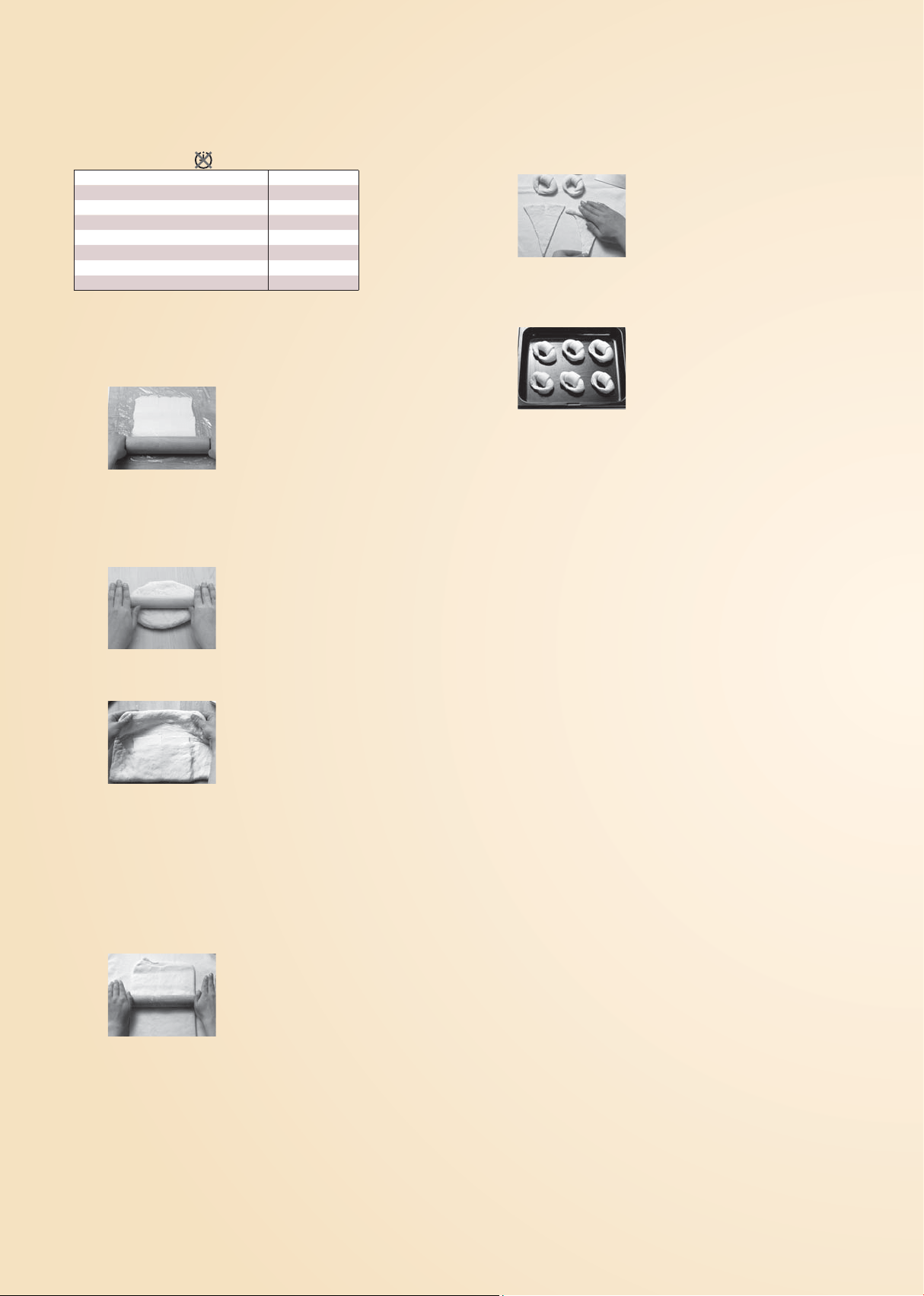
36
Dough Recipes
Croissants
Menu ‘19’ (2hr 20min)
Bread flour 475 g
Salt 2 tsp
Powdered milk 3 tbsp
Sugar ¼ cup
Butter 30 g
Water 300 mL
Dry yeast 2 tsp
Butter, chilled for folding in the dough 250 g
Method:
1
Roll 250 g of chilled butter between two sheets of plastic wrap
into a rectangle (17 × 25 cm). Chill at least 1 hour.
2
Turn the dough into a greased bowl. Place in the refrigerator
for 30 minutes.
3
Roll out the dough on a lightly floured surface into a 30 cm
square.
4
Place the rolled out butter over two-thirds of the dough.
Fold the third without butter over the centre third.
5
Fold the remaining third on top. Seal edges.
Rest the dough in the refrigerator for 20–30 minutes.
6
Place the dough at right angles to the previous position in the
step 4. Roll out into 30 cm square.
Fold into thirds. Wrap and place into refrigerator for 20–30
minutes.
Roll and fold twice more. Wrap and chill after each folding.
After the final folding, chill several hours or overnight.
7
Spread the dough for the final time into 30 cm square. Cut
dough into 9 equal squares.
Cut each square diagonally to form two triangles.
8
Roll up each triangle loosely, starting from the side opposite
the point. Curve ends.
9
Place seam side down on a greased baking tray. Cover and
place in warm area for 30–50 minutes or until almost doubled
in size.
10
Brush with beaten egg. Bake in a preheated 200°C oven for
15–20 minutes or until golden brown.
Doughnuts
1
Use Basic Dough recipe on P. 35.
2
Divide the dough into equal portions.
Roll each portion into a ball.
3
Place on a lightly floured surface.
Cover with a plastic wrap and leave to rise for 20 minutes.
4
Shape each ball as desired, in a ring, twisted, or in an oval
shape. Place on a greased tray.
5
Leave to rise at 30°C for 30 minutes.
6
Deep fry the doughnuts until golden brown.
7
Roll in a mixture of sugar and cinnamon or cool and use other
toppings as desired.
8
Makes 12–16 doughnuts dependent on size and shape
selected.
37
Hot Cross Buns
Menu ‘20’ (2hr 20min)
Bread flour 475 g
Salt 2 tsp
Powdered milk 3 tbsp
Sugar 1¾ tbsp
Butter 45 g
Orange rind 1 tbsp
Mixed sprice 1 tbsp
Water 260 mL
Egg, medium 1
Dry yeast 2 tsp
* Mixed Dried fruit 1 cup
Method:
1
Divide the dough into 10 or 12 equal portions. Roll each
portion into a ball, and rest for 20 minutes.
2
Shape into a smooth ball by gently rolling, and place on a
greased tray.
3
Cover and leave to rise in a warm place (30–35°C) for 30
minutes or until doubled in size.
4
Put the crosses on the dough
Crosses
Flour ½ cup
Oil 2 tbsp
Water to mix
Mix flour and oil, then add water to make a stiff paste. Pipe into the
shape of crosses — if a piping bag is not available, use a small plastic
bag with a corner cut off.
5
Bake in a preheated 200°C oven for 15–25 minutes or until
golden brown. Brush with the glaze.
Glaze
Milk 3 tbsp
Castor sugar 3 tbsp
Boil together until syrupy — brush over cooked buns when they are
removed from the oven.
Olive & Rosemary Rolls
Menu ‘20’ (2hr 20min)
Bread flour 450 g
Salt 1 tsp
Powdered milk 2 tbsp
Sugar 1 tsp
Olive oil 1 tbsp
Fresh rosemary, chopped 1 tbsp
Water 260 mL
Dry yeast 2 tsp
* Pitted black olives, quartered 50 g
Method:
1
Turn the dough out into a greased bowl.
Cover and let the dough rest for 20 minutes in the
refrigerator.
2
Divide the dough into 12–16 equal portions or into 2 long
loaves and place on a greased baking tray. Cover and leave
to rise in a warm place (30–35°C) for 30 minutes or until
doubled in size.
3
Brush with beaten egg and sprinkle with seeds.
4
Bake in a preheated 200°C oven for 15–25 minutes or until
golden brown.
Recipes
•
For addition of ingredients with*, see the instructions on P. 14.
38
Swedish Tea Ring
Menu ‘19’ (2hr 20min)
Bread flour 450 g
Salt 1 tsp
Powdered milk 3 tbsp
Sugar 4 tbsp
Butter 50 g
Water 230 mL
Dry yeast 2 tsp
Method:
Filling
Melted butter 2 tsp
Cinnamon 2 tsp
Brown sugar ½ cup
1
Roll or pat the dough into a rectangle (50 × 30 cm).
2
Brush over surface of the dough with melted butter.
3
Mix cinnamon and brown sugar and sprinkle over butter.
4
Roll up like a swiss roll starting from the long side.
5
Press edges firmly underneath.
6
Join ends to make a circle, pinch edges together and place
on a greased oven tray.
7
Cut nearly through to the centre of the ring at 2.5 cm
intervals, turning each section so that it faces cut side up.
8
Cover with plastic wrap and leave to rise in a warm place
(30–35°C) for 30 minutes.
9
Brush with beaten egg.
10
Bake in a preheated 180°C oven for 15–25 minutes or until
golden brown.
11
Other fillings such as dried fruit, jam, mincemeat, nuts etc can
be used.
12
This tea ring can be iced with a vanilla icing if desired.
Sundried Tomato & Basil Rolls
Menu ‘20’ (2hr 20min)
Bread flour 450 g
Salt 1 tsp
Sugar 1 tsp
Olive oil 1 tbsp
Fresh basil, chopped 2 tbsp
Grated parmesan cheese 2 tbsp
Water 250 mL
Dry yeast 2 tsp
* Sundried tomatoes, chopped ¼ cup
Method:
1
Divide the dough into 12 equal portions. Roll each portion into
a ball, and rest for 20 minutes.
2
Shape into a smooth ball by gently rolling, and place on a
greased tray.
3
Cover and leave to rise in a warm place (30–35°C) for
30 minutes or until doubled in size.
4
Bake in a preheated 200°C oven for 15–20 minutes or until
goldenbrown.
Dough Recipes
•
For addition of ingredients with*, see the instructions on P. 14.

39
Bagels
Menu ‘19’ (2hr 20min)
Bread flour 450 g
Salt 1 tsp
Powdered milk 2 tbsp
Sugar 1 tbsp
Butter or oil
2 tbsp
Water 250 mL
Dry yeast 2 tsp
Method:
1
Divide dough into 12–16 equal portions.
2
Roll each portion into a log approximately 20 cm long.
3
Form into a ring, sealing both ends together tightly. Place on
a lightly greased tray and cover with glad wrap. Leave to rise
in a warm place (30–35°C) for 30 minutes.
4
Bring a large saucepan of water to the boil.
Using a slotted spoon place 3–4 bagels into the water at a
time. Boil for 1 minute turning once. Lift out and drain well.
5
Brush with the beaten egg and sprinkle over seeds.
6
Bake at 200°C for 20–30 minutes.
Whole Wheat Raisin Rolls
Menu ‘23’ (3hr 15min)
Bread flour 200 g
Whole wheat flour 200 g
Salt 2 tsp
Powdered milk ѿWEVS
Sugar 1 tsp
Butter 20 g
Cinnamon 1 tbsp
Water 280 mL
Bread improver, optional ¼ tsp
Dry yeast 1½ tsp
* Raisins ѿFXS
Method:
1
Divide the dough into 16 equal portions.
Shape each portion into a roll.
(Follow instructions on P. 35.)
2
Place on a greased baking tray. Cover and let rise in a warm
place (30–35°C) for 30–40 minutes until almost doubled in
size.
3
Brush rolls with beaten egg, garnish with sliced almonds and
sugar, if desired.
4
Bake in a preheated 190°C oven for 15–20 minutes.
Recipes
•
For addition of ingredients with*, see the instructions on P. 14.
40
Sunflower & Kibblewheat Rolls
Menu ‘22’ (3hr 15min)
Bread flour 225 g
Whole wheat flour 225 g
Salt 1 tsp
Powdered milk
2 tbsp
Sugar 1 tsp
Butter 25 g
Sunflower seeds ¼ cup
Kibbled wheat ¼ cup
Water 300 mL
Bread improver, optional ¼ tsp
Dry yeast 2 tsp
Method:
1
Divide the dough into 12–16 equal portions.
Shape into smooth balls and place on a lightly greased
baking tray. Cover and leave to rise in a warm place (30–
35°C) for 40–60 minutes or until doubled in size.
2
Brush the tops with beaten egg, then sprinkle with seeds.
3
Bake in a preheated 200°C oven for 20–30 minutes or until
golden brown.
Rye & White Rolls
Stage 1 Culture: Menu ‘28’ (45min)
Bread flour 75 g
Rye flour 150 g
Water 200 mL
Dry yeast 1 tsp
Stage 2: Menu ‘24’ (2hr)
Rye flour 150 g
Bread flour 100 g
Sugar 2 tsp
oil 3 tbsp
Salt 2 tsp
Water 60 mL
Dry yeast 1¼ tsp
Method:
1
Put all culture ingredients in the bread pan and select menu
28.
• Use kneading blade (rye bread).
2
Turn off at the stop pad after 15 minutes.
(12 hours later)
3
Add all ingredients listed in stage 2 and select menu 24.
4
Divide dough into 12–15 pieces and shape into rolls.
5
Place on a greased baking tray and sprinkle with flour.
/HDYHWRULVHLQDZDUPSODFH±Û&IRU±PLQXWHVRU
until doubled in size.
6
*OD]HZLWKRLODQGEDNHLQDSUHKHDWHGRYHQDWÛ&IRU
10–15 minutes or until golden brown.
Dough Recipes

41
French Bread
Menu ‘25’ (3hr 35min)
Bread flour 475 g
Salt 2 tsp
Sugar 2 tsp
Butter 10 g
Water 290 mL
Dry yeast 2 tsp
Method:
1
Let the dough rest in a greased bowl for 20–30 minutes.
2
Knead dough on a lightly floured surface until it becomes
elastic and springs back when touched.
3
Divide the dough into 2 balls. Cover and let rest in a warm
place for 20 minutes.
4
Shape each ball into a flat rectangle. Roll up tightly from long
side; seal well. Taper ends.
5
Place on a greased baking tray. With a sharp knife, make
3 or 4 diagonal cuts about ½ cm deep across top of the
ORDYHV&RYHUDQGOHDYHWRULVHLQDZDUPSODFH±Û&
for 40–50 minutes until almost doubled in size.
6
Brush with beaten egg white, sprinkle with poppy seeds.
7
Bake in a preheated 200°C oven for 25–30 minutes or until
golden brown.
Brioche Dough (Chocolate Chip Brioche Roll)
; for 12 rolls
Menu ‘29’ (1hr 50min)
Bread flour 400 g
Sugar 4 tbsp
Salt 1½ tsp
Butter (Cut into 2 cm cubes and keep in
refrigerator)
70 g
Egg (beaten) 3 (150 g)
Milk 90 mL
Rum (Dark) 15 mL (1 tbsp)
Dry yeast 1¾ tsp
* Additional Butter (Cut into 1–2 cm cubes
and keep in refrigerator)
50 g
Optional Ingredients
Chocolate chips 120 g
• For addition of ingredients with*, follow programming instructions on P. 22.
Method:
1
Press the dough lightly to remove the gas.
2
Shape it round and wrap it with plastic wrap. Then rest it in
the refrigerator for 20 minutes.
O
When you like to add chocolate chips, follow below
instructions. (Optional)
• Roll the dough to 25 × 30 cm (10’’×12’’)
• Sprinkle chocolate chips and fold the bottom one third
up and the top one third down. Then fold it in half.
• Rest the dough in the room temperature for 10 minutes
again. (Do not dry it .)
3
Press the dough lightly to remove the gas again, and divide it
into 12 rolls.
4
Rest the dough in the room temperature for 10–15 minutes.
(Do not dry it out.)
5
Shape the dough and place them on a greased baking tray
DQGDOORZWRSURYHDWÛ&IRU±PLQXWHV
6
*OD]HDQGEDNHLQRYHQDWÛ&IRU±PLQXWHV
Recipes
42
Spelt Table Roll
; for 8 rolls
Menu ‘30’ (2hr 45min)
Spelt White Flour 500 g
Sugar 1½ tsp
Salt 1½ tsp
Butter 10 g
Water* 280 mL
Dry yeast 2 tsp
* If in a hot room, use chilled water
Method:
1
Divide dough into 8 rolls and rest them for 15 minutes.
2
Shape the dough into rolls.
3
3ODFHRQDJUHDVHGEDNLQJWUD\DQGDOORZWRSURYHDWÛ&
until doubled in size. (approx. 40 minutes.)
4
0DNHDFXWRQWRSRIWKHGRXJKDQGEDNHLQRYHQDWÛ&
for 15–20 minutes. (coupe)
Pizza
Menu ‘28’ (45min)
Bread flour 475 g
Salt 1 tsp
Powdered milk 1 tbsp
Sugar 1¾ tbsp
Olive oil 2 tbsp
Water 300 mL
Dry yeast 1 tsp
Method:
1
Knead dough on a lightly floured surface until it becomes
elastic and springs back when touched.
2
Divide into 6 balls or 2 large balls, and place in warm area for
10 minutes.
3
Shape each ball into a flat circle. Place the circles on a
baking tray and prick with a fork.
4
Leave to rise at room temperature for 15 minutes.
5
Brush each circle with tomato paste. Sprinkle with Mozzarella
cheese. Top with your favourite topping, such as sliced
onions, pepperoni, cooked sausage, capsicum or olives.
6
Bake in a preheated 210°C oven for 15–20 minutes.
Focaccia
Menu ‘28’ (45min)
Bread flour 475 g
Salt 2 tsp
Powdered milk 2 tbsp
Sugar 2 tbsp
Olive oil 2 tbsp
Water 300 mL
Dry yeast 2 tsp
Method:
1
Knead dough on a lightly floured surface until it becomes
elastic and springs back when touched.
2
Shape into a flat circle, place on a baking tray, make holes
with the end of a wooden spoon 5 cm apart over the surface
of the dough.
3
Cover and leave to rise in a warm place (30–35°C) for
20–30 minutes or until almost doubled in size.
4
Brush surface with olive oil, sprinkle with salt, basil,
rosemary and thyme.
Topping
Olive oil 2 tbsp
Salt ½ tsp
Dried basil 1 tsp
Dried rosemary 1 tsp
Dried thyme 1 tsp
5
Bake in a preheated 210°C oven for 26–30 minutes.
Dough Recipes
Sourdough Starter Recipe
Sourdough Starter
Menu ‘27’ (24hr)
The amount for a sourdough cup
Rye flour 80 g
Salt ½ tsp
Yoghurt 60 g
Water (20°C) 80 mL
Dry yeast (use the sourdough starter spoon)
1 (0.1 g)
43
Butter Cake
Menu ‘18’ (50min)
Butter 100 g
Sugar 100 g
Egg, medium 2
Plain flour 275 g
Baking powder 2½ tsp
Milk 90 mL
Vanilla essence 1 tsp
Fruit & Walnut Cake
Menu ‘18’ (50min)
Butter 90 g
Brown Sugar ¾ cup
Egg, medium 2
Whole wheat flour 150 g
Baking powder ½ tsp
Cinnamon ½ tsp
Nutmeg ½ tsp
Milk ѿFXS
Raisins ½ cup
Sultanas ½ cup
Walnuts chopped ½ cup
Chocolate Cake
Menu ‘18’ (50min)
Butter 100 g
Sugar 100 g
Egg, medium 2
Plain flour 275 g
Cocoa 30 g
Baking powder 2½ tsp
Milk 90 mL
Vanilla essence 1 tsp
Method:
1
Sift flour into a bowl.
2
Soften butter at room temperature. Add sugar
and beat well until creamy.
3
Add eggs one by one and beat further until
the mixture resembles frothy cream.
4
Add flour and baking powder a half portion at
a time and mix well.
5
Add remaining ingredients.
6
Remove the kneading blade from the bread
pan and line the bottom and sides with
baking parchment. Pour the mixture into the
bread pan.
7
Select menu 18 and enter 50 minutes on the
timer.
8
Test with a skewer to see if the centre is
cooked. If it is not, select the same menu again
and enter a further 5–10 minutes on the timer.
9
Take the bread pan out using oven gloves and
leave to stand for 5 minutes before removing
from the bread pan and allowing to cool.
Banana Yoghurt Tea Bread
Menu ‘18’ (55min)
Plain flour 200 g
Baking powder 2 tsp
Baking soda ½ tsp
Brown sugar ½ cup
Egg, medium 2
Plain yoghurt ¼ cup
Bananas, mashed 2
Butter, melted 50 g
Method:
1
Sift flour, baking powder and baking soda.
Add brown sugar.
2
In a separate bowl mix together eggs, yoghurt
and mashed banana.
3
Add the liquid ingredients and the cooled
melted butter to the dry ingredients. Stir
quickly and lightly.
4
Remove the kneading blade from the bread
pan and line the bottom and sides with
baking parchment. Pour the mixture into the
bread pan.
5
Select menu 18 and enter 55 minutes on the
timer.
6
Test with a skewer to see if the centre is
cooked. If it is not, select the same menu
again and enter a further 5–10 minutes on the
timer.
7
Take the bread pan out using oven gloves and
leave to stand for 5 minutes before removing
from the bread pan and allowing to cool.
[18 Bake only]
Bake cakes and teabreads.
: Timer cannot be used
O
Use menu 18 for these recipes.
O
This menu is not suitable for all
types of cake, such as Victoria
sandwich or those that require
going into a hot oven.
O
Always use our tablespoon and
teaspoon measure in these
recipes.
The cake is made according to the
recipe in a separate mixing bowl
and then baked inside the bread
pan.
➀
Mix the ingredients in a bowl.
➁
Line the bottom and sides of
the bread pan with baking
parchment and pour in the
mixture.
•
Make sure that the kneading
blade is removed from the
pan before the cake mixture
is added.
•
Ensure that the cake mixture
is kept inside the baking
parchment.
➂
Set the bread maker. (P. 26)
•
The maximum baking time is
1 hour 30 minutes.
Cake Recipes
Recipes
44
Jam Recipes Compote Recipes
[32 Jam]
O
Jam setter can be used instead of pectin.
O
Depending on the type of pectin, it may be better to increase or decrease the
amount.
Strawberry Jam
Menu ‘32’ (1hr 40min)
Strawberries, finely chopped 600 g
Sugar 400 g
Powdered Pectin 13 g (4 tsp)
1
Place half of the fruit into the bread pan, then add half of the
sugar. Repeat with the remaining fruit and sugar.
2
Sprinkle the pectin onto the ingredients in the bread pan.
3
Select menu 32 and enter 1 hour 40 minutes on the timer.
Blueberry Jam
Menu ‘32’ (1hr 50min)
Blueberries 700 g
Sugar 400 g
1
Place half of the fruit into the bread pan, then add half of the
sugar. Repeat with the remaining fruit and sugar.
2
Select menu 32 and enter 1 hour 50 minutes on the timer.
Peach Melba
Menu ‘32’ (1hr 40min)
Peaches, finely chopped 500 g
Raspberries 200 g
Sugar 300 g
Powdered Pectin 8 g (2¼ tsp)
1
Place half of the fruit into the bread pan, then add half of the
sugar. Repeat with the remaining fruit and sugar.
2
Sprinkle the pectin onto the ingredients in the bread pan.
3
Select menu 32 and enter 1 hour 40 minutes on the timer.
Frozen Berry Jam
Menu ‘32’ (1hr 40min)
Frozen Mixed Berries 700 g
Sugar 400 g
Powdered Pectin 10 g (3 tsp)
1
Place half of the fruit into the bread pan, then add half of the
sugar. Repeat with the remaining fruit and sugar.
2
Sprinkle the pectin onto the ingredients in the bread pan.
3
Select menu 32 and enter 1 hour 40 minutes on the timer.
[33 Compote]
Spiced Apple Compote
Menu ‘33’ (1hr 20min)
Apples, peeled, cored and diced 1000 g
Cinnamon stick 1
Cloves 2
Lemon, zest only 1
Lemon Juice 2 tbsp
Sugar 100 g
Water 75 mL
1
Remove the kneading blade from the bread pan.
2
Place ingredients in the bread pan in the order listed above.
Pour water over ingredients.
3
Select menu 33 and enter 1 hour 20 minutes on the timer.
4
Stir after cooking is completed.
Mixed Berry Compote
Menu ‘33’ (1hr)
Mixed Berries
E.g. Strawberries, Raspberries, Blueberries
800 g
Sugar 75 g
Water 2 tbsp
1
Remove the kneading blade from the bread pan.
2
Place ingredients in the bread pan in the order listed above.
Pour water over ingredients.
3
Select menu 33 and enter 1 hour on the timer.
4
Stir after cooking is completed.
Apple sauce
Menu ‘33’ (1hr 20min)
Cooking apples, peeled, cored and diced 1000 g
Water 2 tbsp
1
Remove the kneading blade from the bread pan.
2
Place the apple in the bread pan. Pour water over
ingredients.
3
Select menu 33 and enter 1 hour 20 minutes on the timer.
4
Stir after cooking is completed.
Peach in Vanilla Syrup
Menu ‘33’ (1hr)
Peaches, stone removed and cut into ½ 1000 g
Sugar 100 g
Vanilla Pod ½
Water 125 mL
1
Remove the kneading blade from the bread pan.
2
Place ingredients in the bread pan in the order listed above.
Pour water over ingredients.
3
Select menu 33 and enter 1 hour on the timer.
4
When cooking is complete, remove the peaches with a slotted
spoon. Carefully pour the syrup over the fruit. Leave to cool.
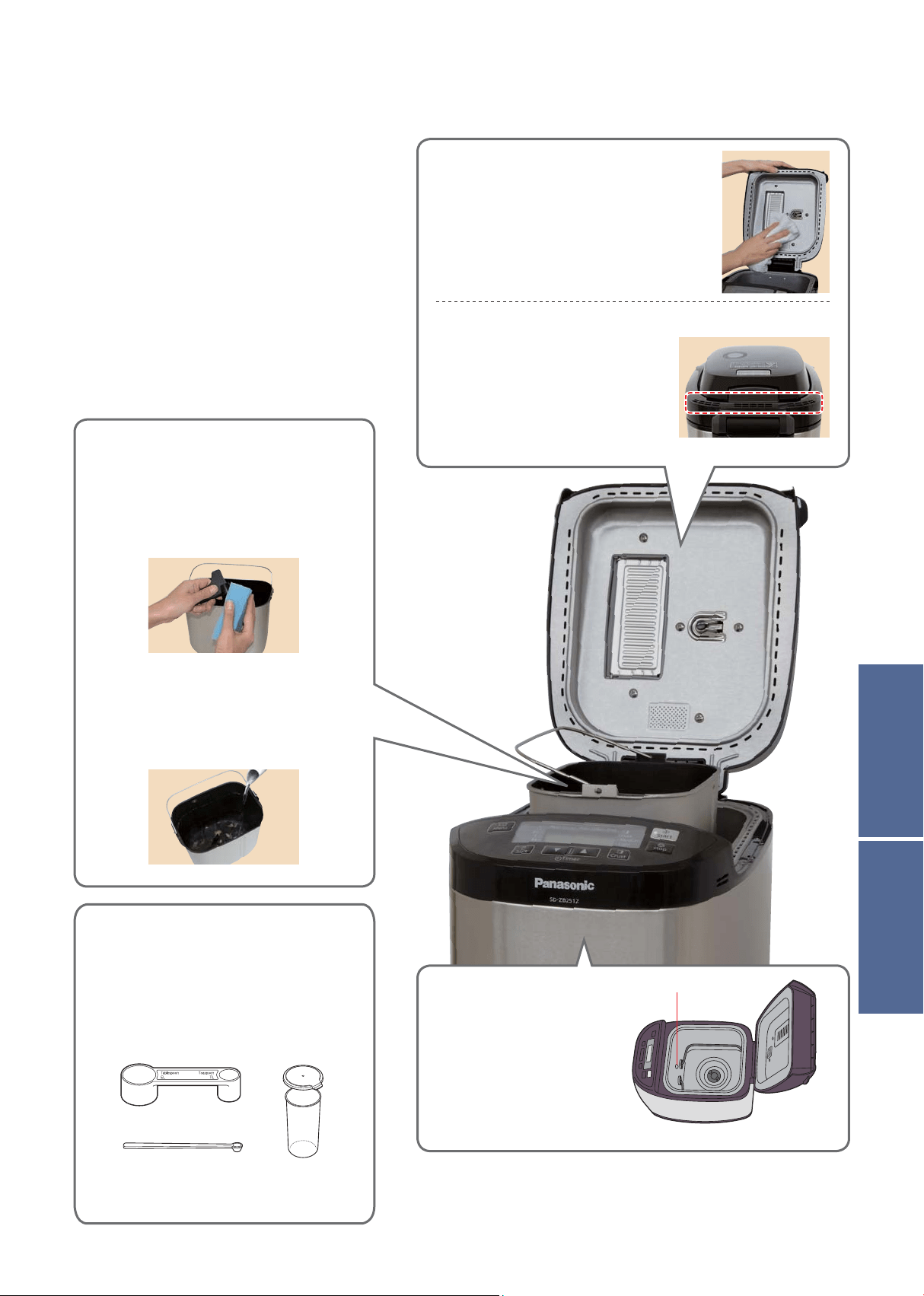
45
Before cleaning, unplug your Bread Maker and allow
it to cool down.
Q
To avoid damaging your Bread Maker...
z
Do not use anything abrasive!
(cleansers, scouring pads etc)
z
Do not wash any part of your
Bread Maker in the dishwasher!
z
Do not use benzine, thinners, alcohol, or bleach!
z
After rinsing the washable parts, wipe with cloth.
Always keep the Bread Maker parts clean and dry.
Care & Cleaning
•
The colour of the inside of the unit may change with use.
Lid
Wipe with a damp cloth
Steam vent
Wipe with a damp cloth
Body
Wipe with a damp cloth
Temperature sensor
z
Wipe gently to avoid
damaging the temperature
sensor.
Bread pan &
kneading blade
Remove any leftover dough, and wash with
water.
z
If it is difficult to remove the kneading blade,
soak in warm water for 5–10 minutes. Do not
submerge the bread pan in water.
Measuring spoon & sourdough starter
spoon
Wash with water.
Sourdough cups
Wash well with kitchen detergent and dry to
prevent bacteria growth.
z
Not dishwasher safe
Recipes How to Clean
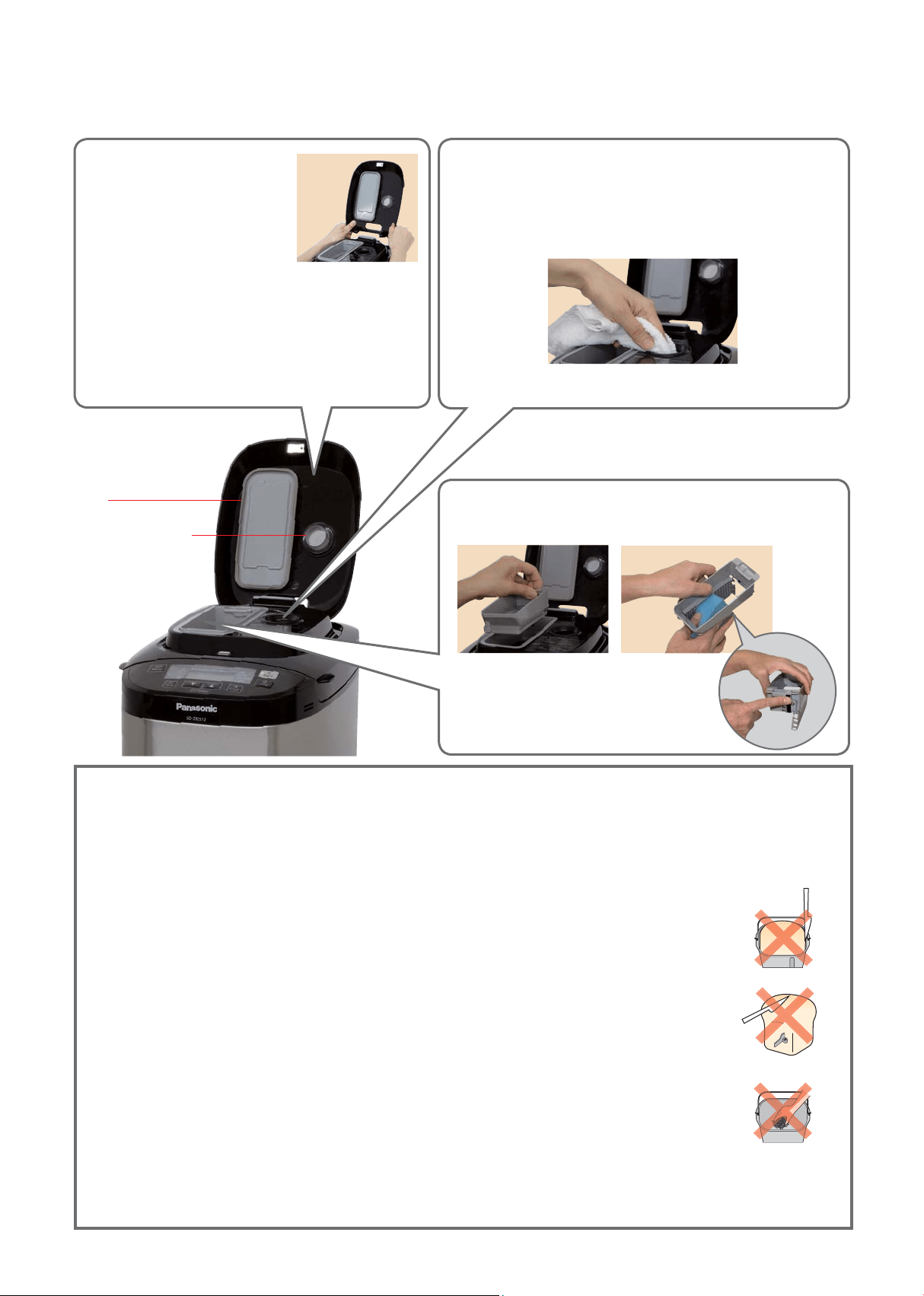
46
To protect the non-stick finish
Bread pan and kneading blade are coated with a non-stick finish to avoid stains and to make it easier when
removing bread.
To avoid damaging it, please follow the instructions below.
• Do not use hard utensils such as a knife or a fork when removing the bread from the bread pan.
When you have hard time taking out the bread from the bread pan, see P. 49.
•
Ensure that the kneading blade is not embedded in the bread loaf before slicing it.
If it is embedded, wait for the loaf to cool and remove it.
(Do not use hard or sharp utensils such as a knife or a fork.)
Be careful not to get burns as the kneading blade may still be hot.
•
Use the soft sponge when cleaning the bread pan and the kneading blade.
Do not use anything abrasive such as cleansers or scouring pads.
z
Hard, coarse or large ingredients such as flours with whole or ground grains, sugar, or the addition of nuts and seeds may damage
the non-stick finish of the bread pan. If using large chunk of ingredient, break into small pieces. Please make sure to follow the recipe
quantities stated.
Dispenser lid
Remove and wash with water.
z
Raise the dispenser lid to an
angle of approximately 75
degrees. Align the connections
and pull towards you to remove or
push carefully back at the same angle to attach. (Wait
until the machine has cooled down first, because it will
be very hot immediately after use)
z
Take care not to damage or pull the seal. (Damage
could lead to leakage of steam, condensation, or
deformation)
Raisin nut dispenser
Remove and wash with water.
z
Wash after each use to remove any residue.
Yeast dispenser
Wipe with a damp cloth and dry naturally.
z
If wipe with a dry cloth, dry yeast will not drop into the bread pan
due to static.
Care & Cleaning
Seal
Wipe with dry cloth
when it is wet.

47
Problem Cause e Action
My bread does not rise
The top of my bread is uneven
[All bread]
z
The quality of the gluten in your flour is poor, or you have not used strong flour. (Gluten quality
can vary depending on temperature, humidity, how the flour is stored, and the season of harvest)
e Try another type, brand or another batch of flour.
z
The dough has become too firm because you haven’t used enough liquid.
e Stronger flour with higher protein content absorbs more water than others, so try adding an
extra 10–20 mL of water.
z
You are not using the right type of yeast.
e
Use a dry yeast from a sachet, which has ‘Easy Blend’, ‘Fast Action’ or ‘Easy Bake’ written on it.
This type does not require pre-fermentation.
z
You are not using enough yeast, or your yeast is old. Make sure yeast sachets not open for
longer than 48 hours.
e Use the measuring spoon provided. Check the yeast’s expiry date. (Keep in refrigerator)
z
The yeast has touched the liquid before kneading.
e Check that you have put in the ingredients in the correct order according to the instructions.
(P. 12)
z
You have used too much salt, or not enough sugar.
e Check the recipe and measure out the correct amounts using the measuring spoon provided.
e Check that salt and sugar is not included in other ingredients.
[Speciality bread]
z
Einkorn wheat was used when baking speciality bread and/or a lot of flour other than spelt flour
were used.
e The spelt flour should be up to 60% of the entire flour when you use more than two kinds of
flour other than spelt. The rye and the rice flour should be up to 40% of the entire flour and
buckwheat flour should be up to 20% of the entire flour.
My bread is full of air holes
z
You have used too much yeast.
e Check the recipe and measure out the correct amount using the measuring spoon provided.
z
You have used too much liquid.
e Some types of flour absorb more water than others, so try using 10–20 mL less water.
My bread seems to have
collapsed after rising.
z
The quality of your flour isn’t very good.
e Try using a different brand of flour.
z
You have used too much liquid.
e Try using 10–20 mL less water.
My bread has risen too much.
z
You have used too much yeast/water.
e Check the recipe and measure out the correct amount using the measuring spoon (yeast)/
sourdough cup (water) provided.
e Check that excess water amount is not included in other ingredients.
z
You have not used enough flour.
e Carefully weigh the flour using scales.
Why is my bread pale and
sticky?
z
You are not using enough yeast, or your yeast is old.
e Use the measuring spoon provided. Check the yeast’s expiry date. (Keep in refrigerator)
z
There has been a power failure, or the machine has been stopped during breadmaking.
e The machine switches off if it is stopped for more than 10 minutes. You will need to remove
the bread from the bread pan and start again with new ingredients.
There is excess flour around the
bottom and sides of my bread.
z
You have used too much flour, or you are not using enough liquid.
e Check the recipe and measure out the correct amount using scales for the flour or the
sourdough cup provided for liquids.
Why has my bread not mixed
properly?
z
You haven’t put the kneading blade in the bread pan.
e Make sure the kneading blade is in the bread pan before you put in the ingredients.
z
There has been a power failure, or the machine has been stopped during breadmaking.
e The machine switches off if it is stopped for more than 10 minutes. You might be able to start
the loaf again, though this might give poor results if kneading had already begun.
Troubleshooting
Before calling for service, please check through this section.
How to Clean Troubleshooting
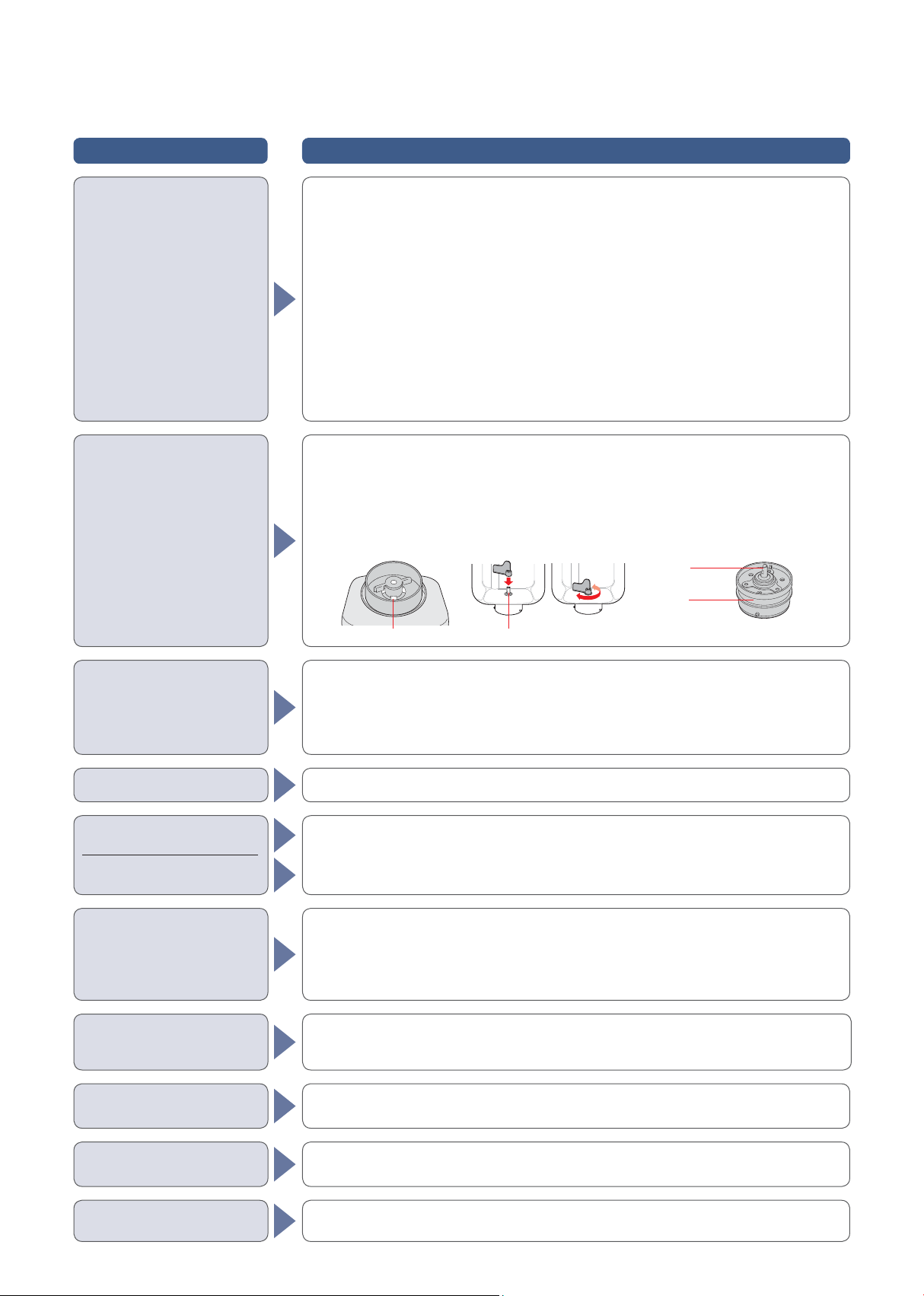
48
Troubleshooting
Before calling for service, please check through this section.
Problem Cause e Action
My bread has not been baked.
z
The dough menu was selected.
e The dough menu does not include a baking process.
z
There has been a power failure, or the machine has been stopped during breadmaking.
e The machine switches off if it is stopped for more than 10 minutes. You can try baking the
dough in your oven if it has risen and proved.
z
There is not enough water and the motor protection device has activated.
This only happens when the unit is overloaded and excessive force is applied to the motor.
e Visit place of purchase for a service consultation. Next time, check the recipe and measure
out the correct amount using the sourdough cup provided.
z
You have forgotten to attach the kneading blade.
e Make sure you attach the kneading blade first (P. 12).
z
The kneading mounting shaft in the bread pan is stiff and does not rotate.
e
If the kneading mounting shaft does not rotate when the kneading blade is attached, you will need to
replace the kneading mounting shaft unit. (Consult the place of purchase or a Panasonic service centre.)
Dough leaks out of the bottom of
the bread pan.
z
A small amount of dough will escape through the ventilation holes (so that it does not stop
the rotating parts from rotating). This is not a fault, but check occasionally that the kneading
mounting shaft rotate properly.
e If the kneading mounting shaft does not rotate when the kneading blade is attached, you
will need to replace the kneading mounting shaft unit. (Consult the place of purchase or a
Panasonic service centre.)
Kneading mounting shaftVentilation holes (4 in total)
(Bottom of bread pan)
Part no. ADA29E165
Kneading
mounting shaft unit
Kneading
mounting shaft
The sides of my bread have
collapsed and the bottom is
damp.
z
You have left the bread in the bread pan for too long after baking.
e Remove the bread promptly after baking.
z
There has been a power failure, or the machine has been stopped during breadmaking.
e The machine switches off if it is stopped for more than 10 minutes. You may try baking the
dough in your oven.
The kneading blade rattles.
z
This is because the kneading blade fits loosely on the kneading mounting shaft. (This is not a fault)
I can smell burning while the
bread is baking.
Smoke is coming out of the
steam vent.
z
Ingredients may have been spilt on the heating element.
e
Sometimes a little flour, raisins or other ingredients may be flicked out of the bread pan during
mixing. Simply wipe the heating element gently after baking once the Bread Maker has cooled down.
e Remove the bread pan from the Bread Maker to place ingredients.
The kneading blade stays in the
bread when I remove it from the
bread pan.
z
The dough is a little stiff.
e Allow the bread to cool completely before removing the kneading blade carefully.
Some types of flour absorb more water than others, so try adding an extra 10–20 mL of water next time.
z
Crust has built up underneath the kneading blade.
e Wash the kneading blade and its spindle after each use.
The crust creases and goes soft
on cooling.
z
The steam remaining in the bread after baking can pass into the crust and soften it slightly.
e To reduce the amount of steam, try using 10–20 mL less water or half the amount of sugar.
e Remove loaf from bread pan immediately after baking completed.
How can I keep my crust crispy?
z
To make your bread crispier, you could use the menu 9 or the ‘Dark’ crust colour option, or even
bake it in the oven at 200°C/gas mark 6 for an extra 5–10 minutes.
My bread is sticky and slices
unevenly.
z
It was too hot when you sliced it.
e Allow your bread to cool on rack before slicing to release the steam.
Extra ingredients are not mixed
properly in brioche.
z
Some of the bread mix dough is harder to mixed extra ingredients in or to flick out some of them.
e Decreased the extra ingredients into half.
49
Problem Cause e Action
There is excess oil on the
bottom of brioche.
The crust is oily.
My bread has big holes.
z
Did you add butter within 5 min of the beep?
e Do not put butter when display show remaining time until ready. (P. 15)
Butter flavor might be weak, but it can bake.
My brioche did not turn out well
when using bread mix.
z
Try following things.
e It might be baked better if yeast is decreased a little when using menu 13 or 29. (If adding
yeast separately.)
e Follow the recipe on the bread mix, but the bread mix should be between 350–500 g.
e Place the dry yeast (If adding yeast separately) in the yeast dispenser, and dry ingredients
and butter in the bread pan. Then place water. When adding the extra ingredients, add them
later. (P. 15 or 22)
e The completion is different according to recipe on the bread mix.
The bread does not come out.
z
If the bread cannot be easily removed from the bread pan, leave the bread pan for
5–10 minutes to cool, making sure that it is not left unattended where somebody or something
may get burnt.
After that, shake the bread pan several times using oven gloves.
(Hold the handle down so that it does not get in the way of bread.)
When cooking jam, it has
scorched or the kneading blade
fixes and it doesn’t come off.
z The amount of the fruit was a too little, or the amount of sugar is too much.
e Place the bread pan in the sink and half fill the bread pan with warm water. Leave the
bread pan to soak until the cooked on mixture or kneading blade loosens. After scorching is
relieved, wash it with a soft sponge etc. Please be aware of the hot water.
The jam has boiled over.
z
Too much fruit or sugar has been used.
e Only use the amounts of fruit and sugar specified in the recipes on P. 44.
Jam is too runny and not firmly
set.
z
The fruit was under or over ripe.
z
Sugar was decreased too much.
z
Cooking time was insufficient.
z
Fruit with a low pectin content was used.
e
Use the runny jam as a sauce for desserts.
e
Leave the jam to cool completely. The jam will continue to set as it cools.
z
Depending on the type of pectin, it may be better to increase or decrease the amount of it.
Can frozen fruits be used?
z
It is possible to use them.
What kinds of sugar can we use
on jam?
z
White caster and granulated can be used.
Do not use brown sugar, diet sugar, and low calorie sugar or artificial sweetener.
When making jam, can we use
fruits are pickled in alcohol?
z
Do not use them. The quality is not satisfactory.
The fruit has collapsed when
making fruit in syrup.
z
The cooking time was too long. The fruit may have been over ripe.
Dry yeast will not drop into the
bread pan.
z
The timing of yeast dispenser activation is different depending on the menu programme and
room temperature.
z
Yeast dispenser is wet, or there may be a static build up.
e Wipe with a damp cloth and dry naturally.
z
Dry yeast is damped.
e Use new dry yeast.
Extra ingredients are not mixed
properly in Savoury.
z
Did you add extra ingredients to the raisin nut dispenser before the beep?
e Extra ingredients must be added to the raisin nut before ‘ ’ is flashing in the display.
Troubleshooting
50
Problem Cause e Action
Extra ingredients does not fall into
the bread pan from the raisin nut
dispenser.
z
Is the surface of the extra ingredients higher than the edge of the raisin nut dispenser?
e Put the extra ingredients so that its surface is lower than the edge of the raisin nut dispenser.
(P. 14)
The capacity of the raisin nut dispenser is 150 g, however depending on the state and the
type of ingredients, they may overflow.
appears on the display.
z
There has been a power failure for approx. 10 minutes (the plug has been accidentally pulled
out, or the breaker has been activated), or there is another problem with the power supply.
e The operation will not be affected if the problem with the power supply is only momentary.
The Bread Maker will operate again if its power is restored within 10 minutes, but the end
result may be affected.
1 appears on the display.
z
There has been a power failure for a certain amount of time (differs depending on the
circumstances - e.g. mains power failure, unplugging, malfunctioning fuse or breaker).
e Remove the dough and start again using new ingredients.
H01–H02 appears on the
display.
z
The display indicates a problem with the Bread Maker.
e Consult the place of purchase or a Panasonic service centre.
U50 appears on the display.
z
The unit is hot (above 40°C/105°F). This may occur with repeated use.
e Allow the unit to cool down to below 40°C/105°F before using it again (U50 will disappear).
Troubleshooting
Before calling for service, please check through this section.

51
Home Appliance 12 Month Warranty from Date of Purchase
1. Subject to the conditions of this warranty Panasonic or it’s Authorised Service Centre will perform necessary
service on the product without charge for parts or labour, if in the opinion of Panasonic, the product is found to be
faulty within the warranty period. For Line Communications products (i.e. Cordless Phones, etc) the genuine
battery(s) has a 3 month warranty.
2. This warranty only applies to Panasonic products purchased in Australia and sold by Panasonic Australia or its
Authorised Distributors or Dealers and only where the products are used and serviced within Australia or it's
territories. Warranty cover only applies to service carried out by a Panasonic Authorised Service Centre and only
if valid proof of purchase is presented when warranty service is requested.
3. This warranty only applies if the product has been installed and used in accordance with the manufacturer’s
recommendations (as noted in the operating instructions) under normal use and reasonable care (in the opinion of
Panasonic). The warranty covers normal domestic use only (also Clip & Trim Professional use) and does not
cover damage, malfunction or failure resulting from use of incorrect voltages, incorrect installation, accident,
misuse, neglect, build-up of dirt or dust, abuse, maladjustment of customer controls, mains supply problems,
thunderstorm activity, infestation by insects or vermin, tampering or repair by unauthorised persons (including
unauthorised alterations), exposure to abnormally corrosive conditions or any foreign object or matter having
entered the product.
4. This warranty does not cover the following items unless the fault or defect existed at the time of purchase:
(a) Cabinet Parts (b) Microwave Oven cook plates.
(c) User replaceable Batteries (d) Kneader mounting shaft unit and
from wear and tear in normal use Heads, Cutters, Foils, Blades and other accessories.
(e) Noise or vibration that is considered normal
5. To claim warranty service, when required, you should:
Telephone Panasonic’s Customer Care Centre on 132600 or visit our website referred to below and use the
Service Centre Locator for the name/address of the nearest Authorised Service Centre.
Send or take the product to a Panasonic Authorised Service Centre together with your proof of purchase
receipt as a proof of purchase date. Please note that freight and insurance to and / or from your nearest
Authorised Service Centr
e must be arranged by you.
6. The warranties hereby conferred do not extend to, and exclude, any costs associated with the installation, de-
installation or re-installation of a product, including costs related to the mounting, de-mounting or remounting of
any screen, (and any other ancillary activities), delivery, handling, freighting, transportation or insurance of the
product or any part thereof or replacement of and do not extend to, and exclude, any damage or loss occurring
by reason of, during, associated with, or related to such installation, de-installation, re-installation or transit.
Panasonic Authorised Service Centres are located in major metropolitan areas and most regional centres of
Australia, however, coverage will vary dependant on product. For advice on exact Authorised Service Centre
locations
for your product, please telephone our Customer Care Centre on 132600 or visit our website and use the
Service Centre Locator.
In addition to your rights under this warranty, Panasonic products come with consumer guarantees that cannot be
excluded under the Australian Consumer Law. If there is a major failure with the product, you can reject the product
and elect to have a refund or to have the product replaced o
r if you wish you may elect to keep the goods and be
compensated for the drop in value of the goods. You are also entitled to have the product repaired or replaced if the
product fails to be of acceptable quality and the failure does not amount to a major failure.
If there is a major failure in regard to the product which cannot be remedied then you must notify us within a
reasonable period by contactin
g the Panasonic Customer Care Centre. If the failure in the product is not a major
failure then Panasonic may choose to repair or replace the product and will do so in a reasonable period of time from
receiving notice from you.
If you require assistance regarding warranty conditions or any other enquiries, please visit the
Panasonic Australia website
www.panasonic.com.au or contact by phone on 132 600
If phoning in, please ensure you have your operating instructions available.
Panasonic Warranty
Panasonic Australia Pty. Limited
ACN 001 592 187 ABN 83 001 592 187
1 Innovation Road, Macquarie Park NSW 2113
www.panasonic.com.au
PRO-031-F01 Issue: 6.0 02-10-2013
THIS WARRANTY CARD AND THE PURCHASE DOCKET (OR SIMILAR PROOF OF PURCHASE)
SHOULD BE RETAINED BY THE CUSTOMER AT ALL TIMES
Ɣ
Ɣ
Troubleshooting

Panasonic Taiwan Co., Ltd.
http://www.panasonic.com
© Panasonic Taiwan Co., Ltd. 2016
DZ50R1871
MX0716E10816
Printed in China
◩
Specification
Power supply 230
–
240 V 50 Hz
Power consumed 505
–
550 W
Capacity (Flour) max. 620 g min. 330 g
(Dry yeast) max. 7.0 g min. 2.1 g
Capacity of raisin nut dispenser max. 150 g raisins
Timer Digital timer (up to 13 hours)
Dimensions (H×W×D) approx. 38.2
×
26.0
×
38.9 cm
Weight approx. 7.3 kg
Accessories 2 sourdough cups, measuring spoon, sourdough starter spoon