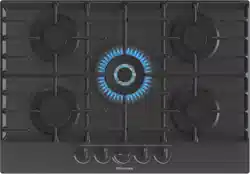

User manual
Installation instruction
Conversion instruction
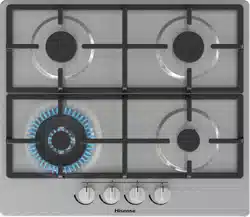
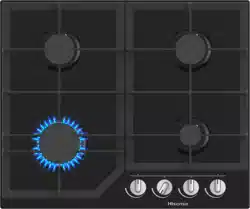
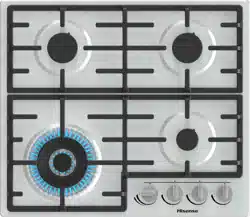
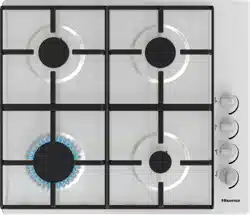
BG6xA
BG6xB
BG6xC
NO
GB
NL
BE
DK
ES
IT
FI
SE
FR
BE
DE
DEATLUIE
NO
GBNL
BE
DK
ES
IT
FI
SE
FR
BE
DE
DEATLU
IE
3
7
Pictograms used:
Important information
Tip
Gas connection
Electrical connection
Right
Wrong
EN 3
CONTENTS
Safety regulations
Safe use 4
Children and vulnerable people 7
User manual
Models 8
Description 8
Information according regulation (EU only) 66/2014 9
Use 9
Faults table 11
Installation instruction
Safety regulations 12
Service 13
Preparations for installation 14
Sealing tape 15
Gas connection 16
Built in 16
Connecting & testing 16
Conversion instruction
Conversion instruction 17
Conversion table 17
Power table (kW-gr/h) 18
Converting nozzles 19
Converting by-pass screws 19
Check for gas tightness and operation 20
Start up 21
Checking operation 21
Environmental considerations
Disposal of packaging and appliance 22
EN 4
READ CAREFULLY AND KEEP FOR FUTURE REFERENCE!
Safe use
• The manufacturer cannot be held liable for any damage
resulting from failure to follow the safety instructions and
warnings.
• Damage caused by incorrect connection, incorrect fitting,
or incorrect use is not covered by the warranty.
• WARNING: this appliance and the accessible parts will
become hot during use. Do not touch hot parts. Keep
children younger than 8 away from the appliance unless
they are under continuous supervision.
• WARNING: danger of fire: never leave anything on the hob.
• CAUTION: The cooking process has to be supervised.
A short term cooking process has to be supervised
continuously.
• WARNING: cooking with fat or oil on a hob without
supervision can be dangerous and can lead to fire.
• NEVER try to extinguish a fire with water. Instead, switch
the appliance off and then cover the flames with for
example a lid or a fire blanket.
• Never flambé under a cooker hood. The high flames can
cause a fire, even if the cooker hood is switched off.
• WARNING: use only hob guards designed by the
manufacturer of the cooking appliance or indicated by
the manufacturer of the appliance in the instructions
for use as suitable or hob guards incorporated in the
appliance. The use of inappropriate guards can cause
accidents.
• The hob is only to be used for the preparation of food.
The unit is not designed for heating rooms.
• Do not warm closed tins on the hob. There will be a
build-up of pressure that will cause tins to explode.
You might get injured or scalded.
SAFETY REGULATIONS
EN 5
• Never cover the appliance with a cloth or something
similar. If the appliance is still hot or is switched on, there
is a risk of fire.
• Do not use the appliance as a worktop. The appliance
may accidentally be switched on or still be hot, which
means objects could melt, become hot or catch fire.
• Do not use the appliance in temperatures below 5 °C.
• The appliance should not be placed or used outdoors.
• When you use the hob for the first time you will notice a
“new smell”. Don’t worry, this is normal. If the kitchen is
well ventilated, the smell will soon disappear.
• The appliance is not intended to be operated by means
of an external timer or separate remote control system.
• Never open the casing of the appliance.
• Never use a pressure cleaner or steam cleaner to clean
the hob.
• The ceramic top is extremely strong, but not
unbreakable. For example, a spice jar or sharp utensil
falling on it could cause it to break.
• Missing rubber feet from the pan supports can cause
scratches on the drip tray or poor combustion of the
burner. If the rubber feet are missing, please contact our
service department.
• Clean the burner parts regularly for a safe and correct
operation of the burners.
• WARNING “In case of hotplate glass breakage”:
- shut immediately off all burners and any electrical
heating element and isolate the appliance from the
power supply.
- do not touch the appliance surface.
- do not use the appliance.
SAFETY REGULATIONS
EN 6
SAFETY REGULATIONS
• CAUTION: The use of a gas cooking appliance results
in the production of heat, moisture and products of
combustion in the room in which it is installed. Ensure
that the kitchen is well ventilated especially when the
appliance is in use. Keep natural ventilation holes open
or install a mechanical ventilation device (mechanical
extractor hood).
• If a drawer underneath the appliance is permitted (see
the installation instructions), without an intermediate
bottom, this should not be used to store highly
flammable objects/materials. Ensure that there is
adequate clearance of a few centimetres between the
bottom of the hob and the contents of any drawers.
• The burner components are hot during and immediately
after use. Do not touch them, and avoid contact with
non-heat resistant materials.
• Never immerse hot burner caps and pan supports in
cold water. The rapid cooling can damage the enamel.
• The distance between the pan and a knob or non-
heat resistant wall should always be greater than
one centimeter. In case of smaller distances the high
temperature may cause the knobs or wall to discolour
and/or deform.
• Always use the pan supports and suitable cookware.
• Always place the pan on the pan support. Placing the
pan directly on the burner cap can result in dangerous
situations.
• Aluminium trays or foil are not suitable as cooking
utensils. They can burn into the burner caps and pan
supports.
EN 7
SAFETY REGULATIONS
• The hob can only function effectively if the burner
components have been assembled using the guide
ridges. Ensure that the pan supports lie properly against
each other and flat on the drip tray. Only then can the
pans be positioned stably.
• Keep oven gloves or oven cloths away from the flame.
• Do not use griddle plates or baking plates.
Children and vulnerable people
• This appliance can be used by children aged 8 years
and over, as well as by people with reduced physical,
sensory or mental capabilities or lack of experience and
knowledge, provided they are supervised and instructed
in the safe use of the appliance and understand the
hazards involved.
• Do not allow children to play with the appliance. Do not
allow children to clean or maintain the appliance unless
supervised.
• Do not keep objects that children might find interesting
in cupboards above or behind the appliance.
• The cooking zones/burners heat up during use and stay
hot for a while afterwards. Keep young children away
from the hob during and immediately after cooking.
EN 8
USER MANUAL
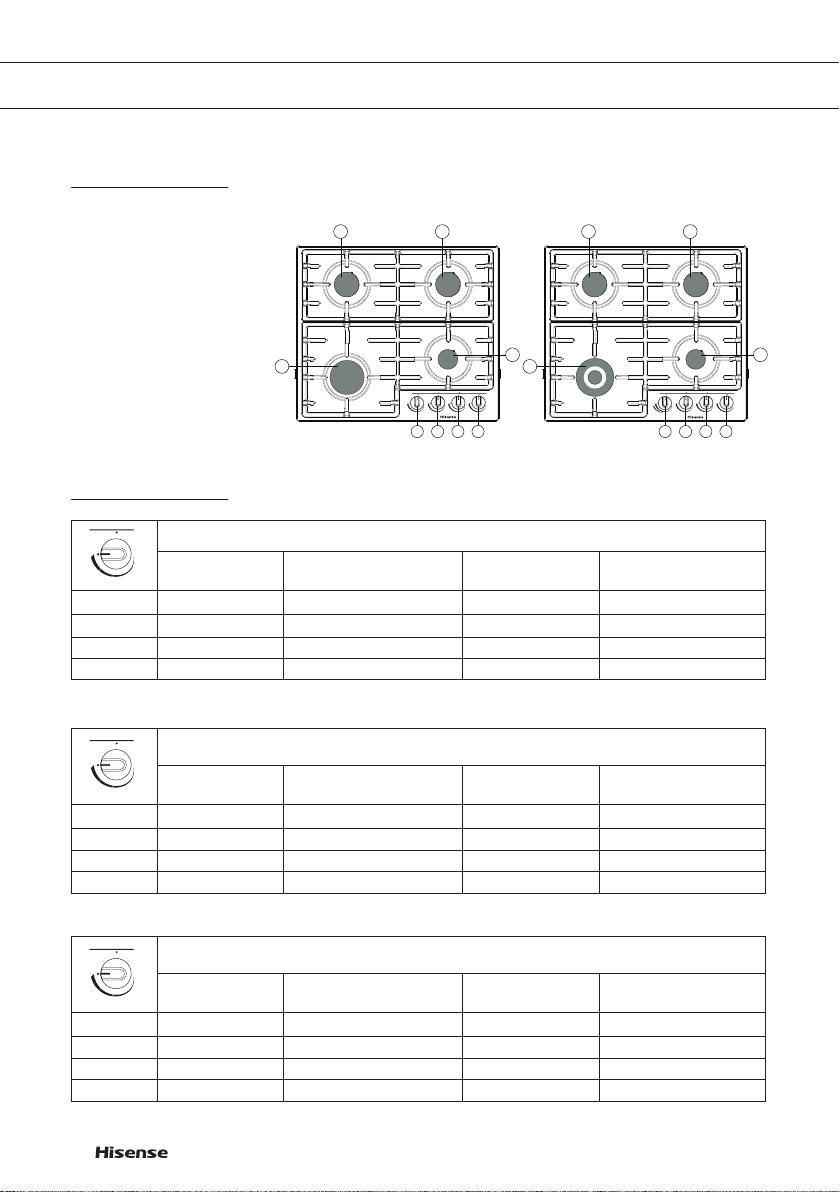
Models
Aa - Auxiliary burner
Bb - Semi-rapid burner
Cc - Rapid burner
Dd - Wok burner
Description
G20 / 20 mbar
Burner
BG6xA BG6xB BG6xC
Aa Auxiliary 1.00 kW 1.00 kW 1.00 kW
Bb Semi-rapid 1.80 kW 1.80 kW 1.80 kW
Cc Rapid 3.00 kW
Dd Wok 3.50 kW 4.05 kW
G30 / 30 mbar
Burner
BG6xA BG6xB BG6xC
Aa Auxiliary 1.05 kW 1.05 kW 1.05 kW
Bb Semi-rapid 1.80 kW 1.80 kW 1.80 kW
Cc Rapid 3.00 kW
Dd Wok 3.50 kW 4.05 kW
G30 / 50 mbar
Burner
BG6xA BG6xB BG6xC
Aa Auxiliary 1.05 kW 1.05 kW 1.05 kW
Bb Semi-rapid 1.90 kW 1.90 kW 1.90 kW
Cc Rapid 3.00 kW
Dd Wok 3.50 kW 4.00 kW
BG6xA BG6xB / BG6xC
B1
D
A
B2
b2b1
d
a
B1
C
A
B2
b2b1
c
a
EN 9
USER MANUAL
Information according regulation (EU only) 66/2014
Measurements according EN60350-2 (G20-20 mbar)
Model identification BG6xA BG6xB/BG6xC
Type of hob Gas hob Gas hob
Number of gas burners 4 4
Heating technology Gas burner Gas burner
Energy efficiency per gas burner
(EEgas burner) in %
Semi-rapid burner:
Rapid burner:
Wok burner:
58.8
56.3
58.8
57.6
Energy efficiency for the gas hob (EEgas hob) in % 58.0 58.4
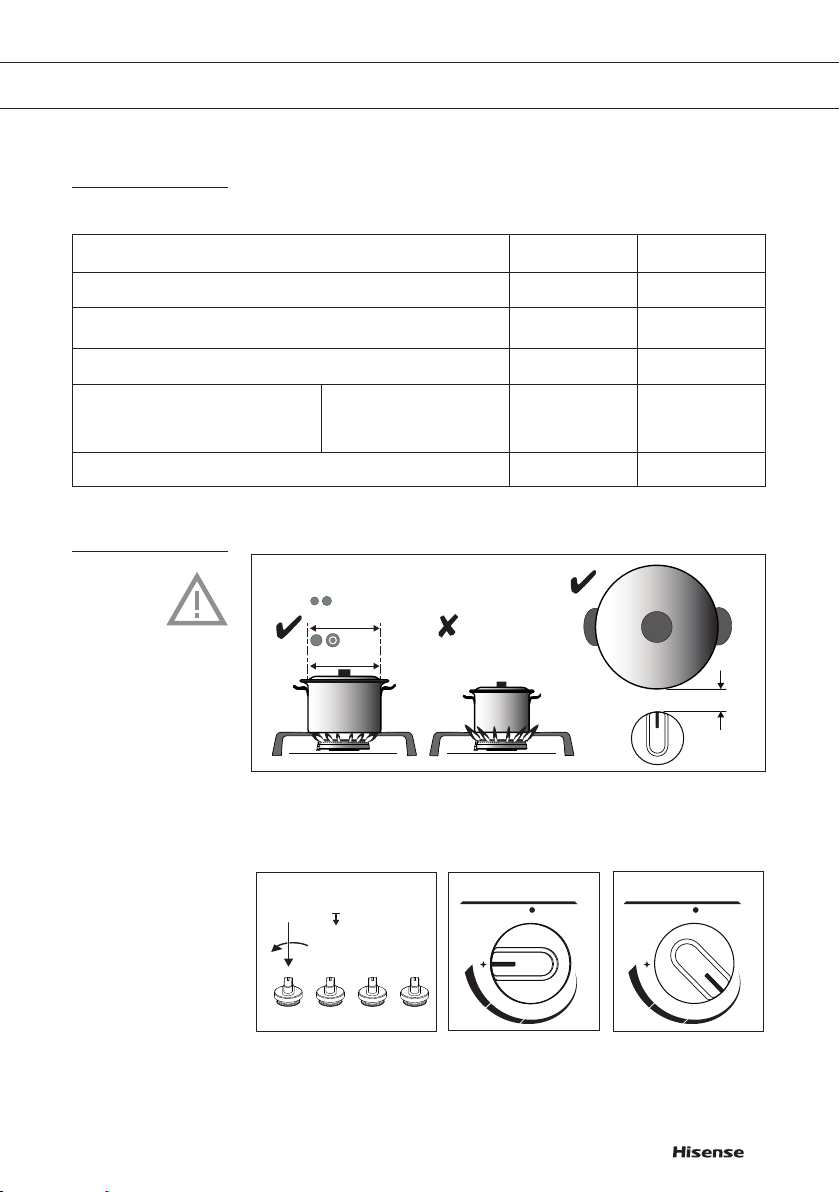
Use
Ø12-24cm
Ø15-26cm
C/D
A/B
Min. 1 cm
The distance between the pan and a nonheat resistant wall should
always be greater than one centimeter. In case of smaller distances the high
temperature may cause the knobs or wall to discolour and/or deform.
Control:
(1) Push
(2) Turn left + hold
(3) Hold down 3 sec.
high setting
low setting
3 sec.
EN 10
USER MANUAL
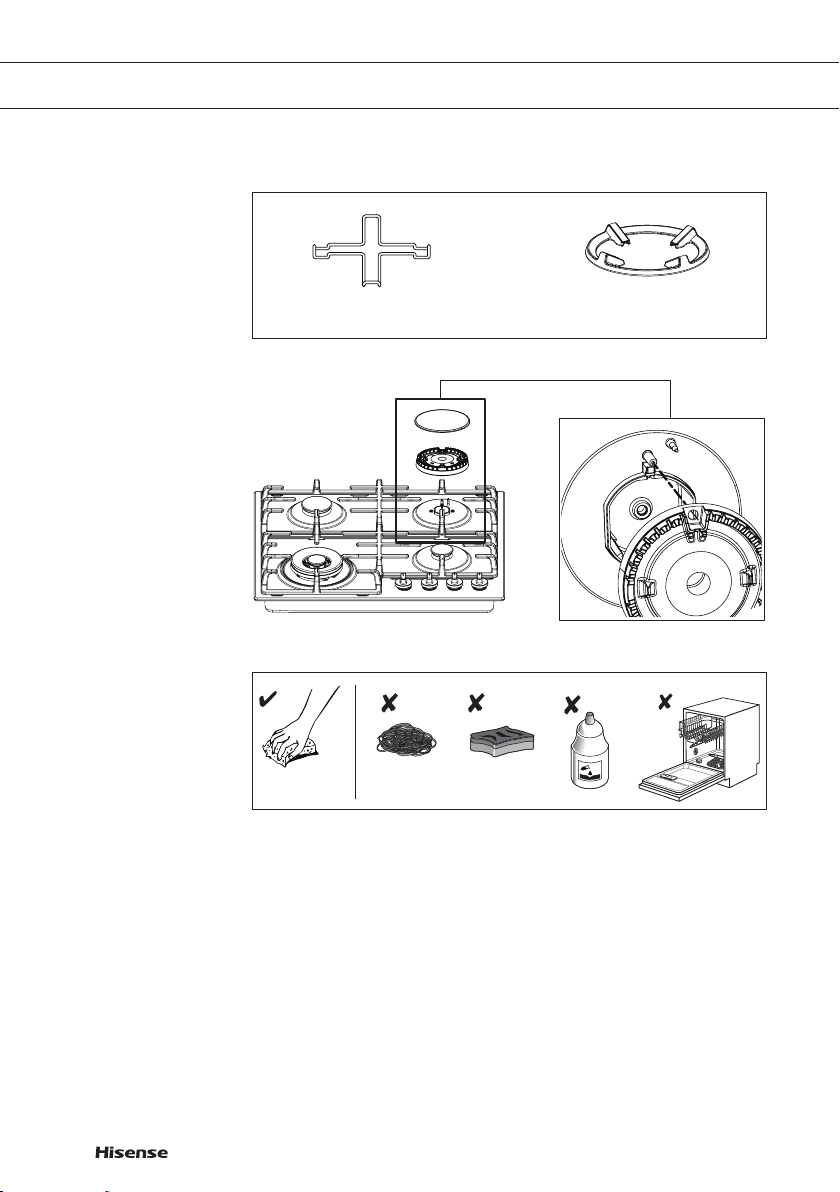
Cleaning:
Suits Auxiliary burner Suits wok burner
Burner position:
Accessories:
EN 11
USER MANUAL
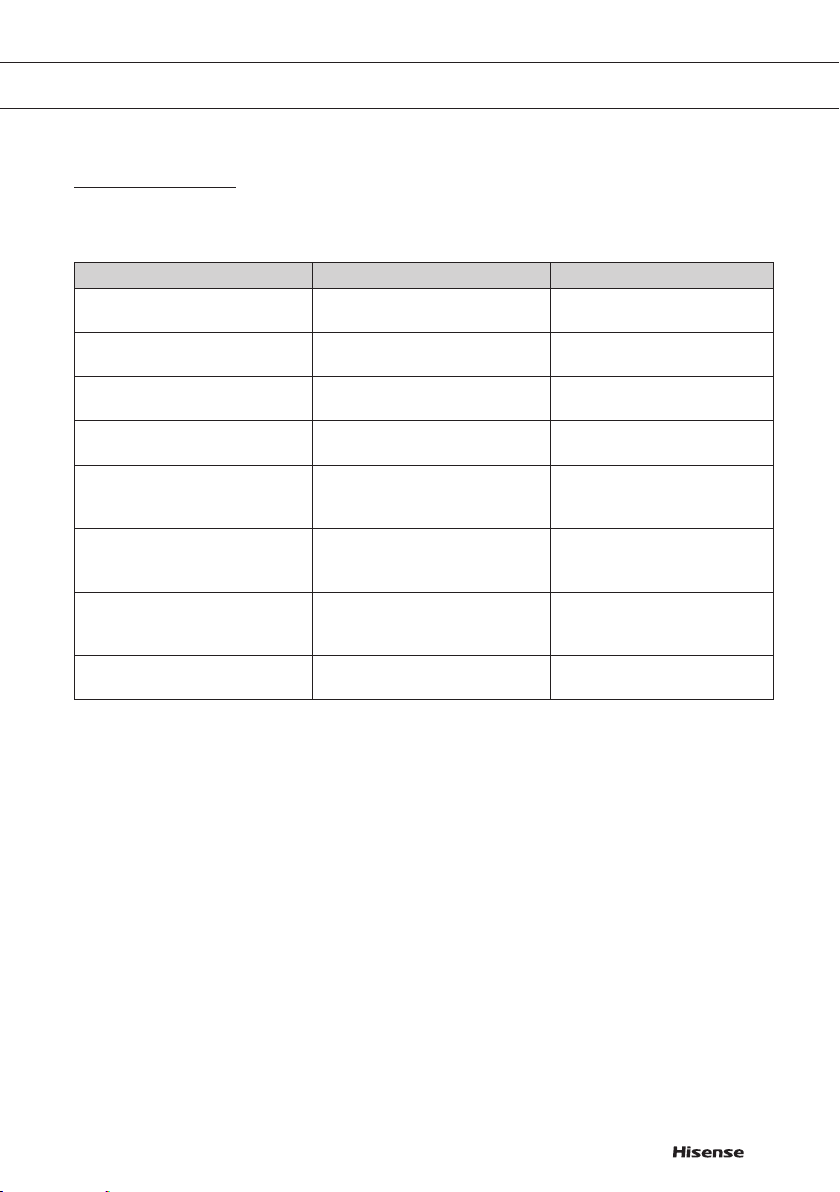
Faults table
Following is some advice on rectifying some common problems.
What happened...? Possible cause What to do?
The burners will not burn.
The ame is uneven / unstable.
Flame is uneven due to a
wrong gas power setting.
Have an expert check the gas
pipeline!
The ame from the burners
suddenly changes.
Wrongly assembled parts of the
kitchen hob.
Assemble the burner
correctly.
Burner ignition takes more time. Wrongly assembled parts of the
kitchen hob.
Assemble the burner
correctly.
The ame is extinguished
shortly after ignition.
Knob pressed too short or to
weakly.
Keep the knob pressed for a
longer period of time.
The grid has discolored in the
burner area?
This is a commonplace
phenomenon resulting from
high temperature.
Clean the grid with a metal
care detergent.
Electric power supply in general
is interrupted?
The fuse may be blown. Check the fuse in the fuse
box and replace it if it is
blown.
Electric ignition of the burners
no longer works?
There are food or detergent
residues between the spark
plug and the burner.
Open and carefully clean the
opening between the spark
plug and the burner.
The burner cover looks
unappealing.
Regular dirt. Clean the burner covers with
a metal care detergent.
A visit by a service technician during the warranty period will be charged if the appliance is not
functioning because of improper use. Store these instructions in a place where they are always
readily accessible; if you pass the appliance on to another person, the instructions should also be
included.
If the problem persists despite observing the instructions above, call an authorized service technician.
Elimination of any errors or warranty claims that resulted from improper connection or use of the appliance
is not covered by our warranty. In such cases, the costs of repair are borne by the user.
EN 12
INSTALLATION INSTRUCTION
Safety regulations
• This appliance should only be connected by a registered
installer.
• Prior to installation, ensure that the local distribution
conditions (voltage, frequency, nature of the gas and
gas pressure) and the adjustment of the appliance are
compatible.
• This Appliance must be earthed.
• The voltage, frequency, power, type of gas and the
country for which the appliance has been designed are
shown on the appliance rating plate.
• Electrical connection Class I - 220-240 V - 50/60 Hz -
max 1 W.
The electrical connection must comply with national and
local regulations.
• The wall plug socket and plug should always be
accessible.
• If a stationary appliance is not fitted with a supply cord
and a plug, or with other means for disconnection from
the supply mains having a contact separation in all
poles that provide full disconnection under overvoltage
category III conditions, the means for disconnection
must be incorporated in the fixed wiring in accordance
with the wiring rules. Using an omnipolar switch with a
contact separation of at least
3 mm fitted in the supply cable will fulfil this requirement.
• The connection cable must hang freely and should not
be fed through a drawer.
• Gas connection 1/2” ISO 228 / ISO 7-1 / EN 10226-1
(1/2” ISO 228 / 1/2” ISO 228 FR only).
The gas connection must comply with national and local
regulations. See appliance label for technical gas data.
EN 13
INSTALLATION INSTRUCTION
• This appliance is not connected to a combustion
products evacuation device. It shall be installed and
connected in accordance with current installation
regulations. Particular attention shall be given to the
relevant requirements regarding ventilation.
• We recommend that the gas hob be connected by
means of a fixed pipe. Connection using a specially
designed safety hose is also permitted.
• The pipe behind the oven must be made entirely out of
metal.
• A safety hose may not be bent and must not come into
contact with moving parts of kitchen units.
• The gas supply valve must always be placed in an easily
accessible position.
• The worktop into which the hob is fitted should be flat.
• The walls and the worktop surrounding the appliance
must be heat resistant up to at least 85 °C. Even though
the appliance itself does not get hot, the heat of a hot
pan could discolour or deform the wall.
Service
• Faulty parts may only be replaced by original parts.
The manufacturer can only guarantee that original parts
meet safety requirements.
• If the supply cord is damaged, it must be replaced by
the manufacturer, its service agent or similarly qualified
persons in order to avoid a hazard.
EN 14
INSTALLATION INSTRUCTION
Preparations for installation
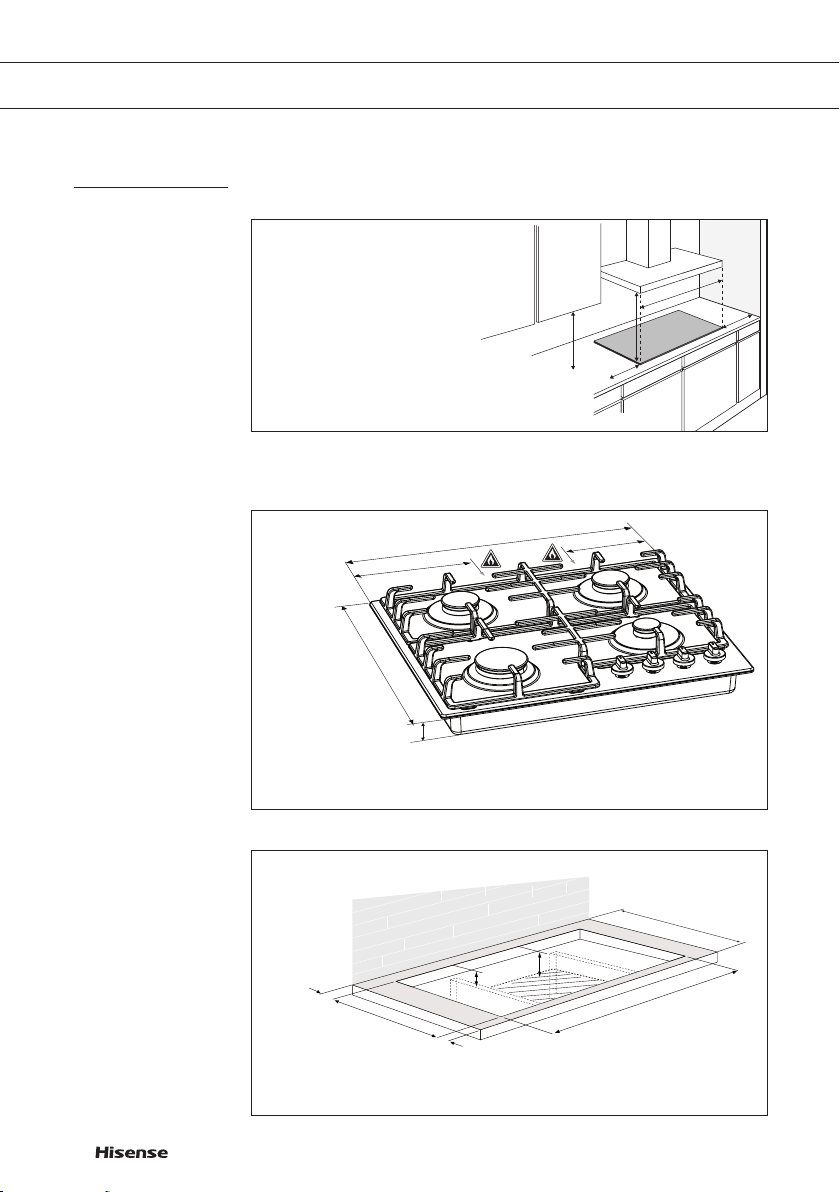
Free space around appliance
Dimensions
A (mm) B (mm) C (mm) D (mm) E (>mm) F G
BG6 600 560 490 60 50 90 100
E
C
D
F
B
A
G
A
B
C
D
D
A (mm) B (mm) C (mm) D (mm)
BG6 min. 650 min. 600 min. 450 min. 120
A (mm) B (mm) C (mm) D1 (mm) D2 (mm)
BG6xA/B /C 600 520 52 - 138
T >60º C
T <60º C
oven
oven
metal
safety hose
D1
D2
A
B
C
A (mm) B (mm) C (mm) D (mm) E (>mm) F G
BG6 600 560 490 60 50 90 100
E
C
D
F
B
A
G
A
B
C
D
D
A (mm) B (mm) C (mm) D (mm)
BG6 min. 650 min. 600 min. 450 min. 120
A (mm) B (mm) C (mm) D1 (mm) D2 (mm)
BG6xA/B /C 600 520 52 - 138
T >60º C
T <60º C
oven
oven
metal
safety hose
D1
D2
A
B
C
A (mm) B (mm) C (mm) D (mm) E (>mm) F G
BG6 600 560 490 60 50 90 100
E
C
D
F
B
A
G
A
B
C
D
D
A (mm) B (mm) C (mm) D (mm)
BG6 min. 650 min. 600 min. 450 min. 120
A (mm) B (mm) C (mm) D1 (mm) D2 (mm)
BG6xA/B /C 600 520 52 - 138
T >60º C
T <60º C
oven
oven
metal
safety hose
D1
D2
A
B
C
Appliance:
Built-in:
EN 15
INSTALLATION INSTRUCTION
Accessibility
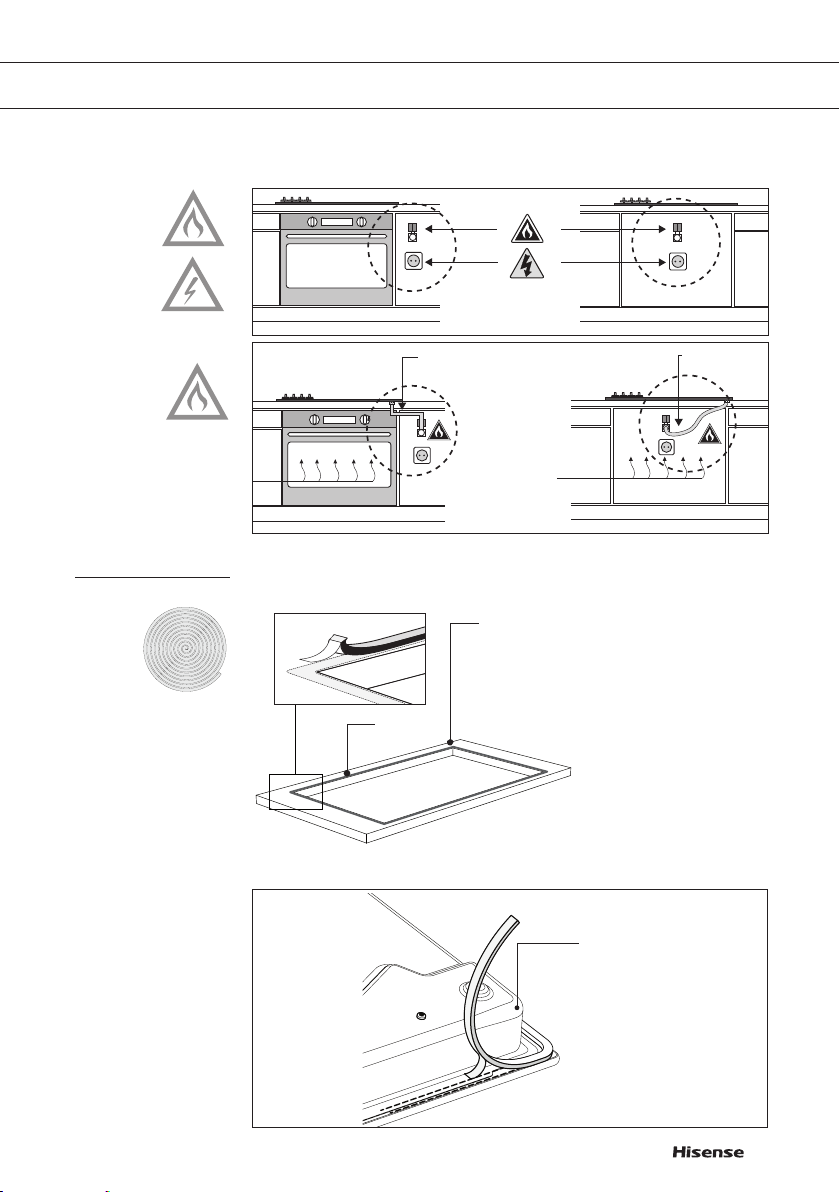
Sealing tape
Stainless steel drip tray
Glass drip tray
A (mm) B (mm) C (mm) D (mm) E (>mm) F G
BG6 600 560 490 60 50 90 100
E
C
D
F
B
A
G
A
B
C
D
D
A (mm) B (mm) C (mm) D (mm)
BG6 min. 650 min. 600 min. 450 min. 120
A (mm) B (mm) C (mm) D1 (mm) D2 (mm)
BG6xA/B /C 600 520 52 - 138
T >60º C
T <60º C
oven
oven
metal
safety hose
D1
D2
A
B
C
A (mm) B (mm) C (mm) D (mm) E (>mm) F G
BG6 600 560 490 60 50 90 100
E
C
D
F
B
A
G
A
B
C
D
D
A (mm) B (mm) C (mm) D (mm)
BG6 min. 650 min. 600 min. 450 min. 120
A (mm) B (mm) C (mm) D1 (mm) D2 (mm)
BG6xA/B /C 600 520 52 - 138
T >60º C
T <60º C
oven
oven
metal
safety hose
D1
D2
A
B
C
05
hob
C
C
C
C
Worktop
Min.
20 mm
Max.
50 mm
C
PTFE tape
1/2” ISO 228
1/2" ISO 7-1 / EN 10226-1
05
C
C
Worktop
Min.
20 mm
Max.
50 mm
C
PTFE tape
1/2” ISO 228
1/2" ISO 7-1 / EN 10226-1
Hob
Worktop
EN 16
INSTALLATION INSTRUCTION
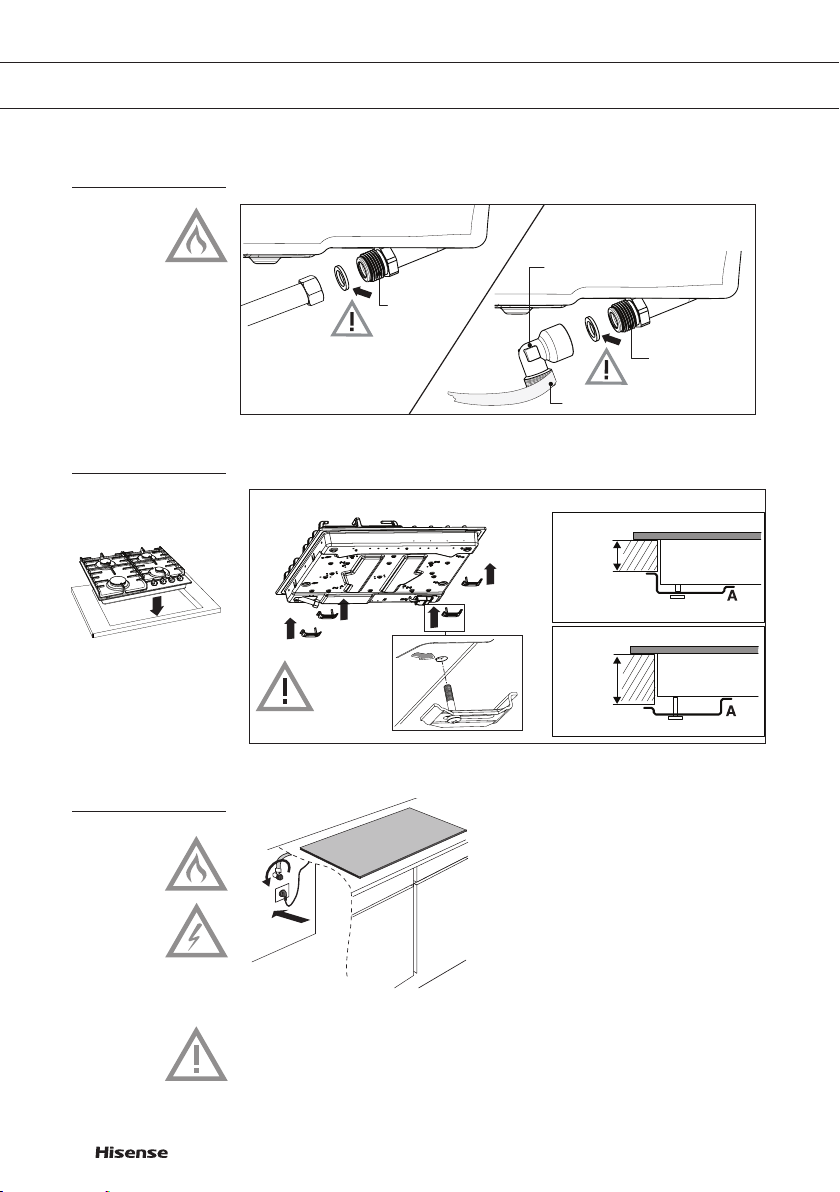
Gas connection
Built in
Connecting & testing
Check if connections are gastight.
05
hob
C
C
C
C
Worktop
Min.
20 mm
Max.
50 mm
C
PTFE tape
1/2” ISO 228
1/2" ISO 7-1 / EN 10226-1
05
hob
C
C
C
C
Worktop
Min.
20 mm
Max.
50 mm
C
PTFE tape
1/2” ISO 228
1/2" ISO 7-1 / EN 10226-1
05
hob
C
C
C
C
Worktop
Min.
20 mm
Max.
50 mm
C
PTFE tape
1/2” ISO 228
1/2" ISO 7-1 / EN 10226-1
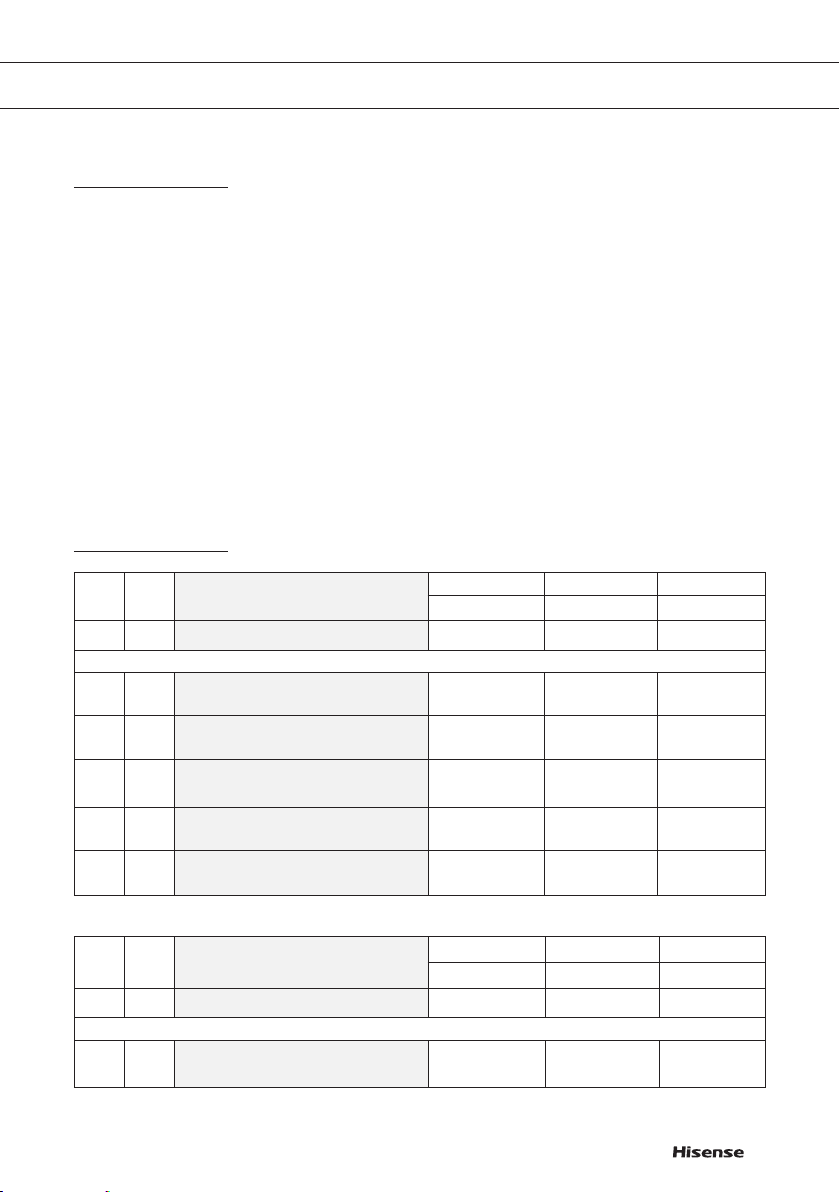
If included
05
C
C
PTFE tape
C
1/2” ISO 228
1/2” ISO 228
1/2” ISO 7-1 / EN 10226-1
PTFE tape
Min.
20 mm
Max.
50 mm
EN 17
CONVERSION INSTRUCTION
Conversion instruction
Adjusting for a different gas type!
Attention! Performing of these instructions by a non-qualified engineer can lead to
dangerous situations. The supplier is not responsible for the consequences (the arising
of a hazardous situation and/or damage to persons or goods) caused by incorrect
performance of these instructions by engineers who are not employees of the supplier.
Consequential damage arising through inexpert performance of these instructions is not
accepted.
With this conversion-set your gas hob can be converted to different gasses.
See conversion Table.
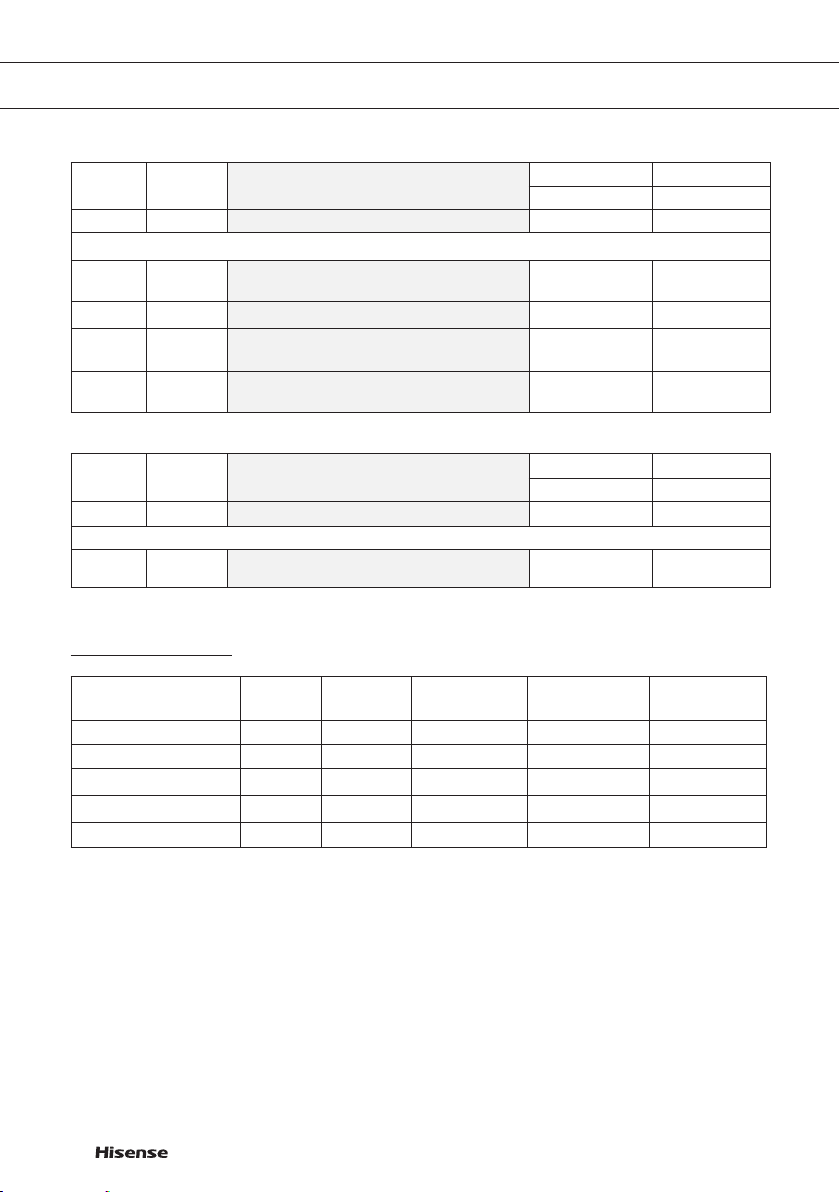
Conversion table
Gas
type
P
mBar
Modification
Auxiliary Semi rapid Rapid
nozzle nozzle nozzle
G20 20 - 72 97 128
Convert from G20 / 20 mbar to:
G20 13
Replace nozzle & no action
bypass
84 115 145
G25 20
Replace nozzle & no action
bypass
77 105 134
G30/
G31
28-
30/37
Replace nozzle & screw in
bypass (see 3A)
50 65 85
G150 8
Replace nozzle & adjust
bypass (see 3C)
145 200 290
G30 50
Replace nozzle & screw in
bypass (see 3A)
43 60 75
Gas
type
P
mBar
Modification
Auxiliary Semi rapid Rapid
nozzle nozzle nozzle
G30 30 - 50 65 85
Convert from G30 / 30 mbar to:
G20 20
Replace nozzle & adjust bypass
(see 3C)
72 97 128
EN 18
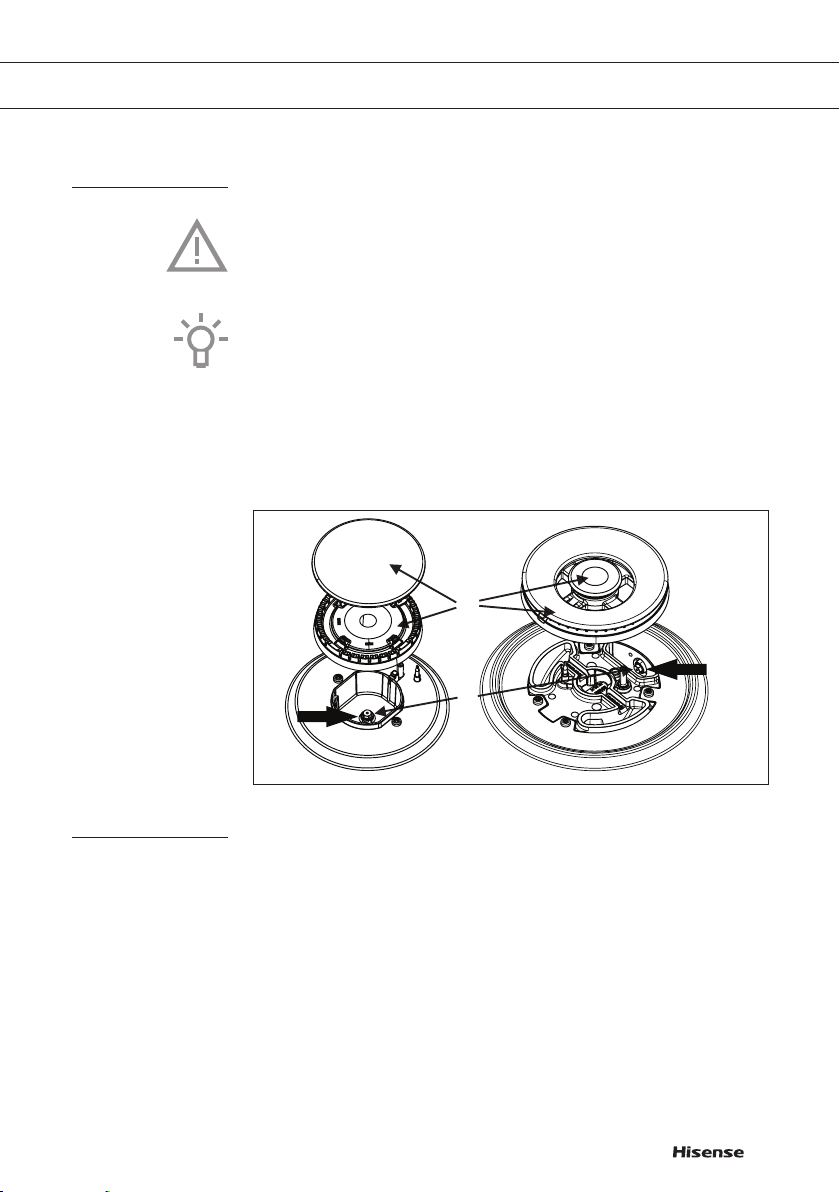
Gas type P mBar Modification.
Wok (BG6xB) Wok (BG6xC)
nozzle nozzle
G20 20 - 142 150
Convert from G20 / 20 mbar to:
G20 13
Replace nozzle & no action
bypass
155 170
G25 20 Replace nozzle & no action by-pass 143 152
G30/G31 28-30/37
Replace nozzle & screw in bypass
(see 3A)
94 100
G30 50
Replace nozzle & screw in bypass
(see 3A)
82 90
Gas type P mBar Modification.
Wok (BG6xB) Wok (BG6xC)
nozzle nozzle
G30 30 - 94 100
Convert from G30 / 30 mbar to:
G20 20
Replace nozzle & adjust bypass
(see 3C)
142 150
Power table (kW-gr/h):
G20
13 mbar
G25
20 mbar
G30-G31
28-30/37 mbar
G30
50 mbar
G150
8 mbar
Auxiliary burner 1.05 1.05 1.05/76 1.05 1.10
Semi-rapid burner 1.95 1.95 1.80/130 1.90 1.85
Rapid burner 3.10 3.10 3.00/216 3.00 3.00
Wok burner BG6xB) 3.45 3.35 3.50/252 3.50
Wok burner (BG6xC) 4.00 3.85 4.00/288 4.00
Contents of conversion set
• Nozzles for burners and (if applicable) by-pass screws for gas taps.
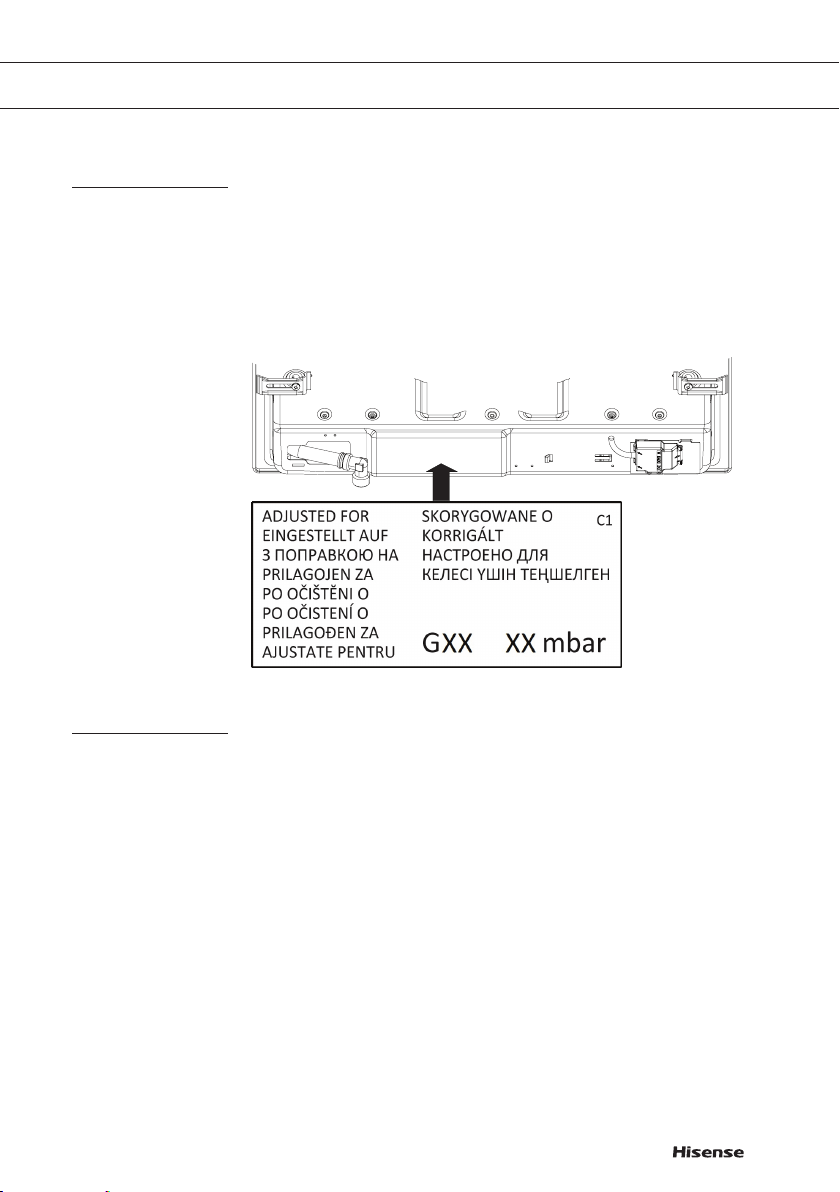
• Data label with the modified gas specifications and setting.
Tools needed:
T1 Socket spanner (7mm)
T2 Screw driver flat blade (4mm)
T3 Nose pliers
T4 Open end spanner (7mm)
T5 Leak test spray
CONVERSION INSTRUCTION
EN 19
CONVERSION INSTRUCTION
Converting nozzles
Please note: disconnect the appliance from the power supply.
Prevent damage of the worktop. Lay down parts of the appliance on
a protected base.
For converting to a different type of gas, the nozzles have to be
changed. The values are also marked on the nozzle.
1. Remove pan supports, burner heads, crowns and covers (see
pictures A1 and A2). Pull off the control knobs vertically.
2. Use the socket (T1) or open end spanner (T4) to remove the old
nozzles and place the new nozzles inside the burner cups (see
pictures A1 and A2).
A1
A2
1
2
T1
T4
Converting by-pass screws
Depending on the gas type to which the appliances will be converted,
there are two ways to adjust the by-pass screws.
Please check the conversion table in the column “Modification” if the
by-pass screws have to be screwed completely in (see action 3A below),
replaced by a different by-pass screw (see action 3B below) or adjusted
(see action 3C below).
The values are also indicated on the top of the by-pass screws.
The by-pass screws can be reached from the top of the hob when the
knobs are removed (B2).
EN 20
CONVERSION INSTRUCTION
3A. Screw the by-pass screws (3) of all gas taps completely in by using
the flat-blade screwdriver (T2).
3B. Remove the by-pass screws by using the flat-blade screwdriver (T2)
and the nose pliers (T3). Place the new by-pass screws with the
nose pliers and screw the by-pass screws of all gas taps completely
in, by using the flat-blade screwdriver.
3C. Adjust the by-pass screws (3) of all gas taps by using the
flat-blade screwdriver (T2) until a stable flame is established
with a minimal gas flow. Please check if the flame is stable in
cold and hot condition of the burner.
B2
B1
T2+T3
T2+T3
3
Check for gas tightness and operation
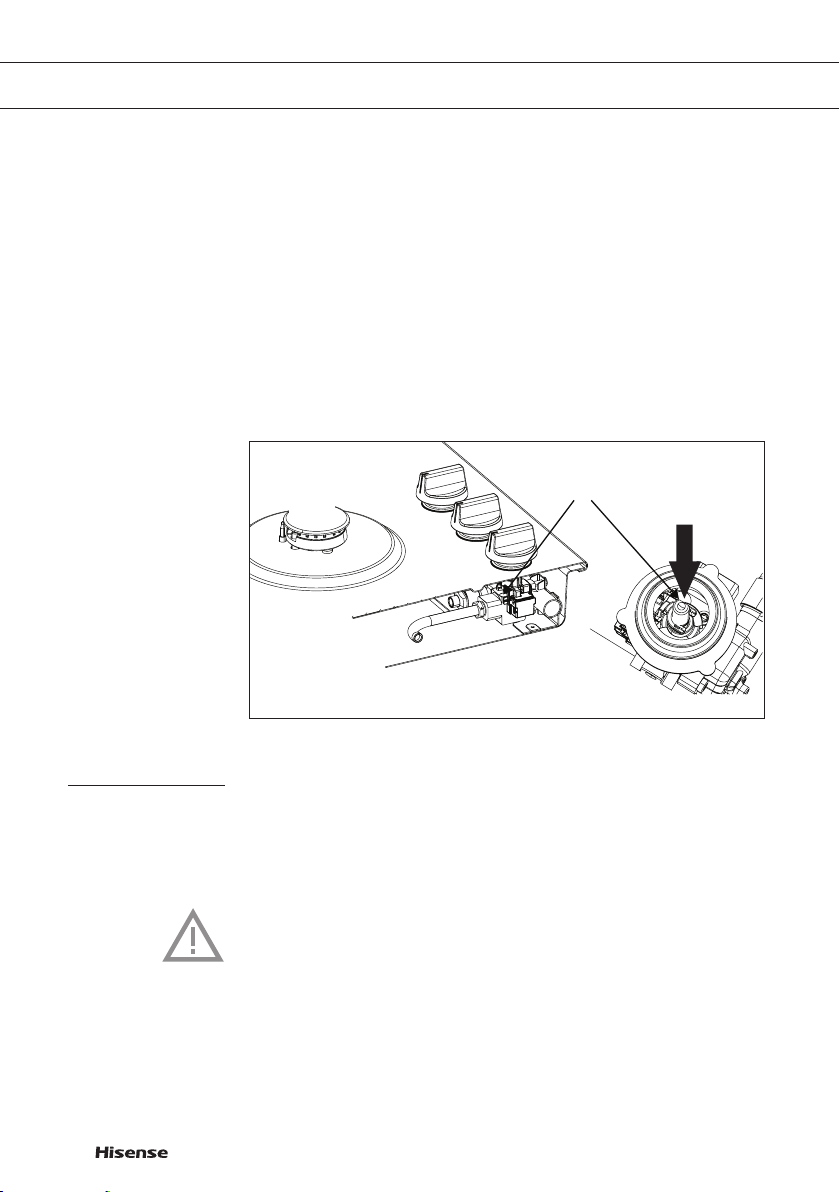
When the appliance is connected to the gas supply, use leak test spray
to check the gas tightness:
1. Seal the injector.
2. Open the gas tap.
Attention: press and open tap to override the thermo-electric safety
device and keep it pressed down.
3. Spray leak test spray over all gas connections and check for gas
tightness.
4. Repeat for every burner.
EN 21
CONVERSION INSTRUCTION
Start up
1. Reinstall the knobs, burner parts and pan supports.
2. Check if the appliance is connected to the correct
gas type and pressure.
3. Open the main gas valve.
4. Insert the plug into the power socket.
Checking operation
1. Ignite the burners.
2. Check whether the flame profile is normal, uniform and stable for the
complete ratio:
• Check if the flame does not smother in simmer rate;
• Check if the flames are not ‘blowing off’ at maximum rate;
• No long, yellow flames should be visible during operation.
3. Paste the data label with the modified gas specifications and setting
over the current data label with old specification (at the under site of
the appliances nearby the gas connection).
EN 22
ENVIRONMENTAL CONSIDERATIONS
Disposal of the appliance and packaging
Sustainable materials have been used during manufacture of this
appliance.
The appliance packaging is recyclable. The following may have been
used:
• cardboard;
• paper;
• polyethylene film (PE);
• CFC-free polystyrene (PS-rigid foam);
• polypropylene tape (PP).
Dispose of these materials in a responsible manner and in accordance
with government regulations.
To designate the requirement for separate collection of household
electrical appliances, the symbol of a crossed-out dustbin is applied to
the product.
This means that at the end of its working life, the product must not be
disposed of as urban waste. It must be taken to a special local authority
differentiated waste collection centre or to a dealer providing this
service. Disposing of a household appliance such as this hob separately
avoids possible negative consequences for the environment and health
and enables the constituent materials to be recovered, resulting in
significant savings in energy and resources.
Please note! Do not throw a broken ceramic glass plate in the glass
recycling bin but take this to the Municipality's waste recycling
centre.
Declaration of conformity
We hereby declare that our products satisfy the applicable European
directives, orders and regulations, as well as the requirements stated in
the referenced standards.

EN 23
815930 / VER 1 / 03-12-2019
en (01-20)