Sears,
Roebuck
and
Co.,
Hoffman
Estates,
IL
60179
U.S.A.
www.sears.com
ENGLISH
ESPANOL
Owner's
Manual
Manual
del
Propietario
HEAT
/
COOL
AIR
CONDITIONER
EICALOR
/
REFRESCA
ACONDICIONADOR
DE
AIRE
DE
VENTANA
Model,
Modelo
580.72124
-2-
FULL
ONE
YEAR
WARRANTY
ON
HEAT
/
COOL
AIR
CONDITIONER
For
one
year
from
the
date
of
purchase,
when
this
air
conditioner
is
operated
and
maintained
for
normal
room
cooling
according
to
instructions
in
this
owner's
manual,
Sears
will
repair
this
air
conditioner,
free
of
charge,
if
defective
in
material
or
workmanship.
FULL
FIVE-YEAR
WARRANTY
ON
SEALED
REFRIGERATION
SYSTEM
For
five
years
from
the
date
of
purchase,
when
this
air
conditioner
is
operated
and
maintained
for
normal
room
cooling
according
to
instructions
in
this
owner's
manual,
Sears
will
repair
the
sealed
refrigeration
system
(consisting
of
refrigerant,
connecting
tubing,
and
compressor),
free
of
charge,
if
defective
in
material
or
workmanship.
WARRANTY
SERVICE
IS
AVAILABLE
BY
CONTACTING
SEARS
SERVICE
AT
1-800-4-MY-HOME
Warranty
coverage
applies
only
to
air
conditioners
used
for
non-commercial,
private
household
purposes.
This
warranty
applies
only
while
this
product
is
in
use
in
the
United
States.
This
warranty
gives
you
specific
legal
rights,
and
you
may
also
have
other
right
which
vary
from
state
to state.
Sears,
Roebuck
and
Co.,
D/817WA,
Hoffman
Estates,
IL
60179
U.S.A.
TABLE
OF
CONTENTS
........................2
WARRANTY..............................................2
SAFETY
.....................................................3
Important
Safety
Instructions......................3
ELECTRICAL
REQUIREMENTS
.......4
INSTALLATION........................................5
Installation
Requirements.........................5
Installation
................................................6
How
to
Install............................................6
Removal
from
Window.................................8
OPERATION
.............................................9
How
and
Why...........................................9
Normal
Sounds
........................................9
Capacity
and
Running
Time
.....................9
Features
.................................................10
Using
the
Air
Conditioner
.......................10
Air
Conditioner
Features
........................11
MAINTENANCE.....................................12
Air
Filter
Cleaning...................................12
Air
Conditioner
Cleaning
........................12
How
to
Remove
the
Front
Grille
..................12
How
to
Replace
the
Front
Grille
.............12
TROUBLESHOOTING.........................13
Before
Calling
for
Service
......................13
ESPANOL
................................................14
MASTER
PROTECTION
AGREEMENTS
......................................27
SERVICE
NUMBERS
............Back
Cover

SAFETY
-3-
ENGLISH
IMPORTANT
SAFETY
INSTRUCTIONS
The
safety
instructions
below
will
tell
you
how
to
use
your
room
air
conditioner
to
avoid
harm
to
yourself
or
damage
to
your
ROOM
AIR
CONDITIONER.
FOR
YOUR
SAFETY
Do
not
store
or
use
gasoline
or
other
flammable
vapors
and
liquids
in
the
vicinity
of
this
or
any
other
appliance.
Read
product
labels
for
flammability
and
other
warnings.
PREVENT
ACCIDENTS
To
reduce
the
risk
of
fire,
electrical
shock,
or
injury
to
persons
when
using
your
air
conditioner,
follow
basic
precautions,
including
the
following:
?
Be
sure
the
electrical
service
is
adequate
for
the
model
you
have
chosen.
?
If
the
air
conditioner
is
to
be
installed
in
a
window,
you
will
probably
want
to
clean
both sides
of
the
glass
first.
If
the
window
is
a
triple-track
type
with
a
screen
panel
included,
you
may
want
to
remove
the
screen
completely
before
installation.
?
Be
sure
the
air
conditioner
has
been
securely
and
correctly
installed
according
to
the
separate
installation
instructions
provided
with
this
manual.
Save
this
manual and
installation
instructions
for
possible
future
use
in
removing
or
reinstalling
this
unit.
?
Use
gloves
when
handling
the
air
conditioner.
Be
careful
to
avoid
cuts
from
sharp
metal
fins
on
front
and
rear
coils.
ELECTRICAL
INFORMATION
The
complete
electrical
rating
of
your
new
room
air
conditioner
is
stated
on
the
serial
plate.
Refer
to
the
rating
when
checking
the
electrical
requirements.
?
Be
sure
the
air
conditioner
is
properly
grounded.
To
minimize
shock
and
fire
hazards,
proper
grounding
is
important.
The
power
cord
is
equipped
with
a
three-prong
grounding
plug
for
protection
against
shock
hazards.
?
Your
air
conditioner
must
be
plugged
into
a
properly
grounded
wall
receptacle.
If
the
wall
receptacle
you
intend
to
use
is
not
adequately
grounded
or
protected
by
a
time
delay
fuse
or
circuit
breaker,
have
a
qualified
electrician
install
the
proper
receptacle.
?
Do
not
run
air
conditioner
with
a
protective
covering.
This
could
result
in
mechanical
damage
within
the
air
conditioner.
?
Do
not
use an
extension
cord
or
an
adapter
plug.
ENERGY
SAVING
IDEAS
?
The
capacity
of
the
room
air
conditioner
must
fit
the
room
size
for
efficient
and
satisfactory
operation.
?
Install
the
room
air
conditioner
on
the
shady
side
of
your
home.
A
window
that
faces
north
is
best
because
it
is
shaded
most
of
the
day.
?
Do
not
block
air
flow
inside
with
blinds,
curtains,
or
furniture,
or
outside
with
shrubs,
enclosures,
or
other
buildings.
?
Close
the
floor
and
wall
registers
and
the
fireplace
damper
so
cool
air
does
not
escape
up
the
chimney
and
into
the
duct
work.
?
Keep
blinds
and
drapes
in
other
windows
closed
during
the
sunniest
part
of
the
day.
?
Clean
the
air
filter
as
recommended
in
the
MAINTENANCE
section
of
this
manual.
?
Proper
insulation
and
weather
stripping
in
your
home
will
help
keep
warm
air
out
and
cool
air
in.
?
External
house
shading
with
trees,
plants
or
awnings
will
help
reduce
the
air
conditioner's
work
load.
?
Operate
heat
producing
appliances
such
as
ranges,
washers,
dryers,
and
dishwashers
during
the
coolest
part
of
the
day.
Avoid
fire
hazard
or
electric
shock.
Do
not
use
an
extension
cord
or
an
adapter
plug.
Do
not
remove
any
prong
from
the
power
cord.
Do
not
under
any
circumstances
cut,
remove,
or
bypass
the
grounding
prong
from
this
plug.
Grounding
type
wall
receptacle
Power
supply
cord
with
3-prong
grounding
plug

ELECTRICAL
REQUIREMENTS
-4-
OBSERVE
ALL
LOCAL
CODES
AND
ORDINANCES.
DO
NOT,
UNDER
ANY
CIRCUMSTANCES,
REMOVE
THE
POWER
SUPPLY
CORD
GROUND
PRONG.
ELECTRICAL
GROUND
IS
REQUIRED
ON
THIS
APPLIANCE.
A
250-volt
60
Hz,
AC
only,
20A
fused
and
properly
grounded
electrical
supply
is
required.
A
time
delay
fuse
or
time
delay
circuit
breaker
is
recommended.
Use
a
dedicated
circuit,
serving
only
this
appliance.
DO
NOT
USE
AN
EXTENSION
CORD.
RECOMMENDED
GROUNDING
METHOD
For
your
personal
safety,
this
appliance
must
be
grounded.
This
appliance
has
a
power
supply
cord
with
a
3-prong
grounding
plug.
To
minimize
possible
shock
hazard,
the
cord
must
be
plugged
into
a
mating
grounding
type
wall
receptacle
and
grounded
in
accordance
with
the
National
Electrical
Code
(ANSI/NFPA
70)
latest
edition
and
all
local
codes
and
ordinances.
If
a
mating
wall
receptacle
is
not
available,
it
is
the
personal
responsibility
and
obligation
of
the
customer
to
have
a
properly
grounded
3-prong
wall
receptacle
installed
by
a
qualified
electrician.
Electrical
Shock
Hazard
Plug
into
a
grounded
3
prong
outlet.
Do
not
remove
ground
prong.
Do
not
use
an
adapter.
Do
not
use
an
extension
cord.
Failure
to
follow
these
instructions
can
result
in
death,
fire,
or
electrical
shock.
Do
not,
under
any
circumstances,
cut
or
remove
the
grounding
prong
from
the
plug.
Power
supply
cord
with
3-prong
grounding
plug
Standard
250V,
3-wire
grounding
receptacle
rated
20A,
250V
AC
Use
20
AMP,
time
delay
fuse
or
circuit
breaker.
Line
Cord
Plug
Use
Wall
Receptacle
Power
Supply

INSTALLATION
-5-
ENGLISH
INSTALLATION
REQUIREMENTS
Your
air
conditioner
will
install
into
standard
double
hung
windows
with
actual
clear
opening
widths
of
27
to
39
inches
(686mm
to
990mm)
(FIG.
1).
Lower
sash
must
open
sufficiently
to
allow
a
clear
vertical
opening
of
16
inches
(406mm).
Side
louvers
and
the
rear
of
the
air
conditioner
must
have
clear
air
space
to
allow
enough
airflow
through
the
condenser
for
heat
removal.
The
rear
of
the
unit
must
be
outdoors,
not
inside
a
building
or
garage.
ELECTRICAL
SERVICE
Check
your
available
electrical
service.
The
power
supply
available
must
be
the
same
as
that
shown
on
the
unit
nameplate
(found
on
right
side
of
cabinet).
All
models
are
equipped
with
a
3-prong
service
plug
to
provide
proper
service
and
safe
positive
grounding.
Do
not
change
plug
in
any
way.
Do
not
use
an
adapter
plug.
If
your
present
wall
outlet
does
not
match
your
plug,
call
a
qualified
electrician
to
make
the
necessary
corrections.
SAVE
CARTON
and
this
OWNER'S
MANUAL
for
future
reference.
The
carton
is
the
best
way
to
store
unit
during
winter
or
when
not
in
use.
INSTALLATION
HARDWARE
27"
to
39"
16"
min.
Inner
sill
Offset
Window
Sill
Exterior
Interior
wall
Sash
FIG.
1
FIG.
2
A
B
C
D
I
H
G
J
F
E
K
ITEM
NAME
OF
PARTS
Q'TY
A
SIDE
CURTAIN
2
B
SILL
SUPPORT
2
C
BOLT
2
D
LOCK
NUT
2
E
SCREW:
25/64"
13
F
SCREW:
5/8"
3
G
SCREW:
5/8"
5
H
FOAM
SEAL
1
I
FOAM
STRIP
1
J
L
BRACKET
1
K
DRAIN
PIPE
1
To
avoid
risk
of
personal
injury,
property
damage,
or
product
damage
due
to
the
weight
of
this
device
and
sharp
edges
that
may
be
exposed:
?
Air
conditioners
covered
in
this
manual
pose
an
excessive
weight
hazard.
Two
or
more
people
are
needed
to
move
and
install
the
unit.
To
prevent
injury
or
strain,
use
proper
lifting
and
carrying
techniques
when
moving
unit.
?
Carefully
inspect
location
where
air
conditioner
will
be
installed.
Be
sure
it
will
support
the
weight
of
the
unit
over
an
extended
period
of
time.
?
Handle
air
conditioner
with
care.
Wear
protective
gloves
whenever
lifting
or
carrying
the
unit.
AVOID
the
sharp
metal
fins
of
front
and
rear
coils.
?
Make
sure
air
conditioner
does
not
fall
during
installation.
REQUIRED
TOOLS:
?
Tight
Fitting
gloves
?
Standard
screwdriver
?
Phillips
screwdriver
?
Pliers
?
Sharp
knife
?
3/8-inch
open
end
wrench
or
adjustable
wrench
?
1/4-inch
hex
socket
and
ratcher
?
Tape
measure
?
Electric
drill
?
1/4-inch
drill
bit
CAUTION

INSTALLATION
Pick
a
location
which
will
allow
you
to
blow
the
cold
air
into
the
area
you
want.
Windows
used
for
installation
must
be
strong
enough
to
support
the
weight
of
the
air
conditioner.
Good
installation
with
special
attention
to
the
proper
position
of
the
unit
will
lessen
the
chance
that
service
will
be
needed.
When
cooling
more
than
one
room,
installation
location
is
very
important.
If
air
conditioner
is
blocked
by
a
storm
window
frame,
see
step
19
on
page
8
before
beginning
to
install.
To
cool
a
room,
cold
air
must
be
blown
from
the
air
conditioner
in
a
straight
path
into
the
room.
HOW
TO
INSTALL
Remove
the
screws
which
fasten
the
cabinet
at
both sides
and
at
the
back.
Save
side
screws.
Discard
back
screws.
Slide
the
unit
out
of
the
cabinet
by
gripping
the
base
pan
handle
with
one
hand,
and
pulling
it
forward
while
bracing
the
cabinet
with
your
other
hand.
Cut
the
FOAM
STRIP
(ITEM
I)
to
fit
the
underside
of
the
window
sash.
Peel
off
the
backing
and
attach
the
FOAM
STRIP
as
shown
in
Fig.
5.
Insert
the
side
curtain
(ITEM
A)
into
the
upper
guide
and
lower
guide
of
the
air
conditioner.
Fasten
the
curtains
to
the
unit
with
screws
(ITEM
E).
Open
the
window.
Mark
a
line
on
center
of
the
window
inner
sill.
Carefully
place
the
cabinet
on
the
window
inner
sill
and
align
the
center
of
the
cabinet
front
with
the
center
line
marked
on
the
window
inner
sill.
Pull
the
bottom
window
sash
down
behind
the
upper
guide
until
the
sash
rests
on
the
cabinet
top.
NOTE:
Do
not
pull
the
window
sash
down
so
tightly
that
the
movement
of
side
curtain
is
restricted.
Loosely
assemble
the
sill
supports
using
the
parts
in
FIG.
9.
7
6
5
4
3
2
1
INSTALLATION
-6-
FIG.
3
ITEM
I
Sash
Upper
guide
Lower
guide
ITEM
E
ITEM
E
FIG.
4
FIG.
5
FIG.
6
Upper
guide
Window
inner
sill
Window
sash
Form
strip
Upper
guide
Cabinet
Side
Curtain
FIG.
7
FIG.
8
INDOOR
OUTDOOR
ITEM
B
ITEM
D
ITEM
C
FIG.
9

ENGLISH
Select
the
position
that
will
place
the
sill
supports
near
the
outermost
point
on
sill
(FIG.
10).
Attach
the
sill
supports
to
the
cabinet
track
hole
closest
to
the
selected
position
using
screw
(ITEM
E).
Place
the
sill
supports
with
the
cabinet
on
the
window
sill's
selected
position
(FIG.
10).
The
cabinet
should
be
installed
with
a
very
slight
tilt
(about
1/4")
downward
to
the outside
(FIG.
11).
Adjust
the
bolts
and
the
nuts
of
sill
supports
to
level
the
cabinet.
Attach
the
cabinet
to
the
inner
sill
by
driving
the
screws
(ITEM
F)
through
the
front
lower
guide
into
the
window
inner
sill.
(FIG.
12)
Pull
each
side
curtain
fully
to
each
side
of
window
opening.
Attach
each
side
curtain
to
the
window
sash
using
screws
(ITEM
G).
(FIG.
13)
Attach
the
L
bracket
(ITEM
J)
with
screw
(ITEM
G)
(FIG.
14).
DRAINAGE
Be
sure
to
insert
the
drain
pipe
into
base
pan
before
installation.
The
air
conditioner
must
be
installed
with
a
slight
tilt
downward
to
the
outside
for
proper
water
drainage
(FIG.
15).
Slide
the
air
conditioner
into
the
cabinet.
(FIG.
16)
CAUTION:
For
security
purposes,
reinstall
side
screws
you
removed
in
step
1.
Cut
the
foam
seal
(ITEM
H)
to
the
proper
length
and
insert
between
the
upper
window
sash
and
the
lower
window
sash.
(FIG.
17)
The
vent
control
handle
must
be
straightened
before
the
decorative
front
is
attached.
Pull
down
part
to
align
with
part
.
17
16
15
14
13
12
11
10
9
8
-7-
INSTALLATION
ITEM
H
Part
FIG.
17
FIG.
18
Sash
Track
ITEM
F
ITEM
B
Lower
Guide
FIG.
12
ABOUT "
/
14
ITEM
B
Screw
Screw
Power
Cord
FIG.
11
ITEM
G
ITEM
G
ITEM
J
BASE
PAN
REAR
DRAIN
PIPE
BASE
PAN
BOTTOM
FIG.
13
FIG.
15
FIG.
14
INDOOR
OUTDOOR
ABOUT /
14"
Cabinet
ITEM E
Lower
guide
FIG.
10
FIG.
16
Part

FRONT
INSTALLATION
Install
the
front
grille
(packed
separately)
onto
the
cabinet
as
follows:
?
Hook
upper
tabs
of
front
grille
into
slots
on
the cabinet
top.
(FIG. 19)
?
Push
front
grille
towards
the
cabinet
in
order
to
snap
side
tabs
into
the
cabinet.
(FIG.
19)
?
Open
the
inlet
grille.
(FIG.
20)
?
Install
the
screw
(ITEM
E)
through
the
front
grille.
(Fig.
20)
?
Close
the
inlet
grille.
(Fig.
21)
IF
AIR
CONDITIONER
IS
BLOCKED
BY
STORM
WINDOW
FRAME
?
If
storm
window
presents
interference,
fasten
a
2"
wide
wood
strip
to
the
inner
window
sill
across
the
full
width
of
the
sill.
The
wood
strip
should
be
thick
enough
to
raise
the
height
of
the
window
sill
so
that
the
unit
can
be
installed
without
interference
from
the
the
storm
window
frame.
See
FIG.
22.
Top
of
wood
strip
should
be
approximately
3/4"
higher
than
the
storm
window
frame
to
help
condensation
to
drain
properly
to
the
outside.
?
Install
a
second
wood
strip
(approximately
6"
long
by
11/2"
wide
and
same
thickness
as
first
strip)
in
the
center
of
the
outer
sill
flush
against
the
back
of
the
inner
sill.
Screw
the
L
bracket
(not
supplied)
into this
strip.
To
support
the
lower
guide,
screw
an
"L"
bracket
(not
supplied)
into
this
strip
as
shown
in
FIG.
22.
REMOVAL
FROM
WINDOW
?
Turn
off
and
unplug
the
air
conditioner.
?
Remove
the
front
grille.
See
HOW
TO
REMOVE
THE
FRONT
GRILLE.
Refer
to
page
12.
?
Unscrew
the
side
screws
that
you
installed
in
Step
15.
?
Slide
the
air
conditioner
out
of
the
cabinet.
BE
CAREFUL
NOT
TO
DROP
IT.
Hold
onto
it
firmly
the
whole
way
sliding
it
out.
Once
removed,
set
it
safety
out
of
the
way.
?
Remove
the L
bracket
from
window
frame
and
the
sash
seal
from
between
the
windows.
?
Unscrew
the
side
curtains
from
the
window
frame.
Fold
them
back
to
the
sides
of
the
cabinet.
?
Remove
screws
attaching
cabinet
to
inner
sill.
Be
careful
not
to
let
cabinet
fall
once
screws
are
removed.
?
Remove
cabinet
from
window
opening.
?
Place
air
conditioner
into
cabinet.
Reinstall
side
screws
and
Front
Grille.
?
Place
unit
and
all
assembly
hardware
in
air
conditioner
shipping
carton,
and
store
in
clean,
dry
place.
19
18
INSTALLATION
-8-
Inlet
grille
ITEM
E
FIG.
19
Front
Installation
INNER
SILL
WOOD
STRIP
MOUNTED
ON
TOP
OF
INNER
SILL
WOOD
STRIP
FOR
L
BRACKET
L
BRACKET
3/4"
CLEARANCE
1
1/2"
min.
(38mm)
STORM
WINDOW
FRAME
OUTSIDE
INSIDE
OUTER
SILL
FIG.
22
FIG.
20
Front
Installation
Front
Installation
FIG.
21
?
Air
conditioners
covered
in
this
manual
pose
an
excessive
weight
hazard.
Two
or
more
people
are
needed
to
move
and
install
the
unit.
To
prevent
injury
or
strain,
use
proper
lifting
and
carrying
techniques
when
moving
unit.
?
When
handling
the
air
conditioner,
be
careful
to
avoid
cuts
from
sharp
metal
fins
on
front
and
rear
coils.
?
Make
sure
air
conditioner
does
not
fall
during
removal.
CAUTION

HOW
AND
WHY
Your
room
air
conditioner
provides
the
following
functions
to
make
hot
weather
living
more
comfortable:
?
Cools
and
circulates
room
air.
?
Lowers
humidity
by
removing
excess
moisture.
?
Filters
out
summertime
dust,
dirt,
and
some
airborne
impurities.
The
air
conditioner
performs
these
functions
by
drawing
room
air
through
a
filter
which
traps
dust
and
dirt
particles.
The
air
then
passes
over
a
cooling
coil
which
refrigerates
the
air
and
removes
excess
moisture.
The
same
air
is
then
returned
to
the
room--
cooler,
drier,
and
cleaner.
Moisture
removed
from
the
room
air
is
carried
to
the
outside
and
evaporated.
Your
air
conditioner
is
designed
to
be
easy
to
operate
and
to
provide
plenty
of
cooling
power.
NORMAL
SOUNDS
FIG.
23
Aside
from
the
regular
fan
motor
and
compressor
sounds
coming
from
your
air
conditioner,
you
will
once
in
a
while
hear
a
pinging
sound.
This
is
the
result
of
moisture
being
picked
up
from
the
air
in
the
room
and
thrown
against
the
air
conditioner's
fan.
This
is
normal
and
should
not
be
cause
for
concern.
Also,
do
not
be
alarmed
if
you
hear
a
slight
hissing
or
gurgling
sound
coming
from
your
air
conditioner
after
it
is
off.
These
are
normal
coolant
noises.
CAPACITY
AND
RUNNING
TIME
Proper
unit
size
is
important
in
deciding
the
desired
comfort
for
the
area
you
want
to
cool.
An
undersized
unit
will
not
have
the
capability
to
cool,
leaving
the
area
uncomfortably
warm.
The
proper
size
is
determined
by
the
number
of
square
feet
in
the
area
to
be
cooled,
indoor
and
outdoor
temperature
and
humidity.
Whenever
the
heat
or
humidity
load
is
above
normal
the
air
conditioner
must
run
longer
and
more
often
to
keep
the
desired
temperature
you
have
selected,
Under
heavy
heat
load
conditions
the
air
conditioner
may
need
to
run
constantly
to
keep
the
temperature
you
want.
At
times
using
the
MED
FAN
setting
to
circulate
the
room
air
may
make
it
comfortable
even
though
the
air
is
not
being
cooled.
This
will
decrease
your
cost
of
use.
WATER
DRAIN
VALVE
When
the
outside
temperature
drops
below
58°F
and
the
unit
is
set
for
heating,
a
drain
valve
opens
up
to
release
water
from
the
base
pan.
This
is
normal
and
prevents
water
from
freezing
in
the
base
pan
and
interfering
with
the
outdoor
fan.
Fan
You
may
hear
air
movement
from
the
fan.
Condenser
You
may
hear
droplets
of
water
hitting
the
condenser
causing
a
pinging
or
clicking
sound.
Unit
Vibration
The
unit
may
vibrate
and
make
noise
because
of
poor
wall
or
window
construction.
Compressor
The
modern
high
efficiency
compressor
may
have
a
high
pitched
hum
or
pulsating
noise
that
cycles
on
and
off.
OPERATION
-9-
ENGLISH
FIG.
23

PULL
OPEN
/
PUSH
CLOSE
OPERATION
-10-
FEATURES
1.
Cabinet
2.
Vertical
Air
Direction
Louvers
3.
Horizontal
Air
Direction
Louvers
4.
Inlet
Grille
5.
Air
Filter
6.
Knob
7.
Power
Cord
8.
Evaporator
Coil
9.
Condenser
10.
Compressor
11.
Base
pan
12.
Brace
13.
Upper
Guide
14.
Curtain
15.
Vent
Control
16.
Electric
Heater
USING
THE
AIR
CONDITIONER
To
reduce
the
risk
of
fire,
electric
shock,
or
injury
to
persons,
read
the
important
SAFETY
instructions
section
before
operating
this
appliance.
To
begin
operating
the
air
conditioner
after
installation,
follow
these
steps:
1.
Plug
in
the
air
conditioner.
(To
prevent
electrical
hazards,
do
not
use
an
extension
cord
or
an
adapter
plug.)
2.
Push
in
the
exhaust
air
vent
control
to
the
CLOSE
position.
3.
Set
the
TEMP
Control
to
the
coolest
setting.
4.
Set
the
MODE
control
at
the
highest
COOL
level.
5.
Adjust
the
louvers
for
comfortable
air
flow.
6.
Once
the
room
has
cooled,
adjust
the
TEMP
and
MODE
control
to
the
setting
you
find
most
comfortable.
NOTE
:
If
the
air
conditioner
is
turned
off,
wait
3
minutes
before
restarting.
This
allows
pressure
inside
the
compressor
to
equalize.
Failure
to
wait
3
minutes
before
restarting
may
cause
inefficient
operation.
If
you
move
the
TEMP
Control
to
a
warmer,
then
immediately
back
to
a
cooler
setting,
the
unit
will
shut
off.
Wait
3
minutes
before
restarting.
VENT
CONTROL
The
Vent
Control
allows the
air
conditioner
to
either
recirculate
inside
air
(CLOSE)
or
exhaust
air
to
the
outside
(OPEN).
(FIG.
25)
?
The
CLOSE
position
is
used
when
maximum
cooling
is
desired.
It
may
also
be
used
for
air
recirculation
without
cooling
when
the
air
conditioner
is
set
in
the
FAN
position.
?
The
OPEN
position
removes
stale
air
from
the
room
and
exhausts
it
to
the
outside.
Fresh
air
is
drawn
into
the
room
through
normal
air
passages
found
in
homes.
?
The
OPEN
or
CLOSE
position
can
be used
with
any
fan
selection.
1
213
3
145
46
10
8
11
912
715
16
FIG.
24
FIG.
25

OPERATION
-11-
ENGLISH
AIR
CONDITIONER
FEATURES
The
controls
featured
in
this
manual
are
representative
of
the
many
models
available.
Your
model
may
look
slightly
different.
TEMP
The
temp
control
is
used
to
maintain
the
room
temperature.
The
compressor
will
cycle
on
and
off
to
keep
the
room
at
the
same
level
of
comfort.
Turn
the
knob
clockwise
to
COOLER
(blue)
and
the
indoor
air
will
become
cooler.
Turn
the
knob
counterclockwise
to
WARMER
(red)
and
the
indoor
air
will
become
warmer.
MODE
OFF
:
Turns
air
conditioner
off.
FAN
ONLY
:
Fan
operation
without
cooling
or
heating.
LOW
COOL
:
Cooling
with
low
fan
speed
operation.
HIGH
COOL
:
Cooling
with
high
fan
speed
operation.
LOW
HEAT
:
Heating
with
low
fan
speed
operation.
HIGH
HEAT
:
Heating
with
high
fan
speed
operation.
HORIZONTAL
AIR
DIRECTION
CONTROL
The
horizontal
air
direction
is
adjusted
by
moving
the
vertical
louvers
right
and
left
with
your
fingertips.
(FIG.
27)
VERTICAL
AIR
DIRECTION
CONTROL
The
vertical
air
direction
is
adjusted
by
moving
the
horizontal
louvers
up
and
down
with
your
fingertips.
(FIG.
28)
FIG.
26
FIG.
27
FIG.
28

-12-
AIR
FILTER
CLEANING
The
Air
Filter
will
become
dirty
as
it
removes
dust
from
the
inside
air.
It
should
be
washed
at
least
every
2
weeks.
If
the
Air
Filter
remains
full
of
dust,
the
air
flow
will
decrease
and
the
cooling
capacity
will
be
reduced,
possibly
damaging
the
unit.
?
Pull
the
inlet
grille
forward,
grasping
both
tabs,
then
pull
out
the
air
filter.
(FIG.
29)
?
Wash
the
Air
Filter
under
the
faucet
with
warm
water.
Be
sure
to
shake
off
all
the
water
before
replacing
the
filter.
(FIG.
30)
AIR
CONDITIONER
CLEANING
Clean
the
front
grille
and
inlet
grille
by
wiping
with
a
cloth
dampened
in
a
mild
detergent
solution.
The
cabinet
may
be
washed
with
mild
soap
or
detergent
and
lukewarm
water,
then
polished
with
liquid
appliance
wax.
To
ensure
continued
peak
efficiency,
the
condenser
coils
(outdoor
side
of
unit)
should
be
checked
periodically
and
cleaned
if
they
become
clogged
with
soot
or
dirt
from
the
atmosphere.
Brush
or
vacuum
exterior
coils
to
remove
debris
from
fins.
HOW
TO
REMOVE
THE
FRONT
GRILLE
?
Remove
the
TEMP
knob
and
the
MODE
knob
by
pulling.
?
Open
the
inlet
grille
downward.
?
Remove
the
screw
securing
the
Front
Grille.
?
Push
the
grille
up
from
the
bottom
and
pull
the
top
of
the
grille
away
from
the
case
to
lift
the
top
tabs
out
of
their
slots.
HOW
TO
REPLACE
THE
FRONT
GRILLE
Attach
the
front
grille
to
the
cabinet
by
inserting
the
tabs
on
the
grille
into
the
slots
on
the
front
of
the
cabinet.
Push
the
grille
in
until
it
snaps
into
place.
Front
Grille
Inlet
Grille
MAINTENANCE
FIG.
29
FIG.
30
FIG.
31
FIG.
32
FIG.
33
-13-
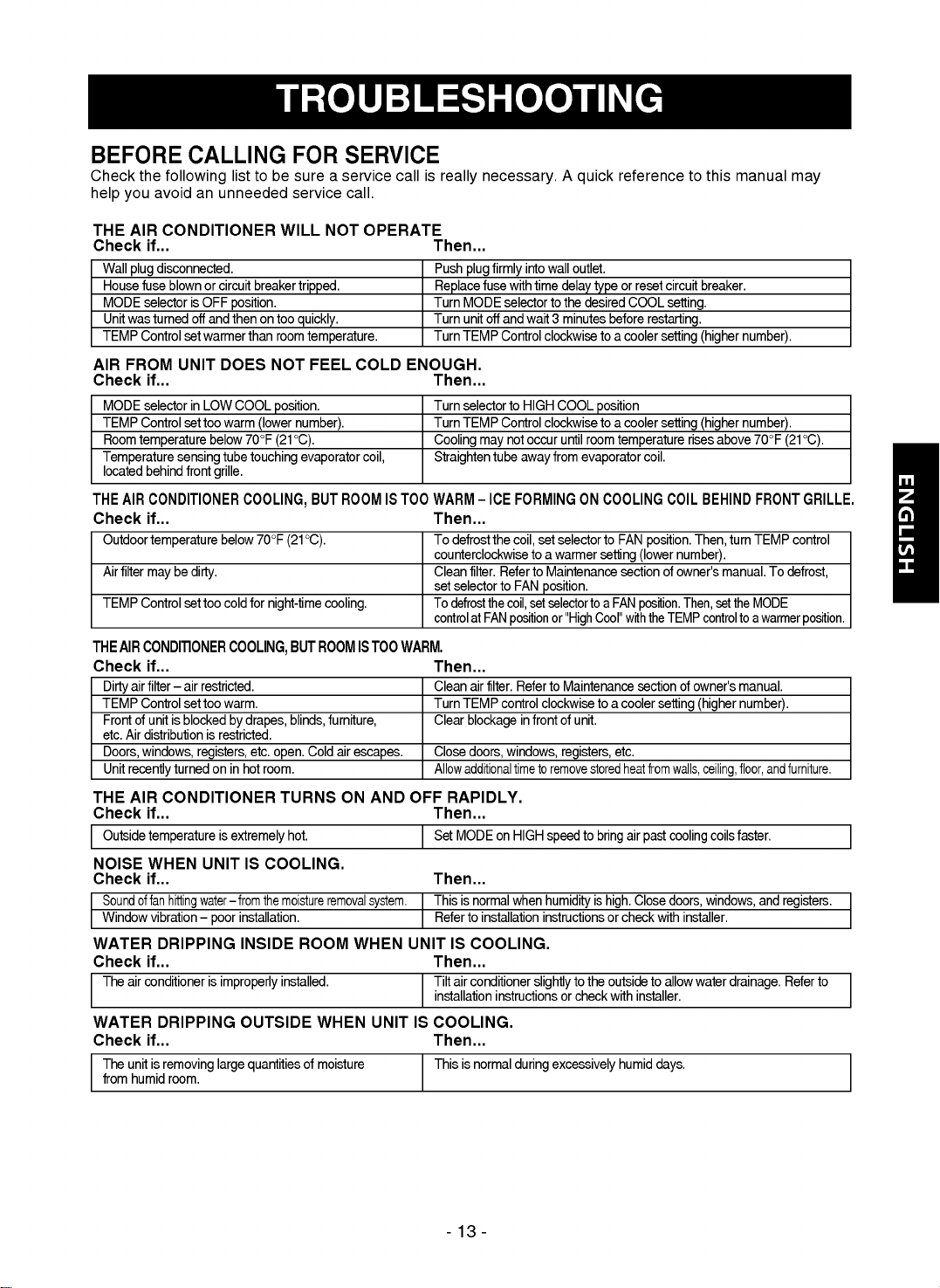
BEFORE
CALLING
FOR
SERVICE
Check
the
following
list
to
be
sure
a
service
call
is
really
necessary.
A
quick
reference
to
this
manual
may
help
you
avoid
an
unneeded
service
call.
THE
AIR
CONDITIONER
WILL
NOT
OPERATE
Check
if...
Then...
AIR
FROM
UNIT
DOES
NOT
FEEL
COLD
ENOUGH.
Check
if...
Then...
THE
AIR
CONDITIONER
COOLING,
BUT
ROOM
IS
TOO
WARM
--
ICE
FORMING
ON
COOLING
COIL
BEHIND
FRONT
GRILLE.
Check
if...
Then...
THE
AIR
CONDITIONER
COOLING,
BUT
ROOM
IS
TOO
WARM.
Check
if...
THE
AIR
CONDITIONER
TURNS
ON
AND
OFF
RAPIDLY.
Check
if...
Then...
Then...
NOISE
WHEN
UNIT
IS
COOLING.
Check
if...
Then...
WATER
DRIPPING
INSIDE
ROOM WHEN
UNIT
IS
COOLING.
Check
if...
Then...
WATER
DRIPPING
OUTSIDE
WHEN
UNIT
IS
COOLING.
Check
if...
Then...
Wall
plug
disconnected.
Push
plug
firmly
into
wall
outlet.
House
fuse
blown
or
circuit
breaker
tripped.
Replace
fuse
with
time
delay
type
or
reset
circuit
breaker.
MODE
selector
is
OFF
position.
Turn
MODE
selector
to
the
desired
COOL
setting.
Unit
was
turned
off
and
then
on
too
quickly.
Turn
unit
off
and
wait
3
minutes
before
restarting.
TEMP
Control
set
warmer
than
room
temperature.
Turn
TEMP
Control
clockwise
to
a
cooler
setting
(higher
number).
MODE
selector
in
LOW
COOL
position.
Turn
selector
to
HIGH
COOL
position
TEMP
Control
set
too
warm
(lower
number).
Turn
TEMP
Control
clockwise
to
a
cooler
setting
(higher
number).
Room
temperature
below
70°F
(21°C).
Cooling
may
not
occur
until
room
temperature
rises
above
70°F
(21°C).
Temperature
sensing
tube
touching
evaporator
coil,
Straighten
tube
away
from
evaporator
coil.
located
behind
front
grille.
Outdoor
temperature
below
70°F
(21°C).
To
defrost
the
coil,
set
selector
to
FAN
position.
Then,
turn
TEMP
control
counterclockwise
to
a
warmer
setting
(lower
number).
Air
filter
may
be
dirty.
Clean
filter.
Refer
to
Maintenance
section
of
owner's
manual.
To
defrost,
set
selector
to
FAN
position.
TEMP
Control
set
too
cold
for
night-time
cooling.
To
defrost
the
coil,
set
selector
to
a
FAN
position.
Then,
set
the
MODE
control
at
FAN
position
or
"High
Cool"
with
the
TEMP
control
to
a
warmer
position.
Dirty
air
filter
--
air
restricted.
Clean
air
filter.
Refer
to
Maintenance
section
of
owner's
manual.
TEMP
Control
set
too
warm.
Turn
TEMP
control
clockwise
to
a
cooler
setting
(higher
number).
Front
of
unit
is
blocked
by
drapes,
blinds,
furniture,
Clear
blockage
in
front
of
unit.
etc.
Air
distribution
is
restricted.
Doors,
windows,
registers,
etc.
open.
Cold
air
escapes.
Close
doors,
windows,
registers,
etc.
Unit
recently
turned
on
in
hot
room.
Allow
additional
time
to
remove
stored
heat
from
walls,
ceiling,
floor,
and
furniture.
Outside
temperature
is
extremely
hot.
Set
MODE
on
HIGH
speed
to
bring
air
past
cooling
coils
faster.
Sound
of
fan
hitting
water
--
from
the
moisture
removal
system.
This
is
normal
when
humidity
is
high.
Close
doors,
windows,
and
registers.
Window
vibration
--
poor
installation.
Refer
to
installation
instructions
or
check
with
installer.
The
air
conditioner
is
improperly
installed.
Tilt
air
conditioner
slightly
to
the
outside
to
allow
water
drainage.
Refer
to
installation
instructions
or
check
with
installer.
The
unit
is
removing
large
quantities
of
moisture
This
is
normal
during
excessively
humid
days.
from
humid
room.