User manual
SpeechOne

Table of Contents
1. Important ................................................................................................................................................... 3
Safety instructions ................................................................................................................................. 3
Cleaning and disinfection ....................................................................................................................... 4
Disposal of your old product ................................................................................................................... 4
About this user manual ........................................................................................................................... 4
2. Your SpeechOne ......................................................................................................................................... 6
Product highlights .................................................................................................................................. 6
What's in the box ................................................................................................................................... 7
Overview of your SpeechOne .................................................................................................................. 8
Overview of the docking station ............................................................................................................... 9
Overview of the remote control (PSM6500, PSM6800) ............................................................................. 10
3. Get started ................................................................................................................................................ 11
Charging the battery ............................................................................................................................. 11
Learn about the battery status ................................................................................................................ 12
Pairing ................................................................................................................................................. 12
Learn about wireless technology ............................................................................................................ 13
Idle mode and Power down mode .......................................................................................................... 13
Resetting the wireless connection ........................................................................................................... 13
4. Use your SpeechOne ................................................................................................................................. 15
Wearing styles ...................................................................................................................................... 15
Create a recording ................................................................................................................................ 17
Skype calls ........................................................................................................................................... 17
Control other applications ...................................................................................................................... 18
Status light ........................................................................................................................................... 18
Use the remote control (PSM6500, PSM6800) ......................................................................................... 19
Hands-free dictating with a Philips foot control ........................................................................................ 19
Upgrading the rmware ........................................................................................................................ 20
Power down your SpeechOne ............................................................................................................... 22
5. Button modes .......................................................................................................................................... 23
Switch between button modes on the docking station ............................................................................. 23
Switch between button modes on the remote control (PSM6500, PSM6800) ............................................. 24
Event mode ......................................................................................................................................... 25
Keyboard mode ................................................................................................................................... 26
Browser mode ..................................................................................................................................... 27
Windows speech recognition mode ....................................................................................................... 28
Dragon for Mac mode .......................................................................................................................... 29
Dragon for Windows mode ................................................................................................................... 30
6. Service and support ................................................................................................................................... 31
Contact our supporting Philips partners ................................................................................................... 31
Troubleshooting ................................................................................................................................... 31
LED colors and meanings ..................................................................................................................... 32
7. Technical data .......................................................................................................................................... 33
8. Certications ............................................................................................................................................ 35
FCC Warning Statement ........................................................................................................................ 35
Industry Canada (IC) regulatory information ............................................................................................ 35
2

1. Important
Do not make any adjustments and modications that are
not described in this manual. Follow all safety instructions
to ensure proper operation of the device. The manufacturer
assumes no liability for damages resulting from non-com-
pliance with the safety instructions.
View this user manual
online:
help.speechone.com/
smp6300
Safety instructions
• Protect the device from rain and liquids to prevent dam-
age to the device or a short circuit.
• Do not expose the device to excessive heat caused by
placing it on a heating device or in direct sunlight.
• Protect the cables from damage by being trapped, partic-
ularly at the plugs and where cables exit the housing.
• Do not perform any maintenance operations that are not
described in this user manual. Do not disassemble the
device into its component parts to carry out repairs. The
device may only be repaired in authorized service centers.
• All wireless devices may be susceptible to interference,
which could aect performance.
• Back up your data and recordings. The manufacturer’s
warranty does not cover loss of data resulting from user
actions.
Rechargeable built-in battery
• This device contains a built-in Li-polymer battery which
should not be replaced by the customer. The battery may
only be replaced in authorized service centers or by an
authorized Philips partner for dictation equipment.
• Batteries contain substances that may pollute the envi-
ronment. Used batteries should be disposed of at an o-
cial collection point.
Small children
Your device and its accessories may contain small parts.
Keep them out of the reach of small children.
Operating environment
This device meets RF exposure guidelines when used either
in front of the mouth or when positioned at least 2.2 cm
(0.87 inches) away from the body.
Parts of the device are magnetic. Metallic materials may be
attracted to the device. Do not place credit cards or other
magnetic storage media near the device or in the docking
station because information stored on them may be erased.
Medical device interference
Operation of any radio transmitting equipment may inter-
fere with the functionality of inadequately protected medi-
cal devices. Consult a physician or the manufacturer of the
medical device to determine if they are adequately shielded
from external RF energy or if you have any questions.
Switch o your device in health care facilities when any reg-
ulations posted in these areas instruct you to do so. Hospi-
tals or health care facilities may be using equipment that
could be sensitive to external RF energy.
Implanted medical devices
This device contains components that emit electromagnetic
waves. Electromagnetic waves might interfere with the op-
eration of implanted medical devices, such as pacemakers
or implanted cardioverter debrillators. Manufacturers of
medical devices recommend that a minimum separation of
15.3 cm (6 inches) should be maintained between a wireless
device and an implanted medical device to avoid potential
interference with the medical device. Persons who have
such devices should:
• Always keep the wireless device more than 15.3 cm (6 in-
ches) from the medical device when the wireless device is
turned on.
• Not carry the wireless device in a breast pocket.
• Turn the wireless device o immediately if there is any
reason to suspect that interference is taking place.
• Read and follow the directions from the manufacturer of
their implanted medical device.
If you have any questions about using your wireless device
with an implanted medical device, consult your health care
provider.
Hearing aids
Some digital wireless devices may interfere with some hear-
ing aids. If interference occurs, consult your service provider.
Vehicles
RF signals may aect improperly installed or inadequately
shielded electronic systems in motor vehicles such as elec-
tronic fuel injection systems, electronic antiskid (antilock)
braking systems, electronic speed control systems, and air
bag systems. For more information, check with the manu-
facturer, or its representative, of your vehicle or any equip-
ment that has been added.
Only qualied personnel should service the device or install
the device in a vehicle. Faulty installation or service may be
dangerous and may invalidate any warranty that may apply
to the device.
Check regularly that all wireless device equipment in your
vehicle is mounted and operating properly. Do not store or
carry ammable liquids, gases, or explosive materials in the
same compartment as the device, its parts, or enhance-
ments. For vehicles equipped with an air bag, remember
that air bags inate with great force.
3

Use in aircraft
Wireless transmitters can negatively aect the operation of
other electronic equipment, causing them to malfunction.
Turn o your device when you travel in aircraft.
Cleaning and disinfection
• Before cleaning, disconnect all cables from the device.
• To clean the device, use a soft dry cloth.
• To disinfect the device, use products for disinfection of
surfaces in clinical areas and patient care equipment,
such as surface disinfectant wipes.
• Do not use harsh chemicals or strong detergents.
• Avoid getting moisture in openings.
• Do not rub or strike the surface with anything hard or
sharp as this may scratch or damage the surface perma-
nently.
Disposal of your old product
Europe
A crossed-out wheeled bin symbol attached to a product
indicates that the product is covered by the European Di-
rective 2011/65/EU. Please get informed about the local
separate collection system for electrical and electronic
products. Please act according to your local rules and don’t
dispose of your old products with your normal household
waste. Correct disposal of your old product helps to prevent
potential negative consequences for the environment and
human health.
United States
Rechargeable Li-ion battery:
• Your product is designed and manufactured with high
quality materials and components, which can be recycled
and reused. For recycling information, please contact
your local waste management facilities or visit www.recy-
cle.philips.com.
• This appliance contains a rechargeable lithium-ion bat-
tery which must be disposed of properly.
• Contact your local town or city ocials for battery dispos-
al information. You can also call 1-800-822-8837 or visit
www.call2recycle.org for battery drop-o locations.
• For assistance, visit our website www.philips.com/support
or call 1-800-243-3050 toll free.
Rechargeable NiMH battery:
• Your product is designed and manufactured with high
quality materials and components, which can be recycled
and reused. For recycling information, please contact
your local waste management facilities or visit www.recy-
cle.philips.com.
• This appliance contains a rechargeable NiMH battery
which must be disposed of properly.
• Contact your local town or city ocials for battery dispos-
al information. You can also call 1-800-822-8837 or visit
www.call2recycle.org for battery drop-o locations.
• For assistance, visit our website www.philips.com/support
or call 1-800-243-3050 toll free.
Canada
Rechargeable Li-ion battery:
• Your product is designed and manufactured with high
quality materials and components, which can be recycled
and reused. For recycling information, please contact
your local waste management facilities or visit www.recy-
cle.philips.com.
• This appliance contains a rechargeable lithium-ion bat-
tery which must be disposed of properly.
• Contact your local town or city ocials for battery dispos-
al information. You can also call 888-224-9764 or visit
www.call2recycle.ca for battery drop-o locations.
• For assistance, visit our website www.philips.com/support
or call 1-800-243-7884 toll free.
Rechargeable NiMH battery:
• Your product is designed and manufactured with high
quality materials and components, which can be recycled
and reused. For recycling information, please contact
your local waste management facilities or visit www.recy-
cle.philips.com.
• This appliance contains a rechargeable NiMH battery
which must be disposed of properly.
• Contact your local town or city ocials for battery dispos-
al information. You can also call 888-224-9764 or visit
www.call2recycle.ca for battery drop-o locations.
• For assistance, visit our website www.philips.com/support
or call 1-800-243-7884 toll free.
About this user manual
Find a quick overview of your device on the next pages. For
detailed description, see the following chapters of this user
manual. Read the instructions carefully.
Symbols used
TIP
This symbol identies information that helps you
to use your device more eciently and simply.
NOTE
This symbol indicates notices which you should
observe when handling or operating the device.
4

CAUTION
This symbol warns of damage to the device and
possible data loss. Damage can be caused by im-
proper handling.
5

2. Your SpeechOne
Product highlights
• Wireless recording
• Studio-quality microphone
• High-speed wireless charging
• All-day battery life
• Modern, ergonomic design
• Lossless audio transmission
• Skype support
6
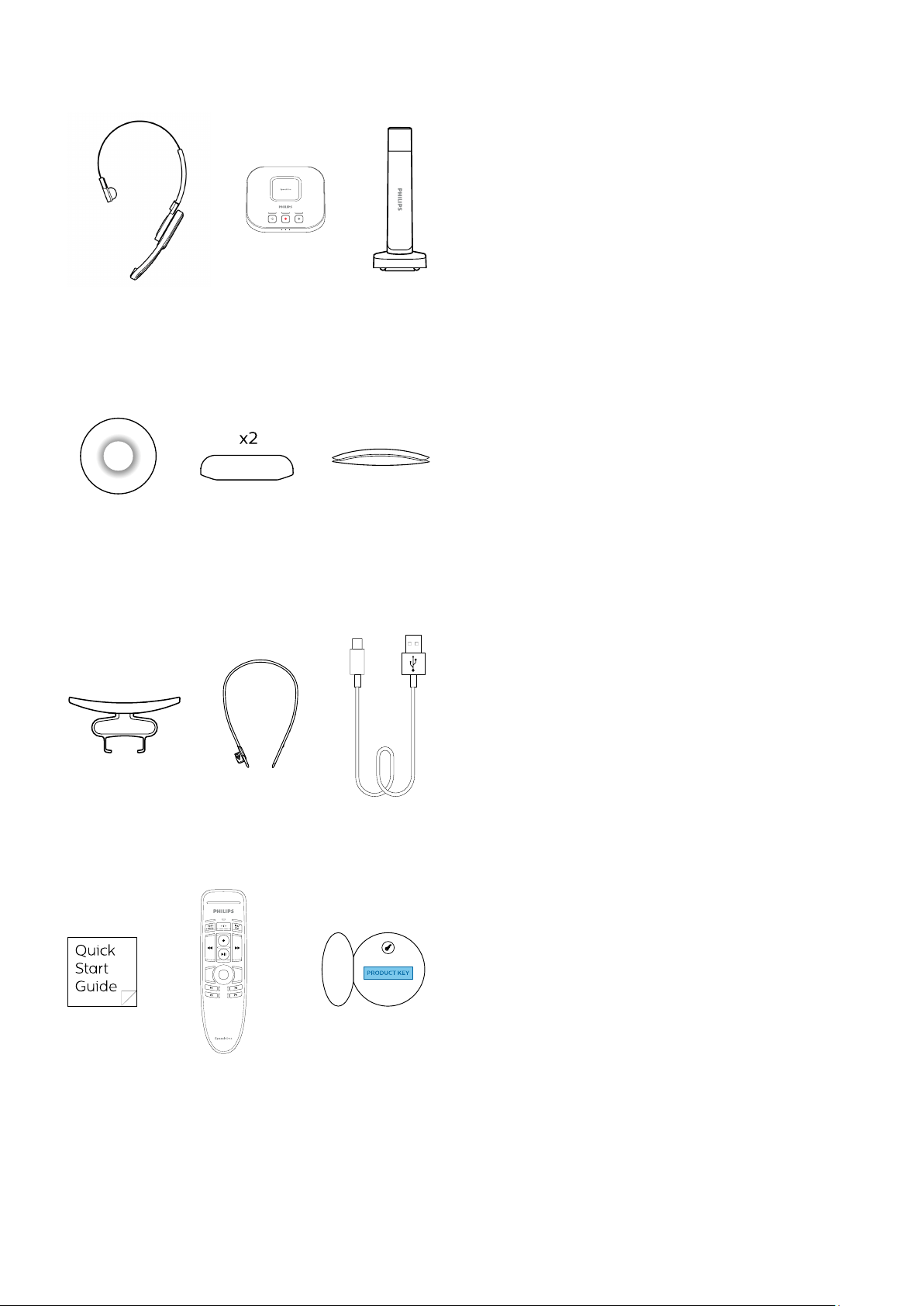
What's in the box
Dictation Headset Docking sta-
tion
Status light
Ear cushion Head cushion Headband
cushion
Headset attach-
ment
Neckband Micro USB ca-
ble
Quick start
guide
Remote control
(PSM6500,
PSM6800)
Product key for
SpeechExec soft-
ware (PSM6800)
7
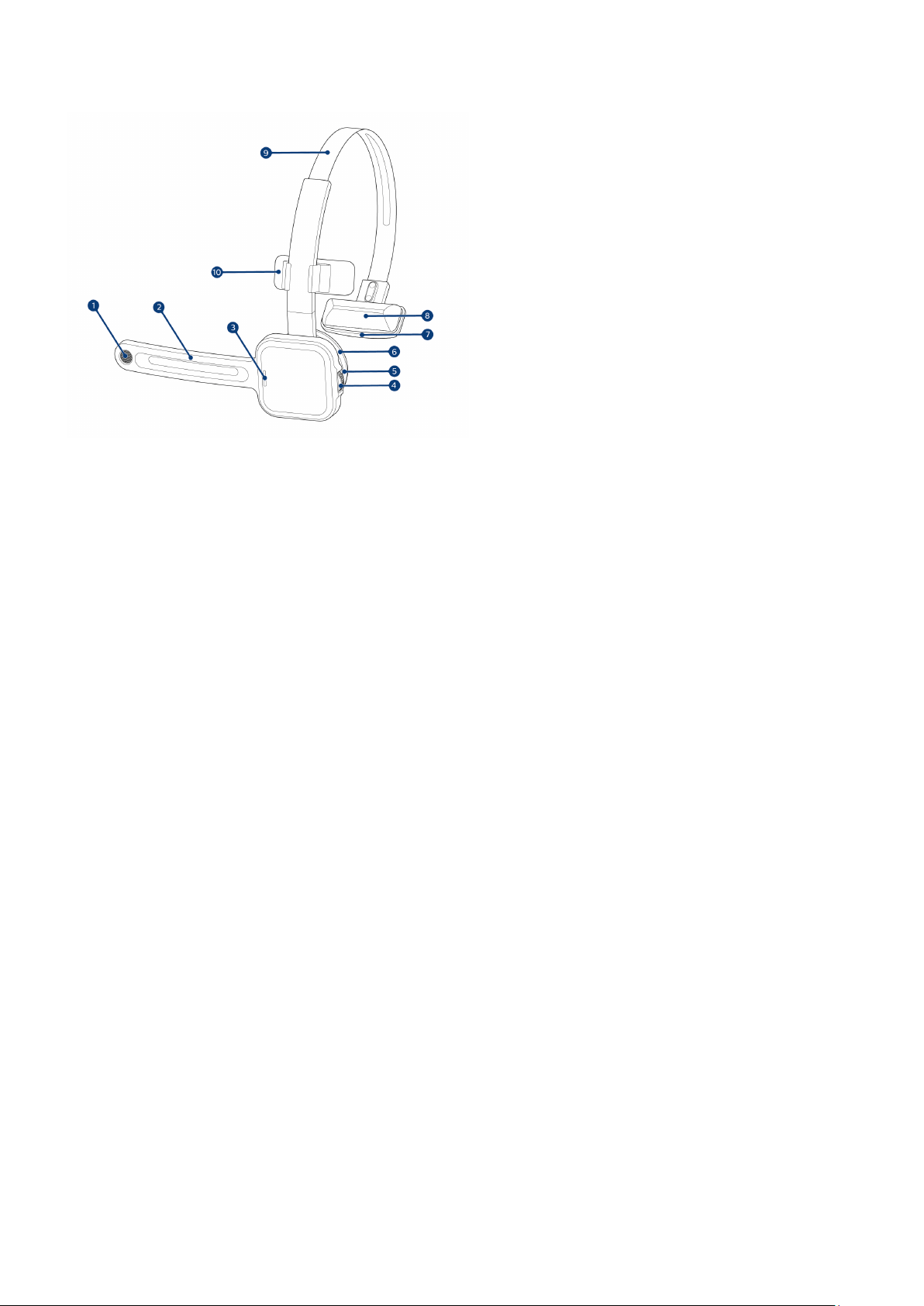
Overview of your SpeechOne
1. Microphone
2. Microphone boom
3. Status LED
4. Headset button
5. Speaker
6. Detachable magnetic ear cushion
7. Head cushion pad
8. Detachable magnetic head cushion
9. Headband
10. Headband attachment
8
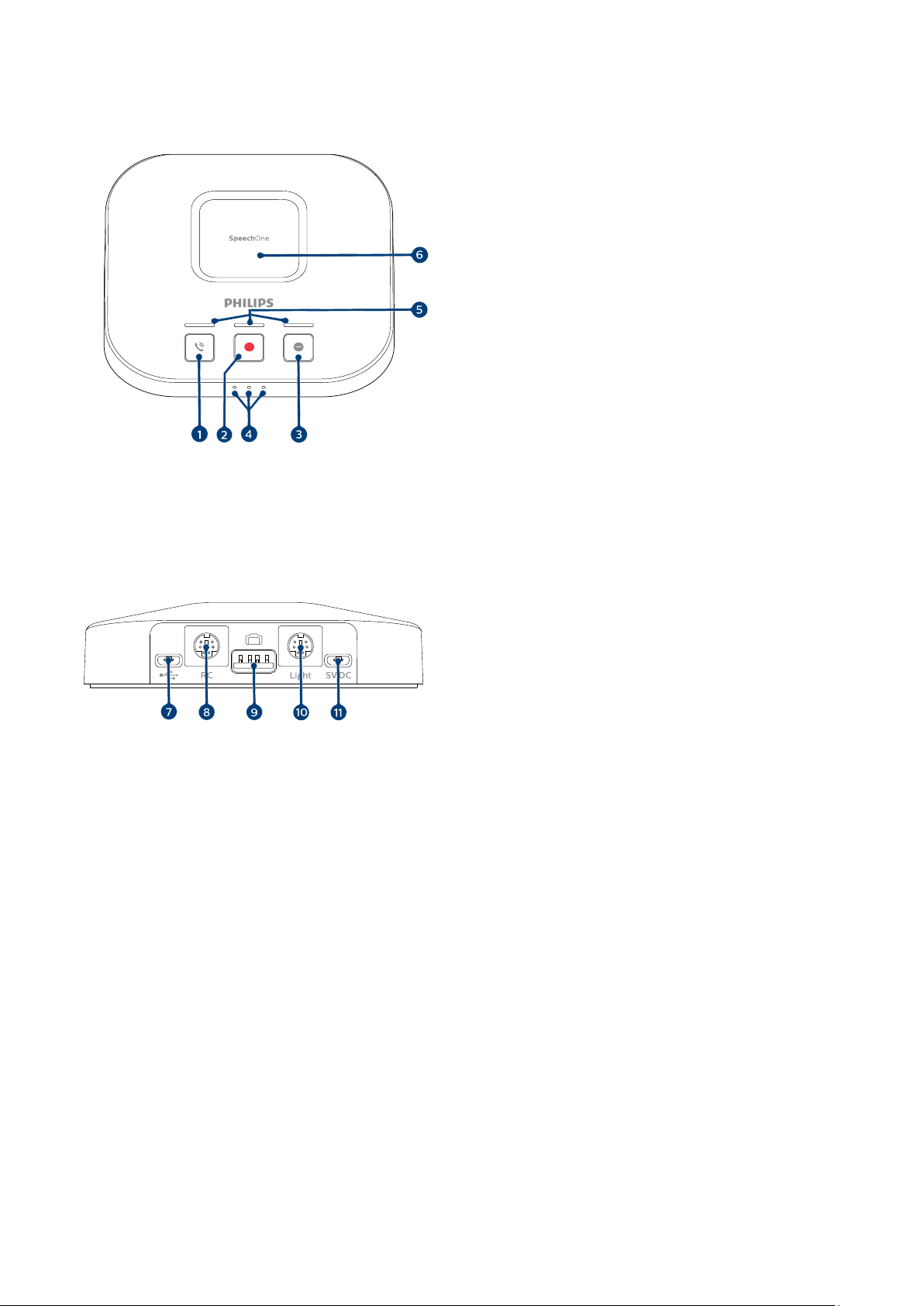
Overview of the docking station
1. Phone button
2. Record button
3. Do-not-disturb button
4. Battery and pairing LEDs
5. Button LEDs
6. Magnetic pad for headset charging
7. Micro USB port for PC connection
8. Remote control port
9. Foot control port
10. Status light port
11. Micro USB port for charging
9
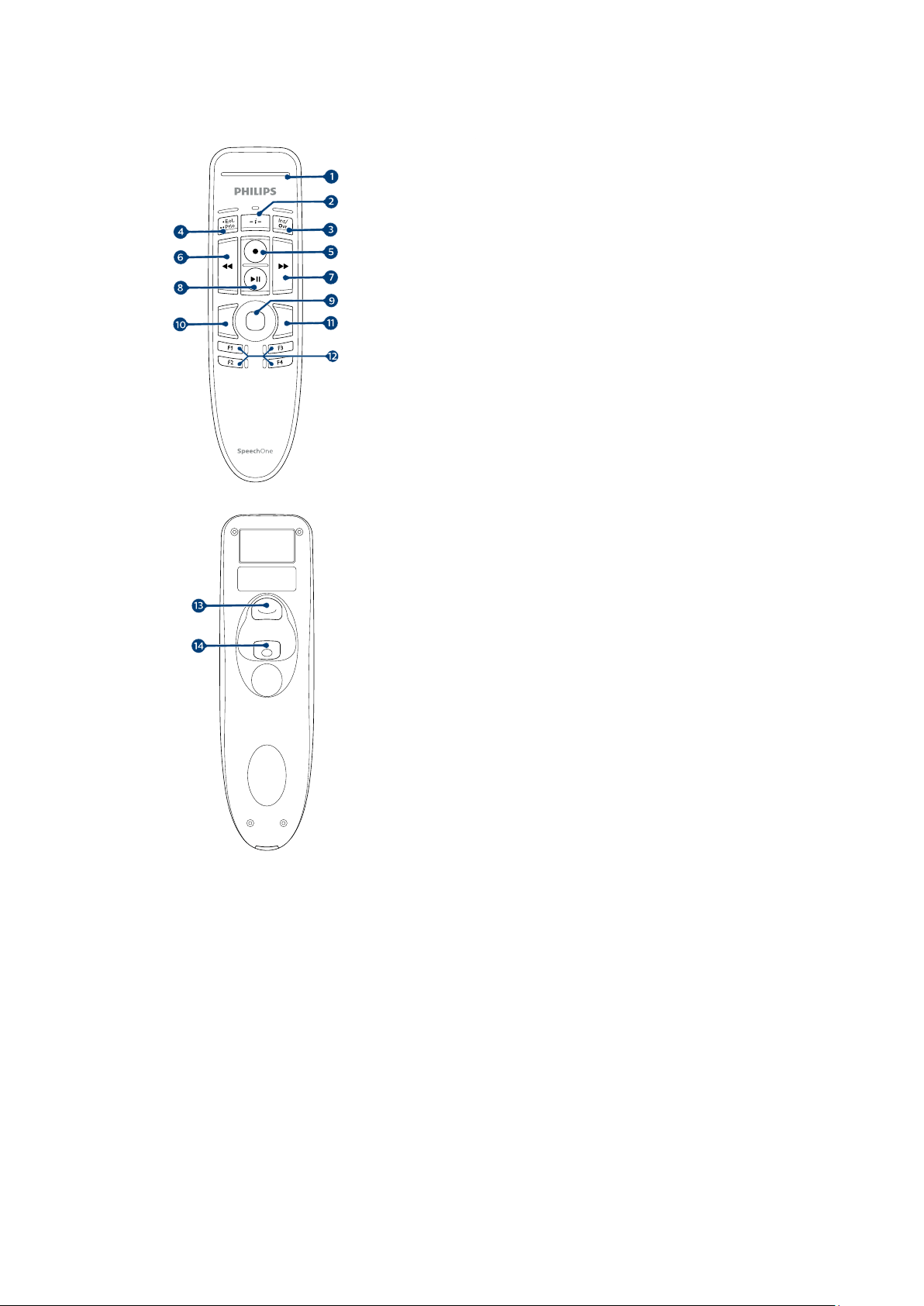
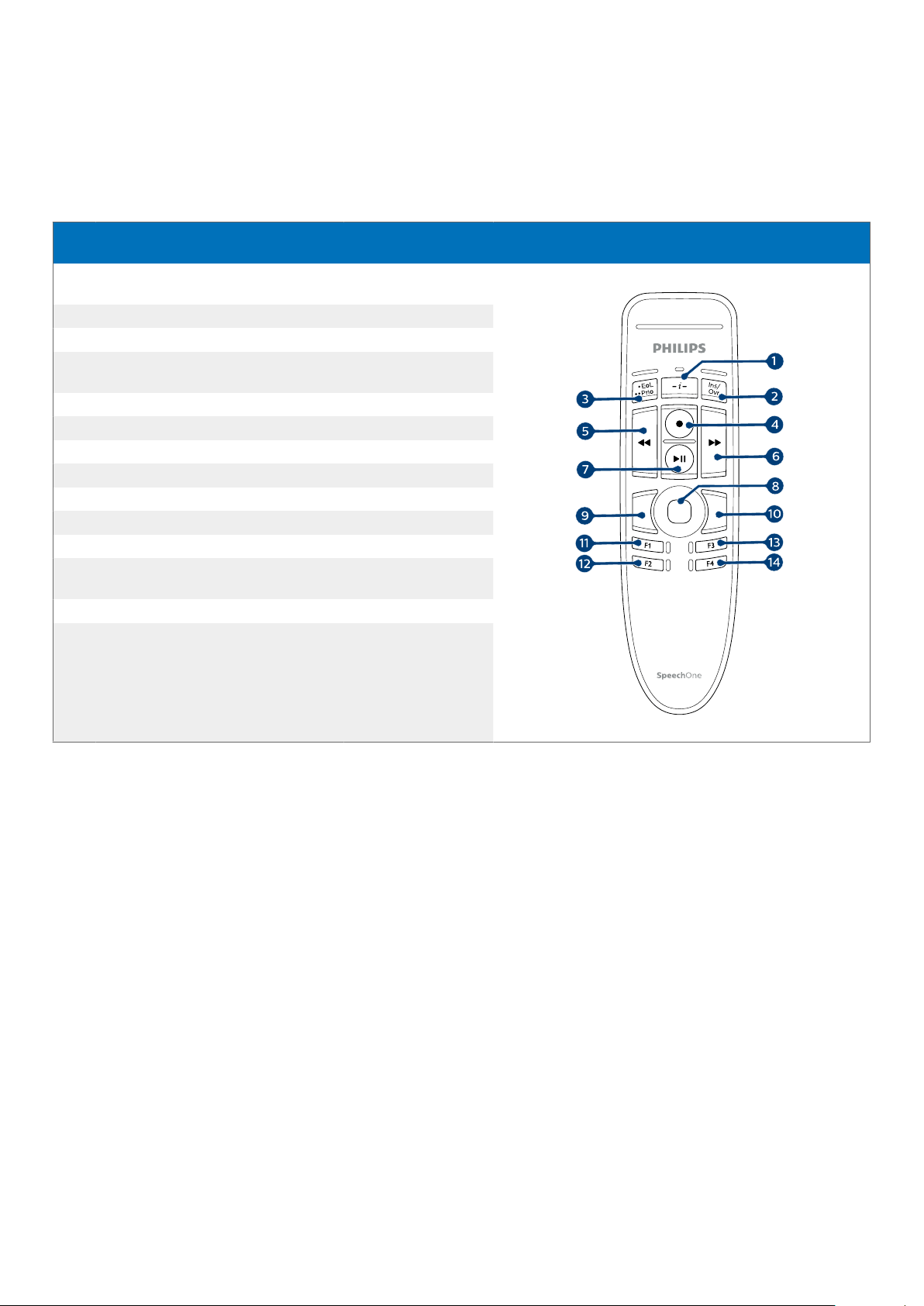
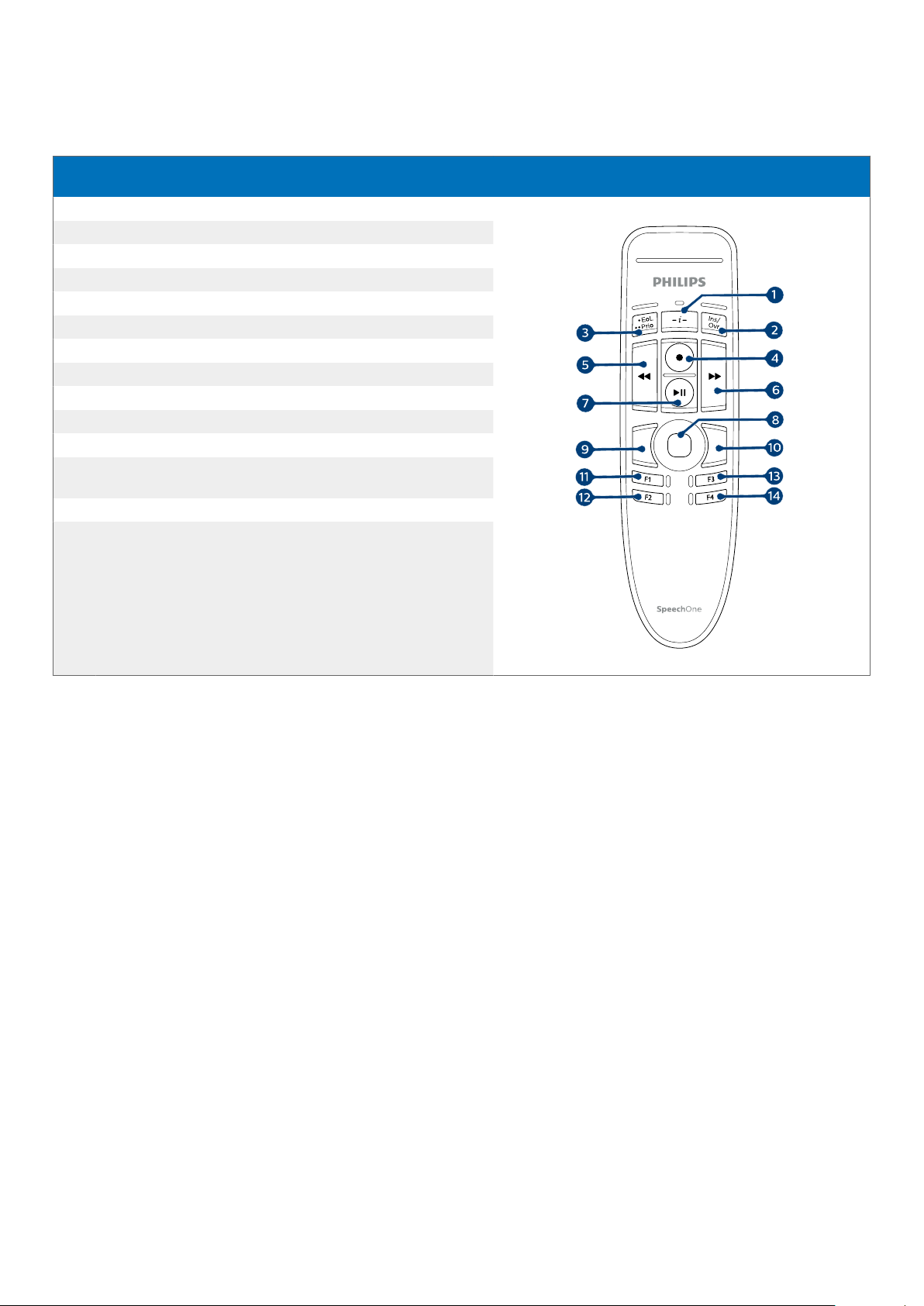
Overview of the remote control
(PSM6500, PSM6800)
1. Record LED
2. Instruction button
3. Insert/overwrite button
4. End-of-letter/priority button
5. Record button
6. Rewind button
7. Fast forward button
8. Play/pause button
9. Touch navigation/left mouse button
10. Left mouse button
11. Right mouse button
12. Programmable function buttons
13. Command button
14. Left mouse button
10
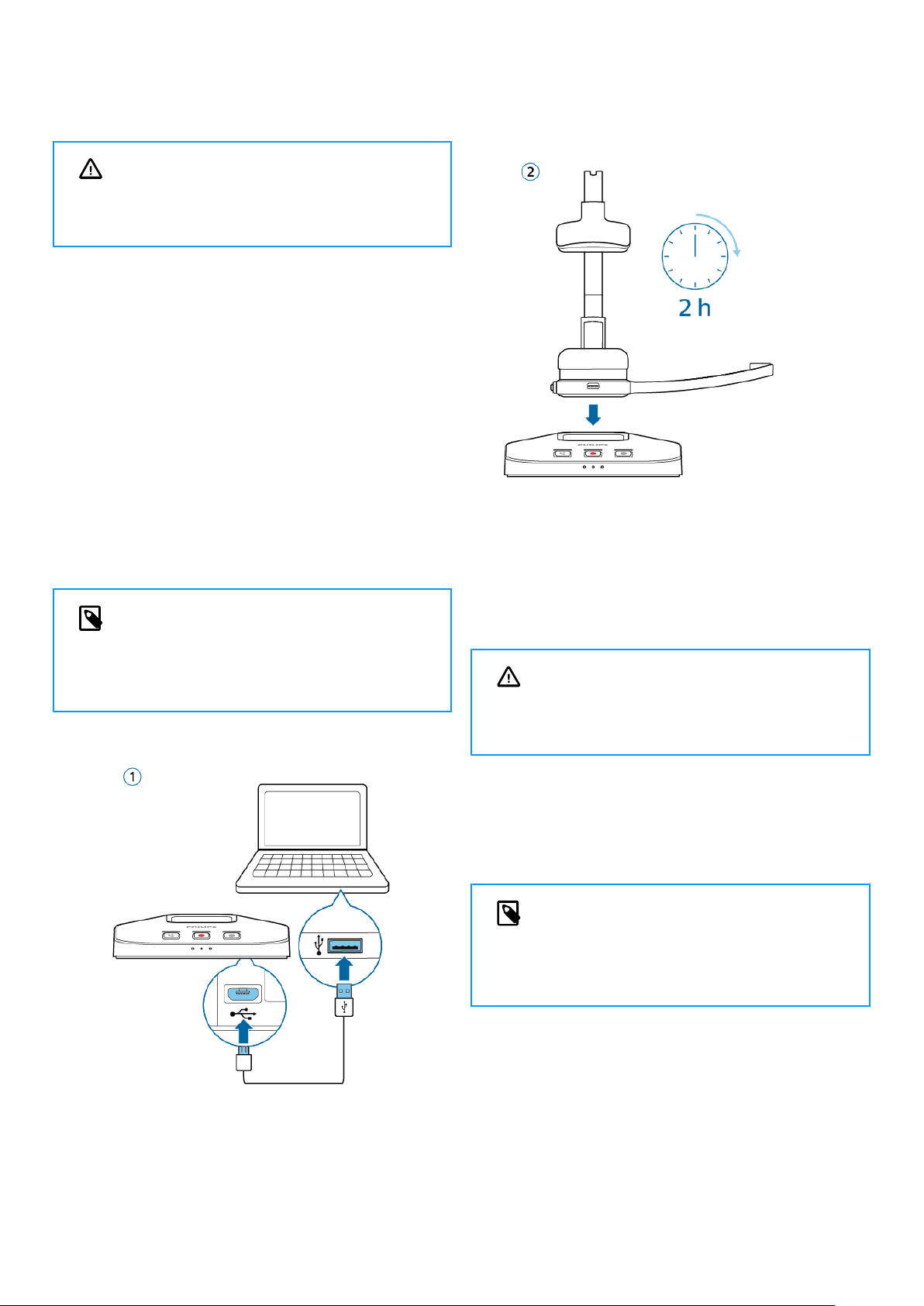
3. Get started
CAUTION
Before you connect your SpeechOne, rst read
the safety instructions (see Safety instructions
[3]).
Charging the battery
• Charge the built-in battery before you use the device for
the rst time or if you haven’t used it for an extended time
period.
• If the battery is completely discharged and your device
turns o, allow the battery to charge for a while before
you turn on the device.
• A complete recharge cycle takes about two hours.
• The device should be charged every 6 months even when
not used, to prevent the battery from completely draining
(deep discharge).
Charge via docking station
NOTE
If you charge your device via docking station,
make sure that the micro USB connector is con-
nected to the USB port for charging marked with
5V DC.
X During charging, the battery LEDs on the docking station
subsequently light up in a loop until the headset is either
removed or fully charged.
X When charging is complete, all three battery LEDs on the
docking station glow white.
CAUTION
Make sure that there are no metallic parts on the
docking station, otherwise the charging process is
not possible.
Charge via computer
Before you charge the battery via computer, make sure that
your computer is turned on.
NOTE
Recording is not possible if only your SpeechOne
is connected to the computer. To make a record-
ing, you also need to connect the docking station
to the computer.
11
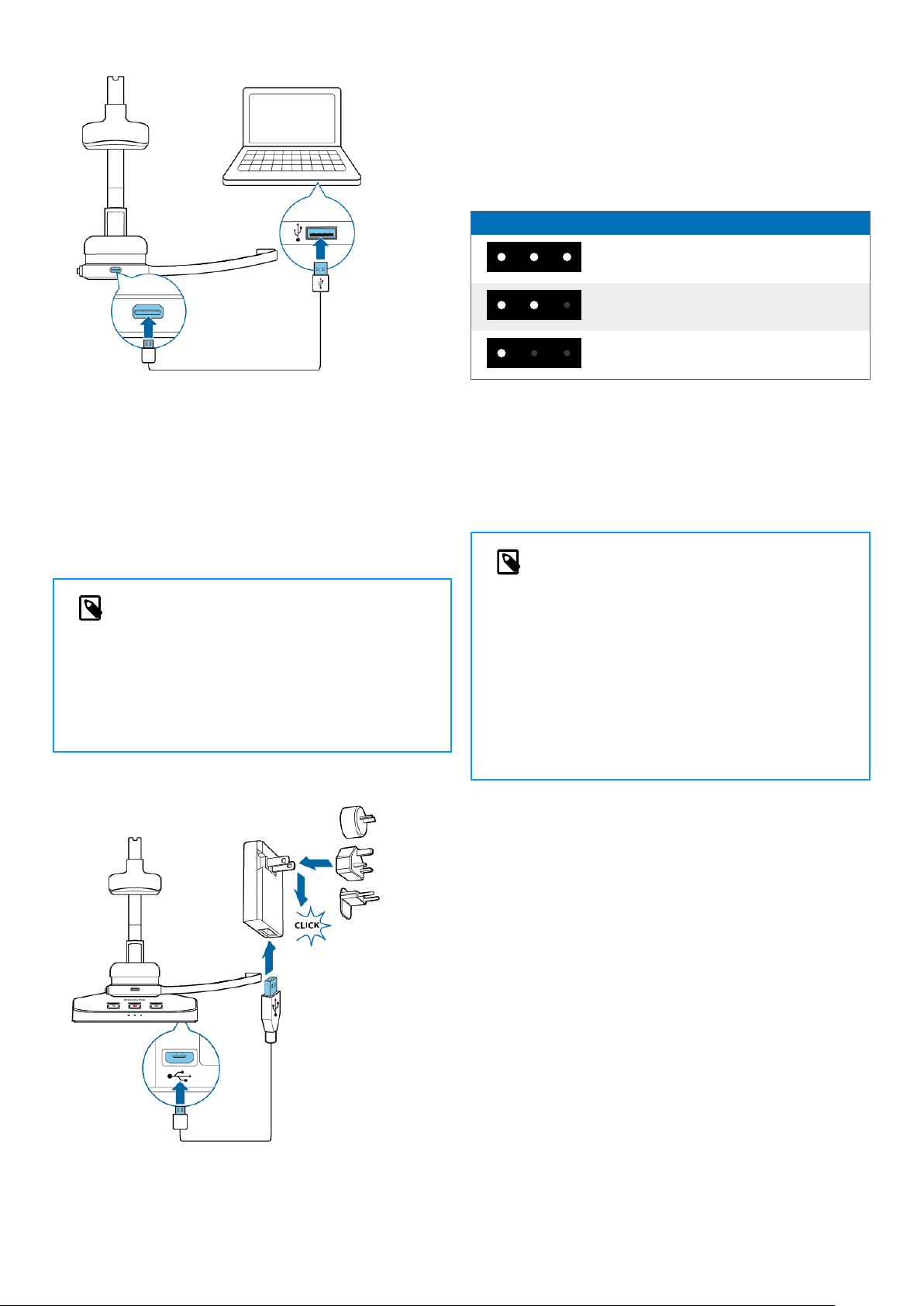
X During charging, the status LED on the headset is ash-
ing.
X When charging is complete, the status LED on the head-
set stops ashing and starts glowing constantly.
Charge via USB power supply unit ( optional)
NOTE
• For fast charging, you need a USB power sup-
ply unit with at least one ampere. The power
supply unit is not included and needs to be
purchased separately.
• A complete fast recharge cycle takes about one
hour.
X During charging, the battery LEDs on the docking station
subsequently light up in a loop until the headset is either
removed or fully charged.
X When charging is complete, all three battery LEDs on the
docking station glow white.
Learn about the battery status
When the SpeechOne is removed from the docking station,
the battery LEDs on the docking station indicate the battery
status.
Battery LED Battery status
more than 7 hours recording time
left
7 hours or less recording time left
2.5 hours or less recording time left
Pairing
Once you have connected your SpeechOne to a docking
station, you can dictate wirelessly and use the dictation
headset on dierent workstations without any further pair-
ing eort.
NOTE
• If you use several docking stations, make sure
to keep a minimum distance of 50 cm (18 in-
ches) between each docking station. If the dis-
tance is less than 50 cm (18 inches), there
might be interferences between the docking
stations.
• Make sure that the distance between the
SpeechOne and the docking station is not more
than 5 meters (16 feet). For more information,
see Learn about wireless technology [13].
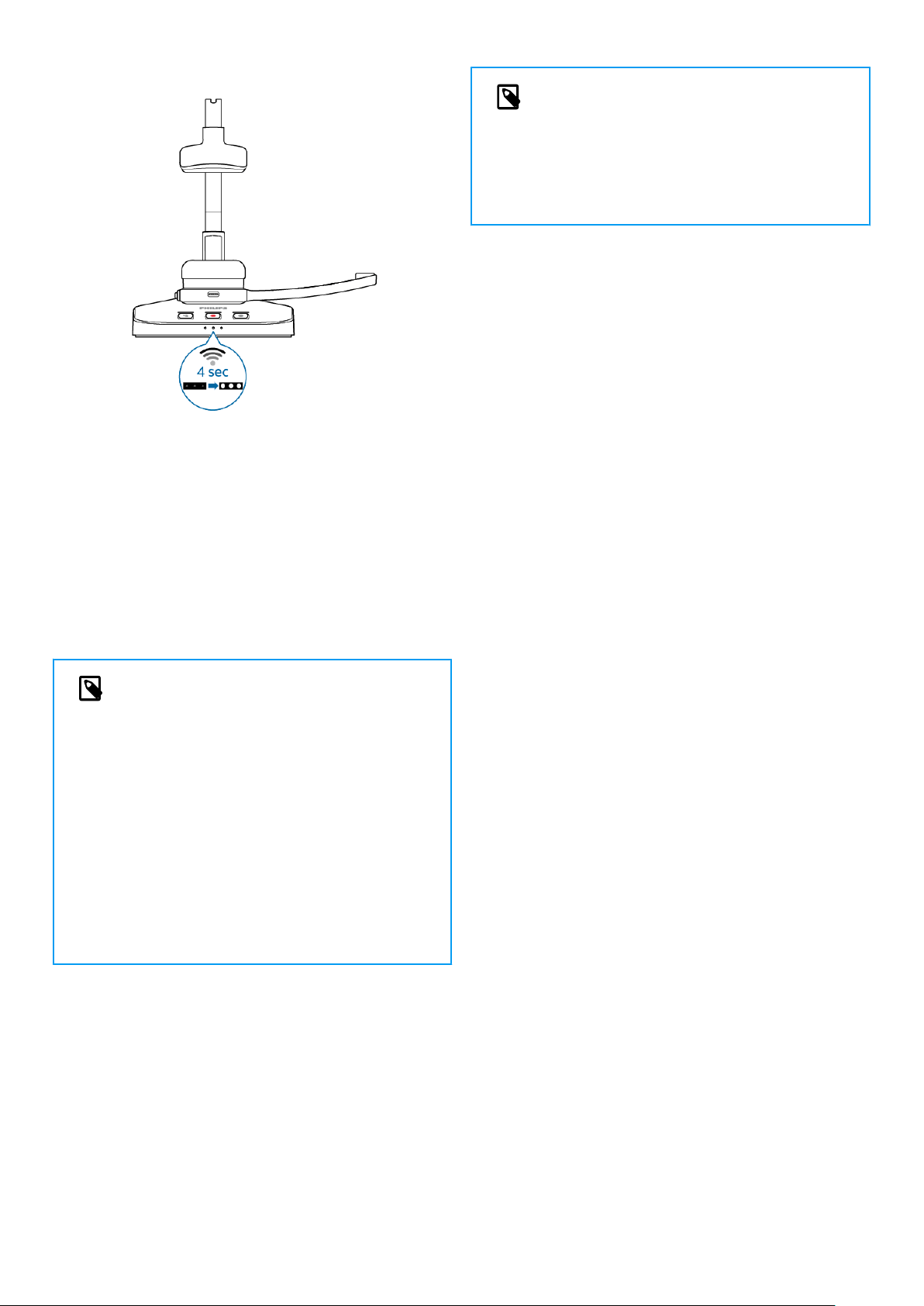
Pair the SpeechOne and the docking station
Put the SpeechOne onto the docking station for about 4
seconds.
X The pairing process starts.
X When pairing is nished, the battery LEDs on the docking
station light up for one second and display the battery sta-
tus afterwards.
12
Change paired devices
If your desired docking station is already connected to a
dierent SpeechOne, the battery LEDs on this docking sta-
tion display the battery status of the connected headset.
To disconnect this existing connection and pair your own
SpeechOne with the desired docking station, proceed as
described in Pair the SpeechOne and the docking station
[12].
NOTE
Please dierentiate between the following two
situations:
• If the wireless connection between the
SpeechOne and the docking station is lost, all
three button LEDs on the docking station glow
orange and the status LED on the headset
glows red.
• If there is a problem with the USB connection
of the docking station (e.g. the USB cable is
connected to the wrong USB port on the dock-
ing station), all three button LEDs on the dock-
ing station glow orange and the status LED on
the headset glows orange.
Learn about wireless technology
The SpeechOne uses wireless technology to establish a
connection between the dictation headset and the docking
station.
A wireless connection doesn't require that the SpeechOne
and the docking station be in line of sight. However, the
maximum distance between the SpeechOne and the dock-
ing station should not be more than 5 meters (16 feet). The
closer the devices are to each other, the better is the per-
formance. The connection is subject to interference from
distance and obstructions or other electronic devices.
NOTE
Make sure to keep a minimum distance of 50 cm
(18 inches) between the docking station and oth-
er wireless devices, such as smartphones or lap-
tops. If the distance is less than 50 cm (18 inches),
there might be interferences between the dock-
ing station and other wireless devices.
Going out of range
When the wireless connection is lost, a voice prompt will
notify you about this. If you have a SpeechExec application
running on your computer, the software will be stopped.
In this case, move closer to the docking station to reenter
the reception area.
X The connection is reestablished.
X A voice prompt will notify you that the connection is es-
tablished again.
Idle mode and Power down mode
Idle mode
After 4 minutes of inactivity, the SpeechOne automatically
enters Idle mode.
X The status LED on the headset starts ashing green
quickly.
To reactivate the device:
Simply lift the headset up until the status LED on the head-
set glows green.
Power down mode
If the SpeechOne is not used for more than 6 hours, it auto-
matically turns o to save battery life. The battery LEDs on
the docking station are turned o then.
To turn the device on again:
Place the device onto the docking station for about 4 sec-
onds.
X If the connection with the docking station succeeds, the
battery LEDs on the docking station light up for one second
and display the battery status afterwards.
or
Press the Headset button until the status LED on the head-
set glows green.
Resetting the wireless connection
If you should encounter problems with your device, for ex-
ample, the SpeechOne doesn't respond or doesn't connect
to the docking station, you can reset the wireless connec-
tion.
1. Press the Headset button on the headset until the sta-
tus LED on the headset turns o.
2. Release the Headset button on the headset and wait
until the status LED on the headset turns on again.
13

3. Disconnect the docking station from your computer
(and optionally from the power outlet).
4. Connect the docking station to your computer (or op-
tionally to the power outlet) via the supplied USB cable.
Make sure you use the USB port for PC connection
marked with on the docking station.
5. Place the SpeechOne on the docking station and wait
for about 4 seconds.
X The SpeechOne should be detected and be auto-
matically paired with the docking station.
14
4. Use your SpeechOne
NOTE
Any operations, e.g. recording or conguring your
SpeechOne with SpeechControl driver and con-
guration software, have to be executed with the
docking station connected to your computer. Do
not connect the SpeechOne directly to the com-
puter via a USB cable for this purpose. Connect-
ing the SpeechOne directly to the computer is
only intended for charging the device.
Wearing styles
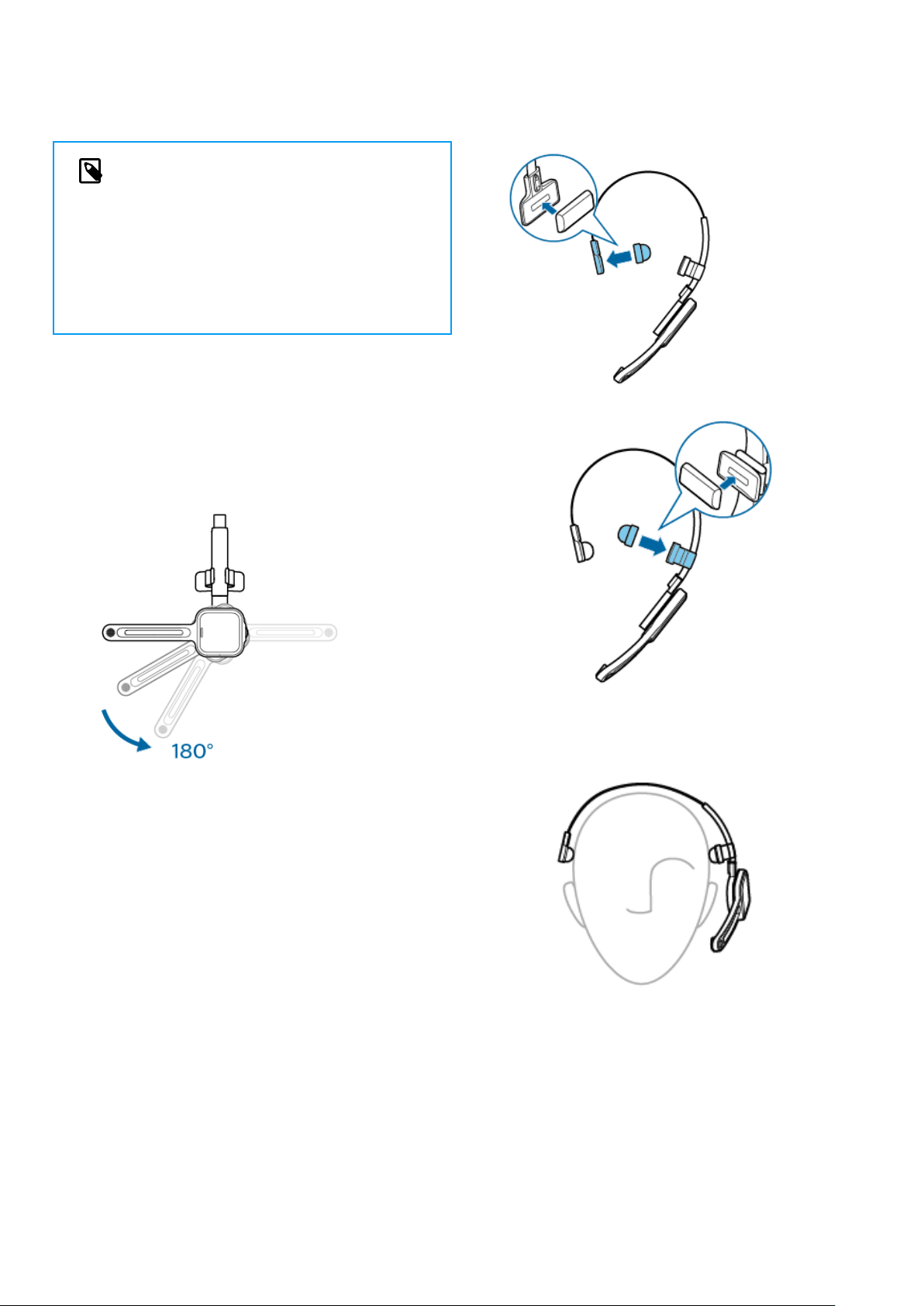
You can wear the SpeechOne headset on the left or on the
right side. Simply rotate the microphone boom by 180 de-
grees.
For best wearing comfort, you can wear the headset in the
following ways:
Wearing with the headband attachment
To adjust your headset perfectly to your head and achieve
the best wearing comfort, you can use the supplied head-
band attachment.
1. Rotate the microphone boom if you want to change the
wearing side.
2. Attach one of the two head cushions to the head cush-
ion pad and one to the headband attachment.
3. Lengthen or shorten the headband until it ts comforta-
bly.
X The speaker should be aligned with the center of
your ear.
Classic wearing style
The classic way to wear the headset is without the head-
band attachment.
1. Rotate the microphone boom if you want to change the
wearing side.
2. Remove the headband attachment by pulling it up.
15
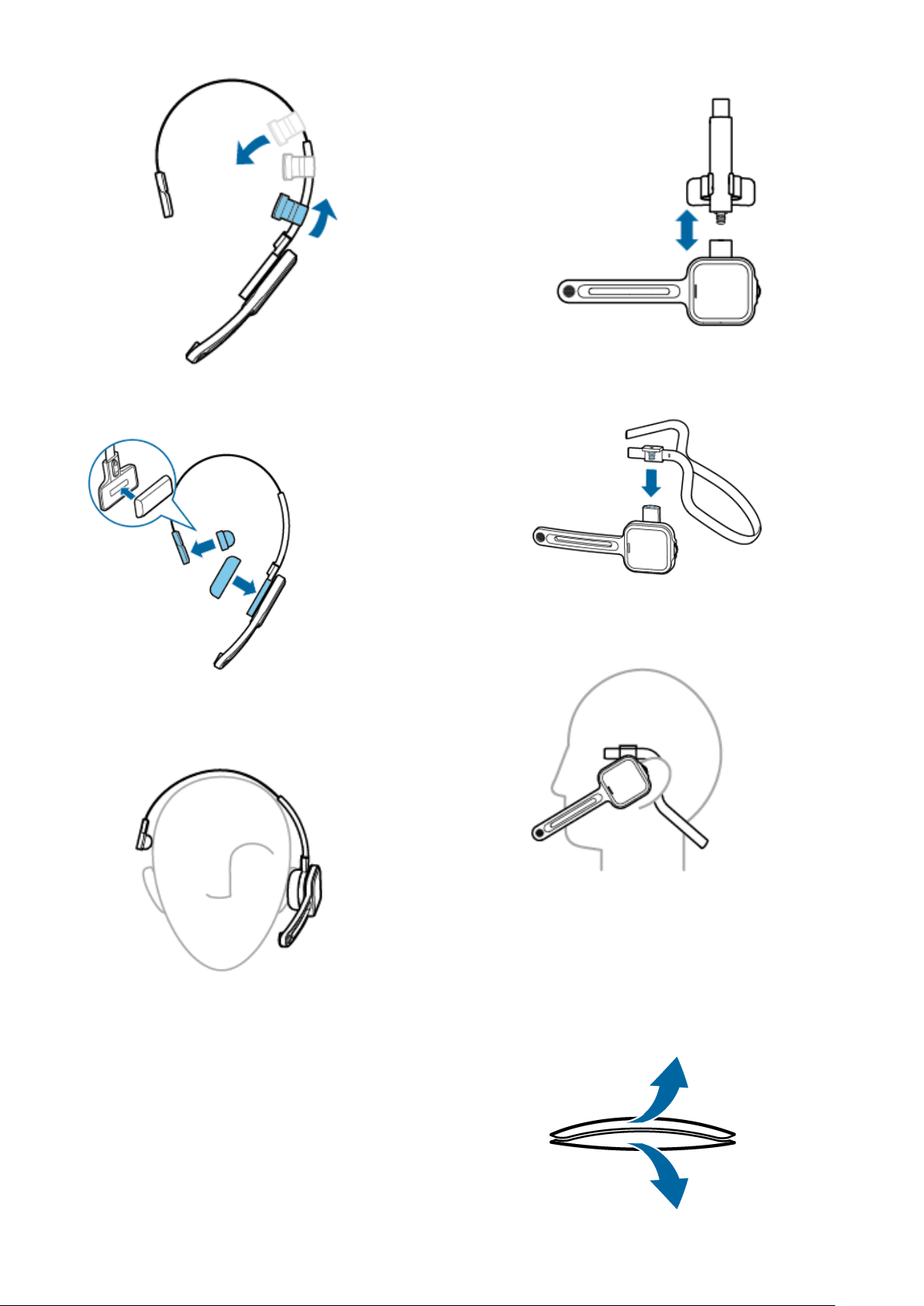
3. Attach the magnetic ear cushion to the speaker and the
magnetic head cushion to the head cushion pad.
4. Lengthen or shorten the headband until it ts comforta-
bly.
X The ear cushion should rest comfortably over the
center of your ear.
5. X The microphone should be aligned with your mouth.
Wearing with the neckband
1. Detach the headband from the microphone boom by
pulling it up at the junction.
2. Attach the neckband to the microphone boom by
pressing it down at the junction.
3. Pull the neckband over your ears.
X The speaker should be aligned with the center of
your ear.
Attaching the headband cushion
1.
16
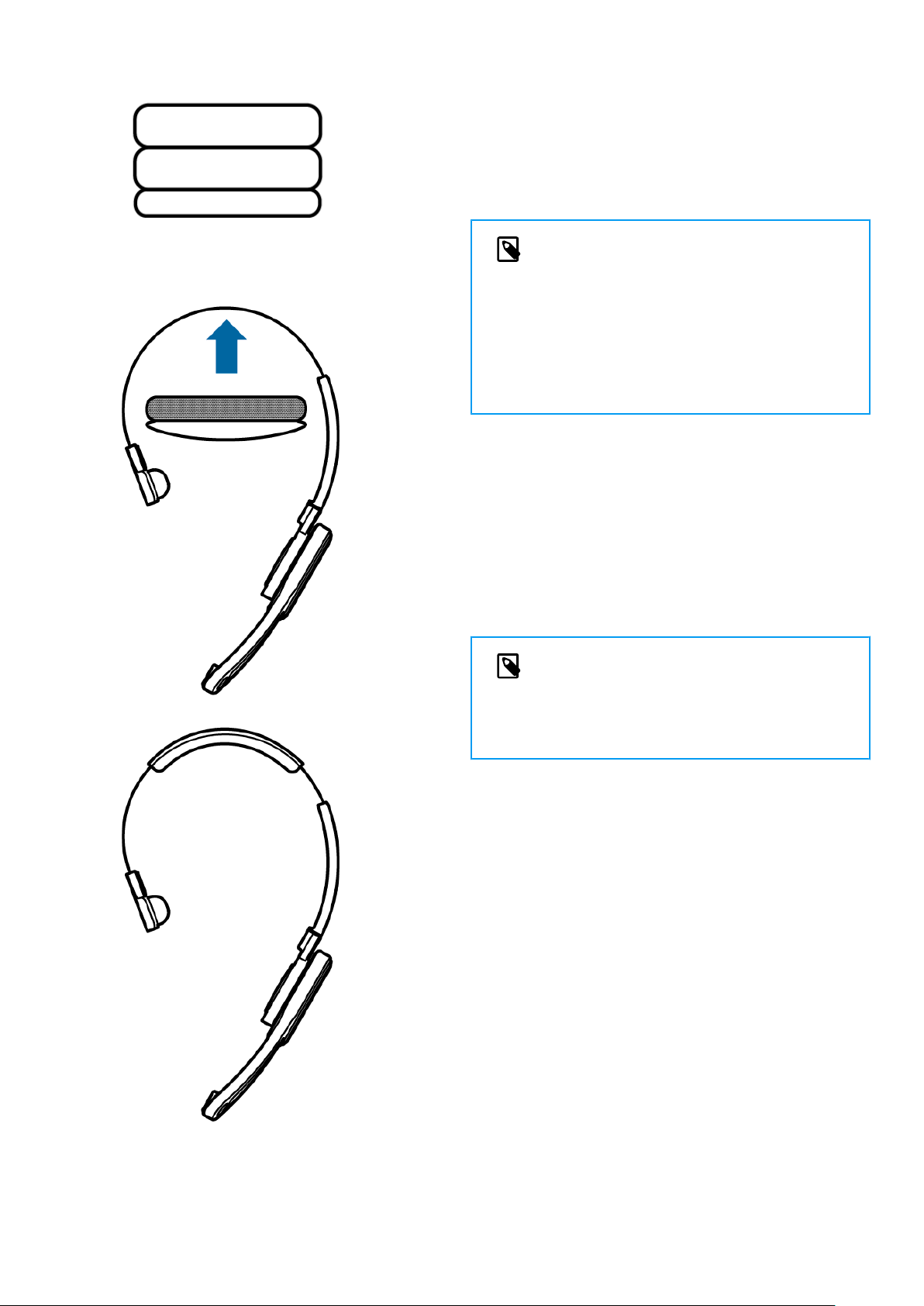
2.
3.
4.
Create a recording
Recording and playback of dictations with the SpeechOne
requires dictation software such as Philips SpeechExec to
be installed on the computer.
For more information on recording with the SpeechOne and
the Philips SpeechExec software, download the SpeechEx-
ec user manual at www.philips.com/dictation.
For more information on recording with the remote control
(PSM6500, PSM6800), see Use the remote control
(PSM6500, PSM6800) [19].
NOTE
• Make sure that the distance between the
SpeechOne and the docking station is not more
than 5 meters (16 feet). For more information,
see Learn about wireless technology [13].
• Make sure the docking station is connected to
your computer, otherwise recording is not pos-
sible.
1. Make sure the docking station is connected to your
computer.
2. To start a recording, press the Record button on the
docking station once or press the Headset button on
the headset once.
3. To nish a recording, press the Record button on the
docking station again or press the Headset button on
the headset again.
NOTE
If you receive a Skype call while you are in a re-
cording session and you accept the call, you
need to press the Record button again after n-
ishing the call in order to continue recording.
Skype calls
Your SpeechOne also acts as a Skype headset which you
can use to accept incoming Skype calls.
When you receive an incoming Skype call:
X The status light starts ashing red.
X The LED of the Phone button on the docking station
glows green.
To accept an incoming Skype call:
• Press the Phone button on the docking station once
or
• Press the Headset button on the headset once.
X Any active recording will be stopped.
X The LEDs of the Phone and the Do-not-disturb buttons
on the docking station, and the status light glow red.
To end a Skype call:
• Press the Phone button on the docking station again
or
17
• Press the Headset button on the headset again.
X The LEDs of the Phone and the Do-not-disturb buttons
on the docking station turn o, and the status light glows
green.
To reject a Skype call:
• Press the Phone button on the docking station twice
or
• Press the Headset button on the headset twice.
NOTE
• To mute the microphone during a Skype call,
move the microphone boom to an upright po-
sition.
• If you receive a Skype call while you are in a
recording session and you accept the call, you
need to press the Record button again after
nishing the call in order to continue recording.
Automatically stop recording during Skype
calls:
Using the latest rmware (see Upgrading the rmware [20]),
you can activate a function to automatically stop recording
when you receive calls. To activate this function:
• Hold the Record button and the Do-not-disturb button
on the docking station for 3 seconds.
• The Record button LED on the docking station lights up
green for a short moment.
To turn this function o again:
• Hold the Record button and the Do-not-disturb button
on the docking station for 3 seconds.
• The Record button LED on the docking station lights up
red for a short moment.
Control other applications
Using Speech Control (Philips Device Control Center) you
can also control other applications (e.g. Microsoft Teams or
Zoom) with your device.
1. Download and install the latest version of Speech Con-
trol (Philips Device Control Center).
2. Download the desired Application Control Prole from
our website.
3. Start Philips Device Control Center:
• If the option to start the Philips Device Control Center
automatically was selected during installation, open
the program by clicking the
icon in the notication
area of the Windows task bar.
• To manually start the program, open the Windows
start menu in Windows and select Philips Speech
Control > Philips Device Control Center.
NOTE
Make sure that you're using the latest version
of Philips Device Control Center.
4. Go to the Application control tab.
5. Click Import and choose the downloaded prole from
our website.
NOTE
You are not limited to pre-dened Application
Control Proles, you can also create your own
proles to further customize the settings accord-
ing to your needs.
Status light
Use the status light in order to indicate to your colleagues if
you are available or busy. This way, you can work more pro-
ductively due to less interruptions.
Mount the status light on your computer
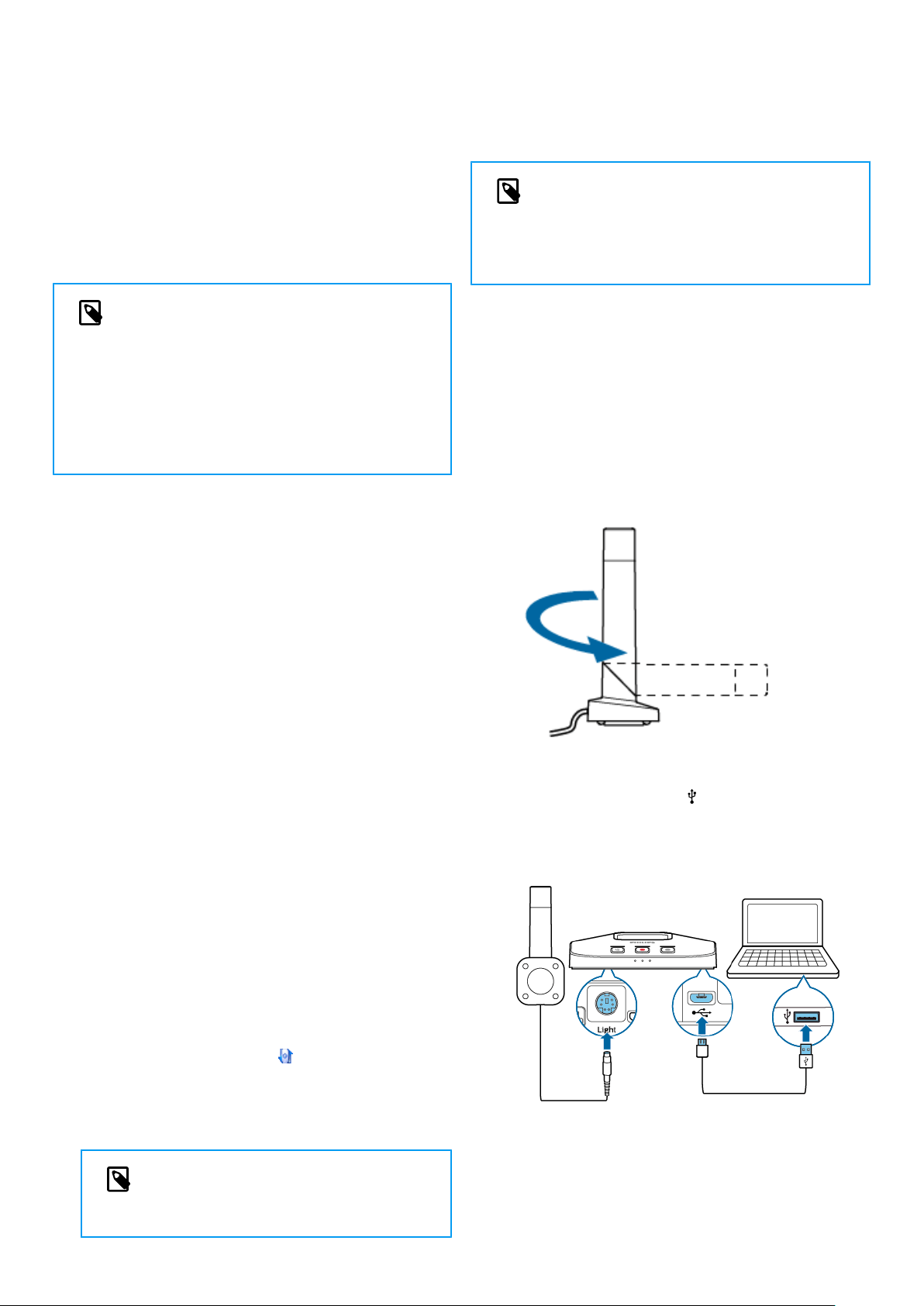
1. Turn the status light into the starting position as dis-
played in the illustration below . Then hold it at the bot-
tom part and pull the upper part in your direction until it
reaches a horizontal position.
2. Connect the docking station to your computer via the
supplied USB cable. Make sure you use the USB port for
PC connection marked with on the docking station.
Then connect the status light to the status light port on
the docking station.
3. Remove the sticker from the magnet on the bottom of
the status light.
18
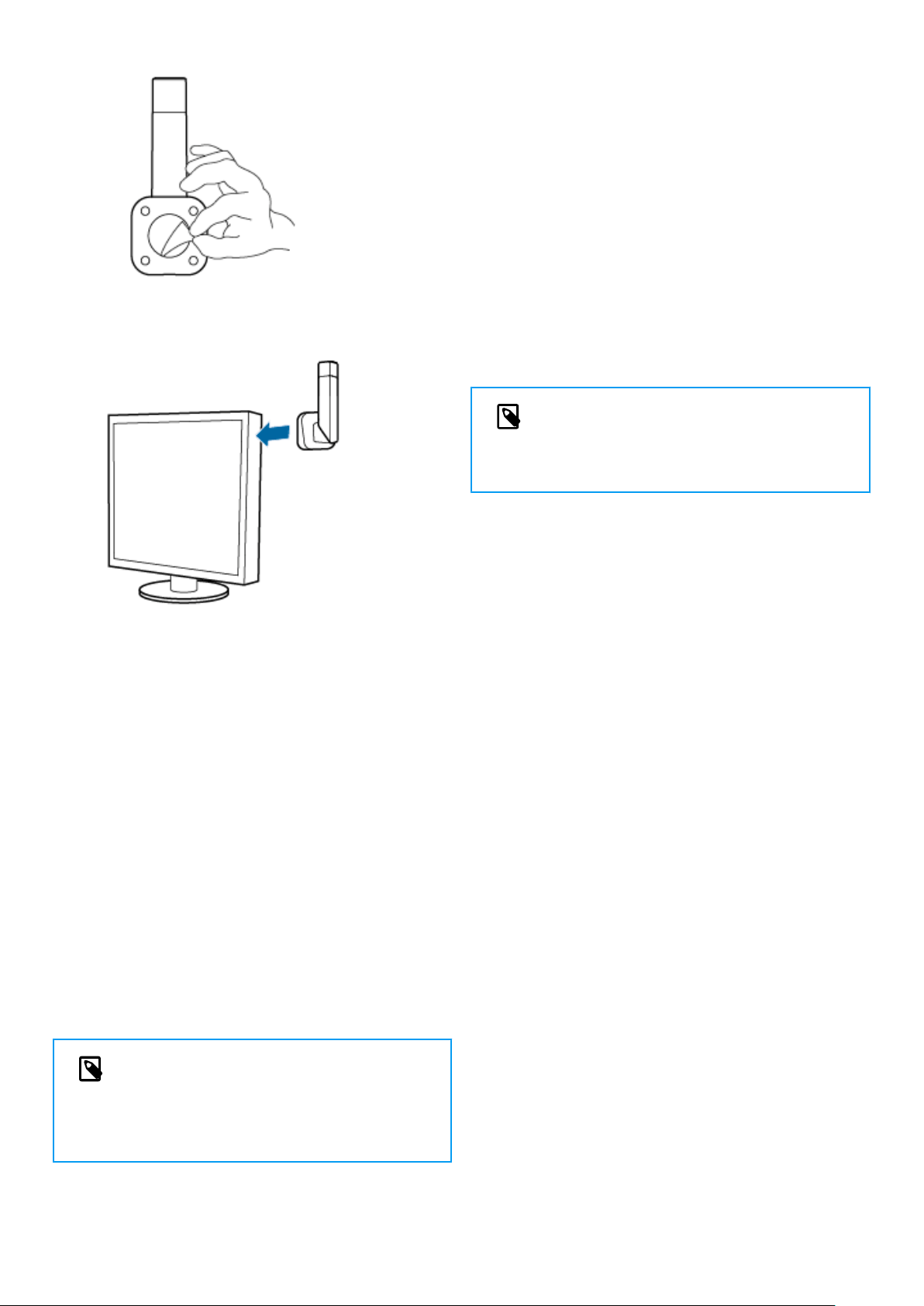
4. Mount the status light either on the side or on the back
of your screen.
Do-not-disturb mode
While you are recording with your SpeechOne, the LED of
the Do-not-disturb button on the docking station and the
status light automatically glow red indicating that you are
not available. However, you can also activate the Do-not-
disturb mode whenever you would like to indicate that you
are busy.
To turn the Do-not-disturb mode on:
Press the Do-no-disturb button on the docking station
once.
X The LED of the Do-not-disturb button on the docking
station and the status light glow red.
To turn the Do-not-disturb mode o:
Press the Do-not-disturb button on the docking station
again.
X The LED of the Do-not-disturb button on the docking
station turns o and the status light glows green.
NOTE
If you receive a Skype call while you are in a re-
cording session and you accept the call, the sta-
tus light and the LED of the Do-not-disturb but-
ton keep glowing red.
Disable the status light
You can also disable the green status light:
Wear the headset and hold the Do-not-disturb button on
the docking station for 3 seconds until you hear a short
beep sound.
X Pressing the Do-not-disturb button on the docking sta-
tion, you can switch the status light to red (do-not-disturb)
or turn it o.
To reactivate the green status light:
Wear the headset and hold the Do-not-disturb button on
the docking station for 3 seconds until you hear a short
beep sound.
X Pressing the Do-not-disturb button on the docking sta-
tion, you can switch the color of the status light between
red or green.
NOTE
Starting a new recording in SpechExec will still
turn the status light to red (do-not-disturb), this is
not changed by any of the above settings.
Use the remote control (PSM6500,
PSM6800)
If you are a SpeechMike user:
You can use the remote control of the SpeechOne headset
just like you use your SpeechMike. The functions of the re-
mote control are exactly the same. You only need to put the
SpeechOne headset on, then start and control your record-
ing with the remote control.
If you are not a SpeechMike user:
Download the user manual for SpeechMike Premium Air at
www.speechmike.com/premium-air/support.
Hands-free dictating with a Philips
foot control
If you connect a Philips foot control, you can control the
dictation functions with your foot control to have your
hands free for your work.
19
NOTE
• Before you connect the foot control to the
docking station, make sure that the docking
station is neither connected to the computer
nor to the power outlet, as otherwise the foot
control might not be detected.
• Recording and playback of dictations with a
Philips foot control requires dictation software
such as Philips SpeechExec to be installed on
the computer. When third-party dictation soft-
ware other than Philips SpeechExec is used,
driver software must be installed before con-
necting the SpeechOne and the foot control.
• For best recording results during hands-free
dictation, you will probably have to adjust the
recording volume. You can set the recording
volume in the audio settings of your recording
application, e.g. Philips SpeechExec dictation
software or Dragon NaturallySpeaking speech
recognition software.
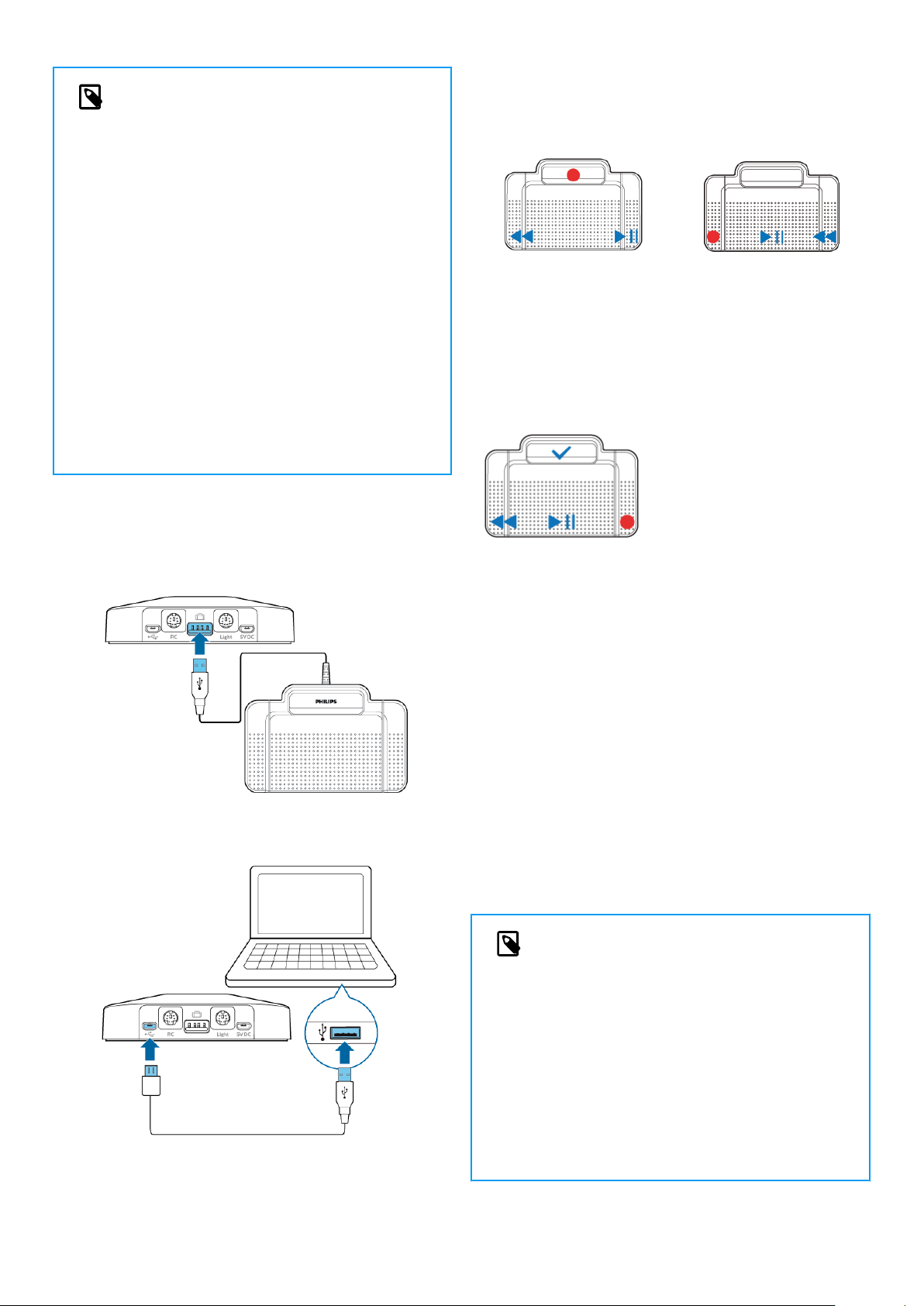
To connect a foot control for hands-free dictation:
1. Connect a Philips ACC2300 series foot control to the
docking station of your SpeechOne.
2. Connect the docking station to your computer.
Button assignment of Philips foot controls
Foot control ACC2310 / ACC2320
The Philips foot controls 2310 and 2320 have three pedals.
By default, the foot controls 2310 and 2320 have the fol-
lowing conguration:
ACC2310
ACC2320
Foot control ACC2330
The Philips foot control 2330 has four pedals. By default,
the foot control 2330 has the following conguration:
ACC2330
Upgrading the rmware
Your device is controlled by an internal program called rm-
ware. As a part of ongoing product maintenance, the rm-
ware is upgraded and errors are corrected.
It is possible that a newer version (an ‘update’) of the rm-
ware has been released since you purchased the device. In
this case, you can easily update your device to the latest
version.
Use SpeechControl (Philips Device Control Center) to up-
grade the rmware of your device. You can download the
latest version of the application here: https://www.dicta-
tion.philips.com/speechcontrol. Please follow the steps
outlined below to upgrade your device.
NOTE
A rmware upgrade is only possible if the follow-
ing preconditions are met:
• At least two battery LEDs on the docking sta-
tion must be glowing (which means the
SpeechOne has at least 2.5 hours battery pow-
er left).
• The SpeechOne is not in Idle mode.
• Ideally, the SpeechOne is placed on the dock-
ing station.
• There is no recording or playback running.
To upgrade your device:
20
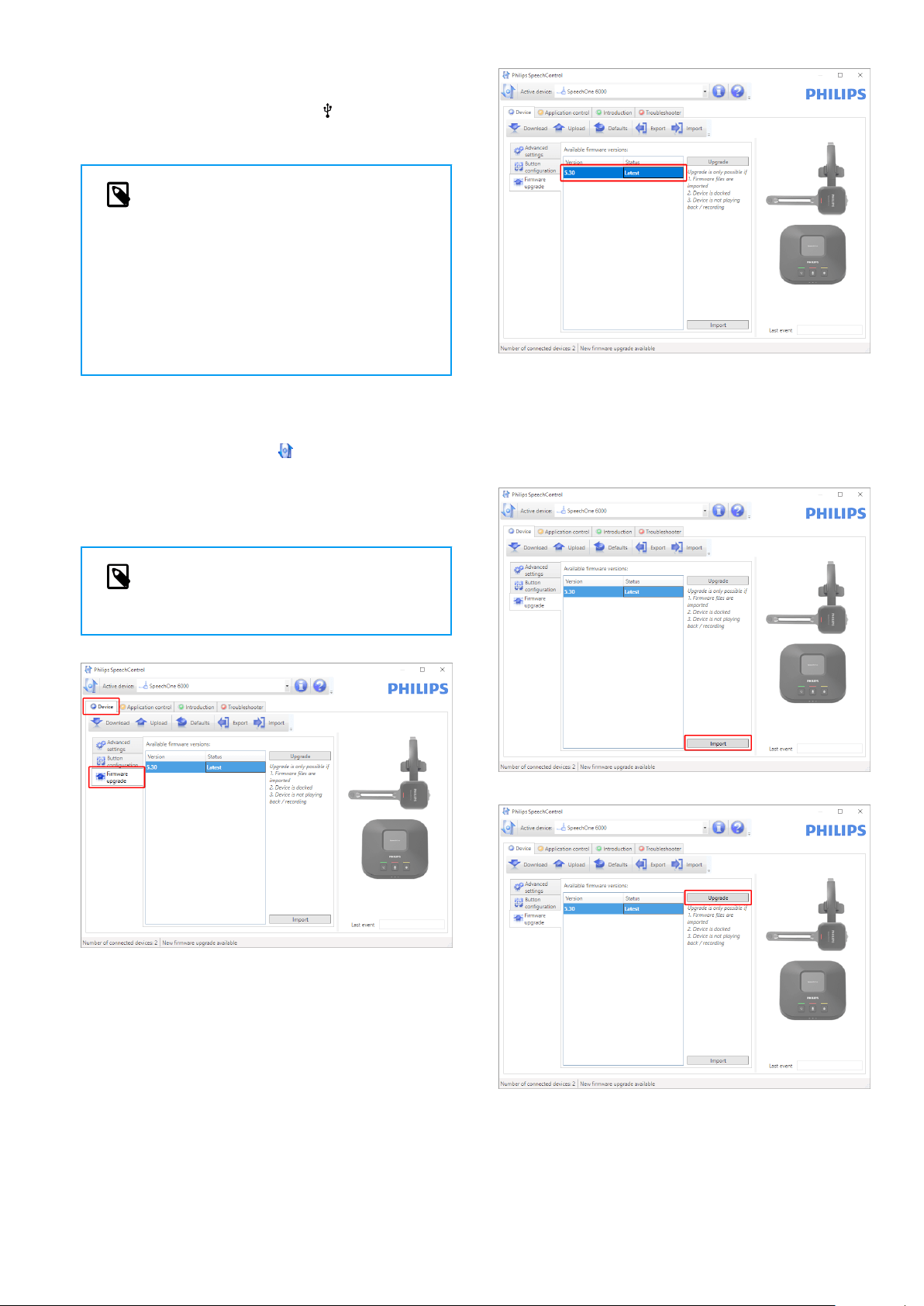
1. Connect the docking station to the computer by using
the supplied USB cable. Make sure you use the USB
port for PC connection marked with on the docking
station. Then place the SpeechOne onto the docking
station.
NOTE
Make sure to upgrade your device together
with all the accessories you are commonly
using, including the docking station (or for
some devices the optional remote control). If
you are using your device together with the
optional Philips AirBridge, make sure to also
upgrade any other hardware you are com-
monly using with your device (e.g. the dock-
ing station).
2. Start Philips Device Control Center:
• If the option to start the Philips Device Control Center
automatically was selected during installation, open
the program by clicking the icon in the notication
area of the Windows task bar.
• To manually start the program, open the Windows
start menu in Windows and select Philips Speech
Control > Philips Device Control Center.
NOTE
Make sure that you're using the latest version
of Philips Device Control Center.
3. On the Device tab, click on Firmware upgrade.
4. Click on the desired upgrade version from the Available
rmware versions list.
If the
Available rmware versions list is empty, you can
also manually check our website for rmware upgrades.
The latest rmware upgrade for your SpeechOne is
available here, where you can download it manually
from the website.
Click the Import button and select the folder with the
rmware les to be imported.
5. Click the Upgrade button.
6. Choose Yes, upgrade the device to install the new rm-
ware.
• The rmware upgrade takes about 30 seconds.
• When the rmware upgrade is nished, the Speech-
One and the docking station are shortly disconnected
and the button LEDs on the docking station glow or-
ange.
21
• The pairing process starts automatically. When the
connection is reestablished, the button LEDs on the
docking station turn o.
CAUTION
Do not disconnect the docking station from the
computer during the rmware upgrade! This
might damage your device.
Power down your SpeechOne
If the SpeechOne is not used for more than 6 hours, it auto-
matically turns o to save battery life. You can also power
down your SpeechOne manually:
1. Remove the headset from the docking station.
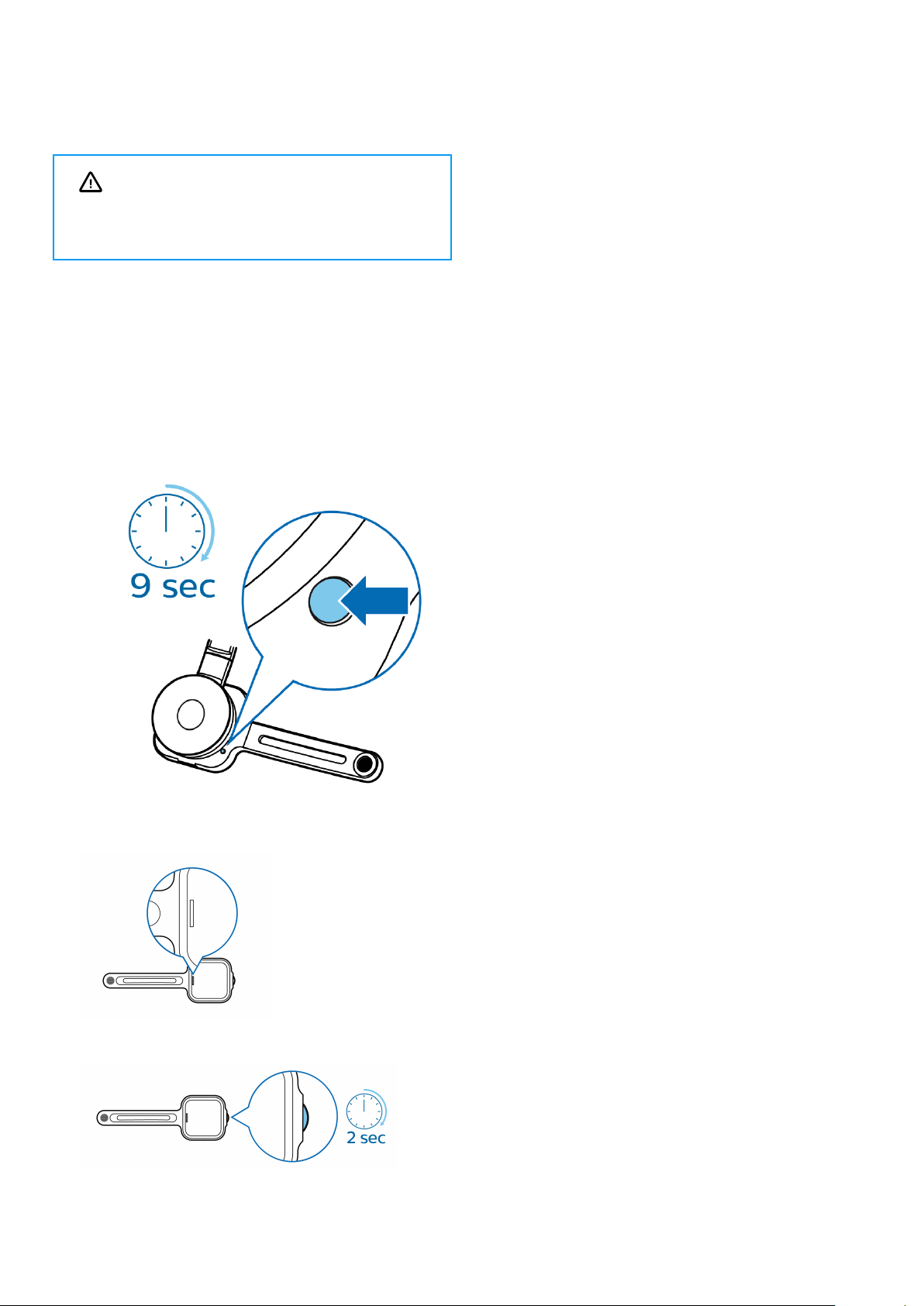
2. Hold the Pairing button of your SpeechOne headset for
9 seconds.
3. The status LED of your SpeechOne headset is no longer
illuminated, indicating that you turned o the device.
To turn the device on again, press the Headset button
for 2 seconds.
22
5. Button modes
With your SpeechOne or the SpeechOne remote control
(PSM6500, PSM6800), you can control various applications
on your computer or in your browser. You have six dierent
button modes available for this purpose:
• Event mode [25]
• Keyboard mode [26]
• Browser mode [27]
• Windows speech recognition mode [28]
• Dragon for Mac mode [29]
• Dragon for Windows mode [30]
You can change the button assignment for each mode in
SpeechControl software. Download the software for free at
www.dictation.philips.com/speechcontrol.
Switch between button modes on the
docking station
To switch between the button modes:
1. Connect the USB cable to the USB port for PC connection on the back of your docking station.
2. Connect the other end of the USB cable to a power supply unit (e.g. USB phone charger).
NOTE
Do not connect the USB cable to a PC or Laptop (no data connection).
3. Place the SpeechOne headset on the docking station, this will establish a wireless connection with the docking station.
4. Press the Phone and the Do-not-disturb button on the docking station simultaneously for three seconds.
X The battery LEDs on the docking station start ashing.
X Your current mode is indicated as follows:
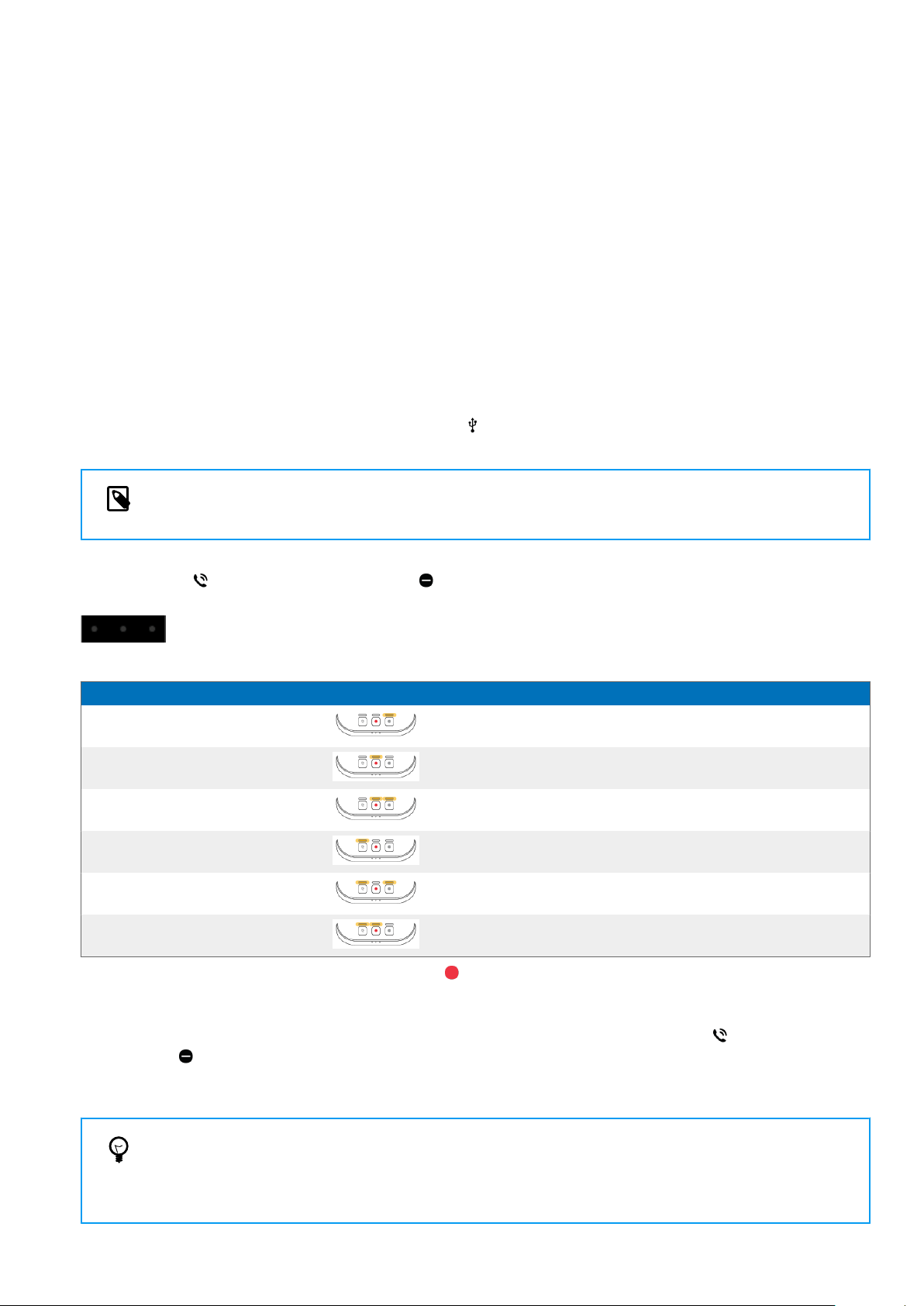
Mode Button LEDs Function of Record button
Event mode Start/end recording
Keyboard mode Turn on/o SpeechOne microphone when using Dragon
speech recognition software
Browser mode Start/end recording
Windows speech recognition
mode
Turn on/o Windows microphone
Dragon for Mac mode Turn on/ o Dragon microphone
Dragon for Windows mode Turn on/ o Dragon microphone
5. To switch to a dierent mode, press the Record button on the docking station repeatedly until you have reached the
desired mode. E.g. if you are in Event mode and want to switch to Keyboard mode, press the Record button once. If
you are in Event mode and want to switch to Dragon for Windows mode, press the Record button ve times.
6. To conrm your selection of the desired mode and exit mode selection, briey press the Phone and the Do-not-
disturb button on the docking station simultaneously.
7. To continue working with your SpeechOne headset, connect the USB cable to the USB port of your PC / Laptop. Use
the 5V/DC socket of the docking station if you’re using AirBridge.
TIP
You can always check your current button mode by briey pressing the Phone and the Do-not-disturb but-
ton on the docking station simultaneously. Your currently selected mode will be displayed immediately (as
illustrated in the previous table).
23
Switch between button modes on the
remote control (PSM6500, PSM6800)
To switch between the button modes:
1. Press the End-of-letter/priority (•EoL/••Prio) button and the Insert/overwrite (INS/OVR) button simultaneously for
three seconds.
X All button LEDs on the remote control ash simultaneously.
2. Press the corresponding button for the desired mode. The buttons are assigned to the button modes as follows:
Mode Button Function of Record button
Event mode F1 Start/end recording
Keyboard mode F2 Turn on/o SpeechOne microphone when using Dragon
speech recognition software
Browser mode F3 Start/end recording
Windows speech recognition
mode
F4 Turn on/o Windows microphone
Dragon for Mac mode •EoL/••Prio Turn on/ o Dragon microphone
Dragon for Windows mode INS/OVR Turn on/ o Dragon microphone
X The SpeechOne exits the mode selection and switches to the selected mode.
NOTE
You have 10 seconds to select a mode. After 10 seconds, you will automatically exit mode selection and
need to restart the mode selection steps.
TIP
You can always check your current button mode by briey pressing the End-of-letter/priority (•EoL/••Prio)
button and the Insert/overwrite (INS/OVR) button simultaneously. The LED ogf the button assigned to the
current mode (see previous table) shortly lights up orange. E.g. if the currently activated mode is the Event
mode, the LED of the F1 button lights up orange.
24
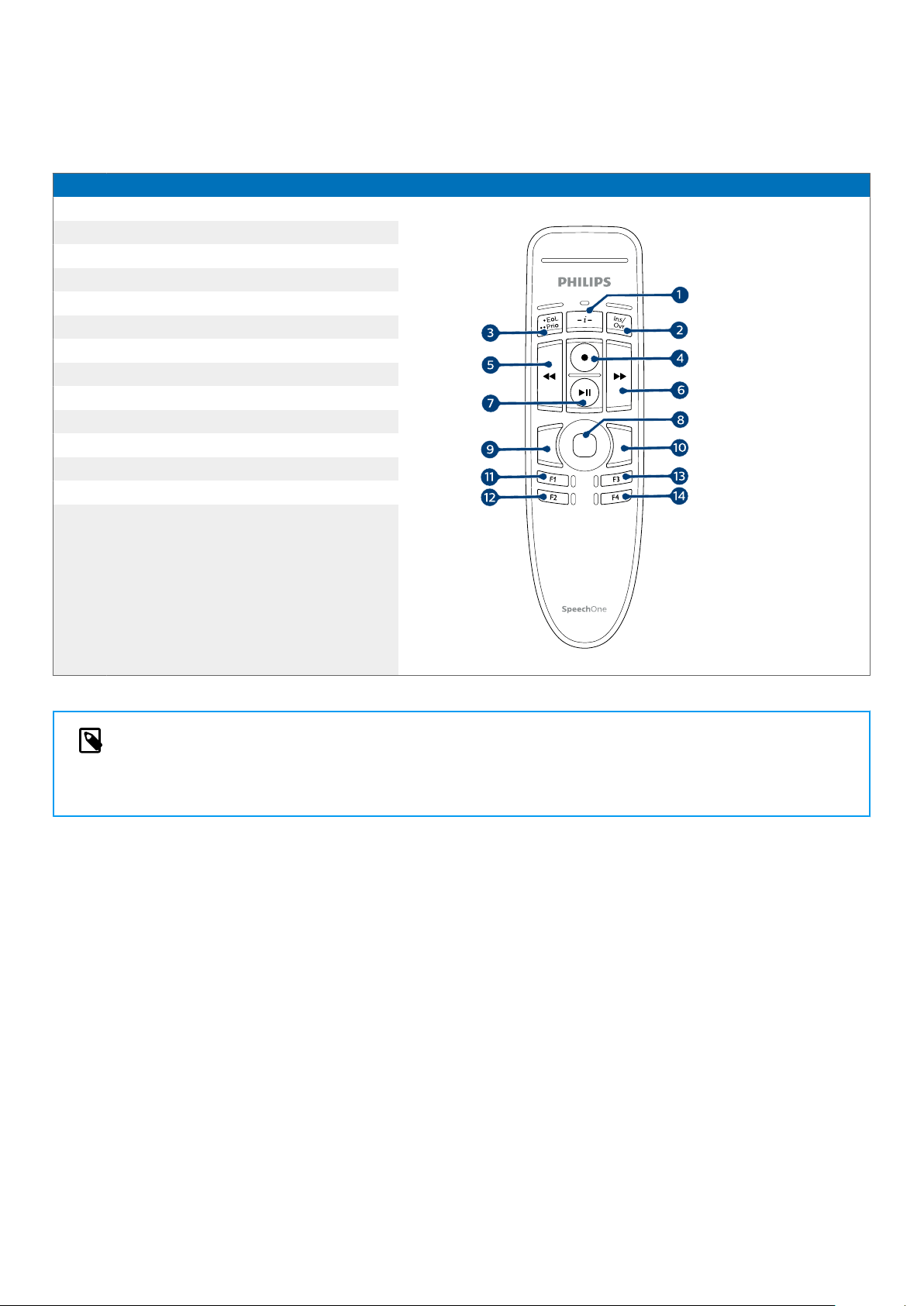
Event mode
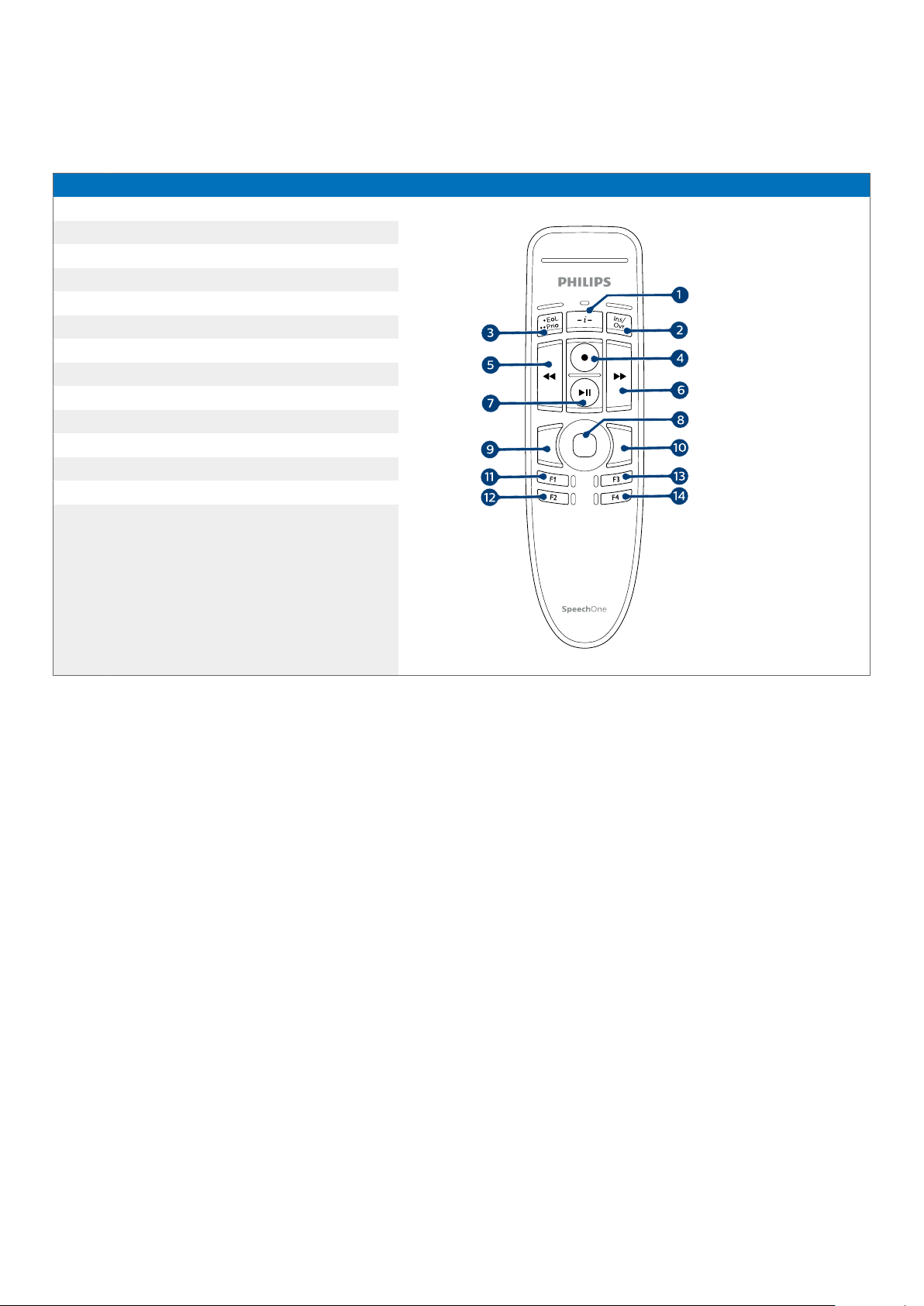
The Event mode is the default mode of your SpeechOne. In this mode, each button on your SpeechOne is assigned to a
command. In SpeechControl software, you can dene which commands should be executed by pressing or releasing a de-
sired button on your SpeechOne in order to control various computer applications.
Command
1 Instruction
2 Insert/overwrite/append
3 End-of-letter/priority
4 Record
5 Fast rewind
6 Fast forward
7 Play
8 Touch navigation/left mouse
9 Left mouse
10 Right mouse
11 Programmable function button
12 Programmable function button
13 Programmable function button
14 Programmable function button
25
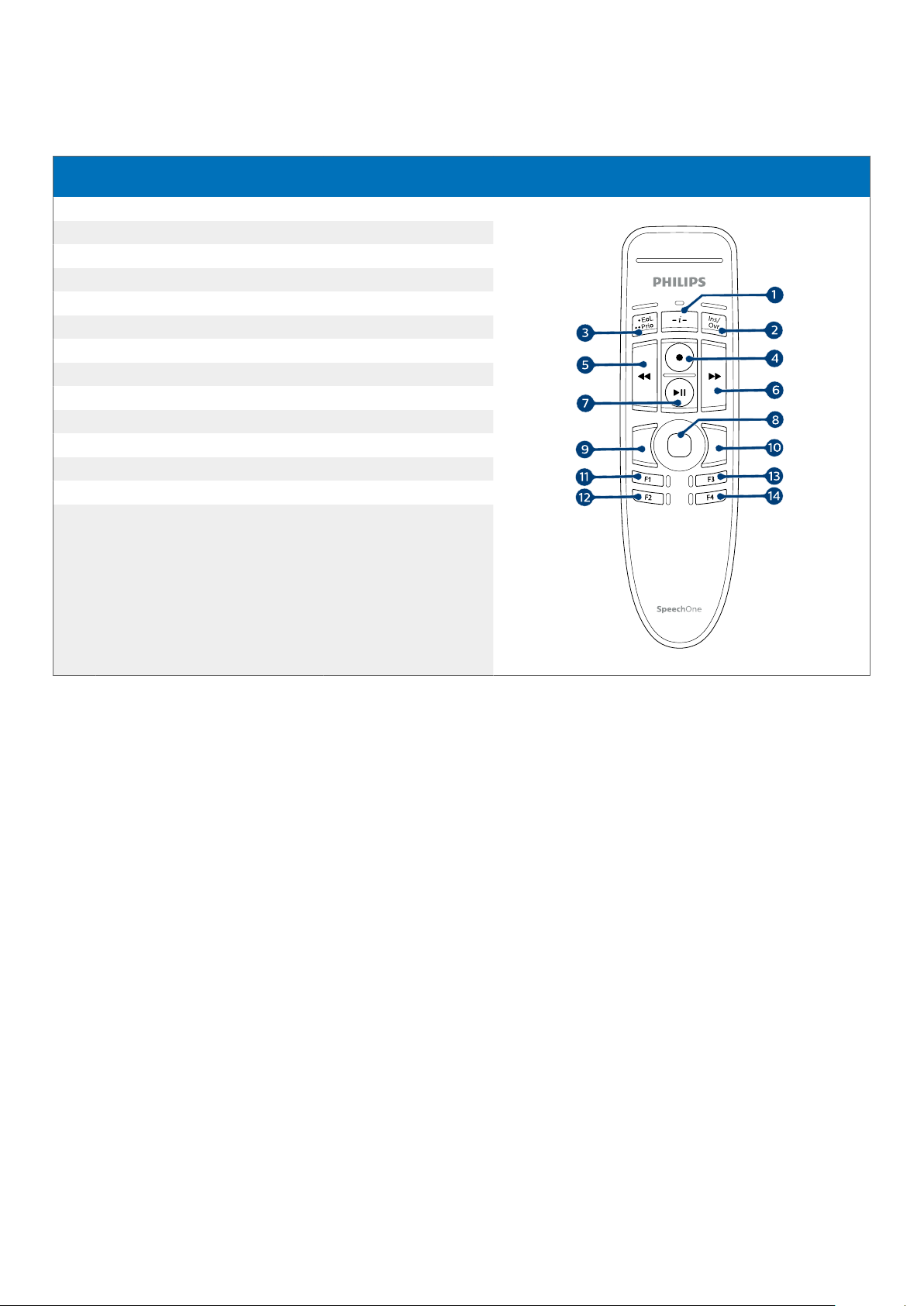
Keyboard mode
Assign a button on your SpeechOne to a shortcut you are using on your computer in order to control various computer
applications. In SpeechControl software, you can dene which commands should be executed by pressing a desired button
on your SpeechOne.
In this mode, you can also operate Dragon NaturallySpeaking speech recognition software on a Windows computer by us-
ing the pre-congured Dragon shortcuts.
Command Shortcut in
SpeechControl
1 Record/Stop (Dragon micro-
phone on/o)
NumKey+
2 Tab forward Tab
3 Tab backward Shift+Tab
4 SpeechMike microphone on/ o Microphone
ON/OFF
5 Mark previous word(s) Ctrl+Shift+Left
6 Next eld (Dragon) Ctrl+Shift+N
7 Play
8 Touch navigation/left mouse
9 Left mouse
10 Right mouse
11 Show dictation box (Dragon) Ctrl+Shift+D
12 Transfer text (Dragon dictation
box)
Ctrl+Shift+T
13 Programmable function button
14 Switch to hidden mode (Dragon
Medical Practice Edition)
Ctrl+Shift+H
26
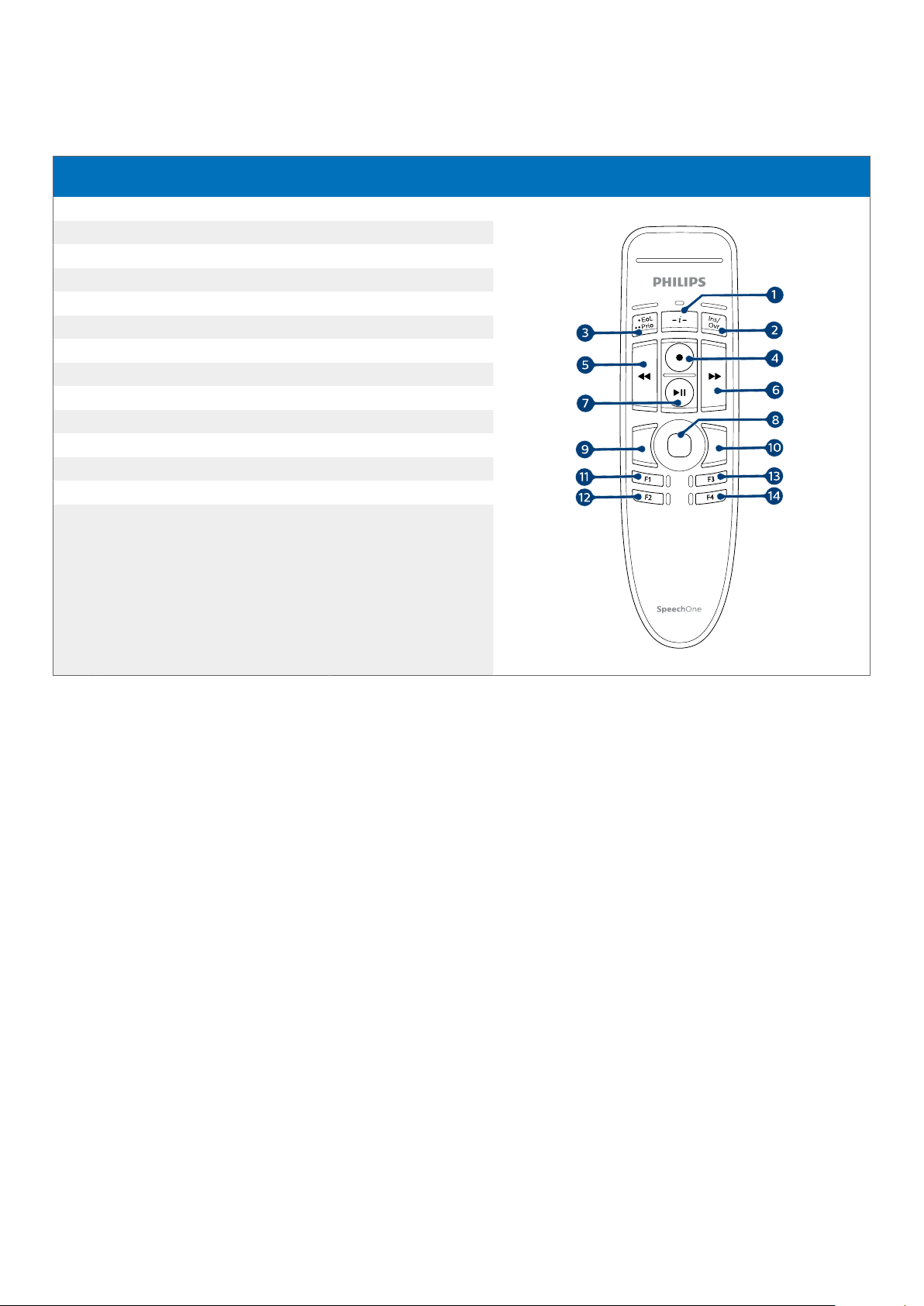
Browser mode
Assign a SpeechOne button to a shortcut or a command in your browser in order to control various browserbased dictation
applications. In SpeechControl software, you can dene which commands should be executed by pressing a desired button
on your SpeechOne.
Command
1 -
2 Insert/overwrite/append
3 -
4 Record
5 Fast rewind
6 Fast forward
7 Play
8 Touch navigation/left mouse
9 Left mouse
10 Right mouse
11 Jump to start of dictation
12 Jump to end of dictation
13 Programmable function button
14 Programmable function button
NOTE
The button assignment in Browser mode depends on the application you are using in your browser. Therefore,
there is no default conguration for this mode. The table below only describes the default button assignment for
the Philips SpeechLive cloud dictation solution.
27
Windows speech recognition mode
In this mode, you can operate the pre-installed Windows speech recognition software on a Windows computer by using
the pre-congured Windows shortcuts.
Command Shortcut in Speech-
Control
1 -
2 Next eld (Dragon) Tab
3 Tab backward Shift+Tab
4 Windows microphone on/o Ctrl+Win
5 Mark previous word(s) Ctrl+Shift+Left
6 Mark next word(s) Ctrl+Shift+Right
7 -
8 Touch navigation/left mouse
9 Left mouse
10 Right mouse
11 Copy Ctrl+C
12 Cut Ctrl+X
13 Paste Ctrl+V
14 Programmable function but-
ton
Ctrl+Shift+H
28
Dragon for Mac mode
In this mode, you can operate Dragon NaturallySpeaking speech recognition software on a Mac computer by using the
pre-congured Dragon shortcuts.
Command Shortcut in Speech-
Control
1 -
2 Tab forward Tab
3 Tab backward Shift+Tab
4 Dragon microphone on/o ⌘+F11
5 Mark previous word(s) Alt+Shift+Left
6 Mark next word(s) Alt+Shift+Right
7 Play
8 Touch navigation/left mouse
9 Left mouse
10 Right mouse
11 Copy ⌘+C
12 Cut ⌘+X
13 Paste ⌘+V
14 Programmable function button
29
Dragon for Windows mode
In this mode, you can operate Dragon NaturallySpeaking speech recognition software on a Windows computer by using
the pre-congured Dragon shortcuts.
Command Shortcut in
SpeechControl
1 -
2 Tab forward Tab
3 Tab backward Shift+Tab
4 Dragon microphone on/o NumKey+
5 Mark previous word(s) Ctrl+Shift+Left
6 Next eld (Dragon) Ctrl+Shift+N
7 Play
8 Touch navigation/left mouse
9 Left mouse
10 Right mouse
11 Show dictation box (Dragon) Ctrl+Shift+D
12 Transfer text (Dragon dictation
box)
Ctrl+Shift+T
13 Programmable function button
14 Switch to hidden mode (Dragon
Medical Practice Edition)
Ctrl+Shift+H
30

6. Service and support
Don’t perform any maintenance operations that aren’t de-
scribed in this user manual. Don’t disassemble the device
into its component parts to carry out repairs. The device
may only be repaired in authorized service centers.
Contact our supporting Philips part-
ners
If you have any questions about your SpeechOne or experi-
ence technical issues, contact one of our supporting Philips
partners. The local partner you purchased your SpeechOne
from will strive to answer your questions and to solve your
problem as soon as possible.
Troubleshooting
Find the most common problems you could encounter with
the SpeechOne in the following table. If you are unable to
solve the problem with the information below, contact the
supporting Philips partner you purchased the device from.
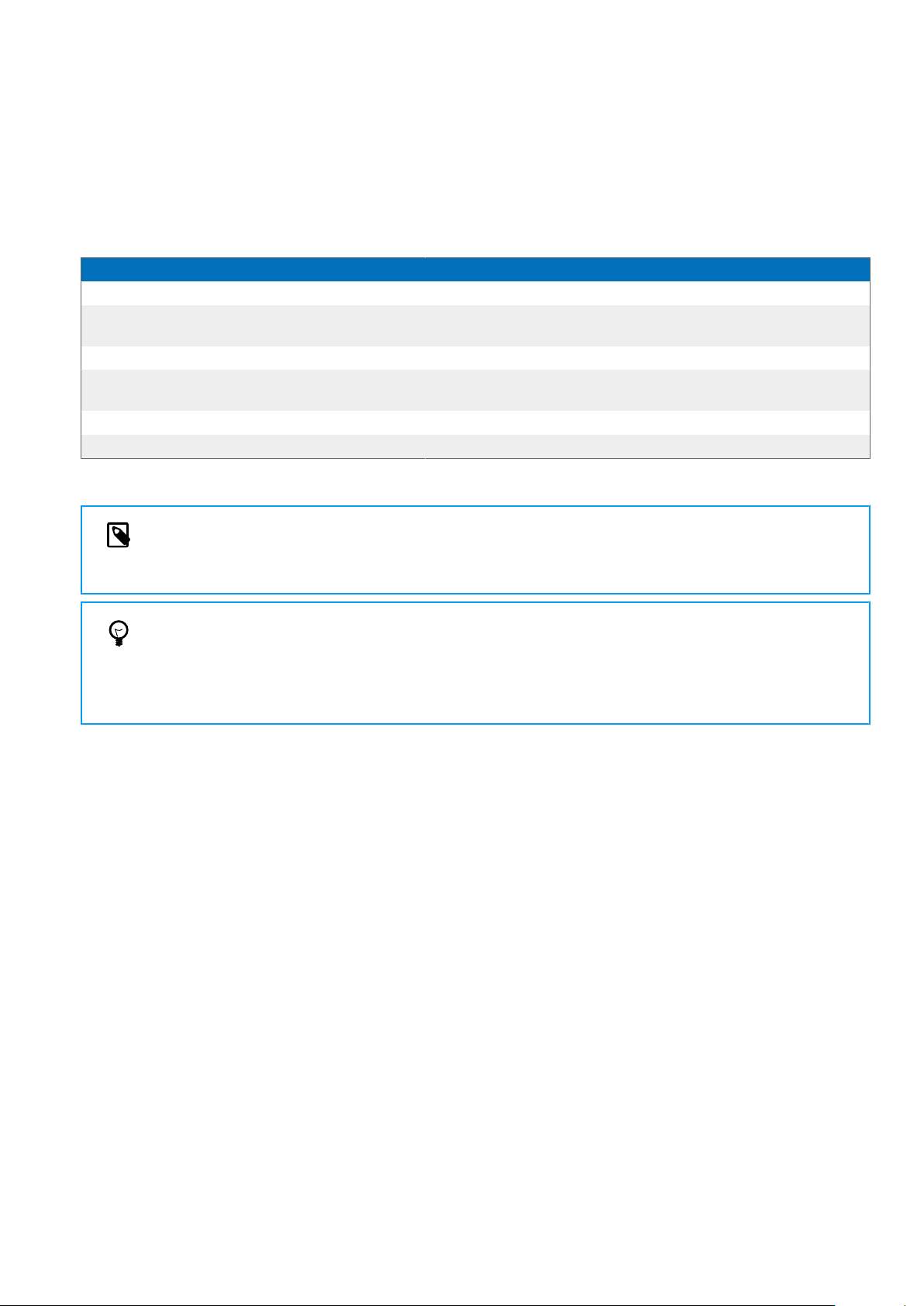
Problem Cause Solution
The
SpeechOne
is com-
pletely
without
function.
• Some com-
puter provid-
ers limit the
output power
of USB ports
to 100 mA.
These ports
may not pro-
vide enough
power for the
SpeechOne
to function
properly.
• Use a power
supply unit (The
power supply
unit is not inclu-
ded and needs
to be purchased
separately).
• Connect the
SpeechOne via a
self-powered
hub.
The
SpeechOne
doesn't re-
spond to
input com-
mands.
• The wireless
connection
to the dock-
ing station
may be inter-
rupted.
• Check the wire-
less connection.
• Move closer to
the docking sta-
tion.
• Start the pairing
process as de-
scribed in the
chapter Pairing
[12].
• The USB ca-
ble is con-
nected to the
wrong USB
port on the
docking sta-
tion (i.e. USB
port for
charging
marked with
5V DC).
• Disconnect the
USB cable from
the docking sta-
tion and connect
it to the USB port
for PC connec-
tion marked with
on the docking
station.
• Your comput-
er is in sleep
mode.
• Wake your com-
puter from sleep
mode.
Problem Cause Solution
• The battery is
empty.
• Charge the
SpeechOne.
• If none of the
solutions provi-
ded above solves
the problem, re-
set the wireless
connection. For
more informa-
tion, see Reset-
ting the wireless
connection [13].
The
SpeechOne
doesn't
switch on.
• The battery is
very low.
• Charge the
SpeechOne.
The
SpeechOne
doesn't
connect to
the docking
station.
• Pairings may
have been
reset or the
SpeechOne
has been
previously
paired with
another
docking sta-
tion.
• Start the pairing
process as de-
scribed in the
chapter Pairing
[12].
• If re-pairing
doesn't solve the
problem, reset
the wireless con-
nection. For
more informa-
tion, see Reset-
ting the wireless
connection [13].
The
SpeechOne
is connec-
ted to the
computer
but sound
will play on
the com-
puter’s
speaker
only.
• SpeechOne
is not selec-
ted as the
default play-
back device.
• In the Windows
sound settings,
select Speech-
One as the de-
fault playback
device.
The
SpeechOne
doesn't re-
cord sound.
• The input
level is too
low because
of the wrong
recording
source.
• In the Windows
sound settings,
select Speech-
One as the de-
fault recording
device.
31
Problem Cause Solution
My com-
puter can't
detect the
foot con-
trol.
• The docking
station was
connected to
the computer
and/or to the
power outlet
before you
connected
the foot con-
trol.
• Disconnect the
foot control from
the docking sta-
tion and the
docking station
from the com-
puter and/or
power outlet.
Then reconnect
the foot control
to the docking
station rst and
afterwards con-
nect the docking
station to the
computer and/or
to the power
outlet.
The con-
nection be-
tween the
SpeechOne
and the
docking
station is
being inter-
rupted.
• The docking
station is
connected to
a low-power
USB port on
your com-
puter.
• Additionally,
connect the
docking station
via the supplied
USB cable to the
power supply
unit and the USB
port for charging
(marked with 5V
DC). For more in-
formation, see
Charging the
battery [11].
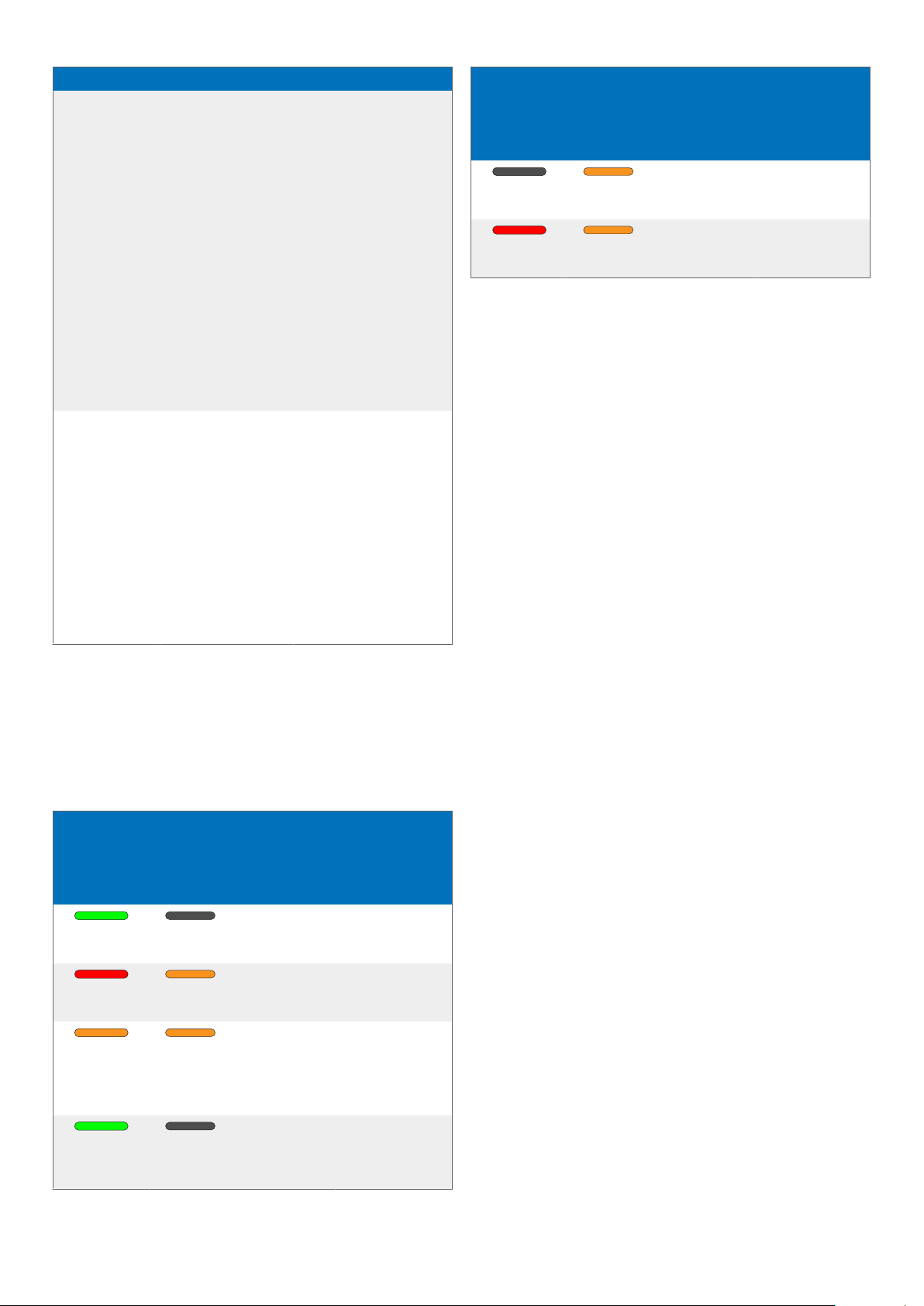
LED colors and meanings
The LEDs on your SpeechOne and the docking station indi-
cate the connection and battery status as well as problems
that might occur when using your SpeechOne and the
docking station. Use the following table to learn more about
the connection status, battery status, and potential prob-
lems:
Speech-
One LED
Button
LEDs
on
docking
station
Battery
LEDs on
docking
station
Meaning
green o
• status
dis-
played
• connection
OK
red orange
• status
not dis-
played
• connection
interrupted
or lost
orange orange
• status
dis-
played
• wireless
connection
OK but no
USB con-
nection
green
ashing
o
• status
dis-
played
• Idle mode
Speech-
One LED
Button
LEDs
on
docking
station
Battery
LEDs on
docking
station
Meaning
o orange
• status
not dis-
played
• Speech-
One power
o
red orange
• status
not dis-
played
• no pairing
32

7. Technical data
Wireless connectivity
• Wireless technology: 2.4 GHz ISM Band
• Modulation: 8 FSK
• Maximum range: up to 5 m (16 ft)
Audio
• Microphone type: electret condenser microphone
• Microphone cartridge: 10 mm
• Characteristic: uni-directional
• Frequency response: 150 – 15,000 Hz
• Sensitivity: -37 dBV @ 1 kHz
• Signal-to-noise ratio: > 70 dBA
Sound
• Speaker type: built-in 23 mm round, dynamic speaker
• Acoustic frequency response: 300 – 7500 Hz
• Speaker output power: > 200 mW
Power
• Battery type: built-in rechargeable Li-ion polymer battery
• Battery capacity: 360 mAh
• Battery lifetime: up to 12 hours of recording
• Standby time: > 100 hours
• Charging time: 80% after 60 min, approx. 2 hours for full
charge
Docking station
• USB:
micro USB for charging
micro USB for data transfer
USB type A for foot control
• Kensington Security Slot
Design and nishing
• Material: high-class polymers with hygienic surface
• Color: black
Dimensions
• Headset incl. headband and cushions:
Dimensions (W × D × H): 155 × 150 × 140 mm (6.1 × 5.9 ×
5.5")
Weight: 81 g (2.6 oz)
• Docking station:
Dimensions (W × D × H): 120 × 120 × 32 mm (4.7 × 4.7 × 1.3")
Weight: 395 g (13.9 oz)
• Remote control:
Dimensions: 158 × 45 × 30 mm (6.2 × 1.8 × 1.2")
Weight: 110 g (3.9 oz)
• Status light:
Dimensions: 36 × 36 × 98 mm (1.4 × 1.4 × 3.9")
Weight: 58 g (2.1 oz)
• Magnetic ear cushion:
50 mm (2")
• Magnetic head cushions:
48 × 12 mm (1.9 × 0.5")
Green specications
• Compliant to 2011/65/EU (RoHS)
• Lead-free soldered product
• Certications: CE, FCC, C-Tick (Australia and New Zea-
land)
Operation conditions
• Temperature: 5° – 45° C / 41° – 113° F
• Humidity: 10% – 90%
System requirements
• Processor: Intel dual core or equivalent AMD processor, 1
GHz or faster
• RAM: 2 GB (32 bit)/4 GB (64 bit)
• Hard-disk space: 100 MB for SpeechExec software, 30
MB for SpeechControl software, 4.5 GB for Microsoft .NET
Framework
• Operating system: Windows 10 Pro/Enterprise (64 bit),
Windows 8.1/7 (32/64 bit), Windows Server 2012 (64 bit),
Windows Server 2008 R2 (32/64 bit), macOS 10.13/10.12
(Mac functionality may be limited)
• One free USB port
• Graphics: DirectX-compliant graphics card with hardware
acceleration recommended
• Sound: Windows-compatible sound device
• Browser: Internet Explorer 9 or higher, or the current ver-
sion of Chrome or Firefox
• Free USB port
• SpeechExec: Internet connection for required software
activation
Additional system requirements for
speech recognition software
• Supported speech recognition software:
Nuance Dragon Professional 13/14/15 Individual/Group
Nuance Dragon Legal 13/14/15
Dragon Medical Practice Edition 3.x/4.x
Nuance Dragon SDK Client Edition 14
M*Modal Fluency Direct 8.0 and above
M*Modal Fluency for Imaging 3 and above
• Processor:
33

Intel dual core or equivalent AMD processor, 2.2 GHz or
faster
• RAM:
4 GB (32 bit)/8 GB (64-bit)
• Free hard disk space:
8GB
Accessories (optional)
• SpeechOne Remote Control ACC6100
• SpeechOne Docking Station and Status Light ACC6000
• SpeechOne Headset Cushions (5 ×) ACC6005
• AirBridge Wireless Adapter for SpeechOne and Speech-
Mike Premium Air ACC4100
34

8. Certications
FCC Warning Statement
Changes or modications not expressly approved by the
party responsible for compliance could void the user’s au-
thority to operate the equipment.
FCC Compliance Statement
This device complies with part 15 of the FCC Rules. Opera-
tion is subject to the following two conditions:
(1) This device may not cause harmful interference, and
(2) this device must accept any interference received, in-
cluding interference that may cause undesired operation.
This equipment has been tested and found to comply with
the limits for a Class B digital device, pursuant to Part 15 of
the FCC Rules. These limits are designed to provide reason-
able protection against harmful interference in a residential
installation. This equipment generates uses and can radiate
radio frequency energy and, if not installed and used in ac-
cordance with the instructions, may cause harmful interfer-
ence to radio communications. However, there is no guar-
antee that interference will not occur in a particular installa-
tion.
If this equipment does cause harmful interference to radio
or television reception, which can be determined by turning
the equipment o and on, the user is encouraged to try to
correct the interference by one or more of the following
measures:
• Reorient or relocate the receiving antenna.
• Increase the separation between the equipment and re-
ceiver.
• Connect the equipment into an outlet on a circuit dierent
from that to which the receiver is connected
• Consult the dealer or an experienced radio/TV technician
for help.
Industry Canada (IC) regulatory infor-
mation
This device contains licence-exempt transmitter(s)/receiv-
er(s) that comply with Innovation, Science and Economic
Development Canada’s licence-exempt RSS(s). Operation is
subject to the following two conditions:
(1) This device may not cause interference.
(2) This device must accept any interference, including in-
terference that may cause undesired operation of the de-
vice.
Neither Speech Processing Solutions GmbH nor its aliates
shall be liable to the purchaser of this product or third par-
ties with respect to claims for damages, losses, costs or ex-
penses incurred by purchaser or third parties as a result of
an accident, misuse or abuse of this product or unauthor-
ized modications, repair, modication of the product or
failure to meet the operating and maintenance instructions
provided by the manufacturer.
This user manual is a document with no contractual nature.
We accept no liability for changes, mistakes or printing er-
rors.
35

Issue date 2021-07-06
© 2021 Speech Processing Solutions GmbH. All rights reserved.
Specications are subject to change without notice. Philips and the Philips shield emblem are registered trademarks of Ko-
ninklijke Philips N.V. and are used by Speech Processing Solutions GmbH under license from Koninklijke Philips N.V. All
trademarks are the property of their respective owners.
36
