
MODEL X OWNER'S MANUAL
2018.12
March 22, 2018

Overview.............................................................2
Interior Overview.........................................................................2
Exterior Overview....................................................................... 3
Opening and Closing..................................... 4
Doors............................................................................................... 4
Windows....................................................................................... 12
Rear Trunk.................................................................................... 13
Front Trunk...................................................................................15
Glove Box......................................................................................17
Cup Holders.................................................................................18
Sun Visors.....................................................................................19
Seating and Safety Restraints................. 20
Front and Rear Seats..............................................................20
Seat Belts.....................................................................................27
Child Safety Seats....................................................................30
Airbags.........................................................................................40
Driving...............................................................45
Driver
Profiles............................................................................ 45
Steering Wheel..........................................................................47
Mirrors.......................................................................................... 50
Starting and Powering
O..................................................... 51
Gears............................................................................................. 53
Instrument Panel.......................................................................54
Lights............................................................................................60
Wipers and Washers............................................................... 65
Brakes........................................................................................... 66
Traction Control........................................................................ 69
Park Assist.................................................................................. 70
Vehicle Hold................................................................................72
Acceleration Modes................................................................. 73
Trip Information.........................................................................75
Getting Maximum Range.......................................................76
Rear View Camera....................................................................78
Active Spoiler.............................................................................79
Towing and Accessories........................................................80
Driver Assistance.......................................... 88
About Driver Assistance........................................................88
Trac-Aware Cruise Control................................................91
Autosteer..................................................................................... 97
Auto Lane Change.................................................................100
Autopark.................................................................................... 102
Lane Assist................................................................................106
Collision Avoidance Assist.................................................. 108
Speed Assist...............................................................................112
Using the Touchscreen...............................114
Touchscreen Overview...........................................................114
Controls....................................................................................... 119
Settings.......................................................................................122
Climate Controls......................................................................126
Smart Air Suspension............................................................132
Media and Audio.....................................................................134
Phone...........................................................................................139
Maps and Navigation..............................................................141
Calendar..................................................................................... 146
Security Settings.....................................................................147
HomeLink
®
Universal Transceiver......................................148
Connecting to Wi-Fi..............................................................150
Software Updates.................................................................... 151
Mobile App................................................................................ 152
Charging......................................................... 153
Electric Vehicle Components............................................. 153
Battery Information................................................................155
Charging Instructions............................................................ 157
Maintenance.................................................. 162
Maintenance Schedule..........................................................162
Tire Care and Maintenance..................................................163
Cleaning......................................................................................169
Wiper Blades and Washer Jets..........................................172
Fluid Reservoirs....................................................................... 173
Jacking and Lifting.................................................................175
Parts and Accessories........................................................... 176
Specifications................................................177
Identification Labels...............................................................177
Vehicle Loading....................................................................... 178
Dimensions and Weights...................................................... 181
Subsystems............................................................................... 184
Wheels and Tires.....................................................................186
Roadside Assistance.................................. 192
Contacting Roadside Assistance...................................... 192
Instructions for Transporters..............................................194
Consumer Information.............................. 196
Easter Eggs...............................................................................196
About this Owner Information...........................................197
Disclaimers................................................................................ 198
Reporting Safety Defects....................................................199
Declarations of Conformity............................................... 200
Contents
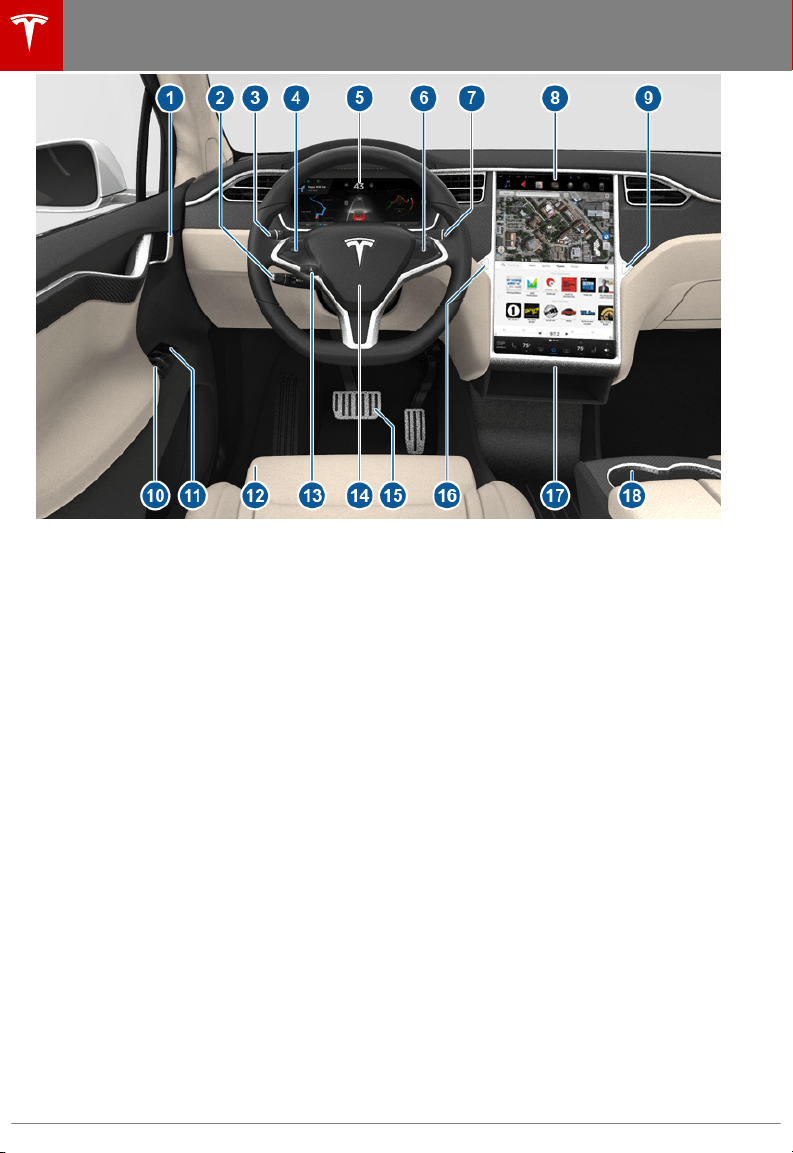
1. Interior door handles (Opening Doors from the Interior on page 7)
2. Trac-Aware Cruise Control (Trac-Aware Cruise Control on page 91) and Autosteer
(Autosteer on page 97)
3. High beams (High Beam Headlights on page 63), Turn signals (Turn Signals on page 63),
Wipers and washers (Wipers and Washers on page 65)
4. Steering wheel buttons - left (Using Left Steering Wheel Buttons on page 47)
5. Instrument panel (Instrument Panel on page 54)
6. Steering wheel buttons - right (Using Right Steering Wheel Buttons on page 48)
7. Gear selector (Shifting Gears on page 53)
8. Touchscreen (Touchscreen Overview on page 114)
9. Glovebox button (Glove Box on page 17)
10. Power window switches (Opening and Closing on page 12)
11. Exterior mirror adjustment switches (Mirrors on page 50)
12. Seats (Front and Rear Seats on page 20)
13. Steering column adjuster (hidden from view in the above image) (Steering Wheel on page
47)
14. Horn (Horn on page 49)
15. Brakes (Brakes on page 66)
16. Hazard warning lights (Hazard Warning Flashers on page 64)
17. Cabin climate control (Climate Controls on page 126)
18. Cup holders (Cup Holders on page 18)
Interior Overview
2 Model X Owner's Manual
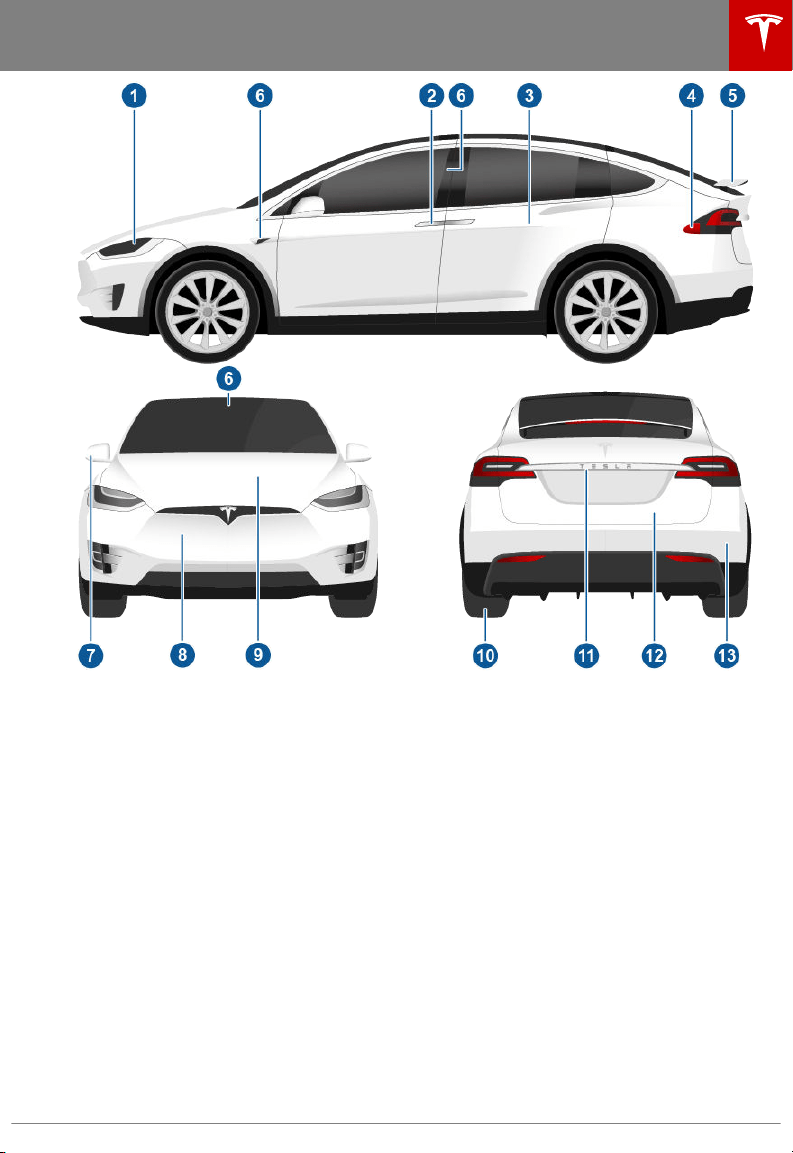
1. Exterior lights (Lights on page 60)
2. Front doors (Opening and Closing Front Doors from Outside Model X on page 7)
3. Falcon wing doors (Doors on page 4)
4. Charge port (Charging Instructions on page 157)
5. Active spoiler (optional) (Active Spoiler on page 79)
6. Driver Assistance cameras (About Driver Assistance on page 88)
7. Exterior mirrors (Mirrors on page 50)
8. Radar sensor (hidden from view in the above image) (About Driver Assistance on page 88)
9. Hood/Front trunk (Front Trunk on page 15)
10. Wheels and tires (Wheels and Tires on page 186)
11. Rear view camera (Rear View Camera on page 78 and About Driver Assistance on page
88)
12. Rear trunk/liftgate (Rear Trunk on page 13)
13. Ultrasonic sensors (Park Assist on page 70 and About Driver Assistance on page 88)
Exterior Overview
Overview 3
Keyless Locking and Unlocking
Locking and unlocking Model X is convenient.
Although you must be carrying a valid key,
there is no need to use it. Model X has sensors
around the driver's door that can recognize
the presence of a key within a range of
approximately one meter. So, you can keep
your key in your pocket or purse and Model X
detects it as you approach.
When you walk up to Model X carrying your
key, the doors automatically unlock if Passive
Entry is on. To open the rear trunk, press the
switch located under the trunk’s exterior
handle.
Note: Model X must detect your key near the
driver's door before the doors or rear trunk
unlock.
Note: If Passive Entry is
o, you must use the
key to unlock Model X. See Using the Key on
page 4.
If equipped with the premium upgrade
package, and the Automatic Doors setting is
turned on, when you walk up to Model X
carrying your key, doors automatically unlock
and the driver's door partially opens. If not
equipped, or if this setting is turned
o, doors
automatically unlock and a door opens when
you press its handle.
Note: You can choose whether you want all
doors, or just the driver's door, to unlock when
you approach Model X carrying your key (see
Door Unlock Mode on page 10).
When carrying your key with you, you can also
open the rear trunk without having to use the
key. Simply press the switch located under the
trunk’s exterior handle. Door Unlock Mode
(see Door Unlock Mode on page 10) must
be set to All and the vehicle must detect the
key near the driver's door before opening the
rear trunk.
Model X also locks automatically. If you set
Walk-Away Door Lock to ON, Model X locks
when you walk away carrying your key with
you (see Walk-away Locking on page 10).
While sitting inside Model X, you can also lock
and unlock the vehicle by touching the icon on
the touchscreen's status bar or by using the
door controls that are available when you
touch Controls > Doors.
Using the Key
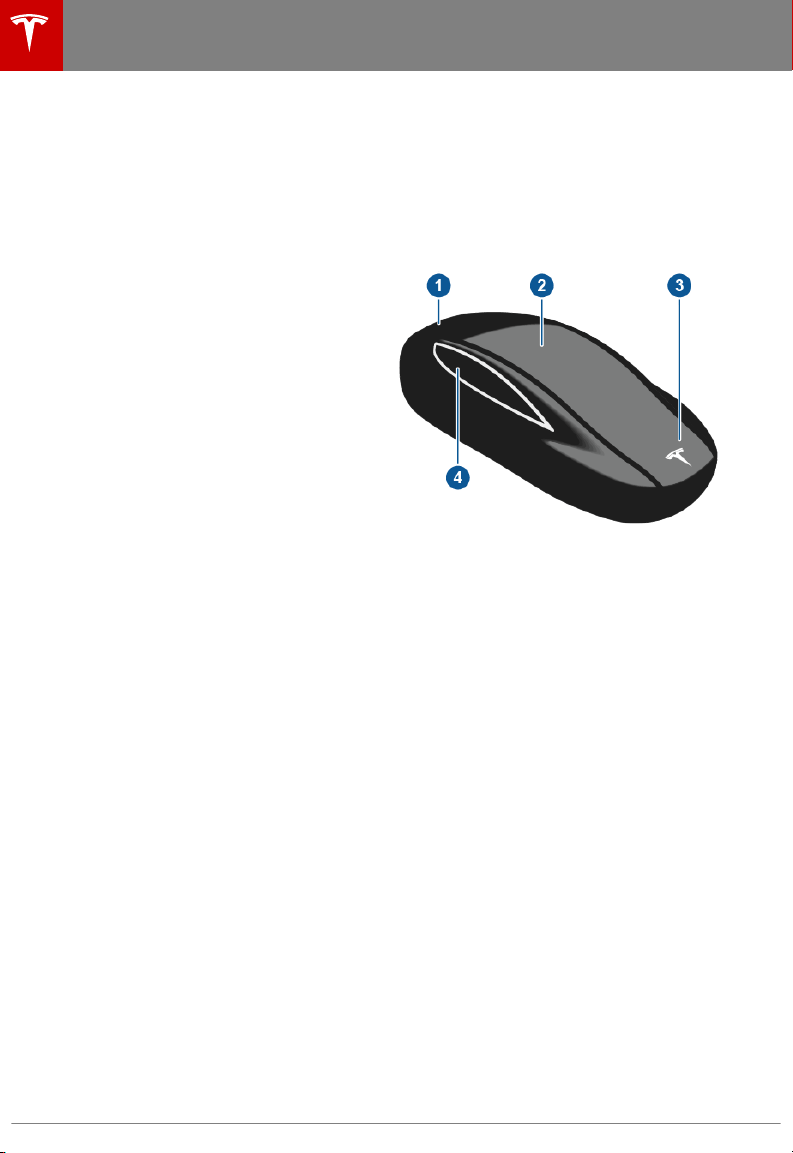
To quickly familiarize yourself with the key,
think of the key as a miniature version of
Model X, with the Tesla badge representing
the front. The key has three buttons on the top
that feel like softer areas on the surface, and a
metal button on each side representing the
falcon wing doors.
1.
Trunk
• Double-click to open the rear trunk.
• If equipped with a powered liftgate,
double-click to close the rear trunk.
You can also single-click to stop the
liftgate when it is moving.
• Hold the button down for one to two
seconds to open the charge port door.
2. Lock/Unlock All
• Single-click to lock all doors and rear
trunk. Hazard warning lights
flash
once.
Note: If a door or the rear trunk is
open, hazard warning lights
flash
three times and doors do not lock. To
enable a single-click to both close all
doors (and rear trunk) and lock them,
touch Controls > Settings > Doors &
Locks > Close All with Key Fob > ON.
By default, this setting is OFF and
when
o, you must triple-click this
button to close and lock all doors.
Doors
4 Model X Owner's Manual
• Double-click to unlock Model X.
Hazard warning lights flash twice.
Note: If Model X is equipped with the
premium upgrades package and
Automatic Doors is set to ON (touch
Controls > Settings > Doors & Locks >
Automatic Doors > ON), doors unlock
and the driver's door opens as you
approach Model X. When the driver's
door is open, double-clicking opens
the passenger front door.
Note: If Door Unlock Mode is set to
Driver, double-clicking unlocks only
the driver's door and you will need to
double-click again to unlock all doors
and trunks. If set to All, the
first
double-click unlocks all doors and
trunks. Use the touchscreen to change
this setting (touch Controls >
Settings > Doors & Locks > Door
Unlock Mode).
3. Front trunk (also called the "frunk")
• Double-click to open the front trunk.
4. Falcon wing doors
• Double-click to open/close the
associated falcon wing door.
• Single-click to stop movement of the
associated falcon wing door.
Subsequently double-clicking reverses
movement of the falcon wing door.
For example if the door was opening,
it closes, and vice versa.
Note: Falcon wing doors are designed
to proactively detect obstacles that
prevent the doors from moving when
an obstacle is detected.
Warning:
Model X falcon wing
doors have several sensors to
detect the presence of an object
in the door's path. In most cases,
when an object is detected, the
door stops moving. However, the
sensors are unable to detect all
areas under all circumstances,
particularly when closing,
Therefore, you must monitor the
movement of falcon wing doors
to ensure the door's path of
movement is free of obstacles,
staying prepared at all times to
proactively intervene to stop the
door from contacting an object
(including a person). Failure to do
so can cause serious damage or
bodily injury.
You do not need to point the key at Model X,
but you must be within operating range
(which varies depending on the strength of
the key’s battery).
If Model X is unable to detect the key, the
touchscreen displays a message indicating
that a key is not inside. Place the key where
Model X can best detect it, which is below the
12V power socket (see Key Not Inside on page
51).
Radio equipment on a similar frequency can
aect the key. If this happens, move the key at
least 30 cm away from other electronic
devices (phone, laptop, etc). If the key does
not work, you may need to change its battery.
If the key’s battery is discharged, you can
open Model X by following the unlocking
procedure (see Unlocking When the Key
Doesn't Work on page 11).
Caution: Remember to bring the key with
you when you drive. Although you can
drive Model X away from its key, you will
be unable to power it back on after it
powers o.
Caution: Protect the key from impact,
high temperatures, and damage from
liquids. Avoid contact with solvents,
waxes and abrasive cleaners.
Replacing the Key Battery
The key’s battery lasts for approximately a
year. When the battery is low, a message
displays on the instrument panel. Follow these
steps to replace it:
Doors
Opening and Closing 5
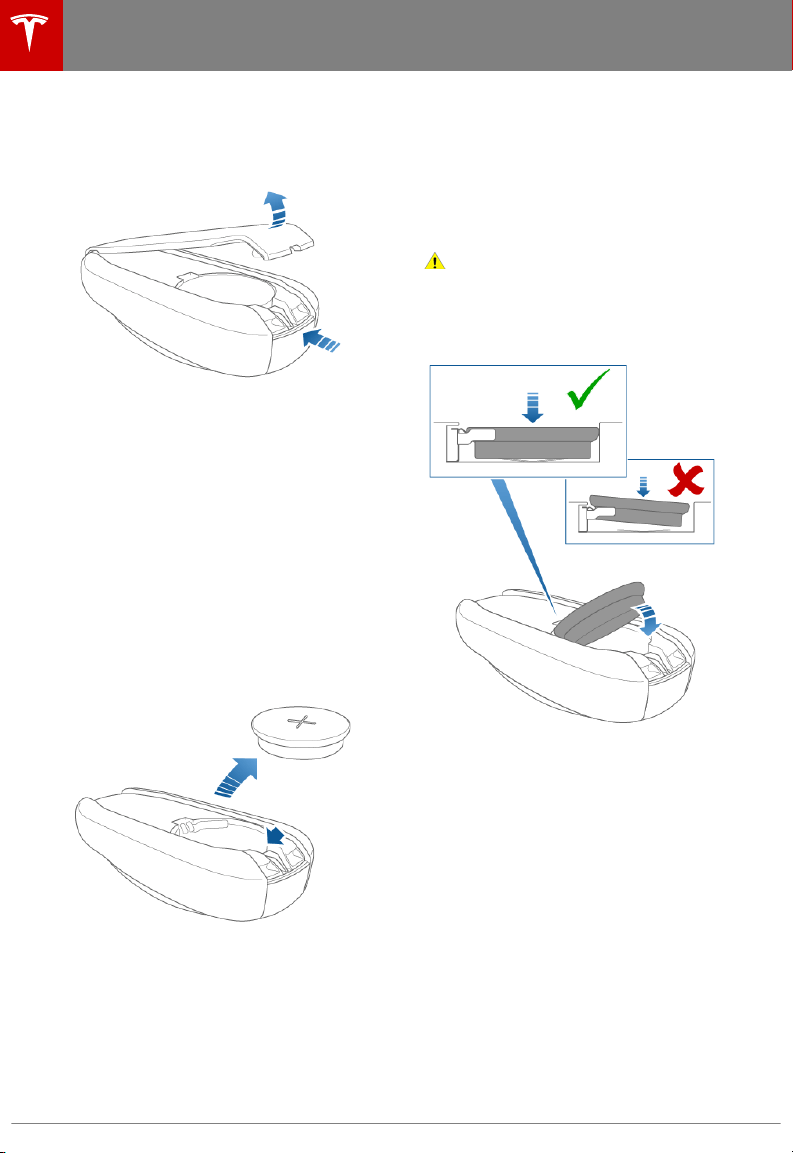
1. With the key placed button side down on
a soft surface, use a small flat-bladed tool,
a fingernail, or the Tesla-provided tool* to
release the bottom cover.
*For convenience, Tesla provides a special
tool to make it easy to open the battery
cover. This tool was included in the box
containing your key when Model X was
initially purchased.
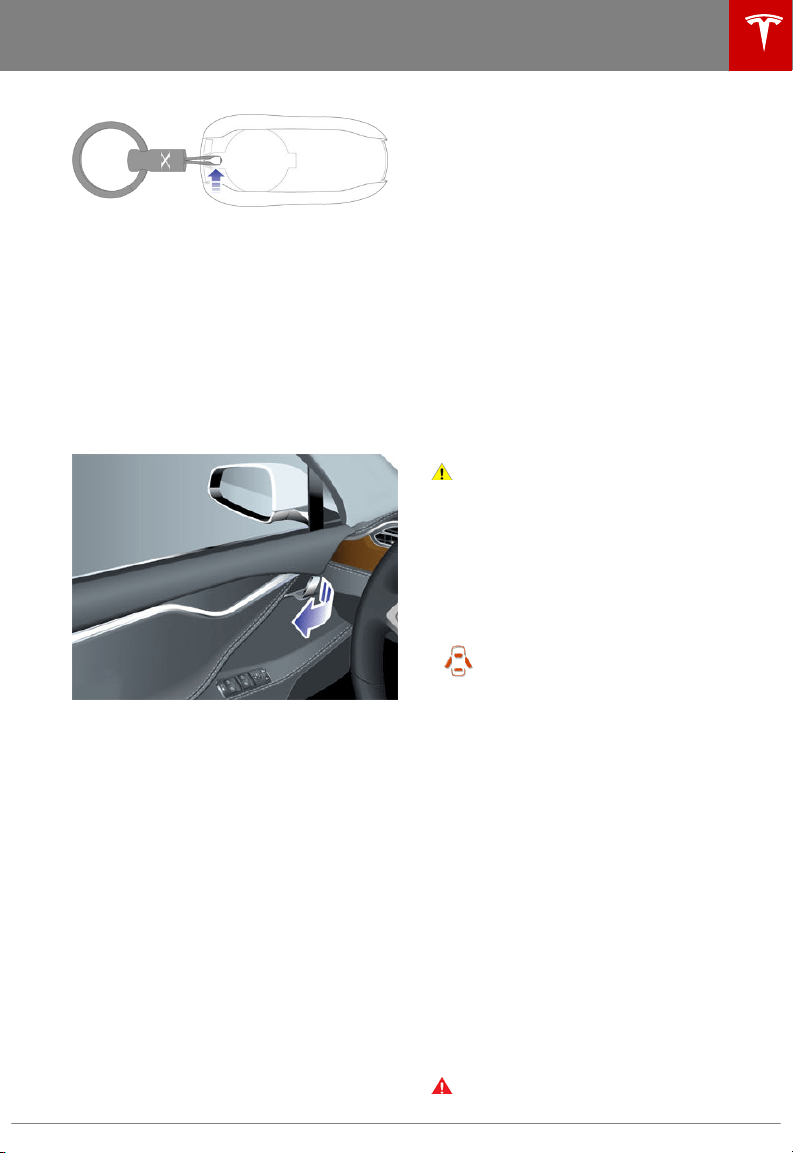
Note: If a lanyard is attached to the key
(see Attaching a Lanyard on page 6),
you can release the bottom cover by
placing your thumb against the "X" on the
bottom cover, then
firmly pulling the
lanyard toward you (hence pushing the
key
o of its cover). You can also pry the
cover o by placing a small flat-bladed
tool, a fingernail, or the Tesla-provided
tool against the lanyard cord.
2. Remove the battery by sliding it out at an
angle.
3.
Insert the new battery (type CR2354) with
the ‘+’ side facing up. The battery fits
snugly so you must slide it into position at
an angle toward the Positive contact (the
contact located near the center of the
key), then press down firmly on the other
side, ensuring it is held firmly in its
intended position.
Caution: The battery should press
against the spring on the positive
contact. Do not place the battery on
top of the contact and force it down
vertically. Doing so may damage the
contact.
Note:
Wipe the battery clean before
fitting and avoid touching the battery's
flat surfaces. Finger marks on the flat
surfaces of the battery can reduce battery
life.
4. Holding the cover at an angle, align the
tabs on the widest side of the cover with
the corresponding slots on the key, then
press the cover
firmly onto the key until it
snaps into place.
Attaching a Lanyard
The Model X key supports the use of a small
lanyard. To attach a lanyard, release the
bottom cover as described above. Place the
lanyard over the pin on the back side of the
key. Re-align the cover and snap into place.
Doors
6 Model X Owner's Manual
Getting More Keys
If you lose a key or require an additional one,
contact Tesla. Model X can recognize up to
eight keys.
When ordering a new key for Model X, take all
available keys with you for reprogramming.
Opening Doors from the Interior
To open a front door, pull the interior door
handle toward you.
You can also use the touchscreen to open and
close doors when inside Model X. Touch
Controls > Doors, then choose the door you
want to open or close. In addition, if Model X
is equipped with the premium upgrades
package, when you press the brake pedal, the
driver's door automatically closes.
Note: To prevent children from opening falcon
wing doors using the interior handles, use the
touchscreen, Controls > Settings > Doors &
Locks > Child Protection Lock, to turn on the
child-protection locks (see Child-protection
Lock on page 10).
Opening and Closing Front Doors
from Outside Model X
Model X doors are electrically powered. When
you approach Model X carrying the key, you
can specify whether just the driver's door
unlocks or all doors unlock. On the
touchscreen, touch Controls > Settings >
Doors & Locks > DOOR UNLOCK MODE and
choose DRIVER or ALL.
If equipped, you can also set the driver's door
to unlock and open automatically upon your
approach. The door partially opens (between
20° and 45° depending on obstacles detected
by sensors). Touch Controls > Settings >
Doors & Locks > AUTOMATIC DOORS > ON.
To open the driver's door when this setting is
on, double-click the key's lock/unlock button.
To open the front passenger's door, double-
click the key's lock/unlock button again.
Caution: The front doors may not fully
open or close automatically when parked
on a very steep hill. Never rely on Model X
to fully open or close the doors for you
when parked on a steep hill.
Note:
Depending on date of manufacture and
options chosen at time of purchase, your
Model X may not be equipped with
AUTOMATIC DOORS.
Whenever a door is open, the Door
Open indicator displays on the
instrument panel. The image of the
Model X on the touchscreen Controls
window also shows which door or
trunk is open.
To close doors, you can:
• manually push them shut
• use the touchscreen (Controls > Doors)
• if the CLOSE ALL WITH KEY FOB setting
is set to OFF, triple-click the key's lock/
unlock button (this closes and locks all
doors and trunks)
• if the CLOSE ALL WITH KEY FOB setting
is set to ON, single-click the key's lock/
unlock button (this closes and locks all
doors and trunks)
You can also close an exterior front door by
touching its handle when the door is already
open.
Note: Powered doors stop moving if an
obstacle is detected.
Warning:
Before using an automatic
feature to open or close a front door
Doors
Opening and Closing 7

(rather than doing so manually), it is
important to check that the area around
the door is free of obstacles (such as
people and objects). You must proactively
monitor the door's movement to ensure
that it does not contact a person or
object. Failure to do so can result in
damage or serious injury.
Opening and Closing Falcon Wing
Doors
Model X has electrically-powered falcon wing
doors that easily open and close by pressing a
button, using the key, or touching the controls
on the touchscreen (Controls > Doors). The
falcon wing doors are equipped with several
sensors that detect the presence of people
and objects and, if an object is detected, the
door stops moving. Based on detected
objects, the doors may adjust their outward
and upward movement in an attempt to avoid
contacting the object. For example, if an
object is detected above Model X, the door's
movement may extend further outward but
lower, whereas if an object is detected beside
the door, the door may extend outward much
less.
Warning: It is important to keep your
hands clear of the falcon wing door
frames at all times. Proactively check the
door frame area prior to closing, and
monitor the movement of the door during
closing to ensure that it does not come
into contact with a person or object.
Failure to do so can result in damage or
serious injury.
Warning: Before opening or closing a
falcon wing door, it is important to check
that the area around the door is free of
obstacles (people and objects). Although
the doors have many sensors, it can not
detect all objects at all times, particularly
when moving. At any given moment,
there may be areas near the door that are
not in the detection zone. Therefore,
when opening or closing a falcon wing
door, you and your passengers must
stand away from the door as it is moving,
while proactively monitoring the door's
movement and being prepared to take
corrective action at any time. To stop a
door from moving, single-click the falcon
wing door button on the key, press the
switch on the door or door pillar, or touch
the button on the touchscreen.
To open a falcon wing door from outside
Model X, press the door handle or press the
falcon wing door button on the key (see Using
the Key on page 4).
To open a falcon wing door from inside Model
X, use the switch located on the door pillar, or
touch the door controls on the touchscreen
(Controls > Doors):
Note:
If Model X is locked, using the switch
(illustrated above) the
first time unlocks the
associated door. Pulling it a second time
opens it.
To close a falcon wing door, press the button
located on the inside of the door. You can also
use the key (see Using the Key on page 4),
use the switch on the door pillar (illustrated
above), or touch the door controls on the
touchscreen (Controls > Doors):
Note: To prevent children from opening falcon
wing doors using the interior switch, turn on
child-protection locks using the touchscreen
(Controls > Settings > Doors & Locks >
CHILD-PROTECTION LOCK). See Child-
protection Lock on page 10.
Doors
8 Model X Owner's Manual
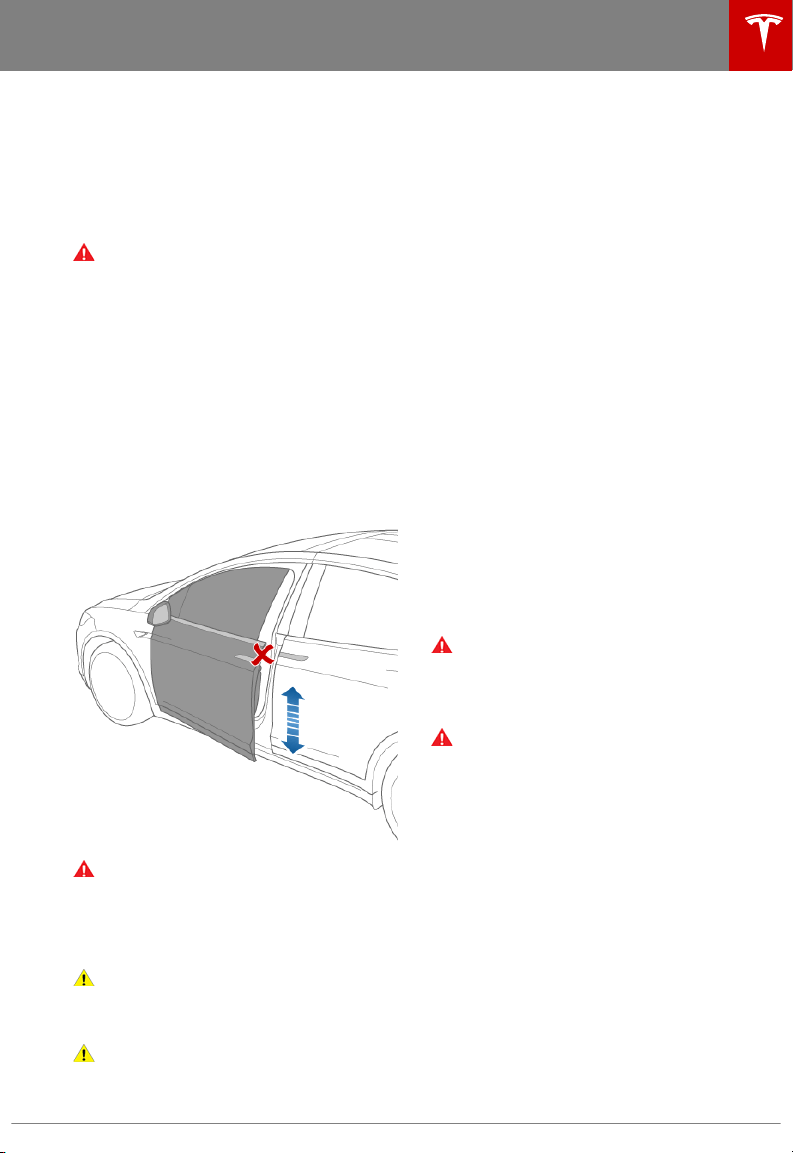
Note: You can configure Model X to open the
falcon wing doors to a lower height setting by
using the touchscreen (Controls > Settings >
Doors & Locks > FALCON DOOR HEIGHT).
Note: If a falcon wing door detects an
obstacle while closing, it reverses a few inches
before it stops moving.
Warning: Whenever a front door is
partially open (approximately 20°) as you
are opening or closing the associated
falcon wing door, you MUST keep your
hands (or any object) away from the
opening edge of the front door. When a
falcon wing door passes by a partially
opened front door, the distance between
the two doors is very narrow. Objects,
such as hands or
fingers, placed in this
area, are not detected by sensors and can
therefore become pinched between the
doors. To avoid bodily injury, it is a good
practice to keep your hands away from
the front door whenever you are opening
or closing a falcon wing door.
Warning: When opening or closing a
falcon wing door, it is important to
proactively monitor the movement of the
door to ensure that it does not come into
contact with a person or object. Failure to
do so can cause serious damage or injury.
Caution: Remove accumulation of snow
or ice before opening a falcon wing door.
Snow can get inside Model X and ice can
prevent the door from opening.
Caution: In rainy weather, leaving a falcon
wing open while opening the liftgate can
result in rain water falling from the liftgate
into the rear seating area.
Note: Falcon wing doors open only when
Model X is stationary.
Obstacle Detection
A falcon wing door stops moving when one of
its many sensors detects an obstacle, or when
the door senses resistance because it has
made contact with an object. The touchscreen
displays a warning on the Doors tab. In these
cases, provided it is appropriate to continue
opening or closing the falcon wing door, you
can override obstacle detection by doing any
of the following:
• Pressing and holding the switch located
on the door pillar.
• Touch and hold the appropriate door icon
on the touchscreen.
When Model X detects a low ceiling (for
example, in a garage), it opens the falcon wing
doors (and trunk) to a lower height, even if no
obstacle is detected. You can override this
height and open the doors higher by touching
the associated door icon on the touchscreen
(Controls > Doors). Model X asks you on the
touchscreen if you always want to open the
doors to the higher height in this location, and
saves your choice. The next time you open the
falcon wing doors in this location, Model X
opens them to the height you saved.
Warning: Before overriding a falcon wing
door's default opening height, visually
inspect the area to ensure adequate
clearance between the door and the
detected object.
Warning: Applying adhesive products
such as wraps, stickers, rubber coating,
etc. on the outside of the falcon wing
doors can aect the sensors’ ability to
detect obstacles properly.
Calibration
If the falcon wing doors lose calibration, a
message displays on the touchscreen. To
calibrate the doors, first ensure that both
doors have plenty of space to open and close
and are clear of passengers, objects, etc. Then
press and hold the Calibrate button until
five
seconds after calibration is complete. During
calibration, the lower door opens all the way
out (requiring extra space on the side of
Model X), the upper doors move all the way
down, and then the lower door closes.
Doors
Opening and Closing 9

Interior Locking and Unlocking
From inside Model X, you can use the
touchscreen to lock or unlock doors and
trunks, provided a valid key is inside the
vehicle. Touch the lock icon on the
touchscreen's status bar.
When you stop Model X and engage the Park
gear, you can choose whether you want doors
to unlock or remain locked. To do so, touch
Controls > Settings > Doors & Locks >
UNLOCK ON PARK. When set to ON, doors
automatically unlock when you engage the
Park gear.
You can also unlock doors by pressing the
Park button on the end of the gear selector a
second time (i.e., after pressing it one time to
engage the Park gear).
Note: If a door or trunk is still open when you
lock Model X, it locks when you close it.
Door Unlock Mode
You can choose whether you want all doors,
or just the driver's door, to unlock when you
approach your vehicle carrying your key. To do
so, touch Controls > Settings > Doors &
Locks > DOOR UNLOCK MODE and choose
DRIVER or ALL.
Child-protection Lock
Model X has child-protection locks on the
falcon wing doors and liftgate to prevent them
from being opened using interior handles. Use
the touchscreen to turn child protection locks
on or
o. Touch Controls > Settings > Doors &
Locks > CHILD-PROTECTION LOCK.
Note: It is recommended that you turn child-
protection locks on whenever children are
seated in the rear seats.
Drive-away Locking
Model X automatically locks all doors
(including the trunks) whenever your driving
speed exceeds 8 km/h.
Walk-away Locking
Doors and trunks can automatically lock
whenever you walk away carrying the key.
To turn this feature on or
o, touch Controls >
Settings > Doors & Locks > WALK-AWAY
DOOR LOCK.
Note:
If all doors are closed and you use the
key to unlock Model X, walk-away locking is
temporarily suspended for one minute. If you
open a door within this minute, it does not re-
lock until after all the doors are closed and
you have walked away with the key.
Doors
10 Model X Owner's Manual
Unlocking When the Key Doesn't
Work
If Model X does not unlock when you walk up
to it, or when you press the unlock button on
your key, the key’s battery may be dead. If this
is the case, you can still unlock and drive
Model X.
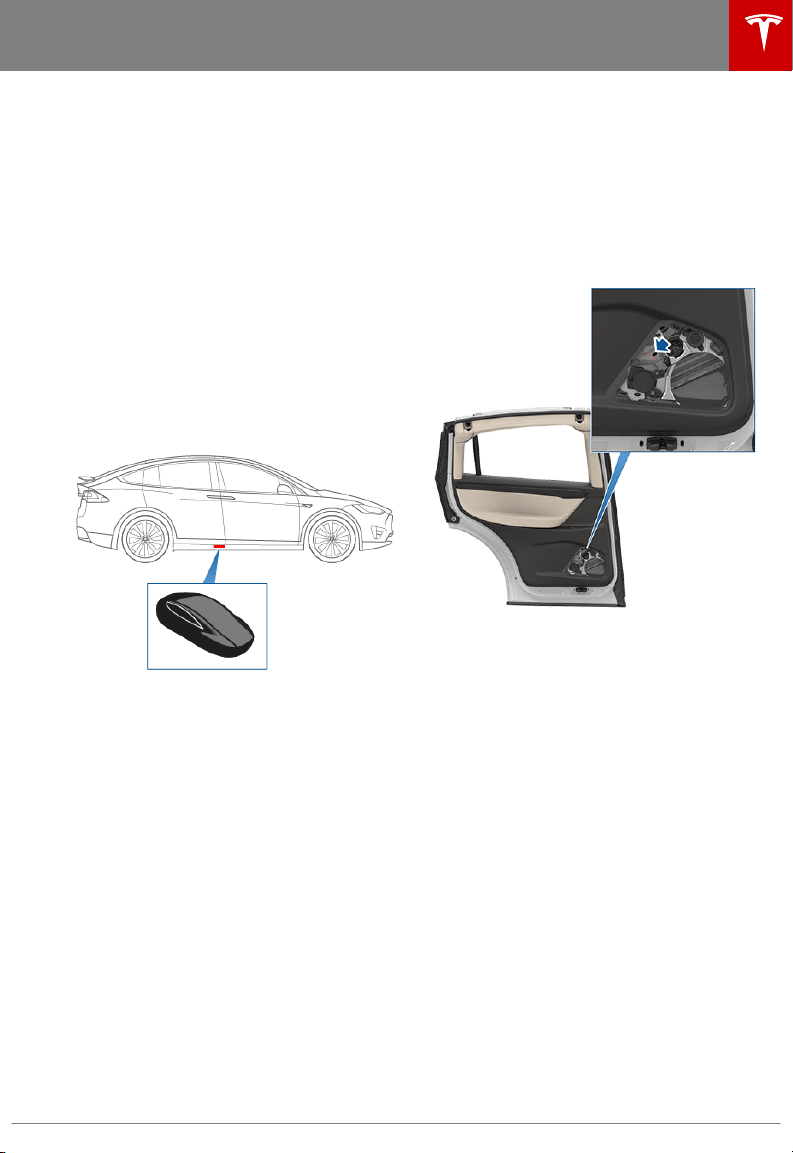
To unlock Model X (and disable the security
alarm),
first position the key at the base of the
door pillar between the front door and the
falcon wing door, on the driver's side of the
vehicle, as shown. Then press the front driver's
door handle. If Model X doesn't unlock, try
adjusting the position of the key. The key must
be in the correct position. If Model X still
doesn't unlock, remove the key's battery and
try again. See Replacing the Key Battery on
page 5.
To drive Model X, place the key against the
center console, immediately below the 12V
power outlet, then press and hold the brake
pedal to turn Model X on.
Note: Unlocking Model X using this method
disables walk-away locking. You must
manually re-enable walk-away locking after
replacing the key’s battery.
For instructions on how to replace the key’s
battery, see Replacing the Key Battery on
page 5.
Opening Interior Doors with No
Power
If Model X has no electrical power, the front
doors open as usual using the interior door
handles. To open the rear doors, carefully
remove the speaker grille from the door and
pull the mechanical release cable down and
towards the front of the vehicle. After the
latch is released, manually lift up the door.
Doors
Opening and Closing 11
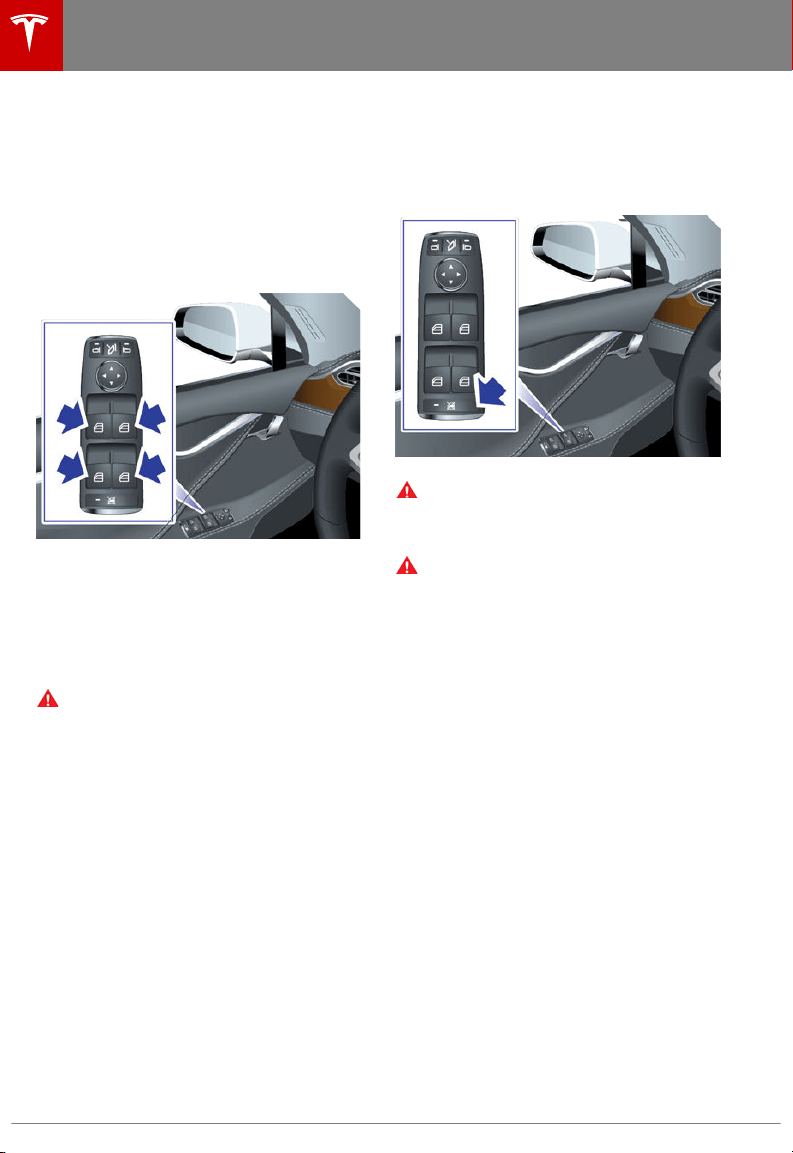
Opening and Closing
Press down on a switch to lower the
associated window. Window switches operate
at two levels:
• To lower a window fully, press the switch
all the way down and immediately release.
• To lower a window partially, press the
switch gently and release when the
window is where you want it.
Similarly, pull a switch to raise the associated
window:
• To raise a window fully, pull the switch all
the way up and immediately release.
• To raise a window partially, pull the switch
gently and release when the window is
where you want it.
Warning:
Before closing a window, it is
the driver’s responsibility to ensure that
all occupants, especially children, do not
have any body parts extended through
the window’s opening. Failure to do so
can cause serious injury.
Locking Rear Windows
To prevent passengers from using the rear
window switches, press the rear window lock
switch. The switch light turns on. To unlock
rear windows, press the switch again.
Warning: To ensure safety, it is
recommended that you lock the rear
window switches whenever children are
seated in the rear seats.
Warning: Never leave children
unattended in Model X.
Windows
12 Model X Owner's Manual
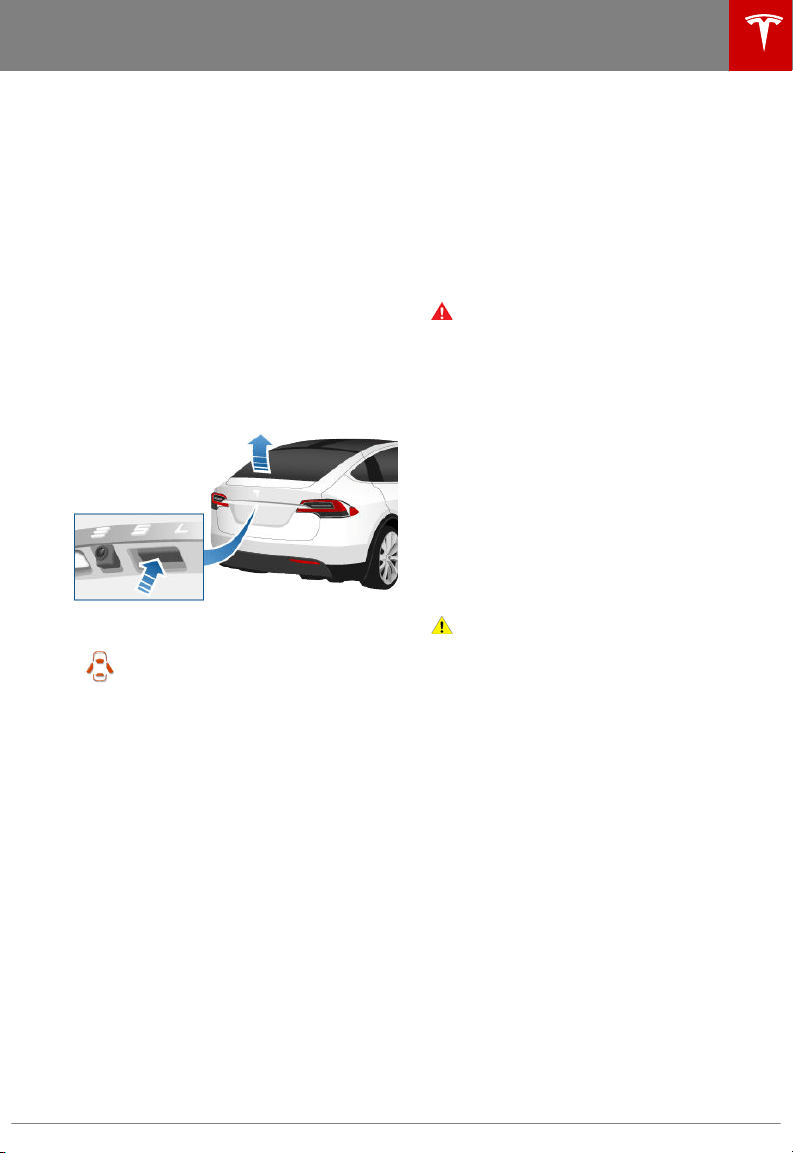
Opening
To open the rear trunk, do one of the
following:
• Touch Controls > Trunk on the
touchscreen.
• Double-click the rear trunk button on the
key.
• Touch the trunk button on the mobile app.
• With Model X unlocked, press the switch
located under the rear trunk's exterior
handle.
Note: If Passive Entry is
o, you must use the
key to unlock Model X before you are able to
manually open the rear trunk using the switch.
See Using the Key on page 4.
When a door or trunk/liftgate is
open, the instrument panel displays
the Door Open indicator light. The
image of the Model X on the
touchscreen Controls window also
displays the open trunk.
To stop a powered liftgate while it is moving,
single-click the rear trunk button on the key.
Then, when you double-click the rear trunk
button, it moves again, but in the opposite
direction (provided it was not almost entirely
open or closed when you stopped it). For
example, if you single-click to stop the liftgate
while it is opening, when you double-click, it
closes.
To open the trunk from inside Model X in the
unlikely situation that Model X has no power,
see Interior Emergency Trunk Release on page
14.
If Model X detects a low ceiling (for example,
in a garage), it opens the rear trunk (and
falcon wing doors) to a lower height, even if
no obstacle is detected. You can override this
height manually by opening the rear trunk to a
higher height. Model X asks you on the
touchscreen if you always want to open the
trunk to the higher height in this location, and
saves your choice. The next time you open the
falcon wing doors in this location, Model X
opens them to the height you saved.
Warning: Before opening or closing the
rear liftgate, it is important to check that
the area around the liftgate is free of
obstacles (people and objects). Although
the powered liftgate can detect obstacles,
it can not detect all objects at all times.
Do not rely on the liftgate to sense an
obstruction when opening or closing. You
must proactively monitor the liftgate to
ensure that it does not come into contact
with a person or object. Failure to do so
may result in damage or serious injury.
Load Limits
Secure all cargo before moving Model X, and
place heavy cargo in the lower trunk
compartment.
Caution: To avoid damage, never load
more than 175 lbs (80 kg) on the rear load
floor (above the lower trunk
compartment) or more than 130 lbs (60
kg) in the lower trunk compartment.
Doing so can cause damage.
Closing
To close the powered liftgate, do one of the
following:
• Double-click the trunk button on the key.
• Touch Controls > Trunk on the
touchscreen.
• Press the switch located on the underside
of the liftgate (see Adjusting the Opening
Height on page 14).
If a powered liftgate senses an obstruction
when closing, it automatically opens and
sounds two chimes. Remove the obstruction
and try closing it again. If it cannot close the
second time, powered operation is temporarily
disabled. Close it manually to restore powered
operation.
Note: The power closing feature is also
temporarily disabled if you leave the powered
liftgate open for more than an hour.
Rear Trunk
Opening and Closing 13
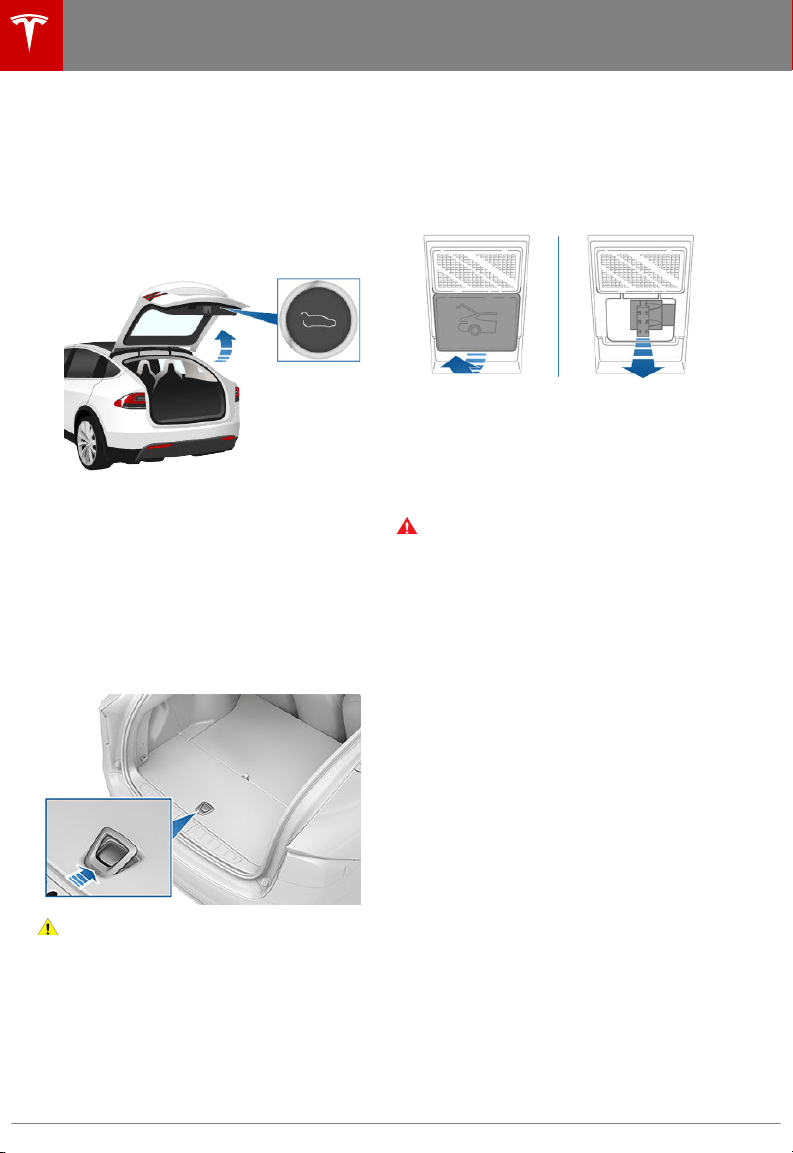
Adjusting the Opening Height
You can adjust the opening height of the
powered liftgate to make it easier to reach:
1. Open the liftgate, then manually lower or
raise it to the desired opening height.
2. Press and hold the button on the
underside of the liftgate for two seconds
until you hear a
confirmation chime.
3. Confirm that you have set it to the desired
height by closing the liftgate, then
reopening it.
Accessing the Cargo Area
To access the cargo area inside the Model X
rear trunk, push down on the ridged portion of
the handle of the cargo cover and then pull
up. You can then adjust the position of the
cargo cover or completely remove it from
Model X.
Caution:
Never load more than 175 lbs
(80 kg) on the rear load floor (above the
lower trunk compartment) or more than
130 lbs (60 kg) in the lower trunk
compartment. Doing so can cause
damage.
Interior Emergency Trunk Release
An illuminated mechanical release located
inside the rear trunk allows you to open the
rear trunk from the inside if Model X has no
electrical power. This mechanical release also
allows a person locked inside to get out.
1. Remove the cover by pulling its lower
edge very firmly toward you.
2. Pull the cable to release the latch.
3. Push the rear trunk open.
Note: The button glows for several hours after
a brief exposure to ambient light.
Warning: Do not allow children to play
inside the trunk or become locked inside.
An unrestrained child could suer serious
injury or death in a crash. A child could
suer heat exhaustion if trapped in the
vehicle, especially without climate control
on.
Rear Trunk
14 Model X Owner's Manual
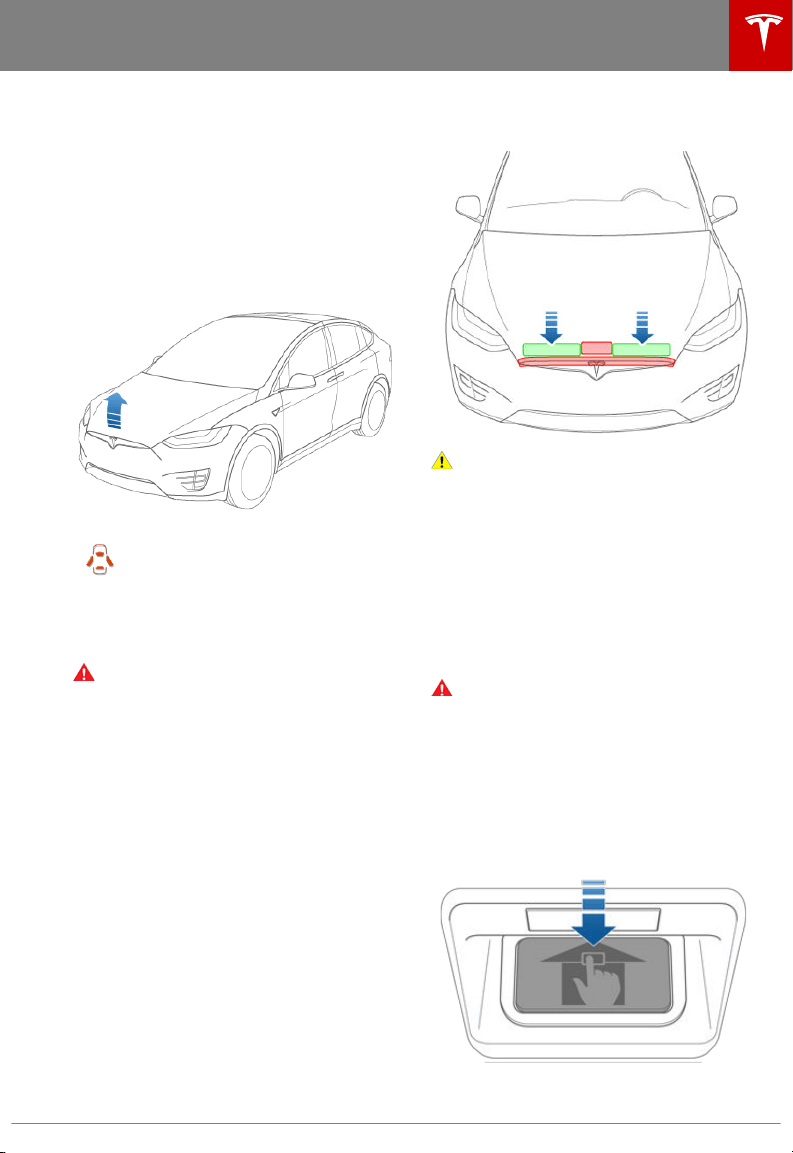
Opening
To open the front trunk:
1. Ensure that the area around the hood is
free of obstacles.
2. Touch Controls > Front Trunk on the
touchscreen, touch the front trunk button
on the mobile app, or double-click the
front trunk button on the key.
3. Pull the hood up.
When a door or trunk/liftgate is
open, the instrument panel displays
the Door Open indicator light. The
image of the Model X on the
touchscreen Controls window also
displays the open front trunk.
Warning: Before opening or closing the
hood, it is important to check that the
area around the hood is free of obstacles
(people and objects). Failure to do so
may result in damage or serious injury.
Note: The front trunk locks whenever closed
and you lock Model X using either the
touchscreen or externally using the key or
mobile app, you leave Model X carrying your
key (if Walk-away Locking on page 10 is
turned on), or when Valet mode is active (see
Valet Mode on page 46).
Closing
The Model X hood is not heavy enough to
latch under its own weight and applying
pressure on the front edge or center of the
hood can cause damage.
To properly close the hood:
1. Lower the hood until the striker touches
the latches.
2. Place both hands on the front of the hood
in the areas shown (in green), then press
down
firmly to engage the latches.
3.
Carefully try to lift the front edge of the
hood to ensure that it is fully closed.
Caution: To prevent damage:
• Apply pressure only to the green
areas shown. Applying pressure to
the red areas can cause damage.
• Do not close the hood with one hand.
Doing so applies concentrated force
in one area and can result in a dent or
crease.
• Do not apply pressure to the front
edge of the hood. Doing so can
crease the edge.
• Do not slam or drop the hood.
Warning: Before driving, you must ensure
that the hood is securely latched in the
fully closed position by carefully trying to
lift the front edge of the hood upward
and confirming there is no movement.
Interior Emergency Release
An illuminated interior release button inside
the front trunk allows a person locked inside
to get out.
Press the interior release button to open the
front trunk, then push up on the hood.
Front Trunk
Opening and Closing 15

Note: The interior release button glows
following a brief exposure to ambient light.
Warning: People should never climb
inside the front trunk. Never shut the
front trunk when a person is inside.
Warning: Care should be taken to ensure
that objects inside the front trunk do not
bump against the release button, causing
the trunk to accidentally open.
Front Trunk
16 Model X Owner's Manual
Opening and Closing
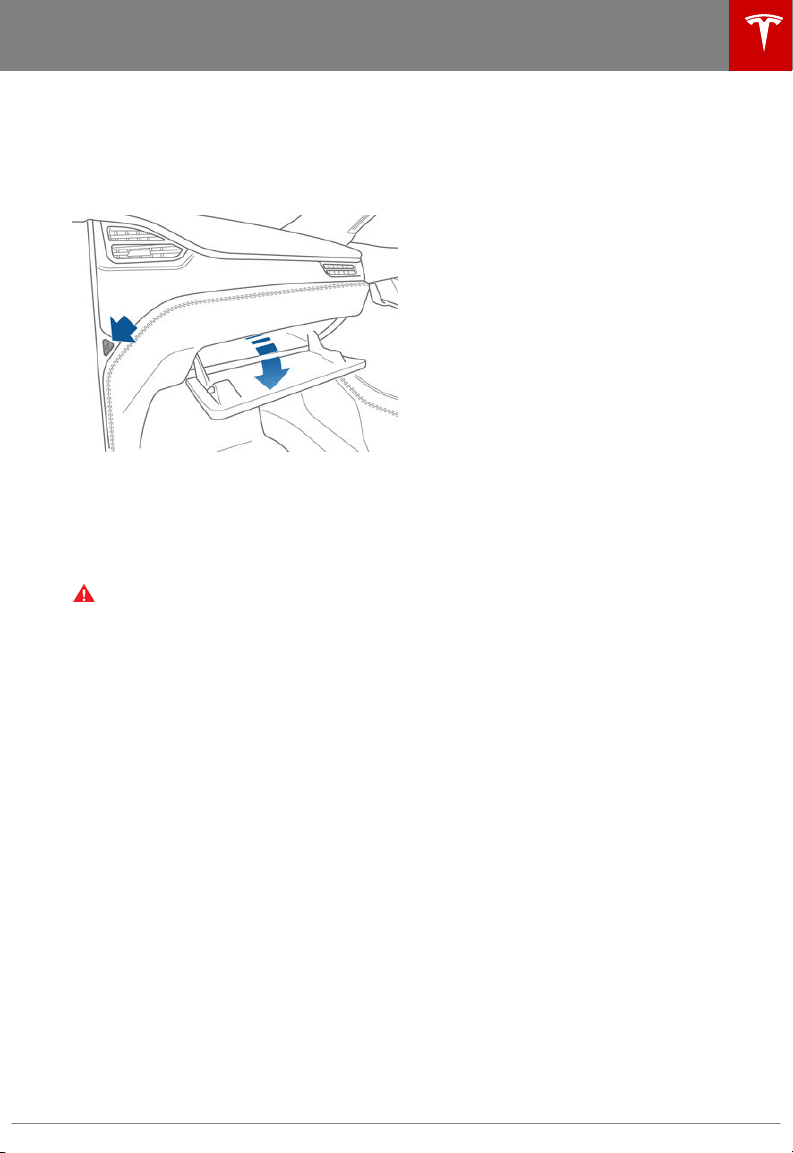
To open the glove box, press the switch
located on the side of the touchscreen. If you
leave the glove box open for five minutes, its
light automatically turns o.
Note: The glove box locks whenever Model X
is locked externally, using the key or walk-
away locking. It also locks when Model X is in
Valet mode (see Valet Mode on page 46). It
does not lock when Model X is locked using
the touchscreen.
Warning: When driving, keep the glove
box closed to prevent injury to a
passenger if a collision or sudden stop
occurs.
Glove Box
Opening and Closing 17
Opening and Closing
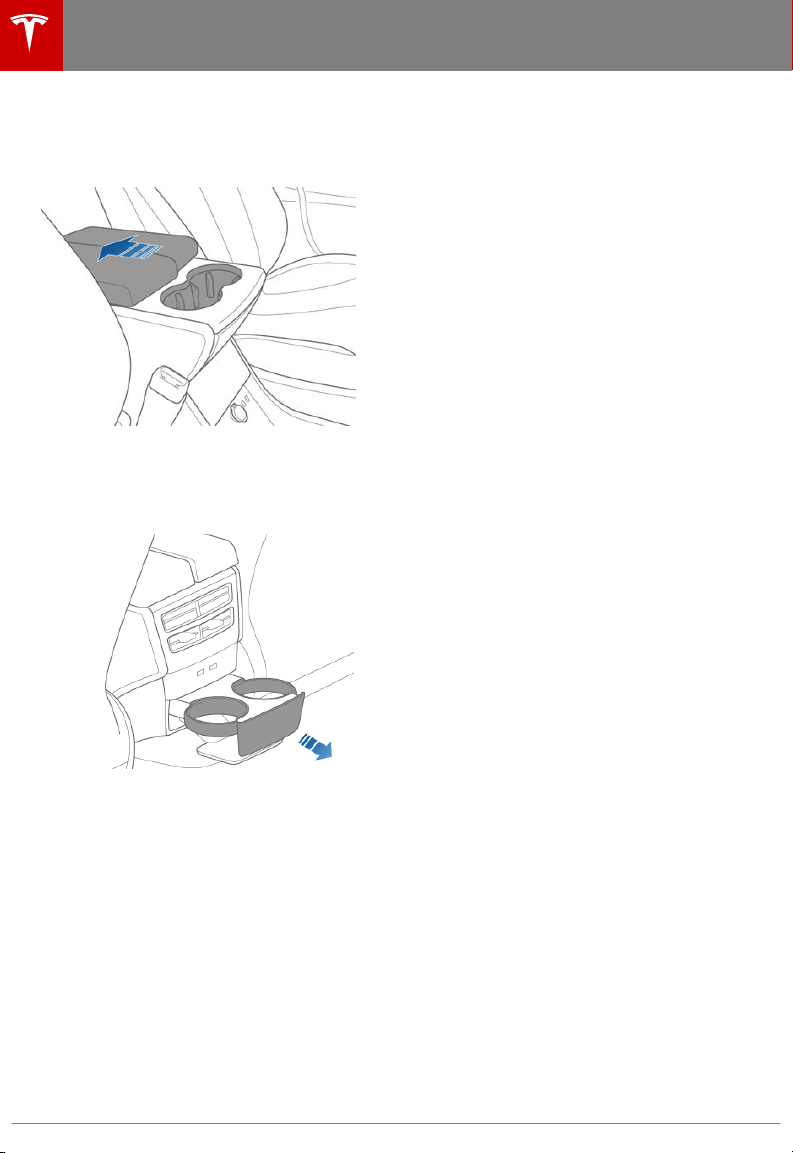
To expose a front cup holder, slide back the
armrest.
To expose rear cup holders (if available on
your vehicle), press and release the cup holder
face plate located at the back of the center
console.
Cup Holders
18 Model X Owner's Manual
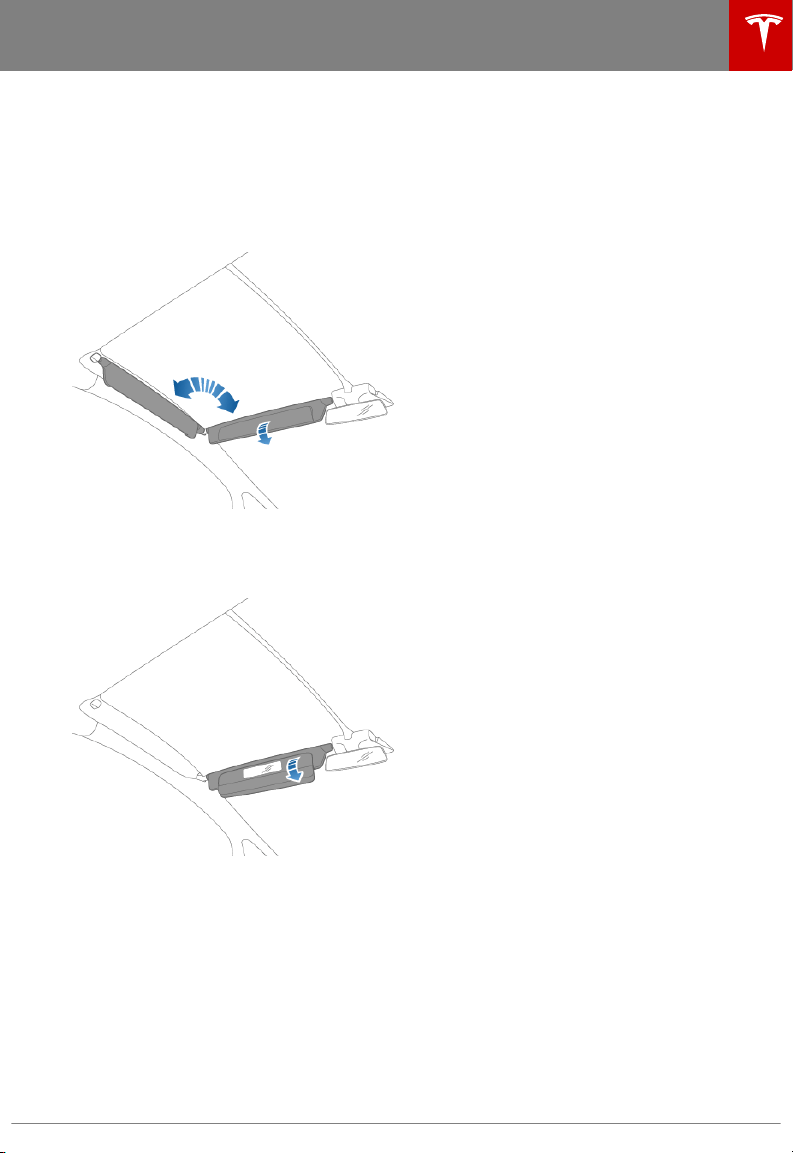
The sun visors in Model X are held in place by
magnets. To protect occupants from sunlight
coming through the windshield, release the
sun visor from the pillar and pivot it toward
the rear view mirror until the magnet snaps
into place. While held in place by the magnet,
you can adjust the sun visor and lower the
extender to provide maximum shade.
To expose the vanity mirror, lower the visor
extender then lower the mirror cover. While
the cover is lowered, the mirror is exposed and
lights are illuminated.
To protect front seat occupants from sunlight
coming through the side window, lower the
sun visor from the pillar then lower the visor
extender.
Sun Visors
Opening and Closing 19
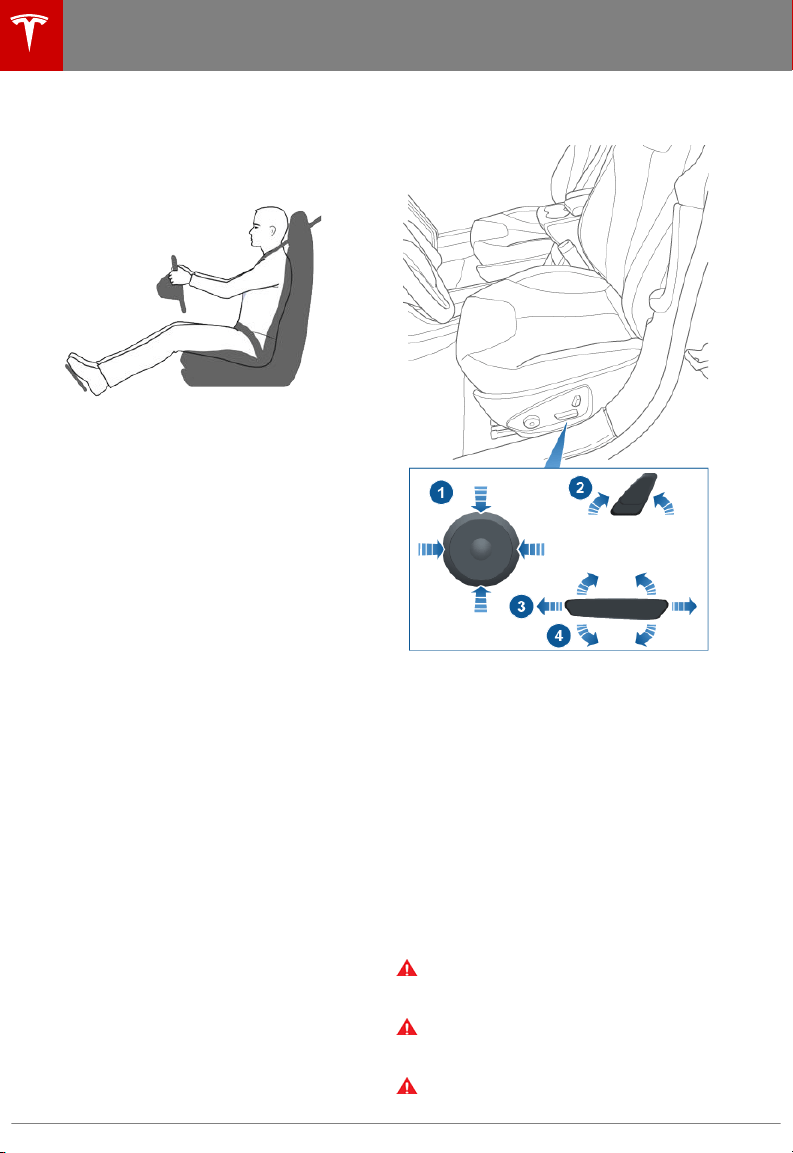
Correct Driving Position
The seat, head restraint, seat belt and airbags
work together to maximize your safety. Using
these correctly ensures greater protection.
Position the seat so you can wear the seat belt
correctly, while being as far away from the
front airbag as possible:
1. Sit upright with both feet on the
floor and
the seat back reclined no more than 30
degrees.
2. Make sure you can easily reach the pedals
and that your arms are slightly bent when
holding the steering wheel. Your chest
should be at least 25 cm from the center
of the airbag cover.
3. Place the shoulder section of the seat belt
mid-way between your neck and your
shoulder. Fit the lap section of the belt
tightly across your hips, not across your
stomach.
Adjusting the Driver’s Seat
1. Adjust lumbar support.
Note: This button is also used to moved
the head support up or down (see Head
Supports/Restraints on page 25). When
you touch this button, the touchscreen
displays a popup with an image of the
seat. If the lumbar area on the image is
not highlighted in blue, touch the lumbar
area on the image to specify that you
want to adjust lumbar support. The
selection you choose is retained until you
manually change it.
2. Adjust backrest.
3. Move seat forward/backward.
4. Adjust the seat’s height and tilt angle.
Warning:
Before adjusting a front seat,
check that the area around the seat is
free of obstacles (people and objects).
Warning: Do not adjust seats while
driving. Doing so increases the risk of a
collision.
Warning: Riding in a moving vehicle with
the seat back reclined can result in
Front and Rear Seats
20 Model X Owner's Manual
serious injuries in a collision, as you could
slide under the lap belt or be propelled
into the seat belt. Ensure your seat back
is reclined no more than 30 degrees when
the vehicle is moving.
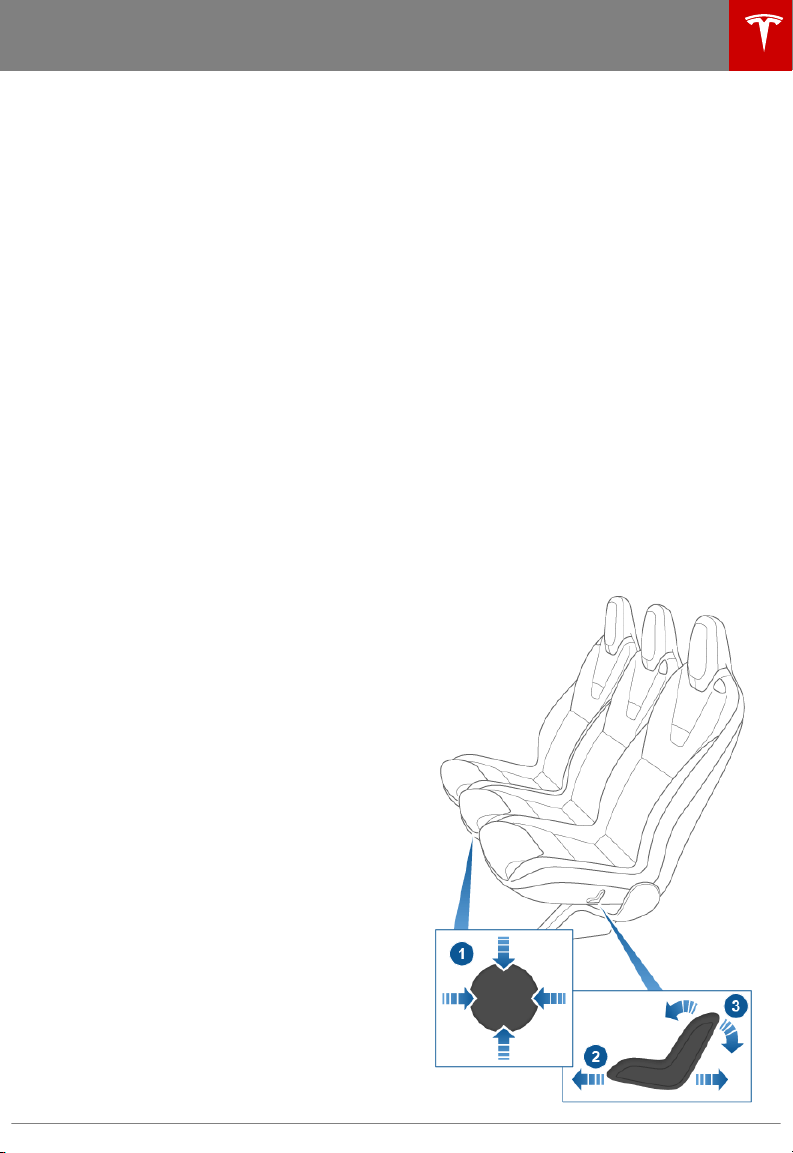
Adjusting Second Row Monopost
Seats
A Model X equipped with monopost seats can
accommodate up to three passengers in the
second row, depending on the option chosen
at time of purchase. There are two ways to
adjust the position of these seats:
• Touch Controls > Seats on the
touchscreen. Press and hold the icon on
the touchscreen to adjust the associated
seat. White icons indicate that the seat
can be moved in that direction; gray icons
indicate that the seat cannot be moved
any farther in that direction.
Note: If necessary, the front seats may
move forward slightly to accommodate
the forward movement of the monopost
seats.
• Use the manual adjustments illustrated
below. In addition to moving a seat
forward/rearward, the manual seat
adjustments allow you to adjust the
backrest. Although the control on the
outboard seats is L-shaped, and the
control on the middle seat is circular, they
both provide the same functions.
Front and Rear Seats
Seating and Safety Restraints 21

1. Move seat forward/backward (up/down
on the control) and adjust the backrest
(left/right on the control).
2. Move seat forward/backward.
3. Adjust backrest.
Note: The backrest locks into position when
you release the lever. If a backrest is not
locked into position when a driving gear is
engaged, the instrument panel displays an
alert for the unlocked backrest. Adjust the
backrest again, ensuring it locks into position.
Warning: Riding in a moving vehicle with
the seat back reclined can result in
serious injuries in a collision, as you could
slide under the lap belt or be propelled
into the seat belt. Ensure the backs of
occupied seats are reclined no more than
30 degrees when the vehicle is moving.
Adjusting Second Row Bench Seats
If your Model X is equipped with two rows of
seats, the second row bench seats can
accommodate up to three passengers. Use the
mechanical adjustment lever located at the
side of each outboard seating position to fold
or recline the seatbacks. The bench seat is
split 60/40 so the adjustment lever on the left
side moves the seatbacks for both the left and
center seats (whereas the lever on the right
moves the rightmost seatback only). While
pulling and holding the lever, move the
seatback to the desired position, and then
release the lever. When returning a seatback
to its upright position, push and pull to ensure
it is securely latched into position.
Front and Rear Seats
22 Model X Owner's Manual
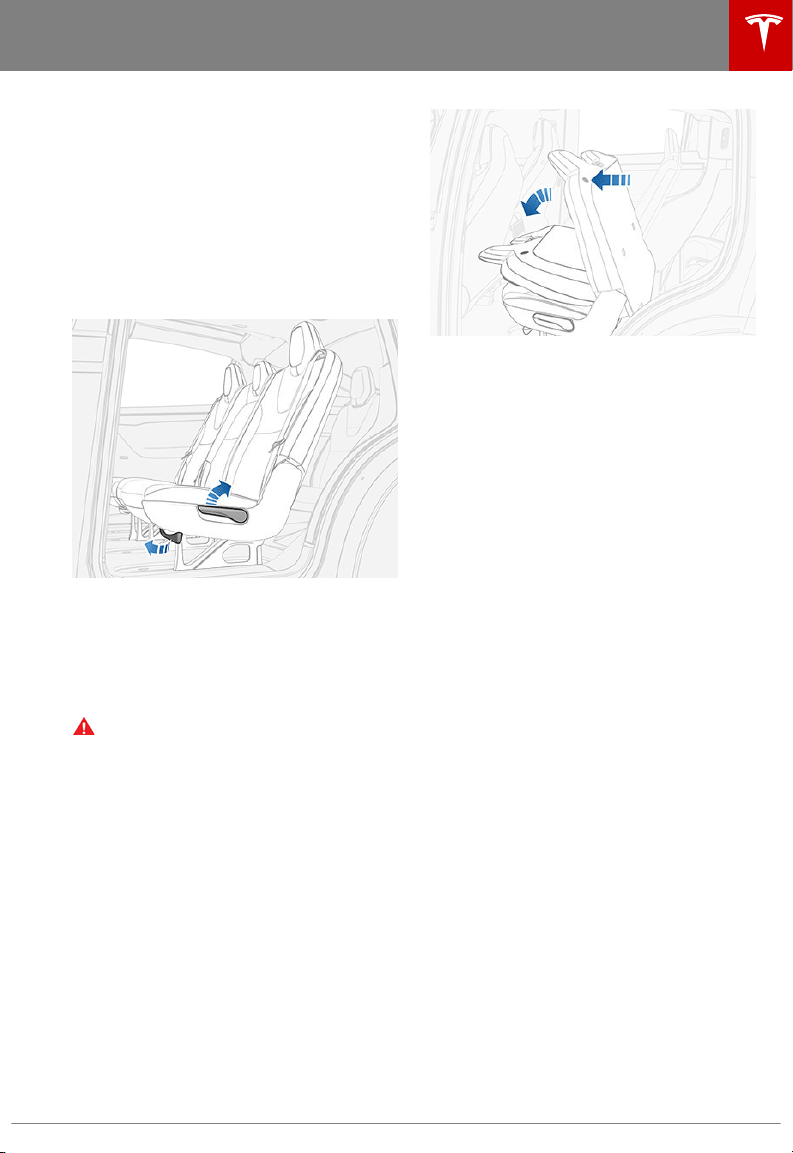
If your Model X is equipped with three rows of
seats, in addition to adjusting the seatbacks as
described above, you can use the mechanical
lever located beneath each outboard seating
position to move the second row bench seats
forward or rearward. The lever on the left side
moves the seat for the left and center seats,
and the lever on the right moves only the seat
on the right, because of the 60/40 split of the
bench seats. Pull and hold the lever to move
the seat forward or rearward to the desired
position, and then release the lever.
Note: You can adjust bench seats using only
the mechanical levers. (You cannot adjust
bench seats on the touchscreen.) A bench
seat in
five-seat vehicles cannot be moved
forward or rearward; a bench seat in seven-
seat vehicles can be moved forward and
rearward.
Warning:
Riding in a moving vehicle with
the seat back reclined can result in
serious injuries in a collision, as you could
slide under the lap belt or be propelled
into the seat belt. Ensure the backs of
occupied seats are reclined no more than
30 degrees when the vehicle is moving.
Folding Second Row Bench Seats
You can fold Model X second row bench seats
flat. Before you fold second row seats flat,
remove items from the seats and the rear
footwell. To enable the second row seatbacks
to fold completely flat, you may need to move
the front seats forward.
To fold second row bench seats
flat, simply
pull up on the mechanical lever located on the
side of each outboard seat, and fold the
seatback
flat. The adjustment lever on the left
side folds the seatbacks for both the left and
center seats, whereas the lever on the right
folds the rightmost seatback only.
Accessing Third Row Seats
Accessing third row seats when monopost
seats are installed in the second row:
The Easy Entry button located on the backrest
of each second row outboard monopost seat
makes it easy for passengers to enter and exit
the third row seating positions (if equipped).
When the Easy Entry setting is enabled (on by
default), you can tilt and move the associated
outboard seat fully forward and move the
center seat forward with a single press of the
Easy Entry button. If Easy Entry is disabled
(recommended if a child seat is installed in the
second row), you must hold the Easy Entry
button to move the seats. Touch Controls >
Settings > Vehicle > Easy Entry > OFF to
disable single press Easy Entry. After you use
Easy Entry to access third row monopost
seats, simply press the Easy Entry button on
the backrest of either outboard seat to move
the seats back to their seating position.
Front and Rear Seats
Seating and Safety Restraints 23
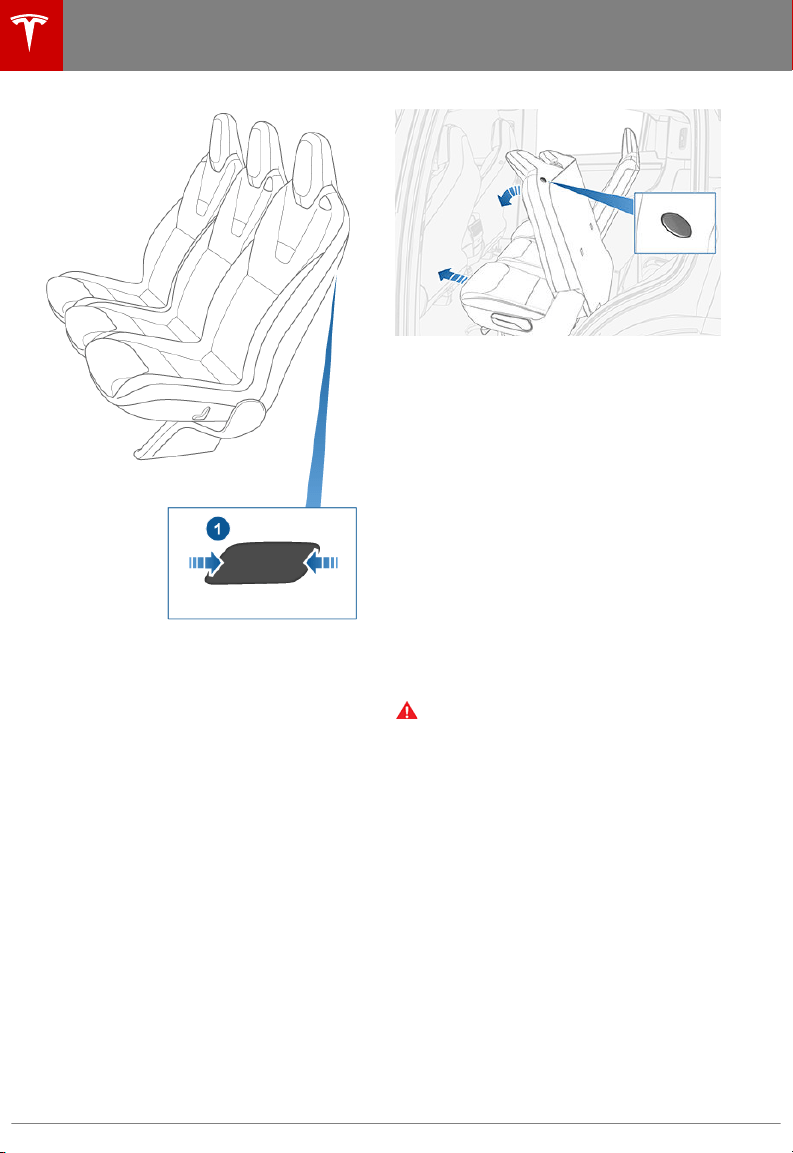
Accessing third row seats when bench seats
are installed in the second row:
The Easy Entry button located on the backrest
of each second row outboard bench seat
makes it easy for passengers to enter and exit
the third row seating positions (if equipped).
Press and release the Easy Entry button on
the left outboard seat to tilt and move the
combined left and center seats forward. Press
and release the Easy Entry button on the right
outboard seat to tilt and move the right seat
forward. After you use Easy Entry to access
the third row seats, push the bench seats back
to their seating position, ensuring the seats
are securely latched into position by pushing
and pulling on them.
Note: When bench seats are installed in the
second row, you access the third row seats
simply by pressing and releasing the Easy
Entry button.
In some situations, such as when you are
parked on an incline or when the seat trim
aects the movement of the bench seats, after
you press the Easy Entry button, the bench
seats might not move forward completely, and
you may need to push the seats forward
gently until they reach the end of the track.
If a front row seat is positioned such that the
second row monopost or bench seat will
collide with it during an easy entry operation,
it automatically moves forward just enough to
accommodate the forward position of the
second row seat.
Note: Forward movement of second row seats
cancels if an occupant adjusts a second row
seat while it is moving.
Note: When an outboard seat tilts forward for
easy entry, its backrest resets to the neutral
position and may need to be re-adjusted.
Warning:
Do not rely on Model X to
recognize or accommodate occupants
seated in the vehicle while using the Easy
Entry feature. Use Easy Entry only when
seats are unoccupied.
Folding Third Row Seats
If Model X is equipped with third row seats,
remove items from the seats and the rear
footwell before folding. To allow the third row
seat backs to fold completely
flat, you may
need to move the second row seats forward.
To fold a third row seat, press the button
located in the top outside corner of the seat.
The button has two detents.
Front and Rear Seats
24 Model X Owner's Manual
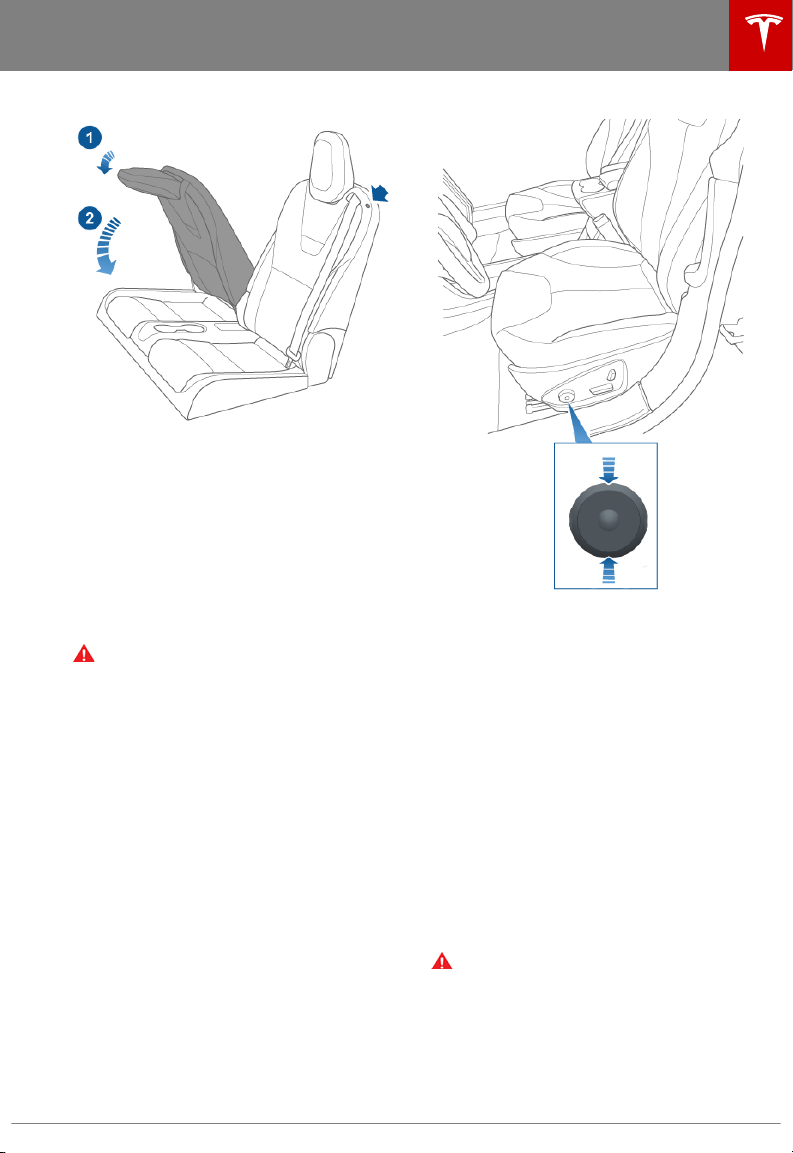
1. Fold head restraint forward.
2. Fold seat forward.
Note: If necessary, the second row seat may
move forward slightly to accommodate the
forward position of the third row seat.
Note: To raise the seats, hold the button on
the top outside corner of the seat then pull
the seat back upward until it latches into
place. To
confirm the seat back is locked in the
upright position, try pulling it forward.
Warning: Always ensure the seat backs
are locked in their upright position.
Failure to do so increases the risk of
injury.
Head Supports/Restraints
Use the round button on the seat to move the
headrest up/down. The same button is used to
adjust the seat's lumbar support (see
Adjusting the Driver’s Seat on page 20).
Therefore, when you touch this button, the
touchscreen displays a popup with an image
of the seat. If the head support shown on the
image is not highlighted in blue, touch this
area on the image to specify that you want to
adjust the head support. The selection you
choose is retained until you manually change
it. You can save the head support setting to
your driver
profile (see Driver Profiles on page
45).
The second and third row seats have
integrated non-removable head supports that
can not be adjusted. However, the head
supports in the third row seats can be folded
down for storage (see Folding Third Row
Seats on page 24).
Seat Heaters
The front seats are equipped with heating
pads that operate at three levels from 3
(highest) to 1 (lowest). To operate the seat
heaters, see Climate Controls on page 126.
If Model X is equipped with the optional cold
weather package, you can also control seat
heaters in all rear seating positions, as well as
heated wipers and washer nozzles by
touching Controls > Cold Weather (see
Controls on page 119).
Warning:
To avoid burns resulting from
prolonged use, individuals who have
peripheral neuropathy, or whose capacity
to feel pain is limited because of diabetes,
age, neurological injury, or some other
condition, should exercise caution when
using the climate control system and seat
heaters.
Front and Rear Seats
Seating and Safety Restraints 25

Seat Covers
Warning: Do not use seat covers in
Model X. Doing so could restrict
deployment of the seat-mounted side air
bags if a collision occurs.
Front and Rear Seats
26 Model X Owner's Manual
Wearing Seat Belts
Using seat belts and child safety seats is the
most eective way to protect occupants if a
collision occurs. Therefore, wearing a seat belt
is required by law in most jurisdictions.
Both the driver and passenger seats are
equipped with three-point inertia reel seat
belts. Inertia reel belts are automatically
tensioned to allow occupants to move
comfortably during normal driving conditions.
To securely hold child safety seats, all
passenger seating positions are equipped with
an automatic locking retractor (ALR) that, by
pulling the seat belt beyond the length
needed for a typical adult occupant, locks the
belt into place until the seat belt is unbuckled
(see Installing Seat Belt Retained Child Seats
on page 34).
The seat belt reel automatically locks to
prevent movement of occupants if Model X
experiences a force associated with hard
acceleration, braking, cornering, or an impact
in a collision.
The seat belt reminder on the
instrument panel alerts you if a seat
belt for an occupied seat is not
fastened. If the belt remains
unfastened, the reminder
flashes and
an intermittent chime sounds. If all
occupants are buckled up and the
reminder stays on, re-fasten seat
belts to ensure they are correctly
latched. Also remove any heavy
objects (such as a briefcase) from an
unoccupied seat. If the reminder
light continues to stay on, contact
Tesla.
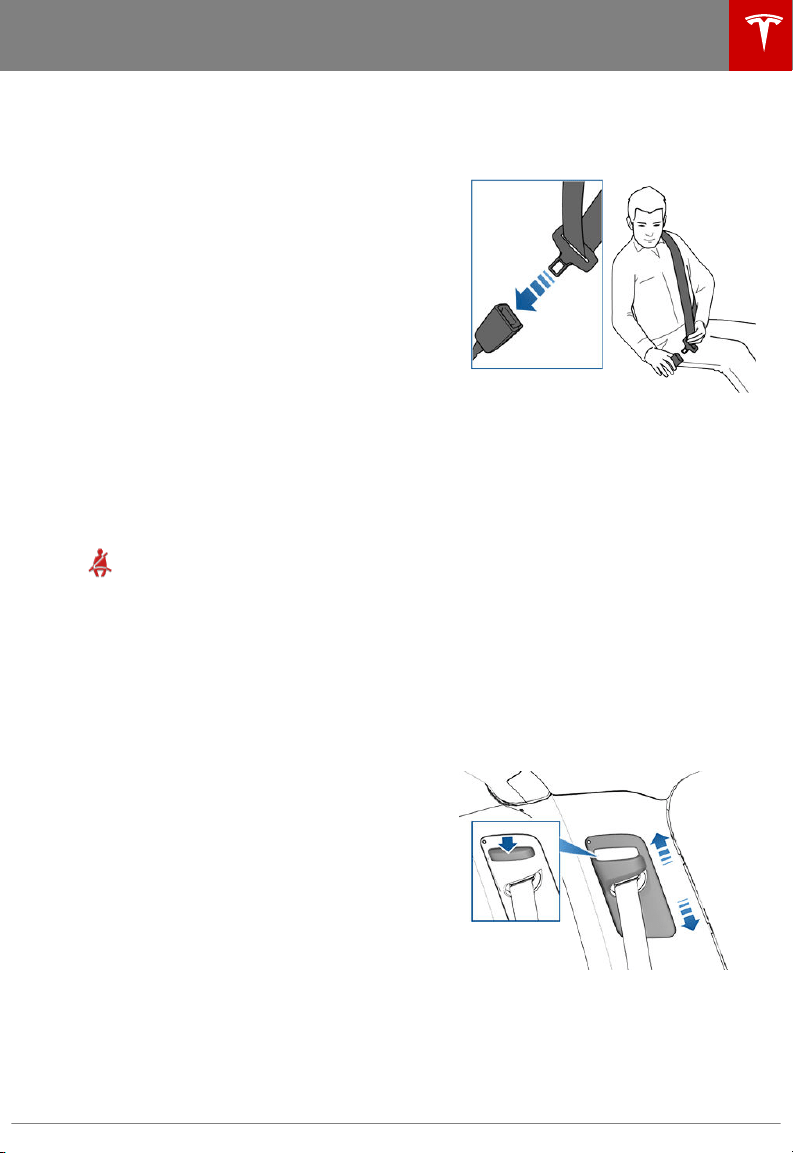
To Fasten a Belt
1. Ensure correct positioning of the seat (see
Correct Driving Position on page 20).
2. Draw the belt out smoothly, ensuring the
belt lays
flat across the pelvis, chest and
mid-point of your collar bone, between
the neck and shoulder.
3.
Insert the latch plate into the buckle and
press together until you hear a click
indicating it is locked in place.
4. Pull the belt to check that it is securely
fastened.
5. Pull the diagonal part of the belt toward
the reel to remove excess slack.
To Adjust the Shoulder Anchor Height
Model X is equipped with an adjustable
shoulder anchor for each front seat to ensure
that the seat belt is positioned correctly. The
seat belt should lay
flat across the mid-point
of your collar bone while in the correct driving
position (see Correct Driving Position on page
20). Adjust the height of the shoulder anchor
if the seat belt is not positioned correctly:
1. Press and hold the button on the shoulder
anchor to release the locking mechanism.
2. While holding the button, move the
shoulder anchor up or down as necessary
so that the seat belt is positioned
correctly.
3. Release the button on the shoulder anchor
so that it locks into position.
4. Without pressing the button, pull on the
seat belt webbing and attempt to move
the shoulder anchor downwards to check
that it is locked into position.
Seat Belts
Seating and Safety Restraints 27
Warning: Ensure that the seat belt is
positioned correctly and that the
shoulder anchor is locked into position
before driving. Riding in a moving vehicle
with the seat belt positioned incorrectly
or with the shoulder anchor not locked
into position can reduce the eectiveness
of the seat belt in a collision.
To Release a Belt
Hold the belt near the buckle to prevent the
belt from retracting too quickly, then press the
button on the buckle. The belt retracts
automatically. Ensure there is no obstruction
that prevents the belt from fully retracting.
The belt should not hang loose. If a seat belt
does not fully retract, contact Tesla.
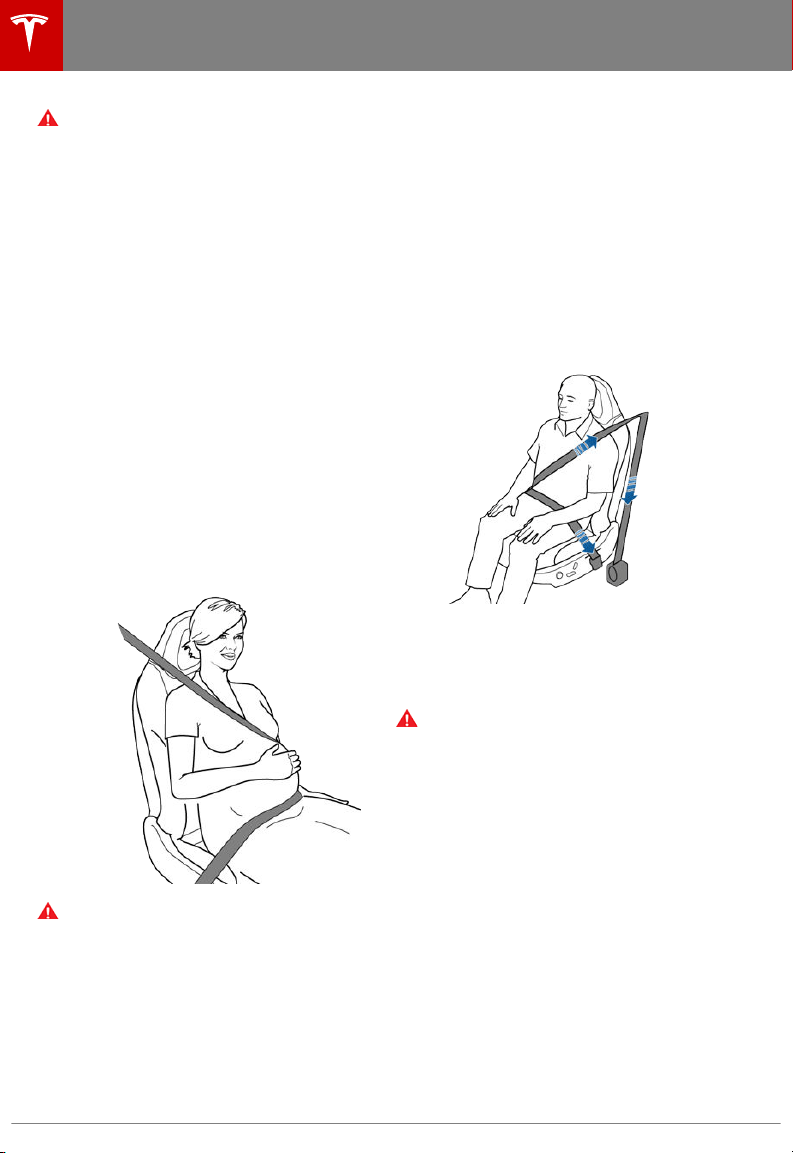
Wearing Seat Belts When Pregnant
Do not put the lap or shoulder sections of the
seat belt over the abdominal area. Wear the
lap section of the belt as low as possible
across the hips, not the waist. Position the
shoulder portion of the belt between the
breasts and to the side of the abdomen.
Consult your doctor for
specific guidance.
Warning: Never place anything between
you and the seat belt to cushion the
impact in the event of a collision.
Seat Belt Pre-tensioners
The front seat belts are equipped with
pre‑tensioners that work in conjunction with
the airbags in a severe frontal collision. The
pre‑tensioners automatically retract both the
seat belt anchor and the seat belt webbing,
reducing slack in both the lap and diagonal
portions of the belts, resulting in reduced
forward movement of the occupant.
The rear outboard seats are equipped with
shoulder pre-tensioners to retract the seat
belt webbing to reduce forward movement of
the occupant.
If the pre-tensioners and airbags did not
activate in an impact, this does not mean they
malfunctioned. It usually means that the
strength or type of force needed to activate
them was not present.
Warning:
Once the seat belt pre-
tensioners have been activated, they must
be replaced. After any collision, have the
airbags, seat belt pre-tensioners and any
associated components checked and, if
necessary, replaced.
Testing Seat Belts
To confirm that seat belts are operating
correctly, perform these three simple checks
on each seat belt.
1. With the seat belt fastened, give the
webbing nearest the buckle a quick pull.
The buckle should remain securely locked.
2. With the belt unfastened, unreel the
webbing to its limit. Check that unreeling
is free from snags, and visually check the
webbing for wear. Allow the webbing to
retract, checking that retraction is smooth
and complete.
Seat Belts
28 Model X Owner's Manual

3. With the webbing half unreeled, hold the
tongue plate and pull forward quickly. The
mechanism should lock automatically and
prevent further unreeling.
If a seat belt fails any of these tests, contact
Tesla immediately.
For information about cleaning seat belts, see
Seat Belts on page 170.
Seat Belt Warnings
Warning: Seat belts should be worn by all
occupants at all times, even if driving for
a very short distance. Failure to do so
increases the risk of injury or death if a
collision occurs.
Warning: Secure small children in a
suitable child safety seat (see Child
Safety Seats on page 30). Always follow
the child safety seat manufacturer's
instructions when installing.
Warning: Ensure that all seat belts are
worn correctly. An improperly worn seat
belt increases the risk of injury or death if
a collision occurs.
Warning: Do not wear seat belts over
hard, fragile or sharp items in clothing,
such as pens, keys, eyeglasses, etc. The
pressure from the seat belt on such items
can cause injury.
Warning: Seat belts should not be worn
with any part of the strap twisted.
Warning: Each seat belt assembly must
be used by one occupant only. It is
dangerous to put a seat belt around a
child being carried on an occupant’s lap.
Warning: Seat belts that have been worn
in a collision must be inspected or
replaced by Tesla, even if damage to the
assembly is not obvious.
Warning: Seat belts that show signs of
wear (such as fraying), or have been cut
or damaged in any way, must be replaced
by Tesla.
Warning: Avoid contaminating a seat
belt’s components with any chemicals,
liquids, grit, dirt or cleaning products. If a
seat belt fails to retract or latch into the
buckle, it must be replaced immediately.
Contact Tesla.
Warning: Do not make modifications or
additions that can prevent a seat belt
mechanism from taking up slack, or that
can prevent a seat belt from being
adjusted to remove slack. A slack belt
greatly reduces occupant protection.
Warning: Do not make modifications that
can interfere with the operation of a seat
belt, or that can cause a seat belt to
become inoperable.
Warning: When seat belts are not in use,
they should be fully retracted and not
hanging loose. If a seat belt does not fully
retract, contact Tesla.
Seat Belts
Seating and Safety Restraints 29
Guidelines for Seating Children
You must restrain infants and small children using a child safety seat appropriate for the child’s
age, weight, and size. Never seat a child in a child safety seat or a booster seat on the front
passenger seat when the airbag is activated. To disable the front passenger seat airbag, see
Disabling the Passenger Front Airbags on page 42.
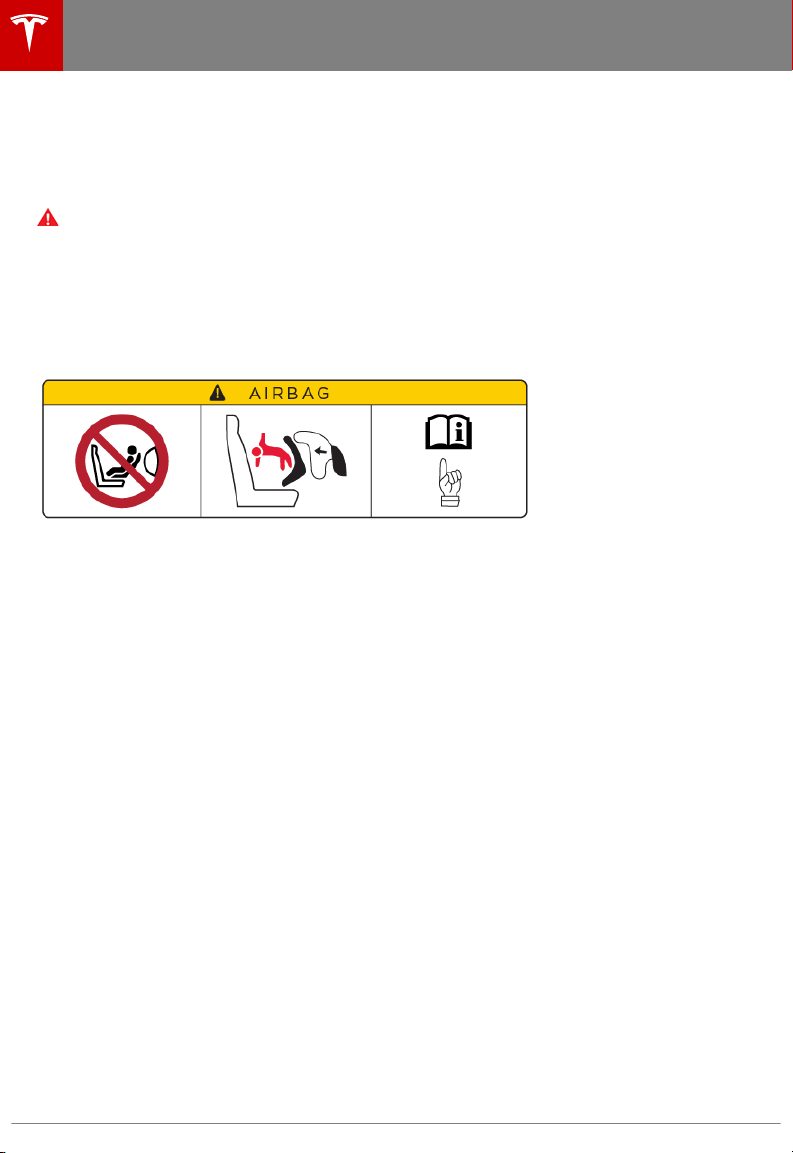
Warning: Never seat a child on a seat with an ACTIVE AIRBAG in front of it. DEATH or
SERIOUS INJURY to the child can occur.
Note: If your Model X is equipped with second row monopost seats, it is recommended that you
disable Easy Entry whenever installing a child seat in the second row (see Accessing Third Row
Seats on page 23).
Refer to the following label
fitted to the sun visors.
Note: The image shown below is representative only and may not be identical to the label in your
vehicle.
Child Safety Seats
30 Model X Owner's Manual
Choosing a Child Safety Seat
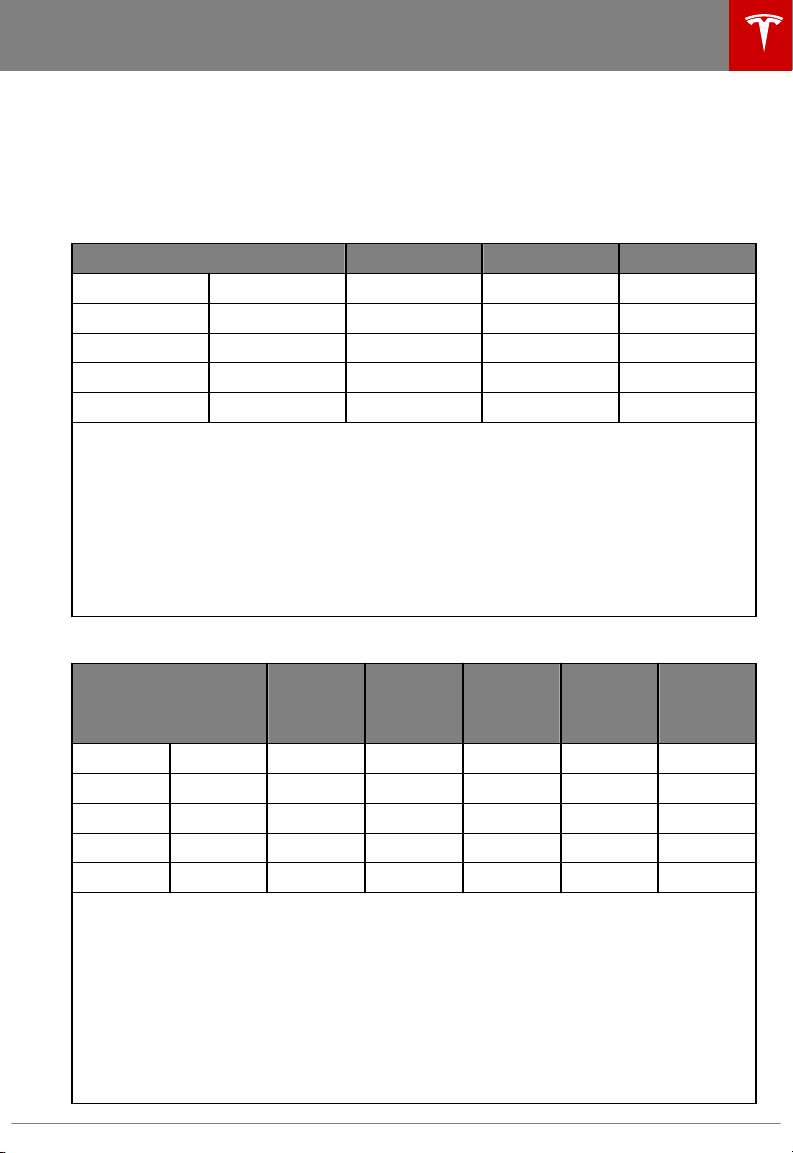
Refer to the tables below for guidelines on the type of seat belt installed and ISOFIX installed
child restraint you should use based on the weight of the child.
Seat Belt Installed Child Restraints
Monopost Seats:
Mass Group Front Passenger* Second Row Third Row
Group 0 up to 10 kg X U U
Group 0+ up to 13 kg L** U U
Group I 9 - 18 kg UF** U, UF U, UF
Group II 15 - 25 kg UF** U, UF U, UF
Group III 22 - 36 kg UF** U, UF U, UF
U: Suitable for universal child restraints approved for use in this mass group.
UF: Suitable for universal forward-facing child restraints approved for use in this mass group.
L: Suitable for these particular child restraints - Maxi-Cosi Cabrio/Cabriofix E4 04443517 or
Takata Mini E4 04443717.
X: Seating position is not suitable for children in this mass group.
* It is the driver’s responsibility to comply with all current regulations in regions where Model X
is driven. Some regions prohibit seating an infant or child in the front passenger seat.
** Seat must be placed in rearmost and highest position.
Bench Seats:
Mass Group
Front
Passenger*
Second
Row
Outboard
(60%)
Second
Row Center
Second
Row
Outboard
(40%)
Third Row
Group 0 up to 10 kg X U U U U
Group 0+ up to 13 kg L** U U U U
Group I 9 - 18 kg UF** U, UF U, UF U, UF U, UF
Group II 15 - 25 kg UF** U, UF U, UF U, UF U, UF
Group III 22 - 36 kg UF** U, UF U, UF U, UF U, UF
U: Suitable for universal child restraints approved for use in this mass group.
UF: Suitable for universal forward-facing child restraints approved for use in this mass group.
L: Suitable for these particular child restraints - Maxi-Cosi Cabrio/Cabriofix E4 04443517 or
Takata Mini E4 04443717.
X: Seating position is not suitable for children in this mass group.
* It is the driver’s responsibility to comply with all current regulations in regions where Model X
is driven. Some regions prohibit seating an infant or child in the front passenger seat.
** Seat must be placed in the rearmost position with the seatback in the most upright position
(full rear and full up only).
Child Safety Seats
Seating and Safety Restraints 31

ISOFIX* Installed Child Restraints
Monopost Seats:
Mass Group Size Class Fixture
Front
Passenge
r*
Second
Row
Outboard
Second
Row
Center
Third
Row
Group 0 up to 10
kg
E R1 X IL X IL**
Group 0+
up to 13
kg
E R1 X IL X IL**
D R2 X IL X IL**
C R3 X X X IL**
Group I 9 - 18 kg
D R2 X IL X IL**
C R3 X X X IL**
B F2 X IUF X IUF
B1 F2X X IUF X IUF
A F3 X IUF X IUF
IUF: Suitable for universal ISOFIX forward child restraint systems approved for use in this mass
group.
IL: Suitable for particular ISOFIX child restraint systems in the "specific vehicle", "restricted", or
"semi-universal" categories.
X: Seating position does not support ISOFIX child restraint systems in this mass group/size
class.
* It is the driver’s responsibility to comply with all current regulations in regions where Model X
is driven. Some regions prohibit seating an infant or child in the front passenger seat.
** If a universal child restraint system is installed in the third row (right or left side), the second
row center and outboard seats in front of the child restraint system cannot be used because
these seats must be moved fully forward to accommodate the universal child restraint system.
Child Safety Seats
32 Model X Owner's Manual

Bench Seats:
Mass Group
Size
Class Fixture
Front
Passenger*
Second
Row
Outboard
Second
Row
Center
Third
Row
Group 0 up to 10
kg
E R1 X IL X IL**
Group 0+
up to 13
kg
E R1 X IL X IL**
D R2 X IL X IL**
C R3 X IL X IL**
Group I
9 - 18
kg
D R2 X IL X IL**
C R3 X IL X IL**
B F2 X IUF X IUF
B1 F2X X IUF X IUF
A F3 X IUF X IUF
IUF: Suitable for universal ISOFIX forward child restraint systems approved for use in this mass
group.
IL: Suitable for particular ISOFIX child restraint systems in the "specific vehicle", "restricted", or
"semi-universal" categories.
X: Seating position does not support ISOFIX child restraint systems in this mass group/size
class.
* It is the driver’s responsibility to comply with all current regulations in regions where Model X
is driven. Some regions prohibit seating an infant or child in the front passenger seat.
** If a universal child restraint system is installed in the third row (right or left side), the second
row center and outboard seats in front of the child restraint system cannot be used because
these seats must be moved fully forward to accommodate the universal child restraint system.
Note: ISOFIX is the international standard for attachment points for child safety seats in
passenger vehicles.
Note: If the combined weight of the child and the child safety seat is over 29 kg, Tesla
recommends attaching the safety seat using the seat belt and upper tether strap. In addition to
safety, this has the added
benefit of ensuring the seat belt reminder does not stay lit. Always
follow the child safety seat manufacturer’s instructions when installing child safety seats.
Child Safety Seats
Seating and Safety Restraints 33
Seating Larger Children
If a child is too large to fit into a child safety
seat, but too small to safely fit into the
standard seat belts, use a booster seat
appropriate for the child’s age and size.
Carefully follow the manufacturer’s
instructions to secure the booster seat.
Installing Child Safety Seats
There are two general methods used to install
child safety seats:
• Seat belt retained - these seats are
secured using the vehicle’s seat belts (see
Installing Seat Belt Retained Child Seats
on page 34).
• ISOFIX retained - these seats can attach
to anchor bars built into the vehicle’s rear
seats (see Installing ISOFIX Child Seats on
page 34).
Check the child safety seat manufacturer’s
instructions and the table at Child Safety
Seats on page 30 to determine which
installation method to use. Some child safety
seats can be installed using either method.
Always follow the child safety seat
manufacturer’s instructions.
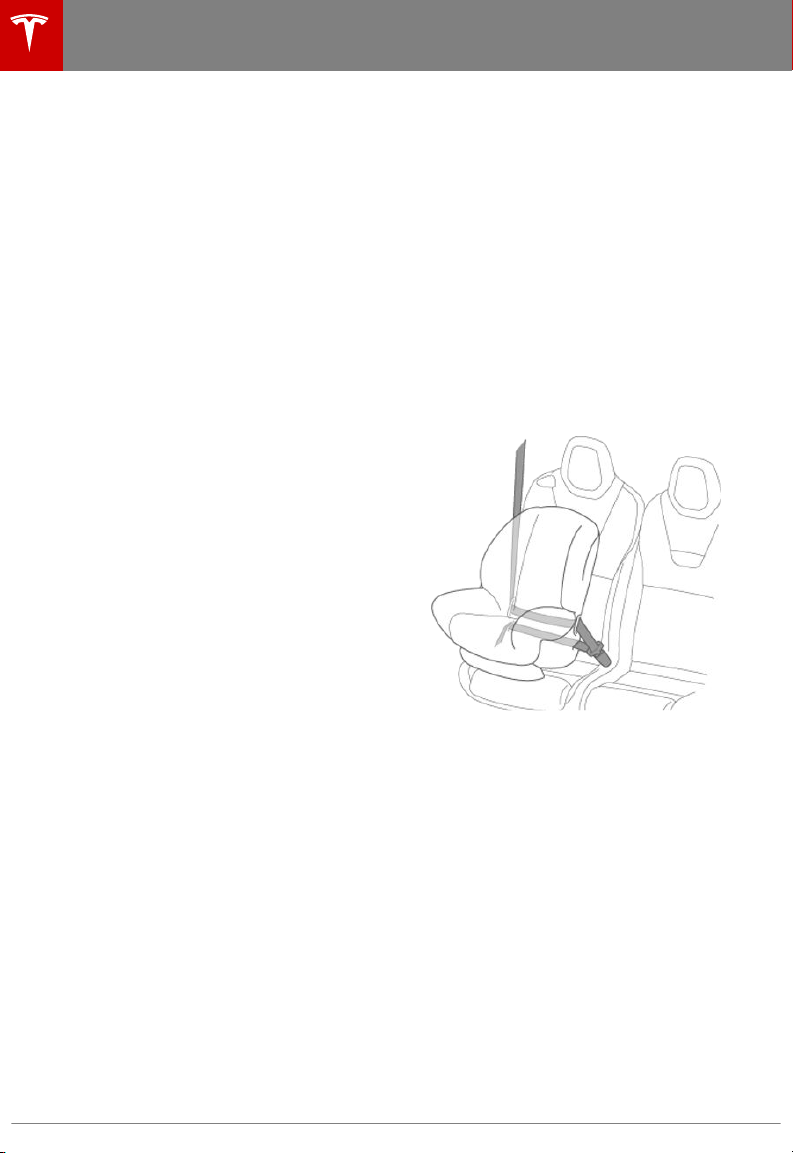
Installing Seat Belt Retained Child
Seats
First, make sure that the child safety seat is
appropriate for the weight, height, and age of
the child.
Avoid dressing the child in bulky clothing and
do not place any objects between the child
and the restraint system.
Adjust harnesses for every child, every trip.
To securely hold child safety seats, all
passenger seating positions are equipped with
an automatic locking retractor (ALR) that, by
pulling the seat belt beyond the length
needed for a typical adult occupant, locks the
belt into place until the seat belt is unbuckled
and the webbing is fully retracted. The ALR
mechanism operates as a ratchet, winding in
slack and preventing the seat belt from
extending any further until it has been
completely rewound. When installing a child
safety seat, engage the belt's automatic
locking retractor by pulling the seat belt
webbing until it is fully extended. The ALR
system engages only when the seat belt is at
its maximum extension point.
Note:
An automatic locking retractor
disengages only when the seat belt is
unbuckled and fully retracted. The belt can
then be worn as a normal belt, sliding freely in
and out and locking tight only in an
emergency. Once disengaged, the belt must
be fully extended to re-engage the locking
mechanism whenever you install a child safety
seat.
Always follow the detailed instructions
provided by the child safety seat
manufacturer. General guidelines are provided
below.
1. Place the child safety seat in Model X, and
fully extend the seat belt. Route and
buckle the seat belt in accordance with
the child safety seat manufacturer’s
instructions.
2. Allow the seat belt to retract, and remove
all slack in the seat belt while
firmly
pushing the child safety seat into the
Model X seat.
3. If the seat belt retained child safety seat
has an upper tether, attach it to the back
of the seat (see Attaching Upper Tether
Straps on page 37).
Installing ISOFIX Child Seats
Lower ISOFIX anchors are provided in the
second row outboard seats and in both rear
row seats. The anchors are located between
the seat's back rest and rear cushion. The
exact location of each anchor is
identified by a
child safety seat
identification button,
illustrated below. The button is located on the
seat back, directly above its associated
anchor.
Monopost Seats:
Child Safety Seats
34 Model X Owner's Manual
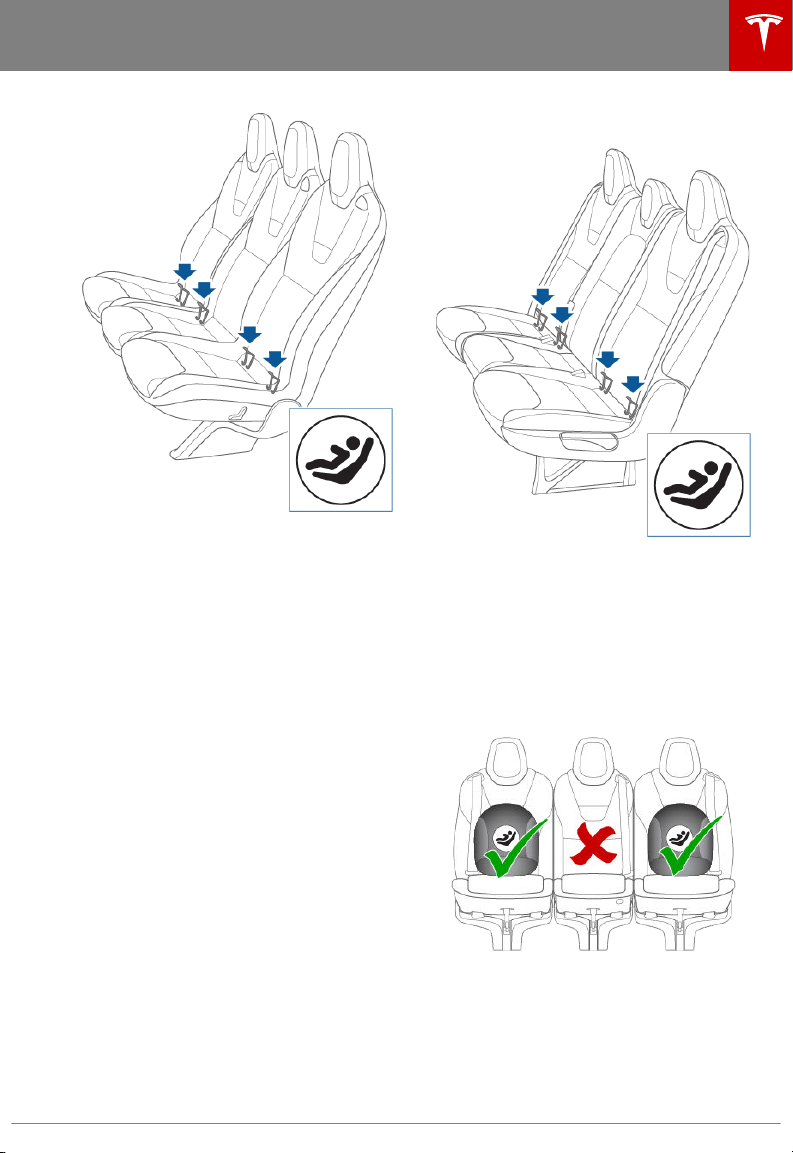
Bench Seats:
In the second row, install ISOFIX child safety
seats in the outboard seating positions only.
Use only a seat belt retained seat in the center
position.
Note: If Model X is equipped with two seats in
the second row, both seats support the use of
ISOFIX child safety seats.
Monopost Seats:
Child Safety Seats
Seating and Safety Restraints 35
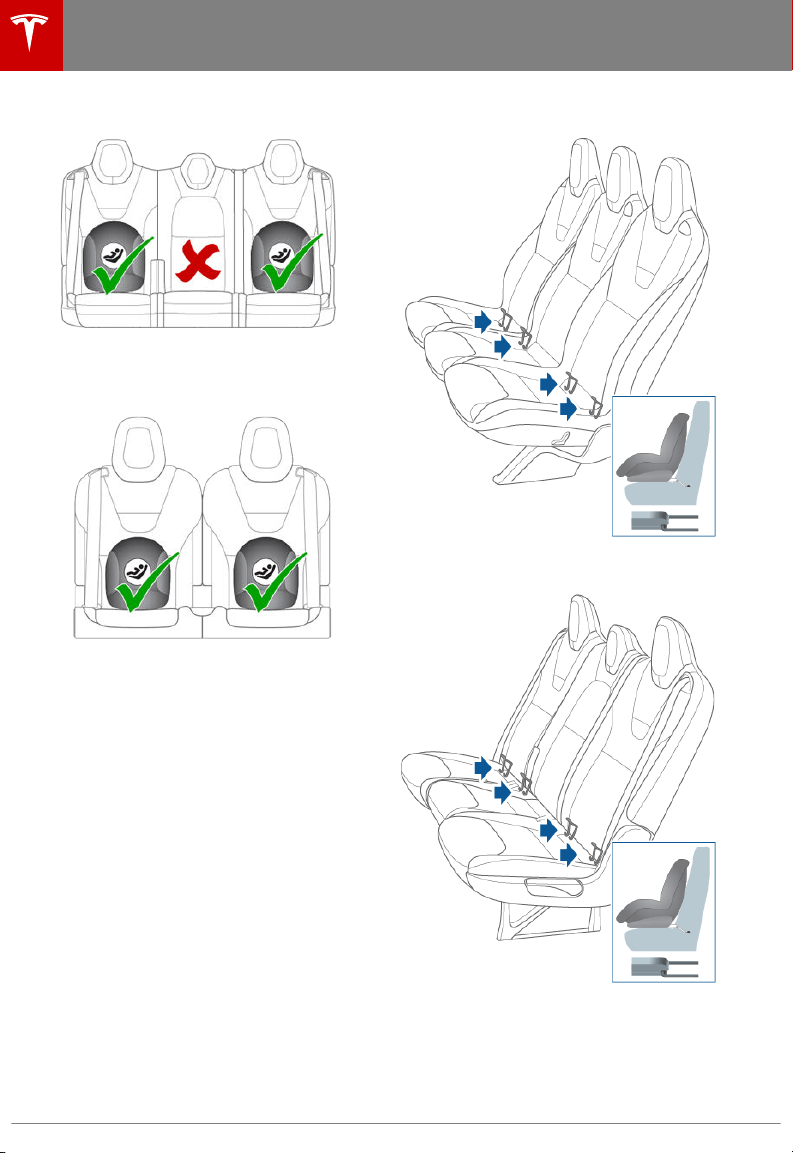
Bench Seats:
In the third row (if equipped), you can install
ISOFIX child safety seats in both seating
locations.
To install a ISOFIX child safety seat, slide the
safety seat latches onto the anchor bars until
they click into place. Carefully read and follow
the instructions provided by the child safety
seat manufacturer.
Monopost Seats:
Bench Seats:
Once installed, test the security of the
installation before seating a child. Attempt to
twist the child safety seat from side to side
and try to pull it away from the seat, then
check to ensure the anchors remain securely
in place.
Child Safety Seats
36 Model X Owner's Manual
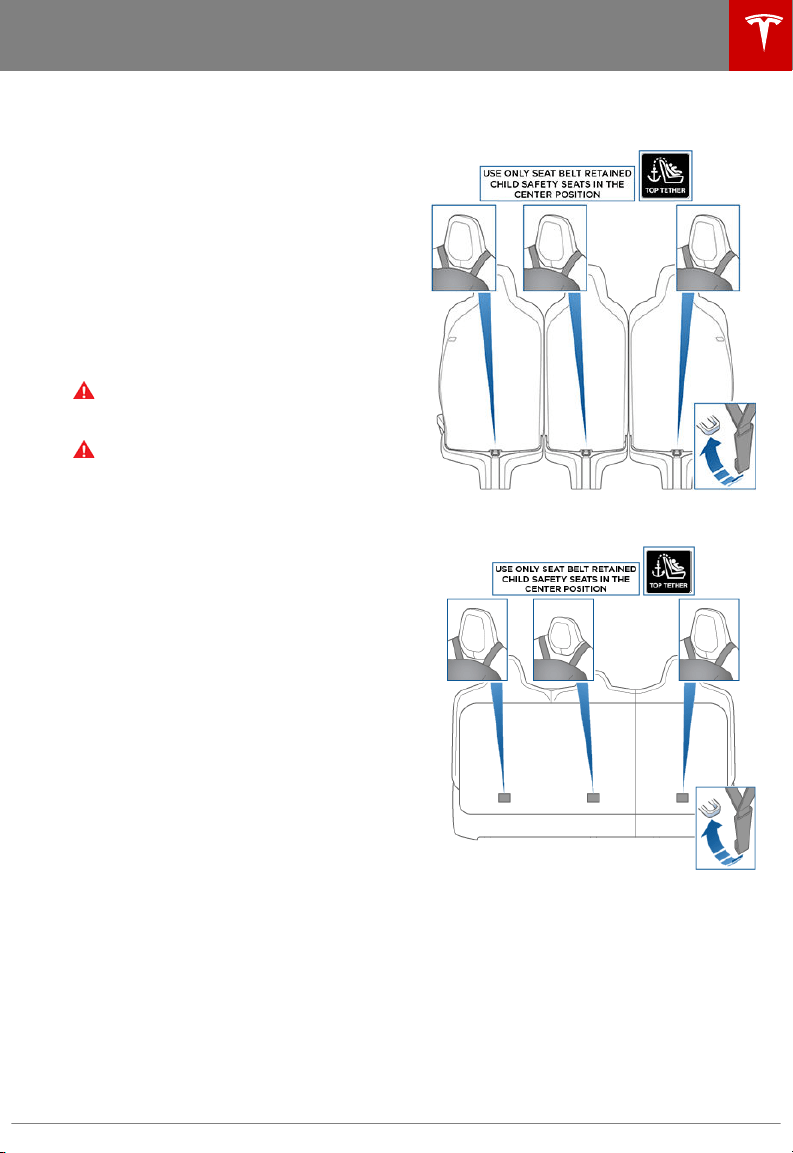
Note: Lower LATCH anchors should not be
used with child seats or booster seats that
have an integrated safety belt in situations
where the combined weight of the child plus
the child restraint is more than 65 lbs (29 kg).
In these situations, use the safety belt instead.
Attaching Upper Tether Straps
If an upper tether strap is provided, attach its
hook to the anchor point located on the back
of the second and third row seats.
Note: The location of anchor points may not
be readily visible but can be found by
identifying a slice in the seat's material.
Warning: Tighten upper tether straps
according to the instructions provided by
the manufacturer of the child safety seat.
Warning: USE ONLY SEAT BELT
RETAINED CHILD SAFETY SEATS IN THE
CENTER SEATING POSITION.
For dual-strap tethers, position a strap on
each side of the head restraint.
Dual Straps - Second Row Monopost Seats:
Dual Straps - Second Row Bench Seats:
Dual Straps - Third Row Seats:
Child Safety Seats
Seating and Safety Restraints 37
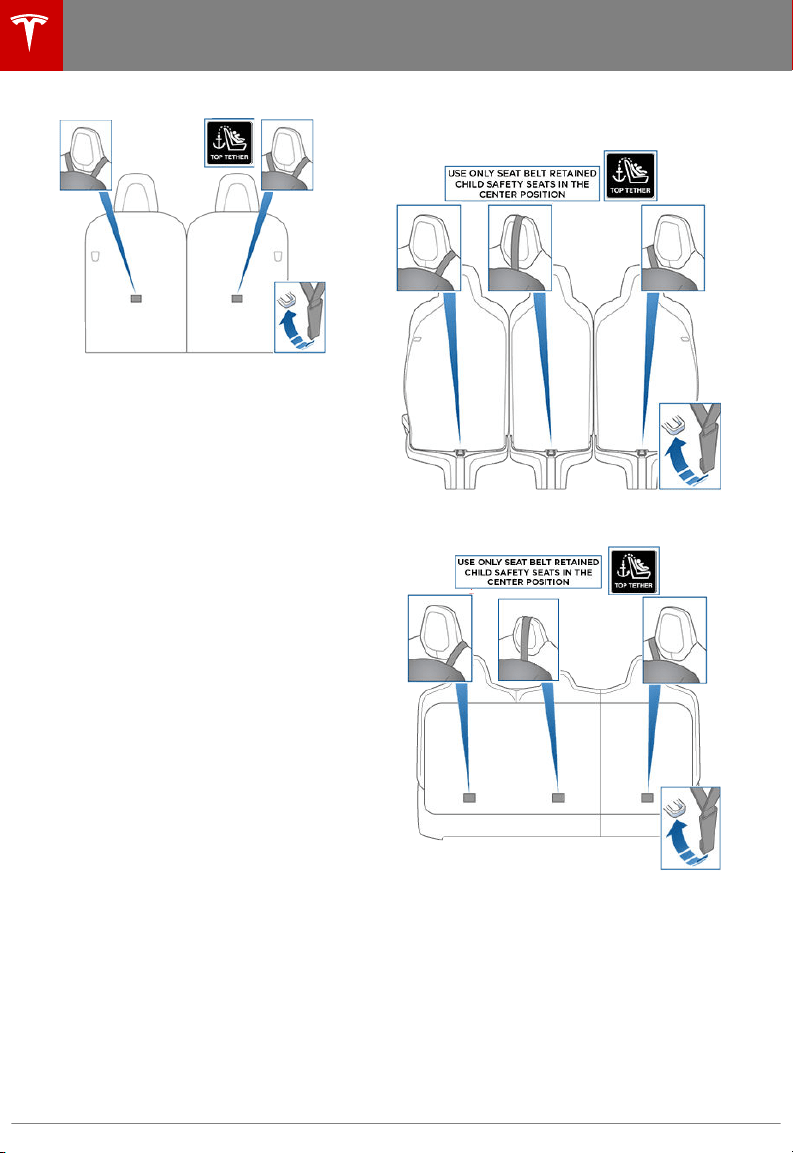
For single-strap tethers, position the strap in
the outboard seating positions over the
outside-facing side of the head restraint (i.e.
same side of the head restraint as the seat belt
retraction mechanism). In the center seating
position (if equipped), center and position the
strap over the top of the head restraint.
Single Strap - Second Row Monopost Seats:
Single Strap - Second Row Bench Seats:
Child Safety Seats
38 Model X Owner's Manual
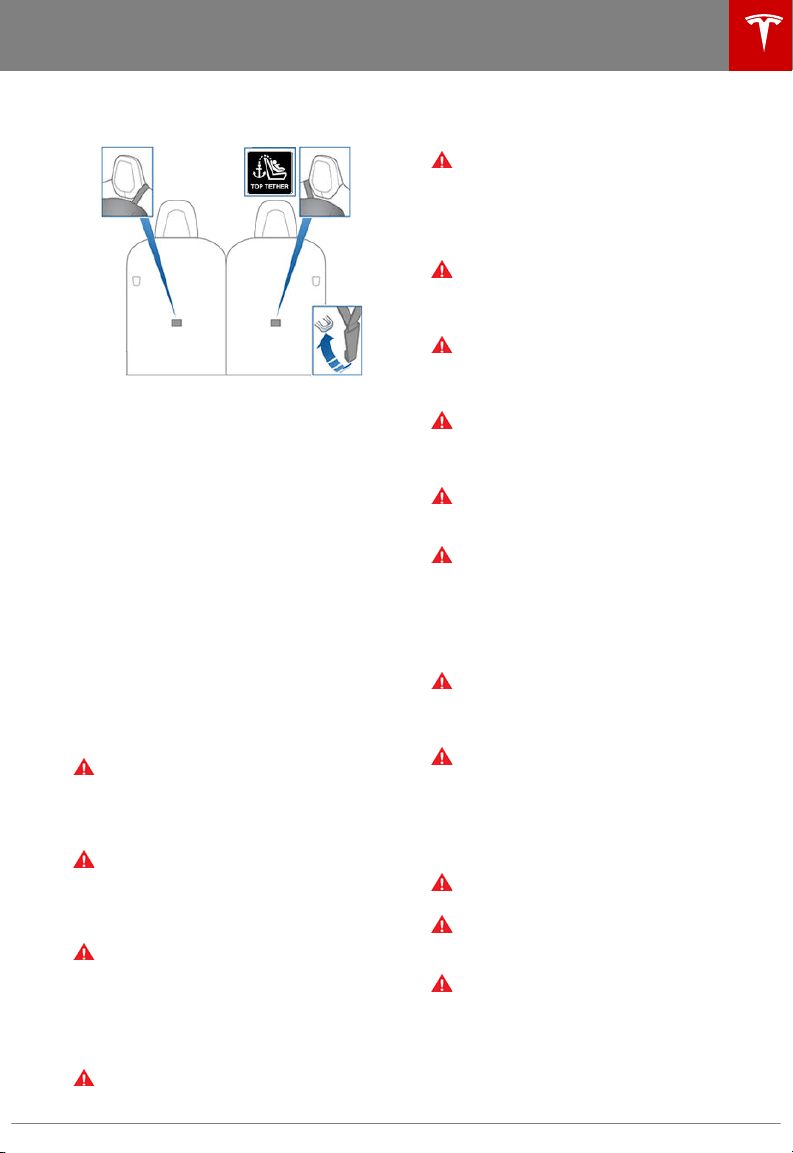
Single Strap - Third Row Seats
Note: If Model X is equipped with the optional
six seat interior, a center seating position is
not available in the second row.
Testing a Child Safety Seat
Before seating a child, always make sure the
child safety seat is not loose:
1. Hold the child safety seat by the belt path
and try to slide the safety seat from side
to side and front to back.
2. If the seat moves more than 2.5 cm, it is
too loose. Tighten the belt or reconnect
the ISOFIX retained child safety seat.
3. If you are unable to reduce slack, try a
dierent seat location or try another child
safety seat.
Child Safety Seat Warnings
Warning:
Never seat a child in a child
safety seat or a booster seat on the front
passenger seat when the airbag is
activated. Doing so can cause serious
injury or death.
Warning: Never use a rearward facing
child restraint on a seat protected by an
active airbag. Doing so can cause serious
injury or death. Refer to the warning label
located on the sun visor.
Warning: Child restraint systems are
designed to be secured in vehicle seats
by lap belts or the lap belt portion of a
lap-shoulder belt. Children could be
endangered in a crash if their child
restraints are not properly secured in the
vehicle.
Warning: According to collision statistics,
children are safer when properly
restrained in the rear seating positions
than in the front seating positions.
Warning: Do not use a forward facing
child safety seat until your child weighs
over 9 kg and can sit independently. Up
to the age of two, a child's spine and neck
are not suciently developed to avoid
injury in a frontal impact.
Warning: Do not allow a baby or infant to
be held on a lap. All children should be
restrained in an appropriate child safety
seat at all times.
Warning: To ensure children are safely
seated, follow all instructions provided in
this document and by the manufacturer
of the child safety seat.
Warning: Children should ride in a rear
facing child safety seat using the seat’s
integrated 5-point harness for as long as
possible.
Warning: Do not use seat belt extenders
on a seat belt that is being used to install
a child safety seat or booster seat.
Warning: When seating larger children,
make sure the child's head is supported
and the child’s seat belt is properly
adjusted and fastened. The shoulder
portion of the belt must be away from the
face and neck, and the lap portion must
not be over the stomach.
Warning: Never attach two child safety
seats to one anchor point. In a collision,
one anchor point may be incapable of
securing both seats.
Warning: Child restraint anchors are
designed to withstand only those loads
imposed by correctly fitted child
restraints. Under no circumstances are
they to be used for adult seat belts,
harnesses, or for attaching other items or
equipment to the vehicle.
Warning: Always check harnesses and
tether straps for damage and wear.
Warning: Never leave a child unattended,
even if the child is secured in a child
safety seat.
Warning: Never use a child safety seat
that has been involved in a collision. Have
the seat inspected or replaced as
described in the child safety seat
manufacturer’s instructions.
Child Safety Seats
Seating and Safety Restraints 39
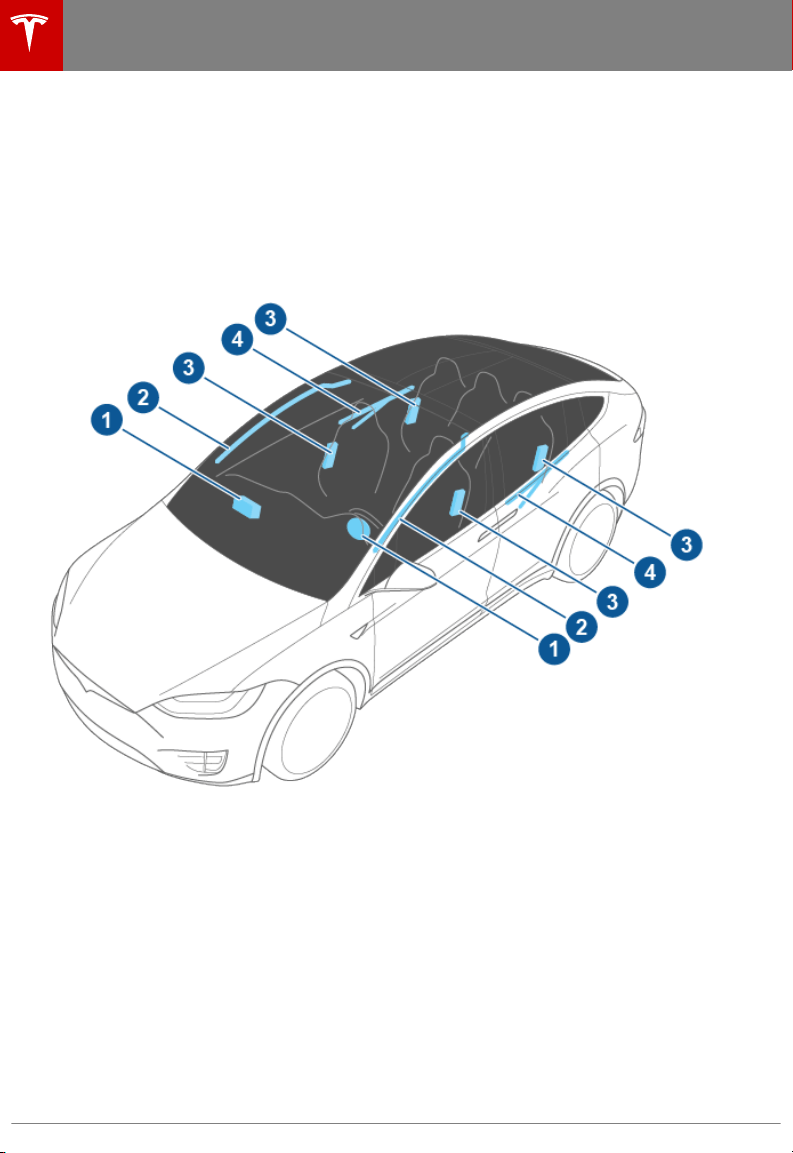
Location of Airbags
Airbags are located in the approximate areas shown here. Airbag warning information is printed
on the sun visors.
Model X is equipped with an airbag and lap/shoulder belt at both front outboard seating
positions. The airbag is a supplemental restraint at those seating positions. All occupants,
including the driver, should always wear their seat belts whether or not an airbag is also provided
at their seating position to minimize the risk of severe injury or death in the event of a crash.
Note: On RHD (Right Hand Drive) vehicles, the locations of the passenger and driver airbags are
reversed.
1. Front airbags
2. Curtain airbags
3. Seat-mounted side airbags
4. Door-mounted airbags
Airbags
40 Model X Owner's Manual

How the Airbags Work
Airbags inflate when sensors detect an impact
that exceeds deployment thresholds. These
thresholds are designed to predict the severity
of a crash in time for the airbags to help
protect the vehicle's occupants.
Airbags
inflate instantly with considerable
force accompanied by a loud noise. The
inflated bag, together with the seat belts,
limits movement of occupants to reduce the
risk of injury.
Front airbags are not ordinarily designed to
inflate in rear collisions, rollovers, minor front
or side collisions, heavy braking, or driving
over bumps and potholes. Therefore,
significant superficial damage can occur to
the vehicle without the airbags inflating or,
conversely, a relatively small amount of
structural damage can cause airbags to
inflate.
If you are planning to modify your vehicle for a
person with disabilities in a way that may
aect the airbag system, contact Tesla.
Types of Airbags
Model X has the following types of airbags:
• Advanced front airbags: The front airbags
are designed to reduce airbag related
injuries if children or small adults are
riding in the front seats. On the driver’s
side, the front airbag works with a seat
position sensor that adjusts the inflation
level based on the seating position of the
occupant. Follow all warnings related to
seating a child on the front passenger
seat. For safety of infants and small
children, the front passenger airbag must
be disabled.
• Seat-mounted side airbags: There is a
seat-mounted side airbag in each of the
front driver, front passenger and second
row outboard seats. Seat-mounted side
airbags protect the thorax region of the
torso and the pelvis. They
inflate in the
event of severe side impact or severe
oset frontal impact. The seat-mounted
side airbags on both the impacted and
non-impacted side of the vehicle will
inflate. When the backrest of an outboard
seat is fully folded in the forward position,
its associated side airbag does not inflate.
• Curtain airbags: There is a curtain airbag
on each side of Model X in the front roof-
rail. Curtain airbags help protect the head
and typically
inflate in the event of a
severe side impact, a severe oset frontal
impact, or if the vehicle rolls over. Curtain
airbags on both the impacted and non-
impacted side of the vehicle will
inflate.
• Door-mounted airbags: There is an airbag
on each side of Model X mounted in the
trim on the falcon wing doors. These are
the same as the curtain airbags in that
they help protect the head and typically
inflate in the event of a severe side impact,
a severe oset frontal impact, or if the
vehicle rolls over. The door-mounted
airbags on both the impacted and non-
impacted side of the vehicle will
inflate.
Airbags
Seating and Safety Restraints 41

Disabling the Passenger Front
Airbags
When a child is seated in the front passenger
seat (even when the child is seated in a child
safety seat or booster seat), you must ensure
the passenger front airbags are disabled to
prevent them from injuring the child if a
collision occurs.
Note: Rear seats are the preferred location for
seating children in child safety seats.
To control the front and side airbags on the
passenger side of the vehicle, touch
Controls > Settings > Safety & Security >
Passenger Front Airbag. Then choose from
two options:
• Touch OFF to manually disable the
airbags.
Warning: When you turn it o
manually, you must touch ON to
manually enable them again to
protect an adult occupant seated in
the front passenger seat.
• Touch AUTO to turn the front passenger
airbags
o and on automatically based on
the weight of the passenger (see
Occupant Detection System on page
42).
Passenger airbag status displays in the top
right corner of the touchscreen if the airbag is
OFF. (If the airbag is ON, no status is
displayed.) You can also touch this indicator to
display the settings previously described.
If the airbag is on, even if you have turned it
o (or vice versa), contact Tesla immediately.
Note: Model X has a capacitive touchscreen
and may not respond to your touch if you are
wearing standard gloves. If the touchscreen is
not responding, remove gloves or wear gloves
with conductive
fingertips for use with
capacitive touchscreens.
Warning:
It is the driver's responsibility to
confirm that the passenger front airbags
are OFF when a child is seated in the
front passenger seat. Do not rely on the
occupant detection system to turn o
airbags. Before driving with a child seated
on the front passenger seat, always
double-check passenger airbag status
displayed in the top right corner of the
touchscreen.
Warning: Never seat a child in a child
safety seat or a booster seat on the front
passenger seat when the airbag is
activated. Doing so can cause serious
injury or death.
Warning: If the passenger airbag control
does not appear to be functioning, do not
seat a passenger in the front seat.
Contact Tesla immediately to have the
vehicle inspected and if necessary,
repaired.
Occupant Detection System
Model X has an occupancy sensor in the front
passenger seat that controls the status of the
associated airbags based on the weight of the
occupant:
Weight in front
passenger seat
Passenger airbag
status
Empty OFF
Up to 20 lbs/9kg OFF
20-100 lbs/9-45 kg* OFF* or ON**
Over 100 lbs/45 kg ON**
*Values are approximate. A weight detected
near the threshold can cause the airbag
status to occasionally turn on and o
depending on seating position and
physique.
**The absence of the status, PASS AIRBAG
OFF, in the top right corner of the
touchscreen indicates that the passenger
airbag is ON and will
inflate in the event of a
collision.
Note: It takes approximately six seconds after
you power on Model X for the occupancy
sensor to report accurate status of the front
passenger airbag. As a result, when you
first
power on Model X, even in situations when it
should be OFF because the seat is either
empty or carrying a weight of 9 kg or less, it
will take the touchscreen approximately six
seconds to display the status, PASS AIRBAG
OFF. If it fails to do so, contact Tesla service
immediately and turn the airbags
o manually
when a child is seated in the front passenger
seating position.
Airbags
42 Model X Owner's Manual

If the airbag is permanently on, even when the
seat is empty and the seat belt is unbuckled,
contact Tesla immediately.
To make sure the sensing system can correctly
detect occupancy status, eliminate the
following:
• Objects lodged under the seat.
• Heavy objects sitting on the seat
(briefcase, large purse).
• Objects wedged between the seat back
and seat cushion.
• Cargo interfering with the seat.
• After market items attached to, or sitting
on, the seat (covers, mats, blankets, etc.).
These conditions can interfere with the
occupancy sensor. If you have eliminated the
above possibilities, and the airbag status is still
incorrect, ask passengers to ride in the rear
seats and contact Tesla to have the airbag
system checked.
Note: The front passenger seat’s sensing
system
aects the operation of the passenger
front and side airbags only. The other
passenger airbags are not
aected.
Warning: To ensure accuracy of the
occupant detection system, do not make
any modifications to the front passenger
seat.
Inflation Eects
Warning:
When airbags inflate, a fine
powder is released. This powder can
irritate the skin and should be thoroughly
flushed from the eyes and from any cuts
or abrasions.
After inflation, the airbags deflate to provide a
gradual cushioning
eect for the occupants
and to ensure the driver’s forward vision is not
obscured.
If airbags have inflated, or if your vehicle has
been in a collision, always have the airbags,
seat belt pre-tensioners and any associated
components checked and, if necessary,
replaced by Tesla.
In a collision, in addition to the airbags
inflating:
• Doors and liftgate unlock.
• Hazard warning lights turn on.
• Interior lights turn on.
• High voltage is disabled.
To restore Battery power, use the touchscreen
to manually power o Model X (see Powering
O on page 51), then press the brake to
power it back on again.
Airbag Warning Indicator
The airbag indicator on the
instrument panel remains lit if the
airbag system is malfunctioning. The
only time this indicator should light
up is
briefly when Model X first
powers up, in which case it turns o
within a few seconds. If it remains lit,
contact Tesla immediately and do
not drive.
Airbag Warnings
Warning: Do not place objects over or
near airbags because any such objects
could cause harm if the vehicle is in a
crash severe enough to cause the airbag
to inflate.
Warning: All occupants, including the
driver, should always wear their seat belts,
whether or not an airbag is also provided
at their seating position, to minimize the
risk of severe injury or death in the event
of a collision.
Warning: Front seat occupants should
not place their arms over the airbag
module, as an inflating airbag can cause
fractures or other injuries.
Warning: Do not use seat covers on
Model X. Doing so could restrict
deployment of the seat-mounted side air
bags if a collision occurs. It can also
reduce the accuracy of the occupant
detection system, if equipped.
Warning: Airbags inflate with
considerable speed and force, which can
cause injury. To limit injuries, ensure that
occupants are wearing seat belts and are
correctly seated, with the seat positioned
as far back as possible.
Warning: Do not use a child safety seat or
seat young children on a seat with an
operational airbag in front of it. Doing so
can cause injury or death if the airbag
inflates.
Warning: To ensure correct inflation of
the side airbags, maintain an
unobstructed gap between an occupant’s
torso and the side of Model X.
Airbags
Seating and Safety Restraints 43

Warning: Passengers shouldn't lean their
heads against doors. Doing so can cause
injury if a curtain airbag inflates.
Warning: Do not allow passengers to
obstruct the operation of an airbag by
placing feet, knees or any other part of
the body on or near an airbag.
Warning: Do not attach or place objects
on or near the front airbags, the side of
the front seats, the headliner at the side
of the vehicle, or any other airbag cover
that could interfere with inflation of an
airbag. Objects can cause serious injury if
the vehicle is in a collision severe enough
to cause the airbag to
inflate.
Warning: Following inflation, some airbag
components are hot. Do not touch until
they have cooled.
Airbags
44 Model X Owner's Manual

Creating a Driver Profile
When you first adjust the driver’s seat,
steering wheel, or driver’s side mirror, the
touchscreen prompts you to create a driver
profile to save these adjustments. Your profile
also saves some of the preferences you make
using the touchscreen’s Settings window.
To add a new driver profile, touch
Controls > Settings > Driver Profiles
(you can also touch the driver icon
on the touchscreen's status bar).
Then touch Add New Driver, type
the driver's name and touch Create
Profile. Follow the onscreen
instructions to save the seating
position to the driver profile. You can
also check the Use Easy Entry
checkbox if you want to save (or use
existing) Easy Entry settings in
which the driver's seat and the
steering wheel are automatically
adjusted to make it easy to enter and
exit Model X.
If you change the position of the steering
wheel, driver’s seat, or driver’s side mirror
after you have saved or chosen a driver
profile, the touchscreen prompts you to save
the new position or restore the previously
saved position (other settings are
automatically saved). To change a setting
without saving or restoring, just ignore the
prompt.
To adjust Model X based on a driver’s
profile,
touch the driver profile icon and choose the
driver name. The saved adjustments are
automatically made.
Note: Valet mode is a built-in driver
profile
used to limit speed and restrict access to
some Model X features (see Valet Mode on
page 46).
Easy Entry
You can define an Easy Entry setting that
moves the steering wheel and driver's seat to
make it easy to enter and exit Model X. Any
driver can use the Easy Entry setting by
associating it with their driver's
profile. When
the Easy Entry setting is associated with a
driver's profile, the steering wheel and driver's
seat automatically adjust when the park gear
is engaged and the driver's seat belt is
unbuckled, allowing an easy exit from the
vehicle. When returning to the vehicle and
stepping on the brake pedal, settings
automatically adjust back to the settings used
by the most recent driver
profile (or based on
the key if it's linked to a driver profile).
To set up Easy Entry, touch Controls >
Settings > Driver Profiles (or touch the driver
icon on the touchscreen's status bar). Choose
a driver
profile, check the Easy Entry
checkbox and follow the onscreen instructions
to save how you want the steering wheel and
seat positioned when entering and exiting
Model X. Once created, the Easy Entry
profile
appears on the driver profile list and any
driver can use these settings to enter and exit.
Restoring a Driver’s
Profile
To adjust Model X based on a
driver’s profile, touch the driver
profile icon on the touchscreen's
status bar. Then choose the driver
and Model X is adjusted based on
the settings that have been saved to
the chosen driver
profile.
See What's Saved
To see what settings are associated with a
driver
profile, touch Controls > Settings >
Driver Profiles. Then touch See what’s saved.
A popup window lists all the settings that are
saved to driver
profiles.
Note: The settings that are associated with
driver
profiles may vary depending on the
version of software currently installed on your
Model X.
Driver
Profiles
Driving 45

Linking a Driver Profile to a Key
You can link a driver profile to a specific key to
allow Model X to automatically select the
correct driver profile when the linked key is
detected as you approach the vehicle and
open the driver's door. To link a driver
profile
to a key, enter Model X with the key and touch
Controls > Settings > Driver
Profiles on the
vehicle's touchscreen. Select the driver
profile
you would like to link to the key, then touch
Link to Key Fob.
Note: Model X only detects one key at a time.
The driver
profile is linked to the key that is
detected by the vehicle at that time.
Therefore, if you want to link driver
profiles to
multiple keys, ensure that only the key that
you would like to link the driver profile to is
within detection range while performing the
linking procedure. Move all other keys outside
of the detection range (at least one meter
away from Model X).
Note: Model X can support up to eight linked
keys. However, a driver
profile can only be
linked to one key.
To remove the link between a driver
profile
and key, touch Controls > Settings > Driver
Profiles. Select the driver profile, then touch
the X next to Linked to Key Fob.
Valet Mode
When Model X is in Valet mode, the following
restrictions apply:
• Speed is limited to 113 km/h.
• Maximum acceleration and power are
limited.
• Front trunk and glovebox are locked.
• Home and Work locations are not
available in the navigation system.
• Voice commands are disabled.
•
Trac-Aware Cruise Control is disabled
• Most status bar functions are disabled.
• The Mobile Access setting is disabled.
• HomeLink (if applicable in your market
region) is not accessible.
• Driver
Profiles are not accessible.
• Summon is disabled.
• Wi-Fi and Bluetooth are disabled. When
Model X is in Valet mode, you cannot pair
new Bluetooth devices or view or delete
existing paired devices.
Note: If a Bluetooth paired device or a
known Wi-Fi network is within operating
range (approximately 9 meters) of
Model X in Valet mode, Model X will
connect to it.
Starting Valet Mode
With Model X in Park, touch the driver
profile
icon (located next to the Tesla "T" on the
touchscreen), then touch Valet Mode.
The
first time you enter Valet mode, you will
be prompted to create a 4-digit PIN that you
will use to cancel Valet mode.
When Valet mode is active, the instrument
panel displays the word Valet above the
driving speed and the Valet mode driver
profile displays on the touchscreen.
You can also use the mobile app to start and
cancel Valet mode (provided Model X is in
Park). When using the mobile app, you do not
need to enter a PIN because you are already
required to log into the app using your Tesla
Account credentials.
Note: If you forget your PIN, reset it from
inside Model X by entering your Tesla Account
credentials (which also cancels Valet mode).
You can also reset your PIN using the mobile
app.
Warning:
Do not use Valet mode when
towing a trailer. Torque limitations can
make it dicult for Model X to pull a
trailer up a hill.
Canceling Valet Mode
With Model X in Park, touch the Valet Mode
driver icon on the touchscreen's status bar,
then enter your 4-digit PIN.
When you cancel Valet mode, all settings
associated with the most recently used driver
profile and climate control settings are
restored, and all features are available.
Note: You do not need to enter a PIN to
cancel Valet mode from the mobile app.
Driver
Profiles
46 Model X Owner's Manual
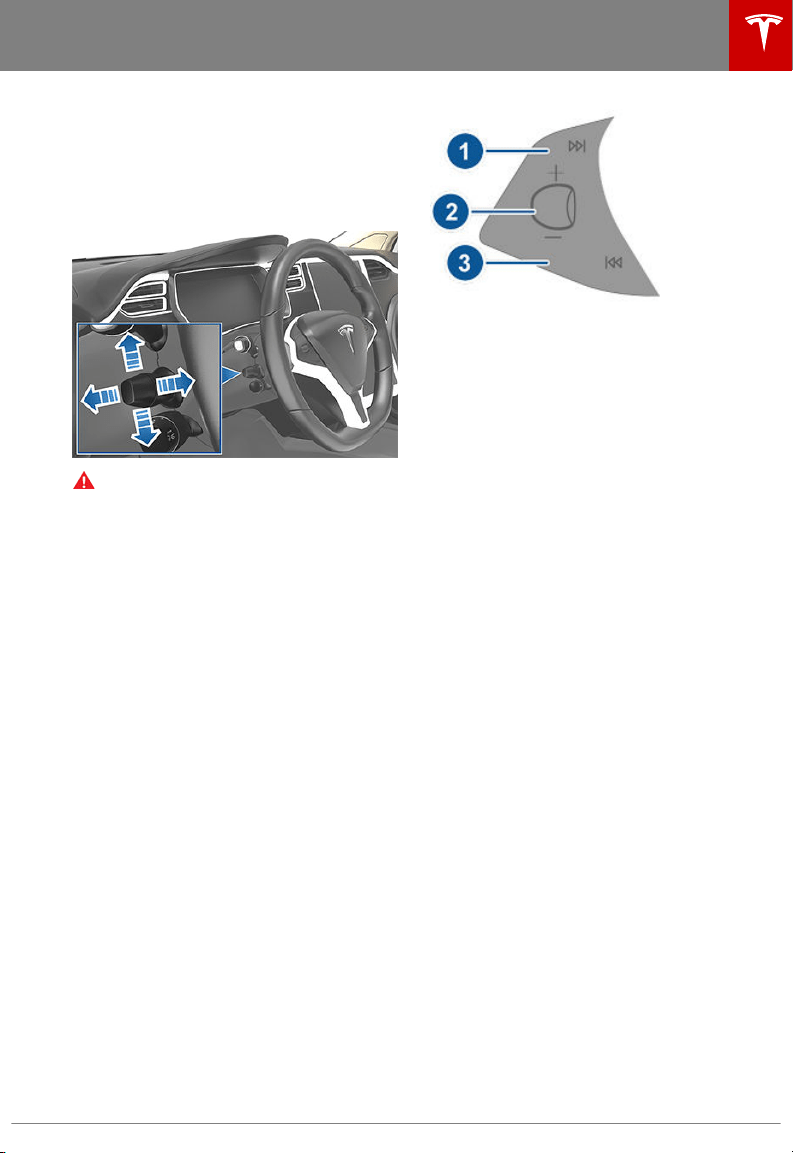
Adjusting Position
Adjust the steering wheel to the desired
driving position by moving the control on the
left side of the steering column. Using this
control, you can move the steering wheel
forward and backward and up and down.
Warning: Do not make adjustments while
driving.
Adjusting Sensitivity
You can adjust the feel and sensitivity of the
steering system to suit your personal
preference:
1. On the touchscreen, touch Controls.
2. Choose a steering option:
• Comfort - Reduces the eort required
to turn the wheel. In town, Model X
feels easier to drive and park.
• Standard - Tesla believes that this
setting
oers the best handling and
response in most conditions.
• Sport - Increases the
eort required
to turn the wheel. When driving at
higher speeds, Model X feels more
responsive.
The only way to really know which option you
like best is to try them.
Using Left Steering Wheel Buttons
Use the buttons on the left side of the steering
wheel to change radio stations, control the
media player’s volume, and to choose what
displays on the left side of the instrument
panel (whenever the Navigation app is not
displaying instructions).
1. Next
If you are listening to local or satellite
radio and you have defined more than one
radio preset, press to play the next preset
in the radio band that is currently playing.
If you have not
defined more than one
preset, press to go to the next available
frequency.
If you are listening to Internet radio, or to
an audio
file on a connected Bluetooth or
USB device, press to skip to the next song
or station.
If you have more than one favorite
defined, press and hold to cycle through
favorites.
2. Scroll Wheel
• To adjust the media volume, roll up or
down.
Note: The scroll wheel adjusts the
volume for media, navigation
instructions and phone calls based on
what is currently in use. As you adjust
volume, the instrument panel displays
the volume level and whether you are
adjusting volume for media,
navigation or phone.
• To mute the media volume, or to
pause/play an audio
file, tap the scroll
wheel.
Steering Wheel
Driving 47

• To choose what displays on the left
side of the instrument panel, press the
scroll wheel briefly until the available
options are displayed. Roll the scroll
wheel to choose Empty, Car Status,
Clock, Media, Energy or Trips, etc.
When the option you want is
highlighted, tap the scroll wheel.
Note: The option you choose to
display using the left scroll wheel is
retained until you manually change it.
It is also saved in your driver
profile.
Note: Car status displays information
such as status of doors and trunks,
and on newer model vehicles, the tire
pressure measurements.
• To restart the touchscreen, hold both
scroll wheel buttons for approximately
5 seconds. See Restarting the
Touchscreen on page 51.
3. Previous
Same as described above for Next, except
it skips to the previous song or station. If
you have more than one favorite
defined,
press and hold to cycle through favorites.
Note: Regardless of how you customize the
left side of the instrument panel, it
automatically changes to display navigation
instructions (if applicable), or to let you know
if a door or trunk is open when Model X is in a
driving gear.
Using Right Steering Wheel
Buttons
Use the buttons on the right side of the
steering wheel to access call options while on
a phone call, to choose what displays on the
right side of the instrument panel, to adjust
Model X features, and to use voice commands.
Note: Whenever you receive or make a phone
call, the right side of the instrument panel
automatically displays call options to help you
easily handle phone calls on your Bluetooth-
connected phone.
1. Press to use a voice command to call a
contact, navigate, or listen to Internet
music. When you hear the tone, speak
your command. Press again to end the
voice command, or simply stop speaking.
For details, see Using Voice Commands on
page 49.
2. Scroll Wheel
• During a phone call, touch the scroll
wheel to display call options that
allow you to perform an action on the
call.
• Roll the wheel to adjust the most
recently used feature from the feature
list (see Menu button).
• To choose what displays on the right
side of the instrument panel, press the
scroll wheel
briefly until the available
options are displayed. Roll the scroll
wheel to choose Empty, Car Status,
Clock, Media, Energy or Trips, etc.
When the option you want is
highlighted, tap the scroll wheel.
Note: Car status displays information
such as status of doors and trunks,
and on newer model vehicles, the tire
pressure measurements.
Note: The option you choose to
display using the right scroll wheel is
retained until you manually change it.
It is also saved in your driver
profile.
• To restart the touchscreen, hold both
scroll wheel buttons for approximately
5 seconds. See Restarting the
Touchscreen on page 51.
3. Menu button
Press to display a menu that allows you to
control the following Model X features:
• Temperature. Roll the wheel to
change the driver side temperature, or
press the wheel to turn the climate
control system on and
o.
Steering Wheel
48 Model X Owner's Manual
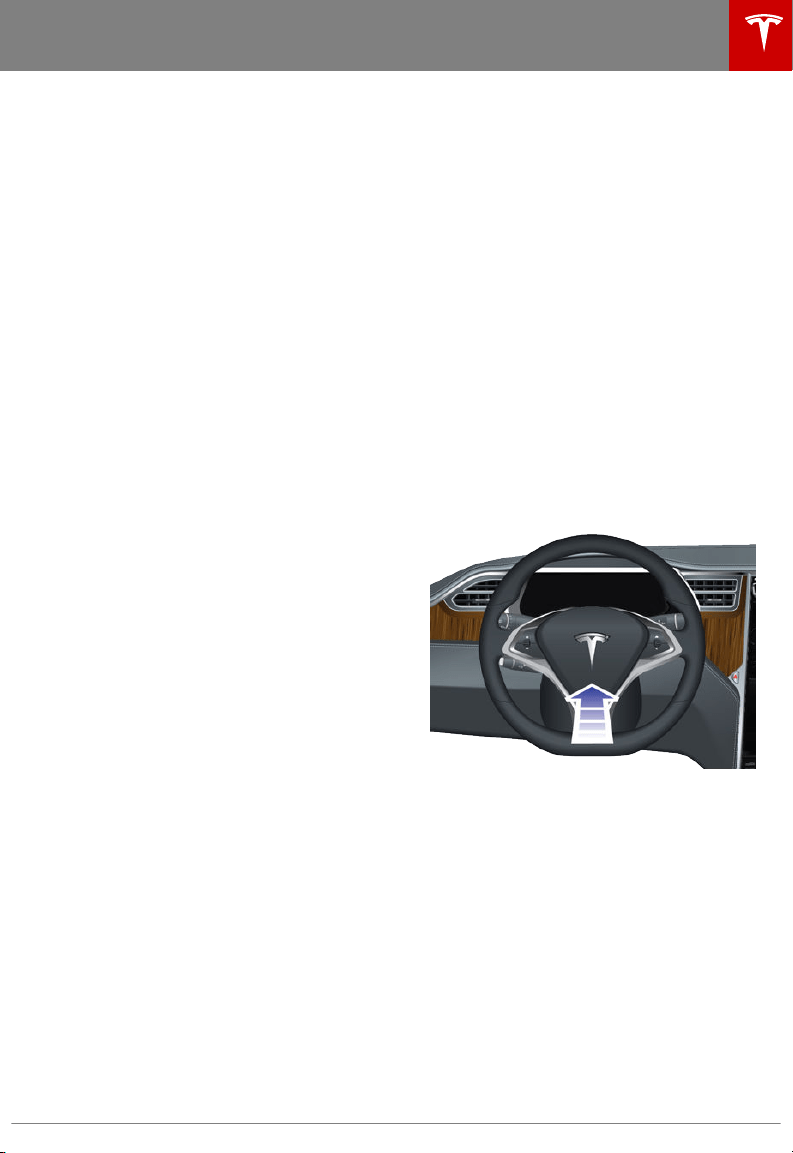
• Fan Speed. Roll the wheel to adjust
the speed of the fan used to cool or
heat the cabin.
• Display Brightness. Roll the wheel to
change the brightness level of the
displays, or press the wheel to restore
default settings.
• Recent Calls. If your phone is paired
to Model X, roll the wheel to view your
recent calls. Press the wheel to call the
contact that's displayed. To pair your
phone, see Pairing a Bluetooth Phone
on page 139.
• Contacts. If your phone is paired to
Model X, use the scroll wheel to
navigate to contacts in your phone.
Your contacts are listed alphabetically
by their last name. To pair your phone,
see Pairing a Bluetooth Phone on
page 139.
Press the menu button again to close the
feature list.
Using Voice Commands
You can use voice commands to call a contact,
navigate to a location, or listen to Internet
music. Tap the voice button on the upper right
side of the steering wheel to initiate a voice
command. When you hear the tone, speak
your command. As you speak, the instrument
panel displays an interpretation of your
command. (It also displays tips to remind you
of the type of commands you can speak.)
When you
finish speaking the command, tap
the voice button again or simply wait.
• To call a contact on your Bluetooth-
connected phone, say “Call” or “Dial”,
followed by the contact’s
first and/or last
name(s). For example, “Call Joe” or “Call
Joe Smith”.
• To search for, or navigate to, a location,
say “Where is”, “Drive to”, or “Navigate
to”, followed by an address, business
name, business category, or landmark. For
example, “Where is Stanford University?”,
“Drive to Tesla in Palo Alto”, or “Navigate
to Starbucks on Homestead in Cupertino”.
If you have
defined a navigation address
for your home or work locations, you can
use a voice command to navigate there by
saying "Navigate home" or "Navigate to
work".
• To listen to an Internet music service, say
“Listen to” or “Play”, followed by the name
of the song, album, artist, or combination.
To improve voice recognition accuracy,
provide multiple cues in your command,
such as artist plus song (for example,
“Listen to Yellow Brick Road” or “Play
Yellow Brick Road by Elton John”).
Heated Steering Wheel
If Model X is equipped with the optional cold
weather package, you can access a control
that instantly warms up the steering wheel by
touching Controls > Cold Weather > Heated
Wheel. When turned on, a heater in the
steering wheel provides radiant heat that
keeps the steering wheel at a comfortable
temperature.
Horn
To sound the horn, press the center pad on the
steering wheel.
Steering Wheel
Driving 49
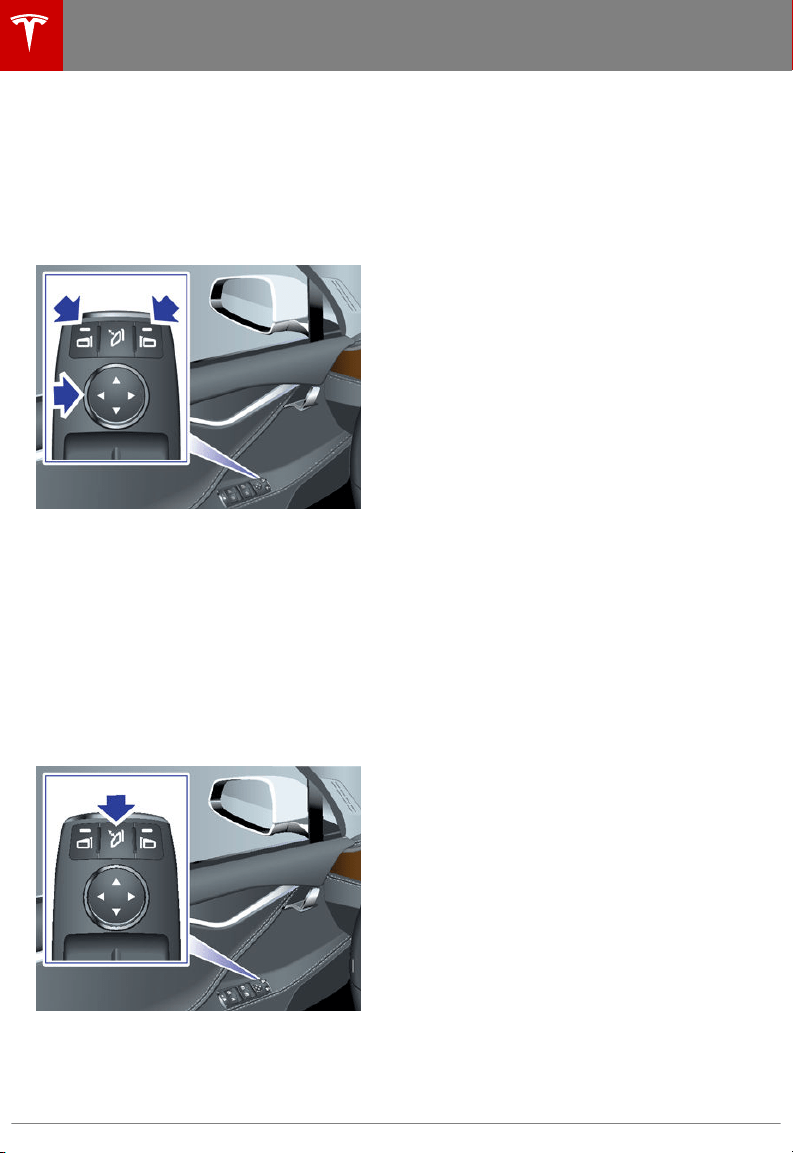
Adjusting Exterior Side Mirrors
Press the button associated with the mirror
you want to adjust (left or right). The button's
light turns on and you can then press the dial
to move the mirror to the desired position.
Repeat for the other side mirror. If prompted,
touch Save on the touchscreen to save the
mirror adjustment in your driver profile.
To fold and unfold exterior mirrors, press the
center button. You can set the mirrors to fold
automatically whenever Model X is locked by
touching Controls > Settings > Vehicle >
Mirror Auto-Fold > ON. The mirrors unfold
automatically whenever you unlock Model X.
When you use the center button to fold the
mirrors in for parking in a tight space, the
mirrors remain folded in until your driving
speed reaches 50 km/h, or until you use the
center button to unfold the mirrors.
Note: You cannot fold a mirror if driving above
50 km/h.
The driver’s side mirror automatically dims at
night, in proportion to the level of glare from
the headlights of a vehicle behind you (except
when in Reverse gear). Also, both exterior side
mirrors have heaters that turn on and o with
the rear window defroster.
Mirror Auto-tilt When Reversing
Both exterior mirrors can automatically tilt
downward when backing up. To adjust the
auto-tilt position, shift into Reverse, then
adjust the mirrors (press the button
associated with the mirror you want to adjust,
then press the dial to move the mirror to the
desired position). Touch Save on the
touchscreen to save the mirror adjustment in
your driver
profile.
When you shift back into Drive, the mirrors tilt
back to their normal (upward) position. But
now that you have adjusted them for backing
up, they automatically tilt to the selected
downward position whenever you shift into
Reverse.
You can turn the auto-tilt feature on or
o
using the touchscreen, Touch Controls >
Settings > Vehicle > Mirror Auto-Tilt.
Rear View Mirror
The rear view mirror is adjusted manually.
Except when in Reverse, the rear view mirror
automatically dims in proportion to the level
of glare from the headlights of a vehicle
behind you.
Mirrors
50 Model X Owner's Manual
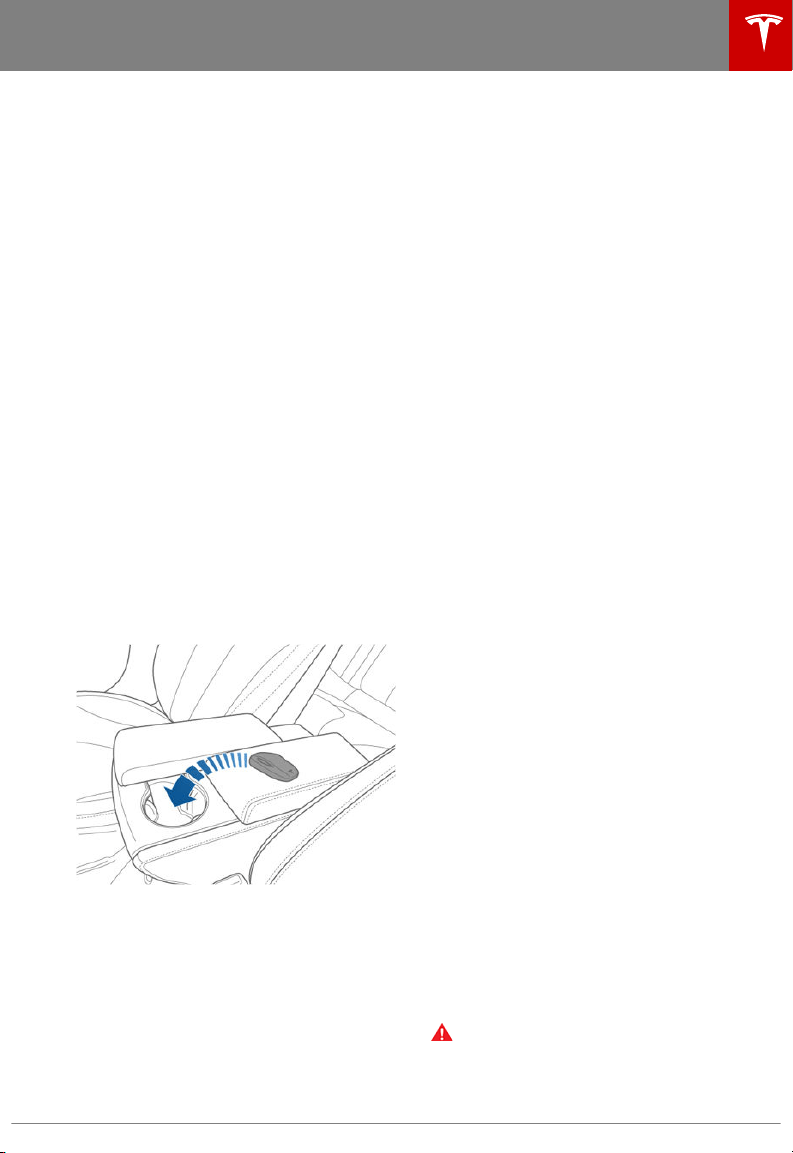
Starting
When you open a door, Model X powers on
the instrument panel and touchscreen and you
can operate all controls.
To drive Model X:
1. PRESS THE BRAKE PEDAL - Model X
powers on and is ready to drive.
2. SELECT A GEAR - Move the gear lever all
the way down for Drive and all the way up
for Reverse. See Shifting Gears on page
53.
Note: If Passive Entry is
o and you do not
press the brake pedal to start Model X within
approximately
five minutes, a message
displays on the instrument panel and you must
use the key to lock then unlock Model X again
before starting the vehicle.
Everything you need to know when driving
Model X displays on the instrument panel.
Key Not Inside
If Model X does not detect a key when you
press the brake, the instrument panel displays
a message telling you that a key is not inside.
If you receive this message, place the key in
the center console cup holder where Model X
can best detect it.
If Model X still does not detect the key, try
holding it against the center console,
immediately below the 12V power socket (see
12V Power Socket on page 137). If the key is
still not detected, remove the key's battery
and try again. See Replacing the Key Battery
on page 5. Or try using another key. If another
key does not work, contact Tesla.
A number of factors can
aect whether
Model X can detect the key. These include a
low battery in the key, interference from other
devices using radio signals, and objects
between the key and receiver.
Always keep the key with you. After driving,
the key is needed to restart Model X after it
powers o. And when you leave Model X, you
must bring the key with you to lock Model X,
either manually or automatically.
Powering
O
When you finish driving, shift into Park by
pressing the button on the end of the gear
selector. The parking brake automatically
engages and all systems keep operating.
When you leave Model X with the key , it
powers
o automatically, turning o the
instrument panel and touchscreen.
Model X also powers o automatically after
being in Park for 15 minutes, even if you are
sitting in the driver’s seat.
Although usually not needed, you can power
o Model X while sitting in the driver’s seat,
provided the vehicle is not moving. Touch
Controls > E-Brake & Power O > Power O.
Model X automatically powers back on again if
you press the brake pedal or touch the
touchscreen.
Note: Model X automatically shifts into Park
whenever it is determined that you are exiting
the vehicle, even when you shift into Neutral
before exiting. To keep Model X in Neutral, see
Keeping Your Vehicle in Neutral (Tow Mode)
on page 53.
Restarting the Touchscreen
If your touchscreen is unresponsive or
demonstrates unusual behavior, restart it by
shifting into Park then pressing and holding
both scroll wheels on the steering wheel until
the touchscreen turns black, releasing when
the Tesla logo appears. Within approximately
30 seconds, the touchscreen restarts. If the
touchscreen is still unresponsive or
demonstrating unusual behavior, contact
Tesla.
Note: Restarting the touchscreen does not
power Model X
o and on.
Warning:
Paying attention to road and
trac conditions must always be the
driver's highest priority. To ensure the
safety of vehicle occupants as well as
other road users, restarting the
Starting and Powering O
Driving 51

touchscreen should be done only when
the vehicle is in Park.
Starting and Powering O
52 Model X Owner's Manual
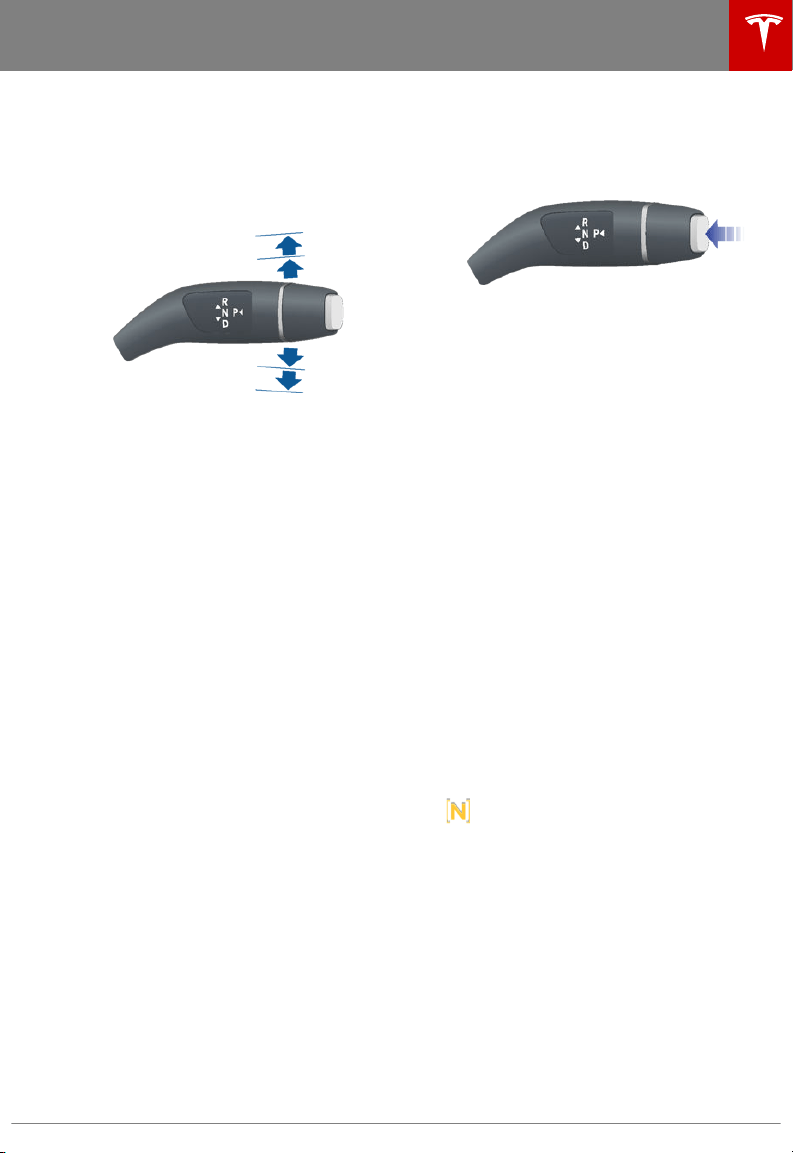
Shifting Gears
When Model X is in Park, you must press the
brake to shift to another gear.
Move the lever up or down to change gears.
If you try to shift into a gear that the current
driving speed prohibits, a chime sounds and
the gear does not change.
Reverse
Push the lever all the way up and release. You
can only shift into Reverse when Model X is
stopped or moving less than 8 km/h. If moving
less than 1.6 km/h, you must press the brake.
Neutral
Push the lever up or down to the
first position
and release to shift into Neutral. Neutral allows
Model X to roll freely when you are not
pressing the brake pedal.
If Model X is in Park and you use the
touchscreen to release the parking brake
(Controls > E-Brake & Power
O), Model X
shifts into Neutral (see Parking Brake on page
67).
Model X automatically shifts into Park when
you exit. To leave Model X in Neutral, use the
touchscreen to engage Tow mode (see
Keeping Your Vehicle in Neutral (Tow Mode)
on page 53).
Drive
Push the lever all the way down and release.
You can shift into Drive when Model X is
stopped or moving less than 8 km/h in
Reverse. If Model X is moving less than
1.6 km/h, you must press the brake to shift into
Drive.
Park
Press the end of the gear selector while
Model X is stopped. Whenever Model X is in
Park, the parking brake is applied.
Model X automatically shifts into Park
whenever:
• Model X determines that you are exiting
the vehicle.
• You connect a charge cable.
To make it convenient to pick up passengers,
you can also unlock all doors at any time by
shifting into Park then pressing the Park
button a second time.
Keeping Your Vehicle in Neutral
(Tow Mode)
Model X automatically shifts into Park
whenever you
finish driving and leave
Model X. To keep Model X in Neutral when you
exit, allowing it to roll freely (for example,
pulling onto a transporter, etc.), activate Tow
mode:
1. Shift into Park.
2. Press the brake pedal.
3. Touch Controls > Settings > Service &
Reset > Tow Mode.
Model X beeps, and shifts into Neutral (which
releases the parking brake).
When Tow mode is active, Model X
displays this indicator light on the
instrument panel, along with a
message telling you that Model X will
roll freely.
Note: In Tow mode, Model X does not shift
into a driving gear. To cancel Tow mode, shift
into Park or touch Tow mode again. Tow mode
also cancels if you use the touchscreen to
apply the parking brake (Controls > E-Brake &
Power
O > Parking Brake).
Gears
Driving 53
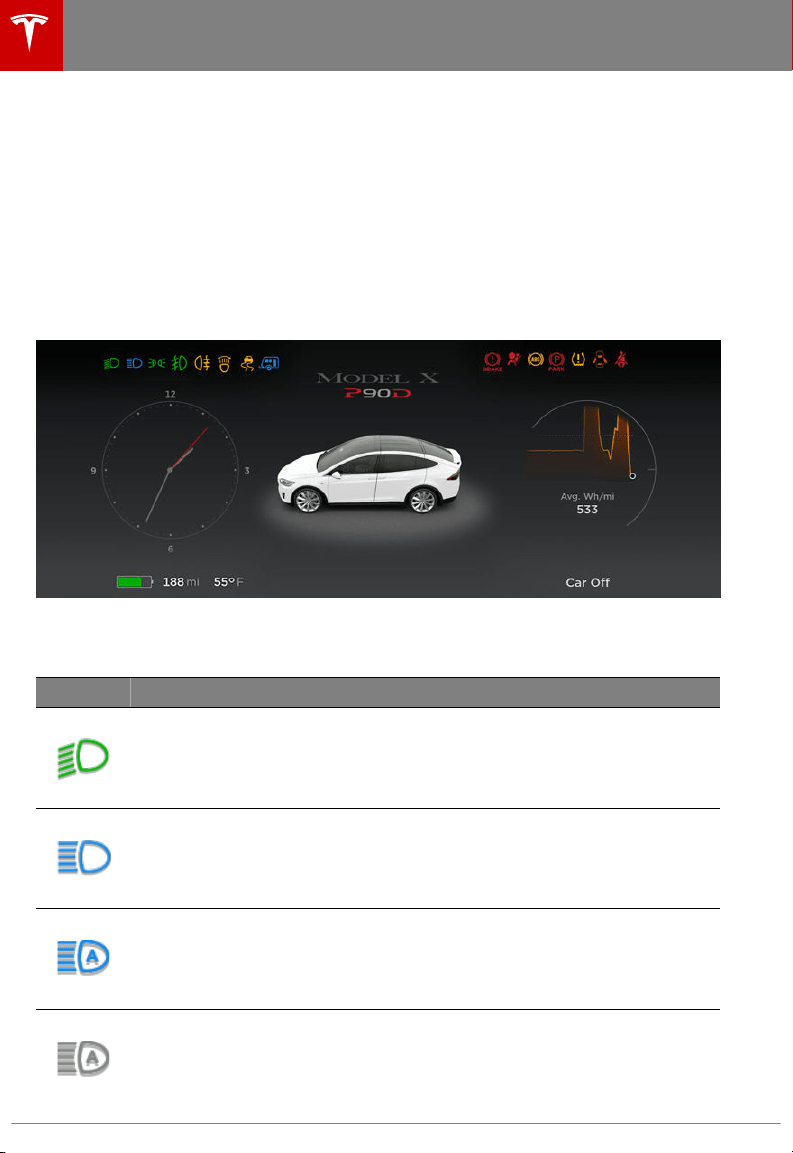
Instrument Panel Overview
The instrument panel changes depending on whether Model X is:
•
O (shown below).
• Driving (see Instrument Panel - Driving on page 58).
• Charging (see Charging Status on page 160).
When Model X is o, the instrument panel shows remaining estimated range, status of doors, and
outside temperature. When you press the brake, indicator lights flash on briefly along the top.
Unless an indicator light applies to a current situation, it should turn o. If an indicator light fails to
turn on or
o, contact Tesla.
Note: The following illustration is provided for demonstration purposes only. Depending on vehicle
options, software version, and market region, the information displayed may be slightly dierent.
The following indicators illuminate on the instrument panel to advise you or alert you of a specific
condition.
Indicator
Description
Low beam headlights are on.
High beam headlights are on. Illuminates when high beams are on but the Auto
High Beam setting is turned o or if the Auto High Beam setting is turned on but is
termporarily unavaible. See High Beam Headlights on page 63.
High beam headlights are currently turned on, and Auto High Beam is ready to
turn o the high beams if light is detected in front of Model X. See High Beam
Headlights on page 63.
High beam headlights are temporarily turned o because Auto High Beam is on
and is detecting light in front of Model X. When light is no longer detected, the
high beams will automatically turn back on. See High Beam Headlights on page
63.
Instrument Panel
54 Model X Owner's Manual
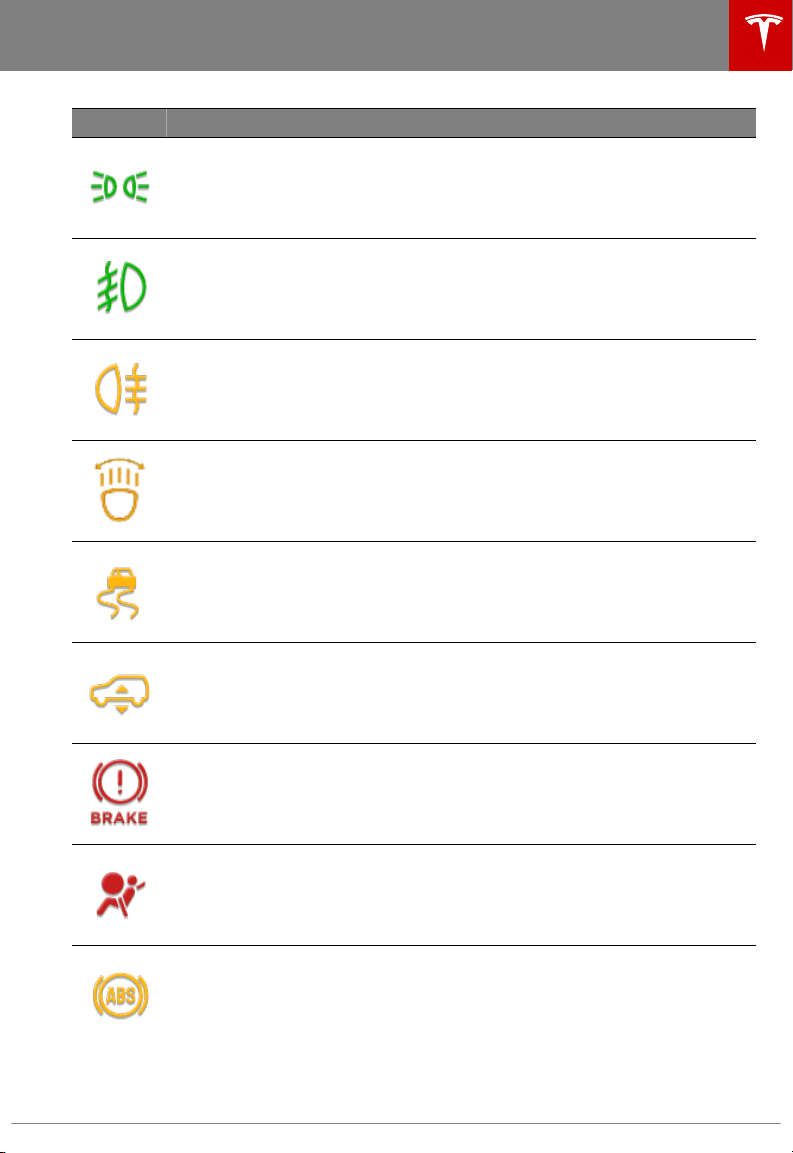
Indicator Description
Parking lights (side marker lights, tail lights, and license plate lights) are on. See
Lights on page 60.
Front fog lights (optional). See Lights on page 60.
Rear fog lights. See Lights on page 60.
Adaptive Front Lighting (if equipped). See Adaptive Front Lighting System (AFS)
on page 63.
Electronic stability control systems are actively minimizing wheel spin by
controlling brake pressure and motor power (indicator flashes). See Traction
Control on page 69. If this indicator stays illuminated, a fault is detected (contact
Tesla immediately).
A Smart Air Suspension fault is detected. Contact Tesla. See Smart Air Suspension
on page 132.
A brake system fault is detected or the brake fluid level is low. See Brakes on page
66. Contact Tesla immediately.
Airbag safety. If this indicator does not flash on briefly when Model X prepares to
drive, or if it remains on, contact Tesla immediately. See Airbag Warning Indicator
on page 43.
An ABS (Anti-lock Braking System) fault is detected. See Brakes on page 66.
Contact Tesla immediately.
Instrument Panel
Driving 55
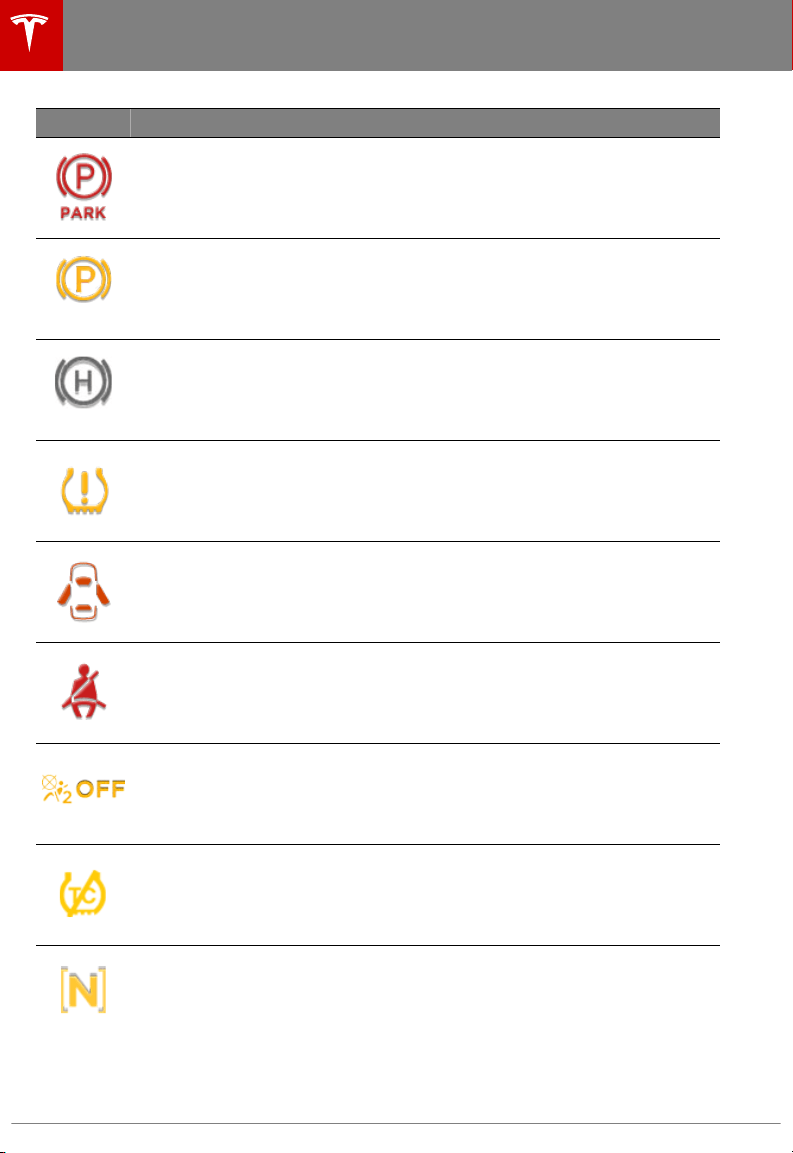
Indicator Description
The parking brake is manually applied. See Parking Brake on page 67.
A parking brake fault is detected. Contact Tesla. See Parking Brake on page 67.
Vehicle Hold is actively applying the brakes. See Vehicle Hold on page 72.
Tire pressure warning. The pressure of a tire is out of range. If a fault with the Tire
Pressure Monitoring System (TPMS) is detected, the indicator flashes. For a TPMS
fault, contact Tesla. See Tire Care and Maintenance on page 163.
A door or trunk is open. See Doors on page 4, Rear Trunk on page 13, or Front
Trunk on page 15.
A seat belt for an occupied seat is not fastened. See Seat Belts on page 27.
The front passenger’s air bag is turned o. See Airbags on page 40.
Electronic stability control systems are no longer minimizing wheel spin (i.e. on a
single motor vehicle, the traction control system has been turned o, or on a dual-
motor vehicle, Slip Start has been enabled). See Traction Control on page 69.
Model X is in Tow mode and can roll freely. It does not automatically shift into Park
when you exit. See Instructions for Transporters on page 194.
Instrument Panel
56 Model X Owner's Manual
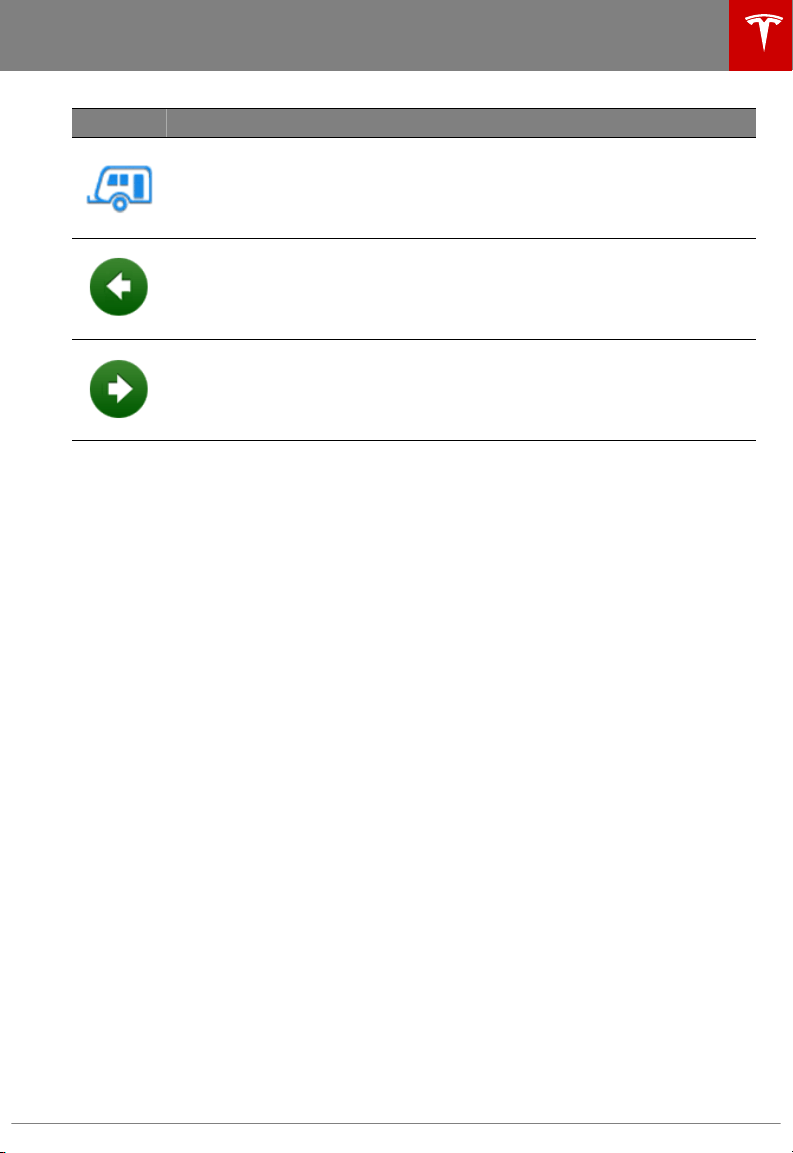
Indicator Description
Trailer mode (if equipped) is active. See Towing and Accessories on page 80.
Flashes green when the left turn signal is operating. Both turn signal indicators
flash green when the hazard warning flashers are operating.
Flashes green when the right turn signal is operating. Both turn signal indicators
flash green when the hazard warning flashers are operating.
Instrument Panel
Driving 57
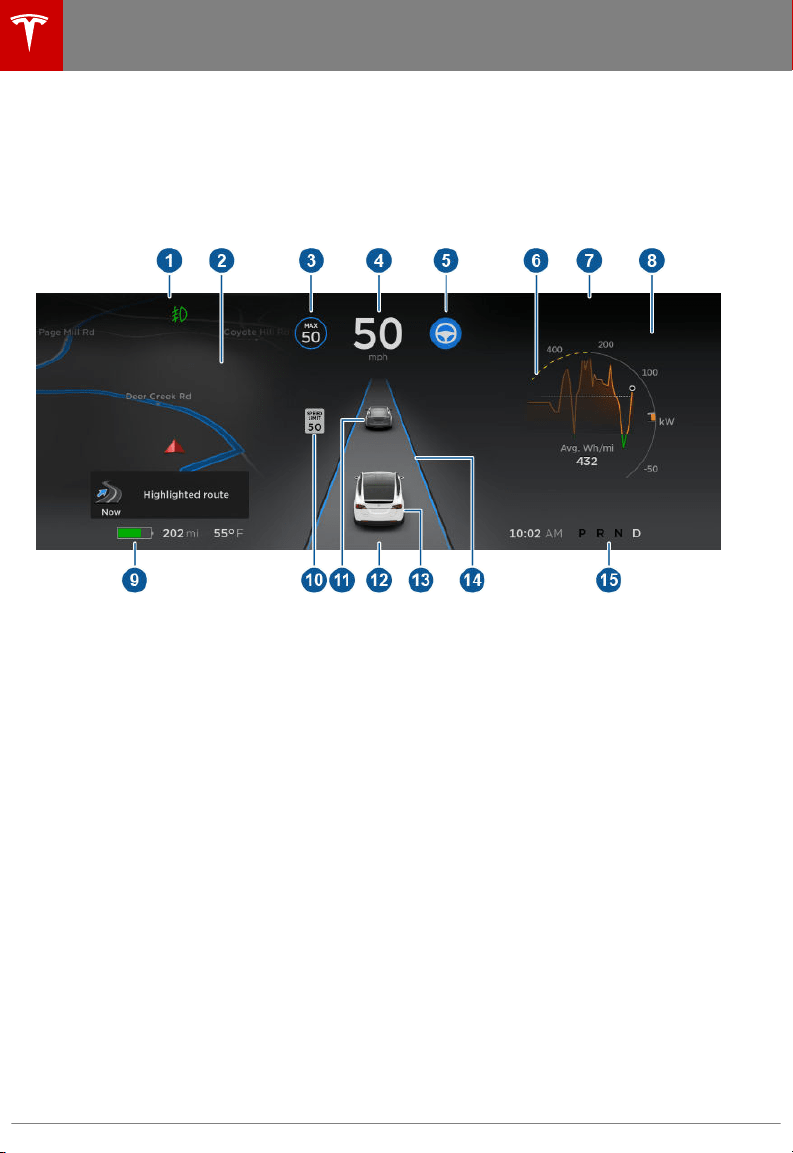
Instrument Panel - Driving
When Model X is driving (or ready to drive), the instrument panel shows your current driving
status and a real-time visualization of the road as detected by Model X's Driver Assistance
components (see About Driver Assistance on page 88).
Note: The following illustration is provided for demonstration purposes only. Depending on vehicle
options, software version, and market region, the information displayed may be slightly
dierent.
1. Indicator lights display along the top to provide status (see Instrument Panel Overview on
page 54).
2. When you are actively navigating to a destination, navigation instructions display here. Use
the left steering wheel buttons to change what displays on the left side of the instrument
panel whenever navigation instructions are not displayed (see Using Left Steering Wheel
Buttons on page 47).
3.
Trac-Aware Cruise Control is cruising at a set speed. When Trac-Aware Cruise Control is
available but you haven't set a cruising speed, the icon is gray and the speed is not shown
(see
Trac-Aware Cruise Control on page 91).
4. Driving speed.
5. Autosteer is actively steering Model X. When Autosteer is available but you haven't activated
it, the icon is gray (see Autosteer on page 97).
6. On the Energy graph, dashed lines appear on the power meter if Model X is limiting power.
The dashed lines appear on the top portion (energy being used) when power available for
acceleration is being limited, and on the bottom portion (energy being gained) when power
that can be gained by regenerative braking is limited. Model X limits power for many reasons.
Here are just a few examples:
• Acceleration may be limited when the Battery is reaching a low state of charge or if the
powertrain is hot.
• Both acceleration and regenerative braking may be limited when the ambient temperature
is either very high or very low.
• Regenerative braking may be limited when the Battery is fully charged.
Note: Use the right steering wheel buttons to control what displays on the right side of the
instrument panel (see Using Right Steering Wheel Buttons on page 48).
Instrument Panel
58 Model X Owner's Manual

7. Pay attention to important alert messages that display here. If any alerts are in eect, you can
view information about them by touching the alert icon (exclamation mark) on the
touchscreen’s status bar (the topmost area of the touchscreen).
8. Use the right steering wheel buttons to change what displays on the right side of the
instrument panel whenever a phone call is not active (see Using Right Steering Wheel Buttons
on page 48).
9. Total estimated driving distance (or energy) available. Instead of driving distance, you can
display the percentage of battery energy remaining. To do so, touch Controls > Settings >
Language & Units > Energy & Charging (see Settings on page 122).
Note: When anticipating when you need to charge, use range estimates as a general guideline
only.
Note: In cold weather, some of the stored energy in the Battery may not be available on your
drive because the Battery is too cold. When this happens, a portion of the Battery meter is
blue and the driving distance value has a
snowflake image next to it. If Model X is plugged in,
you can heat your Battery using wall power by turning on climate control using the mobile
app. When the Battery warms up, the blue portion on the meter and the
snowflake image are
no longer displayed.
10. The speed limit (if available) that is currently being detected by Speed Assist (see Speed
Assist on page 112).
11. The car in front of you (if applicable).
12. Pay attention to important driving-related messages that appear at the bottom center of the
instrument panel.
13. Your Model X.
14. When Autosteer is active and detects the driving lane, it is highlighted in blue (see Autosteer
on page 97).
15. Currently selected gear: Park, Reverse, Neutral, or Drive.
Instrument Panel
Driving 59

Controlling Lights
Touch Controls on the bottom corner of the touchscreen to control most of the lights.
In addition to the lights that you can control from the touchscreen, Model X has convenience
lights that turn on and
o automatically based on what you are doing. For example, you will
notice interior lights, marker lights, tail lights, door handle lights, and puddle lights that turn on
when you unlock Model X, when you open a door, and when you shift into Park. They turn o
automatically after a minute or two or when you shift into a driving gear or lock Model X.
Lights
60 Model X Owner's Manual

1. Touch to control front driver side map light.
2. If you touch DOME, a popup appears that allow you to control cabin lights. If cabin lights are
set to ON, all interior cabin lights, including the light in the rear trunk, turn on when you
unlock Model X, open a door upon exiting, or shift into P (Park). They turn o after 60
seconds, when you lock Model X, or when you shift into a driving gear. If set to AUTO, cabin
lights turn on only when little or no light is detected.
You can also turn on an individual dome light by touching its lens. If you manually turn a dome
light on, it turns o when Model X powers o. If Model X was already powered o when you
manually turned the light on, it turns
o after 60 minutes.
3. If you turn on AMBIENT lights, the lights on the door arm rests turn on whenever the
headlights are on.
4. Touch to control front passenger side map light.
5. Touch to turn the fog lights on or
o. Fog lights operate only when low beam headlights are
on. When headlights are turned
o, fog lights also turn o.
The Rear Fog indicator displays on the instrument panel whenever rear fog
lights are on.
The Front Fog indicator displays on the instrument panel whenever the
optional front fog lights are on.
6. If Model X is equipped with a coil suspension system, you can adjust the angle of the
headlights to accommodate the load you are carrying. You may need to lower the angle of the
headlights to avoid blinding oncoming drivers in situations when you are carrying a significant
amount of weight in the rear trunk. After touching LEVEL, drag the slider to the desired
position:
0
Headlights are not lowered. No change is needed when all front and rear seats are
occupied and only the front trunk is laden.
1
Headlights are lowered one level. Suitable when the front and rear seats are
occupied and the rear trunk is laden.
2 Headlights are lowered two levels. Suitable when carrying heavy loads.
Note: Headlight adjustments are not available if Model X is equipped with Smart Air
Suspension because Model X levels automatically.
Lights
Driving 61
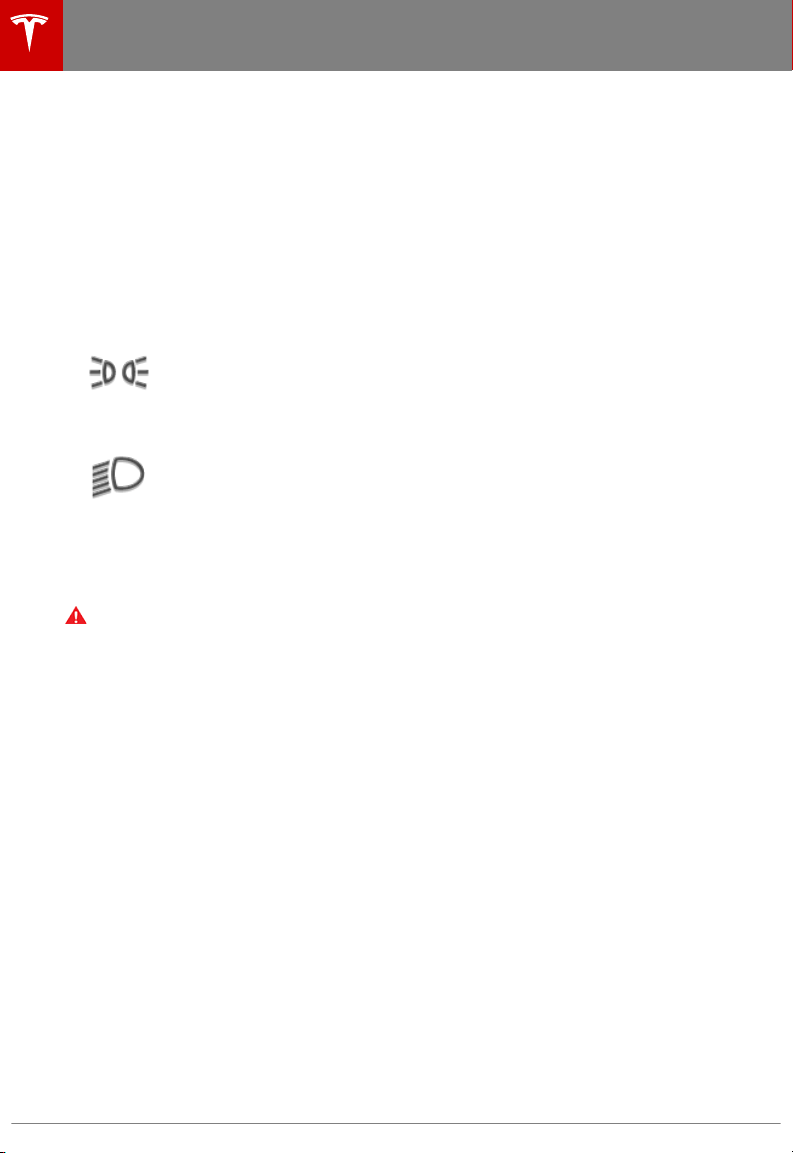
7. Exterior lights (headlights, tail lights, side marker lights, parking lights, and license plate
lights) are set to AUTO each time you start Model X.
AUTO
Exterior lights automatically turn on when driving in low lighting conditions.
If you change to a dierent setting, lights always revert to this AUTO setting
on your next drive.
Touch one of these options to temporarily change the exterior light setting:
OFF
Exterior lights turn o until you manually turn them back on or until the next
time you drive Model X. If daytime running lights are required in your region,
the exterior lights used for this purpose do not turn o.
Only the side marker lights, parking lights, tail lights and license plate lights
turn on.
Exterior lights turn on.
Note: Model X has a series of lights along the lower rim of the headlights, also referred to as
"signature" lights. These lights automatically turn on whenever Model X is powered on and a
driving gear is engaged.
Warning: Always ensure that your headlamps are switched to AUTO or ON, as
appropriate, during all low visibility conditions. Failure to do so may result in a collision.
8. If you turn on AUTO HIGH BEAM, high beam headlights turn on and o automatically based
on whether or not light is detected in front of Model X (see High Beam Headlights on page
63).
Lights
62 Model X Owner's Manual
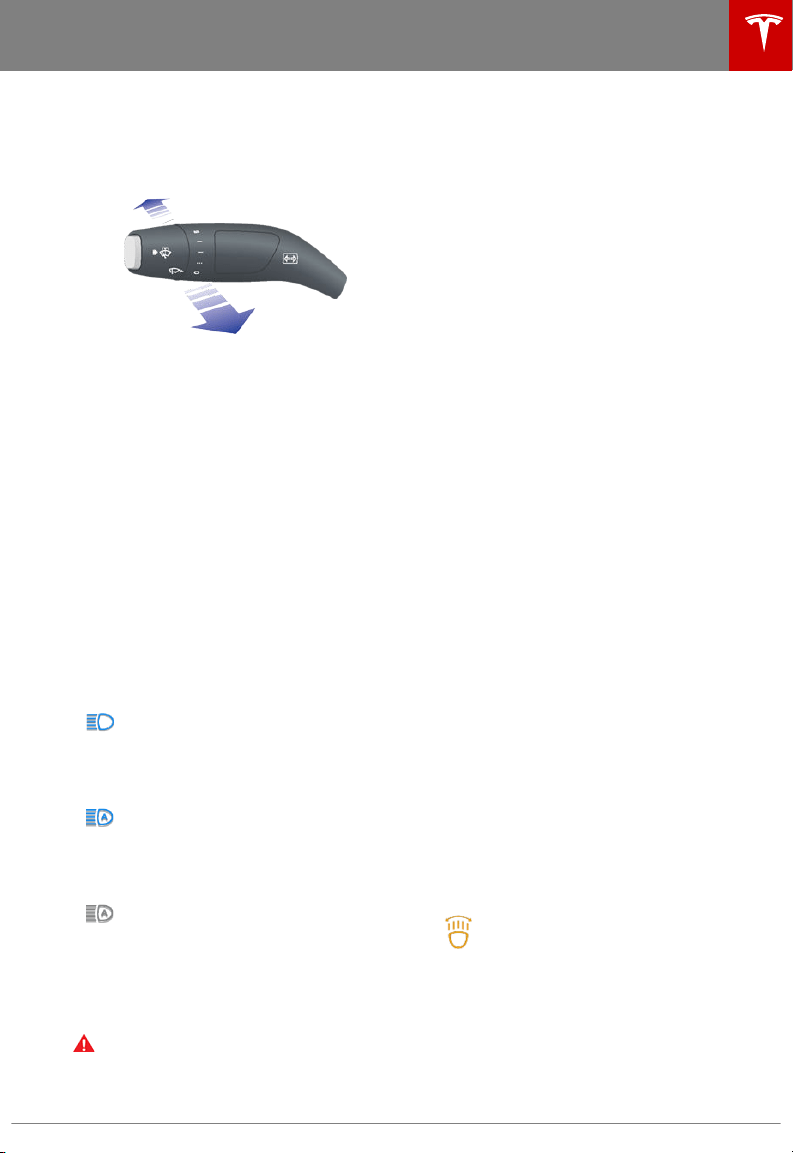
High Beam Headlights
Push the left-hand steering column lever away
from you. To cancel, pull the lever toward you.
The high beam headlights can automatically
switch to low beam when there is light
detected in front of Model X (for example,
from an oncoming vehicle). To turn this feature
on, touch Controls > Auto High Beam.
Note: Your chosen setting is retained until you
manually change it. It can also be saved in
your driver
profile.
In situations where high beams are turned o
because AUTO HIGH BEAM is turned on and
light is detected in front of Model X, you can
temporarily turn on high beams by pulling the
lever all the way toward you.
The following indicator lights are visible on the
instrument panel when high beams are turned
on:
High beam headlights are on.
Illuminates when high beams are on
but the Auto High Beam setting is
turned o or if the Auto High Beam
setting is turned on but is
termporarily unavaible.
High beams are currently turned on,
and Auto High Beam is ready to turn
o the high beams if light is
detected in front of Model X.
High beams are temporarily turned
o because Auto High Beam is on
and is detecting light in front of
Model X. When light is no longer
detected, the high beams will
automatically turn back on.
To flash the headlight high beams, pull the
lever fully toward you and release.
Warning:
Auto High Beam is an aid only
and is subject to limitations. It is the
driver's responsibility to make sure that
the headlights are always adjusted as
appropriate for the weather conditions
and driving circumstances.
Headlights After Exit
When you stop driving and park Model X in
low lighting conditions, the exterior lights
automatically turn on. They automatically turn
o after one minute or when you lock
Model X.
You can turn this feature on and o using the
touchscreen. Touch Controls > Settings >
Vehicle > Headlights After Exit. When
Headlights After Exit is set to
O, the
headlights turn o when you engage the Park
gear.
Adaptive Front Lighting System
(AFS)
If equipped, the Adaptive Front Lighting
System (AFS) automatically adjusts the beam
of the headlights to improve your driving view.
Electric sensors measure driving speed,
steering angle and yaw (the rotation of the car
around the vertical axis) to determine the
optimum position of the headlights based on
current driving conditions. For example, to
improve visibility while driving on winding
roads at night, the AFS casts the beam in the
direction of the curve. When low beam
headlights are turned on and when driving at
lower speeds, AFS improves lateral
illumination to increase the visibility of
pedestrians and curbs, and to improve
visibility when turning at a dark intersection,
into a driveway, or when making a u-turn.
The Adaptive Front Lighting System (AFS)
operates whenever headlights are on. If
Model X isn't moving, or is moving in reverse,
the adaptive headlights do not activate. This
prevents the lights from inadvertently blinding
other drivers. To turn the AFS
o, touch
Controls > Settings > Vehicle > Adaptive
Headlights > OFF.
If the AFS fails, the instrument panel
displays an alert. Contact Tesla
Service.
Turn Signals
Move the left-hand steering column lever up
(before turning right) or down (before turning
left).
Lights
Driving 63
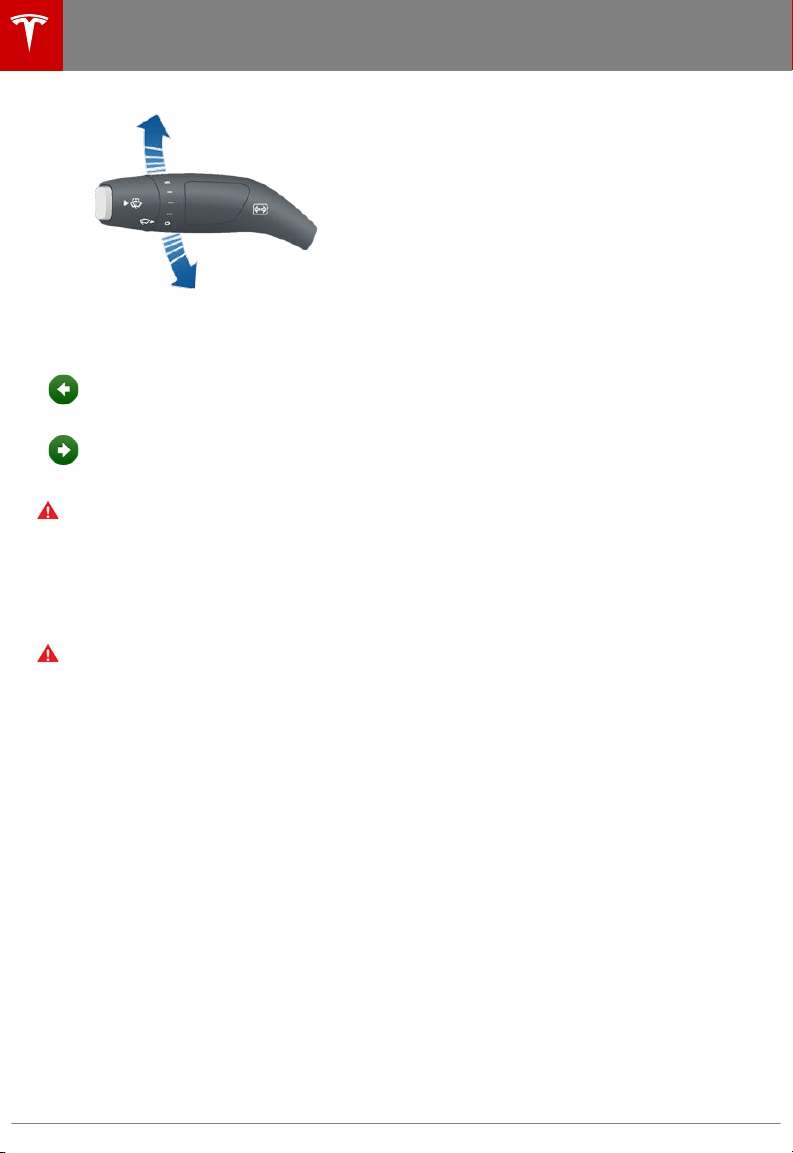
The turn signals stop operating when canceled
by the steering wheel, or when you return the
lever to the central position.
The corresponding turn signal
indicator lights up on the instrument
panel when a turn signal is
operating. You also hear a clicking
sound.
Warning: If you have purchased the
optional Enhanced Autopilot or Full Self-
Driving Capability packages and Trac-
Aware Cruise Control is active, engaging
a turn signal can cause Model X to
accelerate when using Trac-Aware
Cruise Control in specific situations (see
Overtake Acceleration on page 94).
Warning: If you have purchased the
optional Enhanced Autopilot or Full Self-
Driving Capability packages and
Autosteer is active, engaging a turn signal
may cause Model X to change lanes (see
Auto Lane Change on page 100).
Lane Change Flash
To indicate a lane change, quickly press the
lever up or down against the spring pressure,
then release. The corresponding turn signal
flashes three times.
Hazard Warning Flashers
To turn on the hazard warning
flashers, press
the button located on the side of the
touchscreen closest to the steering wheel. All
turn signals
flash. Press again to turn o.
Note: Hazard warning flashers operate even
without a Model X key nearby.
Lights
64 Model X Owner's Manual
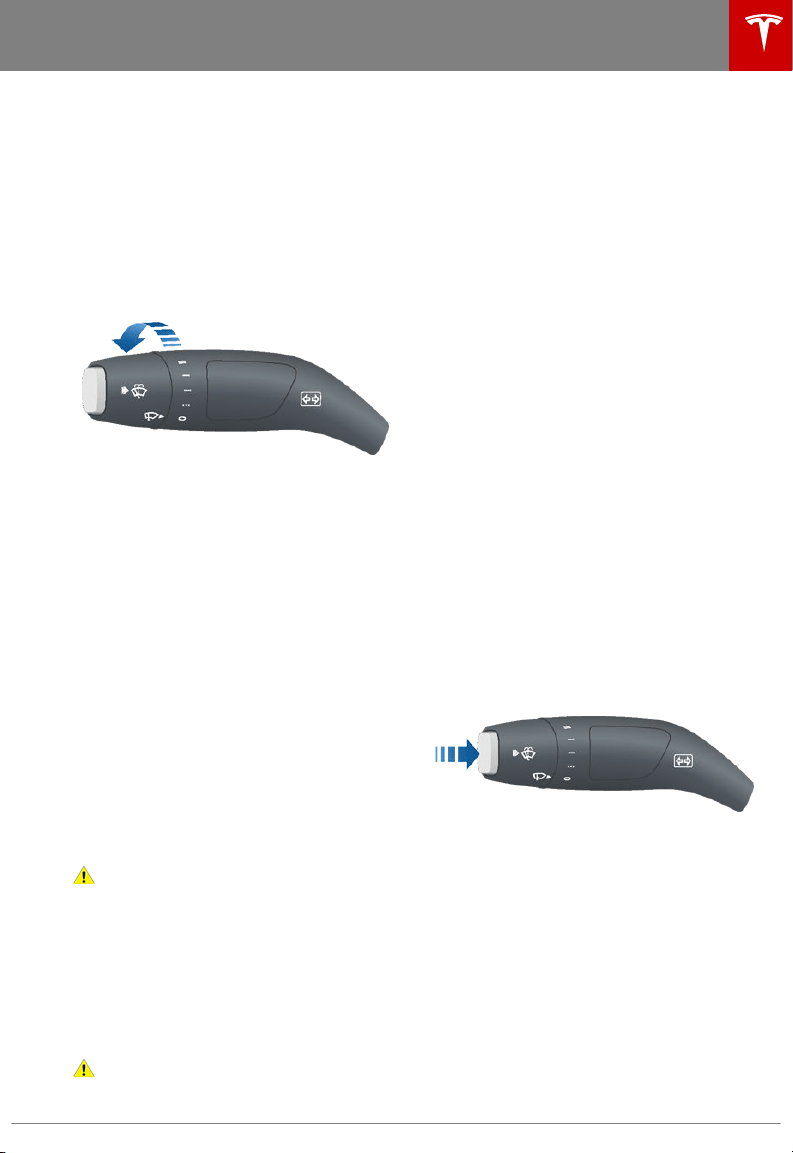
Wipers
To wipe the windshield, rotate the end of the
left-hand steering column lever away from
you. The steering column lever has five
positions:
• 1st:
O.
• 2nd: Auto with low rain sensitivity.*
• 3rd: Auto with high rain sensitivity.*
• 4th: Continuous, slow.
• 5th: Continuous, fast.
For a single wipe, press and release the end of
the lever.
If the wipers are set to Auto and Model X
detects no liquid on the windshield, the wipers
do not wipe.
When you operate the wipers, headlights
automatically turn on (if they are not on
already).
*To enable the Auto settings, touch Controls >
Settings > Vehicle > Autowipers (Beta) > ON.
When wipers are set to an Auto setting,
Model X detects whether or not it is raining.
The frequency at which they wipe depends on
how much rain is detected on the windshield.
When wipers are set to high rain sensitivity,
the wipers turn on when Model X detects a
light mist.
Note: The Auto setting is currently in BETA. If
uncertain about using the Auto setting while
in the BETA phase, Tesla recommends
operating the wipers manually, as necessary.
Caution:
Ensure the wipers are in the O
position before washing Model X to avoid
the risk of damaging the wipers.
To extend the life of wiper blades, remove ice
from the windshield before turning wipers on.
Ice has sharp edges that can damage the
rubber on the blades.
Periodically check and clean the edge of the
wiper blade. If damaged, contact Tesla
Service.
Caution:
In harsh climates, ensure that the
wiper blades are not frozen or adhered to
the windshield.
De-icing Wipers
To make wiper blades easy to access so you
can remove any ice and snow, shift Model X
into Park, turn the wipers o, then use the
touchscreen to move them to the service
position. Touch Controls > Settings > Service
& Reset > Service Mode > ON. When parking
in cold outdoor climates, it is helpful to leave
Model X with the wipers in the service
position. In this position, they are closer to the
defrost vent, allowing you to thaw them by
directing air from the climate control system
towards the windshield.
Note: Wipers automatically return to their
normal position when you shift Model X out of
Park.
If Model X is equipped with the optional cold
weather package, you can de-ice wipers by
touching Controls > Cold Weather > Heated
Wipers. Wiper heaters automatically turns
o
after 15 minutes.
Washers
Press the button on the end of the left
steering column lever to spray washer
fluid
onto the windshield. You can press this button
at two levels. Press partially for a single wipe,
without any washer
fluid. Press fully for both
wipe and wash. When washing the windshield,
the wipers will perform two wipes after you
release the button, then a third wipe a few
seconds later.
Periodically top up washer fluid (see Topping
Up Washer Fluid on page 174).
Wipers and Washers
Driving 65

Braking Systems
Warning: Properly functioning braking
systems are critical to ensure safety. If
you experience a problem with the brake
pedal, brake caliper, or any component of
a Model X braking system, contact Tesla
immediately.
Model X has an anti-lock braking system
(ABS) that prevents the wheels from locking
when you apply maximum brake pressure. This
improves steering control during heavy
braking in most road conditions.
During emergency braking conditions, the
ABS constantly monitors the speed of each
wheel and varies the brake pressure according
to the grip available.
The alteration of brake pressure can be felt as
a pulsing sensation through the brake pedal.
This demonstrates that the ABS is operating
and is not a cause for concern. Keep
firm and
steady pressure on the brake pedal while
experiencing the pulsing.
The ABS indicator flashes briefly on
the instrument panel when you first
start Model X. If this indicator lights
up at any other time, an ABS fault
has occurred and the ABS is not
operating. Contact Tesla. The braking
system remains fully operational and
is not aected by an ABS failure.
However, braking distances may
increase.
If the instrument panel displays this
indicator at any time other than
displaying briefly when you first start
Model X, a brake system fault is
detected or the brake
fluid level is
low. Contact Tesla immediately.
Emergency Braking
In an emergency, fully press the brake pedal
and maintain firm pressure, even on low
traction surfaces. The ABS varies the braking
pressure to each wheel according to the
amount of traction available. This prevents
wheels from locking and ensures that you stop
as safely as possible.
Warning:
Do not pump the brake pedal.
Doing so interrupts operation of the ABS
and can increase braking distance.
Warning: Always maintain a safe distance
from the vehicle in front of you and be
aware of hazardous driving conditions.
While the ABS can improve stopping
distance, it cannot overcome the laws of
physics. It also does not prevent the
danger of hydroplaning (where a layer of
water prevents direct contact between
the tires and the road).
Automatic Emergency Braking automatically
applies full braking in situations where a
collision is considered imminent (see
Automatic Emergency Braking on page 109).
Warning: Automatic Emergency Braking
is not designed to prevent a collision. At
best, it can minimize the impact of a
frontal collision by attempting to reduce
your driving speed. Depending on
Automatic Emergency Braking to avoid a
collision can result in serious injury or
death.
Brake Wear
Model X brake pads are equipped with wear
indicators. A wear indicator is a thin metal
strip attached to the brake pad that squeals as
it rubs against the rotor when the pad wears
down. This squealing sound indicates that the
brake pads have reached the end of their
service life and require replacement. To
replace the brake pads, contact Tesla Service.
Brakes must be periodically inspected visually
by removing the tire and wheel. For detailed
specifications and service limits for rotors and
brake pads, see Brakes on page 184.
Warning:
Neglecting to replace worn
brake pads damages the braking system
and can result in a braking hazard.
Regenerative Braking
Whenever Model X is moving and your foot is
o the accelerator, regenerative braking slows
down Model X and feeds any surplus energy
back to the Battery.
By anticipating your stops and reducing or
removing pressure from the accelerator pedal
to slow down, you can take advantage of
regenerative braking to increase driving range.
Of course, this is no substitute for regular
braking when needed for safety.
Note: If regenerative braking is aggressively
slowing Model X (such as when your foot is
completely
o the accelerator pedal at
highway speeds), the brake lights turn on to
alert others that you are slowing down.
Brakes
66 Model X Owner's Manual
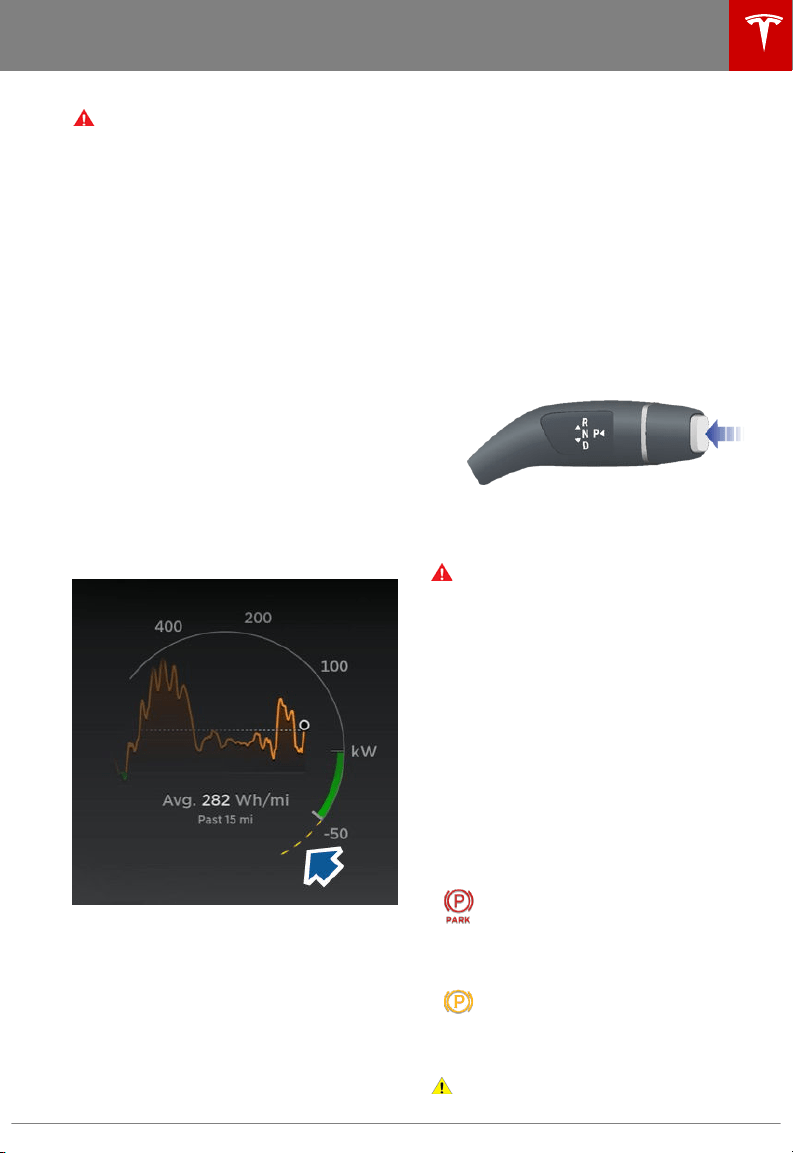
Warning: In snowy or icy conditions
Model X may experience traction loss
during regenerative braking, particularly
when in the Standard setting and/or not
using winter tires. Tesla recommends
using the Low setting (see To Set the
Regenerative Braking Level on page 67)
in snowy or icy conditions to help
maintain vehicle stability.
The Energy app displays real-time feedback
on the amount of energy being gained by
regenerative braking. You can also display the
power meter on either side of the instrument
panel by choosing Energy using the scroll
button on the steering wheel (see Steering
Wheel on page 47).
The amount of energy fed back to the Battery
using regenerative braking can depend on the
current state of the Battery and the charge
level setting that you are using. For example,
regenerative braking may be limited if the
Battery is already fully charged or if the
ambient temperature is too cold.
Note: If regenerative braking is limited, a
dashed yellow line displays on the power
meter.
To Set the Regenerative Braking Level
You can use the touchscreen to change the
level of regenerative braking:
1. Touch Controls > Driving > Regenerative
Braking.
2. Choose from two levels:
•
Standard: Provides the maximum
amount of regenerative braking. When
you release the accelerator, Model X
slows down faster, reducing the need
to use the brakes.
• Low: Limits regenerative braking.
When you release the accelerator,
Model X takes longer to slow down
and coasts further than if set to
Standard.
Parking Brake
The parking brake automatically engages
when you shift Model X into Park, and releases
when you shift into any other gear.
Note: The parking brake operates on the rear
wheels only, and is independent of the pedal-
operated brake system.
Warning: In snowy or icy conditions the
rear wheels may not have sucient
traction to prevent Model X from sliding
down a slope, particularly if not using
winter tires. Avoid parking on hills in
snowy or icy conditions. However, if
parking in such conditions is absolutely
necessary, have a second person place
wheel chocks under the front wheels
before releasing the brake pedal.
Use the touchscreen to manually release the
parking brake (which also shifts Model X into
Neutral):
1. Touch Controls > E-Brake & Power O .
2. Press the brake pedal, then touch Parking
Brake. If Model X was previously in Park, it
shifts into Neutral.
The parking brake indicator lights up
on the instrument panel whenever
you use the touchscreen to manually
apply the parking brake.
If an electrical issue occurs with the
parking brake, an amber parking
brake fault message displays at the
top of the instrument panel.
Caution: In the unlikely event that
Model X loses electrical power, you
Brakes
Driving 67

cannot access the touchscreen and are
therefore unable to release the parking
brake. Contact Tesla.
Brakes
68 Model X Owner's Manual

How It Works
The traction control system constantly
monitors the speed of the front and rear
wheels. If Model X experiences a loss of
traction, the system minimizes wheel spin by
controlling brake pressure and motor power.
By default, the traction control system is on.
Under normal conditions, it should remain on
to ensure maximum safety.
This indicator flashes on the
instrument panel whenever the
traction control system is actively
controlling brake pressure and motor
power to minimize wheel spin. If the
indicator stays on, a fault is detected
with the traction control system.
Contact Tesla Service.
Warning: If the above indicator remains
illuminated in situations in which you have
not enabled Slip Start (described next),
the traction control system may not be
operating correctly. Contact Tesla Service
immediately.
Warning: Traction control cannot prevent
collisions caused by driving dangerously
or turning too sharply at high speeds.
Allowing Wheel Slip
To allow the wheels to spin at a limited speed,
you can enable Slip Start. Slip Start can be
enabled only when Model X is moving
48 km/h or slower. Slip Start automatically
disables when the speed exceeds 80 km/h.
Under normal conditions, Slip Start should not
be enabled. Enable it only in circumstances
where you deliberately want the wheels to
spin, such as:
• Starting on a loose surface, such as gravel
or snow.
• Driving in deep snow, sand or mud.
• Rocking out of a hole or deep rut.
To allow the wheels to spin, touch Controls >
Driving > Traction Control > Slip Start.
The instrument panel displays an
alert message when Slip Start is
enabled.
Although Slip Start is automatically disabled
the next time you start Model X, it is strongly
recommended that you disable it immediately
after the circumstances that required you to
enable it have passed.
Note: Slip Start cannot be enabled when you
are actively using
Trac-Aware Cruise
Control.
Traction Control
Driving 69
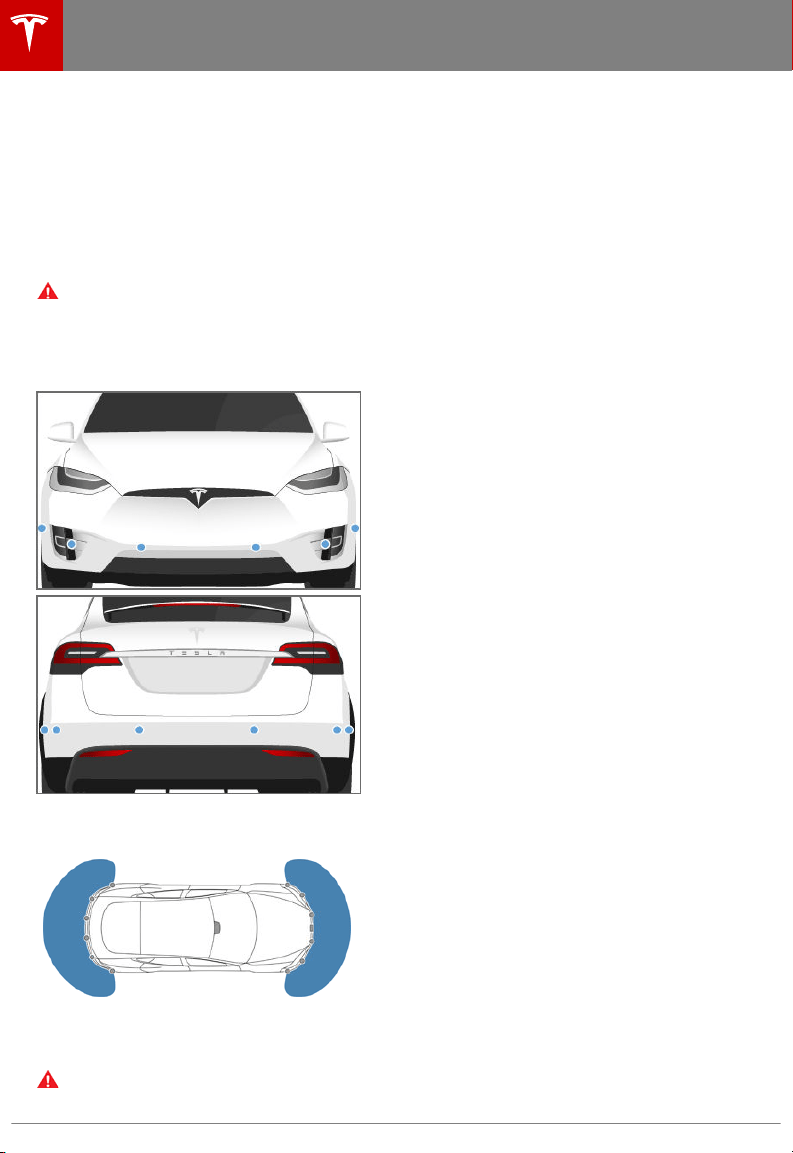
How Park Assist Works
Model X has several sensors designed to
detect the presence of objects. When driving
slowly in Drive or Reverse (for example, when
parking), the sensors alert you if an object is
detected in close proximity of your Model X.
Objects are only detected in the direction of
the gear you selected; front objects in Drive,
rear objects in Reverse.
Warning: You may not be alerted if
Model X rolls freely in the opposite
direction of the gear you selected (for
example, you will not receive an alert if
Model X rolls backwards down a hill while
in Drive).
The sensors are activated when driving slower
than 8 km/h.
Note: Rear sensors are disabled when a
bicycle is detected or Model X is in trailer
mode.
Warning:
Never depend on Park Assist to
inform you if an area you are approaching
is free of objects and/or people. Several
external factors can reduce the
performance of Park Assist, causing
either no readings or false readings (see
Limitations and False Warnings on page
71). Therefore, depending on Park Assist
to determine if Model X is approaching an
obstruction can result in damage to the
vehicle and/or objects, and can
potentially cause serious injury. Always
inspect the area with your own eyes.
When reversing, perform shoulder checks
and use all mirrors. Park assist does not
detect children, pedestrians, bicyclists,
animals, or objects that are moving,
protruding, located too far above or
below the sensors, or too close or too far
from the sensors. Park Assist is for
guidance purposes only and is not
intended to replace your own direct visual
checks. It is not a substitute for careful
driving.
Visual and Audio Feedback
When you shift to Reverse, the Park Assist
view displays on the left side of the instrument
panel, showing objects that are in close
proximity to the front and rear of Model X.
This view closes when you shift into Drive
unless an object is detected close to the front
of Model X, in which case the Park Assist view
closes automatically when your driving speed
exceeds 8 km/h. When reversing, visual
feedback also displays on the touchscreen,
immediately below the camera view (see Rear
View Camera on page 78). You can manually
close the park assist view on the touchscreen
by touching the X in the upper left corner.
When driving with the Camera app displayed
on the touchscreen, you can switch to the
Park Assist view when driving at speeds below
8 km/h. Touch the button located in the upper
left corner of the Camera app window. This is
useful if you need assistance with parallel
parking.
If chimes are turned on (see Controlling
Audible Feedback on page 71), an audible
beep sounds as you approach an object. You
can temporarily mute the chime by pressing
the scroll wheel on the left side of the steering
wheel or by touching the mute button located
on the bottom left corner of the Park Assist
view.
Note: If a sensor is unable to provide
feedback, the instrument panel displays an
alert message.
Park Assist
70 Model X Owner's Manual

Caution: Keep sensors clean from dirt,
debris, snow, and ice. Avoid using a high
pressure power washer on the sensors
and do not clean a sensor with a sharp or
abrasive object that can scratch or
damage its surface.
Caution: Do not install accessories or
stickers on or near the parking sensors.
Controlling Audible Feedback
You can use Park Assist with or without
audible feedback. To turn chimes on or
o,
touch Controls > Settings > Safety &
Security > Park Assist Chimes.
To mute the chimes temporarily, press the
scroll wheel on the left side of the steering
wheel or touch the mute button in the bottom
left corner of the Park Assist view. The chimes
are muted until you shift into a
dierent gear
or drive over 8 km/h.
Limitations and False Warnings
The parking sensors may not function
correctly in these situations:
• One or more of the parking sensors is
damaged, dirty, or covered (such as mud,
ice, or snow).
• The object is located below approximately
20 cm (such as a curb or low barrier).
Caution:
Shorter objects that are
detected (such as curbs or low
barriers) can move into the blind spot
of the sensors. Model X cannot alert
you about an object while it is in the
blind spot of the sensors.
• Weather conditions (heavy rain, snow, or
fog) are interfering with sensor operation.
• The object is thin (such as a sign post).
• A sensor’s operating range has been
exceeded.
• The object is sound-absorbing or soft
(such as powder snow).
• The object is sloped (such as a sloped
embankment).
• Model X has been parked in, or being
driven in, extremely hot or cold
temperatures.
• The sensors are
aected by other
electrical equipment or devices that
generate ultrasonic waves.
• The object is located too close to the
bumper.
• A bumper is misaligned or damaged.
• An object that is mounted to Model X is
interfering with and/or obstructing the
sensor (such as a bike rack or bumper
sticker).
• Model X rolls freely in the opposite
direction of the gear you selected (for
example, you will not receive an alert if
Model X rolls backwards down a hill while
in Drive).
Other Parking Aids
In addition to Park Assist, when shifted into
Reverse, the backup camera displays a view of
the area behind Model X (see Rear View
Camera on page 78).
Park Assist
Driving 71

When Model X is stopped, Vehicle Hold can
continue to apply the brakes even after you
remove your foot from the brake pedal. When
driving on a hill or on a flat surface, brake as
you normally would. After coming to a
complete stop, simply press the brake pedal
again (until the instrument panel displays the
Vehicle Hold indicator light) to enable Vehicle
Hold. You can then release the brake pedal
and remain stopped, even on a hill.
This indicator displays on the
instrument panel whenever Vehicle
Hold is actively braking Model X.
To disengage Vehicle Hold, press the
accelerator pedal or press and release the
brake pedal.
Note: Shifting into Neutral also disengages
Vehicle Hold.
Note: After actively braking Model X for
approximately ten minutes, Model X shifts into
Park and Vehicle Hold cancels. Model X also
shifts into Park if it detects that the driver has
left the vehicle.
Vehicle Hold
72 Model X Owner's Manual

The acceleration settings available on your
Model X vary depending on options chosen at
time of purchase:
• Chill: limits acceleration for a smooth and
gentle ride (available on all vehicles
equipped with driver assistance
hardware).
• Standard: provides the normal level of
acceleration (available on non-
performance dual motor vehicles).
• Sport: provides the normal level of
acceleration (available on performance
dual motor vehicles).
• Insane: increases peak torque by
approximately 30 percent (available on
performance dual motor vehicles not
equipped with the Ludicrous upgrade).
• Ludicrous: increases peak torque by
approximately 60 percent (available on
performance dual motor vehicles
equipped with the Ludicrous upgrade).
Note: Although Chill does not directly improve
driving range, using the increased torque and
power available in Insane or Ludicrous mode
can reduce range and
eciency.
Note: When Chill is selected, Chill displays on
the instrument panel above the driving speed.
In addition, a performance dual motor Model X
also features Launch Mode to provide
optimum acceleration on surfaces with good
traction. For the
specific driving instructions
required to use Launch Mode, see Launch
Mode on page 73.
To choose an acceleration mode, touch
Controls > Driving > Acceleration.
Max Battery Power
If you choose Insane or Ludicrous, additional
power is available immediately. However, to
achieve the absolute maximum power
(designed for short term use), you can enable
Max Battery Power, which heats the Battery to
its ideal operating temperature to ensure
access to 100% of available power. Heating the
Battery can take over an hour, depending on
environmental conditions and whether or not
Model X is being driven.
To enable, touch Max Battery Power, which
displays as blue text immediately below the
acceleration setting. While the battery is being
heated, the touchscreen displays a message
providing you with an approximate wait time,
and when the additional power is available,
the message indicates that Max Battery Power
is READY!
Note:
Max Battery Power is designed to
achieve maximum performance for short term
acceleration and is not intended for daily
driving. The tradeo for the additional power
boost is extra energy consumption and earlier
power fade on long drives. The Insane or
Ludicrous acceleration settings provide a
significant increase in performance even
without Max Battery Power. In fact, in normal
driving situations, the additional power that
can be achieved using Max Battery Power may
not be noticeable.
Note: To support Max Battery Power, the
charge level must be 20% or higher. You
cannot initiate Max Battery Power if the
charge level is less than 20%. In addition, Max
Battery Power immediately cancels if at any
time during its use, the charge level drops
below 20%.
When using Max Battery Power, Model X
consumes more energy as it keeps the Battery
within an optimal temperature range.
To cancel Max Battery Power at any time,
change the acceleration level to Chill or Sport
(or touch the button in the Max Battery Mode
popup). To prevent excess and potentially
unnecessary energy consumption (for
example, you leave the vehicle and forget to
cancel Max Battery Power), Max Battery
Power cancels automatically in three hours,
regardless of whether you are still driving or
have left the vehicle.
Note: Max Battery Power strives to keep the
pack within an optimal temperature range. In
addition to heating the Battery, Max Battery
Power also cools the battery when necessary
(for example, while driving at high speeds,
during rapid acceleration, driving for long
periods, etc.).
Launch Mode
Launch Mode, available on performance dual
motor vehicles only, provides optimum
acceleration on surfaces with good traction.
Note: Hard acceleration including, but not
limited to, using launch mode, increases stress
on the vehicle’s powertrain, and can cause
premature wear and aging of various
components. Model X constantly monitors
powertrain fatigue and damage, and
notifies
you if vehicle components need to be
serviced.
Warning:
Use Launch Mode only in
appropriate locations where there is no
cross trac or pedestrians present.
Acceleration Modes
Driving 73

Launch Mode is designed for use on
closed circuit driving courses. It is the
driver’s responsibility to ensure that
driving style and acceleration do not
endanger or inconvenience other road
users.
To Activate Launch Mode
Before activating Launch Mode, it is
recommended that the brakes are slightly
warm by driving for a few minutes and using
the brakes a few times.
1. Set the acceleration level to Insane or
Ludicrous and enable Max Battery Power
(described above).
Note: You can use Launch Mode
immediately after enabling Max Battery
Power. There is no need to wait until Max
Battery Power is in its READY state.
2. With Model X shifted into Drive and at a
complete stop with the steering wheel
straight, fully press the brake pedal with
your left foot.
3. While still pressing the brake with your left
foot, fully press the accelerator pedal with
your right foot, then release the
accelerator pedal. The instrument panel
displays a message indicating that Launch
Mode is enabled.
4. Within eight seconds, fully press the
accelerator pedal a second time to pre-
load motor torque, then within four
seconds, release the brake.
When you release the brake, Model X launches
forward.
Note: Launch Mode is not available if Slip Start
has been enabled (i.e. wheels can spin). See
Traction Control on page 69.
Note: Launch Mode is available only if the
ambient temperature is 3° C or warmer.
Acceleration Modes
74 Model X Owner's Manual

Displaying Trip Information
Trip information displays on the touchscreen
when you touch Controls > Trips. For the
current trip, you can display distance, duration
and average energy usage. You can also show
distance and total and average energy used
since your last charge and for additional trips.
To name or rename a trip, touch the trip's
name, enter a new name for the trip, then
press Save. To reset a particular trip meter,
touch its associated Reset button.
You can display information for up to three
trips on the instrument panel. Use the
checkboxes to specify the trip(s) you want to
display. Then use the scroll bar on the steering
wheel to display the chosen trip(s) (see Using
Left Steering Wheel Buttons on page 47 or
Using Right Steering Wheel Buttons on page
48).
Odometer
To display the odometer, touch the Tesla “T” at
the top center of the touchscreen.
Trip Information
Driving 75

Driving Tips to Maximize Range
You can maximize your driving range using
the same driving habits that you use to
conserve fuel in a gasoline-powered vehicle. In
addition to driving habits, energy
consumption depends on environmental
conditions (such as exceptionally cold or hot
weather and driving on roads with steep hills).
To get the maximum mileage from a charge:
• Slow down your driving and avoid
frequent and rapid acceleration.
• If safe to do so, modulate the accelerator
pedal instead of using the brake pedal
when gradually slowing down. Whenever
Model X is moving and you are not
pressing the accelerator pedal,
regenerative braking slows down Model X
and feeds surplus energy back to the
Battery (see Regenerative Braking on
page 66).
• Keep tires at the recommended
inflation
pressures (see Tire Care and Maintenance
on page 163).
• Lighten your load by removing any
unnecessary cargo.
• Fully raise all windows.
• Limit the use of resources such as heating
and air conditioning. Using seat heaters to
keep warm is more
ecient than heating
the cabin. To automatically limit the
amount of power that the climate control
system uses to maintain the temperature
of the Battery and the cabin area, touch
Controls > Driving > Range Mode > ON.
The power meter on the instrument panel and
the Energy app (described next) provides
feedback on energy usage. With this
feedback, you will soon become familiar with
how driving habits and environmental
conditions impact how much energy Model X
is using.
Energy App
Use the Energy app to view real-time and
projected energy usage. Choose from two
types of charts:
•
Consumption - display how much energy
Model X has consumed over the past 10,
25 or 50 km.
Touch Average Range to display a graph
of the average energy consumed over the
past 10, 25 or 50 km. The average range
and the energy usage data are used to
predict the projected range. Touch Instant
Range to display a graph of the energy
consumed over the last few data points
only. The instant range and the energy
usage data are used to calculate the
projected range.
• Trip - If your Model X is equipped with
navigation, you can monitor the amount of
energy being used while navigating to a
destination. You can track actual usage
against the initial prediction. The green
line represents the actual usage whereas
the gray line represents predicted usage.
To change the zoom level, touch the zoom
icon located in the top right corner of the
chart.
Note: The "Trip" chart displays energy usage
only if you are currently navigating to a
destination.
Saving Energy
Model X has an energy-saving feature that
reduces the amount of energy being
consumed when Model X is not in use. Touch
Controls > Displays > Energy Saving and
choose from the following options:
• OFF - Model X shifts to the energy-saving
mode at night (10 pm to 5 am).
• ON -
significantly less energy is consumed
whenever Model X is not in use. The start-
up time of the instrument panel and
Bluetooth could be slower.
• Always Connected - preserves cell
connectivity when energy saving is active.
This allows the mobile app to connect to
Model X quicker, and provides immediate
internet access when entering the car.
Slightly more energy is consumed.
Range Assurance
Model X helps protect you against running out
of energy. Model X continuously monitors its
energy level and proximity to known charging
locations.
Getting Maximum Range
76 Model X Owner's Manual
The map displays superchargers
only.
The map displays superchargers,
destination chargers, and visited
chargers. In situations where a
charging location may not be
reachable based on your currently
available driving range, its
associated icon on the map
displays as semi-transparent.
When you are at risk of driving beyond the
range of known charging locations, the
touchscreen displays a message giving you
the opportunity to display a list of charging
locations that are within range. When you
select a charging location from the list,
Model X provides navigation instructions and
the turn-by-turn direction list displays the
predicted amount of energy that will remain
when you arrive at the charging destination.
In addition to the message that displays when
you are at risk of driving beyond the range of
known charging locations, a warning symbol
displays on the range assurance icon:
Touch to display a search list of
charging locations that are
estimated to be within your driving
range. Then touch a location in the
search list to navigate to it.
Based on the amount of energy
remaining in your Model X, there
are no known charging locations
within your driving range.
Getting Maximum Range
Driving 77
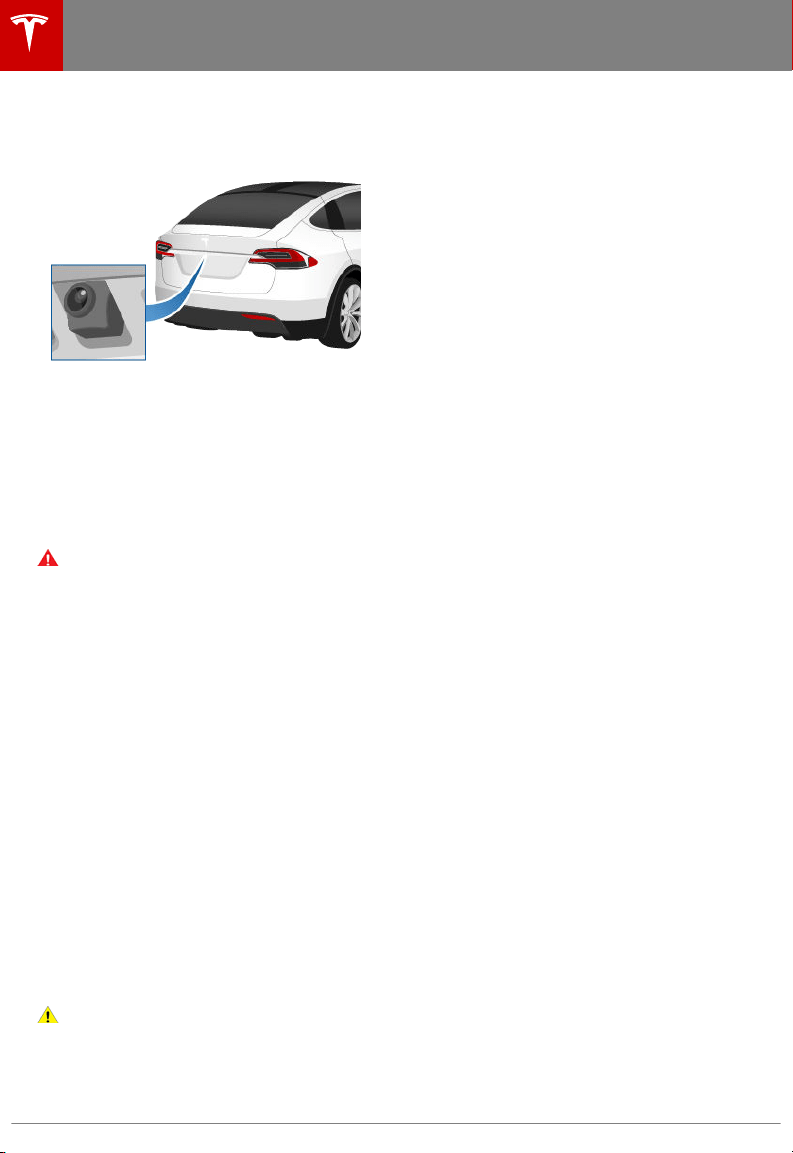
Camera Location
Model X is equipped with a rear view camera
located above the rear license plate.
Whenever you shift into Reverse, the
touchscreen displays the view from the
camera. Lines show your driving path based
on the position of the steering wheel. These
lines adjust appropriately as you move the
steering wheel.
Note: Visual feedback from the parking
sensors displays on the instrument panel (see
Park Assist on page 70).
Warning: Never depend on the rear view
camera to inform you if the area behind
you is free of objects and/or people when
reversing. The camera may not detect
objects or barriers that can potentially
cause damage or injury. In addition,
several external factors can reduce the
performance of the camera, including a
dirty or obstructed lens. Therefore,
depending on the rear view camera to
determine if Model X is approaching an
obstruction can result in damage to the
vehicle and/or objects, and can
potentially cause serious injury. Always
inspect the area with your own eyes.
When reversing, perform shoulder checks
and use all mirrors. Use the camera for
guidance purposes only. It is not intended
to replace your own direct visual checks
and is not a substitute for careful driving.
Cleaning the Camera
To ensure a clear picture, keep the camera
lens clean, and free of obstructions. Remove
any buildup of dirt by occasionally wiping the
camera lens with a soft damp cloth.
Caution:
Do not use chemical-based or
abrasive cleaners. Doing so can damage
the surface of the camera lens.
Rear View Camera
78 Model X Owner's Manual

Model X has a rear spoiler designed to
improve aerodynamics. If Model X is equipped
with the active spoiler, the position of the
spoiler can vary depending on the status and
speed of Model X:
• When Model X is in Reverse or when
driving speed is below 16 km/h, the spoiler
provides maximum visibility behind Model
X.
• When driving speed exceeds 72 km/h, the
spoiler lowers to the position that
provides the most
eective aerodynamics.
• When Model X is powered o and locked,
the spoiler retracts.
To allow the spoiler to automatically move as
described above, touch Controls > Settings >
Service & Reset > Spoiler > Automatic. To
disable automatic movement of the spoiler,
which keeps it in its extended position, choose
the Extended setting.
Note: If the spoiler can not automatically
lower or raise, the instrument panel displays
an alert. Contact Tesla Service.
Active Spoiler
Driving 79
The towing package allows you to tow a trailer
with your Model X. It also allows you to carry
skis, snowboards, bicycles, etc. by attaching
an accessory carrier to the hitch.
Carrying Accessories
The Model X towing package has a 50 mm ball
coupling that can support an accessory
carrier.
The ball coupling is designed to support
vertical loads of up to 54 kg. When carrying
bicycles or other items on the Model X hitch,
always check to ensure that the maximum
weight is not exceeded. When calculating
weight, remember to include the weight of the
accessory carrier. For example, assuming the
carrier weighs 14 kg, the weight threshold is
sucient for carrying two bicycles weighing
approximately 20 kg each, or four bicycles
weighing approximately 10 kg each.
Caution: The Model X hitch is designed to
support up to 54 kg. Exceeding this
maximum weight can cause significant
damage.
Caution: Do not attempt to install a
carrier on a Model X that is not equipped
with the towing package. Doing so can
cause significant damage.
To install and use an accessory carrier, the tow
hitch must be connected (see Connecting the
Tow Hitch on page 85). Then follow the
instructions provided with your accessory
carrier. Observe all regulations and legal
requirements in your state/region that apply
to carrying accessories.
The Model X towing package includes the
wiring necessary for using an accessory carrier
equipped with lights (see Electrical
Connections on page 87). The package also
includes Trailer Mode software (see Trailer
Mode on page 83).
When you connect an accessory
carrier's wiring harness, Model X
detects a connection for trailer lights
and this indicator illuminates on the
instrument panel. Trailer Mode is
disabled.
When carrying accessories, periodically
confirm that the accessory carrier and its
cargo remain secure at all times, and if
applicable, that the lights on the accessory
carrier are working.
Note:
Go to www.tesla.com to purchase
accessories for your Model X. Although third-
party products are available, Tesla
recommends and supports only Tesla-
approved products (see Parts and Accessories
on page 176). The accessory products
available for your Model X vary based on
market region. Before attempting to install a
non-Tesla carrier, review the product
information to ensure compatibility.
Note: When not in use, the hitch should be
removed and stored in a dry location to
prevent rust and corrosion. Keep the dust
cover over the hitch housing to prevent dirt
and debris from entering.(see Disconnecting
the Tow Hitch on page 86).
Caution: A carrier may obscure your view
from the rear view mirror, the rear
camera(s), the rear ultrasonic sensors. In
addition, some driver assistance features
may not function as expected.
Warning: Tesla assumes no responsibility
for damage or injuries resulting from
installing and using an accessory carrier,
for any omissions in the instructions
accompanying an accessory carrier, or for
your failure to follow the instructions.
Damage caused by using an accessory
carrier is not covered by the warranty.
Towing and Accessories
80 Model X Owner's Manual
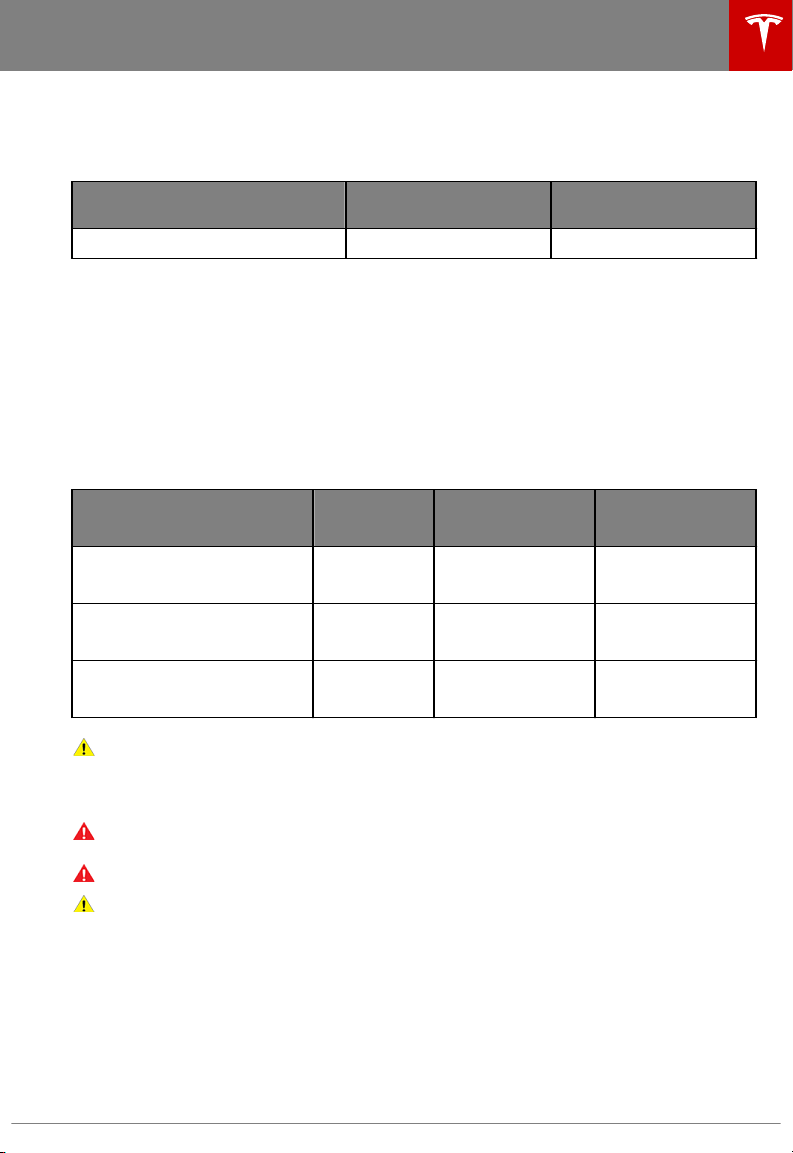
Towing Capacity
The total trailer weight (including all cargo and additional equipment), and the trailer tongue
weight, must never exceed the following:
Tires Maximum Towing
Capacity*
Maximum Tongue
Weight**
19"***, 20" or 22" 2250 kg 90 kg
*Tesla recommends a separate braking system on trailers with a loaded weight of over 450 kg. The
braking system must be appropriate for the weight of the trailer. Follow the instructions provided
by the trailer brake manufacturer to ensure that trailer brakes are properly installed, adjusted, and
maintained.
**The tongue weight is the downward force that the weight of the trailer exerts on the hitch. It
must not be less than 4% of the trailer load. Carrying a
significant amount of equipment,
passengers, or cargo in the tow vehicle can reduce the tongue weight it can handle, which also
reduces the maximum towing capacity. Maximum towing capacity is calculated assuming the
GVWR (Gross Vehicle Weight Rating) is not exceeded. The GVWR is printed on the Statutory
Plate (see Statutory Plate on page 179).
***A Model X with 19" winter tires supports towing ONLY if equipped with these
specific tires:
Tire
Studded Rim Size
Rating
(Front/Rear)
Nokian Hakkapeliitta 8 Yes 19"
110 T
(190 km/h)
Nokian Hakkapeliitta R2 No 19"
110 R
(170 km/h)
Pirelli Sottozero 3 No 19"
110 V
(240 km/h)
Caution: Do not use Model X for towing if equipped with 19" winter tires that are not listed
above.
Note: If the towing capacity on the hitch label conflicts with the information provided in this
owner's manual, this owner's manual takes precedence.
Warning:
Do not overload the vehicle or trailer. Doing so can cause poor performance, vehicle
damage and loss of vehicle control, resulting in serious injury or death.
Warning: Do not use the trailer hitch to tow/transport Model X.
Caution: Tesla assumes no responsibility for damage or injuries resulting from towing a trailer,
for any errors or omissions in the instructions accompanying towing equipment, or for your
failure to follow the proper instructions. Damage caused by towing a trailer is not covered by
the warranty.
Towing and Accessories
Driving 81
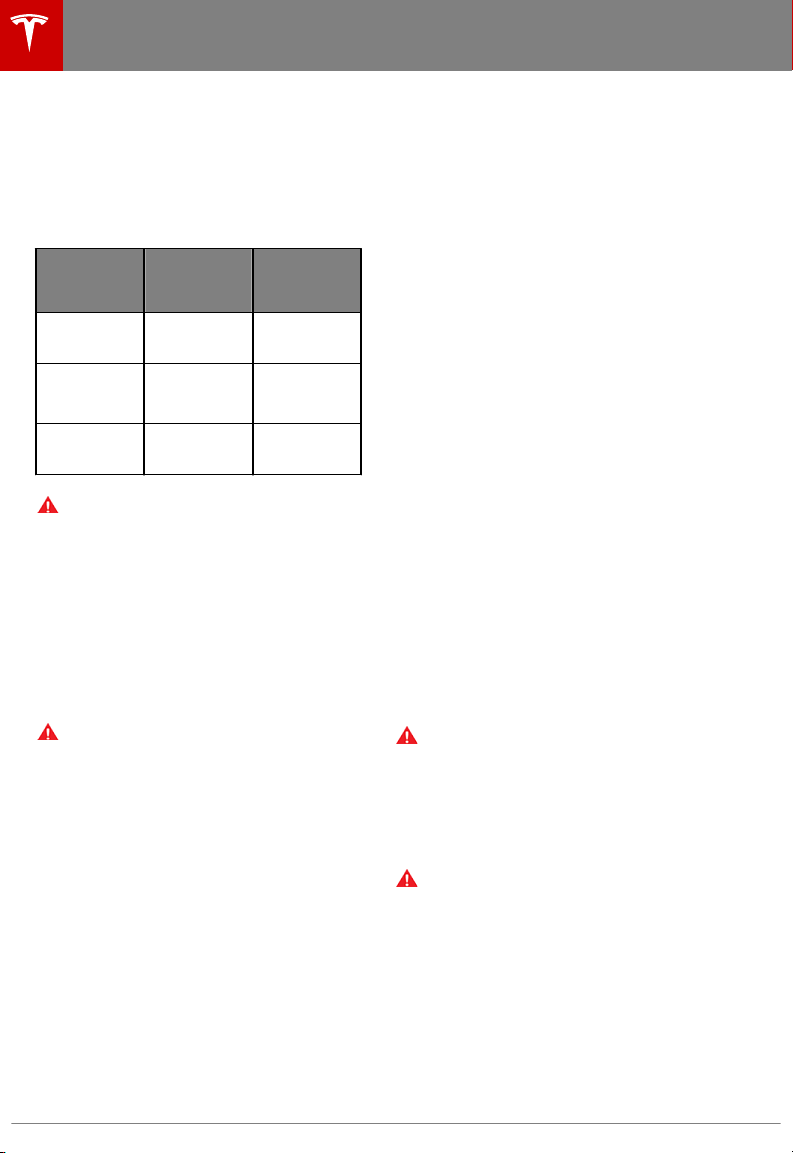
Tire Pressures when Towing
When towing a trailer, tire pressures must be
adjusted to accommodate the additional load.
Keep tires inflated to the pressures shown
below (these pressures override the pressures
that are provided on the Tire and Loading
information label):
Front Tires Rear Tires Cold Tire
Inflation
Pressure
245/45R19 245/45R19 45 psi (310
kPa)
255/45R20
265/45R20
275/45R20 46 psi (320
kPa)
265/35ZR22 285/35ZR22 50 psi (345
kPa)
Warning: Check tire pressures using an
accurate pressure gauge when tires are
cold. Driving 1.5 km warms the tires
suciently to aect tire pressures.
Parking the vehicle in direct sunlight or in
hot weather can also aect tire pressures.
If you must check warm tires, expect
increased pressures. Do not let air out of
warm tires in an attempt to match
recommended cold tire pressures. A hot
tire at or below the recommended cold
tire
inflation pressure is dangerously
under-inflated.
Warning: Never attempt to tow a trailer
when a Model X tire is faulty or has been
inflated using a tire repair kit. A
temporarily repaired tire is not designed
to sustain the towing load. Towing using a
faulty or temporarily repaired tire can
result in tire failure and loss of vehicle
stability.
Before Towing a Trailer
Before towing a trailer, you must do the
following:
• Inflate tires to the cold tire inflation
pressure specified in Tire Pressures when
Towing.
• Set Smart Air Suspension to Standard
height (touch Controls > Suspension >
Standard).
• Observe all regulations and legal
requirements in your state/region that
apply to trailer towing. Failure to comply
with regulations can compromise your
safety.
• Adjust side mirrors to provide a clear
rearward view without a significant blind
spot.
• Ensure that Trailer Mode is engaged.
Confirm the following:
• Model X rests horizontally with the trailer
attached. If the vehicle is tipped sharply
up at the front, and down at the rear,
check that you are not exceeding the
maximum towing capacity and tongue
loads provided in Carrying Capacity.
• All trailer hitch parts and attachments and
electrical connectors (including reverse
and fog lights, if equipped) are in good
condition and are properly connected. If
any problems are apparent, do not tow
the trailer.
• Trailer lights (brake lights, turn signal
lights, and marker lights) are working
properly.
• The trailer tongue is securely connected
to the hitch ball.
• All cargo is secured.
• The trailer load is evenly distributed such
that the trailer tongue weight is
approximately 4% of the total trailer
weight, without exceeding the maximum
tongue weights provided in Carrying
Capacity.
Warning:
The trailer tongue weight must
be approximately 4% of the total trailer
weight without exceeding the maximum
tongue weights provided in Carrying
Capacity. Loads that are balanced over
the wheels or heavier in the rear can
cause trailer sway, resulting in loss of
vehicle control.
Warning: Always ensure that cargo is
secured in the trailer and will not shift.
Dynamic load shifts can cause loss of
vehicle control, resulting in serious injury
or death.
Towing and Accessories
82 Model X Owner's Manual
Trailer Mode
Trailer Mode must always be active when
towing a trailer. When you connect a trailer's
electrical connection, Model X automatically
engages Trailer Mode. When you disconnect
the trailer's electrical connection, Trailer Mode
disengages. To engage or exit Trailer Mode
manually, touch Controls > Driving > Trailer
Mode on the touchscreen. One of the
following indicators display on the instrument
panel:
Trailer Mode is active.
Model X detects a connection for
trailer lights but Trailer Mode is
disabled. It is likely that a carrying
accessory has been connected.
Model X detects a faulty electrical
connection for the trailer lights.
Some, or all, trailer lights may not be
functioning. Pull over as soon as
safety permits and inspect the trailer
lights for faulty cabling or
connections.
Note: In situations where Model X detects a
heavy load, it assumes that a trailer is
connected and automatically engages Trailer
Mode. A message displays on the instrument
panel informing you that Trailer Mode has
been engaged. When Trailer Mode is entered
automatically due to detection of a heavy
load, you can change the Trailer Mode setting
only by stopping Model X and engaging Park
or engaging Neutral and manually applying
the parking brake using the touchscreen
(Controls > Driving > E-Brake & Power
O >
Parking Brake).
In Trailer Mode, the following are disabled:
• Autosteer.
• Autopark.
• Rear parking sensors.
In addition, these features may operate
dierently:
• Trac-Aware Cruise Control increases the
following distance from the car in front of
you.
• Smart Air Suspension will not make
speed-based adjustments from
STANDARD to LOW.
• Smart Air Suspension does not make
automatic height adjustments based on
saved location-based settings.
• Side collision warnings are active but
automatic steering interventions are
disabled.
• The braking force provided by Automatic
Emergency Braking (see Collision
Avoidance Assist on page 108) is
significantly limited.
Warning: Do not rely on Model X to
detect the trailer and automatically
engage Trailer Mode. Always check that
Trailer Mode is engaged before towing a
trailer.
Warning: Under no circumstances should
you exit Trailer Mode when towing a
trailer. Doing so can cause serious injury
and/or death.
Warning: Do not use the air suspension
setting to appropriately match the height
of the hitch with the height of the trailer.
Trailer Brakes
When towing a loaded trailer that weighs
more than 450 kg, Tesla recommends that the
trailer be equipped with its own brake system
adequate for the weight of the trailer. Ensure
compliance with local regulations.
Follow these steps to connect a brake
controller:
Towing and Accessories
Driving 83
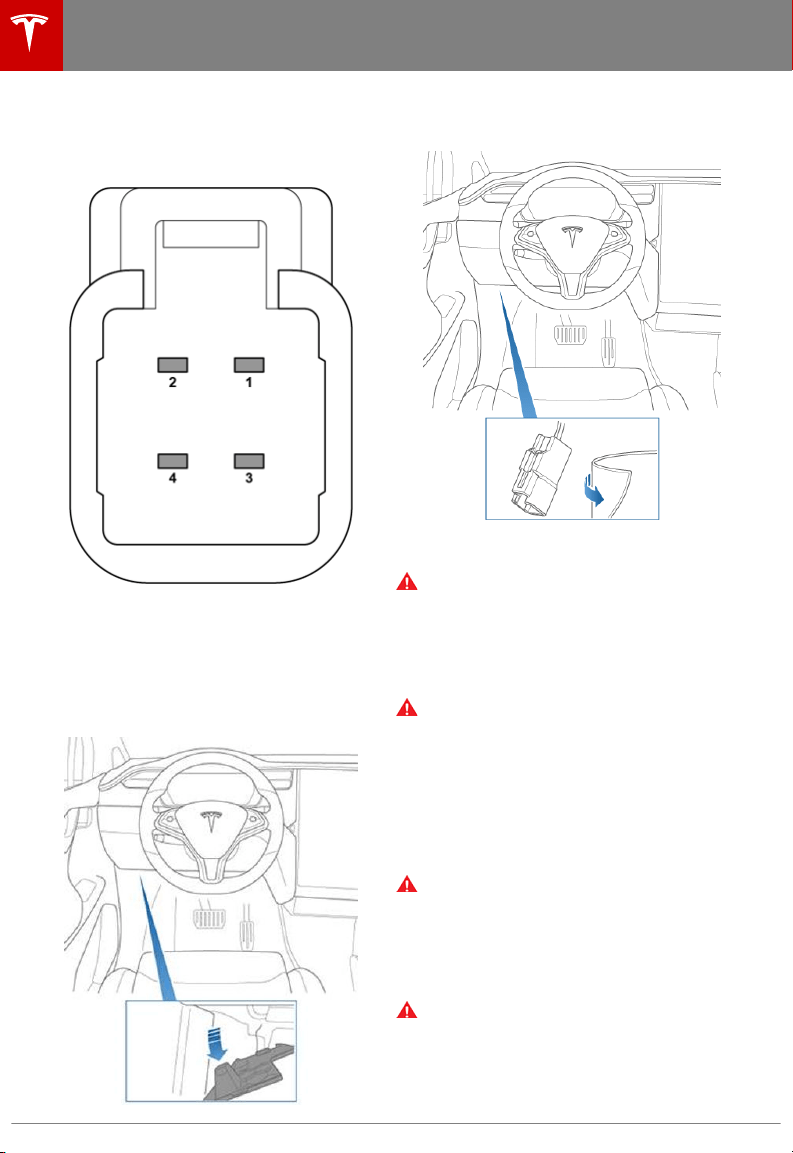
1. Connect the wiring on the brake controller
to the appropriate locations on the 4-pin
pigtail connector included with your
Model X.
1 - Brake control output to trailer
2 - Ground
3 - Brake On Signal
4 - 12V Power (20A)
2. Remove the cover located under the
dashboard in the driver's side foot well.
3.
Peel back the carpet to expose Model X's
4-pin connector on the wiring harness.
4. Connect the pigtail connector to the
vehicle wiring connector.
Warning: Towing increases your stopping
distance, even when the trailer is
equipped with its own braking system.
When towing, increase your following
distance and avoid situations that could
potentially cause heavy braking. Failure to
do so can result in a collision.
Warning: Observe all regulations and
legal requirements in your regional and
national jurisdictions that apply
specifically to trailer towing and brake
requirements. Many regions require a
breakaway switch, located on the tongue
of the trailer, to activate the trailer brakes
in the event that the trailer separates
from the vehicle. Failure to comply with
regulations can compromise your safety.
Warning: Follow the instructions provided
by the trailer brake manufacturer to
ensure that trailer brakes are properly
installed, adjusted, and maintained. Tesla
is not responsible for damages caused by
incorrect installation of trailer braking
systems.
Warning: Never attempt to connect trailer
brakes directly to the vehicle braking
system. Doing so can cause damage to
the vehicle and the trailer, and can cause
the braking system to malfunction,
resulting in serious injury or death.
Towing and Accessories
84 Model X Owner's Manual
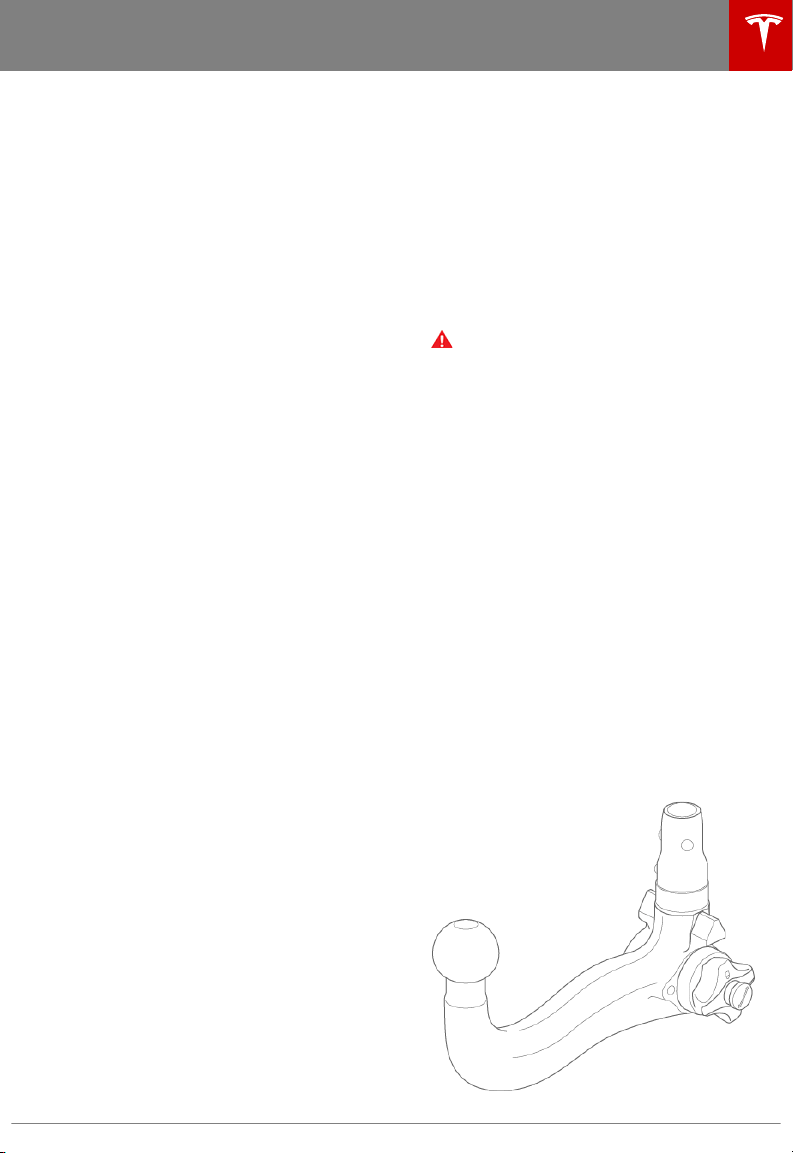
Towing Guidelines
Model X is designed primarily as a passenger-
carrying vehicle. Towing a trailer puts
additional load on the motor, drive train,
brakes, tires, and suspension and significantly
decreases range. If you decide to tow a trailer,
proceed with caution and follow these general
guidelines:
• Reduce your driving speed and avoid
sudden maneuvers. Keep in mind that
when towing a trailer, steering, stability,
turning radius, stopping distance and
braking performance are
dierent when
compared to driving without a trailer.
• Increase your following distance by
maintaining twice the distance from a
vehicle ahead. This helps to avoid
situations that require heavy braking.
Sudden braking may result in skidding or
jack-knifing, and loss of control.
• Avoid very sharp turns. Sharp turns can
cause the trailer to contact the vehicle and
cause damage. Keep in mind that the
trailer wheels are closer to the inside of
the turn than the vehicle’s wheels.
Therefore, make wider turns to prevent
the trailer from hitting curbs, road signs,
trees or other objects.
• Periodically check the trailer lights and
turn signals to
confirm that bulbs are still
working. When towing a trailer, the turn
signal arrows on the vehicle instrument
cluster
flash as normal, even if the bulbs
on the trailer are burned out.
• Periodically
confirm the cargo is secure.
• Periodically
confirm the trailer brakes are
working.
• Avoid parking on a grade (see Parking
with a Trailer).
• Regularly
confirm that all towing
components are securely tightened.
Parking with a Trailer
Whenever possible, avoid parking on a grade.
However, if parking on a grade is absolutely
necessary, place wheel chocks under the
trailer wheels:
• One person presses and holds the brake
pedal.
• A second person places the wheel chocks
under the wheels on the downgrade side
of the tires.
• When the chocks are in place, release the
brake pedal and ensure the chocks hold
the weight of the vehicle and trailer.
Note: When testing chocks, ensure that
Vehicle Hold (see Vehicle Hold on page
72) is not engaged. If Vehicle Hold is
braking Model X, the Vehicle Hold
indicator light displays on the instrument
panel. To disengage Vehicle Hold, press
and release the brake pedal.
• Place the vehicle in Park. This engages the
parking brake.
Warning: If parking on a grade is
necessary, always ensure that all trailer
wheels have been securely chocked.
Failure to do so can result in serious
damage, injury, or death.
Trailer Sway Mitigation
When trailer sway is detected, the Model X
electronic stability control system attempts to
apply the appropriate amount of braking to
minimize trailer sway. The instrument panel
briefly displays the traction control system
indicator. Pressing the brake pedal when the
system is actively braking to mitigate trailer
sway does not cancel this automatic braking.
Connecting the Tow Hitch
The Model X towing package includes a
weight-carrying hitch with a 50 mm ball
coupling. When not in use, the hitch should be
removed and stored in a dry location to
prevent rust and corrosion. Keep the dust
cover over the hitch housing to prevent dirt
and debris from entering.
Towing and Accessories
Driving 85
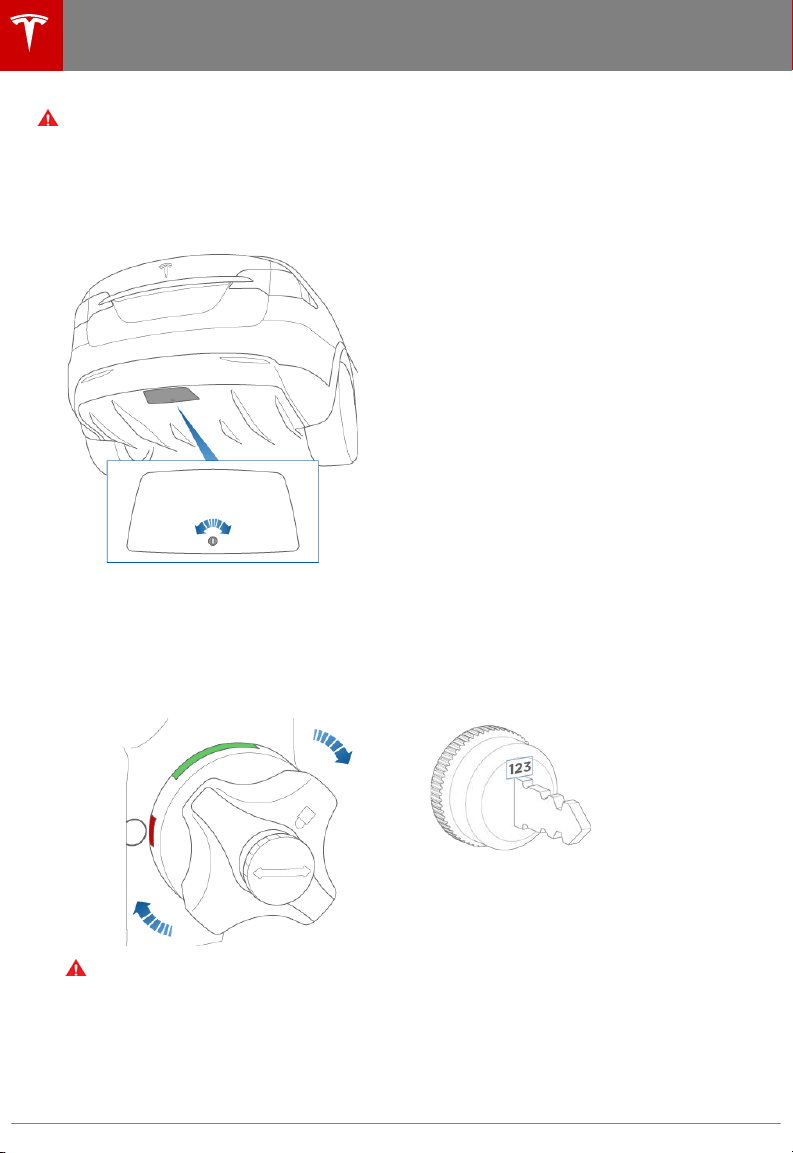
Warning: You must use the Model X
trailer hitch when towing a trailer. Never
attempt to attach a dierent type of
trailer hitch.
To install the trailer hitch:
1. Remove the dust cover from the hitch
housing.
2. Insert the key into the locking cylinder on
the hitch, and turn the cylinder so the top
of the key is aligned with the “unlocked”
position.
3. Pull the locking cylinder out of the
adapter approximately 0.5 cm, and turn
clockwise until the red marking on the
cylinder aligns with the white dot.
Warning:
Be careful when turning the
locking cylinder. If it does not lock
into the “Open Position”, it
automatically retracts into its original
“Closed Position” and can pinch your
fingers.
4. Firmly grasp the hitch from the bottom
and align the triangular-shaped guides at
the sides of the hitch with the
corresponding cutouts in the hitch
housing.
Note: Do not grasp the locking cylinder
because it needs to rotate freely.
5. Push the hitch into the hitch housing until
the locking cylinder rotates approximately
120° counter-clockwise and automatically
locks into the "Closed Position". The green
area on the locking cylinder (above the
white arrow) aligns with the white dot on
the housing.
6. Visually check to
confirm that the hitch is
fully inserted into the housing. Try pulling
down on the hitch. The hitch should not
drop when you pull down.
Note: If the hitch does not lock into the
housing, it falls out when you pull down
on it.
7. Turn the key so the arrows align with the
“locked” marking on the locking cylinder.
8. Remove the key and store it in a safe
place (preferably inside the vehicle).
Note: The key can be removed only if the
hitch is locked. This indicates a proper
connection. Do not use the hitch if the key
is not removed.
Note: Tesla recommends making a note of
the key code. You need this code if you
lose the keys and need to order a
replacement.
9. Close the dust cover to prevent dirt and
debris from entering the lock.
Note: To maintain the hitch, regularly grease
its surfaces with non-resinous grease.
Disconnecting the Tow Hitch
After towing, remove the hitch:
1. Insert the key and turn to align the top of
the key with the “unlocked” position.
Towing and Accessories
86 Model X Owner's Manual
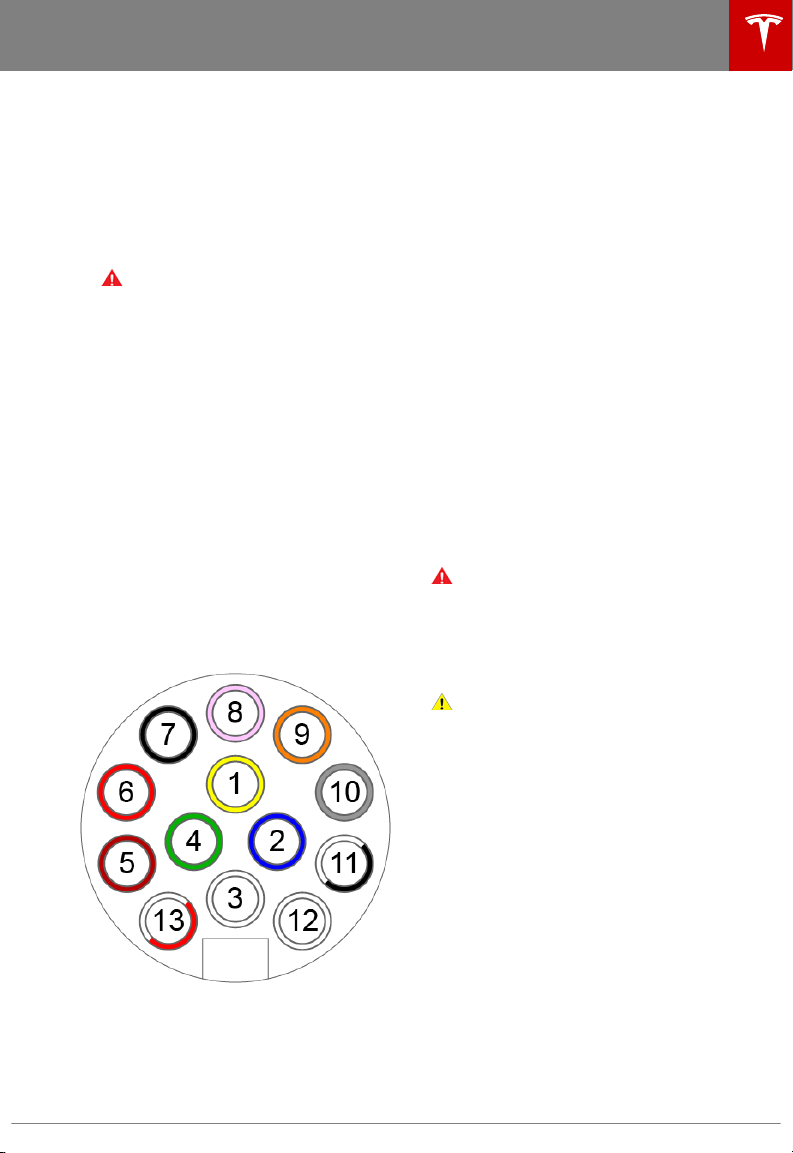
2. While firmly holding the bottom of the
hitch (to prevent it from dropping to the
ground), pull the locking cylinder out
approximately 0.5 cm, and turn it
clockwise until the red marking on the
locking cylinder aligns with the white dot.
At this point, the locking cylinder is locked
in the "open" and the hitch drops out of
the housing.
Warning: Be careful when turning the
locking cylinder. If it does not lock
into the “Open Position”, it
automatically retracts into its original
“closed" position and can pinch your
fingers.
3. Reinstall the dust cover on the hitch
housing to prevent dirt from accumulating
inside the housing.
4. Close the dust cover on the hitch's locking
cylinder and store the hitch in a secure
location.
Electrical Connections
Regulations require all trailers to be equipped
with tail lights, brake lights, side marker lights,
and turn signals. To provide power for trailer
lighting, a built-in 13-pin wiring connector is
attached to the tow bar near the hitch
housing. The wiring plugs on most types of
trailers can be attached to this connector.
1. Left Turn Signal (Yellow)
2. Rear Fog (Blue)
3. Ground for Pins 1-8 (White)
4. Right Turn Signal (Green)
5. Right Tail Lamp (Brown)
6.
Stop Lamps (Red)
7. Left Tail Lamp (Black)
8. Reverse Lamps (Pink)
9. 12V Power - Permanent (Orange)
10. 12V Power - Switched/Ignition (Grey)
11. Ground for Pin 10 (Black/White)
12. Trailer Brake Control Output (Light Grey)
13. Ground for Pin 9 (Red/White)
Note: All pins have 12V power.
Note: It is the driver's responsibility to ensure
that all electrical connections are working and
all trailer lights are operating before and
during towing. You must perform manual
checks.
Note: Loss of trailer lights when towing may
be the result of a blown fuse. Model X does
not provide a warning if the fuse is blown.
Contact Tesla Service.
Note: If a trailer fog light is detected, Model X
disables its rear fog light (if equipped).
Plugging trailer wiring into the Model X
electrical connector automatically engages
Trailer Mode (see Trailer Mode on page 83).
Warning: Use only the electrical
connection designed by Tesla. Do not
attempt to directly splice or attempt to
connect a trailer’s electrical wiring using
any other method. Doing so can damage
the vehicle electrical system and cause
malfunctions.
Caution: Always ensure that the trailer
electrical cable does not contact or drag
on the ground and there is enough slack
in the cable to allow for turns.
Impact on Range
Towing a trailer and carrying accessories
increases vehicle weight and drag. As a result,
driving range can decrease
significantly.
Although Trip Planner attempts to adjust
estimates based on Trailer Mode, actual
energy consumption may vary. Plan trip length
and charging destinations accordingly.
Towing and Accessories
Driving 87
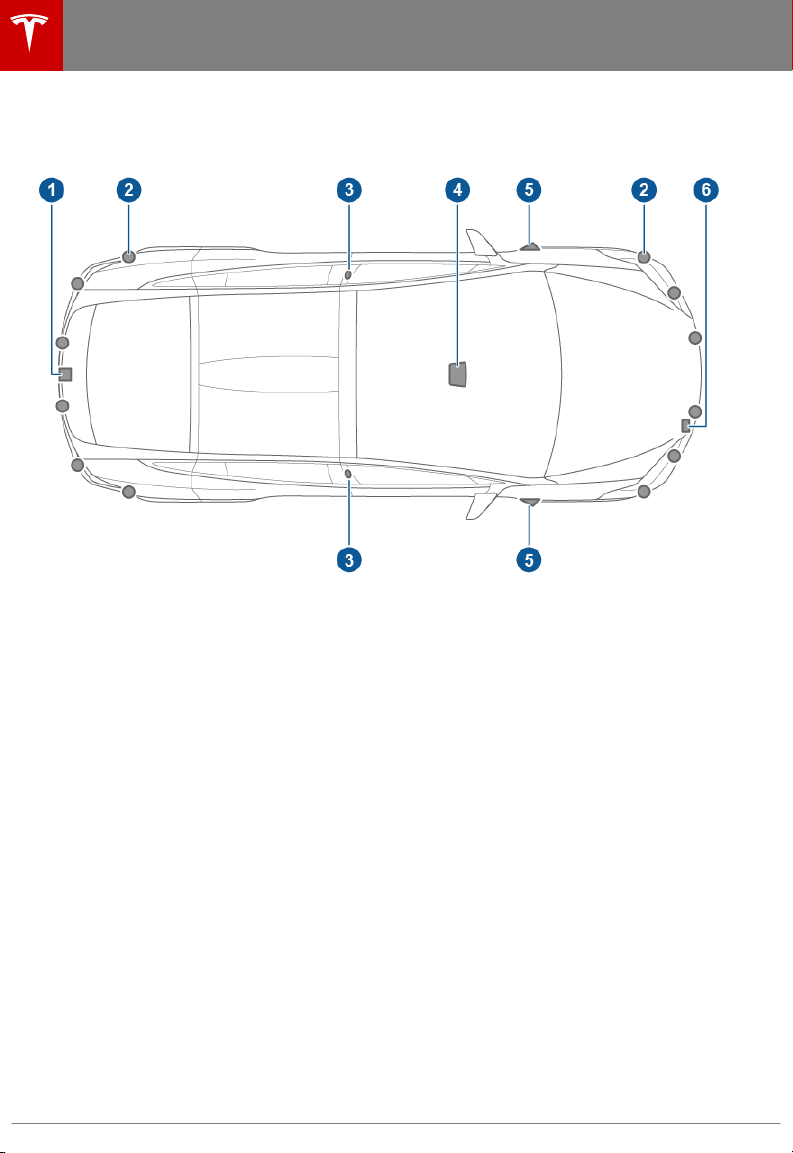
How It Works
Your Model X includes the following Driver Assistance components that actively monitor the
surrounding roadway:
1. A camera is mounted above the rear license plate.
2. Ultrasonic sensors are located in the front and rear bumpers.
3. A camera is mounted in each door pillar.
4. Three cameras are mounted to the windshield above the rear view mirror.
5. A camera is mounted to each front fender.
6. Radar is mounted behind the front bumper on the right side of the vehicle.
Model X is also equipped with high precision electronically-assisted braking and steering systems.
About Driver Assistance
88 Model X Owner's Manual

Features
These safety features are available on all Tesla
vehicles equipped with Driver Assistance
components:
• Lane Assist (see Lane Assist on page
106).
• Collision Avoidance Assist (see Collision
Avoidance Assist on page 108).
• Speed Assist (see Speed Assist on page
112).
• Auto High Beam (see High Beam
Headlights on page 63).
These convenience features, designed to
reduce driver workload, are available only if
your Tesla vehicle is equipped with the
optional Enhanced Autopilot or Full Self-
Driving Capability packages:
•
Trac-Aware Cruise Control (see Trac-
Aware
Cruise Control on page 91).
• Autosteer (see Autosteer on page 97).
• Auto Lane Change (see Auto Lane
Change on page 100).
• Autopark (see Autopark on page 102).
You can enable/disable Driver Assistance
features and in some cases, control how they
work. To access settings for Driver Assistance
features, touch Controls > Settings > Driver
Assistance.
Calibration
Model X must maneuver with a great deal of
precision when Driver Assistance features are
being used. Therefore, before some features
(for example,
Trac-Aware Cruise Control or
Autosteer) can be used for the first time, some
cameras must complete a self-calibration
process.
Calibration typically completes after driving
32-40 km, but the distance varies depending
on road and environmental conditions. Driving
on a straight road with highly-visible lane lines
allows Model X to calibrate quicker. When
calibration is complete, the features are
available for use the next time you drive (i.e.
you must stop and shift into Park before you
can use the features). Contact Tesla if your
Model X has not completed the calibration
process after driving 160 km.
Note: If you attempt to use a feature that is
not available until the calibration process is
complete, the feature will not be enabled and
the instrument panel displays a message.
Note:
Model X repeats the calibration process
if the cameras are serviced by Tesla and in
some cases, after a software update.
Limitations
Many factors can impact the performance of
Driver Assistance components, causing them
to be unable to function as intended. These
include (but are not limited to):
• Poor visibility (due to heavy rain, snow,
fog, etc.).
• Bright light (due to oncoming headlights,
direct sunlight, etc.).
• Damage or obstructions caused by mud,
ice, snow, etc.
• Interference or obstruction by object(s)
mounted onto the vehicle (such as a bike
rack).
• Obstruction caused by applying excessive
paint or adhesive products (such as
wraps, stickers, rubber coating, etc.) onto
the vehicle.
• Narrow or winding roads.
• A damaged or misaligned bumper.
• Interference from other equipment that
generates ultrasonic waves.
• Extremely hot or cold temperatures.
Warning: The list above does not
represent an exhaustive list of situations
that may interfere with proper operation
of Driver Assistance components. Never
depend on these components to keep
you safe. It is the driver's responsibility to
stay alert, drive safely, and be in control
of the vehicle at all times.
Caution: If a windshield replacement is
needed, take your vehicle to Tesla Service.
This will ensure appropriate handling and
mounting of the camera(s). Failure to do
so can cause one or more Driver
Assistance features to malfunction.
Cleaning Cameras and Sensors
To ensure the various Driver Assistance
components can provide information that is as
accurate as possible, keep them clean and free
of obstructions or damage. Occasionally
remove any buildup of dirt by wiping the
components with a soft cloth dampened with
warm water.
Caution:
Do not use chemical-based or
abrasive cleaners. Doing so can damage
surfaces.
About Driver Assistance
Driver Assistance 89

Caution: Avoid using a high-pressure
power washer.
Caution: Do not clean an ultrasonic
sensor or camera lens with a sharp or
abrasive object that can scratch or
damage its surface.
About Driver Assistance
90 Model X Owner's Manual
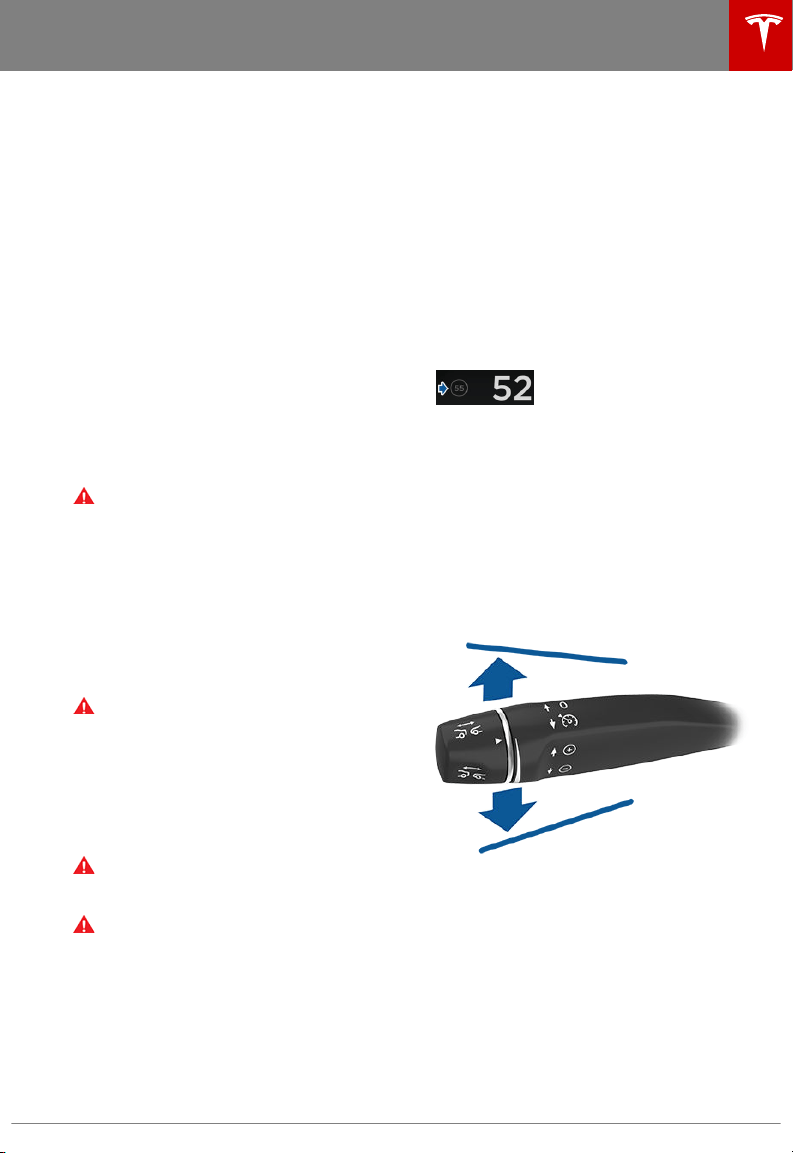
Note: Trac-Aware Cruise Control is a BETA
feature.
If you have purchased the optional Enhanced
Autopilot or Full Self-Driving Capability
package, the forward looking cameras and the
radar sensor are designed to determine when
there is a vehicle in front of you in the same
lane. If the area in front of Model X is clear,
Trac-Aware Cruise Control maintains a set
driving speed. When a vehicle is detected,
Trac-Aware Cruise Control is designed to
slow down Model X as needed to maintain a
selected time-based distance from the vehicle
in front, up to the set speed.
Trac-Aware
Cruise Control does not eliminate the need to
watch the road in front of you and to manually
apply the brakes when needed.
Trac-Aware Cruise Control is primarily
intended for driving on dry, straight roads,
such as highways and freeways. It should not
be used on city streets.
Warning: Trac-Aware Cruise Control is
designed for your driving comfort and
convenience and is not a collision warning
or avoidance system. It is your
responsibility to stay alert, drive safely,
and be in control of the vehicle at all
times. Never depend on Trac-Aware
Cruise Control to adequately slow down
Model X. Always watch the road in front
of you and be prepared to take corrective
action at all times. Failure to do so can
result in serious injury or death.
Warning: Although Trac-Aware Cruise
Control is capable of detecting
pedestrians and cyclists, never depend on
Trac-Aware Cruise Control to
adequately slow Model X down for them.
Always watch the road in front of you and
be prepared to take corrective action at
all times. Failure to do so can result in
serious injury or death.
Warning: Do not use Trac-Aware Cruise
Control on city streets or on roads where
trac conditions are constantly changing.
Warning: Do not use Trac-Aware Cruise
Control on winding roads with sharp
curves, on icy or slippery road surfaces, or
when weather conditions (such as heavy
rain, snow, fog, etc.) make it inappropriate
to drive at a consistent speed. Trac-
Aware Cruise Control does not adapt
driving speed based on road and driving
conditions.
Operating Trac-Aware Cruise
Control
To use Trac-Aware Cruise Control, you must
be driving at least 30 km/h, unless a vehicle is
detected ahead of you. If a vehicle is detected
ahead of you, you can use Trac-Aware
Cruise Control at any speed, even when
stationary, provided you are at least 150 cm
away from the vehicle.
The minimum set speed is 30 km/h. The
maximum set speed is 150 km/h. It is the
driver's responsibility to cruise at a safe speed
based on road conditions and speed limits.
The instrument panel
displays a gray speedometer
icon on the left side of the
driving speed to indicate
that
Trac-Aware Cruise
Control is available but is not
currently active. The number
shown in gray is determined
by Speed Assist (see
Controlling Speed Assist on
page 112).
When driving at your desired speed, set the
cruising speed by moving the cruise control
lever up or down, then releasing.
To set the cruising speed to the set speed as
determined by Speed Assist (see Controlling
Speed Assist on page 112), pull the cruise
control lever towards you, then release.
Trac-Aware
Cruise Control
Driver Assistance 91
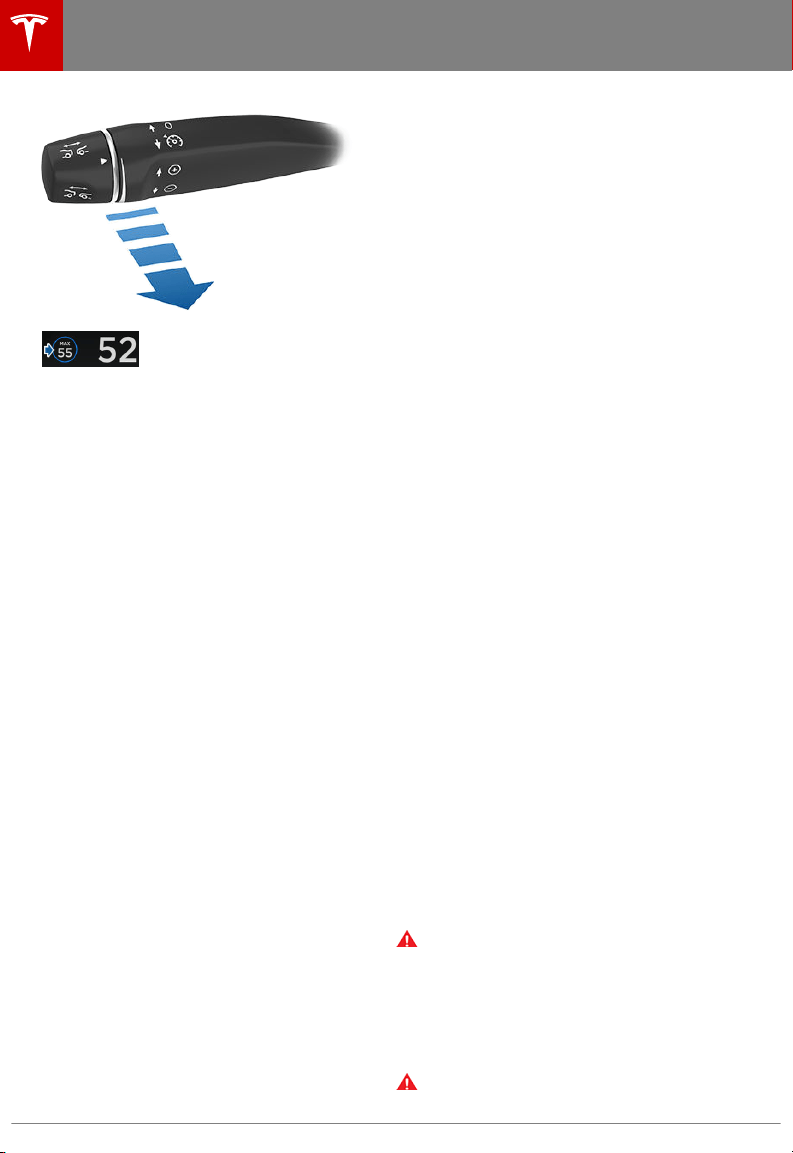
The gray speedometer icon
on the instrument panel
turns blue and displays the
set speed to indicate that
Trac-Aware Cruise Control
is active.
Note: The minimum set speed is 30 km/h. The
maximum set speed is 150 km/h. It is the
driver's responsibility to cruise at a safe speed
based on road conditions and speed limits.
You can now release the accelerator pedal and
allow
Trac-Aware Cruise Control to maintain
your set speed. When no vehicle is detected
ahead,
Trac-Aware Cruise Control maintains
the set speed. If a vehicle is detected, Trac-
Aware Cruise Control maintains your chosen
following distance, up to the set speed,
accelerating and decelerating Model X as
needed. When the vehicle you are following is
no longer detected,
Trac-Aware Cruise
Control accelerates up to the set speed.
Trac-Aware Cruise Control also adjusts the
speed as appropriate when entering and
exiting curves.
You can manually accelerate at any time when
driving at a set speed using
Trac-Aware
Cruise Control. But when you release the
accelerator, Model X returns to the set speed.
When following a vehicle, Trac-Aware Cruise
Control remains active at low speeds, even if
Model X comes to a standstill. When the
vehicle is moving again,
Trac-Aware Cruise
Control resumes operating at your current set
speed. However, under the following
circumstances,
Trac-Aware Cruise Control
goes into a HOLD state instead of resuming,
and the instrument panel displays a message
indicating that you need to resume cruise
control:
• You have been at a standstill for 5
minutes.
• The driver's seat belt is unbuckled.
• Model X detects a pedestrian nearby (the
HOLD state may clear when the
pedestrian is no longer close by).
• Model X suddenly loses visibility of the
vehicle you are following.
• The ultrasonic sensors detect an obstacle
in front of Model X.
To resume Trac-Aware Cruise Control, press
the accelerator pedal or pull the cruise control
lever toward you (see Canceling and
Resuming on page 95).
In right hand
trac, engaging the right turn
signal when driving in the right-most lane
within 50 meters of an exit (on a controlled
access road only, such as a highway or
freeway), causes
Trac-Aware Cruise Control
to assume you are exiting. As a result,
Trac-
Aware Cruise Control begins to slow down the
vehicle. Likewise in left hand trac, when
engaging the left turn signal when driving in
the left-most lane within 50 meters of an exit.
The onboard Global Positioning System (GPS)
determines if you are driving in a region with
right or left hand
trac. In situations where
GPS data is unavailable (for example, if there
is inadequate signal), engaging the turn signal
near an exit does not cause
Trac-Aware
Cruise Control to slow down Model X.
Note: If you double-pull the cruise control
lever (or single-pull when Trac-Aware Cruise
Control is active), Autosteer activates if
enabled (see Autosteer on page 97) and the
set speed changes to either your current
driving speed, or the speed limit plus any
oset you have defined in Speed Assist,
whichever is greater (see Cruising at the
Speed Limit on page 93).
Note: When
Trac-Aware Cruise Control is
actively slowing down Model X to maintain the
selected distance from the vehicle ahead, the
brake lights turn on to alert other road users
that you are slowing down. You may also
notice slight movement of the brake pedal.
However, when
Trac-Aware Cruise Control is
accelerating Model X, the accelerator pedal
does not move.
Warning:
Due to limitations inherent in
the onboard GPS, you may experience
situations in which Trac-Aware Cruise
Control slows down the vehicle, especially
near highway exits where a curve is
detected and/or you are actively
navigating to a destination and not
following the route.
Warning: Trac-Aware Cruise Control
cannot detect all objects and may not
Trac-Aware Cruise Control
92 Model X Owner's Manual
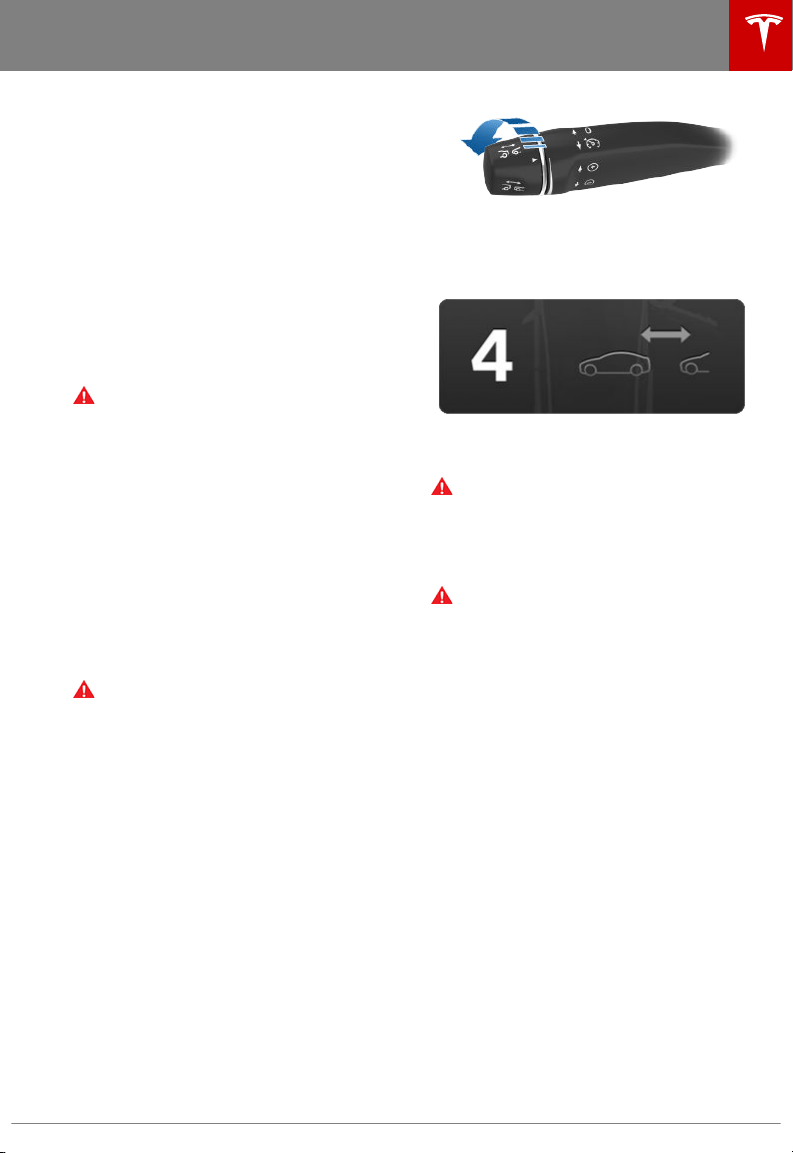
brake/decelerate for stationary vehicles
or objects, especially in situations when
you are driving over 80 km/h and in
situations where a vehicle you are
following moves out of your driving path
and a stationary vehicle or object is in
front of you. Always pay attention to the
road ahead and stay prepared to take
immediate corrective action. Depending
on
Trac-Aware Cruise Control to avoid
a collision can result in serious injury or
death. In addition,
Trac-Aware Cruise
Control may react to vehicles or objects
that either do not exist or are not in the
lane of travel, causing Model X to slow
down unnecessarily or inappropriately.
Warning: Trac-Aware Cruise Control
may be unable to provide adequate
speed control because of limited braking
capability and hills. It can also misjudge
the distance from a vehicle ahead. Driving
downhill can increase driving speed,
causing Model X to exceed your set
speed (and potentially the road's speed
limit). Never depend on
Trac-Aware
Cruise Control to slow down the vehicle
enough to prevent a collision. Always
keep your eyes on the road when driving
and be prepared to take corrective action
as needed. Depending on
Trac-Aware
Cruise Control to slow the vehicle down
enough to prevent a collision can result in
serious injury or death.
Warning: Trac-Aware Cruise Control
may occasionally cause Model X to brake
when not required or when you are not
expecting it. This can be caused by
closely following a vehicle ahead,
detecting vehicles or objects in adjacent
lanes (especially on curves), etc.
Adjust your following distance
To adjust the following distance you want to
maintain between your Model X and a vehicle
traveling ahead of you, rotate the cruise
control lever to choose a setting from 1 (the
closest following distance) to 7 (the longest
following distance). Each setting corresponds
to a time-based distance that represents how
long it takes for Model X, from its current
location, to reach the location of the rear
bumper of the vehicle ahead of you.
As you rotate the cruise control lever, the
instrument panel displays the current setting.
Release the lever when the desired setting is
displayed.
Note: Your setting is retained until you
manually change it.
Warning: It is the driver's responsibility to
determine and maintain a safe following
distance at all times. Do not rely on
Trac-Aware Cruise Control to maintain
an accurate or appropriate following
distance.
Warning: Never depend on Trac-Aware
Cruise Control to adequately slow down
Model X to avoid a collision. Always
watch the road in front of you and stay
prepared to take immediate corrective
action.
Cruising at the Speed Limit
Trac-Aware Cruise Control makes it easy to
cruise at the speed limit. You can cruise at the
speed limit that is currently being determined
by Speed Assist (see Speed Assist on page
112). To do so, pull the cruise control lever
toward you. When you release, your cruising
speed is set to the speed that is determined
by Speed Assist, taking into consideration any
oset you have specified. If you are already
driving faster than the speed limit when you
pull the lever, the set speed does not adjust to
the speed limit—it adjusts to your current
driving speed.
Note: When you adjust the cruising speed
based on the speed limit, the set speed does
not change when the speed limit changes. You
must pull the cruise control lever again to
cruise at the new speed limit. You can also
manually adjust your cruising speed at any
time (see Changing the Set Speed on page
94).
Trac-Aware
Cruise Control
Driver Assistance 93
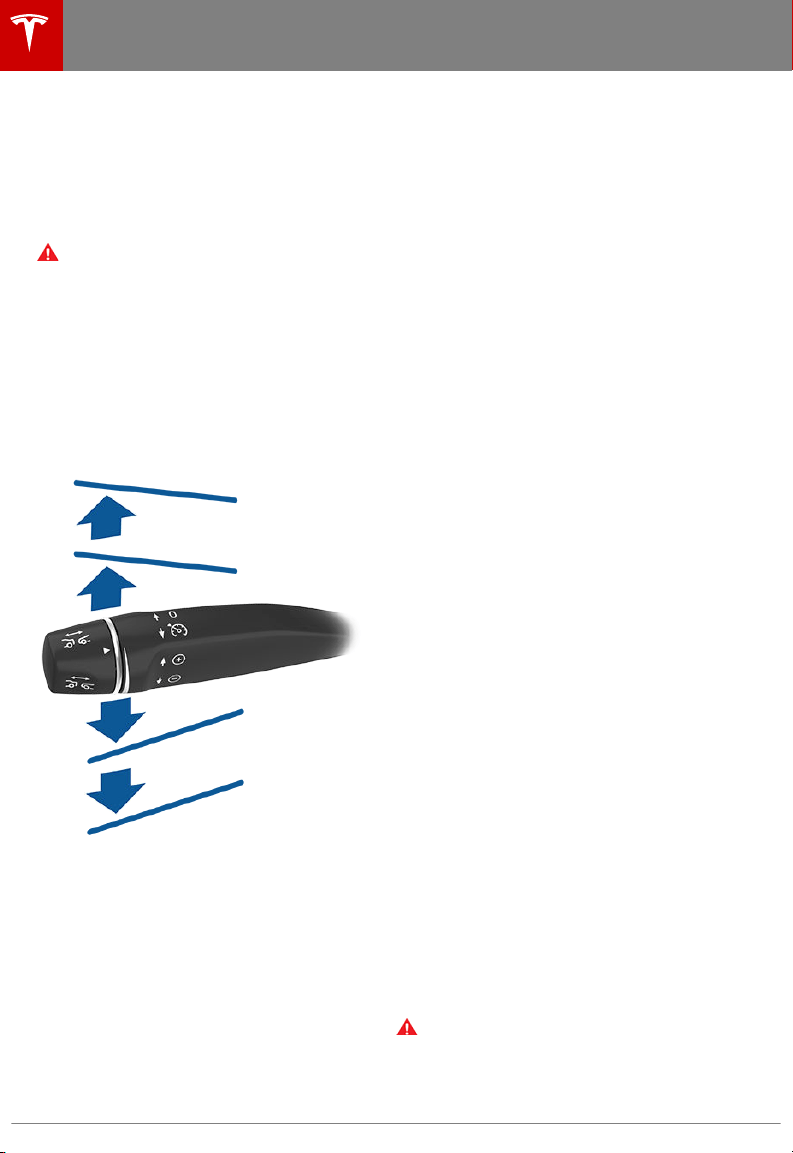
Note: Your set speed will use your current
driving speed if you move the cruise control
lever up or down.
Note: If Speed Assist is unable to determine a
speed limit, your set speed does not change
when you pull the cruise control lever toward
you.
Warning: Do not rely on Speed Assist or
Trac-Aware Cruise Control to
determine an accurate or appropriate
cruising speed. Always cruise at a safe
speed based on road conditions and
applicable speed limits.
Changing the Set Speed
To change the set speed while using Trac-
Aware Cruise Control, move the cruise control
lever up (increase) or down (decrease) until
your desired set speed is displayed.
To increase/decrease speed by 1 km/h, move
the lever up or down to the first position and
release. To increase/decrease speed to the
closest 5 km/h increment, move the lever up/
down to the second position and release. For
example, if you are traveling at 83 km/h and
you move the lever up to the second position
and release, the speed increases to 85 km/h.
You can also increase/decrease speed by
holding the lever in the full up/down position
and releasing when the desired speed displays
below the cruise control icon.
To cruise at the speed limit that is currently
being determined by Speed Assist (including
any osets that you have set), pull the cruise
control lever toward you. See Speed Assist on
page 112.
Note: It may take a few seconds for Model X
to reach the new cruising speed, assuming
Model X does not detect a vehicle ahead
driving slower than your set speed.
Overtake Acceleration
When following a vehicle with Trac-Aware
Cruise Control active, briefly engaging the
turn signal (to indicate a move into the
passing lane) accelerates Model X towards the
vehicle ahead. By momentarily holding the
turn signal lever up or down, you can quickly
accelerate up to your set speed without
having to press the accelerator pedal. The turn
signal accelerates only when the following
conditions are met:
•
Trac-Aware Cruise Control is operating
and detects a vehicle in front of you.
• No obstacles or vehicles are detected in
the target lane.
• Model X is traveling below the set speed,
but over 72 km/h.
Overtake Acceleration is intended as an aid
when passing a vehicle ahead of you. When
the turn signal is engaged,
Trac-Aware
Cruise Control continues to maintain distance
from the vehicle ahead, but allows you to drive
slightly closer than your selected distance.
Acceleration cancels when:
• You reach your set cruising speed.
• Changing lanes takes too long.
• Model X gets too close to the vehicle
ahead.
OR
• You disengage the turn signal.
Note: Overtake Acceleration occurs when you
either fully engage the turn signal, or you hold
the turn signal in the momentary position
(partially engaged). When you release or
disengage the turn signal, Model X stops
accelerating (in the same way as when you
release the accelerator pedal) and resumes
the set speed.
Warning:
Overtake Acceleration can
cancel for many unforeseen reasons in
addition to those listed above (for
example, lack of GPS data). Stay alert and
Trac-Aware Cruise Control
94 Model X Owner's Manual
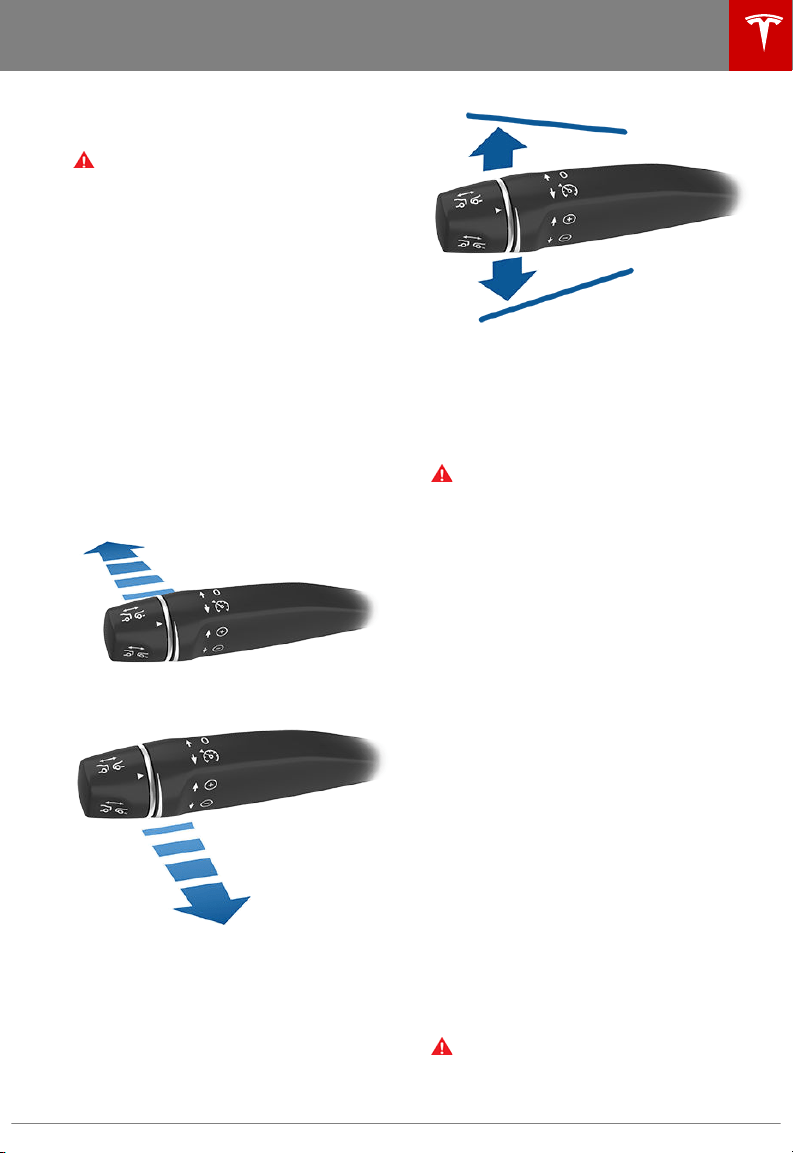
never depend on Overtake Acceleration
to increase your driving speed.
Warning: Overtake Acceleration increases
your driving speed whenever the
appropriate turn signal is engaged, and
accelerates Model X closer to the vehicle
ahead. Although Trac-Aware Cruise
Control continues to maintain distance
from the vehicle ahead, it is important to
be aware that your selected following
distance is reduced when Overtake
Acceleration is active, particularly in cases
where it may not be your intention to
overtake the vehicle you are following.
Canceling and Resuming
To manually cancel Trac-Aware Cruise
Control, briefly push the cruise control lever
away from you or press the brake pedal. The
speedometer icon on the instrument panel
turns gray to indicate that
Trac-Aware
Cruise Control is not actively controlling your
speed.
To resume cruising at the previously set speed,
briefly pull the cruise control lever toward you.
To resume cruising at the current driving
speed, move the cruise control lever up or
down, then release
Note: When
Trac-Aware Cruise Control
cancels, Model X does not coast. Instead,
regenerative braking slows down Model X in
the same way as when you move your foot
o
the accelerator when driving without Trac-
Aware
Cruise Control (see Regenerative
Braking on page 66).
Warning: Trac-Aware Cruise Control
cancels, or may not be available, in the
following situations:
• You press the brake pedal.
• Your driving speed drops below
8 km/h in situations when Model X
does not detect a vehicle ahead
within the
specified distance.
• Your driving speed exceeds the
maximum cruising speed of 150 km/h.
• You shift Model X into a
dierent
gear.
• The driver's seat belt is unbuckled.
• A door is opened.
• The view from the radar sensor or
camera(s) is obstructed. This could
be caused by dirt, mud, ice, snow, fog,
etc.
• The traction control setting is
manually disabled or is repeatedly
engaging to prevent wheels from
slipping.
• The wheels are spinning while at a
standstill.
• The
Trac-Aware Cruise Control
system is failing or requires service.
When
Trac-Aware Cruise Control is
unavailable or cancels, Model X no longer
drives consistently at a set speed and no
longer maintains a
specified distance
from the vehicle ahead.
Warning:
Trac-Aware Cruise Control
can cancel unexpectedly at any time for
unforeseen reasons. Always watch the
road in front of you and stay prepared to
Trac-Aware Cruise Control
Driver Assistance 95
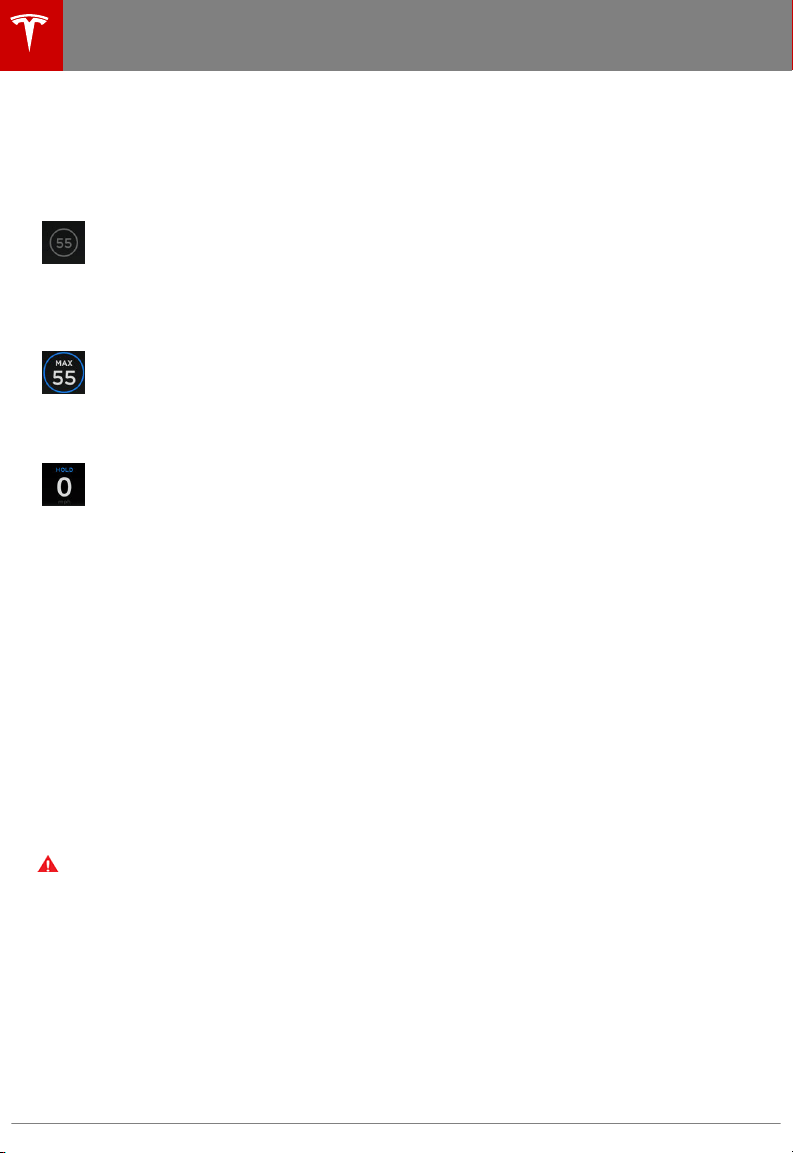
take appropriate action. It is the driver's
responsibility to be in control of Model X
at all times.
Summary of Cruise Indicators
Trac-Aware Cruise Control is
available but is not actively
controlling your speed until you
activate it. The number shown in
gray is determined by Speed Assist
(see Controlling Speed Assist on
page 112).
Trac-Aware Cruise Control is
operating and is either maintaining
the set speed (no vehicle in front) or
is maintaining a chosen following
distance from a vehicle ahead (up to
the set speed).
Model X has fully stopped but is in a
HOLD state. If safe, press the
accelerator pedal to resume cruising
at the set speed.
Limitations
Trac-Aware Cruise Control is particularly
unlikely to operate as intended in the
following types of situations:
• The road has sharp curves.
• Visibility is poor (due to heavy rain, snow,
fog, etc.).
• Bright light (such as from oncoming
headlights or direct sunlight) is interfering
with the view of the camera(s).
• The radar sensor is obstructed (dirty,
covered, etc.).
• The windshield is obstructing the view of
the camera(s) (fogged over, dirty, covered
by a sticker, etc.).
Warning:
The list above does not
represent an exhaustive list of situations
that may interfere with proper operation
of Trac-Aware Cruise Control.
Trac-Aware Cruise Control
96 Model X Owner's Manual
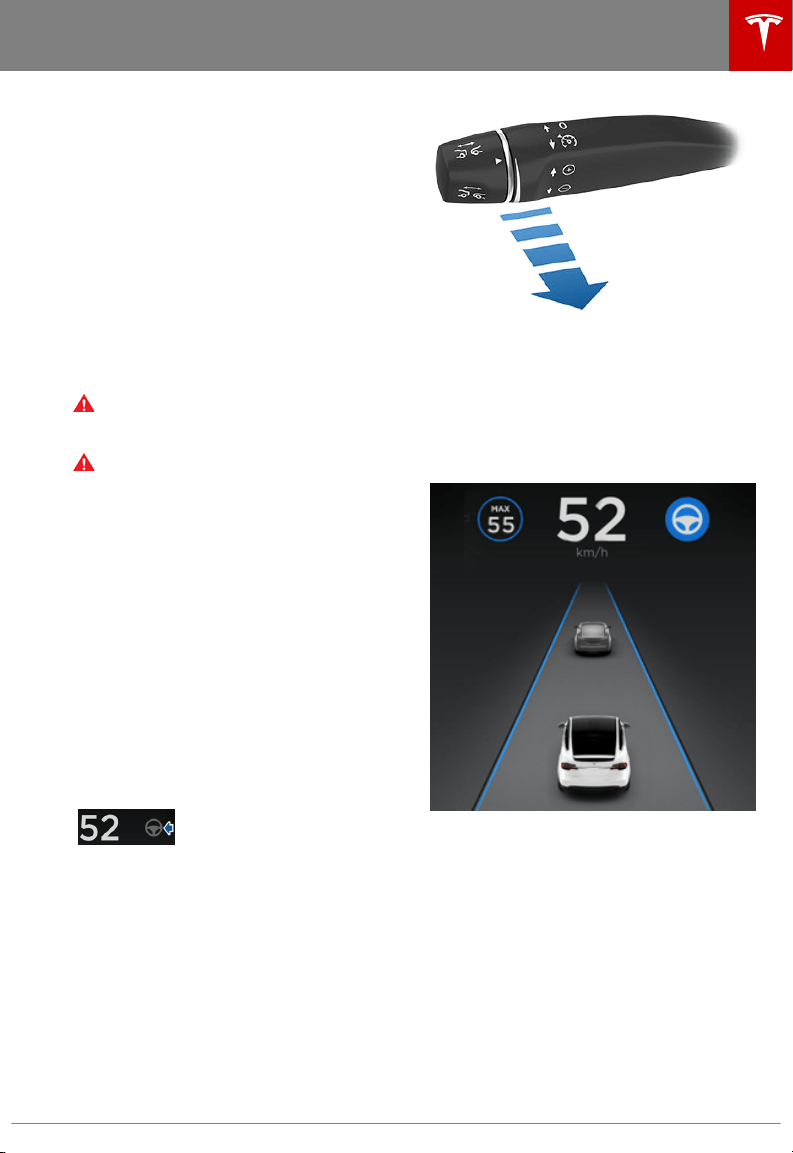
Note: Autosteer is a BETA feature.
If you have purchased the optional Enhanced
Autopilot or Full Self-Driving Capability
packages, you can use Autosteer to manage
steering and speed under certain
circumstances. Autosteer builds upon
Trac-
Aware Cruise Control (see Trac-Aware
Cruise Control on page 91), intelligently
keeping Model X in its driving lane when
cruising at a set speed. Using the vehicle's
camera(s), the radar sensor, and the ultrasonic
sensors, Autosteer detects lane markings and
the presence of vehicles and objects, assisting
you in steering Model X based on the lane
markings and the vehicle directly in front of
you.
Warning: Autosteer is a hands-on feature.
You must keep your hands on the steering
wheel at all times.
Warning: Autosteer is intended for use
only on highways and limited-access
roads with a fully attentive driver. When
using Autosteer, hold the steering wheel
and be mindful of road conditions and
surrounding trac. Do not use Autosteer
on city streets, in construction zones, or
in areas where bicyclists or pedestrians
may be present. Never depend on
Autosteer to determine an appropriate
driving path. Always be prepared to take
immediate action. Failure to follow these
instructions could cause damage, serious
injury or death.
Operating Autosteer
Before you can operate Autosteer, you must
enable it by touching Controls > Settings >
Driver Assistance > Autosteer > ON.
To indicate that Autosteer is
available (but not actively
steering Model X), the
instrument panel displays a
gray Autosteer iconon the
right side of the driving
speed.
To initiate Autosteer, pull the cruise control
lever toward you twice in quick succession.
Autosteer
briefly displays a message on the
instrument panel reminding you to pay
attention to the road and have your hands on
the steering wheel. To indicate that Autosteer
is now actively assisting in steering Model X,
the instrument panel displays the Autosteer
icon in blue. When Autosteer is able to detect
lane markings, it also displays the driving lane
in blue.
Note: To initiate Autosteer when there is no
vehicle in front of you, you must be driving at
least 30 km/h on a roadway with visible lane
markings. If a vehicle is detected ahead of you,
you can initiate Autosteer at any speed, even
when stationary (if you are at least 150 cm
away from the vehicle).
The instrument panel displays a message
indicating that Autosteer is temporarily
unavailable if you attempted to engage
Autosteer when driving at a speed that is not
within the speed required for Autosteer to
operate. Autosteer may also be unavailable if
it is not receiving adequate data from the
camera(s) or sensors.
Autosteer
Driver Assistance 97
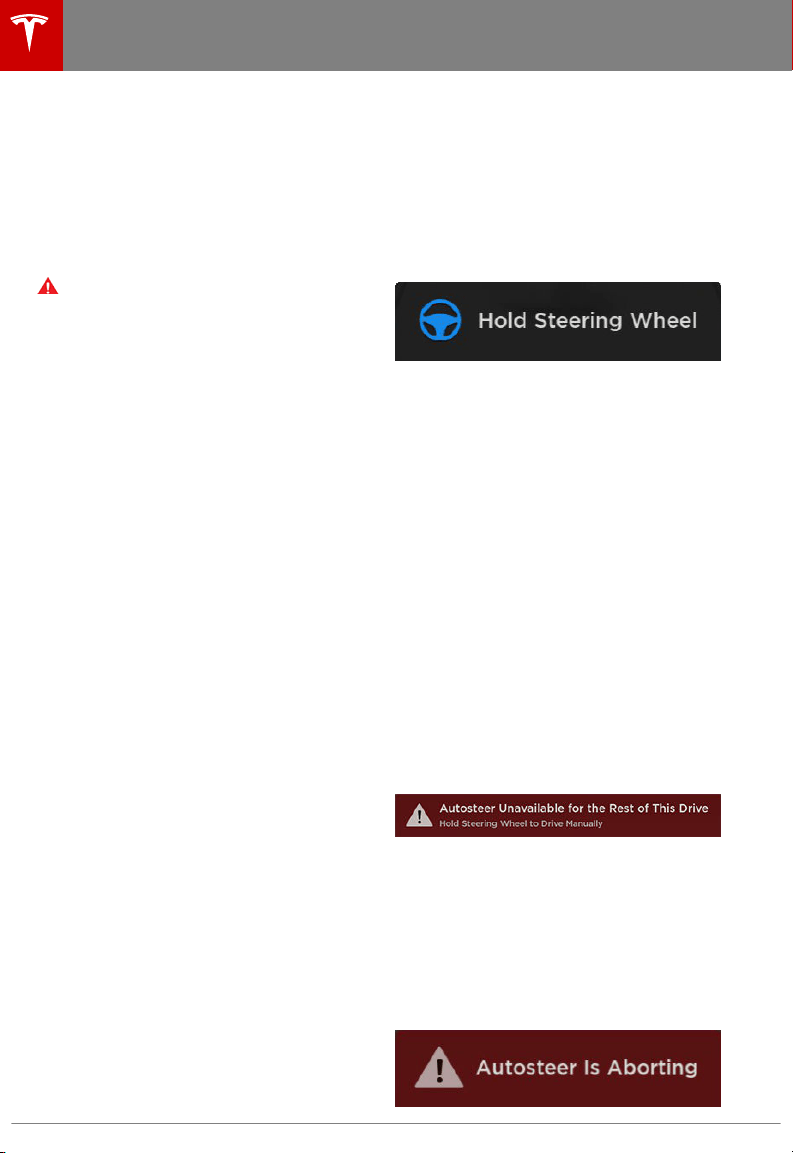
If Autosteer is unable to detect lane markings,
the driving lane is determined based on the
vehicle you are following.
In most cases, Autosteer attempts to center
Model X in the driving lane. However, if the
sensors detect the presence of an obstacle
(such as a vehicle or guard rail), Autosteer
may steer Model X in a driving path that is
oset from the center of the lane.
Warning: Autosteer is not designed to,
and will not, steer Model X around objects
partially or completely in the driving lane.
Always watch the road in front of you and
stay prepared to take appropriate action.
It is the driver's responsibility to be in
control of Model X at all times.
Restricted Speed
Autosteer is intended for use only by a fully
attentive driver on freeways and highways
where access is limited by entry and exit
ramps. If you choose to use Autosteer on
residential roads, a road without a center
divider, or a road where access is not limited,
Autosteer may limit the maximum allowed
cruising speed. The maximum allowed cruising
speed on such roads is calculated based on
the detected speed limit including a Speed
Assist
oset of up to +10 km/h. Any Speed
Assist oset above +10 km/h is rounded down
to +10 km/h. However, you can select a more
restrictive cruising speed by reducing the
speed limit
oset (see Controlling Speed
Assist on page 112) or by adjusting the cruise
control lever.
In situations where the speed limit cannot be
detected when Autosteer is engaged,
Autosteer reduces your driving speed and
limits the set speed to 70 km/h. Although you
can manually accelerate to exceed the limited
speed, Model X may not brake for detected
obstacles. Autosteer will slow down to the
limited speed when you release the
accelerator pedal. When you leave the road, or
disengage Autosteer by using the steering
wheel, you can increase your set speed again,
if desired.
Hold Steering Wheel
Autosteer uses data from the camera(s),
sensors, and GPS to determine how best to
assist you in steering Model X. When active,
Autosteer requires you to hold the steering
wheel. If it does not detect your hands on the
steering wheel for a period of time, a flashing
white light appears around the instrument
panel and the following message displays:
Autosteer detects your hands by recognizing
light resistance as the steering wheel turns, or
from you manually turning the steering wheel
very lightly (i.e., without enough force to
retake control). When your hands are
detected, the message disappears and
Autosteer resumes normal operation.
Note: Autosteer may also sound a chime at
the same time that the message is initially
displayed.
Autosteer requires that you pay attention to
your surroundings and remain prepared to
take control at any time. If Autosteer still does
not detect your hands on the steering wheel,
the request escalates by sounding chimes that
increase in frequency.
If you repeatedly ignore hands-on prompts,
Autosteer displays the following message and
is disabled for the rest of the drive. If you
don't resume manual steering, Autosteer
sounds a continuous chime, turns on the
warning
flashers, and slows the vehicle to a
complete stop.
For the rest of the drive, you must steer
manually. Autosteer is available again after
you stop and shift the vehicle into Park.
Autosteer is Aborting
In situations where Autosteer is unable to
assist in steering Model X, Autosteer aborts,
sounds a warning chime, and displays the
following message on the instrument panel:
Autosteer
98 Model X Owner's Manual

Canceling Autosteer
Autosteer cancels when:
• You apply rotational force to the steering
wheel (even a slight amount).
• You press the brake pedal.
• You push the cruise control lever away
from you.
• The maximum speed that Autosteer
supports–150 km/h–is exceeded.
• You shift into a
dierent gear.
• An Automatic Emergency Braking event
occurs (see Collision Avoidance Assist on
page 108).
When Autosteer cancels, it sounds chimes and
the Autosteer icon either turns gray to
indicate that Autosteer is no longer active, or
disappears to indicate that it is not currently
available.
Note: If Autosteer cancels because you
applied rotational force to the steering wheel,
Trac-Aware Cruise Control remains active.
Disengage
Trac-Aware Cruise Control as
you normally would, by briefly pushing the
cruise control lever away from you or pressing
the brake pedal.
To disable Autosteer so it is no longer
available, touch Controls > Settings > Driver
Assistance > Autosteer > OFF.
Limitations
Autosteer is particularly unlikely to operate as
intended when:
• Autosteer is unable to accurately
determine lane markings. For example,
lane markings are excessively worn, have
visible previous markings, have been
adjusted due to road construction, are
changing quickly (lanes branching
o,
crossing over, or merging), objects or
landscape features are casting strong
shadows on the lane markings, or the road
surface contains pavement seams or other
high-contrast lines.
• Visibility is poor (heavy rain, snow, fog,
etc.).
• A camera(s) or sensor(s) is obstructed,
covered, or damaged.
• Driving on hills.
• Approaching a toll booth.
• Driving on a road that has sharp curves or
is excessively rough.
• Bright light (such as direct sunlight) is
interfering with the view of the camera(s).
• The sensors are
aected by other
electrical equipment or devices that
generate ultrasonic waves.
Warning: Many unforeseen circumstances
can impair the operation of Autosteer.
Always keep this in mind and remember
that as a result, Autosteer may not assist
in steering Model X appropriately. Always
drive attentively and be prepared to take
immediate action.
Autosteer
Driver Assistance 99

Warning: Auto Lane Change is designed
to be used only when driving on
restricted-access highways (i.e. with on-
ramps and o-ramps).
If you have purchased the optional Enhanced
Autopilot or Full Self-Driving Capability
packages, you can use Auto Lane Change to
move Model X into an adjacent lane. When
both Trac-Aware Cruise Control and
Autosteer are active, Auto Lane Change
intelligently assists you in steering Model X
into an adjacent driving lane. Using the
forward looking camera(s), the radar sensor,
and ultrasonic sensors, Model X detects lane
markings and the presence of other vehicles.
Auto Lane Change is designed for use on
restricted-access highways with visible lane
markings and under relatively predictable
circumstances in which minimal steering and
driver intervention is needed.
Warning: It is the driver's responsibility to
determine whether a lane change is safe
and appropriate. Auto Lane Change
cannot detect oncoming trac in the
target lane, especially fast moving
vehicles from the rear. Therefore, before
initiating a lane change, always check
blind spots, lane markings, and the
surrounding roadway to
confirm it is safe
and appropriate to move into the target
lane.
Warning: Never depend on Auto Lane
Change to determine an appropriate
driving path. Drive attentively by
watching the road and trac ahead of
you, checking the surrounding area, and
monitoring the instrument panel for
warnings. Always be prepared to take
immediate action.
Warning: Do not use Auto Lane Change
on city streets or on roads where trac
conditions are constantly changing and
where bicycles and pedestrians are
present.
Warning: The performance of Auto Lane
Change depends on the ability of the
camera(s) to recognize lane markings.
Warning: Do not use Auto Lane Change
on winding roads with sharp curves, on
icy or slippery roads, or when weather
conditions (such as heavy rain, snow, fog,
etc.) may be obstructing the view from
the camera(s) or sensors.
Warning: Failure to follow all warnings
and instructions can result in serious
property damage, injury or death.
Operating Auto Lane Change
Before you can operate Auto Lane Change,
you must enable it by touching Controls >
Settings > Driver Assistance > Auto Lane
Change > ON.
Note: Before you can turn on Auto Lane
Change, you must turn on Autosteer (see
Autosteer on page 97). Without Autosteer,
Auto Lane Change cannot operate.
Note: Your chosen setting is retained until you
manually change it. It is also saved in your
driver
profile.
To change lanes using Auto Lane Change:
1. Perform visual checks to make sure it is
safe and appropriate to move into the
target lane.
2. Engage the appropriate turn signal and
initiate the lane change by having your
hands on the steering wheel.
3. Disengage the turn signal after you are in
the target lane.
Auto Lane Change assists in moving Model X
into the adjacent lane in the direction
indicated by the turn signal, provided the
following conditions are met:
• Auto Lane Change detected your hands
on the steering wheel.
• The Auto Lane Change setting is turned
on.
• The turn signal is engaged.
• Autosteer is actively steering Model X.
• The ultrasonic sensors do not detect a
vehicle or obstacle up to the center of the
target lane.
• The lane markings indicate that a lane
change is permitted.
• The view of the camera(s) is not
obstructed.
• Lane Assist does not detect a vehicle in
the blind spot (see Lane Assist on page
106).
• Midway through the lane change, Auto
Lane Change can detect the outside lane
marking of the target lane.
• Driving speed is at least 45 km/h.
Auto Lane Change
100 Model X Owner's Manual

As the lane change is in progress, Overtake
Acceleration is activated, allowing Model X to
accelerate closer to a vehicle in front (see
Overtake Acceleration on page 94). Midway
through the lane change, Auto Lane Change
must be able to detect the target lane's
outside lane marking. If this lane marking
cannot be detected, both Auto Lane Change
and Autosteer will cancel.
Note: Auto Lane Change assists in moving
Model X one lane at a time. Moving into an
additional lane requires you to engage the
turn signal a second time after the
first lane
change is complete.
Warning: If Auto Lane Change aborts
during a lane change (for example, Auto
Lane Change cannot detect the outside
of the target lane midway through the
lane change), Model X returns to its
original driving lane.
When Auto Lane Change is active, it is
important to monitor its performance by
watching the driving path in front of you and
the surrounding area. Stay prepared to take
over steering at any time. As you are crossing
over into the adjacent lane, the instrument
panel displays the lane marking as a dashed
blue line. Once in your new lane, lane markings
are displayed as solid blue lines again.
In situations where Auto Lane Change is
unable to operate at optimal performance, or
cannot operate due to inadequate data, the
instrument panel displays a series of warnings.
Therefore, when using Auto Lane Change,
always pay attention to the instrument panel
and be prepared to manually steer Model X.
Warning:
When Auto Lane Change is
actively assisting in steering Model X, the
steering wheel moves accordingly.
Although you must have your hands on
the steering wheel, any significant
restriction of or force on the steering
wheel's movement can cancel both Auto
Lane Change and Autosteer.
Canceling Auto Lane Change
Auto Lane Change cancels when you manually
move the steering wheel, press the brake
pedal, or disengage the turn indicator before
Model X crosses the markers on the existing
lane.
To disable Auto Lane Change so it is no longer
available, touch Controls > Settings > Driver
Assistance > Auto Lane Change > OFF.
Limitations
Auto Lane Change is particularly unlikely to
operate as intended in the following types of
situations:
• Auto Lane Change is unable to accurately
determine lane markings. For example,
lane markings are excessively worn, have
visible previous markings, have been
adjusted due to road construction, are
changing quickly (lanes branching
o,
crossing over, or merging), objects or
landscape features are casting strong
shadows on the lane markings, or the road
surface contains pavement seams or other
high-contrast lines.
• A vehicle is detected in your blind spot
when you engage the turn signal.
• The road has sharp curves.
• Visibility is poor (due to heavy rain, snow,
fog, etc.) or weather conditions are
interfering with sensor operation.
• Bright light (oncoming headlights or
direct sunlight) is interfering with the view
of the camera(s).
• A sensor or camera is damaged or
obstructed (such as by mud, fog, ice,
snow, etc.).
• The sensors are
aected by other
electrical equipment or devices that
generate ultrasonic waves.
• Model X is being driven very close to a
vehicle in front of it, which is blocking the
view of the camera(s).
Warning:
Many unforeseen circumstances
can impair the operation of Auto Lane
Change. Always keep this in mind and
remember that as a result, Auto Lane
Change may not assist in steering
Model X appropriately. Always drive
attentively and stay prepared to
immediately take action at any time.
Auto Lane Change
Driver Assistance 101
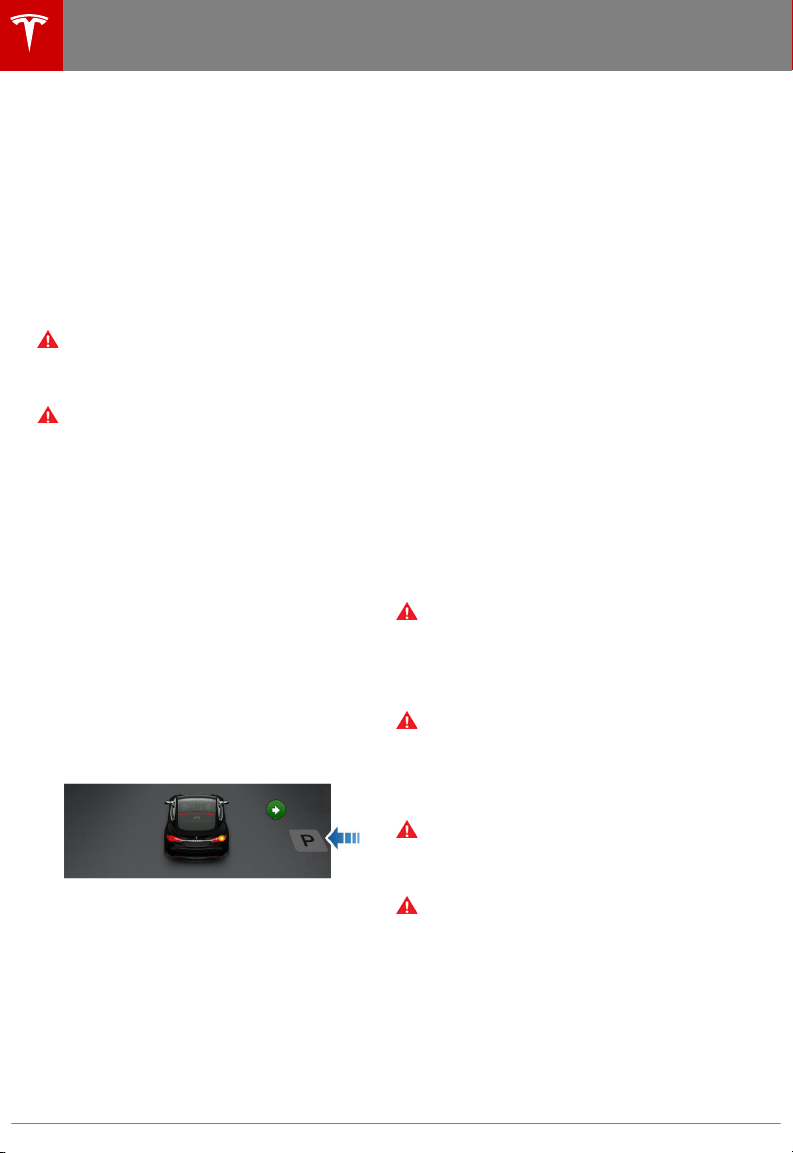
If you have purchased the optional Enhanced
Autopilot or Full Self-Driving Capability
package, Autopark uses data from the
ultrasonic sensors and GPS to:
• Simplify parking on public roads by
maneuvering Model X into parallel and
perpendicular parking spaces. See Parking
on Public Roads on page 102.
• Automatically park and retrieve Model X
from outside the vehicle on a private
residential property. See Using Summon
on page 103.
Warning: Summon is a BETA feature.
Please use this feature with caution,
staying prepared to take immediate
action at any time.
Warning: Autopark's performance
depends on the ability of the ultrasonic
sensors to determine the vehicle's
proximity to curbs, objects, and other
vehicles.
Parking on Public Roads
When driving, follow these steps to allow
Autopark to maneuver Model X into a parking
space:
1. When driving slowly on a public road,
monitor the instrument panel to
determine when Autopark has detected a
parking space. When Autopark detects a
potential parking space, the instrument
panel displays a parking icon. Autopark
detects parallel parking locations when
driving below 24 km/h and perpendicular
parking locations when driving below 16
km/h.
Note: The parking icon appears only if the
vehicle's position and/or the
circumstances of the surrounding area are
such that Autopark can determine an
appropriate driving path. If Autopark
cannot determine an appropriate path (for
example, when driving on a narrow street
where moving into the parking space
causes the front of the vehicle to extend
into the adjacent lane), you can either
reposition the vehicle,
find a dierent
parking space, or park manually.
2.
Check to determine if the detected
parking space is appropriate and safe. If
so, pull forward and stop approximately a
car length ahead of the parking space (as
you normally would when parallel parking
or when backing into a perpendicular
parking space).
3. Release the steering wheel, shift Model X
into Reverse, then touch Start Autopark
on the touchscreen.
4. When parking is complete, Autopark
displays the "Complete" message.
In situations where Autopark cannot operate
due to inadequate sensor data, the instrument
panel displays a message indicating that you
must manually park Model X.
Note: If you press the brake when Autopark is
actively parking Model X, the parking process
pauses until you touch Resume on the
touchscreen.
Note: Autopark detects potential
perpendicular parking spaces that are at least
2.9 meters wide with a vehicle parked on each
side. Autopark detects parallel parking spaces
that are at least 6 meters, but less than 9
meters long. Autopark does not operate on
angled parking spaces.
Warning: Never depend on Autopark to
find a parking space that is legal, suitable,
and safe. Autopark may not always detect
objects in the parking space. Always
perform visual checks to confirm that a
parking space is appropriate and safe.
Warning: When Autopark is actively
steering Model X, the steering wheel
moves in accordance with Autopark's
adjustments. Do not interfere with the
movement of the steering wheel. Doing
so cancels Autopark.
Warning: During the parking sequence,
continually check your surroundings. Be
prepared to apply the brakes to avoid
vehicles, pedestrians, or objects.
Warning: When Autopark is active,
monitor the touchscreen and instrument
panel to ensure that you are aware of the
instructions that Autopark is providing.
To Pause Parking
To pause Autopark, press the brake pedal
once. Model X stops and remains stopped until
you touch Resume on the touchscreen.
Autopark
102 Model X Owner's Manual

To Cancel Parking
Autopark cancels the parking sequence when
you manually move the steering wheel,
change gears, or touch Cancel on the
touchscreen. Autopark also cancels parking
when:
• The parking sequence exceeds the
maximum of seven moves.
• Model X detects that the driver is exiting
the vehicle.
• A door is opened.
• You press the accelerator pedal.
• You press the brake pedal while Autopark
is paused.
• An Automatic Emergency Braking event
occurs (see Collision Avoidance Assist on
page 108).
Limitations
Autopark is particularly unlikely to operate as
intended in these situations:
• The road is sloped. Autopark is designed
to operate on
flat roads only.
• Visibility is poor (due to heavy rain, snow,
fog, etc.).
• The curb is constructed of material other
than stone, or the curb cannot be
detected.
• The target parking space is directly
adjacent to a wall or pillar (for example,
the last parking space of a row in an
underground parking structure).
• One or more of the ultrasonic sensors is
damaged, dirty, or obstructed (such as by
mud, ice, or snow).
• Weather conditions (heavy rain, snow, fog,
or extremely hot or cold temperatures)
are interfering with sensor operation.
• The sensors are
aected by other
electrical equipment or devices that
generate ultrasonic waves.
Warning:
Many unforeseen circumstances
can impair Autopark's ability to park
Model X. Keep this in mind and remember
that as a result, Autopark may not steer
Model X appropriately. Pay attention
when parking Model X and stay prepared
to immediately take control.
Using Summon
Note: Summon is a BETA feature. Summon is
designed and intended for use only on a
private residential property where the
surrounding area is familiar and predictable.
When using Summon, you must continually
monitor the vehicle. It is the driver's
responsibility to use this feature safely,
responsibly, and as intended.
With Summon, you can move Model X in and
out of a parking space from outside the
vehicle using the mobile app. Using data from
the ultrasonic sensors, Summon maneuvers
Model X forward or reverse into a parking
space. When parking is complete Summon
shifts Model X into Park. Parking is complete
when:
• Model X detects an obstacle in its driving
path (within a chosen distance)
• Summon has moved Model X the
maximum distance of 12 meters
OR
• In the case of reversing, Summon has
reached the maximum Summon Distance.
To use Summon:
• FIRST TIME ONLY: Enable Summon and
customize how it works (see Customizing
Summon on page 104).
• Position Model X for parking (see Position
the Vehicle for Parking on page 104).
• Initiate the parking maneuver using the
mobile app. Detailed instructions for each
method are provided later.
You can summon Model X back to its original
position if you previously auto parked it and
the vehicle has remained in the Park gear.
Then, using the mobile app, simply specify the
opposite direction. Summon moves the vehicle
along the original path provided the
environment has not changed (i.e. no
obstructions have been introduced). If
obstacles are detected, Summon attempts to
avoid the obstacles while staying as close as
possible to its original path.
To cancel Summon and stop Model X at any
time during a parking maneuver, use the
mobile app, press any button on the key, or (if
sitting in the vehicle) interact with the steering
wheel, brake pedal, accelerator pedal, or gear
stalk.
Note: If you want Summon to move multiple
times in the same direction, up to the
maximum of 12 meters, cancel Summon and
Autopark
Driver Assistance 103

then re-initiate the parking process, choosing
the same direction.
Note: Summon can move Model X a short
distance laterally to avoid an obstacle but in
doing so, does not return the vehicle to its
driving path (i.e. Summon does not attempt to
move Model X around an obstacle).
Warning: Summon is unable to operate as
intended if the ultrasonic sensors are
obstructed by a vehicle bra, excessive
paint, or adhesive products (such as
wraps, stickers, rubber coating, etc.).
Warning: Model X cannot detect
obstacles that are located lower than the
bumper, very narrow (i.e. bicycles), or
hanging from a ceiling. In addition, many
unforeseen circumstances can impair
Summon's ability to move in or out of a
parking space and as a result, Summon
may not appropriately steer Model X.
Therefore, you must continually monitor
the vehicle's movement and surroundings
and remain prepared to stop Model X at
any time.
Customizing Summon
Before operating Summon, use the
touchscreen to enable it. Touch Controls >
Settings > Driver Assistance > Summon > ON.
Then touch Customize to specify how
Summon operates whenever it parks or
retrieves your vehicle:
• Bumper Clearance: Set the distance that
you want Summon to stop from a
detected object. For example, you may
want Summon to stop within just a few
inches of the garage wall. This distance
applies only to objects detected directly in
front of (when moving forward) or behind
(when reversing) Model X.
• Summon Distance: Specify the distance
Model X travels when backing out of a
parking space.
• Side Clearance: Allow Model X to enter
and exit very narrow parking spaces.
Warning:
Parking in a narrow space
limits the ability of the sensors to
accurately detect the location of
obstacles, increasing the risk of
damage to Model X and/or
surrounding objects.
• Use Auto HomeLink (if equipped): Set to
ON if you want to activate HomeLink to
open/close a programmed garage door
that meets safety standards during the
parking process. If enabled, the garage
door automatically opens and closes when
Model X enters or exits.
Note: This setting automatically opens
and closes the garage door only when
using Summon. To automate HomeLink in
other situations (such as when driving),
you must access the HomeLink device's
main settings by touching Controls >
Settings > HomeLink (see HomeLink
Universal Transceiver on page 148).
Warning: Do not use this setting with
gates or with a garage door that does
not meet safety standards. A garage
door opener that does not have
safety stop and reverse features
(cannot detect an object in its path
and then automatically stop and
reverse) does not meet these
standards. Using a garage door
opener without these features
increases the risk of injury or death.
Note: All settings associated with Summon are
retained until you manually change them.
Position the Vehicle for Parking
Before operating Summon, align Model X
laterally with the parking space so Model X
can move straight into the space in either
Drive or Reverse. You must also position
Model X within 12 meters of the parking space
(the maximum distance that Summon can
move Model X).
If applicable, open your garage door. As
described earlier, this can be automated using
Auto HomeLink (if equipped).
Note: Use Summon on
flat driveways only
where a raised concrete edge does not exceed
approximately 2.5 cm.
Operating Summon with the Mobile App
On the mobile app, start Summon and hold
down the forward or reverse button to move
Model X into the parking space.
Summon shifts Model X into Drive or Reverse
(based on the direction you
specified) and
drives into the parking space.
Note: If you release the direction button on
the mobile app, Summon stops moving
Model X.
Autopark
104 Model X Owner's Manual

Note: Summon requires that Model X can
detect a valid key nearby.
Note: Summon cancels if your phone enters
sleep mode or is turned o.
Stopping or Canceling Summon
You can stop Model X at any time while
Summon is active by pressing any button on
the key or by using the mobile app. Summon
also cancels when:
• A door handle is pressed or a door is
opened.
• You interact with the steering wheel, brake
pedal, accelerator pedal, or gear stalk.
• Model X detects an obstacle and cannot
move forward for more than
approximately two seconds.
• Summon has moved Model X the
maximum distance of approximately 12
meters.
Limitations
Summon is unlikely to operate as intended in
the following types of situations:
• The road is sloped. Summon is designed
to operate on
flat roads only.
• Summon has detected a raised concrete
edge when moving forward into the
parking location. Summon does not drive
forward over an edge that is higher than
approximately 2.5 cm.
• One or more of the ultrasonic sensors is
damaged, dirty, or obstructed (such as by
mud, ice, or snow).
• Weather conditions (heavy rain, snow, fog,
or extremely hot or cold temperatures)
are interfering with sensor operation.
• The sensors are
aected by other
electrical equipment or devices that
generate ultrasonic waves.
• Model X is in Trailer Mode or an accessory
is attached.
Note: Summon is disabled if Model X is in
Valet mode (see Valet Mode on page 46).
Warning:
The list above does not
represent an exhaustive list of situations
that may interfere with proper operation
of Autopark's Summon feature. It is the
driver's responsibility to remain in control
of Model X at all times. Pay close
attention whenever Summon is actively
moving Model X and stay prepared to
take immediate action. Failure to do so
can result in serious property damage,
injury or death.
Autopark
Driver Assistance 105
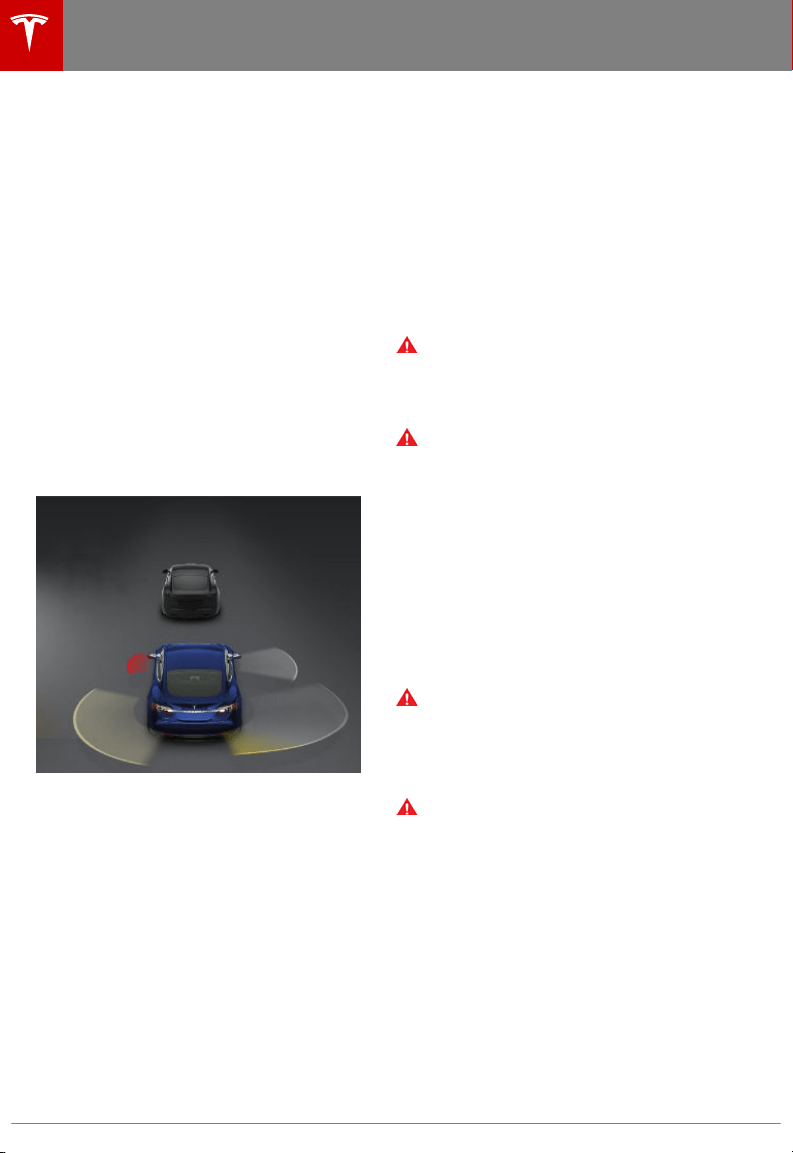
The cameras monitor the markers on the lane
you are driving in and the ultrasonic sensors
monitor the surrounding areas and the blind
spot for the presence of a vehicle or other
objects.
When an object is detected in your blind spot
or close to the side of Model X (such as a
vehicle, guard rail, etc.), colored lines radiate
from the image of Model X on the instrument
panel. The location of the lines correspond to
the location of the detected object. The color
of the lines (white, yellow, orange, or red)
represents the object's proximity to Model X,
with white being the farthest and red being
very close and requiring your immediate
attention. These colored lines only display
when driving between approximately 12 km/h
and 140 km/h. When Autosteer is active, these
colored lines also display if driving slower than
12 km/h. However, the colored lines do not
display if Model X is at a standstill (for
example, in heavy
trac).
Lane Assist also warns you of undesired lane
departures by vibrating the steering wheel
slightly if a front wheel passes over a lane
marking and the associated turn signal is
o.
This warning is active only when driving
between approximately 59 and 150 km/h. To
turn this warning on or
o, touch Controls >
Settings > Driver Assistance > Lane
Departure Warning. Your chosen setting is
retained until you manually change it. It is also
saved in your driver
profile.
In addition to the warnings previously
described, Lane Assist may provide steering
interventions if Model X drifts into (or close
to) an adjacent lane in which an object, such
as a vehicle, is detected. In these situations,
Model X automatically steers to a safer
position in its driving lane. This steering is
applied only when Model X is traveling
between 48 and 140 km/h on major roadways
with clearly visible lane markings. When Lane
Assist applies a steering intervention, the
instrument panel
briefly displays a warning
message.
Warning: Steering interventions are
minimal and are not designed to move
Model X out of its driving lane. Do not
rely on steering interventions to avoid
side collisions.
Warning: Lane Assist features are for
guidance purposes only and are not
intended to replace your own direct visual
checks. Never depend on Lane Assist to
inform you of unintentionally driving
outside of the boundaries of the driving
lane or informing you that an object or
vehicle is in your blind spot or close to
the side of your vehicle. Several external
factors can reduce the performance of
Lane Assist. It is the driver's responsibility
to stay alert, pay attention to the driving
lane and always be aware of other road
users. Failure to do so can result in
serious injury or death.
Warning: Lane Assist is designed to
detect lane markings and may not detect
the edge of a road, especially if the road
has no curb. It is the driver's responsibility
to drive attentively and stay within the
boundaries of the driving lane.
Warning: Before changing lanes, always
visually check the lane you are moving
into by using side mirrors and performing
the appropriate shoulder checks. Several
factors can aect the performance of the
Lane Assist warnings, resulting in lack of,
or false warnings (see Limitations and
Inaccuracies on page 106).
Limitations and Inaccuracies
Lane Assist cannot always clearly detect lane
markings and you may experience
unnecessary or invalid warnings in these
situations:
Lane Assist
106 Model X Owner's Manual

• Visibility is poor and lane markings are not
clearly visible (due to heavy rain, snow,
fog, etc.). The exact detection zone of the
ultrasonic sensors varies depending on
environmental conditions.
• Bright light (such as from oncoming
headlights or direct sunlight) is interfering
with the view of the camera(s).
• A vehicle in front of Model X is blocking
the view of the camera(s).
• The windshield is obstructing the view of
the camera(s) (fogged over, dirty, covered
by a sticker, etc.).
• Lane markings are excessively worn, have
visible previous markings, have been
adjusted due to road construction, or are
changing quickly (for example, lanes
branching
o, crossing over, or merging).
• The road is narrow or winding.
• Objects or landscape features are casting
strong shadows on lane markers.
Lane Assist may not provide warnings, or may
apply inappropriate warnings, in these
situations:
• One or more of the ultrasonic sensors is
damaged, dirty, or obstructed (such as by
mud, ice, or snow).
• Weather conditions (heavy rain, snow, fog,
or extremely hot or cold temperatures)
are interfering with sensor operation.
• The sensors are
aected by other
electrical equipment or devices that
generate ultrasonic waves.
• An object that is mounted to Model X is
interfering with and/or obstructing a
sensor (such as a bike rack or a bumper
sticker).
In addition, Lane Assist may not steer Model X
away from an adjacent vehicle, or may apply
unnecessary or inappropriate steering, in
these situations:
• You are driving Model X on sharp corners
or on a curve at a relatively high speed.
• Bright light (such as from oncoming
headlights or direct sunlight) is interfering
with the view of the camera(s).
• You are drifting into another lane but an
object (such as a vehicle) is not present.
• A vehicle in another lane cuts in front of
you or drifts into your driving lane.
• Model X is traveling less than 48 km/h or
over 145 km/h.
• One or more of the ultrasonic sensors is
damaged, dirty, or obstructed (such as by
mud, ice, or snow).
• Weather conditions (heavy rain, snow, fog,
or extremely hot or cold temperatures)
are interfering with sensor operation.
• The sensors are aected by other
electrical equipment or devices that
generate ultrasonic waves.
• An object mounted to Model X (such as a
bike rack or a bumper sticker) is
interfering with or obstructing a sensor.
• Visibility is poor and lane markings are not
clearly visible (due to heavy rain, snow,
fog, etc.).
• Lane markings are excessively worn, have
visible previous markings, have been
adjusted due to road construction or are
changing quickly (for example, lanes
branching
o, crossing over, or merging).
Warning: The lists above do not represent
every possible situation that may interfere
with Lane Assist warnings. Lane Assist
may not operate as intended for many
other reasons. To avoid a collision, stay
alert and always pay attention to the
roadway when driving Model X so you
can anticipate the need to take corrective
action as early as possible.
Lane Assist
Driver Assistance 107
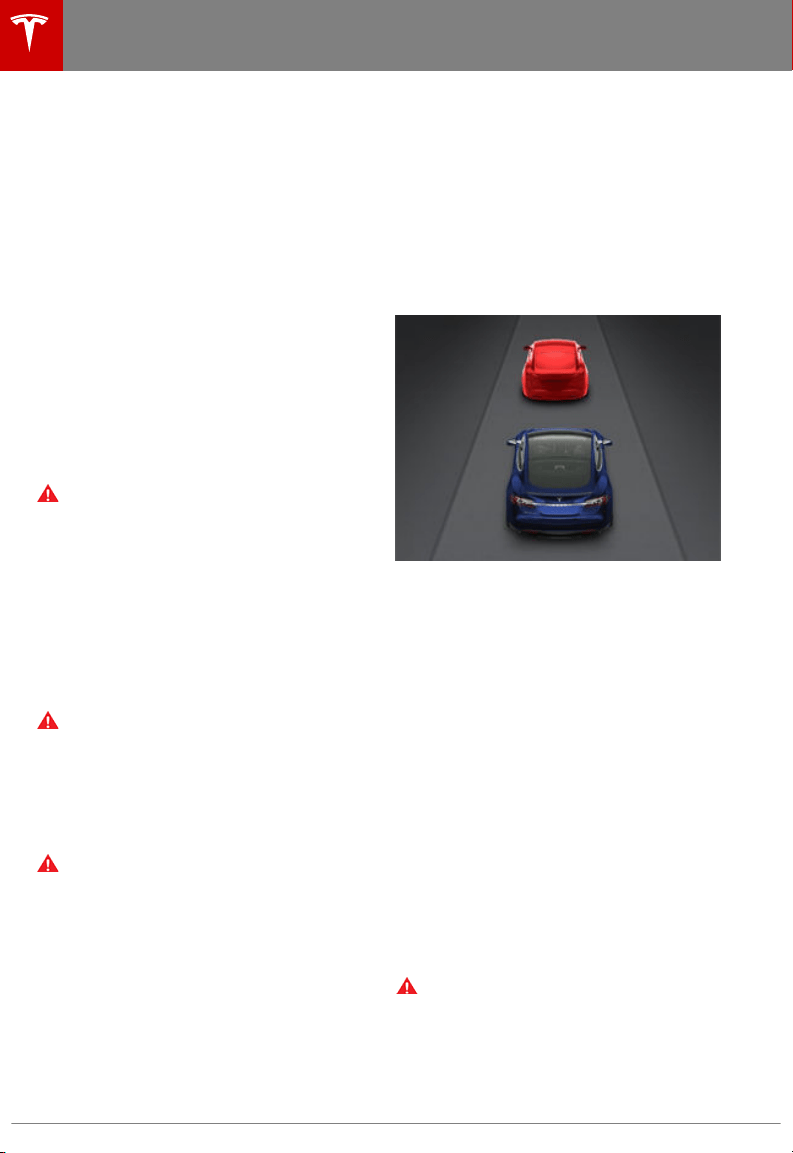
The following collision avoidance features are
designed to increase the safety of you and
your passengers:
• Forward Collision Warning - provides
visual and audible warnings in situations
when Model X detects that there is a high
risk of a frontal collision (see Forward
Collision Warning on page 108).
• Automatic Emergency Braking -
automatically applies braking to reduce
the impact of a frontal collision (see
Automatic Emergency Braking on page
109).
• Pedal Misapplication Mitigation - may
reduce the impact of a collision in
situations where Model X detects an
object in its immediate driving path and
determines that the driver has
accidentally pressed the accelerator pedal
(see Pedal Misapplication Mitigation on
page 110).
Warning: Forward Collision Warning is for
guidance purposes only and is not a
substitute for attentive driving and sound
judgment. Keep your eyes on the road
when driving and never depend on
Forward Collision Warning to warn you of
a potential collision. Several factors can
reduce or impair performance, causing
either unnecessary, invalid, inaccurate, or
missed warnings. Depending on Forward
Collision Warning to warn you of a
potential collision can result in serious
injury or death.
Warning: Automatic Emergency Braking
is not designed to prevent a collision. At
best, it can minimize the impact of a
frontal collision by attempting to reduce
your driving speed. Depending on
Automatic Emergency Braking to avoid a
collision can result in serious injury or
death.
Warning: Pedal Misapplication Mitigation
is not designed to prevent a collision. At
best, it can minimize the impact of a
collision. Depending on Pedal
Misapplication Mitigation to avoid a
collision can result in serious injury or
death.
Forward Collision Warning
The forward looking camera(s) and the radar
sensor monitor the area in front of Model X for
the presence of an object such as a vehicle,
bicycle, or pedestrian. If a collision is
considered likely unless you take immediate
corrective action, Forward Collision Warning is
designed to sound a chime and highlight the
vehicle in front of you in red on the instrument
panel. If this happens, TAKE IMMEDIATE
CORRECTIVE ACTION!
Warnings cancel automatically when the risk
of a collision has been reduced (for example,
you have decelerated or stopped Model X, or
the object in front of your vehicle has moved
out of your driving path).
If immediate action is not taken when Model X
issues a Forward Collision Warning, Automatic
Emergency Braking (if enabled) may
automatically apply the brakes if a collision is
considered imminent (see Automatic
Emergency Braking on page 109).
By default, Forward Collision Warning is
turned on. To turn it
o or adjust its sensitivity,
touch Controls > Settings > Driver
Assistance > Forward Collision Warning.
Instead of the default warning level of
Medium, you can turn the warning
O, or you
can choose to be warned Late or Early.
Note: Your chosen setting for Forward
Collision Warning is retained until you
manually change it. It is also saved in your
driver
profile.
Warning:
The camera(s) and sensors
associated with Forward Collision
Warning are designed to monitor an
approximate area of up to 160 meters in
your driving path. The area being
monitored by Forward Collision Warning
can be adversely aected by road and
Collision Avoidance Assist
108 Model X Owner's Manual
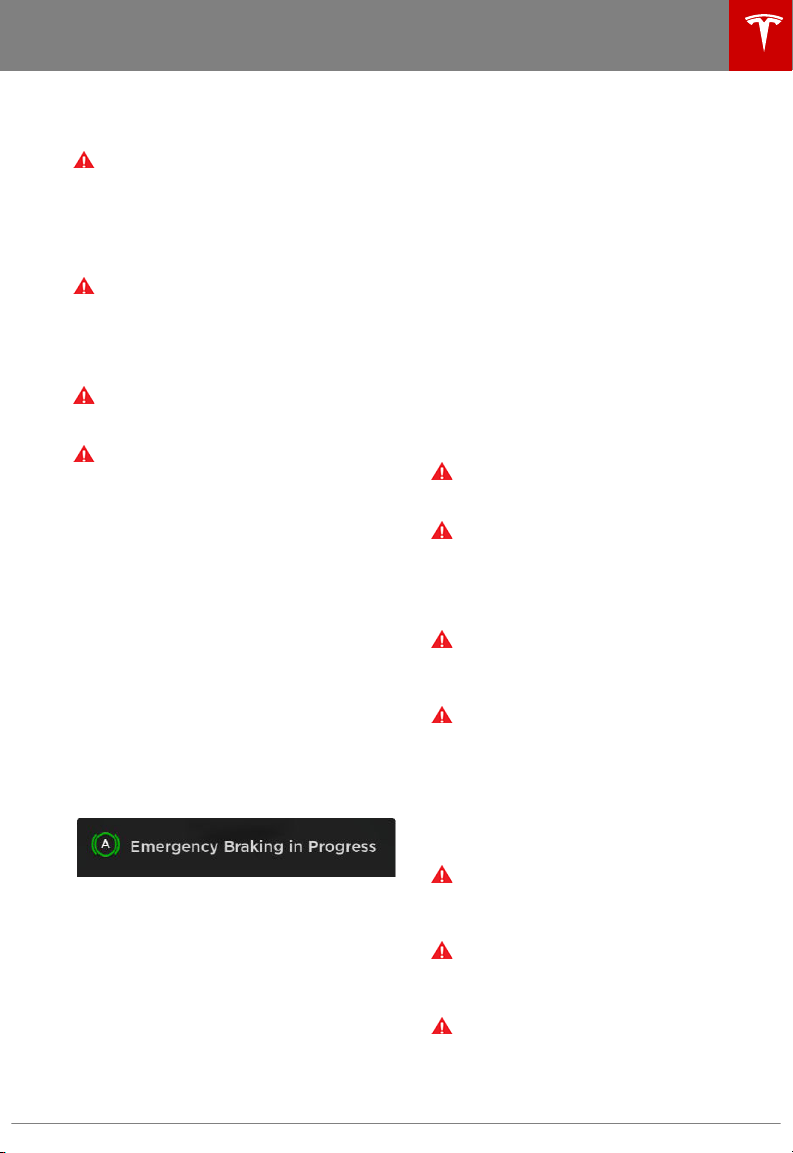
weather conditions. Use appropriate
caution when driving.
Warning: Forward Collision Warning is
designed only to provide visual and
audible alerts. It does not attempt to
apply the brakes or decelerate Model X.
When seeing and/or hearing a warning, it
is the driver's responsibility to take
corrective action immediately.
Warning: Forward Collision Warning may
provide a warning in situations where the
likelihood of collision may not exist. Stay
alert and always pay attention to the area
in front of Model X so you can anticipate
whether any action is required.
Warning: Forward Collision Warning
operates only when driving between
approximately 10 km/h and 150 km/h.
Warning: Forward Collision Warning does
not provide a warning when the driver is
already applying the brake.
Automatic Emergency Braking
The forward looking camera(s) and the radar
sensor are designed to determine the distance
from an object (vehicle, motorcycle, bicycle, or
pedestrian) traveling in front of Model X.
When a frontal collision is considered
unavoidable, Automatic Emergency Braking is
designed to apply the brakes to reduce the
severity of the impact.
When Automatic Emergency Braking applies
the brakes, the instrument panel displays a
visual warning and sounds a chime. You may
also notice abrupt downward movement of
the brake pedal. The brake lights turn on to
alert other road users that you are slowing
down.
If driving (46 km/h) or faster, the brakes are
released after Automatic Emergency Braking
has reduced your driving speed by (40 km/h).
For example, if Automatic Emergency Braking
applies braking when driving 90 km/h, it
releases the brakes when your speed has been
reduced to 50 km/h.
Automatic Emergency Braking operates only
when driving between approximately 10 km/h
and 150 km/h.
Automatic Emergency Braking does not apply
the brakes, or stops applying the brakes,
when:
• You turn the steering wheel sharply.
• You press and release the brake pedal
while Automatic Emergency Braking is
applying the brakes.
• You accelerate hard (the pressure on the
accelerator pedal increases from below
90% to above 90%) while Automatic
Emergency Braking is applying the brakes.
• The vehicle, motorcycle, bicycle, or
pedestrian is no longer detected ahead.
Automatic Emergency Braking is always
enabled when you start Model X. To disable it
(in addition to disabling Pedal Misapplication
Mitigation) for your current drive, touch
Controls > Settings > Driver Assistance >
Automatic Emergency Braking > Disable.
Warning: Disabling Automatic Emergency
Braking also disables Pedal Misapplication
Mitigation.
Warning: It is strongly recommended that
you do not disable Automatic Emergency
Braking. If you disable it, Model X does
not automatically apply the brakes in
situations where a collision is considered
likely.
Warning: Automatic Emergency Braking
is designed to reduce the severity of an
impact. It is not designed to avoid a
collision.
Warning: Several factors can aect the
performance of Automatic Emergency
Braking, causing either no braking or
inappropriate or untimely braking. It is the
driver’s responsibility to drive safely and
remain in control of the vehicle at all
times. Never depend on Automatic
Emergency Braking to avoid or reduce
the impact of a collision.
Warning: Automatic Emergency Braking
is designed to reduce the impact of
frontal collisions only and does not
function when Model X is in Reverse.
Warning: Automatic Emergency Braking
is not a substitute for maintaining a safe
traveling distance between you and the
vehicle in front of you.
Warning: The brake pedal moves
downward abruptly during automatic
braking events. Always ensure that the
brake pedal can move freely. Do not place
Collision Avoidance Assist
Driver Assistance 109

material under or on top of the Tesla-
supplied driver’s floor mat (including an
additional mat) and always ensure that
the driver’s floor mat is properly secured.
Failure to do so can impede the ability of
the brake pedal to move freely.
Note: For advance notice of an Automatic
Emergency Braking event, turn on Forward
Collision Warning (see Forward Collision
Warning on page 108). When turned on, you
hear a chime and see a collision warning on
the instrument panel if a collision is
considered likely. Then, if you do not take
immediate corrective action, a collision is
considered imminent and Automatic
Emergency Braking applies braking to reduce
driving speed. If enabled, Automatic
Emergency Braking applies braking when a
collision is considered inevitable, even if
Forward Collision Warning is turned
o.
Pedal Misapplication Mitigation
Pedal Misapplication Mitigation is designed to
reduce the impact of a collision by reducing
motor torque and in some cases, applying the
brakes, if Model X detects an object in its
driving path and has determined that you
have accidentally pressed the accelerator
pedal (instead of the brake pedal). For
example, Model X, while parked in front of a
closed garage door with the Drive gear
engaged, detects that you have pressed hard
on the accelerator pedal. Although Model X
still accelerates and hits the garage door, the
reduced torque may result in less damage.
When the torque is reduced, the instrument
panel displays:
To override this feature and resume normal
motor torque (and cancel any automated
braking that may be in
eect), release and
reapply the accelerator pedal.
Pedal Misapplication Mitigation is designed to
operate only when all of these conditions are
met:
• A driving gear is engaged (Drive or
Reverse).
• Model X is stopped or traveling less than
10 mph (16 km/h).
• Model X detects an object in its
immediate driving path.
• Pressure on the accelerator pedal pressure
exceeds 50%.
Pedal Misapplication Mitigation is enabled
whenever Automatic Emergency Braking is
enabled (see Automatic Emergency Braking
on page 109).
Warning: Pedal Misapplication Mitigation
is designed to reduce the severity of an
impact. It is not designed to avoid a
collision.
Warning: Pedal Misapplication Mitigation
may not limit torque in all situations.
Several factors, including environmental
conditions, distance from an obstacle,
and a driver's actions, can limit, delay, or
inhibit Pedal Misapplication Mitigation.
Warning: Do not rely on Pedal
Misapplication Mitigation to control
acceleration or to avoid, or limit, the
severity of a collision, and do not attempt
to test Pedal Misapplication Mitigation.
Doing so can result in serious property
damage, injury, or death.
Warning: Several factors can aect the
performance of Pedal Misapplication
Mitigation, causing an inappropriate or
untimely reduction in motor torque
and/or undesired braking. It is the driver's
responsibility to drive safely and remain
in control of Model X at all times.
Limitations and Inaccuracies
Collision Avoidance features cannot always
detect all objects, vehicles, bikes, or
pedestrians, and you may experience
unnecessary, inaccurate, invalid, or missed
warnings for many reasons, particularly if:
• The road has sharp curves.
• Visibility is poor (due to heavy rain, snow,
fog, etc.).
• Bright light (such as from oncoming
headlights or direct sunlight) is interfering
with the view of the camera(s).
• The radar sensor is obstructed (dirty,
covered, etc.).
• The windshield is obstructing the view of
the camera(s) (fogged over, dirty, covered
by a sticker, etc.).
Warning:
The limitations previously
described do not represent an exhaustive
list of situations that may interfere with
proper operation of Collision Avoidance
Assist features. These features may fail to
provide their intended function for many
other reasons. It is the driver’s
responsibility to avoid collisions by
staying alert and paying attention to the
Collision Avoidance Assist
110 Model X Owner's Manual

area beside Model X so you can anticipate
the need to take corrective action as early
as possible.
Caution: If a fault occurs with a Collision
Avoidance Assist feature, Model X
displays an alert. Contact Tesla Service.
Collision Avoidance Assist
Driver Assistance 111
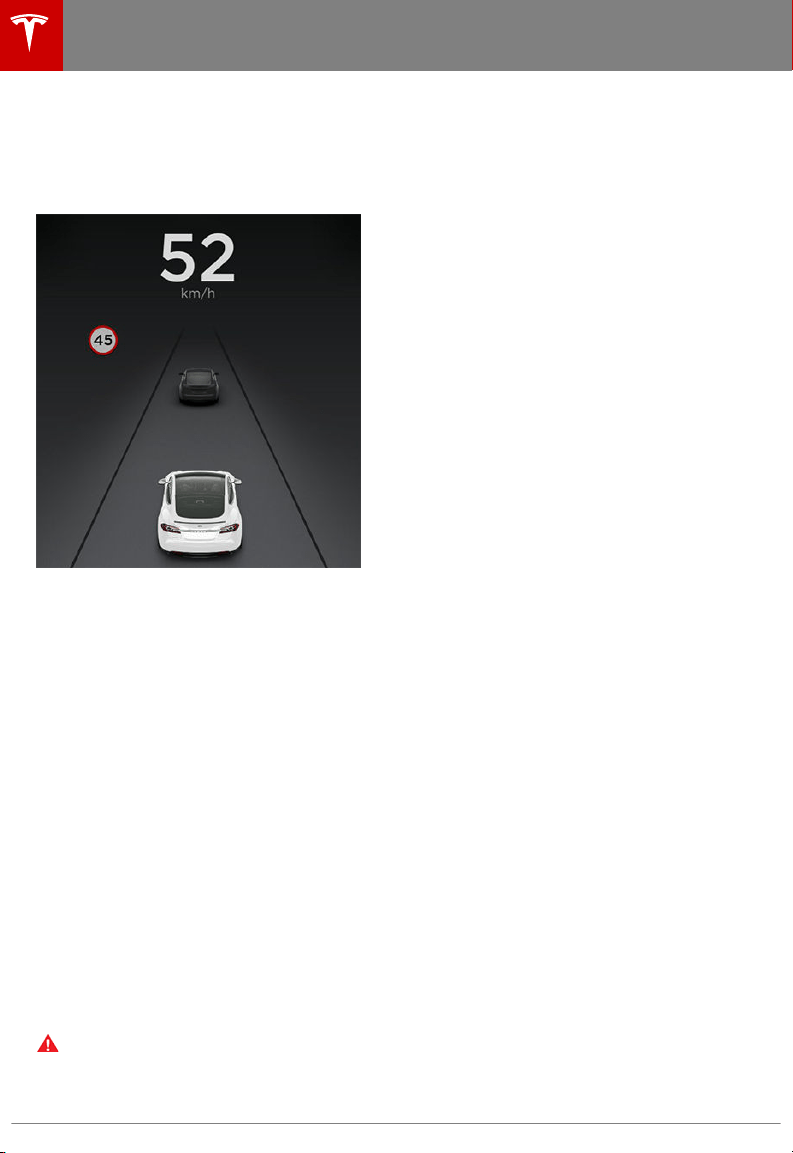
How Speed Assist Works
When the Speed Limit Warning is turned on,
the instrument panel displays a speed limit as
determined by GPS data. Warnings (described
later) take eect when you exceed this limit.
In situations where Speed Assist is unable to
determine a speed limit (for example, speed
limit signs and GPS data are not available at
the current location), or if Speed Assist is
uncertain that an acquired speed limit is
accurate (for example, although a speed limit
sign was initially detected, some time has
passed before a subsequent sign has been
detected), the instrument panel may not
display a speed limit sign and warnings do not
take
eect.
If you set the speed limit warning to Display
(see Controlling Speed Assist on page 112)
and exceed the determined speed limit, the
speed limit sign on the instrument panel
increases in size.
If you set the speed limit warning to Chime
(see Controlling Speed Assist on page 112)
and exceed the determined speed limit, the
speed limit sign on the instrument panel
increases in size and Model X also sounds a
warning chime.
Note: Speed limit warnings go away after ten
seconds, or when Model X slows down below
the
specified limit.
Warning:
Do not rely on Speed Assist to
determine the appropriate speed limit or
driving speed. Always drive at a safe
speed based on trac and road
conditions.
Controlling Speed Assist
To adjust the Speed Limit Warning setting,
touch Controls > Settings > Driver
Assistance > Speed Limit Warning, then
choose one of these options:
• O - Speed limit warnings do not display
and chimes are not sounded.
• Display - Speed limit signs display on the
instrument panel and the sign increases in
size when you exceed the determined
limit.
• Chime - In addition to the visual display, a
chime is sounded whenever you exceed
the determined speed limit.
You can also specify how the speed limit is
determined:
• Relative - The speed limit is determined
automatically based on detected
trac
signs and GPS data. If desired, you can set
a speed limit oset (+ or -) if you want to
be alerted only when you exceed the
oset speed limit by a specified amount.
For example, you can increase the oset
to +10 km/h if you only want to be warned
when you exceed the speed limit by
10 km/h.
Note: The oset from speed limit also
aects the number shown in the gray
speedometer icon on the left side of the
driving speed on the instrument panel.
• Absolute - Manually specify any speed
limit between 30 and 240 km/h.
Note: GPS data is not always accurate. The
GPS can miscalculate a road's location and
provide the speed limit for a directly adjacent
road that may have a
dierent speed limit. For
example, the GPS can assume Model X is on a
freeway or highway when it is actually on a
nearby surface street, and vice versa.
Note: Your chosen setting is retained until you
manually change it. It is also saved in your
driver
profile.
Limitations and Inaccuracies
Speed Assist may not be fully functional or
may provide inaccurate information in these
situations:
• The speed limits stored in the GPS
database are incorrect or outdated.
Speed Assist
112 Model X Owner's Manual

• Model X is being driven in an area where
GPS data is not available.
• A road or a speed limit has recently
changed.
Warning: The list above does not
represent an exhaustive list of situations
that may interfere with proper operation
of Speed Assist. Speed Assist may fail to
provide warnings for many other reasons.
Speed Assist
Driver Assistance 113

The Big Picture
The main components of the touchscreen are shown here. To manually control the brightness and
contrast, touch Controls > Displays. When set to Auto, the touchscreen changes between the Day
(light background) and Night (dark background) setting depending on ambient lighting
conditions.
Note: The following illustration is provided for demonstration purposes only. Depending on vehicle
options, software version and market region, your touchscreen may appear slightly
dierent.
Touchscreen Overview
114 Model X Owner's Manual
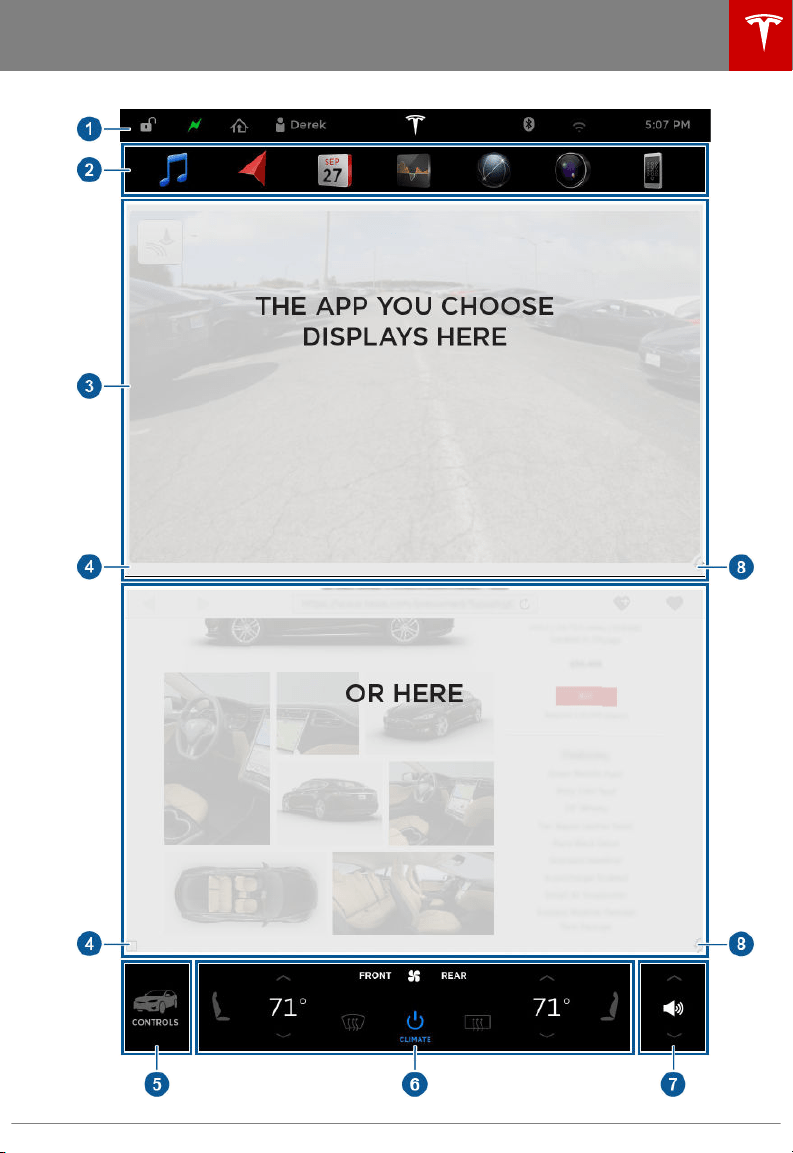
Touchscreen Overview
Using the Touchscreen 115

1. Status bar
The top line displays provides shortcuts to lock/unlock Model X, to access HomeLink (if
equipped) and Driver Profiles, display vehicle information (the Tesla “T”), download software
updates, display network strength and Bluetooth
®
status Wi-Fi settings, and to access the
passenger airbag setting. If an alert icon (exclamation mark) is displayed, touch it to see
warning messages that are in
eect.
Note: The airbag status symbol displays only when Model X is powered on.
Note: You can also display the time and outside temperature on the instrument panel by
choosing the Clock option using the left or right scroll wheel on the steering wheel (see
Steering Wheel on page 47).
Note: Touch the lock icon to unlock/lock all doors. In situations where only the driver's door is
unlocked (for example, Door Unlock Mode is set to Driver), the lock icon displays as unlocked
and touching it locks all doors. For more information on Door Unlock Mode, see Doors on
page 4.
Touchscreen Overview
116 Model X Owner's Manual
2. Apps
Touch an app to display it in the viewing area. Apps have default positions. Navigation and
Camera open in the top viewing area, whereas all other apps open in the bottom viewing area.
Instead of displaying the app in the default viewing area, you can specify where you want to
display the app by touching and holding the app's icon and dragging it onto the preferred
viewing area.
Media. See Media and Audio on page 134.
Maps and Navigation (if equipped). See Maps and Navigation on page 141.
Note: When displaying maps in the top (or entire) viewing area when a
driving gear is engaged, the status and app bars at the top disappear after a
few seconds to maximize the size of the map. Touch the map to redisplay
them.
Calendar. See Calendar on page 146.
Energy. See Getting Maximum Range on page 76.
Web. Access the Internet using the web browser (if equipped).
Camera. Display the area behind Model X. This area also displays
automatically whenever you shift into Reverse. See Rear View Camera on
page 78.
Phone. See Phone on page 139.
3. Main viewing area
The main viewing area changes depending on the app you have chosen. For some apps (such
as Navigation and Web), you can zoom in and out using standard touchscreen finger gestures.
4. Maximize/minimize app
Touch the small rectangle to expand the associated app to fill the entire main viewing area
(some apps are not expandable). Touch again to display two apps in half-screen view.
5. Controls
Touch to access all Model X controls and settings (doors, locks, lights, etc).
Touchscreen Overview
Using the Touchscreen 117

6. Climate controls (see Climate Controls on page 126).
7. Volume control
Touch the up and down arrows to increase or decrease the volume of the speakers. You can
also adjust the volume using the scroll wheel on the left side of the steering wheel.
8. Reverse the position of the two currently displayed apps.
Warning: Paying attention to road and trac conditions must always be the driver's highest
priority. To ensure the safety of vehicle occupants as well as other road users, using the
touchscreen should be done only when road and trac conditions permit.
Touchscreen Overview
118 Model X Owner's Manual
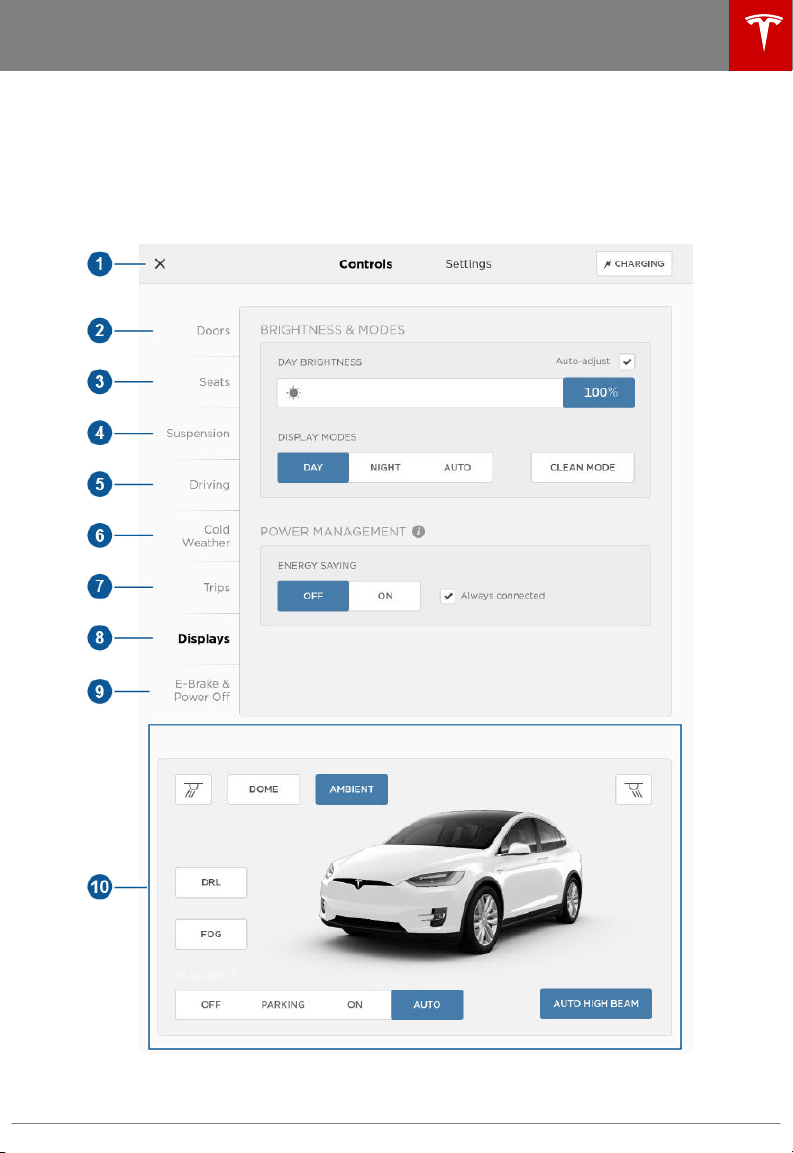
Controlling Features
Touch Controls on the bottom corner of the touchscreen to control and customize all main
features of Model X.
Note: The following illustration is provided for demonstration purposes only. Depending on vehicle
options, software version and market region, the options available on the Controls screen may be
dierent.
Controls
Using the Touchscreen 119

1. Close
Touch the circled X in the top left corner of a window to close it (or you can touch anywhere
outside the window).
2. Doors
Touch to open or close doors.
3. Seats
If Model X is equipped with monopost second row seats, touch to move the second row seats
forward or backward (see Adjusting Second Row Monopost Seats on page 21).
4. Suspension
If Model X is equipped with Smart Air Suspension, touch to manually raise or lower Model X,
or to remove a previously saved auto-raising location (see Smart Air Suspension on page
132). Model X must be powered on and you must press the brake pedal before you can
change suspension settings. Smart Air Suspension causes Model X to self-level, even when
powered
o. Therefore, when towing or lifting, you must disable self-leveling (see Instructions
for Transporters on page 194 and Jacking and Lifting on page 175).
5. Driving
• Steering mode
Adjust the amount of
eort required to turn the steering wheel. Sport feels more
responsive whereas Comfort feels easier to drive and park (see Steering Wheel on page
47).
• Acceleration (Performance dual-motor vehicles only)
Choose an acceleration level. Sport is the standard level of acceleration and allows you to
maximize driving range. Choose Insane to increase peak torque by approximately 30
percent and Ludicrous to increase it by approximately 60%.
If you choose Insane or Ludicrous, additional power is available immediately. However, to
achieve the absolute maximum power (designed for short term use), touch Max Battery
Power, which displays as blue text immediately below the acceleration setting. Max
Battery Power heats the Battery to its ideal operating temperature to ensure access to
100% of available power. Heating the Battery can take over an hour, depending on
environmental conditions and whether or not Model X is being driven. During this time, a
message displays providing you with an approximate wait time. When the additional
power is available, the message indicates that Max Battery Power is READY! When using
Max Battery Power, Model X consumes more energy as it keeps the Battery within an
optimal temperature range. To cancel Max Battery Power at any time, change the
acceleration level to Sport (or touch the button in the Max Battery Mode popup). To
prevent excess and potentially unnecessary energy consumption (for example, you leave
the vehicle and forget to cancel Max Battery Power), Max Battery Power cancels
automatically in three hours, regardless of whether you are still driving or have left the
vehicle.
Note: To support Max Battery Power, the charge level must be 20% or higher. You cannot
initiate Max Battery Power if the charge level is less than 20%. In addition, Max Battery
Power immediately cancels if at any time during its use, the charge level drops below
20%.
Note: Max Battery Power strives to keep the pack within an optimal temperature range. In
addition to heating the Battery, Max Battery Power also cools the battery when necessary
(for example, during aggressive driving scenarios).
Note: Max Battery Power is designed to achieve maximum performance for short term
acceleration and is not intended for daily driving. The
tradeo for the additional power
boost is extra energy consumption and earlier power fade on long aggressive drives. The
Insane or Ludicrous acceleration settings provide a significant increase in performance
even without Max Battery Power. In fact, in normal driving situations, the additional power
that can be achieved using Max Battery Power may not be noticeable.
Controls
120 Model X Owner's Manual

• Creep
When on, Model X slowly moves forward when in Drive and backward in Reverse when
you release the brake (similar to a conventional vehicle with an automatic transmission).
You can adjust this setting only when Model X is in Park.
• Traction Control
In circumstances where you deliberately want the wheels to spin, you can enable Slip
Start. A warning message displays on the instrument panel. Although Slip Start disables
automatically when driving speed exceeds 80 km/h (or when you start Model X), it is
strongly recommended that you disable it immediately after the circumstances that
required you to enable it have passed. See Traction Control on page 69.
• Regenerative braking
When you release the accelerator when driving, regenerative braking slows Model X and
feeds any surplus energy back to the Battery. If set to Low, Model X does not slow down
as quickly, but you may experience less range (see Regenerative Braking on page 66).
Note: Regardless of the setting, the energy gained by regenerative braking is reduced if
the Battery is full, or if it is extremely cold or hot (the surplus energy is used to heat or
cool the Battery).
• Range Mode
If on, Model X conserves energy by limiting the power of the climate control system and
turning
o signature lighting. Cabin heating and cooling may be less eective, but seat
heaters can be used to provide warmth in colder climates. When turned on in a dual-
motor vehicle, torque distribution between the motors is optimized to maximize range.
6. Cold Weather
If Model X is equipped with the optional cold weather package, you can control all seat
heaters as well as the heated wipers and steering wheel. Heaters that are turned on are
displayed in red. To turn
o all seat heaters, touch All O. Note that you can also control the
front driver and passenger seats using the main climate control panel located on the bottom
of the touchscreen (see Climate Controls on page 126).
7. Trips
View and reset the trip meters that summarize how far you have driven (see Trip Information
on page 75).
8. Displays
Manually control the brightness and the Day (light background) or Night (dark background)
setting of the touchscreen and instrument panel. When set to Auto, the brightness changes
automatically between day and night brightness based on ambient lighting conditions. When
Auto-adjust is checked, the displays are further adjusted based on both the surroundings and
by learning your preferences (i.e. it remembers the type of manual adjustments you make).
To disable the touchscreen momentarily for cleaning purposes, touch Clean Mode.
You can also put Model X into an energy saving mode so it consumes less energy when not in
use (see Getting Maximum Range on page 76).
Note: The Displays settings can also be accessed from the Settings screen.
9. E-Brake & Power
O
You can manually:
• Apply and release the parking brake (see Parking Brake on page 67).
• Power o (see Powering O on page 51).
10. Lights (see Lights on page 60)
Warning:
Do not read the touchscreen while driving. Doing so increases the likelihood of a
collision. Everything you need to know when driving is displayed on the instrument panel.
Controls
Using the Touchscreen 121
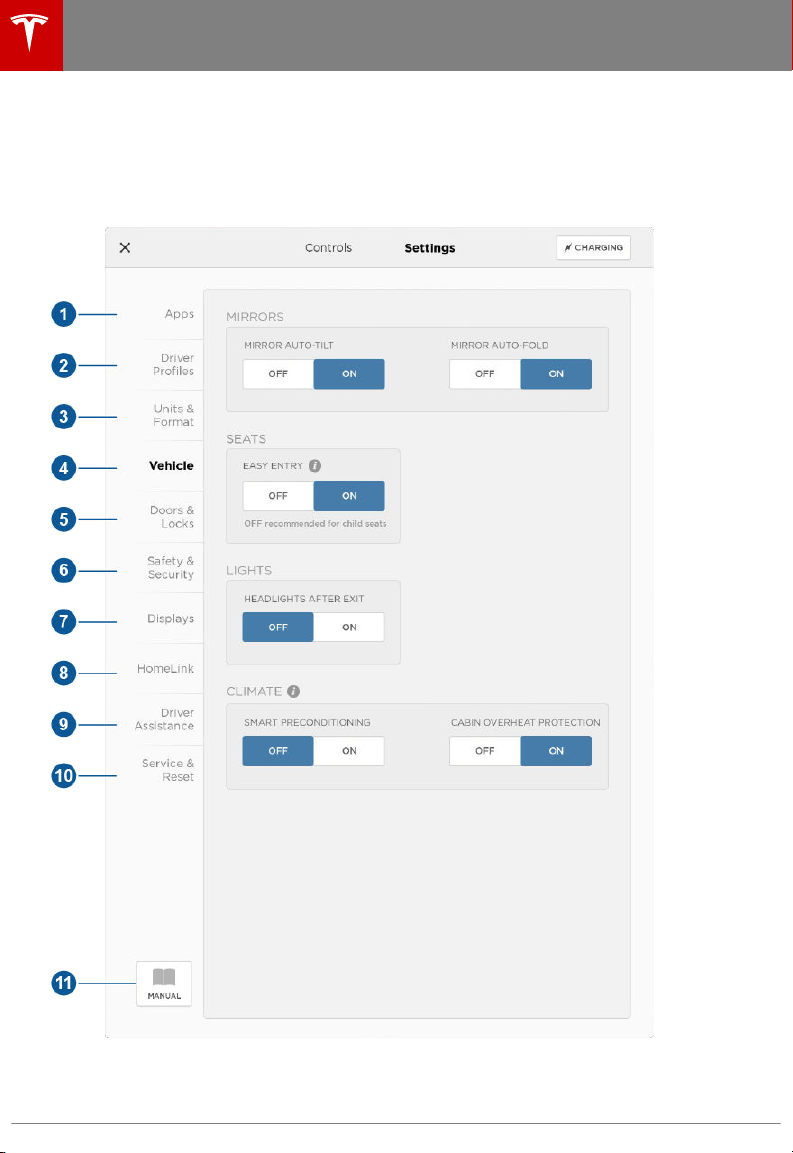
Customizing Your Vehicle
Touch the Settings tab on the Controls window to adjust Model X to suit your preferences.
Note: The following illustration is provided for demonstration purposes only. Depending on vehicle
options, software version, and market region, the options available on the Settings screen may be
dierent. For example, in many regions, the “Language & Units” tab is called “Units & Format.”
Settings
122 Model X Owner's Manual

1. Adjust settings associated with installed apps (applications). Settings associated with apps
that are either unavailable on Model X, or have no settings that you can adjust at this time, are
grayed out.
2. Manage driver profiles (see Driver Profiles on page 45).
3. Language & Units
Adjust how Model X displays:
• Region Format: Choose a region to
define the formatting convention used to display
dates (mm dd yy/dd-mm-yy, etc) and decimal separators (5.123, 5,123, etc).
• Language: Set the language used when Model X displays alerts, notification messages,
and navigation instructions (if equipped).
NOTE: Model X must be in Park to change the language. When you change the language,
you experience a brief delay as the vehicle shuts down and restarts the touchscreen.
• Distance: Miles or km can be shown on the range display, speedometer, energy chart, trip
meters, Google map searches and navigation routes.
• Time Format: 12 or 24 hour.
• Temperature: °C or °F.
• Energy & Charging: Display remaining energy and charging units as either a percentage of
battery energy remaining, or as an estimate of the distance that you can drive. When you
choose Distance, you can display mileage based on either:
• Rated - based on ECE R101 testing.
• Typical - based on US EPA testing.
Note: When anticipating when you need to charge, use range estimates as a general
guideline only.
• Tire Pressure: BAR or PSI.
4. Vehicle
Note: Depending on date of manufacture and options chosen at time of purchase, some
vehicles are not equipped with all features listed below.
• Easy Entry (vehicles with second row monopost seats only): If on, the associated outside
seat and center seat move to provide access to the third row seats (if equipped) with the
single press of the Easy Entry button. If
o, you must hold the Easy Entry button to move
the associated outside seat and center seat. See Accessing Third Row Seats on page 23.
• Headlights After Exit: If on in low lighting conditions, headlights stay on for one minute
after you exit, or until you lock the vehicle (see Headlights After Exit on page 63).
• Adaptive Headlights (if equipped): If on, the Adaptive Front Lighting System (AFS)
automatically adjusts the beam of the headlights to improve your driving view (see
Adaptive Front Lighting System (AFS) on page 63).
• Mirror Auto-Tilt: If on, exterior mirrors tilt downward when reversing (see Mirrors on page
50).
• Mirror Auto-Fold: If on, exterior mirrors fold when you lock Model X with the key, mobile
app, or walk-away locking. They extend automatically when you return. You can also fold
the mirrors manually by touching the center mirror control button (see Mirrors on page
50).
• Smart Preconditioning: If on, Model X predicts your driving schedule and automatically
adjusts the temperature of the cabin based on your last set temperature and your driving
schedule, making Model X comfortable and ready to drive. It may take some time for your
vehicle to learn your driving habits and if you do not have a regular driving schedule, it
will be unable to identify a pattern. Smart Preconditioning also warms your battery in
colder temperatures.
Note: To conserve energy in situations where Model X has a low charge level, smart
preconditioning may not occur.
Note: Smart Preconditioning is available only if you save your home and work locations
(see Favorite, Home, and Work Destinations on page 144).
Settings
Using the Touchscreen 123

• Cabin Overheat Protection: If on, the air conditioning system can reduce cabin
temperatures in extremely hot ambient conditions for a period of up to twelve hours after
exiting Model X (see Cabin Overheat Protection on page 131).
Warning: Never leave children or pets in the vehicle unattended. Due to automatic
shut-o or extreme outside conditions, the inside of the vehicle can become
dangerously hot even with Cabin Overheat Protection enabled.
Note: Cabin Overheat Protection does not operate when the energy remaining in the
Battery is 20% or less.
Note: Cabin Overheat Protection can be used only if the Tilt/Intrusion detection system (if
equipped) is turned o (see Security Settings on page 147).
• Autowipers (Beta): If on, wipers turn on automatically when Model X detects rain on the
windshield. You must also set the wipers to an Auto setting (see Wipers and Washers on
page 65).
5. Doors & Locks
Note: Depending on date of manufacture and options chosen at time of purchase, some
vehicles are not equipped with all features listed below.
• Door Unlock Mode: Choose whether you want ALL doors, or just the DRIVER door, to
unlock when you approach Model X carrying your key.
• Child-Protection Lock: If on, safety locks prevent the rear doors and the liftgate from
being opened from inside the vehicle.
• Walk-away Door Lock: If on, doors automatically lock when you walk away from the
vehicle, carrying your key with you (see Walk-away Locking on page 10).
• Automatic Doors: With Automatic Doors set to ON, the door (or doors, if Door Unlock
Mode is set to ALL) unlocks and the driver's door opens whenever you approach Model X.
If
o, the door/doors unlock, but the driver's door doesn't open. Also, if on, the passenger
door opens if you double-click the key's lock/unlock button after the driver's door has
opened (see Opening and Closing Front Doors from Outside Model X on page 7).
• Unlock on Park: If on, doors automatically unlock when you engage the Park gear.
• Falcon Door Height: If set to AUTO, the falcon wing doors will open fully (respecting any
remembered location-based heights and assuming no obstacle is detected). If set to
LOW, the falcon wing doors will open partially, further protecting the vehicle's interior and
occupants from inclement weather.
• Close All With Key Fob: If on, all doors (and the rear trunk) close and lock when you
single-click the key's lock/unlock button (if set to OFF, you must triple-click this button).
• Passive Entry: If on, doors automatically unlock whenever you approach Model X carrying
a key. If
o, you must use the key to unlock Model X. See Using the Key on page 4.
Note: You must press the brake pedal to power Model X on before you can change the
Passive Entry setting. See Starting on page 51.
Note: If Passive Entry is o and you do not press the brake pedal to start Model X within
approximately five minutes, a message displays on the instrument panel and you must use
the key to lock then unlock Model X again before starting the vehicle.
Note: Depending on your region, Passive Entry may be enabled or disabled by default.
6. Safety & Security
Turn various safety, security, and privacy features on and o:
• Passenger Front Airbag (see Disabling the Passenger Front Airbags on page 42).
• Active safety devices Model X is equipped with, such as Park Assist Chimes (see Park
Assist on page 70).
• Security features that Model X is equipped with, such as the alarm (see Security Settings
on page 147).
• Privacy features such as allowing access by Tesla’s mobile applications (see Mobile App
on page 152) and enabling the sharing of road measurement data (see Data Sharing on
page 198).
Settings
124 Model X Owner's Manual

7. Displays
Manually control the brightness and the DAY (light background) or NIGHT (dark background)
setting of the touchscreen and instrument panel. When set to AUTO, the brightness changes
automatically between day and night brightness based on ambient lighting conditions. When
Auto-adjust is checked, the displays are further adjusted based on both the surroundings and
by learning your preferences (i.e. it remembers the type of manual adjustments you make).
To disable the touchscreen momentarily for cleaning purposes, touch CLEAN MODE.
You can also put Model X into an energy saving mode so it consumes less energy when not in
use (see Getting Maximum Range on page 76).
Note: The Displays settings can also be accessed from the Controls screen.
8. HomeLink (if equipped)
If the HomeLink feature is available in your region, use it to control RF-enabled garage doors,
lights, or security systems (see HomeLink Universal Transceiver on page 148).
9. Driver Assistance
If Model X is equipped with Driver Assistance components, you can control the features that
provide a safer and more convenient driving experience (see About Driver Assistance on page
88).
10. Service & Reset
Turn various service-related features on and
o:
• Service Mode: If on, moves wiper blades to the service position to make them easier to
access when replacing them. Your Model X must be in Park (see Wipers and Washers on
page 65).
• Tow Mode: Activate Tow Mode to keep Model X in Neutral (see Keeping Your Vehicle in
Neutral (Tow Mode) on page 53).
• Factory Reset: Touch ERASE & RESET to erase all personal data (saved addresses, music
favorites, etc.) and restore all customized settings to their factory defaults.
11. Manual
Display this owner's manual.
Note: If upgrades are available for Model X (for example, an upgrade to include Autopilot or to
increase driving range), the Upgrades tab also appears on the Settings window. Simply choose
the upgrade that you want to purchase, then follow the onscreen instructions.
Warning:
Do not read the touchscreen while driving. Doing so increases the likelihood of a
collision.
Naming Your Vehicle
To further personalize Model X, you can name it. The name you give your Model X will appear in
the mobile app. To name your vehicle, touch the Tesla “T” at the top center of the touchscreen,
then touch Name Your Vehicle.
When you save, Name Your Vehicle is replaced by the name you provided. You can touch the
name at any time to rename your vehicle.
Erasing Personal Data
You can erase all personal data (saved addresses, music favorites, imported contacts, HomeLink
programming, etc.) and restore all customized settings to their factory defaults. This is useful
when transferring ownership of Model X. Touch Controls > Settings > Service & Reset > FACTORY
RESET > ERASE & RESET. Before erasing, Model X
verifies your credentials by prompting you to
enter the user name and password associated with your Tesla Account.
Settings
Using the Touchscreen 125
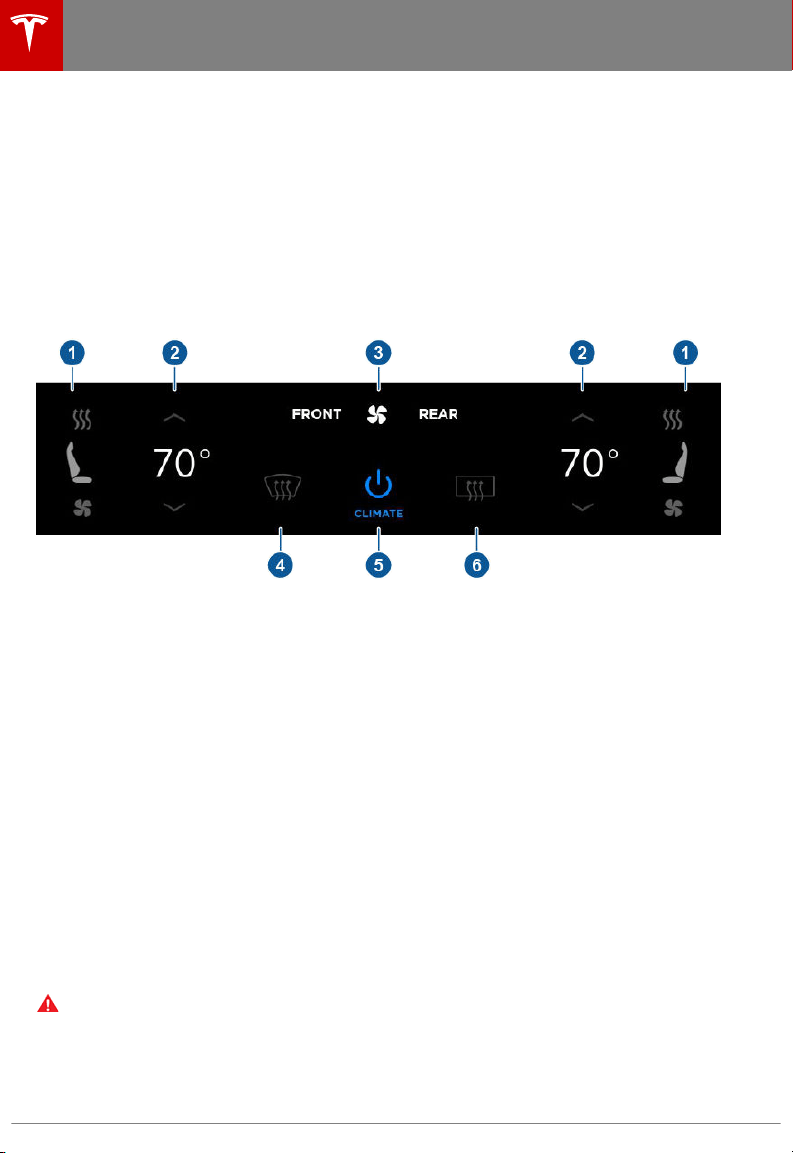
Overview of Climate Controls
The climate controls are always available at the bottom of the touchscreen. By default, climate
control is set to Auto, which maintains optimum comfort in all but the most severe weather
conditions. When you adjust the temperature, the system automatically adjusts the heating, air
conditioning, air distribution, air circulation, and fan speed to maintain your selected temperature.
To override these settings, touch Auto (see Customizing Climate Control on page 127).
The fan, heating, and air conditioning systems are powered by the Battery. Therefore, prolonged
use decreases driving range.
Note: The following illustration is provided for demonstration purposes only. Depending on vehicle
options, software version, market region, and settings, the information displayed may be slightly
dierent.
1. The front seats are equipped with heating/cooling pads. When operating, the top indicator
turns red when heating or the bottom indicator turns blue when cooling.
Note: If Model X is equipped with the optional cold weather package, you can also control
seat heaters in the rear seats, heated wipers, and heated steering wheel by touching
Controls > Cold Weather (see Controls on page 119).
2. Touch the up or down arrow to set the cabin temperature. To apply a temperature setting to
both the driver and passenger side at the same time, touch SYNC TEMP on the temperature
popup that appears when you touch an arrow.
3. Touch the fan icon to customize and automate climate control settings for the front and rear
cabin. (See Customizing Climate Control on page 127.)
Note: Rear climate controls are available only if Model X is equipped with six or seven seating
positions.
4. The windshield defroster distributes air
flow to the windshield. Touch once to turn on, touch a
second time to operate the heating and fan at their maximum level, and touch a third time to
turn
o and restore the air distribution, heating, and fan to their previous settings.
5. Turn climate control system on/o.
Note: The label on this button says Keep Climate On if you have set the climate control system
to maintain your temperature settings when parked (see Customizing Climate Control on
page 127).
6. The rear window defroster warms up the rear window for 15 minutes, then automatically shuts
o. Exterior side mirrors are also heated.
Warning:
To avoid burns resulting from prolonged use, individuals who have peripheral
neuropathy, or whose capacity to feel pain is limited because of diabetes, age, neurological
injury, or some other condition, should exercise caution when using the climate control
system and seat heaters.
Climate Controls
126 Model X Owner's Manual
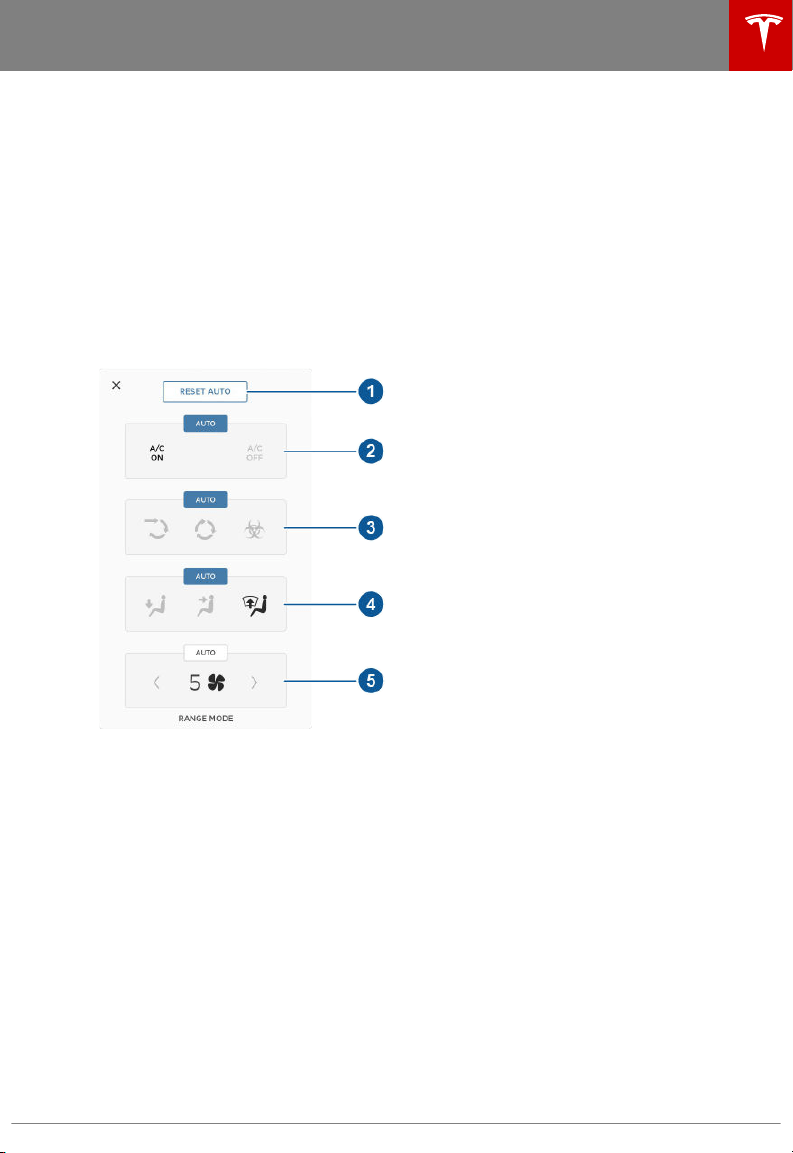
Customizing Climate Control
The climate control system is designed to automatically provide optimum comfort in most
situations. All you need to do is set the desired temperature, and the air conditioning, air
recirculation, air distribution, and fan speed automatically maintain your selected temperature.
You can even keep the climate control system on while you are away from the vehicle so that the
selected temperature is maintained.
To override the automatic setting, touch FRONT or REAR to customize individual settings for the
front or rear seating areas. Then touch the setting you want to change. Touch RESET AUTO to
change all settings on the panel back to their defaults. Or, you can touch AUTO associated with
any individual setting to change it back to its default.
Note: Rear climate controls are available only if Model X is equipped with six or seven seating
positions.
In addition to the five settings shown above (and described below), if Model X is in Park, a Climate
Timer displays below the above popup (see Keep Climate On on page 130).
1. Touch RESET AUTO to change all settings on the currently displayed customization panel
back to their default values.
2. Touch A/C ON or A/C OFF to turn the air conditioning on and
o, respectively. Turning it o
reduces cooling, but saves energy.
Because Model X runs much quieter than a gasoline-powered vehicle, you may notice the
sound of the A/C compressor as it is operating. To minimize noise, reduce the fan speed.
Climate Controls
Using the Touchscreen 127

3. Choose how air is drawn into Model X:
Outside air is drawn into Model X (see Ventilation on page 131).
Air inside Model X is recirculated. This prevents outside air (trac fumes)
from entering, but reduces dehumidifying performance. Recirculating the
air is the most ecient way to cool the front cabin area. To prevent the
windshield from fogging in some conditions, briefly change the setting
every hour to draw in outside air.
If your Model X is equipped with the HEPA (High Eciency Particulate
Air) filter, you can ensure the best possible quality of air inside the cabin.
When selected, outside air is drawn in and filtered through the medical-
grade HEPA filter in addition to the secondary filtration systems. The
HEPA
filter is extremely eective at removing particles, including
pollution, allergens, bacteria, pollen, mold spores, and viruses. Both the
HEPA filter and the secondary filtration system also contain activated
carbon to remove a broad spectrum of odors and gases. When you
engage the HEPA option, the fan operates at the highest speed. In
addition, the positive pressure inside the cabin minimizes the amount of
outside air that can leak into the vehicle.
Note: Some gases, such as carbon monoxide, are not
eectively removed
by activated carbon.
4. Choose where air flows into the cabin. You can choose more than one location:
Foot-level vents
Face-level vents
Windshield vents
Note: When air is directed to the foot-level vents, approximately one third of the air continues
to flow to the windshield vents to assist in defogging. However, when air is directed to the
face-level vents, no air
flows to the windshield because the air flowing through the face-level
vents may be adequate to assist in defogging the windshield.
5. Touch the arrows to set the speed of the fan.
Note: Adjusting the fan speed may change the selected setting for how air is drawn into
Model X in order to increase or reduce
airflow. If you set the fan speed very high (for example,
setting 10), Model X may automatically switch from drawing in outside air to recirculating air
to achieve the high air
flow. Touch RESET AUTO to reset all settings to their default values.
Climate Controls
128 Model X Owner's Manual
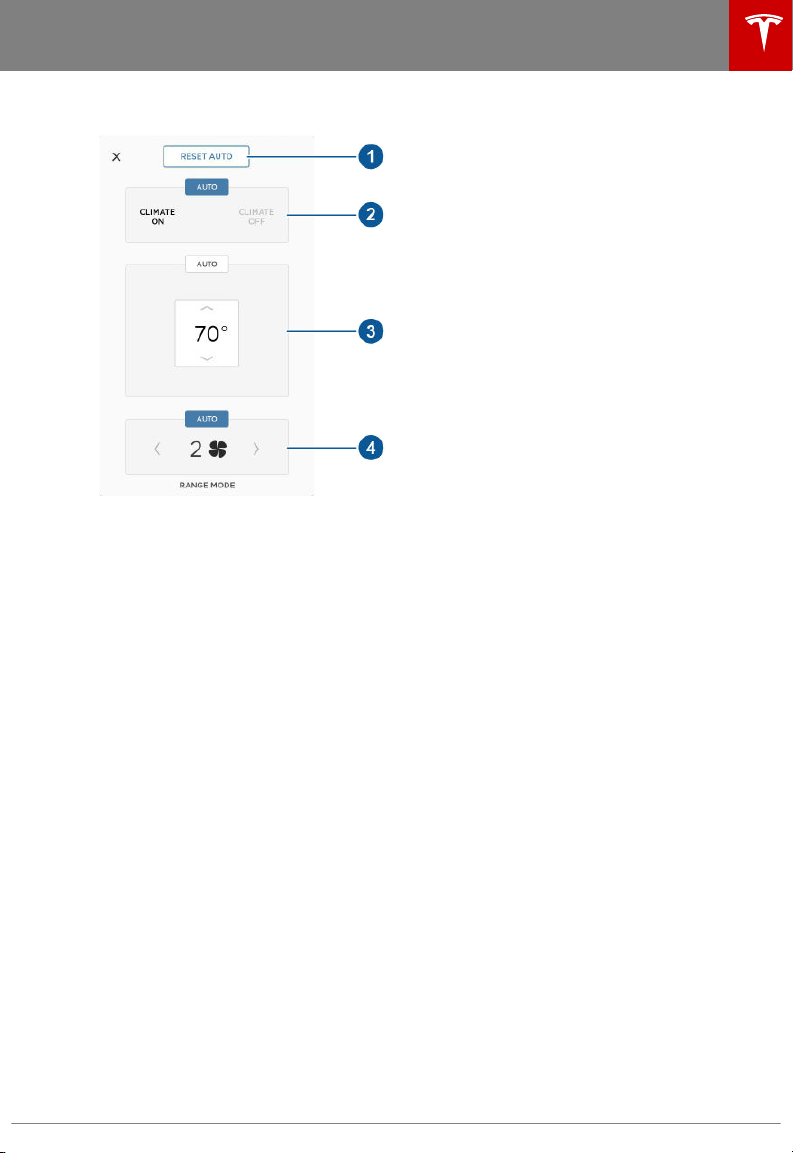
Rear Cabin Climate Controls (6 and 7 seat vehicles only)
Note: When set to AUTO, the rear heating and air conditioning turn o when Model X detects that
there are no occupants in the second or third row seats. To override this energy saving feature and
save the settings until you manually change them, touch the AUTO button located above the
Climate On/Climate
O setting. Touching AUTO a second time cancels your manual setting and
resumes the energy saving feature.
1. Touch RESET AUTO to change all settings back to their default values.
2. Touch CLIMATE ON or CLIMATE OFF to turn the air conditioning on and
o, respectively.
Turning it o reduces cooling, but saves energy.
Note: Because Model X runs much quieter than a gasoline-powered vehicle, you may notice
the sound of the A/C compressor as it is operating. To minimize noise, reduce the fan speed
or recirculate the air.
3. Touch the arrows to adjust the temperature.
4. Touch the arrows to set the speed of the fan.
Climate Controls
Using the Touchscreen 129

Keep Climate On
The Keep Climate On settings allows you to
keep your climate control system running as
long as the vehicle is in Park, even after you've
left. This is useful in situations where it is
important that the cabin is maintained at a
comfortable temperature (for example, you
are leaving your pet in Model X or you are
sleeping in Model X). To use the Keep Climate
On setting, the Battery's charge level must be
at least twenty percent.
To operate Keep Climate On:
1. Engage the Park gear. The Keep Climate
On setting is available only when Model X
is in Park.
2. On the Climate Controls, touch FRONT.
The Climate Timer appears below the
individual settings you use to adjust the
climate settings in the front seating area.
3. If necessary, adjust the climate settings.
4. Touch Keep Climate On > ON.
The climate control system maintains your
climate settings until you shift out of Park or
manually turn it
o. If the Battery's charge
level drops to twenty percent, the climate
control system automatically turns o and the
Tesla mobile app sends you a
notification
reminding you to check on anything that you
have left in Model X.
The next time you start Model X, the climate
control system will continue operating using
the previous settings from your most recent
drive.
Warning:
Never depend on the climate
control system to continue operating.
Doing so can cause serious injury and/or
death (for example, leaving a dog in the
car on a hot day).
Climate Controls
130 Model X Owner's Manual
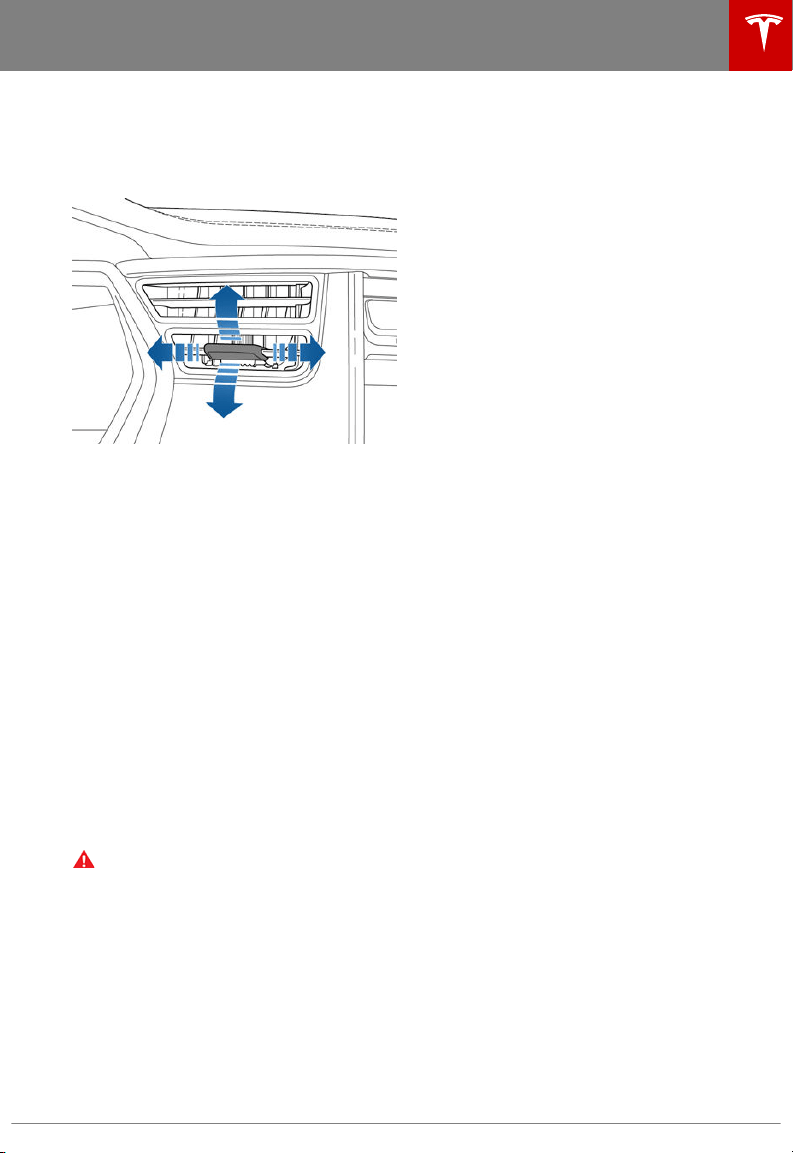
Ventilation
To direct the flow of air inside Model X, move
the interior vents up, down, or from side to
side.
Note: You can direct the outer face level vents
toward the side windows to help defrost or
defog them.
Cabin Air Filter
Model X has an air
filter that prevents pollen,
industrial fallout, road dust and other particles
from entering through the vents. Tesla
replaces the air
filter at the regularly
scheduled maintenance intervals of every
12 months, or every 20,000 km.
Cabin Overheat Protection
The climate control system can reduce cabin
temperatures in extremely hot ambient
conditions for a period of up to twelve hours
after you exit Model X. When enabled, air
conditioning turns on when cabin
temperatures exceed 40° C. To disable this
feature, touch Controls > Settings > Vehicle >
Cabin Overheat Protection > OFF.
Warning:
Never leave children or pets in
the vehicle unattended. Due to automatic
shut-o or extreme outside conditions,
the inside of the vehicle can become
dangerously hot even with Cabin
Overheat Protection enabled.
Note:
Cabin Overheat Protection does not
operate, or stops operating, when the energy
remaining in the Battery is 20% or less.
Note: Cabin Overheat Protection can be used
only if the Tilt/Intrusion detection system (if
equipped) is turned
o (see Security Settings
on page 147).
Climate Control Operating Tips
• When you use the mobile app to turn on
the climate control system, it
automatically turns
o after 30 minutes.
To cool or heat the cabin for a longer
period, you must turn it on again.
• To conserve energy, you can limit the
power of the climate control system by
turning on Range Mode. Cabin heating
and cooling may be less
eective, but seat
heaters can be used to provide warmth in
colder climates. Touch Controls >
Driving > Range Mode.
• If the climate control system operates
more loudly than you prefer, reduce the
fan speed.
• In addition to cooling the interior, the A/C
compressor also cools the Battery.
Therefore, in hot weather, the A/C
compressor can turn on even if you turned
it
o. This is normal because the system’s
priority is to cool the Battery to ensure it
stays within an optimum temperature
range to support long life and optimum
performance.
• To ensure the climate control system
operates
eciently, close all windows and
ensure that the exterior grill in front of the
windshield is free of ice, snow, leaves, and
other debris.
• In very humid conditions, it is normal for
the windshield to fog slightly when you
first turn on the air conditioning.
• It is normal for a small pool of water to
form under Model X when parked. Extra
water produced by the dehumidifying
process is drained underneath.
• To reduce the temperature in the cabin in
hot weather conditions, the fan may turn
on to vent the cabin when the vehicle is
parked. (This occurs only if the battery's
charge level is above 20%.)
Climate Controls
Using the Touchscreen 131
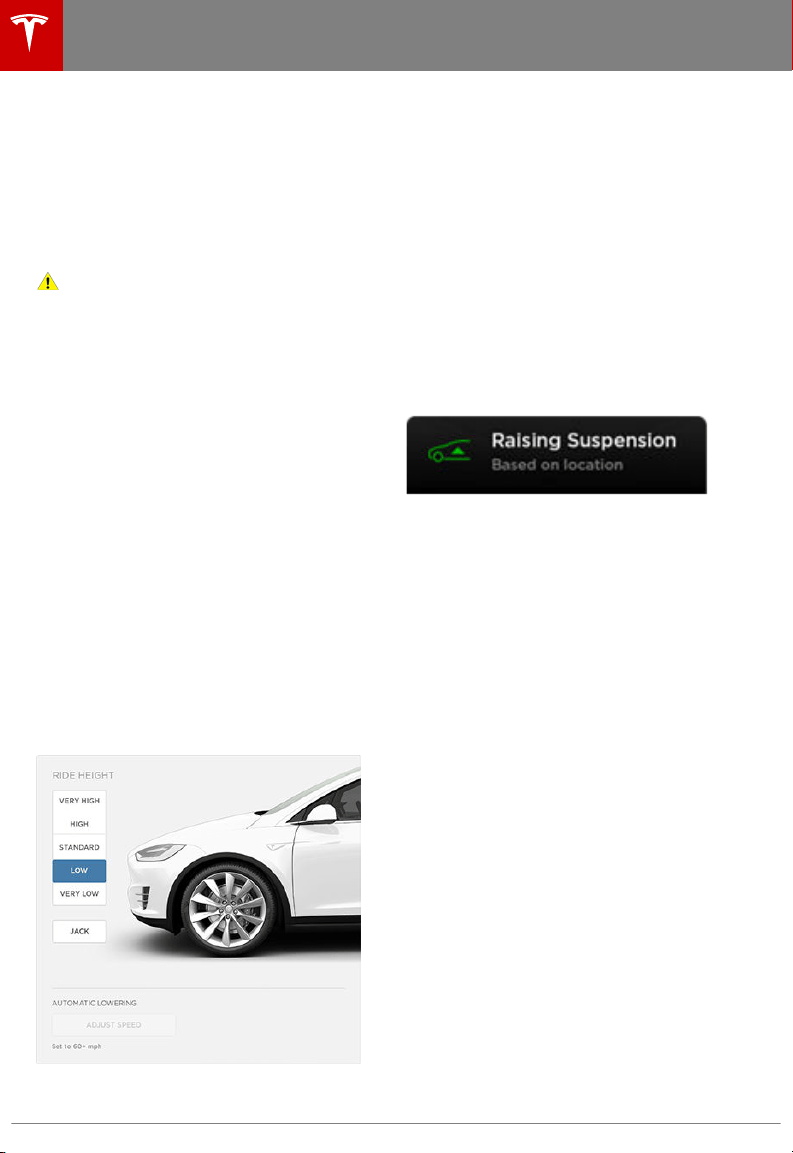
Note: If Model X is equipped with Smart Air
Suspension, you may hear the sound of the
compressor when Model X starts, as the
system’s reservoir fills with air.
Smart Air Suspension has both manual and
automatic modes of operation.
Height Adjustments
Caution: Before adjusting the suspension
height, ensure Model X is clear of all
obstacles, above and below.
Manually raising the height of Model X is
useful when you need extra ground clearance,
such as steep driveways or ramps, deep snow,
speed bumps, parking curbs, etc.
With Model X powered on, or the brake pedal
pressed, use the touchscreen to manually
change the ride height. Touch Controls >
Suspension, then choose from:
• Very High. When set to Very High, the
suspension automatically lowers to High
when driving speed reaches 56 km/h.
• High. When set to High, the suspension
automatically lowers to Standard when
driving speed reaches 73 km/h.
• Standard. The Standard setting ensures
optimum comfort and handling under all
loading conditions.
• Low. Lowering the height can make it
easier to load or unload cargo and
passengers.
• Very Low. This setting is performed
manually and applies to the current drive
only.
Note: Available settings depend on your
driving speed and other conditions. For
example, the suspension does not lower if a
door is open.
Location-Based Suspension
Location-Based suspension saves you from
manually having to raise the suspension every
time you arrive at a frequently-used location
where a higher suspension is needed (steep
driveways or ramps, deep snow, speed bumps,
etc.).
Whenever you raise the suspension to High or
Very High, Model X saves the location.
When you return to the saved location,
Model X raises the suspension and the
instrument panel displays this message:
Note:
• When you are returning to a saved
location and driving faster than the High
and Very High suspension settings allow
(see Height Adjustments on page 132), the
suspension does not raise until Model X
slows down.
• After leaving a saved location, the
suspension may not lower based on an
automatic lowering speed that you have
set (Controls > Suspension > Automatic
Lowering) until you are driving faster than
the speed thresholds.
• If Model X reaches a saved location and
the existing suspension setting is higher
than the level that has been saved for that
location, the suspension is not adjusted.
To remove an auto-raising location
If you do not want the suspension to auto-
raise at a saved location, touch the X in the
auto-raising location status message that
displays at a saved location. Doing so removes
the auto-raise location and the suspension no
longer raises automatically when you arrive at
the location.
Smart Air Suspension
132 Model X Owner's Manual
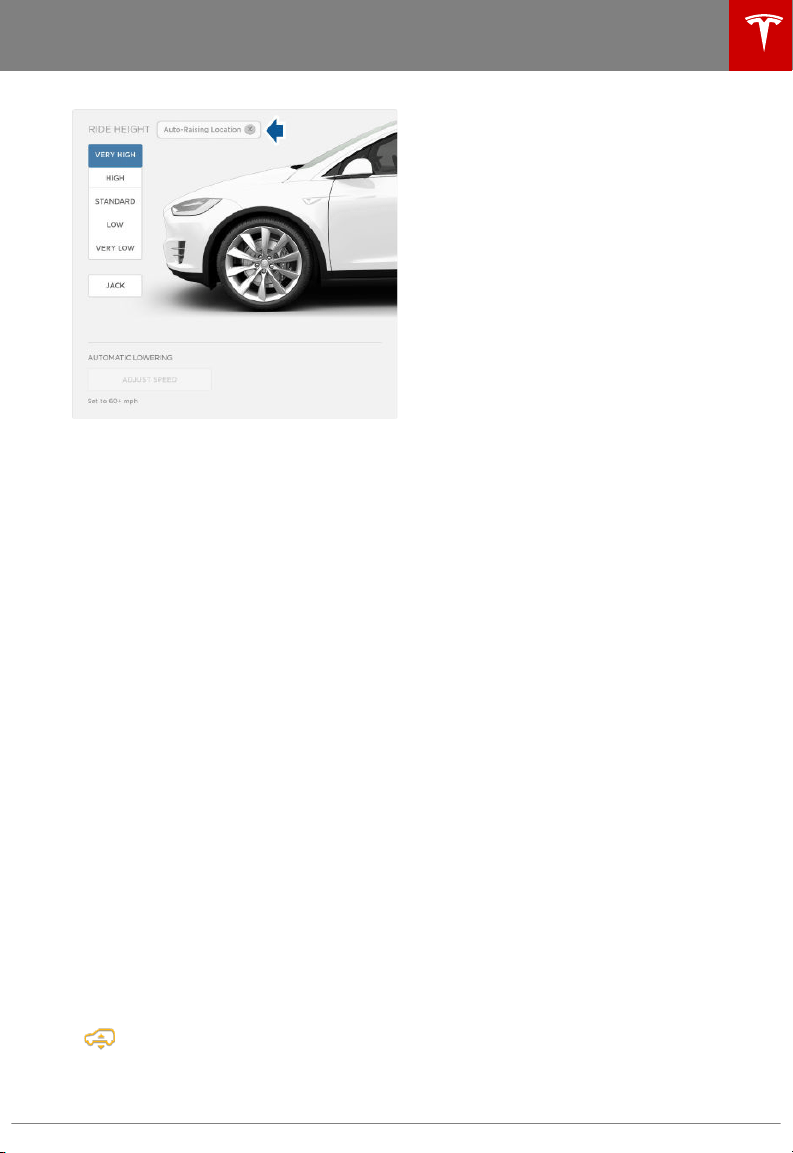
Note: Manually lowering the suspension to
Standard or Low while at a saved location also
removes the auto-raising location.
Automatic Lowering
When Model X is moving above typical
driveway or parking lot speeds, Smart Air
Suspension automatically lowers ride height to
improve aerodynamics and handling. For most
average speed driving, the suspension is
automatically set to Standard. As described
above, when you make manual height
adjustments, the suspension automatically
lowers at increased driving speeds.
When carrying loads, Smart Air Suspension
also maintains a level height between the front
and rear.
You can adjust the speed at which the Air
Suspension automatically transitions to the
LOW ride height by touching Controls >
Suspension > Automatic Lowering on the
touchscreen. This setting is saved to your
Driver
Profile.
Note: You can temporarily override the ride
height by pressing the brake pedal, touching
an air suspension control in Controls >
Suspension, and then manually choosing a
ride height. Your suspension's automatic
lowering setting is restored the next time you
drive.
If a fault is detected that reduces the
performance of the air suspension
system, a yellow indicator lights up
on the instrument panel. If the
problem persists, contact Tesla.
Jack Mode
Before jacking or lifting, set the suspension to
Jack mode to prevent the self-leveling that
occurs even when Model X is powered o.
Press the brake pedal, then touch Controls >
Suspension > Jack.
To deactivate, touch Jack again.
Note: Jack mode automatically cancels when
you drive over 7 km/h.
Note: Model X also sets Jack mode
automatically if it detects that the vehicle
cannot lower to its target height, or if it
detects that an object is supporting the
vehicle's weight (for example the bumper of
the vehicle is resting on a curb).
Smart Air Suspension
Using the Touchscreen 133

Overview
Touch the Media Player application to listen to
Internet radio, stream music or podcasts (if
available), or play audio files from a Bluetooth
or USB-connected device. You can play FM (if
equipped), and DAB radio (if your vehicle is
equipped with the optional sound package).
Available source content displays across the
top of Media Player: Radio, Spotify, TuneIn,
and Phone. An additional source, USB,
displays when you insert a
flash drive into a
USB connection (see USB Connections on
page 137). You can browse the content
available on Media Player by touching a
source, or you can use Search to
find specific
content (see Searching within Media Player on
page 134).
The Now Playing view, which displays at the
bottom of Media Player, enables you to control
what's currently playing (for example,
pausing/playing, skipping to the next track/
station, etc.). You can also use the Now
Playing view to mark what's playing as a
favorite (see Favorites and Recent on page
136), and access recently played and favorite
stations, music, and podcasts.
The Now Playing view displays regardless of
the source (Radio, Spotify, TuneIn, Phone, and
USB) you select in Media Player. You can
maximize and minimize the Now Playing view
simply by touching it.
Note:
Trac announcements can be heard
only when playing FM (if equipped) or DAB
radio. To turn trac announcement on or o,
touch the TP button on the Now Playing view.
Volume Control
To adjust Media Player's volume, roll the scroll
wheel on the left side of the steering wheel up
or down. To mute the volume, press the left
scroll wheel.
The scroll wheel adjusts the volume for media,
navigation instructions, or phone calls, based
on what is currently being heard through the
speakers. If you're listening to a song, audio
file, or podcast, and you receive a phone call
or Model X relays a step in Trip Planner's turn-
by-turn directions through the speakers, the
song, audio
file, or podcast is muted
temporarily.
Note: Pressing the left scroll wheel during a
phone call mutes both the sound and your
microphone.
Audio Settings
Achieve the sound you want by adjusting the
fade (front/rear) and balance (left/right), or
by customizing the strength of sound
frequencies. Press the equalizer icon on the
top right corner of the Media Player to access
audio settings.
Adjust fade and balance on the left side of the
screen by positioning the center circle of the
cross bars to the location in Model X where
you want to focus the sound. Adjust any of the
five frequency bands (Bass, Bass/Mid, Mid,
Mid/Treble, and Treble) on the right side of the
screen by dragging the corresponding slider
up or down on the decibel (dB) bar.
If equipped, touch the Dolby check box to
enable Dolby Surround.
Searching within Media Player
Search is available throughout Media Player.
You can search across all content categories,
or you can limit your search to a particular
category. Search results include the following
content:
• TuneIn
• Spotify
• USB content
To search, touch anywhere in Media Player's
search bar and enter the name of the song,
album, artist, podcast, playlist, or station you
want to search for. Select a
filter to narrow the
scope of your search, or leave it at its default
setting to include top results from all
categories.
Note: You can also search hands-free using
voice commands (see Using Voice Commands
on page 49).
If you are using TuneIn, you can browse
content by category from the Browse area of
the TuneIn source. You can browse content by
location (Africa, Asia, North America, and so
on), by local radio, by talk radio, by favorites,
and other categories. To return from browsing
or to select another category to browse,
simply touch TuneIn at the top of Media
Player.
Media and Audio
134 Model X Owner's Manual

FM Radio
If it's available in your location, Media Player
provides FM radio service that you can select
from the Radio source. To tune the radio to a
specific frequency, choose a frequency and
then touch the next or previous arrows to
move from one frequency to the next (or
previous). You can also tap or drag your finger
on the tuner to the desired frequency. The
three bars on the left side of the frequency
number indicate the strength of the signal for
the chosen frequency. Touch HD to play high
definition versions of available frequencies.
Mark a radio station as a favorite to display it
on the Radio source for easy access (see
Favorites and Recent on page 136).
DAB Radio Services
If Model X is equipped with the optional sound
package, you can also select DAB radio from
the Radio source of Media Player.
You can select a DAB radio station by
browsing a list of stations in your area, or by
tapping the next or previous buttons on the
Now Playing view.
Media and Audio
Using the Touchscreen 135

Internet Radio
Internet radio services are accessed over a
data connection. To use Internet radio, touch
Media Player's Spotify or TuneIn source,
browse through the available categories
and/or stations, and then touch what you
want to play. When browsing through a large
category such as genres, a second browse
page displays. Use the left arrow button on
the left side of Media Player to return to the
prior page, or tap on the source again to
return to the main browse page.
To play the next (and in some cases previous)
available station, episode, or track being
provided by the Internet radio service, touch
the next (or previous) arrows on the Now
Playing view, or use the buttons on the left
side of the steering wheel (see Using Left
Steering Wheel Buttons on page 47). The
function of these controls vary depending on
the Internet service you are listening to.
You can also use voice commands only
available when speaking the English language
only) to play a
specific song, artist, or album
from an Internet radio service (see Using
Voice Commands on page 49).
When you are listening to internet radio, you
can do the following on the Now Playing view:
• Touch the Favorites icon to save the radio
station or podcast as a favorite (see
Favorites and Recent on page 136).
• Touch any number to access digital radio
stations (if available). Digital radio stations
provide higher quality sound and, in some
cases,
dierent programming than their
analog equivalents.
• Touch the right arrow to view a list of
tracks for a podcast or playlist.
By default, TuneIn uses a Tesla account that
has been set up for you. To sign in to a
dierent TuneIn account, scroll to the bottom
of the TuneIn source, touch Sign In, and enter
the login information for the account.
Note: When playing a TuneIn podcast, you can
rewind or fast forward to any location in the
podcast. On the Now Playing view, drag the
arrow below the slider bar to the desired
location.
Note: Model X does not support free Spotify
trial accounts.
Favorites and Recent
To ensure you always have easy access to your
favorite stations and audio
files, they display
at the top of Media Player and on the Now
Playing view. Regardless of which source you
are on (Radio, TuneIn, Phone, or USB), you see
favorites from all sources. You can maximize
or minimize source content simply by swiping.
Your USB favorites are available from the Now
Playing view in a Favorites folder. (You may
need to scroll to see the folder.) Your
first USB
favorite plays when you touch the Favorites
folder in the Now Playing view. Use the next or
previous arrows to scroll through your USB
favorites.
Note: In Spotify, you can save a playlist, but
you cannot select favorites.
To add a currently playing radio
station, podcast, or audio file to your
Favorites list, touch the Favorites
icon on the Now Playing view. (You
may need to touch the Now Playing
view to maximize it before you can
touch the Favorites icon.)
To delete a favorite, touch the
highlighted Favorites icon. You can
also delete one or more favorites on
the bottom of the Now Playing view
by pressing and holding a favorite.
An X appears on all favorites. Touch
the X again to delete the selected
favorites.
To see selections that you played recently,
touch Recent on the Now Playing view. Your
recently played selections are updated
continuously so you don't need to delete
them.
Note: Selections you play on FM radio stations
do not display in your Recent selections.
Playing Media from Devices
You can play audio
files from a USB-
connected flash drive or from a Bluetooth-
connected device (like a phone). When you
connect a USB
flash drive, Media Player
displays the USB source content. When you
connect a Bluetooth-capable device, the name
of the device displays on the Phone source.
After connecting a USB
flash drive or
Bluetooth device, touch the song, album, or
playlist you want to play.
Media and Audio
136 Model X Owner's Manual
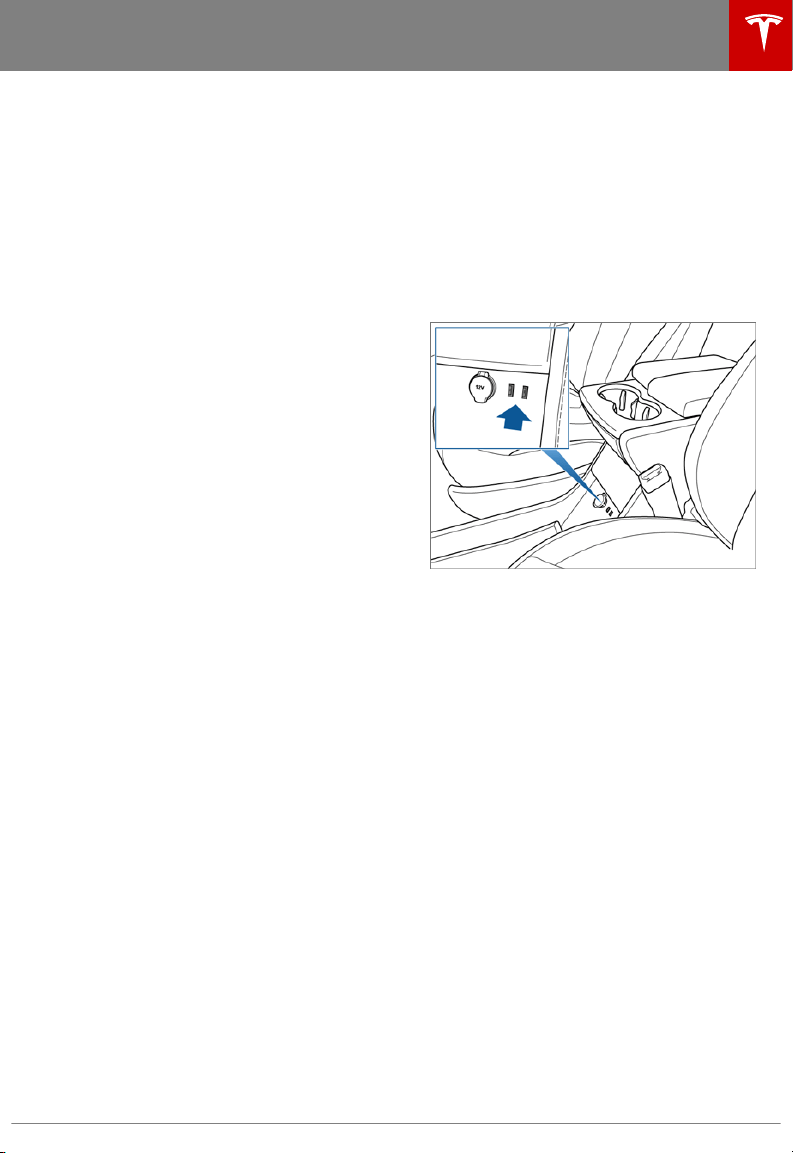
To play the next song in a selected playlist or
album, touch the previous or next arrows on
the Now Playing view, or use the buttons on
the left side of the steering wheel (see Using
Left Steering Wheel Buttons on page 47). You
can also shue tracks in a playlist or repeat a
playlist or track using the shue/repeat icons
displayed below the album cover art.
USB Connected Flash Drives
Connect a
flash drive to one of the USB
connections (see USB Connections on page
137). Touch Media Player > USB, and then
touch the name of the folder that contains the
song you want to play. After you display the
contents of any folder on the USB connected
flash drive, you can touch the right arrow in
the Now Playing view to display your songs in
a list. Touch any song in the list to play it. Or
use the previous and next arrows in the Now
Playing view to scroll through your songs.
Note: To play media from a USB connection,
Model X recognizes
flash drives only. You can
play media from other types of devices (such
as an iPod) by connecting to the device using
Bluetooth (described below).
Note: Use a USB connection located at the
front of the center console (see USB
Connections on page 137). The USB
connections at the rear of the console are for
charging only.
Note: Media Player supports USB
flash drives
with FAT32 formatting. (NTFS and exFAT are
not currently supported.)
Bluetooth
®
Connected Devices
If you have a Bluetooth-capable device such
as a phone that is paired and connected to
Model X (see Pairing a Bluetooth Phone on
page 139), you can play audio
files stored on
it. You can also stream a music service from it
(for example, Pandora or Spotify). Choose
Media Player's Phone source, touch Connect
Phone, touch the name of your Bluetooth-
connected device, and then touch CONNECT.
Your Bluetooth device begins playing the
audio
file that is currently active on your
device, and Media Player displays the Now
Playing view. If an audio
file is not playing on
your device, select the audio
file you want to
listen to from your device. After an audio file
begins to play in Media Player, you can then
use Media Player's controls to play other
tracks.
Note: To play media from a Bluetooth-
connected device, ensure that access to the
device’s media is turned on (see
Phone on
page 139).
USB Connections
Your Model X has two USB connections
located on the front of the center console that
you can use to connect USB devices. To play
audio files stored on a USB drive connected to
these ports, see Playing Media from Devices
on page 136. You can also use these
connections to charge USB devices.
In addition, Model X has two charge-only USB
connections located at the rear of the center
console, and another charge-only connection
located between the third row seats.
Note: You can charge four devices
simultaneously using the two ports at the
front of the center console and the two at the
rear of the console.
12V Power Socket
Your Model X has a power socket located on
the front of the center console. An additional
12V power socket is located in the rear trunk.
Power is available whenever the instrument
panel and touchscreen are on.
Media and Audio
Using the Touchscreen 137
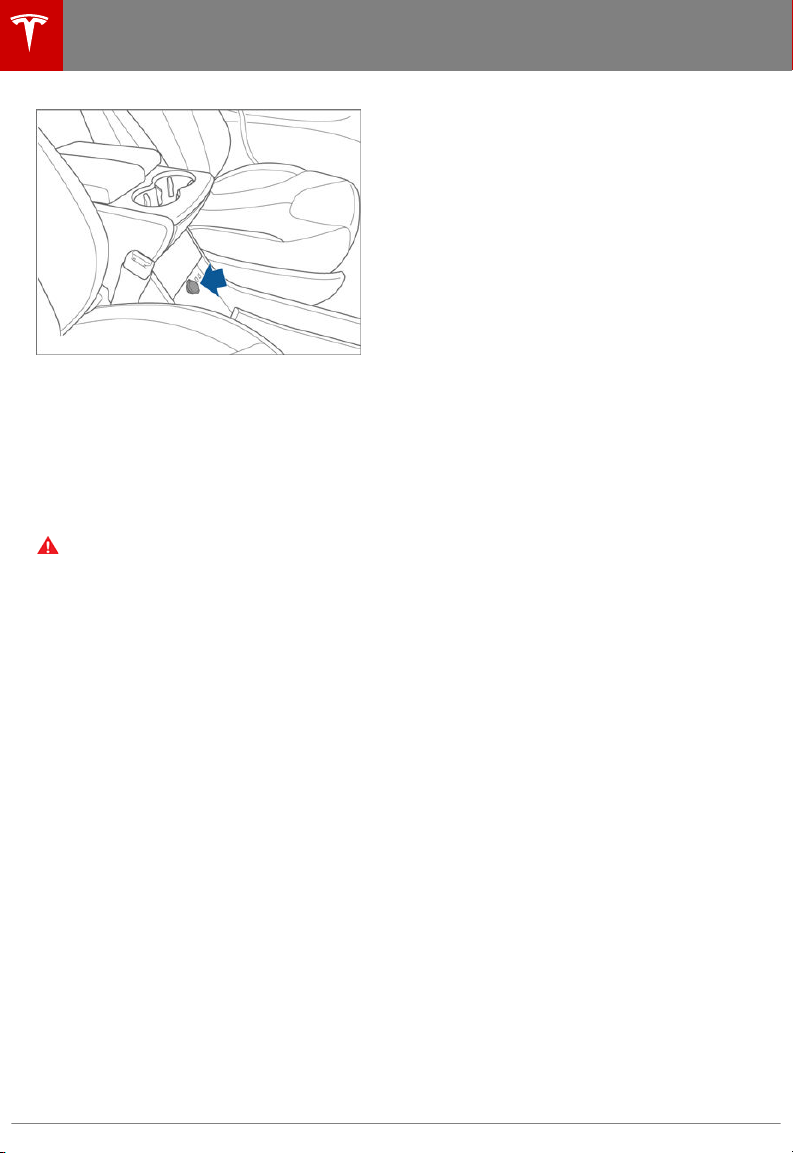
The 12V power sockets are suitable for
accessories requiring up to 11A continuous
draw (15A peak) or a maximum of 150
continuous watts (180 watts peak).
Note: In situations where Model X is unable to
detect the key (low battery, interference, etc.),
place it immediately below the 12V power
socket in the center console where Model X
can best detect it.
Warning: The power socket and an
accessory’s connector can become hot.
Media and Audio
138 Model X Owner's Manual

Bluetooth
®
Compatibility
You can use your Bluetooth-capable phone
hands-free in Model X provided your phone is
within operating range. Although Bluetooth
typically supports wireless communication
over distances of up to approximately
9 meters, performance can vary based on the
phone you are using.
Before using your phone with Model X, you
must pair it. Pairing sets up Model X to work
with your Bluetooth-capable phone (see
Pairing a Bluetooth Phone on page 139).
You can pair up to ten Bluetooth phones.
Model X always automatically connects to the
last phone that was used (provided it is within
range). If you want to connect to a
dierent
phone, see Connecting to a Paired Phone on
page 140.
Note: On many phones, Bluetooth turns
o if
the phone’s battery is low.
Note: In addition to phones, you can also pair
Bluetooth-enabled devices with Model X. For
example, you can pair an iPod Touch or an
iPad or Android tablet to stream music.
Pairing a Bluetooth Phone
Pairing sets up Model X to work with your
Bluetooth-capable phone. Once a phone is
paired, Model X can connect to it whenever
the phone is within range.
To pair a phone, follow these steps while
sitting inside Model X:
1. Ensure both the touchscreen and the
phone are powered on.
2. On the touchscreen’s status bar, touch the
Bluetooth icon.
3. On your phone, enable Bluetooth and set
it to discoverable.
4. On the Model X touchscreen, touch Start
Search. The touchscreen searches then
displays the list of all available Bluetooth
devices within operating distance.
5. On the Model X touchscreen, touch the
phone with which you want to pair. Within
a few seconds, the touchscreen displays a
randomly generated number, and your
phone should display the same number.
6. Check that the number displayed on your
phone matches the number displayed on
the touchscreen. Then, on your phone,
confirm that you want to pair.
When paired, Model X automatically connects
to the phone, and the touchscreen displays
the Bluetooth symbol next to the phone’s
name to show that the connection is active.
Importing Contacts and Recent
Calls
Once paired, you can use the Bluetooth
settings screen (touch the Bluetooth icon on
the touchscreen's status bar) to specify
whether you want to allow access to your
phone’s contacts and recent calls.
If access is turned on, you can see your list of
contacts and recent calls on the Model X
touchscreen. Touch Phone > Contacts. You
can then touch a contact to dial its phone
number or navigate to its address.
Note: Before contacts can be imported, you
may need to either set your phone to allow
syncing, or respond to a popup on your phone
to
confirm that you want to sync contacts.
This varies depending on the type of phone
you are using. For details, refer to the owner
documentation provided with your phone.
If access is turned on, imported information is
displayed when you touch the contacts tab on
the Phone app.
Note: For security reasons, erase your
contacts if you sell Model X (see Erasing
Personal Data on page 125).
Unpairing a Bluetooth Phone
If you want to disconnect your phone and use
it again later, simply touch Disconnect on the
Bluetooth settings screen. If you do not want
to use your phone with Model X again, touch
Forget This Device. Once you forget a device,
you need to pair it again if you want to use it
with Model X (see Pairing a Bluetooth Phone
on page 139).
Note: Your phone automatically disconnects
whenever you leave Model X.
Phone
Using the Touchscreen 139

Connecting to a Paired Phone
Model X automatically connects with the last
phone to which it was connected, provided it
is within operating range and has Bluetooth
turned on. If the last phone is not within range,
it attempts to connect with the next phone
that it has been paired with.
To connect to a
dierent phone, touch the
Bluetooth icon on the touchscreen's status
bar. The Bluetooth window displays a list of
paired phones. Choose the phone you want to
connect to, then touch Connect. If the phone
you want to connect to is not listed, follow the
instructions on Pairing a Bluetooth Phone on
page 139.
When connected, the Model X touchscreen
displays the Bluetooth symbol next to the
phone name to show that the connection is
active.
Making a Phone Call
You can make a phone call by:
• Speaking a voice command (English) (see
Using Voice Commands on page 49).
• Choosing a contact from your contact list.
• Using the Model X on-screen dialer.
To make a phone call using the on-screen
dialer:
1. Touch the Phone app on the touchscreen,
then touch Dialer.
2. Enter the phone number on the dialer.
3. Touch Call. The touchscreen displays the
call screen and the number you are calling.
To make a phone call by choosing a contact:
1. Touch the Phone app on the touchscreen,
then touch Contacts.
Note: Ensure that access to the phone’s
contacts is turned on (see Importing
Contacts and Recent Calls on page 139).
2. Touch the name of the contact you want
to call to display details about the contact.
3. Touch the number you want to dial (if you
have more than one number for the
contact). The touchscreen displays the call
screen and the name of the contact you
are calling.
Note: If it is safe and legal to do so, you can
also initiate a call by dialing the number or
selecting the contact directly from your
phone.
Receiving a Phone Call
When your phone receives an incoming call,
both the instrument panel and the
touchscreen display the caller’s number or
name (if the caller is in your phone’s contact
list and Model X has access to your contacts).
Touch one of the options on the touchscreen,
or use the scroll wheel on the right side of the
steering wheel to Answer or Ignore the call
(see Using Right Steering Wheel Buttons on
page 48).
In Call Options
When a call is in progress, you can display the
call menu on the instrument panel by pressing
the top button on the right side of the
steering wheel. Then use the right scroll wheel
to scroll through and choose an option (see
Using Right Steering Wheel Buttons on page
48). To adjust the call volume, roll the steering
wheel's left scroll wheel during a call.
Warning: Stay focused on the road at all
times while driving. Using or programing
a phone while driving, even with
Bluetooth enabled, can result in serious
injury or death.
Warning: Follow all applicable laws
regarding the use of phones while driving,
including, but not limited to, laws that
prohibit texting and require hands-free
operation at all times.
Phone
140 Model X Owner's Manual

Overview
The Google MapsTM application provides the
navigation functions in the Model X .
• If Model X is equipped with the Navigation
option, the application is labeled Nav, and
onboard maps are available. Onboard
maps allow you to navigate to any
location, even if a data connection is not
available, but you must enter the
location's exact and complete address.
• If Model X is not equipped with the
Navigation option, onboard maps are not
available, but if you have a data
connection, you can
find and display any
location.
When you specify a location, the touchscreen
displays the route and provides turn-by-turn
directions. Each turn is preceded by the
distance to the maneuver. If you won't have
enough energy, and there is no Supercharger
on the route, an alert at the top of the turn-by-
turn directions tells you that charging is
required to reach your destination.
If the energy remaining after a round-trip is
less than ten percent, or if a round trip will
consume a
significant amount of battery
energy, a round trip estimate of the energy
you will use displays at the bottom of the
turn-by-turn directions. You can display a
round trip energy estimate for all trips,
regardless of battery energy used, by
selecting Always Show Estimated Round Trip
Energy in the settings for Maps and
Navigation. When enabled, the round trip
energy estimate will always display at the
bottom of the turn-by-turn directions. (You
may need to scroll to the bottom of the turn-
by-turn directions to see the round trip energy
estimate.)
Using Maps
Touch Navigate, or speak a voice command
(see Using Voice Commands on page 49), to
specify a location. You can enter or speak an
address, landmark, business, etc. You can also
touch Navigate and choose from Home and
Work locations, a list of favorite destinations
(see Favorite, Home, and Work Destinations
on page 144), recent locations and searches
(the most recently used locations display at
the top), and charging stations you have
visited.
When you touch the pin for a location,
landmark, or business in the Recent or
Favorites list, or touch a pin on the map, the
chosen location is centered on the map, and a
popup that provides more information about
the location is displayed. In the popup, the
name, phone number, and address of the
location, landmark, or business is displayed.
Any of the following information may also be
displayed: its Google rating, its price range,
whether it's open or closed, and whether it
has chargers, Wi-Fi, restrooms, and food.
From this popup window, you can save the
location as a favorite, and, if equipped with
the Navigation option, navigate to the
destination by touching Navigate, or call
someone at the location by touching Call. If
equipped with the Navigation option, when
you touch the name of a location in the
Recent or Favorites list (versus touching its
pin), you can initiate navigation immediately.
Model X calculates the route and displays
turn-by-turn directions.
By default, the map displays Supercharger
locations (see Charging Locations on page
142). If Model X is equipped with the
Navigation option, you can drop a pin
anywhere on the map by pressing and holding
a location on the map.
Use the icons in the lower right corner to
customize what the map displays:
Satellite Imagery - touch to turn
satellite imagery on and o.
Trac - touch to turn the display
of trac on and o. To ensure that
heavy trac areas are easy to
identify along a navigation route,
green
trac lines display under the
blue route line, whereas yellow and
red trac lines display on top.
Charging locations - touch to
display charging locations on the
map and in a popup list that
includes city and proximity (see
Charging Locations on page 142).
Note: The popup list displays the
straight line distance to the
location, not the driving distance to
the location. When you begin
navigating, the navigation system
displays the driving distance to the
location.
Maps and Navigation
Using the Touchscreen 141
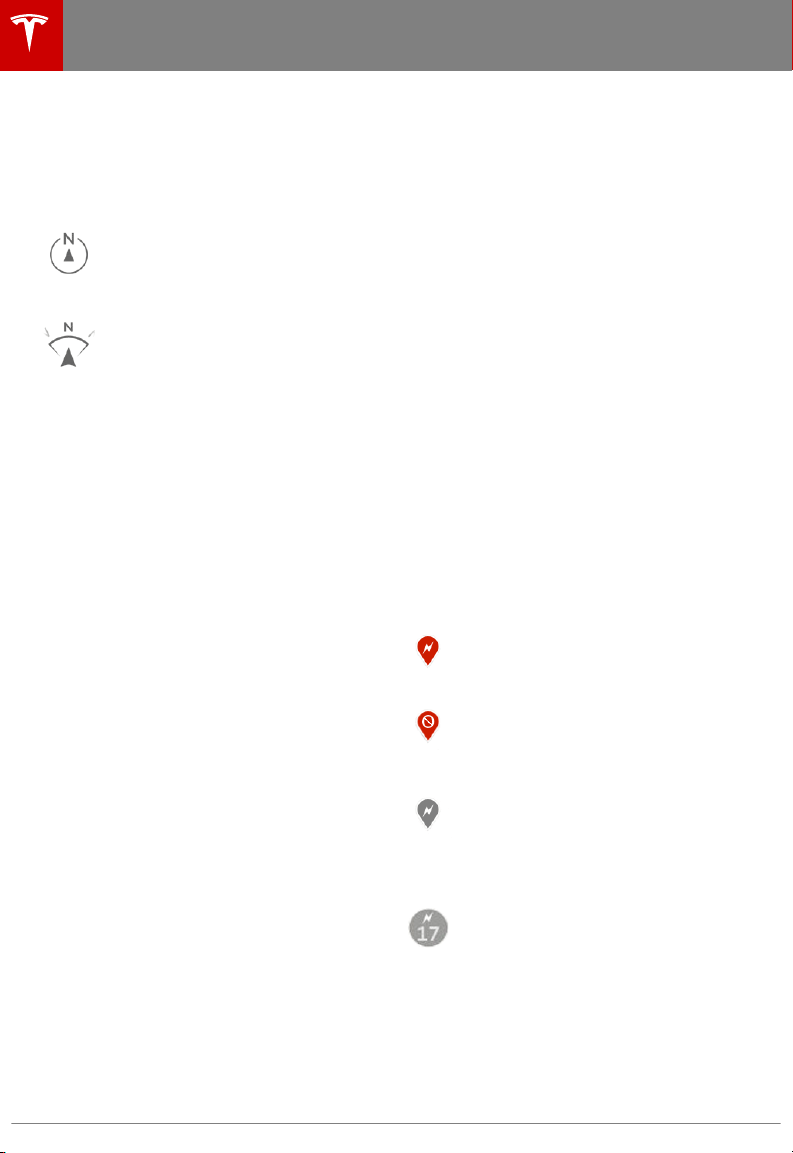
Touch the zoom icons in the top right area to
zoom the map in and out on your current or
chosen location. Touch the North/Heading Up
icon to center the map on your current
location and change the orientation of the
map:
North Up - North is always at the
top of the screen.
Heading Up - The direction you are
heading is always at the top of the
screen. The map rotates when you
change direction. This icon has an
integrated compass that indicates
the direction you are driving.
You can rotate the map in any direction using
your
fingers. When you rotate the map in a
clockwise or counter-clockwise direction, or
move the map up, down, left, or right, the
North/Heading Up icon turns gray and no
longer tracks your position. (The message
"Tracking Disabled" is displayed next to the
North/Heading Up icon.) To re-enable
tracking, and adjust the orientation of the map
so that North, or the direction you are
traveling, is at the top of the screen, touch the
North/Heading Up icon again. The North/
Heading Up icon is reenabled, and the
message, "North Up" or "Heading Up" is
displayed.
Note: To keep tracking enabled, zoom in or
out using only the zoom icons or by pinching
your
fingers. To disable tracking, move the
map in any direction.
To maximize the size of the map, the
touchscreen's status bar and app area, as well
as the icons on the map, disappear after a few
seconds. Simply touch the map to redisplay
them.
Charging Locations
Superchargers are displayed on the map by
default, represented by red pins that you can
touch to display more information about the
Supercharger location, navigate to it, or mark
it as a favorite. When you touch the pin for a
Supercharger location on the map,
information about the Supercharger location
is displayed, including the total number of
Superchargers, the number of Superchargers
available, the address of the Supercharger, and
its approximate distance from you. The popup
also displays any amenities that are available
at the Supercharger location, including
restrooms, restaurants, lodging, shopping, and
Wi-Fi availability.
Note: The popup displays the straight line
distance to the charger location, not the
driving distance to the charger location. When
you begin navigating, the navigation system
displays the driving distance to the charger
location.
In addition to Superchargers, you can display
destination chargers and charging stations
that you used before by touching the charging
icon in the lower right corner of the map.
Display details about any charging location by
touching its pin:
The Supercharger location is
operational.
The Supercharger location may be
out of operation or is operating at
a reduced capacity (touch the pin
to display details).
The location is equipped with a
charging station (Wall Connector).
Touch to display more information,
such as the charging station's
capacity and usage restrictions.
The location is equipped with more
than one charging station. The
number on the icon indicates how
many charging stations are located
at the destination. Zoom in to
display the pin for each charging
station (described above).
Starting Navigation
1. Touch the Nav app to display the map.
2. Touch Navigate and enter a destination.
You can also use voice commands (see
Maps and Navigation
142 Model X Owner's Manual

Steering Wheel on page 47), touch a
location in the Recent or Favorites list, or
touch a pin on the map, and then touch
Navigate from the popup.
• If you have a data connection, you can
start entering the destination, then
choose one of the auto-complete
entries that appear in the popup list.
For example, you can enter just the
street, business name, or category
(such as hotels,
coee, etc.).
Note: The popup list displays the
straight line distance to the location,
not the driving distance to the
location. When you begin navigating,
the navigation system displays the
driving distance to the location.
• If you don’t have a data connection,
touch Navigate, touch the Search
field, and then touch Oine Address
Entry to use the onboard maps. Enter
the complete address, and then touch
Find.
Note: If a connected phone's calendar is set
up to work with Model X, and a calendar event
includes a
specific location, you can initiate
navigation from the calendar (see Calendar on
page 146).
During Navigation
During navigation, the touchscreen displays a
turn-by-turn direction list that includes
estimated mileage, driving time, arrival time,
and an estimate of how much energy is
remaining when you reach the destination.
Note: If Model X requires charging to reach
the destination and Trip Planner is turned on
(see Trip Planner on page 144), the
navigation route includes Supercharger stops.
The touchscreen also displays your location on
the map. Depending on the map’s zoom level,
you might not be able to see the entire route.
Whenever a navigation route is active, you can
display the full route on the map by touching
the route overview icon:
The route overview icon is available
in the top right corner of the map
whenever a navigation route is
active. You can touch this icon to
display the current leg of your trip
or to change the orientation of the
map to North Up or Heading Up
(see Using Maps on page 141).
During navigation, the instrument panel
displays the turn-by-turn directions, and you
will also hear spoken directions. To change the
language of spoken directions, touch
Controls > Settings > Language & Units. To
change the volume of the spoken directions,
use the scroll wheel on the left side of the
steering wheel while navigation directions are
being spoken. You can also change or mute
the volume by touching the volume icon
located in the top right corner of the turn-by-
turn direction list.
Model X detects real-time
trac conditions
and automatically adjusts the estimated
driving and arrival times based on
trac. In
situations where trac conditions will delay
your estimated time of arrival and an alternate
route is available, Model X reroutes you to
your destination. You can turn this feature
o
by touching Controls > Settings > Apps >
Maps & Navigation > Trac-Based Routing >
O. You can specify the amount of time
savings (in minutes) that must be achieved
before you are rerouted by touching the
arrows associated with the Re-Route If It
Saves More Than setting.
Model X can also monitor
trac to your work
location (on weekday mornings) and to your
home location (on weekday evenings) and
advise you if there is a better route in
situations where
trac conditions will cause a
delay by touching Controls > Settings >
Apps > Maps & Navigation > Show Commute
Advice > ON. You can specify that commute
advice be given only when a faster route is
available by selecting Only when a faster
route is available.
Note:
Trac-Based Commute Advice is only
available if your Model X is equipped with the
Navigation option and you have saved Home
and Work locations.
Model X can route you around ferries and tolls.
Touch Controls > Settings > Apps > Maps &
Navigation, and then touch the associated
check boxes.
As you approach an upcoming turn on your
navigation route, a vertical progression bar
displays on the right side of the touchscreen's
turn-by-turn direction list. This vertical bar
also displays on the right side of the
navigation instructions on the instrument
panel. As you progress toward the location
where you will need to make a turn, the bar
fills, from bottom to top. When you arrive at
the location of the turn, the bar is completely
filled.
Maps and Navigation
Using the Touchscreen 143

Predicting Energy Usage
When navigating to a destination, Model X
helps you anticipate your charging needs by
calculating the amount of energy that will
remain when you reach your destination. The
calculation is an estimate based on driving
and environmental factors such as predicted
speed and elevation changes. The touchscreen
displays this calculation at the bottom of the
turn-by-turn direction list when you
first
initiate the navigation route. Thereafter, you
can display it by touching the area at the
bottom of the turn-by-turn direction list.
Throughout your route, Model X monitors
energy usage and updates the calculation as
needed. A popup warning displays at the
bottom of the turn-by-turn direction list in
these situations:
• A yellow warning displays when you have
very little energy remaining to reach your
destination and should drive slowly to
conserve energy. For tips on conserving
energy, see Getting Maximum Range on
page 76.
• A red warning displays when you must
charge Model X to reach your destination.
If you select Always Show Estimated Round
Trip Energy in the Navigation settings,
Model X also lets you know if you have
enough energy for a round trip at the bottom
of the turn-by-turn directions. By default, an
estimate of your round trip energy usage
displays at the bottom of the turn-by-turn
directions when the remaining battery energy
is estimated at less than ten percent after
completion of the round trip, or when the
round trip consumes a
significant amount of
your energy.
When navigating, you can also use the Energy
app to monitor energy usage while on your
trip (see Getting Maximum Range on page
76).
Trip Planner
Trip Planner helps you take longer road trips
with
confidence. If reaching your destination
requires charging, Trip Planner routes you
through the appropriate Supercharger
locations. Trip Planner selects a route that
minimizes the time you spend driving and
charging. To use Trip Planner, touch Controls >
Settings > Apps > Maps and Navigation > Trip
Planner > On.
After you select a destination, Trip Planner
zooms out to give you an overview of your
trip. As you begin your trip, Trip Planner
zooms in to start navigation. The turn-by-turn
directions include:
• The list of Supercharger stops (Trip
Planner does not consider charging
locations that are not Superchargers).
• The charging time required at each
Supercharger stop.
• The estimated amount of energy available
when you arrive at the
first Supercharger
location.
Note: You can scroll down the list (or zoom
out on the map) to see the next Supercharger
location on your trip. Trip Planner estimates
how much time you will need to charge at
each location.
While charging at a Supercharger stop, the
charging screen displays the remaining charge
time needed for your trip. If you charge for a
shorter or longer length of time, the charge
time for subsequent stops are readjusted.
Note: If a Supercharger located on your
existing route experiences an outage, Trip
Planner displays a
notification and reroutes
you to a dierent Supercharger location.
If Trip Planner estimates that you won't have
enough energy for your round trip, and there
is no Supercharger stop on your route, Trip
Planner displays an alert at the top of the
turn-by-turn directions and an empty battery
icon with the amount of additional energy
needed for your trip at the bottom of the turn-
by-turn directions.
Favorite, Home, and Work
Destinations
Add any destination to your
Favorites list by either touching its
pin while navigating to it, or by
displaying it on the map and then
touching its pin. In the popup dialog
that appears, touch the Favorites
icon, and then touch Add to
Favorites. To remove a favorite
destination, select it on the map,
touch the Favorites icon in the
popup that displays, and
confirm
deletion of the favorite by touching
Delete.
Maps and Navigation
144 Model X Owner's Manual

If you frequently drive to a destination, you
may want to add it as a Favorite to avoid
having to enter the location's name or address
each time. When you add a destination as a
Favorite, you can easily navigate to it by
touching Navigate > Favorites and then
selecting it from the list.
The Navigate option also has placeholders for
your Home and Work locations. Based on your
usage patterns, Model X may prompt you to
save a current location as Home or Work.
After you save a Home and a Work location,
Model X may prompt you to navigate to your
Work location in the mornings and to your
Home location in the evenings and tell you
how long it will take to navigate in current
trac conditions. To navigate to your Work or
Home location, simply press NAV TO WORK
or NAV TO HOME when prompted. You can
also touch Controls > Settings > Apps > Maps
& Navigation and specify an amount of time
to be saved (up to 30 minutes) before
Model X re-routes your drive.
To edit Home and Work locations (or any
location), touch Navigate, press and hold your
Home or Work location, and enter a new
address in the popup. You can also delete any
location in the Recent or Favorites list by
pressing and holding the location, and then
touching its associated X.
Note: For security reasons, if you sell Model X,
erase your Home and Work locations, and
your favorite destinations (see Erasing
Personal Data on page 125).
Updated Maps
To receive updated maps, periodically connect
Model X to a Wi-Fi network (see Connecting
to Wi-Fi on page 150). As updated maps
become available, they are sent to Model X
over Wi-Fi only. The touchscreen displays a
message informing you when new maps have
been installed.
Maps and Navigation
Using the Touchscreen 145
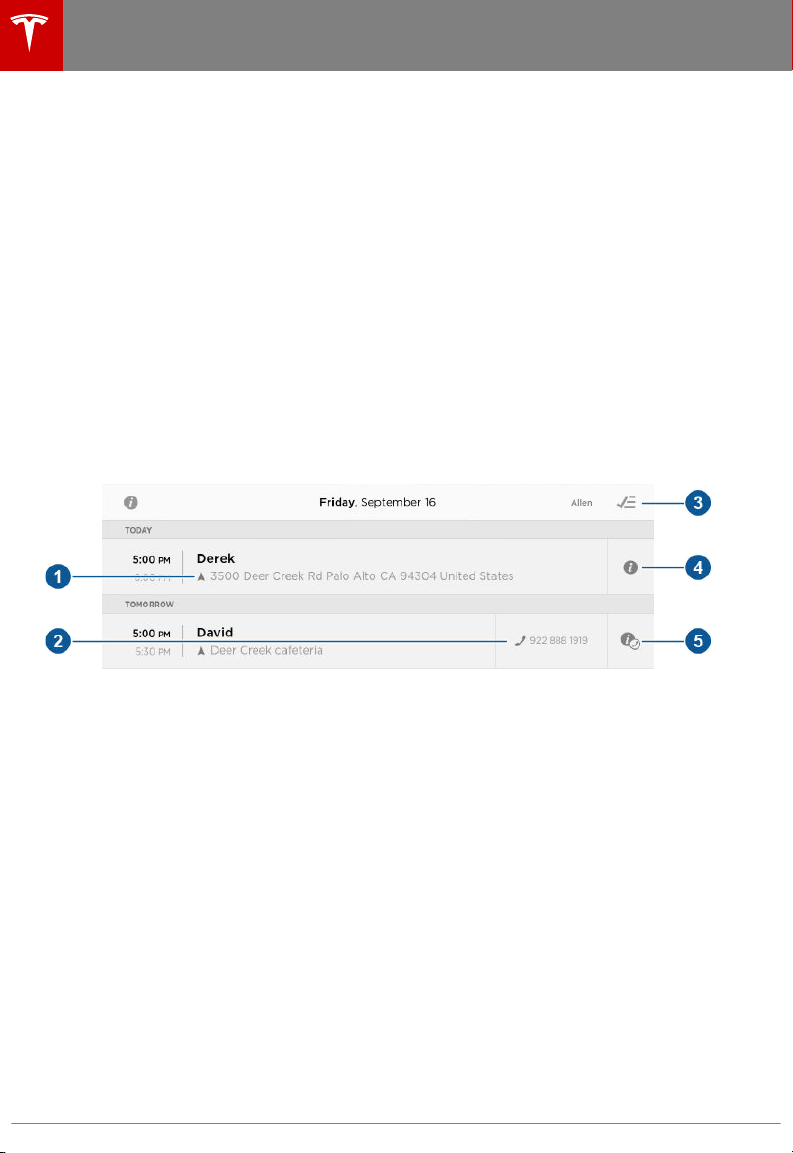
Overview
The Calendar app allows you to view your phone’s (iPhone
®
or Android
™
) calendar for the current
and next day. The Calendar app requires that:
• The Tesla Model X mobile app is running and you are logged in. When prompted on your
phone, you must grant calendar access to the mobile app. The mobile app can then
periodically (and automatically) send calendar data from your phone to Model X. Also,
whenever you display the mobile app on your phone, updated calendar data is sent to
Model X. To ensure you have access to all features of the Calendar app, you will need the
latest version of the mobile app.
• Your phone is connected to Model X via Bluetooth (for privacy reasons, calendar data displays
only from a phone that is connected via Bluetooth).
• Remote access to Model X is turned on (touch Controls > Settings > Safety & Security >
Remote Access > On).
• Both your phone and Model X have good connectivity.
When you enter Model X, the touchscreen can display a reminder of the day's events. You can
customize if and when your calendar events are displayed by touching Controls > Settings >
Apps > Calendar > Show Calendar Upon Entry.
To view scheduled events for the next 48 hours, choose the Calendar app from the main
touchscreen window. The Calendar app displays events in chronological order.
1. If the calendar event includes an address, a navigation arrow displays to indicate that you can
touch the address to navigate to the event's location (if your Model X is equipped with
Navigation).
2. If a phone number is associated with a calendar event, you can touch the number to initiate a
phone call.
3. In situations where events are displayed from multiple calendars, you can
filter to show only
events from one or more
specific calendars.
4. If the calendar event has notes associated with it, touch the information icon to display the
notes in a popup window.
5. If an event's notes include one or more phone numbers, a phone symbol displays with the
information icon and the
first phone number found in the notes displays on the event list and
you can use this number to initiate a phone call (as described in item 2 above). But you can
also initiate a call from within the notes popup window by referencing other numbers that are
included in the notes (this is particularly useful for conference calls). If the notes contain a
web link, you can touch the link to open it in the Web Browser app.
Calendar and Navigation
If Model X is equipped with navigation, and a calendar event has a location
specified, you will be
given the option to navigate to that location. Also, when an event on your Calendar takes place
within the next hour and has a uniquely
specified location, the Model X navigation system notifies
you if there is a better route due to trac, even if you’re not using navigation.
Calendar
146 Model X Owner's Manual

About the Security System
If Model X does not detect a key nearby and a
locked door or trunk is opened, an alarm
sounds and the headlights and turn signals
flash. To deactivate the alarm, press any
button on the key.
To manually enable or disable the alarm
system, touch Controls > Settings > Safety &
Security > Alarm. When set to ON, Model X
activates its alarm one minute after you exit,
the doors lock, and a recognized key is no
longer detected.
If your Model X is equipped with the optional
security package, it includes a battery-backed
siren that sounds in situations where a locked
door or trunk is opened and Model X does not
detect a key nearby. If the Tilt/Intrusion
setting is on, the siren also sounds if Model X
detects motion inside the cabin or if the
vehicle is moved or tilted (for example, with a
tow truck or jack). To temporarily turn the Tilt/
Intrusion detection system
o, touch
Controls > Settings > Safety & Security > Tilt/
Intrusion > OFF. The Tilt/Intrusion setting is
enabled every time Model X is unlocked.
Note: If you plan to leave something that
moves, such as a dog, inside your locked
Model X, remember to turn
o Tilt/Intrusion.
Motion detected inside Model X activates the
siren.
Note: The Alarm must be on to enable Tilt/
Intrusion.
Security Settings
Using the Touchscreen 147

About HomeLink
You can program the HomeLink
®
Universal
Transceiver (if equipped) to operate up to
three Radio Frequency (RF) devices, including
garage doors, gates, lights, and security
systems.
Note: Depending on date of manufacture,
options selected, and time of purchase, some
Model X vehicles are not equipped with
HomeLink.
Programming HomeLink
1. Park Model X in front of the device you
want to program, and have the device's
remote control ready.
Note: Make sure you haven’t reached the
limit of learned remotes/vehicles. Most
device receivers can learn up to
five
remotes/vehicles. If necessary, clear the
receiver memory and restart the
programming process. For information
about clearing the receiver memory, refer
to the owner documentation for your
device.
2. On the touchscreen, touch Controls >
Settings > HomeLink.
3. Touch Add New HomeLink, then use the
onscreen keyboard to enter a name for
your HomeLink device.
4. Touch Program.
5. Follow the onscreen instructions.
Once programmed, you can operate the
device by touching its corresponding
HomeLink icon on the touchscreen's status
bar. HomeLink remembers the location of your
programmed devices. When you approach a
known location, the HomeLink control on the
touchscreen automatically drops down. When
you drive away, it disappears.
Note: For security reasons, delete your
HomeLink devices if you sell your Model X
(see Deleting a Device on page 148).
Warning:
Your device might open or
close during programming. Before
programming, make sure that the device
is clear of any people or objects.
Warning: Do not use the HomeLink
Universal Transceiver with a device that
does not have safety stop and reverse
features. Using a device without these
safety features increases the risk of injury
or death.
Auto Opening and Closing
To operate a HomeLink device without
touching the touchscreen, you can automate
the device to open as you approach and close
as you drive away:
• Touch Controls > Settings > HomeLink
and choose the device you want to
automate.
• Select the Auto-open when arriving
checkbox.
• Touch the arrows to specify the distance
you want your vehicle to be from the
device before it opens.
• Select the Auto-close when leaving
checkbox if you want the device to close
as you drive away.
As you approach (or drive away from) a
device that is set to operate automatically, the
HomeLink status icon displays a count-down
message to let you know when the device will
automatically open. In situations where you
don't want the device to automatically open
or close, touch Skip Auto-Open or Skip Auto-
Close at any time during the count-down
message.
Resetting the Location of the
HomeLink Device
If you experience situations in which you
sometimes drive up to your HomeLink device
and it doesn't open, or the HomeLink icon on
the touchscreen's status bar does not display
the dropdown when you approach the device,
you may need to reset the device's location.
To do so, park as close as possible to the
HomeLink device (garage door, gate, etc.) and
display the HomeLink settings page by
touching Controls > Settings > HomeLink.
Touch the name of the device you want to
reset, then Reset Location.
Deleting a Device
To delete a HomeLink device, touch Controls >
Settings > HomeLink. Touch the name of the
device you want to delete, then touch Delete.
Note: You can also perform a factory reset to
erase your HomeLink settings, along with all
other personal data (saved addresses, music
favorites, imported contacts, etc.). See Erasing
Personal Data on page 125.
HomeLink
®
Universal Transceiver
148 Model X Owner's Manual

Troubleshooting HomeLink
When programming a HomeLink device, the
touchscreen walks you through a two-part
programming process:
1. Model X records the signal from the
remote. The touchscreen instructs you to
stand in front of the vehicle, point the
remote at the front bumper and press and
hold the button until the headlights
flash.
When the headlights flash, Model X has
learned the remote and you can touch
Continue on the touchscreen. If the
headlights do not
flash, refer to the
following guidelines.
2. The device's receiver learns Model X. The
touchscreen instructs you to press the
LEARN button on the device's receiver. If
training the receiver does not work, refer
to the following guidelines.
Note: Only devices that are equipped with
a “rolling code” remote need to learn
Model X. If you have an old device that is
not equipped with a "rolling code" remote,
the device does not need to learn Model X
and you can skip this part of the process.
You can also skip this part if your receiver
is "Quick-Train" compatible.
Headlights do not
flash
• Check the batteries in the remote. It is a
good idea to replace the batteries before
you start programming.
• Hold the remote against the front bumper,
with the button pressed, approximately 15
cm to the left of the Tesla emblem. In
some cases you must hold the button on
the remote for up to three minutes.
• Check compatibility of the remote by
contacting the HomeLink manufacturer
(www.homelink.com).
After programming, the device does not
work
• Park Model X with its front bumper as
close as possible to the HomeLink device
(garage door, gate, etc.).
• Make sure you haven’t reached the device
receiver's limit of learned remotes/cars.
Most receivers can learn up to
five
remotes/cars. If the receiver's memory is
full, you must clear the memory and
restart the programming process. For
instructions on how to clear the receiver's
memory, refer to the owner
documentation provided with the
HomeLink device.
• Make sure you are pressing the receiver's
LEARN button. Most receivers have two
buttons and a LED. One button is a RESET
button and the other is a LEARN button.
Pressing the LEARN button usually causes
the LED to flash. For instructions on how
to put the receiver into learning mode,
refer to the owner documentation
provided with the HomeLink device.
• Most devices stay in learning mode for
only three to
five minutes. Immediately
after pressing the device's LEARN button,
follow the instructions displayed on the
touchscreen.
HomeLink
®
Universal Transceiver
Using the Touchscreen 149

Wi-Fi is available as a data connection method
and is often faster than cellular data networks.
Connecting to Wi-Fi is especially useful in
areas with limited or no cellular connectivity.
To ensure fast, reliable delivery of Model X
updates (see Software Updates on page 151),
Tesla recommends leaving Wi-Fi turned on
and connected to a Wi-Fi network. To connect
to a Wi-Fi network:
1. Touch the LTE (or 3G) icon in the
touchscreen status bar. Model X will start
scanning and display the Wi-Fi networks
that are within range.
2. Select the Wi-Fi network you want to use,
enter the password (if necessary), then
touch Connect.
You can also connect to a hidden network that
isn't shown on the list of scanned networks.
Just touch Wi-Fi Settings and enter the name
of the network in the resulting dialog box.
Once you have connected to a network,
Model X automatically connects whenever the
network is within range. If more than one
previously connected network is within range,
Model X connects to the one most recently
used.
Note: You can also use a mobile hotspot or
your phone's Internet connection via Wi-Fi
tethering.
Note: At Tesla Service Centers, Model X
automatically connects to the Tesla Service
Wi-Fi network.
Connecting to Wi-Fi
150 Model X Owner's Manual

Loading New Software
Model X updates its software wirelessly,
providing new features throughout your term
of ownership. Tesla recommends that you
install software updates as soon as they are
available. The
first time you enter Model X
after an update is made available, a scheduling
window displays on the touchscreen. The
scheduling window displays again at the end
of your first driving session.
Note: Some software updates can take up to
three hours to complete. Model X must be in
Park while the new software is being installed.
To ensure the fastest and most reliable
delivery of software updates, leave the Wi-Fi
turned on and connected whenever possible
(see Connecting to Wi-Fi on page 150).
When a software update is available, a yellow
clock icon appears on the touchscreen’s status
bar. Touch this clock icon to display the
update window. You can then either:
• Schedule the update by setting the time
you want the update to begin. Then touch
Set For This Time. Once scheduled, the
yellow clock icon changes to a white clock
icon. You can reschedule the update any
time before it begins.
OR
• Touch Install Now to immediately start the
update process.
If Model X is charging when the software
update begins, charging stops. Charging
resumes automatically when the software
update is complete. If you are driving Model X
at the scheduled update time, the update is
canceled and you need to reschedule it.
Note: Over time, the touchscreen may display
a software update window informing you to
SET FOR THIS TIME or INSTALL NOW. This
software update window will persist until you
complete the installation of the software
update. You must install all software updates
as soon as they are available and any harm
relating to the failure to install a software
update will not be covered by the vehicle’s
warranty. Failure or refusal to install such
updates may result in the inaccessibility of
certain vehicle features (including
incompatibility with digital media devices) or
in Tesla being unable to diagnose and service
your vehicle.
Note: If software updates are not installed,
some vehicle features may become
inaccessible and digital media devices may
become incompatible. Reverting to a previous
software version is not possible.
If the touchscreen displays a message
indicating that a software update was not
successfully completed, contact Tesla.
Viewing Release Notes
When a software update is complete, learn
about the new features by reading the release
notes. To display release notes about your
current software version at any time touch the
Tesla “T” at the top center of the touchscreen,
then touch Release Notes.
Tesla strongly recommends reading all release
notes. They may contain important safety
information or operating instructions
regarding your Model X.
Software Updates
Using the Touchscreen 151

Model X Mobile App
The Tesla Model X mobile app allows you to
communicate with Model X remotely using
your iPhone
®
or Android
™
phone. With this
app, you can:
• View the vehicle's estimated range.
• Check charging progress or stop charging
and receive
notifications when charging
has started, has been interrupted, is
nearing completion, or is complete.
Note: If Supercharging, additional
notifications will alert you when idle fees
are incurred. The idle fees are waived if
your vehicle is moved within
five minutes
of when you finish charging. See
Supercharger Usage Fees and Idle Fees on
page 161.
• Check the interior temperature and heat
or cool Model X before driving (even if it's
in a garage).
• Locate Model X with directions, or track
its movement across a map.
• Flash lights or honk the horn to
find
Model X when parked.
• Lock or unlock Model X from afar.
• Open the front or rear trunks.
• Enable valet mode.
• Allow Model X to be started remotely.
• Park or unpark Model X using Summon
(see Using Summon on page 103).
• Support the Model X Calendar app by
allowing the mobile app to send your
phone's calendar data to Model X.
• Receive
notifications when the car alarm
has been triggered, or a new Model X
software update is available.
• Receive
notifications of scheduled
software updates.
• View the odometer, VIN, and current
software version.
Simply download the Tesla Model X mobile
app to your phone and enter your Tesla
Account login credentials. You must also
ensure that Model X is ready to communicate
with the mobile app by turning on its remote
access setting. Touch Controls > Settings >
Safety & Security > Remote Access > On
(see Settings on page 122).
Note: Tesla does not support the use of third
party applications to contact Model X.
Note: To ensure access to new and improved
features, download updated versions of the
mobile app as they become available.
Mobile App
152 Model X Owner's Manual
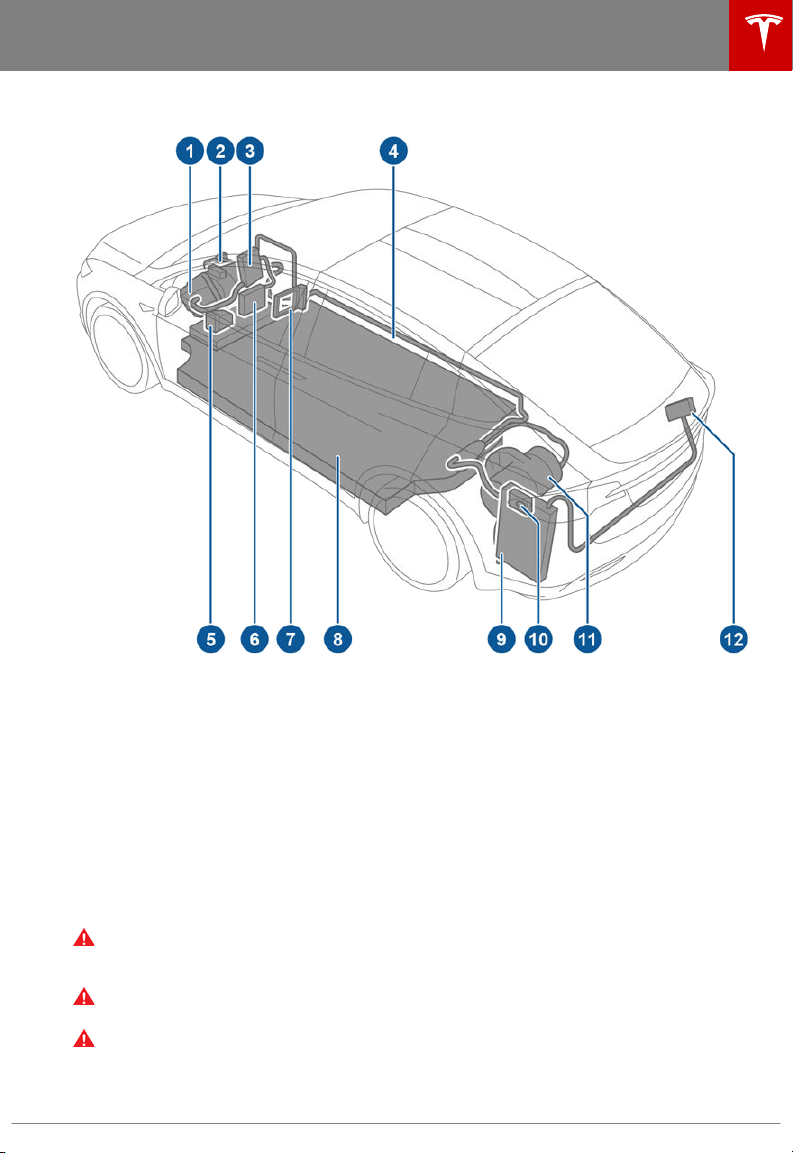
High Voltage Components
1. Front Motor
2. Air Conditioning Compressor
3. Forward Junction Box
4. High Voltage Cabling
5. Battery Coolant Heater
6. DC-DC Converter
7. Cabin Heater
8. High Voltage Battery
9. On-board Charger
10. Charge Port
11. Rear Motor
12. HV Cable to Rear HVAC Assembly
Warning:
The high voltage system has no user serviceable parts. Do not disassemble, remove
or replace high voltage components, cables or connectors. High voltage cables are typically
colored orange for easy identification.
Warning: Read and follow all instructions provided on the labels that are attached to Model X.
These labels are there for your safety.
Warning: In the unlikely event that a fire occurs, immediately contact your local fire
emergency responders.
Electric Vehicle Components
Charging 153

Charging Equipment
Charging equipment designed specifically to
charge your Model X is available from Tesla. A
Tesla Wall Connector, which installs in your
garage, is the fastest way to charge Model X
at home.
In several market regions, Model X is equipped
with a Mobile Connector and the adapter(s)
you need to plug into commonly used power
outlets. When using the Mobile Connector,
first plug the Mobile Connector into the power
outlet, and then plug in Model X. For more
information about your Mobile Connector, see
the Mobile Connector Owner’s Manual
(available on the touchscreen). Additional
adapters can be purchased from Tesla.
Tesla also
oers various adapters that allow
you to plug Model X into the most commonly
used public charging stations in your region.
Connect the adapter to the charging station’s
charge cable, open the charge port door using
the touchscreen (see Charging Instructions on
page 157), and then plug in Model X.
For more information on the charging
equipment available for your region, go to
www.tesla.com, choose your region, and then
view the available charging options.
Electric Vehicle Components
154 Model X Owner's Manual

About the Battery
Model X has one of the most sophisticated
battery systems in the world. The most
important way to preserve the Battery is to
LEAVE YOUR VEHICLE PLUGGED IN when
you are not using it. This is particularly
important if you are not planning to drive
Model X for several weeks. When plugged in,
Model X wakes up when needed to
automatically maintain a charge level that
maximizes the lifetime of the Battery.
There is no advantage to waiting until the
Battery’s level is low before charging. In fact,
the Battery performs best when charged
regularly.
Note: If the Model X Battery becomes
completely discharged in a situation in which
towing is required, the owner is responsible
for towing expenses. Discharge-related towing
expenses are not covered under the Roadside
Assistance policy.
The peak charging rate of the Battery may
decrease slightly after a large number of DC
Fast Charging sessions, such as those at
Superchargers. To ensure maximum driving
range and Battery safety, the Battery charge
rate is decreased when the Battery is too cold,
when the Battery’s charge is nearly full, and
when the Battery conditions change with
usage and age. These changes in the condition
of the Battery are driven by battery physics
and may increase the total Supercharging
duration by a few minutes over time.
Battery Care
Never allow the Battery to fully discharge.
Even when Model X is not being driven, its
Battery discharges very slowly to power the
onboard electronics. On average, the Battery
discharges at a rate of 1% per day. Situations
can arise in which you must leave Model X
unplugged for an extended period of time (for
example, at an airport when traveling). In
these situations, keep the 1% in mind to ensure
that you leave the Battery with a
sucient
charge level. For example, over a two week
period (14 days), the Battery discharges by
approximately 14%.
Discharging the Battery to 0% may
permanently damage the Battery. To protect
against a complete discharge, Model X enters
a low-power consumption mode when the
charge level drops to 5%. In this mode, the
Battery stops supporting the onboard
electronics to slow the discharge rate to
approximately 4% per month. Once this low-
power consumption mode is active, it is
important to plug in Model X within two
months to avoid Battery damage.
Note: When the low-power consumption
mode is active, the auxiliary 12V battery is no
longer being charged and can completely
discharge within 12 hours. In the unlikely event
that this occurs, you may need to jump start
or replace the 12V battery before you can
charge. In this situation, contact Tesla.
Temperature Limits
For better long-term performance, avoid
exposing Model X to ambient temperatures
above 60° C or below -30° C for more than 24
hours at a time.
Energy Saving Feature
Model X has an energy-saving feature that
reduces the amount of energy being
consumed when Model X is not in use. Touch
Controls > Displays > Energy Saving. For
more information on maximizing range and
saving energy, see Getting Maximum Range
on page 76.
Battery Warnings and Cautions
Warning:
The Battery has no parts that an
owner or a non-Tesla authorized service
technician can service. Under no
circumstances should you open or tamper
with the Battery. Always contact Tesla to
arrange for Battery servicing.
Caution: If the Battery’s charge level falls
to 0%, you must plug it in. If you leave it
unplugged for an extended period, it may
not be possible to charge or use Model X
without jump starting or replacing the 12V
battery. Leaving Model X unplugged for
an extended period can also result in
permanent Battery damage. If you are
unable to charge Model X, contact Tesla
immediately.
Caution: The Battery requires no owner
maintenance. Do not remove the coolant
filler cap and do not add fluid. If the
instrument panel warns you that the fluid
level is low, contact Tesla immediately.
Battery Information
Charging 155

Caution: Do not use the Battery as a
stationary power source. Doing so voids
the warranty.
Battery Information
156 Model X Owner's Manual
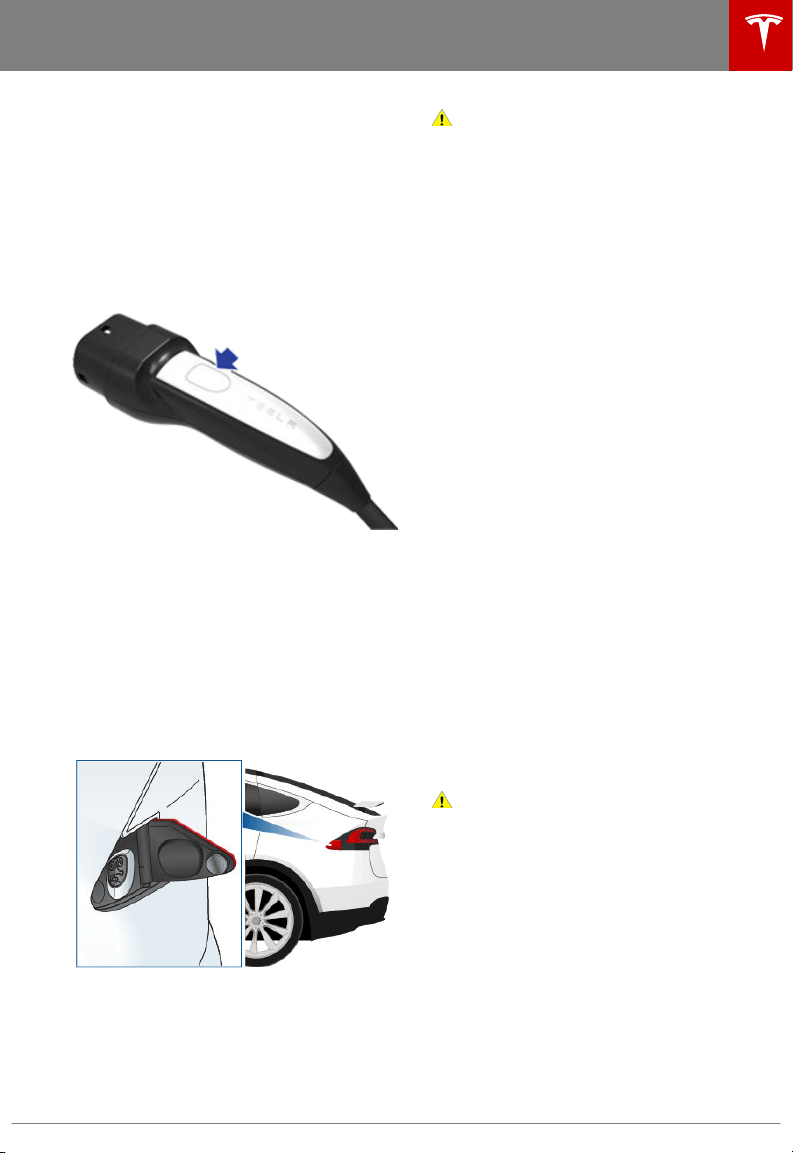
Opening the Charge Port
The charge port is located on the left side of
Model X, behind a door that is part of the rear
tail light assembly. Park so that the charge
cable easily reaches the charge port.
With Model X unlocked (or a recognized key is
within range) and in Park, press and release
the button on the Tesla charge cable to open
the charge port door.
You can also open the charge port door using
any of these methods:
• On the touchscreen, touch Controls >
Charging > Open Charge Port.
• Touch the charging icon in the status bar
on the top of the touchscreen, then press
Open Charge Port.
• On the key, hold down the rear trunk
button for 1-2 seconds.
• Press the charge port door when Model X
is unlocked or a recognized key is nearby.
Note: The charge port lights up white when
you open the charge port door. If you do not
insert a charge cable into the charge port
within a few minutes after opening the charge
port door, the charge port door closes. If this
happens, use the touchscreen to open the
charge port door again.
Caution:
Do not try to force the charge
port door open.
Plugging In
If desired, use the touchscreen to change the
charge limit and the charging current (see
Changing Charge Settings on page 158).
To charge at a public charging station, attach
an adapter to the station’s charging connector.
The most commonly used adapter(s) for each
market region are provided. Depending on the
charging equipment you are using, you may
need to start and stop charging using a
control on the charging equipment.
If you are using the Mobile Connector, plug it
into the power outlet before plugging it into
Model X.
Align the connector to the charge port and
insert fully. When the connector is properly
inserted, charging begins automatically after
Model X:
• Engages a latch that holds the connector
in place;
• Shifts into Park (if it was in any other
gear);
• Heats or cools the Battery, if needed. If
the Battery requires heating or cooling,
you may notice a delay before charging
begins.
Note: Whenever Model X is plugged in but not
actively charging, it draws energy from the
wall outlet instead of using energy stored in
the Battery. For example, if you are sitting in
Model X and using the touchscreen while
parked and plugged in, Model X draws energy
from the wall outlet instead of the Battery.
Caution:
The connector end of the charge
cable can damage the paint if dropped
onto the vehicle.
During Charging
During charging, the charge port light pulses
green, and the instrument panel displays the
charging status. The frequency at which the
charge port light pulses slows down as the
charge level approaches full. When charging is
complete, the light stops pulsing and is solid
green.
Note: If Model X is locked, the charge port
light does not light up.
Charging Instructions
Charging 157

If the charge port light turns red while
charging, a fault is detected. Check the
instrument panel or touchscreen for a
message describing the fault. A fault can
occur due to something as common as a
power outage. If a power outage occurs,
charging resumes automatically when power
is restored.
Note: When charging, particularly at high
currents, the refrigerant compressor and fan
operate as needed to keep the Battery cool.
Therefore, it is normal to hear sounds during
charging.
Note: Air conditioning performance is
generally not
aected by charging. However,
under certain circumstances (for example, you
are charging at high currents during a
particularly warm day), the air coming from
the vents may not be as cool as expected and
a message displays on the instrument panel.
This is normal behavior and ensures that the
Battery stays within an optimum temperature
range while charging to support longevity and
optimum performance.
Warning: Never spray liquid at a high
velocity (for example, if using a pressure
washer) towards the charge port while
charging. Failure to follow these
instructions can result in serious injury or
damage to the vehicle, charging
equipment, or property.
Stopping Charging
Stop charging at any time by disconnecting
the charge cable or touching Stop Charging
on the touchscreen.
Note: To prevent unauthorized unplugging of
the charge cable, Model X must be unlocked
or able to recognize your key before you can
disconnect the charge cable.
To disconnect the charge cable:
1. Press and hold the button on a Tesla
connector to release the latch. You can
also touch Stop Charging on the charging
screen (see Changing Charge Settings on
page 158).
2. Pull the connector from the charge port.
3. Push the charge port door closed.
Note: If Model X is equipped with a motorized
charge port door, it automatically closes when
you remove the charge cable.
Caution:
Tesla strongly recommends
leaving Model X plugged in when not in
use. This maintains the Battery at the
optimum level of charge.
Charge Port Light
• WHITE: The charge port door is open.
Model X is ready to charge and the
connector is not inserted, or the latch is
released and the connector is ready to be
removed.
• BLUE: Model X detects that a connector
has been plugged in, but charging has not
started. Either Model X is preparing to
charge, or a charging session is scheduled
to begin at a
specified future time.
• BLINKING GREEN: Charging is in
progress. As Model X approaches a full
charge, the frequency of the blinking
slows.
• SOLID GREEN: Charging is complete.
• SOLID AMBER: The connector is not fully
plugged in. Realign the connector to the
charge port and insert fully.
• BLINKING AMBER: Model X is charging at
a reduced current (AC charging only).
• RED: A fault is detected and charging has
stopped. Check the instrument panel or
touchscreen for a fault message.
Changing Charge Settings
The charge settings screen displays on the
touchscreen whenever the charge port door is
open.
To display charge settings at any time, touch
the Battery icon on the top of the
touchscreen, or touch Controls > Charging
(located in the upper right portion of the
Controls screen).
Note: The following illustration is provided for
demonstration purposes only and may vary
slightly depending on software version and
market region.
Charging Instructions
158 Model X Owner's Manual
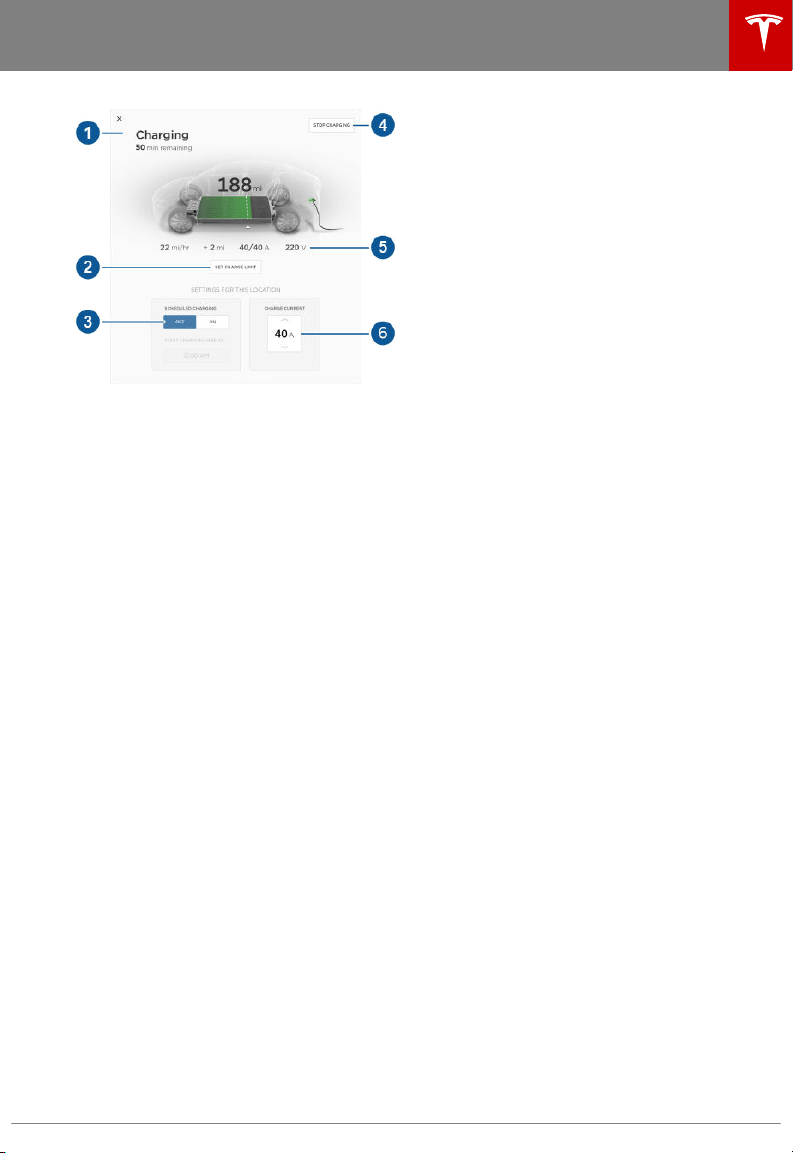
Note: If charging at a Tesla Supercharger, and
paid supercharging is potentially in
eect, the
charging screen also displays information
about your previous or current Supercharger
session (see Supercharger Usage Fees and
Idle Fees on page 161).
1. Charge status messages (such as
Charging Scheduled, Charging In
Progress) display here.
2. To adjust the charge limit, touch Set
Charge Limit, and drag the arrow to
change the charge limit setting. The
setting you choose applies to immediate
and scheduled charging sessions.
3.
Location-specific schedule. With Model X
in Park, set a
specific time to begin
charging at the current location. If, at the
scheduled time, Model X is not plugged in
at the location, charging starts as soon as
you plug it in provided you plug it in
within six hours of the scheduled time. If
plugged in after six hours, charging does
not start until the scheduled time on the
next day. To override this setting, touch
Start Charging or Stop Charging (see
item 4). When you set a scheduled
charging time, Model X displays the set
time on the instrument panel and
touchscreen.
4. Touch to open the charge port door or to
start (or stop) charging.
5. Charging rate per hour, estimated increase
in driving distance (or energy) achieved
so far in this charging session, current
supplied/available from the connected
power supply, and voltage supplied by the
charge cable.
6.
The current automatically sets to the
maximum current available from the
attached charge cable, unless it was
previously reduced to a lower level. If
needed, touch the up/down arrows to
change the current (for example, you may
want to reduce the current if you are
concerned about overloading a domestic
wiring circuit shared by other equipment).
It is not possible to set the charging
current to a level that exceeds the
maximum available from the attached
charge cable. When you change the
current, Model X remembers the location.
If you charge at the same location, you do
not need to change it again.
Note: For 3-phase charging, the available
current represents the current per phase
(up to 32 amps). During charging, the
right status
flag displays the 3-phase
symbol in front of the displayed current.
Note: If Model X automatically reduced
the current at a charging location because
of fluctuations in input power (see the
note in Charging Status on page 160),
Tesla recommends charging at the lower
current until the underlying problem is
resolved and the charging location can
provide consistent power.
Charging Instructions
Charging 159
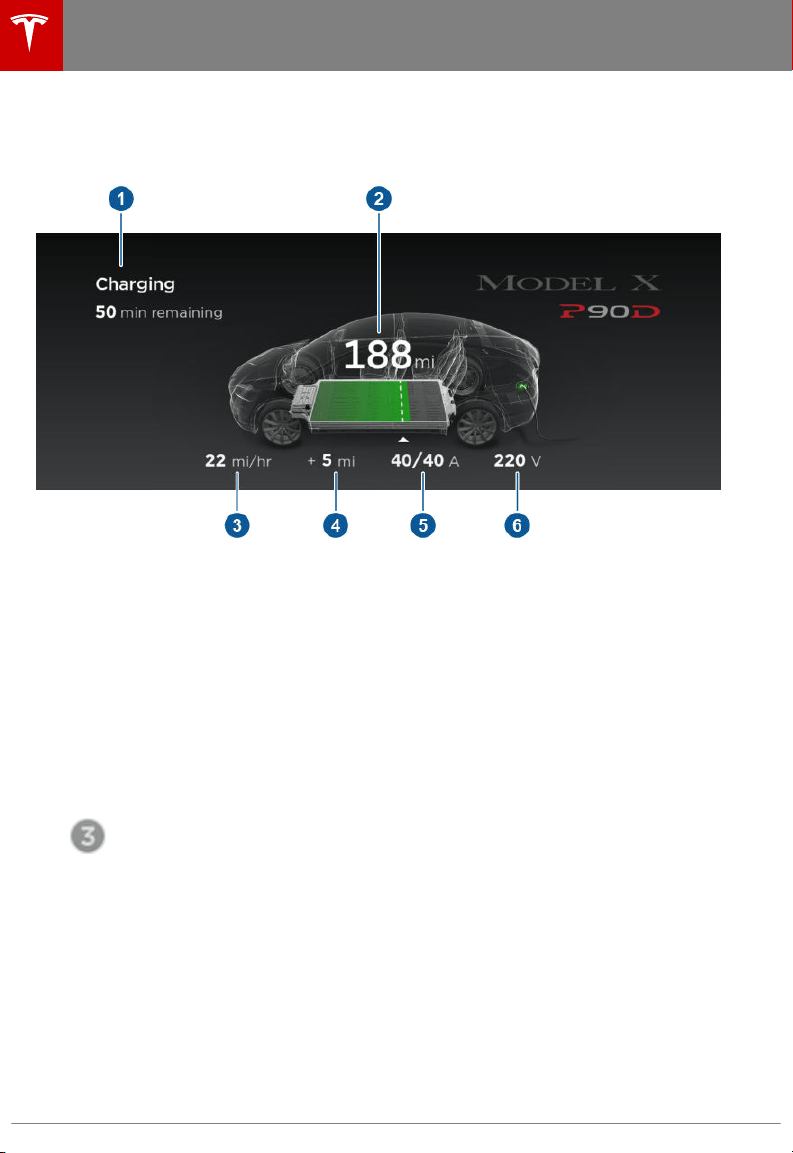
Charging Status
The following illustration is provided for demonstration purposes only and may vary slightly
depending on the software version and market region.
1. Charging status information. For example, when Model X is charging, it displays the time
remaining until fully charged at the currently selected charge level. When a charging session is
scheduled, it displays when charging starts.
2. Total estimated driving distance (or energy) available. To choose between displaying distance
or energy percentage, touch Controls > Settings > Language & Units > Energy & Charging.
Note: A portion of the battery image may appear blue. This indicates that a small portion of
the energy stored in the battery is not available because the battery is cold. This is normal and
no reason for concern. When the battery warms up, the blue portion no longer displays.
3. Charging rate per hour.
4. Estimated increase in driving distance (or energy) achieved so far in this charging session.
5. Current supplied/available from the connected power supply (see Changing Charge Settings
on page 158).
If connected to a 3-phase power supply, the available current represents the
current per phase and the 3-phase symbol displays.
6. Voltage supplied by the charge cable.
Note: If Model X is charging and detects unexpected fluctuations in input power, the charging
current is automatically reduced by 25%. For example, a 40 amp current is reduced to 30 amps.
This automatic current reduction increases robustness and safety in situations when an external
problem exists (for example, a home wiring system, receptacle, adapter or cord is unable to meet
its rated current capacity). As a precaution, when Model X automatically reduces current, it saves
the reduced current at the charging location. Although you can manually increase it, Tesla
recommends charging at the lower current until the underlying problem is resolved and the
charging location can provide consistent power.
Charging Instructions
160 Model X Owner's Manual

Supercharger Usage Fees and Idle
Fees
When charging using a Tesla supercharger,
PAID SUPERCHARGING information displays
at the bottom of the charging screen. This
information includes the location, the time
that charging started, and an estimate of how
much the session will cost. When you stop
charging, the
final cost displays until a new
Supercharging session begins. If free charging
is applicable, the cost displays as zero.
When charging at a Tesla supercharger, you
are subject to idle fees. Idle fees are designed
to encourage drivers to move their vehicle
from the Supercharger when charging is
complete and are in
eect whenever at least
half of the Superchargers at a site are
occupied. The Tesla mobile app
notifies you
when charging nears completion, and again
when charging is complete. Additional
notifications are sent if idle fees are incurred.
Idle fees are waived if you move your vehicle
within
five minutes of charging completion.
Log into your Tesla Account to view fees and
details about Supercharger sessions, track the
remaining balance of free credits, set up a
payment method, and make payments. Once a
payment method is saved, fees are
automatically paid from your account.
Charging Instructions
Charging 161

Service Intervals
Regular maintenance is the key to ensuring
the continued reliability and eciency of your
Model X.
Maintain the correct tire pressures, and take
Model X to Tesla at the regularly scheduled
maintenance intervals of every 12 months, or
every 20,000 km, whichever comes
first. It is
also important to perform the daily and
monthly checks described below.
Model X should be serviced by
Tesla-certified
technicians. Damages or failures caused by
maintenance or repairs performed by non-
Tesla
certified technicians are not covered by
the warranty.
Daily Checks
• Check the Battery’s charge level,
displayed on the instrument panel or
mobile app.
• Check the condition and pressure of each
tire (see Tire Care and Maintenance on
page 163).
• Check that all exterior lights, horn, turn
signals, and wipers and washers are
working.
• Check the operation of the brakes,
including the parking brake.
• Check the operation of the seat belts
(see Seat Belts on page 27).
• Look for abnormal
fluid deposits
underneath Model X that might indicate a
leak. It is normal for a small pool of water
to form (caused by the air conditioning
system’s dehumidifying process).
Monthly Checks
• Check windshield washer
fluid level and
top up if necessary (see Topping Up
Washer Fluid on page 174).
• Check that the air conditioning system is
operating correctly (see Climate Controls
on page 126).
Warning:
Contact Tesla immediately if
you notice any significant or sudden drop
in fluid levels or uneven tire wear.
Fluid Replacement Intervals
Do not change or top up the Battery coolant
or brake
fluid. Tesla service technicians replace
fluids at the regularly scheduled service
intervals:
• Brake
fluid. Every 2 years or 40,000 km,
whichever comes first.
• Battery coolant. Every 4 years or
80,000 km, whichever comes first.
Note: Any damage caused by opening the
Battery coolant reservoir is excluded from the
warranty.
High Voltage Safety
Your Model X has been designed and built
with safety as a priority. However, be aware of
these precautions to protect yourself from the
risk of injury inherent in all high-voltage
systems:
• Read and follow all instructions provided
on the labels that are attached to Model X.
These labels are there for your safety.
• The high voltage system has no user-
serviceable parts. Do not disassemble,
remove or replace high voltage
components, cables or connectors. High
voltage cables are colored orange for easy
identification.
• If a collision occurs, do not touch any high
voltage wiring, connectors, or
components connected to the wiring.
• In the unlikely event that a
fire occurs,
immediately contact your local fire
emergency responders.
Warning:
Always disconnect the charge
cable before working underneath
Model X, even if charging is not in
progress.
Warning: Keep your hands and clothing
away from cooling fans. Some fans
operate even when Model X is powered
o.
Warning: Some fluids (battery acid,
Battery coolant, brake fluid, windshield
washer additives, etc.) used in vehicles
are poisonous and should not be inhaled,
swallowed, or brought into contact with
open wounds. For your safety, always
read and follow instructions printed on
fluid containers.
Maintenance Schedule
162 Model X Owner's Manual
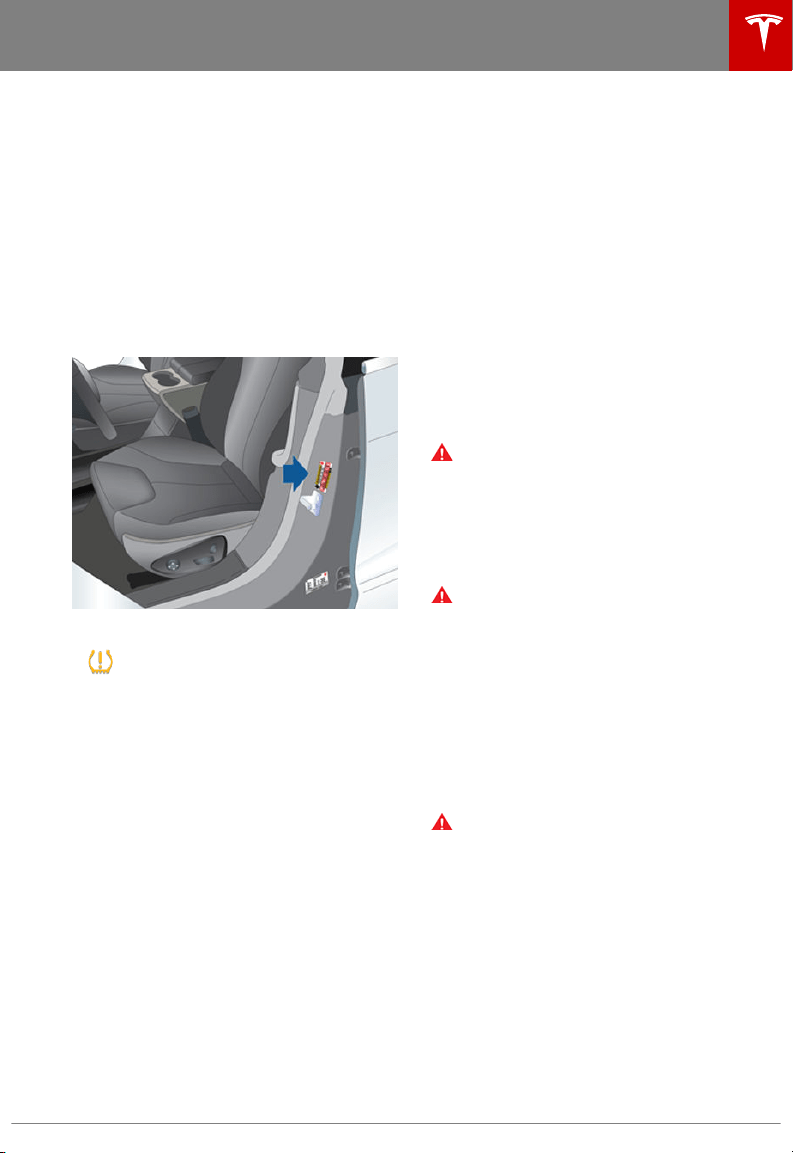
Maintaining Tire Pressures
If you are not towing a trailer, keep tires
inflated to the pressures shown on the Tire
and Loading Information label, even if it diers
from the pressure printed on the tire itself. The
Tire and Loading Information label is located
on the center door pillar and is visible when
the driver’s door is open.
If you are towing a trailer, do not use the tire
pressures printed on the Tire and Loading
Information Label. Instead, refer to the tire
pressures published in the towing topic (see
Towing and Accessories on page 80).
The Tire Pressure indicator light on
the instrument panel alerts you if
one or more tires is under- or over-
inflated.
The Tire Pressure indicator light does not
immediately turn o when you adjust tire
pressure. After
inflating the tire to the
recommended pressure, you must drive over
25 km/h for more than 10 minutes to activate
the Tire Pressure Monitoring System (TPMS),
which turns
o the Tire Pressure indicator
light.
If the indicator light flashes for one minute
whenever you power on Model X, a fault with
the TPMS is detected (see TPMS Malfunction
on page 168).
You can display tire pressures on the
instrument panel by choosing to display Car
Status using the right or left steering wheel
buttons (see Using Left Steering Wheel
Buttons on page 47 or Using Right Steering
Wheel Buttons on page 48). You can also
choose whether you want to display tire
pressures using BAR or PSI by touching
Controls > Settings > Language & Units > Tire
Pressure.
Checking and Adjusting Tire Pressures
Follow these steps when tires are cold and
Model X has been stationary for over three
hours:
1. Remove the valve cap.
2. Firmly press an accurate tire pressure
gauge onto the valve to measure pressure.
3. If required, add or remove air to reach the
recommended pressure.
Note: You can release air by pressing the
metal stem in the center of the valve.
4. Re-check pressure using the tire gauge.
5. Repeat steps 3 and 4 as necessary until
the tire pressure is correct.
6. Replace the valve cap to prevent dirt from
entering. Periodically check the valve for
damage and leaks.
Warning: Under-inflation is the most
common cause of tire failures and can
cause a tire to overheat, resulting in
severe tire cracking, tread separation, or
blowout, which causes unexpected loss of
vehicle control and increased risk of
injury. Under-inflation also reduces the
vehicle's range and tire tread life.
Warning: Check tire pressures using an
accurate pressure gauge when tires are
cold. It takes only about 1.6 kms of driving
to warm up the tires suciently to aect
tire pressures. Parking the vehicle in
direct sunlight or in hot weather can also
aect tire pressures. If you must check
warm tires, expect increased pressures.
Do not let air out of warm tires in an
attempt to match recommended cold tire
pressures. A hot tire at or below the
recommended cold tire
inflation pressure
is dangerously
under-inflated.
Warning: Do not use any tire sealant
other than the type provided in a Tesla
tire repair kit. Other types can cause tire
pressure sensors to malfunction. If your
Model X did not include a tire repair kit,
you can purchase one from Tesla.
Tire Care and Maintenance
Maintenance 163

Inspecting and Maintaining Tires
Regularly inspect the tread and side walls for
any sign of distortion (bulges), foreign objects,
cuts or wear.
Warning: Do not drive Model X if a tire is
damaged, excessively worn, or inflated to
an incorrect pressure. Check tires
regularly for wear, and ensure there are
no cuts, bulges or exposure of the ply/
cord structure.
Tire Wear
Adequate tread depth is important for proper
tire performance. Tires with a tread depth less
than 3 mm are more likely to hydroplane in
wet conditions and should not be used. Tires
with a tread depth less than 4 mm do not
perform well in snow and slush and should not
be used when driving in winter conditions.
Model X is originally
fitted with tires that have
wear indicators molded into the tread pattern.
When the tread has been worn down to 3 mm,
the indicators start to appear at the surface of
the tread pattern, producing the
eect of a
continuous band of rubber across the width of
the tire. For optimal performance and safety,
Tesla recommends replacing tires before the
wear indicators are visible.
Tire Rotation, Balance, and Wheel Alignment
Model X tires cannot be rotated, as tires are
asymmetrical and front tires are a
dierent
size from rear tires.
Unbalanced wheels (sometimes noticeable as
vibration through the steering wheel) aect
vehicle handling and tire life. Even with regular
use, wheels can get out of balance. Therefore,
they should be balanced as required.
If tire wear is uneven (on one side of the tire
only) or becomes abnormally excessive, check
the alignment of wheels.
Note: When replacing only two tires, always
install the new tires on the rear.
Punctured Tires
A puncture eventually causes the tire to lose
pressure, which is why it is important to check
tire pressures frequently. Permanently repair
or replace punctured or damaged tires as
soon as possible.
Your tubeless tires may not leak when
penetrated, provided the object remains in the
tire. If, however, you feel a sudden vibration or
ride disturbance while driving, or you suspect
a tire is damaged, immediately reduce your
speed. Drive slowly, while avoiding heavy
braking or sharp steering and, when safe to do
so, stop the vehicle. Arrange to have Model X
transported to a Tesla Service Center, or to a
nearby tire repair center.
Note: In some cases, you can temporarily
repair small tire punctures (under 6 mm) using
an optional tire repair kit available from Tesla.
This allows you to slowly drive Model X to
Tesla or to a nearby tire repair facility.
Warning: Do not drive with a punctured
tire, even if the puncture has not caused
the tire to deflate. A punctured tire can
deflate suddenly at any time.
Flat Spots
If Model X is stationary for a long period in
high temperatures, tires can form
flat spots.
When Model X is driven, these flat spots cause
a vibration which gradually disappears as the
tires warm up and regain their original shape.
To minimize flat spots during storage, inflate
tires to the maximum pressure indicated on
the tire wall. Then, before driving, release air
to adjust tire pressure to the recommended
levels.
Improving Tire Mileage
To improve the mileage you get from your
tires, maintain tires at the recommended tire
pressures, observe speed limits and advisory
speeds, and avoid:
• Pulling away quickly, or hard acceleration.
• Fast turns and heavy braking.
• Potholes and objects in the road.
• Hitting curbs when parking.
• Contaminating tires with
fluids that can
cause damage.
Tire Care and Maintenance
164 Model X Owner's Manual

Replacing Tires and Wheels
Tires degrade over time due to the eects of
ultraviolet light, extreme temperatures, high
loads, and environmental conditions. It is
recommended that tires are replaced every six
years, or sooner if required.
Wheel and tires are matched to suit the
handling characteristics of the vehicle.
Replacement tires must comply with the
original
specification. If tires other than those
specified are used, ensure that the load and
speed ratings marked on the tire (see
Understanding Tire Markings on page 187)
equal or exceed those of the original
specification.
Ideally, you should replace all four tires at the
same time. If this is not possible, replace the
tires in pairs, placing the new tires on the rear.
Always balance the wheel after replacing a
tire.
If you replace a wheel, the TPMS (Tire Pressure
Monitoring System) sensors need to be reset
to ensure they provide accurate warnings
when tires are under- or
over-inflated (see
Automatic Resetting of TPMS Sensors on
page 167).
For the specification of the original wheels
and tires installed on Model X, see Wheels and
Tires on page 186.
Warning:
For your safety, use only tires
and wheels that match the original
specification. Tires that do not match the
original specification can aect the
operation of the TPMS.
Warning: Never exceed the speed rating
of your vehicle's tires. The speed rating is
shown on the sidewall of your tires (see
Understanding Tire Markings on page
187).
Asymmetric Tires
Model X tires are asymmetric and must be
mounted on the wheel with the correct
sidewall facing outward. The sidewall of the
tire is marked with the word OUTSIDE. When
new tires are installed, make sure that the tires
are correctly mounted on the wheels.
Warning:
Road holding is seriously
impaired if the tires are incorrectly
installed on the wheels.
Tire Care and Maintenance
Maintenance 165
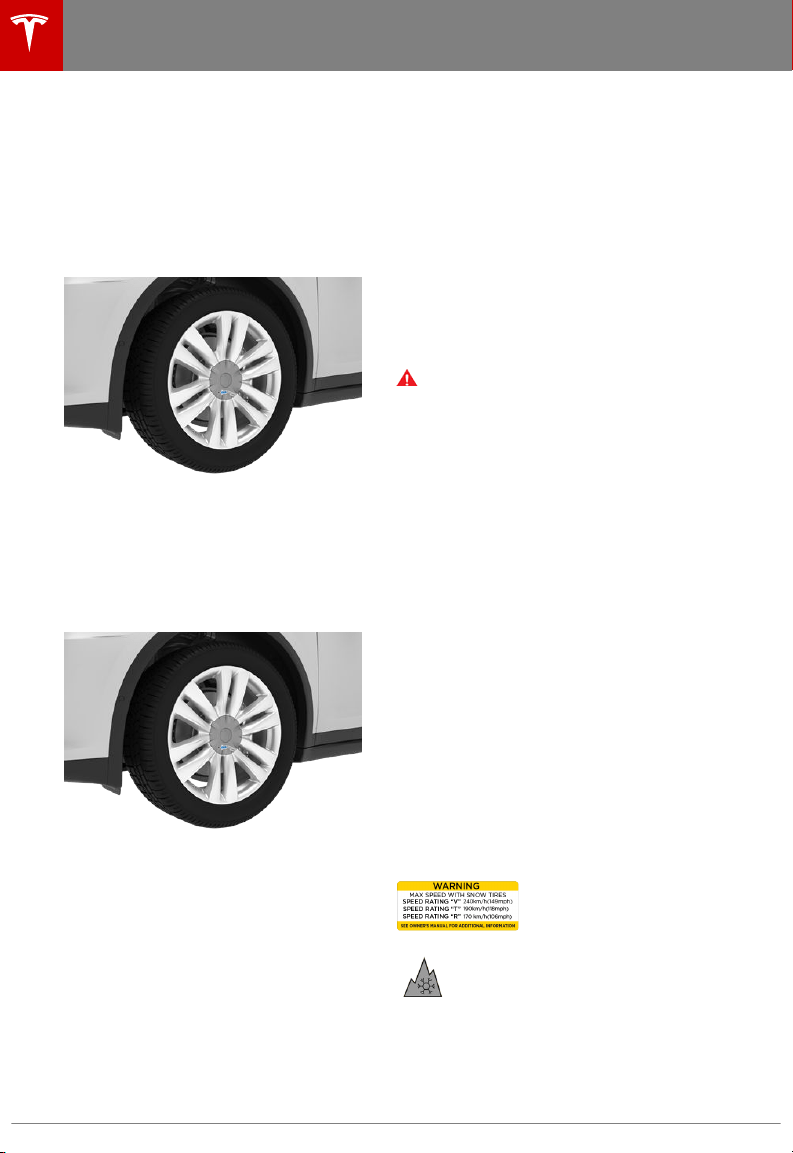
Removing and Installing Lug Nut Covers
If your Model X is equipped with lug nut
covers, you must remove them to access the
lug nuts.
To remove a lug nut cover:
1. Insert the curved part of the lug nut cover
tool (located in your glovebox) into the
hole at the base of the Tesla "T".
2. Maneuver the lug nut cover tool so that it
is fully inserted into the hole in the lug nut
cover.
3. Twist the lug nut cover tool so that the
curved part is touching the middle of the
lug nut cover.
4. Firmly pull the lug nut tool away from the
wheel until the lug nut cover is released.
To install the lug nut cover, align it into
position and push firmly until it fully snaps into
place.
Seasonal Tire Types
Summer Tires
Your Model X may be originally equipped with
high performance summer tires, all season
tires, or winter tires. Summer tires and all
season tires are designed for maximum dry
and wet road performance but are not
designed to perform well in winter conditions.
Tesla recommends using winter tires if driving
in cold temperatures or on roads where snow
or ice may be present. If not equipped with
winter tires, contact Tesla for winter tire
recommendations.
Warning: In cold temperatures or on
snow or ice, summer tires do not provide
adequate traction. Selecting and installing
the appropriate tires for winter conditions
is important to ensure the safety and
optimum performance of your Model X,
even when equipped with dual-motors.
All-Season Tires
Your Model X may be originally equipped with
all-season tires. These tires are designed to
provide adequate traction in most conditions
year-round, but may not provide the same
level of traction as winter tires in snowy or icy
conditions. All-season tires can be
identified
by “ALL SEASON" and/or "M+S” (mud and
snow) on the tire sidewall.
Winter Tires
Use winter tires to increase traction in snowy
or icy conditions. When installing winter tires,
always install a complete set of four tires at
the same time. Winter tires must be the same
size, brand, construction and tread pattern on
all four wheels. Contact Tesla for winter tire
recommendations.
When equipped with winter tires, refer to the
tire warning label on the door pillar.
Winter tires can be
identified by a
mountain/snowflake symbol on the
tire's sidewall.
When driving with winter tires, you may
experience more road noise, shorter tread life,
and less traction on dry roads.
Tire Care and Maintenance
166 Model X Owner's Manual

Driving in Low Temperatures
Tire performance is reduced in low ambient
temperatures, resulting in reduced grip and an
increased susceptibility to damage from
impacts. Performance tires can temporarily
harden when cold, causing you to hear
rotational noise for the
first few kilometers
until the tires warm up.
Using Tire Chains
Tesla has tested and approved Maggie Group
Trak Special LT51 tire chains to increase
traction in snowy conditions. These chains
should only be installed on rear 19 or 20" tires.
Do not use chains on 22" tires or on front tires.
The approved tire chains can be purchased
from Tesla.
When installing tire chains, follow the
instructions provided by the tire chain
manufacturer. Mount them as tightly as
possible.
When using tire chains:
• Drive slowly. Do not exceed 48 km/h.
• Avoid heavily loading Model X (heavy
loads can reduce the clearance between
the tires and the body).
• Remove the tire chains as soon as
conditions allow.
Note: Tire chains are prohibited in some
jurisdictions. Check local laws before installing
tire chains.
Caution:
Using non-recommended tire
chains, or using tire chains on other sized
tires can damage the suspension, body,
wheels, and/or brake lines. Damage
caused by using non-recommended tire
chains is not covered by the warranty.
Caution: Do not use chains on a Model X
equipped with 22" tires and do not use
tire chains on front tires.
Caution: Ensure that the tire chains
cannot touch suspension components or
brake lines. If you hear the chains making
unusual noises that would indicate
contact with Model X, stop and
investigate immediately.
Tire Pressure Monitoring
Each tire should be checked monthly when
cold and inflated to the recommended
pressures that are printed on the Tire and
Loading Information label located on the
driver’s door pillar (see Maintaining Tire
Pressures on page 163). If your vehicle has
tires of a dierent size than the size indicated
on the vehicle placard or tire
inflation pressure
label, determine the proper tire inflation
pressure for those tires.
As an added safety feature, your vehicle has
been equipped with a TPMS that displays a
tire pressure telltale (Tire Pressure Warning)
on the instrument panel when one or more of
your tires is
significantly under- or over-
inflated. Accordingly, when the Tire Pressure
indicator light displays on the instrument
panel to alert you about tire pressure, stop
and check your tires as soon as possible, and
inflate them to the proper pressure (see
Maintaining Tire Pressures on page 163).
Driving on a
significantly under-inflated tire
causes the tire to overheat and can lead to tire
failure.
Under-inflation also reduces range
eciency and tire tread life, and may aect
the vehicle's handling and stopping ability.
If Model X detects a fault with the
TPMS, this indicator flashes for one
minute whenever you power on
Model X.
Note: Installing accessories that are not
approved by Tesla can interfere with the
TPMS.
Warning:
The TPMS is not a substitute for
proper tire maintenance, including
manually checking tire pressures and
regularly inspecting the condition of tires.
It is the driver's responsibility to maintain
correct tire pressure, even if under- or
over-inflation has not reached the level
for the TPMS to trigger the Tire Pressure
Warning on the instrument panel.
Automatic Resetting of TPMS Sensors
After replacing one or more wheels (but not
after replacing a tire or rotating wheels), the
TPMS sensors are reset to ensure tire pressure
warnings are accurate. TPMS sensors reset
automatically after driving over 25 km/h for
longer than 10 minutes.
Note: After replacing a wheel, false tire
pressure warnings may display before you've
driven 25 km/h for longer than 10 minutes.
Tire Care and Maintenance
Maintenance 167

Replacing a Tire Sensor
If the Tire Pressure warning indicator displays
frequently, contact Tesla to determine if a tire
sensor needs to be replaced. If a non-Tesla
Service Center repairs or replaces a tire, the
tire sensor may not work until Tesla performs
the setup procedure.
TPMS Malfunction
Model X has also been equipped with a TPMS
malfunction indicator to indicate when the
system is not operating properly.
The TPMS malfunction indicator is
combined with the tire pressure
indicator light. When the system
detects a malfunction, the indicator
flashes for approximately one minute
after Model X powers on, and then
remains continuously lit. This
sequence continues upon
subsequent vehicle start-ups as long
as the malfunction exists. When the
TPMS malfunction indicator is on,
the system might not be able to
detect or signal under- and
over-
inflated
tires as intended.
TPMS malfunctions can occur for a variety of
reasons, including installing replacement or
alternate tires or wheels that prevent the
TPMS from functioning properly. Always check
the TPMS malfunction indicator light after
replacing one or more tires or wheels on your
vehicle to ensure that the replacement tires or
wheels allow the TPMS to continue to function
properly.
Note: If a tire has been replaced or repaired
using a
dierent tire sealant than the one
available from Tesla, and a low tire pressure is
detected, it is possible that the tire sensor has
been damaged. Contact Tesla to have the fault
repaired as soon as possible.
Tire Care and Maintenance
168 Model X Owner's Manual

Cleaning the Exterior
To prevent damage to the paint, immediately
remove corrosive substances (bird droppings,
tree resin, dead insects, tar spots, road salt,
industrial fallout, etc.). Do not wait until
Model X is due for a complete wash. If
necessary, use denatured alcohol to remove
tar spots and stubborn grease stains, then
immediately wash the area with water and a
mild, non-detergent soap to remove the
alcohol.
Follow these steps when washing the exterior
of Model X:
1. Rinse Thoroughly
Before washing,
flush grime and grit from
the bodywork using a hose. Flush away
accumulations of mud in areas where
debris easily collects (such as wheel
arches and panel seams). If salt has been
used on the highways (such as during
winter months), thoroughly rinse all traces
of road salt from the underside of the
vehicle.
2. Hand Wash
Hand wash Model X using a clean soft
cloth and cold or lukewarm water
containing a mild, high-quality car
shampoo.
3. Rinse with Clean Water
After washing, rinse with clean water to
prevent soap from drying on the surfaces.
4. Dry Thoroughly and Clean Exterior Glass
After washing and rinsing, dry thoroughly
with a chamois.
Clean windows and mirrors using an
automotive glass cleaner. Do not scrape,
or use any abrasive cleaning
fluid on glass
or mirrored surfaces.
Cautions for Exterior Cleaning
Caution: Do not use windshield treatment
fluids. Doing so can interfere with wiper
friction and cause a chattering sound.
Caution: Do not use hot water or
detergents.
Caution: Do not wash in direct sunlight.
Caution: If using a pressure washer,
maintain a distance of at least 30 cm
between the nozzle and the surface of
Model X. Keep the nozzle moving and do
not concentrate the water jet on any one
area.
Caution: Do not aim water hoses directly
at window, door or hood seals, or through
wheel apertures onto brake components.
Caution: Avoid using tight-napped or
rough cloths, such as washing mitts.
Caution: If washing in an automatic car
wash, use Touchless car washes only.
These car washes have no parts (brushes,
etc.) that touch the surfaces of Model X.
Using any other type of car wash could
cause damage that is not covered by the
warranty.
Caution: Ensure the wipers are o before
washing Model X to avoid the risk of
damaging the wipers.
Caution: Do not use chemical based
wheel cleaners. These can damage the
finish on the wheels.
Caution: Avoid using a high pressure
power washer on the camera(s) or
parking sensors (if equipped) and do not
clean a sensor or camera lens with a
sharp or abrasive object that can scratch
or damage its surface.
Warning: Never spray liquid at a high
velocity (for example, if using a pressure
washer) towards the charge port while
Model X is charging. Failure to follow
these instructions can result in serious
injury or damage to the vehicle, charging
equipment, or property.
Cleaning
Maintenance 169

Cleaning the Interior
Frequently inspect and clean the interior to
maintain its appearance and to prevent
premature wear. If possible, immediately wipe
up spills and remove marks. For general
cleaning, wipe interior surfaces using a soft
cloth (such as
microfiber) dampened with a
mixture of warm water and mild non-
detergent cleaner (test all cleaners on a
concealed area before use). To avoid streaks,
dry immediately with a soft lint-free cloth.
Interior Glass
Do not scrape, or use any abrasive cleaning
fluid on glass or mirrored surfaces. This can
damage the
reflective surface of the mirror
and the heating elements in the rear window.
Airbags
Do not allow any substance to enter an airbag
cover. This could
aect correct operation.
Dashboard and Plastic Surfaces
Do not polish the upper surfaces of the
dashboard. Polished surfaces are
reflective
and could interfere with your driving view.
Leather Seats
Leather is prone to dye-transfer which can
cause discoloration, particularly on light
colored leather. White and tan leather is
coated with an anti-soiling treatment. Wipe
spills as soon as possible using a soft cloth
moistened with warm water and non-
detergent soap. Wipe gently in a circular
motion. Then wipe dry using a soft, lint-free
cloth. Using detergents or commercially
available leather cleaners and conditioners is
not recommended because they can discolor
or dry out the leather.
Polyurethane Seats
Wipe spills as soon as possible using a soft
cloth moistened with warm water and non-
detergent soap. Wipe gently in a circular
motion. After cleaning, allow the seats to air
dry.
Cloth Seats
Wipe spills as soon as possible using a soft
cloth moistened with warm water and non-
detergent soap. Wipe gently in a circular
motion. Then wipe dry using a soft, lint-free
cloth. Vacuum the seats as needed to remove
any loose dirt.
Carpets
Avoid over-wetting carpets. For heavily soiled
areas, use a diluted upholstery cleaner.
Seat Belts
Extend the belts to wipe. Do not use any type
of detergent or chemical cleaning agent.
Allow the belts to dry naturally while
extended, preferably away from direct
sunlight.
Touchscreen and Instrument Panel
Clean the touchscreen and instrument panel
using a soft lint-free cloth
specifically
designed to clean monitors and displays. Do
not use cleaners (such as a glass cleaner) and
do not use a wet wipe or a dry statically-
charged cloth (such as a recently washed
microfiber). To wipe the touchscreen without
activating buttons and changing settings, you
can enable clean mode. Touch Controls >
Displays > Clean Mode. The display darkens to
make it easy to see dust and smudges.
Chrome and Metal Surfaces
Polish, abrasive cleaners or hard cloths can
damage the
finish on chrome and metal
surfaces.
Cautions for Interior Cleaning
Caution:
Using solvents (including
alcohol), bleach, citrus, naphtha, or
silicone-based products or additives on
interior components can cause damage.
Caution: Statically-charged materials can
cause damage to the touchscreen or
instrument panel.
Warning: If you notice any damage on an
airbag or seat belt, contact Tesla
immediately.
Warning: Do not allow any water,
cleaners, or fabric to enter a seat belt
mechanism.
Warning: Exposure to chemical cleaners
can be hazardous and can irritate eyes
and skin. Read and observe the
instructions provided by the manufacturer
of the chemical cleaner.
Cleaning
170 Model X Owner's Manual
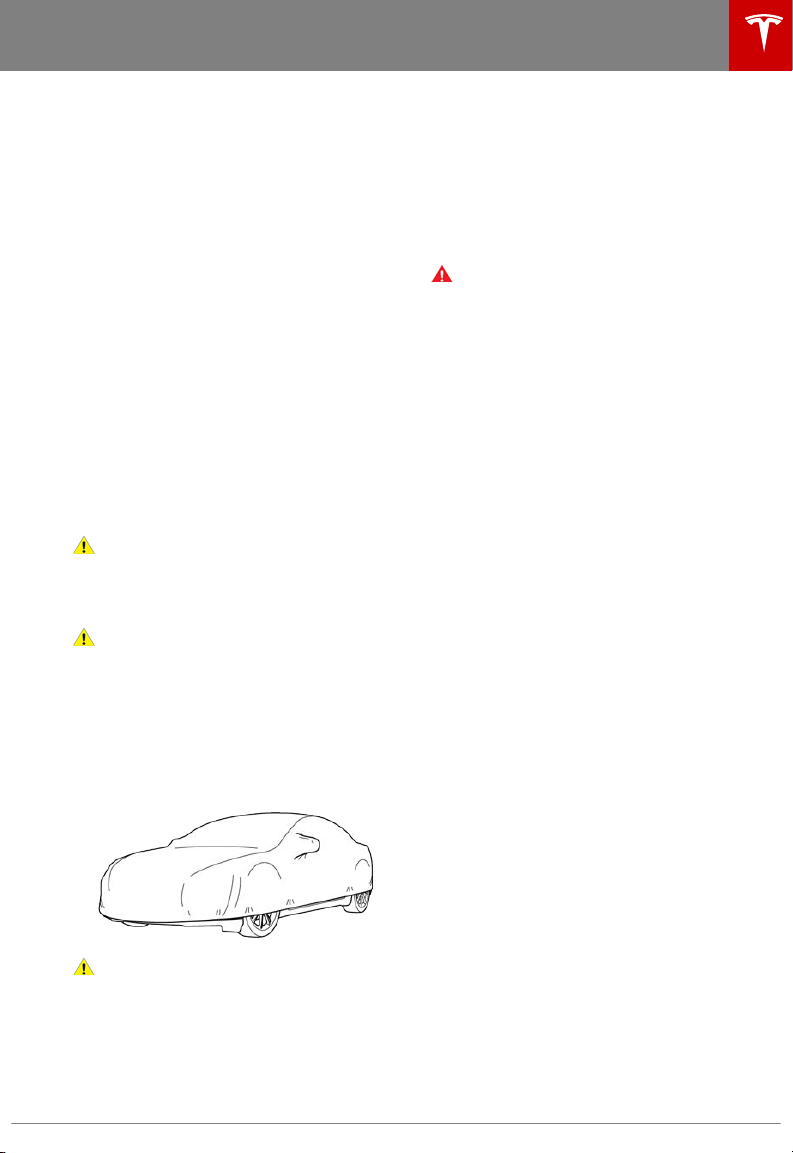
Polishing, Touch Up, and Body
Repair
To preserve the cosmetic appearance of the
body, you can occasionally treat the paint
surfaces with an approved polish containing:
• Very mild abrasive to remove surface
contamination without removing or
damaging the paint.
• Filling compounds that
fill scratches and
reduce their visibility.
• Wax to provide a protective coating
between the paint and environmental
elements.
Regularly inspect the exterior paint for
damage. Treat minor chips and scratches
using a paint touch-up pen (available for
purchase from Tesla). Use the touch-up pen
after washing but before polishing or waxing.
Repair rock chips, fractures or scratches. Body
repairs should be performed only by a Tesla
approved body shop. Contact Tesla for a list of
approved body shops.
Caution: Do not use cutting pastes, color
restoration compounds, or polishes
containing harsh abrasives. These can
scour the surface and permanently
damage the paint.
Caution: Do not use chrome polish or
other abrasive cleaners.
Using a Car Cover
To preserve the cosmetic appearance of the
body when Model X is not being used, use a
genuine Tesla car cover. Car covers can be
purchased from Tesla. See Parts and
Accessories on page 176.
Caution:
Use only a Tesla-approved car
cover when Model X is plugged in. Using
a non-Tesla car cover can prevent the
Battery from being adequately cooled
during charging.
Floor Mats
To extend the life of your carpet and make
them easier to clean, use genuine Tesla floor
mats (see Parts and Accessories on page 176).
Maintain floor mats by regularly cleaning them
and checking that they are properly attached.
Replace
floor mats if they become excessively
worn.
Warning: To avoid potential interference
with a foot pedal, ensure that the driver’s
floor mat is securely fastened, and never
place an additional floor mat on top of it.
Floor mats should always rest on top of
the vehicle carpeting surface and not on
another floor mat or other covering.
Cleaning
Maintenance 171

Checking and Replacing Wipers
To make wiper blades easy to access, turn o
the wipers, shift Model X into Park, then use
the touchscreen to move them to the service
position. Touch Controls > Settings > Service
& Reset > Service Mode > ON.
Note: Wipers automatically return to their
normal position when you shift Model X out of
Park.
Periodically check and clean the edge of the
wiper blade and check the rubber for cracks,
splits and roughness. If damaged, contact
Tesla Service to have the blades replaced.
Contaminants on the windshield, or on the
wiper blades, can reduce the
eectiveness of
the wiper blades. Contaminants include ice,
wax spray from car washes, washer
fluid with
bug and/or water repellent, bird droppings,
tree sap, and other organic substances.
Follow these guidelines for cleaning:
• Clean the windshield using non-abrasive
glass cleaner.
• Lift the wiper arm a short distance away
from the windshield, just far enough to
access the wiper blade, then wipe the
blade clean using isopropyl (rubbing)
alcohol or washer
fluid.
If the wipers remain ineective after cleaning,
the wipers may need to be replaced. The
wiper washing system is an integrated part of
the wiper blades and therefore it is not
possible to replace just the wiper blades. For
wiper replacement, contact Tesla Service.
Wiper Blades and Washer Jets
172 Model X Owner's Manual
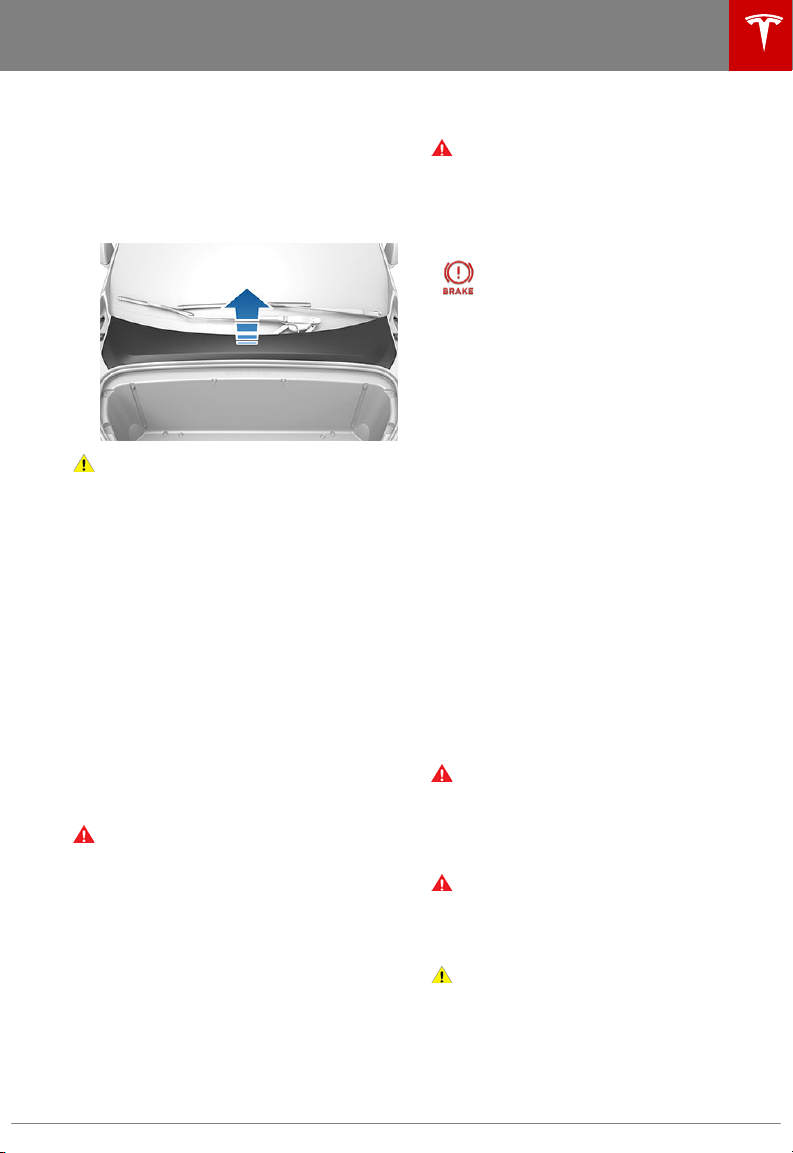
Removing the Maintenance Panel
To check fluid levels, remove the maintenance
panel:
1. Open the hood.
2. Pull the maintenance panel upward to
release the clips that hold it in place.
Caution: The maintenance panel protects
the front trunk from water. When re-
attaching, make sure it is fully seated.
Checking Battery Coolant
If the quantity of
fluid in the cooling system
drops below the recommended level, the
instrument panel displays a warning message.
Stop driving Model X as soon as safety
permits and contact Tesla.
Fluid Level Check
Tesla checks the Battery coolant level at the
regularly scheduled maintenance intervals.
DO NOT REMOVE THE FILLER CAP AND DO
NOT ADD FLUID. Doing so can result in
damage not covered by the warranty.
Do Not Top Up Battery Coolant
Warning:
Battery coolant can be
hazardous and can irritate eyes and skin.
Under no circumstances should you
remove the filler cap and/or add coolant.
If the instrument panel warns you that the
fluid level is low, contact Tesla
immediately.
To maximize the performance and life of the
Battery, the cooling system uses a
specific
mixture of G-48 ethylene-glycol coolant
(HOAT). Contact Tesla for more
specific
information about the coolant.
Checking Brake Fluid
Warning: Contact Tesla immediately if
you notice increased movement of the
brake pedal or a significant loss of brake
fluid. Driving under these conditions can
result in extended stopping distances or
complete brake failure.
The Brake indicator on the
instrument panel alerts you if the
quantity of fluid in the brake
reservoir drops below the
recommended level. If it displays
while driving, stop as soon as safety
permits by gently applying the
brakes. Do not continue driving.
Contact Tesla immediately.
Fluid Level Check
Tesla checks the brake fluid level at the
regularly scheduled maintenance intervals.
Topping Up the Brake Fluid
Do not top up your brake
fluid. Tesla service
does this when you bring Model X in for
regular servicing. The following instructions
are provided for information purposes and
future reference only:
1. Clean the
filler cap before removing it to
prevent dirt from entering the reservoir.
2. Unscrew the cap and remove it.
3. Top up the reservoir to the MAX mark
using the appropriate brake
fluid.
4. Replace the filler cap, ensuring it is fully
secured.
Warning:
Only use new fluid from a
sealed air-tight container. Never use
previously used fluid or fluid from a
previously opened container—fluid
absorbs moisture which decreases
braking performance.
Warning: Brake fluid is highly toxic. Keep
containers sealed and out of the reach of
children. In the event of accidental
consumption, seek medical attention
immediately.
Caution: Brake fluid damages painted
surfaces. Immediately soak up any spills
with an absorbent cloth and wash the
area with a mixture of car shampoo and
water.
Fluid Reservoirs
Maintenance 173

Topping Up Washer Fluid
The only reservoir into which you can add fluid
is the washer fluid reservoir, which is located
behind the front trunk. When the level is low, a
message displays on the instrument panel.
Caution: Do not add formulated washer
fluids that contain water repellent or bug
wash. These fluids can cause streaking,
smearing, and squeaking or other noises.
Operate the washers periodically to check that
the nozzles are clear and properly directed.
See Wipers and Washers on page 65.
To top up the washer
fluid:
1. Open the hood.
2. Clean around the filler cap before opening
it to prevent dirt from entering the
reservoir.
3. Open the
filler cap.
4. Fill the reservoir until the fluid level is
visible just below the
filler neck.
5. Replace the filler cap.
Note: Some national or local regulations
restrict the use of Volatile Organic
Compounds (VOCs). VOCs are commonly
used as antifreeze in washer
fluid. Use a
washer fluid with limited VOC content only if it
provides adequate freeze resistance for all
climates in which you drive Model X.
Caution:
Under no circumstances do you
need to inspect or top up other fluid
reservoirs. Two additional fluid reservoirs
are located next to the washer fluid, but
underneath the maintenance panel. In the
unlikely event that you see a message on
the instrument panel that one of these
fluid levels is low, stop driving Model X as
soon as safe to do so, and contact Tesla.
Caution: Do not spill washer fluid on
body panels. Doing so can cause damage.
Wipe up spills immediately and wash the
aected area with water.
Warning: In temperatures below 4° C, use
a washer fluid with antifreeze. In cold
weather, using a washer fluid without
antifreeze can impair visibility through the
windshield.
Warning: Windshield washer fluid can
irritate eyes and skin. Read and observe
the instructions provided by the washer
fluid manufacturer.
Fluid Reservoirs
174 Model X Owner's Manual
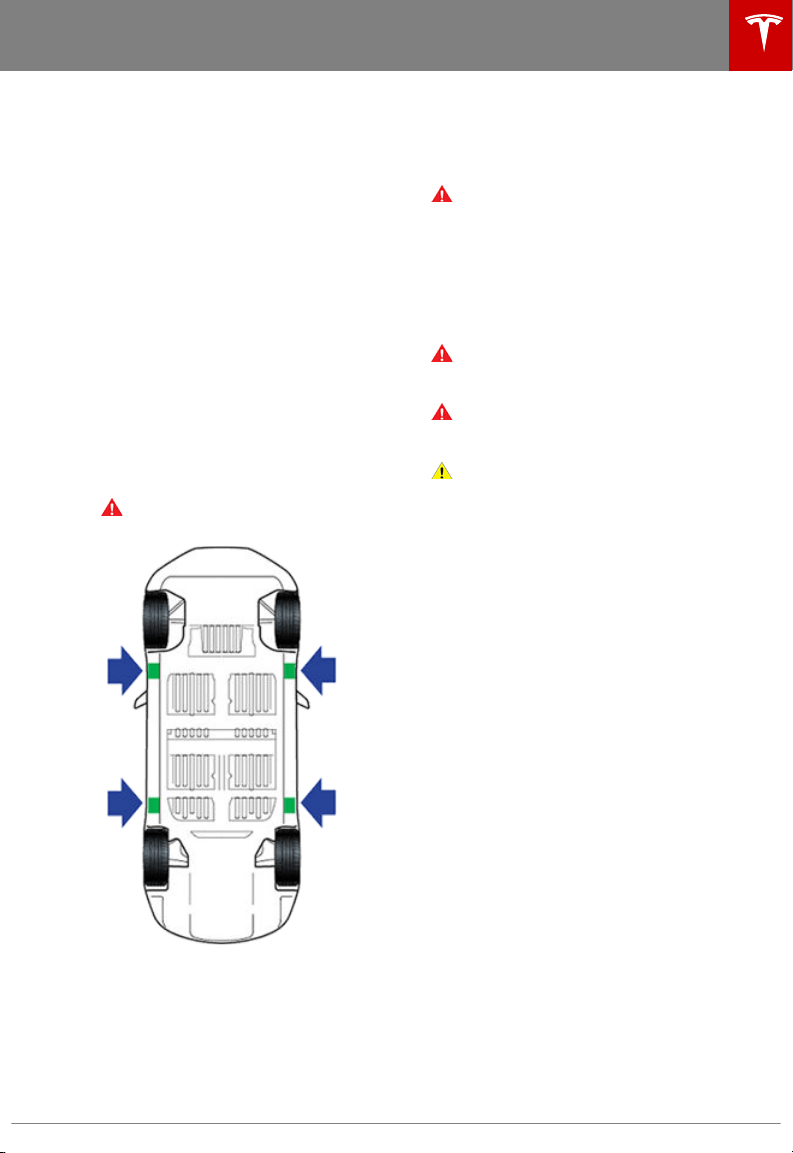
Jacking Procedure
Follow the steps below to lift Model X. Ensure
that any non-Tesla repair facility is aware of
these lifting points.
1. Position Model X centrally between the lift
posts.
2. If your Model X is equipped with Smart Air
Suspension, it automatically self-levels,
even when power is
o. Use the
touchscreen to set the suspension as
follows:
• Touch Controls > Suspension.
• Press the brake pedal, then touch
Very High to maximize the height of
the suspension.
• Touch Jack to disable self-leveling.
3. Close the falcon wing doors.
4. Position the lift arm pads under the
designated body lift points at the
locations shown.
Warning: DO NOT position the lift
arm pads under the Battery.
5. Adjust the height and position of the lift
arm pads to ensure that they are correctly
located.
6. With assistance, raise the lift, ensuring the
lift arm pads remain in their correct
positions.
Note: Jack mode cancels when Model X is
driven over 7 km/h.
Note:
Jack mode may be unexpectedly
enabled in situations where an object is
supporting the vehicle's weight (for example
the bumper of the vehicle is resting on a curb).
Warning: If your Model X is equipped
with Smart Air Suspension, it
automatically self-levels, even when
power is o. You MUST disable this
system by engaging Jack mode before
lifting or jacking. If you do not disable
Smart Air Suspension, Model X can
attempt to self-level, causing serious
damage, bodily injury, or death.
Warning: Never raise Model X when the
charge cable is connected, even if
charging is not in progress.
Warning: Do not work on an incorrectly
supported vehicle. Doing so can cause
serious damage, bodily injury, or death.
Caution: DO NOT lift from under the
Battery. Place the lift arm pads under the
designated body lift points only. The
locations shown are the only approved
lifting points for Model X. Lifting at any
other points can cause damage. Damage
caused by incorrectly lifting Model X is
not covered by the warranty.
Jacking and Lifting
Maintenance 175
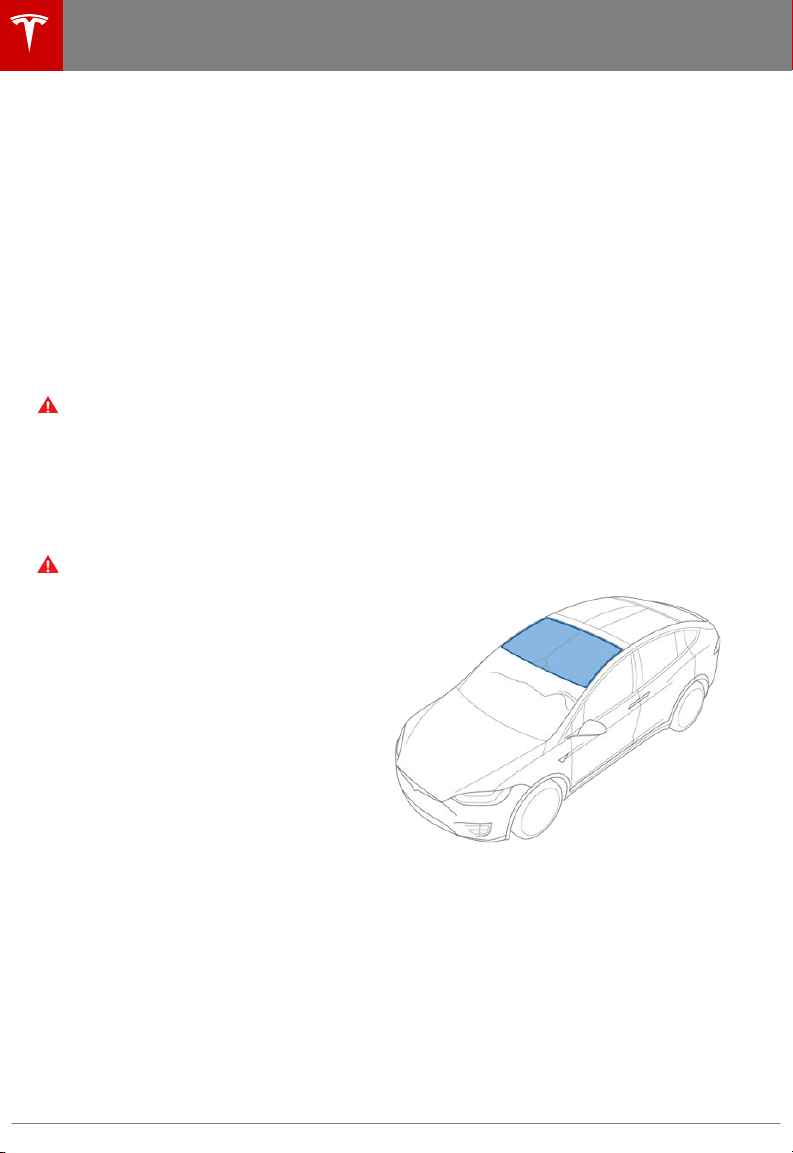
Parts, Accessories, and
Modifications
Use only genuine Tesla parts and accessories.
Tesla performs rigorous testing on parts to
ensure their suitability, safety, and reliability.
Purchase these parts from Tesla, where they
are professionally installed and where you can
receive expert advice about
modifications to
Model X. Accessories are available for
purchase from Tesla stores or online at
www.tesla.com/shop.
Tesla is unable to assess parts manufactured
by other distributors and therefore accepts no
responsibility if you use non-Tesla parts on
Model X.
Warning: Installing non-approved parts
and accessories, or performing non-
approved modifications, can aect the
performance of Model X and the safety of
its occupants. Any damage caused by
using or installing non-approved parts, or
by performing non-approved
modifications, is not covered by the
warranty.
Warning: Tesla does not accept liability
for death, personal injury or damage that
occurs if you use or install non-approved
accessories or make non-approved
modifications.
Body Repairs
If Model X is in a collision, contact Tesla to
ensure that it is repaired with genuine Tesla
parts. Tesla has selected and approved body
shops that meet strict requirements for
training, equipment, quality, and customer
satisfaction.
Some repair shops and insurance companies
might suggest using non-original equipment
or salvaged parts to save money. However,
these parts do not meet Tesla's high standards
for quality,
fit and corrosion resistance. In
addition, non-original equipment and salvaged
parts (and any damage or failures they might
cause) are not covered by the warranty.
Using RFID Transponders
When attaching an RFID transponder (used by
many automated toll systems) inside Model X,
place the transponder in the topmost area of
the windshield as shown. This ensures best
results and minimizes any obstruction to your
driving view.
Note: You can also attach a weather-proof
transponder to the front license plate.
Parts and Accessories
176 Model X Owner's Manual
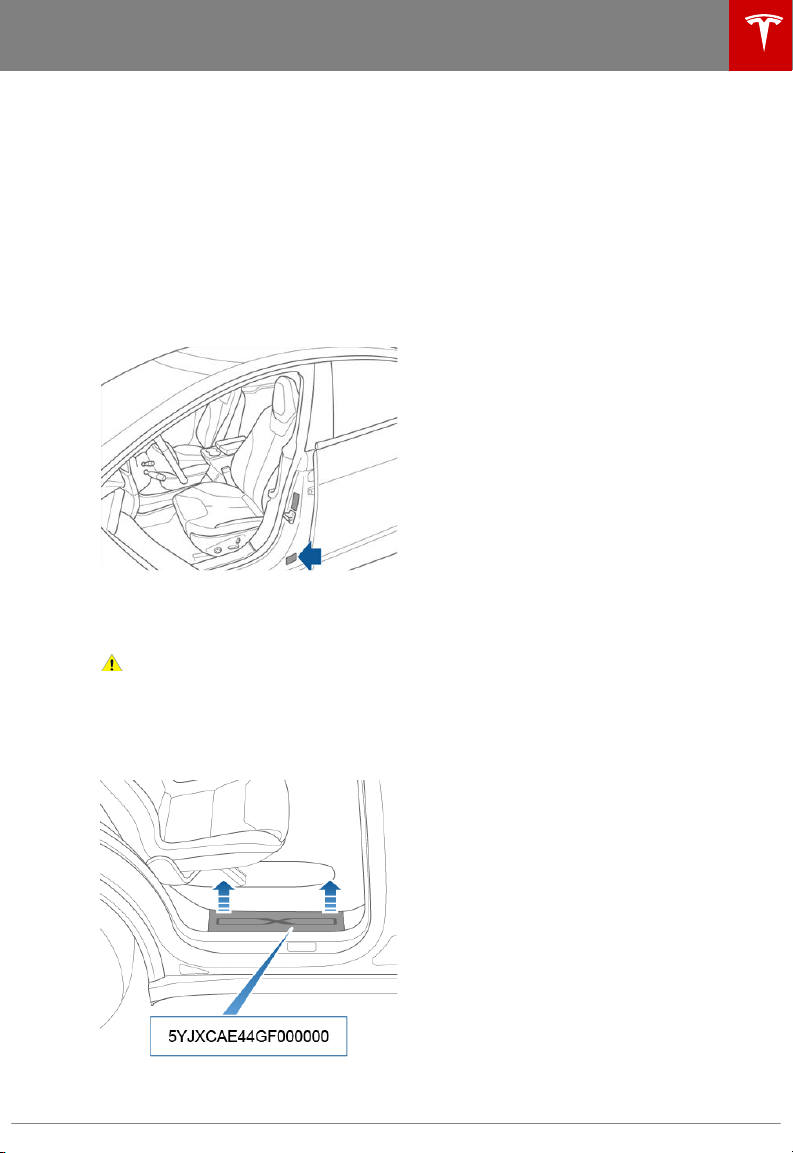
Vehicle Identification Number
You can find the VIN at the following
locations:
• Touch the Tesla "T" at the top center of
the touchscreen. The popup window
displays the VIN.
• Stamped on a plate located at the top of
the dashboard. Can be seen by looking
through the windshield.
• Printed on the Statutory Plate, located on
the door pillar. Can be seen when the
driver’s door is open.
• Stamped on the chassis under the sill
panel on the rear passenger door. To
remove the sill panel, gently pry it upward
using a
flat-bladed tool.
Caution:
Removing the sill panel to
view the VIN is not recommended
because damage is likely to occur.
The panel is held in place with fragile
clips that break easily. Damage
caused by removing the sill panel is
not covered by the warranty.
Identification Labels
Specifications 177
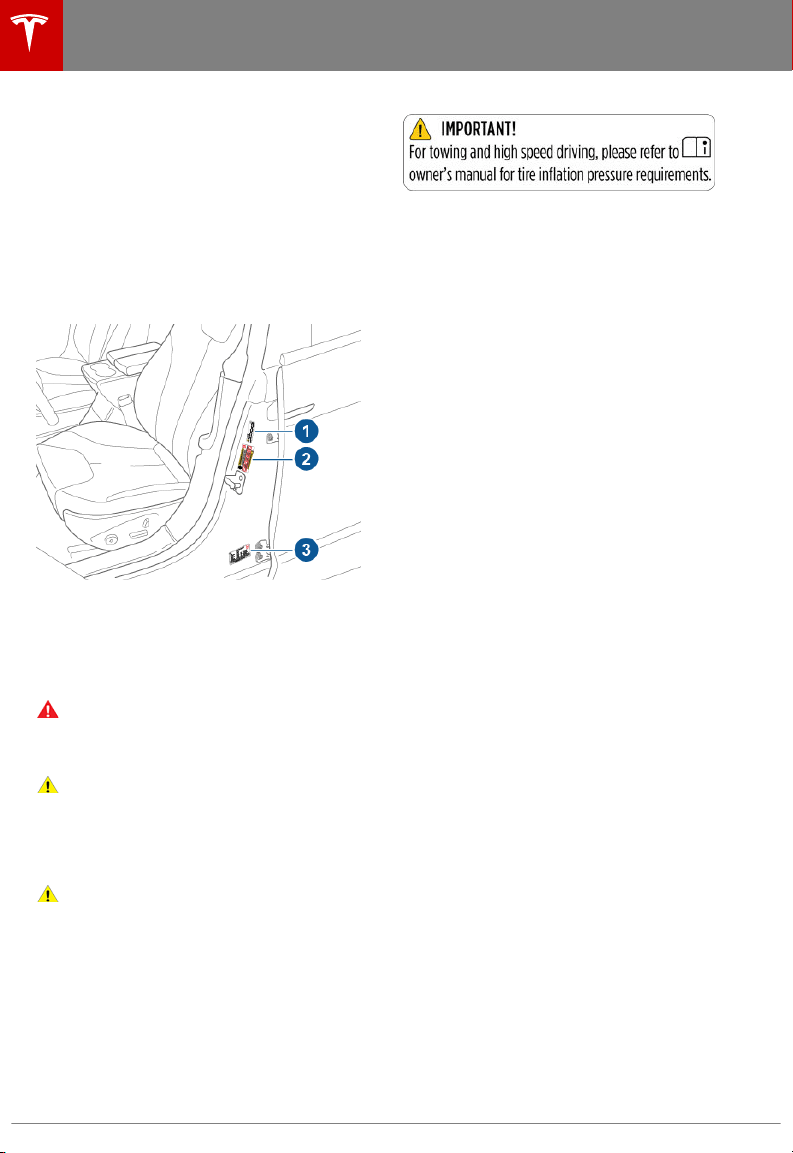
Load Capacity Labeling
It is important to understand how much
weight your Model X can safely carry. This
weight is called the vehicle capacity weight
and includes the weight of all occupants,
cargo and any additional equipment added to
your Model X since it was manufactured.
One or more labels attached to the center
door pillar indicate how much weight Model X
can safely carry. Labels are visible when the
front door is open.
1.
Towing label (if equipped)
2. Tire and Loading Information label
3. Statutory Plate
Note: Towing capability is available only if
Model X is equipped with the Towing Package.
Warning:
Overloading Model X has an
adverse eect on braking and handling,
which can compromise your safety or
cause damage.
Caution: Never load more than 175 lbs
(80 kg) on the rear load floor (above the
lower trunk compartment) or more than
130 lbs (60 kg) in the lower trunk
compartment. Doing so can cause
damage.
Caution: Never store large amounts of
liquid in Model X. A significant spill can
cause electrical components to
malfunction.
Towing Label
If equipped with the towing package, the
Towing Label instructs you to refer to this
owner's manual for tire pressures that should
be used when towing a trailer. Do not use the
tire pressures printed on the Tire and Loading
Information Label.
Note: Towing capability is available only if
Model X is equipped with the Towing Package.
Tire pressure information, along with other
information related to towing, is located in the
topic "Towing a Trailer" in the Driving section
of the onscreen owners manual.
Vehicle Loading
178 Model X Owner's Manual
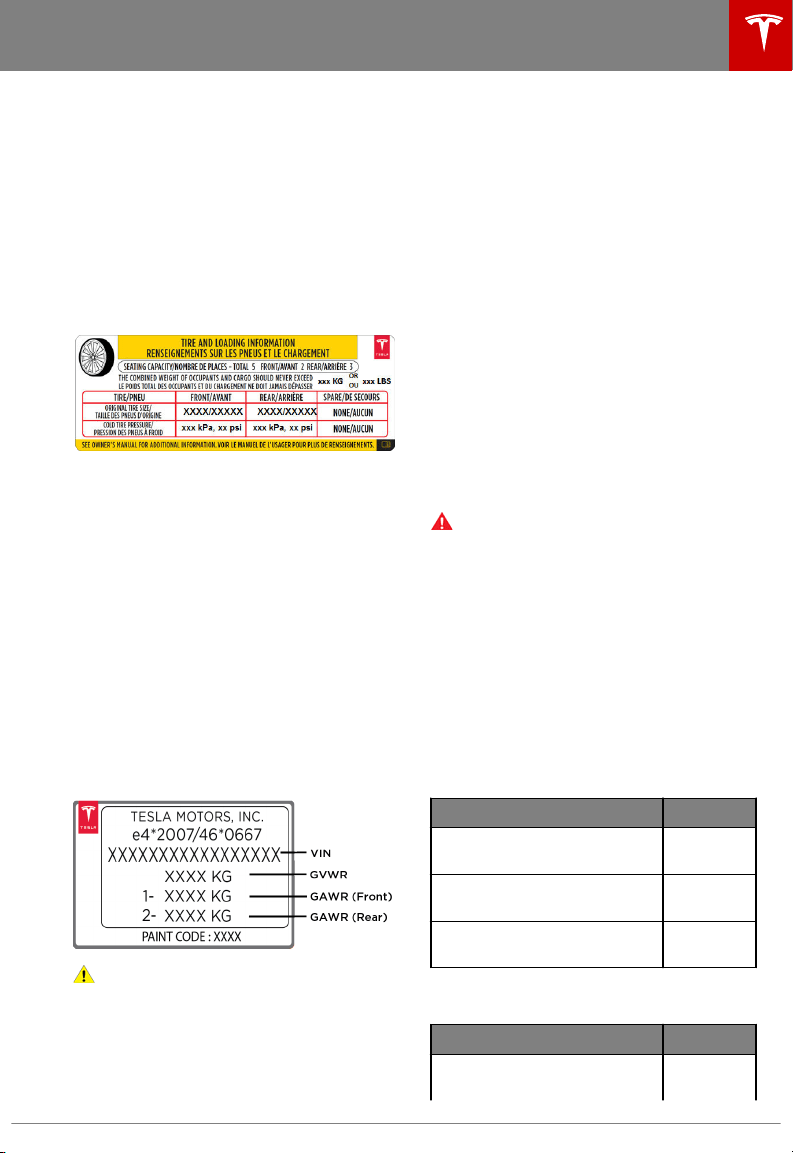
Tire and Loading Information Label
The Tire and Loading Information label
provides:
• The maximum number of occupant
seating positions.
• The maximum vehicle capacity weight.
• The size of the original tires.
• The cold
inflation pressures for the
original front and rear tires. These
pressures are recommended to optimize
ride and handling characteristics.
Never change this label, even if you use
dierent tires in the future.
Note: If Model X is loaded to its full capacity,
double check all tires to ensure they are
inflated to their recommended pressure levels.
Statutory Plate
In addition to the VIN, the Statutory Plate
provides:
• GVWR - Gross Vehicle Weight Rating. The
maximum allowable total mass of Model X.
This is calculated as the weight of
Model X, all passengers,
fluids, and cargo.
• GAWR - Gross Axle Weight Rating for the
front and rear axles. The GAWR is the
maximum distributed weight that each
axle can support.
Caution:
To prevent damage, never load
Model X so that it is heavier than GVWR
or exceeds the individual GAWR weights.
Calculating Load Limits
1. Locate the statement “The combined
weight of occupants and cargo should
never exceed XXX kg or XXX lbs” on the
“Tire and Loading Information” label.
2. Determine the combined weight of all
occupants that will ride in the vehicle.
3. Subtract the combined weight of the
occupants from XXX kg or XXX lbs (see
Step 1).
4. The resulting
figure equals the available
cargo load capacity. For example, if the
“XXX” amount equals 1400 lbs (635 kg)
and there will be
five 150 lb (68 kg)
passengers in the vehicle, the amount of
available cargo capacity is 650 lbs
(1400 ‑ 750 (5 x 150) = 650 lbs) or 295 kg
(635 ‑ 340 (5 x 68) = 295 kg).
5. Determine the combined cargo weight
being loaded on the vehicle. That weight
must not exceed the available cargo load
capacity calculated in Step 4.
Warning: Trunks are the preferred places
to carry objects. In a collision, or during
hard braking and sharp turns, loose items
in the cabin could injure occupants.
Example Load Limit Calculations
How much cargo Model X can carry depends
on the number and weight of passengers. The
following calculated load limit examples
assume passengers weigh 150 lbs (68 kg). If
passengers weigh more or less, available
cargo weight decreases or increases
respectively.
Driver and one passenger
Description
Total
Vehicle capacity weight 954 lbs
(433 kg)
Subtract occupant weight
(2 x 150 lbs/68 kg)
300 lbs
(136 kg)
Available cargo weight 654 lbs
(297 kg)
Driver and four passengers
Description
Total
Vehicle capacity weight 954 lbs
(433 kg)
Vehicle Loading
Specifications 179

Description Total
Subtract occupant weight (5 x
150 lbs/68 kg)
750 lbs
(340 kg)
Available cargo weight 204 lbs
(93 kg)
The cargo weight should be distributed
between the front and rear trunks.
Caution: Never load more than 175 lbs
(80 kg) on the rear load floor (above the
lower trunk compartment) or more than
130 lbs (60 kg) in the lower trunk
compartment. Doing so can cause
damage.
Vehicle Loading
180 Model X Owner's Manual
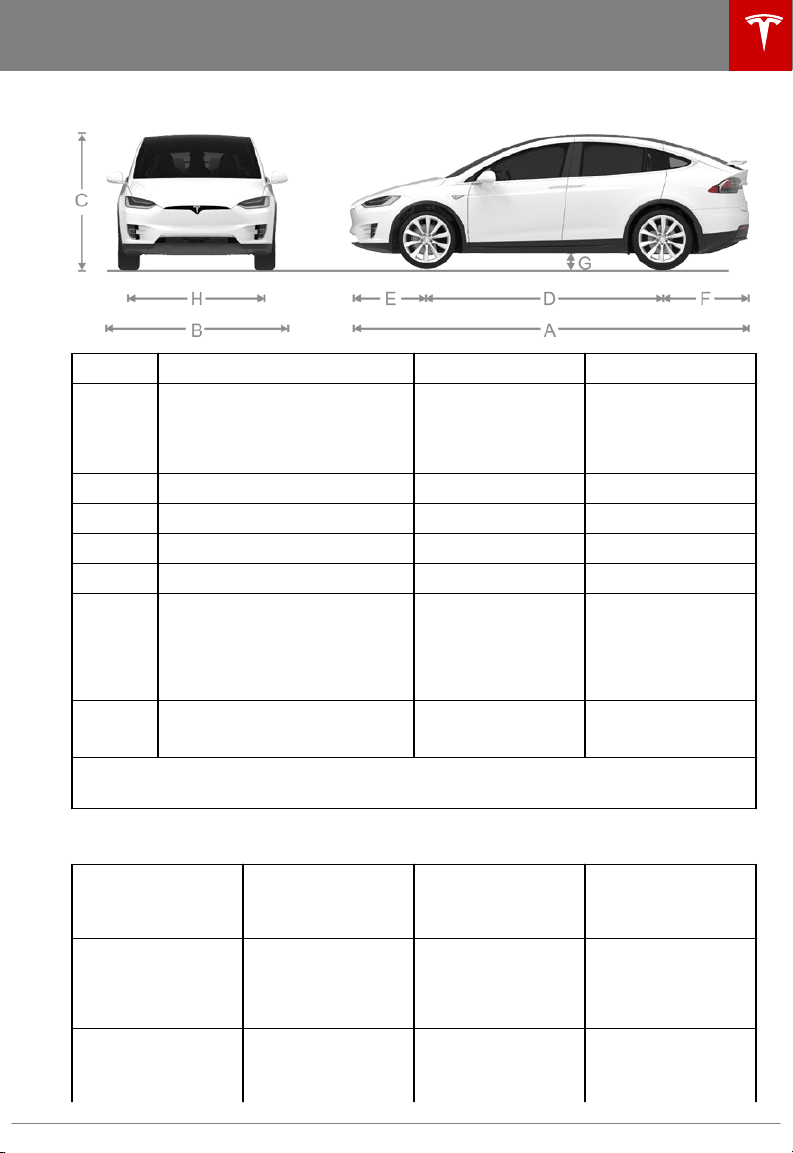
Exterior Dimensions
A Overall Length 199 in 5,052 mm
B
Overall Width (including mirrors)
Overall Width (including folded
mirrors
Overall Width (excluding mirrors)
89 in
82 in
79 in
2,272 mm
2,017 mm
1,999 mm
C Overall Height 66 in* 1,684 mm*
D Wheel Base 117 in 2,965 mm
E Overhang - Front 39 in 989 mm
F Overhang - Rear 43 in 1,098 mm
G
Ground Clearance:
Standard, with skis
Standard, without skis
Very high, with skis
Very high, without skis
7 in
7 in
8 in
9 in
171 mm
183 mm
211 mm
223 mm
H
Track - Front
Track - Rear
67 in
67 in
1,711 mm
1,723 mm
*Values are approximate. The dimensions can vary depending on vehicle configuration and
various other factors.
Interior Dimensions
Head Room
Front
Rear
Third
41.7 in
40.9 in
37.1 in
1059 mm
1039 mm
942 mm
Leg Room
Front
Rear
Third
41.2 in
38.4 in
32.7 in
1046 mm
975 mm
831 mm
Shoulder Room
Front
Rear
Third
60.7 in
56.8 in
40 in
1542 mm
1442 mm
1016 mm
Dimensions and Weights
Specifications 181
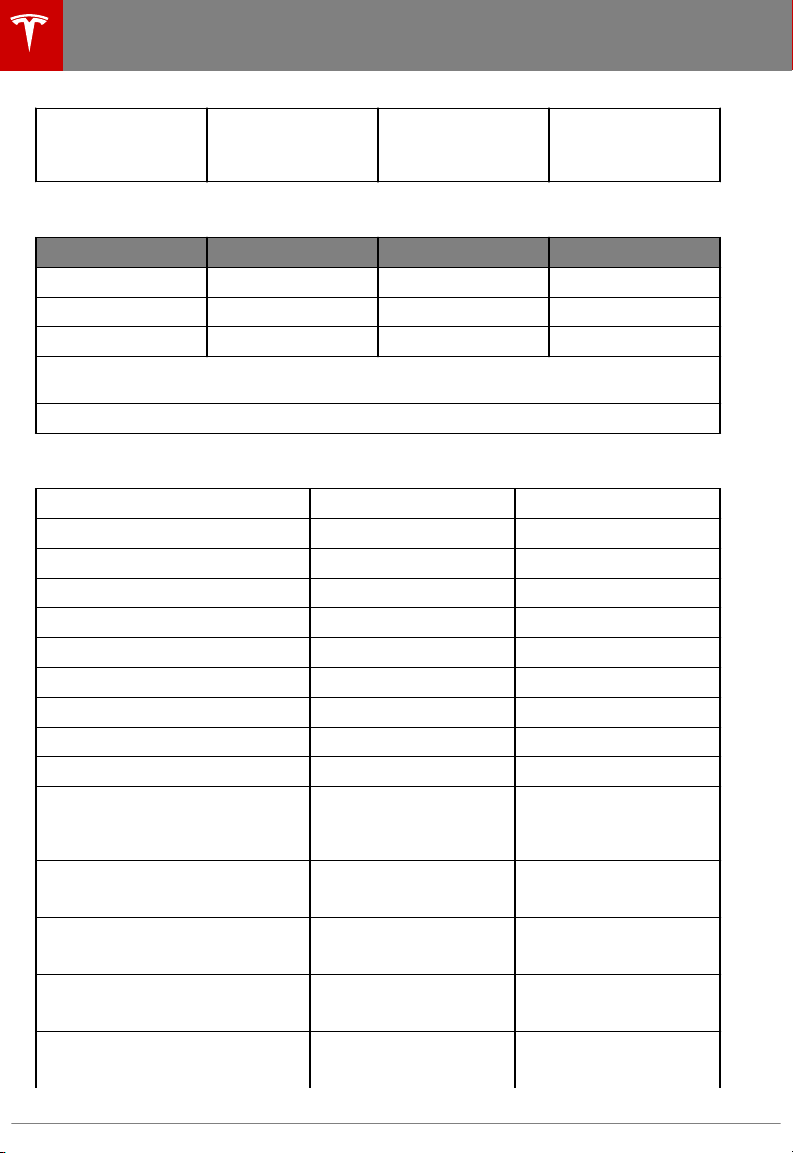
Hip Room
Front
Rear
Third
55.6 in
59 in
38.5 in
1412 mm
1498 mm
978 mm
Cargo Volume
Front Trunk Rear* Total
Seven Seat Vehicles 6.6 cu ft (187 L) 76.5 cu ft (2166 L)** 83.1 cu ft (2353 L)
Six Seat Vehicles 6.6 cu ft (187 L) 70.7 cu ft (2002 L)** 77.3 cu ft (2189 L)
Five Seat Vehicles 6.6 cu ft (187 L) 81.2 cu ft (2299.5 L)** 87.8 cu ft (2486.5 L)
* Maximum cargo volume behind the front row seats. Includes the 12.6 cu ft (357 L) cargo area
in the rear trunk (area behind the third row seats, if equipped).
** Second row seats fully forward and/or folded.
Weights
Curb Weight* - 60D/75D 5,185 lbs 2,352 kg
Curb Weight* - 90D 5,267 lbs 2,389 kg
Curb Weight* - P90D 5,377 lbs 2,439 kg
Curb Weight* - 100D 5,421 lbs 2,459 kg
Curb Weight* - P100D 5,483 lbs 2,487 kg
GVWR** - 60D/75D 6,581 lbs 2,985 kg
GVWR** - 90D 6,658 lbs 3,020 kg
GVWR** - P90D 6,768 lbs 3,070 kg
GVWR** - 100D 6,788 lbs 3,079 kg
GVWR** - P100D 6,878 lbs 3,120 kg
Gross Vehicle Weight Distribution -
60D/75D
Front: 2,890 lbs
Rear: 3,690 lbs
Front: 1,311 kg
Rear: 1,674 kg
Gross Vehicle Weight Distribution -
90D
Front: 2,977 lbs
Rear: 3,681 lbs
Front: 1,350 kg
Rear: 1,670 kg
Gross Vehicle Weight Distribution -
P90D
Front: 2,976 lbs
Rear: 3,792 lbs
Front: 1,350 kg
Rear: 1,720 kg
Gross Vehicle Weight Distribution -
100D
Front: 3,097 lbs
Rear: 3,690 lbs
Front: 1,405 kg
Rear: 1,674 kg
Gross Vehicle Weight Distribution -
P100D
Front: 3,027 lbs
Rear: 3,851 lbs
Front: 1,373 kg
Rear: 1,747 kg
Dimensions and Weights
182 Model X Owner's Manual

Gross Axle Weight Rating- Front 3,241 lbs 1,470 kg
Gross Axle Weight Rating - Rear (at
nominal tire pressure of 42 psi)
3,968 lbs 1,800 kg
Towing Capacity (if equipped) See Towing and Accessories on page 80.
*Curb Weight = weight of the vehicle with correct fluid levels, no occupants and no cargo
**GVWR = Gross Vehicle Weight Rating
Dimensions and Weights
Specifications 183
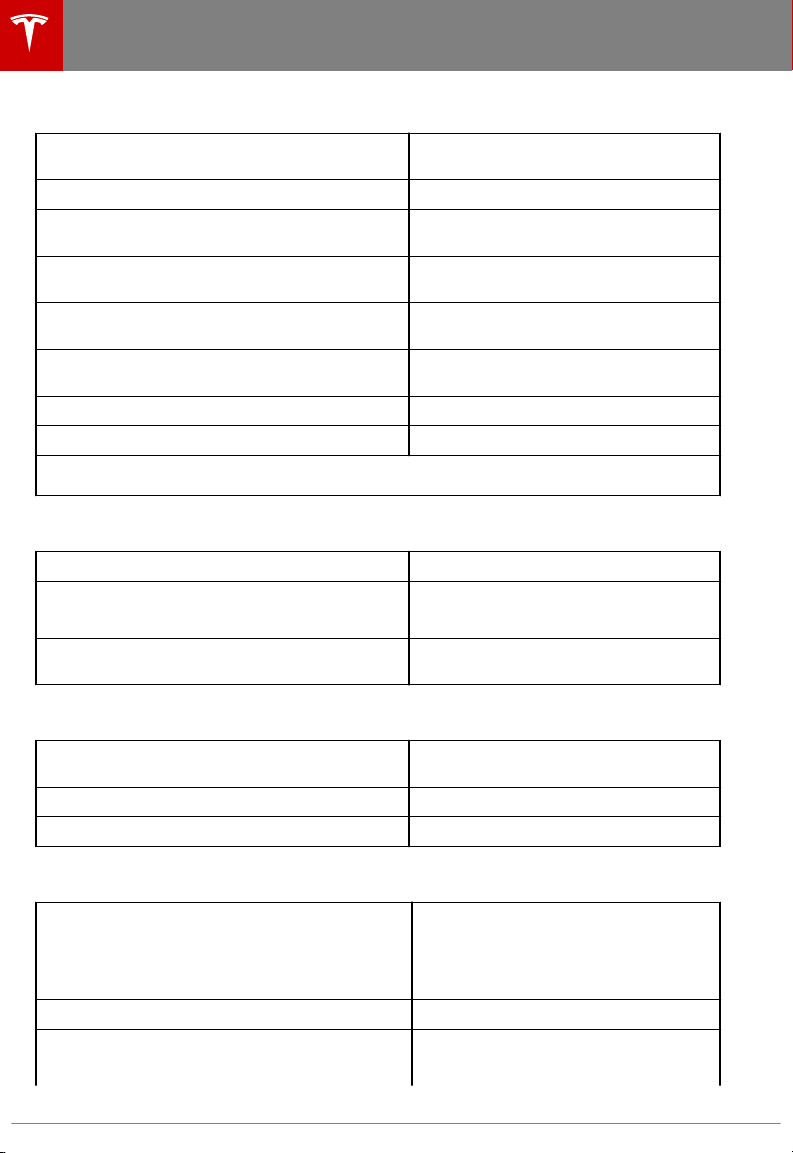
Motor
Type AC induction motor, liquid-cooled, with
variable frequency drive
Nominal Voltage 320 volts
Maximum speed of large motors (rear motor on
Performance vehicles)
18700 rpm
Maximum speed of small motors (front motor on all
vehicles, rear motor on non-Performance vehicles)
18200 rpm
Maximum net power* and motor speed of large
motors
375 kW @ 6,150 rpm
Maximum net power* and motor speed of small
motors
193 kW @ 6,100-6,800 rpm
Maximum torque of large motors 660 Nm
Maximum torque of small motors 330 Nm
*Tested in accordance with ECE R85
Transmission
Type Single speed fixed gear
Overall Final Drive Ratio
Small motor: 9.325:1
Large motor: 9.734:1
Reverse Gear Reverse direction of motor, limited to
24 km/h
Steering
Type
Rack and pinion with electronic power
steering, speed sensitive
Number of turns lock to lock 2.05
Turning Circle (curb to curb) 12.44 meters
Brakes
Type
4-wheel anti-lock braking system (ABS)
with Electronic Brake Force Distribution,
Integrated Advanced Stability Control and
Electronic Accelerator pedal actuated
regenerative braking system
Calipers Four piston fixed
Rotor Diameters (ventilated)
Front: 13.98”/355 mm
Rear: 14.37”/365 mm
Subsystems
184 Model X Owner's Manual

Front Rotor thickness
New: 1.26”/32 mm
Service limit: 1.18”/30 mm
Rear Rotor thickness
New: 1.10”/28 mm
Service limit: 1.02”/26 mm
Front Brake Pad Thickness (excluding back plate) 0.393”/10 mm
Rear Brake Pad Thickness (excluding back plate) Base: 0.354”/9 mm
Parking brake
Electrically actuated parking brake
calipers
Suspension
Front Independent, virtual pivot double
wishbone
Rear Independent, virtual pivot double
wishbone
Battery - 12V
Rating 33 amp hour or higher
Voltage and Polarity 12V negative (-) ground
Battery - High Voltage
Type
Liquid-cooled lithium ion (Li-ion)
Rating 60, 70, 75, 85, 90, or 100 kWh (at
beginning of life)
Nominal Voltage - 85, 90, and 100 kWh
Nominal Voltage - 60, 70, and 75 kWh
350 V DC
300 V DC
Temperature Range Do not expose Model X to ambient
temperatures above 60° C or below
-30° C for more than 24 hours at a time.
Subsystems
Specifications 185
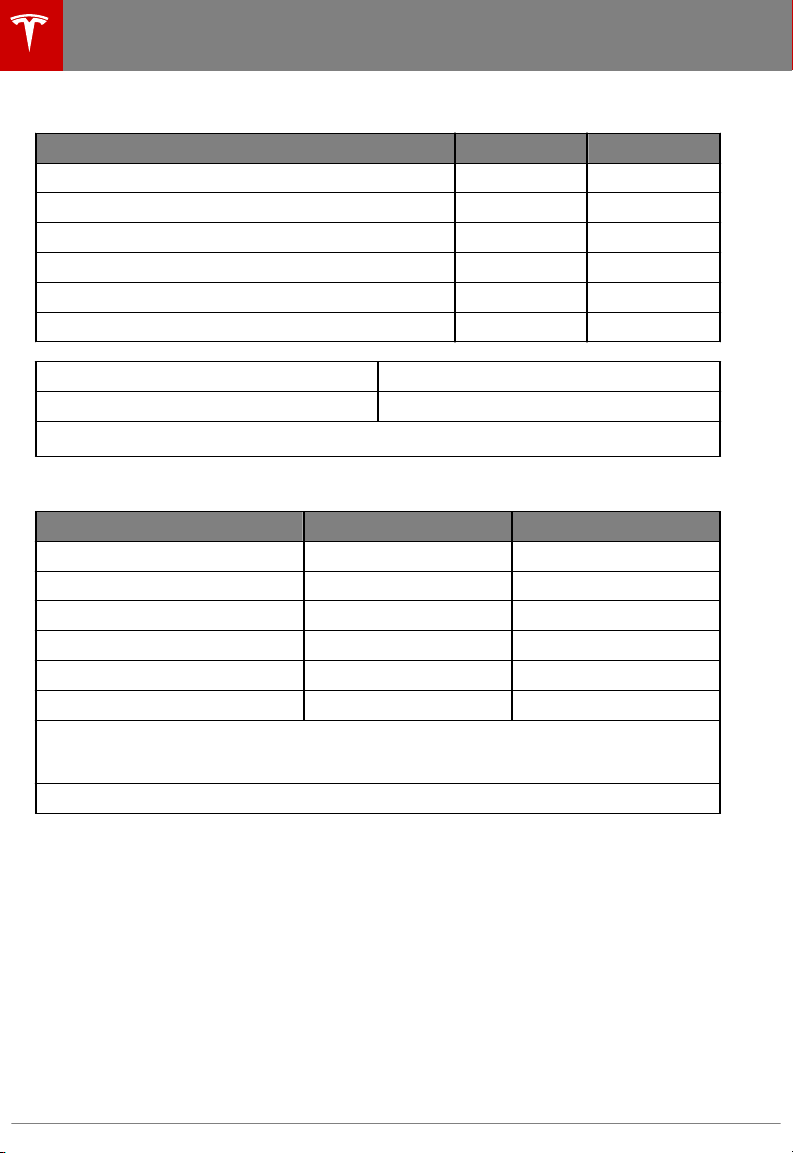
Wheel Specifications
Wheel Type Size Oset
20" - All Season - Front 9.0J x 20 1.378" 35 mm
20" - All Season - Rear 9.5J x 20 1.575" 40 mm
20" - Summer - Front 9.0J x 20 1.378" 35 mm
20" - Summer - Rear 10.0J x 20 1.378" 35 mm
22" - Summer - Front 9.0J x 22 1.378" 35 mm
22" - Summer - Rear 10.0J x 22 1.378" 35 mm
Lug Nut Torque 129 lb. ft (175 Nm)
Lug Nut Socket Size 21 mm
Note: For instructions on how to jack/lift Model X, see Jacking and Lifting on page 175.
Tire Specifications
Tire Type Size Load Index / Speed Rating
20" - Continental - Front 265/45R20 108 / V
20" - Continental - Rear 275/45R20 110 / V
20" - Michelin - Front 255/45R20 105 / Y
20" - Michelin - Rear 275/45R20 110 / Y
22" - Goodyear or Pirelli - Front 265/35R22 102 / W
22" - Goodyear or Pirelli - Rear 285/35R22 106 / W
Refer to the tire pressures printed on the Tire and Loading Information label. This label is
located on the driver’s door pillar and is visible when the driver’s door is open (see Maintaining
Tire Pressures on page 163).
Winter tires can be purchased from a Tesla store.
Wheels and Tires
186 Model X Owner's Manual
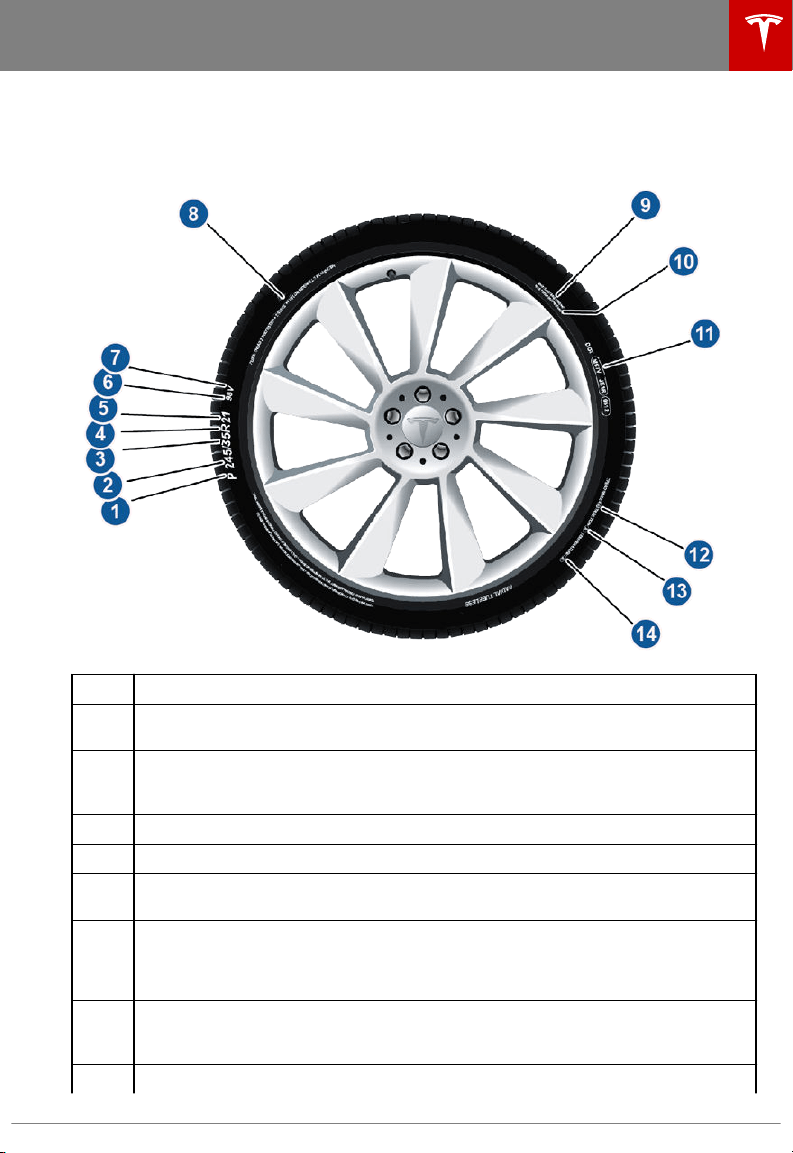
Understanding Tire Markings
Laws require tire manufacturers to place standardized information on the sidewall of all tires. This
information identifies and describes the fundamental characteristics of the tire.
1 Tire category. P indicates that the tire is for passenger vehicles.
2 Tire width. This 3-digit number is the width (in millimeters) of the tire from sidewall
edge to sidewall edge.
3 Aspect ratio. This 2-digit number is the sidewall height as a percentage of the tread
width. So, if the tread width is 205 mm, and the aspect ratio is 50, the sidewall height is
102 mm.
4 Tire construction. R indicates that the tire is of Radial ply construction.
5 Wheel diameter. This 2-digit number is the diameter of the wheel rim in inches.
6 Load index. This 2 or 3-digit number is the weight each tire can support. This number is
not always shown.
7 Speed rating. When stated, indicates the maximum speed (in mph) at which the tire
can be used for extended periods. Q=99 mph (160 km/h), R=106 mph (170 km/h),
S=112 mph (180 km/h), T=118 mph (190 km/h), U=124 mph (200 km/h), H=130 mph
(210 km/h), V=149 mph (240 km/h), W=168 mph (270 km/h), Y=186 mph (300 km/h).
8 Tire composition and materials. The number of plies in both the tread area and the
sidewall area indicates how many layers of rubber coated material make up the
structure of the tire. Information is also provided on the type of materials used.
9 Maximum tire load. The maximum load which can be carried by the tire.
Wheels and Tires
Specifications 187

10 Maximum permissible inflation pressure. This pressure should not be used for normal
driving.
11 U.S. DOT Tire Identification Number (TIN). Begins with the letters DOT and indicates
that the tire meets all federal standards. The next 2 digits/letters represent the plant
code where it was manufactured, and the last 4 digits represent the week and year of
manufacture. For example, the number 1712 is used to represent the 17th week of 2012.
The other numbers are marketing codes used at the manufacturer’s discretion. This
information can be used to contact consumers if a tire defect requires a recall.
12 Treadwear grade. This number indicates the tire’s wear rate. The higher the treadwear
number is, the longer it should take for the tread to wear down. A tire rated at 400, for
example, lasts twice as long as a tire rated at 200.
13 Traction grade. Indicates a tire’s ability to stop on wet roads. A higher graded tire
should allow you to stop your vehicle in a shorter distance than a tire with a lower
grade. Traction is graded from highest to lowest as AA, A, B, and C.
14 Temperature grade. The tire’s resistance to heat is grade A, B, or C, with A indicating
the greatest resistance. This grading is provided for a correctly inflated tire, which is
being used within its speed and loading limits.
Wheels and Tires
188 Model X Owner's Manual

Tire and Loading Glossaries
General Wheel and Tire Terms
Accessory Weight The combined weight (in excess of those items replaced) of
items available as factory installed equipment.
Bead The inner edge of a tire that is shaped to fit to the rim and form
an air tight seal. The bead is constructed of steel wires which
are wrapped, or reinforced, by the ply cords.
Cold Tire Pressure The air pressure in a tire that has been standing in excess of
three hours, or driven for less than one mile.
Curb Weight The weight of a standard vehicle, including any optional
equipment fitted, and with the correct fluid levels.
Gross Vehicle Weight The maximum permissible weight of a vehicle with driver,
passengers, load, luggage, and equipment.
kPa (kilo pascal) A metric unit used to measure pressure. One kilo pascal equals
approximately 0.145 psi.
Maximum Inflation Pressure The maximum pressure to which the tire should be inflated.
This pressure is given on the tire side wall in psi (lbf/in2).
Caution: This pressure marked on the tire is the maximum
allowed by the tire manufacturer. It is not the pressure
Tesla recommends using for Model X.
Maximum Loaded Vehicle
Weight
The sum of curb weight, accessory weight, vehicle capacity
weight, and production options weight.
Production Options Weight The combined weight of options installed which weigh in
excess of 3 lb more than the standard items that they replaced,
and are not already considered in curb or accessory weights.
PSI (lbf/in2) Pounds per square inch (the unit used to measure tire
pressure).
Recommended Tire Inflation
Pressure
Tire inflation pressure, established by Tesla, which is based on
the type of tires that are mounted on the vehicle at the factory.
This information can be found on the Tire and Loading
Information label located on the door pillar.
Rim The metal support for a tire, or tire and tube, upon which the
tire beads are seated.
Vehicle Capacity Weight The number of seats multiplied by 150 lbs plus the rated
amount of load/luggage.
Load Carrying Definitions
Normal occupant weight
68 kilograms (150 lbs) times the number of occupants specified
in the second column of the tables for calculating load limits
(see Vehicle Loading on page 178).
Occupant distribution Distribution of occupants in a vehicle.
Passenger car tire A tire intended for use on passenger cars, multipurpose
passenger vehicles, and trucks, that have a gross vehicle weight
rating (GVWR) of 10,000 pounds or less.
Wheels and Tires
Specifications 189

Rim diameter Nominal diameter of the bead seat.
Rim size designation Rim diameter and width.
Rim type designation The manufacturing industry's designation for a rim by style or
code.
Rim width Nominal distance between the rim's flanges.
Vehicle maximum load on the
tire
Load on an individual tire that is determined by distributing to
each axle its share of the maximum loaded vehicle weight and
dividing by two.
Vehicle normal load on the tire Load on an individual tire that is determined by distributing to
each axle its share of the curb weight, accessory weight, and
normal occupant weight and dividing by two.
Pneumatic Radial Tire Definitions
Bead separation A breakdown of the bond between components in the bead.
Bias ply tire A pneumatic tire in which the ply cords that extend to the
beads are laid at alternate angles substantially less than 90
degrees to the center line of the tread.
Carcass The tire structure, except tread and sidewall rubber which, that
when inflated, bears the load.
Chunking The breaking away of pieces of the tread or sidewall.
Cord The strands forming the plies in the tire.
Cord separation The parting of cords from adjacent rubber compounds.
Cracking Any parting within the tread, sidewall, or inner liner of the tire
extending to cord material.
Extra load tire A tire designed to operate at higher loads and higher inflation
pressure than the corresponding standard tire.
Groove The space between two adjacent tread ribs.
Inner liner The layer(s) forming the inside surface of a tubeless tire that
contains the inflating medium within the tire.
Inner liner separation The parting of the inner liner from cord material in the carcass.
Load rating The maximum load that a tire is rated to carry for a given
inflation pressure.
Maximum load rating The load rating for a tire at the maximum permissible inflation
pressure for that tire.
Measuring rim The rim on which a tire is fitted for physical dimension
requirements.
Open splice Any parting at any junction of tread, sidewall, or inner liner that
extends to the cord material.
Outer diameter The overall diameter of an inflated new tire.
Wheels and Tires
190 Model X Owner's Manual

Overall width The linear distance between the exteriors of the sidewalls of an
inflated tire, including elevations due to labeling, decorations,
or protective bands or ribs.
Ply A layer of rubber-coated parallel cords.
Ply separation A parting of rubber compound between adjacent plies.
Pneumatic tire A mechanical device made of rubber, chemicals, fabric and
steel or other materials, that, when mounted on an automotive
wheel, provides the traction and contains the gas or fluid that
sustains the load.
Radial ply tire A pneumatic tire in which the ply cords that extend to the
beads are laid at substantially 90 degrees to the center line of
the tread.
Reinforced tire A tire designed to operate at higher loads and at higher
inflation pressures than the corresponding standard tire.
Section width The linear distance between the exteriors of the sidewalls of an
inflated tire, excluding elevations due to labeling, decoration, or
protective bands.
Sidewall The portion of a tire between the tread and bead.
Sidewall separation The parting of the rubber compound from the cord material in
the sidewall.
Snow tire A tire that attains a traction index equal to or greater than 110,
compared to the ASTM E1136-93 (re-approved 2003,
incorporated by reference, see §571.5) Standard Reference Test
Tire when using the snow traction test as described in ASTM
F1805-00 (incorporated by reference, see §571.5), and that is
marked with an Alpine Symbol
specified in S5.5(i) on at least
one sidewall.
Test rim The rim on which a tire is fitted for testing, and may be any rim
listed as appropriate for use with that tire.
Tread The portion of a tire that comes into contact with the road.
Tread rib A tread section running around the circumference of a tire.
Tread separation The pulling away of the tread from the tire carcass.
Tread wear indicators (TWI) The projections within the principal grooves designed to give a
visual indication of the degrees of wear of the tread.
Wheel-holding fixture The fixture used to hold the wheel and tire assembly securely
during testing.
Wheels and Tires
Specifications 191

Tesla Roadside Assistance is available to you, 24 hours a day, 365 days a year, for the duration of
your warranty period.
When contacting Tesla Roadside Assistance, please provide:
• The Vehicle
Identification Number (VIN). The VIN is displayed when you touch the Tesla "T" at
the top of the touchscreen. The VIN can also been seen on the upper dashboard by looking
through the driver's side of the windshield.
• Your exact location.
• The nature of the problem.
Tesla Roadside Assistance is available to speak with roadside service professionals 24/7/365 to
answer any questions and explain the proper procedure for transporting your Model X.
Country-specific Phone Numbers
A toll free number is available in most European regions. If a toll free number is not listed for your
area, go to www.tesla.com to check if a toll free number has become available since this
document was published.
Note: The phone number is also available by touching the Tesla "T" at the top center of the
touchscreen.
Country Toll Toll Free Local
Andorra +31 13 799 9501 0800 914 590 —
Austria — 0800 88 0992 07208 80470
Belgium — 0800 29 027 +03 808 17 82
Bulgaria 013 799 9504 — 024 925 455
Croatia 013 799 9505 — 017 776 417
Cyprus +31 13 799 9506 08007 7318 022 030915
Czech Republic +31 13 799 9507 080008 4048 0228 882 612
Denmark +31 13 799 9508 80 71 1024 898 869 84
Estonia 013 799 9509 — 0880 3141
Finland +31 13 799 9510 0880 055 2084 075 3263818
France +31 13 799 9511 0800 94 1029 09 70 73 08 50
Germany +31 13 799 9512 0800 589 3542 08921 093303
Gibraltar +31 13 799 9513 — —
Greece +31 13 799 9514 0800 848 1169 02111 984867
Hungary +31 13 799 9515 0800 88052 01 700 8549
Iceland +31 13 799 9516 — —
Ireland +31 13 799 9517 +1 800 90 2905 01 513 4727
Italy +31 13 799 9518 800 596 815 069 480 1252
Latvia +31 13 799 9519 — 067 859 774
Liechtenstein +31 13 799 9520 — —
Lithuania +31 13 799 9521 — 0521 40649
Contacting Roadside Assistance
192 Model X Owner's Manual
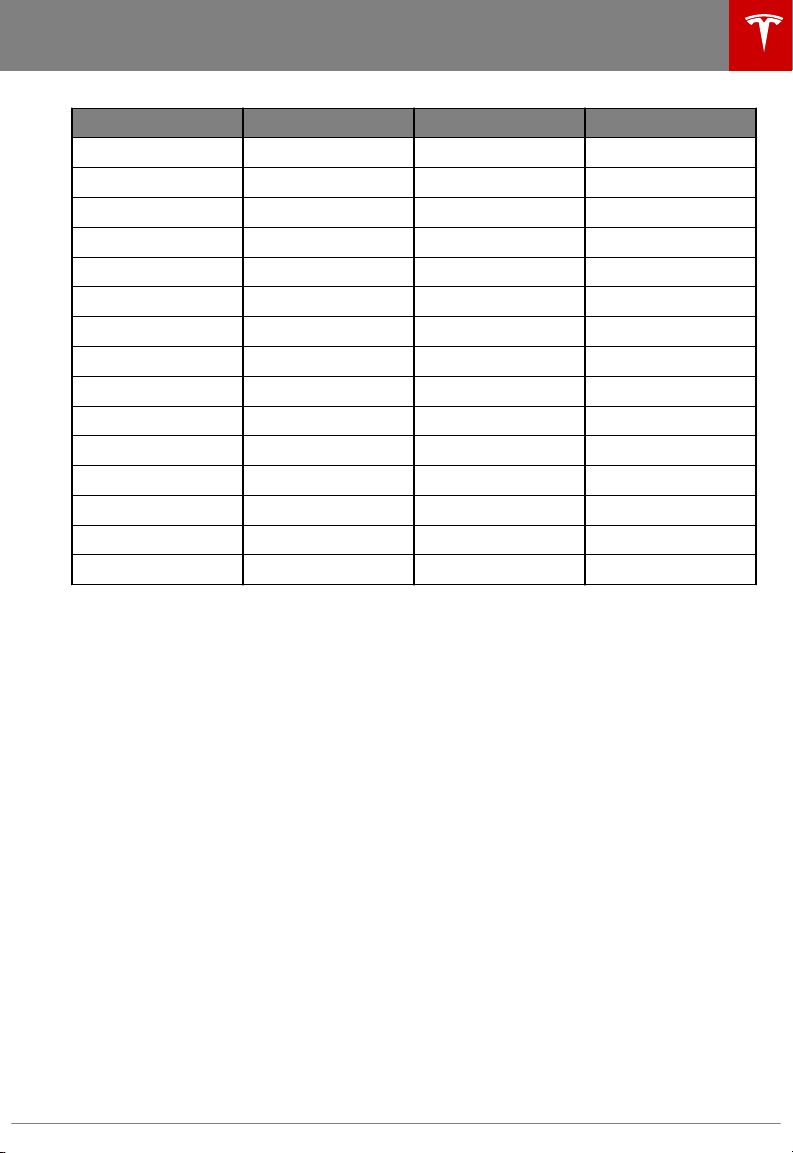
Country Toll Toll Free Local
Luxembourg +31 13 799 9522 08002 2538 027 86 14 16
Malta +31 13 799 9523 — 02778 1126
Monaco +31 13 799 9524 — —
Netherlands +31 13 799 9525 0800 020 0160 013 799 9525
Norway +31 13 799 9527 800 11 093 23 96 02 85
Poland 022 307 26 45 — —
Portugal +31 13 799 9529 800 180 343 030 880 5628
Romania +31 13 799 9530 — 0316 301 257
San Marino +31 13 799 9531 — —
Slovakia +31 13 799 9532 — 023/300 26 43
Slovenia +31 13 799 9533 — 08 288 00 33
Spain +31 13 799 9534 0900 800 324 0911 98 26 24
Sweden +31 13 799 9535 020 88 92 68 0775 88 80 36
Switzerland — 0800 002 623 061 855 30 21
UK — 0800 756 9960 0162 845 0660
Contacting Roadside Assistance
Roadside Assistance 193
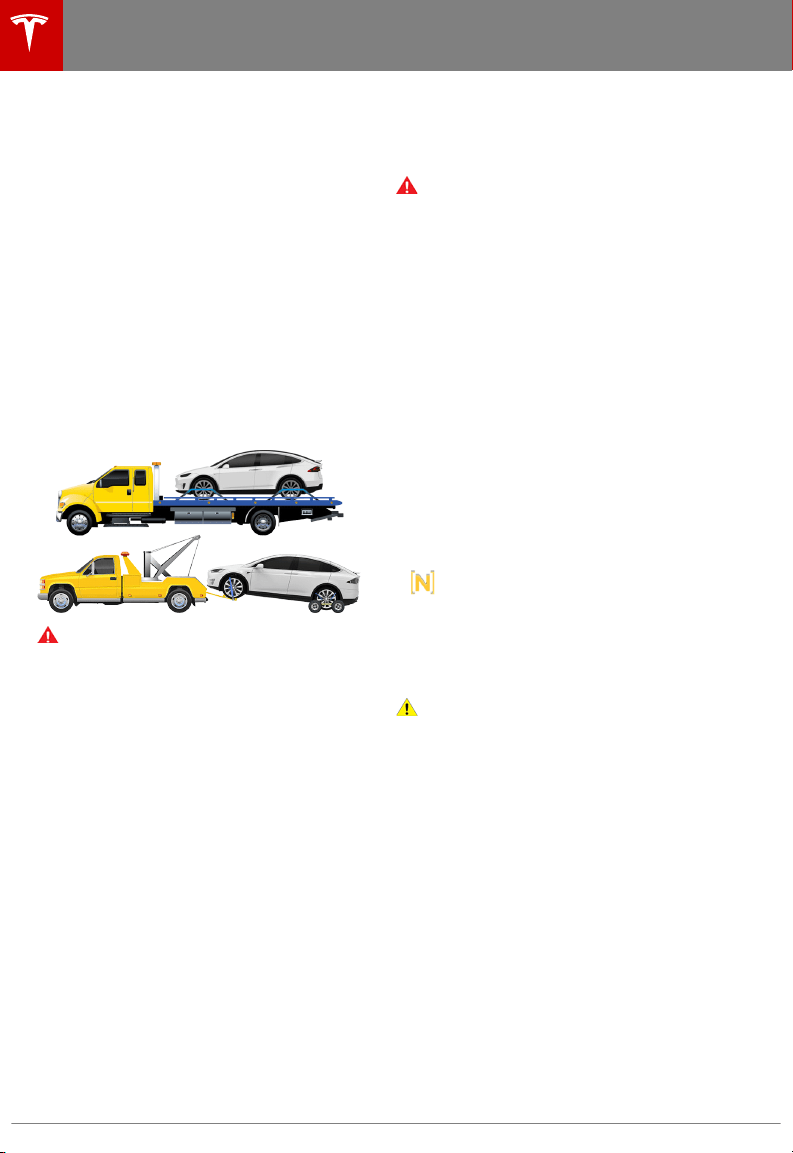
When Transporting Model X
Always transport Model X with all four tires o
the ground. A flatbed truck or comparable
transport vehicle is recommended. A wheel lift
and dolly can be used only when transporting
Model X for a maximum of 15 miles (25 km),
provided the driving speed does not exceed
45 mph (70 km/h). When transporting,
whether on a
flatbed truck or using a wheel
lift and dolly, Model X can face either
direction.
Do not transport Model X using any other
method unless
specified by Tesla. Follow the
steps provided and observe all warnings and
cautions. Damage caused by transporting your
vehicle is not covered by the warranty.
Note: The following illustrations are for
demonstration purposes only.
Warning: Model X is equipped with high
voltage components (see High Voltage
Components on page 153). Before
transporting Model X as a result of an
event (such as a collision) that may have
compromised a high voltage component,
it is important to assume that these
components are energized. Always follow
high voltage safety precautions (wearing
personal protective equipment, etc.) until
emergency response professionals have
evaluated the vehicle and can accurately
confirm that all high voltage systems are
no longer energized. Failure to do so may
result in serious injury or death.
Disable Self-Leveling (air
suspension vehicles only)
If Model X is equipped with Smart Air
Suspension, it automatically self-levels, even
when power is
o. To prevent damage, you
must activate Jack mode to disable self-
leveling:
1. Touch Controls > Suspension on the
touchscreen.
2. Press the brake pedal, then touch Very
High to maximize height.
3.
Touch Jack.
Note: Jack mode cancels when Model X is
driven over 4 mph (7 km/h).
Warning: Failure to activate Jack mode
on a Model X equipped with Smart Air
Suspension can result in the vehicle
becoming loose during transport, which
may cause significant damage.
Activate Tow Mode
Model X may automatically shift into Park
when it detects the driver leaving the vehicle,
even if it has previously been shifted into
Neutral. To keep Model X in Neutral (which
disengages the parking brake), you must use
the touchscreen to activate Tow mode:
1. Shift into Park.
2. Chock the tires or otherwise ensure
Model X is stable.
3. Press and hold the brake pedal, then on
the touchscreen touch Controls >
Settings > Service & Reset > Tow Mode >
ON.
When Tow mode is active, Model X
displays this indicator light on the
instrument panel, along with a
message telling you that Model X is
free-rolling.
To cancel Tow Mode, shift Model X into Park.
Caution:
If the electrical system is not
working, and you therefore cannot
release the electric parking brake,
attempt to jump start the 12V battery. For
instructions, call Tesla Roadside
Assistance. If a situation occurs where
you cannot disengage the parking brake,
use a self-loading dolly or tire skates.
Before doing so, always check the
manufacturer’s
specifications and
recommended load capacity.
Pull onto the Flatbed Truck
The method used to pull Model X onto the
truck depends on whether a tow eye is
available (provided with your vehicle at time
of purchase).
If equipped with a tow eye:
1. Locate the tow eye.
Instructions for Transporters
194 Model X Owner's Manual
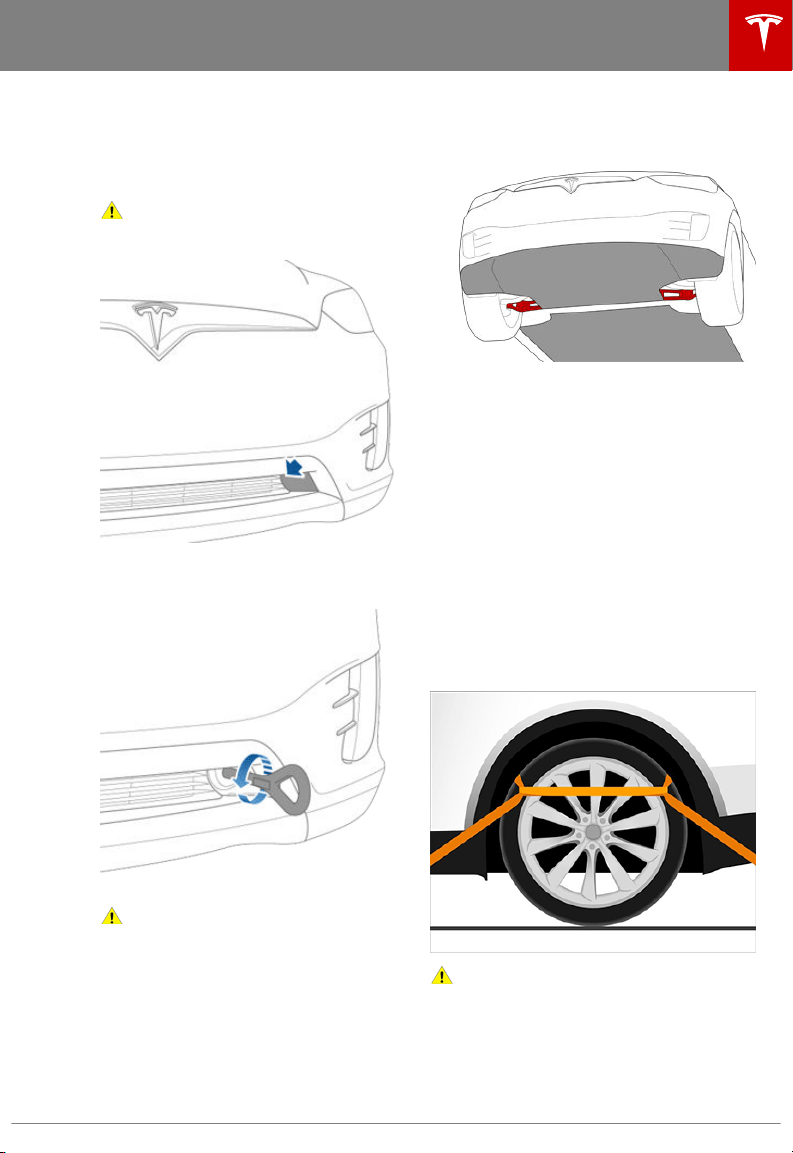
2. Remove the tow eye cover by inserting a
small flat screwdriver into the slot located
along the top of the cover, then prying
gently to release the cover from the top
snap.
Caution: Keep the tow eye cover in a
safe place so you can replace it when
towing is complete.
3. Fully insert the tow eye into the opening,
then turn it counter-clockwise until
securely fastened.
4. Attach the winch cable to the tow eye.
Caution:
Before pulling, make sure
the tow eye is securely tightened.
5. Pull Model X slowly onto the flatbed truck.
6. Shift Model X into Park by pressing the
button on the end of the gear selector.
If not equipped with a tow eye:
1.
Attach the tow straps to the large hole on
each of the rearmost lower suspension
arms underneath the front of the vehicle.
2. To protect the underbody from any
damage, place a protective barrier (such
as a piece of wood) between the tow
strap and the underbody.
3. Pull Model X slowly onto the
flatbed truck.
4. Shift Model X into Park by pressing the
button on the end of the gear selector.
Secure the Tires
The vehicle's tires must be secured onto the
truck using the eight-point tie-down method.
• Ensure any metal parts on the tie-down
straps do not contact painted surfaces or
the face of the wheels.
• Do not place tie-down straps over body
panels or through the wheels.
Caution:
Attaching tie-down straps to the
chassis, suspension or other parts of the
vehicle's body may cause damage.
Instructions for Transporters
Roadside Assistance 195

But wait, there's more! Below is a list of the Easter Eggs that have been discovered so far and how
to access them. Alternatively, touch the Tesla "T" (top center of the touchscreen) then drag the
About Your Tesla box downwards for one-touch access to all discovered Easter Eggs.
For This... Do This...
Santa Mode "What have you been longing for?" Enjoy the holidays year-
round with this one! Simply initiate a voice command and
say "Ho Ho Ho". Or, if you are feeling extra sour, you can say
"Ho Ho Ho Not Funny" instead.
Rainbow Road Feeling nostalgic? Need more cowbell? Visit Rainbow Road
by pulling the cruise stalk toward you four times in quick
succession while Autosteer is enabled.
Sketchpad Triple-tap the Tesla "T" (top center of the touchscreen) and
channel your inner Picasso. Show us what you got! Touch
Publish to submit your artistic compositions to Tesla for
critiquing.
Mars Press and hold the Tesla "T" (top center of the touchscreen)
then enter mars in the access code popup. The map shows
your Model X as a rover on the Martian landscape, and the
About Your Tesla box displays SpaceX's interplanetary
spaceship.
007 Press and hold the Tesla "T" (top center of the touchscreen)
and enter 007 in the access code popup. You are no longer
a "Driver", you're a "Diver"! Touch Controls > Suspension to
change your depth.
Ludicrous Speed (P100D vehicles
only)
Press and hold the Ludicrous setting (Controls > Driving >
Acceleration > Ludicrous) for approximately five seconds.
Touch Yes, bring it on! if you want to go fast. To display
power and acceleration readings on the instrument panel,
press either scroll wheel
briefly until the available options
are displayed. Then, roll the scroll wheel to highlight
Readout then press the scroll wheel again.
The Answer to the Ultimate
Question of Life, The Universe,
and Everything
Rename your car to 42 (see Naming Your Vehicle on page
125) and notice the new name of your Model X.
Holiday Show Park outside, turn the volume up, roll down your windows,
then press and hold the Tesla "T" (top center of the
touchscreen) and enter modelxmas in the access code
popup. Enjoy the show.
Rainbow Charge Port When Model X is locked and charging, press the button on
the mobile connector ten times in quick succession. Neat,
huh?
Easter Eggs
196 Model X Owner's Manual
Document Applicability
Owner information is updated regularly to
reflect updates to your vehicle. However, in
some cases, recently released features may
not be described. To display information about
recently released features, view the Release
Notes on the touchscreen. Release Notes are
displayed on the touchscreen after a software
update, and can be displayed at any time by
touching the Tesla "T" at the top of the
touchscreen, then touching the Release Notes
link. If information related to how to use the
touchscreen
conflicts with information in the
Release Notes, the Release Notes take
precedence.
Illustrations
Illustrations are provided for demonstration
purposes only. Depending on vehicle options,
software version, region of purchase, and
specific settings, your vehicle may appear
slightly dierent. Although the owner
information is applicable to both right-hand
drive and left-hand drive vehicles, many
illustrations show only left-hand drive vehicles.
However, the essential information that the
illustrations are providing is correct.
Errors or Inaccuracies
All
specifications and descriptions are known
to be accurate at time of publishing. However,
because continuous improvement is a goal at
Tesla, we reserve the right to make product
modifications at any time. To communicate
any inaccuracies or omissions, or to provide
general feedback or suggestions regarding the
quality of this owner information, send an
email to OwnersManualFeedback@Tesla.com.
Location of Components
Owner information may specify the location of
a component as being on the left or right side
of the vehicle. As shown, left (1) and right (2)
represent the side of the vehicle when sitting
inside.
Copyrights and Trademarks
All information in this document and all
vehicle software is subject to copyright and
other intellectual property rights of Tesla, Inc.
and its licensors. This material may not be
modified, reproduced or copied, in whole or in
part, without the prior written permission of
Tesla, Inc. and its licensors. Additional
information is available upon request. Tesla
uses software created by the Open Source
community. Please visit Tesla’s Open Source
software website at http://www.tesla.com/
opensource. The following are trademarks or
registered trademarks of Tesla, Inc. in the
United States and other countries:
All other trademarks contained in this
document are the property of their respective
owners and their use herein does not imply
sponsorship or endorsement of their products
or services. The unauthorized use of any
trademark displayed in this document or on
the vehicle is strictly prohibited.
About this Owner Information
Consumer Information 197

Vehicle Telematics
Model X is equipped with electronic modules
that monitor and record data from various
vehicle systems, including the motor, driver
assistance components, Battery, braking and
electrical systems. The electronic modules
record information about various driving and
vehicle conditions, including braking,
acceleration, trip and other related
information regarding your vehicle. These
modules also record information about the
vehicle’s features such as charging events and
status, the enabling/disabling of various
systems, diagnostic trouble codes, VIN, speed,
direction and location.
The data is stored by the vehicle and may be
accessed, used and stored by Tesla service
technicians during vehicle servicing or
periodically transmitted to Tesla wirelessly
through the vehicle’s telematics system. This
data may be used by Tesla for various
purposes, including, but not limited to:
providing you with Tesla telematics services;
troubleshooting; evaluation of your vehicle’s
quality, functionality and performance;
analysis and research by Tesla and its partners
for the improvement and design of our
vehicles and systems; and as otherwise may
be required by law. In servicing your vehicle,
Tesla can potentially resolve issues remotely
simply by reviewing your vehicle’s data log.
Tesla’s telematics system wirelessly transmits
vehicle information to Tesla on a periodic
basis. The data is used as previously described
and helps ensure the proper maintenance of
your vehicle. Additional Model X features may
use your vehicle’s telematics system and the
information provided, including features such
as charging reminders, software updates, and
remote access to, and control of, various
systems of your vehicle.
Tesla does not disclose the data recorded in
your vehicle to any third party except when:
• An agreement or consent from the
vehicle’s owner (or the leasing company
for a leased vehicle) is obtained.
•
Ocially requested by the police or other
authorities.
• Used as a defense for Tesla in a lawsuit.
• Ordered by a court of law.
• Used for research purposes without
disclosing details of the vehicle owner or
identification information.
• Disclosed to a Tesla
aliated company,
including their successors or assigns, or
our information systems and data
management providers.
In addition, Tesla does not disclose the data
recorded to an owner unless it pertains to a
non-warranty repair service and in this case,
will disclose only the data that is related to the
repair.
Data Sharing
For quality assurance and to support the
continuous improvement of advanced features
such as Autopilot, Tesla measures road
segment data of all participating vehicles. All
Tesla vehicles can learn from the experience of
the billions of miles that Tesla vehicles have
driven. Although Tesla shares this data with
partners that contribute similar data, the data
does not include any personally
identifiable
information about you or your vehicle. To
allow data sharing, touch Controls >
Settings > Safety & Security > Data Sharing,
then touch the I agree checkbox to
confirm
that you agree to allowing Tesla to collect this
data.
Note: Although Model X uses GPS in
connection with driving and operation, as
discussed in this owner's manual, Tesla does
not record or store
vehicle-specific GPS
information. Consequently, Tesla is unable to
provide historical information about a vehicle's
location (for example, Tesla is unable to tell
you where Model X was parked/traveling at a
particular date/time).
Quality Control
You might notice a few km on the odometer
when you take delivery of your Model X. This
is a result of a comprehensive testing process
that ensures the quality of your Model X.
The testing process includes extensive
inspections during and after production. The
final inspection takes place at Tesla and
includes a road test conducted by a
technician.
Disclaimers
198 Model X Owner's Manual

Contacting Tesla
For detailed information about your Model X,
go to www.tesla.com, and log on to your Tesla
Account, or sign up to get an account.
If you have any questions or concerns about
your Model X, call Tesla. To
find the number
for your region, go to www.tesla.com, select
your region at the bottom of the page, then
view contact information.
Note: You can also use voice commands to
provide feedback to Tesla. Say "Note",
"Report", "Bug note", or "Bug report" followed
by your brief comments. Model X takes a
snapshot of its systems, including your current
location, vehicle diagnostic data, and screen
captures of the touchscreen and instrument
panel. Tesla periodically reviews these notes
and uses them to continue improving Model X.
Reporting Safety Defects
Consumer Information 199

Key and Passive Unlocking System
FCC Certification
Model Number Mfr GHz Tested For
Keyfob 1048598 Tesla 2.4
USA
Canada
Per FCC ID 2AEIM-1048598, the devices listed above comply with Part 15 of the FCC rules.
Operation is subject to the following two conditions:
1. This device may not cause harmful interference, and
2. This device must accept any interference received, including interference that may cause
undesired operation.
Changes or
modifications not expressly approved by Tesla could void your authority to operate
the equipment.
IC Certification
The following device is used in vehicles in Canada:
• Keyfob Model Number: 1048598 (2.4 GHz)
• Keyfob Manufacturer: Tesla
Per IC 20098-1048598, this device complies with Industry Canada license-exempt RSS
standard(s). Operation is subject to the following two conditions:
1. This device may not cause harmful interference, and
2. This device must accept any interference received, including interference that may cause
undesired operation.
Declarations of Conformity
200 Model X Owner's Manual

Central Body Controller
FCC Certification
Model Number Mfr MHz / GHz Tested For
Central Body Controller
1031503
Tesla 315 / 2.4
USA
Canada
Per FCC ID 2AEIM-1031503, the devices listed above comply with Part 15 of the FCC rules.
Operation is subject to the following two conditions:
1. This device may not cause harmful interference, and
2. This device must accept any interference received, including interference that may cause
undesired operation.
Changes or
modifications not expressly approved by Tesla could void your authority to operate
the equipment.
IC
Certification
The following device is used in vehicles in Canada:
• Central Body Controller Model Number: 1031503 (315 MHz / 2.4 GHz)
• Central Body Controller Manufacturer: Tesla
Per IC 20098-1031503, this device complies with Industry Canada license-exempt RSS standard(s).
Operation is subject to the following two conditions:
1. This device may not cause harmful interference, and
2. This device must accept any interference received, including interference that may cause
undesired operation.
Integral Component Only
The Central Body Controller is an integral part of the vehicle that is installed and secured around
other interior trim components. The Central Body Controller is designed and intended for use only
as an integral component and cannot be sold and/or marketed separately.
Tire Pressure Monitoring System
FCC IDs: TZSTPMS201, Z9F-201FS43X
IC ID: 11852A-201FS4X
The tire pressure monitoring system (TPMS) complies with Part 15 of the FCC rules and RSS-210 of
Innovation, Science and Economic Development Canada. Operation is subject to the following two
conditions:
1. This device may not cause harmful interference, and
2. This device must accept any interference received, including interference that may cause
undesired operation.
Changes or
modifications not expressly approved by Tesla could void your authority to operate
the equipment.
HomeLink
This device complies with Part 15 of the FCC rules, RSS-210 Industry Canada, and with EU
Directive 2014/53/EU.
Operation is subject to the following conditions:
Declarations of Conformity
Consumer Information 201

• This device may not cause harmful interference.
• This device must accept any interference received, including interference that may cause
undesired operation.
Any changes or modifications to the device not expressly approved by the manufacturer or Tesla
could void your authority to operate the equipment.
Radio Frequency Information
This equipment has been tested and found to comply with the limits for a Class B digital device,
pursuant to Part 15 of the FCC Rules. These limits are designed to provide reasonable protection
against harmful interference in a residential installation. This equipment generates, uses and can
radiate radio frequency energy and, if not installed and used in accordance with the instructions,
may cause harmful interference to radio communications. However, there is no guarantee that
interference will not occur in a particular installation. If this equipment does cause harmful
interference to radio or television reception, which can be determined by turning the equipment
o and on, try to correct the interference by one or more of the following measures:
• Reorient or relocate the receiving antenna.
• Increase the separation between the equipment and receiver.
• Connect the equipment into an outlet on a circuit
dierent from that to which the receiver is
connected.
• Consult the dealer or an experienced radio/TV technician for help.
Declarations of Conformity
202 Model X Owner's Manual

1999/5/EC Directive Regulatory Notices
This device has been evaluated against the essential requirements of the 1999/5/EC Directive.
Bulgarian С настоящето Tesla Inc. декларира, че KEYFOB and BODY CONTROL MODULE
отговаря на съществените изисквания и другите приложими изисквания на Директива
1999/5/ЕС.
Croatian Ovime Tesla Inc. ”, izjavljuje da je ovaj KEYFOB and BODY CONTROL MODULE
je u skladu s osnovnim zahtjevima i drugim relevantnim odredbama Direktive
1999/5/EC.
Czech Tesla Inc. tímto prohlašuje, že tento KEYFOB and BODY CONTROL MODULE je
ve shodě se základními požadavky a dalšími příslušnými ustanoveními směrnice
1999/5/ES.
Danish Undertegnede Tesla Inc. erklærer herved, at følgende udstyr KEYFOB and
BODY CONTROL MODULE overholder de væsentlige krav og øvrige relevante
krav i direktiv 1999/5/EF.
Dutch Hierbij verklaart Tesla Inc. dat het toestel KEYFOB and BODY CONTROL
MODULE in overeenstemming is met de essentiële eisen en de andere relevante
bepalingen van richtlijn 1999/5/EG.
English Hereby, Tesla Inc., declares that this KEYFOB and BODY CONTROL MODULE is
in compliance with the essential requirements and other relevant provisions of
Directive 1999/5/EC.
Estonian Käesolevaga kinnitab Tesla Inc. seadme KEYFOB and BODY CONTROL
MODULE vastavust direktiivi 1999/5/EÜ põhinõuetele ja nimetatud direktiivist
tulenevatele teistele asjakohastele sätetele.
German Hiermit erklärt Tesla Inc., dass sich das Gerät KEYFOB and BODY CONTROL
MODULE in Übereinstimmung mit den grundlegenden Anforderungen und den
übrigen einschlägigen Bestimmungen der Richtlinie 1999/5/EG befindet.
Greek ΜΕ ΤΗΝ ΠΑΡΟΥΣΑ Tesla Inc. ΔΗΛΩΝΕΙ ΟΤΙ KEYFOB and BODY CONTROL
MODULE ΣΥΜΜΟΡΦΩΝΕΤΑΙ ΠΡΟΣ ΤΙΣ ΟΥΣΙΩΔΕΙΣ ΑΠΑΙΤΗΣΕΙΣ ΚΑΙ ΤΙΣ ΛΟΙΠΕΣ
ΣΧΕΤΙΚΕΣ ΔΙΑΤΑΞΕΙΣ ΤΗΣ ΟΔΗΓΙΑΣ 1999/5/ΕΚ.
Hungarian Alulírott, Tesla Inc. nyilatkozom, hogy a KEYFOB and BODY CONTROL MODULE
megfelel a vonatkozó alapvetõ követelményeknek és az 1999/5/EC irányelv
egyéb elõírásainak.
Finnish Tesla Inc. vakuuttaa täten että KEYFOB AND BODY CONTROL MODULE
tyyppinen laite on direktiivin 1999/5/EY oleellisten vaatimusten ja sitä koskevien
direktiivin muiden ehtojen mukainen.
French Par la présente Tesla Inc. déclare que l'appareil KEYFOB and BODY CONTROL
MODULE est conforme aux exigences essentielles et aux autres dispositions
pertinentes de la directive 1999/5/CE.
Icelandic Hér með lýsir Tesla Inc. yfir því að KEYFOB and BODY CONTROL MODULE er í
samræmi við grunnkröfur og aðrar kröfur, sem gerðar eru í tilskipun 1999/5/EC.
Italian Con la presente Tesla Inc. dichiara che questo KEYFOB and BODY CONTROL
MODULE è conforme ai requisiti essenziali ed alle altre disposizioni pertinenti
stabilite dalla direttiva 1999/5/CE.
Latvian Ar šo Tesla Inc. deklarē, ka KEYFOB and BODY CONTROL MODULE atbilst
Direktīvas 1999/5/EK būtiskajām prasībām un citiem ar to saistītajiem
noteikumiem.
Declarations of Conformity
Consumer Information 203

Lithuanian Šiuo Tesla Inc. deklaruoja, kad šis KEYFOB and BODY CONTROL MODULE
atitinka esminius reikalavimus ir kitas 1999/5/EB Direktyvos nuostatas.
Maltese Hawnhekk, Name of Manufacturer, jiddikjara li dan KEYFOB AND BODY
CONTROL MODULE jikkonforma mal-ħtiġijiet essenzjali u ma provvedimenti
oħrajn relevanti li hemm fid-Dirrettiva 1999/5/EC.
Norwegian Tesla Inc. erklærer herved at utstyret KEYFOB and BODY CONTROL MODULE er
i samsvar med de grunnleggende krav og øvrige relevante krav i direktiv
1999/5/EF.
Polish Niniejszym Tesla Inc. oświadcza, że KEYFOB and BODY CONTROL MODULE jest
zgodny z zasadniczymi wymogami oraz pozostałymi stosownymi
postanowieniami Dyrektywy 1999/5/EC.
Portugese Tesla Inc. declara que este KEYFOB and BODY CONTROL MODULE está
conforme com os requisitos essenciais e outras disposições da Directiva
1999/5/CE.
Slovak Tesla Inc. týmto vyhlasuje, že KEYFOB and BODY CONTROL MODULE spĺňa
základné požiadavky a všetky príslušné ustanovenia Smernice 1999/5/ES.
Slovenian Tesla Inc. izjavlja, da je ta KEYFOB and BODY CONTROL MODULE v skladu z
bistvenimi zahtevami in ostalimi relevantnimi določili direktive 1999/5/ES.
Spanish Por medio de la presente Tesla Inc. declara que KEYFOB y BODY CONTROL
MODULE cumple con los requisitos esenciales y cualesquiera otras
disposiciones aplicables o exigibles de la Directiva 1999/5/CE.
Swedish Härmed intygar Tesla Inc. att denna KEYFOB and BODY CONTROL MODULE
står I överensstämmelse med de väsentliga egenskapskrav och övriga relevanta
bestämmelser som framgår av direktiv 1999/5/EG.
In order to satisfy the essential requirements of 1999/5/EC Directive, the KEYFOB is compliant
with the following standards:
RF spectrum use (R&TTE art. 3.2)
EN 300 328 V1.9.1
EN 300 330-1 V1.7.1 + EN 300-330-2 V1.5.1
EMC (R&TTE art. 3.1b)
EN 301 489-1 V1.9.2 + EN 301 489-3 V 1.6.1
+ EN 301 489-17 V2.2.1
Health & Safety (R&TTE art. 3.1a)
EN 62479:2010
EN 60950-1:2006 + A11:2009 + A12:2011 +
A1:2010 + AC:2011 + A2:2013
And the CENTRAL BODY CONTROL MODULE is compliant with the following standards:
RF spectrum use (R&TTE art. 3.2)
EN 300 328 V1.9.1
EN 300 330-1 V1.7.1 + EN 300-330-2 V1.5.1
EN 300 220-1 V2.4.1 + EN 300-220-2
V2.4.1
EMC (R&TTE art. 3.1b)
EN 301 489-1 V1.9.2 + EN 301 489-3 V 1.6.1
+ EN 301 489-17 V2.2.1
Declarations of Conformity
204 Model X Owner's Manual

Health & Safety (R&TTE art. 3.1a)
EN 62479:2010
EN 60950-1:2006 + A11:2009 + A12:2011 +
A1:2010 + AC:2011 + A2:2013
The conformity assessment procedure referred to in Article 10 and detailed in Annex IV of
Directive 1999/5/EC has been followed with the involvement of the following Notified Body:
AT4 wireless, S.A.U.
Parque Tecnologico de Andalucía
C/ Severo Ochoa 2
29590 Campanillas – Málaga
SPAIN
Notified Body No: 1909
Thus, the following marking is included in the product:
There is no restriction for the commercialization of this device in all the countries of the European
Union.
Declarations of Conformity
Consumer Information 205

A
ABS (Anti-lock Braking System) 66
absolute speed limit 112
Acceleration (dual-motor) 119
Acceleration settings 73
access panel, removing 173
accessories
plugging into power socket 137
accessory carrier 80
adaptive headlights 63
air circulation 127
air conditioning 126
air distribution 127
air
filter 131
air suspension 133
air vents 131
airbag, front passenger, disabling 42
airbags 40
alarm 147
all-season tires 166
always connected, setting 76
anti-lock braking (ABS) 66
audio
playing files 134
steering wheel buttons 47
volume control 134
Auto High Beam 63
Auto Lane Change 100
auto-raising suspension 132
automatic emergency braking 109
Autopark 102
Autopilot components 88
Autosteer 97
average range 76
B
backup camera 78
battery (12V)
complete discharge 155
specifications 185
Battery (high voltage)
care of 155
coolant 173
specifications 185
temperature limits 155
battery (key), replacing 5
bicycle carrier 80
blind spot warning 106
Bluetooth
devices, playing audio files from 137
general information 139
phone, pairing and using 139
body repairs 176
body touch up 171
brake fluid replacement 162
brakes
brakes (continued)
automatic in emergencies 109
fluid level 173
overview of 66
specifications 184
brightness of displays 122
C
Cabin Overheat Protection setting 122
cabin temperature control 126
Calendar app 146
camera (rear view) 78
cameras (autopilot) 88
car cover 171
car status, displaying 47, 48
car washes 169
cargo area 14
cargo volume 182
carpets, cleaning 170
CE
certifications 200
CHAdeMO 154
chains 167
change of ownership 125
charge port 157
charge port light 158
charging
charge settings 158
components and equipment 153
instructions 157
public charging stations 154
scheduling 158
status of 160
charging locations, finding 142
child protection
disabling liftgate and rear door handles
10
disabling rear window switches 12
child seats
disabling front passenger airbag 42
installing and using 30
Chill acceleration 73
cleaning 169
climate controls 126
Climate Timer 130
Cold Weather controls 119
collision avoidance assist 108
console
12V power socket 137
cup holders 18
USB ports 137
consumption chart 76
contact information
roadside assistance 192
coolant
Battery, checking level of 173
Battery, replacement interval 162
copyrights 197
Index
206 Model X Owner's Manual

Creep 119
cruise control 91
cup holders 18
D
DAB radio 135
dashboard overview 2
data recording 198
data sharing 198
day mode 122
declarations of conformity 200
delivery mileage 198
devices
Bluetooth, playing audio files 137
connecting 137
playing audio files from 137
dimensions 181
display brightness 122
dome (map) lights 60
door labels 178
Door Unlock Mode 10
doors 4
doors, opening 4
Drive gear 53
drive-away locking 10
driver
profiles 45
seat adjustment 20
driver assistance
Auto Lane Change 100
automatic emergency braking 108
Autopark 102
Autosteer 97
blind spot warning 106
collision avoidance assist 108
forward collision warning 108
overtake acceleration 91
overview 88
settings for 122
side collision warning 106
speed assist 112
speed limit warning 112
staying inside lane markings 106
staying within speed limits 112
Trac-Aware Cruise Control 91
driving
seating position 20
starting 51
tips to maximize range 76
E
Easter Eggs 196
Easy Entry 23
easy entry, driver
profile 45
EDR (event data recorder) 198
electric parking brake
67
emergency braking 108
emergency flashers 64
emergency rear door opening 11
energy
gained from regenerative braking 66
range information 54
energy & charging setting 122
Energy app 76
energy saving mode 76
Erase & Reset 125
event data recording 198
exterior
car cover 171
cleaning 169
dimensions 181
lights 60
overview 3
polishing, touch up, & repair 171
F
factory defaults, restoring 125
factory reset 125
fan speed, interior 127
favorite destinations 144
Favorites 141
Favorites (Media Player) 136
FCC
certifications 200
features, downloading new 151
ferries, avoiding 143
firmware (software) updates 151
flash drives, playing audio files from 137
flashers, warning 64
floor mats 171
fluids
replacement intervals 162
reservoirs, checking 173
fog lights 60
forward collision warning 108
front passenger detection 42
front trunk 15
G
garage doors, opening 148
gates, opening 148
GAWR 179
gears 53
glove box 17
Gross Axle Weight Rating 179
Gross Vehicle Weight Rating 179
ground clearance 181
GVWR 179
Index
Index 207

H
hazard warning flashers 64
head restraints 25
head supports 25
headlights
adaptive 63
after exit 63
high beams 63
heated wipers 65
heating 126
height adjustments (suspension)
auto-raising 132
automatic and manual settings 133
disabling (Jack mode) 133
high beam headlights 63
high voltage
Battery specifications 185
components 153
safety 162
hills, stopping on 72
Home location 144
HomeLink
FCC certification 201
programming and using 148
hood 15
horn 49
I
IC
certifications 200
identification labels 177
Insane acceleration (performance dual motor)
73
Insane setting (dual-motor) 119
instant range 76
instrument panel
charging status 160
cleaning 170
overview of 54
interior
cleaning 170
dimensions 181
lights 60
overview 2
temperature control 126
Internet radio 136
intrusion detection 147
ISOFIX child seats, installing 34
J
J1772 154
Jack mode 133
jacking 175
K
key
FCC and IC certifications 200
how to use 4
key not inside 51
ordering extras 7
replacing battery 5
keyless entry 4
L
label
Statutory Plate 179
Tire and Loading Information 179
lane assist 106
lane change flash 64
lane change, automatic 100
lane departure warning 106
Language & Units 122
language setting 122
Launch Mode (performance dual motor) 73
liftgate
adjust opening height 14
opening 13
lifting 175
lights
adaptive headlights 63
hazard warning 64
headlights after exit 63
turn signals 63
load limits 178
location-based suspension 132
locking and unlocking doors 4
Ludicrous acceleration (performance dual
motor) 73
Ludicrous setting (dual-motor) 119
lug nut covers 166
lumbar support 20
M
maintenance
brake fluid, checking 173
cleaning 169
daily and monthly checks 162
fluid replacement intervals 162
panel, removing 173
replacing wipers 172
service intervals 162
tires 163
washer
fluid, topping up 174
map updates 145
maps 141
mats 171
Max Battery Power 119
Index
208 Model X Owner's Manual

Max Battery Power (performance dual motor)
73
media 134
mileage upon delivery 198
mirrors 50
mobile app 152
Mobile Connector
description 154
using 157
modifications
176
motor torque, reduced 110
my car does what? 196
N
naming 125
navigation 141
NCC
certifications 200
Neutral gear 53
night mode 122
O
odometer 75
oset from speed limit 112
overhang dimensions 181
overtake acceleration 91
Owner Information, about 197
P
Park Assist 70
Park gear 53
parking brake 67
parking, automatic 102
parts replacement 176
Passive Entry 122
Pedal Misapplication Mitigation 108
personal data, erasing 125
phone
steering wheel buttons 48
using 139
PIN 46
power management 76
power socket 137
power windows 12
powering on and
o 51
Preconditioning 122
preferences, setting 122
public charging stations 154
R
radar 88
radio 134
Radio Frequency information
200
range
displayed on instrument panel 54
driving tips to maximize 76
regenerative braking 66
range assurance 76
Range mode 76
Range Mode 119
Rated range 122
re-routing 143
rear seats, accessing 23
rear view camera 78
rear window switches, disabling 12
Recent (Media Player) 136
Recents 141
regenerative braking 66
region format 122
relative speed limit 112
release notes 151
restarting the touchscreen 51
Reverse gear 53
RFID transponders 176
roadside assistance 192
rotating tires 164
route overview 143
S
safety information
airbags 43
child seats 39
seat belts 29
seat belts
cleaning 170
in a collision 28
overview of 27
pre-tensioners 28
wearing when pregnant 28
seat covers 26
seat heaters 126
seating capacity 179
seats
adjusting 20
heaters 126
seats, second row 21
security settings 147
sensors 88
service data recording 198
service intervals 162
Settings 122
Settings, erasing 125
shifting gears 53
Show Commute Advice 143
side collision warning 106
slip start 69
Smart Preconditioning 122
software reset 125
software updates 151
Index
Index 209

specifications
cargo volume 182
dimensions 181
exterior 181
interior 181
motor 184
subsystems 184
tires 186
weights 182
wheels 186
speed assist 112
speed limit warning 112
spoiler 79
Sport acceleration (performance dual motor)
73
stability control 69
Standard acceleration 73
starting 51
Statutory Plate 179
steering
specifications 184
steering wheel
adjusting position 47
adjusting sensitivity 47
buttons 47
heated 47
scroll wheels 47
steering, automatic 97
summer tires 166
Summon 102
sun visors 19
supercharging
described 161
idle fees 161
pay-per-use fees 161
suspension 133
suspension
specifications 185
T
telematics 198
temperature
Battery (high voltage), limits 155
cabin, controls for 126
heated steering wheel 49
outside 54
third row seats, folding and raising 24
tie-down straps 195
tilt detection 147
Tire and Loading Information label 179
tire noise 167
Tire Pressure Monitoring System
FCC certification 201
overview of 167
tire pressures, checking 163
tire pressures, when towing 81
tires
all-season 166
balancing 164
tires (continued)
chains 167
inspecting and maintaining 164
pressures, how to check 163
replacing 165
replacing a tire sensor 168
rotation 164
specification 186
summer 166
tire markings 187
winter 166
toll system transponders, attaching 176
tolls, avoiding 143
torque
specifications 184
touch up body 171
touchscreen
clean mode 170
cleaning 170
Controls 119
overview 114
Settings 122
software updates 151
tow eye, locating 194
Tow mode 194
towing 194
towing a trailer 81
towing capacity 81
towing instructions 194
Towing Label 178
Towing Mode 81
TPMS
FCC certification 201
overview of 167
traction control 69
trademarks 197
Trac-Aware Cruise Control 91
Trac-Based Routing 143
trailer, towing 81
transmission
specifications 184
transponders, attaching 176
transporting 194
trip chart 76
trip meter 75
trip overview 143
trip planner 143
trunk, front 15
trunk, rear
child protection lock 10
disabling interior handle 10
TuneIn radio 136
turn signals 63
Typical range 122
U
ultrasonic sensors 88
Unlock on Park 4
unlocking and locking doors 4
Index
210 Model X Owner's Manual

unlocking when key doesn't work 11
USB devices
connecting 137
playing audio files from 137
USB ports 137
V
Valet mode 46
Vehicle Hold 72
Vehicle
Identification Number (VIN) 177
vehicle loading 178
ventilation 131
VIN (Vehicle
Identification Number) 177
voice commands 47
volume control 114
volume control (media) 134
W
walk-away locking 10
Wall Connector 154
warning
flashers 64
washer fluid, topping up 174
washers, using 65
weight
specifications 182
wheel chocks 195
wheels
alignment 164
lug nut covers, removing and installing
166
replacing 165
specifications 186
torque 186
Wi-Fi, connecting to 150
windshield washer fluid, topping up 174
winter tires 166
wipers, de-icing 65
wipers, replacing 172
wipers, using 65
Work location 144
Index
Index 211