Digital Camera
Operating Manual
To ensure the best performance from
your camera, please read the Operating
Manual before using the camera.

Thank you for buying the Pentax Optio 555 Digital Camera. Please read
this manual before using the camera in order to get the most out of all
the features and functions. Keep this manual safe, as it can be a
valuable tool in helping you to understand all the camera’s capabilities.
Regarding copyrights
Images taken using the Optio 555 that are for anything other than personal
enjoyment cannot be used without permission according to the rights as
specified in the Copyright Act. Please take care, as there are even cases where
limitations are placed on taking pictures even for personal enjoyment during
demonstrations, industrial enterprise or as items for display. Images taken with
the purpose of obtaining copyrights also cannot be used outside the scope of
use of the copyright as laid out in the Copyright Act, and care should be taken
here also.
Regarding trademarks
• The SD logo is a trademark.
• PENTAX is a trademark of PENTAX Corporation.
• Optio is a trademark of PENTAX Corporation.
• All other brands or product names are trademarks of registered trademarks of
their respective companies.
• This product supports PRINT Image Matching II.When used in combination,
PRINT Image Matching II enabled digital still cameras, printers and software
help photographers to produce images more faithful to their intentions.
Copyright 2001 Seiko Epson Corporation. All Rights Reserved.
PRINT Image Matching is a trademark of Seiko Epson Corporation.
• “PictBridge” allows the user to connect the printer and digital camera directly,
using the unified standard for the direct printout of images. You can print
images directly from the camera through a few simple operations.
• Illustrations and screenshots depicted in the Operating Manual may differ from
the actual product and screens.
This is a Class B product that complies with the standards of the Voluntary Control
Council for Interference by Information Technology Equipment (VCCI). In a domestic
environment, this product may cause radio and television interference when used
near radio and television receiving units, in which case the user may be required to
take corrective actions. Read the Operating Manual and handle properly.
1
Sufficient attention has been paid to the safety of this product but
please pay particular attention to the warnings indicated by the
following symbols during use.
Warning
• Do not attempt to take the camera apart or remodel the camera. High
voltages are present within the camera, and there is therefore a danger of
electric shocks.
• If the inside of the camera should become exposed as a result of, for
example, the camera being dropped, please do not under any
circumstances touch such exposed portions, as there is a danger of
receiving an electric shock.
• Wrapping the strap of the camera around your neck is also dangerous,
please take care that small children do not hang the strap around their
necks.
• To avoid the risk of it being swallowed by mistake, keep the SD Memory
Card out of the reach of small children. Seek medical attention immediately
if accidentally swallowed.
• Use an AC adapter that are of the power and voltage specified for
exclusive use with this product. The use of an AC adapter other than that
specified exclusively for use with this product may cause fire or electric
shocks.
• If the camera emits smoke or a strange smell, or in the event of any other
irregularity, stop using the camera immediately, remove the battery or
disconnect the AC adapter and contact your nearest Pentax service
center. Continued use of the camera may result in fire or electric shock.
• Discontinue use of the AC adapter during thunderstorms. This can cause
a fire or electrical shock.
FOR SAFE USE OF YOUR CAMERA
Warning
This symbol indicates that it is possible that the user
may experience serious difficulties if the warnings
are not heeded.
Caution
This symbol indicates that it is possible that the user
may experience minor or middling difficulties or
physical difficulties if the warnings are not heeded.
2
Caution
• Never try to disassemble, short the battery. Also, do not dispose of the
battery in fire, as it may explode.
• Remove the battery from the camera immediately if it becomes hot or
begins to smoke. Be careful not to burn yourself during removal.
• Some portions of the camera heat up during use, so please take care, as
there is a risk of low temperature burns if such portions are held for long
periods of time.
• Do not place your finger on the flash when it is discharging as there is a
risk of burns.
• If any of the battery leakage should come in contact with your eyes, do not
rub them. Flush your eyes with clean water and get medical attention
immediately.
• If any of the battery leakage should come in contact with skin or clothes,
wash the affected areas thoroughly with water.
• Do not clean the product with organic solvents such as thinner or alcohol
benzene.
• Places of high temperature and humidity should be avoided. Particular
care should be taken regarding vehicles, which can become very hot
inside.
• Storing the camera where pesticides and chemicals are handled should be
avoided.
Remove from case and store in a well-ventilated place to prevent the
camera from becoming moldy during storage.
• Do not use the camera where it may come in contact with rain, water or any
other liquid, because the camera is not weather, water, or liquid resistant.
Should the camera get wet from rain, splashing water, or any other liquid,
wipe it off immediately with a dry soft cloth.
• Ensure that the camera is not subjected to substantial vibrations, shocks
or pressure.
Place the camera on a cushion for protection when the camera is subjected
to the vibrations of a motorbike, car, or ship, etc.
• The liquid crystal display will become black at temperatures of
approximately 60°C (140°F) but will return to normal when normal
temperatures are returned to.
Care to be Taken During Handling

3
• The response speed of the liquid crystal display becomes slow at low
temperatures.
This is due to the properties of the liquid crystal and is not a fault.
• Remove dust from the lens and viewfinder using a blower or clean off dust
using a lens brush.
• Periodic checks are recommended every 1 to 2 years in order to maintain
high-performance.
• When the camera has not been used for a long time, confirm that it is still
working properly, particularly prior to taking important pictures (such as at
a wedding or during travelling). Pentax is not responsible for consequential
damages (costs incurred as a result of taking pictures, loss of benefits that
were to be obtained through taking pictures) arising from failure of this
product.
• If the camera is subjected to rapid temperature changes, condensation
may form on the inside and outside of the camera. Therefore put the
camera in a bag or plastic bag, and take the camera out when the
difference in temperature has subsided.
• The temperature range in which the camera can be used is 0°C to 40°C
(32°F to 104°F).
• Avoid contact with garbage, dirt, sand, dust, water, toxic gases, salt, etc.
as this may cause damage to the camera. If rain or drops of water get onto
the camera, please wipe dry.
• Refer to “Precautions When Using a SD Memory Card / MultiMediaCard”
(p.17) regarding the SD Memory Card / MultiMediaCard.
• Be sure to use the rechargeable lithium-ion battery D-LI7 provided for this
camera. If you use any other battery the camera may be damaged or
malfunction.
To users of this camera
• There is a possibility that recorded data may be erased or that the camera
may not function correctly when used in surroundings such as installations
generating strong electromagnetic radiation or magnetic fields.
• The liquid crystal panel used in the LCD display is manufactured using
extremely high precision technology. Although the level of functioning
pixels is 99.99% or better, you should be aware that 0.01% or fewer of the
pixels may not illuminate or may illuminate when they should not. However,
this has no effect on the recorded image.
• There is a possibility that the illustrations and the display screen of the LCD
monitor in this manual are different form the actual product.
4
FOR SAFE USE OF YOUR CAMERA .............................................1
Care to be Taken During Handling ...................................................2
Contents ...........................................................................................4
Contents of the operating manual ....................................................7
Checking the Contents of the Package ............................................8
Names of Parts.................................................................................9
Names of Operating Parts ..............................................................10
Getting Started 11
Attaching the Strap.............................................................................11
Powering the Camera .........................................................................12
Charging the Battery.......................................................................12
Installing the Battery .......................................................................13
Using the AC Adapter (optional).....................................................15
Installing the SD Memory Card / MultiMediaCard ............................16
Turning the Camera On and Off ........................................................18
Play back Only Mode......................................................................18
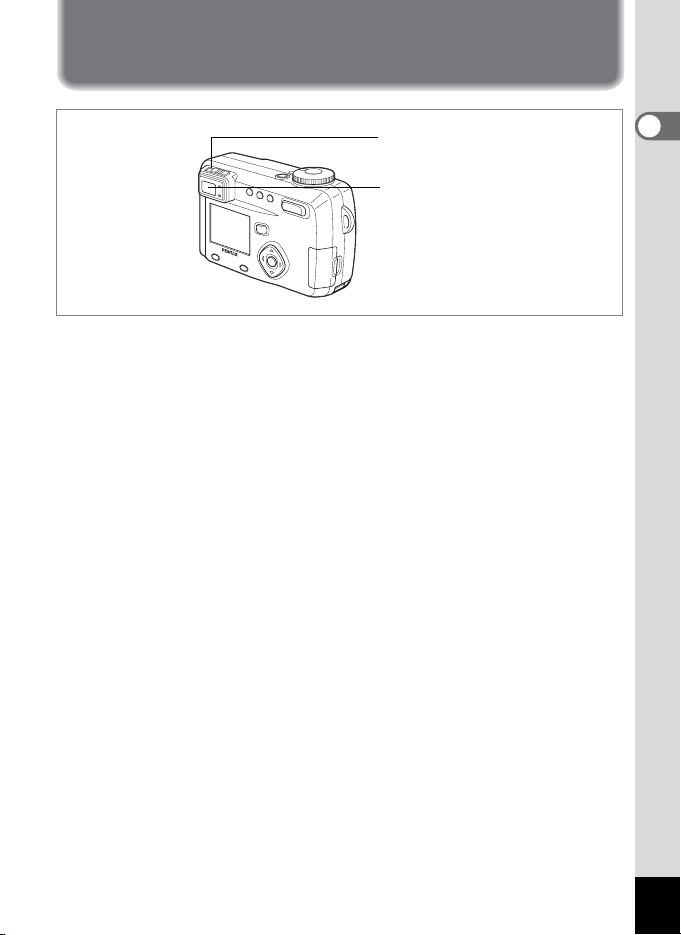
Adjusting the Viewfinder....................................................................19
Initial Settings .....................................................................................20
Setting the Display Language.........................................................20
Setting the Home Town ..................................................................21
Setting the D.S.T. Mode .................................................................21
Setting the Date and Time..............................................................22
Quick Start 24
Playing Back Images ......................................................................26
Playing Back Previous or Next Images ..........................................27
Common Operations 30
Changing the Mode.............................................................................30
Using the Button Functions...............................................................31
Capture Mode.................................................................................31
Playback Mode ...............................................................................33
Using the Menus .................................................................................34
How to Set the Menus ....................................................................34
Menu List ........................................................................................36
Taking Pictures 38
Displaying Shooting Information (Capture Mode) ...........................38
Setting the Shooting Functions.........................................................40
Selecting the Focus Mode ..............................................................40
Selecting the Flash Mode ...............................................................42
Selecting the Recorded Pixels........................................................43
Selecting the Quality Levels ...........................................................44
Adjusting the Color Balance according to Lighting (White Balance)
....45
Contents
5
Changing the AF Area (Focusing Area) .........................................47
Setting the Light Metering Range to Determine the Exposure
(AE Metering) .................................................................................48
Setting the Sensitivity .....................................................................49
Setting the Instant Review time (Instant Review) ...........................50
Setting the Image Sharpness (Sharpness).....................................50
Setting the Sensitivity .....................................................................50
Setting the Color Saturation (Saturation)........................................51
Setting the Image Contrast (Contrast)............................................51
Adjusting the Flash Output .............................................................52
Taking Pictures ...................................................................................53
Letting the Camera Set the Exposure (Program Mode) .................53
Setting the Aperture Value (Aperture-Priority Mode)......................54
Setting the Shutter Speed (Shutter-Priority Mode) .........................55
Setting the Exposure Manually (Manual Exposure Mode) .............56
Using Preset Function Settings (User Mode) .................................58
Registering Functions in User Mode ..............................................59
Selecting the Picture Mode According to the Shooting Scene
(Picture mode) ................................................................................60
Taking Panorama Pictures (Panorama Assist Mode).....................62
Taking Stereo Pictures (3D Image Mode) ......................................64
Recording Sound (Voice Recording Mode) ....................................69
Taking Pictures with Digital Filters (Digital Filter Mode) .................70
Taking Movie Pictures (Movie Picture Mode) .................................72
Using the Zoom ..............................................................................74
EV Compensation...........................................................................76
Using the Self-timer ........................................................................77
Using the Remote Control Unit (optional) .......................................78
Continuous Shooting ......................................................................79
Taking Pictures at Fixed Intervals (Interval Shooting) ....................80
Superimposing One Picture on Top of Another
(Multiple Exposure Mode)...............................................................82
Automatically Changing the Shooting Conditions (Auto bracket) ...84
Taking Fast Forward Movie Pictures (Fast Fwd Movie) .................86
Saving the Settings (Memory) ...........................................................87
Saving the Menu Items (Memory) ..................................................87
Playback / Erasing 89
Playing Back Images and Sound.......................................................89
Playing Back Still Pictures ..............................................................89
Zoom Display..................................................................................89
Adding a Voice Memo ....................................................................90
Playing Back Movie Pictures ..........................................................91
Playing Back Sound .......................................................................92
Playing back Shooting Information (Playback Mode) .....................93
Nine-image Display ........................................................................94
Slideshow .......................................................................................95
Erasing Images ...................................................................................96
Erasing a Single Image or Sound ...................................................96
6
Erasing All Images..........................................................................98
Protecting Images from Deletion (Protect) .....................................99
Viewing Images on a TV ...................................................................100
Setting the Printing Service (DPOF)................................................101
Printing Single Image ...................................................................101
Printing All Images........................................................................103
Printing Directly from the Camera Connected to a Printer ...........104
Connecting the camera to the printer ...........................................104
Printing one image at a time.........................................................105
Printing using the printing service settings ...................................105
Disconnecting the camera from the printer...................................106
Editing / Settings 107
Editing Images ..................................................................................107
Changing the Image Size .............................................................107
Trimming Images..........................................................................109
Using Digital Filters to Edit Images...............................................110
Camera Settings................................................................................112
Formatting a SD Memory Card / MultiMediaCard ........................112
Changing the Sound Settings.......................................................113
Setting the Date Style...................................................................115
Changing the Date / Time.............................................................116
Setting the World Time .................................................................116
Changing the Start-up Screen ......................................................118
Changing the Display Language ..................................................119
Changing the Video Output Format..............................................119
LCD Power Saving (Sleep Timeout).............................................120
Setting Auto Power Off .................................................................120
Setting the Quick Delete Function ................................................121
Setting the Quick Zoom Function .................................................121
Registering Functions...................................................................122
Adjusting the Focus Limit .............................................................124
Resetting to Default Settings (Reset) ...........................................125
Setting the Alarm ..............................................................................126
Checking the Alarm ......................................................................126
Setting the Alarm ..........................................................................126
Turning the Alarm Off ...................................................................127
Appendix 128
List of City Names.............................................................................128
List of Menu Default Settings ..........................................................129
Adjustable [Rec.Mode] Menu Items by Capture Mode ..................131
Messages...........................................................................................132
Troubleshooting................................................................................134
Main Specifications ..........................................................................136
Optional Accessories .......................................................................138
WARRANTY POLICY.........................................................................139
7
This Operating manual contains the following chapters.
1 Getting Started ––––––––––––––––––––––––––––––––––––
This chapter explains what you need to do after purchasing the camera
before you start taking pictures. Be sure to read it and follow the
instructions
.
2 Quick Start –––––––––––––––––––––––––––––––––––––––
This chapter explains the simplest way to take pictures and play back
images. Use it if you want to start taking pictures straightaway. It also
tells you how to use the SD Memory Card / MultiMediaCard.
3 Common Operations –––––––––––––––––––––––––––––––
This chapter explains common operations such as the functions of the mode
dial and buttons, and how to use the menus. For more details, refer to the
respective [Taking Pictures], [Playback/Erasing] and [Editing/Settings]
chapters
.
4 Taking Pictures––––––––––––––––––––––––––––––––––––
This chapter explains the various ways of capturing images and how to
set the relevant functions.
5 Playback / Erasing –––––––––––––––––––––––––––––––––
This chapter explains how to play back images on the camera or on a
TV and how to delete images.
6 Editing / Settings ––––––––––––––––––––––––––––––––––
This chapter explains how to edit images and set the camera-related
functions.
7 Appendix –––––––––––––––––––––––––––––––––––––––––
This tells you about the messages displayed on the LCD monitor and
what to do in the event of trouble.
The meanings of the symbols used in this Operating manual are explained below.
Contents of the operating manual
1
indicates the reference page number for an explanation of the
related operation.
indicates information that is useful to know.
indicates precautions to be taken when operating the camera.
E a b c
A d F G
D C O
The icons above the title show the Capture modes, that can
activate the function.
1
2
3
4
5
6
7
8
∗ About items marked with (∗)
∗ items marked with (∗) are also available as optional accessories. For other
optional accessories, refer to the list on page 138.
∗ Type of AC plug cord
D-CO2A Australia / D-CO2B United Kingdom / D-CO2E Europe / D-CO2H Hong
Kong / D-CO2J Japan / D-CO2K Korea / D-CO2U North America, Canada
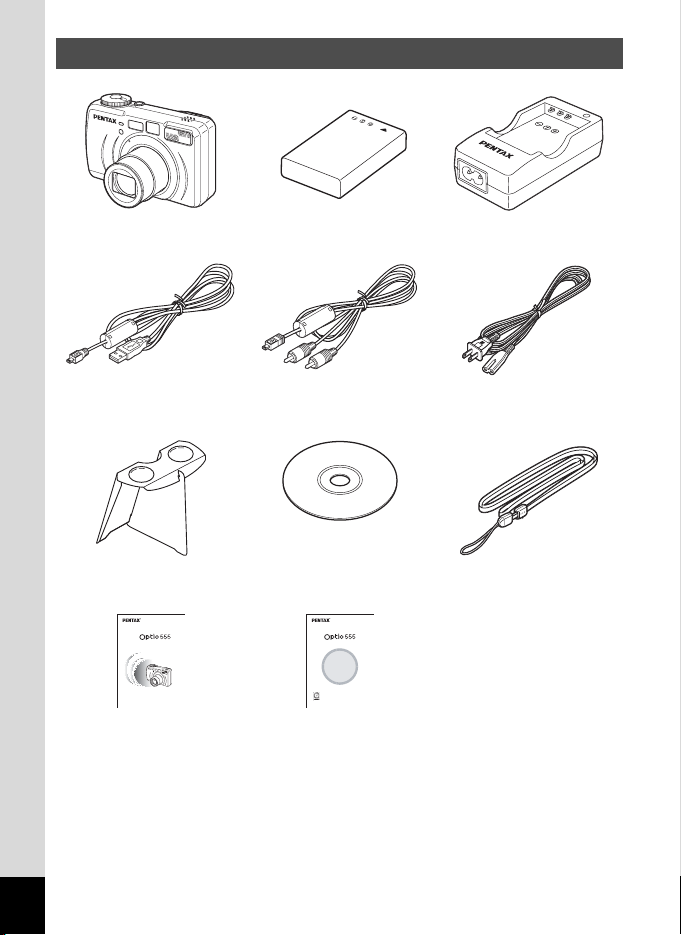
Checking the Contents of the Package
Camera
Optio 555
Lithium-ion battery D-LI7
Rechargeable (∗)
Battery charger
D-BC7 (∗)
USB cable
I-USB7 (∗)
AV cable
I-AVC7 (∗)
AC plug cord
D-CO2 (∗)
3D Image Viewer
O-3DV1
Software (CD-ROM)
S-SW13
Strap
O-ST5 (∗)
Operating Manual
(this Manual)
Operating Manual
(PC Connection Manual)
Digital Camera
Operating Manual
To ensure the best performance from
your camera, please read the Operating
Manual before using the camera.
Viewing Your Digital
Camera Images
On Your PC
(PC Connection Manual)
9
Front
Back
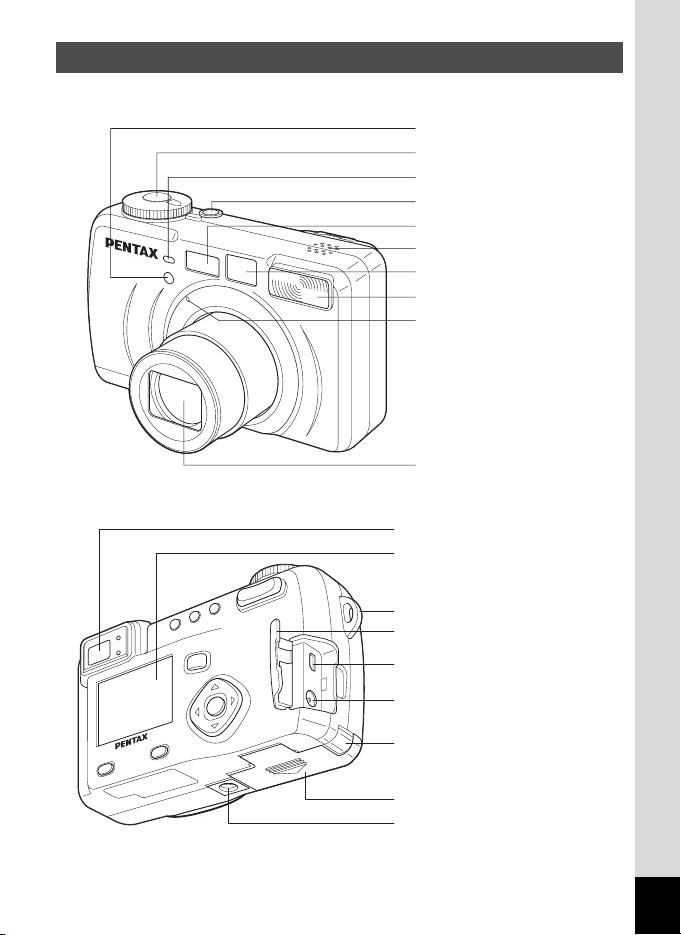
Names of Parts
Shutter release button
Power switch
Self-timer lamp
Remote control receiver
Autofocus window
Speaker
Viewfinder
Built-in flash
Microphone
Lens
Tripod socket
Viewfinder
Strap lug
Terminal cover
DC input terminal
LCD monitor
USB / AV output terminal
Battery lock lever
Battery / card cover
10
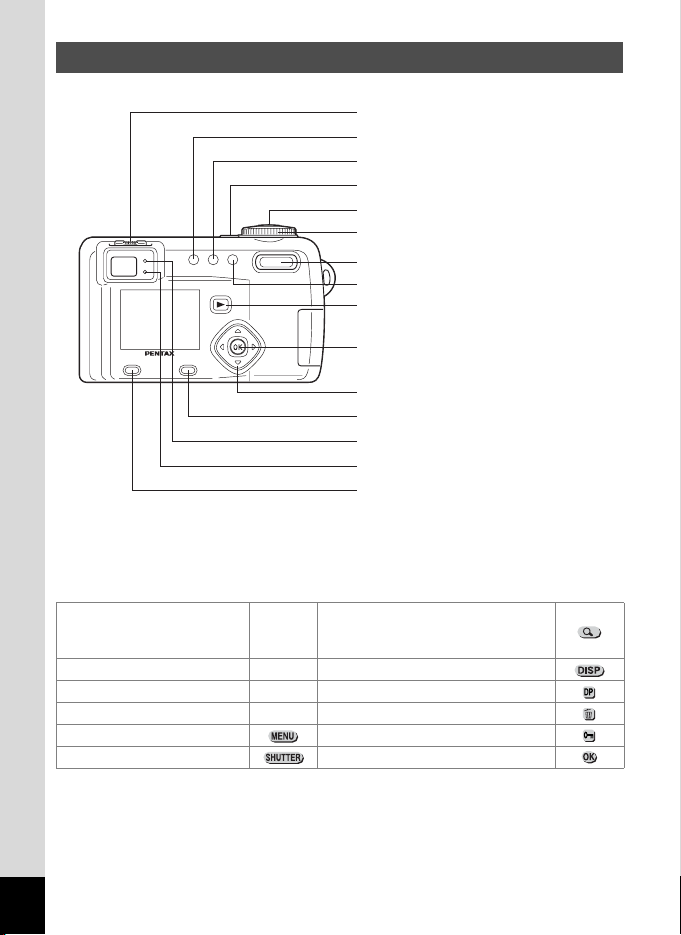
Guide indications
A guide to available button operation is displayed on the LCD monitor
during operation. The buttons are indicated as shown below.
Names of Operating Parts
Four-way controller (2) 2
Zoom/f/y button
(Only for digital zoom and
magnified playback)
Four-way controller (3) 3 DISPLAY button
Four-way controller (4) 4 DPOF button
Four-way controller (5) 5i button
Menu/Fn button Z button
Shutter release button OK button
b/Z button
)/i button
Shutter release button
Zoom/
f/y button
OK button
Four-way controller (
2345)
Menu/Fn button
Playback button
Focus status lamp (green)
Diopter adjustment lever
(/DPOF button
Power switch
Mode dial
Display button
Flash status lamp (red)
11
1
Getting Started
Getting Started
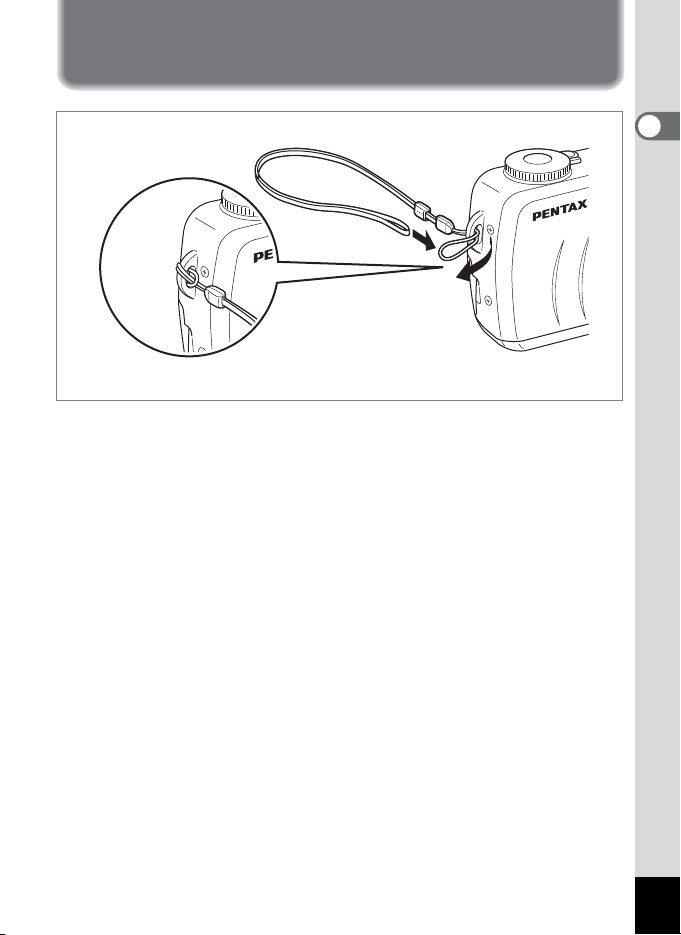
Attaching the Strap
Pass the narrow end of the strap through the strap lug and pass the
other end through the loop.
12
1
Getting Started
Powering the Camera
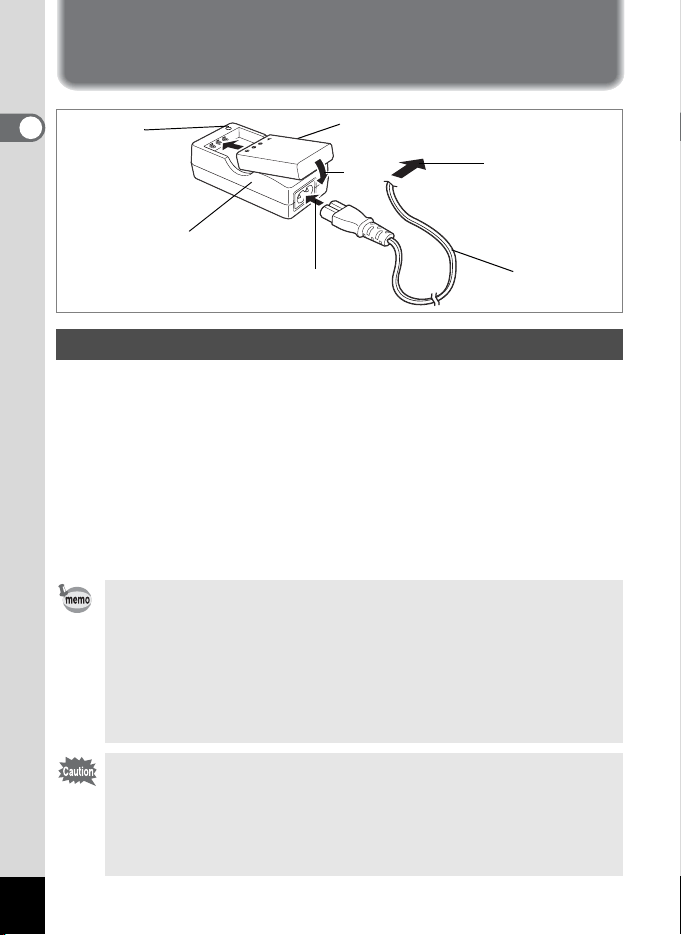
When using the camera for the first time or when the [Battery depleted.]
message is displayed, charge the battery.
1 Connect the AC plug cord to the battery charger.
2 Plug the AC plug cord into the power outlet.
3
Place the battery in the charger with the label facing up.
The charging indicator lights red while the battery is charging and
changes to green when charging is completed.
4 When charging is completed, remove the battery from
the battery charger.
Charging the Battery
• The time required for full charge is about 180 minutes maximum.
The appropriate ambient temperature range for charging the battery
is 0°C-40°C (32°F to 104°F).
• The charging time may vary depending on the ambient temperature
and charging conditions.
• When the battery reaches the end of its service life, the time that the
camera can be operated becomes shorter even when the battery is
fully charged. In this event, replace the battery.
• Always charge the battery after purchasing or when it has not been
used for a long time.
• Use the Battery charger D-BC7 to charge the rechargeable Lithium-
ion battery D-LI7 only as the charger may overheat or be damaged.
• If the battery is inserted correctly but the charging indicator fails to
light, the battery may be faulty. Replace with a new battery.
Charging
indicator
Battery charger
Battery
To power outlet
2
AC plug cord
3
1
13
Getting Started
1
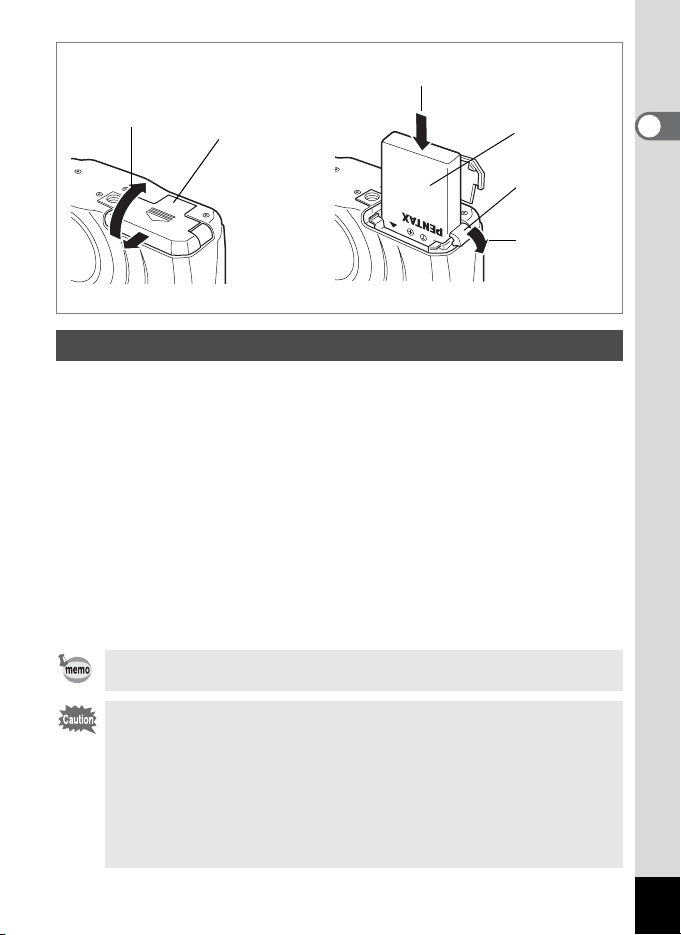
Install the battery provided. When using the camera for the first time,
charge the battery before installing.
1 Slide the battery / card cover in the direction indicated
by the arrow to open the battery / card cover.
2 Insert the battery with the label facing towards the lens
while using the side of the battery to press the battery
lock lever in the direction indicated by the arrow.
Check that it is firmly secured by the battery lock lever when you have
inserted the battery.
3 Close the battery cover.
To remove the battery, release the battery by using your finger to
press the battery lock lever in the same direction as when you
inserted the battery, and pull the battery out.
Installing the Battery
Use of the AC adapter D-AC7 (optional) is recommended when you
intend to use the camera continuously for a long period. (
1 p.15)
• The rechargeable lithium-ion battery D-LI7 is exclusively for powering
this camera. If you use any other battery the camera may be
damaged or malfunction.
• Do not remove the battery when the camera is turned on.
• If you do not intend to use the camera for a long time, remove the battery.
• If the camera is left without the battery for a long time, the date setting
will be reset.
• Insert the battery correctly. If the battery is incorrectly oriented, it may
cause malfunction.
Battery / card cover
Battery
Battery lock
lever
2
1
2
14
Getting Started
1
Approximate Operating Time (when the D-LI7 battery is fully
charged)
Number of recordable images: Approx. 400 (when 50% shooting uses
flash, LCD monitor ON)
Playback time : Approx. 210 min.
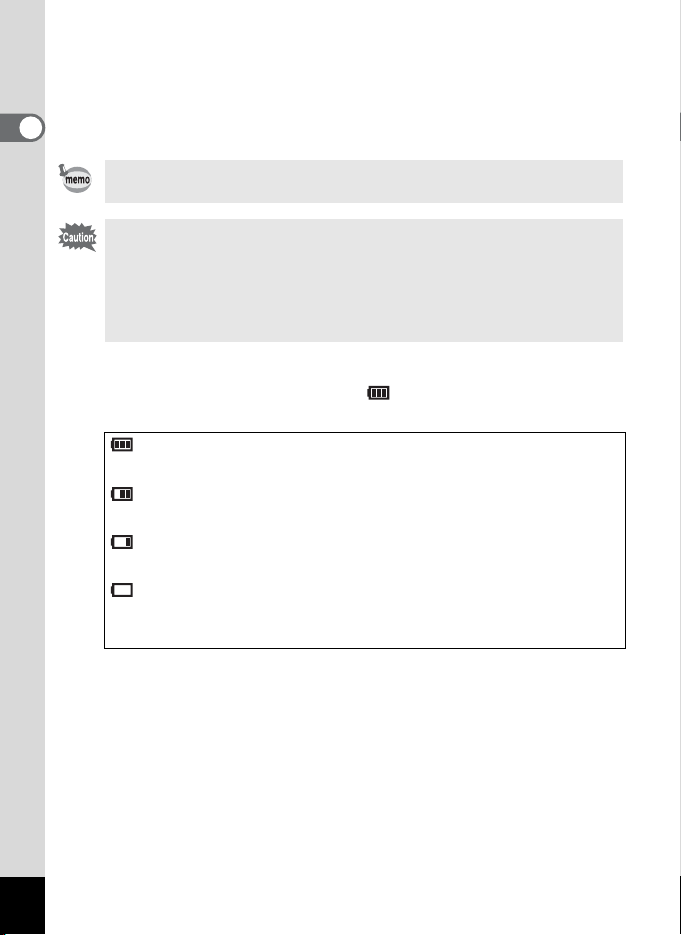
Battery Level Indicator
You can check the battery level by the symbol displayed on the
LCD monitor.
The description above is based on Pentax measuring conditions and
may vary depending on capture mode and shooting conditions.
• Generally, battery performance is temporarily deteriorated as
temperature decreases. When the camera is used in a cold
environment, keep this product warm by holding it in some protection
against cold or inside the clothes.
• Battery performance once deteriorated due to low temperature will be
recovered when the batteries are returned to room temperature.
(lit green) : Adequate power remains.
↓
(lit green) : Battery is running low.
↓
(lit yellow) : Battery is running very low.
↓
(lit red) : Battery is exhausted.
↓
[Battery depleted.] : After the message is displayed, the camera will turn off.
15
Getting Started
1
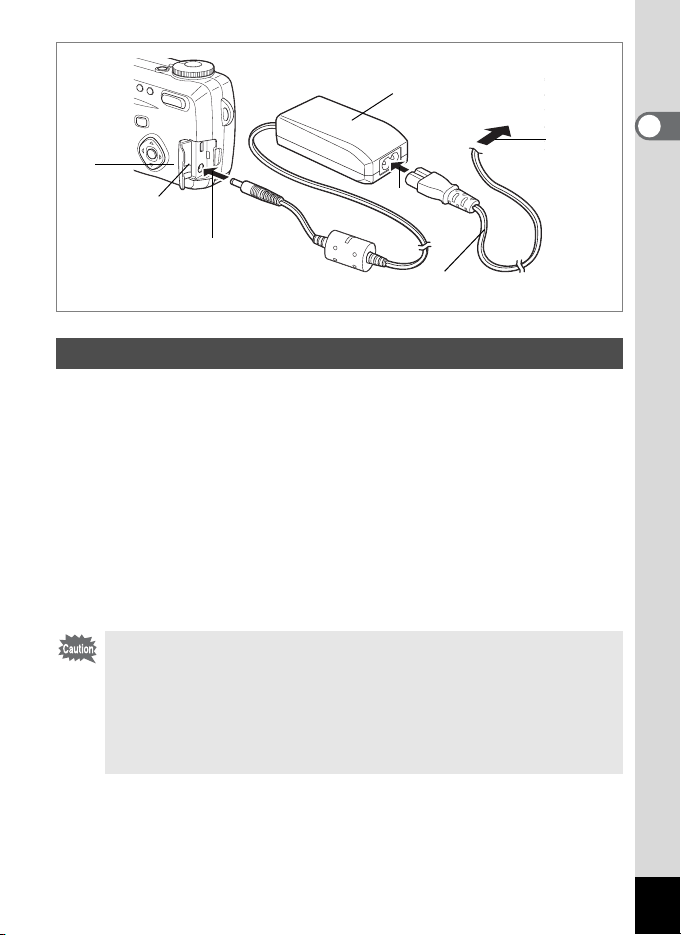
Use of the AC adapter D-AC7 (optional) is recommended if you intend
to use the LCD monitor for a long time or connect the camera to a PC or
printer.
1 Make sure that the camera is turned off and opening
the terminal cover.
2 Connect the DC terminal on the AC adapter to the DC
input terminal on the camera.
3 Connect the AC plug cord to the AC adapter.
4 Plug the AC plug cord into the power outlet.
Using the AC Adapter (optional)
• Make sure that the camera is turned off when connecting or
disconnecting the AC adapter.
• Make sure that the AC plug cord and connecting cord are inserted
securely. If the cord becomes disconnected while you are taking
pictures, the data may be lost.
• Be sure to read the operating manual accompanying the AC adapter
when using the AC adapter D-AC7.
Terminal cover
AC adapter
To power outlet
AC plug cord
4
1
2
3
16
1
Getting Started
Installing the SD Memory Card / MultiMediaCard
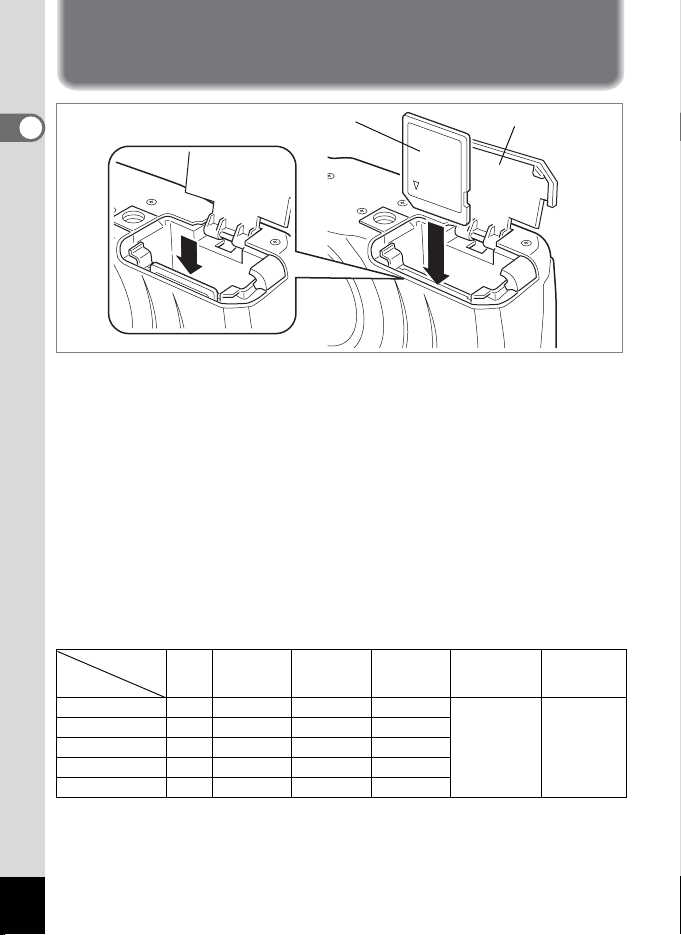
MultiMediaCards and the SD Memory Card can be used with this
camera. Captured images or recorded voice are recorded on the SD
Memory Card / MultiMediaCard. Make sure that the camera is turned off
before inserting or removing the SD Memory Card / MultiMediaCard.
1 Open the battery / card cover.
Follow the steps described on p.15 to open the cover.
2
Rotate the card with the surface of the card having the
2
symbol facing towards the lens and with the pin-connector
edge of the card towards the slot and insert fully until it clicks.
If the card is not inserted correctly, images and voice memos may not be recorded properly.
3 Close the battery / card cover.
To remove the card, eject the card by pressing it in the direction
indicated by the arrow, and pull it out.
Approximate Number of Recordable Images and Recorded
pixels / Quality levels
• The table indicates the number of images when using a 16MB SD Memory Card.
• The table is based on standard shooting conditions specified by PENTAX and may vary
depending on the subject, shooting conditions, Capture mode, SD Memory Card, etc.
• As TIFF data is uncompressed, it cannot be stored on a 16MB SD Memory Card/
MultiMediaCard. Use a Card with a capacity of 32MB or more.
Quality levels
Recorded pixels
TIFF
Best
(
C)
Better
(D)
Good
(E)
Movie images
(320 × 240)
voice
recording
2592 × 1944 0 Approx. 4 Approx. 8 Approx. 14
Approx.
40sec.
Approx.
30min.
2048 × 1536
– Approx. 7 Approx. 12 Approx. 18
1600 × 1200
– Approx. 11 Approx. 20 Approx. 27
1024 × 768
– Approx. 25 Approx. 45 Approx. 56
640 × 480
– Approx. 53 Approx. 82 Approx. 100
SD Memory Card /
MultiMediaCard
Battery / card cover
17
Getting Started
1
Precautions When Using a SD Memory Card / MultiMediaCard
• Make sure that the camera is turned off before opening the battery / card
cover.
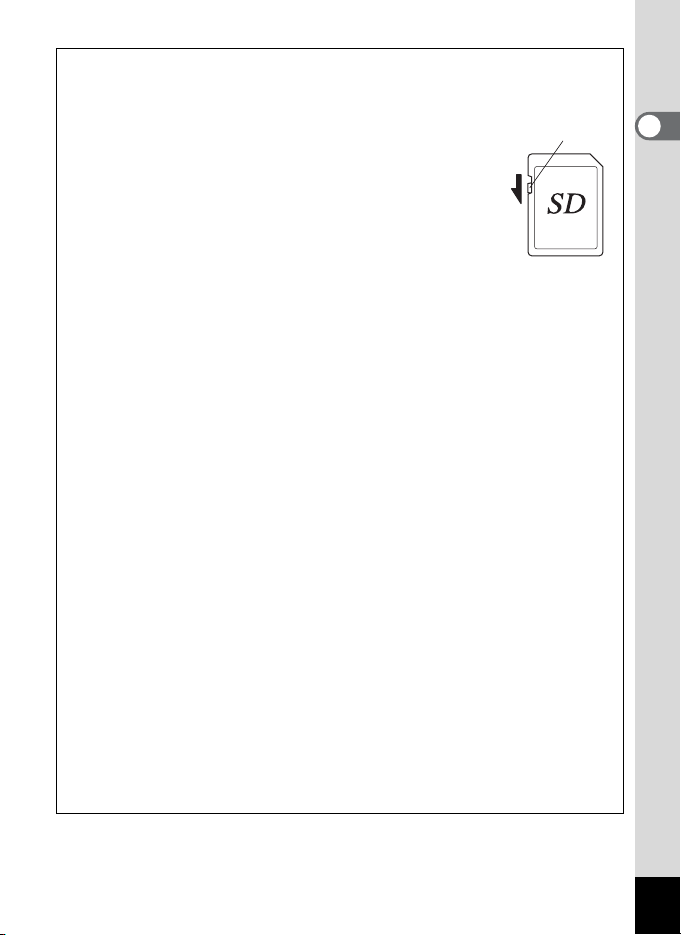
• The SD Memory Card is equipped with a write-protect
switch. Setting the switch to [LOCK] protects the existing
data by prohibiting recording of new data, deletion of
existing data or formatting of the card.
• The SD Memory Card / MultiMediaCard formatted by the
other equipment than this camera cannot be used for
PC, etc.
Formatting must be done by this camera.
• Care should be taken if you remove the SD Memory
Card / MultiMediaCard immediately after using the
camera, as the card may be hot.
• Do not remove the SD Memory Card / MultiMediaCard or turn the camera off
while data is being recorded on the card or transferred to PC using USB
cable as this may cause the data to be lost or the card to be damaged.
• Do not bend the SD Memory Card / MultiMediaCard or subject it to violent
impact.
• Keep it away from water and store away from high temperature.
• Be sure to format unused SD Memory Card / MultiMediaCard or SD Memory
Card / multimedia cards that have been used on another camera. Refer to
“Formatting a SD Memory Card / MultiMediaCard” (p.112) for instructions on
formatting.
• Never remove the SD Memory Card / MultiMediaCard during formatting as
this may cause the card to be damaged and become unusable.
• The data on the SD Memory Card / MultiMediaCard may be erased in the
following circumstances. Pentax does not accept any liability for data that is
erased.
• when the SD Memory Card / MultiMediaCard is mishandled by the user.
• when the SD Memory Card / MultiMediaCard is exposed to static electricity
or electrical interference.
• when the card has not been used for a long time.
• when the card is ejected, the AC adapter is disconnected or the battery is
removed while the data on the card is being accessed.
• The SD Memory Card / MultiMediaCard has a limited service life. If it is not
used for a long time, the data on the card may become unreadable. Be sure
to make a backup of important data on a PC.
• Avoid using or storing the card where it may be exposed to static electricity or
electrical interference.
• Avoid using or storing the card in direct sunlight or where it may be exposed
to rapid changes in temperature or to condensation.
Write-protect switch
18
1
Getting Started
Turning the Camera On and Off
1
Press the power switch.
The camera will turn on.
When the camera is turned on, the lens cover opens and the lens
extends.
Press the power switch again to turn the camera off.
It automatically performs a card check when the
camera is turned on. h appears on the LCD
monitor if no SD Memory Card / MultiMediaCard
has been inserted.
And when the write-protect switch is set to
LOCK,
Y will be displayed instead of h, and the
images or sound cannot be recorded.
Press the power switch while pressing the playback button, the
playback only mode will be activated.
• If the camera is turned on by the playback only mode, the lens cannot
be popped up.
• Turn off the camera and then turn it again to change from the
playback only mode to shooting mode.
Card Check
Play back Only Mode
Playing Back Still Pictures 1 p.26.
Power switch
Playback button
000
000
000
11:19
11:19
11:19
10/20/2003
10/20/2003
10/20/2003
19
1
Getting Started
Adjusting the Viewfinder
You can adjust the diopter in the range of –3 m
–1
to +1 m
–1
(per meter)
if the subject through the viewfinder are hard to see.
1 Aim the camera at the bright subject. While looking
through the viewfinder move the diopter adjustment
lever to the left or right until the subject appears in the
sharpest focus.
For easy adjustment, point the camera at a subject with clearly
defined outlines.
Diopter adjustment lever
Viewfinder
20
1
Getting Started
Initial Settings
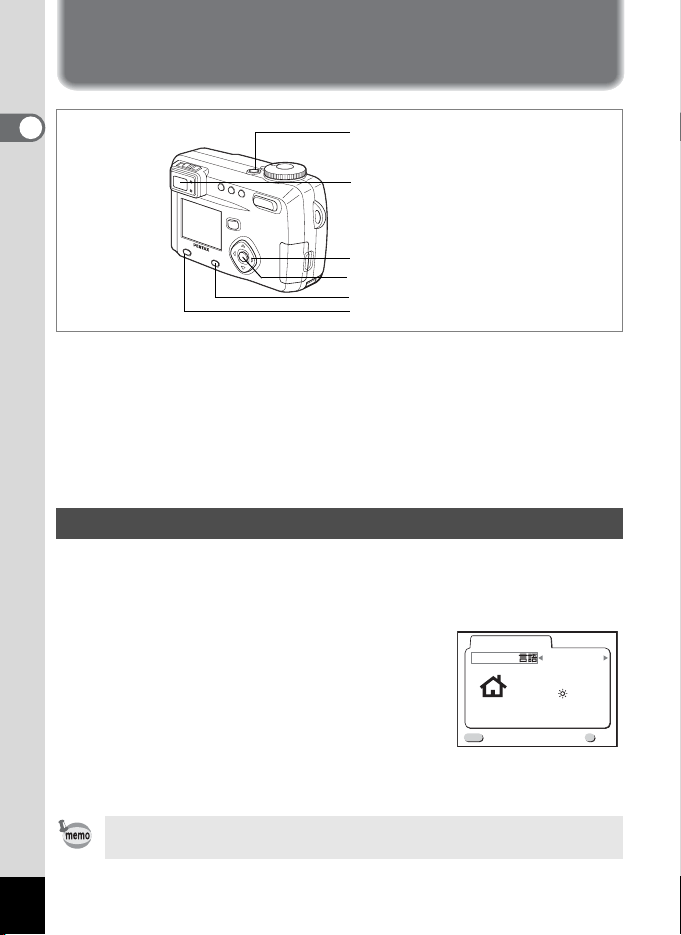
If the initial settings screen appears when you turn the camera on,
follow the procedure below to set the display language, Home Town,
DST, and current date and time. If the date and time that appear at the
bottom right of the LCD monitor when you turn the camera on for the
first time is not the current time, follow the instructions for “Setting the
Date and Time” (p.22) to set the correct date and time.
You can choose the language in which the menus, error messages, etc.
are displayed from the following: English, French, German, Spanish,
Italian, Japanese, Chinese and Russian.
1 Turn the camera on.
2 Use the four-way controller (45) to
select the display language.
The default setting is English.
3 Press the four-way controller (3).
The screen for setting the city will be
displayed.
Setting the Display Language
You can change the setting after it has been made. Refer to “Changing
the Display Language” (p.119).
Power switch
Viewfinder
Four-way controller
OK button
Display button
Menu button
Language/
Initial settings
NYC
English
City
DST
MENU
OK
OK
Exit
21
Getting Started
1
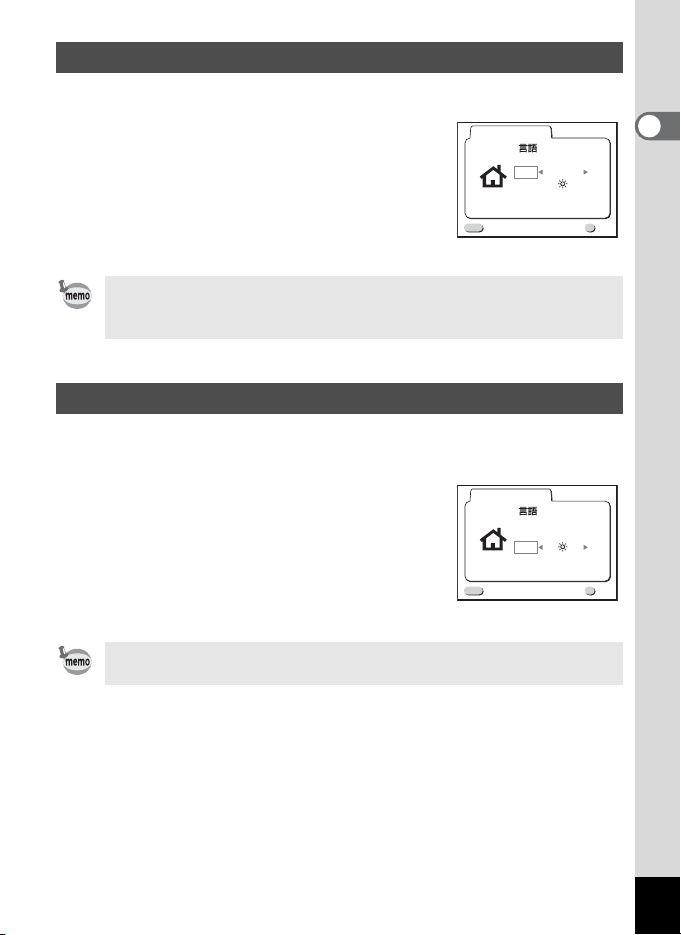
You can choose the city (Home Town) in which you will use the camera.
1 Press the four-way controller (45)
to select the desired city (Home
Town).
2 Press the four-way controller (3).
The screen for setting the D.S.T will be
displayed.
You can choose whether or not to display the Y (Daylight Saving Time)
mode.
1 Use the four-way controller (45)
to select
Y or Z.
The default setting is Z (Off).
2 Press the OK button.
The screen for setting the Data and Time will
be displayed.
Setting the Home Town
• See p.128 for the list of cities and corresponding code names.
• You can change the setting after it has been made. Refer to “Setting
the World Time” (p.116).
Setting the D.S.T. Mode
You can change the setting after it has been made. Refer to “Setting the
World Time” (p.116).
Language/
Initial settings
NYC
English
City
DST
MENU
OK
OK
Exit
Language/
Initial settings
NYC
English
City
DST
MENU
OK
OK
Exit
22
Getting Started
1
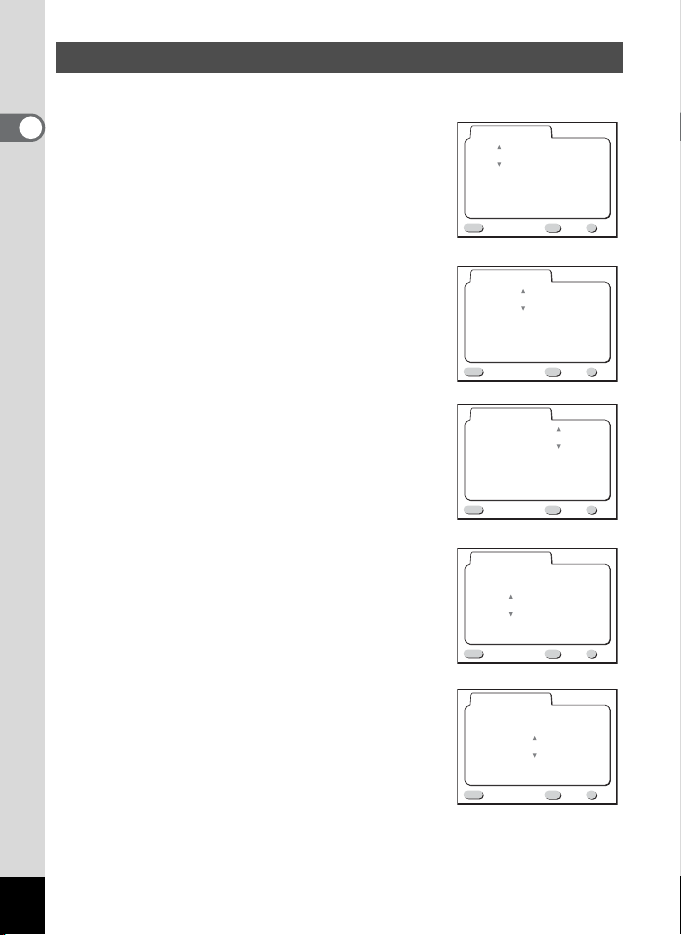
Set the current date and time.
1 Use the four-way controller (23) to
change the month.
2 Press the four-way controller (5).
2 and 3 will be displayed above and below
the month.
3 Use the four-way controller (23) to
change the day and press the four-
way controller (
5).
2 and 3 will be displayed above and below
the day.
4 Repeat Step 3 to change the [year]
[hour] and [minutes].
5 Use the Display button to select the
12-hour or 24-hour display format.
Setting the Date and Time
Date Adjust
10 / 01 / 2003
0 :
00
MENU
OK
OK
Exit
DISP
12/24
Date Adjust
10 / 01 / 2003
0 :
00
MENU
OK
OK
Exit
DISP
12/24
Date Adjust
10 / 01 / 2003
0 :
00
MENU
OK
OK
Exit
DISP
12/24
Date Adjust
10 / 01 / 2003
0 : 00
MENU
OK
OK
Exit
DISP
12/24
Date Adjust
10 / 01 / 2003
11 :
19 PM
MENU
OK
OK
Exit
DISP
12/24
23
Getting Started
1
6 When you have finished the settings, press the OK
button when the clock reaches 00 seconds.
The camera is ready to take a picture.
Press the OK button again after pressing the OK button when the
clock reaches 00 seconds to return to Capture mode when you set
date and time except the initial settings.
• For an accurate time setting, when you have finished the settings,
press the OK button when the clock reaches 00 seconds.
• You can cancel the settings operation and switch to Capture mode by
pressing the MENU / Fn button when the initial settings screen is
displayed. If this is done, the initial settings screen will be displayed
next time you turn the camera on.
• You can change the settings after they have been made. Refer to
“Changing the Date / Time” (p.116).
24
2
Quick Start
Quick Start
Taking Still Pictures
For the simplest procedure to take still pictures.
The flash fires automatically depending on the light conditions.
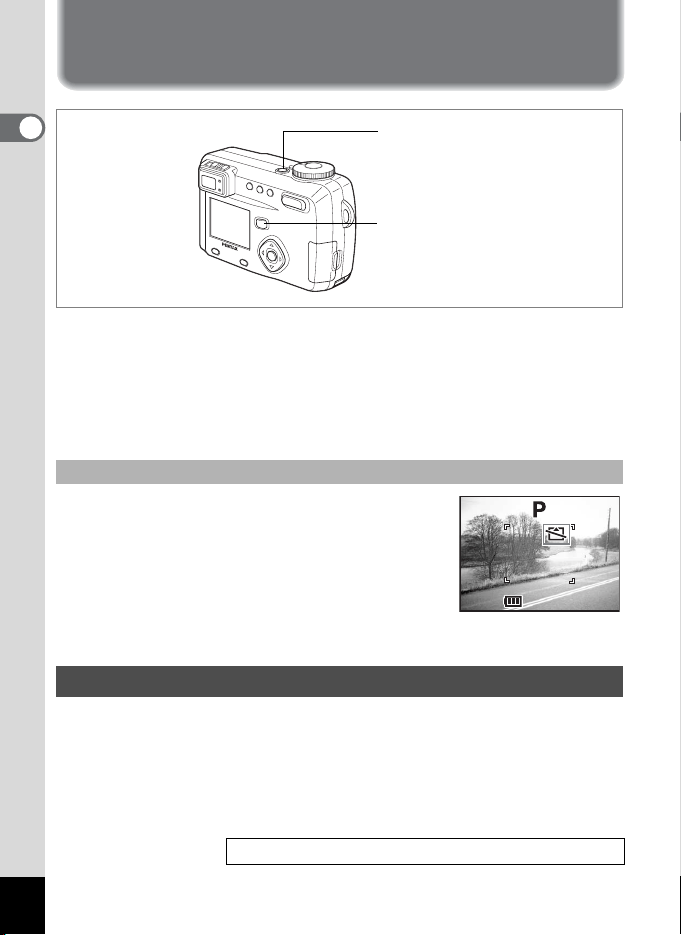
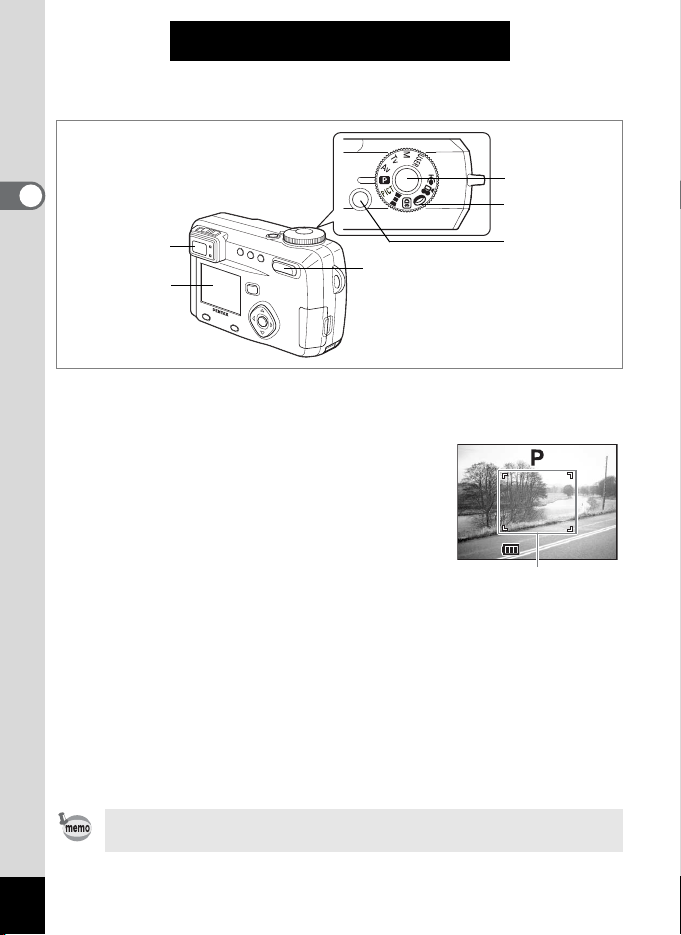
1 Press the power switch.
The camera will turn on.
2 Set the mode dial to A.
3 Confirm the subject and shooting
information on the LCD monitor.
The focus area in the middle of the LCD
monitor indicates the zone of automatic
focusing. You can change the size of the subject by pressing the
Zoom button.
x : makes the subject bigger.
w : makes the subject smaller.
You can check the size of the subject by looking through the
viewfinder.
As there is no focus area in the viewfinder, be sure to check the
focusing area on the LCD monitor.
Shutter release
button
Zoom /f/y button
Power switch
LCD monitor
Viewfinder
Mode dial
200
200
200
11:19
11:19
11:19
10/20/2003
10/20/2003
10/20/2003
Focus Area
25
2
Quick Start
4 Press the shutter release button.
The image will be displayed on the LCD monitor for 2 seconds
(Instant Review) and recorded on the SD Memory Card /
MultiMediaCard. (The green and red lamps on the right of the
viewfinder blink alternately while the image is being recorded on the
SD Memory Card / MultiMediaCard.)
The shutter release button works in a two-step action.
Press halfway
The focus and exposure are locked when the shutter release button is
pressed lightly (halfway).
They remain locked while the button is pressed halfway, and the shutter
speed and aperture are displayed on the LCD monitor.
You can find the following information on the LCD monitor, the status
lamp and the flash lamp.
1 Autofocus area
If the subject is in focus, the frame will light green. If the subject is out of
focus, the frame will not appear.
2 Focus status lamp & Flash status lamp
You cannot take a picture while the flash is charging. Use manual focus
to take the picture when the image is not focused.
Pressed down fully
The picture is taken.
The Instant Review default setting is 2 seconds. During this time you
can delete the image by pressing the
i button (The [Delete] menu will
be displayed.), and selecting [Delete], and then pressing the OK button.
To start recording a voice memo, press the OK button during Instant
Review. Press the OK button again to stop recording.
Using the Shutter Release Button
status Focus status lamp (green) Flash status lamp (red)
lit Subject is in focus Flash is charged
blink Subject is out of focus Flash is charging
Focus manually. 1 p.41
Instant Review
Setting the Instant Review Time 1 p.50
26
2
Quick Start
Quick Start
Playing Back Still Pictures
You can display the still picture.
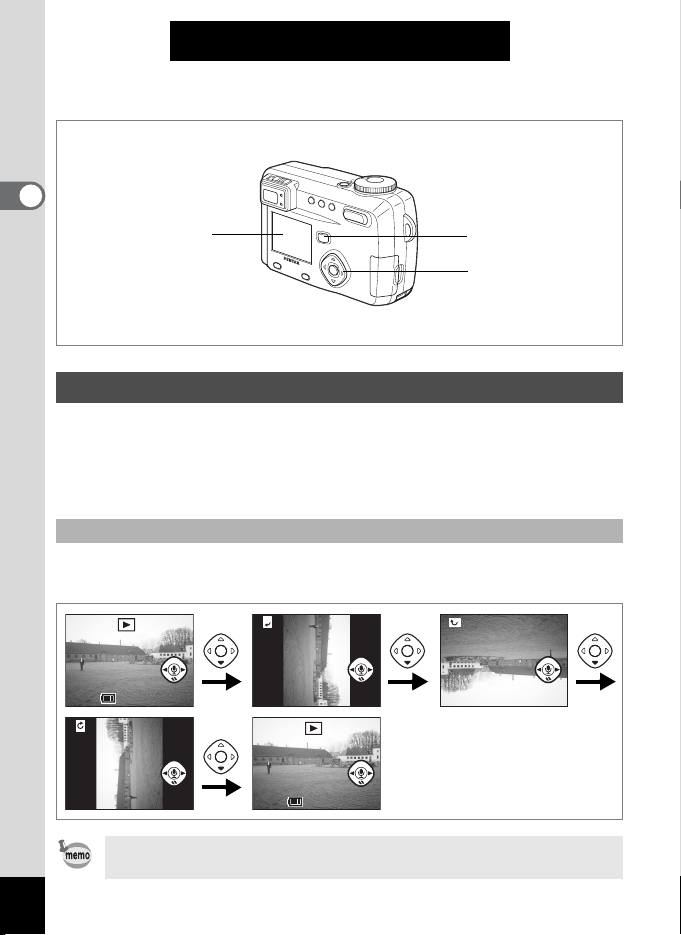
1 Press the Playback button after taking a picture.
The image taken will be displayed on the LCD monitor.
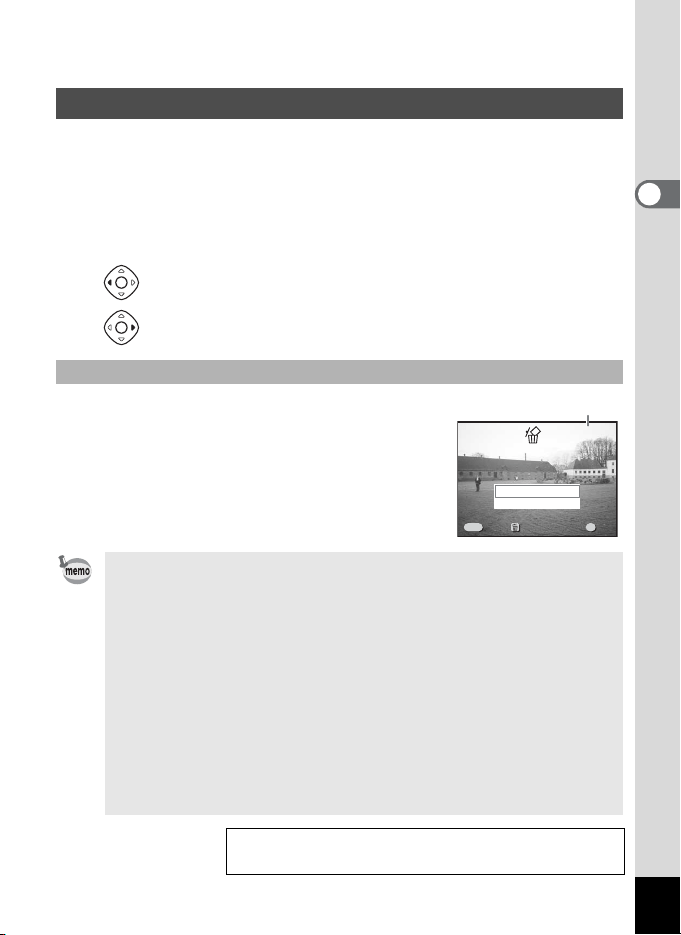
The image will be rotated 90° clockwise each time your press the four-
way controller (3)
.
Playing Back Images
To rotate the displayed image
• You cannot rotate movie pictures.
• You cannot rotate images while playing back a voice memo.
Four-way controller
LCD monitor
Playback button
100-0019
100-0019
100-0019100-0019
100-0019
100-0019
11:19
11:19
11:19
10/20/2003
10/20/2003
10/20/2003
100-0019
100-0019
100-0019100-0019
100-0019
100-0019
11:19
11:19
11:19
10/20/2003
10/20/2003
10/20/2003
27
2
Quick Start
Still images can be played back one at a time, proceeding either
forward or backward.
1 Press the Playback button after taking a picture.
An image will be displayed on the LCD monitor.
2 Press the four-way controller (45).
displays the previous image.
displays the next image.
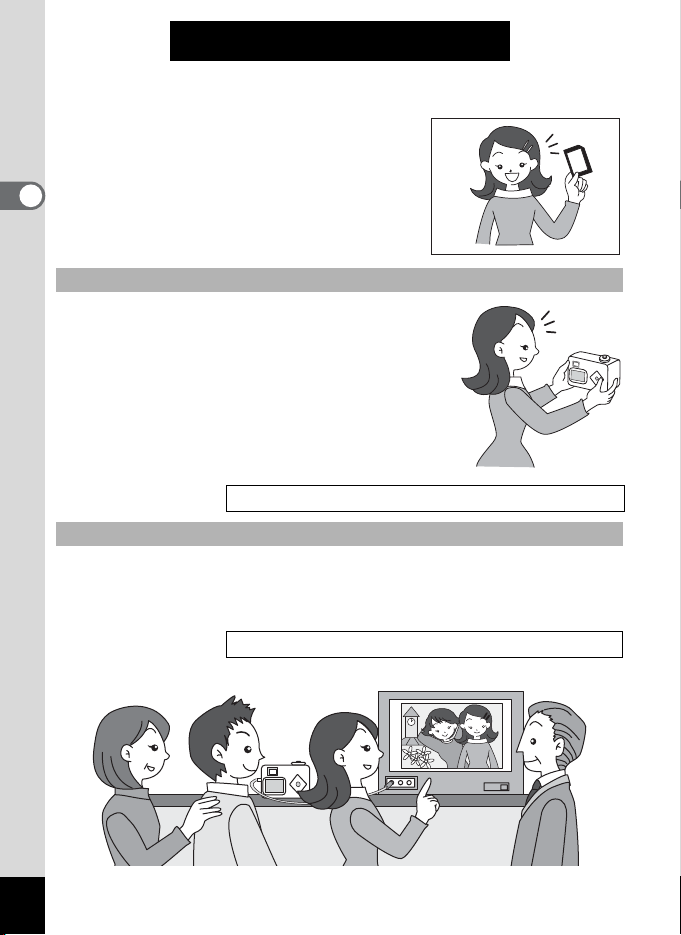
While the image is displayed, you can erase it by
pressing the
i button (The Delete screen will be
displayed.), press the four-way controller (2) to
select [Delete], and then pressing the OK button.
Press the Playback button or press the shutter
release button halfway to return to shooting
status.
Playing Back Previous or Next Images
Erasing the image displayed on the LCD monitor
• The camera turns on in Playback Only mode when you turn the
camera on while pressing the Playback button. As the lens does not
extend in Playback Only mode, this feature is useful when you want
to pass the camera to someone and show them the picture you have
just taken. Turn the camera off and then turn it on again to switch to
the Capture mode.
• You can enlarge the image displayed on the LCD monitor by pressing
the Zoom /
f/y button.
• When the screen is changed to the playback screen, the image with
the largest file number will be displayed first.
• In the case of movie pictures, the first frame will be displayed.
• If there are no images stored, the [No image & sound] message will
be displayed.
Zoom Display
1 p.89
Adding a Voice Memo
1 p.90
Cancel
Delete
100-0020
100-0020
100-0020
MENU
OK
OK
OK
Exit
Exit
OKExit
All images & sounds
All images & sounds
All images & sounds
File No.
28
2
Quick Start
Quick Start
How to View the Recorded Images
Images taken with the Optio 555 camera are
recorded on the SD Memory Card /
MultiMediaCard. You can view the images
recorded on the card on the camera itself,
transfer them to your PC and print them out.
One of the advantages of a digital camera is that
it enables you to view your pictures immediately
after you have taken them. You can check the
composition and focus and take the picture again
if you are not satisfied.
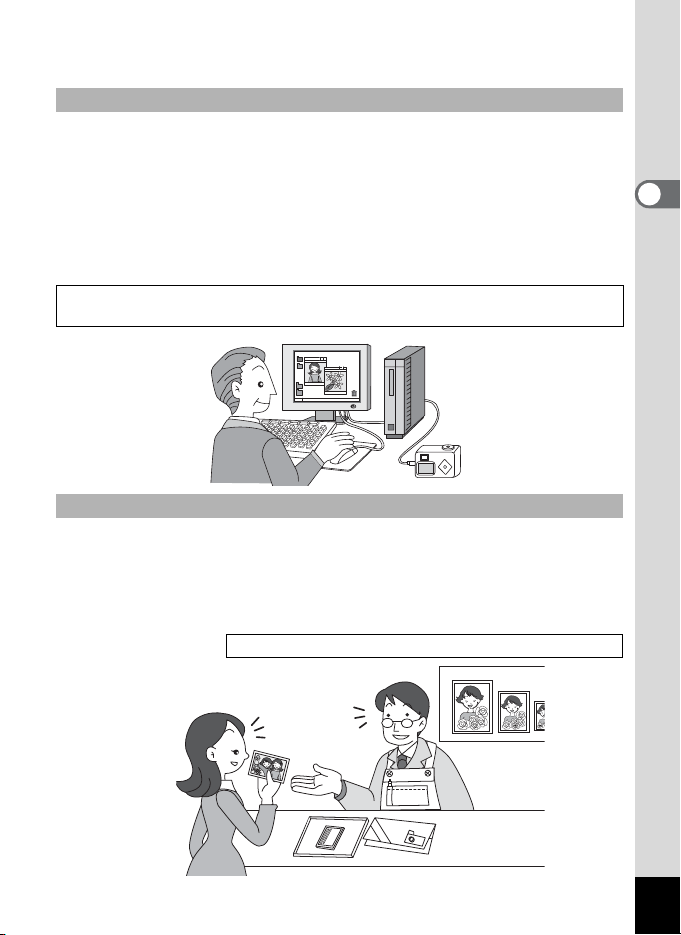
If you want to show your pictures to friends, you can display them on
your TV monitor. Connect the camera to the TV with the AV cable to
view images on your TV.
Viewing images on the camera
Playing Back Still Pictures 1 p.89
Viewing images on a TV
Viewing Images on a TV 1 p.100
29
2
Quick Start
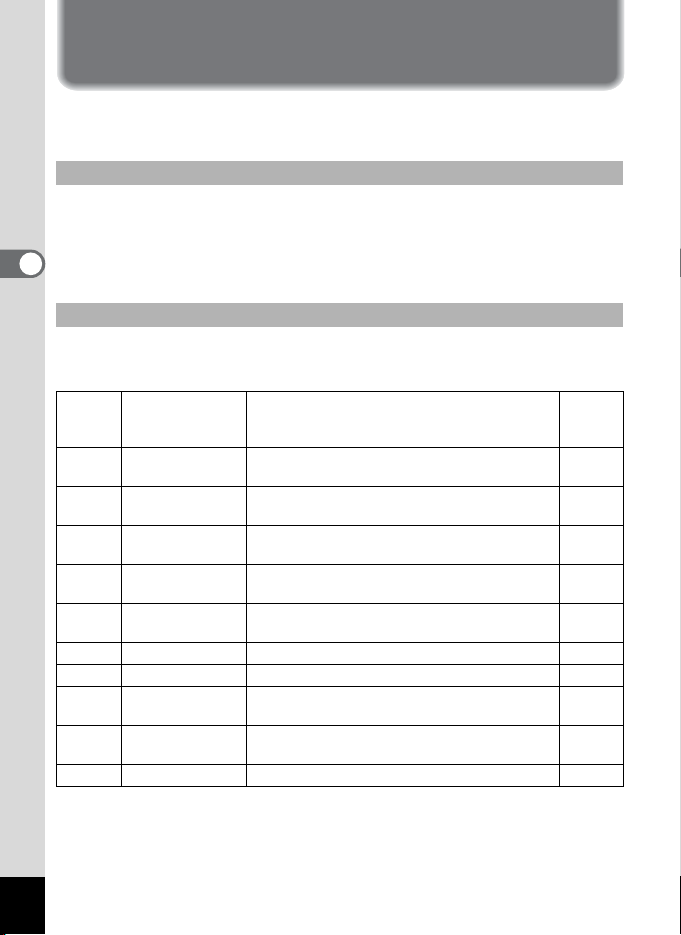
You can view recorded images and edit them on the PC just by connecting
the camera to the PC with the USB cable and downloading the images (you
need to install the USB driver if you are using Windows 98/98SE). Or you can
remove the SD Memory Card / MultiMediaCard from the camera and transfer
the data to your PC using a card reader. If you use a laptop computer, you
can transfer the image data by fitting the SD Memory Card / MultiMediaCard
into the card adapter and inserting the card adapter into the card slot.
If you are using a printer that is compatible with PictBridge, you can print
pictures by using a USB cable to connect the camera directly to a printer.
Prints of images recorded on the SD Memory Card / MultiMediaCard can
be ordered in the same way as with conventional photographs by taking
the SD Memory Card / MultiMediaCard to a store that performs printing.
The number of prints can be specified and dates can be included in the
prints if DPOF (Digital Print Order Format) is set before taking the SD
Memory Card / MultiMediaCard to a store that performs DPOF printing.
Viewing images on a PC
Printing by directly connecting the camera to the printer 1 p.104
Process from taking pictures to printing
1 (PC connection manual) p.4-5
Printing images by a printing service
Setting the Printing Service 1 p.101
30
3
Common Operations
Common Operations
Changing the Mode
Capture mode is for taking pictures and voice recording.
Playback mode is for playing back or erasing images and sound.
• Press the Playback button to change from Capture mode to Playback
mode.
• Press the Playback button or the shutter release button halfway to
change from Playback mode to Capture mode.
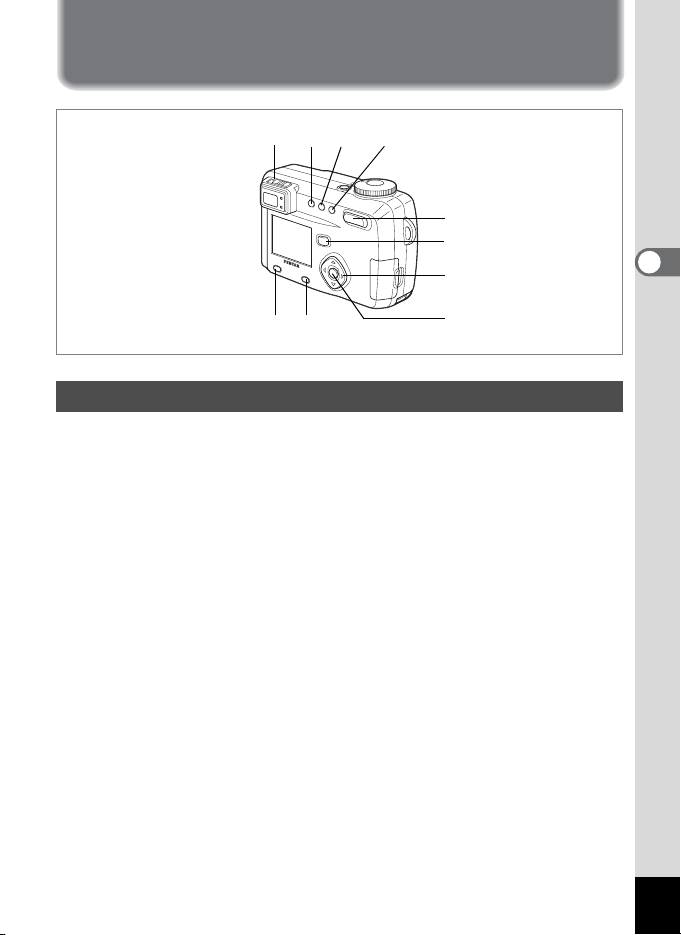
1 Turn the mode dial so that the mark is on E a b c
A d F G D C or O.
Switching Between Capture Mode and Playback Mode
Selecting the Capture Mode
E
User mode
The functions are set in advance and the
settings are enabled whenever the camera is
turned on.
p.58
a
Manual exposure
You can set the shutter speed and aperture
manually.
p.56
b
Shutter-priority
You can set the shutter speed manually, and
the aperture is set automatically.
p.55
c
Aperture-priority
You can set the aperture manually, and the
shutter speed is set automatically.
p.54
A
Program
The shutter speed and aperture are set
automatically when taking still pictures.
p.53
d
Picture
You can select a Capture mode from 9 modes
according to the scene you are taking.
p.60
F
Panorama This mode is for taking panorama pictures.
p.62
G
3D This mode is for taking 3D pictures.
p.64
D
Digital filter
This mode is for taking pictures using a variety
of filters such as red, blue and green.
p.70
C
Movie picture
This mode is for taking moving images.
(Sound can also be recorded.)
p.72
O
Voice recording This mode is for recording sound.
p.69
31
3
Common Operations
Using the Button Functions
1
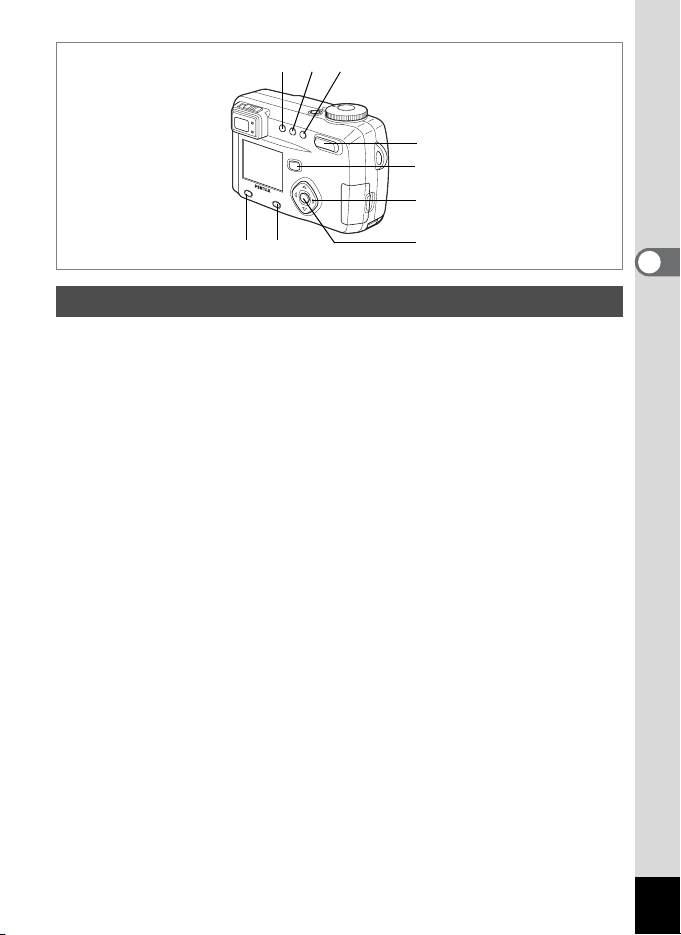
Diopter adjustment lever
Adjusts the viewfinder for optimum clarity. (1 p.19)
2 b button
Changes the flash mode. (1 p.42)
3 ( button
Changes the Capture mode as follows.
Using the self-timer (
1 p.77)
Using the remote control unit (
1 p.78)
Continuous shooting (
1 p.79)
Multiple exposure shooting (
1 p.82)
Interval shooting (
1 p.80)
*When the Capture mode is set to
F G C continuous shooting,
multiple exposure shooting and Interval shooting mode will be
skipped.
4 ) button
Changes the focus mode. (1 p.40)
5 Zoom button
Changes the size of the subject. (1 p.74)
Capture Mode
123 4
5
6
7 8
11 10
9
32
Common Operations
3
6 Playback button
Switches to Playback mode. (1 p.33)
7 Four-way controller (45)
Changes the EV compensation in modes other than a and O.
(
1 p.74)
Changes the shutter speed in
a mode. (1 p.56)
8 Four-way controller (23)
Adjusts the focus in z mode. (1 p.41)
Sets the aperture value in
a and c mode. (1 p.56, 54)
Sets the shutter speed in
b mode. (1 p.55)
Selects the type of filter in
D mode. (1 p.70)
Selects Picture mode in
d mode. (1 p.60)
9 OK button
Sets the selected menu item. (1 p.34)
When pressed in
z mode, the function on the four-way controller
(
23) reverts to the function set by the mode dial.
10 Display button
Changes the information displayed on the LCD monitor. (1 p.38)
11 Menu / Fn button
Displays the active menus in Capture mode and retrieves the
functions registered on the four-way controller. (
1 p.34, 123)
33
Common Operations
3
1 Z button
Protects the image from erasure. (1 p.99)
2 DPOF button
Sets the DPOF data for printing pictures. (1 p.101)
3 i button
Deletes the image. (1 p.96)
4 Zoom /f/y button
f displays nine images at once. (1 p.94)
Press -
y in normal mode to change the size of the Zoom Display
image, displayed on the LCD monitor. (
1 p.89)
5 Playback button (1 p.30)
Switches to Capture mode.
6 Four-way controller (45)
Displays images one by one. (1 p.27)
7 OK button
Saves the function selected by the menu item. (1 p.34)
When pressed in Normal Playback mode, the voice memo starts, and
when pressed again, the voice memo stops. (
1 p.90)
When pressed in Zoom Display or Nine-image Display mode,
changes to Normal Playback mode. (
1 p.89, 94)
8 Display button
Changes the information displayed on the LCD monitor. (1 p.93)
9 Menu / Fn button
Displays the active menus in Playback mode. (1 p.34)
Playback Mode
12
4
5
6
98
7
3
34
3
Common Operations
Using the Menus
The menus are displayed on the LCD monitor when you press the
Menu / Fn button. You can set functions, save the settings and change
the camera settings on these menus.
When you are making settings from a menu, a guide to operation is
displayed on the LCD monitor.
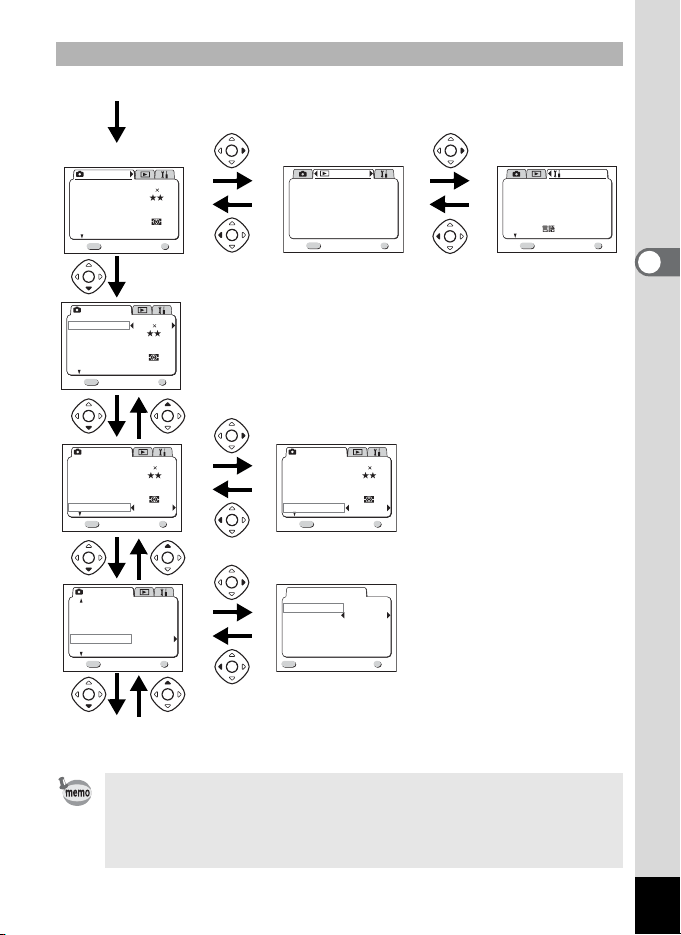
1 Press the Menu / Fn button.
The menu screen will be displayed. The selected area will be
underlined in green.
2 Press the four-way controller (45).
Use the four-way controller (45) to select the menu screen.
3 Use the four-way controller (23) to select an item.
Use the four-way controller (23) to move the frame up or down.
4 Use the four-way controller (45) to change the setting.
4’ If there is a select screen, use the four-way controller
(
5) to move to the select screen.
5 Press the OK button.
The settings will be saved and the screen will return to capture or
playback status.
If the menu screen is not exited, press the OK button again.
• If you press any buttons except the OK button before press the OK
button and leave the menu screen, any changes to setting will not
be saved.
• Even if you press the OK button and leave the menu screen, if you
remove the battery before turning off the camera or do not
otherwise turn off the camera correctly, any changes to setting will
not be saved.
How to Set the Menus
35
Common Operations
3
Example of menu operation
• If you press the shutter release button halfway and move the camera
to Capture mode, any changes to the setting will not be saved.
• The [
A Rec. Mode] menu will be displayed and when you display the
menu from Capture mode, the [
Q Playback] menu will be displayed
when you display the menu from Playback mode.
Rec. Mode
Wide
AWB
Auto
Quality Level
White Balance
Focusing Area
AE Metering
Sensitivity
Exit
1/3
MENU
OK
OK
2592 1944
Recorded Pixels
1 Menu / Fn button
[
A
Rec.Mode] menu
[
Q
Playback] menu
OK
OK
Playback
Resize
Trimming
Alarm
Slideshow
PictBridge
Digital Filter
3sec
Off
Exit
MENU
1/1
2
3
Rec. Mode
Wide
AWB
Auto
Quality Level
White Balance
Focusing Area
AE Metering
Sensitivity
Exit
1/3
MENU
OK
OK
2592 1944
Recorded Pixels
3
Rec. Mode
Wide
AWB
Auto
Quality Level
White Balance
Focusing Area
AE Metering
Sensitivity
Exit
1/3
MENU
OK
OK
2592 1944
Recorded Pixels
3
Rec. Mode
Exit
2/3
MENU
OK
OK
Auto Bracket
Digital Zoom
Instant Review
Interval Shoot
Off
On
2sec
Fast Fwd Movie
Flash Exp. Comp.
0.0
3
To the next screen
Rec. Mode
Wide
AWB
100
Quality Level
White Balance
Focusing Area
AE Metering
Sensitivity
Exit
1/3
MENU
OK
OK
2592 1944
Recorded Pixels
Interval Shoot
Interval
Number of Shot
Start Time
0hr 00min
02
1min 10sec
MENU
OK
OK
Exit
OK
OK
Exit
MENU
1/3
Set-up
Format
Sound
Date Style
mm/dd/yy
1/ 1/2003
Off
Date Adjust
World Time
Language/
English
[B Set-up] menu
Select screen
2
4
4’
36
Common Operations
3
Please refer to pages 141 to 143 for List of Menu Default settings and
the adjustable [Rec. mode] menu items by Capture mode.
[A Rec.Mode] Menu
Menu List
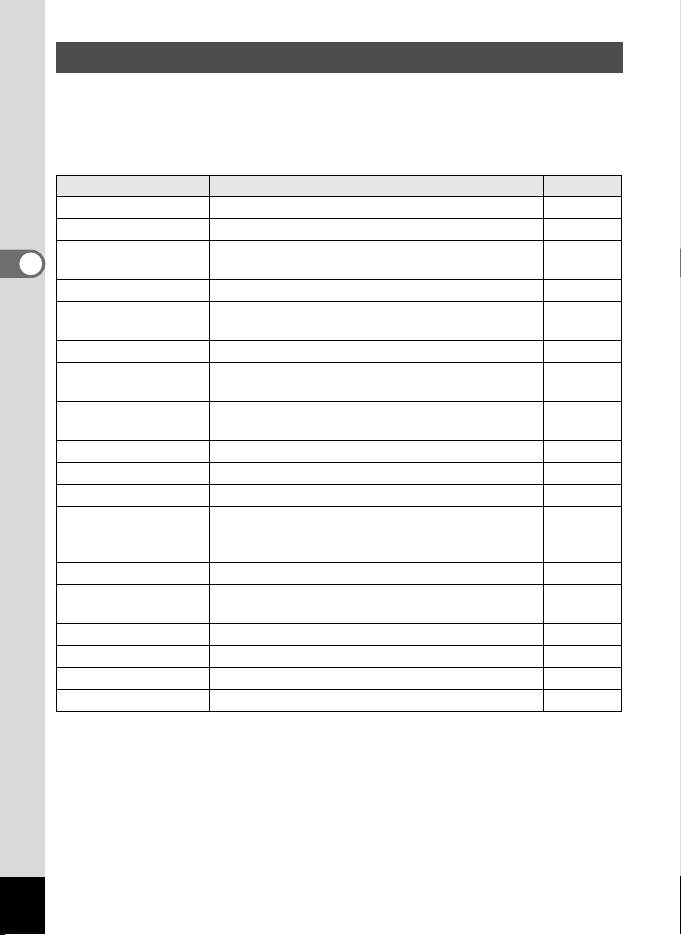
Item Description Reference
Recorded Pixels For selecting the size of recorded pixels.
p.43
Quality Level For selecting the image compression rate.
p.44
White Balance
For adjusting the color balance according to
lighting.
p.45
Focusing Area For changing the Area of the autofocus.
p.47
AE Metering
For setting the metering method to determine the
exposure.
p.48
Sensitivity For setting the sensitivity.
p.49
Flash Exp. Comp.
For adjusts the brightness of the flash without
changing the brightness of the background.
p.52
Auto Bracket
For setting the shooting conditions such as
exposure, saturation and sharpness.
p.84
Digital Zoom For taking digital zoom pictures.
p.75
Instant Review For setting the instant review time.
p.50
Interval Shoot For taking pictures specified interval of time.
p.80
Fast Fwd Movie
For delaying the frame rate when taking movie
pictures (so that the movie appears speeded up
when played back)
p.86
3D Mode For taking 3D pictures.
p.64
Memory
For saving the shooting function settings when
the camera is turned off.
p.87
Sharpness For setting the sharpness.
p.50
Saturation For setting the saturation.
p.51
Contrast For setting the contrast.
p.51
USER For setting the functions registered in User mode.
p.59
37
Common Operations
3
[
Q Playback] Menu
[B Set-up] Menu
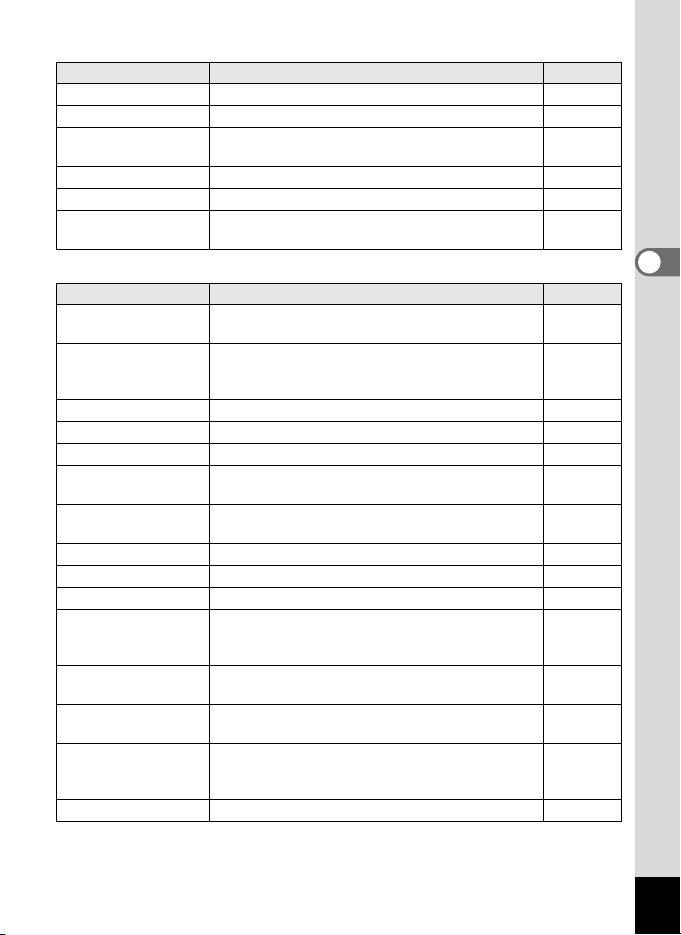
Item Description Reference
Resize For changing the size of images
p.107
Trimming For trimming images
p.109
Digital Filter
Apply a red, blue, green, or other image filter to a
captured image.
p.110
Alarm For setting the alarm to ring at specified time
p.126
Slideshow Recorded images are played successively.
p.95
PictBridge
For printing directly from a digital camera
connected to a printer.
p.104
Item Description Reference
Format
For formatting the SD Memory Card /
MultiMediaCard
p.112
Sound
For adjusting the beep sound when a button is
pressed. For setting the button operation, start-
up, shutter sounds and volume.
p.113
Date Style For setting the date style
p.115
Date Adjust For adjusting the date and time
p.116
World Time For setting the world time
p.116
Language
For changing the language in which menus and
messages are displayed
p.119
Start-up screen
For setting the Start-up screen when the camera
is turned on
p.118
Video Out For setting the video output format
p.119
Sleep Timeout For setting the power saving function
p.120
Auto Power Off For turning off the power automatically.
p.120
Quick Delete
When this option is turned on, the Delete screen
is displayed with [Delete] or [All Images]
selected.
p.121
Quick Zoom
For playing back images at the set size with the
Zoom button pressed only once.
p.121
Fn Setting
For registering a function on the four-way
controller.
p.122
Focus Limiter
For switching between limiting and not limiting
lens movement during normal shooting and
macro shooting.
p.124
Reset For returning the camera settings to defaults
p.125
38
4
Taking Pictures
Taking Pictures
Displaying Shooting Information (Capture Mode)
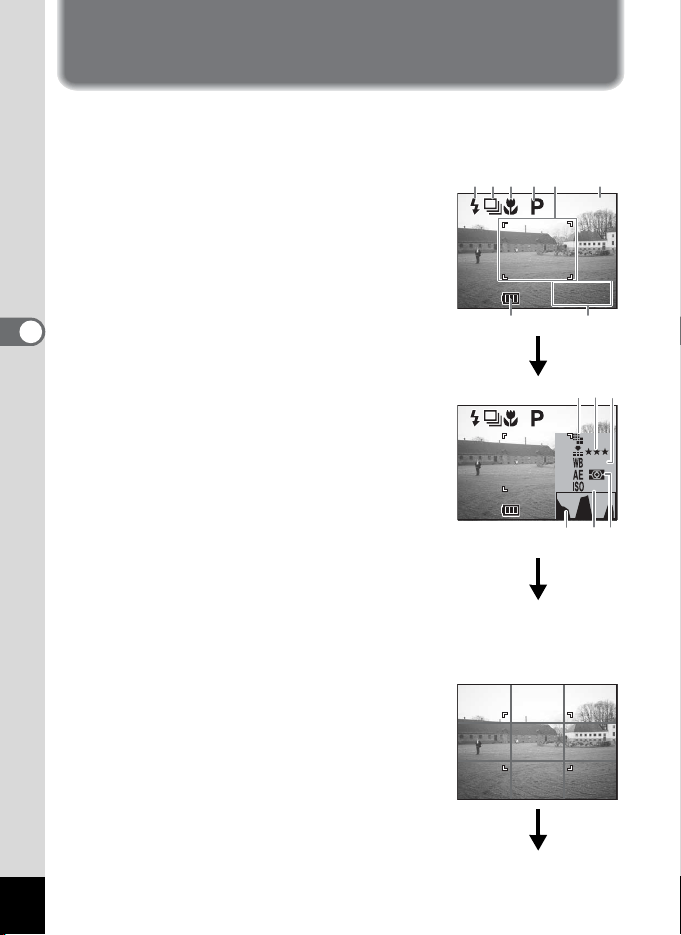
You can display information on the LCD monitor when shooting.
The display mode can be changed by pressing the Display button.
Display On
Shooting information is displayed.
1 Flash mode
2 Drive mode
3 Focus mode
4 Capture mode
5 AF area
6 Number of images can be taken
7 Date & time
8 Battery indicator
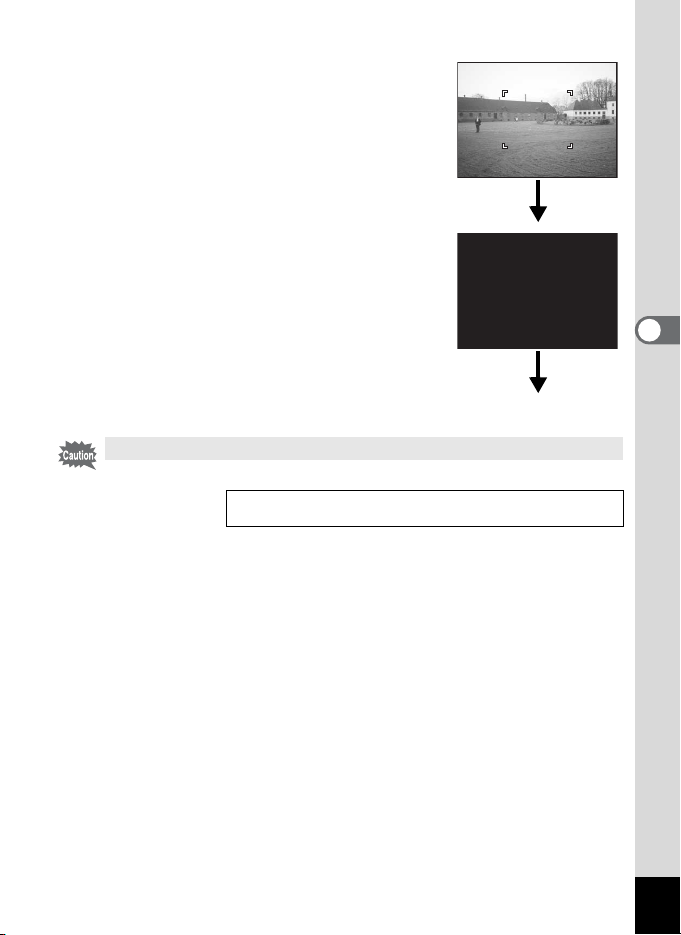
Histogram Display
The brightness distribution of the image is
displayed.
The x-axis shows the brightness (darkest at
the left end and brightest at the right end)
and the y-axis shows the pixel numbers.
1 Recorded pixels
2 Quality level
3 White balance
4 AE metering
5 Sensitivity
6 Histogram
• The AF area will be displayed in the
autofocus mode.
Grid Display
The grid is displayed. This is useful for
composing detailed pictures.
• The AF area will be displayed in the
autofocus mode.
198
198
198
11:19
11:19
11:19
10/20/2003
10/20/2003
10/20/2003
46321
87
5
AWB
2592
AUTO
035
035
035
2
3
1
56 4
Go to next page
39
Taking Pictures
4
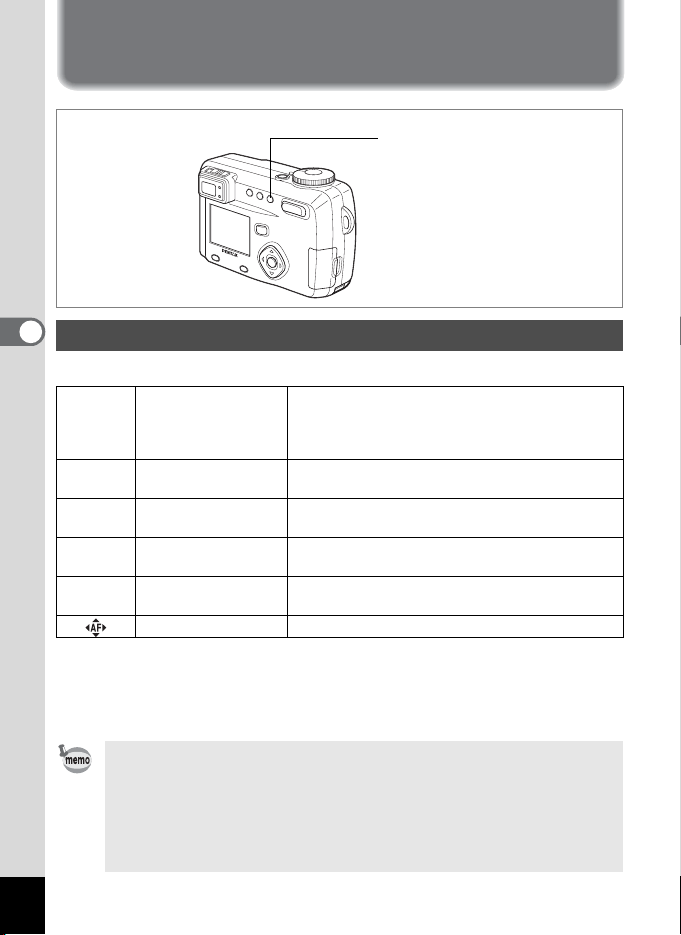
Display Off
No shooting information is displayed.
• The AF area in autofocus mode is
displayed.
• If any of the modes are changed such as
Flash mode, the mode you have changed
is displayed for a few seconds.
LCD Monitor Off
Turn off the LCD monitor.
(The LCD monitor is not turned off in
Playback mode.)
The LCD monitor does not turn off in C F G D mode.
Saving the Display Mode
1 p.87
Display On
40
4
Taking Pictures
Setting the Shooting Functions
Focus Mode
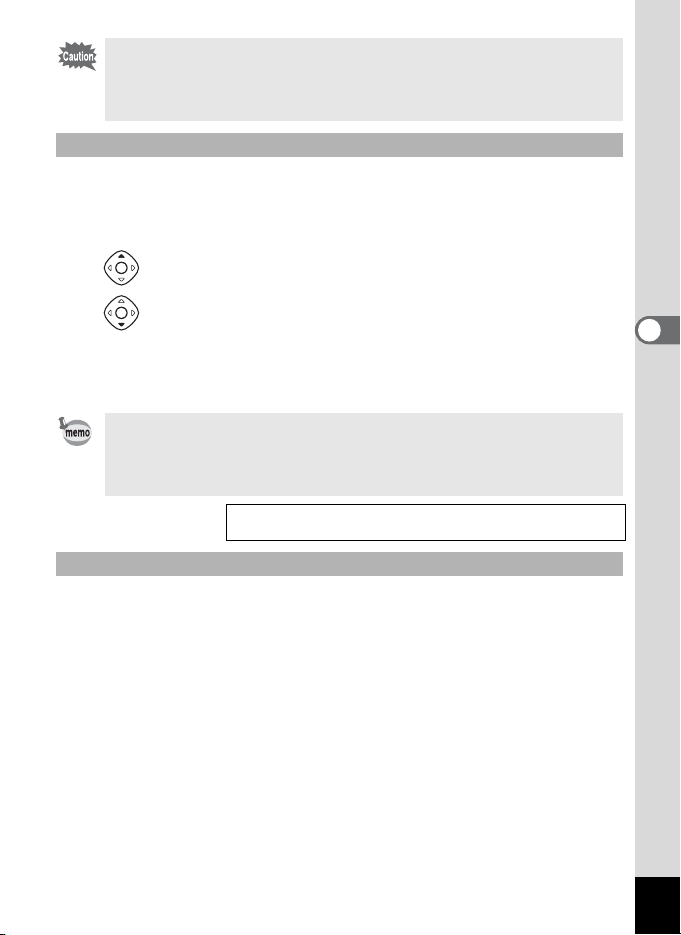
1 Press the q s or z button in Capture mode.
The focus mode changes each time the button is pressed and the set
focus mode is displayed on the LCD monitor.
The camera is ready to take the picture in the set focus mode.
Selecting the Focus Mode
(No icon) Autofocus mode
The camera is focused on the subject in the
autofocus area when the shutter release button is
pressed halfway. Use this mode when the distance
to the subject is more than 60 cm (1.97 ft).
q Macro mode
This mode is used when the distance to the subject
is approx. 15 cm – 65 cm (0.5 ft – 2.13 ft).
r Super macro mode
This mode is used when the distance to the subject
is approximately 2 cm – 65 cm (0.8 inch – 2.13 ft).
s
Infinity-landscape
mode
This mode is used for taking distant objects.
z Manual focus mode
Adjust focus manually by the four-way controller
(23).
Move focusing area The position of the autofocus area is changed.
• The default setting of the focus mode is [Autofocus mode].
• The focus is fixed and the focus mode cannot be selected in the
movie picture mode (
1 p.72).
• The zoom is fixed in the wide-angle position in Super Macro mode.
• The image may be overexposed or a dark area may appear at the
bottom right of the picture when you use the flash in Macro mode.
• The flash does not discharge in Super macro mode.
1
41
Taking Pictures
4
The central portion of the picture is enlarged to full screen on the LCD
monitor when the mode is set on
z and press the four-way controller
(
23). Adjust the focus with the four-way controller while looking at the
image on the monitor.
For distant focus
For closer focus
Press any buttons except the four-way controller (23) or take a finger
off from the four-way controller (
23), the screen returns to the normal
display two seconds later after the focus is set.
The autofocus mechanism is not all-powerful. Subjects which may not
focus are listed below. In this situation, use focus lock, press the shutter
release button halfway to focus on [ ] another subject that is equal
distant from the camera, recompose the picture while holding the
shutter release button halfway, and then take a picture.
a)Extremely low-contrast subject such as a white wall in the focus
points range.
b)Subjects which don’t reflect much light within the focus points range.
c)Subjects that are moving extremely fast.
d)Powerfully reflected light or strong backlight (subjects with extremely
bright backgrounds).
e)If vertical or horizontal line patterns appear whitin the focus points
range.
f) Multiple subjects in the foreground and background wihin the focus
points range.
If you take a picture while looking through the viewfinder when the focus
mode is set on Macro or Super Macro, the range of the resulting picture
will differ from what was seen in the viewfinder.
Be sure to check the image on the LCD monitor.
Manual Focus
• Keep pressing the four-way controller (23) will move the focusing
position rapidly.
• The central portion of picture is also enlarged in the Digital zoom
mode except at maximum magnification.
Saving the Focus Mode
1 p.87
Hard-to-Autofocus Subjects
42
Taking Pictures
4
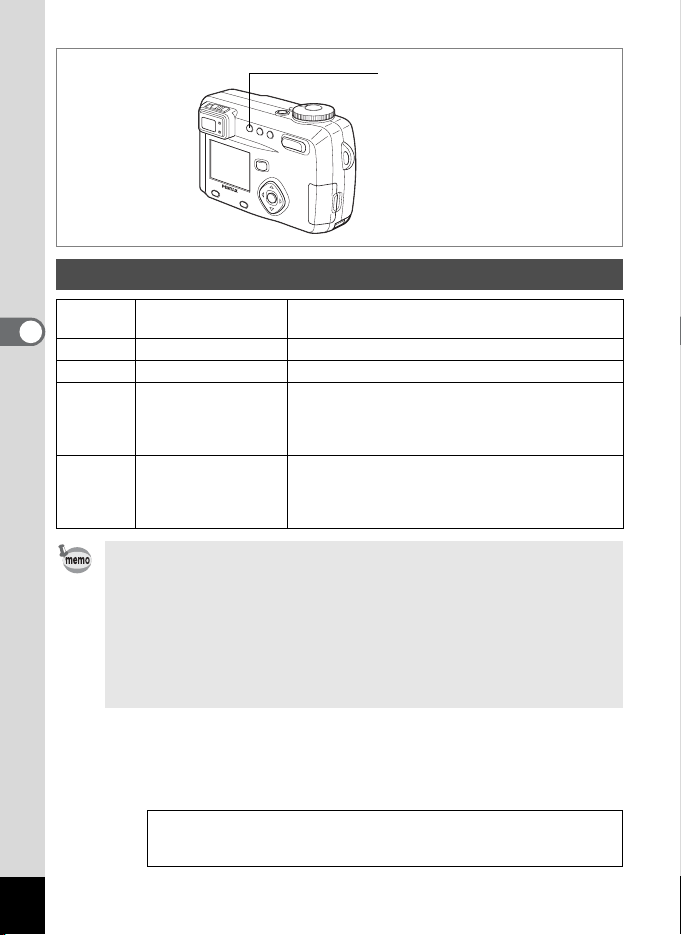
1 Press the b button in Capture mode.
The flash mode changes each time the button is pressed and the icon
is displayed on the LCD monitor.
The camera is ready to take the picture in the set flash mode.
Selecting the Flash Mode
(No icon) Auto flash
The flash discharges automatically depending on
the light conditions.
a Flash Off The flash will not discharge.
b Flash On The flash discharges.
c
Auto flash +
Red-eye Reduction
This mode reduces the phenomenon of red eyes
caused by the light from the flash being reflected
in the subject’s eyes.
The flash discharges automatically.
d
Flash On +
Red-eye Reduction
This mode reduces the phenomenon of red eyes caused
by the light from the flash being reflected in the subject’s
eyes.
The flash will discharge regard less of lighting conditions.
• The [Auto flash] and [Auto flash + Red-eye Reduction] modes cannot
be selected when the Capture mode is set to
a.
• The flash is off when the Capture mode is set to
C
, continuous shooting,
infinity-landscape, fireworks in picture mode or super macro mode.
• The flash discharges once before the main flash as supplementary
light for AE metering.
• In [Auto flash + Red-eye Reduction] and [Flash On + Red-eye Reduction]
modes, the flash discharges once to make the pupils of the subject’s eyes
smaller shortly before the main flash discharges to take the picture.
Status of the Focus Status Lamp and Flash Status Lamp 1 p.25
Saving the Flash Mode
1 p.87
1
43
Taking Pictures
4
E a b c A d F G D
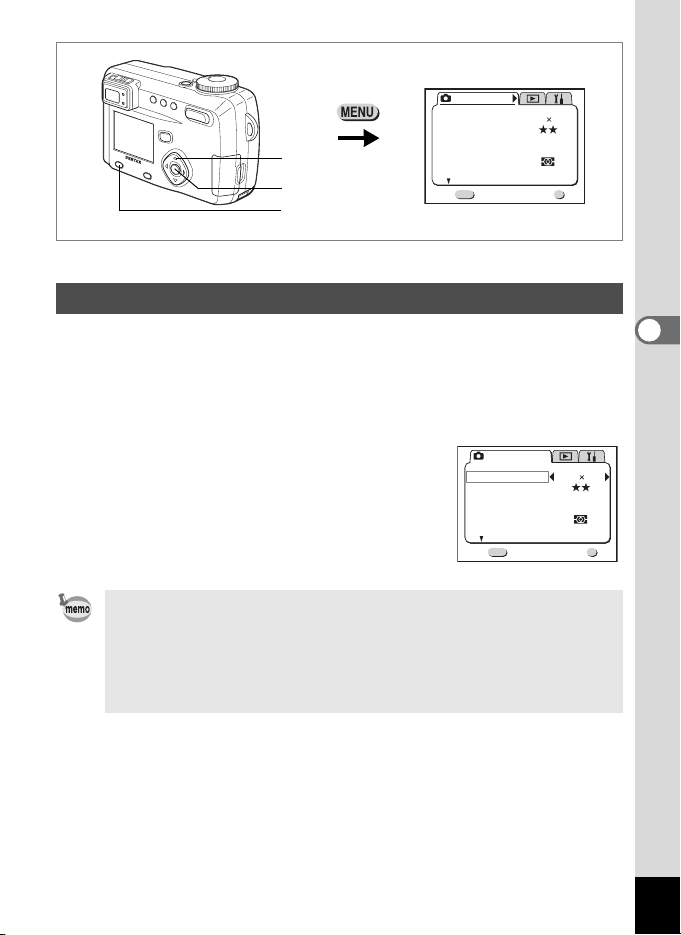
You can choose the number of recorded pixels from [2592 × 1944],
[2048 × 1536], [1600 × 1200], [1024 × 768] and [640 × 480].
1 Select [Recorded Pixels] on the [A Rec.Mode] menu.
2 Use the four-way controller (45) to change the size.
3 Press the OK button.
The camera is ready to take the picture.
Selecting the Recorded Pixels
• The recorded pixels is fixed at 320 × 240 pixels in the movie picture
mode.
• If you select a large size, the picture may appear distinct when it is
printed out.
• Selecting a small size reduces the volume of data. This is useful for
attaching images to E-mail or posting them on a website.
2
Rec. Mode
Wide
AWB
Auto
Quality Level
White Balance
Focusing Area
AE Metering
Sensitivity
Exit
1/3
MENU
OK
OK
2592 1944
Recorded Pixels
3
1
Rec. Mode
Wide
AWB
Auto
Quality Level
White Balance
Focusing Area
AE Metering
Sensitivity
Exit
1/3
MENU
OK
OK
2592 1944
Recorded Pixels
44
Taking Pictures
4
E a b c A d F G D
You can choose the image compression rate.
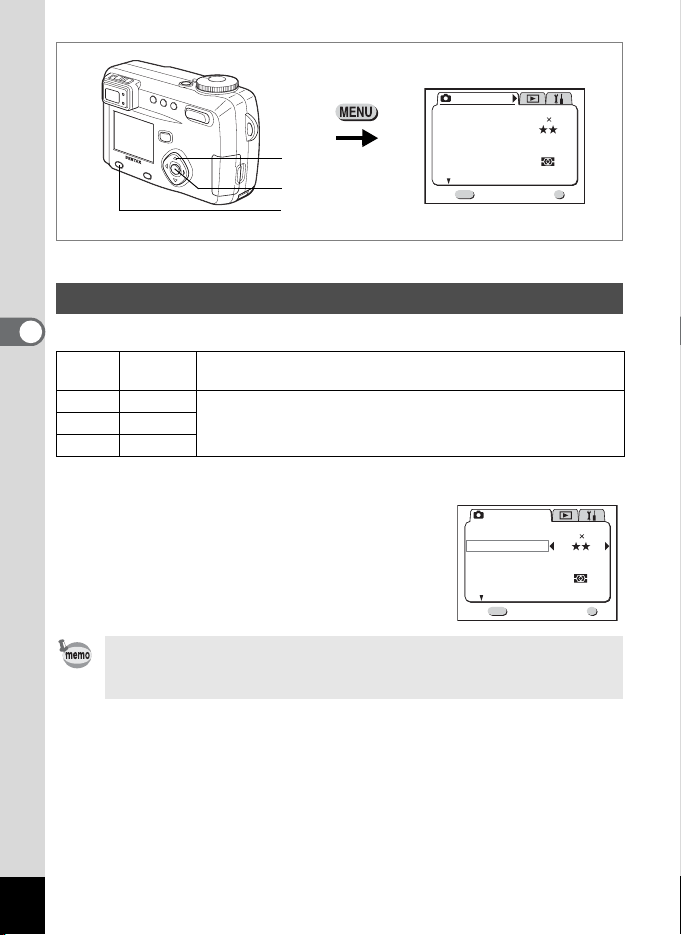
1 Select [Quality Level] on the [A Rec.Mode] menu.
2 Use the four-way controller (45) to
change the image quality.
3 Press the OK button.
The camera is ready to take the picture.
Selecting the Quality Levels
TIFF TIFF
• Captures the image as uncompressed TIFF data. This is best
for prints and images that will be manipulated on a PC.
C BEST
• The quality is better and there is a high volume of image data.
• Standard level
• The quality is good and there is a low volume of image data.
D BETTER
E GOOD
• The recorded pixels is 2592 × 1944 in the TIFF format.
• When the recorded pixels is set to other than 2592 × 1944, select the
TIFF format and the recorded pixels changes to 2592 × 1944.
2
3
1
Rec. Mode
Wide
AWB
Auto
Quality Level
White Balance
Focusing Area
AE Metering
Sensitivity
Exit
1/3
MENU
OK
OK
2592 1944
Recorded Pixels
Rec. Mode
Wide
AWB
Auto
Quality Level
White Balance
Focusing Area
AE Metering
Sensitivity
Exit
1/3
MENU
OK
OK
2592 1944
Recorded Pixels
45
Taking Pictures
4
E a b c A F G D C
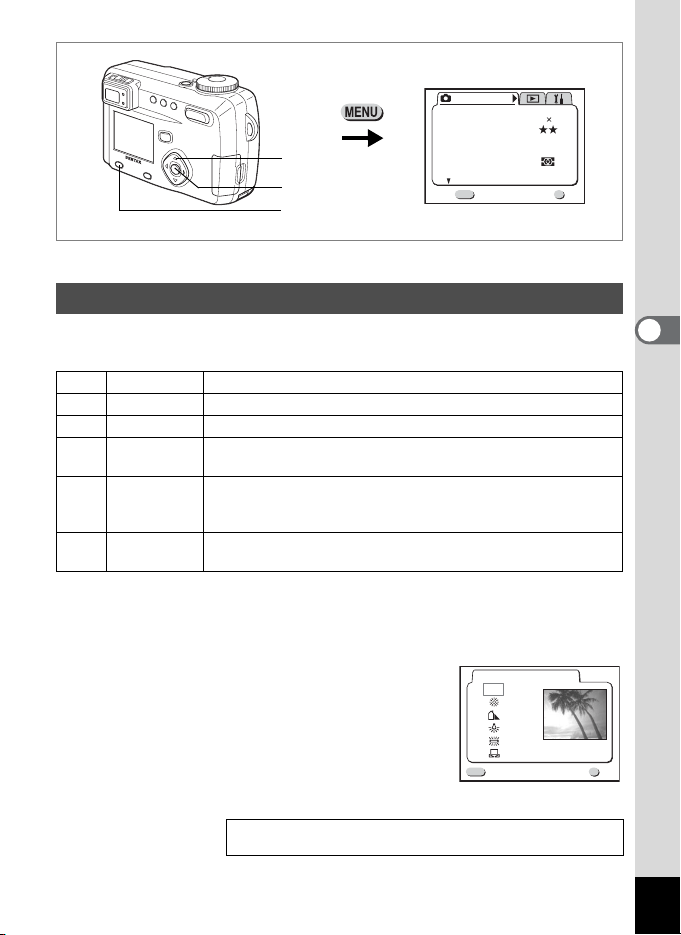
You can take pictures in natural colors by adjusting the white balance
according to the light conditions at the time of shooting.
* The color temperature (°K) is approximate and does not indicate the
precise color.
1 Select [White Balance] on the [A Rec.Mode] menu.
2 Press the four-way controller (5).
The white balance screen will be displayed.
3 Use the four-way controller (23) to
select the setting.
4 Press the OK button twice.
The camera is ready to take the picture.
Adjusting the Color Balance according to Lighting (White Balance)
F Automatic The camera adjusts the white balance automatically.
G Daylight Use this mode when taking pictures outside in sunlight.
H Shade Use this mode when taking pictures outside in the shade.
I
Tungsten
Light
Use this mode when taking pictures under electric or other
tungsten light.
J
Fluorescent
Light
Use this mode when taking pictures under fluorescent light.
Choose the type of fluorescent light from W (white (4200°K)*),
N (neutral white (5000°K)*) and D (daylight (6500°K)*).
K Manual
Use this mode when taking pictures by adjusting the white
balance manually.
Saving the White Balance 1 p.87
2, 3
4
1
Rec. Mode
Wide
AWB
Auto
Quality Level
White Balance
Focusing Area
AE Metering
Sensitivity
Exit
1/3
MENU
OK
OK
2592 1944
Recorded Pixels
AWB
White Balance
-
D
MENU
OK
OK
Exit
46
Taking Pictures
4
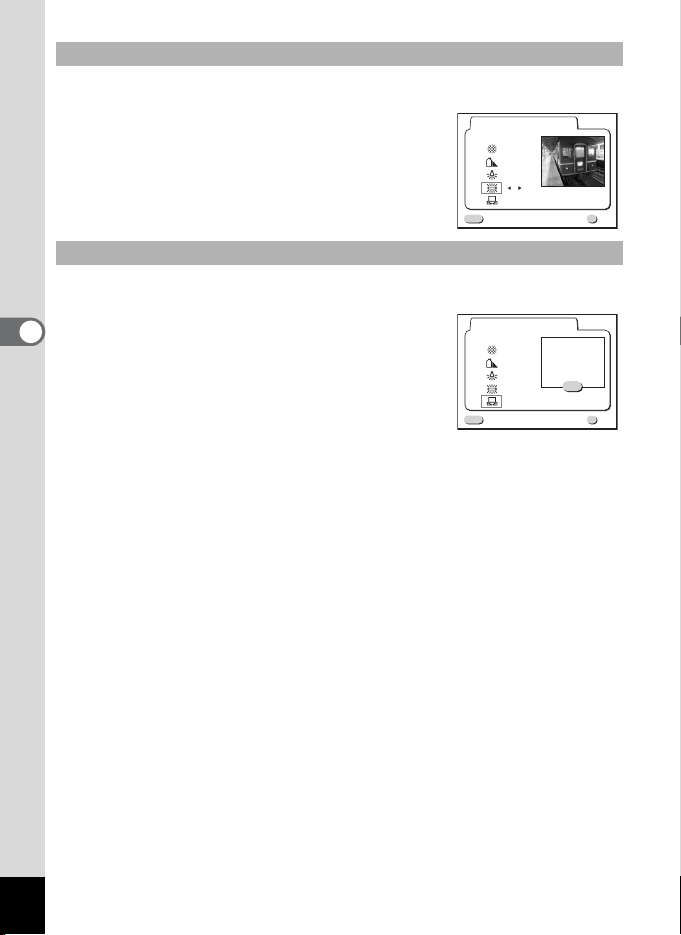
1 Select [J] on the White Balance screen.
2 Use the four-way controller (45) to
choose “W”, “N” or “D”.
3 Press the OK button twice.
The camera is ready to take the picture.
1 Select [K] (manual) on the white balance screen.
2 Point your camera at a blank sheet
of paper so that it fills the screen.
3 Press the Display button.
The white balance is automatically adjusted,
[Complete] is displayed on the LCD monitor
and the display returns to the menu screen.
4 Press the OK button.
The camera is ready to take the picture.
Selecting the Type of Fluorescent Light J
Manual Setting
AWB
White Balance
D
MENU
OK
OK
Exit
AWB
White Balance
-
D
MENU
OK
OK
Exit
Adjust
DISP
47
Taking Pictures
4
E a b c A d F G D
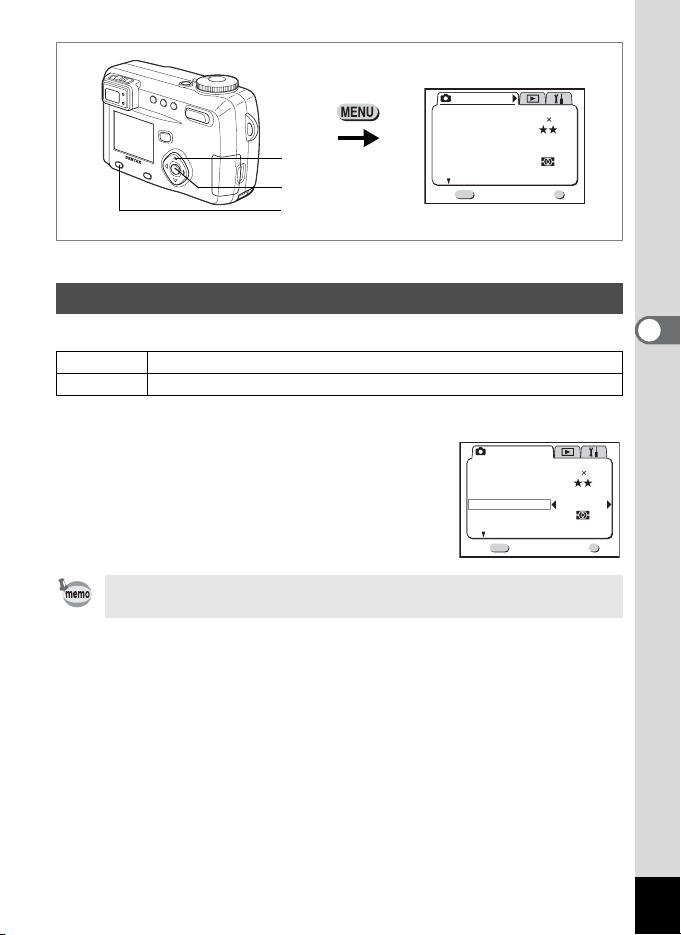
You can change the angle of the autofocus area.
1 Select [Focusing Area] on the [A Rec.Mode] menu.
2 Use the four-way controller (45) to
change the setting.
3 Press the OK button.
The camera is ready to take the picture.
Changing the AF Area (Focusing Area)
Wide Normal range
Spot The autofocus range becomes smaller.
The AF area does not appear in the viewfinder. Always check the
focusing area on the LCD monitor.
2
3
1
Rec. Mode
Wide
AWB
Auto
Quality Level
White Balance
Focusing Area
AE Metering
Sensitivity
Exit
1/3
MENU
OK
OK
2592 1944
Recorded Pixels
Rec. Mode
Wide
AWB
Auto
Quality Level
White Balance
Focusing Area
AE Metering
Sensitivity
Exit
1/3
MENU
OK
OK
2592 1944
Recorded Pixels
48
Taking Pictures
4
E a b c A d F G D
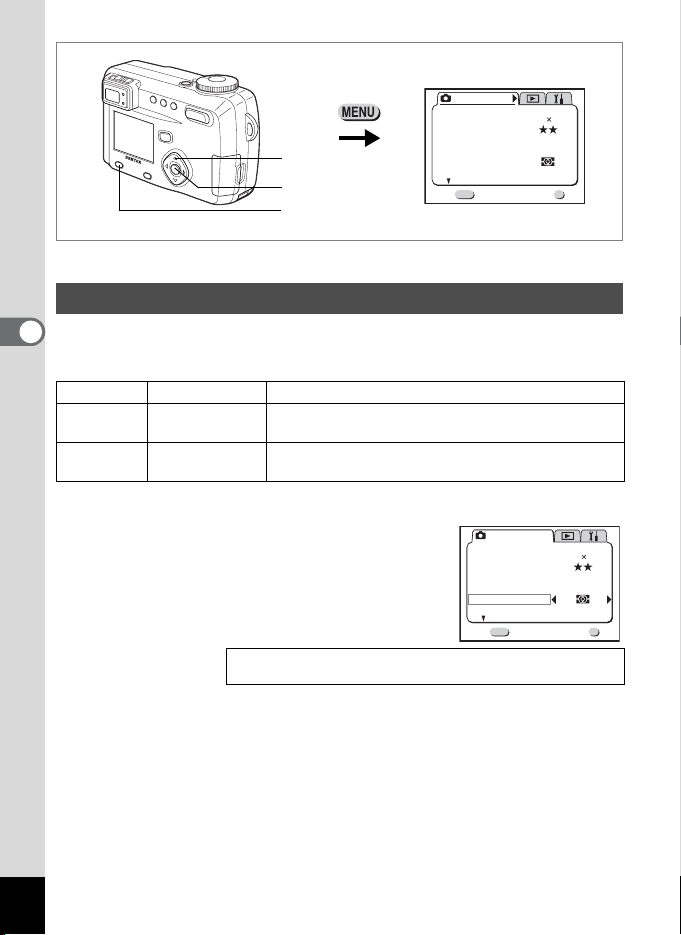
You can choose which part of the screen to use to measure the
brightness and determine the exposure.
1 Select [AE Metering] on the [A Rec.Mode] menu.
2 Use the four-way controller (45) to
change the metering mode.
3 Press the OK button.
The camera is ready to take the picture.
Setting the Light Metering Range to Determine the Exposure (AE Metering)
L Multi segment The exposure is determined by the entire screen.
M Center-weighted
The exposure is determined mainly by the center of
the screen.
N Spot
The exposure is determined by the small area in the
center of the screen only.
Saving the AE Metering Method 1 p.87
2
3
1
Rec. Mode
Wide
AWB
Auto
Quality Level
White Balance
Focusing Area
AE Metering
Sensitivity
Exit
1/3
MENU
OK
OK
2592 1944
Recorded Pixels
Rec. Mode
Wide
AWB
Auto
Quality Level
White Balance
Focusing Area
AE Metering
Sensitivity
Exit
1/3
MENU
OK
OK
2592 1944
Recorded Pixels
49
Taking Pictures
4
E a b c A d F G D
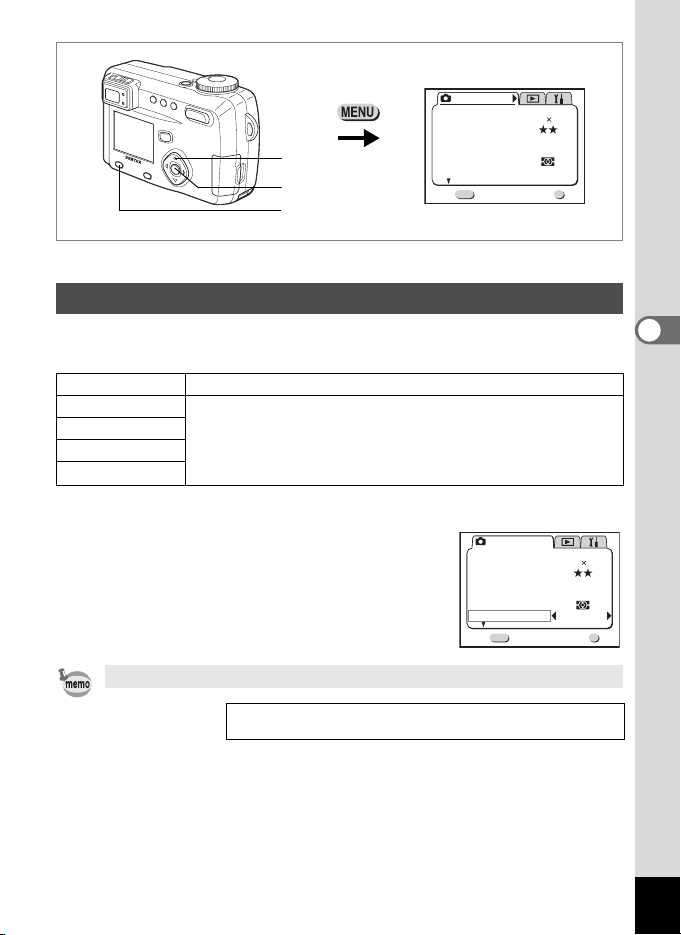
You can select the sensitivity to suit the brightness of the surroundings.
Sensitivity
1 Select [Sensitivity] on the [A Rec.Mode] menu.
2 Use the four-way controller (45) to
change the Sensitivity.
3 Press the OK button.
The camera is ready to take the picture.
Setting the Sensitivity
Auto The camera sets the speed automatically.
64 • As the lower sensitivity produces sharp images with little or no
noise, but the shutter speed will be slower in low light
conditions.
• As the higher sensitivity uses faster shutter speed in low light
conditions to reduce camera shake.
100
200
400
[Auto] cannot be selected in manual exposure mode.
Saving the Sensitivity
1 p.87
2
3
1
Rec. Mode
Wide
AWB
Auto
Quality Level
White Balance
Focusing Area
AE Metering
Sensitivity
Exit
1/3
MENU
OK
OK
2592 1944
Recorded Pixels
Rec. Mode
Wide
AWB
Auto
Quality Level
White Balance
Focusing Area
AE Metering
Sensitivity
Exit
1/3
MENU
OK
OK
2592 1944
Recorded Pixels
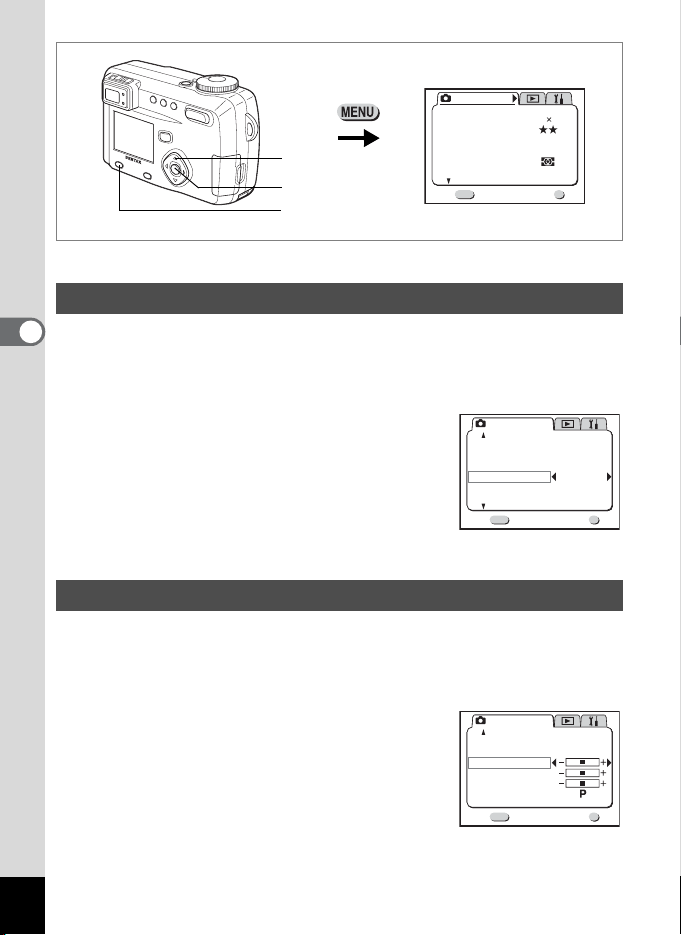
50
Taking Pictures
4
E a b c A d F G D
You can choose the Instant Review time from 0.5sec., 1sec., 2sec.,
3sec., 4sec., 5sec. or OFF (no display).
1 Select [Instant Review] on the [A Rec.Mode] menu.
2 Use the four-way controller (45)
to change the display time.
3 Press the OK button.
The camera is ready to take the picture.
E
a b c A d F G D C
You can choose whether you want the image to have sharp or soft
outlines.
1 Select [Sharpness] on the [A Rec.Mode] menu.
2 Use the four-way controller (45)
to change the setting from [Normal]
to [Hard (+)] or [Soft (–)].
3 Press the OK button.
The camera is ready to take the picture.
Setting the Instant Review time (Instant Review)
Setting the Image Sharpness (Sharpness)
2
3
1
Rec. Mode
Wide
AWB
Auto
Quality Level
White Balance
Focusing Area
AE Metering
Sensitivity
Exit
1/3
MENU
OK
OK
2592 1944
Recorded Pixels
Rec. Mode
Exit
2/3
MENU
OK
OK
Auto Bracket
Digital Zoom
Instant Review
Interval Shoot
Off
On
2sec
Fast Fwd Movie
Flash Exp. Comp.
0.0
Rec. Mode
Exit
3/3
MENU
OK
OK
Memory
Sharpness
Saturation
Contrast
USER
3D Mode
Parallel
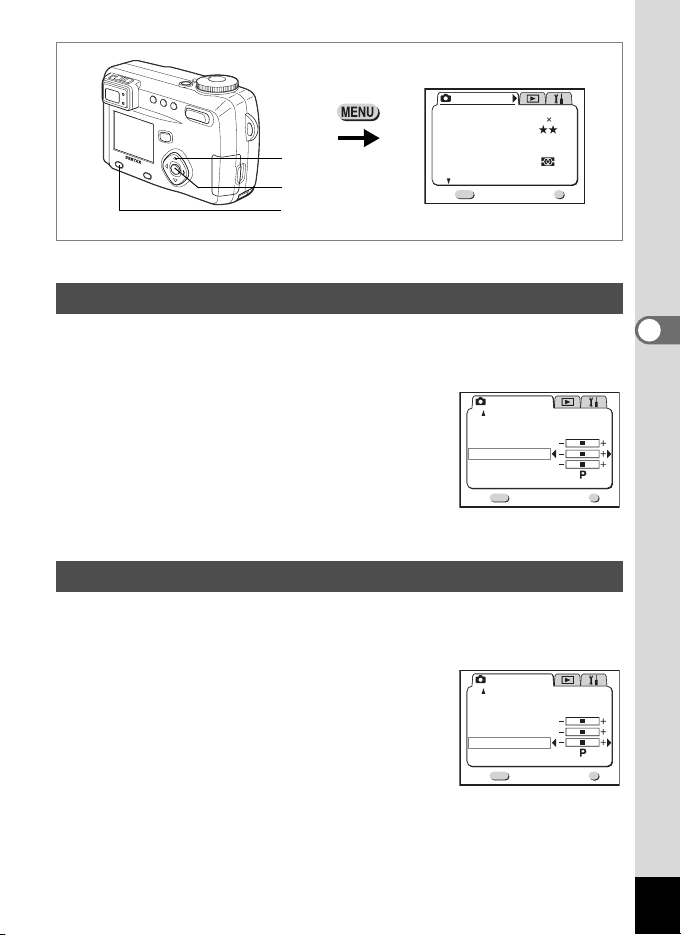
51
Taking Pictures
4
E a b c A F G D C
You can set the color saturation.
1 Select [Saturation] on the [A Rec.Mode] menu.
2 Use the four-way controller (45)
to change the setting from [Normal]
to [Hard (+)] or [Soft (–)].
3 Press the OK button.
The camera is ready to take the picture.
E
a b c A F G D C
You can set the image contrast.
1 Select [Contrast] on the [A Rec.Mode] menu.
2 Use the four-way controller (45)
to change the setting from [Normal]
to [Hard (+)] or [Soft (–)].
3 Press the OK button.
The camera is ready to take the picture.
Setting the Color Saturation (Saturation)
Setting the Image Contrast (Contrast)
2
3
1
Rec. Mode
Wide
AWB
Auto
Quality Level
White Balance
Focusing Area
AE Metering
Sensitivity
Exit
1/3
MENU
OK
OK
2592 1944
Recorded Pixels
Rec. Mode
Exit
3/3
MENU
OK
OK
Memory
Sharpness
Saturation
Contrast
USER
3D Mode
Parallel
Rec. Mode
Exit
3/3
MENU
OK
OK
Memory
Sharpness
Saturation
Contrast
USER
3D Mode
Parallel
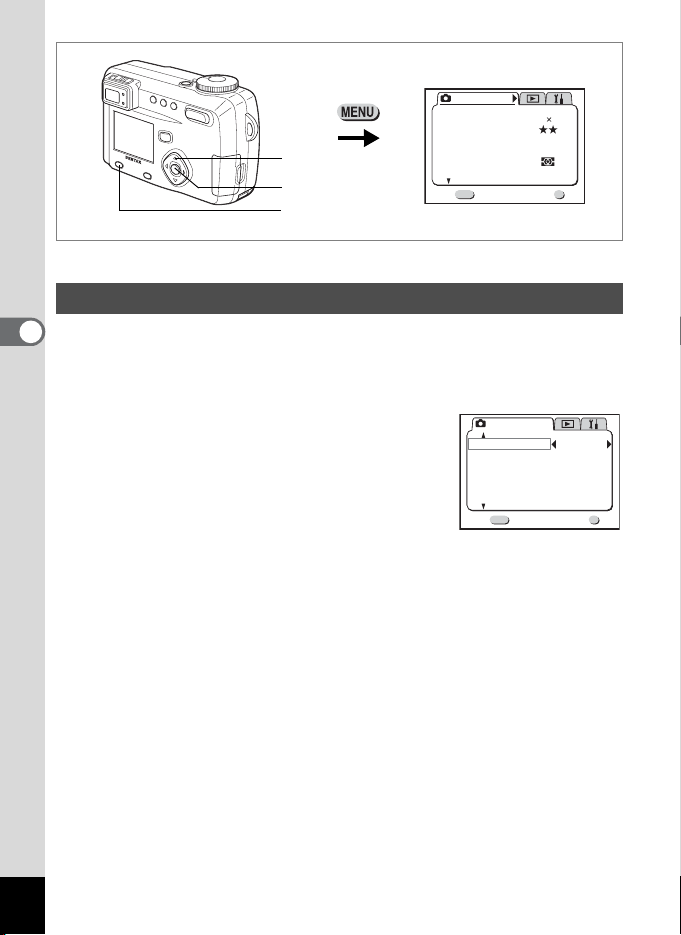
52
Taking Pictures
4
E a b c A F G D C
You can adjust the output of the flash without changing the brightness
of the background.
1 Select [Flash Exp. Comp.] on the [A Rec. Mode] menu.
2 Use the four-way controller (45) to
select the compensation level.
4 Reduces the brightness.
5 Increases the brightness.
3 Press the OK button.
The camera is ready to take the picture.
Adjusting the Flash Output
2
3
1
Rec. Mode
Wide
AWB
Auto
Quality Level
White Balance
Focusing Area
AE Metering
Sensitivity
Exit
1/3
MENU
OK
OK
2592 1944
Recorded Pixels
Rec. Mode
Exit
2/3
MENU
OK
OK
Auto Bracket
Digital Zoom
Instant Review
Interval Shoot
Off
On
2sec
Fast Fwd Movie
Flash Exp. Comp.
+1.0
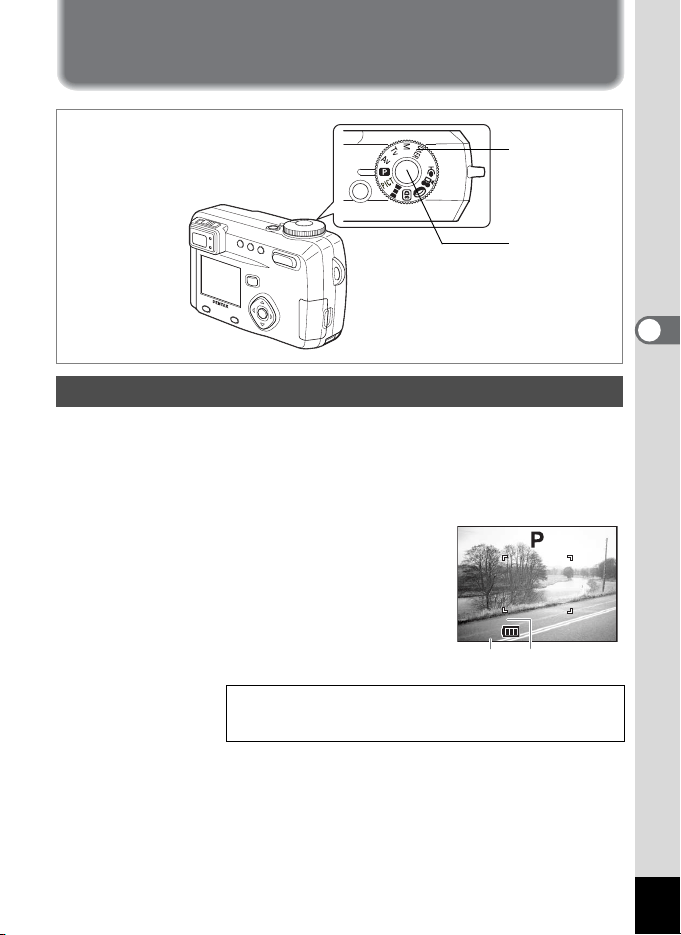
53
4
Taking Pictures
Taking Pictures
The camera automatically sets the shutter speed and aperture for
taking still pictures. However, you can select other functions such as
the flash mode or continuous shooting mode.
1 Set the mode dial to A.
2 Press the shutter release button.
The picture will be taken.
Letting the Camera Set the Exposure (Program Mode)
Using the Shutter Release Button 1 p.25
Playing back images
1 p.26
1
2
200
200
200
11:19
11:19
11:19
F2.8
F2.8
1/250
1/250
F2.8
1/250
10/20/2003
10/20/2003
10/20/2003
Aperture Shutter speed
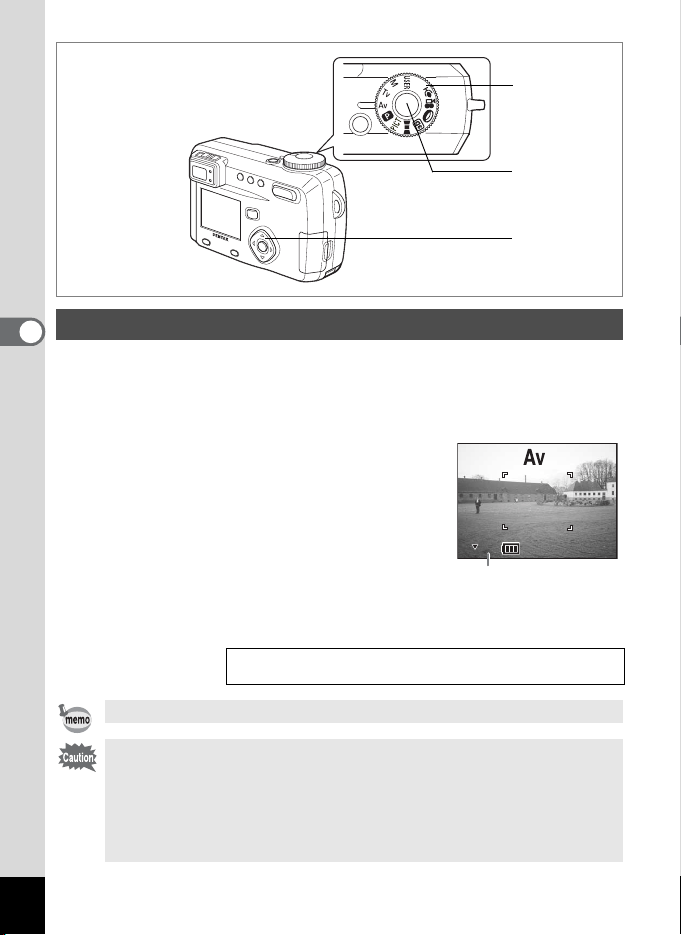
54
Taking Pictures
4
In this mode the aperture value is set manually and the camera
automatically sets the shutter speed.
1 Set the mode dial to c.
2 Use the four-way controller (23) to
change the aperture value.
2 Makes the aperture larger.
(Reduces the aperture value.)
3 Makes the aperture smaller.
(Increases the aperture value.)
3 Press the shutter release button.
The picture will be taken.
Setting the Aperture Value (Aperture-Priority Mode)
Playing Back Still Pictures 1 p.26
The aperture value will be saved when the camera is turned off.
• The four-way controller (23) becomes the manual focus button and
cannot be used to change the aperture value when the focus mode is
set to manual. Press the OK button once and then use the four-way
controller (
23) to change the value to change the aperture value.
• The exposure is not appropriate when the shutter speed is displayed
in orange on the LCD monitor.
1
3
2
11:19
11:19
11:19
F2.8
F2.8
1/250
1/250
F2.8
1/250
10/20/2003
10/20/2003
10/20/2003
200
Aperture value
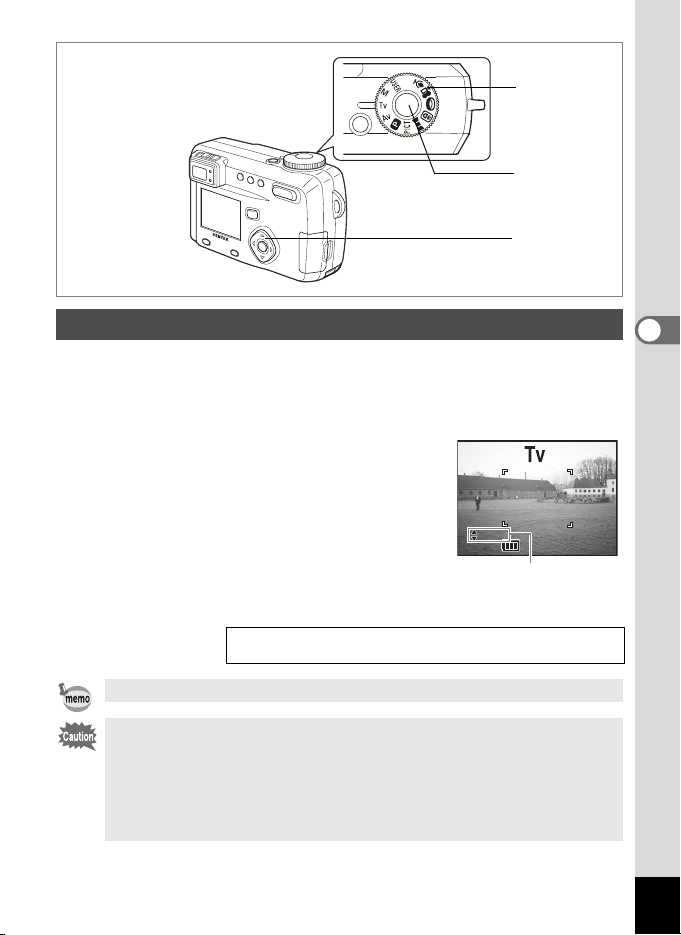
55
Taking Pictures
4
In this mode the shutter speed is set manually and the camera
automatically sets the aperture value.
1 Set the mode dial to b.
2 Use the four-way controller (23) to
change the shutter speed.
2 Increases the shutter speed.
3 Reduces the shutter speed.
3 Press the shutter release button.
The picture will be taken.
Setting the Shutter Speed (Shutter-Priority Mode)
Playing Back Still Pictures 1 p.26
The set shutter speed will be saved when the camera is turned off.
• The four-way controller (23) becomes the manual focus button and
cannot be used to change the shutter speed when the focus mode is
set to manual. Press the OK button once and then use the four-way
controller (
23) to change the value to change the shutter speed.
• The exposure is not appropriate when the aperture value is displayed
in orange on the LCD monitor.
1
3
2
11:19
11:19
11:19
10/20/2003
10/20/2003
10/20/2003
F2.8
F2.8
1/250
1/250
F2.8
1/250
200
Shutter speed
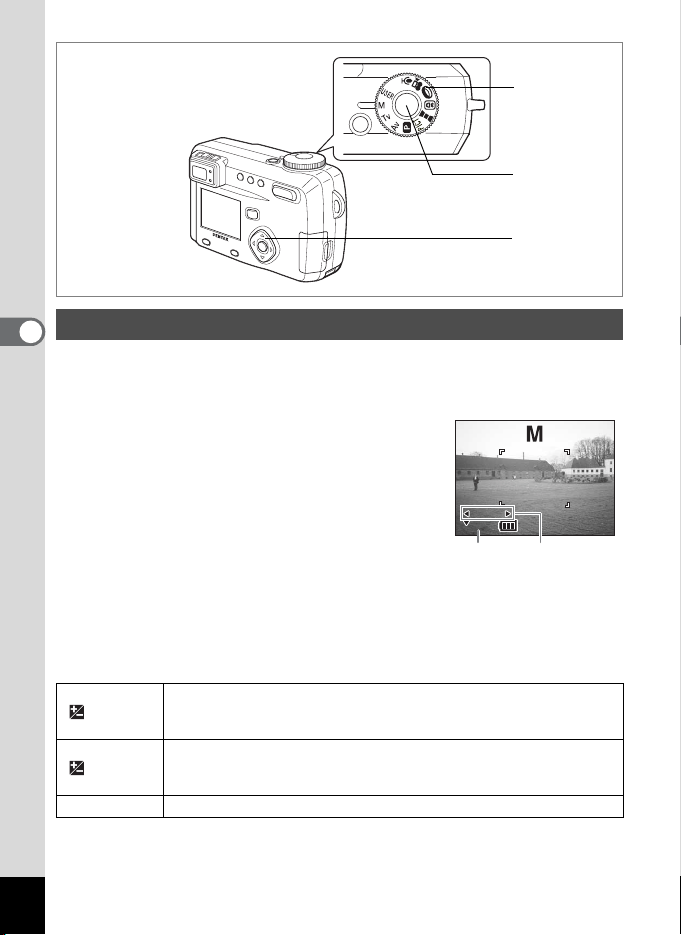
56
Taking Pictures
4
You can set the shutter speed and aperture value manually.
1 Set the mode dial to M.
2 Use the four-way controller to
change the shutter speed and
aperture value.
4 Increases the shutter speed.
5 Reduces the shutter speed.
2 Makes the aperture larger.
(Reduces the aperture value.)
3 Makes the aperture smaller.
(Increases the aperture value.)
If the combination of shutter speed and aperture value do not give an
appropriate exposure, a warning will be displayed.
Setting the Exposure Manually (Manual Exposure Mode)
(Lit)
If the deviation from the appropriate exposure is between –0.3 EV
and –2.0 EV, n will light, and if between +0.3 EV and +2.0 EV m will
light, and the value will be displayed.
(Blinking)
If the picture is underexposed at a setting lower than –2.0 EV,
n blinks, and if overexposed at a setting higher than +2.0 EV,
m blinks.
p (Lit) Metering is not possible.
1
3
2
198
198
1/250
1/250
F2.8
F2.8
198
1/250
F2.8 11:19
11:19
11:19
10/20/2003
10/20/2003
10/20/2003
Aperture Shutter speed
57
Taking Pictures
4
3 Press the shutter release button.
The picture will be taken at the set shutter speed and aperture value.
Playing Back Still Pictures 1 p.26
The shutter speed and aperture value will be saved when the camera is
turned off.
• EV compensation is not available in this mode.
• The four-way controller (
23) becomes the manual focus button and
cannot be used to change the aperture value when the focus mode is
set to manual. Press the OK button once and then use the four-way
controller (
23) to change the value to change the aperture value.
• The [Auto flash] and [Auto flash + Red-eye Reduction] flash modes
cannot be selected.
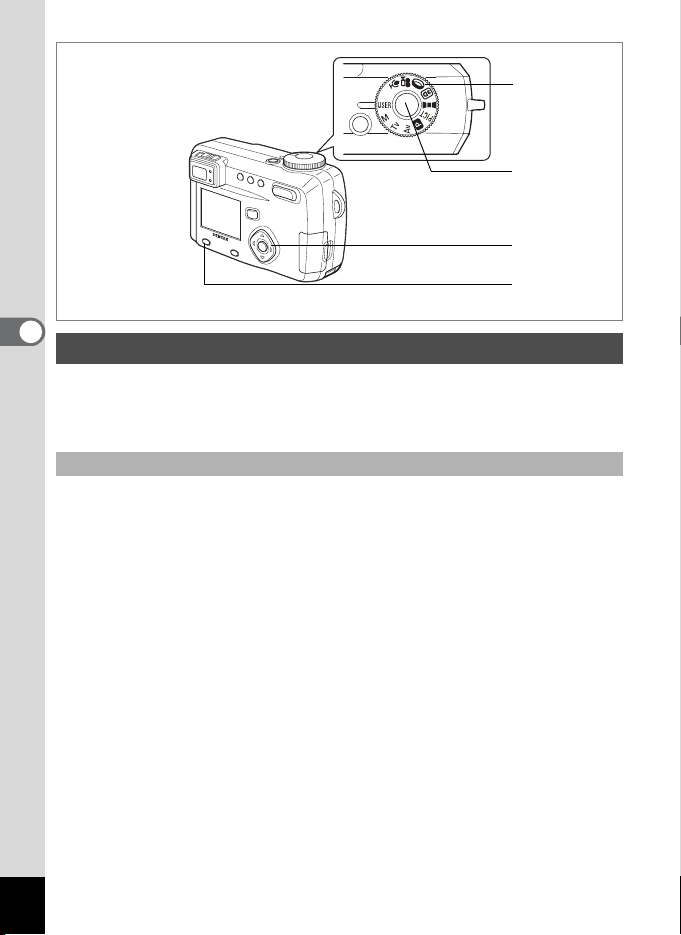
58
Taking Pictures
4
Register Capture mode or functions that you use frequently and then
align the mode dial to
E to quickly take pictures using your preferred
settings.
1 Set the mode dial to E.
2 Set the [A Rec. Mode] items to your preferred settings.
3 Press the four-way controller (23) to select [E].
4 Press the four-way controller (45) to select a Capture
mode to be saved.
The set functions and Capture mode are registered in [User Mode].
See the table on the next page for the functions that can be set in the
User mode.
5 Press the shutter release button.
Using Preset Function Settings (User Mode)
Registering a function
1
5
3, 4
2
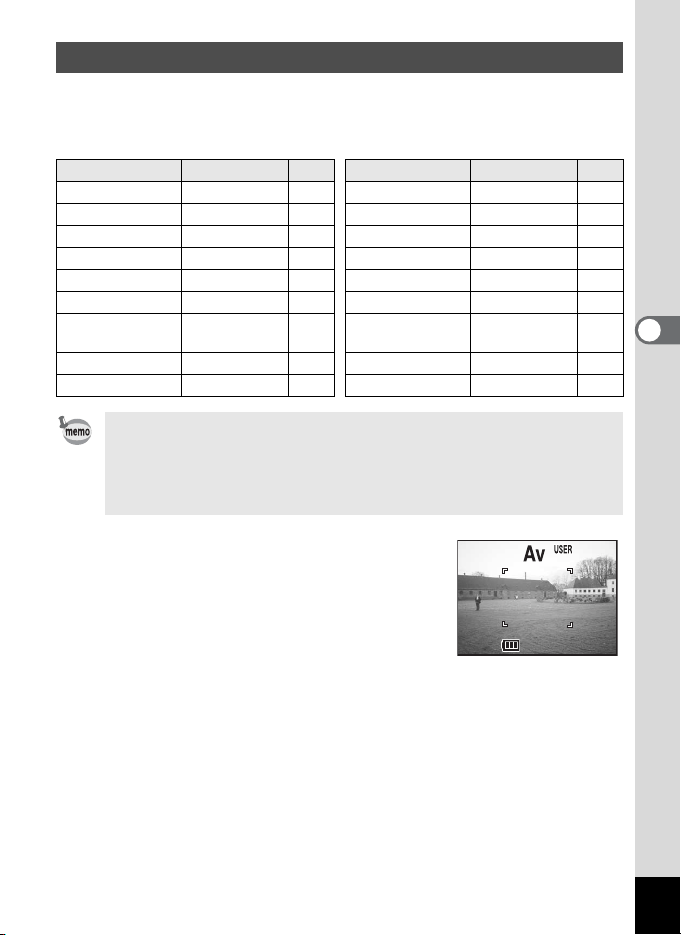
59
Taking Pictures
4
By setting the mode dial to USER and setting the shooting functions,
the functions and Capture mode are registered in User mode.
Functions that can be set in User mode
1 Set the mode dial to E.
2 Press the shutter release button.
The picture will be taken.
Registering Functions in User Mode
Function Default Setting Ref. Function Default Setting Ref.
Recorded Pixels 2592 × 1944 p.43 Instant Review* 2 sec p.50
Quality Level D p.44 Interval Shoot* – p.80
White Balance AWB p.45 Fast Fwd Movie Off p.80
Focusing Area Wide p.47 3D Mode* Parallel p.64
AE Metering L p.48 Memory – p.87
Sensitivity Auto p.49 Sharpness Normal p.50
Flash Exp.
Comp.
0.0 p.52 Saturation Normal p.51
Auto Bracket* – p.84 Contrast Normal p.51
Digital Zoom On p.75 USER e –
• For the USER mode, you can choose from the following six modes:
program, manual exposure, aperture priority, shutter priority, picture
or digital filter mode.
• Settings made for functions marked with an asterisk (*) are reflected
in other modes as well as User mode.
F2.8
F2.8
1/250
1/250
F2.8
1/250
11:19
11:19
11:19
10/20/2003
10/20/2003
10/20/2003
203
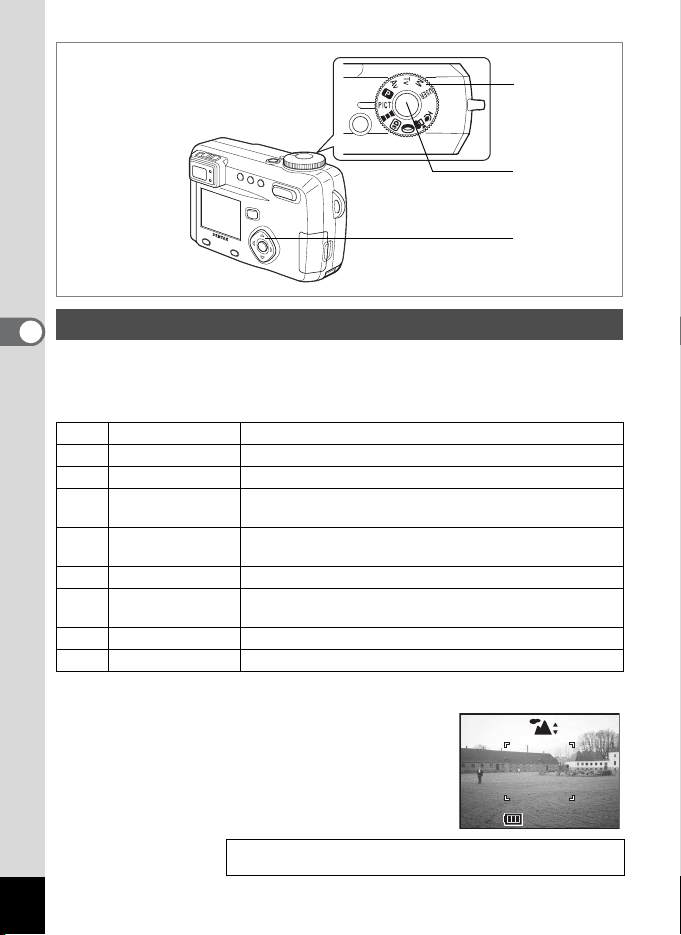
60
Taking Pictures
4
You can select the Picture mode according to the shooting scene.
Picture mode
There are nine available modes in Picture mode.
1 Set the Mode dial to d .
2 Use the four-way controller (23) to
select the required mode.
3 Press the shutter release button.
The picture will be taken.
Selecting the Picture Mode According to the Shooting Scene (Picture mode)
H Landscape Enables to take landscape photos with bright colors.
B Night-Scene Mode Enables you to take dark scenes such as night views.
I Flower Enables to take flower photos bright in color.
J Portrait
Enables to take portraits with spatial effect, by
emphasizing the person.
L Surf & Snow
Enables to take clear photos at dazzling places like
beaches and snow covered mountains.
N Autumn Colors Enables you to take colorful photos of trees in autumn.
K Sunset
Enables to reproduce beautiful colors for sunrise and
sunset photos.
g Fireworks Enables you to take bright photos of fireworks.
W Text Enables you to take clear photos of text.
Playing Back Still Pictures 1 p.26
1
3
2
200
200
200
11:19
11:19
11:19
10/20/2003
10/20/2003
10/20/2003
61
Taking Pictures
4
• The picture mode will be saved when the camera is turned off.
• The flash is disabled in Fireworks mode and the focus is fixed at
infinity.
• The four-way controller (23) becomes the manual focus button and
cannot be used to change the picture mode when the focus mode is
set to manual. Press the OK button once and then use the four-way
controller (
23) to change the picture mode to change the picture
mode.
• To avoid camera movement in Night-scene, Sunset and Fireworks
mode. You are recommended to fix the camera on a tripod.
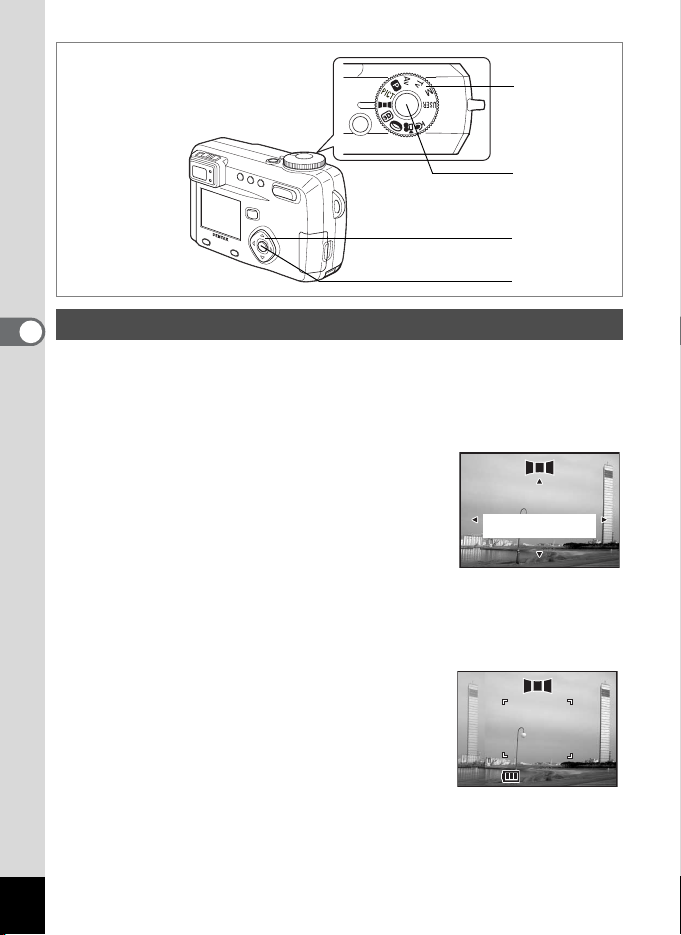
62
Taking Pictures
4
Using the provided software (ACDSee™), join several pictures on your
PC and easily create panoramic photos. Join photos that have been
taken so the edges of the images overlap in Panorama Assist Mode to
create a single panoramic photo.
1 Set the mode dial to F.
2 Use the four-way controller to
choose the direction in which the
images will be joined.
4 Joins the images at the left.
5 Joins the images at the right.
2 Joins the images at the top.
3 Joins the images at the bottom.
The example shows the images when
5 is selected.
3 Take the first picture.
Press the shutter release button to take the
first image. The right edge of the image is
displayed in transparent form on the left of
the LCD monitor.
Taking Panorama Pictures (Panorama Assist Mode)
3, 4
1
2
5
Set shift direction
Set shift direction
Set shift direction
11:19
11:19
11:19
10/20/2003
10/20/2003
10/20/2003
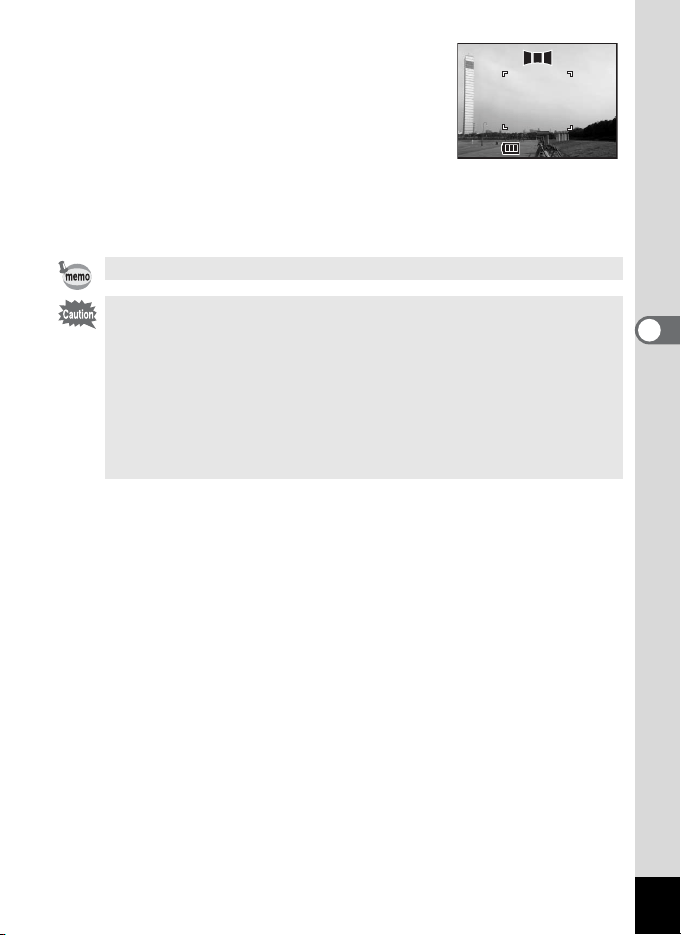
63
Taking Pictures
4
4 Move the camera to the right and
take the second picture.
Position the camera so that the actual image
display overlaps the transparent display on
the left edge, and then release the shutter.
Repeat the above procedure to take the third
and subsequent pictures.
5 Press the OK button.
The screen returns to Step 1.
To cancel Panorama assist mode, change to another mode.
• The camera cannot join the images. Use the panorama software
(ACDSee™) provided with the camera.
• See p.32 in the separate booklet (PC connection manual) for
instructions on how to create panoramic photos.
• Continuous shooting, Multiple Exposure mode and interval shooting
are not possible in Panorama assist mode.
• A computer running Windows is necessary for joining images.
(The ACD photostitcher software provided with the camera is not
supported by Macintosh.)
11:19
11:19
11:19
10/20/2003
10/20/2003
10/20/2003
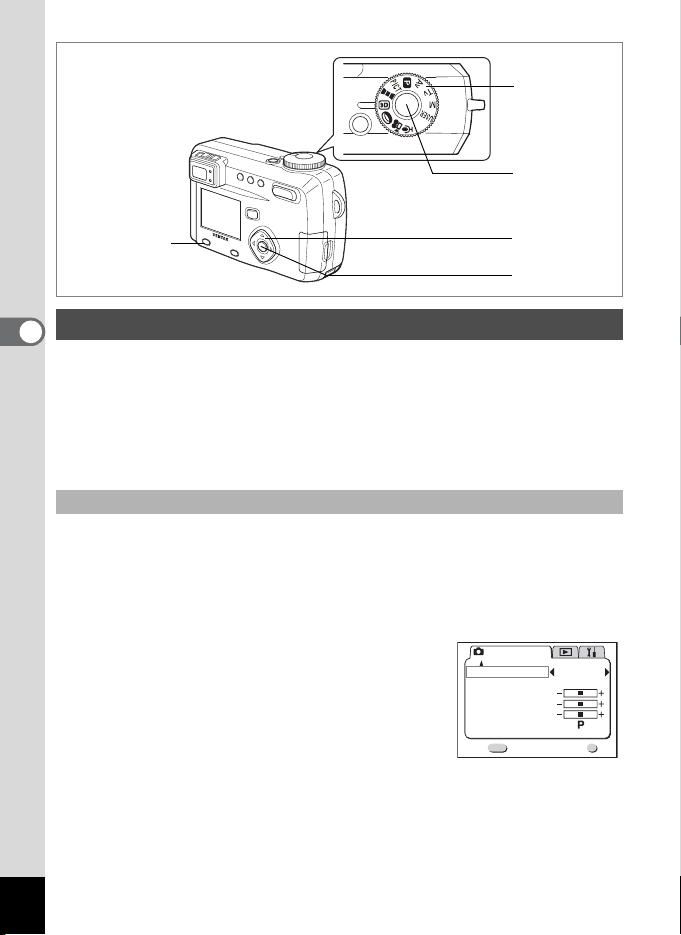
64
Taking Pictures
4
You can take 3D pictures using the LCD monitor and view them by the
parallel method or cross method (p.66). If you print out the 3D pictures
taken by parallel method and look at them through the 3D image viewer
provided, the image will appear in three dimensions.
Print 3D pictures taken using the parallel method and view them using
the provided 3D image viewer. Images will appear three-dimensional.
The default setting is [Parallel]. If you do not need to switch to [Cross],
go to Step 5.
1 Press the Menu / Fn button.
The [A Rec. Mode] menu will be displayed.
2 Press the four-way controller (23)
to select [3D Mode].
3 Use the four-way controller (45) to
select [Cross].
To view the picture with the 3D image viewer,
select [Parallel].
You can also view it without the image viewer.
4 Press the OK button.
The 3D image mode screen appears again.
Taking Stereo Pictures (3D Image Mode)
Select the 3D mode
6, 8
5
2, 3
4, 9
1
Rec. Mode
Exit
3/3
MENU
OK
OK
Memory
Sharpness
Saturation
Contrast
USER
3D Mode
Cross
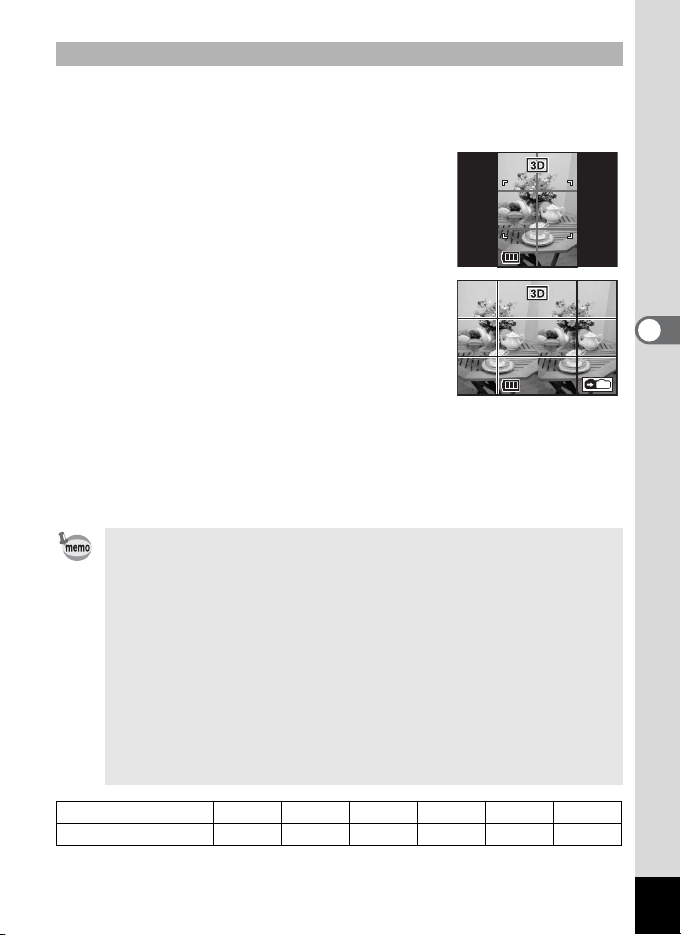
65
Taking Pictures
4
5 Set the Mode dial to G.
The screen for taking the first picture appears in the middle of the
LCD monitor.
6 Take the first picture.
Hold the camera so that the subject is in the
middle of the screen, and press the shutter
release button.
The picture is displayed in the left half screen
of the LCD monitor. The right half screen is
for taking the second picture.
7 Move the camera to right without
changing your stance.
8 Take the second picture.
Make sure that the subject is in the middle of the right half of the
screen and press the shutter release button.
When you have taken the second picture, the screen returns to Step 6.
9 Press the Playback button.
The LCD monitor displays both the left and right images.
Taking pictures
• Press the Menu / Fn button or change the 3D image mode to another
Capture mode to cancel the 3D image mode.
• A clear three-dimensional effect will not be achieved if the two images are
taken in widely different positions (heights) or are not straight. When
taking a person, you are recommended to ask your model to stay as still
as possible and to take the second picture as quickly as you can. It is
easier to take the pictures if you use a tripod or appropriate base.
• As a guide, the camera should be moved about 1/40 of the distance
between the camera and the subject. For example, if the subject is
3m away, the distance the camera should be moved will be
3m ÷ 40=7.5cm.
However, as the way people see three-dimensional images differs
from person to person, there is no need to be too concerned. Refer to
the table below for a simple guide to how far to move the camera.
Distance to subject 0.1 m 0.3 m 0.5 m 1 m 3 m 5 m
Camera movement 0.5 cm 1 cm 1.5 cm 2.5 cm 7.5 cm 13 cm
14
14
14
11:19
11:19
11:19
03/20/2003
03/20/2003
03/20/2003
14
14
14
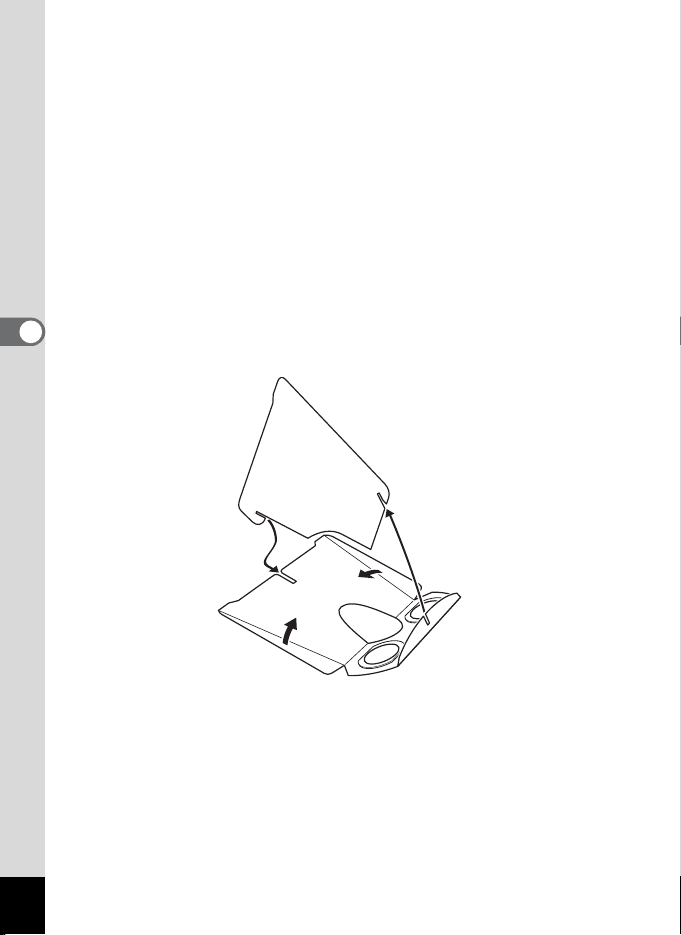
66
Taking Pictures
4
Viewing 3D pictures by the parallel method and cross method
As our eyes are positioned about 6 – 7 cm apart, there is a very slight
deviation between what we see with our right eye and what we see with
our left eye. The difference is processed by our brain to produce a
three-dimensional image. This principle is applied to taking and viewing
3D pictures.
3D pictures can be viewed by the parallel method where the left and
right lines of vision are virtually parallel, as when looking at a distant
scene, or the cross method where the left and right lines of vision are
crossed, as when you cross your eyes. A certain amount of practice
may be necessary to view 3D pictures without using the viewer.
How to Assemble the 3D Image Viewer
Assemble the 3D image viewer supplied with the camera as shown
below.
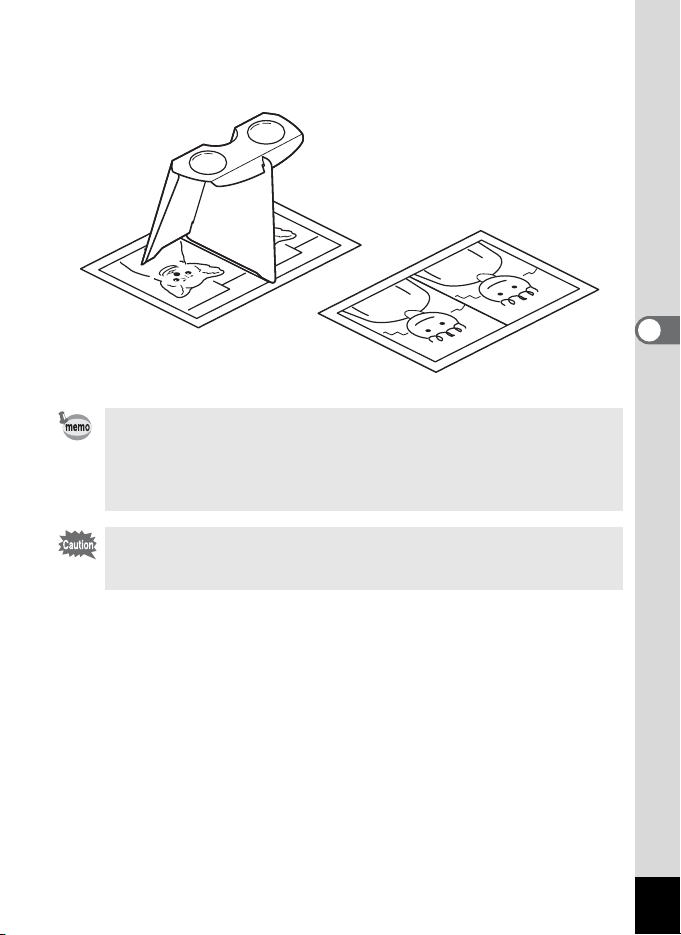
67
Taking Pictures
4
How to view 3D pictures using the 3D image viewer
Print out the pictures so that they are about 11cm or 12cm wide and
place the divider of the 3D image viewer in the middle of the two.
As the distance between the left and right eyes differs from person to
person, some people may have difficulty obtaining a three-dimensional
effect even when looking at prints that are the same size. It may be
especially difficult if the pictures are very large or very small.
Try different sizes until the right effect is achieved.
• Never look at the sun through the 3D image viewer.
• Do not leave the 3D image viewer where it is exposed to direct
sunlight as this may lead to fire.
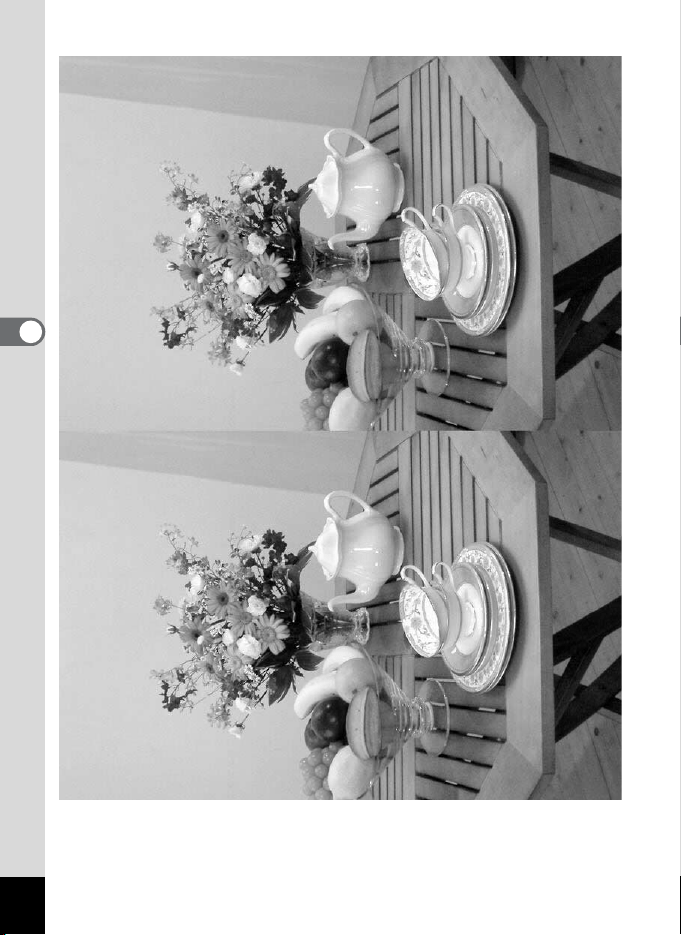
68
Taking Pictures
4
Example of a 3D picture
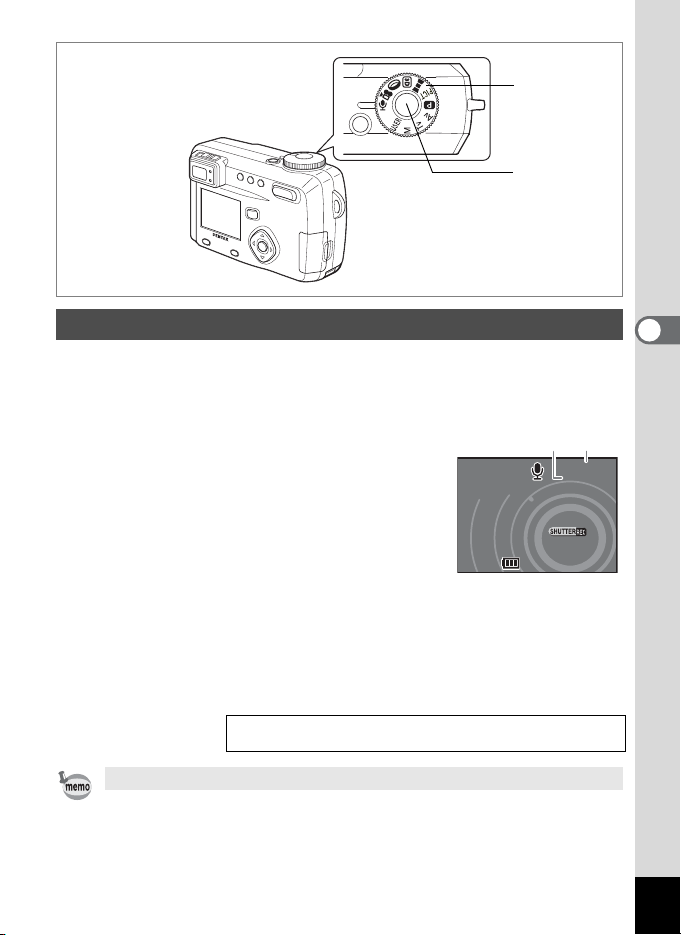
69
Taking Pictures
4
You can record sound. The recordable time is displayed on the LCD
monitor according to how much space is available on the SD Memory
Card / MultiMediaCard.
1 Set the mode dial to O.
The recordable time is displayed on the LCD
monitor.
1 Remaining time 2 Recording time
2 Press the shutter release button.
Recording starts. The self-timer lamp and flash status lamp blink
during recording.
3 Press the shutter release button.
Recording stops. The remaining recordable time is displayed.
Recording Sound (Voice Recording Mode)
Playing back sound 1 p.92
Sound is saved in WAVE monaural files.
1
2, 3
11:19
11:19
11:19
00:
0 :
00
00
: 00
00
00:
0 :
29
29
: 55
55
00 :00:00
10/20/2003
10/20/2003
10/20/2003
00 :29:55
Start
Start
Start
12
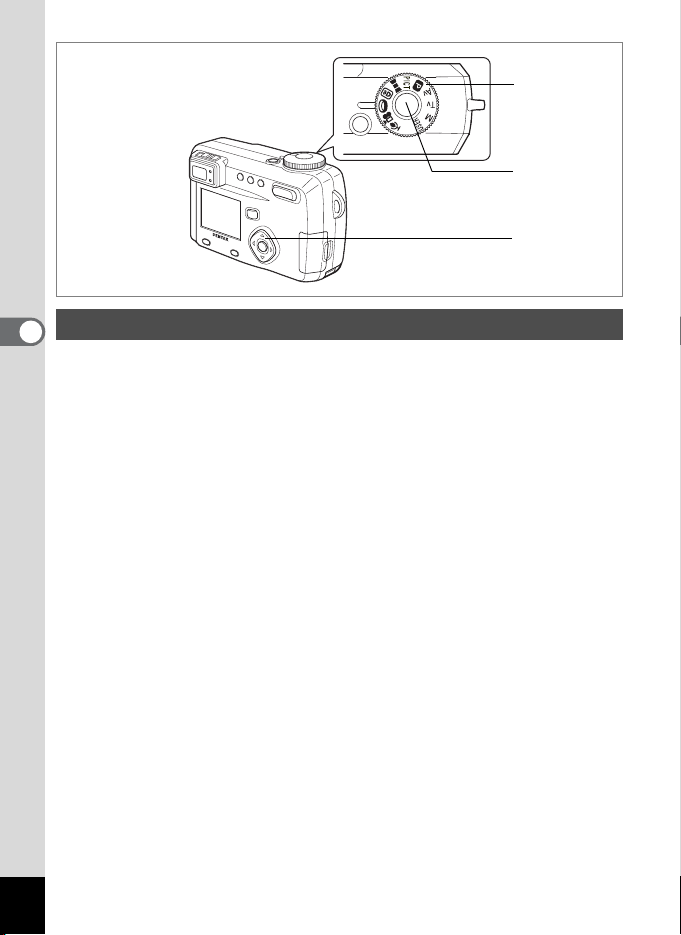
70
Taking Pictures
4
You can take pictures using digital filters. The filters consist of color
filters such as red, blue and green, a soft filter that produces a fuzzy
effect.
Color filters
Eight colors, black-and-white, sepia, red, pink, violet, blue, green and
yellow, are provided for the color filters. When you select a color filter in
the Digital Filter mode, the display on the LCD monitor is filtered with
the selected color, and the pictures are taken in that color.
Soft Filter
Pictures taken with the soft filter have a fuzzy effect.
Taking Pictures with Digital Filters (Digital Filter Mode)
1
3
2
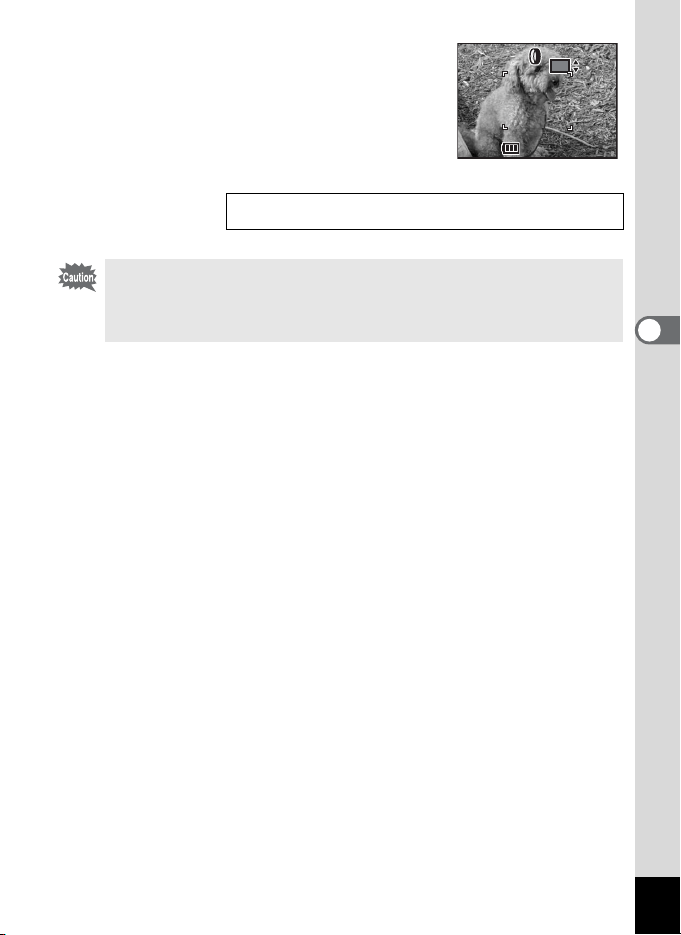
71
Taking Pictures
4
1 Set the Mode dial to D.
2 Use the four-way controller (23) to
select a digital filter to use.
3 Press the shutter release button.
The picture will be taken.
Playing back still pictures 1 p.26
The four-way controller (23) becomes the manual focus button and
cannot be used to change the filter when the focus mode is set to
manual. Press the OK button once and then use the four-way controller
(
23) to change the filter to change the filter.
200
200
11:20
11:20
200
11:20
10/20/2003
10/20/2003
10/20/2003
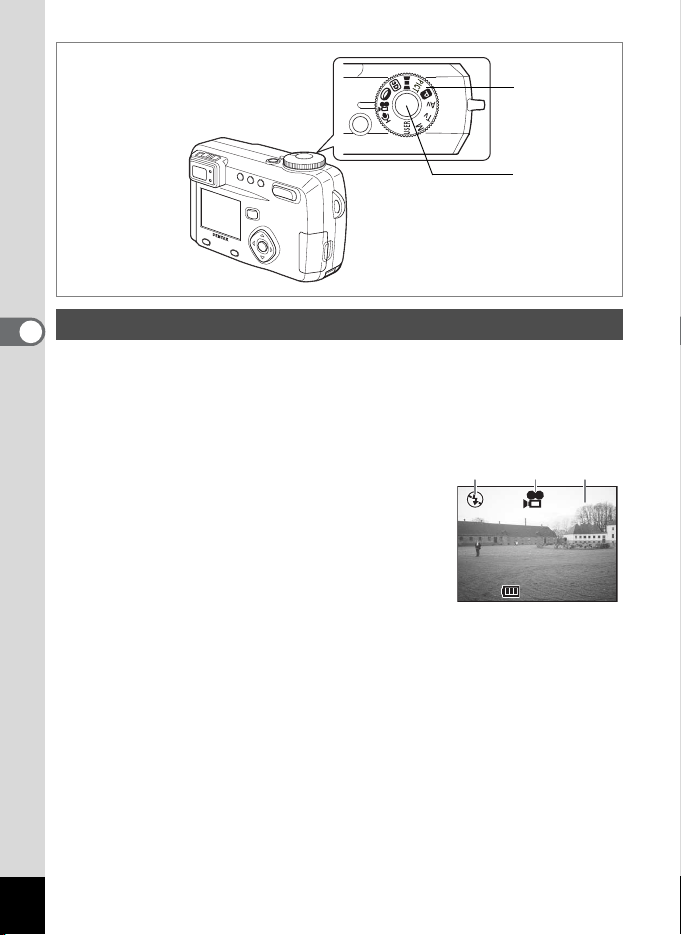
72
Taking Pictures
4
This mode enables you to take moving images. The amount of images
you can capture is displayed on the top right of the screen.
Sound can be recorded at the same time.
1 Set the mode dial to C.
The following information will be displayed on
the LCD monitor.
1Flash OFF
2 Movie Picture mode icon
3 Remaining shooting time
2 Press the shutter release button.
Shooting will start.
You can change the size of the image using the Zoom button.
x: makes the image bigger.
w:makes the image smaller.
3 Press the shutter release button.
Shooting will end.
The remaining shooting time will be displayed.
Taking Movie Pictures (Movie Picture Mode)
1
2, 3
00:
0 :
00:
0 :
12
12
00 :00:12
11:19
11:19
11:19
2 31
10/20/2003
10/20/2003
10/20/2003
73
Taking Pictures
4
Pictures will be taken for as long as you keep the button pressed when
you keep the shutter release button pressed for more than one second.
Shooting stops when you take a finger off from the shutter release
button.
Keeping the shutter release button pressed
Playing Back Movie Pictures 1 p.91
• The flash will not discharge in Movie Picture mode.
• Continuous shooting, interval shooting and multiple exposure
shooting are not possible in Movie Picture mode.
• The LCD monitor cannot be turned off in Movie Picture mode.
• Focusing Area mode is not available in Movie Picture mode.
• The digital zoom can be operated in Movie Picture mode.
• The focus is fixed and focus mode cannot be selected in the movie
picture mode.
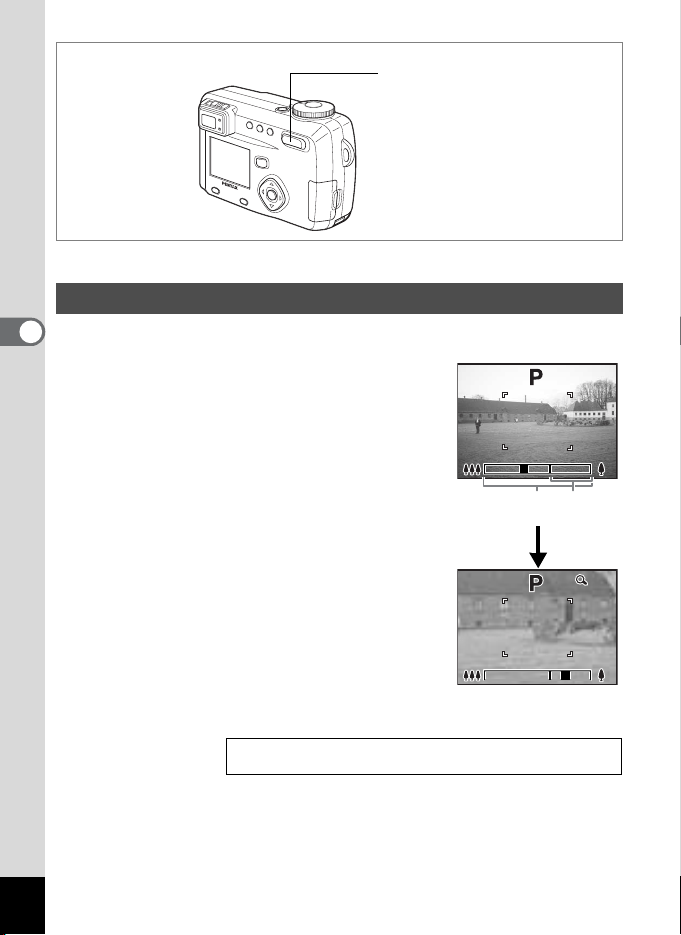
74
Taking Pictures
4
E a b c A d F G D C
You can use the zoom to take pictures in tele or wide mode.
1 Press the Zoom button in Capture
mode.
x (Tele): makes the subject bigger
w (Wide):makes the subject smaller
When the digital zoom function is disabled,
you can take pictures at up to 5×
magnification using the optical zoom.
When the digital zoom is enabled, you can
further enlarge the subject to a maximum
magnification equivalent to 20×.
Using the Zoom
Saving the Zoom Position 1 p.87
1
198
198
198
198
198
198
Zoom bar
Digital
zoom range
Digital Zoom
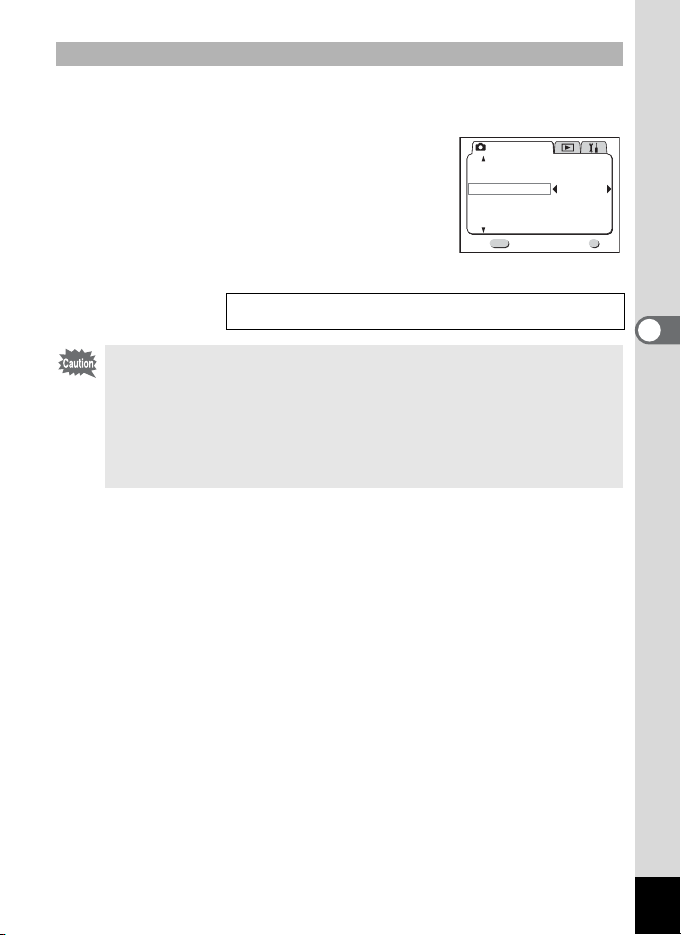
75
Taking Pictures
4
1 Press the Menu/Fn button in Capture mode.
The [A Rec.Mode] menu will be displayed.
2 Press the four-way controller (3) to
select [Digital Zoom].
3 Use the four-way controller (5) to
select [On].
4 Press the OK button.
The camera is ready to take a picture.
Enabling the Digital Zoom Function
Saving the Digital Zoom Function Setting 1 p.87
• When you turn the LCD monitor off, the digital zoom is disabled when
the digital zoom function is set to On.
• The image will be blurred when shooting an image using the digital
zoom function.
• The camera movement may occur due to high magnification. Use the
tripod to prevent it when using the digital zoom function.
• The digital zoom is enabled when taking a movie picture.
Rec. Mode
Exit
2/3
MENU
OK
OK
Auto Bracket
Digital Zoom
Instant Review
Interval Shoot
Off
On
2sec
Fast Fwd Movie
Flash Exp. Comp.
0.0

76
Taking Pictures
4
E b c A d F G D C
You can take pictures that are intentionally over-exposed or under-
exposed.
1 Press the four-way controller (45)
in Capture mode.
Four-way controller (4)
decreases the EV compensation to a
negative (–) level
Four-way controller (
5)
increases the EV compensation to a
positive (+) level
The set level is displayed on the LCD monitor.
EV Compensation
Saving the EV Compensation 1 p.87
• If you press 4 or 5 one time, or set to ± 0, the set level displayed on
the LCD monitor will go off after two seconds.
• The exposure compensation cannot be set in the Fireworks picture
mode.
1
198
198
198
11:19
11:19
11:19
10/20/2003
10/20/2003
10/20/2003
–1.0
1.0
–1.0
EV compensation level
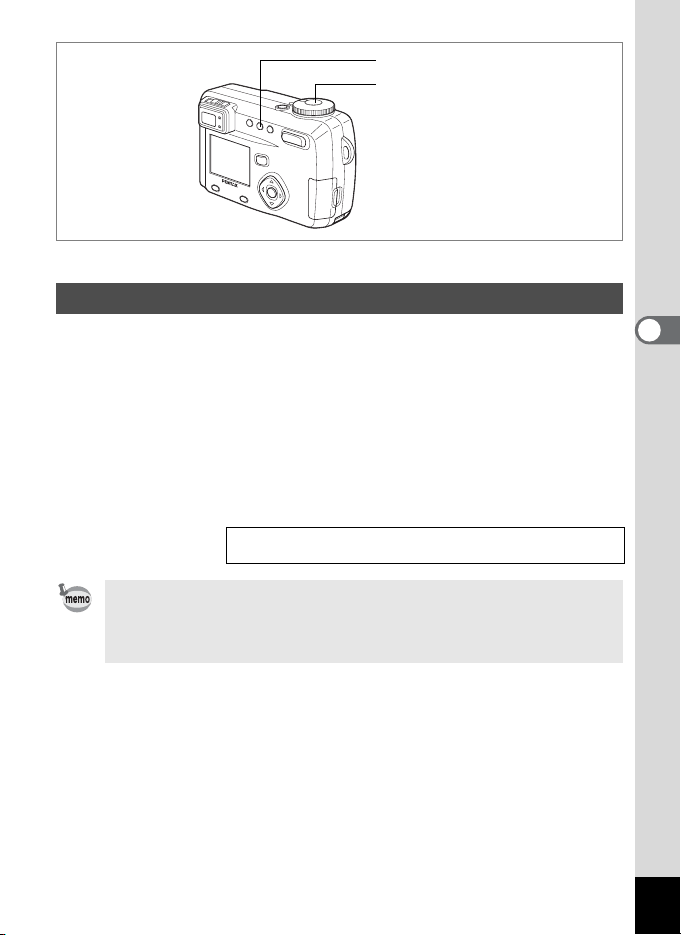
77
Taking Pictures
4
E a b c A d F G D C
The picture will be taken 10 seconds after the shutter release button is
pressed.
1 Press the ( button in Capture mode to display g on
the LCD monitor.
2 Press the shutter release button.
The self-timer is engaged and the self-timer lamp lights. The picture is
taken approximately three seconds after the self-timer lamp starts to
blink.
Using the Self-timer
Playing Back Images and Sound 1 p.89
• The second count will be displayed when you turn the LCD monitor
on.
• Press the shutter release button halfway while the second count is
displayed to cancel the self-timer.
1
2
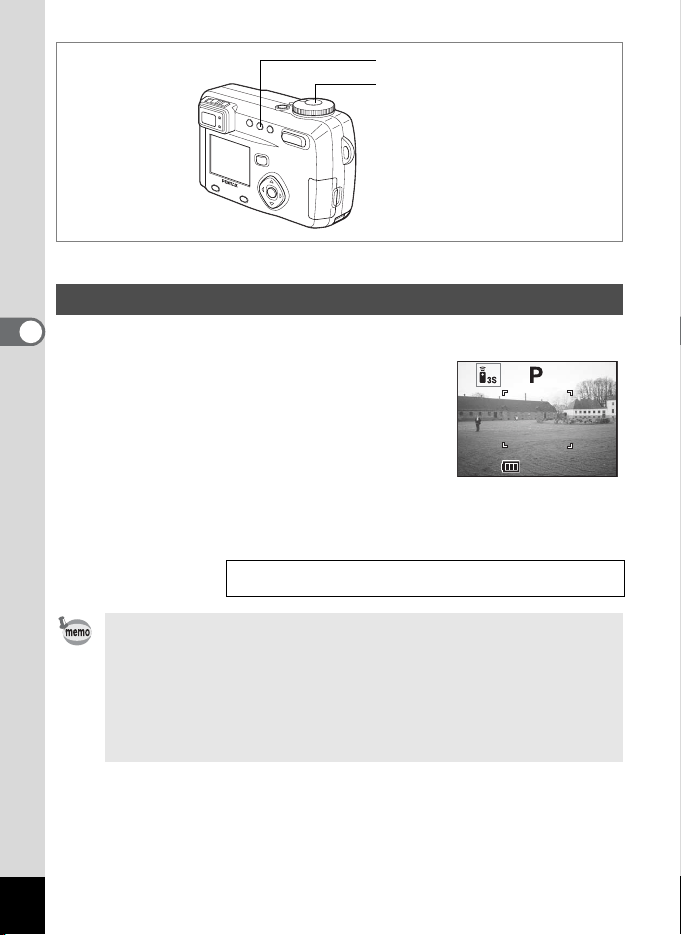
78
Taking Pictures
4
E a b c A d F G D C
You can take pictures using the remote control F (optional).
1 Press the ( button in Capture
mode to display
i on the LCD
monitor.
The self-timer lamp will blink and the camera
is ready to take pictures.
2 Press the shutter release button on
the remote control unit.
The self-timer lamp will blink rapidly and the picture will be taken after
approximately three seconds.
Life of the Battery for the Remote Control Unit
A signal can be sent from the remote control unit to the camera
approximately 30,000 times. If the battery needs changing, contact your
nearest Pentax customer service center. (A charge is made for
replacing the battery.)
Using the Remote Control Unit (optional)
Playing Back Images and Sound 1 p.89
• The buttons on the camera can be used in the same way.
• Please ensure that the remote control unit is no more than 5 meters
away from the front of the camera.
• The distance at which the remote control unit operates may be
reduced when taking pictures against the light.
• Press the
( button in step 1 to display h on the LCD monitor to
take a picture immediately after pressing the shutter release button
on the remote control unit.
1
2
198
198
198
11:19
11:19
11:19
10/20/2003
10/20/2003
10/20/2003
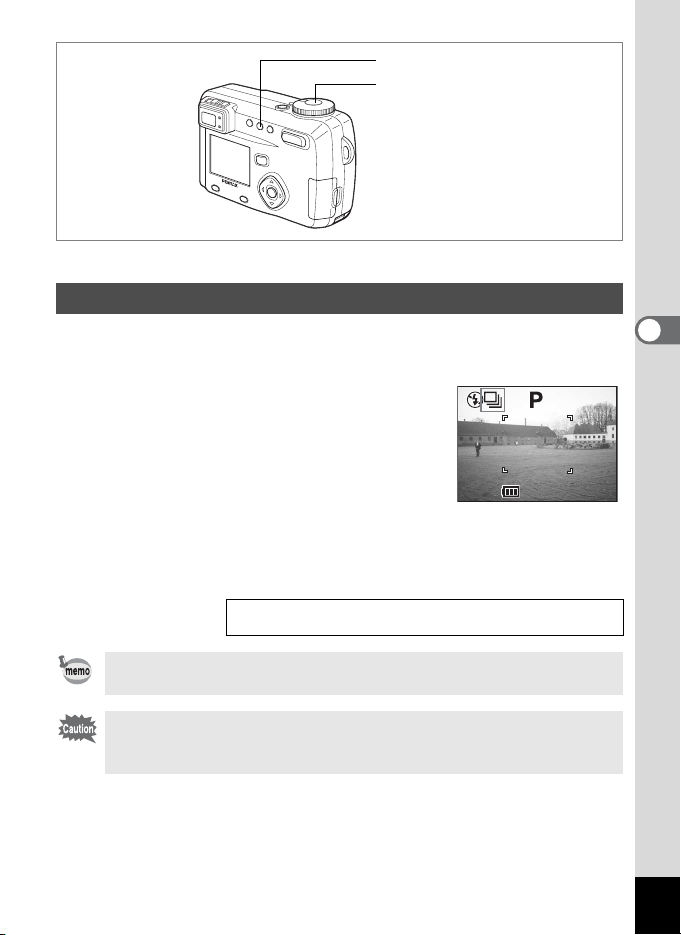
79
Taking Pictures
4
E a b c A d F G D C
Pictures are taken continuously while the shutter release button is
pressed.
1 Press the ( button in Capture
mode to display
j on the LCD
monitor.
The mode will change to Continuous
Shooting mode.
2 Press the shutter release button.
Pictures will be taken continuously while the shutter release button is
pressed. Shooting stops when you take a finger off from the shutter
release button.
Continuous Shooting
Playing Back Still Pictures 1 p.26
The interval will vary according to the [Recorded Pixels] and [Quality
Level] setting.
• The flash will not discharge in Continuous Shooting mode.
• Continuous shooting is not available for Movie Picture, Panorama
assist mode and 3D Image modes.
1
2
198
198
198
11:19
11:19
11:19
10/20/2003
10/20/2003
10/20/2003
80
Taking Pictures
4
E a b c A d F G D
In this mode still pictures are taken automatically at a fixed interval.
1 Press the ( button in Capture mode to display k on
the LCD monitor.
2 Press the shutter release button.
Interval shooting will start with the following settings.
• Interval 0min 10sec
• Number of shot 02
• Start time 0hr 0min
The camera turns off automatically when shooting is finished.
Taking Pictures at Fixed Intervals (Interval Shooting)
• Interval shooting can be set at intervals of 10 seconds to 4 minutes in
units of 1 second, and intervals of 4 minutes to 99 minutes in units of
1 minute. Intervals of less than 10 seconds cannot be set.
• The number of pictures can be set in the range of 2 to 99 pictures.
• The start time can be set between 0 min. and 23 hr. 59 min. in units of
1 minute.
• If the start time is set to 0 min., the first picture will be taken as soon
as the shutter release button is pressed.
• The remaining number of pictures and interval time will be displayed on
the LCD monitor when you press the power switch on during standby. If
you press the Menu / Fn button, the message “Stop interval shooting?”
will be displayed. To cancel interval shooting, press the OK button.
• Interval shooting stops and the camera turns off automatically when
the SD Memory Card / MultiMediaCard runs out of memory space.
Interval shooting is not possible in C F G mode.
1
2
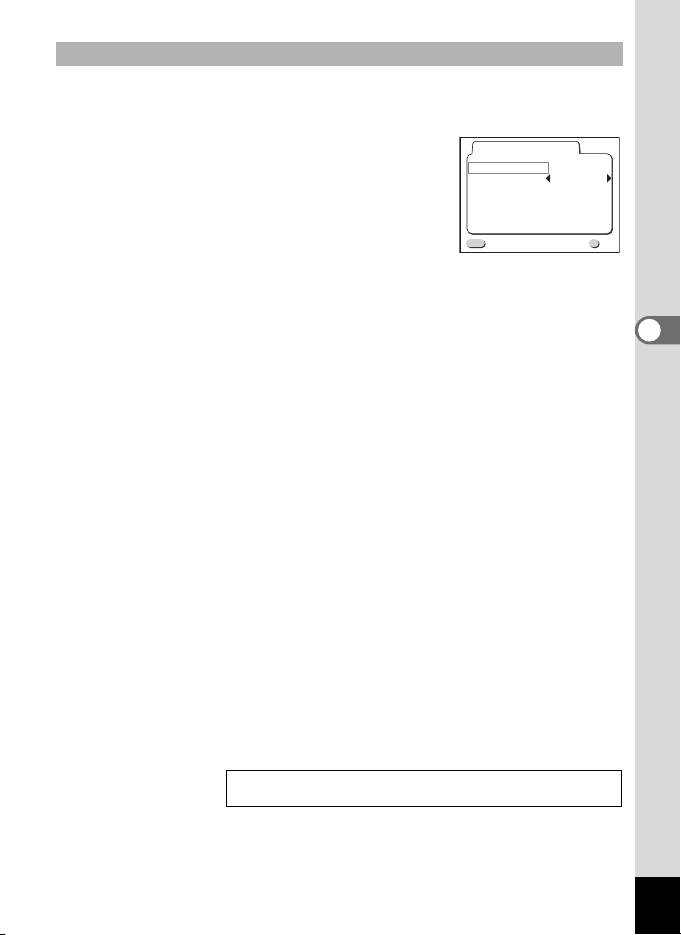
81
Taking Pictures
4
1 Press the Menu / Fn button in Capture mode.
The [A Rec.Mode] menu will be displayed.
2 Press the four-way controller (3) to
select [Interval Shoot].
3 Press the four-way controller (5).
The Interval Shooting menu will be displayed
and [Interval] will be framed.
4 Set the interval time.
1. Press the four-way controller (5).
23 will be displayed above and below the minutes.
2. Use the four-way controller (
23) to change the minutes, then
press (
5).
23 will be displayed above and below the seconds.
3. Use the four-way controller (
23) to change the seconds, then
press (
5).
4. Press the four-way controller (
3).
The frame will move to [Number of shoot].
5 Use the four-way controller (45) to select the number
of pictures, then press (
3).
The frame will move to [Start Time].
6 Set the time to start shooting.
1. Press the four-way controller (5).
23 will be displayed above and below the hours.
2. Use the four-way controller (
23) to change the hours, then
press
5.
23 will be displayed above and below the minutes.
3. Use the four-way controller (
23) to change the minutes, then
press (
5).
7 Press the OK button twice.
Setting the interval, number of shot, and start time
Playing Back Still Pictures 1 p.26
Interval Shoot
Interval
Number of Shot
Start Time
0hr 00min
02
1min 10sec
MENU
OK
OK
Exit
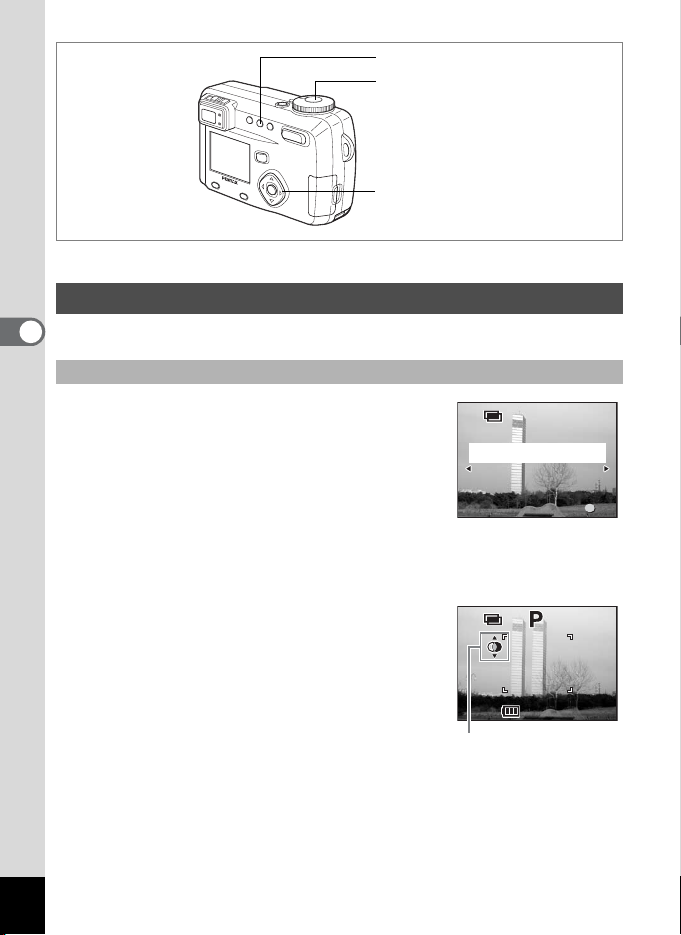
82
Taking Pictures
4
E a b c A d G D
You can superimpose a new image on top of an image already recorded.
1 Press ( in Capture mode to
switch to Multiple Exposure mode.
The screen for selecting the base image will
be displayed.
2 Use the four-way controller (45) to
choose the base image and press
the OK button.
The selected image will appear in transparent form on the LCD monitor.
3 Aim the camera at your subject and
choose the exposure method with
the four-way controller (
23).
S Priority is given to the brighter image.
Q Priority is given to the darker image.
R The average exposure is obtained.
4 Press the shutter release button.
The Instant Review screen will be displayed and you will be asked
whether you want to continue shooting.
If you select [Continue] and press the OK button, the picture you have
just created will be played back enabling you to add another image.
The combined picture will be saved as a new file.
Superimposing One Picture on Top of Another (Multiple Exposure Mode)
When images have been recorded
1
4, 3
2, 3
100-0038
100-0038
100-0038
OK
Ok
Ok
Ok
Choose Base Image
198
198
198
11:19
11:19
11:19
10/20/2003
10/20/2003
10/20/2003
Exposure method
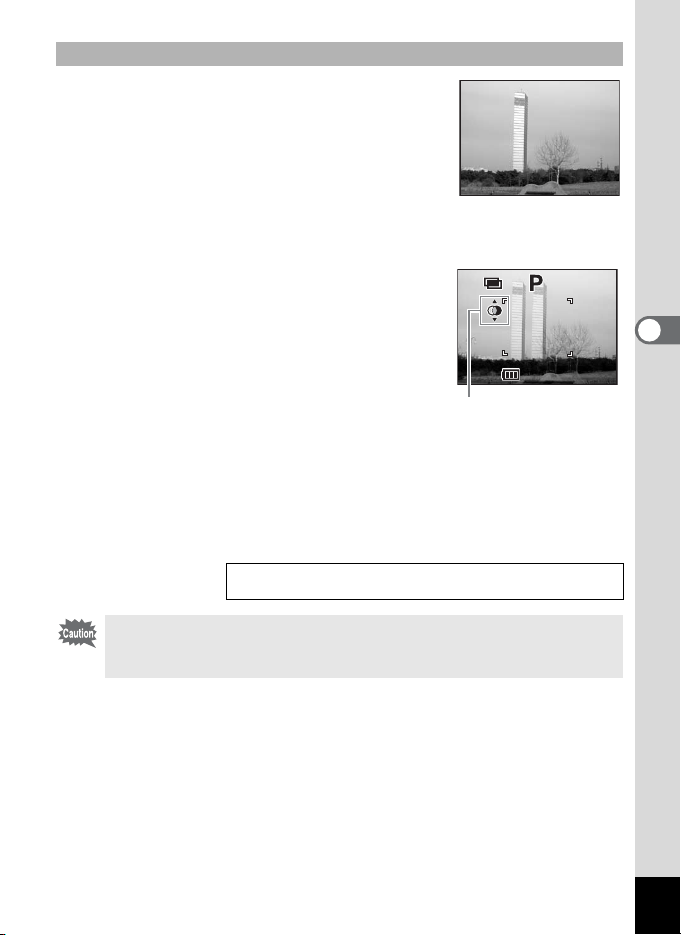
83
Taking Pictures
4
1 Press ( in Capture mode to
switch to Multiple Exposure mode.
A message will appear on the LCD monitor
informing you that the camera is ready to take
the base image.
Take the base image. When you have taken
the base image, it will appear in transparent
form on the LCD monitor.
2 Aim the camera at your subject and
choose the exposure method with
the four-way controller (
23).
S Priority is given to the brighter image.
Q Priority is given to the darker image.
R The average exposure is obtained.
3 Press the shutter release button.
The Instant Review screen will be displayed and you will be asked
whether you want to continue shooting.
If you select [Continue] and press the OK button, the picture you have
just created will be played back enabling you to add another image.
The combined picture will be saved as a new file.
When there are no recorded images
Playing Back Still Pictures 1 p.26
• Multiple exposure is not possible in C F G mode.
• Continuous shooting is not possible in Multiple Exposure mode.
• The LCD monitor cannot be turned off in Multiple Exposure mode.
Base Image Shooting
Base Image Shooting
Base Image Shooting
198
198
198
11:19
11:19
11:19
10/20/2003
10/20/2003
10/20/2003
Exposure method
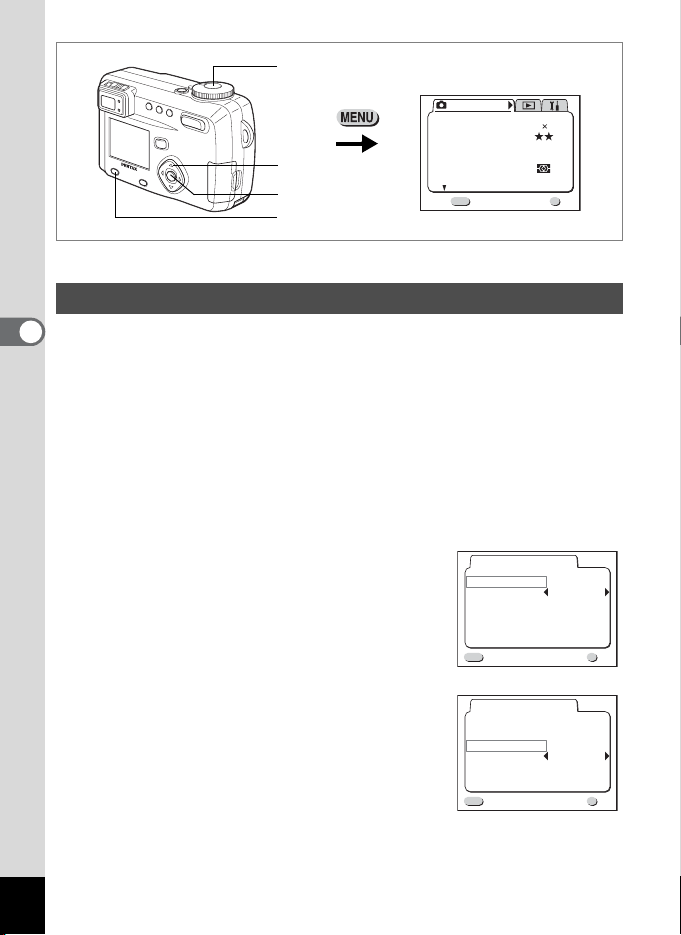
84
Taking Pictures
4
a b c A d G D E
You can take pictures automatically with three different exposure, white
balance, sharpness, saturation and contrast settings.
1 Press the Menu / Fn button in Capture mode.
The [A Rec. Mode] menu will be displayed.
2 Press the four-way controller (3) to select
[Auto Bracket].
3 Press the four-way controller (5).
[Applied Photo] screen to select the bracket setting will be displayed.
4 Use the four-way controller (45) to
select the conditions for bracket
shooting.
If you selected [Sharpness], [Saturation] or
[Contrast], skip to step 7.
5 Press the four-way controller (3) to
select [Exp. Bracket] or [White
Balance].
Go to [Bracket Amount].
6 Use the four-way controller (45) to
set the bracketing steps.
Automatically Changing the Shooting Conditions (Auto bracket)
1
8
2, 3, 4, 5, 6
7
Rec. Mode
Wide
AWB
Auto
Quality Level
White Balance
Focusing Area
AE Metering
Sensitivity
Exit
1/3
MENU
OK
OK
2592 1944
Recorded Pixels
Auto Bracket
Applied Photo
Bracket Amount
± 0.3
Exp.Bracket
MENU
OK
OK
Exit
Auto Bracket
Applied Photo
Bracket Amount
± 0.3
Exp.Bracket
MENU
OK
OK
Exit
85
Taking Pictures
4
7 Press the OK button.
The Bracket mode is set.
8 Press and hold down the shutter release button.
Auto bracket shooting starts.
When shooting is finished, a message will be displayed asking
whether you want to continue shooting or not. To continue shooting in
auto bracket mode, select [Continue] and press the OK button.
Playing Back Still Pictures 1 p.26
• Check the pictures you have taken using the Playback mode.
• If you set auto bracket when you set the Continuous shooting mode,
continuous shooting will be cancelled.
• The auto bracket setting will be cancelled by pressing the Menu / Fn
button or OK button.
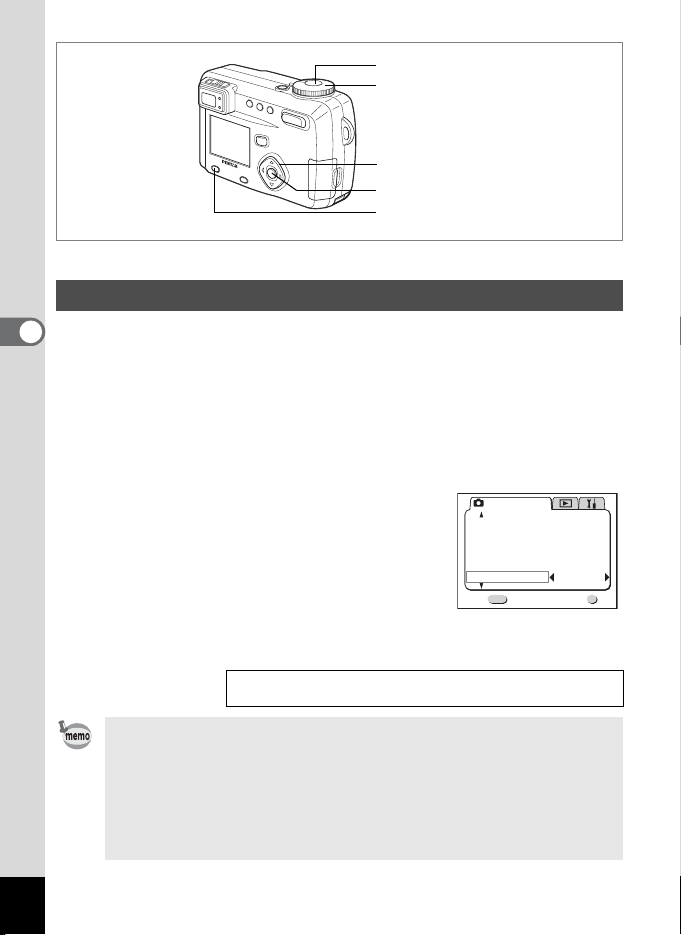
86
Taking Pictures
4
C
This mode lets you take movie pictures at a delayed frame rate so that
when you play the movie back, the action appears speeded up.
1 Set the mode dial to C.
2 Press the Menu / Fn button in Capture mode.
The [A Rec.Mode] menu will be displayed.
3 Press the four-way controller (3) to select [Fast Fwd
Movie].
4 Use the four-way controller (45) to
choose [Off (×1)], [×2], [×5], [×10],
[×50] or [×100].
5 Press the OK button.
6 Press the shutter release button.
Shooting in Fast Forward Movie mode starts.
7 Press the shutter release button.
Shooting in Fast Fwd Movie mode ends.
Taking Fast Forward Movie Pictures (Fast Fwd Movie)
Playing Back Movie Pictures 1 p.91
• Off (×1) is the normal setting for movie pictures (15 frames per
second). Each time ×2 or ×5 is selected, the number of frames taken
per second is reduced to 1/2 or 1/5.
• As movie pictures are normally played back at the rate of 15 frames
per second, movies taken at ×2 are played back twice as fast and
movies taken at ×5 are played back five times as fast.
• Sound cannot be recorded.
2
6, 7
3, 4
5
1
Rec. Mode
Exit
2/3
MENU
OK
OK
Auto Bracket
Digital Zoom
Instant Review
Interval Shoot
x2
On
2sec
Fast Fwd Movie
Flash Exp. Comp.
0.0
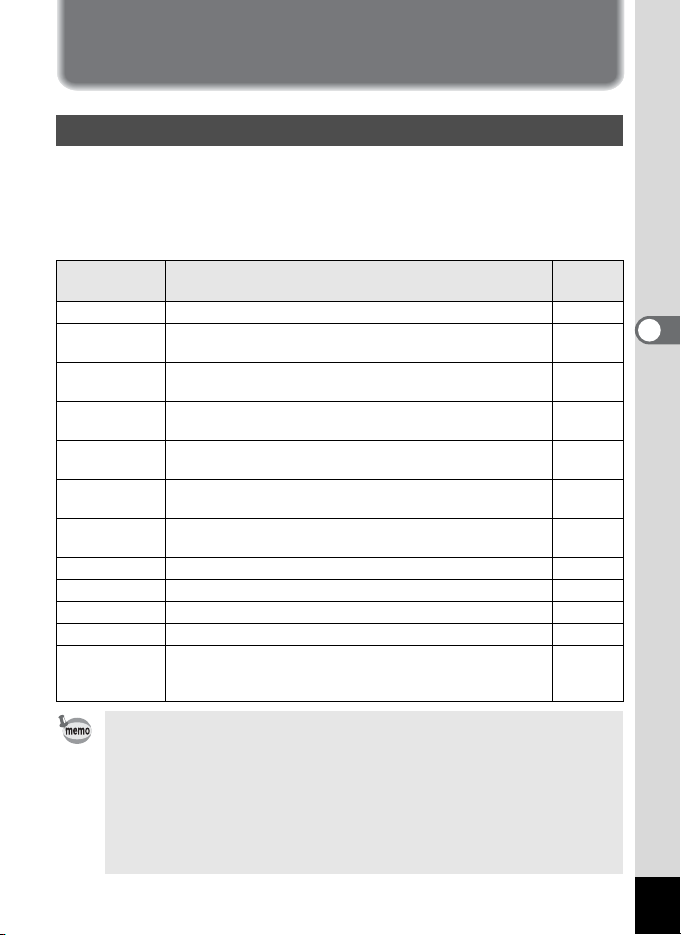
87
4
Taking Pictures
Saving the Settings (Memory)
You can choose whether you want the set values to be saved when the
camera is turned off. If you select [On], the settings will be saved in the
status they were in immediately before the camera was turned off. If
you select [Off], the settings will be reset to the defaults when the
camera is turned off.
Saving the Menu Items (Memory)
Item Description
Default
Setting
Flash The flash mode setting on the b button is saved. Off
Flash
Exp. Comp.
Saves the Flash Compensation setting. 0.0
White Balance
The [White Balance] setting on the [A Rec.Mode] menu
is saved.
Off
EV
Compensation
The set EV compensation value is saved. Off
Digital Zoom
The [Digital Zoom] setting on the [A Rec.Mode] menu is
saved.
On
AE Metering
The [AE Metering] setting on the [A Rec.Mode] menu is
saved.
Off
Sensitivity
The [Sensitivity] setting on the [A Rec.Mode] menu is
saved.
Off
Focus Mode The focus mode setting is saved. Off
Zoom Position The zoom position setting is saved. Off
MF Position The focus position set by Manual Focus is saved. Off
DISPLAY The LCD monitor display mode is saved. Off
File No.
The file number is saved. If a new SD Memory Card /
MultiMediaCard is inserted, the sequential file number is
assigned.
On
• Menu items not included in [Memory] will also be saved in the settings
selected on the menus for each function when the camera is turned off.
• The zoom position setting in the digital zoom range will not be saved
when [Zoom Position] is set to On in [Memory].
• The Auto Bracket setting is not saved.
• [Memory] can be set separately in User mode and other Capture modes.
• [Zoom Position] will be set to On automatically when [MF Position] is
set to On.
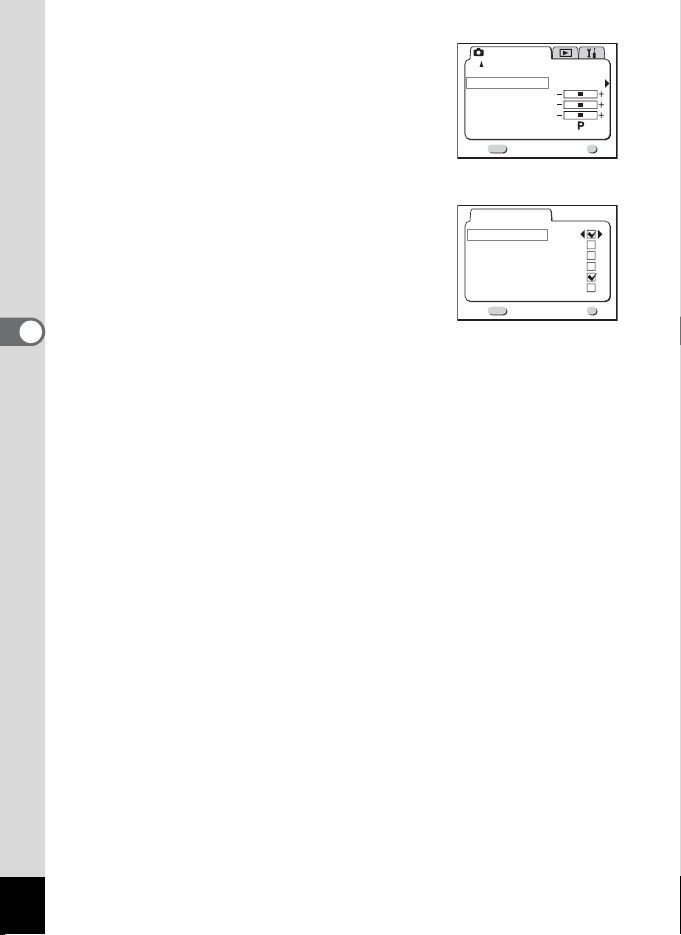
88
Taking Pictures
4
1 Press the Menu / Fn button in
Capture mode.
2 Press the four-way controller (23)
to select [Memory].
3 Press the four-way controller (5).
[Memory] menu will be displayed.
4 Use the four-way controller (23) to
select the item.
5 Use the four-way controller (45) to
switch
O [On] and P [Off].
6 Press the OK button twice.
The camera is ready to take the picture.
Rec. Mode
Exit
3/3
MENU
OK
OK
Memory
Sharpness
Saturation
Contrast
USER
3D Mode
Parallel
Exit
1/2
MENU
OK
OK
Memory
Flash
White Bal.
Digital Zoom
AE Metering
EV Compensation
Flash Exp. Comp.
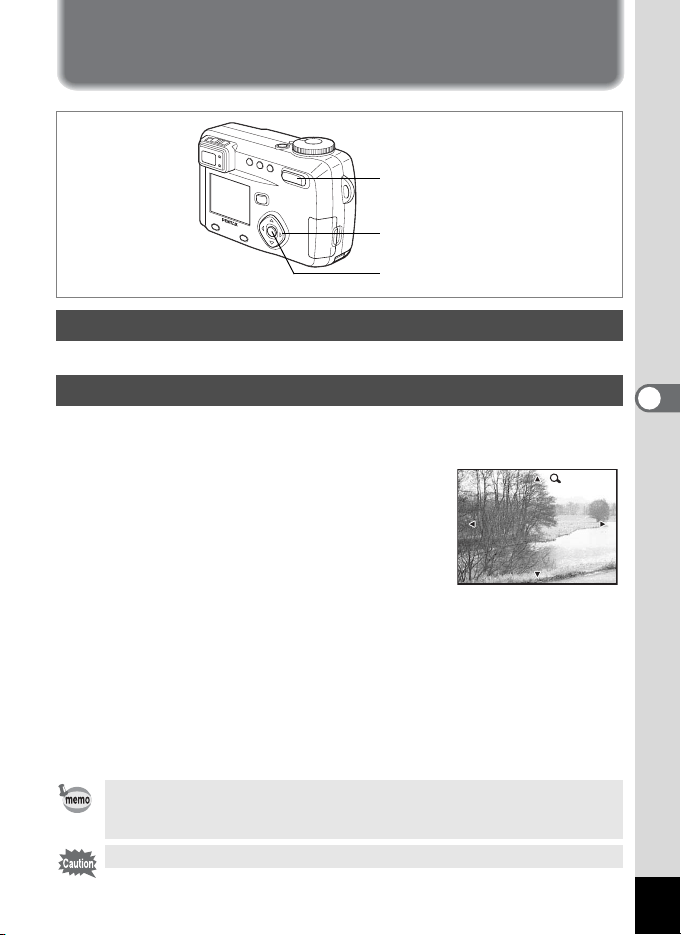
89
5
Playback / Erasing
Playback / Erasing
Playing Back Images and Sound
See “Playing Back Still Pictures” (p.26).
You can display images magnified up to 8 times. A guide to operation is
displayed on the LCD monitor during magnification.
1 Enter the Playback mode and
choose the image you want to
magnify with the four-way
controller (
45).
2
Press
x
/
y
on the Zoom /
f
/
y
button.
The image will be magnified (1× to 8×).
• The following operations can be performed while the magnified
image is displayed.
Four-way controller (
2345) :Moves the position to be magnified
Zoom /
f/y button (x) :Makes the image larger
Zoom /
f/y button (w) :Makes the image smaller
Display button :Turns the guide marks on / off
3 Press the OK button.
Zoom playback will end.
Playing Back Still Pictures
Zoom Display
If you set the magnification for [Quick Zoom] in the [B Setup] menu in
advance, the image will be displayed in the set magnification when the
x/y button of the Zoom /f/y button is pressed once.
Movie pictures cannot be magnified.
2
1
3
1.1X
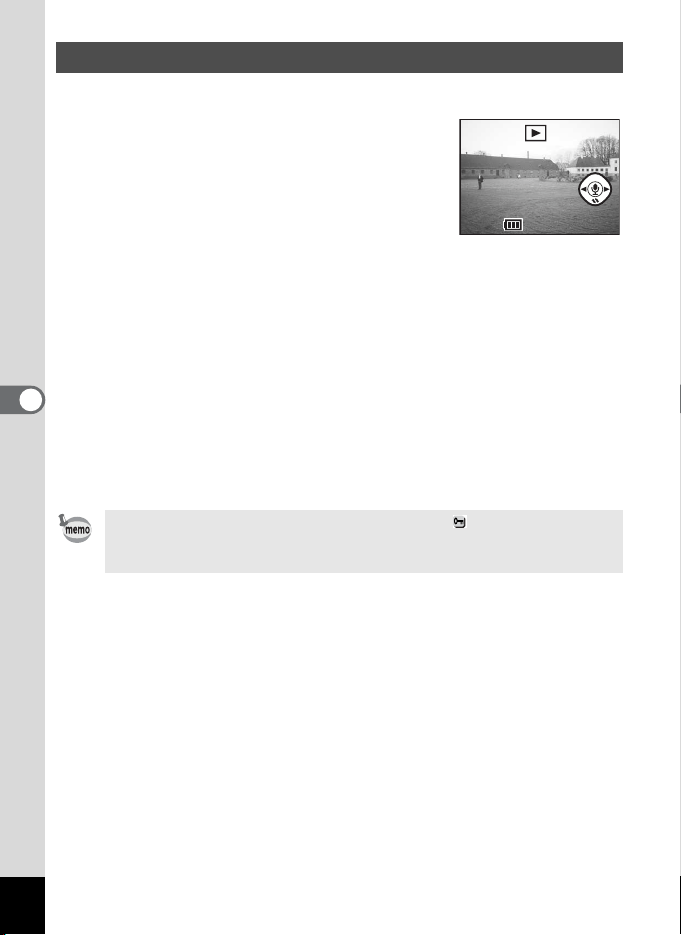
90
5
Playback / Erasing
You can add a voice memo to a recorded image.
1 Enter the playback mode and
choose the image to which you
want to add a voice memo with the
four-way controller (
45).
If the image has no voice memo, the screen
for recording a voice memo is displayed on
the LCD monitor.
2 Press the OK button.
Recording starts. You can record for up to 30 seconds.
3 Press the OK button.
Recording stops.
4 Press the four-way controller (2).
Play back the recorded voice memo.
5 Press the four-way controller (2).
Playback stops.
Adding a Voice Memo
• A voice memo cannot be added to protected ( ) images.
•
U is displayed on the LCD monitor next to images with a voice
memo.
100-0019
100-0019
100-0019100-0019
100-0019
100-0019
11:19
11:19
11:19
10/20/2003
10/20/2003
10/20/2003
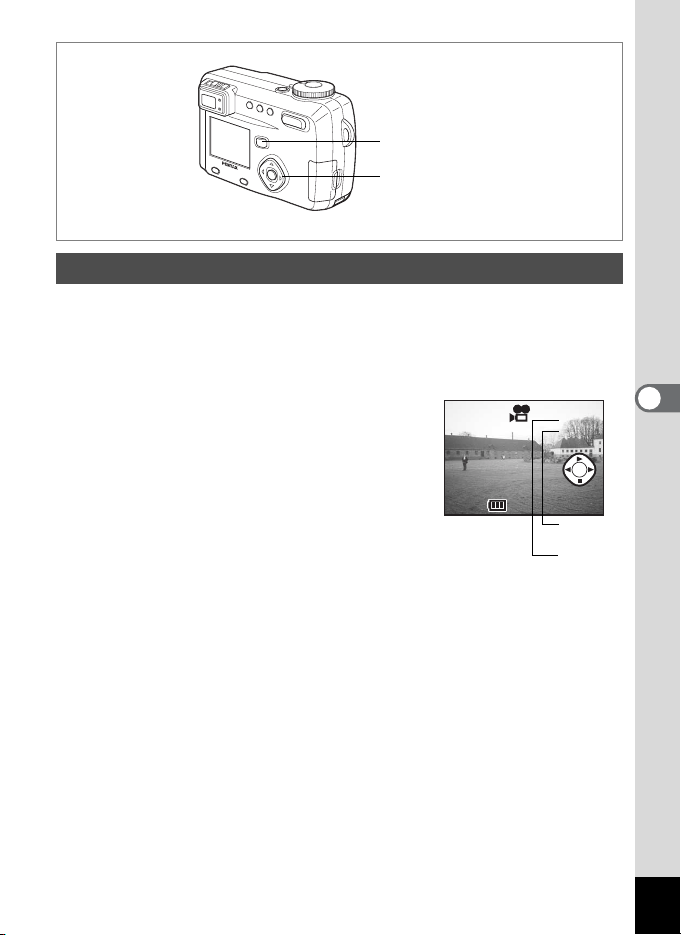
91
5
Playback / Erasing
You can play back Movie pictures. A guide to operation is dis-played on the
LCD monitor during playback. The sound is played back at the same time.
1
Enter the Playback mode and choose the movie picture
you want to play back with the four-way controller (
45
).
2 Press the four-way controller (2).
Playback will start.
• The following operations can be
performed during playback.
Four-way controller (
4) :Reverse playback
Four-way controller (
5) :Forward playback
Four-way controller (
2) :Pause
Zoom /
f/y button (x) :Increases the
volume
Zoom /
f/y (w) button :Reduces the
volume
Display button :Changes the Display mode
• The following operations can be performed while Pause is
engaged.
Four-way controller (
4) :Frame reverse
Four-way controller (
5) :Frame forward
Four-way controller (
2) :Releases the Pause function
Display button :Changes the Display mode
3 Press the four-way controller (3).
Movie playback will end.
4 Press the Playback button.
The camera will return to Capture mode.
Playing Back Movie Pictures
4
1, 2, 3
11:19
11:19
11:19
10/20/2003
10/20/2003
10/20/2003
100-0019
100-0019
100-0019
00:
0:
00
00
00:
0:
04
04
00:00
00:04
Recording
time
Playback
time
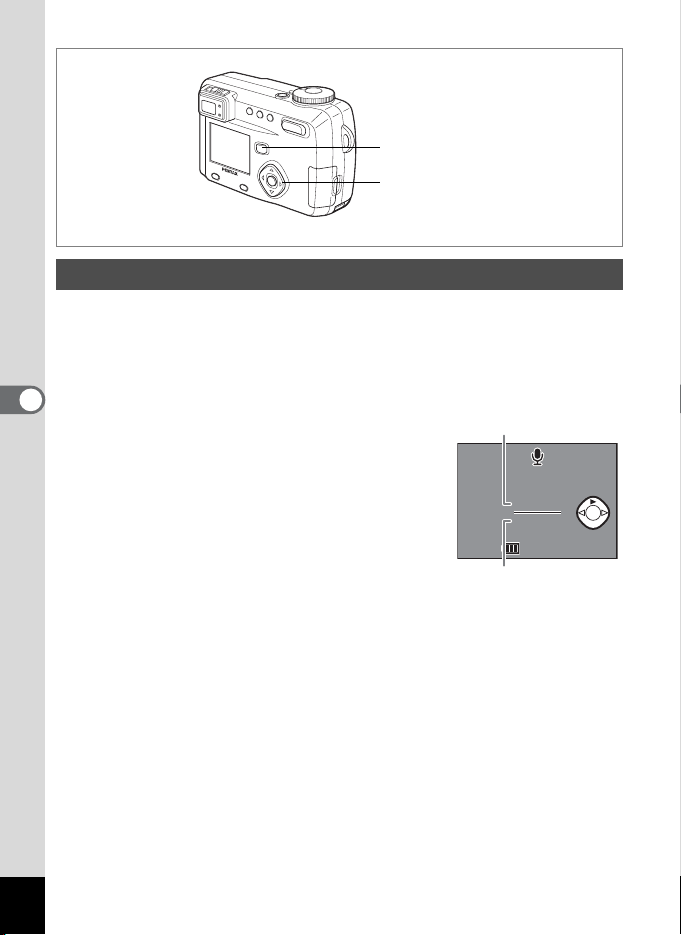
92
5
Playback / Erasing
You can play back the recording you made in Voice Recording mode.
1 Enter the Playback mode and choose the recording
you want to play back with the four-way controller
(
45).
2 Press the four-way controller (2).
Playback will start.
• The following operations can be performed during
playback.
Four-way controller (4): Rewinds and plays back the recorded sound
Four-way controller (
5): Advances and plays back the recorded
sound
Zoom /
f/y button (x): Increases the volume
Zoom /
f/y button (w):Reduces the volume
3 Press the four-way controller (3).
Sound playback will end.
4 Press the Playback button.
The camera will return to the Capture mode.
Playing Back Sound
4
1, 2, 3
11:19
11:19
11:19
10/20/2003
10/20/2003
10/20/2003
100-0001
100-0001
100-0001
00:
0 :
00
00
:00
: 00
00:00:00
00:
0 :
12
12
:35
: 35
00 :12:35
Playback time
Recording time
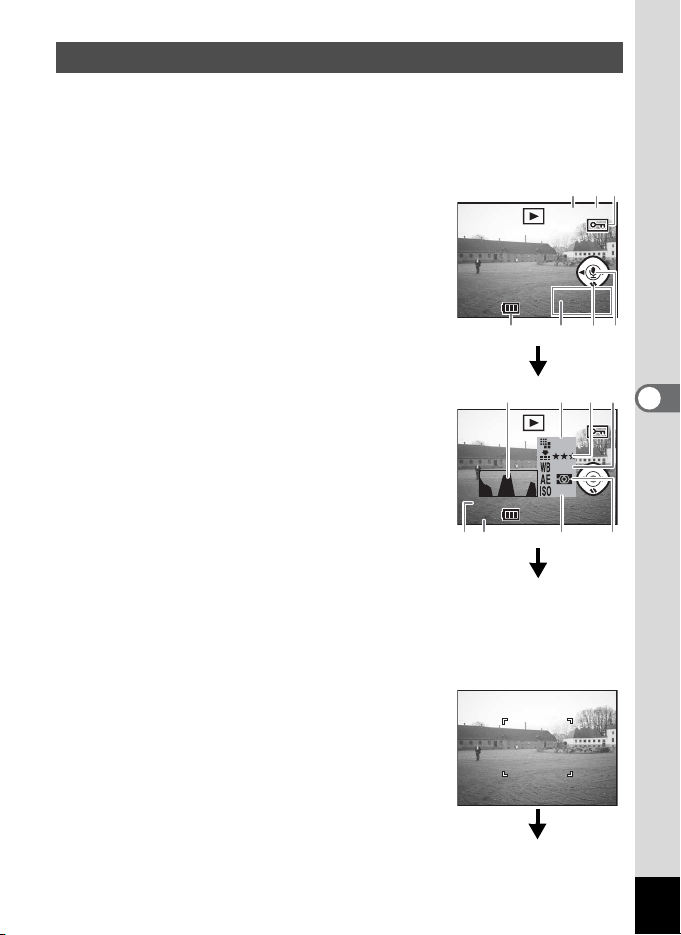
93
5
Playback / Erasing
You can display shooting information on the LCD monitor. Use the
Display button to change the information displayed.
Display On
Playback information is displayed.
1 Folder No.
2 File name
3 Protect icon
4 Voice memo icon
5 Four-way controller operation guide
6 Date & time
7 Battery indicator
Histogram Display
The brightness distribution of the image is
displayed.
The x-axis shows the brightness (darkest at
the left end and brightest at the right end)
and the y-axis shows the number of pixels.
1 Histogram
2 Recorded pixels
3 Quality level
4 White balance
5 AE metering
6 Sensitivity
7 Aperture value
8 Shutter speed
Display Off
No playback information is displayed.
Playing back Shooting Information (Playback Mode)
100-0019
100-0019
100-0019100-0020
100-0020
100-0020
11:19
11:19
11:19
10/20/2003
10/20/2003
10/20/2003
321
7 56
4
1/125
1/125
F2.6
F2.6
1/125
F2.6
AWB
2592
100
11:19
11:19
11:19
10/20/2003
10/20/2003
10/20/2003
100-0021
100-0021
100-0021
87
3
4
21
6 5
Display On
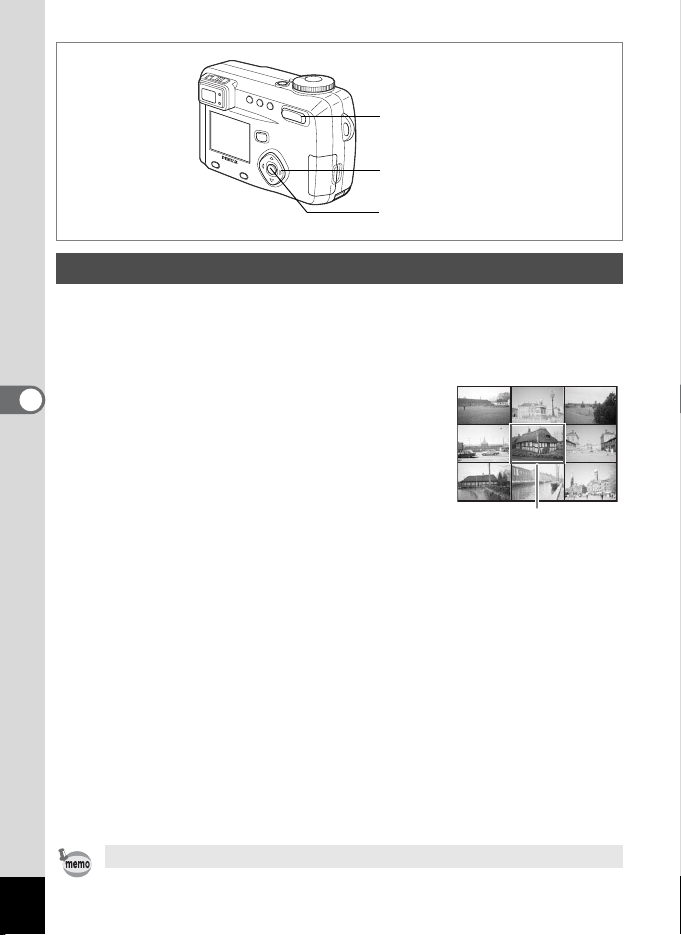
94
5
Playback / Erasing
You can display nine images at the same time.
1 Enter the Playback mode and choose an image with
the four-way controller (
45).
2 Press w/f on the Zoom button f/
y.
Nine images will be displayed with the selected image in the center.
Choose an image with the four-way controller (
2345). When ten or
more images have been recorded, if you press the four-way controller
(
5) while the bottom right image is selected, the next nine images will
be displayed, and if you press the four-way controller (
4) while the
top left image is selected, the previous nine images will be displayed.
Similarly, if you press the four-way controller (
2) while an image on
the top row is selected, the previous nine images will be displayed,
and if you press the four-way controller (
3) while an image on the
bottom row is selected, the next nine images will be displayed.
3 Press the OK button.
The screen will return to single-image display of the selected image.
Nine-image Display
Sound files are displayed in O.
2
1
3
Selected image

95
5
Playback / Erasing
You can play back all the images on the SD Memory Card /
MultiMediaCard continuously.
1 Enter the Playback mode and choose the image with
which to start the slideshow with the four-way
controller (
45).
2 Press the Menu / Fn button.
The [Q Playback] menu will be displayed.
3 Select [Slideshow] with the four-
way controller (
3).
4 Use the four-way controller (45) to
change the playback interval.
Choose from the following: 3 sec, 5 sec, 10 sec, 20 sec, 30 sec.
5 Press the OK button.
Playback will start at the set interval.
Slideshow
• The slideshow will stop when you press the four-way controller, or
any buttons such as the Menu / Fn button during continuous
playback.
• The slideshow will continue until you press any button.
• Movie pictures and pictures with a voice memo will be played through
to the end before the next picture is played back, regardless of the set
playback interval.
5
1, 3, 4
2
OK
OK
Playback
Resize
Trimming
Alarm
Slideshow
PictBridge
Digital Filter
3sec
Off
Exit
MENU
1/1

96
5
Playback / Erasing
Erasing Images
1
Enter the Playback mode and choose the image or
sound you want to erase with the four-way controller
(
45).
2 Press the i button.
The Delete screen will be displayed.
3 Select [Delete] with the four-way
controller (
2).
4 Press the OK button.
Erasing a Single Image or Sound
• You can also delete images from Instant Review (p.25).
• You cannot erase protected images (with the symbol).
• When [Quick Delete] is set to On in the [
B Set-up] menu, Step 3 can
be omitted.
2
1, 3
4
Cancel
Delete
100-0020
100-0020
100-0020
MENU
OK
All images & sounds
All images & sounds
All images & sounds
OK
OK
Exit
Exit
OKExit
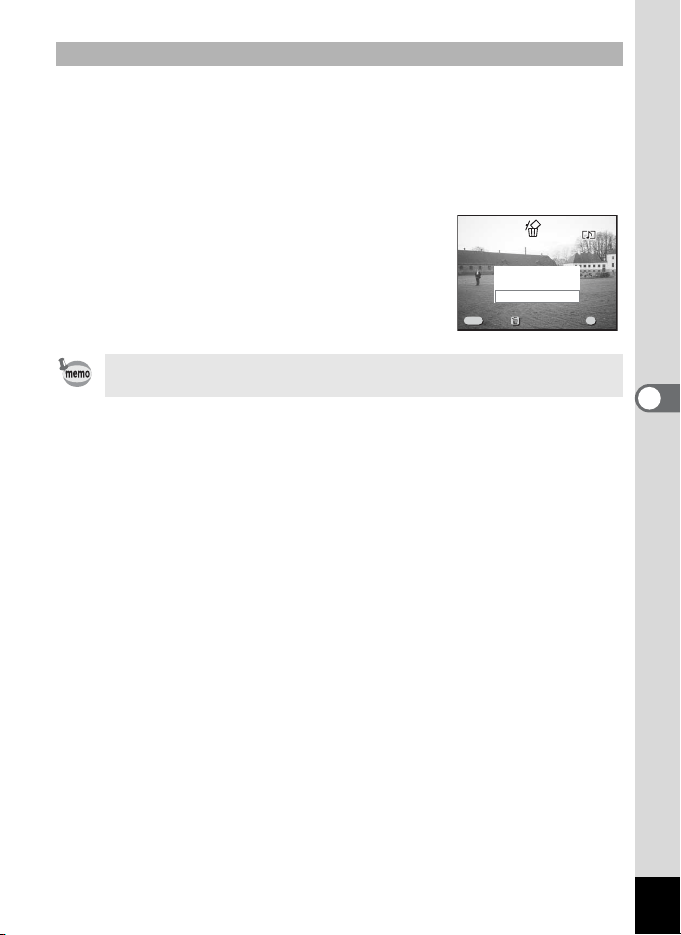
97
5
Playback / Erasing
If an image has a voice memo (U is displayed), you can erase the
voice memo without erasing the image.
1 Enter the Playback mode and choose the image with
the voice memo that you want to erase with the four-
way controller (
45).
2 Press the i button.
The Sound Delete screen will be displayed.
3 Select [Sound Delete] with the four-
way controller (
2).
4 Press the OK button.
Erasing a Voice Memo
Select [Delete] in step 3 above to erase both the image and the voice
memo.
100-0020
100-0020
100-0020
Cancel
Delete
Sound Delete
MENU
OK
All images & sounds
All images & sounds
All images & sounds
OK
OK
Exit
Exit
OKExit
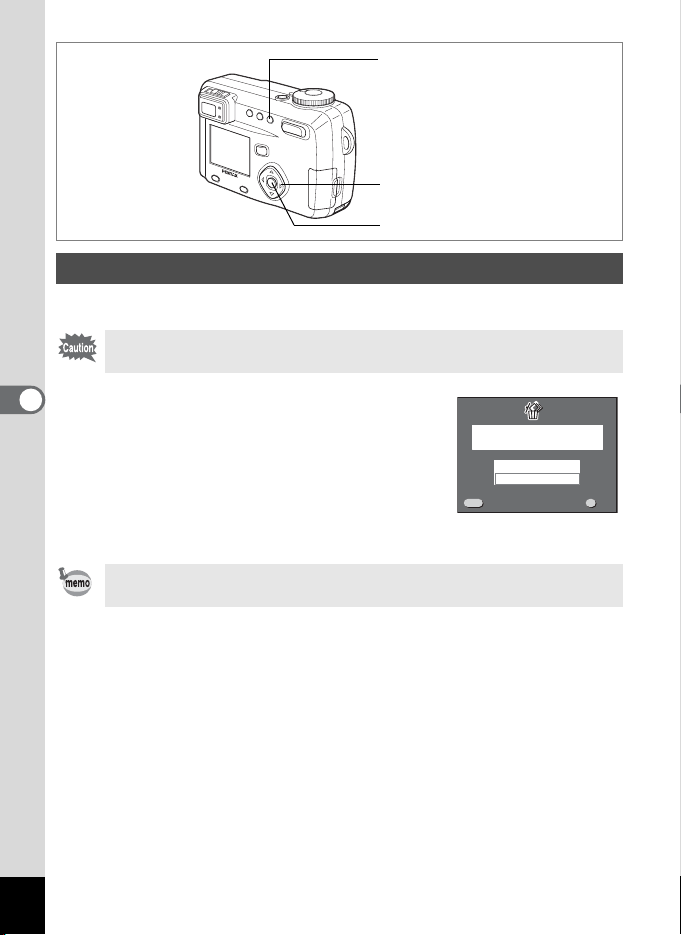
98
5
Playback / Erasing
You can erase all the images / sound at once.
1 Enter the Playback mode and press
the
i button twice.
The Delete screen will be displayed.
2 Select [Delete All] with the four-way
controller (
2).
3 Press the OK button.
Erasing All Images
• Once erased, images / sound cannot be restored.
• Protected images / sound cannot be erased.
When [Quick Delete] is set to On in the [B Set-up] menu, step 2 can be
omitted.
1
2
3
Cancel
Delete All
Delete all images & sounds
on the memory card?
MENU
Exit
Exit
Exit
OK
OK
OK
OK
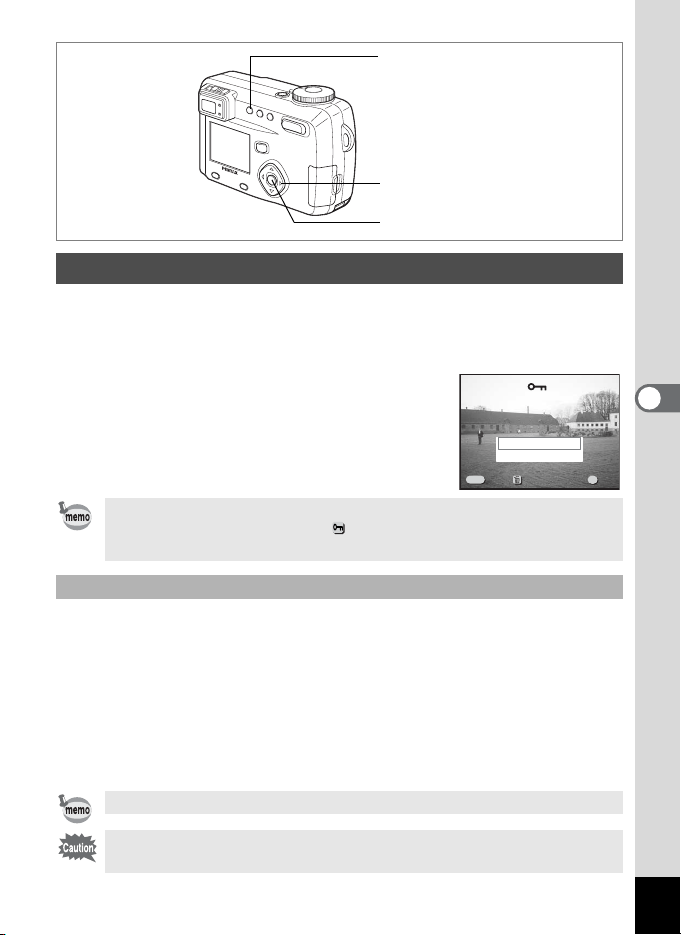
99
5
Playback / Erasing
You can protect images / sound from being accidentally erased.
1
Enter the Playback mode and choose the image / sound
you want to protect with the four-way controller (
45
).
2 Press the Z button.
The Protect screen will be displayed.
3 Press the four-way controller (2).
The frame will move to [Protect].
4 Press the OK button.
You can protect all the images / sound.
1 Enter the Playback mode.
2 Press the Z button twice.
The protect all images & sounds screen will be displayed.
3 Press the four-way controller (2).
The frame will move to [Protect].
4 Press the OK button.
Protecting Images from Deletion (Protect)
• Select [Unprotect] in step 3 to cancel the Protect setting.
• If the image is protected, the symbol is displayed when the image /
sound is played back.
Protecting All Images / Sound
Select [Unprotect] in step 3 to cancel the Protect setting on all of the images.
Even protected images / sound will be erased by formatting the SD
Memory Card / MultiMediaCard.
2
1, 3
4
100-0020
100-0020
100-0020
Unprotect
Protect
MENU
All images & sounds
All images & sounds
All images & sounds
Exit
Exit
Exit
OK
OK
OK
OK
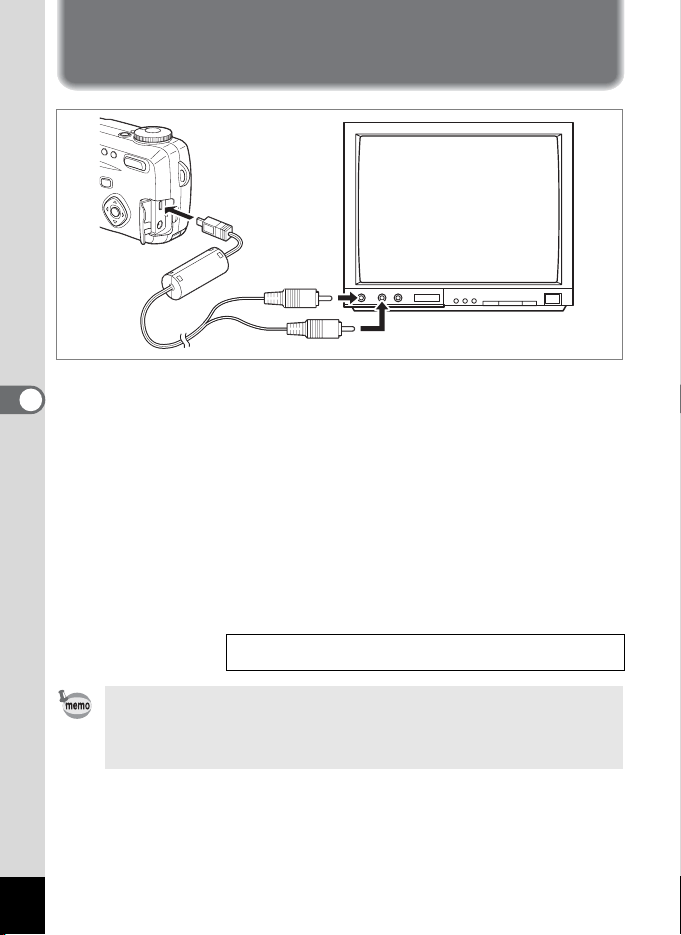
100
5
Playback / Erasing
Viewing Images on a TV
By using the AV cable, you can capture and play back images on a
TV or other equipment with a video IN jack. Make sure that both
the TV and the camera are turned off before connecting the cable.
1 Open the terminal cover and connect the AV cable.
2 Connect the sound terminal (white) and image terminal
(yellow) of the AV cable to the sound terminal (white)
and image input terminal (yellow) of the TV.
3 Turn the TV and camera on.
Changing the Video Output Format 1 p.119
The LCD monitor is always turned off when the camera is connected to
a TV. If you intend to use the camera for a long time, use of the AC
adapter (optional) is recommended. Refer to the operating manual for
the TV or equipment to which the camera is connected.
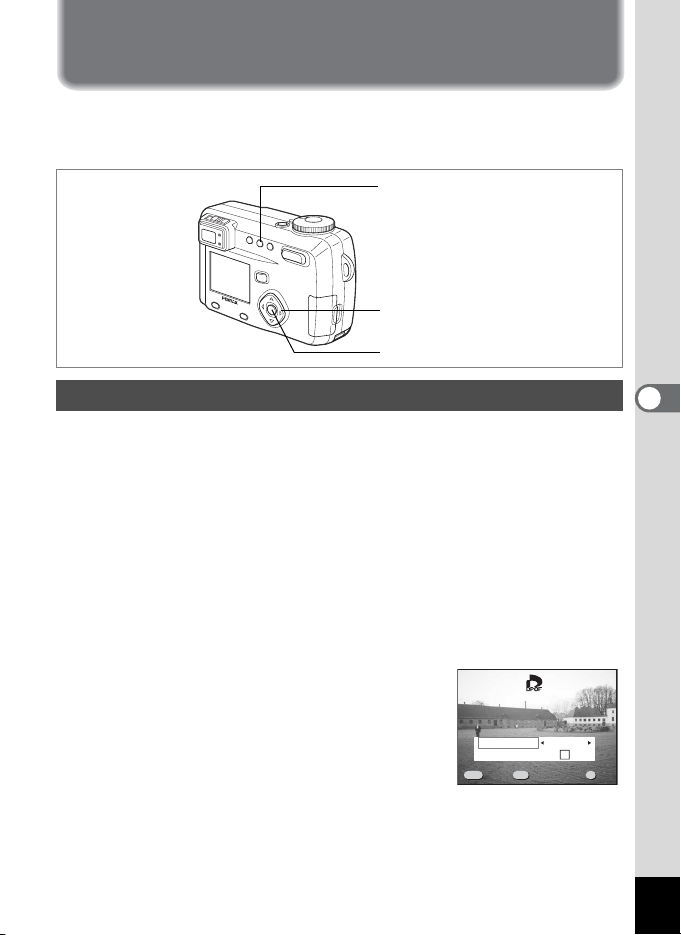
101
5
Playback / Erasing
Setting the Printing Service (DPOF)
You can print the images on the SD Memory Card / MultiMediaCard
using a DPOF (Digital Print Order Format) compatible printer or at a
printing service.
Set the following items for each image.
Copies
Set the number of prints up to a maximum of 10.
Date
Specify whether you want the date imprinted on the print or not.
1 Enter the Playback mode and use the four-way
controller (
45) to choose the image for which you
want to make DPOF settings.
2 Press the DPOF button.
The DPOF screen will be displayed.
Printing Single Image
2
1, 3, 4
5
100-0020
100-0020
100-0020
MENU
DISP
Date
Copies
01
All Images
All I mages
All Images
Exit
Exit
Exit
OK
OK
OK
OK
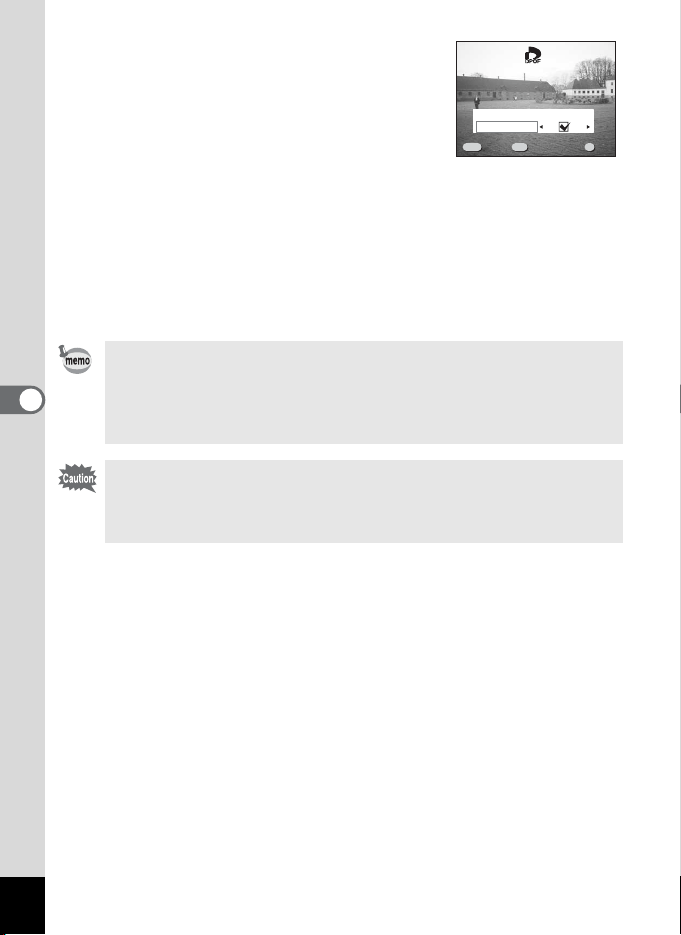
102
5
Playback / Erasing
3 Use the four-way controller (45) to
select the number of prints, then
press the four-way controller (
3).
The frame will move to [Date].
4 Use the four-way controller (45) to select whether to
insert the date or not.
O:The date will be imprinted
P :The date will not be imprinted
5 Press the OK button.
Prints can be made according to the settings.
• If DPOF settings have already been made for an image, the
previously set number of prints and On / Off date setting will be
displayed.
• To cancel DPOF settings, set the number of prints to 00 and press
the OK button.
• You cannot set the printing service for movie pictures.
• Depending on the printer or printing equipment at the photo
processing lab., the date may not be imprinted on the pictures even if
the DPOF setting was made.
100-0020
100-0020
100-0020
MENU
DISP
Date
Copies
01
All Images
All I mages
All Images
Exit
Exit
Exit
OK
OK
OK
OK
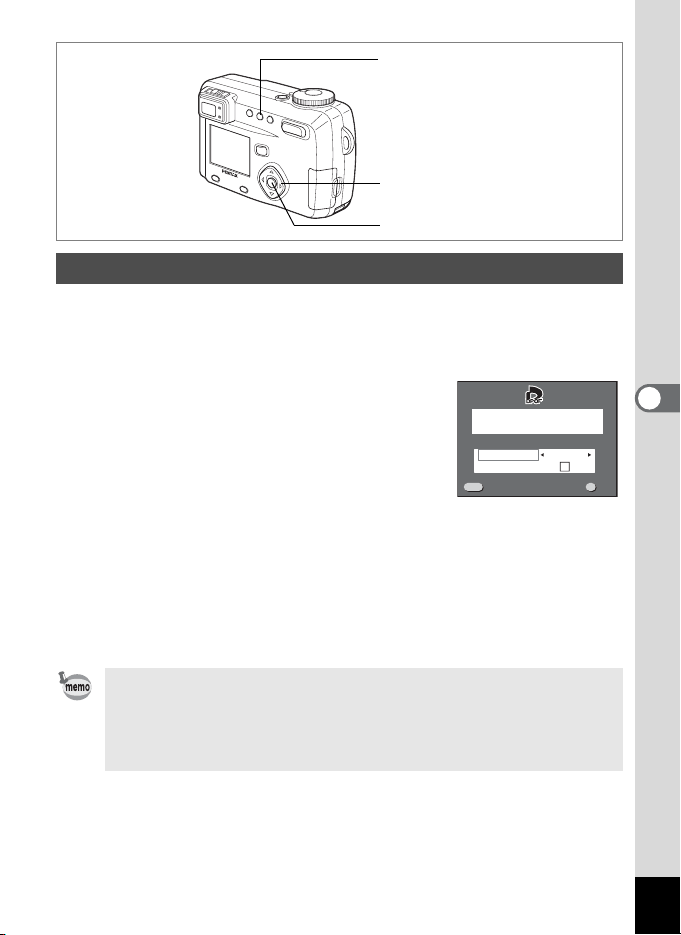
103
5
Playback / Erasing
1 Enter the Playback mode and press the DPOF button
twice.
The [All Images] screen will be displayed.
2 Use the four-way controller (45) to
select the number of prints.
You can print up to 10 copies.
3 Press the four-way controller (3).
The frame will move to [Date].
4 Use the four-way controller (45) to
select
O (On) or P (Off).
O :The date will be printed.
P :The date will not be printed.
5 Press the OK button.
Prints can be made according to the settings.
Printing All Images
• The setting for a single image will be cancelled.
• The number applies to all the images. Before printing, check that the
number is correct when you specify the number of prints in the DPOF
setting.
• The setting is not possible for movie pictures.
2
1, 3, 4
5
DPOF settings
for all images
MENU
Exit
Exit
Exit
Date
Copies
01
OK
OK
OK
OK
104
5
Playback / Erasing
Printing Directly from the Camera
Connected to a Printer
When you use the USB cable provided with the camera (I-USB7) to
connect the camera to a printer that supports PictBridge, you can print
images directly from camera without using a PC. The selection of the
images to print and the number of prints are set using the controls on
the camera after the camera has been connected to the printer. You
can use settings for printing services to print one image at a time.
1 Enter the Playback mode, then press the MENU / Fn
button.
The Playback menu appears.
2 Use the four-way controller (23) to
select [PictBridge].
3 Press the four-way controller (5).
The message “Connect camera & printer” is
displayed.
4 Connect the camera and printer
with supplied USB cable. The image is displayed for
printing.
• We recommend that you use the AC adaptor D-AC7 while the camera
is connected to a printer. The printer not operate correctly or image
data may be damaged when the power for the battery runs low while
the camera is connected to the printer.
• Depending on the type of printer, camera settings (such as image
quality and DPOF settings) may not be reflected.
Connecting the camera to the printer
Connect camera & printer
C o n n e c t c a m e r a & p r i n t e r
Connect camera & printer
Exit
Ex it
Exit
MENU
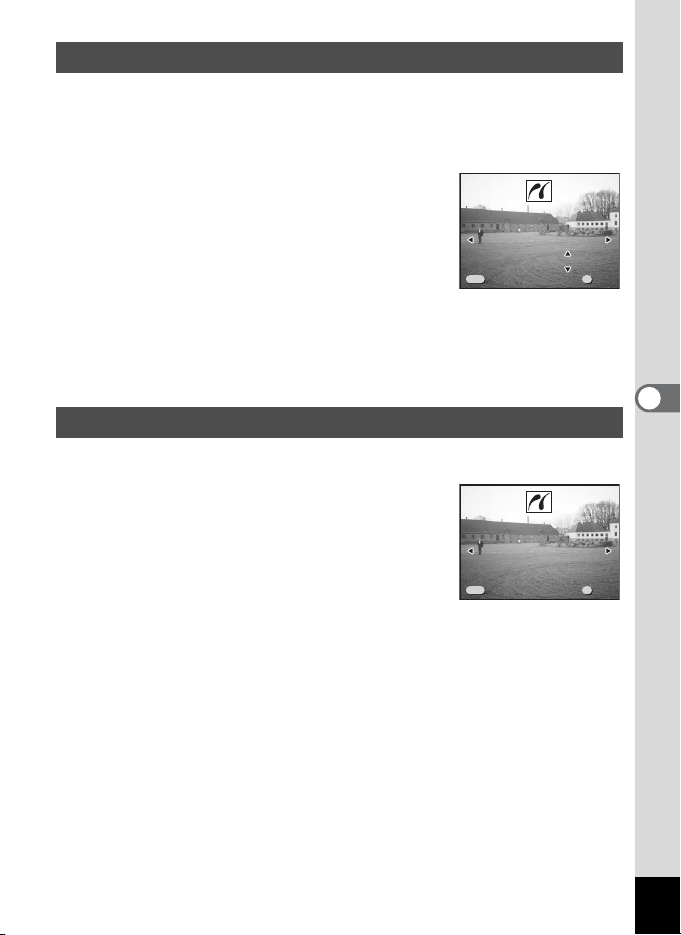
105
5
Playback / Erasing
The screen for printing images is displayed.
1 Use the four-way controller (45) to select the image to
print.
2 Use the four-way controller (23) to
select the number of prints.
You can set up to 10 prints.
3 Press the OK button.
The image is printed using the selected
setting.
The message “Continue printing ?” is displayed after the image has
been printed. Press the OK button to return to step 1 and continue
printing.
The screen for printing images is displayed.
1 Press the DPOF button while the
screen for selecting an image to
print is displayed.
The images with a printing service setting are
displayed.
To return to the screen for selecting any
image, press the DPOF button again.
2 Use the four-way controller (45) to select the image to
print.
3 Press the OK button.
The selected image is printed using the printing service settings set
for the image.
The message “Continue printing ?” is displayed after the image has
been printed. Press the OK button to return to step 1 and continue
printing.
Printing one image at a time
Printing using the printing service settings
Print this image
P r i n t t h i s i m a g e
Print this image
Copies 10
C o p i e s 1 0
Copies 10
Print
Print
Print
OK
DPOF
DPOF
DPOF
DROF
Print w/DPOF settings
P r i n t w / D P O F s e t t i n g s
Copies
Co pi es
10
10
Print
Print
Exit
Ex it
Print w/DPOF settings
Copies 10
Print
OK
Exit
DROF
106
5
Playback / Erasing
After you have finished printing images, disconnect the camera from the
printer.
1 Turn the camera off.
2 Disconnect the USB cable from the camera and the
printer.
Disconnecting the camera from the printer
If you press the MENU / Fn button while the “Continue printing ?”
message is displayed, the message “Safely remove USB cable” is
displayed.
When you disconnect the USB cable from the camera, the camera
automatically switches to Capture mode.
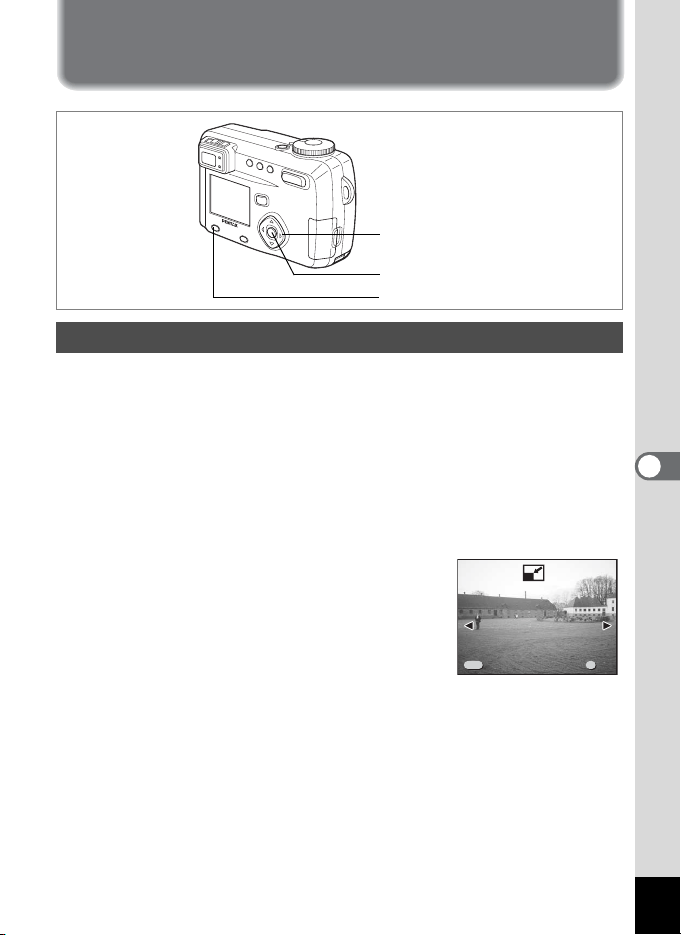
107
6
Editing / Settings
Editing / Settings
Editing Images
You can make the file smaller than the original by changing the size and
quality of a selected image. After changing the size, the image can be
saved as a new image or written over the original image.
1 Press the Menu / Fn button.
2 Press the four-way controller (5).
The [Q Playback] menu will be displayed.
3 Use the four-way controller (23) to select [Resize].
4 Press the four-way controller (5).
The Resize screen will be displayed.
5 Use the four-way controller (45) to choose the image
you want to resize.
Changing the Image Size
Menu / Fn button
Four-way controller
OK button
100-0020
100-0020
100-0020
MENU
Exit
Exit
Exit
OK
OK
OK
OK
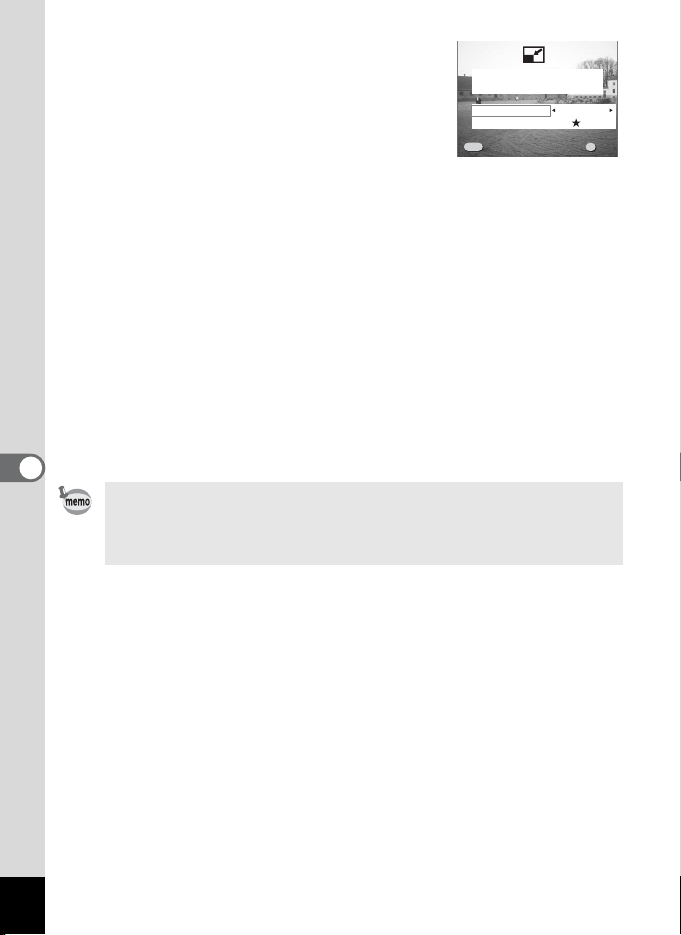
108
6
Editing / Settings
6 Press the OK button.
7 Press the four-way controller (45) to select [Recorded
pixels].
8 Press the four-way controller (3).
The frame will move to [Quality Level].
9 Use the four-way controller (45) to select [Quality
Level].
10 Press the OK button.
11 Use the four-way controller (23) to select [Overwrite]
or [Save as].
12 Press the OK button.
The image will be resized.
• Movie pictures cannot be resized.
• You cannot select a larger size than that of the original image.
• You cannot select a higher quality level than that of the original
image.
100-0020
100-0020
100-0020
Select resolution
and quality
MENU
Quality Level
Recorded Pixels
640×480
Exit
Exit
Exit
OK
OK
OK
OK
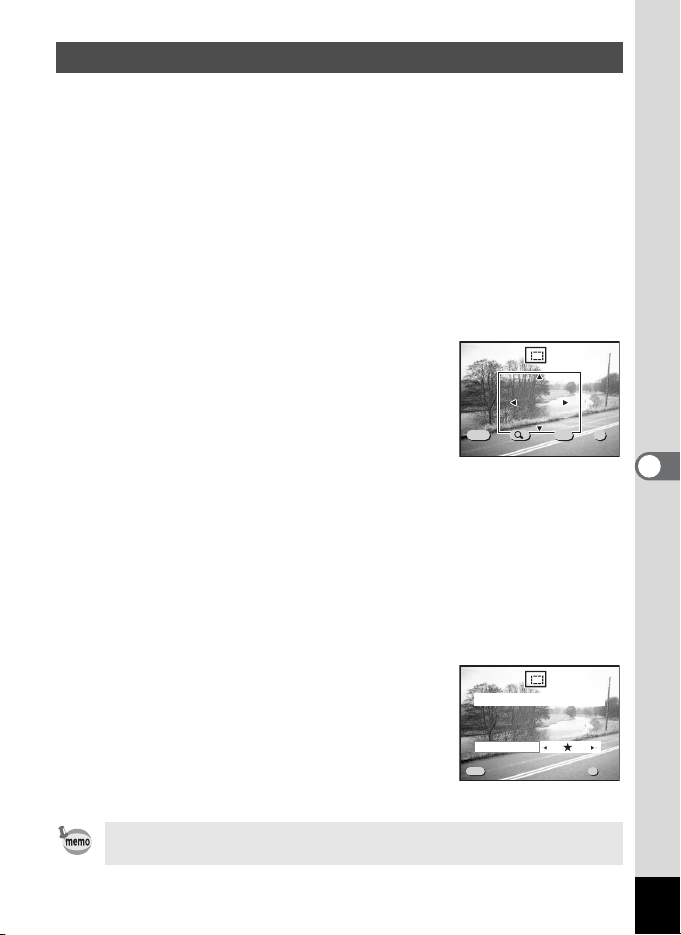
109
6
Editing / Settings
You can trim part of a picture and save it as a separate image.
1 Press the Menu / Fn button.
2 Press the four-way controller (5).
The [Q Playback] menu will be displayed.
3
Press the four-way controller (
23
) to select [Trimming].
4 Press the four-way controller (5).
The image that can be trimmed.
5 Choose the image you want to trim with the four-way
controller (
45).
6 Press the OK button.
The trimming screen will be displayed.
7 Trim the image.
• Operations available on the Trimming
screen.
Zoom /
f/ y button :Changes the
size of the image
Display button :Switches between horizontal and
vertical
Four-way controller (
2345) :Moves the trimming position up, down,
right and left
Menu / Fn button :Returns to the screen for selecting an
image to be trimmed
8 Press the OK button.
9 Select the Quality level after
trimming with the four-way
controller (
45).
10 Press the OK button.
The trimmed image will be saved as a
separate image.
Trimming Images
• Movie pictures cannot be trimmed.
• You cannot select a higher quality than that of the original image.
100-0020
100-0020
100-0020
MENU OK
Exit
Exit
OK
OK
Size
Size
Size
DISP
Rotate
Rotate
Rotate
Exit OK
Select image quality
100-0020
100-0020
100-0020
MENU
Quality Level
Exit
Exit
Exit
OK
OK
OK
OK
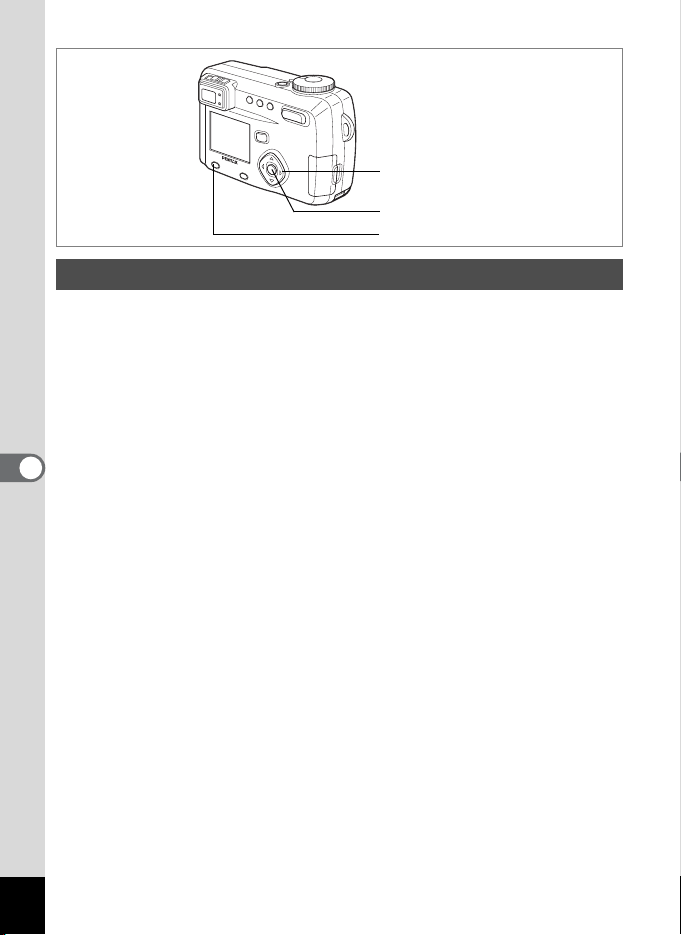
110
6
Editing / Settings
The digital filters include filters that can apply a red, blue, or green or
other color filter to images, a soft filter, and a filter to adjust the
brightness of images. In digital filter mode, you can use these filters to
modify images.
Color filters
The color filters include a black and white filter, sepia, red, pink, purple,
blue, green, and yellow filters. When you select a color filter, the image
is displayed on the LCD monitor with the filter effect applied and you
can save the modified image.
Soft filter
You can save the image with a soft effect when you apply the soft filter.
Brightness filter
You can save the image as darker or lighter image when you apply the
brightness filter.
Using Digital Filters to Edit Images
Menu / Fn button
Four-way controller
OK button
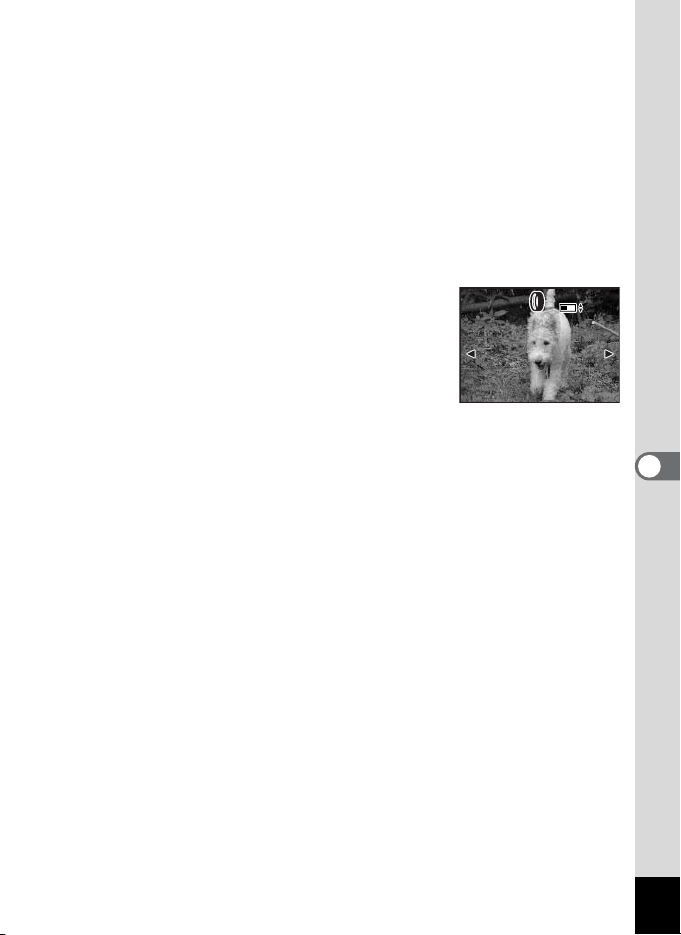
111
6
Editing / Settings
1 Press the MENU button.
2 Press the four-way controller (5).
The Playback menu is displayed.
3 Use the four-way controller (23) to select
[Digital Filter].
4 Press the four-way controller (5).
The digital filter screen is displayed.
5 Use the four-way controller (45) to select the type of
filter.
6 Use the four-way controller (23) to
select the filter.
• If you selected the brightness filter
Zoom /
f/y button (x) :brightens the image.
Zoom /
f/y button (w) :darkens the image.
7 Press the Ok button.
8 Use the four-way controller (23) to select [Save as...]
or [Save].
9 Press the OK button.
The image is saved with the filter affect applied to the image.
100-0020
100-0020
100-0020

112
6
Editing / Settings
Camera Settings
How to recall [B Set-up] menu
Formatting will delete all the data on the SD Memory Card /
MultiMediaCard.
1 Select [Format] on the [B Set-up] menu.
2 Press the four-way controller (5).
The Format screen will be displayed.
3 Select [Format] with the four-way controller (2).
4 Press the OK button.
Formatting will start. The camera is ready to capture or play back
images when formatting is completed.
Formatting a SD Memory Card / MultiMediaCard
• Do not remove the SD Memory Card / MultiMediaCard while the card
is being formatted. The card may be damaged and become unusable.
• SD Memory Cards / MultiMedia Cards formatted on a PC or device
other than the camera cannot be used.
Be sure to format the card with the camera.
• Formatting will delete protected data too.
Menu / Fn button
Rec. Mode
Wide
AWB
Auto
Quality Level
White Balance
Focusing Area
AE Metering
Sensitivity
Exit
1/3
MENU
OK
OK
2592 1944
Recorded Pixels
Four-way controller
OK button
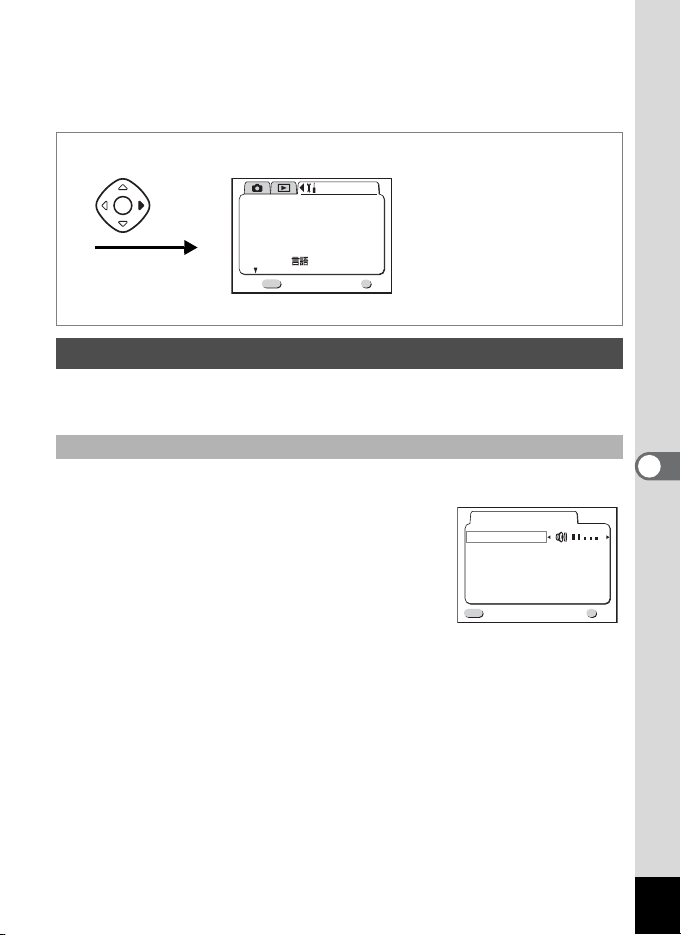
113
6
Editing / Settings
You can change the volume of the start-up sound, shutter sound and
operation sounds. You can also change the type of each sound.
1 Select [Sound] on the [B Set-up] menu.
2 Press the four-way controller (5).
The Sound screen will be displayed.
3 Use the four-way controller (45) to change the
volume.
4 Press the OK button twice.
The camera is ready to capture or play back images.
Changing the Sound Settings
Changing the volume
OK
OK
Exit
MENU
1/3
Set-up
Format
Sound
Date Style
mm/dd/yy
1/ 1/2003
Off
Date Adjust
World Time
Language/
English
Twice
Volume
Start-up Sound
Shutter Sound
Operation Sound
1
1
1
Sound
MENU
OK
OK
Exit
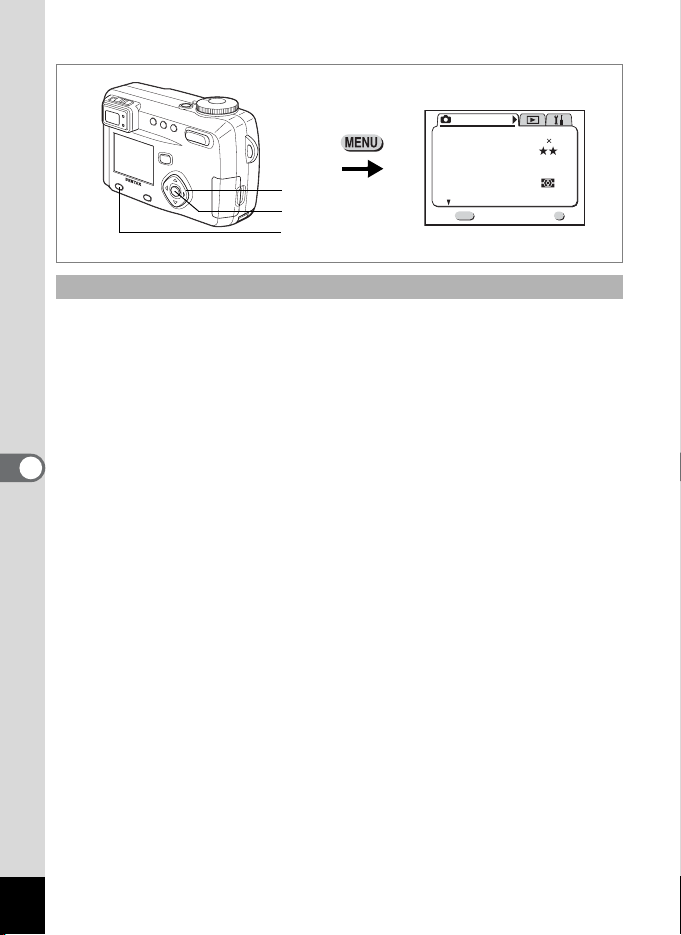
114
6
Editing / Settings
How to recall [B Set-up] menu
1 Select [Sound] on the [B Set-up] menu.
2 Press the four-way controller (5).
The Volume screen will be displayed.
3 Press the four-way controller (23) to select [Startup
Sound] and choose [1], [2], [3] or [off] with the four-way
controller (
45).
4 Change the [Shutter Sound] and [Operation Sound] in
the same way.
5 Press the OK button twice.
The camera is ready to capture or play back images.
Changing the type of start-up, shutter or operation sound
Menu / Fn button
Rec. Mode
Wide
AWB
Auto
Quality Level
White Balance
Focusing Area
AE Metering
Sensitivity
Exit
1/3
MENU
OK
OK
2592 1944
Recorded Pixels
Four-way controller
OK button
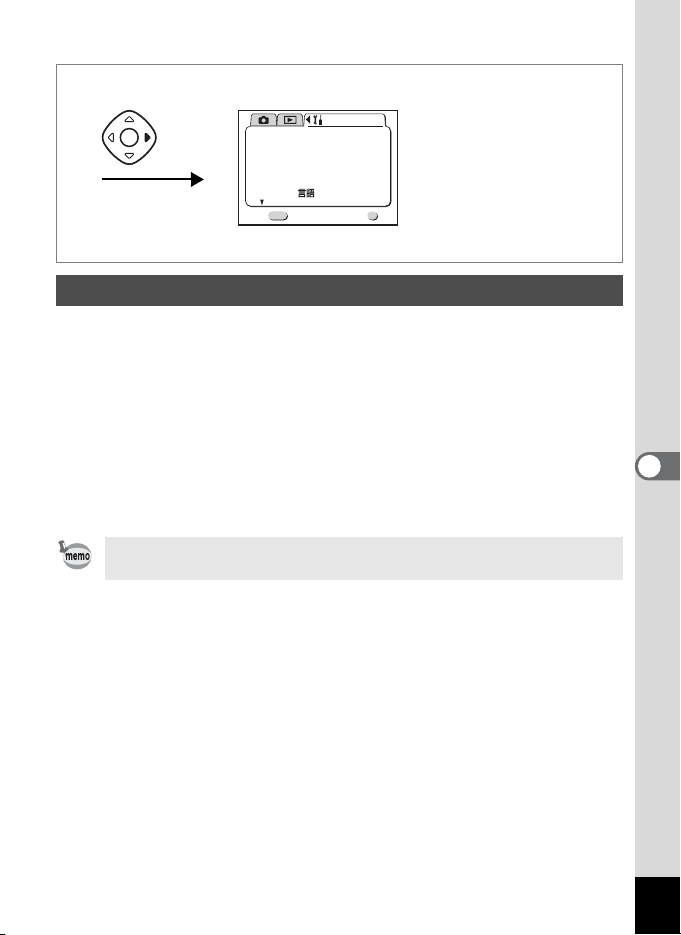
115
6
Editing / Settings
You can set the style in which the date is displayed on the camera.
Choose [mm/dd/yy], [dd/mm/yy] or [yy/mm/dd].
1 Select [Date Style] on the [B Set-up] menu.
2 Use the four-way controller (45) to change the date
style.
3 Press the OK button.
The camera is ready to capture or play back images with the selected
date style.
Setting the Date Style
The style in which the time is displayed is set by [Date Adjust].
OK
OK
Exit
MENU
1/3
Set-up
Format
Sound
Date Style
mm/dd/yy
1/ 1/2003
Off
Date Adjust
World Time
Language/
English
Twice
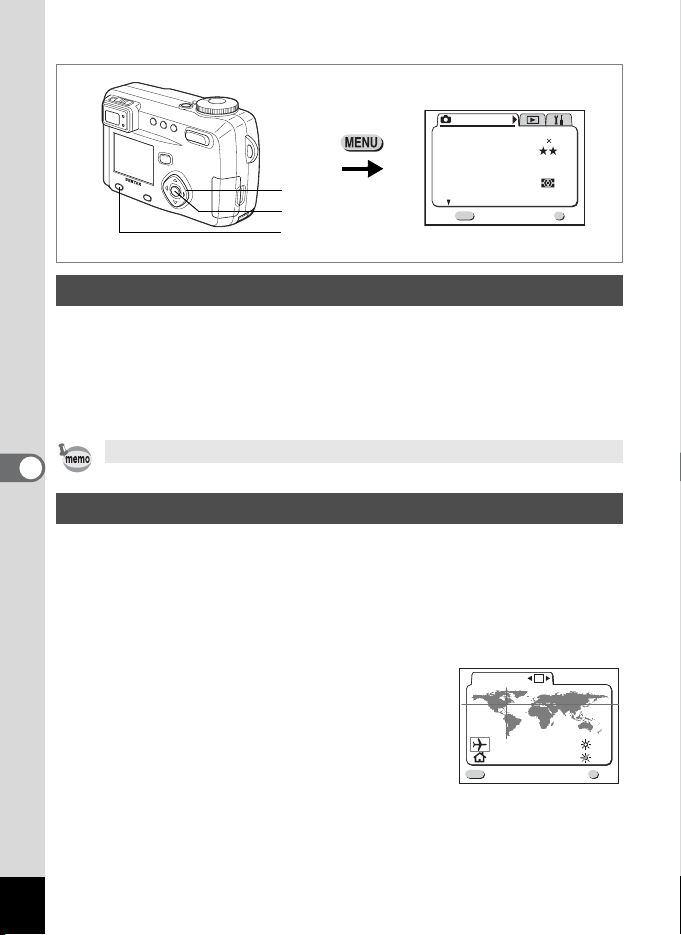
116
6
Editing / Settings
How to recall the [B Set-up] menu
You can change the initial date and time settings.
1 Select [Date Adjust] on the [B Set-up] menu.
2 Press the four-way controller (5).
The date screen will be displayed.
The city and time selected in “Initial Settings” (p.20) serve as the Home
Time setting.
You can display the time in a city other than the Home Time city
(World Time) when shooting or playing back.
1 Select [World Time] on the [B Set-up] menu.
2 Press the four-way controller (5).
The World Time screen will be dis-played.
Changing the Date / Time
See “Setting the Date and Time” (p.22) for the setting procedure.
Setting the World Time
Menu / Fn button
Rec. Mode
Wide
AWB
Auto
Quality Level
White Balance
Focusing Area
AE Metering
Sensitivity
Exit
1/3
MENU
OK
OK
2592 1944
Recorded Pixels
Four-way controller
OK button
NYC
TYO
17:18
04:18
World Time
MENU
OK
OK
Exit
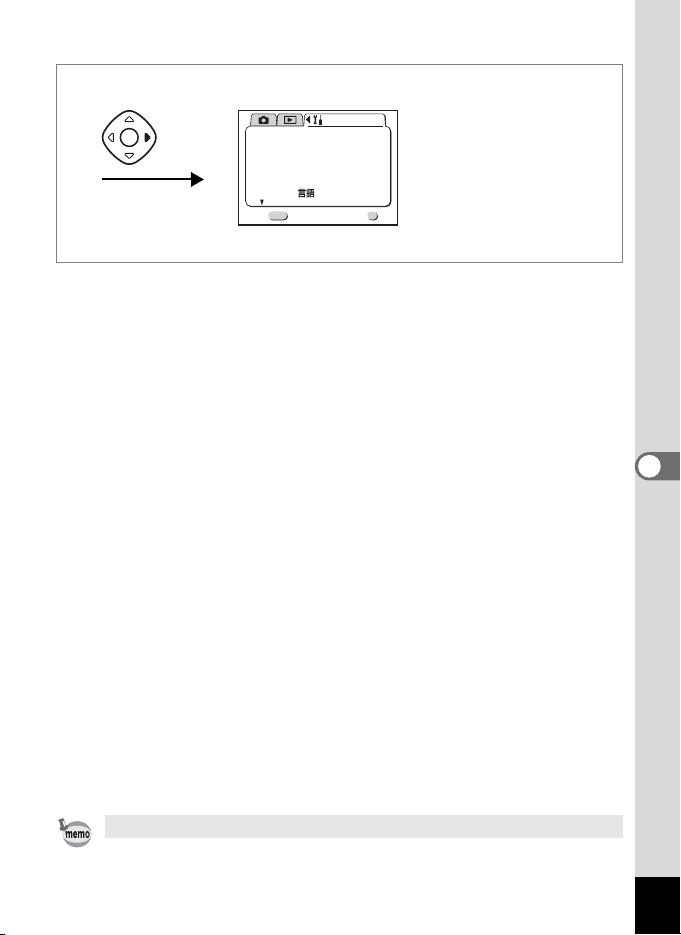
117
6
Editing / Settings
3 Switch O (On) and P (Off) with the four-way
controller (
45).
O On : The time in the country selected in World Time will be
displayed.
P
Off : The time in the country selected in Home Time will be
displayed.
4 Press the four-way controller (3).
If New York is selected as the world time city, then the cross-shaped
line is located in New York on the world map, and then
X
indicates the current time in New York (NYC).
5 Use the four-way controller (45) to select the World
Time city and press the four-way controller (
3).
6 Set the daylight saving time [DST] to On (Y) or Off (Z)
with the four-way controller (
45).
7 Press the four-way controller (3).
Tokyo (TYO) is selected as the Home Time city W at first.
8 Repeat steps 5 and 6 to change the Home Time city
and DST setting.
9 Press the OK button twice.
The camera is ready to capture or play back images with the time in
the selected city.
See p.128 for the list of cities and code names.
OK
OK
Exit
MENU
1/3
Set-up
Format
Sound
Date Style
mm/dd/yy
1/ 1/2003
Off
Date Adjust
World Time
Language/
English
Twice
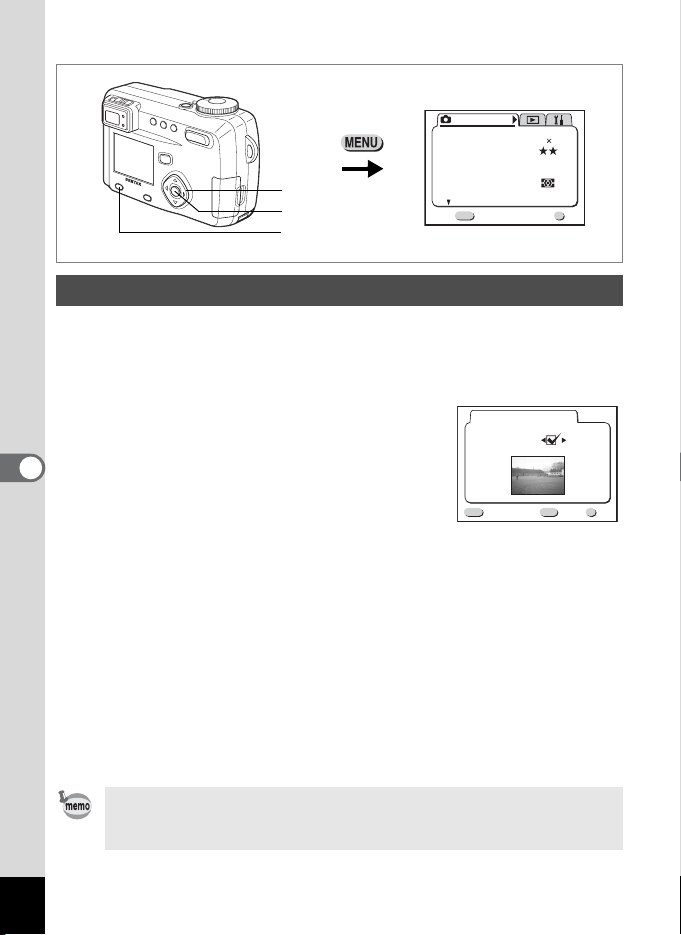
118
6
Editing / Settings
How to recall the [B Set-up] menu
You can display an image recorded with the camera as the welcome
screen when the camera is turned on.
1 Select [Start-up Screen] on the [B Set-up] menu.
2 Press the four-way controller (5).
The Start-up screen will be displayed.
3 Use the four-way controller (45) to select O (On) or P
(Off).
O The start-up screen is displayed.
P The start-up screen is not displayed.
4 Press the DPOF button.
5 Use the four-way controller (45) to choose the image
you want to display as the start-up screen.
6 Press the OK button three times.
The camera is ready to take or play back images.
Changing the Start-up Screen
Once the start-up screen has been set, it will not be erased even if the
original image is deleted or the SD Memory Card / MultiMediaCard is
formatted. To delete the start-up screen, reset the setting. (
1 p.125)
Menu / Fn button
Rec. Mode
Wide
AWB
Auto
Quality Level
White Balance
Focusing Area
AE Metering
Sensitivity
Exit
1/3
MENU
OK
OK
2592 1944
Recorded Pixels
Four-way controller
OK button
DPOF
Start-up Screen
Change Start-up Screen
MENU
OK
OK
Exit
Image
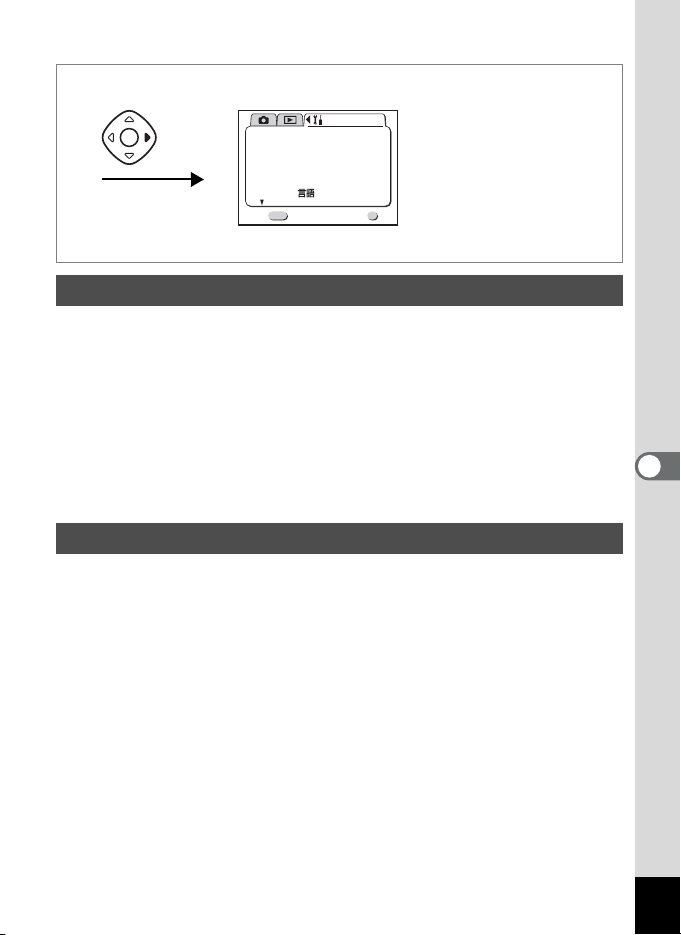
119
6
Editing / Settings
You can change the language in which the menus, error messages, etc.
are displayed.
1 Select [Language] on the [B Set-up] menu.
2
Use the four-way controller (
45
) to select the language.
The menus will be displayed in selected language.
3 Press the OK button.
4 The camera is ready to take or play back images.
You can select the output format (NTSC or PAL) for taking or playing
back images on a TV monitor.
1 Select [Video Out] on the [B Set-up] menu.
2 Use the four-way controller (45) to change the video
output format.
3 Press the OK button.
The camera is ready to take or play back images.
Changing the Display Language
Changing the Video Output Format
OK
OK
Exit
MENU
1/3
Set-up
Format
Sound
Date Style
mm/dd/yy
1/ 1/2003
Off
Date Adjust
World Time
Language/
English
Twice
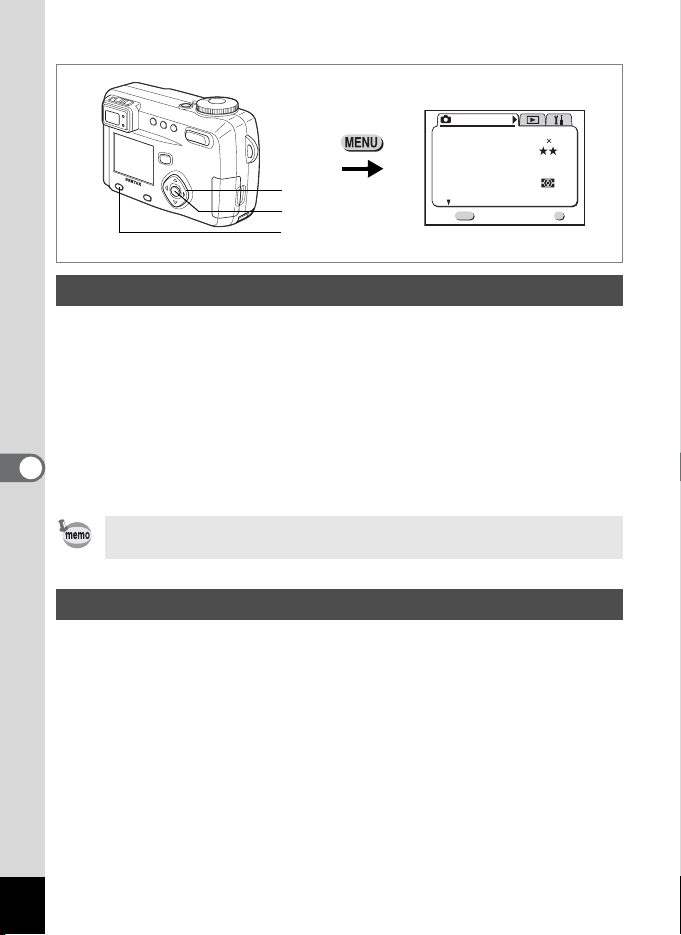
120
6
Editing / Settings
How to recall the [B Set-up] menu
You can set the LCD monitor to turn off automatically when no
operation is performed for a fixed time.
1 Select [Sleep Timeout] on the [B Set-up] menu.
2 Use the four-way controller (45) to select [30 sec],
[1 min], [2 min] or [Off].
3 Press the OK button.
The camera is ready to take or play back images.
You can set the camera to turn off automatically when no operation is
performed for a fixed time.
1 Select [Auto Power Off] on the [B Set-up] menu.
2 Use the four-way controller (45) to select [3 min],
[5 min] or [Off].
3 Press the OK button.
The camera is ready to capture or play back images.
LCD Power Saving (Sleep Timeout)
• This function will not work in Playback mode and using the USB cable
and when the camera is operated by optional AC adapter.
Setting Auto Power Off
Menu / Fn button
Rec. Mode
Wide
AWB
Auto
Quality Level
White Balance
Focusing Area
AE Metering
Sensitivity
Exit
1/3
MENU
OK
OK
2592 1944
Recorded Pixels
Four-way controller
OK button
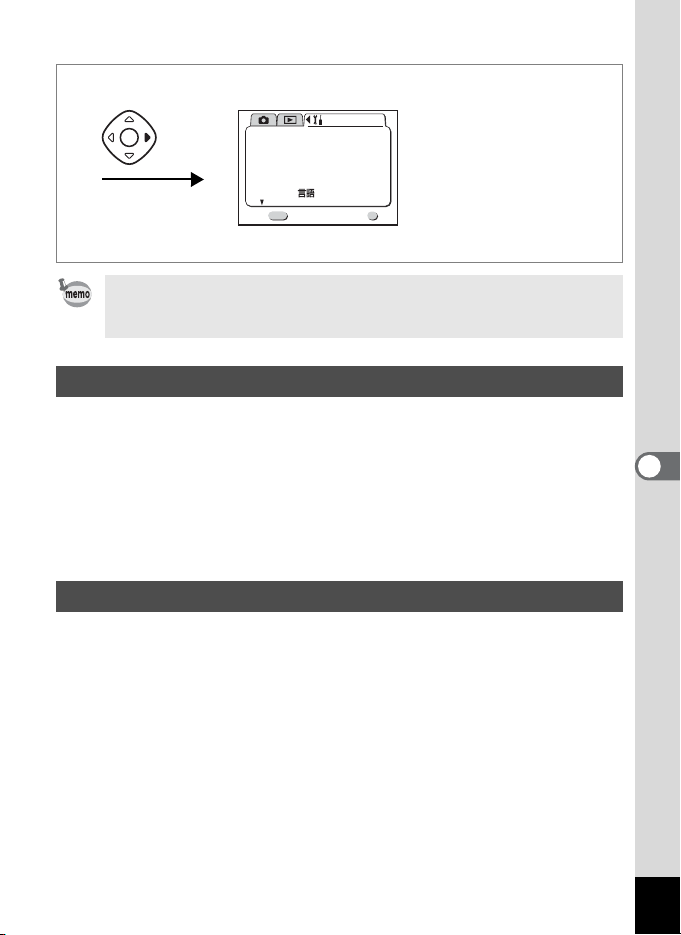
121
6
Editing / Settings
The Delete screen will be displayed when [Delete] or [Delete All] is
selected when the Quick Delete function is set to On.
1 Select [Quick Delete] on the [B Set-up] menu.
2 Use the four-way controller (45) to select [On] or [Off].
3 Press the OK button.
The camera is ready to capture or play back images.
Images can be displayed at the set magnification simply by pressing the
Zoom button once during zoom playback when the Quick Zoom
function is set to On.
1 Select [Quick Zoom] on the [B Set-up] menu.
2 Use the four-way controller to (45) select [×2] [×4] [×8]
or [OFF].
3 Press the OK button.
The camera is ready to capture or play back images.
• The menu screen turns off 1 minute after the last operation.
• The Auto Power Off function will not work when the USB cable is
connected.
Setting the Quick Delete Function
Setting the Quick Zoom Function
OK
OK
Exit
MENU
1/3
Set-up
Format
Sound
Date Style
mm/dd/yy
1/ 1/2003
Off
Date Adjust
World Time
Language/
English
Twice
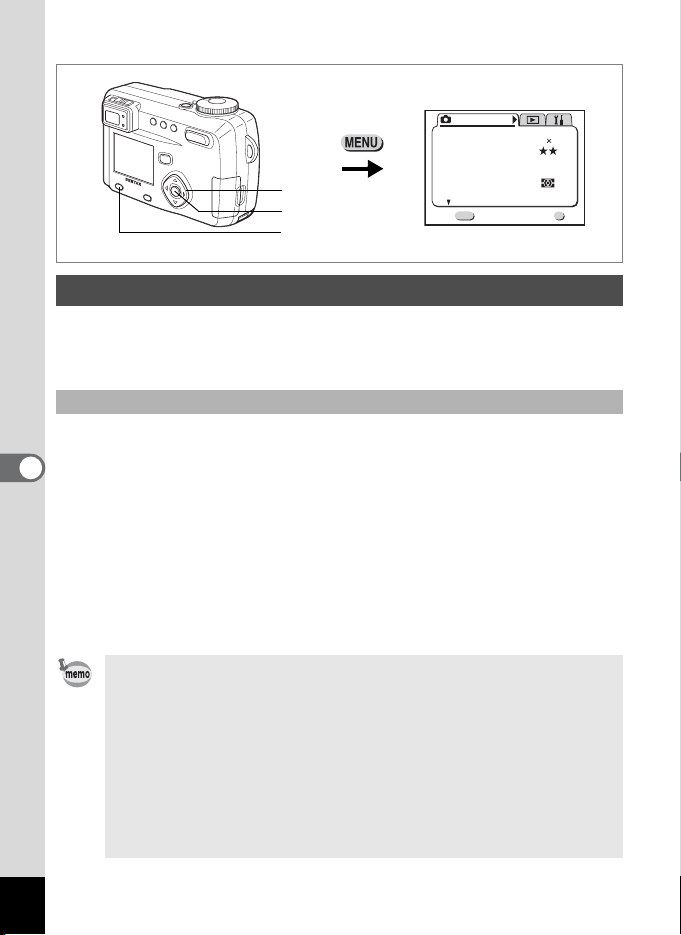
122
6
Editing / Settings
How to recall the [B Set-up] menu
You can register the functions you use most frequently on the four-way
controller. The functions can then be set directly by pressing the four-
way controller without displaying the [Rec.Mode] menu.
1 Select [Fn Setting] on the [B Set-up] menu.
2 Press the four-way controller (5).
The Fn Setting screen will be displayed.
3 Use the four-way controller (23) to choose the key
where you want to register a function.
4 Use the four-way controller (45) to choose the
function you want to register.
If you do not want to register a function, select Off.
5 Press the OK button twice.
The camera is ready to capture or play back images.
Registering Functions
Registering a function
• Only one function can be registered on each key of the four-way
controller.
• You can choose from the following 12 functions: Recorded Pixels,
Quality Level, White Balance, Focusing Area, AE Metering,
Sensitivity, Flash Exposure Compensation, Digital Zoom, Instant
Review, Sharpness, Saturation Contrast.
• In the default setting, a negative level of Flash Exposure
Compensation is registered for (
4) and a positive level of Flash
Exposure Compensation is registered for (
5).
• If the Flash Exposure Compensation is registered to either (
2) or
(
3), levels are compensated positively for (2) and negatively for (3).
Menu / Fn button
Rec. Mode
Wide
AWB
Auto
Quality Level
White Balance
Focusing Area
AE Metering
Sensitivity
Exit
1/3
MENU
OK
OK
2592 1944
Recorded Pixels
Four-way controller
OK button
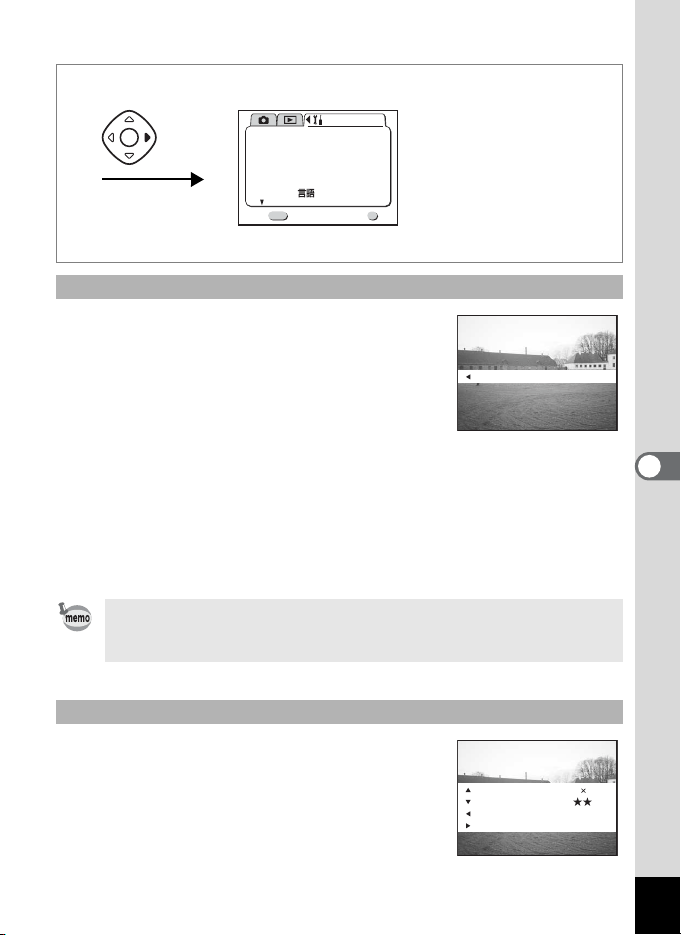
123
6
Editing / Settings
1 Enter the Capture mode and press
the Menu / Fn button and the four-
way controller key (
2345) on
which a function is registered at the
same time.
2 Press the four-way controller
(
2345) while pressing the
Menu / Fn button to change the
setting.
3 Release the Menu / Fn button.
The setting is saved and the camera is ready to take the picture.
1 Press the Menu / Fn button and the
Display button at the same time.
The function settings will be displayed.
Retrieving a function
If the flash exposure is set by using the four way controller (23), the
four-way controller (
2) can only be designated for compensation
increase and the four-way controller (
3) to compensation decrease.
Checking the status
OK
OK
Exit
MENU
1/3
Set-up
Format
Sound
Date Style
mm/dd/yy
1/ 1/2003
Off
Date Adjust
World Time
Language/
English
Twice
White Balance
AWB
Recorded Pixels
Quality Level
White Balance
Focusing Area Wide
AWB
2288 1712
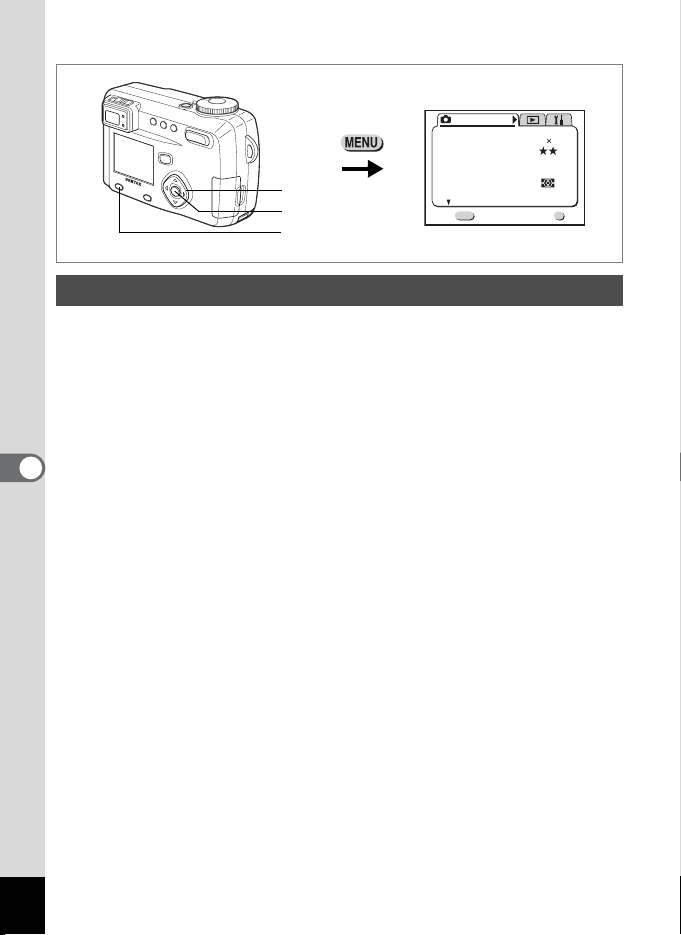
124
6
Editing / Settings
How to recall the [B Set-up] menu
You can choose whether or not to limit the movement of the lens when
shooting normally and in macro mode.
1 Select [Focus Limiter] on the [B Set-up] menu.
2 Press the four-way controller (45) to select [On] or
[Off].
3 Press the OK button.
The camera is ready to capture or play back images.
Adjusting the Focus Limit
Menu / Fn button
Rec. Mode
Wide
AWB
Auto
Quality Level
White Balance
Focusing Area
AE Metering
Sensitivity
Exit
1/3
MENU
OK
OK
2592 1944
Recorded Pixels
Four-way controller
OK button
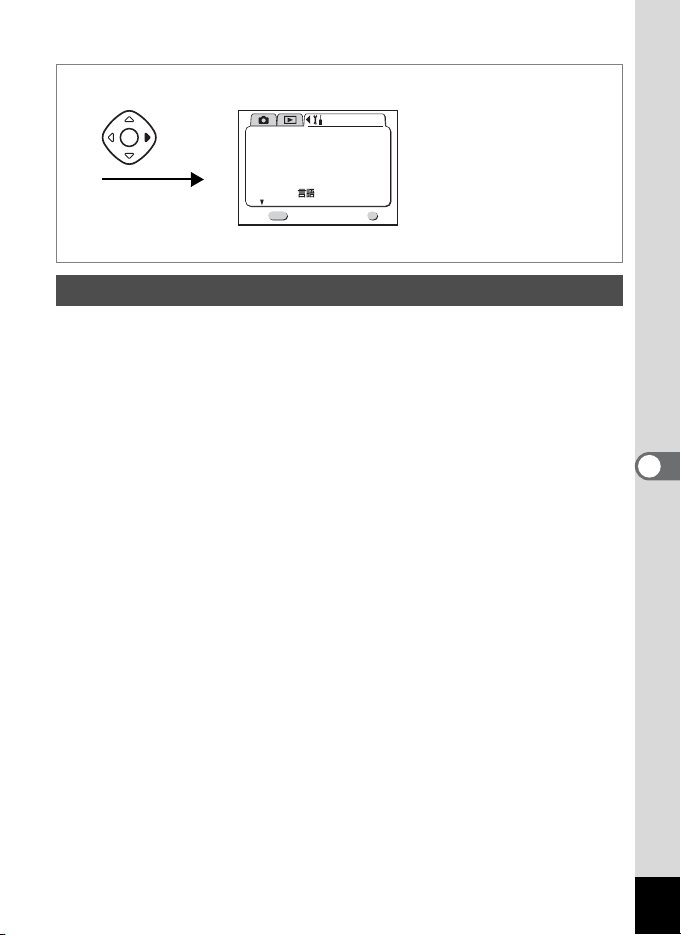
125
6
Editing / Settings
You can reset all the settings other than the date and time, language,
Video output format, world time and date style.
1 Select [Reset] on the [B Set-up] menu.
2 Press the four-way controller button (5).
The Reset screen will be displayed.
3 Use the four-way controller (2) to select [Reset].
4 Press the OK button.
The camera is ready to capture or play back images.
Resetting to Default Settings (Reset)
OK
OK
Exit
MENU
1/3
Set-up
Format
Sound
Date Style
mm/dd/yy
1/ 1/2003
Off
Date Adjust
World Time
Language/
English
Twice
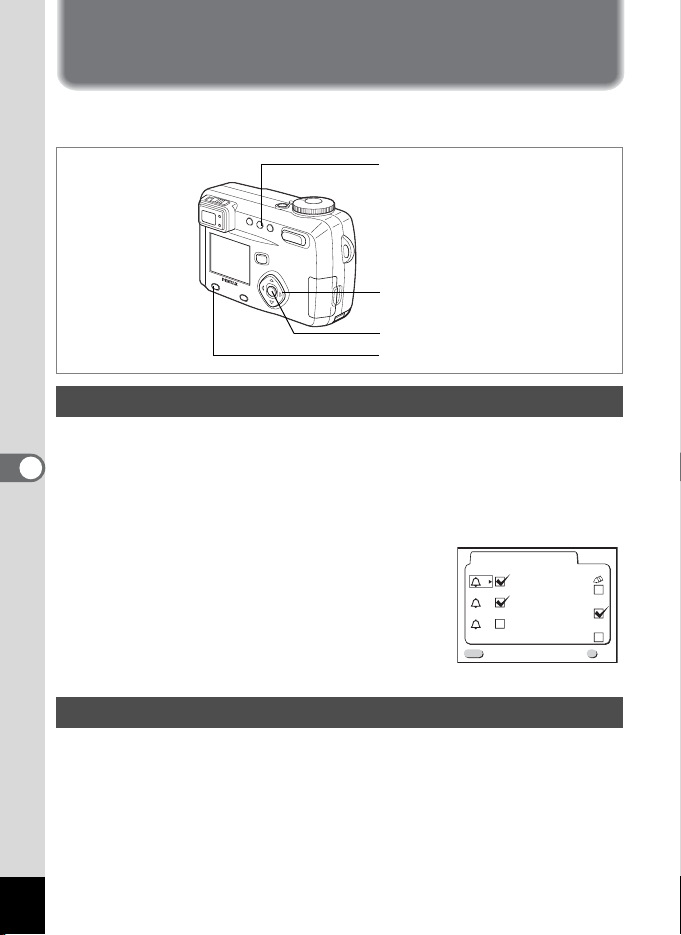
126
6
Editing / Settings
Setting the Alarm
You can set the alarm to ring at a specified time and display a selected
image.
1 Press the Menu / Fn button.
2 Press the four-way controller (5).
The [Q Playback] menu will be displayed.
3 Press the four-way controller (23) to select [Alarm].
4 Press the four-way controller (5).
The list of alarms will be displayed.
Active alarms are indicated by
O.
5 Press the OK button twice.
If any alarms are enabled, the camera will be
turned off and the alarms will be set.
1 Press the Menu / Fn button.
2 Press the four-way controller (5).
The [Q Playback] menu will be displayed.
3 Press the four-way controller (23) to select [Alarm].
Checking the Alarm
Setting the Alarm
Menu / Fn button
Four-way controller
OK button
DPOF button
OK
OK
Alarm
1
Once
17:30
2
Everyday
19:30
3
Off
12:00
MENU
Exit
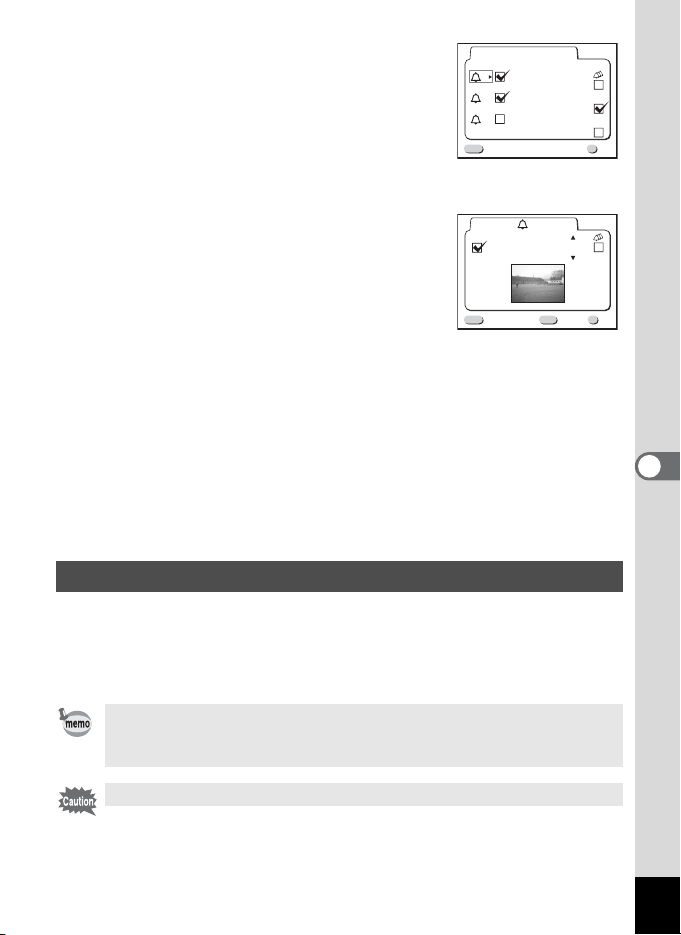
127
6
Editing / Settings
4 Press the four-way controller (5).
The list of alarms will be displayed.
5 Press the four-way controller (23)
to select alarm 1-3.
6 Press the four-way controller (5).
The screen for setting the alarm mode and
time will be displayed.
Four-way controller (
45):Selects the item.
Four-way controller (
23):Changes the
setting.
If the Snooze (
S) is set to O (on), the alarm
will ring 5 times at 5 minutes intervals.‘
7 Press the DPOF button.
8 Press the four-way controller (45) to select the image
to be displayed when the alarm rings.
9 Press the OK button.
10 Press the OK button 3 times.
The camera will turn off.
The alarm will ring for one minute when the camera is turned off and the
set time is reached.
The camera will turn off automatically when the alarm has finished
ringing.
Turning the Alarm Off
• To stop the alarm ringing, press any button.
• To cancel the Snooze function, press the Menu / Fn button and OK
button at the same time.
The alarm will not ring when the camera is turned on.
OK
OK
Alarm
1
Once
17:30
2
Everyday
19:30
3
Off
12:00
MENU
Exit
Alarm
1
Once
17:30
Image
MENU
OK
OK
Exit
DPOF
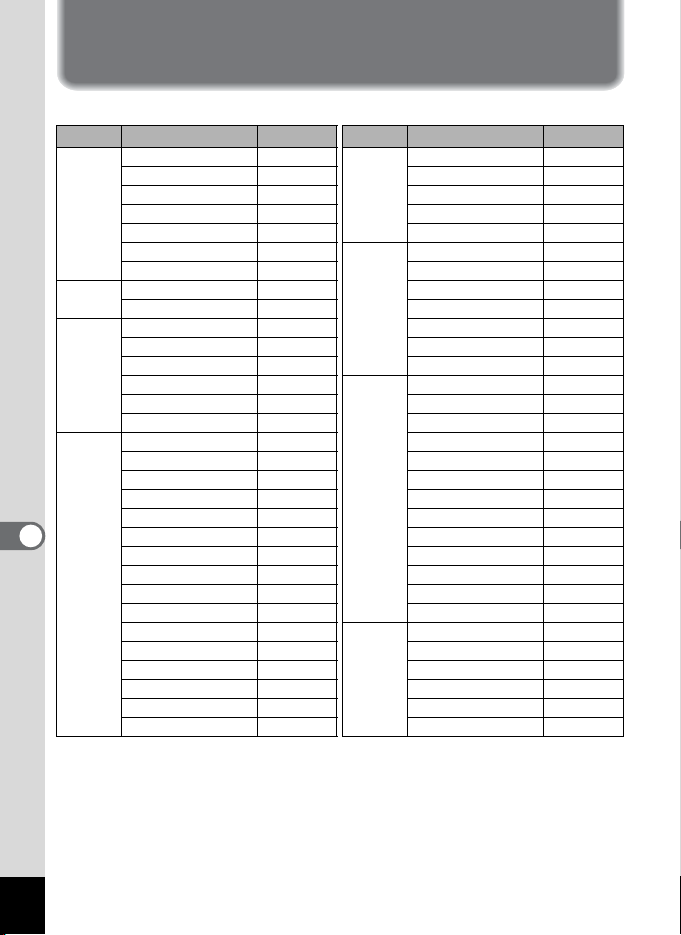
128
7
Appendix
Appendix
List of City Names
Refer to following list of city and code names for setting the world time.
Region City Code Region City Code
EUROPE Madrid MAD ASIA Shanghai SHA
London LON Manila MNL
Paris PAR Taipei TPE
Milano MIL Seoul SEL
Rome ROM Tokyo TYO
Berlin BER OCEANIA Pagopago PPG
Moscow MOW Perth PER
AFRICA Johannesburg JNB Adelaide ADL
Cairo CAI Sydney SYD
MIDDLE
EAST
Istanbul IST Noumea NOU
Jerusalem JRS Wellington WLG
Jeddah JED Auckland AKL
Tehran THR NORTH
AMERICA
Guam GUM
Dubai DXB Honolulu HNL
Kabul KBL Anchorage ANC
ASIA Karachi KHI San Francisco SFO
Male MLE Los Angeles LAX
Delhi DEL Denver DEN
Colombo CMB Chicago CHI
Kathmandu KTM Miami MIA
Dacca DAC New York NYC
Rangoon RGN Vancouver YVR
Bangkok BKK Calgary YYC
Kuala Lumpur KUL Toronto YTO
Vientiane VTE Halifax YHZ
Singapore SIN CENTRAL
& SOUTH
AMERICA
Mexico City MEX
Phnom Penh PNH Santiago SCL
Ho chi Minh SGN Caracas CCS
Jakarta JKT Buenos Aires BUE
Hong Kong HKG Sao Paulo SAO
Beijing BJS Rio de Janeiro RIO
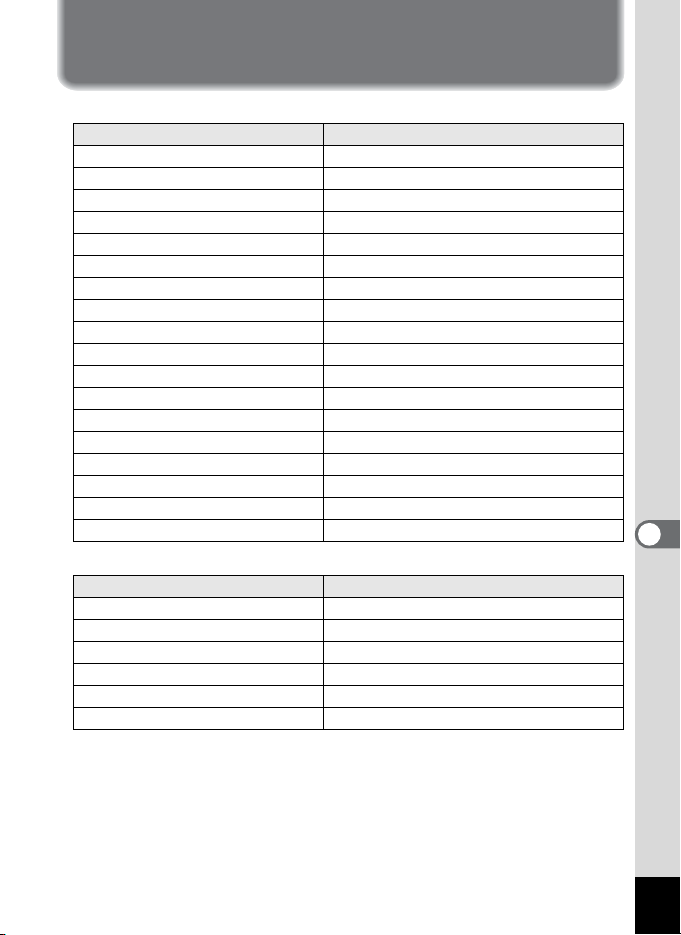
129
7
Appendix
List of Menu Default Settings
[A Rec.Mode] Menu
[
Q Playback] Menu
item Default Setting
Recorded Pixels 2592 × 1944 (C: 320 × 240)
Quality Level D
White Balance AWB (Auto)
Focusing Area Wide
AE Metering L
Sensitivity Auto
Flash Exp. Comp. 0.0
Auto Bracket –
Digital Zoom On
Instant Review 2 sec
Interval Shooting –
Fast Fwd Movie Off
3D Mode Parallel
Memory –
Sharpness Normal
Saturation Normal
Contrast Normal
USER e
item Default Setting
Resize –
Trimming –
Digital Filter BW
Alarm [Off]
Slideshow 3 sec (3 sec. intervals)
PictBridge –
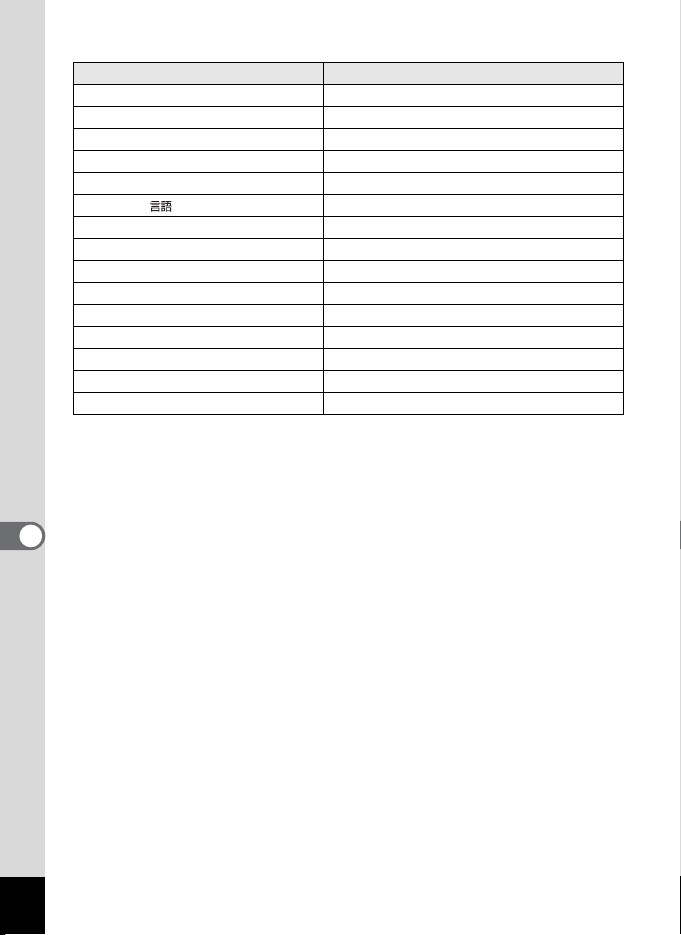
130
7
Appendix
[B Set-up] Menu
item Default Setting
Format –
Sound –
Date Style mm/dd/yy/
Date Adjust 2003/01/01
World Time Off
Language/ English
Start-up Screen On
Video Out NTSC
Sleep Timeout 1 min
Auto Power Off 3 min.
Quick Delete Off
Quick Zoom Off
Fn Setting Fn + 4, Fn + 5 (Flash Exp. comp.)
Focus Limiter On
Reset –
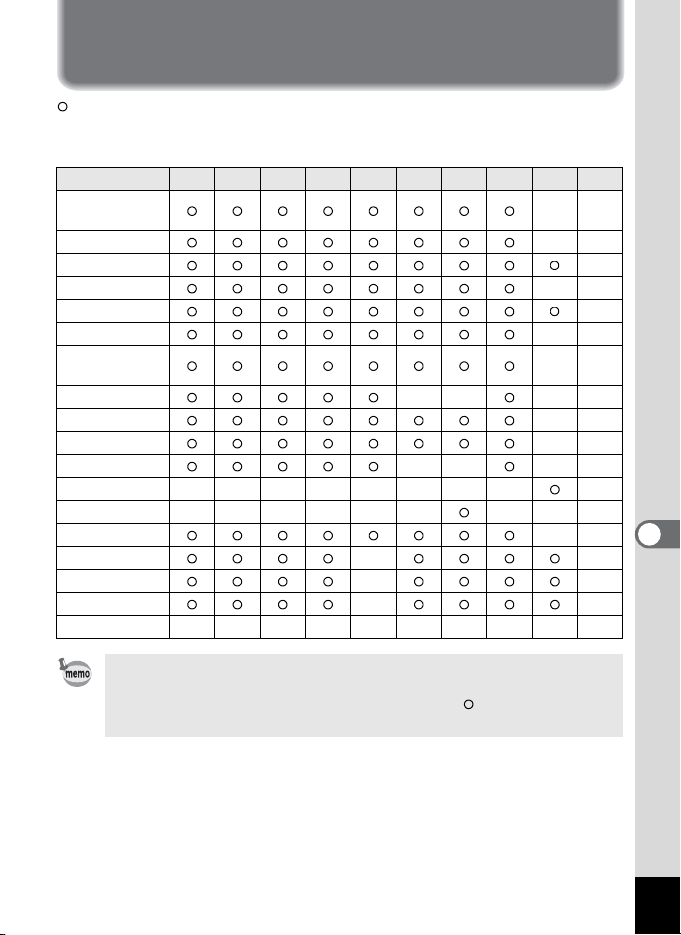
131
7
Appendix
Adjustable [Rec.Mode] Menu Items by
Capture Mode
:Changes are reflected in all camera operations
×:Only default setting is reflected in camera operations; changes are
invalid
Item a b c A d F G D C O
Recorded
Pixels
320×240
×
Quality Level ××
White Balance ×
Focusing Area ××
AE Metering ×
Sensitivity ××
Flash Exp.
Comp.
××
Auto Bracket ×× ××
Digital Zoom ×
Instant Review ××
Interval Shoot ×× ××
Fast Fwd Movie ×××××××× ×
3D Mode ×××××× ×××
Memory ××
Sharpness ××
Saturation ××
Contrast ××
USER ××××××××××
• Settings for items marked with an [×] can be changed on the menu
screen, but the change will not be reflected in camera operations.
•In
E mode, only the settings marked with an [ ] can be changed in
the register.
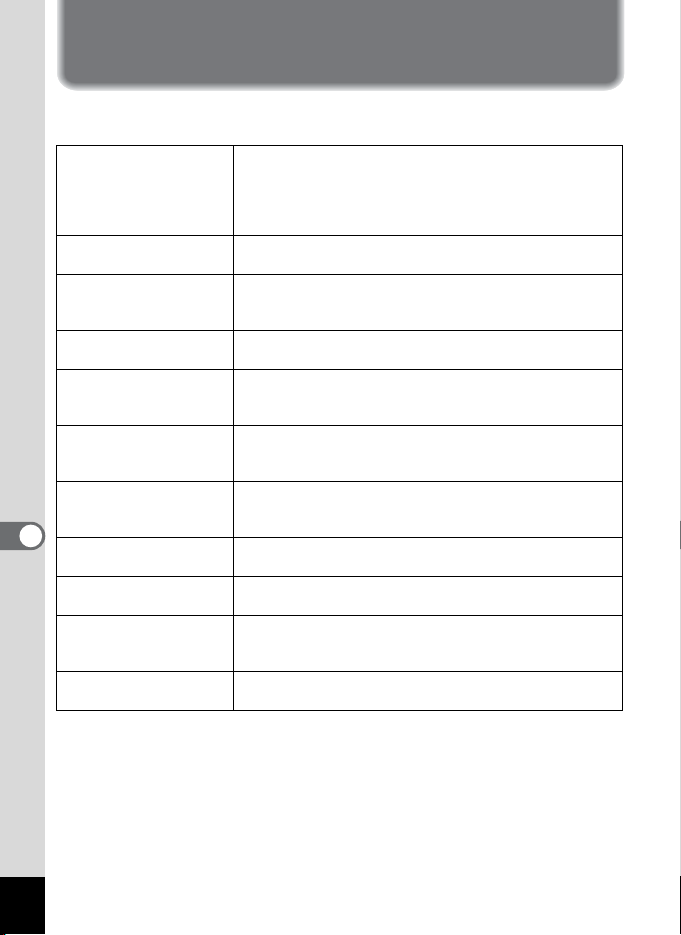
132
7
Appendix
Messages
Messages such as the following may be displayed on the LCD monitor
during camera operation.
Memory card full The SD Memory Card / MultiMediaCard memory is full
and no more images and sound can be saved. Insert a
new SD Memory Card / MultiMediaCard or delete
unwanted images. (p.16, p.96)
Change the quality / size and try again. (p.43, p.44)
No image & sound There are no images and sound on the SD Memory Card
/ MultiMediaCard to playback.
Camera can not display
this image.
You are trying to play back an image in a format not
supported by this camera. You may be able to display it
on another brand of camera or PC.
No card in camera. There is no SD Memory Card / MultiMediaCard in the
camera. (p.16)
Battery depleted. The battery is exhausted. Charge the D-LI7 battery using
D-BC7 battery charger or replace with a charged battery.
(p.12, p.13)
Memory card error. Shooting and playback are impossible due to a problem
with SD Memory Card / MultiMediaCard. Try displaying
on a PC.
This card is not
formatted.
The SD Memory Card / MultiMediaCard you have
inserted is unformatted or has been formatted on a PC or
other device and is not compatible with the camera.
Image recording. The image / voice recording is being recorded on the SD
Memory Card / MultiMediaCard.
Data being recorded. The movie picture is being recorded on the SD Memory
Card / MultiMediaCard.
No images for filter Displayed when a TIFF image is selected, or when you try
to apply a filter effect to an image that has not been saved
to a SD Memory Card / MultiMedia Card.
Formatting The SD Memory Card / MultiMediaCard is being
formatted.
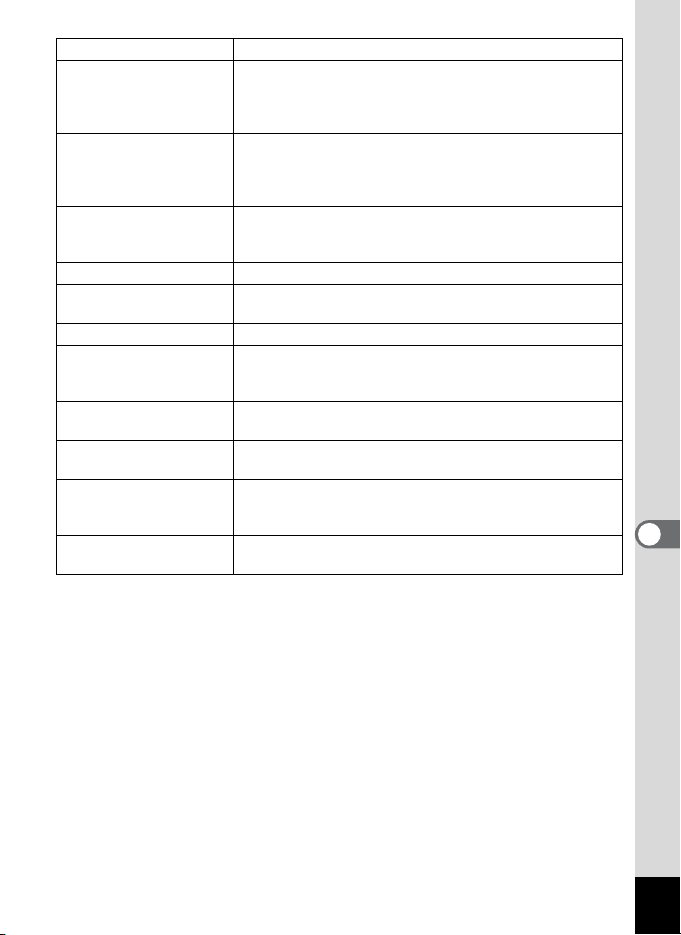
133
7
Appendix
Deleting The image is being deleted.
Image folder could not be
created.
The largest file number is assigned to an image and no
more images can be saved. Insert a new SD Memory
Card / MultiMediaCard or format the SD Memory Card /
MultiMediaCard. (p.112)
This card is not
formatted.
The SD Memory Card / MultiMedia Card you have
inserted is unformatted, or has been formatted on a PC or
other device and is not compatible with this camera.
(p.112)
Compression error Compression of the image you captured has failed.
Change the recorded pixels or quality levels, and take a
picture again.
Data being recorded The movie picture is being recorded.
Image protected The image you are trying to delete is a protected image.
(p.99)
Alarm set The alarm has been enabled.
No DPOF files Displayed when the DPOF button is pressed in PictBridge
mode and there are no DPOF settings for an image.
Select the DPOF settings for the image.
Printer error / Print
aborted
Displayed when a printer error occurs in PictBridge mode.
Connect camera &
printer
Displayed when PictBridge is selected from the Playback
menu.
No image Displayed in PictBridge mode when there are no images
that can be printed saved in a SD Memory Card /
MultiMedia Card.
Safely remove USB
cable
Displayed when you choose not to continue printing in
PictBridge mode.

134
7
Appendix
Troubleshooting
Problem Cause Remedy
Power will not
come on
Battery is not installed Check battery is installed.
If not, install battery.
Battery is installed
incorrectly
Check orientation of battery. Reinsert
battery with the label towards front of
camera. (p.13)
Battery power is low Insert a charged battery or use the AC
adapter.
No image on the
LCD monitor
LCD monitor is set to
OFF
Press Display button to turn LCD monitor
on. (p.38)
Connected to PC by
USB cable.
When connecting to PC, LCD monitor is
always On.
Camera is connected
to TV
LCD monitor remains off while camera is
connected to TV.
Shutter will not
be released
Image is displayed but
is hard to see
Image on LCD monitor may be hard to
see when taking pictures outside in
sunlight.
Flash is charging When flash lamp blinks red, flash is
charging and no pictures can be taken.
Lamp lights red when charging is
completed.
No available space on
SD Memory Card /
MultiMediaCard
Insert SD Memory
Card /
MultiMediaCard with available space or
delete unwanted images. (p.16, 96)
Recording Wait until recording is finished.
Zoom does not
work
Super Macro mode
has been set.
The zoom is disabled in this mode.
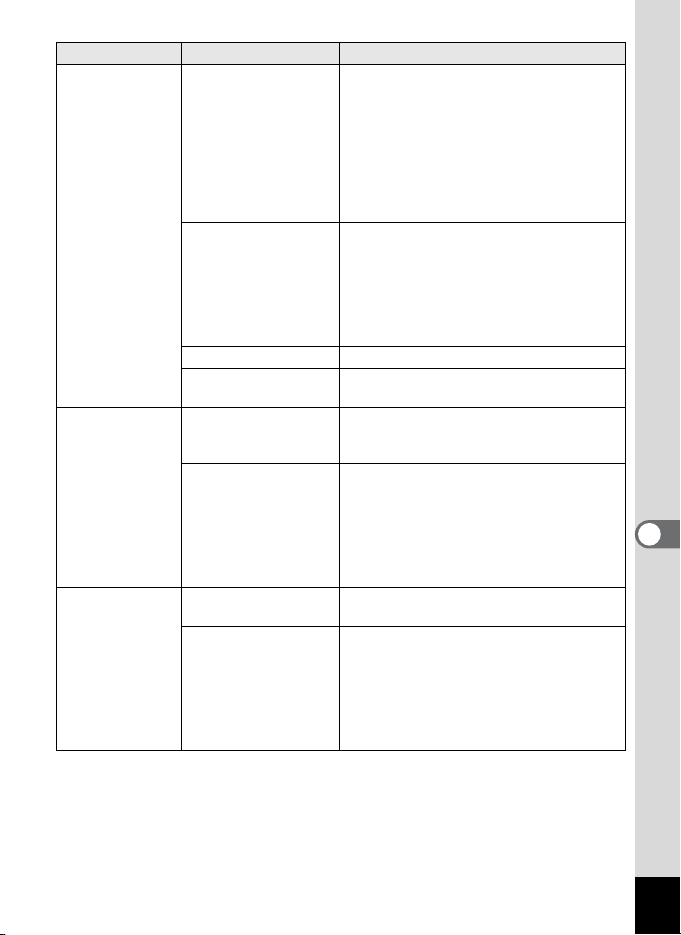
135
7
Appendix
Problem Cause Remedy
Subject is not in
focus
Subject difficult to
focus on
Subjects difficult to focus on using
autofocus: objects with little contrast (blue
sky, white walls, etc.), dark objects, finely
patterned objects, fast-moving objects,
scenery through window or net, etc. Lock
focus on another object located at same
distance (press shutter release button
halfway), then aim at target and press
shutter release button fully.
Subject is not in
focusing area
Position subject in AF frame (focusing
area) in middle of LCD monitor. If the
subject is outside the focusing area, aim
the camera at the subject and lock focus
(press shutter release button halfway),
then compose picture and press the
shutter release button fully.
Subject is too close Set focus mode on q. (p.40)
Focus mode is set on
q
Focus mode is set on q.
Picture is dark Subject is too far away
in a dark environment,
such as a night scene.
Picture becomes dark if subject is too far
away. Take picture within range of flash.
Background is dark When taking a picture of a person against
dark background, such as night scene,
the person may appear dark if the flash
does not reach background even with
correct exposure. Set to B mode to
ensure both person and background are
clear. (p.60)
Flash does not
fire
Flash mode is set to
Off
Set to Auto or b. (p.42)
The Capture mode is
set to C, super
macro, continuous
shooting or infinity-
landscape mode, or
the Picture mode is set
to Fireworks mode.
Flash will not fire in these modes.
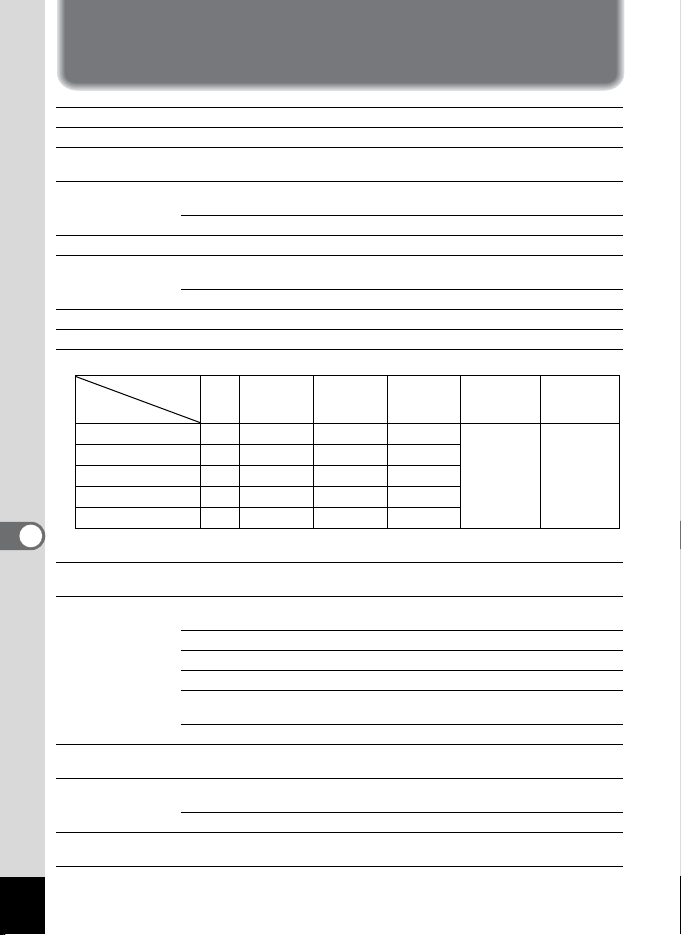
136
7
Appendix
Main Specifications
Type Fully automatic compact-type digital still camera with built-in zoom lens
Effective Pixels 5.0 megapixels
Sensor 5.25 megapixels (total pixels) 1/1.8 inch interline transfer CCD with a
primary color filter
Recorded Pixels Still 2592 × 1944 pixels, 2048 × 1536 pixels,1600 × 1200
pixels, 1024 × 768 pixels, 640 × 480 pixels
Movie 320 × 240 pixels
Sensitivity Auto, manual (equivalent to ISO 64, 100, 200, 400)
File Format Still JPEG (Exif2.2), TIFF, DCF, DPOF, PRINT Image
Matching II
Movie Mov (Quick Time Motion), 15fps
Quality Level “TIFF”, “Good”, “Better”, “Best”
Storage Medium SD Memory Card, MultiMediaCard
Image Storage Capacity
White Balance Auto, Daylight, Shade, Tungsten Light, Fluorescent Light (W),
Fluorescent Light (N), Fluorescent Light (D), Manual
Lens Focal Length 7.8 mm – 39 mm (Equivalent to 37.5 mm – 187.5 mm
in 35 mm format)
Max. aperture f/2.8 – f/4.6
Lens Composition9 elements in 7 groups (two aspherical elements)
Zoom type Electrically driven
Picture Range 33.7 mm × 24.7 mm (screen is filled) (using super
macro mode or manual focus at max, WIDE position)
Lens Barrier Electrically driven
Digital Zoom Capture mode Max. 4× (Combines with 5× optical zoom to give
zoom magnification equivalent to 20×)
Viewfinder Type Real-image zoom viewfinder
(Diopter adjustment in the range of –3 to +1m
–1
)
Magnification Wide 0.37×, Tele 1.66×
LCD Monitor 1.5 inch low-temperature polysilicon TFT color LCD monitor with 113
kilo pixels (with backlight)
• When using a 16MB SD Memory Card
Quality levels
Recorded pixels
TIFF
Best
(C)
Better
(D)
Good
(E)
Movie images
(320 × 240)
Voice
recording
2595 × 1944 0 Approx. 4 Approx. 8 Approx. 14
Approx. 40 Approx. 30
2048 × 1536
– Approx. 7 Approx. 12 Approx. 18
1600 × 1200
– Approx. 11 Approx. 20 Approx. 27
1024 × 768
– Approx. 25 Approx. 45 Approx. 56
640 × 480
– Approx. 53 Approx. 82
Approx. 100
137
7
Appendix
Playback
Function
Single-frame, 9-frame index, enlargement (max. 8
×
), scroll, slideshow,
Display rotated images, movie playback, voice playback, histogram
display, trimming, resize
Focusing System Type TTL contrast detection system by sensor with
external passive sensor
Focusing Range
(From lens front)
Normal: 0.6 m (1.97 ft) to infinity (full zoom range)
Macro: 0.15 m (0.50 ft) – 0.65 m (2.13 ft) (full zoom range)
Super macro: 0.02 m (0.8 in.) – 0.65 m (2.13 ft) (Wide only)
Landscape: Infinity (full zoom range)
Focus Lock By half-pressing shutter release button
Manual Focus 0.15 m (0.50 ft) to infinity (full zoom range), 0.02 m (0.8 in.) to infinity
(Wide only)
Exposure
Mechanism
AE Metering TTL metering by sensor (Multi-segment, Center-
weighted, Spot)
Exposure
Compensation
±2 EV (Set in 1/3 EV steps)
Movie Recording time approx. 1 sec. – 10 min.
Auto Bracket Possible
Exposure Modes Program, Av, Tv, M, PICT, Movie, Panorama Assist,
3D, Digital Filter, USER, Voice Recording
Shutter Type Electronic / mechanical shutter
Speed Approx. 1/2000 sec. – 15 sec.
Flash Type Auto flash with red-eye reduction function
Flash Modes Auto, Flash Off, Flash On, Auto + Red-eye reduction,
Flash On + Red-eye Reduction
Light Compensation
±2 EV (in 1/3 EV steps)
Working Range Wide: Approx. 0.4 m – 5.2 m (1.31 ft – 17.1 ft)
Tele: Approx. 0.15 m – 3.2 m (0.50 ft – 10.5 ft)
Drive Modes Single-frame, Self-timer, Remote Control after 3 Seconds, Remote
Control, Continuous, Interval, Multiple Exposure
Self-timer Electronic control type, delay time: approx. 10 sec.
Remote Control
Unit
Pentax Remote Control Unit F (optional)
Exposure 3 seconds after receipt of signal or instant exposure
Time function World Time setting for 62 cities (28 time zones)
Power Supply Rechargeable lithium-ion battery D-LI7, AC adapter (optional)
Battery life w / fully
charged
Approx. 400 with 50% of shooting uses flash, LCD monitor ON in
accordance with Pentax measuring conditions.
In / Out Port
USB / AV terminal (PC communication type USB1.1), external power supply terminal
Video Output Format
NTSC, PAL
Direct Printing PictBridge supported
Size 100 (W)
×
59 (H)
×
39.5 (D) mm (excluding operating members)
Weight 205 g (excluding battery and SD Memory Card / MultiMediaCard)
Weight when shooting
250 g (including battery and SD Memory Card / MultiMediaCard)
Accessories Rechargeable lithium-ion battery, battery charger, USB cable, AV cable,
3D image viewer, software (CD-ROM), strap, operating manual
138
7
Appendix
Optional Accessories
A number of dedicated accessories are available for this camera.
Rechargeable lithium-ion battery (D-LI7)
Battery charger (D-BC7)
AC adapter (D-AC7)
AC Plug Cord
D-CO2A Australia
D-CO2B United Kingdom
D-CO2E Europe
D-CO2H Hong Kong
D-CO2J Japan
D-CO2K Korea
D-CO2U North America, Canada
USB Cable (I-USB7)
AV Cable (I-AVC7)
Camera Case (O-CC7)
Strap (O-ST5)
Remote Control Unit F
139
7
Appendix
WARRANTY POLICY
All Pentax cameras purchased through authorized bona fide photographic distribution
channels are guaranteed against defects of material or workmanship for a period of
twelve months from date of purchase. Service will be rendered, and defective parts will
be replaced without cost to you within that period, provided the equipment does not show
evidence of impact, sand or liquid damage, mishandling, tampering, battery or chemical
corrosion, operation contrary to operating instructions, or modification by an
unauthorized repair shop. The manufacturer or its authorized representatives shall not
be liable for any repair or alterations except those made with its written consent and shall
not be liable for damages from delay or loss of use or from other indirect or
consequential damages of any kind, whether caused by defective material or
workmanship or otherwise; and it is expressly agreed that the liability of the manufacturer
or its representatives under all guarantees or warranties, whether expressed or implied,
is strictly limited to the replacement of parts as hereinbefore provided. No refunds will be
made on repairs by non-authorized Pentax service facilities.
Procedure During 12-month Warranty Period
Any Pentax which proves defective during the 12-month warranty period should be
returned to the dealer from whom you purchased the equipment or to the manufacturer.
If there is no representatives of the manufacturer in your country, send the equipment to
the manufacturer, with postage prepaid. In this case, it will take a considerable length of
time before the equipment can be returned to you owing to the complicated customs
procedures required. If the equipment is covered by warranty, repairs will be made and
parts replaced free of charge, and the equipment will be returned to you upon
completion of servicing. If the equipment is not covered by warranty, regular charges of
the manufacturer or of its representatives will apply. Shipping charges are to be borne
by the owner. If your Pentax was purchased outside of the country where you wish to
have it serviced during the warranty period, regular handling and servicing fees may be
charged by the manufacturer's representatives in that country. Notwithstanding this,
your Pentax returned to the manufacturer will be serviced free of charge according to
this procedure and warranty policy. In any case, however, shipping charges and
customs clearance fees to be borne by the sender. To prove the date of your purchase
when required, please keep the receipt or bills covering the purchase of your equipment
for at least a year. Before sending your equipment for servicing, please make sure that
you are sending it to the manufacturer's authorized representatives or their approved
repair shops, unless you are sending it directly to the manufacturer. Always obtain a
quotation for the service charge, and only after you accept the quoted service charge,
instruct the service station to proceed with the servicing.
• This warranty policy does not affect the customer’s statutory rights.
• The local warranty policies available from Pentax distributors in some
countries can supersede this warranty policy. Therefore, we recommend
that you review the warranty card supplied with your product at the time
of purchase, or contact the PENTAX distributor in your country for more
information and to receive a copy of the warranty policy.
140
7
Appendix
For customers in USA
STATEMENT OF FCC COMPLIANCE
This device complies with Part 15 of the FCC Rules. Operation is
subject to the following two conditions: (1) This device may not cause
harmful interference, and (2) this device must accept any interference
received, including interference that may cause undesired operation.
Changes or modifications not approved by the party responsible for
compliance could void the user's authority to operate the equipment.
This equipment has been tested and found comply with the limits for a
Class B digital device, pursuant to part 15 of the FCC Rules.
These limits are designed to provide reasonable protection against
harmful interference in a residential installation. This equipment
generates, uses and can radiate frequency energy and, if not installed
and used in accordance with the instructions, may cause harmful
interference to radio communications. However, there is no guarantee
that interference will not occur in a particular installation.
If this equipment does cause harmful interference to radio or television
reception, which can be determined by turning the equipment off and
on, the user is encouraged to try to correct the interference by one or
more of the following measures:
• Reorient or relocate the receiving antenna.
Increase the separation between the equipment and receiver.
Connect the equipment into an outlet on a circuit different from that to
which the receiver is connected.
* Consult the dealer or an experienced radio / TV technician for help.
For customers in Canada
This Class B digital apparatus meets all requirements of the
Canadian Interference - Causing Equipment Regulations.
Pour les utilisateurs au Canada
Cet apareil numérique de la classe B respecte toutes les exigences du
Rglement sur le matériel brouilleur du Canada.
The CE Mark is a Directive conformity mark of the European
Community.
141
7
Appendix
Declaration of Conformity
According to 47CFR, Parts 2 and 15 for
Class B Personal Computers and Peripherals
We: PENTAX U.S.A., Inc.
Located at: 600 12 Street, Suite 300
Golden, Colorado 80401 U.S.A.
Phone: 303-799-8000 FAX: 303-790-1131
Declare under sole responsibility that the product identified herein,
complies with 47CFR Parts 2 and 15 of the FCC rules as a Class B
digital device. Each product marketed, is identical to the representative
unit tested and found to be compliant with the standards. Records
maintained continue to reflect the equipment being produced can be
expected to be within the variation accepted, due to quantity production
and testing on the statistical basis as required by 47CFR §2.909.
Operation is subject to the following two conditions: (1) This device may
not cause harmful interference, and (2) This device must accept any
interference received, including interference that may cause undesired
operation. The above named party is responsible for ensuring that the
equipment complies with the standards of 47CFR §15.101 to §15.109.
Product Name: PENTAX Digital Still Camera
Model Number: Optio 555
Contact person: Customer Service Manager
Date and Place: September, 2003, Colorado
th
• Printed on recycled paper
• Specifications and external dimensions are subject to change without notice.
57323 Copyright © PENTAX Corporation 2003
02-200310 Printed in Japan
PENTAX Corporation
2-36-9,Maeno-cho, Itabashi-ku, Tokyo 174-8639, JAPAN
(http://www.pentax.co.jp/)
PENTAX Europe GmbH (European Headquarters)
Julius-Vosseler-Strasse, 104, 22527 Hamburg, GERMANY
(HQ - http://www.pentaxeurope.com)
(Germany - http://www.pentax.de)
PENTAX U.K. Limited PENTAX House, Heron Drive, Langley, Slough, Berks
SL3 8PN, U.K.
(http://www.pentax.co.uk)
PENTAX France S.A.S.
12/14, rue Jean Poulmarch, 95106 Argenteuil Cedex, FRANCE
PENTAX Benelux B.V. (for Netherlands)
Spinveld 25, 4815 HR Breda, NETHERLANDS
(http://www.pentax.nl)
(for Belgium & Luxembourg)
Weiveldlaan 3-5, 1930 Zaventem, BELGIUM
(http://www.pentax.be)
PENTAX (Schweiz) AG Widenholzstrasse 1 Postfach 367 8305 Dietlikon,
SWITZERLAND (http://www.pentax.ch)
PENTAX Scandinavia AB P.O. Box 650, 75127 Uppsala, SWEDEN
(http://www.pentax.se)
PENTAX U.S.A., Inc 600 12
th
Street, Suite 300
Golden, Colorado 80401, U.S.A.
(http://www.pentax.com)
PENTAX Canada Inc. 3131 Universal Drive, Mississauga, Ontario L4X 2E5,
CANADA
(http://www.pentaxcanada.ca)