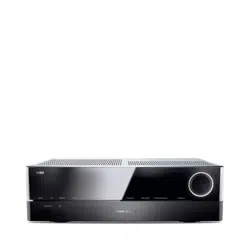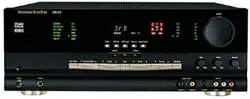
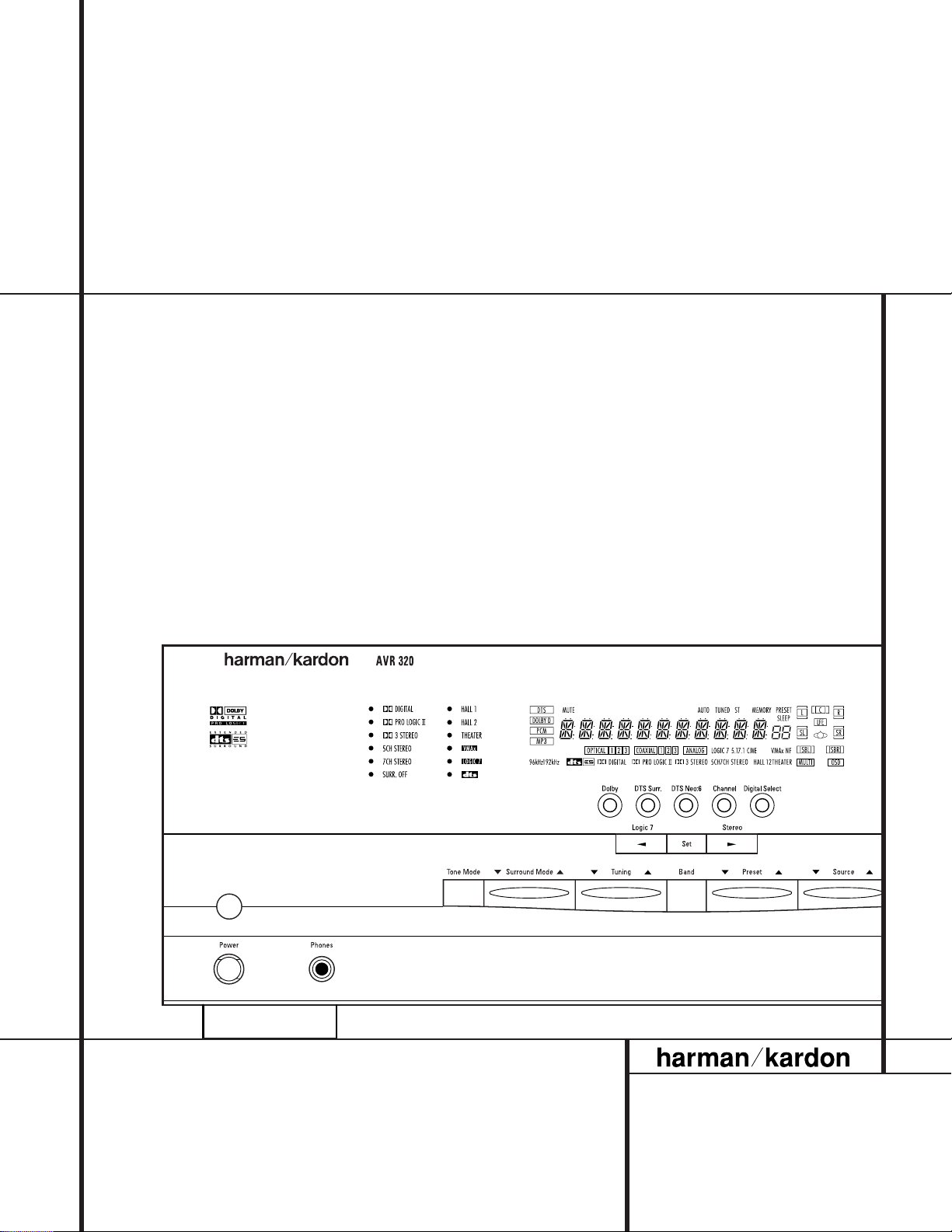
AVR 320 Audio/VideoReceiver
OWNER’S MANUAL
®
Power for the Digital Revolution.
®
®

2 TABLE OF CONTENTS
3 Introduction
4 Safety Information
4 Unpacking
5 Front Panel Controls
8 Front Panel Information Display
10 Rear Panel Connections
12 Main Remote Control Functions
15 Zone II Remote Control Functions
16 Installation and Connections
18 System Configuration
18 Speaker Placement
19 System Setup
20 Input Setup
20 Surround Setup
22 Speaker Setup
23 Delay Settings
24 Output Level Adjustment
25 Manual Output Level Adjustment
26 Operation
26 Surround Mode Chart
28 Basic Operation
28 Source Selection
28 Surround Mode Selection
29 Digital Audio Playback
31 Tuner Operation
32 Tape Recording
32 Front Panel Input/Output
Connections
32 Output Level Trim Adjustment
33 6/8-Channel Direct Input
34 Advanced Features
34 Display Brightness
34 Turn-On Volume Level
34 Semi-OSD Settings
36 Multiroom Operation
37 Programming the Remote
37 Direct Code Entry
37 Auto Search Method
37 Code Readout
37 Learning Codes
38 Erasing Learned Codes
38 Macro Programming
39 Programmed Device Functions
40 Volume Punch-Through
40 Channel Control Punch-Through
41 Reassigning Device Control
Selectors
42 Function List
44 Setup Code Tables
54 Troubleshooting Guide
54 Processor Reset
55 Technical Specifications
AVR 320 Audio/VideoReceiver
Typographical Conventions
In order to help you use this manual with the remote control, front panel controls and rear panel
connections, certain conventions have been used.
EXAMPLE – (bold type) indicates a specific remote control or front panel button, or rear panel
connection jack
EXAMPLE – (OCR type) indicates a message that is visible on-screen or on the front panel
information display
1 – (number in a square) indicates a specific front panel control
¡ – (number in a circle) indicates a rear panel connection
a – (number in an oval) indicates a button or indicator on the remote
A – (letter in a square) indicates an indicator in the front panel display
å
– (letter in an oval) indicates a button on the Zone II remote
3 INTRODUCTION
Introduction
Thank you for choosing Harman Kardon!
With the purchase of a Harman Kardon
AVR 320 you are about to begin many years of
listening enjoyment. Designed to provide all the
excitement and detail of movie soundtracks and
every nuance of musical selections, the AVR 320
is truly a multichannel receiver for the new mil-
lenium.
The AVR 320 has been engineered so that it is
easy to take advantage of all the power of its
digital technology. On-screen menus, fully color
coded connection jacks and terminals and our
exclusive EzSet
™
remote make installation fast
and simple. However, to obtain the maximum
enjoyment from your new receiver, we urge you
to read this manual. A few minutes spent
learning the functions of the various controls
will enable you to take advantage of all the
power the AVR 320 is able to deliver.
If you have any questions about this product,
its installation or its operation, please contact
your retailer or custom installer. They are your
best local sources of information.
Description and Features
The AVR 320 is among the most versatile and
multifeatured A/V receivers available, incorpo-
rating a wide range of listening options. In
addition to Dolby Digital and DTS decoding for
digital sources, a broad choice of Matrix sur-
round-encoded or Stereo surround modes are
available for use with sources such as CD, VCR,
TV broadcasts and the AVR 320’s own FM/AM
tuner. Along with Dolby Pro Logic II, DTS Neo:6,
Dolby 3 Stereo, and Hall and Theater modes,
the AVR 320 offers Harman International’s
exclusive Logic 7 process in both 5.1 and 7.1
versions to create a wider, more enveloping
field environment and more defined fly-overs
and pans. Another Harman Kardon exclusive is
VMAx, which uses proprietary processing to
create an open, spacious sound field even
when only two front speakers are available.
Finally, the AVR 320 is among the very few A/V
receivers that offer decoding of MP3 data, so
that you may listen to the latest music selec-
tions directly from compatible computers or
playback devices with the power and fidelity
you expect from Harman Kardon.
In addition to providing a wide range of listen-
ing options, the AVR 320 is easy to configure so
that it provides the best results with your
speakers and specific listening-room environ-
ment. On-screen menus make it simple to enter
settings for speaker configurations and bass
management, and the EzSet remote measures
a system’s sound levels and automatically cali-
brates them for perfectly balanced sound field
presentation.
For the ultimate in flexibility, the AVR 320 fea-
tures connections for six video devices, all with
both composite and S-Video inputs. Two addi-
tional audio inputs are available, and a total of
six digital inputs make the AVR 320 capable of
handling all the latest digital audio sources.
For compatibility with the latest HDTV video
sources and progressive scan DVD players, the
AVR 320 also features wide-bandwidth, low-
crosstalk component video switching.
Coax and optical digital outputs are available
for direct connection to digital recorders, and
the front panel coaxial digital jacks may be
switched to outputs for use with portable
recorders – a Harman Kardon exclusive. Two
video recording outputs, preamp-out jacks, and
a color-coded eight-channel input make the
AVR 320 virtually future-proof, with everything
needed to accommodate tomorrow’s new
formats right on board.
The AVR 320’s flexibility and power extend
beyond your main home theater or listening
room. The AVR 320 includes a sophisticated
multizone control system that allows you to
select one source for use in the main room and
a different one in a second room. Complete
control over volume is possible with a separate
infrared control link. To make it easy to operate
the AVR 320 from a remote room, a separate
“Zone II” remote is included.
The AVR 320’s powerful amplifier uses
traditional Harman Kardon high-current design
technologies to meet the wide dynamic range
of any program selection.
Harman Kardon invented the high-fidelity
receiver more than forty-seven years ago. With
state-of-the-art circuitry and time-honored circuit
designs, the AVR 320 is the perfect combina
tion
of the latest in digital audio technology, a
quiet
yet powerful analog amplifier in an
elegant,
easy-to-use package.
■ Dolby* Digital and Dolby Pro Logic* II
Decoding, and the full suite of DTS
®
modes, including DTS-ES
®
6.1 Discrete
& Matrix and Neo:6
®
using the latest
24-bit, twin-core Crystal
®
DSP engine
■ Harman Kardon’s exclusive Logic 7
®
processing, available for the first time
with both 7.1 and 5.1 processing in
a variety of modes and two modes
of VMAx
®
■ MP3 decoding for use with computers
and digital audio players
■ remote automatically sets
output levels for optimum performance
■ High-bandwidth, HDTV-compatible
component video switching
■ Front panel digital inputs and coax
digital output capability for easy
connection to portable digital devices
and the latest video game consoles
■ Multiple digital inputs and outputs
■ Front panel coax digital jacks switch-
able to outputs for easy connection
to portable digital recorders
■ On-screen menu and display system
■ Complete multizone system with
separate “Zone II” remote included
TM
CAUTION
RISK OF ELECTRIC SHOCK
DO NOT OPEN
CAUTION: To prevent electric shock,
do not use this (polarized)
plug with an extension cord,
receptacle or other outlet
unless the blades can
be fully inserted to
prevent blade exposure.
The lightning flash with arrowhead symbol,
within an equilateral triangle, is intended to
alert the user to the presence of uninsulated
“dangerous voltage” within the product’s
enclosure that may be of sufficient magnitude to constitute a
risk of electric shock to persons.
The exclamation point within an equilateral
triangle is intended to alert the user to the
presence of important operating and
maintenance (servicing) instructions in the
literature accompanying the appliance.
4 SAFETY INFORMATION
Safety Information
Important Safety Information
Verify Line Voltage Before Use
Your AVR 320 has been designed for use with
120-volt AC current. Connection to a line volt-
age other than that for which it is intended
can create a safety and fire hazard and may
damage the unit.
If you have any questions about the voltage
requirements for your specific model, or about
the line voltage in your area, contact your selling
dealer before plugging the unit into a wall outlet.
Do Not Use Extension Cords
To avoid safety hazards, use only the power
cord attached to your unit. We do not recom-
mend that extension cords be used with this
product. As with all electrical devices, do not
run power cords under rugs or carpets or place
heavy objects on them. Damaged power cords
should be replaced immediately by an author-
ized service depot with a cord meeting factory
specifications.
Handle the AC Power Cord Gently
When disconnecting the power cord from an
AC outlet, always pull the plug; never pull the
cord. If you do not intend to use the unit for
any considerable length of time, disconnect the
plug from the AC outlet.
Do Not Open the Cabinet
There are no user-serviceable components
inside this product. Opening the cabinet may
present a shock hazard, and any modification
to the product will void your guarantee. If water
or any metal object such as a paper clip, wire
or a staple accidentally falls inside the unit, dis-
connect it from the AC power source immedi-
ately, and consult an authorized service station.
CATV or Antenna Grounding
If an outside antenna or cable system is con-
nected to this product, be certain that it is
grounded so as to provide some protection
against voltage surges and static charges.
Section 810 of the National Electrical Code,
ANSI/NFPA No. 70-1984, provides information
with respect to proper grounding of the mast
and supporting structure, grounding of the lead-
in wire to an antenna discharge unit, size of
grounding conductors, location of antenna dis-
charge unit, connection to grounding electrodes
and requirements of the grounding electrode.
NOTE TO CATV SYSTEM INSTALLER: This
reminder is provided to call the CATV (Cable
TV) system installer’s attention to article 820-
40 of the NEC that provides guidelines for
proper grounding and, in particular, specifies
that the cable ground shall be connected to the
grounding system of the building, as close to
the point of cable entry as possible.
Installation Location
■To ensure proper operation and to avoid the
potential for safety hazards, place the unit
on a firm and level surface. When placing the
unit on a shelf, be certain that the shelf and
any mounting hardware can support the
weight of the product.
■ Make certain that proper space is provided
both above and below the unit for ventila-
tion. If this product will be installed in a
cabinet or other enclosed area, make certain
that there is sufficient air movement within
the cabinet. Under some circumstances a fan
may be required.
■ Do not place the unit directly on a carpeted
surface.
■Avoid installation in extremely hot or cold
locations, or in an area that is exposed to
direct sunlight or heating equipment.
■Avoid moist or humid locations.
■ Do not obstruct the ventilation slots on the
top of the unit, or place objects directly
over them.
Cleaning
When the unit gets dirty, wipe it with a clean,
soft, dry cloth. If necessary, wipe it with a soft
cloth dampened with mild soapy water, then a
fresh cloth with clean water. Wipe dry immedi-
ately with a dry cloth. NEVER use benzene,
aerosol cleaners, thinner, alcohol or any other
volatile cleaning agent. Do not use abrasive
cleaners, as they may damage the finish of metal
parts. Avoid spraying insecticide near the unit.
Moving the Unit
Before moving the unit, be certain to discon-
nect any interconnection cords with other com-
ponents, and make certain that you disconnect
the unit from the AC outlet.
Important Information for the User
This equipment has been tested and found to
comply with the limits for a Class-B digital
device, pursuant to Part 15 of the FCC Rules.
The limits are designed to provide reasonable
protection against harmful interference in a
residential installation. This equipment gener-
ates,
uses and can radiate radio-frequency energy
and, if not installed and used in accordance
with the instructions, may cause harmful inter-
ference to radio communication. However, there
is no guarantee that harmful interference will
not occur in a particular installation. If this
equipment does cause harmful interference to
radio or television reception, which can be
determined by turning the equipment off and
on, the user is encouraged to try to correct the
interference by one or more of the following
measures:
■ Reorient or relocate the receiving antenna.
■ Increase the separation between the equip-
ment and receiver.
■ Connect the equipment into an outlet on a
circuit different from that to which the
receiver is connected.
■ Consult the dealer or an experienced
radio/TV technician for help.
This device complies with Part 15 of the FCC
Rules. Operation is subject to the following two
conditions: (1) this device may not cause harm-
ful interference, and (2) this device must accept
interference received, including interference
that may cause undesired operation.
NOTE: Changes or modifications may cause
this unit to fail to comply with Part 15 of the
FCC Rules and may void the user’s authority to
operate the equipment.
Unpacking
The carton and shipping materials used to pro-
tect your new receiver during shipment were
specially designed to cushion it from shock and
vibration. We suggest that you save the carton
and packing materials for use in shipping if you
move, or should the unit ever need repair.
To minimize the size of the carton in storage,
you may wish to flatten it. This is done by care-
fully slitting the tape seams on the bottom and
collapsing the carton. Other cardboard inserts
may be stored in the same manner. Packing
materials that cannot be collapsed should be
saved along with the carton in a plastic bag.
If you do not wish to save the packaging mate-
rials, please note that the carton and other sec-
tions of the shipping protection are recyclable.
Please respect the environment and discard
those materials at a local recycling center.
At this time you should remove the protective
plastic film from the front-panel lens. Leaving
the film in place may affect the performance of
your remote control.
5 FRONT PANEL CONTROLS
1 Main Power Switch: Press this button to
apply power to the AVR 320. When the switch
is pressed in, the unit is placed in a Standby
mode, as indicated by the amber
Power
Indicator
3 surrounding the System
Power Control
2.This button MUST be
pressed in to operate the unit. To turn the unit
off and prevent the use of the remote control,
this switch should be pressed until it pops out
from the front panel so that the word “OFF”
may be read at the top of the switch.
NOTE: This switch is normally left in the “ON”
position.
2 System Power Control: When the Main
Power Switch
1
is “ON,” press this button
to turn on the AVR 320; press it again to turn
the unit off. Note that the
Power Indicator
3
surrounding the switch will turn green
when the unit is on.
3 Power Indicator: This LED will be lit in
amber when the unit is in the Standby mode to
signal that the unit is ready to be turned on.
When the unit is in operation, the indicator will
turn green.
4 Headphone Jack: This jack may be used to
listen to the AVR 320’s output through a pair of
headphones. Be certain that the headphones
have a standard
1
/4" stereo phone plug. Note
that the main room speakers will automatically
be turned off when the headphone jack is
in use.
5 Dolby Mode Selector: Pressing this selec-
tor button cycles the AVR through the various
Dolby surround modes. The first press of the but-
ton switches the surround mode to the last
Dolby surround mode that was in use. Each sub-
sequent press selects the next mode in the fol-
lowing order:
6 DTS Surround Mode Selector: Pressing
this selector button cycles the AVR through the
DTS surround modes. The first press of the but-
ton selects the last DTS surround mode that
DOLBY 3 STEREO
DOLBY
DIGITAL
DOLBY PRO LOGIC II MUSIC
DOLBY PRO LOGIC II
MOVIES
DOLBY PRO LOGIC II
EMULATION
Front Panel Controls
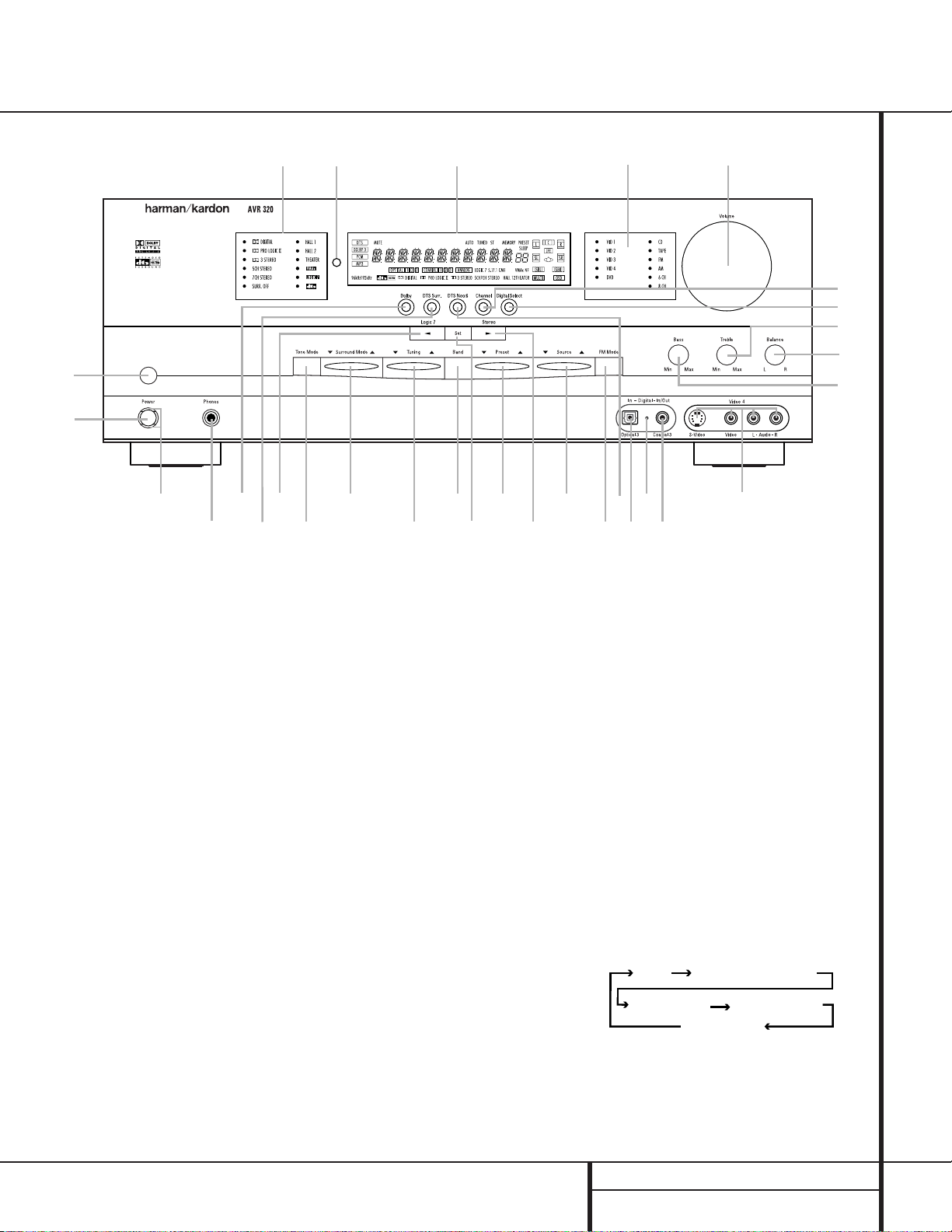
1 Main Power Switch
2 System Power Control
3 Power Indicator
4 Headphone Jack
5 Dolby Mode Selector
6 DTS Surround Mode Selector
7 Logic 7 Mode Selector /‹ Button
8 Tone Mode
9 Surround Mode Selector
) Tuning Selector
! Tuner Band Selector
@ Set Button
# Preset Station Selector
$ Stereo Mode Selector /› Button
% Input Source Selector
^ FM Mode Selector
& DTS Neo:6 Mode Selector
* Digital Optical 3 Input
( Input/Output Status Indicator
Ó Digital Coax 3 Jack
Ô Video 4 Input Jacks
Bass Control
Ò Balance Control
Ú Treble Control
Û Digital Select Button
Ù Channel Select Button
ı Volume Control
ˆ Input Indicators
˜ Main Information Display
¯ Remote Sensor Window
˘ Surround Mode Indicators
2
4
79
@
˘
Ú
ı
¯
Û
Ù
1
3
5
6
8
)
!
#
$
%
^
&
Ó
*
(
Ô
Ò
˜
ˆ
1 Main Power Switch
2 System Power Control
3 Power Indicator
4 Headphone Jack
5 Dolby Mode Selector
6 DTS Surround Mode Selector
7 Logic 7 Mode Selector /‹ Button
8 Tone Mode
9 Surround Mode Selector
) Tuning Selector
! Tuner Band Selector
@ Set Button
# Preset Station Selector
$ Stereo Mode Selector /› Button
% Input Source Selector
^ FM Mode Selector
& DTS Neo:6 Mode Selector
* Digital Optical 3 Input
( Input/Output Status Indicator
Ó Digital Coax 3 Jack
Ô Video 4 Input Jacks
Bass Control
Ò Balance Control
Ú Treble Control
Û Digital Select Button
Ù Channel Select Button
ı Volume Control
ˆ Input Indicators
˜ Main Information Display
¯ Remote Sensor Window
˘ Surround Mode Indicators
6 FRONT PANEL CONTROLS
Front Panel Controls
was in use. Each subsequent press selects the
next DTS mode in the following order:
7 Logic 7 Mode Selector /‹ Button: This
button has two functions: In normal use, press
it to select one of the Logic 7 modes. When an
adjustment is being made using the
Channel
Select
Ù or Digital Select Û buttons, this
button may be pressed to scroll through the
available options.
8 Tone Mode: Pressing this button enables
or disables the Bass and Treble tone controls.
When the button is pressed so that the words
TONE IN appear in the
Main Information
Display
˜, the settings of the Bass and
Treble Ú controls may be used to adjust the
output signals. When the button is pressed so
that the words TONE OUT appear in the
Main
Information Display
˜, the output signal
will be “flat,” without any bass or treble alter-
ation, no matter how the actual
Bass and
Treble Controls Ú are adjusted.
9 Surround Mode Selector: Press this but-
ton to change the surround mode by scrolling
through the list of available modes. Note that
depending on the type of input, some modes
are not always available. (See page 26 for more
information about surround modes.)
) Tuning Selector: Press the left side of the
button to tune lower-frequency stations and the
right side of the button to tune higher-frequency
stations. When a station with a strong signal
is reached, the
TUNED Indicator W will be lit
in the
Main Information Display ˜ .
To tune manually, tap the button lightly and
note that the tuner will step up one frequency
increment per button press. When the button is
held for a few seconds you will note that the
unit will quickly search the frequency band.
Release it once the fast tuning starts; the tuner
will automatically scan for the next station with
an acceptable signal and then stop.
! Tuner Band Selector: Pressing this but-
ton will automatically switch the AVR 320 to
the Tuner mode. Pressing it again will switch
between the AM and FM frequency bands. (See
page 31 for more information on the tuner.)
@ Set Button: When making choices during
the setup and configuration process, press this
button to enter the desired setting as shown
in the
Main Information Display ˜ into the
AVR 320’s memory.
# Preset Station Selector: Press this
button to scroll up or down through the list or
stations that have been entered into the preset
memory. (See page 32 for more information on
tuner programming.)
$ Stereo Mode Selector /› Button:
Pressing this selector button cycles through
the stereo modes, and it is also used to turn off
all surround processing and place the unit in a
traditional two-channel Stereo mode. The first
press selects 5-Channel Stereo, the next press
selects 8-Channel Stereo, and the third press
selects “SURROUND OFF,” which is true Stereo.
When an adjustment is being made using the
Channel Select Ù or Digital Select Û
buttons, this button may be pressed to scroll
through the available options.
% Input Source Selector: Press this button
to change the input by scrolling up or down
through the list of input sources.
^ FM Mode Selector: Press this button to
select Auto or Manual tuning. When the button
is pressed so that the
AUTO Indicator X
lights, the tuner will search for the next station
with an acceptable signal when the
Tuning
Selector
)u
é
is pressed. When the but-
ton is pressed so that the
AUTO Indicator X
is not lit, each press of the Tuning Selector
)u
é
will increase the frequency. (See
page 31 for more information on using the
tuner.)
& DTS Neo:6 Mode Selector: Pressing this
selector button cycles the AVR through the vari-
ous DTS Neo:6 modes, which extract a five-
channel surround field from two-channel pro-
gram material. The first press selects the last
DTS Neo:6 surround mode that was in use, and
each subsequent press selects the next mode in
the following order:
* Digital Optical 3 Input: Connect the opti-
cal digital output of an audio or video product to
this jack. When the input is not in use, be certain
to keep the plastic cap installed to avoid dust
contamination that might degrade future
performance.
( Input/Output Status Indicator: This LED
indicator will normally light green to show that
the front panel
Digital Coax 3 Ó jack is oper-
ating as an input. When this jack is configured
for use as an output, the indicator will turn red
to show that the jack may be used for recording.
(See page 20 for more information on configur-
ing the front panel jacks as outputs, rather than
inputs.)
Ó Digital Coax 3 Jack: This jack is normally
used for connection to the output of portable
audio devices, video game consoles or other
products that have a coax digital jack. It may
also be configured as an output jack, to feed a
digital signal to a CD-R, MiniDisc or other digi-
tal recording device. (See page 20 for informa-
tion on configuring the Digital Coax 3 Jack as
an output.)
Ô Video 4 Input Jacks: These audio/video
jacks may be used for temporary connection to
video games or portable audio/video products
such as camcorders and portable audio players.
Bass Control: Turn this control to modify
the low-frequency output of the left/right chan-
nels by as much as ±10dB. Set this control to a
suitable position for your taste or room acoustics.
Ò Balance Control: Turn this control to
change the relative volume for the front
left/right channels.
NOTE: For proper operation of the surround
modes, this control should be at the midpoint,
or “12 o’clock”, position.
Ú Treble Control: Turn this control to modify
the high-frequency output of the left/right chan-
nels by as much as ±10dB. Set this control to a
suitable position for your taste or room acoustics.
Û Digital Select Button: When playing a
source that has a digital output, press this
button to select between the
Optical *
and Coaxial Ó Digital inputs. (See
page 29 for more information on digital audio.)
Ù Channel Select Button: Press this button
to begin the process of trimming the channel
output levels using an external audio source.
(For more information on output level trim
adjustment, see page 32.)
ı Volume Control: Turn this knob clockwise
to increase the volume, counterclockwise to
decrease the volume. If the AVR 320 is muted,
adjusting volume control will automatically
release the unit from the silenced condition.
32
31
DTS Neo:6 MUSIC
DTS Neo:6
MOVIES
DTS Neo:6
EMULATION
DTS-ES 6.1 DISCRETE
DTS-ES 6.1 MATRIX DTS 5.1
7 FRONT PANEL CONTROLS
Front Panel Controls
ˆ Input Indicators: A green LED will light
to the left of the input that is currently the
input source for the AVR 320.
˜ Main Information Display: This display
delivers messages and status indications to
help you operate the receiver. (See pages 8 & 9
for a complete explanation of the Information
Display.)
¯ Remote Sensor Window: The sensor
behind this window receives infrared signals
from the remote control. Aim the remote at this
area and do not block or cover it unless an
external remote sensor is installed.
˘ Surround Mode Indicators: A green LED
will light in front of the surround mode that is
currently in use.
8 FRONT PANEL INFORMATION DISPLAY
Front Panel Information Display
A
B
D
E
N
O
K
M
L
T
U
S
R
P
Z
Y
X
W
V
F
H
I
J
C
G
Q
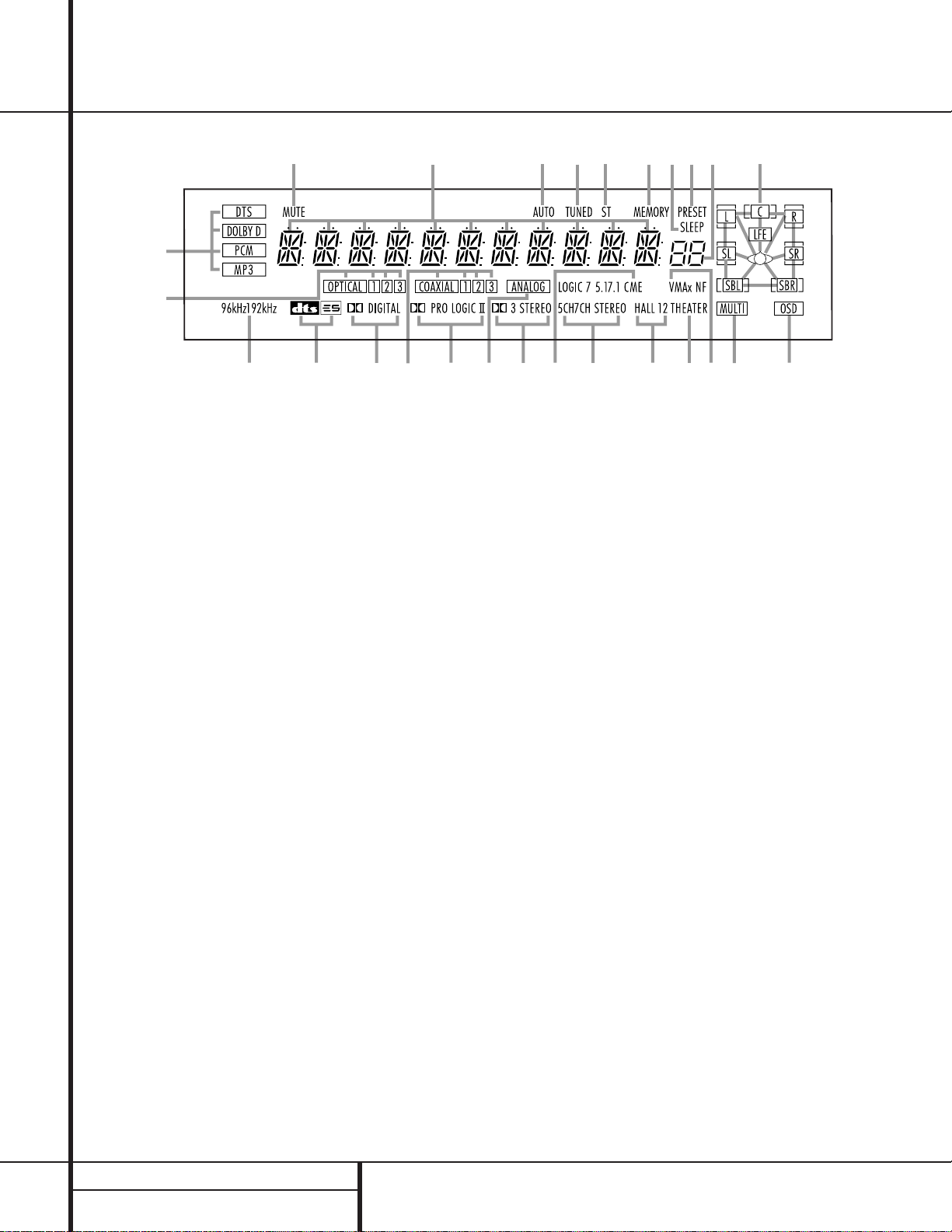
A Bitstream Indicators
B Optical Source Indicators
C Sample Rate Indicators
D DTS Mode Indicator
E Dolby Digital Indicator
F Coaxial Source Indicators
G Dolby Pro Logic II Indicator
H Analog Input Indicator
I Dolby 3 Stereo Indicator
J Logic 7 Mode Indicators
K 5-Channel/7-Channel Stereo Indicators
L Hall Mode Indicators
M Theater Mode Indicator
N VMAx Mode Indicators
O Multiroom Indicator
P OSD Indicator
Q Speaker/Channel Input Indicators
R Preset Number/Sleep Timer
S Preset Indicator
T Sleep Indicator
U Memory Indicator
V Stereo Indicator
W Tuned Indicator
X Auto Indicator
Y Main Information Display
Z Mute Indicator
A Bitstream Indicators: When the input is a
digital source, one of these indicators will light to
display the specific type of data signal in use.
B Optical Source Indicators: These indica-
tors light to show when an Optical Digital Input
has been selected.
C Sample Rate Indicators: One of these
indicators will light when 96kHz or 192kHz
source material is in use.
D DTS Mode Indicator: This indicator lights
when a DTS-encoded source is playing.
E Dolby Digital Indicator: This indicator
lights when a Dolby Digital source is being
played.
F Coaxial Source Indicators: These indica-
tors light to show when a Coaxial Digital Input
has been selected.
G Dolby Pro Logic II Indicator: This indica-
tor lights when the Dolby Pro Logic II mode has
been selected.
NOTE:
It is possible to see the Dolby Pro Logic II
indicator lit simultaneously with the Dolby
Digital indicator, even though the Dolby Digital
surround mode has been selected. This is due to
the specifications for Dolby Digital processing,
which require that the Dolby Pro Logic II mode
be applied when a 2-channel Dolby signal is
detected. If you desire 5.1-channel audio, check
the audio settings in the menus for your DVD
disc to make sure that a 5.1-channel Dolby
Digital soundtrack has been selected.
H Analog Input Indicator: This indicator
lights when an analog input source has been
selected.
I Dolby 3 Stereo Indicator: This indicator
lights when the Dolby 3 Stereo mode has been
selected.
J Logic 7 Mode Indicators: These indica-
tors light to indicate that one of the Logic 7
modes is in use. Along with the main Logic 7
indicator, either 5.1 or 7.1 will light to indicate
the selected speaker configuration. One of the
three letters to the far right of this segment will
light to show which version of Logic 7 process-
ing is in use: C for the Cinema mode, M for the
Music mode and E for the Enhanced mode used
with two-channel sources. The Enhanced mode
is only available with the 5.1 speaker configura-
tion. (See page 26 for a description of the Logic
7 modes.)
K 5-Channel/7-Channel Stereo
Indicators:
These indicators light to show if
the 5-Channel or 7-Channel Stereo mode has
been selected.
L Hall Mode Indicators: These indicators
light when one of the Hall modes has been
selected.
M Theater Mode Indicator: This indicator
lights to show that the Theater mode is in use.
N VMAx Mode Indicators: One of these
indicators lights when the VMAx mode is in
use.
VMAx F appears when the Far Field
VMAx mode is selected;
VMAx N appears
when the Near Field VMAx mode is selected.
(See page 27 for a description of the VMAx
modes.)
O Multiroom Indicator: This indicator lights
when the multiroom system is active. Note that
it will remain lit when the multiroom system is
in use even though the main room system is in
the Standby mode and all other indicators are
dark. (See page 36 for more information on the
Multiroom system.)
P OSD Indicator: When the OSD system is in
use, this indicator lights to remind you that the
other indicators in this display do not function
when the On-Screen Display is being used.
Q Speaker/Channel Input Indicators: These
indicators are multipurpose, indicating either the
speaker type selected for each channel or the
incoming data-signal configuration.The left,
center, right, right surround and left surround
speaker indicators are composed of three boxes,
while the subwoofer is a single box. The center
box lights when a “Small” speaker is selected,
and the two outer boxes light when “Large”
speakers are selected. When none of the boxes
are lit for the center, surround or subwoofer
channels, no speaker has been selected for one
of those positions. (See page 22 for more infor-
9 FRONT PANEL INFORMATION DISPLAY
Front Panel Information Display
mation on configuring speakers.) The letters inside
each of the center boxes display the active input
channels. For standard analog inputs, only the L
and R will light, indicating a stereo input. When a
digital source is playing, the indicators will light to
display the channels being received at the digital
input. When the letters flash, the digital input has
been interrupted. (See pages 23 & 30 for more
information on the Channel Indicators.)
R Preset Number/Sleep Timer: When the
tuner is in use, these numbers indicate the spe-
cific preset memory location in use. (See page 32
for more information on preset stations.) When
the Sleep function is in use, these numbers show
how many minutes remain before the unit goes
into the Standby mode.
S Preset Indicator: This indicator lights when
the tuner is in use to show that the
Preset
Number/Sleep Timer
R is showing the sta-
tion’s preset memory number. (See page 32 for
more information on tuner presets.)
T Sleep Indicator: This indicator lights when
the Sleep function is in use. The numbers in the
Preset Number/Sleep Timer R indicator will
show the minutes remaining before the AVR 320
goes into the Standby mode. (See page 28 for
more information on the Sleep function.)
U
Memory Indicator: This indicator flashes
when entering presets and other information
into the tuner’s memory.
V Stereo Indicator: This indicator lights when
an FM station is being tuned in stereo.
W
Tuned Indicator:
This indicator lights when a
station is being received with sufficient signal
strength to provide acceptable listening quality.
X Auto Indicator: This indicator lights when
the tuner’s Auto mode is in use.
Y Main Information Display: This display
shows messages relating to the status, input
source, surround mode, tuner, volume level or
other aspects of the AVR 320’s operation.
Z Mute Indicator: This indicator lights to
remind you that the AVR 320’s output has been
silenced by pressing the
Mute Button
˚
.
Press the Mute button again to return to the
previously selected output level.
43
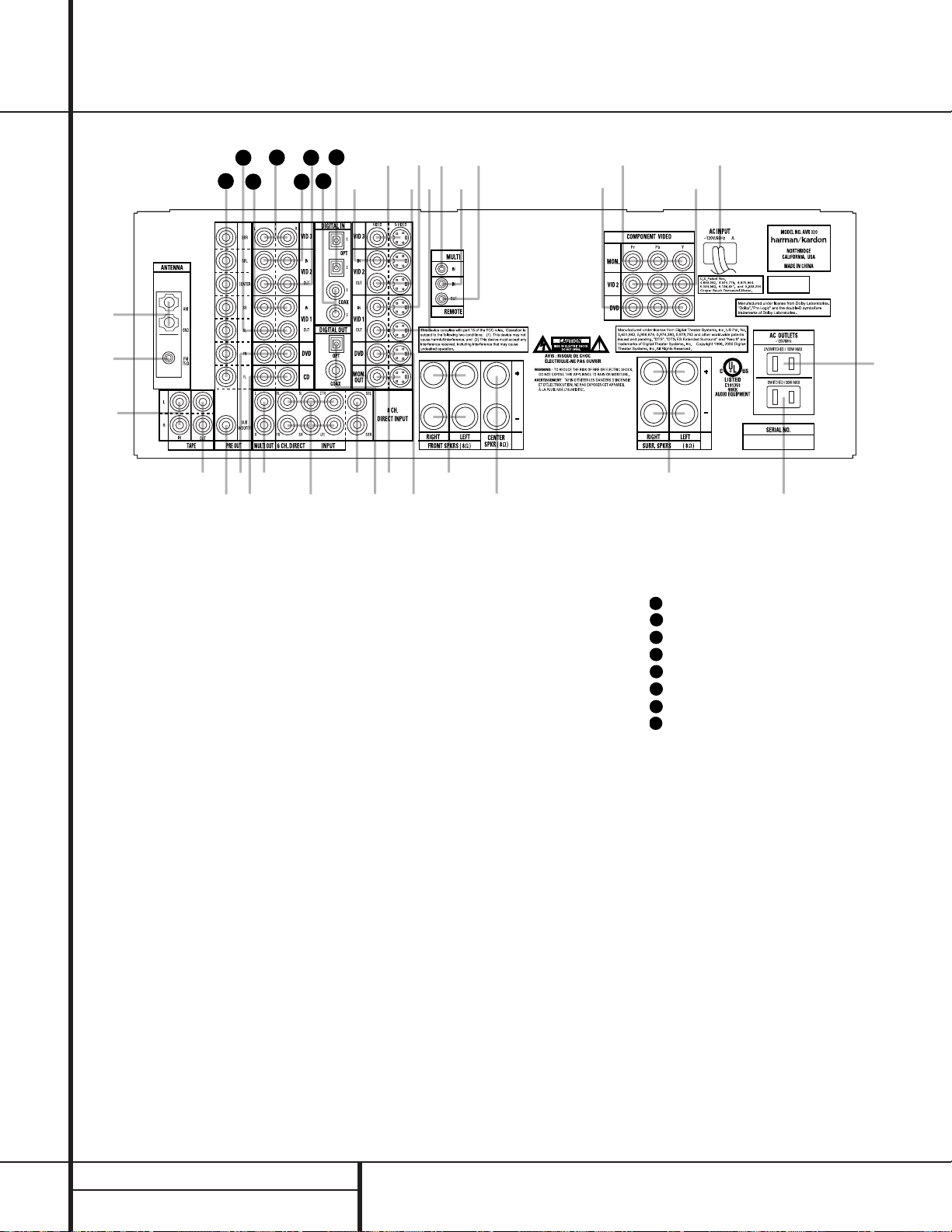
10 REAR PANEL CONNECTIONS
¡ AM Antenna: Connect the AM loop antenna
supplied with the receiver to these terminals. If an
external AM antenna is used, make connections
to the
AM and GND terminals in accordance
with the instructions supplied with the antenna.
™ FM Antenna: Connect the supplied indoor or
an optional external FM antenna to this terminal.
£ Tape Inputs: Connect these jacks to the
PLAY/OUT jacks of an audio recorder.
¢ Tape Outputs: Connect these jacks to the
RECORD/INPUT jacks of an audio recorder.
∞ Subwoofer Output: Connect this jack to
the line-level input of a powered subwoofer. If
an external subwoofer amplifier is used, con-
nect this jack to the subwoofer amplifier input.
§ DVD Audio Inputs: Connect these jacks
to the analog audio jacks on a DVD or other
video source.
¶ CD Inputs: Connect these jacks to the out-
put of a compact disc player or CD changer.
• Multiroom Outputs: Connect these jacks
to an optional audio power amplifier to listen
to the source selected by the mulitroom system
in a remote room.
ª 6-Channel Direct Inputs: When an
optional, external processor or playback device
with 5.1 audio capability is in use, connect the
player's output jacks here.
NOTE: To assist in making the correct connec-
tions for multichannel input output and speaker
connections, all connection jacks and terminals
have been color coded in conformance with the
latest CEA standards as follows:
Front Left: White
Front Right: Red
Center: Green
Surround Left: Blue
Surround Right: Gray
Surround Back Left: Brown
Surround Back Right: Tan
Subwoofer: Purple
Digital Audio: Orange
Composite Video: Yellow
Component Video “Y”: Green
Component Video “Pr”: Red
Component Video “Pb”: Blue
‚ 8-Channel Direct Inputs: When an
option, external processor or playback device
with 6.1 or 7. 1 audio capability is in use, con-
nect the Surround Back Left and Surround Back
Right channel outputs of the player to these
input jacks.
⁄ Digital Audio Outputs: Connect these
jacks to the matching digital input connector
on a digital recorder such as a CD-R or
MiniDisc recorder.
Rear Panel Connections
∞
ª
‚
‹
fi
fl
°
·
a
b
c
d
e
f
gi
j
‡
§
31
32
36
h
k
35
34
38
37
33
•
¶
¤
⁄
›
¡
™
£
¢
¡ AM Antenna
™ FM Antenna
£ Tape Inputs
¢ Tape Outputs
∞ Subwoofer Output
§ DVD Audio Inputs
¶ CD Inputs
• Multiroom Outputs
ª 6-Channel Direct Inputs
‚ 8-Channel Direct Inputs
⁄ Digital Audio Outputs
¤ Video Monitor Outputs
‹ DVD Video Inputs
› Front Speaker Outputs
fi Center Speaker Outputs
fl Surround Speaker Outputs
‡ Switched AC Accessory Outlet
° Unswitched AC Accessory Outlet
· AC Power Cord
a Video 2 Component Video Inputs
b Component Video Outputs
c DVD Component Video Inputs
d Remote IR Output
e Remote IR Input
f Multiroom IR Input
g Video 1 Video Outputs
h Video 1 Video Inputs
i Video 2 Video Outputs
j Video 3 Video Inputs
k Video 2 Video Inputs
Optical Digital Inputs
Coaxial Digital Inputs
Video 2 Audio Outputs
Video 2 Audio Inputs
Video 3 Audio Inputs
Video 1 Audio Inputs
Video 1 Audio Outputs
Preamp Outputs
38
37
36
35
34
33
32
31
11 REAR PANEL CONNECTIONS
Rear Panel Connections
¤ Video Monitor Outputs: Connect this
jack to the composite or S-Video input of a TV
monitor or video projector to view the on-screen
menus and the output of any standard video
source selected by the receiver’s video switcher.
‹ DVDVideo Inputs: Connect these jacks to
the composite or S-Video output jacks on a
DVD or other video source.
› Front Speaker Outputs: Connect these
outputs to the matching + or – terminals on
your left and right speakers. When making
speaker connections always make certain to
maintain correct polarity by connecting the red
(+) terminals on the AVR 320 to the red (+) ter-
minals on the speakers and the black (–) termi-
nals on the AVR 320 to the black (–) terminals
on the speakers. See page 16 for more informa-
tion on speaker polarity.
fi Center Speaker Outputs: Connect these
outputs to the matching + and – terminals on
your center channel speaker. In conformance
with the new CEA color code specification, the
Green Terminal is the positive, or "+" terminal
that should be connected to the red (+) termi-
nal on speakers with the older color coding.
Connect the black (–) terminal on the AVR to
the black negative (–) terminal on your speaker.
(See page 16 for more information on speaker
polarity.)
fl Surround Speaker Outputs: Connect
these outputs to the matching + and – termi-
nals on your surround channel speakers. In con-
formance with the new CEA color code specifi-
cation, the Blue terminal is the positive, or "+"
terminal that should be connected to the red
(+) terminal on the Surround Left speaker with
older color coding, while the Gray terminal
should be connected to the red (+) terminal on
the Surround Right speaker with the older color
coding. Connect the black (–) terminal on the
AVR to the matching black negative (–) termi-
nals for each surround speaker. (See page 17
for more information on speaker polarity.)
‡ Switched AC Accessory Outlet: This
outlet may be used to power any device you
wish to have turned on when the AVR 320 is
turned on with the
System Power Control
Button
2.
° Unswitched AC Accessory Outlet: This
outlet may be used to power any AC device.
The power will remain on at this outlet regard-
less of whether the AVR 320 is on or off.
NOTE: The total power consumption of all
devices connected to the accessory outlets
should not exceed 100 watts.
· AC Power Cord: Connect the AC plug to
an unswitched AC wall output.
a Video 2 Component Video Inputs:
Connect the Y/Pr/Pb component video outputs
of an HDTV Set-top convertor, satellite receiver,
or other video source device with component
video outputs to these jacks.
b Component Video Outputs: Connect
these outputs to the component video inputs of
a video projector or monitor. When a source
connected to one of the two
Component
Video Inputs
ac is selected the signal will
be sent to these jacks.
c DVD Component Video Inputs: Connect
the Y/Pr/Pb component video outputs of a DVD
player to these jacks.
d Remote IR Output: This connection per-
mits the IR sensor in the receiver to serve other
remote controlled devices. Connect this jack to
the “IR IN” jack on Harman Kardon (or other
compatible) equipment.
e Remote IR Input: If the AVR 320’s front-
panel IR sensor is blocked due to cabinet
doors or other obstructions, an external IR
sensor may be used. Connect the output of
the sensor to this jack.
f Multiroom IR Input: Connect the output of
an IR sensor in a remote room to this jack to
operate the AVR 320’s multiroom control system.
g Video 1 Video Outputs: Connect these
jacks to the
RECORD/INPUT composite or
S-Video jack on a VCR.
h Video 1 Video Inputs: Connect these
jacks to the
PLAY/OUT composite or S-Video
jacks on a VCR or other video source.
i Video 2 Video Outputs: Connect these
jacks to the
RECORD/INPUT composite or
S-Video jacks on a VCR.
j Video 3 Video Inputs: Connect these
jacks to the
PLAY/OUT composite or S-Video
jacks on a VCR or other video source.
k Video 2 Video Inputs: Connect these
jacks to the
PLAY/OUT composite or S-Video
jacks on a VCR or other video source.
Optical Digital Inputs: Connect the opti-
cal digital output from a DVD player, HDTV
receiver, the S/P-DIF output of a compatible
computer sound card playing MP3 files or
streams, LD player or CD player to these jacks.
The signal may be either a Dolby Digital signal,
a DTS signal or a standard PCM digital source.
Coaxial Digital Inputs: Connect the coax
digital output from a DVD player, HDTV receiver,
the S/P-DIF output of a compatible computer
sound card playing MP3 files or streams, LD player
or CD player to these jacks. The signal may be
either a Dolby Digital signal, DTS signal or a stan-
dard PCM digital source. Do not connect the RF
digital output of an LD player to these jacks.
Video 2 Audio Outputs: Connect these
jacks to the
RECORD/INPUT audio jacks on a
VCR or other video source.
Video 2 Audio Inputs: Connect these
jacks to the
PLAY/OUT audio jacks on a VCR
or other video source.
Video 3 Audio Inputs: Connect these
jacks to the
PLAY/OUT audio jacks on a VCR
or other video source.
Video 1 Audio Inputs: Connect these
jacks to the
PLAY/OUT audio jacks on a VCR
or other video source.
Video 1 Audio Outputs: Connect these
jacks to the
RECORD/INPUT audio jacks on a
VCR.
Preamp Outputs: These jacks may be
connected to the inputs of an optional, external
power amplifier.
38
37
36
35
34
33
32
31
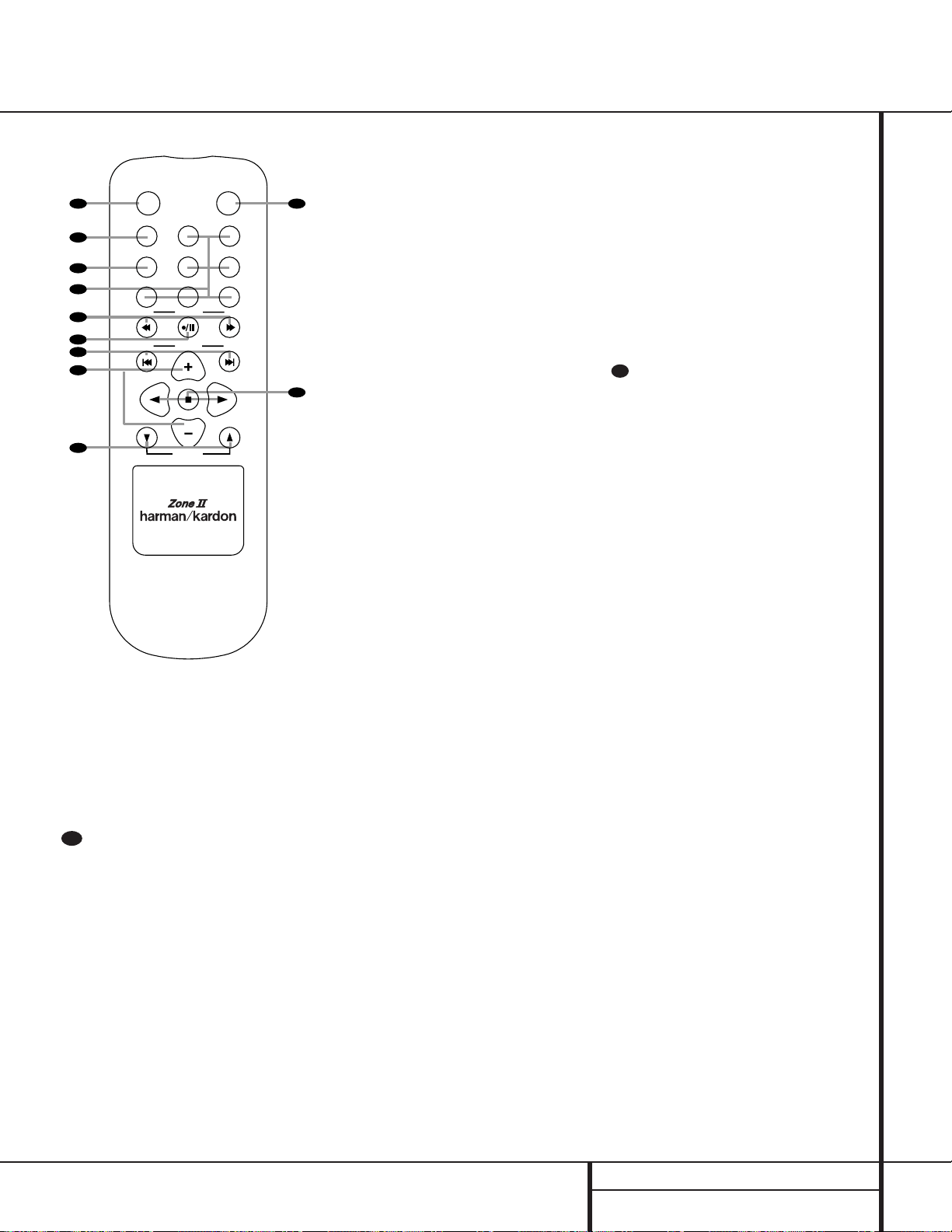
12 MAIN REMOTE CONTROL FUNCTIONS
●
●
●
●
●
●
●
●
●
●
●
●
●
●
●
●
●
a
bc
d
e
g
h
i
j
l
n
o
`
32
30
29
37
36
35
34
33
31
38
x
39
40
41
42
43
44
f
m
k
p
q
n
r
s
t
u
v
w
y
28
z
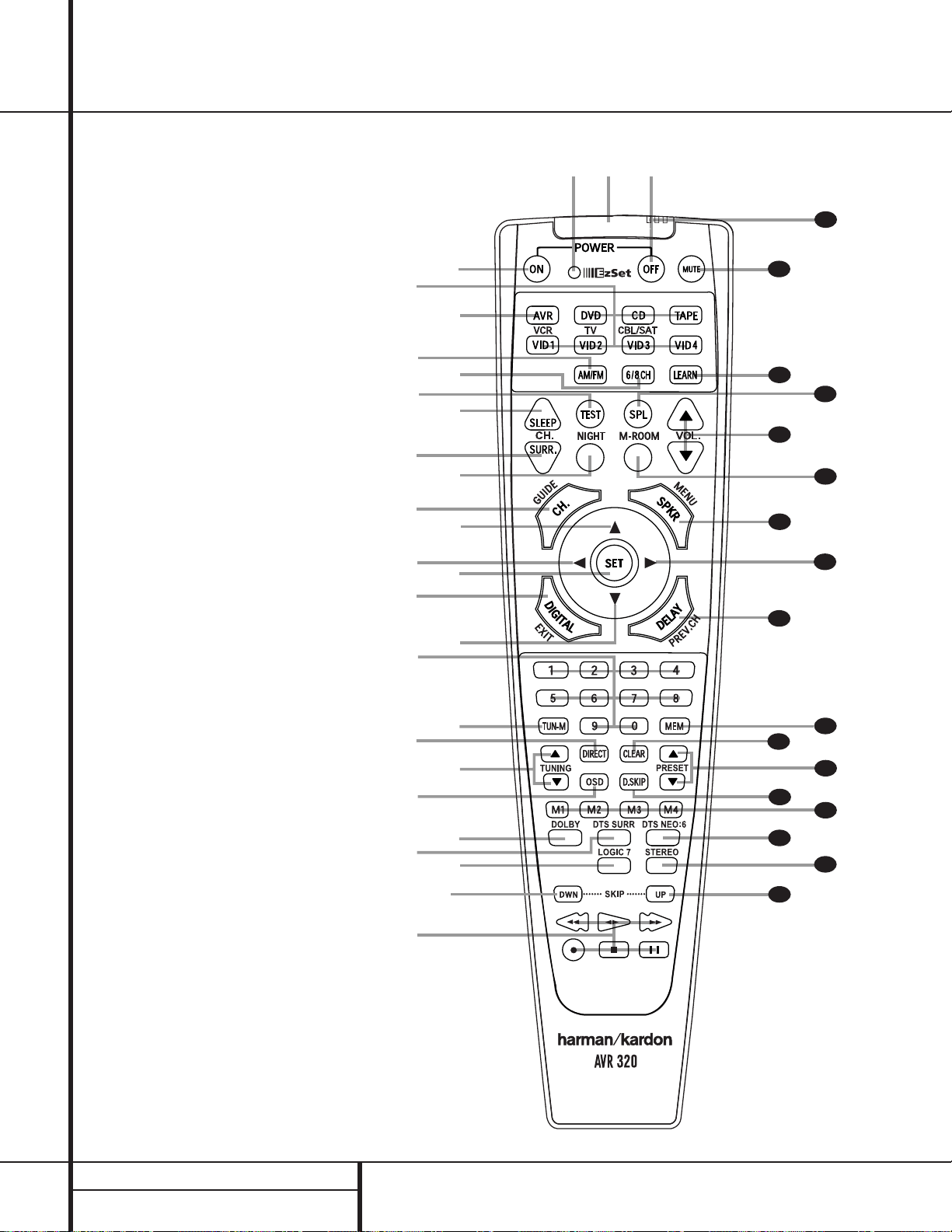
a Power Off Button
b IR Transmitter Window
c Program/SPL Indicator
d Power On Button
e Input Selectors
f AVR Selector
g AM/FM Tuner Select
h 6-Channel/8-Channel Direct Input
i Test Button
j Sleep Button
k Surround Mode Selector
l Night Mode
m Channel Select Button
n
⁄
/
¤
Buttons
o
‹
Button
p Set Button
q Digital Select
r Numeric Keys
s Tuner Mode
t Direct Button
u Tuning Up/Down
v OSD Button
w Dolby Mode Select Button
x DTS Digital Mode Selector
y Logic 7 Mode Select Button
z Skip Down Button
` Transport Controls
28
Skip Up Button
29
Stereo Mode Select Button
30
DTS Neo:6 Mode Select
31
Macro Buttons
32
Disc Skip Button
33
Preset Up/Down
34
Clear Button
35
Memory Button
36
Delay/Prev. Ch.
37
›
Button
38
Speaker Select
39
Multiroom
40
Volume Up/Down
41
SPL Indicator Select
42 Learn Button
43
Mute
44
EzSet Sensor Microphone
NOTE: The function names shown here are each but-
ton’s feature when used with the AVR 320. Most buttons
have additional functions when used with other devices.
See pages 42–43 for a list of these functions.
Main Remote Control Functions
13 MAIN REMOTE CONTROL FUNCTIONS
Main Remote Control Functions
IMPORTANT NOTE: The AVR 320’s remote
may be programmed to control up to eight
devices, including the AVR 320. Before using the
remote, it is important to remember to press the
Input Selector Button e that corresponds
to the unit you wish to operate. In addition, the
AVR 320’s remote is shipped from the factory to
operate the AVR 320 and most Harman Kardon
CD or DVD players and cassette decks. The
remote is also capable of operating a wide vari-
ety of other products using the control codes
that are part of the remote. Before using the
remote with other products, follow the instruc-
tions on pages 37–41 to program the proper
codes for the products in your system.
It is also important to remember that many of
the buttons on the remote take on different
functions, depending on the product selected
using the Device Control Selectors. The descrip-
tions shown here primarily detail the functions
of the remote when it is used to operate the
AVR 320. (See page 39 for information about
alternate functions for the remote’s buttons.)
a Power Off Button: Press this button to
place the AVR 320 or a selected device in the
Standby mode. Note that this will turn off the
main room functions, but if the Multiroom sys-
tem is activated, it will continue to function.
b IR Transmitter Window: Point this win-
dow towards the AVR 320 when pressing buttons
on the remote to make certain that infrared com-
mands are properly received.
c Program/SPL Indicator: This three-color
indicator is used to guide you through the
process of programming the remote or learning
commands from a remote into the AVR 320’s
remote code memory and it is also used as a
level indicator when using the remote’s EzSet
capabilities. (See page 24 for more information
on setting output levels, and see page 37 for
information on programming the remote.)
d Power On Button: Press this button to
turn on the power to a device selected by press-
ing one of the
Input Selectors e.
e Input Selectors: Pressing one of these
buttons will perform three actions at the same
time. First, if the AVR 320 is not turned on, this
will power up the unit. Next, it will select the
source shown on the button as the input to the
AVR 320. Finally, it will change the remote con-
trol so that it controls the device selected. After
pressing one of these buttons you must press
the
AVR Selector Button f again to oper-
ate the AVR 320’s functions with the remote.
f AVR Selector: Pressing this button will
switch the remote so that it will operate the
AVR 320’s functions. If the AVR 320 is in the
Standby mode, it will also turn the AVR 320 on.
g AM/FM Tuner Select: Press this button to
select the AVR 320’s tuner as the listening
choice. Pressing this button when the tuner is
already in use will select between the AM and
FM bands.
h 6-Channel/8-Channel Direct Input:
Press this button to select the device connected
to the
6-Channel Direct Inputs ª or the 8-
Channel Direct Inputs
‚. (See page 33 for
more information.)
i Test Button: Press this button to begin
the sequence used to calibrate the AVR 320’s
output levels. (See page 24 for more information
on calibrating the AVR 320.)
j Sleep Button: Press this button to place
the unit in the Sleep mode. After the time
shown in the display, the AVR 320 will auto-
matically go into the Standby mode. Each press
of the button changes the time until turn-off in
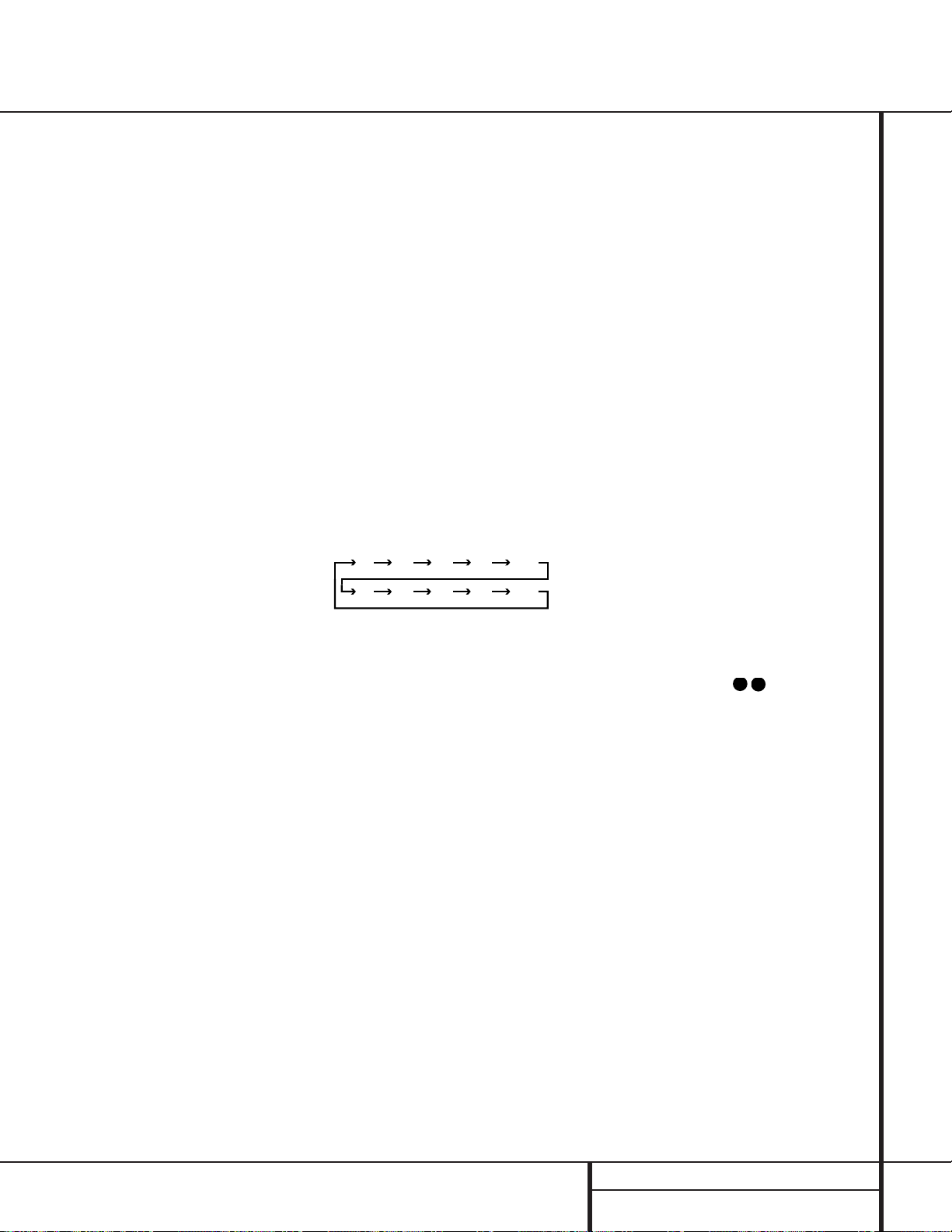
the following order:
Note that this button is also used to change
channels on your TV when the TV is selected.
When the AVR 320 remote is being programmed
with the codes to operate another device, this
button is also used in the “Auto Search” process.
(See page 37 for more information on program-
ming the remote.)
k Surround Mode Selector: Press this
button to begin the process of changing the
surround mode. After the button has been
pressed, use the
⁄
/
¤
Buttons n to select
the desired surround mode. (See page 28 for
more information.) Note that this button is also
used to tune channels when the TV is selected
using the device
Input Selector e.
When the AVR 320 remote is being pro-
grammed with the codes of another device, this
button is also used in the “Auto Search”
process. (See page 37 for more information on
programming the remote.)
l Night Mode: Press this button to activate
the Night mode. This mode is available in spe-
cially encoded digital sources, and it preserves
dialog (center channel) intelligibility at low
volume levels.
m Channel Select Button: This button is
used to start the process of setting the AVR 320’s
output levels to an external source. Once this but-
ton is pressed, use the
⁄
/
¤
Buttons n to
select the channel being adjusted, then press the
Set Button p, followed by the
⁄
/
¤
Buttons
n again, to change the level setting. (See page
32 for more information.)
n
⁄
/
¤
Buttons: These multipurpose but-
tons are used to change or scroll through items
in the on-screen menus, make configuration
settings such as digital inputs or delay timing,
or to select surround modes. When changing a
setting, first press the button for the function or
setting to be changed (e.g., press the
Surround Mode Selector k to select a
soundfield mode or the
Digital Select Button
q to change a digital input) and then press
one of these buttons to scroll through the list
of options or to increase or decrease a setting.
The sections in this manual describing the indi-
vidual features and functions contain specific
information on using these buttons for each
application.
o
‹
Button: This button is used to change
the menu selection or setting during some of
the setup procedures for the AVR 320.
p Set Button: This button is used to enter
settings into the AVR 320’s memory. It is also
used in the setup procedures for delay time,
speaker configuration and channel output level
adjustment.
q Digital Select: Press this button to assign
one of the digital inputs
*Ó to a
source. (See page 29 for more information on
using digital inputs.)
r Numeric Keys: These buttons serve as a
ten-button numeric keypad to enter tuner preset
positions. They are also used to select channel
numbers when TV, Cable or SAT has been
selected on the remote, or to select track num-
bers on a CD, DVD or LD player, depending on
how the remote has been programmed.
s Tuner Mode: Press this button when the
tuner is in use to select between automatic
tuning and manual tuning. When the button is
pressed so that the
AUTO Indicator X goes
out, pressing the
Tuning Buttons u)
≠
will move the frequency up or down in single-
step increments. When the FM band is in use,
pressing this button when a station’s signal is
weak will change to monaural reception. (See
page 31 for more information.)
t Direct Button: Press this button when
the tuner is in use to start the sequence for
direct entry of a station’s frequency. After press-
ing the button, simply press the proper
Numeric Keys r to select a station. (See
page 32 for more information on the tuner.)
32
31
90
min
80
min
70
min
60
min
50
min
40
min
30
min
20
min
10
min
OFF
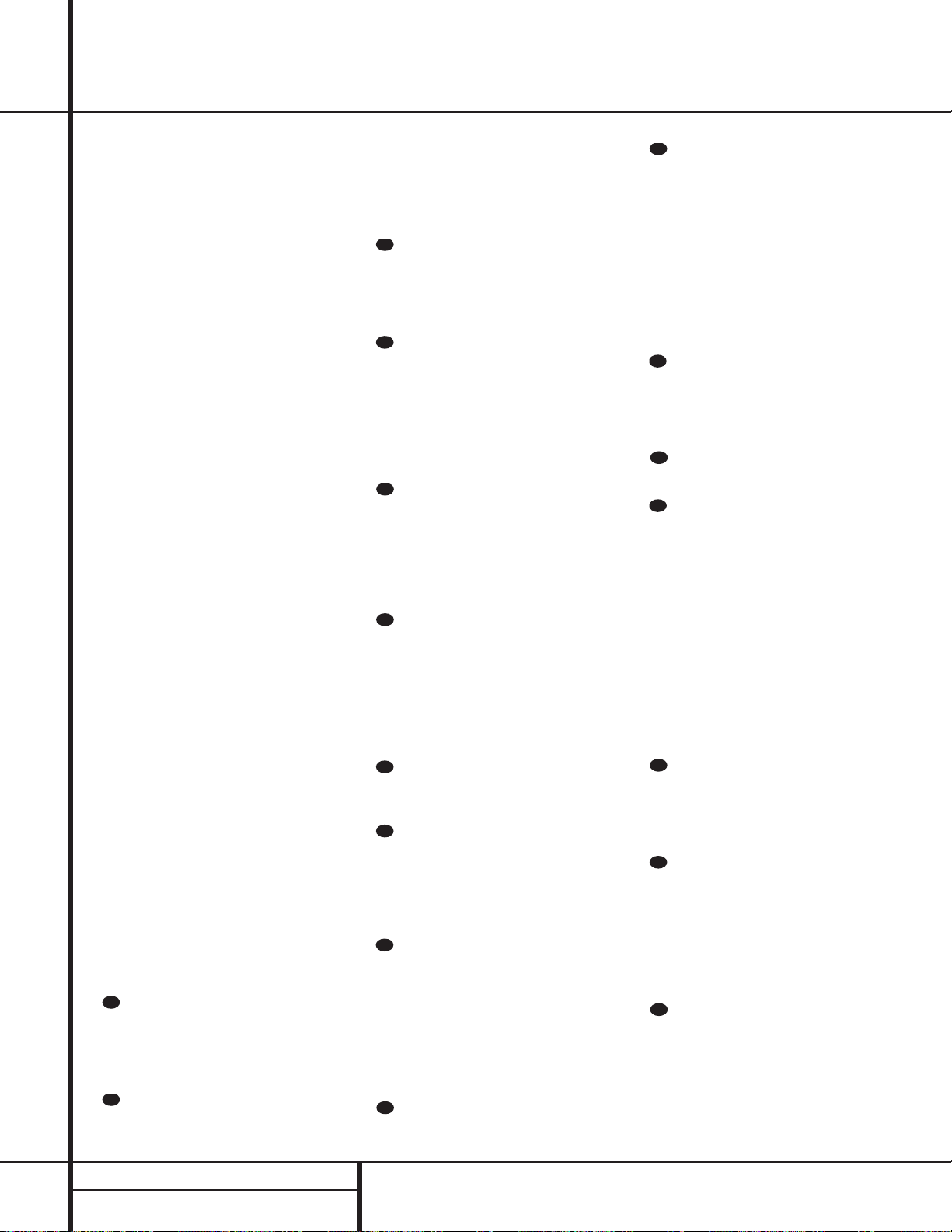
u Tuning Up/Down: When the tuner is in
use, these buttons will tune up or down through
the selected frequency band. If the
Tuner Mode
Button
s^ has been pressed so that the
AUTO Indicator X is illuminated, pressing and
holding either of the buttons for three seconds
will cause the tuner to seek the next station with
acceptable signal strength for quality reception.
When the
AUTO Indicator X is NOT illumi-
nated, pressing these buttons will tune stations
in single-step increments. (See page 31 for more
information.)
v OSD Button: Press this button to activate
the On-Screen Display (OSD) system used to set
up or adjust the AVR 320’s parameters.
w Dolby Mode Selector: This button is
used to select from among the available Dolby
Surround processing modes. Each press of this
button will select one of the Dolby Pro Logic II
modes or Dolby 3 Stereo. When a Dolby Digital
encoded source is in use, the Dolby Digital mode
may also be selected. (See page 26 for the avail-
able Dolby surround mode options.)
x DTS Digital Mode Selector: When a
DTS-encoded digital source is selected, each
press of this button will scroll thorugh the avail-
able DTS modes. The specific choice of modes
will vary according to whether or not the source
material contains DTS-ES 6.1 Discrete encoding.
When a DTS source is not in use, this button has
no function. (See page 40 for the available DTS
Digital options.)
y Logic 7 Selector: Press this button to
select from among the available Logic 7 sur-
round modes. (See page 26 for the available
Logic 7 options.)
z Skip Down Button: This button does not
have a direct function on the AVR 320, but
when used with a compatibly programmed CD
or DVD changer it will change to the previous
disc in the changer or carousel.
` Transport Controls: These buttons do
not have any functions for the AVR 320, but
they may be programmed for the forward/
reverse play operation of a wide variety of CD
or DVD players, and audio or video cassette
recorders. (See page 40 for more information.)
Skip Up Button: This button does not
have a direct function on the AVR 320, but
when used with a compatibly programmed CD
or DVD changer it will change to the previous
disc in the changer or carousel.
Stereo Mode Select Button: Pressing
this button cycles through the stereo modes,
and it is also used to turn off all surround
processing and place the unit in a traditional
two-channel Stereo mode. The first press
selects 5-Channel Stereo, the next press selects
8-Channel Stereo, and the third press selects
“SURROUND OFF,” which is true Stereo.
Macro Buttons: Press these buttons
to store or recall a “Macro”, which is a
preprogrammed sequence of commands
stored in the remote. (See page 38 for more
information on storing and recalling macros.)
DTS Neo:6 Mode Select: Pressing
this button cycles the AVR through the various
DTS Neo:6 modes, which extract a five-channel
surround field from two-channel program
material. The first press selects the last
DTS Neo:6 surround mode that was in use,
and each subsequent press selects one of the
other DTS Neo:6 modes.
Disc Skip Button: This button has no
direct function for the AVR 320 but is most
often used to change to the next disc in a CD
or DVD player when the remote is programmed
for that type of device. (See page 37 for more
information on using the remote with products
other than the AVR 320.)
Preset Up/Down: When the tuner is
in use, press these buttons to scroll through the
stations programmed into the AVR 320’s mem-
ory. When some source devices, such as CD
players, VCRs and cassette decks, are selected
using the device
Input Selectors e, these
buttons may function as Chapter Step or Track
Advance.
Clear Button: Press this button to clear
incorrect entries when using the remote to
directly enter a radio station’s frequency.
Memory Button: Press this button to
enter a radio station into the AVR 320’s preset
memory. Once the
MEMORY Indicator U
flashes, you have five seconds to enter a preset
memory location using the
Numeric Keys
r. (See page 31 for more information.)
Delay/Prev Ch.: Press this button to
begin the process for setting the delay times
used by the AVR 320 when processing surround
sound. After pressing this button, the delay
times are entered by pressing the
Set Button
p and then using the
⁄
/
¤
Buttons n to
change the setting. Press the
Set Button p
again to complete the process. (See page 23 for
more information.)
›
Button: Press this button to change a
setting or selection when configuring many of the
AVR 320’s settings.
Speaker Select: Press this button
to begin the process of configuring the
AVR 320’s bass management system for use
with the type of speakers used in your system.
Once the button has been pressed, use the
⁄
/
¤
Buttons n to select the channel you
wish to set up. Press the
Set Button p and
then select another channel to configure.
When all adjustments have been completed,
press the
Set Button p twice to exit the
settings and return to normal operation. (See
page 22 for more information.)
Multiroom: Press this button to activate
the multiroom system or to begin the process of
changing the input or volume level for the sec-
ond zone. (See page 36 for more information on
the Multiroom system.)
Volume Up/Down: Press these buttons
to raise or lower the system volume.
SPL Indicator Select: This button acti-
vates the AVR 320’s EzSet function to quickly
and accurately calibrate the AVR 320’s output
levels. Press and hold the button for three
seconds and then release it. Note that the
test tone will begin circulating, and the
Program/SPL Indicator c will change
colors. During this sequence, EzSet will
automatically adjust the output levels for all
channels until they are equal, as shown by
the
Program/SPL Indicator c lighting
green for each channel. Press this button
again when the adjustment is complete to
turn off the test tone. (See page 24 for more
information on EzSet.)
Learn Button: Press this button to begin
the process of “learning” the codes from another
product’s remote into the AVR 320’s remote. (See
page 37 for more information on using the
remote’s learning function.)
Mute: Press this button to momentarily
silence the AVR 320 or TV set being controlled,
depending on which device has been selected.
When the AVR 320 remote is being programmed
to operate another device, this button is pressed
with the
Input Selector Button e to begin
the programming process. (See page 37 for
more information on programming the remote.)
EzSetSensor Microphone: The sensor
microphone for the EzSet microphone is behind
these slots. When using the remote to calibrate
speaker output levels using EzSet, be sure that
you do not hold the remote in a way that cov-
ers these slots. (See page 24 for more informa-
tion on using EzSet.)
44
43
42
41
40
39
38
37
36
35
34
33
32
31
30
29
28
14 MAIN REMOTE CONTROL FUNCTIONS
Main Remote Control Functions
15
ZONE II REMOTE CONTROL FUNCTIONS
Zone II Remote Control Functions
å
Power Off: When used in the room
where the AVR 320 is located, press this button
to place the unit in Standby. When it is used in
a remote room with a sensor that is connected
to the
Multiroom IR Input f, this button
turns the Multiroom system on and off.
∫
AVR Selector: Press this button to turn
on the AVR 320. The input in use when the unit
was last on will be selected.
ç
AM/FM Tuner Select: Press this button
to select the Tuner as the input to the
Multiroom system. Press it again to change
between the AM and FM bands.
∂
Input Selectors: When the AVR 320 is
off, press one of these buttons to select a spe-
cific input and turn the unit on. When the unit
is already in use, pressing one of these buttons
will change the input.
≠
Tuning Up/Down – Fast Play: When
this remote is used in the same room as the
AVR 320, these buttons may be used to change
the frequency of the tuner. These buttons may
also control the Fast Play or Fast Reverse func-
tions of compatible Harman Kardon CD, DVD or
cassette decks in the same room, or from a
remote room when an IR link is connected to
the AVR 320.
ƒ
Record/Pause: Press this button to acti-
vate the Record or Pause function on compati-
ble Harman Kardon CD, DVD or Cassette Deck
products.
©
Preset Up/Down – Track Skip: When
the AVR 320’s tuner is selected as the input
source, these buttons will move up or down
through the list of stations that have been
stored in the preset memory. When a CD or
DVD changer or player is selected, these but-
tons activate the Forward or Reverse Track or
Chapter Skip functions.
˙
Disc Skip: Press this button to change
discs on compatible Harman Kardon CD or DVD
changer or players.
Volume Up/Down: When used in the
room where the AVR 320 is located, press this
button to raise or lower the volume in that
room. When it is used in a remote room with a
sensor that is connected to the
Multiroom IR
Input
f, this button will raise or lower the
volume in the remote room.
∆
Play Forward/Reverse/Stop: Press
these buttons to control compatible
Harman Kardon CD, DVD or cassette players.
˚
Mute: When used in the room where the
AVR 320 is located, press this button to tem-
porarily silence the unit. When it is used in a
remote room with a sensor that is connected to
the
Multiroom IR Input f, this button will
temporarily silence the feed to the remote room
only. Press the button again to return to the
previous volume level.
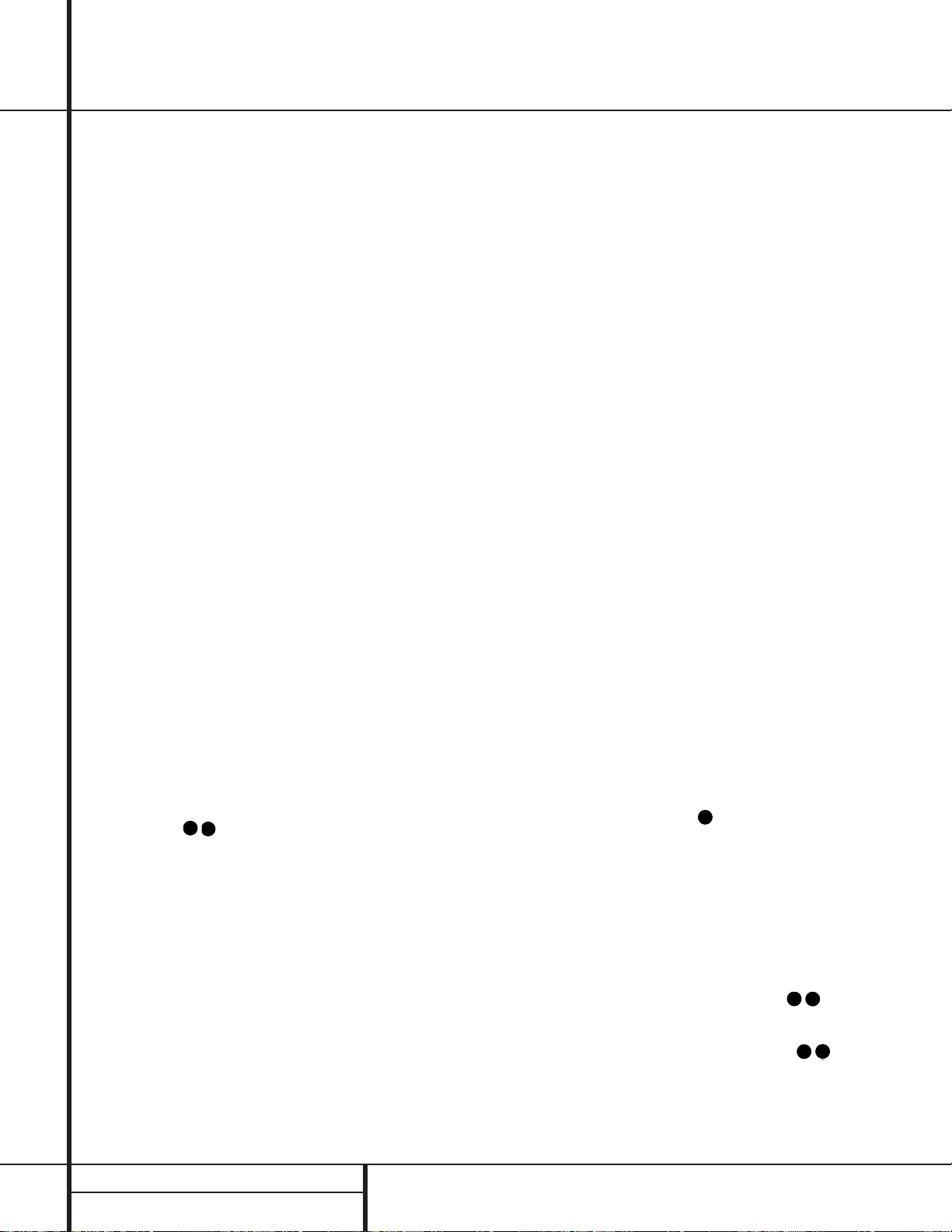
I
å
Power Off
∫
AVR Selector
ç
AM/FM Tuner Select
∂
Input Selectors
≠
Tuning Up/Down – Fast Play
ƒ
Record/Pause
©
Preset/Track Skip
˙
Disc Skip
Volume Up/Down
∆
Play Forward/Reverse/Stop
˚
Mute
I
POWER
OFF
MUTE
AVR
AM/
/
FM
VID 1
VID 3
DVD
CD
TAPE
DN
TUNING
PRESET
VOLUME
DISC SKIP
DISC SKIP
UP
DN
UP
VID 4
VID 2
G
A
B
C
D
E
F
H
I
K
J
NOTE: The Zone II remote may be used in either the same room where the AVR 320 is located, or it
may be used in a separate room with an optional infrared sensor that is connected to the AVR 320’s
Multiroom IR Input f. When it is used in the same room as the AVR 320, it will control the func-
tions of the AVR 320 or any compatible Harman Kardon products in that room. When it is used in a
separate room via a sensor connected to the
Multiroom IR Input f, the buttons for power, input
source, volume and mute will control the source and volume for the second zone, as connected to
the
Multiroom Outputs •. (See page 36 for complete information on using the Multiroom system.)
System Installation
After unpacking the unit, and placing it on a solid
surface capable of supporting its weight, you will
need to make the connections to your audio and
video equipment.
IMPORTANT NOTE: For your personal safety
and to avoid possible damage to your equipment
and speakers, it is always good practice to turn
off and unplug the AVR and ALL source equip-
ment from the AC output before making any
audio or video system connections.
Audio Equipment Connections
We recommend that you use high-quality inter-
connect cables when making connections to
source equipment and recorders to preserve the
integrity of the signals.
1. Connect the analog output of a CD player to
the
CD Inputs ¶.
NOTE: When the CD player has both fixed and
variable audio outputs, it is best to use the fixed
output unless you find that the input to the
receiver is so low that the sound is noisy, or so
high that the signal is distorted.
2. Connect the analog Play/Out jacks of a cas-
sette deck, MD, CD-R or other audio recorder to
the
Tape Input Jacks £. Connect the analog
Record/In jacks on the recorder to the
Tape
Output Jacks
¢ on the AVR 320.
3. Connect the output of any digital sources
such as such as a CD or DVD changer or play-
er, advanced video game, a digital satellite
receiver, HDTV tuner or digital cable set-top
box or the output of a compatible computer
sound card to the
Optical and Coaxial
Digital Inputs
*Ó.
4. Connect the coaxial or optical
Digital Audio
Outputs
⁄ on the rear panel of the AVR 320 to
the matching digital input connections on a CD-R
or MiniDisc recorder.
5. Assemble the AM Loop Antenna supplied
with the unit as shown below. Connect it to the
AM and GND Screw Terminals ¡ .
6. Connect the supplied FM antenna to the
FM
(75-ohm) Connection ™.The FM antenna
may be an external roof antenna, an inside
powered or wire-lead antenna or a connection
from a cable TV system. Note that if the anten-
na or connection uses 300-ohm twin-lead
cable, you must use the 300-ohm-to-75-ohm
adapter supplied with the unit to make the con-
nection.
7. Connect the front, center and surround
speaker outputs
›fifl to the respective
speakers.
To ensure that all the audio signals are carried
to your speakers without loss of clarity or reso-
lution, we suggest that you use high-quality
speaker cable. Many brands of cable are avail-
able and the choice of cable may be influenced
by the distance between your speakers and the
receiver, the type of speakers you use, personal
preferences and other factors. Your dealer or
installer is a valuable resource to consult in
selecting the proper cable.
Regardless of the brand of cable selected, we
recommend that you use a cable constructed of
multistrand copper with a gauge of 14 or smaller.
Remember that in specifying cable, the lower
the number, the thicker the cable.
Cable with a gauge of 16 may be used for short
runs of less than ten feet. We do not recom-
mend that you use cables with an AWG equiva-
lent of 18 or higher, due to the power loss and
degradation in performance that will occur.
Cables that are run inside walls should have the
appropriate markings to indicate listing with UL,
CSA or other appropriate testing agency stan-
dards. Questions about running cables inside
walls should be referred to your installer or a
licensed electrician who is familiar with the NEC
and/or the applicable local building codes in
your area.
When connecting wires to the speakers, be cer-
tain to observe proper polarity. Note that the
positive (+) terminal of each speaker connection
now carries a specific color code as noted on
page 11. However, most speakers will still use a
red terminal for the postive (+) connection.
Connect the “negative” or “black” wire to the
same terminal on both the receiver and the
speaker.
NOTE: While most speaker manufacturers
adhere to an industry convention of using black
terminals for negative and red ones for positive,
some manufacturers may vary from this config-
uration. To ensure proper phase and optimal
performance, consult the identification plate on
your speaker or the speaker’s manual to verify
polarity. If you do not know the polarity of your
speaker, ask your dealer for advice before pro-
ceeding, or consult the speaker’s manufacturer.
We also recommend that the length of cable
used to connect speaker pairs be identical. For
example, use the same length piece of cable
to connect the front-left and front-right or
surround-left and surround-right speakers,
even if the speakers are a different distance
from the AVR 320.
8. Connections to a subwoofer are normally
made via a line-level audio connection from the
Subwoofer Output ∞ to the line-level input
of a subwoofer with a built-in amplifier. When a
passive subwoofer is used, the connection first
goes to a power amplifier, which will be con-
nected to one or more subwoofer speakers. If
you are using a powered subwoofer that does
not have line-level input connections, follow the
instructions furnished with the speaker for con-
nection information.
9. If an external multi-channel audio source
with 5.1 outputs such as an external digital
processor/decoder, DVD-Audio or SACD player
is used, connect the outputs of that device to
the
6-Channel Direct Inputs ª.
10. If an external multi-channel audio source
with 7.1 outputs such as an external digital
processor/decoder, DVD-Audio or SACD player
is used, first connect the outputs of that device
to both the 6 Channel Direct Inputs as noted
above, and then connect the Surround Back Left
and Surround Back Right output channels of
the source device to the
8-Channel Direct
Inputs
‚.
11. If a 7.1 channel source device is connected
as noted in the item above, you must use an
optional audio power amplifier for those chan-
nels. Connect the
SBL and SBR Preamp
Outputs
to the inputs of the amplifier
feeding those channels' speakers.
Video Equipment Connections
Video equipment is connected in the same man-
ner as audio components. Again, the use of high-
quality interconnect cables is recommended to
preserve signal quality.
1. Connect a VCR’s or other video source’s
audio and video Play/Out jacks to the
Video 1
or Video 2 In Jacks hk on the rear
panel. The Audio and Video Record/In jacks on
the VCR should be connected to the
Video 1
or Video 2 Out Jacks gi on the
AVR 320.
2. Connect the analog audio and video outputs
of a satellite receiver, cable TV converter or
37
33
36
34
38
32
31
16
INSTALLATION AND CONNECTIONS
Installation and Connections
17 INSTALLATION AND CONNECTIONS
Installation and Connections
television set or any other video source to the
Video 3 j jacks.
3. Connect the analog audio and video out-
puts of a DVD or laser disc player to the
DVD
Jacks
§‹.
4. Connect the digital audio outputs of a DVD
player, satellite receiver, cable box or HDTV con-
verter to the appropriate
Optical or Coaxial
Digital Inputs
*Ó.
5. Connect the
Video Monitor Output ¤
jacks on the receiver to the composite or S-
Video input of your television monitor or video
projector.
6. If your DVD player and monitor both have
component video connections, connect the
component outputs of the DVD player to the
DVD Component Video Inputs c. Note
that even when component video connections
are used, the audio connections should still be
made to either the analog
DVD Audio Inputs
§ or any of the Optical or Coaxial Digital
Input Jacks
*Ó.
7. If another component video device is avail-
able, connect it to the
Video 2 Component
Video Input Jacks
a.The audio connections
for this device should be made to either the
Video 2 Audio Input Jacks or any of the
Optical or Coaxial Digital Input Jacks
*Ó
.
8. If the component video inputs are used, con-
nect the
Component Video Output b to
the component video inputs of your TV, projec-
tor or display device.
9. If you have a camcorder, video game or other
audio/video device that is connected to the AVR
on a temporary, rather than permanent basis,
connect the audio, video and digital audio out-
puts of that device the
Front Panel Inputs
*ÓÔ.A device connected here is selected
as the Video 4 input, and the digital inputs
must be assigned to the Video 4 input. (See
page 20 for more information on input configu-
ration.)
Video Connection Notes:
• When the component video jacks are used,
the on-screen menus are not visible and you
must switch to the standard composite or S-
Video input on your TV to view them.
•The AVR 320 will accept either standard
composite, S-Video or Y/Pr/Pb component
video signals. However, it will not convert
composite or S signals to component video.
• Component or composite video signals may
only be viewed in their native formats.
System and Power Connections
The AVR 320 is designed for flexible use with
multiroom systems.
Main Room Remote Control Extension
If the receiver is placed behind a solid or
smoked glass cabinet door, the obstruction may
prevent the remote sensor from receiving com-
mands. In this event, an optional remote sensor
may be used. Connect the output of the remote
sensor to the
Remote IR Input Jack e.
If other components are also prevented from
receiving remote commands, only one sensor is
needed. Simply use this unit’s sensor or a
remote eye by running a connection from the
Remote IR Output Jack d to the Remote IR
Input jack on Harman Kardon or other compati-
ble equipment.
Multiroom IR Link
The remote room IR receiver should be connected
to the AVR 320 via standard coaxial cable. Plug
the IR connection cable into the
Multiroom IR
Input Jack
f on the AVR 320’s rear panel.
If other Harman Kardon compatible source
equipment is part of the main room installation,
the
Remote IR Output Jack d on the rear
panel should be connected to the IR IN jack on
source equipment. This will enable the remote
room location to control source equipment func-
tions.
NOTE: All remotely controlled components
must be linked together in a “daisy chain”.
Connect the
IR OUT jack of one unit to the IR
IN
of the next to establish this chain.
Multiroom Audio Connections
Depending on the distance from the AVR 320
to the remote room, two options are available
for audio connection:
Option 1: Use high-quality, shielded audio
interconnect cable from the AVR 320’s location
to the remote room. In the remote room, con-
nect the interconnect cable to a stereo power
amplifier. The amplifier will be connected to the
room’s speakers. At the AVR 320, plug the
audio interconnect cables into the
Multiroom
Output Jacks
• on the AVR 320’s rear panel.
Option 2: Connect the Multiroom Output
Jacks
• on the AVR 320 to the inputs of an
optional stereo power amplifier. Run high-quali-
ty speaker wire from the amplifier to the speak-
ers in the remote room.
NOTE: In both options, you may connect an
optional IR sensor in the remote room to the
AVR 320 via an appropriate cable. Connect the
sensor’s cable to the
Multiroom IR Input f
on the AVR 320 and use the Zone II remote to
control the room volume. Alternatively, you may
install an optional volume control between the
output of the amplifiers and the speakers.
AC Power Connections
This unit is equipped with two accessory AC
outlets. They may be used to power accessory
devices, but they should not be used with high-
current draw equipment such as power ampli-
fiers. The total power draw to each outlet may
not exceed 100 watts.
The
Switched AC Accessory Outlet ‡ will
receive power only when the unit is on. This is
recommended for devices that have no power
switch or a mechanical power switch that may
be left in the “ON” position.
NOTE: Many audio and video products go into
a Standby mode when they are used with
switched outlets, and cannot be fully turned on
using the outlet alone without a remote control
command.
The
Unswitched AC Accessory Outlet °
will receive power as long as the unit is
plugged into a powered AC outlet.
Finally, when all connections are complete, plug
the power cord into a nonswitched 110-volt AC
wall outlet. You’re almost ready to enjoy the
AVR 320!
32
31
34
32
31
32
31
35
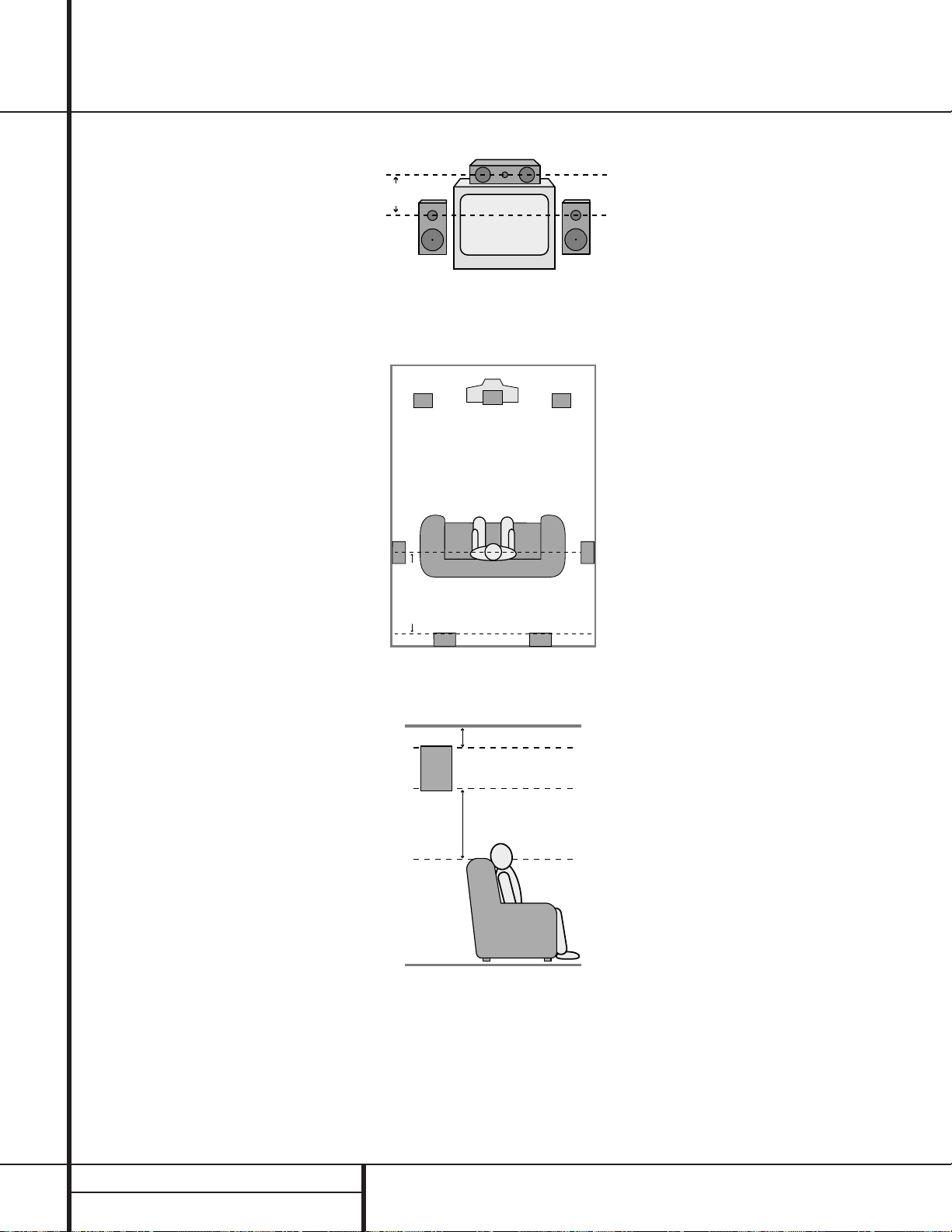
When all audio, video and system connections
have been made, there are a few configuration
adjustments that must be made. A few minutes
spent to correctly configure and calibrate the
unit will greatly add to your listening experience.
Speaker Selection and Placement
The placement of speakers in a multichannel
home-theater system can have a noticeable
impact on the quality of sound reproduced.
No matter which type or brand of speakers is
used, the same model or brand of speaker
should be used for the left front, center and
right front speakers. This creates a seamless
front soundstage and eliminates the possibility
of distracting sonic disturbances that occur
when a sound moves across mismatched
front-channel speakers.
Speaker Placement
Depending on the type of center-channel speaker
in use and your viewing device, place the center
speaker either directly above or below your TV,
or in the center behind a perforated front pro-
jection screen.
Once the center channel speaker is installed,
position the front left and front right speakers
so that they are as far away from one another
as the center-channel speaker is from the pre-
ferred listening position. Ideally, the front-channel
speakers should be placed so that their tweeters
are no more than 24" above or below the
tweeter in the center-channel speaker.
Depending on the specifics of your room
acoustics and the type of speakers in use, you
may find that imaging is improved by moving
the left front and right front speakers slightly
forward of the center-channel speaker. If possi-
ble, adjust all front loudspeakers so that they
are aimed at ear height when you are seated
in the listening position.
Using these guidelines, you’ll find that it takes
some experimentation to find the correct loca-
tion for the front speakers in your particular
installation. Don’t be afraid to move things
around until the system sounds correct. Optimize
your speakers so that audio transitions across
the front of the room sound smooth, and that
sounds from all speakers appear to arrive at the
listening position at the same time (without
delay from the center speaker compared to the
left and right speakers).
A) Front Channel Speaker Installation
With Direct-View TV Sets or Rear-Screen
Projectors
B) Rear speaker mounting is an alternate
location for 5.1 systems. It is required
for 7.1 operation.
When the AVR 320 is used in 5.1-channel oper-
ation, the preferred location for surround
speakers is on the side walls of the room, at or
slightly behind the listening position. In a 7.1-
channel system, both side surround and back
surround speakers are required. The center of
the speaker should face into the room. The
speakers should be located so that the bottom
of the cabinet is at least two feet higher than
the listeners’ ears when the listeners are seated
in the desired area.
Rear surround speakers are required when a
full 7.1-channel system is installed, and they
may also be used in 5.1 channel as an alterna-
tive mounting position when it is not practical
to place the main surround speakers on the
sides of the room. Speakers may be placed on a
rear wall, behind the listening position. As with
the side speakers, rear surrounds should be
located so that the bottom of the cabinet is at
least two feet higher than the listeners’ ears.
The speakers should be no more than six feet
behind the rear of the seating area.
Subwoofers produce nondirectional sound, so
they may be placed almost anywhere in a
room. Actual placement should be based on
room size and shape and the type of subwoofer
used. One method of finding the optimal loca-
tion for a subwoofer is to begin by placing it in
the front of the room, about six inches from a
wall, or near the front corner of the room.
Another method is to temporarily place the
subwoofer at your normal listening position,
and then walk around the room until you find
a spot where the subwoofer sounds best. Place
the subwoofer in that spot. You should also
follow the instructions of the subwoofer’s man-
ufacturer, or you may wish to experiment with
the best location for a subwoofer in your lis-
tening room.
At least 2 feet
At least 6 inches from ceiling
Center Front
Speaker
Optional Rear-Wall Mounting
TV or Projection Screen
Right Front
Speaker
Left Front
Speaker
No more than 6 feet
when rear-mounted
speakers are used
Right Front
Speaker
Left Front
Speaker
No more
than 24"
Center Front Speaker
18 SYSTEM CONFIGURATION
System Configuration
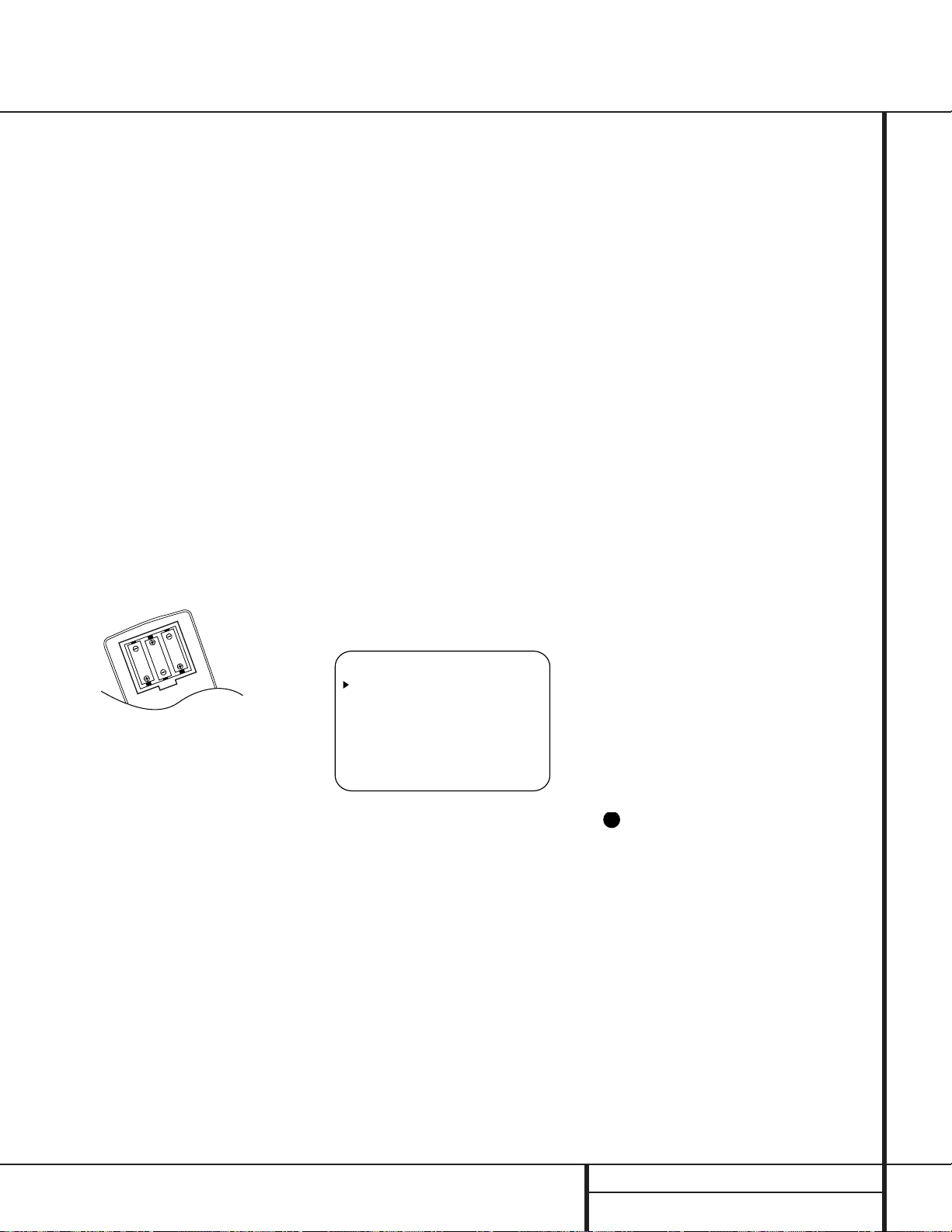
19 SYSTEM CONFIGURATION
System Configuration
System Setup
Once the speakers have been placed in the
room and connected, the remaining steps
in the setup process are to program the
AVR 320’s bass management system for the
type of speakers used in your system, calibrate
the output levels, and set the delay times used
by the surround-sound processor.
You are now ready to power up the AVR 320
to begin these final adjustments.
1. Plug the
AC Power Cord · into an
unswitched AC outlet.
2. Press the
Main Power Switch 1 in
until it latches and the word “OFF” on the
top of the switch disappears inside the
front panel. Note that the
Power
Indicator
3 will turn amber, indicating
that the unit is in the Standby mode.
3. Remove the protective plastic film from the
front-panel lens. If left in place, the film
may affect the performance of your remote
control.
4. Install the three supplied AAA batteries in
the remote as shown. Be certain to follow
the (+) and (–) polarity indicators that are
on the top of the battery compartment.
5. Turn the AVR 320 on either by pressing the
System Power Control 2 on the front
panel, or via the remote by pressing the
Power On Button d, the AVR
Selector
f or any of the Input
Selectors
eg on the remote. The
Power Indicator 3 will turn green to
confirm that the unit is on, and the
Main
Information Display
˜ will also light.
Using the On-Screen Display
When making the following adjustments, you
may find it easier to use the AVR 320’s on-
screen display system. These easy-to-read dis-
plays give you a clear picture of the current
status of the unit and make it easy to see
which speaker, delay, input or digital selection
you are making.
To view the on-screen menus, make certain you
have made a connection from the
Video
Monitor Out Jack
¤ on the rear panel to
the composite or S-Video input of your TV or
projector. In order to view the AVR 320’s dis-
plays, the correct video source must be selected
on the video display. Note that the on-screen
menus are not available when a component
video display is in use.
IMPORTANT NOTE: When viewing the on-
screen menus using a CRT-based projector,
plasma display or any direct-view CRT monitor or
television, it is important that they not be left on
the screen for an extended period of time. The
constant display of a static image such as these
menus or video game images may cause the
image to be permanently “burned into” the pro-
jection tubes, plasma screen or CRT. This type of
damage is not covered by the AVR 320 warranty
and may not be covered by the projector/TV set’s
warranty.
The AVR 320 has two on-screen display modes,
“Semi-OSD” and “Full-OSD.” When making
configuration adjustments, it is recommended
that the Full-OSD mode be used. This will place
an option listing on the screen, making it easier
to view the available options.
Making Configuration Adjustments
The full-OSD system is available by pressing the
OSD Button v. When this button is
pressed, the
MASTER menu (Figure 1) will
appear, and adjustments are made from the
individual menus.
Figure 1
The semi-OSD system is also available, allowing
you to make adjustments directly, by pressing
the appropriate buttons on the front panel or
remote control for the specific parameter to be
adjusted. For example, to change the digital
input for any of the sources, press the
Digital
Select Button
Ûq on the front panel or
remote.
To use the full OSD menu system, press the
OSD Button v. When the menu is on the
screen, press the
⁄
/
¤
Buttons n until the
on-screen
›
cursor is next to the item you wish
to adjust, and then press the
Set Button p
to adjust that item. Note that the menus will
remain on the screen for 20 seconds, and then
they will “time-out” and disappear from the
screen. The time-out may be increased to as
much as 50 seconds by going to the
ADVANCED SELECT menu, and
changing the item titled
FULL OSD
TIME OUT
.
Note that when the full OSD system is in use,
the menu selections are not shown in the
Main Information Display ˜Y. When the
full OSD menu system is used, OSD ON will
appear in the
Main Information Display Y
and the OSD Indicator P will light to remind
you that a video display must be used. When
the semi-OSD system is used in conjunction
with the discrete configuration buttons, the on-
screen display will show a single line of text
with the current menu selection. That selection
will also be shown in the
Main Information
Display
Y.
Setting the System Configuration
Memory
The AVR 320 features an advanced memory
system that enables you to establish different
configurations for the speaker configuration,
digital input, surround mode, delay times,
crossover frequency and output levels for each
input source. This flexibility enables you to
custom-tailor the way in which you listen to
each source and have the AVR 320 memorize
those settings. This means, for example, that
you may use different output levels or trims for
different sources, or set different speaker con-
figurations with the resultant changes to the
bass management system. Once these settings
are made, they will automatically be recalled
whenever you select that input.
The factory default settings for the AVR 320
have all inputs except for DVD configured for
an analog audio input except for the DVD
input, where the
Digital Coaxial 1 Input
is the default. The default speaker settings
are for “Large” speakers at the front left/right,
“Small” at all other positions, and for the
Subwoofer set as being on. However, once the
DSP processing system is used for the first time
for any input, the speaker settings will auto-
matically default to “Small” at all positions
with the subwoofer set to “LFE.” The default
setting for the surround modes is “Surround
Off,” or two-channel stereo, although Dolby
Digital or DTS will automatically be selected as
appropriate when a source with digital encod-
ing is in use.
Before using the unit, you will probably want
to change the settings for most inputs so that
they are properly configured to reflect the use
of digital or analog inputs, the type of speakers
installed and the surround mode specifics of
your home theater system. Remember that
32
* MASTER MENU *
IN/OUT SETUP
SURROUND SETUP
SPEAKER SETUP
DELAY ADJUST
CHANNEL ADJUST
MULTI-ROOM
ADVANCED
EXIT
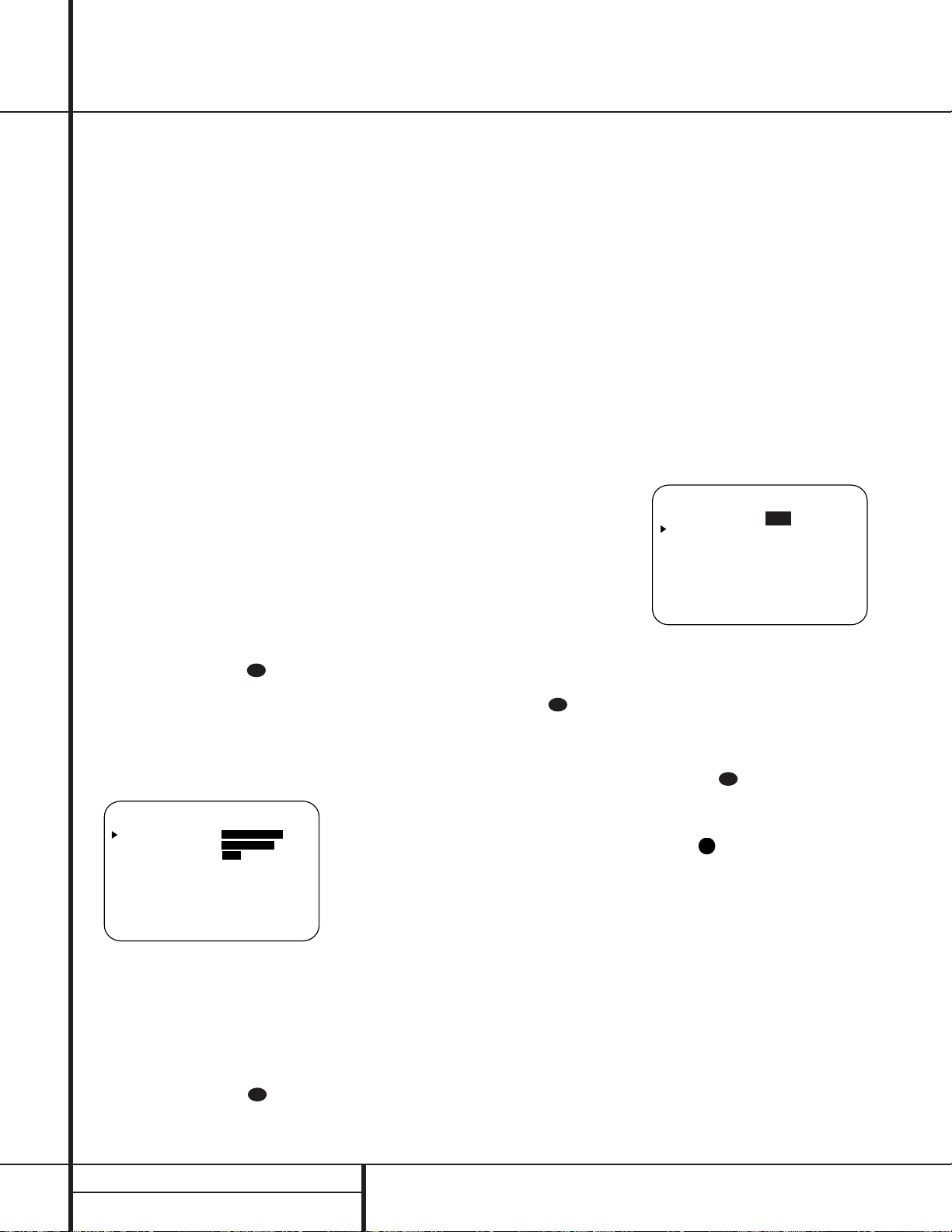
20 SYSTEM CONFIGURATION
since the AVR 320 memorizes the settings for
each input individually, you will need to make
these adjustments for each input used.
However, once they are made, further adjust-
ment is only required when system components
are changed.
To make this process as quick and as easy as
possible, we suggest that you use the full-OSD
system with the on-screen menus, and step
through each input. Once you have completed
the settings for the first input, many settings
may be duplicated for the remaining inputs. It is
also a good idea to set the configuration data
in the order these items are listed in the
MASTER menu, as some settings require a
specific entry in a prior menu item. Remember
that once the settings are made for one input,
they must be made for all other input sources
in your system.
Input Setup
The first step in configuring the AVR 320 is to
configure each input. When using the full-OSD
system to make the setup adjustments, press
the
OSD Button v once so that the MAS-
TER
menu (Figure 1) appears. Note that the
›
cursor will be next to the IN/OUT
SETUP
line. Press the Set Button p to
enter the menu and the
IN/OUT SETUP
menu (Figure 2) will appear on the screen.
Press the
‹
/
›
Buttons o until the
desired input name appears in the highlighted
video, as well as being indicated in the front
panel
Input Indicators ˆ by the green LED
next to the desired input name. If the input will
use the standard left/right analog inputs, no
further adjustment is needed.
Figure 2
If you wish to associate one of the digital
inputs with the selected input source, press the
¤
Button n on the remote while the
IN/OUT SETUP menu (Figure 2) is on
the screen, and note that the on-screen cursor
will drop down to the
DIGITAL IN line.
Press the
‹
/
›
Buttons o until the
name of the desired digital input appears. To
return to the analog input, press the buttons
until the word
ANALOG appears. When the
correct input source appears, press the
¤
but-
ton
n once so that the
›
cursor appears next
to
BACK TO MASTER MENU, and press
the
Set Button p.
To change the digital input at any time using
the discrete function buttons and the semi-OSD
system, press the
Digital Input Select
Button
Ûq on the front panel or the
remote. Within five seconds, make your input
selection using the
Selector buttons on the
front panel
7$ or the
⁄
/
¤
n Buttons
on the remote until the desired digital or ana-
log input is shown in the
Main Information
Display
Y and in the lower third of the video
display connected to the AVR 320. Press the
Set Button p to enter the new digital input
assignment.
An exclusive Harman Kardon feature is the
ability to switch the front panel coaxial digital
audio jack from its normal use as an input
to an output connection so that portable
recording devices may easily be connected.
On the AVR 320, the
Digital Coax 3 Jack Ó
is normally an input, but this may also be
switched to a digital output for use with
CD-R/RW decks, MD recorders or other A/V
recorders. To change the jack to an output,
press the
⁄
/
¤
Buttons n while the
IN/OUT SETUP menu is on the screen
until the
›
cursor is next to COAXIAL 3.
Then press the
‹
/
›
Buttons o so that
the word
OUT is highlighted. Note that the
Input/Output Status Indicator ( will turn
red, indicating that the jack is now a record
output.
NOTE: A signal will be sent to this jack only
when the input selected for use by the AVR 320
is digital. Digital signals will be passed through
regardless of their format, and which digital
input (optical or coax) they are fed from.
However, analog signals are not converted to
digital, and the format of the signal (e.g., PCM,
Dolby Digital or DTS) may not be changed.
Selection of the front panel jack as an output
will remain effective as long as the AVR 320 is
on. Once the unit is turned off, the jack will
revert to its normal use as an input when the
unit is turned on again.
Surround Setup
Once the basic input setup has been completed,
the next step is to set the surround mode you
wish to use with an input. Since surround
modes are a matter of personal taste, feel free
to select any mode you wish – you may change
it later. However, to make it easier to establish
the initial parameters for the AVR 320, it is best
to select Dolby Pro Logic II or Logic 7 for most
analog inputs and Dolby Digital for inputs con-
nected to digital sources. In the case of inputs
such as a CD Player, Tape Deck or Tuner, you
may wish to set the mode to Stereo (“Surround
off”) as they are not typically used with multi-
channel program material, where it is unlikely
that sur
round-encoded material will be used.
Alternatively, the
Logic 7 Music mode is a good
choice for stereo-only source material.
It is easiest to complete the surround setup
using the full-OSD on-screen menus. From the
MASTER menu (Figure 1), press the
⁄
/
¤
Buttons n until the
›
cursor is next to the
SURROUND SELECT menu. Press the
Set Button p so that the SURROUND
SELECT
menu (Figure 3) is on the screen.
Figure 3
The first line on the SURROUND
SELECT
menu allows you to configure the
AVR for either standard 5.1 or advanced
6.1/7.1 operation. With the on-screen
›
cursor
at the
SURR MODE line, press the Set
Button
p and then press the
‹
or
›
Buttons o so that 5.1 is highlighted
if you have five surround speakers installed, or
6.1/7.1 if you have one or two speakers
connected to the
Surround Back Preamp
Outputs
through optional, external power
amplifiers.
Making this selection will set the surround
mode options for the AVR so that only the cor-
rect modes for the number of speakers in your
specific system will be available. Should you
change your system and add additional speak-
ers at a later date, it is important to change this
setting so that advanced surround modes such
as Logic 7/7.1 and DTS-ES 6.1 Discrete and
Matrix will be available.
When the desired selection is made, press the
Set Button p to continue with the setup
and configuration.
38
37
* SURROUND SELECT *
SURR MODE: 5.1 6.1/7.1
DOLBY
DTS
LOGIC 7
DSP (SURR)
STEREO
BACK TO MASTER MENU
37
37
* IN/OUT SETUP *
INPUT :VIDEO 1
DIGITAL IN:ANALOG
COAXIAL 3 :IN OUT
BACK TO MASTER MENU
37
System Configuration
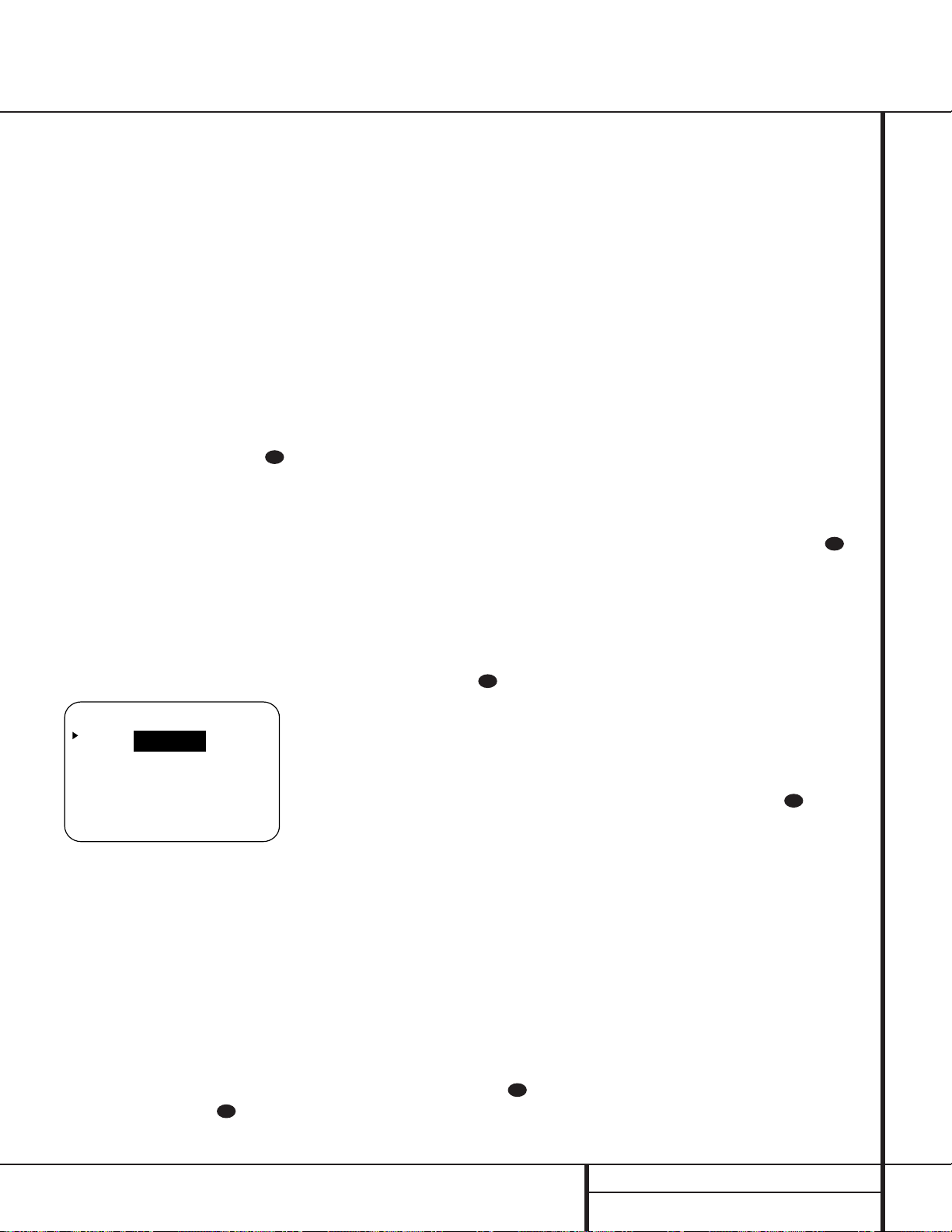
21 SYSTEM CONFIGURATION
System Configuration
Once the setting is made for 5.1 or 6.1/7.1
operation, the default surround mode for an
input should be set. Each of the remaining five
lines on the menu (Figure 3) contains the vari-
ous surround mode categories, and within
those menus you may choose one of the sub-
modes. Note that the list of specific sub-modes
in some categories will vary according to
whether 5.1 or 6.1/7.1 operation is chosen. In
addition, some of the modes available in the
AVR 320 will not appear unless a digital source
is selected and playing the correct bitstream.
To select the mode that will be used as the ini-
tial default for an input, first press the
⁄
/
¤
Buttons n until the on-screen cursor is next
to the desired mode’s master category name.
Next, press the
Set Button p to view the
sub-menu. Press the
‹
/
›
Buttons o to
scroll through the available choices, and then
press the
¤
Button n so that the cursor is
next to
BACK TO MASTER MENU to
continue the setup process.
On the
Dolby menu (Figure 4), the selection
choices include Dolby Digital, Dolby Pro Logic II
Music, Dolby Pro Logic II Cinema, Dolby Pro
Logic II Emulation and Dolby 3 Stereo. A com-
plete explanation of these modes is found on
Page 26. Note that when the Dolby Digital
mode is selected there are additional settings
available for the Night mode.
Figure 4
The Night mode is a feature of Dolby Digital
that uses special processing to preserve the
dynamic range and full intelligibility of a movie
sound track while reducing the peak level. This
prevents abruptly loud transitions from disturb-
ing others, without reducing the sonic impact of
a digital source. Note that the Night mode is
only available when specially encoded Dolby
Digital signals are played.
To adjust the Night mode setting for an input
from the menu, make certain that the
›
cursor
is on the
NIGHT line of the DOLBY menu.
Next, press
‹
/
›
Buttons o to choose
between the following settings, as they appear
in the on-screen display:
OFF:When OFF is highlighted, the Night
mode will not function.
MID:When MID is highlighted, a mild com-
pression will be applied.
MAX:When MAX is highlighted, a more
severe compression algorithm will be applied.
We recommend that you select the
MID set-
ting as a starting point and change to the
MAX setting later, if desired.
Note that the Night mode may be adjusted
directly any time that a Dolby Digital source is
playing by pressing the
Night Mode Button
l. When the button is pressed, the phrase
D-RANGE will appear in the lower third of
the video screen and in the
Main Information
Display
Y. Press the
⁄
/
¤
Button n with-
in three seconds to select the desired setting.
When all settings for the surround setup have
been made, press the
⁄
/
¤
Buttons n so
that the
›
cursor is next to BACK TO
MASTER MENU
, and press the Set Button
p to return to the Master menu.
On the
DTS menu, the selection choices made
with the
‹
/
›
Buttons o on the remote
are determined by a combination of the type of
DTS program material in use and whether the
5.1 or 6.1/7.1 speaker output configuration is
in use. When either of the speaker configura-
tions is in use, you may select either the Neo:6
Music or Neo:6 Cinema mode when an analog
source is playing to deliver an enhanced 5.1-
channel sound field.
When the 5.1 configuration is in use the AVR
will automatically select the 5.1 version of DTS
processing when a DTS data stream is selected.
When the 6.1/7.1 mode is selected, the DTS-ES
Discrete mode will automatically be activated
when a DTS source with the ES Discrete “flag”
is in use. In these cases the
DTS-ES Mode
Indicator
D will light. When a non-ES DTS
disc is in use, you may select the DTS-ES Matrix
mode through this menu to create a full eight-
speaker surround mode. See page 26 for a
complete explanation of the DTS modes.
On the
Logic 7
menu, the selection choices
made with the
‹
/
›
Buttons o on the
remote are determined by whether the 5.1 or
6.1/7.1 speaker output configuration is in use.
In either case, the selection of a Logic 7 mode
enables Harman Kardon’s exclusive Logic 7 pro-
cessing to create fully enveloping, multichannel
surround from either two-channel Stereo or
Matrix-encoded programming such as VHS cas-
settes, laser discs or television broadcasts pro-
duced with Dolby surround.
In the 5.1 configuration you may select the
Logic 7/5.1 Music, Cinema or Enhanced modes.
They work best with two-channel music, sur-
round-encoded programs or standard two-
channel programming of any type, respectively.
When the 6.1/7.1 mode is selected, only the
Music and Cinema modes are available, and the
output will be in a full eight-channel sound
field. Note that the Logic 7 modes are not
available when either Dolby Digital or DTS
Digital soundtracks are in use. See pages 26
and 27 for a complete explanation of the DSP
Surround modes.
On the
DSP (SURR) menu, the selection
choices made with the
‹
/
›
Buttons o
on the remote select from one of the DSP sur-
round modes that are designed for use with
two-channel stereo programs to create a variety
of sound field presentations. The choices avail-
able are Hall 1, Hall 2, Theater, VMAx Near and
VMAx Far. The Hall and Theater modes are
designed for multichannel installations, while
the two VMAx modes are optimized for use in
delivering a full surround field when only the
front left and front right speakers are installed.
See pages 26 and 27 for a complete explana-
tion of the DSP surround modes.
On the
STEREO menu, the selection choices
made with the
‹
/
›
Buttons o on the
remote may either turn the surround processing
off for a traditional two-channel stereo presen-
tation, or select
5 Stereo or 7 Stereo
depending on whether the 5.1 or 6.1/7.1 out-
put is in use. The latter modes feed a two-chan-
nel presentation to all speakers, regardless of
the number of speakers in use. See page 27 for
a complete explanation of the 5 Stereo and 7
Stereo modes. After the selections are made on
the Dolby, DTS, Logic 7, DSP (Surround) or
stereo menus, press the
⁄
/
¤
Buttons n so
that the cursor moves to the
BACK TO
MASTER MENU
line and presss the Set
Button
p.
37
37
37
37
37
** DOLBY **
MODE: DOLBY
DIGITAL
NIGHT: OFF MID MAX
BACK TO MASTER MENU
37
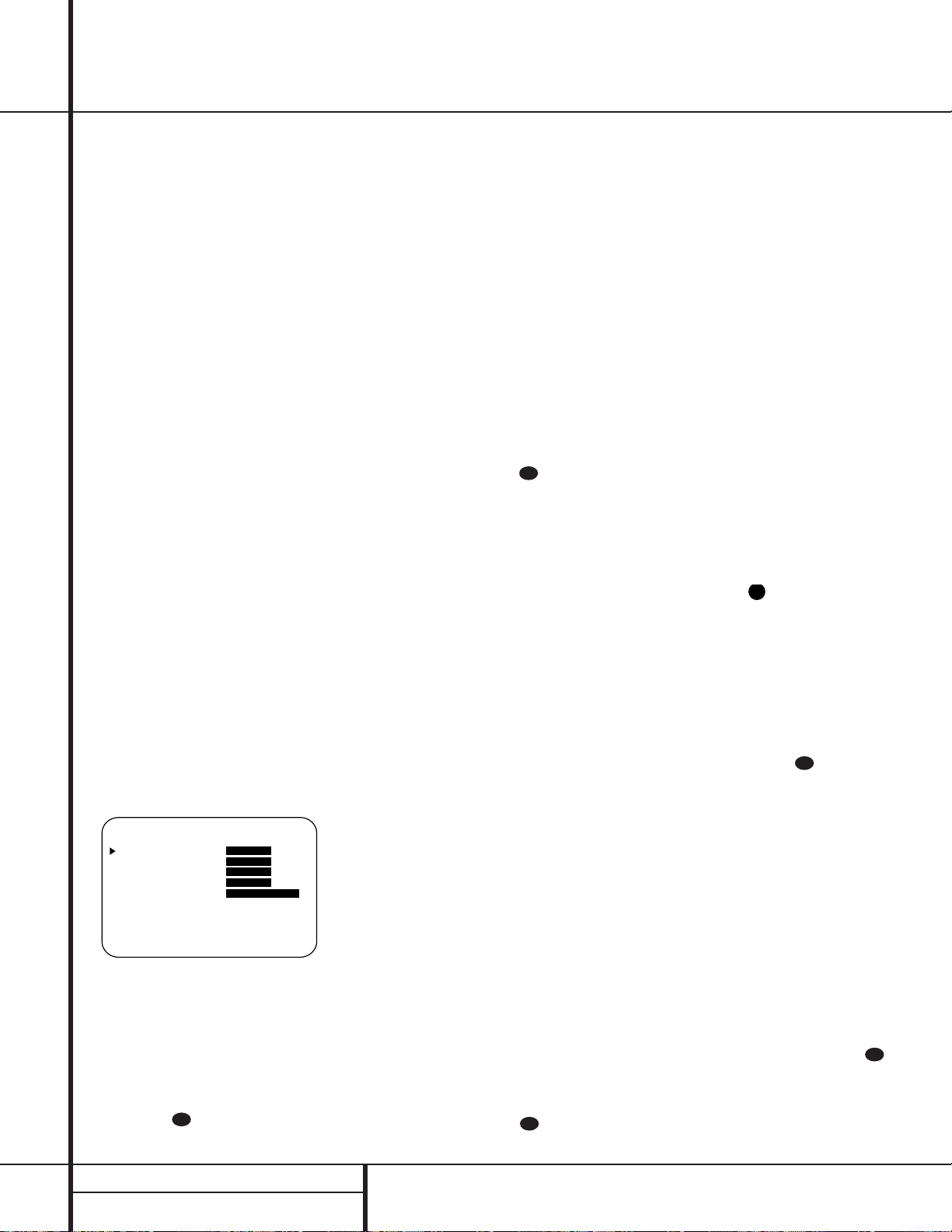
22 SYSTEM CONFIGURATION
System Configuration
Speaker Setup
This menu tells the AVR 320 which type of
speakers are in use. This is important as it
adjusts the settings that determine which
speakers receive low-frequency (bass) informa-
tion. For each of these settings use the
LARGE setting if the speakers for a
particular position are traditional full-range
loudspeakers that are capable of reproducing
sounds below 100Hz. Use the
SMALL set-
ting for smaller, frequency-limited satellite
speakers that do not reproduce sounds below
100Hz. Note that when “small” speakers are
used, a subwoofer is required to reproduce
low-frequency sounds. Remember that the
“large” and “small” descriptions do not refer
to the actual physical size of the speakers, but
to their ability to reproduce low-frequency
sounds. If you are in doubt as to which category
describes your speakers, consult the specifica-
tions in the speakers’ owner’s manual, or ask
your dealer.
After the selections are made on the Dolby
DTS, Logic 7 DSP (Surr) or stereo menus, press
⁄
/
¤
Buttons n, so that the cursor moves
to the
BACK TO MASTER MENU line
and press ther
Set Button p.
It is easiest to enter the proper settings for the
speaker setup through the
SPEAKER
SETUP
menu (Figure 5). If that menu is not
already on your screen from the prior adjust-
ments, press the
OSD Button v to bring up
the
MASTER MENU (Figure 1), and then
press the
¤ Button n twice so that the cur-
sor is on the
SPEAKER SETUP line. At
this point, press the
Set Button p to bring
up the SPEAKER SETUP menu (Figure 5).
Figure 5
When the SPEAKER SETUP menu first
appears, the on-screen cursor
› will be at the
top of the list of speaker positions, pointing
toward the
LEFT/RIGHT line, which sets
the configuration for the front left and right
speakers. If you wish to make a change to the
front speakers’ configuration, press the
‹
/
›
Buttons o so that either LARGE or
SMALL appears, matching the appropriate
description from the definitions shown above.
When
SMALL is selected, low-frequency
sounds will be sent only to the subwoofer out-
put. If you choose this option and there is no
subwoofer connected, you will not hear any low-
frequency sounds from the front channels.
When
LARGE is selected, a full-range output
will be sent to the front left and front right
outputs. Depending on the choice made in
the
SUBWOOFER line in this menu, bass
information may also be directed to the front
left/right speakers, a subwoofer or both.
When you have completed your selection for the
front channel, press the
¤
Button n on the
remote to move the cursor to
CENTER.
Press the
‹
/
›
Buttons o on the remote
to select the option that best describes your system,
based on the speaker definitions shown below.
When SMALL is selected, low-frequency
center channel sounds will be sent only to the
subwoofer output. If you choose this option and
there is no subwoofer connected, you will not
hear low-frequency sounds from the center
channel speaker.
When
LARGE is selected, a full-range output
will be sent to the center speaker output, and
NO center channel signal will be sent to the
subwoofer output.
NOTE: If you choose Logic 7 as the surround
mode for the particular input source for which
you are configuring your speakers, the AVR 320
will not make the LARGE option available for
the center speaker. This is due to the require-
ments of Logic 7 processing, and does not indi-
cate a problem with your receiver.
When
NONE is selected, no signals will be
sent to the center-channel output. The receiver
will operate in a “phantom” center channel
mode and center-channel information will
be sent to the left and right front channel
outputs. When only front left and right speak-
ers are used, with no center or surround speak-
ers, VMAx is a good alternative mode.
When you have completed your selection for
the center channel, press the
¤
Button n
on the remote to move the cursor to
SURROUND.
Press the
‹
/
›
Buttons o on the remote
to select the option that best describes the sur-
round speakers in your system based on the
speaker definitions shown on this page.
When
SMALL is selected, low-frequency
surround channel sounds will be sent to the
subwoofer output only. If you choose this
option and there is no subwoofer connected,
you will not hear any low frequency sounds
from the surround speakers.
When
LARGE is selected, a full-range output
will be sent to the surround channel outputs,
and NO surround channel signals will be sent
to the subwoofer output.
When
NONE is selected, surround-sound
information will be split between the front left
and front right outputs. For optimal perform-
ance when no surround speakers are in use, the
Dolby 3 Stereo mode should be used.
If the 6.1/7.1 configuration has been selected
in the
SURROUND SELECT menu, an
additional configuration line is available on the
menu screen to set the speaker type for the
speakers connected to the
Surround Back
Preamp Outputs
through an optional,
external power amplifier. The choices and pro-
cedure for configuring these speakers are iden-
tical to those shown above for the main sur-
round speakers.
When you have completed your selection for the
surround channels, press the
¤
Button n on
the remote to move the cursor to
SUBWOOFER.
Press the
‹
/
›
Buttons o on the
remote to select the option that best describes
your system.
The choices available for the subwoofer posi-
tion will depend on the settings for the other
speakers, particularly the front left/right posi-
tions.
If the front left/right speakers are set to
SMALL, the subwoofer will automatically be
set to
SUB, which is the “on” position.
If the front left/right speakers are set to
LARGE, three options are available:
• If no subwoofer is connected to the
AVR 320, press the
‹
/
›
Buttons o
on the remote so that NONE appears in
the on-screen menu. When this option is
selected, all bass information will be routed
to the front left/right “main” speakers.
37
37
38
37
37
37
* SPEAKER SETUP *
LEFT/RIGHT: SMALL
CENTER : SMALL
SURROUND : SMALL
SURR BACK : SMALL
SUBWOOFER : SUB(LFE)
SUB X-OVER FREQ:80 HZ
RETURN TO MASTER MENU
23 SYSTEM CONFIGURATION
System Configuration
• If a subwoofer is connected to the AVR 320,
you have the option to have the front
left/right “main” speakers reproduce bass
frequencies at all times, and have the sub-
woofer operate only when the AVR 320 is
being used with a digital source that con-
tains a dedicated Low Frequency Effects, or
LFE soundtrack. This allows you to use both
your main and subwoofer speakers to take
advantage of the special bass created for
certain movies. Press
‹
/
›
Buttons
o on the remote so that SUB
(LFE)
appears in the on-screen menu.
• If a subwoofer is connected and you wish to
use it for bass reproduction in conjunction
with the main front left/right speakers,
regardless of the type of program source or
Surround mode you are listening to, press
the
‹
/
›
Buttons o on the remote
so that
SUB LFE+L/R appears in
the on-screen menu. When this option is
selected, a full-range signal will be sent to
the front left/right “main” speakers, and the
subwoofer will receive the bass frequencies
under frequency selected in the next option
setting on this menu, as described below.
When you have completed your selection for the
subwoofer, press the
¤
button n on the
remote to change the cursor to
SUB X-
OVER FREQ
.The subwoofer crossover set-
ting may only be adjusted using the on-screen
display system.
At this line, you will select the frequency at
which bass information is directed to the
Subwoofer Output ∞.The choices available
will depend on the setting made previously for
the front left/right speakers. When making
these selections, choose the crossover frequency
that is closest to that of your front left/right
speakers, or the upper frequency limit of your
subwoofer. This figure is normally printed in the
owner’s manual or data sheet for the speakers;
or consult the speaker’s manufacturer.
• When the front speakers have been set to
LARGE,the crossover choices are
40 Hz or 60 Hz to match the typical
crossover points of full range speakers.
Choose the option that is closest to your
speakers’ design.
• When the front speakers have been set to
SMALL,the crossover choices are
80 Hz or 100 Hz to match the typical
crossover points of the smaller speakers
used in satellite speaker systems. Choose
the option that is closest to your speakers’
design.
When all speaker selections have been made,
press the
¤
Button n and then the Set
Button
p to return to the Master
menu.
Delay Settings
If Dolby Digital or Dolby Pro Logic is selected as
the surround mode for an input, you may need
to adjust the delay time setting. Note that the
delay time is not adjustable for any other modes.
Due to the different distances between the
listening position for the front-channel speakers
and the surround speakers, the amount of time
it takes for sound to reach your ears from the
front versus surround speakers differs. You may
compensate for this difference through the use
of the delay settings to adjust the timing for
the speaker placement and acoustic conditions
in your listening room or home theater.
The factory setting is appropriate for most
rooms, but some installations create an uncom-
mon distance between the front and surround
speakers that may cause the arrival of front-
channel sounds to become disconnected from
surround-channel sounds.
To resynchronize the front and surround chan-
nels, follow these steps:
1. Measure the distance from the listening
position to the front speakers.
2. Measure the distance from the listening
position to the surround speakers.
3. Subtract the distance to the surround speak-
ers from the distance to the front speakers.
a. When setting the delay time for the
Dolby Digital surround modes, the opti-
mal delay time is the result of that sub-
traction. For example, if the front speak-
ers are ten feet away and the surround
speakers are five feet away, the optimal
delay time is figured as 10–5=5. Thus,
in this example, the delay time for Dolby
Digital should be set at five milliseconds.
b. When setting the delay time for the Pro
Logic mode, take the result of the sub-
traction and add 15 to obtain the opti-
mal delay time. For example, if the front
speakers are ten feet away and the sur-
round speakers are five feet away, the
optimal delay time is figured as
10–5+15=20. Thus, in this example, the
Pro Logic delay should be set at twenty
milliseconds.
NOTE: The DTS, Logic 7 and DSP modes use a
fixed, nonadjustable delay time.
The Dolby Digital mode also includes a separate
setting for the Center Channel Delay mode,
since the discrete nature of these signals makes
the location of the center-channel speaker more
critical. To calculate the delay for the center
channel, measure the distance from the pre-
ferred listening position in the center of the
room to both the center-channel speaker and
either the left or right speaker.
If the distances are equal, no further adjustment
is required and the center delay should be set to
zero. If the distance to the front speakers is
greater than the distance to the center speaker,
you may wish to reposition the speakers by
moving the front left and front right speakers
closer to the listening position or the center
speaker further away from the listening position.
If repositioning of the speakers is not possible,
adjust the center delay time, adding one milli-
second of center-channel delay for every foot
closer to the listening position the center
speaker is than the front speakers. For example,
if the front left and front right speakers are
each 10 feet from the listening position and the
center-channel speaker is 8 feet away, the delay
is figured as 10–8=2, suggesting an optimal
center delay of 2 milliseconds.
To set the delay time for a specific input,
the
DELAY ADJUST menu (Figure 6)
should be visible on your on-screen display. If
the system is not already at that point, press
the
OSD Button v to bring up the MAS-
TER MENU
,press the
›
Button n three
times or until the on-screen
›
cursor is pointing
at the
DELAY ADJUST line. Press the
Set Button p to call up the menu.
37
37
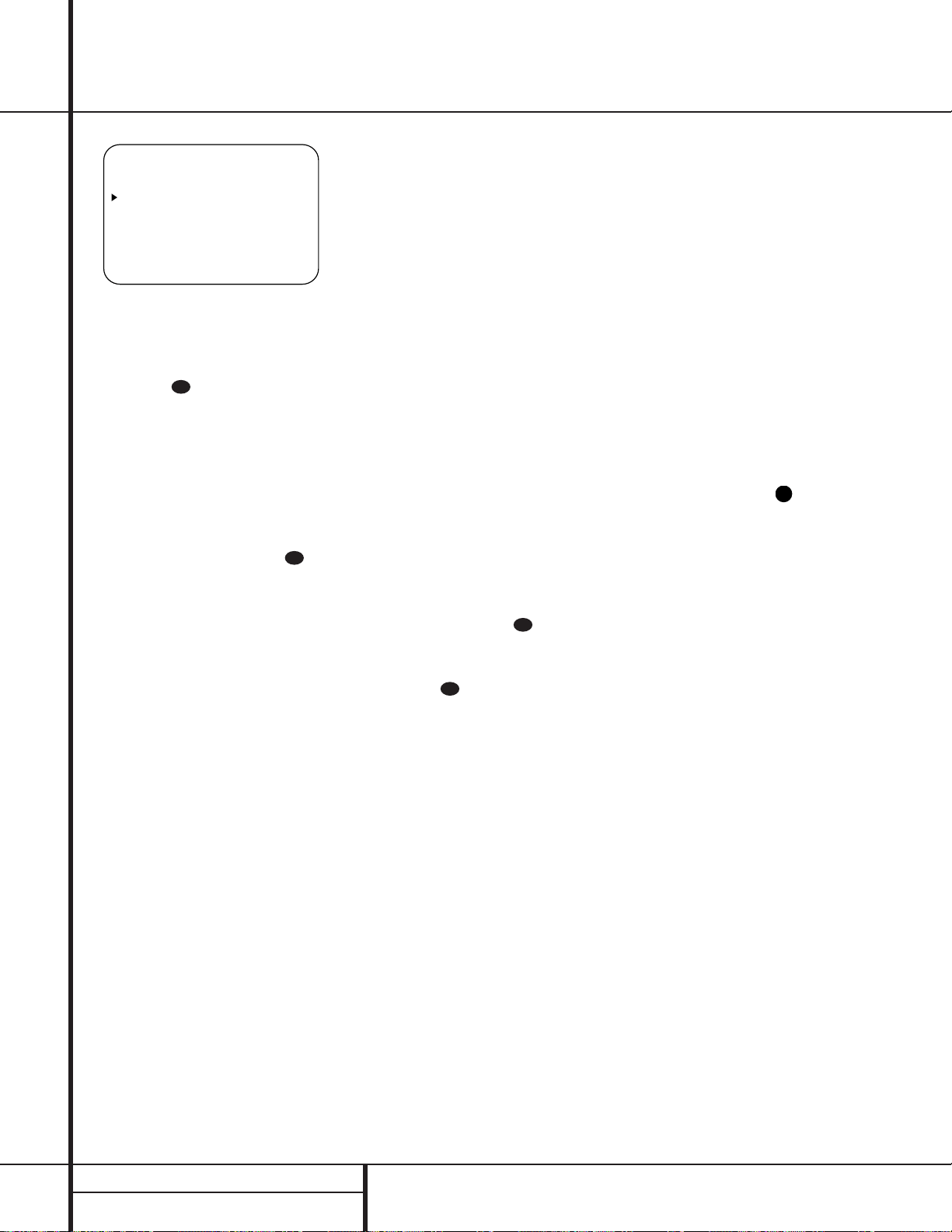
Figure 6
If the Dolby Digital mode is selected, the
CENTER DELAY line is where the first
adjustment is made. In that case, press the
‹
/
›
Buttons o until the number calculated
using the formula shown above appears in the
display. When the
CENTER DELAY is
entered, press the
¤
Button n once to
move to the next line.
When the
CENTER DELAY is set, or if
the Dolby Pro Logic II mode is selected, the
›
cursor will be at the SURR DELAY line so
that the delay for the surround speakers may
be set. Press the
‹
/
›
Buttons o until
the number calculated using the formula
shown above appears in the display. When the
delay settings are complete, press the
¤
Button n once so that the cursor is next to
the
BACK TO MASTER MENU line and
press the
Set Button p to return to the
MASTER menu.
Output Level Adjustment
Output level adjustment is a key part of the
configuration of any surround-sound product. It
is particularly important for a digital receiver
such as the AVR 320, as correct outputs ensure
that you hear sound tracks with the proper
directionality and intensity.
IMPORTANT NOTE: Listeners are often con-
fused about the operation of the surround
channels. While some assume that sound
should always be coming from each speaker,
most of the time there will be little or no
sound in the surround channels. This is
because they are only used when a movie
director or sound mixer specifically places
sound there to create ambience, a special
effect or to continue action from the front of
the room to the rear. When the output levels
are properly set, it is normal for surround
speakers to operate only occasionally.
Artificially increasing the volume to the rear
speakers may destroy the illusion of an
enveloping sound field that duplicates the way
you hear sound in a movie theater or concert hall.
Before beginning the output level adjustment
process, make certain that all speaker connec-
tions have been properly made. The system
volume should be set to the level that you will
use during a typical listening session. Finally,
make certain that the
Balance Control Ò is
set to the center “12 o’clock” position.
Using EzSet
Harman Kardon’s exclusive EzSet remote makes
it possible to quickly and accurately set the
AVR 320’s output levels without the use of a
sound pressure meter, although manual adjust-
ment is also available. However, for the easiest
set-up, follow these steps while seated in the
listening position that will be used most often:
1. Make certain that all speaker positions
have been properly configured for their
“large” or “small” settings (as outlined
above) and turn off the OSD system if it is
in use.
2. Adjust the volume so that it is at
-15,as
shown in the on-screen display or
Main
Information Display
Y.
3. Hold the remote in front of you at arm’s
length, being sure not to cover the
EzSet
Sensor Microphone
at the top of
the remote.
4. Press and hold the
SPL Indicator Select
Button
for three seconds. Release it
when the
Program/SPL Indicator c
stops flashing and and remains lit. Within
five seconds, press the “
5” Numeric Key
r on the remote if your system is config-
ured for 5.1 operation with standard
speakers or the “
7” Numeric Key r on
the remote if your system is configured for
6.1/7.1 operation with a full speaker com-
plement including rear surround speakers.
Once the correct channel configuration
button has been pressed the test noise will
be heard from the front left speaker.
5. At this point, EzSet will take over, adjusting
the output level of each channel so that
when the process is complete all levels will
be equal and at the set reference point.
This process may take a few minutes,
depending on the extent of adjustment
required.
6. During the adjustment, you will see the
location of the channel position being
adjusted appear in the on-screen
display (if connected) in the
Main
Information Display
Y, alternating
with a readout of the output setting, rela-
tive to the reference volume level, and in
the
Speaker/Channel Input Indicators
Q where the letters for the channel being
adjusted will flash to indicate from which
channel the test tone should be heard. As
the adjustment proceeds, a few things will
happen simultaneously:
• The channel position being adjusted will
flash in the
Speaker/Channel Input
Indicators
Q. If the test noise is heard
from a channel other than the one shown
in the Indicator, there is an error in the
speaker connections. If this is the case,
press the
Test Button i TWICE to
stop the adjustment. Then, turn the unit
off and verify that all speakers are con-
nected to the proper
Outputs
nop and that any connections
made to rear surround speakers powered
by optional amplifiers through the
Preamp Outputs are correct.
• As the individual channels are set, the
channel name and the adjustment offset
will appear in the on-screen display (if
connected) and the
Main Information
Display
Y. While the level is changing,
the
Program/SPL Indicator c will
change colors to reflect the output level
in relation to the reference. A red indica-
tion shows that the level is too high,
while an amber indication shows that the
level is too low. When the indicator is
green, the level is correct, and the test
noise will move to the next channel.
• While adjustments are being made, the
red LED under the
AVR Selector f
will flash. This is normal, and indicates
that EzSet is operating.
7. After the test noise has circulated once
through each channel, it will send the tone
to each channel once again, to verify the
settings.
8. After two complete circulations of the
tone, the levels are set. The
Program/SPL
Indicator
c will remain green at each
channel. Upon completion of the second
circulation, the
Program/SPL Indicator
c will flash green twice and then go
out. The tone will stop and the AVR 320
will return to normal operation.
If you find that the output levels chosen by
EzSet are either uncomfortably low or high, you
may repeat the procedure. Return to Step 2 and
adjust the master volume either slightly higher
or lower to accommodate your particular room
layout and your tastes. You may repeat this pro-
38
41
44
37
37
** DELAY ADJUST **
CENTER DELAY: 5MS
SURR DELAY: 10MS
BACK TO MASTER MENU
24 SYSTEM CONFIGURATION
System Configuration
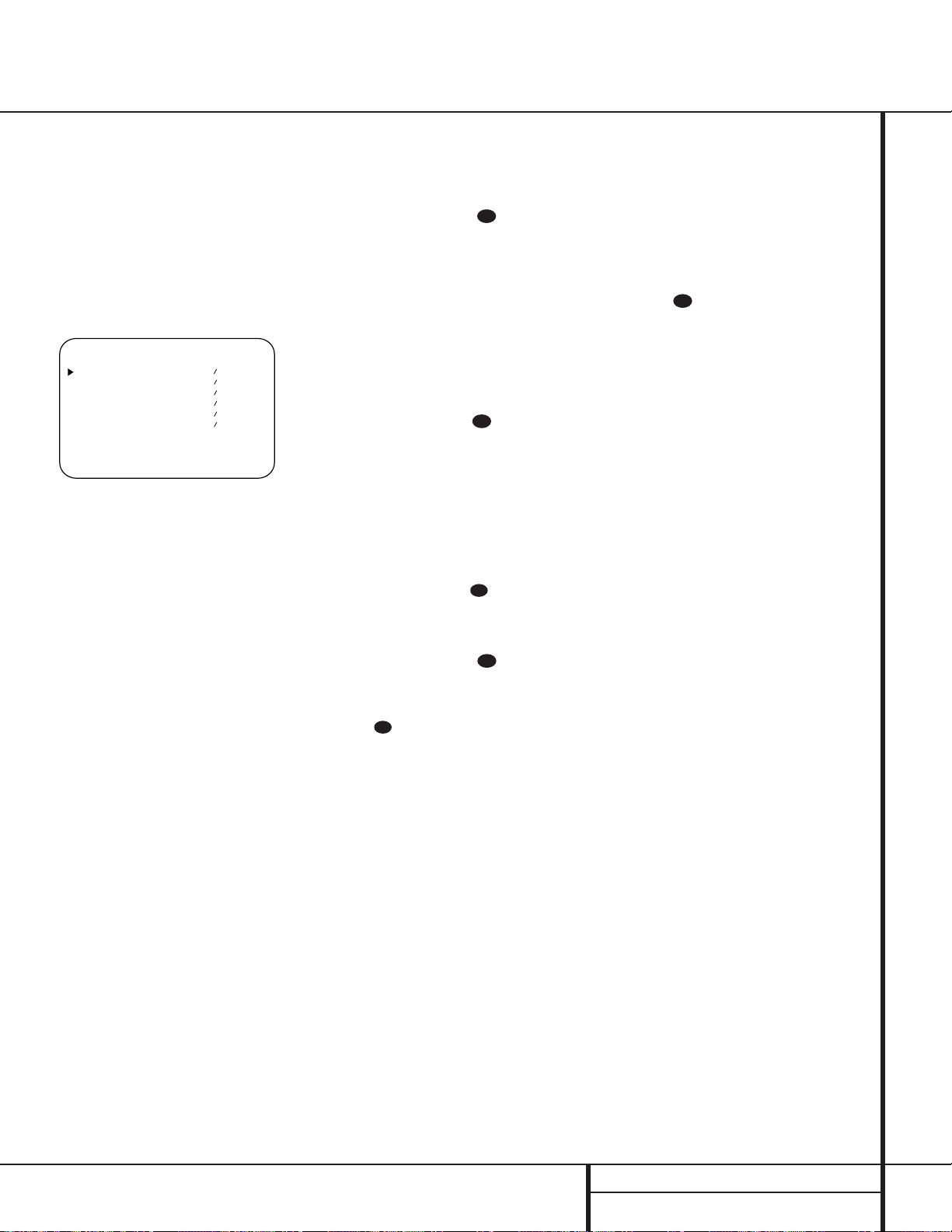
25 SYSTEM CONFIGURATION
System Configuration
cedure as many times as necessary to achieve a
desired result. In order to prevent possible
damage to your hearing or your equipment, we
emphasize that you should avoid setting the
master volume above 0dB.
Manual Output Level Adjustment
Output levels may also be adjusted manually,
either to set them to a specific level with an
SPL meter, or to make fine tuning adjustments
to the levels obtained using the EzSet remote.
Figure 7
Manual output level adjustment is most easily
done through the
CHANNEL ADJUST
menu (Figure 7). If you are already at the main
menu, press the
¤
Button n until the on-
screen
›
cursor is next to the CHANNEL
ADJUST
line. If you are not at the main
menu, press the
OSD Button v to bring up
the
MASTER MENU (Figure 1), and then
press the
¤
Button n four times so that the
on-screen
›
cursor is next to the CHANNEL
ADJUST
line. Press the Set Button p to
bring the
CHANNEL ADJUST menu
(Figure 7) to the screen.
As soon as the new menu appears, you will
hear a test noise circulate from speaker to
speaker in a clockwise direction around the
room. The test noise will play for two seconds
in each speaker before circulating, and a blink-
ing on-screen cursor will appear next to the
name of each speaker location when the sound
is at that speaker.
NOTE: Remember to verify that the speakers
have been properly connected. As the test noise
circulates, listen to make certain that the sound
comes from the speaker position shown in the
Main Information Display Y. If the sound
from a speaker location does NOT match the
position indicated in the display, turn the
AVR 320 off using the
Main Power Switch
1 and check the speaker wiring or connec-
tions to external power amplifiers to make cer-
tain that each speaker is connected to the cor-
rect output terminal.
After checking for speaker placement, let the
test noise circulate again, and listen to see
which channels sound louder than the others.
Using the front left speaker as a reference,
press the
‹
/
›
Buttons o on the
remote to bring all speakers to the same vol-
ume level. When one of the
‹
/
›
buttons is
pushed, the test noise circulation will pause on
the channel being adjusted to give you time to
make the adjustment. When you release the
button, the circulation will resume after five
seconds.
Continue to adjust the individual channels until
the volume level sounds the same from each
speaker. Note that adjustments should be made
with the
‹
/
›
Buttons o on the remote
only, NOT the main volume controls. If you are
using a sound-pressure level (SPL) meter for
precise level adjustment, set the volume so that
the meter reads 75dB, C-Weighting Slow.
You may also adjust the output levels manually
while using the level indication feature of the
EzSet remote. To activate the sensor and
indicator, simply press and release the
SPL
Indicator Select Button
on the
remote while the test tone is circulating.
The
Program/SPL Indicator c will change
color to indicate the level. Adjust the level
using the
‹
/
›
Buttons o until the LED
lights green for all channels. When it is red, the
level is too high; when it is amber, the level is
too low. Press the
SPL Indicator Select
Button
when you are finished to turn the
sensor and Indicator off.
NOTE: The subwoofer output level is not
adjustable using the test tone. To change the
subwoofer level, follow the steps for Output
Level Trim Adjustment on page 32.
When all channels have an equal volume level,
the adjustment is complete. To exit this menu,
press the
⁄
/
¤
Buttons n until the on-
screen
›
cursor is next to the BACK TO
MASTER MENU line, and then press the
Set Button p to return to the MASTER
menu.
The output levels may also be adjusted at any
time using the remote control and semi-OSD
system. To adjust the output levels in this fash-
ion, press the
Test Button i. As soon as
the button is pressed, the test tone will begin
to circulate as indicated earlier. The correct
channel from which the test noise should be
heard will be shown in the lower third of the
video screen and in the
Main Information
Display
Y.While the test noise is circulating,
the proper channel position will also be
indicated in the
Speaker/Channel Input
Indicators
Q by a blinking letter within the
correct channel.
To adjust the output level, press the
‹
/
›
Buttons o until the desired level is
shown in the display or on screen. Once the
buttons are released, the test noise will begin
to circulate again in five seconds.
When all channels have the same output level,
press the
Test Tone Selector i button
again to complete the process.
NOTE: Output level adjustment is not available
for the VMAx or Surround Off mode.
Additional Input Adjustments
After one input has been adjusted for Surround
mode, digital input (if any), speaker type, and
output levels, go back to the
IN/OUT
SETUP
line on the MASTER MENU and
enter the settings for each input that you will
use. In most cases, only the digital input and
surround mode will be different from one input
to the next, while the speaker type, crossover
frequency, Night mode and output level set-
tings will usually be the same and may be
quickly entered by entering the same data used
for the original input.
Once the settings outlined on the previous
pages have been made, the AVR 320 is ready
for operation. While there are some additional
settings to be made, these are best done after
you have had an opportunity to listen to a vari-
ety of sources and different kinds of program
material. These advanced settings are described
on pages 34 to 35 of this manual. In addition,
any of the settings made in the initial configu-
ration of the unit may be changed at any time.
As you add new or different sources or speak-
ers, or if you wish to change a setting to better
reflect your listening taste, simply follow the
instructions for changing the settings for that
parameter as shown in this section.
Having completed the setup and configuration
process for your AVR 320, you are about
to experience the finest in music and home-
theater listening. Enjoy!
37
41
37
41
37
37
* CHANNEL ADJUST *
FRONT LEFT : 0dB
SB RIGHT : 0dB
CENTER : 0dB
FRONT RIGHT : 0dB
SURR RIGHT : 0dB
SURR LEFT : 0dB
CHANNEL RESET:OFF ON
TEST TIME :OFF ON
BACK TO MASTER MENU
26 OPERATION
Operation
Surround Mode Chart
MODE FEATURES DELAY TIME RANGE
DOLBY DIGITAL Available only with digital input sources encoded with Dolby Digital data. It provides up to five Center: 0 ms – 5 ms
separate main audio channels and a special dedicated Low-Frequency Effects channel. Surround: 0 ms – 15 ms
DTS 5.1 When the speaker configuration is set for 5.1-channel operation, the DTS 5.1 mode is Delay time not adjustable
available when DVD, audio-only music or laser discs encoded with DTS data are played.
DTS 5.1 provides up to five separate main audio channels and a special dedicated
low-frequency channel.
DTS-ES 6.1 Matrix When the speaker configuration is set for 6.1/7.1 operation, playback of a DTS-encoded program Delay time not adjustable
DTS-ES 6.1 Discrete source will automatically trigger the selection of one of the two DTS-ES modes. Newer discs with
special DTS-ES discrete encoding will be decoded to provide six discrete, full-bandwidth channels
plus a separate low-frequency channel. All other DTS discs will be decoded using the DTS-ES Matrix
mode, which creates a 6.1-channel sound field from the original 5.1-channel soundtrack.
DOLBY PRO LOGIC II Dolby Pro Logic II is the latest version of Dolby Laboratory’s benchmark surround technology 15 ms – 30 ms
MOVIE that decodes full-range, discrete left, center right, right surround and left surround channels
MUSIC from either matrix surround encoded programs and conventional stereo sources when
EMULATION an analog input is in use. The Dolby Pro Logic II Movie mode is optimized for movie soundtracks,
while the Pro Logic II Music mode should be used with musical selections. The Pro Logic II
Emulation mode re-creates original Pro Logic processing for those who prefer that presentation.
Logic 7 Cinema Exclusive to Harman Kardon for AV receivers, Logic 7 is an advanced mode that extracts the Delay time not adjustable
Logic 7 Music maximum surround information from either surround-encoded programs or conventional stereo
Logic 7 Enhance material. Depending on the number of speakers in use and the selection made in the
SURROUND
SELECT
menu, the “5.1” versions of Logic 7 modes are available when the 5.1 option is chosen,
while the “7.1” versions of Logic 7 produce a full sound field presentation, including back surround
speakers when the “6.1/7.1” option is chosen. The Logic 7 C (or Cinema) mode should be used
with any source that contains Dolby Surround or similar matrix encoding. Logic 7 C delivers
increased center-channel intelligibility, and more accurate placement of sounds with fades and pans
that are much smoother and more realistic than with other decoding techniques. The Logic 7 M or
Music mode should be used with analog or PCM stereo sources. Logic 7 M enhances the listening
experience by presenting a wider front soundstage and greater rear ambience. Both Logic 7 modes
also direct low-frequency information to the subwoofer (if installed and configured) to deliver
maximum bass impact. The Logic 7 E (or Enhance) mode, available only when the 5.1 option is chosen,
is an extension of the Logic 7 modes that is primarily used with musical programs. Logic 7 adds
additional bass enhancement that circulates low frequencies in the 40Hz to 120Hz range to the front
and surround speakers to deliver a less localized soundstage that appears broader and wider than
when the subwoofer is the sole source of bass energy.
DTS Neo:6 Cinema These two modes are available when any analog source is playing to create a six-channel Delay time not adjustable
DTS Neo:6 Music surround presentation from conventional Matrix-encoded and traditional Stereo sources. Select
the Cinema version of Neo:6 when a program with any type of analog Matrix surround encoding
is present. Select the Music version of Neo:6 for optimal processing when a nonencoded,
two-channel stereo program is being played.
DOLBY 3 STEREO Uses the information contained in a surround-encoded or two-channel stereo program to No surround channels
create center-channel information. In addition, the information that is normally sent to the
rear-channel surround speakers is carefully mixed in with the front-left and front-right
channels for increased realism. Use this mode when you have a center-channel speaker
but no surround speakers.
THEATER The THEATER mode creates a sound field that resembles the acoustic feeling of a Delay time not adjustable
standard live performance theater.
27 OPERATION
Operation
MODE FEATURES DELAY TIME RANGE
HALL 1 The two Hall modes create sound fields that resemble a small (HALL1) or Delay time not adjustable
HALL 2 medium sized (HALL 2) concert hall.
VMAx Near When only the two front-channel loudspeakers are used, Harman’s patented VMAx mode No surround channels
VMAx Far delivers a three-dimensional sound space with the illusion of “phantom speakers” at the
center and surround positions. The VMAx N, or “Near Field” mode should be selected when
your listening position is less than five feet from the speakers. The VMAx F, or “Far Field” mode
should be selected when your listening position is greater than five feet from the speakers.
The VMAx modes are also available using the
Headphones Output 4.When headphones
are being used, the Far Field mode will appear to push the sound field away from your ears,
reducing the “inside the head” sensation often experienced when using headphones.
5-Channel Stereo This mode takes advantage of multiple speakers to place a stereo signal at both the front and No delay available in
7-Channel Stereo back of a room. Depending on whether the AVR has been configured for either 5.1 or 6.1/7.1 these modes
operation, one of these modes, but not both, is available at any time. Ideal for playing music in
situations such as a party, it places the same signal this mode at the front-left and surround-left,
and front-right and surround-right speakers. The center channel is fed a summed mono mix of the
in-phase material of the left and right channels.
SURROUND This mode turns off all surround processing and presents the pure left- and right- No surround channels
OFF (STEREO) channel presentation of two-channel stereo programs.
28 OPERATION
Operation
Basic Operation
Once you have completed the initial setup and
configuration of the AVR 320, it is simple to
operate and enjoy. The following instructions will
help you maximize the enjoyment of your new
receiver:
Turning the AVR 320 On or Off
• When using the AVR 320 for the first time, you
must press the
Main Power Switch
1
on the
front panel to turn the unit on. This places the
unit in a Standby mode, as indicated by the
amber color of the
Power Indicator
3
.Once
the unit is in Standby, you may begin a listening
session by pressing the
System Power Control
2
on the front panel or the AVR Selector
f
∫
.Note that the Power Indicator
3
will turn green. This will turn the unit on and
return it to the input source that was last used.
The unit may also be turned on from Standby by
pressing any of the
Input Selector buttons on
the remote
eg
ç∂
or the Source but-
ton
%
on the front panel.
NOTE: After pressing one of the Input Selector
Buttons
eg
ç∂
to turn the unit on,
press the
AVR Selector f
∫
to set the
remote control to the AVR 320 functions.
To turn the unit off at the end of a listening
session, simply press the
System Power
Control
2 on the front panel or the Power
Off Button
a
å
on the remote. Power will
be shut off to any equipment plugged into the
rear panel
Switched AC Accessory Outlet
‡ and the Power Indicator 3 will turn
amber.
When the remote is used to turn the unit “off”
it is actually placing the system in a Standby
mode, as indicated by the amber color of the
Power Indicator 3.
•To program the AVR 320 for automatic turn-
off, press the
Sleep Button j on the remote.
Each press of the button will decrease the time
before shut-down in the following sequence:
The sleep time will be displayed in the
Preset
Number/Sleep Timer Indicator
R and it
will count down until the time has elapsed.
When the programmed sleep time has elapsed,
the unit will automatically turn off. Note that
the front panel display will dim to one half
brightness when the Sleep function is
programmed. To cancel the Sleep function,
press and hold the
Sleep Buttonj until
the information display returns to normal
brightness, the Sleep indicator numbers
disappear and the words
SLEEP OFF
appear in the Main Information Display Y
.
When you will be away from home for an
extended period of time it is always a good
idea to completely turn the unit off with the
front panel
Main Power Switch
1
.
NOTE: All preset memories are lost if the unit is
left turned off by using the
Main Power
Switch
1
for more than two weeks.
Source Selection
•To select a source, press any of the Source
Selector Buttons
on the remote eg
ç∂
.
• The input source may also be changed by
pressing the front-panel
Input Source
Selector Button
%. Each press of the button
will move the input selection through the list of
available inputs.
• As the input is changed, the AVR 320 will
automatically switch to the digital input (if
selected), surround mode, speaker configura-
tion, output levels, crossover frequency and
night mode status that were entered during the
configuration process for that source.
• The front panel
Video 4 Inputs
Ô
may be
used to connect a device such as a video game
or camcorder to your home entertainment
system on a temporary basis.
• As the input source is changed, the new input
name will appear momentarily as an on-screen
display in the lower third of the video display.
The input name will also appear in the
Main
Information Display
Y and a green LED will
light next to the selected input’s name in the
front-panel
Input Indicators ˆ.
• When an audio source is selected, the last
video input used remains routed to the
Video
Outputs
gi and Video Monitor Output
¤.This permits simultaneous viewing and lis-
tening to different sources.
• When a Video source is selected, the video sig-
nal for that input will be routed to the
Video
Monitor Output Jack
¤ and will be viewable
on a TV monitor connected to the AVR 320.
Volume Control
• Adjust the volume to a comfortable level
using the front panel
Volume Control ı or
remote
Volume Up/Down buttons.
• When listening in the Stereo mode, with the
surround circuits off, the
Balance Control Ò
may be used to adjust the relative sound output
between the left front and right front speakers.
• To temporarily silence all speaker outputs,
press the
Mute Button K .This will
interrupt the output to all speakers and the
headphone jack, but it will not affect any
recording or dubbing that may be in progress.
When the system is muted, the
MUTE
Indicator Z will light in the Main
Information Display
˜.Press the Mute
Buttons
K again to return to normal
operation.
• During a listening session, you may wish to
adjust the
Bass Control and Treble
Control
Ú to suit your listening tastes or
room acoustics.
• To set the output of the AVR 320 so that
the output is “flat,” with the tone controls de-
activated, press the
Tone Mode Button 8
once or twice so that the words Tone Out
appear momentarily in the Main Information
Display
Y.To return the tone controls to an
active condition, press the
Tone Mode 8 but-
ton once or twice so that the words
Tone
In
momentarily appear in the Main
Information Display
Y.
• For private listening, plug the 1/4" stereo
phone plug from a pair of stereo headphones
into the front panel
Headphone Jack
4
.
Note that when the headphone’s plug is con-
nected, the word
HEADPHONE will scroll
once across the
Main Information Display
Y and all speakers will be silenced. When the
headphone plug is removed, the audio feed to
the speakers will be restored. Note that you
may enjoy the VMAx modes through the head-
phones for a wider sound field image.
Surround Mode Selection
One of the most important features of the AVR
320 is its ability to reproduce a full multichan-
nel surround-sound field from digital sources,
analog matrix surround-encoded programs and
standard stereo programs.
Selection of a surround mode is based on per-
sonal taste, as well as the type of program
source material being used. For example, motion
43
43
40
90
min
80
min
70
min
60
min
50
min
40
min
30
min
20
min
10
min
OFF
29 OPERATION
Operation
pictures or TV programs bearing the logo of one
of the major surround-encoding processes, such
as Dolby Surround, DTS Stereo or UltraStereo
®
may be played in either the Dolby Digital, Dolby
Pro Logic II Cinema, DTS Neo:6 Cinema, or
Logic 7 Cinema surround modes depending on
the source material.
NOTE: Once a program has been encoded with
matrix surround information, it retains the sur-
round information as long as the program is
broadcast in stereo. Thus, movies with surround
sound may be decoded via any of the analog
surround modes such as Pro Logic II Cinema,
Logic 7 Cinema or DTS Neo:6 Cinema, when
they are broadcast via conventional TV stations,
cable, pay-TV and satellite transmission. In addi-
tion, a growing number of made-for-television
programs, sports broadcasts, radio dramas and
music CDs are also recorded in surround sound.
You may view a list of these programs at the
Dolby Laboratories Web site at www.dolby.com.
Even when a program is not listed as carrying
intentional surround information, you may find
that the Pro Logic II, Logic 7 Enhanced (available
only in the 5.1 configuration) or DTS Neo:6,
VMAx and the Hall or Theater modes often
deliver enveloping surround presentations
through the use of the natural information pres-
ent in all stereo recordings. However, for stereo,
but not surround programs, we suggest that you
experiment with the other modes.
Surround modes are selected using either the
front panel controls or the remote. To select a
surround mode from the front panel, press the
Surround Mode Selector 9 to scroll up or
down through the list of available modes. To
select a surround mode using the remote, first
determine which of the surround mode cate-
gories you wish to choose from and press the
button corresponding to that category:
Dolby
Modes
5w, DTS Surround 6x from
digital sources,
DTS Neo:6 & from analog
sources,
Logic 7 7y, DSP 9k modes
or
Stereo $ .
As you press any of the
Mode Select Buttons
567$&wxy (except
the
Surround Mode Selector k as noted
below) the surround mode name will scroll
across the
Main Information Display Y. Let
the mode scroll so that you read the mode’s
name, but if you wish to select another mode in
that category, press the button again before
the mode name scrolls off to the left of the
Main Information Display Y or on-screen
display.
To select from the DSP modes (Hall 1, Hall 2,
Theater, VMAx Near or VMAx Far), first press
the
Surround Mode Selector 9k.
Next, either press the front panel selector
9
repeatedly or press the
⁄
/
¤
Buttons n
on the remote to scroll through the list of
available modes.
An individual mode indicator will also light up
DEGIJKLMN. As the surround
modes change, a green LED will light next to
the current mode in the
Surround Mode
Indicators
˘ list on the front panel.
Note that the Dolby Digital and DTS 5.1, DTS-
ES Matrix and DTS-ES Discrete modes may only
be selected when a digital input is in use. In
addition, when a digital source is present, the
AVR 320 will automatically select and switch to
the correct mode, regardless of the mode that
has been previously selected. For more informa-
tion on selecting digital sources, see the follow-
ing section of this manual.
To listen to a program in traditional two-chan-
nel stereo, using the front left and front right
speakers only (plus the subwoofer, if installed
and configured), press the
Stereo Button
$ until SURR OFF
appears in the
Main Information Display Y.
Digital Audio Playback
Digital audio is a major advancement over older
analog surround processing systems such as
Dolby Pro Logic. It delivers five discrete channels:
left front, center, right front, left surround and
right surround. Each channel reproduces full fre-
quency range (20Hz to 20kHz) and offers dra-
matically improved dynamic range and significant
improvements to signal-to-noise ratios. In addi-
tion, digital systems have the capability to deliver
an additional channel that is specifically devoted
to low-frequency information. This is the “.1”
channel referred to when you see these systems
described as “5.1,” “6.1” or “7.1”.The bass
channel is separate from the other channels, but
since it is intentionally bandwidth-limited, sound
designers have given it that unique designation.
Dolby Digital
Dolby Digital is a standard part of DVD, and is
available on specially encoded LD discs and satel-
lite broadcasts and it is a part of the new high-
definition television (HDTV) system.
Note that an optional, external RF demodulator
is required to use the AVR 320 to listen to the
Dolby Digital sound tracks available on laser
discs. Connect the RF output of the LD player
to the demodulator and then connect the digi-
tal output of the demodulator to the
Optical
or Coaxial Inputs *Ó of the AVR
320. No demodulator is required for use with
DVD players or DTS-encoded laser discs.
DTS
DTS is another digital audio system that is
capable of delivering 5.1 or 6.1 discrete or
matrix soundfield reproduction. Although both
DTS and Dolby Digital are digital, they use dif-
ferent methods of encoding the signals, and
thus they require different decoding circuits to
convert the digital signals back to analog.
DTS-encoded sound tracks are available on
select DVD and LD discs, as well as on special
audio-only DTS discs. You may use any LD or
CD player equipped with a digital output to
play DTS-encoded discs with the AVR 320. All
that is required is to connect the player’s out-
put to either the
Optical or Coaxial Input on
the rear panel or front panel
*Ó.
In order to listen to DVDs encoded with DTS
sound tracks, the DVD player must be compati-
ble with the DTS signal as indicated by a DTS
logo on the player’s front panel. Note that early
DVD players may not be able to play DTS-
encoded DVDs. This does not indicate a prob-
lem with the AVR 320, as some players cannot
pass the DTS signal through to the digital out-
puts. If you are in doubt as to the capability of
your DVD player to handle DTS discs, consult
the player’s owner’s manual.
Selecting a Digital Source
To utilize either digital mode, you must have
properly connected a digital source to the
AVR 320. Connect the digital outputs from
DVD players, HDTV receivers, satellite systems
or CD players to the
Optical or Coaxial
Inputs
*Ó. In order to provide a
backup signal and a source for analog stereo
recording, the analog outputs provided on digi-
tal source equipment should also be connected
to their appropriate inputs on the AVR 320 rear
panel (e.g., connect the analog stereo audio
output from a DVD to the
DVD Audio Inputs
§ on the rear panel when you connect the
source’s digital outputs).
If you have not already configured an input for
a digital source using the on-screen menus as
shown on page 21, first select the input using
the remote or front panel controls as outlined
in this manual. Next, select the digital source
by pressing the
Digital Select Button
qÛ and then using the
⁄
/
¤
Buttons n
32
31
32
31
32
31
29
30
29
29
30
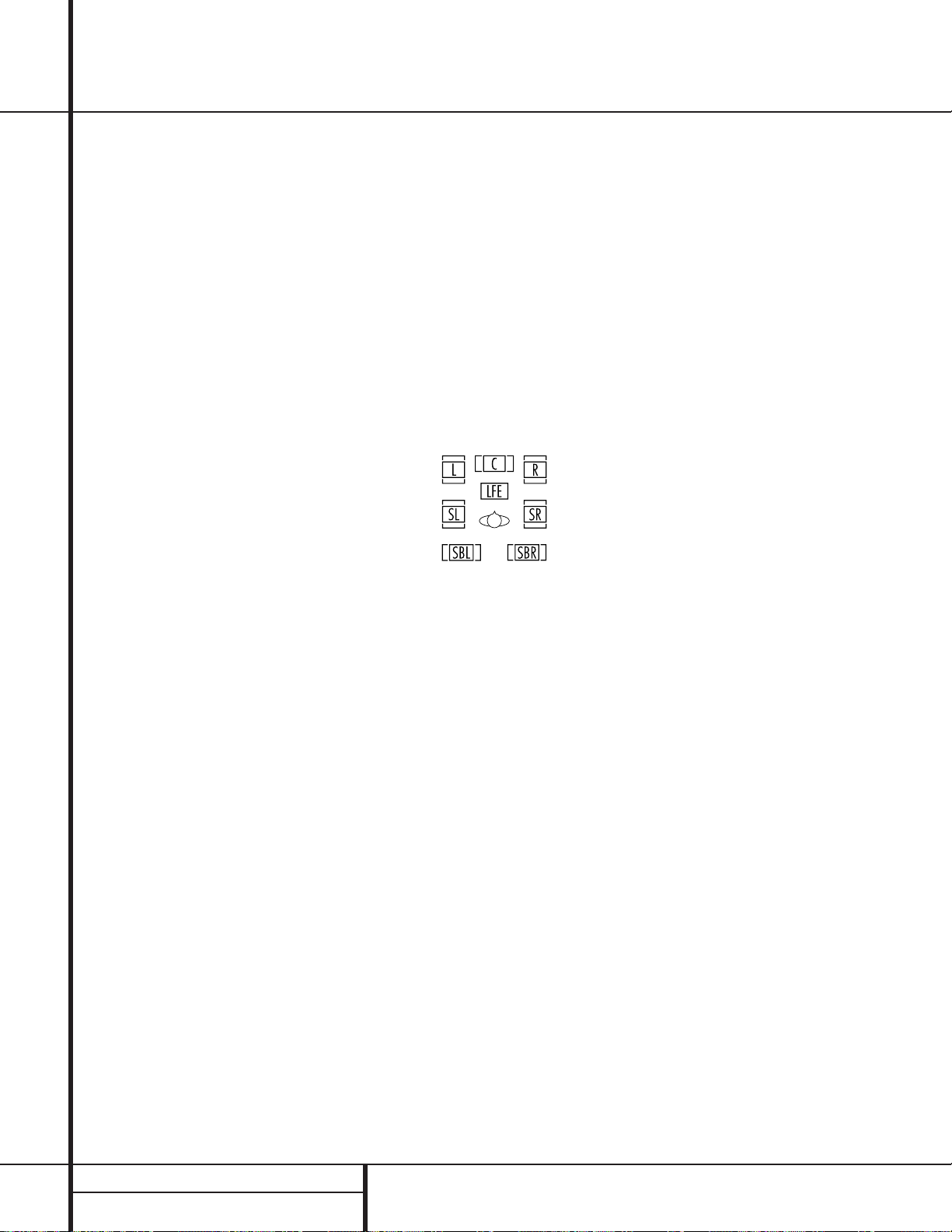
on the remote or the Selector Buttons 7$
on the front panel to
choose any of the
OPTICAL or COAXIAL
inputs, as they
appear in the
Main Information Display Y
display indicator BF or on-screen display.
When the digital source is playing, the AVR 320
will automatically detect whether it is a multi-
channel Dolby Digital, DTS source, MP3 or a
conventional PCM signal, which is the standard
output from CD players. A
Bitstream
Indicator
A will light in the Main
Information Display
˜ to confirm that the
digital signal is Dolby Digital, DTS or PCM.
Digital Status Indicators
When a digital source is playing, the AVR 320
senses the type of bitstream data that is pres-
ent. Using this information, the correct sur-
round mode will automatically be selected. For
example, DTS bitstreams will cause the unit to
switch to DTS decoding, and Dolby Digital bit-
streams will enable Dolby Digital decoding.
When the unit senses PCM data from CDs and
LDs, it will allow the appropriate surround
sources to be selected manually. Since the
range of available surround modes is depend-
ent on the type of digital data that is present,
the AVR 320 uses a variety of indicators to let
you know what type of signal is present. This
will help you to understand the choice of
modes.
When a digital source is playing, a
Bitstream
Indicator
A will light to show which type of
signal is playing:
DOLBY D: When the DOLBY D indicator
lights, a Dolby Digital bitstream is being
received. Depending on the settings on the
source player and specific surround information
and number of channels on the disc, a number
of surround modes are possible. For discs with
full 5.1 audio, only the Dolby Digital and VMAx
modes are available.
DTS:When the DTS indicator lights, a DTS bit-
stream is being received. When the unit senses
this type of data, only the applicable DTS mode
may be used. The ES portion of the DTS indica-
tor will light only if you have selected 6.1/7.1
Surround Mode option in the Surround Select
menu (see page 20 for further information).
PCM: When the PCM indicator lights, a stan-
dard Pulse Code Modulation, or PCM, signal is
being received. This is the type of digital audio
used by conventional compact disc and laser
disc recordings. When a PCM bitstream is pres-
ent, all modes except Dolby Digital and DTS are
available.
MP3: When the MP3 indicator lights, a com-
patible MPEG 1/Layer 3 digital signal is being
received. This is the popular audio format used
by many computer programs for recording com-
pressed audio files. When an MP3 bitstream is
present, the sound will automatically be played
in the Stereo (Surround Off) mode. The sur-
round modes are not available during MP3
playback.
In addition to the bitstream indicators, the
AVR 320 features a set of unique channel-input
indicators that tell you how many channels of
digital information are being received and/or
whether the digital signal is interrupted. (See
Figure 8.)
Figure 8
These indicators are the L/C/R/LFE/SL/SR/SBL/
SBR letters that are inside the center boxes of
the
Speaker/Channel Input Indicators Q
in the front panel Main Information Display
˜. When a standard analog signal is in use,
only the “L” and “R” indicators will light, as
analog signals have only left and right channels.
Digital signals, however, may have two, five, six
or seven separate channels, depending on the
program material, the method of transmission
and the way in which it was encoded. When a
digital signal is playing, the letters in these indi-
cators will light in response to the specific sig-
nal being received. It is important to note that
although Dolby Digital, for example, is referred
to as a “5.1” system, not all Dolby Digital
DVDs or programs are encoded for 5.1. Thus, it
is sometimes normal for a DVD with a Dolby
Digital soundtrack to trigger only the “L” and
“R” indicators.
NOTE: Many DVD discs are recorded with both
“5.1” and “2.0” versions of the same sound-
track. When playing a DVD, always be certain
to check the type of material on the disc. Most
discs show this information in the form of a
listing or icon on the back of the disc jacket.
When a disc does offer multiple soundtrack
choices, you may have to make some adjust-
ments to your DVD player (usually with the
“Audio Select” button or in a menu screen on
the disc) to send a full 5.1 feed to the AVR
320. It is also possible for the type of signal
feed to change during the course of a DVD
playback. In some cases, the previews of special
material will only be recorded in 2.0 audio,
while the main feature is available in 5.1 audio.
The AVR 320 will automatically sense changes
to the bitstream and channel count and reflect
them in these indicators.
The letters used by the
Speaker/Channel
Input Indicators
Q also flash to indicate
when a bitstream has been interrupted. This
will happen when a digital input source is
selected before the playback starts, or when a
digital source such as a DVD is paused. The
flashing indicators remind you that the play-
back has stopped due to the absence of a digi-
tal signal and not through any fault of the
AVR 320. This is normal, and the digital play-
back will resume once the playback is started
again.
Night Mode
A special feature of Dolby Digital is the Night
mode, which enables specially encoded Dolby
Digital input sources to be played back with full
digital intelligibility while reducing the mini-
mum peak level by
1
/4 to
1
/3. This prevents
abruptly loud transitions from disturbing others,
without reducing the impact of the digital
source. The Night mode is available only when
Dolby Digital signals with special data are
being played.
The Night mode may be engaged when a Dolby
Digital DVD is playing by pressing the
Night
Mode Button
l on the remote. Next, press
the
⁄
/
¤
Buttons n to select either the
middle range or full compression versions of
the Night mode. To turn the Night mode off,
press the
⁄
/
¤
Buttons n until the mes-
sage in the lower third of the video display and
the
Main Information Display Y reads
D-Range Off.
The Night mode may also be selected to always
be on at either level of compression using the
options in the
Surround Select
menu. See page 22 for information on using
the menus to set this option.
IMPORTANT NOTES ON DIGITAL
PLAYBACK:
• When the digital playback source is stopped,
or in a pause, fast forward or chapter search
mode, the digital audio data will momentarily
stop, and the channel position letters inside the
Speaker/Channel Input Indicators Q will
30 OPERATION
Operation
31 OPERATION
Operation
flash. This is normal and does not indicate a
problem with either the AVR 320 or the source
machine. The AVR 320 will return to digital
playback as soon as the data is available and
when the machine is in a standard play mode.
• Although the AVR 320 will decode virtually all
DVD movies, CDs and HDTV sources, it is possi-
ble that some future digital sources may not be
compatible with the AVR 320.
• Note that not all digitally encoded programs
contain full 5.1-channel audio. Consult the pro-
gram guide that accompanies the DVD or laser
disc to determine which type of audio has been
recorded on the disc. The AVR 320 will auto-
matically sense the type of digital surround
encoding used and adjust to accommodate it.
• When a digital source is playing, you may not
be able to select some of the analog surround
modes such as Dolby Pro Logic II, Dolby 3,
Stereo, Hall, Theater or Logic 7.
• When a Dolby Digital or DTS source is play-
ing, it is not possible to make an analog
recording using the
Tape Outputs ¢ and
Video 1 or Video 2 Audio Outputs .
However, the digital signals will be passed
through to the
Digital Audio Outputs
⁄Ó.
PCM Audio Playback
PCM (Pulse Code Modulation) is the non-com-
pressed digital audio system used for compact
discs and laser discs. The digital circuits in the
AVR 320 are capable of high-quality digital-to-
analog decoding, and they may be connected
directly to the digital audio output of your CD
or LD player.
Connections may be made to either the rear
panel
Optical or Coaxial Inputs or the
front panel
Digital Inputs *Ó.
To listen to a PCM digital source, first select the
input for the desired source (e.g., CD). Next
press the
Digital Select Button Ûqand
then use the
⁄
/
¤
Buttons n on the
remote, or the
Selector Buttons 7$ on the
front panel, until the desired choice appears in
the
Main Information Display Y.
When a PCM source is playing, the
PCM
Indicator A will light. During PCM playback,
you may select any Surround mode except
Dolby Digital or DTS.
MP3 Audio Playback
The AVR 320 is one of the first A/V receivers to
provide on-board decoding for the MP3 audio
format used by computers and portable audio
devices. Also, some new CD players are capable
of playing back optical discs that are recorded
with MP3, rather than standard CD audio infor-
mation. By offering MP3 decoding, the AVR
320 is able to deliver precise conversion of the
digital signals to an analog output, along with
the benefits of listening to the MP3 audio
through the AVR 320’s high-current amplifier
and the speakers from your surround system,
rather than the smaller speakers and low-pow-
ered amplifiers typically used with computers.
To take advantage of the AVR 320’s MP3 capa-
bilities, simply connect the PCM output of a
computer’s sound card or the PCM output of a
portable digital audio device to either the rear
panel
Digital Inputs or the front
panel
Digital Inputs *Ó.When the digital
signal is available, the
MP3 Bitstream
Indicator
A will light, and the audio will
begin playing.
NOTES:
• The AVR 320 is only capable of playing sig-
nals in the MP3 (MPEG 1/Layer 3) format. It is
not compatible with other computer audio
codecs.
• The digital audio input signal may be either
optical or coaxial, but the signal must be in the
PCM format. Direct connection of USB or serial
data outputs is not possible, even though the
signals are in the MP3 format. If you have any
questions about the data output format from
your computer or a sound card, check with the
device’s owner’s manual or contact the manu-
facturer’s technical support area.
• If your computer or sound card’s digital out-
put is not capable of direct connection to the
AVR, you may use an optional, external
transcoder, such as those available from
Harman Kardon to convert the USB output of a
computer to a format compatible with the AVR.
Contact your Harman Kardon dealer for addi-
tional details.
Tuner Operation
The AVR 320’s tuner is capable of tuning AM,
FM and FM Stereo broadcast stations. Stations
may be tuned manually, or they may be stored
as favorite station presets and recalled from a
30-position memory.
Station Selection
1. Press the AM/FM Tuner Select Button
g
ç
on the remote to select the tuner as
an input. The tuner may be selected from the
front panel by either pressing the
Input
Source Selector
% until the tuner is active
or by pressing the
Tuner Band Selector !
at any time.
2. Press the
AM/FM Tuner Select Button
g
ç
or Tuner Band Selector ! again
to switch between AM and FM so that the
desired frequency band is selected.
3. Press the
FM Mode
^
or Tun-M Button
s to select manual or automatic tuning.
When the
AUTO Indicator X is illuminated in
the
Main Information Display Y the tuner
will only stop at those stations that have a
strong enough signal to be received with
acceptable quality.
When the
AUTO Indicator X is not illumin-
ated, the tuner is in a manual mode and will
stop at each frequency increment in the select-
ed band.
4. To select stations, press the
Tuning
Selector Button
)
u
é
. When the
AUTO Indicator X is illuminated, press the
button for two seconds and then release to
cause the tuner to search for the next highest
or lowest frequency station that has an accept-
able signal. When tuning FM stations in the
Auto mode, the tuner will only select stereo
stations. To tune to the next station, press the
button again. If the
STEREO Indicator V
is not illuminated, tap the Tuning Selector
Button
)
u
é
to advance one frequency
increment at a time, or press and hold it to
locate a specific station. When the
TUNED
Indicator W lights, the station is properly
tuned and should be heard with clarity.
5. Stations may also be tuned directly by press-
ing the
Direct Button t, and then pressing
the
Numeric Keys
r
that correspond to the
station’s frequency. The desired station will
automatically be tuned. If you press an incor-
rect button while entering a direct frequency,
press the
Clear Button to start over.
NOTE: When the FM reception of a station is
weak, audio quality will be increased by
switching to Mono mode by pressing the
FM
Mode Button
^
s
until the STEREO
Indicator V goes out.
34
32
31
32
31
37
33
Preset Tuning
Using the remote, up to 30 stations may be
stored in the AVR 320’s memory for easy recall
using the front panel controls or the remote.
To enter a station into the memory, first tune
the station using the steps outlined above.
Then:
1. Press the
Memory Button on the
remote. Note that the
MEMORY Indicator
U will be illuminated and flash in the Main
Information Display
˜.
2. Within five seconds, press the
Numeric
Keys
r corresponding to the location where
you wish to store this station’s frequency. Once
entered, the preset number will appear in the
Preset Number/Sleep Timer R display.
3. Repeat the process after tuning any addition-
al stations to be preset.
Recalling Preset Stations
• To manually select a station previously
entered in the preset memory, press the
Numeric Keys r that correspond to the
desired station’s memory location.
• To manually tune through the list of stored
preset stations one by one, press the
Preset
Stations Selector Buttons
#
©
on
the front panel or remote.
Tape Recording
In normal operation, the audio or video source
selected for listening through the AVR 320 is
sent to the record outputs. This means that any
program you are watching or listening to may
be recorded simply by placing machines con-
nected to the outputs for
Tape Outputs ¢ or
Video 1 or 2 Outputs gi in the
record mode.
When a digital audio recorder is connected to
the
Digital Audio Outputs ⁄Ó, you are
able to record the digital signal using a CD-R,
MiniDisc or other digital recording system. In
order to record using the
Digital Coax 3
Output
Ó, you must set this connection to an
output using the
IN/OUT SETUP menu
as described below and on page 20.
Front Panel Connections
In addition to the rear panel digital outputs, the
AVR 320 offers Harman Kardon’s exclusive con-
figurable front panel output jack feature. For
easy connection of portable devices, you may
switch the front panel
Digital Coax Jack Ó
from an input to an output by following these
steps:
1.Press the
OSD Button v to view the
MASTER MENU (Figure 1).
2.Press the
Set Button p to enter the
IN/OUT SETUP menu (Figure 2).
3.Press the
¤
Button n so that the on-
screen
›
cursor is next to COAXIAL 3.
4.Press the
Set Button p and then press
either of the
‹
/
›
Buttons o/ so that
the word
IN is highlighted.
5.Press the
Set Button p to enter the
change.
6.Press the
OSD Button v to exit the
menus and return to normal operation.
Note that once the setting is made, the
Input/Output Status Indicator ( will turn
red, indicating that the front panel
Digital
Coax Input Jack
Ó is now an output,
instead of in the default setting as an input.
Once changed to an output, the setting will
remain as long as the AVR 320 is turned on,
unless the setting is changed in the OSD menu
system, as described above. Note, however, that
once the AVR 320 is turned off, the setting is
cancelled. When the unit is turned on again,
the front panel
Digital Coax Input Jack Ó
will return to its normal default setting as
an input. If you wish to use this jack as an
output at a future time, the setting must
be changed again using the OSD menu system,
as described above.
NOTES:
• The digital outputs are active only when a
digital signal is present, and they do not con-
vert an analog input to a digital signal, or
change the format of the digital signal. In
addition, the digital recorder must be com-
patible with the output signal. For example,
the PCM digital input from a CD player may
be recorded on a CD-R or MiniDisc, but Dolby
Digital or DTS signals may not.
• Please make certain that you are aware of
any copyright restrictions on any material you
copy. Unauthorized duplication of copyrighted
materials is prohibited by federal law.
Output Level Trim Adjustment
Normal output level adjustment for the AVR
320 is established using the test tone, as out-
lined on pages 23 and 24. In some cases, how-
ever, it may be desirable to adjust the output
levels using program material such as a test
disc, or a selection you are familiar with.
Additionally, the output level for the subwoofer
can only be adjusted using this procedure.
To adjust the output levels using program
material, first set the reference volume for the
front left and front right channels using the
Volume Control ı
î
.
If you are using a disc with test signals or an
external signal generator as the source from
which to trim the output levels, you may use
the EzSet feature of the remote to guide you to
the correct SPL level. To use the remote for this
purpose, press and quickly release the
SPL
Indicator Select
to activate the sensor.
While the test tone is circulating, the
Program/SPL Indicator c will change color
to indicate the level. Adjust the level as shown
above until the LED lights green for all chan-
nels. When it is red the level is too high; when
it is amber the level is too low. Press the
SPL
Indicator Select
to turn the sensor and
indicator off.
Once the reference level has been set, press
the
Channel Select button
m
Ù and note
that
FRONT L LEV will appear in the
Main Information Display Y.To change
the level, first press the
Set Button p@ ,
and then use the
Selector Buttons 7$ or
the
⁄
/
¤
Buttons
n
to raise or lower the
level. DO NOT use the volume control, as this
will alter the reference setting.
Once the change has been made, press the
Set
Button
p@ and then press the Selector
Buttons
7$ or the
⁄
/
¤
buttons
n
to
select the next output channel location that you
wish to adjust. To adjust the subwoofer level,
press the
Selector Buttons 7$ or the
⁄
/
¤
Buttons
n
until WOOFER LEV
appears in the Main Information Display Y
or on-screen display.
Press the
Set Button p@ when the name
of the desired channel appears in the
Main
Information Display
Y and on-screen dis-
play, and follow the instructions shown earlier
to adjust the level.
41
41
40
37
37
33
33
35
32 OPERATION
Operation
33 OPERATION
Operation
Repeat the procedure as needed until all chan-
nels requiring adjustment have been set. When
all adjustments have been made and no further
adjustments are made for five seconds, the
AVR 320 will return to normal operation.
The channel output for any input may also be
adjusted using the full-OSD on-screen menu
system. First, set the volume to a comfortable
listening level using the
Volume Control
ı
î
.Then, press the OSD Button v
to bring up the MASTER MENU (Figure 1).
Press the
¤
Button n four times until the
on-screen
›
cursor is next to the CHANNEL
ADJUST
line. Press the Set Button p@
to activate the CHANNEL ADJUST menu.
Once the menu appears on your video screen,
first use the
⁄
/
¤
Buttons n to move the
on-screen
›
cursor so that it is next to the
TEST TONE line. Press the ‹/› Buttons
o so that OFF is highlighted. This will
turn off the test tone and allow you to use your
external test disc or other source material as
the reference. Then, use the
⁄
/
¤
Buttons
n to select the channels to be adjusted. At
each channel position use the
‹/› Buttons
o to change the output level.
Remember, the goal is to have the output level
at each channel be equal when heard at the
listening position.
If you wish to reset all the levels to their origi-
nal factory default of 0dB offset, press the
⁄
/
¤
Buttons n so that the on-screen cur-
sor is next to the
CHANNEL RESET line
and press the
‹/› Buttons o so that
the word
ON is highlighted. After the levels
are reset, resume the procedure outlined above
to reset the levels to the desired settings. When
all adjustments are done, press the
⁄
/
¤
Buttons n to move the on-screen
›
cursor
so that it is next to
RETURN TO MAS-
TER MENU
and then press the Set Button
p if you wish to go back to the main menu
to make other adjustments. If you have no
other adjustments to make, press the
OSD
Button
v to exit the menu system.
NOTE: The output levels may be separately
trimmed for each digital and analog surround
mode. If you wish to have different trim levels for
a specific mode, select that mode and then follow
the instructions in the steps shown earlier.
6-Channel/8-Channel Direct Input
The AVR 320 is equipped for future expansion
through the use of optional, external adapters
for formats that the AVR 320 may not be
capable of processing or to allow connection
to the output of high-resolution optical audio
playback systems such as DVD-Audio or SACD.
When a device with six-channel outputs (5.1
audio) is used, connect the source device to the
6-Channel Direct Inputs ª.When a device
with eight-channel outputs (7.1) audio is used,
connect the additional Surround Back Left (SBL)
and Surround Back Right (SBR) outputs to the
8-Channel Direct Inputs ‚ on the AVR. To
select these inputs, press the
6-Channel/8-
Channel Direct Button
h on the remote
until the desired input configuration appears in
the
Main Information Display Y.
Note that when the 6-Channel or 8-Channel
Direct Input is in use, you may not select a sur-
round mode, as the external decoder deter-
mines the processing in use. In addition, there
is no signal at the record outputs or bass man-
agement when the 6-Channel or 8-Channel
Direct Input is in use.
Memory Backup
This product is equipped with a memory back-
up system that preserves the system configura-
tion information and tuner presets if the unit is
accidentally unplugged or subjected to a power
outage. This memory will last for approximately
two weeks, after which time all information
must be reentered.
37
37
37
40
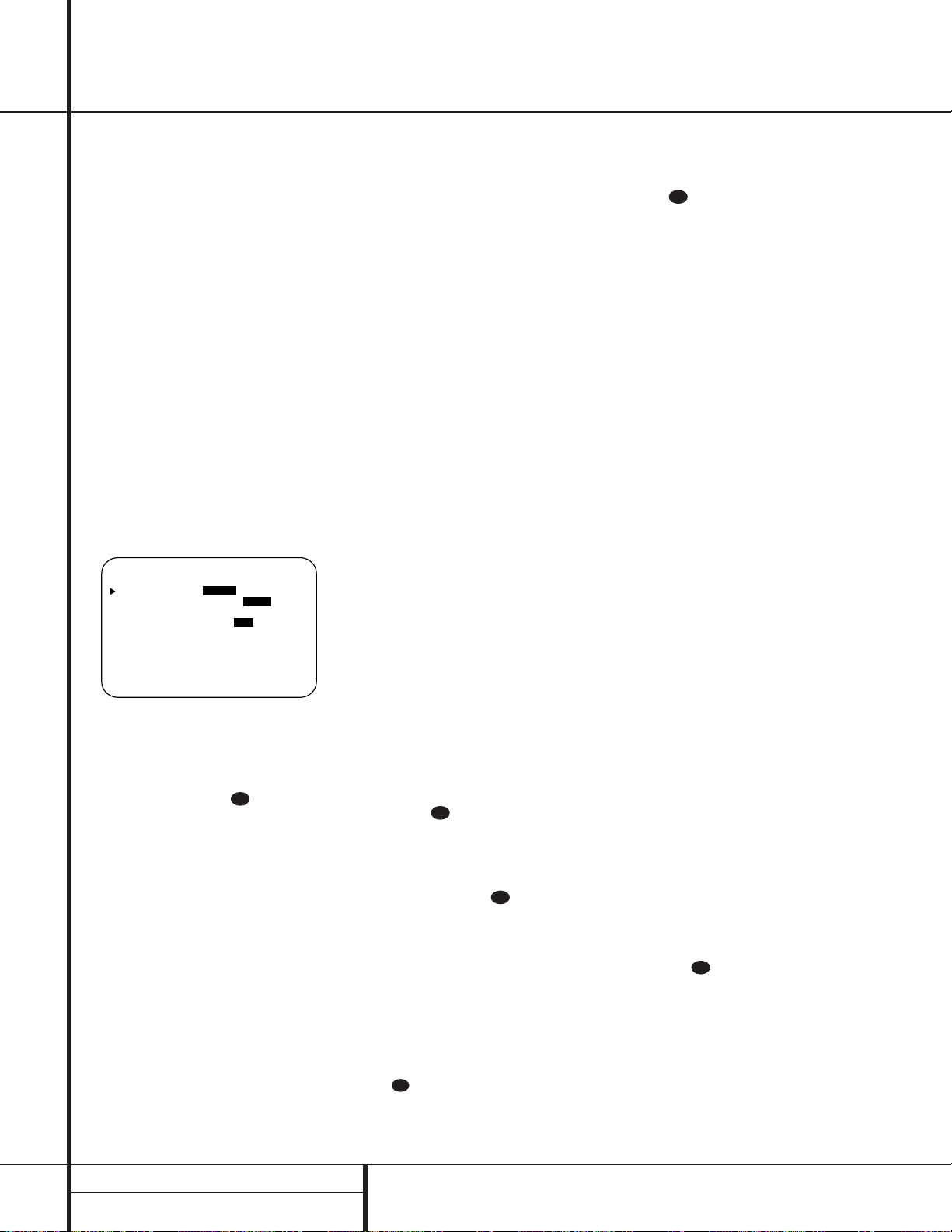
The AVR 320 is equipped with a number of
advanced features that add extra flexibility to
the unit’s operation. While it is not necessary
to use these features to operate the unit, they
provide additional options that you may wish
to use.
Display Brightness
The AVR 320’s Main Information Display
˜ is set at a default brightness level that is
sufficient for viewing in a normally lit room.
However, in some home-theater installations,
you may wish to occasionally lower the bright-
ness of the display, or turn it off completely.
To change the display brightness setting for a
specific listening session, you will need to make
an adjustment in the
ADVANCED menu. To
start the adjustment, press the
OSD Button
v to bring the MASTER MENU to the
screen. Press the
¤
Button n six times, until
the on-screen
›
cursor is next to the
ADVANCED line. Press the Set Button p
to enter the ADVANCED menu (Figure 9).
Figure 9
To change the brightness setting, at the
ADVANCED menu, make certain that the
on-screen
›
cursor is next to the VFD line,
and press the
›
Button until the desired
brightness level is highlighted in the video dis-
play. When
FULL is highlighted, the display is
at its normal brightness. When
HALF is high-
lighted, the display is at half the normal bright-
ness level. When
OFF is highlighted, all of the
indicators in the
Main Information Display
˜ will go dark. Note, however, that the green
LEDs for the
Input Indicators ˆ and the
Surround Mode Indicators ˘, as well as
for the
Power Indicator 3, will always
remain lit to remind you that the unit is turned
on.
The display brightness may also be changed by
pressing and holding the
Set Button @ on
the front for three seconds until the message in
the
Main Information Display Y reads
VFD FULL.Within five seconds, press the
front panel
Selector Buttons 7$ until the
desired brightness display level is shown. At
that point, press the
Set Button @ again to
enter the setting.
Once the desired brightness level is selected, it
will remain in effect until it is changed again or
until the unit is turned off.
If you wish to make other adjustments, press
the
⁄
/
¤
Buttons n until the on-screen
›
cursor is next to the desired setting or the
RETURN TO MASTER MENU line and
press the
Set Button p. If you have no
other adjustments to make, press the
OSD
Button
v to exit the menu system.
Turn-On Volume Level
As is the case with most audio/video receivers,
when the AVR 320 is turned on, it will always
return to the volume setting in effect when the
unit was turned off. However, you may prefer to
always have the AVR 320 turn on at a specific
setting, regardless of what was last in use
when the unit was turned off. To change the
default condition so that the same volume level
is always used at turn-on, you will need to
make an adjustment in the
ADVANCED
menu. To start the adjustment, press the OSD
Button
v to bring the MASTER MENU
(Figure 1) to the screen. Press the
¤
Button
n six times, until the on-screen
›
cursor is
next to the
ADVANCED line. Press the Set
Button
p to enter the ADVANCED menu
(Figure 9).
At the
ADVANCED menu make certain that
the on-screen
›
cursor is next to the
VOLUME DEFAULT line by pressing the
⁄
/
¤
Buttons n as needed. Next, press the
›
Button so that the word ON is high-
lighted in the video display. Next, press the
¤
Button n once so that the on-screen
›
cur-
sor is next to the
DEFAULT VOL SET
line. To set the desired turn-on volume, press
the
‹
/
›
Buttons o until the desired
volume level is shown on the
DEFAULT
VOL SET
line. Note that this setting may
NOT be made with the regular volume controls.
NOTE: Since the setting for the turn-on volume
cannot be heard while the setting is being
made, you may wish to determine the setting
before making the adjustment. To do this, listen
to any source and adjust the volume to the
desired level using the regular volume controls
ı
î
.When the desired volume level to
be used at turn-on is reached, make a note of
the setting as it appears in the lower third of
the video screen or in the
Main Information
Display
Y. (A typical volume level will appear
as a negative number such as –25dB.) When
making the adjustment, use the
‹
/
›
Buttons
o to enter this setting.
Unlike some of the other adjustments in this
menu, the turn-on volume default will remain
in effect until it is changed or turned off in this
menu, even when the unit is turned off.
If you wish to make other adjustments, press
the
⁄
/
¤
Buttons n until the on-screen
›
cursor is next to the desired setting or the
RETURN TO MASTER MENU line and
press the
Set Button p. If you have no
other adjustments to make, press the
OSD
Button
v to exit the menu system.
Semi-OSD Settings
The semi-OSD system places one-line messages
at the lower third of the video display screen
whenever the Volume, Input Source, Surround
mode or tuner frequency of any of the configu-
ration settings are changed. The semi-OSD sys-
tem is helpful in that it enables you to have
feedback on any control changes or remote
commands using the video display when it is
difficult to view the front panel displays.
However, you may occasionally prefer to turn
these displays off for a particular listening ses-
sion. You may also want to adjust the length of
time the displays remain on the screen. Both of
those options are possible with the AVR 320.
To turn off the semi-OSD system, you will need
to make an adjustment in the
ADVANCED
menu (Figure 9). To start the adjustment, press
the
OSD Button v to bring the MASTER
MENU
to the screen. Press the ¤ Button
n six times, until the on-screen ¤ cursor is
next to the
ADVANCED line. Press the Set
Button
p to enter the ADVANCED
menu.
At the
ADVANCED menu, make certain that
the on-screen
› cursor is next to the SEMI
OSD DEFAULT
line by pressing the
⁄
/
¤
Buttons n as needed. Next, press the ›
Button so that the word OFF is high-
lighted in the video display.
Note that this setting is temporary and will
remain active only until it is changed or until
the AVR 320 is turned off. Once the unit is
turned off, the semi-OSD displays will remain
activated, even if they were switched off for the
previous listening session.
37
37
40
37
37
37
* ADVANCED *
VFD :FULL HALF OFF
VOLUME DEFAULT:OFF ON
DEFAULT VOL SET:25dB
SEMI OSD :OFF ON
SEMI OSD TIME OUT: 35
FULL OSD TIME OUT:205
RETURN TO MASTER MENU
34 ADVANCED FEATURES
Advanced Features
35 ADVANCED FEATURES
Advanced Features
To change the length of time that the semi-OSD
displays remain on the screen, go to the
ADVANCED menu as outlined earlier, and
press the
⁄
/
¤
Buttons n as needed, until
the on-screen
›
cursor is next to the SEMI
OSD TIME OUT
line. Next, press the
‹
/
›
Buttons o until the desired time in sec-
onds is displayed. Note that unlike most of the
other options in this menu, this is a permanent
setting change, and the time-out entry will
remain in effect until it is changed, even when
the unit is turned off.
If you wish to make other adjustments, press
the
⁄
/
¤
Buttons n until the on-screen
›
cursor is next to the desired setting or the
RETURN TO MASTER MENU line and
press the
Set Button p. If you have no
other adjustments to make, press the
OSD
Button
v to exit the menu system.
Full-OSD Time-Out Adjustment
The FULL OSD menu system is used to sim-
plify the setup and adjustment of the AVR 320,
using a series of on-screen menus. The factory
default setting for these menus leaves them on
the screen for 20 seconds after a period of
inactivity before they disappear from the screen
(Time-Out). Time-Out is a safety measure to
prevent image retention of the menu text in
your monitor or projector, which might happen
if it were left on indefinitely. However, some
viewers may prefer a slightly longer or shorter
period before the Time Out display.
To change the Full-OSD Time-Out, you will need
to make an adjustment in the
ADVANCED
menu (Figure 9). To start the adjustment, press
the
OSD Button v to bring the MASTER
menu to the screen. Press the ¤ Button n
six times, until the on-screen ¤ cursor is next
to the
ADVANCED line. Press the Set
Button
p to enter the ADVANCED menu
(Figure 9).
At the
ADVANCED menu (Figure 9) make
certain that the on-screen
› cursor is next to
the
FULL OSD TIME OUT line by press-
ing the
⁄
/
¤
Buttons n as needed. Next,
press the
‹
/
›
Buttons o/until the
desired time is displayed in seconds. Note that
unlike most of the other options in this menu,
this is a permanent setting change, and the
Time-Out entry will remain in effect until it is
changed, even if the unit is turned off.
If you wish to make other adjustments, press
the
⁄
/
¤
Buttons n until the on-screen
›
cursor is next to the desired setting or the
RETURN TO MASTER MENU line and
press the
Set Button p. If you have no
other adjustments to make, press the
OSD
Button
v to exit the menu system.
37
37
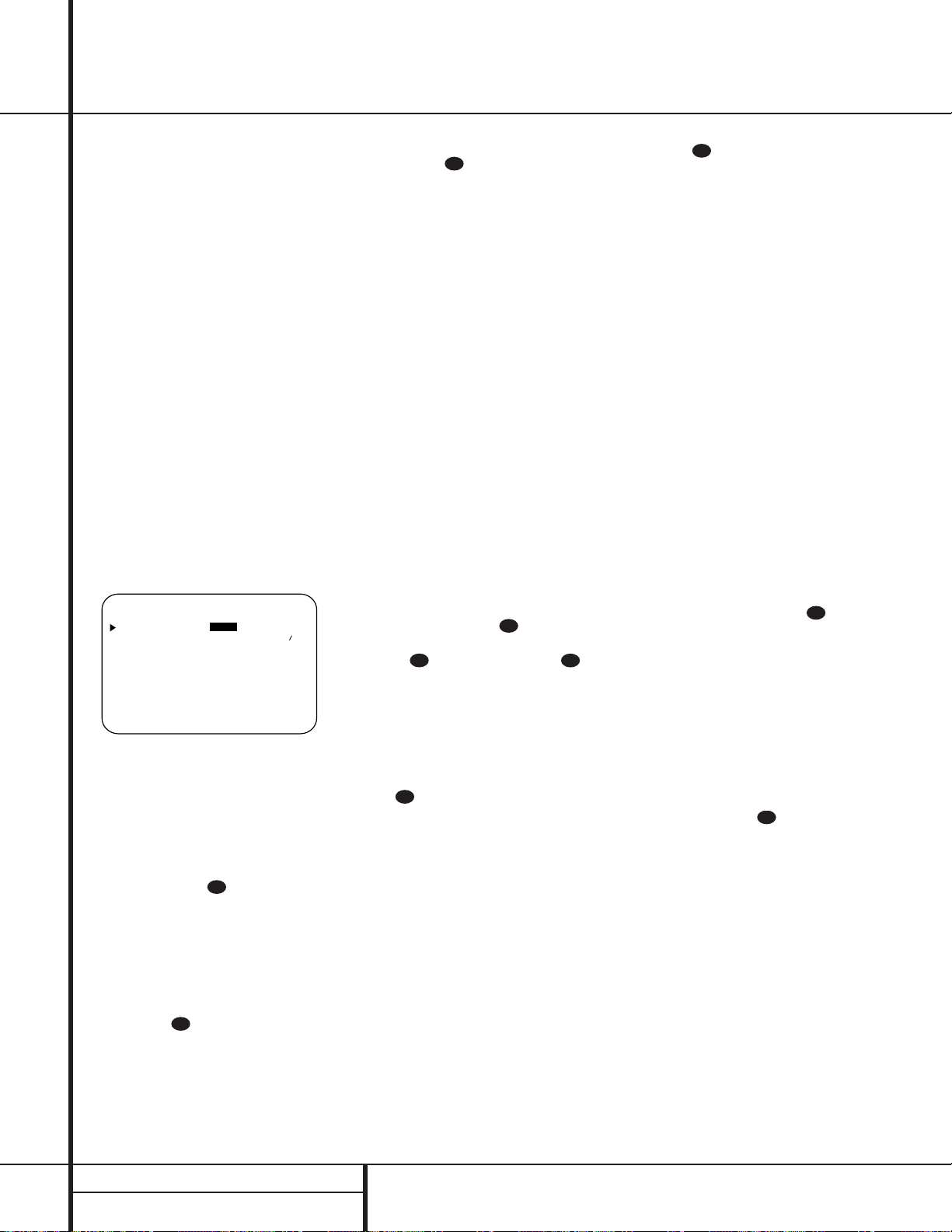
36 MULTIROOM OPERATION
Multiroom Operation
The AVR 320 is fully equipped to operate
as the control center for a multiroom system
with optional remote external infrared (IR) sen-
sors, speakers and power amplifiers. Although
some multiroom installations will require the
services of a specially trained installer, it is pos-
sible for the average do-it-yourself hobbyist to
install a simple remote room system.
Installation
The key to remote room operation is to link the
remote room to the AVR 320’s location with
wire for an infrared link and speakers or an
amplifier. For installation instructions for
Multiroom use, see page 16.
Multiroom Setup
Once the audio and IR link connections have
been made, the AVR 320 needs to be configured
for multiroom operation using the steps below.
Press the
OSD Button v to bring the
MASTER menu (Figure 1) to the screen.
Press the
¤
Button n five times, until the
on-screen
›
cursor is next to the MULTI-
ROOM
line. Press the Set Button p to
enter the
MULTI-ROOM menu (Figure 10).
Figure 10
When the MULTI-ROOM menu appears,
the on-screen
› cursor will be at the
MULTI-ROOM line. Since this line is used
to turn the system on and off, do not make an
adjustment here unless you wish to turn the
system on at this time. To turn the system on,
press the
› Button so that ON is high-
lighted. If you do not wish to turn the system
on at this time or to proceed to the next step,
press the
¤
Button n once so that the ›
on-screen cursor is next to the MULTI IN
line.
At the
MULTI IN line, press the
‹
/
›
Buttons o until the desired input to the
multiroom system appears in the highlighted
video. When the selection has been made,
press the
¤
Button n once so that the
›
on-screen cursor is next to the MULTI
VOL
line.
At the
MULTI VOL line, press the
‹
/
›
Buttons o until the desired volume
level for the multiroom system is entered. DO
NOT use the regular volume control knobs for
this setting. When all settings for the multiroom
setup have been made, press the
⁄
/
¤
Buttons n until the on-screen
›
cursor is
next to the
RETURN TO MASTER
MENU
line. If you have no other adjustments
to make, press the
OSD Button v to exit
the menu system.
Multiroom Operation
When operating the AVR 320 from a remote
room location where an IR sensor link has been
connected to the AVR 320’s rear panel
Multiroom IR Input f, you may use either
the main remote control or the Zone II remote.
To turn on the multiroom feed, press any of the
Input Selector buttons on the Zone II remote
∫ç∂
or the main remote
efg.
Press the
AVR Selector f
∫
to turn the
unit on to the last source, or any of the other
Selector buttons to turn on to a specific source.
As long as an IR feed to the AVR 320 has been
established from the remote room, using any of
the buttons on either remote will control the
remote location volume
î
, change the
tuner frequency
u
É
, change the tuner
preset
©
or mute the output
˚
.
If the
Remote IR Output Jack d on the
AVR 320 is connected to an IR Input jack on
compatible Harman Kardon audio components
such as CD, DVD or cassette players, the trans-
port functions of those machines may also be
controlled using the
Transport Controls
z
Ƀ©˙∆
on either
remote control.
To turn the system off from the remote room,
press the
Power Off Button a
å
.
Remember that the AVR 320 may be turned on
or off from the remote room, regardless of the
system’s operation or status in the main room.
NOTE: When the tuner is selected as the source
for the remote zone, any change to the fre-
quency or preset will also change the station
being listened to in the main room, if the tuner
is in use there. Similarly, if someone in the main
room changes the station, the change will also
impact the remote room.
To activate the feed to the remote room, while
you are in the main listening room where the
AVR 320 is located, press the
Multiroom
Button
on the remote. Next, press the
Set Button p. Press the
⁄
/
¤
Buttons
n to turn the multiroom feed on or off. When
the multiroom system is on, the
Multi
Indicator
O will light in the Main
Information Display
˜, and the Main
Information Display
Y or OSD will display
MULTI ON. Press the Set Button p to
enter the setting.
When the multiroom system is turned on, the
input selected using the multiroom menu will be
fed to the
Multiroom Output Jacks • on
the rear panel. The volume will be as set in the
previous selection, although it may also be
adjusted using an optional IR sensor and the
Zone II remote in the remote location or on the
optional audio power amplifier connected to the
Multiroom Output Jacks •.
Once the multiroom system is turned on, it will
remain on even if the AVR 320 is placed in the
Standby mode in the main room by pressing
the
Power Off Button
å
or the System
Power Control
2 on the front panel. To turn
off the multiroom system, even when the AVR is
in Standby mode in the main listening room,
press the
Multiroom Button and then
the
Set Button p. Press the
⁄
/
¤
Buttons
n so that the Multi Indicator O in the
Main Information Display ˜ goes out, and
the
Main Information Display Y or OSD
will display
MULTI OFF. Press the Set
Button
p to enter the setting and turn the
unit off.
Even when the AVR 320 is turned off in the
main room, the multiroom system may be
turned on at any time by pressing the
Multiroom Button , or any of the
Selector Buttons
∫ç∂
in the remote
room.
39
39
39
28
43
33
40
37
37
37
* MULTI-ROOM *
MULTI-ROOM:OFF ON
MULTI IN :FM PRESET 01
MULTI VOL :25dB
BACK TO MASTER MENU
37 PROGRAMMING THE REMOTE
Programming the Remote
The AVR 320 is equipped with a powerful
remote control that will control not only the
receiver’s functions, but also most popular
brands of audio and video equipment, includ-
ing CD players, cassette decks, TV sets, cable
boxes, VCRs, satellite receivers and other home-
theater equipment. Once the AVR 320’s remote
is programmed with the codes for the products
you own, it is possible to eliminate most other
remotes and replace them with the convenience
of a single, backlit universal remote control.
Programming the Remote
The AVR 320 remote is factory-programmed for
all AVR functions, as well as those of most
Harman Kardon CD changers, DVD players, CD
players and cassette decks. In addition, by fol-
lowing one of the methods below, you may pro-
gram the remote to operate a wide range of
devices from other manufacturers.
Direct Code Entry
This method is the easiest way to program your
remote to work with different products.
1. Use the tables in the following pages to
determine the three-digit code or codes
that match both the product type (e.g.,
VCR, TV) and the specific brand name. If
there is more than one number for a brand,
make note of the different choices.
2. Turn on the unit you wish to program into
the AVR 320 remote.
3. Press and hold both the
Input Selector
e for the product you wish to control
(e.g., VCR, TV) and the
Mute button
at the same time. When the
Program/SPL
Indicator
c turns amber and begins
flashing, release the buttons. It is important
that you begin the next step within 20
seconds.
4. Point the AVR 320’s remote towards the unit
to be programmed, and enter the first three-
digit code number using the
Numeric Keys
r. If the unit turns off, the correct code
has been entered. Press the
Input Selector
e again, and note that the red light will
flash three times before going dark to con-
firm the entry.
5. If the device to be programmed in does
NOT turn off, continue to enter three-digit
code numbers until the equipment turns off.
At this point, the correct code has been
entered. Press the
Input Selector e
again and note that the red light under the
Input Selector will flash three times
before going dark to confirm the entry.
6. Try all of the functions on the remote to
make certain that the product operates
properly. Keep in mind that many manufac-
turers use a number of different combina-
tions of codes, so it is a good idea to make
certain that not only the Power control, but
the volume, channel and transport controls
work as they should. If functions do not
work properly, you may need to use a dif-
ferent remote code.
7. If a code cannot be entered to turn the
unit off, if the code for your product does
not appear in the tables in this manual, or
if not all functions operate properly, try
programming the remote with the Auto
Search Method.
Auto Search Method
If the unit you wish to include in the AVR 320’s
remote is not listed in the code tables in this
manual or if the code does not seem to operate
properly, you may wish to program the correct
code using the Auto Search method that follows:
1. Turn on the unit that you wish to include in
the AVR 320 remote.
2. Press the
Input Selector e for the type
of product to be entered (e.g., VCR, TV) and
the
Mute button at the same time.
Hold both buttons until the red light under
the
Input Selector e stays lit. Note that
the next step must take place while the red
light is on, and it must begin within 20 sec-
onds after the light appears.
3. Point the AVR 320 remote towards the
unit to be programmed, and press either
⁄
or
¤
button n. Each press will send out a
series of codes from the remote’s built-in
database. When the unit being programmed
turns off, release
⁄ /¤
button n, as that
is your indication that the correct code is
in use.
4. Press the
Input Selector e, and note
that the red light under the Input Selector
will flash three times before going dark to
confirm the entry.
5. Try all of the functions on the remote to
make certain that the product operates.
Keep in mind that many manufacturers use
a number of different combinations of
codes, and it is a good idea to make certain
that not only the Power control works, but
also the volume, channel and transport con-
trols, as appropriate. If all functions do not
work properly, you may need to Auto-
Search for a different code, or enter a code
via the Direct Code Entry method.
Code Readout
When the code has been entered using the
Auto Search method, it is always a good idea to
find out the exact code so that it may be easily
reentered if necessary. You may also read the
codes to verify which device has been pro-
grammed to a specific Control Selector button.
1. Press and hold both the
Input Selector
e for the device you wish to find the
code for and the
Mute button at the
same time. Note that the
Program/SPL
Indicator
c will initally turn amber.
Release the buttons and begin the next
step within 20 seconds.
2. Press the
Set button p.The
Program/SPL Indicator c will then
blink green in a sequence that corresponds to
the three-digit code, with a one-second
pause between each digit. Count the number
of blinks between each pause to determine
the digit of the code. One blink is the number
1, two blinks is the number 2, and so forth.
Ten blinks are used to indicate a “0.”
Example: One blink, followed by a one-second
pause, followed by six blinks, followed by a
one-second pause, followed by ten blinks indi-
cates that the code has been set to 160.
For future reference enter the Setup Codes for
the equipment in your system here:
DVD ____________ CD ________________
VID1/VCR ________ VID2/TV __________
VID3/CBL ________ VID3/SAT__________
VID4 ____________ TAPE ____________
Learning Codes
In addition to using codes from the remote’s
internal code library, the AVR 320’s remote is
able to “learn”codes from remotes that may
not be in the code library. In addition, you may
use this function to “learn over” the codes
from a preprogrammed device to add functions
not included in the preprogrammed codes. To
learn or transfer codes from an IR remote to
the AVR 320’s remote, follow these steps:
43
43
43
1. Place the front of the original remote with
the code being sent so that it is facing the
IR Transmitter Window b on the
AVR 320 remote “head-to-head.” The
remotes should be between one and three
inches apart.
2. Select the button on the remote that you
wish to use as the device selector for the
codes about to be entered. This may be any
of the
Input Selectors e.
3. Press the
Input Selector e button
chosen and the
Learn Button at the
same time. Hold these buttons until the
Program/SPL Indicator c flashes amber
and the light under the device selector but-
ton turns red. Release the buttons.
4. Press the button on the AVR 320 remote
that you wish to program. Note that the
Program/SPL Indicator c will stop
flashing.
5. Within five seconds, press and hold the but-
ton on the original remote that you wish to
“teach” into the AVR 320 remote. When the
Program/SPL Indicator c turns green
three times, release the button. Note that
the Program Indicator will then begin to
flash amber again.
NOTE: If the Program/SPL Indicator c
turns red during Step 5 or 6, the program-
ming was not successful. Repeat the steps to
see if the code will “take.”
6. Repeat Steps 4 though 6 for each button on
the source remote that you wish to transfer
to the AVR 320 remote.
7. Once all codes have been transferred from
the original source remote to the AVR 320
remote, press the
Learn Button .
8. Repeat Steps 1 through 7 for any additional
remotes you wish to “teach” into the
AVR 320 Remote.
Erasing Learned Codes
The AVR 320’s remote allows you to remove or
erase, the code learned into a single button for a
single device, to remove or erase the code set for
all the codes that have been programmed into
specific device buttons, or to erase all commands
that have been learned to all devices.
To erase a single learned code from within a sin-
gle device’s settings, follow these steps:
1. Press and hold both the
Input Selector
efg within which the individual but-
ton to be erased has been programmed and
the
Learn Button .
2. When the red LED under the
Input Selector
turns red and the Program/SPL Indicator
c flashes amber, release the buttons.
3. Press and release the
Input Selector
efg again for the device within
which the individual button to be erased has
been programmed.
4. Press the
“7” Numeric Key r four times.
5. Press and release the individual button for
which the code is to be erased.The
Program/SPL Indicator c will blink
green two times and then return to amber.
6. To erase other buttons within the same
device, press them as noted in Step 5.
7. When all buttons to be erased have been
pressed, press the
Learn Button to
complete the process.
To erase all codes within a single device, follow
these steps:
1. Press and hold both the
Input Selector
efg for which you wish to erase the
codes and the
Learn Button .
2. When the red LED under the
Input Selector
turns red and the Program/SPL Indicator
c flashes amber, release the buttons.
3. Press and release the
Input Selector
efg again for the device whose
codes you wish to erase.
4. Press the
“8” Numeric Key r four times.
5. The
Program/SPL Indicator c will turn
off and the red light under the
Input
Selector
will flash on and off once to indi-
cate that the codes have been erased.
To erase all codes that have been programmed
to all devices in the remote, follow these steps:
1. Press any
Input Selector efg for
which you wish to erase the codes and also
the
Learn Button .
2. When the red LED under the
Input Selector
turns red and the Program/SPL Indicator
c flashes amber, release the buttons.
3. Press and release the
Input Selector
efg again for the device whose
codes you wish to erase.
4. Press the
”9” Numeric Key r four times.
5. The
Program/SPL Indicator c will turn
off and the red light under the
Input
Selector
will flash on and off once to
indicate that the codes have been erased.
Macro Programming
Macros enable you to easily repeat frequently
used combinations of commands with the press
of a single button on the AVR 320’s remote
control. Once programmed, a macro will send
out up to 19 different remote codes in a prede-
termined sequential order enabling you to auto-
mate the process of turning on your system,
changing devices, or other common tasks. The
AVR 320’s remote can store up to five separate
macro command sequences: one that is
associated with the
Power On Button d
and four more that are accessed by pressing the
Macro Buttons .
1. Press the
Mute Button and the
Macro Button to be programmed or
the
Power On Button d at the same
time. Note that an
Input Selector will
light red, and the
Program/SPL Indicator
c will flash amber.
2. Enter the steps for the macro sequence by
pressing the button for the actual command
step. Although the macro may contain up to
19 steps, each button press, including those
used to change devices, counts as a step.
The
Program/SPL Indicator c will flash
green to confirm each button press as you
enter commands.
NOTE: While entering commands for Power
On/Off of any device during a macro sequence,
press the
Mute Button .DONOT press the
actual Power button.
3. When all the steps have been entered,
press the
Sleep Button j to enter the
commands. The red light under the
Input
Selectors
ef will blink and then
turn off.
43
31
43
31
42
42
42
42
42
42
38 PROGRAMMING THE REMOTE
Programming the Remote
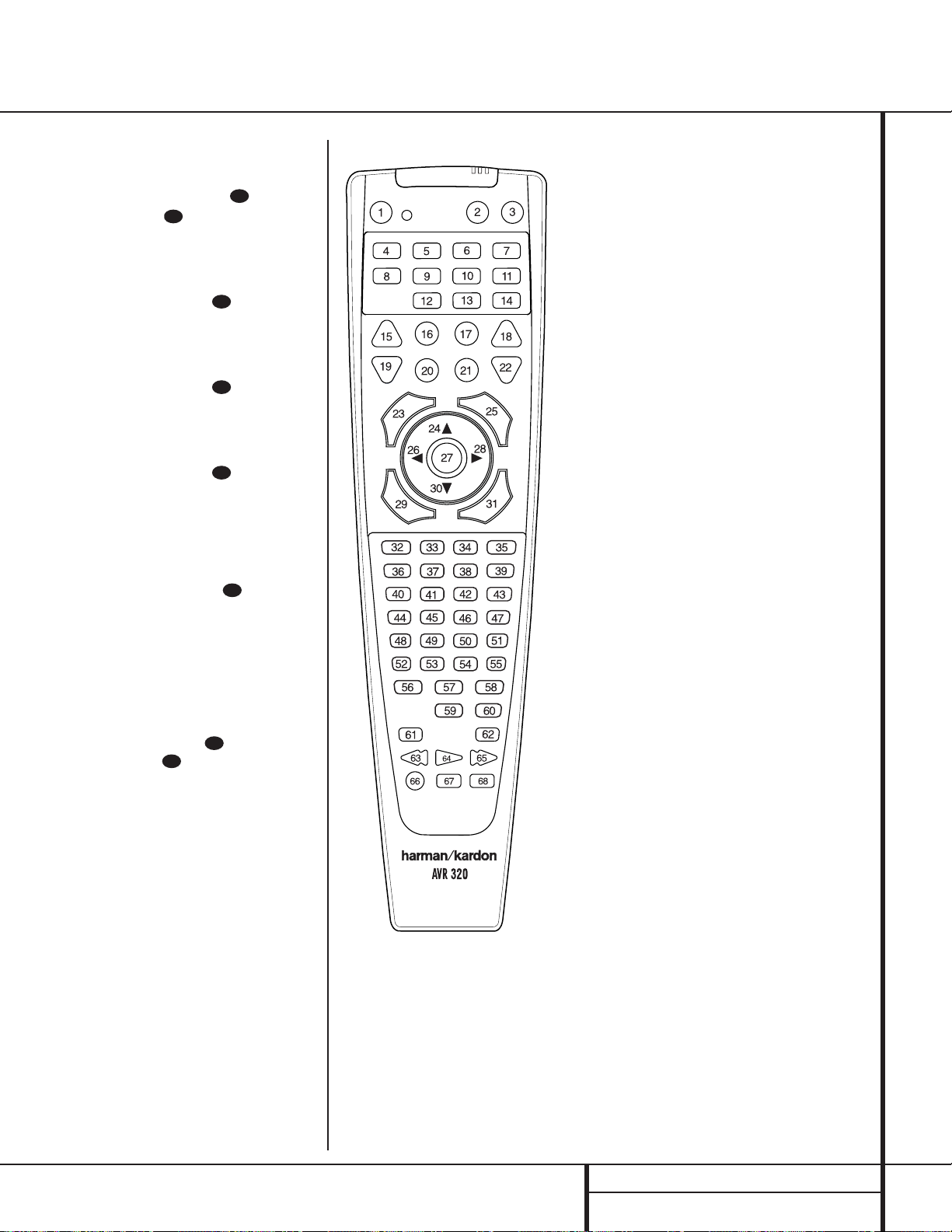
39 PROGRAMMING THE REMOTE
Programming the Remote
Example: To program the Macro 1 button
so that it turns on the AVR 320,TV and a
Cable Box, follow these steps:
• Press the
Macro 1 Button and
Mute Button at the same time and
then release them.
• Note that the
Program/SPL Indicator
c will flash amber.
• Press the
AVR Selector f.
• Press the
Mute Button to store the
AVR 320’s power on command.
• Press the
VID 2 Input Selector Button
e to indicate the next command is for
“TV Power On.”
• Press the
Mute Button to store the
TV Power On Command.
• Press the
VID 3 Input Selector Button
e to indicate the next command is for
“Cable Power On.”
• Press the
Mute Button to store the
Cable Power On command.
• Press the
Sleep/Channel Up Button
j to complete the process and store the
macro sequence.
After following these steps, each time you
press the
Macro 1 Button , the
remote will send the Power On/Off com-
mand.
Erasing Macro Commands
To remove the commands that have been pro-
grammed into one of the Macro buttons, follow
these steps:
1. Press the
Mute Button and the
Macro Button that contains the
commands you wish to erase.
2. Note that the
Program/SPL Indicator
c will flash amber, and the LED under
the
AVR Selector f will turn red.
3. Within ten seconds, press the
Surround
Mode Selector/Channel Down
Button
k.
4. The red LED under the
AVR Selector will
go out, and the
Program/SPL Indicator
c will turn green and flash three times
before it goes out.
5. When the
Program/SPL Indicator c
goes out, the Macro has been erased.
Programmed Device Functions
Once the AVR 320’s remote has been pro-
grammed for the codes of other devices, press
the appropriate
Input Selector e to change
the remote from controlling the AVR 320 to
controlling the additional product. When you
press any one of the selectors, it will briefly flash
in red to indicate that you have changed the
device being controlled.
When operating a device other than the
AVR 320, the controls may not correspond
exactly to the function printed on the remote
or button. Some commands, such as the volume
control, are the same as they are with the
AVR 320. Other buttons will change their
function so that they correspond to a secondary
label on the remote. For example, the Sleep
and Surround mode selector buttons also func-
tion as the Channel Up and Channel Down
buttons when operating most TV sets, VCRs or
cable boxes. The Channel Up/Down indication is
printed directly on the remote. For many stan-
dard CD players, cassette decks, VCRs and DVD
functions, the standard function icons are print-
ed on top of the buttons.
For some products, however, the function of a
particular button does not follow the command
printed on the remote. In order to see which
function a button controls, consult the Function
List tables printed on page 43. To use those
tables, first check the type of device being con-
trolled (e.g., TV, VCR). Next, look at the remote
control diagram pictured at the left. Note that
each button has a number on it.
To find out what function a particular button
has for a specific device, find the button num-
ber on the Function List and then look in the
column for the device you are controlling. For
example, button number 45 is the Direct button
for the AVR 320, but it is the “Favorite” button
for many cable television boxes and satellite
receivers. Button number 31 is the Delay but-
ton for the AVR 320, but the Open/Close but-
ton for CD players.
NOTE: That the numbers used to describe the
button functions at the left for the purposes of
describing how a button operates are a differ-
ent set of numbers than those used in the rest
of this manual to describe the button functions
for the AVR 320.
31
43
31
43
43
43
43
31
Notes on Using the AVR 320 Remote
With Other Devices.
• Manufacturers may use different code sets
for the same product category. For that rea-
son, it is important that you check to see
whether the code set you have entered oper-
ates as many controls as possible. If it
appears that only a few functions operate,
check to see whether another code set will
work with more buttons.
• When a button is pressed on the AVR 320
remote, the red light under the
Input
Selector
e for the product being operat-
ed should flash briefly. If the Device Control
Selector flashes for some but not all buttons
for a particular product, it does NOT indicate
a problem with the remote but rather that
no function is programmed for the button
being pushed.
Volume Punch-Through
The AVR 320’s remote may be programmed to
operate the
Volume Control and Mute
functions of either the TV or the AVR 320
in conjunction with any of the devices con-
trolled by the remote. For example, since the
AVR 320 will likely be used as the sound sys-
tem for TV viewing, you may wish to have the
AVR 320’s volume activated, although the
remote is set to run the TV. Either the AVR 320
or TV volume control may be associated with
any of the remote’s devices.To program the
remote for Volume Punch-Through, follow these
steps:
1. Press the
Input Selector e for the unit
you wish to have associated with the volume
control and the
Mute Button at the
same time until the red light appears under
the
Input Selector e and note that the
Program/SPL Indicator c will flash
amber.
2. Press the
Volume Up Button and
note that the
Program/SPL Indicator c
will stop flashing and stay amber.
3. Press either the
AVR Selector f or the
Input Selector e, depending on which
system’s volume control you wish to have
attached for the punch-through mode. The
Program/SPL Indicator c will blink
green three times and then go out to confirm
the data entry.
Example: To have the AVR 320’s volume
control activated even though the remote is
set to control the TV, first press the
Video/TV Input Selector e and the
Mute Button at the same time. Next,
press the
Volume Up Button , fol-
lowed by the
AVR Selector f.
NOTE: Should you wish to return the remote to
the original configuration after entering a
Volume Punch-Through, you will need to repeat
the steps shown above. However, press the same
Input Selector in Steps 1 and 3.
Channel Control Punch-Through
The AVR 320’s remote may be programmed to
operate so that the channel control function for
either the TV, cable or satellite receiver used in
your system may be used in conjunction with
one of the other devices controlled by the
remote. For example, while using and controlling
the VCR, you may wish to change channels on a
cable box or satellite receiver without having to
change the device selected by the AVR 320 or
the remote. To program the remote for Channel
Control Punch-Through, follow these steps:
1. Press the
Input Selector Button e for
the device you wish to have the channel con-
trol associated with and the
Mute Button
at the same time until the red light
appears under the
Input Selector e and
the
Program/ SPL Indicator c flashes
amber.
2. Press the
Volume Down Button .The
Program/SPL Indicator c will stop flash-
ing and stay amber.
3. Press and release the
Input Selector
Button
e for the device that will be used
to change the channels. The
Program/SPL
Indicator
c will blink green three times
and then go out to confirm the data entry.
Example: To control the channels using your
Cable Box or Satellite Receiver while the
remote is set to control the VCR, first press
the
VID 1/VCR Input Selector Button e
and the Mute Button at the same
time. Next, release them and press the
Volume Down Button , followed by the
VID 2/TV Input Selector Button e.
NOTE: To remove the Channel Control Punch-
Through and return the remote to its original
configuration, repeat the steps shown in the
example above. However, press the
VID 1/VCR
Input Selector
in Steps 1 and 3.
Transport Control Punch-Through
The AVR 320’s remote may be programmed to
operate so that the
Transport Control
Functions
` (Play, Stop, Fast Forward,
Rewind, Pause and Record) for a VCR, DVD or
CD will operate in conjunction with one of the
other devices controlled by the remote. For
example, while using and controlling the TV, you
may wish to start or stop your VCR or DVD with-
out having to change the device selected by the
AVR 320 or the remote. To program the remote
for Transport Control Punch-Through, follow
these steps:
1. Press the
Input Selector e for the device
you wish to have the channel control associ-
ated with and the
Mute Button at the
same time until the red light appears under
the
Input Selector e and the Program/
SPL Indicator
c flashes amber.
2. Press the
Play Button `.The Program/
SPL Indicator
c will stop flashing and
stay amber.
3. Press and release the
Input Selector
Button
e for the device that will be used
to change the channels. The
Program/SPL
Indicator
c will blink green three times
and then go out to confirm the data entry.
Example: To control the transport of a DVD
player while the remote is set to control the
TV, first press the
VID 2/TV Input Selector
Button
eand the Mute Button at
the same time. Next, release them and press
the
Play Button `, followed by the DVD
Input Selector Button
e.
NOTE: To remove the Channel Control Punch-
Through and return the remote to its original
configuration, repeat the steps shown in the
example above. However, press the
VID 2/TV
Input Selector
in Steps 1 and 3.
NOTE: Before programming the remote for
Volume, Channel or Transport Punch-Through,
make certain that any programming needed for
the specific TV, CD, DVD, Cable or Satellite
Receivers has been completed.
43
43
40
43
40
43
40
43
40
43
43
40
40 PROGRAMMING THE REMOTE
Programming the Remote
41 PROGRAMMING THE REMOTE
Programming the Remote
Reassigning Device Control
Selectors
Although each Input Selector e is normally
assigned to the category of product shown on
the remote, it is possible to reassign one of
these buttons to operate a second device of
another type. For example, if you have two VCRs
but no satellite receiver, you may program the
“SAT” button to operate a second VCR. Before
following the normal programming steps for
either Three-Digit entry or Auto Search code
entry, you must first reassign the button with the
following steps:
1. Press the
Input Selector e you wish to
reassign and the
Mute Button at the
same time until the red light appears under
the
Input Selector e and the Program/
SPL Indicator
c flashes amber.
2. Press the
Input Selector e for the device
you wish to program into the reassigned
button.
3. Enter the three-digit code for the specific
model you wish the reassigned button to
operate.
4. Press the same
Input Selector e pressed
in Step 1 once again to store the selection.
The red LED under the re-assigned Input
Selector will flash three times and then go
out.
Example: To use the CBL/SAT button to
operate a second VCR, first press the
CBL/SAT Input Selector e and the
Mute Button at the same time until
the red light glows under the
CBL/SAT e
button. Press the VCR e Button,followed
by the three-digit code for the specific model
you wish to control. Finally, press the
CBL/SAT Button e again.
Resetting the Remote Memory
As you add components to your home-theater
system, occasionally you may wish to totally
reprogram the remote control without the confu-
sion of any commands, macros or ”Punch-
Through“ programming that you may have
done. To do this, it is possible to reset the
remote to the original factory defaults and com-
mand codes by following these steps. Note,
however, that once the remote is reset, all com-
mands or codes that you have entered will be
erased and will need to be re-entered:
1. Press any of the
Input Selector Buttons
e and the ”O“ Numeric Key r at the
same time until the
Program/SPL Indicator
c begins to flash amber.
2. Press the
”3“ Numeric Key r three
times.
3. The red LED under the
Input Selector e
will go out and the Program/SPL Indicator
c will stop flashing and turn green.
4. The
Program/SPL Indicator c will remain
green until the remote is reset. Note that this
may take a while, depending on how many
commands are in the memory and need to be
erased.
5. When the
Program/SPL Indicator c goes
out, the remote has been reset to the factory
settings.
43
43

No. Button Name AVR Function DVD CD/CD-R Tape VCR (VID1) TV (VID1) CBL (VID3) SAT (VID3)
1 Power On Power On Power On Power On Power On Power On Power On Power On Power On
2 Power Off Power Off Power Off Power Off Power Off Power Off Power Off Power Off Power Off
3 Mute Mute Mute Mute Mute Mute Mute Mute Mute
4 AVR AVR Select
5 DVD DVD Input Select DVD Select
6 CD CD Input Select CD Select
7 Tape Tape Input Select Tape Select
8 VID 1 Video 1 Select VCR Select TV Select VID3 Select
9 VID 2 Video 2 Select
10 VID 3 Video 3 Select
11 VID 4 Video 4 Select
12 AM/FM Tuner Select
13 6/8 Ch. Select
6/8 Ch. Input Select
14 Learn
15 Sleep Sleep Channel + Channel + Channel +
16 Test Test Tone TV/DVD Input Select TV/VCR TV/VCR TV/Cable TV/Sat
17 SPL
18 Volume Up Volume Up Input Level Up Volume Up Volume Up Volume Up Volume Up
19 Surround Select
Surround Mode Select
CDR Select Channel – Channel – Channel –
20 Night Night Mode Select
Subtitle On/Off
CDR Select
21 Multiroom Multiroom Select
22 Volume Down Volume Down
Input Level Down
Volume Down Volume Down Volume Down
23 Channel/Guide Channel Trim Title Info/Guide Info/Guide
24
⁄
Move/Adjust Up Up Up Up Up Up
25 Speaker/Menu Speaker Adjust Menu Intro Scan Menu Menu Menu Menu
26
fi
Move/Adjust Left Left Left Left Left Left
27 Set Set Enter Enter Enter Enter Enter
28
fl
Right Right Right Right Right
29 Digital/Exit
Digital Input Select
Open/Close Exit Exit Exit Exit
30
¤
Move/Adjust Down
Down Down Down Down Down
31 Delay/Prev. Ch. Delay Adjust Return Open/Close Prev Channel Prev Channel Prev Channel
32 1 11 1 1 1 1
33 2 22 2 2 2 2
34 3 33 3 3 3 3
35 4 44 4 4 4 4
36 5 55 5 5 5 5
37 6 66 6 6 6 6
38 7 77 7 7 7 7
39 8 88 8 8 8 8
40 Tun-M Tuner Mode Chapter Repeat
41 9 99 9 9 9 9
42 0 00 0 0 0 0
43 Memory Audio Time
44 Tune Up Tune Up Next Chapter Track Direct Cancel Sleep
45 Direct Direct Tuner Entry Angle Random Play FAV FAV
42 FUNCTION LIST
Function List
43 FUNCTION LIST
Function List (continued)
No. Button Name AVR Function DVD CD/CD-R Tape VCR (VID1) TV (VID1) CBL (VID3) SAT (VID3)
46 Clear Clear Clear Clear Clear Clear Bypass Next
47 Preset Up Preset Tune Up Slow Forward +10 Music Alt
48 Tune Down Tune Down Prev Chapter
Track Increment
49 OSD OSD Program OSD OSD OSD OSD
50 D. Skip Disc Skip Disc Skip
51 Preset Down
Preset Tune Down
Slow Rev
52 M1
53 M2
54 M3
55 M4
56 Dolby Dolby Modes
57 DTS SURR DTS Digital Modes
58 DTS Neo:6 DTS Neo:6 Select
59 Logic 7 Logic 7 Select
60 Stereo Stereo Mode Select
61 Skip Down Skip – Skip – Scan –
62 Skip Up Skip + Skip + Scan +
63 Rewind R. Search R. Search Rewind Rewind
64 Play Play Play Play Play
65 Fast Forward F. Search F. Search Fast Fwd Fast Fwd Day + Day +
66 Record Record Record Record
67 Stop Stop Stop Stop Stop
68 Pause Pause Pause Pause

Manufacturer/Brand Setup Code Number
A MARK 103 132
ADMIRAL 192
AKAI 001 160
AMPRO 070 164
AMSTRAD 053
ANAM 045 055 057 076 095 099 103 106 109 112 122
AOC 001 011 103
BLAUPUNKT 084
BROKSONIC 205 206
CANDLE 001 002 003 011
CAPEHART 059
CENTURION 170 171
CENTRONIC 045
CITIZEN 001 002 003 011 045 092 094 132
CLASSIC 045
CONCERTO 011
CONTEC 041 045 051 052
CORANDO 172
CORONADO 132
CRAIG 045 055 157 158 159
CROWN 045 132
CURTIS MATHES 001 092 107 132
CXC 045
DAEWOO 011 022 023 038 045 046 056 068 073 094 098 102 105 108 111 114 116 118 119 127 132
DAYTRON 107 132
DIGI LINK 200
DYNASTY 045
DYNATECH 063
ELECTROHOME 074 132
EMERSON 001 012 033 045 048 049 051 052 091 107 132 137 139 141 157 158 162 205
FISHER 013 058
FUNAI 033 045
FUTURETECH 045
GE 001 014 015 038 057 070 071 107 121 133 141 145 163 199
GOLDSTAR 011 093 097 101 103 104 107 110 113 118 128 132
GRUNDIG 193
HALL MARK 107
HARMAN KARDON 201
HITACHI 001 011 015 016 017 018 029 043 072 132 144 147
INFINITY 148
INKEL 120
JBL 148
JC PENNEY 001 011 014 015 030 035 092 132 145
JENSEN 019
JVC 038 040 079 134
KAWASHO 173
KEC 045
KENWOOD 001 204
KLOSS 002 060
KMC 132
KTV 001 045 132 162
LLOYTRON 172 173
LODGENET 069
LOGIK 069
LUXMAN 011
LXI 013 021 053 077 145 148
MAGNAVOX 001 003 011 060 061 062 064 065 118 132 145 148
MARANTZ 001 074 148
MATSUI 148
MEMOREX 013 069 107
METZ 084
MGA 001 011 033 044 050 074 107
44 SETUP CODES
Setup Code Table: TV

45 SETUP CODES
Setup Code Table: TV (Continued)
Manufacturer/Brand Setup Code Number
MIDLAND 199
MINERVA 084
MITSUBISHI 001 011 030 033 042 044 100 107 115 154 160 167 168
MTC 175 176
NAD 021 031
NATIONAL 177 178 179 180 181 182
NEC 001 013 022 025 030 042 057 121 123 125
NIKEI 045
ONKING 045
ONWA 045
OPTONICA 025 077
ORION 207 208 209 210 211
PANASONIC 038 057 076 087 148 169
PENNEY 199
PHILCO 001 003 011 030 045 057 060 061 064 065 118 132 148
PHILIPS 001 003 011 040 060 067 088 132 145 148
PIONEER 001 024 029 031 032 107 213 214
PORTLAND 011 132
PROSCAN 133
PROTON 059 107 122 132 165
QUASAR 038 057 087
RADIO SHACK 025 045 048 107 118 132 195 196 197 198
RCA 001 011 029 030 057 071 133 145 161 163 199
REALISTIC 013 025 045 048 195 196 197
RUNCO 152 153
SAA 183
SAMPO 001 059 107
SAMSUNG 051 085 092 096 104 107 118 124 128 132 145
SANYO 013 026 027 037 041 054 058 078
SCOTT 033 045 049 107 132
SEARS 011 013 021 033 035 058 078 092 107 132 145
SHARP 011 020 025 028 033 034 077 132 154
SIEMENS 084
SIGNATURE 069
SONY 043 067 075 117 130 136 194 212
SOUNDESIGN 003 033 045 107
SPECTRICON 103
SSS 011 045
SUPREMACY 002
SYLVANIA 001 003 011 060 061 064 065 107 118 131 145 148
SYMPHONIC 184
TANDY 077
TATUNG 057 063
TECHNICS 080
TECHWOOD 011
TEKNIKA 001 002 003 011 030 033 036 045 069 074 092 094 132
TELEFUNKEN 039 047 083
TELERENT 069
TERA 156
THOMSON 190 191
TMK 011 107
TOSHIBA 013 021 035 042 052 063 092 129 202
TOTEVISION 132
UNIVERSAL 014 015
VIDEO CONCEPTS 160
VIDTECH 011 107
WARDS 011 014 015 025 033 061 062 064 065 069 071 107 132 148
YAMAHA 001 011
YORK 107
YUPITERU 045
ZENITH 069 070 090 094
ZONDA 103

Manufacturer/Brand Setup Code Number
AIWA 040
AKAI 022 048 050 108 109 126
AMPRO 076
AMSTRAD 133
ANAM 037 039 089
ASA 134
AUDIO DYNAMICS 018 029 044 048
BROKSONIC 041 043 110 147 166
CANDLE 134 135 137
CANON 034 037 039 135 140
CAPEHART 094
CITIZEN 134
CRAIG 003 045 116
CURTIS MATHES 037 039
DAEWOO 012 014 017 068 069 094 096 097 098 102 103 104
DAYTRON 094
DBX 018 029 044 048
DUAL 136
DYNATECH 040 057
ELECTROHOME 063
EMERSON 013 023 031 033 035 037 040 041 042 043 050 087 110 112 119
FERGUSON 136
FINLUX 133
FISHER 003 015 016 017
FUNAI 040 133
GE 037 039 067 076 093 095 124 127
GO VIDEO 113 117
GOLDSTAR 018 019 026 087 092 100 107
GRAETZ 136
HARMAN KARDON 018 049
HITACHI 011 040 048 067 118 130
INSTANT REPLAY 037 039
ITT 136
JCL 037 039
JC PENNEY 018 019 021 039 045 070 087
JENSEN 048
JVC 018 037 039 048 052 054 059 064 111 130 132
KENWOOD 020 044 048 052
LLOYD 040
LXI 019 020 040 087
MAGIN 045
MAGNAVOX 037 039 040 071 072
MARANTZ 018 037 039 071 073
MARTA 087
MATSUI 033 036
MEI 037 039
MEMOREX 003 017 020 037 039 040 057 076 087 115 120
MGA 049 050 063
MINOLTA 019 026
MITSUBISHI 019 026 049 050 053 055 063 065 131 145 146
MTC 133
MULTITECH 030 040
NAD 139
NATIONAL 140
NEC 018 029 044 048 052
46 SETUP CODES
Setup Code Table: VCR

47 SETUP CODES
Setup Code Table: VCR (continued)
Manufacturer/Brand Setup Code Number
NORDMENDE 048
OPTIMUS 159
OPTONICA 057 058
ORION 147 166
PANASONIC 070 074 078 086 114 125 150 167 172
PENTAX 019 026 037 039 067
PHILCO 037 039 040 071
PHILIPS 037 039 040 058 071 075 087
PILOT 087
PIONEER 019 027 052
PORTLAND 094
PULSAR 076
QUARTZ 001 020
QUASAR 039 070 079 125 144
RADIO SHACK 133 134 137 140 141 142 152 158 159 160 161
RCA 019 026 039 066 067 093 095 124 125 127 157 172
REALISTIC 003 015 017 020 037 039 040 045 057 058 087 137 152 159 160
RICO 062
RUNCO 128
SABA 136
SAISHO 143
SALORA 020
SAMSUNG 038 045 088 090 091 093 095 098 099 101 105 106 109
SANSUI 028 048 052 116 147 166
SANYO 003 014 017 020 115
SCHAUB LORENZ 136
SCOTT 023 043 098 110 112
SEARS 003 015 016 017 019 020 026 037 047 077 084 087
SHARP 037 058 129 156
SHINTOM 030
SONY 003 016 037 056 060 061 062 080 081 082 129
SOUNDESIGN 040
STS 019
SYLVANIA 037 039 040 063 071
SYMPHONIC 040
TANDY 017 040
TASHICO 134
TATUNG 044 048
TEAC 040 044 048
TECHNICS 037 039
TEKNIKA 025 037 039 040 087
TELEFUNKEN 136
THOMAS 040
THOMSON 136
THORN 136
TMK 013
TOSHIBA 015 019 047 051 063 085 098 112 155
TOTEVISION 045 087
UNITECH 045
VECTOR RESEARCH 018
VICTOR 052
VIDEO CONCEPTS 018 040 050
VIDEOSONIC 045
WARDS 003 019 023 030 037 039 040 045 057 058 112
YAMAHA 018 040 044 048
ZENITH 040 052 060 062 076 083 087

Manufacturer/Brand Setup Code Number
ADC 012
ADCOM 049 063 069
AIWA 072 111 118 156 170
AKAI 050 177 184
AUDIO TECHNICA 053
AUDIOACCESS 125
AUDIOFILE 211
BSR 044 064
CALIFORNIA AUDIO 015 109
CAPETRONIC 070
CARRERA 064 087
CARVER 051 057 136 140 141 143 144 145 185 186
CASIO 066 117 122 166
CLARINETTE 122 166
CROWN 042
CURTIS MATHES 066
DENON 187 188 213
EMERSON 049 052 093 108
FISHER 023 055 057 068
FRABA 117
FUNAI 126
GE 164
GENEXXA 017 096 108
GOLDSTAR 016 087
HAITAI 099 214
HARMAN KARDON 001 002 025 040 054 190 218 219
HITACHI 049 093
INKEL 026 027 216
JC PENNEY 021 066 098 147
JENSEN 153
JVC 029 176 195 196
KENWOOD 014 020 023 030 062 078 079 148 151 176 178 181
KYOCERA 012
LOTTE 108
LUXMAN 018 035 077 102
LXI 066 164
MAGNAVOX 039 051 113
MARANTZ 043 051 058 084 191 192 193
MCINTOSH 194
MCS 021 066 080 098
MEMOREX 096
MGA 032
MISSION 051
MITSUBISHI 032
MITSUMI 152
MODULAIRE 122 166
NAD 013 074 197 198
NAKAMICHI 199 200 201
NEC 021 069
NIKKO 053 055
NSM 051
48 SETUP CODES
Setup Code Table: CD

49 SETUP CODES
Setup Code Table: CD (continued)
Manufacturer/Brand Setup Code Number
ONKYO 037 038 045 046 171 175 202 203
OPTIMUS 020 036 056 057 064 065 089 090 091 092 096 099 104 212
PANASONIC 015 075 109 119 158 183 204
PHILIPS 039 051 138 149 209
PIONEER 017 036 071 094 096 100 112 123 131 160 161 162 215
PROTON 051 210
QUASAR 015 109
RADIO SHACK 122 126 213
RCA 024 049 081 093 150
RCX 169
REALISTIC 049 056 057 058 093 095 104 105 108 164 166
ROTEL 051
SAE 051
SAMSUNG 028
SANSUI 047 051 081 134 157 172
SANYO 033 057 068 082 095 168
SCOTT 108
SEARS 066
SHARP 020 058 073 105 114 151 159 167 180 181
SHERWOOD 003 026 027 041 058 105 133
SIGNATURE 040
SONY 060 103 115 116 118 132 139 163 205 206 207 208 212 217
SOUNDSTREAM 124
STS 012
SYLVANIA 051
SYMPHONIC 059 110
TAEKWANG 177
TANDY 096
TEAC 011 022 048 058 085 086 106 107 110 121 137 146 154
TECHWOOD 083
THETA DIGITAL 039
TOSHIBA 013 074 097 151 155 173
VECTOR RESEARCH 087
VICTOR 029 120 130
WARDS 040 095
YAMAHA 019 031 053 061 135 169
YORK 122 166

Manufacturer/Brand Setup Code Number
HARMAN KARDON 001
Setup Code Table: Audio
Manufacturer/Brand Setup Code Number
HARMAN KARDON 001
Setup Code Table: DVD
Manufacturer/Brand Setup Code Number
APEX DIGITAL 061
CALIFORNIA AUDIO 040
DENON 002 019 022 034 051
GE 003 004
GOLDSTAR 005
HARMAN KARDON 001 032
JVC 006
KENWOOD 007 050
LG 005 055 064
LOTTE 008
MAGNAVOX 033 056
MARANTZ 033 059
MITSUBISHI 023 036
NAD 010 062
ONKYO 009 015 048
OPTIMUS 011 050
PANASONIC 024 025 030 034 035 044 052
PHILIPS 033 056
PIONEER 012 020 038 041 046 047 065
PROCEED 060
PROSCAN 003 004 037
RCA 003 004 018 037
RUNCO 027
SAMSUNG 031 053 054
SANYO 013 049
SHARP 021 028 050
SONY 015 029 043 045
TECHNICS 026
THOMSON 003 004
TOSHIBA 009 033 047 057 058
YAMAHA 016 017 030 063
ZENITH 005 033 055 064
ZENITH DIVX 039
50 SETUP CODES
Setup Code Table: Tape

51 SETUP CODES
Setup Code Table: SAT
Manufacturer/Brand Setup Code Number
ALPHASTAR 472
ALPHASTAR DBS 450
ALPHASTAR DSR 422 442
AMPLICA 356
BIRDVIEW 414 425
BSR 359
CAPETRONICS 359
CHANNEL MASTER 320 321 322 325 361
CHAPARRAL 315 316 319 380 451
CITOH 360
CURTIS MATHES 356
DRAKE 312 313 317 318 413 481
DX ANTENNA 331 352 362 379 483
ECHOSTAR 364 395 397 452 453 463 477 478 484 485
ELECTRO HOME 392
EUROPLUS 415
FUJITSU 324 328 329 334
GENERAL INSTRUMENT 303 311 323 365 403 454 468 474
HITACHI DBS 455
HOUSTON TRACKER 463
HUGHES 372 437
HYTEK 359
JANIEL 366
JERROLD 367 454 464 468
KATHREIN 410
LEGEND 453
LUXOR 368
MACOM 317 365 369 370 371
MAGNAVOX 461 473
MEMOREX 453
NEXTWAVE 423 424
NORSAT 373 374
OPTIMUS 466
PANASONIC 366 469
PANASONIC DBS 457
PANSAT 420
PERSONAL CABLE 418
PHILIPS 375
PICO 407
PRESIDENT 326 404
PRIMESTAR 412 454 464 475
RCA 301 408 436 439 458 465
REALISTIC 349 377 480
SAMSUNG 422 442
SATELLITE SERVICE CO 335 341 353 388
SCIENTIFIC ATLANTA 339
SONY 405 438
STAR CHOICE DBS 459
STARCAST 347
SUPER GUIDE 327 423 424
TEECOM 330 333 378 390 391 393 409
TOSHIBA 302 426 443 460 461 462 470
UNIDEN 323 332 348 349 350 351 354 355 381 382 383 389 403 466 479 480
ZENITH 385 386 387 394 419

Manufacturer/Brand Setup Code Number
ABC 001 003 011 045 048 052 059 110
ALLEGRO 111
AMERICAST 212
ANTRONIX 021
ARCHER 012 014 021 031 112
BELCOR 113
CABLE STAR 033 113
CENTURION 092
CENTURY 014
CITIZEN 014 111
COLOUR VOICE 069 090
COMBANO 083 084
COMTRONICS 026 037
DIAMOND 030
DIGI 114
EAGLE 027 037 046 186
EASTERN 063 066 070 115
ELECTRICORD 039
EMERSON 112
FOCUS 116
G.I. 001 003 011 015 017 093 095 096 097
GC ELECTRONICS 113
GE 076
GEMINI 015 029 032 060
GENERAL 210
GENERAL INSTRUMENT 168
GOLDEN CHANNEL 037
GOODMIND 112
HAMLIN 055 056 061 099 100 101 117 175 207 208
HITACHI 001 061 188
HOSPITALITY 074 080
JASCO 111
JERROLD 001 002 003 011 015 016 017 073 093 095 096 097 162 167
LINDSAY 118
M-NET 043
MACOM 040 191
MAGNAVOX 017 019 068 082
MEMOREX 058
MOVIE TIME 035 039
NSC 022 035 044 075 190
OAK 023 038 043 059 094 196 197
PACE 179
PANASONIC 050 053 176 177 189 214
PANTHER 114
PARAGON 058
PHILIPS 013 019 020 027 069 085 090
PIONEER 001 041 057 079 119 171 200 209
POPULAR MECHANICS 116
POST NEWS WEEK 023
PRELUDE 120
PRIMESTAR 162
PTS 018 054 075 076
52 SETUP CODES
Setup Code Table: CBL

53 SETUP CODES
Setup Code Table: CBL (continued)
Manufacturer/Brand Setup Code Number
PULSAR 058
RADIO SHACK 111 112 213
RCA 053 214
RECOTON 116
REGAL 055 056 061 099 100 101 207
REGENCY 063 115
REMBRANT 032
SAMSUNG 037 072 186
SCIENTIFIC ATLANTA 003 018 047 048 049 051 052 110 183 184 203 204
SEAM 121
SHERITECH 029
SIGNAL 037
SIGNATURE 001 188
SL MARX 037
SPRUCER 053 081 177 189
STARCOM 002 011 015 016 163
STARGATE 015 037 120
SYLVANIA 071
TADIRAN 037
TANDY 024
TELECAPATION 028
TEXSCAN 036 071
TFC 122
TIMELESS 123
TOCOM 045 046 062 170 205
TOSHIBA 058
UNIKA 014 021 031
UNITED CABLE 011 059
UNIVERSAL 012 014 021 031 033 034 039 042 113
VIDEOWAY 124 211
VIEWSTAR 019 022 025 086 087 088 089 190
ZENITH 058 065 098 125 211
ZENTEK 116
SYMPTOM CAUSE SOLUTION
Unit does not function when Main • No AC Power • Make certain AC power cord is plugged into
Power Switch is pushed a live outlet
• Check to see whether outlet is switch-controlled
Display lights, but no sound • Intermittent input connections • Make certain that all input and speaker connections
or picture •
Mute is on are secure
• Volume control is down • Press
Mute button
• Turn up volume control
Unit turns on, but front panel • Display brightness is turned off • Follow the instructions in the Display Brightness section
display does not light up on page 35 so that the display is set to VFD FULL
No sound from any speaker; • Amplifier is in protection mode • Check speaker wire connections for shorts at receiver and
light around power switch is red due to possible short speaker ends
• Amplifier is in protection mode • Contact your local Harman Kardon service depot
due to internal problems
No sound from surround or • Incorrect surround mode • Select a mode other than Stereo
center speakers • Input is monaural • There is no surround information from mono sources
• Incorrect configuration • Check speaker mode configuration
• Stereo or Mono program material • The surround decoder may not create center- or rear-channel
information from nonencoded programs
Unit does not respond to • Weak batteries in remote • Change remote batteries
remote commands • Wrong device selected • Press the AVR selector
• Remote sensor is obscured • Make certain front panel sensor is visible to remote
or connect remote sensor
Intermittent buzzing in tuner • Local interference • Move unit or antenna away from computers, fluorescent
lights, motors or other electrical appliances
Letters flash in the channel indicator • Digital audio feed paused • Resume play for DVD
display and digital audio stops • Check that Digital Input is selected
Processor Reset
In the rare case where the unit’s operation or
the displays seem abnormal, the cause may
involve the erratic operation of the system’s
memory or microprocessor.
To correct this problem, first unplug the unit
from the AC wall outlet and wait at least three
minutes. After the pause, reconnect the AC
power cord and check the unit’s operation. If
the system still malfunctions, a system reset
may clear the problem.
To clear the AVR 320’s entire system memory
including tuner presets, output level settings,
delay times and speaker configuration data,
first put the unit in Standby by pressing the
System Power Control Button 2. Next,
press and hold the
Tone Mode 8 and the
FM Mode Selector ^ buttons for three
seconds.
The unit will turn on automatically and display
the
RESET message in the Main
Information Display
Y. Note that once you
have cleared the memory in this manner, it is
necessary to reestablish all system configuration
settings and tuner presets.
NOTE: Resetting the processor will erase any
configuration settings you have made for
speakers, output levels, surround modes, digital
input assignments as well as the tuner presets.
After a reset the unit will be returned to the
factory presets, and all settings for these items
must be reentered.
If the system is still operating incorrectly, there
may have been an electronic discharge or
severe AC line interference that has corrupted
the memory or microprocessor.
If these steps do not solve the problem, consult
an authorized Harman Kardon service center.
54 TROUBLESHOOTING GUIDE
Troubleshooting Guide

55 TECHNICAL SPECIFICATIONS
Technical Specifications
Audio Section
Stereo Mode
Continuous Average Power (FTC)
65 Watts per channel, 20Hz–20kHz,
@ < 0.07% THD, both channels driven into 8 ohms
Five-Channel Surround Modes
Power Per Individual Channel
Front L&R channels:
55 Watts per channel
@ < 0.07% THD, 20Hz–20kHz into 8 ohms
Center channel:
55 Watts @ < 0.07% THD, 20Hz–20kHz into 8 ohms
Surround channels:
55 Watts per channel
@ < 0.07% THD, 20Hz–20kHz into 8 ohms
Input Sensitivity/Impedance
Linear (High-Level) 200mV/47k ohms
Signal-to-Noise Ratio (IHF-A) 95dB
Surround System Adjacent Channel Separation
Analog Decoding 40dB
(Pro Logic II, etc.)
Dolby Digital 55dB
DTS 55dB
Frequency Response
@ 1W (+0dB, –3dB) 10Hz –100kHz
High Instantaneous
Current Capability (HCC) ±35 Amps
Transient Intermodulation
Distortion (TIM) Unmeasurable
Slew Rate 40V/µsec
FM Tuner Section
Frequency Range 87.5–108MHz
Usable Sensitivity IHF 1.3 µV/13.2dBf
Signal-to-Noise Ratio Mono/Stereo 70/68dB
Distortion Mono/Stereo 0.2/0.3%
Stereo Separation 40dB @ 1kHz
Selectivity ±400kHz, 70dB
Image Rejection 80dB
IF Rejection 90dB
AM Tuner Section
Frequency Range 320–1720kHz
Signal-to-Noise Ratio 45dB
Usable Sensitivity Loop 500µV
Distortion 1kHz, 50% Mod 0.8%
Selectivity ±10kHz, 30dB
Video Section
Television Format NTSC
Input Level/Impedance 1Vp-p/75 ohms
Output Level/Impedance 1Vp-p/75 ohms
Video Frequency Response
(Composite and S) 10Hz–8MHz (–3dB)
Video Frequency Response
(Component) 10Hz–30MHz (–3dB)
General
Power Requirement AC 120V/60Hz
Power Consumption 72W idle, 580W maximum
(2 channels driven)
Dimensions (Max)
Width 17.3 inches (440mm)
Height 6.5 inches (165mm)
Depth 17.1 inches (435mm)
Weight 32 lb (14.5kg)
Depth measurement includes knobs, buttons and terminal connections.
Height measurement includes feet and chassis.
All features and specifications are subject to change without notice.
Harman Kardon is a registered trademark, and Power for the Digital Revolution is a trademark, of
Harman Kardon, Inc.
is a trademark of Harman International Industries, Inc. (Patent No. 5,386,478).
*Manufactured under license from Dolby Laboratories.
“Dolby,” “Pro Logic,” “Pro Logic II” and the Double-D symbol are
trademarks of Dolby Laboratories. Confidential Unpublished
Works. ©1992–1999 Dolby Laboratories, Inc. All rights reserved.
DTS, DTS Surround, DTS-ES and DTS Neo:6 are trademarks of Digital Theater Systems, Inc.
UltraStereo is a trademark of UltraStereo Corp.
VMAx is a registered trademark of Harman International Industries, Inc., and is an
implementation of Cooper Bauck Transaural Stereo under patent license.
Logic 7 is a registered trademark of Lexicon, Inc.
Crystal is a registered trademark of Cirrus Logic Corp.
TM
250 Crossways Park Drive, Woodbury, New York 11797
www.harmankardon.com
© 2002 Harman Kardon, Incorporated
Part No.: J90200022000
Rev. 1 (02/2002)