
USER GUIDE
NZ AU
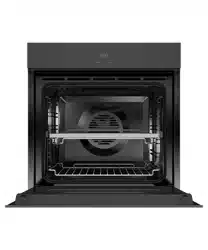
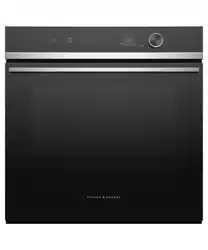
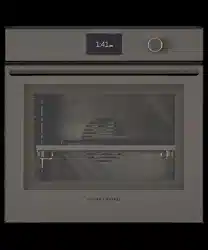
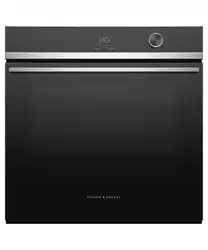
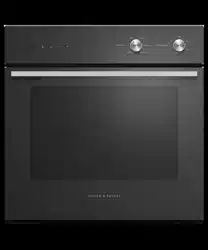
BUILT-IN OVEN
CONTEMPORARY
OB60SC6LEB & OB60SC7LEB


3
CONTENTS
Safety and warnings 5
Before you begin 9
First use 10
Using the kitchen timer 15
Automatic cooking 17
Cooking guide 22
Cooking charts 26
Care and cleaning 32
Parts and accessories 42
Troubleshooting 43
Warranty and Service 45
Registration
To register your product visit our website: fisherpaykel.com/register

5
SAFETY AND WARNINGS
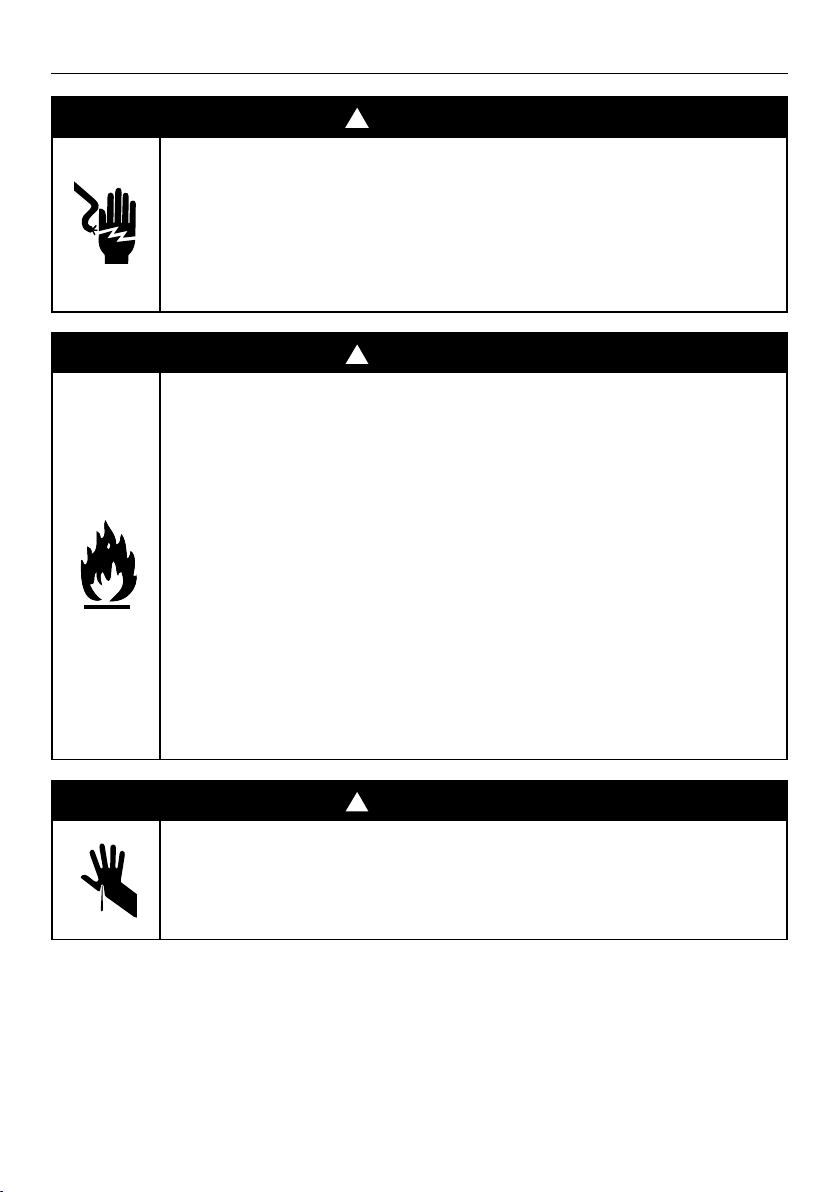
!
WARNING!
Electric Shock Hazard
Failure to follow this advice may result in
electric shock or death.
• Turn the oven off at the wall before replacing
the oven lamp.
!
WARNING!
Fire Hazard
Failure to follow this advice may result in
overheating, burning, and injury.
• Do not place aluminium foil, dishes, trays, water
or ice on the oven floor during cooking, this will
irreversibly damage the enamel. Lining the oven
with aluminium foil may cause fire.
• Never use your appliance for warming or
heating the room. Persons could be burned or
injured or a fire could start.
• Flammable materials should not be stored in an
oven or near its surface.
!
WARNING!
Cut Hazard
Failure to use caution could result in injury.
• Take care: some edges may be sharp.
6
SAFETY AND WARNINGS
!
WARNING!
Hot Surface Hazard
Failure to follow this advice could result in
burns and scalds.
• Accessible parts may become hot during use.
Young children should be kept away.
• Surfaces of the appliance may become hot
enough to cause burns. Examples include the
oven vent, the surface near the oven vent, and
the oven door.
• Do not touch heating elements or interior
surfaces of the oven. Heating elements may be
hot, even when they are dark in colour.
• Use protection when handling hot surfaces, such
as oven shelves or dishes.
• Be careful when opening the oven door. Let
hot air or steam escape before removing or
replacing food.
• During and after use, do not touch or let
clothing or other flammable materials contact
heating elements or interior surfaces of the oven
until they have had sufficient time to cool.

7
SAFETY AND WARNINGS
READ AND SAVE THIS GUIDE
WARNING!
To reduce the risk of fire, electrical shock, injury to persons or damage when using the
oven, we recommend you follow the important safety guidance below. Be sure to read
the user guide before using the oven. Use the oven only for its intended purpose and as
detailed in this guide.
Installation
z
Ensure your oven is properly installed and earthed by a qualified technician.
z
Ensure your oven is connected to a circuit that incorporates an isolating switch
providing full disconnection from the power supply.
z
Do not install or operate your oven if it is damaged or not working properly.
If you receive a damaged product, contact your dealer or installer immediately.
z
This product must not be installed behind a decorative door in order to
avoid over-heating.
Servicing
z
Do not repair or replace any part of your oven unless specifically recommended in the
user guide.
z
All other servicing of your oven should be undertaken be a Fisher & Paykel trained and
supported service technician or qualified person.
Fire hazard
z
Do not use water on grease fires. Smother the fire or flame, or use a dry chemical- or
foam-type extinguisher.
z
Use only dry oven mitts or potholders as moist or damp potholders on hot surfaces
could result in burns from steam. Do not let potholders touch hot areas or heating
elements. Do not use a towel or a bulky cloth for a potholder as it could catch fire.
z
Do not heat unopened food containers as they can build up pressure that may cause
the container to burst, which may result in injury.
Food safety
z
Leave food in the oven for as short a time as possible before and after cooking to avoid
contamination by organisms that may cause food poisoning. Take particular care during
warm weather.
General use
z
Caution: Hot air can blow from the vent at the top of the oven as part of the oven’s
cooling system.
z
Household appliances are not intended to be played with by children.
z
Children should not be left alone or unattended in the area where your oven is in use.
They should never be allowed to sit or stand on any part of the appliance.
z
Children must be kept away from your oven unless continuously supervised.
z
This appliance can be used by children aged 8years and above and persons with
reduced physical, sensory or mental capabilities or lack of experience and knowledge
if they have been given supervision or instruction concerning use of the appliance in a
safe way and understand the hazards involved.

8
SAFETY AND WARNINGS
z
Cleaning and user maintenance shall not be carried out by children without supervision.
z
Do not store things children might want above the oven. Children could be burned or
injured while climbing on your oven to retrieve items.
z
Do not place heavy objects on the oven door. Always keep oven vents unobstructed.
z
Do not wear loose fitting or hanging garments when using the appliance. They could
ignite or melt if they touch an element or hot surface and you could be burned.
z
Always position shelves in the desired location before preheating and while the oven
is cool. If a shelf must be removed while the oven is hot, do not let the oven mitts
or potholder make contact with the hot heating elements in the oven or the base of
the oven.
z
Use only bakeware approved for oven use. Follow manufacturers’ instructions.
Cleaning
z
Do not clean the oven seal or use any oven-cleaning products on it. This will preseve
the seal and ensure that the oven operates efficiently. Care should be taken not to rub,
damage or move the oven seal.
z
Do not use oven cleaners, harsh or abrasive cleaning agents, waxes, or polishes. No
commercial oven cleaner, oven liner or protective coating of any kind should be used in
or around any part of the oven.
z
Do not use harsh or abrasive cleaners, scourers or sharp metal scrapers to clean the
oven door glass, since they scratch the surface, which may result in the glass shattering.
z
Clean only the parts listed in this user guide.
z
Do not use a steam cleaner to clean any part of the oven.
9
BEFORE YOU BEGIN
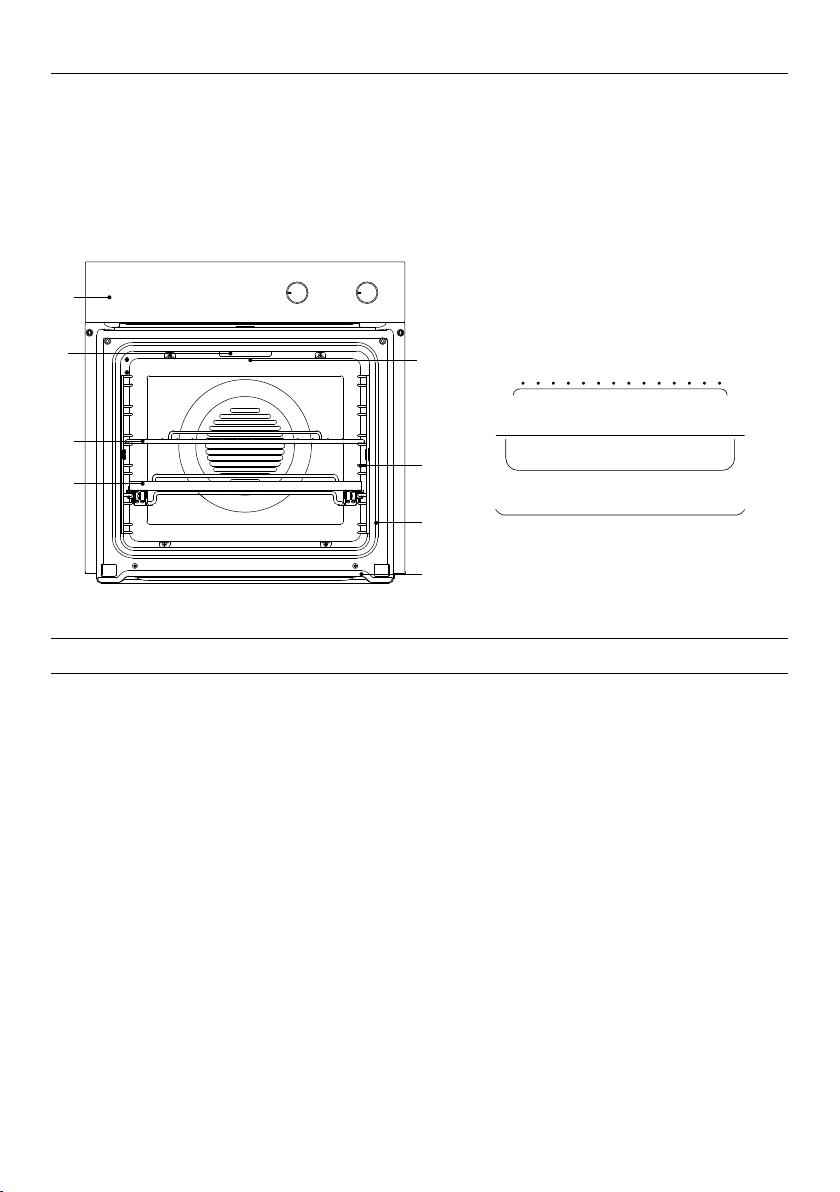
The oven door, handle and step down wire shelf are not illustrated.
Not all accessories are provided with all models. To purchase other accessories, contact
your nearest Fisher & Paykel Service Centre, Customer Care or visit www.fisherpaykel.com
9
1
7
8
2
4
6
!1
Oven features and accessories
1 Control panel
2 Oven vent louvre
3 Wire shelf
4 Full extension sliding shelf
5 Oven light location
6 Side rack
7 Oven seal
8 Drip channel
9 Grill rack
!0 Roasting dish
!1 Flat baking tray
z
Your oven must be installed by a suitably qualified person according to the installation
guide. The installer should complete the final installer checklist.
z
Read this guide, taking special note of safety and warnings.
z
Remove all internal and external packaging and recycle it responsibly where possible.
z
Refit the shelves to your desired position in the oven.
z
Condition the oven following guidance in first use.
5
3
!0
10
FIRST USE
Oven racks
Your oven comes with the shelves positioned and secured inside. The following shows you
how to remove and reposition them to your preferred position.
Remove shelves from oven
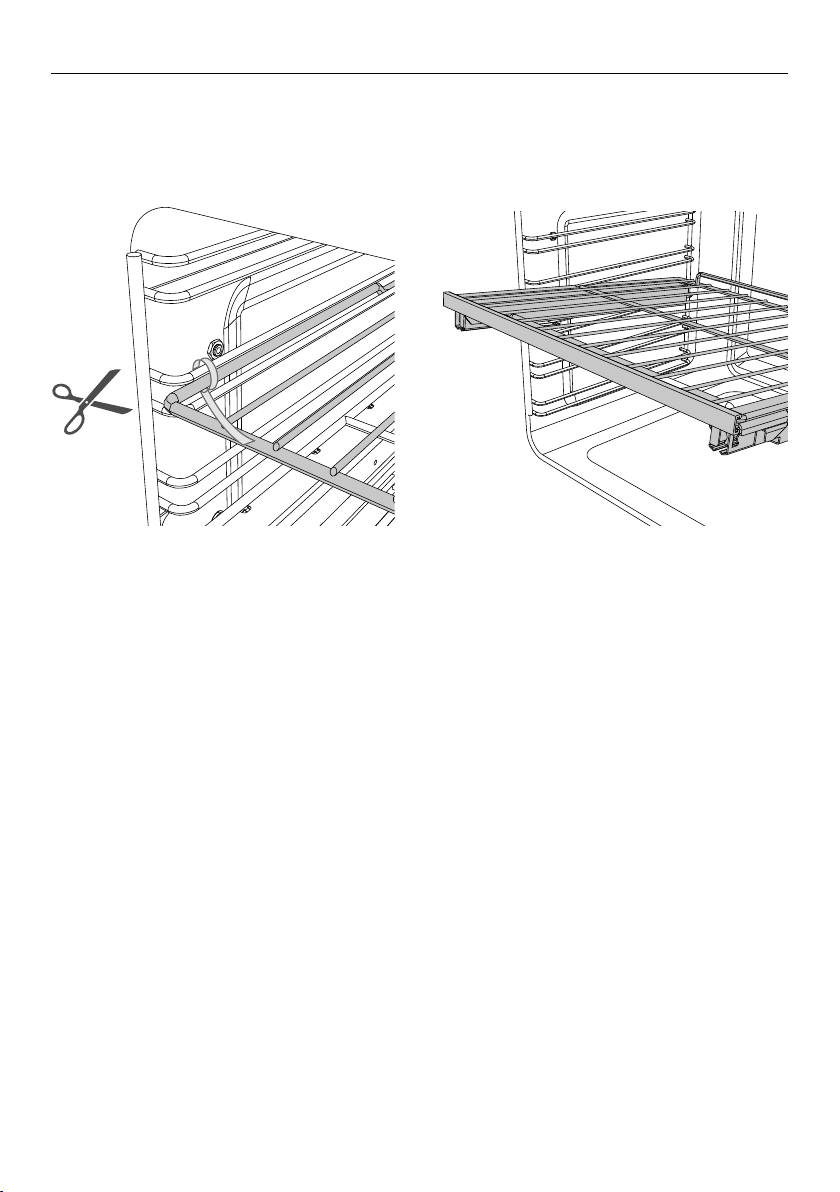
1 Remove all cable ties and packaging holding shelves in place.
2 Remove all shelves, taking special care with sliding shelves.
3 To remove a sliding shelf, grip it at the front (making sure you are gripping the wire shelf
and sliding frame together), lift upwards and pull it out of the oven.
For your safety, the wire shelves and sliding frames are built together as one unit and are
not separable. When placed properly on the side racks, the slides prevent the wire shelves
from tilting when pulled towards you.
11
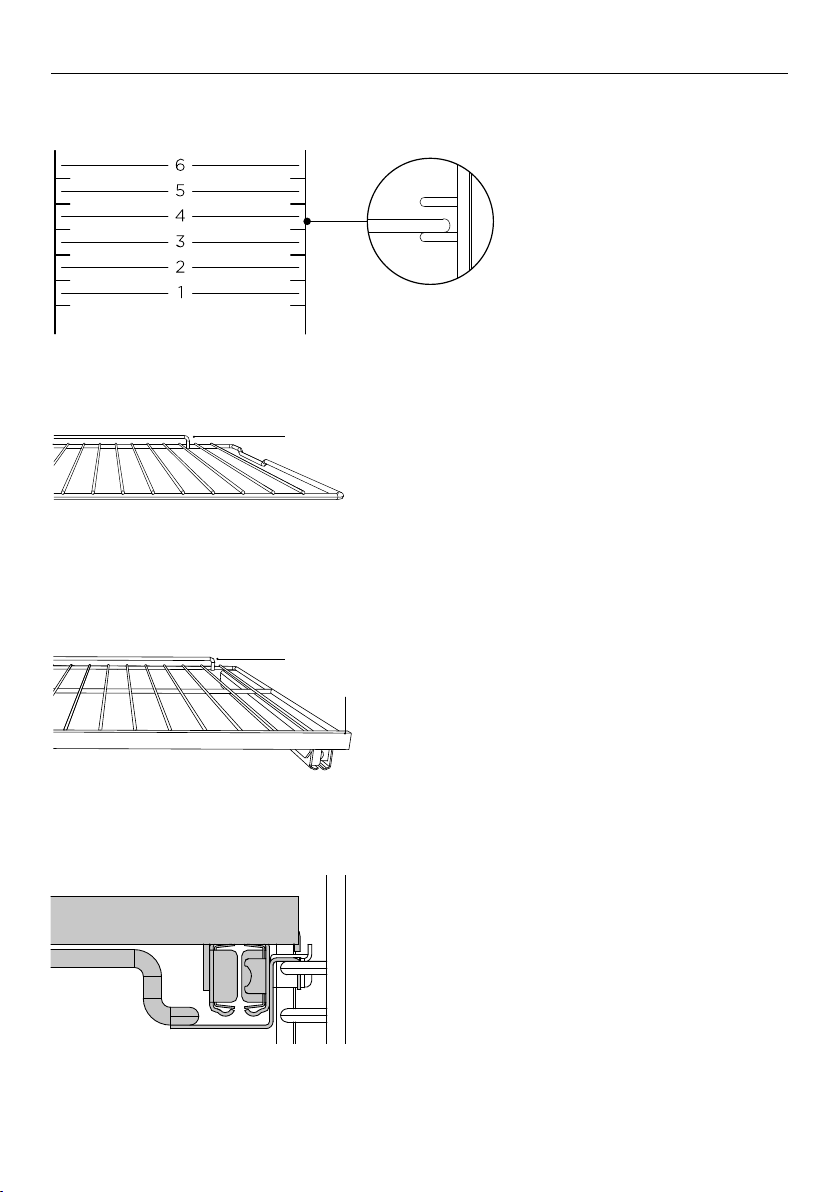
To replace sliding shelves (OBSC6 only)
1 Grip the shelf at the front, making sure
you hold the wire shelf and the sliding
frame together.
2 Ensure the shelf is level and facing the
right way with the guard rail at the back.
3 Place the shelf on top of the side racks at
the desired height, hooking the rear tags
over the side racks on both sides.
4 Push the shelf all the way into the oven,
ensure the front tags are also securely
hooked over the side racks.
Ensure sliding shelves are positioned on top
of the side rack wires not between them.
When there is food in the oven, take care to
slide the shelves horizontally when extending
them. This will prevent the tags lifting off the
side racks and the shelf tipping over.
Shelf positions
We recommend placing the sliding shelves
on positions 2 and 4 for everyday cooking.
FIRST USE
Replace shelving in your preferred positions
Guard rail
Guard rail
Front bar
To replace wire shelves
Check the shelf is positioned correctly, with
the guard rail at the back, then slide into
place on the side racks. The shelf must sit
between the two wires of the shelf position.
12
Control panel
FIRST USE
1
2
3
4
5
6
9 !0 !1 !2
7
8
10:45
COOK BY
FUNCTION
COOK BY
FOOD TYPE
COOK BY
RECIPE
10:45
COOK BY
FUNCTION
COOK BY
FOOD TYPE
COOK BY
RECIPE
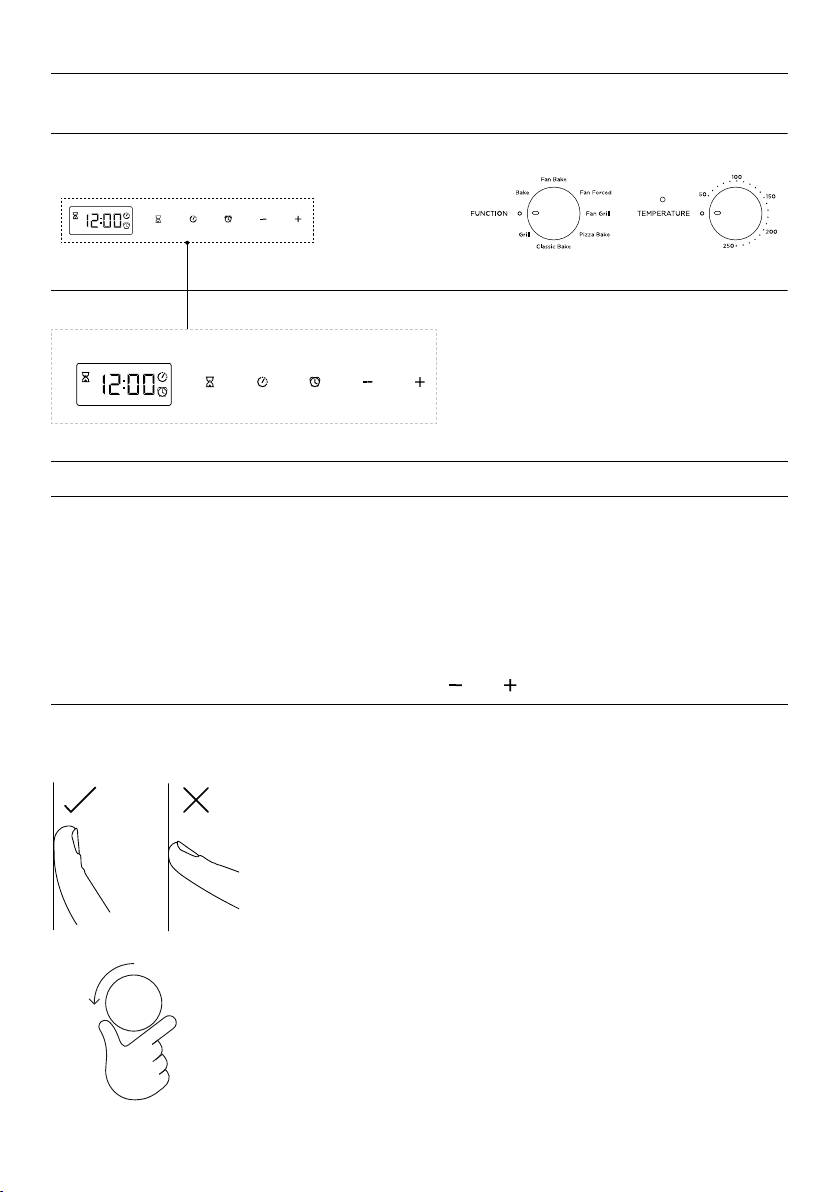
Using the touch controls
Use the ball of your finger, not its tip. The controls respond to
touch, so pressure is not needed.
Dials
Turn the dials to select the cooking function and temperature.
* Will be lit while the oven is heating up.
**Will be lit if the option is in use.
Control panel features
1 Display
2 Function dial
3 Temperature indicator*
4 Temperature dial
5 Timer indicator
6 Clock
7 Cooking time indicator**
8 Automatic cooking stop indicator**
9 Timer control
!0 Cooking time control
!1 Stop time control
!2
and controls
13
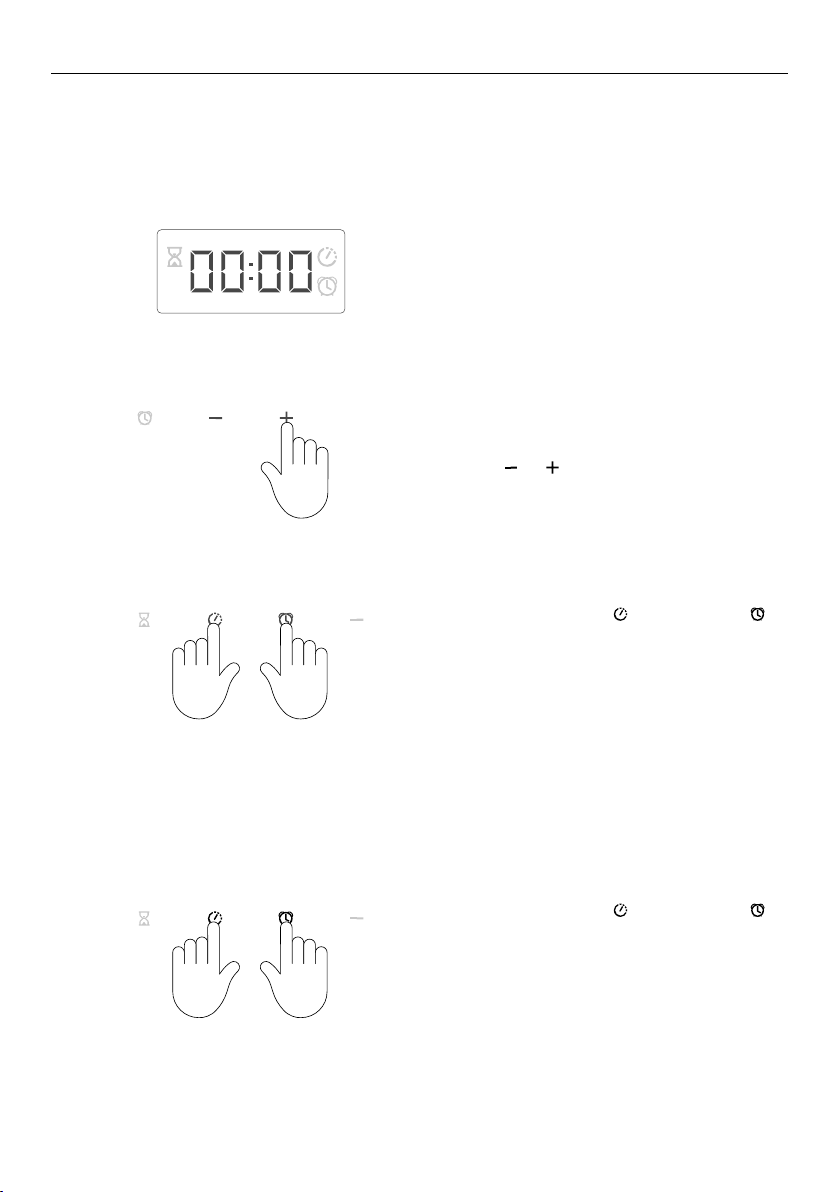
When the power to the oven is turned on or
restored after a power failure, 00
:
00 will flash
in the display.
Touch the
or controls to set the time.
Touch the cooking time
and stop time
controls together for two seconds to accept
the time.
z
The display will stop flashing.
z
The oven will beep to confirm the time
is set.
FIRST USE
Setting the clock
You’ll need to set the time on your oven when it is first turned on, or after a power failure.
The oven will not function if the clock is not set.
1
2
3
To change the time
Touch the cooking time
and stop time
controls together for two seconds. The centre
dot will flash.
Follow steps 2 and 3 above to change
the time.
1
14
After conditioning:
There will be a distinctive smell and a small amount of smoke during the conditioning
process as manufacturing residue is burnt off. This is normal, but ensure the kitchen is well
ventilated. Once cooled, wipe out the oven with a damp cloth and mild detergent, and
dry thoroughly.
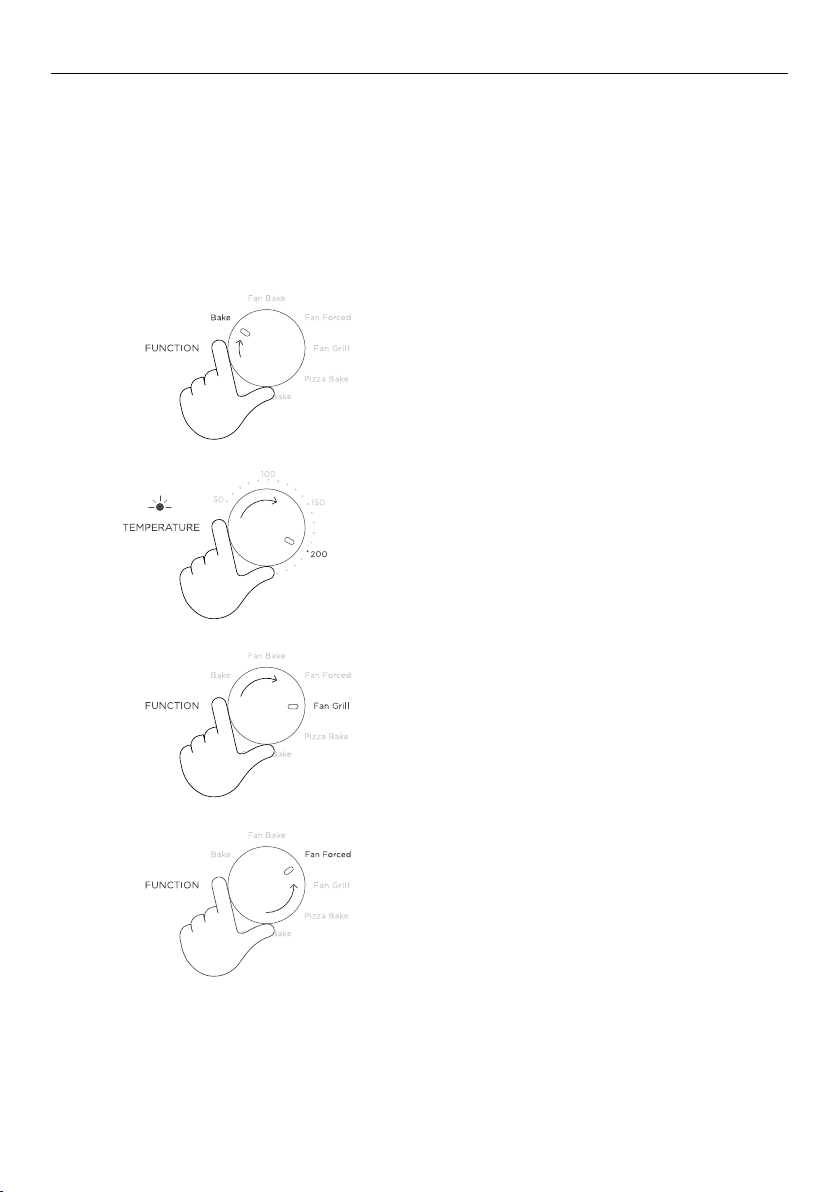
Select
BAKE function and set the oven to
200
o
C for 30 minutes.
While the oven is heating up, the
temperature indicator light will glow.
After 30 minutes change the function to
FAN GRILL and heat for 20 minutes.
After 20 minutes, change the function
to
FAN FORCED and heat for a further
20 minutes. When you have finished, turn
the oven off.
FIRST USE
Conditioning the oven
It is important to condition your oven before using it for cooking. This will burn off any
manufacturing residues and ensure that you get the best results right from the start.
Before you start:
Make sure you have removed all packaging and any cable ties used to secure the
shelving during transit. Ensure all shelves are fitted in the oven, the clock is set and the
kitchen is well ventilated during conditioning.
1
3
4
When the oven has reached set temperature,
the temperature indicator light will go out.
If the clock has not been set, the cooling fans
will come on, but the oven light will not come
on and the oven will not heat up.
2
15
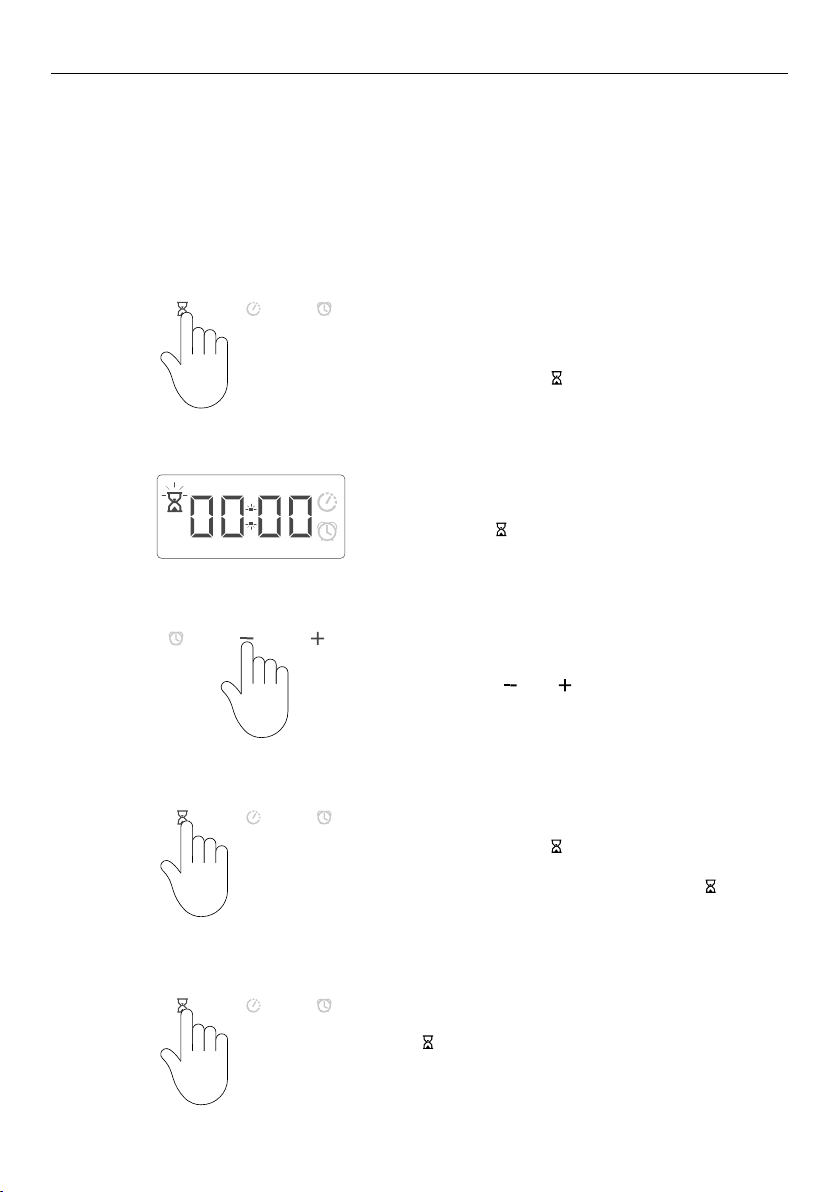
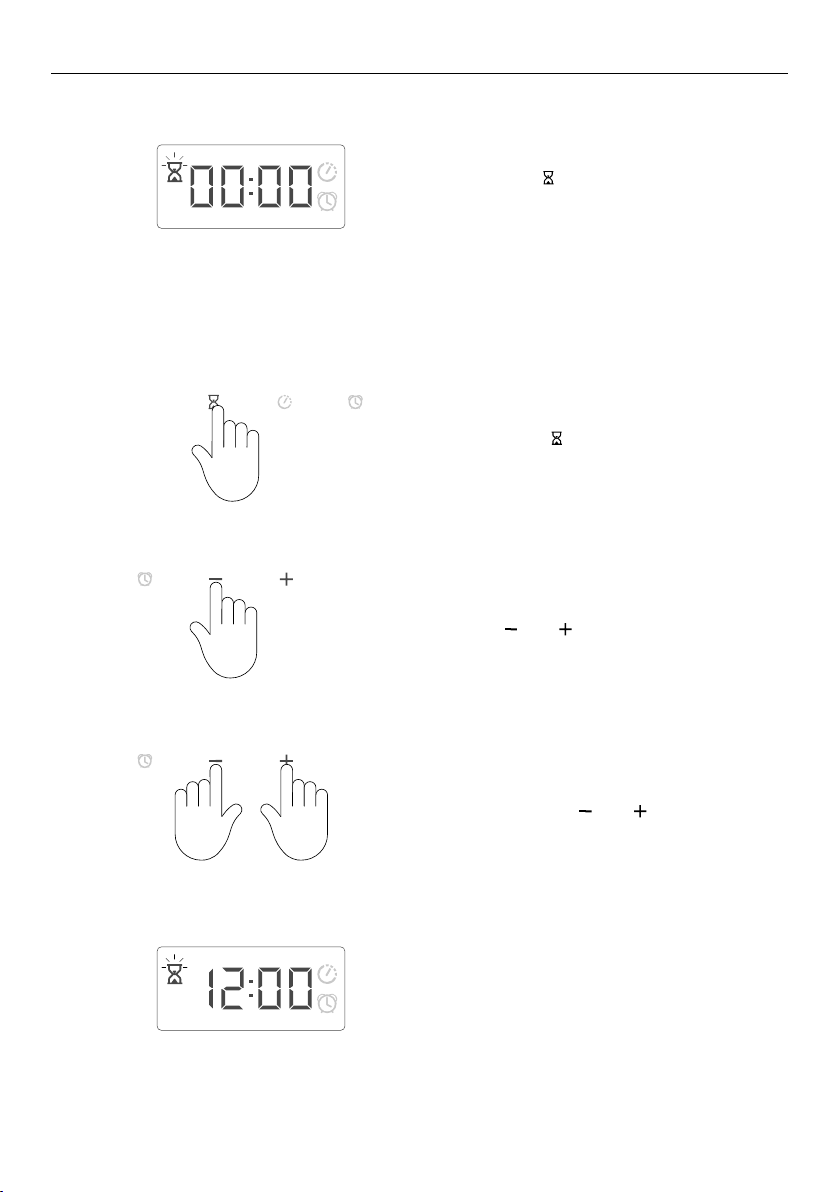
Check the display shows the correct
time of day.
Touch the timer
control.
The display will show
00
:
00. The timer
indicator and dot will flash.
Touch the timer
control to confirm or wait
five seconds and the display will show the
time of day and the timer indicator .
To check the time remaining, touch the timer
control.
During the last five minutes of the countdown
the display will show the time remaining.
USING THE KITCHEN TIMER
3
4
5
Use the kitchen timer to keep track of cooking times. You can use it at any time, even if
you are not using the oven. The time counts down in minutes (hours:min) until the last five
minutes of cooking, when it will countdown in seconds (min:sec). You can set the timer for
up to four hours.
The timer does not turn the oven off.
Setting the timer
Touch the
and controls to set the timer.
1
2
16
USING THE KITCHEN TIMER
1
2
4
6
Editing or cancelling the timer
Touch the timer
control to show the
remaining time.
To edit
Touch the
and controls and scroll
the time up or down.
At the end of the countdown
The timer will beep every seven seconds. The
timer indicator
will flash and the display will
show 00
:
00.
To stop the beeping and return to the time of
day, touch any control.
To cancel
Touch and hold the
and controls
together until the display shows 00
:
00.
The timer indicator and display will flash for
a few seconds and then return to the time
of day.
3

17
AUTOMATIC COOKING
1
2
3
You can set the oven to automatically turn on, cook for a preset time (cooking time), then
automatically turn off at a preset stop time. You can also start cooking manually and set the
oven to turn off automatically after the required cooking time or at a set time of day.
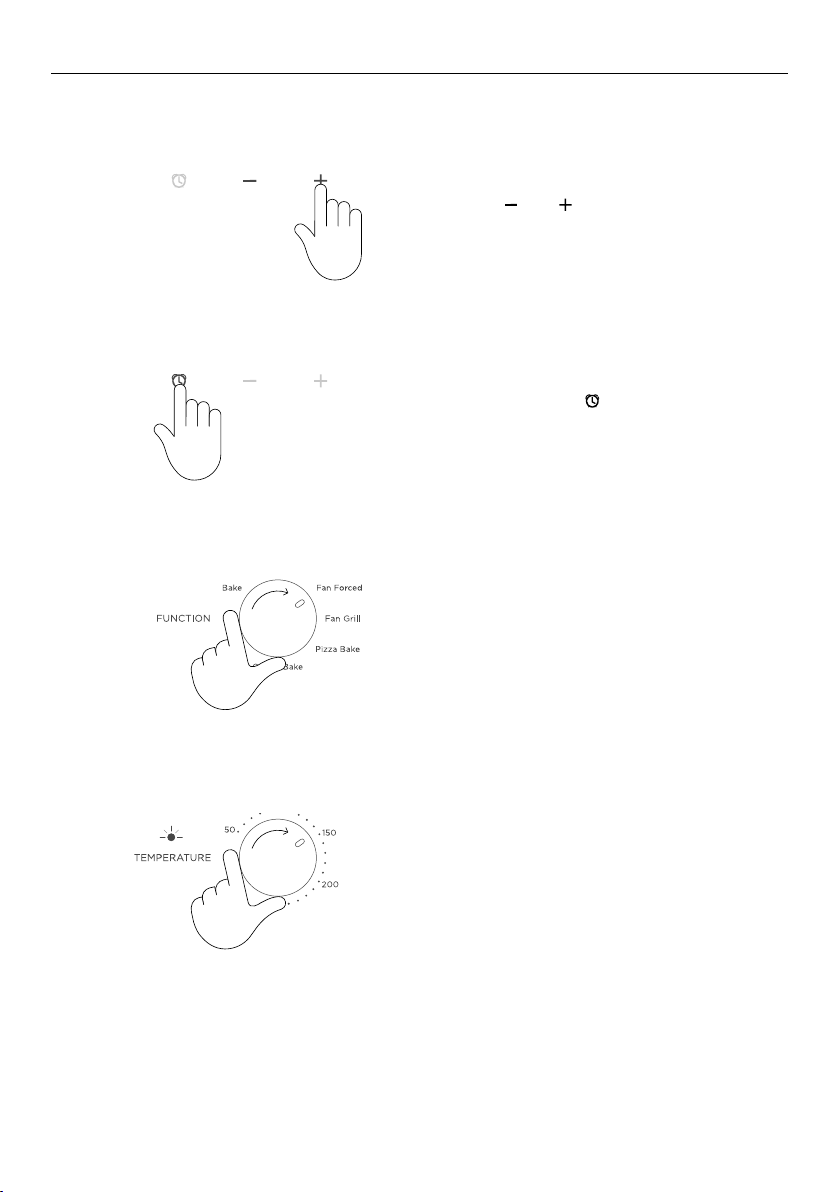
Check the clock shows the correct
time of day.
Touch the cooking time
control. The
cooking time indicator will flash.
Touch the
and controls to set the
cooking time. Ensure you allow for preheat
time in your calculation.
Touch the cooking time
control to confirm.
The cooking time
indicator will stop
flashing and remain on.
4
Touch the stop time control. The stop time
indicator will flash A.
18
6
7
8
Touch the stop time control to confirm.
The
A will stop flashing and remain on
and the display will show the time of day.
Set the temperature.
Select a function. The oven will come on.
If you have set the oven to automatically
turn on later, the oven cooling fan will come
on when you select a function, but the light
will be off and the oven will not heat up.
AUTOMATIC COOKING
5
Touch the and controls to set the time
you would like your food to be ready by
(ie the stop time).

19
AUTOMATIC COOKING
1
1
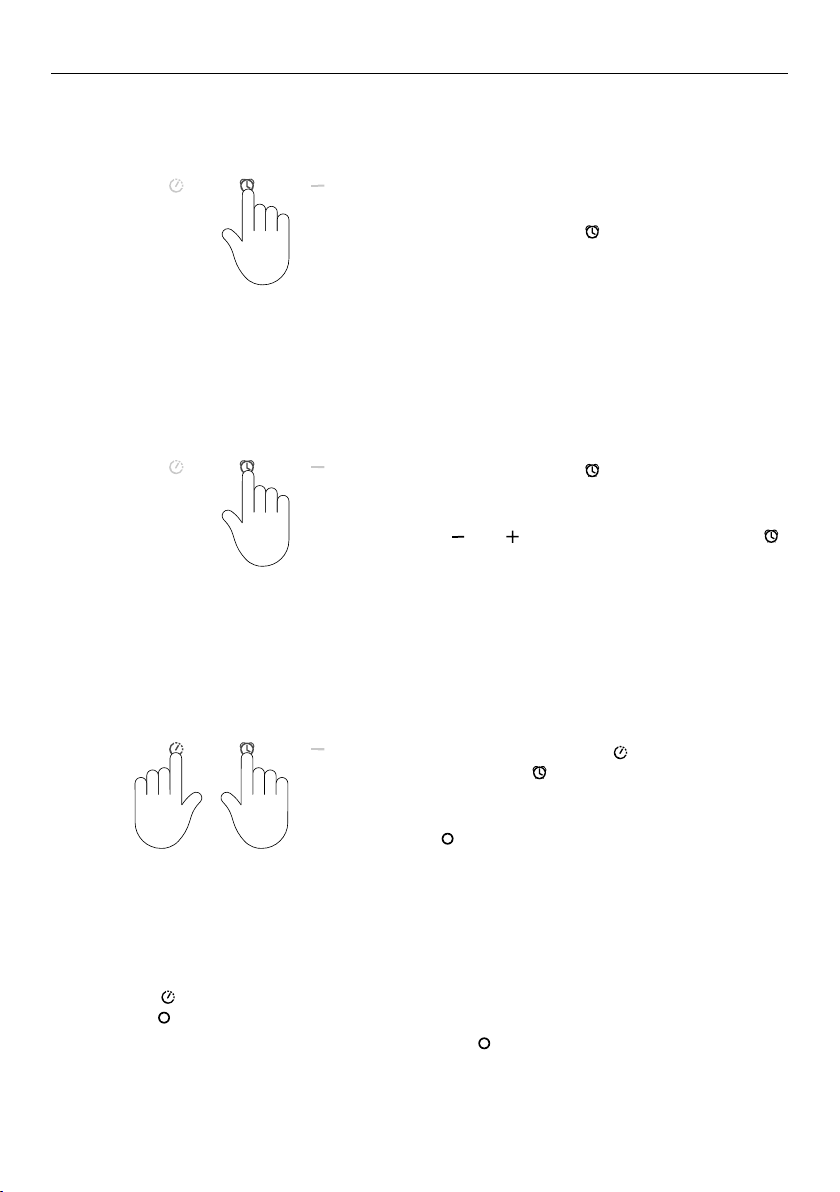
Touch the cooking time control.
Touch the cooking time
control. The
cooking time indicator will flash.
You can modify the set cooking time by using
the
and controls. Touch the cooking time
control again to set.
To check the set cooking time
To modify the set cooking time
Touch the stop time
control.
Touch the
control and scroll the time down
to
00
:
00.
To cancel the cooking time
1
Touch the cooking time control to accept.
This will not turn off the oven. If the stop time
is set the oven will turn off when the stop
time is reached.
2
20
AUTOMATIC COOKING
To modify the stop time
To cancel automatic cooking
When the stop time is reached
The oven will automatically turn off and the oven will beep every seven seconds. The
cooking time
and the stop time A indicator will flash. Turn the function and temperature
dials back to OFF. Press any control to exit automatic cooking.
If the oven function dial has not been turned back to
OFF when you exit automatic
cooking, the oven will turn back on.
Touch the cooking time
control and
the stop time control together for
two seconds.
Turn the function and temperature dials
to
OFF.
1
Touch the stop time control.
Touch the stop time
control. The stop time
A indicator and dot will flash.
You can modify the set cooking time by using
the
and controls. Touch the stop time
control again to set.
To check the stop time
1
1

21
AUTOMATIC COOKING
When automatic cooking is set
The oven light will stay off but your oven is now set for automatic cooking. It will
automatically heat up at the required time. The display will show the time of day with the
cooking time
and stop time A indicators are lit. The cooling fan will continue to run.
You can modify the function and temperature before and during cooking. The grill element
will come on while the oven is heating up. Uncovered foods may be browned on top.
Safe food handling
Leave food in the oven for as short a time as possible before and after cooking or
defrosting, to avoid contamination by organisms which may cause food poisoning. Take
particular care during warmer weather.
22
COOKING GUIDE
General guidelines
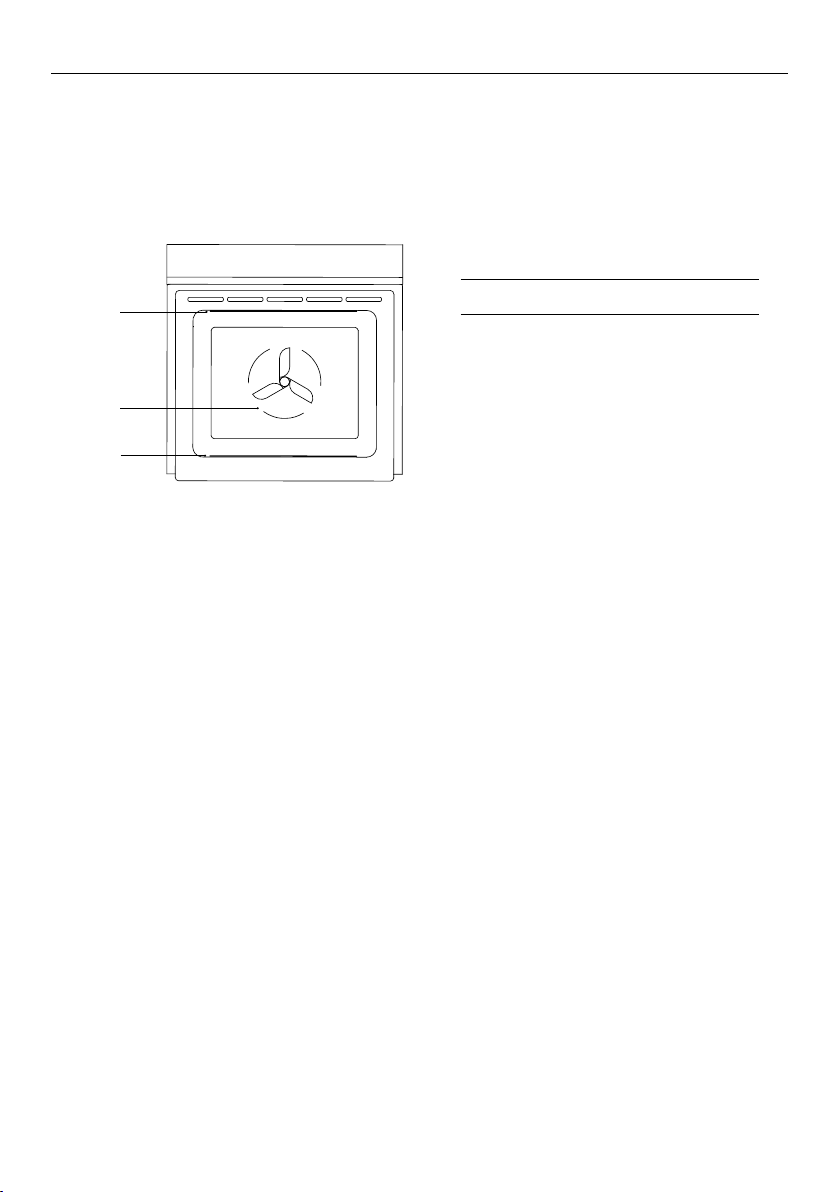
This oven has been designed to utilise its four elements and rear fan in different
combinations for enhanced performance. The wide range of functions allows you to
cook all food types to perfection.
OVERVIEW IMAGE
Oven elements
1 upper outer element
2 upper inner element
3 rear element (concealed)
4 lower element (concealed)
21
3
4
+
Use all the functions with the oven door closed.
Baking
z
For best results when baking, always pre-heat your oven. The temperature indicator will
go out when the pre-set temperature is reached.
z
While the oven is heating the grill element may be on.
z
Single shelf cooking: place your baking on a shelf that will position the top of your pan
near the centre of the oven.
z
Multi shelf cooking: Always leave a space between shelves to allow the air to circulate.
Grilling
z
Always grill with the oven door completely shut.
z
Always keep a close watch on your food to avoid charring or burning.
z
If you use glass or ceramic pans, be sure they can withstand high oven temperatures.
z
For thinner cuts of meat, or for toasting or browning foods, use a higher shelf position.
z
Thicker cuts of meats should be grilled on lower shelves or at a lower grill setting to
ensure even cooking.
Roasting
z
Use FAN GRILL to roast whole chicken.
z
For other meats use BAKE for a succulent juicy flavoursome roast.
z
Boneless, rolled or stuffed roasts take longer than roasts containing bones.
z
Poultry should be well cooked with the juices running clear and an internal temperature
of 75°C.
z
For crispy crackling first sear the pork at a high temperature, then lower the temperature
to complete the cooking.
23
COOKING GUIDE
z
If multi-shelf cooking (eg if roasting meat on one shelf and vegetables on another)
use FAN FORCED.
z
Cook larger cuts of meat for longer at a lower temperature. The meat will cook
more evenly.
z
Always roast meat fat side up.
Reheating
Never reheat food more than once.
z
Use BAKE or FAN BAKE to reheat food.
z
Always reheat food to piping hot, or to a minimum internal temperature of 85°C.
This reduces the risk of contamination.
z
Reheat food in a dish with a lid or cover tightly with foil.
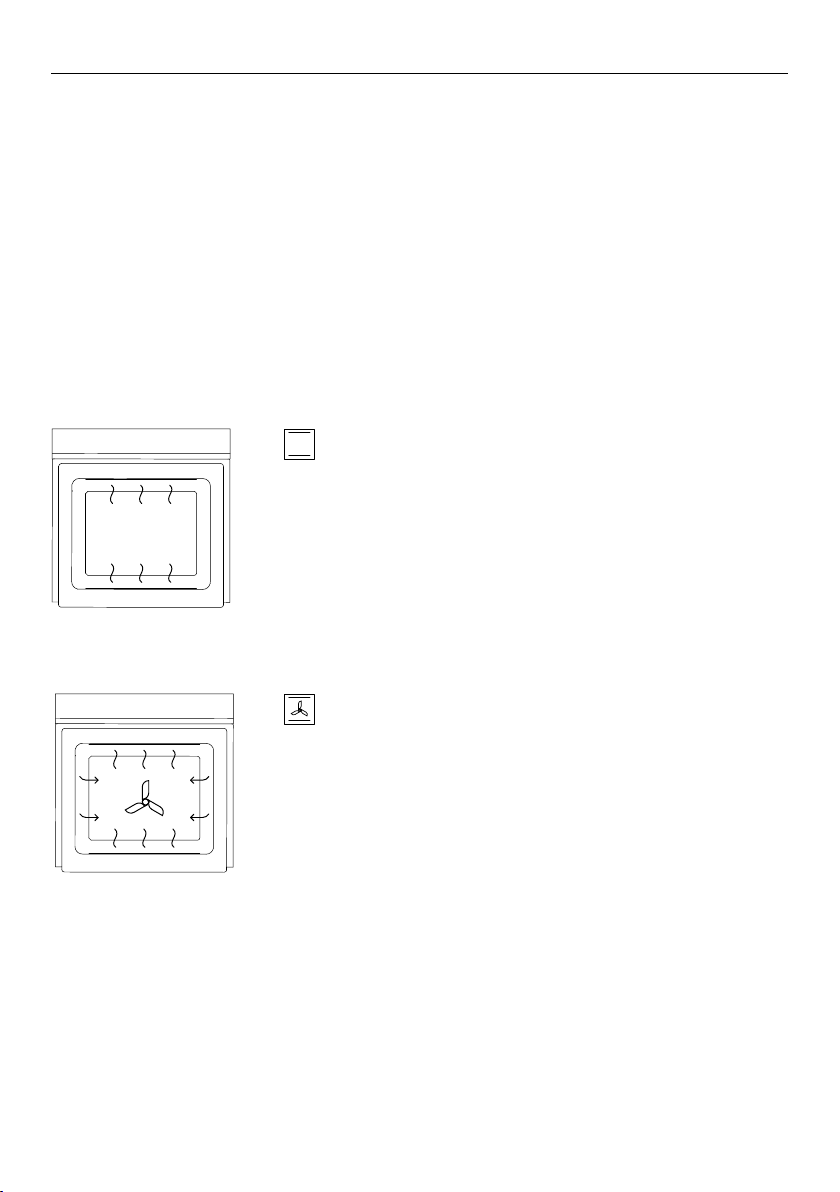
BAKE
upper outer and lower elements
Ideal for:
foods that require a longer cooking time or at low
temperatures eg rich fruit cake and brownies.
z
Retains moisture.
z
This function is not suitable for multi-shelf cooking.
BAKEGRILL VENT BAKE
FAN FORCED FAN GRILL PASTRY BAKE
CLASSIC BAKE DEHYDRATE WARM
FAN BAKE
fan plus upper outer and lower elements
Ideal for:
single shelf baking that requires less than an hour to cook.
Foods such as muffins, biscuits and cupcakes.
z
The oven fan circulates hot air from the top outer and the
lower elements and distributes it around the oven cavity.
z
Food cooked tends to brown quickly.
BAKEGRILL VENT BAKE
FAN FORCED FAN GRILL PASTRY BAKE
CLASSIC BAKE DEHYDRATE WARM
24
COOKING GUIDE
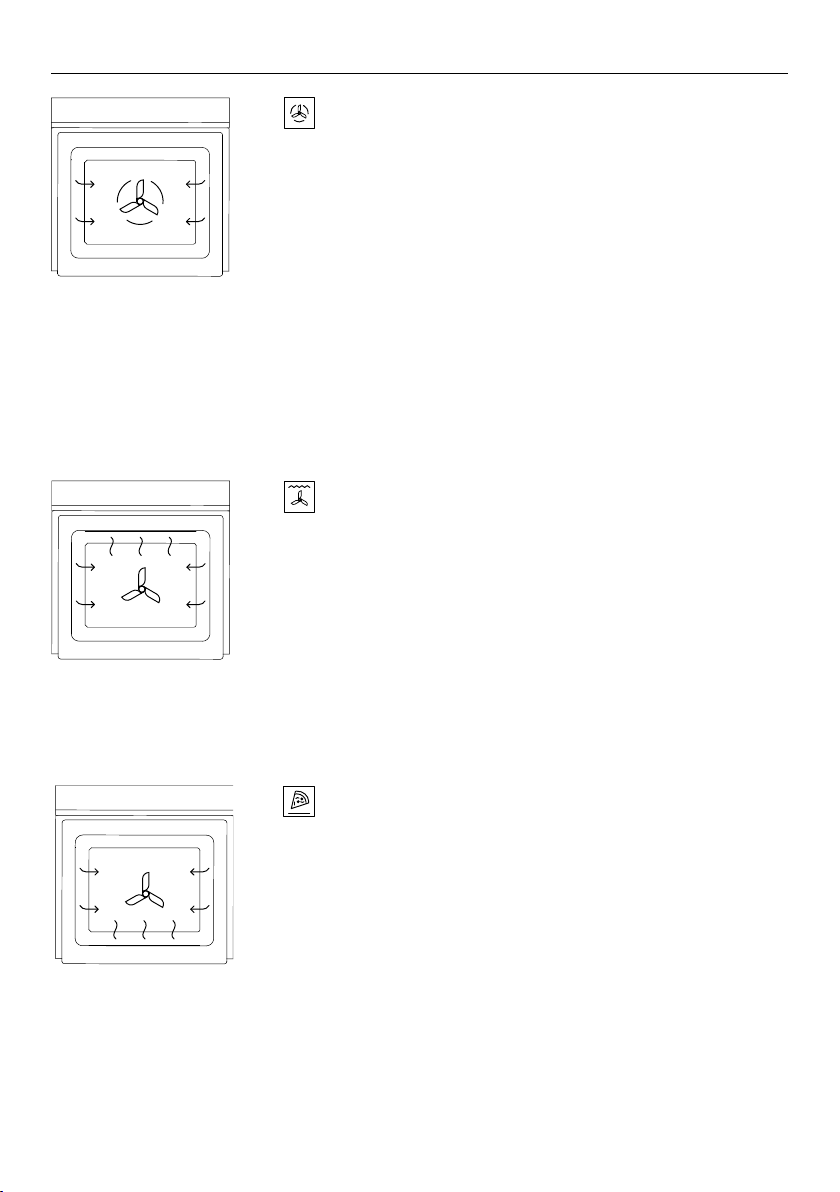
FAN GRILL
fan plus upper outer and inner elements
Ideal for:
whole chicken, beef tenderloin or grilling fish or steak.
z
Uses the intense heat from the elements for top-browning
and the fan to ensure even cooking of foods.
z
Meat, poultry and vegetables cook beautifully; food is crisp
and brown on the outside while the inside remains moist
and tender.
BAKEGRILL VENT BAKE
FAN FORCED FAN GRILL PASTRY BAKE
CLASSIC BAKE DEHYDRATE WARM
PIZZA BAKE
fan plus lower element
Ideal for:
crisp-based pizzas.
z
The fan circulates heat from the lower element throughout
the entire oven.
z
Excellent for cooking pizza as it crisps the base beautifully
without overcooking the topping.
z
For best results, pre-heat a pizza stone for at least 1 hour
and bake on oven shelf position 1 or 2.
BAKEGRILL VENT BAKE
FAN FORCED FAN GRILL PASTRY BAKE
CLASSIC BAKE DEHYDRATE WARM
FAN FORCED
fan plus rear element
Ideal for:
multi-shelf cooking, eg biscuits, cookies, scones, muffins
and cupcakes.
z
Hot air is blown into the cavity, providing a consistent
temperature at all levels.
z
Always leave a gap between shelves to allow air to move
freely. This ensures food on the lower tray can still brown.
z
If converting a recipe from BAKE to FAN FORCED, we
recommend that you decrease either the bake time and/or
the temperature by approximately 20°C, especially for items
with longer bake times.
BAKEGRILL VENT BAKE
FAN FORCED FAN GRILL PASTRY BAKE
CLASSIC BAKE DEHYDRATE WARM
25
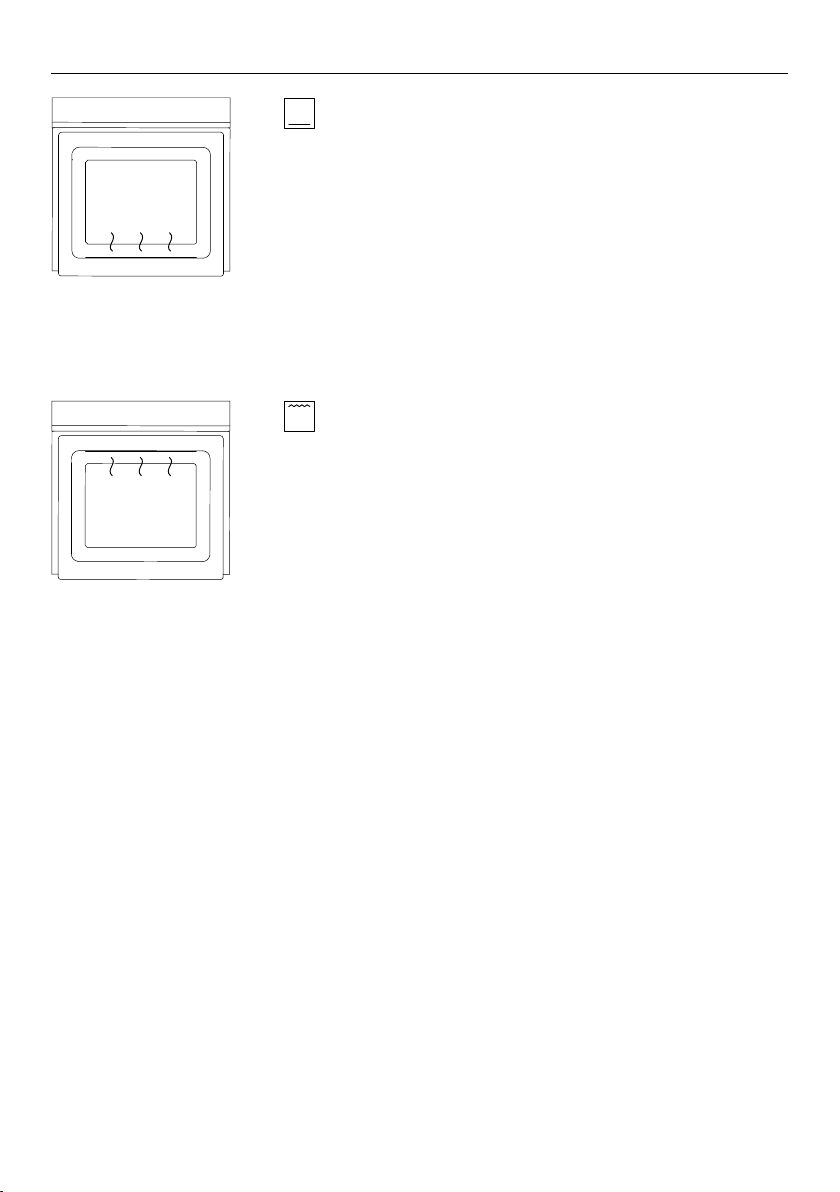
GRILL
upper inner and outer elements
Ideal for:
toasting bread or for top-browning to finish off dishes.
This function delivers intense radiant heat from the top
element(s). You can set the intensity of the heat by altering the
temperature setting.
z
The most suitable function for ‘finishing off’ many meals, for
example browning the top of potato gratin and frittata.
BAKEGRILL VENT BAKE
FAN FORCED FAN GRILL PASTRY BAKE
CLASSIC BAKE DEHYDRATE WARM
CLASSIC BAKE (some models only)
lower element
Ideal for:
dishes that require delicate baking and have a pastry base, like
custard tarts, pies, quiches and cheesecake.
z
Heat comes from the lower element only.
z
This is the traditional baking function, suitable for recipes
that were developed in conventional ovens.
z
Bake using only one shelf at a time.
BAKEGRILL VENT BAKE
FAN FORCED FAN GRILL PASTRY BAKE
CLASSIC BAKE DEHYDRATE WARM
COOKING GUIDE
26
COOKING CHARTS
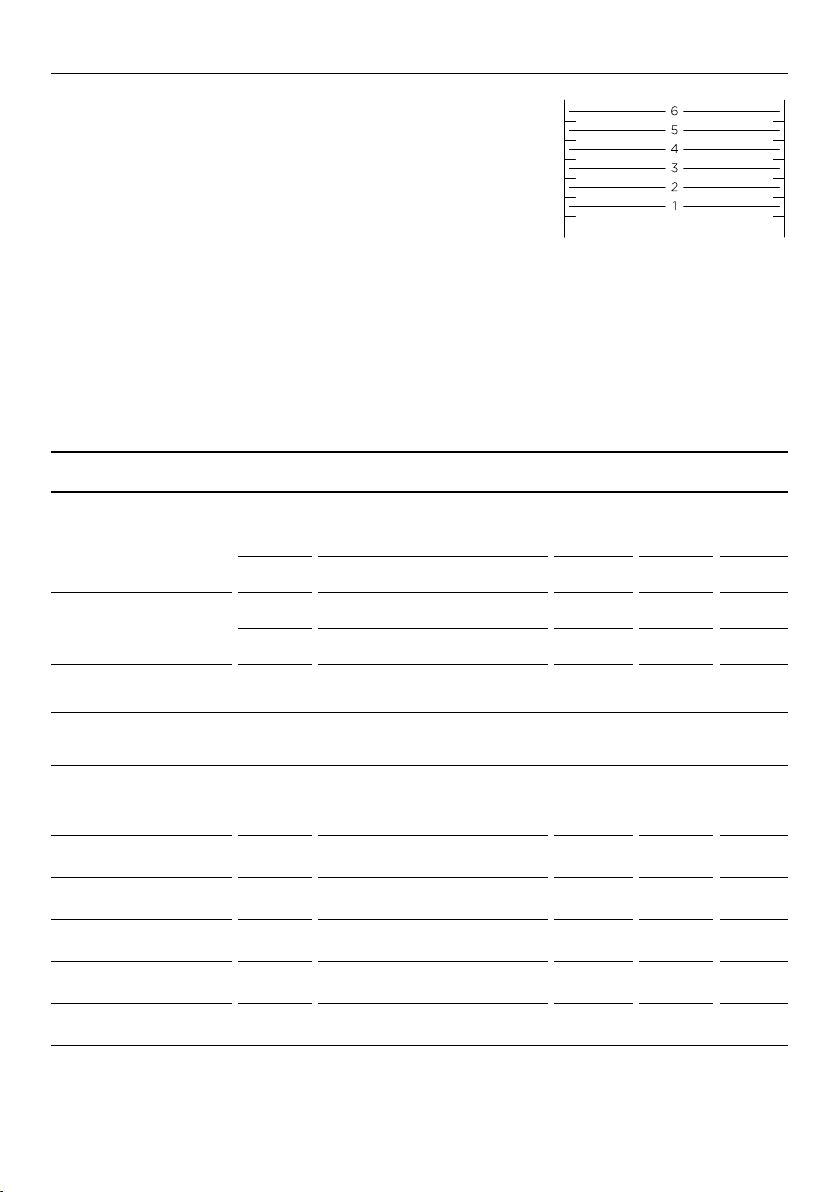
Shelf positions
z
Position shelves before you turn the oven on.
z
Shelf positions are counted from the base up, with 1
being the lowest shelf position and 6 the highest.
During cooking
z
Preheat the oven to the required temperature.
z
The grill element will come on while the oven is heating up.
z
The temperature indicator will be lit while the oven is heating up.
z
Oven accessories may temporarily warp slightly when they become hot. This is normal
and does not affect their function.
The information in these charts is for guidance only. Refer to your recipe or the packaging
and be prepared to adjust the cooking times and settings accordingly.
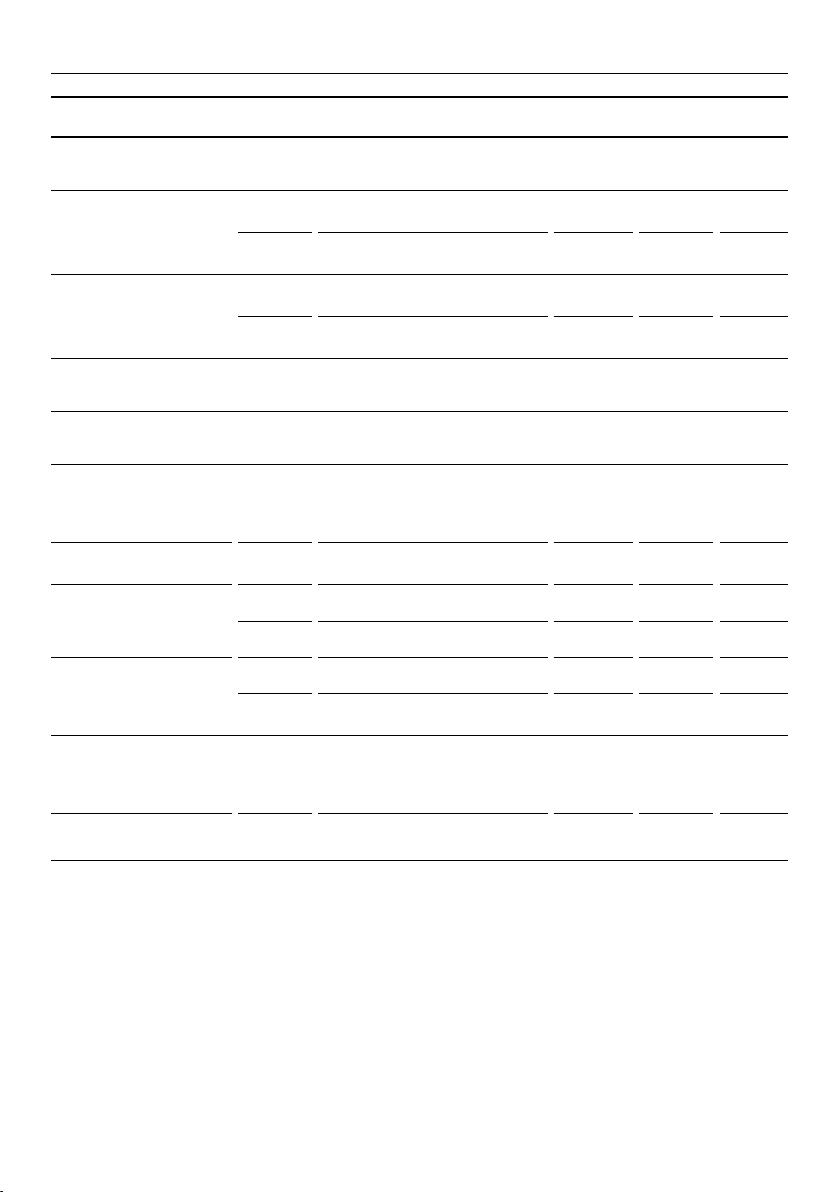
BAKING
SHELVES FUNCTION
SHELF
POSITION
TEMP
(°C)
TIME
(MIN)
BISCUITS
Plain
Single Fan Bake 4 180-190 13-17
Multi Fan Forced 3 and 5 160-170 13-17
Chewy choc chip
Single Fan Bake 4 180-190 15-20
Multi Fan Forced 3 and 5 160-170 15-20
Oatmeal Single Pizza Bake/Fan Bake 4 160-170 12-15
SLICES/SQUARES Single Pizza Bake/Fan Bake 3 160-165 15-20
CAKES
Vanilla Single Bake 4 160-165 30-35
Butter/chocolate Single Bake 4 160-180 50-60
Light fruit Single Bake 2 155-165 1hr 30
Rich fruit Single Classic Bake/Bake 2 120-160 2.5 hrs
Sponge
(single large) Single Bake 2 175 30-40
Sponge
(2 small pans) Single Bake 2 170-190 15-25
27
COOKING CHARTS
BAKING
SHELVES FUNCTION
SHELF
POSITION
TEMP
(°C)
TIME
(MIN)
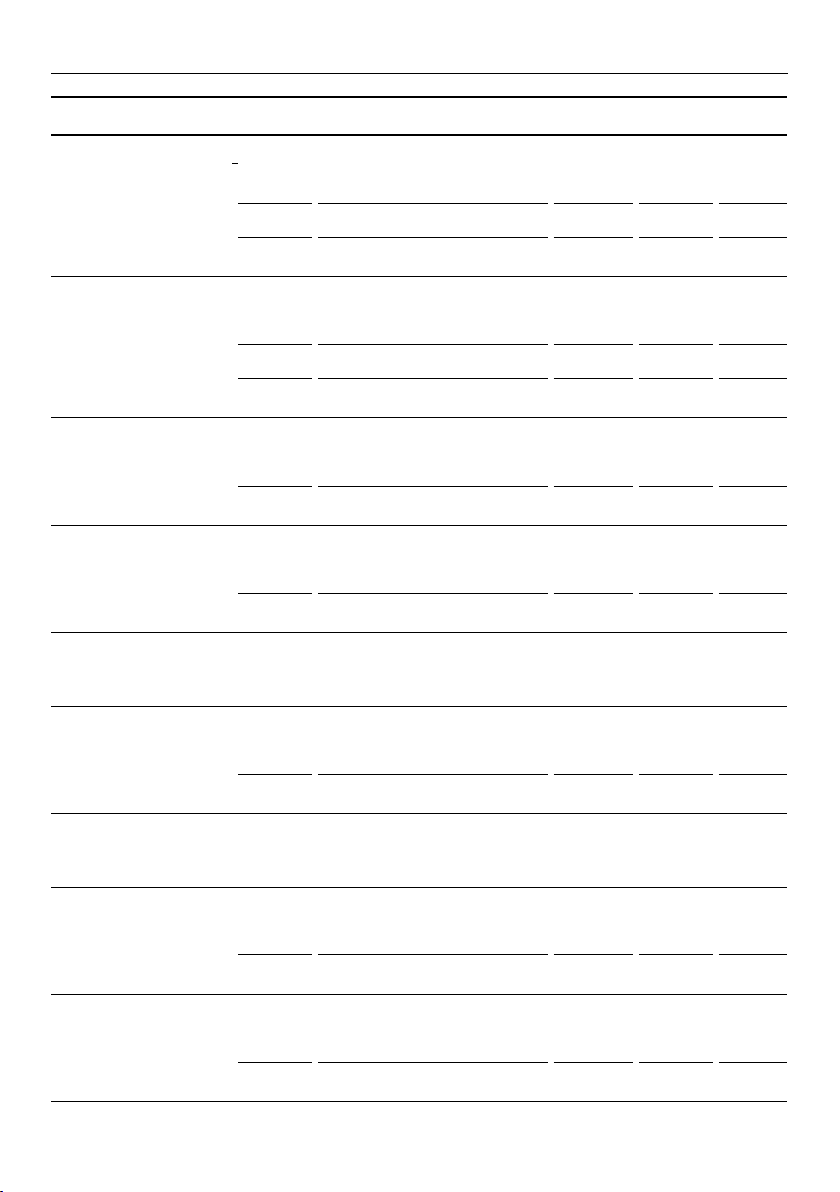
SHORTBREAD Single Pizza Bake/Fan Bake 3 130-140 20-25
MUFFINS/CUPCAKES
Single Fan Bake
3 180-190 13-17
Multi Fan Forced 2 and 4 160-170 16-21
SCONES
Single Fan Bake
2 210-230 8-12
Multi Fan Forced 1 and 3 210-230 8-12
MERINGUES Single Bake 1 100-120 60
BREAD ROLLS Single Bake 4
195-210 25-35
PASTRY
Filo Single Fan Bake 3 190-200 15-25
Flaky/puff Single Bake 3 185-200 20-30
Choux Single Bake
Multi Fan Forced 2 200-210 30-35
Croissants
Single Bake - - -
Multi Fan Forced 3 190-200 15-25
PIES
Apple Single Pizza Bake 2 190-200 25-30
Lemon meringue Single Pizza Bake 2 175-180 30-40

28
COOKING CHARTS
SAVOURY
SHELVES FUNCTION
SHELF
POSITION
TEMP
(°C)
TIME
(MIN)
PIES
Chicken/Steak/Mince Single Pizza Bake/Fan Bake 3 190-195 30-40
SAUSAGE ROLLS Single
Pizza Bake/Fan Bake
3 190-195 30-40
MEAT LOAF Single Bake 3 175-180 55-65
PIZZA
Classic Single Pizza Bake 1 and 2 225-250 8-12
Thin crust Single Pizza Bake 1 and 2 250 5-8
Deep dish Single Pizza Bake 1 and 2 160-220
1
50-60
LASAGNE Single Fan Bake 3 175-180 45-50
QUICHE Single Pizza Bake/Fan Bake 2 180-200 30-40
POTATOES
Traditional Baked Single Bake 3 175-190 40-50
FRITTATA
Grill to finish Single Pizza Bake/Fan Bake 3 170-180 30-45
CASSEROLES Single Bake 3 170-190 55-70
OVEN MEALS Single Fan Forced/Fan Bake 3 170-190 30-40
29
COOKING CHARTS
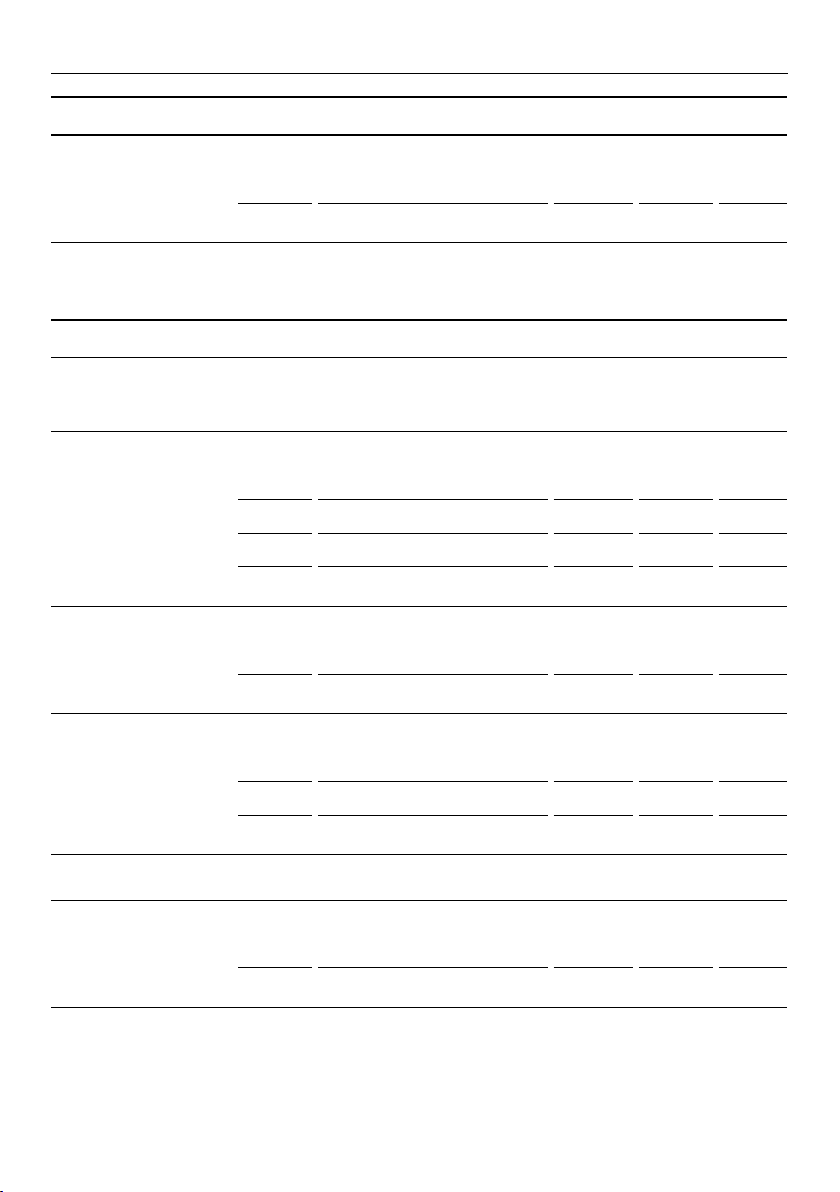
ROASTING
SHELVES* FUNCTION
SHELF
POSITION
TEMP
(°C)
TIME
(MIN)
BEEF, BONELESS (times per 450g)
Rare
Single* Bake 3 160-170 18-32
Medium Single* Bake 3 160-170 25-40
Well done Single* Bake 3 160-170 30-55
PRIME RIB ROAST
(times per 450g)
Rare Single* Bake 3 160-170 15-30
Medium Single* Bake 3 160-170 20-35
Well done Single* Bake 3 160-170 25-40
LAMB LEG, BONE IN
(times per 450g)
Medium Single* Bake 3 160-170 18-28
Well done Single* Bake 3 160-170 20-33
LAMB LEG, BONELESS
(times per 450g)
Medium Single* Bake 3 160-170 20-35
Well done Single* Bake 3 160-170 25-45
CHICKEN
(times per 1lb/450g)
Whole Single* Fan Grill 3 175-190 15-20
TURKEY, WHOLE
(times per 450g)
With stuffing Single* Bake 1 165-175 17-22
Without stuffing Single* Bake 1 150-165 15-20
PORK CRACKLING
Crisp Bake 3 250 20
VEAL
(times per 450g)
Medium Single* Bake 3 160-170 20-40
Well done Single* Bake 3 160-170 25-45
PORK, BONELESS
(times per 450g)
Medium Single* Bake 3 170-175 25-40
Well done Single* Bake 3 170-175 30-45
30
COOKING CHARTS
ROASTING
SHELVES* FUNCTION
SHELF
POSITION
TEMP
(°C)
TIME
(MIN)
VENISON (times per 2.5cm thickness
2
)
Rare Single* Fan Grill 4 225 7.5
Medium Single* Fan Grill 4 225 9.5
GRILLING
SHELVES FUNCTION
SHELF
POSITION
TEMP
(°C)
TIME
(MIN)
CHICKEN
Boneless pieces Single Fan Grill 5 175-190 30-50
BEEF
Steak, rare Single Grill 4 HI 8-10
Steak, medium Single Grill 4 HI 10-15
Burgers Single Grill 4 HI 12-15
Meatballs Single Grill 4 HI 12-15
LAMB
Chops, medium Single Grill 4 HI 15-20
Chops, well done Single Grill 4 HI 20-25
PORK
Chops, well done Single Grill 4 HI 15-20
Ham steak Single Grill 4 HI 15-20
Bacon Single Grill 4 HI 4-7
SAUSAGES Single Grill 5 HI 10-15
FISH
Fillets Single Fan Grill 5 200-220 8-12
Whole Single Fan Grill 5 200-220 15-20

31
COOKING CHARTS
1
Start at 220˚C for 10 minutes, and lower to 160˚C for further 50 minutes
2
Brown in frying pan first
* If multiple shelves are required (eg roasting vegetables at the same time), use
FAN FORCED and
shelf positions 2 and 4.
GRILLING
SHELVES FUNCTION
SHELF
POSITION
(FULL
OVENS)
TEMP
(°C)
TIME
(MIN)
VEGETABLES
Sliced Single Grill 4 HI 8-12
BREAD
Toast (10-15mm thick) Single Grill 5 HI 1-3

32
CARE AND CLEANING
ALWAYS NEVER
• Before any manual cleaning or maintenance,
first wait for the oven to cool down to a safe
temperature to touch, then turn its power supply
off at the wall.
• Read this cleaning guidance and the ‘Safety
and warnings’ section before you start cleaning
your oven.
• To prevent soiling from becoming ‘baked on’ and
stubborn, we recommend removing any easy-to-
reach spills, food or grease stains from the oven
cavity enamel after each use.
• Never use a steam cleaner.
• Never store flammable substances in the oven.
• Never use abrasive or harsh cleaners, cloths,
scouring pads or steel wool. Some nylon
scourers may also scratch. Check the label first.
• Never leave alkaline (salty spills) or acidic
substances (such as lemon juice or vinegar) on
the oven surfaces.
• Never use cleaning products with a chlorine or
acidic base.
WHAT? HOW? IMPORTANT!
Control Panel Take particular care when cleaning
the control panel glass and
screen. Only use a damp cloth
with detergent.
Do not use any oven cleaners, harsh
or abrasive cleaners, scouring pads,
steel wool or sharp metal scrapers
on the glass. These may scratch and
damage the surface.
Dials Clean with a solution of mild
detergent and hot water, then
wipe dry.
Do not use stainless steel or oven
cleaner on the dials, as doing so
may damage the coating.
Stainless steel strip/oven
door handle
Clean with a solution of mild
detergent and hot water, then wipe
dry with a microfibre cloth.
If necessary, use a suitable stainless
steel cleaner and polish.
Always read the label to make
sure that your stainless steel
cleaner does not contain chlorine
compounds as these are corrosive
and may damage the appearance of
your oven.
Always rub the stainless steel in the
direction of the grain.
Oven door frame and
plastic corner clips
Clean with a solution of mild
detergent and hot water, then
wipe dry.
Manual cleaning

33
CARE AND CLEANING
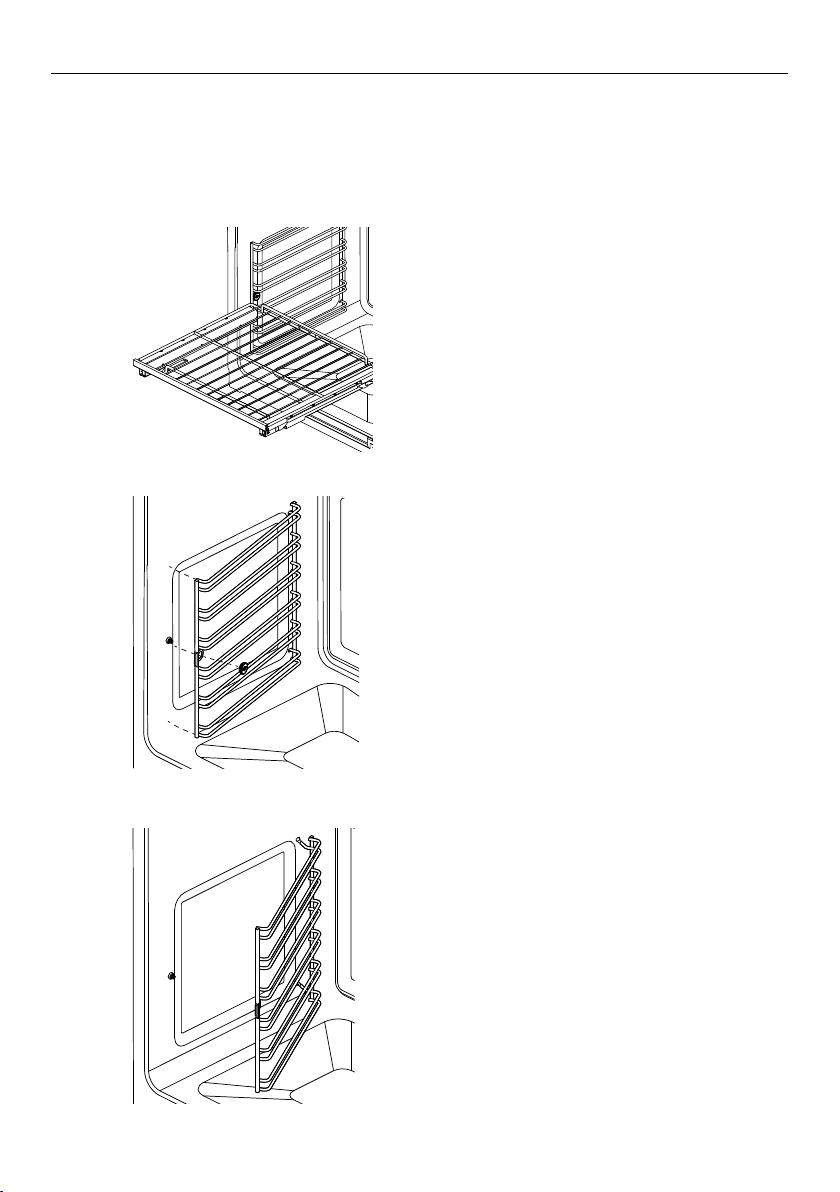
WHAT? HOW? IMPORTANT!
Oven cavity To clean light soiling off the
enamelled surfaces:
• Wipe with a damp cloth and
a solution of hot water and
mild detergent or an ammonia-
based cleaner.
• Wipe dry with a soft cloth.
• To prevent soiling from
becoming ‘baked on’ and
stubborn, we recommend
removing any easy-to-reach
spills, food or grease stains from
the enamelled surfaces after
each use.
• To make wiping out the oven
easier you may remove the oven
door. See the following pages for
more information.
Sliding shelf Wipe with a damp cloth and mild
detergent. Do not wipe off or wash
away the white lubricating grease
(visible when the shelf is extended).
Do not wash the shelf in the
dishwasher, immerse in soapy water,
or use oven cleaner on it. Doing
so will prevent the slides from
running smoothly.
Grid
Grill rack
Grill pan
Wire oven shelves
Clean with a solution of mild
detergent and hot water.
Pre-soak stubborn burnt-on stains
in a solution of dishwasher powder
and hot water. These parts are also
dishwasher safe.
Oven seal Do not clean this part.
Oven door glass
(after every use)
Use a soft cloth and a mixture of
warm water and dishwashing liquid
to remove soiling after every use.
For stubborn stains, try a mixture of
baking soda and warm water with
a non-abrasive scrubbing pad, then
wipe dry with a soft, lint-free cloth.
Do not use oven cleaners or any
other harsh/abrasive cleaners,
cloths, scouring pads, steel wool or
sharp metal scrapers to clean the
oven door glass. These scratch the
glass, which in turn could result in
the glass cracking and shattering.
Do not allow grease to build up on
the glass or become baked on as
this reduces visibility into the oven.
Drip channel Use a sponge to soak up any
moisture that has collected in the
drip channel, below the door.
34
CARE AND CLEANING
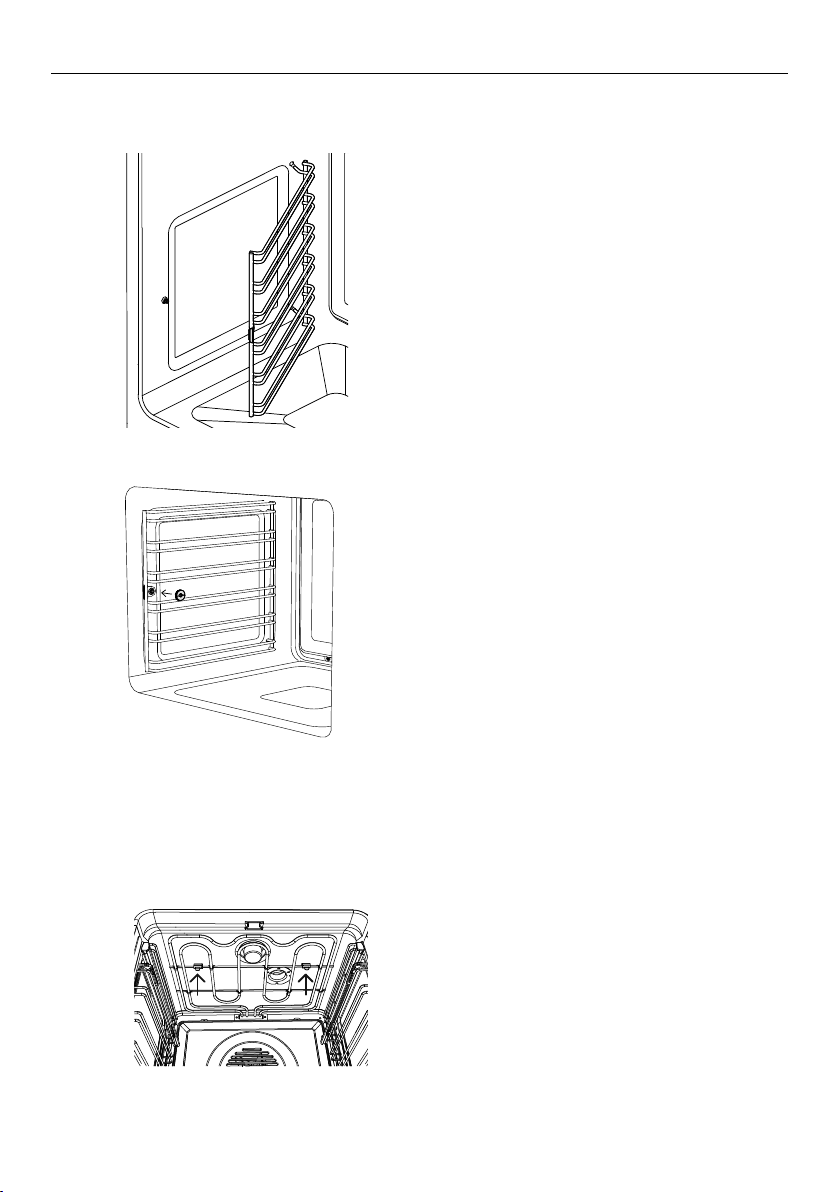
Removing the side racks
Remove the side racks to make cleaning the oven easier.
Always turn the oven off at the wall first. Ensure the oven has cooled down completely
before starting.
Slide out all shelves and remove.
1
Unscrew and remove the fixing nut at the
front of the side rack. Use a coin to loosen
the nut if necessary.
Pull the front of the rack toward the back
of the oven until the front tab is clear of
the fixing nut.
Slide the side rack forward until the rear
prongs are clear of the holes.
2
3
35
CARE AND CLEANING
Refitting the side racks
Slide the rear prongs of the side rack
back into the holes, ensuring the rack is
firmly pushed up against the side wall of
the oven.
1
Fit the side rack front tab over the
fixing screw.
Replace the fixing nut. You may use a coin
to tighten the nut.
2
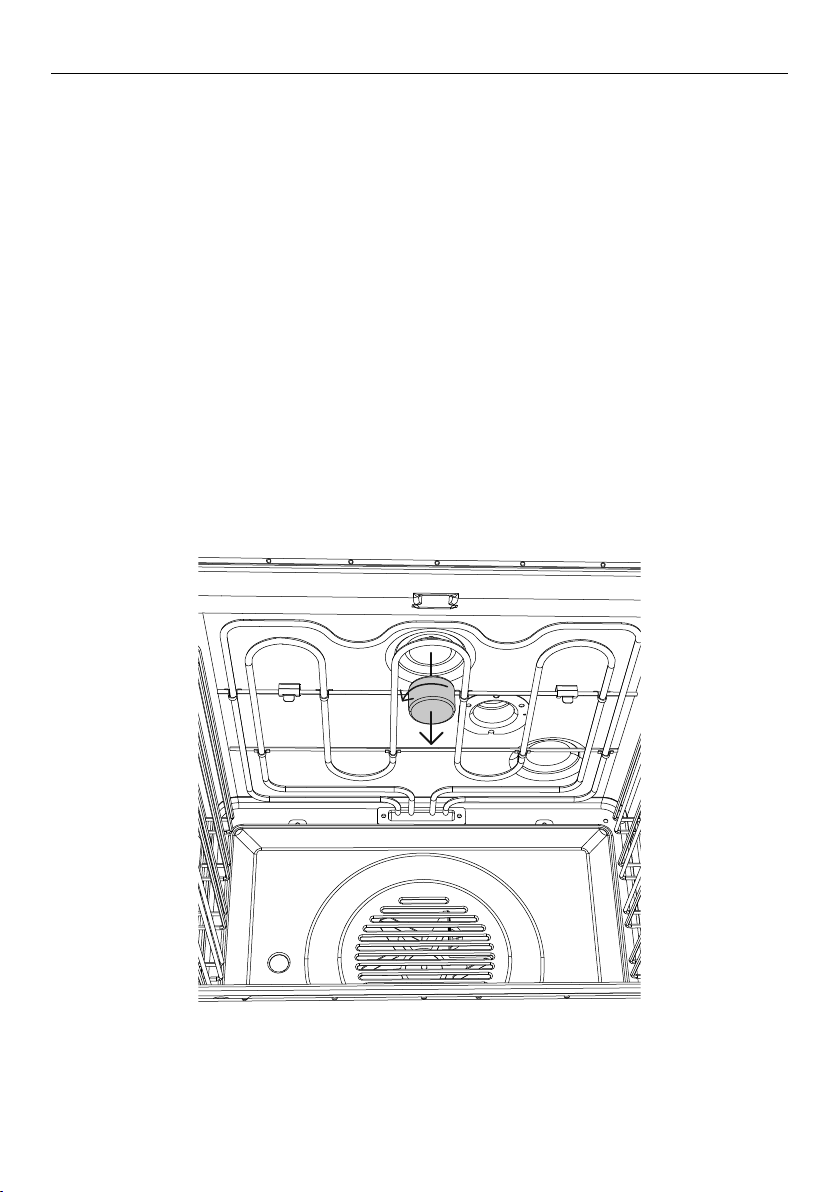
Drop down upper element
Always turn off the oven at the wall before lowering the upper element. Make sure the
oven has cooled down completely before starting.
Pull the two securing clips gently forward to
release the element. The element will now
drop down to enable cleaning.
When you have finished cleaning the oven
ceiling, pull the securing clips forward, raise
the element and release the clips. Make sure
the element is securely held in place. The
element itself is self-cleaning.
1
36
CARE AND CLEANING
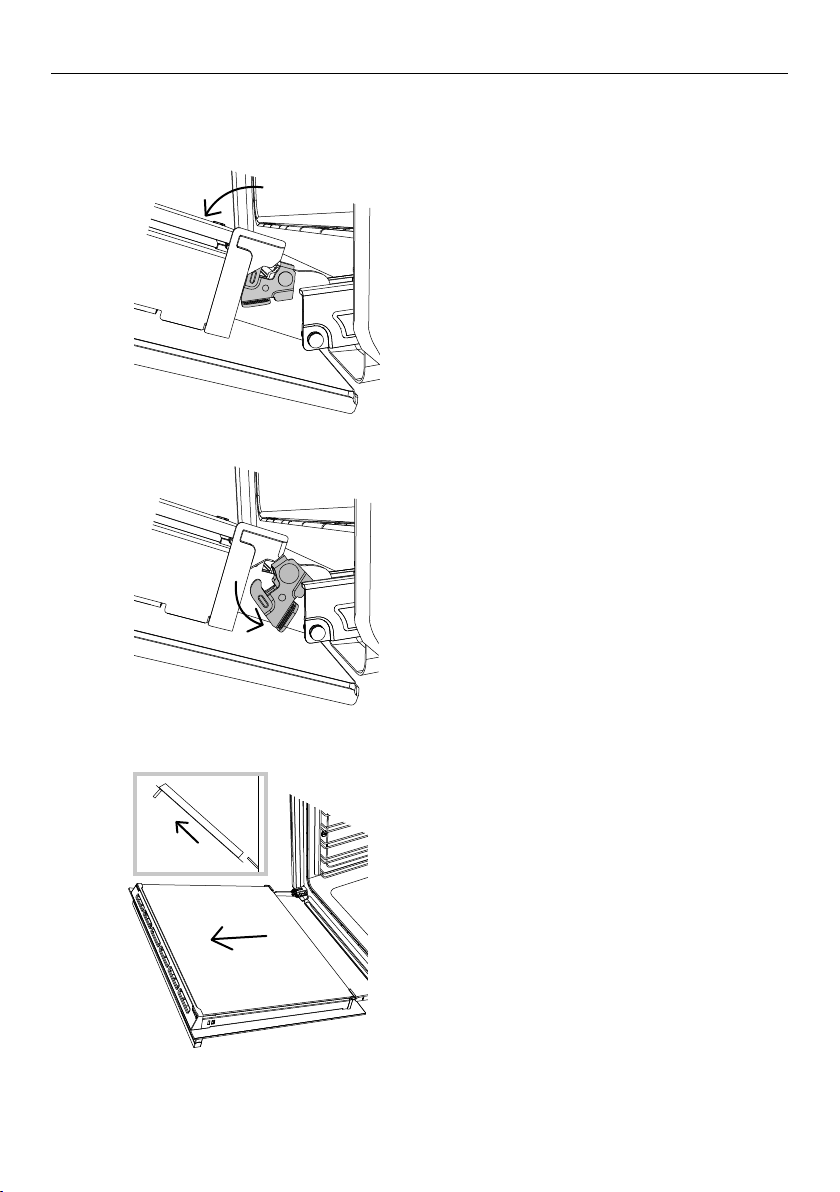
Replacing the oven light bulbs
z
Your oven uses G9 halogen bulbs with the specifications 220 – 240V, 50Hz and 25W.
z
Always hold the replacement bulb in a soft cloth. Touching the bulb will reduce
its life-span.
z
The light is located in the ceiling of the oven, center front.
z
Oven bulb replacement is not covered by your warranty.
Changing the bulb
1 Let the oven cavity and grill element cool down before changing the bulb.
Turn the oven off at the wall before continuing.
2 Turning anti-clockwise unscrew the glass cover.
3 Carefully pull out the faulty halogen bulb.
4 Replace the light bulb
5 Replace the glass cover.
6 Turn the oven back on and set the clock, refer to ‘First use’.
37
CARE AND CLEANING
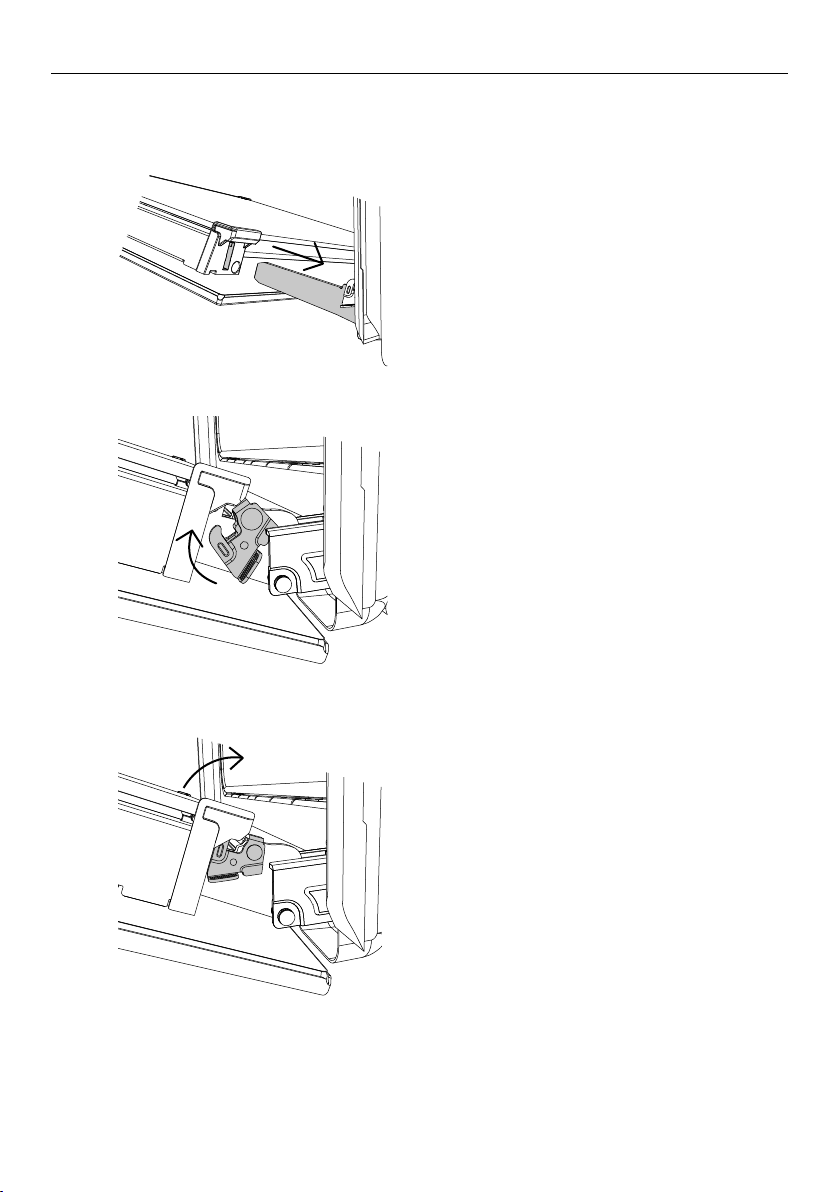
Removing and refitting the oven door.
To remove the door
Take care, the oven door is heavy.
Open the door fully.
Locate the two small metal locking levers
on both door hinges either side.
Push each locking lever down fully to
release the door from the hinge.
Holding the door on both sides, lift door
back up to 45° and carefully pull the door
out and away from the hinges.
1
2
3
38
CARE AND CLEANING
To refit the door
Holding the door on both sides, line up
the holes in the base of the door with the
hinges and slide the door on.
Ensure the door is firmly in place on the
hinges. Open the door fully again and push
each locking lever up to lock the door onto
the hinge.
Ensure the levers are both fully locked
before trying to shut the door.
1
2
3
39
CARE AND CLEANING
Removing the door glass panes for cleaning
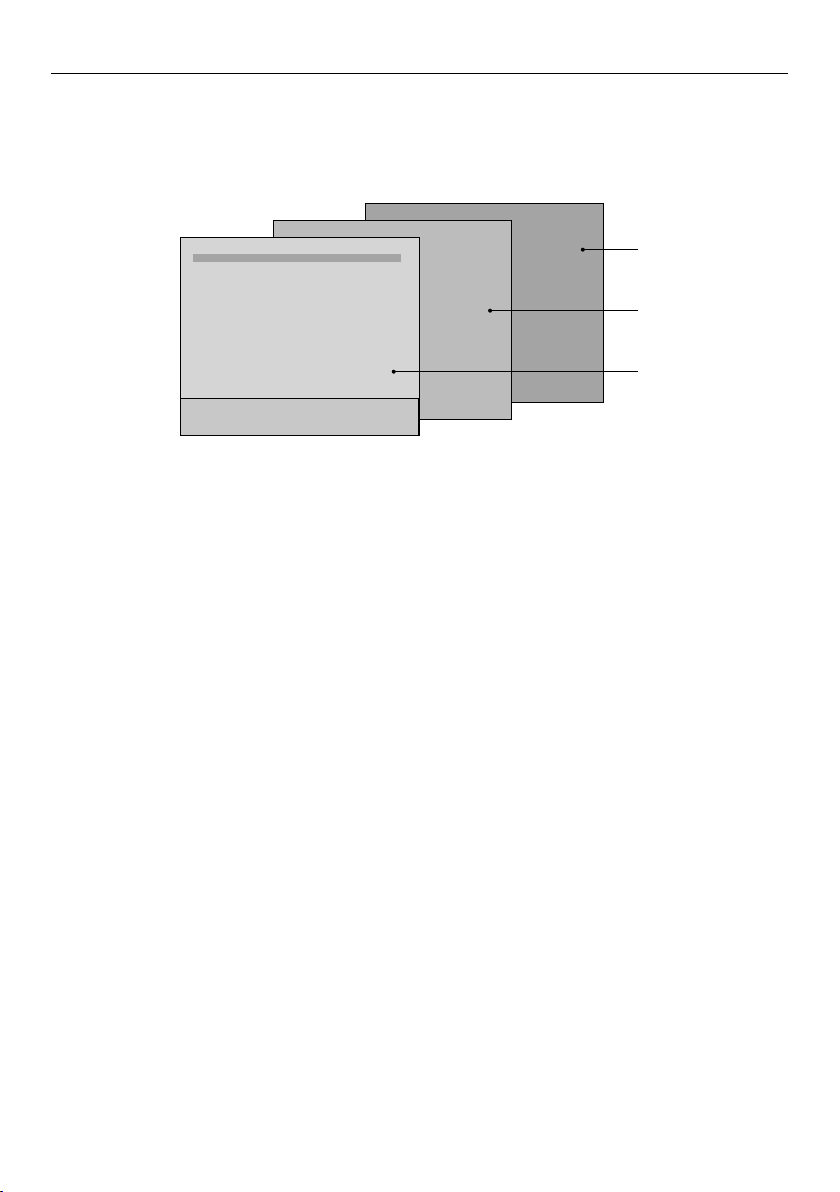
The oven door is made up of 3 glass panes. To clean the middle pane you will first need
to remove door and inner pane.
z
Make sure you follow the precautions and guidance below very carefully. Replacing the
glass panes and the door incorrectly may result in damage to the oven and could void
your warranty.
z
Take care, the oven door is heavy. If you have any doubts, do not attempt to remove
the door.
z
Make sure the oven and all its parts have cooled down. Do not attempt to handle the
parts of a hot oven.
z
Take extreme care when handling the glass panes. Avoid the corners and edges of the
glass bumping against any surface. This may result in the glass shattering.
z
Don’t use oven cleaners or any other harsh/abrasive cleaners, cloths, scouring pads,
steel wool or sharp metal scrapers to clean the glass surfaces. These scratch the glass
and may damage its special coating, which in turn could result in the glass cracking
or shattering.
z
If you notice any sign of damage on any of the glass panes (such as chipping or
cracks), do not use the oven. Contact a Fisher & Paykel trained and supported service
technician or Customer Care.
z
Ensure you replace all the glass panes correctly. Do not use the oven without all glass
panes correctly in place.
z
If the glass panes feel difficult to remove or replace, do not force them. Contact a
Fisher & Paykel trained and supported service technician or Customer Care.
Service visits providing assistance with using or maintaining the oven are not covered by
your warranty.
We recommend removing the door to make cleaning the glass easier. Refer to ‘Removing
and refitting the oven door’ for details. Once the door is removed, lay it down on a soft,
clean, flat surface.
inner
middle
outer
40
CARE AND CLEANING
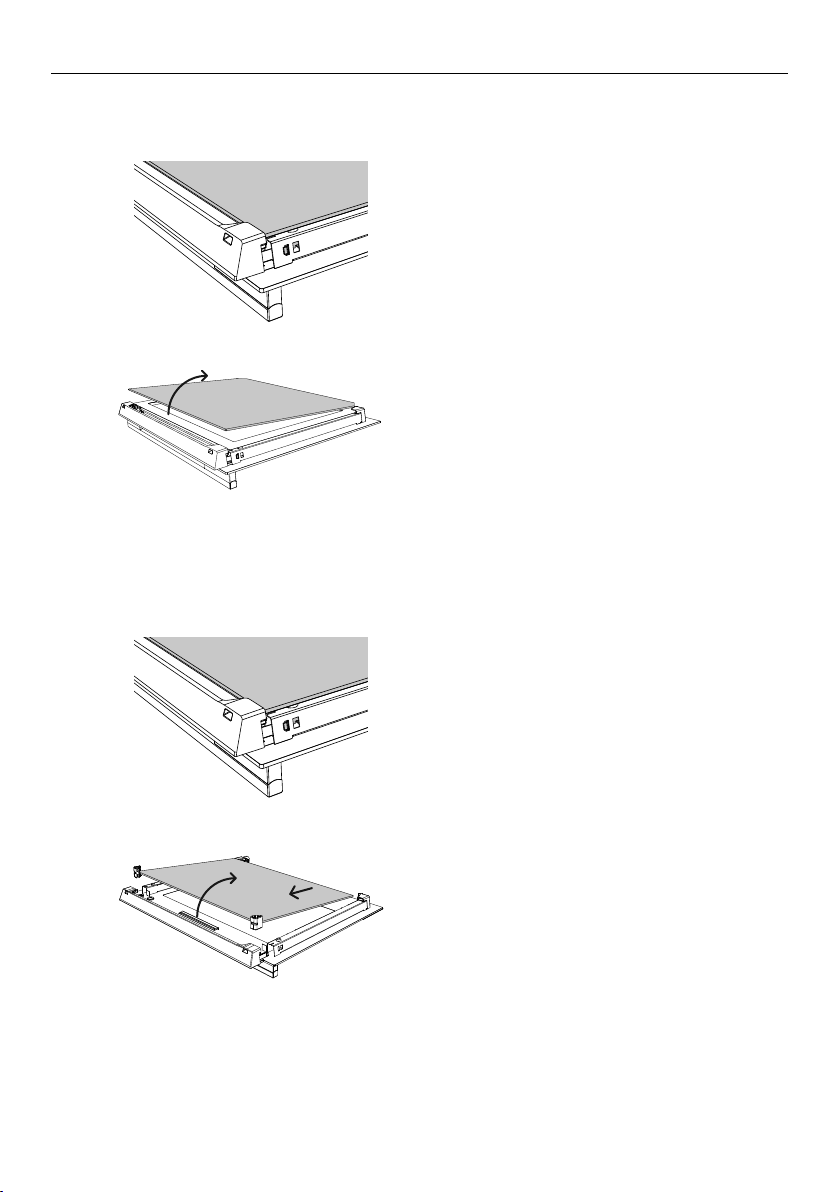
To remove the inner pane
To remove the middle pane
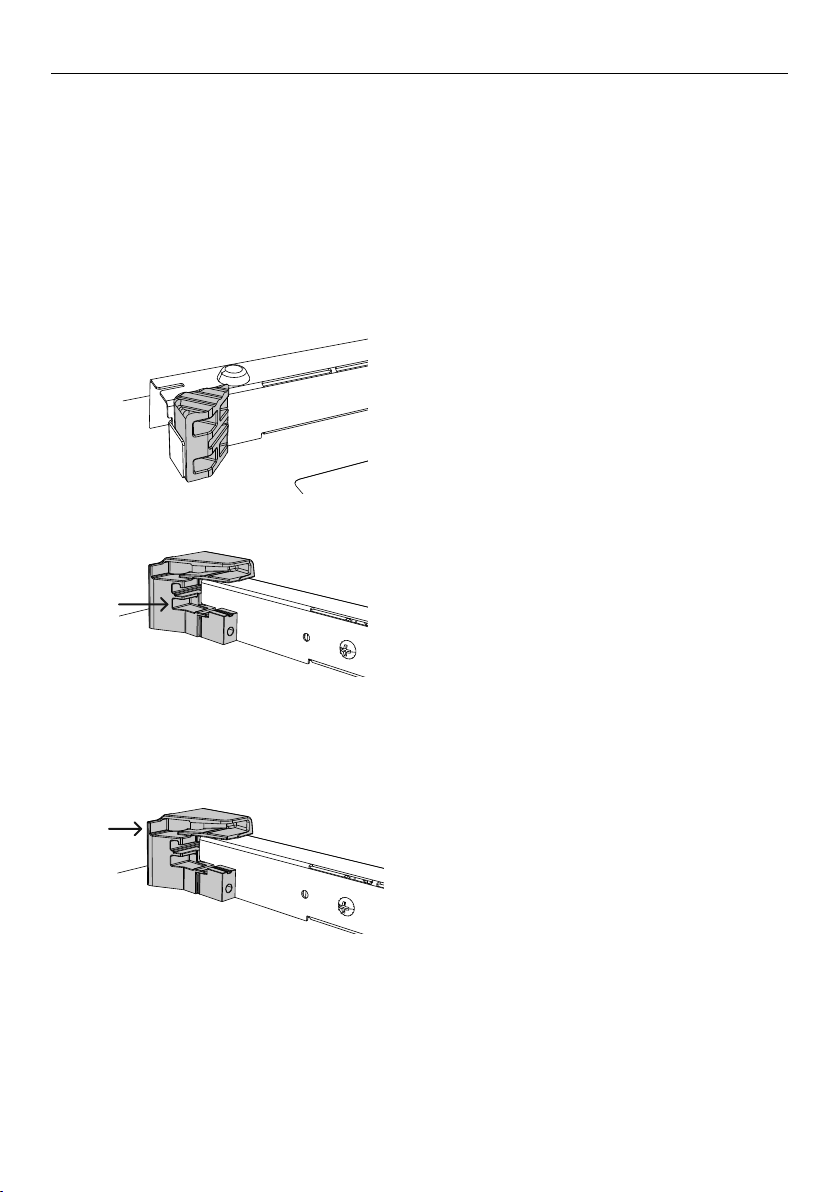
Push the glass retainer tabs in on both sides
of the door. Pull the glass retainer up until
the tabs relocate in the uppermost hole.
Push the glass retainer tabs in on both
sides of the door again. The glass retainer
can then be pulled off completely.
Holding the top of the inner pane, gently
pull the pane toward the top of the door
until the pane is clear of the notch at the
bottom of the door and lift out. Do not
angle the pane too much as you may
damage the glass.
Gently pull the middle pane toward the
top of the door until the pane is clear of
the notch at the bottom of the door. Lift
the pane out. The rubber stoppers at the
top of the pane remain attached to the
glass pane.
1
1
2
2
41
CARE AND CLEANING
Replace the middle pane
Ensure the pane is located correctly as detailed in the steps below. The pane is symmetrical
and does not have a front or back.
Replace the inner pane
When replacing the glass panes ensure that:
z
you replace the inner pane correctly as shown to ensure that the oven operates safely
z
you take extra care not to bump the edges of the glass against any object or surface
z
you do not force any of the panes into place. If you are experiencing difficulties replacing
the panes, remove and start the process again. If this does not help, call Customer Care.
Ensure the rubber stoppers are still attached
at the top of the pane. Ensure they are
positioned correctly on the glass with the
longer side running down the side of the
glass pane.
Slide the pane into the notch at the bottom
of the door and lower the pane onto the
notch at the top of the door.
Slide the glass retainer back into place and
ensure it is clipped securely in place.
Ensure the glass retainer is correctly and
firmly in place and the glass pane is secure.
Slot the bottom of the pane into the lower
notch at the bottom of the door.
Lower the pane into the door, the rubber
stoppers rest on the outer pane of glass.
1
1
2

42
ITEM REFERENCE NUMBER
Bulb spares kit OB60C 563377
PARTS AND ACCESSORIES

43
TROUBLESHOOTING
If there is a problem with your oven, please check the following points before
contacting your local Fisher & Paykel trained and supported service technician or the
Customer Care Centre.
PROBLEM POSSIBLE CAUSES WHAT TO DO
The oven does not work No power Check that the mains power
supply (wall switch) is turned on,
the fuse has not tripped and there
is no power outage in your area.
The clock has not been set. The oven will not function until the
clock is set. Refer to ‘First use’ for
guidance on setting the clock.
The oven does not work
but the display is lit.
The oven is set for
automatic cooking.
Refer to ‘Automatic cooking’
for details.
The oven light does not
come on when I select
a function.
The clock has not been set. The oven will not function until the
clock is set. Refer to ‘First use’ for
guidance on setting the clock.
The oven light bulb has blown. Replace the light bulb, refer to
‘Care and cleaning’.
The light does not come
on when I open the
oven door.
This is normal. The oven light only comes
on when you have selected a
cooking function.
The oven is not heating. The door is not properly closed
or it is opened too frequently
during cooking.
The heating elements are
disabled while the door is open.
Ensure the door is properly closed
and avoid opening it frequently
during cooking.
The clock has not been set. The oven will not function until the
clock is set. Refer to ‘First use’ for
guidance on setting the clock.
A glass pane in the
oven door has cracked,
chipped, or shattered.
Incorrect cleaning or the edge of
the glass hitting against something.
You must NOT use the oven.
Contact a Fisher & Paykel trained
and supported service technician or
Customer Care
The fan turns on again
several minutes after I
have turned off the oven.
This is normal. If the oven is over a certain
temperature the cooling fan will
automatically turn on to cool the
oven down.
General

44
PROBLEM POSSIBLE CAUSES WHAT TO DO
The oven fan stays on
when I set a delayed start
with automatic cooking
This is normal. The oven will not heat up until the
start time is reached.
The oven cancels
automatic cooking when
I adjust the clock setting.
The oven was set for automatic
cooking when you were trying to
adjust the clock setting.
You can only adjust the clock
setting while the oven is not set
for automatic cooking, refer to
‘First use’.
TROUBLESHOOTING
General

45
WARRANTY AND SERVICE
This oven has been designed and constructed in accordance with the following codes
and specifications:
New Zealand and Australia
z
AS/NZS 60335-1 General Requirements for Domestic electrical appliances
z
AS/NZS 60335-2-6 Particular Requirements for Domestic electrical cooking appliances
z
AS/NZS CISPR 14.1 2010 Electromagnetic Compatibility Requirements.



866260A 09.20
FISHERPAYKEL.COM
© Fisher & Paykel Appliances 2020. All rights reserved.
The models shown in this guide may not be available in all markets
and are subject to change at any time.
The product specifications in this guide apply to the specific products and
models described at the date of issue. Under our policy of continuous product
improvement, these specifications may change at any time.
For current details about model and specification availability in your country,
please go to our website or contact your local Fisher&Paykel dealer.