TM
TM
TM
by
V CAST MULTIMEDIA PHONE with TOUCH SCREEN
Voyager™ is a trademark of Plantronics, Inc. used under license by Verizon Wireless
User Guide
by
TELÉFONO MULTIMEDIOS V CAST
con PANTALLA SENSIBLE AL TACTO
Guía del Usuario
USER GUIDE
MMBB0300401(1.0) G
VX10KS_cover_1.0.qxd 7/18/08 2:58 PM Page 1

Copyright©2008 LG Electronics, Inc. All rights reserved.
LG and the LG logo are registered trademarks of LG Group
and its related entities. is a trademark of
Plantronics, Inc. used under license by Verizon Wireless. All
other trademarks are the property of their respective owners.
VX10KS_cover_1.0.qxd 7/18/08 2:58 PM Page 4
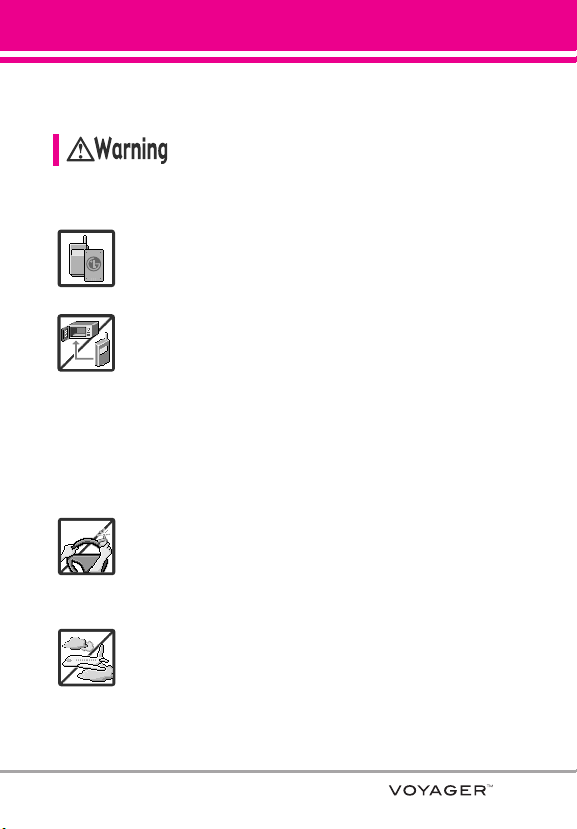
Read these simple guidelines. Breaking the rules may be dangerous
or illegal. Further detailed information is given in this user guide.
Violation of the instructions may cause serious injury or death.
●
Never use an unapproved battery since this could
damage the phone and/or battery and could cause
the battery to explode.
●
Never place your phone in a microwave oven as it will
cause the battery to explode.
●
Never store your phone in temperatures less than
-4°F or greater than 122°F.
●
Do not dispose of your battery near fire or with
hazardous or flammable materials.
●
When riding in a car, do not leave your phone or set
up the hands-free kit near the air bag. If wireless
equipment is improperly installed and the air bag is
deployed, you may be seriously injured.
●
Do not use a hand-held phone while driving.
●
Do not use the phone in areas where its use is
prohibited. (For example: aircraft)
Important Safety Precautions
1
Important Safety Precautions
●
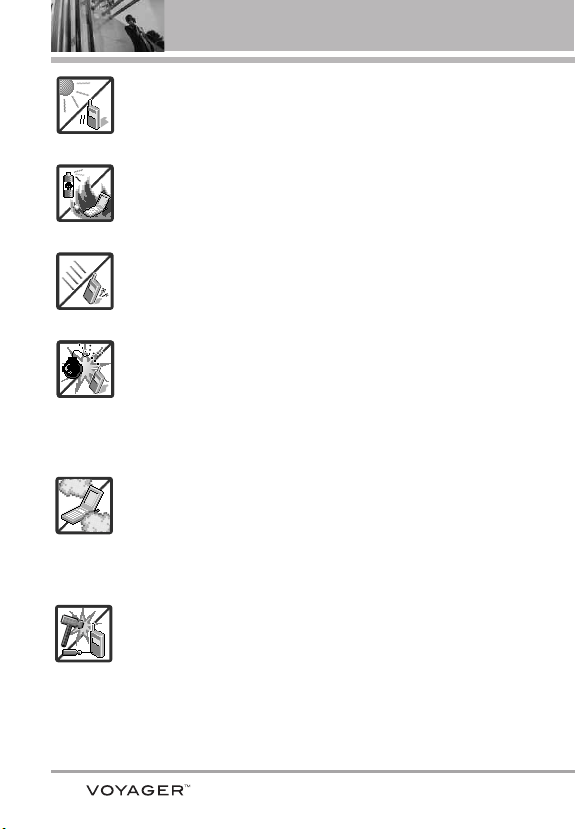
Do not expose the battery charger or adapter to direct
sunlight or use it in places with high humidity, such as
a bathroom.
●
Do not use harsh chemicals (such as alcohol,
benzene, thinners, etc.) or detergents to clean your
phone. This could cause a fire.
●
Do not drop, strike, or shake your phone severely. It
may harm the internal circuit boards of the phone.
●
Do not use your phone in high explosive areas as the
phone may generate sparks.
●
Do not damage the power cord by bending, twisting,
pulling, or heating. Do not use the plug if it is loose as
it may cause electric shock or fire.
●
Do not place any heavy items on the power cord. Do
not allow the power cord to be crimped as it may
cause electric shock or fire.
●
Do not handle the phone with wet hands while it is
being charged. It may cause an electric shock or
seriously damage your phone.
●
Do not disassemble the phone.
2
●
Do not place or answer calls while charging the
phone as it may short-circuit the phone and/or cause
electric shock or fire.
●
Do not hold or let the antenna come in contact with
your body during a call.
●
Make sure that no sharp-edged items, such as
animal’s teeth or nails, come into contact with the
battery. This could cause a fire.
●
Store the battery out of reach of children.
●
Be careful that children do not swallow any parts
(such as earphone, connection parts of the phone,
etc.) This could cause asphyxiation or suffocation
resulting in serious injury or death.
●
Unplug the power cord and charger during lightning
storms to avoid electric shock or fire.
●
Only use the batteries and chargers provided by LG.
The warranty will not be applied to products provided
by other suppliers.
●
Only authorized personnel should service the phone
and its accessories. Faulty installation or service may
result in accidents and consequently invalidate the
warranty.
●
Your service provider programs one or more
emergency phone numbers, such as 911, that you can
call under any circumstances, even when your phone
is locked. Your phone’s preprogrammed emergency
number(s) may not work in all locations, and
sometimes an emergency call cannot be placed due
to network, environmental, or interference issues.
3

Table of Contents
Important Safety Precautions .1
Welcome . . . . . . . . . . . . . . . . . . . .8
Technical Details . . . . . . . . . . . . .9
Important Information . . . . . . . . . . . .9
Phone Overview . . . . . . . . . . . .12
Touch Sensitive Soft Keys . . . . . . . .14
Quick Glance of Touchpad and
How to Use It . . . . . . . . . . . . . . .14
Calibrating the Touch Screen 15
Shortcut Menu . . . . . . . . . . . . . .16
Touch Screen Shortcut Menu . . . .16
Entering and Editing
Information . . . . . . . . . . . . . . . . .17
Text Input . . . . . . . . . . . . . . . . . . . . . . .17
From the internal Qwerty
®
keypad 18
Menu Tree on the Internal
Screen . . . . . . . . . . . . . . . . . . . . .19
Menu Tree on the External
Touch Screen . . . . . . . . . . . . . . .21
Menu Access . . . . . . . . . . . . . . . . . . .21
Shortcut Menu on the External
Touchpad . . . . . . . . . . . . . . . . . . .22
Touch Screen Shortcut Menu . . . . .22
Getting Started with Your
Phone . . . . . . . . . . . . . . . . . . . . . .23
The Battery . . . . . . . . . . . . . . . . . . . .23
Installing the Battery . . . . . . . . . . . .23
Removing the Battery . . . . . . . . . .23
Charging the Battery . . . . . . . . . . . .23
Charging with USB . . . . . . . . . . . . . .23
How to Install Your microSD™ Card24
How to Remove Your microSD™
Card . . . . . . . . . . . . . . . . . . . . . . . . . .24
Battery Temperature Protection . . .25
Battery Charge Level . . . . . . . . . . . .25
Turning the Phone On and Off . . . .25
Turning the Phone On . . . . . . . . . .25
Turning the Phone Off . . . . . . . . . .25
Signal Strength . . . . . . . . . . . . . . . . .26
Screen Icons . . . . . . . . . . . . . . . . . . .26
Making Calls . . . . . . . . . . . . . . . . . . .26
Correcting Dialing Mistakes . . . . . .26
Redialing Calls . . . . . . . . . . . . . . . . . .27
Receiving Calls . . . . . . . . . . . . . . . . .27
Quick Access to Convenient
Features . . . . . . . . . . . . . . . . . . . .28
Vibrate Mode . . . . . . . . . . . . . . . . . . .28
Mute Function . . . . . . . . . . . . . . . . . . .28
Volume Quick Adjustment . . . . . . . .28
Call Waiting . . . . . . . . . . . . . . . . . . . . .28
Voice Commands . . . . . . . . . . . . . . . .29
Contacts in Your Phone’s
Memory . . . . . . . . . . . . . . . . . . . .30
Storing Basics . . . . . . . . . . . . . . . . . .30
Customizing Individual Entries . . . .31
Speed Dial . . . . . . . . . . . . . . . . . . . . . .31
Storing a Number with Pauses . . .32
Adding Another Phone Number . .33
Changing the Default Number . . . .33
Deleting . . . . . . . . . . . . . . . . . . . . . . . .34
Speed Dialing . . . . . . . . . . . . . . . . . . .35
Media Center . . . . . . . . . . . . . . . . . .37
1. Music & Tones . . . . . . . . . . . . . . . .37
4

1.1 V CAST Music | Rhapsody . . . . .38
1.2 Get New Ringtones . . . . . . . . . .38
1.3 My Ringtones . . . . . . . . . . . . . . .39
1.4 My Music . . . . . . . . . . . . . . . . . .40
Playing Your Music . . . . . . . . . . . . .40
Controlling the Music Player . . . . .41
Exit From the Music Player . . . . . .41
1.5 My Sounds . . . . . . . . . . . . . . . . .42
1.6 Sync Music . . . . . . . . . . . . . . . . .43
2. Picture & Video . . . . . . . . . . . . . . .44
2.1 V CAST Mobile TV . . . . . . . . . . .45
2.2 V CAST Videos . . . . . . . . . . . . . .49
2.3 Get New Pictures . . . . . . . . . . . .51
2.4 My Pictures . . . . . . . . . . . . . . . .52
2.5 My Videos . . . . . . . . . . . . . . . . . .53
2.6 Take Picture . . . . . . . . . . . . . . . .55
2.7 Record Video . . . . . . . . . . . . . .57
2.8 Online Album . . . . . . . . . . . . . . .58
3. Games . . . . . . . . . . . . . . . . . . . . . . . .59
4. Browse & Download . . . . . . . . . .59
5. Extras . . . . . . . . . . . . . . . . . . . . . . . .64
MESSAGING . . . . . . . . . . . . . . . . . .65
1. New Message . . . . . . . . . . . . . . . .65
1.1 TXT Msg . . . . . . . . . . . . . . . . . . .65
1.2 Pictur
e Msg . . . . . . . . . . . . . . . .67
1.3 Video Msg . . . . . . . . . . . . . . . . .69
2. Inbox . . . . . . . . . . . . . . . . . . . . . . . .71
3. Sent . . . . . . . . . . . . . . . . . . . . . . . . .73
4. Drafts . . . . . . . . . . . . . . . . . . . . . . . .74
5. Voicemail . . . . . . . . . . . . . . . . . . . . .75
6. Visual Voice Mail . . . . . . . . . . . . . .76
7. Mobile IM . . . . . . . . . . . . . . . . . . . .77
8. Mobile Email . . . . . . . . . . . . . . . . . .77
MSG Settings . . . . . . . . . . . . . . . . . . .78
1. Entry Mode (Word/ Abc/ ABC/
123) . . . . . . . . . . . . . . . . . . . . . . . . .78
2. Auto Save (On/ Off/ Prompt) . . .78
3. Auto Erase (On/ Off) . . . . . . . . . .78
4. TXT Auto View (On/On+Readout/
Off) . . . . . . . . . . . . . . . . . . . . . . . . . .78
5. TXT Auto Play (On/Off) . . . . . . . .78
6. Pic-Video Auto Receive (On/Off) 78
7. Quick Text . . . . . . . . . . . . . . . . .79
8. Voicemail # . . . . . . . . . . . . . . . . .79
9. Callback # (On/Off) . . . . . . . . . .79
10. Signature (None/ Custom) . . . .79
Erasing Messages . . . . . . . . . . . . . . .79
CONTACTS . . . . . . . . . . . . . . . . . . . .81
1. New Contact . . . . . . . . . . . . . . . . . .81
2. Contact List . . . . . . . . . . . . . . . . . . .81
3. Groups . . . . . . . . . . . . . . . . . . . . . . .82
4. Speed Dials . . . . . . . . . . . . . . . . . . .83
5. In Case of Emergency (ICE) . . . .84
6. My Name Card . . . . . . . . . . . . . . . .85
RECENT CALLS . . . . . . . . . . . . . . . .86
1. Missed . . . . . . . . . . . . . . . . . . . . . . .86
2. Received . . . . . . . . . . . . . . . . . . . . .87
3. Dialed . . . . . . . . . . . . . . . . . . . . . . . .88
4. All . . . . . . . . . . . . . . . . . . . . . . . . . . . .89
5. View Timers . . . . . . . . . . . . . . . . . . .90
SETTINGS & TOOLS . . . . . . . . . . . .91
1. My Verizon . . . . . . . . . . . . . . . . . . . .91
5

Table of Contents
2. Tools . . . . . . . . . . . . . . . . . . . . . . . . .91
2.1 Voice Commands . . . . . . . . . . . .91
2.1.1 Call <Name or Number> . . .92
2.1.2 Send Msg to <Name or
Number> . . . . . . . . . . . . . . . . . . . . .92
2.1.3 Go to <Menu> . . . . . . . . . . .93
2.1.4 Check <Item> . . . . . . . . . . . .93
2.1.5 Lookup <Name> . . . . . . . . . .93
2.1.6 My Verizon . . . . . . . . . . . . . . .93
2.1.7 Help . . . . . . . . . . . . . . . . . . . .93
2.2 Calculator . . . . . . . . . . . . . . . . . .93
2.3 Calendar . . . . . . . . . . . . . . . . . . .94
2.4 Alarm Clock . . . . . . . . . . . . . . . .95
2.5 Stopwatch . . . . . . . . . . . . . . . . . .96
2.6 World Clock . . . . . . . . . . . . . . . .97
2.7 Notepad . . . . . . . . . . . . . . . . . . .98
2.8 Ez Tip Calc . . . . . . . . . . . . . . . . . .98
2.9 USB Mass Storage . . . . . . . . . .99
3. Bluetooth Menu . . . . . . . . . . . . . .100
3.1 Add New Device . . . . . . . . . . .101
My Phone Name . . . . . . . . . . . . . .103
Turn On . . . . . . . . . . . . . . . . . . . . . .104
Discovery Mode . . . . . . . . . . . . . . .104
Supported Profiles . . . . . . . . . . . . .105
Last Search . . . . . . . . . . . . . . . . . . .105
Auto Pair Handsfree . . . . . . . . . . . .105
Transferring Audio . . . . . . . . . . . . .105
4. Sounds Settings . . . . . . . . . . . . . .107
4.1 Master Volume . . . . . . . . . . . . .107
4.2 Call Sounds . . . . . . . . . . . . . . . .107
4.2.1 Call Ringtone . . . . . . . . . . .108
4.2.2 Call Vibrate . . . . . . . . . . . . . .108
4.3 Alert Sounds . . . . . . . . . . . . . . .109
4.4 Keypad Volume . . . . . . . . . . . .109
4.5 Service Alerts . . . . . . . . . . . . . .110
4.6 Power On/Off . . . . . . . . . . . . . .111
5. Display Settings . . . . . . . . . . . . . .111
5.1 Banner . . . . . . . . . . . . . . . . . . .111
5.1.1.1 Internal Banner . . . . . . . . .111
5.1.1.2 External Banner . . . . . . . .112
5.1.2 ERI Banner . . . . . . . . . . . . . .112
5.2 Backlight . . . . . . . . . . . . . . . . . .113
5.3 Wallpaper . . . . . . . . . . . . . . . . .114
5.4 Charging Screen . . . . . . . . . . . .115
5.5 Display Themes . . . . . . . . . . . .116
5.6 Menu Fonts . . . . . . . . . . . . . . .116
5.7 Dial Fonts . . . . . . . . . . . . . . . . .117
5.8 Clock Format . . . . . . . . . . . . . .118
6. Phone Settings . . . . . . . . . . . . . . .119
6.1 Airplane Mode . . . . . . . . . . . . .119
6.2 Set Shortcuts . . . . . . . . . . . . . .119
6.3 Voice Commands . . . . . . . . . . .120
6.4 Language . . . . . . . . . . . . . . . . .121
6.5 Location . . . . . . . . . . . . . . . . . .122
6.6 Security . . . . . . . . . . . . . . . . . . .122
6.6.1 Edit Codes . . . . . . . . . . . . . .123
6.6.2 Restrictions . . . . . . . . . . . . .124
6.6.3 Phone Lock . . . . . . . . . . . . .125
6.6.4 Lock Phone Now . . . . . . . .126
6.6.5 Reset Default . . . . . . . . . . .126
6.6.6 Restore Phone . . . . . . . . . .127
6.7 System Select . . . . . . . . . . . . .128
6.8 NAM Select . . . . . . . . . . . . . . .129
7. Call Settings . . . . . . . . . . . . . . . . .129
6

7.1 Answer Options . . . . . . . . . . . .129
7.2 End Call Options . . . . . . . . . . . .130
7.3 Show Dialpad . . . . . . . . . . . . . .131
7.4 Auto Retry . . . . . . . . . . . . . . . .131
7.5 TTY Mode . . . . . . . . . . . . . . . . .132
7.6 One Touch Dial . . . . . . . . . . . . .134
7.7 Voice Privacy . . . . . . . . . . . . . . .135
8. Touch Settings . . . . . . . . . . . . . . .136
9. USB Auto Detection . . . . . . . . . .136
10. Memory . . . . . . . . . . . . . . . . . . . .137
10.1 Save Options . . . . . . . . . . . . .138
10.2 Phone Memory . . . . . . . . . . .139
10.3 Card Memory . . . . . . . . . . . . .139
11. Phone Info . . . . . . . . . . . . . . . . . .140
11.1 My Number . . . . . . . . . . . . . .141
11.2 SW/HW Version . . . . . . . . . . .141
11.3 Icon Glossary . . . . . . . . . . . . .142
Music . . . . . . . . . . . . . . . . . . . . . . . . .143
Browser . . . . . . . . . . . . . . . . . . . . . . .143
Ending a Browser Session . . . . . . .143
Browser Navigating . . . . . . . . . . . .143
Navigator . . . . . . . . . . . . . . . . . . . . . .147
Safety . . . . . . . . . . . . . . . . . . . . .148
TIA Safety Information . . . . . . . . .148
Exposure to Radio Frequency
Signal . . . . . . . . . . . . . . . . . . . . . . .148
Antenna Care . . . . . . . . . . . . . . . .148
Phone Operation . . . . . . . . . . . . . .148
Tips on Efficient Operation . . . . . .149
Driving . . . . . . . . . . . . . . . . . . . . . .149
Electronic Devices . . . . . . . . . . . .149
Pacemakers . . . . . . . . . . . . . . . . .149
Hearing Aids . . . . . . . . . . . . . . . . .150
Other Medical Devices and Health
Care Facilities . . . . . . . . . . . . . . . .150
Vehicles . . . . . . . . . . . . . . . . . . . . .150
Aircraft . . . . . . . . . . . . . . . . . . . . . .150
Blasting Areas . . . . . . . . . . . . . . . .150
Potentially Explosive Atmosphere150
For Vehicles Equipped with an Air
Bag . . . . . . . . . . . . . . . . . . . . . . . .151
Safety Information . . . . . . . . . . . .151
Charger and Adapter Safety . . . .152
Battery Information and Care . . .152
Explosion, Shock, and Fire
Hazards . . . . . . . . . . . . . . . . . . . . .153
General Notice . . . . . . . . . . . . . . .153
Caution: Avoid potential hearing
loss. . . . . . . . . . . . . . . . . . . . . . . . . . .154
FDA Consumer Update . . . . . . . .156
10 Driver Safety Tips . . . . . . . . . . .164
Consumer Information on SAR .166
FCC Hearing-Aid Compatibility
(HAC) Regulations for Wireless
Devices . . . . . . . . . . . . . . . . . . . . . .168
Accessories . . . . . . . . . . . . . . .171
LIMITED WARRANTY
STATEMENT . . . . . . . . . . . . . .172
Glossary . . . . . . . . . . . . . . . . . . .175
Terminology . . . . . . . . . . . . . . . . . .175
Acronyms and Abbreviations . .175
7

Welcome
Thank you for choosing the
VOYAGER
TM
cellular phone
designed to operate with the latest
digital mobile communication
technology, Code Division Multiple
Access (CDMA). Along with the
many advanced features of the
CDMA system, such as greatly
enhanced voice clarity, this
compact phone offers:
●
V CAST
SM
Mobile TV
●
V CAST
SM
Music | Rhapsody
●
V CAST Video
●
Mobile IM
●
VZ Navigator
●
Mobile Email
●
Visual Voice Mail
●
City ID
●
54-key internal numeric keypad,
the external Touch Screen and
auto Touch Screen lock.
●
Customizable display themes and
screensavers.
●
Built-in 2.0 Megapixel digital
camera.
●
Large, easy-to-read, 8-line
backlit LCD with status icons.
●
Paging, messaging, Voicemail,
and caller ID.
●
Quick Access to the HTML
Browser.
●
Media Center
●
Long battery standby and talk
time.
●
Easy operation; use the keypad
or Touch Screen to choose
menus and answer prompts.
●
Any key answer, auto with
handsfree, auto retry, onetouch
and speed dialing with 99
memory locations.
●
Bilingual (English and Spanish)
Capability.
●
Bluetooth
®
wireless technology.
NOTE
The Bluetooth
®
word mark and logos
are owned by the Bluetooth SIG, Inc.
and any use of such marks by LG
Electronics is under license. Other
trademarks and trade names are
those of their respective owners.
TIP
Find the interactive user guide on the web for
your convenience where you can freely surf
and interactively learn how to use your phone
step-by-step.
Go to http://www.verizonwireless.com ->
Support -> Phones & Devices -> then choose
Equipment Guide -> then select your phone
model.
8
VOYAGER
TM
is a trademark of
Plantronics, Inc. used under license
by Verizon Wireless.

Important Information
This user’s guide provides important
information on the use and operation
of your phone. Please read this
guide carefully prior to using the
phone to be able to use your phone
to its greatest advantage and to
prevent any accidental damage or
misuse. Any unapproved changes or
modifications will void your
warranty.
Technical Details
The VOYAGER
TM
is an all digital
phone that operates on both Code
Division Multiple Access (CDMA)
frequencies: cellular services at 800
MHz and Personal Communication
Services (PCS) at 1.9 GHz.
CDMA technology uses a feature
called DSSS (Direct Sequence
Spread Spectrum) that enables the
phone to keep communication from
being crossed and to use one
frequency channel by multiple
users in the same specific area.
This results in a 10-fold capacity
increase when compared with
analog mode. In addition, features
such as soft/ softer handoff, hard
handoff, and dynamic RF power
control technologies combine to
reduce call interruptions.
The Cellular and PCS CDMA
networks consist of MSO (Mobile
Switching Office), BSC (Base
Station Controller), BTS (Base
Station Transmission System), and
MS (Mobile Station).
1xRTT system receives twice as
many subscribers in the wireless
section as IS-95. Its battery life is
twice as long as IS-95. High-speed
data transmission is also possible.
EV-DO system is optimized for data
service and is much faster than
1xRTT system in applicable area.
V CAST Mobile TV uses a
technology called MediaFLO.
This Technology is used to
broadcast data to portable devices
such as cell phones and PDAs.
Broadcast data includes audio and
video streams, individual video and
audio clips, as well as information
such as stock market quotes, sports
scores, and weather reports. The
"F-L-O" in MediaFLO stands for
Forward Link Only which means
that the data transmission path is
one-way, from the tower to the
device. The MediaFLO system
transmits data on a frequency
separate from the frequencies used
by current cellular networks.
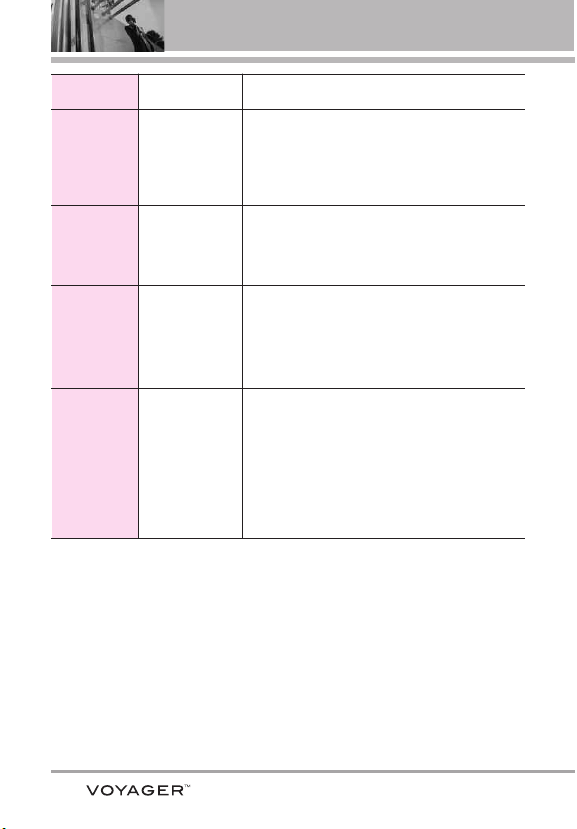
The following table lists some major
CDMA standards.
Technical Details
9
Technical Details
10
CDMA
Standard
Designator Description
Basic Air
Interface
TIA/EIA-95A
TSB-74
ANSI J-STD-008
TIA/EIA-IS2000
CDMA Dual-Mode Air Interface
14.4kbps radio link protocol and
inter-band operations
IS-95 adapted for PCS frequency band CDMA2000
1xRTT AirInterface
Network
TIA/EIA/IS-634
TIA/EIA/IS/651
TIA/EIA/IS-41-C
TIA/EIA/IS-124
MAS-BS
PCSC-RS
Intersystem operations
Non-signaling data comm.
Service
TIA/EIA/IS-96-B
TIA/EIA/IS-637
TIA/EIA/IS-657
IS-801
TIA/EIA/IS-707-A
Speech CODEC
Short Message Service
Packet Data
Position Determination Service (gpsOne)
High Speed Packet Data
1x EV-DO
Related
interface
TIA/EIA/IS-856
TIA/EIA/IS-878
TIA/EIA/IS-866
TIA/EIA/IS-890
CDMA2000 High Rate Packet Data Air Interface
1xEV-DO Inter-Operability Specification for HRPD
Access Network Interfaces
Recommended Minimum Performance Standards for
HRPD High Rate Packet Data Access Terminal
Test Application Specification(TAS) for High Rate
Packet Data Air Interface
FCC RF Exposure Information
WARNING! Read this information
before operating the phone.
In August 1996, the Federal
Communications Commission (FCC)
of the United States, with its action
in Report and Order FCC 96-326,
adopted an updated safety standard
for human exposure to Radio
Frequency (RF) electromagnetic
energy emitted by FCC regulated
transmitters. Those guidelines are
consistent with the safety standard
previously set by both U.S. and
international standards bodies. The
design of this phone complies with
the FCC guidelines and these
international standards.

Bodily Contact During Operation
This device was tested for typical
use with the back of the phone kept
0.79 inches (2.0 cm) from the body.
To comply with FCC RF exposure
requirements, a minimum
separation distance of 0.79 inches
(2.0 cm) must be maintained
between the user’s body and the
back of the phone, including the
antenna, whether extended or
retracted. Third-party belt-clips,
holsters, and similar accessories
containing metallic components
should not be used. Avoid the use
of accessories that cannot maintain
0.79 inches (2.0 cm) distance
between the user’s body and the
back of the phone and have not
been tested for compliance with
FCC RF exposure limits.
Vehicle-Mounted the External
Antenna
(Optional, if available.)
To satisfy FCC RF exposure
requirements, keep 8 inches (20 cm)
between the user / bystander and
vehicle-mounted the external
antenna. For more information
about RF exposure, visit the FCC
website at www.fcc.gov.
FCC Notice and Cautions
This device and its accessories comply
with part 15 of FCC rules. Operation is
subject to the following two conditions:
(1) This device and its accessories may
not cause harmful interference, and (2)
this device and its accessories must
accept any interference received,
including interference that causes
undesired operation.
Any changes or modifications not
expressly approved in this user guide
could void your warranty for this
equipment. Use only the supplied
antenna. Use of unauthorized antennas
(or modifications to the antenna) could
impair call quality, damage the phone,
void your warranty and/or violate FCC
regulations.
Don't use the phone with a damaged
antenna. A damaged antenna could
cause a minor skin burn. Contact your
local dealer for a replacement antenna.
TIP
It is recommended to pull out the antenna on
the left bottom of your phone for better TV
reception while watching V CAST Mobile TV.
11
The antenna is on the left bottom of your phone.
12
Phone Overview
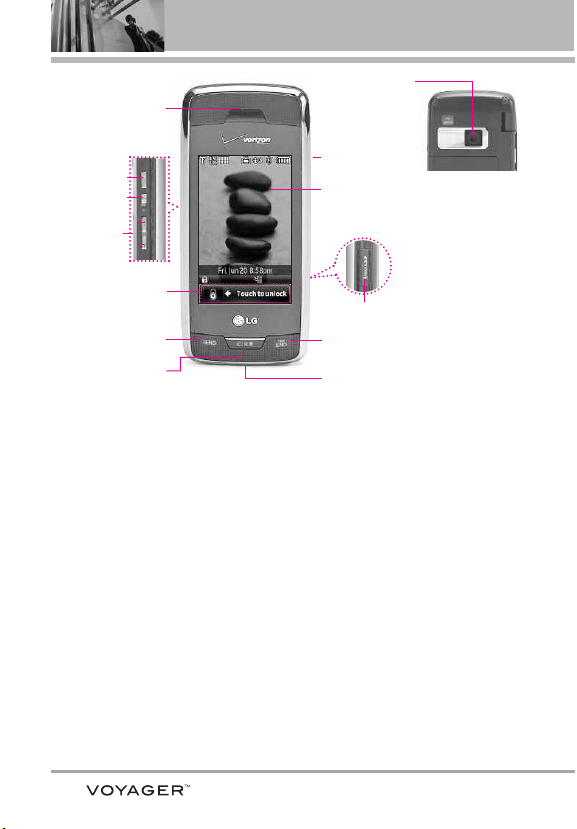
1. Earpiece
2. Camera Key Use for quick access to Camera
function. Press and hold the camera key to
record Video.
3. Lock/ Unlock Key Move the slide down and
immediately release to lock or unlock the
outside display and keys when the flip is
closed.
4. Side Volume Keys Use to adjust the Master
Volume in standby mode* and the Earpiece
Volume during a call.
5. Touch Soft Keys Touch Keys on this Touchpad
include Messaging, Call, Menu, and Contacts
which easily activate with the touch of your
fingertip.
6. SEND Key Use to make calls.
7. CLR Key / Voice Command Key Deletes single
spaces or characters with a quick touch, but
touch and hold to delete entire words. Also
backs out of menus, one level at a time. Use
for quick access to Voice Command or press
and hold to access Voice Recorder.
8. Accessory Charger Port Connects the phone to
the battery charger, or other compatible
accessory.
9. PWR/END Key Use to turn the power on/off
and to end a call. Also returns to standby
mode.
10. microSD™ Slot Accommodates optional
microSD card up to 8GB.
11. Touch Screen Displays incoming calls,
messages and indicator icons as well as a
wide variety of content you select to view.
12. Headset Jack Allows you to plug in an
optional headset for convenient, hands-free
conversations.
Plug headset into the 2.5mm jack
located on the top left of device.
13. Camera Lens Keep it clean for optimal photo
quality.
12. Headset Jack
1. Earpiece
6. SEND Key
7. CLR Key / Voice
Command Key
11. Touch Screen
10. microSD™ Slot
9. PWR/END Key
5. Touch Soft Keys
8. Accessory
Charger Port
* Standby mode is when the phone is waiting for input from you.
No menu is displayed and the phone isn’t performing any
action. It’s the starting point for all of the instruction steps.
4. Side Volume
Keys
2. Camera Key
3. Lock/ Unlock
Key
13. Camera Lens
NOTE
SEND Key, CLR / Voice
Commands Key, and PWR
/ END Key are not
illuminated when the
display is locked. Slide and
release the Unlock Key to
unlock the outside display
and illuminate the Touch
Soft Keys. You can touch
any side key to illuminate,
then touch the lock that
displays on screen to
unlock.
13
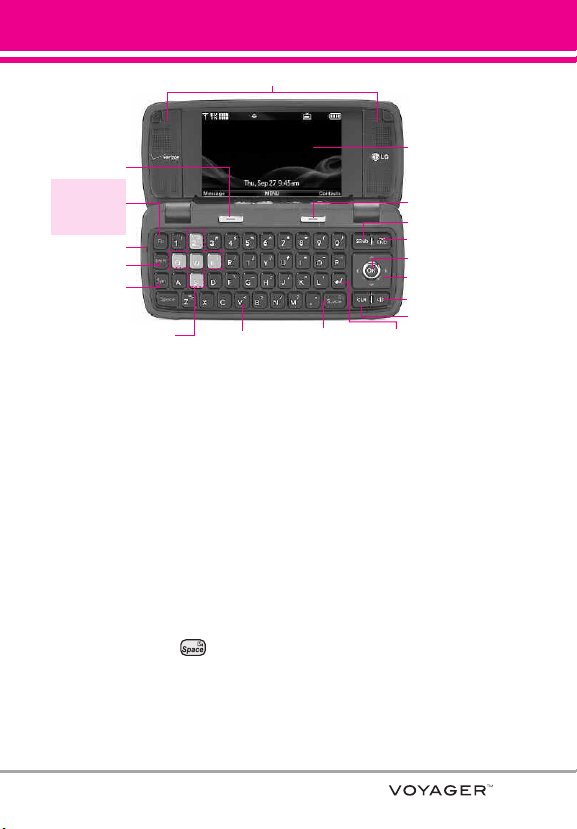
1. Left Soft Key Use to access to Message menu
or other function displayed at the bottom left of
the LCD.
2. Fn Key (Shortcut Key in standby mode) Use for
quick access to assigned menus. See page 18.
3. Microphone Lets callers hear you.
4. Shift Key Use to change letter case when
typing.
5. Sym Key Use to insert symbols at the top of
each key into text.
6. Game Directional Keys Use for game
navigation.
7. Alphanumeric Keypad Use to enter numbers
and characters and select menu items.
8. Space/Voice Command Key Use to enter a
space while editing. TTS (Text to Speech)
function is available with in Messaging
Inbox, Notepad and Email screen. Use for
quick access to Voice Command or press and
hold to access Voice Recorder in standby
mode.
9. Return Key Moves cursor to the next line.
10. CLR Key Press to delete a single space or
character, or press and hold to delete a
specific word plus its space. Press once in a
menu to go back one level.
11. Speakerphone Key Use to activate
Speakerphone Mode.
12. Directional Keys Use for quick, convenient
navigation. From standby mode, access
Media Center, Scheduler, Picture & Video,
and Mobile Web (you can change any of
these to other menus in the Settings menu). In
menus use to scroll to choices and settings.
13. OK Key Use to activate a selected screen
item.
14. END/PWR Key Use to turn the power on/off
and to end a call. Use to return to the main
menu display screen.
15. SEND Key Use to make or answer calls.
16. Right Soft Key Use to select Contacts menu,
or other action displayed at the bottom right
of the LCD.
17. LCD Screen Displays incoming calls,
messages and indicator icons as well as a
wide variety of content you select to view.
18. Speaker Lets you hear callers.
18. Speaker
2. Fn Key
(Shortcut Key
in standby
mode)
3. Microphone
7. Alphanumeric
Keypad
8. Space/Voice
Command Key
9. Return Key
4. Shift Key
1. Left Soft Key
5. Sym Key
10. CLR Key
13. OK Key
15. SEND Key
16. Right Soft Key
11. Speakerphone Key
12. Directional Keys
14. END/PWR Key
6. Game Directional Keys
17. LCD Screen
14
Quick Glance of Touchpad and How to Use It
Touch Sensitive Soft Keys
(,,,)
1. Make sure your hands are clean
and dry. Remove moisture from
the surface of your hands. Don't
use the touch keys in a humid
environment.
2. Touch key sensors are sensitive
to your light touch. You don't
need to press them forcefully to
use them. Protect your phone
from severe impact because
touch key sensors may become
damaged from harsh use.
3. Use the tip of your finger to touch
the center of a touch key. If you
touch off-center it may activate
the nearby function instead.
4. The touch sensor level can be
adjusted to your preference.
5. When both the outside LCD
screen and touch key lights are
off, touch keys are deactivated.
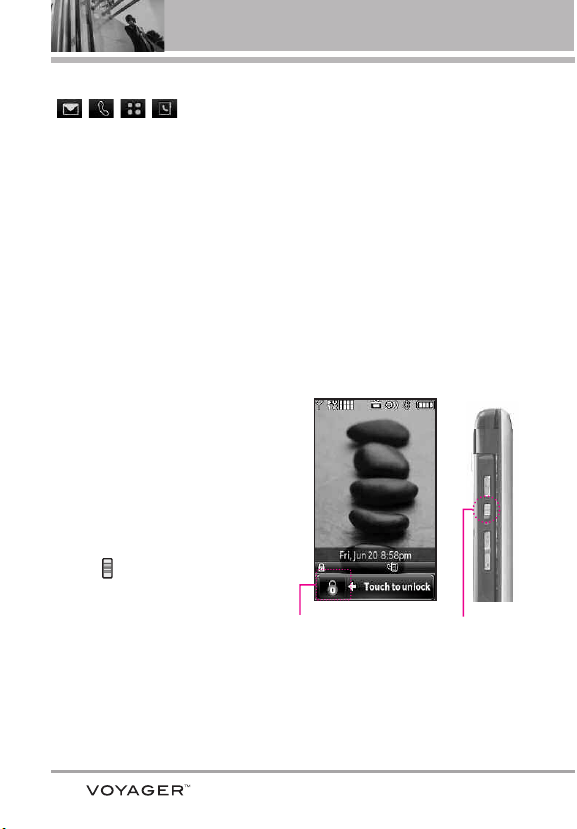
Pull down and release the Unlock
Key ( ) to turn on the Touch
Screen and touch key lights.
6. If the flip is closed and the Touch
Protection function is on, during
calls the Touch Protection
feature is automatically enabled.
7. Keep metal and other conductive
material away from the surface
of touch keys because contact
may cause electronic interference.
WARNING
●
Do not put heavy objects on the Touch
Screen.
●
Do not sit on your phone, which may damage
the Touch Screen.
●
Do not drag or scratch your phone with any
sharp materials.
●
Do not keep your phone in extreme conditions
(places that are too humid, hot, or cold).
●
Keep chemicals away from your phone, which
may change the cosmetic or functional
features of your phone.
How to Unlock
Touch the padlock
image to unlock.
Pull down and
release the
Unlock Key on
the side of your
phone.
OR
Calibrating the Touch Screen
15
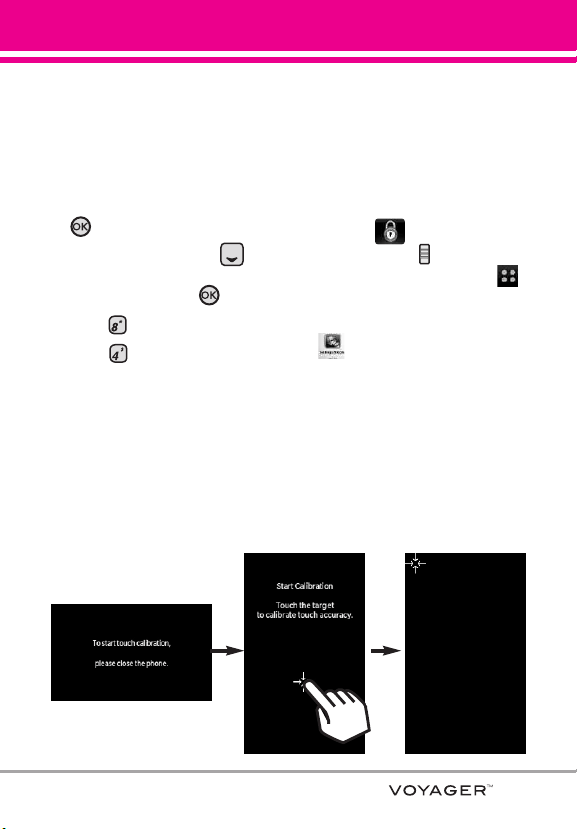
The Touch Screen is a great way to interact with the VOYAGER’s software.
Take a little time to become accustomed to using it. If it doesn’t react as you
expect, adjust the Touch Screen calibration.
TIP
Keep in mind that the smaller the text appears on the screen, the smaller the area of touch
activation. Try zooming the screen in, if available, to increase the touch area.
Using the Internal Keypad
1.
Open the flip and press
the OK Key
[MENU].
2. Press the Directional Key to
scroll to the
Settings & Tools
menu
and press
the OK Key .
3. Press
Touch Settings
.
4. Press Calibration.
5. Close the flip to start calibration.
6. Touch the target on the screen
each time it appears.
Using the External Touch Screen
1. Unlock the Touch Screen by
touching or pulling down
the Unlock Key ( ) on the left
side of your phone and touch
to access the menu.
2. Touch the Settings & Tools icon
.
3. Place your finger on the Touch
Screen and apply gentle upward
pressure to scroll the list up, then
touch 8. Touch Settings.
4. Touch
4. Calibration.
5. Touch the target on the screen to
start calibration, then touch the
target each time it appears.
Shortcut Menu
16
Touch Screen Shortcut Menu
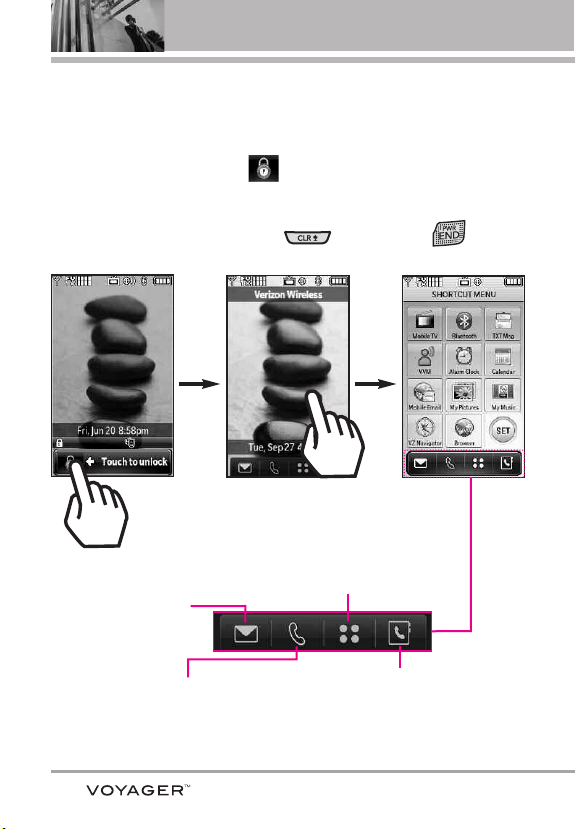
The Touch Screen Shortcut Menu allows instant access to menus with the
quick touch of your fingertip. To use the Shortcut Menu:
1. With the flip closed, touch the standby screen once above the Touch Soft
Keys. You may need to touch first if the screen is locked.
2. The Shortcut Menu will open. Touch any of the twelve options to open the
application or a further menu.
3. To close the Shortcut Menu, press or the external Key.
Menu: Displays a list of menus.
Message: Displays the
Messaging menu.
Contacts: Displays your
Contact List.
Phone: Displays additional touch keys so you can
make a call without opening the flip. Dial
manually using the numeric keys or automatically
from Recent Calls and Contacts.
Access
From standby mode, touch the
Touch Screen with your finger.
Entering and Editing Information
17
Text Input
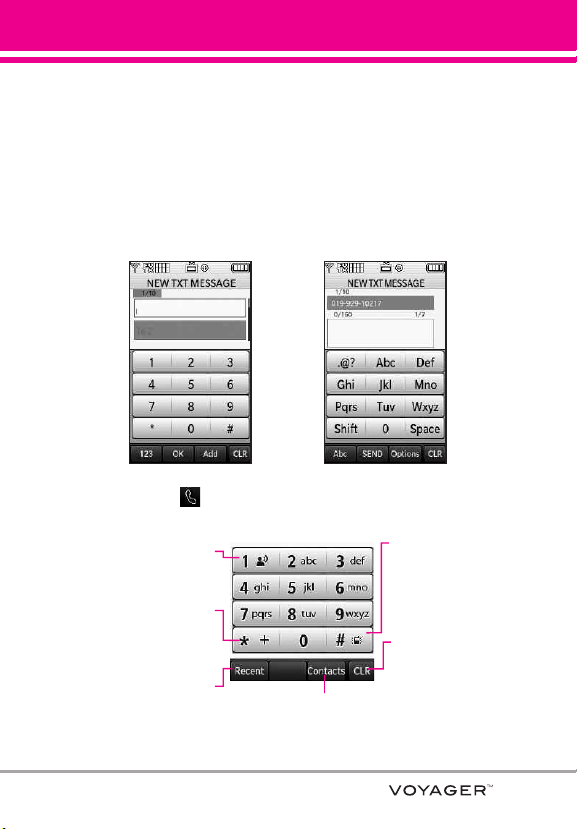
You can enter information using the exterior Touch Screen or the interior
keypad. Each has special key functions to help you with text entry.
Using the Touch Screen
When creating a Text, Picture or Video message using the outside LCD, the
Touch Screen provides you with Touch Keys specific to the type of field.
Refer to the examples below:
Touch and hold this key to
access your voice mail box
Touch this key to view the
recent call history and
simply touch a phone
number to call it.
Touch this key to search for contact
information so that you can call someone.
Touch and hold will enable
you to add a "+" sign to
the display screen.
Touch this key to go
back to standby
mode.
When you touch the Touch Key the following dialing keypad is displayed.
Touch and hold this
key to set your phone
on vibrate and touch it
once again to return to
normal mode.
Entering and Editing Information
18
From the internal Qwerty
®
keypad
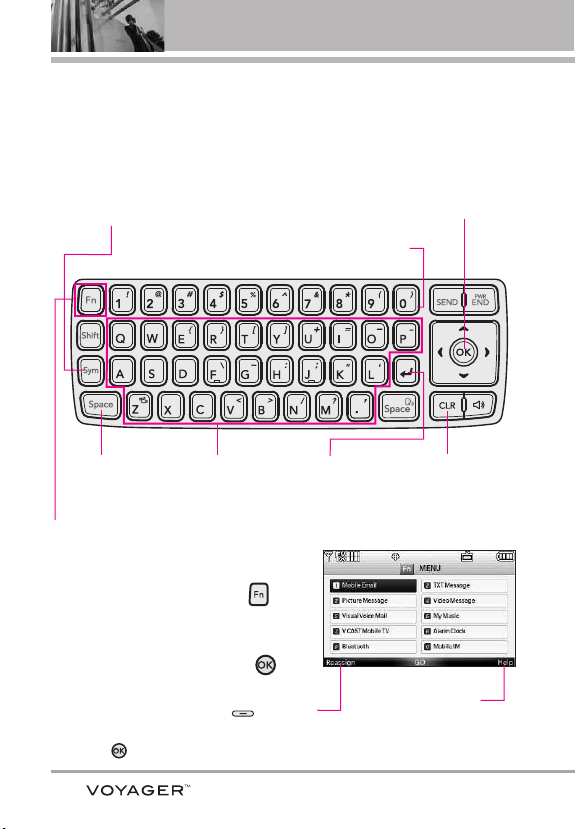
Fn Key Shortcut Menu
The function key Shortcut Menu allows
quick access to ten menus.
1. With the flip open, press the Key.
2. Press the number keys to go to the
menu, or use Directional Keys to select
the menu you want and press
Go.
Use the arrow keys to go to next field such as
recipient address, text, picture and video
depending on the message types. Use the OK
Key to send a message when finished.
Use to enter
letters.
Use to insert a space
between a letter,
words and sentences.
Press this key first and then any
key with a symbol on it to insert
that symbol in your message.
Use to go to next line
editing your message.
Use to delete a letter,
words or sentences.
Also use it to exit the
menu and go back to
standby mode.
Numeric Keypad to enter
numbers in your message.
When creating a Text, Picture or Video message using the inside LCD, use the
Qwerty keypad.
To reassign a shortcut, highlight the shortcut you wish to
change, then press the Left Soft Key
Reassign.
Select the application you wish to assign to that location
by pressing .
Read the instruction to
understand the Shortcut
Menu setting feature.
19
Menu Tree on the Internal Screen
M
M
EDIA
EDIA
C
C
ENTER
ENTER
1. Music & Tones
1. V CAST Music |
Rhapsody
2. Get New
Ringtones
3. My Ringtones
4. My Music
5. My Sounds
6. Sync Music
2. Picture & Video
1. V CAST Mobile
TV
2. V CAST Videos
3. Get New
Picture
4. My Pictures
5. My Videos
6. Take Picture
7. Record Video
8. Online Album
3. Games
4. Browse &
Download
5. Extras
M
M
ESSAGING
ESSAGING
1. New Message
2. Inbox
3. Sent
4. Drafts
5. Voicemail
6. Visual Voice Mail
7. Mobile IM
8. Mobile Email
C
C
ONT
ONT
ACTS
ACTS
1. New Contact
2. Contact List
3. Groups
4. Speed Dials
5. In Case of
Emergency
6. My Name Card
R
R
ECENT CALLS
ECENT CALLS
1. Missed
2. Received
3. Dialed
4. All
5. View Timers
SETTINGS &
SETTINGS &
TOOLS
TOOLS
1. My Verizon
2. Tools
1. Voice
Commands
2. Calculator
3. Calendar
4. Alarm Clock
1. Alarm 1
2. Alarm 2
3. Alarm 3
5. Stopwatch
6. World Clock
7. Notepad
8. Ez Tip Calc
9. USB Mass
Storage
3. Bluetooth Menu
1. Add New
Device
4. Sounds Settings
1. Master Volume
2. Call Sounds
1. Call
Ringtone
2. Call Vibrate
3. Alert Sounds
1. TXT
Message
Menu Tree on the Internal Screen
20
2. Pic-Video
Message
3. Voicemail
4. Emergency
Tone
4. Keypad
Volume
5. Service Alerts
1. ERI
2. Minute Beep
3. Call Connect
4. Charge
Complete
6. Power On/Off
1. Power On
2. Power Off
5. Display Settings
1. Banner
1. Personal
Banner
2. ERI Banner
2. Backlight
1. Display
2. Keypad
3. Wallpaper
1. Internal
Wallpaper
2. External
Wallpaper
4. Charging
Screen
5. Display
Themes
6. Menu Fonts
7. Dial Fonts
8. Clock Format
6. Phone Settings
1. Airplane Mode
2. Set Shortcuts
3. Voice
Commands
4. Language
5. Location
6. Security
1. Edit Codes
2. Restrictions
3. Phone Lock
4. Lock Phone
Now
5. Reset
Default
6. Restore
Phone
7. System Select
8. NAM Select
7. Call Settings
1. Answer
Options
2. End Call
Options
3. Show Dialpad
4. Auto Retry
5. TTY Mode
6. One Touch Dial
7. Voice Privacy
8. Touch Settings
1. Auto Lock
2. Vibrate
3. Sound
4. Calibration
9. USB Auto
Detection
10. Memory
1. Save Options
2. Phone
Memory
3. Card Memory
11. Phone Info
1. My Number
2. SW/HW
Version
3. Icon Glossary
MUSIC
MUSIC
1. Music
BROWSER
BROWSER
1. Browser
VZ NA
VZ NA
VIGA
VIGA
TOR
TOR
1. VZ Navigator
Menu Tree on the External Touch Screen
21
Some content in this user guide may differ from your phone depending on
the phone software. Features and specifications are subject to change
without prior notice.
Menu Access
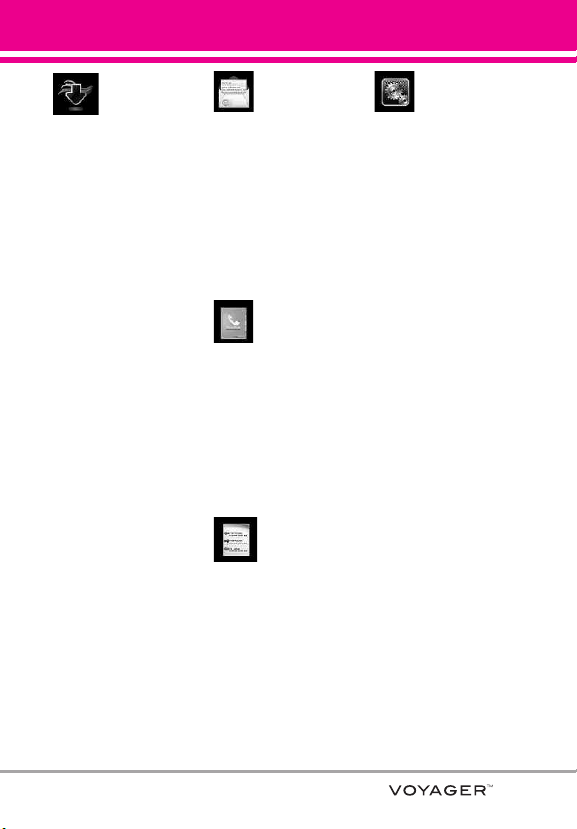
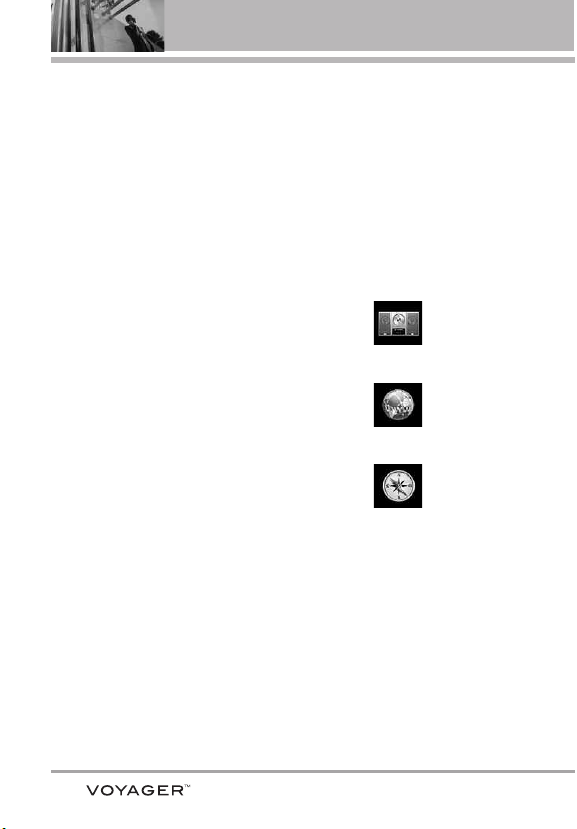
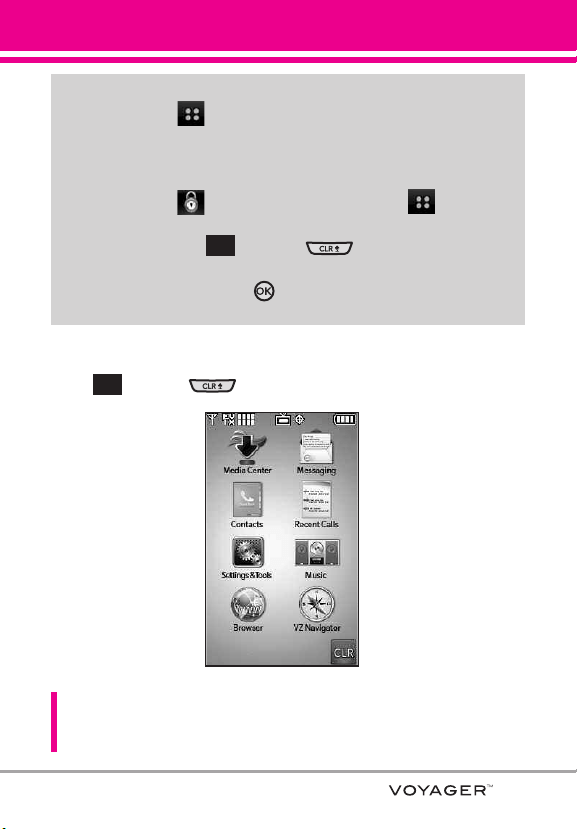
Touch the MENU Touch Key to have access to eight phone
menus. With the flip closed, the Touch Screen is locked by default.
To access the MENU from the external screen, unlock first by
pressing down the unlock key on the left side of your phone or
touch the unlock Touch Key. Touch the MENU Touch Key
at the bottom of the screen to open the main menus. To go back to
standby mode, touch or press at the bottom center of
your phone.
When the flip is open, press
[MENU] to have access to eight
phone menus.
CLR
From the external Touch Screen, the main menus are displayed as shown
below. Touch any of the menu icons with your fingertip to go to that menu.
Touch (or press ) to go back to standby mode.
CLR
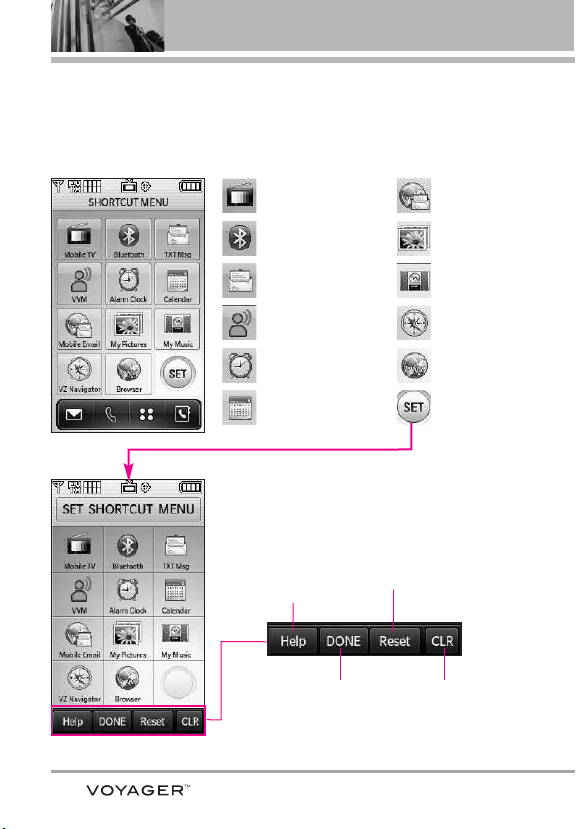
Shortcut Menu on the External Touchpad
22
Mobile TV
Bluetooth
TXT Msg
VVM
Alarm Clock
Calendar
Mobile Email
My Pictures
My Music
VZ Navigator
Browser
Set
Read the instruction to
understand the Shortcut
Menu setting feature.
Touch it when you are done in
renewing the Shortcut Menus.
Reset to Default and touch
Yes to save the change.
Touch it to go back to the
Shortcut Menu screen.
Use to customize your Shortcut Menus by touching the
menu you want to replace and touching a new one to
replace it from the list.
Touch Screen Shortcut Menu
Allows quick, direct access to several frequently used device features when
the flip is closed. To access the Shortcut Menu, press the Unlock Key to
unlock the outside LCD, then touch anywhere above the Touch Soft Keys.
Getting Started with Your Phone
23
The Battery
NOTE
It is important to fully charge the
battery before initial use of the phone.
The phone comes with a
rechargeable battery. Keep the
battery charged while not in use in
order to maximize talk and standby
time. The battery charge level is
shown at the top of the LCD screen.
Installing the Battery
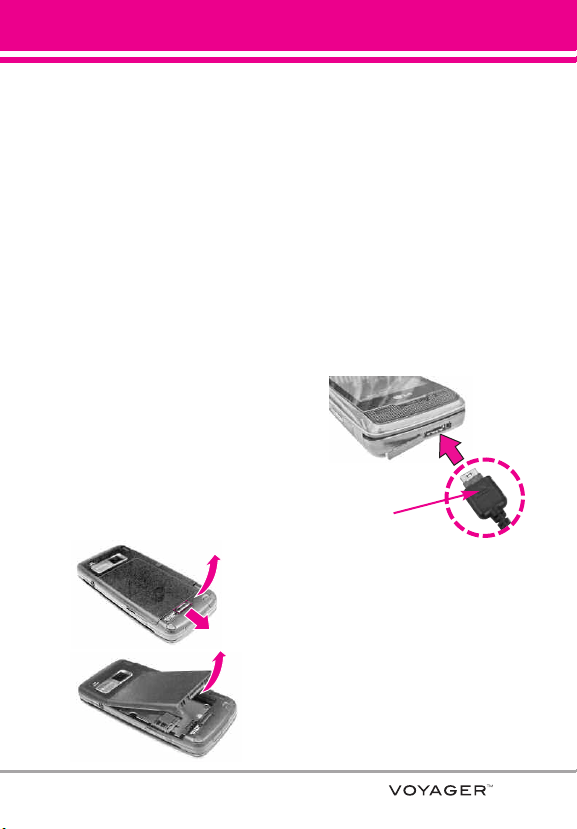
To install the battery, insert the
bottom of the battery into the
opening on the back of the phone.
Push the battery down until it clicks
into place.
Removing the Battery
Turn power off. Slide the battery
release latch away from the edge of
the battery, then lift the edge of the
battery to remove it.
Charging the Battery
To use the charger provided with
your phone:
NOTICE
Please use only an approved charging
accessory to charge your LG phone.
Improper handling of the charging port, as well
as the use of an incompatible charger, may
cause damage to your phone and void the
warranty.
1. Plug the end of the AC adapter
into the phone’s charger port and
the other end into an electrical
outlet.
2. The charge time varies
depending upon the battery level.
Charging with USB
You can use your computer to
charge your phone. Connect one
end of a USB cable to the charging
accessory port on your phone and
NOTICE
Triangle symbol should face up.
(for both your charger and USB)
Getting Started with Your Phone
24
the other end to a highpower USB port on your PC (commonly located on the
front panel of the computer).
NOTE
Lower USB port is not supported, such as the USB port on your keyboard or bus-powered
USB hub.
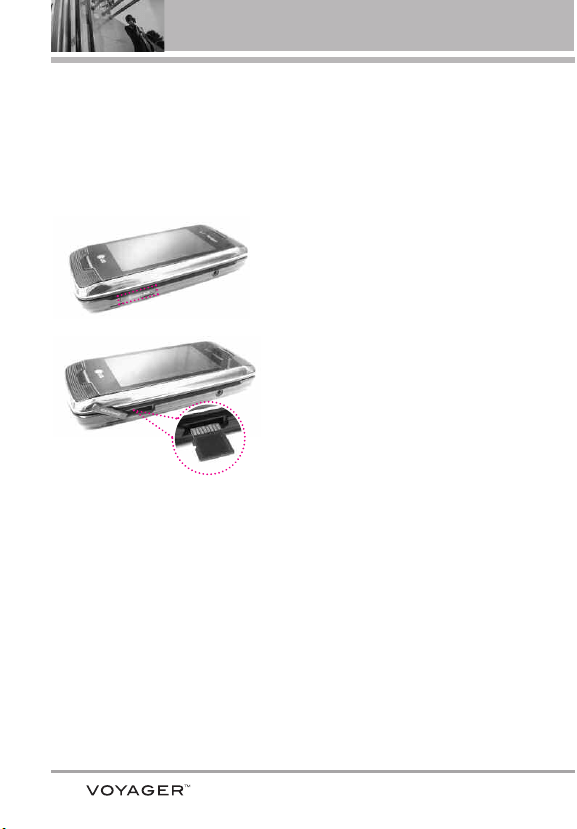
How to Install Your microSD™ Card
1. Locate the microSD™ slot on the right
side of the phone and gently uncover
the slot opening (microSD™ slot cover
stays attached to the phone so you
don't lose it).
2. Insert the microSD™ card in the
correct direction until it clicks into the
slot. If you insert the card in the wrong
direction, it may damage your phone or
your card.
How to Remove Your microSD™ Card
1. Gently press and release the exposed edge of the microSD™ card
to eject it.
2. Remove the microSD™ card from the slot and replace the cover.
NOTE
Do not attempt to remove the microSD™ card while reading or writing to the card.
25
Battery Temperature Protection
If the battery gets overheated, the
phone will automatically turn off.
When you turn the phone back on, a
message pops up alerting you that
the phone was powered off for your
safety.
Battery Charge Level
You can find the battery charge level
at the top right of the LCD screen.
When the charge level becomes
low, the battery sensor sounds a
warning tone, blinks the battery icon,
and displays a warning message. As
the charge level approaches empty,
the phone automatically switches off
without saving.
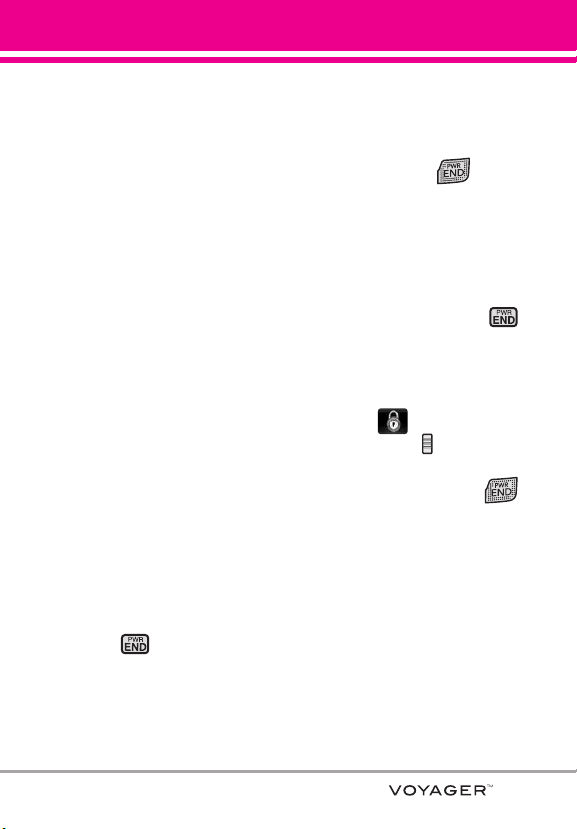
Turning the Phone On and Off
Turning the Phone On
Using the Internal Keypad
1. Install a charged battery or
connect the phone to an the
external power source.
2. Open the flip and press the
internal key for a few
seconds until the LCD screen
lights up.
Using the External Touch screen
1. Install a charged battery or
connect the phone to an the
external power source.
2. Press the external key for
a few seconds until the Touch
Screen lights up.
Turning the Phone Off
Using the Internal Keypad
1. Press and hold the internal
key until the display turns off.
Using the External Touch Screen
1. Unlock the Touch Screen by
touching or pulling down
the Unlock Key ( ) on the left
side of your phone.
2.
Press and hold the external
key until the display turns off.
Getting Started with Your Phone
26
Signal Strength
Call quality depends on the signal
strength in your area. You can tell
how much signal strength you have
by the number of bars next to the
signal strength icon: the more bars,
the stronger the signal. If you’re
having problems with signal quality,
move to an open area or, when
inside a building, try moving near a
window.
Screen Icons
When the phone is on, the top line
of the LCD screen displays phone
status icons.
Using the Internal Keypad
To see the icon glossary, go to
MENU -> Settings & Tools -> Phone
Info -> Icon Glossary on your phone.
Using the External Touch Screen
1. Unlock the Touch Screen by
touching or pulling down
the Unlock Key ( ) on the left
side of your phone and touch
to access the menu.
2. Touch .
3. Touch
11. Phone Info.
4. Touch 3. Icon Glossary.
Making Calls
NOTE
To activate the speakerphone during a
call, simply open the flip.
NOTE
If the external Touch Screen backlight
dims while on a call, touch any side
key to turn the backlight back on.
Using the Internal Keypad
1. Make sure the phone is turned
on. If not, press the internal
key for about three seconds. If
necessary, enter the lock code.
2. Enter the phone number (include
the area code if needed).
3. Press the internal key.
4. Press the internal key to
end the call.
Correcting Dialing Mistakes
If you make a mistake while dialing
a number, press once to erase
the last digit entered, or hold down
for at least 2 seconds to delete
all digits.
27
Using the External Touch screen
1. Touch the Touch Key that looks
like a phone , then a numeric
keypad is displayed. Enter the
phone number you want to call or
search for a number in Contacts
or Recent Calls.
2. Press the external key or
touch .
Redialing Calls
Press and hold the external
key or the internal key to
redial the last number you dialed,
received or missed in call history.
The last 270 numbers are stored in
the call history list and you can also
select one of these to redial.
Receiving Calls
Using the Internal Keypad
1. When the phone rings or
vibrates, there are several ways
of answering a call, depending
on the phone setting:
●
Flip Open
: Open the flip (by
default).
●
Any Key
: Press the
internal
key
or any other key except the
internal key
.
●
Auto with Handsfree
: The call
automatically connects when
connected to a handsfree device.
NOTE
If you press the Left Soft Key
[Quiet] while the phone is ringing, the
ringing or vibration is muted for that call.
NOTE
If you press the Right Soft Key
[Ignore] while the phone is ringing and
unlocked, the call will end or go to
voicemail.
Using the External Touch screen
1. When the phone rings or vibrates,
simply touch and press the
external key
or touch the
Touch Key.
2. Press the external key to
end the call.
Answer
Call
28
Vibrate Mode
Sets the phone to vibrate instead of
ring ( is displayed). To set
Vibrate Mode, press and hold on
the internal keypad or touch and hold
the .
To return to Normal Mode, press and
hold again or touch and hold the
.
Mute Function
The Mute Function prevents the
transmission of your voice to the
caller. To quickly activate Mute press
the Left Soft Key
[Mute]
above
the internal keypad or touch
then to unmute press the Left Soft
Key
[Unmute]
or touch
.
Volume Quick Adjustment
Quickly adjust ringer and earpiece
volumes by pressing the upper side
key to increase and lower side key to
decrease.
NOTE
The earpiece volume can only be
adjusted during a call and Keypad
volume can only be adjusted through
the Menu.
NOTE
To turn off sounds, press and hold the
lower side key for 3 seconds when the
flip is open or closed, then press and
hold the upper side key to return to
normal sounds mode.
Call Waiting
During a call, one beep indicates that
you have another incoming call.
Ignoring a Call Waiting
If you don't want to answer the
incoming call, press the Right Soft
Key [Ignore] when the flip is
open. If the flip is closed, touch
on the Touch Screen. The
Call Waiting beep stops and the call
goes to your voicemail, if available.
Answering a Call Waiting
1. Press the internal key/ the
external key (whether the
flip open or closed) to
automatically put the first call on
hold and answer the new call.
2. Press the internal key/ the
external key again to put
the second call on hold and
return to the first caller.
Ignore
Unmute
Mute
Quick Access to Convenient Features
Voice Commands
Voice Commands allow you to do
things by verbal command (e.g., make
calls, confirm Voicemail, etc.).
1. Access the Voice Commands
feature:
●
With the flip open, press .
●
With the flip closed and the
screen unlocked, give the a
quick press (an extended press
activates the Voice Recorder
feature instead).
2. Follow the prompts to use your
voice command(s).
NOTE
Voice Commands can also be started
with the designated key on your
Bluetooth
®
device. Please check the
manual of the Bluetooth
®
device for
further instructions.
29
Contacts in Your Phone’s Memory
Storing Basics
Using the Internal Keypad
1. Enter a number (max. 48 digits),
then press the Left Soft Key
[Save]
.
2. Use the Directional Key to
scroll to
Add New Contact/
Update Existing
, then press the
OK Key .
3. Use the Directional Key to
scroll to
Mobile 1/ Home/ Work/
Mobile 2/ Fax
, then press the OK
Key .
4. Enter a name (max. 32 characters),
then press the OK Key .
5. Press the
internal key
to
exit, the
internal key
to call,
or the Right Soft Key
[Options].
Using the External Touch Screen
1.
Unlock the Touch Screen by
touching or pulling down
the Unlock Key ( ) on the left
side of your phone.
2. Touch the contact touch soft key
.
3. Touch .
4. Touch a field, use the pop-up touch
keys to enter information, then
touch . Do this for each
field you want to enter.
5. When all fields are complete, touch
.
6. Press the
external key
to
exit, the
external key
to
call, or touch .
7. Touch .
OR
1.
Unlock the Touch Screen by
touching or pulling down
the Unlock Key ( ) on the left
side of your phone.
2. Touch the phone touch soft key for
the phone dialing pad .
3. Use the number Touch Keys that
pop-up to enter the phone number.
4. Touch , then continue
touching fields and entering
information as necessary.
SAVE
SAVE
Options
SAVE
DONE
NEW
30
Customizing Individual
Entries
Using the Internal Keypad
1. Press the Right Soft Key
[Contacts], then use the Directional
Key to scroll to an entry.
2. Press the Left Soft Key
[Edit].
3. Use the Directional Key to
scroll to the information to
customize.
4. Change the entry as you want, then
press the OK Key to save your
changes.
Using the External Touch Screen
1.
Unlock the Touch Screen by
touching or pulling down
the Unlock Key ( ) on the left
side of your phone.
2. Touch the contact touch soft key
.
3. Touch the Contact you want to
customize.
4. Touch , then touch and
edit the fields you want to change
then touch .
5. Touch when edits are
complete.
Speed Dial
Allows you to set up your Speed Dials.
Using the Internal Keypad
1. Press the Right Soft Key
[Contacts], then use the Directional
Key to scroll to an entry.
2. Press the Left Soft Key
[Edit]
.
3. Use the Directional Key to
scroll to a phone number, then press
the Right Soft Key [Options].
4. Use the Directional Key to
scroll to
Set Speed Dial
, then
press the OK Key .
5. Enter a Speed Dial digit.
●
Use the keypad, then press the
OK Key .
●
Use the Directional Key to
scroll to the Speed Dial digit,
then press the OK Key .
6. Screen prompt appears
Add
Contact to Speed Dial? Press the
OK Key to select Yes, then
press the OK Key to select
Save.
SAVE
DONE
EDIT
31
32
Contacts in Your Phone’s Memory
Using the External Touch Screen
1.
Unlock the Touch Screen by
touching or pulling down
the Unlock Key ( ) on the left
side of your phone.
2. Touch the contact touch soft key
.
3. Touch the Contact you want to
customize.
4. Touch to edit.
5. Touch the phone number, then
touch .
6. Touch
Set Speed Dial, then touch
an unassigned Speed Dial number.
7. Screen prompt appears
Add
Contact to Speed Dial? Touch Yes.
8. Touch , then touch
.
Storing a Number with
Pauses
Pauses allow you to enter additional
series of numbers to access
automated systems such as Voicemail
or credit billing numbers. Pause types
are:
Wait
(W) The phone stops dialing
until you press the Left Soft Key
[Release]
to advance to the next
number.
2-Sec Pause
(P) The phone
waits two seconds before sending the
next string of digits.
Using the Internal Keypad
1. Enter the number, then press the
Right Soft Key
[Options]
.
2. Use the Directional Key to
scroll to
2-Sec Pause or Wait
,
then press the OK Key .
3. Enter additional number(s) (e.g., pin
number, credit card number, etc.).
4. Press the Left Soft Key
[Save].
5. Complete the Contact entry as
necessary.
Using the External Touch Screen
1.
Unlock the Touch Screen by
touching or pulling down
the Unlock Key ( ) on the left
side of your phone.
2. Touch the contact touch soft key
.
3. Touch the Contact you want to edit.
4. Touch to edit.
5. Touch the phone number, touch
then touch
2-Sec
Pause or Wait.
6. Touch .
7. Touch .
SAVE
DONE
Options
EDIT
SAVE
DONE
Options
EDIT
Adding Another Phone
Number
From Standby Mode Using the
Internal Keypad
1. Enter a phone number, then press
the Left Soft Key
[Save]
.
2. Use the Directional Key to
scroll to
Update Existing
, then
press the OK Key .
3. Use the Directional Key to
scroll to an existing entry, then
press the OK Key .
4. Use the Directional Key to
scroll to
Mobile 1/ Home/ Work/
Mobile 2/ Fax
, then press the OK
Key to save.
From the Contact List Screen Using
the Internal Keypad
1. Press the Right Soft Key
[Contacts].
2. Use the Directional Key to
scroll to an entry, then press the
Left Soft Key
[Edit]
.
3. Use the Directional Key to
scroll to the phone number field to
add, then enter the number and
press the OK Key to save.
Changing Saved Information Using
the Internal Keypad
1. Press the Right Soft Key
[Contacts].
2. Use the Directional Key to
scroll to a Contact entry, then
press the Left Soft Key
[Edit]
.
3. Use the Directional Key to
scroll to the field you want to
change.
4. Make the changes, then press the
OK Key .
Changing the Default
Number
The Default Number is the phone
number you entered when you
created the Contact. Another number
can be saved as the Default Number.
Using the Internal Keypad
1. Press the Right Soft Key
[Contacts].
2. Use the Directional Key to
scroll to an entry.
3. Press the Left Soft Key
[Edit]
.
33
34
Contacts in Your Phone’s Memory
4. Use the Directional Key to
highlight a phone number, then
press the Right Soft Key
[Options].
5. Use the Directional Key to
highlight
Set As Default
, then
press the OK Key .
6. Press the OK Key to set the
new number as the default.
A confirmation message is
displayed.
7. Press the OK Key again to
save.
Deleting
Deleting a Phone Number Using the
Internal Keypad
1. Press the Right Soft Key
[Contacts].
2. Use the Directional Key to
scroll to an entry.
3. Press the Left Soft Key
[Edit]
.
4. Use the Directional Key to
scroll to a phone number.
5. Press and hold to delete it.
6. Press the OK Key .
Deleting a Contact Entry Using the
Internal Keypad
1.
Press the Right Soft Key
[Contacts].
2. Use the Directional Key to
scroll to an entry.
3. Press the Right Soft Key
[Options]
, then press
Erase
.
4. Press the OK Key
[Yes]
.
Deleting a Speed Dial
Using the Internal Keypad
1. Press the Right Soft Key
[Contacts].
2. Use the Directional Key to
highlight a Contact entry to edit
and press the OK Key
[VIEW]
.
3. Select the phone number with the
Speed Dial, then press the OK Key
[EDIT]
.
4. Press the Right Soft Key
[Options].
5. Press
Remove Speed Dial
.
6. Press the OK Key
[Yes]
.
Using the External Touch Screen
1.
Unlock the Touch Screen by
touching or pulling down
the Unlock Key ( ) on the left
side of your phone.
2. Touch the contact touch soft key
.
3. Touch the Contact you want
(search using or alphabet
letters at the top of the screen. if
necessary).
4. Touch .
5. Touch the number with the speed
dial you want to delete, touch
.
6. Touch Remove Speed Dial.
7. Touch
Yes.
8. Touch .
9. Touch to exit the contact.
Speed Dialing
Allows you to make phone calls
quickly and easily to numbers stored
in Contacts. You need to set Speed
Dials in your Contacts before using
this feature.
NOTE
Speed Dial 1 is for Voicemail.
Speed Dials from 1 to 9
Using the Internal Keypad
Press and hold the Speed Dial digit
(for 2-digit Speed Dials, press the first
digit, then press and hold the second
digit). Your phone recalls the phone
number from your Contacts, displays
it and dials it for you.
Speed Dials from 10 to 99
Using the Internal Keypad
Press the first Speed Dial digit, then
press and hold the key of the last
Speed Dial digit.
NO
TE
You can also enter the Speed Dial
digit(s), then press the internal
key.
SAVE
DONE
Options
EDIT
Go To
35
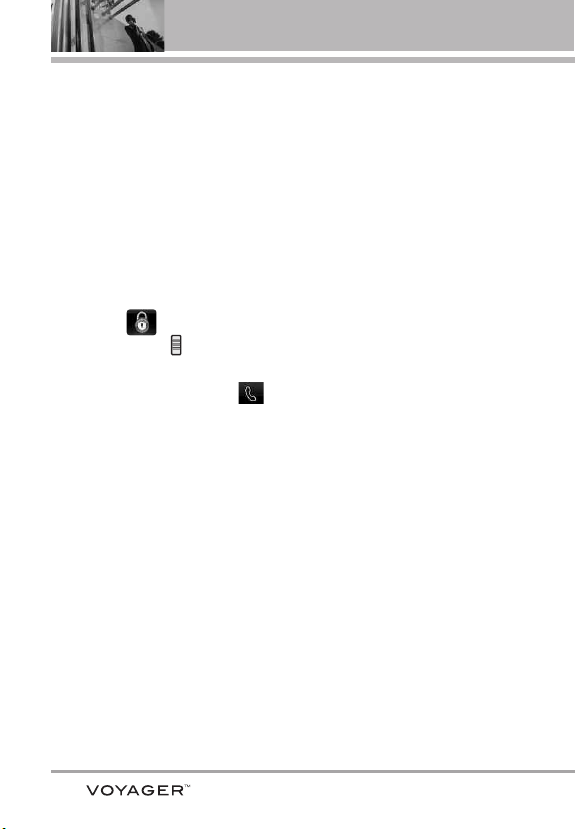
Groups by letters:
Touch a group that
includes a contact
you want to search.
In Case of
Emergency: touch it
to make a call in
case of emergency.
Add a new contact.
Go directly to a specific contact.
Contacts in Your Phone’s Memory
Speed Dials 97, 98, and 99
Speed Dials 97, 98, and 99 are
preset to access certain phone
account information: 97 (#BAL), 98
(#MIN), and 99 (#PMT). Unlike
Speed Dial 1, these can be changed
if you want.
Speed Dialing Using the Touch
Screen
1.
Unlock the Touch Screen by
touching or pulling down
the Unlock Key ( ) on the left
side of your phone.
2. Touch the call touch soft key .
3. Touch and hold the Speed Dial
digit (for a 2-digit Speed Dial,
touch the first digit then touch and
hold the second digit).
36
Media Center
37
M
M
e
e
d
d
i
i
a
a
C
C
e
e
n
n
t
t
e
e
r
r
Media Center gives you customizable
service right on your wireless device
that lets you get Ringtones, play
games, surf the web, get up-to-the-
minute information and more. Visit
verizonwireless.com/getitnow to view
all of the applications available for
your wireless device.
NOTE Do not insert or remove the
microSD while playing, deleting or
downloading Pictures/ Videos/ Music/
Sounds.
SHORTCUT
You can access the Media Center feature directly
by opening the flip and pressing the Directional
Key to the right.
NOTE
Do not insert or remove the microSD
while playing, deleting or downloading
Pictures/ Videos/ Music/ Sounds.
NOTE
With the flip closed, if you answer a
call while playing music, browsing the
net, watching TV/video, or using VZ
Navigator
SM
, and end the call by
pressing the external Key, the
touch screen will lock. Unlock the
phone by sliding the Unlock Key ( )
downwards.
Anything Unclear?
From the Media Center menu, press the
Right Soft Key
[Info]
(if you’re
using the Touch Screen, touch )
to see your memory status, activity log,
help text, and Media Center status. Use
the Help option to view information from
buying new applications to expired
applications.
1. Music & Tones
Personalize your phone with
ringtones. A wide variety of choices
are available, such as current hits,
pop, hip-hop, and more.
Access and Options
Using the Internal Keypad
1. Open the flip and
press the OK
Key
[MENU].
2.
Press the OK Key
[Media
Center].
3. Press Music & Tones.
4. Select a submenu by pressing
the number that corresponds
with a submenu.
Using the External Touch Screen
1. Unlock the Touch Screen by
touching or pulling down
the Unlock Key ( ) on the left
Info
Media Center
38
side of your phone and touch
to access the menu.
2. Touch the Media Center icon
.
3. Touch
1. Music & Tones.
●
Touch to set the Music
Only Mode On or Off.
TIP
Music Only Mode allows you to listen exclusively
to your music using your Bluetooth stereo
headset (as you do with MP3 players). Set Music
Only Mode to On if you don't want your listening
enjoyment to be interrupted by calls.
1.1 V CAST Music | Rhapsody
Transform your wireless device into
a portable music player. Download
new songs from the Media Center
music catalog right onto your
wireless device or a PC. Then you
can sync your music between your
PC and phone.
Using the Internal Keypad
1. Open the flip and
press the OK
Key
[MENU].
2.
Press the OK Key
[Media
Center].
3. Press Music & Tones.
4. Press V CAST Music |
Rhapsody.
Using the External Touch Screen
1. Unlock the Touch Screen by
touching or pulling down
the Unlock Key ( ) on the left
side of your phone and touch
to access the menu.
2. Touch the Media Center icon
.
3. Touch
1. Music & Tones.
4. Touch 1. V CAST Music |
Rhapsody.
NOTE
Additional charges for music may
apply. V CAST Music | Rhapsody
service is not available in all areas.
Check
www.verizonwireless.com/getitnow
website for details.
1.2 Get New Ringtones
Allows you to connect to Media
Center and download various
ringtones.
Using the Internal Keypad
1. Open the flip and
press the OK
Key
[MENU].
2.
Press the OK Key
[Media
Center].
3. Press
Music & Tones.
4. Press Get New Ringtones.
Mode
5. Press Get New Applications
to shop for ringtones.
Using the External Touch Screen
1. Unlock the Touch Screen by
touching or pulling down
the Unlock Key ( ) on the left
side of your phone and touch
to access the menu.
2. Touch the Media Center icon
.
3. Touch
1. Music & Tones.
4. Touch 2. Get New Ringtones.
5. Touch 1. Get New Applications
to shop for ringtones.
1.3 My Ringtones
Allows you to select a desired
ringtone, download a new ringtone.
Using the Internal Keypad
1. Open the flip and press the OK
Key [MENU].
2. Press the OK Key [Media
Center].
3. Press
Music & Tones.
4. Press My Ringtones.
5. Use to scroll to a ringtone
and press the Left Soft Key
[Set As].
●
Ringtone
●
Contact ID:
Scroll and select
the Contact to be identified by the
ringtone you selected.
●
Alert Sounds: Press the
corresponding number key to set
the ringtone for one of the
following:
All Messages/ TXT Message/
Picture-Video Message/
Voicemail
Using the External Touch Screen
1. Unlock the Touch Screen by
touching or pulling down
the Unlock Key ( ) on the left
side of your phone and touch
to access the menu.
2. Touch the Media Center icon
.
3. Touch 1. Music & Tones.
4. Touch 3. My Ringtones.
5. Touch a ringtone and touch
.
NOTE
To scroll to ringtones not viewed on
screen, place your finger on the list
and gently apply upward (or
downward) pressure. The bar along
the right side of the screen indicates
where you are in the list.
●
1. Ringtone
SET AS
39
Media Center
●
2. Contact ID: Touch the Contact
to be identified by the ringtone
you selected.
●
3. Alert Sounds: Touch the option
to set it as ringtone.
All Messages/ TXT Message/
Picture-Video Message/
Voicemail
1.4 My Music
Allows you to store and to listen to
music right from your phone. Connect
to V CAST Music with Rhapsody to
download a variety of music, transfer
music between your phone and your
PC, manage and organize your music
files, and more.
SHORTCUT
Unlock the Touch Screen by touching or
pulling down the Unlock Key ( ) on the left
side of your phone
,
then touch the screen with
your finger to access the shortcut menu, then
touch the My Music icon .
NOTE
File storage varies according to the
size of each file as well as memory
allocation of other applications.
Using the Internal Keypad
1. Open the flip and
press the OK
Key
[MENU].
2.
Press the OK Key
[Media
Center].
3. Press Music & Tones.
4. Press
My Music.
5. Use the Directional Key to
scroll to a submenu, then press the
OK Key .
Using the External Touch Screen
1. Unlock the Touch Screen by
touching or pulling down
the Unlock Key ( ) on the left
side of your phone and touch
to access the menu.
2. Touch the Media Center icon
.
3. Touch 1. Music & Tones.
4. Touch 4. My Music.
5. Touch a submenu to access your
music.
Playing Your Music
It’s easy to find and play the music
you’ve stored in your phone.
Access My Music
Using the Internal Keypad
1. Open the flip and
press the OK
Key
[MENU].
2.
Press the OK Key
[Media
Center].
3. Press
Music & Tones.
40
4. Press My Music.
5. Scroll to one of the following
options, then press the OK Key .
Genres
/
Artists
/
Albums
/
Songs
/
Playlists
/ Inbox/
Play All
/
Shuffle
6. Scroll to a song and press the OK
Key to start the Music Player.
Using the External Touch Screen
1. Unlock the Touch Screen by
touching or pulling down
the Unlock Key ( ) on the left
side of your phone and touch
to access the menu.
2. Touch the Media Center icon
.
3. Touch 1. Music & Tones.
4. Touch 4. My Music.
5. Touch one of the following options.
Genres
/
Artists
/
Albums
/
Songs
/
Playlists
/ Inbox/
Play All
/
Shuffle
6. Touch the name of the song you
want to hear to start the music
player.
TIP
Selecting Play All begins playing all of your
stored music in sequence one time through,
then exits the Music Player.
Controlling the Music Player
If you keep the flip open while
listening to your music, use the
following to control the Music Player:
●
Left Soft Key [Repeat]
Repeats after all songs are played.
41
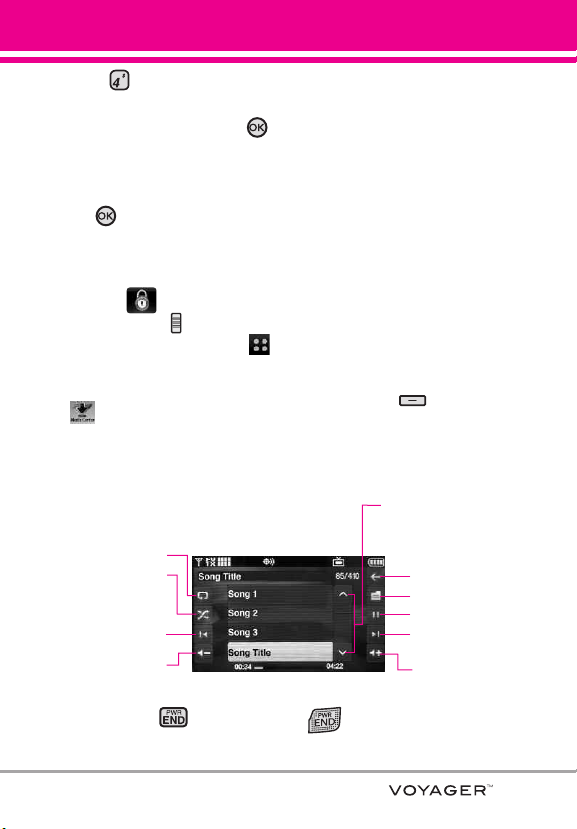
Touch Screen Music Controls
Repeat
Back key
Options
Play/ Pause
Fast Forward/
Skip to Next Song
Increase Volume
To scroll through songs,
place your finger on the list
and gently apply upward (or
downward) pressure.
Shuffle
Rewind/Skip back to
previous song: Plays
the previous song in
the current list.
Decrease Volume
Exit From the Music Player
Press the internal key or the external key with the flip closed to exit
from the Music Player.
Media Center
●
Right Soft Key [Options]
Allows you to choose:
Play All / Shuffle / My Music /
Shop / Listeners also liked / Help
●
: Adjust the volume.
1.5 My Sounds
Allows you to select a desired
sound or record a new sound.
Using the Internal Keypad
1. Open the flip and
press the OK
Key
[MENU].
2.
Press the OK Key
[Media
Center].
3. Press Music & Tones.
4. Press
My Sounds.
5. Press Record New or scroll
and select a sound using the
Directional Key .
Options with a sound file highlighted:
●
Press the Left Soft Key
[Erase]
.
●
Press the OK Key
[PLAY]
.
●
Press the Right Soft Key
[Options]
to scroll to:
Send/ To Online Album/
Rename/ Move/ Lock(Unlock)/
Erase All/ File Info
Using the External Touch Screen
1. Unlock the Touch Screen by
touching or pulling down
the Unlock Key ( ) on the left
side of your phone and touch
to access the menu.
2. Touch the Media Center icon
.
3. Touch 1. Music & Tones.
4. Touch
5. My Sounds.
5. Touch 1. Record New or touch a
sound using your finger tips.
Options from here:
●
Touch to erase the
selected sound.
●
Touch to send the
selected sound.
●
Touch to customize
the selected sound.
To Online Album/ Rename/
Move/ Lock(Unlock)/ Erase All/
File Info
●
Touch to go back to
one level.
CLR
Options
SEND
Erase
42

1.6 Sync Music
Allows you to synchronize your
music between your PC and your
phone. Transfer music files from
your PC into your phone's memory
or microSD
TM
memory card (sold
separately) and vice versa. Transfer
music you purchased from the
online V CAST Music | Rhapsody
Music Store to your PC.
Download music to your PC
1. Open V CAST Music with
Rhapsody. Don’t have V CAST
Music with Rhapsody? Just use of
the CD that came in box with your
phone to install the software.
NOTE
V CAST Music with Rhapsody will
work with Windows Vista, or XP. Not
available for Mac or Linux.
2. Log in.
3. For each V CAST Music track
you’ve downloaded to your
VOYAGER
TM
, you can download a
copy to your computer at no
additional charge. Song tracks
available for download will pop-up
upon log in completion.
4. Check the boxes of songs you wish
to download.
5. Select “Download Tracks.”
6. To play the song, you can find it by
selecting the My Library tab.
NOTES
●
V CAST Music with Rhapsody
®
will work with
Windows Vista, XP, or 2000 (Only 32-bit
versions of Windows are supported.) Not
available for Mac or Linux.
●
A Rhapsody CD has been included that
allows you to transfer music from your PC to
your phone in your VOYAGER
TM
box.
Sync your music from your PC to
your wireless device
1. Open V CAST Music with
Rhapsody. Don't have V CAST
Music with Rhapsody? Just use of
the CD that came in box with your
phone to install the software.
2. Use the USB cable (included) to
connect the cable to your PC and
phone.
3. V CAST Music with Rhapsody
software will automatically detect
the phone, and activate the "sync"
mode.
43
Media Center
4. In V CAST Music with Rhapsody,
select songs you want to sync
from My Library and drag them to
your phone, listed under Sources.
5. Under the
Music & Tones menu,
open My Music to view and play
your music.
NOTE
A compatible USB cable has been
included in your VOYAGER
TM
box.
2. Picture & Video
View, take, and trade your digital
pictures and videos right from your
wireless phone.
SHORTCUT
With the flip open, press the internal Directional
Key to the left for a shortcut to Picture &
Video.
Access and Options
Using the Internal Keypad
1.
Open the flip and press the OK Key
[MENU]
.
2. Press the OK Key
[Media
Center]
.
3. Press Picture & Video.
4. Select a submenu and
press the
OK Key
.
Using the External Touch Screen
1. Unlock the Touch Screen by
touching or pulling down
the Unlock Key ( ) on the left
side of your phone and touch
to access the menu.
2. Touch the Media Center icon
.
3. Touch
2. Picture & Video.
4. Touch a submenu.
44
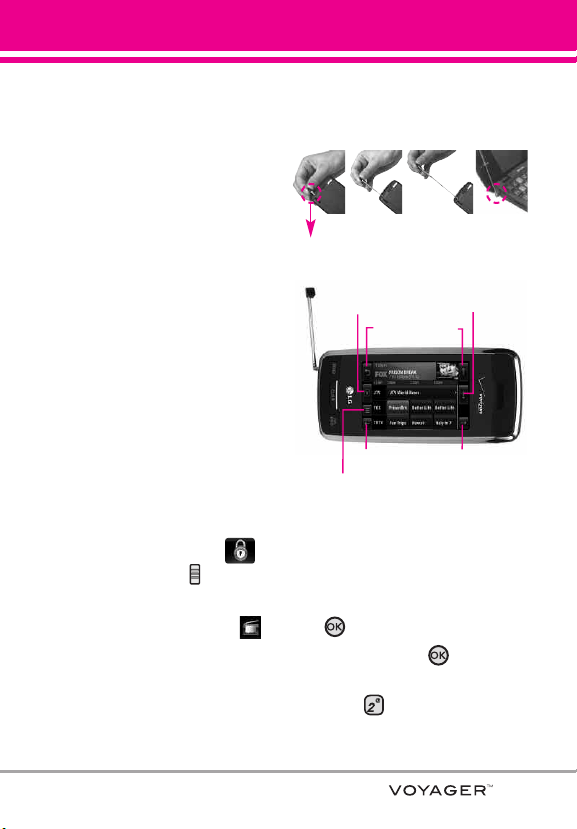
2.1 V CAST Mobile TV
Your VOYAGER
TM
is capable of
delivering full length television
programming from some of the
most popular TV channels right to
your phone. Catch many of your
favorite full length shows by
checking out the easy to use Media
Program Guide (MPG). Plus, you
can still take calls, messages, and
when you hang up, go right back to
enjoying your program, already in
progress. Get unlimited access to
entertainment when you use
V CAST Mobile TV. Visit
www.verizonwireless.com/vcast for
more information. If you haven’t
already done so, sign up for V CAST
Mobile TV by calling 1-800-2 JOIN
IN, visit a Verizon Wireless
Communications store, or subscribe
directly from your phone!
SHORTCUT
Unlock the Touch Screen by touching or
pulling down the Unlock Key ( ) on the left
side of your phone
, then touch the screen
with your finger to access the Shortcut
Menu, then touch the Mobile TV icon .
TIP
It is recommended to pull out the antenna on
the left bottom of your phone for better TV
reception while watching V CAST Mobile TV.
Subscribing to V CAST Mobile TV
Programs Directly from your Phone
Using the Internal Keypad
1.
Open the flip and press the OK Key
[MENU]
.
2. Press the OK Key
[Media
Center]
.
3. Press Picture & Video.
45
The antenna is on the left bottom of your phone.
Back Scroll Up
Info
Options
Scroll Back
Scroll Forward
Scroll Down
Media Center
4. Press V CAST Mobile TV
and rotate the phone clockwise.
5. An introduction video clip will
play (for the first time).
TIP
By pressing at the first channel with
V CAST logo displayed, you can go directly to
V CAST Videos.
6. Scroll to Subscribe Now and
press .
7. Review and select a V CAST
Mobile TV Package using the
Directional Key.
8. Press the Left Soft Key
Continue.
9. Read the Terms and Conditions
and press the Right Soft Key
Agree.
10. Confirm subscription by pressing
the Left Soft Key Submit.
11. From the V CAST screen, select
the Program Guide to change
channels.
12. Select the show you want to
watch.
Using the External Touch Screen
1. Unlock the Touch Screen by
touching or pulling down
the Unlock Key ( ) on the left
side of your phone and touch
to access the menu.
2. Touch the Media Center icon
.
3. Touch 2. Picture & Video.
4. Touch
1. V CAST Mobile TV and
rotate the phone clockwise
5. An introduction video clip will
play (for the first time).
TIP
Refer to the following screenshots to watch
V CAST Mobile TV on the external Touch
Screen. All screenshots simulated. Pricing for
packages is dependent on your service provider.
Verizon splash screen is displayed prior to the intro video.
6. Touch Subscribe Now.
7. Review base package and touch
.
Continue
46
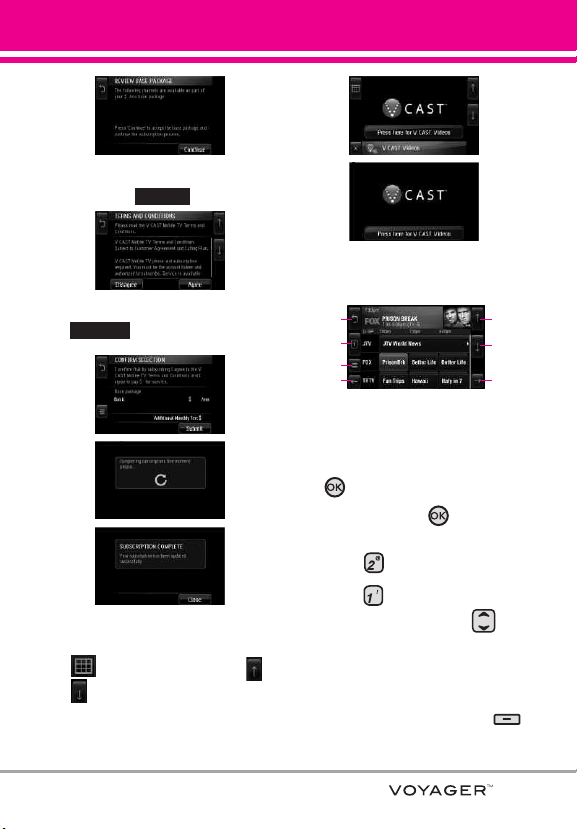
8. Read the Terms and Conditions
and touch .
9. Confirm selection and touch
.
10. From the V CAST Mobile TV,
touch the
Program Guide icon
on the top left corner or
to change channels.
11. Touch the show you want to
watch.
Easy Steps to Start Watching
V CAST Mobile TV
1.
Open the flip and press the OK Key
[MENU]
.
2. Press the OK Key
[Media
Center]
.
3. Press Picture & Video.
4. Press
V CAST Mobile TV.
5. Use the Directional Key to
select that is currently airing.
While watching a program, you
may do the following:
●
Press the Right Soft Key
[Guide] to go to guide.
Submit
Agree
47
Back
Info
Options
Scroll
Back
Scroll Up
Scroll
Down
Scroll
Forward
Media Center
●
Press to return to
viewing mode.
TIP
Use to change channels while watching
V CAST Mobile TV.
V CAST Mobile TV Options
1.
Open the flip and press the OK Key
[MENU]
.
2. Press the OK Key
[Media
Center]
.
3. Press Picture & Video.
4. Press V CAST Mobile TV.
5. Press the Right Soft Key
for Guides, and then press the
Left Soft Key for Options:
●
Description: displays information
about the highlighted program.
●
Subscription: displays V CAST
Mobile TV subscription
packages.
●
Parental Controls: blocks
content based on ratings set in
Parental Control Rating Menu. To
change parental controls, you
will be prompted to enter your 4
digit security PIN.
●
Parental Control On/Off
●
Parental Control Ratings: After
entering your 4 digit PIN, you
may select ratings allowed for
TV programs, Movies and
Audio. Once ratings are
selected, only programs with
your chosen rating or below
can be accessed.
●
Upgrade Check: checks for and
updates your V CAST Mobile TV
software.
●
About: displays information such
as V CAST Mobile TV software
version.
NOTE
Options are NOT available while
viewing a program in Full Screen.
V CAST Mobile TV is only available
in the V CAST Mobile TV coverage
area. Coverage area maps available
at www.verizonwireless.com.
Additional fees may apply.
48
2.2 V CAST Videos
V CAST brings the world to your
mobile phone with full-motion video
and sound. Catch up with what’s
happening with video clips from
Music, Showcase, Comedy, News,
Sports, Net's Best, TV & Film ,
Latino, Kids and Lifestyle (Must be in
V CAST coverage area. Additional
fees may apply).
Using the Internal Keypad
1. Open the flip and press the OK
Key [MENU].
2. Press the OK Key
[Media
Center].
3. Press Picture & Video.
4. Press V CAST Videos.
5. Press the Directional Key to
view video clip categories and
press the OK Key to select a
category.
6. Select the video clip you want to
view by pressing the OK Key .
Using the External Touch Screen
1. Unlock the Touch Screen by
touching or pulling down
the Unlock Key ( ) on the left
side of your phone and touch
to access the menu.
2. Touch the Media Center icon
.
3. Touch
2. Picture & Video.
4. Touch 2. V CAST Videos.
5. Touch video clip categories to
view.
Browsing, Selecting, and Playing
Video Clips
1. Open the flip and press for
Picture & Video.
2. Press
V CAST Videos to
open Video Clips Catalog.
3. Press the Directional Key to
view Video Clip categories
including Music, Showcase,
Comedy, News, Sports, Net's Best,
TV & Film , Latino, Kids, and
Lifestyle.
4. Select content provider, then press
the OK Key .
5. If applicable, select sub-category,
then press the OK Key .
49
Media Center
To view a Streaming Video
1.
Open the flip and press for
Picture & Video.
2. Press
V CAST Videos
to
open Video Clips Catalog, then use
the Directional Key to find the
video you want.
3. Navigate and select the sub
categories.
4. Read the description of the video
clip, and press the OK Key to
view.
5. Select
Yes
to accept charges,
press the OK Key and the
Video Clip will initiate transfer.
6. The video clip will begin playback
shortly after being selected.
To download a Video Clip
Using the Internal Keypad
1.
Open the flip and press for
Picture & Video.
2. Press
V CAST Videos
.
3. Navigate thru the sub-menus and
find a video you can download.
4. Use the Directional Key to find the
video clip you want, then read the
description of the video clip and
press the Right Soft Key
[Options]
.
5. Press
Save Video
, and press
the OK Key .
6. Select
Yes
to accept charges,
press the OK Key and the
video clip will initiate downloading
of video.
7. Once video is downloaded a
message will appear on your
phone.
8. Select
Yes
and press the OK Key
to view video.
9. The video clip will be automatically
saved in My Videos.
NOTE
Not all videos are downloadable. Only
videos that have the option to save
can be downloaded. Additional
charges for each video clip viewed
may apply. Video Clips service is not
available in all areas. Check
www.verizonwireless.com/getitnow
website for details.
50
Deleting Video Clips
Using the Internal Keypad
1.
Open the flip and press for
Picture & Video.
2. Press
V CAST Videos
.
3. Press the Left Soft Key
[My
Videos]
.
4. Select Video to delete using the
Directional Key.
5. Press the Right Soft Key
[Options]
and press
Erase
.
6. Press the OK Key
[Yes]
to
erase Video.
Configure Alerts for New Video
Clips Using the Internal Keypad
1.
Open the flip and press for
Picture & Video.
2. Press
V CAST Videos
.
3. From Video Clips Catalog, select a
category.
4. Select Content Provider.
5. Press the Right Soft Key
[Options].
6. Select
Alerts
.
7. Select
Configure Alerts
and press
the OK Key .
8. Select content for alerts desired
and press the OK Key to save.
2.3 Get New Pictures
Allows you to connect to Media
Center and download a variety of
images for My Pictures.
Using the Internal Keypad
1. Open the flip and press the OK
Key [MENU].
2. Press the OK Key [Media
Center].
3. Press
Picture & Video.
4. Press Get New Picture
.
5. Press Get New
Applications.
Using the External Touch Screen
1. Unlock the Touch Screen by
touching or pulling down
the Unlock Key ( ) on the left
side of your phone and touch
to access the menu.
2. Touch the Media Center icon
.
3. Touch
2. Picture & Video.
4. Touch 3. Get New Picture.
5. Touch 1. Get New Applications.
51
Media Center
2.4 My Pictures
Allows you to view photos stored in
the phone.
SHORTCUT
Unlock the Touch Screen by touching or
pulling down the Unlock Key ( ) on the left
side of your phone
,
then touch the screen with
your finger to access the shortcut menu, then
touch the My Pictures icon .
Using the Internal Keypad
1. Open the flip and press the OK
Key [MENU].
2. Press the OK Key [Media
Center].
3. Press
Picture & Video.
4. Press My Pictures
.
5. Select your desired picture with
and press Right Soft Key
[Options].
6. Select the options to customize.
Send
Picture Message
/
To
Online Album
/
Via Bluetooth
Set As
Wallpaper/ Picture ID
Take Picture Turns on the camera
function.
Get New Pictures Downloads
various pictures.
Manage My Pics Allows you to
mark the selected picture and
apply options.
Rename Renames the selected
picture.
Print
Print via Bluetooth/
Print Preferences
File Info
Name/ Date/ Time/
Resolution/ Size/ Type
NO
TE
The option 'V
ia Bluetooth' is not
displayed when you select pictures
protected by DRM (Digital Rights
Management). Also, the option is
available only when you select a
Bluetooth device that supports
receiving pictures.
Using the External Touch Screen
1. Unlock the Touch Screen by
touching or pulling down
the Unlock Key ( ) on the left
side of your phone and touch
to access the menu.
2. Touch the Media Center icon
.
3. Touch
2. Picture & Video.
4. Touch 4. My Pictures.
5. Touch your desired picture and
touch .
Options
52
6. Touch the options to customize.
Send
Picture Message
/
To
Online Album
/
Via Bluetooth
Set As
Wallpaper/ Picture ID
Take Picture Turns on the camera
function.
Get New Pictures Downloads
various pictures.
Manage My Pics Allows you to
mark the selected picture and
apply options.
Rename Renames the selected
picture.
Print
Print via Bluetooth/
Print Preferences
File Info
Name/ Date/ Time/
Resolution/ Size/ Type
NOTE
To scroll to options not viewed on
screen, place your finger on the list
and gently apply upward (or
downward) pressure. The bar along
the right side of the screen indicates
where you are in the list.
2.5 My Videos
Allows you to view videos stored in
the phone.
Using the Internal Keypad
1. Open the flip and press the OK
Key [MENU].
2. Press the OK Key
[Media
Center].
3. Press Picture & Video.
4. Press My Videos
.
5. Select a video with the Directional
Key and press the Right Soft
Key
[Options]
.
Select one of the following options
(Options are dependent on file
types):
Send Sends a video message.
Record Video Turns on the video
camera function.
To Online Album Accesses the
Online Album (PIX Place).
V CAST Videos Accesses V CAST
Videos feature.
Manage My Videos Allows you to
mark multiple videos.
Set As Wallpaper Displays the
selected video file as the
background for your phone.
53
Media Center
Rename Renames the selected
video.
File Info
Name/ Date/ Time/
Duration/ Size
6. Press the OK Key to play.
NOTE
File storage varies according to the
size of each file as well as memory
allocation of other applications.
●
: Adjust the volume.
●
Left Soft Key : Mute/
Unmute.
●
: Pause/ Play.
●
Up Directional Key :
Shows the full screen.
●
Down Directional Key : Stop
* For WMV files, the key ends playing
the clip and goes back to My Videos menu.
●
Right Directional Key : FF
●
Left Directional Key : Rewind
7. Press the Right Soft Key
[Options]
to select one of the
following options:
Set As Wallpaper/ File Info
Using the External Touch Screen
1. Unlock the Touch Screen by
touching or pulling down
the Unlock Key ( ) on the left
side of your phone and touch
to access the menu.
2. Touch the Media Center icon
.
3. Touch
2. Picture & Video.
4. Touch 5. My Videos.
5. Touch a video, then touch what
you want to do , ,
or .
Select one of the following options
(Options are dependent on file
types):
Send Sends a video message.
Record Video Turns on the video
camera function.
To Online Album Accesses the
Online Album (PIX Place).
V CAST Videos Accesses V CAST
Videos feature.
Manage My Videos Allows you to
mark multiple videos.
Set As Wallpaper Displays the
selected video file as the
background for your phone.
Rename Renames the selected
video.
File Info
Name/ Date/ Time/
Duration/ Size
Options
PlayErase
54
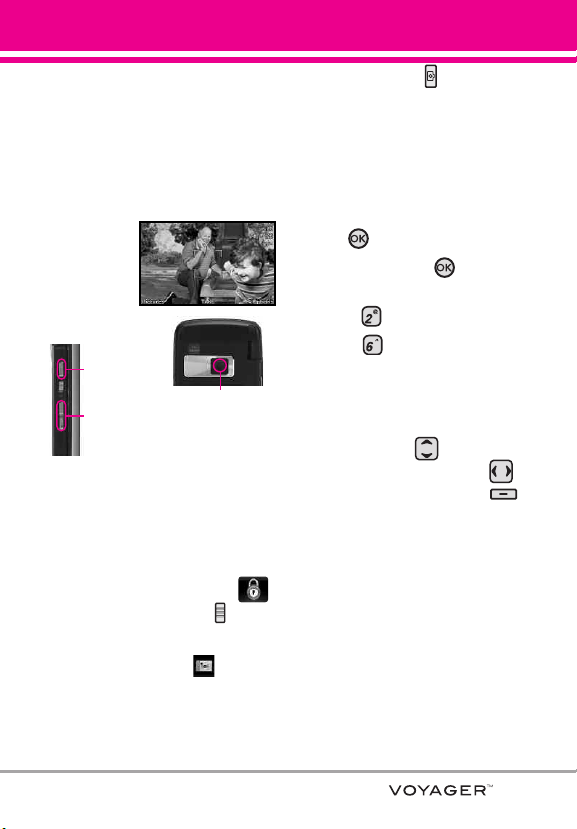
NOTE
To scroll to options not viewed on
screen, place your finger on the list
and gently apply upward (or
downward) pressure. The bar along
the right side of the screen indicates
where you are in the list.
2.6 Take Picture
Take pictures
straight from
your phone.
TIPS
●
To take a clear picture, set the proper
brightness level and zoom before taking the
picture.
●
Avoid jolting the camera.
●
Wipe the camera lens with a soft cloth.
SHORTCUTS
●
Unlock the Touch Screen by touching
or pulling down the Unlock Key ( ) on the
left side of your phone
,
then touch the screen
with your finger to access the shortcut menu,
then touch the Camera icon .
●
The Side Camera Key ( ) is a shortcut key
to Take Picture in standby mode. Press and
hold the key to launch Record Video mode.
In Camera/Video preview screens, press the
side camera key to take the picture/video.
Using the Internal Keypad
1. Open the flip and press the OK
Key [MENU].
2. Press the OK Key
[Media
Center].
3. Press Picture & Video.
4. Press Take Picture
.
5. Hold the phone horizontally to take
pictures.
6. Set the brightness by pressing the
Directional Key , zoom by
pressing the Directional Key ,
and press the Right Soft Key
[Options]
to change other settings.
NOTE
Zooming is not available on the
highest resolution.
●
Select the option(s) to customize.
RESOLUTION 1600X1200/
1280X960/ 640X480/ 320X240
SELF TIMER Off/ 3 Seconds/
5 Seconds/ 10 Seconds
WHITE BALANCE Auto/ Sunny/
Cloudy/ Fluorescent/ Glow
55
Camera Key
Adjust the zoom using the side keys.
Adjust the zoom or brightness using the
Directional Key.
Camera Lens
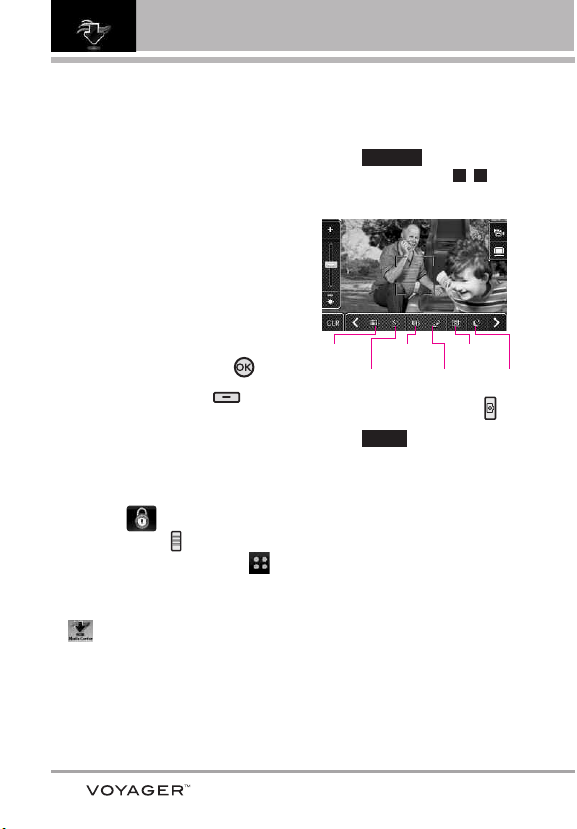
Media Center
SHUTTER SOUND
Shutter/ No
Sound /Say “Cheese”/ Ready! 1 2 3
COLOR EFFECTS Normal/
Negative/ Aqua/ Sepia/
Black&White
NIGHT MODE On/ Off
SAVE OPTION Internal/ External
PHOTOMETRY Average/ Spot
EXTERNAL DISPLAY On/ Off
AUTO FOCUS One Step/ Two
Step/ Off
CAPTURE MODE Camera/ Video
7. Take a picture by pressing .
8. Press the Left Soft Key
[Save]. The picture is stored in
My Pictures.
Using the External Touch Screen
1. Unlock the Touch Screen by
touching or pulling down
the Unlock Key ( ) on the left
side of your phone and touch
to access the menu.
2. Touch the Media Center icon
.
3. Touch
2. Picture & Video.
4. Place your finger on the Touch
Screen and apply gentle upward
pressure to scroll the list up, then
touch
6. Take Picture.
5. Hold the phone horizontally to
take pictures.
6. Touch to change
photo settings. Scroll /
horizontally to additional settings.
7. Take a picture by pressing .
8. Touch . The picture is
stored in My Pictures.
Save
><
Options
56
RESOLUTION WHITE
BALANCE
COLOR
EFFECTS
SELF
TIMER
SHUTTER
SOUND
NIGHT
MODE
2.7 Record Video
Lets you
record a
video
message
with sound.
Using the Internal Keypad
1. Open the flip and press the OK
Key [MENU].
2. Press the OK Key [Media
Center].
3. Press Picture & Video.
4. Press Record Video
.
5. Hold the phone horizontally to
record videos.
6. Set the brightness by pressing the
Directional Key , zoom by
pressing the Directional Key
or press the Right Soft Key
[Options]
to change other settings.
●
Select the option(s) to customize.
RECORDING TIME For Send/
For Save
RESOLUTION 320X240/ 176X144
SAVE OPTION Internal/ External
COLOR EFFECTS Normal/ Negative/
Aqua/ Sepia/ Black&White
WHITE BALANCE Auto/ Sunny/
Cloudy/ Fluorescent/ Glow
CAPTURE Camera/ Video
7. Press the OK Key
[REC]
to
begin recording, and again to stop.
8. Press the Left Soft Key
[Save]
. The recorded video is
stored in
My Videos
.
Using the External Touch Screen
1. Unlock the Touch Screen by
touching or pulling down
the Unlock Key ( ) on the left
side of your phone and touch
to access the menu.
2. Touch the Media Center icon
.
3. Touch 2. Picture & Video.
4. Place your finger on the Touch
Screen and apply gentle upward
pressure to scroll the list up, then
touch 7. Record Video.
5. Hold the phone horizontally to
record videos.
57
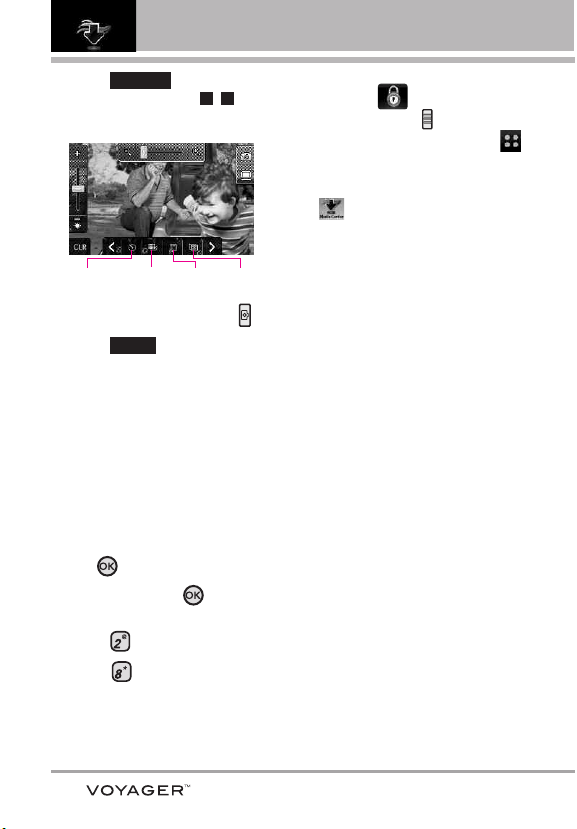
Media Center
6. Touch to change
video settings. Scroll /
horizontally to additional settings.
7. Record a video by pressing .
8. Touch . The video clip is
stored in My Videos.
2.8 Online Album
Lets you save your pictures and
videos to Online Albums that make it
easy to save, organize and share all
your pictures and videos.
Using the Internal Keypad
1. Open the flip and press the OK
Key [MENU].
2. Press the OK Key [Media
Center].
3. Press
Picture & Video.
4. Press Online Album
.
Using the External Touch Screen
1. Unlock the Touch Screen by
touching or pulling down
the Unlock Key ( ) on the left
side of your phone and touch
to access the menu.
2. Touch the Media Center icon
.
3. Touch
2. Picture & Video.
4. Place your finger on the Touch
Screen and apply gentle upward
pressure to scroll the list up, then
touch
8. Online Album.
Save
><
Options
58
RECORDING
TIME
SAVE
OPTION
COLOR
EFFECTS
RESOLUTION
3. Games
Allows you to download games and
applications from the Media Center
server. Choose the software you
want from the list displayed on the
screen.
Using the Internal Keypad
1. Open the flip and press the OK
Key [MENU].
2. Press the OK Key
[Media
Center].
3. Press Games.
4. Press the OK Key [Get New
Applications].
Using the External Touch Screen
1. Unlock the Touch Screen by
touching or pulling down
the Unlock Key ( ) on the left
side of your phone and touch
to access the menu.
2. Touch the Media Center icon
.
3. Touch
3. Games.
4. Touch Get New Applications.
4. Browse & Download
Everything you need to know while
you’re on the go.
Using the Internal Keypad
1. Open the flip and press the OK
Key [MENU].
2. Press the OK Key
[Media
Center].
3. Press Browse & Download
.
4. Select your Browse & Download,
such as Get New Applications then
press the OK Key .
Using the External Touch Screen
1. Unlock the Touch Screen by
touching or pulling down
the Unlock Key ( ) on the left
side of your phone and touch
to access the menu.
2. Touch the Media Center icon
.
3. Touch
4. Browse & Download
4. Touch Get New Applications.
59

Media Center
City ID
City ID is an enhanced Caller ID
feature on select Verizon Wireless
handsets that automatically
displays the city and state of every
wireless call received. City ID reads
the area code and local exchange
of an incoming call and displays the
location associated with that
number. City ID includes over
20,000 cities, towns and
neighborhoods in North America
and over 200 country codes from
around the world - providing mobile
subscribers with a remarkably
accurate tool to help identify
incoming callers.
City ID enabled handsets also
feature outgoing and call log
identification which displays the
city and state of outgoing calls as
well as calls within the handset’s
call history.
City ID is a pre-loaded feature with
a free trial that works automatically
– displaying the city and state with
the very first incoming phone call.
1. After the free trial period,
subscribers will receive a
message to purchase the
application.
2. Subscriber is then presented
with purchase options available.
If after purchasing City ID a
subscriber decides to cancel the
application, the subscriber can
follow the standard Media
Center process to cancel a
subscription.
3. To purchase City ID if you said
“no” during the trial?
1. Select Menu
2. Select Media Center
3. Select Browse & Download
4. Select City ID
5. Select “Subscribe Now” to
purchase the application
6. Application Downloads. After
the application is successfully
installed, select “yes” to run
City ID or “no” to return to Get
It Now.
7. Select End to return to Main
Menu.
60

Visual Voice Mail
Visual Voice Mail allows the
management of voice mail directly
from the device rather than
accessing voice mail via traditional
method(s). Visual Voice Mail
displays a list of messages and
allows the user to choose which
message to listen to or delete,
without having to dial into their
mailbox, listen to voice instructions,
or prior messages.
1. Dial your wireless number.
2. Once you hear the system
greeting or your own greeting,
press # immediately to
interrupt the greeting and
follow the prompts.
How to access Visual Voice Mail
from your wireless device
Visual Voice Mail can be found
within the Messaging Menu
on the device.
1. From the main screen and with
the flip opened, press OK for
Menu, press the Directional
key right to highlight
Messaging and press OK.
2. Press 6 to access the Visual
Voice Mail application for
download, and future use.
How to set up Visual Voice Mail
1. If you are an existing Verizon
Wireless subscriber, skip to
step 2. If you are new Verizon
Wireless subscriber, first dial
*86 to set-up your voice mail
service.
2. From the main screen and with
the flip opened, press OK for
Menu, press the Directional
key right to highlight
Messaging and press OK.
3. Press 6 to access the Visual
Voice Mail application for
download, and future use.
4. Upon opening the link to Visual
Voice Mail, a message will be
played promoting the benefits
of Visual Voice Mail.
5. Click “Download” to download
the application.
6. When prompted, enter your
basic voice mail password that
was previously established.*
7. Continue to follow the prompts
and instructions to complete
the download and activation of
Visual Voice Mail.
8. Once the activation steps are
completed, exit the application
and return after 5 minutes to
begin using Visual Voice Mail.
61

Media Center
* Please note that storing a voice mail password
is required to use Visual Voice Mail. This
application may store voice mail messages in
electronic format on this device.
Anyone in possession of this device
can access the voice mail. To limit
unauthorized access to the voice
mail, consider locking the phone
when not in use. Cancellation of
Visual Voice Mail cannot be
completed via the device. Please
contact Customer Service or go to
My Verizon at verizonwireless.com
if you need to cancel your Visual
Voice mail service. Visual Voice
Mail and traditional Voice Mail may
not always be synchronized and if
you cancel Visual Voice Mail you
may lose all stored voice mails and
information. To avoid losing all
stored voice mails and information,
save the Voice Mail in an audio
format onto a phone’s internal
memory, removable memory or
send the audio file as a message
using picture messaging or email.
Once you have registered for My
Verizon, you will have the ability to
reset your Voice Mail password
online or via your Web capable
wireless device. For more
information on how to register for
My Verizon, refer to page 34 of the
Quick Reference Guide.
NOTE
Voice Mail may not be available in
some areas. Voice Mailboxes not set
up within 45 days will be cancelled.
Your Verizon Wireless Voice Mailbox
is not password protected until you
create a password by following the
setup tutorial. Airtime and other
charges will be incurred when using
Voice Mail from your wireless phone.
IN Calling minutes do not apply to
Voice Mail retrievals; you will be
charged to maintain your connection
to Voice Mail. Verizon Wireless is not
liable for missed messages, or
deletions of messages from your
Voice Mailbox, even if you have saved
them.
VZ Navigator
SM
VZ Navigator is an application
downloadable from the Browse &
Download menu. Now you can find
the address of a great restaurant or
the nearest ATM. Check movie
times. Discover the latest hot spots.
And know exactly how to get
where you’re going. VZ Navigator
puts all the advanced features of
the latest GPS devices and systems
on your wireless device — at a
fraction of the price.
62
SHORTCUT
To quickly access VZ Navigator,
Unlock the
Touch Screen by touching or pulling
down the Unlock Key ( ) on the left side of
your phone
,
then touch the screen
then touch
the Navigator icon .
NOTES •
To use VZ Navigator, you must
turn location on. (See page 118)
•
Download and subscription
required for use only in National
Enhanced Service Coverage
Area: accuracy and
completeness of information is
not guaranteed; information
about location of device will be
used to deliver service.
Additional fees may apply.
See brochure for details or visit
www.verizonwireless.com.
Mobile Email
Mobile Email is an application
downloadable from the Browse &
Download Menu. Don't miss an
important email. Thanks to Mobile
Email, you can get your emails on
your phone, while you're on the go.
Mobile Email works with many
providers, including Yahoo!, AOL,
and Verizon.net. Get alerts from
your VOYAGER
TM
when new email
has arrived.
Additional fees may apply.
See brochure for details or visit
www.verizonwireless.com.
SHORTCUT
To quickly access Mobile Email, open the flip,
press the key, then press Mobile
Email.
NOTE
Several Email providers are available
including Yahoo!
®
Mail,
WindowsLiveMail, AOL
®
, AIM,
Verizon.net, and others.
63
Media Center
5. Extras
Using the Internal Keypad
1. Open the flip and press the OK
Key [MENU].
2. Press the OK Key
[Media
Center].
3. Press Extras
.
4. Press the OK Key [Get New
Applications].
Using the External Touch Screen
1. Unlock the Touch Screen by
touching or pulling down
the Unlock Key ( ) on the left
side of your phone and touch
to access the menu.
2. Touch the Media Center icon
.
3. Touch
5. Extras.
4. Touch
Get New Applications.
64
MESSAGING
65
M
M
E
E
S
S
S
S
A
A
G
G
I
I
N
N
G
G
SHORTCUT
Simply touch the Messaging icon on the
touchpad in standby mode with the flip closed.
From standby mode with the flip open, pressing
the Left Soft Key is a hot key to your
MESSAGING.
●
Check types of messages by
pressing the Left Soft Key
[Message]
or touching the
Messaging icon .
●
Make a call to the callback number
(in Inbox) by pressing the internal
key or the external
key during a message check.
The phone can store over 540 messages.
The information stored in the message is
determined by phone mode and service
capability. Other limits to available
characters per message may exist.
Please check with your service provider
for system features and capabilities.
New Message Alert
Your phone will alert you when you
have new messages.
1. The phone displays a message on
the screen.
2. The message icon ( ) is
displayed on the display screen. In
the case of a high priority
message, the icon will flash and a
warning message is displayed.
1. New Message
Allows you to send messages (Text,
Picture, and Video) and pages. Each
message has a destination (Address)
and information (Message). These are
dependent upon the type of message
you want to send.
1.1 TXT Msg
The Basics of Sending a Message
Using the Internal Keypad
1. Open the flip and press
the OK
Key [MENU].
2. Press the Directional Key to
access the
Messaging menu
and
press
the OK Key .
3. Press New Message.
4. Press TXT Msg.
5. Enter the phone number of the
recipient or the email address for
an email message. You can enter
up to 10 addresses for a single
message.
6. Press the OK Key .
7. Type your message (text or email).
8. Press the OK Key
[SEND]
.
A sending screen is displayed.
Using the External Touch Screen
1. Unlock the Touch Screen by
touching or pulling down
MESSAGING
66
the Unlock Key ( ) on the left
side of your phone and touch
to access the menu.
2. Touch the Messaging icon .
3. Touch
1.
New Message
.
4. Touch 1.
TXT Msg
.
5. Use touch keypad to fill in the To
field. Touch to change
entry mode from numbers to
letters, if necessary.
6. Touch .
7. Type your message with the
touch keypad. Touch to
change the text input modes or
add quick text.
8. Touch .
Customizing the Message Using
Options
●
Editing the To: field
1. With the flip open, press the Right
Soft Key
[Add]
or with the flip
closed, touch .
2. Select the option(s) to customize.
From Contacts/ Recent Calls/
Groups/ To Contacts
●
Editing Text
1. With the flip open, press the Right
Soft Key [Options] or with the
flip closed, touch .
2. Select the option(s) to customize.
Save As Draft Saves the message
into the Drafts folder.
Add Allows you to add Graphic,
Animation, Sound, Quick Text,
Signature, Name Card, or Address
From Contacts.
Copy Text
Allows you to copy text
you highlight to paste in another
message.
Paste
Allows you to paste the
text you last copied into a text
field.
Format Text Allows you to change
the look of the text.
Alignment/ Font Size/ Font Style/
Text Color/ Background
Priority Level Gives priority to the
message.
High/ Normal
Callback # Inserts a pre-
programmed callback number with
your message.
On/ Off/ Edit
Save Quick Text Allows you to
define phrases for Quick Text.
Cancel Message Cancels
message editing and goes to
Message menu.
Options
Add
SEND
Abc
OK
123
67
3. Complete and then send or save
the message by pressing
with the flip open, or
touching from the touch
screen.
1.2 Picture Msg
The Basics of Sending a Message
Using the Internal Keypad
1. Press the Left Soft Key
[Message]
.
2. Press
New Message
.
3. Press
Picture Msg
.
4. Enter the cellular phone number or
email address of the recipient.
5. Press the OK Key .
6. Type your message (text or email).
7. Use the Directional Key to
highlight
Picture
and press the Left
Soft Key
[My Pics]
. Use the
Directional Key to scroll to
the image you
want to send, then press the OK
Key .
8. Use the Directional Key to
highlight
Sound
, then press the
Left Soft Key
[Sounds]
. Use
the Directional Key to scroll
to the audio file
you want to send then press the
OK Key .
9.
Use the Directional Key to
highlight Name Card, then press
the Left Soft Key [Contacts].
Use the Directional Key to
choose My Name Card/
From Contacts.
10.Use the Directional Key to
highlight
Subject
and enter the
subject.
11.Press the OK Key
[SEND]
.
A confirmation message is
displayed.
Using the External Touch Screen
1. Unlock the Touch Screen by
touching or pulling down
the Unlock Key ( ) on the left
side of your phone and touch
to access the menu.
2. Touch the Messaging icon .
3. Touch
1.
New Message
.
4. Touch 2. Picture Msg.
5. Use touch keypad to fill in the To
field.
6. Touch .
7. Touch the Text field, then type
your message with the touch
keypad. Touch to change
the text input modes or add quick
text.
8. Touch the appropriate field to add
Abc
OK
SEND
MESSAGING
68
Picture/Sound/Name Card to
your Picture MSG.
9. Send or save the message.
Customizing the Message Using
Options
●
Editing the To: field
1. With the flip open,
press the Right
Soft Key
[Add] or with the
flip closed, touch .
2. Select the option(s) to customize.
From Contacts/ Recent Calls/
Groups/ To Online Album/ To
Contacts
●
Editing Text or Subject
1. With the flip open, press the Right
Soft Key
[Options]
or with
the flip closed, touch .
2. Select the option(s) to customize.
Preview Displays the Picture
message as it would be seen by
the recipient.
Save As Draft Saves the message
into the Drafts folder.
Copy Text
Allows you to copy
text you highlight to paste in
another message.
Cut Text Cuts the text out of the
message, and can be pasted into
another message.
Paste
Allows you to paste the
text you last copied into a text
field.
Add Quick Text Inserts predefined
phrases.
Add Slide Insert multiple pictures
and sound into a picture message.
Priority Level Gives priority to the
message.
High/ Normal
Cancel Message
●
Editing Picture, Sounds, and
Name Card
1. With the flip open, p
ress the Right
Soft Key
[Options]
or with
the flip closed, touch .
2. Select the options to customize.
Preview / Save As Draft / Add
Slide* / Priority Level / Remove
Picture / Remove Sound /
Remove Name Card / Cancel
Message
3. Complete and then send or save
the message by pressing the
internal key or touching
.
* Adding Slides to Your Picture
Message
When you want to send multiple
pictures and sound, use the Add
Slide option. This allows you to
create one picture message with
multiple pictures and sound
SEND
Options
Options
Add
attached to it.
Using the Internal Screen
1. Create a picture message.
2. Add a picture to your message.
3. Press the Right Soft Key
[Options].
4. Press Add Slide (numbers at
the top right of the screen
change from 1/1 to 2/2 to indicate
second of two slides).
5. Add another picture file.
6. Repeat adding slides, text and
pictures as necessary press the
Directional Key to scroll
through the slides attached to
your picture message.
7. Complete the message then send
or save the message.
Using the External Screen
1. Create a picture message.
2. Add a picture to your message.
3. Touch
Slide 2.
4. Add another picture file and
touch .
5. Repeat adding slides, text and
pictures as necessary (touch /
to scroll through the slides
attached to your picture
message.
6. Complete the message then send
or save the message.
1.3 Video Msg
The Basics of Sending a Message
Using the Internal Keypad
1. Press the Left Soft Key
[Message].
2. Press New Message.
3. Press Video Msg.
4. Enter the cellular phone number or
email address of the recipient.
5. Press the Directional Key
downward.
6. Type your message (text or email).
7. Use the Directional Key to
highlight
Video
and press the Left
Soft Key
[Videos]
.
Use the Directional Key to
scroll to the video file you want to
send, then press the OK Key .
8.
Use the Directional Key to
highlight Name Card and press
the Left Soft Key [Contacts].
Use the Directional Key to
scroll to the Name Card you want
to send, then press the OK Key
.
9. Use the Directional Key to
highlight
Subject
and
enter the subject.
>
<
OK
69
MESSAGING
70
10. Press the OK Key
[SEND]
.
A confirmation message is
displayed.
Using the External Touch Screen
1. Unlock the Touch Screen by
touching or pulling down
the Unlock Key ( ) on the left
side of your phone and touch
to access the menu.
2. Touch the Messaging icon .
3. Touch
1.
New Message
.
4. Touch 3.
Video Msg
.
5. Use touch keypad to fill in the To
field.
6. Touch .
7. Touch the text field, then type
your message with the touch
keypad. Touch to change
the text input modes or add quick
text.
8. Touch the video field and select
the video you would like to send.
9. Send or save your message.
Customizing the Message Using
Options
1. Create a new message.
●
Editing the To: field
2. With the flip open, press the Right
Soft Key
[Add]
or with the flip
closed, touch .
3. Select the option(s) to customize.
From Contacts/ Recent Calls/
Groups/ To Online Album/
To Contacts
●
Editing Text
2. With the flip open, press the Right
Soft Key [Options] or with the
flip closed, touch .
3. Select the option(s) to customize.
Preview Displays the Video
message as it would be seen by
the recipient.
Save As Draft Saves the message
into the Drafts folder.
Copy Text
Allows you to copy text
you highlight to paste in another
message.
Cut Text Cuts the text out of the
message, and can be pasted into
another message.
Paste
Allows you to paste the
text you last copied into a text
field.
Add Quick Text Inserts predefined
phrases.
Priority Level Gives priority to the
message.
High/ Normal
Cancel Message
Options
Add
Abc
OK
●
Editing Video
2. With the flip open, press the Right
Soft Key [Options] or with
the flip closed, touch .
3. Select the option(s) to customize.
Preview/ Save As Draft/ Remove
Video/ Priority Level/ Cancel
Message
●
Editing Name Card
2. With the flip open, press the Right
Soft Key [Options] or with
the flip closed, touch .
3. Select the option(s) to customize.
Preview/ Save As Draft/
Remove Name Card/ Priority
Level/ Cancel Message
●
Editing Subject
2. With the flip open, press the Right
Soft Key [Options] or with
the flip closed, touch .
3. Select the option(s) to customize.
Preview/ Save As Draft/ Copy
Text/ Cut Text/ Paste/ Add Quick
Text/ Priority Level/ Cancel
Message
4. Complete and then send or save
the message by pressing or
touching .
2. Inbox
Your phone will alert you when you
have new messages.
●
By displaying a message
notification on the screen.
●
By sounding a sound or vibration, if
set.
●
By displaying (it blinks if it's a
high priority message).
NOTE
If you receive the same message
twice, your phone deletes the older
one and the new one is stored as a
DUPLICATE.
Viewing Your Inbox
Using the Internal Keypad
1.
Open the flip and press
the OK
Key
[MENU].
2. Press the Directional Key to
access the Messaging menu
and
press
the OK Key .
3. Press
Inbox
.
NOTE
Touch , then touch
if you want to erase
all read, unlocked messages in your
Inbox.
4. Use the Directional Key to
scroll to a message
entry.
5. Options from here:
●
Press the Left Soft Key
[Erase].
Erase Inbox
Options
SEND
Options
Options
Options
71
MESSAGING
●
Press the OK Key [OPEN] to
open the message.
●
Press the Right Soft Key
[Options]
.
Reply Replies to the origination
address of the received message.
Reply With Copy
Forward Forwards a received
message to other destination
address(es).
Lock/Unlock Locks or unlocks the
selected message. Locked
messages cannot be deleted by the
Erase Inbox and Erase All functions.
Add To Contacts Stores the
callback number, email address,
and numbers from the address of
the received message into your
Contacts.
Extract Addresses Show the
extracted address shch as
Number, Email or URL.
Erase Inbox Erases all read,
unlocked messages stored in the
Inbox.
Message Info Allows you to check
the received message information.
Using the External Touch Screen
1. Unlock the Touch Screen by
touching or pulling down
the Unlock Key ( ) on the left
side of your phone and touch
to access the menu.
2. Touch the Messaging icon .
3. Touch
2. Inbox.
4. Touch a message entry.
5. Options from here:
●
Touch .
●
Touch .
●
Touch .
Forward Forwards a received
message to other destination
address(es).
Reply With Copy
Save Quick Text Allows you to
define phrases for Quick Text.
Lock/Unlock Locks or unlocks the
selected message. Locked
messages cannot be deleted by the
Erase Inbox and Erase All functions.
Add To Contacts Stores the
callback number, email address,
and numbers from the address of
the received message into your
Contacts.
Extract Addresses Show the
extracted address shch as
Number, Email or URL.
Message Info Allows you to check
the received message information.
Options
REPLY
Erase
72
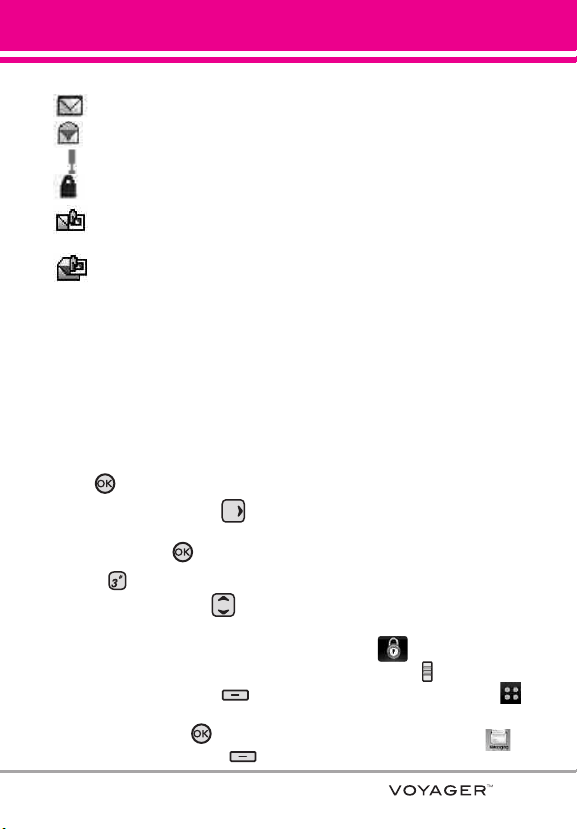
Message Icon Reference
New/Unread TXT Messages
Opened/Read TXT Messages
Priority High
Locked
New/Unread Picture/Video
Messages
Open/Read Picture/Video
Messages
3. Sent
Up to 100 sent messages can be
stored in Sent lists and contents of
sent messages verify whether the
transmission was successful or not.
Using the Internal Keypad
1.
Open the flip and press
the OK
Key [MENU].
2. Press the Directional Key to
access the
Messaging menu
and
press
the OK Key .
3. Press
Sent
.
4. Use the Directional Key to
scroll to a message
entry.
5. Options from here:
●
Press the Left Soft Key
[Erase]
.
●
Press the OK Key [OPEN].
●
Press the Right Soft Key
[Options].
Forward Forwards a sent message
to other destination address(es).
Resend(Send) Allows you to
retransmit the selected message.
For multimedia messages, ‘Resend’
is displayed. For text messages,
'Send' is displayed.
Lock/Unlock Locks or unlocks the
selected message. Locked
messages cannot be deleted by the
Erase Sent and Erase All functions.
Add To Contacts Stores the
callback number, email address,
and numbers from the address of
the received message into your
Contacts.
Erase Sent Erase all unlocked
messages stored in the Sent
messages.
Message Info Allows you to check
the sent message information.
NOTE
Options may vary depending on the
type of message.
Using the External Touch Screen
1. Unlock the Touch Screen by
touching or pulling down
the Unlock Key ( ) on the left
side of your phone and touch
to access the menu.
2. Touch the Messaging icon .
73
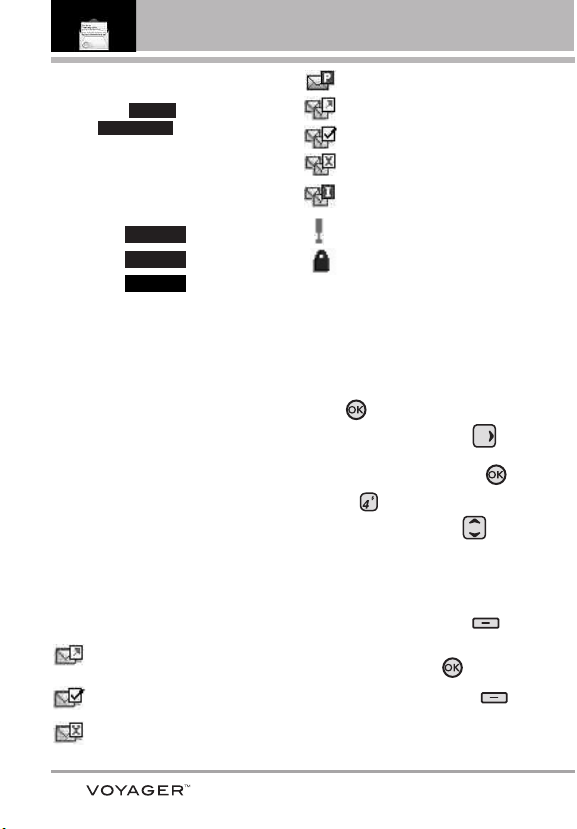
MESSAGING
3. Touch 3. Sent.
NOTE
Touch , then touch
if you want to erase
all read, unlocked messages in your
Sent message box.
4. Touch a message entry.
5. Options from here:
●
Touch .
●
Touch .
●
Touch .
Forward Forwards a sent message
to other destination address(es).
Lock/Unlock Locks or unlocks the
selected message. Locked
messages cannot be deleted by the
Erase Sent and Erase All functions.
Save Quick Text Allows you to
define phrases for Quick Text.
Add To Contacts Stores the
callback number, email address,
and numbers from the address of
the received message into your
Contacts.
Message Info Allows you to check
the sent message information.
Message Icon Reference
Text/Picture/Video Messages
sent
Message delivered
Text/Picture/Video Messages
failed
Message pending
Multiple Messages sent
Multiple Messages delivered
Multiple Messages failed
Multiple Messages
incomplete
Priority High
Locked
4. Drafts
Displays draft messages.
Using the Internal Keypad
1.
Open the flip and press
the OK
Key [MENU].
2. Press the Directional Key to
access the
Messaging
menu
and press
the OK Key .
3. Press
Drafts
.
4. Use the Directional Key to
scroll to a message
entry.
5. Options from here:
●
Press the Left Soft Key
[Erase]
.
●
Press the OK Key [EDIT].
●
Press the Right Soft Key
[Options]
.
Send Sends the selected
message.
Options
SEND
Erase
Erase Sent
Options
74
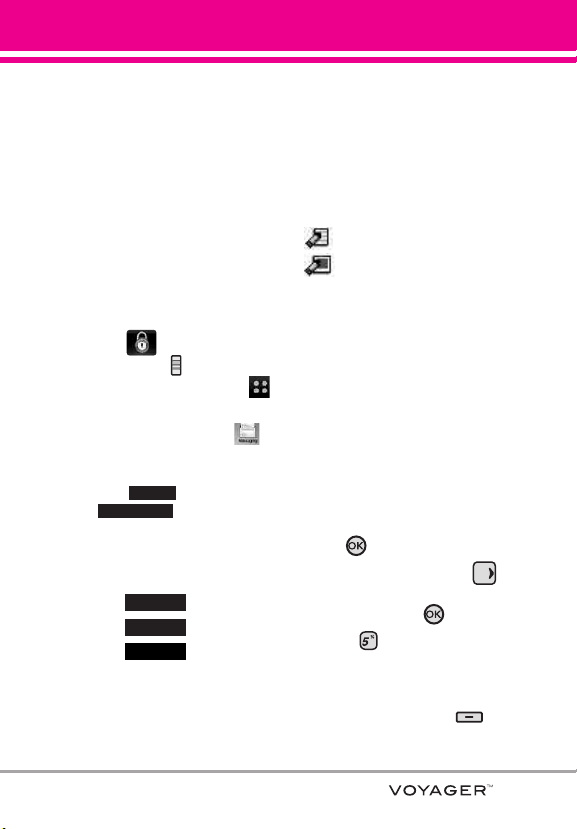
Lock/Unlock Locked messages
cannot be deleted by the Erase
Drafts and Erase All functions.
Add To Contacts Stores the
callback number, email address,
and numbers from the address
included in the Draft message into
your Contacts.
Erase Drafts Erases all unlocked
Draft messages.
Using the External Touch Screen
1. Unlock the Touch Screen by
touching or pulling down
the Unlock Key ( ) on the left
side of your phone and touch
to access the menu.
2. Touch the Messaging icon .
3. Touch
4. Drafts.
NOTE
Touch , then touch
if you want to erase
all read, unlocked Draft messages.
4. Touch a message entry.
5. Options from here:
●
Touch .
●
Touch .
●
Touch .
Send Sends the selected
message.
Lock/Unlock Locked messages
cannot be deleted by the Erase
Drafts and Erase All functions.
Add To Contacts Stores the
callback number, email address,
and numbers from the address
included in the Draft message into
your Contacts.
Message Icon Reference
Draft Text
Draft Picture/Video
5. Voicemail
Allows you to view the number of
new voice messages recorded in
the Voicemail box. Once you exceed
the storage limit, old messages are
overwritten. When you have a new
voice message, your phone will
alert you.
Checking Your Voicemail Box
Using the Internal Keypad
1.
Open the flip and press
the OK
Key [MENU].
2. Press the Directional Key to
access the Messaging menu
and
press
the OK Key .
3. Press
Voicemail
.
4.
Options from here:
●
Press the Left Soft Key
[Clear]
to delete information, and
Options
EDIT
Erase
Erase Drafts
Options
75
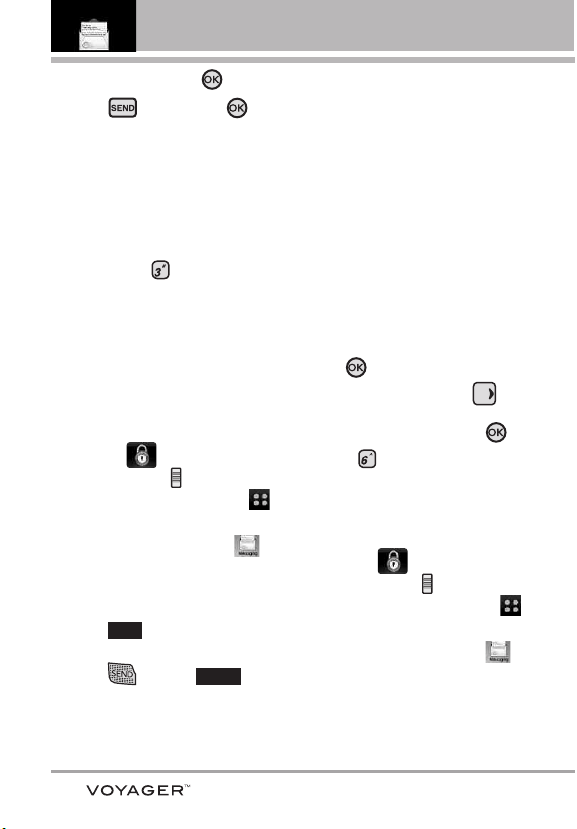
MESSAGING
then press the OK Key
[Yes].
●
Press or the OK Key
[CALL]
to listen to the message(s).
OR
1. Dial *86 (*VM) Send from your
phone or dial your wireless phone
number from any touch-tone phone.
2. When the recorded announcement
begins, press to interrupt (if
applicable).
3. An easy-to-follow setup tutorial will
begin. Follow the instructions to set
up your new password and record
a greeting.
Using the External Touch Screen
1. Unlock the Touch Screen by
touching or pulling down
the Unlock Key ( ) on the left
side of your phone and touch
to access the menu.
2. Touch the Messaging icon .
3. Touch
5. Voicemail.
4.
Options from here:
●
Touch to delete information,
and then touch
Yes.
●
Press or touch to
listen to the message(s).
6. Visual Voice Mail
Visual Voice Mail allows the
management of voice mail directly
from the device rather than
accessing voice mail via traditional
method(s). Visual Voice Mail
displays a list of messages and
allows the user to choose which
message to listen to or delete,
without having to dial into their
mailbox, listen to voice instructions,
or prior messages.
Using the Internal Keypad
1.
Open the flip and press
the OK
Key [MENU].
2. Press the Directional Key to
access the
Messaging
menu
and press
the OK Key .
3.
Press Visual Voice
Mail.
Using the External Touch Screen
1. Unlock the Touch Screen by
touching or pulling down
the Unlock Key ( ) on the left
side of your phone and touch
to access the menu.
2. Touch the Messaging icon .
3. Place your finger on the Touch
Screen and apply gentle upward
pressure to scroll the list up, then
touch
6. Visual Voice Mail.
CALL
CLR
76
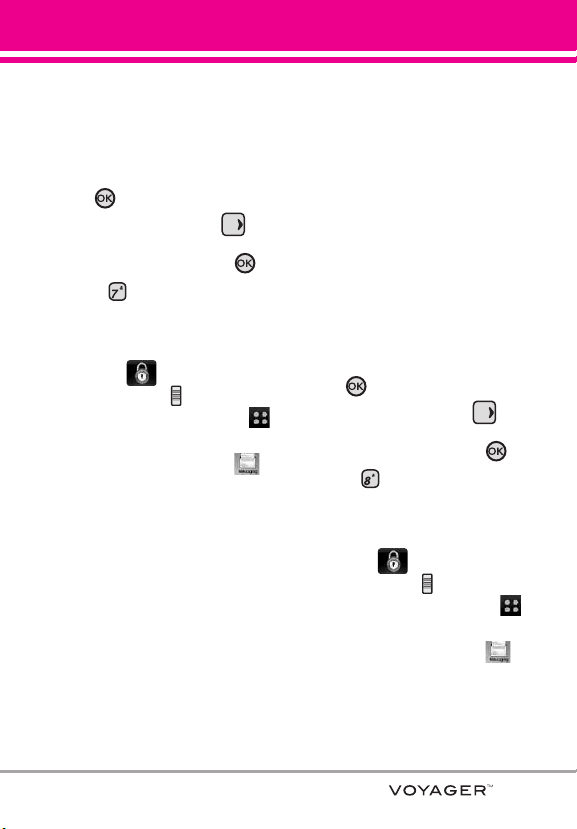
7. Mobile IM
Allows you to send and receive an
Instant Message at any time.
Using the Internal Keypad
1.
Open the flip and press
the OK
Key [MENU].
2. Press the Directional Key to
access the Messaging
menu
and press
the OK Key .
3. Press
Mobile IM
.
Using the External Touch Screen
1. Unlock the Touch Screen by
touching or pulling down
the Unlock Key ( ) on the left
side of your phone and touch
to access the menu.
2. Touch the Messaging icon .
3. Place your finger on the Touch
Screen and apply gentle upward
pressure to scroll the list up, then
touch
7. Mobile IM.
8. Mobile Email
Allows you to mobile email. Select
an email service. Mobile Email is an
application downloadable from the
Messaging Menu. Don't miss an
important email. Thanks to Mobile
Email, you can get your emails on
your phone, while you're on the go.
Mobile Email works with many
providers, including Yahoo!, AOL,
and Verizon.net. Get alerts from your
VOYAGER
TM
when new email has
arrived.
Using the Internal Keypad
1.
Open the flip and press
the OK
Key [MENU].
2. Press the Directional Key to
access the
Messaging
menu
and press
the OK Key .
3. Press
Mobile Email.
Using the External Touch Screen
1. Unlock the Touch Screen by
touching or pulling down
the Unlock Key ( ) on the left
side of your phone and touch
to access the menu.
2. Touch the Messaging icon .
3. Place your finger on the Touch
Screen and apply gentle upward
pressure to scroll the list up, then
touch
8. Mobile Email.
77
MESSAGING
MSG Settings
Allows you to configure settings for
your messages.
Using the Internal Keypad
1.
Open the flip and press
the OK
Key [MENU].
2. Press the Directional Key to
access the Messaging
menu
and press
the OK Key .
3.
Press the Left Soft Key
[Settings]
.
4. Use the Directional Key to
scroll to one of the settings and
press the OK Key to select it.
Using the External Touch Screen
1. Unlock the Touch Screen by
touching or pulling down
the Unlock Key ( ) on the left
side of your phone and touch
to access the menu.
2. Touch the Messaging icon .
3.
Touch .
4. Touch one of the settings.
Message Settings Sub-Menu
Descriptions
1.
Entry Mode (Word/ Abc/ ABC/ 123)
Allows you to select the default input
method.
2. Auto Save (On/ Off/ Prompt)
With this feature on, messages are
automatically saved in the Sent folder
when transmitted.
3. Auto Erase (On/ Off)
With this feature on, read messages
are automatically deleted when you
exceed the storage limit.
4. TXT Auto View (On/On+Readout/
Off)
Allows you to directly display the
content when receiving a message.
5. TXT Auto Play (On/Off)
Allows the display to automatically
scroll down while viewing messages.
6. Pic-Video Auto Receive (On/Off)
Allows you to directly download the
content when receiving a Picture/
Video message.
Settings
78
7. Quick Text
Allows you to display, edit, and add
text phrases. These text strings allow
you to reduce manual text input into
messages.
8. Voicemail #
Allows you to manually enter the
access number for Voicemail Service.
This number should be only used
when a VMS (Voicemail Service)
access number is not provided from
the network.
9. Callback # (On/Off)
Allows you to automatically send a
designated callback number when
you send a message.
10. Signature (None/ Custom)
Allows you make/edit a signature to
automatically send with your
messages.
Erasing Messages
Allows you to erase all messages
stored in your Inbox, Sent, or Drafts
folders. You can also erase all
messages at the same time.
Using the Internal Keypad
1.
Open the flip and press
the OK
Key [MENU].
2. Press the Directional Key to
access the Messaging
menu
and press
the OK Key .
3. Press the Right Soft Key
[Options]
.
●
Press
Erase Inbox
to erase
all messages (read or unread)
or only read messages in the
Inbox.
●
Press
Erase Sent
to erase
all unlocked messages stored
in the Sent folder.
●
Press
Erase Drafts
to
erase all unlocked messages
stored in the Drafts folder.
●
Press
Erase All
to erase
all read messages stored in the
Inbox, Sent, and Drafts folders
(including unread, except
locked messages).
79
MESSAGING
4. Select
Yes
to erase the messages
selected.
A confirmation message is
displayed.
Using the External Touch Screen
1. Unlock the Touch Screen by
touching or pulling down
the Unlock Key ( ) on the left
side of your phone and touch
to access the menu.
2. Touch the Messaging icon .
3.
Touch .
●
Touch 1.
Erase Inbox
to erase
all messages (read or unread)
or only read messages in the
Inbox.
●
Touch 2.
Erase Sent
to erase all
unlocked messages stored in
the Sent folder.
●
Touch 3.
Erase Drafts
to erase
all unlocked messages stored
in the Drafts folder.
●
Touch 4.
Erase All
to erase all
read messages stored in the
Inbox, Sent, and Drafts folders
(including unread, except
locked messages).
4. Touch
Yes
to erase the messages
selected.
A confirmation message is
displayed.
Options
80
CONTACTS
81
C
C
O
O
N
N
T
T
A
A
C
C
T
T
S
S
The Contacts Menu allows you to
store names, phone numbers and
other information in your phone’s
memory.
SHORTCUT
Pressing the Right Soft Key with the flip
open is the hot key to the Contacts List.
1. New Contact
Allows you to add a new number to
your Contacts List.
NOTE
Using this submenu, the number is
saved as a new Contact. To save the
number into an existing Contact, edit
the Contact entry.
Using the Internal Keypad
1.
Open the flip and press
the OK
Key [MENU].
2. Press the Directional Key to
scroll to
Contacts, and press the
OK Key .
3. Press
New Contact
.
4. Enter the name and press the
Directional Key downward.
5. Use the Directional Key to
scroll to the phone number type.
6. Enter the number and press the
OK Key .
NOTE
For more detailed information, see
page 30.
Using the External Touch Screen
1. Unlock the Touch Screen by
touching or pulling down
the Unlock Key ( ) on the left
side of your phone and touch
to access the menu.
2. Touch the Contacts icon .
3. Touch
1. New Contact.
4. Enter the name and other contact
information for each field.
●
Touch a field, enter information,
then touch .
5. Touch to save the
information.
2. Contact List
Allows you to view your Contacts List.
Using the Internal Keypad
1.
Open the flip and press
the OK
Key [MENU].
2. Press the Directional Key to
scroll to Contacts, and press the
OK Key .
3. Press
Contact List
.
4. Press the Directional Key to
scroll through your Contacts
alphabetically.
SAVE
DONE
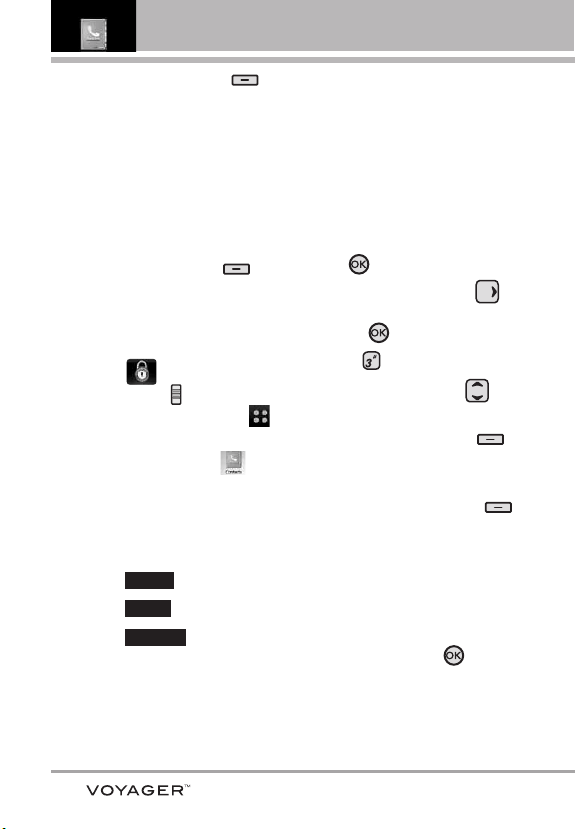
CONTACTS
82
●
Press the Right Soft Key
[Options]
to select one of the
following:
New Contact/ Erase/ New TXT
Message/ New Picture
Message/ New Video
Message/ Set As ICE Contact/
Call/ Erase All/ Send Name
Card
●
Press the Left Soft Key
[Edit]
to edit.
Using the External Touch Screen
1. Unlock the Touch Screen by
touching or pulling down
the Unlock Key ( ) on the left
side of your phone and touch
to access the menu.
2. Touch the Contacts icon .
3. Touch
2. Contact List.
4. Touch a Contact entry.
5. Options from here:
●
Touch .
●
Touch .
●
Touch to select one
of the following:
New TXT Message/ New
Picture Message/ New Video
Message/ Send Name Card/
Set As ICE Contact
3. Groups
Allows you to view your grouped
Contacts, add a new group, change
the name of a group, delete a group,
or send a message to everyone in the
selected group.
Using the Internal Keypad
1.
Open the flip and press
the OK
Key [MENU].
2. Press the Directional Key to
scroll to
Contacts, and press the
OK Key .
3. Press
Groups
.
4. Use the Directional Key to
highlight a group.
●
Press the Left Soft Key
[New]
to add a new group to
the list.
●
Press the Right Soft Key
[Options]
to select one of the
following:
New TXT Message/ New
Picture Message/ New Video
Message/ Rename/ Erase/
Add/ Send Name Card
●
Press the OK Key
[VIEW]
to view the Group information.
Options
EDIT
Erase
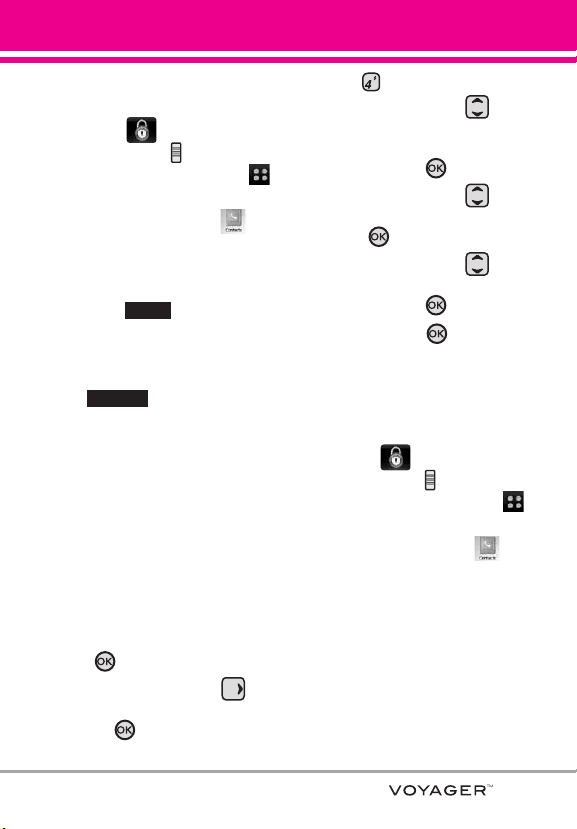
Using the External Touch Screen
1. Unlock the Touch Screen by
touching or pulling down
the Unlock Key ( ) on the left
side of your phone and touch
to access the menu.
2. Touch the Contacts icon .
3. Touch 3. Groups.
4. Options from here:
●
Touch to add a new
group to the list.
●
Touch a group with at least one
member in it then touch
to select one of the
following:
New TXT Message/ New
Picture Message/ New Video
Message
4. Speed Dials
Allows you to view your list of Speed
Dials or designate Speed Dials for
numbers entered in your Contacts.
Using the Internal Keypad
1.
Open the flip and press
the OK
Key [MENU].
2. Press the Directional Key to
scroll to
Contacts, and press the
OK Key .
3. Press
Speed Dials.
4. Use the Directional Key to
scroll to a Speed Dial position, or
enter the Speed Dial digit and
press the OK Key .
5. Use the Directional Key to
scroll to the Contact then press the
OK Key for SET.
6. Use the Directional Key to
scroll to a Contact entry, then
press the OK Key .
7. Press the OK Key
[Yes]
.
A confirmation message is
displayed.
Using the External Touch Screen
1. Unlock the Touch Screen by
touching or pulling down
the Unlock Key ( ) on the left
side of your phone and touch
to access the menu.
2. Touch the Contacts icon .
3. Touch
4.
Speed Dials
.
4. Touch the Speed Dial position.
5. Touch the Contact you wish to
assign a Speed Dial.
6. Touch the number and then touch
Yes
.
A confirmation message is
displayed.
Options
NEW
83
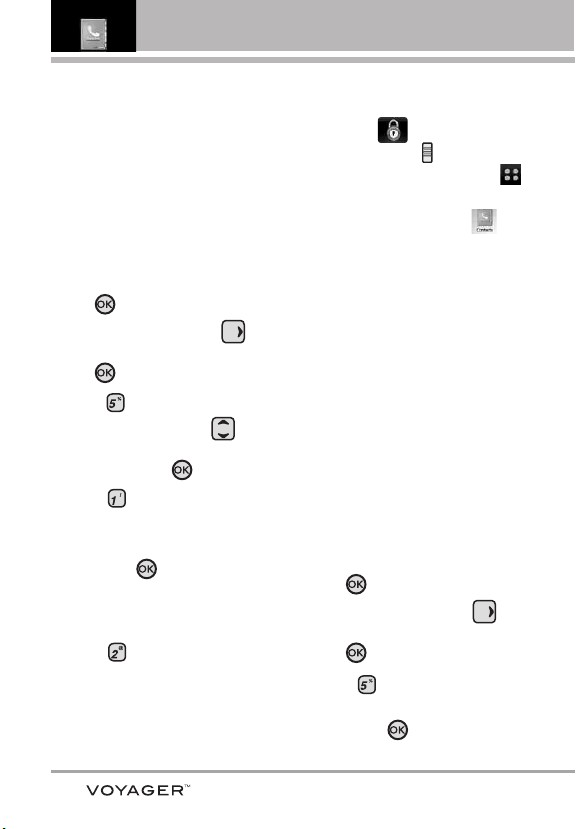
CONTACTS
84
5.
In Case of Emergency (ICE)
This menu allows you to store
names, phone numbers and other
information, which will be very
helpful in case of emergency. Also, it
allows you to read, add, edit, or erase
the notes yourself as necessary in
case an emergency takes place.
Using the Internal Keypad
1.
Open the flip and press
the OK
Key [MENU].
2. Press the Directional Key to
scroll to
Contacts, and press the OK
Key .
3.
Press
In Case of Emergency
.
4. Use the Directional Key to
scroll to Contact 1, 2, or 3, then
press the OK Key
[ADD]
.
5. Press to add Contact from
your Contacts List.
Scroll to the Contact, then press
the OK Key .
ICE Contact Assigned is displayed.
OR
Press to enter information not
stored in your Contacts List.
6. The generic Contact label changes
to the specified name.
Using the External Touch Screen
1. Unlock the Touch Screen by
touching or pulling down
the Unlock Key ( ) on the left
side of your phone and touch
to access the menu.
2. Touch the Contacts icon .
3. Touch 5.
In Case of Emergency
.
4. Touch Contact 1, 2, or 3.
5. Touch From Contacts or New
Contact.
ICE Contact Assigned is displayed.
OR
Enter information not stored in your
Contacts List.
6. The generic Contact label changes
to the specified name.
Entering Your ICE Personal Info
Using the Internal Keypad
1.
Open the flip and press
the OK
Key [MENU].
2. Press the Directional Key to
scroll to
Contacts, and press the OK
Key .
2.
Press
In Case of Emergency
.
3. Scroll to
Personal Info
, then press
the OK Key .
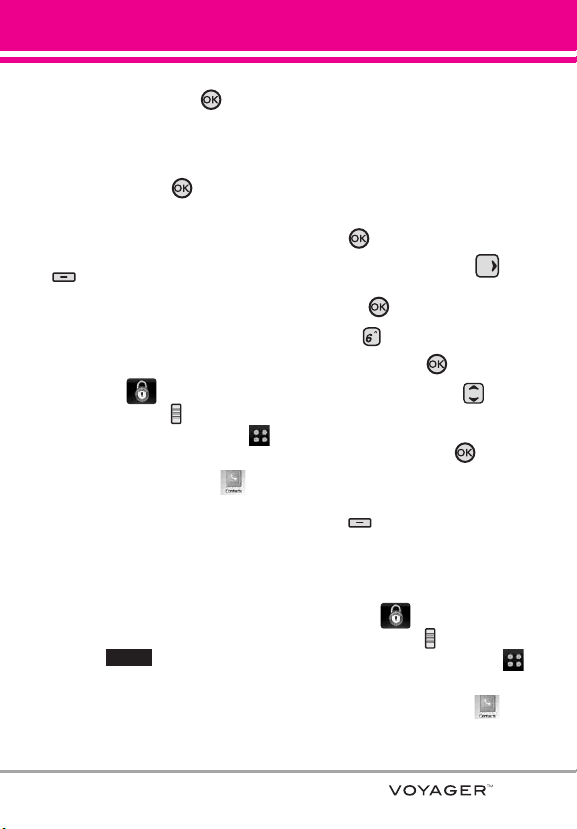
4. Scroll to one of the Note entries,
then press the OK Key .
5. Enter information that would be
helpful in an emergency (e.g., your
medical record number), then
press the OK Key .
TIP
When you've assigned ICE Contacts and your
phone is locked for security, the Left Soft Key
appears as [ICE] allowing the emergency
information to be viewed without unlocking the
phone.
Using the External Touch Screen
1. Unlock the Touch Screen by
touching or pulling down
the Unlock Key ( ) on the left
side of your phone and touch
to access the menu.
2. Touch the Contacts icon .
3. Touch
5.
In Case of Emergency
.
3.
Touch Personal Info
.
4.
Touch
one of the Note entries.
5. Enter information that would be
helpful in an emergency (e.g., your
medical record number), then
touch .
6. My Name Card
Allows you to view all of your own
Contact information including name,
phone numbers, and email address.
Using the Internal Keypad
1.
Open the flip and press
the OK
Key [MENU].
2. Press the Directional Key to
scroll to
Contacts, and press the
OK Key .
3. Press
My Name Card
.
4. Press the OK Key
[EDIT]
.
5. Use the Directional Key to
scroll to information fields, enter
your information as necessary,
then press the OK Key [SAVE].
TIP
You may send your name card using the Right
Soft Key [Options].
Using the External Touch Screen
1. Unlock the Touch Screen by
touching or pulling down
the Unlock Key ( ) on the left
side of your phone and touch
to access the menu.
2. Touch the Contacts icon .
SAVE
85
RECENT CALLS
3. Place your finger on the Touch
Screen and apply gentle upward
pressure to scroll the list up, then
touch 6. My Name Card.
4. Touch .
5. Enter your information as
necessary, then touch .
R
R
E
E
C
C
E
E
N
N
T
T
C
C
A
A
L
L
L
L
S
S
The Recent Calls Menu is a list of
the last phone numbers or Contact
entries for calls you placed,
accepted, or missed. It's continually
updated as new numbers are
added to the beginning of the list
and the oldest entries are removed
from the bottom of the list.
1. Missed
Allows you to view the list of
missed calls; up to 90 entries.
Using the Internal Keypad
1. Open the flip and press
the OK
Key [MENU].
2. Press the Directional Key to
scroll to the RECENT CALLS menu
and then press the OK Key .
3. Press Missed.
4. Use the Directional Key to
scroll to an entry, then
●
Press the OK Key to view
the entry.
●
Press the internal key
to place a call to the number.
SAVE
EDIT
86
87
●
Press the Right Soft Key
[Options] to select:
Save/ Details/ Erase/
Lock(Unlock)/ Erase All/ View
Timers
●
Press the Left Soft Key
[Message] to select:
TXT Msg/ Picture Msg/
Video Msg
Using the External Touch Screen
1. Unlock the Touch Screen by
touching or pulling down
the Unlock Key ( ) on the left
side of your phone and touch
to access the menu.
2. Touch the Recent Calls icon .
3. Touch
1. Missed.
NOTE
Touch Options to Erase All missed
calls or View Timers.
4. Touch a Missed Call entry to view
the entry. Options from here:
●
Touch to place a call to
the number.
●
Touch to send a
TXT Msg / Picture Msg / Video
Msg
●
Touch
Save/ Details/ Erase /
Lock(Unlock) / View Timers
2. Received
Allows you to view the list of
incoming calls; up to 90 entries.
Using the Internal Keypad
1. Open the flip and press
the OK
Key [MENU].
2. Press the Directional Key to
scroll to the RECENT CALLS menu
and press the OK Key .
3. Press Received.
4. Use the Directional Key to
scroll to an entry, then
●
Press the OK Key to view
the entry.
●
Press the internal key to
place a call to the number.
●
Press the Right Soft Key
[Options] to select:
Save/ Details/ Erase/
Lock(Unlock)/ Erase All/ View
Timers
●
Press the Left Soft Key
[Message] to select:
TXT Msg/ Picture Msg/
Video Msg
Options
MSG
Call
RECENT CALLS
88
Using the External Touch Screen
1. Unlock the Touch Screen by
touching or pulling down
the Unlock Key ( ) on the left
side of your phone and touch
to access the menu.
2. Touch the Recent Calls icon .
3. Touch 2. Received.
NOTE
Touch Options to Erase All received
calls or View Timers.
4. Touch a Received Call entry to
view the entry. Options from here:
●
Touch to place a call to
the number.
●
Touch to send a
TXT Msg / Picture Msg /
Video Msg
●
Touch
Save/ Details/ Erase /
Lock(Unlock) / View Timers
3. Dialed
Allows you to view the list of
outgoing calls; up to 90 entries.
Using the Internal Keypad
1. Open the flip and press
the OK
Key [MENU].
2. Press the Directional Key to
scroll to the RECENT CALLS menu
and press the OK Key .
3. Press
Dialed.
4. Use the Directional Key to
scroll to an entry, then
●
Press the OK Key to view
the entry.
●
Press the internal key to
place a call to the number.
●
Press the Right Soft Key
[Options] to select:
Save/ Details/ Erase/
Lock(Unlock)/ Erase All/ View
Timers
●
Press the Left Soft Key
[Message] to select:
TXT Msg/ Picture Msg/
Video Msg
Using the External Touch Screen
1. Unlock the Touch Screen by
touching or pulling down
the Unlock Key ( ) on the left
side of your phone and touch
to access the menu.
2. Touch the Recent Calls icon .
3. Touch
3. Dialed.
NOTE
Touch Options to Erase All dialed calls
or View Timers.
Options
MSG
Call
4. Touch a Dialed Call entry to view
the entry. Options from here:
●
Touch to place a call to
the number.
●
Touch to send a
TXT Msg /Picture Msg /
Video Msg
●
Touch
Save/ Details/ Erase/
Lock(Unlock)/ View Timers
4. All
Allows you to view the list of all
calls; up to 270 entries.
Using the Internal Keypad
1. Open the flip and press
the OK
Key [MENU].
2. Press the Directional Key to
scroll to the RECENT CALLS menu
and press the OK Key .
3. Press
All.
4. Use the Directional Key to
scroll to an entry, then
●
Press the OK Key to view
the entry.
●
Press the internal key to
place a call to the number.
●
Press the Right Soft Key
[Options] to select:
Save/ Erase/ Lock(Unlock)/
Erase All/ View Timers
●
Press the Left Soft Key
[Message] to select:
TXT Msg/ Picture Msg/
Video Msg
Using the External Touch Screen
1. Unlock the Touch Screen by
touching or pulling down
the Unlock Key ( ) on the left
side of your phone and touch
to access the menu.
2. Touch the Recent Calls icon .
3. Touch
4. All.
NOTE
Touch Options to Erase All calls or
View Timers.
4. Touch a Call entry to view the
entry. Options from here:
●
Touch to place a call to
the number.
●
Touch to send a
TXT Msg / Picture Msg /
Video Msg
●
Touch .
Save/ Details/ Erase/
Lock(Unlock)/ View Timers
Options
MSG
Call
Options
MSG
Call
89
SHORTCUT
To view a quick list of all your recent
calls, press the internal key or the
external key from standby mode.
5. View Timers
Allows you to view the duration of
selected calls.
Using the Internal Keypad
1. Open the flip and press
the OK
Key [MENU].
2. Press the Directional Key to
scroll to the RECENT CALLS menu
and press the OK Key .
3. Press View Timers.
4. Use the Directional Key to
scroll to a call list.
Last Call/ All Calls/ Received
Calls/ Dialed Calls/ Roaming
Calls/ Transmit Data/ Received
Data/ Total Data/ Last Reset/
Lifetime Calls/ Lifetime Data
Counter
5. Reset all the recorded timers by
pressing the Right Soft Key
[Reset All] if you want to reset.
Using the External Touch Screen
1. Unlock the Touch Screen by
touching or pulling down
the Unlock Key ( ) on the left
side of your phone and touch
to access the menu.
2. Touch the Recent Calls icon .
3. Touch
5. View Timers.
4.
Touch
a call list.
Last Call/ All Calls/ Received
Calls/ Dialed Calls/ Roaming
Calls/ Transmit Data/ Received
Data/ Total Data/ Last Reset/
Lifetime Calls/ Lifetime Data
Counter
5. Reset all the recorded timers by
touching if you want to
reset.
Reset
All
RECENT CALLS
90
S
S
E
E
T
T
T
T
I
I
N
N
G
G
S
S
&
&
T
T
O
O
O
O
L
L
S
S
1. My Verizon
Check your subscription
information ranging from your
payment plan to your software
upgrade or other available services.
Using the Internal Keypad
1.
Open the flip and press
the OK
Key [MENU].
2. Press the Directional Key to
scroll to the
Settings & Tools
menu
and press
the OK Key .
3. Press
My Verizon
.
Using the External Touch Screen
1. Unlock the Touch Screen by
touching or pulling down
the Unlock Key ( ) on the left
side of your phone and touch
to access the menu.
2. Touch the Settings & Tools icon
.
3. Touch 1. My Verizon.
2. Tools
Your phone tools include Voice
Commands, Calculator, Calendar,
Alarm Clock, Stopwatch, World
Clock, Notepad, Ez Tip Calc and
USB Mass Storage.
2.1 Voice Commands
This feature provides you with the
following options equipped with AVR
(Advanced Voice Recognition)
technology. Each option has its
detailed information on the phone and
you can check it out by pressing the
Left Soft Key [Info] or by
touching when operating the
touch screen.
Access and Options
Using the Internal Keypad
1.
Open the flip and press
the OK
Key [MENU].
2. Press the Directional Key to
scroll to the
Settings & Tools
menu
and press
the OK Key .
3. Press
Tools
.
4. Press
Voice Commands
.
Info
SETTINGS & TOOLS
91
SETTINGS & TOOLS
92
Using the External Touch Screen
1. Unlock the Touch Screen by
touching or pulling down
the Unlock Key ( ) on the left
side of your phone and touch
to access the menu.
2. Touch the Settings & Tools icon
.
3. Touch 2. Tools.
4. Touch
1. Voice Commands.
Your Voice Commands can be
customized by pressing the Right Soft
Key
[Settings]
with the flip
open, or touching .
Digit Dial Readout
On/ Off
Choice List
Automatic/ Always Off
Sensitivity Control the sensitivity as
Reject More/ Automatic/ Reject
Less
.
Train Voice If the phone often asks
you to repeat voice command, train
the phone to recognize your voice
patterns. Digit Dial/ Responses
Prompts Mode/ Audio Playback/
Timeout
For Mode, set Prompts/ Readout +
Alerts/ Readout/ Tones Only.
For Audio Playback,
set Speakerphone or Earpiece.
For Timeout, set 5 seconds or
10 seconds.
Call Alert
Ring Only/ Caller ID +
Ring/ Name Repeat
2.1.1 Call <Name or Number>
Say "Call" and then call someone
simply by saying the phone number or
name. Please speak clearly and
exactly as in your Contacts list. When
you have more than one contact
number, you can state the name and
number type of the contact (for
example, 'Call John Work').
2.1.2 Send Msg to <Name or Number>
Say 'Send Message' and the voice
command will prompt you for the type
of message. After choosing the
message type, system will ask you for
the contact name, number or group. It
will automatically start a message. If
you say a full-sentence command,
such as 'Send Message to Bob', it
would automatically start a text
message without asking for the
message type. When using 'Send
Message' command, speak clearly
and say the number, group name, or
name exactly as it is entered in your
Contacts list.
Settings
93
2.1.3 Go to <Menu>
The 'Go to' command allows you to
access a menu within the phone (for
example, 'Go to Calendar').
If no menu option is stated, a list of
options will be provided.
2.1.4 Check <Item>
The "Check" command allows you to
check out a wide range of items from
the battery level, service mode, signal
strength, GPS location, network
status, volume, number of missed
calls, voicemail, messages, to time
and date.
2.1.5 Lookup <Name>
You can look up names in your
Contacts (for example, 'Lookup John'):
Read out/ Create New/ Erase/
Modify
2.1.6 My Verizon
The "My Verizon" command provides
you with direct access to your Verizon
Wireless account information.
2.1.7 Help
Provides a general guideline to using
Voice Commands.
2.2 Calculator
Allows you to perform simple
mathematical calculations. You can
enter numbers up to eight digits.
Calculations can be made with up to 3
lines at one time.
Using the Internal Keypad
1.
Open the flip and press
the OK
Key [MENU].
2. Press the Directional Key to
scroll to the
Settings & Tools
menu
and press
the OK Key .
3. Press
Tools
.
4. Press Calculator.
5. Enter the numbers to get the value
you want. To cancel a number, press
the Left Soft Key
[Reset]
.
6. Press the Right Soft Key
[Options] to add parenthesis or
power among numbers for
calculation.
SETTINGS & TOOLS
94
Using the External Touch Screen
1. Unlock the Touch Screen by
touching or pulling down
the Unlock Key ( ) on the left
side of your phone and touch
to access the menu.
2. Touch the Settings & Tools icon
.
3. Touch 2. Tools.
4. Touch
2.
Calculator
.
5. Enter the numbers to get the value
you want. To cancel a calculation,
touch .
6. Touch to add
parenthesis or power among
numbers for calculation.
2.3 Calendar
Allows you to keep your agenda
convenient and easy to access.
Simply store your appointments and
your phone will alert you with a
reminder you set.
Using the Internal Keypad
SHORTCUT
Unlock the Touch Screen by touching or
pulling down the Unlock Key ( ) on the left
side of your phone, then touch the screen with
your finger to access the shortcut menu, then
touch the Calendar Icon .
With the flip open, pressing the Directional Key
from standby mode is a hot key to
Calendar by default.
1.
Open the flip and press
the OK
Key [MENU].
2. Press the Directional Key to
scroll to the
Settings & Tools
menu
and press
the OK Key .
3. Press
Tools
.
4. Press
Calendar
.
5. Use the Directional Key to
scroll to the scheduled day.
Left Moves cursor to the
previous day.
Right Moves cursor to the
next day.
Up Moves to the previous
week.
Down Moves to the next
week.
6. Press the Left Soft Key
[Add]
.
7. Enter Subject, then scroll down to
set other remaining settings.
8. Scroll to a Calendar setting field,
then press the Left Soft Key
[Set]
. For each Calendar event you
can set:
●
Start Time
●
End Time
●
Repeat
●
Until
Options
Reset
●
Alerts
●
Tones
●
Vibrate
9. Use the Directional Key to
choose a setting, then press the
OK Key .
10.Press the OK Key
[SAVE]
when Calendar information is
complete.
Using the External Touch Screen
1. Unlock the Touch Screen by
touching or pulling down
the Unlock Key ( ) on the left
side of your phone and touch
to access the menu.
2. Touch the Settings & Tools icon
.
3. Touch 2. Tools.
4. Touch 3. Calendar.
5. Touch the scheduled day.
6. Touch .
7. Touch Subject field and fill it in.
8. Scroll to a Calendar setting field.
For each Calendar event you can
set:
●
Start Time
●
End Time
●
Repeat
●
Until
●
Alerts
●
Tones
●
Vibrate
9. Touch when Calendar
information is complete.
2.4 Alarm Clock
Allows you to set one of three
alarms. At the alarm time, Alarm 1
(or 2 or 3) will be displayed on the
LCD screen and the alarm will
sound.
SHORTCUT
Unlock the Touch Screen by touching or
pulling down the Unlock Key ( ) on the left
side of your phone
,
then touch the screen with
your finger to access the shortcut menu, then
touch the Alarm Clock Icon .
Using the Internal Keypad
1.
Open the flip and press
the OK
Key [MENU].
2. Press the Directional Key to
scroll to the
Settings & Tools
menu
and press
the OK Key .
3. Press Tools.
4. Press Alarm Clock.
5. Use the Directional Key to
scroll to an Alarm (1, 2, or 3), then
press the OK Key .
6. Enter the alarm information
including:
●
Turn On/Off
●
Set Time
●
Repeat
●
Ringtone
SAVE
Add
95
SETTINGS & TOOLS
7. Use the Directional Key to
scroll to the information you want
to set, then press the Left Soft
Key [Set] to view your
setting choices.
8. Press the OK Key
[SAVE]
after setting all of the Alarm fields
as necessary.
When the alarm goes off, you
can choose to "snooze" or
"dismiss" the alarm. To turn it off,
press the OK Key , the side
keys, any of the alphanumeric
keys, or the vibrate mode key.
Using the External Touch Screen
1. Unlock the Touch Screen by
touching or pulling down
the Unlock Key ( ) on the left
side of your phone and touch
to access the menu.
2. Touch the Settings & Tools icon
.
3. Touch
2. Tools.
4. Touch 4. Alarm Clock.
5. Touch an Alarm (1, 2, or 3).
6. Enter the alarm information
including:
●
Turn On/Off
●
Set Time
●
Repeat
●
Ringtone
7.
Touch
after setting all of
the Alarm fields as necessary.
2.5 Stopwatch
Allows you to use your phone as
typical stopwatch. Start measuring
time and finish it pressing the OK
Key .
Using the Internal Keypad
1.
Open the flip and press
the OK
Key [MENU].
2. Press the Directional Key to
scroll to the
Settings & Tools
menu
and press
the OK Key .
3. Press Tools.
4. Press Stopwatch.
5. Press the OK Key [Start],
then options from here:
●
Press the Left Soft Key
[Lap].
●
Press the Right Soft Key
[Reset].
Using the External Touch Screen
1. Unlock the Touch Screen by
touching or pulling down
the Unlock Key ( ) on the left
side of your phone and touch
to access the menu.
SAVE
96
2. Touch the Settings & Tools icon
.
3. Touch
2. Tools.
4. Touch 5. Stopwatch.
5. Touch , then options from
here:
●
Touch
.
●
Touch
.
2.6 World Clock
Allows you to determine the current
time in another time zone or country
by navigating with the left or right
Directional Keys.
Using the Internal Keypad
1.
Open the flip and press
the OK
Key [MENU].
2. Press the Directional Key to
scroll to the
Settings & Tools
menu
and press
the OK Key .
3. Press Tools.
4. Press
World Clock.
5. Press the Right Soft Key
[Cities]
to choose from a list of
available cities.
6. Select a city from the list, then
press the OK Key . The display
shows the position of the city on a
global map.
7. Press the OK Key again to
zoom in on the city and view its
date and time infomation.
Using the External Touch Screen
1. Unlock the Touch Screen by
touching or pulling down
the Unlock Key ( ) on the left
side of your phone and touch
to access the menu.
2. Touch the Settings & Tools icon
.
3. Touch
2. Tools.
4. Place your finger on the Touch
Screen and apply gentle upward
pressure to scroll the list up, then
touch 6. World Clock.
5. Touch to choose from a
list of available cities.
6. Touch a city from the list.
The display shows the position of
the city on a global map.
7. Touch again to zoom in on
the city and view its date and time
infomation.
NOTE
With the Left Soft Key [Set DST]
or touch set to daylight saving
time.
Set
DST
OK
Cities
Reset
Lap
START
97
SETTINGS & TOOLS
2.7 Notepad
Allows you to add, read, edit, and
erase notes to yourself.
Using the Internal Keypad
1.
Open the flip and press
the OK
Key [MENU].
2. Press the Directional Key to
scroll to the
Settings & Tools
menu
and press
the OK Key .
3. Press
Tools
.
4. Press
Notepad
.
5. Press the Left Soft Key
[Add]
to write a new note.
6. After filling in the note, press the
OK Key to save it.
Using the External Touch Screen
1. Unlock the Touch Screen by
touching or pulling down
the Unlock Key ( ) on the left
side of your phone and touch
to access the menu.
2. Touch the Settings & Tools icon
.
3. Touch 2. Tools.
4. Place your finger on the Touch
Screen and apply gentle upward
pressure to scroll the list up, then
touch
7. Notepad.
5. Touch to write a new note.
6. Touch to change the entry
mode.
7. After filling in the note, touch
to save it.
2.8 Ez Tip Calc
Allows you to quickly and easily
calculate bill amounts using the bill
total, tip % and number of people as
variables.
Using the Internal Keypad
1.
Open the flip and press
the OK
Key [MENU].
2. Press the Directional Key to
scroll to the
Settings & Tools
menu
and press
the OK Key .
3. Press
Tools
.
4. Press
Ez Tip Calc
.
5. Enter the variable fields (Total bill,
Tip (%), Split) and the
corresponding calculation fields
(tip and total for each person)
appear automatically.
6. Press the Left Soft Key
[Reset]
for another calculation.
SAVE
Abc
Add
98
Using the External Touch Screen
1. Unlock the Touch Screen by
touching or pulling down
the Unlock Key ( ) on the left
side of your phone and touch
to access the menu.
2. Touch the Settings & Tools icon
.
3. Touch 2. Tools.
4. Place your finger on the Touch
Screen and apply gentle upward
pressure to scroll the list up, then
touch
8. Ez Tip Calc.
5. Enter the variable fields (Total
bill, Tip %, Split).
●
Touch the Total bill field and
touch keys appear to enter the
amount.
●
Touch the left and right arrow
keys to increase or decrease the
amount(s).
Corresponding calculation fields
(tip and total for each person)
appear automatically.
6.
Touch
for another
calculation.
2.9 USB Mass Storage
This menu allows you to transfer
content from your phone to your
Windows
®
XP or Windows Vista
™
PC
(or vice versa) when your phone is
connected to your Windows
®
XP or
Windows Vista
™
PC with a compatible
USB cable. Mac OS operating system
is not supported.
You can only access this menu when
a microSD
TM
card is inserted in your
phone (see page 24 to insert it).
NOTE
Do not insert or remove the microSD
T
M
while playing, deleting or downloading
Pictures/ Videos/ Music/ Sounds.
Using the Internal Keypad
1.
Open the flip and press
the OK
Key [MENU].
2. Press the Directional Key to
scroll to the
Settings & Tools
menu
and press
the OK Key .
3. Press
Tools
.
4. Press
USB Mass Storage
.
Using the External Touch Screen
1. Unlock the Touch Screen by
touching or pulling down
the Unlock Key ( ) on the left
side of your phone and touch
to access the menu.
2. Touch the Settings & Tools icon
.
3. Touch
2. Tools.
Reset
99
SETTINGS & TOOLS
4. Place your finger on the Touch
Screen and apply gentle upward
pressure to scroll the list up, then
touch 9. USB Mass Storage.
3. Bluetooth Menu
The VOYAGER
TM
is compatible with
devices that support the Bluetooth
®
Headset, Handsfree, Dial Up
Networking, Stereo, Phonebook
Access, Basic Printing, Object Push,
File Transfer, Basic Imaging and
Human Interface profiles.*
You may create and store 20
pairings within the VOYAGER
TM
and
connect to one device at a time.
The approximate communication
range for Bluetooth
®
wireless
technology is up to 30 feet (10 meters).
Bluetooth QD ID B013121
SHORTCUT
Unlock the Touch Screen by touching or
pulling down the Unlock Key ( ) on the left
side of your phone
,
then touch the screen with
your finger to access the shortcut menu, then
touch the Bluetooth
®
Icon .
NOTE
Read the user guide of each
Bluetooth
®
accessory that you are
trying to pair with your phone because
the instructions may be dif
ferent.
NOTE
Your phone is based on the Bluetooth
®
specification, but it is not guaranteed to
work with all devices enabled with
Bluetooth
®
wireless technology.
Phone does not support ALL
Bluetooth
®
OBEX Profiles.
* For vehicle/accessory compatibility
go to www.verizonwireless.com/
bluetoothchart.
TIPS
●
The Human Interface Design (HID) profile is
supported only from keyboard input and
available only when the flip is open.
●
The Headset, Handsfree, Dial Up Networking
and Stereo profiles supported by VOYAGER
TM
provides you with the ability to use the
integrated music player (and optional
Bluetooth
®
stereo headset) to listen to WMA,
MP3, AAC, AAC+, etc. music providing you
with lots of listening fun.
●
Object Push Profile allows you to transfer a
contact entry (vCard) and/or transfer a
calendar event (vCal) to another OPP-enabled
Bluetooth
®
device.
●
Image transfer of user generated content is
available via the Basic Imaging Profile.
This profile allows sending of non-protected
images to a compatible device for storing and
printing.
●
Phonebook Access Profile allows your car kit
and your phone to share information. By
pairing the devices and connecting with this
profile, you can access and use your phone
book data while in your vehicle.
●
File Transfer allows sending or receiving non-
protected data files to a compatible Bluetooth
®
device.
●
Basic Print Profile is a profile to transfer user-
generated images to a printer and print them
out.
The steps are: Open the flip and press the OK
Key
[MENU] -> press the OK Key to
100
access the Media Center menu -> press
Picture & Video -> press My Pictures ->
Highlight the picture you want to print and press
the Right Soft Key
[Options] -> use the
Directional Key to scroll to
Print and press
Print via Bluetooth to select a Bluetooth
device and print.
3.1 Add New Device
Pairing is the process that allows
the handset to locate, establish, and
register 1-to-1 connection with the
target device.
For pairing with a new Bluetooth
®
device Using the Internal Keypad
1. Follow the Bluetooth
®
accessory
instructions to set the device to
pairing mode.
2. Press the OK Key
[MENU].
3. Press the Directional Key to
scroll to the Settings & Tools
menu and press the OK Key .
4. Press Bluetooth Menu.
TIP
When the flip is closed, unlock the external
screen by touching the unlock key icon. Then
simply touch the external screen to access the
SHORTCUT MENU screen and touch the
Bluetooth menu.
5. Press Add New Device.
Set the desired device to pairing.
6. If Bluetooth
®
power is set to off,
you will be prompted to turn
power on. Select Yes and press
the OK Key then press OK
Key again.
7. The device will appear in
Add
New Device menu once it has
been located. Highlight the
device and press the OK Key .
8. The handset will prompt you for
the passcode. Consult the
Bluetooth
®
accessory
instructions for the appropriate
passcode (typically “0000” - 4
zeroes). Enter the passcode and
press the OK Key .
9. Once pairing is successful, select
either Always Ask or Always
Connect and press the OK Key
. (except audio devices)
10. Once connected, you will see
the device listed in the
Bluetooth
®
Menu and the
Bluetooth
®
device connected
icon will show up on your
enunciator when connected to
the Bluetooth
®
device.
Using the External Touch Screen
1. Unlock the Touch Screen by
touching or pulling down
the Unlock Key ( ) on the left
101
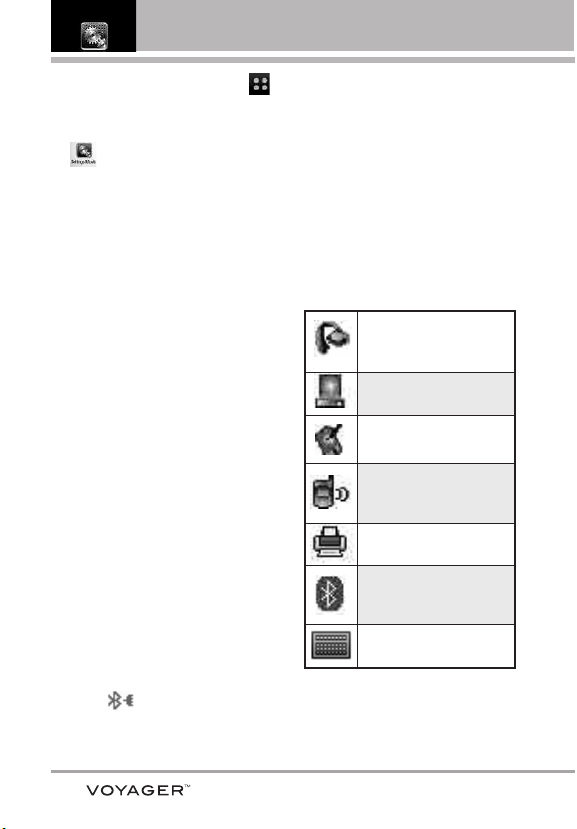
SETTINGS & TOOLS
side of your phone and touch
to access the menu.
2. Touch the Settings & Tools icon
.
3. Touch
3. Bluetooth Menu.
4. Touch 1. Add New Device.
Set the desired device to pairing.
6. If Bluetooth
®
power is set to off,
you will be prompted to turn
power on. Touch Yes to begin
search.
7. The device will appear in
Add
New Device menu once it has
been located. Touch the device.
8. The handset will ask you for the
passcode. Consult the Bluetooth
®
accessory instructions for the
appropriate passcode (typically
“0000” - 4 zeroes). Enter the
passcode.
9. Once pairing is successful, touch
either Always Ask or Always
Connect. (except audio devices)
10. Once connected, you will see
the device listed in the
Bluetooth
®
Menu and the
Bluetooth
®
device connected
icon will show up on your
enunciator when connected to
the Bluetooth
®
device.
Icon Reference in Adding New
Device
When the Bluetooth
®
wireless
connection is built and paired devices
are found, the following icons are
displayed.
●
Icon References When a
Bluetooth
®
Wireless Connection
is Searched (neither connected
nor paired).
When an audio device is
searched by your
VOYAGER
TM
device
When a PC is searched by
your VOYAGER
TM
device
When a PDA is searched by
your VOYAGER
TM
device
When another phone
device is searched by your
VOYAGER
TM
device
When a printer is found by
your VOYAGER
TM
device
When other undefined
devices are found by your
VOYAGER
TM
device
When a keyboard is found
by your VOYAGER
TM
device
102
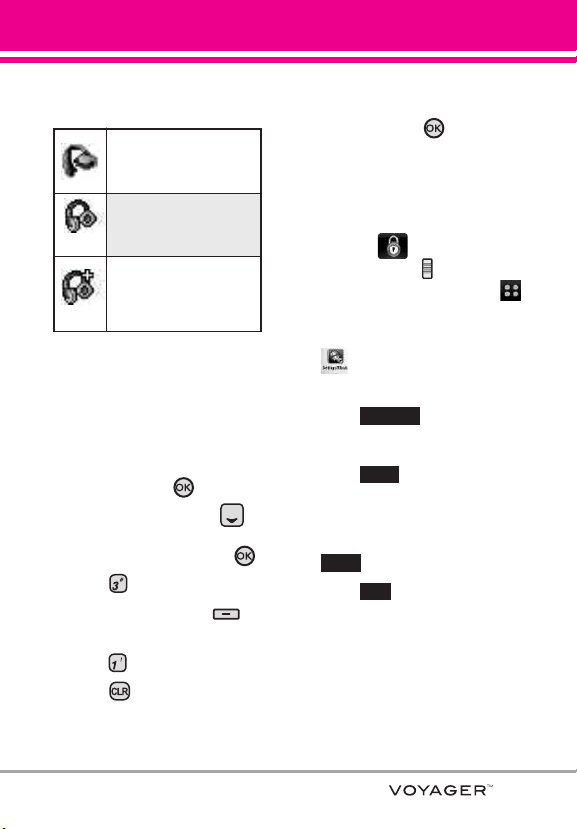
●
Icon References When
Successfully Connected
My Phone Name
Allows you to edit the name of the
Bluetooth
®
device when Add New
Device menu is highlighted.
Using the Internal Keypad
1.
Press
the OK Key [MENU].
2. Press the Directional Key to
scroll to the
Settings & Tools
menu
and press
the OK Key .
3. Press
Bluetooth Menu
.
4. Press the Right Soft Key
[Options].
5. Press
My Phone Name
.
6. Press to clear the existing
name or edit it.
7. Use the keypad to enter a new
custom name.
8. Press the OK Key to save and
exit.
Using the External Touch Screen
1. Unlock the Touch Screen by
touching or pulling down
the Unlock Key ( ) on the left
side of your phone and touch
to access the menu.
2. Touch the Settings & Tools icon
.
3. Touch
3. Bluetooth Menu.
4.
Touch .
5. Touch
My Phone Name
.
6. Touch to clear the existing
name or edit it.
7. Use the pop-up keypad to enter a
new custom name and touch
.
8. Touch to save and exit.
TIP
Bluetooth
®
wireless connection is dependent on
your Blueooth stereo device. Even though you
want to connect with a headset that supports
both HFP and A2DP, you may only be able to
connect with one.
OK
Done
CLR
Options
When an only mono
headset is connected with
your VOYAGER
TM
device
When an only stereo
headset is connected with
your VOYAGER
TM
device
When stereo headsets and
mono headsets are all
connected with your
VOYAGER
T
M
device
103
SETTINGS & TOOLS
Turn On
Allows you to set the phone's
Bluetooth
®
power On/Off.
Using the Internal Keypad
1.
Open the flip and press
the OK
Key [MENU].
2. Press the Directional Key to
access the
Settings & Tools
menu
and press
the OK Key .
3. Press
Bluetooth Menu
.
4. Press the Left Soft Key
[Turn
On]
.
NOTE
By default, your device’s Bluetooth
®
functionality is turned of
f.
Using the External Touch Screen
1. Unlock the Touch Screen by
touching or pulling down
the Unlock Key ( ) on the left
side of your phone and touch
to access the menu.
2. Touch the Settings & Tools icon
.
3. Touch
3. Bluetooth Menu.
4.
Touch .
Discovery Mode
Allows you to set whether your
device is able to be searched by
other Bluetooth devices in the area.
Using the Internal Keypad
1.
Press
the OK Key [MENU].
2. Press the Directional Key to
scroll to the
Settings & Tools
menu
and press
the OK Key .
3. Press
Bluetooth Menu
.
4. Press the Right Soft Key
[Options]
.
5. Press
Discovery Mode
.
TIP
Touch the Touch Key when the flip is
closed to enter Discovery Mode.
6. Use the Directional Key to
scroll to a setting, then press the
OK Key .
On/ Off
NOTE
If you choose On for Discovery Mode,
your device is able to be searched by
other in-range Bluetooth
®
devices.
Using the External Touch Screen
1. Unlock the Touch Screen by
touching or pulling down
the Unlock Key ( ) on the left
side of your phone and touch
to access the menu.
SHOW
ON
104
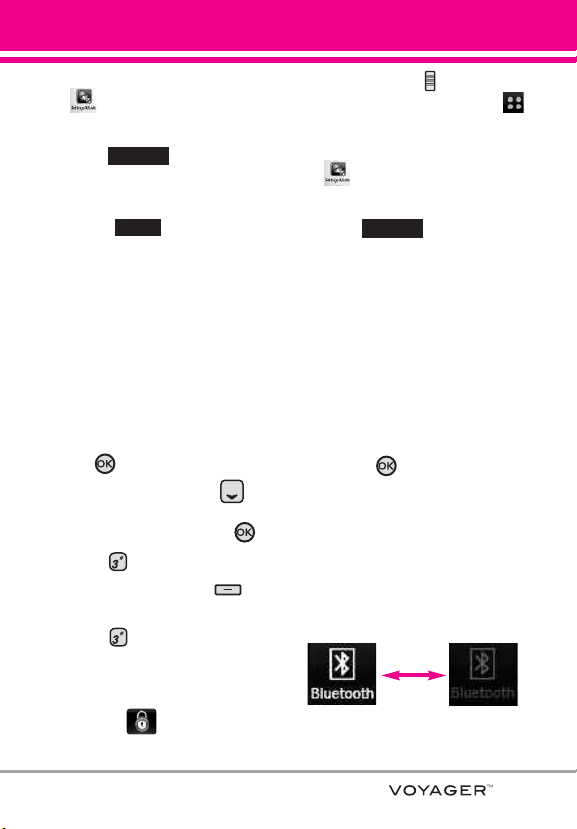
2. Touch the Settings & Tools icon
.
3. Touch
3. Bluetooth Menu.
4.
Touch .
5. Touch
Discovery Mode
.
TIP
Simply touch to enter Discovery
Mode.
6. Touch a setting.
On/ Off
Supported Profiles
Allows you to see profiles that your
VOYAGER
TM
phone can support.
Using the Internal Keypad
1.
Open the flip and press
the OK
Key [MENU].
2. Press the Directional Key to
scroll to the
Settings & Tools
menu
and press
the OK Key .
3. Press
Bluetooth Menu
.
4. Press the Right Soft Key
[Options].
5. Press
Supported Profiles
.
Using the External Touch Screen
1. Unlock the Touch Screen by
touching or pulling down
the Unlock Key ( ) on the left
side of your phone and touch
to access the menu.
2. Touch the Settings & Tools icon
.
3. Touch
3. Bluetooth Menu.
4.
Touch .
5. Touch
Supported Profiles
.
Last Search
Allows you to view the information of
the devices you have at least once
tried to search.
Auto Pair Handsfree
If you attempt to pair a device that is
part of the handsfree/headset profile,
the “PAIR”/ is selected. Your
device will automatically attempt to
pair using a “0000” passcode.
Transferring Audio
When a Bluetooth
®
audio device is
connected,
Audio To Phone/ Audio
To Device
is displayed in the Options
menu only during a call.
Options
SHOW
Options
105
When the Bluetooth
function is turned on
during a call
When the Bluetooth
function is turned off
during a call
SETTINGS & TOOLS
Audio To Phone Sound comes from
the handset.
Audio To Device Sound comes from
the Bluetooth
®
audio device.
You have the following options in the
paired device.
●
For devices that support OBEX
profiles:
1.
Remove Device
: You can remove
the device from the pairing list.
2.
Rename Device
: You can rename
the name of the paired device.
3.
Incoming Security
: Allows you to
set permission before connecting
an incoming device.
4.
Service Discovery
: Allows you to
search for the services that the
selected device supports.
5.
Device Info
: Shows the device
information.
6.
Send Name Card
: You can
transfer Contacts list to other
devices, except audio devices.
7.
Send Calendar Event
: You can
transfer Calendar events to other
devices, except audio devices.
8.
Send Picture: You can transfer
images to a device that supports
Basic Imaging Profile (BIP) profiles.
●
For headset devices:
1.
Remove Device
: You can remove
the device from the pairing list.
2.
Rename Device
: You can rename
the name of the paired device.
3.
Service Discovery
: Allows you to
search for the services that the
selected device supports.
4.
Device Info
: Shows the device
information.
5.
Send Name Card:
You can
transfer Contacts list to other
devices, except audio devices.
NOTES
•
If you want to connect to a device already in
your paired list, touch and hold the name of
the device in the list to connect. For a list of
options to choose from, just touch the device
name.
•
When the flip is open in the pairing list, you
can disconnect the connected device with the
blue arrow signal by pressing the OK Key
. Reversely, you can turn it on by
pressing the OK Key again.
•
When an audio device is connected, then you
select another device and press the OK Key
, the connection is transferred from the
audio device to the other one.
•
If your search fails to find any pairing device,
or you want to search again, touch the
Touch Key to try again.
•
Print Picture allows you to print to devices that
support BPP profiles.
REFRESH
106
4. Sounds Settings
Provides options to customize the
phone’s sounds.
4.1 Master Volume
Allows you to set volume settings.
Using the Internal Keypad
1.
Open the flip and press
the OK
Key [MENU].
2. Press the Directional Key to
scroll to the
Settings & Tools
menu
and press
the OK Key .
3. Press
Sounds Settings
.
4. Press
Master Volume
.
5. Adjust the volume with the
Directional Key then press
the OK Key to save the setting.
6. You can try playing each master
volume with the Left Soft Key
[Play]
.
Using the External Touch Screen
1. Unlock the Touch Screen by
touching or pulling down
the Unlock Key ( ) on the left
side of your phone and touch
to access the menu.
2. Touch the Settings & Tools icon
.
3. Touch
4. Sounds Settings.
4. Touch
1. Master Volume.
5. Adjust the volume by touching up
or down arrow buttons and touch
to save the setting.
4.2 Call Sounds
Allows you to set how the phone
alerts you for types of incoming calls.
Using the Internal Keypad
1.
Open the flip and press
the OK
Key [MENU].
2. Press the Directional Key to
scroll to the
Settings & Tools
menu
and press
the OK Key .
3. Press
Sounds Settings
.
4. Press
Call Sounds
.
Using the External Touch Screen
1. Unlock the Touch Screen by
touching or pulling down
the Unlock Key ( ) on the left
side of your phone and touch
to access the menu.
2. Touch the Settings & Tools icon
.
3. Touch
4. Sounds Settings.
4. Touch 2. Call Sounds.
SET
107
SETTINGS & TOOLS
4.2.1 Call Ringtone
Using the Internal Keypad
1.
Open the flip and press
the OK
Key [MENU].
2. Press the Directional Key to
scroll to the
Settings & Tools
menu
and press
the OK Key .
3. Press
Sounds Settings
.
4. Press
Call Sounds
.
5. Press
Call Ringtone
.
6. Use the Directional Key to
scroll to a ringtone then press the
OK Key to save the sound.
Using the External Touch Screen
1. Unlock the Touch Screen by
touching or pulling down
the Unlock Key ( ) on the left
side of your phone and touch
to access the menu.
2. Touch the Settings & Tools icon
.
3. Touch
4. Sounds Settings.
4. Touch 2. Call Sounds.
5.
Touch
1.
Call Ringtone
.
6. Touch a ringtone, then touch
to save the sound.
4.2.2 Call Vibrate
Using the Internal Keypad
1.
Open the flip and press
the OK
Key [MENU].
2. Press the Directional Key to
scroll to the
Settings & Tools
menu
and press
the OK Key .
3. Press
Sounds Settings
.
4. Press
Call Sounds
.
5. Press
Call Vibrate
.
6. Use the Directional Key to
scroll to a setting, then press the
OK Key .
On/ Off
Using the External Touch Screen
1. Unlock the Touch Screen by
touching or pulling down
the Unlock Key ( ) on the left
side of your phone and touch
to access the menu.
2. Touch the Settings & Tools icon
.
3. Touch
4. Sounds Settings.
4. Touch 2. Call Sounds.
5.
Touch
2.
Call Vibrate
.
6. Touch a setting.
On/ Off
OK
108
4.3 Alert Sounds
Allows you to select the alert type for
a new message.
Using the Internal Keypad
1.
Open the flip and press
the OK
Key [MENU].
2. Press the Directional Key to
scroll to the
Settings & Tools
menu
and press
the OK Key .
3. Press
Sounds Settings
.
4. Press
Alert Sounds
.
5. Select
TXT Message/ Pic-Video
Message/ Voicemail
.
6. Each Alert Sounds menu has the
following options.
Tone/ Vibrate/ Reminder
Using the External Touch Screen
1. Unlock the Touch Screen by
touching or pulling down
the Unlock Key ( ) on the left
side of your phone and touch
to access the menu.
2. Touch the Settings & Tools icon
.
3. Touch 4. Sounds Settings.
4. Touch
3. Alert Sounds.
5.
Touch TXT Message/ Pic-Video
Message/ Voicemail/ Emergency
Tone
.
6. Each Alert Sounds menu has the
following options.
Tone/ Vibrate/ Reminder
7. The option Emergency Tone has
the following options:
Alert/ Vibrate/ Off.
4.4 Keypad Volume
Allows you to set the keypad volume.
Using the Internal Keypad
1.
Open the flip and press
the OK
Key [MENU].
2. Press the Directional Key to
scroll to the
Settings & Tools
menu
and press
the OK Key .
3. Press
Sounds Settings
.
4. Press
Keypad Volume
.
5. Adjust the volume with the
Directional Key then press
the OK Key to save the setting.
Using the External Touch Screen
1. Unlock the Touch Screen by
touching or pulling down
109
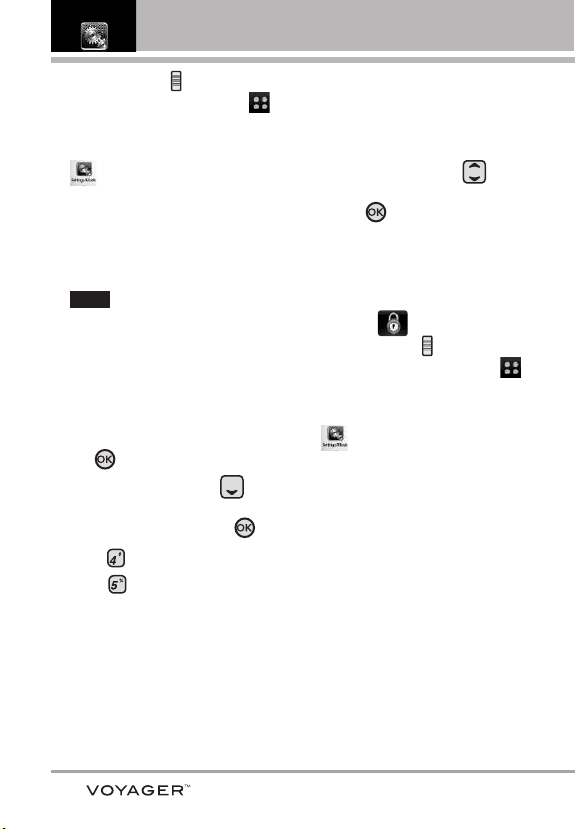
SETTINGS & TOOLS
the Unlock Key ( ) on the left
side of your phone and touch
to access the menu.
2. Touch the Settings & Tools icon
.
3. Touch
4. Sounds Settings.
4. Touch 4. Keypad Volume.
5. Adjust the volume by touching up
or down arrow buttons and touch
to save the setting.
4.5 Service Alerts
Allows you to set any of the four Alert
options to either On or Off.
Using the Internal Keypad
1.
Open the flip and press
the OK
Key [MENU].
2. Press the Directional Key to
scroll to the
Settings & Tools
menu
and press
the OK Key .
3. Press
Sounds Settings
.
4. Press
Service Alerts
.
5. Select an alert option.
ERI
Alerts you to the status of cellular
service.
ERI: Enhanced Roaming Indicator
Minute Beep
Alerts you one minute
before the end of every minute during
a call.
Call Connect
Alerts you when the
call is connected.
Charge Complete
Alerts you when
the battery is completely charged.
6. Use the Directional Key to
scroll to a setting, then press the
OK Key .
On/ Off
Using the External Touch Screen
1. Unlock the Touch Screen by
touching or pulling down
the Unlock Key ( ) on the left
side of your phone and touch
to access the menu.
2. Touch the Settings & Tools icon
.
3. Touch
4. Sounds Settings.
4. Touch 5. Service Alerts.
5. Touch an alert option.
ERI
Alerts you to the status of cellular
service.
ERI: Enhanced Roaming Indicator
Minute Beep
Alerts you one minute
before the end of every minute during
a call.
Call Connect
Alerts you when the
call is connected.
Charge Complete
Alerts you when
the battery is completely charged.
SET
110
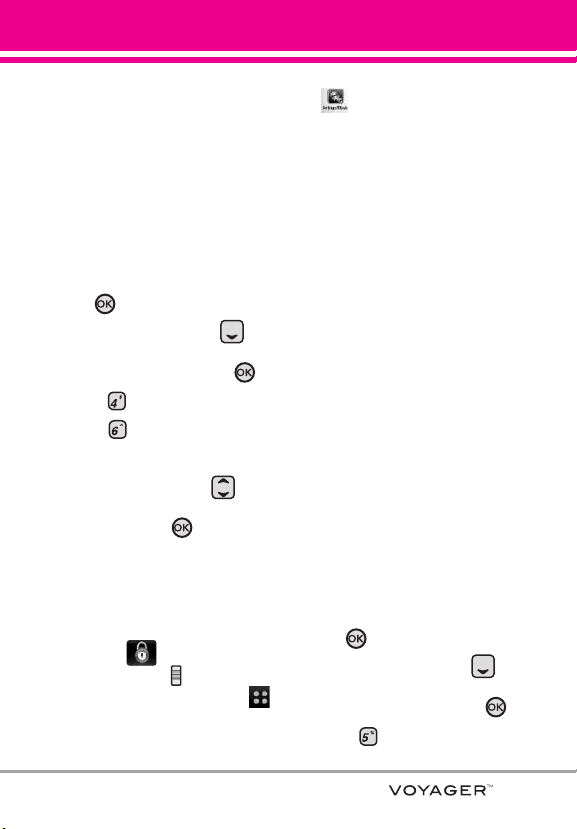
6. Touch a setting.
On/ Off
4.6 Power On/Off
Allows you to set the phone to sound
a tone when the phone is powered
on/off.
Using the Internal Keypad
1.
Open the flip and press
the OK
Key [MENU].
2. Press the Directional Key to
scroll to the
Settings & Tools
menu
and press
the OK Key .
3. Press
Sounds Settings
.
4. Press
Power On/Off
.
5. Select
Power On/ Power Off
.
6. Use the Directional Key to
scroll to Tone or Vibrate, then
press the OK Key .
On/ Off
Using the External Touch Screen
1. Unlock the Touch Screen by
touching or pulling down
the Unlock Key ( ) on the left
side of your phone and touch
to access the menu.
2. Touch the Settings & Tools icon
.
3. Touch
4. Sounds Settings.
4. Place your finger on the Touch
Screen and apply gentle upward
pressure to scroll the list up, then
touch 6. Power On/Off.
5.
Touch Power On/ Power Off
.
6. Touch
Tone or Vibrate.
On/ Off
5. Display Settings
Provides options to customize the
phone’s display screen.
5.1 Banner
Allows you to enter text to display on
the inner LCD and outside LCD. You
can enter up to 23 characters each.
5.1.1.1 Internal Banner
Using the Internal Keypad
1.
Open the flip and press
the OK
Key [MENU].
2. Press the Directional Key to
scroll to the
Settings & Tools
menu
and press
the OK Key .
3. Press
Display Settings
.
111
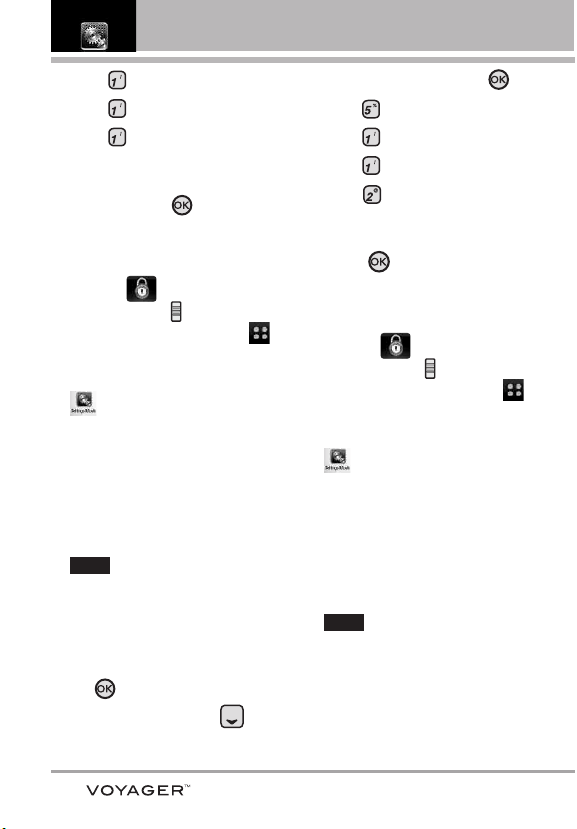
SETTINGS & TOOLS
4. Press
Banner
.
5. Press
Personal Banner
.
6. Press
Internal Banner
.
7. Enter the banner text you want to
display on the inside LCD, then
press the OK Key to save it.
Using the External Touch Screen
1. Unlock the Touch Screen by
touching or pulling down
the Unlock Key ( ) on the left
side of your phone and touch
to access the menu.
2. Touch the Settings & Tools icon
.
3. Touch 5. Display Settings.
4. Touch
1. Banner.
5.
Touch 1. Personal Banner
.
6.
Touch 1. Internal Banner
.
7. Enter the banner text and touch
.
5.1.1.2 External Banner
Using the Internal Keypad
1.
Open the flip and press
the OK
Key [MENU].
2. Press the Directional Key to
scroll to the
Settings & Tools
menu
and press
the OK Key .
3. Press
Display Settings
.
4. Press
Banner
.
5. Press
Personal Banner
.
6. Press
External Banner
.
7. Enter the text you want to display
on the outside LCD, then press the
OK Key to save it.
Using the External Touch Screen
1. Unlock the Touch Screen by
touching or pulling down
the Unlock Key ( ) on the left
side of your phone and touch
to access the menu.
2. Touch the Settings & Tools icon
.
3. Touch
5. Display Settings.
4. Touch 1. Banner.
5.
Touch 1. Personal Banner
.
6.
Touch 2. External Banner
.
7. Enter the banner text and touch
.
5.1.2 ERI Banner
If you use ERI Service, ERI Text is
shown on the sub banner.
SAVE
SAVE
112
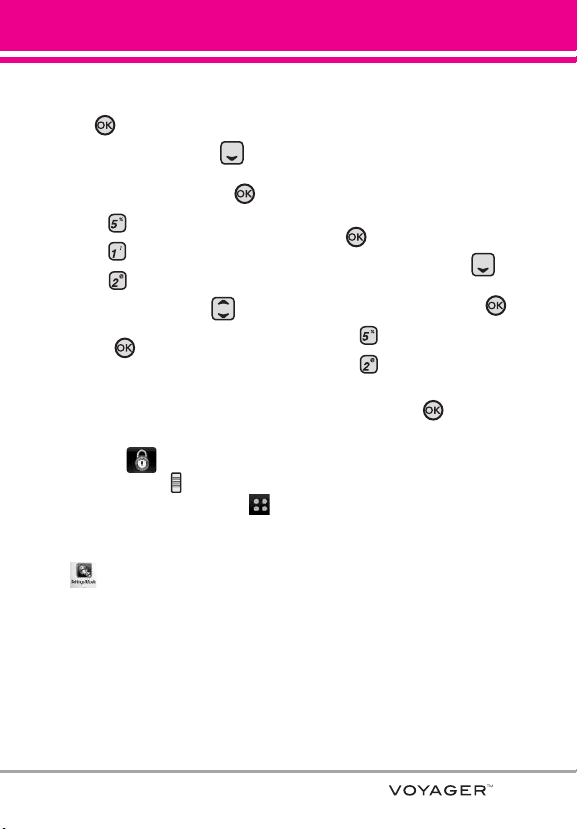
Using the Internal Keypad
1.
Open the flip and press
the OK
Key [MENU].
2. Press the Directional Key to
scroll to the
Settings & Tools
menu
and press
the OK Key .
3. Press
Display Settings
.
4. Press
Banner
.
5. Press
ERI Banner
.
6. Use the Directional Key to
scroll to a setting, then press the
OK Key .
On/ Off
Using the External Touch Screen
1. Unlock the Touch Screen by
touching or pulling down
the Unlock Key ( ) on the left
side of your phone and touch
to access the menu.
2. Touch the Settings & Tools icon
.
3. Touch
5. Display Settings.
4. Touch 1. Banner.
5.
Touch
2.
ERI Banner
.
6. Touch a setting.
On/ Off
5.2 Backlight
Allows you to set the duration for
illuminating the backlight. Screens
and Keypad are set separately.
Using the Internal Keypad
1.
Open the flip and press
the OK
Key [MENU].
2. Press the Directional Key to
scroll to the
Settings & Tools
menu
and press
the OK Key .
3. Press
Display Settings
.
4. Press
Backlight
.
5. Choose a Backlight submenu and
press the OK Key .
Display/ Keypad
1. Display
●
Internal Backlight
: 7 Seconds/ 15
Seconds/ 30 Seconds/ Always On/
Always Off
●
External Backlight
: 7 Seconds/ 10
Seconds/ 15 Seconds/
30 Seconds
2. Keypad
: 7 Seconds/ 15 Seconds/ 30
Seconds/ Always On/ Always Off
113
SETTINGS & TOOLS
Using the External Touch Screen
1. Unlock the Touch Screen by
touching or pulling down
the Unlock Key ( ) on the left
side of your phone and touch
to access the menu.
2. Touch the Settings & Tools icon
.
3. Touch
5. Display Settings.
4. Touch 2. Backlight.
5.
Touch
a Backlight submenu.
Display/ Keypad
1. Display
●
Internal Backlight
: 7 Seconds/ 15
Seconds/ 30 Seconds/ Always On/
Always Off
●
External Backlight
: 7 Seconds/ 10
Seconds/ 15 Seconds/
30 Seconds
2. Keypad
: 7 Seconds/ 15 Seconds/ 30
Seconds/ Always On/ Always Off
TIP
When the phone's main backlight is set to
Always On, the battery may deplete more quickly
because it deactivates power save mode which
may shorten battery life.
5.3 Wallpaper
Allows you to choose the kind of
background to be displayed on the
phone. The possibilities are endless,
but Fun Animations, in particular,
provide you with flash screens for
your background wallpaper and
Slide Show allows you to select
several images to display in slides
as wallpaper.
Using the Internal Keypad
1. Open the flip and press the OK
Key [MENU].
2. Press the Directional Key to
scroll to the
Settings & Tools
menu and press the OK Key .
3. Press Display Settings.
4. Press Wallpaper.
5. Select
Internal Wallpaper/
External Wallpaper.
6. Choose a submenu and press the
OK Key .
My Pictures/ My Videos/ Fun
Animations/Slide Show
7. Select from available screens
then press the OK Key .
114
Using the External Touch Screen
1. Unlock the Touch Screen by
touching or pulling down
the Unlock Key ( ) on the left
side of your phone and touch
to access the menu.
2. Touch the Settings & Tools icon
.
3. Touch
5. Display Settings.
4. Touch 3. Wallpaper.
5. Touch
Internal Wallpaper/
External Wallpaper.
6. Touch a submenu.
My Pictures/ My Videos/ Fun
Animations/ Slide Show
7. Touch your choice, then touch
.
5.4 Charging Screen
Allows you to set separate
screensavers for both internal and
the external screens to prevent
others from seeing your personal
phone information.
Using the Internal Keypad
1.
Open the flip and press
the OK
Key [MENU].
2. Press the Directional Key to
scroll to the
Settings & Tools
menu
and press
the OK Key .
3. Press
Display Settings
.
4. Press
Charging Screen
.
5. Select
Internal Charging Screen
or External Charging Screen
.
6. Scroll to a setting and press the
OK Key .
No Image/ Desk Clock/
Calendar/ Slide Show
7. Press the Left Soft Key
[[VViieeww]]
to view the options before
setting it.
8. Select from available screens then
press the OK Key .
Using the External Touch Screen
1. Unlock the Touch Screen by
touching or pulling down
the Unlock Key ( ) on the left
side of your phone and touch
to access the menu.
2. Touch the Settings & Tools icon
.
3. Touch
5. Display Settings.
4. Touch 4. Charging Screen.
5.
Touch Internal Charging Screen
or External Charging Screen
.
OK
115
SETTINGS & TOOLS
6.
Touch
a setting.
No Image/ Desk Clock/
Calendar/ Slide Show
7. Touch .
5.5 Display Themes
Allows you to choose the color of
the background screen.
Using the Internal Keypad
1. Open the flip and press the OK
Key [MENU].
2. Press the Directional Key to
scroll to the
Settings & Tools
menu and press the OK Key .
3. Press Display Settings.
4. Press Display Themes.
5. Use the Directional Key to
scroll to a setting, then press the
OK Key .
White/ Black
NOTE Press the Left Soft Key
[View] to preview the selected
display theme.
Using the External Touch Screen
1. Unlock the Touch Screen by
touching or pulling down
the Unlock Key ( ) on the left
side of your phone and touch
to access the menu.
2. Touch the Settings & Tools icon
.
3. Touch
5. Display Settings.
4. Touch 5. Display Themes.
5. Touch a setting.
White/Black
6. Touch .
5.6 Menu Fonts
Allows you to set menu fonts.
Using the Internal Keypad
1. Open the flip and press the OK
Key [MENU].
2. Press the Directional Key to
scroll to the
Settings & Tools
menu and press the OK Key .
3. Press Display Settings.
4. Press Menu Fonts.
5. Use the Directional Key to
scroll to a setting, then press the
OK Key .
VZW Font/ LG Serif/ LG Edge/
LG Joy/ LG Script
NOTE Press the Left Soft Key
[View] to preview the selected
menu font.
SET
SET
116
Using the External Touch Screen
1. Unlock the Touch Screen by
touching or pulling down
the Unlock Key ( ) on the left
side of your phone and touch
to access the menu.
2. Touch the Settings & Tools icon
.
3. Touch 5. Display Settings.
4. Place your finger on the Touch
Screen and apply gentle upward
pressure to scroll the list up, then
touch
6. Menu Fonts.
5. Touch a setting.
VZW Font/ LG Serif/ LG Edge/
LG Joy/ LG Script
6. Touch .
5.7 Dial Fonts
Allows you to set the dial font size.
This setting is helpful for those who
need the text to display a little bit
larger.
Using the Internal Keypad
1. Open the flip and press the OK
Key [MENU].
2. Press the Directional Key to
scroll to the
Settings & Tools
menu and press the OK Key .
3. Press
Display Settings.
4. Press
Dial Fonts.
5. Use the Directional Key to
scroll to a setting, then press the
OK Key .
Normal/ Large
NOTE
Press the Left Soft Key [View]
to preview the selected dial font.
Using the External Touch Screen
1. Unlock the Touch Screen by
touching or pulling down
the Unlock Key ( ) on the left
side of your phone and touch
to access the menu.
2. Touch the Settings & Tools icon
.
3. Touch 5. Display Settings.
4. Place your finger on the Touch
Screen and apply gentle upward
pressure to scroll the list up, then
touch
7. Dial Fonts.
5. Touch a setting.
Normal/ Large
6. Touch .
SET
SET
117
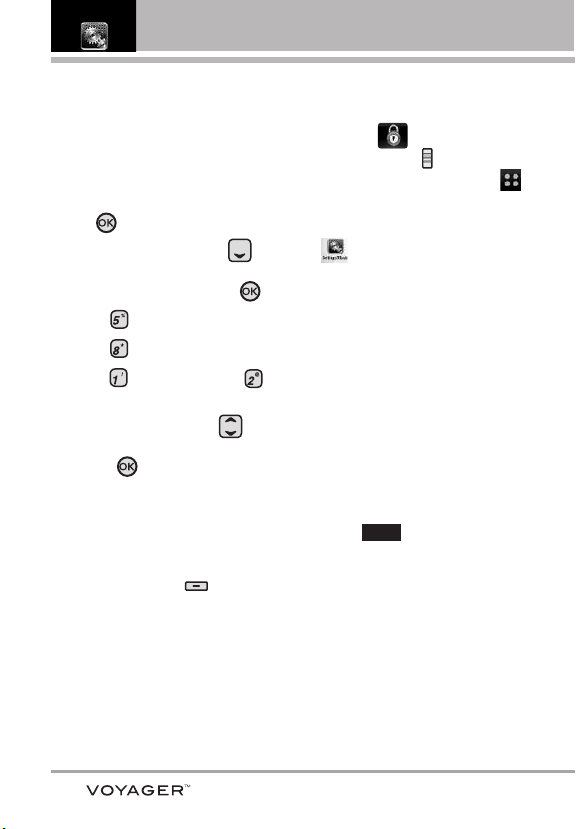
SETTINGS & TOOLS
5.8 Clock Format
Allows you to choose the kind of
clock to be displayed on the LCD
screen.
Using the Internal Keypad
1. Open the flip and press the OK
Key [MENU].
2. Press the Directional Key to
scroll to the Settings & Tools
menu and press the OK Key .
3. Press Display Settings.
4. Press Clock Format.
5. Press
Internal Clock or
External Clock.
6. Use the Directional Key to
scroll to a setting, then press the
OK Key .
Normal/ Analog/ Digital 1/ Digital
2/ Dual(Set City in World Clock)/
Off
NOTES
●
Press the Left Soft Key [View] to
preview the selected clock format.
●
If you set Dual clock for either the internal
or the external screen, the same city time
is displayed on both.
Using the External Touch Screen
1. Unlock the Touch Screen by
touching or pulling down
the Unlock Key ( ) on the left
side of your phone and touch
to access the menu.
2. Touch the Settings & Tools icon
.
3. Touch
5. Display Settings.
4. Place your finger on the Touch
Screen and apply gentle upward
pressure to scroll the list up, then
touch 8. Clock Format.
5. Touch
1. Internal Clock or
2. External Clock.
6. Touch a setting.
Normal/ Analog/ Digital 1/ Digital
2/ Dual(Set City in World Clock)/
Off
7. Touch .
SET
118
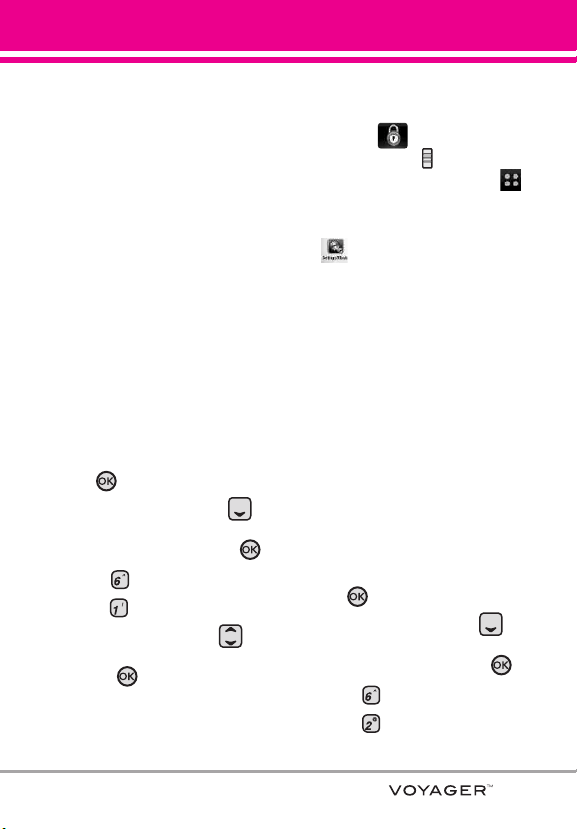
6. Phone Settings
The Phone Settings Menu allows
you to designate specific settings to
customize how you use your phone.
6.1 Airplane Mode
Allows you to use the menu
functions except making calls,
Bluetooth
®
feature, and web
accessing, when radio transmission
is restricted. Activating Airplane
Mode will disable all wireless
communications. When in Airplane
Mode, services supporting Location
On functionality (such as
Chaperone) will be suspended.
Using the Internal Keypad
1. Open the flip and press the OK
Key [MENU].
2. Press the Directional Key to
scroll to the
Settings & Tools
menu and press the OK Key .
3. Press Phone Settings.
4. Press Airplane Mode.
5. Use the Directional Key to
scroll to a setting, then press the
OK Key .
On/ Off
Using the External Touch Screen
1. Unlock the Touch Screen by
touching or pulling down
the Unlock Key ( ) on the left
side of your phone and touch
to access the menu.
2. Touch the Settings & Tools icon
.
3. Place your finger on the Touch
Screen and apply gentle upward
pressure to scroll the list up, then
touch
6. Phone Settings.
4. Touch 1. Airplane Mode.
5. Touch a setting.
On/ Off
6.2 Set Shortcuts
Allows you to set a shortcut to
phone menus using the down, up,
left and right Directional Keys.
Using the Internal Keypad
1. Open the flip and press the OK
Key [MENU].
2. Press the Directional Key to
scroll to the Settings & Tools
menu and press the OK Key .
3. Press Phone Settings.
4. Press
Set Shortcuts.
119
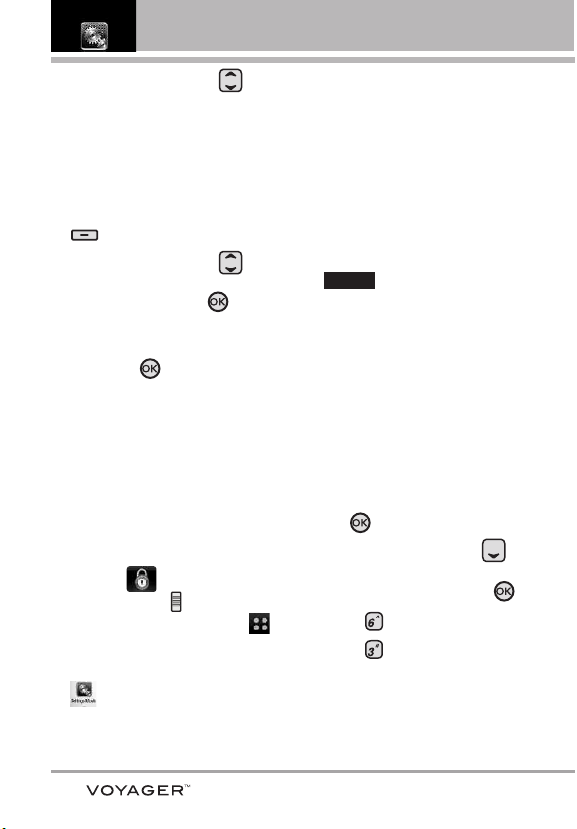
SETTINGS & TOOLS
5. Use the Directional Key to
scroll to a shortcut key you want
to set.
Set Internal Directional Keys/
Set Qwerty Shortcut
6. In Set Internal Directional Keys
menu, press the Left Soft Key
[Set].
7. Use the Directional Key to
scroll to the shortcut you want,
then press the OK Key .
8. Repeat as necessary to set all
four shortcut keys, then press
the OK Key [DONE].
9. 9. In Set Qwerty Shortcut menu,
select options. Off No activation
in standby mode. TXT Message
Enter the new text message
mode. Notepad Enter the new
notepad mode.
Using the External Touch Screen
1. Unlock the Touch Screen by
touching or pulling down
the Unlock Key ( ) on the left
side of your phone and touch
to access the menu.
2. Touch the Settings & Tools icon
.
3. Place your finger on the Touch
Screen and apply gentle upward
pressure to scroll the list up, then
touch
6. Phone Settings.
4. Touch 2. Set Shortcuts.
5. In Set Internal Directional Keys
menu, touch a shortcut key you
want to change, then touch the
shortcut you want to set.
6. Repeat as necessary to set all
four shortcut keys, then
touch
.
7. In Set Qwerty Shortcut menu,
select options. Off No activation
in Airplane mode. TXT Message
Enter the new text message
mode. Notepad Enter the new
notepad mode.
6.3 Voice Commands
Using the Internal Keypad
1. Open the flip and press the OK
Key [MENU].
2. Press the Directional Key to
scroll to the
Settings & Tools
menu and press the OK Key .
3. Press Phone Settings.
4. Press Voice Commands.
Prompts
Mode/ Audio
Playback/ Timeout
For Mode, set Prompts/ Readout
+ Alerts/ Readout/ Tones Only.
For Audio Playback, set
DONE
120
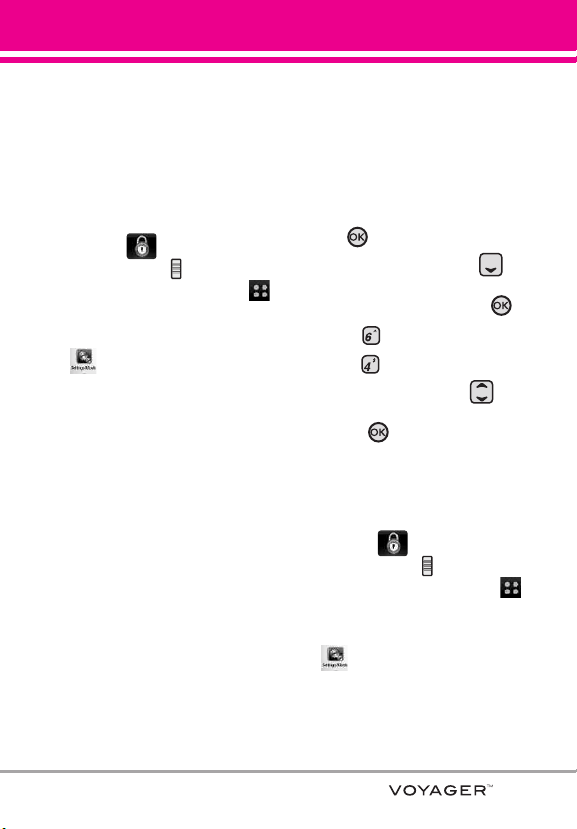
Speakerphone or Earpiece.
For Timeout, set 5 seconds or
10 seconds.
Call Alert
Ring Only/ Caller ID +
Ring/ Name Repeat
Using the External Touch Screen
1. Unlock the Touch Screen by
touching or pulling down
the Unlock Key ( ) on the left
side of your phone and touch
to access the menu.
2. Touch the Settings & Tools icon
.
3. Place your finger on the Touch
Screen and apply gentle upward
pressure to scroll the list up, then
touch 6. Phone Settings.
4. Touch
3. Voice Commands.
Prompts
Mode/ Audio Playback/
Timeout
For Mode, set Prompts/ Readout
+ Alerts/ Readout/ Tones Only.
For Audio Playback, set
Speakerphone or Earpiece.
For Timeout, set 5 seconds or
10 seconds.
Call Alert
Ring Only/ Caller ID +
Ring/ Name Repeat
6.4 Language
Allows you to set the bilingual
(English or Spanish) feature
according to your preference.
Using the Internal Keypad
1. Open the flip and press the OK
Key [MENU].
2. Press the Directional Key to
scroll to the
Settings & Tools
menu and press the OK Key .
3. Press Phone Settings.
4. Press Language.
5. Use the Directional Key to
scroll to a setting, then press the
OK Key .
English/ Español
Using the External Touch Screen
1. Unlock the Touch Screen by
touching or pulling down
the Unlock Key ( ) on the left
side of your phone and touch
to access the menu.
2. Touch the Settings & Tools icon
.
3. Place your finger on the Touch
Screen and apply gentle upward
pressure to scroll the list up, then
touch
6. Phone Settings.
121
SETTINGS & TOOLS
4. Touch 4. Language.
5. Touch a setting.
English/ Español
6.5 Location
Allows you to set GPS (Global
Positioning System: Satellite assisted
location information system) mode.
Using the Internal Keypad
1.
Open the flip and press
the OK
Key [MENU].
2. Press the Directional Key to
scroll to the
Settings & Tools
menu
and press
the OK Key .
3. Press
Phone Settings
.
4. Press
Location
.
5. Use the Directional Key to
scroll to a setting, then press the
OK Key .
Location On/ E911 Only
Using the External Touch Screen
1. Unlock the Touch Screen by
touching or pulling down
the Unlock Key ( ) on the left
side of your phone and touch
to access the menu.
2. Touch the Settings & Tools icon
.
3. Place your finger on the Touch
Screen and apply gentle upward
pressure to scroll the list up, then
touch
6. Phone Settings.
4. Touch
5. Location.
5. Touch a setting.
Location On/ E911 Only
NOTES
•
GPS satellite signals are not always received
by the phone under bad atmospheric and
environmental conditions, indoors, etc.
•
When a location lock mode is activated in the
Security Menu, the lock code is required
when you enter location menu. The lock code
is the same 4 digits you use as your device
lock code; initially the last 4 digits of your
phone number.
•
When in Airplane Mode, services supporting
Location On functionality (such as Chaperone)
will be suspended.
6.6 Security
The Security menu allows you to
secure the phone electronically.
Using the Internal Keypad
1.
Open the flip and press
the OK
Key [MENU].
2. Press the Directional Key to
scroll to the
Settings & Tools
menu
and press
the OK Key .
3. Press
Phone Settings
.
122
4. Press
Security
.
5. Enter the four-digit lock code.
The lock code is the last 4 digits of
your mobile phone number if it is
set. The lock code is the last 4
digits of your MEID if your mobile
phone number is not set.
Using the External Touch Screen
1. Unlock the Touch Screen by
touching or pulling down
the Unlock Key ( ) on the left
side of your phone and touch
to access the menu.
2. Touch the Settings & Tools icon
.
3. Place your finger on the Touch
Screen and apply gentle upward
pressure to scroll the list up, then
touch
6. Phone Settings.
4. Place your finger on the Touch
Screen and apply gentle upward
pressure to scroll the list up, then
touch 6. Security.
5. Enter the four-digit lock code.
The lock code is the last 4 digits of
your mobile phone number if it is
set. The lock code is the last 4
digits of your MEID if your mobile
phone number is not set.
6.6.1 Edit Codes
Allows you to enter a new four-digit
lock code.
Using the Internal Keypad
1.
Open the flip and press
the OK
Key [MENU].
2. Press the Directional Key to
scroll to the
Settings & Tools
menu
and press
the OK Key .
3. Press
Phone Settings
.
4. Press
Security
.
5. Enter the four-digit lock code.
6. Press
Edit Codes
.
7. Choose
Phone Only or Calls &
Services, then enter your new lock
code. Enter it again to confirm it.
Using the External Touch Screen
1. Unlock the Touch Screen by
touching or pulling down
the Unlock Key ( ) on the left
side of your phone and touch
to access the menu.
2. Touch the Settings & Tools icon
.
3. Place your finger on the Touch
Screen and apply gentle upward
123
SETTINGS & TOOLS
pressure to scroll the list up, then
touch 6. Phone Settings.
4. Place your finger on the Touch
Screen and apply gentle upward
pressure to scroll the list up, then
touch
6. Security.
5. Enter the four-digit lock code.
6.
Touch 1. Edit Codes
.
7. Choose
Phone Only or Calls &
Services, then enter your new lock
code. Enter it again to confirm it.
6.6.2 Restrictions
Allows you to set separate restrictions
for Location Setting, Calls, Messages,
and Dial Up Modem.
Using the Internal Keypad
1.
Open the flip and press
the OK
Key [MENU].
2. Press the Directional Key to
scroll to the
Settings & Tools
menu
and press
the OK Key .
3. Press
Phone Settings
.
4. Press
Security
.
5. Enter the four-digit lock code.
6. Press
Restrictions
.
7. Enter the four-digit PIN code.
8. Scroll to a Restrictions submenu
then press the OK Key .
Location Setting/ Calls/
Messages/ Dial-up Modem
9. Use the Directional Key to
set restriction then press the OK
Key .
Location Setting Lock Setting/
Unlock Setting
Calls Incoming Calls/ Outgoing
Calls
Messages Incoming Messages/
Outgoing Messages
Dial-up Modem Allow All/
Block All
Using the External Touch Screen
1. Unlock the Touch Screen by
touching or pulling down
the Unlock Key ( ) on the left
side of your phone and touch
to access the menu.
2. Touch the Settings & Tools icon
.
3. Place your finger on the Touch
Screen and apply gentle upward
pressure to scroll the list up, then
touch
6. Phone Settings.
4. Place your finger on the Touch
Screen and apply gentle upward
pressure to scroll the list up, then
touch 6. Security.
124
5. Enter the four-digit lock code.
6.
Touch 2. Restrictions
.
7. Enter the four-digit PIN code.
8.
Touch
a Restrictions submenu,
then the setting.
Location Setting (Lock Setting/
Unlock Setting) / Calls
(Incoming Calls/ Outgoing
Calls)/ Messages (Incoming
Messages/ Outgoing
Messages)/ Dial-up Modem
(Allow All/ Block All)
6.6.3 Phone Lock
Keeps your phone from unauthorized
use. Once the phone is locked, it's in
restricted mode until the lock code is
entered. You can receive phone calls
and still make emergency calls. You
can modify the lock code using the Edit
Codes submenu within the Security
menu.
Using the Internal Keypad
1.
Open the flip and press
the OK
Key [MENU].
2. Press the Directional Key to
scroll to the
Settings & Tools
menu
and press
the OK Key .
3. Press
Phone Settings
.
4. Press
Security
.
5. Enter the four-digit lock code.
6. Press
Phone Lock
.
7. Scroll to an option then press the
OK Key .
Unlocked The phone is not locked
(Lock mode can be used).
On Power Up The phone when it
is turned on.
Using the External Touch Screen
1. Unlock the Touch Screen by
touching or pulling down
the Unlock Key ( ) on the left
side of your phone and touch
to access the menu.
2. Touch the Settings & Tools icon
.
3. Place your finger on the Touch
Screen and apply gentle upward
pressure to scroll the list up, then
touch 6. Phone Settings.
4. Place your finger on the Touch
Screen and apply gentle upward
pressure to scroll the list up, then
touch
6. Security.
5. Enter the four-digit lock code.
6.
Touch 3. Phone Lock
.
125
SETTINGS & TOOLS
7.
Touch
a setting.
Unlocked The phone is not locked
(Lock mode can be used).
On Power Up The phone when it is
turned on.
6.6.4 Lock Phone Now
Using the Internal Keypad
1.
Open the flip and press
the OK
Key [MENU].
2. Press the Directional Key to
scroll to the
Settings & Tools
menu
and press
the OK Key .
3. Press
Phone Settings
.
4. Press
Security
.
5. Enter the four-digit lock code.
6. Press
Lock Phone Now
.
Using the External Touch Screen
1. Unlock the Touch Screen by
touching or pulling down
the Unlock Key ( ) on the left
side of your phone and touch
to access the menu.
2. Touch the Settings & Tools icon
.
3. Place your finger on the Touch
Screen and apply gentle upward
pressure to scroll the list up, then
touch
6. Phone Settings.
4. Place your finger on the Touch
Screen and apply gentle upward
pressure to scroll the list up, then
touch
6. Security.
5. Enter the four-digit lock code.
6.
Touch 4. Lock Phone Now
.
6.6.5 Reset Default
Allows you to reset your phone to the
factory default settings.
Using the Internal Keypad
1.
Open the flip and press
the OK
Key [MENU].
2. Press the Directional Key to
scroll to the
Settings & Tools
menu
and press
the OK Key .
3. Press
Phone Settings
.
4. Press
Security
.
5. Enter the four-digit lock code.
6. Press
Reset Default
.
7. Press the OK Key after reading
the warning message.
8. Press the OK Key to select
Revert.
A confirmation message is
displayed briefly before the phone
resets itself.
126
Using the External Touch Screen
1. Unlock the Touch Screen by
touching or pulling down
the Unlock Key ( ) on the left
side of your phone and touch
to access the menu.
2. Touch the Settings & Tools icon
.
3. Place your finger on the Touch
Screen and apply gentle upward
pressure to scroll the list up, then
touch 6. Phone Settings.
4. Place your finger on the Touch
Screen and apply gentle upward
pressure to scroll the list up, then
touch
6. Security.
5. Enter the four-digit lock code.
6.
Touch 5. Reset Default
.
7.
Touch
after reading the
warning message.
8. Touch Revert.
A confirmation message is
displayed briefly before the phone
resets itself.
6.6.6 Restore Phone
Allows you to erase all user data and
Contact information you've entered in
the phone's memory so it's as if it just
left the factory.
Using the Internal Keypad
1.
Open the flip and press
the OK
Key [MENU].
2. Press the Directional Key to
scroll to the
Settings & Tools
menu
and press
the OK Key .
3. Press
Phone Settings
.
4. Press
Security
.
5. Enter the four-digit lock code.
6. Press
Restore Phone
.
7. Press the OK Key after reading
the warning message.
8. Enter the four-digit lock code.
Using the External Touch Screen
1. Unlock the Touch Screen by
touching or pulling down
the Unlock Key ( ) on the left
side of your phone and touch
to access the menu.
2. Touch the Settings & Tools icon
.
3. Place your finger on the Touch
Screen and apply gentle upward
pressure to scroll the list up, then
touch
6. Phone Settings.
4. Place your finger on the Touch
Screen and apply gentle upward
pressure to scroll the list up, then
OK
127
SETTINGS & TOOLS
touch 6. Security.
5. Enter the four-digit lock code.
6.
Place your finger on the Touch
Screen and apply gentle upward
pressure to scroll the list up, then
touch 6. Restore Phone.
7.
Touch
after reading the
warning message.
8. Enter the four-digit lock code.
6.7 System Select
Allows you to set up the phone
management environment. Leave
this setting as the default unless you
want to alter system selection as
instructed by your service provider.
Using the Internal Keypad
1.
Open the flip and press
the OK
Key [MENU].
2. Press the Directional Key to
scroll to the
Settings & Tools
menu
and press
the OK Key .
3. Press
Phone Settings
.
4. Press
System Select
.
5. Use the Directional Key to
scroll to a setting, then press the
OK Key .
Home Only/ Automatic
(According to the network, it may
be different.)
Using the External Touch Screen
1. Unlock the Touch Screen by
touching or pulling down
the Unlock Key ( ) on the left
side of your phone and touch
to access the menu.
2. Touch the Settings & Tools icon
.
3. Place your finger on the Touch
Screen and apply gentle upward
pressure to scroll the list up, then
touch 6. Phone Settings.
4. Place your finger on the Touch
Screen and apply gentle upward
pressure to scroll the list up, then
touch
7. System Select.
5.
Touch a setting.
Home Only/ Automatic
(According to the network, it may
be different.)
OK
128
6.8 NAM Select
Allows you to select the phone’s NAM
(Number Assignment Module) if the
phone is registered with multiple
service providers.
Using the Internal Keypad
1.
Open the flip and press
the OK
Key [MENU].
2. Press the Directional Key to
scroll to the
Settings & Tools
menu
and press
the OK Key .
3. Press
Phone Settings
.
4. Press
NAM Select
.
5. Use the Directional Key to
scroll to a setting, then press the
OK Key .
NAM1/ NAM2
Using the External Touch Screen
1. Unlock the Touch Screen by
touching or pulling down
the Unlock Key ( ) on the left
side of your phone and touch
to access the menu.
2. Touch the Settings & Tools icon
.
3. Place your finger on the Touch
Screen and apply gentle upward
pressure to scroll the list up, then
touch
6. Phone Settings.
4. Place your finger on the Touch
Screen and apply gentle upward
pressure to scroll the list up, then
touch
8. NAM Select.
5. Touch a setting.
NAM1/ NAM2
7. Call Settings
The Call Settings Menu allows you
to designate how the phone handles
both incoming and outgoing calls.
7.1 Answer Options
Allows you to determine how the
phone will answer an incoming call.
Using the Internal Keypad
1.
Open the flip and press
the OK
Key [MENU].
2. Press the Directional Key to
scroll to the
Settings & Tools
menu
and press
the OK Key .
3. Press
Call Settings
.
4. Press
Answer Options
.
5. Use the Directional Key to
scroll to a setting, then press the
OK Key .
Flip Open/ Any Key/ Auto with
129
SETTINGS & TOOLS
Handsfree
NOTE
Auto with Handsfree is available only
when any the external device is
connected to your phone.
Using the External Touch Screen
1. Unlock the Touch Screen by
touching or pulling down
the Unlock Key ( ) on the left
side of your phone and touch
to access the menu.
2. Touch the Settings & Tools icon
.
3. Place your finger on the Touch
Screen and apply gentle upward
pressure to scroll the list up, then
touch
7. Call Settings.
4. Touch 1. Answer Options.
5. Touch a setting.
Flip Open/ Any Key/ Auto with
Handsfree
7.2 End Call Options
Allows you to determine how the
phone will disconnect a call.
Using the Internal Keypad
1.
Open the flip and press
the OK
Key [MENU].
2. Press the Directional Key to
scroll to the
Settings & Tools
menu
and press
the OK Key .
3. Press
Call Settings
.
4. Press
End Call Options.
5.
Use the Directional Key to
scroll to a setting, then press the
OK Key .
Flip Close / End Key Only
Using the External Touch Screen
1. Unlock the Touch Screen by
touching or pulling down
the Unlock Key ( ) on the left
side of your phone and touch
to access the menu.
2. Touch the Settings & Tools icon
.
3. Place your finger on the Touch
Screen and apply gentle upward
pressure to scroll the list up, then
touch 7. Call Settings.
130
4. Touch 2. End Call Options.
5. Touch a setting.
Flip Close / End Key Only
7.3 Show Dialpad
This option allows dialpad to appear
automatically when you place a call to
voicemail or to a toll-free number that
may need you to enter numbers.
Using the Internal Keypad
1.
Open the flip and press
the OK
Key [MENU].
2. Press the Directional Key to
scroll to the
Settings & Tools
menu
and press
the OK Key .
3. Press
Call Settings
.
4. Press
Show Dialpad.
5.
Use the Directional Key to
scroll to a setting, then press the
OK Key .
Voicemail/Toll-Free / Always/
Never
Using the External Touch Screen
1. Unlock the Touch Screen by
touching or pulling down
the Unlock Key ( ) on the left
side of your phone and touch
to access the menu.
2. Touch the Settings & Tools icon
.
3. Place your finger on the Touch
Screen and apply gentle upward
pressure to scroll the list up, then
touch 7. Call Settings.
4. Touch
3 Show Dialpad.
5. Touch a setting.
Voicemail/Toll-Free / Always/
Never
7.4 Auto Retry
Allows you to set the length of time
the phone waits before automatically
redialing a number when the
attempted call fails.
Using the Internal Keypad
1.
Open the flip and press
the OK
Key [MENU].
2. Press the Directional Key to
scroll to the
Settings & Tools
menu
and press
the OK Key .
3. Press
Call Settings
.
131
SETTINGS & TOOLS
4. Press
Auto Retry
.
5. Use the Directional Key to
scroll to a setting, then press the
OK Key .
Off/ Every 10 Seconds/ Every 30
Seconds/ Every 60 Seconds
Using the External Touch Screen
1. Unlock the Touch Screen by
touching or pulling down
the Unlock Key ( ) on the left
side of your phone and touch
to access the menu.
2. Touch the Settings & Tools icon
.
3. Place your finger on the Touch
Screen and apply gentle upward
pressure to scroll the list up, then
touch 7. Call Settings.
4. Touch 4. Auto Retry.
5. Touch a setting.
Off/ Every 10 Seconds/ Every 30
Seconds/ Every 60 Seconds
7.5 TTY Mode
Allows you to attach a TTY device
enabling you to communicate with
parties also using a TTY device. A
phone with TTY support is able to
translate typed characters to
voice. Voice can also be translated
into characters and then displayed
on the TTY.
Using the Internal Keypad
1.
Open the flip and press
the OK
Key [MENU].
2. Press the Directional Key to
scroll to the
Settings & Tools
menu
and press
the OK Key .
3. Press
Call Settings
.
4. Press
TTY Mode
.
An explanation message is
displayed.
5. Press the OK Key to continue.
6. Use the Directional Key to
scroll to a setting, then press the
OK Key .
TTY Full/ TTY + Talk/ TTY + Hear/
TTY Off
Using the External Touch Screen
1. Unlock the Touch Screen by
touching or pulling down
132
the Unlock Key ( ) on the left
side of your phone and touch
to access the menu.
2. Touch .
3. Place your finger on the Touch
Screen and apply gentle upward
pressure to scroll the list up, then
touch
7. Call Settings.
4. Touch 5. TTY Mode.
5.
Touch a setting.
TTY Full/ TTY + Talk/ TTY + Hear/
TTY Off
TTY Full:
- Users who cannot talk and hear
send and receive a text message
through TTY equipment.
TTY + Talk:
- Users who can talk but cannot
hear receive a text message and
send voice through TTY
equipment.
TTY + Hear:
- Users who can hear but cannot
talk send a text message and
receive voice through TTY
equipment.
TTY Off:
- Users send and receive without
TTY equipment.
Connecting TTY Equipment and a
Terminal
1. Connect a TTY cable to TTY
connection on the terminal (TTY
133
Menu User Feature
Transmission/
Receiving Mode
When making
communications with a
normal terminal
TTY Full
For hearing-/
verbally-
impaired
text message transmission,
text message receiving
Operator
required
TTY +
Talk
For hearing-
impaired
able to talk
voice transmission, text
message receiving
Operator
required
TTY +
Hear
For verbally-
impaired
audible
text message transmission,
voice receiving
Operator
required
TTY Off
voice transmission, voice
receiving
TTY Mode (Tele Type writer)
SETTINGS & TOOLS
connection location is the same as
a headset jack).
2. Enter the phone menu and set the
desired TTY mode.
3. After setting a TTY mode, check
the LCD screen of the phone for
the TTY icon.
4. Connect the TTY equipment to the
power source and turn it on.
5. Make a phone connection to the
desired number.
6. When connection is made, use the
TTY equipment to type in and send
a text message or send voice.
7. The voice or text message from the
receiver end displays on the TTY
equipment display.
7.6 One Touch Dial
Allows you to initiate a speed dial
call by pressing and holding the
speed dial digit. If set to Off,
designated Speed Dial numbers will
not function.
Using the Internal Keypad
1. Open the flip and press the OK
Key
[MENU].
2. Press the Directional Key to
scroll to the Settings & Tools
menu and press the OK Key .
3. Press
Call Settings.
4. Press One Touch Dial.
5. Use the Directional Key to
scroll to a setting, then press the
OK Key .
On/ Off
Using the External Touch Screen
1. Unlock the Touch Screen by
touching or pulling down
the Unlock Key ( ) on the left
side of your phone and touch
to access the menu.
2. Touch the Settings & Tools icon
.
3. Place your finger on the Touch
Screen and apply gentle upward
pressure to scroll the list up, then
touch
7. Call Settings.
4. Touch 6. One Touch Dial.
5. Touch a setting.
On/ Off
134
7.7 Voice Privacy
Allows you to set the voice privacy
feature for CDMA calls. CDMA
offers inherent voice privacy. Check
with your service provider for
availability.
Using the Internal Keypad
1. Open the flip and press the OK
Key [MENU].
2. Press the Directional Key to
scroll to the
Settings & Tools
menu and press the OK Key .
3. Press
Call Settings.
4. Press Voice Privacy.
5. Use the Directional Key to
scroll to a setting, then press the
OK Key .
On/ Off
Using the External Touch Screen
1. Unlock the Touch Screen by
touching or pulling down
the Unlock Key ( ) on the left
side of your phone and touch
to access the menu.
2. Touch the Settings & Tools icon
.
3. Place your finger on the Touch
Screen and apply gentle upward
pressure to scroll the list up, then
touch
7. Call Settings.
4. Place your finger on the Touch
Screen and apply gentle upward
pressure to scroll the list up, then
touch 7. Voice Privacy.
5. Touch a setting.
On/ Off
135
SETTINGS & TOOLS
8. Touch Settings
Allows you to customize settings of
the external Touch Screen on your
phone.
Using the Internal Keypad
1.
Open the flip and press
the OK
Key [MENU].
2. Press the Directional Key to
scroll to the
Settings & Tools
menu
and press
the OK Key .
3. Press
Touch Settings
.
4. Use the Directional Key to
scroll to a setting, then press the
OK Key .
Auto Lock/ Vibrate/ Sound/
Calibration
●
Auto Lock: Automatically locks the
Touch Screen when not in use.
●
Vibrate: Vibrate Type/ Vibrate
Level/ Vibrate on Scrolling
●
Sound: Water Drop/ Digital/
Xylophone/ Off
●
Calibration: Touch the exact target
and try to hit it as accurately as
possible as guided on the screen
(See page 15).
WARNING
Not following the instructions may lead to
inaccurate operation of touch keys or
screen.
Using the External Touch Screen
1. Unlock the Touch Screen by
touching or pulling down
the Unlock Key ( ) on the left
side of your phone and touch
to access the menu.
2. Touch the Settings & Tools icon
.
3. Place your finger on the Touch
Screen and apply gentle upward
pressure to scroll the list up, then
touch 8. Touch Settings.
4. Touch a setting.
Auto Lock/ Vibrate/ Sound/
Calibration
9. USB Auto Detection
Your phone automatically detects a
USB device when it is connected to
your phone for Sync Music or Sync
Data operation. If the option is set to
Ask On Plug, you are asked to confirm
whenever the connection is made.
136
Using the Internal Keypad
1.
Open the flip and press
the OK
Key [MENU].
2. Press the Directional Key to
scroll to the
Settings & Tools
menu
and press
the OK Key .
3. Press
USB Auto Detection
.
4.
Use the Directional Key to
scroll to a setting, then press the
OK Key .
Sync Music/ Sync Data/ Ask On
Plug
Using the External Touch Screen
1. Unlock the Touch Screen by
touching or pulling down
the Unlock Key ( ) on the left
side of your phone and touch
to access the menu.
2. Touch .
3. Place your finger on the Touch
Screen and apply gentle upward
pressure to scroll the list up, then
touch
9. USB Auto Detection.
4. Touch a setting.
Sync Music/ Sync Data/ Ask On
Plug
10. Memory
Allows you to check your VOYAGER
TM
internal phone memory as well as the
microSD
TM
external memory.
The VOYAGER
TM
can access the
following file types stored on the
removable microSD
TM
card.
My Pictures: png, jpg, bmp, gif
My Sounds: mid, qcp (used for MMS,
cannot be set as ringtones)
My Videos: 3gp, 3g2
My Music: wma, mp3, wav, m4a
137
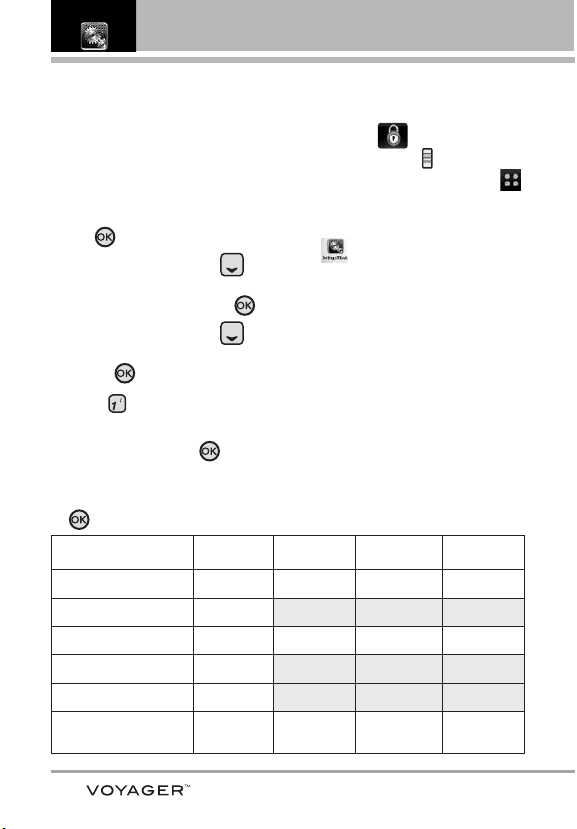
SETTINGS & TOOLS
10.1 Save Options
Allows you to select which memory
(phone or memory card) to use to
save your files.
Using the Internal Keypad
1.
Open the flip and press
the OK
Key [MENU].
2. Press the Directional Key to
scroll to the
Settings & Tools
menu
and press
the OK Key .
3. Press the Directional Key to
scroll to
Memory
then press the
OK Key .
4. Press
Save Options
.
5. Scroll to
Pictures/ Videos/ Sounds
then press the OK Key .
6. Scroll to
Phone Memory/ Card
Memory
then press the OK Key
.
Using the External Touch Screen
1. Unlock the Touch Screen by
touching or pulling down
the Unlock Key ( ) on the left
side of your phone and touch
to access the menu.
2. Touch the Settings & Tools icon
.
3. Place your finger on the Touch
Screen and apply gentle upward
pressure to scroll the list up, then
touch
10. Memory.
4. Touch 1. Save Options.
5.
Touch Pictures/ Videos/ Sounds
.
6.
Touch Phone Memory/ Card
Memory
.
138
Store on
VOYAGER
Store on
microSD
TM
Card
Transfer Phone to
PC via Card
Transfer PC to
Phone via Card
V CAST Music/ WMA Songs
W W W W
Ringtones
W
Sound
W W W W
V CAST Video Clips
W
Downloaded Picture/ Video
W
Picture/ Video
(user-generated or received
via MMS)
W W W W
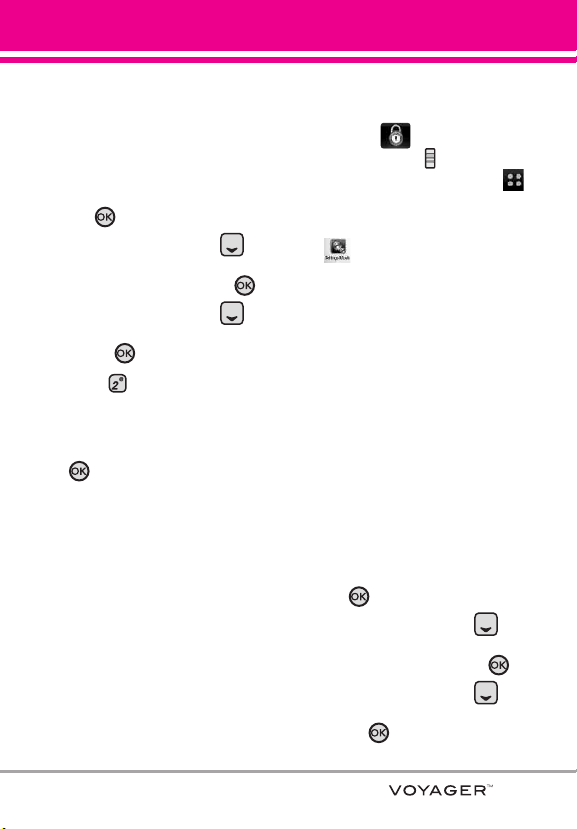
10.2 Phone Memory
Shows the memory information saved
in your phone.
Using the Internal Keypad
1.
Open the flip and press
the OK
Key [MENU].
2. Press the Directional Key to
scroll to the
Settings & Tools
menu
and press
the OK Key .
3. Press the Directional Key to
scroll to
Memory
then press the
OK Key .
4. Press
Phone Memory
.
5. Scroll to
Memory Usage/ My
Pictures/ My Videos/ My Music/
My Sounds
then press the OK Key
.
Using the External Touch Screen
1. Unlock the Touch Screen by
touching or pulling down
the Unlock Key ( ) on the left
side of your phone and touch
to access the menu.
2. Touch the Settings & Tools icon
.
3. Place your finger on the Touch
Screen and apply gentle upward
pressure to scroll the list up, then
touch
10. Memory.
4. Touch 2. Phone Memory.
5. Touch
Memory Usage / My
Pictures / My Videos / My Music
/ My Sounds.
10.3 Card Memory
Shows the memory information saved
in the card.
Using the Internal Keypad
1.
Open the flip and press
the OK
Key [MENU].
2. Press the Directional Key to
scroll to the
Settings & Tools
menu
and press
the OK Key .
3. Press the Directional Key to
scroll to
Memory
then press the
OK Key .
139
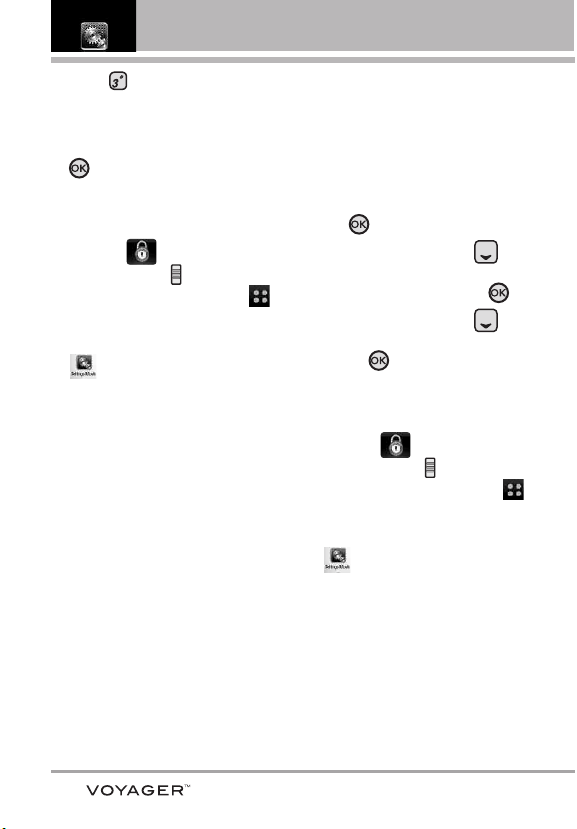
SETTINGS & TOOLS
4. Press
Card Memory
.
5. Scroll to
Memory Usage/ My
Pictures/ My Videos/ My Music/
My Sounds
then press the OK Key
.
Using the External Touch Screen
1. Unlock the Touch Screen by
touching or pulling down
the Unlock Key ( ) on the left
side of your phone and touch
to access the menu.
2. Touch the Settings & Tools icon
.
3. Place your finger on the Touch
Screen and apply gentle upward
pressure to scroll the list up, then
touch
10. Memory.
4. Touch 3. Card Memory.
5.
Touch Memory Usage/ My
Pictures/ My Videos/ My Music/
My Sounds
.
NOTE
The option Card Memory Usage
shows the total used memory and
memory space remaining.
11. Phone Info
Allows you to view the information
specific to your phone and
software.
Using the Internal Keypad
1.
Open the flip and press
the OK
Key [MENU].
2. Press the Directional Key to
scroll to the
Settings & Tools
menu
and press
the OK Key .
3. Press the Directional Key to
scroll to
Phone Info
then press the
OK Key .
Using the External Touch Screen
1. Unlock the Touch Screen by
touching or pulling down
the Unlock Key ( ) on the left
side of your phone and touch
to access the menu.
2. Touch the Settings & Tools icon
.
3. Place your finger on the Touch
Screen and apply gentle upward
pressure to scroll the list up, then
touch 11. Phone Info.
140
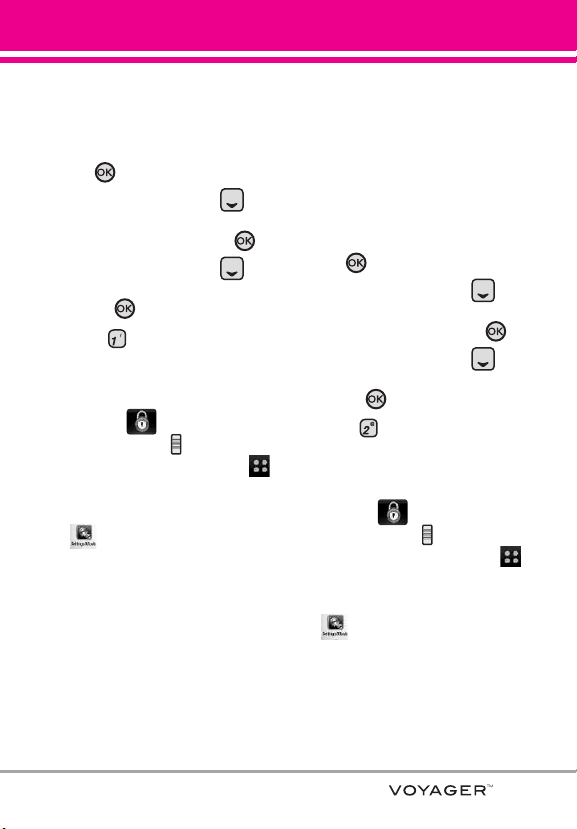
11.1 My Number
Allows you to view your phone
number.
1.
Open the flip and press
the OK
Key [MENU].
2. Press the Directional Key to
scroll to the
Settings & Tools
menu
and press
the OK Key .
3. Press the Directional Key to
scroll to
Phone Info
then press the
OK Key .
4. Press
My Number
.
Using the External Touch Screen
1. Unlock the Touch Screen by
touching or pulling down
the Unlock Key ( ) on the left
side of your phone and touch
to access the menu.
2. Touch the Settings & Tools icon
.
3. Place your finger on the Touch
Screen and apply gentle upward
pressure to scroll the list up, then
touch
11. Phone Info.
4. Touch
1. My Number.
11.2 SW/HW Version
Allows you to view the versions of
various applications such as SW, PRL,
ERI, Browser, Media Center, AVR,
MMS, Bluetooth, MSUI, HW, MEID
Version, and Warranty Date Code.
Using the Internal Keypad
1.
Open the flip and press
the OK
Key [MENU].
2. Press the Directional Key to
scroll to the
Settings & Tools
menu
and press
the OK Key .
3. Press the Directional Key to
scroll to
Phone Info
then press the
OK Key .
4. Press
SW/HW Version
.
Using the External Touch Screen
1. Unlock the Touch Screen by
touching or pulling down
the Unlock Key ( ) on the left
side of your phone and touch
to access the menu.
2. Touch the Settings & Tools icon
.
3. Place your finger on the Touch
Screen and apply gentle upward
pressure to scroll the list up, then
touch
11. Phone Info.
4. Touch 2. SW/HW Version.
141
SETTINGS & TOOLS
11.3 Icon Glossary
Allows you to view all the icons and
their meanings.
Using the Internal Keypad
1.
Open the flip and press
the OK
Key [MENU].
2. Press the Directional Key to
scroll to the
Settings & Tools
menu
and press
the OK Key .
3. Press the Directional Key to
scroll to
Phone Info
then press the
OK Key .
4. Press
Icon Glossary
.
Using the External Touch Screen
1. Unlock the Touch Screen by
touching or pulling down
the Unlock Key ( ) on the left
side of your phone and touch
to access the menu.
2. Touch the Settings & Tools icon
.
3. Place your finger on the Touch
Screen and apply gentle upward
pressure to scroll the list up, then
touch
11. Phone Info.
4. Touch 3. Icon Glossary.
142
Music
Please see the My Music section on
page 40.
Browser
The Browser feature allows you to
access news, sports and weather
from your Verizon Wireless device.
Access and selections within this
feature are dependent upon your
service provider. For specific
information on Browser access
through your phone, contact your
service provider.
SHORTCUTS
Unlock the Touch Screen by touching or
pulling down the Unlock Key ( ) on the left
side of your phone, then touch the screen with
your finger to access the shortcut menu, then
touch the Browser Icon .
Pressing the Directional Key UP is the
shortcut to accessing Browser in the flip open
state.
Launching the Browser
Using the Internal Keypad
1.
Open the flip and press
the OK
Key [MENU].
2. Press the Directional Key to
scroll to the
Browser
menu
and
press
the OK Key .
Using the External Touch Screen
1. Unlock the Touch Screen by
touching or pulling down
the Unlock Key ( ) on the left
side of your phone and touch
to access the menu.
2. Touch the Browser icon .
Ending a Browser Session
End a Browser session by
pressing the internal key
or
the
external key.
Browser Navigating
Links embedded in content
Flip Open: Select items or links by
moving the cursor with the
Directional Key and pressing the OK
key . Or, if the items are
numbered, press the corresponding
number key.
Flip Closed: Select items or links by
touching it on the screen.
HINT: If you’re having trouble
touching the exact link on the
external screen, touch the
magnifying glass to zoom in
and provide a larger area to touch
to activate.
Music/Browser
143
Browser
Scrolling / Fast Scrolling
Flip Open: Use the Directional Key
to scroll through the content.
Individual presses move a line at a
time, or press and hold to move
quickly up or down on the screen.
Flip Closed: Use your fingertip to
gently move the screen contents in
the direction you move your finger.
How quickly you move your finger
determines the quickness of the
scroll.
Panning
Panning is when you move
randomly around in screen content
by moving fingertip (or pen-like
stylus) to the area they want to see
(only available when the flip is
closed).
CAUTION
Do not use a sharp item for your
pen-like stylus because it could scratch your
screen.
Return to Home Page
Flip Open: Press and hold or
press the Right Soft Key
[Menu], then press Home.
Flip Closed: Touch , then
touch
7. Home.
Using the Browser Menu
Flip Open: Press the Right Soft Key
[Menu] to view Browser
choices.
Flip Closed: Touch to view.
Items of Browser Menu
NOTE
You may have to scroll down to see
some of the menu items listed below.
●
Full Screen View Use the whole
screen including the annuciator
and command bar area to view
pages on both internal and
external screens. You can get the
command bar by touching an
empty spot on the external screen
and by pressing the Right Soft Key
on the internal screen.
●
Go to WWW Allows entry of Web
page to access a specific Web
page.
●
Favorites You can add bookmarks.
●
Display Rendering Allows mode
selection that changes the layout
of contents.
●
Zoom Allows you to zoom the
screen in or out.
Use the bar
to adjust the zoom.
The bar fades out on the screen
within several seconds.
●
Refresh Allows you to reload the
current Web page.
●
Home Returns to Home Page.
Menu
Menu
144

●
Send URL Allows you to send the
link of the current page via a text
message.
●
Settings Allows you to set values
about browser features.
Homepage Set the selected page
as Home Page.
Display Set a Thumbnail option or
scrolling.
JavaScript Select On or Off.
Timer Set the duration of each key
press or connection.
Encryption Displays the
authenticaton setting menu and
certificates in device.
●
Manage Memory Manages
memory used by browser.
●
Information
Show URL Redisplays current
Web page.
History Displays list of visited Web
pages.
About Displays the current
browser information.
Page Overview enables user to
view the web page in large scale.
So if the page overview is selected
you can see the overall layout of
web page. The red box in the page
overview mode indicate the sceen
right before the page overview
mode. If you move the red box
and touch it the browser will go
back to normal mode and display
that red box area.
TIP
To access Page Overview directly,
press Camera Key in a browser
session.
Settings for Display Rendering in
Browser Menu
●
SSttaannddaarrdd
: Displays a standard
browser screen with vertical and
horizontal page navigation.
●
SSccrreeeenn OOppttiimmiizzeedd
: Displays
vertically aligned contents of the
Web page which fit the size of
the screen. Allows vertical
navigation only.
●
TTeexxtt OOnnllyy
: Displays only text and
excludes images used in the
Web page.
Using Thumbnail Option in
Browser Menu
The entire outline of the Web page
is displayed in the corner, which
allows you to find out where you
are on the page and move to where
you want to go on the Web page.
To change the Thumbnail Option
setting:
1. Open the flip and press
the
Directional Key
Up for
launching the browser.
145
Browser
2. Press the Right Soft Key
[MENU].
3. Press the Directional Key to
scroll through the Browser menu
and press the OK Key
.
4. Press to select Settings ->
Display -> Thumbnail.
OR
1. Unlock the Touch Screen by
touching or pulling down
the Unlock Key ( ) on the left
side of your phone and touch
to access the menu.
2. Touch the Browser icon .
3. Touch .
4. Use your fingertip to scroll the
screen upward, then touch
-> ->
.
TIP
To access thumbnail when the option is set to
Off, change settings by touching Menu ->
Settings -> Display -> Thumbnail -> On
or
Auto.
●
OOnn
: thumbnail screen image is
always displayed in one corner
of the screen.
●
OOffff
: thumbnail screen image is
never displayed on the screen
(by default).
●
AAuuttoo
: thumbnail screen image is
displayed whenever a spot is
touched on the screen or finger
moves up/ down softly on the
right side of the screen.
Soft Keys
Soft Keys help to navigate or select
special functions associated with
the screen when using the internal
screen. Soft Keys can change for
each page and depend on the
highlighted item.
●
Left Soft Key
The Left Soft Key is used
primarily to return to the previous
screen.
●
Center Soft Key
The Center Soft Key [OK] is used
primarily for selecting the item
currently indicated (highlighted).
●
Right Soft Key
The Right Soft Key is used
primarily for a menu of secondary
options specific to the current
selection.
NOTE
The external screen has similar Soft
Key choices positioned at the bottom
of the screen. Simply touch to activate
them.
Thumbnail
DisplaySettings
Menu
146
Entering/Deleting Text, Numbers or
Symbols
Flip Open: Use the QWERTY
keyboard to enter text. Press
to delete.
Flip Closed: When text, numbers or
symbols need to be entered on the
external screen, a Touch Keypad
will pop up. Simply touch the
characters you want and touch
to delete.
TIP
When you tap in an entry field from
the Touch Screen, you will use a
touch QWERTY
®
keypad.
Navigator
The Navigator Menu allows you to
get directions to locations when
you're out and about.
●
Voice-prompted turn-by-turn
directions with auto-rerouting if
you miss a turn
●
View detailed color maps that
can be panned and zoomed
●
Find points of interest
SHORTCUT
Unlock the Touch Screen by touching
or
pulling down the Unlock Key ( ) on the left
side of your phone, then touch the screen with
your finger to access the shortcut menu, then
touch the Navigator Icon .
Access and Options
Using the Internal Keypad
1.
Open the flip and press
the OK
Key [MENU].
2. Press the Directional Key to
scroll to the
Navigator
menu
and
press
the OK Key .
Using the External Touch Screen
1. Unlock the Touch Screen by
touching or pulling down
the Unlock Key ( ) on the left
side of your phone and touch
to access the menu.
2. Touch the Navigator icon .
CLR
Navigator
147

Safety
T
T
I
I
A
A
S
S
a
a
f
f
e
e
t
t
y
y
I
I
n
n
f
f
o
o
r
r
m
m
a
a
t
t
i
i
o
o
n
n
The following is the complete TIA
Safety Information for wireless
handheld phones.
Exposure to Radio Frequency
Signal
Your wireless handheld portable
phone is a low power radio
transmitter and receiver. When ON,
it receives and sends out Radio
Frequency (RF) signals.
In August, 1996, the Federal
Communications Commissions
(FCC) adopted RF exposure
guidelines with safety levels for
handheld wireless phones. Those
guidelines are consistent with the
safety standards previously set by
both U.S. and international
standards bodies:
ANSI C95.1 (1992) *
NCRP Report 86 (1986)
ICNIRP (1996)
* American National Standards
Institute; National Council on
Radiation Protection and
Measurements; International
Commission on Non-Ionizing
Radiation Protection
Those standards were based on
comprehensive and periodic
evaluations of the relevant
scientific literature. For example,
over 120 scientists, engineers, and
physicians from universities,
government health agencies, and
industry reviewed the available
body of research to develop the
ANSI Standard (C95.1).
The design of your phone
complies with the FCC
guidelines (and those
standards).
Antenna Care
Use only the supplied or an
approved replacement antenna.
Unauthorized antennas,
modifications, or attachments could
damage the phone and may violate
FCC regulations.
Phone Operation
NORMAL POSITION: Hold the
phone as you would any other
telephone with the antenna pointed
up and over your shoulder.
148

Tips on Efficient Operation
For your phone to operate most
efficiently:
Don’t touch the antenna
unnecessarily when the phone is in
use. Contact with the antenna
affects call quality and may cause
the phone to operate at a higher
power level than otherwise needed.
Driving
Check the laws and regulations on
the use of wireless phones in the
areas where you drive and always
obey them. Also, if using your
phone while driving, please observe
the following:
●
Give full attention to driving --
driving safely is your first
responsibility;
●
Use hands-free operation, if
available;
●
Pull off the road and park before
making or answering a call if
driving conditions or the law
require it.
Electronic Devices
Most modern electronic equipment
is shielded from RF signals.
However, certain electronic
equipment may not be shielded
against the RF signals from your
wireless phone.
Pacemakers
The Health Industry Manufacturers
Association recommends that a
minimum separation of six (6)
inches be maintained between a
handheld wireless phone and a
pacemaker to avoid potential
interference with the pacemaker.
These recommendations are
consistent with the independent
research by and recommendations
of Wireless Technology Research.
Persons with pacemakers:
●
Should ALWAYS keep the phone
more than six (6) inches from
their pacemaker when the phone
is turned ON;
●
Should not carry the phone in a
breast pocket;
●
Should use the ear opposite the
pacemaker to
minimize the potential for
interference;
●
Should turn the phone OFF
immediately if there is any
reason to suspect that
interference is taking place.
149

Safety
Hearing Aids
Some digital wireless phones may
interfere with some hearing aids. In
the event of such interference, you
may want to consult your service
provider (or call the customer
service line to discuss alternatives).
Other Medical Devices and Health
Care Facilities
If you use any other personal
medical device, consult the
manufacturer of your device to
determine if it is adequately
shielded from the external RF
energy. Your physician may be able
to assist you in obtaining this
information.
Turn your phone OFF in health care
facilities when any regulations
posted in these areas instruct you
to do so. Hospitals or health care
facilities may use equipment that
could be sensitive to the external
RF energy.
Vehicles
RF signals may affect improperly
installed or inadequately shielded
electronic systems in motor
vehicles. Check with the
manufacturer or its representative
regarding your vehicle. You should
also consult the manufacturer of
any equipment that has been added
to your vehicle.
Aircraft
FCC regulations prohibit using your
phone while in the air. Switch OFF
your phone before boarding an
aircraft.
Blasting Areas
To avoid interfering with blasting
operations, turn your phone OFF
when in a “blasting area” or in
areas posted: “Turn off two-way
radio”. Obey all signs and
instructions.
Potentially Explosive Atmosphere
Turn your phone OFF when in any
area with a potentially explosive
atmosphere and obey all signs and
instructions. Sparks in such areas
could cause an explosion or fire
resulting in bodily injury or even
death.
Areas with a potentially explosive
atmosphere are often, but not
always marked clearly. Potential
areas may include: fueling areas
(such as gasoline stations); below
deck on boats; fuel or chemical
transfer or storage facilities;
150

vehicles using liquefied petroleum
gas (such as propane or butane);
areas where the air contains
chemicals or particles (such as
grain, dust, or metal powders); and
any other area where you would
normally be advised to turn off your
vehicle engine.
For Vehicles Equipped with an Air
Bag
An air bag inflates with great force.
DO NOT place objects, including
either installed or portable wireless
equipment, in the area over the air
bag or in the air bag deployment
area. If in-vehicle wireless
equipment is improperly installed
and the air bag inflates, serious
injury could result.
S
S
a
a
f
f
e
e
t
t
y
y
I
I
n
n
f
f
o
o
r
r
m
m
a
a
t
t
i
i
o
o
n
n
Please read and observe the
following information for safe and
proper use of your phone and to
prevent damage. Also, keep the
user guide in an accessible place at
all times after reading it.
Violation of the
instructions may
cause minor or serious damage to
the product.
●
Do not disassemble or open
crush, bend or deform, puncture
or shred.
●
Do not modify or remanufacture,
attempt to insert foreign objects
into the battery, immerse or
expose to water or other liquids,
expose to fire, explosion or other
hazard.
●
Only use the battery for the
system for which it is specified.
●
Only use the battery with a
charging system that has been
qualified with the system per
IEEE-Std-1725-2006. Use of an
unqualified battery or charger
may present a risk of fire,
explosion, leakage, or other
hazard.
●
Do not short circuit a battery or
allow metallic conductive
objects to contact battery
terminals.
●
Replace the battery only with
another battery that has been
qualified with the system per this
standard, IEEE-Std-1725-2006.
Use of an unqualified battery
may present a risk of fire,
explosion, leakage or other
hazard.
Caution
151

Safety
●
Promptly dispose of used
batteries in accordance with
local regulations.
●
Battery usage by children should
be supervised.
●
Avoid dropping the phone or
battery. If the phone or battery is
dropped, especially on a hard
surface, and the user suspects
damage, take it to a service
center for inspection.
●
At least, one of the
Authentication methods may be
implemented. (e.g. H/W, S/W,
Mechanical, Hologram, etc.)
●
Improper battery use may result
in a fire, explosion or other
hazard.
Charger and Adapter Safety
●
The charger and adapter are
intended for indoor use only.
●
Insert the battery pack charger
vertically into the wall power
socket.
●
Only use the approved battery
charger. Otherwise, you may
cause serious damage to your
phone.
●
Use the correct adapter for your
phone when using the battery
pack charger abroad.
Battery Information and Care
●
Please dispose of your battery
properly or take it to your local
wireless carrier for recycling.
●
The battery doesn’t need to be
empty before recharging.
●
Use only LG-approved chargers
specific to your phone model
since they are designed to
maximize battery life.
●
Do not disassemble or short-
circuit the battery.
●
Keep the battery’s metal
contacts clean.
●
Replace the battery when it no
longer provides acceptable
performance. The battery can be
recharged several hundred times
before replacement.
●
Recharge the battery after long
periods of non-use to maximize
battery life.
●
Battery life will vary due to
usage patterns and
environmental conditions.
152

●
Use of extended backlighting,
Browser, and data connectivity
kits affect battery life and talk/
standby times.
●
The self-protection function of
the battery cuts the power of the
phone when its operation is in an
abnormal state. In this case,
remove the battery from the
phone, reinstall it, and turn the
phone on.
Explosion, Shock, and Fire Hazards
●
Do not put your phone in a place
subject to excessive dust and
keep the minimum required
distance between the power
cord and heat sources.
●
Unplug the power cord prior to
cleaning your phone, and clean
the power plug pin when it’s
dirty.
●
When using the power plug,
ensure that it’s firmly connected.
If not, it may cause excessive
heat or fire.
●
If you put your phone in a pocket
or bag without covering the
receptacle of the phone (power
plug pin), metallic articles (such
as a coin, paperclip or pen) may
short-circuit the phone. Always
cover the receptacle when not in
use.
●
Don’t short-circuit the battery.
Metallic articles such as a coin,
paperclip or pen in your pocket
or bag may short-circuit the +
and – terminals of the battery
(metal strips on the battery) upon
moving. Short-circuit of the
terminal may damage the battery
and cause an explosion.
General Notice
●
Using a damaged battery or
placing a battery in your mouth
may cause serious injury.
●
Do not place items containing
magnetic components such as a
credit card, phone card, bank
book, or subway ticket near your
phone. The magnetism of the
phone may damage the data
stored in the magnetic strip.
●
Talking on your phone for a long
period of time may reduce call
quality due to heat generated
during use.
●
When the phone is not used for
a long period time, store it in a
safe place with the power cord
unplugged.
153

Safety
●
Using the phone in proximity to
receiving equipment (i.e., TV or
radio) may cause interference to
the phone.
●
Do not use the phone if the
antenna is damaged. If a
damaged antenna contacts skin,
it may cause a slight burn.
Please contact an LG Authorized
Service Center to replace the
damaged antenna.
●
Do not immerse your phone in
water. If this happens, turn it off
immediately and remove the
battery. If the phone does not
work, take it to an LG Authorized
Service Center.
●
Do not paint your phone.
●
The data saved in your phone
might be deleted due to careless
use, repair of the phone, or
upgrade of the software. Please
backup your important phone
numbers. (Ringtones, text
messages, voice messages,
pictures, and videos could also
be deleted.) The manufacturer is
not liable for damage due to the
loss of data.
●
When you use the phone in
public places, set the ringtone to
vibration so you don't disturb
others.
●
Do not turn your phone on or off
when putting it to your ear.
●
Use accessories, such as
earphones and headsets, with
caution. Ensure that cables are
tucked away safely and do not
touch the antenna unnecessarily.
C
C
a
a
u
u
t
t
i
i
o
o
n
n
:
:
A
A
v
v
o
o
i
i
d
d
p
p
o
o
t
t
e
e
n
n
t
t
i
i
a
a
l
l
h
h
e
e
a
a
r
r
i
i
n
n
g
g
l
l
o
o
s
s
s
s
.
.
Prolonged exposure to loud sounds
(including music) is the most
common cause of preventable
hearing loss. Some scientific
research suggests that using
portable audio devices, such as
portable music players and cellular
telephones, at high volume settings
for long durations may lead to
permanent noise induced hearing
loss. This includes the use of
headphones (including headsets,
earbuds and Bluetooth
®
or other
wireless devices). Exposure to very
loud sound has also been
associated in some studies with
154

tinnitus (a ringing in the ear),
hypersensitivity to sound and
distorted hearing. Individual
susceptibility to noise-induced
hearing loss and other potential
hearing problems varies.
The amount of sound produced by
a portable audio device varies
depending on the nature of the
sound, the device, the device
settings and the headphones. You
should follow some commonsense
recommendations when using any
portable audio device:
●
Set the volume in a quiet
environment and select the
lowest volume at which you can
hear adequately.
●
When using headphones, turn
the volume down if you cannot
hear the people speaking near
you or if the person sitting next
to you can hear what you are
listening to.
●
Do not turn the volume up to
block out noisy surroundings. If
you choose to listen to your
portable device in a noisy
environment, use noise-
cancelling headphones to block
out background environmental
noise.
●
Limit the amount of time you
listen. As the volume increases,
less time is required before your
hearing could be affected.
●
Avoid using headphones after
exposure to extremely loud
noises, such as rock concerts,
that might cause temporary
hearing loss. Temporary hearing
loss might cause unsafe volumes
to sound normal.
●
Do not listen at any volume that
causes you discomfort. If you
experience ringing in your ears,
hear muffled speech or
experience any temporary
hearing difficulty after listening
to your portable audio device,
discontinue use and consult your
doctor.
You can obtain additional
information on this subject from the
following sources:
American Academy of Audiology
11730 Plaza American Drive, Suite
300
Reston, VA 20190
Voice: (800) 222-2336
Email: info@audiology.org
Internet: www.audiology.org
155

Safety
National Institute on Deafness and
Other Communication Disorders
National Institutes of Health
31 Center Drive, MSC 2320
Bethesda, MD USA 20892-2320
Voice: (301) 496-7243
Email: [email protected]
Internet:
http://www.nidcd.nih.gov/health/he
aring
National Institute for Occupational
Safety and Health
Hubert H. Humphrey Bldg.
200 Independence Ave., SW
Washington, DC 20201
Voice: 1-800-35-NIOSH (1-800-356-
4674)
Internet:
http://www.cdc.gov/niosh/topics/no
ise/default.html
F
F
D
D
A
A
C
C
o
o
n
n
s
s
u
u
m
m
e
e
r
r
U
U
p
p
d
d
a
a
t
t
e
e
The U.S. Food and Drug
Administration’s Center
for Devices and
Radiological Health Consumer
Update on Mobile Phones:
1. Do wireless phones pose a
health hazard?
The available scientific evidence
does not show that any health
problems are associated with using
wireless phones. There is no proof,
however, that wireless phones are
absolutely safe. Wireless phones
emit low levels of Radio Frequency
(RF) energy in the microwave range
while being used. They also emit
very low levels of RF when in
standby mode. Whereas high levels
of RF can produce health effects
(by heating tissue), exposure to low
level RF that does not produce
heating effects causes no known
adverse health effects. Many
studies of low level RF exposures
have not found any biological
effects. Some studies have
suggested that some biological
effects may occur, but such
findings have not been confirmed
by additional research. In some
156

cases, other researchers have had
difficulty in reproducing those
studies, or in determining the
reasons for inconsistent results.
2. What is the FDA's role
concerning the safety of wireless
phones?
Under the law, the FDA does not
review the safety of radiation-
emitting consumer products such
as wireless phones before they can
be sold, as it does with new drugs
or medical devices. However, the
agency has authority to take action
if wireless phones are shown to
emit Radio Frequency (RF) energy
at a level that is hazardous to the
user. In such a case, the FDA could
require the manufacturers of
wireless phones to notify users of
the health hazard and to repair,
replace, or recall the phones so
that the hazard no longer exists.
Although the existing scientific data
does not justify FDA regulatory
actions, the FDA has urged the
wireless phone industry to take a
number of steps, including the
following:
●
Support needed research into
possible biological effects of RF
of the type emitted by wireless
phones;
●
Design wireless phones in a way
that minimizes any RF exposure
to the user that is not necessary
for device function; and
●
Cooperate in providing users of
wireless phones with the best
possible information on possible
effects of wireless phone use on
human health.
The FDA belongs to an interagency
working group of the federal
agencies that have responsibility
for different aspects of RF safety to
ensure coordinated efforts at the
federal level. The following
agencies belong to this working
group:
●
National Institute for
Occupational Safety and Health
●
Environmental Protection
Agency
●
Occupational Safety and Health
Administration
●
National Telecommunications
and Information Administration
The National Institutes of Health
participates in some interagency
working group activities, as well.
The FDA shares regulatory
responsibilities for wireless phones
with the Federal Communications
Commission (FCC). All phones that
157

Safety
are sold in the United States must
comply with FCC safety guidelines
that limit RF exposure. The FCC
relies on the FDA and other health
agencies for safety questions about
wireless phones.
The FCC also regulates the base
stations that the wireless phone
networks rely upon. While these
base stations operate at higher
power than do the wireless phones
themselves, the RF exposures that
people get from these base stations
are typically thousands of times
lower than those they can get from
wireless phones. Base stations are
thus not the subject of the safety
questions discussed in this
document.
3. What kinds of phones are the
subject of this update?
The term “wireless phone” refers
here to handheld wireless phones
with built-in antennas, often called
“cell”, “mobile”, or “PCS” phones.
These types of wireless phones can
expose the user to measurable
Radio Frequency (RF) energy
because of the short distance
between the phone and the user’s
head.
These RF exposures are limited by
FCC safety guidelines that were
developed with the advice of the
FDA and other federal health and
safety agencies. When the phone is
located at greater distances from
the user, the exposure to RF is
drastically lower because a
person's RF exposure decreases
rapidly with increasing distance
from the source. The so-called
“cordless phones,” which have a
base unit connected to the
telephone wiring in a house,
typically operate at far lower power
levels, and thus produce RF
exposures far below the FCC safety
limits.
4. What are the results of the
research done already?
The research done thus far has
produced conflicting results, and
many studies have suffered from
flaws in their research methods.
Animal experiments investigating
the effects of Radio Frequency (RF)
energy exposures characteristic of
wireless phones have yielded
conflicting results that often cannot
be repeated in other laboratories. A
few animal studies, however, have
suggested that low levels of RF
could accelerate the development
of cancer in laboratory animals.
However, many of the studies that
158

showed increased tumor
development used animals that had
been genetically engineered or
treated with cancer-causing
chemicals so as to be pre-disposed
to develop cancer in the absence of
RF exposure. Other studies exposed
the animals to RF for up to 22 hours
per day. These conditions are not
similar to the conditions under
which people use wireless phones,
so we do not know with certainty
what the results of such studies
mean for human health. Three large
epidemiology studies have been
published since December 2000.
Between them, the studies
investigated any possible
association between the use of
wireless phones and primary brain
cancer, glioma, meningioma, or
acoustic neuroma, tumors of the
brain or salivary gland, leukemia, or
other cancers. None of the studies
demonstrated the existence of any
harmful health effects from
wireless phone RF exposures.
However, none of the studies can
answer questions about long-term
exposures, since the average
period of phone use in these
studies was around three years.
5. What research is needed to
decide whether RF exposure from
wireless phones poses a health
risk?
A combination of laboratory studies
and epidemiological studies of
people actually using wireless
phones would provide some of the
data that are needed. Lifetime
animal exposure studies could be
completed in a few years. However,
very large numbers of animals
would be needed to provide reliable
proof of a cancer promoting effect,
if one exists. Epidemiological
studies can provide data that is
directly applicable to human
populations, but ten or more years
follow-up may be needed to provide
answers about some health effects,
such as cancer. This is because the
interval between the time of
exposure to a cancer-causing
agent and the time tumors develop
— if they do — may be many, many
years. The interpretation of
epidemiological studies is
hampered by difficulties in
measuring actual RF exposure
during day-to-day use of wireless
phones. Many factors affect this
measurement, such as the angle at
which the phone is held, or which
model of phone is used.
159

Safety
6. What is the FDA doing to find out
more about the possible health
effects of wireless phone RF?
The FDA is working with the U.S.
National Toxicology Program and
with groups of investigators around
the world to ensure that high
priority animal studies are
conducted to address important
questions about the effects of
exposure to Radio Frequency (RF)
energy.
The FDA has been a leading
participant in the World Health
Organization International Electro
Magnetic Fields (EMF) Project
since its inception in 1996. An
influential result of this work has
been the development of a detailed
agenda of research needs that has
driven the establishment of new
research programs around the
world. The project has also helped
develop a series of public
information documents on EMF
issues.
The FDA and the Cellular
Telecommunications & Internet
Association (CTIA) have a formal
Cooperative Research And
Development Agreement (CRADA)
to do research on wireless phone
safety. The FDA provides the
scientific oversight, obtaining input
from experts in government,
industry, and academic
organizations. CTIA-funded
research is conducted through
contracts with independent
investigators. The initial research
will include both laboratory studies
and studies of wireless phone
users. The CRADA will also include
a broad assessment of additional
research needs in the context of
the latest research developments
around the world.
7. How can I find out how much
Radio Frequency energy exposure I
can get by using my wireless
phone?
All phones sold in the United States
must comply with Federal
Communications Commission (FCC)
guidelines that limit Radio
Frequency (RF) energy exposures.
The FCC established these
guidelines in consultation with the
FDA and the other federal health
and safety agencies. The FCC limit
for RF exposure from wireless
phones is set at a Specific
Absorption Rate (SAR) of 1.6 watts
per kilogram (1.6 W/kg). The FCC
limit is consistent with the safety
standards developed by the
Institute of Electrical and Electronic
160

Engineering (IEEE) and the National
Council on Radiation Protection and
Measurement. The exposure limit
takes into consideration the body’s
ability to remove heat from the
tissues that absorb energy from the
wireless phone and is set well
below levels known to have effects.
Manufacturers of wireless phones
must report the RF exposure level
for each model of phone to the FCC.
The FCC website
(http://www.fcc.gov/oet/rfsafety)
gives directions for locating the FCC
identification number on your
phone so you can find your phone’s
RF exposure level in the online
listing.
8. What has the FDA done to
measure the Radio Frequency
energy coming from wireless
phones?
The Institute of Electrical and
Electronic Engineers (IEEE) is
developing a technical standard for
measuring the Radio Frequency
(RF) energy exposure from wireless
phones and other wireless
handsets with the participation and
leadership of FDA scientists and
engineers. The standard,
“Recommended Practice for
Determining the Spatial-Peak
Specific Absorption Rate (SAR) in
the Human Body Due to Wireless
Communications Devices:
Experimental Techniques”, sets
forth the first consistent test
methodology for measuring the rate
at which RF is deposited in the
heads of wireless phone users. The
test method uses a tissue-
simulating model of the human
head. Standardized SAR test
methodology is expected to greatly
improve the consistency of
measurements made at different
laboratories on the same phone.
SAR is the measurement of the
amount of energy absorbed in
tissue, either by the whole body or
a small part of the body. It is
measured in watts/kg (or
milliwatts/g) of matter. This
measurement is used to determine
whether a wireless phone complies
with safety guidelines.
9. What steps can I take to reduce
my exposure to Radio Frequency
energy from my wireless phone?
If there is a risk from these
products — and at this point we do
not know that there is — it is
probably very small. But if you are
concerned about avoiding even
potential risks, you can take a few
161

Safety
simple steps to minimize your
exposure to Radio Frequency (RF)
energy. Since time is a key factor in
how much exposure a person
receives, reducing the amount of
time spent using a wireless phone
will reduce RF exposure. If you
must conduct extended
conversations by wireless phone
every day, you could place more
distance between your body and
the source of the RF, since the
exposure level drops off
dramatically with distance. For
example, you could use a headset
and carry the wireless phone away
from your body or use a wireless
phone connected to a remote
antenna. Again, the scientific data
does not demonstrate that wireless
phones are harmful. But if you are
concerned about the RF exposure
from these products, you can use
measures like those described
above to reduce your RF exposure
from wireless phone use.
10. What about children using
wireless phones?
The scientific evidence does not
show a danger to users of wireless
phones, including children and
teenagers. If you want to take steps
to lower exposure to Radio
Frequency (RF) energy, the
measures described above would
apply to children and teenagers
using wireless phones. Reducing
the time of wireless phone use and
increasing the distance between
the user and the RF source will
reduce RF exposure.
Some groups sponsored by other
national governments have advised
that children be discouraged from
using wireless phones at all. For
example, the government in the
United Kingdom distributed leaflets
containing such a recommendation
in December 2000. They noted that
no evidence exists that using a
wireless phone causes brain
tumors or other ill effects. Their
recommendation to limit wireless
phone use by children was strictly
precautionary; it was not based on
scientific evidence that any health
hazard exists.
11. What about wireless phone
interference with medical
equipment?
Radio Frequency (RF) energy from
wireless phones can interact with
some electronic devices. For this
reason, the FDA helped develop a
detailed test method to measure
Electro Magnetic Interference
162

(EMI) of implanted cardiac
pacemakers and defibrillators from
wireless telephones. This test
method is now part of a standard
sponsored by the Association for
the Advancement of Medical
Instrumentation (AAMI). The final
draft, a joint effort by the FDA,
medical device manufacturers, and
many other groups, was completed
in late 2000. This standard will allow
manufacturers to ensure that
cardiac pacemakers and
defibrillators are safe from wireless
phone EMI.
The FDA has tested hearing aids for
interference from handheld
wireless phones and helped
develop a voluntary standard
sponsored by the Institute of
Electrical and Electronic Engineers
(IEEE). This standard specifies test
methods and performance
requirements for hearing aids and
wireless phones so that no
interference occurs when a person
uses a “compatible” phone and a
“compatible” hearing aid at the
same time. This standard was
approved by the IEEE in 2000.
The FDA continues to monitor the
use of wireless phones for possible
interactions with other medical
devices. Should harmful
interference be found to occur, the
FDA will conduct testing to assess
the interference and work to
resolve the problem.
12. Where can I find additional
information?
For additional information, please
refer to the following resources:
FDA web page on wireless phones
(http://www.fda.gov/cellphones/)
Federal Communications
Commission (FCC) RF Safety
Program
(http://www.fcc.gov/oet/rfsafety)
International Commission on Non-
lonizing Radiation Protection
(http://www.icnirp.de)
World Health Organization (WHO)
International EMF Project
(http://www.who.int/emf)
National Radiological Protection
Board (UK)
(http://www.nrpb.org.uk/)
163

Safety
1
1
0
0
D
D
r
r
i
i
v
v
e
e
r
r
S
S
a
a
f
f
e
e
t
t
y
y
T
T
i
i
p
p
s
s
Your wireless phone gives you the
powerful ability to communicate by
voice almost anywhere, anytime.
An important responsibility
accompanies the benefits of
wireless phones, one that every
user must uphold.
When operating a car, driving is
your first responsibility. When using
your wireless phone behind the
wheel of a car, practice good
common sense and remember the
following tips:
1. Get to know your wireless phone
and its features such as speed
dial and redial. Carefully read
your instruction manual and
learn to take advantage of
valuable features most phones
offer, including automatic redial
and memory. Also, work to
memorize the phone keypad so
you can use the speed dial
function without taking your
attention off the road.
2. When available, use a hands-
free device. A number of hands-
free wireless phone accessories
are readily available today.
Whether you choose an installed
mounted device for your
wireless phone or a speaker
phone accessory, take
advantage of these devices if
available to you.
3. Make sure you place your
wireless phone within easy
reach and where you can reach
it without removing your eyes
from the road. If you get an
incoming call at an inconvenient
time, if possible, let your
voicemail answer it for you.
4. Suspend conversations during
hazardous driving conditions or
situations. Let the person you are
speaking with know you are
driving; if necessary, suspend
the call in heavy traffic or
hazardous weather conditions.
Rain, sleet, snow, and ice can be
hazardous, but so is heavy
traffic. As a driver, your first
responsibility is to pay attention
to the road.
5. Don’t take notes or look up
phone numbers while driving. If
you are reading an address book
or business card, or writing a
“to-do” list while driving a car,
you are not watching where you
164

are going. It is common sense.
Do not get caught in a
dangerous situation because you
are reading or writing and not
paying attention to the road or
nearby vehicles.
6. Dial sensibly and assess the
traffic; if possible, place calls
when you are not moving or
before pulling into traffic. Try to
plan your calls before you begin
your trip or attempt to coincide
your calls with times you may be
stopped at a stop sign, red light,
or otherwise stationary. But if
you need to dial while driving,
follow this simple tip -- dial only a
few numbers, check the road
and your mirrors, then continue.
7. Do not engage in stressful or
emotional conversations that
may be distracting. Stressful or
emotional conversations and
driving do not mix; they are
distracting and even dangerous
when you are behind the wheel
of a car. Make people you are
talking with aware you are
driving and if necessary,
suspend conversations which
have the potential to divert your
attention from the road.
8. Use your wireless phone to call
for help. Your wireless phone is
one of the greatest tools you can
own to protect yourself and your
family in dangerous situations --
with your phone at your side,
help is only three numbers away.
Dial 911 or other local
emergency number in the case
of fire, traffic accident, road
hazard, or medical emergency.
Remember, it’s a free call on your
wireless phone!
9. Use your wireless phone to help
others in emergencies. Your
wireless phone provides you a
perfect opportunity to be a
“Good Samaritan” in your
community. If you see an auto
accident, crime in progress or
other serious emergency where
lives are in danger, call 911 or
other local emergency number,
as you would want others to do
for you.
10. Call roadside assistance or a
special wireless non-emergency
assistance number when
necessary. Certain situations you
encounter while driving may
require attention, but are not
165

Safety
urgent enough to merit a call for
emergency services. But you
can still use your wireless
phone to lend a hand. If you see
a broken-down vehicle posing
no serious hazard, a broken
traffic signal, a minor traffic
accident where no one appears
injured or a vehicle you know to
be stolen, call roadside
assistance or other special non-
emergency wireless number.
The above tips are meant as
general guidelines. Before deciding
to use your mobile device while
operating a vehicle, it is
recommended that you consult
your applicable jurisdiction’s local
laws or other regulations regarding
such use. Such laws or other
regulations may prohibit or
otherwise restrict the manner in
which a driver may use his or her
phone while operating a vehicle.
C
C
o
o
n
n
s
s
u
u
m
m
e
e
r
r
I
I
n
n
f
f
o
o
r
r
m
m
a
a
t
t
i
i
o
o
n
n
o
o
n
n
S
S
A
A
R
R
(Specific Absorption Rate)
This Model Phone Meets the
Government’s Requirements for
Exposure to Radio Waves.
Your
wireless phone is a radio
transmitter and receiver. It is
designed and manufactured not to
exceed the emission limits for
exposure to radiofrequency (RF)
energy set by the Federal
Communications Commission (FCC)
of the U.S. Government. These FCC
exposure limits are derived from the
recommendations of two expert
organizations, the National Counsel
on Radiation Protection and
Measurement (NCRP) and the
Institute of Electrical and
Electronics Engineers (IEEE). In
both cases, the recommendations
were developed by scientific and
engineering experts drawn from
industry, government, and
academia after extensive reviews
of the scientific literature related to
the biological effects of RF energy.
The exposure Limit for wireless
mobile phones employs a unit of
measurement known as the
Specific Absorption Rate, or SAR.
The SAR is a measure of the rate of
166

absorption of RF energy by the
human body expressed in units of
watts per kilogram (W/kg). The FCC
requires wireless phones to comply
with a safety limit of 1.6 watts per
kilogram (1.6 W/kg). The FCC
exposure limit incorporates a
substantial margin of safety to give
additional protection to the public
and to account for any variations in
measurements.
Tests for SAR are conducted using
standard operating positions
specified by the FCC with the phone
transmitting at its highest certified
power level in all tested frequency
bands. Although SAR is determined
at the highest certified power level,
the actual SAR level of the phone
while operating can be well below
the maximum value. Because the
phone is designed to operate at
multiple power levels to use only
the power required to reach the
network, in general, the closer you
are to a wireless base station
antenna, the lower the power
output.
Before a phone model is available
for sale to the public, it must be
tested and certified to the FCC that
it does not exceed the limit
established by the government-
adopted requirement for safe
exposure. The tests are performed
in positions and locations (e.g., at
the ear and worn on the body) as
required by the FCC for each model.
This device was tested for typical
body-worn operations with the
back of the phone kept 0.79 inches
(2.0 cm) between the user’s body
and the back of the phone. To
comply with FCC RF exposure
requirements, a minimum
separation distance of 0.79 inches
(2.0 cm) must be maintained
between the user s body and the
back of the phone. Third-party belt-
clips, holsters, and similar
accessories containing metallic
components should not be used.
Body-worn accessories that cannot
maintain 0.79 inches (2.0 cm)
separation distance between the
user's body and the back of the
phone, and have not been tested
for typical body-worn operations
may not comply with FCC RF
exposure limits and should be
avoided.
The FCC has granted an Equipment
Authorization for this model phone
with all reported SAR levels
evaluated as in compliance with the
FCC RF emission guidelines.
The highest SAR value for this
model phone when tested for use at
167

Safety
the ear is 0.765 W/kg and when
worn on the body, as described in
this user’s manual, is 0.893 W/kg.
While there may be differences
between SAR levels of various
phones and at various positions,
they all meet the government
requirement for safe exposure.
SAR information on this model
phone is on file with the FCC and
can be found under the Display
Grant section of
http://www.fcc.gov/oet/fccid after
searching on FCC ID.
To find information that pertains to a
particular model phone, this site
uses the phone FCC ID number
which is usually printed somewhere
on the case of the phone.
Sometimes it may be necessary to
remove the battery pack to find the
number. Once you have the FCC ID
number for a particular phone,
follow the instructions on the
website and it should provide
values for typical or maximum SAR
for a particular phone.
Additional information on Specific
Absorption Rates (SAR) can be
found on the Cellular
Telecommunications Industry
Association (CTIA) website at
http://www
.ctia.org/
*In the United States and Canada,
the SAR limit for mobile phones
used by the public is 1.6 watts/kg
(W/kg) averaged over one gram of
tissue. The standard incorporates a
substantial margin of safety to give
additional protection for the public
and to account for any variations in
measurements.
F
F
C
C
C
C
H
H
e
e
a
a
r
r
i
i
n
n
g
g
-
-
A
A
i
i
d
d
C
C
o
o
m
m
p
p
a
a
t
t
i
i
b
b
i
i
l
l
i
i
t
t
y
y
(
(
H
H
A
A
C
C
)
)
R
R
e
e
g
g
u
u
l
l
a
a
t
t
i
i
o
o
n
n
s
s
f
f
o
o
r
r
W
W
i
i
r
r
e
e
l
l
e
e
s
s
s
s
D
D
e
e
v
v
i
i
c
c
e
e
s
s
On July 10, 2003, the U.S. Federal
Communications Commission (FCC)
Report and Order in WT Docket 01-
309 modified the exception of
wireless phones under the Hearing
Aid Compatibility Act of 1988 (HAC
Act) to require digital wireless
phones be compatible with hearing-
aids. The intent of the HAC Act is to
ensure reasonable access to
telecommunications services for
persons with hearing disabilities.
While some wireless phones are
used near some hearing devices
(hearing aids and cochlear
implants), users may detect a
buzzing, humming, or whining noise.
Some hearing devices are more
168
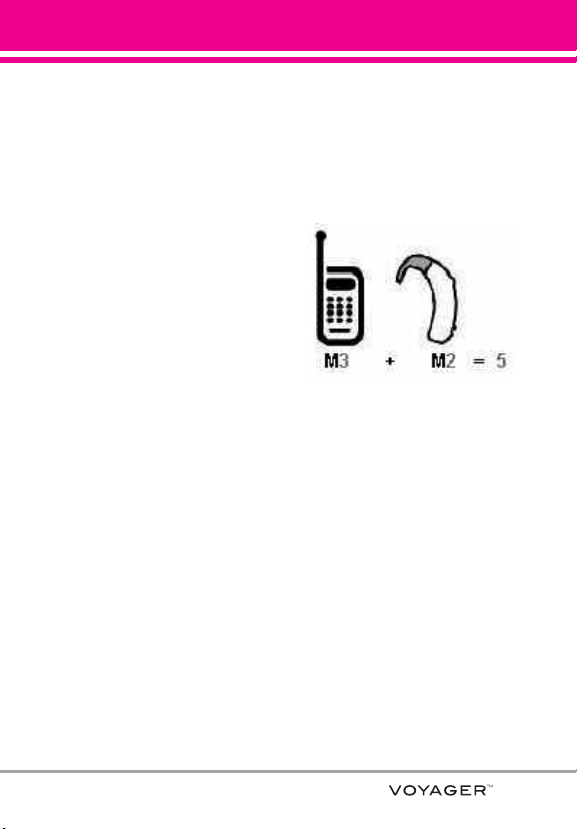
immune than others to this
interference noise, and phones also
vary in the amount of interference
they generate.
The wireless telephone industry
has developed a rating system for
wireless phones, to assist hearing
device users to find phones that
may be compatible with their
hearing devices. Not all phones
have been rated. Phones that are
rated have the rating on their box or
a label located on the box.
The ratings are not guarantees.
Results will vary depending on the
user's hearing device and hearing
loss. If your hearing device
happens to be vulnerable to
interference, you may not be able to
use a rated phone successfully.
Trying out the phone with your
hearing device is the best way to
evaluate it for your personal needs.
M-Ratings: Phones rated M3 or M4
meet FCC requirements and are
likely to generate less interference
to hearing devices than phones that
are not labeled. M4 is the
better/higher of the two ratings.
Hearing devices may also be rated.
Your hearing device manufacturer
or hearing health professional may
help you find this rating. Higher
ratings mean that the hearing
device is relatively immune to
interference noise. The hearing aid
and wireless phone rating values
are then added together. A sum of 5
is considered acceptable for
normal use. A sum of 6 is
considered for best use.
In the above example, if a hearing
aid meets the M2 level rating and
the wireless phone meets the M3
level rating, the sum of the two
values equal M5. This should
provide the hearing aid user with
“normal usage” while using their
hearing aid with the particular
wireless phone. “Normal usage” in
this context is defined as a signal
quality that’s acceptable for normal
operation.
The M mark is intended to be
synonymous with the U mark. The T
mark is intended to be synonymous
with the UT mark. The M and T
marks are recommended by the
Alliance for Telecommunications
169
Safety
Industries Solutions (ATIS). The U
and UT marks are referenced in
Section 20.19 of the FCC Rules. The
HAC rating and measurement
procedure are described in the
American National Standards
Institute (ANSI) C63.19 standard.
When you're talking over the cell
phone, it's recommended you'd turn
the BT (Bluetooth) mode off for
HAC.
170 VOYAGER
TM
170
For information about hearing aids
and digital wireless phones
FCC Hearing Aid Compatibility and
Volume Control
http://www.fcc.gov/cgb/dro/hearing.html
Gallaudet University, RERC
http://tap.gallaudet.edu/DigWireless.KS/
DigWireless.htm
HLAA (Hearing Loss Association of
America)
http://www.hearingloss.org/learn/cellph
onetech.asp
The Hearing Aid Compatibility FCC
Order
http://hraunfoss.fcc.gov/edocs_public/at
tachmatch/FCC-03-168A1.pdf
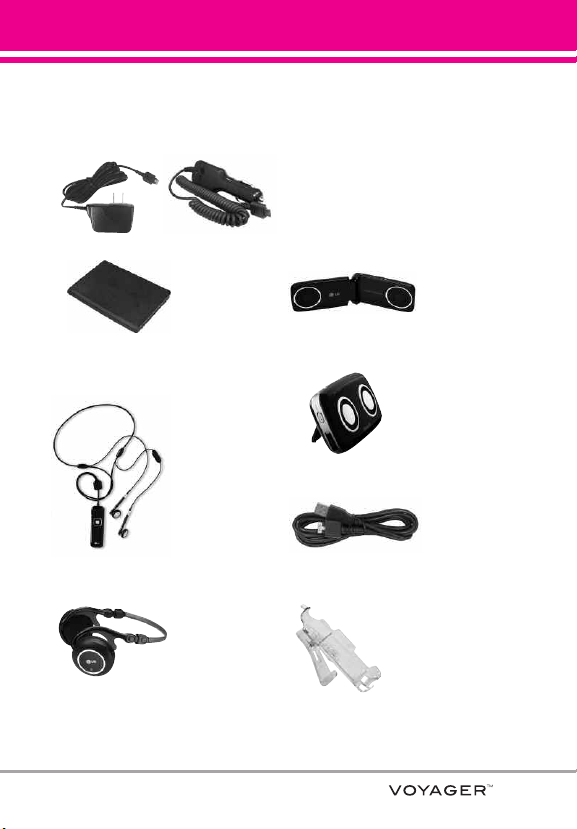
Accessories
171
There are a variety of accessories available for your phone and three easy
ways to purchase them: shop online anytime at www.verizonwireless.com,
call us at 1866 VZ GOT IT (894 6848) or visit one of our Verizon Wireless
Communication Stores.
Chargers
Batteries
Portable Stereo
Speakers
Bluetooth Stereo
Speakers
USB Cable
Bluetooth
Stereo Lanyard
Headset with
Music
Controller
Bluetooth
Stereo Headset
Holster

LIMITED WARRANTY STATEMENT
1. WHAT THIS WARRANTY
COVERS:
LG offers you a limited warranty
that the enclosed subscriber unit
and its enclosed accessories will
be free from defects in material and
workmanship, according to the
following terms and conditions:
(1)The limited warranty for the
product extends for TWELVE (12)
MONTHS beginning on the date
of purchase of the product with
valid proof of purchase, or
absent valid proof of purchase,
FIFTEEN (15) MONTHS from date
of manufacture as determined by
the unit's manufacture date
code.
(2)The limited warranty extends
only to the original purchaser of
the product and is not assignable
or transferable to any
subsequent purchaser/end user.
(3)This warranty is good only to the
original purchaser of the product
during the warranty period as
long as it is in the U.S., including
Alaska, Hawaii, U.S. Territories
and Canada.
(4)The external housing and
cosmetic parts shall be free of
defects at the time of shipment
and, therefore, shall not be
covered under these limited
warranty terms.
(5)Upon request from LG, the
consumer must provide
information to reasonably prove
the date of purchase.
(6)The customer shall bear the cost
of shipping the product to the
Customer Service Department of
LG. LG shall bear the cost of
shipping the product back to the
consumer after the completion of
service under this limited
warranty.
2. WHAT THIS WARRANTY DOES
NOT COVER:
(1)Defects or damages resulting
from use of the product in other
than its normal and customary
manner.
(2)Defects or damages from
abnormal use, abnormal
conditions, improper storage,
exposure to moisture or
dampness, unauthorized
modifications, unauthorized
connections, unauthorized
repair, misuse, neglect, abuse,
accident, alteration, improper
installation, or other acts which
172

are not the fault of LG, including
damage caused by shipping,
blown fuses, spills of food or
liquid.
(3)Breakage or damage to
antennas unless caused directly
by defects in material or
workmanship.
(4)That the Customer Service
Department at LG was not
notified by consumer of the
alleged defect or malfunction of
the product during the applicable
limited warranty period.
(5)Products which have had the
serial number removed or made
illegible.
(6)This limited warranty is in lieu of
all other warranties, express or
implied either in fact or by
operations of law, statutory or
otherwise, including, but not
limited to any implied warranty of
marketability or fitness for a
particular use.
(7)Damage resulting from use of
non LG approved accessories.
(8)All plastic surfaces and all other
externally exposed parts that are
scratched or damaged due to
normal customer use.
(9) Products operated outside
published maximum ratings.
(10) Products used or obtained in a
rental program.
(11) Consumables (such as fuses).
3. WHAT LG WILL DO:
LG will, at its sole option, either
repair, replace or refund the
purchase price of any unit that does
not conform to this limited warranty.
LG may choose at its option to use
functionally equivalent re-
conditioned, refurbished or new
units or parts or any units. In
addition, LG will not re-install or
back-up any data, applications or
software that you have added to
your phone. It is therefore
recommended that you back-up
any such data or information prior
to sending the unit to LG to avoid
the permanent loss of such
information.
4. STATE LAW RIGHTS:
No other express warranty is
applicable to this product. THE
DURATION OF ANY IMPLIED
WARRANTIES, INCLUDING THE
IMPLIED WARRANTY OF
MARKETABILITY, IS LIMITED TO
173
LIMITED WARRANTY STATEMENT
THE DURATION OF THE EXPRESS
WARRANTY HEREIN. LG SHALL
NOT BE LIABLE FOR THE LOSS OF
THE USE OF THE PRODUCT,
INCONVENIENCE, LOSS OR ANY
OTHER DAMAGES, DIRECT OR
CONSEQUENTIAL, ARISING OUT
OF THE USE OF, OR INABILITY TO
USE, THIS PRODUCT OR FOR ANY
BREACH OF ANY EXPRESS OR
IMPLIED WARRANTY, INCLUDING
THE IMPLIED WARRANTY OF
MARKETABILITY APPLICABLE TO
THIS PRODUCT.
Some states do not allow the
exclusive limitation of incidental or
consequential damages or
limitations on how long an implied
warranty lasts; so these limitations
or exclusions may not apply to you.
This warranty gives you specific
legal rights and you may also have
other rights which vary from state
to state.
5. HOW TO GET WARRANTY
SERVICE:
To obtain warranty service, please
call or fax to the following
telephone numbers from anywhere
in the continental United States:
Tel. 1-800-793-8896 or Fax. 1-800-
448-4026
Or visit http://us.lgservice.com.
Correspondence may also be
mailed to:
LG Electronics Service- Mobile
Handsets, P.O. Box 240007,
Huntsville, AL 35824
DO NOT RETURN YOUR PRODUCT
TO THE ABOVE ADDRESS. Please
call or write for the location of the
LG authorized service center
nearest you and for the procedures
for obtaining warranty claims.
174

T
T
e
e
r
r
m
m
i
i
n
n
o
o
l
l
o
o
g
g
y
y
EZ Tip Calc
Feature for easy bill calculation using the
total cost, tip, and number of people as
variables.
Advanced Voice Recognition
Feature that allows you to perform a
wide range of verbal commands by
training the phone to recognize your
individual speech patterns.
Bluetooth
®
wireless technology
Technology used to allow mobile phones,
computers, and other personal devices
to be easily coordinated and
interconnected using a short-range
wireless connection.
Media Center
Feature that accesses the Internet to
provide the ability to access and even
download a wide variety of software,
information, music, video, and more right
on your LG Verizon wireless phone.
microSD
TM
Additional the external memory for your
mobile phone.
V CAST
SM
Feature that is the next generation in
wireless technology which transforms
your wireless phone into a portable
music player and delivers an amazing
streaming mobile video experience.
V CAST uses technology that
significantly increases download
capabilities to deliver better graphics,
sound and depth and uses the power of
broadband so that you can download the
hottest entertainment, sports highlights,
news and breaking weather to your
Verizon Wireless V CAST phone. The
new V CAST phones provide better
imaging capabilities, mega pixel
cameras and video cameras, improved
audio and expandable memory storage.
A
A
c
c
r
r
o
o
n
n
y
y
m
m
s
s
a
a
n
n
d
d
A
A
b
b
b
b
r
r
e
e
v
v
i
i
a
a
t
t
i
i
o
o
n
n
s
s
DTMF
D
ual-Tone Multi Frequency (or “touch-
tone”) is a method used to communicate
keys pressed on the phone. Pressing a
key generates two simultaneous tones,
one for the row and one for the column
to determine which key was pressed.
Glossary
175

Glossary
ERI
E
nhanced Roaming Indicator is a
feature to indicate whether a mobile
phone is on its home system, a partner
network, or a roaming network. Many
phones indicate home vs. roaming as an
icon, but ERI capable phones can clearly
indicate third “partner network” status.
EVDO
Ev
olution Data Only or Evolution Data
Optimized (abbreviated as EVDO, EV-DO,
EvDO, 1xEV-DO or 1xEvDO) provides fast
wireless broadband access (3G)
anywhere, without needing a WiFi
hotspot.
GPS
G
lobal Positioning System is a system of
satellites, computers, and receivers able
to determine the latitude and longitude of
a specific receiver on Earth. Position is
calculated using time and distance.
IS 2000
Type of digital signaling. It's the second
generation of CDMA digital cellular, an
extension of IS-95. Differences between
signaling types have to do with pilot
signal and links to provide more traffic
channels, and control protocols.
NAM
N
umber Assignment Module is how the
phone stores the phone number and its
electronic serial number.
SSL
S
ecure Sockets Layer Protocol used to
encrypt data sent over the air.
TTY
T
eletypewriter. An electromechanical
typewriter that either transmits or
receives messages coded in electrical
signals. A phone with TTY support is able
to translate typed characters to voice or
translate voice into characters to display
on the TTY.
176

10 Driver Safety Tips 164
A
Accessories 171
Add New Device 101
Alarm Clock 95
Alert Sounds 109
All 89
Auto Retry 131
B
Backlight 113
Banner 111
Battery Charge Level 25
Battery Temperature
Protection 25
Bluetooth Menu 100
Browse & Download 59
Browser 143
C
Calculator 93
Calendar 94
Call Settings 129
Call Sounds 107
Call Waiting 28
Card Memory 139
Charging Screen 115
Charging the Battery 23
Clock Format 118
Consumer Information on
SAR 166
Contact List 81
CONTACTS 81
D
Dial Fonts 117
Dialed 88
Display Settings 111
Display Themes 116
Drafts 74
E
End Call Options 130
Erasing Messages 79
Extras 64
Ez Tip Calc 98
F
FCC Hearing-Aid
Compatibility (HAC)
Regulations for Wireless
Devices 168
FDA Consumer Update 156
G
Games 59
Get New Pictures 51
Get New Ringtones 38
Glossary 175
Groups 82
I
Icon Glossary 142
Important Safety
Precautions 1
In Case of Emergency (ICE)
84
Inbox 71
K
Keypad Volume 109
L
Language 121
LIMITED WARRANTY
STATEMENT 172
Location 122
M
Making Calls 26
Master Volume 107
Media Center 37
Memory 137
Menu Fonts 116
Menu Tree on the External
Touch Screen 21
Menu Tree on the Internal
Screen 19
MESSAGING 65
Mobile Email 77
Mobile IM 77
MSG Settings 78
Music 143
Music & Tones 37
Mute Function 28
My Music 40
My Name Card 85
My Number 141
My Pictures 52
My Ringtones 39
My Sounds 42
My Verizon 91
My Videos 53
N
NAM Select 129
Navigator 147
New Contact 81
New Message 65
Notepad 98
Index
177

O
One Touch Dial 134
Online Album 58
P
Phone Info 140
Phone Memory 139
Phone Overview 12
Phone Settings 119
Picture & Video 44
Picture Msg 67
Power On/Off 111
R
Received 87
Receiving Calls 27
Record Video 57
Removing the Battery 23
S
Safety Information 151
Save Options 138
Screen Icons 26
Security 122
Sent 73
Service Alerts 110
Set Shortcuts 119
SETTINGS & TOOLS 91
Shortcut Menu 16
Show Dialpad 131
Signal Strength 26
Sounds Settings 107
Speed Dials 83
Standalone Mode 119
Stopwatch 96
SW/HW Version 141
Sync Music 43
System Select 128
T
Take Picture 55
Technical Details 9
TIA Safety Information 148
Tools 91
Touch Settings 136
TTY Mode 132
U
USB Auto Detection 136
USB Mass Storage 99
V
V CAST Mobile TV 45
V CAST Music | Rhapsody
38
V CAST Videos 49
Vibrate Mode 28
Video Msg 69
View Timers 90
Visual Voice Mail 76
Voice Commands 29, 91,
120
Voice Privacy 135
Voicemail 75
Volume Quick Adjustment
28
W
Wallpaper 114
World Clock 97
Index
178

MEMO

MEMO
Lea estas sencillas instrucciones. Romper las reglas puede ser
peligroso o ilegal. Se ofrece más información detallada en esta guía
del usuario.
No seguir las instrucciones puede ocasionar lesiones graves
o la muerte.
●
No use nunca una batería no aprobada, ya que esto
podría dañar el teléfono o la batería, y podría
ocasionar que estalle la batería.
●
Nunca coloque el teléfono en un horno de
microondas ya que esto haría que estallara la batería.
●
Nunca almacene el teléfono a temperaturas menores
de -4°F ni mayores de 122°F.
●
No se deshaga de la batería mediante el fuego o con
materiales peligrosos o inflamables.
●
Al ir en automóvil, no deje el teléfono ni instale el kit
de manos libres cerca de la bolsa de aire. Si el equipo
inalámbrico está instalado incorrectamente y se
activa la bolsa de aire, usted puede resultar
gravemente lesionado.
●
No use un teléfono de mano cuando esté
conduciendo.
●
No use el teléfono en zonas donde esté prohibido
hacerlo. (Por ejemplo: en los aviones)
Precaución de Seguridad Importante
1
Precaución de Seguridad Importante
●
No exponga cargador de baterías o el adaptador a la
luz directa del sol, ni lo utilice en sitios con elevada
humedad, como por ejemplo el baño.
●
No use sustancias químicas corrosivas (como alcohol,
bencina, solventes, etc.) ni detergentes para limpiar el
teléfono. Existe riesgo de causar un incendio.
●
No deje caer el teléfono, ni lo golpee o agite
fuertemente. Tales acciones pueden dañar las tarjetas
de circuitos internas del teléfono.
●
No use el teléfono en áreas altamente explosivas, ya
que puede generar chispas.
●
No dañe el cable de corriente doblándolo,
retorciéndolo, tirando de él o calentándolo.
No use la clavija si está suelta, ya que esto puede
ocasionar incendios o descargas eléctricas.
●
No coloque objetos pesados sobre el cable de
corriente. No permita que el cable de corriente se
doble, ya que esto puede ocasionar incendios o
descargas eléctricas.
●
No manipule el teléfono con las manos húmedas
cuando se esté cargando. Puede causar un choque
eléctrico o dañar gravemente el teléfono.
●
No desarme el teléfono.
2
●
No haga ni conteste llamadas mientras esté cargando el
teléfono, ya que puede causar un corto circuito en éste o
provocar descargas eléctricas o incendios.
●
No sostenga la antena ni permita que entre en contacto con su
cuerpo durante las llamadas.
●
Asegúrese de que no entren en contacto con la batería
objetos con bordes cortante, como dientes de animales o
uñas. Hay riesgo de causar un incendio.
●
Almacene la batería en un sitio alejado del alcance de los
niños.
●
Cuide que los niños no se traguen partes del teléfono (como
los tapones de hule, del auricular, partes conectoras del
teléfono, etc.) Esto podría causar asfixia o sofocación, dando
como resultado lesiones graves o la muerte.
●
Desconecte el enchufe de la toma de corriente y el cargador
cuando se ilumina porque puede provocar unchoque electrico
o peligro de incendio.
●
Sólo use baterías y cargadores proporcionados por LG. La
garantía no se aplicará a productos proporcionados por otros
proveedores.
●
Sólo personal autorizado debe darle servicio al teléfono y a sus
accesorios. La instalación o servicio incorrectos pueden dar
como resultado accidentes y por tanto invalidar la garantía.
●
Su proveedor de servicios proporciona uno o más números de
emergencia, tal como 911, a los cuales usted puede llamar en
cualquier circunstancia, incluso cuando su teléfono está
bloqueado. Es posible que los números de emergencia
preprogramados de su teléfono no funcionen en todo lugar, y
a veces una llamada de emergencia no puede colocarse
debido a problemas de la red, ambientales o de interferencia.
3

Contenido
Precaución de Seguridad
Importante . . . . . . . . . . . . . . . . . . . .1
Bienvenidos . . . . . . . . . . . . . . . . . . . .8
Detalles Técnicos . . . . . . . . . . . . . . .9
Información Importante . . . . . . . . . . . .9
Descripción general del
Teléfono . . . . . . . . . . . . . . . . . . . . . .12
Vista rápida del teclado y cómo
usarlo . . . . . . . . . . . . . . . . . . . . . . . . .14
Teclas suaves sensibles al tacto . . .14
Calibración de la pantalla táctil .15
El menú Atajo . . . . . . . . . . . . . . . . .16
Menú Atajo De La Pantalla Táctil . .16
Introducir y editar información . .17
Entrada de texto . . . . . . . . . . . . . . . . . .17
Del teclado numérico interno de
Qwerty
®
. . . . . . . . . . . . . . . . . . . . . . . . .18
Árbol de menús en la pantalla
interna . . . . . . . . . . . . . . . . . . . . . . . .19
Árbol de menús en la pantalla
táctil externa . . . . . . . . . . . . . . . . . .21
Acceso a los menús . . . . . . . . . . . . . .21
Menú Atajo en el teclado
externo . . . . . . . . . . . . . . . . . . . . . . .22
Menú Atajo De La Pantalla Táctil . . .22
La batería . . . . . . . . . . . . . . . . . . . . . .23
Para hacer funcionar su teléfono
por primera vez . . . . . . . . . . . . . . . .23
Instalación de la batería . . . . . . . . . .23
Extracción de la batería . . . . . . . . . .23
Carga de la batería . . . . . . . . . . . . . . .23
Carga con USB . . . . . . . . . . . . . . . . . .24
Instalación de la tarjeta microSD™ . .24
Desinstalación de la tarjeta
microSD™ . . . . . . . . . . . . . . . . . . . . . .24
Protección de la temperatura de la
batería . . . . . . . . . . . . . . . . . . . . . . . . .25
Nivel de carga de la batería . . . . . . . .25
Apagar y encender el teléfono . . . . .25
Encender el teléfono . . . . . . . . . . . .25
Apagar el teléfono . . . . . . . . . . . . . .25
Potencia de la señal . . . . . . . . . . . . . .26
Iconos de pantalla . . . . . . . . . . . . . . . .26
Para hacer llamadas . . . . . . . . . . . . . .26
Corrección de errores en la
marcación . . . . . . . . . . . . . . . . . . . . .26
Remarcado de llamadas . . . . . . . . . .27
Para recibir llamadas . . . . . . . . . . . . .27
Acceso rápido a funciones de
conveniencia . . . . . . . . . . . . . . . . . .28
Modo de vibración . . . . . . . . . . . . . . .28
Función de silencio . . . . . . . . . . . . . . .28
Ajuste rápido del volumen . . . . . . . . .28
Llamada en espera
. . . . . . . . . . . . . . .28
Comando de voz . . . . . . . . . . . . . . . . . .29
Contactos en la memoria de su
teléfono . . . . . . . . . . . . . . . . . . . . . . .30
Aspectos básicos . . . . . . . . . . . . . . . .30
Personalización de entradas
individuales . . . . . . . . . . . . . . . . . . . . . .31
Marcación Rápida . . . . . . . . . . . . . . . .31
Almacenar un número con una
pausa . . . . . . . . . . . . . . . . . . . . . . . . . . .32
Agregar otro número de teléfono . .33
Cambio del número
predeterminado . . . . . . . . . . . . . . . . . .34
4

Borrar . . . . . . . . . . . . . . . . . . . . . . . . . . .34
Marcado Rápido . . . . . . . . . . . . . . . . .36
CENTRO de MEDIOS . . . . . . . . . . . .37
1. Música y Tonos . . . . . . . . . . . . . . . .37
1.1 Música de V CAST | Rhapsody .38
1.2 Obtén Nuevos Timbres . . . . . . . .38
1.3 Mis Timbres . . . . . . . . . . . . . . . . .39
1.4 Mi Música . . . . . . . . . . . . . . . . . . .40
Reproducción de Mi música . . . . . .41
Control del reproductor de música .42
Salida del reproductor de música . .42
1.5 Mis Sonidos . . . . . . . . . . . . . . . . .42
1.6 Sincronizar Música . . . . . . . . . . . .43
2. Foto y Video . . . . . . . . . . . . . . . . . . . .44
2.1 TV móvil V CAST . . . . . . . . . . . . .45
2.2 Videos de V CAST . . . . . . . . . . . .49
2.3 Obtén Nuevas Fotos . . . . . . . . . .51
2.4 Mis Fotos . . . . . . . . . . . . . . . . . . .52
2.5 Mis Videos . . . . . . . . . . . . . . . . . .53
2.6 Tomar Foto . . . . . . . . . . . . . . . . . .55
2.7 Grabar Video . . . . . . . . . . . . . . . . .57
3. Juegos . . . . . . . . . . . . . . . . . . . . . . . .58
4. Navegar y Descargar . . . . . . . . . . .59
5. Extra . . . . . . . . . . . . . . . . . . . . . . . . . .64
MENSAJERÍA . . . . . . . . . . . . . . . . . .65
1. Nuevo Mensaje . . . . . . . . . . . . . . . .
65
1.1 Msj TXTO . . . . . . . . . . . . . . . . . . .65
1.2 Msj FOTO . . . . . . . . . . . . . . . . . . .67
1.3 Msj Vídeo . . . . . . . . . . . . . . . . . . .70
2. Entrada . . . . . . . . . . . . . . . . . . . . . . .72
3. Enviado . . . . . . . . . . . . . . . . . . . . . . . .74
4. Borradores . . . . . . . . . . . . . . . . . . . .76
5. Bzn Msjs Voz . . . . . . . . . . . . . . . . . .77
6. Visual Voice Mail . . . . . . . . . . . . . . .78
7. IMMóv . . . . . . . . . . . . . . . . . . . . . . . .79
8. Mobile Email . . . . . . . . . . . . . . . . . . .79
Configuración de Mensajes . . . . . . .80
1. Modo de Ingreso (Palabra/ Abc/
ABC/123) . . . . . . . . . . . . . . . . . . . . . .80
2. Grdr Autmtc (Encendido/ Apagado/
Preguntar) . . . . . . . . . . . . . . . . . . . . .80
3. Bor Autmtc (Encendido/
Apagado) . . . . . . . . . . . . . . . . . . . . . .80
4. Ver TXT Autmtc (Encendido/
Encendido+ Inform.../ Apagado) . . .80
5. Tocar TXT Autmtc (Encendido/
Apagado) . . . . . . . . . . . . . . . . . . . . . .80
6. Rec Aut Fot-Vid (Encendido/
Apagado) . . . . . . . . . . . . . . . . . . . . . .81
7. Text Rápido . . . . . . . . . . . . . . . . . .81
8. Bzn Msjs Voz # . . . . . . . . . . . . . . .81
9. Dev Llmda # . . . . . . . . . . . . . . . . .81
0. Firma (Ninguno/ Costumbre) . . . .81
MSJ Borrar . . . . . . . . . . . . . . . . . . . . . .81
CONTACTOS . . . . . . . . . . . . . . . . . . . .83
1. Nuevo Contacto . . . . . . . . . . . . . . . .83
2. Lista de Contactos . . . . . . . . . . . . . .83
3. Grupos . . . . . . . . . . . . . . . . . . . . . . . .84
4. Marcado Rápido . . . . . . . . . . . . . . .85
5. In Case of Emergency (ICE) . . . . .86
6. Mi Tarjeta de Nombre . . . . . . . . . .88
LLAMAS. RECNTES . . . . . . . . . . . . .89
1. Perdidas . . . . . . . . . . . . . . . . . . . . . .89
2. Recibidas . . . . . . . . . . . . . . . . . . . . . .90
3. Marcadas . . . . . . . . . . . . . . . . . . . . .91
4. Todas . . . . . . . . . . . . . . . . . . . . . . . . . .92
5. Ver Cronómetro . . . . . . . . . . . . . . . .93
PROG/HERR . . . . . . . . . . . . . . . . . . . .94
1. Mi Verizon . . . . . . . . . . . . . . . . . . . . .94
5

Contenido
2. Herramientas . . . . . . . . . . . . . . . . . .94
2.1 Comandos de Voz . . . . . . . . . . . .94
2.1.1 Llamar <Nombre o Número> 95
2.1.2 Enviar Msj a <Nombre o
Número> . . . . . . . . . . . . . . . . . . . . . .95
2.1.3 Ir a <Menú> . . . . . . . . . . . . . .96
2.1.4 Verificar <Elemento> . . . . . . .96
2.1.5 Contactos <Nombre> . . . . . . .96
2.1.6 Mi Verizon . . . . . . . . . . . . . . . .96
2.1.7 Ayuda . . . . . . . . . . . . . . . . . . . .96
2.2 Calculadora . . . . . . . . . . . . . . . . .96
2.3 Calendario . . . . . . . . . . . . . . . . . . .97
2.4 Reloj Despertador . . . . . . . . . . . .98
2.5 Cronómetro . . . . . . . . . . . . . . . .100
2.6 Reloj Mundial . . . . . . . . . . . . . . .100
2.7 Cuaderno de Notas . . . . . . . . . .101
2.8 Ez Sugerencia . . . . . . . . . . . . . . .102
2.9 Almacen masivo USB . . . . . . . .103
3. Menú de Bluetooth . . . . . . . . . . . .104
3.1 Anadir Nuevo Aparato . . . . . . . .105
Mi Nombre de Teléfono . . . . . . . . . .107
Encendido . . . . . . . . . . . . . . . . . . . . .108
Modo de Descubrimiento . . . . . . . .109
Perfiles Soportados . . . . . . . . . . . . .109
Dispositivos buscar . . . . . . . . . . . . .110
Auto- Emparejamiento Manos
Libres . . . . . . . . . . . . . . . . . . . . . . . .110
Dispositivos Encontrados . . . . . . . .110
4. Programación de Sonidos . . . . .112
4.1 Volumen Maestro . . . . . . . . . . .112
4.2 Sonidos de Llamada . . . . . . . . .112
4.2.1 Timbre de Llamada . . . . . . . .113
4.2.2 Vibrador de Llamada . . . . . . .113
4.3 Sonidos de Alerta . . . . . . . . . . . .114
4.4 Volumen de Teclado . . . . . . . . .115
4.5 Alertas de Servicio . . . . . . . . . . .115
4.6 Apagado/Encendido . . . . . . . . . .116
5. Programación de Pantalla . . . . .117
5.1 Aviso . . . . . . . . . . . . . . . . . . . . . .117
5.1.1.1 Aviso Interno . . . . . . . . . . .117
5.1.1.2 Aviso Externo . . . . . . . . . .117
5.1.2 Aviso IRO . . . . . . . . . . . . . . . .118
5.2 Luz de Pantalla . . . . . . . . . . . . . .119
5.3 Fondo de Pantalla . . . . . . . . . . .120
5.4 Cargando Pantalla . . . . . . . . . . .121
5.5 Temas de Pantalla . . . . . . . . . . .122
5.6 Fuente de Menú . . . . . . . . . . . .122
5.7 Fuentes de Marcado . . . . . . . . .123
5.8 Formato Reloj . . . . . . . . . . . . . . .124
6. Programación de Teléfono . . . .125
6.1 Modo de avión . . . . . . . . . . . . .125
6.2 Establecer atajos . . . . . . . . . . . .125
6.3 Comandos de Voz . . . . . . . . . . .127
6.4 Idioma . . . . . . . . . . . . . . . . . . . . .127
6.5 Ubicación . . . . . . . . . . . . . . . . . .128
6.6 Seguridad . . . . . . . . . . . . . . . . .129
6.6.1 Editar Códigos . . . . . . . . . . . .130
6.6.2 Restricciones . . . . . . . . . . . . .131
6.6.3 Bloqueo de teléfono . . . . . . .132
6.6.4 Bloquear teléfono ahora . . . .133
6.6.5 Restablecer Implícito . . . . . .133
6.6.6 Restaurar teléfono . . . . . . . .134
6.7 Selección de Sistema . . . . . . . .135
6.8 NAM Select . . . . . . . . . . . . . . . .136
7. Programación de Llamada . . . . .137
7.1 Opciones de Respuesta . . . . . .137
7.2 Opciones de finalizar llamada . .138
7.3 Mostr tcld marc . . . . . . . . . . . . .139
7.4 Reintentar Automáticamente . .139
7.5 Modo TTY . . . . . . . . . . . . . . . . . .140
6

7.6 Marcardo oprimiendo un botón 142
7.7 Privacidad de Voz . . . . . . . . . . . .143
8. Programación de Toque . . . . . . .143
9. Detección automática de USB .145
10. Memoria . . . . . . . . . . . . . . . . . . . .146
10.1 Opciones de Memoria . . . . . . .146
10.2 Memoria del Teléfono . . . . . . .147
10.3 Memoria de la Tarjeta . . . . . . .148
11. Info de Teléfono . . . . . . . . . . . . . .149
11.1 Mi Número . . . . . . . . . . . . . . . .149
11.2 Versión SW/HW . . . . . . . . . . . .150
11.3 Glosario de Iconos . . . . . . . . . .151
Música . . . . . . . . . . . . . . . . . . . . . . . . .151
Browser . . . . . . . . . . . . . . . . . . . . . . .152
Finalización de una sesión del
navegador. . . . . . . . . . . . . . . . . . . . .152
Navegación con el navegador . . . . .152
Navegador . . . . . . . . . . . . . . . . . . . . . .156
Seguridad . . . . . . . . . . . . . . . . . . . .158
Información de seguridad de la
TIA . . . . . . . . . . . . . . . . . . . . . . . . . . . .158
Exposición a las señales de
radiofrecuencia . . . . . . . . . . . . . . . .158
Cuidado de la antena . . . . . . . . . . .158
Funcionamiento del teléfono . . . . .158
Sugerencias para un funcionamiento
más eficiente . . . . . . . . . . . . . . . . .159
Manejo . . . . . . . . . . . . . . . . . . . . . .159
Dispositivos Electrónicos . . . . . . . .159
Marcapasos . . . . . . . . . . . . . . . . . .159
Aparatos para la sordera . . . . . . . .160
Otros Dispositivos Médicos . . . . .160
Centros de atención médica . . . . .160
Vehículos . . . . . . . . . . . . . . . . . . . . .160
Instalaciones con letreros . . . . . . .160
Aeronaves . . . . . . . . . . . . . . . . . . . .160
Áreas de explosivos . . . . . . . . . . . .160
Atmósfera potencialmente
explosiva . . . . . . . . . . . . . . . . . . . . .160
Para vehículos equipados con bolsas
de aire . . . . . . . . . . . . . . . . . . . . . . .161
Información de seguridad . . . . . .161
Seguridad del cargador y del
adaptador . . . . . . . . . . . . . . . . . . . .162
Información y cuidado de la batería162
Peligros de explosión, descargas
eléctricas e incendio . . . . . . . . . . . .163
Aviso General . . . . . . . . . . . . . . . . .164
Cuidado: Evite una Probable Pérdida
del Oído. . . . . . . . . . . . . . . . . . . . . . . .165
Actualización de la FDA para los
consumidores . . . . . . . . . . . . . . . . .167
10 Consejos de Seguridad para
Conductores . . . . . . . . . . . . . . . . . . .175
Información al consumidor sobre la
SAR . . . . . . . . . . . . . . . . . . . . . . . . . .178
Reglas para la compatibilidad con
aparatos para la sordera (HAC) de
la FCC para los dispositivos
inalámbricos . . . . . . . . . . . . . . . . . . .180
Accesorios . . . . . . . . . . . . . . . . . . .183
DECLARACIÓN DE GARANTÍA
LIMITADA . . . . . . . . . . . . . . . . . . . .184
Terminología . . . . . . . . . . . . . . . . . .187
Glosario . . . . . . . . . . . . . . . . . . . . .187
Siglas y abreviaturas . . . . . . . . . .188
Índice . . . . . . . . . . . . . . . . . . . . . . . .190
7

8
Bienvenidos
Gracias por elegir el avanzado y
compacto teléfono celular VOYAGER,
diseñado para funcionar con la más
reciente tecnología de comunicación
móvil digital, Acceso múltiple de
división de código (CDMA). Junto con
las muchas funciones avanzadas del
sistema CDMA, como una claridad de
voz altamente mejorada, este teléfono
ofrece:
●
TV móvil de V CAST
SM
.
●
Capaz de Música V CAST
SM
.
●
Capaz de Vídeo V CAST
SM
.
●
Mobile IM.
●
VZ Navegador.
●
Email Móvil.
●
Visual buzón de voz
●
City ID
●
Telclado numérico interno 54-tecla,
pantalla externa del tacto y
protección dominante del tacto.
●
Temas de pantalla y navegación de
menús personalizables.
●
Cámara interconstruida de 2.0
megapíxeles.
●
LCD de 8 líneas, grande, de fácil
lectura, con luz de fondo e iconos
de estado.
●
Localizador, mensajería, correo de
voz e identificador de llamada.
●
Un rápido acceso el navegador
HTML.
●
CENTRO de MEDIOS.
●
Tiempo prolongado de batería en
espera y en conversación.
●
Interfaz accionada por menús, con
indicaciones para una fácil
operación.
●
Respuesta con cualquier tecla,
respuesta automática, reintento
automático, marcado de una tecla
y marcado rápido con 99
ubicaciones de memoria.
●
Capacidades bilingües (Inglés y
Español).
●
La tecnología inalámbrica
Bluetooth
®
NOTA
Las palabras de la marca y los
logotipos de Bluetooth
®
son propiedad
de Bluetooth SIG, Inc. y cualquier uso
de tales marcas por parte de LG se
hace bajo licencia. Otras marcas y
nombres comerciales son de sus
respectivos propietarios.
SUGERENCIA
Para su comodidad, encontrará la guía del
usuario interactiva en Internet, que podrá
recorrer libremente y así aprender de manera
interactiva cómo usar el teléfono paso a paso.
Diríjase a https://www.verizonwireless.com ->
Support -> Phones & Devices -> luego
seleccione Equipment Guide -> seleccione el
modelo de su teléfono.
8
VOYAGER es una marca comercial
de Plantronics, Inc. usada bajo
licencia de Verizon Wireless.

Información Importante
Esta guía del usuario ofrece
información importante sobre el uso y
funcionamiento de su teléfono. Lea toda
la información cuidadosamente antes
de usar el teléfono, para tener el mejor
desempeño y para evitar cualquier
daño al teléfono o su uso incorrecto.
Cualquier cambio o modificación no
aprobados anulará la garantía.
Detalles Técnicos
El VOYAGER
TM
es un teléfono totalmente
digital que funciona en las dos frecuencias
de Acceso múltiple de división de código
(CDMA): Servicios Celulares a 800 MHz y
Servicios de Comunicación Personal (PCS)
a 1.9 GHz.
La tecnología CDMA usa una función
llamada DSSS (Espectro ensanchado por
secuencia directa) que permite que el
teléfono evite que se cruce la
comunicación y que varios usuarios en la
misma área específica puedan usar un
canal de frecuencia. Esto da como
resultado un aumento de capacidad de
10 veces comparado con el modo
analógico. Adicionalmente, funciones
como la transferencia suave y más
suave, la transferencia dura y las
tecnologías de control de la potencia de
RF dinámica se combinan para reducir
las interrupciones de las llamadas.
Las redes celular y PCS CDMA constan de
MSO (Oficina de conmutación móvil), BSC
(Controlador de estación de base), BTS
(Sistema de transmisión de estación de
base), y MS (Estación móvil).
* TSB -74: Protocolo entre un sistema
IS-95A y ANSI J-STD-008
El sistema 1xRTT recibe dos veces más
suscriptores en la sección inalámbrica
que IS-95. La duración de su batería es
del doble de IS-95. También es posible la
transmisión de datos a alta velocidad.
El sistema EV-DO está optimizado para el
servicio de datos y es mucho más rápido
que el sistema 1xRTT en el área
aplicable.
La TV móvil V CAST usa una tecnología
llamada MediaFLO.
Tecnología empleada para emitir datos
a dispositivos portátiles tales como
teléfonos móviles o agendas
electrónicas. Los datos emitidos
incluyen transmisiones continuas de
audio y video, videoclips y audioclips
individuales, e información como las
cotizaciones del mercado de valores,
marcadores deportivos e informes del
tiempo. Las letras "F-L-O" de MediaFLO
corresponden a Forward Link Only
(enlace únicamente hacia el frente) que
significa que la ruta de transmisión de
datos es de una vía, de la torre al
dispositivo. El sistema MediaFLO
transmite datos en una frecuencia
separada de las frecuencias empleadas
por las redes celulares actuales.
Detalles Técnicos
9
10
Detalles Técnicos
10
Estándar
CDMA
Designador CDMA Designador Descripción
Interfaz aérea
básica
TIA/EIA-95A
TSB-74
ANSI J-STD-008
TIA/EIA-IS2000
Interfaz aérea CDMA de modo doble
Protocolo de enlace de radio a 14.4 kbps y
operaciones interbanda
Interfaz aérea 1xRTT CDMA2000 IS-95 adaptada
para la banda de frecuencia PCS
Red
TIA/EIA/IS-634
TIA/EIA/IS/651
TIA/EIA/IS-41-C
TIA/EIA/IS-124
MAS-BS
PCSC-RS
Operaciones intersistema
Comunic. de datos con señales nom
Servicio
TIA/EIA/IS-96-B
TIA/EIA/IS-637
TIA/EIA/IS-657
IS-801
TIA/EIA/IS-707-A
CODEC de voz
Servicio de mensajes cortos
Datos de paquete
Servicio de determinación de posición (gpsOne)
Datos de paquete de alta velocidad
Interfaz
relacionada
1x EV-DO
TIA/EIA/IS-856
TIA/EIA/IS-878
TIA/EIA/IS-866
TIA/EIA/IS-890
Interfaz aérea de datos en paquete de alta velocidad
CDMA2000
Especificación de interoperabilidad 1xEV-DO para
Interfaces de red de acceso CDMA2000
Estándares de desempeño mínimo recomendado
para Terminal de acceso de datos en paquetes de
alta velocidad CDMA2000
Especificación de aplicaciones de prueba (TAS) para
Interfaz aérea de datos en paquetes de alta velocidad
La tabla siguiente enumera algunos de
los principales estándares CDMA.
Información de la FCC sobre
exposición a la RF
¡ADVERTENCIA! Lea esta
información antes de hacer
funcionar el teléfono.
En agosto de 1996, la Comisión federal
de comunicaciones (FCC) de los Estados
Unidos, con su acción sobre el Informe
y orden FCC 96-326, adoptó un estándar
de seguridad actualizado para la
exposición humana a la energía
electromagnética de radiofrecuencia
(RF) emitida por transmisores regulados
por la FCC. Esos lineamientos son
consistentes con el estándar de
seguridad establecido previamente por
los cuerpos de estándares tanto de los
EE.UU. como internacionales. El diseño
de este teléfono cumple con las
directrices de la FCC y estos estándares
internacionales.
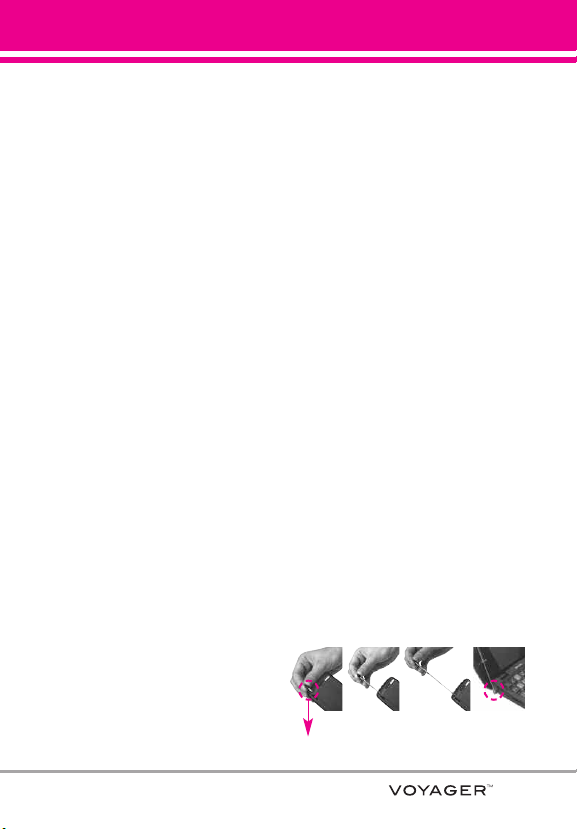
Contacto corporal durante el
funcionamiento
Este dispositivo se probó para un uso
ordinario con la parte posterior del
teléfono a una distancia de 2,0 cm (0,79
pulgadas) del cuerpo. Para cumplir con
los requisitos de exposición a RF de la
FCC, debe mantenerse una distancia de
separación mínima de 2,0 cm (0,79
pulgadas) entre el cuerpo del usuario y la
parte posterior del teléfono, incluida la
antena, ya sea extendida o retraída. No
deben usarse sujetadores de cinturón,
fundas y otros accesorios de terceros
que contengan componentes metálicos.
Evite el uso de accesorios que no puedan
mantener una distancia de 2,0 cm (0,79
pulgadas) entre el cuerpo del usuario y la
parte posterior del teléfono y que no se
hayan probado para determinar que
cumplen los límites de exposición a RF de
la FCC.
Antena externa instalada en un vehículo
(Opcional, en caso de estar disponible.)
Debe mantenerse una distancia mínima
de separación de 20 cm (8 pulgadas)
entre el usuario o quien esté cerca y la
antena externa instalada en un vehículo
para satisfacer los requisitos de
exposición a RF de la FCC. Para Obtener
más información sobre la exposición a la
RF, visite el sitio Web de la FCC en
www.fcc.gov.
FCC Notice y Precaución
Este dispositivo y sus accesorios
cumplen con el artículo 15 de las reglas
de la FCC. El funcionamiento está sujeto a
las dos siguientes condiciones: (1) Este
dispositivo y sus accesorios no pueden
causar interferencia dañina y (2) este
dispositivo y sus accesorios deben
aceptar cualquier interferencia que
reciban, incluida la interferencia que
cause un funcionamiento no deseado.
Cualquier cambio o modificación no
aprobado expresamente en esta guía del
usuario podría anular su garantía para
este equipo. Use sólo la antena incluida y
aprobada. El uso de antenas no
autorizadas o modificaciones no
autorizadas pueden afectar la calidad de
la llamada telefónica, dañar al teléfono,
anular su garantía o dar como resultado
una violación de las reglas de la FCC.
No use el teléfono si la antena está
dañada. Si una antena dañada entra en
contacto con la piel, puede producirse
una ligera quemadura. Comuníquese con
su distribuidor local para obtener una
antena de reemplazo.
SUGERENCIA
Se recomienda jalar la antena hacia afuera para
una mejor recepción de TV mientras mira
TV
móvil V CAST.
11
La antena se encuentra en la parte inferior izquierda del teléfono.
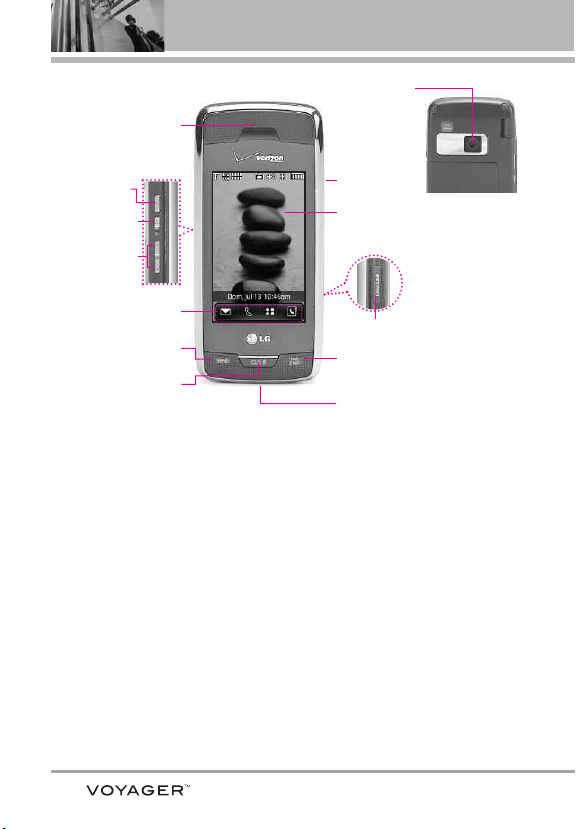
1212
Descripción general del Teléfono
1.
Audífono
Le permite escuchar la persona al otro lado
de la línea.
2.
Tecla Cámara
Úsela para acceder rápidamente a la
función de Cámara. Mantenga oprimida la tecla
cámara para grabar video.
3. Tecla de bloqueo y desbloqueo
Presione y suelte
para desbloquear las teclas táctiles cuando la tapa
esté cerrada.
4.
Teclas laterales de volumen
Úselas para ajustar el
Volumen maestro en estado de espera* y el Volumen
del Audífono durante una llamada.
5. Teclas suaves de teclado Las teclas táctiles de este
teclado incluyen Mensajería, Llamada, Menú y
Contactos, las cuales se activan de manera sencilla con
el toque de su dedo.
6. Tecla SEND Úsela para hacer llamadas.
7. Tecla Borrar/ Tecla de marcado de voz Borra espacios
sencillos o caracteres oprimiéndola rápidamente, pero
manténgala oprimida para borrar una palabra. También
le permitirá retroceder en los menús, un nivel a la vez.
Acceso rápido de Comando de V
oz, y mantenga
oprimida para accesar al grabado de voz.
8.
Puerto para cargador y accesorios
Conecta el teléfono
al cargador de baterías u otros accesorios compatibles.
9.
Tecla PWR/END
Úsela para apagar o encender el
teléfono y para terminar una llamada. Úsela también
para volver a la pantalla del menú principal.
10. Ranura de microSD™ Acepta tarjetas microSD
™
opcionales hasta 8GB.
11.
Pantalla táctil
Muestra llamadas entrantes,
mensajes e iconos indicadores así como una amplia
variedad de contenido que usted seleccione para
visualizar.
12. Enchufe de audífonos Le permite conectar unos
audífonos opcionales para tener conversaciones
cómodas de manos libres.
Conecte el receptor de
cabeza en el receptor de 2.5mm situado en la
izquierda superior del dispositivo.
13. Lente de la Cámara Consérvelo limpio para obtener
una calidad óptima de las fotografías.
*
El telefono entra en modo de espera es aguarda a que usted ingrese alguna
en
tr
ada. No se muestr
a ningún menú y el t
eléfono no r
ealiza ac
ción alguna. Es el
punto de partida para cualquier instrucción.
12. Enchufe de
audífonos
1. Audífono
6. Tecla SEND
7. Tecla Borrar/ Tecla de
marcado de voz
11. Pantalla táctil
10. Ranura de
microSD™
9. Tecla
END/PWR
5. Teclas suaves de teclado
8. Puerto para
cargador y
accesorios
4. Teclas laterales
de volumen
2. Tecla Cámara
3. Tecla de bloqueo
y desbloqueo
13. Lente de la
Cámara
NOTA
La tecla SEND, la tecla
Borrar / marcado de voz y
la tecla PWR / END no
están iluminadas cuando
la pantalla está
bloqueada. Haga deslizar
y suelte la tecla de
bloqueo que se encuentra
al lado de su pantalla
para desbloquear la
pantalla exterior e iluminar
las teclas del teclado.
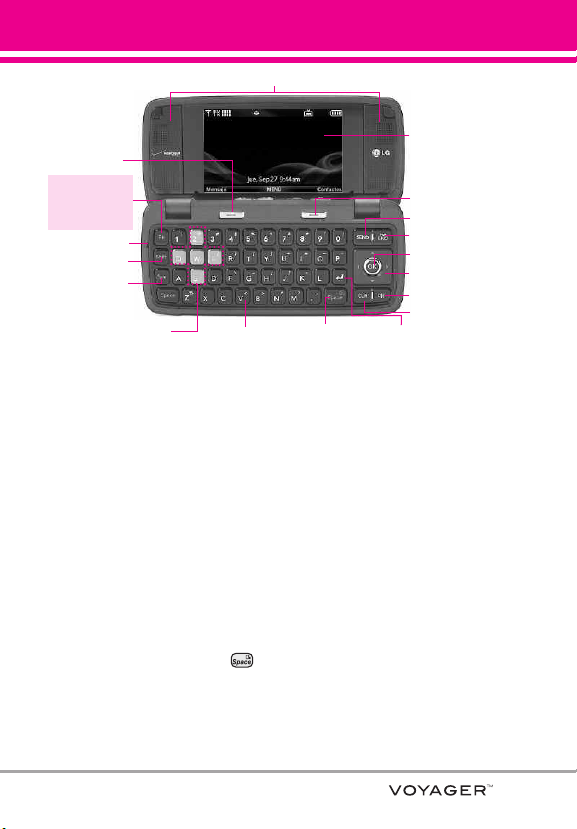
13
18. Bocinas
2. Tecla Fn
(Tecla de acceso
rápido para el
menú Fn)
3. Micrófono
7. Teclado
alfanumérico
8. Tecla Espacio/
Comando de voz
9. Tecla Return
4. Tecla Mayús
5. Tecla Sym
10. Tecla borrar
13. Tecla OK
15. Tecla SEND
16. Tecla suave Derecha
11. Tecla Altavoz
12. Teclas de dirección
14. Tecla PWR/END
6. Juegos teclas
de dirección
1. Tecla suave izquierda Úselo para mostrar el menú
de Mensajes de funciones u otra función que
aparezca en la parte inferior izquierda de la
pantalla LCD.
2.
Tecla Fn (Tecla de acceso rápido para el menú
Fn)
Úselo para acceder a los menús asignados.
Vea la página 18.
3. Micrófono Le permite hablar con la persona que
llama.
4. Tecla Mayús Se usa para pasar de mayúsculas a
minúsculas y vice versa al escribir.
5. Tecla Sym Úselo para insertar símbolos en la
parte superior de cada tecla en el texto.
6. Juegos teclas de dirección Úselas para navegar
por los juegos.
7. Teclado alfanumérico Úselo para introducir
números y caracteres y seleccionar elementos de
menú.
8. Tecla Espacio/ Comando de voz Úsela para
introducir un espacio al editar
. La función de TTS
(texto al discurso) está disponible con en
Bandeja de entrada de mensajería, del Nota y del
Correo Elect. Úsela para activar el comando de
voz en modo de espera.
9. Tecla Return Mueve el cursor a la siguiente línea.
10. Teclas borrar Oprímala para borrar un solo
espacio o carácter, o manténgala oprimida para
borrar una palabra específica y su espacio.
Oprima esta tecla una vez en un menú para
volver un nivel.
11.
Tecla Altavoz
Úsela para activar el modo de
altavoz.
12. Teclas de dirección Úselas para una navegación
cómoda y veloz. En modo de espera, acceda a
CENTRO de MEDIOS, Calendario, FOTO y VIDEO,
y Web móvil (puede cambiar cualquiera de estos
por otros menús del menú Configuración). En los
menús, úselas para desplazarse hacia menús y
configuraciones.
13. Tecla OK Úsela para activar un elemento
seleccionado de la pantalla
14. Tecla PWR/END Úsela para apagar o encender
el teléfono y para terminar una llamada.
15. Tecla SEND Úsela para hacer llamadas o
contestarlas.
16. Tecla suave derecha Úsela para seleccionar una
acción en un menú, u otra acción que aparezca
en la parte inferior derecha de la pantalla de
LCD.
17.
Pantalla LCD
Muestra llamadas entrantes, mensajes
e iconos indicadores así como una amplia variedad
de contenido que usted seleccione para visualizar.
18. Bocinas Le permite escuchar a quien le llama.
1. Tecla suave
Izquierda
17. Pantalla LCD
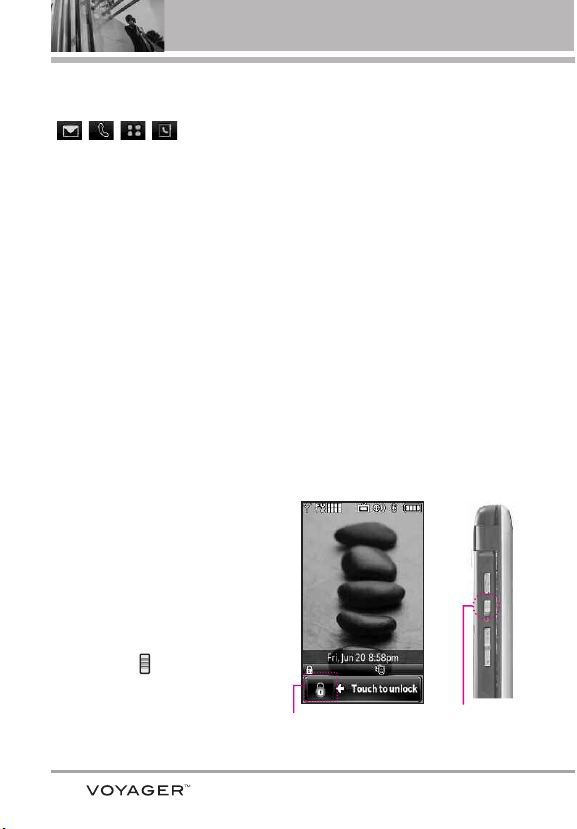
14
Vista rápida del teclado y cómo usarlo
Teclas suaves sensibles al
tacto
(,,,)
1. Asegúrese de tener las manos
limpias y secas. Elimine la humedad
de la superficie de sus manos. No
use los teclas táctiles en un entorno
húmedo.
2. Los sensores de los teclas táctiles
son sensibles a un toque ligero. No
tiene que oprimir los teclas táctiles de
modo prolongado o fuerte para
usarlos. Proteja su teléfono de los
golpes fuertes porque los sensores
de los teclas táctiles pueden dañarse
con el uso violento.
3. Use la punta del dedo para tocar el
centro de los teclas táctiles. Si los
toca fuera del centro, puede activar
en su lugar la función que está
adjunto.
4. El nivel del sensor de tacto se puede
ajustar a su preferencia.
5. Cuando están apagadas tanto la luz
de la pantalla de inicio como las de
los teclas táctiles, éstos están
desactivados. Oprima y suelte la tecla
de bloqueo ( ) para encender la
pantalla de inicio y las luces de los
teclas táctiles.
6. Si la tapa está cerrada y está
activada la función de Protección
táctil, durante las llamadas, la función
Bloqueo de los teclas táctiles se
habilita automáticamente.
7. Mantenga los materiales metálicos o
conductores de otro tipo apartados
de la superficie de los teclas táctiles,
ya que el contacto con ellos puede
ocasionar interferencia electrónica.
ADVERTENCIA
●
No coloque objetos pesados sobre la pantalla
táctil.
●
No se siente sobre su teléfono. Podría dañar
la pantalla táctil.
●
No arrastre ni raye su teléfono con materiales
punzantes.
●
No someta el teléfono a condiciones extremas
(lugares demasiado húmedos, cálidos o fríos).
●
Mantenga los productos químicos alejados del
teléfono, ya que podrían cambiar las funciones
estéticas o funciones de éste.
Cómo desbloquear
Toque el botón con
forma de candado
para desbloquearlo.
Jale hacia abajo y
suelte la tecla de
desbloqueo en el
lateral de su teléfono.
O
14
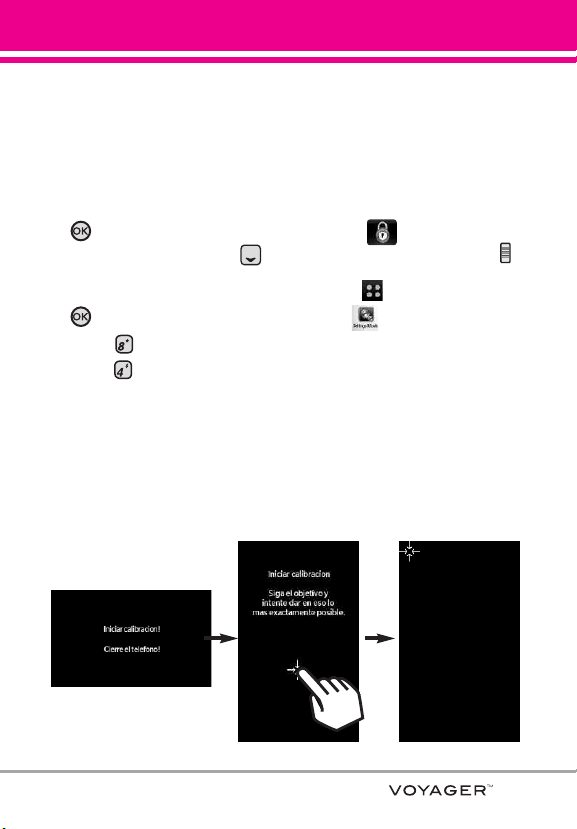
La pantalla táctil es una manera excelente de interactuar con el software del
VOYAGER. Acostumbrarse a usarla lleva algo de tiempo. Si no reacciona
cómo usted espera, ajuste la calibración de la pantalla táctil.
SUGERENCIA
Tenga en cuenta que cuánto más pequeño sea el texto que aparece en la
pantalla, más pequeña será la zona de activación táctil. Intente acercar la pantalla
con el zoom, si está disponible, para aumentar el área de toque.
Calibración de la pantalla táctil
Uso del teclado interno
1. Abra la tapa y oprima la Tecla OK
[MENÚ].
2. Oprima la Tecla de Direccional
para obtener acceso al menú
Prog/Herram y oprima la Tecla OK
.
3. Oprima
Programación de Toque.
4. Oprima
Calibración.
5. Cierre la tapa para iniciar la
calibración.
6. Toque el objetivo en la pantalla cada
vez que aparezca.
Uso de la pantalla táctil externa
1.
Desbloquee la pantalla táctil
tocando o jalando hacia
abajo la tecla de desbloqueo ( )
en el lateral izquierdo del teléfono
y toque para acceder al menú.
2. Toque .
3. Coloque el dedo en la pantalla táctil y
aplique una presión suave hacia
arriba para desplazarse por la lista en
dicha dirección. Luego toque
8. Prog. de Toque.
4. Toque
4. Calibración.
5. Toque el objetivo en la pantalla para
iniciar la calibración y luego toque el
objetivo cada vez que aparezca.
15
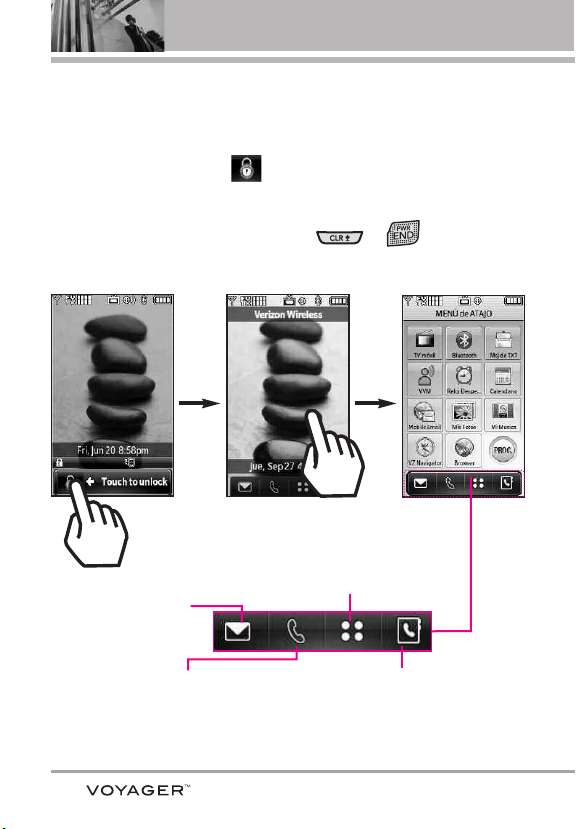
El menú Atajo
MENÚ: Exhibe una lista de menús.
Mensaje : Muestra el
menú Mensajería.
Contactos : Muestra su
Lista de contactos.
Teléfono : Muestra las teclas táctiles de modo que
usted puede realizar una llamada sin abrir la tapa.
Marque manualmente usando las teclas numéricas
o automáticamente desde Llamadas recientes y
Contactos.
Acceso
En el modo de espera, toque la
pantalla táctil con el dedo.
Menú Atajo De La Pantalla Táctil
El menú Atajo le brinda un acceso instantáneo a menús con el toque veloz de
su dedo. Para usar el menú Atajo:
1. Con la tapa cerrada, toque la pantalla táctil una vez sobre la pantalla LCD.
Es posible que deba tocar primero si la pantalla está bloqueada.
2. Se abrirá el menú Atajo. Toque 12 de las nueve opciones para abrir la
aplicación u otro menú.
3. Para cerrar el MENÚ de ATAJO, oprima , o la tecla externo.
16
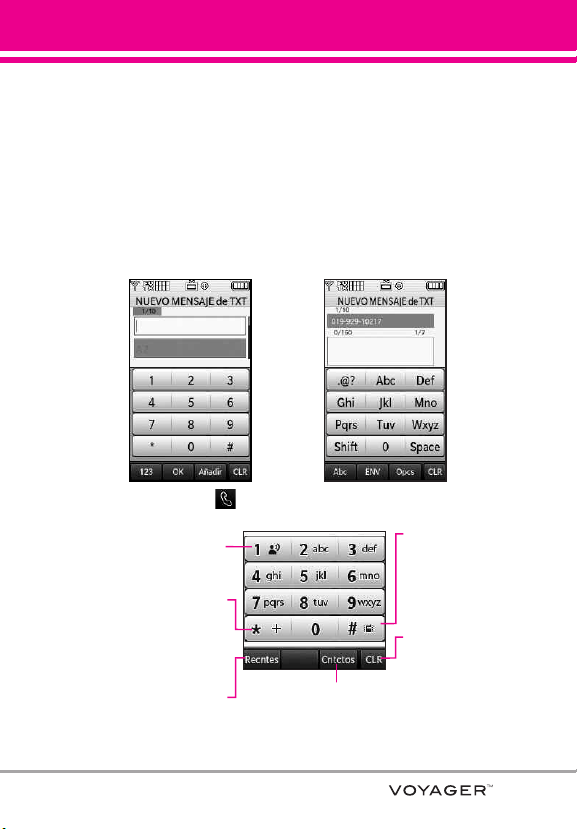
1717
Entrada de texto
Puede introducir información usando la pantalla táctil externa o el teclado
interno. Cada uno tiene funciones de tecla especiales para ayudarle con la
introducción de texto.
Uso de la pantalla táctil
Cuando crea un mensaje de texto, imagen o video usando la pantalla LCD
externa, la pantalla táctil le provee teclas táctiles específicas del tipo de
campo. Consulte los ejemplos a continuación:
Toque y lleve a cabo esta
tecla para tener acceso a
su buzón de voz.
Toque este tecla para ver el
historial de llamadas recientes y
simplemente toque un número
de teléfono para llamarlo.
Toque este tecla para buscar para la
información del contacto de modo que
usted pueda llamar a alguien.
Toque y mantenga optimida
para añadir un signo de "+" en
la pantalla.
Toque este tecla
para ir de nuevo a
modo espera.
Cuando toca la tecla táctil aparecen las siguientes teclas táctiles.
Introducir y editar información
Toque y mantenga
oprimida esta tecla para
configurar en vibrar, y
repita si quiere que
vuelva a modo normal.
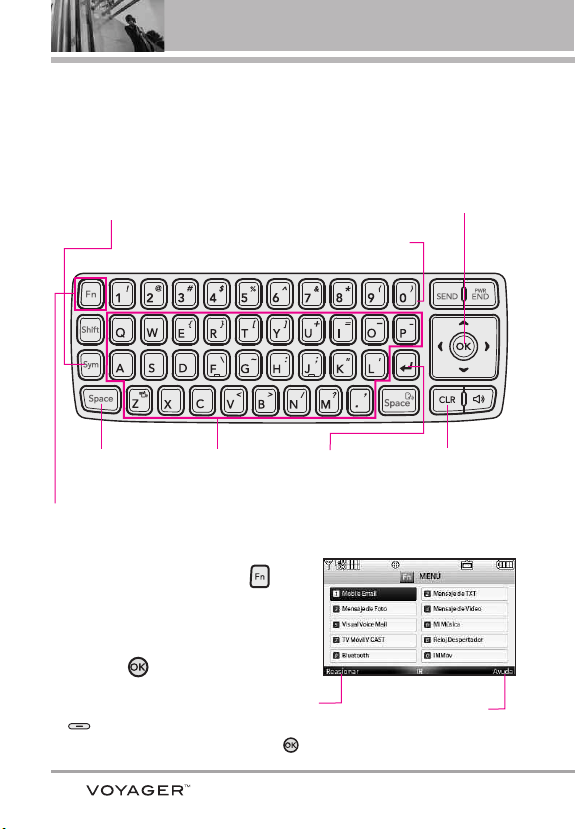
18
Introducir y editar información
18
Del teclado numérico interno de Qwerty
®
Al crear un mensaje de texto, imagen o video usando la pantalla LCD interna,
use el teclado Qwerty.
Tecla Fn Menú de Atajo
La tecla de función de Menú de Atajo para
tener acceso a 10 menús.
1.
Abra la tapa y oprima la Tecla
.
2. Presione las teclas numéricas para ir al
menú o use las teclas de Dirección para
seleccionar el menú que desee y luego
presione IR.
Use las teclas de flecha para ir al campo siguiente
como dirección del destinatario, texto, imagen y
video, según los tipos de mensajes. Use la tecla
OK para enviar un mensaje cuando finalice.
Use para
introducir
letras.
Use para insertar un
espacio entre letras,
palabras y oraciones.
Oprima esta tecla primero y luego
cualquier tecla con un símbolo para
insertar dicho símbolo en su mensaje.
Use para ir a la
edición de la línea
siguiente del mensaje.
Use para eliminar una
letra, palabras u
oraciones. Use también
para salir del menú y
volver al modo de espera.
Teclado numérico para introducir
números en su mensaje.
Para reasignar un atajo, resalte el atajo que desea
cambiar y luego presione la tecla de función izquierda
Reasignar. Seleccione la aplicación que desee
asignar a esa ubicación presionando la tecla .
Lea la instrucción para
comprender la función
de configuración del
menú de atajos.
19
Árbol de menús en la pantalla interna
CENTRO
CENTRO
DE
DE
MEDIOS
MEDIOS
1. Música y Tonos
1. Música de
V CAST |
Rhapsody
2. Obtén Nuevos
Timbres
3. Mis Timbres
4. Mi Música
5. Mis Sonidos
6. Sincronizar
Música
2. Foto y Video
1. TV móvil
V CAST
2. Vídeos de
V CAST
3. Obtén Nuevas
Fotos
4. Mis Fotos
5. Mis Vídeos
6. Tomar Foto
7. Grabar Vídeo
8. Álbum En Línea
3. Juegos
4. Navegar y
Descargar
5. Extra
MENSAJERÍA
MENSAJERÍA
1. Nuevo Mensaje
2. Entrada
3. Enviado
4. Borradores
5. Bzn Msjs Voz
6. Visual Voice Mail
7. IMMóv
8. Mobile Email
CONT
CONT
ACTOS
ACTOS
1. Nuevo Contacto
2. Lista de Contactos
3. Grupos
4. Marcado Rápido
5. In Case of
Emergency
6. Mi Tarjeta de
Nombre
LLAMAS. RECNTES
LLAMAS. RECNTES
1. Perdidas
2. Recibidas
3. Marcadas
4. Todas
5. Ver Cronómetro
PROG/HERRAM
PROG/HERRAM
1. Mi Verizon
2. Herramientas
1. Comandos de
Voz
2. Calculadora
3. Calendario
4. Reloj
Despertador
1. Alarma 1
2. Alarma 2
3. Alarma 3
5. Cronómetro
6. Reloj Mundial
7. Cuaderno de
Notas
8. Ez Sugerencia
9. Almacen masivo
USB
3. Menú de Bluetooth
1. Anadir Nuevo
Aparato
4. Programación de
Sonidos
1. Volumen Maestro
2. Sonidos de
Llamada
1. Timbre de
Llamada
2. Vibrador de
Llamada
3. Sonidos de Alerta
1. Mensaje de
TXT
2. Mensaje de
20
Árbol de menús en la pantalla interna
20
Foto-Video
3. Bzn Msjs Voz
4. Timbre de
Emergencia
4. Volumen de
Teclado
5. Alertas de
Servicio
1. IRO
2. Sonido de
Minutos
3. Conexión de
Llamada
4. Cargar
Completado
6. Apagado/
Encendido
1. Apagado
2. Encendido
5. Programación de
Pantalla
1. Aviso
1. Personal Aviso
2. Aviso IRO
2. Luz de Pantalla
1. Pantalla
2. Teclado
3. Fondo de Pantalla
1. Fondo de
Pantalla Interna
2. Fondo de
Pantalla Externa
4. Cargando
Pantalla
5. Temas de Pantalla
6. Fuente de Menú
7. Fuentes de
Marcado
8. Formato Reloj
6. Programación de
Teléfono
1. Modo Avión
2. Establecer atajos
3. Comandos de Voz
4. Idioma
5. Ubicación
6. Seguridad
1. Editar Códigos
2. Restricciones
3. Bloqueo de
teléfono
4. Bloquear
teléfono ahora
5. Restablecer
Implícito
6. Restaurar
teléfono
7. Selección de
Sistema
8. Selección de
NAM
7. Programación de
Llamada
1. Opciones de
Respuesta
2. Opciones de
finalizar llamada
3. Mostr tcld marc
4. Reintentar
Automáticamente
5. Modo TTY
6. Marcardo
oprimiendo un
botón
7. Privacidad de Voz
8. Programación de
Toque
1. Auto-bloqueo
2. Vibración
3. Sonido
4. Calibración
9. Detección
automática de USB
10. Memoria
1. Opciones de
Memoria
2. Memoria del
Teléfono
3. Memoria de la
Tarjeta
11. Info de Teléfono
1. Mi Número
2. Versión SW/HW
3. Glosario de
Iconos
MÚSICA
MÚSICA
1. Música
BROWSER
BROWSER
1. Browser
VZ NA
VZ NA
VIGADOR
VIGADOR
1. VZ Navegador
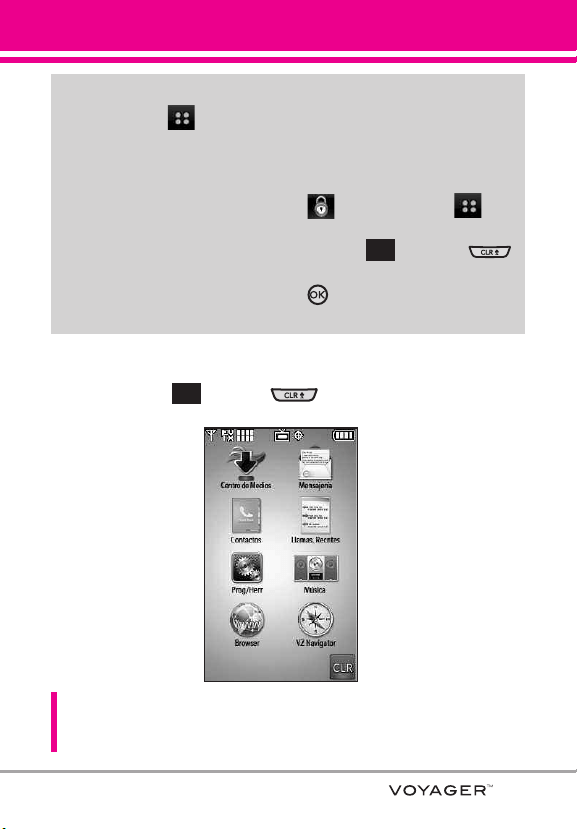
Árbol de menús en la pantalla táctil externa
21
Acceso a los menús
Toque la MENÚ
para obtener acceso a 8 menús de teléfono.
Cuando el teléfono este cerrado, la pantalla está bloqueada. Para
acceder al MENÚ desde la pantalla externa, primero desbloquéela
oprimiendo la tecla de desbloqueo que está al lado del teléfono u
oprima la tecla táctil de desbloqueo . Toque la MENÚ en el
fondo de la pantalla para abrir los menús principales. Para ir de
nuevo a la pantalla de espera, toque la tecla u oprima
en el centro del teléfono.
Cuando la tapa está abierta, oprima
[MENÚ] para tener acceso
a los ocho menús del teléfono.
CLR
En la pantalla táctil, los menús principales aparecen como se muestra a
continuación. Toque cualquiera de los iconos de menús con el dedo para ir a
dicho menú. Toque (u oprima ) para volver al modo de espera.
CLR
Algunos contenidos de esta guía del usuario pueden ser distintos de su
teléfono en función del software del teléfono o de su proveedor de servicios.
Las funciones y especificaciones están sujetas a cambios sin previo aviso.
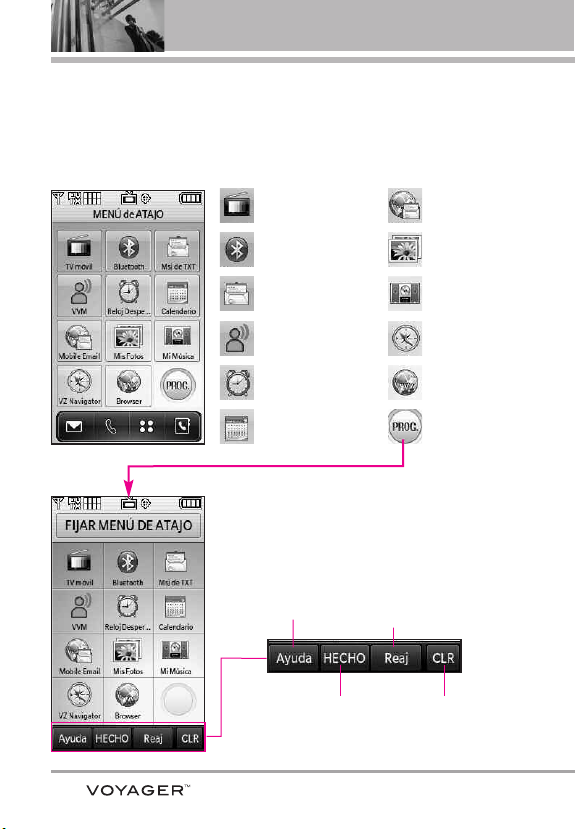
22
Menú Atajo en el teclado externo
22
TV móvil
Bluetooth
Msj de TXT
VVM
Reloj Despertador
Calendario
Mobile Email
Mis Fotos
Mi Música
VZ Navegador
Browser
PROG.
Menú Atajo De La Pantalla Táctil
Permite un acceso rápido y directo a varias funciones de uso frecuente del
dispositivo cuando la tapa está cerrada. Para acceder al menú Atajo, oprima
la tecla de desbloqueo para desbloquear la pantalla LCD externa y luego
toque en cualquier lugar sobre las teclas táctiles suaves.
Ayuda a entender la
función de configuración
del menú de atajos.
Una vez modificados los
menús de atajos, toque aquí.
Toque
Reaj para restablecer los
valores predeterminado y toque
Sí para guardar el cambio.
Toque aquí para volver a
la pantalla Menú de
atajos.
Utilice esta función para personalizar sus menús de
atajos tocando el menú que desee reemplazar y tocando
uno nuevo para reemplazarlo en la lista.
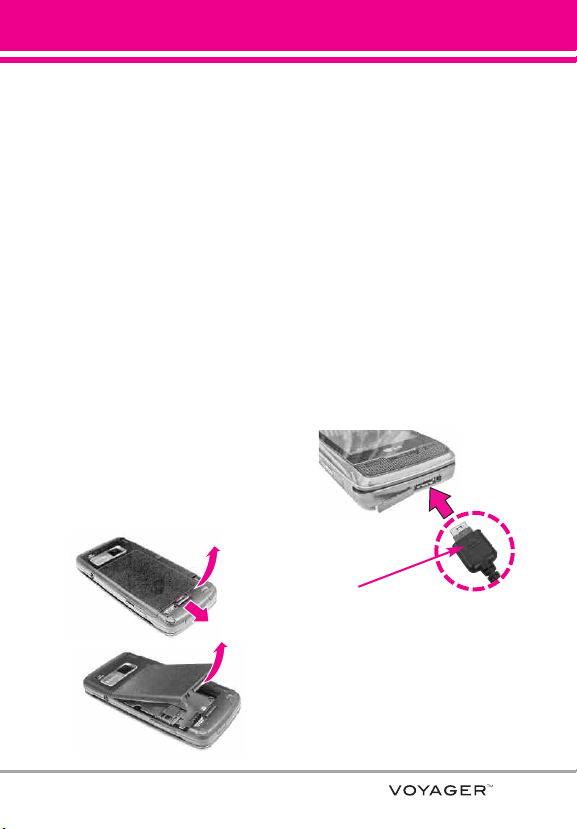
Para hacer funcionar su teléfono por primera
23
La batería
NOTA
Es importante cargar completamente
la batería antes de usar el teléfono por
primera vez.
El teléfono viene con una batería
recargable. Conserve cargada la batería
cuando no use el teléfono, para
mantener al máximo el tiempo de
llamada y de espera. El nivel de carga
de la batería se muestra en la parte
superior de la pantalla de cristal líquido.
Instalación de la batería
Para instalar la batería, inserte la
parte inferior de la batería en la
abertura de la parte trasera del
teléfono.
Empuje la batería hacia
abajo hasta que haga clic en su
lugar.
Extracción de la batería
Apagar la alimentación. Deslice el
pestillo de liberacón de la batería en
dirección contraria al borde de la
batería, y sostenga los lados de ésta
para quitarla.
Carga de la batería
Para utilizar el cargador
proporcionado para su teléfono:
AVISO
Use únicamente un accesorio de carga
aprobado para cargar su teléfono LG. La
manipulación inadecuada del puerto de carga,
así como el uso de un cargador no compatible
pueden ocasionarle daños a su teléfono y anular
la garantía.
1. Enchufe el extremo del adaptador
de CA en el conector del cargador
del teléfono y el otro extremo en
una toma de corriente.
2. El tiempo de carga varía en función
del nivel de la batería.
AVISO
El símbolo de triángulo debe estar hacia
arriba. (tanto en el conector USB como
en el del cargador)
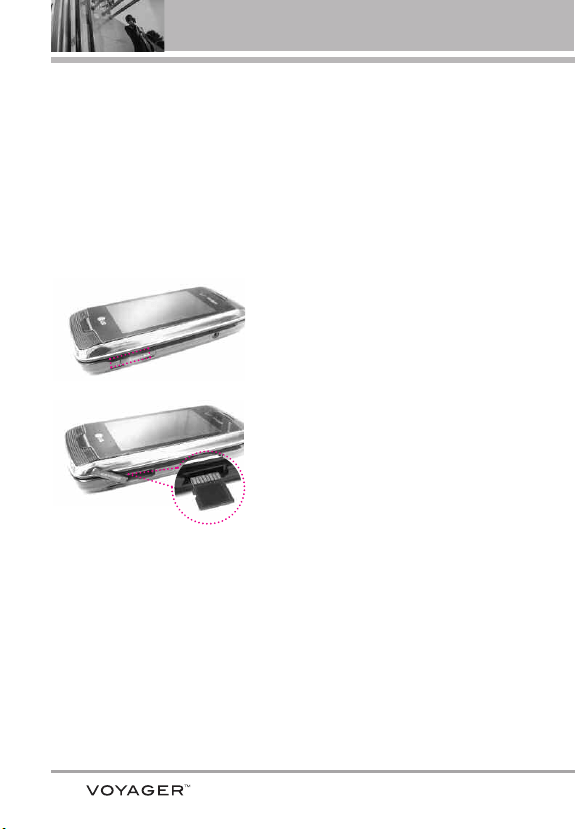
2424
Para hacer funcionar su teléfono por primera vez
Carga con USB
Es posible usar una computadora para cargar el teléfono. Conecte un
extremo de un cable USB al puerto para cargador y accesorios del teléfono y
el otro extremo a un puerto USB de alta energía de la PC (suele encontrarse
en el panel frontal de la computadora).
NOTA
No son compatibles los puertos USB de baja energía, como el que se encuentra en el teclado
o en el concentrador USB con alimentación por bus.
Instalación de la tarjeta microSD™
1. Localice la ranura de la microSD™ a la
derecha del teléfono y destape
suavemente la abertura de la ranura (la
cubierta de la ranura de la microSD™
permanece adosada al teléfono para que
no la pierda).
2. Inserte la tarjeta microSD™ en la
dirección correcta hasta que haga clic en
la ranura. Si inserta la tarjeta en la
dirección equivocada, podría dañar su
teléfono o su tarjeta.
Desinstalación de la tarjeta microSD™
1. Oprima suavemente y libere el borde expuesto de la tarjeta microSD™
para expulsarla.
2. Retire la tarjeta microSD™ de la ranura y vuelva a colocar la cubierta.
NOTA
No intente retirar la tarjeta microSD™ mientras está leyendo o escribiendo en la tarjeta.
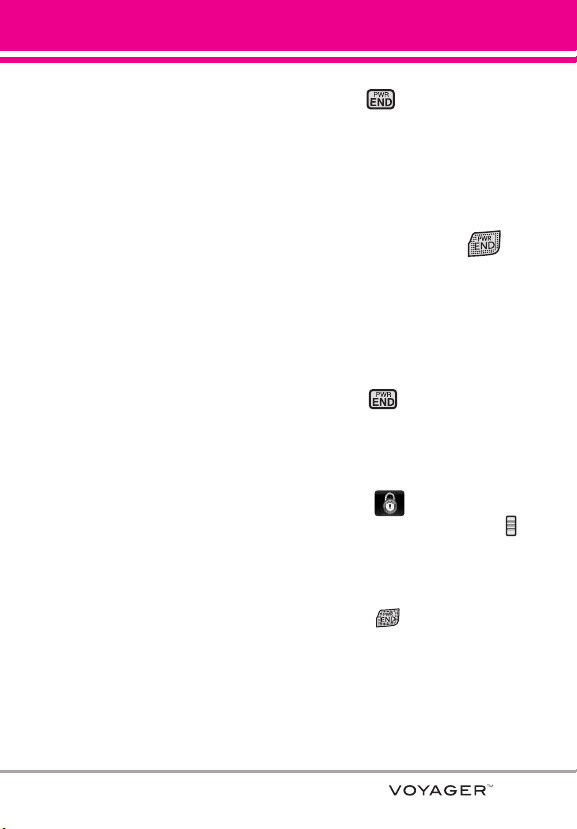
25
Protección de la temperatura
de la batería
Si la batería se sobrecalienta, el
teléfono se apagará
automáticamente. Al volver a
encender el teléfono, un mensaje
emerge avisándole que el teléfono se
apagó por su seguridad.
Nivel de carga de la batería
El nivel de carga de la batería se
muestra en la parte superior derecha
de la pantalla de LCD.
Cuando disminuya el nivel de carga
de la batería, el sensor de batería baja
le alerta haciendo sonar un tono
audible, haciendo destellar el icono
de batería y mostrando una mensaje
de alertas. Si el nivel de carga de la
batería se hace demasiado bajo, el
teléfono se apaga automáticamente y
no se guarda ninguna función que
esté en curso.
Apagar y encender el teléfono
Encender el teléfono
Uso del teclado interno
1. Instale una batería cargada o
conecte el teléfono a una fuente
de electricidad externa.
2. Abra la tapa y oprima la tecla
interna hasta que la pantalla
LCD se encienda.
Uso de la pantalla táctil externa
1.
Instale una batería cargada o
conecte el teléfono a una fuente
de electricidad externa.
2. Oprima la tecla externa
durante unos segundos hasta
que la pantalla táctil se encienda.
Apagar el teléfono
Uso del teclado interno
1. Mantenga oprimida la tecla
interna hasta que se
apague la pantalla.
Uso de la pantalla táctil externa
1. Desbloquee la pantalla táctil
tocando o jalando hacia
abajo la tecla de desbloqueo ( )
en el lateral izquierdo del
teléfono.
2. Mantenga oprimida la tecla
externa hasta que se
apague la pantalla.
25
26
Potencia de la señal
La calidad de las llamadas depende
de la potencia de la señal en la zona
donde se encuentra. La potencia de la
señal se indica en la pantalla como el
número de barras junto al icono de
potencia de la señal. A más barras,
mejor la potencia de la señal. Si la
calidad de la señal es defectuosa,
trasládese a una zona abierta. Si está
en un edificio, la recepción puede ser
mejor cerca de una ventana.
Iconos de pantalla
Cuando el teléfono está encendido, la
línea superior de la pantalla LCD
muestra iconos que indican el estado
del teléfono.
Uso del teclado interno
Para ver el glosario de iconos, vaya a
Menú
->
Prog/Herr
->
Info de
Teléfono
->
Glosario de Iconos
.
Uso de la pantalla táctil externa
1. Desbloquee la pantalla táctil
tocando o jalando hacia
abajo la tecla de desbloqueo ( )
en el lateral izquierdo del
teléfono y toque para
acceder al menú.
2. Toque .
3. Toque
11. Info de Teléfono.
4. Toque 3. Glosario de Iconos.
Para hacer llamadas
NOTA
Para activar el altavoz durante una
llamada, simplemente abra la tapa.
NOTA
Si la luz de fondo de la pantalla táctil
externa se oscurece mientras usted
está en una llamada, toque cualquier
tecla lateral para encenderla
nuevamente.
Uso del teclado interno
1. Asegúrese de que el teléfono esté
encendido. Si no lo está, oprima
la
tecla interna
durante unos 3
segundos incluya el código de
bloqueo si fuera necesario.
2. Introduzca el número de teléfono.
3. Oprima
la tecla interna
.
4. Oprima
la tecla interna
para
terminar la llamada.
Corrección de errores en la
marcación
Oprima una vez para borrar la
última cifra introducida o mantenga
oprimida durante al menos 2
segundos para borrar todas las cifras.
Para hacer funcionar su teléfono por primera vez
26
27
Uso de la pantalla táctil externa
1. Toque la tecla táctil que se
asemeja a un teléfono , y
después verá un teclado
numérico. Incorpore el número
de teléfono que usted desea
llamar o busque un número en
Contactos o llamadas recientes.
2.
Oprima
la tecla externa o
toque .
Remarcado de llamadas
1. Oprima
la tecla externa o
la tecla externa
para volver
a marcar el último número que
marcó. Los últimos 270 números
están almacenados en la lista del
historial de llamadas y también
puede seleccionar uno de éstos
para volver a marcarlo.
Para recibir llamadas
Uso del teclado interno
1. Cuando el teléfono suena o vibra,
hay tres formas de contestar la
llamada dependiendo de un ajuste
del teléfono:
●
Al Abrirlo
: Simplemente abra la
tapa, éste es el modo
predeterminado.
●
Cualquier Tecla
: Oprima
la tecla
interna
o cualquier otra
tecla excepto
la tecla interna
.
●
Auto con Manos libres
: La
llamada será conectada.
NOTA
Si oprime la Tecla suave Izquierda
[Silenc.] mientras está sonando
el teléfono, se silencia el timbre o la
vibración para esa llamada.
NOTA
Si usted oprime la Tecla suave
Derecha
[Ignorar] mientras
está sonando el teléfono y
desbloqueado, la llamada se finalizará
o se dirigirá al correo de voz.
Uso de la pantalla táctil externa
1. Cuando el teléfono suena o vibra,
simplemente toque
y
oprima
la tecla externa o
toque la
tecla de Toque
.
2. Oprima la tecla externa
para terminar la llamada.
Responder
Llamada
28
Acceso rápido a funciones de conveniencia
28
Modo de vibración
Ajusta el teléfono para vibrar en lugar
de sonar (se muestra ). Para
ajustar rápidamente el Modo de
cortesía, mantenga oprimida en
el teclado interno o toque y mantenga
presionada .
Para volver al Modo normal,
mantenga oprimida o toque y
mantenga presionada .
Función de silencio
La función de silencio no transmite su
voz a la persona que llama. Para
activar Silencio rápidamente, oprima la
Tecla suave Izquierda
[Mudo]
sobre el teclado interno o toque
y para cancelarlo oprima la
Tecla suave Izquierda
[No
mudo]
o toque .
Ajuste rápido del volumen
Ajuste rápidamente los volúmenes del
timbre y del audífono oprimiendo el
extremo superior de la tecla lateral
para aumentarlo o el extremo inferior
para disminuirlo.
NOTA
El volumen del audífono puede
ajustarse durante una llamada y el
volumen del sonido de teclas sólo
pueden ajustarse mediante el Menú.
NOTA
Para desactivar los sonidos, mantenga
oprimida la tecla lateral inferior durante
3 segundos con la tapa abierta o
cerrada, y mantenga oprimida la tecla
lateral superior para volver al modo de
sonidos normal.
Llamada en espera
Durante una llamada, un pitido indica
otra llamada entrante.
Ignorar una llamada en espera
Si no desea responder la llamada
entrante, oprima la tecla suave
derecha [Ignorar] cuando la
tapa esté abierta. Si la tapa esta
cerrada, toque en la
pantalla táctil. El pitido de la llamada
en espera se detiene y la llamada va a
su correo de voz, de encontrarse
disponible.
Contestar una llamada en espera
1. Oprima la tecla interna / la
tecla externa (esté la tapa
abierta o cerrada) para colocar
la primera llamada en espera y
responder la nueva llamada.
2. Oprima la tecla interna / la
tecla externa nuevamente
para colocar la segunda llamada
en espera y volver a la primera.
Ignorar
No mudo
Mudo
Comando de voz
Comandos de voz le permite hacer
cosas mediante órdenes verbales (por
ej,. hacer llamadas, confirmar
Voicemail, etc.).
1. Para acceder a la función de
Comandos de voz:
●
Con la tapa abierta, oprima .
●
Con la tapa cerrada y la pantalla
desbloqueada, oprima
rápidamente (una presión
sostenida activa la función
Grabador de voz).
2. Siga las indicaciones para usar
los comando(s) de voz.
NOTA
También se pueden iniciar los
Comandos de voz con el botón
designado de su dispositivo Bluetooth
®
.
Compruebe el manual del dispositivo
Bluetooth
®
para obtener más
instrucciones.
29
30
Aspectos básicos
Uso del teclado interno
1. En el modo de espera introduzca el
número de teléfono (de hasta 48
dígitos) y oprima la Tecla suave
Izquierda
[Grdr]
.
2. Use la Tecla de Direccional
para desplazarse hasta
Nuevo
Contacto/ Actualizar Existente
y
oprima la Tecla OK .
3. Use la Tecla de Direccional
para desplazarse hasta
Móvil 1/
Casa/ Trabajo/ Móvil 2/ Fax
y
oprima la Tecla OK .
4. Introduzca el nombre (hasta 32
caracteres) del número telefónico
y oprima .
5. Oprima la tecla interna para
salir, la tecla interna para
llamar, o la Tecla suave Derecha
[Opciones].
Uso de la pantalla táctil externa
1.
Desbloquee la pantalla táctil
tocando o jalando hacia
abajo la tecla de desbloqueo ( )
en el lateral izquierdo del
teléfono.
2. Toque la tecla táctil suave de
contacto .
3. Toque la .
4. Introduzca cada campo de
información de contacto,
completando y tocando .
5. Cuando todos los campos estén
completos, toque .
6. Oprima la tecla externa
para salir, la tecla externa
para llamar, o toque .
7. Toque .
Ó
1.
Desbloquee la pantalla táctil
tocando o jalando hacia
abajo la tecla de desbloqueo ( )
en el lateral izquierdo del
teléfono.
2. Toque la tecla suave de teléfono
.
3. Use las teclas táctiles de números
que aparecen para introducir el
número de teléfono.
4. Toque , luego continúe
tocando campos e introduciendo
información según sea necesario.
GRDR
GRDR
Opcs
GRDR
HECHO
NUEVO
Contactos en la memoria de su teléfono
30
31
Personalización de entradas
individuales
Uso del teclado interno
1. Oprima la Tecla suave Derecha
[Contactos]
, y use para
desplazarse hasta una entrada.
2. Oprima la Tecla suave Izquierda
[Corregir]
.
3. Use para desplazarse hasta
la información que desea
personalizar.
4. Cambie la entrada como desee y
oprima la Tecla OK para
guardar los cambios.
Uso de la pantalla táctil externa
1.
Desbloquee la pantalla táctil
tocando o jalando hacia
abajo la tecla de desbloqueo ( )
en el lateral izquierdo del
teléfono.
2. Toque la tecla táctil suave de
contacto .
3. Toque el contacto que desee
personalizar.
4. Toque , luego toque y
edite los campos que desee
cambiar y toque .
5. Toque cuando la
corrección este completa.
Marcación Rápida
Le permite configurar sus
Marcaciones Rápidas.
Uso del teclado interno
1. Oprima la Tecla suave Derecha
[Contactos]
y use para
desplazarse hasta una entrada.
2. Oprima la Tecla suave Izquierda
[Corregir]
.
3. Use para desplazarse hasta
un número de teléfono y oprima la
Tecla suave Derecha
[Opciones].
4. Use para desplazarse hasta
Fijar Marcado Rápido
y oprima la
Tecla OK .
5. Introduzca una cifra de Marcado
Rápido.
●
Use el teclado y oprima la Tecla
OK .
●
Use para desplazarse
hasta el dígito de Marcado
Rápido y oprima la Tecla OK
.
6. Los avisos de la pantalla aparecen
¿Añadir Contacto a Marcado
Rapido?
y oprima la Tecla OK
Sí
y oprima la Tecla OK para
guardar.
GRDR
HECHO
CRRGR
3232
Contactos en la memoria de su teléfono
Uso de la pantalla táctil externa
1.
Desbloquee la pantalla táctil
tocando o jalando hacia
abajo la tecla de desbloqueo ( )
en el lateral izquierdo del
teléfono.
2. Toque la tecla táctil suave de
contacto .
3. Toque el Contacto que desee
personalizar.
4. Toque para editar.
5. Toque el número de teléfono y
luego toque .
6. Toque
Fijar Marcado Rápido
, y
luego toque un número de
marcado rápido sin asignar.
7. Aparecerá en la pantalla:
¿Añadir
Contacto a Marcado Rapido?
Toque
Sí
.
8. Toque , y toque .
Almacenar un número con
una pausa
Las pausas le permiten introducir
series de números adicionales para
acceder a sistemas automatizados,
como el Correo de voz o los números
de facturación de tarjeta de crédito.
Los tipos de pausa son:
Espera
(W) El
teléfono deja de marcar hasta que
usted Oprima la Tecla suave Izquierda
[Release]
para avanzar al
siguiente número.
2-Seg Pausa
(P) El
teléfono espera 2 segundos antes de
enviar la siguiente cadena de cifras.
Uso del teclado interno
1. Introduzca el número y oprima la
Tecla suave Derecha
[Opciones]
.
2. Use la Tecla de Direccional
para desplazarse hasta Pausa de
2-Seg Pausa/ Espera
, y oprima la
Tecla OK .
3. Introduzca números adicionales
(por ejemplo, el nip o el número de
la tarjeta de crédito, etc.).
4. Oprima la Tecla suave Izquierda
[Grdr]
.
5. Complete la información del
contacto según sea necesario.
Uso de la pantalla táctil externa
1.
Desbloquee la pantalla táctil
tocando o jalando hacia
abajo la tecla de desbloqueo ( )
en el lateral izquierdo del
teléfono.
2. Toque la tecla táctil suave de
contacto .
GRDRHECHO
Opcs
CRRGR
3. Toque el Contacto que desee editar.
4. Toque para editar.
5. Toque el número de teléfono, toque
y toque
2-Sec Pausa o
Espera.
6. Toque .
7. Toque .
Agregar otro número de
teléfono
En el modo de espera uso del
teclado interno
1. Introduzca un número de teléfono
y oprima la Tecla suave Izquierda
[Grdr]
.
2. Use la Tecla de Direccional
para desplazarse hasta una
Actualizar Existente
y oprima la
Tecla OK .
3. Use la Tecla de Direccional
para desplazarse hasta una entrada
existente y oprima la Tecla OK .
4. Use la Tecla de Direccional
para desplazarse hasta
Móvil 1/
Casa/ Trabajo/ Móvil 2/ Fax
, y
oprima la Tecla OK para
guardar.
Desde la pantalla Lista de contactos
uso del teclado interno
1. Oprima la Tecla suave Derecha
[Contactos]
.
2. Use la Tecla de Direccional
para desplazarse hasta una
entrada y oprima la Tecla suave
Izquierda
[Corregir]
.
3. Use la Tecla de Direccional
para desplazarse hasta el campo
del número de teléfono que desea
agregar, introduzca el número y
oprima la Tecla OK para
guardar.
Cambiar la información guardada
uso del teclado interno
Para editar cualquier información que
haya guardado, acceda a la pantalla
Editar contactos:
1. Oprima la Tecla suave Derecha
[Contactos]
.
2. Use la Tecla de Direccional
para desplazarse hasta una
entrada y oprima la Tecla suave
Izquierda
[Corregir]
.
3. Use la Tecla de Direccional
para desplazarse hasta el campo
que desea cambiar.
4. Haga los cambios y oprima la Tecla
OK .
GRDR
HECHO
Opcs
CRRGR
33
3434
Contactos en la memoria de su teléfono
Cambio del número
predeterminado
El Número predeterminado es el
número de teléfono que introdujo al
crear el contacto. Se puede guardar
otro número como Número
predeterminado.
Uso del teclado interno
1. Oprima la Tecla suave Derecha
[Contactos]
.
2. Use la Tecla de Direccional
para desplazarse hasta una
entrada.
3. Oprima la Tecla suave Izquierda
[Corregir]
.
4. Use la Tecla de Direccional
para resaltar el número de teléfono
que desea configurar como
número predeterminado y oprima
la Tecla suave Derecha
[Opciones]
.
5. Use la Tecla de Direccional
para resaltar
Fijar como Predet
, y
oprima la Tecla OK .
6. Oprima la Tecla OK para
configurar el nuevo número como
predeterminado.
Aparece un mensaje de confirmación.
7. Oprima la Tecla OK de nuevo
para guardarlo.
Borrar
Borrar un número de teléfono uso
del teclado interno
1. Oprima la Tecla suave Derecha
[Contactos]
.
2. Use la Tecla de Direccional
para desplazarse hasta una
entrada.
3. Oprima la Tecla suave Izquierda
[Corregir]
.
4. Use la Tecla de Direccional
para desplazarse hasta un número
de teléfono.
5. Oprima y mantenga oprimida
para borrarlo.
6. Oprima la Tecla OK .
Borrar una entrada de contacto uso
del teclado interno
1. Oprima la Tecla suave Derecha
[Contactos]
.
2. Use la Tecla de Direccional
para desplazarse hasta una
entrada.
3. Oprima la Tecla suave Derecha
[Opciones]
y oprima
Borrar
.
4. Oprima
[Sí]
.
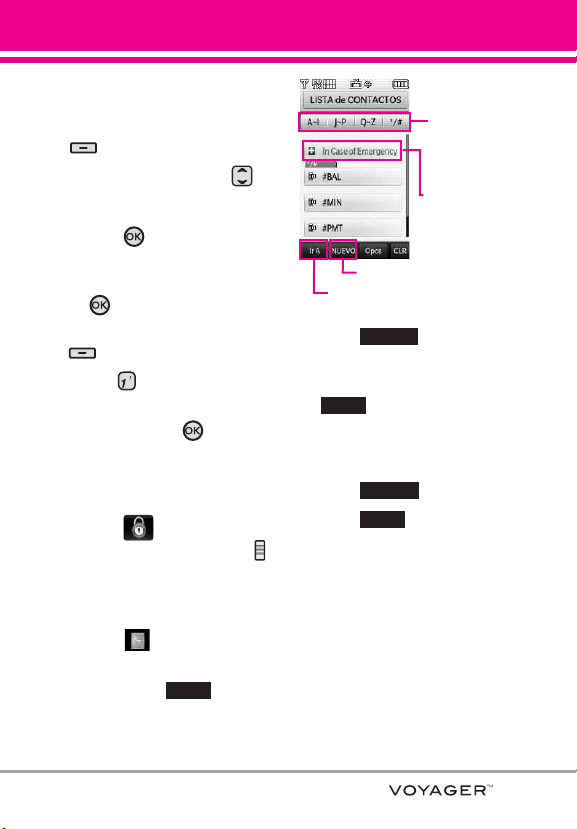
Borrar un Marcado Rápido uso del
teclado interno
1. Oprima la Tecla suave Derecha
[Contactos]
.
2. Use la Tecla de Direccional
para desplazarse hasta la entrada
de Contacto para editar y oprima la
Tecla OK
[VER]
.
3. Seleccione el número con el
Marcado rápido, y oprima la Tecla
OK
[CRRGR]
.
4. Oprima la Tecla suave Derecha
[Opciones]
.
5. Oprima
Borrar Marcado
Rápido
.
6. Oprima la Tecla OK
[Sí]
.
Uso de la pantalla táctil externa
1.
Desbloquee la pantalla táctil
tocando o jalando hacia
abajo la tecla de desbloqueo ( )
en el lateral izquierdo del
teléfono.
2. Toque la tecla táctil suave de
contacto .
3. Toque el contacto deseado
(busque usando o letras
del alfabeto e la parte superior de
la pantalla,
4. Toque .
5. Toque el número con el marcado
rápido que desee eliminar y toque
.
6. Toque
Borrar Marcado Rápido
.
7. Toque Sí.
8. Toque .
9. Toque para abandonar el
contacto.
GRDR
HECHO
Opcs
CRRGR
Ir A
35
Grupos por letras:
Toque un grupo que
incluya un contacto
que desea buscar.
En caso de
emergencia: tóquelo
para realizar una
llamada en caso de
emergencia.
Agregue un nuevo contacto.
Vaya directamente al contacto
específico.
Contactos en la memoria de su teléfono
Marcado Rápido
Le permite hacer llamadas de teléfono
en sus contactos rápida y fácilmente.
Debe configurar la Marcación Rápida
en sus contactos antes de usar esta
opción.
NOTA
El número 1 de Marcado Rápido es
para Correo de voz.
Marcados Rápidos del 1 al 9
uso del teclado interno
Oprima y mantenga presionado el
dígito de marcado rápido (para
marcados rápidos de 2 dígitos, oprima
el primer dígito, luego oprima y
mantenga presionado el segundo). El
teléfono recuerda el número
telefónico de sus Contactos, lo
muestra y lo marca.
Marcados Rápidos del 10 al 99
uso del teclado interno
Oprima la primera cifra de Marcado
Rápido y luego mantenga oprimida la
tecla de la segunda cifra.
NOTA
También puede introducir las cifras de
Marcado Rápido y oprimir la
tecla interno.
Para los Marcados Rápidos de 97,
98 y 99
El valor predeterminado es 97(#BAL),
98(#MIN) y 99(#PMT) para tener
acceso a cierta información de la
cuenta del teléfono. Al contrario del
Marcado Rápido número 1, el usuario
puede cambiar este Marcado Rápido
si es necesario.
Marcado rápido usando la pantalla
táctil
1.
Desbloquee la pantalla táctil
tocando o jalando hacia
abajo la tecla de desbloqueo ( )
en el lateral izquierdo del
teléfono.
2. Toque la tecla táctil suave de
llamada .
3. Toque y mantenga presionado el
dígito de marcado rápido (para
marcados rápidos de 2 dígitos,
toque el primer dígito, luego toque
y mantenga presionado el
segundo).
36
CENTRO de MEDIOS
C
C
E
E
N
N
T
T
R
R
O
O
d
d
e
e
M
M
E
E
D
D
I
I
O
O
S
S
Media Center le ofrece servicio
personalizable en tu dispositivo
inalámbrico que le permite obtener
tonos para el teléfono, jugar juegos,
navegar por la web, recibir
información de último minuto. Visite
verizonwireless.com / getitnow para
ver todas las aplicaciones disponibles
para tu dispositivo inalámbrico.
NOTA
No instale ni quite la tarjeta microSD™
cuando esté reproduciendo, borrando
o descargando Fotos/Vídeos/
Música/Sonidos.
ACCESO DIRECTO
Puede acceder directamente a la
función CENTRO de MEDIOS
oprimiando la Tecla de Navagación
a la derecha.
NOTA
Con la tapa cerrada, si usted contesta
una llamada mientras se está
reproduciendo música, navegando,
por la red, viendo la TV / vídeo, o
utilizando VZ Navigator, y finaliza la
llamada pulsando la tecla exterior
, la pantalla táctil se
bloqueará. Para desbloquear el
teléfono, deslize la tecla de
desbloqueo ( ) hacia abajo.
¿Hay algo que no sea claro?
Del menú CENTRO de MEDIOS,
oprima la Tecla suave Derecha
[Info]
(si está utilizando la pantalla táctil,
toque )
para ver el estado de
su memoria, registro de actividades,
texto de ayuda y estado de CENTRO
de MEDIOS. Utilice la opción de la
Ayuda para vista la información de
comprar nuevos usos a los usos
expirados.
1. Música y Tonos
Personalice su teléfono con tonos de
timbre. Hay una gran variedad de
opciones disponibles para elegir de
éxitos actuales, pop, hiphop y mucho
más.
Acceso y Opciones
Uso del teclado interno
1. Abra la tapa y oprima la Tecla OK
[MENÚ]
.
2. Oprima la Tecla OK
[CENTRO
de MEDIOS]
.
3. Oprima
Música y Tonos
.
4. Seleccione un submenú
oprimiendo el número que
corresponda al submenú.
Uso de la pantalla táctil externa
1. Desbloquee la pantalla táctil
tocando o jalando hacia
abajo la tecla de desbloqueo ( )
en el lateral izquierdo del
teléfono y toque para
Info
37
CENTRO de MEDIOS
38
acceder al menú.
2. Toque el icono CENTRO de
MEDIOS .
3. Toque
1. Música y Tonos.
●
Toque para configurar el
modo de sólo música en
Encendido
o
Apagado
.
SUGERENCIA
El Modo sólo música le permite escuchar música
libremente con sus audífonos Bluetooth puestos
del mismo modo que con reproductores MP3.
Este modo es similar a la independencia de
llamadas en Modo
Avión no hay interrupción de
las llamadas al escuchar música en el modo.
1.1 Música de V CAST |
Rhapsody
Transforma tu aparato móvil en un
reproductor de música portátil al
comprar canciones nuevas en
nuestro catálogo musical, a través de
tu aparato móvil o PC.
Luego puede
sincronizar la música entre la PC y
el teléfono.
Uso del teclado interno
1. Abra la tapa y oprima la Tecla OK
[MENÚ]
.
2. Oprima la Tecla OK
[CENTRO
de MEDIOS]
.
3. Oprima
Música y Tonos
.
4. Oprima
Música de V CAST |
Rhapsody
.
Uso de la pantalla táctil externa
1. Desbloquee la pantalla táctil
tocando o jalando hacia
abajo la tecla de desbloqueo ( )
en el lateral izquierdo del
teléfono y toque para
acceder al menú.
2. Toque el icono CENTRO de
MEDIOS .
3. Toque
1. Música y Tonos
.
4. Toque 1. Música de V CAST |
Rhapsody
.
NOTA
Pueden aplicarse cargos adicionales por
cada video clip que vea. El servicio de
Video Clips no está disponible en todas
las áreas. Compruebe el sitio Web
www.verizonwireless.com/getitnow
para obtener detalles.
1.2 Obtén Nuevos Timbres
Le permite conectarse a CENTRO de
MEDIOS y descargar diversos tonos
de timbre.
Uso del teclado interno
1. Abra la tapa y oprima la Tecla OK
[MENÚ].
2. Oprima la Tecla OK
[CENTRO
de MEDIOS]
.
Modo
3. Oprima
Música y Tonos
.
4. Oprima
Obtén Nuevos
Timbres
.
5. Oprima
Obtén Nuevas
Aplicaciones
para comprar los
timbres.
Uso de la pantalla táctil externa
1. Desbloquee la pantalla táctil
tocando o jalando hacia
abajo la tecla de desbloqueo ( )
en el lateral izquierdo del
teléfono y toque para
acceder al menú.
2. Toque el icono CENTRO de
MEDIOS .
3. Toque
1. Música y Tonos
.
4. Toque 2. Obtén Nuevos Timbres
.
5.
Toque 1. Obtén Nuevas
Aplicaciones
para comprar los
timbres.
1.3 Mis Timbres
Le permite seleccionar el tono de
timbre que desee, descargar uno
nuevo.
Uso del teclado interno
1. Abra la tapa y oprima la Tecla OK
[MENÚ]
.
2. Oprima la Tecla OK
[CENTRO
de MEDIOS]
.
3. Oprima
Música y Tonos
.
4. Oprima
Mis Timbres
.
5. Use la Tecla de Direccional
para resaltar el tono de timbre y
oprima la Tecla suave Izquierda
[Fij como]
.
●
Timbre
●
Contacto ID
: Desplácese y
seleccione el contacto que se
identificará con el tono de timbre
que seleccionó.
●
Sonidos de Alerta
: Oprima
la tecla del número
correspondiente para uno de los
siguientes:
Todo Mensaje/ Mensaje de TXT/
Mensaje de Foto-Video/ Bzn
Msjs Voz
Uso de la pantalla táctil externa
1. Desbloquee la pantalla táctil
tocando o jalando hacia
abajo la tecla de desbloqueo ( )
en el lateral izquierdo del
teléfono y toque para
acceder al menú.
2. Toque el icono CENTRO de
MEDIOS .
3. Toque
1. Música y Tonos
.
39
CENTRO de MEDIOS
4. Toque 3. Mis Timbres
.
5. Toque un tono de timbre y toque
.
NOTA
Para desplazarse a tonos de timbre no
visualizados en pantalla, coloque el
dedo en la lista y suavemente aplique
presión hacia arriba (o hacia abajo). La
barra a lo largo del lateral derecho de
la pantalla indica dónde se encuentra
usted en la lista.
●
1. Timbre
●
2. Contacto ID: Toque el contacto
que se identificará con el tono de
timbre que seleccionó.
●
3. Sonidos de Alerta: Toque la
opción para configurarla como
tono de timbre.
Todo Mensaje/ Mensaje de TXT/
Mensaje de Foto-Video/ Bzn
Msjs Voz
1.4 Mi Música
Le permite almacenar música y
escucharla directamente desde su
teléfono. Conéctese a V CAST Music |
Rhapsody para descargar una variedad
de música, transferir música entre su
teléfono y su PC, administrar y organizar
sus archivos de música y mucho más.
ACCESO DIRECTO
Desbloquee la pantalla táctil tocando o
jalando hacia abajo la tecla de desbloqueo ( )
en el lateral izquierdo del teléfono, luego toque
la pantalla con el dedo para acceder al menú de
atajo y luego toque el icono Mi Música .
NOTA
El almacenamiento de archivos varía
según el tamaño de cada archivo así
como la asignación de memoria de
otras aplicaciones.
Uso del teclado interno
1. Abra la tapa y oprima la Tecla OK
[MENÚ].
2. Oprima la Tecla OK
[CENTRO
de MEDIOS]
.
3. Oprima
Música y Tonos
.
4. Oprima
Mi Música
.
5. Use la Tecla de Direccional
para desplazarse hasta un submenú
y oprima la Tecla OK .
Uso de la pantalla táctil externa
1. Desbloquee la pantalla táctil
tocando o jalando hacia
abajo la tecla de desbloqueo ( )
en el lateral izquierdo del
teléfono y toque para
acceder al menú.
2. Toque el icono CENTRO de
MEDIOS .
3. Toque
1. Música y Tonos
.
4. Toque 4. Mi Música
.
5. Toque un submenú para accedar
a la música.
FIJ COMO
40
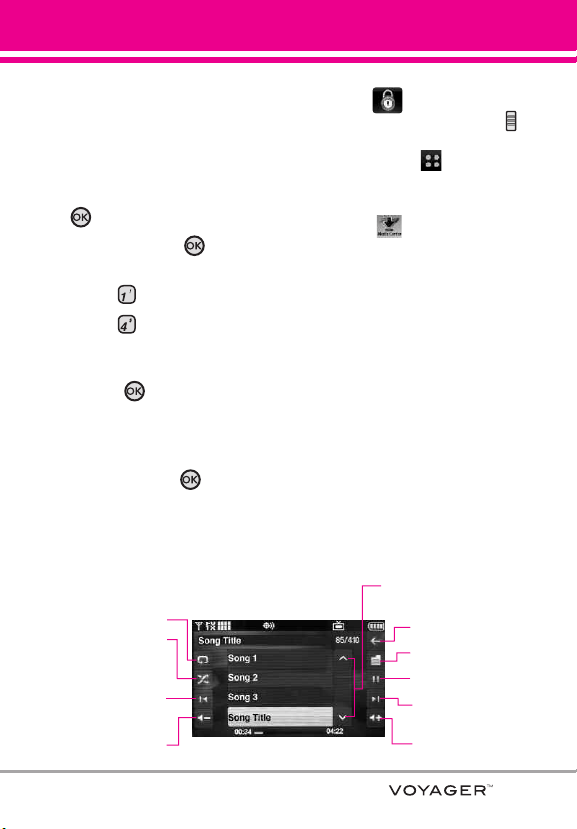
Reproducción de Mi música
Es muy fácil encontrar y reproducir la
música guardada en su teléfono.
Acceso a Mi música
Uso del teclado interno
1. Abra la tapa y oprima la Tecla OK
[MENÚ]
.
2. Oprima la Tecla OK
[CENTRO
de MEDIOS]
.
3. Oprima
Música y Tonos
.
4. Oprima
Mi Música
.
5. Desplácese para seleccionar una
de las opciones siguientes y luego
presione .
Genres
/
Artists
/
Albums
/
Songs
/
Playlists
/
Play All
/
Shuffle
6. Desplácese hasta un tema y
oprima la tecla OK para iniciar
el reproductor de música.
Uso de la pantalla táctil externa
1. Desbloquee la pantalla táctil
tocando o jalando hacia
abajo la tecla de desbloqueo ( )
en el lateral izquierdo del
teléfono y toque para
acceder al menú.
2. Toque el icono CENTRO de
MEDIOS .
3. Toque
1. Música y Tonos
.
4. Toque 4. Mi Música
.
5. Toque
una de las opciones
siguientes.
Genres
/
Artists
/
Albums
/
Songs
/
Playlists
/
Play All
/
Shuffle
6. Toque el nombre de la canción que
usted desea oír para comenzar al
jugador de la música.
SUGERENCIA
Si selecciona Reproducir Todos (Play All), todos
los temas guardados se reproducirán en
secuencia por una vez y luego saldrá del
reproductor de música.
41
Controles de música de la pantalla táctil
Repetir
Tecla Atrás
Opciones
Reproducir/ Pausa
Adelantar/Pasar a
canción siguiente
Aumentar volumen
Permite que usted navegue
entre la lista de canciones.
Reordenar
Rebobinar/Pasar a
canción anterior:
Reproduce la
canción anterior de
la lista actual.
Disminuir volumen
CENTRO de MEDIOS
Control del reproductor de música
Si mantiene la tapa abierta mientras
escucha música, use lo siguiente para
controlar el Music Player:
●
Tecla suave Izquierda
[Repeat] Repite todas las
canciones después de que todas
las canciones fueron reproducidas.
●
Tecla suave Derecha
[Options]
Le permite elegir:
Play All / Shuffle / My Music /
Shop / Listeners also liked / Help
●
: Ajustar el volumen.
NOTA
Si contesta una llamada mientras está
reproduciendo música con la tapa
cerrada y finaliza la llamada
oprimiendo la tecla externa , la
pantalla táctil se bloqueará.
Desbloquee el teléfono deslizando la
tecla de desbloqueo ( ) hacia abajo.
Salida del reproductor de música
Oprima la tecla interna o la
tecla externa con la tapa
cerrada para salir del Reproductor de
música.
1.5 Mis Sonidos
Le permite seleccionar un sonido que
desee, o grabar un nuevo sonido.
Uso del teclado interno
1. Abra la tapa y oprima la Tecla OK
[MENÚ]
.
2. Oprima la Tecla OK
[CENTRO
de MEDIOS]
.
3. Oprima
Música y Tonos
.
4. Oprima
Mis Sonidos
.
5. Oprima
Grabar Nuevo
o
desplácese y seleccione un sonido
o timbre con la Tecla de
Direccional .
Opciones desde aquí:
●
Oprima la Tecla suave Izquierda
[Borrar]
.
●
Oprima la Tecla OK
[TOCAR]
.
●
Oprima la Tecla suave Derecha
[Opciones]
.
Enviar/ A Álbum En Línea/
Renombrar/ Mover/
Bloq/Desbloq/ Borrar Todo/
Pruba Info
Uso de la pantalla táctil externa
1. Desbloquee la pantalla táctil
tocando o jalando hacia
abajo la tecla de desbloqueo ( )
en el lateral izquierdo del
teléfono y toque para
acceder al menú.
42
2. Toque el icono CENTRO de
MEDIOS .
3. Toque
1. Música y Tonos
.
4. Toque 5. Mis Sonidos
.
5. Toque 1. Grabar Nuevo o toque
un sonido usando los dedos.
Opciones desde aquí:
●
Toque para borrar el
sonido seleccionado.
●
Toque para enviar al
sonido seleccionado.
●
Toque para
personalizar el sonido
seleccionado.
A Álbum En Línea/
Renombrar/ Mover/ Bloq/
Borrar Todo/ Prueba Info
●
Toque para volver al
primer nivel.
1.6 Sincronizar Música
Le permite sincronizar su música
entre la PC y el teléfono. Transfiera
archivos de música desde su PC
hacia la memoria o tarjeta de
memoria microSD
TM
(se venden por
separado) de su teléfono y
viceversa. Transfiera música que
haya comprado en la Tienda de
música en línea V CAST | Rhapsody
a su PC.
Baja música a tu PC
1. Instale a encargado de Music
Manager del V CAST Music |
Rhapsody en su PC insertando el
CD que viene con su teléfono,
entonces seleccione la opción 1
para comenzar la instalación.
2. Cuando la instalación este
completa, la música del V CAST
Music | Rhapsody se abrirá
automáticamente.
3. Seleccione la ficha
Comprar
música para acceder a la Tienda
de música en línea V CAST.
4. Entra al sistema.
5. Ve a
Mis Compras.
6. Las canciones que hayas
comprado pero que aún no hayas
bajado se indican con un icono
en la columna download en el
lado derecho de la lista de
canciones.
7. Marca la(s) casilla(s) de la(s)
canción/canciones que deseas
bajar.
8. Selecciona
Bajar.
9. Para escuchar la canción, ve a
Music On My PC de V CAST
Music Manager.
CLR
Opciones
ENVIAR
Borrar
43
CENTRO de MEDIOS
NOTAS
●
V CAST Music con Rhapsody
®
trabajará con
Windows Vista, XP o 2000 (Sólo el 32-bit
versiones de Windows están soportadas.)
No está disponible para Mac o Linux.
●
Un CD de Rhapsody se incluye en la caja de
su VOYAGER™, que permite la transferencia
de música de su PC a su teléfono.
Sincroniza la música de tu PC con
tu aparato móvil de V CAST Music |
Rhapsody
1. Abra V CAST Music | Rhapsody.
Si usted no lo tiene, instálelo en
su PC con el uso del CD que
viene con su teléfono.
2. Utilice el cable del USB (incluido)
para conectar el cable con su PC
y teléfono.
3. El software V CAST Music |
Rhapsody detectará
automáticamente el teléfono y
activará el modo "sinc".
4. En V CAST Music | Rhapsody,
seleccione canciones que desee
sincronizar en la ficha Música en
mi PC y arrástrelas al cuadro
"Lista de sinc".
5. En V CAST Music | Rhapsody,
seleccione ya sea la memoria
interna del teléfono o la tarjeta de
almacenamiento extraíble.
6. Seleccione
Sinc ahora
en
V CAST Music | Rhapsody.
7. Cuando finalice, en su teléfono,
salga de Sinc música y
desconecte el cable de su
teléfono.
8. Bajo el menú de
Música y Tonos
o Mis Música para ver y
escuchar tu música.
NOTA
Se incluye un cable USB compatible
en la caja de su VOYAGER™.
2. Foto y Video
Vea y tome sus imágenes y videos
digital desde su teléfono inalámbrico.
ACCESO DIRECTO
Abra la tapa y oprima la Tecla de Direccional
a la izquierda es una tecla directa a Foto y
Video.
Acceso y Opciones
Uso del teclado interno
1. Abra la tapa y oprima la Tecla OK
[MENÚ]
.
2. Oprima la Tecla OK
[CENTRO
de MEDIOS]
.
3. Oprima
Foto y Video
.
4. Seleccione un submenú
y oprima
la Tecla OK .
Uso de la pantalla táctil externa
1. Desbloquee la pantalla táctil
tocando o jalando hacia
abajo la tecla de desbloqueo ( )
44
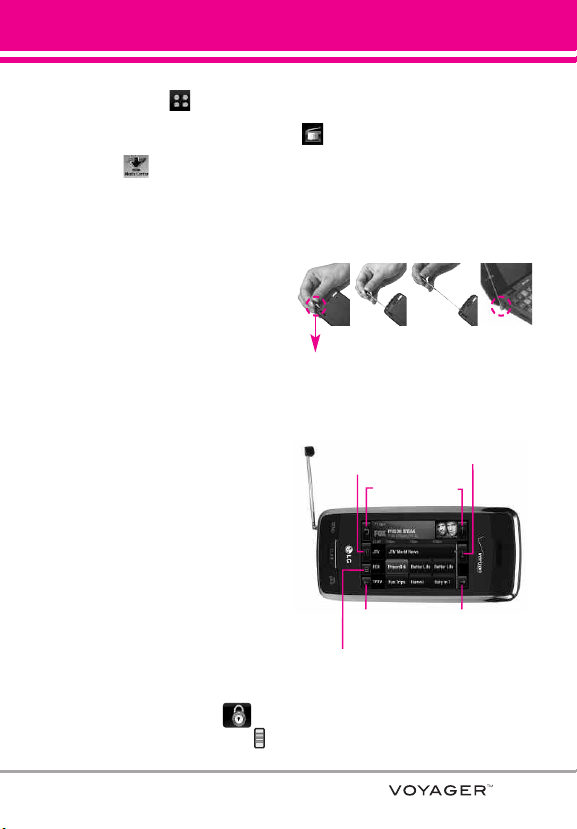
en el lateral izquierdo del
teléfono y toque para
acceder al menú.
2. Toque el icono CENTRO de
MEDIOS .
3. Toque
2. Foto y Video
.
4. Toque un submenú.
2.1 TV móvil V CAST
Su VOYAGER es capaz de llevarle
directamente a su teléfono programas
completos de televisión de algunos de
los canales de TV más populares. Capte
muchos de sus programas favoritos
completos con tan sólo verificar la
facilidad de uso de la función Media
Program Guide (MPG). Además, aun
podrá recibir llamadas, mensajes y, al
cortar, volver directamente a disfrutar
de su programa, ya en reproducción.
Obtenga acceso ilimitado al
entretenimiento usando la TV móvil
V CAST. Si desea más información,
visite www.verizonwireless.com/vcast.
Si aún lo hizo, inscríbase en
TV móvil V CAST llamando al
1-800-2 JOIN IN, visite una Tienda de
comunicaciones o suscríbase
directamente desde su teléfono.
ACCESO DIRECTO
Desbloquee la pantalla táctil tocando o
jalando hacia abajo la tecla de desbloqueo ( )
en el lateral izquierdo del teléfono, luego toque
la pantalla con el dedo para acceder al menú de
atajo y luego toque el icono
TV móvil V CAST
.
SUGERENCIA
Se recomienda jalar la antena hacia afuera en la
parte inferior izquierda del teléfono para una
mejor recepción de TV mientras mira TV móvil
V CAST.
Suscripción a programas de TV
móvil V CAST Directamente de su
teléfono
45
La antena se encuentra en la parte inferior
izquierda del teléfono.
Atrás
Desplazar
hacia arriba
Info
Opciones
Desplazar
hacia atrás
Desplazar hacia
adelante
Desplazar
hacia abajo
CENTRO de MEDIOS
Uso del teclado interno
1. Abra la tapa y oprima la Tecla OK
[MENÚ]
.
2. Oprima la Tecla OK
[CENTRO
de MEDIOS]
.
3. Oprima
Foto y Video
.
4. Oprima
TV móvil V CAST
y
rote el teléfono a la derecha.
5. Se reproducirá un clip de video
de introducción (por primera vez).
SUGERENCIA
Presionando en el primer canal con la
imagen del logotipo de V CAST, usted puede ir
directamente a Videos de V CAST.
6. Desplácese a Subscribe Now y
oprima .
7. Use la tecla de Dirección para
seleccionar un Paquete de TV
móvil V CAST.
8. Oprima la Tecla suave Izquierda
Continue
.
9. Lea los Términos y condiciones y
oprima la Tecla suave Derecha
Agree.
10. Confirme la suscripción
oprimiendo la Tecla suave
Izquierda
Submit.
11. En la pantalla V CAST,
seleccione la Guía de programas
para cambiar los canales.
12. Seleccione el programa que
desee ver.
Uso de la pantalla táctil externa
1. Desbloquee la pantalla táctil
tocando o jalando hacia
abajo la tecla de desbloqueo ( )
en el lateral izquierdo del
teléfono y toque para
acceder al menú.
2. Toque el icono CENTRO de
MEDIOS .
3. Toque
2. Foto y Video
.
4. Toque 1. TV móvil V CAST
y rote
el teléfono a la derecha.
5. Se reproducirá un clip de video
de introducción (por primera vez).
SUGERENCIA
Consulte las siguientes capturas de pantallas
para mirar TV móvil V CAST en la pantalla táctil
externa. Las capturas de pantallas son
simuladas. Los precios de los paquetes
dependen de su proveedor de servicios.
Antes del video de introducción aparece la pantalla de
bienvenida de Verizon.
6. Toque Subscribe Now.
46
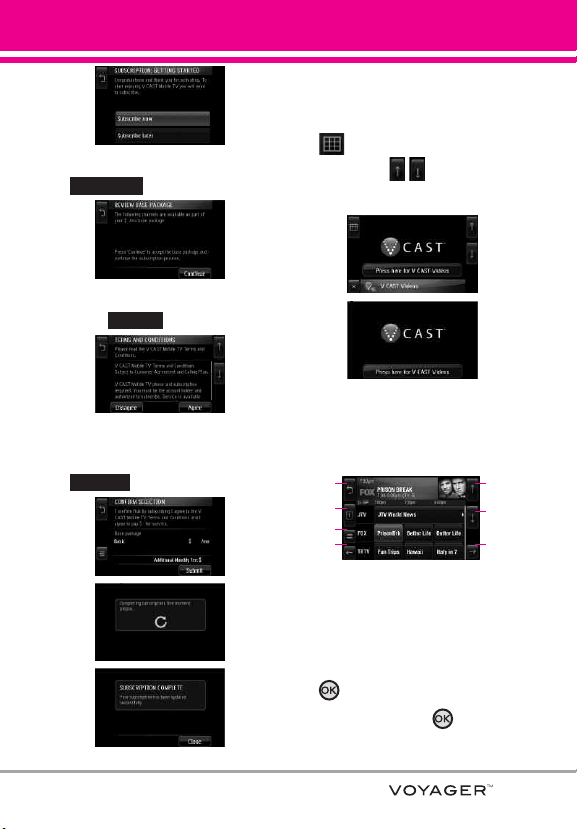
7. Revise el paquete básico y toque
.
8. Lea los Términos y condiciones y
toque .
9. Confirme la selección y toque
.
10. En la pantalla de bienvenida de
V CAST Music | Rhapsody, toque
el icono de la Guía de programas
en la esquina superior
izquierda o para cambiar
los canales.
11. Toque el programa que desee
ver.
Sencillo pasos para empezar a ver
la TV móvil V CAST
1. Abra la tapa y oprima la Tecla OK
[MENÚ]
.
2. Oprima la Tecla OK
[CENTRO
de MEDIOS]
.
Submit
Agree
Continue
47
*Sólo disponible en inglés.
*Sólo disponible en inglés.
Atrás
Info
Opciones
Desplazar
hacia atrás
Desplazar
hacia arriba
Desplazar
hacia abajo
Desplazar
hacia
adelante
CENTRO de MEDIOS
3. Oprima
Foto y Video
.
4. Oprima
TV móvil V CAST
.
5. Use la tecla de Direccional
para seleccionar lo que está en
el aire actualmente.
Mientras mira un programa,
puede hacer lo siguiente:
●
Oprima la Tecla suave Derecha
[Guide] para ir a la guía.
●
Oprima
para volver al
modo de visualización de la
pantalla Vídeo.
SUGERENCIA
Use para cambiar de canal cuando ve
TV móvil V CAST.
Opciones de TV móvil V CAST
1. Abra la carpeta y oprima la Tecla
OK
[MENÚ]
.
2. Oprima la Tecla OK
[CENTRO
de MEDIOS]
.
3. Oprima
Foto y Video
.
4. Oprima
TV móvil V CAST
.
5. Oprima la Tecla suave Derecha
para ver las Opciones:
●
Description
: muestra información
acerca del programa resaltado.
●
Subscription
: muestra los
paquetes de suscripción de
TV móvil V CAST.
●
Parental Controls
: bloquea
contenido con base en
clasificaciones establecidas en el
Menú de clasificación de control
paterno. Para cambiar los
controles paternos, se le pedirá
que introduzca su NIP de
seguridad de 4 cifras.
●
Parental Control On/Off
●
Parental Control Ratings:
Después de introducir su NIP de
4 cifras, puede seleccionar las
clasificaciones permitidas para
programas de TV, Música y
Audio. Una vez que se
seleccionan las clasificaciones,
sólo se puede acceder a
programas con la clasificación
elegida por usted o una mejor.
●
Upgrade Check
: revisa y actualiza
el softare de su Tele-Móvil de
V CAST.
●
About
: muestra información tal
como la versión de softare de TV
móvil V CAST.
NOTA
Las opciones NO están disponibles
cuando se está viendo un programa
en pantalla completa.
TV móvil V CAST sólo está disponible
en el área de cobertura de TV móvil
V CAST. Hay mapas de cobertura a su
48
disposición en
www.verizonwireless.com. Pueden
aplicarse cargos adicionales.
2.2 Videos de V CAST
V CAST lleva el mundo a su teléfono
celular con video de movimiento total
y sonido. Póngase al día de lo que
está ocurriendo con Video Clips de
noticias, deportes, lo mejor de la red,
TV y cine, mundo latino, niños o estilo
de vida (debe estar en un área de
cobergura de V CAST. Pueden
aplicarse cargos adicionales).
Uso del teclado interno
1. Abra la carpeta y oprima la Tecla
OK
[MENÚ]
.
2. Oprima la Tecla OK
[CENTRO
de MEDIOS]
.
3. Oprima
Foto y Video
.
4. Oprima
Videos de V CAST
.
5. Oprima la Tecla de Direccional
para ver las categorías de los
video clips y oprima la Tecla OK
.
6. Seleccione el Video Clip que desea
ver oprimiendo la Tecla OK .
Uso de la pantalla táctil externa
1. Desbloquee la pantalla táctil
tocando o jalando hacia
abajo la tecla de desbloqueo ( )
en el lateral izquierdo del
teléfono y toque para
acceder al menú.
2. Toque el icono CENTRO de
MEDIOS .
3. Toque 2. Foto y Video
.
4. Toque 2. Videos de V CAST
.
5. Toque categorías de clips de
video para visualizarlas.
Navegación, Selección y Videos de
V CAST
1. Abra la carpeta y oprima
para Foto y Video.
2. Oprima para Videos de
V CAST para abrir el catálogo de
videoclips.
3. Oprima la Tecla de Direccional
para visión las categorías video del
clip incluyendo Music, Showcase,
Comedy, News, Sports, Net's Best,
TV & Film , Latino, Kids, y Lifestyle.
4. Seleccione el proveedor de
contenidos y oprima la Tecla OK
.
5. De ser aplicable, seleccione la
49
*Sólo disponible en inglés.
CENTRO de MEDIOS
subcategoría y oprima la Tecla OK
.
Para ver un Flujo de video
1. Abra la carpeta y oprima
para Foto y Video.
2. Oprima Videos de V CAST
para abrir el Catálogo de clips de
video y luego use la tecla de
Dirección para buscar el video
deseado.
3. Navegue por las subcategorías y
realice su selección.
4. Lea la descripción del video clip y
oprima la Tecla OK para verlo.
5. Seleccione
Sí para aceptar los
cargos, oprima la Tecla OK y
se iniciará la transferencia del
videoclip.
6. El video clip comenzará a
transferirse y se reproducirá poco
después de haber sido
seleccionado.
Para descargar un Video Clip
1. Abra la carpeta y oprima
para
Foto y Video
.
2. Oprima
Videos de V CAST
.
3. Navegue por los submenús y
busque un video que pueda
descargar.
4. Use la tecla de Dirección para
buscar el clip de video deseado,
luego lea la descripción del clip de
video y oprima la Tecla suave
Derecha
[Options]
.
5. Oprima para
Save Video
y
oprima la Tecla OK .
6. Seleccione
Sí
para aceptar los
cargos, oprima la Tecla OK y
Video Clip iniciará la descarga del
video.
7. Una vez que se haya descargado
el video, aparecerá un mensaje en
su teléfono.
8. Seleccione
Sí
y oprima la Tecla OK
para ver el video.
9. El Video clip se guardará
automáticamente en Mis Clips y en
la Mis Vídeos.
NOTA
No todos los videos son descargables.
Sólo pueden descargarse los videos
que tienen la opción de guardarse.
Pueden aplicarse cargos adicionales
por cada video clip que vea. El servicio
de Video Clips no está disponible en
todas las áreas. Compruebe el sitio
Web www.verizonwireless.com/getitnow
para obtener detalles.
50
Borrar Video Clips
Uso del teclado interno
1. Abra la carpeta y oprima
para
Foto y Video
.
2. Oprima
Videos de V CAST
.
3. Oprima la Tecla suave Izquierda
[Mis Vídeos]
.
4. Seleccione el Vídeo que desea
borrar con la tecla de navagación.
5. Oprima la Tecla suave Derecha
[Options]
y oprima
Erase
.
6. Oprima la Tecla OK
[Sí]
para
borrar el Vídeo.
Configurar alertas para nuevos
Video Clips
1. Abra la carpeta y oprima
para
Foto y Video
.
2. Oprima
Videos de V CAST
.
3. En el catálogo de Video Clips,
seleccione una categoría.
4. Seleccione al Proveedor de
contenido.
5. Oprima la Tecla suave Derecha
[Options]
.
6. Seleccione
Alerts
.
7. Seleccione
Configure Alerts
y
oprima la Tecla OK .
8. Seleccione el contenido de las
alertas que desea y oprima la Tecla
OK para guardar.
2.3 Obtén Nuevas Fotos
Le permite conectarse a CENTRO de
MEDIOS y descargar diversos FOTO
(imágenes) para Mis Fotos.
Uso del teclado interno
1. Abra la carpeta y oprima la Tecla
OK
[MENÚ]
.
2. Oprima la Tecla OK
[CENTRO
de MEDIOS]
.
3. Oprima
Foto y Video
.
4. Oprima
Obtén Nuevas Fotos
.
5. Oprima
Obtén Nuevas
Aplicaciones.
Uso de la pantalla táctil externa
1. Desbloquee la pantalla táctil
tocando o jalando hacia
abajo la tecla de desbloqueo ( )
en el lateral izquierdo del
teléfono y toque para
acceder al menú.
2. Toque el icono CENTRO de
MEDIOS .
3. Toque
2. Foto y Video
.
4. Toque 3. Obtén Nuevas Fotos
.
51
CENTRO de MEDIOS
5. Toque 1. Obtén Nuevas
Aplicaciones.
2.4 Mis Fotos
Le permite ver fotografías
almacenadas en el teléfono.
ACCESO DIRECTO
Desbloquee la pantalla táctil tocando o
jalando hacia abajo la tecla de desbloqueo ( )
en el lateral izquierdo del teléfono, luego toque
la pantalla con el dedo para acceder al menú de
atajo y luego toque el icono
Mis Fotos .
Uso del teclado interno
1. Abra la carpeta y oprima la Tecla
OK
[MENÚ]
.
2. Oprima la Tecla OK
[CENTRO
de MEDIOS]
.
3. Oprima
Foto y Video
.
4. Oprima
Mis Fotos
.
5. Seleccione la imagen que desea
con la Tecla de Direccional y
oprima la Tecla suave Derecha
[Opciones]
.
6. Seleccione una de las opciones
siguientes.
Enviar
Mensaje de Foto
/
A
Álbum En Línea
/
Via Bluetooth
Fijar Como
Papel Tapiz/ Foto ID
Tomar Foto Activa la función de
cámara.
Obtener Nuevo Fotos Descarga
varios fotos.
Administrar Mis Fotos Le permite
marcar la imagen seleccionada y
aplicar las opciones.
Renombrar Cambie el nombre de
las FOTOs seleccionadas.
Imprimir
Imprimir via Bluetooth/
Preferencias de impresión
Prueba Info
Nombre/ Fecha/
Hora/ Resolución/ Tamaño/ Tipo
NOTA
La opción 'Via Bluetooth' no se muestra
cuando se seleccionan imágenes
protegidas por DRM (Administración
digital de derechos). También, la opción
está disponible solamente cuando usted
selecciona un dispositivo de Bluetooth
que apoye la recepción de cuadros.
Uso de la pantalla táctil externa
1. Desbloquee la pantalla táctil
tocando o jalando hacia
abajo la tecla de desbloqueo ( )
en el lateral izquierdo del
teléfono y toque para
acceder al menú.
2. Toque el icono CENTRO de
MEDIOS .
3. Toque
2. Foto y Video
.
52
4. Toque 4. Mis Fotos
.
5. Toque la imagen deseada y toque
.
6. Toque las opciones a
personalizar.
Enviar
Mensaje de Foto
/
A
Álbum En Línea
/
Via Bluetooth
Fijar Como
Pepal Tapiz/ Foto ID
Tomar Foto Activa la función de
cámara.
Obtén Nuevas Fotos Descarga
varios fotos.
Administrar Mis Fotos Le permite
marcar la imagen seleccionada y
aplicar las opciones.
Renombrar Cambie el nombre de
las FOTOs seleccionadas.
Imprimir
Imprimir via Bluetooth/
Preferencias de impresión
Prueba Info
Nombre/ Fecha/
Hora/ Resolución/ Tamaño/ Tipo
NOTA
Para desplazarse a opciones no
visualizadas en pantalla, coloque el
dedo en la lista y suavemente aplique
presión hacia arriba (o hacia abajo).
La barra a lo largo del lateral derecho
de la pantalla indica dónde se
encuentra usted en la lista.
2.5 Mis Videos
Le permite ver videos almacenados
en el teléfono.
Uso del teclado interno
1. Abra la carpeta y oprima la Tecla
OK
[MENÚ]
.
2. Oprima la Tecla OK
[CENTRO
de MEDIOS]
.
3. Oprima
Foto y Video
.
4. Oprima
Mis Videos
.
5. Seleccione el video que desea con
la Tecla de Direccional y
oprima la Tecla suave Derecha
[Opciones]
.
Seleccione una de las opciones
siguientes (Las opciones son
dependientes en tipos del archivo).
Enviar Envía un mensaje de vídeo.
Grabar Video Activa la función de
cámara de video.
A Álbum En Línea Accede al
álbum en línea (PIX Place).
Videos de V CAST Obtiene acceso
a la función Videos de V CAST.
Administrar Mis Videos Es posible
marcar varios videos.
Tapiz Fijar Como Muestra el
archivo de video seleccionado
como pantalla de fondo del
teléfono.
Opciones
53
CENTRO de MEDIOS
Renombrar Cambia el nombre al
vídeo seleccionado.
Prueba Info
Nombre/ Fecha/
Hora/ Duración/ Tamaño
6. Oprima la Tecla OK para
reproducirlo.
NOTA
El almacenaje de archivo varía según
el tamaño de cada archivo así como
la asignación de memoria de otros
usos.
●
: Ajustar el volumen.
●
Tecla suave Izquierda :
Mudo/ No Mudo.
●
: Pausa/ Reproducción.
●
Arriba de Direccional :
Muestra la pantalla completa.
●
Abajo de Direccional : Parar
* Para los archivos de WMV, la tecla
termina de reproducir el clip y va de nuevo a
MIS VIDEOS.
●
A Derecha de Direccional :
Avance rápido
●
A Izquierda de Direccional :
Rebobinar
7. Oprima la Tecla suave Derecha
[Opciones]
para seleccione
una de las opciones siguientes:
Tapiz Fijar Como/ Info de Arch
Uso de la pantalla táctil externa
1. Desbloquee la pantalla táctil
tocando o jalando hacia
abajo la tecla de desbloqueo ( )
en el lateral izquierdo del
teléfono y toque para
acceder al menú.
2. Toque el icono CENTRO de
MEDIOS .
3. Toque 2. Foto y Video
.
4. Toque 5. Mis Videos
.
5. Toque un video, luego toque lo
que desee hacer: ,
, o .
Seleccione una de las siguientes
opciones (Las opciones dependen
de los tipos de archivo):
Enviar Envía un mensaje de vídeo.
Grabar Video Activa la función de
cámara de video.
A Álbum En Línea Accede al
álbum en línea (PIX Place).
Videos de V CAST Obtiene acceso
a la función Videos de V CAST.
Administrar Mis Videos Es posible
marcar varios videos.
Tapiz Fijar Como Muestra el
archivo de video seleccionado
como pantalla de fondo del
teléfono.
OpcionesTOCAR
Borrar
54
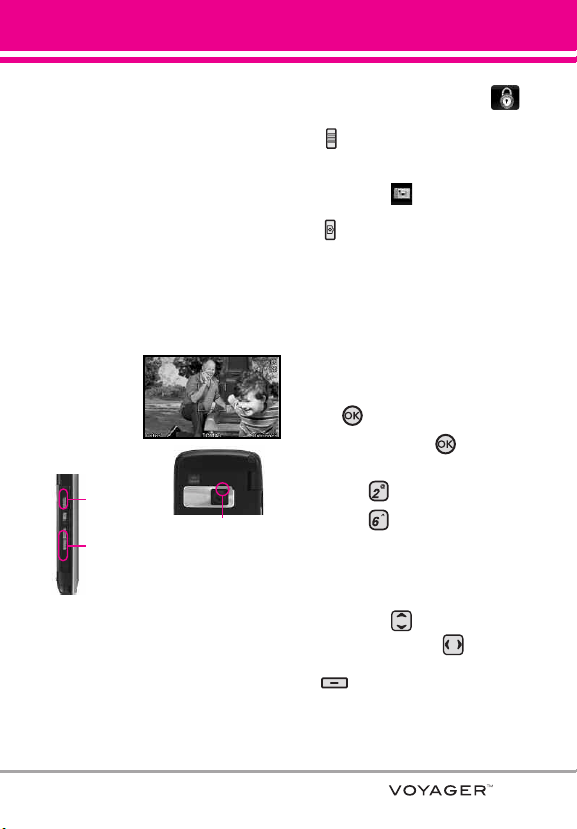
Renombrar Cambia el nombre al
vídeo seleccionado.
Prueba Info
Nombre/ Fecha/
Hora/ Duración/ Tamaño
NOTE
Para desplazarse a opciones no
visualizadas en pantalla, coloque el
dedo en la lista y suavemente aplique
presión hacia arriba (o hacia abajo).
La barra a lo largo del lateral derecho
de la pantalla indica dónde se
encuentra usted en la lista.
2.6 Tomar Foto
Tome fotos
directamente
desde su
teléfono.
SUGERENCIAS
●
Para tomar una fotografía clara, ajuste el
nivel de brillo y zoom adecuados antes de
tomar la foto.
●
Evite sacudir la cámara.
●
Limpie la lente de la cámara con un paño
suave.
ACCESO DIRECTO
●
Desbloquee la pantalla táctil tocando
o jalando hacia abajo la tecla de desbloqueo
( ) en el lateral izquierdo del teléfono,
luego toque la pantalla con el dedo para
acceder al menú de atajo y luego toque el
icono
Cámara .
●
La tecla lateral de la cámara fotográfica
( ) es una acceso de atajo para tomar
el cuadro en modo espera. Oprima y
lleve a cabo la tecla para lanzar las
pantallas de registro de la inspección
previo del modo del vídeo. En el modo
del Cámara/Vídeo, oprima la tecla lateral
de la cámara fotográfica para tomar el
foto/vídeo.
Uso del teclado interno
1. Abra la carpeta y oprima la Tecla
OK
[MENÚ]
.
2. Oprima la Tecla OK
[CENTRO
de MEDIOS]
.
3. Oprima
Foto y Video
.
4. Oprima
Tomar Foto
.
5. Mantenga el teléfono en posición
horizontal para tomar las fotos.
6. Configure el brillo con la Tecla de
Direccional , y el zoom con la
Tecla de Direccional , o bien
oprima la Tecla suave Derecha
[Opciones]
para cambiar
otros valores.
NO
TA
En la mayor resolución no se
encuentra disponible el zoom.
55
Tecla de la
Cámara
Ajuste el brillo con las teclas laterales.
Use la tecla de Dirección para hacer zoom
acercándose o alejándose.
Lente de la Cámara
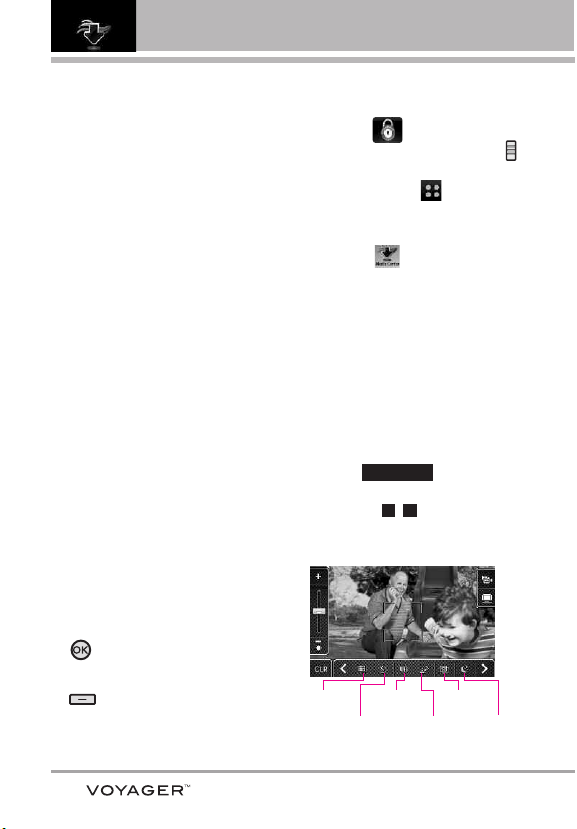
CENTRO de MEDIOS
●
Seleccione las opciones que
desea personalizar.
RESOLUCIÓN 1600X1200/
1280X960/ 640X480/ 320X240
DISPARO AUTO Apagado/
3 Segundos/ 5 Segundos/
10 Segundos
EQUIL BLANCO Automático/
Soleado/ Nublado/ Fluorescente/
Brillo
SONIDO DISPA Obturador/ Sin
Sonido/ Say "Cheese"/ Ready! 1 2 3
EFECTOS COLOR Normal/ Negativo/
Aqua/ Sepia/ Blanco y Negro
MODO NOCTURNO Encendido/
Apagado
EXCEPTO OPCIÓ Interna/ Externa
FOTOMETRÍA Spot Multiple/
Promedio
PNTLL DELANTERA
Encendido/
Apagado
FOCO AUTOMÁTICO Una etapa/
Dos etapas/ Desactivado
MODO CAPTURA Cámara/ Video
7. Tome la foto tocando la Tecla OK
[TOMAR]
.
8. Oprima la Tecla suave Izquierda
[Guar]
. La imagen se
almacena en la
Mis Fotos
.
Uso de la pantalla táctil externa
1. Desbloquee la pantalla táctil
tocando o jalando hacia
abajo la tecla de desbloqueo ( )
en el lateral izquierdo del
teléfono y toque para
acceder al menú.
2. Toque el icono CENTRO de
MEDIOS .
3. Toque
2. Foto y Video
.
4. Coloque el dedo en la pantalla
táctil y aplique una presión suave
hacia arriba para desplazarse
por la lista en dicha dirección
luego toque 6. Tomar Foto.
5. Mantenga el teléfono en posición
horizontal para tomar las fotos.
6. Toque para cambiar
la configuración de fotos.
Desplace / horizontalmente
para ver configuraciones
adicionales.
><
Opciones
56
RESOLUCIÓN EQUIL
BLANCO
EFECTOS
COLOR
DISPARO
AUTO
SONIDO
DISPA
MODO
NOCTURNO
7.
Tome la foto tocando la
.
8. Toque .
La imagen se
almacena en la
Mis Fotos
.
2.7 Grabar Video
Le permite
grabar un
mensaje de
video con
sonido.
Uso del teclado interno
1. Abra la carpeta y oprima la Tecla
OK
[MENÚ]
.
2. Oprima la Tecla OK
[CENTRO
de MEDIOS]
.
3. Oprima
Foto y Video
.
4. Oprima
Grabar Video
.
5. Mantenga el teléfono en posición
horizontal para grabar videos.
6. Configure el brillo con la Tecla de
Direccional , y la Tecla de
Direccional o bien oprima la
Tecla suave Derecha
[Opciones] para cambiar otros
valores.
●
Seleccione las opcione(s) que
desea personalizar.
GRABACIÓN HORA Para Enviar/
Para Guardar
RESOLUCIÓN
320X240/ 176X144
EXCEPTO OPCIÓN Interna/
Externa
EFECTOS COLOR Normal/
Negativo/ Aqua/ Sepia/
Blanco y Negro
EQUIL BLANCO Automático/
Soleado/ Nublado/ Fluorescente/
Brillo
CAPTURA Cámara/ Video
7. Oprima la Tecla OK
[REC]
para empezar a grabar y otra vez
para parar.
8. Oprima la Tecla suave Izquierda
[Guar]
. El video grabado se
almacena en
Mis Videos
.
Uso de la pantalla táctil externa
1. Desbloquee la pantalla táctil
tocando o jalando hacia
abajo la tecla de desbloqueo ( )
en el lateral izquierdo del
teléfono y toque para
acceder al menú.
2. Toque el icono CENTRO de
MEDIOS .
3. Toque
2. Foto y Video.
4. Coloque el dedo en la pantalla
táctil y aplique una presión suave
hacia arriba para desplazarse
por la lista en dicha dirección
Guar
57
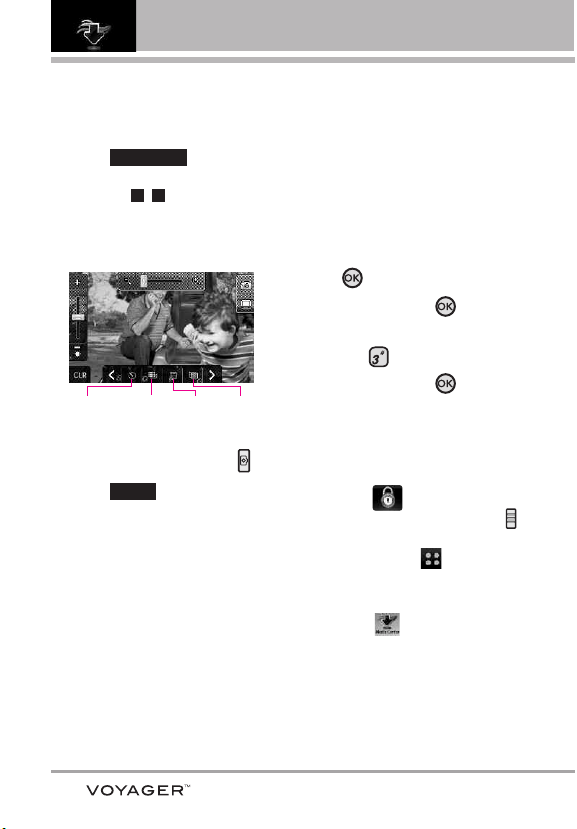
CENTRO de MEDIOS
luego toque 7. Grabar Video.
5. Mantenga el teléfono en posición
horizontal para grabar videos.
6. Toque para cambiar
la configuración de video.
Desplace / horizontalmente
para ver configuraciones
adicionales.
7. Grabe un video oprimiendo .
8. Toque .
El video grabado
se almacena en
Mis Videos
.
3. Juegos
Le permite descargar juegos y
aplicaciones del servidor CENTRO de
MEDIOS. Elija el software que desea
en la lista que se presenta en
pantalla.
Uso del teclado interno
1. Abra la carpeta y oprima la Tecla
OK
[MENÚ]
.
2. Oprima la Tecla OK
[CENTRO
de MEDIOS]
.
3. Oprima
Juegos
.
4. Oprima la Tecla OK
[Obtén
Nuevas Aplicaciones]
.
Uso de la pantalla táctil externa
1. Desbloquee la pantalla táctil
tocando o jalando hacia
abajo la tecla de desbloqueo ( )
en el lateral izquierdo del
teléfono y toque para
acceder al menú.
2. Toque el icono CENTRO de
MEDIOS .
3. Toque
3. Juegos.
4. Toque
Obtén Nuevas
Aplicaciones.
Guar
><
Opciones
58
GRABACIÓN
HORA
EXCEPTO
OPCIÓN
EFECTOS
COLOR
RESOLUCIÓN
4. Navegar y Descargar
Todo lo que necesita saber mientras
está en movimiento.
Uso del teclado interno
1. Abra la carpeta y oprima la Tecla
OK
[MENÚ]
.
2. Oprima la Tecla OK
[CENTRO
de MEDIOS]
.
3. Oprima
Navegar y
Descargar
.
4. Oprima la Tecla OK
[Obtén
Nuevas Aplicaciones]
.
Uso de la pantalla táctil externa
1. Desbloquee la pantalla táctil
tocando o jalando hacia
abajo la tecla de desbloqueo ( )
en el lateral izquierdo del
teléfono y toque para
acceder al menú.
2. Toque el icono CENTRO de
MEDIOS .
3. Toque
4. Navegar y Descargar
.
4. Toque 1. Obtén Nuevas
Aplicaciones, Mobile Email, o VZ
Navigator.
City ID
City ID es una función optimizada del
identificador de llamadas en teléfonos
seleccionados de Verizon Wireless
que muestran automáticamente la
ciudad y estado de todas las llamadas
recibidas en su teléfono móvil. City ID
lee el código de área e intercambio
local de una llamada entrante y
muestra la ubicación relacionada con
ese número. City ID incluye más de
20,000 ciudades, poblaciones y
localidades en Norteamérica y más
de 200 códigos de países de todo el
mundo, ofreciendo a los suscriptores
de teléfonos móviles una notable y
precisa herramienta para identificar
llamadas entrantes.
Los teléfonos habilitados con City ID
también contienen la función de
identificación de llamadas salientes y
registro de llamadas, que muestra la
ciudad y estado de llamadas
salientes, así como las llamadas
realizadas en la historia del teléfono.
City ID es una función incluida en su
teléfono con un período de prueba
gratis que funciona automáticamente,
mostrando la ciudad y estado con la
primera llamada entrante.
59

CENTRO de MEDIOS
1. Después del período de prueba
gratis, los suscriptores recibirán un
mensaje para comprar la
aplicación.
2. Luego, el suscriptor verá las
opciones de compra disponibles.
Si después de comprar City ID el
suscriptor decide cancelar la
aplicación, el suscriptor puede
seguir el proceso normal de Centro
de Medios para cancelar una
suscripción.
3. Para comprar City ID si eligió "no"
durante el período de prueba.
1. Seleccione Menú
2. Seleccione Centro de Medios
3. Seleccione Navegar y Descargar
4. Seleccione City ID
5. Seleccione “Inscribirme” para
comprar la aplicación
6. Bajar aplicaciones. Después de
instalar exitosamente la
aplicación, seleccione "yes" para
abrir City ID o “no” para regresar
a Centro de Medios.
7. Seleccione Finalizar para
regresar al Menú principal.
Visual Voice Mail
Visual Voice Mail permite la gestión
de correo de voz directamente desde
el dispositivo en lugar de acceder a
correo de voz a través de los métodos
tradicionales. Visual Voice Mail
muestra una lista de mensajes y
permite al usuario elegir qué mensaje
a escuchar o eliminar, sin tener que
marcar en su buzón de correo,
escuchar instrucciones de voz,
mensajes o antes.
1. Marque su número celular.
2. Una vez que usted oye el sistema
de saludo o su propio saludo,
oprima # para interrumpir
inmediatamente el saludo y siga
las instrucciones.
60

Cómo acceder a Visual Voice Mail
de tu dispositivo móvil
Visual Voice Mail se puede encontrar
en el menú Mensajes en el
dispositivo.
1. Desde la pantalla principal y con
la tapa abierta,oprima Aceptar
para Menú, pulse la clave
direccional derecha para resaltar
Mensajes y oprima Aceptar.
2. Oprima 6 para acceder al Correo
de Voz Visual aplicación para la
descarga y uso futuro.
Cómo crear Visual Voice Mail
1. Si ya es suscriptor de Verizon
Wireless, ir al paso 2. Si son
nuevos abonados de Verizon
Wireless, primero marque * 86 a
configurar su servicio de correo
de voz.
2. Desde la pantalla principal y con
la tapa abierta, oprima Aceptar
para Menú, oprima la tecla
direccional derecha para resaltar
Mensajes y oprima Aceptar.
3. Oprima 6 para acceder al Correo
de Voz Visual aplicación para la
descarga y uso futuro.
4. Tras abrir el vínculo a Visual Voice
Mail, un mensaje se jugará la
promoción de las ventajas de
Visual Voice Mail.
5. Haga clic en "Descargar" para
descargar la aplicación.
6. Cuando se le solicite, introduzca
su correo de voz básico
contraseña que fue establecido
previamente *.
7. Continúe siguiendo las
indicaciones e instrucciones para
completar la descarga y
activación de Visual Voice Mail.
61

CENTRO de MEDIOS
8. Una vez que la activación de
medidas se completará, salir de la
aplicación y retun después de 5
minutos para comenzar a utilizar
Visual Voice Mail.
* Tenga en cuenta que el almacenamiento de
correo de voz es necesaria la contraseña a
utilizar Visual Voice Mail. Esta aplicación puede
almacenar mensaje de voz en formato
electrónico en este dispositivo.
Cualquier persona en posesión de
este dispositivo puede acceder a la
buzón de voz. Para limitar el acceso
no autorizado al buzón de voz,
considere la posibilidad de bloqueo
del teléfono cuando no esté en uso.
Cancelación de Visual Voice Mail no
puede llevarse a cabo a través del
dispositivo. Póngase en contacto con
Servicio al Cliente o vaya a Mi Verizon
en verizonwireless.com si necesita
cancelar su Visual servicio de correo
de voz. Visual Voice Mail y tradicional
correo de voz puede no ser siempre
sincronizado y si cancela Visual Voice
Mail es posible que pierda todos los
correos de voz almacenados y la
información. Para evitar la pérdida de
todos los correos de voz
almacenados y la información, salvo
el correo de voz en un formato de
audio en una memoria interna del
teléfono, de memoria extraíble o
enviar el archivo de audio como un
mensaje a través de mensajes de
imagen o de correo electrónico.
Una vez que se han inscrito para Mi
Verizon, usted tendrá la posibilidad de
restablecer su contraseña de correo
de voz en línea oa través de su web
capaz dispositivo inalámbrico. Para
obtener más información sobre cómo
registrarse para Mi Verizon, consulte
la página 34 de la Guía rápida.
NOTA
correo de voz puede no estar
disponible en algunas zonas. Buzones
de correo de voz no establecer un
plazo de 45 días será cancelada.
Verizon Wireless su buzón de voz no
está protegido con contraseña hasta
que crees una contraseña siguiendo el
tutorial de configuración. El tiempo de
emisión y otros cargos se haya
incurrido al usar correo de voz desde
tu teléfono móvil. En minutos de
llamada no se aplican a correo de voz
retrivals; se le cobrará a mantener su
conexión al correo de voz. V
erizon
Wireless no se hace responsable por
pérdida de mensajes, o supresiones
de los mensajes de su buzón de voz,
incluso si ha guardado.
62
Sistema de Navegación VZ
Navigator
SM
VZ Navigator es una aplicación
descargable desde el menú Navegar
y Descargar. Ahora puedes encontrar
la dirección de un gran restaurante o
el cajero automático más cercano. Ve
los horarios de películas. Descubre
los sitios más populares. Y conoce
exactamente cómo llegar a donde
vas. El Sistema de Navegación VZ
Navigator te ofrece todas las
funciones avanzadas de los últimos
aparatos y sistemas de
posicionamiento global (GPS), a una
fracción del precio de otros aparatos
y sistemas GPS.
ACCESO DIRECT
O
Para acceder rápidamente a VZ Navigator,
desbloquee la pantalla táctil, toque la
pantalla táctil y luego toque .
NOTAS
●
Para utilizar en navegador VZ, debe activar la
ubicación. (Consulte la página 124)
●
Para utilizarlo se requiere descarga y
suscripción sólo dentro de un Área nacional
de tarifa de servicios optimizados; no se
garantiza que la información sea exacta ni
completa; para la prestación del servicio, se
utilizará la información acerca de la ubicación
del dispositivo. Es posible que deba pagar una
tarifa adicional. Vea el folleto del cliente para
detalles o visite www.verizonwireless.com.
Mobile Email
Mobile Email es una aplicación que
puede descargarse desde el menú
Navegar y Descargar. No pierda un
mensaje de correo electrónico
importante. Gracias a Mobile Email,
puede recibir los mensajes de
correo electrónico en su teléfono,
mientras se encuentra en
movimiento. Mobile Email funciona
con muchos proveedores, incluidos
Yahoo!, AOL, y Verizon.net. Reciba
alertas de su VOYAGERcuando llega
un nuevo mensaje de correo
electrónico.
Es posible que deba pagar una tarifa
adicional.
Vea el folleto del cliente
para detalles o visite
www.verizonwireless.com.
ACCESO DIRECTO
Para acceder rápidamente a Mobile Email, abra
la tapa, oprima la Tecla Fn y luego oprima
Mobile Email.
NOTA
Están disponibles varios proveedores
de correo electrónico incluidos
Yahoo!Mail, WindowsLiveMail, AOL,
AIM, Verizon.net, entre otros.
63
CENTRO de MEDIOS
5. Extra
Uso del teclado interno
1. Abra la carpeta y oprima la Tecla
OK
[MENÚ]
.
2. Oprima la Tecla OK
[CENTRO
de MEDIOS]
.
3. Oprima
Extra
.
4. Oprima la Tecla OK
[Obtén
Nuevas Aplicaciones]
.
Uso de la pantalla táctil externa
1. Desbloquee la pantalla táctil
tocando o jalando hacia
abajo la tecla de desbloqueo ( )
en el lateral izquierdo del
teléfono y toque para
acceder al menú.
2. Toque el icono CENTRO de
MEDIOS .
3. Toque
5. Extras.
4. Toque
Obtén Nuevas
Aplicaciones.
64
MENSAJERÍA
M
M
E
E
N
N
S
S
A
A
J
J
E
E
R
R
Í
Í
A
A
ACCESO DIRECTO
Simplemente toque en el teclado en modo
de espera con la tapa cerrada. Desde el modo
de espera, al oprimir la Tecla suave Izquierda
es una tecla directa a la MENSAJERÍA.
●
Compruebe los tipos de mensajes
oprimiendo la Tecla suave
Izquierda
[Mensaje]
o
tocando .
●
Hacer una llamada al número de
devolución de llamada (en Entrada)
tocando la tecla interna o la
tecla externa durante una
comprobación de mensajes.
El teléfono puede almacenar sobre
540 mensajes. La información
almacenada en el mensaje está
determinada por el modo del teléfono
y la capacidad del servicio. Puede
haber otros límites a los caracteres
disponibles por mensaje. Compruebe
con su proveedor de servicio las
funciones y capacidades del sistema.
Alerta de nuevo mensaje
El teléfono le alertará cuando reciba
mensajes nuevos.
1. El teléfono muestra un mensaje en
la pantalla.
2. Aparece el icono de mensaje ( )
en la pantalla. En el caso de un
mensaje urgente, el icono
parpadeará y se mostrará una
mensaje de alertas.
1. Nuevo Mensaje
Le permite enviar mensajes (TXTO,
Foto, Vídeo) y de localizador. Cada
mensaje tiene un destino (Dirección)
e información (Mensaje). Éstos
dependen del tipo de mensaje que
desea enviar.
1.1 Msj TXTO
Aspectos básicos de los mensajes
de texto Uso del teclado interno
1. Abra la carpeta y oprima la Tecla
OK
[MENÚ]
.
2. Oprima la Tecla de Direccional
para obtener acceso al menú
MENSAJERÍA
y oprima la Tecla
OK .
3. Oprima
Nuevo Mensaje
.
4. Oprima
Msj TXTO
.
5. Introduzca el número de teléfono
del destinatario o la dirección de
correo electrónico para un
mensaje de correo electrónico.
Usted puede incorporar hasta 10
direcciones para un solo mensaje.
65
MENSAJERÍA
66
6. Oprima la Tecla OK .
7. Escriba su mensaje (texto o correo
elect.).
8. Oprima la Tecla OK
[ENV]
.
Aparece una pantalla de envío.
Uso de la pantalla táctil externa
1. Desbloquee la pantalla táctil
tocando o jalando hacia
abajo la tecla de desbloqueo (
) en el lateral izquierdo del
teléfono y toque para
acceder al menú.
2. Toque el icono Mensajería .
3. Toque
1. Nuevo Mensaje.
4. Toque 1. Msj TXTO.
5. Use el teclado táctil para
completar el campo Para. Toque
para cambiar el modo de
entrada de números a letras, si
fuera necesario.
6. Toque .
7. Escriba el mensaje con el
teclado táctil. Toque para
cambiar los modos de entrada
de texto o agregar texto
rápidamente.
8. Toque .
Personalización del mensaje con
Opciones
●
Edición del campo A: (destino)
1. Con la tapa abierta, oprima la
Tecla Derecha
[Añadir]
o
con la tapa cerrada, toque
.
2. Seleccione las opciones que
desea personalizar.
De Contactos/ Llmdas Rctes/
Grupos/ A Contactos
●
Editar Texto
1. Con la tapa abierta, oprima la
Tecla Derecha
[Opciones]
o
con la tapa cerrada, toque
.
2. Seleccione las opciones que
desea personalizar.
Guardar Como Borrador Guarda
el mensaje en la carpeta
Borradores.
Añadir Le permite agregar un
Gráfico, Animaciones, Sonido, Text
Rápido, Firma, Tarjeta de Nombre,
Dirección de Contactos.
Copiar texto
Le permite copiar
texto que resalte para pegarlo en
otro mensaje.
Pegar
Le permite pegar el texto
que copió por última vez en otro
campo.
Opcs
Añadir
ENV
Abc
OK
123
Formato al Text Le permite
cambiar el aspecto del texto.
Alineación/ Tamaño del Fuente/
Estilo de Fuente/ Color de Text/
Fondo
Prioridad Da prioridad al mensaje.
Alto/ Normal
Dev Llmda # Introduce un número
preprogramado de devolución de
llamada con su mensaje.
Encendido/ Apagado/ Corregir
Guardar Text Rápido Le permite
definir frases para Insertar texto
rápido.
Cancelar Mensaje Cancela la
edición del mensajes y va al menú
mensajes.
3. Finalizar y enviar o guardar el
mensaje oprimiendo con la
tapa abierta, o tocando en
la pantalla táctil.
1.2 Msj FOTO
Aspectos básicos del envío de un
mensaje Uso del teclado interno
1. Oprima la Tecla suave Izquierda
[Mensaje]
.
2. Oprima
Nuevo Mensaje
.
3. Oprima
Msj FOTO
.
4. Introduzca el número de teléfono
celular o la dirección de correo
electrónico del destinatario.
5. Oprima la Tecla de OK .
6. Escriba su mensaje (texto o correo
elect.).
7. Use la Tecla de Direccional
para resaltar el
Foto
y la Tecla
suave Izquierda
[Mis Fotos]
.
Use para desplazarse hasta
la imagen que desea enviar y
oprima la Tecla OK .
8. Use la Tecla de Direccional
para resaltar
Sonido
y la Tecla
suave Izquierda
[Sonidos]
.
Use para desplazarse hasta el
archive que desea enviar y oprima
la Tecla OK .
9. Use la Tecla de Direccional
para resaltar
Nom Tarj
y la Tecla
suave Izquierda
[Contactos]
.
Use para seleccionar el
Tarjeta de Nombre/ Contactos.
10. Use la Tecla de Direccional
para resaltar
Asunto
y escribar el
asunto.
11. Abra la carpeta y oprima la Tecla
OK
[ENV]
.
Aparece un mensaje de
confirmación.
ENV
67
MENSAJERÍA
Uso de la pantalla táctil externa
1. Desbloquee la pantalla táctil
tocando o jalando hacia
abajo la tecla de desbloqueo ( )
en el lateral izquierdo del
teléfono y toque para
acceder al menú.
2. Toque el icono Mensajería .
3. Toque 1. Nuevo Mensaje.
4. Toque
2. Msj FOTO.
5. Use el teclado táctil para
completar el campo Para.
6. Toque .
7. Toque el campo Texto y luego
escriba el mensaje con el teclado
táctil. Toque para cambiar
los modos de entrada de texto o
agregar texto rápidamente.
Personalización del mensaje con
Opciones
●
Edición del campo Para:
1. Con la tapa abierta, oprima la Tecla
Derecha
[Añadir]
o con la
tapa cerrada, toque .
2. Seleccione las opciones que
desea personalizar.
De Contactos/ Llams. Recntes/
Grupos/ A Álbum En Línea/
A Contactos
●
Editar Text o Asunto
1. Con la tapa abierta, oprima la Tecla
Derecha
[Opciones]
o con la
tapa cerrada, toque .
2. Seleccione las opciones que
desea personalizar.
Avance Muestra el mensaje Foto
como lo verá el destinatario.
Guardar Como Borrador Guarda el
mensaje en la carpeta Borradores.
Copiar texto
Le permite copiar
texto que resalte para pegarlo en
otro mensaje.
Cortar texto Corta el texto fuera
del mensaje, y puede ser pegado
en otro mensaje.
Pegar
Le permite pegar el texto
que copió por última vez en otro
campo.
Agregar Texto Rápido Inserta
frases predefinidas.
Agregar Diapositiva Inserte varias
imágenes en un mensaje de
imagen.
Prioridad Da prioridad al mensaje.
Alto/ Normal
Cancelar Mensaje
Opciones
Añadir
Abc
OK
68
69
●
Editar Foto, Sonido o Nom Tarj
1. Con la tapa abierta, oprima la Tecla
Derecha
[Opciones]
o con la
tapa cerrada, toque .
2. Seleccione las opciones que
desea personalizar.
Avance/ Guardar Como Borrador/
Agregar Diapositiva*/ Prioridad/
Eliminar Foto/
Elimin Sonido/
Elimin Tarjeta de Nombre/
Cancelar Mensaje
3. Finalizar y enviar o guardar el
mensaje oprimiendo la tecla
interna o tocando .
* Agregado de diapositivas a su
mensaje de imágenes
Cuando desee enviar varias fotos,
use la opción Agregar diapositiva.
Ésta la permite crear un mensaje de
imágenes con varias fotos adjuntas.
Uso de la pantalla interna
1. Cree un mensaje de imágenes.
2. Agregue una imagen a su
mensaje.
3.
Oprima la Tecla Derecha
[Opciones]
.
4.
Oprima
Agregar Diapositiva
(los números en la parte superior
derecha de la pantalla pasan de
1/1 a 2/2 para indicar la segunda
de las dos diapositivas).
5. Agregue otro archivo de imagen.
6. Repita la acción para agregar
diapositivas, texto y fotos según
sea necesario (oprima la tecla de
Direccional para
desplazarse por las diapositivas
adjuntas a su mensaje de
imágenes).
7. Complete el mensaje y luego
envíelo o guárdelo.
Uso de la pantalla externa
1. Cree un mensaje de imágenes.
2. Agregue una imagen a su
mensaje.
3. Toque Diap2.
4. Agregue otro archivo de imagen
y toque .
5. Repita la acción para agregar
diapositivas, texto y fotos según
sea necesario (toque / para
desplazarse por las diapositivas
adjuntas a su mensaje de
imágenes).
6. Complete el mensaje y luego
envíelo o guárdelo.
><
OK
ENV
Opciones
MENSAJERÍA
70
1.3 Msj Vídeo
Aspectos básicos del envío de un
mensaje Uso del teclado interno
1. Oprima la Tecla suave Izquierda
[Mensaje]
.
2. Oprima
Nuevo Mensaje
.
3. Oprima
Msj Vídeo
.
4. Introduzca el número del teléfono
celular o la dirección de correo
electrónico del destinatario.
5. Oprima la Tecla de Direccional .
6. Escriba su mensaje (texto o correo
elect).
7. Use la Tecla de Direccional
para resaltar la
Vídeo
y la Tecla
suave Izquierda
[Videos]
.
Use la Tecla de Direccional
para desplazarse hasta video y
oprima la Tecla OK .
8. Use la Tecla de Direccional
para resaltar
Nom Tarj
y la Tecla
suave Izquierda
[Contactos]
.
Use para desplazarse hasta
tarjeta de nombre que desea
enviar y oprima la Tecla OK .
9. Use la Tecla de Direccional
para resaltar el
Asunto
e
introduzca el asunto.
10. Oprima la Tecla OK
[ENV]
.
Aparece un mensaje de
confirmación.
Uso de la pantalla táctil externa
1. Desbloquee la pantalla táctil
tocando o jalando hacia
abajo la tecla de desbloqueo ( )
en el lateral izquierdo del
teléfono y toque para
acceder al menú.
2. Toque el icono Mensajería .
3. Toque 1. Nuevo Mensaje.
4. Toque
3. Msj Vídeo
.
5. Use el teclado táctil para
completar el campo Para.
6. Toque .
7. Toque el campo Texto y luego
escriba el mensaje con el teclado
táctil. Toque para cambiar
los modos de entrada de texto o
agregar texto rápidamente.
Abc
OK
Personalización del mensaje con
Opciones
1. Crear un mensaje nuevo.
●
Edición del campo Para:
2. Con la tapa abierta, oprima la Tecla
Derecha
[Añadir]
o con la
tapa cerrada, toque .
3. Seleccione las opciones que
desea personalizar.
De Contactos/ Llams. Recntes/
Grupos/ A Álbum En Línea/
A Contactos
●
Editar Texto
2. Con la tapa abierta, oprima la Tecla
Derecha
[Opciones]
o con la
tapa cerrada, toque .
3. Seleccione las opciones que
desea personalizar.
Avance Muestra el mensaje Vídeo
como lo verá el destinatario.
Guardar Como Borrador Guarda el
mensaje en la carpeta Borradores.
Copiar texto
Le permite copiar
texto que resalte para pegarlo en
otro mensaje.
Cortar texto Corta el texto fuera
del mensaje, y puede ser pegado
en otro mensaje.
Pegar
Le permite pegar el texto
que copió por última vez en otro
campo.
Agregar Texto Rápido Inserta
frases predefinidas.
Prioridad Da prioridad al mensaje.
Alto/ Normal
Cancelar Mensaje
●
Agregar Vídeo
2. Con la tapa abierta, oprima la Tecla
Derecha
[Opciones]
o con la
tapa cerrada, toque .
3. Seleccione las opciones que
desea personalizar.
Avance/ Guardar Como Borrador/
Eliminar Vídeo/ Prioridad/
Cancelar Mensaje
●
Editar Tarjeta de Nombre
2. Con la tapa abierta, oprima la Tecla
Derecha
[Opciones]
o con la
tapa cerrada, toque .
3. Seleccione las opciones que
desea personalizar.
Avance/ Guardar Como Borrador/
Elimin Tarjeta de Nombre/
Prioridad/
Cancelar Mensaje
Opciones
Opciones
Opciones
Añadir
71
MENSAJERÍA
●
Editar Asunto
2. Con la tapa abierta, oprima la Tecla
Derecha
[Opciones]
o con la
tapa cerrada, toque .
3. Seleccione las opciones que
desea personalizar.
Avance/ Guardar Como Borrador/
Copiar Texto/ Cortar Texto/
Pegar/ Agregar Texto Rápido
Prioridad/ Cancelar Mensaje
4. Finalizar y enviar o guardar el
mensaje oprimiendo o
tocando .
2. Entrada
El teléfono le alertará cuando reciba
mensajes nuevos.
●
Mostrando una notificación de
mensaje en la pantalla.
●
Haciendo sonar una sonido o
vibrando, si está configurado así.
●
Haciendo destellar (sólo
cuando recibe un mensaje de
prioridad Alta).
NOTA
Si recibe dos veces el mismo
mensaje, el teléfono borra el más
antiguo y el nuevo se almacena como
DUPLICADO.
Ver su bandeja de entrada
Uso del teclado interno
1. Abra la carpeta y oprima la Tecla
OK
[MENÚ]
.
2. Oprima la Tecla de Direccional
para obtener acceso al menú
Mensajería
y oprima la Tecla OK
.
3. Oprima
Entrada
.
4. Use la tecla de Direccional
para desplazarse hasta una
entrada de mensaje.
5. Opciones desde aquí:
●
Oprima la Tecla suave Izquierda
[Borrar]
.
ENV
Opciones
72
●
Oprima la Tecla OK [Abrir]
para abrir el mensaje.
●
Oprima la Tecla suave Derecha
[Opciones]
.
Contestar Responde a la
dirección del remitente del
mensaje recibido.
Responder con copia
Adelantar Reenvía un mensaje
recibido a otras direcciones de
destino.
Asegurar/ Abrir Bloquea o
desbloquea el mensaje
seleccionado. Los mensajes
bloqueados no pueden borrarse
con las funciones Borrar bandeja
de entrada o Borrar todos.
Añdr A Contactos Guarda en sus
contactos el número de
devolución de llamada, la
dirección de correo electrónico y
los números de la dirección del
mensaje recibido.
Extraer direcciones Muestra la
dirección extraída de quien envío
el mensaje.
Borrar Buz Borra todos los
mensajes leídos almacenados en
la Bandeja de entrada.
Info. Mensaje Le permite
comprobar la información de los
mensajes recibidos.
Uso de la pantalla táctil externa
1. Desbloquee la pantalla táctil
tocando o jalando hacia
abajo la tecla de desbloqueo ( )
en el lateral izquierdo del
teléfono y toque para
acceder al menú.
2. Toque el icono Mensajería .
3. Toque 2. Entrada.
NOTA
Toque , y luego toque
si desea borrar todos
los mensajes leídos no bloqueados
de su Bandeja de entrada.
4. Toque una entrada de mensaje.
5. Opciones desde aquí:
●
Toque .
●
Toque .
●
Toque .
Adelantar Reenvía un mensaje
recibido a otras direcciones de
destino.
Responder con copia
Grdr Txto Rap Le permite definir
frases para Insertar texto rápido
En mensajes multimedia, aparece
la opción "Guardar Text Rápido".
Opcs
CONT
Borrar
Borrar Buz
Opcs
73
MENSAJERÍA
Guardar Tarjeta de Nom...
Asegurar/ Abrir Bloquea o
desbloquea el mensaje
seleccionado. Los mensajes
bloqueados no pueden borrarse
con las funciones Borrar bandeja
de entrada o Borrar todos.
Añdr A Contactos Guarda en sus
contactos el número de devolución
de llamada, la dirección de correo
electrónico y los números de la
dirección del mensaje recibido.
Extraer direcciones Muestra la
dirección extraída de quien envío
el mensaje.
Info. Mensaje Le permite
comprobar la información de los
mensajes recibidos.
Referencia de iconos de mensaje
Mensajes de texto nuevos/no
leídos
Mensajes de texto
abiertos/leídos
Prioridad
Bloqueado
Mensajes de Foto/Vídeo no
leídos y descargados
Notificaciones de Foto/Vídeo
nuevos/no leídos
3. Enviado
Lista de mensajes enviados (hasta 100).
Confirme la transmisión correcta, vea el
contenido, administre la lista y más.
Uso del teclado interno
1. Abra la carpeta y oprima la Tecla
OK
[MENÚ]
.
2. Oprima la Tecla de Direccional
para obtener acceso al menú
Mensajería
y oprima la Tecla OK
.
3. Oprima
Enviado
.
4. Opciones desde aquí:
●
Oprima la Tecla suave Izquierda
[Borrar]
.
●
Oprima la Tecla OK [ABRIR].
●
Oprima la Tecla suave Derecha
[Opciones]
.
Adelantar Reenvía un mensaje
enviado a otras direcciones de
destino.
Contestar (Enviar) Le permite
retransmitir el mensaje
seleccionado.
Asegurar/ Abrir Bloquea o
desbloquea el mensaje
seleccionado. Los mensajes
bloqueados no pueden borrarse
con las funciones Borrar enviados
y Borrar todos.
74
Añdr A Contactos Guarda en sus
contactos el número de devolución
de llamada, la dirección de correo
electrónico y los números de la
dirección del mensaje recibido.
Borrar Enviado Borrar todos los
mensajes almacenados en
Enviados.
Info. Mensaje Le permite
comprobar la información de
mensajes enviados.
NOTA
La opciones pueden variar según el
tipo de mensaje
Uso de la pantalla táctil externa
1. Desbloquee la pantalla táctil
tocando o jalando hacia
abajo la tecla de desbloqueo ( )
en el lateral izquierdo del
teléfono y toque para
acceder al menú.
2. Toque el icono Mensajería .
3. Toque 3. Enviado.
NOTA
Toque , y luego toque
si desea borrar
todos los mensajes leídos no
bloqueados de su bandeja de
mensajes Enviados.
4. Toque una entrada de mensaje.
5. Opciones desde aquí:
●
Toque .
●
Toque .
●
Toque .
Adelantar Reenvía un mensaje
enviado a otras direcciones de
destino.
Asegurar/ Abrir Bloquea o
desbloquea el mensaje
seleccionado. Los mensajes
bloqueados no pueden borrarse
con las funciones Borrar enviados
y Borrar todos.
Guar Text Rapido Le permite
definir frases para Insertar texto
rápido.
Añdr A Contactos Guarda en sus
contactos el número de devolución
de llamada, la dirección de correo
electrónico y los números de la
dirección del mensaje recibido.
Extrída Muestra la dirección
extraída de a donde se envío el
mensaje.
Info. Mensaje Le permite
comprobar la información de
mensajes enviados.
Referencia de iconos de mensaje
Mensajes Txt/Foto/Vídeo
enviados
Mensaje entregados
Enviar mensajes
Opcs
ENV
Borrar
Borrar Enviado
Opcs
75
MENSAJERÍA
Txt/Foto/Vídeo fallidos
Mensaje pendiente
Mensajes múltiples enviados
Mensajes múltiples
entregados
Mensajes múltiples con error
Entrega incompleta/
Pendiente
Prioridad
Bloqueado
4. Borradores
Muestra los borradores de mensaje.
Uso del teclado interno
1. Abra la carpeta y oprima la Tecla
OK
[MENÚ]
.
2. Oprima la Tecla de Direccional
para obtener acceso al menú
Mensajería
y oprima la Tecla OK
.
3. Oprima
Borradores
.
4. Opciones desde aquí:
●
Oprima la Tecla suave Izquierda
[Borrar]
.
●
Oprima la Tecla OK
[CORRGR].
●
Oprima la Tecla suave Derecha
[Opciones]
.
Enviar Le permite enviar el
mensaje seleccionado.
Asegurar/ Abrir Bloquea o
desbloquea el mensaje
seleccionado. Los mensajes
bloqueados no pueden borrarse con
las funciones Borrar bandeja de
entrada o Borrar todos.
Añdr A Contactos Almacena en
sus contactos el número de
devolución de llamada, la dirección
de correo electrónico y los
números de la dirección del
mensaje recibido.
Borrar Borrador Borra todos los
mensajes almacenados en
Borradores.
Uso de la pantalla táctil externa
1. Desbloquee la pantalla táctil
tocando o jalando hacia
abajo la tecla de desbloqueo ( )
en el lateral izquierdo del
teléfono y toque para
acceder al menú.
2. Toque el icono Mensajería .
3. Toque
4. Borradores.
NOTA
Toque la tecla de tacto ,
y luego toque
si usted quiere borrar todos los
Borrar Borradores
Opciones
76
mensajes no bloqueados de su
teléfono.
4. Toque una entrada de mensaje.
5. Opciones desde aquí:
●
Toque .
●
Toque .
●
Toque .
Enviar Le permite enviar el
mensaje seleccionado.
Asegurar/ Abrir Bloquea o
desbloquea el mensaje
seleccionado. Los mensajes
bloqueados no pueden borrarse con
las funciones Borrar bandeja de
entrada o Borrar todos.
Añdr A Contactos Almacena en
sus contactos el número de
devolución de llamada, la dirección
de correo electrónico y los
números de la dirección del
mensaje recibido.
Referencia de iconos de mensaje
Texto de borrador
Preparar Foto/Video
5. Bzn Msjs Voz
Le permite ver el número del nuevos
mensajes de voz grabados en la
bandeja de entrada de correo de voz.
Una vez que supere el límite de
almacenamiento, se sobrescriben los
mensajes antiguos. Cuando tenga un
nuevo mensaje de voz, el teléfono lo
alertará.
Revisión de su Buzón de Correo de Voz
Uso del teclado interno
1. Abra la carpeta y oprima la Tecla
OK
[MENÚ]
.
2. Oprima la Tecla de Direccional
para obtener acceso al menú
Mensajería
y oprima la Tecla OK
.
3. Oprima
Bzn Msjs Voz
.
4. Opciones desde aquí:
●
Oprima la Tecla suave Izquierda
[Anular]
para borrar
información,
y oprima la Tecla OK
[Sí].
●
Oprima la tecla interna o la
Tecla OK [LLMD] para
escuchar los mensajes.
Ó
1. Marque *86 (*VM) Enviar desde su
Opcs
CORRGR
Borrar
77
MENSAJERÍA
teléfono o marque su número de
teléfono inalábrico desde cualquier
teléfono de tonos.
2. Cuando comience el anuncio
grabado, oprima para
interrumpirlo (de ser aplicable).
3. Comenzará un tutorial de
configuración fácil de seguir. Siga las
indicaciones para configurar su
nueva contraseña y grabar un saludo.
Uso de la pantalla táctil externa
1. Desbloquee la pantalla táctil
tocando o jalando hacia
abajo la tecla de desbloqueo ( )
en el lateral izquierdo del
teléfono y toque para
acceder al menú.
2. Toque el icono Mensajería .
3. Toque 5. Bzn Msjs Voz
.
4.
Opciones desde aquí:
●
Toque para borrar
información, y toque
Sí.
●
Oprima la tecla externa o
toque para escuchar los
mensajes.
6. Visual Voice Mail
Visual Voice Mail permite la gestión
de correo de voz directamente desde
el dispositivo en lugar de acceder a
correo de voz a través de los métodos
tradicionales. Visual Voice Mail
muestra una lista de mensajes y
permite al usuario elegir qué mensaje
a escuchar o eliminar, sin tener que
marcar en su buzón de correo,
escuchar instrucciones de voz,
mensajes o antes.
Uso del teclado interno
1. Abra la carpeta y oprima la Tecla
OK
[MENÚ]
.
2. Oprima la Tecla de Direccional
para obtener acceso al menú
Mensajería
y oprima la Tecla OK
.
3. Oprima
Visual Voice Mail.
Uso de la pantalla táctil externa
1. Desbloquee la pantalla táctil
tocando o jalando hacia
abajo la tecla de desbloqueo ( )
en el lateral izquierdo del
teléfono y toque para
acceder al menú.
2. Toque el icono Mensajería .
3. Coloque el dedo en la pantalla
táctil y aplique una presión suave
LLMD
Anular
78
hacia arriba para desplazarse
por la lista en dicha dirección
luego toque 6. Visual Voice Mail.
7. IMMóv
Le permite enviar y recibir un
Mensaje instantáneo en cualquier
momento.
Uso del teclado interno
1. Abra la carpeta y oprima la Tecla
OK
[MENÚ]
.
2. Oprima la Tecla de Direccional
para obtener acceso al menú
Mensajería
y oprima la Tecla OK
.
3. Oprima
IMMóv
.
Uso de la pantalla táctil externa
1. Desbloquee la pantalla táctil
tocando o jalando hacia
abajo la tecla de desbloqueo (
) en el lateral izquierdo del
teléfono y toque para
acceder al menú.
2. Toque el icono Mensajería .
3. Coloque el dedo en la pantalla
táctil y aplique una presión
suave hacia arriba para
desplazarse por la lista en dicha
dirección luego toque
7. IMMóv.
8. Mobile Email
Le permite usar su correo electrónico
móvil. Seleccione un servicio de
correo electrónico. Mobile Email es
una aplicación que puede
descargarse desde el menú de
mensajería. No pierda un mensaje de
correo electrónico importante.
Gracias a Mobile Email, puede recibir
sus mensajes de correo electrónico
en su teléfono, mientras está
viajando. Mobile Email funciona con
muchos proveedores, incluidos
Yahoo!, AOL, y Verizon.net. Reciba
alertas de su VOYAGER cuando llega
un nuevo mensaje de correo
electrónico.
Uso del teclado interno
1. Abra la carpeta y oprima la Tecla
OK
[MENÚ]
.
2. Oprima la Tecla de Direccional
para obtener acceso al menú
Mensajería
y oprima la Tecla OK
.
3. Oprima
Mobile Email.
Uso de la pantalla táctil externa
1. Desbloquee la pantalla táctil
tocando o jalando hacia
abajo la tecla de desbloqueo (
) en el lateral izquierdo del
teléfono y toque para
acceder al menú.
79
MENSAJERÍA
2. Toque el icono Mensajería .
3. Coloque el dedo en la pantalla
táctil y aplique una presión suave
hacia arriba para desplazarse
por la lista en dicha dirección
luego toque 8. Mobile Email.
Configuración de Mensajes
Le permite configurar configuracións
para sus mensajes.
Uso del teclado interno
1. Abra la carpeta y oprima la Tecla
OK
[MENÚ]
.
2. Oprima la Tecla de Direccional
para obtener acceso al menú
Mensajería
y oprima la Tecla OK
.
3. Oprima la Tecla suave Izquierda
[Prog]
.
4. Use la Tecla de Direccional
para resaltar uno de los ajustes y
oprima la Tecla OK para
seleccionar.
Uso de la pantalla táctil externa
1. Desbloquee la pantalla táctil
tocando o jalando hacia
abajo la tecla de desbloqueo ( )
en el lateral izquierdo del
teléfono y toque para
acceder al menú.
2. Toque el icono Mensajería .
3.
Toque .
4. Toque una de las configuraciones.
Descripciones del submenú de
configuración de mensajes
1. Modo de Ingreso (Palabra/ Abc/
ABC/123)
Le permite seleccionar el método de
introducción predeterminado, ya sea
Palabra, Abc, ABC, 123.
2. Grdr Autmtc (Encendido/
Apagado/ Preguntar)
Con esta función activada, los
mensajes se guardan automáticamente
en Enviados cuando se transmiten.
3.
Bor Autmtc (Encendido/ Apagado)
Con esta función activada, los
mensajes leídos se borran
automáticamente al superarse el
límite de almacenamiento.
4. Ver TXT Autmtc (Encendido/
Encendido+ Inform.../ Apagado)
Le permite mostrar directamente el
contenido al recibir un mensaje.
5. Tocar TXT Autmtc (Encendido/
Apagado)
Le permite a la pantalla desplazarse
automáticamente hacia abajo al ver
mensajes.
Prog
80
6.
Rec Aut Fot-Vid (Encendido/
Apagado)
Le permite mostrar directamente el
contenido al recibir un mensaje Foto/
Vídeo.
7. Text Rápido
Le permite mostrar, editar y agregar
frases de texto. Estas frases de texto
le ayudan a disminuir la entrada de
texto manual en los mensajes.
8. Bzn Msjs Voz #
Le permite introducir manualmente el
número de acceso del servicio de
correo de voz. Este número sólo
debería usarse cuando por la red no
se proporciona un número de acceso
de servicio de correo de voz (Servicio
de Correo Voz).
9. Dev Llmda #
Con esta función activada, puede
introducir el número de devolución de
llamada que se incluirá automáticamente
cuando envíe un mensaje.
0. Firma (Ninguno/ Costumbre)
Le permite hacer o editar una firma
para enviarla automáticamente con
sus mensajes.
MSJ Borrar
Le permite borrar todos los mensajes
de texto almacenados en su bandeja
de entrada, o en las carpetas
Enviados y Borradores. También
puede borrar todos los mensajes de
una vez.
Uso del teclado interno
1. Abra la carpeta y oprima la Tecla
OK
[MENÚ]
.
2. Oprima la Tecla de Direccional
para obtener acceso al menú
Mensajería
y oprima la Tecla OK
.
3. Oprima la Tecla suave Derecha
[Opciones]
.
●
Oprima
Borrar Entrada
para eliminar todos los
mensajes (leídos o no leídos) o
sólo los mensajes leídos de la
Bandeja de entrada.
●
Oprima
Borrar Enviado
para borrar todos los mensajes
leídos almacenados en la
Bandeja de entrada.
●
Oprima
Borrar Borradores
para borrar todos los mensajes
almacenados en la carpeta
Borradores.
81
MENSAJERÍA
●
Oprima
Borrar Todo
para
borrar todos los mensajes leídos
almacenados en la bandejas de
entrada, y en las carpetas
Enviados, Borradores (incluidos
los mensajes no leídos, excepto
los bloqueados).
4. Seleccione
Sí
para borrar los
mensajes seleccionados.
Aparece un mensaje de
confirmación.
Uso de la pantalla táctil externa
1. Desbloquee la pantalla táctil
tocando o jalando hacia
abajo la tecla de desbloqueo ( )
en el lateral izquierdo del
teléfono y toque para
acceder al menú.
2. Toque el icono Mensajería .
3.
Toque .
●
Toque
1. Borrar Entrada
para
eliminar todos los mensajes
(leídos o no leídos) o sólo los
mensajes leídos de la Bandeja
de entrada.
●
Toque
2. Borrar Enviado
para
borrar todos los mensajes leídos
almacenados en la Bandeja de
entrada.
●
Toque
3. Borrar Borradores
para borrar todos los mensajes
almacenados en la carpeta
Borradores.
●
Toque
4. Borrar Todo
para
borrar todos los mensajes leídos
almacenados en la bandejas de
entrada, y en las carpetas
Enviados, Borradores (incluidos
los mensajes no leídos, excepto
los bloqueados).
4. Toque
Sí
para borrar los mensajes
seleccionados.
Aparece un mensaje de
confirmación.
Opcs
82
CONTACTOS
83
C
C
O
O
N
N
T
T
A
A
C
C
T
T
O
O
S
S
El menú Contactos le permite
almacenar nombres, números de
teléfono y otros tipos de información
en la memoria de su teléfono.
ACCESO DIRECTO
Oprimir la Tecla suave Derecha con la
tapa abierta es una tecla directa a la Lista de
contactos.
1. Nuevo Contacto
Le permite agregar un nuevo entrada
a su Lista de contactos.
NOTA
Este submenú crea una entrada de
contacto. si desea agregar un número
a un Contacto existente, en vez de ello
edite la entrada del Contacto.
Uso del teclado interno
1. Abra la carpeta y oprima la Tecla
OK
[MENÚ]
.
2. Oprima la Tecla de Direccional
para desplazarse hasta
CONTACTOS, y oprima la Tecla OK
.
3. Oprima
Nuevo Contacto
.
4. Introduzca el nombre y oprima la
Tecla de Direccional abajo.
5. Use la Tecla de Direccional
para desplazarse hasta el tipo de
número de teléfono.
6. Introduzca el número y oprima la
Tecla OK .
NOTA
Para obtener información más
detallada, vea la página 30.
Uso de la pantalla táctil externa
1. Desbloquee la pantalla táctil
tocando o jalando hacia
abajo la tecla de desbloqueo ( )
en el lateral izquierdo del
teléfono y toque para
acceder al menú.
2. Toque el icono Contactos .
3. Toque
Nuevo.
4. Introduzca el nombre y demás
información de contacto para cada
campo.
●
Toque un campo, introduzca
información y luego toque
.
5. Toque para guardar la
información.
2. Lista de Contactos
Le permite ver su lista de Contactos.
Uso del teclado interno
1. Abra la carpeta y oprima la Tecla
OK
[MENÚ]
.
GRDR
HECHO
CONTACTOS
84
2. Oprima la Tecla de Direccional
para desplazarse hasta
CONTACTOS, y oprima la Tecla OK
.
3. Oprima
Lista de Contactos
.
4. Oprima la Tecla de Direccional
para desplazarse alfabéticamente
por sus contactos.
●
Oprima la Tecla suave Derecha
[Opciones]
para
seleccionar uno de los
siguientes:
Nuevo Contacto/ Borrar/
Nuevo Mensaje de TXT/ Nuevo
Mensaje de Foto/ Nuevo
Mensaje de Video/ Fijar como
Contacto ICE/ Llamada/ Borrar
Todo/ Enviar Tarjeta de Nombre
●
Oprima la Tecla suave Izquierda
[Corregir]
para editar.
Uso de la pantalla táctil externa
1. Desbloquee la pantalla táctil
tocando o jalando hacia
abajo la tecla de desbloqueo ( )
en el lateral izquierdo del
teléfono y toque para
acceder al menú.
2. Toque el icono Contactos .
3. Toque
2. Lista de Contactos
.
4. Toque una entrada de Contacto.
5. Opciones desde aquí:
●
Toque .
●
Toque .
●
Toque para seleccionar
uno de los siguientes:
Nuevo Mensaje de TXT/ Nuevo
Mensaje de Foto/ Mensaje de
Video/ Enviar Tarjeta de
Nombre/ Fijar como Contacto
ICE
3. Grupos
Le permite ver sus contactos
agrupados, agregar un grupo nuevo,
cambiar el nombre de un grupo,
borrar un grupo o enviar un mensaje a
todas las personas que están dentro
del grupo seleccionado.
Uso del teclado interno
1. Abra la carpeta y oprima la Tecla
OK
[MENÚ]
.
2. Oprima la Tecla de Direccional
para desplazarse hasta
CONTACTOS, y oprima la Tecla OK
.
3. Oprima
Grupos
.
4. Use la Tecla de Direccional
para resaltar el grupo que desea
ver y oprima la Tecla OK .
Opcs
CRRGR
Borrar
85
●
Del menú de los Grupos, oprima
la Tecla suave Izquierda
[Nuevo]
para agregar un nuevo
grupo a la lista.
●
Use la Tecla de Direccional
para resaltar un grupo y oprima
la Tecla suave Derecha
[Opciones]
para seleccionar
uno del siguiente:
Nuevo Mensaje de TXT/
Nuevo Mensaje de Foto/
Nuevo Mensaje de Video/
Renombrar/ Borrar/ Añadir
●
Oprima la Tecla OK
[VER]
para ver la información de
grupo.
Uso de la pantalla táctil externa
1. Desbloquee la pantalla táctil
tocando o jalando hacia
abajo la tecla de desbloqueo ( )
en el lateral izquierdo del
teléfono y toque para
acceder al menú.
2. Toque el icono Contactos .
3. Toque 3. Grupos.
4. Opciones desde aquí:
●
Toque para agregar
un nuevo grupo a la lista.
●
Toque un grupo con por lo
menos un miembro y toque
para seleccionar uno
del siguiente:
Nuevo Mensaje de TXT/
Nuevo Mensaje de Foto/
Nuevo Mensaje de Video
4. Marcado Rápido
Le permite ver su lista de Marcados
Veloz o designar Marcados Veloz para
números introducidos en sus
contactos.
Uso del teclado interno
1. Abra la carpeta y oprima la Tecla
OK
[MENÚ]
.
2. Oprima la Tecla de Direccional
para desplazarse hasta
CONTACTOS, y oprima la Tecla OK
.
3. Oprima
Marcado Rápido
.
4. Use la Tecla de Direccional
para resaltar la posición de
Marcado Veloz o introduzca la cifra
de Marcado Veloz y oprima la
Tecla OK .
5. Use la Tecla de Direccional
para resaltar el contacto y oprima
la Tecla OK para CONFIG.
6. Use la Tecla de Direccional
para resaltar una entrada de
Opcs
NUEVO
Contacto, y oprima la Tecla OK
.
7. Oprima la Tecla OK
[Sí]
.
Aparece un mensaje de
confirmación.
Uso de la pantalla táctil externa
1. Desbloquee la pantalla táctil
tocando o jalando hacia
abajo la tecla de desbloqueo ( )
en el lateral izquierdo del
teléfono y toque para
acceder al menú.
2. Toque el icono Contactos .
3. Toque
4. Marcado Rápido.
4.
Toque la posición de marcado
rápido.
5.
Toque el contacto al cual desea
asignarle un Marcado rápido.
6.
Toque el número y toque Sí.
Aparece un mensaje de
confirmación.
5. In Case of Emergency
(ICE)
Le permite que usted almacene el
nombre, los números de teléfono y la
otra información, que serán muy
provechosos en cualquier caso de la
emergencia. También le permite leer,
añadir, editar o borrar las notas usted
mismo según lo necesite, en caso de
que ocurra una emergencia.
Uso del teclado interno
1. Oprima la Tecla OK
[MENÚ]
.
2. Oprima la Tecla de Direccional
para desplazarse hasta
CONTACTOS, y oprima la Tecla OK
.
3. Oprima
In Case of
Emergency
.
4. Use la Tecla de Direccional
para resaltar Contacto 1, 2, 3, y
oprima la Tecla OK
[AÑADIR]
.
5. Oprima para agregar
contacto en la lista de contactos.
Resaltar el Contacto, y oprima la
Tecla OK .
Aparecerá el mensaje: Contacto
de ICE asignado.
O
Oprima para ingresar la
información que no esté guardada
en la lista de contactos.
6. La etiqueta genérica Contacto
cambia al nombre especificado.
CONTACTOS
86
Uso de la pantalla táctil externa
1. Desbloquee la pantalla táctil
tocando o jalando hacia
abajo la tecla de desbloqueo ( )
en el lateral izquierdo del
teléfono y toque para
acceder al menú.
2. Toque el icono Contactos .
3. Toque 5.
In Case of Emergency
.
4. Toque Contacto 1, 2, 3.
5. Toque De Contacto o Nuevo
Contacto.
Aparecerá el contacto ICE
asignado.
O
Introduzca la información que no
esté almacenada en la Lista de
contactos.
6. La etiqueta genérica Contacto
cambia al nombre especificado.
Ingreso de su información personal
ICE Uso del teclado interno
1. Abra la carpeta y oprima la Tecla
OK
[MENÚ]
.
2. Oprima la Tecla de Direccional
para desplazarse hasta
CONTACTOS, y oprima la Tecla OK
.
3. Oprima
In Case of
Emergency
.
4. Seleccione
Info Personal
, y
oprima la Tecla OK .
5. Seleccione una de las entradas
Nota y luego oprima la Tecla OK
.
6. Ingrese la información necesaria
para casos de emergencia (por
ejemplo, su número de historia
clínica) y luego oprima la Tecla
OK .
SUGERENCIA
Cuando haya asignado Contactos ICE y el
teléfono esté bloqueado, la Tecla suave
Izquierda aparecerá como [ICE], lo cual
permitirá que se visualice la información de
emergencia sin desbloquear el teléfono.
Uso de la pantalla táctil externa
1. Desbloquee la pantalla táctil
tocando o jalando hacia
abajo la tecla de desbloqueo ( )
en el lateral izquierdo del
teléfono y toque para
acceder al menú.
2. Toque el icono Contactos .
3. Toque
5.
In Case of Emergency
.
4.
Toque Info. Personal
.
5.
Toque
una de las notas
guardadas.
87
CONTACTOS
6. Introduzca información que sea de
ayuda en caso de emergencia
(e.g., su número de record médico),
después toque .
6. Mi Tarjeta de Nombre
Le permite ver toda su información de
contacto personal, lo que incluye el
nombre, números de teléfono y
dirección de correo electrónico.
1. Abra la carpeta y oprima la Tecla
OK
[MENÚ]
.
2. Oprima la Tecla de Direccional
para desplazarse hasta
CONTACTOS, y oprima la Tecla OK
.
3. Oprima
Mi Tarjeta de
Nombre
.
4. Use la Tecla de Direccional
para resaltar la información que
desea introducir, introdúzcala
según lo requiera y oprima la Tecla
OK
[CRRGR]
.
5. Introduzca su información según
sea necesario y oprima la Tecla OK
.
SUGERENCIA
Puede enviar su tarjeta de nombre con la Tecla
suave Derecha [Opciones].
Uso de la pantalla táctil externa
1. Desbloquee la pantalla táctil
tocando o jalando hacia
abajo la tecla de desbloqueo ( )
en el lateral izquierdo del
teléfono y toque para
acceder al menú.
2. Toque el icono Contactos .
3. Coloque el dedo en la pantalla
táctil y aplique una presión suave
hacia arriba para desplazarse
por la lista en dicha dirección
luego toque 6. Mi Tarjeta de
Nombre
.
4. Toque .
5. Introduzca su información según
sea necesario y toque .
GRDR
CRRGR
GRDR
88
LLAMAS. RECNTES
89
L
L
L
L
A
A
M
M
A
A
S
S
.
.
R
R
E
E
C
C
N
N
T
T
E
E
S
S
El menú LLAMAS. RECNTES es una lista
de los últimos números de teléfono o
entradas de contacto de las llamadas
que hizo, contestadas o perdió. Se
actualiza continuamente conforme se
agregan nuevos números al principio de
la lista y las entradas más antiguas se
eliminan de la parte inferior de la lista.
1. Perdidas
Le permite ver la lista de llamadas
ausente; hasta 90 entradas.
Uso del teclado interno
1. Abra la carpeta y oprima la Tecla
OK
[MENÚ]
.
2. Oprima la Tecla de Direccional
para obtener acceso al menú
LLAMAS. RECNTES
y oprima la
Tecla OK .
3. Oprima
Perdidas
.
4. Use la Tecla de Direccional
para resaltar una entrada y
●
Oprima la Tecla OK para
ver la entrada.
●
Oprima la tecla interna
para llamar al número.
●
Oprima la Tecla suave Derecha
[Opciones]
para
seleccionar:
Grdr (Detalles)/ Borrar/
Asegurar(Abrir)/ Borrar Todo/
Ver Cronómetro
●
Oprima la Tecla suave Izquierda
[Mensaje]
para
seleccionar:
Msj TXTO/ Msj FOTO/
Msj VIDEO
Uso de la pantalla táctil externa
1. Desbloquee la pantalla táctil
tocando o jalando hacia
abajo la tecla de desbloqueo ( )
en el lateral izquierdo del
teléfono y toque para
acceder al menú.
2. Toque el icono Llamas.Recntes
.
3. Toque
1. Perdidas.
NOTA
Toque Opciones para borrar todas las
llamadas perdidas o Ver cronómetros.
4. Toque una entrada de llamada
perdida para visualizarla.
Opciones desde aquí:
●
Toque
para llamar al
número.
Llmd
LLAMAS. RECNTES
●
Toque para enviar un
Msj TXTO/ Msj FOTO/ Msj VIDEO
●
Toque
Grdr (Detalles)/ Borrar/
Asegurar(Abrir)/ Ver Cronómetro
2. Recibidas
Le permite ver la lista de llamadas
entrantes; hasta 90 entradas.
Uso del teclado interno
1. Abra la carpeta y oprima la Tecla
OK
[MENÚ]
.
2. Oprima la Tecla de Direccional
para obtener acceso al menú
LLAMAS. RECNTES
y oprima la
Tecla OK .
3. Oprima
Recibidas
.
4. Use la Tecla de Direccional
para resaltar una entrada y
●
Oprima la Tecla OK para
ver la entrada.
●
Oprima la tecla interna
para llamar al número.
●
Oprima la Tecla suave Derecha
[Opciones]
para
seleccionar:
Grdr (Detalles)/ Borrar/
Asegurar(Abrir)/ Borrar Todo/
Ver Cronómetro
●
Oprima la Tecla suave Izquierda
[Mensaje]
para
seleccionar:
Msj TXTO/ Msj FOTO/ Msj
VIDEO
Uso de la pantalla táctil externa
1. Desbloquee la pantalla táctil
tocando o jalando hacia
abajo la tecla de desbloqueo ( )
en el lateral izquierdo del
teléfono y toque para
acceder al menú.
2. Toque el icono Llamas.Recntes
.
3. Toque 2. Recibidas.
NOTA
Toque Opciones para borrar todas las
llamadas recibidas o Ver cronómetros.
4. Toque una entrada de llamada
recibida para visualizarla.
Opciones desde aquí:
●
Toque
para llamar al
número.
●
Toque para enviar un
Msj TXTO/ Msj FOTO/ Msj VIDEO
●
Toque
Grdr (Detalles)/ Borrar/
Asegurar(Abrir)/ Ver Cronómetro
Opciones
MSJ
Llmd
Opciones
MSJ
90
91
3. Marcadas
Le permite ver la lista de llamadas que
ha hecho puede tener; hasta 90
entradas.
Uso del teclado interno
1. Abra la carpeta y oprima la Tecla
OK
[MENÚ]
.
2. Oprima la Tecla de Direccional
para obtener acceso al menú
LLAMAS. RECNTES
y oprima la
Tecla OK .
3. Oprima
Marcadas
.
4. Use la Tecla de Direccional
para resaltar una entrada y
●
Oprima la Tecla OK para
ver la entrada.
●
Oprima la tecla interna
para llamar al número.
●
Oprima la Tecla suave Derecha
[Opciones]
para
seleccionar:
Grdr(Detalles)/ Borrar/
Asegurar(Abrir)/ Borrar Todo/
Ver Cronómetro
●
Oprima la Tecla suave Izquierda
[Mensaje]
para
seleccionar:
Msj TXTO/ Msj FOTO/ Msj
VIDEO
Uso de la pantalla táctil externa
1. Desbloquee la pantalla táctil
tocando o jalando hacia
abajo la tecla de desbloqueo ( )
en el lateral izquierdo del
teléfono y toque para
acceder al menú.
2. Toque el icono Llamas.Recntes
.
3. Toque
3. Marcadas.
NOTA
Toque Opciones para borrar todas las
llamadas marcadas o Ver
cronómetros.
4. Toque una entrada de llamada
marcada para visualizarla.
Opciones desde aquí:
●
Toque
para llamar al
número.
●
Toque para enviar un
Msj TXTO/ Msj FOTO/ Msj VIDEO
●
Toque
Grdr/ Borrar/ Asegurar(Abrir)/ Ver
Cronómetro
Opciones
MSJ
Llmd
LLAMAS. RECNTES
4. Todas
Le permite ver la lista de todas las
llamadas; hasta 270 entradas.
Uso del teclado interno
1. Abra la carpeta y oprima la Tecla
OK
[MENÚ]
.
2. Oprima la Tecla de Direccional
para obtener acceso al menú
LLAMAS. RECNTES
y oprima la
Tecla OK .
3. Oprima
Todas
.
4. Use la Tecla de Direccional
para resaltar una entrada y
●
Oprima la Tecla OK para
ver la entrada.
●
Oprima la tecla interna
para llamar al número.
●
Oprima la Tecla suave Derecha
[Opciones]
para
seleccionar:
Grdr(Detalles)/ Borrar/
Asegurar(Abrir)/ Borrar Todo/
Ver Cronómetro
●
Oprima la Tecla suave Izquierda
[Mensaje]
para
seleccionar:
Msj TXTO/ Msj FOTO/ Msj
VIDEO
Uso de la pantalla táctil externa
1. Desbloquee la pantalla táctil
tocando o jalando hacia
abajo la tecla de desbloqueo ( )
en el lateral izquierdo del
teléfono y toque para
acceder al menú.
2. Toque el icono Llamas.Recntes
.
3. Toque 4. Todas.
NOTA
Toque Opciones para borrar todas las
llamadas o Ver cronómetros.
4. Toque una entrada de llamada
para visualizarla. Opciones desde
aquí:
●
Toque
para llamar al
número.
●
Toque para enviar un
Msj TXTO/ Msj FOTO/ Msj VIDEO
●
Toque
Grdr (Detalles)/ Borrar/
Asegurar(Abrir)/ Ver Cronómetro
ACCESO DIRECTO
Para ver una lista rápida de todas sus llamadas
recientes, oprima la tecla interna o la tecla
externa desde el modo de espera.
Opciones
MSJ
Llmd
92
5. Ver Cronómetro
Le permite ver la duración de las
llamadas seleccionadas.
Uso del teclado interno
1. Abra la carpeta y oprima la Tecla
OK
[MENÚ]
.
2. Oprima la Tecla de Direccional
para obtener acceso al menú
LLAMAS. RECNTES
y oprima la
Tecla OK .
3. Oprima
Ver Cronómetro
.
4. Use la Tecla de Direccional
para resaltar una lista de llamadas.
Última Llamada/ Todas las
Llamadas/ Llamadas Recibidas/
Llamadas Marcadas/ Llamadas
Roaming/ Datos Transmitir/
Datos Recibidas/ Datos Total/
Último Reajuste/ Total de
llamadas/ Contador de Datos de
Vida
5. Restaure todos los relojes
registrados tocando la Tecla suave
Derecha
[Rest Tod]
sí desea
restaurarlos.
Uso de la pantalla táctil externa
1. Desbloquee la pantalla táctil
tocando o jalando hacia
abajo la tecla de desbloqueo ( )
en el lateral izquierdo del
teléfono y toque para
acceder al menú.
2. Toque el icono Llamas.Recntes
.
3. Toque
5. Ver Cronómetro
.
4.
Toque una lista de llamadas.
Última Llamada/ Todas las
Llamadas/ Llamadas Recibidas/
Llamadas Marcadas/ Llamadas
Roaming/ Datos Transmitir/
Datos Recibidas/ Datos Total/
Último Reajuste/ Total de
llamadas/ Contador de Datos de
Vida
5.
Restaure todos los relojes
registrados tocando sí
desea restaurarlos.
Rest
Tod
93
P
P
R
R
O
O
G
G
/
/
H
H
E
E
R
R
R
R
1. Mi Verizon
Compruebe su información del
subscripción que se extiende de su
plan del pago a la su mejora del
dispositivo o al otro servicios
disponible.
Uso del teclado interno
1. Abra la carpeta y oprima la Tecla
OK
[MENÚ]
.
2. Oprima la Tecla de Direccional
para obtener acceso al menú
Prog/Herr
y oprima la Tecla OK
.
3. Oprima
Mi Verizon
.
Uso de la pantalla táctil externa
1. Desbloquee la pantalla táctil
tocando o jalando hacia
abajo la tecla de desbloqueo ( )
en el lateral izquierdo del
teléfono y toque para
acceder al menú.
2. Toque el icono Prog/Herr .
3. Toque
1. Mi Verizon
.
2. Herramientas
Las herramientas de su teléfono
incluyen un Comandos de Voz,
Calculadora, Calendario, Reloj
Despertador, Cronómetro, Reloj
Mundial, Cuademo de Notas, Ez
Sugerencia y Almacen masivo USB.
2.1 Comandos de Voz
Esta función le proporciona opciones
equipada con tecnología AVR
(Reconocimiento de voz avanzado).
Cada opción tiene su información
detallada en el teléfono y puede
revisarla tocando la Tecla suave
Izquierda
[Info] o tocando
cuando opera la pantalla
táctil.
Acceso y Opciones
Uso del teclado interno
1. Abra la carpeta y oprima la Tecla
OK
[MENÚ]
.
2. Oprima la Tecla de Direccional
para obtener acceso al menú
Prog/Herr
y oprima la Tecla OK
.
3. Oprima
Herramientas
.
4. Oprima
Comandos de Voz.
Info
PROG/HERR
94
95
Uso de la pantalla táctil externa
1. Desbloquee la pantalla táctil
tocando o jalando hacia
abajo la tecla de desbloqueo ( )
en el lateral izquierdo del
teléfono y toque para
acceder al menú.
2. Toque el icono
Prog/Herr .
3. Toque 2. Herramientas.
4. Toque 1. Comandos de Voz.
Puede personalizar sus comandos de
voz oprimir la Tecla suave Derecha
[Prog]
con la tapa abierta, o
toquando .
Lectura de Llamar Número
Encendido/ Apagado
Lista de Selecciones
Automático/
Siempre Apagado
Sensibilidad Controle la sensibilidad
como
Rechazar Más/ Automático/
Rechazar Menos
.
Entrenar Voz Si el teléfono pide a
menudo que usted repita comando de
la voz, entrene al teléfono para
reconocer sus patrones de la voz.
Avisos
Modo/ Reproducción de
Audio
/
Tiempo Agotado
Para Modo, elija
Avisos
/
Lectura +
Alertas
/
Lectura
/
Sólo Tonos
.
Para Reproducción de Audio, elija
Altavoz
o
Auricular
.
Para Tiempo Agotado, elija
5 segundos
o
10 segundos
.
Alerta de Llamada
Sólo Timbre/ ID de
llamador + Timbre/ Repetir Nombre
2.1.1 Llamar <Nombre o Número>
Diga "Llamar" y luego llame a alguien
simplemente diciendo el número de
teléfono y el nombre. Hable
claramente y exactamente como
están en su lista de Contactos.
Cuando la entrada de Contacto tiene
varios números, puede establecer el
tipo de nombre y número (por
ejemplo, 'Llamar Juan Trabajo').
2.1.2 Enviar Msj a <Nombre o
Número>
La opinión 'Envía el Mensaje' y el
comando le incitará para el tipo de
mensaje. Después de elegir el tipo de
mensaje, el sistema le pedirá el
nombre, el número o el grupo del
contacto. Comenzará
automáticamente un mensaje. Si usted
dice un comando completo, por
ejemplo 'Envíe el Mensaje a Bob', él
comenzaría automáticamente un
mensaje del texto sin pedir el tipo de
mensaje. Cuando use el comando
'Enviar Mensaje', hable claramente y
diga el número, el nombre de grupo, o
el nombre exactamente como se
Prog
PROG/HERR
incorpora en su lista del contacto.
2.1.3 Ir a <Menú>
El comando "Ir a" accede
rápidamente a cualquiera de los
menús del teléfono directamente (por
ejemplo, ‘Ir a Calendario’) y ofrece
indicaciones u opciones adicionales.
2.1.4 Verificar <Elemento>
El comando del "Verificar" permite
que usted compruebe una gran gama
de artículos del nivel de la batería,
modo del servicio, fuerza de la señal,
localización del GPS, estado de la
red, volumen, llamada perrdida, bzn
msjs voz, mensajes, a la hora y a la
fecha.
2.1.5 Contactos <Nombre>
Puede leer, crear nuevas, borrar o
modificar contacto:
Lectura/ Crear Nuevo/ Borrar/
Modificar
2.1.6 Mi Verizon
El comando "Mi Verizon" le
proporciona acceso directo a la
información de su cuenta Verizon
Wireless.
2.1.7 Ayuda
Proporciona lineamientos generales
para el uso de los Comandos de Voz.
2.2 Calculadora
Le permite realizar cálculos
matemáticos simples. Puede
introducir números hasta ocho
dígitos. Se pueden hacer cálculos
con hasta 3 líneas a la vez.
Uso del teclado interno
1. Abra la carpeta y oprima la Tecla
OK
[MENÚ]
.
2. Oprima la Tecla de Direccional
para obtener acceso al menú
Prog/Herr
y oprima la Tecla OK
.
3. Oprima
Herramientas
.
4. Oprima
Calculadora
.
5. Introduzca los números para
obtener el valor que desea. Para
cancelar cualquier número,
oprima la Tecla suave Izquierda
[Dpjar]
.
6. Use la Tecla suave Derecha
[Opciones]
para agregar un
paréntesis o potencia entre los
números para su cálculo.
96
Uso de la pantalla táctil externa
1. Desbloquee la pantalla táctil
tocando o jalando hacia
abajo la tecla de desbloqueo ( )
en el lateral izquierdo del
teléfono y toque para
acceder al menú.
2. Toque el icono
Prog/Herr .
3. Toque 2. Herramientas.
4. Toque 2. Calculadora.
5. Introduzca los números para
obtener el valor que desea. Para
cancelar un cálculo, toque .
6. Toque para agregar
un paréntesis o potencia entre los
números para su cálculo.
2.3 Calendario
Le permite mantener su agenda de
manera conveniente y de fácil
acceso. Sencillamente almacene sus
citas y su teléfono le alertará de ellas
con un recordatorio.
ACCESO DIRECTO
Desbloquee la pantalla táctil tocando o
jalando hacia abajo la tecla de desbloqueo ( )
en el lateral izquierdo del teléfono, luego toque
la pantalla con el dedo para acceder al menú de
atajo y luego toque el icono
Calendario .
Con la tapa abierta, oprimir la Tecla de
Direccional abajo en modo de espera es
un acceso directo a Calendario.
Uso del teclado interno
1. Abra la carpeta y oprima la Tecla
OK
[MENÚ]
.
2. Oprima la Tecla de Direccional
para obtener acceso al menú
Prog/Herr
y oprima la Tecla OK
.
3. Oprima
Herramientas
.
4. Oprima
Calendario
.
5. Use la Tecla de Direccional
para resaltar el día agendado.
A Izquierda Mover el cursor a
la izquierda.
A Derecha Mover el cursor a
la derecha.
A Arriba Mover la semana
hacia atrás.
A Abajo Mover la semana
hacia adelante.
6. Oprima Tecla suave Izquierda
[Añadir]
.
Opciones
Dpjar
97
PROG/HERR
7. Introduzca un asunto, luego
desplácese hacia abajo.
8. Oprima la Tecla suave Izquierda
[Ajustar]
para configurar la
hora. Se puede introducir o editar
información en cada evento:
●
Hora de Comienzo
●
Hora de Término
●
Repetir
●
Hasta
●
Alerta
●
Tonos
●
Vibrar
9. Use la Tecla de Direccional
para resaltar una configuración y
oprima la Tecla OK .
10. Oprima la Tecla OK
[GRDR]
después de configurar todos los
campos del calendario según lo
necesite.
Uso de la pantalla táctil externa
1. Desbloquee la pantalla táctil
tocando o jalando hacia
abajo la tecla de desbloqueo ( )
en el lateral izquierdo del
teléfono y toque para
acceder al menú.
2. Toque el icono
Prog/Herr .
3. Toque 2. Herramientas.
4. Toque 3. Calendario.
5. Toque el día agendado.
6. Toque .
7. Toque el campo Asunto y
complételo.
8. Desplácese hasta un campo de
configuración de Calendario. Para
cada evento de Calendario puede
establecer:
●
Hora de Comienzo
●
Hora de Término
●
Repetir
●
Hasta
●
Alerta
●
Tonos
●
Vibrar
9. Toque después de
configurar todos los campos del
calendario según lo necesite.
2.4 Reloj Despertador
Le permite configurar una de cuatro
alarmas. A la hora de la alarma,
Alarma 1 (o 2 o 3) se mostrará en la
pantalla LCD y sonará la alarma.
ACCESO DIRECTO
Desbloquee la pantalla táctil tocando o
jalando hacia abajo la tecla de desbloqueo ( )
en el lateral izquierdo del teléfono, luego toque
la pantalla con el dedo para acceder al menú
de atajo y luego toque el icono Reloj
Despertador
.
GRDR
Añadir
98
Uso del teclado interno
1. Abra la carpeta y oprima la Tecla
OK
[MENÚ]
.
2. Oprima la Tecla de Direccional
para obtener acceso al menú
Prog/Herr
y oprima la Tecla OK
.
3. Oprima
Herramientas
.
4. Oprima
Reloj Despertador
.
5. Use la Tecla de Direccional
para resaltar una Alarma (1, 2, 3), y
oprima la Tecla OK .
6. Introduzca la información de su
compromiso, con:
●
Encender/Apagar
●
Fijar Tiemp
●
Periodicidad
●
Timbre
7. Use la Tecla de Direccional
para resaltar la información que
desea configurar y oprima la Tecla
suave Izquierda
[Ajustar]
para ver sus opciones.
8.
Oprima la Tecla OK
[GRDR]
después de configurar todos los
campos de Alarma según lo
necesite. Cuando la alarma
suena,usted puede "posponer" o
"descartar".
Una alarma puede apagarse
tocando la Tecla OK o las
teclas laterales o cualquiera de las
teclas alfanuméricas o la tecla de
modo de vibración.
Uso de la pantalla táctil externa
1. Desbloquee la pantalla táctil
tocando o jalando hacia
abajo la tecla de desbloqueo ( )
en el lateral izquierdo del
teléfono y toque para
acceder al menú.
2. Toque el icono Prog/Herr .
3. Toque
2. Herramientas.
4. Toque 4. Reloj Despertador.
5. Toque
una Alarma
(1, 2, 3).
6.
Introduzca la información de su
compromiso, con:
●
Encender/Apagar
●
Fijar Tiemp
●
Periodicidad
●
Timbre
7.
Toque
después de
configurar todos los campos de
Alarma según lo necesite.
GRDR
99
PROG/HERR
2.5 Cronómetro
Le permite utilizar el teléfono como
un típico cronómetro en la vida
cotidiana. Comience a medir el
tiempo y deténgalo con presionando
la Tecla OK .
Uso del teclado interno
1. Abra la carpeta y oprima la Tecla
OK
[MENÚ]
.
2. Oprima la Tecla de Direccional
para obtener acceso al menú
Prog/Herr
y oprima la Tecla OK
.
3. Oprima
Herramientas
.
4. Oprima
Cronómetro
.
5. Oprima la Tecla OK
[CMNZR],
y opciones desde aquí:
●
Oprima la Tecla suave Izquierda
[Vuelta]
.
●
Oprima la Tecla suave Derecha
[Reaj]
.
Uso de la pantalla táctil externa
1. Desbloquee la pantalla táctil
tocando o jalando hacia
abajo la tecla de desbloqueo ( )
en el lateral izquierdo del
teléfono y toque para
acceder al menú.
2. Toque el icono
Prog/Herr .
3. Toque 2. Herramientas.
4. Toque 5. Cronómetro.
5. Toque , y opciones
desde aquí:
●
Toque
.
●
Toque
.
2.6 Reloj Mundial
Le permite determinar la hora actual
en otra zona horaria o país
navegando con las teclas de
Dirección izquierda o derecha.
Uso del teclado interno
1. Abra la carpeta y oprima la Tecla
OK
[MENÚ]
.
2. Oprima la Tecla de Direccional
para obtener acceso al menú
Prog/Herr
y oprima la Tecla OK
.
3. Oprima
Herramientas
.
4. Oprima
Reloj Mundial
.
5. Oprima la Tecla suave Derecha
[Ciudads]
y le permite elegir
entre la lista de ciudades.
6. Seleccione una ciudad de la lista y
luego oprima la Tecla OK . En
Reaj
Vuelta
CMNZR
100
la pantalla se verá la ubicación de
la ciudad en un mapamundi.
7. Oprima la Tecla OK otra vez
para ampliar la ciudad y ver los
datos de fecha y hora.
Uso de la pantalla táctil externa
1. Desbloquee la pantalla táctil
tocando o jalando hacia
abajo la tecla de desbloqueo ( )
en el lateral izquierdo del
teléfono y toque para
acceder al menú.
2. Toque el icono Prog/Herr .
3. Toque
2. Herramientas.
4. Coloque el dedo en la pantalla
táctil y aplique una presión
suave hacia arriba para
desplazarse por la lista en dicha
dirección luego toque 6. Reloj
Mundial.
5. Toque y le permite
elegir entre la lista de ciudades.
6. Toque una ciudad de la lista.
En la pantalla se verá la ubicación
de la ciudad en un mapamundi.
7. Toque otra vez para ampliar
la ciudad y ver los datos de fecha
y hora.
NOTA
Con la Tecla suave Izquierda
[Fije DST] o toque , establezca
el horario de verano.
2.7 Cuaderno de Notas
Le permite leer, agregar, editar y
borrar notas para usted mismo a
usted mismo.
Uso del teclado interno
1. Abra la carpeta y oprima la Tecla
OK
[MENÚ]
.
2. Oprima la Tecla de Direccional
para obtener acceso al menú
Prog/Herr
y oprima la Tecla OK
.
3. Oprima
Herramientas
.
4. Oprima
Cuaderno de Notas
.
5. Oprima la Tecla suave Izquierda
[Añadir]
para escribir una
nueva nota.
6. Después de rellenar la nota,
oprima la Tecla OK para
guardarla.
Fije
DST
OK
Ciudads
101
PROG/HERR
Uso de la pantalla táctil externa
1. Desbloquee la pantalla táctil
tocando o jalando hacia
abajo la tecla de desbloqueo ( )
en el lateral izquierdo del
teléfono y toque para
acceder al menú.
2. Toque el icono Prog/Herr .
3. Toque 2. Herramientas.
4. Coloque el dedo en la pantalla
táctil y aplique una presión suave
hacia arriba para desplazarse
por la lista en dicha dirección
luego toque
7. Cuaderno de Notas.
5. Toque para escribir una
nueva nota.
6. Toque para cambiar el
modo de entrada.
7. Después de rellenar la nota, toque
para guardarla.
2.8 Ez Sugerencia
Le permite calcular rápida y fácilmente
las cantidades de las propinas usando
como variables el total de la factura, la
propina % y el número de personas.
Uso del teclado interno
1. Abra la carpeta y oprima la Tecla
OK
[MENÚ]
.
2. Oprima la Tecla de Direccional
para obtener acceso al menú
Prog/Herr
y oprima la Tecla OK
.
3. Oprima
Herramientas
.
4. Oprima
Ez Sugerencia
.
5. Introduzca valores en los campos
de variables (Cuenta, Propina(%),
Dividir) y los campos de cálculo
correspondientes (propina y total
por persona) aparecerán
automáticamente.
6. Oprima la Tecla suave Izquierda
[Reaj]
para otro cálculo.
Uso de la pantalla táctil externa
1. Desbloquee la pantalla táctil
tocando o jalando hacia
abajo la tecla de desbloqueo ( )
en el lateral izquierdo del
teléfono y toque para
acceder al menú.
2. Toque el icono
Prog/Herr .
3. Toque 2. Herramientas.
GRDR
Abc
Añadir
102
4. Coloque el dedo en la pantalla
táctil y aplique una presión
suave hacia arriba para
desplazarse por la lista en dicha
dirección luego toque 8. Ez
Sugerencia.
5.
Introduzca valores en los campos
de variables (Cuenta, Propina(%),
Dividir).
●
Los campos de cálculo
correspondientes (propina y total
por persona) aparecerán
automáticamente.
6. Toque
para otro cálculo.
2.9 Almacen masivo USB
Este menú le permite transferir
contenido desde su teléfono a su PC
(o viceversa) cuando el teléfono está
conectado a la PC con un cable USB
compatible. Sólo puede acceder a
este menú cuando se inserta en su
teléfono una tarjeta microSD™
(consulte la página 24 para
insertarla).
NOTA
No instale ni quite la microSD™
cuando esté reproduciendo, borrando
o descargando Fotos/ Vídeos/
Música/ Sonidos.
Uso del teclado interno
1. Abra la carpeta y oprima la Tecla
OK
[MENÚ]
.
2. Oprima la Tecla de Direccional
para obtener acceso al menú
Prog/Herr
y oprima la Tecla OK
.
3. Oprima
Herramientas
.
4. Oprima
Almacen masivo
USB
.
Uso de la pantalla táctil externa
1. Desbloquee la pantalla táctil
tocando o jalando hacia
abajo la tecla de desbloqueo ( )
en el lateral izquierdo del
teléfono y toque para
acceder al menú.
2. Toque el icono
Prog/Herr .
3. Toque 2. Herramientas.
4. Coloque el dedo en la pantalla
táctil y aplique una presión
suave hacia arriba para
desplazarse por la lista en dicha
dirección luego toque
9. Almacen masivo USB
.
Reaj
103
PROG/HERR
3. Menú de Bluetooth
El VOYAGER
TM
es compatible con
dispositivos que admiten los perfiles
de Auricular, Manos Libres, Acceso
Telefónico a redes, Estéreo, Acceso a
agenda Telefónica, Impresión Básica,
Push de Objeto, Transferencia de
archivos, Básico Imagen y Interfaz
Humana. *
Puede crear y almacenar 20
emparejamientos dentro del
VOYAGER
TM
y conectarse a un
dispositivo a la vez. El alcance de
comunicación aproximado para la
tecnología inalámbrica Bluetooth
®
es
de hasta 10 metros (30 pies).
Bluetooth QD ID B013121
ACCESO DIRECTO
Desbloquee la pantalla táctil tocando o
jalando hacia abajo la tecla de desbloqueo ( )
en el lateral izquierdo del teléfono, luego toque
la pantalla con el dedo para acceder al menú de
atajo y luego toque el icono Bluetooth
.
NOTA
Lea la guía del usuario de cada
accesorio del Bluetooth
®
que usted
está intentando aparear con su
teléfono porque las instrucciones
pueden ser diferentes.
NOTA
Su teléfono está basado en la
especificación Bluetooth
®
, pero no se
garantiza que funcione con todos los
dispositivos habilitados con la
tecnología inalámbrica Bluetooth
®
.
El teléfono no admite TODOS OBEX
de Bluetooth
®
.
* Para ver la compatibilidad de
vehículos y accesorios, vaya a
www.verizonwireless.com/
bluetoothchart.
SUGERENCIAS
●
El perfil de Diseño de interfaz humana (HID)
sólo es admitido desde entrada del teclado y
sólo está disponible cuando la tapa está
abierta.
●
El estéreo admitido por el VOYAGER
TM
le
ofrece gran cantidad de diversión al escuchar
música en WMA, MP3, AAC, AAC+, etc. con
audífonos Bluetooth estéreo cuando funciona
el reproductor de música.
●
El perfil de Objetos le permite transferir una
entrada de contactos (vCard) o un evento de
calendario (vCal) a otro dispositivo Bluetooth
con OPP habilitado.
●
La transferencia de la imagen del contenido
generado usuario está disponible vía el Perfil
Básico De Imágenes. Este perfil permite enviar
de imágenes no-protegidas a un dispositivo
compatible para almacenar e imprimir.
●
El perfil del acceso del libro de teléfono
permite su kit del coche y su teléfono a la
información de la parte. Apareando los
dispositivos y conectando con este perfil,
usted puede tener acceso y utilizar a sus
datos del libro de teléfono mientras que en su
vehículo.
●
Transferencia de Archivos permite la
capacidad de enviar y recibir archivos de
datos no protegidos a un dispositivo
compatible Bluetooth.
●
El perfil básico de la impresión es un perfil
generado por el usuario para transferir
imágenes a una impresora y para imprimirlas
hacia fuera.
Los pasos son: Abra la carpeta y oprima la
Tecla OK [MENÚ] -> Oprima la Tecla
104
OK para obtener acceso al menú
CENTRO de MEDIOS -> oprima Foto y
Video -> oprima Mis Fotos -> Destaque
el cuadro que usted desea imprimir y oprima
la Tecla suave Derecha [Opciones] -> Use la
Tecla de Direccional para resaltar
Imprimir y oprima Imprimir vía Bluetooth
para seleccionar un dispositivo Bluetooth e
imprimir.
3.1 Anadir Nuevo Aparato
El emparejamiento es el proceso que
permite que el terminal ubique,
establezca y registre una conexión 1-
a-1 con el dispositivo objetivo.
Para emparejar con un nuevo
dispositivo Bluetooth
®
Uso del
teclado interno
1. Siga las instrucciones del
accesorio de Bluetooth
®
para
ajustar el dispositivo en modo de
emparejamiento.
2. Oprima la Tecla OK
[MENÚ]
.
3. Oprima la Tecla de Direccional
para obtener acceso al menú
Prog/Herr
y oprima la Tecla OK
.
4. Oprima
Menú de Bluetooth
.
SUGERENCIA
Cuando la tapa está cerrada, desbloquee la
pantalla externa tocando el ícono de la tecla
desbloquear. Luego simplemente toque la
pantalla externa para acceder al MENÚ ATAJO y
toque el menú Bluetooth.
5. Oprima
Anadir Nuevo
Aparato
.
Configure el dispositivo deseado
para el emparejamiento.
6. Si Bluetooth
®
está desactivado, se
le pedirá que lo encienda.
Seleccione
Sí
y oprima la Tecla OK
y oprima la Tecla OK de
nuevo para empezar la búsqueda.
7. El dispositivo aparecerá en el
menú
Anadir Nuevo Aparato
que
haya sido localizado. Resalte el
dispositivo y oprima la Tecla OK
.
8. El terminal le pedirá la clave de
paso. Consulte las instrucciones
del accesorio Bluetooth
®
para ver
la clave de paso adecuada
(habitualmente “0000” - 4 ceros).
Introduzca la clave de paso y
oprima la Tecla OK .
9. Una vez que el emparejamiento se
haya realizado, seleccione
Siempre Preguntar
o
Siempre
Conectar
y oprima la Tecla OK
para conectarse con el dispositivo.
(excepto los dispositivos audio)
105
PROG/HERR
10. Una vez conectado, verá que el
dispositivo está incluido en el
Bluetooth
®
Menú y el icono de
Bluetooth
®
conectado
aparecerá en su enunciador sólo
cuando esté conectado al
dispositivo de audio.
Uso de la pantalla táctil externa
1. Desbloquee la pantalla táctil
tocando o jalando hacia
abajo la tecla de desbloqueo ( )
en el lateral izquierdo del
teléfono y toque para
acceder al menú.
2. Toque el icono Prog/Herr .
3. Toque 3. Menú de Bluetooth.
4. Toque
1. Anadir Nuevo Aparato.
Configure el dispositivo deseado
para el emparejamiento.
5.
Si Bluetooth
®
está desactivado, se
le pedirá que lo encienda
. Toque
Sí
para empezar la búsqueda.
6.
El dispositivo aparecerá en el
menú
Anadir Nuevo Aparato
que
haya sido localizado.
Toque el
dispositivo.
7.
El terminal le pedirá la clave de
paso. Consulte las instrucciones
del accesorio Bluetooth
®
para ver
la clave de paso adecuada
(habitualmente “0000” - 4 ceros).
Introduzca la clave de paso
.
8.
Una vez que el emparejamiento se
haya realizado,
toque Siempre
Preguntar
o
Siempre Conectar.
para conectarse con el dispositivo.
(excepto los dispositivos audio)
9.
Una vez conectado, verá que el
dispositivo está incluido en el
Bluetooth
®
Menú y el icono de
Bluetooth
®
conectado
aparecerá en su enunciador sólo
cuando esté conectado al
dispositivo de audio.
Referencia de iconos para agregar
nuevo dispositivo
Cuando se crea la conexión
inalámbrica Bluetooth
®
y se
encuentran dispositivos
emparejados, se muestran los iconos
siguientes.
106
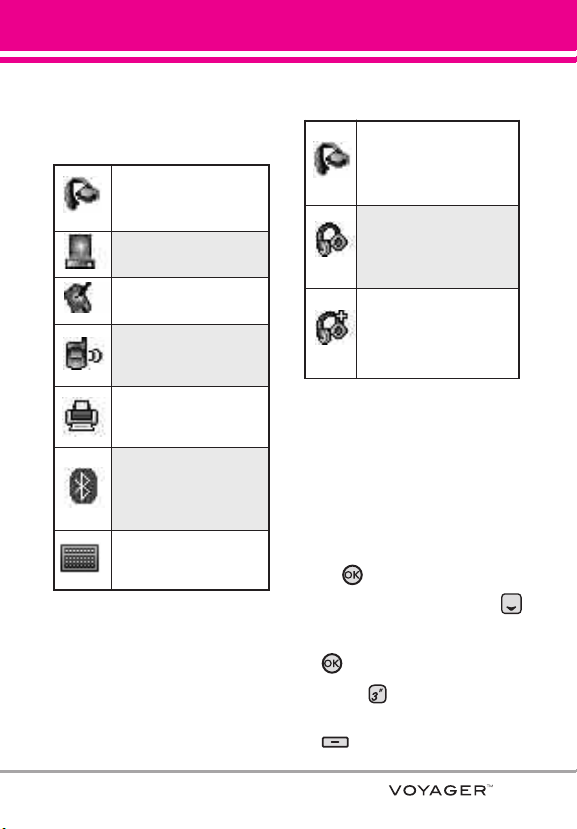
●
Referencias de iconos cuando
se encuentra una conexión
inalámbrica Bluetooth
®
(ni conectado ni emparejado).
●
Referencias de iconos al estar
conectado correctamente
Mi Nombre de Teléfono
Le permite editar el nombre de
Bluetooth
®
de su teléfono cuando se
resalta el menú Agregar nuevo
dispositivo.
Uso del teclado interno
1. Abra la carpeta y oprima la Tecla
OK
[MENÚ]
.
2. Oprima la Tecla de Direccional
para obtener acceso al menú
Prog/Herr
y oprima la Tecla OK
.
3. Oprima
Menú de Bluetooth
.
4. Oprima la Tecla suave Derecha
[Opciones]
.
Cuando unos audífonos sólo
monoaurales están
conectados con su
dispositivo VOYAGER
T
M
Cuando unos audífonos sólo
estereofónicos están
conectados con su
dispositivo VOYAGER
T
M
Cuando hay audífonos
estéreo y monoaurales
conectados con su
dispositivo VOYAGER
TM
Cuando su dispositivo
VOYAGER
T
M
busca un
dispositivo de audio
Cuando su dispositivo
VOYAGER
T
M
busca una PC
Cuando su dispositivo
VOYAGER
TM
busca un PDA
Cuando su dispositivo
VOYAGER
TM
busca otro
dispositivo de teléfono
Cuando su dispositivo
VOYAGER
TM
encuentra una
impresora
Cuando su dispositivo
VOYAGER
TM
encuentra otros
dispositivos no definidos
Cuando su dispositivo
VOYAGER
TM
busca un
teclado
107
PROG/HERR
5. Oprima
Mi Nombre de
Teléfono
.
6. Oprima para borrar el nombre
existente o editarlo.
7. Use el teclado para introducir un
nuevo nombre personalizado.
8. Oprima la Tecla OK para
guardar y salir.
Uso de la pantalla táctil externa
1. Desbloquee la pantalla táctil
tocando o jalando hacia
abajo la tecla de desbloqueo ( )
en el lateral izquierdo del
teléfono y toque para
acceder al menú.
2. Toque el icono Prog/Herr .
3. Toque 3. Menú de Bluetooth
.
4. Toque
.
5. Toque
Mi Nombre de Teléfono
.
6. Toque para borrar el
nombre existente o editarlo.
7. Use el teclado emergente para
introducir un nuevo nombre
personalizado y toque .
8. Toque para guardar y salir.
SUGERENCIA
La conexión inalámbrica Bluetooth
®
depende de
su dispositivo estéreo Bluetooth. Incluso si
desea conectarse con unos audífonos que
admitan tanto HFP como A2DP, sólo puede
conectarse con uno.
Encendido
Le permite activar o desactivar la
alimentación de Bluetooth
®
.
Uso del teclado interno
1. Abra la carpeta y oprima la Tecla
OK
[MENÚ]
.
2. Oprima la Tecla de Direccional
para obtener acceso al menú
Prog/Herr
y oprima la Tecla OK
.
3. Oprima
Menú de Bluetooth
.
4. Oprima la Tecla suave Izquierda
[Encendido]
.
NOTA
De manera predeterminado, la
funcionalidad del Bluetooth
®
de su
dispositivo está desactivada.
Uso de la pantalla táctil externa
1. Desbloquee la pantalla táctil
tocando o jalando hacia
abajo la tecla de desbloqueo ( )
en el lateral izquierdo del
teléfono y toque para
acceder al menú.
2. Toque el icono
Prog/Herr .
3. Toque 3. Menú de Bluetooth
.
4. Toque
.
ENCDO
OK
HECHO
CLR
Opcs
108
Modo de Descubrimiento
Le permite configurar si su dispositivo
puede ser buscado por otros
dispositivos Bluetooth en la zona.
Uso del teclado interno
1. Abra la carpeta y oprima la Tecla
OK
[MENÚ]
.
2. Oprima la Tecla de Direccional
para obtener acceso al menú
Prog/Herr
y oprima la Tecla OK
.
3. Oprima
Menú de Bluetooth
.
4. Oprima la Tecla suave Derecha
[Opciones]
.
5. Oprima
Modo de
Descubrimiento
.
6. Use la Tecla de Direccional
para desplazarse hasta un valor y
oprima la Tecla OK .
Encendida/ Apagado
NOTA
Si Encendida el Modo de
descubrimiento, otros dispositivos
Bluetooth
®
en el rango de alcance
pueden buscar su dispositivo.
Uso de la pantalla táctil externa
1. Desbloquee la pantalla táctil
tocando o jalando hacia
abajo la tecla de desbloqueo ( )
en el lateral izquierdo del
teléfono y toque para
acceder al menú.
2. Toque el icono
Prog/Herr .
3. Toque 3. Menú de Bluetooth
.
4. Toque
.
5. Toque
Modo de Descubrimiento
.
6. Toque una configuración.
Encendida/ Apagado
SUGERENCIA
Toque la tecla táctil
cuando la tapa
esté cerrada para iniciar el Modo de
Descubrimiento.
Perfiles Soportados
Le permite ver perfiles que su teléfono
VOYAGERpuede admitir.
Uso del teclado interno
1. Abra la carpeta y oprima la Tecla
OK
[MENÚ]
.
2. Oprima la Tecla de Direccional
para obtener acceso al menú
Prog/Herr
y oprima la Tecla OK
.
3. Oprima
Menú de Bluetooth.
Mostrar
Opcs
109
PROG/HERR
4. Oprima la Tecla suave Derecha
[Opciones]
.
5. Oprima
Perfiles Soportados
.
Uso de la pantalla táctil externa
1. Desbloquee la pantalla táctil
tocando o jalando hacia
abajo la tecla de desbloqueo ( )
en el lateral izquierdo del
teléfono y toque para
acceder al menú.
2. Toque el icono
Prog/Herr .
3. Toque 3. Menú de Bluetooth
.
4. Toque
.
5. Toque
Perfiles Soportados
.
Dispositivos buscar
Le permite ver la información de los
dispositivos que ha intentado buscar
al menos una vez.
Auto- Emparejamiento Manos
Libres
Si intenta emparejar un dispositivo que
es parte del perfil de Manos
libres/Diadema, se selecciona “PAR”/
. Su dispositivo intentará
emparejarse automáticamente
utilizando la clave de paso “0000”.
Dispositivos Encontrados
Cuando se conecta un dispositivo de
audio Bluetooth
®
,
Audio al Teléfono/
Audio al Dispositivo
se muestra en
el menú de opciones del estado de
llamada menú durante las llamadas.
Audio al Teléfono El menú, el sonido
proviene del terminal.
Audio al Dispositivo El menú, el
sonido proviene del dispositivo de
audio Bluetooth
®
.
Tiene las opciones siguientes en el
dispositivo emparejado.
●
Para dispositivos que admiten
perfiles OBEX:
Opcs
110
Cuando la función de
Bluetooth esta encendida
durante una llamada
Cuando la función de
Bluetooth está apagado
durante una llamada
1.
Quitar Dispositivo
: Puede eliminar
el dispositivo de la lista de
emparejamiento.
2.
Cambiar Nombre de Dispositivo
:
Puede cambiar el nombre del
dispositivo emparejado.
3.
Seguridad Entrante
: Permite que
usted fije el permiso antes de
conectar un dispositivo entrante.
4.
Descubrimiento de Servicio
: Le
permite buscar los servicios que
admite el dispositivo seleccionado.
5.
Info de Dispositivo
: Muestra la
información del dispositivo.
6.
Enviar Tarjeta de Nombre
: Puede
transferir la lista de contactos a
otros dispositivos, excepto a
dispositivos de audio.
7.
Enviar mi calendario
: Puede
transferir eventos de calendario a
otros dispositivos, excepto a
dispositivos de audio.
8.
Enviar Foto
: Puede transferir
imágenes a un dispositivo que
admita perfiles Basic Imaging
Profile (BIP).
●
Para dispositivos de audífonos:
1.
Quitar Dispositivo
: Puede eliminar
el dispositivo de la lista de
emparejamiento.
2.
Cambiar Nombre de Dispositivo
:
Puede cambiar el nombre del
dispositivo emparejado.
3.
Descubrimiento de Servicio
: Le
permite buscar los servicios que
admite el dispositivo seleccionado.
4.
Info de Dispositivo
: Muestra la
información del dispositivo.
5.
Enviar Tarjeta de Nombre:
Puede
transferir la lista de contactos a
otros dispositivos, excepto a
dispositivos de audio.
NOTAS
•
Cuando la tapa esté cerrada y desee
conectarse a un dispositivo de audio de la lista
en par, toque el dispositivo deseado por un
lapso prolongado o toque por un lapso breve
para seleccionar el menú de opción y la
conexión.
●
En la lista de emparejamiento, puede
desconectar el dispositivo conectado con la
señal de flecha azul tocando la
Tecla OK .
A la inversa, puede encenderlo tocando la
Tecla OK de nuevo.
●
Una vez que el dispositivo de audio esté
conectado, la conexión se transfiere al otro
dispositivo cuando lo selecciona y oprima la
Tecla OK .
●
Si la búsqueda no arroja ningún dispositivo en
par, o desea buscar nuevamente, toque la
tecla táctil para intentar
nuevamente.
●
Imprimer Foto permite imprimir en dispositivos
que admitan perfiles BPP.
Actualizar
111
PROG/HERR
4. Programación de Sonidos
Ofrece opciones para personalizar los
sonidos del teléfono.
4.1 Volumen Maestro
Le permite configurar los valores de
volumen.
Uso del teclado interno
1. Abra la carpeta y oprima la Tecla
OK
[MENÚ]
.
2. Oprima la Tecla de Direccional
para obtener acceso al menú
Prog/Herr
y oprima la Tecla OK
.
3. Oprima
Programación de
Sonidos
.
4. Oprima
Volumen Maestro
.
5. Ajuste el volumen con la Tecla de
Direccional y oprima la Tecla
OK para guardar la
configuración.
6. Puede intentar reproducir cada
volumen maestro con la Tecla
suave Izquierda
[Tocar]
.
Uso de la pantalla táctil externa
1. Desbloquee la pantalla táctil
tocando o jalando hacia
abajo la tecla de desbloqueo ( )
en el lateral izquierdo del
teléfono y toque para
acceder al menú.
2. Toque el icono
Prog/Herr .
3. Toque 4. Prog. de Sonidos.
4. Toque 1. Volumen Maestro
.
5. Ajuste el volumen tocando los
botones de flecha arriba o flecha
abajo y toque para
guardar la configuración.
4.2 Sonidos de Llamada
Le permite configurar cómo el
teléfono lo alertará según los tipos de
llamadas entrantes.
Uso del teclado interno
1. Abra la carpeta y oprima la Tecla
OK
[MENÚ]
.
2. Oprima la Tecla de Direccional
para obtener acceso al menú
Prog/Herr
y oprima la Tecla OK
.
3. Oprima
Programación de
Sonidos
.
4. Oprima
Sonidos de Llamada
.
Uso de la pantalla táctil externa
1. Desbloquee la pantalla táctil
FIJADO
112
tocando o jalando hacia
abajo la tecla de desbloqueo ( )
en el lateral izquierdo del
teléfono y toque para
acceder al menú.
2. Toque el icono Prog/Herr .
3. Toque 4. Programación de
Sonidos
.
4. Toque 2. Sonidos de Llamada
.
4.2.1 Timbre de Llamada
Uso del teclado interno
1. Abra la carpeta y oprima la Tecla
OK
[MENÚ]
.
2. Oprima la Tecla de Direccional
para obtener acceso al menú
Prog/Herr
y oprima la Tecla OK
.
3. Oprima
Programación de
Sonidos
.
4. Oprima
Sonidos de Llamada
.
5. Oprima
Timbre de Llamada
.
6. Use la Tecla de Direccional
para desplazarse hasta un tono de
timbre y oprima la Tecla OK
para guardar el cambio.
Uso de la pantalla táctil externa
1. Desbloquee la pantalla táctil
tocando o jalando hacia
abajo la tecla de desbloqueo ( )
en el lateral izquierdo del
teléfono y toque para
acceder al menú.
2. Toque el icono
Prog/Herr .
3. Toque 4. Prog. de Sonidos.
4. Toque
2. Sonidos de Llamada
.
.
5. Toque 1.
Timbre de Llamada
.
6. Toque un tono de timbre, y toque
para guardar el cambio.
4.2.2 Vibrador de Llamada
Uso del teclado interno
1. Abra la carpeta y oprima la Tecla
OK
[MENÚ]
.
2. Oprima la Tecla de Direccional
para obtener acceso al menú
Prog/Herr
y oprima la Tecla OK
.
3. Oprima
Programación de
Sonidos
.
4. Oprima
Sonidos de Llamada
.
5.
O
prima
Vibrador de Llamada
.
6. Use la Tecla de Direccional
para desplazarse hasta un valor y
oprima la Tecla OK .
Encendido/ Apagado
OK
113
PROG/HERR
Uso de la pantalla táctil externa
1. Desbloquee la pantalla táctil
tocando o jalando hacia
abajo la tecla de desbloqueo ( )
en el lateral izquierdo del
teléfono y toque para
acceder al menú.
2. Toque el icono Prog/Herr .
3. Toque 4. Prog. de Sonidos.
4. Toque
2. Sonidos de Llamada
.
5. Toque 2.
Vibrador de Llamada
.
6. Toque una configuración.
Encendido/ Apagado
4.3 Sonidos de Alerta
Le permite seleccionar el tipo de
alerta de un nuevo mensaje.
Uso del teclado interno
1. Abra la carpeta y oprima la Tecla
OK
[MENÚ]
.
2. Oprima la Tecla de Direccional
para obtener acceso al menú
Prog/Herr
y oprima la Tecla OK
.
3. Oprima
Programación de
Sonidos
.
4. Oprima
Sonidos de Alerta
.
5. Seleccione
Mensaje de TXT/
Mensaje de Foto-Video/ Bzn
Msjs Voz
.
6. Cada menú del sonido de la alarma
tiene las opciones siguientes.
Tono/ Vibrar/ Recordatorio
7. La opción de Timbre de
Emergencia tiene las siguientes
opciones:
Alertas, Vibrar, Desactivado
Uso de la pantalla táctil externa
1. Desbloquee la pantalla táctil
tocando o jalando hacia
abajo la tecla de desbloqueo ( )
en el lateral izquierdo del
teléfono y toque para
acceder al menú.
2. Toque el icono Prog/Herr .
3. Toque
4. Prog. de Sonidos.
4. Toque 3. Sonidos de Alerta
.
5. Toque
Mensaje de TXT/ Mensaje
de Foto-Video/ Bzn Msjs Voz
.
6. Cada menú del sonido de la alarma
tiene las opciones siguientes.
Tono/ Vibrar/ Recordatorio
7. La opción de Timbre de
Emergencia tiene las siguientes
opciones:
Alertas, Vibrar, Desactivado
114
4.4 Volumen de Teclado
Le permite configurar el volumen del
teclado.
Uso del teclado interno
1. Abra la carpeta y oprima la Tecla
OK
[MENÚ]
.
2. Oprima la Tecla de Direccional
para obtener acceso al menú
Prog/Herr
y oprima la Tecla OK
.
3. Oprima
Programación de
Sonidos
.
4. Oprima
Volumen de Teclado
.
5. Ajuste el volumen con la Tecla de
Direccional y oprima la Tecla
OK para guardar la
configuración.
Uso de la pantalla táctil externa
1. Desbloquee la pantalla táctil
tocando o jalando hacia
abajo la tecla de desbloqueo ( )
en el lateral izquierdo del
teléfono y toque para
acceder al menú.
2. Toque el icono
Prog/Herr .
3. Toque 4. Prog. de Sonidos.
4. Toque 4. Volumen de Teclado
.
5. Ajuste el volumen tocando los
botones de flecha arriba o flecha
abajo y toque para
guardar la configuración.
4.5 Alertas de Servicio
Le permite configurar como
Encendido o Apagado cualquiera de
las cuatro opciones de Aviso.
Uso del teclado interno
1. Abra la carpeta y oprima la Tecla
OK
[MENÚ]
.
2. Oprima la Tecla de Direccional
para obtener acceso al menú
Prog/Herr
y oprima la Tecla OK
.
3. Oprima
Programación de
Sonidos
.
4. Oprima
Alertas de Servicio
.
5. Seleccione una opción de alerta.
IRO Le avisa de las condiciones del
servicio celular.
IRO: Indicador de Roaming Mejorado
Sonido de Minutos Le avisa un
minuto antes del final de cada minuto
durante una llamada.
Conexión de Llamada Le avisa
cuando la llamada se ha conectado.
Cargar Completado Lo alerta cuando
la batería está completamente
cargada.
FIJADO
115
PROG/HERR
6. Use la Tecla de Direccional
para desplazarse hasta un valor y
oprima la Tecla OK .
Encendido/ Apagado
Uso de la pantalla táctil externa
1. Desbloquee la pantalla táctil
tocando o jalando hacia
abajo la tecla de desbloqueo ( )
en el lateral izquierdo del
teléfono y toque para
acceder al menú.
2. Toque el icono Prog/Herr .
3. Toque
4. Prog. de Sonidos.
4. Toque 5. Alertas de Servicio
.
5. Toque una opción de alerta.
IRO Le avisa de las condiciones del
servicio celular.
IRO: Indicador de Roaming Mejorado
Sonido de Minutos Le avisa un
minuto antes del final de cada minuto
durante una llamada.
Conexión de Llamada Le avisa
cuando la llamada se ha conectado.
Cargar Completado Lo alerta cuando
la batería está completamente
cargada.
6. Toque una configuración.
Encendido/ Apagado
4.6 Apagado/Encendido
Le permite configurar el teléfono para
que haga sonar un tono cuando el
teléfono se enciende y apaga.
Uso del teclado interno
1. Abra la carpeta y oprima la Tecla
OK
[MENÚ]
.
2. Oprima la Tecla de Direccional
para obtener acceso al menú
Prog/Herr
y oprima la Tecla OK
.
3. Oprima
Programación de
Sonidos
.
4. Oprima
Apagado/ Encendido
.
5. Seleccione
Apagado/Encendido
.
6. Use la Tecla de Direccional
para desplazarse hasta un valor y
oprima la Tecla OK .
Encendido/ Apagado
Uso de la pantalla táctil externa
1. Desbloquee la pantalla táctil
tocando o jalando hacia
abajo la tecla de desbloqueo ( )
en el lateral izquierdo del
teléfono y toque para
acceder al menú.
2. Toque el icono
Prog/Herr .
3. Toque 4. Prog. de Sonidos.
4. Coloque el dedo en la pantalla
116
táctil y aplique una presión suave
hacia arriba para desplazarse
por la lista en dicha dirección
luego toque
6. Apagado/ Encendido
.
5. Toque
Apagado/Encendido
.
6. Toque
Tono
o
Vibrar
.
Encendido/ Apagado
5. Programación de Pantalla
Ofrece opciones para personalizar la
pantalla del teléfono.
5.1 Aviso
Le permite introducir texto que se
mostrará en las pantallas LCD interna
y externa. Puede introducir hasta 23
caracteres en cada uno.
5.1.1.1 Aviso Interno
Uso del teclado interno
1. Abra la carpeta y oprima la Tecla
OK
[MENÚ]
.
2. Oprima la Tecla de Direccional
para obtener acceso al menú
Prog/Herr
y oprima la Tecla OK
.
3. Oprima
Programación de
Pantalla
.
4. Oprima
Aviso
.
5. Oprima
Personal Aviso
.
6. Oprima
Aviso Interno
.
7. Introduzca el texto de banderín que
desea mostrar en la pantalla LCD
interna y oprima la Tecla OK
para guardarlo.
Uso de la pantalla táctil externa
1. Desbloquee la pantalla táctil
tocando o jalando hacia
abajo la tecla de desbloqueo ( )
en el lateral izquierdo del
teléfono y toque para
acceder al menú.
2. Toque el icono
Prog/Herr .
3. Toque 5. Prog. de Pantalla.
4. Toque 1. Aviso.
5. Toque
1. Personal Aviso
.
6. Toque
1. Aviso Interno
.
7. Introduzca el texto de su banderín
y toque .
5.1.1.2 Aviso Externo
Uso del teclado interno
1. Abra la carpeta y oprima la Tecla
OK
[MENÚ]
.
2. Oprima la Tecla de Direccional
para obtener acceso al menú
Prog/Herr
y oprima la Tecla OK
GRDR
117
PROG/HERR
.
3. Oprima
Programación de
Pantalla
.
4. Oprima
Aviso
.
5. Oprima
Personal Aviso
.
6. Oprima
Aviso Externo
.
7. Introduzca el texto de banderín que
desea mostrar en la pantalla LCD
externa y oprima la Tecla OK
para guardarlo.
Uso de la pantalla táctil externa
1. Desbloquee la pantalla táctil
tocando o jalando hacia
abajo la tecla de desbloqueo ( )
en el lateral izquierdo del
teléfono y toque para
acceder al menú.
2. Toque el icono
Prog/Herr .
3. Toque 5. Prog. de Pantalla.
4. Toque 1. Aviso.
5. Toque
1. Personal Aviso
.
6. Toque
2. Aviso Externo
.
7. Introduzca el texto de su banderín
y toque .
5.1.2 Aviso IRO
Si usa el Servicio IRO, el texto IRO se
muestra en el banderín.
Uso del teclado interno
1. Abra la carpeta y oprima la Tecla
OK
[MENÚ]
.
2. Oprima la Tecla de Direccional
para obtener acceso al menú
Prog/Herr
y oprima la Tecla OK
.
3. Oprima
Programación de
Pantalla
.
4. Oprima
Aviso
.
5. Oprima
Aviso IRO
.
6. Use la Tecla de Direccional
para desplazarse hasta un valor y
oprima la Tecla OK .
Encendido/ Apagado
Uso de la pantalla táctil externa
1. Desbloquee la pantalla táctil
tocando o jalando hacia
abajo la tecla de desbloqueo ( )
en el lateral izquierdo del
teléfono y toque para
acceder al menú.
2. Toque el icono
Prog/Herr .
3. Toque 5. Prog. de Pantalla.
4. Toque
1. Aviso.
GRDR
118
5. Toque 2.
Aviso IRO
.
6. Toque una configuración.
Encendido/ Apagado
5.2 Luz de Pantalla
Le permite establecer la duración de
la iluminación de la luz de fondo.
Pantalla y Teclado se configuran
independientemente.
1. Abra la carpeta y oprima la Tecla
OK
[MENÚ]
.
2. Oprima la Tecla de Direccional
para obtener acceso al menú
Prog/Herr
y oprima la Tecla OK
.
3. Oprima
Programación de
Pantalla
.
4. Oprima
Luz de Pantalla
.
5. Elija un submenú de Luz trasera y
oprima la Tecla OK .
Pantalla/ Teclado
1. Pantalla
●
Luz Pant Interna
:
7 Segundos/ 15 Segundos/
30 Segundos/ Siempre Encendido/
Siempre Apagado
●
Luz Pant Externa
:
7 Segundos/ 10 Segundos/
15 Segundos/ 30 Segundos
2. Teclado
: 7 Segundos/ 15 Segundos/
30 Segundos/ Siempre Encendido/
Siempre Apagado
Uso de la pantalla táctil externa
1. Desbloquee la pantalla táctil
tocando o jalando hacia
abajo la tecla de desbloqueo ( )
en el lateral izquierdo del
teléfono y toque para
acceder al menú.
2. Toque el icono Prog/Herr .
3. Toque 5. Prog. de Pantalla.
4. Toque
2. Luz de Pantalla
.
5. Toque un submenú de luz trasera.
Pantalla/ Teclado
1. Pantalla
●
Luz Pant Interna
:
7 Segundos/ 15 Segundos/
30 Segundos/ Siempre Encendido/
Siempre Apagado
●
Luz Pant Externa
:
7 Segundos/ 10 Segundos/
15 Segundos/ 30 Segundos
2. Teclado
: 7 Segundos/ 15 Segundos/
30 Segundos/ Siempre Encendido/
Siempre Apagado
SUGERENCIA
Cuando la luz de fondo del teléfono se ajusta a
Siempre activada, es posible que la batería se
119
PROG/HERR
descargue más rápidamente porque esta
función desactiva el modo de ahorro de energía
y puede disminuir la vida útil de la batería.
5.3 Fondo de Pantalla
Permite que usted elija la clase de
fondo que se exhibirá en el teléfono.
Las posibilidades son infinitas, pero
en particular las animaciones
divertidas, le proveen pantallas de
destello lindas para su papel pintado
del fondo.
Uso del teclado interno
1. Abra la carpeta y oprima la Tecla
OK
[MENÚ]
.
2. Oprima la Tecla de Direccional
para obtener acceso al menú
Prog/Herr
y oprima la Tecla OK
.
3. Oprima
Programación de
Pantalla
.
4. Oprima
Fondo de Pantalla
.
5. Seleccione
Fondo de Pantalla
Interna/ Fondo de Pantalla
Externa
.
6. Elija un submenú y oprima la Tecla
OK .
Mis Fotos/ Mis Videos/
Animaciones Divertidas/
Presentación de diapositivas
7. Seleccione entre las pantallas
disponibles y oprima la Tecla OK
.
Uso de la pantalla táctil externa
1. Desbloquee la pantalla táctil
tocando o jalando hacia
abajo la tecla de desbloqueo ( )
en el lateral izquierdo del
teléfono y toque para
acceder al menú.
2. Toque el icono Prog/Herr .
3. Toque 5. Prog. de Pantalla.
4. Toque
3. Fondo de Pantalla
.
5. Toque Fondo de Pantalla Interna/
Fondo de Pantalla Externa
.
6. Toque un submenú.
Mis Fotos/ Mis Videos/
Animaciones Divertidas/
Presentación de diapositivas
7. Toque su opción, luego toque
.
OK
120
5.4 Cargando Pantalla
Permite que usted fije un protector
para que cada pantalla interna y
externa prevengan su teléfono de
cualquier uso indeseado.
Uso del teclado interno
1. Abra la carpeta y oprima la Tecla
OK
[MENÚ]
.
2. Oprima la Tecla de Direccional
para obtener acceso al menú
Prog/Herr
y oprima la Tecla OK
.
3. Oprima
Programación de
Pantalla
.
4. Oprima
Cargando Pantalla
.
5. Seleccione
Cargando Pantalla
Interna/ Cargando Pantalla
Externa
.
6. Elija un submenú y oprima la Tecla
OK .
No Imagen/ Reloj de mesa/
Calendario/ Presentación de
diapositivas
7. Oprima la Tecla suave Izquierda
[Ver] para visión una de las
opciones antedichas antes de
fijar uno.
8. Seleccione de las pantallas
disponibles y oprima la Tecla OK
.
Uso de la pantalla táctil externa
1. Desbloquee la pantalla táctil
tocando o jalando hacia
abajo la tecla de desbloqueo ( )
en el lateral izquierdo del
teléfono y toque para
acceder al menú.
2. Toque el icono Prog/Herr .
3. Toque
5. Prog. de Pantalla.
4. Toque 4. Cargando Pantalla
5. Toque
Cargando Pantalla Interna
o
Cargando Pantalla Externa
.
6. Toque una configuración.
No Imagen/ Reloj de mesa/
Calendario/ Presentación de
diapositivas
7. Toque .
FIJADO
121
PROG/HERR
5.5 Temas de Pantalla
Le permite elegir el color de la
pantalla de fondo.
Uso del teclado interno
1. Abra la carpeta y oprima la Tecla
OK
[MENÚ]
.
2. Oprima la Tecla de Direccional
para obtener acceso al menú
Prog/Herr
y oprima la Tecla OK
.
3. Oprima
Programación de
Pantalla
.
4. Oprima
Temas de Pantalla
.
5. Use la Tecla de Direccional
para desplazarse hasta un valor y
oprima la Tecla OK .
Blanco/ Negro
NOTA
Oprima la Tecla suave Izquierda
[Ver] para ver el tema de pantalla
seleccionado.
Uso de la pantalla táctil externa
1. Desbloquee la pantalla táctil
tocando o jalando hacia
abajo la tecla de desbloqueo ( )
en el lateral izquierdo del
teléfono y toque para
acceder al menú.
2. Toque el icono
Prog/Herr .
3. Toque 5. Prog. de Pantalla.
4. Toque 5. Temas de Pantalla
.
5. Toque una configuración.
Blanco/Negro
6. Toque .
5.6 Fuente de Menú
Le permite configurar las fuentes de
menú.
Uso del teclado interno
1.
Abra la carpeta y oprima la Tecla
OK
[MENÚ]
.
2. Oprima la Tecla de Direccional
para obtener acceso al menú
Prog/Herr
y oprima la Tecla OK
.
3. Oprima
Programación de
Pantalla
.
4.
Oprima
Fuente de Menú.
5.
Use la Tecla de Direccional
para desplazarse hasta un valor y
oprima la Tecla OK .
VZW Font/ LG Serif/ LG Edge/
LG Joy/ LG Script
NOTA
Oprima la Tecla suave Izquierda
[Ver] para ver el fuente de menú.
FIJADO
122
Uso de la pantalla táctil externa
1. Desbloquee la pantalla táctil
tocando o jalando hacia
abajo la tecla de desbloqueo ( )
en el lateral izquierdo del
teléfono y toque para
acceder al menú.
2. Toque el icono
Prog/Herr .
3. Toque 5. Prog. de Pantalla.
4. Coloque el dedo en la pantalla
táctil y aplique una presión suave
hacia arriba para desplazarse
por la lista en dicha dirección
luego toque 6. Fuente de Menú.
5. Toque una configuración.
VZW Font/ LG Serif/ LG Edge/
LG Joy/ LG Script
6. Toque .
5.7 Fuentes de Marcado
Le permite ajustar el tamaño de la
fuente. Esta configuración es útil para
quiesnes necesitan que el texto se
muestre un poco más grande.
Uso del teclado interno
1. Abra la carpeta y oprima la Tecla
OK
[MENÚ]
.
2. Oprima la Tecla de Direccional
para obtener acceso al menú
Prog/Herr
y oprima la Tecla OK
.
3. Oprima
Programación de
Pantalla
.
4. Oprima Fuentes de Marcado
.
5. Use la Tecla de Direccional
para desplazarse hasta un valor y
oprima la Tecla OK .
Normal/ Grande
NOTA
Oprima la Tecla suave Izquierda
[V
er]
para ver el fuente de marcación.
Uso de la pantalla táctil externa
1. Desbloquee la pantalla táctil
tocando o jalando hacia
abajo la tecla de desbloqueo ( )
en el lateral izquierdo del
teléfono y toque para
acceder al menú.
2. Toque el icono Prog/Herr .
3. Toque 5. Prog. de Pantalla.
4. Coloque el dedo en la pantalla
táctil y aplique una presión suave
hacia arriba para desplazarse
por la lista en dicha dirección
luego toque
7.
Fuentes de
Marcado
.
5. Toque una configuración.
Normal/ Grande
FIJADO
123
PROG/HERR
6. Toque .
5.8 Formato Reloj
Le permite elegir el tipo de reloj que
se mostrará en la pantalla LCD.
Uso del teclado interno
1. Abra la carpeta y oprima la Tecla
OK
[MENÚ]
.
2. Oprima la Tecla de Direccional
para obtener acceso al menú
Prog/Herr
y oprima la Tecla OK
.
3. Oprima
Programación de
Pantalla
.
4. Oprima
Formato Reloj
.
5. Oprima
Reloj Interna
o
Reloj Externa
.
6. Use la Tecla de Direccional
para desplazarse hasta un valor y
oprima la Tecla OK .
Normal/ Analógico/ Digital 1/
Digital 2/ Doble(Fije la ciudad en
reloj mundial)/ Apagado
NOTAS
●
Oprima la Tecla suave Izquierda [Ver]
para ver el formato reloj.
●
Si establece el reloj dual para la pantalla
interna o externa, en ambas se muestra
la hora de la misma ciudad.
Uso de la pantalla táctil externa
1. Desbloquee la pantalla táctil
tocando o jalando hacia
abajo la tecla de desbloqueo ( )
en el lateral izquierdo del
teléfono y toque para
acceder al menú.
2. Toque el icono
Prog/Herr .
3. Toque 5. Prog. de Pantalla.
4. Coloque el dedo en la pantalla
táctil y aplique una presión suave
hacia arriba para desplazarse
por la lista en dicha dirección
luego toque 8. Formato Reloj
.
5. Toque 1. Reloj Interna o
2. Reloj Externa.
6. Toque una configuración.
Normal/ Analógico/ Digital 1/
Digital 2/ Doble(Fije la ciudad en
reloj mundial)/ Apagado
7. Toque .
FIJADO
FIJADO
124
6. Programación de
Teléfono
El menú Config de Teléfono le permite
designar ajustes específicos de la
configuración de red.
6.1 Modo de avión
Le permite usar las funciones de menú,
excepto la realización de llamadas, la
función de Bluetooth
®
y acceso a la
Web cuando la transmisión de radio
está restringida. El Modo avión
inhabilitará todas las comunicaciones.
Cuando está en Modo avión, se
suspenderán los servicios que admiten
la función Ubicación activada (como
Chaperone).
Uso del teclado interno
1. Abra la carpeta y oprima la Tecla
OK
[MENÚ]
.
2. Oprima la Tecla de Direccional
para obtener acceso al menú
Prog/Herr
y oprima la Tecla OK
.
3. Oprima
Programación de
Teléfono
.
4. Oprima
Modo Avión
.
5. Use la Tecla de Direccional
para desplazarse hasta un valor y
oprima la Tecla OK .
Encendido/ Apagado
Uso de la pantalla táctil externa
1. Desbloquee la pantalla táctil
tocando o jalando hacia
abajo la tecla de desbloqueo ( )
en el lateral izquierdo del
teléfono y toque para
acceder al menú.
2. Toque el icono Prog/Herr .
3. Coloque el dedo en la pantalla
táctil y aplique una presión suave
hacia arriba para desplazarse
por la lista en dicha dirección
luego toque
6. Prog. de Teléfono.
4. Toque 1. Modo Avión
.
5. Toque una configuración.
Encendido/ Apagado
6.2 Establecer atajos
Le permite establecer un acceso
directo a los menús del teléfono con
las teclas de Dirección arriba, abajo,
izquierda y derecha.
Uso del teclado interno
1. Abra la carpeta y oprima la Tecla
125
PROG/HERR
OK
[MENÚ]
.
2. Oprima la Tecla de Direccional
para obtener acceso al menú
Prog/Herr
y oprima la Tecla OK
.
3. Oprima
Programación de
Teléfono
.
4. Oprima
Establecer atajos.
5. Use la Tecla de Direccional
para desplazarse a la tecla de
acceso directo que desea
configurar.
Establecer Teclas Direccionales
Internales/ Establecer Atajo de
Qwerty
6. En Establecer Teclas Direccionales
Internales, oprima la Tecla suave
Izquierda
[Ajustar]
.
7. Use la Tecla de Direccional
para desplazarse a la tecla de
acceso que desea, y oprima la
Tecla OK .
8. Repita según sea necesario para
configurar todas las cuatro tecla
de acceso directo, y oprima la
Tecla OK .
9. En Establecer Atajo de Qwerty,
seleccione las siguientes opciones.
Apagado
No hay activación en
pantalla de espera.
Mensaje de
TXT
Se abre un nuevo mensaje de
texto.
Cuaderno de Notas
Se abre
el cuaderno de notas.
Uso de la pantalla táctil externa
1. Desbloquee la pantalla táctil
tocando o jalando hacia
abajo la tecla de desbloqueo ( )
en el lateral izquierdo del
teléfono y toque para
acceder al menú.
2. Toque el icono Prog/Herr .
3. Coloque el dedo en la pantalla
táctil y aplique una presión suave
hacia arriba para desplazarse
por la lista en dicha dirección
luego toque
6. Prog. de Teléfono.
4. Toque 2. Establecer atajos
.
5. Toque una tecla de acceso
directo que desee cambiar, luego
toque el acceso directo que
desee configurar.
6.
Repita según sea necesario para
configurar todas las cuatro tecla
de acceso directo, y toque
.
7.
En Establecer Atajo de Qwerty,
seleccione las siguientes opciones.
Apagado
No hay activación en
pantalla de espera.
Mensaje de
TXT
Se abre un nuevo mensaje de
texto.
Cuaderno de Notas
Se abre
el cuaderno de notas.
HECHO
126
6.3 Comandos de Voz
Uso del teclado interno
1. Abra la carpeta y oprima la Tecla
OK
[MENÚ]
.
2. Oprima la Tecla de Direccional
para obtener acceso al menú
Prog/Herr
y oprima la Tecla OK
.
3. Oprima
Programación de
Teléfono
.
4. Oprima
Comandos de Voz.
Avisos
Modo/ Reproducción de
Audio/ Tiempo Agotado
Para Modo, elija
Avisos/ Lectura +
Alertas/ Lectura/ Sólo Tonos
.
Para Reproducción de Audio,
configure como
Altavoz
o
Auricular
.
Para Tiempo Agotado, elija
5 segundos
o
10 segundos
.
Alerta de Llamada
Sólo Timbre/
ID de llamador + Timbre/
Repetir Nombre
Uso de la pantalla táctil externa
1. Desbloquee la pantalla táctil
tocando o jalando hacia
abajo la tecla de desbloqueo ( )
en el lateral izquierdo del
teléfono y toque para
acceder al menú.
2. Toque el icono Prog/Herr .
3. Coloque el dedo en la pantalla
táctil y aplique una presión suave
hacia arriba para desplazarse
por la lista en dicha dirección
luego toque
6. Prog. de Teléfono.
4. Toque 3. Comandos de Voz.
Avisos
Modo/ Reproducción de
Audio/ Tiempo Agotgdo
Para
Modo, elija
Avisos/ Lectura +
Alertas/ Lectura/ Sólo Tonos
.
Para Reproducción de Audio,
configure como
Altavoz
o
Auricular
.
Para Tiempo Agotado, elija
5 segundos
o
10 segundos
.
Alerta de Llamada
Sólo Timbre/
ID de llamador + Timbre/
Repetir Nombre
6.4 Idioma
Le permite configurar la función
bilingüe según su preferencia. Elija
entre Inglés y Español.
Uso del teclado interno
1. Abra la carpeta y oprima la Tecla
OK
[MENÚ]
.
2. Oprima la Tecla de Direccional
para obtener acceso al menú
Prog/Herr
y oprima la Tecla OK
127
PROG/HERR
.
3. Oprima
Programación de
Teléfono
.
4. Oprima
Idioma.
5. Use la Tecla de Direccional
para desplazarse hasta un valor y
oprima la Tecla OK .
English/ Español
Uso de la pantalla táctil externa
1. Desbloquee la pantalla táctil
tocando o jalando hacia
abajo la tecla de desbloqueo ( )
en el lateral izquierdo del
teléfono y toque para
acceder al menú.
2. Toque el icono
Prog/Herr .
3. Coloque el dedo en la pantalla
táctil y aplique una presión suave
hacia arriba para desplazarse
por la lista en dicha dirección
luego toque
6. Prog. de Teléfono.
4. Toque 4. Idioma.
5. Toque una configuración.
English/ Español
6.5 Ubicación
Le permete configurar el modo GPS
(Sistema de posicionamiento global:
sistema de información de la
ubicación asistido por satélite).
Uso del teclado interno
1. Abra la carpeta y oprima la Tecla
OK
[MENÚ]
.
2. Oprima la Tecla de Direccional
para obtener acceso al menú
Prog/Herr
y oprima la Tecla OK
.
3. Oprima
Programación de
Teléfono
.
4. Oprima
Ubicación
.
5. Use la Tecla de Direccional
para desplazarse hasta un valor y
oprima la Tecla OK .
Ubicación Encendido/ Sólo E911
Uso de la pantalla táctil externa
1. Desbloquee la pantalla táctil
tocando o jalando hacia
abajo la tecla de desbloqueo ( )
en el lateral izquierdo del
teléfono y toque para
acceder al menú.
2. Toque el icono Prog/Herr .
3. Coloque el dedo en la pantalla
128
táctil y aplique una presión suave
hacia arriba para desplazarse
por la lista en dicha dirección
luego toque 6. Prog. de Teléfono.
4. Toque
5. Ubicación.
5. Toque una configuración.
Ubicación Encendido/ Sólo E911
NOTAS •
Las señales de satélite GPS no
siempre se transmiten, bajo
condiciones atmosféricas o
medioambientales adversas, en
recintos cerrados, etc.
•
Cuando el modo de ubicación está
bloqueada, mismo que se se activa
en el menú de seguridad, se
requiere que introduzca el código
de bloqueo cuando usted
selecciona el menú de ubicación. El
código de bloqueo son los 4 últimos
dígitos de su número de teléfono,
los mismos que utiliza como su
código bloqueo del dispositivo.
•
Cuando está en Modo avión, se
suspenderán los servicios que
admiten la función Ubicación
activada (como Chaperone).
6.6 Seguridad
El menú Seguridad le permite
asegurar el teléfono
electrónicamente.
Uso del teclado interno
1. Abra la carpeta y oprima la Tecla
OK
[MENÚ]
.
2. Oprima la Tecla de Direccional
para obtener acceso al menú
Prog/Herr
y oprima la Tecla OK
.
3. Oprima
Prog. de Teléfono
.
4. Oprima
Seguridad
.
5. Introduzca el código de bloqueo de
cuatro cifras. El código de bloqueo
es: las últimas 4 cifras de su
número de teléfono. Las últimas 4
cifras de su MEID si su número de
teléfono móvil no está configurado.
Uso de la pantalla táctil externa
1. Desbloquee la pantalla táctil
tocando o jalando hacia
abajo la tecla de desbloqueo ( )
en el lateral izquierdo del
teléfono y toque para
acceder al menú.
2. Toque el icono Prog/Herr .
3. Coloque el dedo en la pantalla
táctil y aplique una presión suave
hacia arriba para desplazarse
por la lista en dicha dirección
luego toque
6. Prog. de Teléfono.
4. Coloque el dedo en la pantalla
129
PROG/HERR
táctil y aplique una presión suave
hacia arriba para desplazarse
por la lista en dicha dirección
luego toque 6. Seguridad.
5. Introduzca el código de bloqueo de
cuatro cifras. El código de bloqueo
es: las últimas 4 cifras de su
número de teléfono. Las últimas 4
cifras de su MEID si su número de
teléfono móvil no está configurado.
6.6.1 Editar Códigos
Le permite introducir un nuevo código
de bloqueo de cuatro cifras.
Uso del teclado interno
1. Abra la carpeta y oprima la Tecla
OK
[MENÚ]
.
2. Oprima la Tecla de Direccional
para obtener acceso al menú
Prog/Herr
y oprima la Tecla OK
.
3. Oprima
Programación de
Teléfono
.
4. Oprima
Seguridad
.
5. Introduzca el código de bloqueo de
cuatro cifras.
6. Oprima
Editar Códigos
.
7. Elija
Sólo teléfono
o
Llamadas &
servicios
, luego introduzca su
nuevo código de bloqueo.
Introdúzcalo de nuevo para
confirmarlo.
Uso de la pantalla táctil externa
1. Desbloquee la pantalla táctil
tocando o jalando hacia
abajo la tecla de desbloqueo ( )
en el lateral izquierdo del
teléfono y toque para
acceder al menú.
2. Toque el icono Prog/Herr .
3. Coloque el dedo en la pantalla
táctil y aplique una presión suave
hacia arriba para desplazarse
por la lista en dicha dirección
luego toque
6. Prog. de Teléfono.
4. Coloque el dedo en la pantalla
táctil y aplique una presión suave
hacia arriba para desplazarse
por la lista en dicha dirección
luego toque 6. Seguridad.
5. Introduzca el código de bloqueo de
cuatro cifras.
6. Toque
1. Editar Códigos
.
7. Elija
Sólo teléfono
o
Llamadas &
servicios
, luego introduzca su
nuevo código de bloqueo.
Introdúzcalo de nuevo para
confirmarlo.
130
6.6.2 Restricciones
Le permite restringir la Configuración
de ubicación, Llamadas o Mensajes
desde su teléfono. En cada categoría
de opciones Configuración de
ubicación, Llamadas, Mensajes,
puede ajustar el nivel de
restricciones.
Uso del teclado interno
1. Abra la carpeta y oprima la Tecla
OK
[MENÚ]
.
2. Oprima la Tecla de Direccional
para obtener acceso al menú
Prog/Herr
y oprima la Tecla OK
.
3. Oprima
Programación de
Teléfono
.
4. Oprima
Seguridad
.
5. Introduzca el código de bloqueo de
cuatro cifras.
6. Oprima
Restricciones
.
7. Introduzca el código NIP de cuatro
cifras.
8. Seleccione un menú de
restricciones y oprima la Tecla OK
.
Programación de ubicación
(Prog de Bloq./ Prog de Abrir)/
Llamadas (Llamadas Entrante/
Llamadas Saliente)/ Mensajes
(Mensajes Entrante/ Mensajes
Saliente)/ Módem de conexión
telefónica (Permitir todo/
Bloquear todo)
9. Use la Tecla de Direccional
para ajustar un nivel de
restricciones y oprima la Tecla OK
.
Programación de ubicación Prog
de Bloq./ Prog de Abrir
Llamadas Llamadas Entrante/
Llamadas Saliente
Mensajes Mensajes Entrante/
Mensajes Saliente
Modem de conexión telefónica
Permitir todo/ Bloquear todo
Uso de la pantalla táctil externa
1. Desbloquee la pantalla táctil
tocando o jalando hacia
abajo la tecla de desbloqueo ( )
en el lateral izquierdo del
teléfono y toque para
acceder al menú.
2. Toque el icono Prog/Herr .
3. Coloque el dedo en la pantalla
táctil y aplique una presión suave
hacia arriba para desplazarse
por la lista en dicha dirección
luego toque 6. Prog. de Teléfono.
4. Coloque el dedo en la pantalla
131
PROG/HERR
táctil y aplique una presión suave
hacia arriba para desplazarse
por la lista en dicha dirección
luego toque 6. Seguridad.
5. Enter the four-digit lock code.
6. Toque
2. Restricciones
.
7. Introduzca el código NIP de cuatro
cifras.
8.
Toque un submenú de
Restricciones, luego la
configuración.
Programación de ubicación
(Prog de Bloq./ Prog de Abrir)/
Llamadas (Llamadas Entrante/
Llamadas Saliente)/ Mensajes
(Mensajes Entrante/ Mensajes
Saliente)/ Módem de conexión
telefónica (Permitir todo/
Bloquear todo)
6.6.3 Bloqueo de teléfono
Evita el uso no autorizado de su
teléfono. Una vez que el teléfono está
bloqueado, estará en modo
restringido hasta que se introduzca el
código de bloqueo. Puede recibir
llamadas de teléfono y seguir
haciendo llamadas de emergencia.
Puede modificar el código de bloqueo
en el submenú Editar Códigos en el
menú Seguridad.
Uso del teclado interno
1. Abra la carpeta y oprima la Tecla
OK
[MENÚ]
.
2. Oprima la Tecla de Direccional
para obtener acceso al menú
Prog/Herr
y oprima la Tecla OK
.
3. Oprima
Programación de
Teléfono
.
4. Oprima
Seguridad
.
5. Introduzca el código de bloqueo de
cuatro cifras.
6. Oprima
Bloqueo de teléfono
.
7. Seleccione una opción y oprima la
Tecla OK .
Desbloqueado El teléfono no está
bloqueado (se puede usar el modo
de Bloqueo).
Al Encender El Teléfono El teléfono
se bloqueará automáticamente
cada vez que se encienda.
Uso de la pantalla táctil externa
1. Desbloquee la pantalla táctil
tocando o jalando hacia
abajo la tecla de desbloqueo ( )
en el lateral izquierdo del
teléfono y toque para
acceder al menú.
2. Toque el icono Prog/Herr .
3. Coloque el dedo en la pantalla
132
táctil y aplique una presión suave
hacia arriba para desplazarse
por la lista en dicha dirección
luego toque 6. Prog. de Teléfono.
4. Coloque el dedo en la pantalla
táctil y aplique una presión suave
hacia arriba para desplazarse
por la lista en dicha dirección
luego toque
6. Seguridad.
5. Introduzca el código de bloqueo de
cuatro cifras.
6. Toque
3. Bloqueo de teléfono
.
7.
Toque una configuración.
Desbloqueado El teléfono no está
bloqueado (se puede usar el modo
de Bloqueo).
Al Encender El Teléfono El teléfono
se bloqueará automáticamente
cada vez que se encienda.
6.6.4 Bloquear teléfono ahora
Uso del teclado interno
1. Abra la carpeta y oprima la Tecla
OK
[MENÚ]
.
2. Oprima la Tecla de Direccional
para obtener acceso al menú
Prog/Herr
y oprima la Tecla OK
.
3. Oprima
Programación de
Teléfono
.
4. Oprima
Seguridad
.
5. Introduzca el código de bloqueo de
cuatro cifras.
6. Oprima
Bloquear teléfono
ahora
.
Uso de la pantalla táctil externa
1. Desbloquee la pantalla táctil
tocando o jalando hacia
abajo la tecla de desbloqueo ( )
en el lateral izquierdo del
teléfono y toque para
acceder al menú.
2. Toque el icono
Prog/Herr .
3. Coloque el dedo en la pantalla
táctil y aplique una presión suave
hacia arriba para desplazarse
por la lista en dicha dirección
luego toque 6. Prog. de Teléfono.
4. Coloque el dedo en la pantalla
táctil y aplique una presión suave
hacia arriba para desplazarse
por la lista en dicha dirección
luego toque 6. Seguridad.
5. Introduzca el código de bloqueo de
cuatro cifras.
6. Toque
4. Bloquear teléfono ahora
.
6.6.5 Restablecer Implícito
Le permite restaurar su teléfono a la
configuración predeterminada de
133
PROG/HERR
fábrica.
Uso del teclado interno
1. Abra la carpeta y oprima la Tecla
OK
[MENÚ]
.
2. Oprima la Tecla de Direccional
para obtener acceso al menú
Prog/Herr
y oprima la Tecla OK
.
3. Oprima
Programación de
Teléfono
.
4. Oprima
Seguridad
.
5. Introduzca el código de bloqueo de
cuatro cifras.
6. Oprima
Restablecer
Implícito
.
7.
Oprima la Tecla OK después de
leer el mensaje de advertencia.
8. Seleccione
Revertir
.
Aparece brevemente un mensaje
de confirmación antes de que el
teléfono se restaure.
Uso de la pantalla táctil externa
1. Desbloquee la pantalla táctil
tocando o jalando hacia
abajo la tecla de desbloqueo ( )
en el lateral izquierdo del
teléfono y toque para
acceder al menú.
2. Toque el icono
Prog/Herr .
3. Coloque el dedo en la pantalla
táctil y aplique una presión suave
hacia arriba para desplazarse
por la lista en dicha dirección
luego toque 6. Prog. de Teléfono.
4. Coloque el dedo en la pantalla
táctil y aplique una presión suave
hacia arriba para desplazarse
por la lista en dicha dirección
luego toque 6. Seguridad.
5. Introduzca el código de bloqueo de
cuatro cifras.
6. Toque
5. Restablecer Implícito
.
7.
Toque
después de leer el
mensaje de advertencia.
8. Toque
Revertir
.
Aparece brevemente un mensaje
de confirmación antes de que el
teléfono se restaure.
6.6.6 Restaurar teléfono
Le permite eliminar todos los datos de
usuario e información de contactos
que haya ingresado en la memoria del
teléfono, de modo que quede como
recién salido de fábrica.
Uso del teclado interno
1. Abra la carpeta y oprima la Tecla
OK
[MENÚ]
.
OK
134
2. Oprima la Tecla de Direccional
para obtener acceso al menú
Prog/Herr
y oprima la Tecla OK
.
3. Oprima
Programación de
Teléfono
.
4. Oprima
Seguridad
.
5. Introduzca el código de bloqueo de
cuatro cifras.
6. Oprima
Restaurar teléfono
.
7. Oprima la Tecla OK después
de leer el mensaje de advertencia.
8. Introduzca el código de bloqueo de
cuatro cifras.
Uso de la pantalla táctil externa
1. Desbloquee la pantalla táctil
tocando o jalando hacia
abajo la tecla de desbloqueo ( )
en el lateral izquierdo del
teléfono y toque para
acceder al menú.
2. Toque el icono Prog/Herr .
3. Coloque el dedo en la pantalla
táctil y aplique una presión suave
hacia arriba para desplazarse
por la lista en dicha dirección
luego toque 6. Prog. de Teléfono.
4. Coloque el dedo en la pantalla
táctil y aplique una presión suave
hacia arriba para desplazarse
por la lista en dicha dirección
luego toque
6. Seguridad.
5. Enter the four-digit lock code.
6.
Coloque el dedo en la pantalla
táctil y aplique una presión suave
hacia arriba para desplazarse
por la lista en dicha dirección
luego toque 6. Restaurar
teléfono
.
7.
Toque
después de leer el
mensaje de advertencia.
8. Introduzca el código de bloqueo de
cuatro cifras.
6.7 Selección de Sistema
Le permite configurar el entorno de
administración teléfono. Deje esta
configuración como la predeterminada
a menos que desee alterar la selección
del sistema por instrucciones de su
proveedor de servicio.
Uso del teclado interno
1. Abra la carpeta y oprima la Tecla
OK
[MENÚ]
.
2. Oprima la Tecla de Direccional
para obtener acceso al menú
Prog/Herr
y oprima la Tecla OK
.
OK
135
PROG/HERR
3. Oprima
Programación de
Teléfono
.
4. Oprima
Selección de
Sistema
.
5. Use la Tecla de Direccional
para desplazarse hasta un valor y
oprima la Tecla OK .
Sólo Base/ Automático
(Según la red, pero puede ser
diferente.)
Uso de la pantalla táctil externa
1. Desbloquee la pantalla táctil
tocando o jalando hacia
abajo la tecla de desbloqueo ( )
en el lateral izquierdo del
teléfono y toque para
acceder al menú.
2. Toque el icono Prog/Herr .
3. Coloque el dedo en la pantalla
táctil y aplique una presión suave
hacia arriba para desplazarse
por la lista en dicha dirección
luego toque 6. Prog. de Teléfono.
4. Coloque el dedo en la pantalla
táctil y aplique una presión suave
hacia arriba para desplazarse
por la lista en dicha dirección
luego toque 7. Selección de
Sistema
.
5. Toque una configuración.
Sólo Base/ Automático
(Según la red, pero puede ser
diferente.)
6.8 NAM Select
Le permite seleccionar el NAM
(módulo de asignación de número) del
teléfono si éste está registrado con
varios proveedores de servicio.
Uso del teclado interno
1. Abra la carpeta y oprima la Tecla
OK
[MENÚ]
.
2. Oprima la Tecla de Direccional
dos veces para obtener acceso al
menú
Prog/Herr
.
3. Oprima
Programación de
Teléfono
.
4. Oprima
Selección de NAM
.
5. Use la Tecla de Direccional
para desplazarse hasta un valor y
oprima la Tecla OK .
NAM1/ NAM2
136
Uso de la pantalla táctil externa
1. Desbloquee la pantalla táctil
tocando o jalando hacia
abajo la tecla de desbloqueo ( )
en el lateral izquierdo del
teléfono y toque para
acceder al menú.
2. Toque el icono
Prog/Herr .
3. Coloque el dedo en la pantalla
táctil y aplique una presión suave
hacia arriba para desplazarse
por la lista en dicha dirección
luego toque 6. Prog. de Teléfono.
4. Coloque el dedo en la pantalla
táctil y aplique una presión suave
hacia arriba para desplazarse
por la lista en dicha dirección
luego toque 8. Selección de
NAM.
5. Toque una configuración.
NAM1/ NAM2
7. Programación de Llamada
El menú Configuración de Llamada le
permite designar cómo manejará el
teléfono las llamadas entrantes y
salientes.
7.1 Opciones de Respuesta
Le permite determinar cómo manejar
una llamada contestada.
1. Abra la carpeta y oprima la Tecla
OK
[MENÚ]
.
2. Oprima la Tecla de Direccional
para obtener acceso al menú
Prog/Herr
y oprima la Tecla OK
.
3. Oprima
Programación de
Llamada
.
4. Oprima
Opciones de
Respuesta
.
5 Use la Tecla de Direccional
para desplazarse hasta un valor y
oprima la Tecla OK .
Al Abrirlo/ Cualquier Tecla/ Auto
con Manos libres
NO
TA
La opción
Auto con Manos libres está
disponible sólamente cuando cualquier
dispositivo externo está conectado con
su teléfono.
137
PROG/HERR
Uso de la pantalla táctil externa
1. Desbloquee la pantalla táctil
tocando o jalando hacia
abajo la tecla de desbloqueo ( )
en el lateral izquierdo del
teléfono y toque para
acceder al menú.
2. Toque el icono
Prog/Herr .
3. Coloque el dedo en la pantalla
táctil y aplique una presión suave
hacia arriba para desplazarse
por la lista en dicha dirección
luego toque 7. Prog. de Llamada.
4. Toque 1. Opciones de Respuesta
.
5. Toque una configuración.
Al Abrirlo/ Cualquier Tecla/ Auto
con Manos libres
6.
Toque
.
7.2 Opciones de finalizar
llamada
Le permite configurar cómo
desconecta llamadas el teléfono.
Uso del teclado interno
1. Abra la carpeta y oprima la Tecla
OK
[MENÚ]
.
2. Oprima la Tecla de Direccional
para obtener acceso al menú
Prog/Herr
y oprima la Tecla OK
.
3. Oprima
Programación de
Llamada
.
4. Oprima
Opciones de finalizar
llamada
.
5 Use la Tecla de Direccional
para desplazarse hasta un valor y
oprima la Tecla OK .
Bajar Abrirlo/ Sólo tecla fin
Uso de la pantalla táctil externa
1. Desbloquee la pantalla táctil
tocando o jalando hacia
abajo la tecla de desbloqueo ( )
en el lateral izquierdo del
teléfono y toque para
acceder al menú.
2. Toque el icono Prog/Herr .
3. Coloque el dedo en la pantalla
táctil y aplique una presión suave
hacia arriba para desplazarse
por la lista en dicha dirección
luego toque 7. Prog. de Llamada.
4. Toque 2. Opciones de finalizar
llamada
.
5. Toque una configuración.
Bajar Abrirlo/ Sólo tecla fin
HECHO
138
7.3 Mostr tcld marc
Esta opción permite que el teclado de
marcado aparezca automáticamente
cada vez que realizar una llamada al
buzón de voz o un número de teléfono
gratuito que usted puede necesitar
para introducir números.
Uso del teclado interno
1. Abra la carpeta y oprima la Tecla
OK
[MENÚ]
.
2. Oprima la Tecla de Direccional
para obtener acceso al menú
Prog/Herr
y oprima la Tecla OK
.
3. Oprima
Programación de
Llamada
.
4. Oprima
Mostr tcld marc.
5. Use la Tecla de Direccional
para desplazarse hasta un valor y
oprima la Tecla OK .
Correo voz/Gratuito / Siempre/
Nunca
Uso de la pantalla táctil externa
1. Desbloquee la pantalla táctil
tocando o jalando hacia
abajo la tecla de desbloqueo ( )
en el lateral izquierdo del
teléfono y toque para
acceder al menú.
2. Toque el icono
Prog/Herr .
3. Coloque el dedo en la pantalla
táctil y aplique una presión suave
hacia arriba para desplazarse
por la lista en dicha dirección
luego toque 7. Prog. de Llamada.
4. Toque 3. Mostr tcld marc.
5. Toque una configuración.
Correo voz/Gratuito / Siempre/
Nunca
7.4 Reintentar Automáticamente
Le permite fijar cuánto tiempo espera
el teléfono antes de remarcar
automáticamente un número cuando
no se consigue una llamada.
Uso del teclado interno
1. Abra la carpeta y oprima la Tecla
OK
[MENÚ]
.
2. Oprima la Tecla de Direccional
para obtener acceso al menú
Prog/Herr
y oprima la Tecla OK
.
3. Oprima
Programación de
Llamada
.
4. Oprima
Reintentar
Automáticamente
.
139
PROG/HERR
5. Use la Tecla de Direccional
para desplazarse hasta un valor y
oprima la Tecla OK .
Desactivado/ Cada 10 Segundos/
Cada 30 Segundos/ Cada 60
Segundos
Uso de la pantalla táctil externa
1. Desbloquee la pantalla táctil
tocando o jalando hacia
abajo la tecla de desbloqueo ( )
en el lateral izquierdo del
teléfono y toque para
acceder al menú.
2. Toque el icono Prog/Herr .
3. Coloque el dedo en la pantalla
táctil y aplique una presión suave
hacia arriba para desplazarse
por la lista en dicha dirección
luego toque
7. Prog de Llamada.
4. Toque 4. Reintentar
Automáticamente
.
5. Toque una configuración.
Desactivado/ Cada 10 Segundos/
Cada 30 Segundos/ Cada 60
Segundos
7.5 Modo TTY
Le permite conectar un dispositivo
TTY (teclado para personas con
problemas de audición) para
comunicarse con personas que
también lo usen. Un teléfono con
compatibilidad TTY puede traducir
caracteres escritos a voz. La voz
también puede traducirse en
caracteres y mostrarse en el TTY.
Uso del teclado interno
1. Abra la carpeta y oprima la Tecla
OK
[MENÚ]
.
2. Oprima la Tecla de Direccional
para obtener acceso al menú
Prog/Herr
y oprima la Tecla OK
.
3. Oprima
Programación de
Llamada
.
4. Oprima
Modo TTY
.
Aparece un mensaje de
explicación.
5. Oprima la Tecla OK para
continuar.
6. Use la Tecla de Direccional
para desplazarse hasta un valor y
oprima la Tecla OK .
TTY Llena/ TTY + Charla/ TTY +
Oír/ TTY Apagada
Uso de la pantalla táctil externa
1. Desbloquee la pantalla táctil
tocando o jalando hacia
abajo la tecla de desbloqueo ( )
en el lateral izquierdo del
140
teléfono y toque para
acceder al menú.
2. Toque el icono Prog/Herr .
3. Coloque el dedo en la pantalla
táctil y aplique una presión
suave hacia arriba para
desplazarse por la lista en dicha
dirección luego toque
7. Prog. de
Llamada.
4. Toque 5. Modo TTY
.
5. Toque una configuración.
TTY Llena/ TTY + Charla/
TTY + Oír/ TTY Apagada
TTY Llena:
- Los usuarios que no pueden
hablar ni oír envían y reciben
mensajes de texto por medio de
un equipo de TTY.
TTY + Charla:
- Los usuarios que pueden hablar
pero no oír reciben un mensaje
de texto y envían voz por medio
de un equipo de TTY.
TTY + Oír:
- Los usuarios que pueden oír pero
no hablar envían un mensaje de
texto y reciben voz por medio de
un equipo de TTY.
141
Modo TTY (máquina de escribir a distancia)
Menú Usuario Función
Modo de Transmisión
y recepción
Al establecer comunicación
con un terminal normal
TTY
Llena
Para la transmisión a
personas con problemas
de audición o habla
transmisión de mensajes
de texto, recepción de
mensajes de texto
Se requiere de un operador
TTY+
Charla
Para las personas con
problemas de audición
con voz
transmisión de voz,
recepción de mensajes de
texto
Se requiere de un operador
TTY+Oír
Para las personas con
problemas del habla.
audible
transmisión de mensajes
de texto, recepción de voz
Se requiere de un operador
TTY
Apagada
transmisión de voz,
recepción de voz
PROG/HERR
TTY Apagada:
- Los usuarios envían y reciben sin
tener equipo TTY.
Conexión de un equipo TTY y un
terminal
1. Conecte un cable de TTY a la
conexión TTY del terminal
(Conexión TTY situada en el mismo
sito que el conector para audífonos
de manos libres).
2. Entre al menú del teléfono y ajuste
el modo de TTY deseado.
3. Después de establecer un modo de
TTY, compruebe la pantalla de LCD
del teléfono para confirmar que
esté presente el icono de TTY.
4. Conecte el equipo de TTY a la
fuente de alimentación y
enciéndalo.
5. Haga una conexión de teléfono al
número deseado.
6. Al establecerse la conexión, use el
equipo TTY para escribir y enviar
un mensaje de texto o enviar voz.
7. El mensaje de voz o de texto del
lado del destinatario se muestra en
la pantalla del equipo TTY.
7.6 Marcardo oprimiendo un
botón
Le permite iniciar una llamada de
marcado rápido manteniendo
oprimida la cifra de marcado rápido.
Si se configura como Desactivado, los
números de marcado rápido
designados no funcionarán.
Uso del teclado interno
1. Abra la carpeta y oprima la Tecla
OK
[MENÚ]
.
2. Oprima la Tecla de Direccional
para obtener acceso al menú
Prog/Herr
y oprima la Tecla OK
.
3. Oprima
Programación de
Llamada
.
4. Oprima
Marcado oprimiendo
un botón
.
5. Use la Tecla de Direccional
para desplazarse hasta un valor y
oprima la Tecla OK .
Encendido/ Apagado
Uso de la pantalla táctil externa
1. Desbloquee la pantalla táctil
tocando o jalando hacia
abajo la tecla de desbloqueo ( )
en el lateral izquierdo del
teléfono y toque para
142
acceder al menú.
2. Toque el icono
Prog/Herr .
3. Coloque el dedo en la pantalla
táctil y aplique una presión suave
hacia arriba para desplazarse
por la lista en dicha dirección
luego toque 7. Prog. de Llamada.
4. Toque 6. Marcado oprimiendo un
botón.
5. Toque una configuración.
Encendido/ Apagado
7.7 Privacidad de Voz
Le permite configurar la función de
privacidad de voz en Mejorada o
Estándar para las llamadas CDMA.
CDMA ofrece privacidad de voz
inherente. Compruebe la disponibilidad
con su proveedor de servicio.
Uso del teclado interno
1. Abra la carpeta y oprima la Tecla
OK
[MENÚ]
.
2. Oprima la Tecla de Direccional
para obtener acceso al menú
Prog/Herr
y oprima la Tecla OK
.
3. Oprima
Programación de
Llamada
.
4. Oprima
Privacidad de Voz
.
5. Use la Tecla de Direccional
para desplazarse hasta un valor y
oprima la Tecla OK .
Encendido/ Apagado
Uso de la pantalla táctil externa
1. Desbloquee la pantalla táctil
tocando o jalando hacia
abajo la tecla de desbloqueo ( )
en el lateral izquierdo del
teléfono y toque para
acceder al menú.
2. Toque el icono
Prog/Herr .
3. Coloque el dedo en la pantalla
táctil y aplique una presión suave
hacia arriba para desplazarse
por la lista en dicha dirección
luego toque 7. Prog. de Llamada.
4. Coloque el dedo en la pantalla
táctil y aplique una presión suave
hacia arriba para desplazarse
por la lista en dicha dirección
luego toque 7. Privacidad de Voz.
5. Toque una configuración.
Encendido/ Apagado
8. Programación de Toque
Permite que usted modifique ajustes
para requisitos particulares del
pantalla de toque externo en su
teléfono.
143
PROG/HERR
Uso del teclado interno
1. Abra la carpeta y oprima la Tecla
OK
[MENÚ]
.
2. Oprima la Tecla de Direccional
para obtener acceso al menú
Prog/Herr
y oprima la Tecla OK
.
3. Oprima
Programación de
Toque
.
4. Use la Tecla de Direccional
para desplazarse hasta un valor y
oprima la Tecla OK .
Auto-bloqueo/ Vibración/
Sonido/ Calibración
●
Auto-bloqueo: Bloquea
automáticamente el teclado de
marcado cuando no está en uso.
●
Vibración: Tipe de vibración /
Nivel de vibración/ Efectos de
vibración
●
Sonido: Gota de agua/ Digital/
Xilófono/ Desactivado
●
Calibración: Cierre el teléfono para
comenzar la calibración. Siga la
blanco e intente golpearla tan
exactamente como sea posible
según lo dirigido en la pantalla
(Consulte la página 15).
ADVERTENCIA
No seguir las instrucciones puede ocasionar
una operación incorrecta de las teclas
táctiles o de la pantalla.
Uso de la pantalla táctil externa
1. Desbloquee la pantalla táctil
tocando o jalando hacia
abajo la tecla de desbloqueo ( )
en el lateral izquierdo del
teléfono y toque para
acceder al menú.
2. Toque el icono Prog/Herr .
3. Coloque el dedo en la pantalla
táctil y aplique una presión suave
hacia arriba para desplazarse
por la lista en dicha dirección
luego toque
8. Prog. de Toque
.
4. Toque una configuración.
Auto-bloqueo/ Vibración/
Sonido/ Calibración
144
9. Detección automática de
USB
El teléfono detecta
automáticamente los dispositivos
USB cuando se conectan al
teléfono para actividades de
sincronización de música o de
datos. Si la opción está establecida
en Preguntar al conectar, se le
pedirá que establezca cada vez que
se realice la conexión.
1. Abra la carpeta y oprima la Tecla
OK
[MENÚ]
.
2. Oprima la Tecla de Direccional
para obtener acceso al menú
Prog/Herr
y oprima la Tecla OK
.
3. Oprima
Detección
automática de USB.
4. Use la Tecla de Direccional
para desplazarse hasta un valor y
oprima la Tecla OK .
Syncro-Música/ Syncro datos /
Ask On Plug
Uso de la pantalla táctil externa
1. Desbloquee la pantalla táctil
tocando o jalando hacia
abajo la tecla de desbloqueo ( )
en el lateral izquierdo del
teléfono y toque para
acceder al menú.
2. Toque el icono
Prog/Herr .
3. Coloque el dedo en la pantalla
táctil y aplique una presión suave
hacia arriba para desplazarse
por la lista en dicha dirección
luego toque
9. Detección
automática de USB.
4. Toque una configuración.
Syncro-Música/ Syncro datos /
Ask On Plug
145
PROG/HERR
10. Memoria
Le permite comprobar la memoria
interna de su teléfono VOYAGER
TM
así
como la memoria externa de la
microSD
TM
.
El VOYAGER
TM
puede tener acceso a
los tipos siguientes del archivo
almacenados en la tarjeta
desprendible del microSD
TM
.
Mis Fotos
: png, jpg, bmp, gif
Mis Sonidos
: mid, qcp (utilizado para
MMS, no puede ser fijado como tonos
de timbres)
Mis Vídeos
: 3gp, 3g2
Mi Música
: wma, mp3, wav, m4a
10.1 Opciones de Memoria
Le permite designar si desea usar la
memoria de su teléfono o una
memoria externa (tarjeta de memoria)
para guardar imágenes, videos y
archivos de sonido.
Uso del teclado interno
1. Abra la carpeta y oprima la Tecla
OK
[MENÚ]
.
2. Oprima la Tecla de Direccional
para obtener acceso al menú
Prog/Herr
y oprima la Tecla OK
.
3. Oprima la Tecla de Direccional
para obtener acceso al menú
Memoria
y oprima la Tecla OK
.
146
Almacén en
VOYAGER™
Almacén en tarjeta
del microSD
TM
Teléfono de la
transferencia a
la PC vía tarjeta
PC de la
transferencia al
teléfono vía tarjeta
Música de V CAST /
Canciones de la WMA
W W W W
Timbres
W
Sonido
W W W W
Clips de Video de V
CAST
W
Foto/Video descargado
W
Foto/Video (usuario creó
o recibido vía MMS)
W W W W
4. Oprima
Opciones de
Memoria
.
5. Seleccione
Fotos/ Videos/
Sonidos
un valor y oprima la Tecla
OK .
6. Seleccione
Memoria del
Teléfono/ Memoria de la Tarjeta
un valor y oprima la Tecla OK .
Uso de la pantalla táctil externa
1. Desbloquee la pantalla táctil
tocando o jalando hacia
abajo la tecla de desbloqueo ( )
en el lateral izquierdo del
teléfono y toque para
acceder al menú.
2. Toque el icono Prog/Herr .
3. Coloque el dedo en la pantalla
táctil y aplique una presión suave
hacia arriba para desplazarse
por la lista en dicha dirección
luego toque 10. Memoria.
4. Toque
1. Opciones de Memoria
.
5. Toque
Fotos/ Videos/ Sonidos
.
6. Toque
Memoria del Teléfono/
Memoria de la Tarjeta
.
10.2 Memoria del Teléfono
Muestra la información de memoria
almacenada en su teléfono.
Uso del teclado interno
1. Abra la carpeta y oprima la Tecla
OK
[MENÚ]
.
2. Oprima la Tecla de Direccional
para obtener acceso al menú
Prog/Herr
y oprima la Tecla OK
.
147
PROG/HERR
3. Oprima la Tecla de Direccional
para obtener acceso al menú
Memoria
y oprima la Tecla OK
.
4. Oprima
Memoria del
Teléfono
.
5. Seleccione
Uso de la Memoria/
Mis Fotos/ Mis Videos/ Mi
Música/ Mis Sonidos
un valor y
oprima la Tecla OK .
Uso de la pantalla táctil externa
1. Desbloquee la pantalla táctil
tocando o jalando hacia
abajo la tecla de desbloqueo ( )
en el lateral izquierdo del
teléfono y toque para
acceder al menú.
2. Toque el icono
Prog/Herr .
3. Coloque el dedo en la pantalla
táctil y aplique una presión suave
hacia arriba para desplazarse
por la lista en dicha dirección
luego toque 10. Memoria.
4. Toque 2. Memoria del Teléfono
.
5. Toque Uso de la Memoria/ Mis
Fotos/ Mis Videos/ Mi Música/
Mis Sonidos
.
10.3 Memoria de la Tarjeta
Muestra la información de memoria
almacenada en la tarjeta.
Uso del teclado interno
1. Abra la carpeta y oprima la Tecla
OK
[MENÚ]
.
2. Oprima la Tecla de Direccional
para obtener acceso al menú
Prog/Herr
y oprima la Tecla OK
.
3. Oprima la Tecla de Direccional
para obtener acceso al menú
Memoria
y oprima la Tecla OK
.
4. Oprima
Memoria de la
Tarjeta
.
5. Seleccione
Uso de la Memoria/
Mis Fotos/ Mis Videos/ Mi
Música/ Mis Sonidos
un valor y
oprima la Tecla OK .
Uso de la pantalla táctil externa
1. Desbloquee la pantalla táctil
tocando o jalando hacia
abajo la tecla de desbloqueo ( )
en el lateral izquierdo del
teléfono y toque para
acceder al menú.
148
2. Toque el icono Prog/Herr .
3. Coloque el dedo en la pantalla
táctil y aplique una presión suave
hacia arriba para desplazarse
por la lista en dicha dirección
luego toque 10. Memoria.
4. Toque 3. Memoria de la Tarjeta
.
5. Toque
Uso de la Memoria/ Mis
Fotos/ Mis Videos/ Mi Música/
Mis Sonidos
.
NOTA
La opción Uso Memoria Teléfono
muestra la memoria total usada y la
memoria adicional disponible para
guardar.
11. Info de Teléfono
Le da información concreta respecto
al modelo del teléfono.
Uso del teclado interno
1. Abra la carpeta y oprima la Tecla
OK
[MENÚ]
.
2. Oprima la Tecla de Direccional
para obtener acceso al menú
Prog/Herr
y oprima la Tecla OK
.
3. Oprima la Tecla de Direccional
para obtener acceso al menú
Info
de Teléfono
y oprima la Tecla OK
.
Uso de la pantalla táctil externa
1. Desbloquee la pantalla táctil
tocando o jalando hacia
abajo la tecla de desbloqueo ( )
en el lateral izquierdo del
teléfono y toque para
acceder al menú.
2. Toque el icono Prog/Herr .
3. Coloque el dedo en la pantalla
táctil y aplique una presión suave
hacia arriba para desplazarse
por la lista en dicha dirección
luego toque 11. Info de Teléfono.
11.1 Mi Número
Le permite ver su número de teléfono.
Uso del teclado interno
1. Abra la carpeta y oprima la Tecla
OK
[MENÚ]
.
149
PROG/HERR
2. Oprima la Tecla de Direccional
para obtener acceso al menú
Prog/Herr
y oprima la Tecla OK
.
3. Oprima la Tecla de Direccional
para obtener acceso al menú
Info
de Teléfono
y oprima la Tecla OK
.
4. Oprima
Mi Número
.
Uso de la pantalla táctil externa
1. Desbloquee la pantalla táctil
tocando o jalando hacia
abajo la tecla de desbloqueo ( )
en el lateral izquierdo del
teléfono y toque para
acceder al menú.
2. Toque el icono
Prog/Herr .
3. Coloque el dedo en la pantalla
táctil y aplique una presión suave
hacia arriba para desplazarse
por la lista en dicha dirección
luego toque 11. Info de Teléfono.
4. Toque 1. Mi Número.
11.2 Versión SW/HW
Le permite ver las Versións de
appliciónes divertidas cómo SW, PRL,
ERI, Browser, CENTRO de MEDIOS,
AVR, MMS, Bluetooth, MSUI, HW,
MEID y Código fecha garantia.
Uso del teclado interno
1. Abra la carpeta y oprima la Tecla
OK
[MENÚ]
.
2. Oprima la Tecla de Direccional
para obtener acceso al menú
Prog/Herr
3. Oprima la Tecla de
Direccional para obtener
acceso al menú
Info de Teléfono
y
oprima la Tecla OK .
4. Oprima
Versión SW/HW
.
150
Uso de la pantalla táctil externa
1. Desbloquee la pantalla táctil
tocando o jalando hacia
abajo la tecla de desbloqueo ( )
en el lateral izquierdo del
teléfono y toque para
acceder al menú.
2. Toque el icono
Prog/Herr .
3. Coloque el dedo en la pantalla
táctil y aplique una presión suave
hacia arriba para desplazarse
por la lista en dicha dirección
luego toque 11. Info de Teléfono.
4. Toque 2. Versión SW/HW.
11.3 Glosario de Iconos
Le permite ver todos los iconos y sus
significados.
Uso del teclado interno
1. Abra la carpeta y oprima la Tecla
OK
[MENÚ]
.
2. Oprima la Tecla de Direccional
para obtener acceso al menú
Prog/Herr
y oprima la Tecla OK
.
3. Oprima la Tecla de Direccional
para obtener acceso al menú
Info
de Teléfono
y oprima la Tecla OK
.
4. Oprima
Glosario de Iconos
.
Uso de la pantalla táctil externa
1. Desbloquee la pantalla táctil
tocando o jalando hacia
abajo la tecla de desbloqueo ( )
en el lateral izquierdo del
teléfono y toque para
acceder al menú.
2. Toque el icono Prog/Herr .
3. Coloque el dedo en la pantalla
táctil y aplique una presión suave
hacia arriba para desplazarse
por la lista en dicha dirección
luego toque
11. Info de Teléfono.
4. Toque 3. Glosario de Iconos.
Música
Consulte la sección de Mi Música en
la página 40.
Música
151
Browser
Browser
La función Browser le permite
acceder a noticias, deportes y el
clima desde su dispositivo
inalámbrico Verizon. El acceso y las
selecciones dentro de esta función
dependen de su proveedor de
servicios. Para obtener información
específica sobre el acceso de
Browser a través de su teléfono,
comuníquese con su proveedor de
servicios.
ACCESO DIRECTO
Desbloquee la pantalla táctil tocando o
jalando hacia abajo la tecla de desbloqueo ( )
en el lateral izquierdo del teléfono, luego toque
la pantalla con el dedo para acceder al menú de
atajo y luego toque el icono Browser
.
Si oprime la tecla de Direccional arriba,
obtendrá el atajo para acceder al Browser
con la tapa abierta.
Inicio del navegador
Uso del teclado interno
1. Abra la carpeta y oprima la Tecla
OK
[MENÚ]
.
2. Oprima la Tecla de Direccional
para obtener acceso al menú
Browser
y oprima la Tecla .
Uso de la pantalla táctil externa
1. Desbloquee la pantalla táctil
tocando o jalando hacia
abajo la tecla de desbloqueo ( )
en el lateral izquierdo del
teléfono y toque para
acceder al menú.
2.
Toque el icono Browser .
Finalización de una sesión del
navegador.
Finalice una sesión del navegador
oprimiendo la tecla interna
o
la tecla externa
.
Navegación con el navegador
Enlaces incrustados en el
contenido
Tapa abierta
: Seleccione elementos
o enlaces desplazando el cursor
con la tecla de Dirección y
presionando la tecla OK .
Si los elementos están numerados,
oprima la tecla de número
correspondiente.
Tapa cerrada
: Seleccione los
elementos o los enlaces tocándolos
en la pantalla.
152
SUGERENCIA
Si tiene problemas
tocando el enlace exacto en la
pantalla externa, toque lente de
aumento y haga zoom para
acercar para proporcionar un área
mayor que facilite tocar para
activar.
Desplazamiento / Desplazamiento
rápido
Tapa abierta: Use la tecla de
Direccional para desplazarse
por el contenido. Cada presión
sobre la tecla le permite moverse
una línea a la vez o puede mantener
oprimida la tecla para moverse
rápidamente hacia arriba y hacia
abajo en la pantalla.
Tapa cerrada: Use la punta de su
dedo para mover con suavidad el
contenido de la pantalla en el
sentido en que mueve su dedo.
La rapidez con la que mueve el
dedo determina la rapidez del
desplazamiento.
Movimiento panorámico
El movimiento panorámico se
refiere al desplazamiento aleatorio
que el usuario hace sobre el
contenido de la pantalla moviendo
la punta del dedo (o el estilete) al
área que desea ver (sólo está
disponible cuando la tapa está
cerrada).
PRECAUCIÓN
No use un elemento
cortante como estilete porque podría rayar su
pantalla.
Volver a la página de inicio
Tapa abierta: Mantenga oprimida
u oprima la tecla suave
derecha [Menú] y luego
oprima
PPrriinncciippaall
.
Tapa cerrada: Toque y
luego toque 7. Principal.
Uso del menú del navegador
Tapa abierta: Oprima la tecla suave
derecha [Menú] para ver las
opciones del navegador.
Tapa cerrada: Toque para
ver.
Elementos del menú Navegador
NOTA
Es posible que deba desplazarse
hacia abajo para ver algunos de los
elementos del menú enumerados a
continuación.
●
Vista a pantalla completa Use la
pantalla completa, incluida la zona
de la barra de comandos y el
anunciador para ver páginas en
pantallas tanto internas como
externas. Puede acceder a la barra
de comandos tocando un espacio
vacío en la pantalla externa y
oprimiendo la tecla suave derecha
Menú
Menú
153
Browser
en la pantalla interna.
●
Ir para WWW Permite la entrada
de URL para acceder a un sitio
Web URL específico.
●
Favoritos Puede agregar
marcadores.
●
Conversión de presentación
Permite seleccionar el modo que
cambia el formato de los
contenidos.
●
Zoom Permite al usuario hacer
zoom para acercar o alejar la
pantalla.
Use la barra
para ajustar el
zoom. La barra desaparece de la
pantalla a los pocos segundos.
●
Actualizar Le permite recargar la
página Web actual.
●
Principal Vuelve a la página de
inicio.
●
Enviar URL Le permite enviar el
vínculo de la página actual
mediante un mensaje de texto.
●
Configuraciones Permite al usuario
configurar los valores de las
funciones del navegador.
Página de Inicio Establece la
página seleccionada como página
de inicio.
Pantalla Establece una opción
Miniatura o desplazamiento.
JavaScript Es posible seleccionar
Activado o Desactivado.
Temportizador Establece la
duración de la conexión o presión
de cada tecla.
Cifrado Muestra el menú de
configuración de autenticación y
certificados en el dispositivo.
●
Manejar memoria Administra la
memoria usada por el navegador.
●
Información
Mostrar URL Vuelve a mostrar la
URL actual.
Historial Muestra la lista de las
URL visitadas.
Sobre Muestra la información del
navegador actual.
Visión general de página Visión
general de página permite a los
usuarios visualizar la página web a
gran escala. Cuando la página de
conjunto está seleccionado, se
puede ver el conjunto de diseño de
páginas web. Un cuadro rojo
indica la zona de la página web
antes de considerarse el modo de
visión general que se ha accedido.
Para ir a otra zona, mueva el
cuadro rojo luego tocarlo. El
navegador vuelve a modo normal
con la nueva área está
representada.
SUGERENCIA
Para acceder directamente a la página
panorámica, oprima tecla de cámara en una
sesión de navegador.
154
Configuraciones de modo de
conversión en el menú del
navegador
●
Estándar: Muestra la pantalla de
un browser estándar con
navegación de páginas vertical y
horizontal.
●
Optimizar pantalla: Muestra
alineados en forma vertical los
contenidos de la página Web que
se ajustan el tamaño de la
pantalla. Permite sólo la
navegación vertical.
●
SSóólloo tteexxttoo
: Muestra sólo texto
distinto de imágenes usadas en
la página Web.
Uso de Opción miniatura en el
menú del navegador
La imagen completa de la página
Web se muestra en la esquina, lo
que le permite saber donde está
usted en la página y moverse al sitio
de la página Web que desea ir.
Para cambiar la configuración de
Opción de miniatura:
1. Abra la carpeta y
oprima la tecla
navegación arriba para
iniciar el browser.
2. Oprima la tecla suave derecha
[Menú].
3. Use la Tecla de Direccional
para seleccionar Configuración
-> Pantalla -> Pag miniatura
oprimiendo
la Tecla OK
.
O
1. Desbloquee la pantalla táctil
tocando o jalando hacia
abajo la tecla de desbloqueo ( )
en el lateral izquierdo del
teléfono y toque para
acceder al menú.
2.
Toque el icono Browser .
3. Toque .
4. Use el dedo para desplazarse por
la pantalla hacia arriba, toque
->
-> .
SUGERENCIA
Para tener acceso al thumbnail cuando la opción
se fija a
De, cambie los ajustes tocando Menú
Configuración -> Pantalla -> Pág miniatura ->
En
o Auto.
●
EEnn
: la imagen en miniatura de la
pantalla siempre se muestra en
una esquina de la pantalla.
●
DDee
: la imagen en miniatura de la
pantalla nunca se muestra en la
pantalla (es el modo
predeterminado).
●
AAuuttoo
: la imagen de pantalla
miniatura se muestra cada vez
Pág miniatura
PantallaConfiguración
Menú
Navegador
155
Browser
que se toca un punto en la
pantalla o se mueve el dedo
suavemente hacia arriba/ hacia
abajo en el lado derecho de la
pantalla.
Teclas suaves
Las teclas suaves ayudan a navegar
o a seleccionar funciones
especiales asociadas con la
pantalla cuando se usa la pantalla
interna. Las teclas suaves pueden
cambiar para cada página y
dependen de cada elemento
resaltado.
●
Tecla suave izquierda
La tecla sueva izquierda se
utiliza principalmente para volver a
la pantalla anterior.
●
Tecla suave central
La tecla suave central [OK] se utiliza
principalmente para seleccionar el
elemento que se indica actualmente
(resaltado).
●
Tecla suave derecha
La tecla suave derecha se
utiliza principalmente para un menú
de opciones secundarias
especificas de la selección actual.
NOTA
La pantalla externa tiene opciones de
tecla suave similares ubicadas en la
parte inferior de la pantalla.
Simplemente tóquelas para activarlas.
Introducción/Borrado de texto,
números o símbolos.
Tapa abierta: Use el teclado Qwerty
para introducir texto. Oprima
para borrar.
Tapa cerrada: Cuando se pueda
introducir texto, números o símbolos
en la pantalla externa, se mostrará
un teclado táctil. Simplemente toque
los caracteres que desea y toque
para borrar.
SUGERENCIA
Cuando toque en un campo de entrada en la
pantalla táctil, usará un teclado táctil QWERTY
®
.
Navegador
El Menú Navegador le permite
obtener indicaciones a ubicaciones
cuando está en movimiento.
●
Indicaciones de voz, vuelta por
vuelta con reenrutamiento si se le
pasa una vuelta
●
Vea mapas detallados a color en
los que puede hacer zoom y
recorrer
●
Puntos del hallazgo del interés
CLR
156
ACCESO DIRECTO
Desbloquee la pantalla táctil tocando o
jalando hacia abajo la tecla de desbloqueo ( )
en el lateral izquierdo del teléfono, luego toque
la pantalla con el dedo para acceder al menú de
atajo y luego toque el icono Navegador
.
Acceso y Opciones
Uso del teclado interno
1. Abra la carpeta y oprima la Tecla
OK
[MENÚ]
.
2. Oprima la Tecla de Direccional
para obtener acceso al menú
Navegador
y oprima la Tecla OK
.
Uso de la pantalla táctil externa
1. Desbloquee la pantalla táctil
tocando o jalando hacia
abajo la tecla de desbloqueo ( )
en el lateral izquierdo del
teléfono y toque para
acceder al menú.
2. Toque el icono Navegador .
157

158
Seguridad
I
I
n
n
f
f
o
o
r
r
m
m
a
a
c
c
i
i
ó
ó
n
n
d
d
e
e
s
s
e
e
g
g
u
u
r
r
i
i
d
d
a
a
d
d
d
d
e
e
l
l
a
a
T
T
I
I
A
A
Lo que sigue es la Información
completa de seguridad de la TIA
(Asociación de la industria de las
telecomunicaciones) sobre teléfonos
inalámbricos de mano.
Exposición a las señales de
radiofrecuencia
Su teléfono celular de mano
inalámbrico es un transmisor y
receptor de radio de baja potencia.
Cuando está encendido, recibe y
también envía señales de
radiofrecuencia (RF).
En agosto de 1996, la Comisión
Federal de Comunicaciones (FCC) de
EE.UU. adoptó lineamientos de
exposición a RF con niveles de
seguridad para teléfonos inalámbricos
de mano. Esos lineamientos
corresponden a la norma de
seguridad establecida previamente
por organismos de estándares tanto
de EE.UU. como internacionales:
ANSI C95.1 (1992) *
NCRP Report 86 (1986)
ICNIRP (1996)
* Instituto de estándares nacional
estadounidense; Consejo nacional de
protección contra la radiación y
mediciones, Comisión internacional
de protección de radiación no
ionizante.
Estos estándares se basaron en
evaluaciones amplias y periódicas de
la literatura científica relevante. Por
ejemplo, más de 120 científicos,
ingenieros y médicos de
universidades, dependencias
gubernamentales de salud y de la
industria revisaron las investigaciones
realizadas para desarrollar el
estándar ANSI (C95.1).
El diseño de su teléfono cumple los
lineamientos de la FCC (y esas
normas internacionales).
Cuidado de la antena
Utilice solamente la antena incluida
o una antena de reemplazo
aprobada. Las antenas,
modificaciones o accesorios no
autorizados pueden dañar el
teléfono y violar los reglamentos de
la FCC.
Funcionamiento del teléfono
POSICIÓN NORMAL: Sostenga el
teléfono como cualquier otro
teléfono con la antena apuntando
hacia arriba por sobre su hombro.

159
Sugerencias para un
funcionamiento más eficiente
Para que su teléfono funcione con la
máxima eficiencia:
No toque la antena innecesariamente
cuando esté usando el teléfono. El
contacto con la antena afecta la
calidad de la llamada y puede
ocasionar que el teléfono funcione a
un nivel de potencia mayor que el que
necesitaría de otro modo.
Manejo
Compruebe las leyes y reglamentos
referidos al uso de teléfonos
inalámbricos en las áreas donde
usted maneja y cúmplalas siempre.
Igualmente, si va a usar el teléfono
mientras maneja, por favor tenga
presente lo siguiente:
●
Preste toda su atención a conducir
-- manejar con seguridad es su
primera responsabilidad;
●
Use la operación a manos libres, si
la tiene;
●
Salga del camino y estaciónese
antes de hacer o recibir una
llamada si las condiciones de
manejo o la ley así lo demandan.
Dispositivos Electrónicos
La mayoría del equipo electrónico
moderno está blindado contra las
señales de RF. Sin embargo, algunos
equipos electrónicos pueden no estar
blindados contra las señales de RF de
su teléfono inalámbrico.
Marcapasos
La Asociación de fabricantes de la
industria médica recomienda una
separación mínima de quince (15)
centímetros o seis (6) pulgadas entre
el teléfono inalámbrico de mano y un
marcapasos para evitar la posible
interferencia con éste. Estas
recomendaciones son coherentes
con las investigaciones
independientes y las
recomendaciones de Investigación en
tecnología inalámbrica.
Las personas con marcapasos:
●
Deben SIEMPRE mantener el
teléfono a más de quince
centímetros (seis pulgadas) del
marcapasos cuando el teléfono
esté encendido;
●
No deben llevar el teléfono en un
bolsillo del pecho.
●
Deben usar la oreja opuesta al
marcapasos para reducir al mínimo
la posibilidad de interferencia.

Seguridad
160
●
Deben apagar el teléfono de
inmediato si tienen motivo para
sospechar que está ocurriendo
una interferencia.
Aparatos para la sordera
Algunos teléfonos inalámbricos
digitales pueden interferir con
algunos aparatos para la sordera. En
caso de presentarse tal interferencia,
es recomendable que consulte con su
proveedor de servicio (o llame a la
línea de servicio al cliente para
comentar las opciones a su alcance).
Opcional para cada fabricante de
teléfonos.
Otros Dispositivos Médicos
Si usa cualquier otro dispositivo
médico personal, consulte al
fabricante de dicho dispositivo para
saber si está adecuadamente
blindado contra la energía de RF
externa. Su médico puede ayudarle a
obtener esta información.
Centros de atención médica
Apague el teléfono cuando esté en
instalaciones de atención médica en
las que haya letreros que así lo
indiquen. Los hospitales o las
instalaciones de atención médica
pueden emplear equipos que podrían
ser sensible a la energía de RF
externa.
Vehículos
Las señales de RF pueden afectar a
los sistemas electrónicos mal
instalados o blindados de manera
inadecuada en los vehículos
automotores. Pregunte al fabricante o
a su representante respecto de su
vehículo. También debe consultar al
fabricante de cualquier equipo que
haya añadido a su vehículo.
Instalaciones con letreros
Apague el teléfono en cualquier
instalación donde así lo exijan los
letreros de aviso.
Aeronaves
Los reglamentos de la FCC prohíben el
uso del teléfono en el aire. Apague el
teléfono antes de abordar una
aeronave.
Áreas de explosivos
Para evitar la interferencia en zonas
donde se realicen explosiones,
apague el teléfono cuando esté en
estos sitios o en áreas con letreros
que indiquen: “Apague los radios de
dos vías”. Obedezca todos los letreros
e instrucciones.
Atmósfera potencialmente explosiva
Apague el teléfono cuando esté en un
área con una atmósfera potencialmente
explosiva y obedezca todos los letreros
161
e instrucciones. Las chispas en dichas
áreas pueden causar una explosión o
un incendio que den como resultado
lesiones personales o incluso la muerte.
Las áreas con una atmósfera
potencialmente explosiva están
claramente marcadas con frecuencia,
pero no siempre. Entre las áreas
potenciales tenemos: las áreas de
abastecimiento de combustible (como
las gasolineras), bajo cubierta en
barcos, instalaciones de
almacenamiento o transferencia de
combustible o sustancias químicas,
vehículos que usen gas de petróleo
licuado (como propano o butano),
áreas en las que el aire contenga
sustancias químicas o partículas
(como granos, polvo o polvo metálico)
y cualquier otra área en la que
normalmente sería recomendable que
apagara el motor de su vehículo.
Para vehículos equipados con
bolsas de aire
Una bolsa de aire se infla con gran
fuerza. NO coloque objetos, incluido el
equipo inalámbrico, ya sea instalado o
portátil, en el área que está sobre la
bolsa de aire o en el área donde se
despliega. Si el equipo inalámbrico del
interior del vehículo está mal
instalado y se infla la bolsa de aire,
pueden producirse graves lesiones.
I
I
n
n
f
f
o
o
r
r
m
m
a
a
c
c
i
i
ó
ó
n
n
d
d
e
e
s
s
e
e
g
g
u
u
r
r
i
i
d
d
a
a
d
d
Lea y atienda la información siguiente
para el uso seguro y adecuado de su
teléfono y para evitar cualquier daño.
Igualmente, mantenga la guía del
usuario en un sitio accesible en todo
momento después de leerla.
No seguir las
instrucciones
puede ocasionar
daños leves o
graves al
producto.
●
No desarme ni abra, aplaste, doble,
deforme, perfore ni haga tiras.
●
No modifique ni remanufacture, ni
intente introducir objetos extraños
en el interior de la batería, ni la
sumerja ni exponga a agua u otros
líquidos, ni la exponga al fuego,
explosiones u otros riesgos.
●
Sólo use la batería para el sistema
para el cual está indicada.
●
Sólo use la batería con un sistema
de carga que haya sido certificado
con IEEE-Std-1725-2006 según este
estándar. El uso de una batería o
cargador no certificados puede
presentar riesgo de incendo,
explosión, derrames o de otro tipo.

Seguridad
162
●
No cortocircuite las baterías ni
permita que objetos conductorse
metálicos toquen los terminales de
las baterías.
●
Sólo reemplace la batería con otra
que haya sido certificada con el
sistema según este estándar,
IEEE-Std-1725-2006. El uso de una
batería no certificada puede
presentar riesgo de incendo,
explosión, derrames o de otro tipo.
●
Deshágase rápidamente de las
baterías usadas de acuerdo con
las regulaciones locales.
●
El uso de las baterías por parte de
niños debe hacerse bajo
supervisión.
●
Evite dejar caer el teléfono o la
batería. Ei el teléfono o la batería
caen, especialmente en una
superficie dura, y el usuario
sospecha que hay daños, llévela a
un centro de servicio para que la
inspeccionen.
●
Debe implementarse, al meno, uno
de los métodos de autenticación.
(por ej. H/W, S/W, Mecánico,
Holograma, etc.)
●
El uso incorrecto de las baterías
puede dar como resultado un
incendio, explosión u otros riesgos.
Seguridad del cargador y del
adaptador
●
El cargador y el adaptador stán
diseñados sólo para ser usados
bajo techo.
●
Intro duzca el cargador de baterías
verticalmente en el enchufe
eléctrico de pared.
●
Únicamente use el cargador de
baterías aprobado. En caso
contrario, esto podría dar como
resultado graves daños al teléfono.
●
Use el adaptador correcto para su
teléfono al usar el cargador de
baterías en el extranjero.
Información y cuidado de la batería
●
Deshágase de la batería
correctamente o llévela con su
proveedor de servicios inalábricos
para que sea reciclada.
●
La batería no necesita estar
totalmente descargada para
cargarse.
●
Use únicamente cargadores
aprobados por LG que sean
específicamente para el modelo de
su teléfono, ya que están
diseñados para maximizar la vida
útil de la batería.
●
No desarme la batería ni le
provoque un corto circuito.

163
●
Mantenga limpios los contactos de
metal de la batería.
●
Reemplace la batería cuando ya no
tenga un desempeño aceptable. La
batería puede recargarse varios
cientos de veces antes de
necesitar ser reemplazada.
●
Cargue la batería después de
períodos prolongados sin usar el
teléfono para maximizar la vida útil
de la misma.
●
La vida útil de la batería será
distinta en función de los patrones
de uso y las condiciones
medioambientales.
●
El uso extendido de la luz de fondo,
del mininavegador y de los kits de
conectividad de datos afectan la
vida útil de la batería y los tiempos
de conversación y espera.
●
La función de autoprotección de la
interrumpe la alimentación del
teléfono cuando su operación esté
en un estado anormal. En este
caso, extraiga la batería del
teléfono, vuelva a instalarla y
encienda el teléfono.
Peligros de explosión, descargas
eléctricas e incendio
●
No coloque el teléfono en sitios
espuestos a exceso de polvo y
mantenga la distancia mínima
requerida entre el cable de
alimentación y las fuentes de calor.
●
Desconecte el cable de
alimentación antes de limpiar el
teléfono, y limpie la clavija de
alimentación cuando esté sucia.
●
Al usar la clavija de alimentación,
asegúrese de que esté conectada
firmemente. En caso contrario,
puede provocar calor excesivo o
incendio.
●
Si coloca el teléfono en un bolsillo
o bolso sin cubrir el receptáculo
(clavija de alimentación), los
artículos metálicos (tales como
una moneda, clip o pluma) pueden
provocarle un corto circuito al
teléfono. Siembre cubra el
receptáculo cuando no se esté
usando.
●
No le provoque un corto circuito a la
batería. Los artículos metálicos como
monedas, clips o plumas en el bolsillo
o bolso pueden provocar al moverse
un cortocircuito en los terminales + y
– de la batería (las tiras de metal de
la batería). El cortocircuito de los

Seguridad
164
terminales puede dañar la batería y
ocasionar una explosión.
Aviso General
●
El uso de una batería dañada o el
introducir la batería en la boca
pueden causar gravs lesiones.
●
No coloque cerca del teléfono
artículos que contengan
componentes magnéticos como
serían tarjetas de crédito, tarjetas
telefónicas, libretas de banco o
boletos del metro. El magnetismo
del teléfono puede dañar los datos
almacenados en la tira magnética.
●
Hablar por el teléfono durante un
período de tiempo prolongado
puede reducir la calidad de la
llamada debido al calor generado
durante la utilización.
●
Cuando el teléfono no se use
durante mucho tiempo, almacénelo
en un lugar seguro con el cable de
alimentación desconectado.
●
El uso del teléfono cerca de equipo
receptor (como un televisor o
radio) puede causar interferencia
el teléfono.
●
No use el teléfono si la antena está
dañada. Si una antena dañada
toca la piel, puede causar una
ligera quemadura. Comuníquese
con un Centro de servicio
autorizado LG para que
reemplacen la antena dañada.
●
No sumerja el teléfono en agua. Si
esto ocurre, apáguelo de inmediato
y extraiga la batería. Si el teléfono
no funciona, llévelo a un Centro de
servicio autorizado LG.
●
No pinte el teléfono.
●
Los datos guardados en el teléfono
se pueden borrar debido a un uso
descuidado, reparación del
teléfono o actualización del
software. Por favor respalde sus
números de teléfono importantes.
(También podrían borrarse los
tonos de timbre, mensajes de texto,
mensajes de voz, imágenes y
videos.) El fabricante no es
responsable de daños debidos a la
pérdida de datos.
●
Al usar el teléfono en lugares
públicos, fije el tono de timbre en
vibración para no molestar a otras
personas.
●
No apague o encienda el teléfono
cuando se lo ponga al oído.
●
Use los accesorios (especialmente
los micrófonos) con cuidado y
asegúrese de que los cables están
protegidos y no están en contacto
con la antena innecesariamente.

165
C
C
u
u
i
i
d
d
a
a
d
d
o
o
:
:
E
E
v
v
i
i
t
t
e
e
u
u
n
n
a
a
P
P
r
r
o
o
b
b
a
a
b
b
l
l
e
e
P
P
é
é
r
r
d
d
i
i
d
d
a
a
d
d
e
e
l
l
O
O
í
í
d
d
o
o
.
.
La exposición prologada a sonidos
altos (incluida la música) es la causa
más común de la pérdida del oído que
puede prevenirse. Ciertos estudios
científicos sugieren que el uso a alto
volumen de aparatos portátiles de
audio, como son los reproductores
portátiles de música y teléfonos
celulares durante mucho tiempo
puede conllevar la pérdida
permanente del oído. Esto incluye el
uso de audífonos (incluye todo tipo de
audífonos y Bluetooth
®
u otros
aparatos móviles). En algunos
estudios, la exposición a sonidos muy
altos también ha sido relacionada con
tinitus (un zumbido en el oído),
hipersensibilidad al sonido y un oído
distorsionado. Varían la
susceptibilidad individual a la pérdida
del oído inducida por ruido y otros
problemas potenciales del oído.
La cantidad de sonido producida por
un aparato portátil de audio varía
dependiendo de la naturaleza del
sonido, del aparato, de la
programación del aparato y los
audífonos. Deberá seguir algunas
recomendaciones de sentido común
cuando use cualquier aparato portátil
de audio:
●
Fije el volumen en un entorno
silencioso y seleccione el volumen
más bajo al cual pueda escuchar
adecuadamente.
●
Cuando use audífonos, baje el
volumen si no puede escuchar a
las personas hablar cerca de usted
o si la persona sentada junto a
usted puede oír lo que está
escuchando.
●
No suba el volumen para bloquear
los alrededores ruidosos. Si usted
elige escuchar su aparato portátil
en un entorno ruidoso, use
audífonos atenuantes de ruidos
externos para bloquear el ruido
ambiental.
●
Limite la cantidad de tiempo que
escucha.
Mientras el volumen aumenta, se
requiere menos tiempo para que
su oído pueda ser afectado.
●
Evite el uso de audífonos después
de la exposición a ruidos
extremadamente altos, como
conciertos de rock, que puedan
causar pérdida temporal del oído.
La pérdida temporal del oído puede
causar que los volúmenes
peligrosos suenen normales.

Seguridad
166
●
No escuche a un volumen que le
cause molestias. Si experimenta un
zumbido en sus oídos, escucha las
voces apagadas o experimenta
cualquier dificultad temporal del
oído después de escuchar su
aparato portátil de audio, deje de
usarlo y consulte con su médico.
Puede obtener información
adicional sobre este tema de
las siguientes fuentes:
Academia Americana de
Audiología
11730 Plaza American Drive, Suite
300
Reston, VA 20190
Voz: (800) 222-2336*
Correo electrónico:
info@audiology.org
Internet: www.audiology.org*
Instituto Nacional de la Sordera y
Otros Trastornos de Comunicación
National Institutes of Health
31 Center Drive, MSC 2320
Bethesda, MD USA 20892-2320
Voz: (301) 496-7243*
Correo electrónico: [email protected]
Internet:
http://www.nidcd.nih.gov/health/heari
ng*
Instituto Nacional para la
Seguridad y Salud Ocupacional
Hubert H. Humphrey Bldg.
200 Independence Ave., SW
Washington, DC 20201
Voz: 1-800-35-NIOSH (1-800-356-4674)*
Internet:
http://www.cdc.gov/niosh/topics/nois
e/default.html*

167
A
A
c
c
t
t
u
u
a
a
l
l
i
i
z
z
a
a
c
c
i
i
ó
ó
n
n
d
d
e
e
l
l
a
a
F
F
D
D
A
A
p
p
a
a
r
r
a
a
l
l
o
o
s
s
c
c
o
o
n
n
s
s
u
u
m
m
i
i
d
d
o
o
r
r
e
e
s
s
Actualización para
consumidores sobre
teléfonos móviles del
Centro de dispositivos y salud
radiológica de la Administración de
alimentos y medicamentos de EE.UU.:
1. ¿Representan un riesgo para la
salud los teléfonos inalámbricos?
La evidencia científica disponible no
muestra que haya ningún problema
de salud asociado con el uso de
teléfonos inalámbricos. Sin embargo,
no hay pruebas de que los teléfonos
inalámbricos sean totalmente
seguros. Los teléfonos inalámbricos
emiten bajos niveles de energía de
radiofrecuencia (RF) en el rango de
microondas cuando se usan. También
emiten muy bajos niveles de RF
cuando están en modo de espera.
Mientras que altos niveles de RF
pueden producir efectos en la salud
(calentando los tejidos), la exposición
a RF de bajo nivel no produce efectos
de calentamiento y no causa efectos
conocidos adversos para la salud.
Muchos estudios sobre la exposición
a RF de bajo nivel no han encontrado
ningún efecto biológico. Algunos
estudios han sugerido que puede
haber algunos efectos biológicos,
pero tales conclusiones no se han
visto confirmadas por investigaciones
adicionales. En algunos casos, los
investigadores han tenido dificultades
en reproducir tales estudios o en
determinar el motivo de las
inconsistencias en los resultados.
2. ¿Cuál es el papel de la FDA en
cuanto a que los teléfonos
inalámbricos sean seguros?
Según las leyes, la FDA no
comprueba la seguridad de los
productos para el consumidor que
emitan radiación antes de que
puedan venderse, como sí lo hace
con los nuevos medicamentos o
dispositivos médicos. No obstante, la
agencia tiene autoridad para
emprender acciones si se demuestra
que los teléfonos inalámbricos emiten
energía de radiofrecuencia (RF) a un
nivel que sea peligroso para el
usuario. En tal caso, la FDA podría
exigir a los fabricantes de teléfonos
inalámbricos que informaran a los
usuarios del riesgo para la salud y
reparar, reemplazar o sacar del
mercado los teléfonos de modo que
deje de existir el riesgo.

Seguridad
168
Aunque los datos científicos
existentes no justifican que la FDA
emprenda acciones reglamentarias,
la agencia ha instado a la industria de
los teléfonos inalámbricos para que
dé determinados pasos, entre ellos
los siguientes:
●
Apoyar la investigación necesaria
sobre los posibles efectos
biológicos de las radiofrecuencias
del tipo que emiten los teléfonos
inalámbricos,
●
Diseñar teléfonos inalámbricos de
tal modo que se minimice la
exposición del usuario a RF que no
sea necesaria para la función del
dispositivo y
●
Cooperar para dar a los usuarios
de teléfonos inalámbricos la mejor
información sobre los posibles
efectos del uso de los teléfonos
inalámbricos sobre la salud
humana.
La FDA pertenece a un grupo de
trabajo interinstitucional de
dependencias federales que tienen
responsabilidad en distintos
aspectos de la seguridad de la RF
para garantizar la coordinación de
esfuerzos a nivel federal. Las
siguientes instituciones pertenecen
a este grupo de trabajo:
●
National Institute for Occupational
Safety and Health (Instituto
nacional para la seguridad y salud
laborales)
●
Environmental Protection Agency
(Agencia de protección
medioambiental)
●
Occupational Safety and Health
Administration (Administración de
la seguridad y salud laborales)
●
National Telecommunications and
Information Administration
(Administración nacional de
telecomunicaciones e información)
El National Institutes of Health
también participa en algunas
actividades del grupo de trabajo
interinstitucional.
La FDA comparte las
responsabilidades reglamentarias
sobre los teléfonos inalámbricos con
la Comisión federal de
comunicaciones (FCC). Todos los
teléfonos que se venden en EE.UU.
deben cumplir con los lineamientos
de seguridad de la FCC que limitan la
exposición a radiofrecuencias. La FCC
depende de la FDA y de otras
instituciones de salud para las
cuestiones de seguridad de los
teléfonos inalámbricos.
La FCC también regula las estaciones

169
de base de las cuales dependen los
teléfonos inalámbricos. Mientras que
estas estaciones de base funcionan a
una potencia mayor que los teléfonos
inalámbricos mismos, la exposición a
RF que recibe la gente de estas
estaciones de base es habitualmente
miles de veces menor de la que
pueden tener procedente de los
teléfonos inalámbricos. Las
estaciones de base, por tanto no
están sujetas a las cuestiones de
seguridad que se analizan en este
documento.
3. ¿Qué tipos de teléfonos son el
tema de esta actualización?
El término “teléfonos inalámbricos” se
refiere a los teléfonos inalámbricos de
mano con antenas interconstruidas,
con frecuencia llamados teléfonos
“celulares”, “móviles” o “PCS”. Estos
tipos de teléfonos inalámbricos
pueden exponer al usuario a una
energía de radiofrecuencia (RF)
mensurable debido a la corta
distancia entre el teléfono y la cabeza
del usuario.
Estas exposiciones a RF están
limitadas por los lineamientos de
seguridad de la FCC que se
desarrollaron con indicaciones de la
FDA y otras dependencias federales
de salud y seguridad. Cuando el
teléfono se encuentra a distancias
mayores del usuario, la exposición a
RF es drásticamente menor, porque la
exposición a RF de una persona
disminuye rápidamente al
incrementarse la distancia de la
fuente. Los así llamados "teléfonos
inalámbricos" que tienen una unidad
de base conectada al cableado
telefónico de una casa habitualmente
funcionan a niveles de potencia
mucho menores y por tanto producen
exposiciones a RF que están muy por
debajo de los límites de seguridad de
la FCC.
4. ¿Cuáles son los resultados de la
investigación que ya se ha
realizado?
La investigación realizada hasta la
fecha ha producido resultados
contradictorios y muchos estudios
han sufrido de fallas en sus métodos
de investigación. Los experimentos
con animales que investigan los
efectos de la exposición a las
energías de radiofrecuencia (RF)
características de los teléfonos
inalámbricos han producido
resultados contradictorios que con
frecuencia no pueden repetirse en
otros laboratorios. Algunos estudios
con animales, sin embargo, sugieren

Seguridad
170
que bajos niveles de RF podrían
acelerar el desarrollo del cáncer en
animales de laboratorio. Sin embargo,
muchos de los estudios que
mostraron un desarrollo de tumores
aumentado usaron animales que
habían sido alterados genéticamente
o tratados con sustancias químicas
causantes de cáncer de modo que
estuvieran predispuestos a
desarrollar cáncer aún sin la
presencia de una exposición a RF.
Otros estudios expusieron a los
animales a RF durante períodos de
hasta 22 horas al día. Estas
condiciones no se asemejan a las
condiciones bajo las cuales la gente
usa los teléfonos inalámbricos, de
modo que no sabemos con certeza
qué significan los resultados de
dichos estudios para la salud humana.
Tres grandes estudios
epidemiológicos se han publicado
desde diciembre de 2000. Entre ellos,
los estudios investigaron cualquier
posible asociación entre el uso de
teléfonos inalámbricos y el cáncer
primario del cerebro, glioma,
meningioma, o neuroma acústico,
tumores del cerebro o de la glándula
salival, leucemia u otros tipos de
cáncer. Ninguno de los estudios
demostró la existencia de ningún
efecto dañino para la salud originado
en la exposición a RF de los teléfonos
inalámbricos. No obstante, ninguno
de los estudios puede responder a
preguntas sobre la exposición a largo
plazo, ya que el período promedio de
uso del teléfono en estos estudios fue
de alrededor de tres años.
5. ¿Qué investigaciones se
necesitan para decidir si la
exposición a RF de los teléfonos
inalámbricos representa un riesgo
para la salud?
Una combinación de estudios de
laboratorio y estudios epidemiológicos
de gente que utiliza teléfonos
inalámbricos efectivamente
proporcionaría algunos de los datos
necesarios. Dentro de algunos años
se podrán realizar estudios de
exposición animal durante toda la
vida. Sin embargo, se necesitarían
grandes cantidades de animales para
proporcionar pruebas confiables de
un efecto promotor del cáncer, si
existiera. Los estudios
epidemiológicos pueden proporcionar
datos directamente aplicables a
poblaciones humanas, pero puede ser
necesario un seguimiento de 10 años
o más para proporcionar respuestas
acerca de algunos efectos sobre la
salud, como lo sería el cáncer. Esto se

171
debe a que al intervalo entre el
momento de la exposición a un agente
cancerígeno y el momento en que se
desarrollan los tumores, en caso de
hacerlo, puede ser de muchos,
muchos años. La interpretación de los
estudios epidemiológicos se ve
entorpecida por la dificultad de medir
la exposición real a RF durante el uso
cotidiano de los teléfonos
inalámbricos. Muchos factores
afectan esta medición, como el ángulo
al que se sostiene el teléfono, o el
modelo de teléfono que se usa.
6. ¿Qué está haciendo la FDA para
averiguar más acerca de los
posibles efectos en la salud de la
RF de los teléfonos inalámbricos?
La FDA está trabajando con el U.S.
National Toxicology Program
(Programa nacional de toxicología de
EE.UU.) y con grupos de
investigadores en todo el mundo para
asegurarse de que se lleven a cabo
estudios de alta prioridad con
animales para ocuparse de
importantes preguntas referentes a
los efectos de la exposición a la
energía de radiofrecuencia (RF).
La FDA ha sido un participante líder
en el Proyecto de campos
electromagnéticos (EMF)
internacional de la Organización
Mundial de la Salud desde su origen
en 1996. Un importante resultado de
este trabajo ha sido el desarrollo de
una agenda detallada de necesidades
de investigación que ha impulsado el
establecimiento de nuevos programas
de investigación por todo el mundo. El
proyecto también ha ayudado a
desarrollar una serie de documentos
de información pública sobre temas
de EMF. La FDA y la Asociación de
Telecomunicaciones e Internet
Celular (CTIA) tienen un Acuerdo de
investigación y desarrollo en
colaboración (CRADA) formal para
realizar investigaciones sobre la
seguridad de los teléfonos
inalámbricos. La FDA proporciona la
supervisión científica, recibiendo
informes de expertos de
organizaciones gubernamentales, de
la industria y académicas. La
investigación patrocinada por la CTIA
se realiza por medio de contratos con
investigadores independientes. La
investigación inicial incluirá tanto
estudios de laboratorio como estudios
de los usuarios de teléfonos
inalámbricos. El CRADA también
incluirá una amplia evaluación de las
necesidades de investigación
adicionales en el contexto de los más

Seguridad
172
recientes desarrollos de investigación
del mundo.
7. ¿Cómo puedo averiguar cuánta
exposición a energía de
radiofrecuencia puedo recibir al
usar mi teléfono inalámbrico?
Todos los teléfonos que se venden en
Estados Unidos deben cumplir con los
lineamientos de la Comisión Federal de
Comunicaciones (FCC) que limitan las
exposiciones a la energía de
radiofrecuencia (RF). La FCC estableció
esos lineamientos asesorada por la
FDA y otras dependencias federales
de salud y seguridad. El límite de la
FCC para exposición a RF de teléfonos
inalámbricos se ha fijado a una Tasa
de absorción específica (Specific
Absorption Rate, SAR) de 1.6 watts por
kilogramo (1.6 W/kg). El límite de la FCC
es consistente con los estándares de
seguridad desarrollados por el Instituto
de ingeniería eléctrica y electrónica
(Institute of Electrical and Electronic
Engineering, IEEE) y el Consejo
nacional para la protección y medición
de la radiación (National Council on
Radiation Protection and
Measurement). El límite de exposición
toma en consideración la capacidad
del cuerpo de eliminar el calor de los
tejidos que absorben energía de los
teléfonos inalámbricos y se ha fijado
muy por debajo de los niveles que se
sabe que tienen algún efecto. Los
fabricantes de teléfonos inalámbricos
deben informar a la FCC del nivel de
exposición a RF de cada modelo de
teléfono. El sitio Web de la FCC
(http://www. fcc.gov/oet/rfsafety)
ofrece direcciones para ubicar el
número de certificación de la FCC en
su teléfono de modo que puede
encontrar el nivel de exposición de RF
de su teléfono en la lista que aparece
en línea.
8. ¿Qué ha hecho la FDA para
medir la energía de
radiofrecuencia que proviene de
los teléfonos inalámbricos?
El Instituto de Ingenieros en
Electrónica y Electricidad (IEEE) está
desarrollando un estándar técnico
para la medición de la exposición a
energía de radiofrecuencia (RF)
proveniente de los teléfonos
inalámbricos y otros dispositivos
inalámbricos con la participación y el
liderazgo de científicos e ingenieros
de la FDA. El estándar denominado
“Práctica recomendada para
determinar la Tasa de absorción
específica (SAR) pico espacial en el
cuerpo humano debida a los

173
dispositivos de comunicación
inalámbrica: técnicas experimentales”
establece la primera metodología
consistente de pruebas para medir la
tasa a la cual se deposita la RF en la
cabeza de los usuarios de teléfonos
inalámbricos. El método de prueba
utiliza un modelo de la cabeza humana
que simula sus tejidos. Se espera que
la metodología de pruebas de SAR
estandarizada mejore notablemente la
consistencia de las mediciones
realizadas en distintos laboratorios
con el mismo teléfono. La SAR es la
medición de la cantidad de energía
que absorben los tejidos, ya sea de
todo el cuerpo o de una pequeña
parte de él. Se mide en watts/kg (o
miliwatts/g) de materia. Esta medición
se emplea para determinar si un
teléfono inalámbrico cumple con los
lineamientos de seguridad.
9. ¿Qué pasos puedo dar para
reducir mi exposición a la energía
de radiofrecuencia de mi teléfono
inalámbrico?
Si estos productos presentan un
riesgo, cosa que en este momento no
sabemos que ocurra, es
probablemente muy pequeño. Pero si
le preocupa evitar incluso los riesgos
potenciales, puede tomar en cuenta
estos consejos sencillos para reducir
al mínimo su exposición a la energía
de radiofrecuencia (RF). Dado que el
tiempo es un factor clave en la
cantidad de exposición que una
persona puede recibir, la reducción
del tiempo dedicado al uso de
teléfonos inalámbricos reducirá la
exposición a RF. Si debe mantener
conversaciones prolongadas con
teléfonos inalámbricos todos los días,
puede aumentar la distancia entre su
cuerpo y la fuente de la RF, dado que
el nivel de exposición cae
drásticamente con la distancia. Por
ejemplo, podría usar un auricular y
llevar el teléfono inalámbrico lejos del
cuerpo o usar teléfonos inalámbricos
conectados a una antena remota.
Reiteramos que los datos científicos
no demuestran que los teléfonos
inalámbricos sean dañinos. Pero si le
preocupa la exposición a RF de estos
productos, puede usar medidas como
las descritas arriba para reducir su
exposición a RF producto del uso de
teléfonos inalámbricos.
10. ¿Qué hay del uso de teléfonos
inalámbricos por parte de los
niños?
La evidencia científica no muestra
ningún peligro para los usuarios de

Seguridad
174
teléfonos inalámbricos, incluidos los
niños y adolescentes. Si desea
reducir la exposición a la energía de
radiofrecuencia (RF), las medidas
arriba indicadas se aplicarían a niños
y adolescentes que usen teléfonos
inalámbricos. La reducción del tiempo
de uso de teléfonos inalámbricos y
aumentar la distancia entre el usuario
y la fuente de RF disminuirá la
exposición a RF.
Algunos grupos patrocinados por
otros gobiernos han aconsejado
que se desaliente el uso de
teléfonos inalámbricos del todo para
los niños. Por ejemplo, el gobierno
del Reino Unido distribuyó volantes
con una recomendación similar en
diciembre de 2000. Señalaron que
no hay pruebas de que el uso de
teléfonos inalámbricos cause
tumores cerebrales u otros efectos
dañinos. Su recomendación para
que se limitara el uso de teléfonos
inalámbricos por parte de los niños
era estrictamente precautoria, no
estaba basada en ninguna
evidencia científica de que exista
ningún riesgo para la salud.
11. ¿Qué hay de la interferencia de
los teléfonos inalámbricos con el
equipo médico?
La energía de radiofrecuencia (RF) de
los teléfonos inalámbricos puede
interactuar con algunos dispositivos
electrónicos. Por este motivo, la FDA
ayudó al desarrollo de un método de
prueba detallado para medir la
interferencia electromagnética (EMI)
de los teléfonos inalámbricos en los
marcapasos implantados y los
desfibriladores. El método de prueba
ahora es parte de un estándar
patrocinado por la Asociación para el
avance de la instrumentación médica
(Association for the Advancement of
Medical Instrumentation, AAMI). El
borrador final, un esfuerzo conjunto
de la FDA, los fabricantes de
dispositivos médicos y otros grupos,
se concluyó a fines de 2000. Este
estándar permitirá a los fabricantes
asegurarse de que los marcapasos
cardiacos y los desfibriladores estén
a salvo de EMI de teléfonos
inalámbricos.
La FDA ha probado aparatos para la
sordera para determinar si reciben
interferencia de los teléfonos
inalámbricos de mano y ayudó a
desarrollar un estándar voluntario
patrocinado por el Instituto de

175
Ingenieros en Electrónica y
Electricidad (IEEE). Este estándar
especifica los métodos de prueba y
los requisitos de desempeño de los
aparatos para la sordera y los
teléfonos inalámbricos de modo que
no ocurra ninguna interferencia
cuando una persona use al mismo
tiempo un teléfono y un aparato
para la sordera que sean
“compatibles”. Este estándar fue
aprobado por la IEEE en 2000.
La FDA sigue supervisando el uso
de los teléfonos inalámbricos para
detectar posibles interacciones con
otros dispositivos médicos. Si se
determinara que se presenta una
interferencia dañina, la FDA
realizará las pruebas necesarias
para evaluar la interferencia y
trabajará para resolver el problema.
12. ¿Dónde puedo hallar
información adicional?
Para obtener información adicional,
por favor consulte los recursos
siguientes:
Página Web de la FDA sobre
teléfonos inalámbricos
(http://www.fda.gov/cellphones/)
Programa de seguridad de RF de la
Comisión Federal de Comunicaciones
(FCC)
(http://www.fcc.gov/oet/rfsafety)
Comisión Internacional para la
Protección contra Radiación no
Ionizante
(http://www.icnirp.de)
Proyecto de EMF internacional de la
Organización Mundial de la Salud
(OMS)
(http://www.who.int/emf)
Junta Nacional de Protección
Radiológica (R.U.)
(http://www.nrpb.org.uk/)
1
1
0
0
C
C
o
o
n
n
s
s
e
e
j
j
o
o
s
s
d
d
e
e
S
S
e
e
g
g
u
u
r
r
i
i
d
d
a
a
d
d
p
p
a
a
r
r
a
a
C
C
o
o
n
n
d
d
u
u
c
c
t
t
o
o
r
r
e
e
s
s
Un teléfono inalámbrico le ofrece la
extraordinaria capacidad de
comunicarse por voz prácticamente
en cualquier lugar y a cualquier hora.
Las ventajas de los teléfonos
inalámbricos van acompañadas de
una gran responsabilidad por parte de
los conductores.
Cuando conduzca un coche, la
conducción es su primera
responsabilidad. Cuando utilice un

Seguridad
176
teléfono inalámbrico y esté al volante,
sea sensato y tenga presente los
siguientes consejos:
1. Conozca su teléfono inalámbrico y
sus funciones, como la marcación
rápida y la rellamada. Lea el
manual de instrucciones con
atención y aprenda a sacar partido
de las valiosas funciones que
ofrecen la mayoría de teléfonos,
entre las que se incluyen la
rellamada automática y la
memoria. Asimismo, memorice el
teclado del teléfono para que
pueda utilizar la función de
marcación rápida sin dejar de
prestar atención a la carretera.
2. Cuando esté disponible, utilice un
dispositivo de manos libres. Varios
accesorios para teléfonos
inalámbricos con manos libres
están a su disposición
actualmente. Tanto si elige un
dispositivo montado e instalado
para su teléfono inalámbrico como
si utiliza un accesorio para teléfono
con altavoz, saque partido de estos
dispositivos si están a su
disposición.
3. Asegúrese de que coloca el
teléfono inalámbrico en un lugar de
fácil alcance y donde pueda
utilizarlo sin perder de vista la
carretera. Si recibe una llamada en
un momento inoportuno, si es
posible, dejeque el buzón de voz
conteste en su lugar.
4. Termine las conversaciones que se
produzcan en condiciones o
situaciones de conducción
peligrosa. Comunique a la persona
con la que está hablando que está
conduciendo; si fuera necesario,
termine la llamada en situaciones
de tráfico denso o en las que las
condiciones climatológicas
comporten un peligro para la
conducción. La lluvia, el aguanieve,
la nieve y el hielo pueden ser
peligrosos, así como un tráfico
denso. Como conductor, su
principal responsabilidad es
prestar atención a la carretera.
5. No tome notas ni busque números
de teléfono mientras conduce. Si
está leyendo una agenda o una
tarjeta de visita, así como si está
escribiendo una lista de “tareas
por hacer” mientras conduce, no
está viendo lo que está haciendo.
Es de sentido común:no se ponga
en una situación peligrosa porque
esté leyendo o escribiendo y no
esté prestando atención a la
carretera o a los vehículos
cercanos.

177
6. Marque con cuidado y observe el
tráfico; si es posible, realice las
llamadas cuando no esté
circulando o antes de ponerse en
circulación. Intente planificar sus
llamadas antes de iniciar el viaje o
intente que éstas coincidan con los
momentos en los que esté parado
en una señal de Stop, en un
semáforo en rojo o en cualquier
otra situación en la que deba
detenerse. Si necesita marcar
mientras conduce, siga este
sencillo consejo: marque unos
cuantos números, compruebe la
carretera y los espejos y, a
continuación, siga marcando.
7. No mantenga conversaciones
conflictivas o de gran carga
emocional que puedan distraerle.
Este tipo de conversaciones debe
evitarse a toda costa, ya que le
distraen e incluso le pueden poner
en peligro cuando está al volante.
Asegúrese de que la gente con la
que está hablando sabe que está
conduciendo y, si fuera necesario,
termine aquellas conversaciones
que puedan distraer su atención
de la carretera.
8. Utilice el teléfono inalámbrico para
pedir ayuda. Un teléfono
inalámbrico es una de las mejores
herramientas que posee para
protegerse a usted y proteger a su
familia en situaciones peligrosas;
con el teléfono a su lado, sólo tres
números le separarán de la ayuda
necesaria. Marque el 911 u otro
número de emergencia local en
caso de incendio, accidente de
tráfico, peligro en la carretera o
emergencia médica. ¡Recuerde
que es una llamada gratuita para
su teléfono inalámbrico!.
9. Utilice el teléfono inalámbrico para
ayudar a otras personas en
situaciones de emergencia. Un
teléfono inalámbrico le ofrece la
oportunidad perfecta para ser un
“buen samaritano” en su
comunidad. Si presencia un
accidente de circulación, un delito
o cualquier otra emergencia grave
en la que haya vidas en peligro,
llame al 911 o a otro número de
emergencia local, ya que también
le gustaría que otros lo hicieran
por usted.
10. Llame al servicio de asistencia en
carretera o a un número de
asistencia especial para
situaciones que no sean de
emergencia si fuera necesario.
Durante la conducción encontrará
situaciones que precisen de

Seguridad
178
atención, pero no serán lo
bastante urgentes como para
llamar a los servicios de
emergencia. Sin embargo, puede
utilizar el teléfono inalámbrico para
echar una mano.
Si ve un vehículo averiado que no
supone un peligro, una señal de
tráfico rota, un accidente de
tráfico de poca importancia en la
que no parece haber heridos o un
vehículo robado, llame al servicio
de asistencia en carretera o a
otro número de asistencia especial
para situaciones que no sean de
emergencia.
Las sugerencias que aparecen
arriba se ofrecen como
lineamientos generales. Antes de
decidir si usar su dispositivo móvil
mientras opera un vehículo, se
recomienda que consulte con las
leyes locales aplicables de su
jurisdicción u otras normativas
respecto de dicho uso. Tales leyes
u otras normativas pueden prohibir
o restringir de otra forma la
manera en la cual un conductor
pued eusar su teléfono al estar
operando un vehículo.
I
I
n
n
f
f
o
o
r
r
m
m
a
a
c
c
i
i
ó
ó
n
n
a
a
l
l
c
c
o
o
n
n
s
s
u
u
m
m
i
i
d
d
o
o
r
r
s
s
o
o
b
b
r
r
e
e
l
l
a
a
S
S
A
A
R
R
(Tasa de absorción específica, Specific
Absorption Rate)
Este modelo de teléfono cumple los
requisitos del gobierno sobre
exposición a las ondas radiales.
Su
teléfono inalámbrico es esencialmente
un transmisor y receptor de radio. Ha
sido diseñado y fabricado para no
sobrepasar los límites de emisión en
cuanto a exposición a energía de
radiofrecuencia (RF) establecidos por la
Comisión Federal de Comunicaciones
(FCC) del gobierno de EE.UU. Estos
límites de exposición de la FCC derivan
de las recomendaciones de dos
organizaciones expertas, el Consejo
Nacional para las Mediciones y la
Protección contra Radiación (NCRP) y el
Instituto de Ingenieros Eléctricos y
Electrónicos (IEEE). En ambos casos, las
recomendaciones fueron desarrolladas
por científicos y expertos en ingeniería
provenientes de la industria, el gobierno
y academias después de revisiones
extensivas de la literatura científica
relacionada con los efectos biológicos
de la energía de RF. El límite de
exposición para los teléfonos móviles
inalámbricos emplea una unidad de

179
medida conocida como la Tasa de
Absorción Específica o SAR. La SAR es
una medida de la tasa de absorción de
energía de RF por el cuerpo humano
expresada en unidades de watts por
kilogramo (W/kg). La FCC requiere que
los teléfonos inalámbricos cumplan con
un límite de seguridad de 1,6 watts por
kilogramo (1,6 W/kg). El límite de
exposición de la FCC incorpora un
margen sustancial de seguridad para
dar protección adicional al público y
para dar cuenta de las variaciones en
las mediciones.
Las pruebas de SAR se llevan a cabo
usando posiciones de operación
estándar especificadas por la FCC con
el teléfono transmitiendo a su nivel de
potencia certificado más elevado en
todas las bandas de frecuencia
probadas. Aunque la SAR se determina
al máximo nivel de potencia certificado,
el nivel de SAR real del teléfono
mientras está en funcionamiento puede
ser bien por debajo del valor máximo.
Debido a que el teléfono ha sido
diseñado para funcionar en múltiples
niveles de potencia para usar sólo la
potencia requerida para llegar a la red,
en general cuanto más cerca se
encuentre de una antena de estación
base inalámbrica, más baja será la
salida de potencia.
Antes de que un modelo de teléfono
esté disponible para la venta al público,
debe ser probado y certificado ante la
FCC de que no excede el límite
establecido por el requisito adoptado
por el gobierno para una exposición
segura. Las pruebas se realizan en
posiciones y ubicaciones (por ejemplo,
en el oído y usado en el cuerpo), según
lo requerido por la FCC para cada
modelo. Este dispositivo fue probado
para operaciones típicas usado en el
cuerpo con la parte posterior del
teléfono a 0,6 pulgadas entre el cuerpo
del usuario y la parte posterior del
teléfono. Para cumplir con los requisitos
de exposición de RF de la FCC, debe
mantenerse una distancia de
separación mínima de 0,79 pulgadas (2,0
cm) entre el cuerpo del usuario y la
parte posterior del teléfono. No deben
usarse sujetadores de cinturón, fundas
y otros accesorios de terceros que
contengan componentes metálicos. Los
accesorios usados sobre le cuerpo que
no pueden mantener una distancia de
separación de 0,79 pulgadas (2,0 cm)
entre el cuerpo del usuario y la parte
posterior del teléfono, y que no han sido
probados para operaciones típicas de
uso en el cuerpo pueden no cumplir con
los límites de exposición de RF de la FCC
y deben evitarse.
La FCC ha otorgado una Autorización de
Equipos para este modelo de teléfono
Seguridad
180
con todos los niveles de SAR
informados evaluados en cumplimiento
con las pautas de emisión de RF de la
FCC. El valor más elevado de la SAR
para este modelo de teléfono cuando se
probó para ser usado en el oído es de
0,765 W/kg y cuando se lo usa sobre el
cuerpo, según lo descrito en este
manual del usuario es de 0,893 W/kg. Si
bien pueden existir diferencias entre
niveles de SAR de diversos teléfonos y
en varias posiciones, todos cumplen
con el requisito del gobierno para una
exposición segura.
La información de la SAR sobre este
modelo de teléfono está archivada en la
FCC y puede encontrarse en la sección
Display Grant de
http://www.fcc.gov/oet/fccid después
de buscar en FCC ID.
Para buscar información
correspondiente a un modelo de
teléfono en particular, el sitio usa el
número de ID de FCC del teléfono que
generalmente está impreso en algún
lugar en la cubierta del teléfono. A
veces puede ser necesario quitar las
baterías para encontrar el número. Una
vez que tiene el número de ID de la FCC
para un teléfono en particular, siga las
instrucciones en el sitio Web, el cual
deberá proveer valores para una SAR
máxima o típica para un teléfono en
particular.
Puede encontrar información adicional
sobre Tasas de Absorción Específicas
en el sitio Web de la Asociación de
Industrias de Telecomunicaciones
Celulares (CTIA) en
http://www
.ctia.org/
*En Estados Unidos y Canadá, el límite
de SAR de los teléfonos celulares
usados por el público es de 1.6 watts/kg
(W/kg) promediados sobre un gramo de
tejido. El estándar incluye un margen
sustancial de seguridad para dar una
protección adicional al público y para
tomar en cuenta cualquier variación en
las mediciones.
R
R
e
e
g
g
l
l
a
a
s
s
p
p
a
a
r
r
a
a
l
l
a
a
c
c
o
o
m
m
p
p
a
a
t
t
i
i
b
b
i
i
l
l
i
i
d
d
a
a
d
d
c
c
o
o
n
n
a
a
p
p
a
a
r
r
a
a
t
t
o
o
s
s
p
p
a
a
r
r
a
a
l
l
a
a
s
s
o
o
r
r
d
d
e
e
r
r
a
a
(
(
H
H
A
A
C
C
)
)
d
d
e
e
l
l
a
a
F
F
C
C
C
C
p
p
a
a
r
r
a
a
l
l
o
o
s
s
d
d
i
i
s
s
p
p
o
o
s
s
i
i
t
t
i
i
v
v
o
o
s
s
i
i
n
n
a
a
l
l
á
á
m
m
b
b
r
r
i
i
c
c
o
o
s
s
El 10 de julio de 2003, el Informe y orden
de la minuta WT 01-309 de la Comisión
federal de comunicaciones (FCC) de los
EE.UU. modificó la excepción a los
teléfonos inalámbricos en los términos
de la Ley de compatibilidad con
aparatos para la sordera de 1988 (Ley
HAC) para exigir que los teléfonos

181
inalámbricos digitales sean compatibles
con los aparatos para la sordera. El
objetivo de la Ley HAC es asegurar un
acceso razonable a los servicios de
telecomunicaciones por parte de las
personas con discapacidades auditivas.
Aunque algunos teléfonos inalámbricos
se usan cerca de algunos dispositivos
para la audición (aparatos para la
sordera e implantes cocleares), los
usuarios pueden detectar un ruido de
zumbido, murmullo o chirrido. Algunos
dispositivos auditivos son más inmunes
a este ruido de interferencia que otros, y
los teléfonos también varían en la
cantidad de interferencia que generan.
La industria de los teléfonos
inalámbricos ha desarrollado un sistema
de clasificación para los teléfonos
inalámbricos, para ayudar a los usuarios
de dispositivos auditivos a encontrar
teléfonos que puedan ser compatibles
con sus dispositivos. No se han
clasificado todos los teléfonos. Los
teléfonos clasificados tienen la
clasificación en su caja o llevan una
etiqueta situada en la caja.
Las clasificaciones no son garantías.
Los resultados variarán en función del
dispositivo auditivo del usuario y su
pérdida de audición. Si su dispositivo
auditivo resultara ser vulnerable a la
interferencia, es posible que no pueda
usar satisfactoriamente un teléfono
clasificado. Probar el teléfono con su
dispositivo auditivo es la mejor forma de
evaluarlo para sus necesidades
personales.
Clasificaciones M: Los teléfonos con
clasificación M3 o M4 cumplen los
requisitos de la FCC y probablemente
generen menos interferencia para los
dispositivos auditivos que los teléfonos
no etiquetados. M4 es la mejor o más
alta de las dos clasificaciones.
Clasificaciones T: Los teléfonos
clasificados como T3 o T4 cumplen con
los requisitos de la FCC y es probable
que generen menos interferencia a los
dispositivos para la audición que los
teléfonos que no están etiquetados. T4
la mejor o más alta de las dos
clasificaciones.
Los dispositivos auditivos también
pueden estar clasificados. El fabricante
de su dispositivo auditivo o su
profesional de la salud auditiva puede
ayudarle a encontrar esta clasificación.
Las clasificaciones más altas indican
que el dispositivo auditivo es
relativamente inmune al ruido de
interferencia. Los valores de la
clasificación del aparato para sordera y
el teléfono inalámbrico se suman. Una
suma de 5 se considera aceptable para
el uso normal. Una suma de 6 se
considera como la de mejor uso.
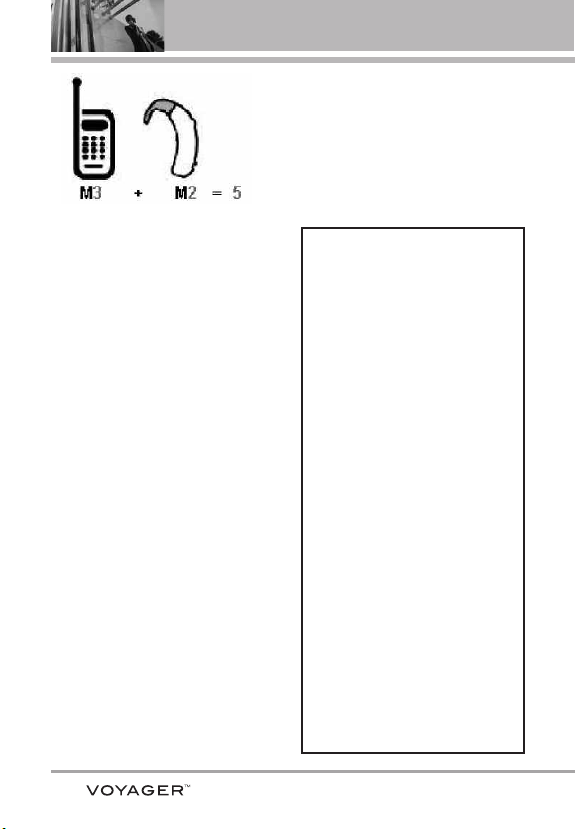
Seguridad
182
En el ejemplo antes señalado, si un
aparato para sordera cumple con la
clasificación de nivel M2 y el teléfono
inalámbrico cumple la clasificación
de nivel M3, la suma de los dos
valores es igual a M5. Esto debería
proporcionar al usuario del aparato
para sordera un "uno normal” al usar
su dispositivo auditivo con ese
teléfono inalámbrico en particular.
“Uso normal” en este contexto se
define como una calidad de señal
que es aceptable para el
funcionamiento normal.
La marca M tiene tiene por objeto ser
sinónimo de la marca U. La marca T
tiene tiene por objeto ser sinónimo de
la marca UT. Las marcas M y T son
recomendadas por la Alianza para las
soluciones de las industrias de
telecomunicaciones (ATIS). Las
marcas U y UT se referencian en la
Sección 20.19 de las reglas de la FCC.
El procedimiento de clasificación y
medición HAC se describe en el
estándar C63.19 del Instituto de
estándares nacional estadounidense
(ANSI).
Al estar hablando por el telefono
celular, se recomienda que desactive
el modo BT (Bluetooth) para HAC.
Para obtener información sobre
los aparatos para audición y los
teléfonos digitales inalámbricos
Compatibilidad y control de
volumen según la FCC
http://www.fcc.gov/cgb/dro/hear
ing.html
Universidad de Gallaudet, RERC
http://tap.gallaudet.edu/DigWirele
ss.KS/DigWireless.htm
Hearing Loss Association of
America [HLAA]
http://www.hearingloss.org/learn
/cellphonetech.asp
Orden de compatibilidad con
aparatos para la audición de la
FCC
http://hraunfoss.fcc.gov/edocs_p
ublic/attachmatch/FCC-03-
168A1.pdf
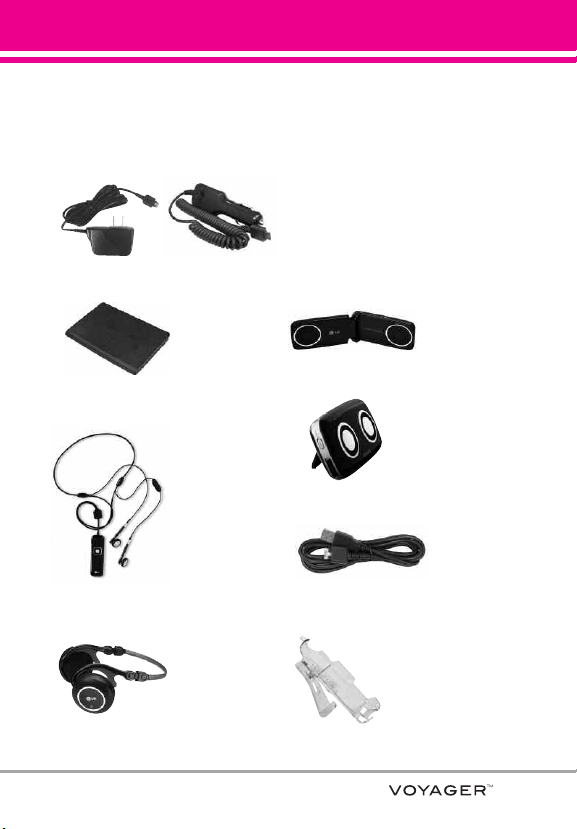
183
Accesorios
Hay una variedad de accesorios disponibles para su teléfono y tres sencillas
formas de adquirirlos: comprar en línea en cualquier momento en
www.verizonwireless.com, llamarnos al 1866 VZ GOT IT (894 6848) o visitar
una de nuestras Tiendas Verizon Wireless Communication.
Cargadors
Baterías
Altavoz Estéreo
Portátil
Bocinas
estereofónicas
Bluetooth
Cable del USB
Audífonos
estéreo Lanyard
Bluetooth con
controlador de
música
Audífonos
Estereofónicos
Bluetooth
Funda

184
DECLARACIÓN DE GARANTÍA LIMITADA
1. LO QUE CUBRE ESTA GARANTÍA:
LG le ofrece una garantía limitada de
que la unidad de suscriptor adjunta y
sus accesorios incluidos estaran
libres de defectos de materiales y
mano de obra segun los terminos y
condiciones siguientes:
(1) La garantía limitada del producto
se prolonga durante DOCE (12)
MESES contado a partir de la
fecha de adquisicion del producto.
El periodo de garantía restante
QUINCE (15) MESES de la unidad
que se esta reparando o
sustituyendo se determinara
mediante la presentacion del
recibo de ventas original por la
compra de la unidad.
(2) La garantía limitada se extiende
solo al comprador original del
producto y no es asignable ni
transferible a ningun otro
comprador o usuario final
subsecuentes.
(3) Esta garantía solo es buena para
el comprador original del producto
durante el periodo de garantía
siempre que sea en los EE.UU.,
incluidos Alaska, Hawaii, los
territorios de los EE.UU. y todas las
provincias canadienses.
(4) La carcasa externa y las partes
cosmeticas estaran libres de
defectos al momento de la
distribucion, y por tanto no estaran
cubiertas por los terminos de esta
garantía limitada.
(5) A solicitud de LG, el consumidor
debera aportar informacion
aceptable para probar la fecha de
compra.
(6) El cliente se hara cargo del costo
de envio del producto al
Departamento de servicio al
cliente de LG. LG se hara cargo del
costo de envio del producto de
vuelta al consumidor despues de
realizar el servicio segun esta
garantía limitada.
2. LO QUE NO CUBRE ESTA
GARANTÍA:
(1) Defectos o danos producto del uso
del producto de una forma distinta
de la normal y acostumbrada.
(2) Defectos o danos producto de un
uso anormal, condiciones
anormales, almacenamiento
inadecuado, exposicion a
humedad o agua, modificaciones
no autorizadas, conexiones no
autorizadas, reparacion no
autorizada, mal uso, negligencia,

185
abuso, accidentes, alteraciones,
instalacion incorrecta o cualquier
otro acto que no sea
responsabilidad de LG, incluido el
dano causado por la
transportacion, fusibles fundidos y
derrames de alimentos o liquidos.
(3) Rotura o danos a las antenas a
menos que hayan sido
ocasionadas directamente por
defectos en los materiales o mano
de obra.
(4) El consumidor debe notificar al
Departamento de servicio al
cliente de LG el supuesto defecto o
desperfecto del producto durante
el periodo de garantía limitada
aplicable para hacer efectiva la
garantía.
(5) Productos a los que se haya
eliminado el numero de serie, o en
los que este sea ilegible.
(6) Esta garantía limitada se otorga en
lugar de cualquier otra garantía,
explícita o implícita, de hecho o por
lo dispuesto en las leyes,
establecido por ellas o implicado,
incluso, aunque de manera
enunciativa y no limitativa,
cualquier garantía implícita de
comerciabilidad o adecuacion para
un uso en particular.
(7) Danos resultantes del uso de
accesorios no aprobados por LG.
(8) Todas las superficies de plastico y
todas las demas piezas externas
expuestas que se rayen o danen
debido al uso normal por parte del
cliente.
(9) Productos que hayan sido puestos
en funcionamiento por encima de
las limitaciones maximas
indicadas.
(10) Productos utilizados u obtenidos
en un programa de
arrendamiento.
(11) Consumibles (como seria el caso
de los fusibles).
3. LO QUE HARÁ LG:
LG, a su exclusivo criterio, reparará,
reemplazará o rembolsará el precio
de compra de cualquier unidad que
no cumpla con la presente garantía
limitada. LG puede, a su elección,
optar por usar partes o unidades
nuevas, restauradas o
reacondicionadas equivalentes en
cuanto a funcionalidad. Además, LG
no reinstalará o realizará copias de
seguridad de ningún dato, aplicación
o software que el usuario haya
agregado al teléfono. Por lo tanto, se
recomienda que usted realice una
186
DECLARACIÓN DE GARANTÍA LIMITADA
copia de seguridad de todo dato o
información de ese tipo antes de
enviar la unidad a LG, de modo de
evitar una pérdida permanente de esa
información.
4. DERECHOS DE LA LEY ESTATAL:
No se aplica a este producto ninguna
otra garantía explícita. LA DURACION
DE CUALQUIER GARANTÍA
IMPLÍCITA, INCLUIDA LA GARANTÍA
IMPLÍCITA DE COMERCIABILIDAD, SE
LIMITA A LA DURACION DE LA
GARANTÍA EXPLÍCITA AQUI
INDICADA. LG NO TENDRA
RESPONSABILIDAD LEGAL POR LA
PERDIDA DEL USO DE ESTE
PRODUCTO, LAS INCOMODIDADES,
PERDIDAS O CUALQUIER OTRO
DANO, DIRECTO O CONSECUENCIAL,
QUE SE PRODUZCA POR EL USO O LA
INCAPACIDAD DE USAR ESTE
PRODUCTO, NO POR LA VIOLACION
DE CUALQUIER GARANTÍA EXPLÍCITA
O IMPLÍCITA, INCLUIDA LA
GARANTÍA IMPLÍCITA DE
COMERCIABILIDAD APLICABLE A
ESTE PRODUCTO.
Algunos paises no permiten la
excluyente de limitación de daños
incidentales o consecuenciales, o las
limitaciones sobre la duración de la
garantía implícita, de modo que es
posible que estas limitaciones o
exclusiones no se le apliquen a usted.
Esta garantía le concede derechos
legales concretos y es posible que
tambien tenga otros derechos, que
varian de estado a estado.
5. CÓMO OBTENER SERVICIO POR
LA GARANTÍA:
Para obtener servicio de esta garantía
llame al siguiente teléfono desde
cualquier ubicacion continental de los
Estados Unidos:
Tel. 1-800-793-8896 o
Fax. 1-800-448-4026
O visite http://us.lgservice.com.
También puede enviar
correspondencia a:
LG Electronics Service- Mobile
Handsets,
P.O. Box 240007, Huntsville, AL 35824
NO DEVUELVA SU PRODUCTO A LA
DIRECCIÓN ARRIBA INDICADA.
Llame o escriba para conocer la
ubicación del centro de servicio
autorizado LG más cercano a usted y
los procedimientos necesarios para
presentar una reclamación por
garantía.

187
Glosario
T
T
e
e
r
r
m
m
i
i
n
n
o
o
l
l
o
o
g
g
í
í
a
a
Calculadora EZ Tip
Función para un fácil cálculo de las
cuentas de restaurante usando como
variables el costo total, la propina y el
número de personas.
Reconocimiento de voz avanzado
Función que le permite efectuar una
amplia variedad de comandos
verbales entrenando al teléfono para
que reconozca sus patrones de habla
individuales.
La tecnología inalámbrica
Bluetooth
®
Tecnología empleada para permitir
que los teléfonos celulares,
computadoras y otros dispositivos
personales se coordinen e
interconecten fácilmente por medio
de una conexión inalámbrica de corto
alcance.
CENTRO de MEDIOS
Función que accede a Internet para
dar la posibilidad de acceder a una
gran variedad de software,
información, música, vídeos y más, e
incluso descargarlos, en su propio
teléfono inalámbrico LG Verizon.
MicroSD
TM
Memoria externa adicional para su
teléfono celular.
V CAST
SM
Función que es la siguiente
generación en tecnología inalámbrica
y que transforma su teléfono
inalámbrico en un reproductor
portátil de música y ofrece una
asombrosa experiencia de vídeo
móvil en flujo continuo. V CAST
emplea tecnología que aumenta de
modo significativo las capacidades
de descarga para ofrecer mejores
gráficos, sonido y profundidad, y usa
la potencia de la banda ancha de
modo que pueda descargar el
entretenimiento más actual,
momentos destacados de los
deportes, noticias y actualizaciones
sobre el tiempo en su teléfono
Verizon Wireless V. Los nuevos
teléfonos V CAST ofrecen mejores
capacidades de generación de
imágenes, cámaras de más de 1
megapixel y cámaras de vídeo, audio
mejorado y almacenamiento de
memoria expandible.

188
Glosario
S
S
i
i
g
g
l
l
a
a
s
s
y
y
a
a
b
b
r
r
e
e
v
v
i
i
a
a
t
t
u
u
r
r
a
a
s
s
DTMF D
ual-
T
one
M
ulti
F
requency
(multifrecuencia de tono
doble o “tono de tecla”) es
un método usado para
comunicar las teclas que se
oprimen en el teléfono. Al
oprimir una tecla se generan
dos tonos simultáneos, uno
para la fila y otro para la
columna, para determinar
qué tecla se oprimió.
ERI E
nhanced
R
oaming
I
ndicator
(indicador de roaming
optimizado) es una
característica para indicar si
un teléfono celular está en su
sistema de origen, una red
asociada o una red de
roaming. Muchos teléfonos
indican origen o roaming
como un icono, pero los
teléfonos con ERI pueden
indicar el estado de "red
asociada" de otro proveedor.
EVDO Ev
olution
D
ata
O
nly (sólo
datos de evolución) o
Evolution Data Optimized
(optimizado para datos de
evolución) (abreviado como
EVDO, EV-DO, EvDO, 1xEV-
DO o 1xEvDO) ofrecer
acceso inalmábrico rápido
de banda ancha (3G) en
cualquier lugar, sin
necesidad de tener un punto
de acceso de WiFi.
GPS G
lobal
P
ositioning
S
ystem
(sistema de posicionamiento
globao) es un sistema de
satélites, computadoras y
receptores capaces de
determinar la latitud y
longitud de un receptor
determinado en la Tierra. La
posición se calcula usando el
tiempo y la distancia.
IS 2000
Tipo de señal digital. Es la
segunda generación de
celular digital CDMA, una
extensión del IS-95. Las
diferencias entre los tipos de
señal se refieren a las
señales piloto y a los enlaces
para porporcionar más
canales de tráfico y
protocolos de control.
NAM N
umber
A
ssignment
M
odule
(módulo de asignación de
número) es la forma en que
el teléfono almacena el
número de teléfono y su
número de serie electrónico.

189
SSL S
ecure
S
ockets
L
ayer
Protocol (Protocolo de capas
de sockets seguros)
empleada para cifrar datos
que se envían por el aire.
TTY T
ele
ty
pewriter (máquina de
escribir a distancia). Una
máquina de escribir
electromecánica que
transmite o recibe mensajes
codificados en las señales
eléctricas. Un teléfono con
compatibilidad TTY puede
traducir caracteres escritos
como voz o traducir la voz en
caracteres y mostrarlos en la
TTY.

10 Consejos de
Seguridad para
Conductores 175
A
Accesorios 183
Actualización de la FDA
para los
consumidores 167
Ajuste rápido del
volumen 28
Alertas de Servicio 115
Almacen masivo USB
103
Anadir Nuevo Aparato
105
Apagado/Encendido 116
Apagar y encender el
teléfono 25
Aviso 117
B
Bienvenidos 8
Borradores 76
Browser 152
Bzn Msjs Voz 77
C
Calculadora 96
Calendario 97
Carga de la batería 23
Comando de voz 29
Comandos de Voz 94,
127
Config de Llamada 137
Config de Pantalla 117
Config de Sonidos 112
Config de Teléfono 125
Configuración de
MENSAJES 80
Configuración de Toque
143
CONTACTOS 83
Cronómetro 100
Cuaderno de Notas 101
Cuidado: Evite una
Probable Pérdida del
Oído. 165
D
DECLARACIÓN DE
GARANTÍA LIMITADA
184
Descripción general del
Teléfono 12
Detalles Técnicos 9
Detección automática de
USB 145
E
Entrada 72
Entrada de texto 17
Enviado 74
Extra 64
Ez Sugerencia 102
F
Fondo de Pantalla 120
Formato Reloj 124
Foto y Video 44
Fuente de Menú 122
Fuentes de Marcado 123
Función de silencio 28
G
GET IT NOW 37
Glosario de Iconos 151
Grabar Video 57
Grupos 84
H
Herramientas 94
I
Idioma 127
IMMóvil 79
In Case of Emergency
(ICE) 86
Info de Teléfono 149
Información al
consumidor sobre la
SAR 178
Información de seguridad
161
Información de seguridad
de la TIA 158
J
Juegos 58
L
Lista de Contactos 83
Llamada en espera 28
LLMAS.RECNTES 89
Luz de Pantalla 119
M
Marcadas 91
Marcado Rápido 36, 85
Marcardo oprimiendo un
botón 142
Memoria 146
Memoria de la Tarjeta
148
Memoria del Teléfono
147
MENSAJERÍA 66
Menú de Bluetooth 104
Mi Cuenta 94
Mi Música 40
190
Índice

Mi Número 149
Mi Tarjeta de Nombre 88
Mis Fotos 52
Mis Sonidos 42
Mis Timbres 39
Mis Videos 53
Modo de vibración 28
Modo TTY 140
MSJ Borrar 81
Msj FOTO 67
Msj TXTO 65
Música de V CAST 38
Música y Tonos 37
N
NAM Select 136
Navegador 156
Nivel de carga de la
batería 25
Nuevo Contacto 83
Nuevo Mensaje 65
O
Obtén Nuevos Fotos 51
Obtén Nuevos Timbres
38
Opciones de finalizar
llamada 138
Opciones de Memoria
146
Opciones de Respuesta
137
P
Para hacer llamadas 26
Para recibir llamadas 27
Perdidas 89
Precaución de Seguridad
Importante 1
Privacidad de Voz 143
Protección de la
temperatura de la
batería 25
R
Recibidas 90
Reglas para la
compatibilidad con
aparatos para la
sordera (HAC) de la
FCC para los
dispositivos
inalámbricos 180
Reintentar
Automáticamente 139
Reloj Despertador 98
Reloj Mundial 100
Remarcado de llamadas
27
S
Seguridad 158
Selección de Sistema
135
Siglas y abreviaturas 188
Sincronizar Música 43
Sonidos de Alerta 114
Sonidos de Llamada 112
T
Temas de Pantalla 122
Terminología 187
Todas 92
Tomar Foto 55
TV móvil V CAST 45
U
Ubicación 128
V
Ver Cronómetro 93
Versión SW/HW 150
Videos de V CAST 49
Volumen de Teclado 115
Volumen Maestro 112
191