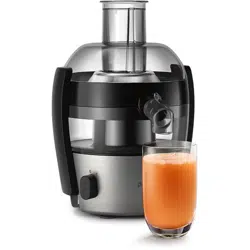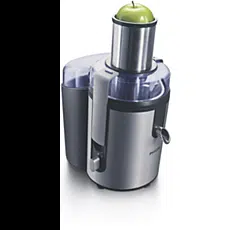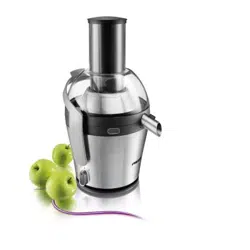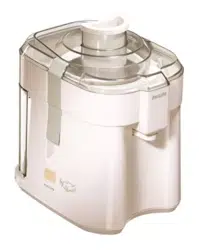
HR2826, HR2825
Juice extractor
500
450
400
350
300
250
200
150
50
100
A
C
D
F
I
H
E
G
B
1
2 3 4 5
6 7 8 9
10 11 12 13
14

ENGLISH
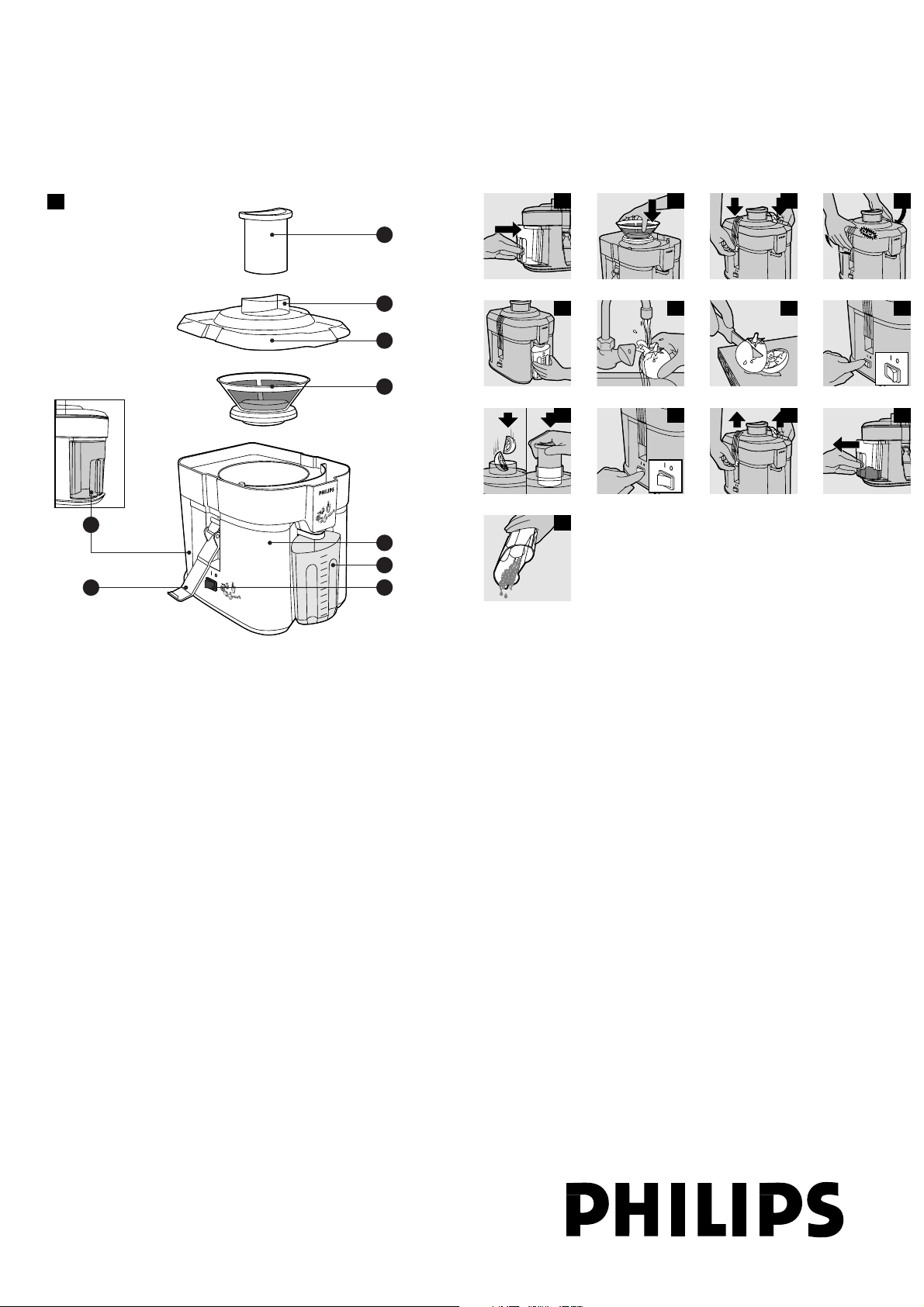
General description (fig. 1)
.
A Pusher
B Feeding tube
C Lid
D Sieve
E Pulp container
F Motor unit
G Lid latches
H On/off switch
I Juice jug (type HR2826 only)
Introduction
.
With this juice extractor you can make 100% pure fruit juice and vegetable
juice.
Important
.
◗ Read these instructions for use carefully before using the appliance and
save them for future reference.
◗ Check if the voltage indicated on the base of the appliance corresponds
to the local mains voltage before you connect the appliance.
◗ Do not use the appliance when the mains cord, the plug or other
components are damaged.
◗ If the mains cord is damaged, it must be replaced by Philips, a service
centre authorised by Philips or similarly qualified persons in order to
avoid a hazard.
◗ Keep the appliance out of the reach of children.
◗ Never use accessories and/or parts made by other manufacturers or
that have not been specifically recommended by Philips. Your
guarantee will become invalid if you use such parts or accessories.
◗ Never reach into the feeding tube with your fingers or an object while
the appliance is running.
◗ Only unlock the latches after you have switched off the appliance and
the sieve has stopped rotating.
Preparing for use
.
1 Place the pulp container into the motor unit (fig. 2).
2 Put the sieve into the motor unit (fig. 3).
3 Place the lid onto the appliance in such a way that it fits on all sides
(fig. 4).
4 Lock the lid with the latches ('click'). Check if the lid is positioned
correctly (fig. 5).
5 Place the juice jug or a glass under the spout (fig. 6).
6 Put the plug in the wall socket.
Ingredients and tips
.
- Use fresh fruit and vegetables; they contain more juice.
- Particularly suitable for processing in the juice extractor are pineapples,
beetroots, celery stalks, apples, cucumbers, carrots, spinach, melons,
tomatoes, oranges and grapes.
- You don't have to remove thin peels or skins. Only thick peels, e.g. those
of citrus fruits, pineapples and uncooked beetroots need to be removed.
Also remove the white pith of citrus fruits because it has a bitter taste.
- Fruits that contain starch, such as bananas, papayas, avocados, figs and
mangoes are not suitable for processing in the juice extractor. Use a food
processor, blender or bar blender to process these fruits.
- Leaves and leaf stalks of e.g. lettuce can also be processed in the juice
extractor.
- Apple juice turns brown very quickly. You can slow down this process by
adding a few drops of lemon juice.
- With tomato juice you can prepare a delicious Bloody Mary.
- You can use the pulp of e.g. carrots, beetroots, cabbage, spinach can be
used as a basis for soups, sauces, jams, ice-cream and deserts. Cook the
pulp and add spices and/or herbs to taste. Liquidise the cooked pulp with
a food processor, blender or bar blender. Use tomato pulp to make
tomato paste.
- Try these combinations of ingredients to prepare delicious juices: apple
and carrot, orange and grape, pinapple and grapefruit, beetroot and
carrot, carrot and melon, apple and orange.
Using the appliance
.
The appliance will only function if all parts have been properly placed into
and onto the appliance and the lid has been properly locked in place with
the latches.
1 Wash the fruit and/or vegetables (fig. 7).
2 Cut them into pieces that fit into the feeding tube (fig. 8).
3 Switch the appliance on by setting the on/off switch to I (fig. 9).
4 Put the pre-cut pieces of ingredients into the feeding tube and gently
press them towards the rotating sieve with the pusher (fig. 10).
Do not exert too much pressure on the pusher; this could affect the quality
of the end result and it could even cause the sieve to come to a halt.
Never insert your fingers or an object into the feeding tube.
5 After you have processed all ingredients and the flow of juice into the
juice jug or glass has stopped, switch the appliance off and wait until the
sieve has stopped rotating before removing the juice jug or glass (fig. 11).
◗ Preferably drink the juice immediately after it has been extracted. If it
is exposed to air for some time, the juice will lose its taste and
nutritional value. If you are not going to drink the juice right away,
store it in the refrigerator in a well-closed container for a maximum of
24 hours.
6 If the pulp container is full, switch the appliance off and wait for the
sieve to come to a complete standstill.
7 Release the two latches and remove the lid (fig. 12).
8 Remove the pulp container (fig. 13).
9 Empty the pulp container (fig. 14).
10 Reassemble the juice extractor and continue juicing.
Cleaning
.
1 Switch the appliance off, remove the plug from the wall socket and
wait until the sieve has stopped rotating.
2 Disassamble the appliance for washing-up.
Do not clean the appliance or any of its parts in the diswasher.
Do not use abrasive cleaning agents, scourers, acetone, alcohol etc. to
clean the appliance.
◗ Wipe the motor unit with a damp cloth, if necessary with some
washing-up liquid.
3 Clean the sieve, pulp container and juice jug in warm water with some
washing-up liquid immediately after use and rinse them with warm water.
Use a soft brush to clean the sieve.
Guarantee & service
.
If you need information or if you have a problem, please visit the Philips
website at www.philips.com or contact the Philips Customer Care Centre in
your country (you will find its phone number in the worldwide guarantee
leaflet). If there is no Customer Care Centre in your country, turn to your
local Philips dealer or contact the Service Department of Philips Domestic
Appliances and Personal Care BV.
4222 002 30264
2/7

á«Hô©dG
(1 º°SQ) ΩÉY ∞°Uh
A§¨°†dG IGOCG
Bä’ƒcCÉŸG ∫ÉNOG ܃ÑfCG
CAÉ£Z
Dπîæe
EÖ∏dG AÉYh
F∑ôÙG IóMh
GAÉ£¨dG ´Ó°VCG
H±É≤j’G/𫨰ûàdG ìÉàØe
I RGôW §≤a) Ò°ü©dG ≥jôHGHR2826(
áeó≤e
.äGhô°†ÿGh á¡cÉØdG Ò°üY øe %100 ‘É°U Ò°üY Ò°†– ∂æµÁ √òg á¡cÉØdG IQÉ°üY π°†ØH
GóL ΩG√
æ.πÑ≤à°ùª∏d ™Lôªc ¬H »¶ØàMGh RÉ¡÷G ∫ɪ©à°SG πÑb Gó«L äGOÉ°TQ’G √òg »FGôbG
æ‘ »∏ÙG »FÉHô¡µdG QÉ«à∏d ºFÓe RÉ¡÷G IóYÉb ≈∏Y ¬«dG QÉ°ûŸG »FÉHô¡µdG QÉ«àdG ¿ƒµj ¿CÉH …ócCÉJ
.RÉ¡÷G π«°UƒJ πÑb ∑ó∏H
æ.iôNCG ô°UÉæY hCG »FÉHô¡µdG ¢ùÑ≤ŸG hCG »FÉHô¡µdG ∂∏°ùdG ∞∏J GPG RÉ¡÷G »eóîà°ùJ ’
æ¢ùÑ«∏«a πÑb øe πgDƒe áeóN õcôe hCG ¢ùÑ«∏«a øe ôNBÉH ¬dGóÑà°SG Öé«a ,ÉØdÉJ »FÉHô¡µdG ∂∏°ùdG ¿Éc GPG
.IÒ£N ∞bGƒe …CG Öæéàd ∂dP h ¿ƒ∏gDƒe ¿hôNBG ¢UÉî°TCG hCG
æ.∫ÉØWC’G ∫hÉæàe øY Gó«©H RÉ¡÷G ≈∏Y »¶aÉM
æÉ¡eGóîà°SG í°üæj ’ »àdG hCG øjôNBG Ú©æ°üe iód á©æ°üŸG ™£≤dG hCG/h äGQGƒ°ù°ùc’G GóHG »eóîà°ùJ ’
.äGQGƒ°ù°ùc’G hCG ™£≤dG √òg ΩGóîà°SÉH âªb GPG É«¨∏e ¿Éª°†dG íÑ°üj ±ƒ°S .¢ùÑ«∏«a πÑb øe É°ü«°üN
æ.RÉ¡÷G 𫨰ûJ AÉæKCG ᪡ŸG äGòd IGOCG »∏ª©à°ùJ ’h äÉjƒàÙG ∫ÉNOG ܃ÑfCG πNGO ∂©HÉ°UCG »©°†J ’
æ.¿GQhódG øY πîæŸG ∞bƒJ ó©Hh πª©dG øY RÉ¡÷G ±É≤jG ó©H §≤a AÉ£¨dG ´Ó°VCG ∫ÉØbÉH »eƒb
GΩGóîà°SÓd Ò°†–∫
1.(2 º°SQ) ∑ôÙG IóMh πNGO Ö∏dG ßØM AÉYh »©°V
2.(3 º°SQ) ∑ôÙG IóMh πNGO πîæŸG »©°V
3.(4 º°SQ) ÖfGƒ÷G áaÉc øe ™°ùàJ å«M á≤jô£H RÉ¡÷G ≈∏Y AÉ£¨dG »©°V
4AÉ£¨dG ¿ƒµj ¿CÉH …ócCÉJ .(∂«∏c 䃰U Ú©ª°ùJ ±ƒ°S) AÉ£¨dG ´Ó°VCG ™e AÉ£¨dG ∫ÉØbÉH »eƒb
.(5 º°SQ) ΩɵMÉH ÉYƒ°Vƒe
5.(6 º°SQ) áÄÑ©àdG áëàa â– »LÉLR ܃c hCG Ò°ü©dG ≥jôHG »©°V
6.§FÉ◊G ÜÉb ‘ ¢ùÑ≤ŸG »∏°UhCG
íFÉ°üædGh äÉjƒàÙG
-.Ò°ü©dG øe ÈcCG ᫪c ≈∏Y …ƒà– É¡fC’ áLRÉW äGhô°†Nh á¡cÉa »eóîà°SG
-Qó檰ûdGh ¢SÉfÉfC’G »g á¡cÉØdG IQÉ°üY ᣰSGƒH Égô°ü©d É°ü«°üN áªFÓŸG äGhô°†ÿGh á¡cÉØdG
.Öæ©dGh ∫É≤JÈdGh ºWɪ£dGh ï«£ÑdGh ïfÉÑ°ùdGh Qõ÷Gh QÉ«ÿGh ìÉØàdGh ¢ùaôµdG ™∏°VCGh
-¢SÉfÉfC’Gh äÉ«°†ª◊G ô°ûb πãe ᵫª°ùdG Qƒ°û≤dG ´õf §≤a Öéj .QhòÑdGh Qƒ°û≤dGG ádGR’ »LÉà– ’
.ôe É¡ª©W ¿ƒc äÉ«°†ª◊G á¡cÉØd AÉ°†«ÑdG QhòÑdG »YõfG É°†jG .ñƒÑ£ŸG ÒZ Qó檰ûdGh
-áªFÓe â°ù«d É‚ÉŸG h ÚàdG h IOÉcƒaC’G h ÉjÉHÉÑdG h RƒŸG πãe É°ûædG ≈∏Y …ƒà– »àdG ¬cGƒØdG ¿G
.¬cGƒØdG √òg ô°ü©d …hój •ÓN hCG •ÓN hCG ΩÉ©£dG Iô°†fi »eóîà°SG .IQÉ°ü©dG √òg ‘ Égô°ü©d
-.IQÉ°ü©dG √òg ‘ ¢ùÿG πãe ¥GQhC’G h ¥hô©dG äGP äGhô°†ÿG ô°üY É°†jCG øµÁ
-áaÉ°VG ∫ÓN øe á«∏ª©dG √òg áYô°S ¢†«ØîJ ∂æµÁ .áYô°ùH »æH ¤G ¬fƒd ∫ƒëàj ìÉØàdG Ò°üY ¿G
.¿ƒª«∏dG Ò°üY äGô£b ™°†H
-.ºWɪ£dG Ò°üY ᣰSGƒH …QÉe …OÓÑdG ÜGô°T Ò°†– ∂æµÁ
-≈HôŸGh äÉ°ü∏°üdGh AÉ°ù◊G ¢SÉ°SC’ ïfÉÑ°ùdGh ±ƒØ∏ŸGh Qó檰ûdGh Qõ÷G Öd Óãe Ö∏dG ΩGóîà°SG ∂æµÁ
Ö∏dG ‹ƒM .ᡵædG áaÉ°V’ ÜÉ°ûYC’G hCG/h äGQÉ¡ÑdG »Ø«°VCGh Ö∏dG »¡WG .äÉjƒ∏◊Gh Ëôc ¢ùjB’Gh
Ò°†ëàd ºWɪ£dG Öd »eóîà°SG .…hój •ÓN hCG •ÓN hCG ΩÉ©£dG Iô°†fi ᣰSGƒH πFÉ°S ¤G ñƒÑ£ŸG
.ºWɪ£dG ¿ƒé©e
-,Öæ©dG ™e ∫É≤JÈdG ,Qõ÷G ™e ìÉØàdG :Iòjòd ôFÉ°üY Ò°†ëàd äÉjƒàÙG øe èjõŸG Gòg ΩGóîà°SG »HôL
.∫É≤JÈdG ™e ìÉØàdG ,ï«£ÑdG ™e Qõ÷G ,Qõ÷G ™e Qó檰ûdG ,ähôa Öjô÷G ™e ¢SÉfÉfC’G
RÉ¡÷G ΩGóîà°SG
AÉ£¨dG ∫ÉØbG ó©Hh RÉ¡÷G ≈∏Y É¡fɵe ± ΩɵMÉH ™£≤dG áaÉc Ö«côJ ºàj ¿CG ó©H §≤a RÉ¡÷G πª©j ±ƒ°S
.¬YÓ°VCG ™e ΩɵMÉH ¬fɵe ‘
1.(7 º°SQ) äGhô°†ÿG hCG/h á¡cÉØdG »∏°ùZG
2.(8 º°SQ) äÉjƒàÙG ∫ÉNOG ܃ÑfCG πNGO ™°ùààd IÒ¨°U ™£b ¤G É¡©«£≤àH »eƒb
3 ™°Vh ¤G ±É≤j’G/𫨰ûàdG ìÉàØe §Ñ°V ∫ÓN øe RÉ¡÷G 𫨰ûàH »eƒb 1.(9 º°SQ)
4¤G ∞£∏H É¡£¨°†H »eƒbh äÉjƒàÙG ∫ÉNOG ܃ÑfCG πNGO É≤Ñ°ùe á©£≤ŸG äÉjƒàÙG ™£b »©°V
.(10 º°SQ) §ZÉ°†dG ᣰSGƒH ÊGQhódG πîæŸG √ÉŒÉH πØ°SC’G
.πîæª∏d ábÉYG ÖÑ°ùj ¿G É°†jG øµÁh á«FÉ¡ædG áé«àædG ≈∏Y ôKDƒj ∂dP ¿ƒc §ZÉ°†dG ≈∏Y GÒãc »£¨°†J ’
.ä’ƒcCÉŸG ∫ÉNOG ܃ÑfCG πNGO iôNCG IGOCG ájCG hCG GóHCG ∂©HÉ°UCG »∏NóJ ’
5¤G hCG Ò°ü©dG ≥jôHG πNGO ¤G Ò°ü©dG Üɵ°ùfG á«∏ªY âØbƒJh äÉjƒàÙG ™«ªL ô°ü©H ΩÉ«≤dG ó©H
∑ôëàdG øY ÊGQhódG πîæŸG ∞bƒàj ¿CG ¤G …ô¶àfGh πª©dG øY RÉ¡÷G ±É≤jÉH »eƒb ,»LÉLõdG ܃µdG
.ɪ¡fɵe øe ܃µdG hCG Ò°ü©dG ≥jôHG »cô– ¿CG πÑb
æÒ°ü©dG ó≤Øj ±ƒ°S ,âbƒdG ¢†©Ñd AGƒ¡∏d Ò°ü©dG ¢Vô©J GPG .√ô°üY ó©H Iô°TÉÑe Ò°ü©dG Üô°T π°†Øj
πNGO ¬æjõîàH »eƒb ,√ô°üY ó©H Iô°TÉÑe Ò°ü©dG Üô°T øjƒæJ ’ âæc GPG .á«FGò¨dG ¬àª«bh ¬bGòe
.áYÉ°S 24 ÉgÉ°übCG IóŸ ΩɵMÉH É≤∏¨e AÉYh πNGO áLÓãdG
6.πeɵdÉH ácô◊G øY πîæŸG ∞bƒàj ¿CG ¤G …ô¶àfGh RÉ¡÷G 𫨰ûJ »ØbhCG ,Ö∏dG AÉYh CÓàeG GPG
7.AÉ£¨dG »ëàaGh AÉ£¨dG »©∏°V …QôM
8.Ö∏dG AÉYh »YõfG
9.Ö∏dG AÉYh »ZôaCG
10.ô°ü©dG á«∏ªY »∏°UGhh äÉ«°†ª◊G IQÉ°üY Ö«côJ IOÉYÉH »eƒb
∞«¶æJ∫G
1øY πîæŸG ∞bƒàj ¿CG ¤G …ô¶àfGh §FÉ◊G ¢ùHÉb øe »FGô¡µdG ¢ùÑ≤ŸG »YõfGh RÉ¡÷G ΩGóîà°SG
.¿GQhódG
2.¬Ø«¶æàH »eƒ≤àd RÉ¡÷G ∂ØH »eƒb
.¿ƒë°üdG ádÉ°ùZ ‘ iôNCG ™£b …CG hCG RÉ¡LG ∞«¶æàH »eƒ≤J ’
.RÉ¡÷G ∞«¶æàd ¿ƒà«°SC’G h ∫ƒëµdG πãe ᣰTÉc ∞«¶æJ OGƒe »eóîà°ùJ ’
æ.¿ƒHÉ°üdG πFÉ°S ¢†©ÑH ôeC’G Ωõd GPGh á∏∏Ñe ¢Tɪb á©£b ᣰSGƒH ∑ôÙG IóMh »ë°ùeG
3OYH IQTGHº øƒHGUdG dÅGS VYHƒ AiaGO AGºH Q»UYdG b»QHGƒ HddG AGYƒƒ dñøºdG a»XøJH »eƒb
.AiaGO AGºH G√aWTH »ºƒbƒ dGºYJSGdG
.dñøºdG a»XøJd IºYGø IGTQa »ºOñJSG
GIºOñdGƒ ¿Éª°V∫
SH»d»a I∂QTH UGñdG JøQJøGdG øGƒøY IQG»R AGêQdG ,Id∂Tº ∂»Od JøG∂ ƒCG JGºƒdYº I»CGd JêJìG GPG
www.philips.comIQTø »a øƒOº aJG√dG ºbQ OêJ aƒS) ∂OdH »a AGdºYdG IºOñd SH»d»a R∂QºH dUJG ƒCG
R∂QºH dUJG ƒCG SH»d»a d»∂ƒ IYêGQº AGêQdG ,∂OdH »a AGdºYdG IºOñd R∂Qº OêGƒJ» ºd GPG .(»ºdGYdG øGºVdG
.I»UñTdG I»GøYdG ƒ I»dRøºdG JGƒOCGdd SH»d»a I∂QTd YHGJdG IºOñdG
4222 002 30264
3/7

v<ñUã
©± qJÅ® vKë ÕdÅ
AÁbMÙœ ñUAã
Bt|cG" tìuì
Cñœ
Dd¶KOã
EtìUH" tEHæî
Fñu"uî b4«Ë
Gñœ ÈUN¶fi!
H‘uîU8ØsÅËñ êOzu<
I ‰bî jIã® ÁuOî »¬ ıñUÄ
HR2826©
tîbIî
ÆbOMë bOìu" «ñ hìU8 •±∞∞ †Uº|e§< Ë ÁuOî »¬ bOï«u" vî ÈdOÖ ÁuOî »¬ ÁU~¶<œ s|« “« ÁœUH¶<« U!
rNî
æÁbM|¬ tF3«dî È«d! vKæî ñœ «ñ UNï¬ Ë Ábï«u8 Xèœ U! ÁU~¶<œ “« ÁœUH¶<« “« q§è «ñ d|“ ÈUNKLFì«ñu¶<œ
ÆbOMë Èñ«bN~ï
æv~MÙULÙ qæî ‚d! U! ÁU~¶<œ ÈËñ ÁbÅ h‹Aî ˛U¶ìË të bOMë Xèœ ‚d! t! ÁU~¶<œ ‰UB"« “« q§è
ÆbÅU! t¶Å«œ
æÆbOMJï ÁœUH¶<« ÁU~¶<œ “« bï« Áb|œ tîb: ÁU~¶<œ †UFDè d|U< U| t8UÅ Ëœ ¨‚d! rO< tâïUMÇ
æXëdÅ j<u" ÁbÅ bO|U" f|Ëd< eëdî «ñ ʬ b|U! ¨bÅU! Áb|œ tîb: ‚d! rO< dÖ«
PhilipsÈœ«dã« U|
ÆbM|U/ i|uF" ¨dD8 œUº|« “« »UM¶3« È«d! d~|œ ÁbÅ bO|U"
æÆb|ñ«œ ÁU~ï ñËœ ÊUëœuë ”d¶<œ “« «ñ ÁU~¶<œ
æ·dÉ “« ’U8 ñuD! të ÊUÖbMMë bOìu" d|U< †UFDè U| Ë Â“«uì “« eÖdÙ
Philipsbï« ÁbAï tO:u"
ÆbÅ bÙ«u8 qÉU! vî“«uì U| †UFDè 5MÇ “« ÁœUH¶<« †ñu: ñœ ULÅ ÁU~¶<œ XïUL{ ÆbOMJï ÁœUH¶<«
æÆbOMJï œñ«Ë t|cG" tìuì ñœ bMë vî ñUë ÁU~¶<œ të vïUî“ ñœ «ñ v£OÅ U| œu8 ÊU¶A~ï« eÖdÙ
æÆbOMë “U! d¶KOã g8dÇ ÊbÅ nèu¶î Ë ÁU~¶<œ Êœdë ‘uîU8 “« bF! jIã «ñ UN¶fi!
ÁœUH¶<« È«d! ÁU~¶<œ 78U< ÁœUî¬
±±
Æ©≤ qJÅ® bOÙœ ñ«dè ñu"uî b4«Ë ñœ «ñ tìUH" tEHæî
≤≤
Æ©≥ qJÅ® bOÙœ ñ«dè ñu"uî b4«Ë ñœ «ñ d¶KOã
≥≥
Æ©˘ qJÅ® œdO~! U3 ÁU~¶<œ Ÿö{« vîU9 ÈËñ të bOÙœ ñ«dè ÈuæM! ÁU~¶<œ ÈËñ ñœ «ñ ñœ
˘˘
ñœbOMë q:U4 ÊUMOLÉ« ñœ 7ãdÖ ñ«dè `Oæ: “« Æ©¢pOK뢮 bOMë qHè UN¶fi! “« ÁœUH¶<« U! «ñ ÁU~¶<œ
Æ©˚ qJÅ®
˚˚
ıñUÄÆ©˙ qJÅ® bOÙœ ñ«dè tìuì d|“ «ñ Ê«uOì p| U| ÁuOî »¬
˙˙
ËœÆbOÙœ ñ«dè e|dÄ ñœ «ñ t8UÅ
bOHî †UJï Ë œ«uî
≠ÆbMÅU! vî Èd¶AO! »¬ È«ñ«œ ÊuÇ bOMë ÁœUH¶<« Á“U" Èe§< Ë ÁuOî “«
≠7ãdÖ »¬ È«d! ñu~ï« Ë ‰UG"dÄ ¨t3uÖ ¨Áe!d8 ¨ÃUMH<« ¨Z|uÙ ¨ñUO8 ¨VO< ¨fãdë tèU< ¨ñbMGÇ ¨”UïUï¬
ÆbMÅU! vî V<UMî ñUOfi! ÁU~¶<œ ñœ
≠ñbMGÇ ¨”UïUï¬ ¨‰UG"dÄ bMïUî rO‹{ ÈUN¶<uÄ jIã ≠ ÆbOMë «b3 «ñ „“Uï ÈUN¶<uÄ të œñ«bï vîËeì
vî aK" vLFÉ È«ñ«œ ÊuÇ bOMë «b3 b|U! «ñ †U§ëdî bOH< eGî 5MâLÙ Æœdë «b3 b|U! «ñ ÁbAï t¶‹Ä
ÆbMÅU!
≠ÈdOÖ ÁuOî »¬ È«d! u~ïUî Ë dO$« ¨ËœUë«Ë¬ ¨U|UÄUÄ ¨“uî bMïUî bMÅU! vî t¶<UAï È«ñ«œ të v"U3 ÁuOî
ÁuOî Ÿuï s|« Èñˬdã È«d! È« tKOî së ◊uK‹î U| së ◊uK‹î ¨v|«cä ÁU~¶<œ p| “« ÆbMÅU! v/ V<UMî
ÆbOMë ÁœUH¶<« †U3
≠Èñˬdã ÈdOÖ ÁuOî »¬ ÁU~¶<œ U! Ê«u" vî eOï «ñ bïñ«œ tèU< U| ¯d! ‚U< të uÙUë bMïUî v"Uº|e§<
Æœu/
≠d"bMë uLOì »¬ ÁdDè bMÇ ÊbïUJÇ U! «ñ bM|¬dã s|« Xàd< bOï«u" vî ÆœuÅ vî È« ÁuNè Xàdfi! VO< »¬
ÆbOMë
≠ÆbOMë X<ñœ ÁeLÅu8 Èdî Èœö! p| bOï«u" vî v~ïdã t3uÖ »¬ “« ÁœUH¶<« U!
≠¨U!dî ¨”u< Ÿ«uï« ¨Ûu< Êœdë X<ñœ È«d! ÃUMH<« Ë rKë ¨ñbMGÇ ¨Z|uÙ X<uÄ “« ¨Îößî ¨bOï«u" vî
rFÉ U" Áœdë tãU{« dDFî †Uº|e§< U| vMÅUÇ Ê¬ t! Ë t¶‹Ä «ñ œ«uî s|« ÆbOMë ÁœUH¶<« d<œ Ë vM¶fi!
ÆbïuÅ ñ«œ
≠È«d! t3uÖ “« ÆbOMë q|b§" l|Uî t! v|« tKOî Ê“ rÙ U| Ê“ rÙ ¨“U< «cä “« ÁœUH¶<« U! «ñ ÁbÅ t¶‹Ä œ«uî
ÆbOMë ÁœUH¶<« t3uÖ »ñ X8U<
≠¨ñu~ï« Ë ‰UI"dÄ ¨Z|uÙ Ë VO< Æb|“Ufi! ÁeLÅu8 ÈUÙ ÁuOî »¬ bOï«u¶! U" Áœdë ÊUæ¶î« «ñ †U§Oëd" s|«
ƉUI"dÄ Ë VO< ¨Áe!d8 Ë Z|uÙ ¨Z|uÙ Ë ñbMGÇ ¨†Ëdã é|dÖ Ë ”UïUï¬
ÁU~¶<œ “« ÁœUH¶<«
t¶ãdÖ ñ«dè ÁU~¶<œ ñœ bMÅU! ÁbÅ ñ«u< `Oæ: †UFDè vîU9 të œdë bÙ«u8ñ Uë v¶ìU4 ñœ jIã ÁU~¶<œ
ÆbÅU! ÁbÅ XHÇ UN¶fi! tKO<u! `Oæ: ñuD! ÁU~¶<œ ñœ Ë bMÅU!
±±
Æ©∑ qJÅ® bO|uA! «ñ †Uº|e§< Ë ÁuOî
≤≤
Æ©∏ qJÅ® bOïe! ‘d! ¨bïdOÖ ñ«dè ÁU~¶<œ t|cG" tìuì ñœ të v"UFDè t! «ñ UNï¬
≥≥
XOF{Ë ñœ ‘uîU8ØsÅËñ êOzu< Êœ«œ ñ«dè U! «ñ ÁU~¶<œIÆ©π qJÅ® bOMë sÅËñ ¨
˘˘
ñUAã “« ÁœUH¶<« U! «ñ UNï¬ vîdM! Ë bOÙœ ñ«dè ÁU~¶<œ t|cG" tìuì ñœ «ñ œ«uî ÁbÅ Áœ«œ ‘d! †UFDè
Æ©±∞ qJÅ® bOÙœ ñUAã g8dÇ ‰U4 ñœ d¶KOã ·dÉ t! ÁbMÙœ
X<« sJ2 Ë œñ«cÖ vî dO#U" v|UNï tºO¶ï ÈËñ ñUë s|« ÊuÇ bOMJï œñ«Ë ÁbMÙœ ñUAã ÈËñ b4 “« gO! ñUAã
ÆœuÅ d¶KOã ÊbÅ nèu¶î YàU!
ÆbOMJï œñ«Ë t|cG" tìuì ñœ «ñ v£OÅ U| ÊU¶A~ï« eÖdÙ
˚˚
q§è Ë Áœdë ‘uîU8 «ñ ÁU~¶<œ ¨ tAOÅ U| ıñUÄ ñœ ÁuOî »¬ ÊU|d3 ÊbÅ lDè Ë œ«uî ÁbÅ ÂU9 “« bF!
ÆœuÅ nèu¶î ÁU~¶<œ d¶KOã g8dÇ U" bOMë d§: ¨Ê«uOì U| ÁuOî »¬ ıñUÄ 7Å«œd! “«
æ«uÙ ÷dFî ñœ v"bî È«d! ÁuOî »¬ dÖ« ÆbOMë ·dBî ¨Ê¬ ÊbÅ t¶ãdÖ “« bF! Ϋñuã «ñ ÁuOî »¬ ÎUæO3d"
«ñ ÁuOî »¬ Èñuã ÊbOÅuï bBè dÖ« Æœ«œ bÙ«u8 X<œ “« «ñ œu8 v|«cä ‘“ñ« Ë Áeî ÁuOî »¬ ¨œdOÖ ñ«dè
ÆbOMë Èñ«bN~ï ‰Uâ‹| ñœ XàU< ≤˘ dßë«b4 È«d! t¶fi!ñœ vãdÜ ñœ bOï«u" vî «ñ ʬ ¨b|ñ«bï
˙˙
ÆbOMë d§: ÁU~¶<œ d¶KOã qîUë nèu" U" Ë Áœdë ‘uîU8 «ñ ÁU~¶<œ ¨X<« ÁbÅ dÄ tìUH" tEHæî dÖ«
∑∑
Æ©±≤ qJÅ® b|ñ«œd! «ñ ÁU~¶<œ ñœ Ë Áœdë œ«“¬ «ñ UN¶fi!
∏∏
Æ©±≥qJÅ® b|ñ«œd! «ñ tìUH" tEHæî
ππ
Æ©±˘qJÅ® bOMë vìU8 «ñ tìUH" tEHæî
±±∞∞
ÆbOÙœ tî«œ« «ñ ÈdOÖ ÁuOî »¬ Ë Áœdë ñ«u< ÁñU!Ëœ «ñ ÈdOÖ ÁuOî »¬ †UFDè
Êœdë eO9
±±
ÆœuÅ nèu¶î ÎöîUë d¶KOã g8dÇ U" bOMë d§: Ë bOMë «b3 e|dÄ “« «ñ t8UÅËœ ¨Áœdë ‘uîU8 «ñ ÁU~¶<œ
≤≤
ÆbOMë «b3 7fiÅ XN3 «ñ ÁU~¶<œ †UFDè
ÆbO|uAï v|uÅ ·dÜ 5ÅUî ñœ «ñ ʬ †UFDè “« «bë êOÙ U| ÁU~¶<œ
ÆbOMJï ÁœUH¶<« ÁU~¶<œ Êœdë „UÄ È«d! ÁdOä Ë v|uAãdÜ rO< ¨vA|U< ÁbMMë „UÄ œ«uî “«
æÆbOMë eO9 v|uÅ ·dÜ l|Uî Èñ«bIî U! “UOï †ñu: ñœ U| ¨ñ«b/ tÇñUÄ tJ" p| U! «ñ ñu"uî b4«Ë
≥≥
l|Uî Èñ«bIî U! ÂdÖ »¬ ñœ «ñ ÈdOÖ ÁuOî »¬ ıñUÄ Ë tìUH" tEHæî ¨d¶KOã ¨ÁU~¶<œ “« ÁœUH¶<« “« bF!
ÆbOMë vAë »¬ ÂdÖ »¬ U! «ñ UNï¬ Ë bO|uA! v|uÅ ·dÜ
ÆbOMë ÁœUH¶<« d¶KOã Êœdë eO9 È«d! Âdï ”d! p| “«
Xfi|“ jOæî
æU! Æb|e|d! ñËœ ÁbÅ 5OF" ÈUNKæî ñœ «ñ ʬ Ë ¨b|e|dï ñËœ v~ïU8 ÈUÙ tìU!“ d|U< bMïUî «ñ ÁU~¶<œ
Æ©±˚ qJÅ® bOMë vî pLë Xfi|“ jOæî kH4 t! ULÅ ñUë s|« ÂU$«
f|Ëd< Ë XïUL{
vïUAï t! Uî v¶ïd¶M|« X|U< “« ÎUHDì b|bÅ t3«uî vKJAî U! U| t¶Å«œ “UOï †UàöÉ« t! të v"ñu ñœ
www.philips.com Èd¶Aî “« X§è«dî eëdî U| U| Áœdë b|œ“U!Philipss|« ULÅ® b|dO~! ”U9 œu8 ñuAë ñœ
œu3Ë ÊU|d¶Aî †Uîb8 eëdî ULÅ ñuAë ñœ tâïUMÇ Æ©œdë bOÙ«u8 «bOÄ vïUN3 XïUL{ tÖd! ñœ «ñ sHK" ÁñULÅ
“«uì ÁbMÅËdã t! ¨œñ«bïPhilips v~ïU8 “«uì g‹! U! U| Áœu/ tF3«dîPhilipsv! ÈË vB‹Å X|UL4 Ë
Æb|dO~! ”U9
4222 002 30264
4/7

BAHASA INDONESIA
Keterangan umum (gambar 1)
.
A Pendorong
B Tabung pengisi
C Tutup
D Saringan
E Penampung ampas
F Unit motor
G Kunci tutup
H Tombol on/off (hidup/mati)
I Gelas jus (tipe HR2826 saja)
Pendahuluan
.
Dengan alat pembuat jus ini dapat membuat jus buah dan jus sayuran 100%
murni.
Penting
.
◗ Bacalah petunjuk penggunaan ini dengan seksama sebelum
menggunakan alat dan simpanlah untuk referensi jika dibutuhkan kelak.
◗ Periksalah apakah voltase yang tertera di bagian bawah alat sudah sesuai
dengan voltase listrik di rumah Anda sebelum menghubungkan alat ke
stopkontak.
◗ Jangan menggunakan alat apabila kabel, stopkontak atau komponen
lainnya rusak.
◗ Jika kabel rusak, maka harus diganti oleh Philips, pusat servis yang
ditunjuk oleh Philips atau oleh orang yang memiliki kualifikasi setara,
untuk menghindari risiko bahaya.
◗ Jauhkan alat dari jangkauan anak-anak.
◗ Jangan menggunakan aksesori dan/atau suku cadang yang dibuat pabrik
lain atau yang belum secara spesifik direkomendasikan oleh Philips. Jika
Anda menggunakan aksesori atau suku cadang tersebut maka jaminan
tidak akan berlaku
◗ Jangan memasukkan jari tangan atau benda lainnya ke dalam tabung
pengisi saat alat sedang bekerja.
◗ Pengunci hanya dibuka setelah alat dimatikan dan pisau pemarut sudah
berhenti berputar.
Menyiapkan alat
.
1 Masukkan penampung ampas ke dalam unit motor (gbr. 2).
2 Masukkan saringan ke dalam unit motor (gbr. 3).
3 Pasang tutup pada alat dengan cara tertentu sehingga pas terpasang di
semua sisi (gbr. 4).
4 Kunci tutup dengan kuncinya ('klik'). Periksa apakah posisi tutup sudah
benar (gbr. 5).
5 Taruh gelas jus atau sebuah gelas di bawah cerat alat (gbr. 6).
6 Pasang steker pada stopkontak.
Bahan-bahan dan tip
.
- Gunakan buah dan sayuran segar karena banyak mengandung air.
- Yang paling cocok untuk diproses dengan alat pembuat jus ini adalah
nanas, beetroot, seledri, apel, mentimun, wortel, bayam, melon, tomat,
jeruk manis dan anggur.
- Anda tidak perlu mengupas kulit atau cangkang yang tipis. Hanya yang
berkulit tebal saja yang perlu dikupas lebih dahulu, seperti buah jeruk,
nanas dan beetroots yang belum dimasak. Juga kupas bagian putih dari
buah jeruk karena rasanya pahit.
- Buah-buahan yang mengandung tepung, seperti pisang, pepaya, alpukat,
ara dan mangga tidak cocok diproses dengan alat ini. Gunakan food
processor, blender atau bar blender untuk memprosesnya.
- Daun-daunan dan tangkai daun seperti selada dapat diproses dengan alat
ini.
- Jus apel cepat berubah warna menjadi coklat. Anda dapat memperlambat
proses ini dengan menambahkan beberapa tetes air jeruk lemon.
- Dengan jus tomat anda dapat menghidangkan Bloody Mary yang lezat.
- Anda dapat menggunakan ampas wortel, beetrots, kubis, bayam sebagai
bahan dasar sup, saus, selai, es krim dan makanan penutup. Masaklah
ampas lalu tambahkan bumbu dan/atau rempah sesuai selera. Cairkan
ampas yang telah masak dengan food processor, blender atau bar
blender. Gunakan ampas tomat untuk membuat pasta tomat.
- Cobalah kombinasi bahan-bahan berikut untuk menyiapkan jus yang lezat:
apel dan wortel, jeruk manis dan anggur, nanas dan jeruk besar, beetrots
dan wortel, wortel dan melon, apel dan orange.
Menggunakan alat
.
Alat ini hanya akan berfungsi jika seluruh bagiannya telah dipasang dengan
benar didalam dan diatas alat serta penutup telah benar-benar rapat pada
tempatnya dengan kunci tutup.
1 Cuci buah dan/atau sayuran (gbr. 7).
2 Potong menjadi bagian-bagian kecil hingga masuk ke dalam tabung
pengisi (gbr. 8).
3 Nyalakan alat dengan menyetel on/off ke posisi I (gbr. 9).
4 Masukan bahan yang telah dipotong kedalam tabung pengisi lalu dorong
perlahan ke arah saringan yang berputar dengan alat pendorong (gbr. 10).
Jangan menekan terlalu keras pada pendorong, ini akan mempengaruhi mutu
dan dapat mengakibatkan pisau pemarut berhenti berputar.
Jangan memasukkan jari tangan atau benda lainnya ke dalam tabung pengisi.
5 Setelah Anda memproses semua bahan dan aliran jus ke dalam gelas jus
atau gelas telah berhenti, matikan alat lalu tunggu hingga saringan
berhenti berputar sebelum memindahkan gelas jus atau gelas (gbr. 11).
◗ Sebaiknya jus segera diminum begitu jadi. Jika dibiarkan sebentar
terkena udara, jus akan kehilangan rasa dan nilai nutrisinya. Jika anda
tidak akan meminumnya segera, simpanlah dalam wadah yang tertutup
rapat dalam lemari pendingin maksimal selama 24 jam.
6 Jika penampung ampas penuh, matikan alat dan tunggu hingga saringan
benar-benar berhenti.
7 Buka kedua kunci tutup lalu angkat tutupnya (gbr. 12).
8 Keluarkan penampung ampas (gbr. 13).
9 Kosongkan penampung ampas (gbr. 14).
10 Pasang kembali alat ini lalu lanjutkan membuat jus.
Membersihkan
.
1 Matikan alat, cabut steker dari stopkontak dan tunggu sampai pisau
pemarut berhenti berputar.
2 Buka bagian-bagian alat untuk dicuci.
Jangan membersihkan alat atau bagian-bagiannya pada alat pencuci piring.
Jangan gunakan alat pembersih abrasif, penggosok, zat asam, alkohol dll.
untuk membersihkan alat.
◗ Bersihkan unit motor dengan kain lembab, jika perlu dengan sedikit
cairan pencuci.
3 Bersihkan saringan, penampung ampas dan gelas jus dalam air hangat
dengan sedikit cairan pencuci secepatnya setelah digunakan lalu bilas
dengan air hangat.
Gunakan sikat halus untuk membersihkan saringan.
Jaminan & servis
.
Jika anda memerlukan informasi atau menghadapi masalah, silahkan kunjungi
situs web Philips pada www.philips.com atau hubungi Pusat Layanan Pelanggan
Philips di negara Anda (Anda akan menemukan nomor teleponnya dalam
leaflet garansi yang berlaku di seluruh dunia). Jika di negara Anda tidak terdapat
Pusat Layanan Pelanggan, silakan datang ke dealer Philips setempat atau
hubungi Bagian Servis Philips Domestic Appliances and Personal Care BV
4222 002 30264
5/7
1
2
3
4
5
◗
6
7
8
9
10
1
2
◗
3
2006/03/10
A
B
C
D
E
F
G
H
I
◗
◗
◗
◗
◗
◗
◗
◗
1
2
3
4
5
6
4222 002 30264
6/7

ESPAÑOL
Descripción general (fig. 1).
A Empujador
B Tubo de alimentación
C Tapa
D Tamiz
E Recipiente de la pulpa
F Unidad motora
G Cierres de la tapa
H Interruptor de encendido/apagado
I Jarra para el zumo (sólo modelo HR2826)
Introducción.
Con esta licuadora podrá hacer zumos de frutas y verduras 100% naturales.
Importante.
◗ Lea atentamente estas instrucciones de uso antes de utilizar el aparato
y consérvelas por si necesitara consultarlas en el futuro.
◗ Antes de conectar el aparato, compruebe si el voltaje indicado en la
base del aparato se corresponde con el voltaje de red local.
◗ No utilice el aparato si el cable, el enchufe u otros componentes están
dañados.
◗ Si el cable de red estuviera dañado, deberá ser sustituido por Philips,
un centro de asistencia técnica autorizado por Philips, o por personal
cualificado, para evitar situaciones de peligro.
◗ Mantenga el aparato fuera del alcance de los niños.
◗ No utilice nunca accesorios y/o piezas de otros fabricantes o que no
hayan sido específicamente recomendados por Philips. Si utiliza dichas
piezas o accesorios, su garantía quedará anulada.
◗ No introduzca nunca los dedos ni ningún objeto en el tubo de
alimentación mientras el aparato esté funcionando.
◗ No abra los cierres hasta que haya apagado el aparato y el tamiz haya
dejado de girar.
Cómo preparar el aparato.
1 Coloque el recipiente de la pulpa en la unidad motora (fig. 2).
2 Coloque el tamiz en la unidad motora (fig. 3).
3 Coloque la tapa en el aparato de modo que encaje por todos los lados
(fig. 4).
4 Bloquee la tapa con los cierres ('clic'). Compruebe si la tapa está bien
colocada (fig. 5).
5 Coloque la jarra para el zumo o un vaso debajo de la boquilla (fig. 6).
6 Enchufe el aparato.
Ingredientes y consejos.
- Utilice frutas y verduras frescas: tienen más zumo.
- Algunas de las frutas y verduras más apropiadas para la licuadora son: la
piña, la remolacha, el apio, la manzana, el pepino, la zanahoria, las
espinacas, el melón, el tomate, la naranja y las uvas.
- No hace falta que quite la piel si es fina. Sólo debe quitar las pieles
gruesas, como las de los cítricos, la piña o la remolacha sin cocinar.
También deberá quitar la parte blanca de los cítricos, porque tiene un
sabor amargo.
- Las frutas que contienen fécula como los plátanos, las papayas, los
aguacates, los higos o los mangos no son adecuadas para procesarlas en
este aparato. Utilice un robot de cocina, o una batidora para procesar
este tipo de frutas.
- Las hojas y los tallos, por ejemplo de lechuga, también se pueden
procesar en la licuadora.
- El zumo de manzana se oxida muy rápidamente. Puede retrasar este
proceso añadiendo unas gotas de zumo de limón.
- Puede preparar un delicioso Bloody Mary con zumo de tomate.
- Puede utilizar la pulpa de zanahorias, remolachas, repollo o espinacas
como base para sopas, salsas, mermeladas, helados o postres. Cueza la
pulpa y añada especias y/o hierbas al gusto. Bata la pulpa con un robot
de cocina o una batidora. Con la pulpa de tomate puede hacer pasta de
tomate.
- Combine estos ingredientes para preparar deliciosos zumos: manzana y
zanahoria, naranja y uvas, piña y pomelo, remolacha y zanahoria,
zanahoria y melón, y manzana y naranja.
Cómo usar el aparato.
El aparato sólo funcionará si se han colocado bien todas las piezas y si se
ha bloqueado bien la tapa con los cierres.
1 Lave las frutas y/o verduras (fig. 7).
2 Córtelas en trozos que quepan por el tubo de alimentación (fig. 8).
3 Encienda el aparato colocando el interruptor de encendido/apagado en
la posición I (fig. 9).
4 Eche los ingredientes cortados en el tubo de alimentación y empújelos
suavemente con el empujador hacia el tamiz giratorio (fig. 10).
No ejerza demasiada presión con el empujador; esto podría variar la calidad
del resultado final e incluso podría hacer que se detuviera el tamiz.
No introduzca los dedos ni ningún objeto en el tubo de alimentación.
5 Después de procesar todos los ingredientes y cuando deje de caer
zumo en la jarra o el vaso, apague el aparato y espere hasta que el
tamiz deje de girar antes de retirar la jarra o el vaso (fig. 11).
◗ Le recomendamos que beba el zumo recién hecho. Si ha estado
expuesto al aire durante un tiempo, el zumo perderá su sabor y su
valor nutritivo. Si no va a tomar el zumo inmediatamente, guárdelo en
la nevera en un recipiente bien cerrado durante 24 horas como
máximo.
6 Si el recipiente para pulpa está lleno, apague el aparato y espere a que
el tamiz se pare completamente.
7 Abra los dos cierres y quite la tapa (fig. 12).
8 Saque el recipiente de la pulpa (fig. 13).
9 Vacíe el recipiente de la pulpa (fig. 14).
10 Vuelva a montar la licuadora y siga haciendo zumo.
Limpieza.
1 Apague el aparato, desenchúfelo de la red y espere hasta que el tamiz
deje de girar.
2 Desmonte el aparato para lavarlo.
No lave el aparato ni ninguna de sus piezas en el lavavajillas.
No utilice limpiadores abrasivos, estropajos, acetona o alcohol para
limpiar
el aparato.
◗ Limpie la unidad motora con un paño húmedo y, si fuera necesario,
con un poco de detergente líquido.
3 Lave el tamiz, el recipiente de la pulpa y la jarra para el zumo con agua
caliente y un poco de detergente líquido nada más utilizarlos, y
aclárelos con agua templada.
Utilice un cepillo suave para limpiar el tamiz.
Garantía y servicio.
Si necesita información o si tiene algún problema, visite la página web de
Philips en www.philips.com o póngase en contacto con el Servicio Philips de
Atención al Cliente de su país (hallará el número de teléfono en el folleto de
la Garantía Mundial). Si en su país no hay Servicio Philips de Atención al
Cliente, póngase en contacto con su distribuidor local Philips o con el
Service Department of Philips Domestic Appliances and Personal Care BV.
4222 002 30264
7/7