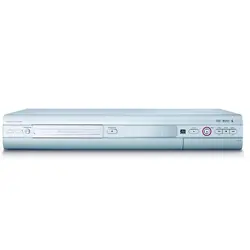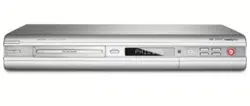

DVD Player/ Recorder
DVDR3380
User Manual
2
Important notes for users in the U.K.
Mains plug
This apparatus is tted with an approved 13
Amp plug. To change a fuse in this type of plug
proceed as follows:
1 Remove fuse cover and fuse.
2 Fix new fuse which should be a BS1362
5 Amp, A.S.T.A. or BSI approved type.
3 Re t the fuse cover.
If the tted plug is not suitable for your socket
outlets, it should be cut off and an appropriate
plug tted in its place.
If the mains plug contains a fuse, this should
have a value of 5 Amp. If a plug without a fuse
is used, the fuse at the distribution board
should not be greater than 5 Amp.
Note: The severed plug must be disposed of to
avoid a possible shock hazard should it be
inserted into a 13 Amp socket elsewhere.
How to connect a plug
The wires in the mains lead are coloured with
the following code: blue = neutral (N),
brown = live (L).
As these colours may not correspond with the
colour markings identifying the terminals in your
plug, proceed as follows:
– Connect the blue wire to the terminal
marked N or coloured black.
– Connect the brown wire to the terminal
marked L or coloured red.
– Do not connect either wire to the earth
terminal in the plug, marked E (or e) or
coloured green (or green and yellow).
Before replacing the plug cover, make certain
that the cord grip is clamped over the sheath of
the lead - not simply over the two wires.
Copyright in the U.K.
Recording and playback of material may require
consent. See Copyright Act 1956 and The
Performer’s Protection Acts 1958 to 1972.
Norge
Typeskilt nnes på apparatens underside.
Observer: Nettbryteren er sekundert
innkoplet. Den innebygde netdelen er
derfor ikke frakoplet nettet så lenge
apparatet er tilsluttet nettkontakten.
For å redusere faren for brann eller elektrisk
støt, skal apparatet ikke utsettes for regn eller
fuktighet.
Italia
DICHIARAZIONE DI CONFORMITA’
Si dichiara che l’apparecchio DVDR3380,
Philips risponde alle prescrizioni dell’art. 2
comma 1 del D.M. 28 Agosto 1995 n. 548.
Fatto a Eindhoven
Philips Consumer Electronics
Philips, Glaslaan 2
5616 JB Eindhoven, The Netherlands
English
3
For Customer Use:
Read carefully the information located at the
bottom or rear of your DVD Recorder and
enter below the Serial No. Retain this
information for future reference.
Model No. DVD RECORDER
DVDR3380
Serial No. _______________
CAUTION
VISIBLE AND INVISIBLE LASER
RADIATION WHEN OPEN.
AVOID EXPOSURE TO BEAM
ADVARSEL
SYNLIG OG USYNLIG LASERSTRÅLING
VED ÅBNING UNDGÅ UDSÆTTELSE FOR
STRÅLING
VARNING
SYNLIG OCH OSYNLIG
LASERSTRÅLNING NÄR DENNA DEL ÄR
ÖPPNAD BETRAKTA EJ STRÅLEN
VARO!
AVATTAESSA OLET ALTTIINA
NÄKYVÄLLE JA NÄKYMÄTTÖMÄLLE
LASER SÄTEILYLLE. ÄLÄ KATSO
SÄTEESEEN
VORSICHT
SICHTBARE UND UNSICHTBARE
LASERSTRAHLUNG WENN ABDECKUNG
GEÖFFNET NICHT DEM STRAHL
AUSSETZEN
ATTENTION
RAYONNEMENT LASER VISIBLE ET
INVISIBLE EN CAS D’OUVERTURE
EXPOSITION DANGEREUSE AU
FAISCEAU
DK
Advarsel: Usynlig laserstråling ved åbning
når sikkerhedsafbrydere er ude af funktion.
Undgå utsættelse for stråling.
Bemærk: Netafbryderen er sekundært
indkoblet og ofbryder ikke strømmen fra
nettet. Den indbyggede netdel er derfor
tilsluttet til lysnettet så længe netstikket
sidder i stikkontakten.
S
Klass 1 laseraparat
Varning! Om apparaten används på annat
sätt än i denna bruksanvisning speci cerats,
kan användaren utsättas för osynlig
laserstrålning, som överskrider gränsen för
laserklass 1.
Observera! Stömbrytaren är sekundärt
kopplad och bryter inte strömmen från
nätet. Den inbyggda nätdelen är därför
ansluten till elnätet så länge stickproppen
sitter i vägguttaget.
SF
Luokan 1 laserlaite
Varoitus! Laitteen käyttäminen muulla kuin
tässä käyttöohjeessa mainitulla tavalla
saattaa altistaa käyttäjän
turvallisuusluokan 1 ylittävälle
näkymättömälle lasersäteilylle.
Oikeus muutoksiin varataan. Laite ei saa
olla alttiina tippu-ja roiskevedelle.
Huom. Toiminnanvalitsin on kytketty
toisiopuolelle, eikä se kytke laitetta irti
sähköverkosta. Sisäänrakennettu verkko-osa
on kytkettynä sähköverkkoon aina silloin,
kun pistoke on pistorasiassa.
Disposal of your old product
Your product is designed and manufactured with high quality materials
and components, which can be recycled and reused.
When this crossed-out wheeled bin symbol is attached to a product it
means the product is covered by the European Directive 2002/96/EC.
Please inform yourself about the local separate collection system for
electrical and electronic products.
Please act according to your local rules and do not dispose of your old products with
your normal household waste. The correct disposal of your old product will help
prevent potential negative consequences for the environment and human health.
4
LASER
Type Semiconductor laser
InGaAlP (DVD)
AIGaAs (CD)
Wave length 658 nm (DVD)
790 nm (CD)
Output Power 30 mW (DVD+RW write)
1.0 mW (DVD read)
1.0 mW (CD read)
Beam divergence 84 degrees (DVD)
61 degrees (CD)
This product complies with the radio
interference requirements of the
European Community.
This product complies with
the requirements of the
following directives and
guidelines: 73/23/EEC +
89/336/EEC + 93/68/EEC

EnglishFrançaisEspañol
5
This product incorporates copyright protection
technology that is protected by US patents. Use
of this copyright protection technology must be
authorised by Macrovision, and is intended for
home and other limited viewing uses only, unless
otherwise authorised by Macrovision. Reverse
engineering or disassembly is prohibited.
U.S. Patent Number: 4,631,603; 4,819,098;
4,907,093; 5,315,448; and 6,516,132
Manufactured under license from Dolby
Laboratories. “Dolby” and the double-D symbol
are trademarks of Dolby Laboratories.
This is a simple programming system for
recorders. To use it, enter the programming
number associated with your television
programme. You can nd this number in your
favourite listings magazine.
VIDEO Plus+
®
and PlusCode are registered
trademarks of Gemstar Development
Corporation. The VIDEO Plus+
®
system is
manufactured under license from Gemstar
Development Corporation.
DivX®, DivX Certi ed, and associated logos are
trademarks of DivX Networks, Inc and are used
under license.
i.Link is also known as ‘FireWire’ and ‘IEEE1394’.
This connection is used for the transfer of high
bandwidth digital signals as used by digital video
(DV) camcorders. It carries all audio and video
signals via a single cable.

English
6
Table of Contents
General
Care and Safety Information ..........................................................................................8
Setup precautions .................................................................................................................................................8
Cleaning discs ........................................................................................................................................................8
About recycling .....................................................................................................................................................8
Product Information ........................................................................................................9
In troduc tion ...........................................................................................................................................................9
Accessories supplied ...........................................................................................................................................9
Region codes ..........................................................................................................................................................9
Copyright notice ...................................................................................................................................................9
Product Overview
Remote Control ............................................................................................................. 10
Using the remote control ................................................................................................................................12
Main Unit ......................................................................................................................... 13
Connections
Step 1: Basic Recorder Connections ............................................................................ 14
Connecting the aerial cables ...........................................................................................................................14
Connecting the video cable .............................................................................................................................15
Connecting the audio cables ...........................................................................................................................16
Step 2: Optional Connections ....................................................................................... 17
Connecting to a Cable Box or Satellite Receiver .....................................................................................17
Connecting to a VCR or other similar device ............................................................................................18
Connecting to a VCR and Cable Box/Satellite Receiver .........................................................................19
Connecting a camcorder to the front sockets ......................................................................................... 20
Step 3: Installation and Setup ....................................................................................... 21
Finding the correct viewing channel .............................................................................................................21
Setting the OSD language ................................................................................................................................21
Select the country of your residence .......................................................................................................... 22
Setting your TV channelprogrammes ......................................................................................................... 22
Setting the date & time .................................................................................................................................... 23
Recording
Recording .........................................................................................................................24
Discs for recording ............................................................................................................................................24
Recording settings ............................................................................................................................................24
RECORD settings ...................................................................................................................................... 25
Manual recording ............................................................................................................................................... 26
One Touch Recording - automatic turn-off ............................................................................................... 26
About timer recording ......................................................................................................................................27
Timer recording (manually) .............................................................................................................................27
Timer recording (VIDEO Plus+
®
System) ...................................................................................................29
Changing/ Deleting a timer recording ......................................................................................................... 30
Simultaneous recording and playback .......................................................................................................... 30

English
7
Table of Contents
Playback
Playback ........................................................................................................................... 31
Playable discs .......................................................................................................................................................31
Inserting a disc ....................................................................................................................................................31
Starting disc playback ........................................................................................................................................32
Additional Playback Features ....................................................................................... 36
Changing to another chapter/track .............................................................................................................. 36
Pausing playback and step play ..................................................................................................................... 36
Searching forwards/backwards ..................................................................................................................... 36
Using T/C options ..............................................................................................................................................37
Edit Recordings
Editing/ Finalising Recording .........................................................................................40
About disc editing ............................................................................................................................................. 40
Accessing disc editing menu ........................................................................................................................... 40
Playing your recordings (DVD±R) on other DVD players .................................................................... 42
About title editing ............................................................................................................................................. 43
Accessing title editing menu ........................................................................................................................... 43
About video editing .......................................................................................................................................... 45
Accessing video editing menu ........................................................................................................................ 45
Other Information
DVD System Menu Options ..........................................................................................48
Accessing the System Menu ........................................................................................................................... 48
GENERAL settings .................................................................................................................................... 49
PLAYBACK settings .................................................................................................................................. 50
RECORD settings ......................................................................................................................................52
LANGUAGE settings .................................................................................................................................52
CHANNEL SETUP settings ....................................................................................................................53
CLOCK settings ..........................................................................................................................................55
Firmware Upgrade .........................................................................................................56
Installing the latest rmware .......................................................................................................................... 56
Speci cations .................................................................................................................. 57
Troubleshooting .............................................................................................................. 58
Frequently Asked Questions ......................................................................................... 61
Glossary ........................................................................................................................... 62
Display panel symbols/ messages ................................................................................. 63
TV System Guide ............................................................................................................64
English
8
Care and Safety Information
CAUTION!
High voltage! Do not open the
device. You run the risk of getting
an electric shock.
The machine does not contain any
user-serviceable parts. Please leave
all maintenance work to quali ed
personnel.
Setup precautions
Finding a suitable location
– Place the set on a at, hard and stable
surface. Do not place the set on a carpet.
– Do not position the set on top of
other equipment that might heat it up
(e.g., receiver or ampli er).
– Do not put anything above or under
the set (e.g., CDs, magazines).
– Install this unit near the AC outlet and
where the AC power plug can be
reached easily.
Space for ventilation
– Place the apparatus in a location with
adequate ventilation to prevent internal
heat build up. Allow at least 10 cm (4”)
clearance from the rear and the top of
the set and 5 cm (2”) from the left and
right to prevent overheating.
Avoid high temperatures, moisture,
water and dust
– Apparatus shall not be exposed to
dripping or splashing.
– Do not place any sources of danger on
the apparatus (e.g., liquid lled objects,
lighted candles).
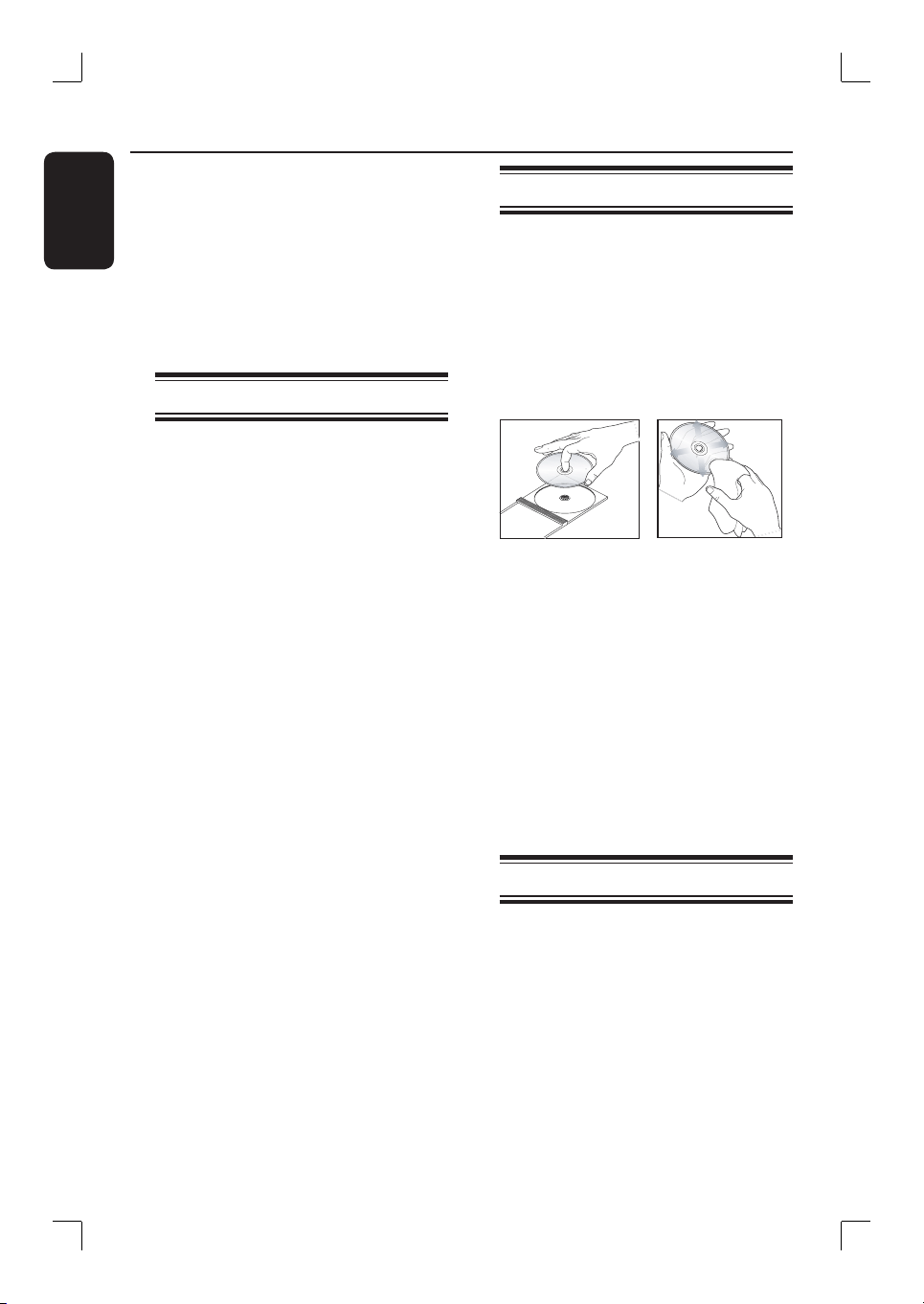
Cleaning discs
Some problems occur because the disc
inside the recorder is dirty (frozen picture,
sound disruptions, picture distortions). To
avoid these problems, discs should be
cleaned on a regular basis.
To clean a disc, use a micro bre cleaning
cloth and wipe the disc from the centre
to the edge in a straight line.
CAUTION!
Do not use solvents such as benzene,
thinner, commercially available cleaners,
or anti-static sprays intended for
analogue discs.
Since the optical unit (laser) of the
recorder operates at a higher power than
regular DVD or CD players, cleaning
CDs intended for DVD or CD players
may damage the optical unit (laser).
Therefore, refrain from using a cleaning
CD.
About recycling
These operating instructions have been
printed on non-polluting paper. This
electronic equipment contains a large
number of materials that can be recycled.
If you are disposing of an old machine,
please take it to a recycling centre. Please
observe the local regulations regarding
disposal of packaging materials, exhausted
batteries, and old equipment.
English
9
Introduction
Your Philips recorder allows you to
record the TV programmes or duplicate
camcorder recordings to a DVD±RW or
DVD±R and play pre-recorded DVDs.
The recordings you make on the
recorder will play on DVD players and
DVD-ROM drives. The DVD±R discs
have to be nalised before they can be
played back on other DVD players.
Before you start using this recorder,
complete the basic connections and
set-up in three easy steps.
Step 1: Basic recorder connections
Step 2: Optional connections for
other devices
Step 3: Basic installation and set-up
Please take time to read this user manual
before using your recorder. It contains
important information and notes
regarding the operations of the recorder.
Helpful Hints:
– If you have questions or if problems come
up during operation, please see the chapter
‘Troubleshooting’.
– If you need further assistance, please call
the customer support service for your
country. The corresponding telephone
numbers and email addresses are given in
the guarantee booklet.
– Refer to the type plate on the rear or
bottom of the product for identi cation and
supply ratings.
Accessories supplied
– Remote control and batteries
– SCART cable
– RF coaxial cable
– Quick Start Guide
Region codes
DVD lms are usually not released at the
same time in all regions of the world,
thus all DVD players are keyed to a
speci c region code.
This device will only play
Region 2 DVDs or DVDs
manufactured to be played in
all regions (‘ALL’). DVDs from
other regions cannot be
played on this recorder.
Copyright notice
The making of unauthorised copies of
copy-protected material, including
computer programmes, les, broadcasts
and sound recordings, may be an
infringement of copyrights and constitute
a criminal offence. This equipment should
not be used for such purposes.
Product Information
ALL
2
English
10
Remote Control
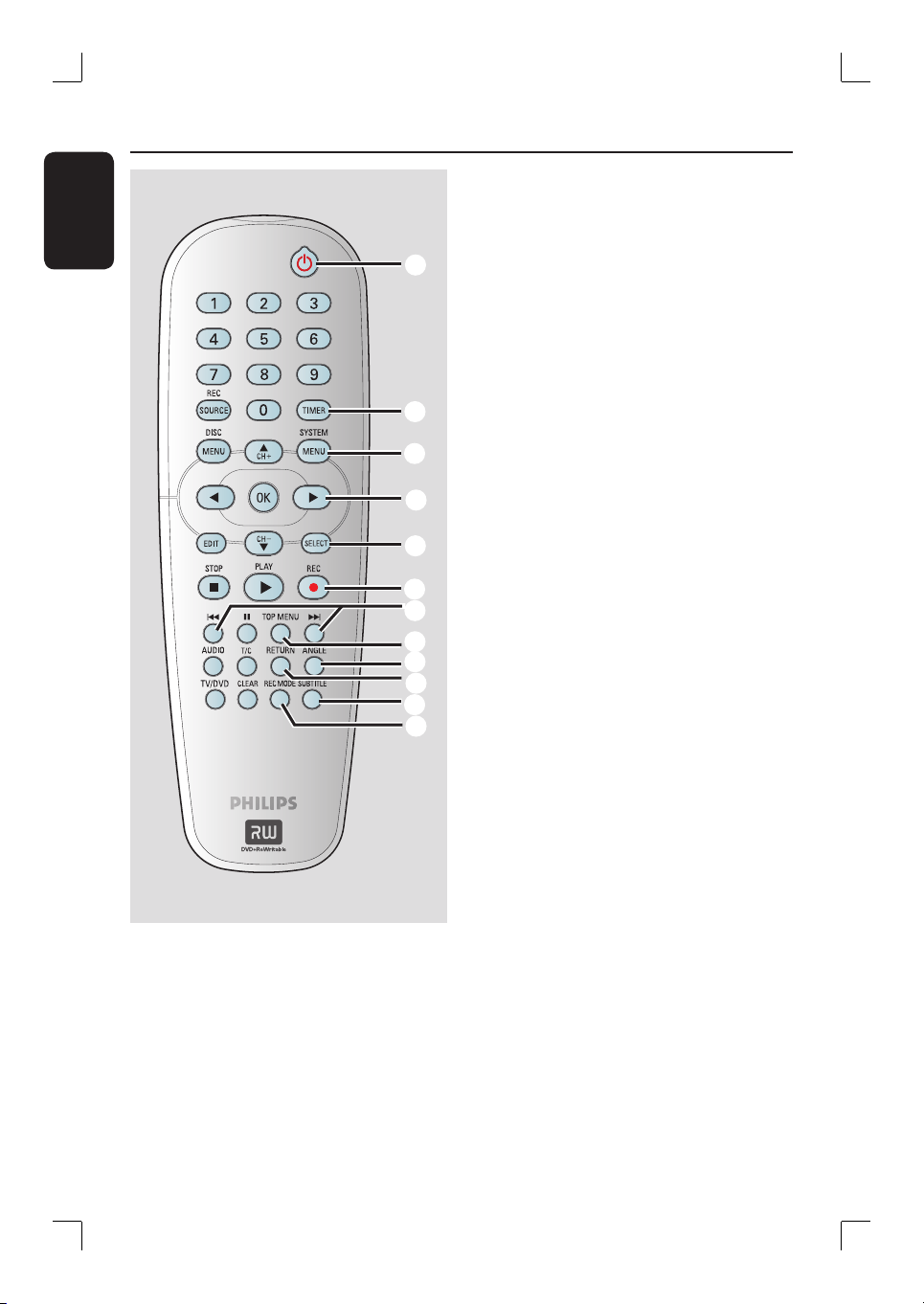
a
STANDBY-ON
2
– Turns on the recorder or switches to
standby mode.
b
TIMER
– Enters/exits the timer recording menu.
c
SYSTEM-MENU
– Enters/exits the system menu.
d
W X : Cursor keys for moving to the
left/right or making a forward/reverse
search.
ST : Cursor keys for moving up/down
or changing the recorder’s TV tuner
channel.
e
SELECT
– Selects a track/chapter/ le in the
programme menu.
f
REC
– Starts recording the current TV channel
or the current video input source.
– Press repeatedly to set up a One Touch
Recording at 30, 60 or 90 minutes
interval.
g
. >
– Skips to previous or next chapter/track.
– Press and hold to make a fast forward/
fast reverse search.
h
TOP MENU (For DVD±R/±RWs only)
– Enters the disc editing menu.
i
ANGLE
– Selects a DVD disc camera angle (if
available).
j
RETURN
– Returns to the previous menu of a video
CD (VCD) or some DVDs.
k
SUBTITLE
– Selects a DVD subtitle language.
l
REC MODE
– Toggles between recording modes :
HQ, SP, EP or SLP.
This determines the quality of the
recording and the amount/length of time
you can record on a DVD±R/±RW.
a
b
c
d
e
f
g
h
i
j
k
l
English
11
Remote Control (continued)
m
n
o
p
q
r
s
t
u
v
w
x
m
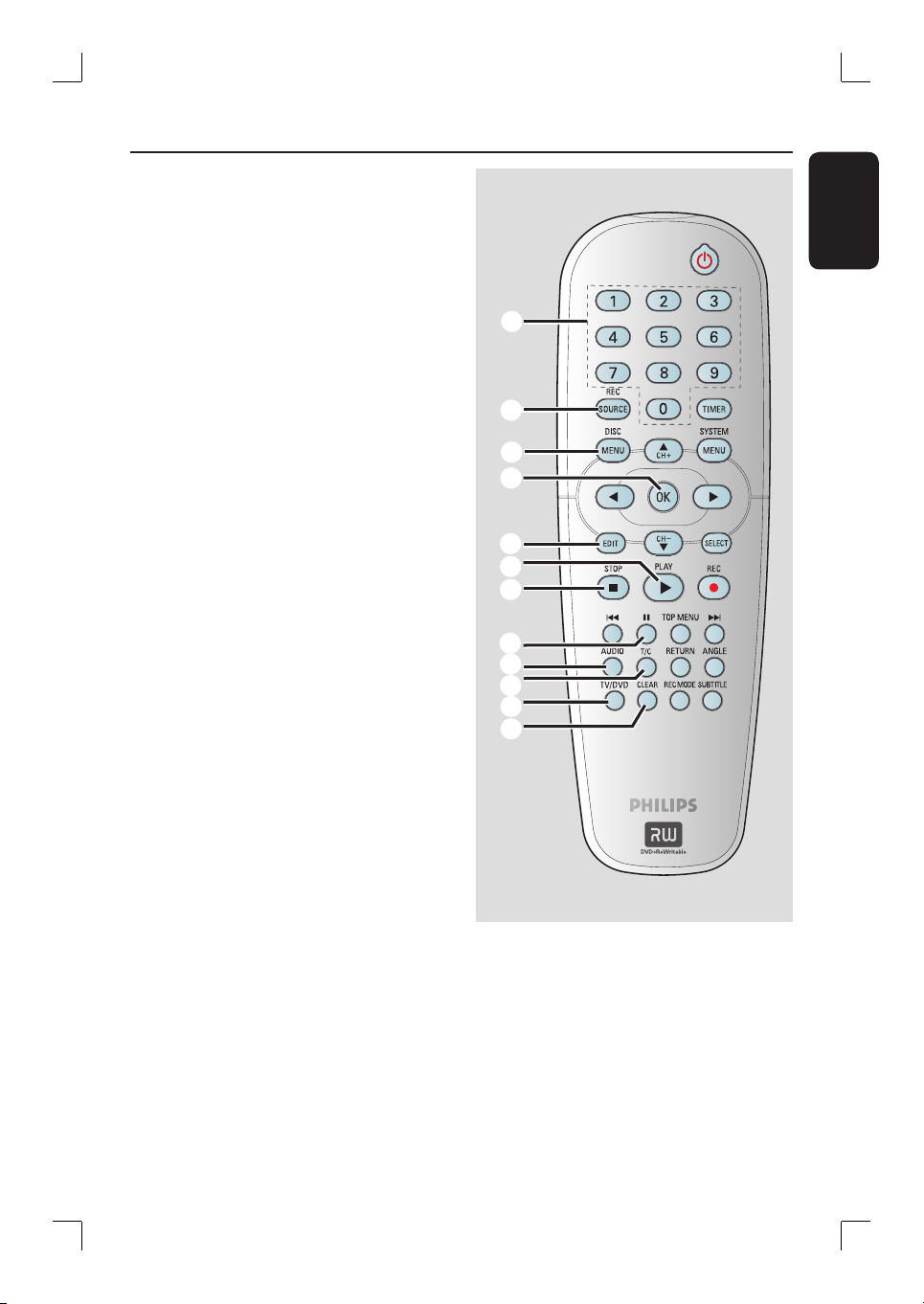
Numeric keypad
– Selects a chapter/track number to play.
– Selects the recorder’s preset TV tuner
channel.
n
REC SOURCE
– Selects the recorder’s input source.
o
DISC-MENU
– Access DVD disc menu or Index Picture
screen of a DVD±R/±RW.
– Access VCD disc menu when PBC is
turned on.
p
OK
– Stores/con rms an entry.
– Displays/removes the status bar.
q
EDIT (For DVD±R/±RWs only)
– Enters/exits the video editing menu.
r
PLAY
É
– Plays a disc.
s
STOP
– Stops playback/recording.
– Holding down the key will open and close
the disc tray.
t
Å
– Pauses the playback or recording.
– Press repeatedly to advance a paused
picture one frame at a time.
u
AUDIO
– Selects an audio language (DVD, VCD) or
an audio channel.
v
T/C (Title/Chapter)
– Enters/exits the T/C menu.
w
TV/DVD
– Switch between playback from the
additional devices (connected via EXT2
AUX I/O socket) and playback from the
recorder.
x
CLEAR
– Clears a track/chapter/ le in the
programme menu.
– Clears a timer entry.
English
12
Remote Control (continued)
Using the remote control
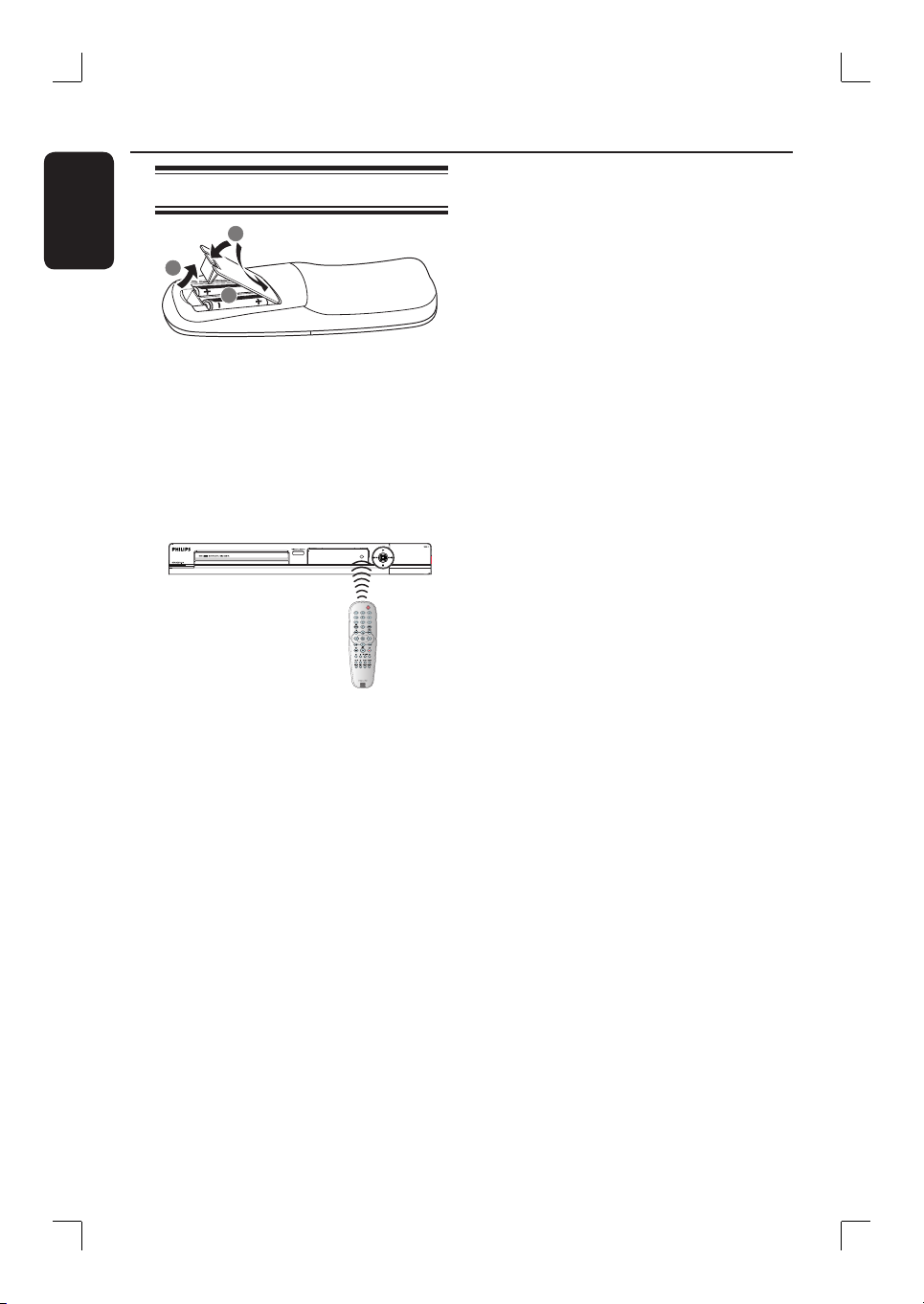
1
3
2
A
Open the battery compartment.
B
Insert two batteries of type R06 or AA,
following the indications (+-) inside
the compartment.
C
Close the cover.
D
Aim the remote control directly at the
remote sensor (IR) on the front panel.
E
Select the source you want to control by
pressing the REC SOURCE key on the
remote control.
F
Select the desired function (for example
., >).
CAUTION!
– Remove batteries if they are
exhausted or if the remote control
is not to be used for a long time.
– Do not mix batteries (old and new
or carbon and alkaline, etc).
– Batteries contain chemical
substances, so they should be
disposed of properly.
English
13
Main Unit
a b c d e f
i
h
g
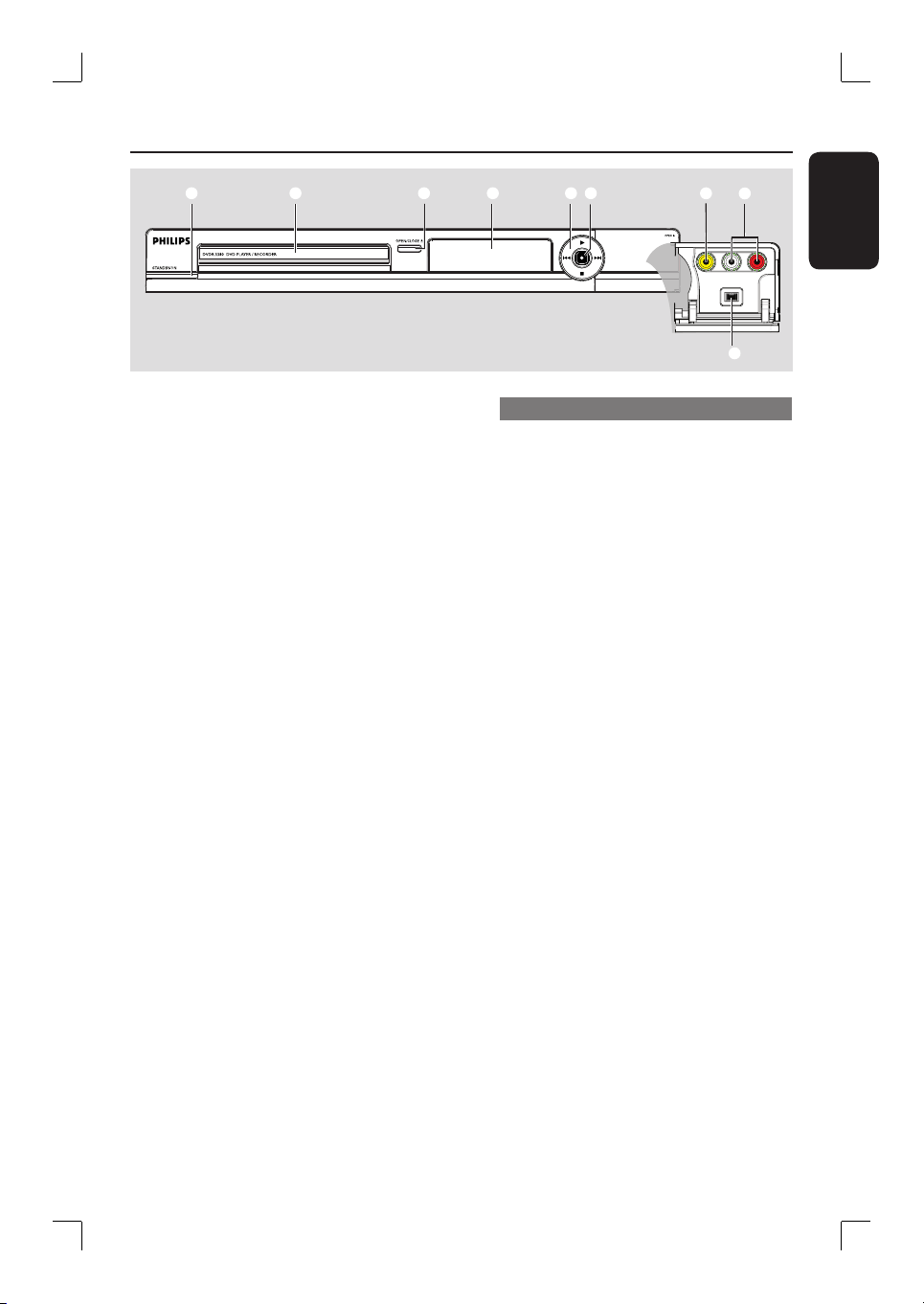
a
STANDBY-ON
– Turns on the recorder or switch to
standby mode.
b
Disc tray
c
OPEN/CLOSE
ç
– Opens/closes the disc tray.
d
System display panel
– Shows information about the current
status of the recorder.
e
.(PREV) / > (NEXT)
– Go to the previous/next chapter or track.
Press and hold to make a forward/
reverse search.
É
(PLAY)
– Plays a disc.
(STOP)
– Stops playback/recording.
f
(RECORD)
– Starts recording the current TV channel
or the current video input source.
– Press repeatedly to set up a One Touch
Recording at 30, 60 or 90 minutes
interval.
Sockets behind the ap
Flip down the door as indicated by the
OPEN X label at the right hand corner.
g
VIDEO
– Video input for camcorders or video
recorders.
Press REC SOURCE on the remote
control to select ‘CAM1’ in order to
view the input source.
h
L/R AUDIO
– Audio input for camcorders or video
recorders.
i
DV IN
– Input for digital camcorders or other
suitable devices using this connector.
Press REC SOURCE on the remote
control to select ‘DV’ in order to view
the input source.
English
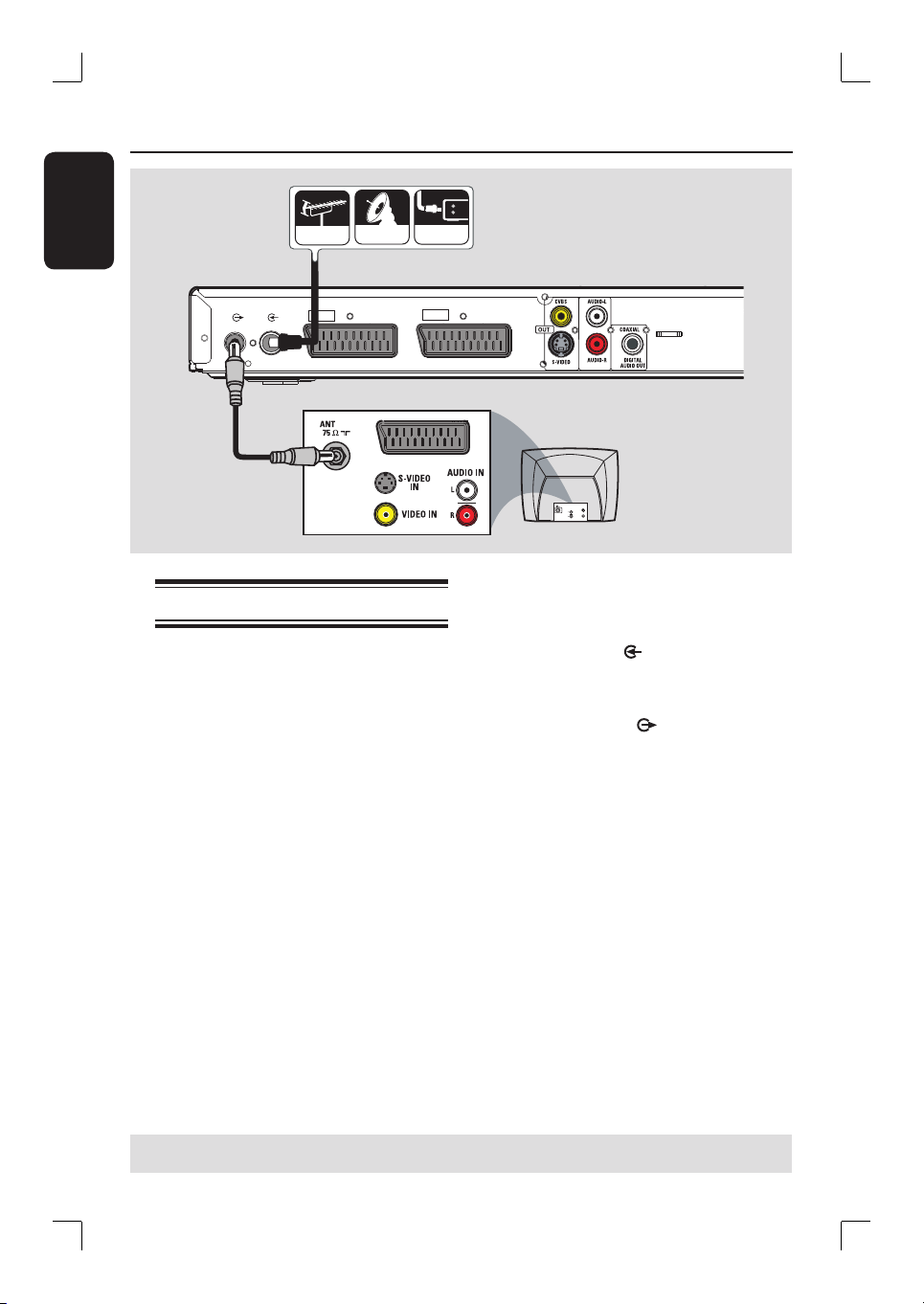
14
Step 1: Basic Recorder Connections
Connecting the aerial cables
These connections enable you to watch
and record TV programmes using the
recorder. If the aerial signal is
connected via a VCR, Cable Box or
Satellite Receiver, ensure that these
devices are turned on in order to watch
or record the cable programmes.
If you want to connect to a VCR
and/or Cable Box/Satellite Receiver,
see the chapter “Step 2 : Optional
Connections” for the complete
connections to your TV.
A
Connect the existing Aerial/Cable TV
signal (or from the Cable Box/Satellite
Receiver {RF OUT or TO TV}) to the
ANTENNA-IN
socket on the
recorder.
B
Use the supplied RF coaxial cable to
connect TV-OUT socket on the
recorder to the aerial input socket on
your TV (VHF/UHF RF IN).
Helpful Hint:
– Depending on how you have currently
connected your TV channel (directly from an
off-air aerial or Cable box or VCR), you will
have to disconnect some of the cables before
you make the above connection.
TIPS: Before making or changing any connections, make sure that all the devices are disconnected
from the power outlet.
ANTENNA-IN
TV-OUT
TO TV - I/O
EXT
1
AUX - I/O
EXT
2
CABLE
SATELLITE
ANTENNA
AU D IO
OUT
S-V ID E O
IN
VIDEO IN
TV
A
B
English
15
TIPS: Before making or changing any connections, make sure that all the devices are disconnected
from the power outlet.
Step 1: Basic Recorder Connections (continued)
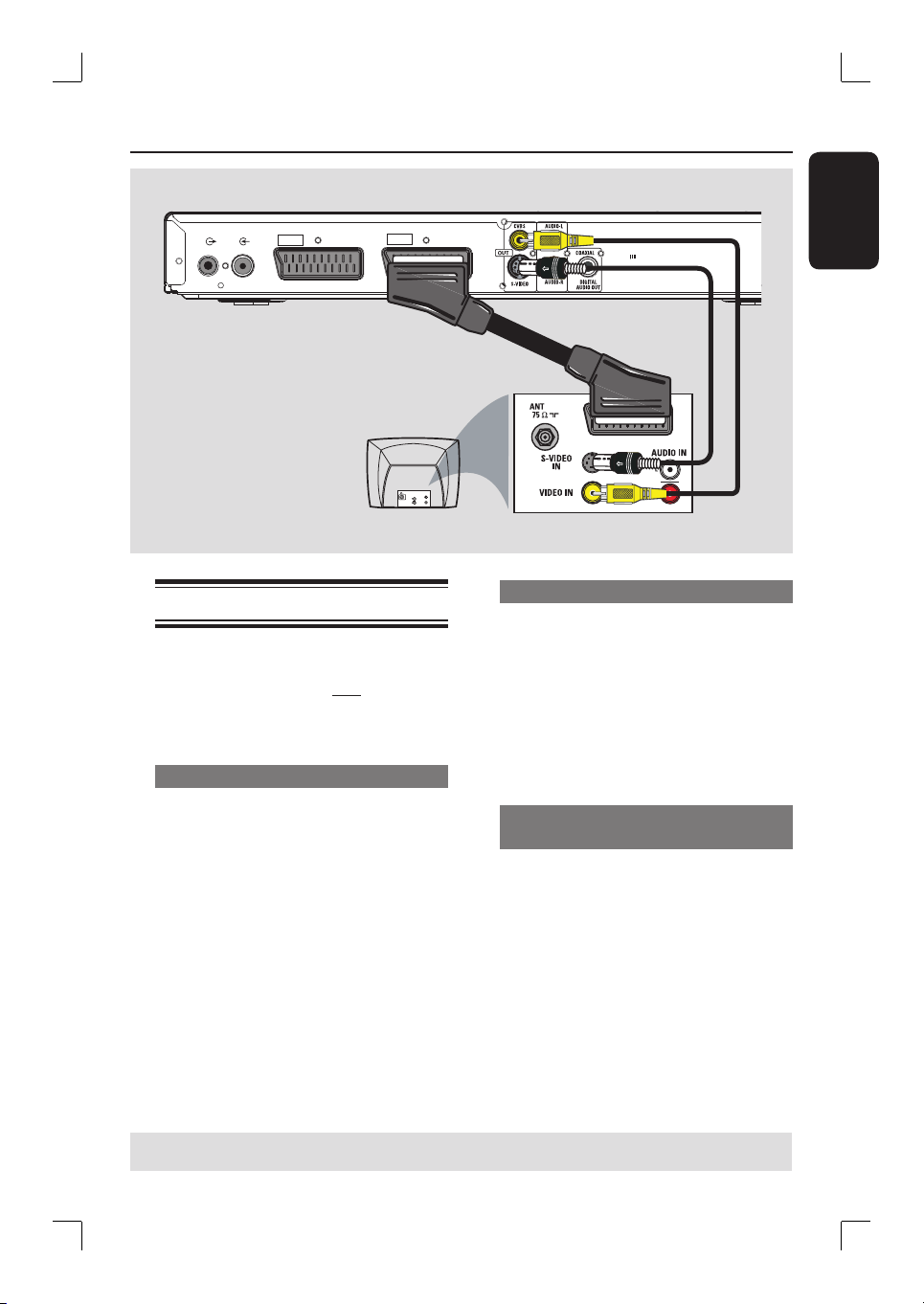
Connecting the video cable
This connection enables you to view the
disc playback from the recorder.
You only need to choose one of the
options below to make your video
connection.
Option 1: Using a SCART cable
Use the SCART cable to connect the
EXT1 TO TV-I/O socket on the
recorder to the corresponding SCART
input socket on the TV set.
Helpful Hints:
– If your TV set has several SCART sockets,
select the SCART socket that is suitable for
both video output and video input.
– If your TV set displays a selection for the
SCART socket, select ‘VCR’ as the source for
the SCART socket.
– The EXT2 AUX-I/O socket is intended
only for additional devices.
Option 2: Using an S-Video cable
Use an S-video cable (not supplied) to
connect the S-VIDEO OUT socket on
the recorder to the S-Video input socket
(or labelled as Y/C or S-VHS) on the TV
set.
Audio connection is required in order
to hear the sound, see the next section
“Connecting the audio cables”.
Option 3: Using a Video (CVBS)
cable
Use a composite video cable (yellow -
not supplied) to connect the CVBS
OUT socket on the recorder to the
video input socket (or labelled as A/V In,
Video In, Composite or Baseband) on the
TV set.
Audio connection is required in order
to hear the sound, see the next section
“Connecting the audio cables”.
ANTENNA-IN
TV-OUT
TO TV - I/O
EXT
1
AUX - I/O
EXT
2
AU D IO
OUT
S-V ID E O
IN
VIDEO IN
TV
Option 1
Option 2
Option 3
English
16
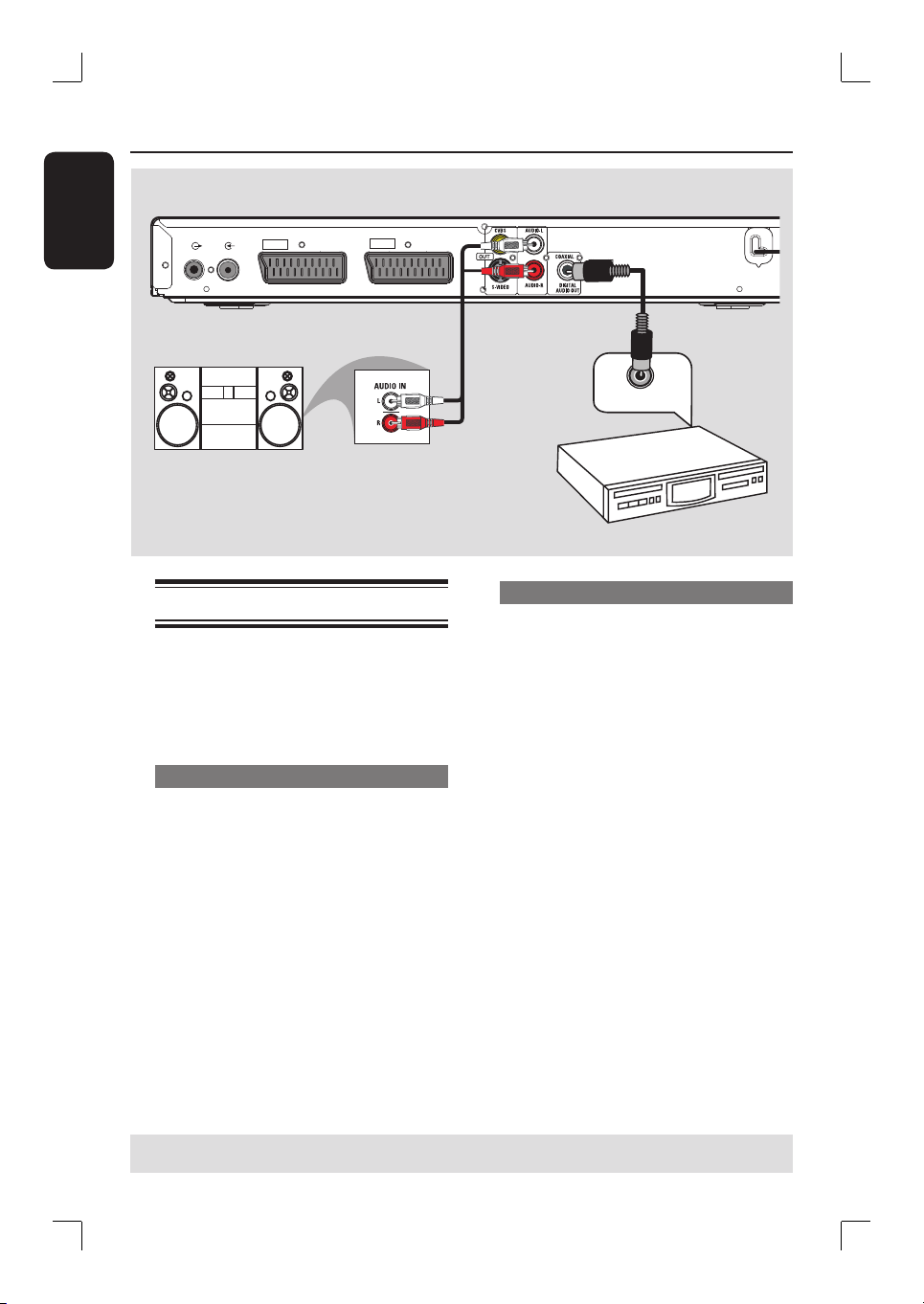
Connecting the audio cables
This connection enables you to listen to
the sound. This connection is not
required if the recorder is connected to
the TV using the SCART cable.
Option 1: Using an audio cable
You can connect the recorder to a
two channel stereo system or receiver in
order to enjoy the stereo sound system.
Use an audio cable (red/white ends) to
connect the AUDIO-L/-R sockets to
one of the following devices with the
same input sockets.
– a stereo system (for example, TV or
mini system).
– a receiver with two channel analogue
stereo.
Step 1: Basic Recorder Connections (continued)
Option 2: Using a coaxial cable
You can connect the recorder to an AV
ampli er/receiver with a digital
multichannel sound decoder in order to
enjoy multichannel surround sound.
Use a coaxial cable (not supplied).
Connect the COAXIAL (DIGITAL
AUDIO OUT) socket on the recorder
to the digital input of the receiver/
ampli er.
Before you start operating, set the digital
audio output settings accordingly (see the
chapter “DVD System Menu Options -
PLAYBACK settings). If the audio setting
does not match your stereo’s capabilities,
the stereo may produce a strong,
distorted sound or no sound at all.
TIPS: Before making or changing any connections, make sure that all the devices are disconnected
from the power outlet.
DIGITAL IN
ANTENNA-IN
TV-OUT
~
MAINS
COAXIAL
TO TV - I/O
EXT
1
AUX - I/O
EXT
2
S
T
E
R
E
O / TV
Option 2
Option 1
AV ampli er/
receiver
English
17
Step 2: Optional Connections
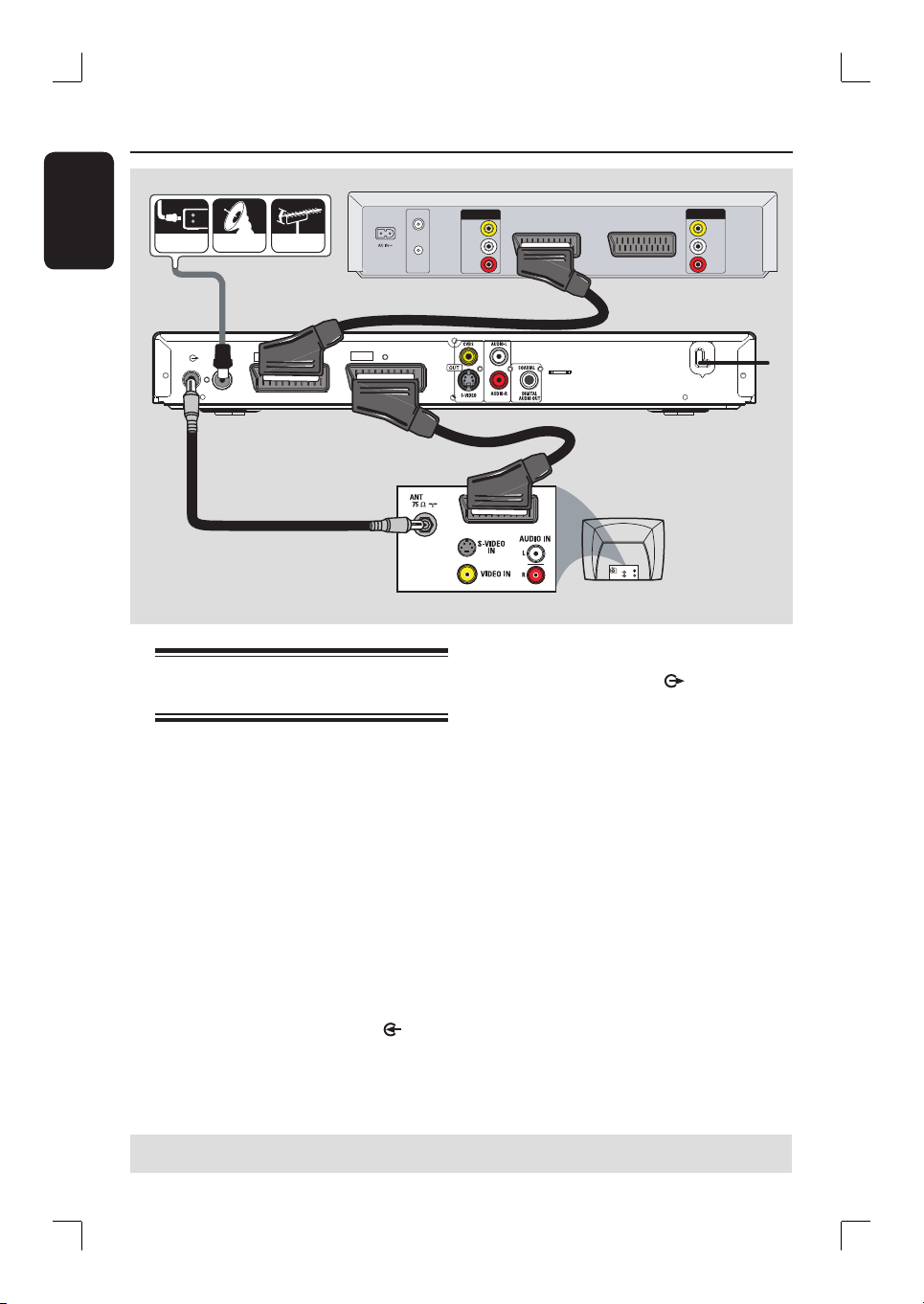
Connecting to a Cable Box or
Satellite Receiver
Option 1
If your Cable Box/Satellite Receiver
has only an aerial output socket
(RF OUT or TO TV),
see the section “Step 1: Basic Recorder
Connections – Connecting the aerial
cables” for the complete connections to
your TV.
Option 2 (see the above illustration)
If your Cable Box/Satellite Receiver
has a SCART output socket
A
Keep the existing aerial connection from
the Cable Box/Satellite Receiver to your
TV.
B
Use the SCART cable to connect the
EXT1 TO TV-I/O socket on the
recorder to the corresponding SCART
input socket on the TV.
C
Use another SCART cable to connect the
EXT2 AUX-I/O socket on the recorder
to the SCART output socket (or labelled
as TV OUT or TO TV) on the Cable
Box/Satellite Receiver.
To start playback, select the TV channel
directly on the Cable Box/Satellite
Receiver. To view the picture from a
connected external device, press the
TV/DVD key on the remote control.
TIPS: Before making or changing any connections, make sure that all the devices are disconnected
from the power outlet.
B
C
ANTENNA-IN
TV-OUT
~
MAINS
TO TV - I/O
EXT
1
AUX - I/O
EXT
2
AUD IO
OUT
S-VID E O
IN
VIDEO IN
TV
RF
S-VIDEO
OUT
IN
AUDIO
R L
VIDEO
TO TV
CABLE
SATELLITE
ANTENNA
Back of a Cable Box
or Satellite Receiver
(Example only)
A
English
18
TIPS: Before making or changing any connections, make sure that all the devices are disconnected
from the power outlet.
Step 2: Optional Connections (continued)
A
B
C
Back of a VCR
(Example only)
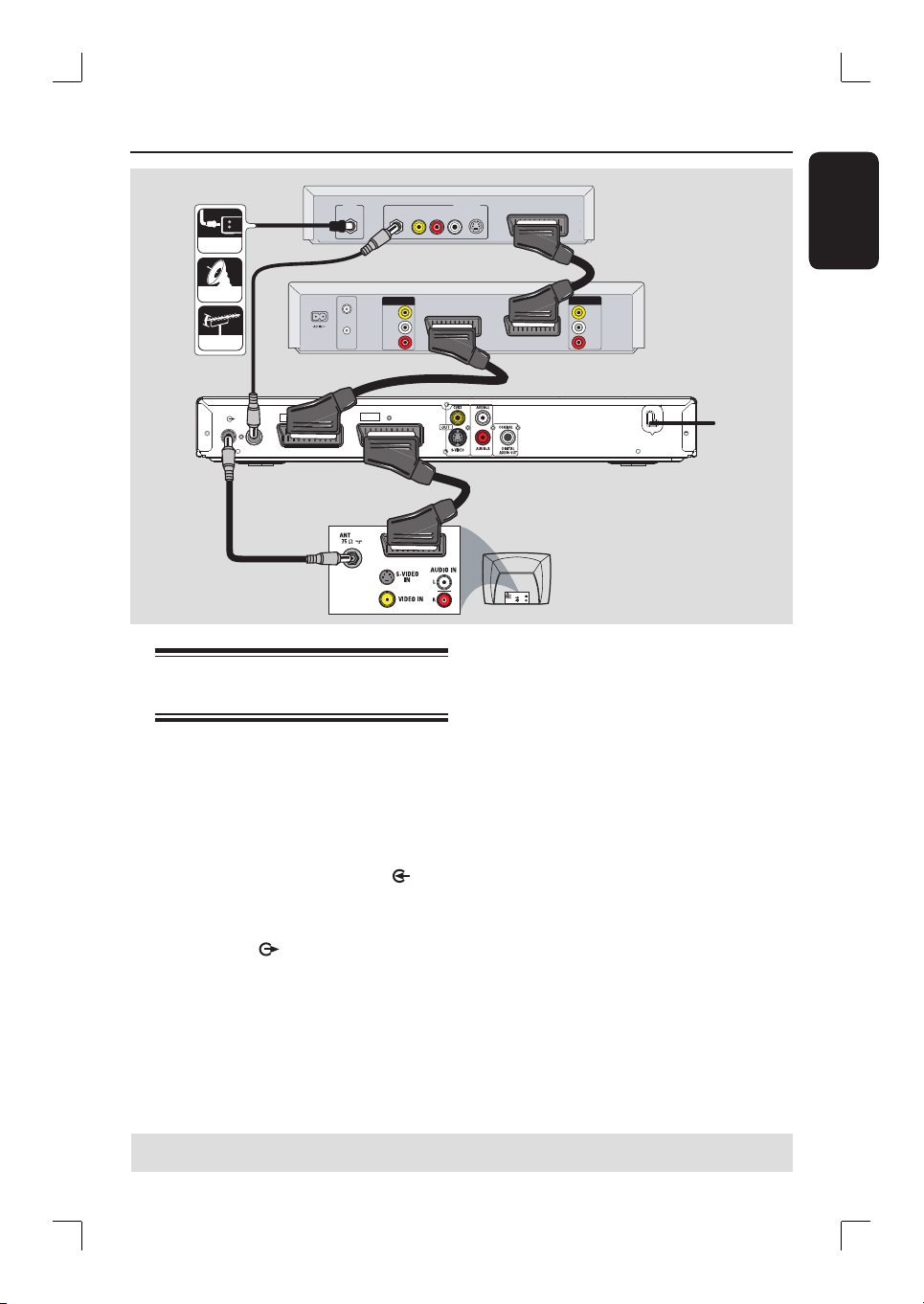
Connecting to a VCR or
other similar device
This connection enables you to record
from video tape to a DVD±R/±RW and
allows the VCR to be used for playback if
the recorder is turned off.
IMPORTANT!
Your new recorder can replace the
VCR for all your recording needs.
Just unplug all the connections to
your VCR.
A
Connect the existing Aerial/Satellite/
Cable TV signal (or from the Cable Box/
Satellite Receiver, labelled as RF OUT or
TO TV) to the ANTENNA-IN
socket on the recorder.
B
Use the supplied RF coaxial cable to
connect the TV-OUT
socket on the
recorder to the aerial input socket (or
labelled as VHF/UHF RF IN) on your TV.
C
Use the SCART cable to connect the
EXT1 TO TV-I/O socket on the
recorder to the corresponding SCART
input socket on the TV.
D
Use another SCART cable to connect the
EXT2 AUX-I/O socket on the recorder
to the SCART output socket (or labelled
as TV OUT or TO TV) on the VCR.
Helpful Hints:
– Most commercial video cassettes and
DVDs are copy-protected and therefore
cannot be recorded.
– Connect the recorder directly to the TV. If
there is a VCR or an additional device in
between, the picture quality may be poor
because of the copy protection system built
into this recorder.
ANTENNA-IN
TV-OUT
~
MAINS
TO TV - I/O
EXT
1
AUX - I/O
EXT2
AUD IO
OUT
S-VI D E O
IN
VIDEO IN
TV
VIDEO
IN
O
U
T
I
N
AUDIO
L
AUDIO
R
VIDEO
OUT
AUDIO
L
AUDIO
R
VHF/UHF
RF IN
VHF/UHF
RF OUT
TV OUT
TV IN
CABLE
SATELLITE
ANTENNA
D
English
19
ANTENNA-IN
TV-OUT
~
MAINS
TO TV - I/O
EXT
1
AUX - I/O
EXT
2
AUD IO
OUT
S-VID EO
IN
VIDEO IN
TV
VIDEO
IN
O
U
T
I
N
AUDIO
L
AUDIO
R
VIDEO
OUT
AUDIO
L
AUDIO
R
VHF/UHF
RF IN
VHF/UHF
RF OUT
TV OUT
TV IN
RF
S-VIDEO
OUT
IN
AUDIO
R L
VIDEO
TO TV
CABLE
SATELLITE
ANTENNA
Step 2: Optional Connections (continued)
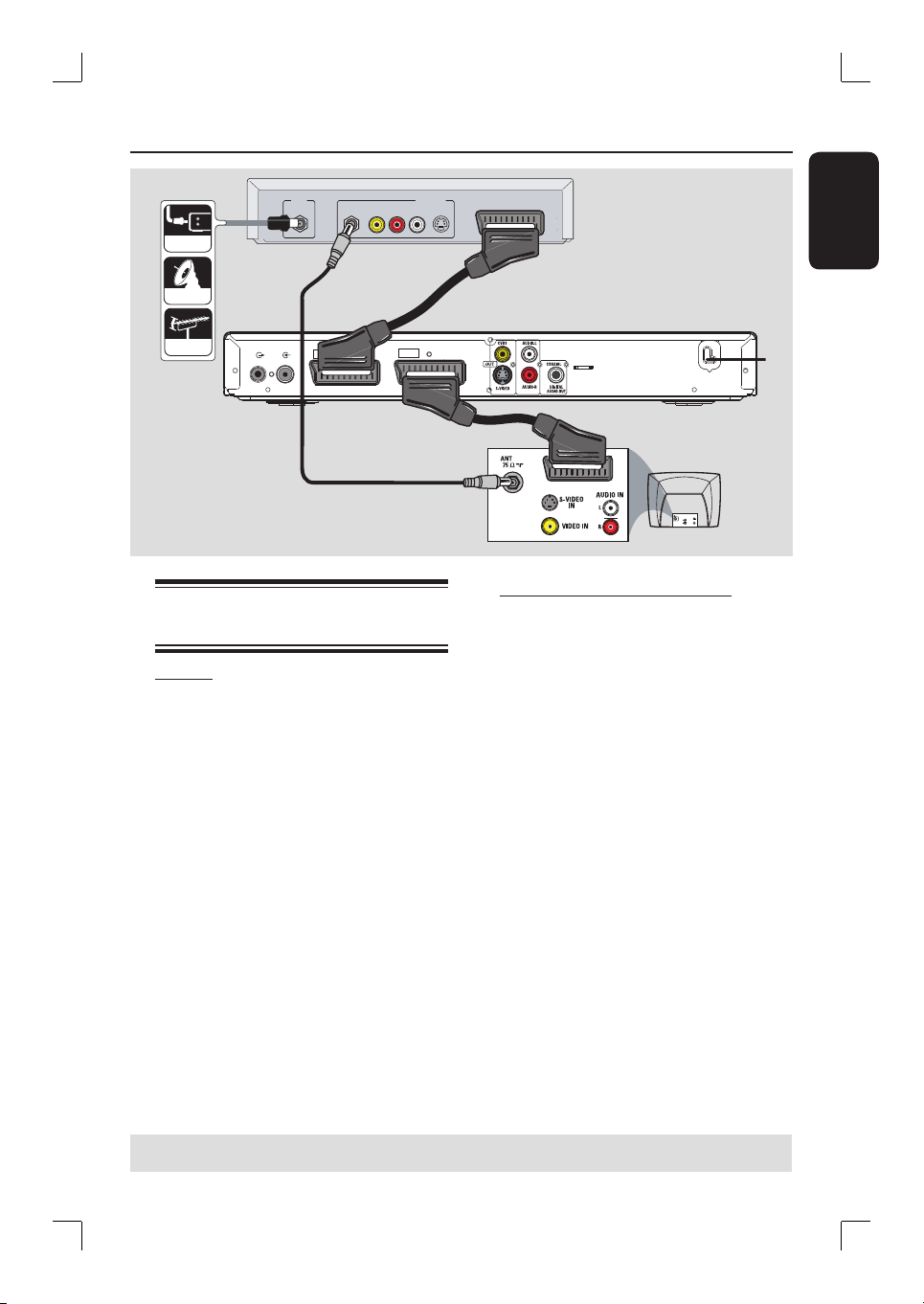
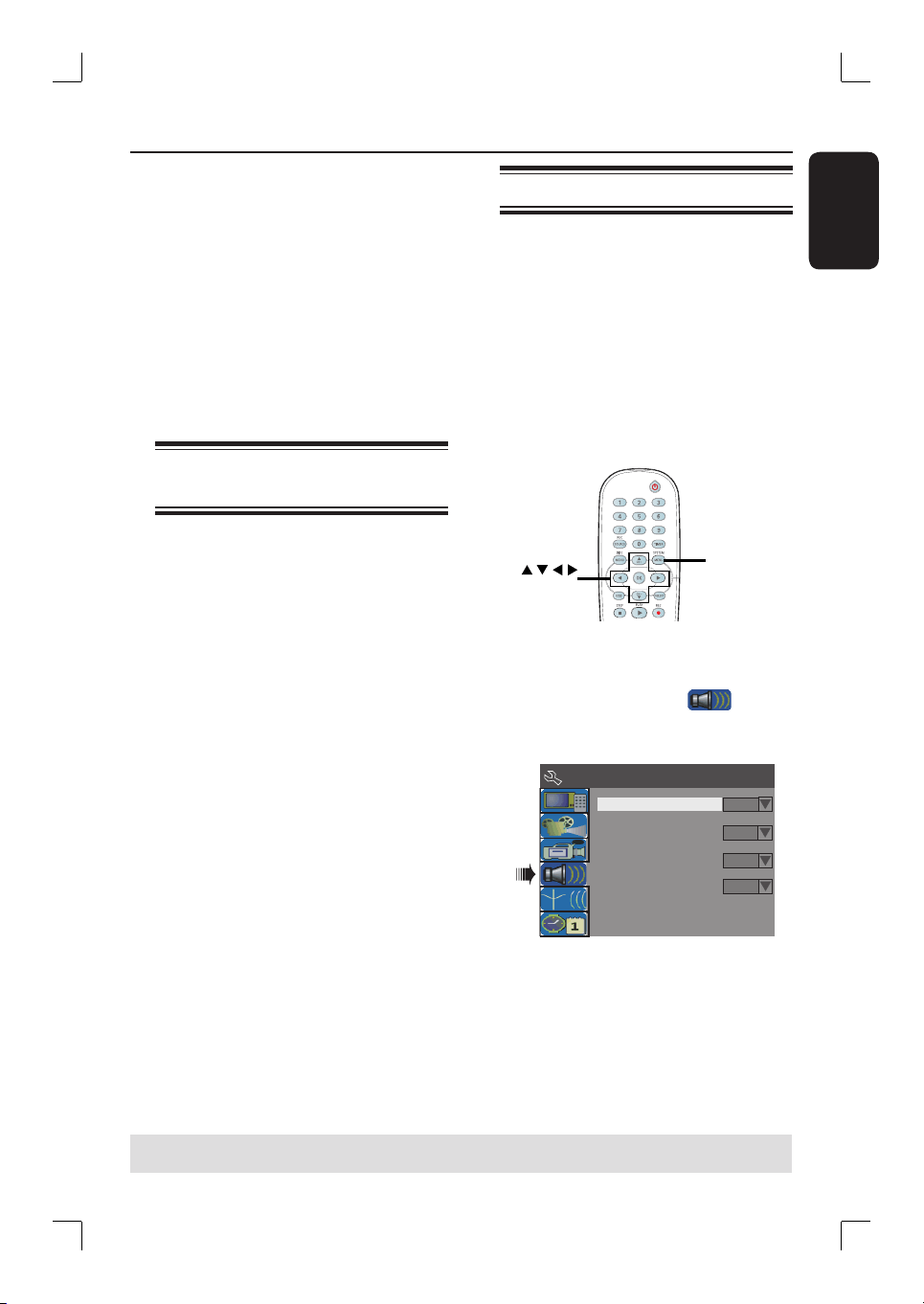
Connecting to a VCR and
Cable Box/Satellite Receiver
A
Connect the Aerial/Cable TV signal to
the aerial input (RF IN) socket on the
Cable Box/Satellite Receiver.
B
Use the supplied RF coaxial cable to
connect the aerial output (RF OUT)
socket on the Cable Box/Satellite
Receiver to the ANTENNA-IN
socket on the recorder.
C
Use another RF coaxial cable to connect
the TV-OUT
socket on the recorder
to the aerial input socket on the TV.
D
Use the SCART cable to connect the
EXT1 TO TV-I/O socket on the
recorder to the corresponding SCART
input socket on the TV.
E
Use another SCART cable to connect the
EXT2 AUX-I/O socket on the recorder
to the SCART output socket (or labelled
as TV OUT or TO TV) on the VCR.
F
Use another SCART cable to connect the
SCART input (TV IN) socket on the VCR
to the SCART output socket (or labelled
as TV OUT or TO TV) on the Cable
Box/Satellite Receiver.
TIPS: Before making or changing any connections, make sure that all the devices are disconnected
from the power outlet.
C
A
B
D
F
Back of aVCR
(Example only)
E
Back of a Cable Box
or Satellite Receiver
(Example only)
B

English
20
TIPS: Before making or changing any connections, make sure that all the devices are disconnected
from the power outlet.
Step 2: Optional Connections (continued)
Connecting a camcorder to
the front sockets
You can use the front sockets to copy
camcorder recordings. These sockets are
located behind the ap on the right and
provides convenient connections for a
camcorder.
Option 1: Using the DV IN socket
Use this connection if you have a Digital
Video or Digital 8 camcorder. The DV
socket conforms to the i.LINK standard.
Use an i.LINK 4-pin cable (not supplied)
to connect the DV IN socket on the
recorder to the appropriate DV OUT
socket on the camcorder.
Before you start operating, press REC
SOURCE on the remote control
repeatedly to select ‘DV’ as the input
channel. See the chapter “Recording” for
details.
Helpful Hints:
– The DV IN socket does not support a
connection to a Personal Computer.
– It is not possible to record from the
recorder to your camcorder via the DV IN
socket on your recorder.
Option 2: Using the VIDEO In
socket
Use the VIDEO connection if your
camcorder has only a single video output
(Composite Video, CVBS).
A
Connect the VIDEO(CAM1) socket on
the front panel of the recorder to the
corresponding S-VHS or Video output
socket on the camcorder.
B
Use an audio cable (red/white ends) to
connect the AUDIO L/R sockets on the
front panel of the recorder to the audio
output sockets on the camcorder.
Before you start operating, press REC
SOURCE on the remote control
repeatedly to select ‘CAM1’ as the input
channel, depending on your connections.
See the chapter “Recording” for details.
DV OUT
English
21
Step 3: Installation and Setup
Before you start...
When you complete the
connections and switch on the
recorder for the rst time, it is
advisable that you make several
basic settings.
Please see the following pages on using
the system menu features to programme
TV channels, menu language and system
clock settings. This will optimise the
performance of this recorder.
Finding the correct viewing
channel
A
Press STANDBY-ON on the recorder
to switch it on.
B
Switch on the TV set and set it to the
correct video-in channel. You should see
the blue DVD background screen.
You may go to Channel 1 on your TV,
then press the Channel Down button on
your TV’s remote control until you see
the Video In channel.
You may press ° button repeatedly
on your TV’s remote control.
Usually this channel is between the
lowest and highest channels and may be
called FRONT, A/V IN, VIDEO. See your
TV manual for more details.
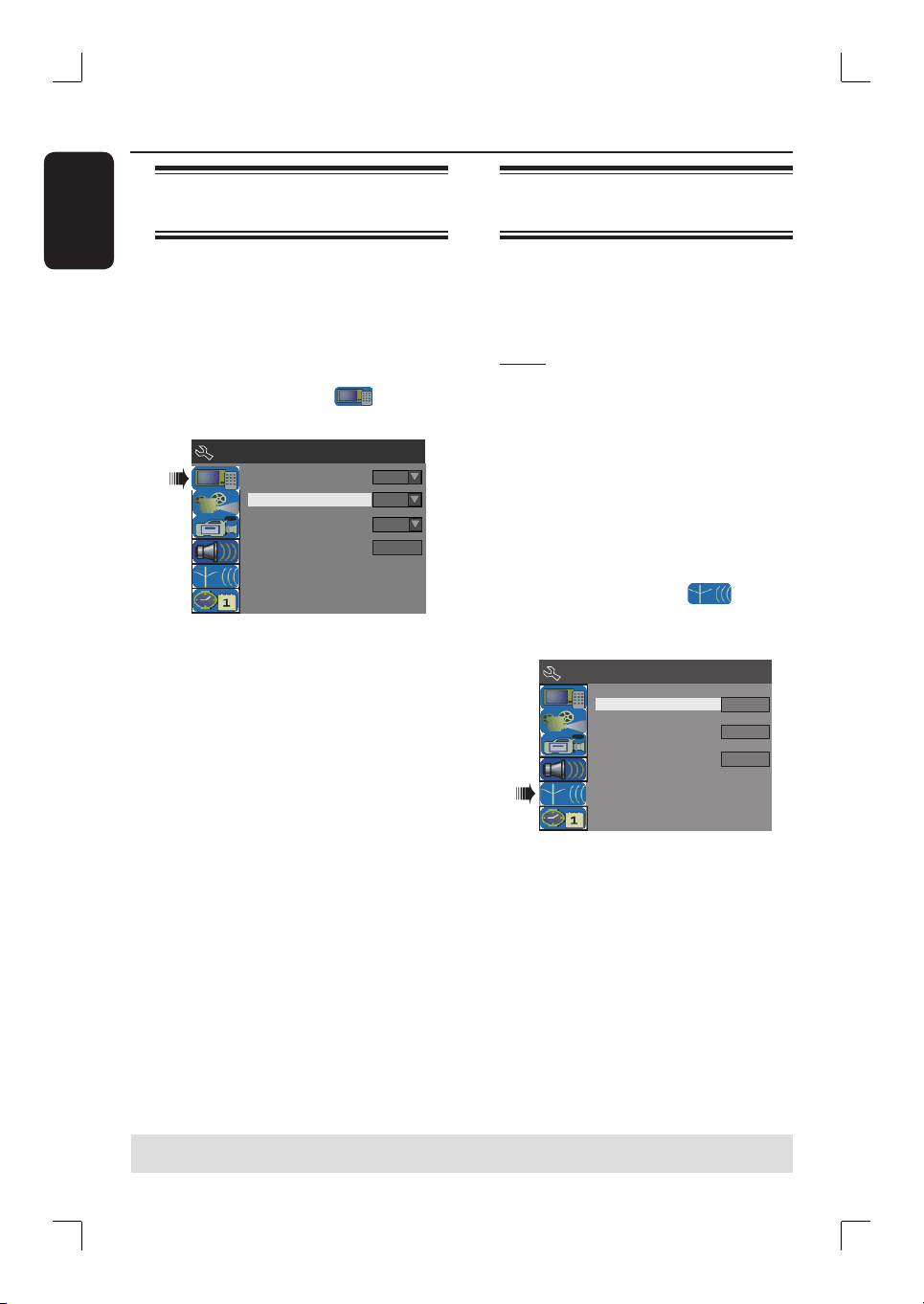
Setting the OSD language
Select the menu language for this
recorder’s on-screen display. The
language options are different depending
on your country or region. It may not
correspond to the illustrations shown in
the user manual.
The menu language (on-screen display)
for the system will remain as you set it.
Language settings can only be changed
when there is no disc in the disc tray.
SYSTEM
MENU
OK
A
Press SYSTEM-MENU.
The system menu appears.
B
Use ST keys to highlight
{ System Menu - Language } and
press X to access the menu.
Default Disc Menu Language
Default Subtitle Language
Off
On Screen Display Language
Default Audio Language
English
English
System Menu - Language
English
C
Use ST keys to highlight { On Screen
Display Language } and press OK to
access its options.
D
Use ST keys to highlight the desired
language and press OK to con rm.
TIPS: Press X to go access the options of an item in the menu.
Press SYSTEM-MENU to exit the menu.
English
22
Step 3: Installation and Setup (continued)
Select the country of your
residence
Select the country of your area for auto
channel tuning.
A
Press SYSTEM-MENU on the remote
control.
The system menu appears on the TV.
B
Use ST keys to highlight
{ System Menu - General } and press X.
Video Output Format
Restore Factory Settings
UK
PAL
OK
Screen Saver
On
System Menu - General
Country
C
Use ST keys to highlight { Country }
and press OK.
D
Use ST keys to select the country of
your residence and press OK to con rm.
Setting your TV channel
programmes
Before the recorder can start recording
the TV channel programmes, you need to
search for the available TV channels and
store them in the recorder.
Note: Make sure you have successfully
made all the required connections to the
recorder, the TV and Satellite Receiver/
Cable Box (if any) and switched them on.
Tuner settings can only be changed
when there is no disc in the disc tray.
A
Press SYSTEM-MENU on the remote
control.
The system menu appears on the TV.
B
Use ST keys to highlight
{ System Menu - Channel Setup }
and press X.
System Menu - Channel Setup
Modify Channel Information
Sort Channels
Channel Search
Search
Edit
Sort
C
Use ST keys to highlight { Channel
Search } and press OK.
The automatic TV channel search
starts. This process may take several
minutes. Once complete, the total
number of channels found appears on the
TV.
To modify or sort the TV channels,
see the chapter “DVD System Menu
Options – CHANNEL SETUP
settings.”
TIPS: Press X to go access the options of an item in the menu.
Press SYSTEM-MENU to exit the menu.
English
23
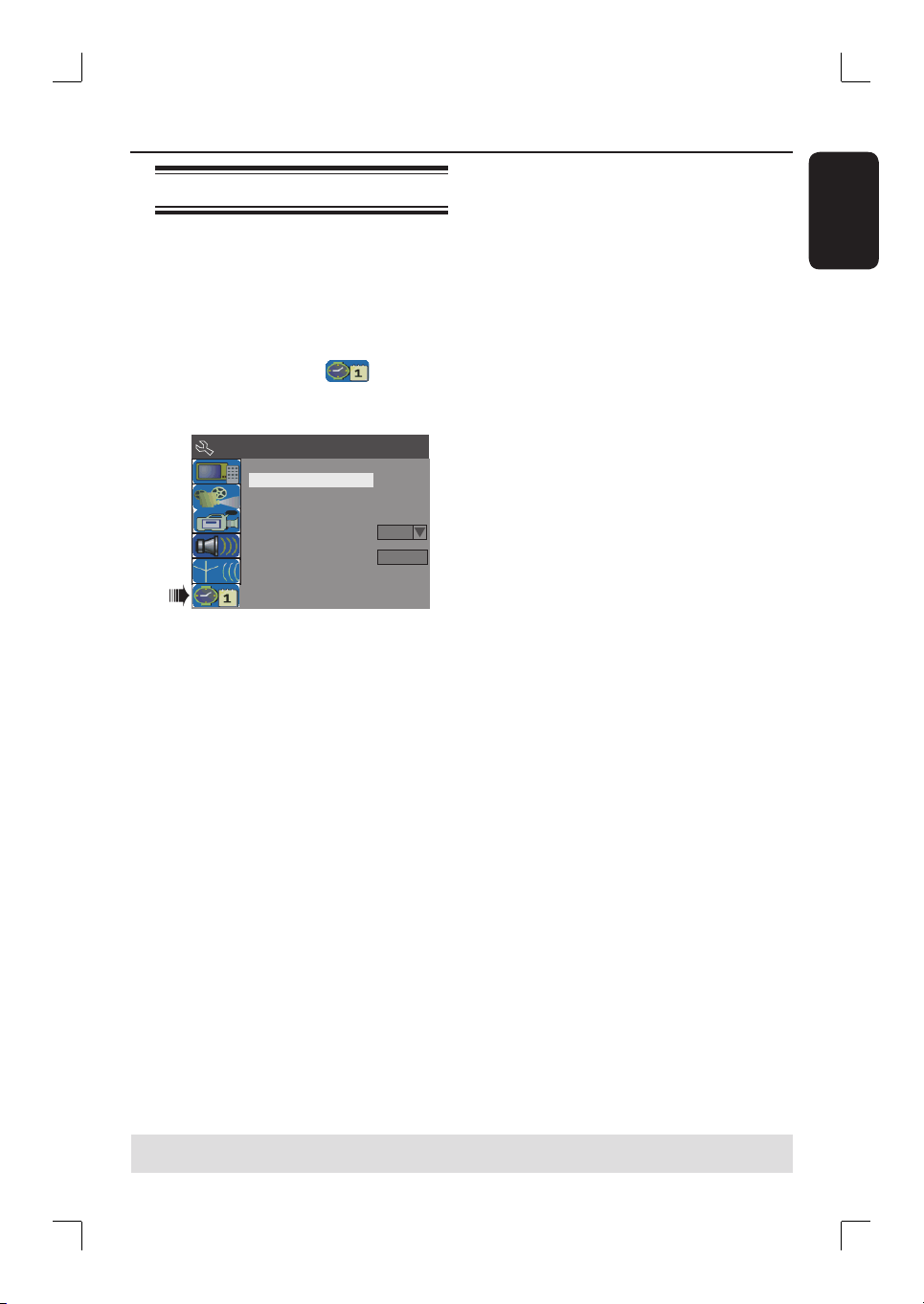
Setting the date & time
If the recorder has not set the time
and date correctly, set the clock manually
by following the steps below.
A
Press SYSTEM-MENU.
The system menu appears.
B
Use ST keys to select
{ System Menu - Clock } and press X
to con rm.
System Menu -
Clock
Time(hh:mm:ss)
Date(dd/mm/yy)
31/01/06
10 : 33 : 57
Date-Time Setting
OKShow DivX registration code:
Auto
C
Use ST keys to highlight
{ Date (dd/mm/yy) } and press OK.
D
Use ST keys to change the numbers
and use W X keys to select different
entry elds. Press OK to con rm.
Alternatively, you can key in the numbers
using the numeric keypad 0-9 on the
remote control.
E
To con rm all changes, press OK.
F
Move to { Time (hh:mm:ss) } and
repeat step
D
~
E
.
TIPS: Press X to go access the options of an item in the menu.
Press SYSTEM-MENU to exit the menu.
Step 3: Installation and Setup (continued)
English
24
Recording
Discs for recording
Several different formats of DVD
recordable discs can be used with this
recorder:
DVD±RW (DVD Rewritable)
– Discs that are rewritable can be
used for multiple recordings once
the existing data has been erased.
DVD±R (DVD Recordable)
– Discs can only be used for a single
recording. Each new recording is always
added at the end of all previous
recordings as existing recordings cannot
be overwritten.
– Editing can be made on any DVD±R
discs as long as they have not been
nalised. It is also possible to create
additional chapter markers.
– To play a DVD±R on other DVD
player, it must be nalised (See the
chapter “Editing/ Finalising Recording –
Playing your recordings (DVD±R) on
other DVD players”). After this is done,
no more data can be added to the disc.
Supported disc types and media
speeds
Disc
Media speeds
DVD+R 1x - 16x
DVD+RW 2.4 x - 4x
DVD-R 1x - 16x
DVD-RW 2x - 4x
IMPORTANT!
Unrecordable pictures
Television programmes, lms, video tapes,
discs, and other materials may be
copy-protected and therefore cannot be
recorded on this recorder.
Recording settings
The default recording settings allow you
to set the auto chapter markers,
preferred recording input source and
recording mode. Any changes made using
the remote control will only apply to the
current recording settings. The default
recording settings will remain unchanged
for the next recording.
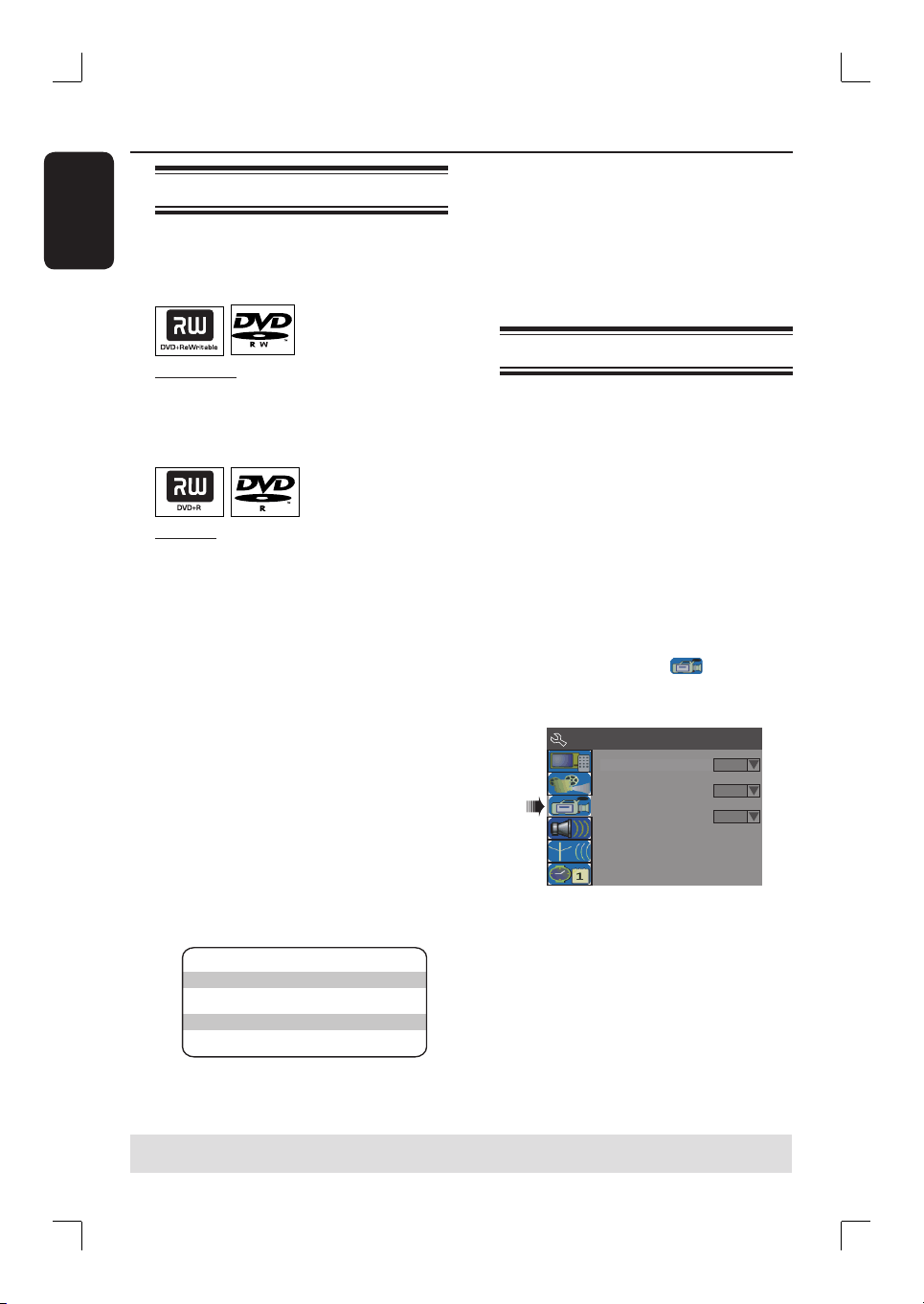
A
Press SYSTEM-MENU on the remote
control.
The system menu appears on the TV.
B
Use ST keys to select
{ System
Menu - Record } and press X to
con rm.
System Menu - Record
Default Recording Source
Default Recording Mode
Tuner
SP
Auto Chapter Marker
On
C
Use ST keys to select the setting you
wish to change and press OK to con rm.
Instructions and explanation of the
options are provided in the following
pages.
D
To exit, press SYSTEM-MENU.
TIPS: Press W to go back to previous menu item. Press SYSTEM MENU to exit the menu item.
English
25
Recording (continued)
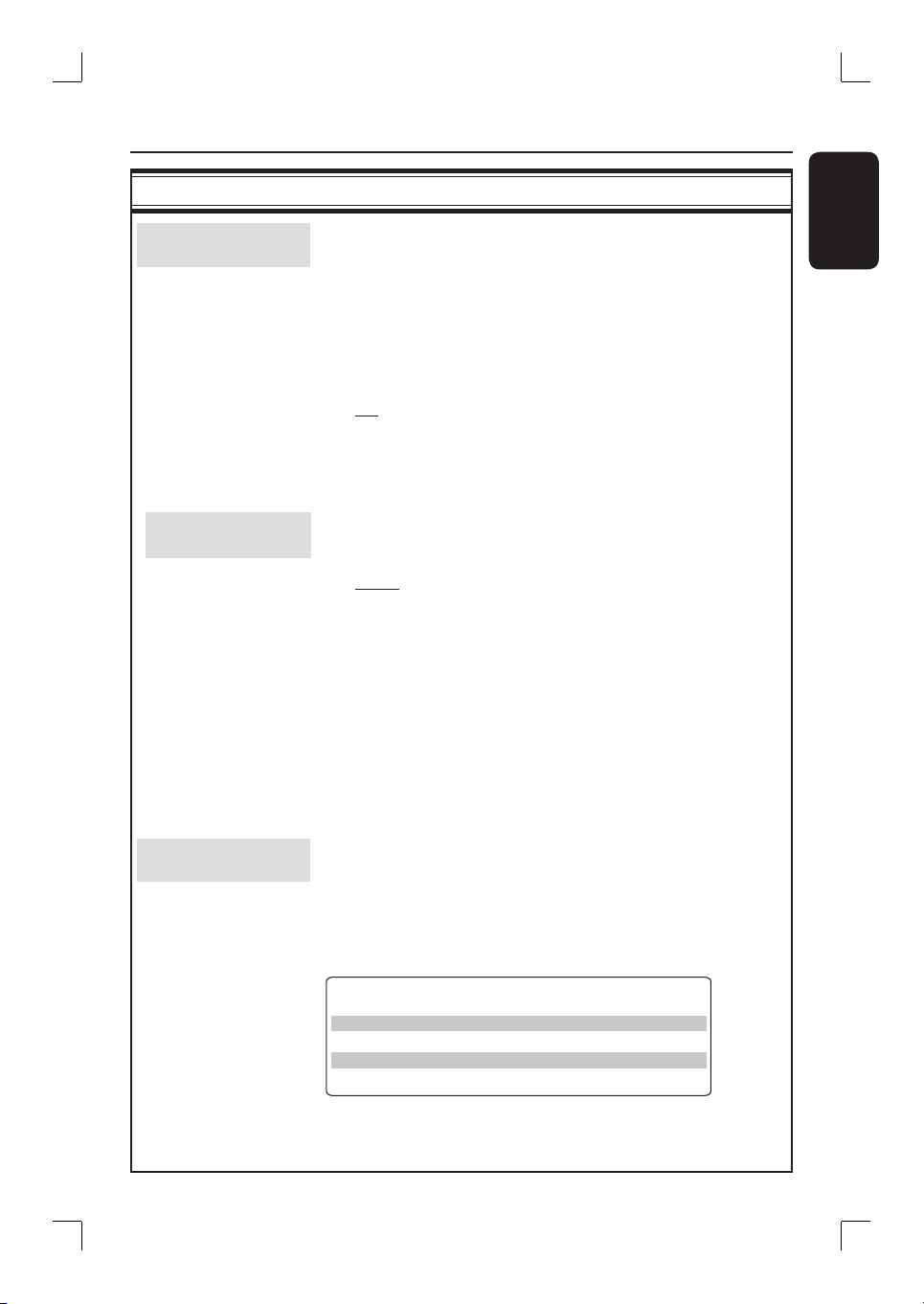
RECORD settings (underlined options are the factory default settings)
Auto Chapter Automatically insert chapter markers within a title during
Marker
recording. This helps you to access speci c points on the
recorded disc as you would choose a chapter on other DVDs.
This allows you access to speci c points on the recording.
1) Use ST keys to select one of the options:
{ Off } – Disable this feature.
{ On } – Chapter markers will automatically be inserted
within the title during recording at every 5
minutes interval.
2) Press OK to con rm your selection.
Default Recording
Source
De ne your preferred source of recording.
1) Use ST keys to select one of the options:
{ Tuner } – Input source from TV programmes.
{ CAM1 } – Input source from the device connected to the
VIDEO and AUDIO L/R sockets on the front
panel.
{ DV } – Input source from the device connected to DV
IN socket on the front panel.
{ EXT 1 } – Input source from the device connected to the
EXT1 TO TV-I/O SCART socket on the back
panel.
{ EXT 2 } – Input source from the device connected to the
EXT2 AUX-I/O SCART socket on the back
panel.
2) Press OK to con rm your selection.
Default Recording De ne your preferred mode of recording.
Mode
This function can also be accessed via the REC MODE on the
remote control.
1) Use ST keys to select one of the options:
Record
Mode
HQ
SP
EP
SLP
Picture Quality
High quality
DVD quality-Standard Play
VHS quality-Extended Play
VHS quality-Super Long Play
Maximum Recording
Time per Disc
1 hour
2 hours
4 hours
6 hours
2) Press OK to con rm your selection.
English
26
Recording (continued)
TIPS: Press W to go back to previous menu item.
Press SYSTEM MENU to exit the menu item.
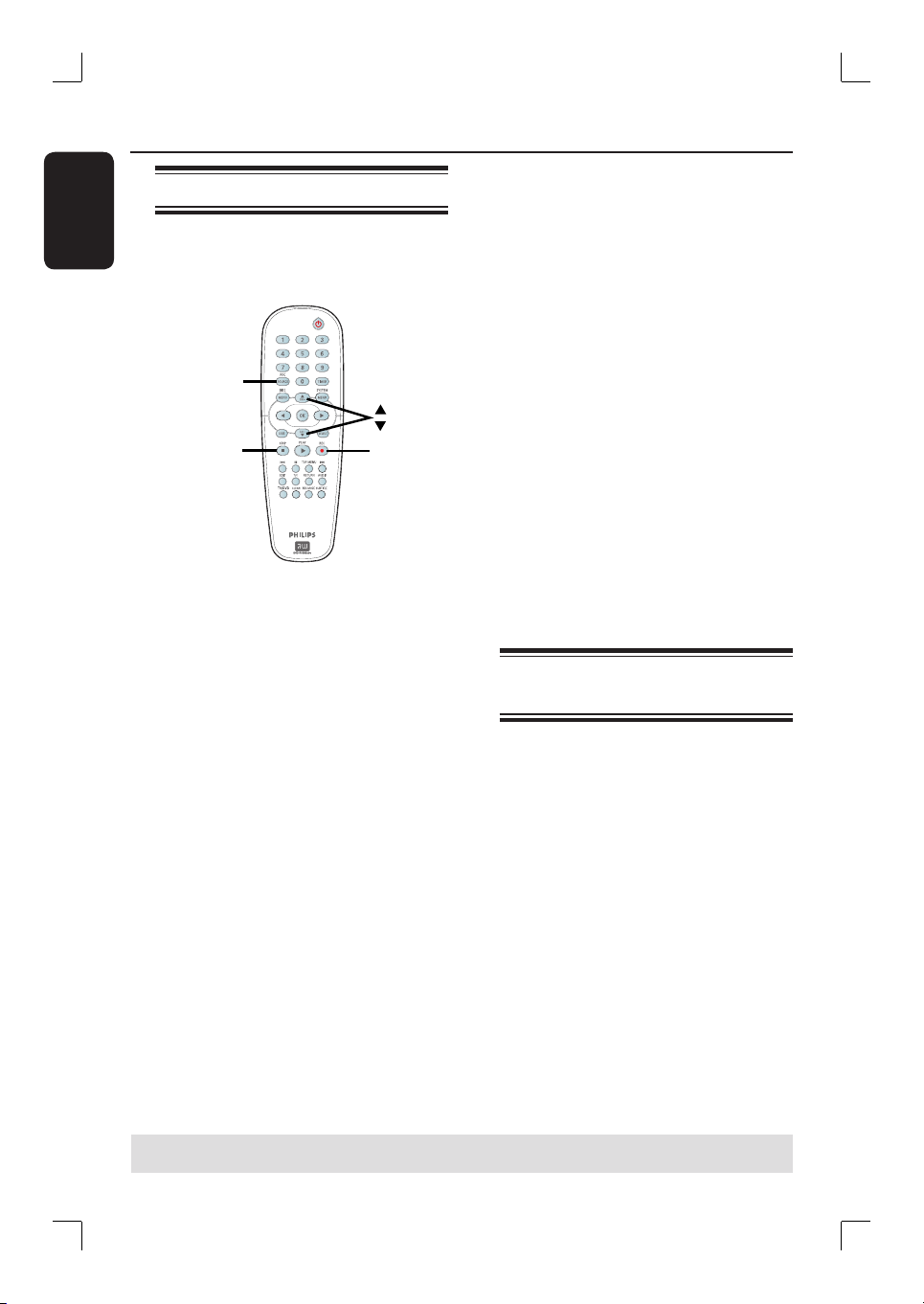
Manual recording
Use this feature to start recording
immediately (e.g., to record a TV show
already in progress).
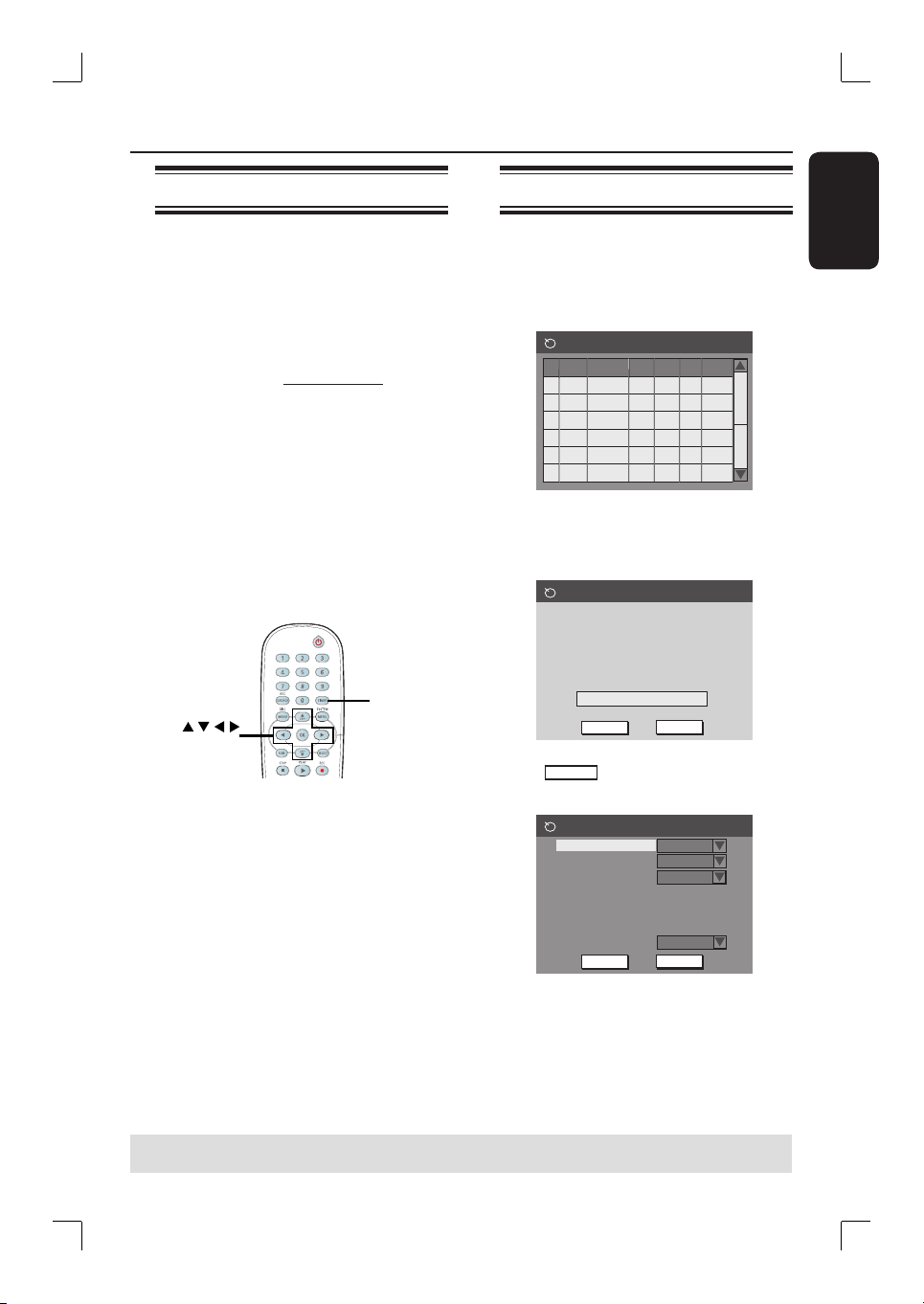
REC
SOURCE
STOP
REC
A
Switch on the TV set. Select the correct
Video In channel on the TV.
B
Insert a DVD±R/±RW into the recorder.
C
Press REC SOURCE on the remote
control to select { Tuner }, then use
ST keys to select the TV channel you
wish to record.
To record from an external device,
press REC SOURCE repeatedly to
select the correct input channel that
matches the socket which is connected
to the recorder.
{ CAM1 }
Input source from the device connected
to the CAM1 and AUDIO L/R sockets on
the front panel.
{ DV }
Input source from the device connected
to DV IN socket on the front panel.
{ EXT 1 }
Input source from the device connected
to the EXT1 TO TV-I/O SCART socket
on the back panel.
{ EXT 2 }
Input source from the device connected
to the EXT2 AUX-I/O SCART socket on
the back panel.
D
Press REC
to start recording.
The recording will automatically start
after the last recording on the
DVD±R/±RW.
E
To stop the recording, press STOP
.
Pausing a recording
A
During a recording, press PAUSE
Å
.
You can use this function to avoid
recording commercials.
B
To resume recording, press REC
.
One Touch Recording -
automatic turn-off
A
Follow the steps
A
~
C
of “Manual
Recording” in the previous section.
B
Press REC repeatedly to toggle
between OTR 30, 60 or 90- minutes
recording options.
The recorder will stop recording at
the designated end time and switch off
automatically.
To interrupt the recording, press
STOP
.
English
27
Recording (continued)
TIPS: Ensure that there is enough space on the DVD±R/±RW before recording. Before you playback the DVD±R
on another player, nalise the disc. See “Playing your recordings (DVD±R) on other DVD players”.
About timer recording
Use ‘Timer Recording’ to automatically
start and stop a recording at a later date/
time. The recorder will tune to the right
programme channel and start recording
at the speci ed time.
With this recorder, you can pre-
programme up to 8 recordings.
To make a timer recording, your
recorder needs to know:
– The date you want to make the
recording.
– The recording input source.
– The start and stop time of the
recording.
– The recording mode, see the section
“RECORD settings – Default
Recording Mode” in this chapter.
TIMER
OK
About ‘VPS/PDC’
‘VPS’ (Video Programming System) or
‘PDC’ (Programme Delivery Control) is
used to control the start and end time of
TV channel recordings. If a TV
programme starts earlier or ends later
than was scheduled, the recorder will
then switch on and off at the correct
time.
VPS/PDC is intended to record the entire
programme. To set a timer that is longer/
shorter than the VPS/PDC broadcast
time, you must turn off the VPS/PDC.
Timer recording (manually)
A
Switch on the TV set. Select the correct
Video In channel at the TV.
B
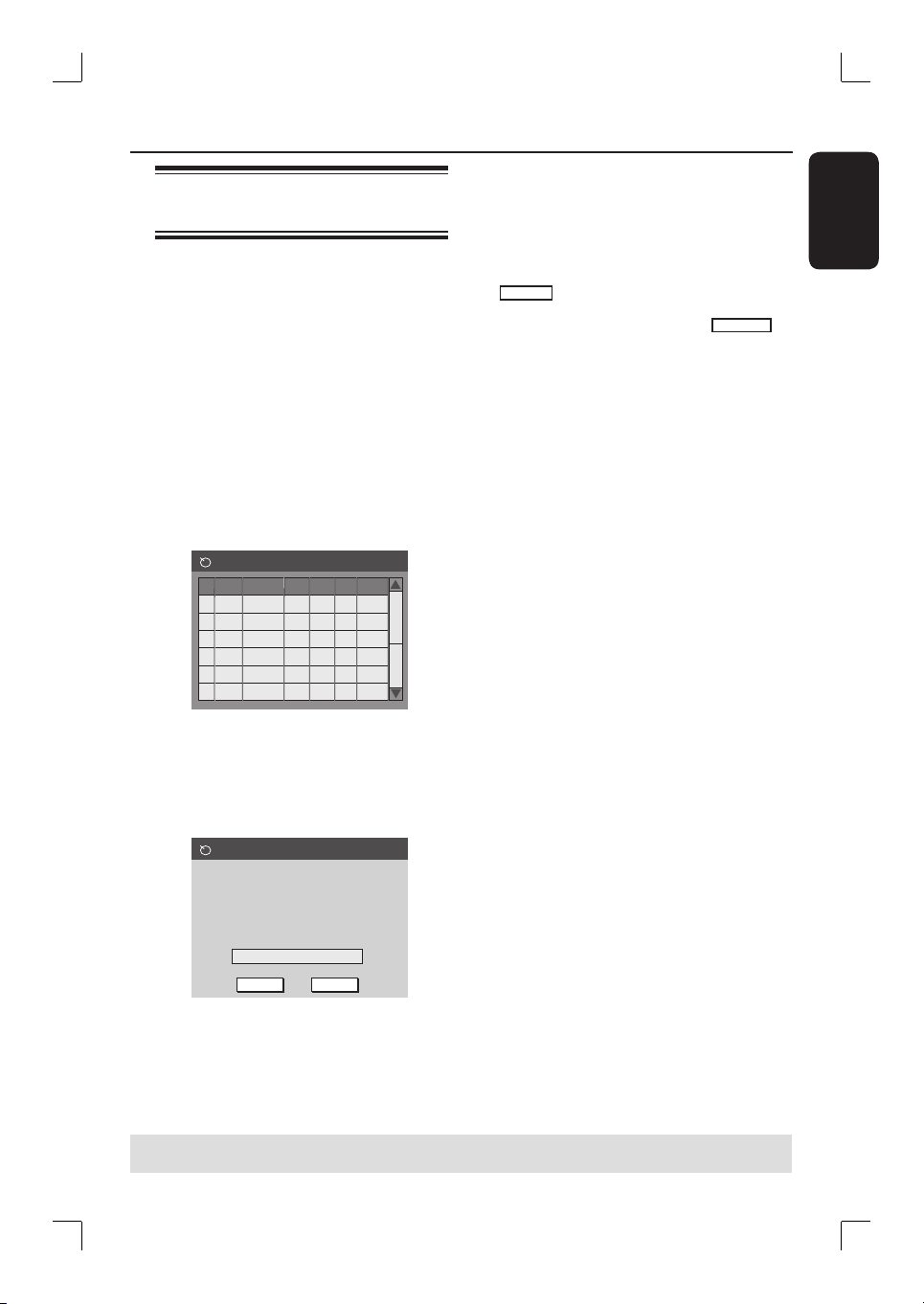
Press TIMER on the remote control.
The timer schedule appears.
1
2
3
4
5
6
Source RecMode Date Start End
Timer Schedule
VPS/PDC
C
Press OK on the remote control.
The VIDEO Plus+
®
system menu
appears.
VIDEO Plus+ System
OK
CancelConfirm
Enter the PlusCode programming
number for the show you wish to
record or select CANCEL for manual
timer recording. To go back to timer
schedule press [RETURN].
D
Select
CANCEL
in the menu and press OK.
The timer editor menu appears.
Timer Editor
Rec Mode
Mode
Date
Start
End
SP
Once
Source
Ch003
31 / 01 / 06
11 : 33
12 : 03
OK
CANCEL
OK
VPS/PDC
Off

English
28
Recording (continued)
TIPS: Ensure that there is enough space on the DVD±R/±RW before recording. Before you playback the DVD±R
on another player, nalise the disc. See “Playing your recordings (DVD±R) on other DVD players”.
E
Use ST keys to select an entry in the
menu and press X to enter its options.
{ Source }
– Use ST keys to select the recording
input source.
{ Rec Mode }
– Use ST keys to select your option.
See the chapter “Recording – RECORD
settings - Default Recording mode”.
{ Mode }
– Use ST keys to select { Once },
{ Daily }, { Weekly }, { Mon-Fri }
(Monday to Friday, ) { Mon-Sat }
(Monday to Saturday) or { Weekend }
(Saturday and Sunday) recordings.
{ Date }
– Use ST keys or the numeric
keypad 0-9 to enter the date for
recording.
{ Start }
– Use ST keys or the numeric
keypad 0-9 to enter the start time of
recording.
{ End }
– Use ST keys or the numeric
keypad 0-9 to enter the end time of
recording.
{ VPS/PDC }
– Use ST keys to turn on/off the VPS/
PDC mode (See the previous page
“About VPS/PDC”).
F
Select
OK
in the menu and press
OK.
The system will store the timer entry
and return to the timer schedule list.
To cancel the above timer setting, select
CANCEL
in the menu and press OK.
G
Press TIMER to exit the menu.
H
Insert a DVD±R/±RW into the DVD
recorder.
I
Press STANDBY-ON to switch the
recorder to standby mode.
If the DVD recorder is not in standby
mode, a warning message will appear
three minutes before the recording
starts.
The ‘TIMER’ icon will light up on the
display panel if a timer recording is set.
Helpful Hint:
– Set the timer recording one minute ahead
of the programme’s start time. This helps
ensure the entire programme is recorded as
the disc requires about 30 seconds to
prepare for recording.
Setting a timer recording from
an external Cable Box/ Satellite
Receiver
If you have a Satellite Receiver/Cable Box
connected to this recorder via the
EXT2 AUX-I/O scart connection (see
“Step 2: Optional Connections”), follow
the steps described below to programme
the recordings.
A
Select the channel you want to record at
the Satellite Receiver/Cable Box.
B
Programme the recording with the
required information. Follow the steps
A
~
D
of “Timer Recording (manually)”
on the previous page.
{ Source }
– Use ST keys to select { EXT2 } as
the input channel and press OK to
con rm.
C
Leave the Satellite Receiver/Cable Box
switched on for the recording.
English
29
Recording (continued)
TIPS: Ensure that there is enough space on the DVD±R/±RW before recording. Before you playback the DVD±R
on another player, nalise the disc. See “Playing your recordings (DVD±R) on other DVD players”.
Timer recording (VIDEO
Plus+
®
System)
This is a simple programming system for
recorders. To use it, enter the PlusCode
programming number associated with
your television programme. You can nd
this number in your TV listings magazine.
All the information needed by the
recorder for programming is contained in
the programming number.
A
Switch on the TV set. Select the correct
Video In channel on the TV.
B
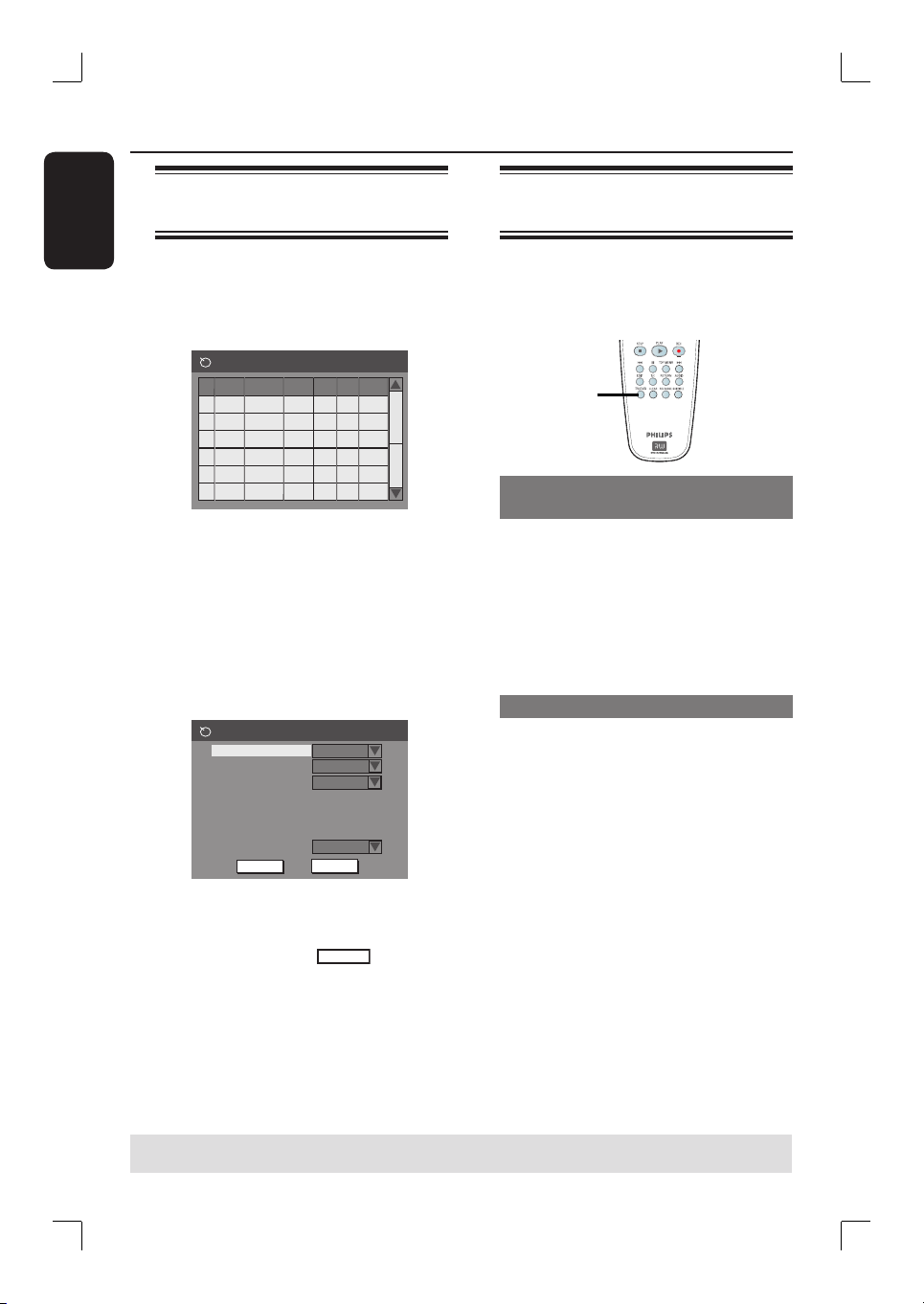
Press TIMER on the remote control.
The timer schedule appears.
1
2
3
4
5
6
Source RecMode Date Start End
Timer Schedule
VPS/PDC
C
Press OK to con rm.
Alternatively, press T key to go to the
next available empty slot and press OK.
The VIDEO Plus+
®
system menu
appears.
VIDEO Plus+ System
OK
CancelConfirm
Enter the PlusCode programming
number for the show you wish to
record or select CANCEL for manual
timer recording. To go back to timer
schedule press [RETURN].
D
Use the numeric keypad 0-9 to enter
the PlusCode programming number for
the show you wish to record.
(e.g. : 5-312-4 or 5,312 4, key in ‘53124’).
To clear the PlusCode programming
number, press CLEAR on the remote
control.
To cancel the VIDEO Plus+
®
programming, use ST keys to select
CANCEL
in the menu and press OK.
E
To con rm your entry, select
CONFIRM
in
the menu and press OK.
The system will store the timer entry
and return to the timer editor menu.
If the channel number of the TV channel
has not been assigned to the
programming number, you will have to
manually key in the channel number that
is assigned to the VIDEO Plus+
®
code.
Follow the instructions on the TV.
F
Press TIMER to exit the menu.
G
Insert a DVD±R/±RW into the recorder.
H
Press STANDBY-ON to switch the
recorder to standby mode.
If the recorder is not in standby mode,
a warning message will appear three
minutes before the recording starts.
The ‘TIMER’ icon will light up on the
display panel if a timer recording is set.
English
30
Recording (continued)
TIPS: Ensure that there is enough space on the DVD±R/±RW before recording. Before you playback the DVD±R
on another player, nalise the disc. See “Playing your recordings (DVD±R) on other DVD players”.
Changing/ Deleting a timer
recording
A
Switch on the TV set. Select the correct
Video In channel at the TV.
B
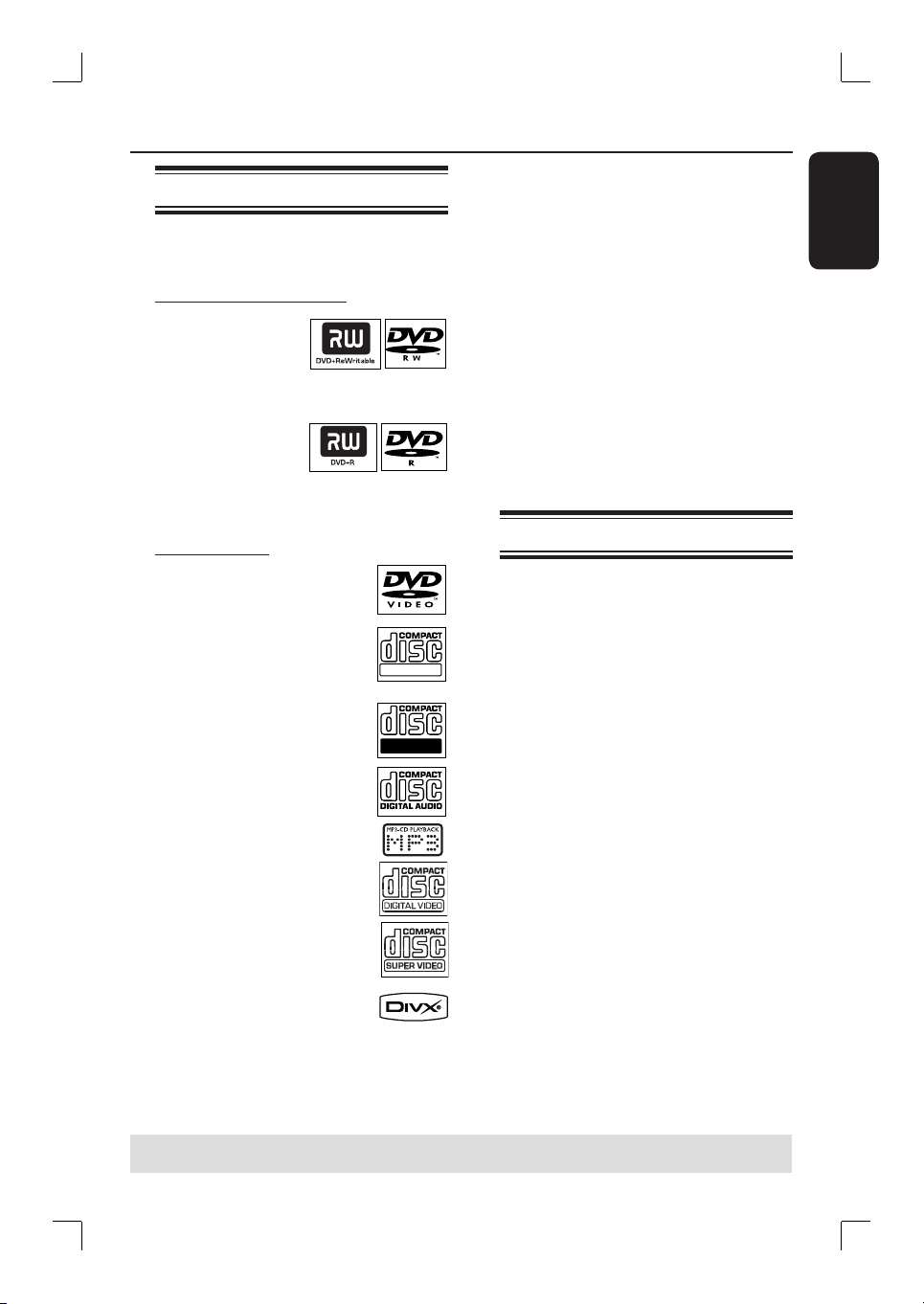
Press TIMER on the remote control.
The timer schedule appears.
1
2
3
4
5
6
Source RecMode Date Start End
Timer Schedule
VPS/PDC
CH003 SP
14/01/06
11.00 12.30
CH010
CH005
CH008
HQ
SP
EP
25/01/06
30/01/06
31/01/06
02.00
10.00
08.30
06.30
11.15
09.00
On
Off
On
Off
C
Use ST keys to select a timer
programme which you want to change/
delete.
D
To delete a timer, press CLEAR on
the remote control.
E
To change the timer schedule, press
OK to enter the timer editor menu of
the selected timer programme.
Timer Editor
Rec Mode
Mode
Date
Start
End
SP
Once
Source
Ch003
31 / 01 / 06
11 : 33
12 : 03
OK
CANCEL
OK
VPS/PDC
Off
F
Select the entry eld and make the
necessary changes.
G
Once complete, select
OK
in the
menu and press OK to save the changes.
H
Press TIMER to exit the menu.
Watching another TV
programme during recording
While recording is in progress, you can
watch another TV channel or playback
from another audio/video device
connected to this recorder.
TV/DVD
Watching playback from another
device
This is only possible if the recorder
is connected to the TV using the EXT1
TO TV-I/O socket.
Press TV/DVD to view the picture from
the device which is connected to the
EXT2 AUX-I/O socket of this DVD
recorder.
Watching another TV channel
If there is no device connected to the
EXT2 AUX-I/O socket, pressing
TV/DVD will switch to TV mode.
Use the TV’s remote control to change
the channels.
The message “TV/LOOP” will be
displayed on the recorder’s system
display panel.
To return to viewing playback from the
recorder, press TV/DVD on the remote
control
Helpful Hint:
– Remember to turn the TV back to its video
input channel if you want to watch the TV
channel through the recorder or playback the
recorded disc.
English
31
Playback
Playable discs
Using this recorder, you can play and
record on the following discs:
Recording and Playback
DVD±RW (DVD
Rewritable); can be
recorded on over
and over again.
DVD±R (DVD
Recordable);
can be recorded
only once.
Playback only:
DVD Video (Digital Versatile
Disc)
CD-RW (CD-Rewritable)
Audio/ MP3/ JPEG contents
CD-R (CD-Recordable)
Audio/ MP3/ JPEG contents
Audio CD (Compact Disc
Digital Audio)
MP3-Disc
Video CD
(Formats 1.0, 1.1, 2.0)
Super Video CD
DivX Disc
(DivX 3.11, 4.x, 5.x, 6)
IMPORTANT!
– If the inhibit icon (Error) appears
on the TV screen when a key is
pressed, it means the function is not
available on the current disc or at
the current time.
– DVD discs and players are
designed with regional restrictions.
Before playing a disc, make sure the
disc is for the same region as your
player.
– Do not push on the disc tray or
place any objects other than discs
on the disc tray. It may cause the
disc player to malfunction.
Inserting a disc
A
Press STANDBY-ON to switch on the
recorder.
B
Press OPEN/CLOSE ç on the front of
the recorder.
The disc tray opens.
C
Carefully place the disc into the tray with
the label facing up, then press
OPEN/CLOSEç.
Make sure the disc label is facing up.
For double-sided discs, load the side as
indicated on the label.
D
Switch on the TV set. Select the correct
Video In channel at the TV (See the
chapter “Step 3: Installation and Setup –
Finding the correct viewing channel”).
E
Playback will start automatically or a
dialogue will appear on the TV (see next
page).
ReWritable
Recordable
TIPS: Some discs cannot be played on this recorder due to the con guration and characteristics of the disc, or due
to the condition of recording and authoring software.

English
32
Starting disc playback
Playback will begin automatically. If the
disc has its own menu this will be loaded,
otherwise the recorder will launch an
index screen.
If the pin code entry dialogue appears on
the TV, this means that the parental
control was activated for the inserted
disc (See the chapter “DVD System Menu
Options – PLAYBACK settings”).
Use the numeric keypad 0-9 on the
remote control to enter your pin code
(password).
For more playback features, see the
chapter “Additional Playback Features”.
Playing a DVD video disc
A
Insert a DVD disc.
If the disc menu appears on the TV
Use numeric keypad 0-9 to input your
selection or use W XST keys to select
a play option and press OK to start
playback.
To select the previous or next
chapter/title marker
During playback, press ./> to go to
the previous/next chapter/track.
B
To stop playback, press STOP
.
Playing a (Super) Video CD
(Super) Video CDs may feature the ‘PBC’
(Play Back Control). This allows you to
play the video CDs interactively by
following the menu on the display.
A
Insert a (Super) Video CD.
If the ‘PBC’ is on, the disc index
menu will appear on the TV
B
Use numeric keypad 0-9 to input your
selection or to select a play option.
Press RETURN on the remote control
to return to the previous menu.
To turn on/off the Playback Control
mode, press T/C on the remote control
during playback to access the T/C menu.
Then use ST keys to select { PBC On }
or { PBC Off }.
C
To stop playback, press STOP
.
Playing an audio CD
A
Insert an audio CD.
Playback starts automatically.
The track number and elapsed playing
time appear on the display panel.
B
To stop playback, press STOP
.
TIPS: Some discs cannot be played on this recorder due to the con guration and characteristics of the disc, or due
to the condition of recording and authoring software.
Playback (continued)
English
33
Playing a DVD±R/±RW disc
A
Insert a DVD±R/±RW disc.
The Index Picture screen appears.
B
Use ST keys to select a title and press
PLAY X to start playback.
C
To stop playback, press STOP
.
Helpful Hint:
– If the message ‘BLANK’ appears on the
display panel, this means that there are no
recordings on this disc..
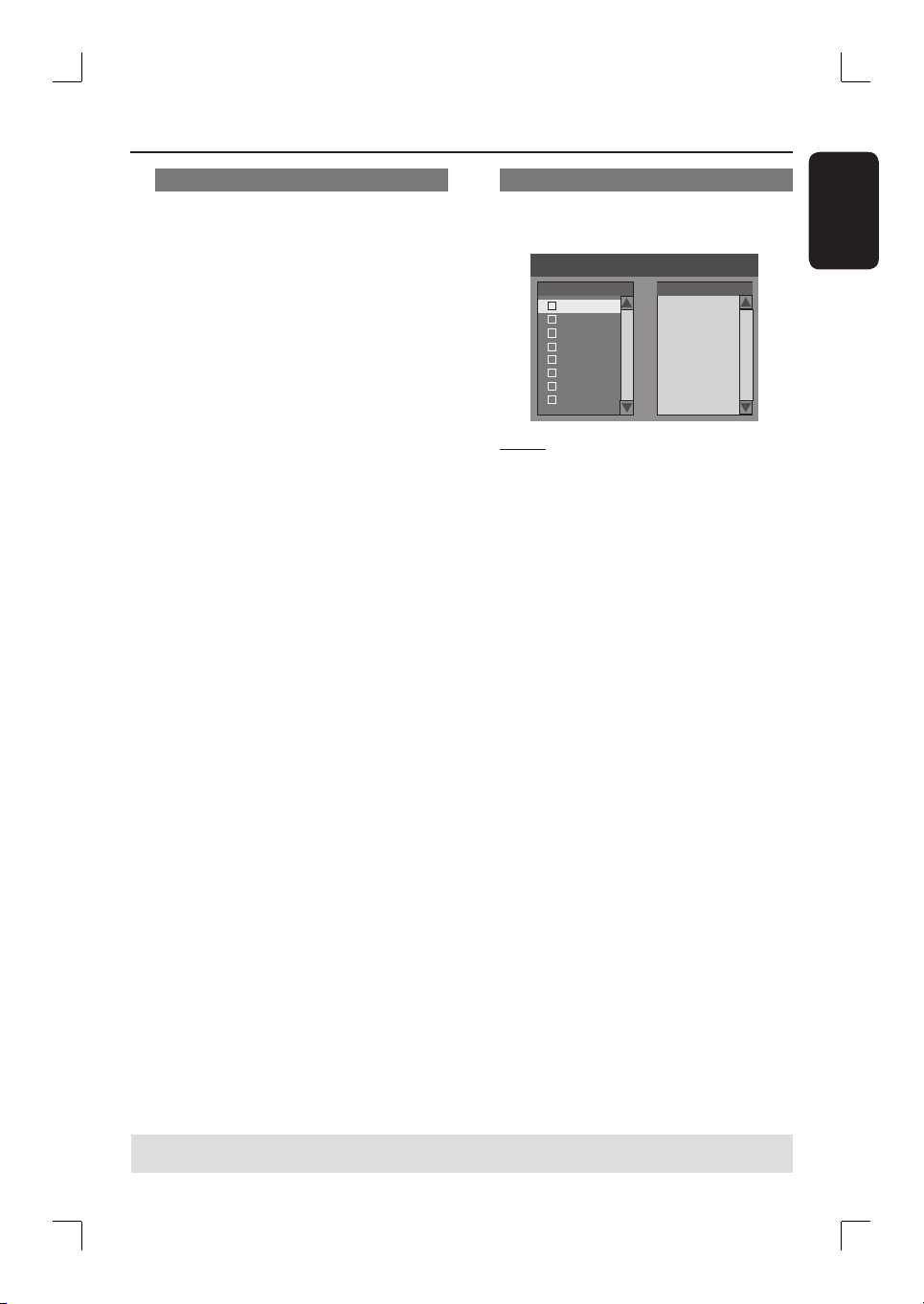
Playing an MP3 disc
A
Insert an MP3 CD.
The disc content menu appears.
File Play - Stop 0:00:00/ 0:00:00
Directory Selection
Bee Gees
Phil Collins
Bryan Adams
Collin Raye
Nat King Cole
UB40
Jordan Hill
Faith Hill
1
2
3
4
5
6
7
8
Note: It may require a longer time for
the recorder to display the disc content
menu on the TV due to the large number
of songs/pictures compiled into one disc.
B
Use ST keys to navigate within the
menu and press OK to access the folder/
album.
C
Use ST keys to select the track/ le to
playback.
To move up to the previous level, press
RETURN.
D
To create a playlist, highlight the track/ le
and press SELECT.
The selected tracks/ les will appear
on the right screen.
Use WX keys to toggle between the
left and right screen.
To remove the track/ le from the
selected playlist, press CLEAR.
E
To start playback, move the cursor to the
right selection screen, press PLAY X .
F
During playback, you can press ./ >
to select the next/previous track.
G
To stop playback, press STOP
.
Helpful Hint:
– Only the rst session of a multi-session
CD will playback.
Playback (continued)
TIPS: Some discs cannot be played on this recorder due to the con guration and characteristics of the disc, or due
to the condition of recording and authoring software.
English
34
TIPS: Some discs cannot be played on this recorder due to the con guration and characteristics of the disc, or due
to the condition of recording and authoring software.
Playback (continued)
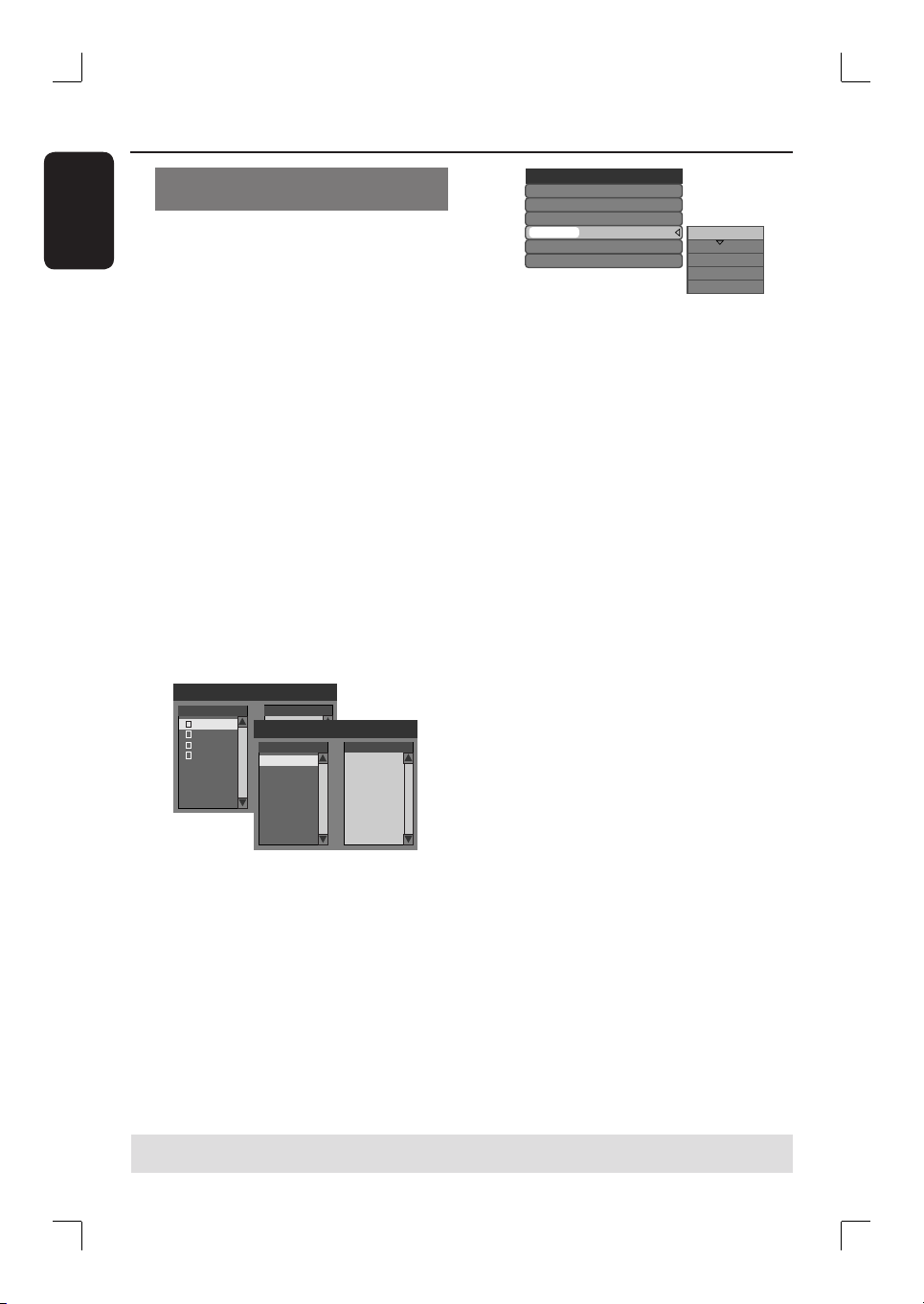
Playing a picture disc (or musical
slide show)
You can display JPEG pictures in the
selected list automatically one after the
other.
A
Insert a JPEG picture disc (CD,
CD-R/RW, DVD±R/±RW).
The disc content menu appears.
B
Use ST keys to navigate within the
menu and press OK to access the folder/
album.
C
To create a playlist, highlight the track/ le
and press SELECT.
The selected tracks/ les will appear
on the right screen.
To remove the track/ le from the
playlist, press CLEAR.
You can select to playback from the
original disc content or from the playlist.
Use WX keys to move to the correct
screen before selecting the track/ le for
playback.
File Play - Stop 0:00:00/ 0:00:00
Directory Selection
Japan trip
Bryan Bday
My songs
Hot Hits
1
2
3
4
File Play - Stop 0:00:00/ 0:00:00
Directory Selection
P1010001.JPG
P1010008.JPG
BUTTER-1.JPG
NATURE-1.JPG
BUTTER-1.JPG
P1022500.JPG
P1023000.JPG
MERLIO-1.JPG
1
2
3
4
5
6
7
8
..\
If the disc contains MP3 music and
JPEG picture les, you can start a
musical slide show playback,
Select an MP3 le and press OK to start
playback, then select a picture le in the
menu and press OK to start the musical
slide show playback.
File Play
PIC
Normal
Play
Top to bottom
Fitscreen
Clockwise 0
Type
Mode
Trick
Wipe
Zoom
Rotate
Top to bottom
Down to top
Left to right
Right to left
Extend center V.
E
During playback, press T/C once to show
the disc content menu. Press T/C again
to access various settings for the slide
show playback.
The selected animation settings will
appear in the top left corner of the TV
screen.
F
To stop playback, press STOP .
Playable JPEG picture disc
This recorder can read JPEG pictures
stored on a CD-ROM, Picture CD, or
DVD.
File format:
– The le extension has to be ‘.JPG,’
‘.JPE’ or ‘.JPEG.’
– Only DCF-standard still pictures or
JPEG pictures (eg. TIFF) can be displayed.
– It cannot playback moving pictures,
Motion JPEG, pictures in non-JPEG
formats or pictures associated with
sound.
– The recorder may require a longer
time to display the disc content on the
TV due to the large number of songs/
pictures compiled onto one disc.

English
35
Playing a DivX
®
disc
This DVD system supports the playback
of DivX
®
movies which you have copied
from your computer onto a CD-R/RW,
DVD±R/±RW.
A
Insert a DivX
®
disc.
The disc content menu appears.
If the DivX
®
movie contains external
subtitles, you have to rst select the
subtitle le from the le list.
B
Press PLAY X to start playback.
During playback, you can press DISC
MENU to display the disc content menu.
To select another character set for
the subtitle le,
During playback, press T/C once to
show the disc content menu. Press T/C
again to access various settings for the
slide show playback.
File Play
Video
Normal
Play
Standard Set
Stereo
0:01:31 / 0: 41: 35
Type
Mode
Trick
Character
Audio
Time
LANG Language 1
Standard Set
Alternative Set
Use ST keys to select { Character }
and press X to access the options. Select
the preferred subtitle set and press OK
to con rm.
Helpful Hints:
– Subtitle les with the following lename
extensions (.srt, .smi, .sub, .sami) are
supported.
– It is normal to experience an occasional
pixelation during DivX
®
playback due to poor
clarity of digital contents during
internet downloading
Playback (continued)
TIPS: Some discs cannot be played on this recorder due to the con guration and characteristics of the disc, or due
to the condition of recording and authoring software.

English
36
Additional Playback Features
Changing to another
chapter/track
When a disc contains more than one
chapter or track, you can change to a
different chapter or track as follows.
During playback,
Press > to go to the next chapter/
track.
Press .to return to the start of the
previous chapter/track.
OR
Use the numeric keypad 0-9 to input
the title/chapter/track number.
OR
Press T/C to enter the T/C menu and use
ST keys to select { Title } or
{ Chapter } and use numeric keypad
0-9 to input the title/chapter/track number.
Pausing playback and step
play
A
During playback, press PAUSE
Å
to
pause playback and display a still picture.
B
Press PAUSE
Å
again to move one frame
forward.
C
To resume normal playback, press
PLAY X.
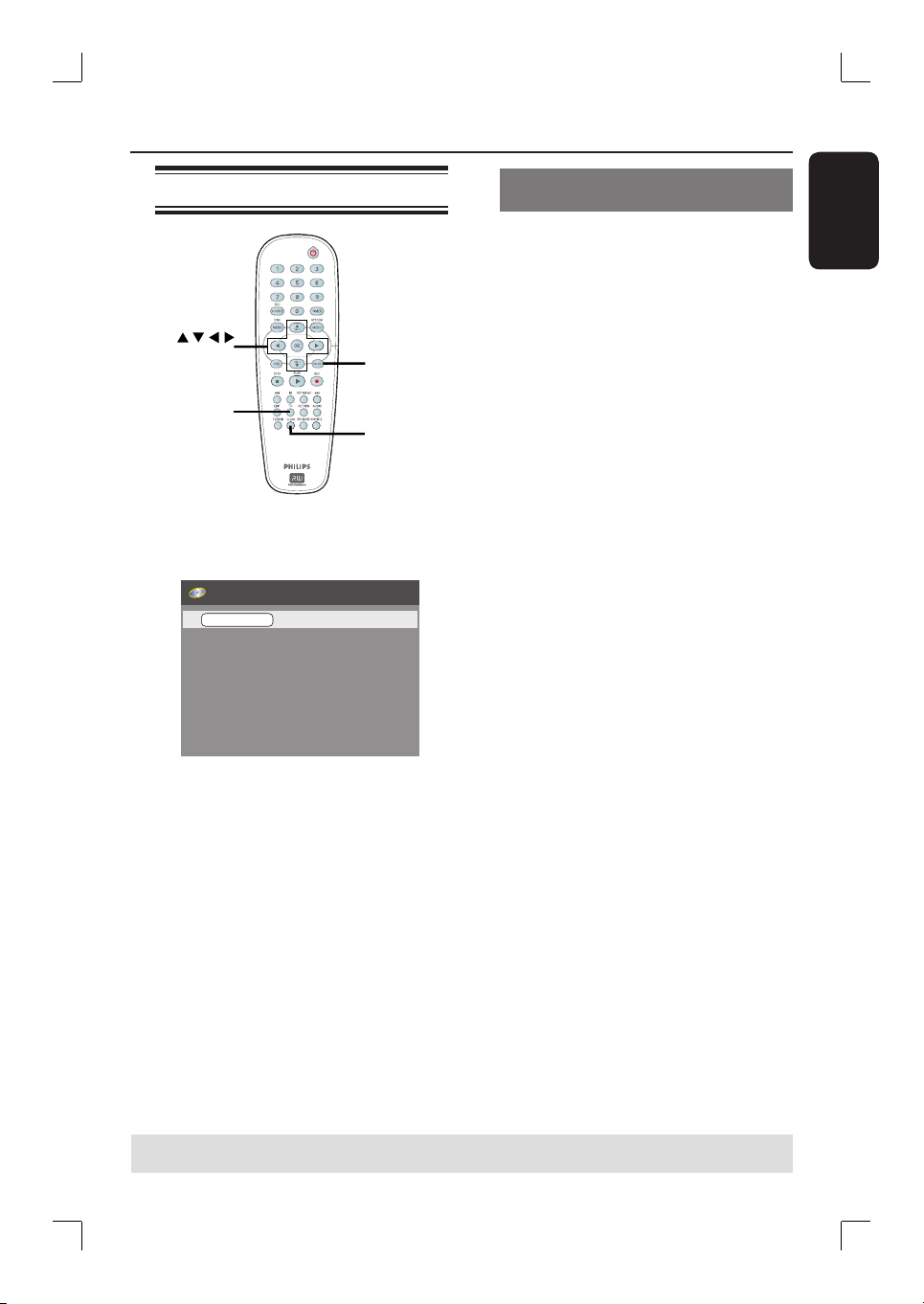
Searching forwards/
backwards
You can search forward or backward on
a disc at two, four, sixteen or thirty two
times the normal playback speed.
A
During playback, press W (reverse) or
X (forward) to switch to the search
function.
The search status bar appears.
It displays the search speed (FREV x2,
FREV x4, FREV x16, FREV x32, FFWD
x2, FFWD x4, FFWD x16, FFWD x32)
The sound will be muted.
B
Use W X keys to cycle through the
search speeds.
C
To resume normal playback, press
PLAY X.
TIPS: The operating features described here might not be possible for certain discs.
Always refer to the instructions supplied with the discs.
English
37
Using T/C options
T/C
OK
SELECT
CLEAR
A
During playback, press T/C on the
remote control.
The T/C menu appears on the TV.
DVD
Trick mode
Title
Chapter
Audio
Subtitle
Angle
Title
Normal
Play
02/05
01/22
01/02 - OTH
Off
01/03
00:22:03 / 01:27:24
Mode
B
Use ST keys to select the setting you
want to adjust.
Instructions and explanation of the
options are provided in the following
pages.
C
To exit, press T/C.
Selecting various repeat/ shuf e
functions
You can select various repeat play or
random play modes during playback.
A
During disc playback, press T/C on the
remote control.
The T/C menu appears.
B
Use ST keys to select { Mode } and
press OK.
C
Use ST keys to select one of the repeat
options.
{ Normal }
Select this to cancel the repeat mode and
return to normal playback.
{ Repeat A-B }
Select this to repeat the playback of a
speci c segment within a title/chapter/
track. Press OK to mark the start and
end of the segment you want to repeat.
{ Repeat Chapter }
Select this to repeat playback of the
current chapter (DVD, DVD±R/±RW
only).
{ Repeat Track/Title }
Select this to repeat playback of the
current track/title.
{ Repeat Directory }
Select this to repeat playback of the
current folder/directory (MP3, JPEG,
picture disc only).
{ Repeat Disc }
Select this to repeat playback of the
entire disc. (MP3, JPEG, SVCD and
CDDA discs only).
{ Shuf e }
Select this to randomly playback all the
tracks within the disc (MP3 and audio CD
only).
D
To cancel repeat playback, press STOP
or select { Normal } and press OK.
Additional Playback Features (continued)
TIPS: The operating features described here might not be possible for certain discs.
Always refer to the instructions supplied with the discs.
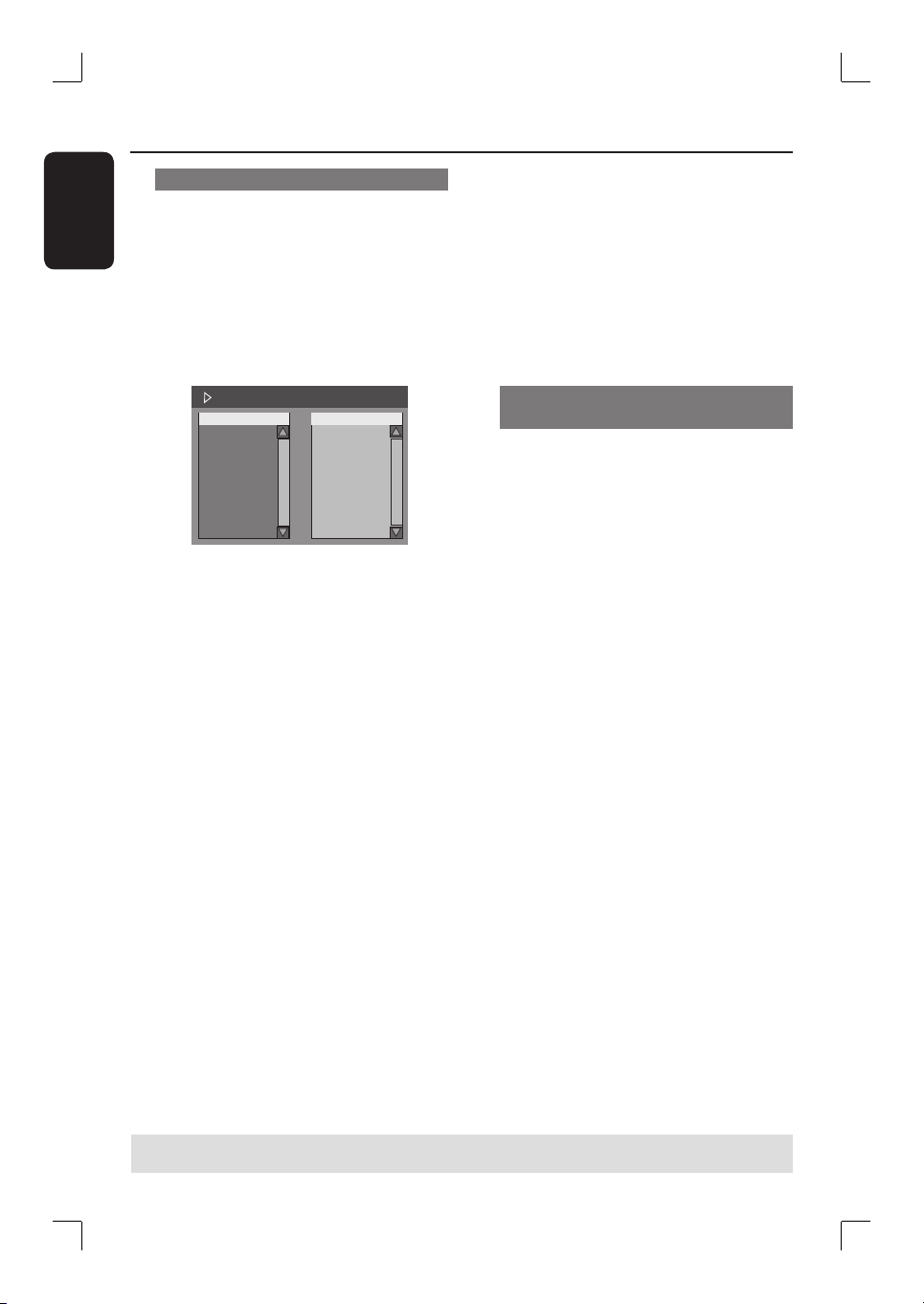
English
38
Creating a playlist
You can play the contents of the disc in
the order you want by programming the
tracks to be played.
A
Press T/C on the remote control.
The T/C menu appears.
B
Select { Mode } > { Program }.
The programme menu appears.
DVD
Title Selection
Title 1
Title 2
Title 3
Title 4
Title 5
Title 6
Title 7
Title 8
C
If the disc is recorded with Titles/Folders/
Albums, press OK to access the tracks/
les/chapters.
Pressing OK at the highlighted track/ le/
chapter will start playback.
Use W X keys to toggle between the left
and right screen.
To programme your favourite
track/ le/chapter
D
Use ST keys to select the track/ le/
chapter to programme and press
SELECT on the remote control.
The selected track/ le/title will appear
at the right screen.
The order on the right screen will be
the order of programme playback.
To remove the programmed item
from your selection
E
Press X key to move to the right screen.
Select the track/ le/chapter and press
CLEAR on the remote control.
To start programme play
F
Press X key to move to the right screen
and press OK.
Playback will start from the selected
track/ le/chapter according to the
programmed sequence.
To exit programme play
G
Press STOP
to exit programme play.
Changing the audio soundtrack
language
This operation works only on DVDs with
multiple soundtrack language or VCDs
with multiple audio channels.
During disc playback, press AUDIO
repeatedly to toggle through the audio
channels on the disc.
Alternatively,
A
Press T/C on the remote control.
The T/C menu appears.
B
Use ST keys to select { Audio } and
press X to access its options.
C
Use ST keys to select the audio
language and press OK to con rm.
The languages may be numbered or
abbreviated, such as “En” for English.
If the language selected is not available
on the disc, the disc’s default setting for
language will be used instead.
Helpful Hint:
– Some DVDs allow soundtrack language
changes only via the DVD disc menu. To
access the Disc Menu, press DISC-MENU.
Additional Playback Features (continued)
TIPS: The operating features described here might not be possible for certain discs.
Always refer to the instructions supplied with the discs.

English
39
Additional Playback Features (continued)
TIPS: The operating features described here might not be possible for certain discs.
Always refer to the instructions supplied with the discs.
Changing subtitle language
This operation works only on DVDs with
multiple subtitle languages, you can change
the language you want during playback of
the DVD.
During disc playback, press SUBTITLE
repeatedly to toggle through the language
options on the disc.
Alternatively,
A
Press T/C on the remote control.
The T/C menu appears.
B
Use ST keys to select { Subtitle } and
press X to enter the menu and nd the
different available options.
C
Use ST keys to select the language and
press OK to con rm.
The languages may be numbered or
abbreviated, such as “En” for English.
If the language selected is not available
on the disc, the disc’s default setting
language will be used instead.
Helpful Hint:
– Some DVDs discs allow subtitle language
changes only via the DVD disc menu. To
access the disc menu, press DISC-MENU.
Switching camera angles
This option is only available with DVDs
that contain sequences recorded from
different camera angles. This allows you
to view the picture from different angles.
A
Press T/C on the remote control.
The T/C menu appears.
B
Use ST keys to select { Angle } and
press X to enter its options.
The camera angles available for
selection appears.
C
Use ST keys to select the camera angle
you want to switch to, then press OK to
con rm.
Time search
This option allows you to skip to speci c
point in the current disc.
A
Press T/C on the remote control.
The T/C menu appears.
B
Use ST keys to select { Title } and
press X to select time search by { Title }
or { Chapter }. To con rm search
option, press OK.
C
Use the numeric keypad (0-9) to
enter the time required.
Playback skips to the selected time.
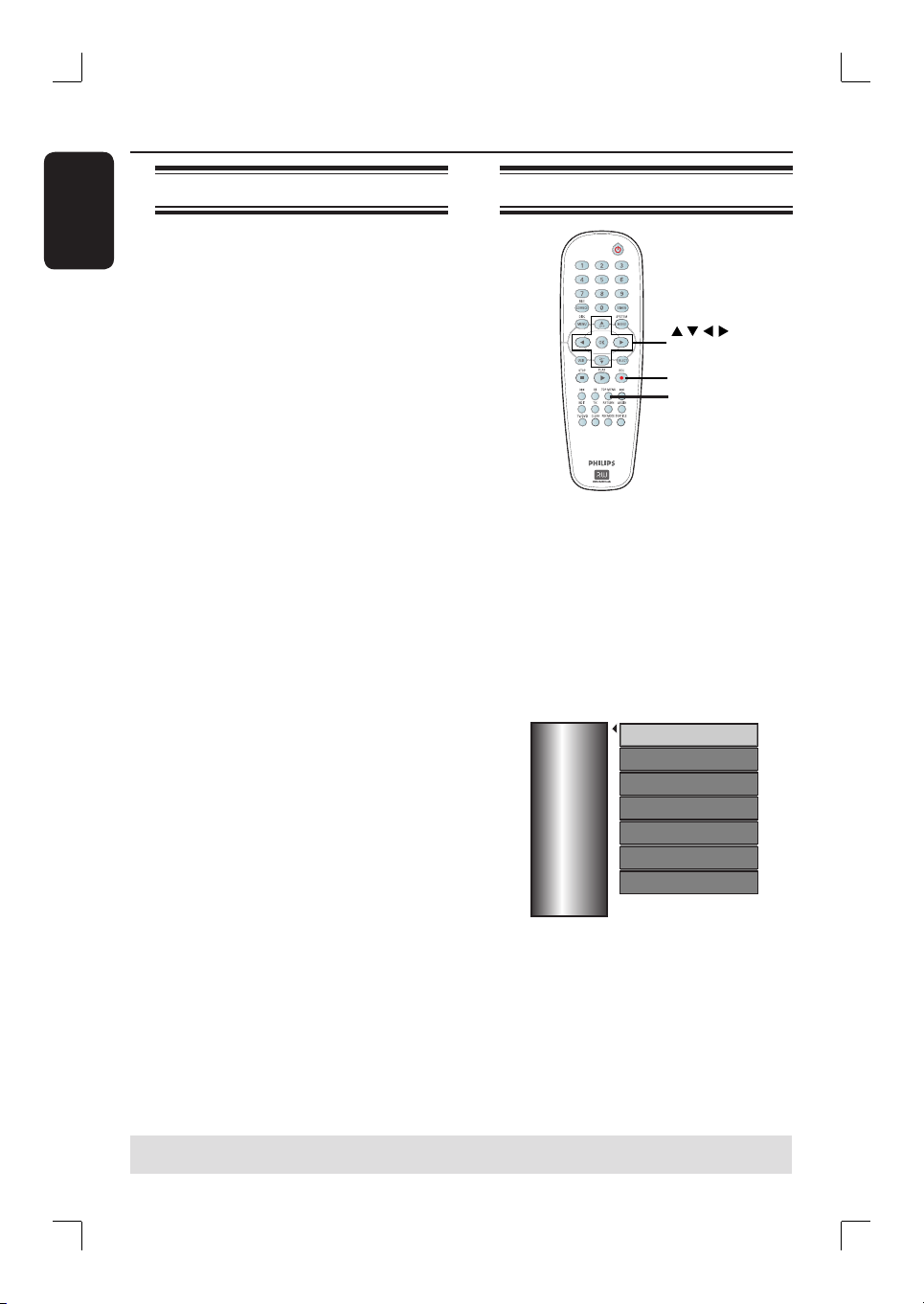
English
40
Editing/ Finalising Recording
TIPS: No further recording and editing can be carried out on a full or nalised DVD±R.
Press W to go back to the previous menu.
About disc editing
This recorder offers various disc editing
options for various disc types. You can
change the disc content and settings of a
recorded DVD±R/±RW from the disc
editing menu. The edited contents may
not be available when you play the disc
on an another DVD player.
The displayed options in the disc editing
menu differ depending on the type of
disc.
{ Play }
Start playing from the beginning of the
disc.
{ Rename Disc }
Change the name of the disc.
{ Erase Disc } - DVD±RW only
Erase all the recordings on the disc.
{ Record New Title }
Start recording from the last empty title
on the disc.
{ Overwrite Disc } - DVD±RW only
Start a new recording from the beginning
of the disc, all the recorded content will
be overwritten.
{ Make Compatible } - DVD±RW only
To ensure the edited changes remain
when the disc is played back on another
DVD player. (eg., hidden chapters to
remain hidden).
{ Lock/Unlock Disc } - DVD±RW only
Lock or unlock a disc to prevent
accidental erasure or changes being
made.
{ Finalise Disc } - DVD±R only
Finalise the disc to enable playback on
other DVD players. Further recording
and editing to the disc are not allowed. It
is not possible to un nalise the disc.
Accessing disc editing menu
TOP MENU
REC
OK
A
Insert a recorded DVD±R/±RW into the
recorder.
The Index Picture screen appears on
the TV.
B
Press TOP MENU on the remote
control.
The disc editing menu appears. The
available editing options are different for
DVD±R and DVD±RW discs.
Rename Disc
Erase Disc
Record New Title
Overwrite disc
Play
PAL
DVD
EDIT
Make Compatible
LockDisc
C
Use ST keys to access different options
and OK to select.
Instructions and explanation of the
options are provided in the following
pages.
D
To exit, press TOP MENU to go back
to the disc Index Picture screen.
English
41
Editing/ Finalising Recording (continued)
TIPS: No further recording and editing can be carried out on a full or nalised DVD±R.
Press W to go back to the previous menu.
Rename disc
The original disc name is generated
automatically by the recorder. You can
change the disc name by following the
steps below.
A
Press TOP MENU, then use ST keys
to select { Rename Disc } and press OK.
The keyboard screen appears.
B
Use W XST keys to highlight a
character on the keyboard and press OK
to select.
The maximum input is up to 9
characters.
You can use the following keys on the
keyboard screen to edit your input:
BkSp
: to remove the character to
the left of the cursor.
Delete
: to remove the character to
the right of the cursor.
Space
: to create a space between the
characters.
Caps
: to toggle between upper and
lowercase characters.
Clear
: to clear the entry eld
completely.
C
To con rm your entry, select
OK
on
the keyboard and press OK.
The info panel is now updated.
To cancel the changes, select
EXIT
on
the keyboard and press OK.
Erase disc (DVD±RW only)
This erases the content of the DVD±RW
including those that was not recorded on
this recorder. Once the existing content
is erased, it can be used again for
recording.
A
Press TOP MENU, then use ST keys
to select { Erase Disc } and press OK.
A warning message will appear.
B
Select
YES
in the menu to proceed or
NO
to abort, then press OK to
con rm.
Record new title
This function allows you to start a new
recording at the remaining empty space
on the DVD±R/±RW.
A
Press TOP MENU, then use ST keys to
select { Record New Title } and press
OK.
B
Select the source you want to record
from and press REC
to start
recording.
Overwrite disc (DVD±RW only)
This function allows you to start a new
recording from the beginning of a
DVD±RW regardless of the contents of
the disc.
A
Press TOP MENU, then use ST keys
to select { Overwrite disc } and press
OK.
B
Select the source you want to record
from and press REC
to start
recording.

English
42
Make compatible (DVD±RW only)
The edited DVD±RW may still display
the original titles or hidden scenes when
playbacked on other DVD players. This
function ensures that the edited changes
of the DVD±RW remain when played
back on other players.
Press TOP MENU, then use ST keys to
select { Make Compatible } and press
OK to con rm.
Helpful Hint:
– If the option {Compatible} is not available
for selection, it means that the disc is already
compatible.
Lock/Unlock disc (DVD±RW only)
You can choose to protect the recorded
DVD±RW in order to prevent accidental
loss of recordings.
A
Press TOP MENU, then use ST keys
to select { Lock Disc } and press OK.
The disc is locked for this DVD
recorder only.
When the disc is locked, the option in
the disc editing menu will change to
{ Unlock Disc }.
B
If you want to overwrite or edit on the
protected disc, select { Unlock Disc }.
Playing your recordings
(DVD±R) on other DVD
players
It is necessary to nalise a DVD±R disc
before you can play it on any other DVD
player. Otherwise, the DVD±R will only
playback on this recorder.
After a DVD±R disc has been
nalised, no further recordings or
editing can be made to it. Make sure
that you have completed all the
recordings and editing before
nalising the disc.
A
Press TOP MENU, then use ST keys
to select { Finalise Disc } and press OK.
A warning message will appear.
B
Select
YES
in the menu and press OK
to start the process.
Finalisation will take a few minutes.
Do not try to open the disc tray or turn
the power off as this may render the disc
unusable.
C
Select
NO
to abort.
Editing/ Finalising Recording (continued)
TIPS: No further recording and editing can be carried out on a full or nalised DVD±R.
Press W to go back to the previous menu.
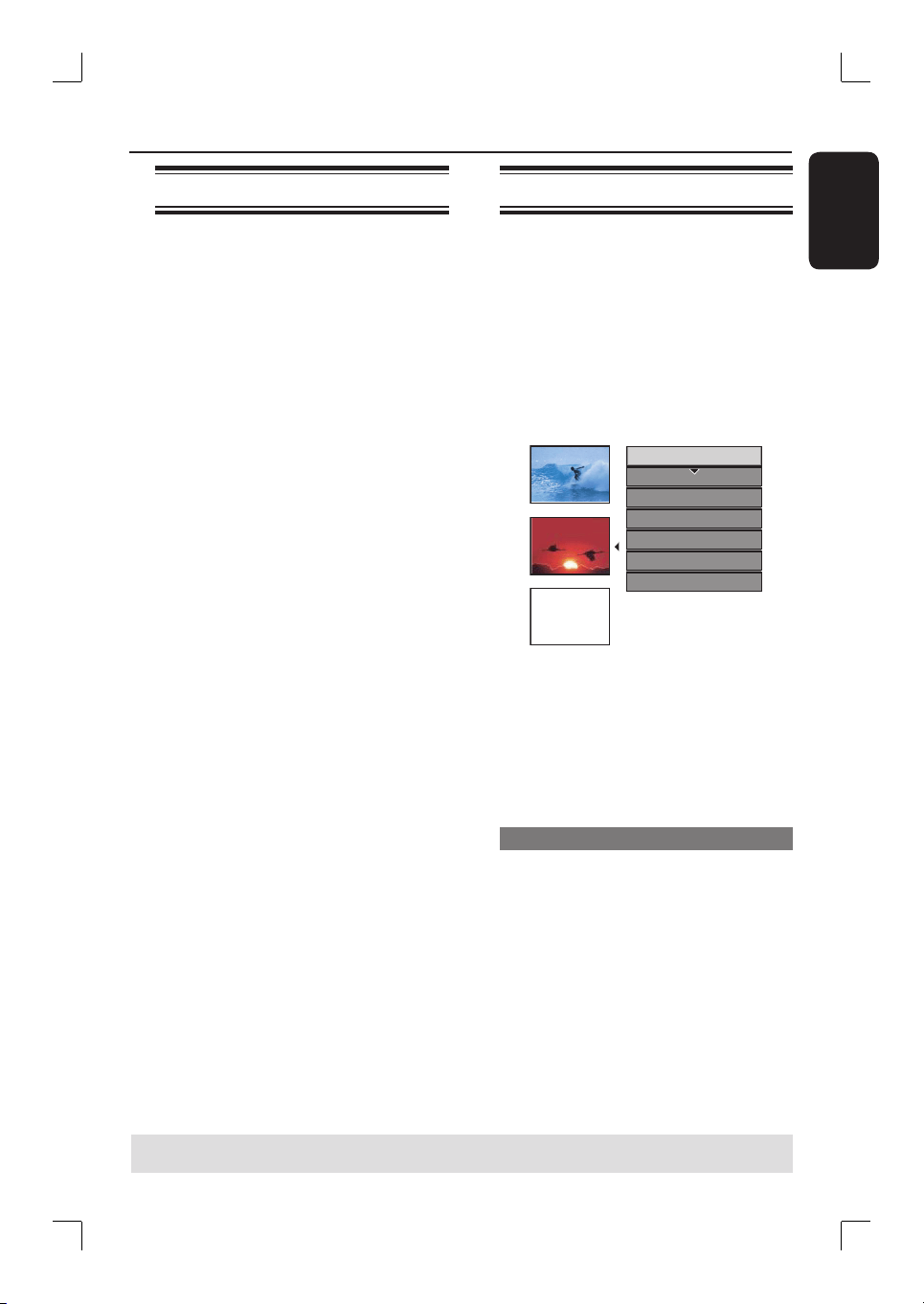
English
43
About title editing
You can change the individual title
information or delete a title (recording)
in a recorded DVD±R/±RW. If a DVD±R
has been nalised, it cannot be edited.
The displayed options in the title editing
menu differ depending on the type of
disc.
{ Play Title }
Start playing a recording.
{ Edit Title }
Access the video editing menu.
{ Rename Title }
Change the name of the recording.
{ Erase Title } - DVD±RW only
Delete the title (recording).
{ Overwrite Title } - DVD±RW only
Start a new recording, the existing title
(recording) will be overwritten.
{ Overwrite Disc } - DVD±RW only
Overwrite from the existing selected title
onwards to the end of the disc.
{ Append Title }
Insert a new recording to the last existing
recording.
Accessing title editing menu
A
Insert a recorded DVD±R/±RW into the
recorder.
The Index Picture screen appears on
the TV.
During playback, press DISC MENU to
access the Index Picture screen.
B
Use ST keys to highlight a title
(recording), and press X.
The title editing menu appears.
2. My movie
10 / 01 / 2006
12 : 31 : 53
HQ 00 : 05 : 59
Empty Title
Edit Title
Rename Title
Erase Title
Overwrite Title
Play Title
Overwrite Disc
Append Title
C
Use ST keys to access different options
and OK to select.
Instructions and explanation of the
options are provided in the following
pages.
D
To exit, press W.
Video editing
This feature allows access to the video
editing menu. See the chapter “Editing/
Finalising Recording – About video
editing” for more information.
In title editing menu, use ST keys to
select { Edit Title } and press OK.
The video editing menu appears.
The recorder will play the
selected title.
Editing/ Finalising Recording (continued)
TIPS: No further recording and editing can be carried out on a full or nalised DVD±R.
Press W to go back to the previous menu.
English
44
Rename title
The original title name is generated
automatically by the recorder. You can
give a new name to the title by following
the steps below.
A
In title editing menu, use ST keys to
select { Rename Title } and press OK.
The keyboard screen appears.
B
Use W X ST keys to highlight a
character and press OK to select.
The maximum input is up to 9
characters.
You can use the following keys on the
keyboard screen to edit your input:
BkSp
: to remove the character to
the left of the cursor.
Delete
: to remove the character to
the right of the cursor.
Space
: to create a space between the
characters.
Caps
: to toggle between upper and
lowercase characters.
Clear
: to clear the entry eld
completely.
C
To con rm your entry, select
OK
on
the keyboard and press OK.
The info panel is now updated.
To cancel the changes, select
EXIT
on
the keyboard and press OK.
Erase title (DVD±RW only)
You can delete a speci c title (recording)
from the disc.
A
In title editing menu, use ST keys to
select { Erase Title } and press OK.
A warning message will appear.
B
Select
YES
in the menu to proceed or
NO
to abort, then press OK to
con rm.
TIPS: No further recording and editing can be carried out on a full or nalised DVD±R.
Press W to go back to the previous menu.
Overwrite title (DVD±RW only)
This function allows you to record a new
title from the beginning of the current
title in the DVD±RW. The other titles
will not be affected.
A
In title editing menu, use ST keys to
select { Overwrite Title } and press OK.
B
Select the source you want to record
from and press REC
to start recording.
Overwrite disc
You can select to overwrite only the
recordings from the selected title to the
end of the disc.
In video editing menu, use ST keys to
select { Overwrite Disc } and press OK
to con rm.
Append recording
This function allows you to add a
recording to the last existing title.
A
In title editing menu, use ST keys to
select { Append Title } and press OK.
B
Press REC SOURCE to select the input
channel to append.
C
Press REC
to start append recording.
D
To stop append recording, press
STOP
.
Editing/ Finalising Recording (continued)
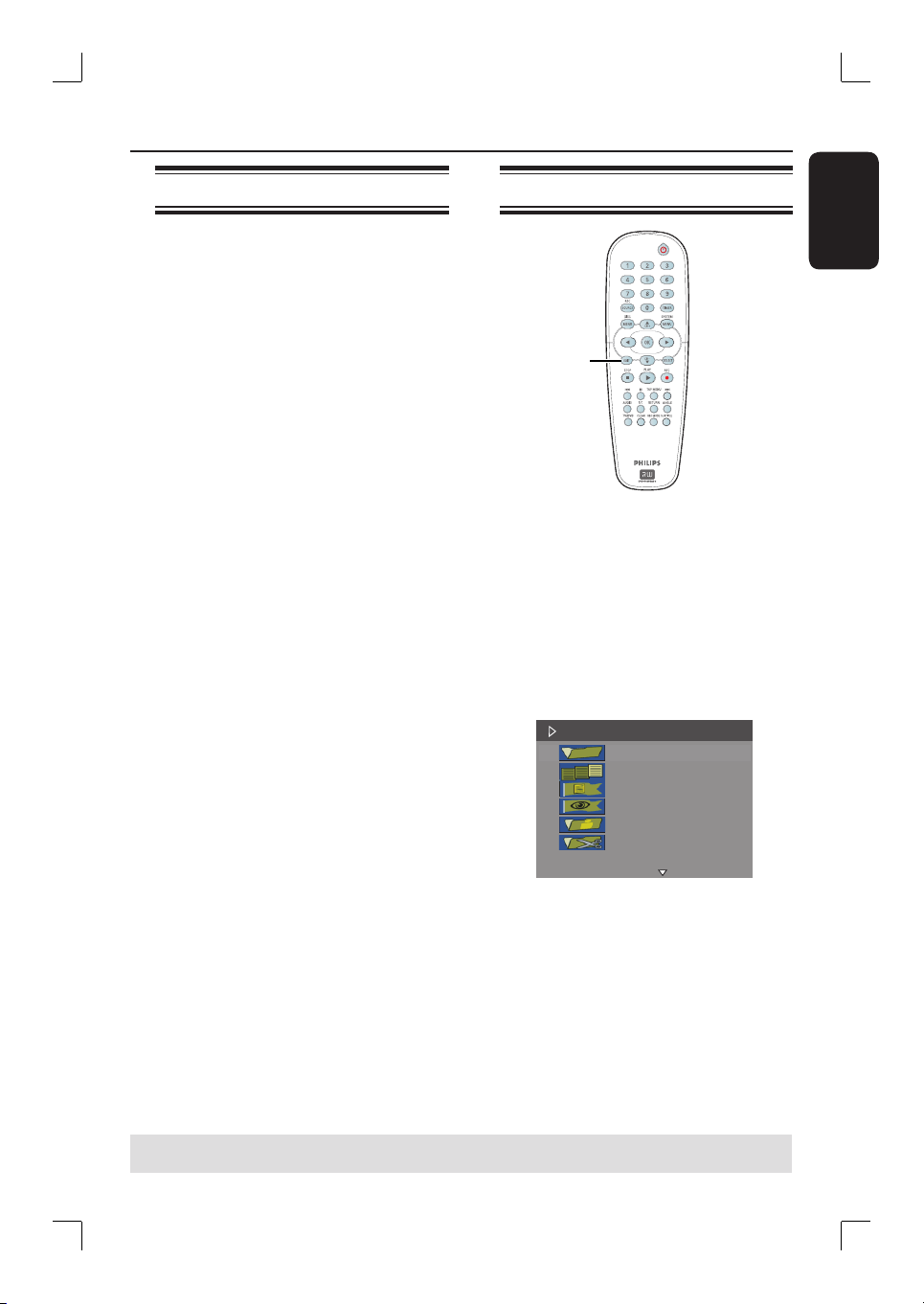
English
45
TIPS: No further recording and editing can be carried out on a full or nalised DVD±R.
Press W to go back to the previous menu.
Editing/ Finalising Recording (continued)
About video editing
After a recording has been made, this
recorder allows you to edit the video
content. You can add/delete chapter
markers, hide unwanted scenes, change
the picture in the index picture screen and
split a title (recording) into two.
When you playback a recording in video
edit mode, the entire recording will be
played back including hidden scenes.
The edit functions available in the disc
editing menu are:
{ Title }
Select a title (recording) to playback.
{ Chapter }
Select a chapter within the selected title.
{ Chapter Marker }
Insert a chapter marker in the recording
or erase a chapter marker to combine
two chapters.
{ Hide Chapter }
Hide the unwanted scene in the
recording.
{ Index Picture }
Select a scene in the recording as the
index picture screen.
{ Split Title } - DVD±RW only
Divide the recording into two under
separate titles.
Accessing video editing menu
EDIT
A
Insert a recorded DVD±R/±RW into the
recorder.
The Index Picture screen appears on
the TV.
B
Use ST keys to select a title (recording).
C
Press PLAY X to start playback.
D
Press EDIT on the remote control.
The video editing menu appears.
Edit Mode
Title 02/06
Chapter 01/10
Chapter Marker
Hide Chapter
Index Picture
Split Title
E
Use ST keys to access different options
and press OK to select.
Instructions and explanation of the
options are provided in the following
pages.
F
To exit, press EDIT.
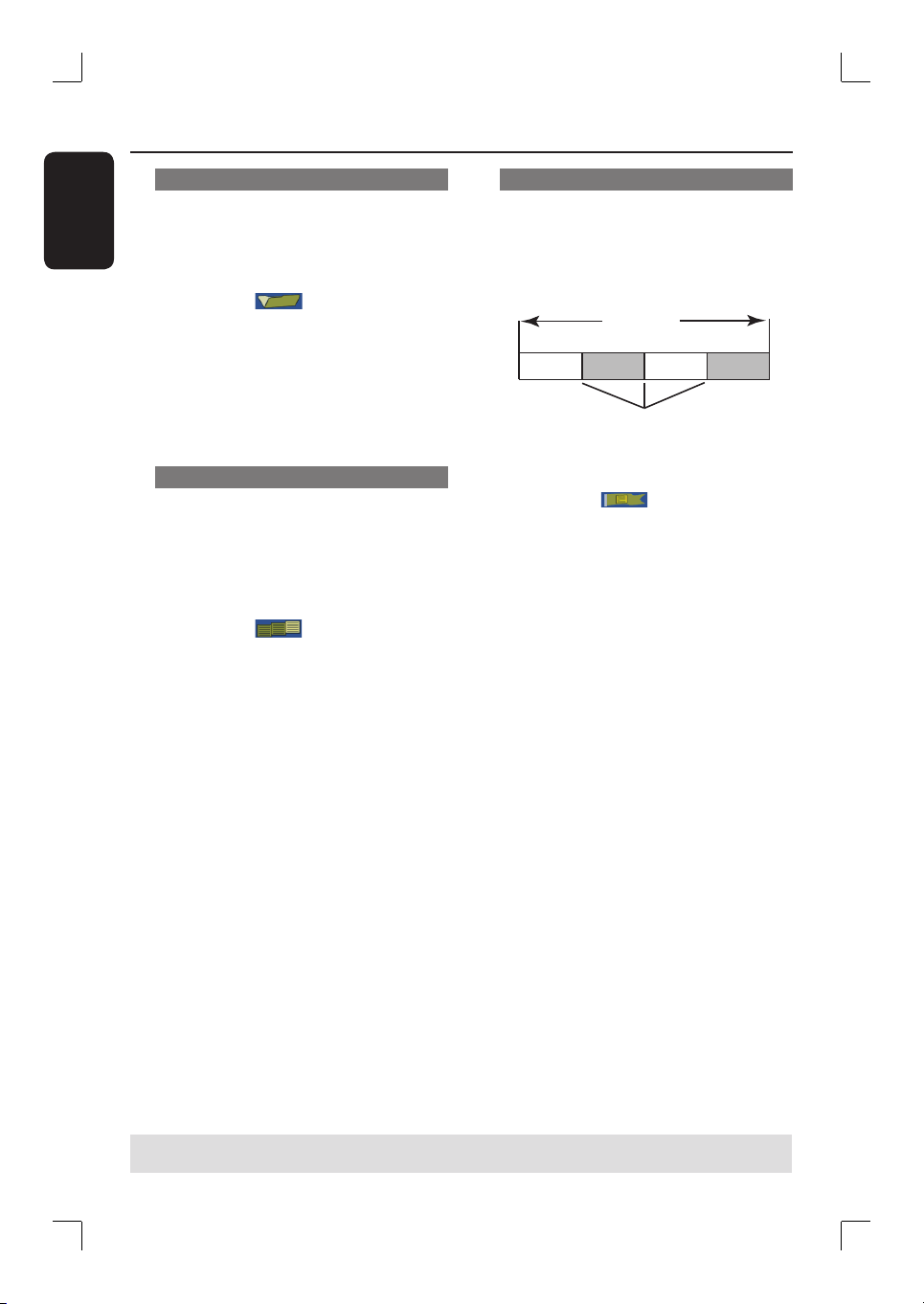
English
46
Selecting a title
This option shows the current title and
the total number of titles on the disc.
A
During playback, press EDIT to display
the video editing menu, then useST
keys to select
{ Title } and press
OK.
B
Use the numeric keypad 0-9 to key in
a title and press OK.
The recorder will playback the
selected title.
Selecting a chapter
This option shows the current chapter
and the total number of chapters in the
title.
A
During playback, press EDIT to display
the video editing menu, then use ST
keys to select
{ Chapter } and
press OK.
B
Use the numeric keypad 0-9 to key in
the chapter and press OK.
The recorder will playback the
selected chapter.
Creating chapter markers
You can create a chapter by inserting
chapter markers at any point within a
title during playback. This will allow you
to access a speci c point in the recording
easily or set a chapter you wish to hide.
Title
Chapter Chapter Chapter Chapter
chapter markers
A
During playback, press EDIT to display
the video editing menu, then use ST
keys to select
{ Chapter
Marker } and press OK.
B
Use ST keys to select one of the
options and press OK to con rm.
{ Insert Marker }
Select this to insert a new chapter
marker at the current point of playback.
{ Delete Marker }
Select this to delete the current chapter
marker (it refers to the closest marker
before the current point of playback).
{ Delete All Markers }
Select this to delete all the chapter
markers in the current title.
Editing/ Finalising Recording (continued)
TIPS: No further recording and editing can be carried out on a full or nalised DVD±R.
Press W to go back to the previous menu.

English
47
Editing/ Finalising Recording (continued)
TIPS: No further recording and editing can be carried out on a full or nalised DVD±R.
Press W to go back to the previous menu.
Hiding unwanted scenes
You can choose to hide certain scenes
from playback (e.g. skipping commercials)
or make it visible again.
A
Create a chapter marker at the start and
end of the scene you want to hide. ( See
previous page on “Creating Chapter
Markers”).
B
Select the chapter you want to hide and
start playback. (See previous page on
“Selecting a chapter”).
C
During playback, press EDIT to display
the video editing menu, then use ST
keys to select { Hide Chapter }
and press OK.
The current chapter will be hidden.
If the video editing menu does not show,
press EDIT on the remote control.
To unhide a chapter
A
Press EDIT on the remote control
during playback.
The video editing menu appears.
While in editing mode, the hidden
chapter/chapters will be played back.
B
Wait for the chapter you want to unhide
to occur or use .> keys on the
remote control to make a fast search.
C
Use ST keys to select { Unhide
Chapter } and press OK.
The current chapter will be visible
during playback.
Helpful Hint:
– All the hidden chapters will be played
back while in video editing mode.
– To locate a speci c frame during playback,
press PAUSE
Årepeatedly to forward
search to the frame that you want.
Changing Index Picture
The index picture is the picture of the
title you will see when the recorder
loads up the Index menu. Normally, the
rst frame of a recording is shown as the
title’s index picture.
A
During playback, use W X keys on the
remote control to search for the scene
to use, then press PAUSE
Å
.
Press PAUSE
Å
again to move
forward to next pause scene.
B
Press EDIT to display the video editing
menu, then use ST keys to select
{ Index Picture } and press OK
to select the current scene as the index
picture for the title.
Splitting a title (DVD±RW only)
You can divide the current title into two
new titles. Each of these titles is
characterised by its own index picture.
Warning! Once a title is divided, the
process cannot be reversed.
During playback, press EDIT to display
the video editing menu, then useST
keys to select { Split Title } and
press OK to divide the title at the
current playback position.
A new title will be shown at the Index
Picture screen.
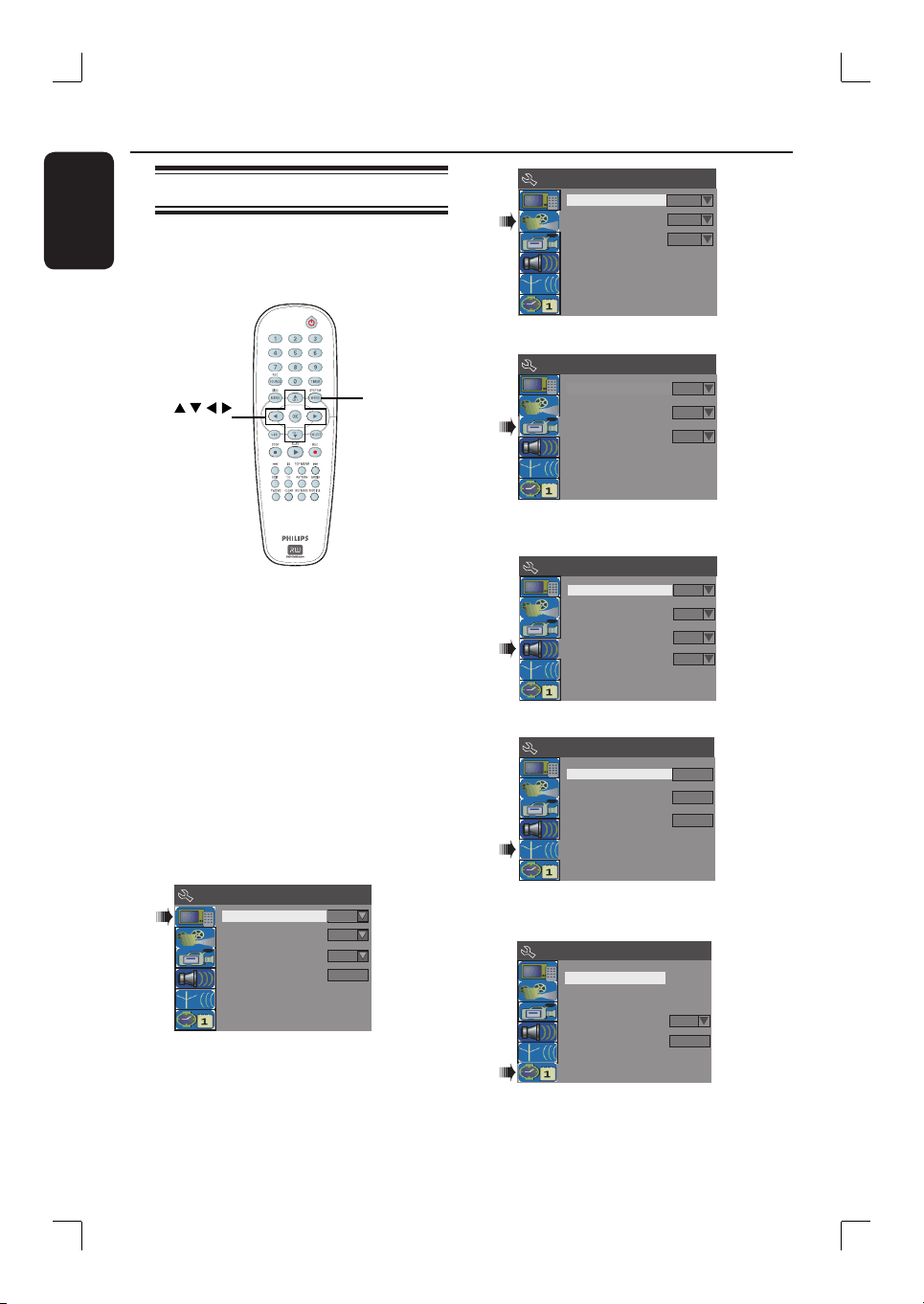
English
48
DVD System Menu Options
Accessing the System Menu
The system menu provides various
options for you to adjust the recorder to
suit your preferences.
SYSTEM
MENU
OK
A
Press SYSTEM MENU on the remote
control.
The system menu appears on TV.
B
Use ST keys to highlight a menu item
and press X to access its options.
C
Use ST keys to highlight the setting you
wish to change and press OK to con rm
and return to the previous menu item.
Instructions and explanation of the
options are provided in the following
pages.
D
To exit, press SYSTEM MENU.
Country
Video Output Format
Restore Factory Settings
UK
PAL
OK
Screen Saver
On
System Menu - General
See the next page.
Parental Rating Level
Digital Audio Output
Off
All
TV Aspect Ratio
4:3 Letterbox
System Menu - Playback
See this chapter “ PLAYBACK settings”.
System Menu - Record
Default Recording Source
Default Recording Mode
Tuner
SP
Auto Chapter Marker
On
See the chapter “Recording – RECORD
settings”.
Default Disc Menu Language
Default Subtitle Language
Off
On Screen Display Language
Default Audio Language
English
English
System Menu - Language
English
See this chapter “LANGUAGE settings”.
System Menu - Channel Setup
Modify Channel Information
Sort Channels
Channel Search
Search
Edit
Sort
See this chapter “CHANNEL SETUP
settings”.
System Menu -
Clock
Time(hh:mm:ss)
Date(dd/mm/yy)
31/01/06
10 : 33 : 57
Date-Time Setting
OKShow DivX registration code:
Auto
See this chapter “CLOCK settings”.
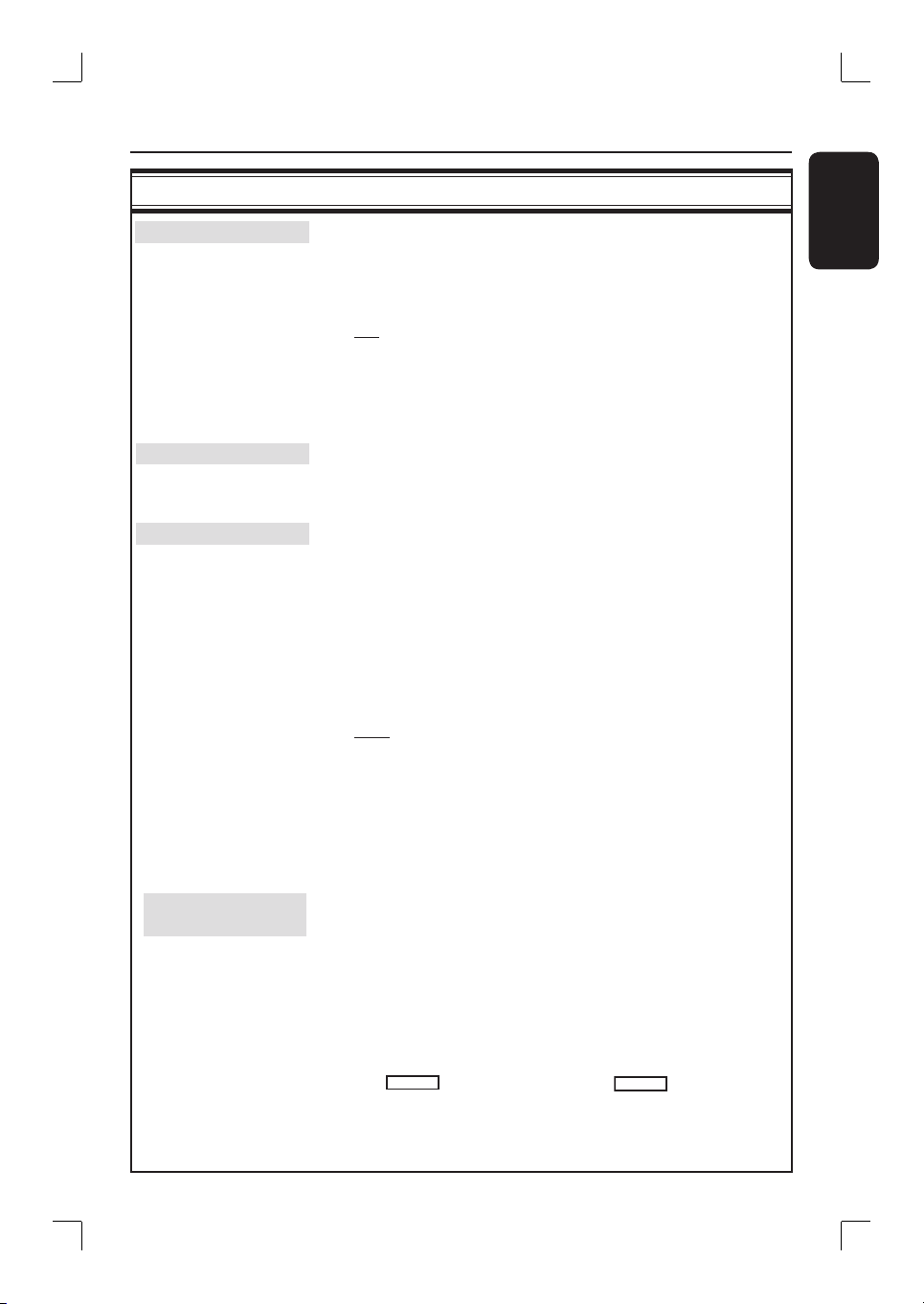
English
49
DVD System Menu Options (continued)
GENERAL settings (underlined options are the factory default settings)
Screen Saver A screen saver prevents damage to the TV screen by avoiding
exposure to a static image for too long.
1)
Use ST keys to select one of the options.
{ On } – Select this if you wish to turn off the TV screen
after playback had been stopped or paused for
longer than 15 minutes.
{ Off } – Select this to disable the screen saver.
2) Press OK to con rm your selection.
Country Select the country of your area for auto channel tuning.
(See section “ Step 3: Installation and Setup - Select the country
of your residence”)
Video Output Format The colour system of the DVD system, DVD and TV should
match. Only then will it be possible to play a DVD on this system.
Before changing the TV system, determine the colour system of
your TV set.
1)
Use ST keys to select one of the options.
{ NTSC } – Select this if the connected TV set has the
NTSC colour system. It will change the video
signal of a PAL disc and output it to NTSC
format.
{ PAL } – Select this if the connected TV set has the PAL
colour system. It will change the video signal of
an NTSC disc and output it to PAL format.
2) Press OK to con rm your selection.
Helpful Hint:
– If a blank/distorted TV screen appears, wait for 10 seconds for the auto
recovery.
Restore Factory
Settings
This option will restore all the settings of this recorder, except
for the PIN code.
Restore Factory settings can only be changed when there
is no disc in the disc tray.
1) Use ST keys to select { Restore Factory Settings } and press
OK.
A warning message will appear.
2) Select
OK
in the menu to proceed or
CANCEL
to abort, then
press OK to con rm.
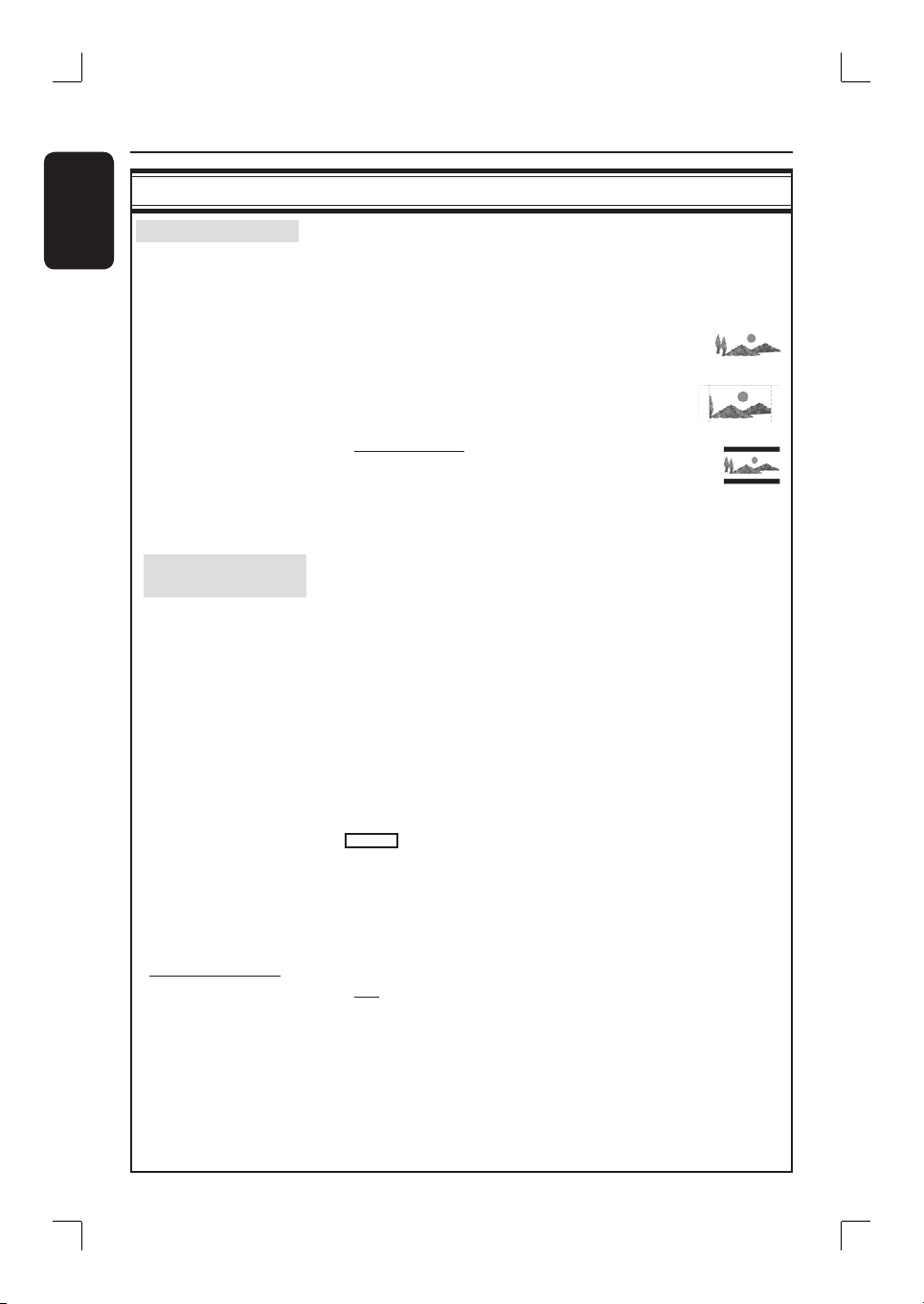
English
50
PLAYBACK settings (underlined options are the factory default settings)
DVD System Menu Options (continued)
TV Aspect Ratio Set the aspect ratio of the recorder according to the TV type you
have connected.
1)
Use ST keys to select one of the options.
{
16:9 } – Select this for wide screen TV
(frame ratio 16:9).
{ 4:3 Panscan } – Select this for a full-height
picture with both side trimmed.
{ 4:3 Letterbox } – Select this for a ‘wide screen’ display
with black bands on the upper and
lower portions of the TV screen.
2) Press OK to con rm your selection.
Parental Rating
Level
Some DVDs may have a parental level assigned to the complete
disc or to certain scenes on the disc. This feature lets you set a
playback limitation level.
1)
Press OK to access this menu and you will be prompted to enter
your four-digit pin code.
2) Use the numeric keypad 0-9 to enter your four-digit pin code.
When doing this for the rst time, enter the default password
‘3308’ .
The set rating level menu appears.
If you forget your four-digit pin code, the default password is 3308.
3) Use ST keys to select the desired parental level, then move to
OK
in the menu and press OK on the remote control to
con rm.
To disable parental controls and allow all discs to play, select
{ Off }.
Press X to access this menu and use ST keys to select one of the
options.
Rating explanations
{ Off } – Parental control is not active.
{ 1. Kid Safe } ~ { 2. G } – Childsafe; acceptable for viewers of all
ages.
{ 3. PG } – Parental Guidance suggested.
{
4. PG13 } – Unsuitable for children under age 13.
{
5. PG R } ~ { 6. R } – Restricted; recommended that parents
restrict children under 17 from viewing or allow
to view only when supervised by a parent or
adult guardian.
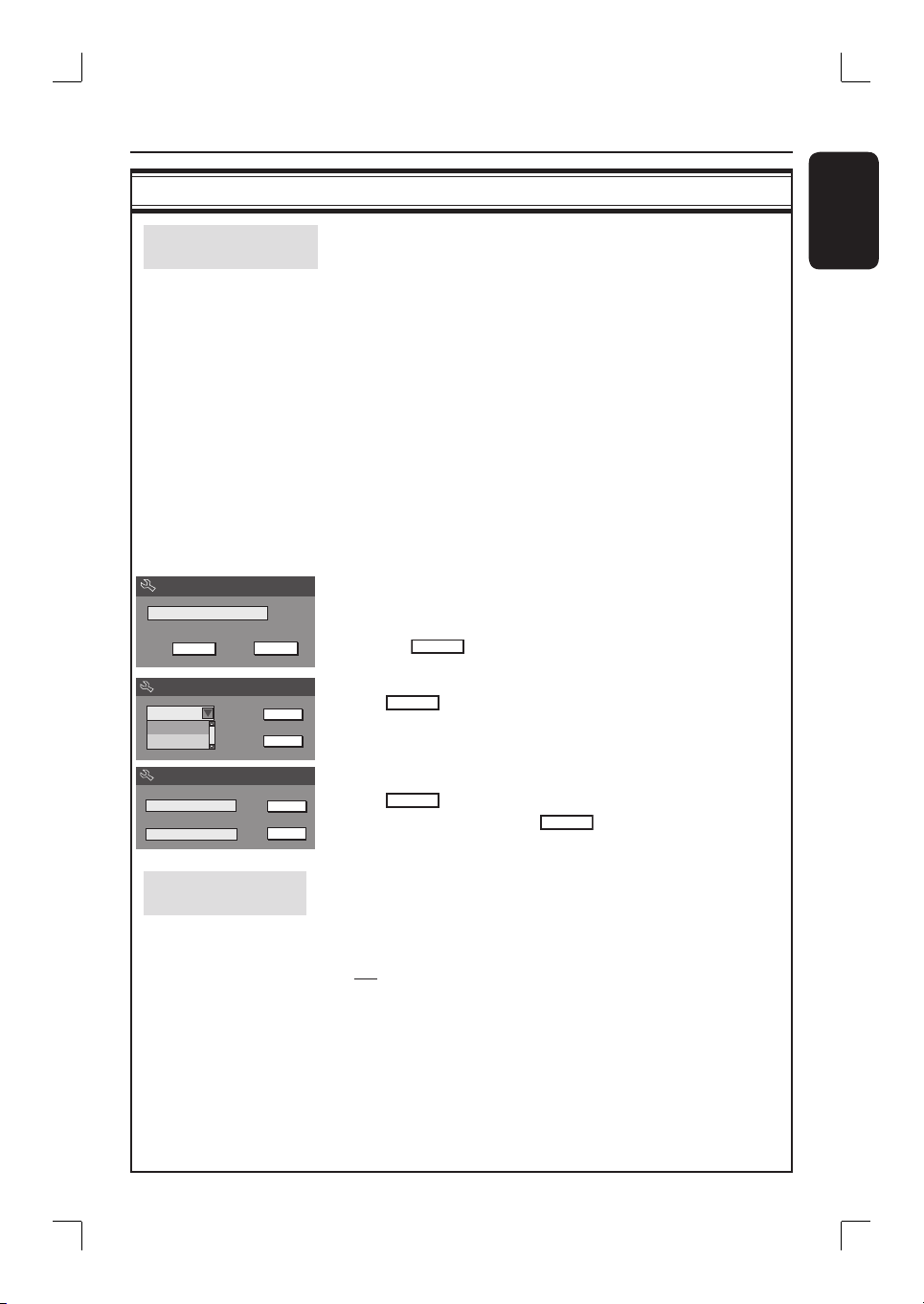
English
51
DVD System Menu Options (continued)
PLAYBACK settings (underlined options are the factory default settings)
Parental Rating
Level
{ 7. NC 17 } – No children under age 17; not recommended
viewing for children under age 17.
{ 8. Adult } – Mature material; should be viewed only by
adults due to graphic sexual material, violence or
language.
DVDs that are rated higher than the level you have selected will not play
unless you enter your four-digit pin code.
Helpful hints:
– VCD, SVCD, CDs have no level indication, so parental control has no effect
on these type of discs. This also applies to most illegal DVDs.
– Some DVDs are not coded with a rating though the movie rating may be
printed on the disc cover. The rating level feature does not prohibit play of
such discs.
To change your password
1)
Select { Parental Rating Level } and press OK.
You will be prompted to enter your four-digit pin code.
2) Use the numeric keypad 0-9 to enter your four-digit pin code
and select
OK
in the menu and press OK on the remote control
to con rm.
The set rating level menu appears.
3) Select
New
in the menu and press OK to access new password
menu.
4) Use the numeric keypad 0-9 to enter your new four-digit pin
code, then press T to select the next entry eld and enter the same
pin code a second time.
5) Select
OK
in the menu and press OK to con rm.
To abort the change, select
CANCEL
and press OK.
Digital Audio
Format
Adjust the digital output setting only if you have connected other
devices to the coaxial socket on the recorder.
1)
Use ST keys to select one of the options.
{ All } – Select this if you have used the COAXIAL
socket on the recorder to connect to a stereo
receiver that has a built-in multichannel decoder.
{ LPCM } – Select this if the connected audio equipment is
not capable of decoding multichannel audio
Dolby Digital and MPEG-2 multichannel signals
are converted to PCM (Pulse Code Modulation).
2) Press OK to con rm your selection.
* * * *
Enter Password
OK
CancelOK
Set Rating Level
New password
4. PG 13
5. PG R
4. PG 13
OK
New
OK
New password
Confirm password
* * * *
New Password
OK
Cancel
OK
English
52
LANGUAGE settings
On-Screen Display Select the menu language for this recorder on-screen display.
Language
Default Disc Menu Select the preferred disc menu language for DVD playback.
Language
Default Subtitle Select the preferred subtitle language for DVD playback.
Language
Default Audio Select the preferred audio language for DVD playback.
Language
Helpful Hints:
– If the selected audio/subtitle language is not available on the disc, the disc’s
default setting language will be used instead.
– For some DVDs, the subtitle/audio language can only be changed via the DVD
disc menu.
DVD System Menu Options (continued)
RECORD settings
Auto Chapter
Insert chapter markers within a title during recording.
Marker This allows you access to speci c points on the recording.
See the chapter “Recording – RECORD settings”.
Default Recording De ne your preferred source of recording. The default source is
Source selected when the recorder is switched on.
See the chapter “Recording – RECORD settings”.
Default Recording De ne your preferred mode of recording.
Mode
See the chapter “Recording – RECORD settings”.
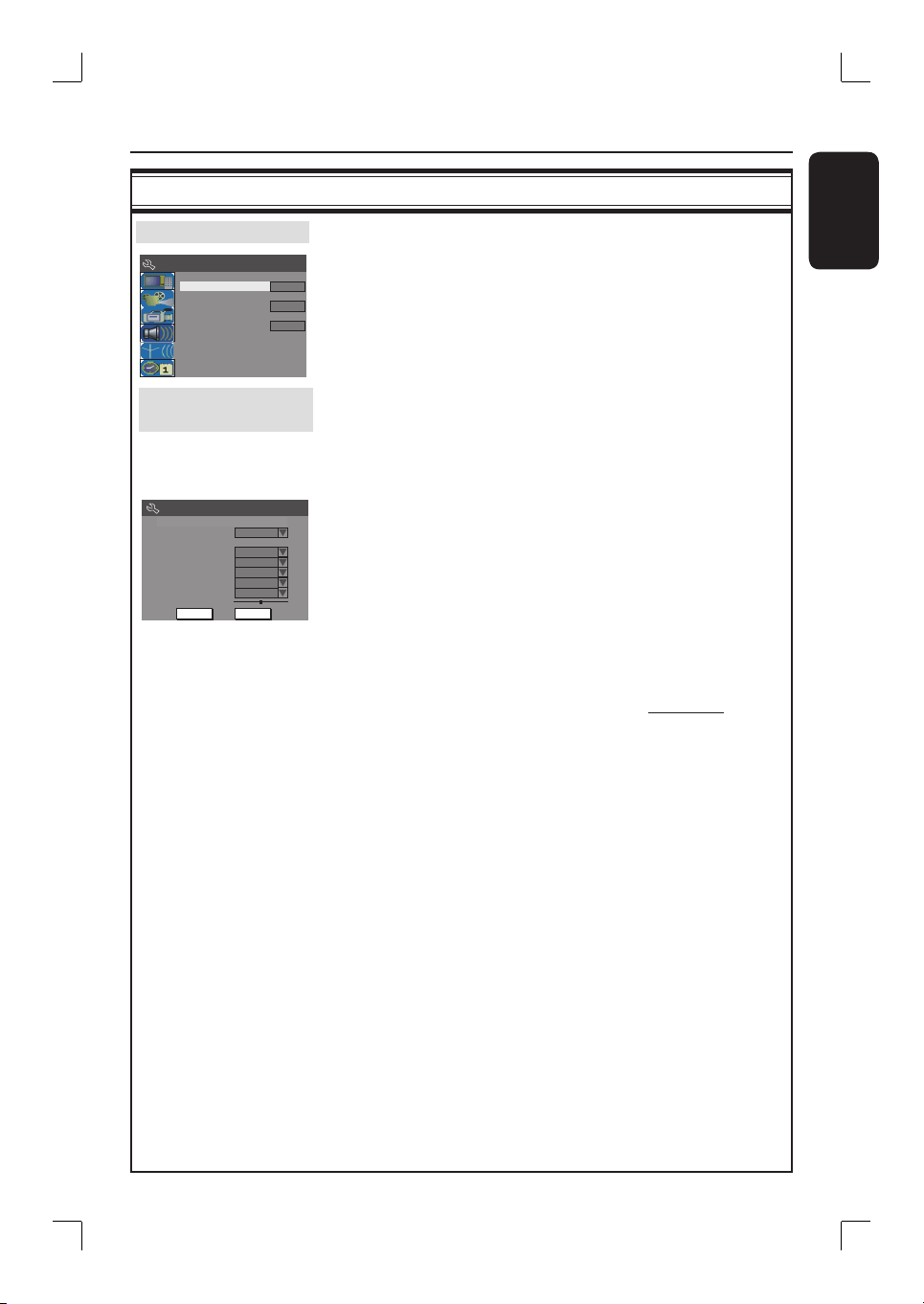
English
53
DVD System Menu Options (continued)
CHANNEL SETUP settings
Channel Search Automatically scan all the receivable analogue local TV
channels and store these channels on the recorder.
Use ST keys to highlight { Channel Search } and press OK.
The automatic TV channel search starts. This process may take
several minutes. Once complete, the total number of channels found
and stored appears on the TV.
Modify Channel Adjust a stored TV channel to your preference, improve the
Information reception and the sound quality of that TV channel.
1) Use ST keys to highlight { Modify Channel Information } and
press OK.
The channel menu appears.
2) Use ST keys to select one of the options.
{ Name } – You can use the numeric keypad 0-9 to select
the channel preset number which you wish to
change.
– Use STkeys to change alphabet/ number and
use WX keys to select different entry elds, then
press OK to con rm.
{ Scan Mode } – Select TV channel search mode based on
channel allocation or frequency.
– Use ST keys to select { Frequency },
{ Channel } or { S-Channel } (Special Channel),
then press OK to con rm.
{ Frequency } – Shows the frequency of the current TV
channel.
– If required, use WX keys to start the automatic
frequency search and press OK to con rm.
{ TV System } – Set the TV system that produces the least
distortion of picture and sound.
– Use ST keys to select a suitable sound mode,
then press OK to con rm. (See chapter “TV
System Guide” at the back of this manual for
more information).
{ NICAM } – Turn on or off the digital sound transmission
system which improves the sound quality of the
TV channel.
– Use ST keys to select { On } or { Off }, then
press OK to con rm.
System Menu - Channel Setup
Modify Channel Information
Sort Channels
Channel Search
Search
Edit
Sort
Channel
Scan mode
Frequency
TV System
NICAM
Audio
OK
Frequency
PAL B/G
Name
On
OK
DUAL A
Off
Skip
Fine-tune
P001/Ch003
55.26MHz
Cancel
Decoder
No
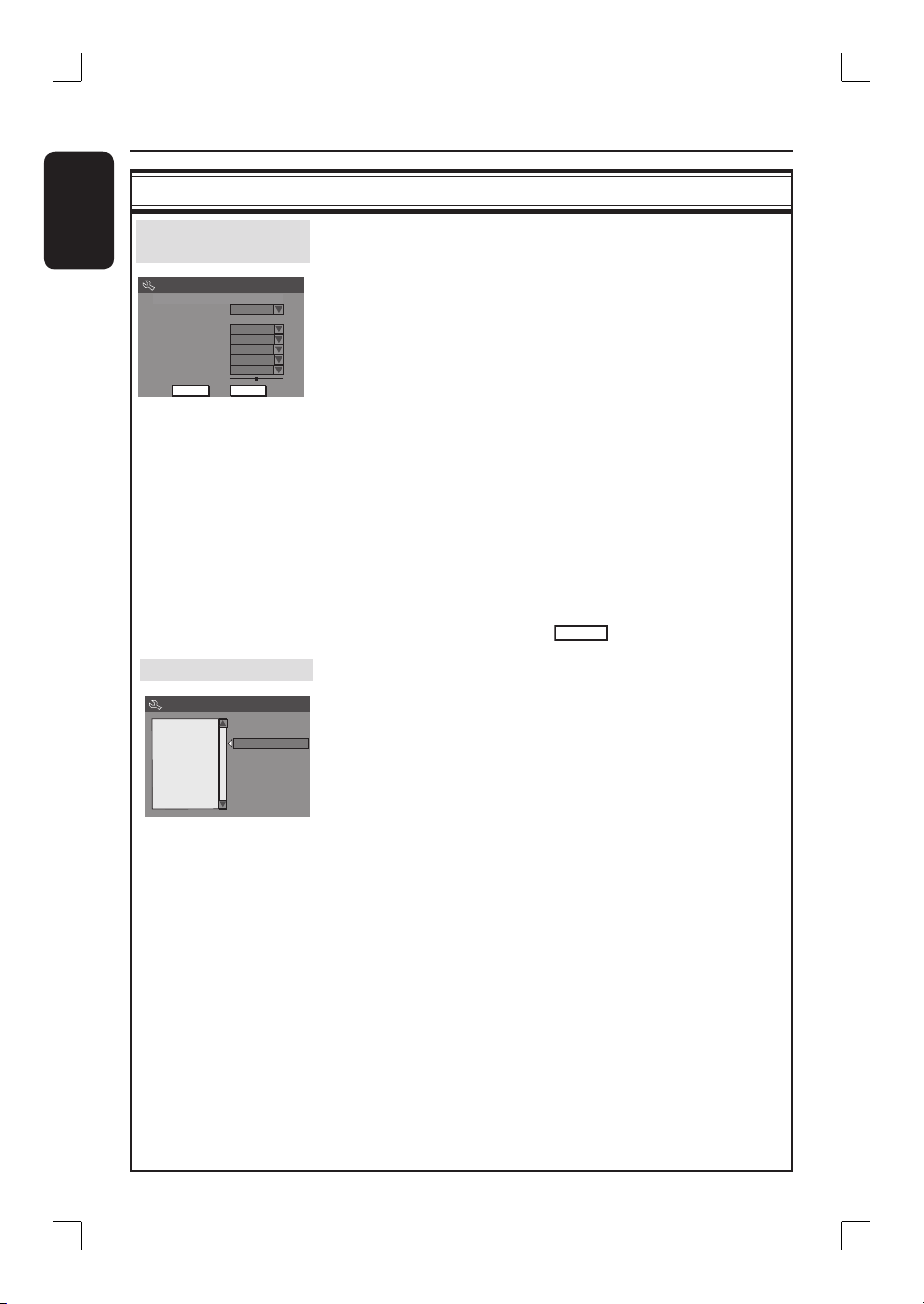
English
54
DVD System Menu Options (continued)
CHANNEL SETUP settings (continued)
Channel
Scan mode
Frequency
TV System
NICAM
Audio
OK
Frequency
PAL B/G
Name
On
OK
DUAL A
Off
Skip
Fine-tune
P001/Ch003
55.26MHz
Cancel
Decoder
No
Modify Channel
Information
{ Audio } – For bilingual TV programmes, you can switch
between stereo (original) and additional audio
language.
– Use ST keys to select { DUAL A } or
{ DUAL B }, then press OK to con rm.
{ Decoder } – If you have connected the recorder with an
external decoder, set it to { On } and press
OK to con rm.
{ Skip } – Select this to set the channel to be skipped.
The skipped channels can only be accessed by
pressing the corresponding number key on
the remote control.
– Use ST keys to choose { Yes } if you wish to
skip this channel, then press OK to con rm.
{ Fine-Tune } – Select this to ne-tune the TV channel
manually if the reception is poor.
– Use WX keys to adjust the frequency.
3) To con rm all settings, select
OK
and press OK.
Sort Channels Rearrange all stored TV channels.
1) Use ST keys to highlight { Sort Channels } and press OK.
The list of TV channel programmes appears.
2) Use ST keys to highlight the channel you want to change and press
OK.
The selected channel will move to the right side of the screen.
3) Use ST keys to shift the TV channel to the desired position and
press OK again.
The selected channel will be inserted before the current position.
4) Repeat steps
B
~
C
until you have sorted all the TV channels you
want.
5) Press RETURN on the remote control to go back to the previous
menu.
Sort Channels
P001
P002
P003
P004
P005
P006
P007
P008
BC020
SW006
CH008
CH004
GG006
CH010
CH012
CH005
Skip
Unskip
Unskip
Unskip
Skip
Unskip
Unskip
Unskip
P003 CH008 Unskip
English
55
CLOCK settings (underlined options are the factory default settings)
DVD System Menu Options (continued)
Date (dd/mm/yy) Use ST keys to change the number and use WX keys to
select different entry elds, then press OK to con rm.
Time (hh:mm:ss) Use ST keys to change the number and use WX keys to
select different entry elds, then press OK to con rm.
Date-Time Setting
You can choose to enable/disable the automatic setting of date
and time. This feature is dependent on your local broadcaster.
1) Use ST keys to select one of the options.
{ Auto } – Select to activate automatic setting of date
and time.
{ Manual } – Select this to manually set the date and time.
2) Press OK to con rm your selection.
Show DivX®
Select to view the DivX
®
VOD (Video On Demand)
Registration code
registration code that allows you to rent and purchase videos
using the DivX
®
VOD service. For more information, visit us at
www.divx.com/vod.
1) Press X to display the registration code.
2) Use the registration code to purchase or rent videos from DivX®
VOD service at www.divx.com/vod. Follow the instructions and copy
the video from your computer onto a CD-R/RW or recordable DVD
disc for playback on this recorder.

English
56
Software Upgrade
Installing the latest software
The software installed in your recorder is
continuously being re ned for greater
stability and compatibility of the set.
Periodically, Philips will issue upgrades for
the software which you copy onto a CD
and install the software of your recorder.
Caution! Power supply must not be
interrupted during upgrade!
Visit Philips’ website at
‘www.philips.com/support’ to check for
the availability of the latest software
upgrade.
Note: When checking for the latest
software upgrade, please also check for
any accompanying instructions on
installing the software.

English
57
Picture/Display
• Aspect ratio: 4:3, 16:9
• D/A converter: 10 bit, 54 MHz
• A/D converter: 10 bit, 27 MHz
Sound
• D/A converter: 24 bit, 192 kHz
• A/D converter: 24 bit, 96 kHz
• Signal to noise ratio: 106
• Crosstalk (1kHz): 105 dB
• Dynamic Range (1kHz): 90 dB
Video Recording
• Recording system: PAL
• Compression formats: MPEG2
High Quality : HQ
Standard Play : SP
Extended Play : EP
Super Long Play : SLP
• Audio compression: Dolby Digital, PCM
Video Playback
• Disc playback media: CD, CD-R/-RW, DVD,
DVD-Video, DVD+R/+RW, DVD-R/-RW
SVCD, Video CD
• Compression formats: MPEG2, MPEG1,DivX
• Video disc playback system: NTSC, PAL
Audio Playback
• Disc playback media: CD, CD-R/-RW,
MP3-CD, MP3-DVD
• Compression formats: Dolby Digital, MP3,
MPEG2 Multichannel, PCM
• MP3 bit rates: 32~256 kbps and VBR
Still Picture Playback
• Disc formats: DVD+R/+RW, DVD-R/-RW,
Picture CD
• Picture compression formats: JPEG
• Picture enhancement: Rotate
Storage Media
• Recording media: DVD+R, DVD+RW,
DVD-R, DVD-RW
Tuner/Reception/Transmission
• TV system: PAL
• Aerial Input: 75 Ohm coaxial (IEC75)
Connectivity
Rear Connections:
• SCART (2x)
• S-Video Out
• Video (CVBS) Out
• Audio left/right Out
• Digital audio out (coaxial)
• RF aerial in
• RF TV out
• Mains
Front Connections:
• i.LINK DV in (IEEE 1394 4-pin)
• Video In (CAM1)
• Audio left/right In
Convenience
• Programming/Timer Enhancements: Daily/
Weekly, Repeat Programme, Manual Timer,
One Touch Recording, VIDEO Plus+
®
• Programmable events: 8
Power
• Power supply: 220 – 230V; 50 Hz
• Consumption: 25 W (typical)
• Standby power consumption: < 3W
Cabinet
• Dimensions (W x H x D) : 360 x 43 x 322 mm
• Net Weight : 3 kg
Speci cations

English
58
Troubleshooting
Problem (General) Solution
WARNING
Under no circumstances should you try to repair the system yourself, as this will
invalidate the warranty. Do not open the system as there is a risk of electric shock.
If a fault occurs, rst check the points listed below before taking the system for repair.
If you are unable to remedy a problem by following these hints, consult your dealer or
Philips for help.
No power.
Remote control does not
work.
No picture.
No sound.
No TV signal received from
the recorder.
A TV channel installed during
the DVD recorder’s
automatic TV channel search
is fuzzy or distorted.
Unable to eject tray
– Press STANDBY-ON button on the front of the recorder to
switch on the system.
– Make sure the AC outlet has power.
– Aim the remote control directly at the sensor on the front of
the DVD recorder (not towards TV).
– Remove any obstacles between the recorder and the remote
control. Aim the remote control towards the set at different
angles and/or distances.
– Batteries are weak, replace the batteries.
– Press REC SOURCE on the remote control to select an input
source.
– Switch on your TV and set to the correct Video In channel.
Switch the TV channel until you see the DVD screen. Read
chapter “Step 3 - Installation and Setup – Finding the correct
viewing channel” for details.
– Check the video connection between the recorder and the TV.
– Check the audio connections, the red and white sockets. Read
chapters “Step 1 : Basic Reorder Connections - Connecting the
audio cables” for details.
– Set the Digital output correctly, based on the equipment you
connected to the recorder. Read chapter “DVD System Menu
Options - PLAYBACK settings – Digital Audio Output” for
details.
– Have your aerial or cable TV signal checked.
– Install the TV channel. Read chapter “Step 3: Installation and
Setup - Setting your TV channel programmes” for details.
– Check the video connection between the DVD recorder and
the TV.
– You can further ne-tune the signal of the TV channel. Read
chapter on “DVD System Menu Options – CHANNEL SETUP
Settings”
– Press CH +/– to search for the same TV channel which may
have a clearer picture.
– Exit from any on-screen menu until you see the Philips
wallpaper
– Press STOP to stop any playback or recording, then press
EJECT on the set.

English
59
Problem (Playback) Solution
Troubleshooting (continued)
Disc does not play.
Distorted sound coming from
a connected hi- system or
ampli er.
Unable to play DivX movies.
The picture is distorted or
black and white during
playback.
A DVD±R/±RW recorded on
this DVD recorder does not
play on a DVD player.
There is picture or sound
interference with the TV
reception.
The message ‘UNKNOWN
DISC’ appears.
– Insert the disc with the label facing up.
– Wrong region code. The DVD must be coded for ALL regions
or Region 2 in order to be played back on this DVD recorder.
– There is no recording on the disc or wrong disc type. Read
chapter “Playback - Playable discs” for details.
– Make sure the disc is not scratched or warped. Clean the disc
or replace a new one.
– Check if the disc is defective by trying another disc.
– Do not connect any cables from the recorder to the ‘Phono’
input of your ampli er.
– Check that the DivX le is encoded according to the ‘Home
Theatre Pro le’ mode with DivX encoder.
– Check that the DivX movie downloaded is a complete le.
– The disc does not match with the TV colour system standard
(PAL/NTSC).
– The disc is dirty, clean the disc.
– Sometimes a small amount of picture distortion may appear.
This is not a malfunction.
– If a recording is too short, it is possible that a DVD player
cannot detect it. Please observe the following ‘minimum
recording times’. Recording mode : {HQ} – 5 mins, {SP} – 10
mins, {EP} – 20 mins, {SLP} – 30 mins.
– You have to nalise the DVD±R. Refer to chapter “Playing your
recordings (DVD±R) on other DVD players” for details.
– Have your aerial or cable TV signal checked.
– Fine-tune your TV channel. Read chapter “Step 3 : Installation
and Setup - Setting your TV channel programmes” for details.
– This message may appear if you insert a disc that may have
encountered one of the following:
– Error during recording: The title may be missing.
– Error while changing the title/index picture: The original title/
index picture may be visible.
– Error while nalising or the disc has not been nalised.

English
60
Problem (Recording) Solution
Troubleshooting (continued)
The wrong TV channel was
decoded (recorded) after you
programmed a recording
using the VIDEO Plus+
®
system.
Picture is fuzzy and
brightness varies when
copying DVD Video discs or
prerecorded video cassettes.
Recordings are not occurring
as scheduled. New recordings
cannot be made.
The picture on my decoder
appears to be distorted
during recording.
1) Enter the PlusCode programming number of the desired TV
channel.
2) Press OK to con rm.
3) Check the channel number in the {Program #} input eld. If this
does not correspond to the desired TV channel, select this
entry eld and change the channel number.
4) Press OK to con rm.
– This happens if you try to copy DVDs or video cassettes that
have been copy-protected. Even though the picture on the TV is
ne, but the recording on the DVD recordable disc is faulty.
This interference is unavoidable with copy-protected DVDs or
video cassettes.
– The DVD recordable disc has a limited recording lifetime, please
change a new disc for recording.
– The TV channel you want to record is not stored or you
selected the wrong program number. Check the TV channels
stored.
– You have to reset the timer recording after adjusting the clock
setting.
– You cannot use the recorder to duplicate copy-protected
materials (DVDs or video tapes) onto a DVD recordable disc.
– If you are recording a programme from your decoder box, you
can view the same programme by pressing TV/DVD on the
recorder’s remote control.
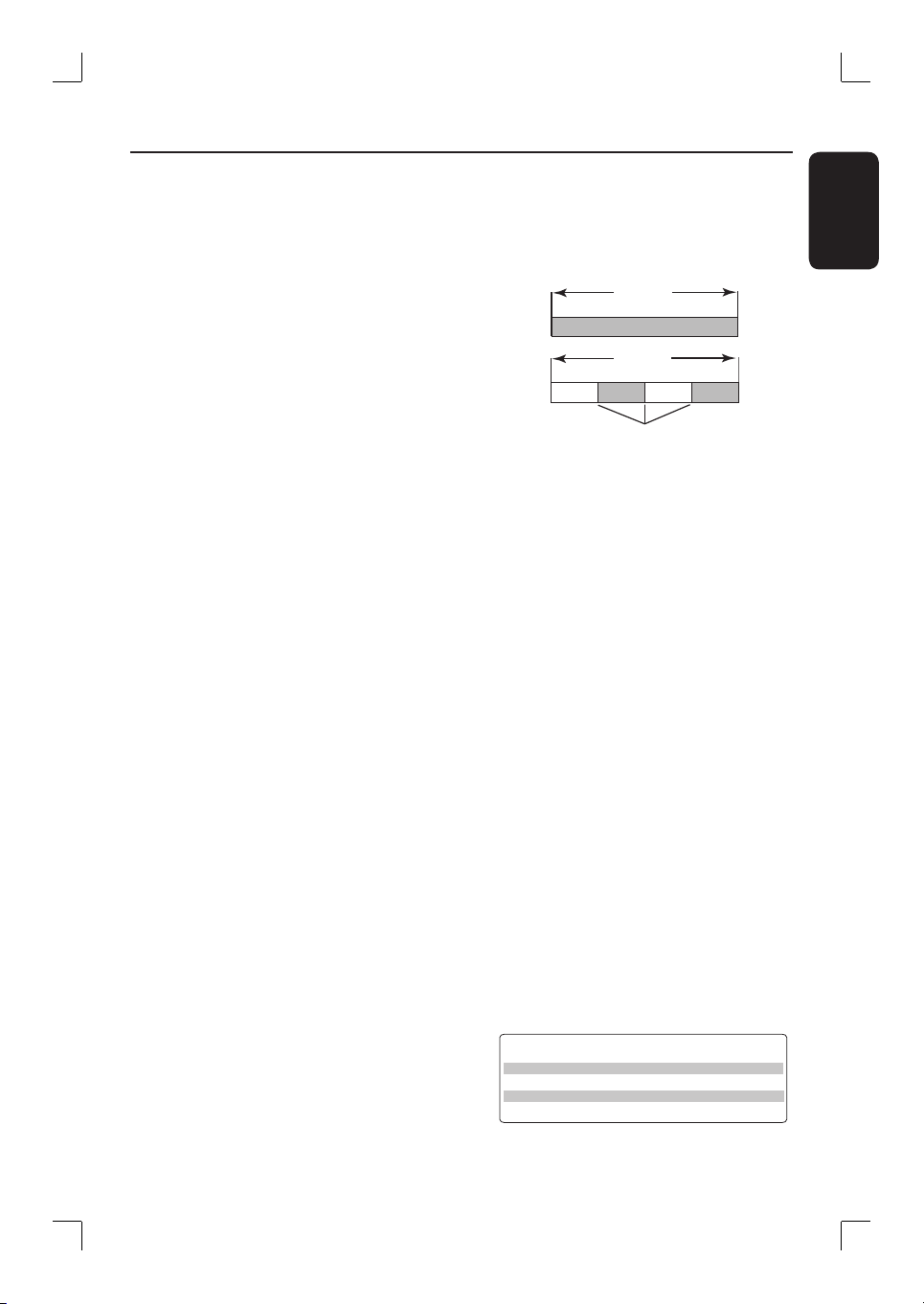
English
61
What kind of disc should I use for
recording?
You can record on both DVD±R and
DVD±RW discs. They are compatible with
DVD-Video players and DVD-ROM drives in
computers.
What is the capacity of a DVD±R/±RW
disc?
4.7GB, or equivalent to six CDs. You can
store only one hour of recordings on a single
disc at the highest quality (DVD standard) and
about 6 hours recordings at the lowest quality
(VHS standard).
What is the difference between DVD±R
and DVD±RW?
DVD±R is “recordable” and DVD±RW is
“rewritable”. With a DVD±R, you can record
multiple sessions on the same disc, but when
the disc is full, you cannot record any more on
the disc. The DVD±RW allows you to record
over the same disc repeatedly.
What is DV?
Using DV, also known as i.LINK, you can
connect a DV-equipped camcorder to this
recorder using a single DV cable for input and
output of audio, video, data and control
signals.
–
This recorder is only compatible with DV-
format (DVC-SD) camcorders. Digital satellite
tuners and Digital VHS video recorders are
not compatible.
– You cannot connect more than one DV
camcorder at a time to this recorder.
– You cannot control this recorder from
external equipment connected via the DV IN
socket.
Can I copy a VHS tape or DVD from an
external player?
Yes, but only if the VHS tape or DVD is not
copy protected.
What are Titles and Chapters?
A DVD disc contains Titles and Chapters,
which are similar to the Titles and Chapters of
a book. A Title is often a complete movie and
is broken down into Chapters, or individual
scenes from the movies.
Title
Chapter
Title
Chapter Chapter Chapter Chapter
cha
p
ter markers
Programmes are recorded as a single title, it
may consist of one chapter or a few chapters
within a title, depending on the recording
settings.
How do I set up Titles and Chapters?
The recorder automatically creates a new Title
every time you start a new recording. You can
then add Chapters to these recordings
manually or have them automatically inserted
at 5-minutes intervals.
What does “ nalising” a disc do?
Finalising a disc locks the disc so it can no
longer be used for recording. This is only
required for DVD±R discs. It will then be
compatible with virtually any DVD player. To
remove a disc without nalising it, simply stop
recording and eject the disc. You will still be
able to record on the disc if there is storage
space for more recordings.
How good is the quality of the
recording?
There are a few quality levels to choose from,
ranging from “HQ” - High Quality (1 hour
mode) to “SLP” - Super Long Play (6 hours
mode). Press the REC MODE key on the
remote control to choose the quality level that
best suits your purpose and the length of
material.
Record
Mode
HQ
SP
EP
SLP
Picture Quality
High quality
DVD quality-Standard Play
VHS quality-Extended Play
VHS quality-Super Long Play
Maximum Recording
Time per Disc
1 hour
2 hours
4 hours
6 hours
Frequently Asked Questions

English
62
Analogue: Sound that has not been turned into
numbers. Analogue sound varies, while digital sound
has speci c numerical values. These sockets send
audio through two channels, the left and right.
Aspect ratio: The ratio of vertical and
horizontal sizes of a displayed image. The horizon-
tal vs. vertical ratio of conventional TVs. is 4:3,
and that of wide-screens is 16:9.
AUDIO OUT sockets: Red and white sockets
on the back of the system that send audio to
another system (TV, Stereo, etc).
Chapter: Sections of a picture or a music piece
on a DVD that are smaller than titles. A title is
composed of several chapters. Each chapter is
assigned a chapter number enabling you to locate
the chapter you want.
Digital: Sound that has been converted into
numerical values. Digital sound is available when
you use the DIGITAL AUDIO OUT COAXIAL.
These sockets send audio through multiple
channels, instead of just two channels as analogue
does.
Disc menu: A screen display prepared for
allowing selection of images, sounds, subtitles,
multi-angles, etc recorded on a DVD.
DivX 3.11/4.x/5.x/6: The DivX code is a
patentpending, MPEG-4 based video compression
technology, developed by DivX Networks Inc., that
can shrink digital video to sizes small enough to be
transported over the internet, while maintaining
high visual quality.
Dolby Digital: A surround sound system devel-
oped by Dolby Laboratories containing up to six
channels of digital audio (front left and right,
surround left and right, centre and subwoofer).
Index Picture Screen: A screen that gives an
overview of a DVD±RW or DVD±R. An Index
Picture represents each recording.
JPEG: A very common digital still picture format.
A still-picture data compression system proposed
by the Joint Photographic Expert Group, which
features small decrease in image quality in spite of
its high compression ratio.
MP3: A le format with a sound data compression
system. “MP3” is the abbreviation of Motion
Picture Experts Group 1 (or MPEG-1) Audio
Layer 3. By using the MP3 format, one CD-R or
CD-RW can contain about 10 times more data
then a regular CD.
MPEG: Motion Picture Experts Group. A
collection of compression systems for digital audio
and video.
Multichannel: DVDs are formatted to have each
sound track constitute one sound eld.
Multichannel refers to a structure of sound tracks
having three or more channels.
PBC: Playback Control. Refers to the signal
recorded on video CDs or SVCDs for controlling
playback. By using menu screens recorded on a
Video CD or SVCD that supports PBC, you can
enjoy interactive playback and searching.
PCM: Pulse Code Modulation. A digital audio
encoding system.
Parental control: Limits disc play according to
the age of the users or the limitation level in each
country. The limitation varies from disc to disc;
when it is activated, playback will be prohibited if
the software’s level is higher than the user-set
level.
Region code: A system allowing discs to be
played only in the region designated. This unit will
only play discs that have compatible region codes.
You can nd the region code of your unit by
looking on the product label. Some discs are
compatible with more than one region (or ALL
regions).
S-Video: Produces a clear picture by sending
separate signals for the luminance and the colour.
You can use S-Video only if your TV has an S-Video
In socket.
Surround: A system for creating realistic three
dimensional sound elds full of realism by
arranging multiple speakers around the listener.
Title: The longest section of a movie or music
feature on DVD. Each title is assigned a title
number, enabling you to locate the title you want.
VIDEO OUT socket: Yellow socket on the back
of the DVD system that sends the DVD picture
video to a TV.
Glossary

English
63
Display panel symbols/ messages
The following symbols/ messages may
appear on your recorder display:
00:00:00
Multifunction display/ text line
– Title/ track number
– Total/ elasped/remaining title/track time
– Additional information regarding the
disc
– TV channel number or source of video
– Clock (This is displayed in Standby
mode).
– TV programme title
BLANK
There are no recordings on the disc in
the tray.
FULL
Disc is full. There is no storage space for
new recordings.
LOADING
Disc is being recognised by the recorder.
MENU
The system setup menu, disc menu, title
menu or timer menu display is on.
NO DISC
No disc has been inserted. If a disc has
been inserted, then it is possible that the
disc cannot be read.
OPEN
Disc tray is opening or opened.
PHOTO
A picture disc has been inserted.
STARTUP
The recorder has been turned on.
REGION
When the DVD inserted is in a wrong
region code as the recorder.
STOP
When playback / recording is stopped.
TOPMENU
The recorder is in TOP MENU mode.
X TIMER
A timer recording has been programmed
or is active.
UPDATE
The recorder is writing to the disc.
UNKNOWN
The recorder has encountered an error
in handling the disc inserted.

English
64
TV System Guide
COUNTRY VHF UHF DVD REGIONS
AFGHANISTAN PAL/SECAM B
5
ALBANIA PAL B PAL G 2
ALGERIA PAL B PAL G 5
ANGOLA PAL I 5
ARGENTINA PAL N PAL N 4
AUSTRALIA PAL B PAL H 4
AUSTRIA PAL B PAL G 2
AZORES PAL B
BAHAMAS NTSC M 4
BAHRAIN PAL B PAL G 2
BANGLADESH PAL B 5
BARBADOS NTSC M 4
BELGIUM PAL B PAL H 2
BERMUDA NTSC M
BOLIVIA NTSC M NTSC M 4
BOTSWANA PAL I 5
BRAZIL PAL M PAL M 4
BRUNEI PAL B PAL B
BULGARIA SECAM D SECAM K 2
BURKINA FASO SECAM K1 5
BURMA NTSC M
BURUNDI SECAM K1 5
CAMBODIA NTSC M 3
CAMEROON PAL B PAL G 5
CANADA NTSC M NTSC M 1
CANARY ISLANDS PAL B 2
CHAD SECAM K1 5
CHILE NTSC M NTSC M 4
CHINA PAL D 6
COLOMBIA NTSC M NTSC M 4
COSTA RICA NTSC M NTSC M 4
CROATIA PAL B PAL G 2
CUBA NTSC M NTSC M 4
CYPRUS PAL B PAL G
CZECH REPUBLIC PAL D PAL K 2
DAHOMEY SECAM K1
DENMARK PAL B PAL G 2
DJIBOUTI SECAM B SECAM G 5
DOMINICAN REP NTSC M NTSC M 4
ECUADOR NTSC M NTSC M 4
EGYPT SECAM B/PAL B SECAM G/PAL G 2
EL SALVADOR NTSC M NTSC M 4
EQUAT. GUINEA PAL B 5
ESTONIA PAL B (was SECAM) PAL D 5
ETHIOPIA PAL B PAL G 5
FIJI PAL B
FINLAND PAL B PAL G 2
FRANCE SECAM L SECAM L 2
FRENCH POLYNESIA SECAM K1
GABON SECAM K1 5
GAMBIA PAL I 5
GERMANY PAL B PAL G 2
GHANA PAL B PAL G 5
GIBRALTAR PAL B PAL H 2
GREECE PAL B (was SECAM) PAL G 2
GREENLAND NTSC/PAL B 2
GUADELOUPE SECAM K1
GUAM NTSC M 1
GUATEMALA NTSC M NTSC M 4
GUINEA PAL K 5
GUYANA (FRENCH) SECAM K1 4
HONDURAS NTSC M NTSC M 4

English
65
TV System Guide (continued)
COUNTRY VHF UHF DVD REGIONS
LIBYA SECAM B SECAM G 5
LITHUANIA PAL D (was SECAM) PAL K 5
LUXEMBOURG PAL B/SECAM L PAL G/SEC L 2
MADAGASCAR SECAM K1 5
MADEIRA PAL B
MALAGASY SECAM K1
MALAWI PAL B PAL G 5
MALAYSIA PAL B 3
MALI SECAM K1 5
MALTA PAL B PAL H 2
MARTINIQUE SECAM K1
MAURITANIA SECAM B 5
MAURITIUS SECAM B 5
MEXICO NTSC M NTSC M 4
MONACO SECAM L 2
MONGOLIA SECAM D 5
MOROCCO SECAM B 5
MOZAMBIQUE PAL B 5
NAMIBIA PAL I 5
NEPAL PAL B
NETHERLANDS PAL B PAL G 2
NETH. ANTILLES NTSC M NTSC M
NEW CALEDONIA SECAM K1
NEW GUINEA PAL B PAL G 4
NEW ZEALAND PAL B PAL G 4
NICARAGUA NTSC M NTSC M 4
NIGER SECAM K1 5
NIGERIA PAL B PAL G 5
NORWAY PAL B PAL G 2
OMAN PAL B PAL G 2
PAKISTAN PAL B 5
PANAMA NTSC M NTSC M 4
PARAGUAY PAL N PAL N 4
PERU NTSC M NTSC M 4
PHILIPPINES NTSC M NTSC M 3
POLAND PAL D PAL K 2
PORTUGAL PAL B PAL G( was SECAM D ) 2
PUERTO RICO NTSC M NTSC M 1
QATAR PAL B 2
REUNION SECAM K1
RUMANIA PAL D PAL K 2
RUSSIA SECAM D SECAM K 5
RWANDA SECAM K1 5
SABAH/SAWARA PAL B
ST. KITTS NTSC M NTSC M
SAMOA (US) NTSC M 1
SAUDI ARABIA SECAM-B/PAL-B SECAM G 2
SENEGAL PAL 5
SEYCHELLES PAL B PAL G 5
SIERRA LEONE PAL B PAL G 5
SINGAPORE PAL B PAL G
SLOVAK REPUBLIC PAL PAL 2
SOMALIA PAL B PAL G 5
SOUTH AFRICA PAL I PAL I 2
SPAIN PAL B PAL G 2
SRI LANKA PAL B 5
SUDAN PAL B PAL G 5
SURINAM NTSC M NTSC M 4
SWAZILAND PAL B PAL G
SWEDEN PAL B PAL G 2
SWITZERLAND PAL B PAL G 2
SYRIA SECAM B 2

CLASS 1
LASER PRODUCT
Meet Philips at the Internet
http://www.philips.com/support
English
3139 245 21311
Sgp-0613/05-1
DVDR3380