
USER GUIDE
NZ AU
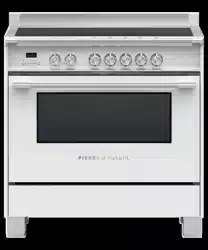
FREESTANDING COOKER
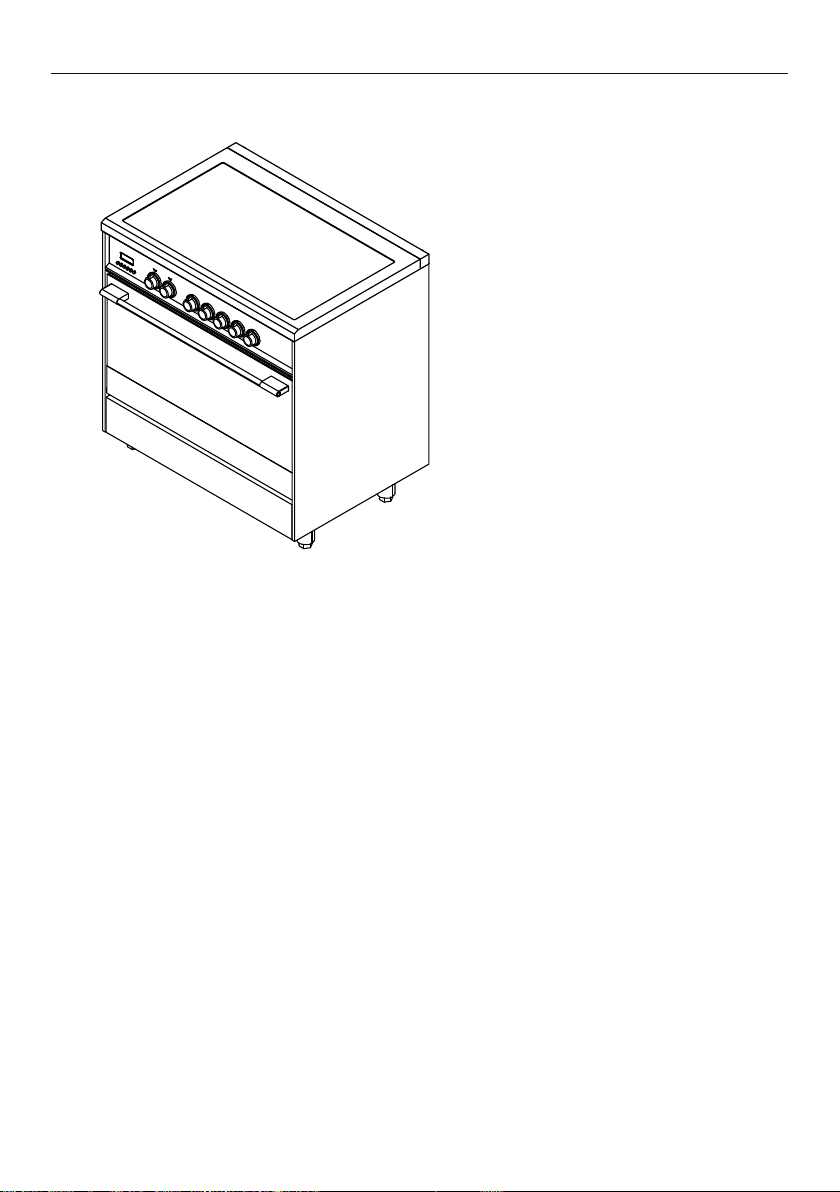
OR90SCI4 models


1
CONTENTS
IMPORTANT!
SAVE THESE INSTRUCTIONS
The models shown in this user guide may not be available in all markets and are subject to change
at any time. For current details about model and specification availability in your country, please
visit our website listed on the back cover or contact your Fisher & Paykel dealer.
Safety and warnings 2
Introduction 8
First use 10
Cooking guide 17
Oven functions 19
Cooking charts 23
Setting the timer 29
Auto Cook 31
Locking the oven controls 34
User preference settings 35
Sabbath Mode 37
Using your induction cooktop 39
Locking the cooktop controls 43
Using your cooktop’s special features 44
Choosing the right cookware 50
Cooking guidelines 52
Using the storage drawer 54
Care and cleaning 55
Troubleshooting 72
Alert codes 78
Warranty and service 79
2
Your freestanding cooker has been carefully designed to operate safely during normal
cooking procedures. Please keep the following guidelines in mind when you are using it:
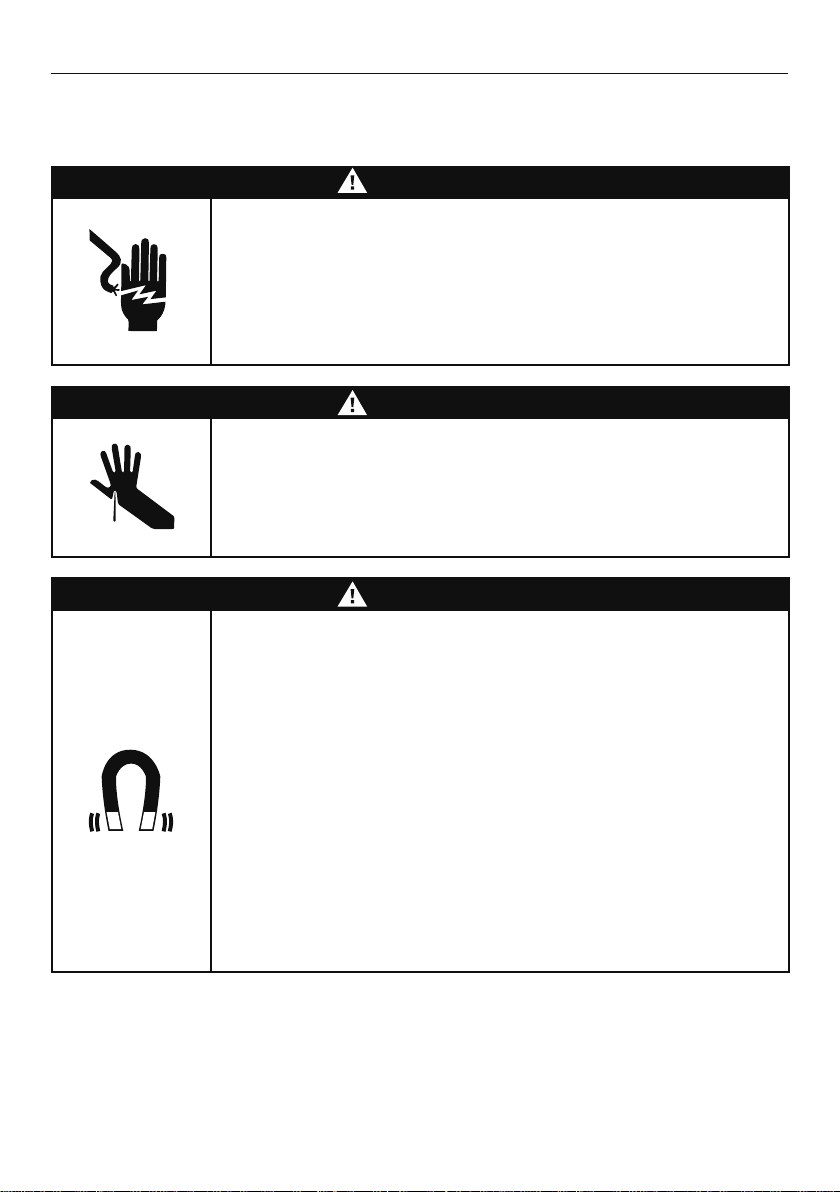
WARNING!
Electrical Shock Hazard
Switch the cooker off at the wall before
replacing fuses or the oven lamp.
Failure to follow this advice may result
in electrical shock or death.
WARNING!
Cut Hazard
Take care – some edges are sharp.
Failure to use caution could result in
injury or cuts.
WARNING!
Health Hazard
This appliance complies with
electromagnetic safety standards.
However, persons with cardiac
pacemakers or other electrical
implants (such as insulin pumps) must
consult with their doctor or implant
manufacturer before using this appliance
to make sure that their implants will not
be affected by the electromagnetic field.
Failure to follow this advice may result
in death.
SAFETY AND WARNINGS
3
WARNING!
Fire Hazard
Unattended cooking on a hob with fat
or oil can be dangerous and may result
in fire.
NEVER try to extinguish a fire with
water, but switch off the appliance and
cover flame, eg with a lid or fire blanket.
Do not place aluminium foil, dishes,
trays, water or ice on the oven floor
during cooking, as doing so will
irreversibly damage the enamel; lining
the oven with aluminium foil may even
cause fire.
Never use your appliance for warming
or heating the room. Persons could be
burned or injured or a fire could start.
Storage in or on appliance: flammable
materials should not be stored in the
oven or storage compartment, or on the
cooktop surface.
Failure to follow this advice may result
in overheating, burning, and injury.
SAFETY AND WARNINGS
4
SAFETY AND WARNINGS
WARNING!
Hot Surface Hazard
During use, accessible parts of this
appliance will become hot enough to
cause burns.
Do not let body, clothing or any item
other than suitable cookware contact with
the ceramic glass until the surface is cool.
Never leave metal objects (such as kitchen
utensils) or empty pans on the cooktop as
they can become hot very quickly.
Beware: magnetisable metal objects
worn on the body may become hot in
the vicinity of the cooktop. Gold or
silver jewellery will not be affected.
Handles of saucepans may be hot to
touch. Check saucepan handles do not
overhang other cooking zones that are on.
Keep handles out of reach of children.
To avoid burns and scalds keep
children away.
Do not touch hot surfaces inside the
oven.
Use oven mitts or other protection when
handling hot surfaces such as oven
shelves or dishes.
Take care when opening the oven door.
Let hot air or steam escape before
removing or replacing food.
Do not touch the cooktop components,
burners, trivets/pan supports or the
base when hot.
Before cleaning, turn the cooker off and
make sure it is cool.
Failure to follow this advice could result
in burns and scalds.

5
SAFETY AND WARNINGS
IMPORTANT SAFETY INSTRUCTIONS!
z
Read all the instructions before using the appliance.
Use the appliance only for its intended purpose as
described in these instructions.
z
Proper installation: be sure your appliance is properly
installed and earthed by a qualified technician. A risk
of tip-over exists when the appliance is not installed
in accordance with the installation instructions.
z
Do not operate the appliance if it is damaged or
not working properly. If you received a damaged
product, contact your dealer or installer immediately.
z
Clean only the parts listed in this manual.
z
Do not modify this appliance.
z
This appliance is to be serviced only by an
authorised person.
z
Isolating switch: make sure this cooker is connected
to a circuit which incorporates an isolating switch
providing full disconnection from the power supply.
z
Household appliances are not intended to be played
with by children.
z
Do not leave children alone – children should not
be left alone or unattended in the area where the
appliance is in use. They should never be allowed to
play with the appliance or to sit or stand on any part
of the appliance.
z
Do not store things children might want above the
oven. Children could be burned or injured while
climbing on the oven to retrieve items.
z
The cooktop is not intended to be operated by
means of an external timer or separate remote
control system.
z
CAUTION: the cooking process has to be supervised.
A short-term cooking process has to be
supervised continuously.

6
SAFETY AND WARNINGS
IMPORTANT SAFETY INSTRUCTIONS!
z
Children of less than 8 years old must be kept away
from the appliance unless continuously supervised.
This appliance can be used by children aged from 8
years and above, and persons with reduced physical,
sensory or mental capabilities or lack of experience
and knowledge, if they have been given supervision
or instruction concerning the use of the appliance in
a safe way and they understand the hazards involved.
Cleaning and user maintenance shall not be done by
children without supervision.
z
Safe food handling: leave food in the oven for as
short a time as possible before and after cooking.
This is to avoid contamination by organisms which
may cause food poisoning. Take particular care
during warmer weather.
z
Do not place aluminium foil, dishes, trays, water
or ice on the oven floor during cooking as this will
irreversibly damage the enamel.
z
Do not use aluminum foil to line any part of the oven,
storage drawer or cooktop. This will cause heat to be
trapped underneath it. This trapped heat can upset
the cooking performance and damage the finish of
the oven or cooktop parts.
z
Do not stand on the door, or place
heavy objects on it.
z
Do not use harsh abrasive cleaners or sharp
metal scrapers to clean the oven door glass since
they scratch the surface, which may result in
shattering of the glass.
z
Do not use a steam cleaner to clean any
part of the cooker.
z
Do not store flammable items in the oven or storage
drawer or on the cooktop surface.

7
SAFETY AND WARNINGS
IMPORTANT SAFETY INSTRUCTIONS!
z
Do not place aluminium foil or plastic dishes
on the cooktop.
z
Do not let large saucepans or frying pans overlap the
bench as this can deflect heat onto your benchtop
and damage the surface.
z
Do not let large saucepans, frying pans or woks
push any other pans aside. This could make them
unstable or deflect heat onto your benchtop and
damage the surface.
z
Saucepan handles may be hot to touch. Keep handles
out of reach of children.
z
If the electrical supply cord is damaged, it must only
be replaced by an authorised person.
z
This oven is not to be used as a space heater,
especially if it is installed in marine craft
or in a caravan.
z
Wear proper apparel. Do not wear loose fitting or
hanging garments when using the appliance. They
could ignite or melt if they touch an element or hot
surface and you could be burned.
z
Always keep oven vents unobstructed.
z
Use only dry oven mitts or potholders. Moist or damp
potholders on hot surfaces could result in burns
from steam. Do not let potholders touch hot areas or
heating elements. Do not use a towel or a bulky cloth
for a potholder. It could catch fire.
z
Caution. Hot air can blow from the vent at the top of
the oven as part of the oven’s cooling system.
z
Placement of oven shelves: always position shelves in
the desired location before preheating the oven. If a
shelf must be removed while the oven is hot, do not
let the oven mitts or potholder contact hot heating
elements in the oven or the base of the oven.
8
INTRODUCTION
OR90SCI4
90cm model
Before you start
1 Make sure that the anti-tip bracket at the rear of the cooker has been properly installed.
2 Make sure that the installer has completed the ‘Final checklist’ in the
Installation instructions.
3 Read this guide, taking special note of the ‘Safety and warnings’ section.
4 Remove all accessories and packaging from the oven and cooktop. Recycle items that
you can. If any adhesive residue is left on surfaces, remove this using dishwashing liquid
on a soft cloth. Do not use any harsh or abrasive cleaners.
5 Make sure you follow the instructions under ‘First use’ before using your
cooker for cooking.
9
A word on induction cooking
Induction cooking is a safe, advanced, efficient, and economical cooking technology.
It works by electromagnetic vibrations generating heat directly in the pan, rather than
indirectly through heating the glass surface. The glass becomes hot only because the pan
eventually warms it up. This technology has a number of advantages over traditional radiant
energy cooking:
z
Heat-up times are much faster.
z
Use is safer as no heating takes place unless a suitable pan is placed on the
cooking zone.
z
As heat is transferred without loss, you save energy.
INTRODUCTION
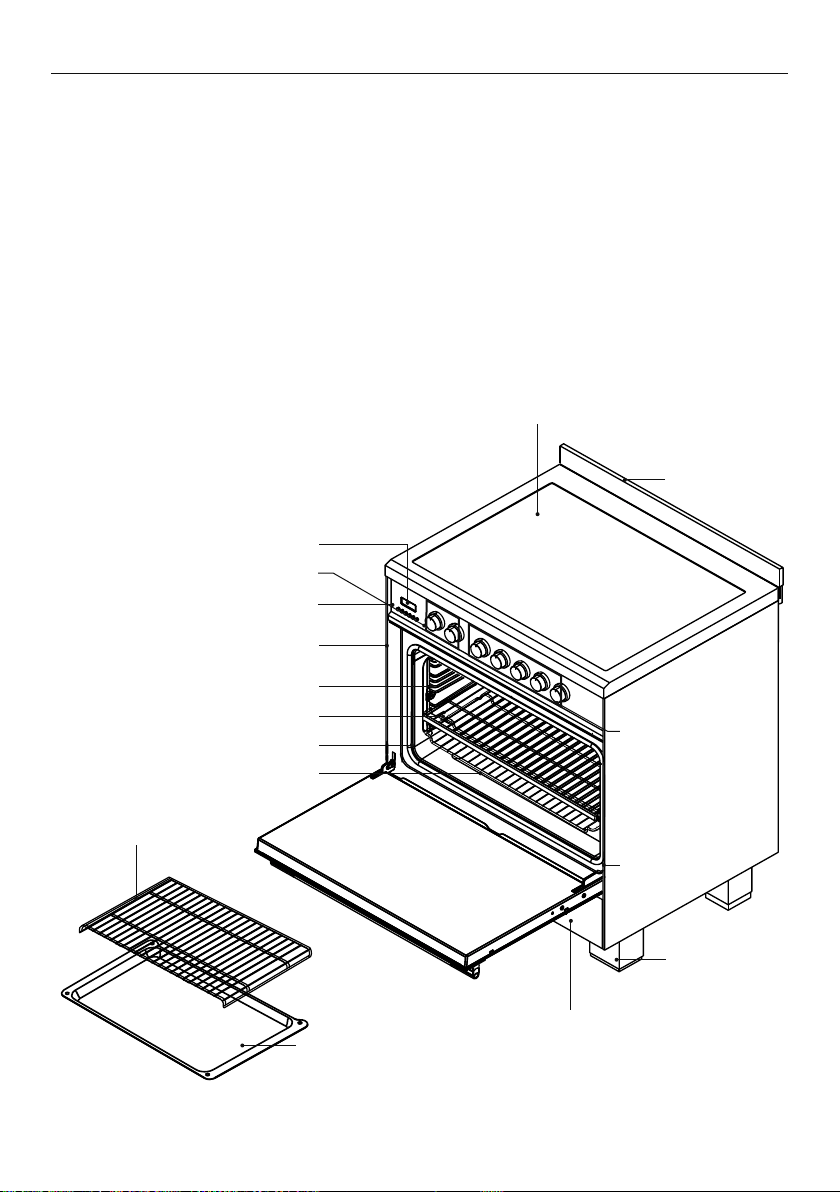
Overview
Features may vary.
Control panel
Oven frame
Oven door gasket
Step down wire shelf
Oven function and
temperature dials
Foot (cover)
Storage drawer
Grill rack
Roasting dish
Full extension sliding shelf
Label with
model
and serial
numbers
Side racks
Back trim
Induction cooktop
Clock display and controls
Cooktop
control dials
10
FIRST USE
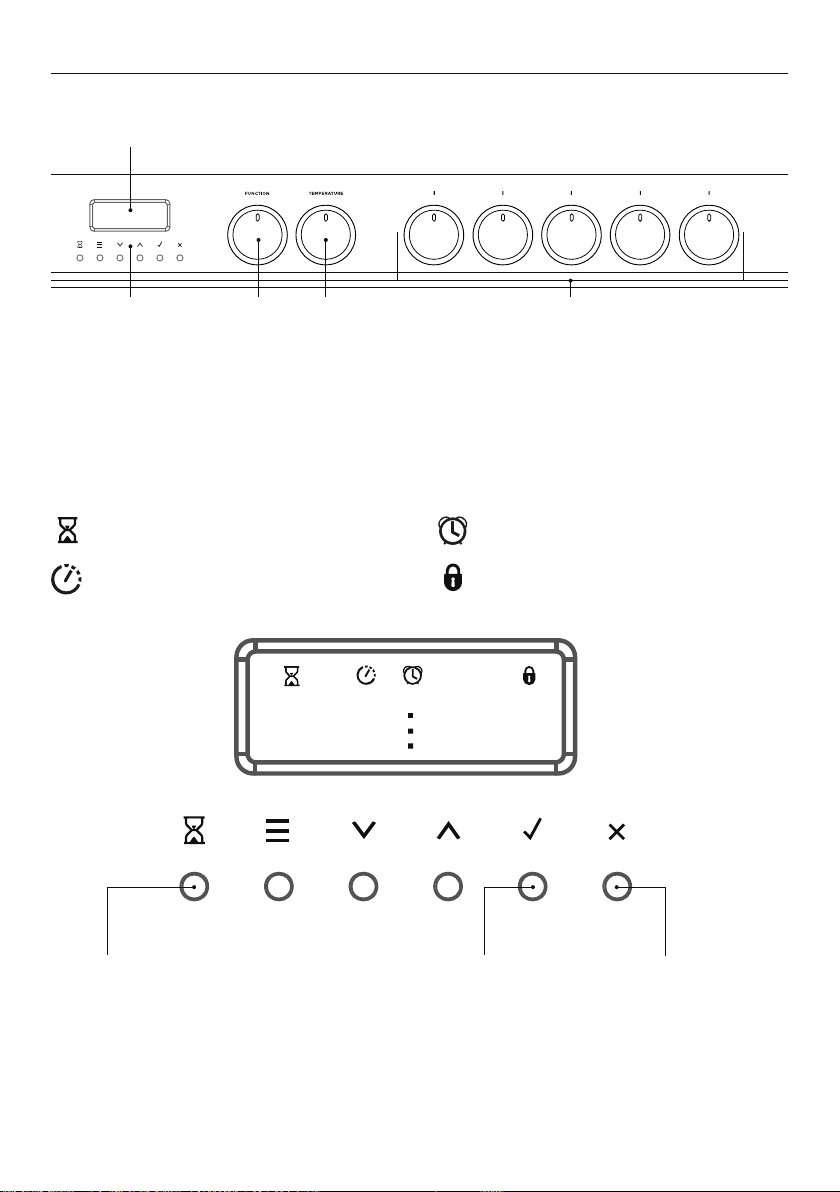
Control panel layout
Timer (see 'Setting the timer')
End time (see 'Auto cook')
Lock (see 'Locking the oven controls')
1 Oven display
2 Oven controls
3 Function dial
4 Temperature dial
5 Cooktop control dials
1
234 5
Clock display and controls
Cook time (see 'Auto cook')
%
o
pm
8888
Cancel/back button
z
Press to go back
z
Press and hold to cancel
Accept button
z
Press to accept
Timer Menu Minus Plus Accept Cancel
Timer button
z
Press to set the timer
11
FIRST USE
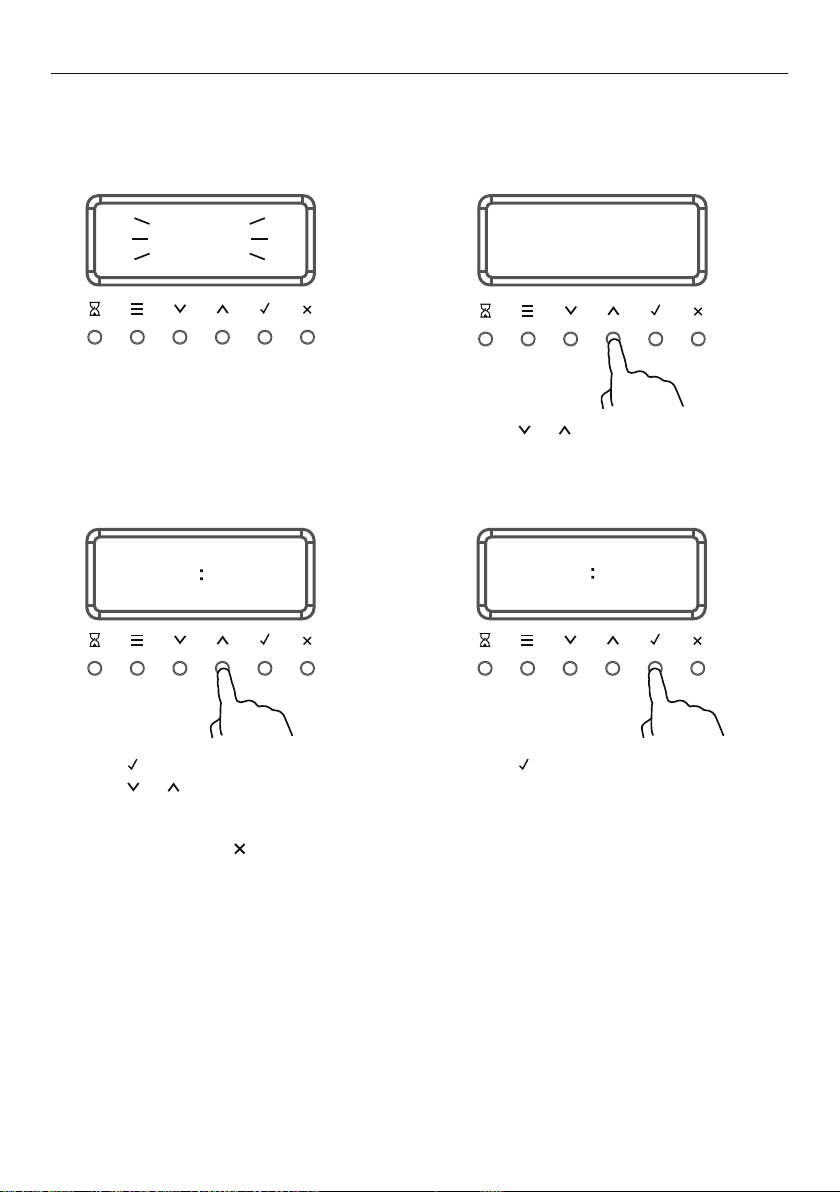
Setting the clock
When your oven is first turned on, or after a power cut, the display will flash. You will need
to set the clock in order to use the oven.
1 The display will flash 24 hr.
3 Press
to confirm.
4 Press
or to adjust the time.
z
Pressing the cancel button at any point during the clock setting process will set
the clock at 00:01.
2 Press
or to scroll between
24 hr and 12 hr.
z
The display will stop flashing.
5 Press
to confirm and
set the time.
24hr
00 00
19 35
24hr
12
FIRST USE
1
2
3
4
5
6
7
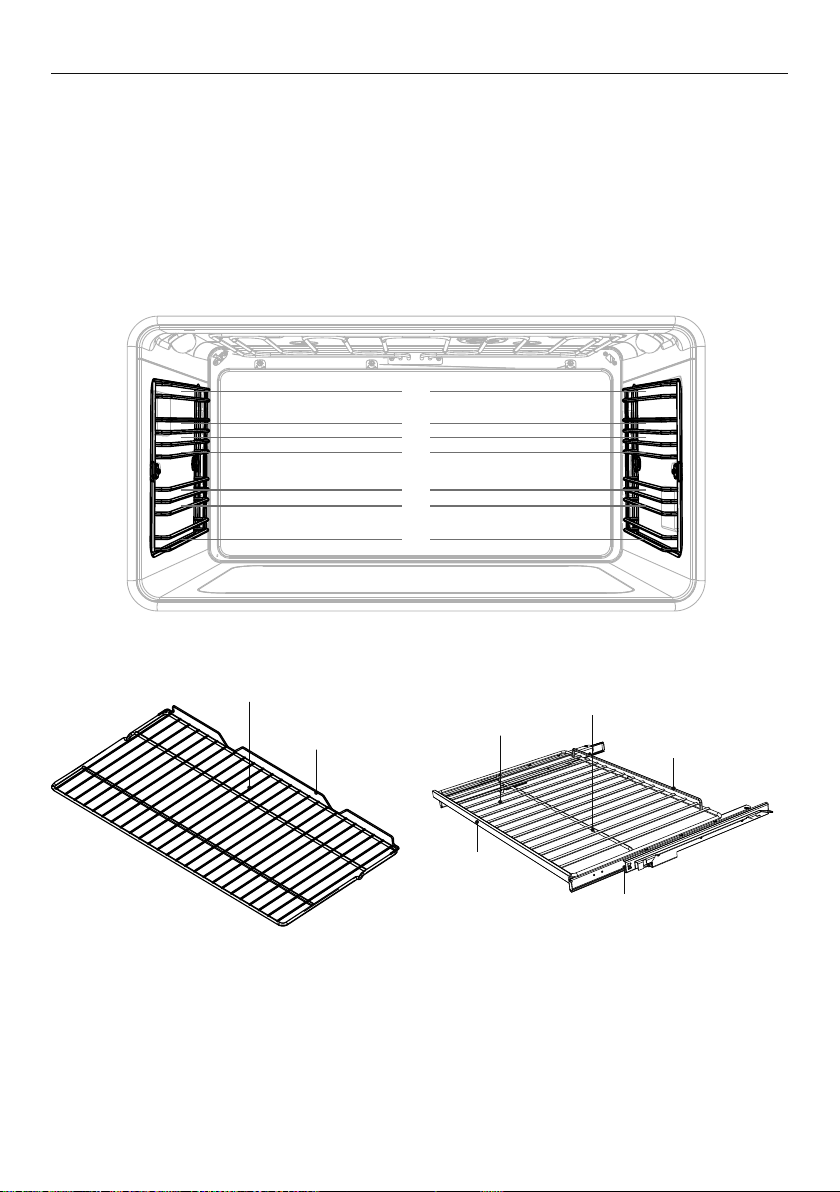
Positioning the shelves
z
Shelf positions are numbered from the bottom.
z
Position the shelves you will need before turning the oven on.
z
For advice on which shelf position to use, see sections ‘Oven functions’, ‘Cooking
guidelines’, and ‘Cooking charts’’.
IMPORTANT!
Always position the oven shelves before turning the oven on. Remove any unused shelves
and baking utensils from the oven.
Oven shelves
Wire shelf
Safety stop
Flat wire shelf and step-down wire shelf
z
These shelves have safety stops to keep
them from sliding out of the oven when
pulled forward.
z
The front stops prevent the shelves from
hitting against the back of the oven.
Full extension sliding shelf
z
The wire shelves and slides are built
together as one unit.
z
When positioned correctly, the slides
will prevent the wire shelves from
tilting when pulled forward.
z
Beware: these shelves are heavy.
Slide
Front stop
Safety stop
Front safety stop
Wire shelf
13
FIRST USE
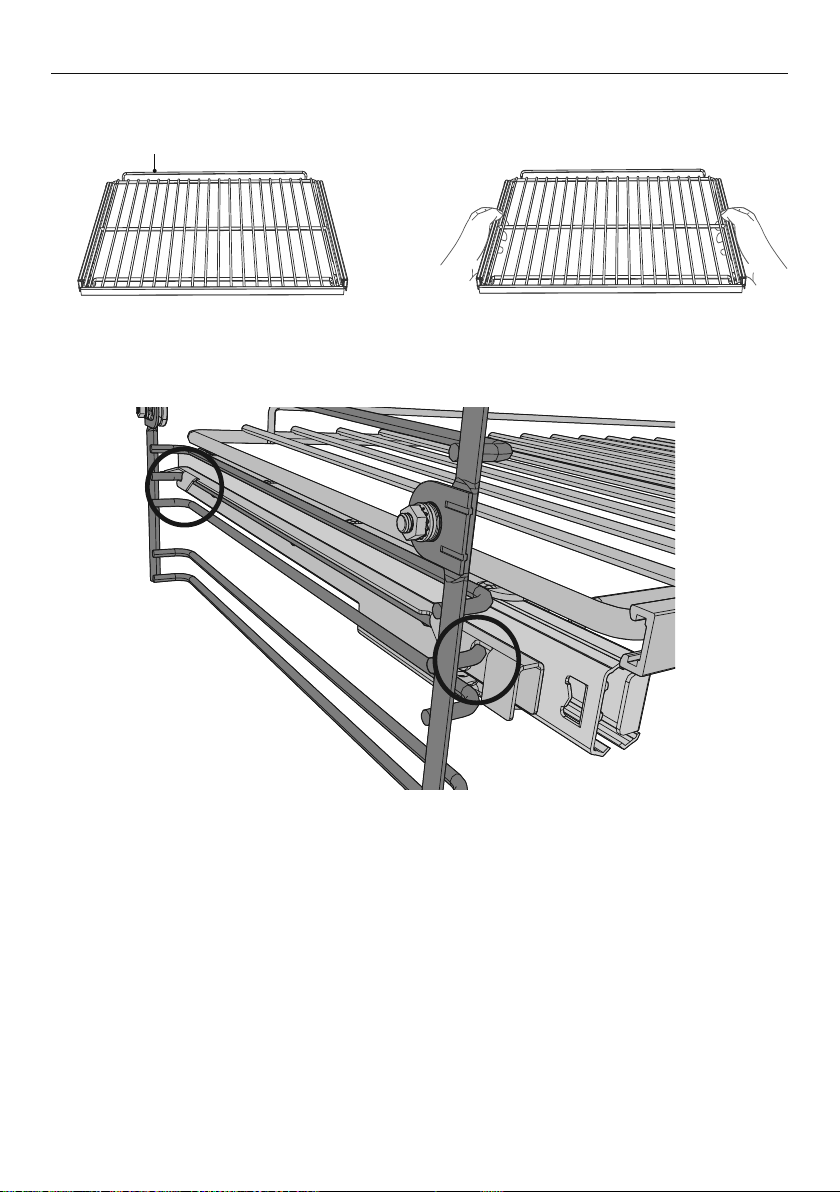
1 Make sure the guard rail is at the
back, facing up and the slides
are not extended.
3 Hook the rear tags over the wires of the
desired shelf position on both side racks.
To remove the shelves
1 Wait for the oven to cool down completely.
2 Hold the shelf firmly with both hands, making sure you grip the wire shelf too to stop it
sliding forward.
3 Pull the shelf forward about ¾ of the way.
4 Lift the rear of the shelf slightly so that the tags clear the side rack wires, then remove.
2 Hold the shelf firmly with both hands,
making sure you grip the wire shelf too
to stop it sliding forward.
4 Push the shelf all the way into the oven,
ensuring the front and rear tags either
side are securely locked behind the
side rack wires.
3
4
Guard rail
To insert the sliding shelves (some models only)
14
FIRST USE
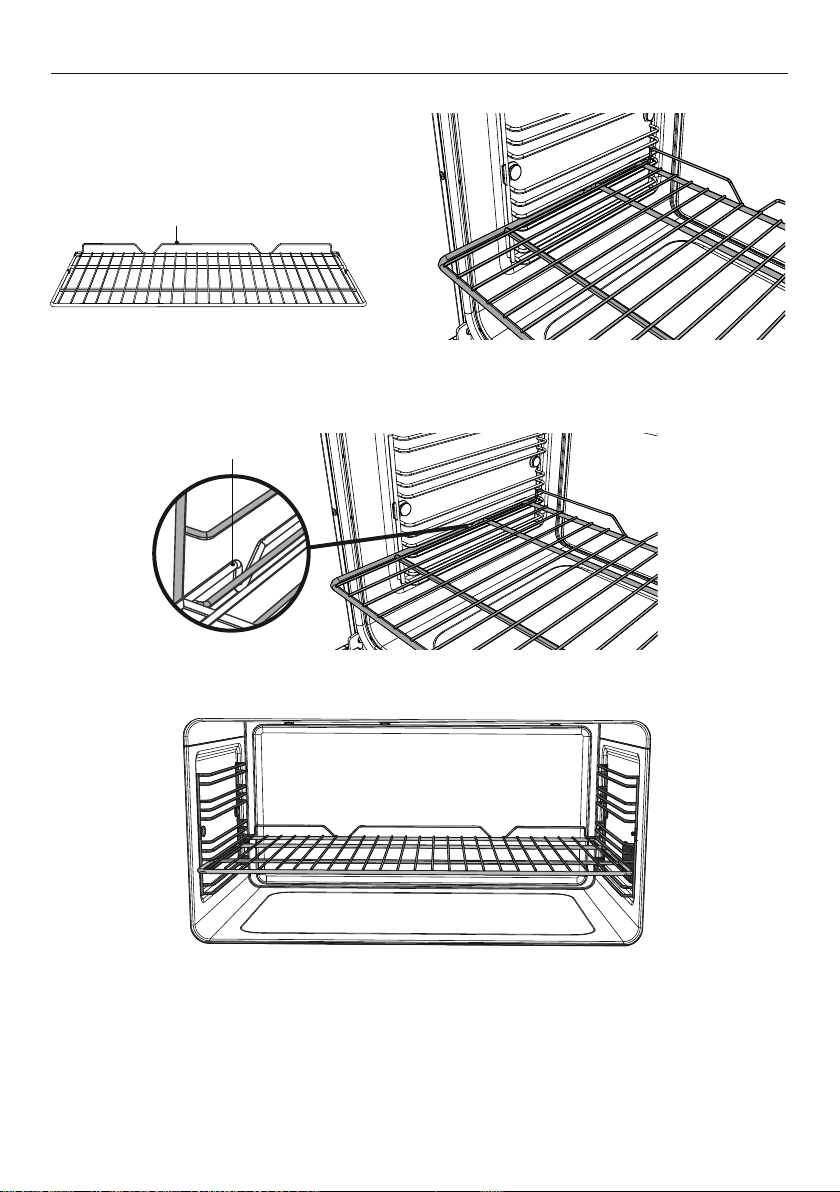
To insert the wire shelves
1 Make sure the guard rail is at the
back, facing up.
3 Tilt the front up slightly to help the safety stops clear the side rack wires.
4 Lower the shelf back onto the side rack wires and slide all the way into the oven.
To remove the shelves
1 Wait for the oven to cool down completely.
2 Pull the shelf forward about ¾ of the way.
3 Tilt the front up slightly to help the safety stops clear the side rack wires.
4 Remove the shelf.
2 Position the shelf: it should rest on
the side rack wires, as shown.
Safety stop
Guard rail
15
FIRST USE
Conditioning the oven
It is important to condition your oven before using it for cooking and baking. Conditioning
will burn off any manufacturing residues and ensure that you get the best results right from
the start.
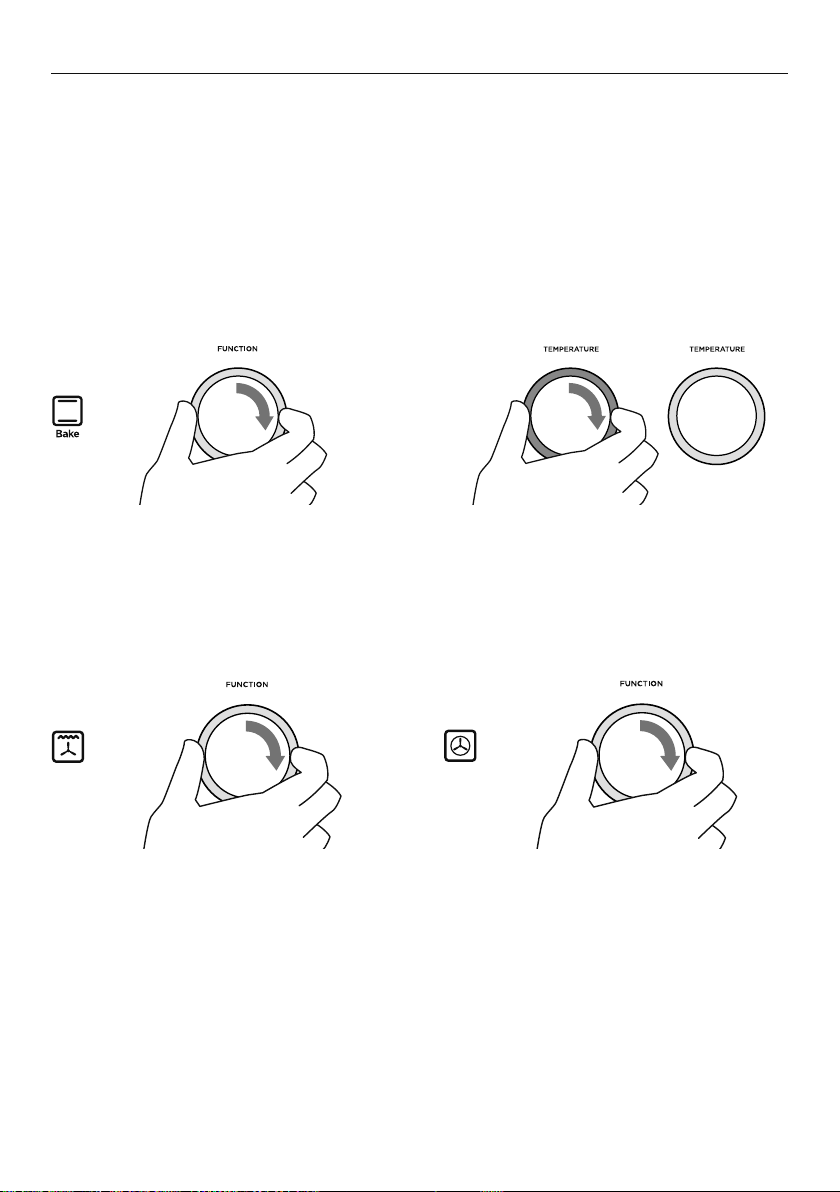
Before you start:
z
Make sure you have removed all packaging and any cable ties used to secure the
shelving during transit.
z
Make sure all shelves are fitted in the oven.
z
Make sure all oven control dials are turned to O (OFF).
2 Set the temperature to 200°C
for 30 minutes.
z
The halo will glow red while the oven
is heating up.
z
When the oven has heated a tone will
sound and the halo will turn white.
1 Select the Bake function.
z
The halo will glow white.
3 After 30 minutes, select the Fan
Grill function.
z
Heat at 200°C for 10 minutes.
4 After 10 minutes, select the Fan
Forced function.
z
Heat at 200°C for 20 minutes.
Note:
z
There will be a distinctive smell and a small amount of smoke during the conditioning
process as manufacturing residue is burnt off. This is normal, but make sure the kitchen
is well ventilated while the oven is conditioning.
z
Once cooled, wipe out the oven with a damp cloth and mild detergent,
and dry thoroughly.
Fan
Forced
--->
Fan
Grill

16
FIRST USE
5 After 20 minutes turn both the function and temperature dials to O (OFF).
The halos will go out.
z
There will be a distinctive smell and a small amount of smoke during the conditioning
process as manufacturing residue is burnt off. This is normal, but make sure the kitchen
is well ventilated during the conditioning.
z
Once cooled, wipe out the oven and warmer drawer with a damp cloth and mild
detergent, and dry thoroughly.
FUNCTION TEMPERATURE
17
COOKING GUIDE
Oven cooking guidelines
IMPORTANT!
z
Use all the oven modes with the oven door closed.
z
Never use aluminum foil to cover the oven shelves or to line the floor of the oven. The
trapped heat can irreversibly damage the enamel and may even cause fire.
z
Do not place water, ice, or any dish or tray directly on the oven floor, as this will
irreversibly damage the enamel.
z
Do not cover the roasting dish with aluminum foil. This will catch the grease and
could cause fire.
z
Do not use plastic wrap or wax paper in the oven.
z
For food safety reasons, do not leave food in the oven for longer than two hours before
and after cooking or defrosting. This is to avoid contamination by organisms which may
cause food poisoning. Take particular care during warmer weather.
Baking
z
For best results when baking, always preheat your oven. The temperature halo will
change from red to white when the set temperature is reached.
z
While the oven is heating the grill element will be on.
z
We advise you do not open the door until at least ¾ of the way through cooking.
z
Make sure cake pans do not touch each other or the sides of the oven.
z
When baking double the recipe (especially cookies) cook time may need to increase.
z
Your cookware will influence baking times. Dark pans absorb the heat more quickly than
reflective pans; glass cookware may require a lower temperature.
z
Multi-shelf baking may also require a slight increase in cooking time.
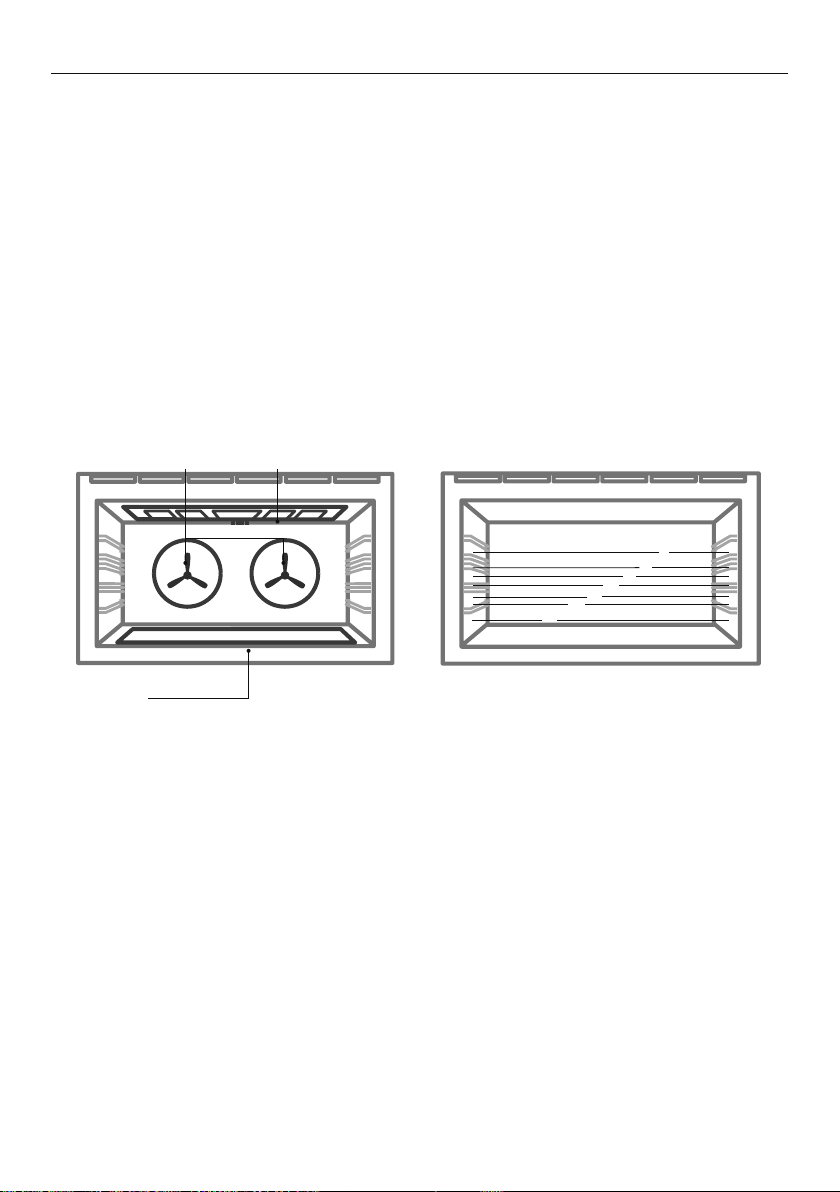
Shelf Position Guide
z
Single shelf: place your baking on a shelf that will have the top of your pan near the
center of the oven cavity.
z
Multi shelf: always leave a space between shelves to allow the air to circulate.
Lower
Element
(concealed)
Fans Upper Elements
Shelf positions
1
4
7
6
5
2
3

18
COOKING GUIDE
Roasting
z
The Roast function is designed to brown the outside of the meat but still keep the inside
moist and juicy.
z
Boneless, rolled or stuffed roasts take longer than roasts containing bones.
z
Poultry should be well cooked with the juices running clear and an internal
temperature of 74°C.
z
If using a roasting bag, do not use the Roast function. The initial searing stage is too hot
for roasting bags. Use Fan Bake or Fan Forced and follow the manufacturer’s instructions.
z
When using the Roast function, do not cover your roast, as this will stop the searing
process browning the outside of the meat. If you prefer to roast in a covered pan, use the
Fan Bake function instead and increase the temperature by 20°C.
z
Cook larger cuts of meat at a lower temperature for a longer time. The meat will
cook more evenly.
z
Always roast meat fat side up. That way, basting may not be required.
z
Always rest the meat for at least 10 minutes after roasting to allow the juices to settle.
z
Remember the meat will continue to cook for a few minutes after removing
it from the oven.
Shelf Position Guide
Place the meat on a shelf so that is is in the center of the oven or lower.
Grilling
z
This is a healthier alternative to frying.
z
Always grill with the oven door completely shut.
z
If you use glass or ceramic pans, be sure they can withstand the high
temperatures of the grill.
z
To avoid piercing the meat and letting juices escape, use tongs or a spatula to turn the
meat halfway through cooking.
z
Brush meat with a little oil to help keep the meat moist during cooking. Alternatively
marinade the meat before grilling (but be aware that some marinades may burn easily).
z
Where possible grill cuts of meat of a similar thickness at the same time. This will
ensure even cooking.
z
Always keep a close watch on your food while broiling to avoid charring or burning.
Shelf Position Guide
z
For thinner cuts of meat, toasting or browning foods, use a higher shelf position.
z
Thicker cuts of meats should be grilled on lower shelves or at a lower grill setting to
ensure even cooking.
Reheating
z
Use Bake or Fan Bake to reheat food.
z
Bake and Fan Bake are particularly good for reheating pastry based items, as the base
heat will help re-crisp the pastry case.
z
Always reheat food to piping hot. This reduces the risk of contamination by
harmful bacteria.
z
Once hot, set the oven temperature to WARM.
Never reheat food more than once.
19
OVEN FUNCTIONS
IMPORTANT!
z
Use all the functions with the oven door closed.
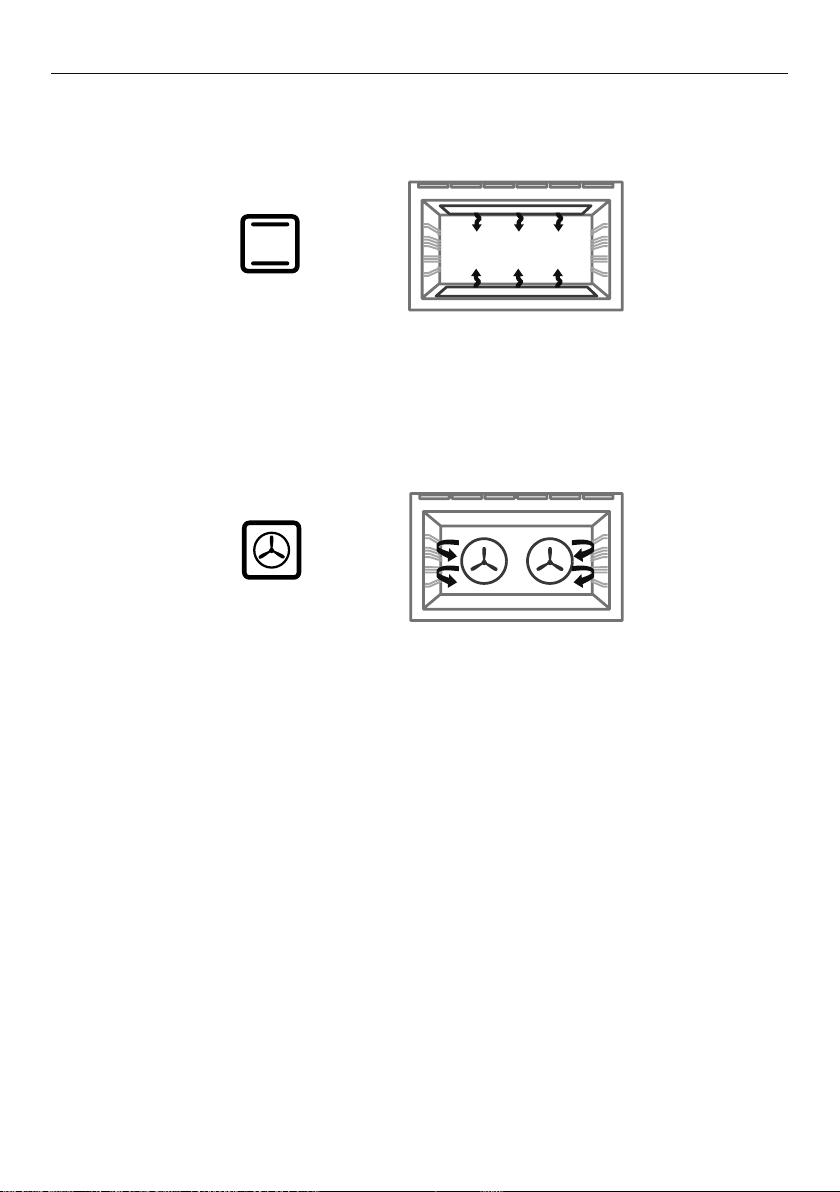
Upper outer and lower elements
z
Heat comes from both the upper and lower elements. The fan is not used in this function.
z
Ideal for cakes and foods that require baking for a long time or at low temperatures.
z
This function is not suitable for multi-shelf cooking.
Ideal for moist foods that take a longer time to cook eg rich fruit cake, or bread.
Bake
Fan and rear element
z
By using the central rear heating element and fan, hot air is blown into the cavity,
providing a consistent temperature at all levels, making it perfect for multi-shelf cooking.
z
Trays of cookies cooked on different shelves are crisp on the outside and
chewy in the middle.
z
Meat and poultry are deliciously browned and sizzling while remaining juicy and tender.
z
Casseroles are cooked to perfection and reheating is quick and efficient.
z
When multi-shelf cooking it is important to leave a gap between trays (eg use shelves 3
& 5) to allow the air to move freely. This enables the browning of foods on the lower tray.
z
If converting a recipe from Bake to Fan Forced, we recommend that you decrease the
bake time or decrease the temperature by approximately 20°C.
z
For items with longer bake times (eg over an hour) it may be necessary to decrease both
time and temperature.
Ideal for multi-shelf cooking biscuits, cookies, scones, muffins and cupcakes.
Fan Forced
20
OVEN FUNCTIONS
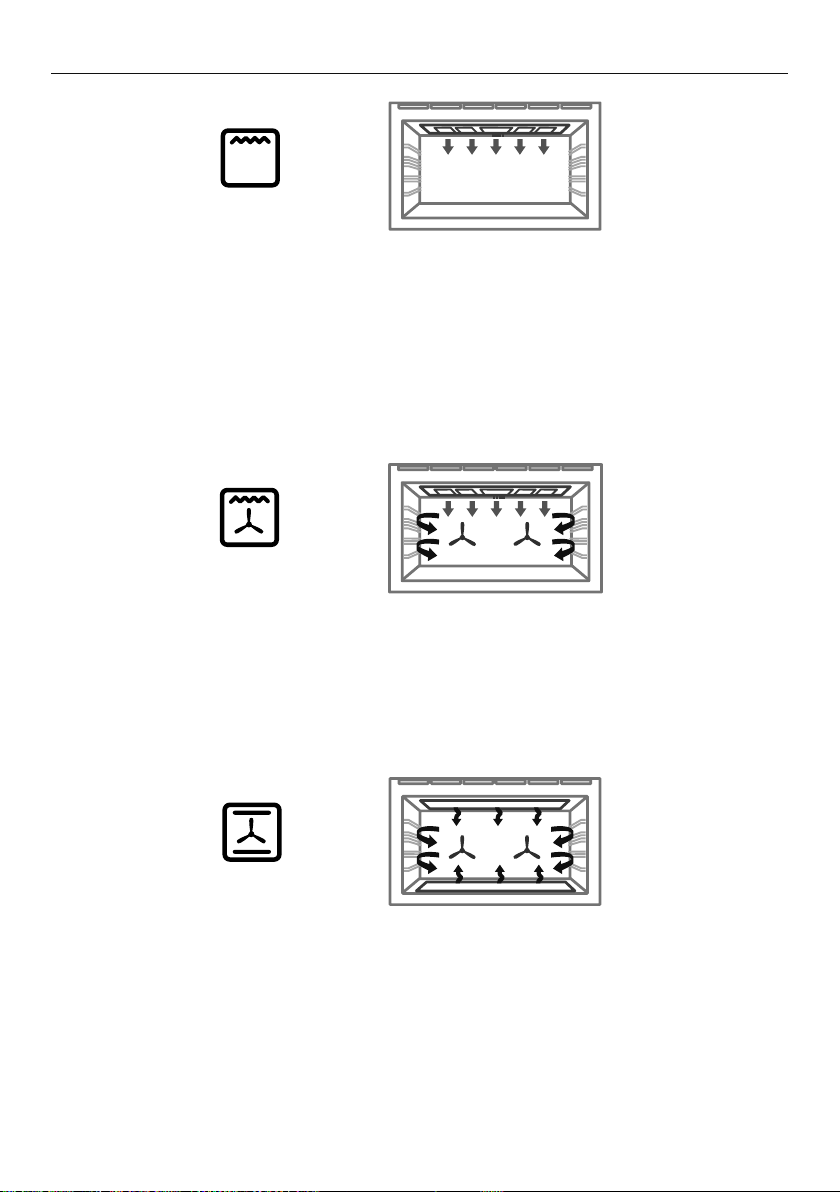
Fan plus upper outer and lower elements
z
The oven fan circulates hot air from the top outer and the lower elements and distributes
it around the oven cavity.
z
Food cooked tends to brown more quickly than foods cooked on the
traditional Bake function.
z
You may need to decrease the time from that recommended in traditional recipes.
Ideal for single shelf baking that takes less than an hour to cook – foods such as muffins,
biscuits and cupcakes or things like enchiladas.
Fan Bake
Upper inner and outer elements
z
Intense radiant heat is delivered from both top elements. You can use Grill on Low OR
High (100% power).
z
For best results allow 5 minutes of preheat before placing food in the oven.
z
The temperature halo will remain white while using the Grill function.
z
The most suitable function for ‘finishing off’ many meals, for example browning the top
of potato gratin and frittata.
Ideal for toasting bread or for top browning to ‘finish off dishes’.
Grill
Fan plus upper inner and outer elements
z
This function uses the intense heat from the elements for top browning and the fan to
ensure even cooking of foods.
z
Meat, poultry and vegetables cook beautifully; food is crisp and brown on the outside
while the inside remains moist and tender.
Ideal for whole chicken, tenderloin of beef or broiling your favourite chicken, fish or steak.
Fan Grill
21
OVEN FUNCTIONS
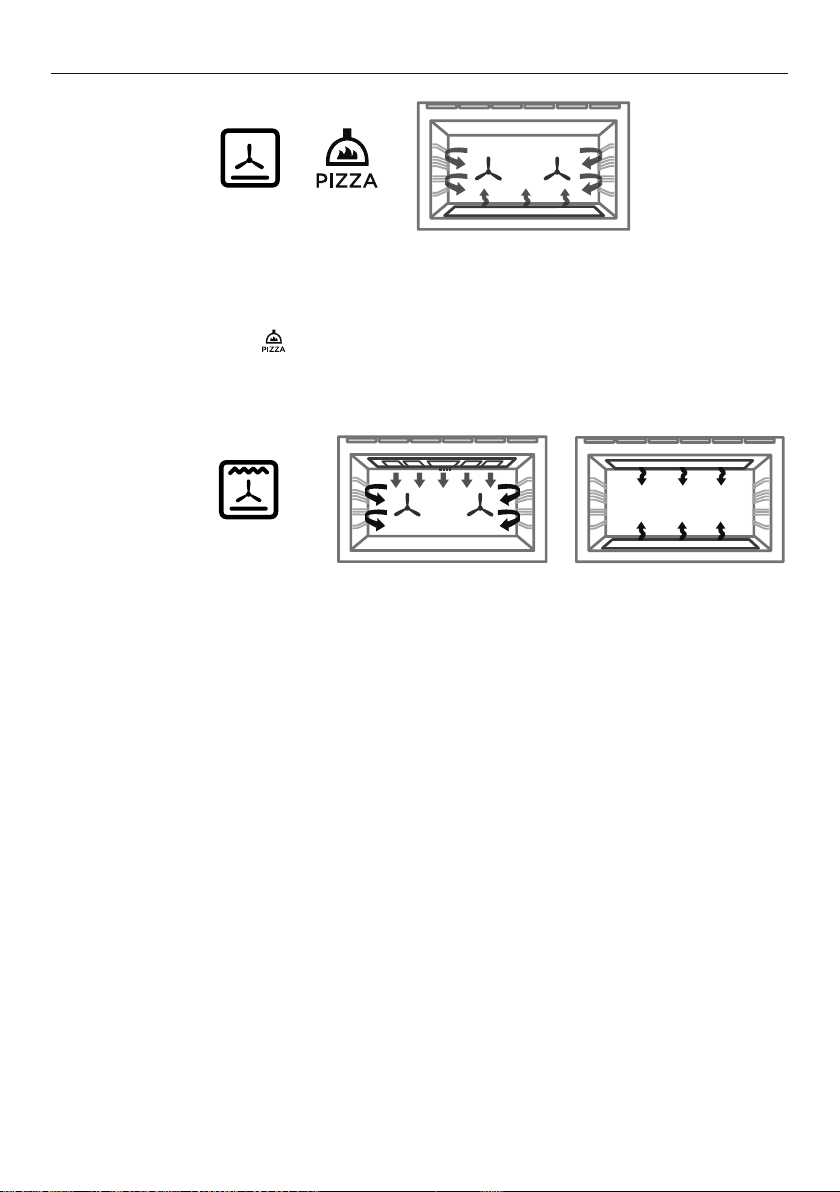
Fan plus lower element
z
The fan circulates heat from the lower element throughout the oven.
z
Excellent for cooking pizza and flatbreads as it crisps the base beautifully without
overcooking the top.
z
Set the temperature to for optimum pizza cooking temperature.
Ideal for foods such as sweet and savoury pastry foods and delicate foods that require
some top browning eg frittata, quiche.
Pastry Bake + Pizza
Fan plus upper and lower elements
z
A two-step program. An initial 20 minute searing stage crisps and browns the roast and
caramelises the outside of the meat, then the temperature drops to the level you have
preset for the remainder of the cooking period, producing a tender and juicy roast that is
full of flavor.
z
Oven does not require preheating.
z
If desired, use the grill rack, or place vegetables under the roast to allow the juices to
drain away from your meat. This will allow the hot air to circulate under the meat as well.
Ideal for roasting meat, chicken and vegetables.
Roast

22
OVEN FUNCTIONS
This is not a cooking function
z
Gentle heat is generated from the upper and lower elements.
z
Provides the optimum warm and draft-free environment for proving yeast dough.
z
This method provides a faster proof time than at room temperature.
z
To prevent overproofing we recommend you check the dough every 30mins.
Proving dough
1 Place dough in a lightly oiled bowl and cover with plastic wrap and/or
a clean damp cloth.
2 Position the bowl in the center of the oven.
3 Select Rapid Proof function.
Rapid Proof
(some models only)

23
COOKING CHARTS
z
Shelf positions are counted from the base up (1 is the lowest, 7 is the highest).
Position shelves before you turn the oven on.
z
For best results preheat the oven.
z
Multi-shelf cooking may need the shelves rotating midway through cooking.
z
Oven accessories may temporarily deform slightly when they become hot.
This is normal and does not affect their function.
The information in these charts is for guidance only. Refer to your recipe or the packaging
and be prepared to adjust the cooking times and settings accordingly.
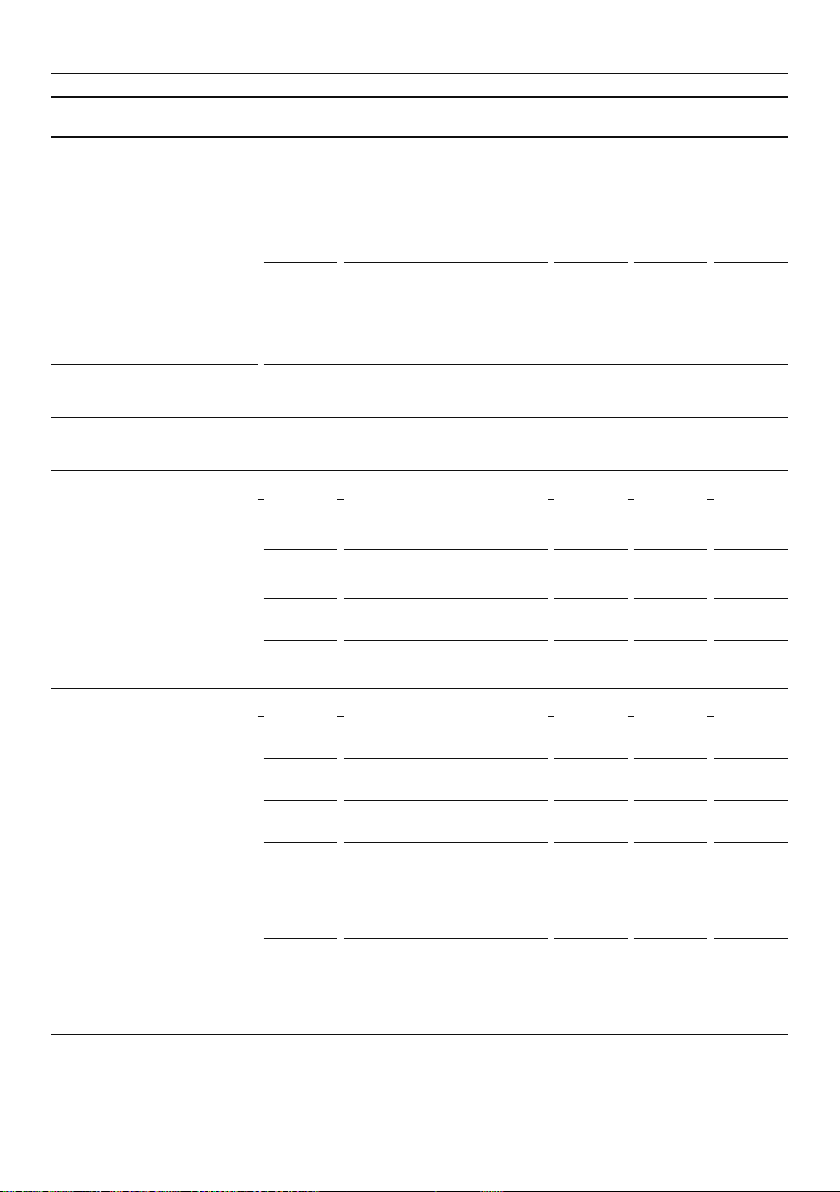
BAKING
SHELVES FUNCTION
SHELF
POSITION
TEMP
(°C)
TIME
(MIN)
BISCUITS
Plain Single Fan Bake 3 210-220 8-10
Multi Fan Forced
1 and 4
or
2 and 5
215-230 10-12
Chewy cocolate chip
Single Fan Bake 3 180-190 10-15
Multi Fan Forced
1 and 4
or
2 and 5
160-170 10-15
Oatmeal Single Fan Bake 3 160-170 12-15
CAKES
Vanilla Single Bake 3 160-165 30-35
Pound cake Single Bake 3 160 70-80
Butter/chocolate Single Bake 3 160-180 50-60
Chocolate brownie
(20x20cm)
Single Bake or Classic Bake 3 175 20-25
Rich fruit Single Bake or Classic Bake 3 135-150 3-6 hrs
Light fruit Single Bake 3 155-165 60-90
Sponge
(single large) Single Bake 3 170-180 30-40
Sponge
(20x20cm) Single Bake 3 170-180 15-25
SHORTBREAD Single Pastry Bake 3 130-140 20-25
24
COOKING CHARTS
BAKING
SHELVES FUNCTION
SHELF
POSITION
TEMP
(°C)
TIME
(MIN)
MUFFINS / CUPCAKES
Cupcakes
Single Fan Bake 3 185 15-20
Multi Fan Forced
1 and 4
or
2 and 5
170 15-20
Muffins
Single Fan Bake 3 170 25-30
Multi Fan Forced
1 and 4
or
2 and 5
170 25-30
SCONES Single Bake 3 215-230 10-15
MERINGUES Single Bake 3 120-130 60-70
BREAD / BREAD ROLLS
Sandwich loaf
(23x13cm loaf tin)
Single Bake 3 200-220 40-50
Wholewheat loaf
(23x13cm loaf tin)
Single Bake 3 200-220 35-45
Soft bread rolls Single Bake 3 190 15-18
Dough proof Single Rapid Proof 3 PrF 30
PASTRY
Pastry Case
(baked blind) Single Pastry Bake 2 or 3 175 15
Filo Single Fan Bake 3 200 15-25
Flaky/puff Single Fan Bake 3 185-200 20-30
Choux Single Fan Bake 3 200-210 30-35
Multi Fan Forced
1 and 4
or
2 and 5
200-210 30-35
Croissants Single Fan Bake 3 190-200 15-25
Multi Fan Forced
1 and 4
or
2 and 5
190-200 15-25

25
COOKING CHARTS
BAKING
SHELVES FUNCTION
SHELF
POSITION
TEMP
(°C)
TIME
(MIN)
PIES
Apple pie Single Pastry Bake or Fan Bake 3 190-200 25-30
Lemon meringue Single Fan Bake 3 175-180 30-40
Baked cheesecake
(in water bath)
Single Bake 3 160 50-60
Custard tart
(blind bake, then add filling)
Single Bake 3 175-150 15-30
DESSERTS
Crème brulee
(in water bath) Single Bake 3 135 35-45
Crème caramel
(in water bath) Single Bake 3 175 35-45
SAVOURY
SHELVES FUNCTION
SHELF
POSITION
TEMP
(°C)
TIME
(MIN)
MEAT PIES Single Fan Bake 3 190-195 30-40
SAUSAGE ROLLS Single Pastry Bake or Fan Bake 3 190-200 20-25
VEGETABLES Single Fan Bake 3 175-190 30-50
LASAGNE Single Fan Bake 3 175-190 35-45
CASSEROLE Single Bake or Classic Bake 2 120-150 2-4 hr
PIZZA Single Pizza 1 or 2
Pizza
(280)
10-15
QUICHE
(blind bake, then add filling)
Single Pastry Bake or Fan Bake 3 180-200 30-40
POTATOES
(whole, baked) Single Bake 3 200 50-60
FRITTATA
(shallow) Single Pastry Bake 3 170-180 15-20
OVEN MEALS Single Fan Forced 3 170-190 30-40

26
COOKING CHARTS
ROASTING
SHELVES FUNCTION
SHELF
POSITION
TEMP
(°C)
TIME
(MIN)
MEAT PROBE
(°C)
BEEF, BONELESS (times per 450g)
Rare Single
Roast 2 or 3 160-170 18-32 54-59
Medium Single Roast 2 or 3 160-170 25-40 60-74
Well done Single Roast 2 or 3 160-170 30-55 74-79
PRIME RIB ROAST
(times per 450g)
Rare Single Roast 2 or 3 160-170 15-30 54-59
Medium Single Roast 2 or 3 160-170 20-35 60-74
Well done Single Roast 2 or 3 160-170 25-40 74-79
LAMB RACK
Medium rare Single Roast 3 200 20 50
LAMB LEG, BONE IN
(times per 450g)
Medium Single Roast 2 or 3 160-170 18-28 65-70
Well done Single Roast 2 or 3 160-170 20-33 74-79
LAMB LEG, BONELESS
(times per 450g)
Medium Single Roast 2 or 3 160-170 20-35 65-70
Well done Single Roast 2 or 3 160-170 25-45 77-79
VEAL
(times per 450g)
Medium Single Roast 2 or 3 160-170 20-40 71
Well done Single Roast 2 or 3 160-170 25-45 76
CHICKEN, WHOLE
(times per 450g, excl. butterflied)
Unstuffed Single Fan Grill 2 or 3 175 15-20 75
Stuffed Single Bake 2 or 3 175 17-22 75
Butterflied Single Fan Grill 3 or 4 175 40-50 75
TURKEY, WHOLE
(times per 450g)
Stuffed Single Bake 1 or 2 160-170 17-22 75
Unstuffed Single Bake 1 or 2 150-165 15-20 75

27
COOKING CHARTS
ROASTING
SHELVES FUNCTION
SHELF
POSITION
TEMP
(°C)
TIME
(MIN)
MEAT PROBE
(°C)
PORK, BONELESS (times per 450g)
Medium Single Roast 2 or 3 170-175 25-40 63-68
Well done Single Roast 2 or 3 170-175 30-45 74-79
PORK CRACKLING
Crisp
(watch closely) Single Fan grill 4 220 5-10 n/a
VENISON
(times per 2.5cm thickness
1
)
Rare Single Fan grill 4 225 7 55-60
Medium Single Fan grill 4 225 9 49-54
1
Brown in frying pan first.

28
COOKING CHARTS
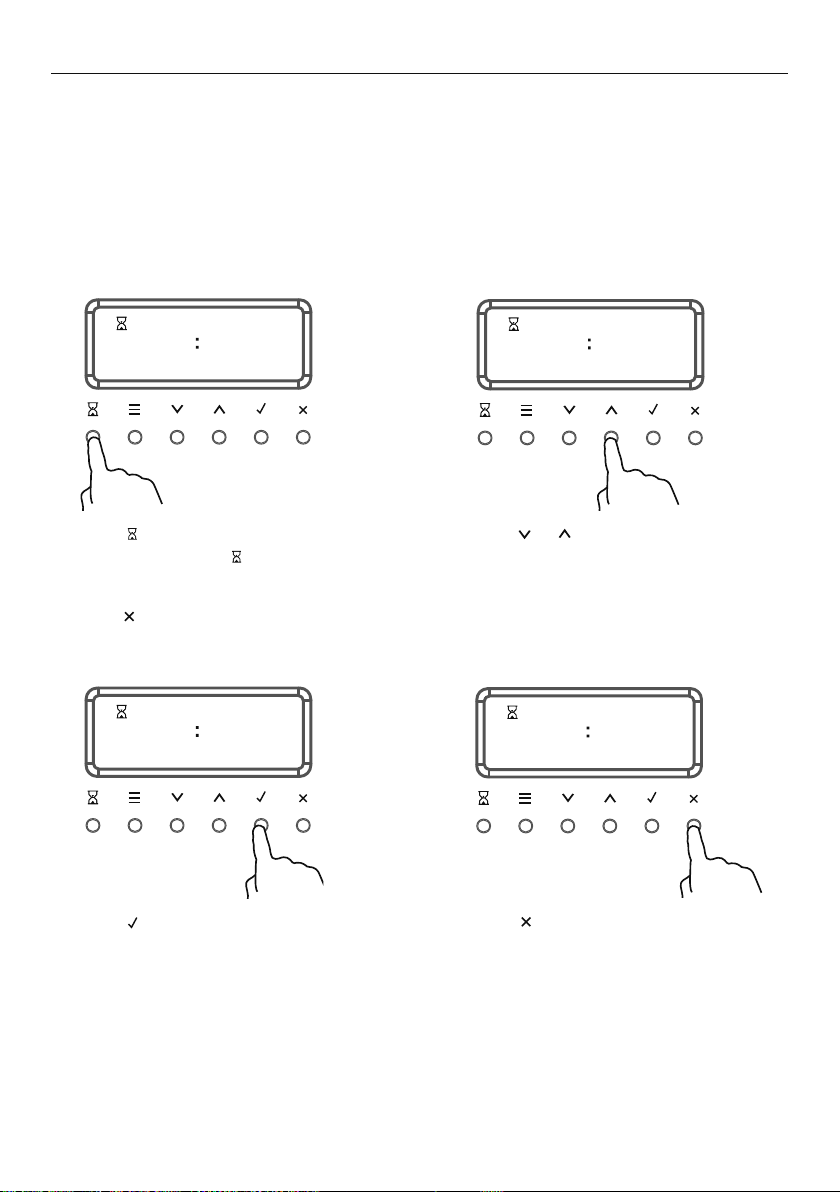
GRILLING
SHELVES FUNCTION
SHELF
POSITION
TEMP
(°C)
TIME
(MIN)
BEEF
Steak, rare Single Grill 6 or 7 HI 8-10
Steak, medium Single Grill 6 or 7 HI 10-15
Burgers Single Grill 6 or 7 HI 12-15
Meatballs Single Grill 6 or 7 HI 12-15
LAMB
Chops, medium Single Grill 6 or 7 HI 15-20
Chops, well done Single Grill 6 or 7 HI 20-25
PORK
Chops, well done Single Grill 6 or 7 HI 15-20
Ham steak Single Grill 6 or 7 HI 15-20
Bacon Single Grill 6 or 7 HI 4-7
CHICKEN
Boneless pieces Single Fan Grill 6 or 7 175 30-40
Bone in pieces Single Fan Grill 6 or 7 175 40-50
SAUSAGES Single Grill 6 or 7 HI 10-15
FISH
Fillets Single Fan Grill 6 or 7 200-220 8-12
Whole Single Fan Grill 6 or 7 200-220 15-20
VEGETABLES
Sliced Single Grill 6 or 7 HI 8-12
29
SETTING THE TIMER
z
You can use the timer at any time, even if you are not using the oven.
z
If the time is more than an hour, the display will count down in minutes (h:m).
If it is less than an hour, it will count down in seconds (m:s).
z
You can set the timer for up to 23 hours 59 minutes.
IMPORTANT!
The timer does NOT turn the oven off.
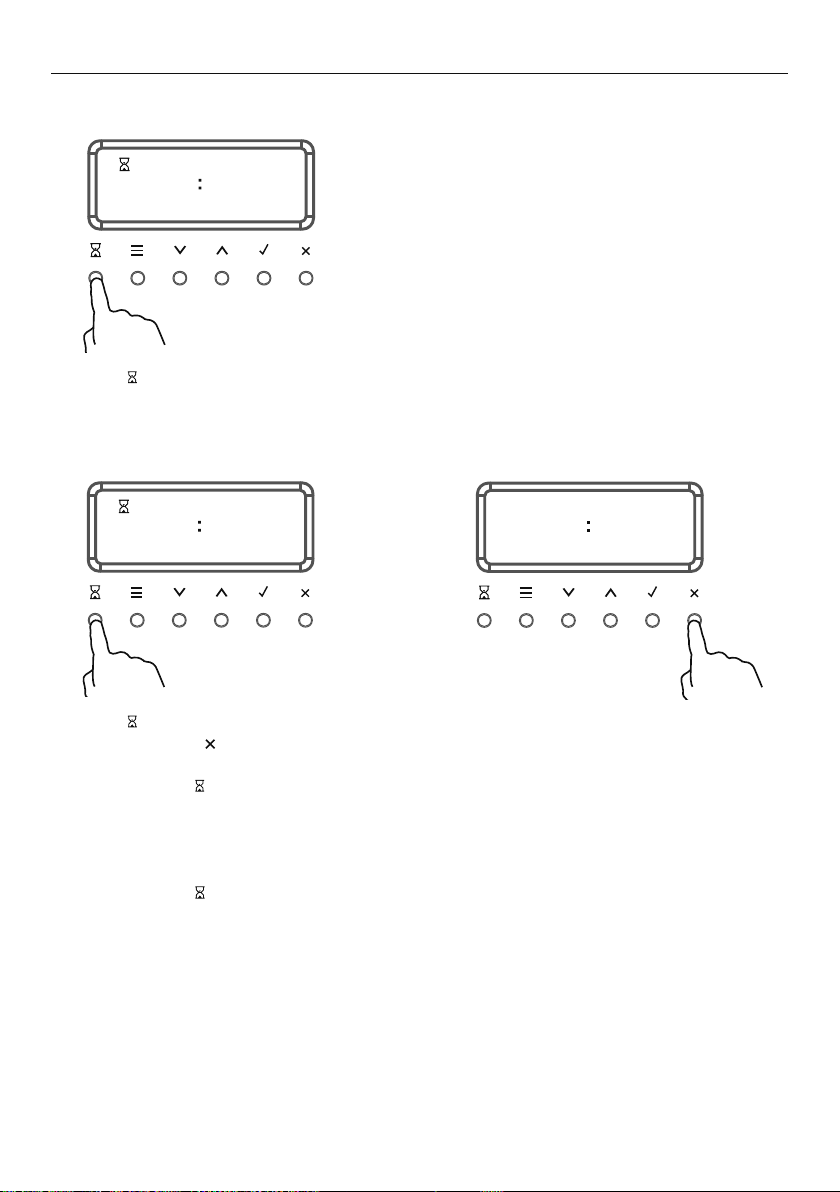
To set the timer
000
14 59
015
19 35
1 Press to access the timer.
z
The timer indicator will appear
on the display.
z
The display will flash.
z
Press to return to the time of day.
3 Press
to confirm and set the time.
z
The timer will begin to count down.
z
The display will stop flashing.
2 Press
or to adjust the time.
4 Press
to return to
the time of day.
30
SETTING THE TIMER
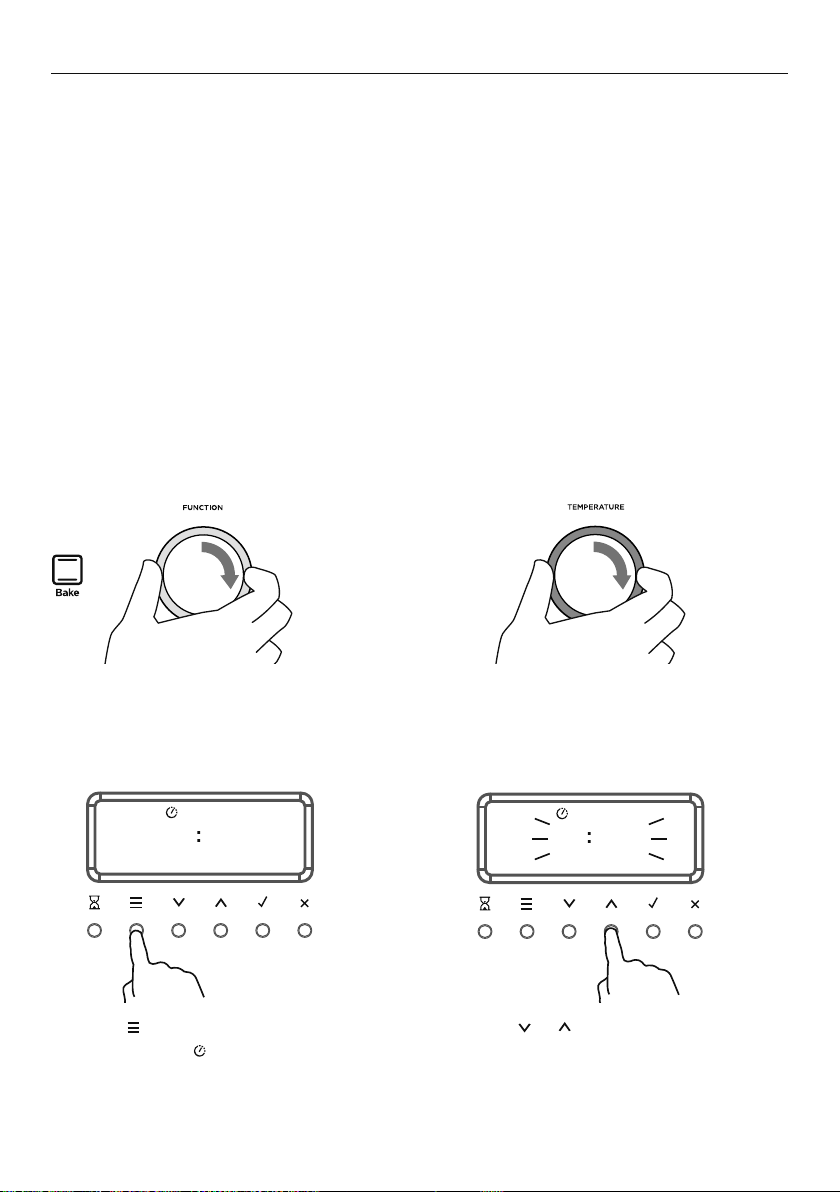
To edit the timer
To cancel the timer
19 35
17 59
19 35
1 Press to access the Timer.
2 Follow the steps on the previous page to adjust the timer.
1 Press to access the Timer.
2 Press and hold
to zero the countdown timer. The display will revert to
showing the time of day.
z
The timer icon will disappear.
When the set time is up
z
A tone will sound every few seconds.
z
Press any control to stop the tone sounding.
z
The timer icon will disappear and the display will revert to showing
the time of day.
31
AUTO COOK
Use Auto Cook to
z
Turn off the oven automatically after a set period of time.
z
Set the oven for food to be ready at a specific time.
z
If you start cooking manually and only want the oven to turn off automatically after
a set period of time: simply set the cook time following steps 1 to 3 below and
select a function and temperature. The oven will automatically turn off when the
cook time is over.
z
Alternatively you can simply set the time of day you wish to the oven to turn off. Follow
steps 4 to 6. The oven will automatically turn off when the end time is reached.
Before you start
z
Make sure that your oven is displaying the correct time of day and food is in the oven.
IMPORTANT!
Safe food handling: leave food in the oven for as short as time as possible before and
after cooking or defrosting. This is to avoid contamination by organisms which may cause
food poisoning. Take particular care during warmer weather.
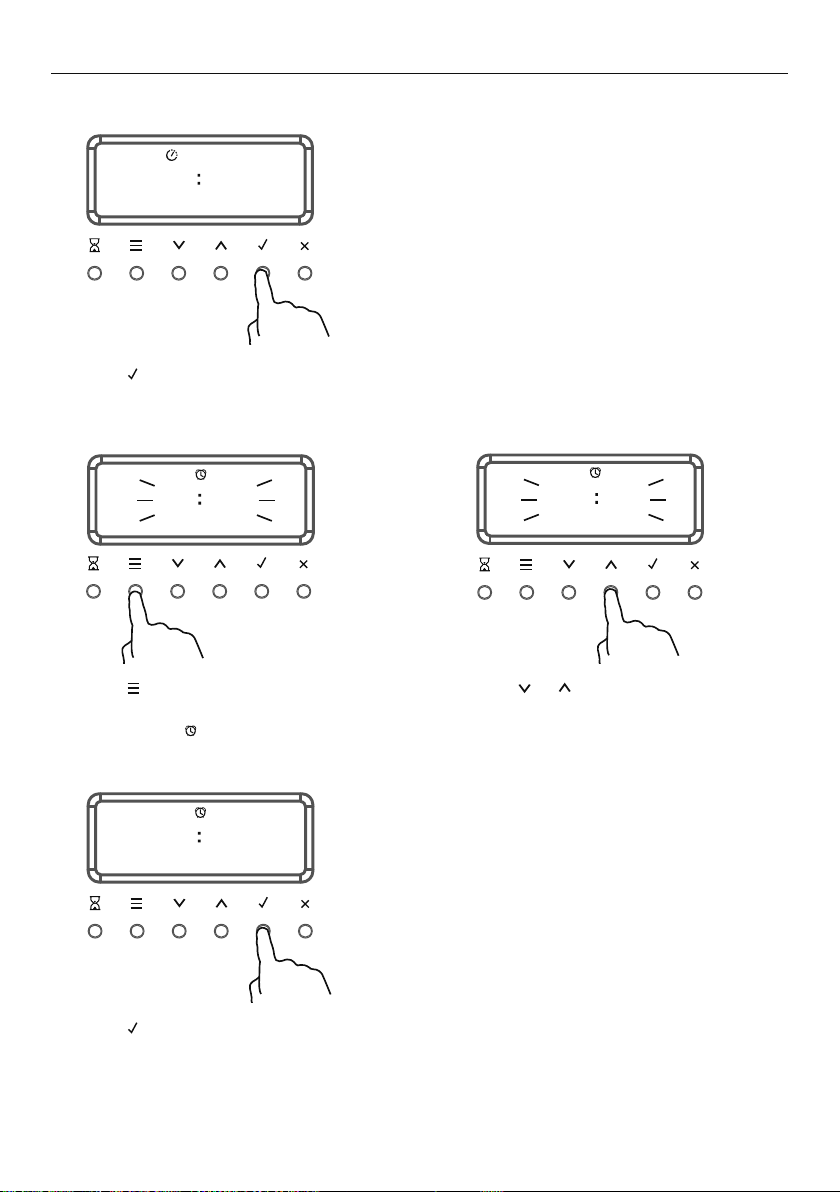
Select function and temperature
To set the cook time
000
015
3 Press
z
The cook time indicator will
appear in the display.
1 Select a function.
z
The dial halo will stop flashing.
4 Press
or to set the cook
time. Make sure you allow for
preheat time in your calculation.
z
The display will flash.
2 Select a temperature.
z
The dial halo will stop flashing.
---
>
32
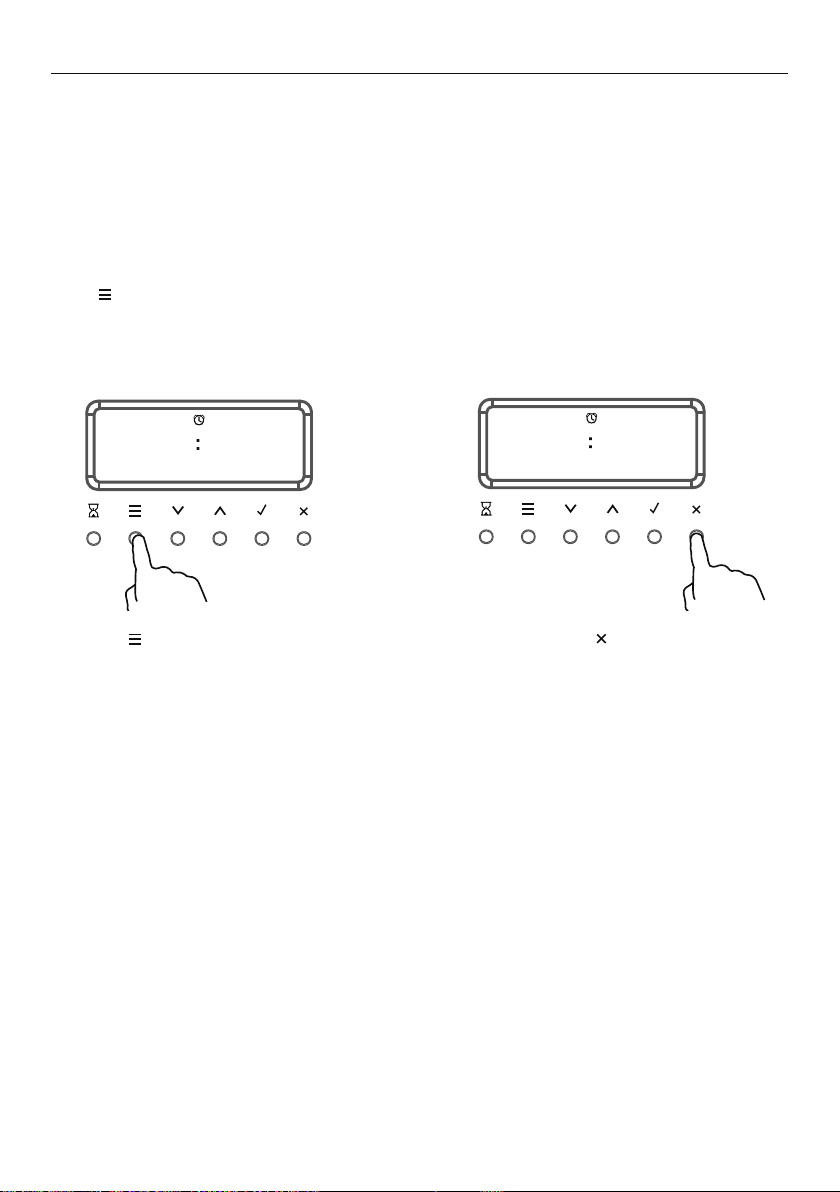
AUTO COOK
2015
015
19 56
6 Press to scroll between cook
time and end time.
z
The end time indicator will
appear and the display will flash.
8 Press
to confirm the end time.
5 Press
to confirm the cook time.
To set the end time
7 Press
or to set the time
you would like your food to be
ready (ie end time).
20 15
33
AUTO COOK
When Auto Cook is set
z
The oven and the lights will stay off, the halos will be unlit, but your oven is now set for
automatic cooking. It will automatically turn on at the required time.
z
You can modify the function and temperature while the oven is waiting to start cooking.
z
If setting Delayed Cook you will need to put the food in the oven before starting.
z
For safety reasons opening the door while the oven is waiting to start will
cancel Delayed Cook.
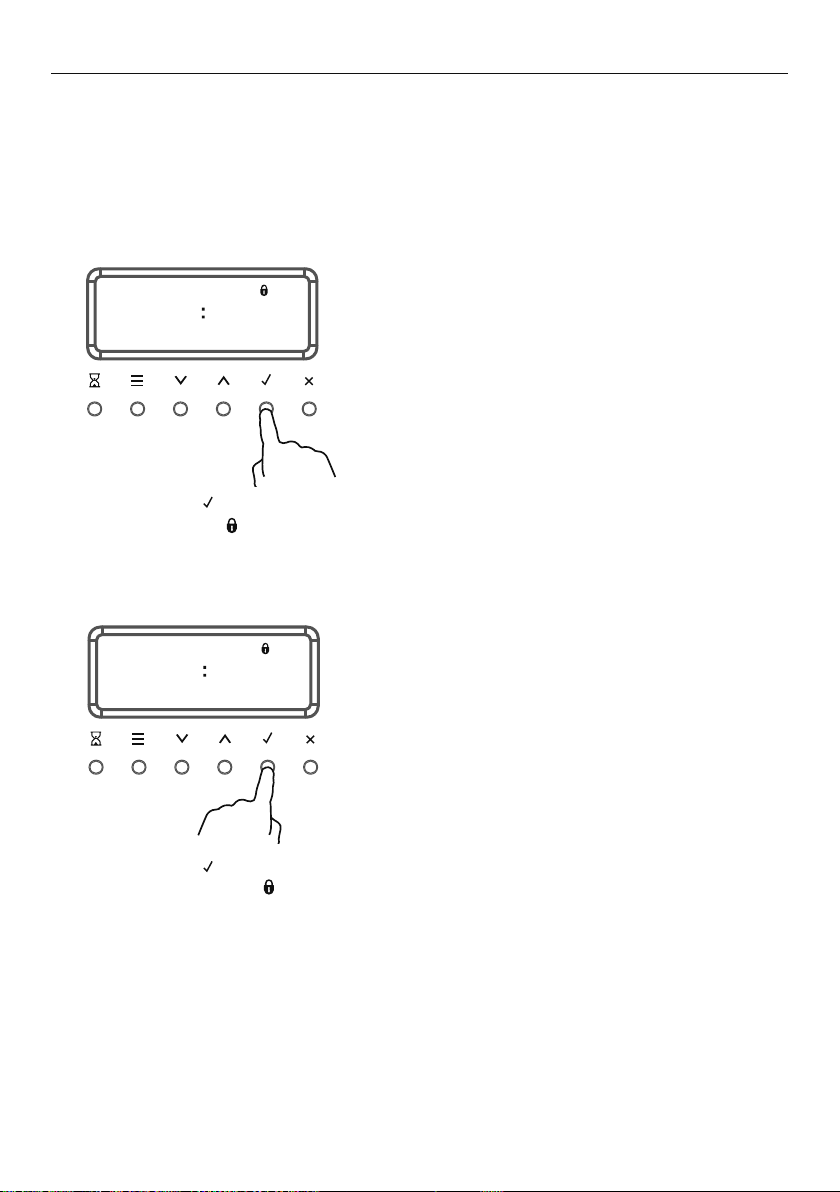
To edit Auto Cook
Press
to scroll between cooking time and end time. Follow previous instructions on
setting the cook time and end time.
To cancel Auto Cook
19 56
19 56
1 Press to scroll between cooking
time and end time.
2 Press and hold .
z
The display will revert to showing
the time of day.
z
Turning the function and
temperature dials back to O (OFF)
will also cancel automatic cooking.
When the set time is up
The oven will automatically turn off and a long tone will sound.
z
Press any button to stop the tone sounding.
z
Turn the function and temperature dials back to O (OFF).
While the oven is heating up
IMPORTANT!
z
During Auto Cook the grill element will come on while the oven is heating up. Food
placed into a cold oven could be prone to burning as the oven heats up.
z
Large items and foods with a high fat or sugar content are especially prone to burning.
Take particular care with foods such as macaroni cheese, large poultry, and enchiladas.
z
Ideal foods for automatic cooking include stews, casseroles, braised meat and
potato top pie.
z
Position food on a lower shelf to prevent burning.
z
Where possible cook food in a pan with a lid, or cover food with foil.
34
LOCKING THE OVEN CONTROLS
This function is to prevent accidental use of the oven (eg by children).
When locked, the controls are unresponsive and the oven will not turn on.
IMPORTANT!
This does not lock the cooktop controls.
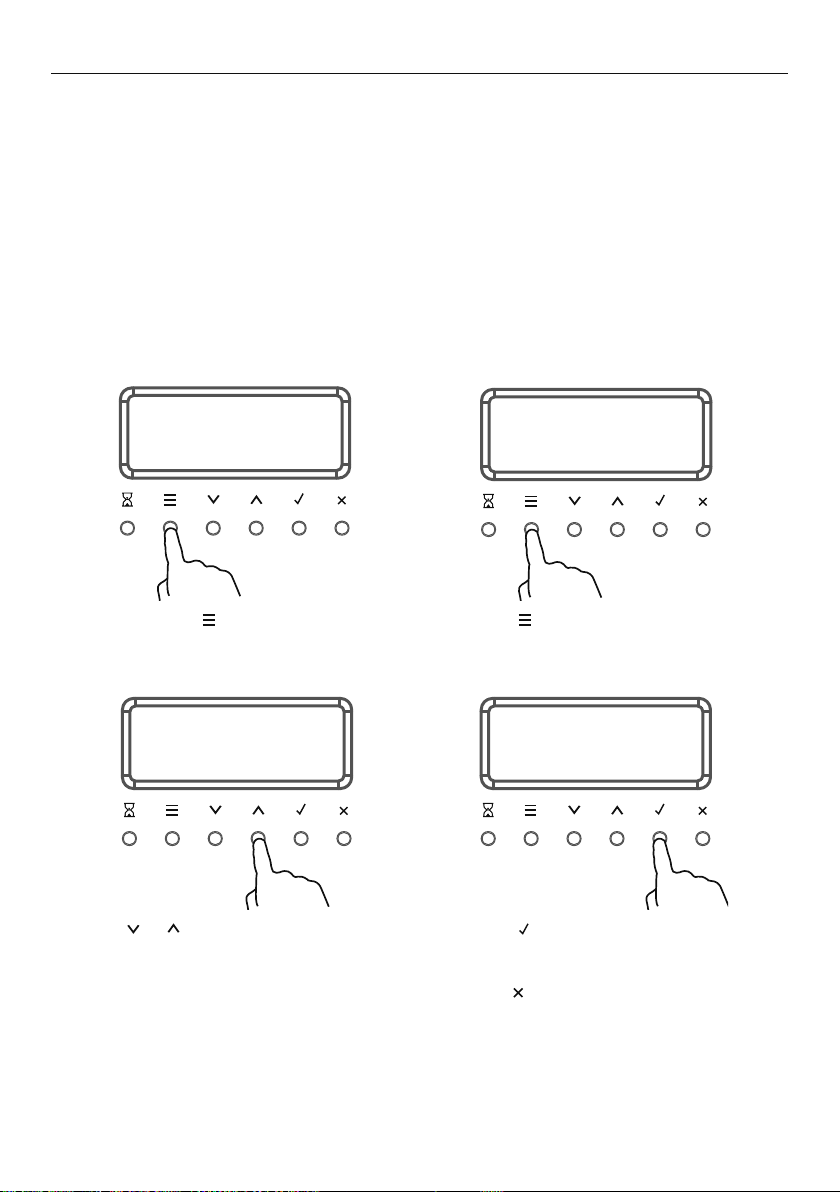
To lock:
1 Press and hold
until there is a beep.
z
The lock indicator will appear on the display.
z
The oven controls are now locked.
To unlock:
19 35
2 Press and hold until there is a beep
and the lock indicator disappears.
z
The oven controls are now unlocked.
19 35
35
USER PREFERENCE SETTINGS
You can set your oven to:
z
give audio feedback (tones and beeps) or operate quietly
z
display time as 12-hr or 24-hr
z
operate with the display off
z
have its lights on or off during cooking
z
operate in Sabbath Mode (see ‘Sabbath Mode’ following).
Note: you cannot change the user preference settings when you oven is operating
or set for automatic cooking.
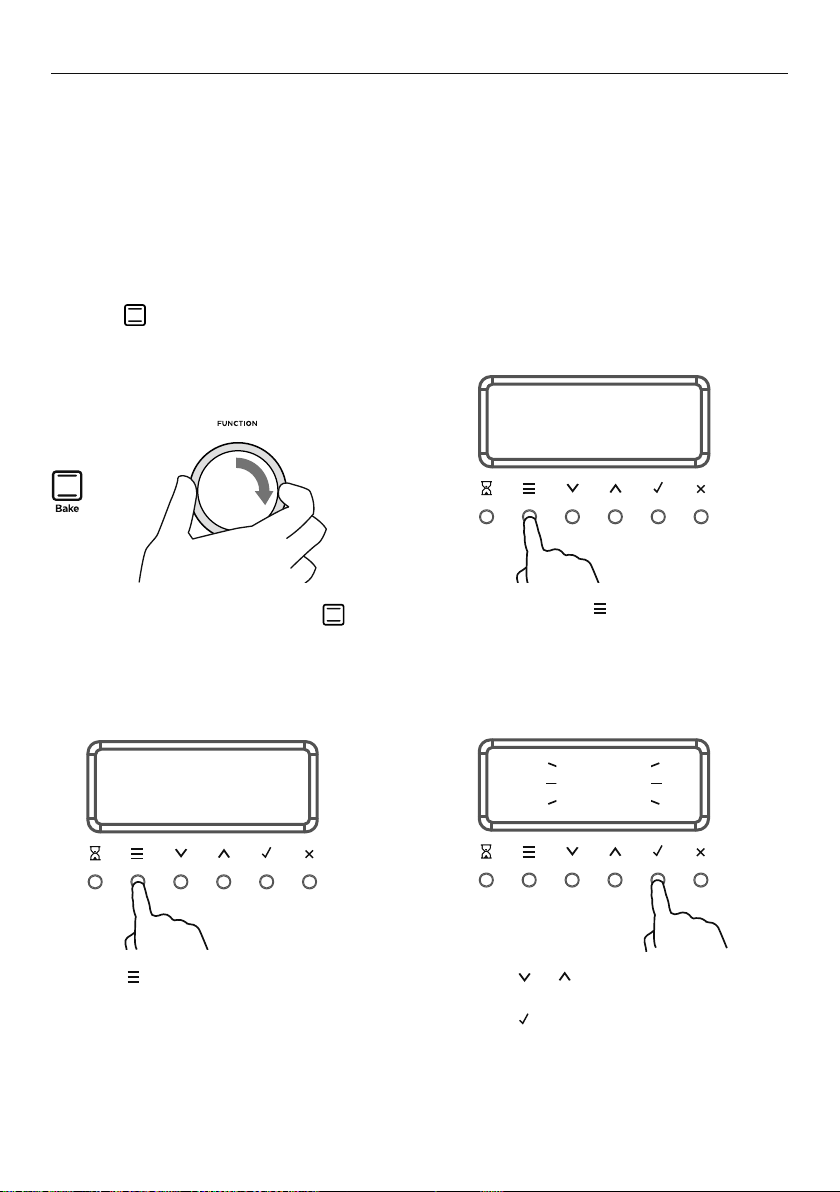
How to change preference settings
Adjust the user settings to suit your personal setup preferences.
1 Press and hold
until there is a beep.
z
The display will show 12 or 24 hr.
3 Press
or to scroll through the
options for that particular setting.
z
The display will flash while
in edit mode.
2 Press
to scroll through to the
setting you want to change.
4 Press
to save the new option and
exit user preference mode.
z
The display will stop flashing.
z
Press to exit user preference mode
without changing the setting.
24hr
bP on
bP oF bP oF
36
USER PREFERENCE SETTINGS
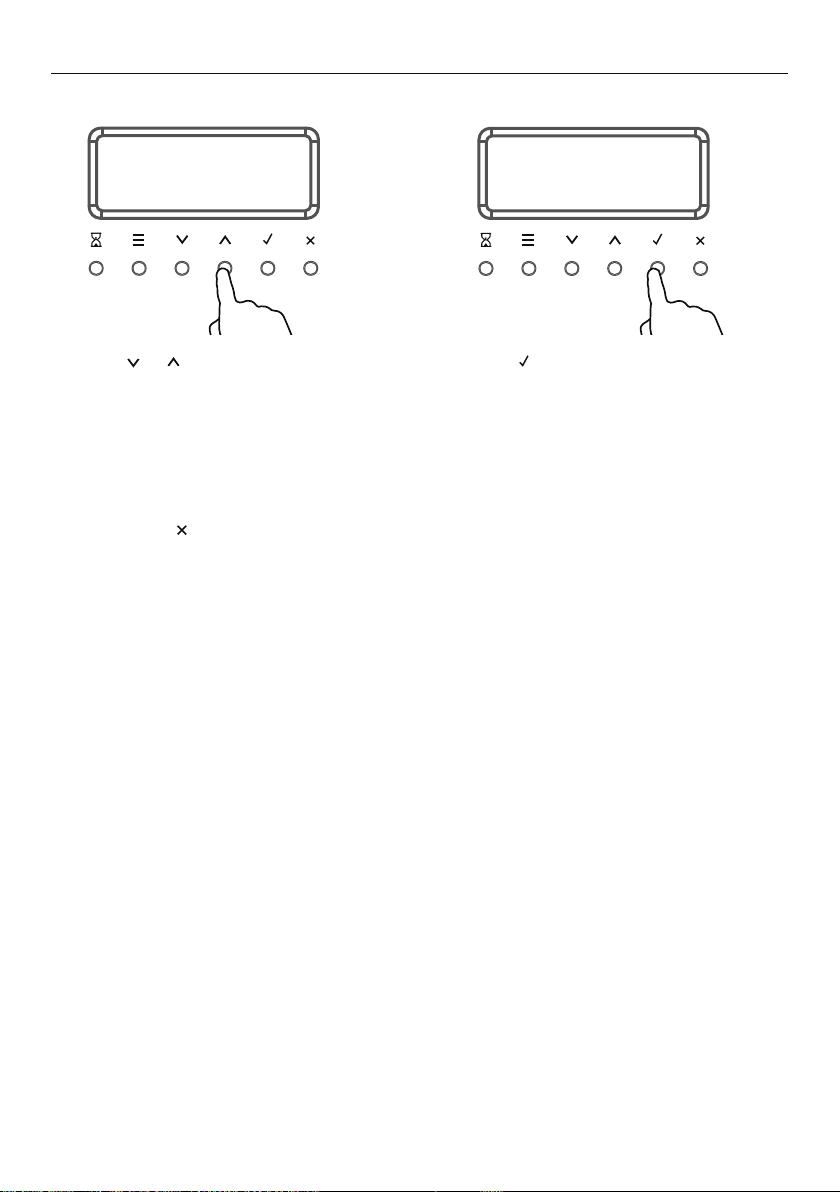
SETTING DEFAULT OPTION ALTERNATIVE OPTION(S)
CLOCK DISPLAY 24H 12H DISPLAY OFF**
Select between:
• Analog and
digital display
• 12-hr and 24-hr display
• Display off**
Turn the display off if you
only want to use the basic
functionalities of your oven.
24Hr 12Hr oFF
AUDIO FEEDBACK BEEPS/TONES ON* BEEPS/TONES OFF*
Turn the oven beeps
and tones on or off.*
bPon bPoF
OVEN LIGHTS LIGHTS ON LIGHTS OFF
Have the light off during
cooking if you want to save
power or want the food
you cook to be a surprise
for others.
Lton LtoF
SABBATH MODE SABBATH OFF
SboF
*The timer tone and alert beeps will sound even if you save the BEEPS OFF option.
**With this option saved, you can still use the oven, and timer, however the display will remain unlit.
Any automatic functions will be cancelled when this option is selected. To quit this option and
enable the display, press and hold
.
37
SABBATH MODE
This setting is designed for religious faiths that observe a ‘no work’ requirement
on the Sabbath.
While your oven is in Sabbath Mode
z
The display, dial halos and indicators will be unlit, the controls will be unresponsive.
z
No tones or beeps will sound.
z
No alert codes or temperature changes will be displayed.
z
The oven lights will stay on. If you want the oven lights to be off during Sabbath Mode,
first select the ‘Lights off’ option as described in ‘User preference settings’, and then
set Sabbath Mode afterwards.
z
Bake is the only function available in Sabbath Mode.
How to set Sabbath Mode
2 Press and hold
until there is a beep
to enter the user preference menu.
4 Press
or to scroll between
Sabbath off and Sabbath on.
5 Press
to activate the option.
z
.
will flash in the display.
3 Press
to scroll through
to Sabbath Mode.
z
The default setting is Sabbath Off.
1 Set the oven function to Bake
and
set the desired temperature.
z
Note: bake is the only function that can
be used in Sabbath Mode.
24hr
SboF
00hr
38
SABBATH MODE
The display, indicators and dial halos will remain unlit and unresponsive, but the oven will
bake until you quit Sabbath Mode.
To quit Sabbath Mode
Press and hold
until the time of day appears in the display and the oven turns off, or turn
the function and temperature dials back to O (OFF).
7 Press
to confirm.
6 Press
or to set the time (hrs).
You may set the time up to 48 hours.
23hr
23hr
39
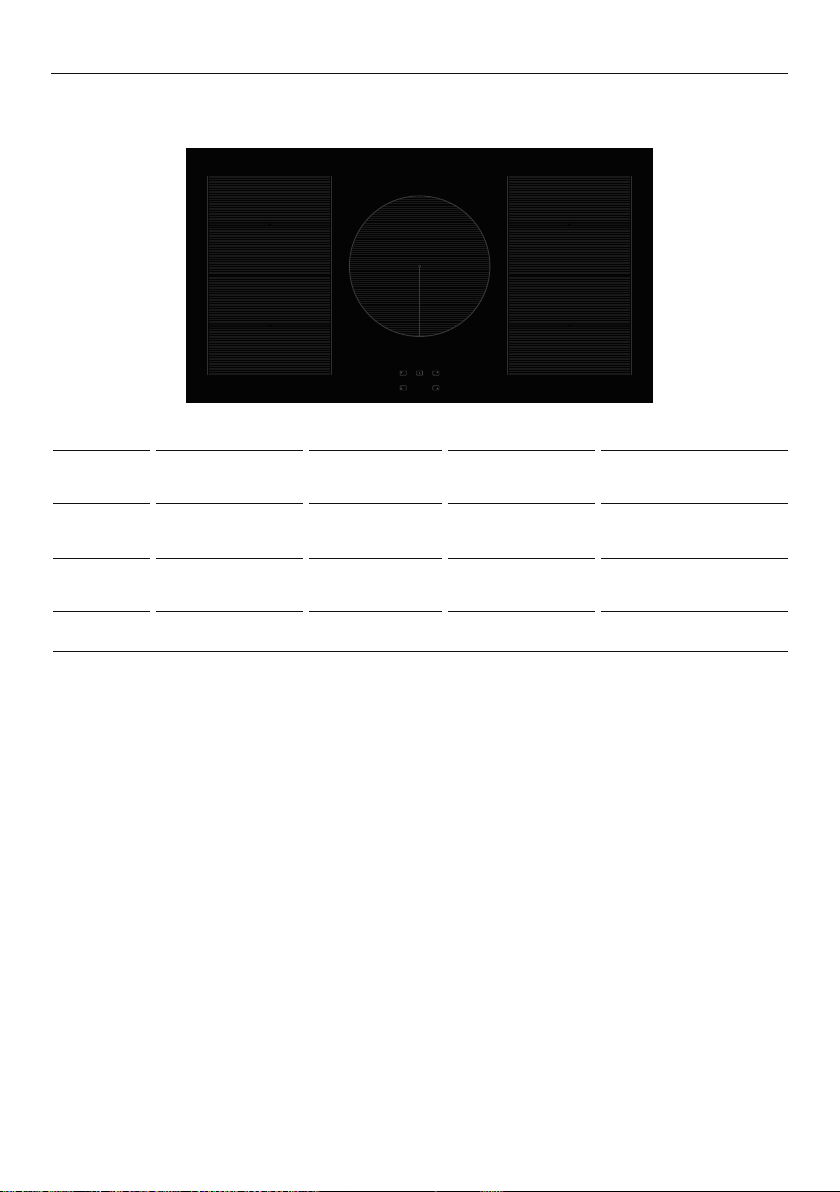
USING YOUR INDUCTION COOKTOP
COOKING
ZONE
ZONE
DIAMETER
POWER POWERBOOST
RECOMMENDED
MINIMUM PAN SIZE
1
Smarttzone 1600 W 1850 W 120mm (unbridged)
250mm (bridged)
2
Smarttzone 2100 W 3000 W 120mm (unbridged)
250mm (bridged)
2
250mm 2300 W 3000 W 145mm
OR90 models
2
1
3
2
1
40
USING YOUR INDUCTION COOKTOP
Cooking zones display
The ceramic cooktop is fitted with induction cooking zones. These circular zones are
controlled by separate dials positioned on the control panel below.
At the front, is the display for the cooking zones (one for each zone). Each zone display is
activated by it’s corresonding control dial and displays:
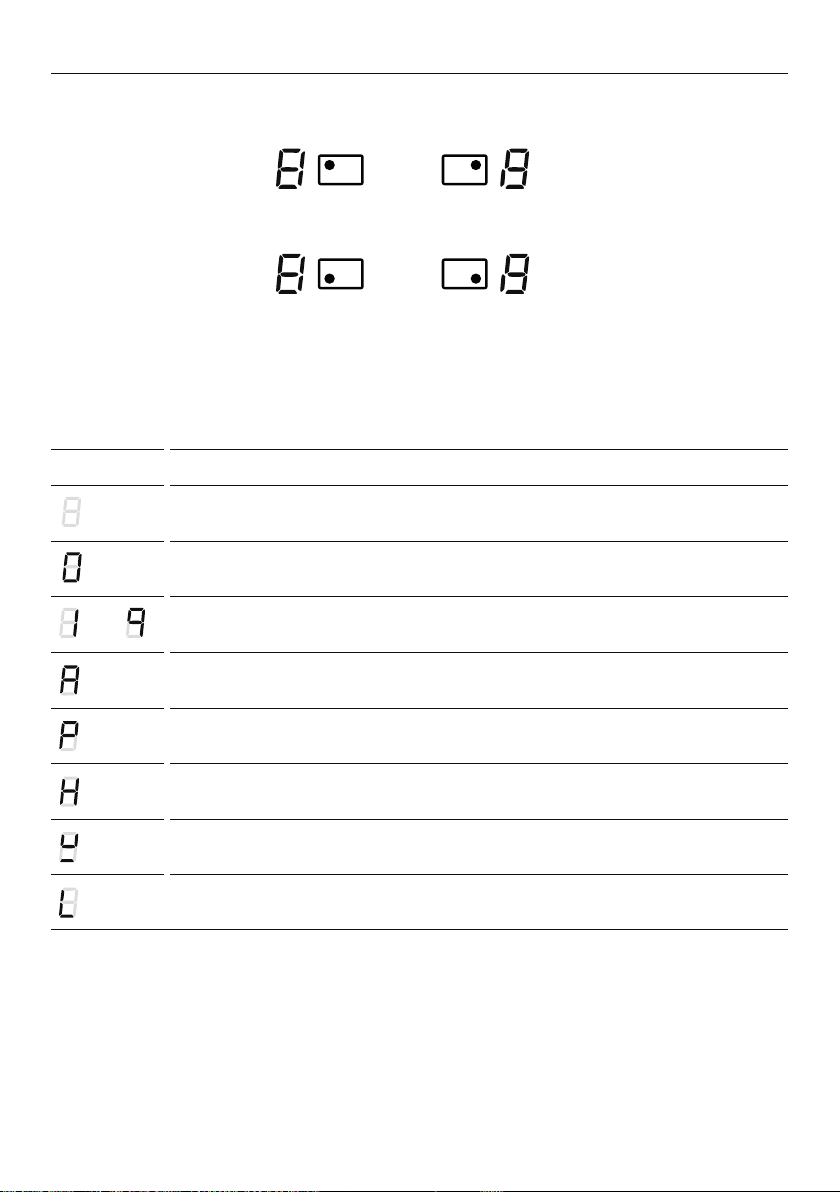
DISPLAY MEANING
Cooking zone Off (not activated)
Cooking zone On (activated but not operating).
If a zone is in zero setting, the display switches off automatically after about 10 seconds.
–
Power levels
Auto RapidHeat feature
PowerBoost feature
Hot surface indicator
Pan detection indicator
Childlock
Note: each lit figure refers to the relevant cooking zone
41
USING YOUR INDUCTION COOKTOP
1
2
3
4
5
6
7
8
9
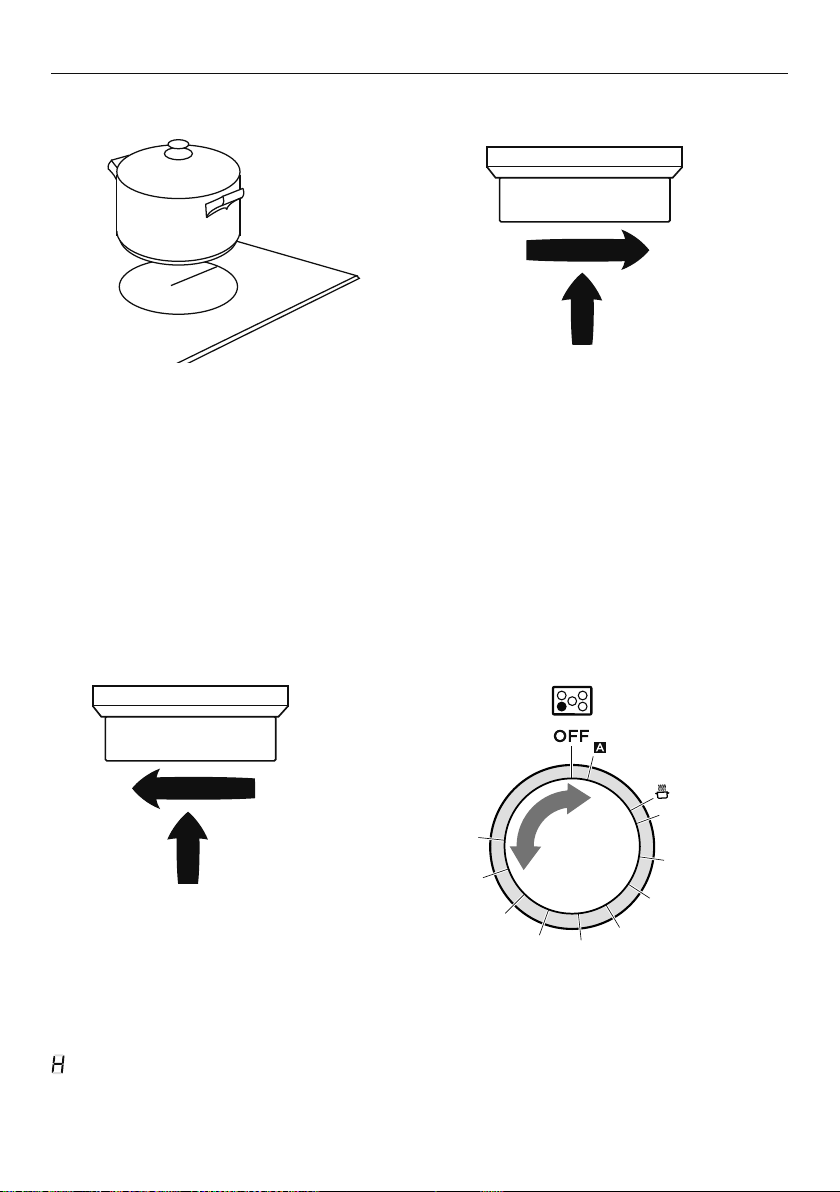
To turn a cooking zone on:
When you have finished cooking: Control dials:
1 Place a suitable pan on
the cooking zone.
z
Make sure the bottom of the
pan and the surface of the
cooking zone are clean and dry.
IMPORTANT!
Always place small pans in the
centre of the cooking zone.
1 Turn the corresponding control
dial back to O (OFF).
Beware of hot surfaces
will show in the display of any cooking zones that are still too hot to touch. It will
disappear when the surface has cooled down to a safe temperature.
2 Turn the corresponding control dial
clockwise to the desired heat setting.
z
You can modify the heat setting at any
time during cooking.
2 1 0
4 3 2 1 0
42
USING YOUR INDUCTION COOKTOP
If a display flashes alternately with the heat setting
This means that:
z
you have not placed a pan on the correct cooking zone or
z
the pan you’re using is not suitable for induction cooking or
z
the pan is too small or not properly centred on the cooking zone.
No heating takes place unless there is a suitable pan on the cooking zone.
The cooktop will automatically turn off after 10 minutes if no suitable pan is placed on it.
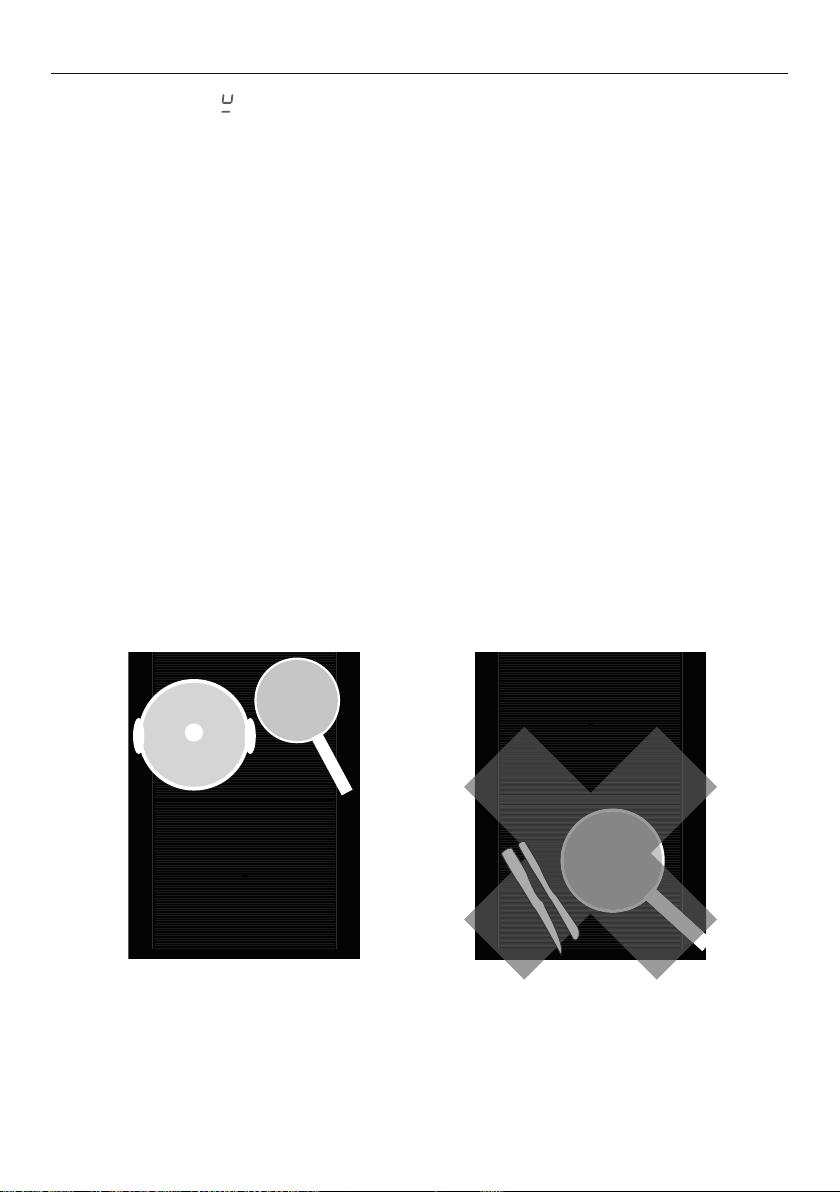
Dual zone cooking
When using a small pot on the dual cooking zone, be sure to centre it so that the inner zone
will detect the pan. If the pan covers the outer zone, then the outer zone will automatically
switch on.
SmartZones
The SmartZones are large. You may place several small pots on the SmartZone and they will
be detected as if they were one large pot.
IMPORTANT!
The whole of the SmartZone is activated when a pot is detected. This means that other
magnetisable items (such as cutlery) sitting in the cooking zone will heat up.
Never leave cutlery or other magnestisable items on your cooktop.

43
LOCKING THE COOKTOP CONTROLS
Locking the cooktop
z
You can lock the cooktop control dials for cleaning and to prevent unintended use.
(for example children accidentally turning cooking zones on).
z
When the cooktop is locked the controls and cooktop display will remain unresponsive.
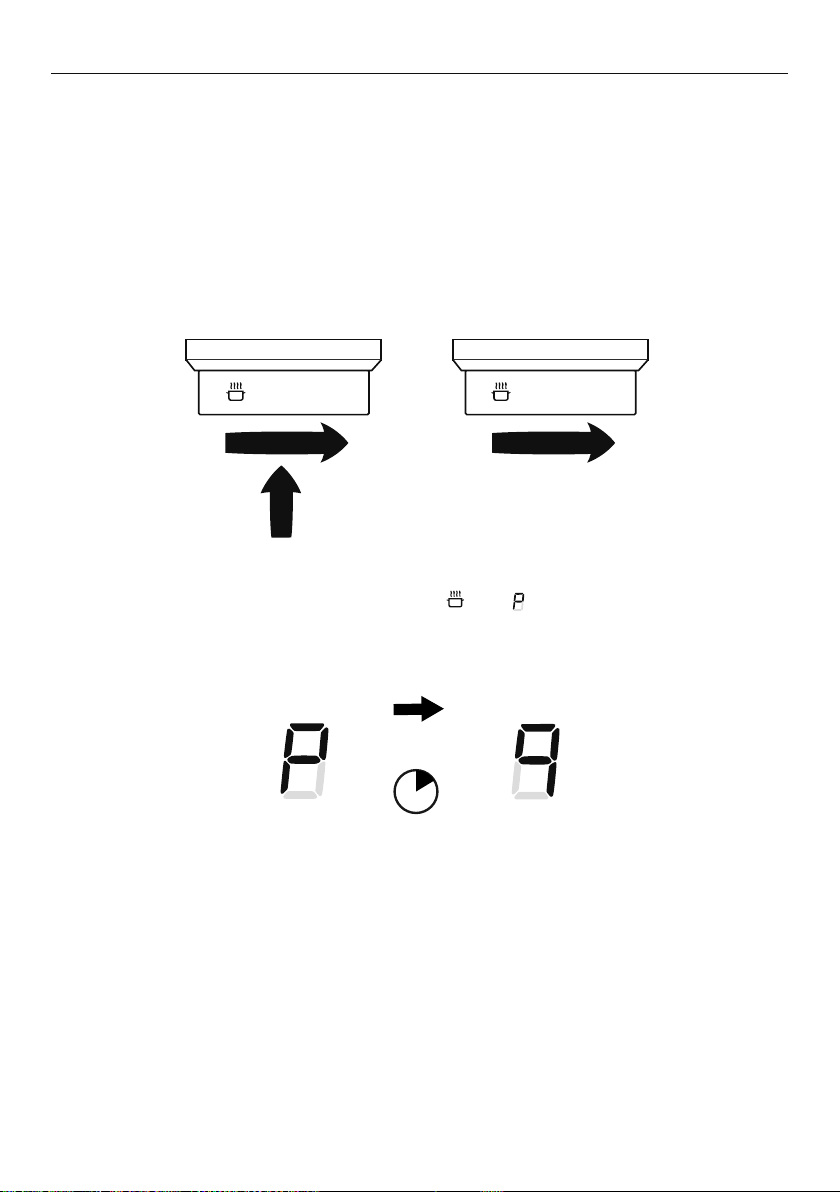
To lock the cooktop
1 Make sure that all cooking zones are turned OFF.
2 Turn the control dials for the two left cooking zones anticlockwise to
.
3 Hold the dial at
until appears in the cooktop display.
To unlock the cooktop
Repeat the steps above.
Hold the dials at
until disappears from the cooktop display.
Your cooktop is now ready to be used again.
44
USING YOUR COOKTOP’S SPECIAL FEATURES
Using the PowerBoost feature
This feature enables you to sear meat or bring liquid to the boil very quickly. When a
cooking zone is set for PowerBoost, it uses more than 100% of the rated power of that
particular cooking zone, resulting in a boost of intense heat.
IMPORTANT!
PowerBoost heats food and liquids very quickly.
Do not leave the cooktop unattended when using this feature.
To set a cooking zone for PowerBoost
1 Turn the cooking zone on to its highest heat setting (9).
2 From heat setting 9, turn and hold the dial to
until appears in the display.
When PowerBoost is set
The cooking zone will remain on PowerBoost for a maximum of 10 minutes.
After 10 minutes the cooking zone will automatically reduce its heat to setting 9.
To turn PowerBoost off
Turn the control dial to a lower heat setting or back to O (OFF).
9 8 7 9 8 7
10 mins
45
USING YOUR COOKTOP’S SPECIAL FEATURES
z
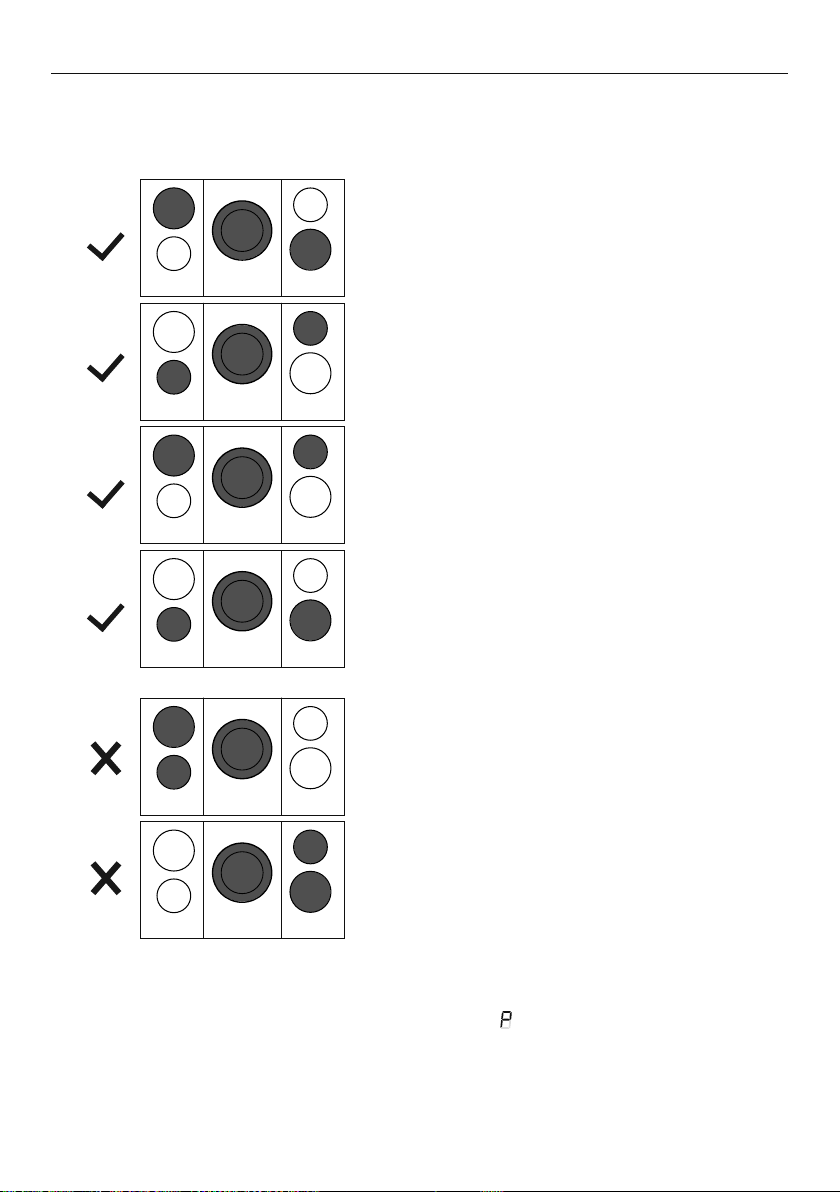
You can set three cooking zones f or PowerBoost at the same time as long as one is not
behind the other.
z
It is not possible to set all the cooking zones for PowerBoost at the same time.
z
If one cooking zone is set to PowerBoost and you accidentally also set a second
cooking zone immediately in front or behind to PowerBoost, the first cooking zone will
warn you that the configuration is not possible, flash and then automatically reduce
its power level.
z
When a cooking zone is set for PowerBoost, the cooking zone immediately in front of or
behind may automatically reduce its power level.
z
PowerBoost is not available if cooking zones are bridged.
P
P
P
P
P
P
P
P
P
P
P
P
P
P
P
P
P
P
46
USING YOUR COOKTOP’S SPECIAL FEATURES
Using the Auto RapidHeat feature
This feature lets you rapidly heat up food or liquid then automatically reduce the
temperature to a pre-selected heat setting.
To set a cooking zone forAuto RapidHeat
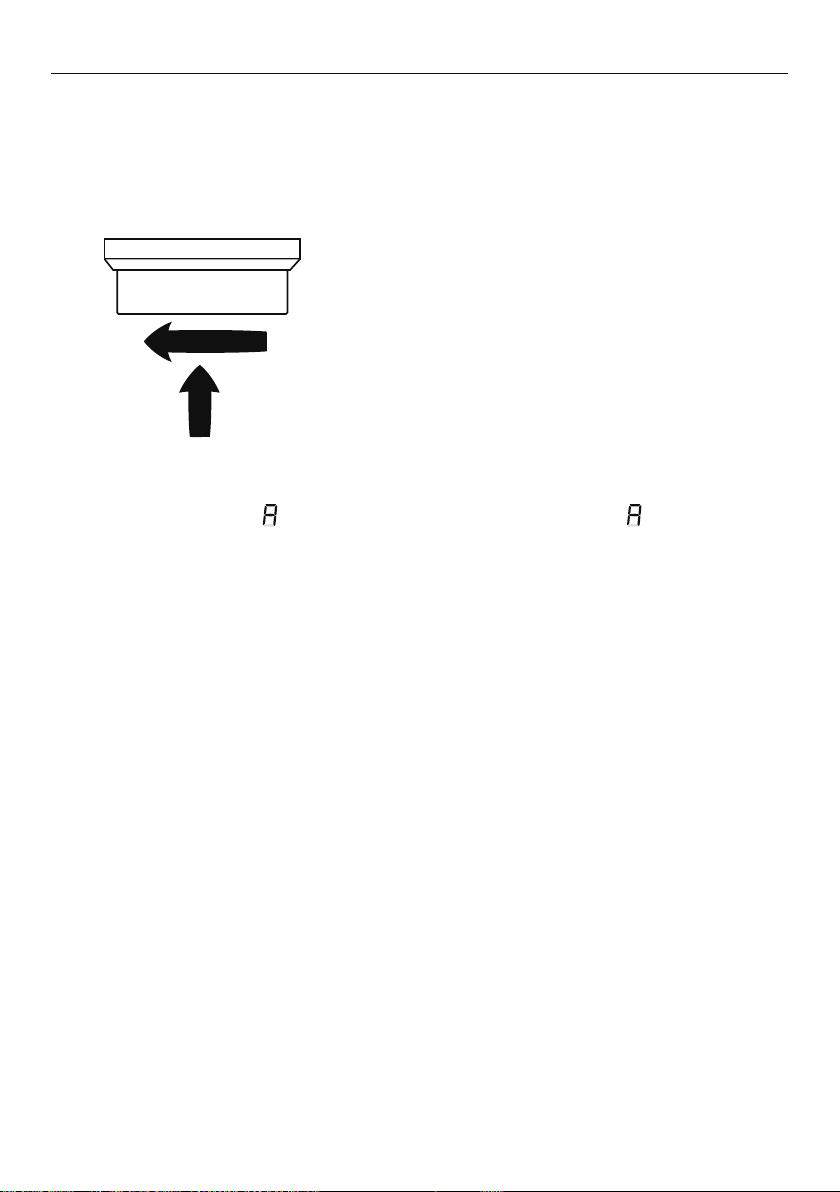
1 Press in and turn the control dial
anticlockwise to A.
z
Hold the dial at A until appears
in the cooking zone display.
2 Turn the control dial to the desired
heat setting (1–8).
z
The heat setting and will alternate
in the display.
z
Auto RapidHeat is now set.
OFF A
47
USING YOUR COOKTOP’S SPECIAL FEATURES
When Auto Heat-reduce is set
The amount of time the cooking zone will rapidly heat for depends on the heat setting you
have selected. See below chart for rapid heat times.
To cancel Auto RapidHeat (while A is still flashing)
z
Turn the control dial to a lower heat setting or back to O (OFF).
Increasing the heat setting to 9 will also cancel Auto RapidHeat.
Note:
The Auto RapidHeat and PowerBoost features cannot be used together. If you turn
PowerBoost on when Auto Heat-reduce is already set, the Auto RapidHeat will be cancelled.
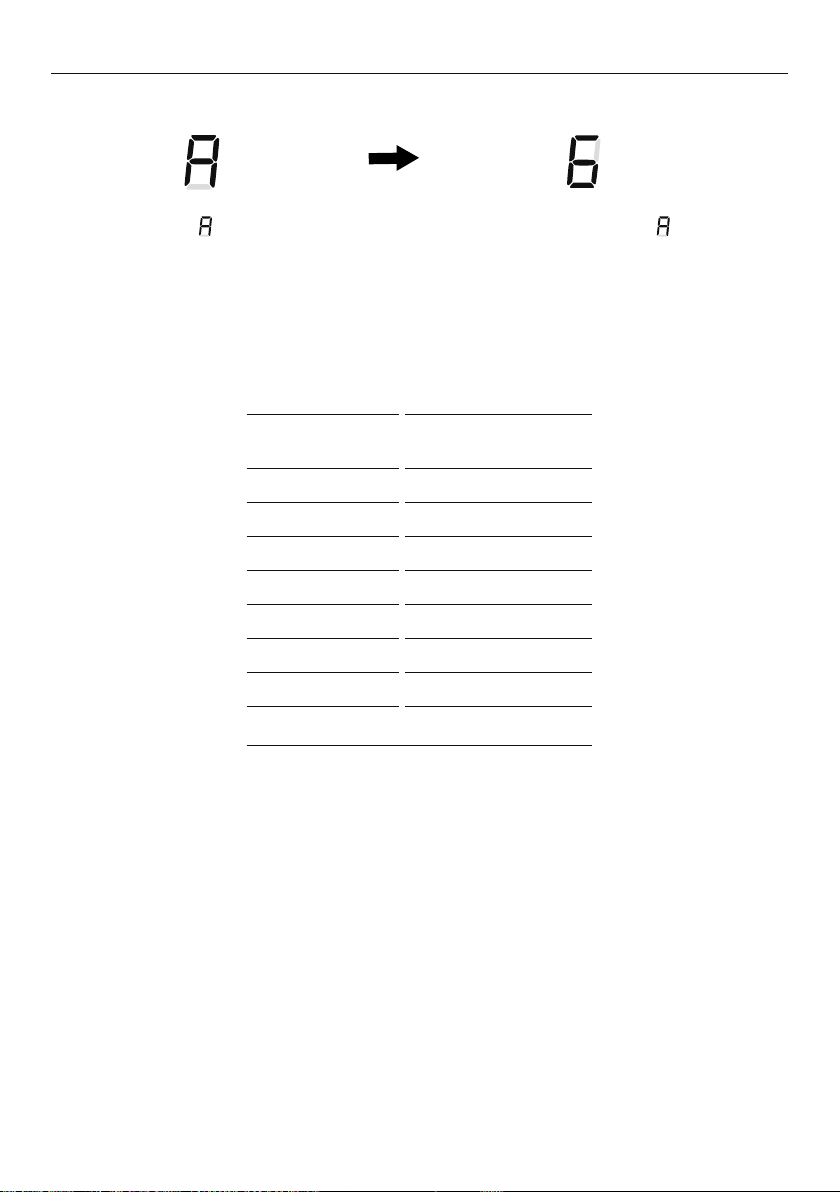
When rapid heat is finished will
stop flashing and the temperature will
automatically reduce to the heat setting
you have selected.
During rapid heat will flash
alternately with the heat setting you
have selected.
SELECTED
HEAT SETTING
APPROXIMATE TIME
AT RAPID HEAT
1 40 seconds
2 1 minute
3 2 minutes
4 3 minutes
5 4 minutes
6 7 minutes
7 2 minutes
8 3 minutes
48
USING YOUR COOKTOP’S SPECIAL FEATURES
Bridging SmartZones
z
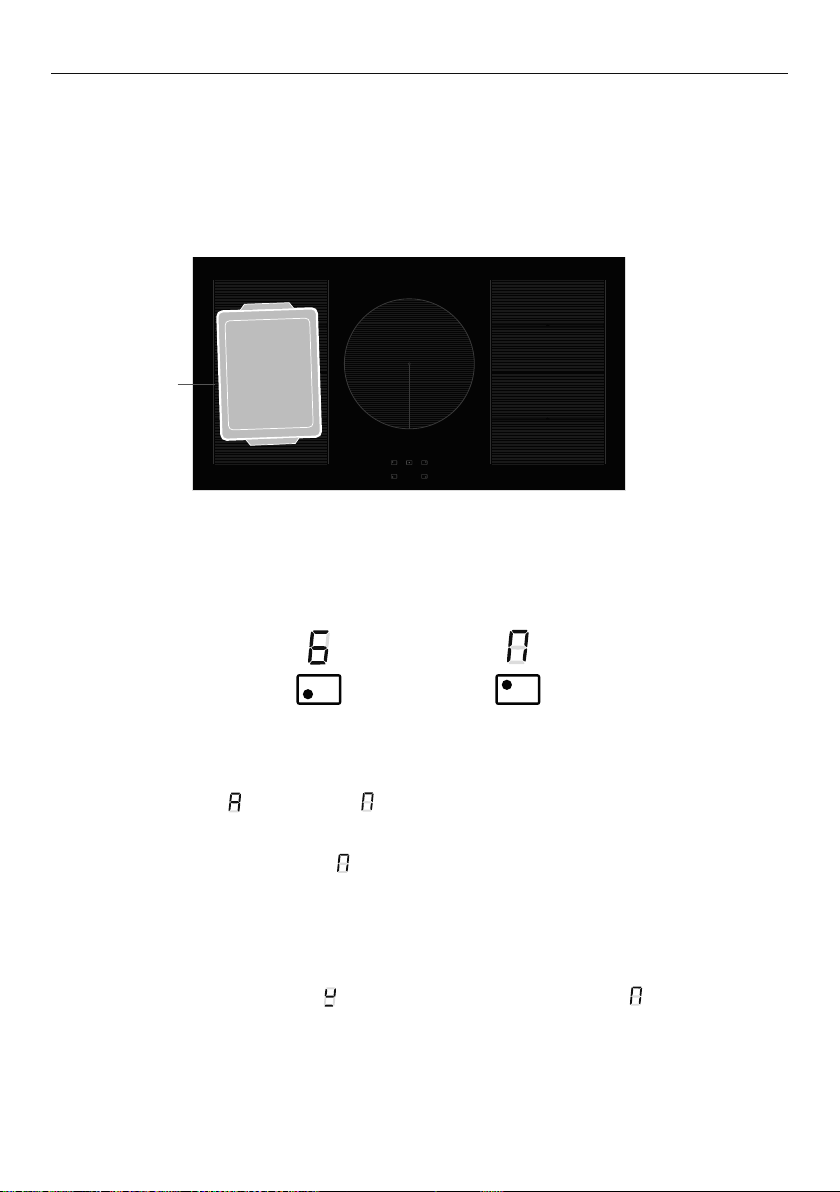
The bridging zone function allows you to use two SmartZones together giving you a
larger cooking area. Your pan(s) will need to cover both cooking zones.
z
There may be a cooler area in the centre of the cooktop between the cooking zones. You
may need to move food around the pan to ensure even cooking.
z
When using bridging zones it is not possible to use the PowerBoost function.
To select the bridging function
1 Place the pan on the cooktop over the two zones you wish to use, covering both
cooking zones (as shown above).
cooler
area
Bridging zone
2 Turn both control dials for the selected cooking zones anticlockwise to the highest
heat setting 9.
3 Turn both dials to
and hold until appears in the cooking zone displays and the
displays stop flashing.
z
The front cooking zone display will show the heat setting.
z
The rear cooking zone will show .
4 Use the front cooking zone control dial to adjust the heat setting for the bridged zone.
5 Adjusting the rear cooking zone will cancel bridging.
If no pan is detected
If no pan is detected on either cooking zone the front cookingzone display will alternate
between the selected setting and
. The rear cooking display will show .

49
USING YOUR COOKTOP’S SPECIAL FEATURES
If no pan is detected on one cooking zone:
The front cooking zone display will still show the selected temperature and the rear cooking
zone display will still show
.
If after 10 minutes no pan is detected:
z
the bridging function will switch off
z
the cooking zone without a detectable pan will continue to show
z
the remaining cooking zone will continue cooking at the selected heat setting.
Using Auto RapidHeat in bridged mode
1 Bridge the cooking zones.
2 Turn the control dial for the front cooking zone back past OFF to A.
3 Hold the dial at A until
starts alternating in the display.
4
T
urn the control dial to your selected heat setting. the Heat setting and
will alternate
in the display.
5 The bridged zone is now set for Auto RapidHeat.
To cancel bridging
Turn both control dials back to OFF.
50
CHOOSING THE RIGHT COOKWARE
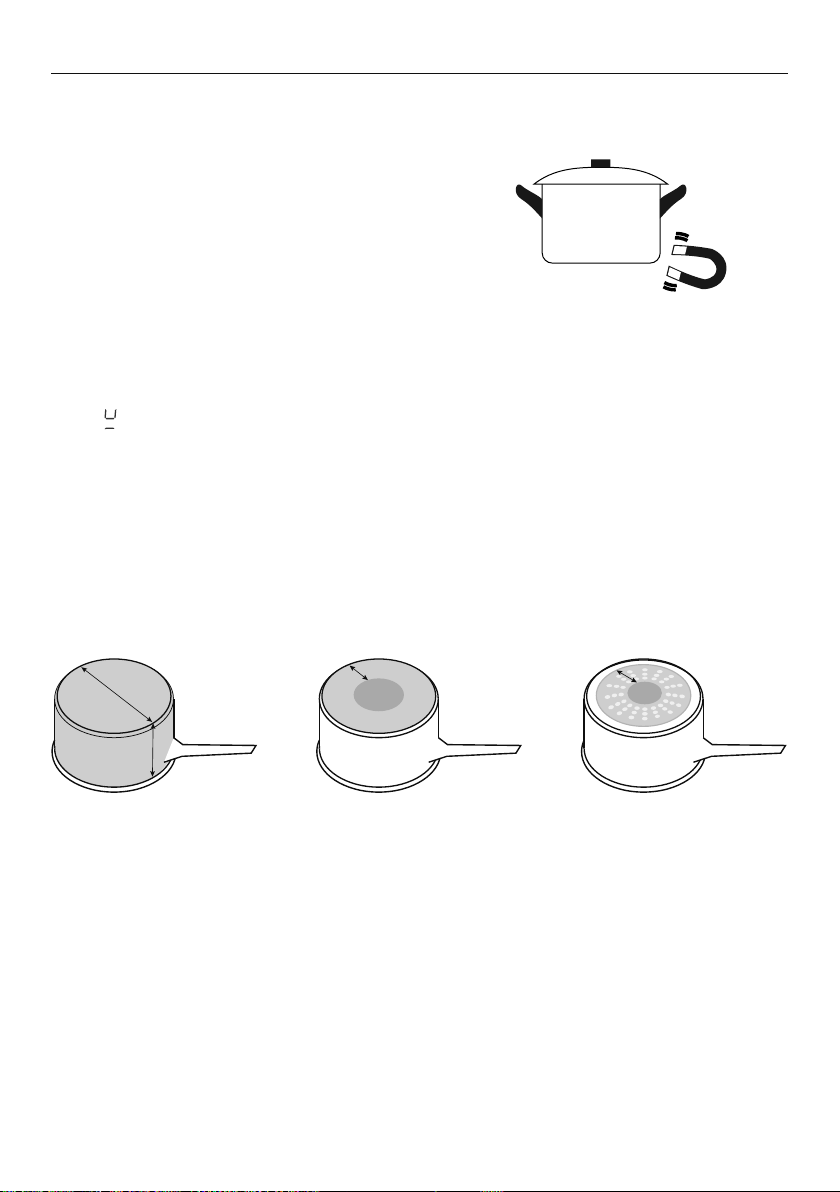
To check if cookware is suitable
Carry out a magnet test:
z
Move a magnet across the base of the pan.
If the magnet is attracted then the pan is
induction suitable.
z
Note: make sure attraction is consistent across
the base of the pan.
If there are gaps, such as an indented
manufacturer’s logo, then the performance of
the pan will be impaired.
If you do not have a magnet:
1 Put some water in the pan you want to check.
2 Follow the steps under ‘To start cooking’.
3 If
does not flash in the display and the water is heating, the pan is suitable.
Quality of cookware
IMPORTANT!
z
The quality of your cookware can affect cooking performance. Only use induction
compatible cookware that has been specifically designed for induction cooking.
Look for the induction symbol on the packaging or the bottom of the pan.
z
Cookware that has a high content of ferromagnetic material that continues up from the
base into the sides of the pan will give the best cooking performance.
See below:
Quickest heating
Performance
High content of
ferromagnetic material
Heating area is consistent
across the base and
continues up the sides
of pan.
Average heating
Performance
Reduced area of
ferromagnetic material
Reduced zone of
heating, results in poor
cooking performance
and slower heating.
Slow heating
Performance
Very limited area of
ferromagnetic material
Results in very slow
heating performance.
Note: this type of pot is
good for very delicate
tasks such as melting
chocolate, as heating is
very slow.
51
CHOOSING THE RIGHT COOKWARE
Cookware guidelines
Cookware made from the following materials is suitable:
z
stainless steel with a magnetic base or core
z
aluminium and copper with a magnetic base or core
z
cast iron
z
steel or enamelled steel.
Cookware made from the following materials is not suitable:
z
pure stainless steel
z
aluminium or copper without a magnetic base
z
glass
z
wood
z
porcelain
z
ceramic or earthenware.
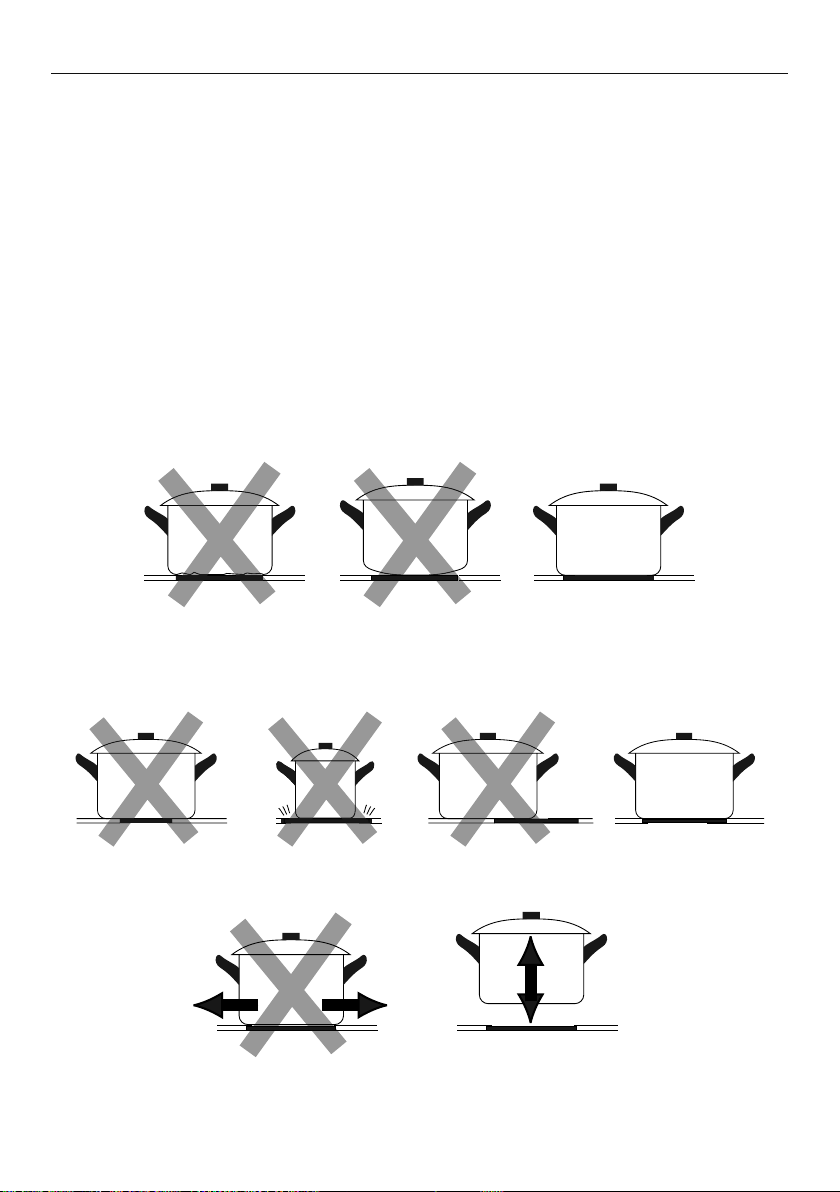
Do not use cookware with jagged edges or a curved base.
Make sure that the base of your pan is smooth, sits flat against the glass, and is similar
in size as the cooking zone. A small pot on a large cooking zone may not be detected.
Always centre your pan on the cooking zone.
Always lift pans off the cooktop – do not slide, or they may scratch the glass.

52
COOKING GUIDELINES
IMPORTANT!
Take care when frying: oil and fat heat up very quickly, particularly if you’re using
PowerBoost. At extremely high termperatures oil and fat will ignite spontaneously and
this presents a serious fire risk.
Cooking tips
z
When food comes to the boil, reduce the temperature setting.
z
Using a lid will reduce cooking times and save energy by retaining the heat.
z
Minimise the amount of liquid or fat to reduce cooking times.
z
Start cooking on a high setting and reduce the setting when the food has
heated through.
Simmering, cooking rice
z
Simmering occurs below boiling point, at around 85oC, when bubbles are just rising
occasionally to the surface of the cooking liquid. It is the key to delicious soups and
tender stews because the flavours develop without overcooking the food. You should
also cook egg-based and flour-thickened sauces below boiling point.
z
Some tasks, including cooking rice by the absorption method, may require a
setting higher than the lowest setting to ensure the food is cooked properly in the
time recommended.
Searing steak
To cook juicy flavoursome steaks:
1 Stand the meat at room temperature for about 20 minutes before cooking.
2 Heat up a heavy-based frying pan.
3 Brush both sides of the steak with oil. Drizzle a small amount of oil into the hot pan
and then lower the meat onto the hot pan.
4 Turn the steak only once during cooking. The exact cooking time will depend on the
thickness of the steak and how cooked you want it. Times may vary from about 2 – 8
minutes per side. Press the steak to gauge how cooked it is – the firmer it feels the
more ‘well done’ it will be.
5 Leave the steak to rest on a warm plate for a few minutes to allow it to relax and
become tender before serving.
Stir-frying
z
When stir-frying be careful to lift the pan clear of the surface if tossing the ingredients.
Sliding the pan across the cooktop surface may scratch it.
1 Choose an induction compatible flat-based wok or a large frying pan.
2 Have all the ingredients and equipment ready. Stir-frying should be quick. If cooking
large quantities, cook the food in several smaller batches.
3 Preheat the pan briefly and add two tablespoons of oil.
4 Cook any meat first, put it aside and keep warm.
5 Stir-fry the vegetables. When they are hot but still crisp, turn the cooking zone to a
lower setting, return the meat to the pan and add your sauce.
6 Stir the ingredients gently to make sure they are heated through.
7 Serve immediately.
53
COOKING GUIDELINES
Heat settings
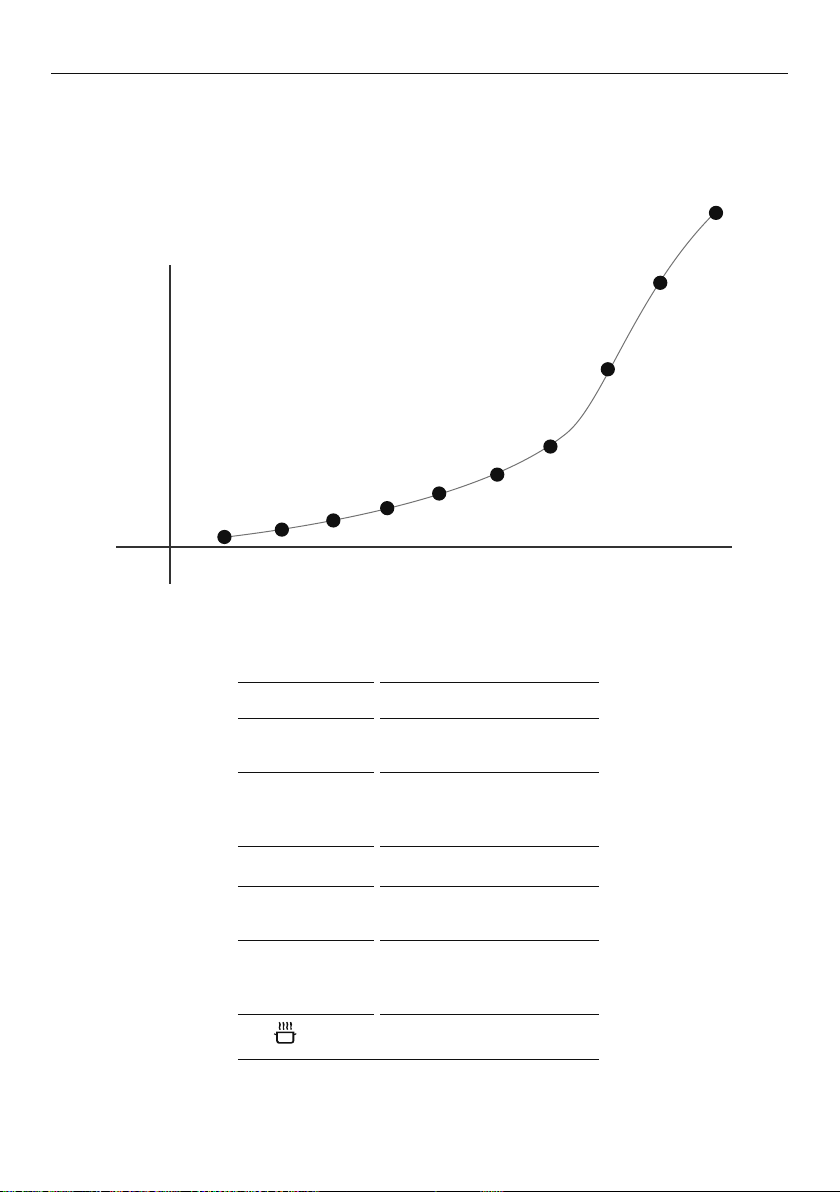
The settings below are guidelines only. The exact setting will depend on several factors,
including your cookware and the amount you are cooking. Experiment with the cooktop to
find the settings that best suit you.
Percentage of rated power %
100
80
60
40
20
0
3
Heat setting
HEAT SETTING SUITABILITY
• gentle simmering
• slow warming
• reheating
• rapid simmering
• cooking rice
• pancakes
• sautéing
• cooking pasta
• stir-frying
• searing
• bringing soup to the boil
3
• boiling water
54
USING THE STORAGE DRAWER
Storage drawer
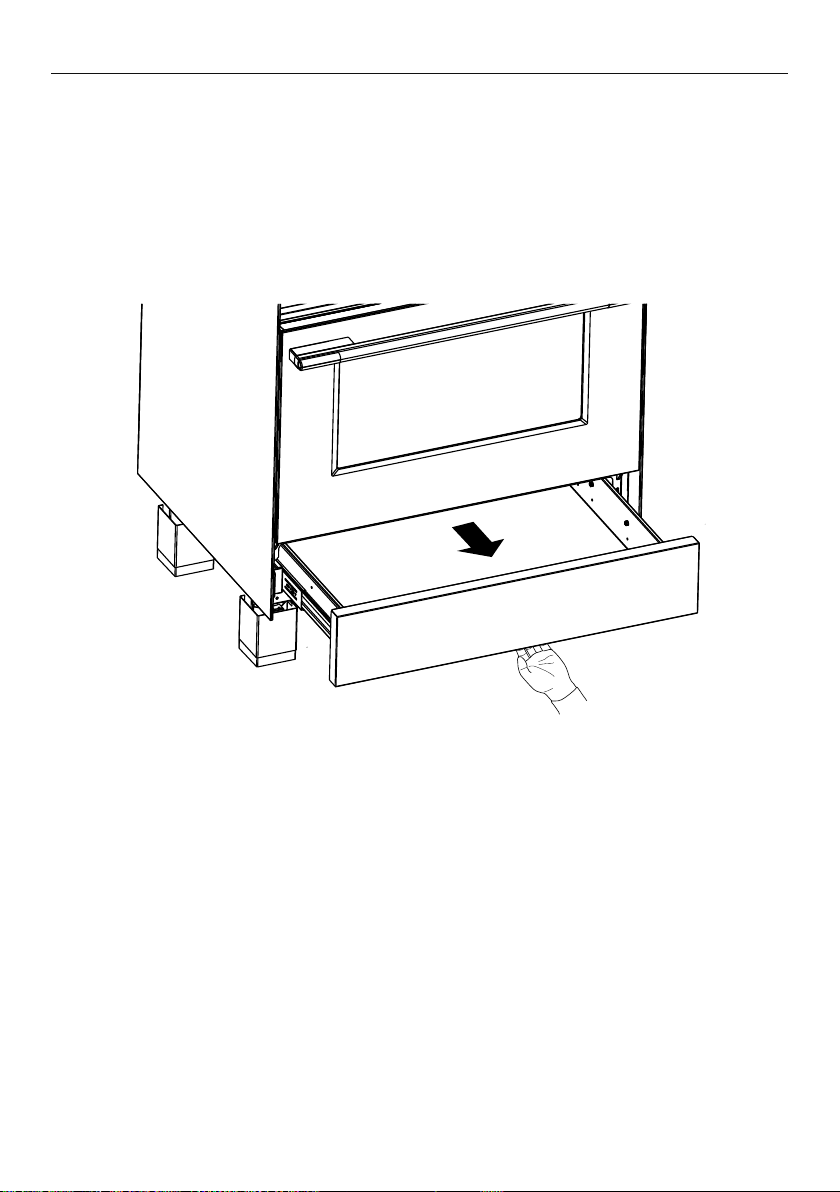
Your cooker is equipped with a storage compartment below the oven.
z
Use this to store bakeware, oven trays and shelves when not in use.
z
Do not store flammable items in the compartment.
To access the storage drawer
Grab the bottom of the drawer’s face and pull towards you to open it.
The drawer will slide out.

55
CARE AND CLEANING
DOS DON’TS
• Read these cleaning instructions and the ‘Safety
and warnings’ section before you start cleaning
your cooker.
• Before cleaning or removing any part, make sure
that everything on the cooker has been turned off.
• Unless suggested otherwise in the chart following,
allow any part to cool to a safe temperature before
cleaning. If you do need to handle a warm or hot
part, take extreme care. Wear long protective mitts
to avoid burns from steam or hot surfaces.
• Try using any cleaner on a small area first, to ensure
it doesn’t stain.
• See the pages following this chart for instructions
on removing and replacing different parts of the
cooker for cleaning or maintenance.
• To help you identify any parts, see illustrations in
section ‘Introduction’ and after this cleaning chart.
• Ensure the anti-tip device is re-engaged if you
move the cooker for cleaning. Failure to do this
may result in the oven tipping, and adults and
children may be killed.
• To prevent soiling from becoming ‘baked on’ and
stubborn, we recommend removing any easy-to-
reach spills, food or grease stains from the oven
cavity enamel after each use.
• Do not use aerosol cleaners until the cooker
has completely cooled. The propellant
substance in these cleaners could catch fire in
the presence of heat.
• Do not let soiling or grease accumulate
anywhere in or on the cooker. This will
make future cleaning more difficult and may
present a fire hazard.
• Do not use any abrasive or harsh cleaners,
cloths, scouring pads or steel wool. These
will scratch your cooker and damage its
appearance.
• Do not use a steam cleaner to clean any part
of the cooker.
• Do not perform any cleaning or maintenance
on parts not specifically named in the chart
below. If in doubt, contact Customer Care.

56
CARE AND CLEANING
Manual cleaning chart
WHAT? HOW? IMPORTANT!
COOKER EXTERIOR
Door frame
exterior,
Control panel,
Cooktop base
Back trim
Storage
compartment door
After every use
1 Soften any stubborn stains under
a hot soapy cloth.
2 Clean with a solution of mild
detergent and hot water, then
wipe dry with a microfiber cloth.
For extra shine, use a suitable
stainless steel cleaner and polish,
following manufacturer’s instructions.
Always rub the stainless steel in the
direction of the polish lines.
• Always read the label to make sure
your stainless steel cleaner does not
contain chlorine compounds as these
are corrosive and may damage the
appearance of your cooktop.
• Do not use and take care not to spill
any stainless steel cleaner on the
control dials or oven handle. These
are not stainless steel parts and their
surface may be damaged by stainless
steel cleaner.
Dials
Oven handles
1 Wipe with a damp cloth
using a solution of mild
detergent and hot water.
2 Dry thoroughly with
microfiber cloth.
• Do not use stainless steel cleaner on
these parts, as doing so may damage
their coating.
Clock display
and controls
Take particular care when cleaning
the clock and surrounding area. Only
use a damp cloth with detergent.
• Do not use any oven cleaners, harsh
or abrasive cleaners, scouring pads,
steel wool or sharp metal scrapers
on the glass. These may scratch and
damage the surface.
Oven door glass
(exterior)
Clean using a soft cloth and a mixture
of warm water and dishwashing
liquid or glass cleaner.

57
CARE AND CLEANING
WHAT? HOW? IMPORTANT!
OVEN PARTS
Side racks Pre-soak any stubborn, burnt-on
soiling, then clean with a solution of
mild detergent and hot water and
wipe dry with a microfibre cloth.
Oven shelves Wipe with a damp cloth and mild
detergent. Do not wipe off or wash
away the white lubricating grease
(visible when the shelf is extended).
• Do not wash the shelf in the
dishwasher, immerse in soapy water,
or use oven cleaner on it. Doing
so will prevent the slides from
running smoothly.
Bake and grill
burners
Do not clean these parts.
They self-clean during normal use.
Enamel oven
interior – light
soiling
1 Wipe with a damp cloth and
a solution of hot water and
mild detergent.
2 Wipe dry with a soft cloth.
Note: the oven door may be removed
to make reaching into the oven easier.
• To prevent soiling from becoming
‘baked on’ and stubborn, we
recommend removing any easy-to-
reach spills, food or greasy stains
from the enamel after each use.
Enamel oven
interior – stubborn,
‘baked-on’ soiling
1 Remove everything from
the oven: shelves, side
racks, all utensils.
2 Cover the floor in front of the
oven with several layers of
newspaper. This is to protect
these surfaces from damage
by oven cleaner seeping out or
accidentally dripping on them.
3 Apply an ammonia-based
cleaner or oven cleaner
following the cleaner
manufacturer’s instructions.
4 After cleaning, replace the side
racks and shelves.
• Oven cleaners are caustic and
may permanently stain or damage
some surfaces.
• When using, take care not to
let it come in contact with any
surface other than the oven
interior. If it accidentally does,
remove immediately.
Roasting dish and
grill rack
Rotisserie parts
1 Pre-soak any stubborn
soiling in a solution of mild
detergent and hot water.
2 Wash by hand or in a dishwasher.
Manual cleaning chart

58
CARE AND CLEANING
WHAT? HOW? IMPORTANT!
OVEN PARTS
Oven door glass
(interior)
After every use
• Use a soft cloth and a mixture
of warm water and dishwashing
liquid to remove light soiling after
every use.
• For stubborn stains, try using
a mixture of baking soda and
warm water with a non-abrasive
scrubbing pad, then wipe dry with
a soft, lint-free cloth.
• Do not use oven cleaners or any
other harsh/abrasive cleaners, cloths,
scouring pads, steel wool or sharp
metal scrapers to clean the oven
door glass. These scratch the glass,
which in turn could result in the glass
cracking and shattering.
• Do not allow grease to build up on
the glass or become baked on as this
reduces visibility into the oven.
Oven door gasket Avoid cleaning this part. If you need
to remove large food particles off it,
proceed as follows:
1 Dampen a sponge with
clean hot water.
2 Gently wipe off the soiling,
but do not rub.
3 Press a dry towel gently on
the gasket to dry.
• Do not use any cleaning agent on
the gasket.
• The gasket is essential for a good
seal. Take care not to rub, displace,
or damage it.
Storage drawer
(interior)
1 Wipe with a damp cloth and
a solution of hot water and
mild detergent.
2 Wipe dry with a soft cloth.
Note: the drawer may be removed to
make cleaning easier.
Drip tray under
door
Avoid cleaning this part. If you need
to remove large food particles off it,
proceed as follows:
1 Dampen a sponge with
clean hot water.
2 Gently wipe off the soiling,
but do not rub.
3 Press a dry towel gently on
the gasket to dry.
• Do not use any cleaning agent on
the gasket.
• The gasket is essential for a good
seal. Take care not to rub, displace,
or damage it.
Manual cleaning chart

59
CARE AND CLEANING
WHAT? HOW? IMPORTANT!
COOKTOP
Everyday
soiling on glass
(fingerprints,
marks, stains left
by food or non-
sugary spillovers
on the glass)
1 Ensure the cooktop control dials are
all turned off.
2 Apply cooktop cleaner to a clean lint-
free cloth and rub gently while the glass
is still warm (but not hot!).
3 Rinse and wipe dry with a clean cloth
or paper towel.
4 Switch the power to the cooktop back
on at the wall.
• Heavy-duty scourers, some
nylon scourers and harsh/
abrasive cleaning agents may
scratch the glass. Always read
the label to check if your cleaner
or scourer is suitable.
• Never leave cleaning residue
on the cooktop: the glass may
become stained.
Boilovers, melts,
acidic sauces or
marinades and
hot sugary spills
on the glass
Remove these immediately with a fish slice,
palette knife or razor blade scraper suitable
for ceramic glass cooktops, but beware of hot
cooking zone surfaces:
1 Switch the power to the cooktop
off at the wall.
2 Hold the blade or utensil at a 30o angle
and scrape the soiling or spill to a cool
area of the cooktop.
3 Clean the soiling or spill up with a dish
cloth or paper towel.
4 Follow steps 2 to 4 for ‘Everyday soiling
on glass’ above.
• Remove stains left by melts and
sugary food or spillovers as soon
as possible. If left to cool on the
glass, they may be difficult to
remove or even permanently
damage the glass surface.
• Cut hazard: when the safety
cover is retracted, the blade in
a scraper is razor-sharp. Use
with extreme care and always
store safely and out of reach
of children.
• When the power to the cooktop
is switched off, there will be no
‘hot surface’ indication but the
cooking zone may still be hot!
Take extreme care.
Spillover on the
touch controls
and stainless
steel trim
1 Switch the power to the cooktop
off at the wall.
2 Soak up the spill.
3 Wipe the touch control area with a clean
damp sponge or cloth.
4 Wipe the area completely dry
with a paper towel.
5 Switch the power to the cooktop back
on at the wall.
Manual cleaning chart
60
CARE AND CLEANING
Removing and replacing the oven door
IMPORTANT!
z
Switch the oven off at the wall before removing the door.
z
Do not lift the oven door by its handle. Doing so may damage the door.
z
Make sure the oven and the door are cool before you begin to remove the door.
z
Before removing the door, make sure there is a large enough clear, protected surface in
the kitchen to rest the door on.
z
Take care, the oven door is heavy!
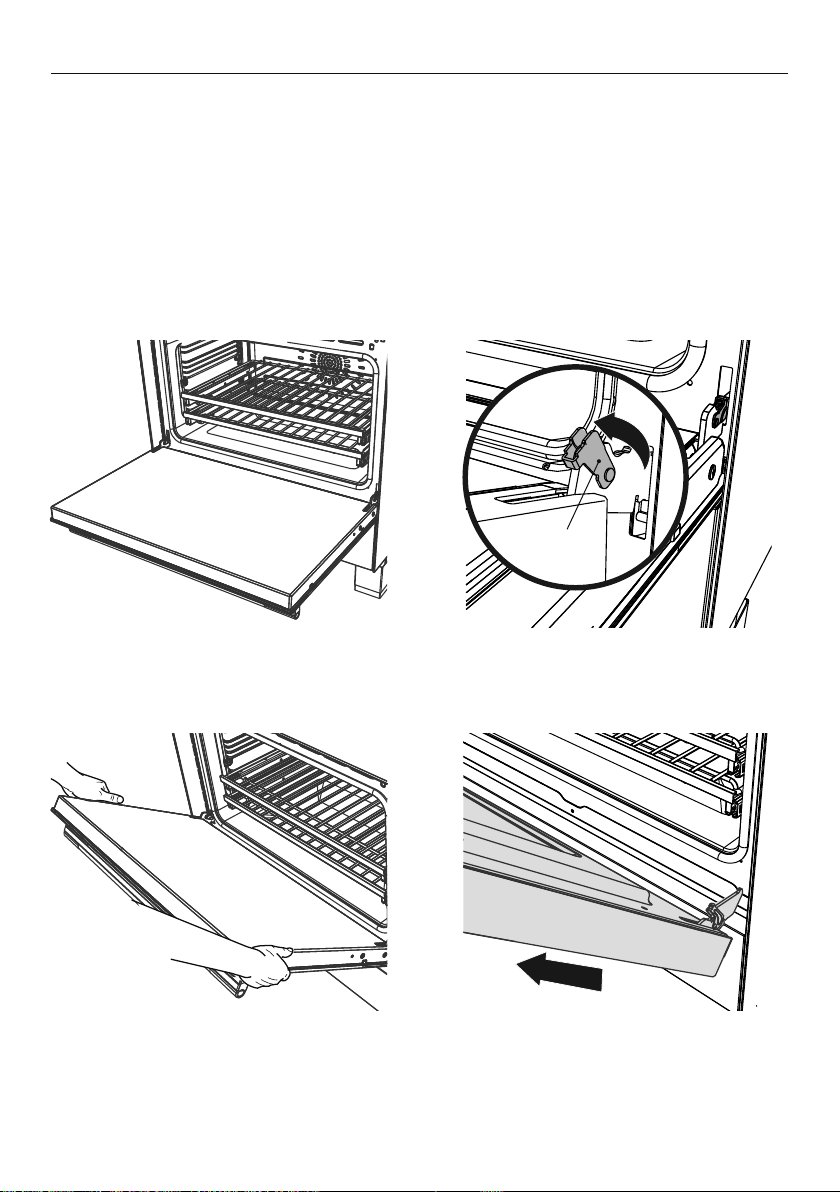
To remove the oven door
1 Open the door fully.
3 Holding the door firmly on both sides,
gently close it about halfway.
4 Disengage the hinges and remove the
door. Place on a protected surface.
2 Open the levers fully on both sides.
Lever
61
CARE AND CLEANING
Removing and replacing the door glass panes for cleaning
Once you have removed the oven door, you can remove the inner and middle panes of glass
for cleaning if needed.
Make sure you follow the precautions and instructions below very carefully. Replacing
the glass panes and the door incorrectly may result in damage to the oven and may void
your warranty.
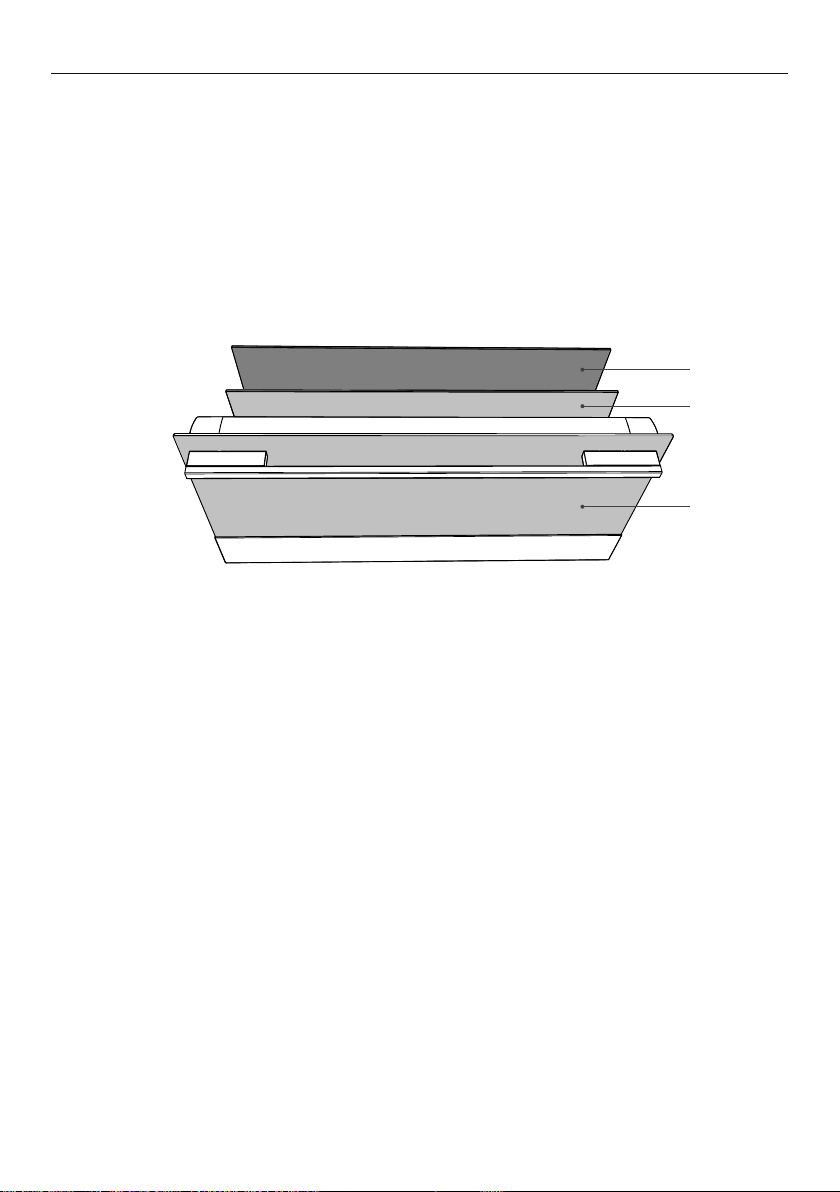
Your oven door has 3 panes of glass. The inner and middle panes may be removed
for cleaning.
IMPORTANT!
z
Take extreme care when handling the glass panes. Avoid the edges of the glass
bumping against any surface. This may result in the glass shattering.
z
Don’t use oven cleaners or any other harsh/abrasive cleaners, cloths, scouring pads,
steel wool or sharp metal scrapers to clean the glass surfaces. These scratch the
glass and may damage its special coating, which in turn could result in the glass
cracking or shattering.
z
If you notice any sign of damage on any of the glass panes (such as chipping or cracks),
do not use the oven. Call your Authorised Repairer or Customer Care.
z
Make sure you replace all the glass panes correctly. Do not use the oven without all
glass panes correctly in place.
z
If the glass panes feel difficult to remove or replace, do not force them. Call your
Authorised Repairer or Customer Care for help.
Note: service visits providing assistance with using or maintaining the oven are not
covered by your warranty.
A
B
C
Outer
Inner
Middle
62
CARE AND CLEANING
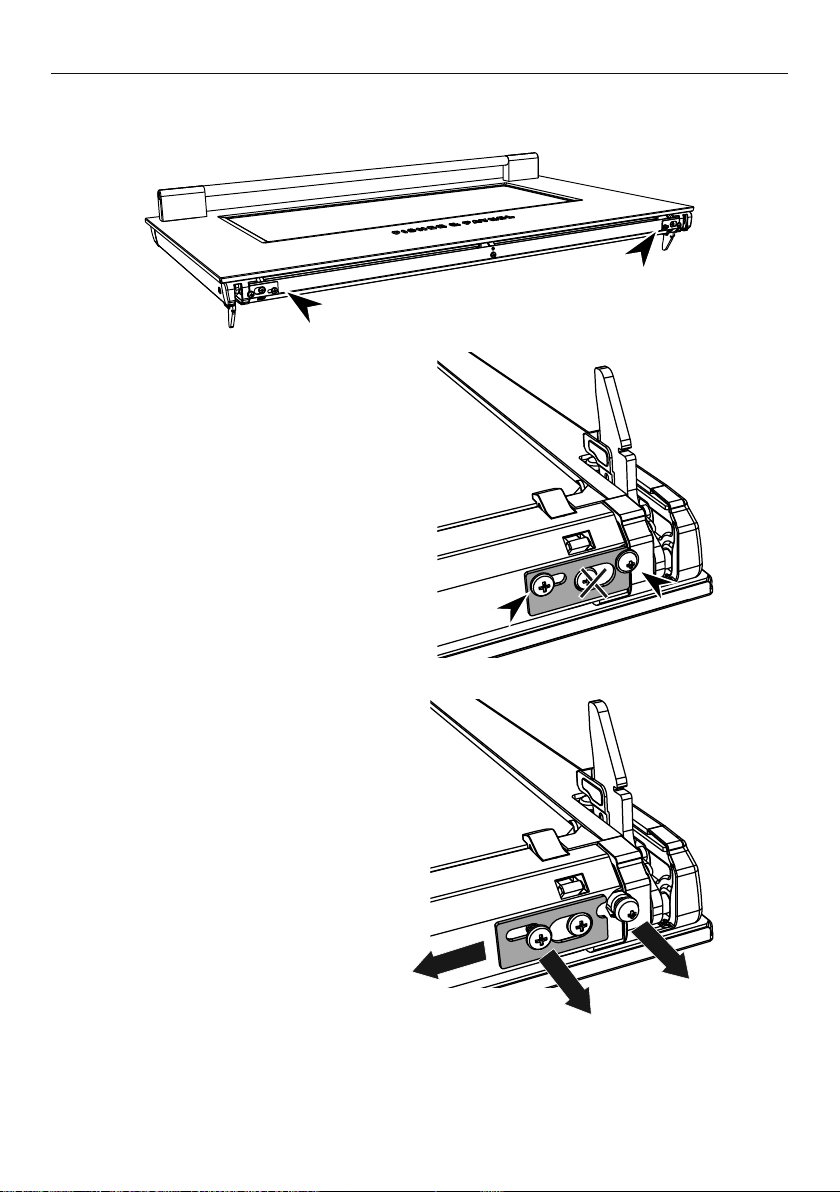
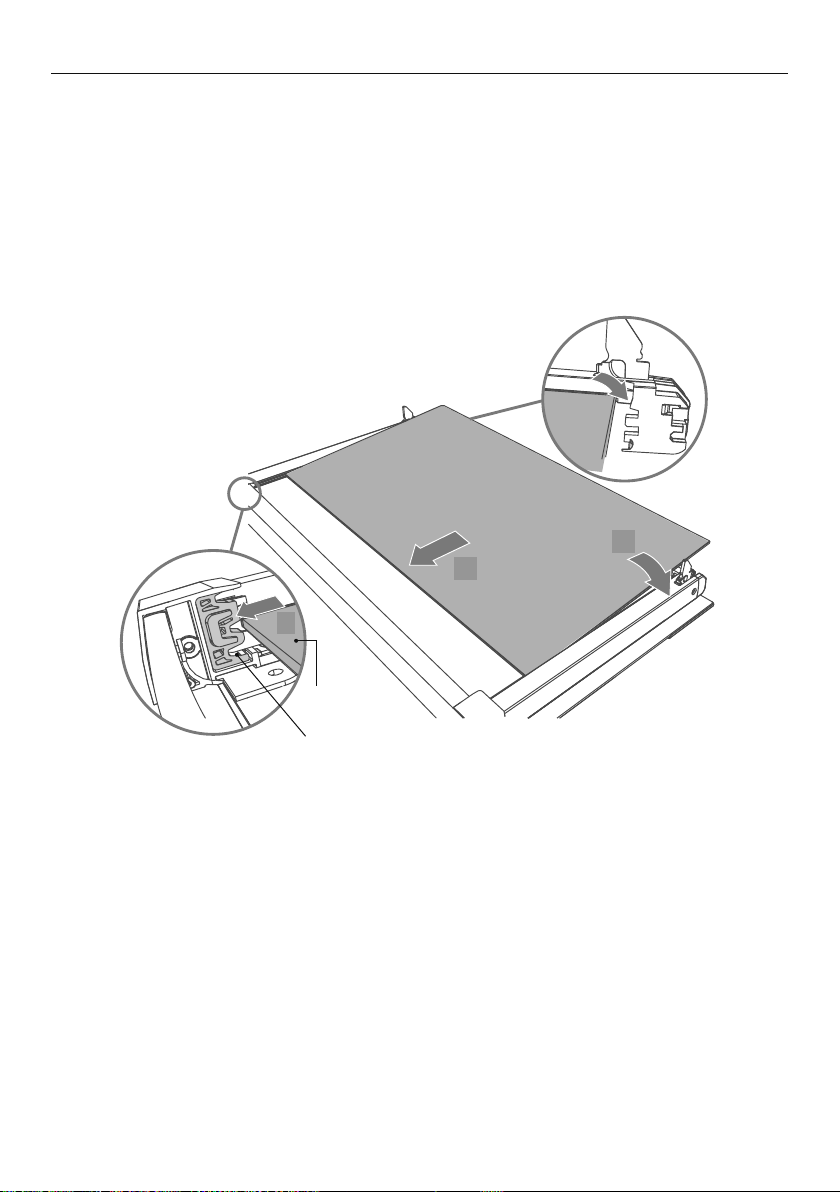
Open the latches securing the lower
trim to the base of the oven door:
1 Loosen the inner and outer
screws securing each of the
latches by two turns.
z
Do not loosen the middle screw.
z
Do not fully remove the screws.
Latch
Latch
Outer screwInner screw
2 Slide the latches inwards so that
the lower trim can be removed.
To remove the door glass for cleaning
63
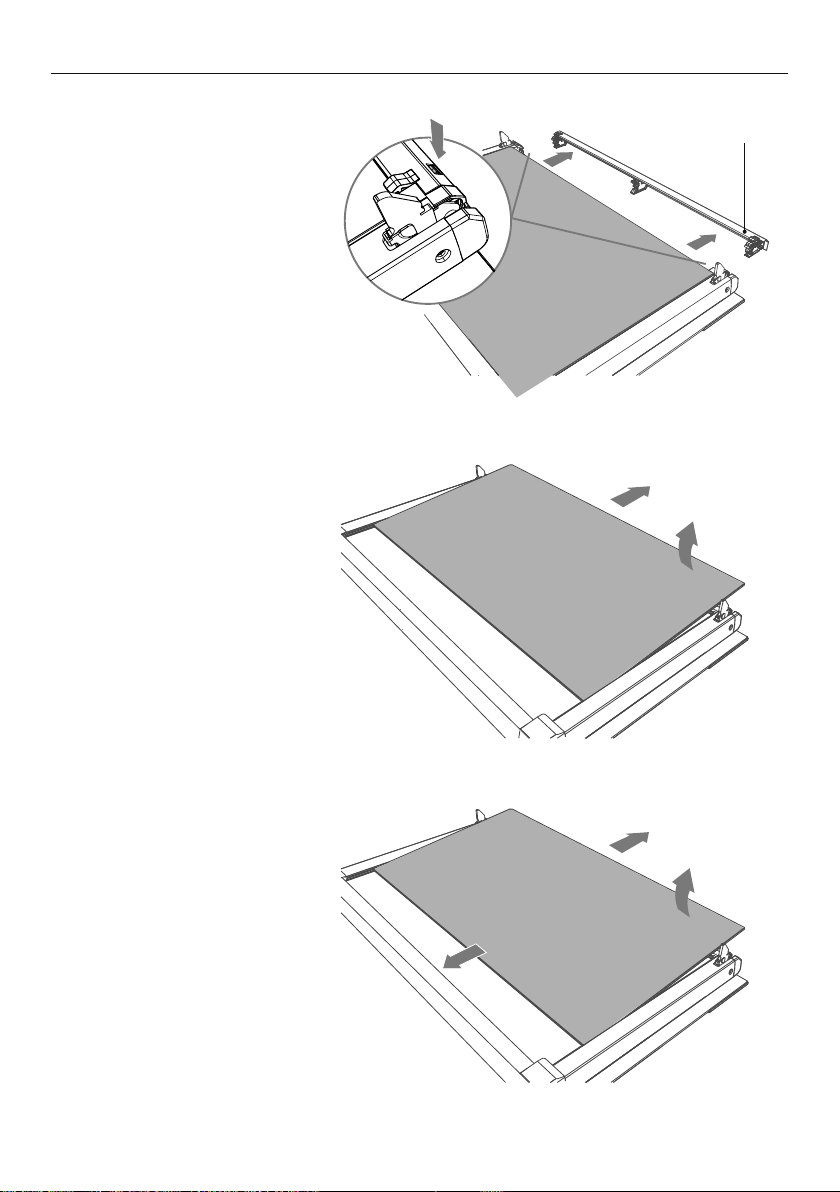
1
2
Lower trim
Ta b
1
2
b.
a.
3 Press down on the tabs to release
the lower trim and remove it.
4 Remove the inner pane of glass
z
Lift the lower end slightly (a).
z
Gently slide the glass out (b).
5 Remove the middle pane of glass:
z
Pull the pane slightly towards
you so that the edges are clear of
the support brackets at the base
of the door (a).
z
Lift the lower end (b) and gently
slide the glass out (c).
2
1
3
b.
c.
a.
CARE AND CLEANING
64
CARE AND CLEANING
To replace the door glass after cleaning
When replacing the glass panes, make sure that:
z
You replace all parts correctly, as shown on the following page.
z
The inner pane must be in the position described below in order to fit into the door and
to ensure that the oven operates safely and correctly.
z
You take extra care not to bump the edges of the glass against any object or surface.
z
You do not force the glass into place. If you are experiencing difficulties replacing the
glass, remove it and start the process again from the beginning. If this still does not help,
call Customer Care.
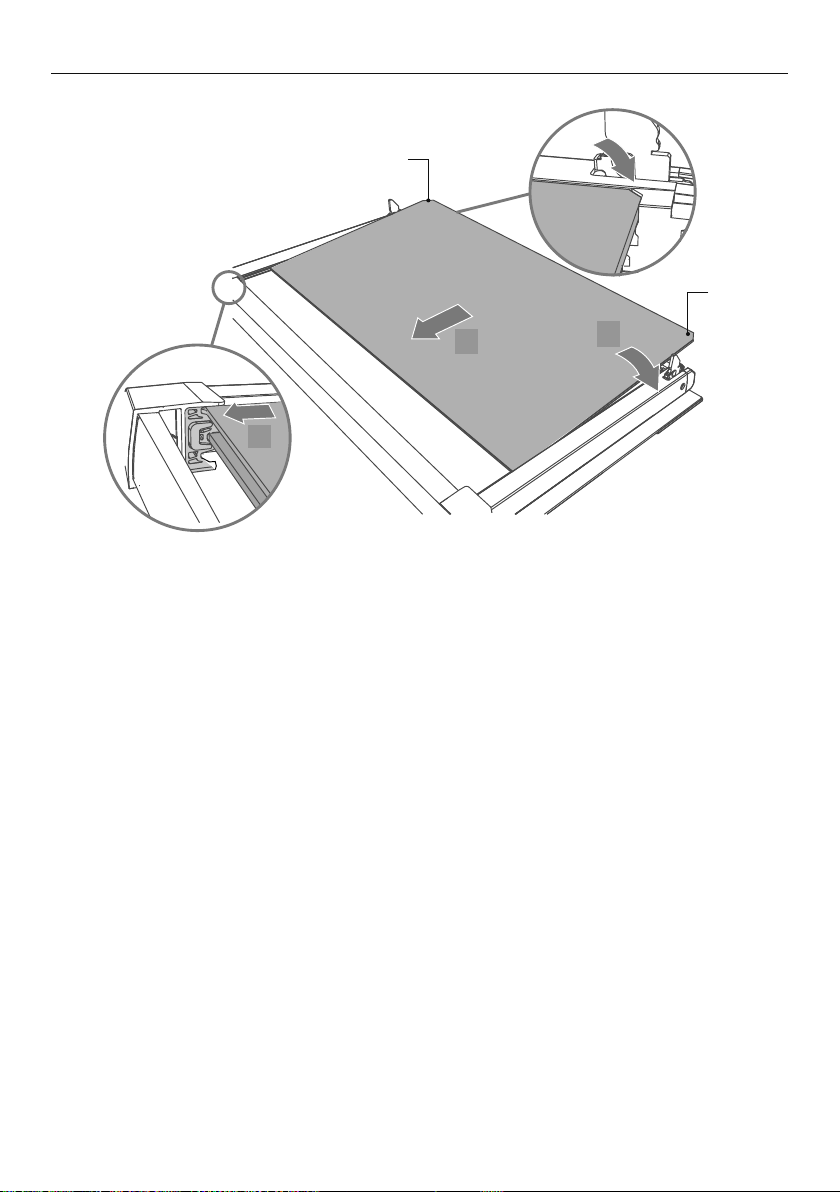
1 Replace the middle pane of glass:
z
Insert the glass into the middle set of grooves in the bracket at the top of the door (a).
z
Pull the pane slightly towards you (b).
z
Gently lower into place (c).
IMPORTANT!
z
Make sure the glass is facing the same way as when you removed it from the door.
z
Use the middle set of grooves. The set of grooves closest to the outer pane
must remain empty.
3
2
1
3
Middle
pane
Empty grooves
a.
a.
b.
c.
65
CARE AND CLEANING
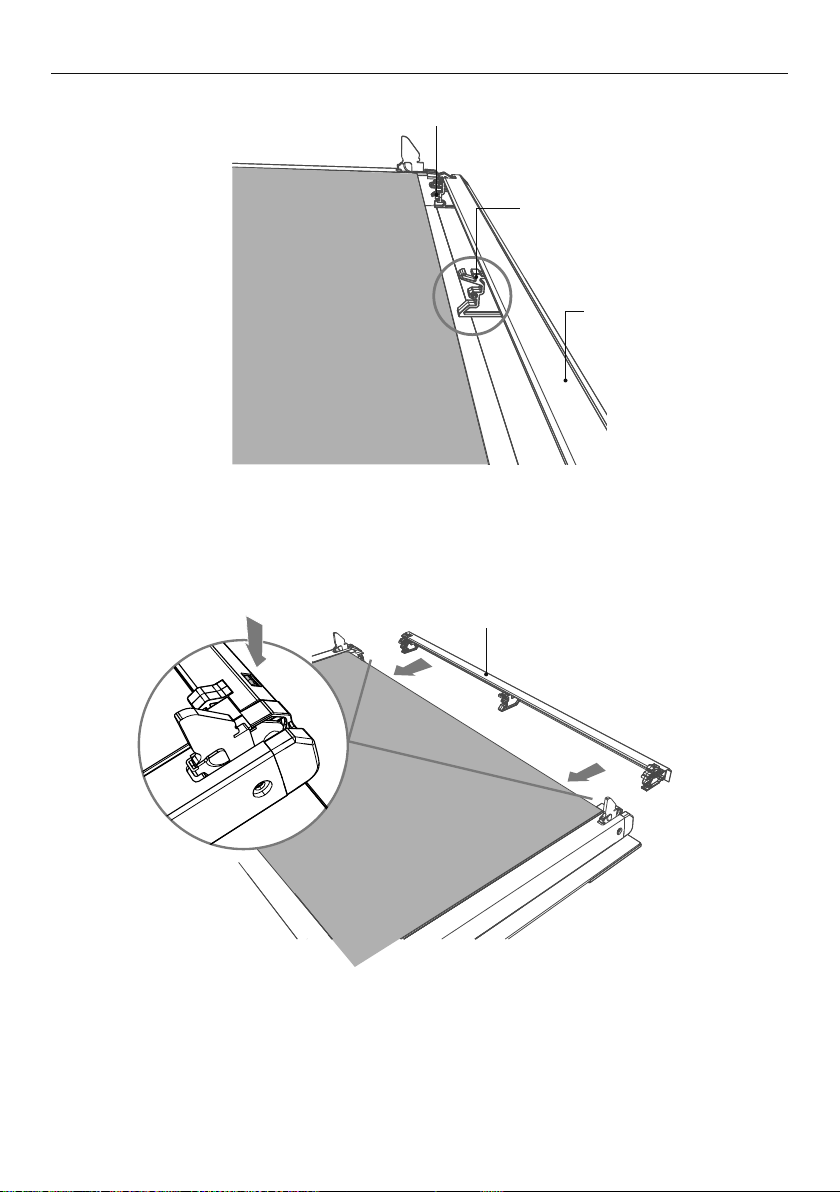
2 Replace the inner pane of glass.
z
Ensure the angle cut corners are positioned at the bottom of the door (a).
z
Insert the the glass into the top set of grooves in the bracket at the top of the door (b).
z
Pull the pane slightly towards you (c).
z
Gently lower into place (d).
IMPORTANT!
z
Make sure the glass is facing the same way as when you removed it form the door.
z
You should be able to read the wording on it as it faces you.
1
2
3
PGW ECO
Angle-cut
corner
Angle-cut
corner
a.
a.
b.
c.
d.
b.
66
CARE AND CLEANING
4 Gently push the lower trim back onto the door glass until it clicks into place.
IMPORTANT!
Make sure the lower trim is fitted correctly and firmly in place and that the glass
panes are secure.
Lower trim
Clamp
Clamp
Lower trim
“Click”
3 Align the lower trim with the door glass as shown. It should sit on the bottom edge
of the outer door glass.
z
Check that clamp in the centre is not damaged or misshapen.
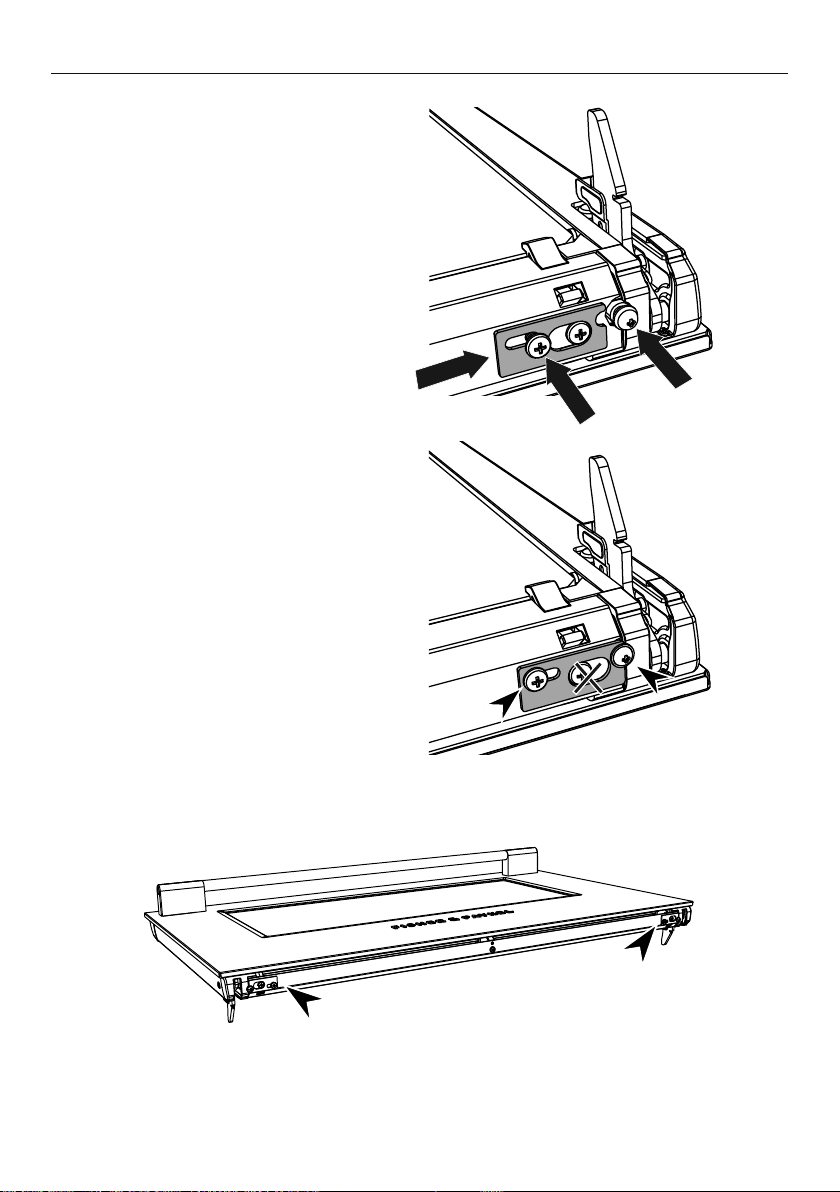
67
CARE AND CLEANING
Latch
Latch
Outer screw
Inner screw
6 Re-tighten the screws so that the
latches and the lower trim are
firmly secured.
7 Replace the door following the instructions in the following section.
5 Slide the two latches back into
place on the base of the lower trim.
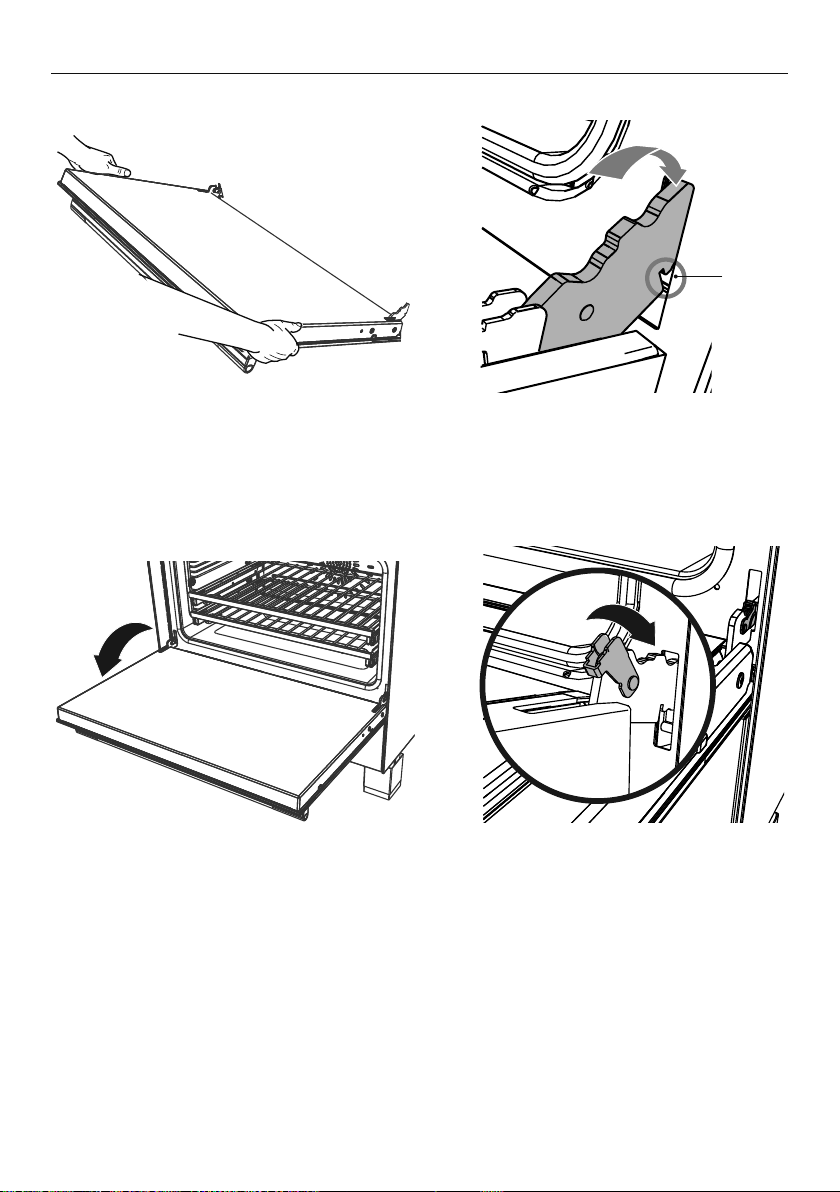
68
CARE AND CLEANING
To replace the oven door
1 Hold the door firmly in an approximately
halfway open position.
3 Open the door fully. 4 Fully close the levers on the left
and right hinges, as shown, then
close the door.
2 Insert the hinge tongues into the slots,
making sure that the notches on both
sides drop into place as shown.
Notch
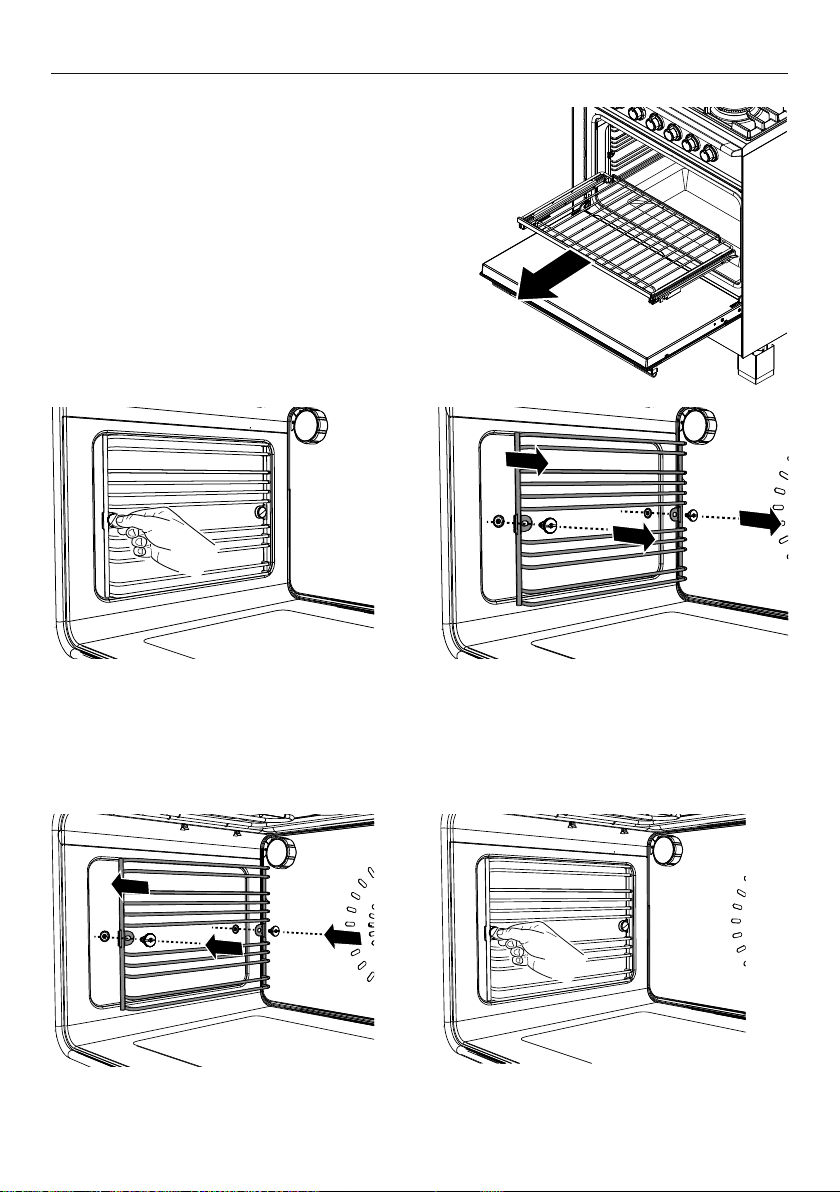
69
CARE AND CLEANING
Removing and replacing the oven side racks
IMPORTANT!
Always turn off the cooker at the wall first.
Ensure the oven has cooled down
completely before starting.
Remove all shelves
1 Slide out all shelves and remove.
For easier access we recommend
removing the oven door, see
‘Removing and replacing the oven door’.
To remove the side racks
To replace the side racks
2 Refit the fixing screws and tighten.1 Make sure the side racks are the
right way up, as shown.
Remove
all shelves
2 Use a small coin or a flat-head
screwdriver to loosen and remove
the fixing screws.
3 Remove the side racks
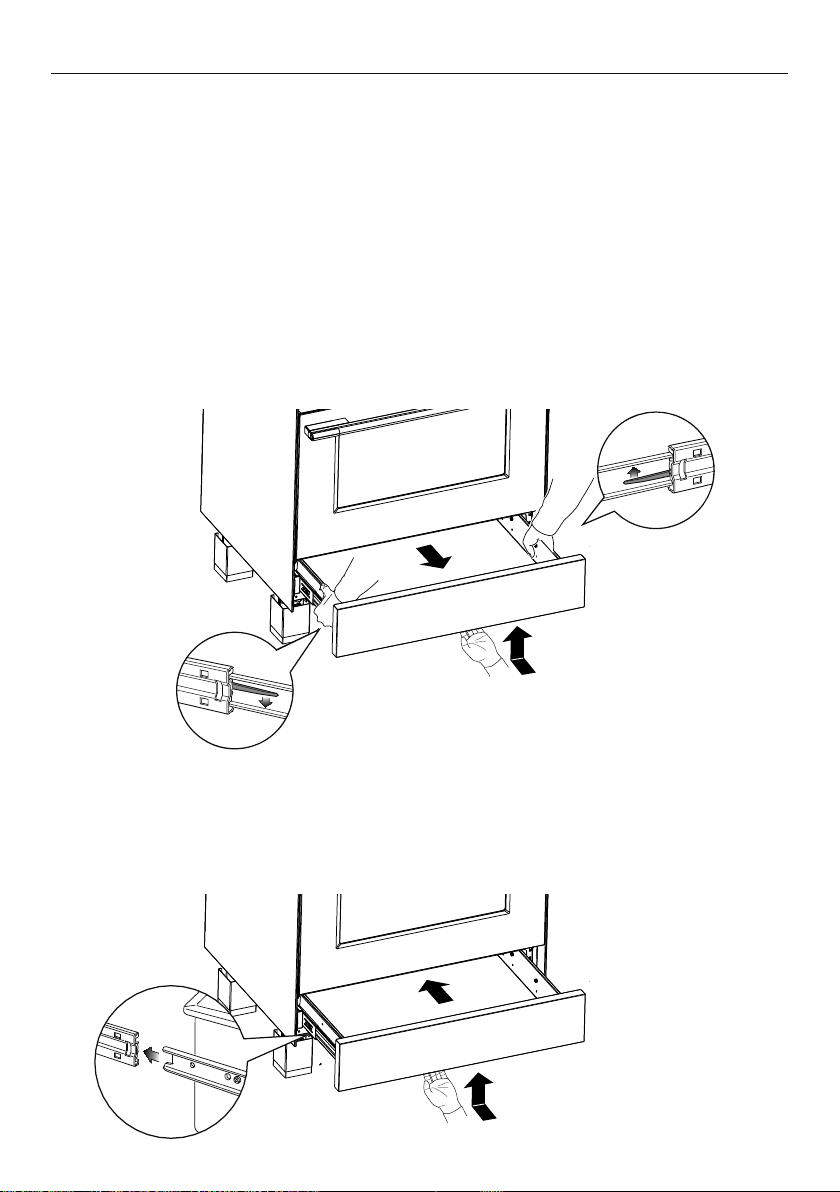
70
CARE AND CLEANING
Removing and replacing the storage drawer
IMPORTANT!
z
Do not remove the drawer while the oven is in operation.
z
Do not remove the drawer while the oven is hot.
z
Ensure the drawer is completely empty before removing it.
z
Always position your hand at the bottom of the drawer to open and close it.
To remove the storage drawer
1 Open the drawer completely.
2 Open the levers fully on both sides and hold in place:
z
On the left side push the lever down.
z
On the right side push the lever up.
3 Remove the drawer while holding the levers in position.
Fitting the storage drawer
1 Insert the drawer guides onto the sliding runners on either side of the cooker interior.
z
Make sure they are correctly lined up on both sides of the drawer.
2 Gently close the drawer completely. The safety catches will automatically
hook into place.
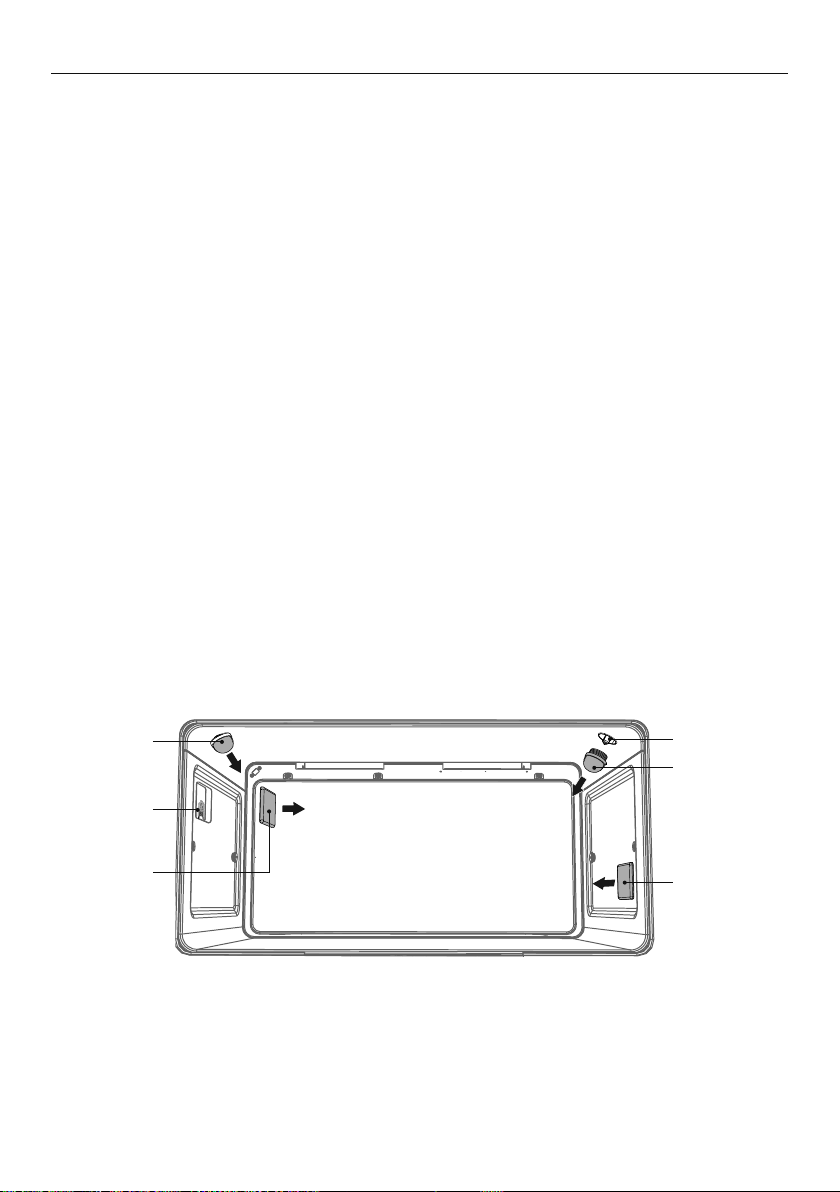
71
CARE AND CLEANING
Replacing an oven light bulb
IMPORTANT!
Use a 25W, 220-240V 50Hz G9 halogen bulb for replacement.
Do not use a standard light bulb in any oven, the heat will break it.
1 Allow the oven (including the lamp cover and the bulb) to cool completely.
2 Remove any shelves that may get in the way.
3 Remove the door if the lamp will be hard to reach.
4 Turn the power supply to the cooker off at the main fuse or circuit breaker panel. If you
don’t know how to do this, contact an electrician.
IMPORTANT!
Failure to disconnect the cooker from the power supply may result in death or
electrical shock.
5 Remove the lamp cover.
z
Upper lights: wearing a rubber glove to improve grip turn the cover counter-
clockwise to unscrew.
z
Side lights: wearing a rubber glove to improve grip, hold the cover and prise out using
finger nails on other hand. If this does not work place a thin plastic spatula between the
cover and cavity wall and gently twist to prise the cover off. Take care not to chip the
glass covers or to damage the enamel finish inside the oven.
6 Remove the faulty bulb.
7 Holding the replacement bulb in a soft cloth or tissue insert it into the socket. Do not
touch the bulb with your fingers.
8 Replace the lamp cover.
z
Upper lights: turn the cover clockwise to tighten and then back a quarter turn
9 Turn the power supply to the cooker back on at the main fuse or circuit breaker panel.
Light bulb
Light bulb
Upper
lamp cover
Upper
lamp cover
Side
lamp cover
Side
lamp cover
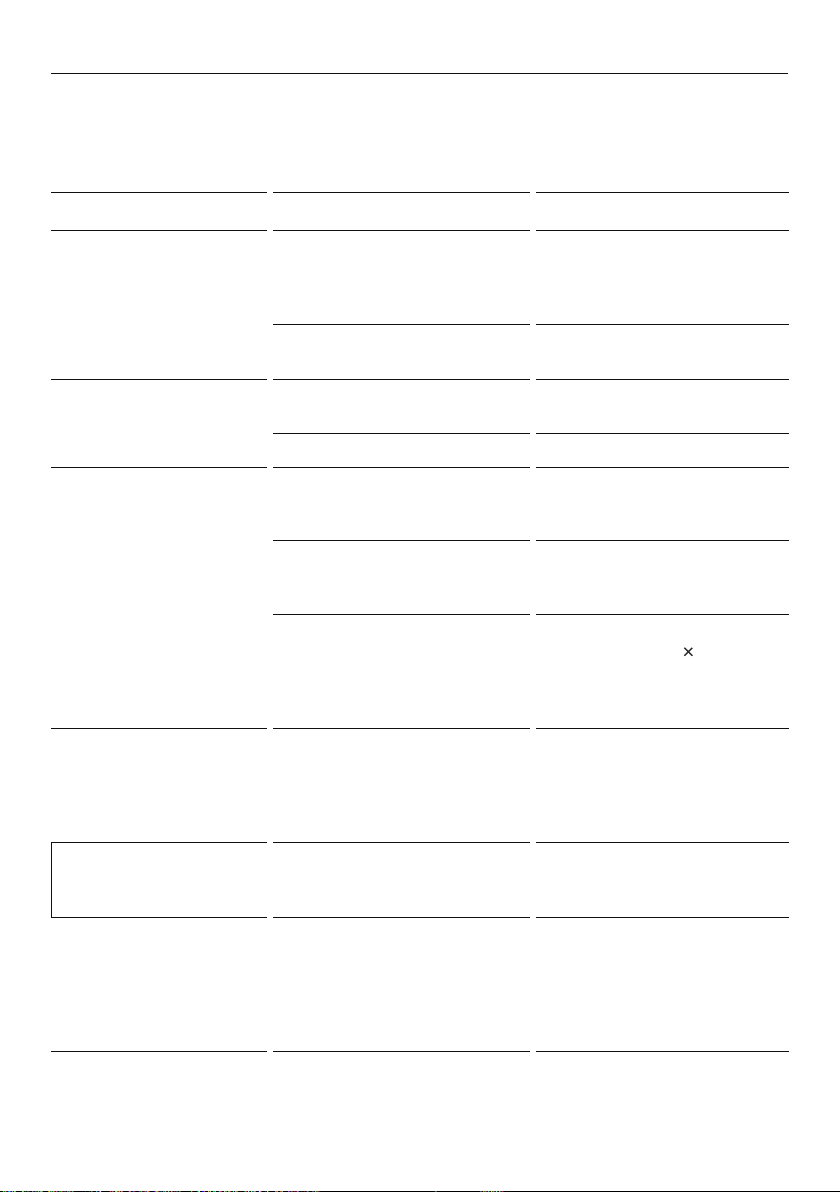
72
TROUBLESHOOTING
If there is a problem, check the chart below to see if you can fix it. If the problem cannot be
fixed or persists, call your Authorised Repairer or Customer Care.
General
PROBLEM POSSIBLE CAUSES WHAT TO DO
The oven does not work. No power. Check that the mains power
supply (wall switch) is turned on,
the fuse has not tripped and there
is no power outage in your area.
The clock has not been set. The oven will not work unless the
clock is set. See ‘Setting the clock’.
The oven does not work
but the display is lit.
The oven is set for
automatic cooking.
See ‘Auto Cook’
for instructions.
The oven is in Demo Mode. Contact Customer Care.
One or all of the lights
do not come on, but the
oven works.
The oven light bulb(s)
have blown.
Replace the light bulb(s). See
‘Care and cleaning’ for instructions.
The door is not correctly fitted. See ‘Care and cleaning’ for
instructions on fitting the
door correctly.
The oven is in Sabbath Mode
and the ‘Light off’ option has
been saved.
To quit Sabbath Mode, touch
and hold the cancel
control.
See ‘User preference settings’
for instructions on changing the
‘Light off’ option.
The oven is not heating. The door is not properly closed
or it is opened too frequently
during cooking.
The heating elements are
disabled while the door is open.
Make sure the door is properly
closed and avoid opening it
frequently during cooking.
A glass pane in the oven
door has cracked, chipped,
or shattered.
Incorrect cleaning or the edge of
the glass hitting against something.
You must NOT use the oven.
Call your Authorised Repairer or
Customer Care.
I can feel hot air blowing
out of the vents after I have
turned the oven off.
This is normal. For safety reasons the cooling fans
will continue to run even when
you have turned the function
dial to ‘OFF’. The fans will switch
off automatically when the oven
has cooled.
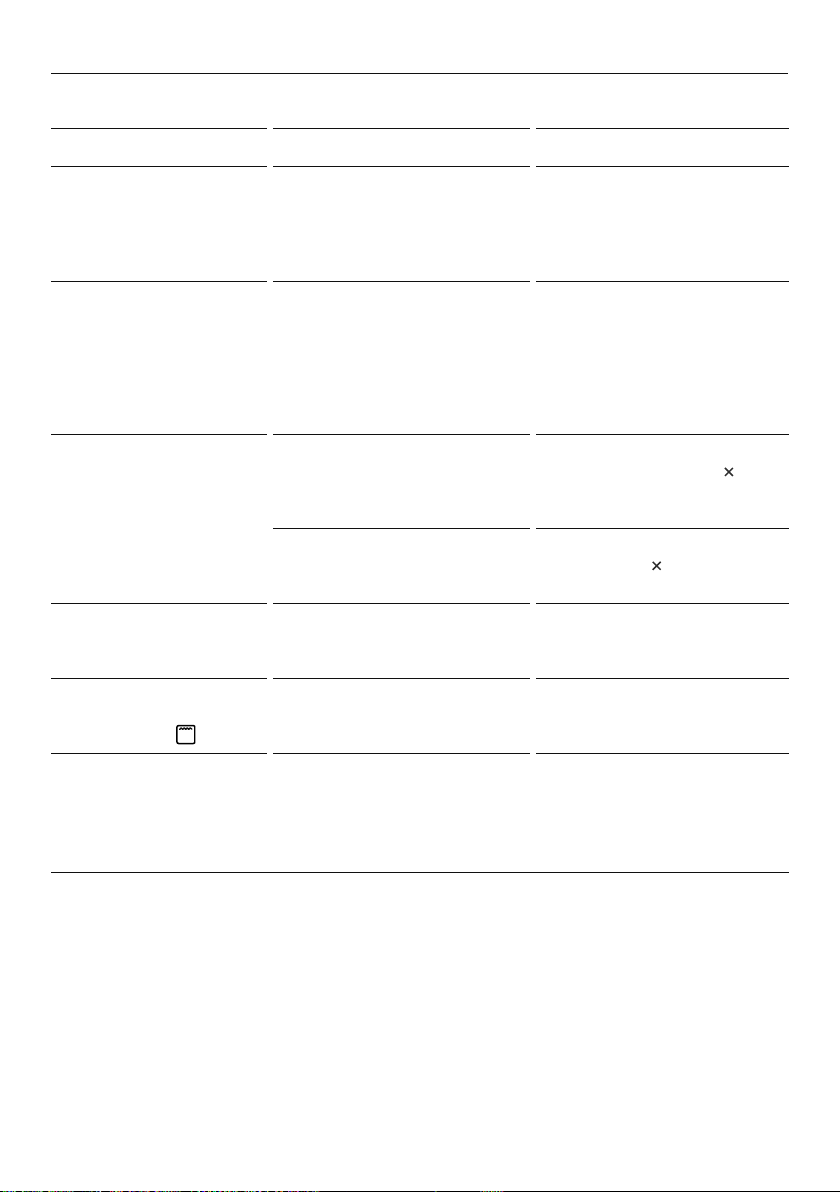
73
TROUBLESHOOTING
PROBLEM POSSIBLE CAUSES WHAT TO DO
The oven fan comes on
when I select a function
that does not use a fan
(eg bake).
This is normal.
The fan comes on while the oven
is preheating. It may turn off
when the oven has reached the
set temperature.
Wait until a long tone sounds and
the temperature dial halo turns
white: the oven will then be ready
to use.
The oven has reached the
set temperature but the
temperature dial halo is
still red (indicating that the
oven is not ready to use).
This is normal: when heating
up from cold, your oven is
designed to initially heat to a
temperature somewhat higher
than what you have set. This
is to provide optimal baking
conditions right from the start.
Wait until a long tone sounds and
the temperature dial halo turns
white: the oven will then be ready
to use.
The oven is heating but the
display is dark.
The oven is set to
‘Display off’ option.
To quit the ‘Display off’ option,
touch and hold the cancel
control until the display shows the
time of day.
The oven is in Sabbath Mode. To quit Sabbath Mode, touch and
hold the cancel
control until the
display shows the time of day.
The oven cancels automatic
cooking when I try to adjust
the clock setting.
The oven was set for automatic
cooking when you were trying to
adjust the clock setting.
You can only adjust the clock
setting while the oven is not set
for automatic cooking.
The temperature dial
halo never turns white
when I use Grill
.
This is normal: the halo stays red
to indicate that the grill element
provides instant radiant heat.
The displays work,
and the function and
temperature dials halos
come on but the oven
does not heat up.
The oven is in ‘Demo’ mode. Call Customer Care.
General

74
TROUBLESHOOTING
Oven
PROBLEM POSSIBLE CAUSES WHAT TO DO
Condensation around
oven (eg on control panel
or top of oven door).
Food has high moisture content
or local climate (temperature,
humidity) is contributing
to condensation.
Condensation is normal. You can
wipe the drops off the control
panel. If there is frequent or
excessive condensation, make sure
that cabinetry around the cooker
is moisture-proofed.
Condensation building up
in the oven while cooking
on Grill.
Food in your oven releasing
moisture as it cooks.
Allow the grill element to preheat
for 5 minutes before placing food
in the oven or try cooking on
Fan Grill instead.
Uneven baking. Oven not properly preheated. Wait until the halo around the
temperature dial has changed from
white to orange before putting
food in.
Unsuitable or incorrectly
arranged bakeware.
See ‘Cooking guide’ for advice.
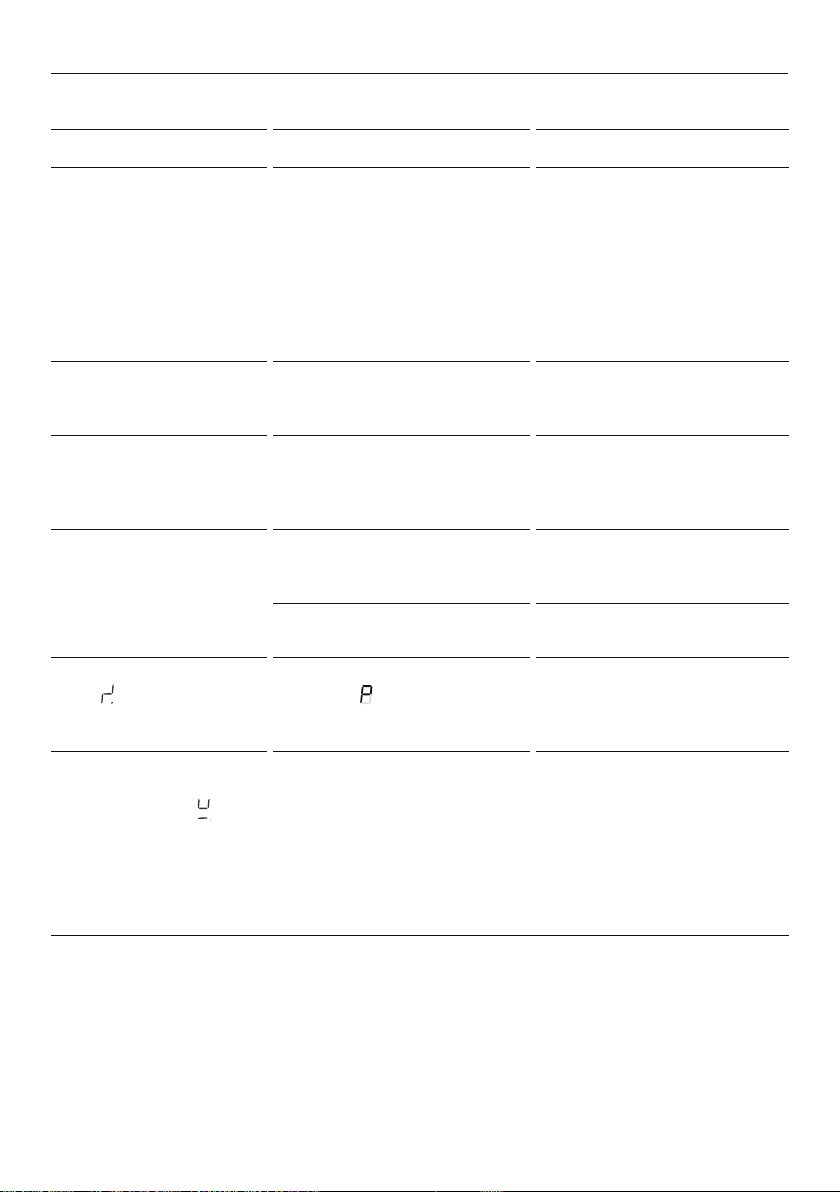
75
TROUBLESHOOTING
Cooktop
PROBLEM POSSIBLE CAUSES WHAT TO DO
The cooktop cannot be
turned on.
No power. Make sure the cooktop is
connected to the power supply
and that it is switched on at the
wall. Check whether there is a
power outage in your home or
area. If you’ve checked everything
and the problem persists, call
your Authorised Service Centre or
Customer Care.
The control dials
are unresponsive.
The controls are locked. Unlock the controls. See section
‘Using your induction cooktop’
for instructions.
The cooktop makes a low
humming noise when used
on a high heat setting
(especially PowerBoost).
This is caused by the technology
of induction cooking.
This is normal, but the noise
should quieten down or disappear
completely when you decrease the
heat setting.
The glass is
being scratched.
Rough-edged cookware. Use cookware with flat and
smooth bases. See ‘Choosing the
right cookware’.
Unsuitable, abrasive scourer or
cleaning products being used.
See ‘Care and cleaning’.
Some or all displays
flash
or there is a
continuous beep.
The control dials have been held in
either A or
position for too long.
Turn the control dial back to OFF
and wait until the error flash has
disappeared before trying to use
the cooktop again.
Pans do not become hot.
The heat setting display
comes on, but the
does
not flash when I remove
a pan.
shows in the timer
display when I turn on
the cooktop.
The cooktop is in ‘Display mode’. Contact Customer Care or your
Authorised Service Centre.

76
TROUBLESHOOTING
Cooktop
PROBLEM POSSIBLE CAUSES WHAT TO DO
Condensation is forming
on surrounding walls,
cabinetry or your
overhead rangehood.
This is a normal for
induction cooking.
Energy efficient technology
means that no heat is lost to
surrounding surfaces. This results
in condensation forming on these
cooler surfaces when steam is
produced by cooking.
This is normal for induction
cooking and does not
indicate a fault.
To minimise condensation:
• Ensure adequate ventilation
when cooking.
• Switch your rangehood on
5 minutes before cooking and
let it run for at least minutes
after cooking.
• Use your rangehood on a lower
speed setting when boiling.
• Use the cooktop on a lower
heat setting when boiling.
• Use pot lids to stop moisture
from escaping.
• If condensation forms, wipe
down surrounding walls and
cabinetry as needed.
Some pans make crackling
or clicking noises.
This may be caused by the
construction of your cookware
(layers of different metals
vibrating differently).
This is normal for induction
cookware and does not indicate
a fault.
The cooktop makes a low
humming noise when used
on a high heat setting
(especially PowerBoost).
This is caused by the technology
of induction cooking.
This is normal, but the noise
should quieten down or disappear
completely when you decrease the
heat setting.
Fan noise coming from
the cooktop.
A cooling fan built into your
cooktop has come on to prevent
the electronics from overheating.
It may continue to run even after
you’ve turned the cooktop off.
This is normal and needs no
action. Do not switch the power to
the cooktop off at the wall while
the fan is running.
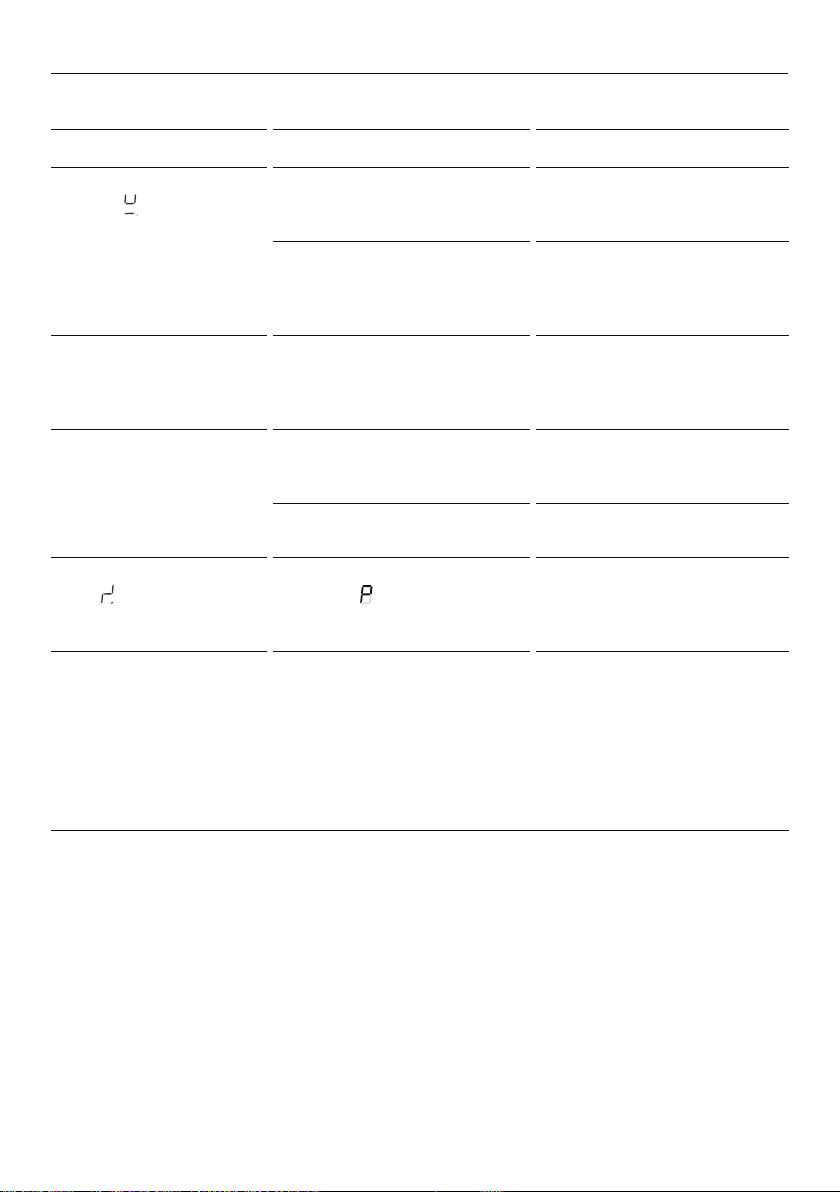
77
TROUBLESHOOTING
Cooktop
PROBLEM POSSIBLE CAUSES WHAT TO DO
Pans do not become
hot and
appears in
the display.
The cooktop cannot detect the
pan because it is not suitable for
induction cooking.
Use cookware suitable for
induction cooking. See section
‘Choosing the right cookware’.
The cooktop cannot detect the
pan because it is too small for
the cooking zone or not properly
centred on it.
Unlock the controls. See section
‘Using your induction cooktop’
for instructions.
3 flashes in the display
when you are trying to set
PowerBoost.
PowerBoost is temporarily
unavailable because the
cooktop needs to protect
itself from overheating.
Allow the cooktop to cool down.
The glass is
being scratched.
Rough-edged cookware. Use cookware with flat and
smooth bases. See ‘Choosing the
right cookware’.
Unsuitable, abrasive scourer or
cleaning products being used.
See ‘Care and cleaning’.
Some or all displays
flash
or there is a
continuous beep.
The control dials have been held in
either A or
position for too long.
Turn the control dial back to OFF
and wait until the error flash has
disappeared before trying to use
the cooktop again.
The cooktop or a cooking
zone has turned itself
off unexpectedly, a tone
sounds and an error code
is displayed (typically
( or
(U alternating with one or
two digits in the cooking
zone displays).
Technical fault. Please note down the error
letters and numbers, switch the
power to the cooktop off at the
wall, and contact your Authorised
Service Centre or Customer Care
with the error code information.

78
If there is a problem with the oven, the cooker will:
z
automatically suspend all oven functions
z
beep five times
z
display an alert code.
IMPORTANT!
Do not turn off the mains power supply to the cooker (wall switch) if you get an alert
code, unless the instructions in the chart following specifically instruct you to. There
are cooling fans within the cooker which are needed to cool the cooker components.
Turning off the power while the cooker is too hot may damage the cooker and its
surrounding cabinetry.
What to do if an alert code is displayed
1 If the beeping hasn’t stopped already, touch any control to stop it.
2 Make a note of the alert code displayed. You may need this information.
3 Check the chart following to see if you can fix the problem yourself and follow
the instructions.
4 If you can fix the problem and the alert code does not reappear, you can keep
using your oven.
OR
If you can’t fix the problem yourself or the alert code reappears and the problem persists:
wait until the cooling fans have stopped and the oven has completely cooled down, then
turn the power to the cooker off at the wall and call your Authorised Repairer or Customer
Care with the alert code information.
ALERT CODE POSSIBLE CAUSES WHAT TO DO
A1
The oven has overheated. 1 Allow the oven to cool down.
2 Once the oven has cooled down
and the door has unlocked, the alert
code will disappear. You can now use
the oven again.
F
+ number
Technical fault. 1 Note down the alert code.
2 Wait until the cooling fans
have stopped and the oven has
completely cooled down.
3 Turn the power to the oven
off at the wall.
4 Call your Authorised Repairer
or Customer Care with the alert
code information.
ALERT CODES

79
WARRANTY AND SERVICE
Before you call for service or assistance
Check the things you can do yourself. Refer to the installation instructions and your
user guide and check that:
1 Your product is correctly installed.
2 You are familiar with its normal operation.
If after checking these points you still need assistance or parts, please refer to the
Service & Warranty book for warranty details and your nearest Authorised Service
Centre, Customer Care, or contact us through our website www.fisherpaykel.com.
Complete and keep for safe reference:
Model
Serial No.
Purchase Date
Purchaser
Dealer
Suburb
Town
Country



FISHERPAYKEL.COM
© Fisher & Paykel Appliances 2019 All rights reserved.
The product specifications in this document apply to the specific
products and models described at the date of issue. Under our policy
of continuous product improvement, these specifications may change
at any time. You should therefore check with your Dealer to ensure this
document correctly describes the product currently available.
NZ AU
59151C 06.19