Cuisinart
®
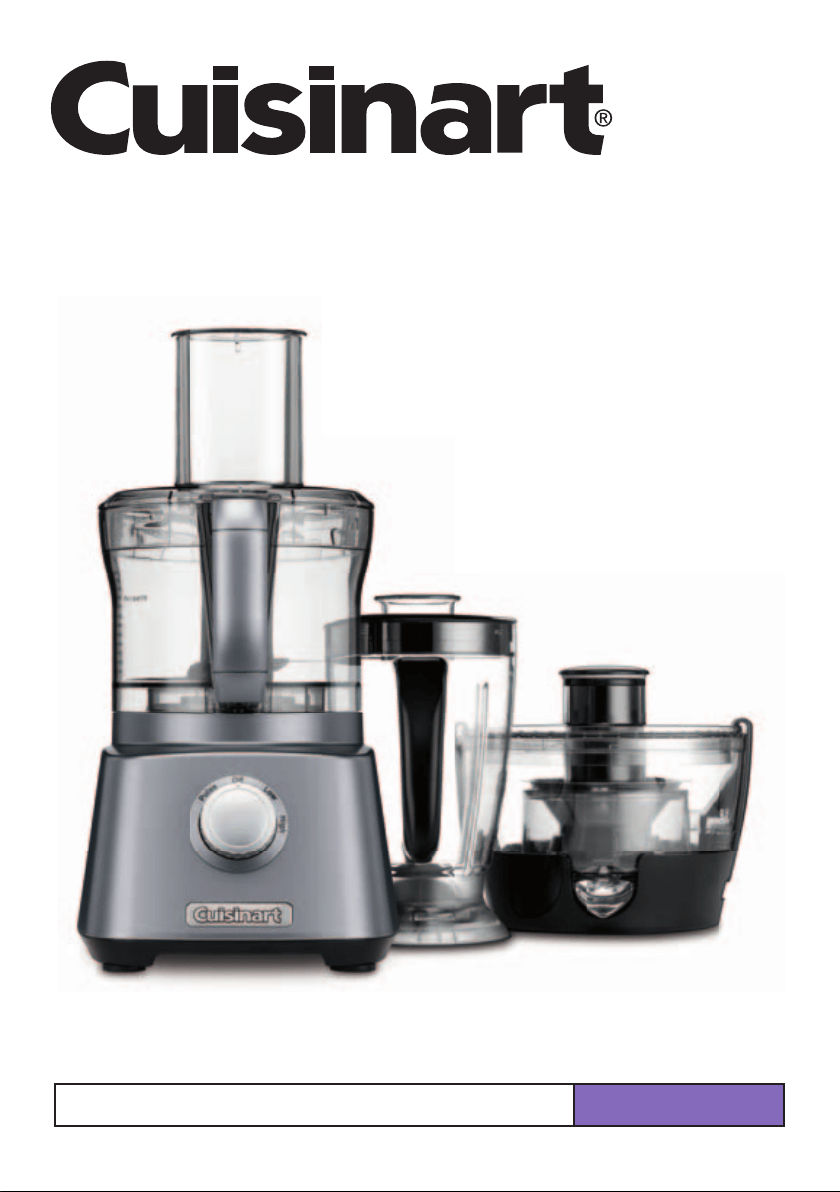
Kitchen Central
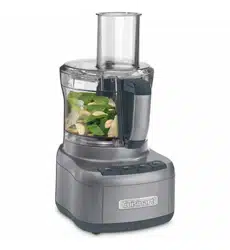
CFP-800 Series
For your safety and continued enjoyment of this product, always read the instruction book carefully before using.
INSTRUCTION
AND RECIPE
BOOKLET

2
FOOD CAPACITY
Sliced or shredded fruit, vegetables or cheese 8 cups
Chopped fruit, vegetables or cheese 2 cups
Puréed fruit, vegetables or cheese 3 cups cooked; 1½ cups puréed
Chopped or puréed meat, fish or seafood ¾ pound
Thin liquid (e.g., dressings, soups, etc.) 4 cups
Cake batter 8-inch cheesecake batter; 1 box (15.25 ounce) cake mix
Cookie dough 2½ dozen (based on average chocolate chip cookie recipe)
White bread/pizza dough 2½ cups (all-purpose or bread flour)
Nuts for nut butter 2 cups
FOOD PROCESSOR WORK BOWL CAPACITY RECOMMENDATIONS

3
IMPORTANT
UNPACKING
INSTRUCTIONS
This package contains a Cuisinart
®
CFP-800 Food
Processor, a disc accessory package, and full-size
Blender and Juice Extractor Attachments, each
assembled and in its own molded packing
compartment.
PARTS AND ACCESSORIES
• 8-cup Food Processor work bowl, cover
with feed tube, metal chopping/mixing blade,
reversible slicing and shredding discs,
stem adapter
• 40-ounce Blender jar and lid with measure pour
lid insert
• Juice Extractor with base, clear juice bowl,
mesh lter basket/blade, 0.7-liter pulp tank,
lid and pusher
• Instruction/Recipe Book
CAUTION: ALL CUTTING TOOLS HAVE VERY
SHARP EDGES. To avoid injury when unpack-
ing the parts, never touch the cutting edges of
blades or discs.
• Place the box on its side on a low table or on
the oor next to the kitchen counter or wher-
ever you intend to keep your Kitchen Central.
• Open top aps – there will be two molded
packing trays visible. Slide these out, lift the
top tray off, and put it aside.
• Remove the Instruction/Recipe Book.
• Lift out the Motor Housing Base and place it on
a at, sturdy surface.
• Remove the assembled Food Processor and
the Disc Pack.
• Remove the Blender.
• Remove the assembled Juice Extractor.
• Remove all parts from plastic bags.
• Save the shipping cartons and all packing
material. You will nd them very useful if you
need to repack the appliance for moving or
other shipment.
• NOTE: We recommend that you visit our
website, www.cuisinart.com for a fast, ef cient
way to complete your product registration.

4
IMPORTANT
SAFEGUARDS
When using electrical appliances, especially when
children are present, basic safety precautions
should always be taken including the following:
1. Read all instructions.
2. Blades and discs are sharp. Handle them
carefully.
3. Always unplug appliance from outlet when
not in use, before putting on or taking off
parts, before removing food and before
cleaning. To unplug, grasp plug and pull
from electrical outlet. Never pull cord.
4. Do not use outdoors.
5. Do not let cord hang over edge of table or
counter, or touch hot surfaces, including
the stove.
6. Do not operate any appliance with a damaged
cord or plug or after the appliance malfunc-
tions, or is dropped or damaged in any manner.
Call 1-800-726-0190 (in the United States) for
information on examination, repair, or adjust-
ment. Return appliance to nearest Cuisinart
service facility for examination, repair and/or
mechanical or electrical adjustment.
7. This appliance is not intended for use by persons
(including children) with reduced physical,
sensory, or mental capabilities, or lack of experi-
ence and knowledge, unless they are closely
supervised and instructed concerning use of
the appliance by a person responsible for their
safety. Close supervision is necessary when any
appliance is used by or near children. Children
should be supervised to ensure that they do not
play with the appliance.
8. Turn the appliance OFF, then unplug from
the outlet when not in use, before assem-
bling or disassembling parts and before
cleaning. To unplug, grasp the plug and pull
from the outlet. Never pull the power cord.
9. To protect against risk of electric shock, do not
put base in water or other liquids.
10. Do not operate your appliance in an appliance
garage or under a wall cabinet. When storing
in an appliance garage always unplug the unit
from the electrical outlet. Not doing so could
create a risk of re, especially if the appliance
touches the walls of the garage or the door
touches the unit as it closes
11. Keep hands and utensils away from moving
blades or discs while processing, blending,
or juicing to reduce the risk of severe injury to
persons or damage to the machine or parts.
A scraper may be used only when the
appliance is not running.
12. Avoid coming into contact with moving parts.
Never push food down into food processor or
juice extractor by hand. Always use pusher.
13. Make sure motor has completely stopped
before removing the lids. (If machine does not
stop within four seconds after turning off, call
1-800-762-0190 for assistance. Do not use
the machine.)
14. To reduce the risk of injury, never store food
processor blade or discs on motor shaft. Blade
and discs should be on shaft only when the
bowl is properly locked in place and processor
is in use. Food processor blade and discs, and
juice extractor mesh lter basket/blade are very
sharp and should always be stored out of reach
of children.
15. Be sure covers of food processor and juice
extractor are securely locked into place, and
blender lid is on tight before operating the
Kitchen Central.
16. Never try to defeat, override or tamper with
cover interlock mechanisms.
17. Do not operate this, or any other motor-driven
appliance, while under the in uence of alcohol
or other substances that affect your reaction
time or perception.
18. The Kitchen Central is cULus listed for
household use. Use only for food preparation
as described in the accompanying Instruction
and Recipe Book.
19. The use of attachments, including canning jars,
not recommended or sold by Cuisinart
®
may
cause re, electric shock or personal injury, or
damage to your appliance.
20. To avoid possible malfunction of the appli-
ance’s switch, never store food processor or
juice extractor attachment assembly with cover
on in locked position.
21. When using the food processor, do not ll the
bowl above the marked maximum ll line to
avoid risk of injury due to damage to the cover
or bowl.
22. When the blender is on, do not touch cutting
assembly, interfere with blade movement, or
remove blender jar cover.

5
23. To reduce the risk of injury when using the
blender, never place removable blade as-
sembly on base without the jar being properly
attached. To attach blade to jar, twist to secure
it rmly in place. Injury can result if moving
blades accidentally become exposed.
24. Always operate the blender with the cover
in place.
25. Never leave your blender unattended while it
is running.
26. When blending hot liquids in Blender Jar,
remove measure pour lid insert to allow steam
to escape.
27. When using the juice extractor, be sure the
cover is properly positioned and securely in
place before turning the motor on. Do not open
the cover while the unit is operating.
28. Do not put ngers or other objects into the
juice extractor opening while it is in operation.
If food becomes stuck in the opening, use food
pusher or another piece of fruit or vegetable to
push it down, or turn the motor off and disas-
semble the unit to remove the remaining food.
29. If the juice extractor mesh lter basket/blade is
damaged, do not use.
30. Always make sure the juice extractor cover is
properly positioned and secured before turning
the unit on. The safety interlock will not let the
motor operate if cover is not secure. Do not
loosen the cover while the juice extractor is
in use.
31. Never juice with the spout in the
closed position.
SAVE THESE
INSTRUCTIONS
FOR HOUSEHOLD
USE ONLY
NOTICE:
This appliance has a polarized plug (one prong is
wider than the other). To reduce the risk of electric
shock, this plug will fit into a polarized outlet only
one way. If the plug does not fit fully into the out-
let, reverse the plug. If it still does not fit, contact
a qualified electrician. Do not modify the plug in
any way.
SPECIAL CORD SET
INSTRUCTIONS
A short power-supply cord is provided to reduce
the risks resulting from becoming entangled in or
tripping over a longer cord. Longer extension cords
are available and may be used if care is exercised in
their use. If a long extension cord is used, the marked
electrical rating of the extension cord must be at least
as great as the electrical rating of the appliance, and
the longer cord should be arranged so that it will not
drape over the countertop or tabletop where it can be
pulled on by children or tripped over.
WARNING
RISK OF FIRE OR ELECTRIC SHOCK
DO NOT OPEN
WARNING: TO REDUCE THE RISK OF FIRE OR ELECTRIC SHOCK,
DO NOT REMOVE COVER (OR BACK)
NO USER-SERVICEABLE PARTS INSIDE
REPAIR SHOULD BE DONE BY AUTHORIZED SERVICE PERSONNEL ONLY
6
WARNING: RISK OF FIRE
OR ELECTRIC SHOCK
The lightning ash with arrowhead
symbol within an equilateral triangle is
intended to alert the user to the pres-
ence of uninsulated, dangerous voltage
within the product’s enclosure that may
be of suf cient magnitude to constitute a
risk of re or electric shock to persons.
The exclamation point within an
equilateral triangle is intended to
alert the user to the presence of
important operating and maintenance
(servicing) instructions in the literature
accompanying appliance.
CONTENTS
Important Unpacking Instructions ....... 3
Important Safeguards ......................... 4
Parts .................................................... 7
General Assembly .................................9
Food Processor Assembly ....................9
Troubleshooting ...................................10
Blender Assembly ...............................12
Juice Extractor Assembly....................14
Troubleshooting Chart .........................15
Cleaning, Storage, and Maintenance ..15
Food Processor Tips ...........................17
Blender Tips ................................. 18–19
Juice Extractor Tips ......................20–21
Recipes ................................................22
Warranty ..............................................58
7
8.
7.
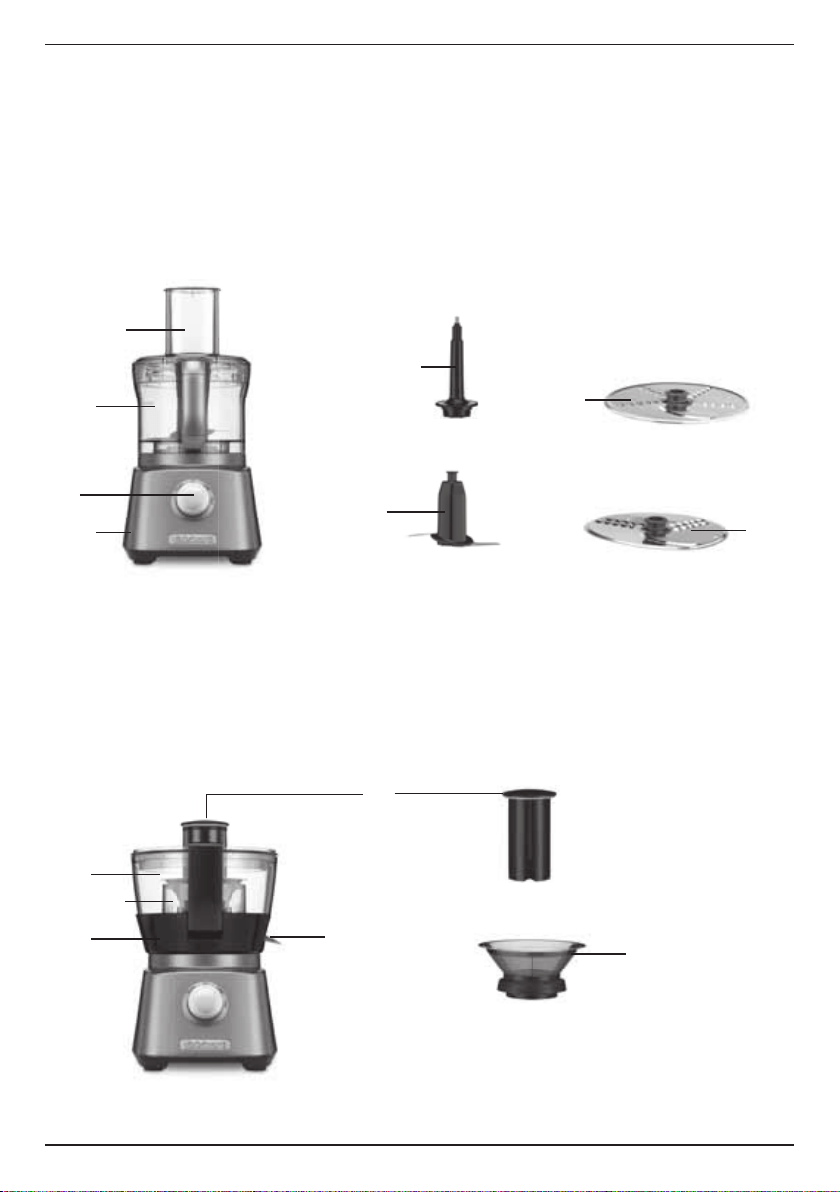
PARTS
FOOD PROCESSOR
1. Motor housing base
2. Speed control dial settings for OFF, Low, High,
and Pulse controls
3. 8-cup work bowl
4. Cover with feed tube and pusher
5. Stem adapter
6. Metal chopping/mixing/dough blade
7. Fine reversible slicing/shredding disc
8. Medium reversible slicing/shredding disc
9. BPA free (not shown)
All materials that come in contact with food or
liquid are BPA free
6.
JUICE EXTRACTOR
1. Cover with feed tube and pusher
2. Mesh lter basket/blade
3. Clear juice bowl
4. Drip-free pour spout
5. Filter housing
6. Juice extractor base with locking arms
2.
3.
4.
5.
1.
1.
3.
6.
4.
2.
5.
8
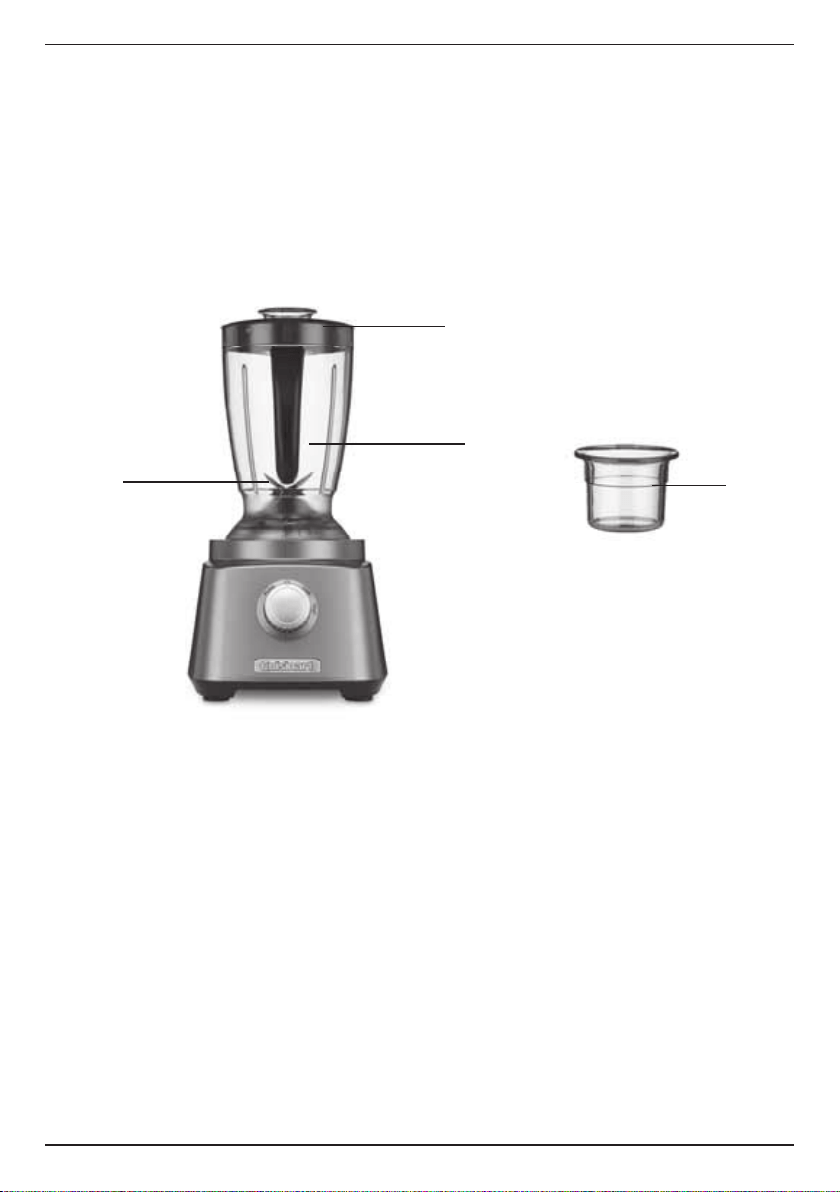
BLENDER
1. Blender Cover
2. Measured pour lid insert
3. 40 oz. durable plastic jar
4. High-quality blade assembly with patented
stainless steel blades
NOTE: BLADES ARE SHARP.
HANDLE CAREFULLY.
3.
1.
4.
2.
9
GENERAL ASSEMBLY
Before First Use
Before using your Cuisinart
®
Kitchen Central for
the rst time, wash all parts. Place the base on a
dry, level countertop with the controls facing you.
Do not plug the unit in until it is fully assembled.
*For your convenience, the base and attachments
each have clear tabs and/or visible indicators to
make attaching and detaching all parts simple.
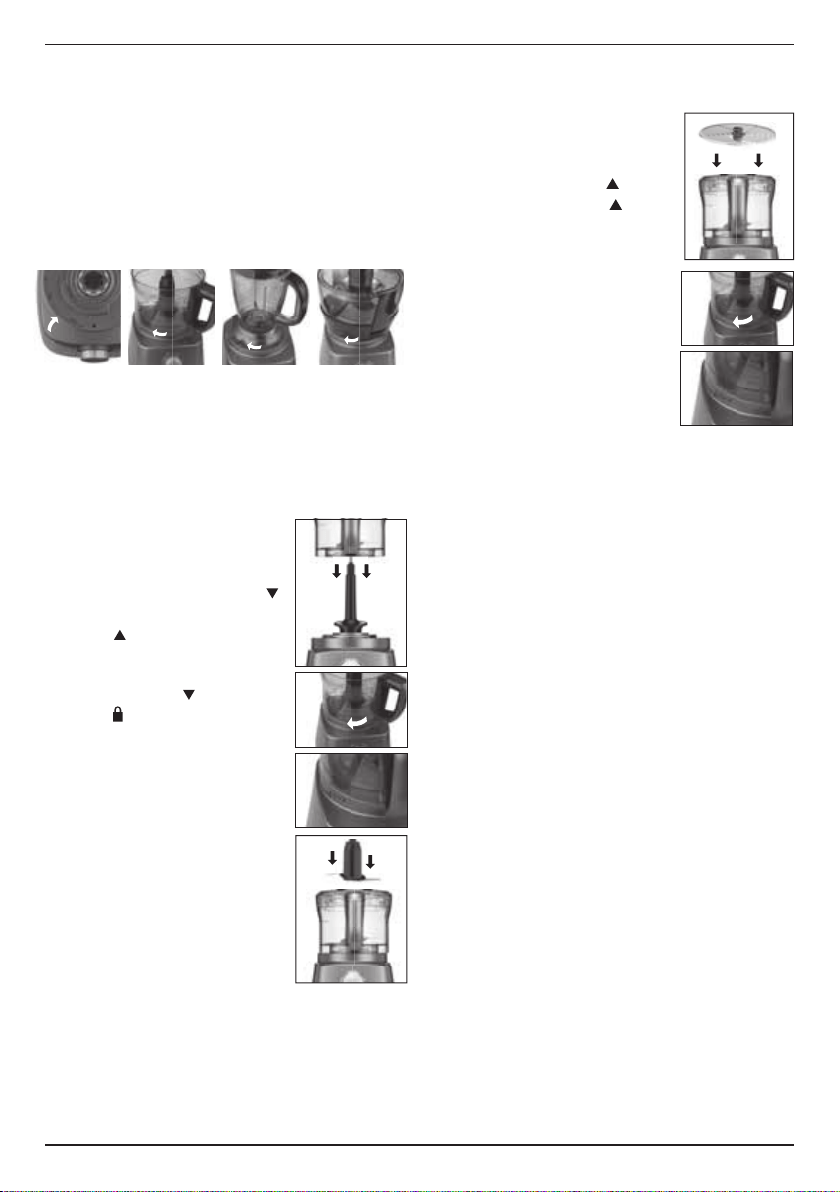
FOOD PROCESSOR
ASSEMBLY
CHOPPING/MIXING/
DOUGH BLADE
1. Put the stem adapter onto the
motor housing base.
2. Place the work bowl over stem
adapter, lining up the arrow
on the base of work bowl with
arrow on the rim of motor
housing base. To lock work
bowl in place, turn it clockwise
to line up arrow with lock/
arrow on rim of motor hous-
ing base.
3. Holding blade by plastic hub,
carefully place it over the stem
adapter. Turn blade until it ts
snugly and rests on the bottom
of the work bowl.
4. Plug the motor housing base
into an electrical outlet.
5. Add desired ingredients to
work bowl.
6. Place work bowl cover on work
bowl, with the feed tube just to
the right of center. Turn clockwise to lock onto
work bowl.
7. Place pusher into feed tube
opening on the work bowl cover.
8. You are now ready to operate the machine.
REVERSIBLE SLICING/
SHREDDING DISCS
1. Put the stem adapter onto the
motor housing base.
2. Place the work bowl over stem
adapter, lining up the on base
of work bowl with the on the
rim of motor housing base. Turn
the work bowl clockwise, past
LOCK to lock it into place.
3. Choose desired disc.
4. Holding disc by outer edges,
carefully place it over the stem
adapter, with the side being
used facing up.
5. Place work bowl cover onto
work bowl, with the feed tube
just to the right of center. Turn clockwise to
lock onto work bowl.
6. Place pusher into the feed tube opening on the
work bowl cover.
7. Plug the motor housing base into an electrical
outlet.
8. You are now ready to operate the machine.
MACHINE CONTROLS
Speed Control Dial with Pulse, OFF, Low, High
The High and Low controls are features that
allow the machine to run until OFF is selected.
1. Properly assemble and engage the machine.
2. Add ingredients to the work bowl,
either through the feed tube or directly into
the bowl. If using a disc, food must be added
through the feed tube only.
3. Turn dial to Low or High speed. Machine will
run until dial is turned to OFF.
Pulse Function
The Pulse control is a feature that allows the
machine to run only while the Pulse dial is
engaged. This capability provides more accurate
control of the duration and frequency of process-
ing. Unless otherwise speci ed, a pulse should
be about one second.
• With the machine properly assembled and
engaged, and ingredients in the work bowl,
turn the dial to Pulse.
Pulse mode:
Turn dial to Pulse and
alternately “pulse and release” in short bursts until
ingredients have reached desired consistency.
Base
Food Processor Blender Juice Extractor

10
MACHINE FUNCTIONS
USING THE CHOPPING/MIXING/
DOUGH BLADE
Chopping
• For raw ingredients: Peel, core and/or remove
seeds and pits. Food should be cut into
½- to 1-inch pieces. Foods cut into same-size
pieces produce the most even results.
• Pulse food in 1-second increments to chop. For
the nest chop, either hold in the Pulse position
or turn the dial to High or Low to run the machine
continuously. Watch ingredients closely to
achieve desired consistency, and scrape the work
bowl as needed. Low speed is recommended for
making doughs and batters. High speed is rec-
ommended for most other chopping, processing
and slicing/shredding tasks.
Puréeing
• To purée fresh fruits or cooked fruits/vegetables:
Ingredients should be cut into 1-inch pieces;
a smooth purée is best achieved when all the
pieces are equal in size. Pulse to initially chop and
then process High or Low until food is puréed;
scrape the work bowl as necessary. Do not use
this method to purée cooked white potatoes.
• To purée solids for a soup or sauce: Strain the
solids from the liquid and process the solids
alone. Add cooking liquid and process as needed.
USING THE REVERSIBLE SLICING/
SHREDDING DISCS
• The slicing disc creates whole, uniform slices. It
slices fruits and vegetables, cooked meat and semi-
frozen raw meat. The shredding disc shreds most
rm and hard cheeses. It also shreds vegetables
such as potatoes, carrots and zucchini.
• Always pack food in the feed tube evenly
for slicing and shredding. The food will dictate the
amount of pressure: Use light pressure for soft
foods, medium pressure for medium foods, and
rm pressure for harder foods. Always process with
even pressure.
• For round fruits or vegetables: Remove a thick slice
on the bottom of the food so that it sits upright in
the feed tube. If food does not t in the feed tube,
cut in half or quarters to t. Process with even
pressure.
• For small ingredients such as mushrooms,
radishes or strawberries: Trim the ends so the food
sits upright in the feed tube.
• When slicing or shredding cheese, be sure that the
cheese is well chilled.
• To shred leafy vegetables like lettuce or spinach:
Roll leaves together and stand them up in feed tube.
Process with even pressure.
NOTE: Always use pusher when slicing
or shredding. Never put your hands in
the feed tube when unit is running
TROUBLESHOOTING
FOOD PROCESSING
1. Problem: The food is unevenly processed.
Solution:
• The ingredients should be cut evenly into
½- to 1-inch pieces before processing.
• Process in batches to avoid overloading.
2. Problem: Slices are uneven or slanted.
Solution:
• Place evenly cut food, cut-side down, into the
feed tube.
• Apply even pressure on the pusher.
3. Problem: Food falls over in feed tube.
Solution:
• Feed tube should be packed full for
best results.
4.
Problem: Some food remains on top of
the disc.
Solution:
• It is normal for small pieces to remain;
cut remaining bits by hand and add to
processed ingredients.
KNEADING DOUGH
1. Problem: Motor slows down.
Solution:
• Amount of dough may exceed maximum
capacity of your food processor. Remove half
and process in two batches.
• Dough may be too dry (see number 7).
2.
Problem: Blade doesn’t incorporate
ingredients.
Solution:
• Always start the food processor before adding
liquid. Add liquid in a slow, steady stream, or
through the drizzle hole in the pusher, allowing
the dry ingredients to absorb it. If too much liquid
is added too quickly, wait until ingredients in the
work bowl have mixed, then add remaining liquid
slowly (do not turn off the machine). Pour liquid
onto dough as it passes under feed tube open-
ing; do not pour liquid directly onto bottom of the
work bowl.
3. Problem: Blade rises in work bowl.
Solution:

11
• Excessively sticky dough can cause blade to
rise. Carefully push blade down and immedi-
ately add 2 tablespoons of our through the
feed tube while the machine is running.
4. Problem: Dough doesn’t clean inside of the
work bowl.
Solution:
• Amount of dough may exceed maximum
capacity of your food processor. Remove half
and process in two batches.
• Dough may be too dry (see number 7).
• Dough may be too wet (see number 8).
5.
Problem: Nub of dough forms on top of
blade and does not become uniformly
kneaded.
Solution:
• Stop machine, carefully remove dough, divide
it into 3 pieces and redistribute them evenly in
the work bowl.
6. Problem: Dough feels tough after kneading.
Solution:
• Divide dough into 2 or 3 pieces and redistrib-
ute evenly in bowl. Process 10 seconds or
until uniformly soft and pliable.
7. Problem: Dough is too dry.
Solution:
• While machine is running, add water, 1 table-
spoon at a time, until dough cleans the inside
of the bowl.
8. Problem: Dough is too wet.
Solution:
• While machine is running, add our, 1 table-
spoon at a time, until dough cleans the inside
of the bowl.
Technical
1. Problem: The motor does not start.
Solution:
• There is a safety interlock to prevent the
motor from starting if it is not properly as-
sembled. Make sure the work bowl and work
bowl cover are securely locked into position.
• If the motor still will not start, check the power
cord and outlet.
2. Problem: The food processor shuts off during
operation.
Solution:
• The cover may have become unlocked; check
to make sure it is securely in position.
• A safety protector in the motor prevents the
motor from overheating, which is caused by
excessive strain. Turn the dial to OFF and wait
20 to 30 minutes to allow the food processor
to cool off before resuming.
3. Problem: The motor slowed down during
operation.
Solution:
• This is normal as some heavier loads (e.g.,
slicing/shredding cheese) may require the mo-
tor to work harder. Simply reposition the food
in the feed tube and try again.
• The maximum load capacity may have been
exceeded. Remove some of the ingredients
and continue processing.
4. Problem: The food processor vibrated/moved
around the countertop during processing.
Solution:
•
Make sure the rubber feet at the bottom of the unit
are clean and dry. Also make sure that the maxi-
mum load capacity is not being exceeded
.
• This is normal as some heavier loads
(e.g.,slicing/shredding cheese) may require
the motor to work harder

12
BLENDER ASSEMBLY
1. Place the motor housing base
on a at, sturdy surface that
is clean and dry. Put the
assembled blender jar on the
base, lining up the on skirt
of jar with the rib on the top of
motor housing. To lock jar in
place, turn it clockwise to line
up the with lock arrow on the
top of motor housing.
2 Plug the motor housing base
into an electrical outlet.
3. Put all ingredients into the blender jar and
secure cover by turning clockwise to lock into
place. You may add more ingredients by lifting
the measured pour lid insert and dropping
ingredients into the jar. Replace the lid insert
after adding ingredients. Do not put hands into
blender jar with blender plugged in.
NOTE: Add liquid ingredients rst to blender
jar, then follow with solid ingredients. This will
provide more consistent blending and prevent
unnecessary stress on the motor.
4. Start blending
: Turn dial to Low or High speed.
Blender will run until dial is turned to OFF.
Pulse mode: Turn dial to Pulse and alternately
“pulse and release” in short bursts until ingredi-
ents have reached desired consistency.
To stop blending process: Simply turn dial to
OFF.
When fi nished blending: Turn dial to OFF and
unplug the unit from the electrical outlet. Never
remove the blender jar from the motor housing
base until the blender is off. Turn assembled
blender jar counterclockwise and lift off base.
Do not put hands into blender jar with blender
plugged in.
NOTE: To remove blender jar cover, unlock by
twisting counterclockwise. Lifting measured
pour lid insert will not remove cover.
To dislodge food: Turn blender OFF. Use a
rubber or plastic spatula to help remove food
lodged around the blade assembly. Do not use
spatula until you have turned the blender OFF.
Replace the cover and lid insert and continue
blending, if necessary. Make sure spatula is not
inside the blender jar before resuming blending.
To reset the unit: This appliance features an
advanced resettable thermal fuse.
In the event of an overload, the unit will shut
down to protect the motor from overheating.
To reset the appliance when this happens,
unplug the unit and let it cool for 20 to 30
minutes. Then, reduce the contents of the
blender jar and/or clear any jams. Restart
the unit as noted in the operating directions.
NOTE: To remove blender jar cover, lift edge of
cover upward. Lifting measured pour lid will not
remove cover.
DISASSEMBLY
1. Turn the blender jar upside down and place it
on a at sturdy surface.
2. Turn the blade assembly clockwise and lift to
remove.
3. To reassemble the blender jar, turn the blade
assembly counter-clockwise and make sure it
is fastened.
NOTE: Blades are sharp; handle carefully.
HELPFUL REMINDERS
• Once the blender cover is in position, addition-
al ingredients can be added during blending
by simply lifting the measured pour lid insert,
adding ingredients, and replacing the lid insert.
• Cover should always be in place while the unit
is on.
• Warning: Do not place blender jar on base
while motor is running.
• Remove jar from motor housing base and
empty before removing blade assembly.
• Do not put hands into blender jar with blender
plugged in.
• Boiling liquids or solid frozen foods (with the
exception of ice cubes or ½-inch [1.3 cm]
pieces of frozen fruit) should never be put into
the blender jar.
• Do not put ice, frozen foods or very cold liquids
into a blender jar that has come directly from a
hot dishwasher.
• Do not put very hot liquids or foods into a
blender jar that has come directly from the
freezer. Boiling liquids should cool for 5
minutes before being poured into blender jar.
Remove measured pour lid insert.
• Follow Cleaning, Storage, and Maintenance
instructions on page 13, prior to your rst use.
13
DOS AND DON’TS WHEN
USING YOUR BLENDER
DO:
• Make sure the electrical outlet is rated at the
same voltage as that stated on the bottom of
the motor housing base.
• Always use the blender on a clean, sturdy and
dry surface.
• Always add liquid ingredients to the blender
jar fi rst, then add remaining ingredients.
This will ensure that ingredients are
uniformly mixed.
• Cut most foods into cubes approximately ½
inch (1.3 cm) to 1 inch (2.5 cm) to achieve a
more uniform result. Cut all cheeses into pieces
no larger than ½ inch (1.3 cm).
• Use the measured pour lid insert to measure
liquid ingredients such as alcohol. Replace lid
insert after ingredients have been added.
• Use a rubber or plastic spatula as needed, only
when the blender is turned OFF. Never use
metal utensils, as damage may occur to the
blender jar or blade assembly.
• Place cover on rmly. Always operate the
blender with the cover on.
• Make sure removable blade assembly is
securely attached to blender jar.
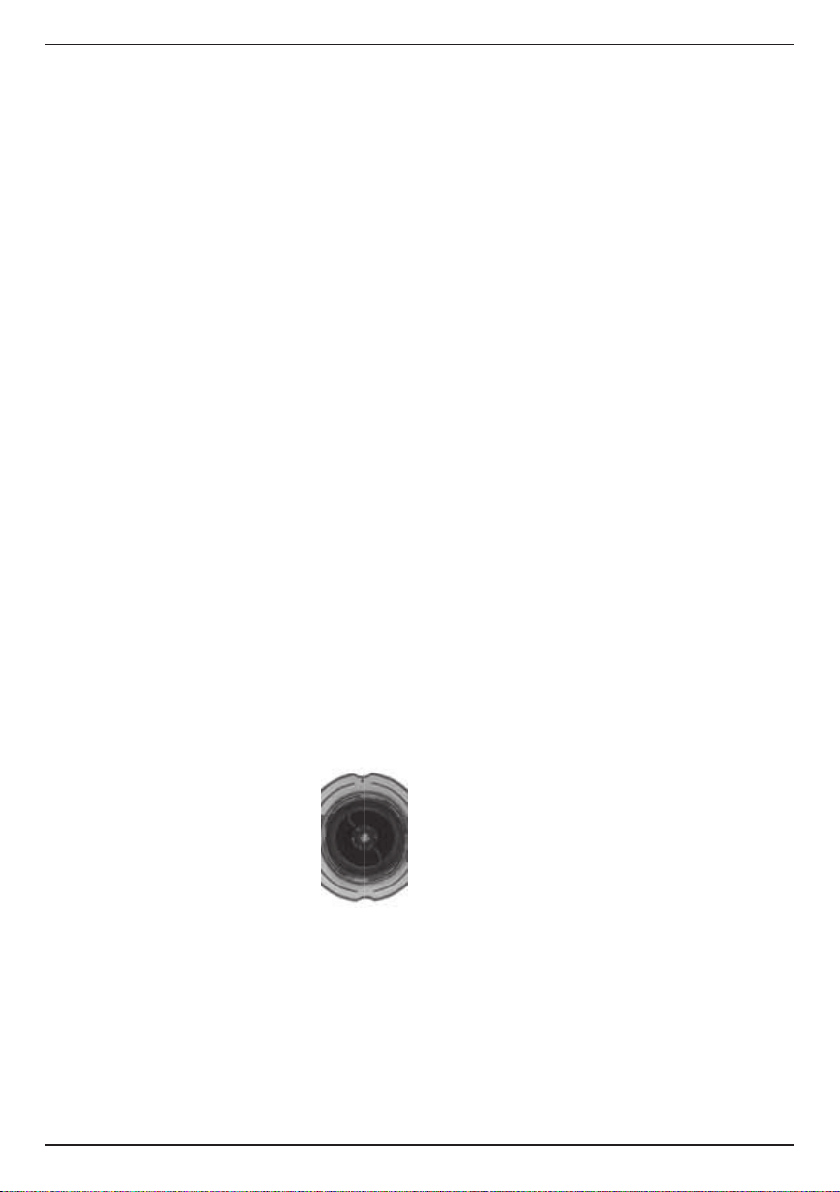
Please ensure the seal ring is assembled in the
blade holder before putting it on the jar. Turn
the blade holder counterclockwise until the slot
end of blender jar meets the indication rib posi-
tion of blade holder as below.
• Always remove blade assembly
before cleaning.
• When scraping ingredients in
the blender jar with a spatula,
remove the food from the sides of
the blender jar and place it in the
center of the jar, over the blade
assembly.
• When chopping fresh herbs, garlic, onion,
zest, breadcrumbs, nuts, spices, etc., make
sure the blender jar and blade assembly are
completely dry.
• If food tends to stick to the sides of the blender
jar when blending, Pulse in short bursts.
• Pulses should be short bursts. Space the
pulses so the blades stop rotating between
pulses.
DON’T:
• Don’t store food or liquids in your blender jar.
• Don’t place blade assembly on motor base
without the blender jar attached.
• Don’t attempt to mash potatoes, knead heavy
dough, or beat egg whites.
• Don’t remove blender jar while unit is on.
Keep the blender jar cover on the blender jar
while blending.
• Don’t twist removable blade assembly from
blender jar when removing blender jar from
motor base. Simply lift blender jar from motor
base.
• Don’t overprocess foods. Blender will achieve
most desired results in seconds, not minutes.
• Don’t overload blender. If the motor stalls, turn
the blender off immediately, unplug the unit and
remove a portion of the food, then continue.
• Don’t use any utensil inside the blender jar
while the motor is on.
• Don’t use any container or accessories not
recommended by Cuisinart. Doing so may
result in injury.
• Don’t put hands inside the blender jar when
blender is plugged in.
• Don’t add boiling liquids or frozen foods
(except ice cubes or ½-inch pieces of frozen
fruit) to glass blender jar. Boiling liquids should
cool for 5 minutes before being poured into
blender jar. Remove measured pour lid insert.
• Don’t run blender when jar is empty.
14
JUICE EXTRACTOR
ASSEMBLY
ASSEMBLING THE
JUICE EXTRACTOR
ATTACHMENT ON THE BASE
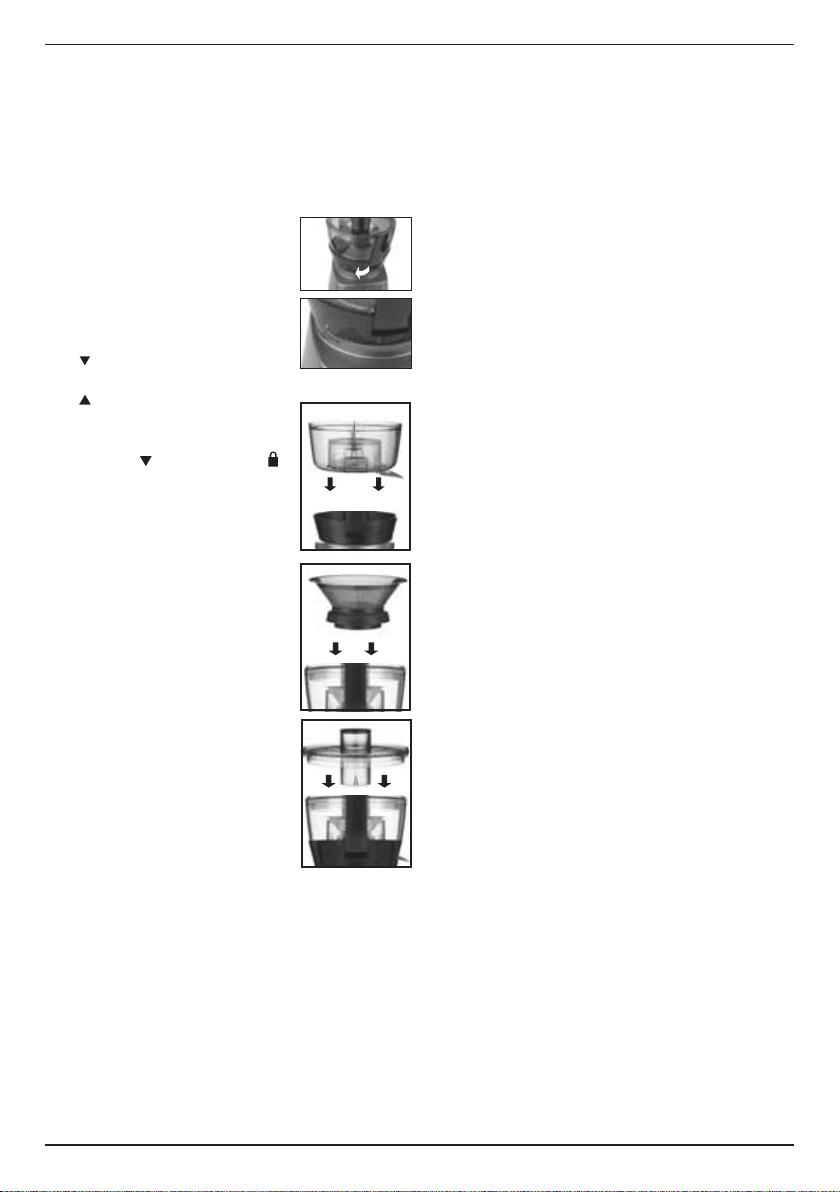
1. Place the motor housing base
on a at, sturdy surface that is
clean and dry. Place the base
of the juice extractor onto the
motor base, with the groove for
the pour spout on the right-
hand side. Line up white arrow
on bottom edge of juice
extractor base with the arrow
on the rim of motor housing
base. To lock extractor base in
place, turn it clockwise to line
up arrow with lock/arrow
on rim of motor housing.
2. Set the clear plastic bowl onto
the base, positioning the pour
spout in the groove.
3. Hold the mesh lter basket/
blade carefully by the rim, using
both hands, and place
it into the center opening of
the bowl. Slowly rotate it,
gently pressing down, until
you feel it drop into place.
Push down rmly to secure.
4. Place the lid on the bowl.
5. Lift the side latches up to
grasp the lid and press down
to lock them into place.
6. Place the pusher into the lid’s
feed tube.
PUTTING THE ASSEMBLED
JUICE EXTRACTOR
ATTACHMENT ONTO THE
MOTOR BASE
1. If juice extractor attachment is stored while
fully assembled, rst lift the side latches up to
disengage them from the lid.
2. Place the assembled attachment onto the
housing base with the pour spout on the
right-hand side, and the indicator mark on
the juice extractor base a little forward of the
indicator mark on the motor base.
3. With the juice extractor base seated rmly on
the center gear connector in the motor base,
turn the full assembly clockwise to lock it into
place. The indicator marks will line up and the
assembly will stop turning.
4. Lift the side latches up to grasp the lid and
press down to lock them into place.
OPERATING INSTRUCTIONS
1. Press pour spout down into the open position
and place a container under it to catch juice.
2. Wash all fruits and vegetables before juicing.
3. While many items will t through the food
tube whole, any with diameters larger than 2¾
inches will need to be cut.
4. Turn dial to Low when ready to begin.
5. Remove the food pusher from the feed tube
and drop items into the opening. Return the
pusher to the tube and press rmly to feed
food into the extractor basket.
6. Juice will ow through the spout into the juice
container; strained pulp will remain in the bowl.
7. When nished juicing, turn the unit to OFF.
8. Before removing the juice container from under
the spout, slide the spout up to the closed
position. This will prevent juice from dripping
onto the counter.
DISASSEMBLING THE
JUICE EXTRACTOR
ATTACHMENT AFTER USE
1. Unplug the unit.
2. Lift the pour spout up to the closed position.
3. Lift the side latches from the bottom to release.
4. Turn the juice extractor assembly counterclock-
wise to remove it from the base.
5. Lift lid up to remove from bowl.
6. Carefully remove mesh lter basket/blade from
the lter housing by pulling up on the sides
of the rim with both hands. Be careful not to
touch the blades in the bottom of the
basket.
7. Lift the bowl off of the juice extractor base.
8. All removable parts, not including the juicer
base, are top-shelf dishwasher-safe for quick
and easy cleanup.

15
CLEANING, STORAGE,
AND MAINTENANCE
FOR MOTOR HOUSING BASE
• Do not immerse the motor housing in water or
spray it with water. Clean only by wiping with
a damp sponge, cloth or paper towel. Use any
liquid dishwashing detergent, but do not use
any products containing ammonia or scouring
powders, as these products will dull, scratch or
mar the nish.
• If the feet leave spots on the counter, spray
spots with a spot remover and wipe with a damp
sponge.
• If any trace of the spot remains, repeat the pro-
cedure and wipe the area with a damp sponge
and nonabrasive cleaning powder.
FOR FOOD PROCESSOR
ATTACHMENT
• Always unplug your Cuisinart
®
Kitchen Central
from the electrical outlet before cleaning.
• Keep the blade and discs out of reach of children.
• All parts except the motor housing base are dish-
washer safe, and we recommend washing them
in the dishwasher on the top rack only. Due to
intense water heat, washing the work bowl, cover
and accessories on the bottom rack may cause
damage over time. Insert the cover with the
feed tube facing up to ensure proper cleaning.
Insert the work bowl and pusher upside down for
drainage. Remember to unload the dishwasher
carefully wherever you have placed sharp blades
and discs into it.
• To simplify cleaning, rinse the work bowl, cover,
pusher and blade or disc immediately after use
so food won’t dry on them. Be sure to position
the pusher upside down for drainage. If food
lodges in the pusher, remove it by running water
through it, or use a bottle brush.
• If you wash the blade and discs by hand, do it
carefully. When handling, use the plastic hubs.
Avoid leaving them in soapy water where they
may disappear from sight. To clean the metal
blade, ll the work bowl with soapy water, hold
the blade by its plastic center and move it rapidly
up and down on the center shaft of the bowl. Use
of a spray attachment is also effective. If neces-
sary, use a brush.
• The work bowl is made of SAN plastic. It should
not be placed in a microwave oven.
IMPORTANT: Never store any blade or disc on the
motor shaft. No blade or disc should be placed on
the shaft except when the processor is about to
be used.
MAINTENANCE: Any other servicing should be
performed by an authorized service representative.
TROUBLESHOOTING
PROBLEM SOLUTION
Juice extractor does not
turn on
• The cover is not engaged. (See #30, page 5.)
• Turn dial to ON to start juicing.
Juice fl ow is slow
• Make sure the pour spout is opened all the way.
• Excess pulp in mesh filter basket can slow juice rate. Stop the juice
extractor and clean filter basket.
Diffi culty getting herbs
or leafy greens down
the feed tube
• Place them between other ingredients.
Juice still fl owing with
unit off
• Make sure the pour spout is closed all the way.
Unit is ON, but juice/
pulp not fl owing
• Make sure the mesh filter basket/blade is in place and pour spout is
open.

16
FOR YOUR SAFETY
• Like all powerful electrical appliances, a food
processor should be handled with care. Follow
these guidelines to protect yourself and your
family from misuse that could cause injury.
• Handle and store metal blade and discs carefully.
Their cutting edges are very sharp.
• Never put blade or discs on the motor shaft until
the work bowl is locked in place.
• Always be sure that the blade or disc is down on
motor shaft as far as it will go.
• Always insert the metal blade in the work bowl
before putting ingredients in bowl.
• When slicing or shredding food, always use the
pusher. Never put your ngers or spatula into
feed tube.
• Always wait for the blade or disc to stop spinning
before you remove the pusher assembly or cover
from the work bowl.
• Always unplug the unit before removing food,
cleaning, or putting on or taking off parts.
• Always remove work bowl from base of machine
before you remove the chopping/mixing/dough
blade.
• Be careful to prevent the chopping blade from
falling out of the work bowl when emptying the
bowl. Remove it before tilting the work bowl.
FOR BLENDER ATTACHMENT
• The blender is made of corrosion-resistant parts
that are easy to clean. Before rst use and after
every use, clean each part thoroughly. Periodical-
ly check all parts before reassembly. If any part
is damaged or blender jar is chipped or cracked,
DO NOT USE BLENDER.
• Remove the blender jar from the motor base by
turning slightly counterclockwise and lifting off.
• Remove the blade assembly by turning coun-
terclockwise. Wash in warm, soapy water, rinse,
and dry thoroughly.
CAUTION: Handle the blade assembly carefully.
It is SHARP and may cause injury. Do not at-
tempt to remove blades from assembly.
• Remove the blender jar cover and the measured
pour lid insert. Wash in warm, soapy water, rinse
and dry thoroughly, or place in upper rack of
dishwasher. The blender jar must be washed
in warm, soapy water and rinsed and dried
thoroughly. The blender jar can also be placed
upside down in dishwasher.
TIP: You may wish to clean your blender blade
assembly as follows: Squirt a small amount of
dishwashing liquid into assembled blender jar and
ll halfway with warm water. Run on Low for 15
seconds. Repeat, using clean tap water. Rinse and
dry all parts thoroughly.
MAINTENANCE: Any other servicing should be
performed by an authorized service representative.
FOR JUICE EXTRACTOR
ATTACHMENT
• For preliminary cleanup, use cleaning brush to
remove excess pulp from the lter/sieve and the
lid after each use. Vegetable and fruit pulp will
harden if left to dry on the unit parts, making it
harder to clean.
• Unplug juicer and carefully take it apart, following
Disassembly Instructions on page 13.
WARNING: Be careful when handling the mesh
lter basket/blade, as blades are very sharp.
• Rinse all removable parts with cold water.
• Wash the clear juice bowl, juice pitcher, pusher,
lid and mesh lter basket/blade in hot, sudsy
water, or on top rack of dishwasher. Do not use a
metal brush or pad.
NOTE: For best juicing results, the mesh lter
basket/blade must always be thoroughly cleaned
after each use.
• Towel- or air-dry all parts.
MAINTENANCE: Any other servicing should be
performed by an authorized service representative.

17
FOOD TOOL DIRECTIONS
Soft Cheeses
(ricotta, cream
cheese, cottage
cheese, etc.)
Chopping/Mixing/Dough
Blade
Have cheese at room temperature. When applicable, cut into 1-inch pieces.
Process until smooth, stopping to scrape down the sides of the bowl as needed.
Perfect for making cheesecakes, dips, pasta fillings, and more.
Firm Cheeses
(Cheddar,
Swiss, Edam,
Gouda, etc.)
Slicing/Shredding Disc Cheese should be well chilled before slicing/shredding. Cut to fit feed tube. Use
light to medium pressure when slicing/shredding.
Hard Cheeses
(Parmesan,
Romano, etc.)
Chopping/Mixing/Dough
Blade
Slicing/Shredding Disc
Chill cheese. If using the chopping blade, cut into ½-inch pieces. Pulse to break
up and then process until finely grated. This will produce a nice grated cheese.
If slicing or shredding, cut to fit feed tube. Use light to medium pressure when
slicing/shredding.
Baby Food Chopping/Mixing/Dough
Blade
As for all fruit and vegetable purées, cut ingredients into ½ - to 1-inch pieces.
Steam ingredients until completely soft. Pulse to chop, then process until
completely smooth (add steaming liquid through the feed tube when processing if
necessary). To ensure there are no lumps, press mixture through a fine mesh
strainer. Keeps frozen in ice cube trays for individual 1-ounce portions.
Butter
Chopping/Mixing/Dough
Blade
Slicing/Shredding Disc
For creaming : Have butter at room temperature. Cut into 1-inch pieces. Process,
scraping bowl as necessary. For compound (flavored) butters, process flavoring
ingredients, such as herbs, zest, vegetables, etc., before adding butter. For
shredding/slicing: Freeze briefly. Use light to medium pressure to shred or slice.
Shredded butter is great for preparing certain pastry doughs. Sliced butter is
great for serving alongside corn on the cob or freshly made rolls.
Bread/Cookie/
Cracker/Chip
Crumbs
Chopping/Mixing/Dough
Blade
Break into pieces. Pulse to break up, and then process until desired consistency.
This will make perfect bread/cracker/chip crumbs for coating meats and fish.
Processed cookies make delicious pie and cake crusts!
Milk Shakes/
Smoothies
Chopping/Mixing/Dough
Blade
For milk shakes, first add ice cream. While unit is running, add milk through the
feed tube until desired consistency is achieved. For smoothies, add fruit first,
then add the liquid through the feed tube while unit is running.
Fresh Herbs Chopping/Mixing/Dough
Blade
Wash and dry herbs VERY well. Pulse to roughly chop. Continue pulsing until
desired consistency is achieved.
Nuts Chopping/Mixing/Dough
Blade
Pulse to chop to desired consistency. To make a nut butter, pulse to break up,
and then process until smooth, stopping to scrape down as needed.
"Ice Cream" Chopping/Mixing/Dough
Blade
Put frozen fruit cut into 1-inch pieces into the work bowl, with liquid (juice or
milk), any desired sweeteners, such as sugar, honey, simple syrup, and other
flavors. Process until smooth.
Whipped Cream Chopping/Mixing/Dough
Blade
Process well-chilled cream until cream begins to thicken. Add sugar as desired;
process continuously until cream reaches desired consistency. This cream is
dense and perfect as a whipped topping for cake or ice cream.
Superfine Sugar Chopping/Mixing/Dough
Blade
Process granulated sugar for about 1 minute until finely ground. Excellent for
using in meringues and other baked goods.
Ground Meat Chopping/Mixing/Dough
Blade
Cut meat into ½-inch pieces. Pulse to chop, about 14 long pulses, or until desired
consistency is achieved. If a purée is desired, continue to process. Never chop/
purée more than
¾ pound at one time.
FOOD PROCESSOR TIPS
You can slice, shred and chop a multitude of vegetables and fruits in the Cuisinart
®
Kitchen Central. What you
may not know is that the food processor is the perfect tool for a number of other tasks, such as softening butter,
making breadcrumbs, making baby food, etc. Here is a guide that will help you in preparing just about anything!

18
BLENDER TIPS
Chopping Nuts
Put ½ cup shelled nuts into the blender jar and
cover blender. Pulse until desired chop is achieved.
Pulse fewer times for coarsely chopped nuts. For
best results, process small amounts, ½ cup or less.
Bread, Cookie or Cracker Crumbs
Break or cut bread, cookies or crackers into pieces
½ inch or less in size. For best bread results, use
day-old bread (drier bread works best). Put bread,
cookie or cracker pieces in blender jar. Pulse to
chop, then run continuously until desired texture
of crumbs is achieved. For best results, process 1
cup or less at a time.
Grating Fresh Citrus Zest
For best results, blender jar and cutting assembly
must be clean and dry. Remove zest from fruit in
strips using a vegetable peeler; use a sharp knife
to remove the bitter white pith from the underside
of the zest. Process no more than 8 strips at a time
(zest of 1 medium lemon). Cut strips in half. Put
strips and 1 teaspoon sugar or coarse salt (from
recipe) into the blender jar. Cover blender jar. Run
on Low for 15 to 20 seconds.
Baby Food
Combine ½ cup cooked vegetables, fruit or meat
with 3 to 4 tablespoons liquid (water, milk, fruit
juice, broth, or cooking liquid) in the blender jar.
Process until puréed.
Grinding Spices
For best results, blender jar and cutting assembly
must be clean and dry. Put ¼ to ½ cup of spices/
seeds/peppercorns into blender jar. Pulse to break
up, then run for 20 to 40 seconds on Low.
Whipping Cream
If possible, chill blender jar and cutting assembly
in refrigerator for 15 minutes. Put 1 cup heavy or
whipping cream into blender jar. Cover jar. Run on
Low until cream is thickened. (Do not overblend –
bits of butter will begin to form.) If desired, add 1
tablespoon sugar and 1 to 2 teaspoons of pure va-
nilla extract or other avoring. Consistency with be
that of a thickened, but not uffy whipped cream,
and is most appropriate for topping desserts or
coffee drinks.
NOTE: When using the blender to purée hot
mixtures such as creamed soups and baby foods,
strain the solids from the liquid, reserving the
cooking liquid. Then put ½ to 1 cup of the reserved
cooking liquid into the blender jar along with the
cooked solids. Begin blending on Low and then
turn to High until desired consistency/purée
is reached.
NOTE: Allow hot foods to cool slightly before
blending to prevent steam buildup, which may
cause the lid to lift up from the blender jar. Remove
measured pour lid insert.
For quick cleaning, add 1 cup of warm water and
a drop of liquid dish soap to the blender jar. Cover
and run on Low or High for 30 seconds or more as
needed. Discard the soapy water and rinse blender
thoroughly before the next use. Keep your blender
out on the counter within easy reach, and you will
be surprised how often you will use it.
To prevent diluting the drink, keep ice cubes made
of juices, yogurt, milk or fruit purées on hand to
substitute for plain ice when making smoothies
and frosty beverages or use frozen fruit.

19
QUICK REFERENCE GUIDE
To activate blender Plug in, turn knob to desired speed
To begin blending Turn knob
To change speeds Turn knob
To Pulse Turn knob to Pulse
To stop blending (and deactivate blender) Turn knob to OFF and unplug
SPEED SELECTION GUIDE
Refer to this guide to choose the best blender speed
for your desired result.
Ingredient/Recipe Speed Result
Reconstituting frozen juice concentrate LOW Smooth and full-bodied
Mayonnaise LOW Thick and creamy
Salad dressings LOW or HIGH Completely blended and emulsified
Nuts (shelled, ½ cup or less at a time) PULSE to chop Coarse to fine
Heavy or whipping cream LOW – PULSE Thick, creamy
topping
Bread, cookies or cracker crumbs (add
½-inch pieces, 1 cup or less at a time)
PULSE first, then blend on
High
Coarse to fine as desired
Grating/chopping citrus zest (add 1 to 2
teaspoons sugar or salt from recipe)
PULSE first, then blend on
Low
Uniformly fine
Smoothies, shakes, health drinks LOW or HIGH Smooth, creamy and thick
Baby food/fruit and
vegetable purée
HIGH Smooth and creamy
Frozen cocktails HIGH Thick and slushy
Spices PULSE first, then blend on
Low
Coarse to fine
BLENDER TIPS

20
JUICE EXTRACTOR TIPS
• Extracted juice captures about 95% of the nu-
trients from fresh fruits and vegetables. Drinking
extracted juice is a fast and ef cient way for your
body to digest and absorb all of those nutrients.
Digesting whole fruits can take about an hour;
extracted juices take only 15 minutes.
• Freshly extracted juices are an excellent aid in
weight management and in cleanses, which rid
the body of toxins.
• Always use fresh, organic and seasonal produce.
Organic produce is grown without synthetic
fertilizers and chemicals, which is very impor-
tant when juicing whole foods. Buying foods
in season is considerably less expensive than
purchasing off-season produce, and avors are
much better.
• Wash all fruits and vegetables immediately after
purchasing and store them in the refrigerator.
This way they are ready to juice at any time.
• Always juice fresh fruits and vegetables as soon
as possible after purchasing. The longer produce
is held, the more nutrients are lost.
• Fresh juices should be consumed immediately.
They lose nutrients as they sit.
• Certain fruits should be peeled before juicing.
Examples are pineapples, melons, mangoes,
papayas, citrus – any fruit with skin that you
cannot eat. Also remove all pits and hard seeds
from peaches, cherries, mangoes, etc.
• Citrus fruit juice is delicious and rich in nutrients.
• If cucumbers are waxy, peel them before juicing.
• Juice the softer ingredients before the harder
ones.
• When juicing herbs or leafy greens, juice them
in the middle of a combination of ingredients in
order to extract the greatest amount of juice.
• Use your taste to guide you on fruit and
vegetable combinations for juices. The recipes
provided are a guideline, but the possibilities are
endless. Experiment to discover your favorite
combinations.
• Carrots make a great and tasty base for
vegetable juices, and apples do the same for
fruit juices.
• Beets and carrots both have a naturally high
sugar content, so when added to vegetable
juices they can balance out any bitter avors
juiced vegetables may have.
• Use your juice extractor in tandem with your
blender. Blend fresh juices with
ingredients like bananas, yogurt, and protein
powders for delicious power smoothies.
• It is also possible to make a healthier, fresher
version of your favorite cocktail with fresh juices.
• Blend fruit juices and add sparkling water or
seltzer to make a natural soda.
• The pulp that is separated from the juice has its
own health bene ts. It is high in ber and can be
used in a variety of ways.

21
APPROXIMATE YIELD JUICING CHART
FRUIT AMOUNT YIELD
APPLE (quartered)
1 medium (about 7 ounces) ½ cup or 4 ounces
CANTALOUPE (peeled and seeded)
1 cup, cubed ½ cup or 4 ounces
GRAPES
1 cup ½ cup or 4 ounces
ORANGE (peeled and quartered)
1 medium (about 12 ounces) ⁄
cup or 5 ounces
PEACH (pitted)
1 medium (about 10 ounces) ¼ cup or 2 ounces
PEAR (quartered)
1 medium (about 7 ounces) ½ cup or 4 ounces
PAPAYA (peeled and seeded)
½ fruit (about 1 pound 3 ounces) 1 cup or 8 ounces
PINEAPPLE (peeled and cored)
½ fruit 1 cup or 8 ounces
WATERMELON (peeled and seeded)
1 cup, cubed ½ cup or 4 ounces
STRAWBERRIES
1 cup ½ cup or 4 ounces
GRAPEFRUIT (peeled and quartered)
1 medium to large (about 1 pound) 1¼ cups or 10 ounces
LEMON (peeled)
1 fruit (about 5 ounces) ¼ cup or 2 ounces
KIWI
1 fruit (about 3 ounces) 1 ounce
VEGETABLE AMOUNT YIELD
BEET (quartered)
1 medium (about 6 to 7 ounces) ½ cup or 4 ounces
LEAFY GREENS
1 handful (about 8 leaves) 1½ ounces
CARROT
1 pound 1 cup or 8 ounces
CELERY
4 large stalks ½ cup or 4 ounces
BELL PEPPER (quartered)
1 medium (about 9 ounces) ½ cup or 4 ounces
CUCUMBER
1 medium/large (about 11 ounces) 1 cup or 8 ounces
TOMATO
1 medium (about 5 ounces) ½ cup or 4 ounces
PARSLEY
1 bunch (about 6 ounces) ¼ cup or 2 ounces
CABBAGE
¼ head (about 12 ounces) ¾ cup or 6 ounces

22
BASICS
Mayonnaise ...................................................................................................................24
Basic Fresh Breadcrumbs .............................................................................................25
Basil Pesto .....................................................................................................................26
Pico de Gallo .................................................................................................................27
Chunky Guacamole ......................................................................................................27
Hummus ........................................................................................................................28
Basic Vinaigrette ...........................................................................................................28
Hollandaise Sauce ........................................................................................................29
BREAKFAST/BRUNCH/DRINKS
Zucchini Spice Bread ....................................................................................................30
Onion, Pepper and Potato Frittata .............................................................................31
Tropical Vitamin C Smoothie .......................................................................................32
Super Protein Shake .....................................................................................................33
Light Green Smoothie ..................................................................................................34
Antioxidant Smoothie ..................................................................................................34
Morning Zinger .............................................................................................................35
Super C Juice ................................................................................................................36
Veggie Juice Plus ..........................................................................................................37
Green Zing ....................................................................................................................38
Apple, Beet and Fennel Juice .....................................................................................39
SOUPS/SALADS/SIDES
Gazpacho ......................................................................................................................40
Curried Coconut and Butternut Squash Soup ...........................................................41
Lightened Broccoli and Potato Soup ..........................................................................42
Coleslaw ........................................................................................................................43
Chopped Salad .............................................................................................................44
Potato-Zucchini-Carrot Cakes .....................................................................................45
ENTREES
Pizza Margherita ...........................................................................................................46
Mushroom, Leek and Gruyère Quiche........................................................................47
Chicken Pot Pie .............................................................................................................48
Tacos Americanos .........................................................................................................49

23
DOUGHS/BREADS
Pizza Dough ..................................................................................................................50
Páte Brisée ....................................................................................................................51
Buttery Dinner Rolls ......................................................................................................52
Buttermilk Biscuits ........................................................................................................53
DESSERTS
Classic Apple Pie ..........................................................................................................54
Carrot Cake with Cream Cheese Frosting ..................................................................55
Dairy-Free Chocolate Mousse .....................................................................................56
Pumpkin Bread Pudding ..............................................................................................57

MAYONNAISE
Taste the difference in homemade mayonnaise.
Makes 1 cup
1. Insert the chopping blade into the work bowl of the
food processor. Process the egg yolks, salt, mustard,
lemon juice and water on Low until smooth, about 30
seconds. With the machine running on Low, slowly
add the oil through the drizzle hole in the pusher
until all oil is incorporated and the mayonnaise is
emulsifi ed and homogenous.
2. Scrape down sides; taste and adjust seasoning
accordingly.
Note: For fresh herb mayonnaise: Process 1⁄3 cup
fi rmly packed fresh herbs (e.g., parsley, dill, tarragon,
basil, etc.), stems removed, with the yolks before adding
the oil.
For a bolder-fl avored mayonnaise, increase the salt by
¼ teaspoon, the Dijon mustard by ½ teaspoon and
lemon juice to 1 tablespoon.
Nutritional information per serving (1 tablespoon):
Calories 93 (96% from fat) • carb. 0g • pro. 1g • fat 10g
sat. fat 1g • chol. 41mg • sod. 104mg • calc. 5mg • fi ber 0g
4 LARGE EGG YOLKS
¾ TEASPOON KOSHER SALT
½ TEASPOON DIJON MUSTARD
1 TEASPOON FRESH LEMON JUICE
1 TABLESPOON WATER
¾ CUP VEGETABLE OIL
24
BASICS

BASICS
25
BASIC FRESH BREADCRUMBS
There is no need to buy breadcrumbs when you can make them with your
Cuisinart
®
Food Processor in no time at all.
Makes 1¼ cup
1. Preheat oven to 325ºF. Bake slices of bread in a
single layer for about 20 minutes or until bread is
completely dried out.
2. Insert the chopping blade into the work bowl of the
food processor. Directly into the work bowl, break the
bread into pieces and pulse 10 times, then process
until desired texture is achieved; about 30 seconds to
1½ minutes for coarse crumbs, and 3 to 4 minutes for
fi ne crumbs.
TIP: For seasoned breadcrumbs, add ¼ teaspoon each
dried oregano, dried basil, garlic powder, and ground
onion fl akes to toasted bread and process as above.
NOTE: Breadcrumbs can also be processed from
day-old bread. Simply break into uniform pieces and
follow above instructions until fi nely chopped.
Nutritional information per serving (1 tablespoon):
Calories 48 (11% from fat) • carb. 9g • pro. 2g • fat 1g
sat. fat 0g • chol. 0mg • sod. 72mg • calc. 8mg • fi ber 1g
4 SLICES WHITE BREAD

BASIL PESTO
This is a slightly cheesier version of the standard pesto, but you can adjust
the amount of cheese as desired. Try any combination of herbs or nuts in
this recipe.
Makes 1¼ cups
1. Insert the chopping blade into the work bowl of the
food processor. Add the cheese, garlic and nuts to
the work bowl and pulse to roughly chop, about 10
pulses. Add the basil leaves and salt and pulse about
10 to 15 times; scrape the bowl. With the machine
running on Low, add the olive oil in a slow, steady
stream through the feed tube, processing until
combined and emulsifi ed, about 1 minute. Scrape
down the sides of the work bowl.
2. To store the pesto, transfer to a glass jar or airtight
container. Tap to remove all air bubbles and even out
the surface. Cover the surface directly with plastic
wrap and refrigerate. The pesto will keep for 5 days
in the refrigerator, or it may be frozen.
Nutritional information per serving (1 tablespoon):
Calories 72 (80% from fat) • carb. 0g • pro. 1g • fat 8g
sat. fat 1g • chol. 2mg • sod. 74mg • calc. 40mg • fi ber 0g
2 OUNCES PARMESAN OR PECORINO
CHEESE, CUT INTO ½-INCH CUBES
1 GARLIC CLOVE
¼ CUP PINE NUTS, LIGHTLY TOASTED
3 CUPS TIGHTLY PACKED FRESH BASIL
LEAVES (ABOUT 3 OUNCES)
½ TEASPOON KOSHER SALT
½ TO
2
⁄
3
CUP EXTRA VIRGIN OLIVE OIL
26
BASICS

27
CHUNKY GUACAMOLE
Our fresh guacamole is perfect for the Sunday game or served alongside
tacos or quesadillas for a festive dinner.
Makes about 1 cup
1. Insert the chopping blade into the work bowl of the
food processor. Add the garlic, jalapeño, scallion and
cilantro and pulse to roughly, but evenly chop.
2. Scrape down the sides of the bowl. Scoop out the
insides of the avocados in pieces directly into the
work bowl and add the lime juice and salt. Alternate
between pulsing and running on High until desired
consistency is achieved, about 10 to 15 pulses.
Nutritional information per serving (¼ cup):
Calories 71 (73% from fat) • carb. 4g • pro. 1g • fat 6g
sat. fat 1g • chol. 0mg • sod. 118mg • calc. 7mg • fi ber 3g
1 SMALL GARLIC CLOVE
½ JALAPEÑO, SEEDED, CUT INTO
1-INCH PIECES
1 SCALLION, CUT INTO 1-INCH
PIECES
1 TABLESPOON FRESH CILANTRO,
STEMS DISCARDED
2 RIPE AVOCADOS, HALVED, PITS
REMOVED
2 TABLESPOONS FRESH LIME JUICE
¾ TEASPOON KOSHER SALT
PICO DE GALLO
Serve warm tortilla chips alongside this fresh and tangy salsa.
Makes about 2 cups
1. Insert the chopping blade into the work bowl of the
food processor. Add the cilantro, scallions, garlic and
jalapeño and pulse to chop, about 10 pulses. Add
the salt, tomatoes and lime juice and pulse to chop
until desired consistency is reached, about 8 to 10
pulses.
2. Taste and adjust seasoning accordingly.
Depending on desired consistency, strain salsa to
remove excess liquid.
Nutritional information per serving (¼ cup):
Calories 11 (7% from fat) • carb. 2g • pro. 0g • fat 0g
sat. fat 0g • chol. 0mg • sod. 287mg • calc. 7mg • fi ber 1g
¼ CUP FRESH CILANTRO, STEMS
DISCARDED
2 SMALL SCALLIONS, CUT INTO
1-INCH PIECES
1 SMALL GARLIC CLOVE
1 JALAPEÑO, SEEDED, CUT INTO
½-INCH PIECES
¾ TEASPOON KOSHER SALT
2 CUPS GRAPE TOMATOES
1 TEASPOON FRESH LIME JUICE
BASICS

28
BASICS
HUMMUS
Serve this brightly fl avored dip with warm pita for a satisfying snack.
Makes about 3 cups
1. Insert the chopping blade into the work bowl of the
food processor. With the unit running on High, drop
the garlic through the feed tube and process to fi nely
chop, about 10 seconds. Add remaining ingredients
and process on Low until smooth, about 3 minutes,
stopping to scrape down the sides of the bowl as
needed.
2. For serving, transfer hummus to a shallow bowl. Make a
slight indentation in the center of the dip and fi ll with
the remaining tablespoon of oil. Sprinkle the paprika
and za’atar, if using, over the oil.
Nutritional information per serving (2 tablespoons):
Calories 79 (44% from fat) • carb. 2g • pro. 2g • fat 4g • sat. fat 1g
chol. 0mg • sod. 207mg • calc. 23mg • fi ber 2g
1 GARLIC CLOVE
1 TEASPOON KOSHER SALT
2 CANS (15.5 OUNCES EACH)
CHICKPEAS, RINSED AND DRAINED
¼ CUP TAHINI
2 TABLESPOONS FRESH LEMON JUICE
¼ CUP PLUS TWO TABLESPOONS
WATER
½ TEASPOON GROUND CUMIN
¼ CUP EXTRA VIRGIN OLIVE OIL, PLUS
1 TABLESPOON FOR SERVING
1
⁄
8
TEASPOON PAPRIKA (OPTIONAL)
PINCH ZA’ATAR (OPTIONAL)
BASIC VINAIGRETTE
This simple vinaigrette is perfect over a salad of mixed greens and fresh
vegetables. Substituting 1½ teaspoons of herbes de Provence for the
combined basil/thyme/marjoram is an easy way to change it up a bit, and
saves on the amount of dried herbs you need to have on hand.
Makes 1 cup
1. Put the vinegar, mustard, parsley, spices and salt into
the blender jar. Run on Low until combined, and
parsley is fi nely chopped
2. Once the mixture is combined, carefully remove the
pour lid from the cover of the blender. Run the
blender on Low and slowly add the oil through the
opening. The process should take about 2½ minutes.
3. Taste and adjust seasoning as desired.
Nutritional information per serving (1 tablespoon):
Calories 91 (99% from fat) • carb. 0g • pro. 0g • fat 11g
sat. fat 2g • chol. 0mg • sod. 76mg • calc. 3mg • fi ber 0g
¼ CUP RED WINE VINEGAR
1 TEASPOON DIJON-STYLE MUSTARD
¼ CUP FRESH PARSLEY
½ TEASPOON DRIED BASIL
½ TEASPOON DRIED THYME
½ TEASPOON DRIED MARJORAM
¼ TEASPOON GROUND WHITE PEPPER
½ TEASPOON KOSHER SALT
¾ CUP EXTRA VIRGIN OLIVE OIL

29
BASICS
HOLLANDAISE SAUCE
A staple with Eggs Benedict, but this rich, buttery sauce is also great over
steamed vegetables.
Makes about 1 cup
1. Place butter in a saucepan over low heat to melt. It is
best to check the temperature of the butter. Heat
until about 150˚F, so that when you are ready to use
the butter, it registers at 140˚F – this temperature is
very important. It must not be under or the egg yolks
will not cook; if it is too hot, then the sauce will not
come together properly.
2. While the butter is melting, add the remaining
ingredients to the jar of the blender jar. About a
minute before adding the butter, run the unit on Low
for about 30 seconds, to combine
3. With the blender still running on Low, carefully
remove the pour lid from the cover. Very slowly
drizzle the hot butter through the opening at the top
of the lid. Only add about 1 to 2 tablespoons at a
time. Wait for the mixture to resemble the consis-
tency of mayonnaise, and then very slowly, drip by
drip, add another 1 to 2 tablespoons. Continue in
this fashion, adding just enough butter so that the
consistency stays like mayonnaise. The entire process
should take about 10 minutes.
4. When all butter has been incorporated, taste and
adjust seasoning as desired. Serve while still warm.
Nutritional information per serving (1 tablespoon):
Calories 114 (97% from fat) • carb. 0g • pro. 1g • fat 12g
sat. fat 7g • chol. 82mg • sod. 35mg • calc. 6mg. • fi ber 0g
1 CUP (½ POUND, 2 STICKS)
UNSALTED BUTTER
4 LARGE EGG YOLKS
¼ TEASPOON KOSHER SALT
PINCH GROUND MUSTARD
PINCH FRESHLY GROUND BLACK
PEPPER
1½ TABLESPOONS FRESH LEMON JUICE

30
ZUCCHINI SPICE BREAD
This moist, quick bread is perfect for breakfast or for an afternoon snack.
Makes one 2-pound loaf (16 servings)
1. Preheat oven to 325°F. Coat a 9 x 5 x 3-inch loaf pan
with cooking spray.
2. Insert the chopping blade into the work bowl of the
food processor. Add the fl our, spices, salt and baking
powder and process on Low for 10 seconds to sift.
Transfer ingredients to a large bowl; reserve. Add the
walnuts to the work bowl and chop, 2 to 3 pulses.
Leaving the nuts in the work bowl, remove the
chopping blade and insert the medium shredding
disc. Trim the zucchini to fi t the feed tube and shred.
Transfer the walnuts and zucchini to the bowl with the
dry ingredients. Stir to mix.
3. Reinsert the chopping blade and add the vegetable
oil, sugar and eggs. Process on Low for 5 to 10
seconds until combined. Add to the mixing bowl with
the dry ingredients, along with the dried fruit, and stir
until just combined
4. Pour the batter into the prepared pan and bake in
the middle of the oven for 1 hour and 15 minutes, or
until a toothpick or cake tester comes out clean.
5. Cool on a wire rack for 5 minutes, and then turn the
loaf out onto a wire rack to cool completely.
Nutritional information per serving:
Calories 194 (37% from fat) • carb. 28g • pro. 3g • fat 8g
sat. fat 1g • chol. 23mg • sod. 183mg • calc. 14mg • fi ber 1g
NONSTICK COOKING SPRAY
2¼ CUPS UNBLEACHED, ALL-PURPOSE
FLOUR
1½
TEASPOONS GROUND CINNAMON
¾ TEASPOON GROUND ALLSPICE
¼ TEASPOON GROUND NUTMEG
1 TEASPOON KOSHER SALT
1
TEASPOON BAKING POWDER
½ CUP WALNUTS, LIGHTLY TOASTED
1 LARGE ZUCCHINI, APPROXIMATELY
8 TO 10 OUNCES
½ CUP VEGETABLE OIL
1
CUP GRANULATED SUGAR
2
LARGE EGGS
½ CUP DRIED CHERRIES OR
CRANBERRIES
BREAKFAST & BRUNCH

31
BREAKFAST & BRUNCH
ONION, PEPPER AND POTATO FRITTATA
Frittatas are simple and delicious. This is also tasty with some crumbled,
cooked Italian sausage mixed into it.
Makes 10 servings
1. Preheat oven to 350°F.
2. Insert the chopping blade into the work bowl of the
food processor. With the unit running on High, drop
the garlic through the feed tube and process to fi nely
chop.
3. Keeping the garlic in the bowl, remove the chopping
blade and insert the medium slicing disc. Slice the
onion and pepper on High. Remove vegetables and
reserve. Slice the potato on High; remove and
reserve in cold water.
4. Remove the slicing disc, and insert the fi ne shredding
disc. Shred the Parmesan on High; reserve.
5. Place a 10-inch, oven-safe, nonstick skillet* over
medium heat. Add 2 teaspoons of the olive oil and
swirl the pan to coat the surface evenly. Once oil is
hot, add the garlic, onion and pepper, with a pinch
each of the salt and pepper; sauté until softened,
about 6 to 8 minutes. Remove and reserve.
6. Add the remaining teaspoon of oil to the pan.
Remove the potatoes from the water and dry well on
a towel. Add to the pan with 2 pinches each of the
salt and pepper. Sauté until tender and edges are
browned, about 6 minutes.
7. Once potatoes have browned, add the onion/pepper
mixture back to the pan, stir to combine, then top
with the eggs, remaining salt and pepper and
shredded Parmesan. Leave skillet on the heat so that
the bottom and sides of the frittata begin to set,
about 6 minutes. Place skillet into oven and bake
until the top of the frittata is golden and puffed,
about 20 to 25 minutes.
8. Carefully remove skillet from oven and invert onto a
cutting board. Cut the frittata and serve immediately.
2 GARLIC CLOVES
1 SMALL ONION, HALVED
1 MEDIUM RED BELL PEPPER,
QUARTERED, CORED AND SEEDED
1 SMALL TO MEDIUM RUSSET POTATO
(4 TO 6 OUNCES), PEELED AND
HALVED, RESERVED IN COLD WATER
1 OUNCE PARMESAN CHEESE
3 TEASPOONS OLIVE OIL, DIVIDED
½ TEASPOON KOSHER SALT, DIVIDED
¼ TEASPOON FRESHLY GROUND
BLACK PEPPER, DIVIDED
12 LARGE EGGS, BEATEN
*If not using a nonstick pan, coat the
pan with a nonstick cooking spray
before adding the eggs. Once the
vegetables are sautéed, stir them
into beaten eggs and add to the
coated pan.
Nutritional information per serving
(based on 10 servings):
Calories 127 (56% from fat) • carb. 5g
pro. 9g • fat 8g • sat. fat 3g
chol. 225mg • sod. 248mg
calc. 73mg • fi ber 1g

32
BREAKFAST & BRUNCH
TROPICAL VITAMIN C SMOOTHIE
A delicious way to get your daily vitamin C.
Makes about 3 cups
1. Put ingredients into the blender jar in order listed.
2. Run on High until smooth, about 45 seconds.
3. Serve immediately.
Nutritional information per serving (based on 4 servings):
Calories 188 (2% from fat) • carb. 47g • pro. 2g • fat 1g •
sat. fat 0g • chol. 0mg • sod. 10mg • calc. 57mg • fi ber 6g
1 CUP ORANGE JUICE
1 CUP PAPAYA, CUT INTO 1-INCH
PIECES (ABOUT ¼ LARGE PAPAYA)
1 CUP FRESH STRAWBERRIES, HULLED
AND HALVED
1 CUP FROZEN MANGO
½ CUP FROZEN STRAWBERRIES

33
BREAKFAST & BRUNCH
SUPER PROTEIN SHAKE
This simple smoothie packs in protein and fi ber for a complete
breakfast shake!
Makes about 3 cups
1. Place ingredients in Cuisinart® blender jar in
order listed.
2. Blend on High for about 1 minute.
3. Serve immediately.
Nutritional Information per serving (1 cup):
Calories 175 (21% from fat) • carb. 26g • pro. 12g • fat 4g
sat. fat 0g • chol. 0mg • sod. 26mg • calc. 83mg • fi ber 6g
1½ CUPS SOY, ALMOND OR HEMP
MILK (COW’S MILK MAY ALSO BE
USED)
½ CUP PLAIN OR VANILLA YOGURT,
ANY FAT VARIETY
1 BANANA, BROKEN INTO 4 PIECES
2 TABLESPOONS PROTEIN POWDER
1 TABLESPOON ALMOND BUTTER
2 CUPS MIXED FROZEN BERRIES

34
BREAKFAST & BRUNCH
ANTIOXIDANT SMOOTHIE
Arm your cells with extra protection with this nutrient-dense smoothie.
Makes about 3 cups
1. Put all ingredients into blender in the order they
are listed.
2. Blend on High for about 45 seconds.
3. Serve immediately.
Nutritional information per serving (1 cup):
Calories 172 (43% from fat) • carb. 25g • pro. 2g • fat 9g
sat. fat 5g • chol. 0mg • sod. 11mg • calc. 33mg • fi ber 5g
1 CUP NONDAIRY MILK OR JUICE
½ AVOCADO OR 1 SMALL BANANA,
BROKEN INTO 4 PIECES
1 TEASPOON ACAI POWDER
1 TABLESPOON COCONUT OIL
1 CUP BABY KALE
2 CUPS FROZEN WILD BLUEBERRIES
LIGHT GREEN SMOOTHIE
This green smoothie is delicious and nutritious as much as it is simple. Use
any greens you have on hand to substitute.
Makes 2 cups
1. Put all ingredients into blender in the order they
are listed.
2. Blend on High for about 45 seconds.
3. Serve immediately.
Nutritional info per serving (1 cup):
Calories 138 (10% from fat) • carb. 30g • pro. 5g • fat 2g
sat. fat 0g • chol. 0mg • sod. 57mg • calc. 48mg • fi ber 4g
1 CUP NONDAIRY MILK (E.G., RICE,
ALMOND OR SOY) OR JUICE
1 RIPE BANANA, BROKEN INTO 4
PIECES
1 CUP BABY SPINACH
1 CUP FROZEN STRAWBERRIES

35
MORNING ZINGER
A delicious way to get up and go.
Makes about 8 ounces
1. Assemble the Juice Extractor and turn it on.
2. Juice the ingredients in the order listed.
3. Stir juice and serve immediately.
Nutritional information per serving (8 ounces):
Calories 198 (6% from fat) • carb. 4g • pro. 1g • fat 0g
sat. fat 0g • chol. 0mg • sod. 186mg • calc. 165mg • fi ber 1g
* Notable nutrients based on daily percentages:
Vitamin A 829% • Vitamin C 167% • Iron 26% • Folate 35%
1 HANDFUL FRESH PARSLEY, ABOUT
1 CUP PACKED
1 MEDIUM APPLE, QUARTERED
½ OUNCE FRESH GINGER, ABOUT
1-INCH PIECE
3 MEDIUM CARROTS
BREAKFAST & BRUNCH

36
BREAKFAST & BRUNCH
SUPER C JUICE
Red peppers are packed full of vitamin C, and a little goes a long way.
Make this juice when you’re feeling under the weather, for it provides you
with twice your daily value of vitamin C and over four times your daily need
of vitamin A!
Makes about 14 ounces
1. Assemble the Juice Extractor and turn it on.
2. Juice the ingredients in the order listed.
3. Stir juice and serve immediately.
Nutritional information per serving (8 ounces):
Calories 94 (4% from fat) • carb. 24g • pro. 2g • fat 1g
sat. fat 0g • chol. 0mg • sod. 86mg • calc. 72mg • fi ber 1g
* Notable nutrients based on daily percentages:
Vitamin A 441% • Vitamin C 188% • Total Folate 13%
½ LARGE RED PEPPER, SEEDED
4 MEDIUM CARROTS
½ LARGE GRAPEFRUIT, PEELED AND
HALVED
½ MEDIUM ORANGE, PEELED
¼ LEMON, PEELED

37
BREAKFAST & BRUNCH
VEGGIE JUICE PLUS
A rainbow of veggies, chock-full of nutrients, all in one glass.
Makes about two 7-ounce servings
1. Assemble the Juice Extractor and turn it on.
2. Juice the ingredients in the order listed.
3. Stir juice and serve immediately.
Nutritional information per serving (7 ounces):
Calories 116 (7% from fat) • carb. 26g • pro. 5g • fat 1g
sat. fat 0g • chol. 0mg • sod. 137mg • calc. 152mg • fi ber 2g
Notable nutrients based on daily percentages:
Vitamin A 548% • Vitamin B6 20% • Vitamin C 184%
Iron 20% • Folate 31%
1 MEDIUM TOMATO, QUARTERED
½ MEDIUM CUCUMBER
½ LEMON, PEELED
1 HANDFUL PARSLEY, ABOUT 1 CUP
PACKED
3 TO 4 KALE LEAVES
½ MEDIUM BEET, QUARTERED
2 MEDIUM CARROTS

38
BREAKFAST & BRUNCH
GREEN ZING
The ginger adds the zing in this bright green tonic.
Makes 12 ounces
1. Assemble the Juice Extractor and turn it on.
2. Juice the ingredients in the order listed.
3. Stir juice and serve immediately.
Nutritional information per serving (5 ounces):
Calories 28 (8% from fat) • carb. 6g • pro. 1g • fat 0g
sat. fat 0g • chol. 0mg • sod. 54mg • calc. 52mg
fi ber 2g
Notable nutrients based on daily percentages:
Vitamin A 41% • Vitamin C 24% • Folate 13%
1 MEDIUM CUCUMBER
½ BUNCH KALE, ABOUT 3 TO 4
LEAVES
1 LARGE HANDFUL PARSLEY
2 HANDFULS SPINACH
1 2- TO 3-INCH PIECE GINGER
3 CELERY STALKS
¼ LEMON, PEELED

39
BREAKFAST & BRUNCH
APPLE, BEET AND FENNEL JUICE
A sweet juice, this combination is bright in color and packed with nutrients,
including 608mg of potassium.
Makes about 12 ounces
1. Assemble the Juice Extractor and turn it on.
2. Juice the ingredients in the order listed.
3. Stir juice and serve immediately.
Nutritional information per serving (8 ounces):
Calories 130 (3% from fat) • carb. 33g • pro. 2g • fat 1g
sat. fat 0g • chol. 0mg • sod. 79mg • calc. 53mg • fi ber 1g
Notable nutrients based on daily percentages:
Vitamin C 49% • Folate 26%
½ MEDIUM ORANGE, PEELED
2 MEDIUM APPLES, QUARTERED
1 MEDIUM BEET, QUARTERED
¼ FENNEL BULB

40
GAZPACHO
This bright and vibrant soup is perfect all summer long.
Makes 3½ cups
1. Insert the chopping blade into the work bowl of the
food processor. With the machine running on High,
drop the garlic and jalapeño down the feed tube to
chop. Stop to scrape down the sides and add the
parsley, scallions, cucumber, bell peppers and
tomatoes. Pulse 5 to 6 times to roughly chop.
2. Add the remaining ingredients and pulse another 6
to 7 times to incorporate. Taste and adjust seasoning
as desired. Serve.
Nutritional information per serving (½ cup):
Calories 24 (5% from fat) • carb. 5g • pro. 1g • fat 0g
at. fat 0g • chol. 0mg • sod. 362mg • calc. 18mg fi ber 1g
1 GARLIC CLOVE
1 JALAPEÑO, SEEDED, CUT INTO
1-INCH PIECES
¼ CUP FRESH ITALIAN PARSLEY,
STEMS DISCARDED
2 SCALLIONS, TRIMMED, CUT INTO
1-INCH PIECES
½ MEDIUM TO LARGE CUCUMBER
(ABOUT 3 OUNCES), PEELED, CUT
INTO 1-INCH PIECES
¼ YELLOW BELL PEPPER, CUT INTO
1-INCH PIECES
¼ RED BELL PEPPER, CUT INTO
1-INCH PIECES
2 MEDIUM VINE-RIPE TOMATOES,
CORED, CUT INTO 1-INCH PIECES
1 TEASPOON KOSHER SALT
¼ TEASPOON FRESHLY GROUND
BLACK PEPPER
1 TEASPOON RED WINE VINEGAR
1 TEASPOON FRESH LIME JUICE
3 DASHES HOT SAUCE
1½ CUPS VEGETABLE JUICE, LOW
SODIUM
SOUPS/SALADS/SIDES

41
SOUPS/SALADS/SIDES
CURRIED COCONUT AND BUTTERNUT SQUASH
SOUP
Rich in fl avor, this version of butternut squash soup is sure to satisfy!
Makes about 3 cups
1. Heat the butter or ghee in a 6-quart saucepan and
place over medium-low heat. Once melted, add the
onion, jalapeño, ginger and garlic; stir. Add the curry
powder and let sauté very gently for about 5 minutes.
Be careful to keep the heat low enough so that it will
gently heat up without burning.
2. Stir in the squash, making sure the ingredients are
well coated. Add the coconut milk and salt and bring
mixture to a boil. Reduce to a simmer and continue
cooking until squash is tender, about 30 minutes.
3. Once tender, scoop the solids from the liquid and
add to the blender. Remove measured pour lid,
blend on Low until smooth. With blender running,
add the liquid and any remaining solids and continue
blending until smooth. Taste and adjust seasoning
accordingly.
*Quick tip: Using the food processor to chop vegetables
makes food preparation a breeze!
Nutritional Information per serving (1 cup):
Calories 246 (54% from fat) • carb. 28g • pro. 3g
fat 16g sat. fat 14g • chol. 10mg • sod. 362mg
calc. 112mg • fi ber 4g
2 TABLESPOONS BUTTER OR GHEE
(CLARIFIED BUTTER)
1 SMALL ONION, CHOPPED*
1 JALAPEÑO, SEEDED AND FINELY
CHOPPED*
1 1-INCH PIECE OF GINGER, PEELED
AND FINELY CHOPPED*
1 GARLIC CLOVE, FINELY CHOPPED*
1 TABLESPOON CURRY POWDER
1 SMALL BUTTERNUT SQUASH,
ABOUT 1 POUND, PEELED, SEEDED
AND CUT INTO CUBES (ABOUT 2½
TO 3 CUPS)
1 CAN (13.5 OUNCES)
COCONUT MILK
½ TEASPOON KOSHER SALT

42
SOUPS/SALADS/SIDES
LIGHTENED BROCCOLI AND POTATO SOUP
You will not miss the cream in this hearty yet healthy blended soup.
Makes about 4 cups
1. Put olive oil into large saucepan or small stockpot
and place over medium heat. Once oil is hot and
shimmers across the surface of the pot, add the garlic
and onion. Sauté until soft and fragrant, about 5
minutes.
2. Stir in the broccoli and potatoes with the salt and
pepper. Add the broth and turn the heat up slightly
to bring to a boil.
3. When the mixture comes to a boil, reduce the
temperature to maintain a simmer. Simmer for about
20 to 30 minutes, so that the vegetables are com-
pletely tender.
4. Once tender, scoop the solids from the liquid and
add to the blender. Remove measured pour lid,
blend on Low until smooth. With blender running,
add the liquid and any remaining solids and continue
blending until smooth.
5. Add the lemon zest. Taste and adjust seasoning
accordingly.
Nutritional information per serving (1 cup):
Calories 140 (39% from fat) • carb. 17g • pro. 5g • fat 7g
sat. fat 2g • chol. 5mg • sod. 680mg • calc. 71mg • fi ber 4g
1 TEASPOON OLIVE OIL
1 GARLIC CLOVE, SMASHED
½ SMALL ONION, CHOPPED
¾ POUND BROCCOLI, CUT INTO ½-
TO 1-INCH PIECES
6 OUNCES RED POTATOES, PEELED
AND CUT INTO ½-INCH PIECES
1 TEASPOON SEA OR KOSHER SALT,
DIVIDED
½ TEASPOON FRESHLY GROUND
BLACK PEPPER, DIVIDED
3 CUPS VEGETABLE BROTH
½
TEASPOON LEMON ZEST

43
SOUPS/SALADS/SIDES
COLESLAW
A mayonnaise-free version of this classic barbecue side dish, this is nice and
light with the same tang.
Makes about 5 cups
1. Insert the chopping blade into the work bowl of the
food processor. Add the scallions and parsley and
pulse to fi nely chop, about 6 to 8 pulses. Add the
ketchup, cider vinegar, oil, salt, celery salt and black
pepper and pulse to combine. Reserve.
2. Remove the chopping blade and insert the medium
shredding disc. Shred the carrot on High. Remove
the shredding disc and fl ip to insert the slicing disc.
Slice the cabbages on High. Transfer to a large
mixing or serving bowl and toss all ingredients
together.
3. Taste and adjust seasoning as desired.
Nutritional information per serving (½ cup):
Calories 55 (68% from fat) • carb. 4g • pro. 1g • fat 4g sat. fat
1g • chol. 0mg • sod. 89mg • calc. 25mg
fi ber 1g
3 SMALL SCALLIONS, CUT INTO
1-INCH PIECES
1 CUP FRESH ITALIAN PARSLEY,
STEMS DISCARDED
2 TABLESPOONS KETCHUP
2 TABLESPOONS CIDER VINEGAR
2 TABLESPOONS VEGETABLE OIL
½ TEASPOON KOSHER SALT
1
⁄
8
TEASPOON CELERY SALT
¼ TEASPOON FRESHLY GROUND
BLACK PEPPER
1 LARGE CARROT, PEELED
¼ MEDIUM HEAD RED CABBAGE,
CORED, ABOUT 8 OUNCES
¼ MEDIUM HEAD SAVOY CABBAGE,
CORED, ABOUT 8 OUNCES

44
SOUPS/SALADS/SIDES
CHOPPED SALAD
This delicious, garden-fresh salad is always a big hit – even among non-salad eaters!
1 SMALL SHALLOT, CUT INTO 1-INCH
PIECES
2 SCALLIONS, TRIMMED, CUT INTO
1-INCH PIECES
¼ CUP FRESH ITALIAN PARSLEY,
STEMS DISCARDED
1 CELERY STALK, TRIMMED, HALVED
LENGTHWISE
1 MEDIUM CARROT, TRIMMED,
PEELED, HALVED LENGTHWISE
½ MEDIUM CUCUMBER, PEELED,
SEEDED, QUARTERED LENGTHWISE
2 PLUM TOMATOES, QUARTERED
LENGTHWISE
½ CUP CORN, FRESH OR FROZEN,
THAWED
1 CUP CANNED CHICKPEAS, DRAINED
AND RINSED
½ TEASPOON KOSHER SALT
¼ TEASPOON FRESHLY GROUND
BLACK PEPPER
2½ TABLESPOONS BASIC VINAIGRETTE
(PAGE 28)
Makes about 4 cups
1. Insert the chopping blade into the work bowl of the
food processor. Add the shallot, scallions and parsley;
pulse to chop, about 10 pulses.
2. Remove the chopping blade and insert the medium
slicing disc. Slice the celery, carrot, cucumber and
tomatoes on High.
3. Transfer ingredients from work bowl to a large mixing
bowl and toss with the corn, chickpeas, salt, pepper
and vinaigrette.
4. Taste and adjust seasoning accordingly. Serve
immediately.
Nutritional information per serving (½ cup):
Calories 87 (38% from fat) • carb. 12g • pro. 2g • fat 4g
sat. fat 1g • chol. 0mg • sod. 271mg • calc. 25mg • fi ber 2g

45
SOUPS/SALADS/SIDES
POTATO-ZUCCHINI-CARROT CAKES
A twist on the traditional potato latke.
Makes 10 to 12, 2½-inch cakes
1. Insert the chopping blade into the work bowl of the
food processor. Add the parsley and fi nely chop,
using 5 to 6 long pulses. Leaving the parsley in the
bowl, remove the chopping blade and replace with
the medium shredding disc. Laying the vegetables
horizontally in the feed tube (trim to fi t as needed),
shred the potato, zucchini, carrot and onion on High.
Wrap the vegetables in a clean kitchen towel and
wring it over a bowl or the sink to squeeze out all the
excess liquid.
2. Transfer the vegetables to a medium-size bowl. Add
the salt, pepper and fl our and gently mix to fully
combine. Gradually add the beaten egg (you may
not need all of it) until the mixture just holds together.
You do not want the mixture to be too wet or the
fi nal cakes will be dense.
3. Put the oil in large, nonstick skillet over medium-high
heat. When oil is hot, use a heaping tablespoon per
pancake and drop the batter into the pan. Use the
back of the spoon to fl atten out the pancakes into
2½-inch rounds. Cook the pancakes in batches, no
more than 4 at a time, about 1½ to 2 minutes per
side or until crisp and browned. Repeat, adding oil as
needed until all pancakes are cooked. Keep fi nished
pancakes warm on rack set over a baking sheet in a
200°F oven.
4. Serve pancakes warm with applesauce and
sour cream.
Nutritional information per pancake (based on 12):
Calories 48 (48% from fat) • carb. 5g • pro. 1g • fat 3g
sat. fat 0g • chol. 12mg • sod. 105mg • calc. 9mg • fi ber 1g
1 TABLESPOON FRESH ITALIAN
PARSLEY, STEMS DISCARDED
1 MEDIUM RUSSET POTATO, PEELED,
CUT TO FIT THE FEED TUBE
1 SMALL ZUCCHINI, TRIMMED
1 SMALL TO MEDIUM CARROT,
TRIMMED AND PEELED
1 SMALL ONION
¾ TEASPOON KOSHER SALT
¼ TEASPOON FRESHLY GROUND
BLACK PEPPER
2 TABLESPOONS UNBLEACHED,
ALL-PURPOSE FLOUR OR MATZO
MEAL
1 LARGE EGG, LIGHTLY BEATEN
2
TABLESPOONS VEGETABLE OIL,
PLUS MORE AS NEEDED
APPLESAUCE AND SOUR CREAM
FOR SERVING

46
PIZZA MARGHERITA
This Neapolitan pizza is perfect in summer, when fresh tomatoes
and basil are abundant.
Makes one 12-inch pizza (8 servings)
1. Prepare the pizza dough and allow to rise. Preheat
oven to 500°F with rack in the middle of the oven. If
using a baking stone, place it on the rack and allow it
to heat for an additional 30 minutes after the oven
has preheated.
2. While the oven is heating, insert the chopping blade
into the work bowl of the food processor. With the
unit running on High, drop the Parmigiano cubes
through the feed tube and process until fi nely grated.
Remove and reserve.
3. Remove the chopping blade and insert the medium
shredding disc. Shred the mozzarella on High.
Remove and reserve. Flip the shredding disc to the
slicing disc side. Slice the tomatoes on High.
4. On a lightly fl oured work surface, stretch the dough
into a 12- to 14-inch round. Place on a baker’s peel or
the underside of a baking sheet that has been
sprinkled with cornmeal (or you can stretch the
dough onto a greased pizza mesh/screen, or
alternately bake on a parchment-lined baking sheet).
Brush the dough with the olive oil and then sprinkle
with both of the cheeses. Arrange the sliced toma-
toes over the cheese.
5. Carefully slide the pizza into the oven (whether onto
the stone, or onto a baking sheet or directly onto the
rack if using a pizza screen). Bake the pizza for 10 to
15 minutes, or until the cheese is bubbly and the
dough is nicely browned at the edges.
6. Remove pizza and sprinkle with the fresh basil and a
pinch of salt.
Nutritional information per serving:
Calories 184 (40% from fat) • carb. 20g • pro. 7g • fat 8g
sat. fat 3g • chol. 14mg • sod. 390mg • calc. 96mg • fi ber 1g
1 RECIPE PIZZA DOUGH (PAGE 50)
1
OUNCE PARMIGIANO REGGIANO,
CUT INTO ½-INCH CUBES
4 TO 6 OUNCES FRESH MOZZARELLA,
WELL CHILLED
2 TO 3 PLUM TOMATOES
(RIPE, BUT STILL FIRM)
8 TO 10 MEDIUM TO LARGE FRESH BASIL
LEAVES, THINLY SLICED
UNBLEACHED, ALL-PURPOSE
FLOUR, FOR STRETCHING DOUGH
CORNMEAL, FOR SPRINKLING
2 TABLESPOONS EXTRA VIRGIN
OLIVE OIL
PINCH KOSHER SALT
ENTRÉES

47
MUSHROOM, LEEK AND GRUYÈRE QUICHE
From an elegant weekend brunch to a light lunch or dinner when paired
with salad, quiche works for any meal.
Makes 12 servings
1. Preheat oven to 350°F.
2. Roll out dough to 1⁄8-inch-thick circle and fi t into a
9-inch tart pan. Chill in refrigerator for 30 to 40
minutes. Using a fork, prick the chilled dough evenly
all over, but make sure not to go entirely through the
dough. Line the shell with parchment and weigh it
down with dried beans or rice. Bake for 15 to 20
minutes, or until the dough under the parchment is
no longer wet. Remove the beans/rice and parch-
ment and continue baking until the shell is golden
brown, an additional 10 to 15 minutes. Remove and
set aside. Reduce the oven temperature to 325°F.
3. While shell is baking, prepare the fi lling. Insert the
chopping blade into the work bowl of the food
processor. With the unit running on High, add the
garlic and leek through the feed tube and process to
fi nely chop. Remove and reserve. Remove the
chopping blade and insert the medium slicing disc
and slice the mushrooms on Low.
4. Put oil in a medium skillet over medium-low heat.
Once oil is hot, add the chopped garlic and leek with
a pinch of the salt. Sauté until softened, about 4
minutes. Add the mushrooms and thyme. Sauté until
mushrooms are softened and have picked up some
color, about 6 to 10 minutes.
½ RECIPE PÂTE BRISÉE DOUGH
(PAGE 51)
1 GARLIC CLOVE
1 SMALL TO MEDIUM LEEK,
TRIMMED, CUT INTO ½-INCH
PIECES
4 OUNCES MUSHROOMS
1
TEASPOON OLIVE OIL
¼ TEASPOON KOSHER SALT, DIVIDED
1 TEASPOON FRESH THYME
(OR ¼ TO ½ TEASPOON DRIED)
2
OUNCES GRUYÈRE
¾ CUP WHOLE MILK
½ CUP HEAVY CREAM
3 LARGE EGGS
1
LARGE EGG YOLK
¼ TEASPOON FRESHLY GROUND
BLACK PEPPER
Nutritional information per serving:
Calories 193 (70% from fat)
carb. 9g • pro. 5g • fat 15g
sat. fat 9g • chol. 102mg
sod. 185mg • calc. 79mg
fi ber 0g
5. While the mushrooms are cooking, remove the slicing disc and insert the fi ne shredding
disc. Shred the Gruyère on High. Remove and reserve.
6. Replace the shredding disc with the chopping blade. Put the milk, cream, eggs, yolk,
remaining salt and the pepper in the work bowl. Process on Low to fully combine.
7. To assemble the quiche, scatter the garlic, leek and mushrooms evenly along the bottom
of the baked tart shell. Pour the egg mixture over the vegetables and scatter the Gruyère
on top.
8. Place the quiche on a baking sheet and bake for 25 to 30 minutes or until just set.
9. Remove from oven and let sit for 5 to 10 minutes before serving.
ENTRÉES

48
ENTRÉES
CHICKEN POT PIE
The ultimate comfort food
Makes 8 to 10 servings
1. Preheat oven to 400°F with the rack in the lower third
of the oven.
2. Insert the medium slicing disc into the work bowl of
the food processor; slice the carrot and celery
together and reserve.
3. Remove the slicing disc and insert the chopping
blade. Add the onion and pulse about 5 to 6 times to
chop.
4. Put the butter in a medium-size stockpot over
medium-low heat. Once melted and hot, add the
onion, carrot and celery to the pot to sauté, until
vegetables are softened, about 8 to 10 minutes.
5. While the vegetables are cooking, roughly chop the
chicken in 2 batches, by pulsing each batch 2 to 3
times. Remove and reserve in a separate bowl.
6. Stir the fl our into the vegetable mixture and cook for
about 2 to 3 minutes to eliminate any raw fl our taste.
Slowly whisk in 4 cups of the chicken broth, increase
heat to medium-high to bring to a boil, then reduce
heat slightly to maintain a healthy simmer. Stir in the
potatoes, salt and pepper, and let simmer for about
15 minutes, until vegetables are tender. Add more
broth if necessary so vegetables stay submerged. Stir
in the reserved chicken and frozen onions. Simmer
for an additional 30 to 35 minutes to thicken. Once
stew-like, stir in the peas.
7. Cut biscuit dough into 9 pieces*. Reserve, covered
loosely with plastic.
8. Pour fi lling into a 9-inch square pan. Evenly distribute
the biscuits over the top of the fi lling so there is
about ¼ inch of space between biscuits.
9. Bake until biscuits are fully cooked and golden
brown, about 15 minutes. Allow pot pie to rest at
least 15 minutes before serving.
1 MEDIUM CARROT, PEELED
1 CELERY STALK
1 SMALL ONION (4 OUNCES),
CUT INTO 1-INCH PIECES
6 TABLESPOONS UNSALTED BUTTER
1 ROASTED CHICKEN,
APPROXIMATELY 2 TO 3 POUNDS,
ROOM TEMPERATURE, CUT INTO
1-INCH PIECES
(SKIN AND CARCASS DISCARDED)
¼ CUP UNBLEACHED,
ALL-PURPOSE FLOUR
4 TO 5 CUPS CHICKEN BROTH,
LOW SODIUM
1 MEDIUM WAXY POTATO, PEELED,
CUT INTO ½-INCH CUBES,
RESERVED IN COLD WATER UNTIL
READY TO USE
1 MEDIUM SWEET POTATO, PEELED,
CUT INTO ½-INCH CUBES,
RESERVED IN COLD WATER UNTIL
READY TO USE
¾ TEASPOON KOSHER SALT
¼ TEASPOON FRESHLY GROUND
BLACK PEPPER
1
1
∕
3
3
CUP FROZEN PEARL ONIONS
1
1
∕
3
3
CUP FROZEN PEAS
1 RECIPE BUTTERMILK BISCUIT
DOUGH (PAGE 53)
* If not prepared in advance,
prepare the biscuit dough when
the pot pie base is simmering on
the stove. Just make sure the
ingredients are measured out and
ready to go!
Nutritional information per serving
(based on 10 servings):
Calories 494 (52% from fat)
carb. 32g • pro. 27g • fat 28g
sat. fat 13g • chol. 112mg
sod. 777mg • calc. 43mg • fi ber 3g

49
ENTRÉES
TACOS AMERICANOS
A bit spicy and full of fl avor, this is a great recipe to have in your arsenal –
kids especially will love assembling their own tacos.
Makes about 12 tacos
1. Insert the medium shredding disc into the work bowl
of the food processor. On High, shred the Monterey
Jack. Remove and reserve, keeping it loosely covered
with plastic wrap. Flip the disc to the slicing disc side.
On High, slice the lettuce; remove and reserve. Slice
the tomatoes and reserve.
2. Remove the slicing disc and insert the chopping
blade. With the machine running on High, drop the
garlic and jalapeño through the feed tube until fi nely
chopped. Stop the machine, scrape down the sides
of the bowl and add the onion. Pulse to fi nely chop,
about 3 times. Scrape down the sides of the bowl
and add the stew meat. Using 10 to 12 long pulses,
fi nely chop the meat, pausing between pulses to
allow the meat to drop back into the bowl.
Scrape down the sides of the bowl halfway through
chopping.
3. Put the oil into a large skillet over medium-high heat.
Add the chopped meat-vegetable mixture, spices
and salt. Cook until the meat is no longer pink. Add
the tomato paste and cook for about 1 minute. Add
the broth and cook until it has evaporated. Remove
the pan from the heat.
4. To assemble the tacos, put about 2 to 3 tablespoons
of taco meat in the center of each tortilla. Top with
some of the lettuce, tomato and cheese. Garnish with
sour cream, pico de gallo and guacamole.
Nutritional information per taco:
Calories 128 (56% from fat) • carb. 6g • pro. 8g • fat
8g sat. fat 3g • chol. 27mg • sod. 290mg • calc. 88mg
fi ber 1g
GARNISH:
4 OUNCES MONTEREY JACK
¼ HEAD ROMAINE OR ICEBERG
LETTUCE
2 PLUM TOMATOES, QUARTERED
TACO FILLING:
1 GARLIC CLOVE
1 JALAPEÑO, SEEDED, HALVED,
CUT INTO 1-INCH PIECES
½ MEDIUM ONION, CUT INTO
1-INCH PIECES
¾ POUND BEEF STEW MEAT,
CUT INTO ½-INCH PIECES
1 TEASPOON VEGETABLE OIL
1½ TEASPOONS CHILI POWDER
½ TEASPOON GROUND CUMIN
¼ TEASPOON DRIED OREGANO
PINCH CAYENNE
¾ TEASPOON KOSHER SALT
2 TEASPOONS TOMATO PASTE
½ CUP CHICKEN BROTH, LOW SODIUM
16 SMALL (3- TO 5-INCH) SOFT CORN
TORTILLAS, KEPT WARM
SOUR CREAM OR PLAIN YOGURT,
FOR SERVING
PICO DE GALLO, FOR SERVING
(PAGE 27)
CHUNKY GUACAMOLE, FOR
SERVING (PAGE 27)

50
DOUGHS/BREADS
PIZZA DOUGH
This dough can be used for more than just the obvious – don’t forget about
calzones, savory breads and focaccia!
Makes ¾-pound dough (two 9-inch crusts, or one
14-inch crust)
1. In a liquid measuring cup, dissolve yeast and sugar in
warm water. Let stand until foamy, about 5 minutes.
2. Insert the chopping blade into the work bowl of the
food processor. Add the fl our, olive oil and salt.
With the machine running on Low, pour the liquid
mixture through the feed tube as fast as the fl our
absorbs it. Process until the dough cleans the sides of
the work bowl and forms a ball. Continue to process
for 30 seconds to knead the dough. Dough may be
slightly sticky.
3. Lightly coat the inside of a large bowl with olive oil.
Add dough and turn to coat in oil and cover bowl
tightly with plastic wrap. Let rise in a warm place until
doubled in size, about 1 hour.
4. Place dough on a lightly fl oured surface and punch
down. Form into desired crust size(s) as directed by
appropriate recipe.
Nutritional information per serving (based on 12 servings):
Calories 62 (6% from fat) • carb. 13g • pro. 2g • fat 0g
sat. fat 0g • chol. 0g • sod. 143mg • calc. 0mg • fi ber 0g
2¼ TEASPOONS (1 STANDARD PACKET,
¼ OUNCE) ACTIVE DRY YEAST
1 TEASPOON GRANULATED SUGAR
2
⁄
3
CUP WARM WATER
(105°F – 115°F)
1
2
⁄
3
CUPS BREAD FLOUR (YOU MAY
SUBSTITUTE UNBLEACHED,
ALL-PURPOSE FLOUR)
1
TEASPOON OLIVE OIL, PLUS MORE
FOR COATING DOUGH
¾ TEASPOON KOSHER SALT

51
PÂTE BRISÉE
This versatile dough can be used for sweet or savory treats.
Makes two, single-crust 9-inch pies or one, 9-inch
double-crust pie
1. Insert the chopping blade into the work bowl of the
food processor. Add the fl our and salt and process
on Low for 10 seconds to sift. Add the butter and
pulse until the mixture resembles coarse crumbs.
2. Pour in water 1 tablespoon at a time and pulse until
mixture just forms a dough – you may not need all of
the water. Divide dough equally into two pieces and
form each into a fl at disc; wrap in plastic wrap and
refrigerate until ready to use.
NOTE: As long as it is well wrapped, this pastry freezes
well for up to 6 months.
Nutritional information per double-crust serving
(based on 12 servings):
Calories 200 (66% from fat) • carb. 15g • pro. 2g • fat 15g
sat. fat 9g • chol. 40mg • sod. 190mg • calc. 0mg fi ber 0g
Nutritional information per single-crust serving (based on 12
servings): Calories 100 (66% from fat) • carb. 7g • pro. 1g
fat 7g • sat. fat 5g • chol. 20mg • sod. 95mg • calc. 0mg
fi ber 0g
2 CUPS UNBLEACHED, ALL-PURPOSE
FLOUR
1 TEASPOON KOSHER SALT
16 TABLESPOONS (2 STICKS)
UNSALTED BUTTER, COLD,
CUT INTO ½-INCH CUBES
¼ CUP ICE WATER
DOUGHS/BREADS

52
DOUGHS/BREADS
BUTTERY DINNER ROLLS
Fresh from the oven, warm rolls make any dinner extra special.
Makes 10 rolls
1. In a small saucepan combine the 1⁄3 cup of milk, 4
tablespoons of butter and the sugar. Warm over low
heat until the butter is melted. Remove from heat
and set aside to cool to room temperature
2. Dissolve the yeast in the warm water. Let stand 5
minutes, or until mixture is foamy. Insert the chop-
ping blade into the work bowl of the food processor.
Add the fl our and salt; process for 10 seconds on
Low. Combine the beaten egg with the milk and
yeast mixture, and with the machine running on Low,
slowly add the liquids through the feed tube and
process until a dough ball forms. Continue process-
ing 45 seconds to knead the dough. Shape the
dough into a smooth ball and place it in a 1-gallon
sealable plastic bag. Squeeze the air out and seal the
bag. Let rise in a warm place until the dough has
doubled in size, about 45 to 60 minutes.
3. Preheat oven to 450°F. Lightly butter a 9-inch round
baking pan. Divide the dough into 10 equal pieces,
about 2 ounces each. Roll into smooth rounds and
arrange in the prepared pan. Cover with plastic wrap
and let rise until the rolls have doubled in size, about
30 to 40 minutes. Combine remaining tablespoon of
milk and butter and heat until the butter has melted.
Just before baking, gently brush the rolls with the
melted butter/milk mixture. Bake until golden brown
or an internal temperature of 180°F is reached, about
12 to 15 minutes. Remove from pan and let cool on a
rack for about 10 minutes for serving.
4. For a softer roll, brush each with melted butter just
after removing from oven.
1
/
3
CUP WHOLE MILK, PLUS 1
TABLESPOON FOR BRUSHING
4 TABLESPOONS UNSALTED BUTTER,
PLUS 1 TABLESPOON FOR
BRUSHING AND FOR PAN
2 TABLESPOONS GRANULATED SUGAR
1¾ TEASPOONS ACTIVE DRY YEAST
3 TABLESPOONS WARM WATER
(105°F – 110°F)
2½ CUPS BREAD FLOUR
¾ TEASPOON KOSHER SALT
1 LARGE EGG, LIGHTLY BEATEN
Nutritional information per roll:
Calories 144 (28% from fat)
carb. 7g • pro. 4g • fat 2g
sat. fat 1g • chol. 22mg
sod. 157mg • calc. 17mg
fi ber 1g

53
DOUGHS/BREADS
BUTTERMILK BISCUITS
These biscuits are so light and tender, you will want to make
them every night.
Makes 8 biscuits
1. Preheat oven to 500°F. Line a baking sheet with
parchment paper.
2. Insert the chopping blade into the work bowl of the
food processor. Add both fl ours, cream of tartar and
baking soda and process on Low for 10 seconds.
Add the sugar, salt and pepper and process on
Low again for 5 seconds. Add the cold butter and
pulse to incorporate until the size of the butter
resembles peas.
3. While pulsing, pour the buttermilk (you may not need
all of it) through the feed tube until just incorporated
– the dough will be sticky, but not overly wet.
Remove dough from work bowl and place on a
well-fl oured surface. Knead dough by hand about
two to three times, form into a log and cut into 8
equal pieces. Form each piece into a round and
place, evenly spaced, on the prepared baking sheet.
4. Bake 10 minutes, or until golden brown.
Remove from oven and brush with melted butter.
Serve immediately.
TIP: For more rustic-style biscuits, bake the pieces
of dough without shaping once you’ve portioned
them out.
Nutritional information per biscuit:
Calories 191 (54% from fat) • carb. 19g • pro. 3g
fat 11g sat. fat 7g • chol. 31mg • sod. 389mg
calc. 26mg • fi ber 0g
1¼ CUPS UNBLEACHED, ALL-PURPOSE
FLOUR, PLUS MORE FOR SHAPING
¼ CUP CAKE FLOUR
2 TEASPOONS CREAM OF TARTAR
1½ TEASPOONS BAKING SODA
¼ TEASPOON GRANULATED SUGAR
½ TEASPOON KOSHER SALT
PINCH FRESHLY GROUND BLACK
PEPPER
6 TABLESPOONS UNSALTED BUTTER,
COLD AND CUBED
2
2
∕
3
3
CUP BUTTERMILK
2 TABLESPOONS UNSALTED BUTTER,
MELTED

54
DESSERTS
CLASSIC APPLE PIE
Everyone needs a foolproof apple pie recipe – here is our favorite to share
with you and your family.
Makes one 10-inch pie, 8 to 12 servings
1. Preheat oven to 450°F, with the rack in the lower third
of the oven.
2. Roll out one of the discs of dough to 1⁄8-inch-thick
circle and fi t into a 10-inch pie plate. Chill in refrigera-
tor for a minimum of 20 minutes. Using a fork, prick
the chilled dough evenly all over, but make sure not
to go entirely through the dough.
3. While dough is chilling, prepare the fi lling. Insert the
slicing disc into the work bowl of the food processor.
Stand the apple halves upright in the feed tube and
slice on High. Transfer to a large bowl and gently
toss with the lemon juice, spices, salt, vanilla extract
and sugar.
4. Transfer the apple mixture to the pie shell.
5. Roll out the remaining dough into a 10-inch disc.
Brush the outer rim of the pie shell with the egg
wash. Press the dough disc on top of the fi lled pie
plate, pressing down the sides to seal. Using a paring
knife, trim any excess dough and discard (or save for
another use). Cut four ½-inch vents in the center of
the top of the pie crust in a circular pattern, similar to
a clock’s 12, 3, 6 and 9 o’clock positions. Brush the
top with more of the egg wash and sprinkle with
granulated sugar.
6. Bake the pie for 15 minutes, then reduce the
temperature to 350°F and continue to bake until
golden brown, approximately another 40 minutes.
Let the pie rest on a cooling rack at least 40 minutes
before serving.
1 RECIPE PÂTE BRISÉE DOUGH
(PAGE 51)
1½ POUNDS APPLES
(GOLDEN DELICIOUS, GINGER
GOLD, OR PINK LADY TEND TO BE
THE TASTIEST), ABOUT 4 MEDIUM,
PEELED, CORED, AND HALVED
JUICE OF ½ MEDIUM LEMON
½ TEASPOON GROUND CINNAMON
PINCH GROUND NUTMEG
¼ TEASPOON KOSHER SALT
1 TEASPOON PURE VANILLA EXTRACT
½ CUP GRANULATED SUGAR,
PLUS MORE FOR SPRINKLING
EGG WASH (1 LARGE EGG,
LIGHTLY BEATEN WITH 1 TEASPOON
OF WATER)
Nutritional information per serving
(based on 12 servings):
Calories 263 (51% from fat)
carb. 30g • pro. 2g • fat 15g
sat. fat 9g • chol. 48mg
sod. 241mg • calc. 5mg • fi ber 1g

55
DESSERTS
NONSTICK COOKING SPRAY
¾ CUP PLUS 2 TABLESPOONS
UNBLEACHED, ALL-PURPOSE FLOUR
1 TEASPOON GROUND CINNAMON
1 TEASPOON BAKING POWDER
½ TEASPOON BAKING SODA
½ TEASPOON KOSHER SALT
1 CUP WALNUTS, TOASTED
½ POUND CARROTS (3 TO 4
MEDIUM), PEELED
½ CUP GRANULATED SUGAR
½ CUP PACKED LIGHT OR DARK
BROWN SUGAR
½ CUP PLUS 2 TABLESPOONS
VEGETABLE OIL
2 LARGE EGGS
1 TEASPOON PURE VANILLA EXTRACT
FROSTING:
8 OUNCES CREAM CHEESE,
ROOM TEMPERATURE, CUT INTO
8 PIECES
1 STICK UNSALTED BUTTER, ROOM
TEMPERATURE, CUT INTO 4 PIECES
1 CUP CONFECTIONERS’ SUGAR
¼ TEASPOON KOSHER SALT
½ TEASPOON PURE VANILLA EXTRACT
A cake that is moist, sweet and a bit tangy. Garnish the top with sliced,
toasted almonds or fi nely chopped walnuts for a perfect presentation.
CARROT CAKE WITH CREAM CHEESE FROSTING
Makes one 9-inch round cake, about 10 servings
1. Preheat oven to 350°F. Coat a 9-inch round baking
pan with cooking spray; set aside.
2. Insert the chopping blade into the work bowl of the
food processor. Add the fl our, cinnamon, baking
powder, baking soda and salt. Process on Low 10
seconds. Transfer to a large mixing bowl.
3. Put the walnuts into the work bowl and pulse
2 to 3 times to coarsely chop. Leaving the nuts in the
bowl, remove the chopping blade and replace with
the medium shredding disc. Shred the carrots on
High. Add the nuts and carrots to the bowl with the
dry ingredients.
4. Remove the shredding disc and replace with the
chopping blade. Add the sugars to the work bowl. In
a large measuring cup, combine the oil, eggs and
vanilla extract. While the unit is running on Low,
gradually add the wet ingredients through the feed
tube. Process until well mixed, about 30 to 45
seconds, stopping to scrape down the sides of the
bowl as needed. Add the wet ingredients to the dry
and stir until just combined.
5. Pour the batter into the prepared pan and bake for
35 minutes or until a cake tester inserted in the
center comes out clean. Cool completely in the pan.
6. Prepare the frosting. Clean the chopping blade and
insert into the work bowl. Add the cream cheese and
butter and process on High until smooth, about 60
seconds, stopping to scrape down the sides of the
bowl. Add the sugar, salt and vanilla extract and
process until completely smooth, another 15 to
20 seconds.
Nutritional information per serving:
Calories 495 (62% from fat)
carb. 41g • pro. 7g • fat 35g
sat. fat 11g • chol. 74mg
sod. 405mg • calc. 58mg • fi ber 2g
7. Once the cake has cooled completely, remove from the pan and turn out onto a serving
plate or cake stand. Frost the entire cake, spreading evenly on the top and sides with an
offset spatula. Chill cake slightly before serving.

56
DESSERTS
DAIRY-FREE CHOCOLATE MOUSSE
This rich chocolate mousse is so good, you won’t miss a thing!
12 OUNCES SEMI-SWEET CHOCOLATE,*
CHOCOLATE CHIPS OR ROUGHLY
CHOPPED
1
1
∕
3
3
CUP GRANULATED SUGAR
½ TABLESPOON PURE VANILLA
EXTRACT
1 CUP SOY MILK
1 14-OUNCE PACKAGE SILKEN TOFU,
CUT INTO 1-INCH CUBES
Makes 10, ½-cup servings
1. Put the chocolate, sugar and vanilla extract into the
blender jar.
2. Put soy milk into a saucepan and place over medium
heat. Bring milk to just a boil. Let the milk sit for 5
minutes after coming to a boil. Pour over the chocolate
in the blender and blend on Low. Remove the pour lid
insert from the blender cover and add the tofu cubes
while the blender is running on High. Once all the tofu
has been added, stop the blender and pulse on High 2
to 3 times.
3. Blend on High until homogenous, about 35 seconds.
4. Pour mousse into individual custard cups, wrap with
plastic wrap and refrigerate for at least 2 hours before
serving.
*Dairy-free chocolate may be used.
Nutritional information per serving:
Calories 222 (42% from fat) • carb. 31g • pro. 4g • fat 11g sat. fat
6g • chol. 0mg • sod. 151mg • calc. 27mg
fi ber 2g

57
DESSERTS
PUMPKIN BREAD PUDDING
Bread pudding can be mixed and assembled ahead of time and baked
while dinner is being served for a warm dessert. Top with sweetened
whipped cream.
Makes about 10 to 12 servings
1. Butter a 2-quart souffl é dish or another baking dish
equivalent to 2 quarts. Place bread cubes into a large
mixing bowl.
2. Put the eggs, canned pumpkin, evaporated milk,
sugar, vanilla extract, heavy cream and spices into the
blender jar. Process ingredients on Low until
homogenous, about 30 to 45 seconds. Pour egg
mixture over the bread cubes and toss together so
that all of the bread cubes are coated with egg
mixture. Let the mixture stand for 45 minutes, or
cover and refrigerate up to 12 hours (if refrigerated,
let come to room temperature for 30 minutes before
proceeding). Pour mixture into prepared dish before
baking or refrigerating.
3. Ten minutes before baking, preheat oven to 325°F.
Place the souffl é dish with the bread pudding into a
larger baking dish with a rim that is at least 2 inches
high. Place the baking dishes in the oven and
carefully pour water into the larger, outer dish until
the water comes up the sides of the souffl é dish by 1
inch. Bake for about 60 minutes, until the internal
temperature reaches 140°F. Remove from oven and
allow the bread pudding to rest for about 20 minutes
on a rack before serving. Serve with sweetened
whipped cream.
Nutritional information per serving
(based on 12 servings):
Calories 242 (46% from fat) • carb. 25g
pro. 7g • fat 12g • sat. fat 6g • chol. 148mg
sod. 189mg • calc. 123mg • fi ber 1g
1 TABLESPOON UNSALTED BUTTER
1 POUND CHALLAH LOAF, CUT INTO
2-INCH CUBES
6 LARGE EGGS
1½ CUPS CANNED PUMPKIN PURÉE
1 CAN (12 OUNCES) EVAPORATED
LOWFAT MILK
½ CUP PLUS 2 TABLESPOONS
GRANULATED SUGAR
½ TABLESPOON PURE VANILLA
EXTRACT
1¼ CUPS HEAVY CREAM
1½ TEASPOONS CINNAMON
1
1
∕
8
8
TEASPOON ALLSPICE
1
1
∕
8
8
TEASPOON GINGER
PINCH FRESHLY GROUND NUTMEG

58
LIMITED THREE-YEAR
WARRANTY
(U.S. AND Canada Only)
This warranty is available to consumers only. You
are a consumer if you own a
Cuisinart
®
Kitchen
Central
that was purchased at retail for personal,
family or household use. Except as otherwise
required under applicable law, this warranty is not
available to retailers or other commercial purchasers
or owners.
We warrant that your
Cuisinart
®
Kitchen Central
will be free of defects in materials and workmanship
under normal home use for three years from the date
of original purchase.
We recommend that you visit our website, www.
cuisinart.com for a fast, efficient way to complete
your product registration. However, product
registration does not eliminate the need for the
consumer to maintain the original proof of purchase
in order to obtain the warranty benefits. In the event
that you do not have proof of purchase date, the
purchase date for purposes of this warranty will be
the date of manufacture.
If your
Cuisinart
®
Kitchen Central
should prove
to be defective within the warranty period, we will
repair it, or if we think necessary, replace it. To
obtain warranty service, simply call our toll-free
number 1-800-726-0190 for additional information
from our Consumer Service Representatives, or
send the defective product to Consumer Service at
Cuisinart, 7475 North Glen Harbor Blvd., Glendale,
AZ 85307.
To facilitate the speed and accuracy of your return,
please enclose $10.00 for shipping and handling of
the product.
Please pay by check or money order made payable
to Cuisinart (California residents need only supply
proof of purchase and should call 1-800-726-0190
for shipping instructions).
NOTE: For added protection and secure handling
of any Cuisinart product that is being returned, we
recommend you use a traceable, insured delivery
service. Cuisinart cannot be held responsible for
in-transit damage or for packages that are not
delivered to us. Lost and/or damaged products
are not covered under warranty. Please be sure to
include your return address, daytime phone number,
description of the product defect, product model
number (located on bottom of product), original date
of purchase, and any other information pertinent to
the product’s return.
Your
Cuisinart
®
Kitchen Central
has been
manufactured to the strictest specifications and has
been designed for use only in 120 volt outlets and
only with authorized accessories and replacement
parts. This warranty expressly excludes any defects
or damages caused by attempted use of this unit
with a converter, as well as use with accessories,
replacement parts or repair service other than those
authorized by Cuisinart. This warranty does not
cover any damage caused by accident, misuse,
shipment or other than ordinary household use. This
warranty excludes all incidental or consequential
damages. Some states do not allow the exclusion
or limitation of these damages, so these exclusions
may not apply to you. This warranty gives you
specific legal rights, and you may also have other
rights, which vary from state to state.
CALIFORNIA RESIDENTS ONLY:
California law provides that for In-Warranty Service,
California residents have the option of returning a
nonconforming product (A) to the store where it was
purchased or (B) to another retail store that sells
Cuisinart products of the same type.
The retail store shall then, at its discretion, either
repair the product, refer the consumer to an
independent repair facility, replace the product, or
refund the purchase price less the amount directly
attributable to the consumer’s prior usage of the
product. If the above options do not result in the
appropriate relief to the consumer, the consumer
may then take the product to an independent repair
facility if service or repair can be economically
accomplished. Cuisinart and not the consumer
will be responsible for the reasonable cost of
such service, repair, replacement, or refund for
nonconforming products under warranty.
California residents may also, according to their
preference, return nonconforming products directly
to Cuisinart for repair, or if necessary, replacement,
by calling our Consumer Service Center toll-free at
1-800-726-0190.
Cuisinart will be responsible for the cost of the
repair, replacement, and shipping and handling for
such products under warranty.

59
©2021 Cuisinart
East Windsor, NJ 08520
Printed in China
19CE058666
BEFORE RETURNING
YOUR CUISINART PRODUCT
If you are experiencing problems with your Cuisinart
product, we suggest that you call our Consumer
Service Center at 1-800-726-0190 before returning
the product to be serviced. If servicing is needed, a
Representative can confirm whether the product is
under warranty and direct you to the nearest service
location.
Important: If the nonconforming product is to
be serviced by someone other than Cuisinart’s
Authorized Service Center, please remind the
servicer to call our Consumer Service Center at
1-800-726-0190 to ensure that the problem is
properly diagnosed, the product is serviced with the
correct parts, and the product is still under warranty.
F IB-16094-ESP-C

60
NOTES:

60
©2021 Cuisinart
East Windsor, NJ 08520
Impreso en China
19CE058666
ANTES DE HACER REPARAR SU APARATO
Si este producto tiene algún problema, le
recomendamos que llame a nuestro servicio
posventa al 1-800-726-0190 antes de regresar el
aparato a Cuisinart. Un representante le confirmará
si su producto sigue bajo garantía y le indicará la
dirección del centro de servicio más cercano.
Importante: si debe llevar el producto defectuoso
a un centro de servicio no autorizado, por favor
informe al personal del centro de servicio que
deben llamar al servicio posventa de Cuisinart al
1-800-726-0190 a fin de diagnosticar el problema
correctamente, usar las piezas correctas para
repararlo y asegurarse de que el producto aún esté
bajo garantía.
F IB-16094-ESP-C

59
GARANTÍA LIMITADA DE
TRES AÑOS
(VÁLIDA EN LOS EE.UU. Y EN
CANADÁ SOLAMENTE)
Esta garantía es para los consumidores solamente.
Usted es un consumidor si posee un aparato
Cuisinart
®
que fue comprado en una tienda para
uso personal, familiar o casero. A excepción de los
estados donde la ley lo permita, esta garantía no es
para los detallistas, los demás comerciantes ni los
dueños.
Cuisinart garantiza este producto contra todo
defecto de materiales o fabricación durante 3
años después de la fecha de compra original,
siempre que el aparato haya sido utilizado para uso
doméstico y según las instrucciones.
Le aconsejamos que llene el formulario de registro
disponible en
www.cuisinart.com
a fin de facilitar
la verificación de la fecha de compra original. Sin
embargo, no es necesario registrar el producto
para recibir servicio bajo esta garantía. En ausencia
de prueba de la fecha de compra, el período de
garantía será calculado a partir de la fecha de
fabricación del producto.
Si este producto presenta algún defecto de
materiales o fabricación durante el período de
garantía, lo reparemos o reemplazaremos (a nuestra
opción). Para obtener servicio bajo esta garantía,
llame a nuestra línea directa gratuita al 1800-726-
0190 o regrese el producto defectuoso a: Cuisinart,
Service Department, 7475 North Glen Harbor Blvd.,
Glendale, AZ 85307.
Regrese el producto defectuoso, junto con su recibo
de compra y un cheque o giro postal de US$10.00
para cubrir los gastos de manejo y envío.
Los residentes de California solo necesitan dar una
prueba de compra y deben llamar al 1-800-726-
0190 para recibir instrucciones de envío.
NOTA: para mayor seguridad, le aconsejamos que
mande su paquete por un método de entrega con
seguro y seguimiento. Cuisinart no será responsable
por los daños ocurridos durante el transporte o por
los paquetes enviados a una dirección equivocada.
Los productos perdidos o dañados durante el
envío no serán cubiertos bajo esta garantía.
Recuerde incluir su nombre, dirección y teléfono,
la descripción del problema, así como cualquier
información pertinente.
Este aparato satisface las más altas exigencias
de fabricación y ha sido diseñado para uso sobre
corriente de 120 V, usando accesorios y piezas
de repuesto autorizados solamente. Esta garantía
excluye expresamente los daños causados por
accesorios, piezas o reparaciones no autorizados
por Cuisinart, así como los daños causados por el
uso de un convertidor de voltaje. Esta garantía no
cubre el uso institucional o comercial del producto,
y no es válida en caso de daños causados por
mal uso, negligencia o accidente. Esta garantía
excluye expresamente todos los daños incidentales
o consecuentes. Algunos Estados no permiten
la exclusión o limitación de daños incidentales
o consecuentes, de modo que las limitaciones
mencionadas pueden no regir para usted. Esta
garantía le otorga derechos legales específicos y
usted puede tener otros derechos que varían de un
Estado a otro.
RESIDENTES DE CALIFORNIA SOLAMENTE
La ley del estado de California ofrece dos opciones
bajo el período de garantía. Los residentes del
estado de California pueden regresar el producto
defectuoso (A) a la tienda donde lo compraron o
(B) a otra tienda que venda productos Cuisinart
®
de
este tipo.
La tienda, a su opción, reparará el producto,
referirá al consumidor a un centro de servicio
independiente, cambiará el producto o reembolsará
al consumidor el precio original del producto, menos
la cantidad imputable al uso del producto por el
consumidor hasta que este se dañó. Si estas dos
opciones no satisfacen al consumidor, podrá llevar
el aparato a un centro de servicio independiente,
siempre que se pueda ajustar o reparar el aparato
de manera económica. Cuisinart será responsable
por los gastos de servicio, reparación, reemplazo o
reembolso de los productos defectuosos durante el
período de garantía.
Los residentes de California también pueden,
si lo desean, mandar el producto defectuoso
directamente a Cuisinart para que lo reparen o
lo cambien. Para esto, se debe llamar a nuestro
servicio posventa al 1-800-726-0190.
Cuisinart será responsable por los gastos de
reparación, reemplazo, manejo y envío de los
productos defectuosos durante el período de
garantía.

58
POSTRES
BUDÍN DE CALABAZA
Puede preparar la mezcla de este budín por adelantado y cocinarlo durante
la cena, para saborearlo recién salido del horno. Sírvalo con crema batida.
Rinde aprox. 10 a 12 porciones
1. Enmantequillar un molde para soufflé u otra fuente
de 2 cuartos de galón (1.9 L). Colocar el pan en un
tazón grande.
2. Colocar la leche, el puré de calabaza, la leche
evaporada, el azúcar, la vainilla, la crema líquida y
las especias en la jarra de la licuadora. Licuar a baja
velocidad (“LOW”) por aprox. 30 a 45 segundos,
hasta conseguir une mezcla homogénea. Verter a
mezcla encima del pan y revolver. Dejar reposar por
45 minutos, o cubrir y refrigerar por hasta 12 horas
(sacar de la nevera 30 minutos antes de hornear).
Verter la mezcla en el molde preparado antes de
hornear o refrigerar.
3. Diez minutos antes de hornear, precalentar el horno
a 325°F (160°C Colocar el molde para soufflé en
una bandeja más grande con un borde de al menos
2 pulgadas (5 cm). Meter la bandeja al horno y
llenarla con 1 pulgada (2.5 cm) de agua tibia.
Cuando la temperatura interna del budín alcance
140°F (60 °C), retirar del horno y dejar enfriar por
aprox. 20 minutos, sobre una rejilla. Servir con
crema batida.
Información nutricional por porción
(basada en 12 porciones):
Calorías 242 (46% de grasa) • Carbohidratos 25g
Proteínas 7g • Grasa 12g • Grasa saturada 6g
Colesterol 148mg • Sodio 189mg • Calcio 123mg • Fibra 1g
1 CUCHARADA (15 G) DE
MANTEQUILLA SIN SAL
1 LIBRA (455 G) DE PAN JALÁ
(“CHALLAH”), EN PEDAZOS
6 HUEVOS GRANDES
1½ TAZAS (355 ML) DE PURÉ DE
CALABAZA EN LATA
1 LATA DE 12 ONZAS (355 ML) DE
LECHE EVAPORADA BAJA EN
GRASA
½ TAZA + 2 CUCHARADAS (110 G)
DE AZÚCAR GRANULADA
½ CUCHARADA DE EXTRACTO
NATURAL DE VAINILLA
1¼ TAZAS (295 ML) DE CREMA
LÍQUIDA PARA BATIR
(“HEAVY CREAM”)
1½ CUCHARADITAS DE CANELA EN
POLVO
1
1
∕
8
8
CUCHARADITA DE PIMIENTA DE
JAMAICA EN POLVO
1
1
∕
8
8
CUCHARADITA DE JENGIBRE EN
POLVO
1 PIZCA DE NUEZ MOSCADA
RALLADA

57
POSTRES
MOUSSE DE CHOCOLATE SIN LÁCTEOS
¡Este mousse de chocolate es tan rico como el original!
12 ONZAS (340 G) DE CHOCOLATE
SEMIDULCE* (CHOCOLATE PICADO
O CHISPAS DE CHOCOLATE)
1
1
∕
3
3
TAZA (65G) DE AZÚCAR
GRANULADA
½ CUCHARADA DE EXTRACTO
NATURAL DE VAINILLA
1 TAZA (235 ML) DE LECHE DE
SOYA
14 ONZAS (400 G) DE TOFU
EXTRAFIRME, EN CUBOS
Rinde 10 porciones de ½ taza (120 ml)
1. Colocar el chocolate, el azúcar y la vainilla en la jarra
de la licuadora.
2. Poner la leche a calentar a fuego medio, en una
cacerola. Calentar justo hasta que empiece a hervir.
Cuando la leche empiece a hervir, retirarla del fuego y
dejar que se entibie por 5 minutos. Agregar la leche a
la jarra y licuar a baja velocidad (“LOW”). Sin apagar,
agregar los cubitos de tofu por la abertura en la tapa
y seguir licuando a alta velocidad (“HIGH”). Después
de haber añadido todo el tofu, apagar y pulsar 2 a 3
veces.
3. Licuar a alta velocidad (“HIGH”) por aprox. 35
segundos adicionales, hasta conseguir una mezcla
homogénea.
4. Verter la mezcla en ramequines, cubrir con papel film/
plástico y refrigerar por 2 horas o más antes de servir.
*Puede usar chocolate sin lácteos.
Información nutricional por porción:
Calorías 222 (42% de grasa) • Carbohidratos 31g
Proteínas 4g • Grasa 11g • Grasa saturada 6g
Colesterol 0mg • Sodio 151mg • Calcio 27mg • Fibra 2g

56
POSTRES
SPRAY VEGETAL
¾ TAZA + 2 CUCHARADAS (110 G)
DE HARINA COMÚN
1 CUCHARADITA DE CANELA EN
POLVO
1 CUCHARADITA DE POLVO DE
HORNEAR
½ CUCHARADITA DE BICARBONATO
DE SODIO
½ CUCHARADITA DE SAL KOSHER
1 TAZA (120 G) DE NUECES
TOSTADAS
½ LIBRA (225 G) DE ZANAHORIAS
(3 A 4 ZANAHORIAS MEDIANAS),
PELADAS
½ TAZA (100 G) DE AZÚCAR
GRANULADA
½ TAZA LLENA (100 G) DE AZÚCAR
RUBIA (AZÚCAR DE CAÑA
INTEGRAL) O MORENA
½ TAZA + 2 CUCHARADAS (150 ML)
DE ACEITE VEGETAL
2 HUEVOS GRANDES
1 CUCHARADITA DE EXTRACTO
NATURAL DE VAINILLA
COBERTURA:
8 ONZAS (225 G) DE QUESO
CREMA, A TEMPERATURA
AMBIENTE, EN PEDAZOS
1 BARRA (115 G) DE MANTEQUILLA
SIN SAL, A TEMPERATURA
AMBIENTE, EN PEDACITOS
1 TAZA (120 G) DE AZÚCAR GLASÉ
¼ CUCHARADITA DE SAL KOSHER
½ CUCHARADITA DE EXTRACTO
NATURAL DE VAINILLA
Un pastel jugoso, dulce y algo agrio. Decórelo con láminas de almendras
tostadas o nueces finamente picadas para una presentación perfecta.
PASTEL DE ZANAHORIA CON COBERTURA DE
QUESO CREMA
Rinde 10 porciones (un pastel de 9 pulgadas/23 cm)
1. Precalentar el horno a 350°F (180°C). Engrasar un
molde redondo de 9 pulgadas (23 cm) con spray
vegetal.
2. Instalar la cuchilla picadora en el bol de la
procesadora de alimentos. Agregar la harina, la
canela, el polvo de hornear, el bicarbonato y la sal.
Procesar a baja velocidad (“LOW”) por 10
segundos. Reservar, en un tazón grande.
3. Colocar las nueces en el bol y pulsar 2 a 3 veces
para picar grueso. Sin vaciar el bol, sacar la cuchilla
picadora e instalar el disco triturador medio. Triturar
las zanahorias, usando la velocidad alta (“HIGH”).
Reservar, junto con los ingredientes secos.
4. Sacar el disco rallador e instalar la cuchilla picadora.
Colocar el azúcar en el bol. Colocar el aceite, los
huevos y la vainilla en una taza de medir grande;
revolver. Encender la máquina a baja velocidad
(“LOW”) y verter lentamente los ingredientes
líquidos por la boca de alimentación. Procesar por
aprox. 30 a 45 segundos, raspando el bol de vez en
cuando. Agregar los ingredientes húmedos a la
mezcla de ingredientes secos y revolver justo hasta
incorporarlos.
5. Verter la mezcla en el molde y hornear por 35
minutos, hasta que un probador salga limpio.
Retirar del horno y dejar enfriar en el molde.
6. Preparar la cobertura: instalar la cuchilla picadora en
el bol de la procesadora. Agregar el queso crema y
la mantequilla, y procesar a alta velocidad (“HIGH”)
por aprox. 60 segundos, hasta obtener una mezcla
suave (raspar el bol si es necesario). Agregar el
azúcar, la sal y la vainilla; procesar por 15 a 20
segundos adicionales.
7. Después de que se haya enfriado el pastel,
desmoldarlo sobre un plato para servir o un soporte
para pastel. Cubrir todo el pastel con el glaseado,
usando una espátula angulada. Refrigerar antes de
servir.
Información nutricional por porción:
Calorías 495 (62% de grasa) •
Carbohidratos 41g • Proteínas 7g •
Grasa 35g • Grasa saturada 11g •
Colesterol 74mg • Sodio 405mg •
Calcio 58mg • Fibra 2g

55
POSTRES
TARTA (“PIE”) DE MANZANA CLÁSICA
Todo el mundo necesita una receta infalible de tarta de manzana. A
continuación, viene nuestra favorita para compartir con su familia.
Rinde 8 a 12 porciones (una tarta de 10 pulgadas/
25 cm)
1. Colocar la rejilla del horno en el tercio inferior del
horno y precalentar este a 450°F (230°C).
2. Estirar la masa con un rodillo hasta formar un disco
de 1⁄8 de pulgada (3 mm) de espesor por 10
pulgadas (25 cm) de diámetro. Refrigerar por 20
minutos o más. Pinchar el fondo de tarta varias
veces con un tenedor, teniendo cuidado de no
perforar completamente la masa.
3. Mientras la masa se está enfriando, preparar el
relleno. Instalar el disco rebanador. Colocar las
mitades de manzana rectas en la boca de
alimentación y rebanar, usando la velocidad alta
(“HIGH”). Colocar en un recipiente grande y
agregar el jugo de limón, las especias, la sal, la
vainilla y el azúcar; revolver para mezclar.
4. Verter la mezcla en el fondo de tarta.
5. Estirar el resto de la masa para formar otro disco de
10 pulgadas (25 cm). Cepillar la orilla del fondo de
tarta con el barniz de huevo. Colocar el disco de
masa encima de la tarta, presionando las orillas para
sellar. Cortar el exceso de masa con un cuchillo
filudo. Cortar cuatro hendiduras de ½ pulgada (0.5
cm) en la corteza superior. Cepillar la corteza con el
barniz de huevo y rociar con azúcar granulada.
6. Hornear por 15 minutos, y luego ajustar la
temperatura a 350°F (180 °C) y hornear por 40
minutos adicionales, hasta dorarse. Dejar enfriar
sobre una rejilla por 40 minutos o más antes de
servir.
1 RECETA DE MASA QUEBRADA
(PÁGINA 52)
1½ LIBRAS (680 G) DE MANZANAS
(LAS VARIEDADES GOLDEN
DELICIOUS, GINGER GOLD Y
PINK LADY SUELEN SER LAS MÁS
SABROSAS), PELADAS Y CORTADAS
A LA MITAD
JUGO DE ½ LIMÓN
½ CUCHARADITA DE CANELA EN
POLVO
1 PIZCA DE NUEZ MOSCADA
RALLADA
¼ CUCHARADITA DE SAL KOSHER
1 CUCHARADITA DE EXTRACTO
NATURAL DE VAINILLA
½ TAZA (100 G) DE AZÚCAR
GRANULADA + UN POCO MÁS
PARA ESPOLVOREAR
BARNIZ DE HUEVO (1 HUEVO
GRANDE LIGERAMENTE BATIDO +
1 CUCHARADITA DE AGUA)
Información nutricional por porción
(basada en 12 porciones):
Calorías 263 (51% de grasa)
Carbohidratos 30g • Proteínas 2g
Grasa 15g • Grasa saturada 9g
Colesterol 48mg • Sodio 241mg
Calcio 5mg • Fibra 1g

54
MASAS/PANES
PANECILLOS DE SUERO DE LECHE
Estos panecillos son tan ligeros y sabrosos que los querrá preparar todas
las noches.
Rinde 8 panecillos
1. Precalentar el horno a 500°F (260°C). Forrar una
placa para horno con papel sulfurizado.
2. Instalar la cuchilla picadora en el bol de la
procesadora de alimentos. Agregar la harina, el
crémor tártaro y el bicarbonato de sodio y procesar
a baja velocidad (“LOW”) por 10 segundos.
Agregar el azúcar, la sal y la pimienta y procesar a
baja velocidad (“LOW”) por 5 segundos. Agregar la
mantequilla fría y pulsar 15 veces para incorporar.
3. Verter lentamente el suero de leche por la boca de
alimentación mientras pulsa. Nota: puede que no
necesite todo; la masa debe estar pegajosa, pero
no muy húmeda. Colocar la masa sobre una
superficie generosamente enharinada. Amasar a
mano 2 a 3 veces, formar una barra y cortar en 8
porciones iguales. Formar una bola con cada
porción y colocar las bolas sobre la placa para
horno.
4. Hornear por 10 minutos, hasta dorarse.
Retirar del horno y cepillar con mantequilla
derretida. Servir inmediatamente.
CONSEJO: para obtener panecillos de aspecto más
tradicional, hornear los pedazos tal cual, sin formar
bolas.
Información nutricional por panecillo:
Calorías 191 (54% de grasa) • Carbohidratos 19 g
Proteínas 3g • Grasa 11g • Grasa saturada 7g
Colesterol 31mg • Sodio 389mg • Calcio 26mg • Fibra 0g
1¼ TAZAS (155 G) DE HARINA
COMÚN (MÁS SI ES NECESARIO)
¼ TAZA (35 G) DE HARINA DE
REPOSTERÍA
2 CUCHARADITAS DE CRÉMOR
TÁRTARO
1½ CUCHARADITAS DE BICARBONATO
DE SODIO
¼ CUCHARADITA DE AZÚCAR
GRANULADA
½ CUCHARADITA DE SAL KOSHER
1 PIZCA DE PIMIENTA NEGRA
RECIÉN MOLIDA
6 CUCHARADAS (85 G) DE
MANTEQUILLA SIN SAL, EN
PEDACITOS
2
2
∕
3
3
TAZA (160 G) DE SUERO DE
LECHE (“BUTTERMILK”)
2 CUCHARADAS (30 G) DE
MANTEQUILLA SIN SAL, DERRETIDA

53
MASAS/PANES
PANCITOS CON SABOR A MANTEQUILLA
Recién salidos del horno, estos sabrosos pancitos convertirán cualquier
cena en una ocasión especial.
Rinde 10 pancitos
1. En una cacerola pequeña, mezclar 1⁄3 de taza (80
ml) de la leche con 4 cucharadas (85 g) de la
mantequilla y el azúcar. Calentar a fuego lento hasta
que la mantequilla esté derretida. Retirar del fuego
y dejar entibiar a temperatura ambiente.
2. Disolver la levadura en agua tibia. Dejar fermentar
por 5 minutos, o hasta que la mezcla se ponga
espumosa. Instalar la cuchilla picadora en el bol de
la procesadora de alimentos. Agregar la harina y la
sal, y procesar a baja velocidad (“LOW”) por 10
segundos. Mezclar el huevo batido y la mezcla de
leche. Encender la máquina en “LOW”, verter los
ingredientes líquidos en la boca de alimentación y
procesar justo hasta que los ingredientes lleguen a
formar una bola de masa. Después de esto, seguir
procesando por 45 segundos adicionales. Formar
una bola de masa suave y colocar esta en una bolsa
hermética. Expulsar el aire y cerrar la bolsa. Dejar
leudar al doble de su volumen, por 45 a 60 minutos.
3. Precalentar el horno a 450°F (230°C). Engrasar
ligeramente un molde redondo de 9 pulgadas
(23cm) con mantequilla. Dividir la masa en 10
porciones iguales. Formar bolitas suaves y disponer
estas en el molde. Cubrir sin apretar con papel film/
plástico y dejar leudar al doble de su volumen por
30 a 40 minutos. Mezclar el resto de la leche y de la
mantequilla y calentar la mezcla hasta que la
mantequilla esté derretida. Justo antes de hornear,
cepillar los pancitos con la mezcla de leche con
mantequilla. Hornear por 12 a 15 minutos, hasta
dorarse. Desmoldar y dejar enfriar, sobre una rejilla,
por 10 minutos antes de servir.
4. Nota: para que los pancitos estén aún más suaves,
cepillarlos con mantequilla derretida al sacarlos del
horno.
1
/
3
TAZA (80 ML) DE LECHE ENTERA
+ 1 CUCHARADA PARA CEPILLAR
4 CUCHARADAS (55 G) DE
MANTEQUILLA SIN SAL + 1
CUCHARADA (15 G) PARA
CEPILLAR Y ENGRASAR LA PLACA
2 CUCHARADAS (35 G) DE AZÚCAR
GRANULADA
1¾ CUCHARADITAS DE LEVADURA SECA
ACTIVA
3 CUCHARADAS DE AGUA TIBIA,
ENTRE 105 °F (40 °C) Y
110 °F (43 °C)
2½ TAZAS (340 G) DE HARINA PARA
HACER PAN
¾ CUCHARADITA DE SAL KOSHER
1 HUEVO GRANDE, LIGERAMENTE
BATIDO
Información nutricional por pancito:
Calorías 144 (28% de grasa)
Carbohidratos 7g • Proteínas 4g
Grasa 2g • Grasa saturada 1g
Colesterol 22mg • Sodio 157mg
Calcio 17mg • Fibra 1g

52
“PÂTE BRISÉE” (MASA QUEBRADA)
Esta masa versátil es perfecta para preparar recetas saladas o dulces.
Rinde 2 fondos de tarta de 9 pulgadas (23 cm)
1. Instalar la cuchilla picadora en el bol de la
procesadora de alimentos. Agregar la harina y la sal
y procesar a baja velocidad (“LOW”) por 10
segundos. Agregar la mantequilla y pulsar
repetidamente hasta obtener una mezcla
homogénea.
2. Agregar agua, una cucharada a la vez, y seguir
pulsando justo hasta que los ingredientes lleguen a
formar una bola de masa (puede que no sea
necesario utilizar toda el agua). Dividir la masa en
dos porciones iguales. Formar un disco plano con
cada porción. Envolver cada disco en papel film/
plástico y refrigerar hasta el momento de usar.
NOTA: la masa se conservará por hasta 6 meses en el
congelador.
Información nutricional por porción (basada en 12 porciones):
Calorías 200 (66% de grasa) • Carbohidratos 15g
Proteínas 2g • Grasa 15g • Grasa saturada 9g
Colesterol 40mg • Sodio 190mg • Calcio 0mg • Fibra 0g
Información nutricional por porción (basada en 12 porciones):
Calorías 100 (66% de grasa) • Carbohidratos 7g
Proteínas 1g • Grasa 7g • Grasa saturada 5g
Colesterol 20mg • Sodio 95mg • Calcio 0mg • Fibra 0g
2 TAZAS (250 G) DE HARINA
COMÚN HARINA
1 CUCHARADITA DE SAL KOSHER
16 CUCHARADAS (230 G) DE
MANTEQUILLA SIN SAL FRÍA, EN
PEDACITOS
¼ TAZA (60 ML) DE AGUA HELADA
MASAS/PANES

51
MASAS/PANES
MASA DE PIZZA
Esta masa puede usarse para más de lo obvio. ¡No se olvide de los
calzones, panes salados y focaccia!
Rinde ¾ de libra (340 g), lo suficiente como para
preparar dos pizzas de 9 pulgadas (23 cm) o una pizza
de 14 pulgadas (35 cm)
1. Disolver la levadura y el azúcar en el agua tibia.
Dejar fermentar por aprox. 5 minutos, hasta que la
mezcla se ponga espumosa.
2. Instalar la cuchilla picadora en el bol de la
procesadora de alimentos. Agregar la harina, el
aceite de oliva y la sal.
Encender la máquina a alta velocidad (“HIGH”) y
agregar lentamente la mezcla líquida por la boca de
alimentación, asegurándose de que la harina
absorba el líquido antes de verter más. Cuando la
masa llegue a formar una bola, procesar por 30
segundos adicionales para amasar (puede que la
masa esté ligeramente pegajosa).
3. Cepillar ligeramente el interior de un tazón grande
con aceite de oliva. Colocar la masa en el tazón,
volteándola para cubrirla con aceite. Luego, cubrir
con papel film/plástico. Dejar leudar al doble de su
volumen, por aprox. 1 hora.
4. Poner la masa sobre una superficie ligeramente
enharinada y aplastar para desinflar. Estirar la masa
y seguir la receta.
Información nutricional por porción (basada en 12 porciones):
Calorías 62 (6% de grasa) • Carbohidratos 13g
Proteínas 2g • Grasa 0g • Grasa saturada 0g
Colesterol 0g • Sodio 143mg • Calcio 0mg • Fibra 0g
2¼ CUCHARADITAS (7 G) DE
LEVADURA SECA ACTIVA
1 CUCHARADITA DE AZÚCAR
GRANULADA
2
⁄
3
TAZA (80 ML) DE AGUA TIBIA,
ENTRE 105 °F (40 °C) Y
115 °F (46 °C)
1
2
⁄
3
TAZAS (230 G) DE HARINA PARA
HACER PAN O 1
2
/
3
TAZAS
(210 G) DE HARINA COMÚN
1 CUCHARADITA DE ACEITE DE OLIVA
+ UN POCO MÁS PARA CUBRIR LA
BOLA DE MASA
¾ CUCHARADITA DE SAL KOSHER

50
PLATOS PRINCIPALES
TACOS AMERICANOS
Ligeramente picantes y llenos de sabor, estos tacos deberían formar parte
de su lista de recetas favoritas. ¡A los niños especialmente les encantará
armar sus propios tacos!
Rinde aprox. 12 tacos
1. Instalar el disco rallador/triturador ajustable en el
bol de la procesadora de alimentos, el lado
triturador apuntando hacia arriba. Triturar el queso
Monterey Jack, usando la velocidad alta (“HIGH”).
Sacar y reservar el queso, cubierto con papel film/
plástico. Voltear el disco. Rebanar la lechuga,
usando la velocidad alta (“HIGH”); reservar. Cortar
los tomates en rodajas; reservar.
2. Sacar el disco rebanador e instalar la cuchilla
picadora. Encender la máquina en “HIGH” y echar
el ajo y el jalapeño en la boca de alimentación;
procesar hasta que estén finamente picados. Raspar
el bol y agregar la cebolla. Pulsar aprox. 3 veces
para picar finamente. Raspar el bol y agregar la
carne. Pulsar 10 a 12 veces, usando pulsaciones
largas y marcando una pausa entre cada pulsación,
para picar finamente la carne.
Raspar el bol a la mitad del tiempo.
3. Poner el aceite a calentar a fuego medio-alto, en un
sartén grande. Agregar la mezcla de carne picada,
las especias y la sal. Cocinar hasta que la carne esté
bien cocida. Agregar el concentrado de tomate y
cocinar por aprox. 1 minuto. Agregar el caldo y
reducir hasta que se haya evaporado. Retirar del
fuego.
4. Para armar los tacos: colocar 2 a 3 cucharadas de la
carne en el centro de cada tortilla/tostada. Añadir
lechuga, tomate y queso. Aderezar con crema agria,
pico de gallo y guacamole.
Información nutricional por taco:
Calorías 128 (56% de grasa) • Carbohidratos 6g
Proteínas 8g • Grasa 8g • Grasa saturada 3g
Colesterol 27mg • Sodio 290mg
Calcio 88mgFibra 1g
GUARNICIÓN:
4 ONZAS (55 G) DE QUESO
MONTEREY JACK
¼ LECHUGA ROMANA O ICEBERG
2 TOMATES ITALIANOS, EN CUARTOS
RELLENO:
1 DIENTE DE AJO
1 JALAPEÑO, SIN SEMILLAS,
CORTADO LONGITUDINALMENTE A
LA MITAD, Y LUEGO EN TROCITOS
½ CEBOLLA MEDIANA, EN PEDAZOS
¾ LIBRA (340 G) DE CARNE PARA
GUISO, EN CUBOS
1 CUCHARADITA DE ACEITE VEGETAL
1½ CUCHARADITAS DE CHILE EN
POLVO
½ CUCHARADITA DE COMINO EN
POLVO
¼ CUCHARADITA DE ORÉGANO SECO
1 PIZCA DE PIMIENTA DE CAYENA
¾ CUCHARADITA DE SAL KOSHER
2 CUCHARADITAS DE CONCENTRADO
PASTA DE TOMATE
½ TAZA (120 ML) DE CALDO DE
POLLO BAJO EN SODIO
16 TORTILLAS PEQUEÑAS DE 3 A 5
PULGADAS (7.5 A 12.5 CM),
MANTENIDAS TIBIAS
CREMA AGRIA O YOGUR NATURAL,
PARA SERVIR
PICO DE GALLO (PÁGINA 28),
PARA SERVIR
GUACAMOLE CON TROZOS
(PÁGINA 28), PARA SERVIR

49
PLATOS PRINCIPALES
“POT PIE” DE POLLO
Comida reconfortante por excelencia.
Rinde 8 a 10 porciones
1. Colocar la rejilla del horno en el tercio inferior del
horno y precalentar este a 400 °F (200°C).
2. Instalar el disco rebanador medio en el bol de la
procesadora de alimentos y cortar la zanahoria y el
apio en rodajas.
3. Sacar el disco rebanador e instalar la cuchilla
picadora. Agregar la cebolla y pulsar 5 a 6 veces
para picar.
4. Colocar la mantequilla en una cacerola mediana y
derretirla a fuego medio-lento. Una vez derretida y
caliente, agregar la cebolla, la zanahoria y el apio, y
saltear por aprox. 8 a 10 minutos, hasta que estén
suaves.
5. Mientras los vegetales se están cocinando, picar el
pollo, en dos veces, pulsando 2 a 3 veces para picar
cada tanda. Reservar, en un tazón.
6. Agregar la harina a la mezcla de vegetales y cocinar
por aprox. 2 a 3 minutos adicionales. Agregar
lentamente 4 tazas (945 ml) del caldo de pollo,
revolviendo con un batidor. Cuando el caldo
empiece a hervir, reducir el fuego para que la
mezcla se siga cocinando a fuego lento. Agregar la
papa, el camote, sal y pimienta. Seguir cocinando a
fuego lento por aprox. 15 minutos, hasta que los
vegetales estén tiernos. De ser necesario, agregar
más caldo para que los vegetales permanezcan
sumergidos. Agregar el pollo reservado y las
cebollas congeladas. Hervir a fuego lento por 30 a
35 minutos adicionales, hasta que se espese.
Cuando esté más espeso, agregar las arvejas.
7. Cortar la masa en 9 pedazos*. Cubrir con papel
film/plástico y reservar.
8. Verter el relleno en un molde cuadrado de 9
pulgadas (23 cm). Esparcir uniformemente la masa
encima del relleno, dejando un espacio de ¼ de
pulgada (0.5 cm) entre los pedazos de masa.
9. Hornear por aprox. 15 minutos, hasta dorarse. Dejar
enfriar por 15 minutos o más antes de servir.
1 ZANAHORIA MEDIANA, PELADA
1 RAMA DE APIO
1 CEBOLLA PEQUEÑA, EN PEDAZOS
6 CUCHARADAS (85 G) DE
MANTEQUILLA SIN SAL
1 POLLO ASADO DE 2 A 3 LIBRAS
(910 G A 1.3 KG), CORTADO EN
CUBITOS, A TEMPERATURA
AMBIENTE
¼ TAZA (30 G) DE HARINA COMÚN
4 A 5 TAZAS (945 ML A 1.2 L) DE
CALDO DE POLLO BAJO EN SODIO
1 PAPA PARA HERVIR MEDIANA,
EN CUBITOS (DEJAR EN AGUA FRÍA
HASTA, MOMENTO DE USAR)
1
CAMOTE/BATATA/ÑAME MEDIANO,
EN CUBITOS (DEJAR EN AGUA FRÍA
HASTA EL MOMENTO DE USAR)
¾
CUCHARADITA DE SAL KOSHER
¼ CUCHARADITA DE PIMIENTA NEGRA
RECIÉN MOLIDA
1
1
∕
3
3
TAZA (50 G) DE CEBOLLAS
CAMBRAY (“PEARL ONIONS”)
CONGELADAS
1
1
∕
3
3
TAZA (50 G) DE ARVEJAS
CONGELADAS
1 RECETA DE MASA DE PANECILLOS
CON SUERO DE LECHE
(PÁGINA 54)
*Si no tiene masa lista, la puede
preparar mientras el relleno se
está cocinando en la estufa.
¡Simplemente asegúrese de
medir los ingredientes primero
para no perder tiempo!
Información nutricional por porción
(basada en 10 porciones):
Calorías 494 (52% de grasa)
Carbohidratos 32g • Proteínas 27g
Grasa 28g • Grasa saturada 13g
Colesterol 112mg • Sodio 777mg
Calcio 43mg • Fibra 3g

48
QUICHE DE SETAS, PUERRO Y GRUYÈRE
La “quiche” es perfecta con cualquier comida, desde un elegante
desayuno-almuerzo de fin de semana hasta un almuerzo o una cena rápida.
Rinde 12 porciones
1. Precalentar el horno a 350°F (180°C).
2. Estirar la masa con un rodillo hasta formar un disco
de 1⁄8 de pulgada (3 mm) de espesor por 9
pulgadas (23 cm) de diámetro. Refrigerar por 30 a
40 minutos. Pinchar el fondo de tarta varias veces
con un tenedor, teniendo cuidado de no perforar
completamente la masa. Cubrir la masa con una
hoja de papel sulfurizado y llenar parcialmente con
arroz crudo o frijoles secos. Hornear por 15 a 20
minutos, o hasta que la masa esté seca. Sacar el
arroz crudo/los frijoles secos y el papel sulfurizado y
hornear el fondo de tarta por 10 a 15 minutos
adicionales, hasta dorarse. Reservar. Ajustar la
temperatura del horno a 325 °F (160°C).
3. Mientras la corteza se está horneando, preparar el
relleno. Instalar la cuchilla picadora en el bol de la
procesadora de alimentos. Encender la máquina en
HIGH y echar el ajo en la boca de alimentación;
procesar hasta que esté finamente picado. Retirar y
reservar. Sacar la cuchilla picadora e instalar el disco
rebanador medio. Cortar las setas en rodajas,
usando la velocidad baja (“LOW”).
4. Calentar el aceite a fuego medio-lento, en un sartén
mediano. Cuando el aceite esté caliente, agregar el
½ RECETA DE MASA QUEBRADA
(PÁGINA 52)
1 DIENTE DE AJO
1 PUERRO PEQUEÑO A MEDIANO, EN
RODAJAS
4 ONZAS (115 G) DE SETAS
1 CUCHARADITA DE ACEITE DE OLIVA
¼ CUCHARADITA DE SAL KOSHER
1 CUCHARADITA DE TOMILLO FRESCO
(O ¼ A ½ CUCHARADITA DE
TOMILLO SECO)
2 ONZAS (115 G) DE GRUYÈRE O
QUESO SUIZO
¾ TAZA (175 ML) DE LECHE ENTERA
½ TAZA (120 ML) DE CREMA
LÍQUIDA PARA BATIR
(“HEAVY CREAM”)
3 HUEVOS GRANDES
1 YEMA DE HUEVO GRANDE
¼ CUCHARADITA DE PIMIENTA NEGRA
RECIÉN MOLIDA
Información nutricional por porción:
Calorías 193 (70% de grasa)
Carbohidratos 9g • Proteínas 5g
Grasa 15g • Grasa saturada 9g
Colesterol 102mg • Sodio 185mg
Calcio 79mg • Fibra 0g
ajo picado y una pizca de la sal. Saltear por aprox. 4 minutos, hasta que esté suave.
Agregar las setas y el tomillo. Saltear por 6 a 10 minutos, hasta que los vegetales estén
suaves y que hayan adquirido un color vivo ligero.
5. Mientras las setas se están cocinando, instalar el disco triturador fino y triturar el queso,
usando la velocidad alta (“HIGH”). Retirar y reservar.
6. Sacar el disco rallador e instalar la cuchilla picadora. Poner la leche, la crema, los huevos,
la yema, la sal restante y la pimienta en el bol. Procesar a baja velocidad (“LOW”) para
mezclar.
7. Para armar la “quiche”: esparcir las setas y el puerro sobre el fondo de tarta. Verter la
mezcla de huevo sobre los vegetales y espolvorear el resto del queso rallado encima.
8. Hornear por 25 a 30 minutos, hasta que el relleno esté justo cuajado.
9. Retirar del horno y dejar enfriar por 5 a 10 minutos antes de servir.
PLATOS PRINCIPALES

47
PIZZA MARGARITA
Esta pizza napolitana es perfecta durante el verano, cuando los tomates y la
albahaca están de temporada.
Rinde 8 porciones (una pizza de 12 pulgadas/35 cm)
1. Preparar la masa de pizza y dejar leudar. Poner la
rejilla del horno en el centro del horno y precalentar
este a 500°F (260°C). Si usa una piedra de hornear,
colocar esta sobre la rejilla y permitir que se caliente
por 30 minutos adicionales.
2. Instalar la cuchilla picadora en el bol. Encender la
máquina en “HIGH” y echar los cubos de queso
Parmesano en la boca de alimentación; procesar
hasta que el queso esté finamente picado. Retirar y
reservar.
3. Sacar la cuchilla picadora e instalar el disco
triturador medio. Triturar la Mozzarella, usando la
velocidad alta (“HIGH”). Retirar y reservar. Voltear el
disco triturador para que el lado rebanador apunte
hacia arriba. Cortar los tomates en rodajas, usando
la velocidad alta (“HIGH”).
4. Estirar la masa sobre una superficie ligeramente
enharinada hasta formar un disco de 12 a 14
pulgadas (30 a 35 cm). Colocar la masa sobre una
pala de pizza o la parte de abajo de una placa para
horno espolvoreada con harina de maíz (también
puede estirar la masa sobre una placa perforada
para pizza engrasada u hornearla sobre una placa
para horno forrada con papel sulfurizado). Cepillar
la masa con aceite de oliva y esparcir los dos
quesos encima. Disponer las rodajas de tomates
encima del queso.
5. Colocar cuidadosamente la pizza en el horno.
Hornear por 10 a 15 minutos, o hasta que el queso
esté derretido y que la masa esté ligeramente
dorada.
6. Retirar del horno y rociar con albahaca fresca y una
pizca de sal.
1 RECETA DE MASA DE PIZZA
(PÁGINA 51)
1 ONZAS (55 G) DE QUESO
PARMIGIANO REGGIANO,
EN CUBITOS DE ½ PULGADA
(1.5 CM)
4 A 6 ONZAS (115 G A 175 G) DE
QUESO MOZZARELLA FRESCO
HELADO
2 A 3 TOMATES ITALIANOS MADUROS
PERO FIRMES
8 A 10 HOJAS MEDIANAS A GRANDES DE
ALBAHACA FRESCA, FINAMENTE
REBANADAS
HARINA COMÚN PARA ESTIRAR LA
MASA
HARINA DE MAÍZ PARA
ESPOLVOREAR LA PLACA/PALA DE
PIZZA
2 CUCHARADAS DE ACEITE DE OLIVA
VIRGEN EXTRA
1 PIZCA DE SAL KOSHER
PLATOS PRINCIPALES
Información nutricional por porción:
Calorías 184 (40% de grasa)
Carbohidratos 20g • Proteínas 7g
Grasa 8g • Grasa saturada 3g
Colesterol 14mg • Sodio 390mg
Calcio 96mg • Fibra 1g

46
SOPAS/ENSALADAS/ACOMPAÑAMIENTOS
CROQUETAS DE PAPA-CALABACÍN/CALABACITA-
ZANAHORIA
Croquetas/panqueques de papa mejoradas.
Rinde 10 a 12 porciones
1. Instalar la cuchilla picadora en el bol de la
procesadora de alimentos. Agregar el perejil y
pulsar 5 a 6 veces, usando pulsaciones largas, para
picar finamente, Dejando el perejil en el bol, sacar
la cuchilla e instalar el disco rallador medio. Colocar
los vegetales horizontalmente en la boca de
alimentación y triturar la papa, el calabacín/
calabacita, la zanahoria y la cebolla, usando la
velocidad alta (“HIGH”). Envolver los vegetales
triturados en una toalla de cocina limpia y exprimir
el exceso de líquido.
2. Reservar los vegetales triturados en un cuenco
mediano. Agregar la sal, la pimienta y la harina;
revolver suavemente para mezclar. Agregar
progresivamente el huevo batido (puede que no
necesite todo), hasta que la mezcla llegue a formar
una masa. La mezcla no debe estar muy húmeda, o
las croquetas resultarán muy densas.
3. Calentar el aceite a fuego medio-alto, en un sartén
antiadherente grande. Cuando esté caliente,
colocar cucharadas de la mezcla en el sartén.
Aplanar las croquetas con la cuchara, formando
discos de aprox. 2½ pulgadas (6 cm). Cocinar las
croquetas (no más de 4 a la vez) por 1½ a 2 minutos
por lado, hasta que estén crujientes y doradas.
Repetir con el resto de las croquetas, agregando
más aceite si es necesario. Mantener las coquetas
calientes en el horno (200 °F/100 °C).
4. Servir inmediatamente con compota de manzana y
crema agria.
Información nutricional por porción (basada en 12 porciones):
Calorías 48 (48% de grasa) • Carbohidratos 5g • Proteínas 1g
• Grasa 3g • Grasa saturada 0g • Colesterol 12mg
Sodio 105mg • Calcio 9mg • Fibra 1g
1 CUCHARADA DE HOJAS PEREJIL
ITALIANO FRESCO
1 PAPA “RUSSET” MEDIANA,
CORTADA PARA CABER EN LA
BOCA DE ALIMENTACIÓN
1 CALABACÍN/CALABACITA
(“ZUCCHINI”) PEQUEÑO, CORTADO
1 ZANAHORIA PEQUEÑA A MEDIANA,
PELADA
1 CEBOLLA PEQUEÑA
¾ CUCHARADITA DE SAL KOSHER
¼ CUCHARADITA DE PIMIENTA NEGRA
RECIÉN MOLIDA
2 CUCHARADAS (15 G) DE HARINA
COMÚN O HARINA DE PAN ÁCIMO
1 HUEVO GRANDE, LIGERAMENTE
BATIDO
2 CUCHARADAS DE ACEITE VEGETAL
(MÁS SI ES NECESARIO)
COMPOTA DE MANZANA Y CREMA
AGRIA PARA SERVIR

45
SOPAS/ENSALADAS/ACOMPAÑAMIENTOS
ENSALADA DE VEGETALES PICADOS
Esta sabrosa ensalada de vegetales frescos siempre es un éxito – ¡Incluso con aquellos que
no comen ensalada!
1 CHALOTE PEQUEÑO, EN PEDAZOS
2 CEBOLLETAS (“SCALLIONS”), EN
TROZOS
¼ TAZA (15 G) DE PEREJIL ITALIANO
FRESCO (SIN TALLOS)
1 RAMA DE APIO, LIMPIA Y PARTIDA
LONGITUDINALMENTE A LA MITAD
1 ZANAHORIA MEDIANA, PELADA Y
PARTIDA LONGITUDINALMENTE A
LA MITAD
½ PEPINO MEDIANO, PELADO, SIN
SEMILLAS Y PARTIDO
LONGITUDINALMENTE EN CUARTOS
2 TOMATES ITALIANOS, CORTADOS
LONGITUDINALMENTE EN CUARTOS
½ TAZA (50 G) DE MAÍZ FRESCO O
DESCONGELADO
1 TAZA (250 G) DE GARBANZOS
ENLATADOS, ENJUAGADOS Y
ESCURRIDOS
½ CUCHARADITA DE SAL KOSHER
¼ CUCHARADITA DE PIMIENTA NEGRA
RECIÉN MOLIDA
2½ CUCHARADAS DE VINAGRETA
BÁSICA (RECETA EN LA
PÁGINA 29)
Rinde aprox. 4 tazas (945 ml)
1. Instalar la cuchilla picadora en el bol de la
procesadora de alimentos. Agregar el chalote, las
cebolletas y el perejil y pulsar aprox. 10 veces para
picar.
2. Sacar la cuchilla picadora e instalar el disco
rebanador medio. Cortar el apio, la zanahoria, el
pepino y los tomates en rodajas, usando la
velocidad alta (“HIGH”).
3. Colocar los ingredientes en un bol grande y agregar
el maíz, los garbanzos, la sal, la pimienta y la
vinagreta.
4. Probar y ajustar la sazón al gusto. Servir
inmediatamente.
Información nutricional por porción de ½ taza (120 ml):
Calorías 87 (38% de grasa) • Carbohidratos 12g
Proteínas 2g • Grasa 4g • Grasa saturada 1g
Colesterol 0mg • Sodio 271mg • Calcio 25mg • Fibra 2g

44
SOPAS/ENSALADAS/ACOMPAÑAMIENTOS
ENSALADA DE COL
Esta versión sin mayonesa es más ligera, pero tiene el mismo sabor.
Rinde aprox. 5 tazas (1.2 L)
1. Instalar la cuchilla picadora en el bol de la
procesadora de alimentos. Agregar las cebolletas y
el perejil, y pulsar 6 a 8 veces, hasta que estén
finamente picados. Agregar el kétchup/salsa de
tomate, el vinagre de sidra, el aceite, la sal, la sal de
apio y la pimienta negra; pulsar para mezclar.
Reservar.
2. Sacar la cuchilla picadora e instalar el disco
triturador medio. Triturar la zanahoria, usando la
velocidad alta (“HIGH”). Voltear el disco y rebanar
la col, usando la velocidad alta (“HIGH”). Colocar la
mezcla en un recipiente grande y revolver.
3. Probar y ajustar la sazón al gusto.
Información nutricional por porción de ½ taza (120 ml):
Calorías 55 (68% de grasa) • Carbohidratos 4g
Proteínas 1g • Grasa 4 g • Grasa saturada 1 g
Colesterol 0mg • Sodio 89mg • Calcio 25mg • Fibra 1g
3 CEBOLLETAS (“SCALLIONS”)
PEQUEÑAS, EN TROZOS
1 TAZA (60 G) DE PEREJIL ITALIANO
FRESCO (SIN TALLOS)
2 CUCHARADAS DE KÉTCHUP/SALSA
DE TOMATE
2 CUCHARADAS DE VINAGRE DE
SIDRA DE MANZANA
2 CUCHARADAS DE ACEITE VEGETAL
½ CUCHARADITA DE SAL KOSHER
1
⁄
8
CUCHARADITA DE SAL DE APIO
¼ CUCHARADITA DE PIMIENTA NEGRA
RECIÉN MOLIDA
1 ZANAHORIA GRANDE, PELADA
¼ COL ROJA MEDIANA, EL CORAZÓN
SACADO
¼ COL DE SABOYA/MILÁN MEDIANA,
EL CORAZÓN SACADO

43
SOPAS/ENSALADAS/ACOMPAÑAMIENTOS
SOPA CREMOSA LIGERA DE BRÉCOL Y PAPAS
No extrañará la crema en esta sustanciosa (sin embargo, saludable) sopa
cremosa.
Rinde aprox. 4 tazas (945 ml)
1. Poner el aceite a calentar a fuego medio, en una
cacerola grande o una olla pequeña. Cuando esté
caliente, agregar el ajo y la cebolla. Saltear por
aprox. 5 minutos, hasta que estén tiernos y
fragantes.
2. Agregar el brécol/brócoli, las papas, la sal y la
pimienta. Agregar el caldo y subir el fuego.
3. Cuando la mezcla empiece a hervir, reducir la
temperatura para cocinar a fuego lento. Cocinar a
fuego lento por 40 a 30 minutos, hasta que los
vegetales estén muy suaves.
4. Cuando estén suaves, colocar los ingredientes
sólidos en la jarra de la licuadora. Quitar el tapón
medidor y licuar a baja velocidad (“LOW”) hasta
conseguir una mezcla suave. Sin apagar la licuadora,
agregar el líquido de cocción (y cualquier
ingrediente sólido restante) y seguir licuando hasta
conseguir una crema suave.
5. Agregar la ralladura de limón. Probar y ajustar la
sazón al gusto.
Información nutricional por porción de 1 taza (235 ml):
Calorías 140 (39% de grasa) • Carbohidratos 17g
Proteínas 5g • Grasa 7g • Grasa saturada 2g
Colesterol 5mg • Sodio 680mg • Calcio 71mg • Fibra 4g
1 CUCHARADITA DE ACEITE DE OLIVA
1 DIENTE DE AJO, MACHACADO
½ CEBOLLA PEQUEÑA, PICADA
¾ LIBRA (340 G) DE BRÉCOL
BRÓCOLI, EN PEDAZOS
6 ONZAS (170 G) DE PAPAS ROJAS,
PELADAS Y CORTADAS EN CUBOS
1 CUCHARADITA DE SAL KOSHER O
MARINA
½ CUCHARADITA DE PIMIENTA NEGRA
RECIÉN MOLIDA
3 TAZAS (710 ML) DE CALDO DE
VEGETALES
½ CUCHARADITA DE RALLADURA DE
LIMÓN

42
SOPAS/ENSALADAS/ACOMPAÑAMIENTOS
SOPA CREMOSA DE CALABAZA MOSCADA CON
CURRY Y LECHE DE COCO
¡Rica y sabrosa, esta variación de la sopa de calabaza moscada tradicional
les encantará a todos!
Rinde aprox. 3 tazas (710 ml)
1. Derretir la mantequilla o el ghi a fuego medio-lento,
en una cacerola grande. Agregar la cebolla, el
jalapeño y el ajo. Revolver bien. Agregar el curry en
polvo y saltear suavemente por aprox. 5 minutos.
Mantener el fuego medio-lento, teniendo cuidado
que la mezcla no se queme.
2. Agregar la calabaza; revolver bien. Agregar la leche
de coco y la sal, y seguir cocinando hasta que la
mezcla empiece a hervir. Reducir el fuego y seguir
cocinando por aprox. 30 a 40 minutos, hasta que la
calabaza esté suave.
3. Cuando estén suaves, colocar los ingredientes
sólidos en la jarra de la licuadora. Quitar el tapón
medidor y licuar a baja velocidad (“LOW”) hasta
conseguir una mezcla suave. Sin apagar la licuadora,
agregar el líquido de cocción (y cualquier
ingrediente sólido restante) y seguir licuando hasta
conseguir una crema suave. Probar y ajustar la sazón
al gusto.
*Consejos rápidos: use la procesadora de alimentos
para picar los vegetales, para una preparación rápida.
Información nutricional por porción de 1 taza (235 ml):
Calorías 246 (54% de grasa) • Carbohidratos 28g
Proteínas 3g • Grasa 16g • Grasa saturada 14g
Colesterol 10mg • Sodio 362mg • Calcio 112mg • Fibra 4g
2 CUCHARADAS (30 G) DE
MANTEQUILLA O GHI
(MANTEQUILLA CLARIFICADA)*
1 CEBOLLA PEQUEÑA, PICADA*
1 JALAPEÑO, SIN SEMILLAS,
FINAMENTE PICADO*
1 TROZO DE 1 PULGADA (2.5 CM)
DE JENGIBRE, PELADO Y
FINAMENTE PICADO*
1 DIENTE DE AJO, FINAMENTE
PICADO*
1 CUCHARADITA DE CURRY EN POLVO
1 CALABAZA MOSCADA (“BUTTERNUT
SQUASH”) PEQUEÑA DE APROX.
1 LIBRA (455 G), PELADA Y
CORTADA EN CUBOS
1 LATA DE 13.5 ONZAS (400 ML)
DE LECHE DE COCO
½ CUCHARADITA DE SAL KOSHER

41
GAZPACHO
Esta sabrosa sopa fría de origen andaluz es perfecta durante el verano.
Rinde aprox. 3½ tazas (830 ml)
1. Instalar la cuchilla picadora en el bol de la
procesadora de alimentos. Encender la máquina en
“HIGH” y echar el ajo y el jalapeño en la boca de
alimentación. Raspar el bol y agregar el perejil, las
cebolletas, el pepino, los pimientos y los tomates.
Pulsar 5 a 6 veces para picar grueso.
2. Agregar el resto de los ingredientes y pulsar 6 a 7
veces para mezclar. Probar y ajustar la sazón al
gusto. Servir.
Información nutricional por porción de ½ taza (120 ml):
Calorías 24 (5% de grasa) • Carbohidratos 5g
Proteínas 1g • Grasa 0g • Grasa saturada 0g
Colesterol 0mg • Sodio 362mg • Calcio 18mg • Fibra 1g
1 DIENTE DE AJO
1 JALAPEÑO, SIN SEMILLAS, EN
TROCITOS
¼ TAZA (15 G) DE PEREJIL ITALIANO
FRESCO (SIN TALLOS)
2 CEBOLLETAS (“SCALLIONS”), EN
TROZOS
¼ PEPINO MEDIANO A GRANDE, SIN
SEMILLAS, EN TROZOS
¼ PIMIENTO DULCE AMARILLO, EN
PEDAZOS
¼ PIMIENTO DULCE ROJO, EN
PEDAZOS
2 TOMATES MEDIANOS MADUROS,
SIN SEMILLAS, EN PEDAZOS
1 CUCHARADITA DE SAL KOSHER
¼ CUCHARADITA DE PIMIENTA NEGRA
RECIÉN MOLIDA
1 CUCHARADITA DE VINAGRE DE
VINO TINTO
1 CUCHARADITA DE JUGO DE LIMA
LIMÓN VERDE FRESCO
3 GOTAS DE SALSA PICANTE
1½ TAZAS (355 ML) DE CALDO DE
VEGETALES BAJO EN SODIO
SOPAS/ENSALADAS/ACOMPAÑAMIENTOS

40
DESAYUNOS Y DESAYUNOS-ALMUERZOS
JUGO DE MANZANA, REMOLACHA E HINOJO
Este jugo dulce está lleno de color y repleto de nutrientes, incluso 608 mg
de potasio.
Rinde aprox. 12 onzas (415 ml)
1. Ensamblar el extractor de jugo y encenderlo.
2. Exprimir los ingredientes, en el orden indicado.
3. Revolver el jugo y servir inmediatamente.
Información nutricional por porción de 8 onzas (235 ml):
Calorías 130 (3% de grasa) • Carbohidratos 33g
Proteínas 2g • Grasa 1g • Grasa saturada 0g
Colesterol 0mg • Sodio 79mg • Calcio 53mg • Fibra 1g
Nutrientes principales (porcentaje del valor diario
recomendado):
Vitamina C 49% • Folato 26%
½ NARANJA MEDIANA, PELADA
2 MANZANAS MEDIANAS, EN
CUARTOS
1 REMOLACHA MEDIANA, EN
CUARTOS
½ BULBO DE HINOJO

39
DESAYUNOS Y DESAYUNOS-ALMUERZOS
DELICIA VERDE
El jengibre agrega sabor y energía a este tónico verde brillante.
Rinde 12 onzas (355 ml)
1. Ensamblar el extractor de jugo y encenderlo.
2. Exprimir los ingredientes, en el orden indicado.
3. Revolver el jugo y servir inmediatamente.
Información nutricional por porción de 5 onzas (235 ml):
Calorías 28 (8% de grasa) • Carbohidratos 6g
Proteínas 1g • Grasa 0g • Grasa saturada 0g
Colesterol 0mg • Sodio 54mg • Calcio 52mg • Fibra 2g
Nutrientes principales (porcentaje del valor diario
recomendado):
Vitamina A 41% • Vitamina C 24% • Folato 13%
1 PEPINO MEDIANO
½ MANOJO DE COL RIZADA
(3 A 4 HOJAS)
1 PUÑADO DE PEREJIL ITALIANO
2 PUÑADOS DE ESPINACA
1 TROZO DE 2 A 3 PULGADAS
(5 A 7.5 CM) DE JENGIBRE
3 RAMAS DE APIO
¼ LIMÓN, PELADO

38
DESAYUNOS Y DESAYUNOS-ALMUERZOS
JUGO DE VEGETALES
Vegetales multicolores repletos de nutrientes, en un vaso.
Rinde aprox. 2 porciones de 7 onzas (205 ml)
1. Ensamblar el extractor de jugo y encenderlo.
2. Exprimir los ingredientes, en el orden indicado.
3. Revolver el jugo y servir inmediatamente.
Información nutricional por porción de 7 onzas (235 ml):
Calorías 116 (7% de grasa) • Carbohidratos 26g
Proteínas 5g • Grasa 1g • Grasa saturada 0g
Colesterol 0mg • Sodio 137mg • Calcio 152mg • Fibra 2g
Nutrientes principales (porcentaje del valor diario
recomendado):
Vitamina A 548% • Vitamina B6 20% • Vitamina C 184% •
Hierro 20% • Folato 31%
1 TOMATE MEDIANO, EN CUARTOS
½ PEPINO MEDIANO, PELADO
½ LIMÓN, PELADO
1 PUÑADO DE PEREJIL FRESCO
3 A 4 HOJAS DE COL RIZADA
½ REMOLACHA MEDIANA, EN
CUARTOS
2 ZANAHORIAS MEDIANAS

37
DESAYUNOS Y DESAYUNOS-ALMUERZOS
SÚPER JUGO “C”
Los pimientos rojos están repletos de vitamina C. No hay que usar
mucho para sacar los beneficios. Prepare este jugo cuando se siente mal.
¡Proporciona el doble del valor diario recomendado de vitamina C y más
de cuatro veces el valor diario recomendado de vitamina A!
Rinde aprox. 14 onzas (415 ml)
1. Ensamblar el extractor de jugo y encenderlo.
2. Exprimir los ingredientes, en el orden indicado.
3. Revolver el jugo y servir inmediatamente.
Información nutricional por porción de 8 onzas (235 ml):
Calorías 94 (4% de grasa) • Carbohidratos 24g
Proteínas 2g • Grasa 1g • Grasa saturada 0g
Colesterol 0mg • Sodio 86mg • Calcio 72mg • Fibra 1g
* Nutrientes principales (porcentaje del valor diario
recomendado):
Vitamina A 441% • Vitamina C 188% • Folato 13%
½ PIMIENTA DULCE ROJA, SIN
SEMILLAS
4 ZANAHORIAS MEDIANAS
½ TORONJA GRANDE, PELADA Y
PARTIDA A LA MITAD
½ NARANJA MEDIANA, PELADA
¼ LIMÓN, PELADO

36
JUGO ENERGÉTICO PARA EL DESAYUNO
Una deliciosa manera de empezar el día.
Rinde aprox. 8 onzas (235 ml)
1. Ensamblar el extractor de jugo y encenderlo.
2. Exprimir los ingredientes, en el orden indicado.
3. Revolver el jugo y servir inmediatamente.
Información nutricional por porción de 8 onzas (235 ml):
Calorías 198 (6% de grasa) • Carbohidratos 4g
Proteínas 1g • Grasa 0g • Grasa saturada 0g
Colesterol 0mg • Sodio 186mg • Calcio 165mg • Fibra 1g
* Nutrientes principales (porcentaje del valor diario
recomendado):
Vitamina A 829% • Vitamina C 167% • Hierro 26% • Folato
35%
1 PUÑADO DE PEREJIL FRESCO
1 MANZANA MEDIANA, EN CUARTOS
½ ONZA (15 G) DE RAÍZ DE
JENGIBRE, EN TROZOS
3 ZANAHORIAS MEDIANAS
DESAYUNOS Y DESAYUNOS-ALMUERZOS

35
DESAYUNOS Y DESAYUNOS-ALMUERZOS
“SMOOTHIE” ANTIOXIDANTE
Arme sus células con una protección extra con este batido rico en
nutrientes.
Rinde aprox. 3 tazas (710 ml)
1. Poner todos los ingredientes en la jarra de la
licuadora, en el orden indicado.
2. Licuar a alta velocidad (“HIGH”) por aprox. 45
segundos.
3. Servir inmediatamente.
Información nutricional por porción de 1 taza (235 ml):
Calorías 172 (43% de grasa) • Carbohidratos 25g
Proteínas 2g • Grasa 9g • Grasa saturada 5g
Colesterol 0mg • Sodio 11mg • Calcio 33mg • Fibra 5g
1 TAZA (235 ML) DE LECHE
VEGETAL O JUGO
½ AGUACATE O 1 BANANA
PEQUEÑA, EN TROZOS
1 CUCHARADITA DE POLVO DE AÇAÍ
AZAÍ/HUASAÍ
1 CUCHARADA DE ACEITE DE COCO
1 TAZA (30 G) DE ESPINACA TIERNA
(ESPINACA “BABY”) FRESCA
2 TAZAS (280 G) DE ARÁNDANOS
AZULES CONGELADOS
“SMOOTHIE” VERDE LIGERO
Este “smoothie” verde es tan delicioso y nutritivo como es simple. Puede
sustituir la espinaca con cualquier tipo de verdura de hoja.
Rinde 2 tazas (475 ml)
1. Poner todos los ingredientes en la jarra de la
licuadora, en el orden indicado.
2. Licuar a alta velocidad (“HIGH”) por aprox. 45
segundos.
3. Servir inmediatamente.
Información nutricional por porción de 1 taza (235 ml):
Calorías 138 (10% de grasa) • Carbohidratos 30g
Proteínas 5g • Grasa 2g • Grasa saturada 0g
Colesterol 0mg • Sodio 57mg • Calcio 48mg • Fibra 4g
1 TAZA (235 ML) DE LECHE
VEGETAL (P. EJ., DE ARROZ, DE
ALMENDRA O DE SOYA) O DE
JUGO
1 BANANA MADURA, EN TROZOS
1 TAZA (30 G) DE ESPINACA TIERNA
(ESPINACA “BABY”) FRESCA
1 TAZA (200 G) DE FRESAS
CONGELADAS

34
DESAYUNOS Y DESAYUNOS-ALMUERZOS
SÚPER BATIDO PROTEICO
¡Este batido simple está alto en proteínas y en fibra, para un desayuno
completo!
Rinde aprox. 3 tazas (710 ml)
1. Poner los ingredientes en la jarra de la licuadora, en
el orden indicado.
2. Licuar a alta velocidad (“HIGH”) por aprox. 1
minuto.
3. Servir inmediatamente.
Información nutricional por porción de 1 taza (235 ml):
Calorías 175 (21% de grasa) • Carbohidratos 26g
Proteínas 12g • Grasa 4g • Grasa saturada 0g
Colesterol 0mg • Sodio 26mg • Calcio 83mg • Fibra 6g
1½ TAZAS (355 ML) DE LECHE DE
SOYA, ALMENDRA O CÁÑAMO
(TAMBIÉN PUEDE USAR LECHE
REGULAR)
½
TAZA (120 ML) DE YOGUR
NATURAL O DE VAINILLA
(CUALQUIER VARIEDAD)
1 BANANA, EN TROZOS
2 CUCHARADAS DE PROTEÍNA EN
POLVO
1 CUCHARADA (15 G) DE
MANTEQUILLA DE ALMENDRA
2 TAZAS (300 G) DE FRUTAS DEL
BOSQUE CONGELADAS

33
DESAYUNOS Y DESAYUNOS-ALMUERZOS
“SMOOTHIE” DE FRUTAS TROPICALES RICO EN
VITAMINA C
Una sabrosa forma de añadir vitamina C a su dieta.
Rinde aprox. 3 tazas (710 ml)
1. Colocar los ingredientes en la jarra de la licuadora,
en el orden indicado.
2. Licuar a alta velocidad (“HIGH”) por aprox. 45
segundos, hasta conseguir una mezcla suave.
3. Servir inmediatamente.
Información nutricional por porción (basada en 4 porciones):
Calorías 188 (2% de grasa) • Carbohidratos 47g
Proteínas 2g • Grasa 1 g • Grasa saturada 0 g
Colesterol 0mg • Sodio 10mg • Calcio 57mg • Fibra 6g
1 TAZA (235 ML) DE JUGO DE
NARANJA
1 TAZA (140 G) DE CUBOS DE
PAPAYA (APROX. ¼ DE PAPAYA
GRANDE)
1 TAZA (200 G) DE FRESAS,
PARTIDAS EN DOS
1 TAZA (140 G) DE CUBOS DE
MANGO CONGELADOS
½ TAZA (100 G) DE FRESAS
CONGELADAS

32
DESAYUNOS Y DESAYUNOS-ALMUERZOS
“FRITTATA” DE CEBOLLA, PIMIENTO DULCE Y
PAPA
Las “frittatas” son simples y deliciosas. Esta receta también es muy sabrosa
con salchicha italiana desmenuzada.
Rinde 10 porciones
1. Precalentar el horno a 350°F (180°C).
2. Instalar la cuchilla picadora en el bol de la
procesadora de alimentos. Encender la máquina en
“HIGH” y echar el ajo en la boca de alimentación;
procesar hasta que esté finamente picado.
3. Sin vaciar el bol, sacar la cuchilla picadora e instalar
el disco rebanador medio. Cortar la cebolla y el
pimiento en rodajas, usando la velocidad alta
(“HIGH”). Reservar. Cortar la papa en rodajas,
usando la velocidad alta (“HIGH”) y reservar en
agua fría.
4. Sacar el disco rebanador e instalar el disco
triturador fino. Triturar el queso Parmesano, usando
la velocidad alta (“HIGH”); reservar.
5. Poner un sartén antiadherente* grande a calentar a
fuego medio. Agregar 2 cucharaditas de aceite de
oliva y cubrir el fondo del sartén. Cuando el aceite
esté caliente, agregar el ajo, la cebolla, el pimiento
y una pizca de sal y de pimienta; saltear por 6 a 8
minutos, hasta que la cebolla esté suave. Retirar y
reservar.
6. Agregar la cucharadita de aceite restante al sartén.
Secar las papas con papel absorbente. Colocar en
el sartén y sazonar con sal y pimienta. Saltear por
aprox. 6 minutos, hasta que estén suaves y que las
orillas estén doradas.
2 DIENTES DE AJO
1 CEBOLLA PEQUEÑA, PICADA
1 PIMIENTO DULCE ROJO, SIN
SEMILLAS, EN CUARTOS
1 PAPA “RUSSET” PEQUEÑA A
MEDIANA, PELADA Y PARTIDA
(RESERVADA EN AGUA FRÍA)
1
ONZA (30 G) DE QUESO
PARMESANO
3
CUCHARADITAS DE ACEITE DE
OLIVA
½ CUCHARADITA DE SAL KOSHER
¼
CUCHARADITA DE PIMIENTA NEGRA
RECIÉN MOLIDA
12 HUEVOS GRANDES, LIGERAMENTE
BATIDOS
*Si no usa un sartén antiadherente,
engrasar el sartén con spray vegetal
antes de agregar los huevos.
Después de saltear los vegetales,
revolverlos con los huevos batidos y
poner la mezcla en el sartén.
Información nutricional por porción
(basada en 10 porciones):
Calorías 127 (56% de grasa)
Carbohidratos 5g • Proteínas 9g
Grasa 8g • Grasa saturada 3g
Colesterol 225mg • Sodio 248mg
Calcio 73mg • Fibra 1g
7. Cuando las papas estén doradas, agregar la mezcla de cebolla/pimiento, revolver para
mezclar, y verter encima la mezcla de huevos, la sal/pimienta restante y el queso
Parmesano rallado. Cocinar sin revolver por aprox. 6 minutos, hasta que el fondo y los
lados de la “frittata” empiecen a cuajarse. Luego, hornear por 20 a 25 minutos, hasta
dorarse.
8. Retirar el sartén del horno y voltearlo sobre una tabla de picar. Cortar y servir
inmediatamente.

31
PAN DE CALABACÍN/CALABACITA CON ESPECIAS
Este pan rápido y jugoso es perfecto para el desayuno o como refrigerio.
Rinde 16 porciones (una barra de 2 libras/910 g)
1. Precalentar el horno a 325°F (160°C). Engrasar un
molde de barra de 9 x 5 x 3 pulgadas (23 x 13 x 8
cm) con spray vegetal.
2. Instalar la cuchilla picadora en el bol de la
procesadora de alimentos. Agregar la harina, las
especias, la sal y el polvo de hornear y procesar a
baja velocidad (“LOW”) por 10 segundos. Poner la
mezcla en un tazón grande; reservar. Colocar las
nueces en el bol de la procesadora y pulsar 2 a 3
veces. Sin vaciar el bol, sacar la cuchilla picadora e
instalar el disco rallador medio. Triturar los
calabacines/calabacitas. Colocar en el tazón, junto
con los ingredientes secos. Revolver para mezclar.
3. Volver a instalar la cuchilla picadora y colocar el
aceite vegetal, el azúcar y los huevos en el bol.
Procesar a baja velocidad (“LOW”) por 5 a 10
segundos para mezclar. Agregar a la mezcla de
ingredientes secos, junto con las frutas secas, y
revolver para mezclar
4. Verter la mezcla en el molde y hornear por 1 hora y
15 minutos, hasta que un probador salga limpio.
5. Dejar enfriar en el molde por 5 minutos, y luego
desmoldar y dejar enfriar completamente sobre una
rejilla.
Información nutricional por porción:
Calorías 194 (37% de grasa) • Carbohidratos 28g
Proteínas 3 g • Grasa 8g • Grasa saturada 1g
Colesterol 23mg • Sodio 183mg • Calcio 14mg • Fibra 1g
SPRAY VEGETAL
2¼ TAZAS (280 G) DE HARINA
COMÚN
1½ CUCHARADITAS DE CANELA EN
POLVO
¾ CUCHARADITA DE PIMIENTA DE
JAMAICA EN POLVO
¼ CUCHARADITA DE NUEZ MOSCADA
RALLADA
1 CUCHARADITA DE SAL KOSHER
1 CUCHARADITA DE POLVO DE
HORNEAR
½ TAZA (70 G) DE NUECES,
LIGERAMENTE TOSTADAS
1 CALABACÍN (“ZUCCHINI”) GRANDE
DE APROX.
8 A 10 ONZAS (225 A 285 G)
½ TAZA (120 ML) DE ACEITE
VEGETAL
1 TAZA (200 G) DE AZÚCAR
GRANULADA
2 HUEVOS GRANDES
½ TAZA (60 G) DE CEREZAS PASAS O
ARÁNDANOS AGRIOS
DESAYUNOS Y DESAYUNOS-ALMUERZOS

30
RECETAS BÁSICAS
SALSA HOLANDESA
Esta salsa muy versátil es perfecta para acompañar muchas recetas, incluso
huevos benedictinos y vegetales al vapor.
Rinde aprox. 1 taza (235 ml)
1. Derretir la mantequilla a fuego lento, en una
cacerola. Deberá comprobar la temperatura de la
mantequilla. Calentarla hasta que alcance aprox.
150 °F (65 °C); de esta manera, estará en 140 °F
(60 °C) cuando esté listo/a para usarla. Si la
mantequilla está debajo de esta temperatura, no
cocinará el huevo; si está demasiado caliente, la
salsa no se unirá correctamente.
2. Mientras la mantequilla se está derritiendo, colocar
los ingredientes restantes en la jarra de la licuadora.
Aproximadamente un minuto antes de añadir la
mantequilla, procesar los ingredientes a baja
velocidad (“LOW”) por aprox. 30 segundos.
3. Sin apagar la licuadora, quitar el tapón y verter muy
lentamente la mantequilla derretida por la abertura
en la tapa. Agregar solamente 1 a 2 cucharadas a la
vez. Esperar hasta que la mezcla tenga la
consistencia de mayonesa, y luego añadir muy
lentamente otra 1 a 2 cucharadas. Seguir de esta
manera hasta haber añadido la cantidad exacta de
mantequilla para que la salsa mantenga la
consistencia de mayonesa (esto debería tomar
aprox. 10 minutos).
4. Después de haber incorporado toda la mantequilla,
probar y ajustar la sazón al gusto. Servir aún tibio.
Información nutricional por porción de 1 cucharada:
Calorías 114 (97% de grasa) • Carbohidratos 0g
Proteínas 1g • Grasa 12g • Grasa saturada 7g
Colesterol 82mg • Sodio 35mg • Calcio 6mg • Fibra 0g
1 TAZA (225 G) DE MANTEQUILLA
SIN SAL
4 YEMAS DE HUEVO GRANDE
¼ CUCHARADITA DE SAL KOSHER
1 PIZCA DE MOSTAZA EN POLVO
1 PIZCA DE PIMIENTA NEGRA
RECIÉN MOLIDA
1½ CUCHARADAS DE JUGO DE LIMÓN
FRESCO

29
RECETAS BÁSICAS
HUMUS
Esta sabrosa salsa para mojar es perfecta para servir con pan pita.
Rinde aprox. 3 tazas (710 ml)
1. Instalar la cuchilla picadora en el bol de la
procesadora de alimentos. Encender la máquina en
“HIGH” y echar el ajo en la boca de alimentación;
procesar hasta que esté finamente picado. Agregar el
resto de los ingredientes y procesar a baja velocidad
(“LOW”) por aprox. 3 minutos, hasta obtener una
mezcla suave (raspar el bol si es necesario).
2. Para servir: colocar el humus en un cuenco poco
profundo. Hacer una abolladura en el centro con una
cuchara y llenar con el aceite restante. Salpicar
páprika y “za’atar” (opcional) encima del aceite.
Información nutricional por porción (2 cucharadas):
Calorías 79 (44% de grasa) • Carbohidratos 2g • Proteínas 2g
Grasa 4g • Grasa saturada 1g • Colesterol 0mg
Sodio 207mg • Calcio 23mg • Fibra 2g
1 DIENTE DE AJO
1 CUCHARADITA DE SAL KOSHER
2 LATAS DE 15.5 ONZAS (440 G)
DE GARBANZOS, ESCURRIDOS Y
ENJUAGADOS
¼ TAZA (60 ML) DE TAHINI (PASTA
DE SÉSAMO)
2 CUCHARADAS DE JUGO DE LIMÓN
FRESCO
¼ TAZA + 2 CUCHARADAS (65 ML)
DE AGUA
½ CUCHARADITA DE COMINO EN
POLVO
¼ TAZA (60 ML) DE ACEITE DE OLIVA
VIRGEN EXTRA + 1 CUCHARADA
PARA SERVIR
1
⁄
8
CUCHARADITA DE PÁPRIKA
(OPCIONAL)
1 PIZCA DE “ZA’ATAR” (OPCIONAL)
VINAGRETA BÁSICA
Este aliño sencillo es ideal para acompañar ensaladas de verduras de hoja
y vegetales frescos. Sustituya la mezcla de albahaca/tomillo/mejorana con
1½ cucharaditas de hierbas provenzales si desea.
Rinde 1 taza (235 ml)
1. Colocar el vinagre, la mostaza, el perejil, las
especias y la sal en la jarra de la licuadora. Procesar
a baja velocidad (“LOW”) hasta que el perejil esté
finamente picado.
2. Sin apagar la licuadora, abrir el tapón y agregar
lentamente el aceite (esto debería tomar aprox. 2½
minutos).
3. Probar y ajustar la sazón al gusto.
Información nutricional por porción de 1 cucharada:
Calorías 91 (99% de grasa) • Carbohidratos 0g
Proteínas 0g • Grasa 11g • Grasa saturada 2g
Colesterol 0mg • Sodio 76mg • Calcio 3mg • Fibra 0g
¼ TAZA (60 ML) DE VINAGRE DE
VINO TINTO
1 CUCHARADITA DE MOSTAZA DE
DIJON
¼ TAZA (15 G) DE PEREJIL FRESCO
½ CUCHARADITA DE ALBAHACA SECA
½ CUCHARADITA DE TOMILLO SECO
½ CUCHARADITA DE MEJORANA SECA
¼ CUCHARADITA DE PIMIENTA
BLANCA RECIÉN MOLIDA
½ CUCHARADITA DE SAL KOSHER
¾ TAZA (175 ML) DE ACEITE DE
OLIVA VIRGEN EXTRA

28
GUACAMOLE CON TROZOS
Nuestro guacamole fresco es perfecto para comer con chips/totopos de
maíz frente al televisor, o para servir con tacos o quesadillas para una cena
festiva.
Rinde aprox. 1 taza (235 ml)
1. Instalar la cuchilla picadora en el bol de la
procesadora de alimentos. Agregar el ajo, el
jalapeño, la cebolleta y el cilantro y pulsar para picar
grueso.
2. Raspar el bol. Agregar el aguacate, el jugo de limón
y la sal. Pulsar 10 a 15 veces, y luego procesar a alta
velocidad (“HIGH”) hasta obtener la consistencia
deseada.
Información nutricional por porción de ¼ de taza (60 ml):
Calorías 71 (73% de grasa) • Carbohidratos 4g
Proteínas 1g • Grasa 6 g • Grasa saturada 1g
Colesterol 0mg • Sodio 118mg • Calcio 7mg • Fibra 3g
1 DIENTE DE AJO PEQUEÑO
½ JALAPEÑO, SIN SEMILLAS,
EN TROCITOS
1 CEBOLLETA (“SCALLIONS”),
EN TROZOS
1 CUCHARADA DE CILANTRO FRESCO
(SIN TALLOS)
2 AGUACATES MADUROS
2 CUCHARADAS DE JUGO DE LIMA
LIMÓN VERDE FRESCO
¾ CUCHARADITA DE SAL KOSHER
PICO DE GALLO
Esta salsa fresca y agridulce es perfecta para servir con chips/totopos de
maíz tibios.
Rinde aprox. 2 tazas (475 ml)
1. Instalar la cuchilla picadora en el bol de la
procesadora de alimentos. Agregar el cilantro, las
cebolletas, el ajo y el jalapeño; pulsar aprox. 10
veces para picar. Agregar la sal, los tomates y el
jugo de lima; pulsar 8 a 10 veces, hasta obtener la
consistencia deseada.
2. Probar y ajustar la sazón al gusto.
Colar la salsa para eliminar el exceso de líquido si
desea.
Información nutricional por porción de ¼ de taza (60 ml):
Calorías 11 (7% de grasa) • Carbohidratos 2g
Proteínas 0g • Grasa 0g • Grasa saturada 0g
Colesterol 0mg • Sodio 287mg • Calcio 7mg • Fibra 1g
¼ TAZA (15 G) DE CILANTRO FRESCO
(SIN TALLOS)
2 CEBOLLETAS (“SCALLIONS”)
PEQUEÑAS, EN TROZOS
1 DIENTE DE AJO PEQUEÑO
1 JALAPEÑO, SIN SEMILLAS,
EN TROCITOS
¾ CUCHARADITA DE SAL KOSHER
2 TAZAS (300 G) DE TOMATES
DE PERA
1 CUCHARADITA DE JUGO DE LIMA
LIMÓN VERDE FRESCO
RECETAS BÁSICAS

PESTO DE ALBAHACA
Esta versión contiene más queso que el pesto tradicional, pero puede
ajustar la cantidad de queso al gusto. Pruebe cualquier combinación de
hierbas o nueces en esta receta.
Rinde 1¼ tazas
1. Instalar la cuchilla picadora en el bol de la
procesadora de alimentos. Agregar el queso, el ajo
y las nueces y pulsar aprox. 10 veces para picar.
Agregar la albahaca y pulsar 10 a 15 veces; raspar el
bol. Encender la máquina en “LOW” y agregar el
aceite lentamente por el orificio en el empujador;
procesar por aprox. 1 minuto para emulsionar.
Raspar el bol.
2. Para conservar el pesto: ponerlo en un tarro de
vidrio o en un recipiente hermético. Darle
golpecitos para eliminar las burbujas de aire de la
superficie. Cubrir la superficie directamente con
papel film/plástico y refrigerar. El pesto se
conservará en el refrigerador por hasta 5 días
(también puede congelarse).
Información nutricional por porción de 1 cucharada:
Calorías 72 (80% de grasa) • Carbohidratos 0g
Proteínas 1g • Grasa 8g • Grasa saturada 1g
Colesterol 2mg • Sodio 74mg • Calcio 40mg • Fibra 0g
2 ONZAS (55 G) DE QUESO
REGGIANO PARMIGIANO,
EN CUBITOS
1 DIENTE DE AJO
¼ TAZA (35 G) DE PIÑONES,
LIGERAMENTE TOSTADOS
3 ONZAS (85 G) DE HOJAS DE
ALBAHACA FRESCA
½ CUCHARADITA DE SAL KOSHER
½ A
2
⁄
3
TAZA (120 ML A 160 ML) DE
ACEITE DE OLIVA VIRGEN EXTRA
27
RECETAS BÁSICAS

RECETAS BÁSICAS
26
PAN RALLADO BÁSICO
¿Por qué comprar pan rallado cuando lo puede preparar tan fácilmente con
su procesadora de alimentos Cuisinart
®
?
Rinde 1¼ tazas
1. Precalentar el horno a 325 °F (160 °C). Hornear el
pan por aprox. 20 minutos, hasta que esté
completamente seco.
2. Instalar la cuchilla picadora en el bol de la
procesadora de alimentos. Romper el pan en
pedazos, directamente en el bol. Pulsar 10 veces, y
luego procesar continuamente hasta conseguir la
textura deseada (30 segundos a 1½ minutos para
resultados gruesos, o 3 a 4 minutos para resultados
finos.
CONSEJO: para preparar pan rallado sazonado,
agregar ¼ de cucharadita de cada uno de los
ingredientes siguientes: orégano, albahaca seca, ajo
en polvo y cebolla en polvo.
NOTA: también puede preparar pan rallado con pan
del día anterior. Simplemente rompa el pan en
pedazos uniformes y siga las instrucciones, procesando
hasta que esté finamente picado.
Información nutricional por porción de 1 cucharada:
Calorías 48 (11 % de grasa) • Carbohidratos 9g
Proteínas 2g • Grasa 1g • Grasa saturada 0g
Colesterol 0mg • Sodio 72mg • Calcio 8mg • Fibra 1g
4 REBANADAS DE PAN BLANCO

MAYONESA
La mayonesa casera es mucho más sabrosa que la comprada.
Rinde 1 taza (235 ml)
1. Instalar la cuchilla picadora en el bol de la
procesadora de alimentos. Agregar las yemas, la
sal, la mostaza, el jugo de limón y el agua; procesar
a baja velocidad (“LOW”) por 30 segundos. Sin
apagar la máquina, agregar el aceite de oliva
lentamente por el orificio en el empujador y seguir
procesando a baja velocidad (“LOW”) hasta que la
mezcla esté emulsionada.
2. Raspar el bol; probar y ajustar la sazón al gusto.
Nota: para preparar mayonesa de hierbas frescas:
añadir 1⁄3 de taza llena (10 g) de hierbas frescas tales
como perejil, eneldo, estragón, albahaca, etc. (hojas
solamente) a las yemas antes de agregar el aceite.
Para obtener una mayonesa más fuerte, agregar ¼ de
cucharadita de sal, ½ cucharadita de mostaza y 1
cucharada de jugo de limón.
Información nutricional por porción de 1 cucharada:
Calorías 93 (96% de grasa) • Carbohidratos 0g
Proteínas 1g • Grasa 10g Grasa saturada 1g
Colesterol 41mg • Sodio 104mg • Calcio 5mg • Fibra 0g
4 YEMAS DE HUEVO GRANDE
¾ CUCHARADITA DE SAL KOSHER
½ CUCHARADITA DE MOSTAZA DE
DIJON
1 CUCHARADITA DE JUGO DE LIMÓN
FRESCO
1 CUCHARADA DE AGUA
¾ TAZA (175 ML) DE ACEITE
VEGETAL
25
RECETAS BÁSICAS

MASAS/PANES
Masa de pizza ...............................................................................................................51
“Pâte brisée” (masa quebrada) ...................................................................................52
Pancitos con sabor a mantequilla ...............................................................................53
Panecillos de suero de leche .......................................................................................54
POSTRES
Tarta (“pie”) de manzana clásica.................................................................................55
Pastel de zanahoria con cobertura de queso crema .................................................56
Mousse de chocolate sin lácteos ................................................................................57
Budín de calabaza ........................................................................................................58

RECETAS BÁSICAS
Mayonesa ......................................................................................................................25
Pan rallado fresco básico .............................................................................................26
Pesto de albahaca ........................................................................................................27
Pico de gallo .................................................................................................................28
Guacamole con trozos .................................................................................................28
Humus ............................................................................................................................29
Vinagreta básica ...........................................................................................................29
Salsa holandesa ............................................................................................................30
DESAYUNOS/DESAYUNOS ALMUERZOS/
BEBIDAS
Pan de calabacín/calabacita con especias .................................................................31
“Frittata” de cebolla, pimiento dulce y papa ............................................................32
“Smoothie” de frutas tropicales rico en vitamina C ..................................................33
Súper batido proteico ..................................................................................................34
“Smoothie” verde ligero .............................................................................................35
“Smoothie” antioxidante .............................................................................................35
Jugo energético para el desayuno .............................................................................36
Súper jugo “C” .............................................................................................................37
Jugo de vegetales ........................................................................................................38
Delicia energética verde ..............................................................................................39
Jugo de manzana, remolacha e hinojo.......................................................................40
SOPAS/ENSALADAS/ACOMPAÑAMIENTOS
Gazpacho ......................................................................................................................41
Sopa cremosa de calabaza moscada con curry y leche de coco .............................42
Sopa cremosa ligera de brécol y papas .....................................................................43
Ensalada de col .............................................................................................................44
Ensalada de vegetales picados ...................................................................................45
Croquetas de papa-calabacín/calabacita-zanahoria .................................................46
PLATOS PRINCIPALES
Pizza Margarita ..............................................................................................................47
Quiche de setas, puerro y Gruyère .............................................................................48
“Pot pie” de pollo ........................................................................................................49
Tacos americanos .........................................................................................................50

22
TABLA DE RENDIMIENTO APROXIMADO
FRUTAS CANTIDAD RINDE
MANZANA (en cuartos)
1 mediana (200 g) ½ taza (120 ml)
MELÓN (pelado y sin semillas)
1 taza (250 g), en cubos ½ taza (120 ml)
UVAS
1 taza (250 g) ½ taza (120 ml)
NARANJA (pelada y en cuartos)
1 mediana (350 g) ⁄
de taza (160 ml)
DURAZNO (sin hueso)
1 mediano (285 g) ¼ de taza (60 ml)
PERA (en cuartos)
1 mediana (200 g) ½ taza (120 ml)
PAPAYA (pelada y sin semillas)
½ fruta (550 g) 1 taza (235 ml)
PIÑA (pelada y descarozada)
½ fruta 1 taza (235 ml)
SANDÍA (pelada y sin semillas)
1 taza (250 g), en cubos ½ taza (120 ml)
FRESAS
1 taza (250 g) ½ taza (120 ml)
TORONJA (pelada y en cuartos)
1 fruta mediana a grande (455 g) 1¼ tazas (295 ml)
LIMÓN (pelado)
1 fruta (140 g) ¼ de taza (60 ml)
KIWIS
1 fruta (85 g) 1 onza (30 g)
VEGETABLE CANTIDAD RINDE
REMOLACHA (en cuartos)
1 mediana (170 a 200 g) ½ taza (120 ml)
VERDURAS DE HOJA
8 hojas 1½ onzas (45 ml)
ZANAHORIAS
1 libra (455 g) 1 taza (235 ml)
APIO
4 ramas ½ taza (120 ml)
PIMIENTO DULCE ROJO (en cuartos)
1 mediano (255 g) ½ taza (120 ml)
PEPINO
1 mediano (310 g) 1 taza (235 ml)
TOMATE
1 mediano (140 g) ½ taza (120 ml)
PEREJIL
1 racimo (aprox. 6 onzas/175 g) ¼ de taza (60 ml)
COLES
340 g ¾ de taza (175 ml)

21
CONSEJOS DE USO DEL
EXTRACTOR DE JUGO
• El jugo fresco contiene el 95% de los nutrientes
de las frutas y de los vegetales. Tomar jugo
fresco es la forma más rápida y eficaz de digerir
frutas/vegetales, y absorber sus nutrientes.
Digerir frutas enteras puede demorar hasta una
hora; digerir jugo fresco solamente demora 15
minutos.
• Los jugos frescos ayudan a eliminar las toxinas
del cuerpo. Por lo tanto, son una gran ayuda
para bajar de peso y limpiar el organismo.
• Siempre utilice frutas y vegetales frescos
y de temporada. Es preferible usar frutas/
vegetales producidos sin químicos o fertilizantes
sintéticos. Las frutas y los vegetales de
temporada son mucho más económicos y más
sabrosos.
• Lave las frutas/vegetales inmediatamente
después de comprarlos y guárdelos en el
refrigerador.
Así, siempre estarán listos para hacer jugo
fresco.
• Siempre utilice las frutas/vegetales pronto
después de comprarlos. Cuanto más tiempo las
guarde, más nutrientes perderán.
• Tome el jugo fresco inmediatamente después
de hacerlo, porque pierde sus nutrientes
rápidamente.
• Algunas frutas deben pelarse antes de hacer
jugo. P. ej., pele las piñas, los melones, los
mangos, las papayas y todas las frutas de piel
no comestible. También quite los huesos/pepas/
semillas de las frutas como los duraznos, las
cerezas, los mangos, etc.
• El jugo de cítricos (limón, naranja, toronja, etc.)
preparado con el extractor de jugo es sabroso y
rico en nutrientes.
• Si los pepinos han sido tratados con cera,
pélelos antes de hacer jugo.
• Cuando combina varios tipos de frutas o
vegetales, procese los alimentos suaves
primero.
• Si una receta incluye hierbas o verduras de hoja,
extraiga su jugo entre dos ingredientes para
sacar máximo jugo.
• Déjese guiar por su gusto para combinar frutas
y vegetales. Las recetas incluidas son solo
ejemplos; las posibilidades son infinitas. No
dude en probar varias combinaciones de frutas
y vegetales.
• Las zanahorias son perfectas para combinar con
otros vegetales, y las manzanas con otras frutas.
• Las remolachas y las zanahorias contienen
mucho azúcar. Por lo tanto, son ideales para
neutralizar el amargor de ciertos vegetales.
• Usar su extractor de jugo conjuntamente con su
licuadora ofrece aún más opciones. Por ejemplo,
puede licuar jugo fresco con bananas, yogur
y proteínas en polvo para preparar deliciosos
batidos proteicos.
• También puede preparar versiones más
saludables de sus cócteles favoritos, usando
jugo fresco.
• Combine jugos frescos con agua con gas o
“seltzer” para preparar soda natural.
• La pulpa extraída durante la extracción del
jugo tiene muchos beneficios para la salud. Su
contenido en fibras es alto y puede usarse de
varias maneras.

20
GUÍA DE REFERENCIA RÁPIDA
Para poner el aparato bajo tensión Conectar el cable a la toma de corriente y mover la perilla de
control
Para empezar a licuar Poner la perilla de control en la posición deseada
Para cambiar la velocidad Poner la perilla de control en la posición deseada
Para pulsar Poner la perilla de control en “PULSE”
Para apagar el aparato Poner la perilla de control en “OFF” y desenchufar
GUÍA DE SELECCIÓN DE LA VELOCIDAD
Esta tabla le ayudará a elegir la mejor velocidad para el resultado deseado.
Ingrediente Velocidad Resultado
Jugo, preparado con jugo concentrado
congelado
LOW (BAJO) Suave y con cuerpo
Mayonesa LOW (BAJO) Espeso y cremoso
Aderezos para ensalada LOW (bajo) o HIGH (alto) Homogéneo y emulsionado
Nueces picadas (sin cáscara y no más
de ½ taza/60 g)
PULSE
para picar.
Grueso a fino
Crema batida PULSE/LOW Espeso y cremoso
Pan rallado/galletas molidas (no más
de 1 taza/150 g, en pedacitos de ½
pulgada/1.5 cm)
PULSE
primero, y luego
procese a alta velocidad
(“HIGH”).
Grueso a fino
Ralladura (agregar 1 a 2 cucharaditas de
azúcar o sal de la receta)
PULSE primero, y luego
procese a baja velocidad
(“LOW”).
Fino
Batidos/licuados/“smoothies” y jugos
naturales
LOW (bajo) o HIGH (alto) Suave, cremoso y espeso
Papilla y puré de vegetales/frutas HIGH (ALTO) Suave y cremoso
Cócteles helados HIGH (ALTO) Espeso y medio derretido
Especias
PULSE
primero, y luego
procese a baja velocidad
(“LOW”).
Grueso a fino
CONSEJOS DE USO DE LA LICUADORA

19
CONSEJOS DE USO DE LA
LICUADORA
Nueces picadas
Coloque ½ taza (60 g) de nueces (sin cáscara)
en la jarra y cierre la tapa. Pulse hasta obtener la
consistencia deseada. Pulse menos veces para
conseguir pedazos más gruesos. Para obtener
resultados óptimos, no procese más de ½ taza (60
g) a la vez.
Pan rallado o galletas molidas
Corte/rompa el pan o las galletas en pedacitos
de ½ pulgada (1.5 cm) o menos. Para obtener
resultados óptimos, utilice pan del día anterior.
Coloque los pedacitos de pan/galleta en la jarra y
cerrar la tapa. Pulse para picar, y luego procese
a la velocidad deseada hasta obtener la textura
deseada. Para obtener resultados óptimos, no
procese más de 1 taza (100 g) a la vez.
Ralladura
Cerciórese de que la jarra y las cuchillas están
totalmente secas. Pele la cáscara de la fruta con
un pelador de vegetales. Quite la piel amarga
(blanca) con un cuchillo. Coloque 8 tiras (cáscara
de un limón mediano) en la jarra de la licuadora,
Corte las tiras a la mitad. Agregue 1 cucharadita
de azúcar o sal gruesa (de la receta). Cerrar la
tapa. Procese a baja velocidad (“LOW”) por 15 a
20 segundos.
Papillas
Coloque ½ taza (100 g) de vegetales/frutas
cocinados y 3 a 4 cucharadas de líquido (agua,
leche, jugo de fruta o caldo) en la jarra de la
licuadora. Procese hasta obtener puré.
Especias molidas
Cerciórese de que la jarra y las cuchillas están
totalmente secas. Coloque ¼ a ½ taza de
especias/semillas/granos de pimienta en la jarra.
Pulse para picar, luego procese a la velocidad
deseada por 20 a 40 segundos, hasta obtener la
textura deseada.
Crema batida
Para obtener resultados óptimos, refrigere la jarra
por 15 minutos antes de usarla. Vierta 1 taza (235
ml) de crema líquida para batir o nata/crema para
montar en la jarra. Cierre la tapa. Lique a baja
velocidad (“LOW”) hasta que se espese (no lique
demasiado, o se formaría mantequilla). Si desea,
agregue 1 cucharada de azúcar granulada y 1
a 2 cucharaditas de extracto de vainilla u otro
saborizante. La crema será ligera y perfecta para
servir con torta, helado, café o chocolate.
NOTA: cuando usa la licuadora para preparar
sopas/cremas de vegetales, cuele la sopa,
reservando los vegetales y el caldo por separado.
Coloque los alimentos cocinados en la jarra,
junto con ½ a 1 taza (120 a 235 ml) del líquido
de cocción. Lique a baja velocidad (“LOW”), y
luego a alta velocidad (“HIGH”), hasta obtener la
consistencia deseada.
NOTA: permita que los alimentos calientes se
enfríen un poco antes de licuarlos; esto evitará
que el vapor se encierre en la jarra, lo cual podría
alzar la tapa durante el licuado. Quite el tapón
medidor.
Para limpiar la jarra más rápidamente, ponga
1 taza (235 ml) de agua tibia y unas gotas
de detergente en esta. Cierre la tapa y haga
funcionar a licuadora a velocidad baja o alta por
30 segundos o más. Tire el agua jabonosa y
repita con agua clara. Guarde la licuadora en la
encimera; se sorprenderá de lo mucho que la usa.
Para preparar bebidas heladas, sustituya los
cubitos de hielo con cubitos de jugo, yogur, leche
o puré de fruta; esto evitará que las bebidas sean
muy aguadas.

18
ALIMENTO ACCESORIO INSTRUCCIONES
Papillas Cuchilla picadora/
mezcladora/amasadora
Corte las frutas y los vegetales en pedazos de ½ a 1 pulgada (1.5 a 2.5 cm). Cocine
los ingredientes al vapor hasta que estén muy suaves. Pulse para picar, y luego
procese hasta obtener la consistencia deseada (agregar líquido por la boca de
alimentación si es necesario). Cuele el puré con un colador de malla fina. Congele el
puré en bandejas de cubitos de hielo para conseguir porciones individuales de 1
onza (30 g).
Mantequilla
Cuchilla picadora/
mezcladora/amasadora
Disco rebanador/rallador
Para suavizar: use mantequilla a temperatura ambiente. Córtela en pedazos de 1
pulgada (2.5 cm). Procese, raspando el bol si es necesario. Para preparar
mantequillas aromatizadas, procese los ingredientes aromatizantes (hierbas,
ralladura, vegetales. etc.) primero, antes de agregar la mantequilla. Para triturar/
rebanar: congélela brevemente. Use presión ligera a moderada. Triturar la
mantequilla puede resultar útil para preparar ciertos tipos de hojaldres. Rebanar la
mantequilla es perfecto para servir con mazorcas de maíz o pancitos frescos.
Pan rallado o
galletas molidas
Cuchilla picadora/
mezcladora/amasadora
Rómpalo en pedazos. Pulse para picar, y luego procese hasta obtener la textura
deseada. Esto producirá la mezcla rallada de pan/galletas saladas/chips perfecta
para empanar carne o pescado. ¡Las galletas ralladas son perfectas para preparar
corteza de tarta y pastel!
Batidos y
licuados
(“smoothies”)
Cuchilla picadora/
mezcladora/amasadora
Para preparar batidos, agregue el helado primero. Sin apagar la máquina, vierta la
leche por la boca de alimentación y procese hasta obtener la consistencia
deseada. Para hacer licuados de frutas, procese las frutas primero, y luego
agregue el líquido por la boca de alimentación, sin apagar la máquina.
Hierbas frescas Cuchilla picadora/
mezcladora/amasadora
Lave y seque MUY BIEN las hierbas. Pulse para picar grueso. Siga pulsando hasta
obtener la consistencia deseada.
Nueces Cuchilla picadora/
mezcladora/amasadora
Pulse hasta obtener la consistencia deseada. Para preparar mantequilla de nuez
(como p. ej., mantequilla de maní), pulse para picar y luego procese hasta que
esté suave, raspando el bol de vez en cuando.
“Helado” Cuchilla picadora/
mezcladora/amasadora
Coloque pedazos de 1 pulgada (2.5 cm) de fruta congelada en el bol. Agregar el
líquido (jugo o leche), el edulcorante deseado (azúcar, miel, jarabe simple) y otros
sabores. Procese hasta obtener una mezcla suave.
Crema batida Cuchilla picadora/
mezcladora/amasadora
Procese la crema fría hasta que se espese. Agregue la cantidad deseada de
azúcar y siga procesando continuamente hasta obtener la consistencia deseada.
La crema batida será densa, perfecta para acompañar pastel o helado.
Azúcar de
sémola
Cuchilla picadora/
mezcladora/amasadora
Procese azúcar granulada por aprox. 1 minuto, hasta pulverizarla. El azúcar de
sémola es ideal para preparar merengues y otros productos de panadería y
confitería.
Carne molida Cuchilla picadora/
mezcladora/amasadora
Corte la carne en pedazos de ½ pulgada (1.5 cm). Pulse para picar (aprox. 14
pulsaciones largas), y luego procese continuamente para moler. No procesar más
de
¾ de libra (340 g) a la vez.

17
PRECAUCIÓN: manipule las cuchillas con
sumo cuidado; son MUY AFILADAS y pueden
causar heridas. No intente desarmar el juego de
cuchillas.
• Retire la tapa y el tapón medidor. Lávelos en
agua jabonosa tibia; enjuáguelos y permita
que se sequen por completo. O métalos en el
lavavajillas (bandeja superior solamente). Lave
la jarra en agua jabonosa tibia, enjuáguela y
permita que se seque completamente. Nota:
la jarra también puede lavarse en el lavavajillas
(cerciórese de ponerla al revés).
CONSEJO: para limpiar las cuchillas de manera
más efectiva, ponga un poco de detergente en
la jarra y llénela hasta la mitad con agua tibia.
Licue a baja velocidad (“LOW”) por 15 segundos.
Vacíe el agua jabonosa y repita con agua limpia.
Enjuague y seque todas las piezas.
MANTENIMIENTO: cualquier otro servicio debe
ser realizado por un técnico autorizado.
ADITAMENTO EXTRACTOR
DE JUGO
• Para una fácil limpieza, utilice el cepillo de
limpieza para quitar la pulpa acumulada en el
colador y la tapa después de cada uso. No
deje que la pulpa se seque en las piezas; esto
dificulta la limpieza.
• Desenchufe, y luego desensamble el extractor
según las instrucciones de desmontaje en la
página 14.
ADVERTENCIA tenga cuidado al manipular
el colador, ya que las cuchillas en el fondo del
mismo son muy afiladas.
• Enjuague todas las piezas removibles en agua
fría.
• Lave el recolector de jugo transparente, la
jarra, el empujador, la tapa y el colador en agua
jabonosa caliente, o en la bandeja superior
del lavavajillas. No utilice cepillos o estropajos
metálicos.
NOTA: para garantizar un rendimiento óptimo,
lave cuidadosamente el colador después de
cada uso.
• Seque todas las piezas con un paño limpio, o
deje que se sequen al aire.
MANTENIMIENTO: cualquier otro servicio debe
ser realizado por un técnico autorizado.
CONSEJOS DE USO DE LA PROCESADORA DE ALIMENTOS
Su nueva procesadora de alimentos Cuisinart
®
Kitchen Central permite rebanar, triturar y picar una gran variedad
de frutas y vegetales. También es la herramienta perfecta para muchos otros trabajos de preparación, tales
como suavizar mantequilla, rallar pan, preparar papillas y mucho más. ¡A continuación incluimos una guía que le
ayudará a preparar cualquier receta!
ALIMENTO ACCESORIO INSTRUCCIONES
Quesos suaves
(ricota/
requesón,
queso crema,
requesón, etc.)
Cuchilla picadora/
mezcladora/amasadora
Utilice queso a temperatura ambiente. Corte el queso en pedazos de 1 pulgada
(2.5 cm) si es necesario. Procese hasta que esté finamente picado, raspando el
bol de vez en cuando. Perfecto para preparar tarta de queso, salsas para mojar,
relleno de pasta, etc.
Quesos firmes
(Cheddar, suizo,
Edam, Gouda,
etc.)
Disco rebanador/rallador Refrigere o congele brevemente el queso antes de procesar. Córtelo en pedazos
suficientemente pequeños como para caber en la boca de alimentación. Use
presión ligera a moderada.
Quesos duros
(Parmesano,
Romano, etc.)
Cuchilla picadora/
mezcladora/amasadora
Disco rebanador/rallador
Refrigere o congele brevemente antes de procesar. Si usa la cuchilla picadora,
córtelo en pedazos de ½ pulgada (1.5 cm) para picar. Pulse varias veces para
romper, y luego procese continuamente hasta que esté finamente picado; esto
producirá resultados finos. Córtelo en pedazos suficientemente pequeños como
para caber en la boca de alimentación para rallar o cortar en rodajas. Use presión
ligera a moderada.

16
LIMPIEZA, ALMACENAJE
Y MANTENIMIENTO
BLOQUE-MOTOR
• No sumerja el bloque-motor en agua, ni lo rocíe
con agua. Límpielo con una esponja, un paño o
un papel absorbente ligeramente humedecido.
Utilice detergente líquido. No utilice polvos
abrasivos o productos que contienen amoníaco,
puesto que pueden rayar o dañar la superficie.
• Si los pies dejan marcas en la encimera, rocíe
producto quitamanchas y restriegue con una
esponja humedecida.
• Si esto no soluciona el problema, vuelva a
limpiar la encimera con un limpiador en polvo no
abrasivo.
ADITAMENTO PROCESADOR
• Siempre apague y desenchufe el aparato antes
de limpiarlo.
• Mantenga las cuchillas y los discos fuera del
alcance de los niños.
• Todas las piezas removibles son aptas para
lavavajillas, pero recomendamos que las
coloque en la bandeja superior del lavavajillas ya
que, con el tiempo, el intenso calor del agua en
la bandeja inferior del lavavajillas puede dañar
el bol, la tapa y los accesorios. Ponga la tapa
recta, con la boca de alimentación apuntando
hacia arriba, para que se limpie bien. Ponga el
bol y el empujador al revés. Tenga cuidado al
sacar las cuchillas y los discos del lavavajillas.
• Le recomendamos que enjuague todas las
piezas inmediatamente después del uso para
evitar que residuos de alimentos se sequen en
ellas, lo que dificulta la limpieza. Cerciórese de
poner el empujador al revés para que el agua
se escurra. Si alimentos quedaron atrapados en
el empujador, enjuague este en agua o límpielo
con un cepillo para biberones.
• Si desea lavar la cuchilla y los discos a mano,
haga esto con mucho cuidado. Sosténgalos por
el eje de plástico. No los deje en agua jabonosa,
donde los puede perder de vista. Para limpiar la
cuchilla, llene el bol con agua jabonosa. Instale
la cuchilla en el bol y, sosteniéndola por el eje de
plástico, muévala rápidamente y repetidamente
desde arriba hasta abajo. También puede usar
la ducha del fregadero. Utilice un cepillo si es
necesario.
• El bol está hecho de plástico SAN (resinas
de estireno acrilonitrilo). No es apto para
microondas
IMPORTANTE: no guarde las cuchillas ni los
discos sobre el eje del motor. Instale la cuchilla o
el disco en el momento de usarlos solamente.
MANTENIMIENTO: cualquier otro servicio debe
ser realizado por un técnico autorizado.
PARA SU SEGURIDAD
• Su aparato, como todos los electrodomésticos,
debe usarse con cuidado. Para evitar las heridas
resultantes de un mal uso, siga estas reglas de
seguridad.
• Manipule la cuchilla de metal y los discos con
sumo cuidado; sus filos son muy afilados.
• Asegúrese de que el bol está debidamente
instalado antes de instalar la cuchilla o el disco.
• Asegúrese de que la cuchilla o el disco están
debidamente asentados sobre el eje del motor,
lo más abajo posible.
• Siempre instale la cuchilla antes de colocar los
ingredientes en el bol.
• Siempre use el empujador para empujar los
alimentos; Nunca introduzca los dedos ni una
espátula en la boca de alimentación.
• Siempre espere hasta que la cuchilla o el disco
estén totalmente inmóviles antes de abrir la tapa
o quitar el empujador.
• Siempre desenchufe el aparato antes vaciar el
bol, limpiar el aparato, instalar o sacar piezas.
• Siempre saque el bol de la base antes de sacar
la cuchilla.
• Tenga cuidado de no dejar caer la cuchilla al
vaciar el bol. Sáquela antes de inclinar el bol.
ADITAMENTO LICUADOR
• Las piezas de la licuadora son anticorrosivas y
fáciles de limpiar. Limpie todas las piezas antes
del primer uso y después de cada uso. Examine
cada pieza antes de ensamblar el aparato.
Si nota algún signo de deterioro o si la jarra
está desconchada o rajada, NO UTILICE LA
LICUADORA.
• Retire la jarra de la base, girándola ligeramente
en sentido antihorario y levantándola.
• Para retirar las cuchillas, gírelas en sentido
antihorario. Lave las piezas en agua jabonosa
tibia, luego enjuáguelas y permita que se sequen
por completo.

15
permanecerá en el bol.
7. Después de terminar, apague (“OFF”) la
unidad.
8. Antes de retirar el recipiente de jugo, deslice
el pico hacia arriba, en la posición “cerrado”;
esto evitará que jugo gotee sobre la encimera.
DESMONTAJE DEL ADITAMENTO
EXTRACTOR DE JUGO DESPUÉS
DEL USO
1. Desenchufe la unidad.
2. Levante el pico vertedor para ponerlo en la
posición “cerrado”.
3. Alce los brazos laterales desde la parte inferior
para soltarlos.
4. Gire la base del extractor de jugo en sentido
antihorario para liberarla del bloque-motor.
5. Para quitar la tapa, gírela en sentido
antihorario.
6. Con cuidado, retire el colador del
compartimiento, agarrándolo por la orilla con
ambas manos y jalando hacia arriba. Tenga
cuidado de no tocar las cuchillas que se
encuentran en el fondo del colador.
7. Retire el bol del extractor de jugo de la base.
8. Todas las piezas removibles, excepto la
base del extractor de jugo, son aptas para
lavavajillas (bandeja superior solamente) para
una limpieza fácil y rápida.
RESOLUCIÓN DE PROBLEMAS
PROBLEMA SOLUCIÓN
El aparato no se
enciende
La tapa no está enganchada (véase el punto n.° 30 en la página 5).
• Ponga la perilla en “ON” (encendido) para empezar a extraer el jugo.
El flujo de jugo está
débil
• Asegúrese de que el pico está completamente abierto.
• Exceso de pulpa en el colador puede ralentizar el flujo de jugo. Apague el
aparato y limpie el colador.
Las hierbas o las
verduras de hoja son
difíciles de introducir en
la boca de alimentación
• Colóquelas entre otros ingredientes.
Sigue saliendo jugo del
pico, aunque el aparato
está apagado
• Asegúrese de que el pico está completamente cerrado.
La unidad está
encendida, pero no
extrae jugo
• Asegúrese de que el colador está debidamente puesto.
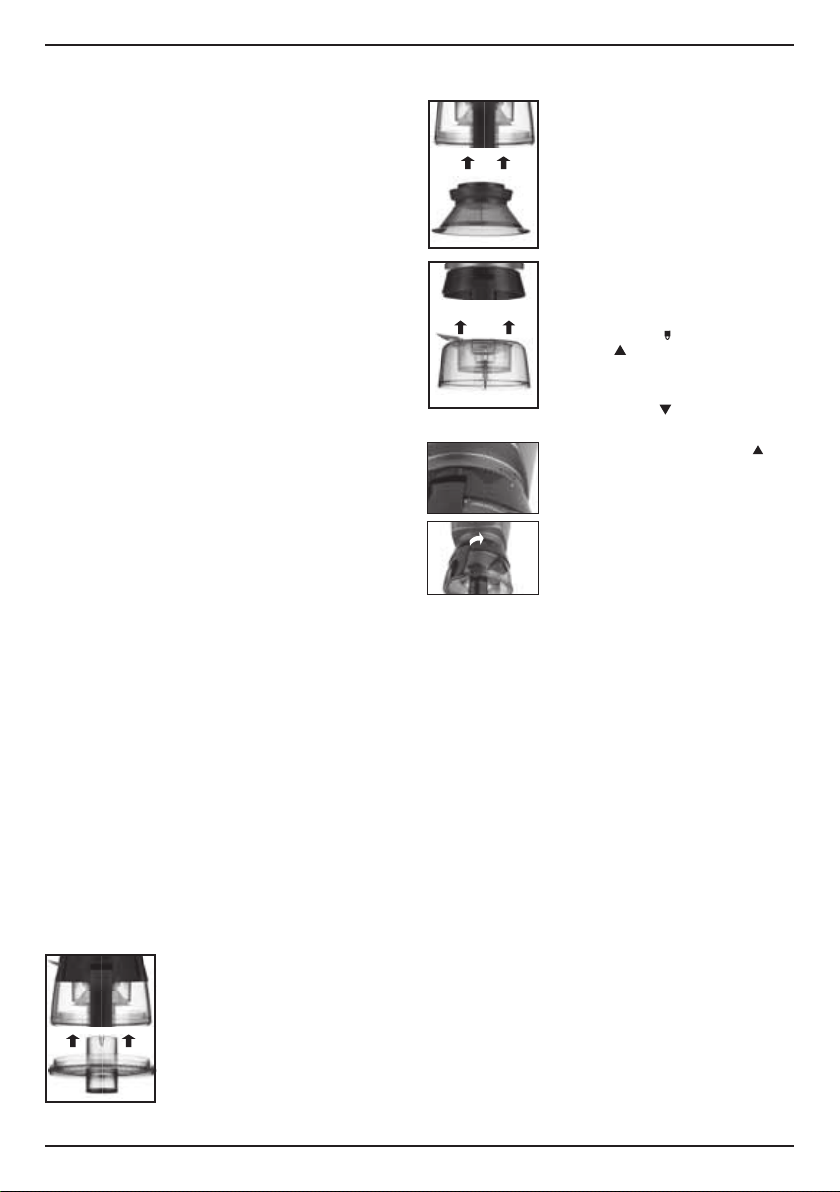
14
licuadora produce los resultados deseados en
tan solo segundos.
• No sobrellene la jarra. Si nota que el motor
está haciendo fuerza, apague el aparato y
saque una parte de los alimentos de la jarra.
• No introduzca ningún utensilio en la jarra
durante el funcionamiento.
• Nunca utilice piezas o accesorios no
aprobados por Cuisinart; esto puede causar
heridas.
• No introduzca las manos en la jarra mientras el
aparato está enchufado.
• No ponga líquidos hirvientes ni alimentos
congelados (excepto hielo o pedacitos de fruta
congelada de no más de ½ pulgada/1.5cm)
en la jarra. Permita que los líquidos hirvientes
se enfríen por 5 minutos antes de verterlos en
la jarra. Quite el tapón medidor.
• No encienda el aparato si la jarra está vacía.
ENSAMBLAJE DEL
EXTRACTOR DE JUGO
ENSAMBLAJE DEL ADITAMENTO
EXTRACTOR DE JUGO
SOBRE LA BASE
1. Coloque el bloque-motor sobre
una superficie llana y resistente,
limpia y seca. Coloque la base
del extractor de jugo sobre el
bloque-motor, con la ranura
del pico vertedor a mano
derecha. Haga coincidir la flecha blanca en
el borde inferior de la base del
extractor de jugo con la flecha
en la orilla del bloque-motor.
Para bloquear la base, gírela
en sentido horario hasta que
la flecha coincida con
la marca en la orilla del
bloque-motor.
2. Coloque el bol de plástico
transparente en la base,
alineando el pico vertedor con
la ranura.
3. Con cuidado, sostenga el
colador por la orilla y, usando
ambas manos, colóquelo en el
centro del bol. Gírelo despacio,
presionando suavemente hacia abajo, hasta
que caiga en su lugar.
Empuje firmemente hacia
abajo para asegurar.
4. Cierre la tapa.
5. Alce los brazos de sujeción de
manera que agarren la tapa,
y presione hacia abajo para
bloquearlos.
6. Introduzca el empujador en la
boca de alimentación de la tapa.
CONEXIÓN DEL ADITAMENTO
EXTRACTOR DE JUGO
ENSAMBLADO A LA BASE
1. Si guarda el extractor de jugo ensamblado,
primero alce los brazos de sujeción para
soltarlos de la tapa.
2. Coloque el aditamento extractor de jugo
(ensamblado) sobre el bloque-motor, con el
pico vertedor a mano derecha, y la marca en la
base del extractor de jugo un poco por delante
de la marca en el bloque-motor.
3. Con la base del extractor de jugo asentada
firmemente en el eje del motor, gire el conjunto
completo en sentido horario para bloquearlo
en su lugar (las flechas quedarán alineadas y
el conjunto dejará de girar).
4. Alce los brazos de sujeción de manera que
agarren la tapa, y presione hacia abajo para
bloquearlos.
INSTRUCCIONES DE OPERACIÓN
1. Presione el pico vertedor hacia abajo para
ponerlo en la posición “abierto” y coloque un
recipiente bajo el mismo para recolectar el
jugo.
2. Lave las frutas y los vegetales antes de hacer
jugo.
3. Introduzca las frutas o los vegetales pequeños
directamente en la boca de alimentación;
corte las frutas o los vegetales de más de 2¾
pulgadas (7 cm) de diámetro.
4. Ponga la perilla de control en “LOW” (bajo)
para empezar.
5. Retire el empujador de la boca de
alimentación e introduzca los alimentos en
esta. Vuelva a colocar el empujador en la boca
de alimentación y presione firmemente para
empujar los alimentos hacia el colador.
6. El jugo fluirá a través del pico; la pulpa colada

13
de que está bien apretado.
NOTA: las cuchillas son muy afiladas;
manipúlelas con mucho cuidado.
CONSEJOS ÚTILES
• Para agregar ingredientes sin apagar la
licuadora, simplemente quite el tapón medidor
y agregue los ingredientes por la abertura en la
tapa.
• La licuadora siempre debe tener la tapa puesta
durante el funcionamiento.
• Advertencia: nunca coloque/retire la jarra de
la base mientras el motor está encendido.
• Retire la jarra de la base y vacíela antes de
sacar el juego de cuchillas.
• Nunca introduzca las manos en la jarra
mientras el aparato está enchufado.
• No ponga líquido muy caliente o alimentos
congelados (excepto hielo o pedacitos de fruta
congelada de no más de ½ pulgada/1.5cm)
en la jarra.
• No ponga líquidos o alimentos muy fríos en la
jarra después de sacarla del lavavajillas.
• No ponga líquidos o alimentos muy calientes
en la jarra después de sacarla del congelador.
Permita que los líquidos hirvientes se enfríen
por 5 minutos antes de verterlos en la jarra.
Quite el tapón medidor.
• Limpie la unidad antes del primer uso,
según se describe en la sección “Limpieza,
almacenaje y mantenimiento”.
REGLAS BÁSICAS
SIEMPRE HAGA ESTO
• Cerciórese de que la tensión de la red (el
voltaje de la toma de corriente) corresponde al
voltaje indicado debajo de la base del aparato.
• Siempre coloque la licuadora en una superficie
seca, limpia y segura.
• Siempre agregue los ingredientes líquidos
antes de los ingredientes sólidos; Esto
producirá resultados más homogéneos.
• Corte los alimentos grandes en pedacitos de
½ a 1 pulgada (1.5 a 2.5 cm); esto producirá
resultados más uniformes. Corte el queso en
pedacitos de ½ pulgada (1.5 cm) o menos.
• Utilice el tapón medidor para medir los
ingredientes líquidos, tales como licor.
Recuerde regresar el tapón medidor en la tapa
después de haber agregado los ingredientes.
• Apague el aparato antes de raspar la jarra o
desalojar alimentos trabados en las cuchillas.
Utilice una espátula de plástico o de caucho
únicamente. Nunca utilice utensilios de
metal, los cuales podrían dañar la jarra o las
cuchillas.
• Cierre firmemente la tapa antes de encender
la licuadora. No encienda el aparato a menos
que la tapa esté debidamente puesta.
• Asegúrese de que el juego de cuchillas está
debidamente sujetado a la jarra.
Cerciórese de que el anillo de sello está
colocado en la base de las cuchillas antes de
insertar esta en la jarra. Después de insertar la
base de las cuchillas en el pie de la jarra, gire
en sentido antihorario hasta que
se bloquee.
• Siempre retire las cuchillas antes
de limpiar la jarra.
• Después de raspar la jarra
con una espátula, regrese los
alimentos encima de las cuchillas,
en el centro de la jarra.
• Asegúrese de que la jarra y las cuchillas están
completamente secas antes de picar hierbas,
ajo, cáscara de limón, pan, nueces, especias,
etc.
• Utilice la función de pulso para desalojar los
alimentos pegados a la jarra.
• Utilice pulsaciones cortas para pulsar. Permita
que las cuchillas se inmovilicen después de
cada pulsación.
NUNCA HAGA ESTO:
• No guarde alimentos/líquidos en la jarra de la
licuadora.
• Nunca instale las cuchillas por sí solas sobre
la base; el juego de cuchillas siempre debe
encontrarse en de la jarra.
• No utilice la licuadora para montar claras,
hacer puré de papas o amasar.
• No retire la jarra de la base durante el
funcionamiento.
Mantenga la tapa sobre la jarra durante el
funcionamiento.
• Para retirar la jarra de la base, no desenrosque
el anillo de bloqueo. Simplemente agarre la
jarra por el asa y álcela.
• No procese demasiado los alimentos. La
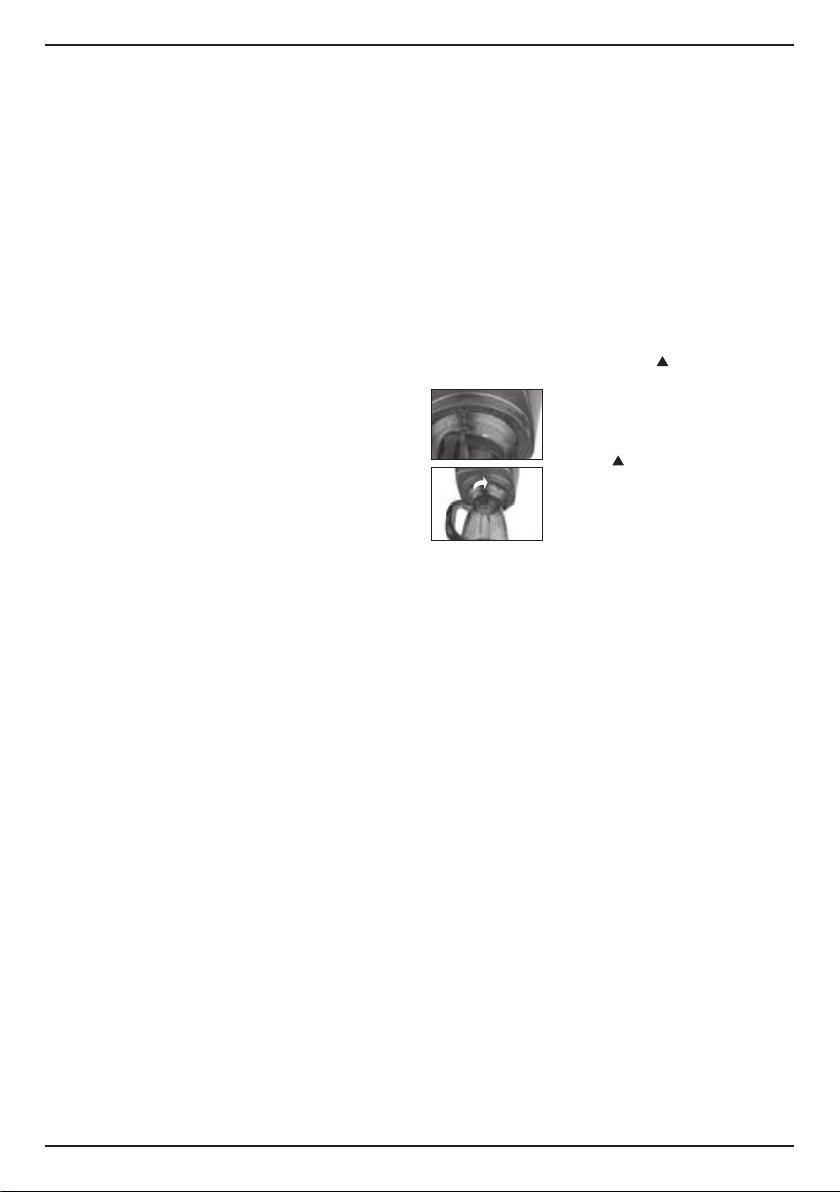
12
tiempo prolongado. En caso de que esto
suceda, desenchufe el aparato y permita que
se enfríe por 20 a 30 minutos.
3. Problema: El motor pierde velocidad durante
el uso.
Solución:
• Esto puede ocurrir cuando el motor hace
mucha fuerza (p. ej., al rebanar/triturar/
rallar queso). Simplemente reposicione los
alimentos en la boca de alimentación y siga
procesando.
• Puede que la cantidad de alimentos exceda
la capacidad máxima del bol. Saque una
parte de los ingredientes y siga procesando.
4. Problema: El aparato se mueve durante el uso
Solución:
•
Cerciórese de que los pies de caucho debajo de
la base están limpios y secos. También cerciórese
de que la cantidad de alimentos no excede la
capacidad máxima del bol
.
• Esto puede ocurrir cuando el motor hace
mucha fuerza p. ej., al rebanar/triturar
queso).
ENSAMBLAJE DE LA
LICUADORA
1. Coloque el bloque-motor
sobre una superficie llana
y resistente, limpia y seca.
Coloque la jarra en la base,
alineando la marca
abajo de la jarra con los
resaltos arriba del bloque-
motor. Para bloquear la jarra,
gírela en sentido horario hasta
que la marca coincida con la marca
arriba del bloque-motor.
2. Enchufe la unidad en una toma de corriente.
3. Coloque los ingredientes deseados en la
jarra y cierre la tapa, girándola en sentido
horario. Si desea agregar ingredientes
durante el licuado, quite el tapón medidor
y añada los ingredientes por la abertura en
la tapa. Siempre regrese el tapón medidor
en su puesto después de haber añadido los
ingredientes. Nunca introduzca las manos en
la jarra mientras el aparato está enchufado.
NOTA: agregue los ingredientes líquidos
primero, y luego los ingredientes sólidos.
Obtendrá resultados más rápidos y
homogéneos, sin cansar el motor.
4. Para licuar: Gire la perilla de control para elegir
la velocidad deseada: “HIGH” (alta) o “LOW”
(baja). La licuadora funcionará a la velocidad
elegida hasta que ponga la perilla en “OFF”
(apagado).
Para pulsar: ponga momentáneamente la
perilla de control en “PULSE”; repita hasta
obtener la consistencia deseada.
Para apagar la licuadora: simplemente ponga
la perilla en “OFF” (apagado).
Después de terminar: ponga la perilla de
control en “OFF” y desenchufe la unidad.
Espere hasta que las cuchillas estén
totalmente inmóviles antes de retirar la jarra de
la base. Para retirar la jarra de la base, gírela
en sentido antihorario, y levántela. Nunca
introduzca las manos en la jarra mientras el
aparato está enchufado.
NOTA: para quitar la tapa, gírela en sentido
antihorario. No la agarre por el tapón medidor.
Para desalojar alimentos trabados: Apague
(“OFF”) la licuadora. Utilice una espátula de
caucho o plástico para desalojar los alimentos
trabados en cuchillas. Importante: cerciórese
de apagar el aparato primero. Cierre la tapa,
cerciorándose de que el tapón medidor está
en su puesto, y vuelva a encender el aparato.
Cerciórese de que la espátula no haya
quedado en la jarra.
Para reiniciar el aparato: este aparato
está equipado con un dispositivo avanzado
de protección térmica que apaga
automáticamente el motor en caso de
sobrecalentamiento. En caso de que esto
suceda, desenchufe el aparato y permita que
se enfríe por 20 a 30 minutos. Luego, vacíe
parcialmente la jarra o suelte los alimentos
trabados. Vuelva a encender el aparato, según
se describe en las instrucciones de.operación.
NOTA: para quitar la tapa, agárrela por el
borde y álcela. No la agarre por el tapón
medidor.
DESENSAMBLE
1. Voltee la jarra y colóquelo sobre una superficie
plana y segura.
2. Gire el juego de cuchillas en sentido horario,
y levántelo para retirarlo.
3. Para volver a ensamblar la jarra, gire el juego
de cuchillas en sentido antihorario y cerciórese

11
alimentación con el lado cortado apuntando
hacia abajo.
• Procese, ejerciendo presión uniforme sobre
el empujador.
3. Problema: Los alimentos no se mantienen
rectos en la boca de alimentación.
Solución:
• Apretuje los alimentos en la boca de
alimentación.
4.
Problema: Quedan pedazos de alimento
arriba del disco.
Solución:
• Esto es normal; corte los pedazos a mano.
PROBLEMAS AL AMASAR
1. Problema: El motor pierde velocidad.
Solución:
• Puede que la cantidad de masa exceda
la capacidad máxima. Divida la masa en
dos porciones y amase cada porción por
separado.
• Puede que la masa sea demasiado seca
(ver “La masa está demasiado seca” a
continuación).
2.
Problema: La cuchilla no incorpora los
ingredientes.
Solución:
• Siempre ponga la procesadora en marcha
antes de agregar líquido. Vierta el líquido
lentamente por el orificio en el empujador,
para permitir que los ingredientes secos lo
absorban. Si el líquido salpica o chapotea
al añadirlo, esto significa que lo ha añadido
demasiado rápido. Deje que los ingredientes
secos lo absorban antes de agregar más.
Vierta el líquido por la boca de alimentación,
en el momento preciso en que la masa
pasa bajo esta; procure no verter el líquido
directamente en el fondo del bol.
3. Problema: La cuchilla no permanece en el
fondo del bol.
Solución:
• Esto puede pasar si la masa está demasiado
pegajosa. Con cuidado, presione la cuchilla
hacia abajo y agregue inmediatamente 2
cucharadas (15 g) de harina por la boca
de alimentación mientras la máquina está
encendida.
4. Problema: La masa no deja el bol limpio
Solución:
• Puede que la cantidad de masa exceda
la capacidad máxima. Divida la masa en
dos porciones y amase cada porción por
separado.
• Puede que la masa sea demasiado seca
(ver “La masa está demasiado seca” a
continuación).
• Puede que la masa sea demasiado húmeda
(ver “La masa está demasiado húmeda” a
continuación).
5.
Problema: La masa se enreda en la cuchilla y
no está homogénea.
Solución:
• Apague la máquina y saque cuidadosamente
la masa. Divida la masa en tres porciones y
disponga estas uniformemente en el fondo
del bol; siga amasando.
6. Problema: La masa parece dura.
Solución:
• Divida la masa en 2 o 3 porciones y disponga
estas uniformemente en el fondo del bol.
Amase por 10 segundos, o hasta obtener una
masa suave y homogénea.
7. Problema: La masa está demasiado seca.
Solución:
• Encienda la máquina y agregue agua, 1
cucharada a la vez, hasta que la masa deje el
bol limpio.
8. Problema: La masa está demasiado húmeda.
Solución:
• Encienda la máquina y agregue harina, 1
cucharada a la vez, hasta que la masa deje el
bol limpio.
Problemas técnicos
1. Problema: El motor no se enciende.
Solución:
• Un sistema de seguridad impide que el motor
se encienda a menos que la unidad esté
debidamente ensamblada. Cerciórese de que
el bol y la tapa están firmemente asegurados.
• Si esto no soluciona el problema, inspeccione
el cable y la toma de corriente.
2. Problema: El aparato se apaga durante el uso.
Solución:
• Asegurarse de que la tapa está bien cerrada.
• Un interruptor de seguridad apaga
automáticamente en motor en caso de
sobrecalentamiento, lo que puede ocurrir
cuando procesa mezclas espesas por un

10
perilla en “OFF”.
Función de pulso
La función de pulso permite prender
momentáneamente el motor al colocar la perilla de
control en “PULSE”. La función de pulso permite
obtener resultados más homogéneos y evita
procesar excesivamente los ingredientes. Salvo
indicación contraria en la receta, utilice pulsaciones
cortas de un segundo.
• Ensamble el aparato según se describió en
las instrucciones de ensamblaje, coloque los
ingredientes en el bol y ponga la perilla de control
en “PULSE”.
Para pulsar:
ponga momentáneamente la perilla
de control en “PULSE”; repita hasta obtener la
consistencia deseada.
FUNCIONES
USOS DE LA CUCHILLA PICADORA/
MEZCLADORA/AMASADORA
Picar
• Alimentos crudos: pele las frutas y los vegetales,
y quite las partes duras (corazón, pepas, semillas,
huesos, etc.). Corte los alimentos en pedazos
de ½ a 1 pulgada (1.5 a 2.5cm). Obtendrá
resultados más homogéneos con pedazos del
mismo tamaño.
• Procese con la función de pulso, usando
pulsaciones de 1 segundo, hasta obtener la
consistencia deseada. Para obtener una textura
más fina, mantenga la perilla en “PULSE” o
colóquela en “HIGH” (alto) o “LOW” (bajo)
para procesar continuamente. Compruebe la
consistencia a menudo y raspe el bol con una
espátula si es necesario. Se recomienda usar la
velocidad baja (“LOW”) para procesar masas y
mezclas. Se recomienda usar la velocidad alta
(“HIGH”) para picar, procesar, rebanar, rallar,
triturar, etc.
Hacer puré
• Puré de frutas/vegetales crudos o cocinados:
corte los ingredientes en pedazos 1 pulgada
(2.5cm). Obtendrá resultados más homogéneos
con pedazos del mismo tamaño. Pulse para picar
grueso, y luego procese continuamente, usando
la velocidad alta (“HIGH”) o baja (“LOW”), hasta
obtener puré; raspe el bol si es necesario. Nota:
NO utilice este método para hacer puré de
papas.
• Para preparar cremas o salsas de vegetales:
cuele la sopa, reservando el líquido, y licue
solamente los vegetales. Después, agregue un
poco del caldo y siga procesando.
USOS DE LOS DISCOS
REBANADORES/RALLADORES
REVERSIBLES
• El disco rebanador corta rodajas/tajadas/
rebanadas uniformes. Es ideal para cortar en
rodajas frutas, vegetales y carne cocinada, cruda
o semicongelada. El disco triturador es capaz de
triturar la mayoría de los quesos firmes y duros.
También puede usarse para triturar alimentos tales
como papas, zanahorias y calabacines/calabacitas.
• Para obtener resultados homogéneos, apretuje
los alimentos en la boca de alimentación. La
presión necesaria dependerá de la consistencia de
los alimentos. Ejerza presión ligera para rebanar
alimentos suaves, presión moderada para rebanar
alimentos firmes, y presión firme para rebanar
ingredientes duros. Siempre ejerza presión
uniforme.
• Para cortar frutas/vegetales en rodajas: corte la
extremidad inferior de la fruta o del vegetal, e
este en la boca de alimentación, el lado cortado
primero. Si no cabe, córtelo a la mitad o en cuartos.
Procese, ejerciendo presión uniforme.
• Para rebanar alimentos pequeños, tales como
champiñones, rábanos o fresas: corte ambas
extremidades de la fruta/hortaliza e introduzca esta
verticalmente en la boca de alimentación.
• Refrigere o congele brevemente el queso antes de
rebanar o rallarlo.
• Para triturar/rallar col, lechuga y otras hortalizas
de hoja: forme un rollo de hojas e introduzca este
verticalmente en la boca de alimentación. Procese,
ejerciendo presión uniforme.
NOTA: siempre use el empujador para empujar
los alimentos; nunca introduzca los dedos en la
boca de alimentación durante el funcionamiento
RESOLUCIÓN DE
PROBLEMAS
PROBLEMAS AL PICAR/REBANAR/
TRITURAR
1. Problema: Los alimentos picados no son
uniformes.
Solución:
• Cortar los alimentos en pedazos uniformes
de ½a 1 pulgada (1.5 a 2.5 cm) antes de
procesarlos.
• No sobrellene el bol.
2. Problema: Las rebanadas no son uniformes o son
sesgadas.
Solución:
• Coloque los alimentos en la boca de
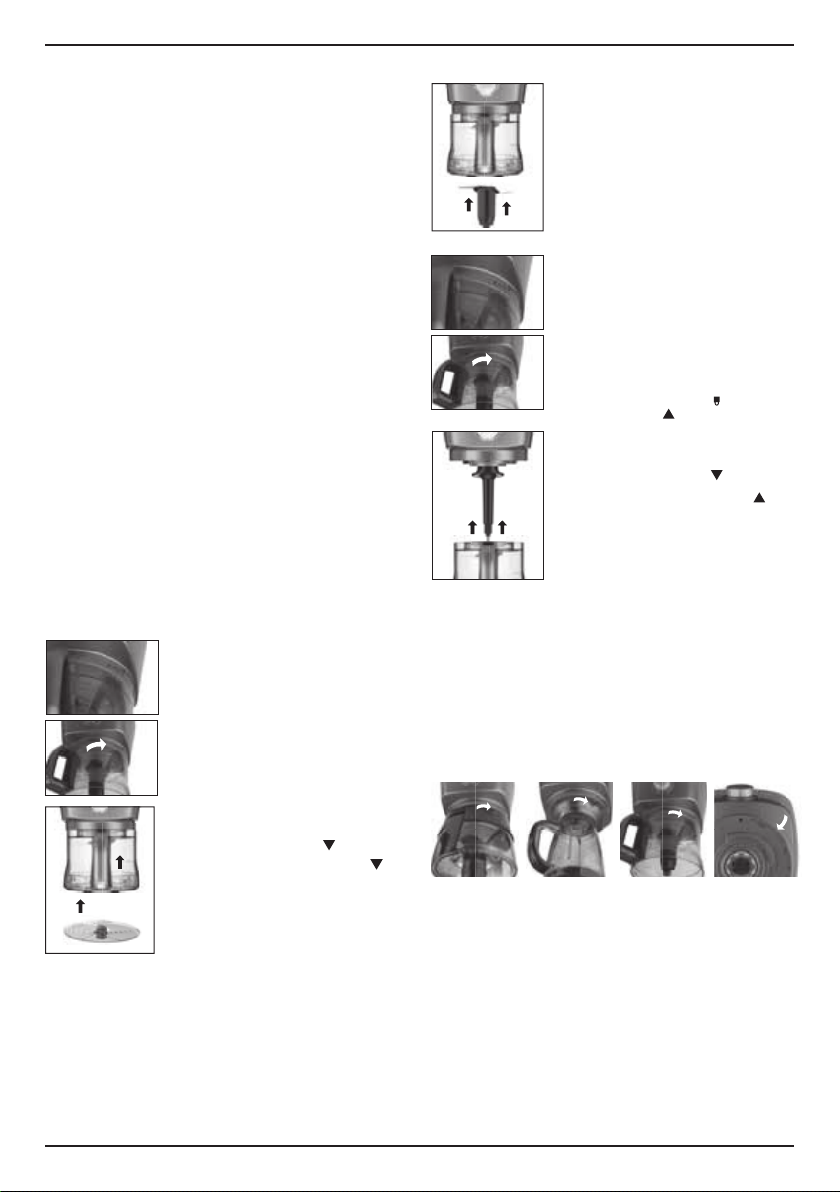
9
INSTRUCCIONES DE
ENSAMBLAJE
Antes del primer uso
Antes de usar su Cuisinart
®
Kitchen Central por
primera vez, lave todas las piezas. Coloque la
base en una superficie nivelada y seca, con los
controles hacia usted. No enchufe el aparato
hasta que esté completamente ensamblado.
*Para su conveniencia, la base y los accesorios/
aditamentos tienen “patas” claras y/o indicadores
visibles para facilitar el montaje y desmontaje de
todas las piezas.
ENSAMBLAJE DE LA
PROCESADORA DE
ALIMENTOS
CUCHILLA PICADORA/
MEZCLADORA/AMASADORA
1. Coloque el adaptador
removible en el bloque-motor.
2. Deslice el bol por encima del
adaptador, alineando la flecha
en la base del bol con la
flecha en la orilla del bloque-
motor. Para bloquear el bol,
gírelo en sentido horario hasta
que la flecha coincida con la
marca en la orilla del bloque-
motor.
3. Sosteniendo la cuchilla por
el eje de plástico, colóquela
cuidadosamente sobre el
adaptador removible. Gire
la cuchilla hasta que quede
ajustada y descanse en el
fondo del bol.
4. Enchufe la unidad en una toma
de corriente.
5. Coloque los ingredientes
deseados en el bol.
6. Coloque la tapa sobre el bol,
con la boca de alimentación
ligeramente a la derecha del
centro. Gire en sentido horario para sujetar.
7. Introduzca el empujador en la boca de
alimentación en la tapa del bol.
8. El aparato está listo.
DISCOS REBANADORES/
TRITURADORES
REVERSIBLES
1. Coloque el adaptador
removible en el bloque-motor.
2. Deslice el bol por encima del
adaptador, alineando la marca
en la base del bol con la
marca en la orilla del bloque-
motor. Gire el bol en sentido
horario, más allá de la marca
“LOCK”, para bloquearlo en
su lugar.
3. Elija el disco deseado.
4. Sosteniendo el disco por
la orilla externa, colóquelo
cuidadosamente sobre el
adaptador, con el lado que
desea usar apuntado hacia
arriba.
5. Coloque la tapa sobre el bol, con la boca de
alimentación ligeramente a la derecha del
centro. Gire en sentido horario para sujetar.
6. Introduzca el empujador en la boca de
alimentación en la tapa del bol.
7. Enchufe la unidad en una toma de corriente.
8. El aparato está listo.
CONTROLES
Perilla de control con 4 opciones: “PULSE”
(pulso), “OFF” (apagado), “LOW” (bajo) y
“HIGH” (alto)
Los controles “HIGH” y “LOW” hacen funcionar
la máquina a velocidad alta o baja hasta que la
apague, poniendo la perilla de control en “OFF”.
1. Ensamble el aparato según se describió en las
instrucciones de ensamblaje.
2. Coloque los ingredientes en el bol o
introdúzcalos en la boca de alimentación.
Nota: si usa un disco, debe introducir los
alimentos en la boca de alimentación.
3. Gire la perilla de control para elegir la
velocidad deseada: “HIGH” (alta) o “LOW”
(baja). La máquina funcionará a la velocidad
elegida hasta que la apague, poniendo la
Base
Procesadora
de alimentos
Accesorio
licuador
Extractor
de jugo
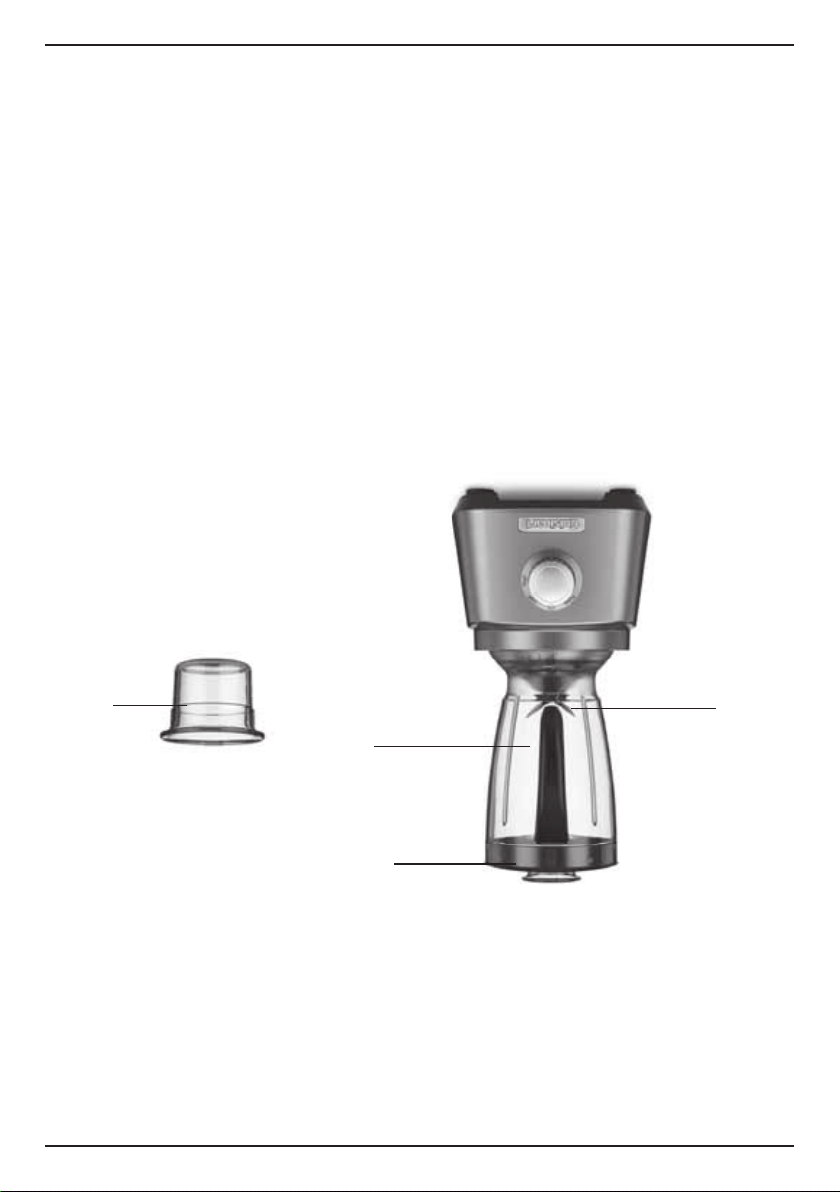
8
LICUADORA
1. Tapa de la licuadora
2. Tapón medidor
3. Resistente jarra de plástico de 40 onzas (1.2 L)
4. Cuchillas de acero inoxidable patentadas de
alta calidad
NOTA: LAS CUCHILLAS SON MUY AFILADAS;
MANIPÚLELAS CON MUCHO CUIDADO.
3.
1.
4.
2.
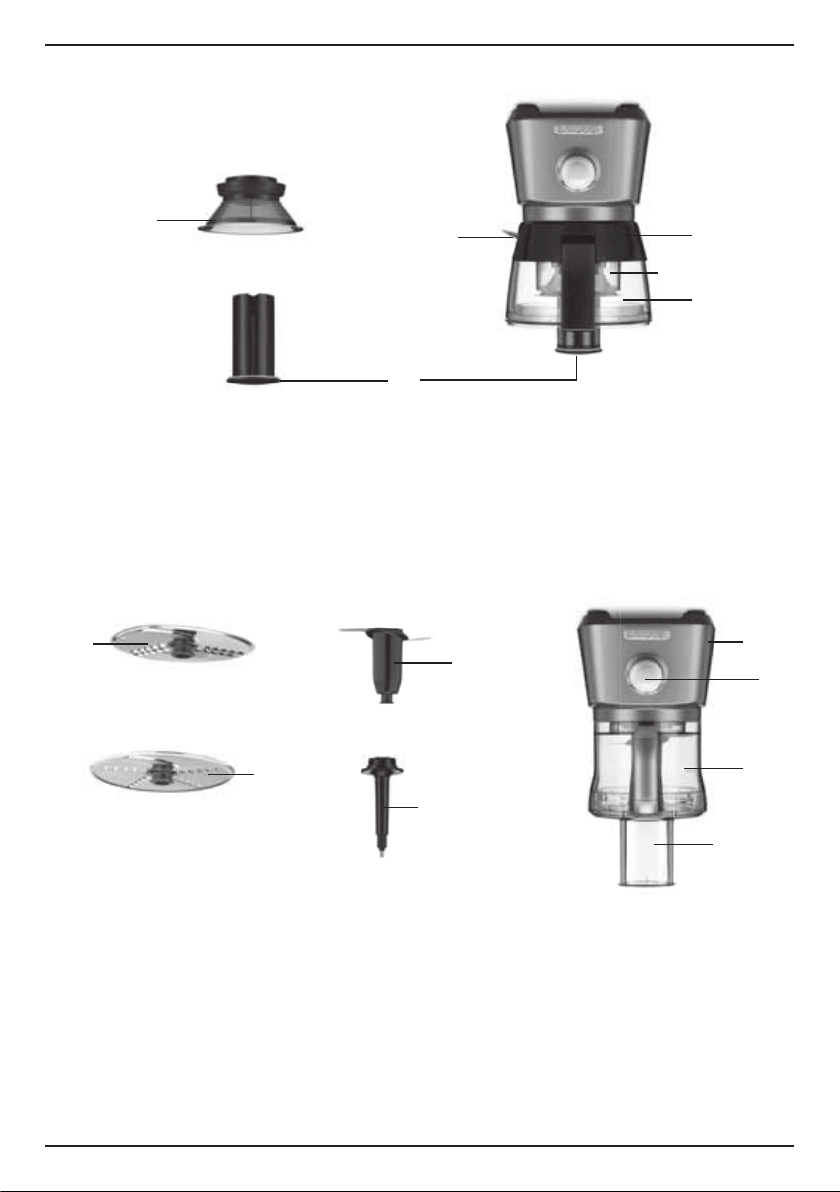
7
8.
7.
PIEZAS
PROCESADORA DE ALIMENTOS
1. Bloque-motor
2. Perilla de control con cuatro opciones:
“PULSE” (pulso), “OFF” (apagado),
“HIGH” (alto) y “LOW” (bajo)
3. Bol de 8 tazas (1.9 L)
4. Tapa con boca de alimentación y empujador
5. Adaptador removible
6. Cuchilla picadora/mezcladora/amasadora de
metal
7. Disco rebanador/triturador reversible fino
8. Disco rebanador/triturador reversible medio
9. Sin BPA (no ilustrado)
Ninguna de las piezas en contacto con los
alimentos/líquidos contiene bisfenol A (BPA).
6.
EXTRACTOR DE JUGO
1. Tapa con boca de alimentación y empujador
2. Colador
3. Recolector de jugo transparente
4. Pico antigoteo
5. Compartimiento del colador
6. Base con brazos de sujeción
2.
3.
4.
5.
1.
1.
3.
6.
4.
2.
5.
ADVERTENCIA
RIESGO DE INCENDIO O DESCARGA ELÉCTRICA
NO LO ABRA
ADVERTENCIA PARA REDUCIR EL RIESGO DE DESCARGA ELÉCTRICA,
NO DESARME LA CARCASA DEL APARATO.
ESTE APARATO NO CONTIENE NINGUNA PIEZA QUE PUEDA SER REPARADA/
CAMBIADA POR EL USUARIO.
LAS REPARACIONES DEBEN SER EFECTUADAS POR TÉCNICOS
AUTORIZADOS SOLAMENTE.
6
ADVERTENCIA: RIESGO
DE INCENDIO O
DESCARGA ELÉCTRICA
El símbolo de relámpago con punta de
flecha dentro de un triángulo equilátero
tiene como fin alertar al usuario de
la presencia de voltajes peligrosos
no aislados en el interior del aparato,
los cuales pueden ser de suficiente
magnitud para constituir un riesgo de
incendio o descarga eléctrica.
El signo de exclamación dentro de
un triángulo equilátero tiene como fin
alertar al usuario de la presencia de
instrucciones importantes de operación
y mantenimiento (servicio) en la
documentación acompaña al equipo.
ÍNDICE
Instrucciones de desembalaje ............ 3
Medidas de seguridad importantes ......4
Piezas ....................................................7
Instrucciones de ensamblaje
generales ...............................................9
Ensamblaje de la procesadora
de alimentos ..........................................9
Resolución de problemas ...................10
Ensamblaje de la licuadora .................12
Ensamblaje del extractor de jugo .......14
Resolución de problemas ...................15
Limpieza, almacenaje y
mantenimiento ................................... 15
Consejos de uso de la procesadora
alimentos .............................................17
Consejos de uso de la
licuadora ....................................... 18–19
Consejos de uso del extractor
de jugo ..........................................20–21
Recetas ...............................................22
Garantía ...............................................58

5
descarga eléctrica o una herida, o dañar el
aparato.
20. Para evitar un posible mal funcionamiento
del interruptor del aparato, nunca guarde
el aditamento procesador o el aditamento
extractor de jugo en la base, con la tapa
puesta y en posición bloqueada.
21. Para evitar el riesgo de lesiones o daños al bol
o a la tapa, no llene el bol de la procesadora
de alimentos por encima de la línea de llenado
máximo.
22. No toque ni interfiere con el movimiento de las
cuchillas de la licuadora, y no retire la tapa de
la jarra durante el funcionamiento.
23. Para reducir el riesgo de heridas, nunca
coloque las cuchillas licuadoras sobre la base
sin que la jarra esté debidamente ajustada.
Para fijar el juego de cuchillas a la jarra, gírelo
para asegurarlo firmemente en su lugar; las
cuchillas pueden provocar heridas graves si
quedan al descubierto por accidente.
24. No encienda la licuadora a menos que la tapa
esté debidamente puesta.
25. Nunca descuide/deje la licuadora sin vigilancia
durante el uso.
26. Cuando licue líquidos calientes, quite el tapón
medidor de la tapa de la jarra licuadora a fin de
permitir que el vapor se escape.
27. Cuando utilice el extractor de jugo, asegúrese
de que la tapa está bien colocada y en su
lugar antes de encender el motor. No abra la
tapa durante el funcionamiento.
28. No introduzca los dedos ni ningún objeto en la
boca de alimentación mientras el aparato está
enchufado. Si alimentos quedan atascados
en esta, empújelos con el empujador o con
otra fruta/vegetal, o apague el aparato y
desensamble la unidad.
29. No utilice el extracto de jugo si el colador de
malla o la cuchilla están dañados.
30. Asegúrese siempre de que la tapa del
extractor de jugo está bien colocada y
asegurada antes de encender la unidad. El
mecanismo de bloqueo de seguridad impedirá
que la unidad se ponga en marcha si tapa no
está bien cerrada. No afloje ni abra la tapa
durante el uso.
31. Nunca haga funcionar el aparato con el pico
en la posición cerrada.
GUARDE ESTAS
INSTRUCCIONES
PARA USO
DOMÉSTICO
SOLAMENTE
AVISO:
El cable de este aparato cuenta con un enchufe
polarizado (una pata es más ancha que otra).
Como medida de seguridad, aquel enchufe se
podrá enchufar de una sola manera en las tomas
de corriente polarizadas. Si el enchufe no entra en
la toma de corriente, inviértelo. Si aun así no entra
completamente, comuníquese con un electricista.
No intente modificarla.
USO DE
EXTENSIONES
El cable provisto con este aparato es corto, para
reducir el riesgo de que alguien se enganche o
tropiece con un cable más largo. Se podrá usar
una extensión eléctrica, pero con cuidado. La
clasificación nominal de la extensión debe ser
por lo menos igual a la del aparato. El cable más
largo o la extensión deben ser acomodados de
tal manera que no cuelguen de la encimera/mesa,
donde pueden ser jalados por niños o causar
tropiezos.

4
MEDIDAS DE
SEGURIDAD
IMPORTANTES
Al usar aparatos eléctricos, especialmente
en presencia de niños, siempre debe tomar
precauciones básicas de seguridad, entre ellas las
siguientes:
1. Lea todas las instrucciones.
2. Las cuchillas y los discos son muy afilados;
manipúlelas con sumo cuidado.
3. Siempre desenchufe el aparato cuando no
esté en uso, antes de instalar/sacar piezas,
antes de vaciar el bol y antes de limpiarlo.
Para desenchufar, agarre el enchufe y jálelo
para sacarlo de la toma de corriente; nunca
jale el cable.
4. No lo utilice en exteriores.
5. No permita que el cable cuelgue del borde
de la encimera o de la mesa, ni que tenga
contacto con superficies calientes.
6. No utilice este aparato si el cable o el enchufe
están dañados, si no funciona correctamente,
si está dañado, o después de que se haya
caído, incluso en el agua; Llame al 1-800-726-
0190 (en los EE.UU.) para obtener información
sobre cómo hacer revisar, reparar o ajustar
el aparato. regréselo a un centro de servicio
autorizado para su revisión, reparación o
ajuste.
7. Los niños o las personas que carezcan de la
experiencia o de los conocimientos necesarios
para manipular el aparato, o aquellas cuyas
capacidades físicas, sensoriales o mentales
estén limitadas, no deben utilizar el aparato sin
la supervisión o la dirección de una persona
responsable por su seguridad. Supervise el uso
de este aparato cuidadosamente cuando sea
usado por o cerca de niños. No permita que los
niños jueguen con este aparato.
8. Apague (“OFF”) y desenchufe el aparato
cuando no esté en uso, antes de instalar/
sacar piezas y antes de limpiarlo. Para
desenchufar, agarre el enchufe y jale de la
toma de corriente. Nunca jale el cable.
9. Para reducir el riesgo de descarga eléctrica,
no coloque la base del aparato en agua ni en
ningún otro líquido.
10. No haga funcionar el aparato debajo o
dentro de un armario/gabinete. Siempre
desenchufe el aparato antes de guardarlo
en un armario/gabinete. Dejar el aparato
enchufado representa un riesgo de incendio,
especialmente si este toca las paredes o la
puerta del armario/gabinete cuando cierra.
11. Para reducir el riesgo de herida grave o de
daño al aparato, mantenga las manos y los
utensilios lejos de las cuchillas o de los discos
durante el funcionamiento.
Se puede usar espátula de goma, siempre que
el aparato esté apagado.
12. Evite el contacto con las piezas móviles.
Nunca introduzca la mano en la boca de
alimentación de la procesadora de alimentos
o del extracto de jugo. siempre use el
empujador.
13. Espere hasta que el motor se haya detenido
por completo antes de sacar la tapa. Si el
motor no se detiene dentro de 4 segundos
después de apagar la unidad, desenchufe
el aparato y llame al 1-800-762-0190 para
asistencia. No utilice el aparato.
14. Para evitar el riesgo de lesiones, nunca guarde
la cuchilla ni los discos de la procesadora de
alimentos en el eje del motor. Puede dejar la
cuchilla/el disco en el eje del motor solamente
cuando el bol está bloqueado y la procesadora
de alimentos está en uso. La cuchilla y los
discos de la procesadora de alimentos y los
dientes en el fondo del colador del extractor
de jugo son muy afilados y deben guardarse
fuera del alcance de los niños.
15. Cerciórese de que la tapa del procesador de
alimentos y la tapa del extractor de jugo están
bien fijadas en su sitio, de que la tapa de la
licuadora está bien cerrada antes de usar el
aparato.
16. No intente forzar/alterar el mecanismo de
enclavamiento/bloqueo de seguridad de las
tapas.
17. No utilice este aparato bajo el efecto del
alcohol u otra sustancia que afecte su tiempo
de reacción o su percepción.
18. Este aparato está homologado por cULus para
uso doméstico. Utilícelo únicamente con el
propósito para el cual fue diseñado, según se
describe en este manual de instrucciones y
libro de recetas.
19. El uso de accesorios no recomendados o
vendidos por Cuisinart, incluso frascos para
conservas, puede provocar un incendio, una

3
IMPORTANTES
INSTRUCCIONES
DE DESEMBALAJE
Esta caja contiene la procesadora de alimentos
multifunción CFP-800 de Cuisinart
®
, con un
paquete de discos, un aditamento licuador de
tamaño estándar y un aditamento exprimidor
de jugo, cada uno ensamblado y en su propio
compartimento moldeado.
PIEZAS Y ACCESORIOS
• Aditamento procesador de 8 tazas (1.9 L)
con tapa con boca de alimentación, cuchilla
picadora/mezcladora de metal, discos
rebanadores/trituradores reversibles, y
adaptador removible
• Aditamento licuador de 40 onzas (1.2 L) con
tapa con tapón medidor
• Aditamento extractor de jugo con base,
recolector de jugo transparente, colador de
malla, depósito de pulpa de 0.7 L, tapa y
empujador
• Manual de instrucciones/libro de recetas
PRECAUCIÓN: TODAS LAS HERRAMIENTAS
DE CORTE SON MUY AFILADAS. Para evitar
lesiones al desembalar las piezas, nunca toque
los filos de las cuchillas o de los discos.
• Coloque la caja de lado en una mesa baja o en
el suelo cerca de la encimera, o donde quiera
guardar el aparato.
• Abra las solapas superiores; notará dos
bandejas moldeadas. Deslícelas hacia afuera,
levante la bandeja superior y póngala a un
lado.
• Saque el manual de instrucciones/libro de
recetas.
• Levante el bloque-motor y colóquelo en una
superficie plana y resistente.
• Saque la procesadora de alimentos y el
paquete de discos.
• Saque la licuadora.
• Saque el extractor de jugo.
• Saque todas las piezas de las bolsas de
plástico.
• Guarde las cajas de envío y todo el material
de embalaje; pueden resultar útil para volver
a empaquetar el aparato cuando se muda o
necesita enviarlo por correo.
• NOTA: le aconsejamos que llene el formulario
de registro disponible en www.cuisinart.com
a fin de facilitar la verificación de la fecha de
compra original.

2
ALIMENTO CAPACIDAD
Frutas/vegetales/queso rebanados o triturados 8 tazas
Frutas/vegetales/queso picados 2 tazas
Frutas/vegetales/queso molidos 3 tazas (volumen procesado: 1½ tazas)
Carne, pescado o mariscos picados o molidos ¾ de libra (340 g)
Líquidos fluidos (p. ej., aderezo, sopa, etc.) 4 tazas (945 ml)
Mezcla de pastel Mezcla para una tarta de queso de 8 pulgadas (20 cm); 15.25 onzas (450 ml)
de mezcla preparada.
Galletas 2½ docenas (receta de galletas de chispas de chocolate)
Pan blanco/Masa de pizza 2½ tazas (310 g) de harina común o 2½ tazas (335 g) harina para hacer pan
Mantequilla de fruto seco (p. ej., maní) 2 tazas (580 g)
CAPACIDAD DEL ADITAMENTO PROCESADOR
Cuisinart
®
Kitchen Central
Serie CFP-800
Para su seguridad y para disfrutar plenamente de este producto, siempre lea cuidadosamente las instrucciones
antes de usarlo.
MANUAL DE
INSTRUCCIONES
Y LIBRO DE
RECETAS DE
INSTRUCCIONES