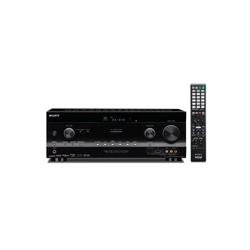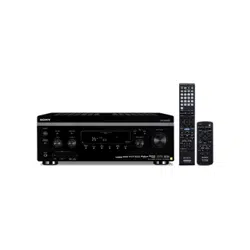

model name1[STR-DA3500ES]
[4-144-907-13(1)]
filename[D:\NORM'S JOB\SONY HA\SO0056\STR-DA3500ES\U VERSION\US\4144907131\01US-
STRDA3500ESUC\010COV.fm]
masterpage:Right
©2009 Sony Corporation
4-144-907-13(1)
Multi Channel AV
Receiver
Operating Instructions
STR-DA3500ES
2
US
D:\NORM'S JOB\SONY HA\SO0056\STR-DA3500ES\U VERSION\US\4144907131\01US-
STRDA3500ESUC\020REG.fm4-144-907-13(1)
masterpage: Left
STR-DA3500ES
4-144-907-13(1)
To reduce the risk of fire or electric
shock, do not expose this apparatus to
rain or moisture.
To reduce the risk of fire, do not cover the ventilation
opening of the apparatus with newspapers,
tablecloths, curtains, etc. Do not place the naked
flame sources such as lighted candles on the
apparatus.
Do not install the appliance in a confined space, such
as a bookcase or built-in cabinet.
To reduce the risk of fire or electric shock, do not
expose this apparatus to dripping or splashing, and
do not place objects filled with liquids, such as
vases, on the apparatus.
As the main plug is used to disconnect the unit from
the mains, connect the unit to an easily accessible
AC outlet. Should you notice an abnormality in the
unit, disconnect the main plug from the AC outlet
immediately.
Do not expose batteries or apparatus with battery-
installed to excessive heat such as sunshine, fire or
the like.
The unit is not disconnected from the mains as long
as it is connected to the AC outlet, even if the unit
itself has been turned off.
Excessive sound pressure from earphones and
headphones can cause hearing loss.
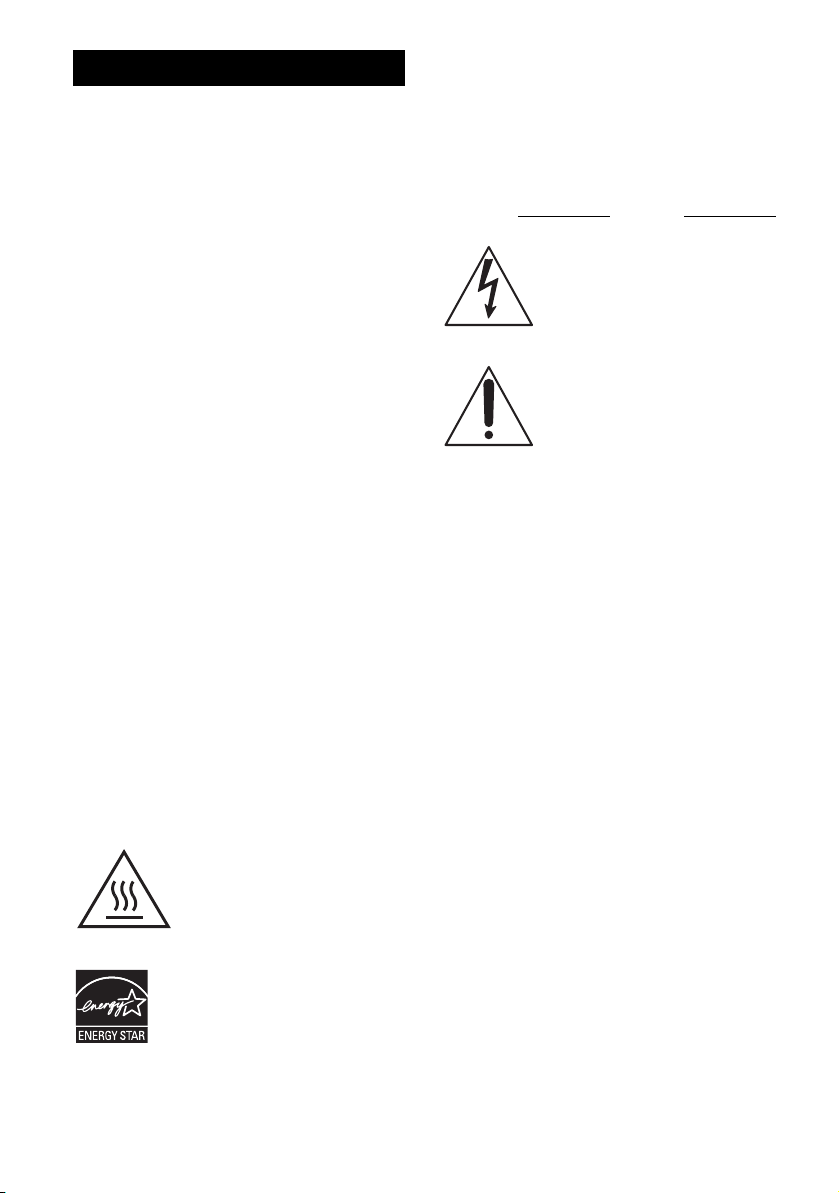
For customers in the United
States and Canada
This symbol is intended to alert
the user to the presence of the Hot
Surface that may be hot if it is
touched during the normal
operation.
ENERGY STAR
®
is a U.S. registered
mark.
As an ENERGY STAR
®
partner, Sony
Corporation has determined that this
product meets the ENERGY STAR
®
guidelines for energy efficiency.
For customers in the United
States
Owner’s Record
The model and serial numbers are located on the rear
of the unit. Record these numbers in the space
provided below. Refer to them whenever you call
upon your Sony dealer regarding this product.
Model No.
Serial No.
This symbol is intended to alert the
user to the presence of uninsulated
“dangerous voltage” within the
product’s enclosure that may be of
sufficient magnitude to constitute a
risk of electric shock to persons.
This symbol is intended to alert the
user to the presence of important
operating and maintenance
(servicing) instructions in the
literature accompanying the
appliance.
Important Safety Instructions
1) Read these instructions.
2) Keep these instructions.
3) Heed all warnings.
4) Follow all instructions.
5) Do not use this apparatus near water.
6) Clean only with dry cloth.
7) Do not block any ventilation openings. Install in
accordance with the manufacturer’s instructions.
8) Do not install near any heat sources such as
radiators, heat registers, stoves, or other
apparatus (including amplifiers) that produce
heat.
9) Do not defeat the safety purpose of the polarized
or grounding-type plug. A polarized plug has
two blades with one wider than the other. A
grounding type plug has two blades and a third
grounding prong. The wide blade or the third
prong are provided for your safety. If the
provided plug does not fit into your outlet,
consult an electrician for replacement of the
obsolete outlet.
10)Protect the power cord from being walked on or
pinched particularly at plugs, convenience
receptacles, and the point where they exit from
the apparatus.
11)Only use attachments/accessories specified by
the manufacturer.
WARNING

3
US
D:\NORM'S JOB\SONY HA\SO0056\STR-DA3500ES\U VERSION\US\4144907131\01US-
STRDA3500ESUC\020REG.fm
masterpage: Right
STR-DA3500ES
4-144-907-13(1)
12)Use only with the cart, stand, tripod, bracket, or
table specified by the manufacturer, or sold with
the apparatus. When a cart is used, use caution
when moving the cart/apparatus combination to
avoid injury from tip-over.
13)Unplug this apparatus during lightning storms or
when unused for long periods of time.
14)Refer all servicing to qualified service personnel.
Servicing is required when the apparatus has
been damaged in any way, such as power-supply
cord or plug is damaged, liquid has been spilled
or objects have fallen into the apparatus, the
apparatus has been exposed to rain or moisture,
does not operate normally, or has been dropped.
The following FCC statement
applies only to the version of
this model manufactured for
sale in the U.S.A. Other
versions may not comply with
FCC technical regulations.
NOTE:
This equipment has been tested and found to comply
with the limits for a Class B digital device, pursuant
to Part 15 of the FCC Rules. These limits are
designed to provide reasonable protection against
harmful interference in a residential installation.
This equipment generates, uses and can radiate radio
frequency energy and, if not installed and used in
accordance with the instructions, may cause harmful
interference to radio communications. However,
there is no guarantee that interference will not occur
in a particular installation. If this equipment does
cause harmful interference to radio or television
reception, which can be determined by turning the
equipment off and on, the user is encouraged to try
to correct the interference by one or more of the
following measures:
– Reorient or relocate the receiving antenna.
– Increase the separation between the equipment
and receiver.
– Connect the equipment into an outlet on a circuit
different from that to which the receiver is
connected.
– Consult the dealer or an experienced radio/TV
technician for help.
CAUTION
You are cautioned that any changes or modifications
not expressly approved in this manual could void
your authority to operate this equipment.
To reduce the risk of electric shock, the speaker cord
should be connected to the apparatus and the
speakers in accordance with the following
instructions.
1) Disconnect the AC power cord from the MAINS.
2) Strip 10 to 15 mm of the wire insulation of the
speaker cord.
3) Connect the speaker cord to the apparatus and
the speakers carefully so as not to touch the core
of speaker cord by hand. Also disconnect the AC
power cord from the MAINS before
disconnecting the speaker cord from the
apparatus and the speakers.

4
US
D:\NORM'S JOB\SONY HA\SO0056\STR-DA3500ES\U VERSION\US\4144907131\01US-
STRDA3500ESUC\020REG.fm4-144-907-13(1)
masterpage: Left
STR-DA3500ES
4-144-907-13(1)
About This Manual
• The instructions in this manual are for model
STR-DA3500ES. Check your model number by
looking at the lower right corner of the front panel.
• The instructions in this manual describe the
controls on the supplied remote. You can also use
the controls on the receiver if they have the same
or similar names as those on the remote.
This receiver incorporates Dolby* Digital and Pro
Logic Surround and the DTS** Digital Surround
System.
* Manufactured under license from Dolby
Laboratories. Dolby and the double-D symbol
are trademarks of Dolby Laboratories.
** Manufactured under license under U.S. Patent
#'s: 5,451,942; 5,956,674; 5,974,380; 5,978,762;
6,226,616; 6,487,535; 7,212,872; 7,333,929;
7,392,195; 7,272,567 & other U.S. and
worldwide patents issued & pending. DTS is a
registered trademark and the DTS logos,
Symbol, DTS-HD and DTS-HD Master Audio
are trademarks of DTS, Inc. © 1996-2008 DTS,
Inc. All Rights Reserved.
“Neural-THX” and “NEURAL-THX” introduced in
the Operating Instructions and displayed in the
display window and on the GUI menu screen mean
Neural-THX Surround.
This product using Neural-THX
®
Surround is
manufactured under license from Neural Audio
Corporation and THX Ltd. Sony Corporation hereby
grants the user a non-exclusive, non-transferable,
limited right of use to this product under USA and
foreign patent, patent pending and other technology
or trademarks owned by Neural Audio Corporation
and THX Ltd. “Neural Surround”, “Neural Audio”,
“Neural” and “NRL” are trademarks and logos
owned by Neural Audio Corporation, THX is a
trademark of THX Ltd., which may be registered in
some jurisdictions. All rights reserved.
This receiver incorporates High-Definition
Multimedia Interface (HDMI™) technology.
HDMI, the HDMI logo and High-Definition
Multimedia Interface are trademarks or registered
trademarks of HDMI Licensing LLC.
SIRIUS, XM and all related marks and logos are
trademarks of Sirius XM Radio Inc. and its
subsidiaries. All rights reserved.
The font type (Shin Go R) installed in this receiver
is provided by MORISAWA & COMPANY LTD.
These names are the trademarks of MORISAWA &
COMPANY LTD., and the copyright of the font also
belongs to MORISAWA & COMPANY LTD.
iPod is a trademark of Apple Inc., registered in the
U.S. and other countries.
All other trademarks and registered trademarks are
of their respective holders. In this manual, ™ and ®
marks are not specified.
The Bluetooth word mark and logos are owned by
the Bluetooth SIG, Inc. and any use of such marks by
Sony Corporation is under license.
Other trademarks and trade names are those of their
respective owners.
“M-crew Server” is a trademark of Sony
Corporation.
“x.v.Color (x.v.Colour)” and “x.v.Color
(x.v.Colour)” logo are trademarks of Sony
Corporation.
“BRAVIA” is a trademark of Sony Corporation.
On Copyrights
5
US
D:\NORM'S JOB\SONY HA\SO0056\STR-DA3500ES\U VERSION\US\4144907131\01US-
STRDA3500ESUC\010COVTOC.fm
masterpage: Right
STR-DA3500ES
4-144-907-13(1)
Table of Contents
Getting Started
Description and location of parts ................. 7
1: Installing the speakers ............................ 15
2: Connecting the speakers ........................ 17
3: Connecting the TV ................................. 19
4a: Connecting the audio components ....... 20
4b: Connecting the video components ....... 25
5: Connecting the antennas (aerials) .......... 36
6: Preparing the receiver and the remote .... 37
7: Operating the receiver using the GUI
(Graphical User Interface) .................... 40
8: Setting the speakers ................................ 43
9: Calibrating the appropriate speaker settings
automatically (Auto Calibration) .......... 44
Playback
Selecting a component ............................... 50
Listening to a Super Audio CD/CD ........... 52
Watching a DVD/Blu-ray Disc .................. 53
Enjoying video games ................................ 54
Watching video ........................................... 55
Amplifier Operations
Settings for the audio
(Audio settings menu) ........................... 56
Settings for the video
(Video settings menu) ........................... 57
Settings for HDMI
(HDMI settings menu) .......................... 57
Settings for the system
(System settings menu) ......................... 58
Enjoying Surround Sound
Enjoying a pre-programmed sound field ....59
Resetting sound fields to the initial
settings ...................................................64
Enjoying the surround effect at low volume
levels (NIGHT MODE) .........................65
Advanced Speakers Set Up
Adjusting the speaker settings manually ....65
Adjusting the equalizer ...............................70
Tuner Operations
Listening to FM/AM radio .........................71
Listening to Satellite Radio ........................74
“BRAVIA” Sync features
Using “BRAVIA” Sync features ................84
Preparing Control for HDMI function ........86
Playing back components with one-touch
operation (One-Touch Play) ..................87
Enjoying the TV sound from the speakers
connected to the receiver
(System Audio Control) ........................88
Turning off the receiver with the TV
(System Power-Off) ...............................88
Enjoying movies with the optimum sound
field (Theater Mode Sync) ....................89
24p Auto Sound Sync .................................89
Using Multi-zone Features
What you can do with the Multi-zone
function ..................................................90
Making a multi-zone operation .................91
Switching the zone setting of the remote ...95
continued

6
US
D:\NORM'S JOB\SONY HA\SO0056\STR-DA3500ES\U VERSION\US\4144907131\01US-
STRDA3500ESUC\010COVTOC.fm
masterpage: Left
STR-DA3500ES
4-144-907-13(1)
Other Operations
Converting analog video input signals .......96
Enjoying the sound/images from the
components connected to the DIGITAL
MEDIA PORT .......................................97
Naming inputs ..........................................101
Switching between digital and analog audio
(INPUT MODE) ..................................101
Enjoying the sound/images from other
inputs ...................................................102
Changing the display window ..................105
Using the sleep timer ................................108
Recording using the receiver ....................109
Using a bi-amplifier connection ...............110
Operating without connecting to the
TV ........................................................111
Using the Remote
Operating each component using the multi
function remote ....................................122
Programming the remote ..........................124
Performing several commands in sequence
automatically (Macro Play) .................128
Setting remote control codes that are not
stored in the remote .............................130
Clearing all the contents of the remote’s
memory ................................................131
Additional Information
Glossary ....................................................132
Precautions ...............................................135
Troubleshooting ........................................136
Specifications ............................................141
Index .........................................................144
7
US
D:\NORM'S JOB\SONY HA\SO0056\STR-DA3500ES\U VERSION\US\4144907131\01US-
STRDA3500ESUC\030CON.fm
masterpage: Right
STR-DA3500ES
4-144-907-13(1)
Getting Started
Description and location of parts
Getting Started
Front panel
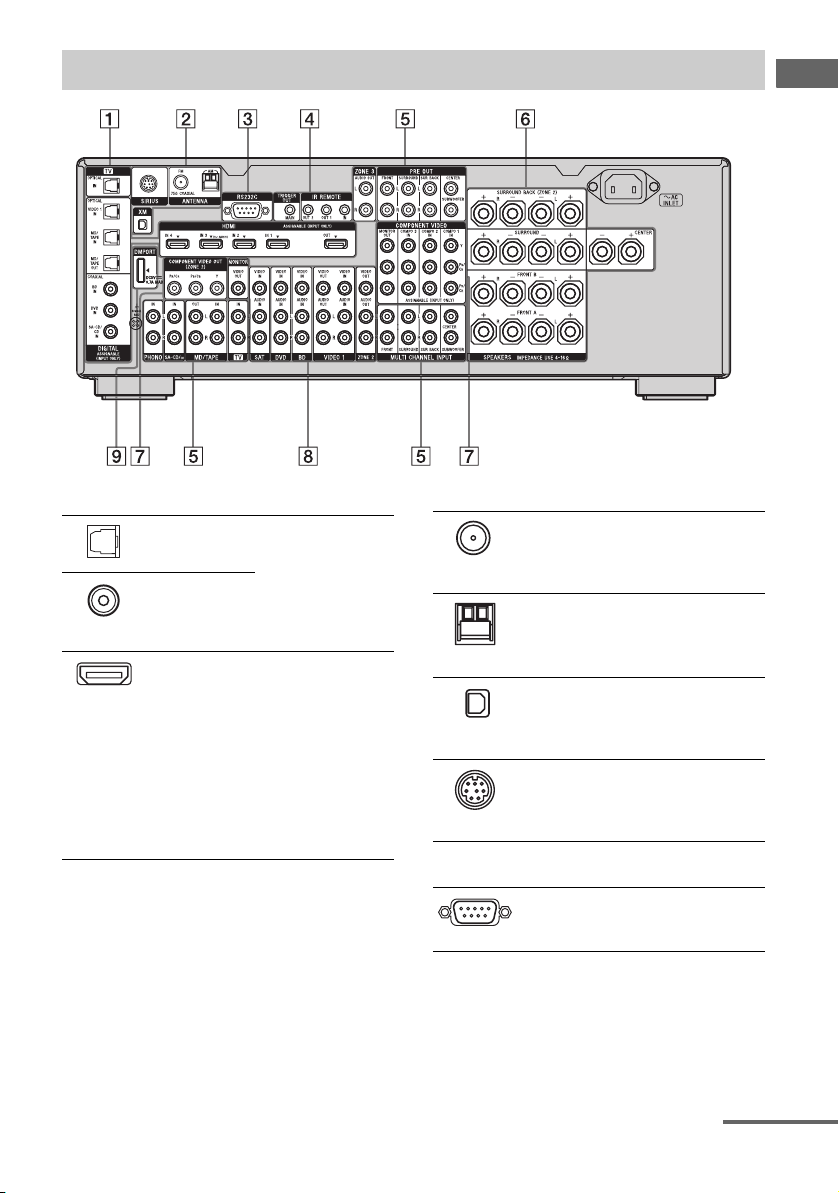
To remove the cover
Press PUSH.
When you remove the cover, keep it out
of reach from children.
Status of the POWER button
Off
The receiver is turned off (the ON/
STANDBY lamp lights off) (initial
setting).
Press POWER to turn the receiver on.
You cannot turn the receiver on using
the remote.
On/Standby
Press
?/1 on the remote to
- turn the receiver on (the ON/
STANDBY lamp lights up in green).
- set the receiver to standby mode (the
ON/STANDBY lamp lights up in red).
When you press POWER on the
receiver, the receiver will be turned off.
continued

8
US
D:\NORM'S JOB\SONY HA\SO0056\STR-DA3500ES\U VERSION\US\4144907131\01US-
STRDA3500ESUC\030CON.fm
masterpage: Left
STR-DA3500ES
4-144-907-13(1)
Name Function
A POWER Press to turn the
receiver on or off.
ON/STANDBY
lamp
Shows the status of the
receiver.
B TONE MODE Adjust the bass and
treble for the front,
center and surround/
surround back
channels. Press TONE
MODE repeatedly to
select the item you
want, then turn TONE
+/– to adjust the level
(page 115).
TONE +/–
C TUNING MODE Press to operate a tuner
(FM/AM) and satellite
radio (XM/SIRIUS)
(page 119-122).
TUNING +/–
MEMORY/
ENTER
D Remote sensor Receives signals from
remote commander.
E Display
window
The current status of
the selected component
or a list of selectable
items appears here
(page 106).
F MULTI
CHANNEL
DECODING
lamp
Lights up when multi
channel audio signals
are decoded.
G HD Digital
Cinema Sound
lamp
Lights up when a sound
field with HD-D.C.S.
is selected (page 63).
H ZONE POWER/
SELECT
Press ZONE SELECT
repeatedly to select
zone 2, zone 3 or main
zone. Each time you
press ZONE POWER,
the output signals for
the selected zone will
be turned on or off
(page 90).
I MASTER
VOLUME
Turn to adjust the
volume level of all
speakers at the same
time.
J INPUT
SELECTOR
Turn to select the input
source to play back.
To select the input
source for zone 2 or
zone 3, press ZONE
SELECT (
H) to select
zone 2 or zone 3 first,
then turn INPUT
SELECTOR to select
the input source.
K 2CH/A.DIRECT Press to select a sound
field (page 119) or to
switch the audio of the
selected input to analog
signal without any
adjustment (page 119).
A.F.D. Press to select a sound
field (page 59).
MOVIE
(HD-D.C.S.)
MUSIC
L DISPLAY Press repeatedly to
select information
displayed on the
display window.
M AUTO CAL MIC
jack
Connects to the
supplied optimizer
microphone for the
Digital Cinema Auto
Calibration function
(page 45).
N VIDEO 2 IN
jacks
Connect to audio/video
component such as a
camcorder or video
game.
O SPEAKERS
(OFF/A/B/A+B)
Switch to OFF, A, B,
A+B of the front
speakers (page 44).
P PHONES jack Connects to
headphones.
Name Function
9
US
D:\NORM'S JOB\SONY HA\SO0056\STR-DA3500ES\U VERSION\US\4144907131\01US-
STRDA3500ESUC\030CON.fm
masterpage: Right
STR-DA3500ES
4-144-907-13(1)
Getting Started
Rear panel
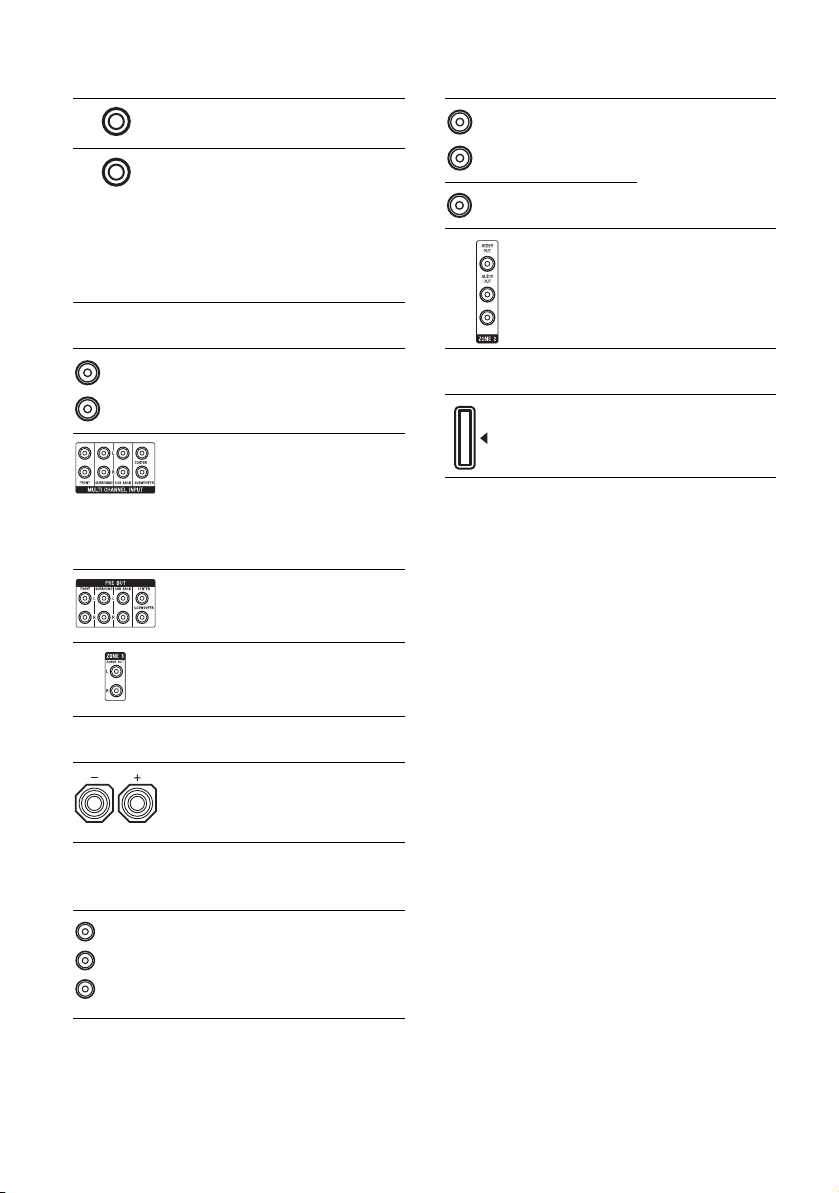
A DIGITAL INPUT/OUTPUT section
OPTICAL IN/
OUT jacks
Connect to a DVD
player, Super Audio
CD player, etc. The
COAXIAL jack
provides a better
sound quality (page
19, 21, 29, 30).
COAXIAL IN
jacks
HDMI IN/
OUT* jacks
Connect to a DVD
player, Blu-ray disc
player, or a satellite
tuner, etc. The image
is output to a TV or a
projector while the
sound can be output
from a TV or/and
speakers connected
to this receiver (page
19, 26).
B ANTENNA section
FM ANTENNA
jack
Connects to the
supplied FM wire
antenna (aerial)
(page 36).
AM
ANTENNA
jack
Connects to the
supplied AM loop
antenna (aerial)
(page 36).
XM jack Connects to the XM
Mini Tuner and
Home Dock (not
supplied) (page 75).
SIRIUS jack Connects to a
SiriusConnect Home
tuner (not supplied)
(page 75).
C RS232C port
Used for
maintenance and
service.
continued
10
US
D:\NORM'S JOB\SONY HA\SO0056\STR-DA3500ES\U VERSION\US\4144907131\01US-
STRDA3500ESUC\030CON.fm
masterpage: Left
STR-DA3500ES
4-144-907-13(1)
* You can watch the selected input image when you
connect the MONITOR OUT or HDMI OUT jack
to a TV (page 19). You can operate this receiver
using a GUI (Graphical User Interface) (page 40).
D Control jacks for Sony equipment
and other external components
IR REMOTE
IN/OUT jacks
Connect to an IR
repeater (page 91).
TRIGGER
OUT jack
Connects to an
interlock on/off of
the power supply of
other 12V
TRIGGER
compliant
components
(page 94).
E AUDIO INPUT/OUTPUT section
AUDIO IN/
OUT jacks
Connect to a tape
deck or MD deck,
etc. (page 19, 21,
24).
MULTI
CHANNEL
INPUT jacks
Connect to a Super
Audio CD player or
DVD player with an
analog audio jack for
7.1 channel or 5.1
channel sound (page
23).
PRE OUT jacks Connect to an
external power
amplifier (page 17).
ZONE 3
AUDIO OUT
jacks
Connects to the
component in zone 3
(page 92).
F SPEAKERS section
Connects to speakers
(page 17).
G COMPONENT VIDEO INPUT/
OUTPUT section
Y, P
B
/C
B
, P
R
/
C
R
IN/OUT*
jacks
Connect to a DVD
player, TV, satellite
tuner, etc.
(page 19, 29, 30, 31).
Red (R)
White (L)
Green (Y)
Blue
(P
B/CB)
Red
(P
R/CR)
H VIDEO/AUDIO INPUT/OUTPUT
section
AUDIO IN/
OUT jacks
Connect to a VCR or
a DVD player, etc.
(page 19, 29, 30, 31,
32).
VIDEO IN/
OUT* jacks
AUDIO OUT
jacks
VIDEO OUT
jack
Connects to the
component in zone 2
(page 91).
I DMPORT
Connects to a Sony
DIGITAL MEDIA
PORT adapter
(page 21).
White (L)
Red (R)
Ye l l o w
11
US
D:\NORM'S JOB\SONY HA\SO0056\STR-DA3500ES\U VERSION\US\4144907131\01US-
STRDA3500ESUC\030CON.fm
masterpage: Right
STR-DA3500ES
4-144-907-13(1)
Getting Started
You can use the supplied remote commander
to operate the receiver and to control the Sony
audio/video components that the remote is
assigned to operate (page 124).
Multi function remote
commander (RM-AAL026)
Remote commander
Name Function
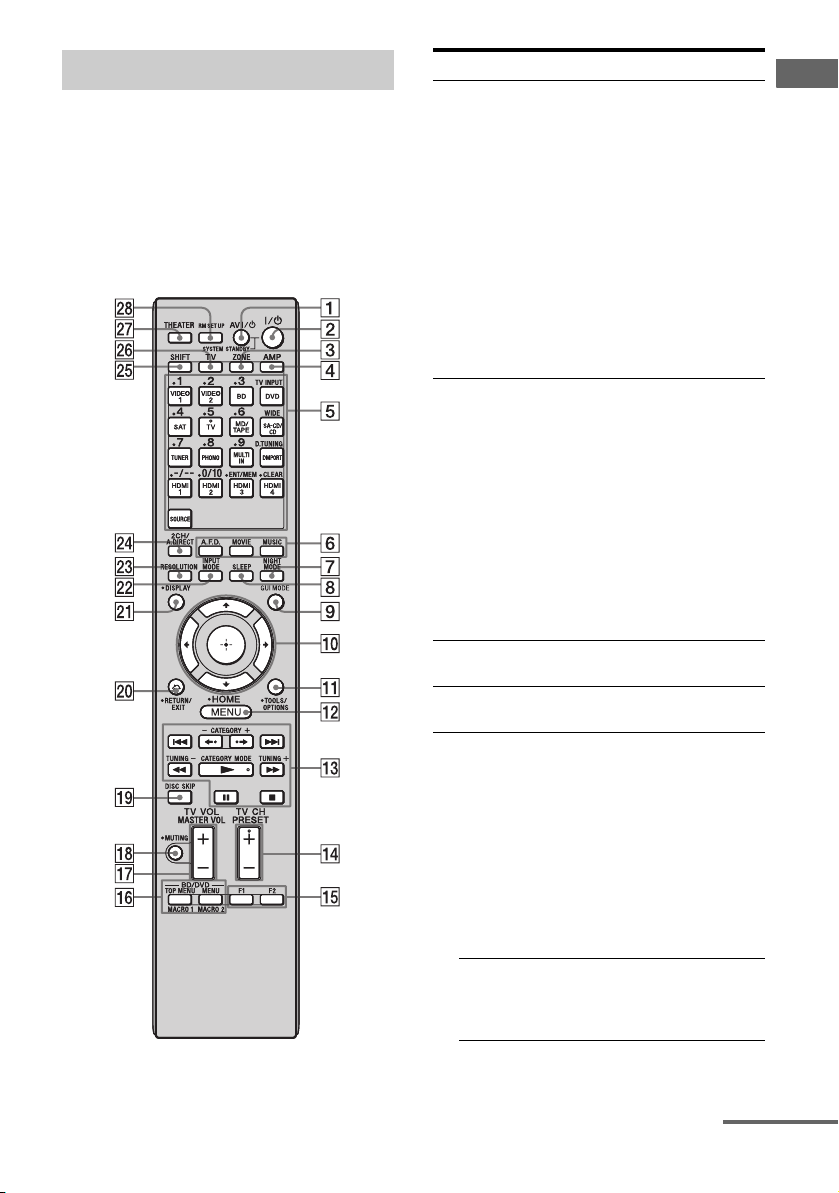
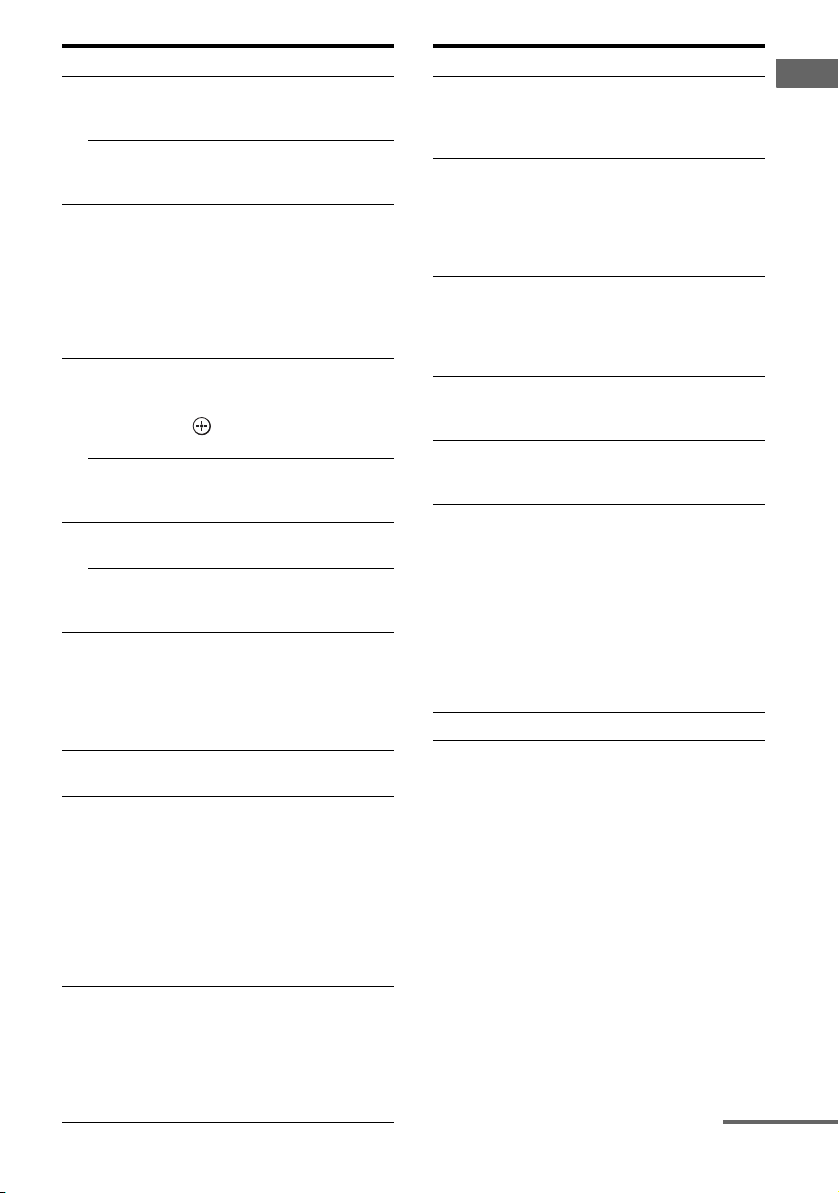
A AV ?/1 (on/
standby)
Press to turn on or off the audio/
video components that the
remote is assigned to operate
(page 124).
To turn the TV on or off, press
TV (Z), then press AV ?/1.
If you press the ?/1 (B) at the
same time, it will turn off the
receiver and other Sony
components (SYSTEM
STANDBY).
Note
The function of the AV ?/1
switch changes automatically
each time you press the input
button (E).
B ?/1 (on/
standby)
Press to turn the receiver on or
set it to standby mode.
If zone 2 or zone 3 is selected,
only the main receiver is turned
on or off with this button. To
turn off all Sony components
including an amplifier in zone 2
or zone 3, press ?/1 and
AV ?/1 (A) at the same time
(SYSTEM STANDBY).
To save the power in standby
mode, set “Control for HDMI”
(page 57) and “Installer Mode”
to “OFF” (page 58).
C ZONE Press to switch the zone 2 or
zone 3 operation (page 95).
D AMP Press to enable the receiver
operation (page 40).
E Input
buttons
(TV
b)
)
Press one of the buttons to
select the component you want
to use. When you press any of
the input buttons, the receiver
turns on. The buttons are
factory assigned to control Sony
components (page 51). You can
program the remote to control
non-Sony components
following the steps in
“Programming the remote”
(page 124).
SOURCE Press to output the signals for
the current input in the main
zone to zone 2 and zone 3
(page 95).
continued

12
US
D:\NORM'S JOB\SONY HA\SO0056\STR-DA3500ES\U VERSION\US\4144907131\01US-
STRDA3500ESUC\030CON.fm
masterpage: Left
STR-DA3500ES
4-144-907-13(1)
Numeric
buttons
(number 5
b)
)
Press SHIFT (Y), then
press numeric buttons to
– preset/tune to preset stations.
– select the track numbers of
the DVD player, MD deck,
etc. Press 0/10 to select track
number 10.
– select the channel numbers
of the VCR, satellite tuner,
etc.
Press TV (Z), then press the
numeric buttons to select the
TV channels.
TV INPUT Press TV (Z), then press TV
INPUT to select the input signal
(TV input or video input).
WIDE Press TV (Z), then press
WIDE repeatedly to select the
wide picture mode.
D.TUNING Press SHIFT (Y), then press
D.TUNING to enter direct
tuning mode (page 119, 121).
-/-- Press SHIFT (Y), then
press -/-- to select the channel
entry mode, either one or two
digit of the VCR, satellite tuner,
etc.
Press TV (Z), then press -/-- to
select the channel entry mode of
the TV.
ENT/MEM Press SHIFT (Y), then
press ENT/MEM to
– enter the value after selecting
a channel, disc or track using
the numeric buttons.
– to store a station during tuner
operation.
Press TV (Z), then press
ENT/MEM to enter the value of
Sony TV.
CLEAR Press SHIFT (Y), then
press CLEAR to
– clear a mistake when you
press the incorrect numeric
button.
– return to continuous
playback, etc. of the satellite
tuner, DVD player, etc.
F A.F.D. Press to select a sound field
(page 119).
MOVIE
MUSIC
Name Function
G NIGHT
MODE
Press to activate the NIGHT
MODE function (page 65).
H SLEEP Press to activate the sleep timer
function and the duration which
the receiver turns off
automatically (page 108).
I GUI MODE Press to switch the display
mode of the menu between GUI
MODE (to display the menu on
the TV screen) and DISPLAY
MODE (to display the menu in
the display window).
J
V/v/B/b
Press V/v/B/b to select the
menu items. Then press to
enter the selection.
K TOOLS/
OPTIONS
Press to display and select the
items from the option menus of
the receiver, DVD player, Blu-
ray disc player, etc.
Press TV (Z), then press
TOOLS/OPTIONS to display
the options of the Sony TV.
L MENU Press AMP (4), then press
MENU to display the menu to
operate the receiver.
Press MENU to display the
menu to operate the audio/video
components.
HOME Press TV (Z), then press
HOME to display the TV’s
menu. Then use V/v/B/b and
to perform menu
operations.
M m/M
a)
x
a)
X
a)
N
a) b)
./>
a)
Press to operate the DVD
player, Blu-ray disc player,
component connected to the
DIGITAL MEDIA PORT
adapter, etc.
B·/·b Press to select an album.
CATEGORY
+/–
Press to select the category for
satellite tuner (page 121).
CATEGORY
MODE
b)
Press to select the category
mode for satellite tuner
(page 121).
TUNING +/– Press to select a station
(page 119, 121).
Name Function
13
US
D:\NORM'S JOB\SONY HA\SO0056\STR-DA3500ES\U VERSION\US\4144907131\01US-
STRDA3500ESUC\030CON.fm
masterpage: Right
STR-DA3500ES
4-144-907-13(1)
Getting Started
a)
See the table on page 123 for information on the
buttons that you can use to control each
component.
b)
The TV/5, N /CATEGORY MODE and PRESET
+/TV CH + buttons have tactile dots. Use the
tactile dots as references when operating the
receiver.
Notes
• Some functions explained in this section may not
work depending on the model.
• The above explanation is intended to serve as an
example only. Therefore, depending on the
component, the above operation may not be
possible or may operate differently than described.
N PRESET
+
b)
/–
Press to register FM/AM/
satellite tuner stations or to
select preset stations.
TV CH +
b)
/– Press TV (Z), then press TV
CH +/– to operate the TV,
satellite tuner, VCR, etc.
O F1/F2 Press to select a component to
operate.
• HDD/DISC combo
F1: HDD
F2: DVD, Blu-ray disc
• DVD/VHS combo
F1: DVD, Blu-ray disc
F2: VHS
P BD/DVD
TOP MENU,
MENU
Press to display the menu of the
DVD or Blu-ray disc on the TV
screen. Then, use V/v/B/b and
to perform menu operations
(page 123).
MACRO 1,
MACRO 2
Press MACRO 1 or MACRO 2
to set up the macro function
(page 128).
Q MASTER
VOL +/–
Press to adjust the volume level
of all speakers at the same time.
TV VOL +/– Press TV (Z), then press TV
VOL +/– to adjust the volume
level of the TV.
R MUTING Press to turn off the sound
temporarily. Press MUTING
again to restore the sound.
Press TV (Z), then press
MUTING to activate the TV’s
muting function.
S DISC SKIP Press to skip a disc when using
a multi-disc changer.
T RETURN/
EXIT O
Press to return to the previous
menu or exit the menu while the
menu or on-screen guide of the
VCR, DVD player, etc. is
displayed on the TV screen.
Press TV (Z), then press
RETURN/EXIT O to return to
the previous menu or exit the
TV’s menu while the menu is
displayed on the TV screen.
U DISPLAY Press to select information
displayed in the display
window, TV screen of the VCR,
satellite tuner, etc.
Press TV (Z), then press
DISPLAY to display TV’s
information on the TV screen.
Name Function
V INPUT
MODE
Press to select the input mode
when the same components are
connected to both digital and
analog jacks (page 101).
W
RESOLUTION
Press repeatedly to change the
resolution of signals output
from the HDMI OUT or
COMPONENT VIDEO
MONITOR OUT jack
(page 96).
X 2CH/
A.DIRECT
Press to select a sound field
(page 119) or to switch the
audio of the selected input to
analog signal without any
adjustment (page 119).
Y SHIFT Press to light up the button to
activate the buttons with pink
printing.
Z TV Press to light up the button to
enable the TV operation
(buttons with yellow printing).
wj THEATER Press to turn the Theater mode
on and off when connecting the
receiver to products featuring
“BRAVIA” Sync.
Note
This button will only function if
your TV is compatible with
Theater Mode.
Refer to the operating
instructions supplied with the
TV for details.
wk RM SET UP Press to set up the remote.
Name Function
continued
14
US
D:\NORM'S JOB\SONY HA\SO0056\STR-DA3500ES\U VERSION\US\4144907131\01US-
STRDA3500ESUC\030CON.fm
masterpage: Left
STR-DA3500ES
4-144-907-13(1)
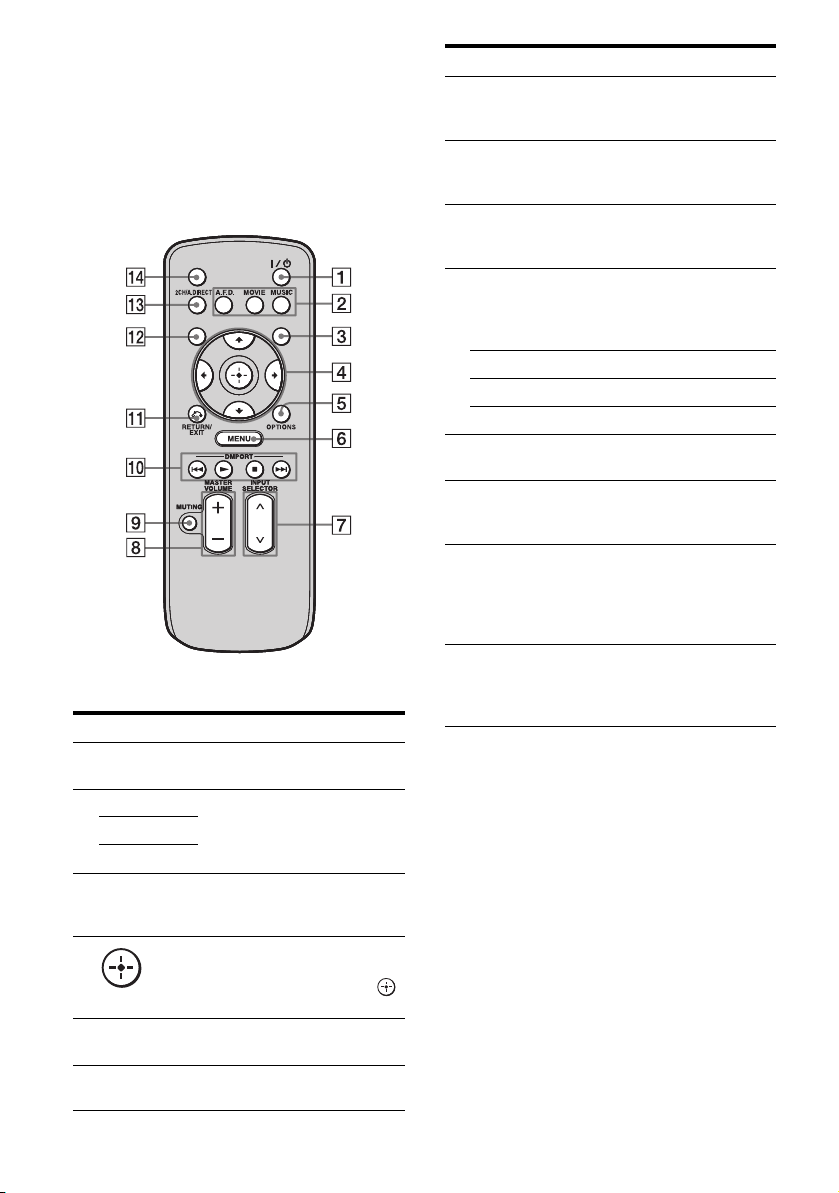
Simple remote commander
(RM-AAU039)
This remote can only be used to operate the
receiver. You can control the main functions of
the receiver with simple operations using this
remote.
Name Function
A ?/1 (on/
standby)
Press to turn a receiver on or off.
B A.F.D. Press to select a sound field
(page 119).
MOVIE
MUSIC
C GUI MODE Press to display the menu on the
TV screen to operate the
receiver.
D
V/v/B/b
After pressing GUI MODE
(3), press V/v/B/b to select
the menu item. Then press
to enter the selection.
E OPTIONS Press to display and select items
from option menus.
F MENU Press to display the menu to
operate the receiver.
DISPLAY
SLEEP
GUI MODE
G INPUT
SELECTOR
U/u
Press to select the input source
to play back.
H MASTER
VOLUME
+/–
Press to adjust the volume level.
I MUTING Press to turn off the sound
temporarily. Press the button
again to restore the sound.
J DMPORT Press to operate the component
connected to the DIGITAL
MEDIA PORT adapter
(page 50).
N Starts play.
x Stops play.
./> Skips tracks.
K RETURN/
EXIT O
Press to return to the previous
menu or exit the menu.
L DISPLAY Press to select information
displayed in the display
window.
M 2CH/
A.DIRECT
Press to select sound field
(page 119) or to switch the
audio of the selected input to
analog signal without any
adjustment (page 119).
N SLEEP Press to activate the sleep timer
function and the duration which
the receiver turns off
automatically (page 108).
Name Function
15
US
D:\NORM'S JOB\SONY HA\SO0056\STR-DA3500ES\U VERSION\US\4144907131\01US-
STRDA3500ESUC\030CON.fm
masterpage: Right
STR-DA3500ES
4-144-907-13(1)
Getting Started
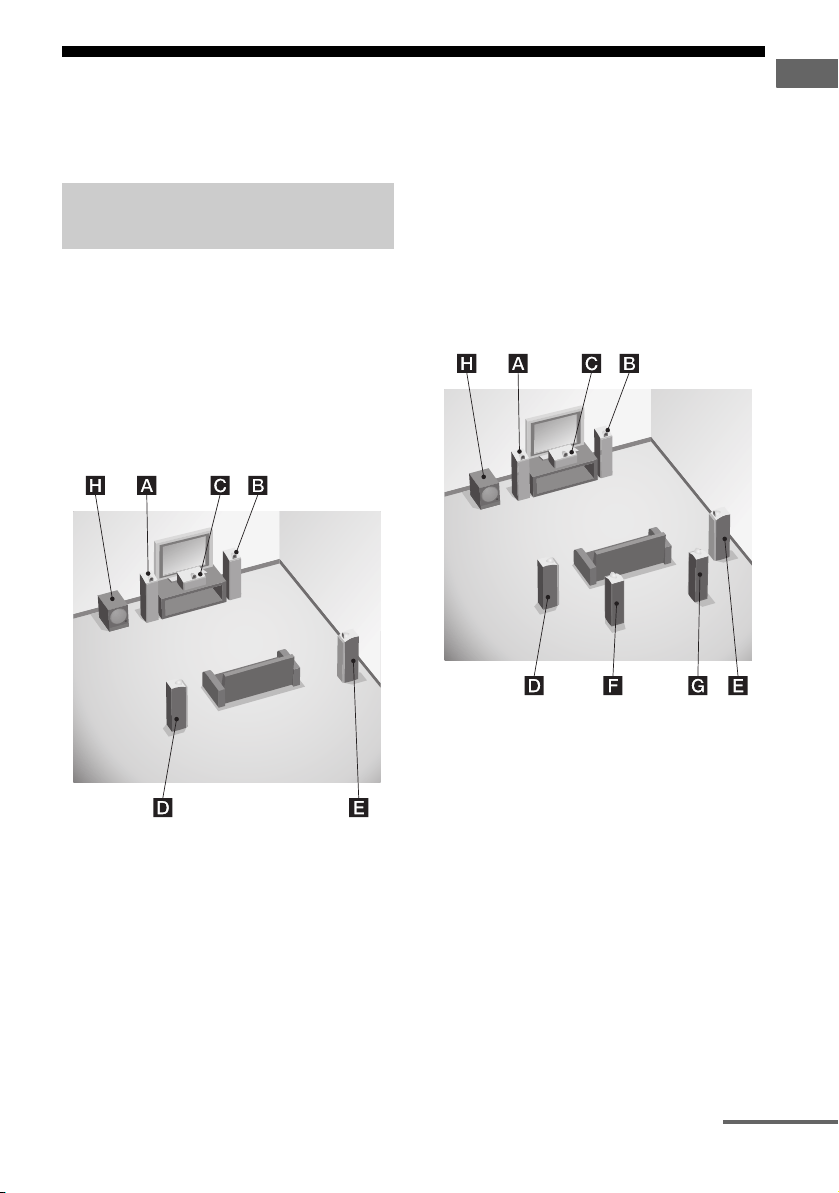
1: Installing the speakers
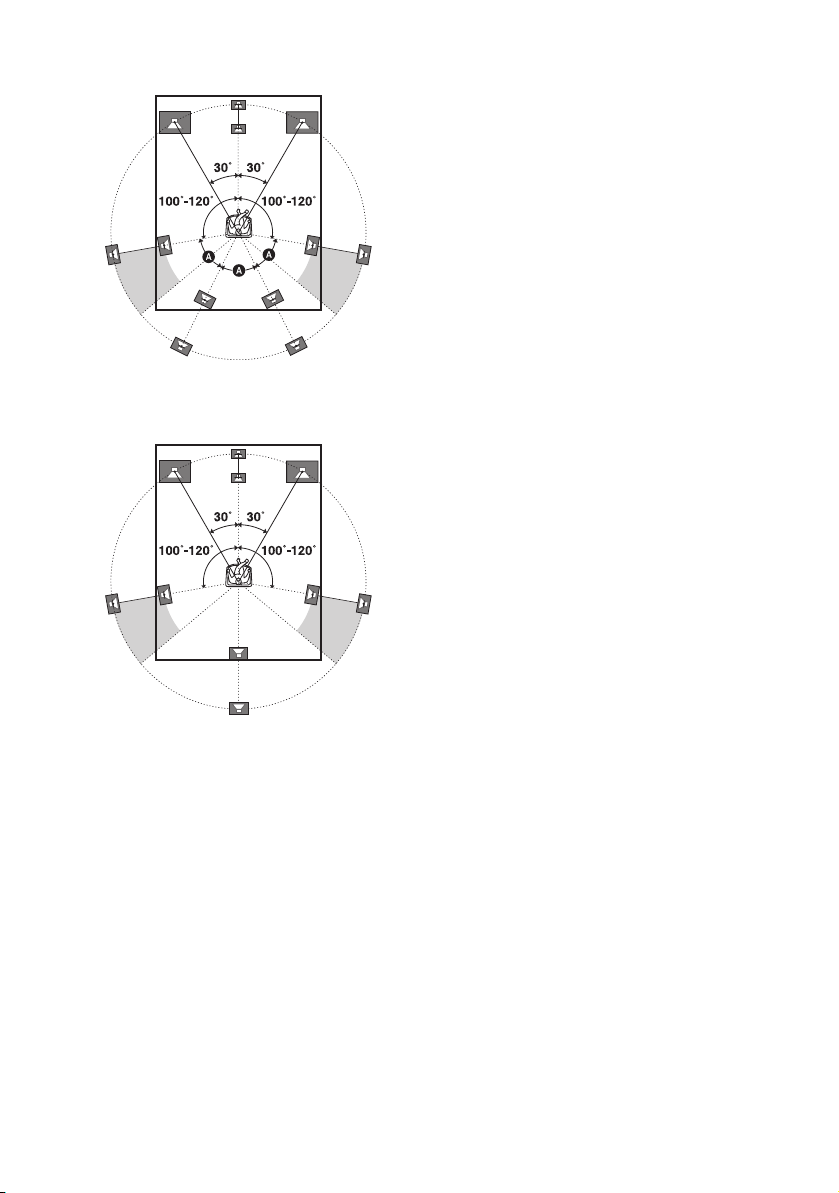
This receiver allows you to use a 7.1 channel
system (7 speakers and one subwoofer).
To fully enjoy theater-like multi channel
surround sound requires five speakers (two
front speakers, a center speaker, and two
surround speakers) and a subwoofer (5.1
channel system).
Example of a 5.1 channel
speaker system configuration
AFront speaker (left)
BFront speaker (right)
CCenter speaker
DSurround speaker (left)
ESurround speaker (right)
HSubwoofer
You can enjoy high fidelity reproduction of
DVD or Blu-ray Disc software recorded sound
in the Surround EX format if you connect one
additional surround back speaker (6.1 channel
system) or two surround back speakers (7.1
channel system).
Example of a 7.1 channel
speaker system configuration
AFront speaker (left)
BFront speaker (right)
CCenter speaker
DSurround speaker (left)
ESurround speaker (right)
FSurround back speaker (left)
GSurround back speaker (right)
HSubwoofer
Enjoying a 5.1/7.1 channel
system
continued
16
US
D:\NORM'S JOB\SONY HA\SO0056\STR-DA3500ES\U VERSION\US\4144907131\01US-
STRDA3500ESUC\030CON.fm
masterpage: Left
STR-DA3500ES
4-144-907-13(1)
Tips
• The angle A should be the same.
• When you connect a 6.1 channel speaker system,
place the surround back speaker behind the seating
position.
• Since the subwoofer does not emit highly
directional signals, you can place it wherever you
want.
17
US
D:\NORM'S JOB\SONY HA\SO0056\STR-DA3500ES\U VERSION\US\4144907131\01US-
STRDA3500ESUC\030CON.fm
masterpage: Right
STR-DA3500ES
4-144-907-13(1)
Getting Started
2: Connecting the speakers
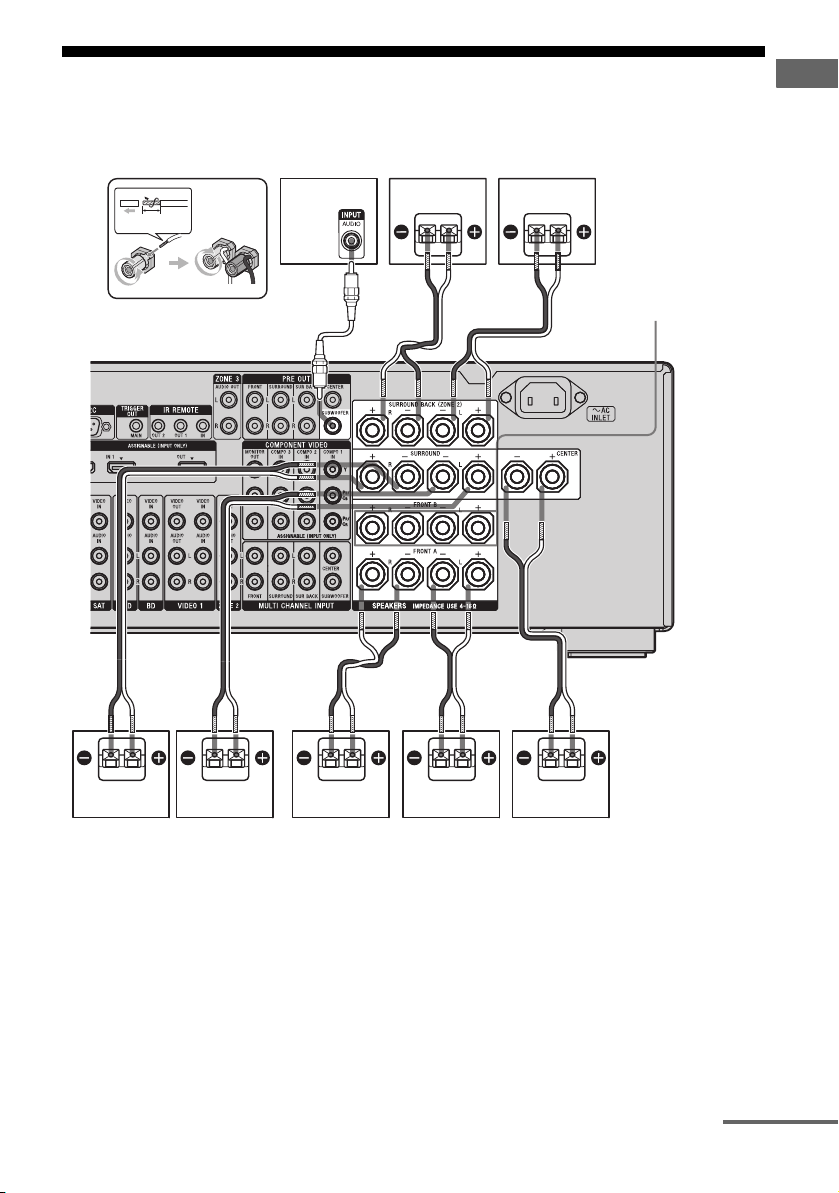
Before connecting cords, make sure to
disconnect the AC power cord (mains lead).
AFront speaker A (Left)
BFront speaker A (Right)
CCenter speaker
DSurround speaker (Left)
ESurround speaker (Right)
FSurround back speaker (Left)
b)
GSurround back speaker (Right)
b)
HSubwoofer
c)
a)
If you have an additional front speaker
system, connect them to the SPEAKERS
FRONT B terminals. You can select the front
speaker system you want to use with the
SPEAKERS (OFF/A/B/A+B) button on the
front panel (page 44).
13
/
32
in.
(10 mm)
H
G
AC
F
B
B
SPEAKERS FRONT
B terminals
a)
A Monaural audio cord (not supplied)
B Speaker cords (not supplied)
B
B
DE
A
B
continued

18
US
D:\NORM'S JOB\SONY HA\SO0056\STR-DA3500ES\U VERSION\US\4144907131\01US-
STRDA3500ESUC\030CON.fm
masterpage: Left
STR-DA3500ES
4-144-907-13(1)
b)
If you connect only one surround back
speaker, connect it to the SPEAKERS
SURROUND BACK L terminals.
c)
When you connect a subwoofer with an auto
standby function, turn off the function when
watching movies. If the auto standby
function is set to on, it turns to standby mode
automatically based on the level of the input
signal to a subwoofer, then sound may not be
output.
Notes
• When you connect all the speakers with a nominal
impedance of 8 ohms or higher, set “Impedance” in
the Speaker settings menu to “8 :”. In other
connections, set it to “4 :”. For details, see “8:
Setting the speakers” (page 43).
• Before connecting the AC power cord (mains
lead), make sure that metallic wires of the speaker
cords are not touching each other between the
SPEAKERS terminals.
Tip
To connect certain speakers to another power
amplifier, use the PRE OUT jacks. The same signal
is output from both the SPEAKERS terminals and
the PRE OUT jacks. For example, if you want to
connect just the front speakers to another amplifier,
connect that amplifier to the PRE OUT FRONT L
and R jacks.
You can assign the SPEAKERS SURROUND
BACK terminals F and G to the speakers of
the zone 2. Set “Sur Back Assign” to
“ZONE2” in the Speaker settings menu.
See “Using Multi-zone Features” (page 90)
for details on connection and operation in zone
2.
ZONE 2 connection
19
US
D:\NORM'S JOB\SONY HA\SO0056\STR-DA3500ES\U VERSION\US\4144907131\01US-
STRDA3500ESUC\030CON.fm
masterpage: Right
STR-DA3500ES
4-144-907-13(1)
Getting Started
3: Connecting the TV
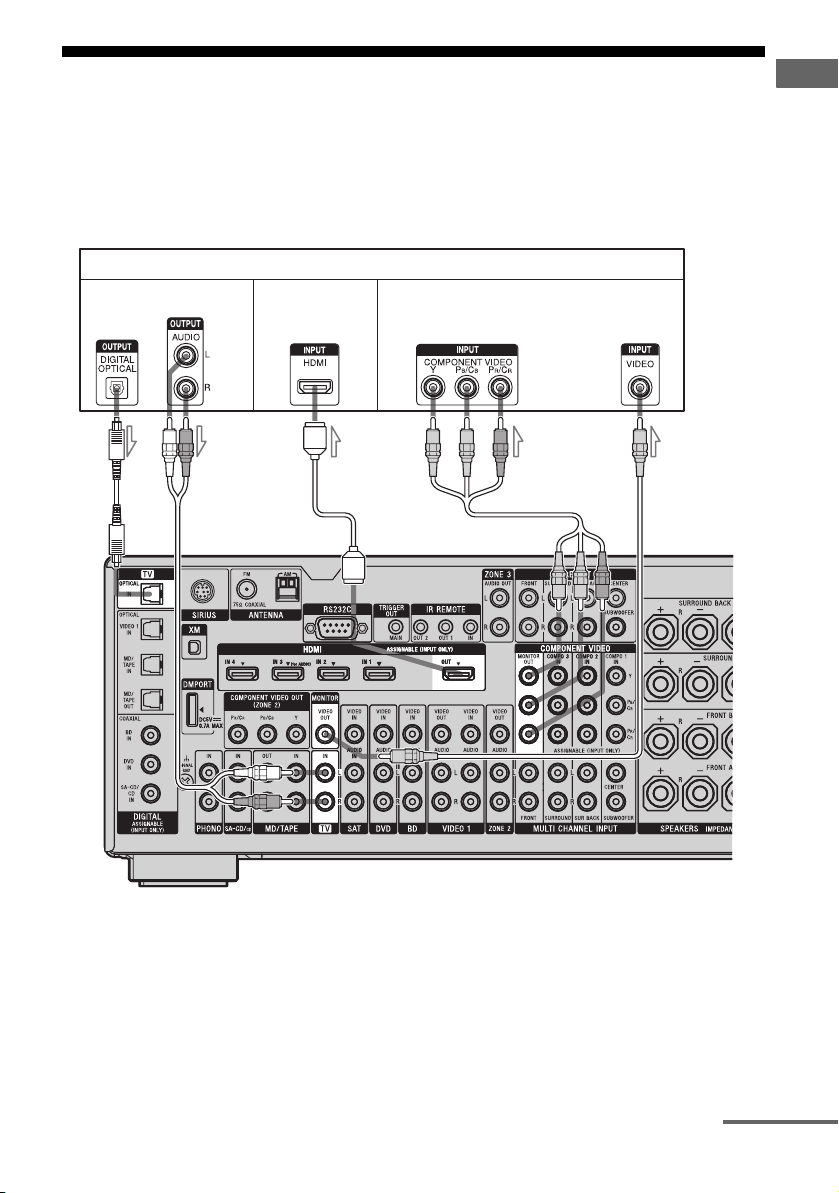
You can watch the selected input image when
you connect the MONITOR OUT or HDMI
OUT jack to a TV. You can operate this
receiver using a GUI (Graphical User
Interface).
It is not necessary to connect all the cords.
Connect the audio and video cords according
to the jacks of your components.
Before connecting cords, be sure to disconnect
the AC power cord (mains lead).
TV
AB
A Optical digital cord (not supplied)
B Audio cord (not supplied)
C HDMI cable (not supplied)
Sony recommends that you use an HDMI-authorized cable or Sony HDMI cable.
D Component video cord (not supplied)
E Video cord (not supplied)
Audio signals
CD E
Video signalsAudio/Video
signals
continued
20
US
D:\NORM'S JOB\SONY HA\SO0056\STR-DA3500ES\U VERSION\US\4144907131\01US-
STRDA3500ESUC\030CON.fm
masterpage: Left
STR-DA3500ES
4-144-907-13(1)
Notes
• Be sure to turn on the receiver when the video and
audio signals of a playback component are being
output to a TV via the receiver. Unless the power is
turned on, neither video nor audio signals will be
transmitted.
• Depending on the status of the connection between
the TV and the antenna (aerial), the image on the
TV screen may be distorted. In this case, place the
antenna (aerial) farther away from the receiver.
• Do not bend or tie optical digital cord.
• When connecting optical digital cords, insert the
plugs straight in until they click into place.
Tips
• The receiver has a video conversion function. For
details, see “Notes on converting video signals”
(page 34).
• The sound of the TV is output from the speakers
connected to the receiver if you connect the audio
output jack of the TV and the TV IN jacks of the
receiver. In this configuration, set the audio output
jack of the TV to “Fixed” if it can be switched
between either “Fixed” or “Variable”.
• The screen saver is activated when the GUI menu
is displayed on the TV screen and there has been no
operation attempted for 15 minutes.
• All the digital audio jacks are compatible with
32 kHz, 44.1 kHz, 48 kHz and 96 kHz sampling
frequencies.
4a: Connecting the audio
components
This section describes how to hook up your
components to this receiver. Before you begin,
see “Component to be connected” below for
the pages which describe how to connect each
component. Before connecting cords, be sure
to disconnect the AC power cord (mains lead).
After hooking up all your components,
proceed to “5: Connecting the antennas
(aerials)” (page 36).
Notes
• When connecting optical digital cords, insert the
plugs straight in until they click into place.
• Do not bend or tie optical digital cords.
Tip
All the digital audio jacks are compatible with
32 kHz, 44.1 kHz, 48 kHz, and 96 kHz sampling
frequencies.
How to hook up your
components
Component to be connected Page
Super Audio CD
player, CD player
With digital audio
output
21
With multi channel
audio output
23
With analog audio
output only
24
MD deck With digital audio
output
21
With analog audio
output only
24
Tape deck, Analog disc turntable 24
DIGITAL MEDIA PORT adapter 21
21
US
D:\NORM'S JOB\SONY HA\SO0056\STR-DA3500ES\U VERSION\US\4144907131\01US-
STRDA3500ESUC\030CON.fm
masterpage: Right
STR-DA3500ES
4-144-907-13(1)
Getting Started
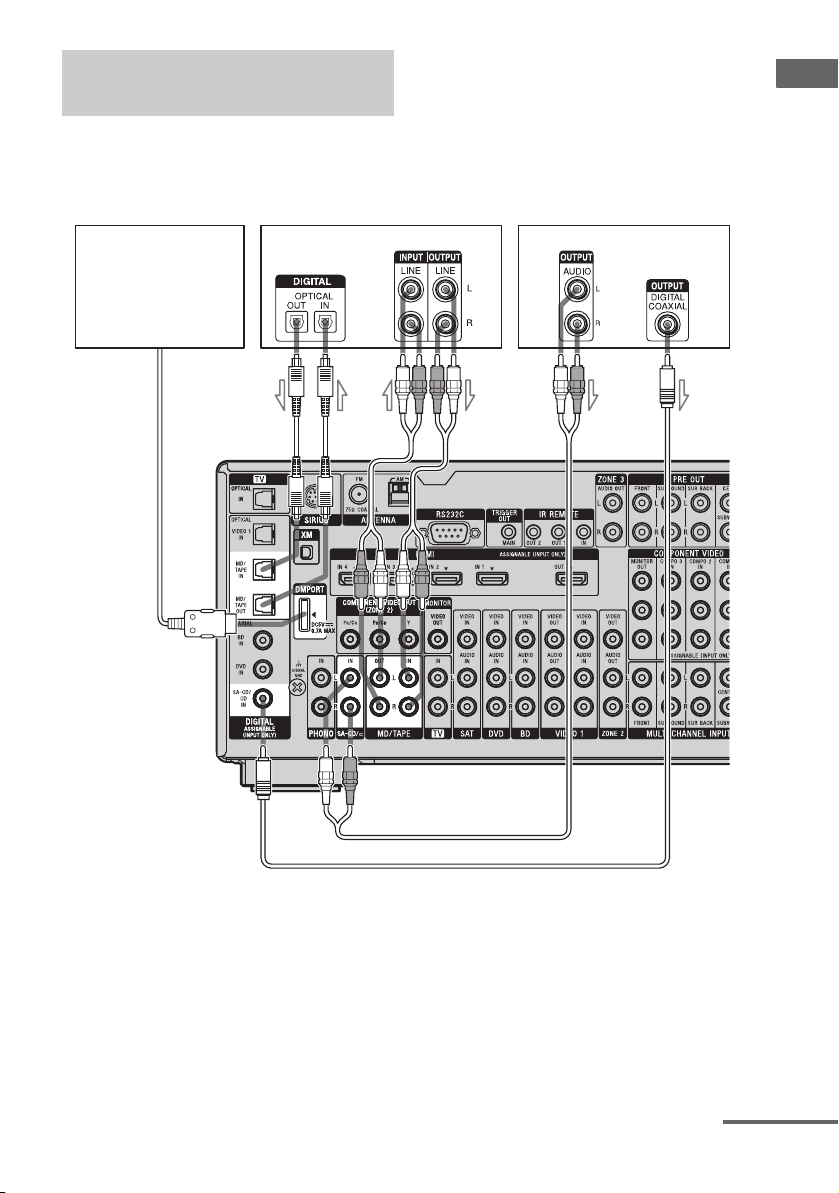
The following illustration shows how to
connect a Super Audio CD player, CD player,
an MD deck and DIGITAL MEDIA PORT
adapter.
Connecting components with
digital audio input/output jacks
Super Audio CD
player, CD player
MD deck
A
A Optical digital cord (not supplied)
B Audio cord (not supplied)
C Coaxial digital cord (not supplied)
DIGITAL MEDIA PORT
adapter
BBC
continued

22
US
D:\NORM'S JOB\SONY HA\SO0056\STR-DA3500ES\U VERSION\US\4144907131\01US-
STRDA3500ESUC\030CON.fm
masterpage: Left
STR-DA3500ES
4-144-907-13(1)
Notes on connecting a DIGITAL
MEDIA PORT adapter
• When connecting the DIGITAL MEDIA
PORT adapter, be sure the connector is
inserted with the arrow mark facing towards
the arrow mark on the DMPORT jack.
• Be sure to make DMPORT connections
firmly, insert the connector straight in.
• As the connector of the DIGITAL MEDIA
PORT adapter is fragile, be sure to handle
with care when placing or moving the
receiver.
• To disconnect the DIGITAL MEDIA PORT
adapter, squeeze the sides of the connector,
since the connector is locked in place.
Notes on playing a Super Audio
CD on a Super Audio CD player
• No sound is output when playing a Super
Audio CD on a Super Audio CD player
connected to only the COAXIAL SA-CD/
CD IN jack on this receiver. When you play
a Super Audio CD, connect the player to the
MULTI CHANNEL INPUT or SA-CD/CD
IN jacks on this receiver. Refer to the
operating instructions supplied with the
Super Audio CD player.
• You cannot make digital recordings of a
Super Audio CD.
If you want to connect several
digital components, but cannot
find an unused input
See “Enjoying the sound/images from other
inputs” (page 102).
23
US
D:\NORM'S JOB\SONY HA\SO0056\STR-DA3500ES\U VERSION\US\4144907131\01US-
STRDA3500ESUC\030CON.fm
masterpage: Right
STR-DA3500ES
4-144-907-13(1)
Getting Started
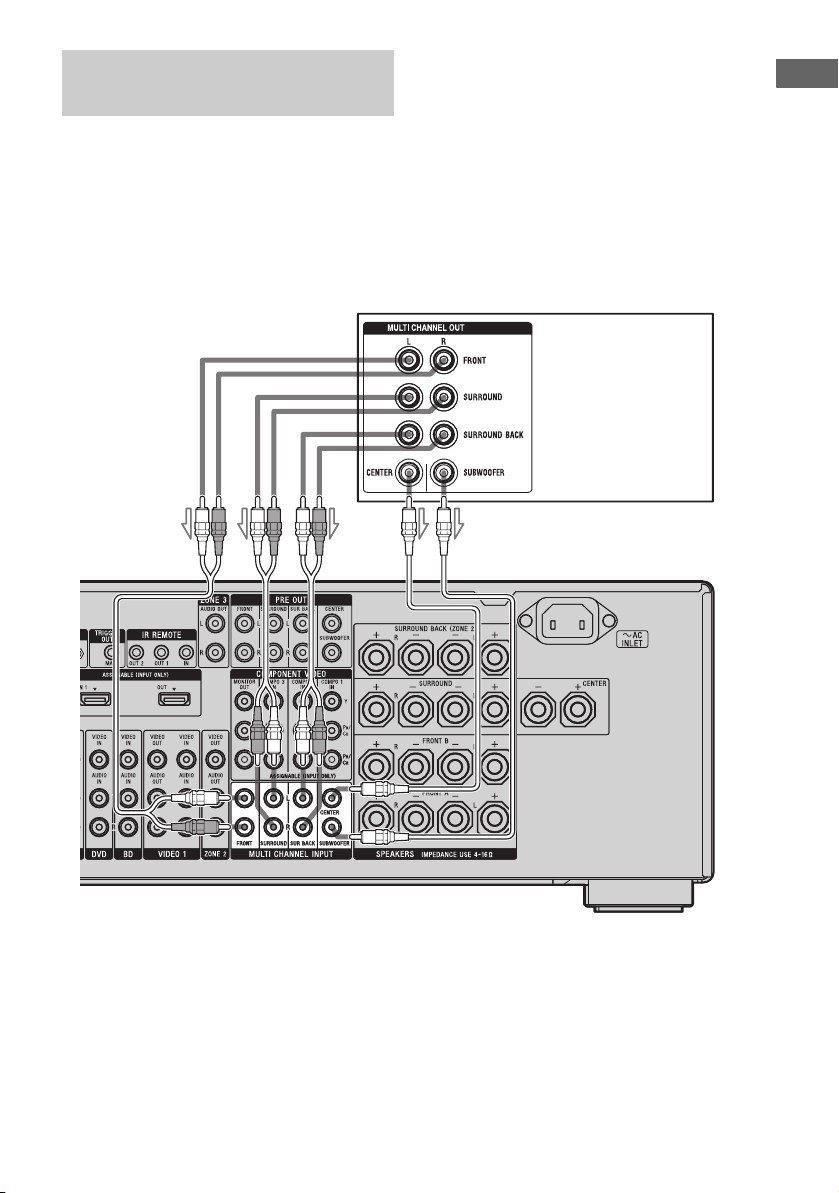
If your DVD player, Blu-ray disc player or
Super Audio CD player is equipped with multi
channel output jacks, you can connect them to
the MULTI CHANNEL INPUT jacks of this
receiver to enjoy multi channel sound.
Alternatively, the multi channel input jacks
can be used to connect an external multi
channel decoder.
Notes
• DVD player, Blu-ray disc player and Super Audio
CD player may not have the SURROUND BACK
jacks.
• When “Sur Back Assign” is set to “BI-AMP” or
“ZONE2” in the Speaker settings menu, the input
to the SUR BACK jacks is invalid.
• Audio signals input from the MULTI CHANNEL
INPUT jacks are not output to other audio output
jacks. The signals cannot be recorded.
Connecting components with
multi channel output jacks
DVD player, Blu-ray disc
player, Super Audio CD
player, etc.
A
B
A Audio cord (not supplied)
B Monaural audio cord (not supplied)
24
US
D:\NORM'S JOB\SONY HA\SO0056\STR-DA3500ES\U VERSION\US\4144907131\01US-
STRDA3500ESUC\030CON.fm
masterpage: Left
STR-DA3500ES
4-144-907-13(1)
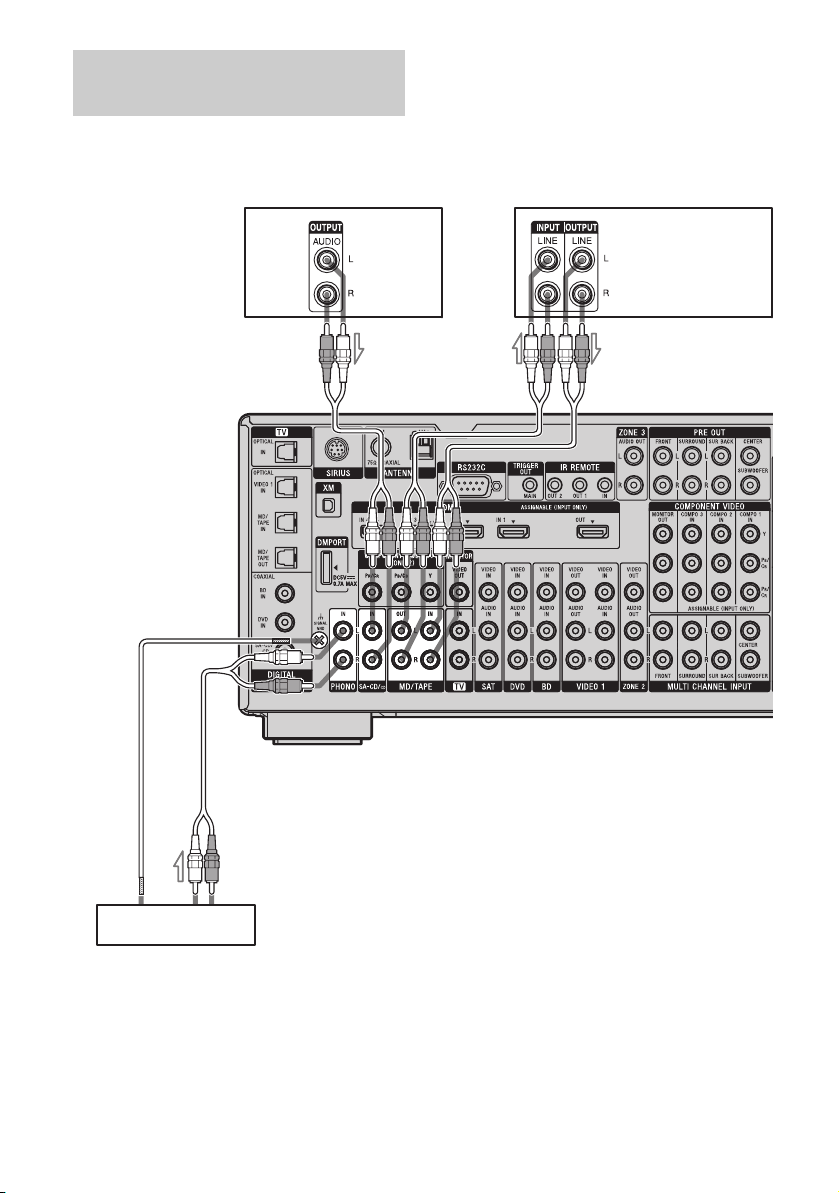
The following illustration shows how to
connect a component with analog jacks, such
as a tape deck, turntable, etc.
Note
If your turntable has a ground (earth) wire, connect
it to the (U) SIGNAL GND terminal.
Connecting components with
analog audio jacks
Super
Audio CD
player, CD
player
Tu rn t ab le
A
MD deck, Tape deck
A Audio cord (not supplied)
A
A
25
US
D:\NORM'S JOB\SONY HA\SO0056\STR-DA3500ES\U VERSION\US\4144907131\01US-
STRDA3500ESUC\030CON.fm
masterpage: Right
STR-DA3500ES
4-144-907-13(1)
Getting Started
4b: Connecting the video components
This section describes how to hook up your
components to this receiver. Before you begin,
see “Component to be connected” below for
the pages which describe how to connect each
component.
Before connecting cords, be sure to disconnect
the AC power cord (mains lead).
After hooking up all your components,
proceed to “5: Connecting the antennas
(aerials)” (page 36).
If you want to connect several
digital components, but cannot
find an unused input
See “Enjoying the sound/images from other
inputs” (page 102).
Notes
• When connecting optical digital cords, insert the
plugs straight in until they click into place.
• Do not bend or tie optical digital cord.
Tip
All the digital audio jacks are compatible with
32 kHz, 44.1 kHz, 48 kHz and 96 kHz sampling
frequencies.
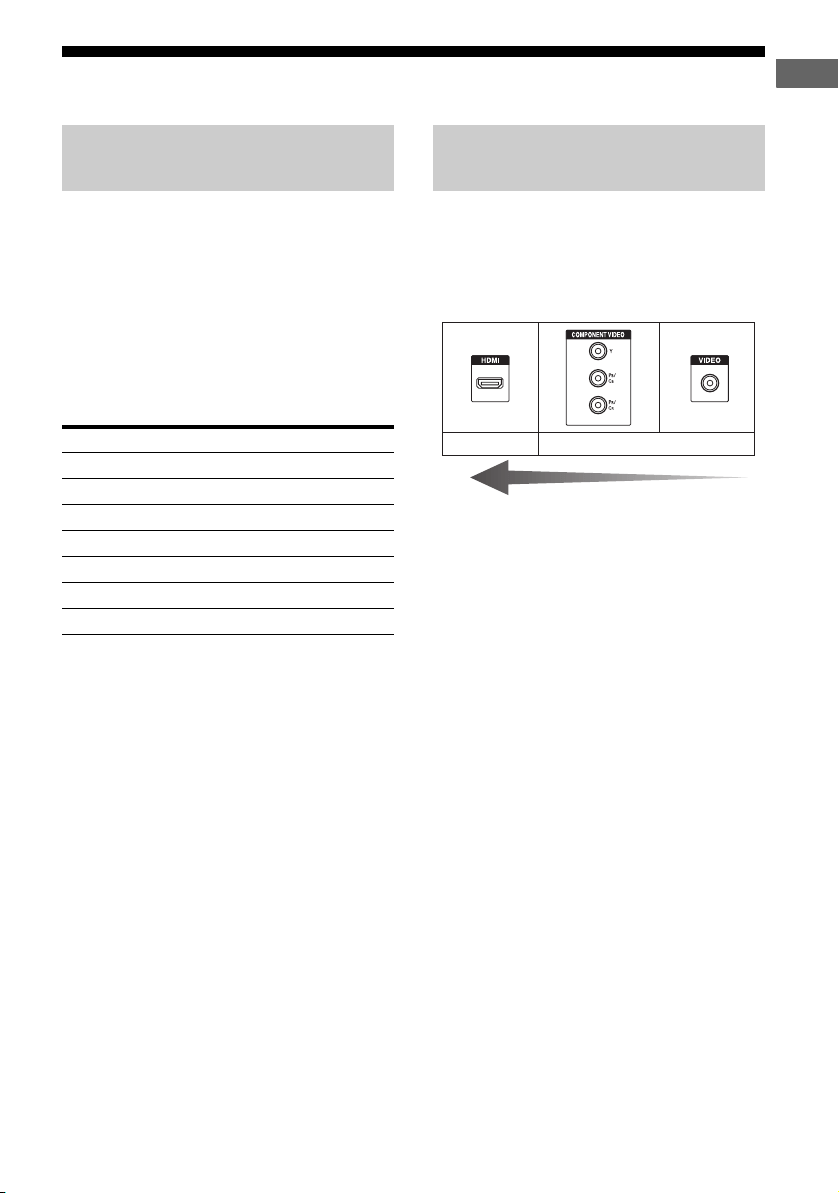
The image quality depends on the connecting
jack. See the illustration that follows. Select
the connection according to the jacks on your
components.
Note
Be sure to turn on the receiver when the video and
audio signals of a playback component are being
output to a TV via the receiver. Unless the power is
turned on, neither video nor audio signals will be
transmitted.
How to hook up your
components
Component to be connected Page
TV 19
With HDMI jack 26
DVD player 29
Blu-ray disc player 30
Satellite tuner, Set-top box 31
DVD recorder, VCR 32
Camcorder, video game, etc. 32
Video input/output jacks to be
connected
High quality image
Digital Analog

26
US
D:\NORM'S JOB\SONY HA\SO0056\STR-DA3500ES\U VERSION\US\4144907131\01US-
STRDA3500ESUC\030CON.fm
masterpage: Left
STR-DA3500ES
4-144-907-13(1)
HDMI is the abbreviated name for High-
Definition Multimedia Interface. It is an
interface which transmits video and audio
signals in digital format.
HDMI features
• A digital audio signals transmitted by HDMI
can be output from the speakers and the PRE
OUT jacks on this receiver. This signal
supports Dolby Digital, DTS, and Linear
PCM.
• Linear PCM (sampling frequency less than
192 kHz) with digital audio signals of up to
8 channels can be received with this receiver
using the HDMI IN jack.
• Analog video signals input to the VIDEO
jack or COMPONENT VIDEO jacks can be
up-converted as HDMI signals. Audio
signals are not output from an HDMI OUT
jack when the image is converted.
• This receiver supports High Bitrate Audio
(DTS-HD Master Audio, Dolby TrueHD),
Deep Color and x.v.Color (x.v.Colour)
transmission, extended by HDMI ver1.3.
• This receiver supports the Control for HDMI
function. For details, see ““BRAVIA” Sync
features” (page 84).
• HDMI 3 input has a better sound quality.
When you need a higher sound quality,
connect your component to the HDMI IN 3
(for AUDIO) jack and select HDMI 3 as
input.
Connecting components with
HDMI jacks
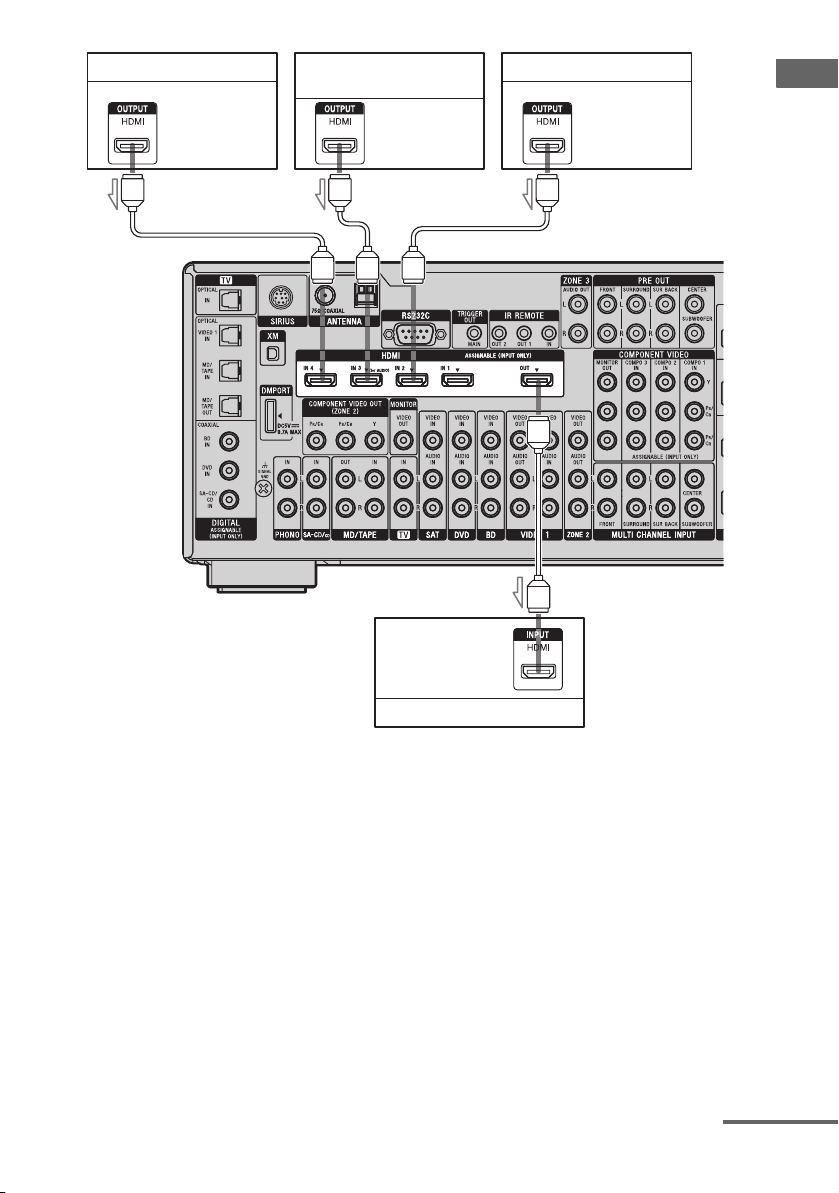
27
US
D:\NORM'S JOB\SONY HA\SO0056\STR-DA3500ES\U VERSION\US\4144907131\01US-
STRDA3500ESUC\030CON.fm
masterpage: Right
STR-DA3500ES
4-144-907-13(1)
Getting Started
Satellite tuner, set-top box DVD playerBlu-ray disc player, PS3™,
hard disk recorder
A
A HDMI cable (not supplied)
Audio/video
signals
Audio/video
signals
Audio/video
signals
TV, projector, etc.
Audio/video
signals
AA
A
continued

28
US
D:\NORM'S JOB\SONY HA\SO0056\STR-DA3500ES\U VERSION\US\4144907131\01US-
STRDA3500ESUC\030CON.fm
masterpage: Left
STR-DA3500ES
4-144-907-13(1)
Notes on connecting cables
• Use a High Speed HDMI cable. If you use a
Standard HDMI cable, 1080p or Deep Color
(Deep Colour) images may not be displayed
properly.
• Sony recommends that you use an HDMI-
authorized cable or Sony HDMI cable.
• We do not recommend using an HDMI-DVI
conversion cable. When you connect an
HDMI-DVI conversion cable to a DVI-D
component, the sound and/or the image may
not be output. Connect other audio cords or
digital connecting cords, then set “Input
Assign” in the Input menu when the sound is
not output correctly.
Notes on HDMI connections
• An audio signal input to the HDMI IN jack
is output from the speaker output jacks,
HDMI OUT jack and PRE OUT jacks. It is
not output from any other audio jacks.
• A video signal input to the HDMI IN jack
can only be output from the HDMI OUT
jack. The video input cannot be output from
the VIDEO OUT jacks or MONITOR OUT
jacks.
• The audio and video signals of HDMI input
are not output from the HDMI OUT jack
while the receiver menu is displayed.
• When you want to listen to the sound from
the TV speaker, set “Audio Out” to
“TV+AMP” in the HDMI settings menu. If
set to “AMP”, the sound is not output from
the TV speaker.
• DSD signals of Super Audio CD are not
input and output.
• Audio signals (sampling frequency, bit
length, etc.) transmitted from an HDMI jack
may be suppressed by the connected
component. Check the setup of the
connected component if an image is poor or
the sound does not come out of a component
connected via the HDMI cable.
• Sound may be interrupted when the
sampling frequency, the number of channels
or the audio format of audio output signals
from the playback component is switched.
• When the connected component is not
compatible with copyright protection
technology (HDCP), the image and/or the
sound from the HDMI OUT jack may be
distorted or may not be output.
In this case, check the specification of the
connected component.
• You can enjoy High Bitrate Audio (DTS-HD
Master Audio, Dolby TrueHD), multi
channel Linear PCM only with an HDMI
connection.
• Set the image resolution of the playback
component to more than 720p/1080i to
enjoy High Bitrate Audio (DTS-HD Master
Audio, Dolby TrueHD).
• The image resolution of the playback
component may need certain settings be
made before you can enjoy multi channel
Linear PCM. Refer to the operating
instructions of the playback component.
• Not every HDMI component supports all
functions that are defined by the specified
HDMI version. For example, components
that support HDMI version 1.3a, may not
support Deep Color (Deep Colour).
• Refer to the operating instructions of each
connected component for details.
29
US
D:\NORM'S JOB\SONY HA\SO0056\STR-DA3500ES\U VERSION\US\4144907131\01US-
STRDA3500ESUC\030CON.fm
masterpage: Right
STR-DA3500ES
4-144-907-13(1)
Getting Started
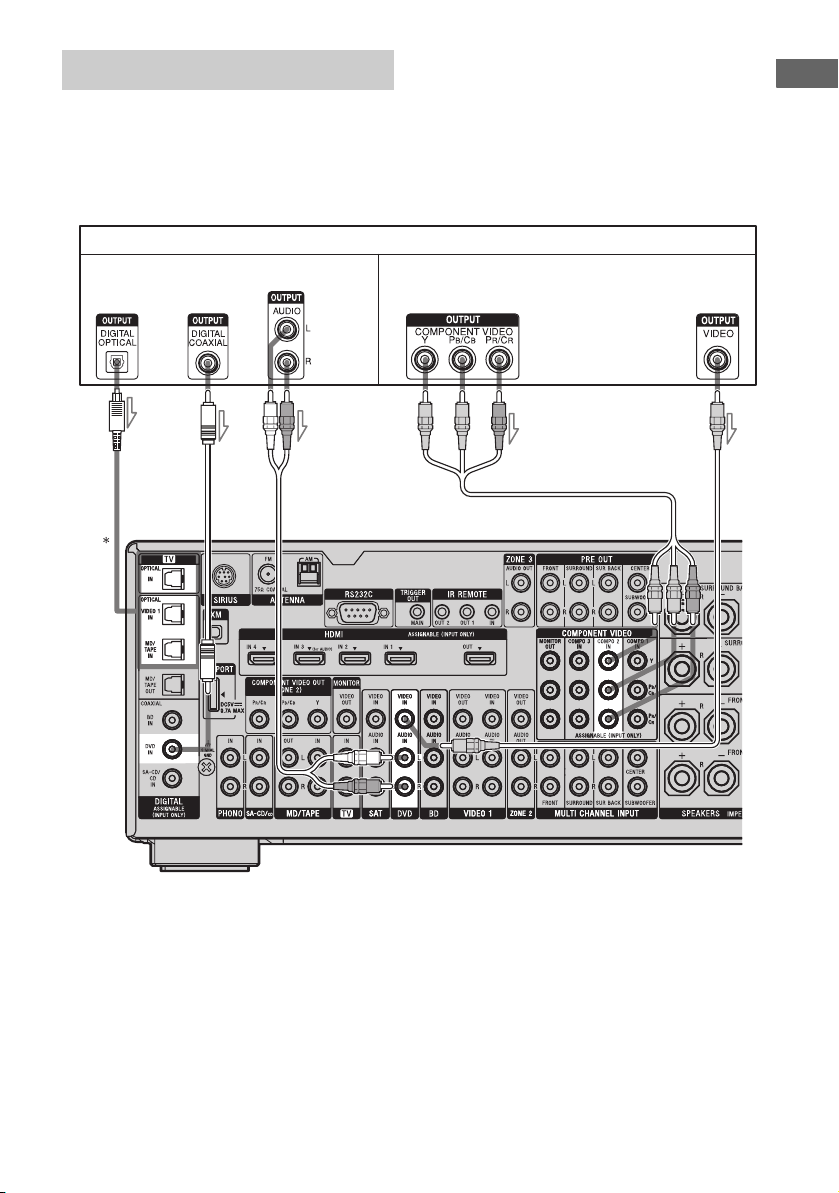
The following illustration shows how to
connect a DVD player.
It is not necessary to connect all the cords.
Connect the audio and video cords according
to the jacks of your components.
Note
To output multi channel digital audio from the DVD
player, set the digital audio output setting on the
DVD player. Refer to the operating instructions
supplied with the DVD player.
Connecting a DVD player
DVD player
ABC
A Optical digital cord (not supplied)
B Coaxial digital cord (not supplied)
C Audio cord (not supplied)
D Component video cord (not supplied)
E Video cord (not supplied)
* When you connect a component equipped with
an OPTICAL jack, set “Input Assign” in the
Input menu.
Tip
The COMPONENT VIDEO COMPO 2 IN jacks
have been assigned to the DVD player. If you
connect your DVD player to the COMPONENT
VIDEO COMPO 1 or COMPO 3 IN jacks, set
“Input Assign” in the Input menu.
D
Audio signals Video signals
E
30
US
D:\NORM'S JOB\SONY HA\SO0056\STR-DA3500ES\U VERSION\US\4144907131\01US-
STRDA3500ESUC\030CON.fm
masterpage: Left
STR-DA3500ES
4-144-907-13(1)
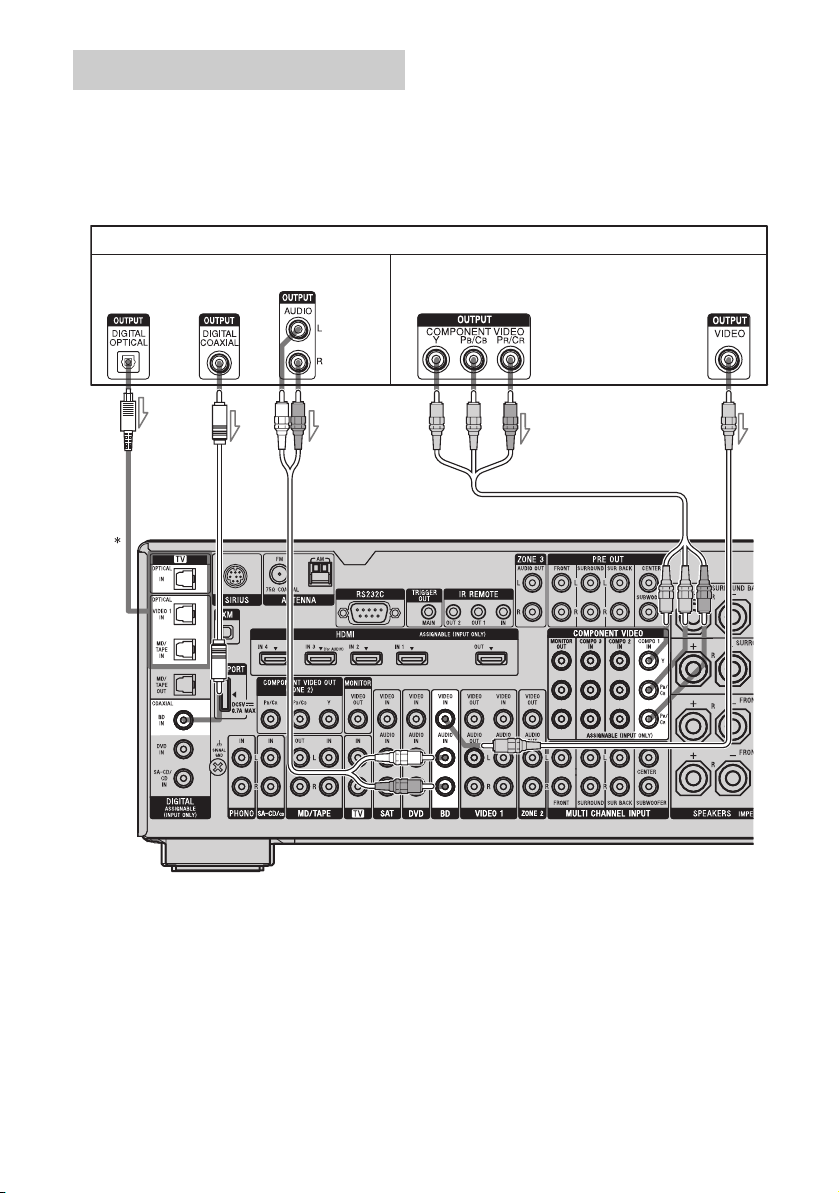
The following illustration shows how to
connect a Blu-ray disc player.
It is not necessary to connect all the cords.
Connect the audio and video cords according
to the jacks of your components.
Note
To output multi channel digital audio from the
Blu-ray disc player, set the digital audio output
setting on the Blu-ray disc player. Refer to the
operating instructions supplied with the Blu-ray disc
player.
Connecting a Blu-ray disc player
Blu-ray disc player
ABC
A Optical digital cord (not supplied)
B Coaxial digital cord (not supplied)
C Audio cord (not supplied)
D Component video cord (not supplied)
E Video cord (not supplied)
* When you connect a component equipped with
an OPTICAL jack, set “Input Assign” in the
Input menu.
Tip
The COMPONENT VIDEO COMPO 1 IN jacks
have been assigned to the Blu-ray disc player. If you
connect your Blu-ray disc player to the
COMPONENT VIDEO COMPO 2 or COMPO 3 IN
jacks, set “Input Assign” in the Input menu.
D
Audio signals Video signals
E
31
US
D:\NORM'S JOB\SONY HA\SO0056\STR-DA3500ES\U VERSION\US\4144907131\01US-
STRDA3500ESUC\030CON.fm
masterpage: Right
STR-DA3500ES
4-144-907-13(1)
Getting Started
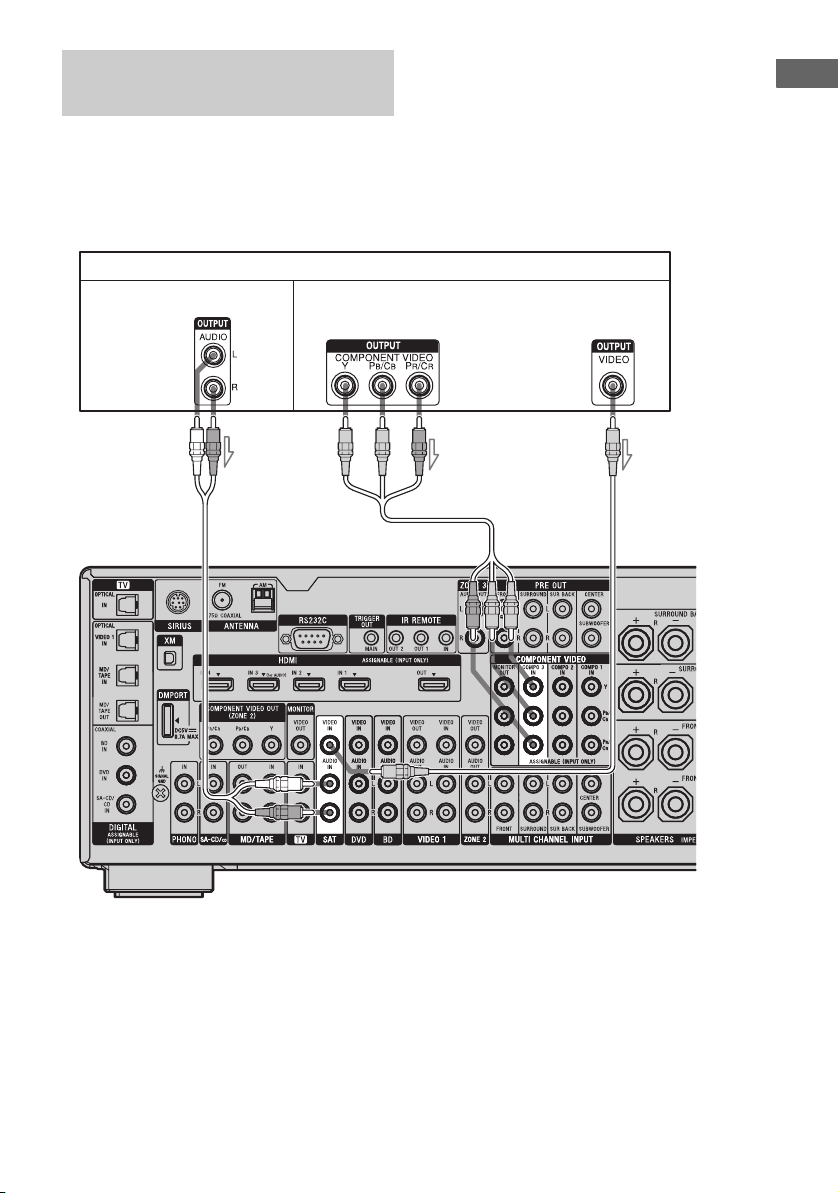
The following illustration shows how to
connect a satellite tuner or set-top box.
It is not necessary to connect all the cords.
Connect the audio and video cords according
to the jacks of your components.
Connecting a satellite tuner,
set-top box
Satellite tuner, set-top box
AB
Audio signals Video signals
C
A Audio cord (not supplied)
B Component video cord (not supplied)
C Video cord (not supplied)
Tip
The COMPONENT VIDEO COMPO 3 IN jacks
have been assigned to the satellite tuner or set-top
box. If you connect your satellite tuner or set-top
box to the COMPONENT VIDEO COMPO 1 or
COMPO 2 IN jacks, set “Input Assign” in the Input
menu.
32
US
D:\NORM'S JOB\SONY HA\SO0056\STR-DA3500ES\U VERSION\US\4144907131\01US-
STRDA3500ESUC\030CON.fm
masterpage: Left
STR-DA3500ES
4-144-907-13(1)
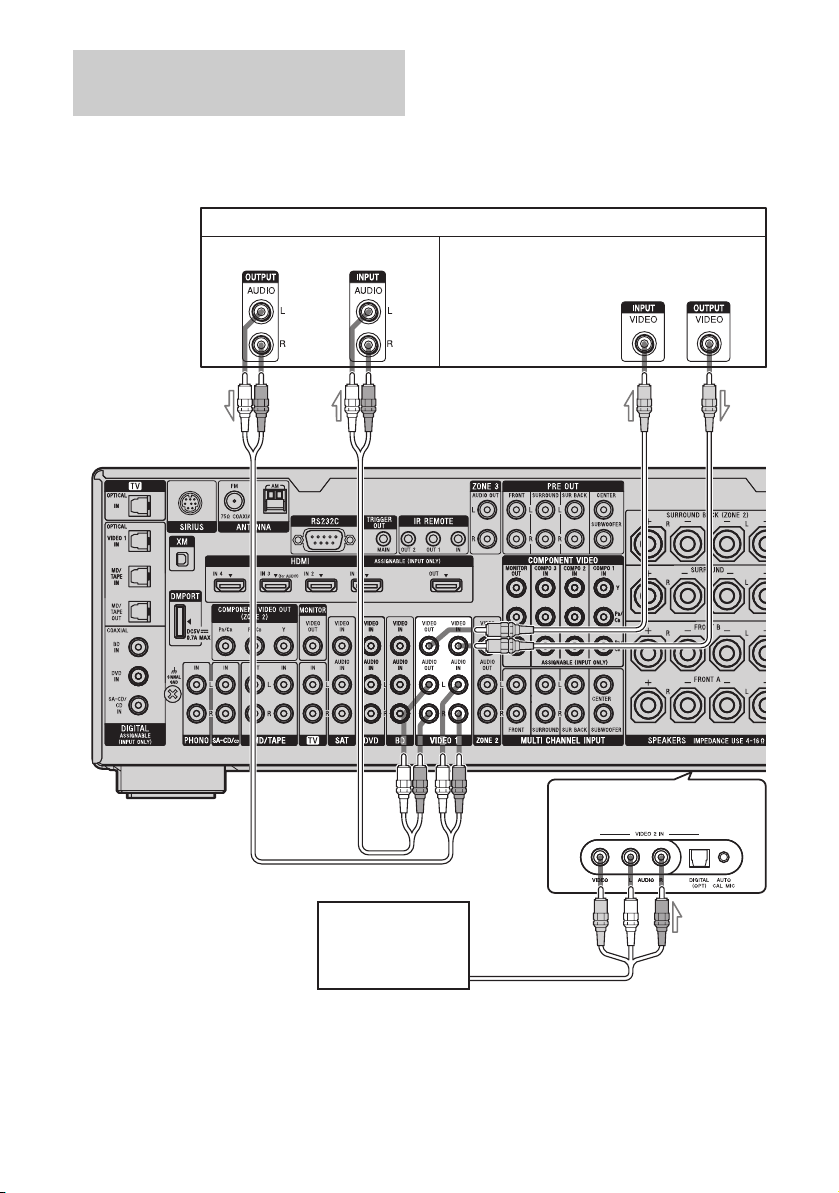
The following illustration shows how to
connect a component which has analog jacks
such as a DVD recorder, VCR, etc.
It is not necessary to connect all the cords.
Connect the audio and video cords according
to the jacks of your components.
Connecting components with
analog video and audio jack
DVD recorder, VCR
A
(On the front panel)
A Audio cord (not supplied)
B Video cord (not supplied)
C Audio/video cord (not supplied)
Audio signals Video signals
Camcorder,
video game
B
C
33
US
D:\NORM'S JOB\SONY HA\SO0056\STR-DA3500ES\U VERSION\US\4144907131\01US-
STRDA3500ESUC\030CON.fm
masterpage: Right
STR-DA3500ES
4-144-907-13(1)
Getting Started
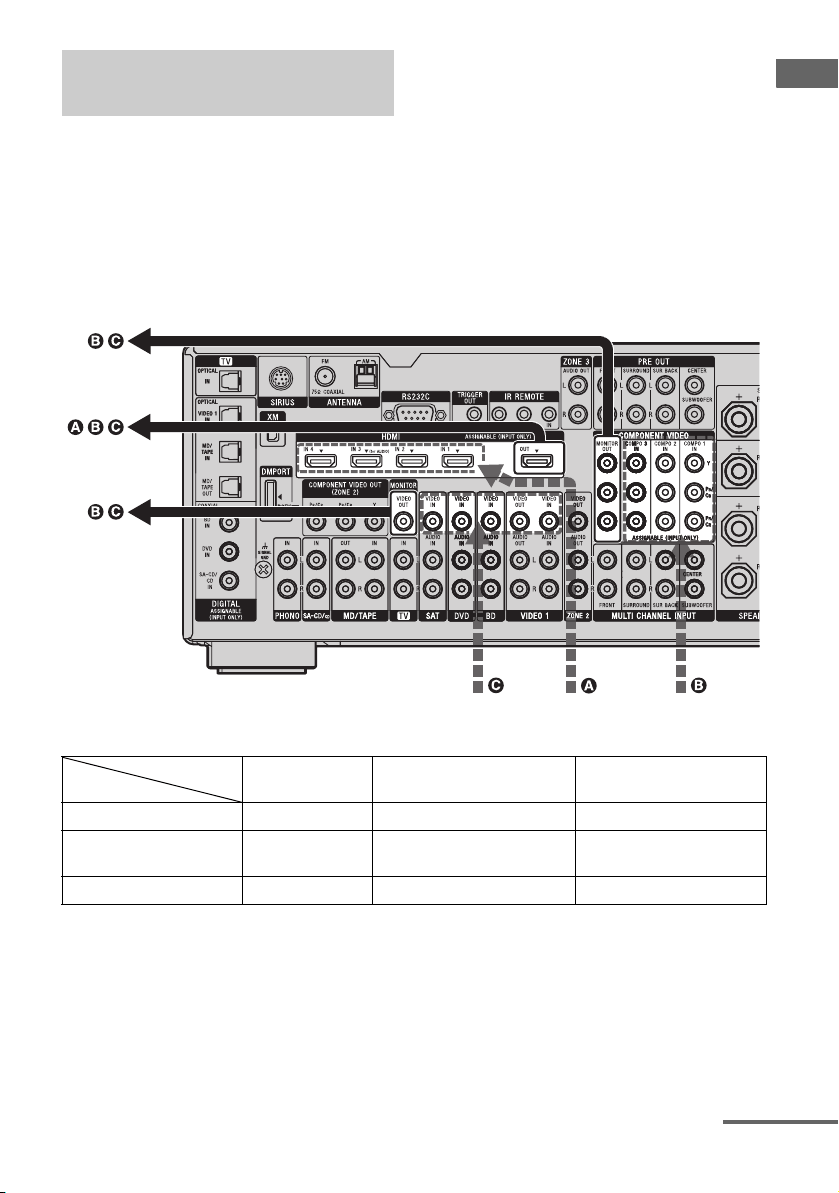
This receiver is equipped with a function for
converting video signals. You can output the
video signal after connecting this receiver via
the MONITOR OUT or HDMI OUT jack as
shown in the illustration.
• Video signals can be up-converted as HDMI
video and component video signals.
• Component video signals can be output as
HDMI video and video signals.
For details on the video converting function,
see “In the video input/output conversion table
classified by the menu settings” (page 35).
In the video input/output conversion table of the receiver
a : Video signals are converted and output through the video converter.
f : The same type of signal as that of the input signal is output. Video signals are not converted.
X : Video signals are not output.
* Video signals are output when “Resolution” is set to “DIRECT” in the Video settings menu.
Function for conversion of video
signals
Input Signals
Output Signals
HDMI OUT
COMPONENT VIDEO
MONITOR OUT
MONITOR VIDEO OUT
HDMI IN 1/2/3/4 A f XX
COMPONENT VIDEO IN
B
aa/fa
VIDEO IN C aa a/f*
INPUT jack
OUTPUT jack
continued

34
US
D:\NORM'S JOB\SONY HA\SO0056\STR-DA3500ES\U VERSION\US\4144907131\01US-
STRDA3500ESUC\030CON.fm
masterpage: Left
STR-DA3500ES
4-144-907-13(1)
Notes on converting video signals
• When video signals from a VCR, etc., are
converted on this receiver and then output to
your TV, depending on the status of the
video signal output, the image on the TV
screen may appear distorted horizontally or
no image may be output.
• HDMI video signals cannot be converted to
component video signals and video signals.
• The converted video signals are output only
from the MONITOR OUT jacks. They are
not output from the VIDEO OUT jacks or
the ZONE 2 VIDEO OUT jack.
• When you play a VCR with an image
improvement circuit, such as Time Base
Corrector (TBC), the images may be
distorted or may not be output. In this case,
set the image improvement circuit function
to off.
• The resolution of the signals output to the
COMPONENT VIDEO MONITOR OUT
jacks is converted up to 1080i. The
resolution of the signals output to the HDMI
OUT jack is converted up to 1080p.
• COMPONENT VIDEO MONITOR OUT
jacks have restrictions on resolution when
the resolution of video signals protected by
copyright technology is converted.
Resolution of up to 480p can be output to the
COMPONENT VIDEO MONITOR OUT
jacks. The HDMI OUT jack has no
restriction on resolution.
• Video signals for which the resolution has
been converted can be output from either the
COMPONENT VIDEO MONITOR OUT
jacks or the HDMI OUT jack. The video
signals are output from the HDMI OUT jack
when both are connected.
• Set “Resolution” to “AUTO” or “480i/576i”
in the Video settings menu to output the
video signals from the MONITOR VIDEO
OUT or COMPONENT VIDEO MONITOR
OUT jack when both are connected.
To display Closed Caption
Set “Resolution” to “DIRECT” in the Video
settings menu when receiving a signal that
supports Closed Captions.
Use the same kind of cords for the input/output
signals.
To connect a recording
component
When recording, connect the recording
component to the VIDEO OUT jacks of the
receiver. Connect cords for input and output
signals to the same type of jack, as VIDEO
OUT jacks do not have an up-conversion
function.
Note
Signals output from the HDMI OUT or MONITOR
OUT jacks may not be recorded properly.
35
US
D:\NORM'S JOB\SONY HA\SO0056\STR-DA3500ES\U VERSION\US\4144907131\01US-
STRDA3500ESUC\030CON.fm
masterpage: Right
STR-DA3500ES
4-144-907-13(1)
Getting Started
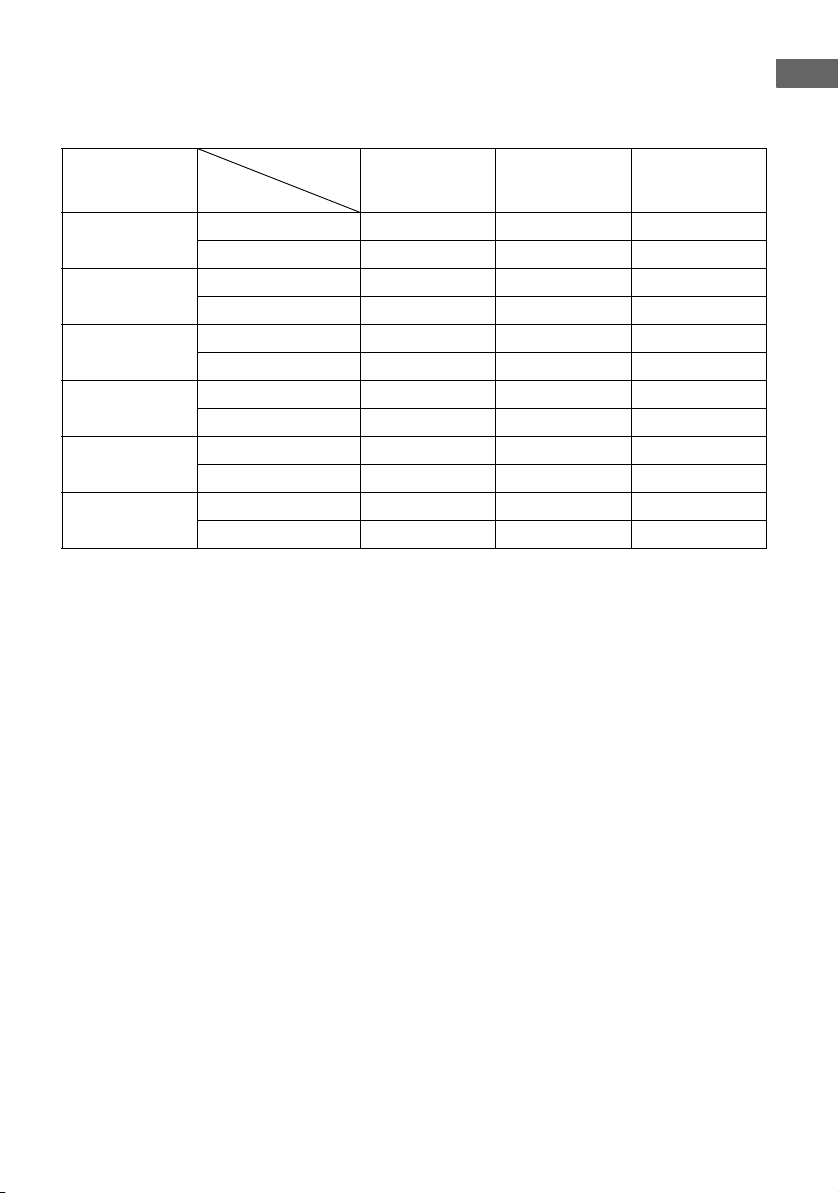
In the video input/output conversion table classified by the menu
settings
For details on “Resolution” menu setting, see “Settings for the video (Video settings menu)”
(page 57) and on operating, see “Converting analog video input signals” (page 96).
a : Video signals are converted and output through the video converter.
f : The same type of signal as that of the input signal is output. Video signals are not converted.
X : Video signals are not output.
a)
The resolution is set automatically, depending on the connected TV.
b)
When the TV is connected to jacks other than the HDMI jacks, 480i/576i signals are output when
“Resolution” is set to “AUTO”.
c)
480p/576p signals are output even if 480i/576i is set.
d)
Video signals without copyright protection are output based on the settings menu. Video signals with
copyright protection are output as 480p.
Notes
• Video signals are not output from the COMPONENT VIDEO MONITOR OUT or MONITOR VIDEO OUT
jacks when the TV, etc., is connected to the HDMI OUT jack.
• If you select a resolution that the connected TV does not support in the “Resolution” menu, the images from
the TV cannot be output correctly.
• Converted HDMI image output signals do not support “x.v.Color (x.v.Colour)” and Deep Color (Deep
Colour).
“Resolution”
menu setting
HDMI OUT jack COMPONENT
VIDEO MONITOR
OUT jacks
MONITOR VIDEO
OUT jack
DIRECT Component video X f X
Video XXf
AUTO (initial
setting)
Component video a
a)
a
b)
a
b)
Video a
a)
a
b)
a
b)
480i/576i Component video a
c)
aa
Video a
c)
aa
480p/576p Component video aa X
Video aaf
720p, 1080i Component video aa
d)
X
Video aa
d)
f
1080p Component video af X
Video a X f
Input signals
Output from
36
US
D:\NORM'S JOB\SONY HA\SO0056\STR-DA3500ES\U VERSION\US\4144907131\01US-
STRDA3500ESUC\030CON.fm
masterpage: Left
STR-DA3500ES
4-144-907-13(1)
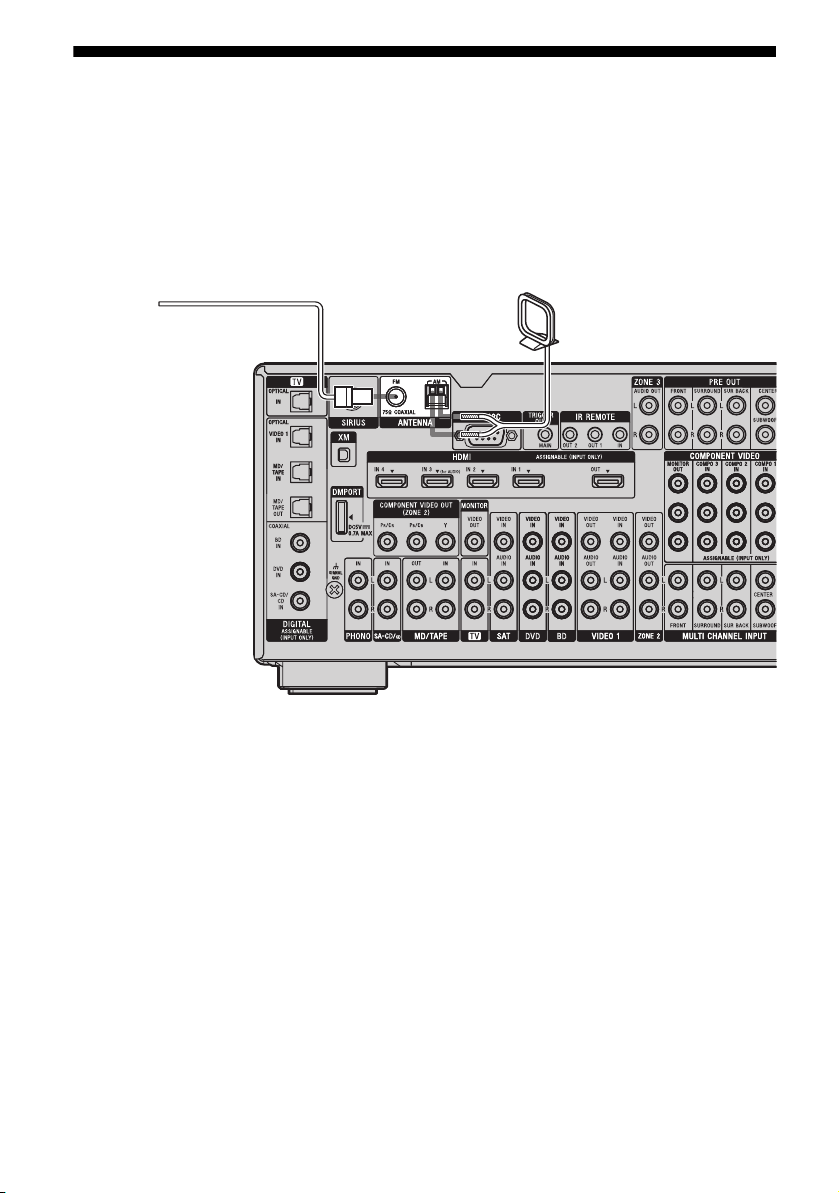
5: Connecting the antennas (aerials)
Connect the supplied AM loop antenna
(aerial) and FM wire antenna (aerial).
Before connecting the antennas (aerials), be
sure to disconnect the AC power cord (mains
lead).
Notes
• To prevent noise pickup, keep the AM loop antenna
(aerial) away from the receiver and other
components.
• Be sure to fully extend the FM wire antenna
(aerial).
• After connecting the FM wire antenna (aerial),
keep it as horizontal as possible.
FM wire antenna (aerial) (supplied)
AM loop antenna (aerial)
(supplied)
37
US
D:\NORM'S JOB\SONY HA\SO0056\STR-DA3500ES\U VERSION\US\4144907131\01US-
STRDA3500ESUC\030CON.fm
masterpage: Right
STR-DA3500ES
4-144-907-13(1)
Getting Started
6: Preparing the receiver
and the remote
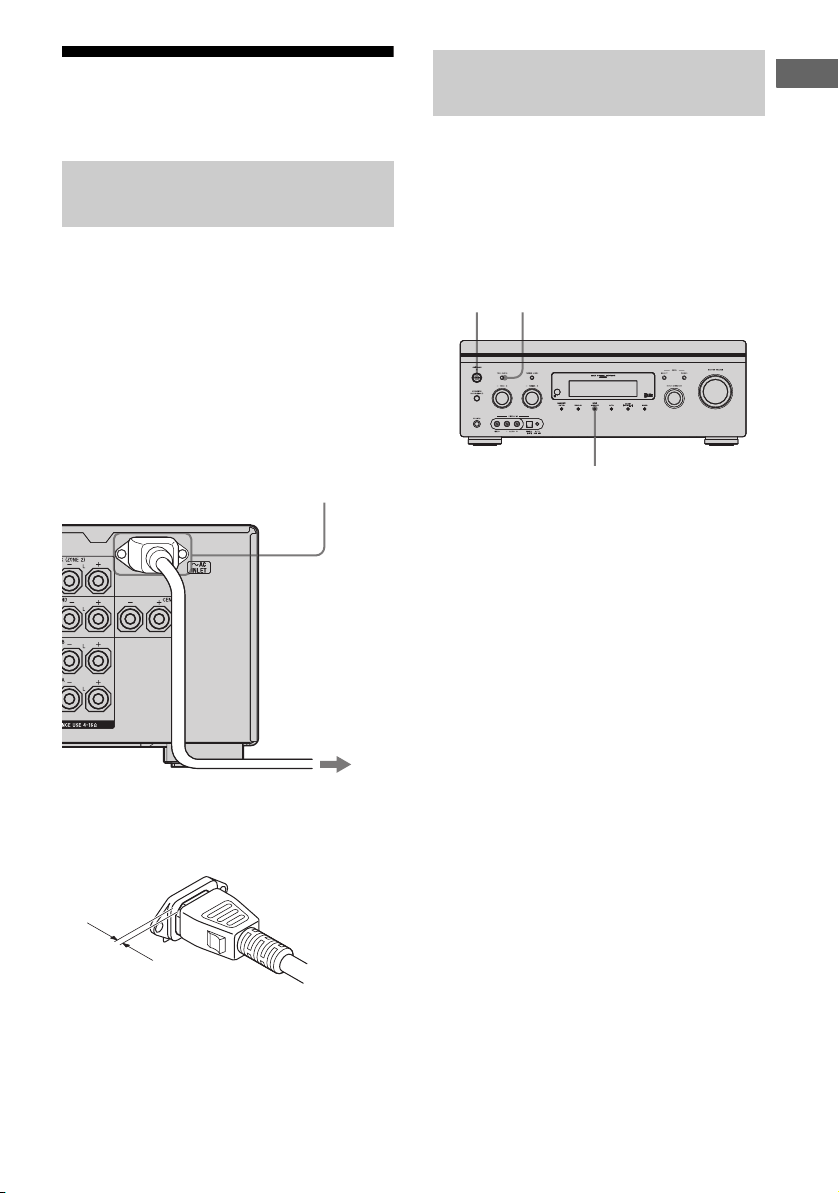
Connect the supplied AC power cord (mains
lead) to the AC INLET terminal on the
receiver, then connect the AC power cord
(mains lead) to a wall outlet (mains).
Notes
• Before connecting the AC power cord (mains
lead), make sure that metallic wires of the speaker
cords are not touching each other between the
SPEAKERS terminals.
• Connect the AC power cord (mains lead) firmly.
A several space is left between the plug and the
rear panel even when the power cord (mains
lead) is inserted firmly. The cord is supposed
be connected this way. This is not malfunction.
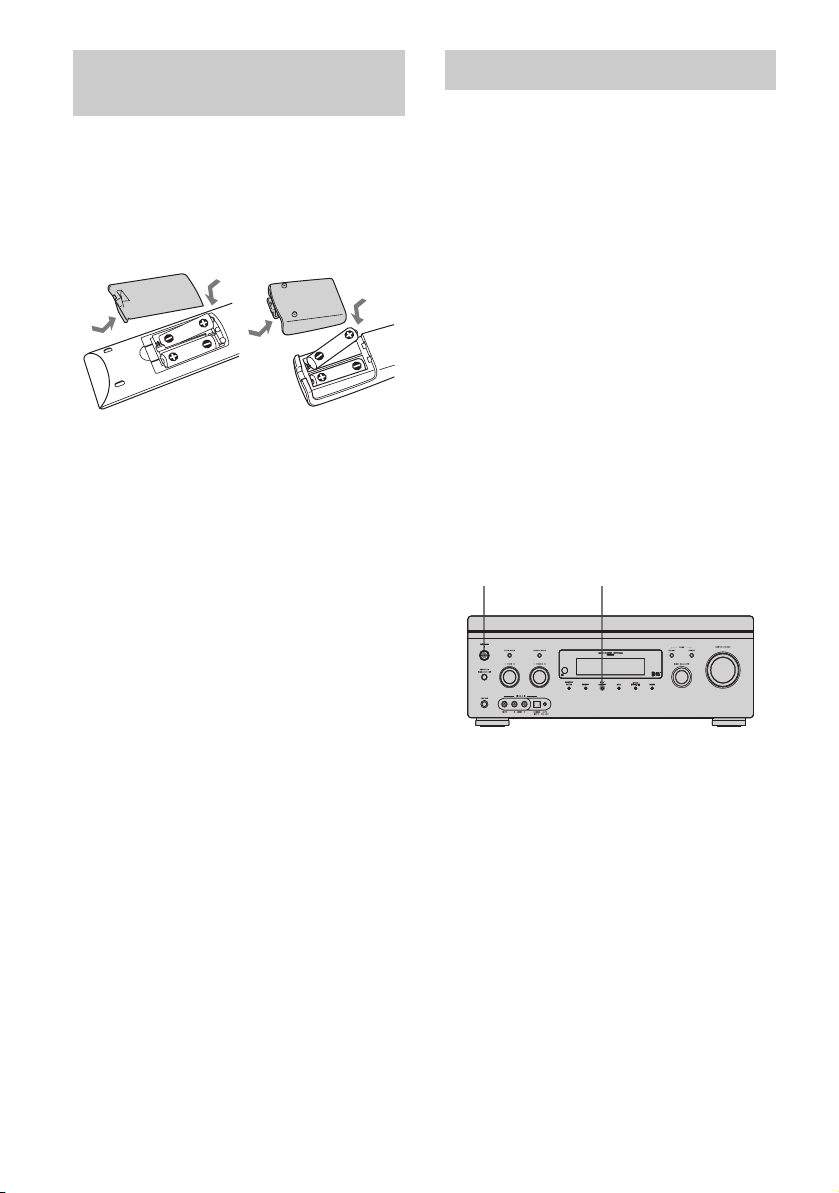
Before using the receiver for the first time,
initialize the receiver by performing the
following procedure. This procedure can also
be used to return settings you have made to
their factory defaults.
Be sure to use the buttons on the receiver for
this operation.
1 Press POWER to turn off the
receiver.
2 While holding down TONE
MODE and 2CH/A.DIRECT,
press POWER to turn on the
receiver.
3 Release the TONE MODE and
2CH/A.DIRECT after a few
seconds.
After “CLEARING” appears on the
display window for a while,
“CLEARED !” appears.
All the settings you have changed or
adjusted are reset to the initial settings.
Connecting the AC power cord
(mains lead)
AC INLET terminal
To the wall outlet (mains)
AC power cord
(mains lead)
(supplied)
Performing initial setup
operations
2CH/A.DIRECT
POWER TONE MODE
38
US
D:\NORM'S JOB\SONY HA\SO0056\STR-DA3500ES\U VERSION\US\4144907131\01US-
STRDA3500ESUC\030CON.fm
masterpage: Left
STR-DA3500ES
4-144-907-13(1)
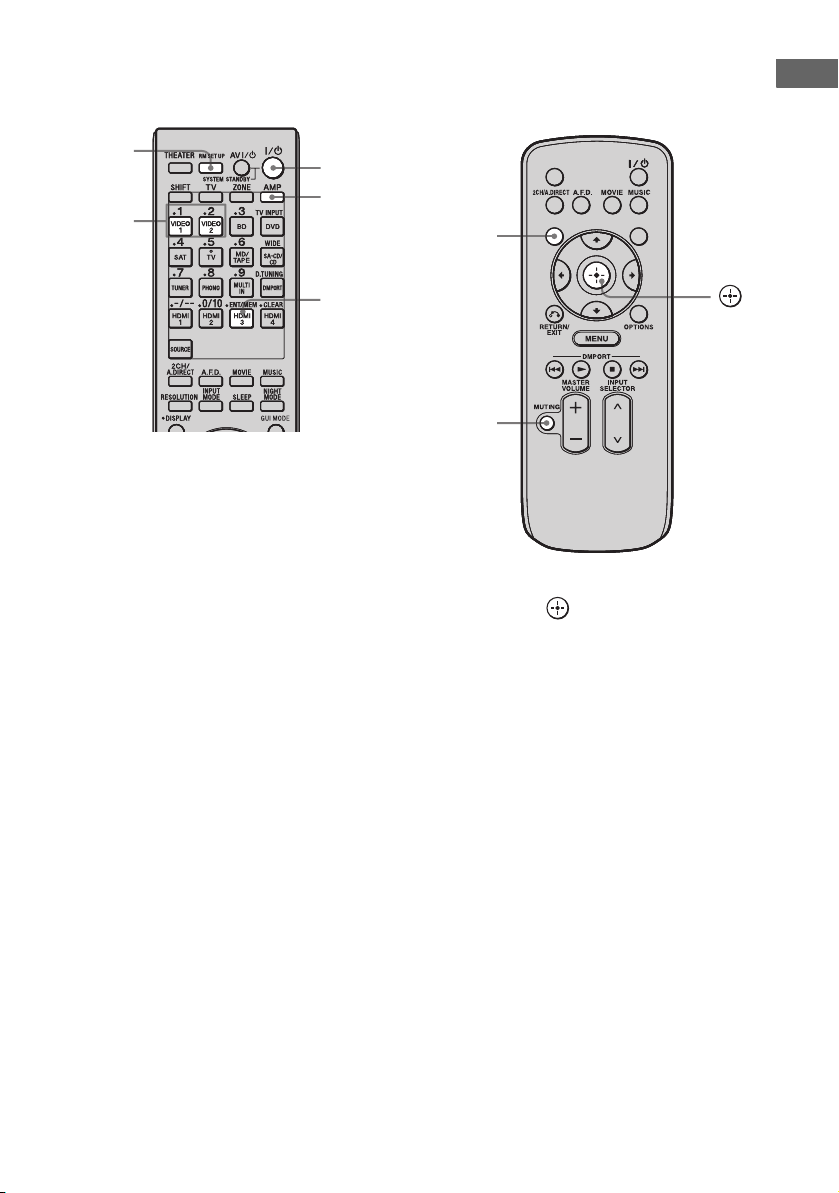
Insert two R6 (size-AA) batteries in the RM-
AAL026 Remote Commander.
Insert two R6 (size-AA) batteries in the RM-
AAU039 Remote Commander.
Observe the correct polarity when installing
batteries.
Notes
• Do not leave the remote in an extremely hot or
humid place.
• Do not use a new battery with old ones.
• Do not mix manganese batteries and other kinds of
batteries.
• Do not expose the remote sensor to direct sunlight
or lighting apparatuses. Doing so may cause a
malfunction.
• If you do not intend to use the remote for an
extended period of time, remove the batteries to
avoid possible damage from battery leakage and
corrosion.
• When you replace the batteries, the programmed
remote codes may be cleared. If this happens,
program the remote codes again (page 124).
• When the remote no longer operates the receiver,
replace all the batteries with new ones.
The receiver and the remote use the same
command mode.
If the command modes of the receiver and the
remote are different, you cannot use the
remote to operate the receiver.
If the command modes of both the receiver and
the remote are those of the initial setting (AV
SYSTEM 2), it is not necessary to reset them.
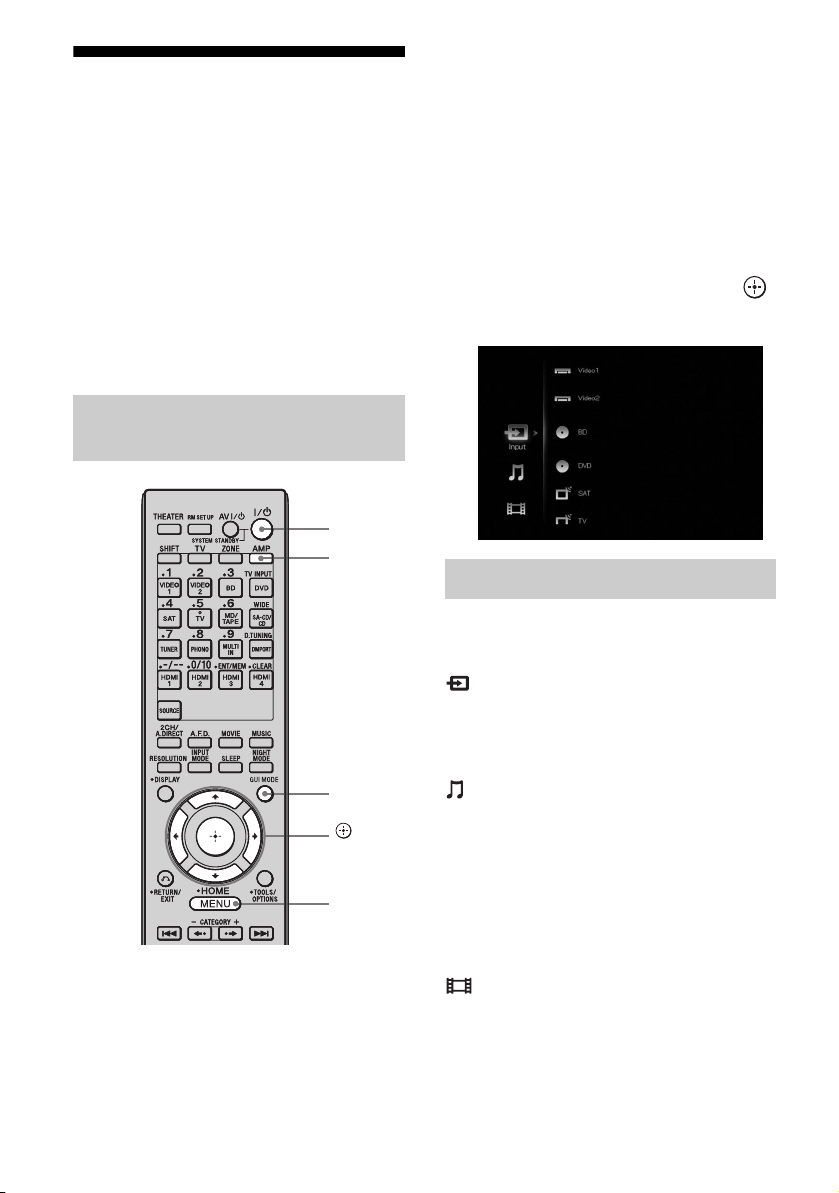
You can switch the command mode (AV
SYSTEM 1 or AV SYSTEM 2) of the receiver
and the remote. If both the receiver and the
other Sony component respond to the same
remote command, switch the command mode
of either the component or the receiver to
another command mode so that the component
does not respond to the same remote command
as the receiver.
To switch the command mode
of the receiver
While holding down the 2CH/
A.DIRECT, press POWER to turn on
the receiver.
When the command mode is set to “AV2”,
“C. MODE AV2” appears on the display
window.
When the command mode is set to “AV1”,
“C. MODE AV1” appears on the display
window.
Inserting batteries into the
remote
RM-AAL026 RM-AAU039
About the command mode
2CH/A.DIRECTPOWER
39
US
D:\NORM'S JOB\SONY HA\SO0056\STR-DA3500ES\U VERSION\US\4144907131\01US-
STRDA3500ESUC\030CON.fm
masterpage: Right
STR-DA3500ES
4-144-907-13(1)
Getting Started
To switch the command mode
of the multi function remote
commander
1
While holding down RM SET UP, press
?/1.
The AMP and ZONE buttons flash.
2 Press AMP.
The ZONE button lights off, the AMP
button keeps flashing and the SHIFT button
lights up.
3 Press 1 or 2 while the AMP buttons is
flashing.
When you press 1, the command mode is
set to AV SYSTEM 1. When you press 2,
the command mode is set to AV SYSTEM
2.
The AMP button lights up.
4 Press ENT/MEM before the AMP
button lights off.
The AMP button flashes twice, then the
command mode setting process is
completed.
To switch the command mode
of the simple remote
commander
Press and hold DISPLAY, then press
MUTING and at the same time.
RM SET
UP
?/1
ENT/MEM
AMP
1, 2
DISPLAY
SLEEP
GUI MODE
DISPLAY
MUTING
40
US
D:\NORM'S JOB\SONY HA\SO0056\STR-DA3500ES\U VERSION\US\4144907131\01US-
STRDA3500ESUC\030CON.fm
masterpage: Left
STR-DA3500ES
4-144-907-13(1)
7: Operating the receiver
using the GUI
(Graphical User Interface)
You can change the display mode of the menu
to screen mode using the following
procedures.
By using the GUI menu, you can make various
settings and adjustments.
See “Operating without connecting to the TV”
(page 111) if you are not going to use a GUI
menu.
1 Connect a TV to this receiver.
See “3: Connecting the TV” (page 19).
2 Turn on the receiver and the TV.
3 Press AMP to enable receiver
operation.
4 Press GUI MODE repeatedly to
select “GUI ON”.
The GUI menu appears on the TV screen.
Press MENU if the GUI menu does not
appear on the TV screen.
5 Press V/v repeatedly to select a
menu you want, then press
or b.
The following menu items are available in
each settings menu.
Input
Selects the input to the receiver.
For details on each input, see “Selecting a
component” (page 50).
Music
You can listen to the music from an audio
component connected the DIGITAL MEDIA
PORT adapter.
For details on the Music function, see
“Enjoying the sound/images from the
components connected to the DIGITAL
MEDIA PORT” (page 97).
Video
Select the images from the video component
connected to the DIGITAL MEDIA PORT
adapter (page 97).
Displaying the GUI menu on the
TV screen
GUI
MODE
MENU
,
V/v/B/b
AMP
?/1
Overview of the menus
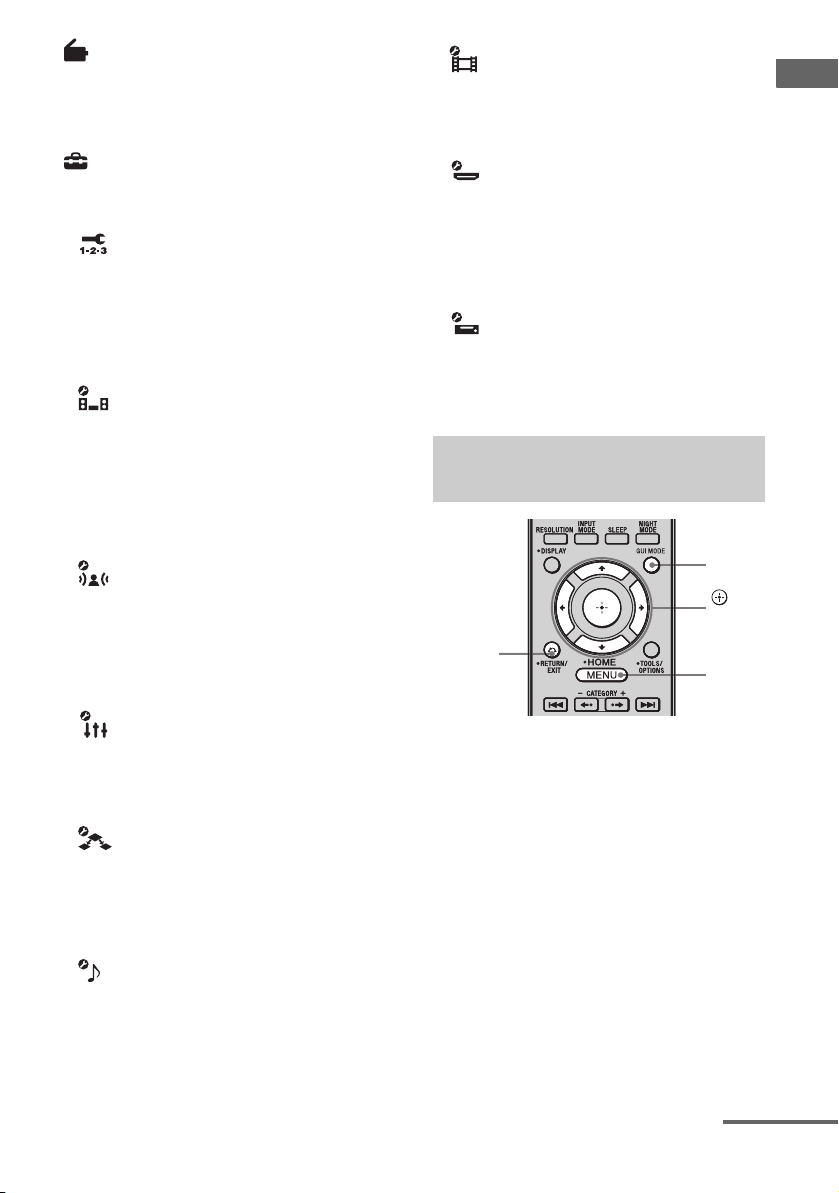
41
US
D:\NORM'S JOB\SONY HA\SO0056\STR-DA3500ES\U VERSION\US\4144907131\01US-
STRDA3500ESUC\030CON.fm
masterpage: Right
STR-DA3500ES
4-144-907-13(1)
Getting Started
FM/AM/XM/SIRIUS
You can listen to the radio using the receiver.
For details on the Tuner operation, see “Tuner
Operations” (page 71).
Settings
You can use the Settings menu to set and adjust
this receiver.
Auto Calibration
You can use the Auto Calibration settings
menu to adjust the speakers automatically.
For details, see “9: Calibrating the
appropriate speaker settings automatically
(Auto Calibration)” (page 44).
Speaker
You can use the Speaker settings menu to
adjust the speakers manually for the current
position, and to set the speaker impedance.
For details, see “Setting the speaker
impedances” (page 43) and “Adjusting the
speaker settings manually” (page 65).
Surround
You can use the Surround settings menu to
select the sound field you want for your
listening pleasure. For details on adjusting
the parameters, see “Enjoying a pre-
programmed sound field” (page 59).
EQ
You can use the EQ settings menu to adjust
the equalizer. For details, see “Adjusting the
equalizer” (page 70).
Multi Zone
You can use the Multi Zone settings menu to
operate components in the multi zone. For
details on adjusting the parameters, see
“Using Multi-zone Features” (page 90).
Audio
For details on adjusting the audio using the
Audio settings menu, see “Settings for the
audio (Audio settings menu)” (page 56).
Video
For details on adjusting the video using the
Video settings menu, see “Settings for the
video (Video settings menu)” (page 57).
HDMI
You can use the HDMI settings menu to
operate components connected to the HDMI
jacks. For details on adjusting the
parameters, see “Settings for HDMI (HDMI
settings menu)” (page 57).
System
For details on adjusting the system using the
System settings menu, see “Settings for the
system (System settings menu)” (page 58).
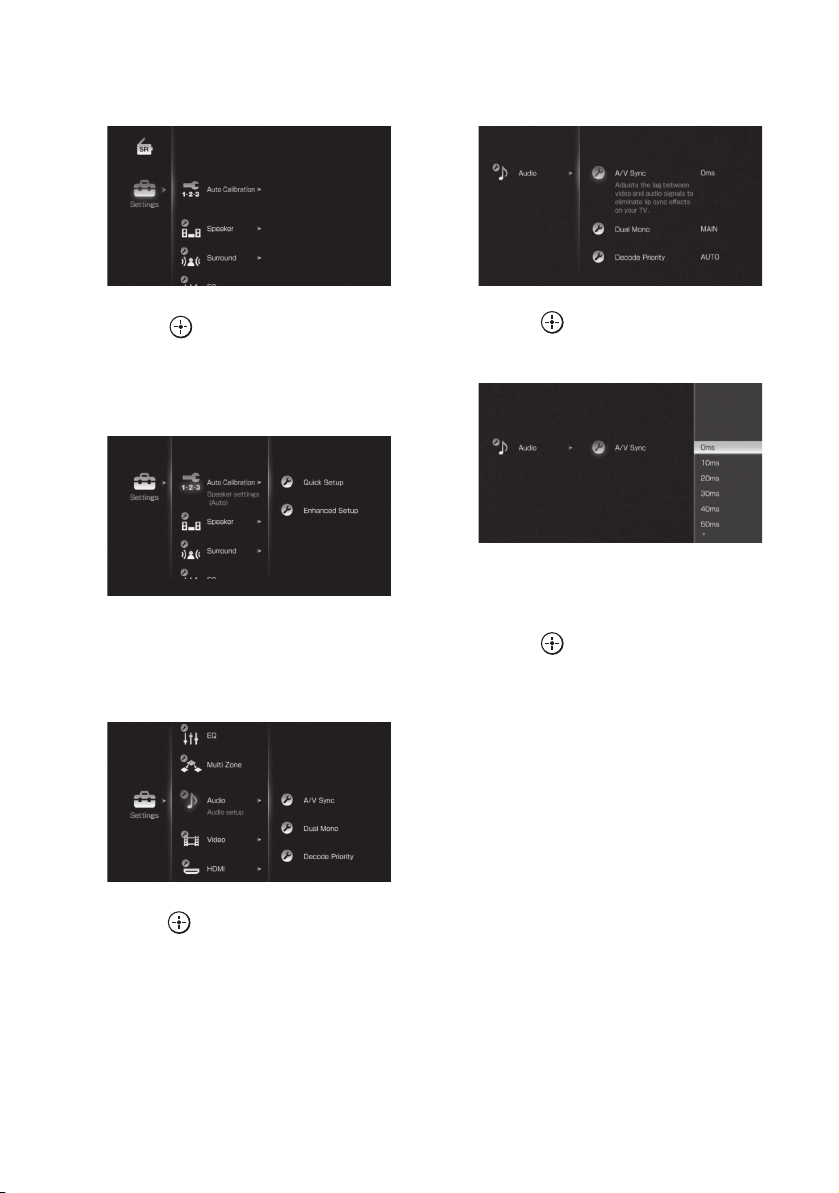
1 Press GUI MODE repeatedly to
select “GUI ON”.
The GUI menu appears on the TV screen.
Press MENU if the GUI menu does not
appear on the TV screen.
Navigating through menus using
the GUI
RETURN/
EXIT O
MENU
,
V/v/B/b
GUI
MODE
continued
42
US
D:\NORM'S JOB\SONY HA\SO0056\STR-DA3500ES\U VERSION\US\4144907131\01US-
STRDA3500ESUC\030CON.fm
masterpage: Left
STR-DA3500ES
4-144-907-13(1)
2 Press V/v repeatedly to select a
menu you want.
3 Press or b to enter the
menu.
The menu item list appears on the TV
screen.
4 Press V/v repeatedly to select
the menu item you want to
adjust.
5 Press or b to enter the menu
item.
6 Press V/v repeatedly to select
the parameter you want.
7 Press to enter the
parameter.
8 Press V/v repeatedly to select
the settings you want.
9 Press to enter the setting.
To return to the previous screen
Press B or RETURN/EXIT O.
To exit the menu
Press MENU.
To exit “GUI MODE”
Press GUI MODE repeatedly to select “GUI
OFF”.

43
US
D:\NORM'S JOB\SONY HA\SO0056\STR-DA3500ES\U VERSION\US\4144907131\01US-
STRDA3500ESUC\030CON.fm
masterpage: Right
STR-DA3500ES
4-144-907-13(1)
Getting Started
8: Setting the speakers
Set the appropriate speaker impedance for the
speakers you are using.
1 Press GUI MODE repeatedly to
select “GUI ON”.
The GUI menu appears on the TV screen.
Press MENU if the GUI menu does not
appear on the TV screen.
2 Press V/v repeatedly to select
“Settings”, then press or b.
The Settings menu list appears on the TV
screen.
3 Press V/v repeatedly to select
“Speaker”, then press or b.
4 Press V/v repeatedly to select
“Impedance”, then press .
5 Press V/v repeatedly to select
“4 :” or “8 :” depending on
the speakers you are using,
then press .
Notes
• If you are not sure of the impedances of the
speakers, refer to the operating instructions
supplied with your speakers. (This information is
often found on the back of the speaker.)
• When you connect all speakers with a normal
impedance of 8 ohms or higher, set “Impedance” to
“8 :”. When connecting other types of speakers,
set it to “4 :”.
• When you connect front speakers to both the
SPEAKERS A and B terminals, connect the
speakers with a normal impedance of 8 ohms or
higher.
– When you connect speakers with impedance of
16 ohms or higher in both “A” and “B”
configuration:
Set “Impedance” to “8 :” in the Speaker
settings menu.
– For other types of speakers in other
configurations:
Set “Impedance” to “4 :” in the Speaker
settings menu.
Setting the speaker impedances
MENU
,
V/v/B/b
GUI
MODE
44
US
D:\NORM'S JOB\SONY HA\SO0056\STR-DA3500ES\U VERSION\US\4144907131\01US-
STRDA3500ESUC\030CON.fm
masterpage: Left
STR-DA3500ES
4-144-907-13(1)
You can select the front speakers you want to
drive.
Press SPEAKERS (OFF/A/B/A+B)
repeatedly to select the front
speaker system you want to drive.
Note
This setting is not available when headphones are
connected.
To turn off the speaker output
Press SPEAKERS (OFF/A/B/A+B)
repeatedly until the “SP A”, “SP B” and “SP
A+B” indicators on the display window lights
off.
“ALL OFF” appears in the display window.
9: Calibrating the
appropriate speaker
settings automatically
(Auto Calibration)
The DCAC (Digital Cinema Auto Calibration)
function allows you to perform automatic
calibration as follows:
• Check the connection between each speaker
and the receiver.
a)
• Measure the polarity of speakers.
• Measure the distance of each speaker from
your seating position automatically.
a)
• Measure the speaker size.
a)
• Adjust the speaker level.
• Measure the frequency characteristics.
a)b)
a)
The measurement result is not utilized in the
following cases.
– The multi channel input is selected.
– “2ch Analog Direct” is being used.
b)
The measurement is not utilized in the following
cases.
– Dolby TrueHD signals with a sampling
frequency of 176.4 kHz and higher are being
received.
– PCM signals with a sampling frequency of
176.4 kHz and higher are being received.
The DCAC is designed to obtain proper sound
balance in your room. However, you can adjust
the speaker levels and balance manually
according to your preference. For details, see
“Making settings with the Test Tone menu”
(page 68).
Selecting the front speakers
To select Light up
The speakers connected to the
FRONT SPEAKERS A terminals.
SP A
The speakers connected to the
FRONT SPEAKERS B terminals.
SP B
The speakers connected to both the
FRONT SPEAKERS A and B
terminals (parallel connection).
SP A+B
SPEAKERS (OFF/A/B/A+B)
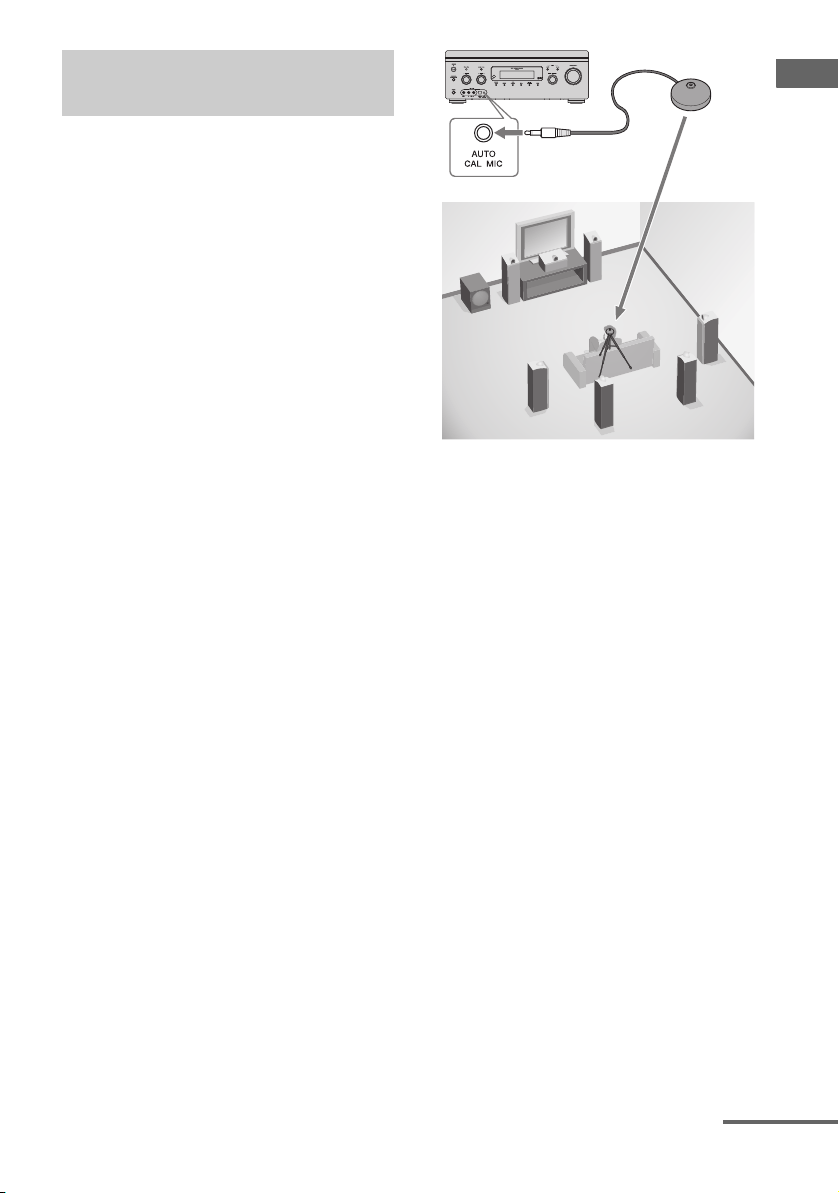
45
US
D:\NORM'S JOB\SONY HA\SO0056\STR-DA3500ES\U VERSION\US\4144907131\01US-
STRDA3500ESUC\030CON.fm
masterpage: Right
STR-DA3500ES
4-144-907-13(1)
Getting Started
Before you perform the Auto Calibration, set
up and connect the speakers (page 15-18).
• The AUTO CAL MIC jack is used for the
supplied optimizer microphone only. Do not
connect other microphones. Doing so may
damage the receiver and the microphone.
• During the measurement, the sound that
comes out of the speakers is very loud. The
volume of the sound cannot be adjusted. Pay
attention to the presence of children or to the
effect on your neighborhood.
• Perform the measurement in a quiet
environment to avoid the effect of noise and
get a more accurate measurement.
• If there are any obstacles in the path between
the optimizer microphone and the speakers,
the calibration cannot be performed
correctly. Remove any obstacle from the
measurement area to avoid measurement
error.
• When you use a bi-amplifier connection, set
“Sur Back Assign” to “BI-AMP” in the
Speaker settings menu before you perform
Auto Calibration.
Notes
• The Auto Calibration function does not work if
– headphones are connected.
– SPEAKERS (OFF/A/B/A+B) is set to off.
• If the muting function has been activated before
you perform Auto Calibration, the muting function
will be set to off automatically.
1 Connect the supplied optimizer
microphone to the AUTO CAL
MIC jack.
2 Set up the optimizer
microphone.
Place the optimizer microphone at your
seating position. Use a stool or tripod so
that the optimizer microphone remains at
the same height as your ears.
Before you perform the Auto
Calibration
Optimizer microphone
continued
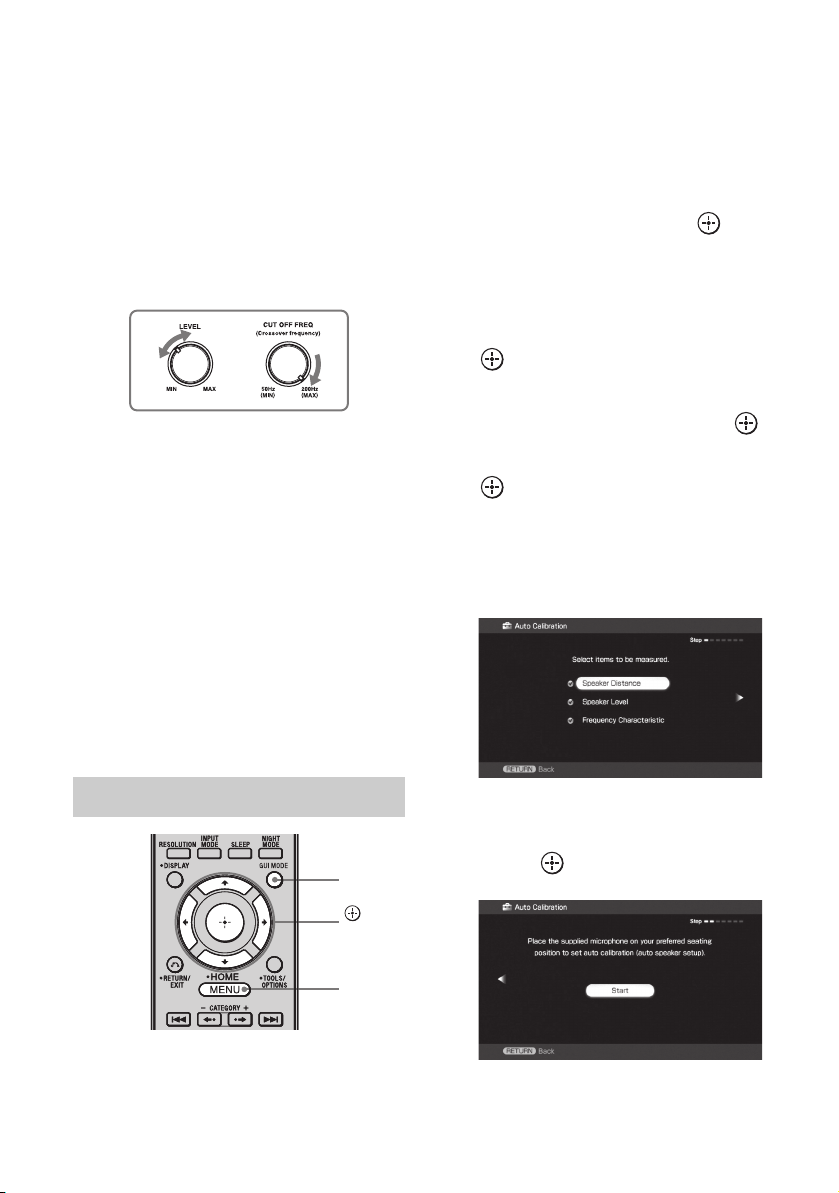
46
US
D:\NORM'S JOB\SONY HA\SO0056\STR-DA3500ES\U VERSION\US\4144907131\01US-
STRDA3500ESUC\030CON.fm
masterpage: Left
STR-DA3500ES
4-144-907-13(1)
On setting up the active
subwoofer
• When a subwoofer is connected, turn on the
subwoofer and turn up the volume
beforehand. Turn the MASTER VOLUME
knob to just before the mid-point.
• If you connect a subwoofer with the
crossover frequency function, set the value
to maximum.
• If you connect a subwoofer with an auto
standby function, set it to off (deactivated).
Note
Depending on the characteristics of the subwoofer
you are using, the setup distance value may be
further away from the actual position.
Using the receiver as a pre-
amplifier
You can use the Auto Calibration function
when you use the receiver as a pre-amplifier.
In this case, the distance value shown on the
display may differ from the actual distance
value. However, there will be no problems
even if you continue to use the receiver with
that value.
1 Press GUI MODE repeatedly to
select “GUI ON”.
The GUI menu appears on the TV screen.
Press MENU if the GUI menu does not
appear on the TV screen.
2 Press V/v repeatedly to select
“Settings”, then press or b.
The Settings menu list appears on the TV
screen.
3 Press V/v repeatedly to select
“Auto Calibration”, then press
or b.
4 Press V/v repeatedly to select
“Quick Setup”, then press .
5 Press V/v repeatedly and press
to un-check the items you
do not want to measure.
• Speaker Distance
• Speaker Level
• Frequency Characteristic
6 Press b.
7 Press to select “Start”.
Performing Auto Calibration
MENU
,
V/v/B/b
GUI
MODE
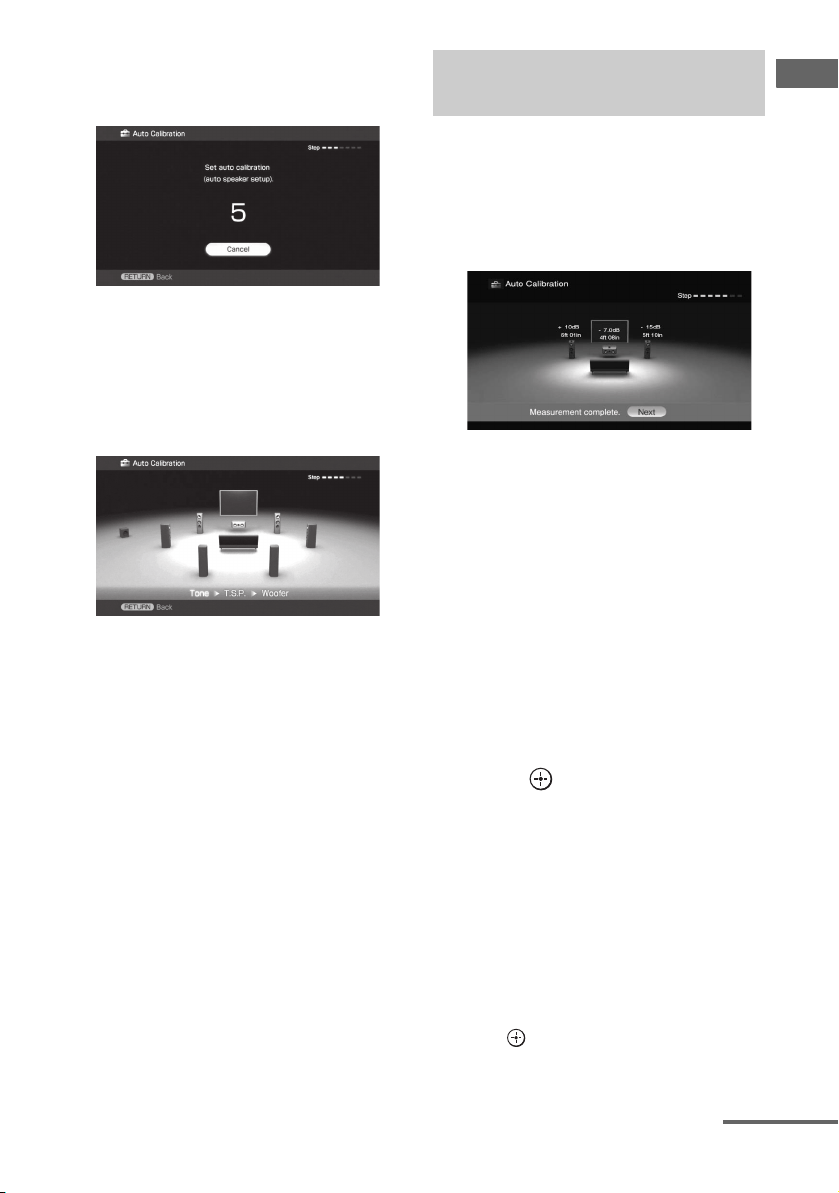
47
US
D:\NORM'S JOB\SONY HA\SO0056\STR-DA3500ES\U VERSION\US\4144907131\01US-
STRDA3500ESUC\030CON.fm
masterpage: Right
STR-DA3500ES
4-144-907-13(1)
Getting Started
8 The measurement starts in five
seconds.
9 Measurement starts.
The measurement process will take
approximately 30 seconds with a test
tone. Wait until the measurement process
completes.
Tips
• Operations other than turning the receiver on or off
are deactivated during the measurement.
• In the following situations, the measurements have
not been performed correctly or Auto Calibration
cannot be performed.
– when connecting special speakers, such as
dipole speakers.
– when using the zone 2/zone 3 function in
zone 2/zone 3.
To cancel the measurement
The measurement will be canceled when you
do the following:
–Press ?/1, input buttons or MUTING.
– Press SPEAKERS (OFF/A/B/A+B) on the
receiver.
– Change the volume level.
– Connect the headphones.
– Press GUI MODE.
1 Confirm the measurement
result.
When the measurement ends, a beep
sounds and the measurement result
appears on the TV screen.
Note
When the speaker(s) is (are) out of the phase,
“Out Phase” is displayed on the TV screen.
The “+” and “–” terminals of the speaker may
be connected the other way around. However,
depending on the speakers, “Out Phase”
appears on the TV screen even though the
speakers are connected properly. This is
because of the speakers’ specifications. In this
case, you can continue to use the receiver.
Tip
The displayed unit of distance is feet. You can
change the unit of distance to meters in
“Distance Unit” in the Speaker settings menu.
2 Press to select “Next”.
When “Save auto calibration (auto
speaker setup)?” appears on the TV
screen, you can select whether to confirm
the warning (“Yes”) or not (“No”).
Follow the instructions of the TV screen
when you select “Yes”.
For details on warning and error codes,
see “Message list after Auto Calibration
measurement” (page 49).
Tip
Press on the remote when “Please Press
ENTER.” appears on the TV screen.
Confirming/saving the
measurement results
continued
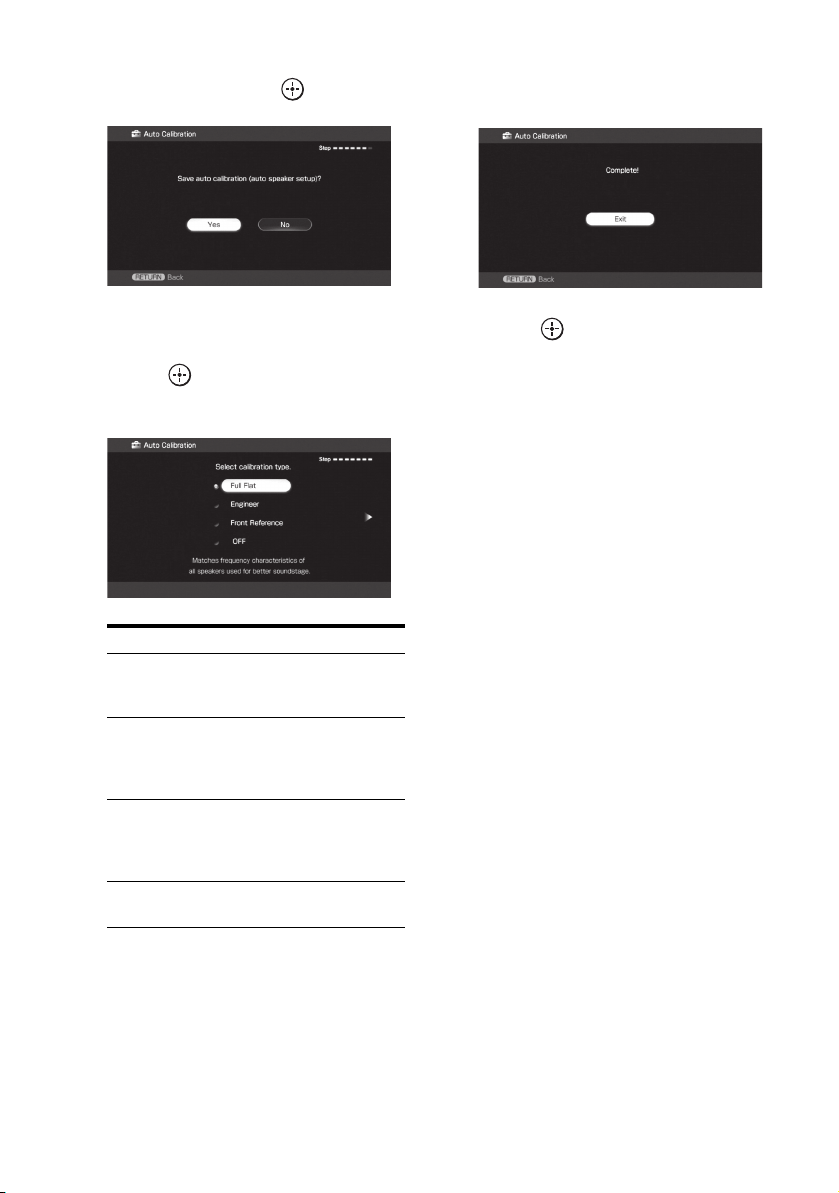
48
US
D:\NORM'S JOB\SONY HA\SO0056\STR-DA3500ES\U VERSION\US\4144907131\01US-
STRDA3500ESUC\030CON.fm
masterpage: Left
STR-DA3500ES
4-144-907-13(1)
3 Press B/b repeatedly to select
“Yes”, then press .
4 Press V/v repeatedly to select
the Auto Calibration type, then
press .
The measurement results are saved.
5 Press b.
The exit screen appears.
6 Press to exit.
Note
The frequency response measurement result is not
utilized in the following cases.
– The multi channel input is selected.
– “2ch Analog Direct” is being used.
– Dolby TrueHD signals with a sampling frequency
of 176.4 kHz and higher are being received.
– PCM signals with a sampling frequency of
176.4 kHz and higher are being received.
Tip
The size of a speaker (LARGE/SMALL) is
determined by the low characteristics. The
measurement results may vary, depending on the
position of the optimizer microphone and speakers,
and the shape of the room. It is recommended that
you follow the measurement results. However, you
can change those settings in the Speaker settings
menu. Save the measurement results first, then try to
change the settings if you want.
Parameter Explanation
Full Flat Makes the measurement of
frequency from each
speaker flat.
Engineer Sets the frequency to one
that matches that of the
Sony listening room
standard.
Front Reference Adjusts the characteristics
of all the speakers to match
the characteristics of the
front speaker.
OFF Sets the Auto Calibration
EQ to off.
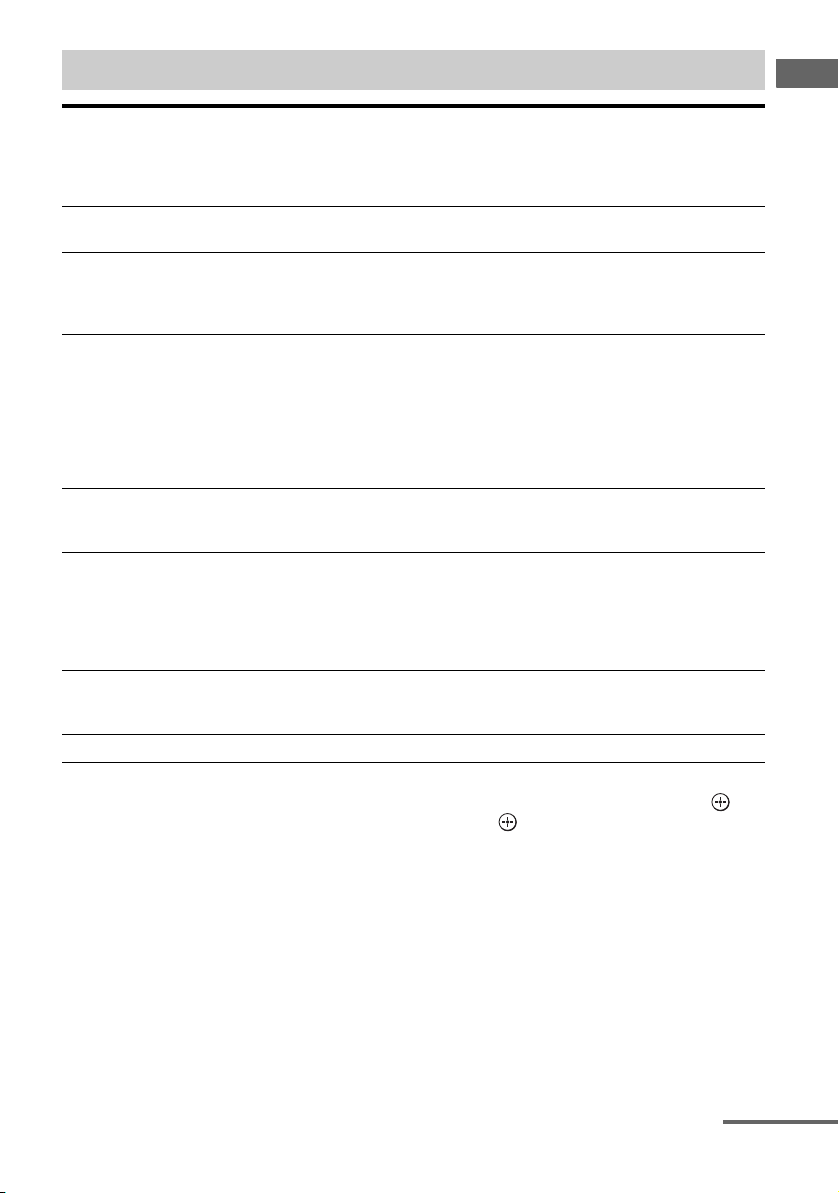
49
US
D:\NORM'S JOB\SONY HA\SO0056\STR-DA3500ES\U VERSION\US\4144907131\01US-
STRDA3500ESUC\030CON.fm
masterpage: Right
STR-DA3500ES
4-144-907-13(1)
Getting Started
* xxx represent a speaker channel.
F Front
FL Front Left
FR Front Right
CNT Center
SL Surround Left
SR Surround Right
SB Surround Back
SBL Surround Back Left
SBR Surround Back Right
SW Subwoofer
•Error Code: 31, 32, 33
1
Press B/b to select “Retry”, then press .
2 Press to select “Start”.
3 Follow the instructions from step 7 of
“Performing Auto Calibration”.
Message list after Auto Calibration measurement
Message
appears in
GUI menu
[Display
window]
Explanation
Error Code: 31
[E-xxx: 31]*
SPEAKERS (OFF/A/B/A+B) is set to off. Set it to others and perform the measurement
again.
Error Code: 32
[E-xxx: 32]*
None of the speakers were detected. Make sure that the optimizer microphone is connected
properly and perform the measurement again.
If the optimizer microphone is connected properly but the error code appears, the optimizer
microphone cable may be damaged or improperly connected.
Error Code: 33
[E-xxx: 33]*
• None of the front speakers are connected or only one front speaker is connected.
• The optimizer microphone is not connected.
• Either the left or right surround speakers is not connected.
• Surround back speakers are connected even though surround speakers are not connected.
Connect the surround speaker(s) to the SURROUND terminals.
• The surround back speaker is connected only to the SPEAKERS SURROUND BACK R
terminals. When you connect only one surround back speaker, connect it to the SPEAKERS
SURROUND BACK L terminals.
Warning
Code: 40
[W-xxx: 40]*
The measurement has completed. However, the noise level is high. You may be able to
perform the measurement properly if you try it again, even though the measurement cannot
be performed in all environments. Try to perform the measurement in a quiet environment.
Warning
Code: 41
[W-xxx: 41]*
Warning
Code: 42
[W-xxx: 42]*
The input from the microphone is too loud.
• The distance between the speaker and the microphone may be too close with each other.
Retry the measurement after setting them further apart from each other.
• The volume may be too loud when you use the receiver as a pre-amplifier.
Warning
Code: 43
[W-xxx: 43]*
The distance and position of a subwoofer cannot be detected. This may be caused by noise.
Try to perform the measurement in a quiet environment.
NO WARNING There is no warning information.
continued
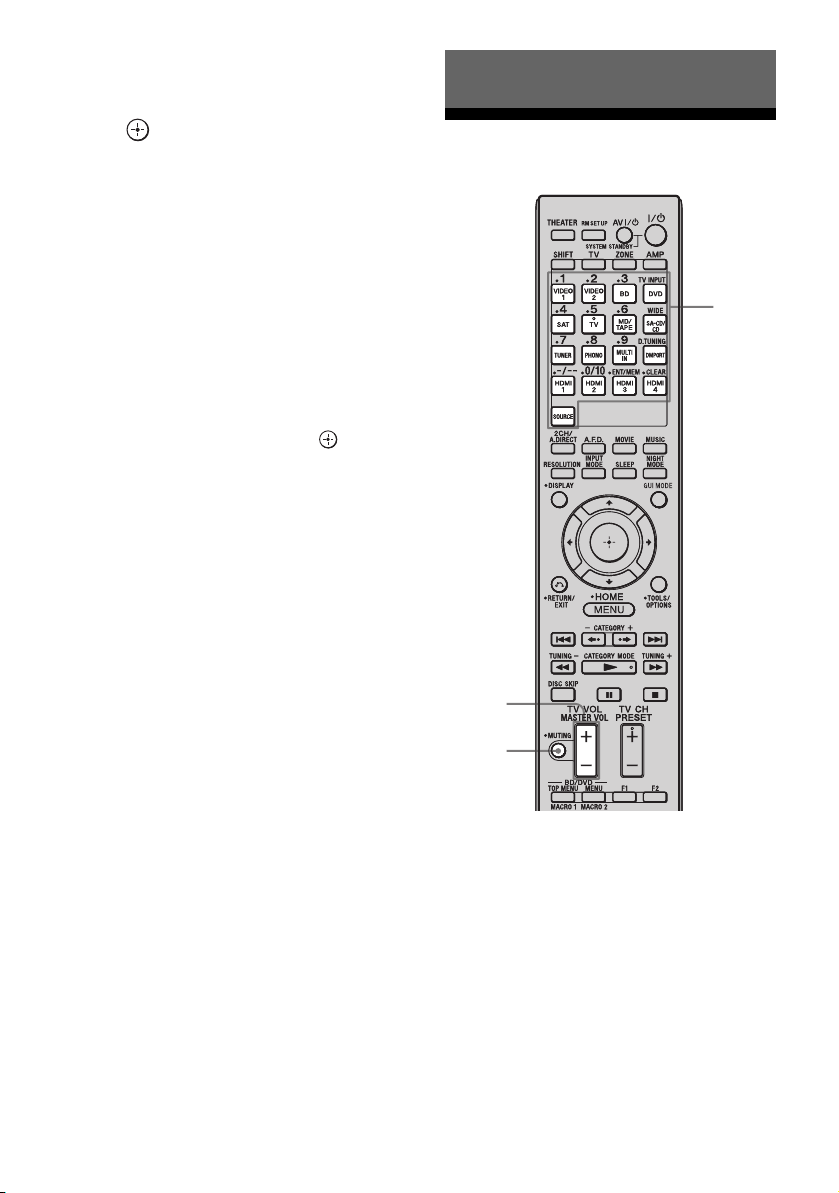
50
US
D:\NORM'S JOB\SONY HA\SO0056\STR-DA3500ES\U VERSION\US\4144907131\01US-
STRDA3500ESUC\040PLA.fm
masterpage: Left
STR-DA3500ES
4-144-907-13(1)
When a warning code appears
If a warning on the measurement result is
present, detailed information is displayed.
Press to return to step 1 of
“Confirming/saving the measurement
results” (page 47).
Tip
Depending on the position of the subwoofer, the
measurement results for polarity may vary.
However, there will be no problems even if you
continue to use the receiver with that value.
To set Auto Calibration items
more precisely (Enhanced
Setup)
On the Auto Calibration menu, select
“Enhanced Setup”, then press .
• Seating Position
You can register three patterns as position 1,
2, and 3, depending on the seating position,
listening environment, and measurement
conditions.
• Calibration Type
For details, see the table on page 48.
Optional menu parameters for
Enhanced Setup settings
•EQ Curve
EQ curve measurement is displayed.
• Name Input
You can rename the position number. For
details, see “Naming inputs” (page 101).
Selecting a component
1
Press one of the input buttons
to select the component you
want.
Playback
MUTING
Input
buttons
MASTER
VOL +/–

51
US
D:\NORM'S JOB\SONY HA\SO0056\STR-DA3500ES\U VERSION\US\4144907131\01US-
STRDA3500ESUC\040PLA.fm
masterpage: Right
STR-DA3500ES
4-144-907-13(1)
Playback
You can also use INPUT SELECTOR on
the receiver.
2 Turn on the component and
start playback.
3 Press MASTER VOL +/– to
adjust the volume.
You can also use MASTER VOLUME on
the receiver.
Tips
• You can adjust the volume differently depending
on the speed with which you turn the MASTER
VOLUME knob.
To turn the volume up or down quickly: turn the
knob quickly.
To make fine adjustment: turn the knob slowly.
• You can adjust the volume differently depending
on the length of time you press and hold the
MASTER VOL +/– button on the remote.
To turn the volume up or down quickly: press and
hold the button.
To make fine adjustment: press the button and
release it immediately.
To activate the muting function
Press MUTING on the remote. To cancel,
press MUTING on the remote again or turn
MASTER VOLUME clockwise to raise the
volume.
To avoid damaging your
speakers
Before you turn off the receiver, be sure to turn
down the volume level.
Selected
input
Components that can be
played back
VIDEO1 VCR, etc., connected to the
VIDEO 1 jack.
VIDEO2 Camcorder and video game,
etc., connected to the VIDEO
2 IN jack.
BD Blu-ray disc player, etc.,
connected to the BD jack.
DVD DVD player, etc., connected
to the DVD jack.
SAT Satellite tuner, etc., connected
to the SAT jack.
TV TV connected to the TV jack.
MD/TAPE MD or Tape deck, etc.,
connected to the MD/TAPE
jack.
SA-CD/CD Super Audio CD or CD
player, etc., connected to the
SA-CD/CD jack.
TUNER
(FM TUNER
or AM
TUNER)
Built-in radio tuner.
TUNER
(XM RADIO
or SIRIUS)
XM Mini-Tuner and Home
Dock connected to the XM
jack or SiriusConnect Home
tuner connected to the
SIRIUS jack.
PHONO Turntable, etc., connected to
the PHONO jack.
MULTI IN Component connected to the
MULTI CHANNEL INPUT
jack.
DMPORT Portable audio, etc.,
connected to the DIGITAL
MEDIA PORT adapter
connected to the receiver.
HDMI1, 2, 3, 4 HDMI components connected
to the HDMI IN 1, HDMI IN
2, HDMI IN 3 or HDMI IN 4
jack.
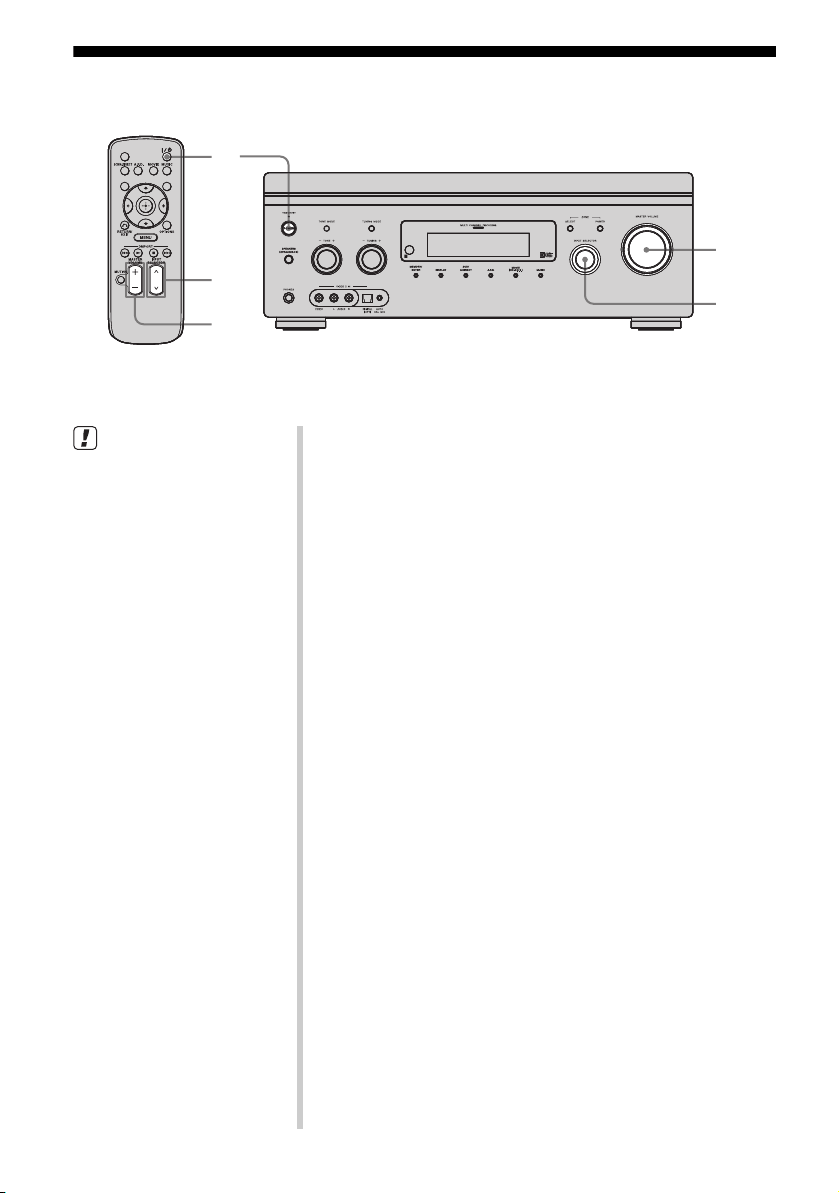
D:\NORM'S JOB\SONY HA\SO0056\STR-DA3500ES\U VERSION\US\4144907131\01US-
STRDA3500ESUC\040PLA.fm
masterpage: L-2
STR-DA3500ES
4-144-907-13(1)
52
US
Listening to a Super Audio CD/CD
DISPLAY
SLEEP
GUI MODE
2
3
5
5
3
• The operation is described for a
Sony Super Audio CD player.
• Refer to the operating
instructions supplied with the
Super Audio CD player or CD
player.
z
You can select the sound field to
suit the music. See page 63 for
details.
1 Turn on the Super Audio CD player or CD
player, then place the disc in the tray.
2 Turn on the receiver.
3 Press INPUT SELECTOR U/u to select “SA-
CD/CD”.
You can also use INPUT SELECTOR on this receiver to
select “SA-CD/CD”.
4 Play back the disc.
5 Adjust to a suitable volume.
6 After you have finished listening to a Super
Audio CD or CD, eject the disc and turn off
the receiver and the Super Audio CD player
or CD player.
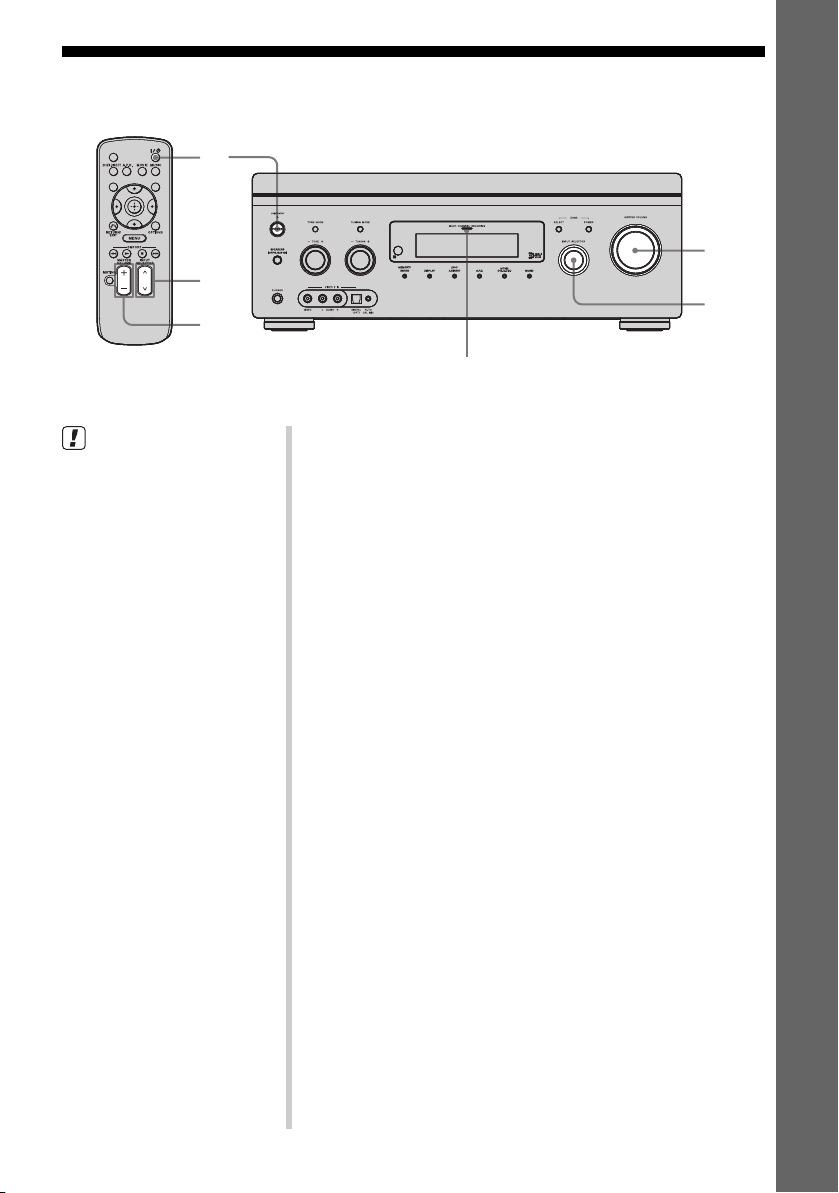
D:\NORM'S JOB\SONY HA\SO0056\STR-DA3500ES\U VERSION\US\4144907131\01US-
STRDA3500ESUC\040PLA.fm
masterpage: R-2
STR-DA3500ES
4-144-907-13(1)
53
US
Playback
Watching a DVD/Blu-ray Disc
DISPLAY
SLEEP
GUI MODE
2
3
6
6
3
MULTI CHANNEL DECODING lamp
• Refer to the operating
instructions supplied with the
TV and DVD player or Blu-ray
disc player.
• Check the following if you
cannot listen to the multi
channel sound.
– Be sure the sound source
corresponds to the multi
channel format (the MULTI
CHANNEL DECODING
lamp on the front panel lights
up during playback).
– Be sure this receiver is
connected to the DVD player
or Blu-ray disc player via a
digital connection.
– Be sure the digital audio
output of the DVD player or
Blu-ray disc player is set up
properly.
z
• Select the sound format of the
disc to be played, if necessary.
• You can select the sound field to
suit the movie or the music. See
page 63 for details.
1 Turn on the TV and DVD player or Blu-ray
disc player.
2 Turn on the receiver.
3 Press INPUT SELECTOR U/u to select “DVD”
or “BD”.
You can also use INPUT SELECTOR on this receiver to
select “DVD” or “BD”.
4 Switch the input of the TV so that an image
of the DVD or Blu-ray Disc is displayed.
5 Play back the disc.
6 Adjust to a suitable volume.
7 After you have finished watching a DVD or
Blu-ray Disc, eject the disc and turn off the
receiver, the TV, and the DVD player or Blu-
ray disc player.
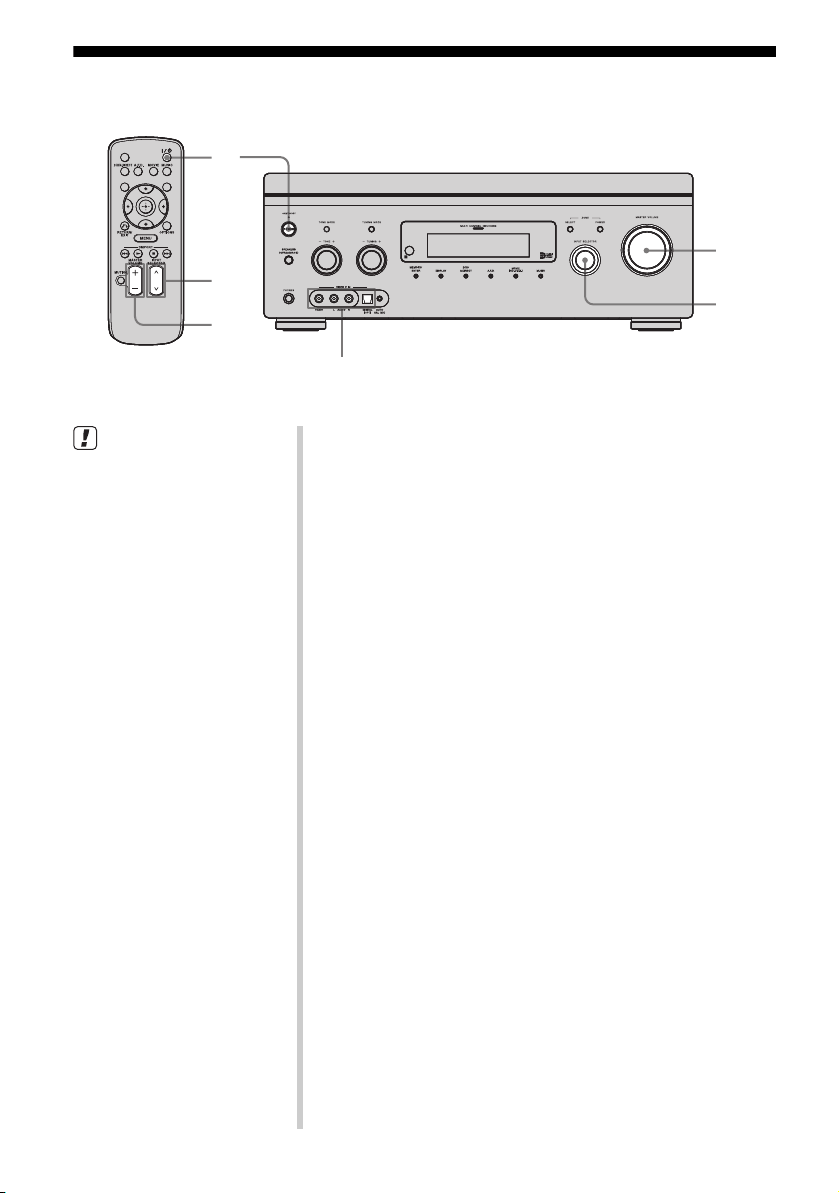
D:\NORM'S JOB\SONY HA\SO0056\STR-DA3500ES\U VERSION\US\4144907131\01US-
STRDA3500ESUC\040PLA.fm
masterpage: L-2
STR-DA3500ES
4-144-907-13(1)
54
US
Enjoying video games
DISPLAY
SLEEP
GUI MODE
2
3
6
6
3
VIDEO 2 IN
Refer to the operating instructions
supplied with the TV and video
game.
1 Turn on the TV and video game.
2 Turn on the receiver.
3 Press INPUT SELECTOR U/u to select
“VIDEO 2”*.
You can also use INPUT SELECTOR on this receiver to
select “VIDEO 2”*.
* When you connect a video game to the VIDEO 2 IN jack on the
front panel.
4 Switch the input of the TV so that an image
of the video game is displayed.
5 Place the disc in the tray and play it back on
the video game.
6 Adjust to a suitable volume.
7 After you have finished playing a game, eject
the disc and turn off the receiver, the TV, and
the video game.
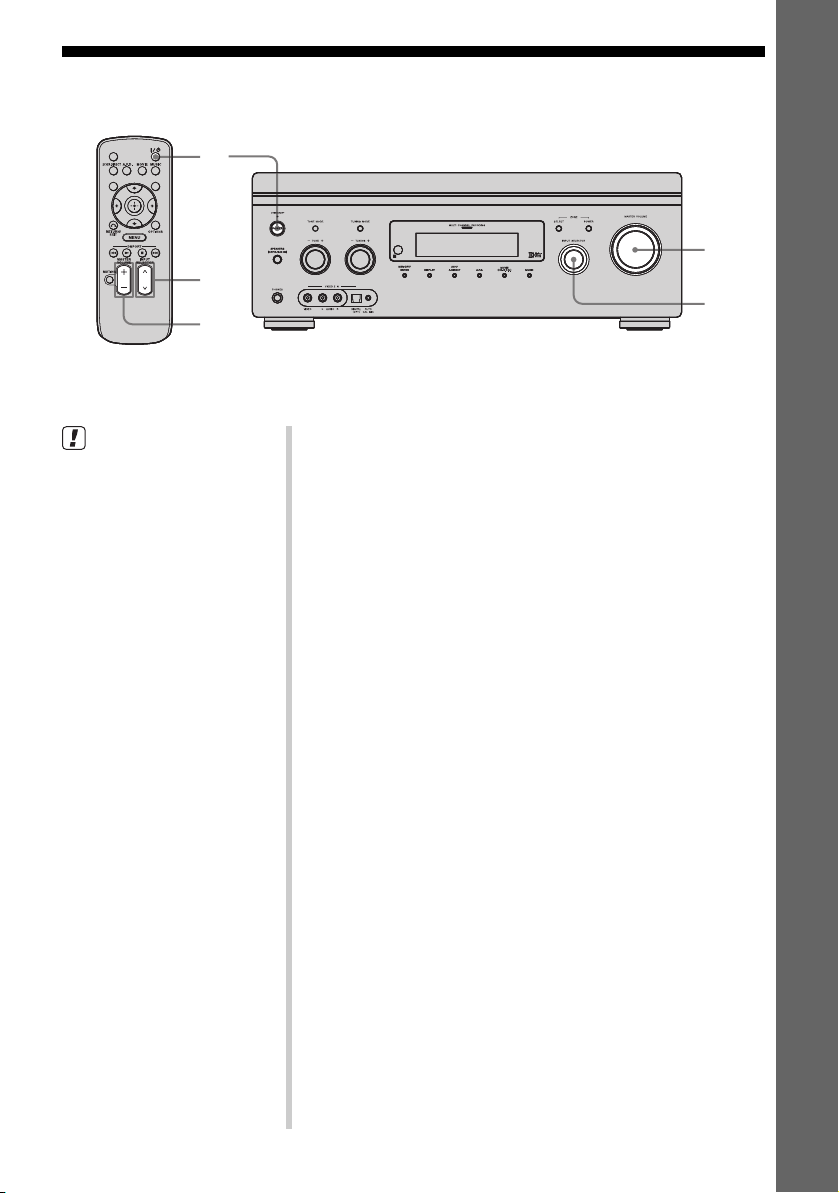
D:\NORM'S JOB\SONY HA\SO0056\STR-DA3500ES\U VERSION\US\4144907131\01US-
STRDA3500ESUC\040PLA.fm
masterpage: R-2
STR-DA3500ES
4-144-907-13(1)
55
US
Playback
Watching video
DISPLAY
SLEEP
GUI MODE
2
3
6
6
3
Refer to the operating instructions
supplied with the TV and VCR.
1 Turn on the VCR.
2 Turn on the receiver.
3 Press INPUT SELECTOR U/u to select
“VIDEO 1”*.
You can also use INPUT SELECTOR on this receiver to
select “VIDEO 1”*.
* When you connect VCR to the VIDEO 1 jack.
4 Switch the input of the TV so that an image
of the VCR is displayed.
5 Play back the tape on the VCR.
6 Adjust to a suitable volume.
7 After you have finished watching a video,
eject the tape and turn off the receiver, the
TV, and the VCR.

56
US
D:\NORM'S JOB\SONY HA\SO0056\STR-DA3500ES\U VERSION\US\4144907131\01US-
STRDA3500ESUC\050AMP.fm
masterpage: Left
STR-DA3500ES
4-144-907-13(1)
Settings for the audio
(Audio settings menu)
You can use the Audio settings menu to make
settings for the audio to suit your preference.
Select “Audio” in the Settings menu. For
details on adjusting the parameters, see “7:
Operating the receiver using the GUI
(Graphical User Interface)” (page 40).
x A/V Sync
(Audio with video output
synchronization)
Lets you delay the output of audio to minimize
the time gap between audio output and visual
display. You can adjust the delay from 0 ms to
300 ms in 10 ms steps.
Notes
• This function is useful when you use a large LCD
or plasma monitor or a projector.
• This function does not work in the following cases.
– The multi channel input is selected.
– “2ch Analog Direct” is being used.
x Dual Mono
(Digital broadcast language
selection)
Lets you select the language you want to listen
to during a digital broadcast. This feature only
functions for Dolby Digital sources.
• MAIN/SUB
Sound of the main language will be output
through the front left speaker, and sound of
the sub language will be output through the
front right speaker simultaneously.
•MAIN
Sound of the main language will be output.
•SUB
Sound of the sub language will be output.
x Decode Priority
(Digital audio input decoding
priority)
Lets you specify the input mode for the digital
signal input to the HDMI IN jacks.
•PCM
When signals from the HDMI IN jack are
selected, only PCM signals are output from
the connected player. To prevent interruption
when playback starts, set to “PCM”. When
signals in other format are received, set this
item to “AUTO”.
•AUTO
Automatically switches the input mode
between Dolby Digital, DTS, or PCM.
Note
Even when “Decode Priority” is set to “PCM”, the
sound may be interrupted at the very beginning of
the first track depending on the CD being played
back.
Amplifier Operations
Audio settings menu parameters
57
US
D:\NORM'S JOB\SONY HA\SO0056\STR-DA3500ES\U VERSION\US\4144907131\01US-
STRDA3500ESUC\050AMP.fm
masterpage: Right
STR-DA3500ES
4-144-907-13(1)
Amplifier Operations
Settings for the video
(Video settings menu)
You can use the Video settings menu to make
settings for video. Select “Video” in the
Settings menu. For details on adjusting the
parameters, see “7: Operating the receiver
using the GUI (Graphical User Interface)”
(page 40).
x Resolution
(Video signals conversion)
Lets you convert the resolution of analog video
input signals.
•DIRECT
•AUTO
• 480i/576i
• 480p/576p
• 720p
• 1080i
• 1080p
For details on operation, see “In the video
input/output conversion table classified by the
menu settings” (page 35).
Settings for HDMI
(HDMI settings menu)
You can use the HDMI settings menu to make
the required settings for components
connected to the HDMI jack. Select “HDMI”
in the Settings menu. For details on adjusting
the parameters, see “7: Operating the receiver
using the GUI (Graphical User Interface)”
(page 40).
x Control for HDMI
(Control for HDMI)
Lets you turn the components connected to the
HDMI jack using an HDMI cable on or off.
•OFF
•ON
For details on operation, see “Using
“BRAVIA” Sync features” (page 84).
Note
When you set “Control for HDMI” to “ON”, “Audio
Out” may be changed automatically.
x Audio Out
(HDMI audio input setting)
Lets you set the audio output for HDMI from
the playback component connected to the
receiver via an HDMI connection.
• TV+AMP
The sound is output from the TV speaker and
the speakers connected to the receiver.
Notes
• The sound quality of the playback component
depends on the TV’s sound quality, such as the
number of channels, the sampling frequency, etc.
When the TV has stereo speakers, the sound
output from the receiver is also stereo as that of
the TV, even if you play multi channel source.
• When you connect the receiver to a video
component (projector, etc.), sound may not be
output from the receiver. In this case, select
“AMP”.
• When you select the input that you have assigned
the HDMI input, sound does not output from the
TV.
Video settings menu parameters
HDMI settings menu parameters
continued

58
US
D:\NORM'S JOB\SONY HA\SO0056\STR-DA3500ES\U VERSION\US\4144907131\01US-
STRDA3500ESUC\050AMP.fm
masterpage: Left
STR-DA3500ES
4-144-907-13(1)
•AMP
The HDMI audio signals from the playback
component is only output to speakers
connected to the receiver. The multi channel
sound can be played back as it is.
Note
Audio signals are not output from the TV’s
speakers when “Audio Out” is set to “AMP”.
x 24p Auto Sound Sync
(24p Auto Sound Sync)
Lets you turn the “24p Auto Sound Sync”
function on or off. This allows HD-D.C.S. to
be selected as the optimum sound field
automatically when 24p (24 frames per
second) signal are input from a playback
component, such as a Blu-ray disc player.
•OFF
•ON
Note
When “Control for HDMI” is set to “ON”, the
receiver detects the 24p signals via “BRAVIA”
Sync. Therefore, if a player that is not compatible
with “BRAVIA” Sync sends out 24p signals, the
receiver will not switch the sound field to HD-
D.C.S. On the other hand, when “Control for
HDMI” is set to “OFF”, the receiver detects the 24p
signals by itself.
x Subwoofer Level
(Subwoofer level for HDMI)
Lets you set the level of the subwoofer to 0 dB
or +10 dB when PCM signals are input via an
HDMI connection. You can set the level for
each HDMI input independently.
•0 dB
•+10 dB
•AUTO
The subwoofer level is automatically set to
0 dB or +10 dB depending on the frequency.
Settings for the system
(System settings menu)
You can use the System settings menu to
customize the settings of the receiver. Select
“System” in the Settings menu. For details on
adjusting the parameters, see “7: Operating the
receiver using the GUI (Graphical User
Interface)” (page 40).
x Screen Saver (Screen Saver)
Lets you activate the screen saver function for
the GUI menu on the TV connected to the
receiver.
•OFF
The screen saver function is disabled.
•ON
When there has been no operation attempted
for 15 minutes, the screen saver function is
activated automatically.
x Installer Mode (Installer Mode)
Lets you select the control mode for
maintenance and service.
•OFF
• RS232C
x Language (Language)
Lets you select the language for the GUI menu
on the TV connected to the receiver.
• English
• Español
• Français
•Deutsch
System settings menu
parameters
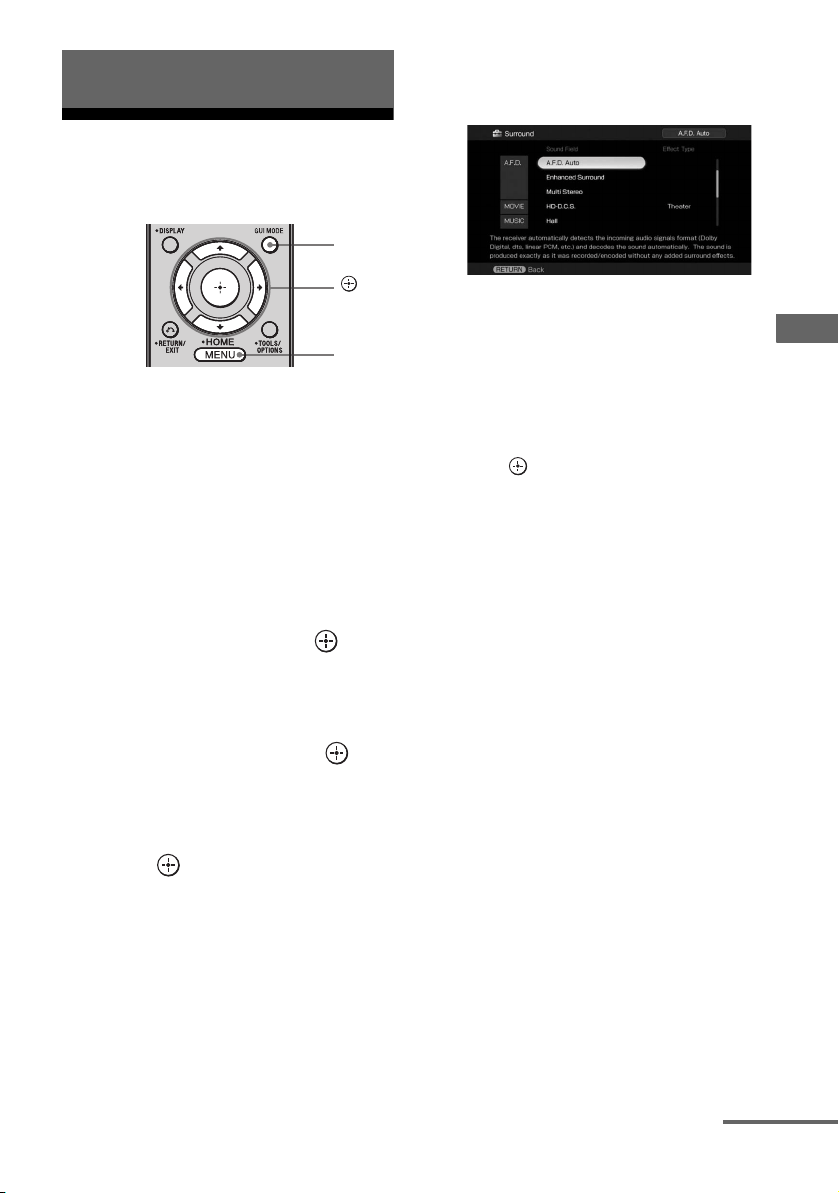
59
US
D:\NORM'S JOB\SONY HA\SO0056\STR-DA3500ES\U VERSION\US\4144907131\01US-
STRDA3500ESUC\060SUR.fm
masterpage: Right
STR-DA3500ES
4-144-907-13(1)
Enjoying Surround Sound
Enjoying a pre-
programmed sound field
1
Start playing a sound source
you want to listen to (CD, DVD,
etc.).
2 Press GUI MODE repeatedly to
select “GUI ON”.
The GUI menu appears on the TV screen.
Press MENU if the GUI menu does not
appear on the TV screen.
3 Press V/v repeatedly to select
“Settings”, then press or b.
The Settings menu list appears on the TV
screen.
4 Press V/v repeatedly to select
“Surround”, then press or
b.
5 Press V/v repeatedly to select
“Sound Field Setup”, then
press .
6 Press V/v repeatedly to select
the sound field you want.
To select the Enhanced
Surround mode
1
Select “Enhanced Sur Mode” in step 5.
2 Press V/v repeatedly to select the
enhanced surround sound you want.
3 Press .
Note
The selected Enhanced Surround mode can only be
applied if you have selected “Enhanced Surround”
as a sound field in the “Sound Field Setup”
parameter.
Enjoying Surround Sound
GUI
MODE
,
V/v/B/b
MENU
continued

60
US
D:\NORM'S JOB\SONY HA\SO0056\STR-DA3500ES\U VERSION\US\4144907131\01US-
STRDA3500ESUC\060SUR.fm
masterpage: Left
STR-DA3500ES
4-144-907-13(1)
To select the Effect Type for HD-
D.C.S.
1
Press V/v repeatedly to select “Sound
Field Setup”, then press .
2 Press V/v repeatedly to select “HD-
D.C.S.”, then press b.
3 Press V/v to select the Effect Type you
want, then press B.
HD-D.C.S. has three different types:
Theater, Dynamic, and Studio. Each type
has different reflection and reverberation
sound mixture levels and is optimized to
match a listener’s room uniqueness, taste
and mood.
•Theater
Theater type (default setting) mixes
reflection and reverberation sound
creating the characteristics of a mastering
studio. Additionally, this type mixes in
frequency characteristics that are often
found in professional studios and movie
theaters. It is ideal for watching movies in
a listening room that has less
reverberation.
•Dynamic
Want to enjoy the sound effects to the full
extent, just like at the movie theaters?
Dynamic type emphasizes on the
reflection sound. Without HD-D.C.S.,
many rooms are often somewhat
reverberant but lack a spacious feeling.
This type acoustically opens up those
types of rooms and provides a spacious
and dynamism feeling equivalent to a
mastering studio.
• Studio
In Studio type, effects are kept to a
minimum, while still providing a great
theater experience. This type provides the
accuracy of the original recording.
4 Press RETURN/EXIT O.
x 2ch Stereo
The receiver outputs the sound from the front
left/right speakers only. There is no sound
from the subwoofer.
Standard 2 channel stereo sources completely
bypass the sound field processing and multi
channel surround formats are downmixed to 2
channel except LFE signals.
Note
No sound is output from the subwoofer in the 2ch
Stereo mode. To listen to 2 channel stereo sources
using the front left/right speakers and a subwoofer,
select “A.F.D. Auto”.
This receiver will generate a low frequency signal
for output to the subwoofer when there is no LFE
signal, which is a low-pass sound effect output from
a subwoofer to a 2 channel signal.
x 2ch Analog Direct
You can switch the audio of the selected input
to 2 channel analog input. This function
enables you to enjoy high quality analog
sources.
When using this function, only the volume and
front speaker balance can be adjusted.
Types of 2CH mode
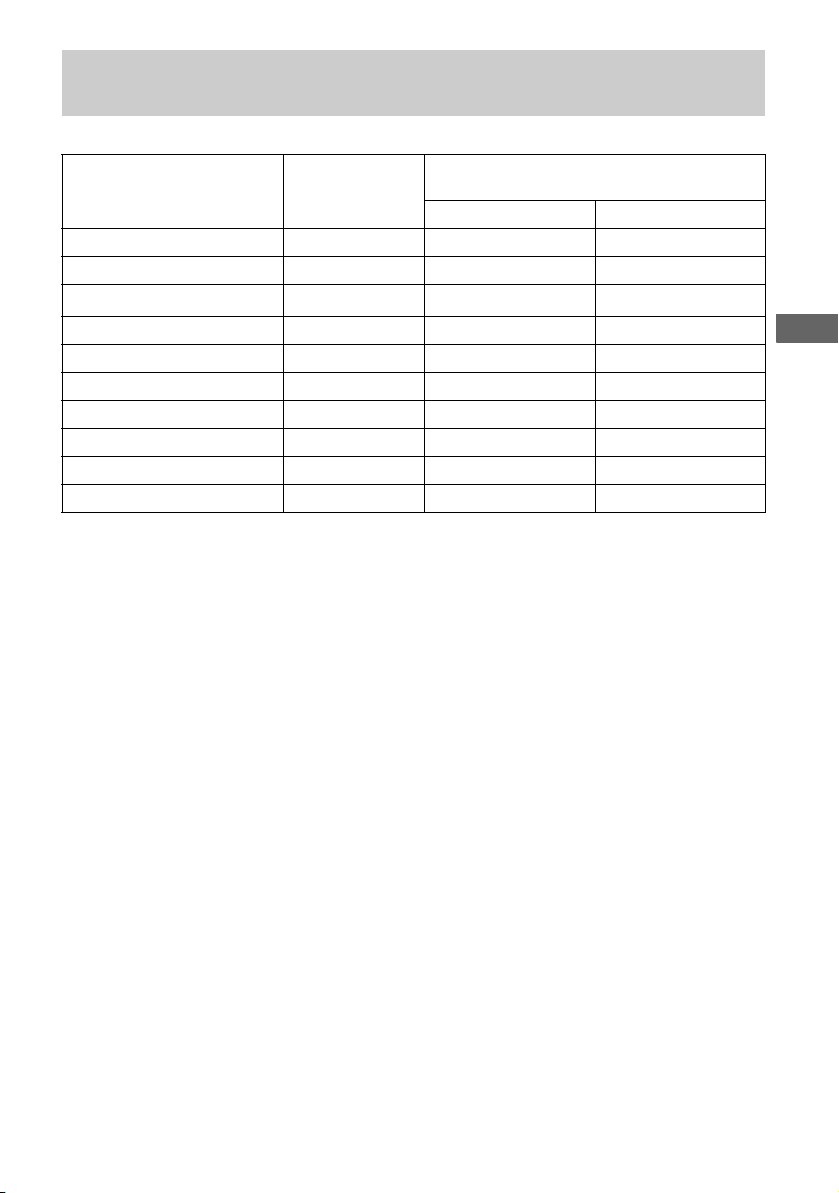
61
US
D:\NORM'S JOB\SONY HA\SO0056\STR-DA3500ES\U VERSION\US\4144907131\01US-
STRDA3500ESUC\060SUR.fm
masterpage: Right
STR-DA3500ES
4-144-907-13(1)
Enjoying Surround Sound
This receiver supports the following audio formats.
a)
Audio signals are output in another format if the playback component does not correspond to the format. For
details, refer to the operating instructions of the playback component.
b)
Signals with a sampling frequency of 176.4 kHz and higher are played back at 96 kHz.
When connecting Blu-ray disc players and other next generation HD
players
Audio format
Maximum number
of channels
Connection of the playback component and
the receiver
COAXIAL/OPTICAL HDMI
Dolby Digital 5.1ch aa
Dolby Digital EX 6.1ch aa
Dolby Digital Plus
a)
7.1ch
× a
Dolby TrueHD
a)
7.1ch × a
DTS 5.1ch aa
DTS-ES 6.1ch aa
DTS 96/24 5.1ch aa
DTS-HD High Resolution Audio
a)
7.1ch × a
DTS-HD Master Audio
a) b)
7.1ch × a
Multi channel Linear PCM
a)
7.1ch × a
62
US
D:\NORM'S JOB\SONY HA\SO0056\STR-DA3500ES\U VERSION\US\4144907131\01US-
STRDA3500ESUC\060SUR.fm
masterpage: Left
STR-DA3500ES
4-144-907-13(1)
The Auto Format Direct (A.F.D.) mode allows
you to listen to higher fidelity sound and select
the decoding mode for listening to a 2 channel
stereo sound as multi channel sound.
* Depending on the speaker pattern setting, the appropriate Enhanced Surround mode appears.
Notes
• This function does not work in the following cases.
– The multi channel input is selected.
– DTS-HD signals with a sampling frequency of
88.2 kHz and higher are being received.
– Dolby TrueHD signals with a sampling
frequency of 88.2 kHz and higher are being
received.
– PCM signals with a sampling frequency of
88.2 kHz and higher are being received.
• Neural-THX is not effective when a sampling
frequency of 88.2 kHz and higher are being
received or a 2 channel analog signal is input. The
Neural-THX processing will be turned off
automatically when another type of signal is input.
The beginning of the sound may drop out when the
SURROUND processing is turned on/off.
Tips
• You can identify the encoding format of DVD
software, etc., by looking at the logo on the
package.
• Dolby Pro Logic IIx decoding is effective when a
multi channel signal is input.
If you connect a subwoofer
This receiver will generate a low frequency
signal for output to the subwoofer when there
is no LFE signal, which is a low-pass sound
effect output from a subwoofer to a 2 channel
signal. However, the low frequency signal is
not generated for “Neo:6 Cinema” or “Neo:6
Music” when all speakers are set to “LARGE”.
In order to take full advantage of the Dolby
Digital bass redirection circuitry, we
recommend setting the subwoofer’s cut off
frequency as high as possible.
Types of A.F.D. mode
A.F.D. mode Multi channel
audio after
decoding
Effect
A.F.D. Auto (Detecting
automatically)
Presets the sound as it was recorded/encoded without
adding any surround effects.
Enhanced Surround
Pro Logic II* 5-channel signals Perform Dolby Pro Logic II decoding.
Pro Logic IIx* 7-channel signals Perform Dolby Pro Logic IIx decoding.
Neo:6 Cinema 7-channel signals Perform DTS Neo:6 Cinema mode decoding.
Neo:6 Music 7-channel signals Perform DTS Neo:6 Music mode decoding. This
setting is ideal for normal stereo sources such as CDs.
Neural-THX 7-channel signals Next generation of Neural-THX
®
Surround. In
addition to stereo enhancement processing and pure
discrete 5.1 surround sound, now capable for full
360° 7.1 surround sound playback from Neural-
THX
®
surround encoded content.
Multi Stereo (Multi Stereo) Outputs 2 channel left/right signals from all speakers.
However, sound may not be output from certain
speakers depending on the speaker settings.
63
US
D:\NORM'S JOB\SONY HA\SO0056\STR-DA3500ES\U VERSION\US\4144907131\01US-
STRDA3500ESUC\060SUR.fm
masterpage: Right
STR-DA3500ES
4-144-907-13(1)
Enjoying Surround Sound
You can take advantage of surround sound
simply by selecting one of the receiver’s
preprogrammed sound fields. They bring the
exciting and powerful sound of movie theaters
and concert halls into your home.
* You can select this sound field mode if the headphones are connected to the receiver.
Notes
• The sound fields for music and movie do not work
in the following cases.
– The multi channel input is selected.
– DTS-HD signals with a sampling frequency of
88.2 kHz and higher are being received.
– Dolby TrueHD signals with a sampling
frequency of 88.2 kHz and higher are being
received.
– PCM signals with a sampling frequency of
88.2 kHz and higher are being received.
• When one of the sound fields for music is selected,
no sound is output from the subwoofer if all the
speakers are set to “LARGE” in the Speaker
settings menu. However, the sound will be output
from the subwoofer if the digital input signal
contains LFE signals, or if the front or surround
speakers are set to “SMALL”, the sound field for
movie is selected, or “Portable Audio” is selected.
• If there is any noise present, the noise may be
different depending on the sound field you select.
Types of music/movie mode
Sound field
for
Sound field Effect
Movie HD-D.C.S. HD-D.C.S. can realize precisely the sound effect on the
movies when watching through Blu-ray and DVD software,
etc. like how Movie Sound Designers’ intended it to be. You
can select the Effect Type for HD-D.C.S. For details, see
“Enjoying a pre-programmed sound field” (page 59).
Music Hall Reproduces the acoustics of a classical concert hall.
Jazz Club Reproduces the acoustics of a jazz club.
Live Concert Reproduces the acoustics of a 300-seat live house.
Stadium Reproduces the feeling of a large open-air stadium.
Sports Reproduces the feeling of sports broadcasting.
Portable Audio Reproduces a clear enhanced sound image from your portable
audio device. This mode is ideal for MP3 and other
compressed music.
Headphone* Headphone (2ch) This mode is selected automatically if you use headphones
when “2ch Stereo” mode or A.F.D. mode is selected. Standard
2 channel stereo sources completely bypass the sound field
processing and multi channel surround formats are
downmixed to 2 channels except LFE signals.
Headphone (Direct) Outputs the analog signals without processing by the tone,
sound field, etc.
Headphone (Multi) This mode is selected automatically if you use headphones
when the multi channel input is selected. Outputs the front
analog signals from the MULTI CHANNEL INPUT jacks.
continued
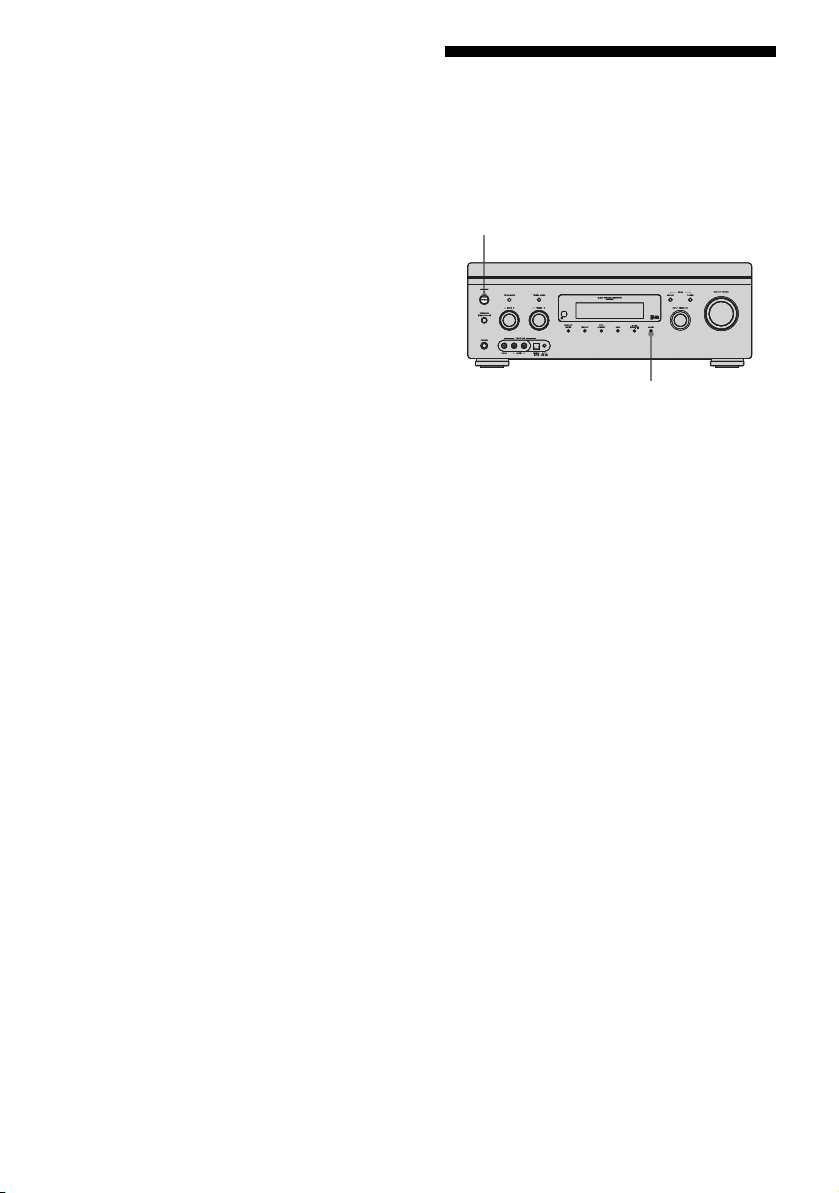
64
US
D:\NORM'S JOB\SONY HA\SO0056\STR-DA3500ES\U VERSION\US\4144907131\01US-
STRDA3500ESUC\060SUR.fm
masterpage: Left
STR-DA3500ES
4-144-907-13(1)
Tips
• For details on HD-D.C.S. technology, see
“Glossary” (page 132).
• When a sound field with HD-D.C.S. is selected, the
HD-D.C.S. lamp lights up on the display window.
To turn off the surround effect
for MOVIE/MUSIC
Select “2ch Stereo” or “A.F.D. Auto” in the
Surround settings menu.
Resetting sound fields to
the initial settings
Be sure to use the buttons on the receiver for
this operation.
1 Press POWER to turn off the
receiver.
2 While holding down MUSIC,
press POWER.
“S.F. CLEAR” appears on the display
window and all sound fields are reset to
their initial setting.
POWER
MUSIC
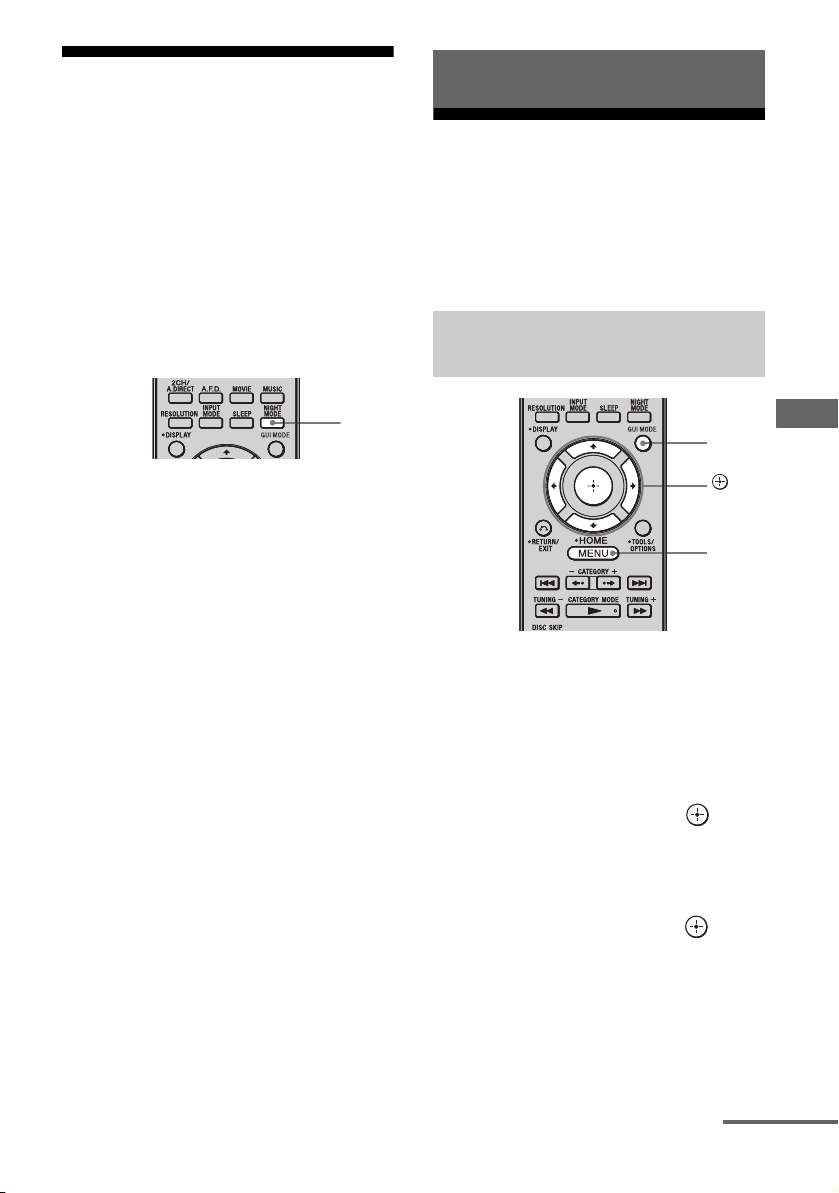
65
US
D:\NORM'S JOB\SONY HA\SO0056\STR-DA3500ES\U VERSION\US\4144907131\01US-
STRDA3500ESUC\070SET.fm
masterpage: Right
STR-DA3500ES
4-144-907-13(1)
Advanced Speakers Set Up
Enjoying the surround
effect at low volume
levels
(NIGHT MODE)
This function allows you to retain a theater like
environment at low volume levels. This
function can be used with other sound fields.
When watching a movie late at night, you will
be able to hear the dialog clearly even at a low
volume level.
Press NIGHT MODE.
The NIGHT MODE function is activated. The
NIGHT MODE is set to on and off as you
press NIGHT MODE.
Note
This function does not work in the following cases.
– The multi channel input is selected.
– Dolby TrueHD signals with a sampling frequency
of 176.4 kHz and higher are being received.
– PCM signals with a sampling frequency of
176.4 kHz and higher are being received.
Adjusting the speaker
settings manually
You can adjust each speaker manually.
You can also adjust the speaker levels after the
Auto Calibration is completed.
1 Press GUI MODE repeatedly to
select “GUI ON”.
The GUI menu appears on the TV screen.
Press MENU if the GUI menu does not
appear on the TV screen.
2 Press V/v repeatedly to select
“Settings”, then press or b.
The Settings menu list appears on the TV
screen.
3 Press V/v repeatedly to select
“Speaker”, then press or b.
NIGHT
MODE
Advanced Speakers Set Up
Making settings with the
Manual Setup menu
GUI
MODE
MENU
,
V/v/B/b
continued
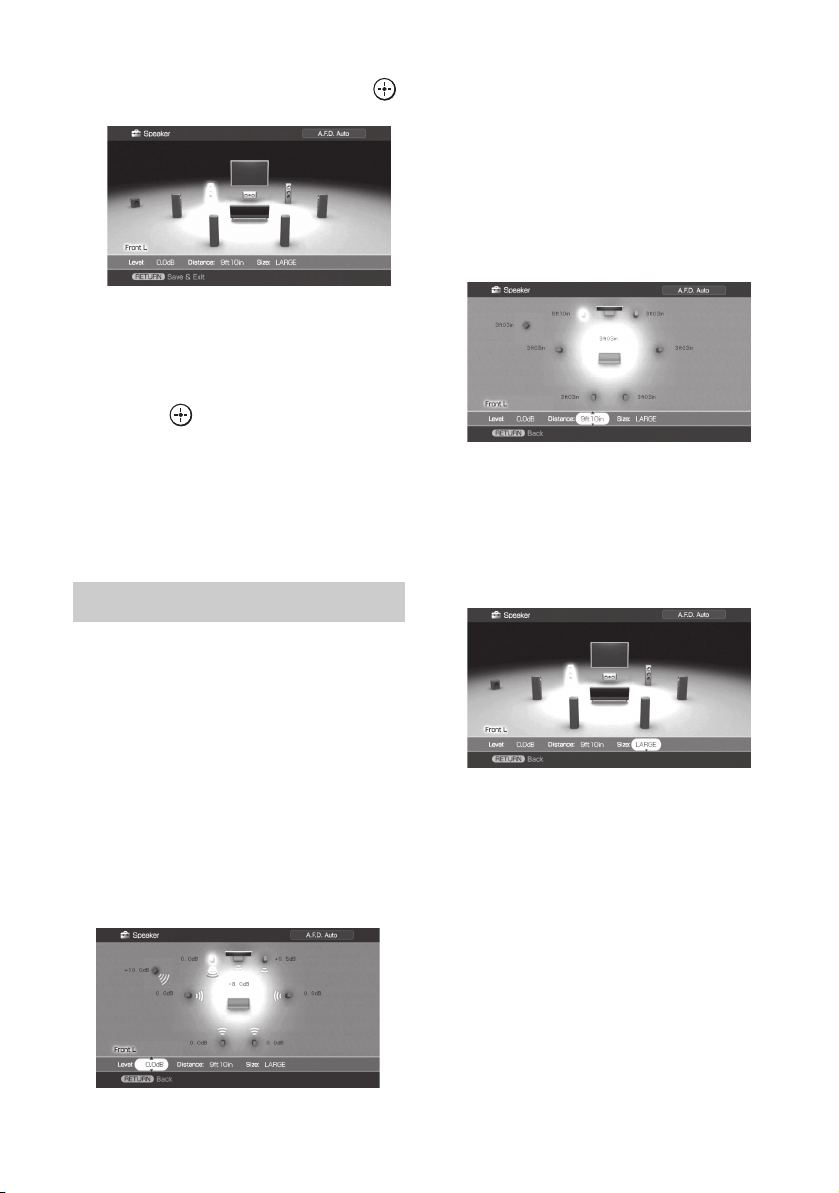
66
US
D:\NORM'S JOB\SONY HA\SO0056\STR-DA3500ES\U VERSION\US\4144907131\01US-
STRDA3500ESUC\070SET.fm
masterpage: Left
STR-DA3500ES
4-144-907-13(1)
4 Press V/v repeatedly to select
“Manual Setup”, then press .
5 Press V/v/B/b repeatedly to
select speaker you want to
adjust.
6 Press .
7 Press B/b repeatedly to select
the parameter you want.
8 Press V/v repeatedly to adjust
the setting.
x Level
(Level of speaker)
You can adjust each speaker’s level (center,
surround left/right, surround back left/right,
subwoofer). You can adjust the level from –20
dB to +10 dB in 0.5 dB steps.
For the front left/right speakers, you can adjust
the balance on either side. You can adjust the
front left level from –10.0 dB to +10.0 dB in
0.5 dB steps. You can also adjust the front right
level from –10.0 dB to +10.0 dB in 0.5 dB
steps.
x Distance
(Distance from the seating
position to each speaker)
You can adjust the distance from the seating
position to each speaker (front left/right,
center, surround left/right, surround back left/
right, subwoofer).
You can adjust the distance from 3 feet
3 inches to 32 feet 9 inches (1.00 meter to
10.00 meters) in 1 inch (0.01 meter) steps.
x Size
(Size of each speaker)
You can adjust each speaker’s (front left/right,
center, surround left/right, surround back left/
right) size.
• LARGE
If you connect large speakers that will
effectively reproduce bass frequencies,
select “LARGE”. Normally, select
“LARGE”.
•SMALL
If the sound is distorted, or you feel a lack of
surround effects when using multi channel
surround sound, select “SMALL” to activate
the bass redirection circuitry and output the
bass frequencies of each channel from the
subwoofer or other “LARGE” speakers.
Manual Setup menu parameters
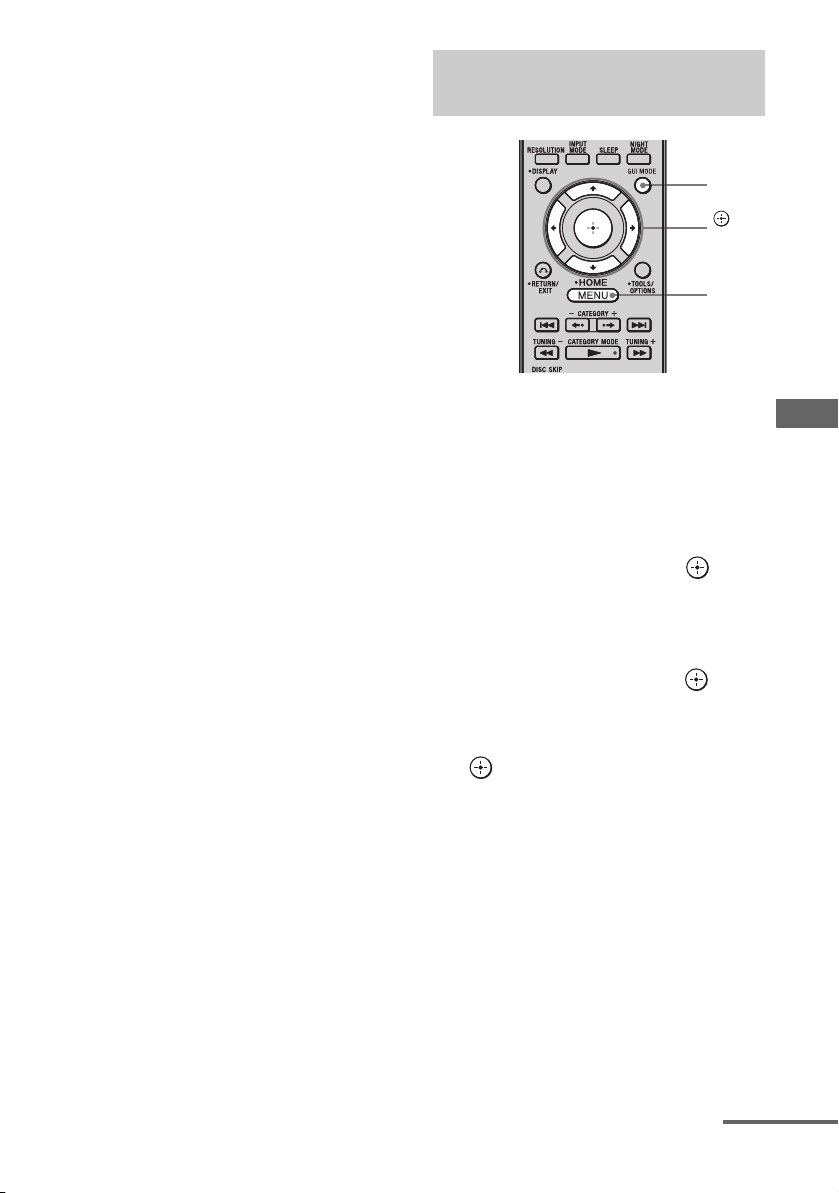
67
US
D:\NORM'S JOB\SONY HA\SO0056\STR-DA3500ES\U VERSION\US\4144907131\01US-
STRDA3500ESUC\070SET.fm
masterpage: Right
STR-DA3500ES
4-144-907-13(1)
Advanced Speakers Set Up
Note
When one of the sound fields for music is selected,
no sound is output from the subwoofer if all the
speakers are set to “LARGE”. However, the sound
will be output from the subwoofer if the digital input
signal contains LFE signals, or if the front or
surround speakers are set to “SMALL”, the sound
field for movie is selected, or “Portable Audio” is
selected.
Tips
• The “LARGE” and “SMALL” settings for each
speaker determine whether the internal sound
processor will cut the bass signal from that
channel.
When the bass is cut from a channel, the bass
redirection circuitry sends the corresponding bass
frequencies to the subwoofer or other “LARGE”
speakers.
However, since bass sound has a certain amount of
directionality, it is best not to cut it, if possible.
Therefore, even when using small speakers, you
can set them to “LARGE” if you want to output the
bass frequencies from that speaker. On the other
hand, if you are using a large speaker, but prefer not
to have bass frequencies output from that speaker,
set it to “SMALL”.
If the overall sound level is lower than you prefer,
set all speakers to “LARGE”. If there is not enough
bass, you can use the equalizer to boost the bass
levels.
• The surround back speakers will be set to the same
setting as that of the surround speakers.
• When the front speakers are set to “SMALL”, the
center, surround, and surround back speakers are
also automatically set to “SMALL”.
• If you do not use the subwoofer, the front speakers
are automatically set to “LARGE”.
1 Press GUI MODE repeatedly to
select “GUI ON”.
The GUI menu appears on the TV screen.
Press MENU if the GUI menu does not
appear on the TV screen.
2 Press V/v repeatedly to select
“Settings”, then press or b.
The Settings menu list appears on the TV
screen.
3 Press V/v repeatedly to select
“Speaker”, then press or b.
4 Press V/v repeatedly to select
“Speaker Pattern”, then press
.
Select “Speaker Pattern” according to the
speaker system which you are using. You
do not need to select the speaker pattern
after Auto Calibration.
Making settings with the
Speaker Pattern menu
MENU
,
V/v/B/b
GUI
MODE
continued

68
US
D:\NORM'S JOB\SONY HA\SO0056\STR-DA3500ES\U VERSION\US\4144907131\01US-
STRDA3500ESUC\070SET.fm
masterpage: Left
STR-DA3500ES
4-144-907-13(1)
5 Press V/v repeatedly to select
the speaker pattern you want.
1 Press GUI MODE repeatedly to
select “GUI ON”.
The GUI menu appears on the TV screen.
Press MENU if the GUI menu does not
appear on the TV screen.
2 Press V/v repeatedly to select
“Settings”, then press or b.
The Settings menu list appears on the TV
screen.
3 Press V/v repeatedly to select
“Speaker”, then press or b.
4 Press V/v repeatedly to select
“Test Tone”, then press .
5 Press B/b repeatedly to select
test tone type, then press .
6 Press V/v repeatedly to select
the speaker you want to adjust,
then press .
The test tone is output from each speaker
in sequence.
7 Press V/v repeatedly to adjust
the parameter, then press .
Tips
• To adjust the level of all speakers at the same
time, press MASTER VOL +/–.
• The adjusted value is shown on the display
during adjustment.
When a test tone is not output
from the speakers
• The speaker cords may not be connected
securely. Check to see if they are connected
securely and cannot be disconnected by
pulling on them slightly.
• The speaker cords may have the short-circuit
problem.
When a test tone is output from
a different speaker than the
speaker displayed on the
screen
The speaker pattern to the connected speaker
is not set up correctly. Make sure the speaker
connection and the speaker pattern match.
Making settings with the Test
Tone menu
MENU
,
V/v/B/b
GUI
MODE

69
US
D:\NORM'S JOB\SONY HA\SO0056\STR-DA3500ES\U VERSION\US\4144907131\01US-
STRDA3500ESUC\070SET.fm
masterpage: Right
STR-DA3500ES
4-144-907-13(1)
Advanced Speakers Set Up
x Test Tone (Test Tone)
•OFF
•AUTO
The test tone is output from each speaker in
sequence.
• L, C, R, SR, SB, SBR, SBL, SL, SW
You can select which speakers will output
the test tone.
Some items may not be displayed,
depending on the setting of the speaker
pattern.
x Phase Noise (Phase Noise)
•OFF
•
L/C, C/R, L/R, R/SL, R/SR, SR/SL, SR/
SBR, SBR/SBL, SR/SB, SBL/SL, SB/SL,
SL/L, L/SR
Lets you output the test tone sequentially
from adjacent speakers.
Some items may not be displayed,
depending on the setting of the speaker
pattern.
x Phase Audio (Phase Audio)
•OFF
•
L/C, C/R, L/R, R/SL, R/SR, SR/SL, SR/
SBR, SBR/SBL, SR/SB, SBL/SL, SB/SL,
SL/L, L/SR
Lets you output the front 2 channel source
sound (instead of the test tone) sequentially
from adjacent speakers.
Some items may not be displayed,
depending on the setting of the speaker
pattern.
x Sur Back Assign
(Settings of the surround back
speaker(s))
•OFF
If you have not connected surround back
speakers, select “OFF”.
• BI-AMP
If you connect front speakers in a bi-
amplifier configuration, select “BI-AMP”.
• ZONE2
If you are using the surround back speakers
in zone 2, select “ZONE2”. When you select
“ZONE2”, the input to the SUR BACK jacks
of the MULTI CHANNEL INPUT is invalid.
Note
Set “Sur Back Assign” to “OFF”, then connect the
surround back speakers to this receiver when you
want to change the connection from a bi-amplifier
connection or a zone 2 connection to a surround
back speakers connection. Set up the speakers again
after you connect the surround back speakers. See
“9: Calibrating the appropriate speaker settings
automatically (Auto Calibration)” (page 44) or
“Adjusting the speaker settings manually”
(page 65).
x Crossover Freq
(Speaker crossover frequency)
Lets you set the bass crossover frequency of
speakers that has been set to “SMALL” in the
Speaker settings menu. Measured speaker
crossover frequency is set for each speaker
after the Auto Calibration.
The adjusted value is set for each speaker
when you adjust the speaker crossover
frequency using “Crossover Freq” after the
Auto Calibration.
Test Tone menu parameters Other menu parameters of
Speaker settings
continued
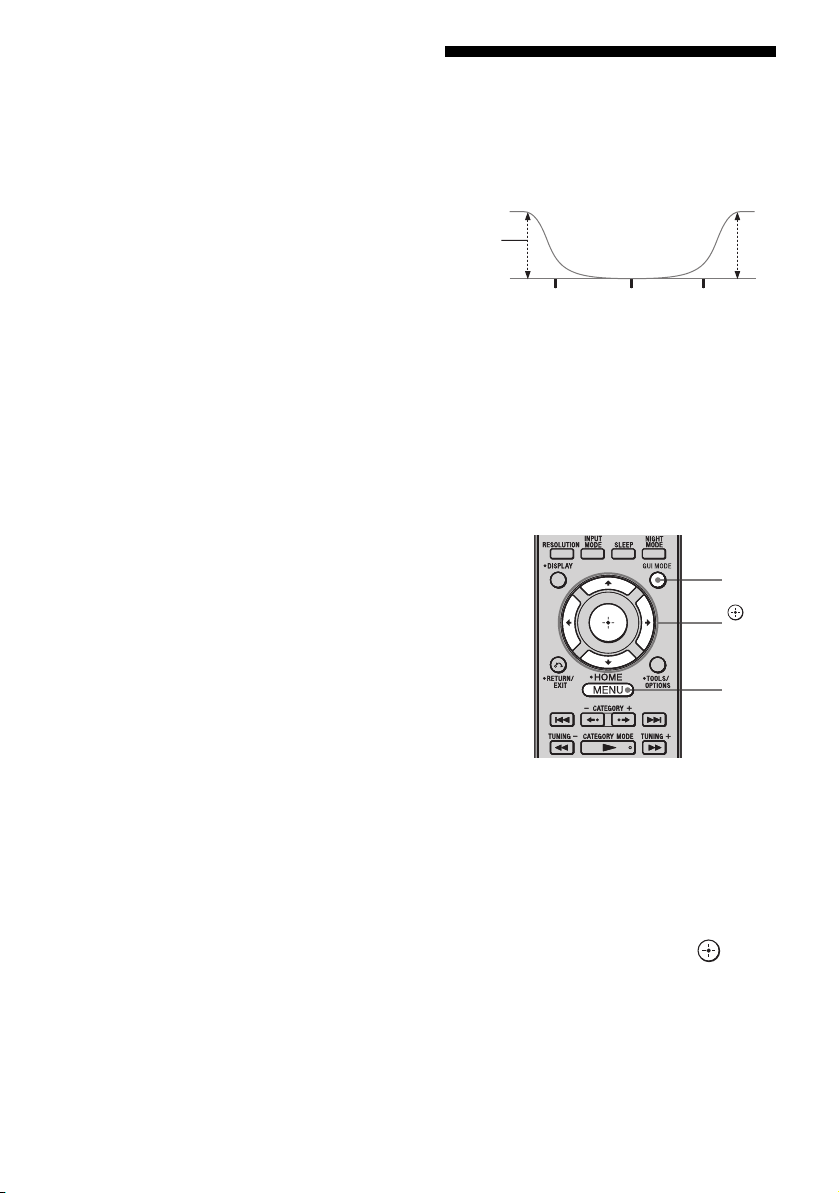
70
US
D:\NORM'S JOB\SONY HA\SO0056\STR-DA3500ES\U VERSION\US\4144907131\01US-
STRDA3500ESUC\070SET.fm
masterpage: Left
STR-DA3500ES
4-144-907-13(1)
x D. Range Comp
(Dynamic range compressor)
Lets you compress the dynamic range of the
sound track. This may be useful when you
want to watch movies at low volumes late at
night. Dynamic range compression is possible
with Dolby Digital sources only.
•OFF
The dynamic range is not compressed.
•AUTO
The dynamic range is applied automatically
with Dolby TrueHD source and is set to
“OFF” with other sources.
•STD
The dynamic range is compressed as
intended by the recording engineer.
•MAX
The dynamic range is compressed
dramatically.
Tips
• Dynamic range compressor lets you compress the
dynamic range of the soundtrack based on the
dynamic range information included in the Dolby
Digital signal.
• “STD” is the standard setting, but it only enacts
light compression. Therefore, we recommend
using the “MAX” setting. This greatly compresses
the dynamic range and lets you view movies late at
night at low volumes. Unlike analog limiters, the
levels are predetermined and provide a very natural
compression.
x Distance Unit (Distance unit)
Lets you select the unit of measure for setting
distances.
• meter
The distance is displayed in meters.
•feet
The distance is displayed in feet.
Adjusting the equalizer
You can use following parameters to adjust the
tonal quality (bass/treble level) of all speakers.
Note
This function does not work in the following cases.
– The multi channel input is selected.
– “2ch Analog Direct” is being used.
– Dolby TrueHD signals with a sampling frequency
of 176.4 kHz and higher are being received.
– PCM signals with a sampling frequency of
176.4 kHz and higher are being received.
1 Press GUI MODE repeatedly to
select “GUI ON”.
The GUI menu appears on the TV screen.
Press MENU if the GUI menu does not
appear on the TV screen.
2 Press V/v repeatedly to select
“Settings”, then press or b.
The Settings menu list appears on the TV
screen.
Level
(dB)
Bass Treble
Frequency
(Hz)
MENU
,
V/v/B/b
GUI
MODE
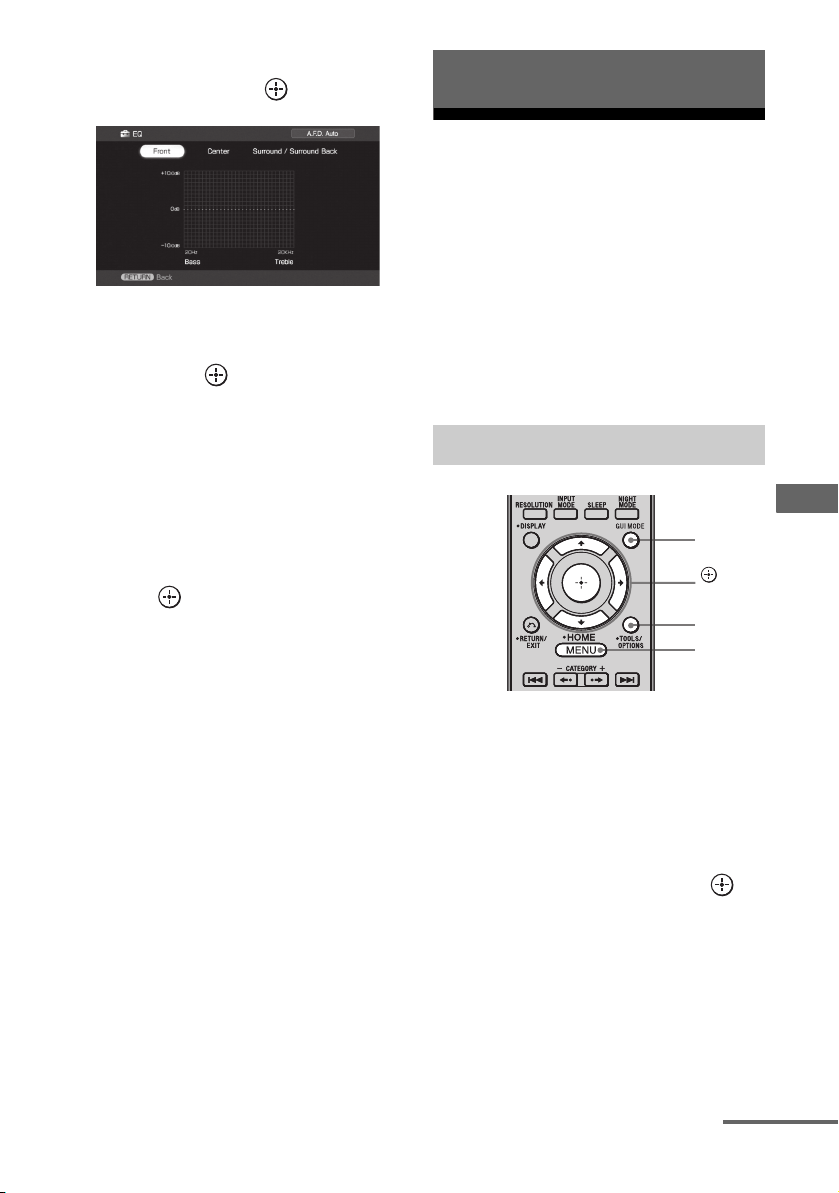
71
US
D:\NORM'S JOB\SONY HA\SO0056\STR-DA3500ES\U VERSION\US\4144907131\01US-
STRDA3500ESUC\080TUN.fm
masterpage: Right
STR-DA3500ES
4-144-907-13(1)
Tuner Operations
3 Press V/v repeatedly to select
“EQ”, then press .
4 Press B/b repeatedly to select
the speaker you want to adjust,
then press .
5 Press B/b repeatedly to select
“Bass” or “Treble”, then press
V/v to adjust the parameter.
Tip
You can adjust the front speaker bass and treble
level with TONE MODE and TONE +/– on the
receiver.
6 Press to enter the setting.
Listening to FM/AM radio
You can listen to FM and AM broadcasts
through the built-in tuner. Before operation,
make sure you have connected the FM and
AM antennas (aerials) to the receiver
(page 36).
Tip
The tuning scale for direct tuning is shown below.
• FM band 100 kHz
• AM band 10 kHz*
* The AM tuning scale can be changed (page 142).
1 Press GUI MODE repeatedly to
select “GUI ON”.
The GUI menu appears on the TV screen.
Press MENU if the GUI menu does not
appear on the TV screen.
2 Press V/v repeatedly to select
“FM” or “AM”, then press or
b.
The FM or AM menu list appears on the
TV screen.
Tuner Operations
Automatic tuning
MENU
,
V/v/B/b
GUI
MODE
OPTIONS
continued
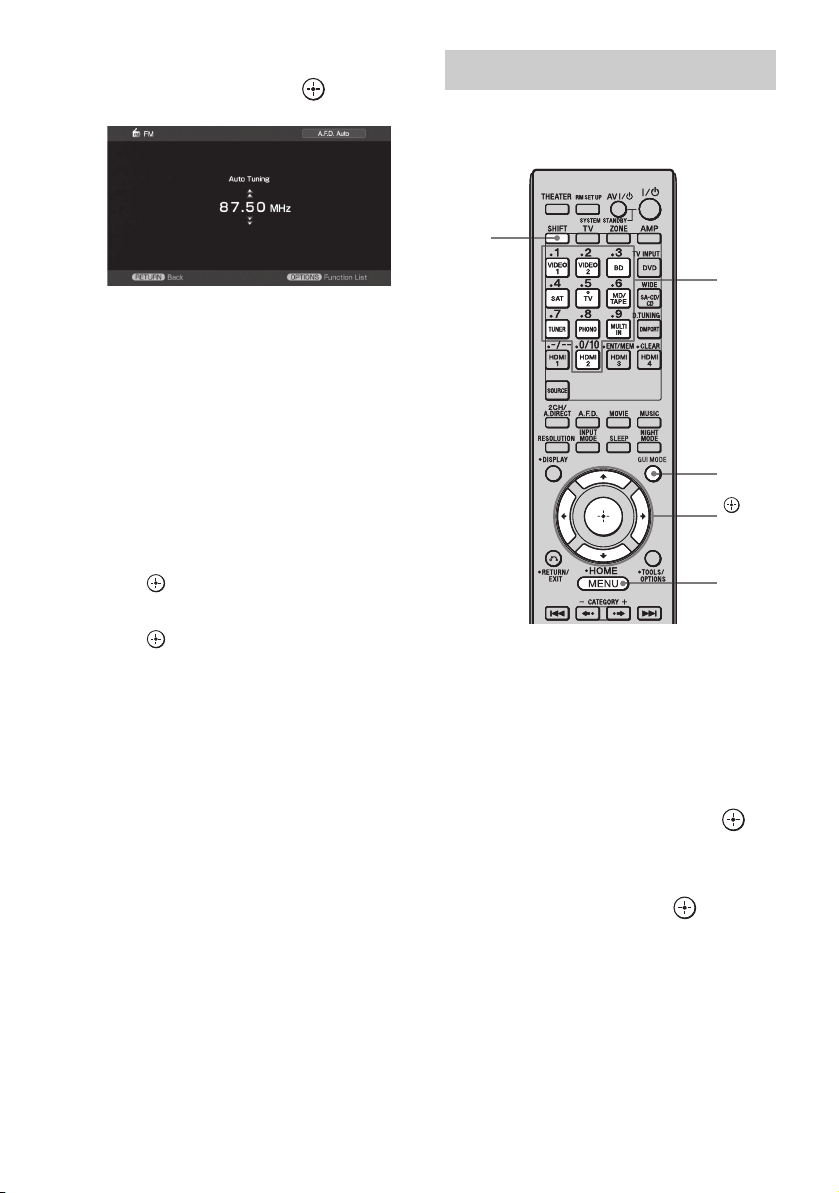
72
US
D:\NORM'S JOB\SONY HA\SO0056\STR-DA3500ES\U VERSION\US\4144907131\01US-
STRDA3500ESUC\080TUN.fm
masterpage: Left
STR-DA3500ES
4-144-907-13(1)
3 Press V/v to select “Auto
Tuning”, then press .
4 Press V/v.
Press V to scan from low to high, press v
to scan from high to low.
The receiver stops scanning whenever a
station is received.
In case of poor FM stereo
reception
1
Press OPTIONS.
2 Press V/v to select “FM Mode”, then
press or b.
3 Press V/v to select “MONO”, then
press .
Enter the frequency of a station directly by
using the numeric buttons.
1 Press GUI MODE repeatedly to
select “GUI ON”.
The GUI menu appears on the TV screen.
Press MENU if the GUI menu does not
appear on the TV screen.
2 Press V/v repeatedly to select
“FM” or “AM”, then press or
b.
3 Press V/v to select “Direct
Tuning”, then press .
Direct tuning
MENU
,
V/v/B/b
GUI
MODE
Numeric
buttons
SHIFT
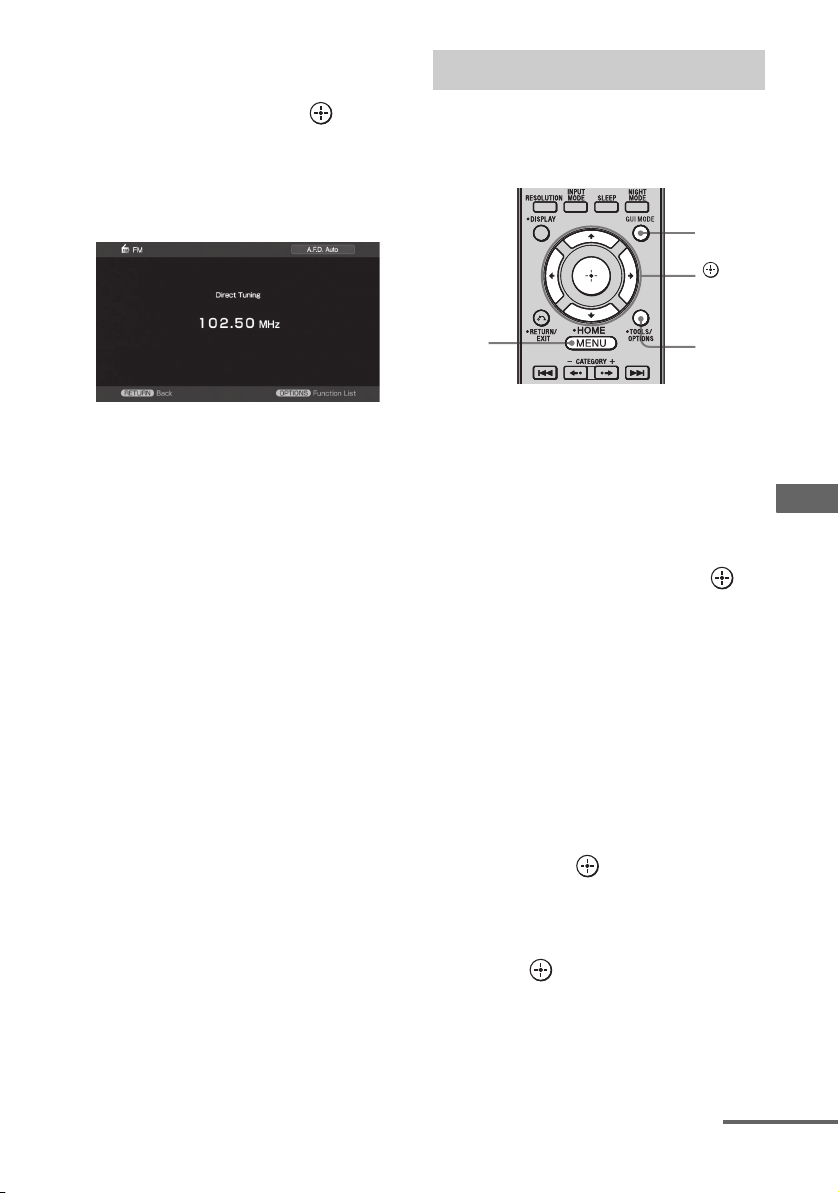
73
US
D:\NORM'S JOB\SONY HA\SO0056\STR-DA3500ES\U VERSION\US\4144907131\01US-
STRDA3500ESUC\080TUN.fm
masterpage: Right
STR-DA3500ES
4-144-907-13(1)
Tuner Operations
4 Press SHIFT, then press the
numeric buttons to enter the
frequency, then press .
Example 1: FM 102.50 MHz
Select 1 b 0 b 2 b 5
Example 2: AM 1,350 kHz
Select 1 b 3 b 5 b 0
Tip
If you have tuned in an AM station, adjust
the direction of the AM loop antenna
(aerial) for optimum reception.
If you cannot tune in a station
“– – – .– – MHz” appears and then the display
returns to the current frequency.
Make sure you have entered the right
frequency. If not, repeat step 4. If you still
cannot tune in a station, the frequency is not
used in your area.
You can preset up to 30 FM and 30 AM
stations. Then you can easily tune in the
stations you often listen to.
1 Press GUI MODE repeatedly to
select “GUI ON”.
The GUI menu appears on the TV screen.
Press MENU if the GUI menu does not
appear on the TV screen.
2 Press V/v repeatedly to select
“FM” or “AM”, then press or
b.
3 Tune in the station that you
want to preset using Automatic
Tuning (page 71) or Direct
Tuning (page 72).
In case of poor FM stereo reception,
switch the FM reception mode (page 72).
4 Press OPTIONS.
5 Press V/v to select “Memory”,
then press .
6 Press V/v to select a preset
number.
7 Press .
The station is stored as the selected preset
number.
Presetting radio stations
MENU
OPTIONS
,
V/v/B/b
GUI
MODE
continued

74
US
D:\NORM'S JOB\SONY HA\SO0056\STR-DA3500ES\U VERSION\US\4144907131\01US-
STRDA3500ESUC\080TUN.fm
masterpage: Left
STR-DA3500ES
4-144-907-13(1)
8 Repeat steps 3 to 7 to preset
another station.
To tune to preset stations
1
Repeat steps 1 and 2 of “Presetting
radio stations”.
2 Press V/v to select the preset station
you want.
You can select a preset station as follows:
• AM band AM 1 to AM 30
• FM band FM 1 to FM 30
To name preset stations
1
Select a preset station you want to
name.
2 Press OPTIONS, then select “Name
Input”.
For details on naming operations, see
“Naming inputs” (page 101).
Listening to Satellite
Radio
To listen to Satellite Radio, you’ll need to
connect either a SIRIUS or XM Satellite Radio
tuner (sold separately) to your satellite-ready
receiver. Satellite Radio is available to
residents of the US (except Alaska and
Hawaii) and Canada.
Satellite Radio delivers a variety of
commercial-free music from categories
ranging from Pop, Rock, Country, R&B,
Dance, Jazz, Classical and many more plus
coverage of all the top professional and college
sports including play by play games from
select leagues and teams. Additional
programming includes expert sports talk,
uncensored entertainment, comedy, family
programming, local traffic and weather and
news from your most trusted sources.
Whether you purchase a SIRIUS or XM tuner,
you’ll need to activate and subscribe to begin
enjoying the service. Easy to follow
installation and setup instructions are provided
with the satellite tuners. Whichever service
you choose, there are a variety of
programming packages available, including
the option of adding “The Best of SIRIUS”
programming to your XM tuner or “The Best
of XM” programming to your SIRIUS tuner,
enabling you to enjoy the most popular
programming among both services. The “Best
of” packages are not available to SIRIUS or
XM Canada subscribers at this time.
Family friendly packages are also available to
restrict channels featuring content that may be
inappropriate for children.
To subscribe to XM, U.S. customers should
visit xmradio.com or call 1-800-XMRADIO
(1-800-967-2346); Canadian customers
should visit xmradio.ca or call XM Listener
Care at 1-877-GETXMSR (1-877-438-9677).
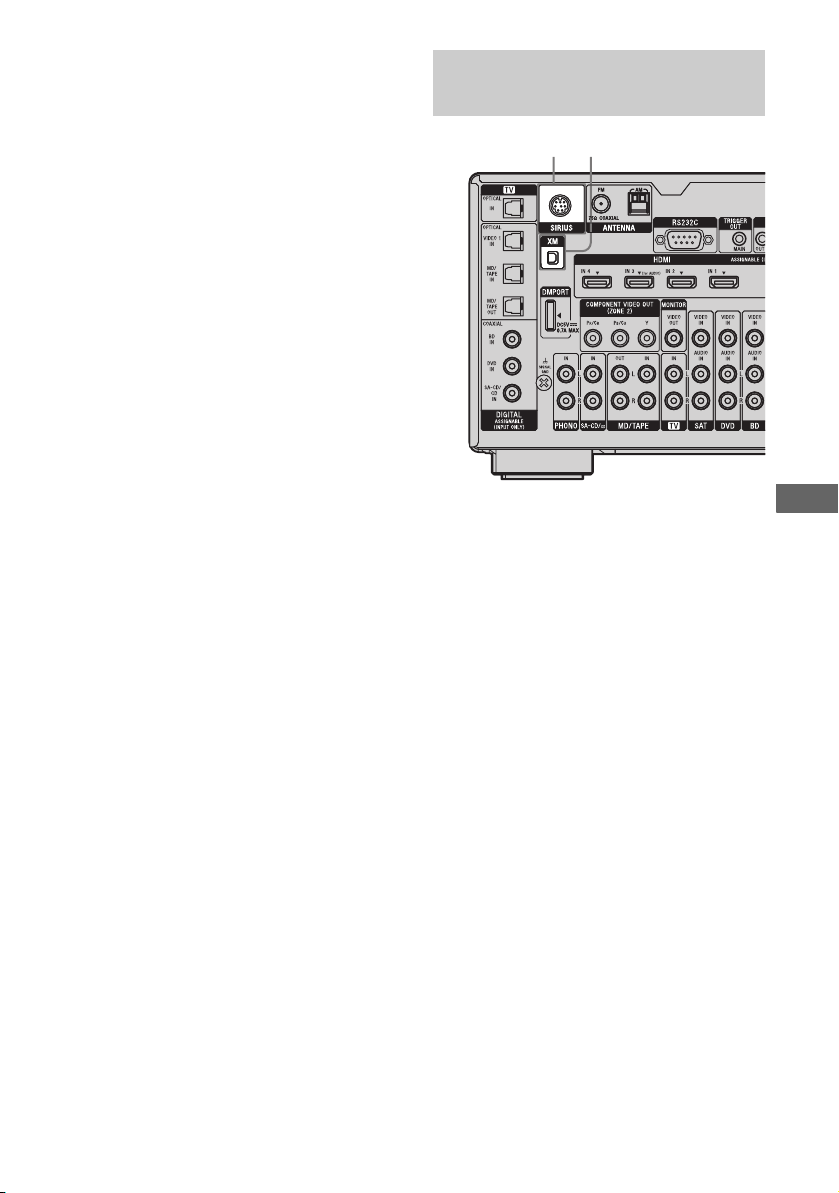
75
US
D:\NORM'S JOB\SONY HA\SO0056\STR-DA3500ES\U VERSION\US\4144907131\01US-
STRDA3500ESUC\080TUN.fm
masterpage: Right
STR-DA3500ES
4-144-907-13(1)
Tuner Operations
To subscribe to SIRIUS, U.S. and Canadian
customers can call 1-888-539-SIRI (1-888-
539-7474) or visit sirius.com (US) or
siriuscanada.ca (Canada).
SIRIUS, XM and all related marks and logos are
trademarks of Sirius XM Radio Inc. and its
subsidiaries. All other marks and logos are the
property of their respective owners. All rights
reserved. SIRIUS and XM subscriptions sold
separately. Taxes and a one-time activation fee may
apply. XM tuners and home docks or SIRIUS tuners
(each sold separately) are required to receive the
SIRIUS or XM satellite radio service. All
programming and fees subject to change. It is
prohibited to copy, decompile, disassemble, reverse
engineer, hack, manipulate or otherwise make
available any technology or software incorporated in
receivers compatible with the SIRIUS or XM
Satellite Radio Systems.
Service not available in Alaska or Hawaii.
To connect to the XM jack
Before operating the system, connect the XM
Mini Tuner and Home Dock to the XM jack.
Note
To ensure optimal reception of XM’s satellite signal,
move your antenna to various window locations
around your home to see where the best reception
will be received. Most XM customers place the
antenna in a south-facing window with a clear view
to the sky.
To connect to the SIRIUS jack
Connect the SiriusConnect Home tuner. When
you use the SiriusConnect Home tuner with
this receiver, be sure to connect the AC power
adaptor supplied with the tuner to a wall outlet.
Keep the SiriusConnect Home tuner, antenna,
and AC power adaptor away from the speaker
cords and the power cord to avoid picking up
noise.
Connecting the XM Radio or
SIRIUS Satellite Radio
XM jackSIRIUS jack
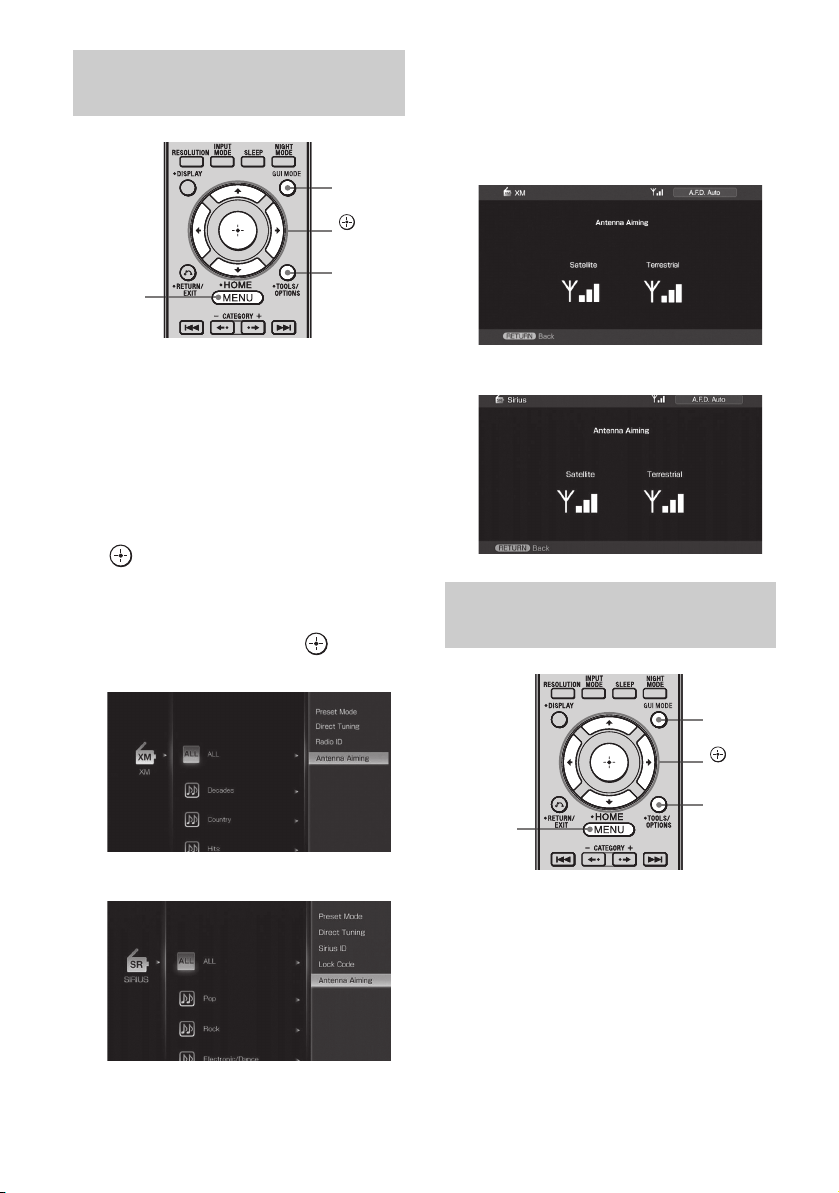
76
US
D:\NORM'S JOB\SONY HA\SO0056\STR-DA3500ES\U VERSION\US\4144907131\01US-
STRDA3500ESUC\080TUN.fm
masterpage: Left
STR-DA3500ES
4-144-907-13(1)
1 Press GUI MODE repeatedly to
select “GUI ON”.
The GUI menu appears on the TV screen.
Press MENU if the GUI menu does not
appear on the TV screen.
2 Press V/v repeatedly to select
“XM” or “SIRIUS”, then press
or b.
3 Press OPTIONS, then press V/v
repeatedly to select “Antenna
Aiming”, then press .
4 While checking the parameter
on the TV screen, aim your
antenna to where the best
reception will be received.
1 Press GUI MODE repeatedly to
select “GUI ON”.
The GUI menu appears on the TV screen.
Press MENU if the GUI menu does not
appear on the TV screen.
Aiming the XM Radio or SIRIUS
antenna
MENU
GUI
MODE
OPTIONS
,
V/v/B/b
XM
SIRIUS
Checking the XM Radio ID or
SIRIUS ID number
XM
SIRIUS
MENU
GUI
MODE
OPTIONS
,
V/v/B/b
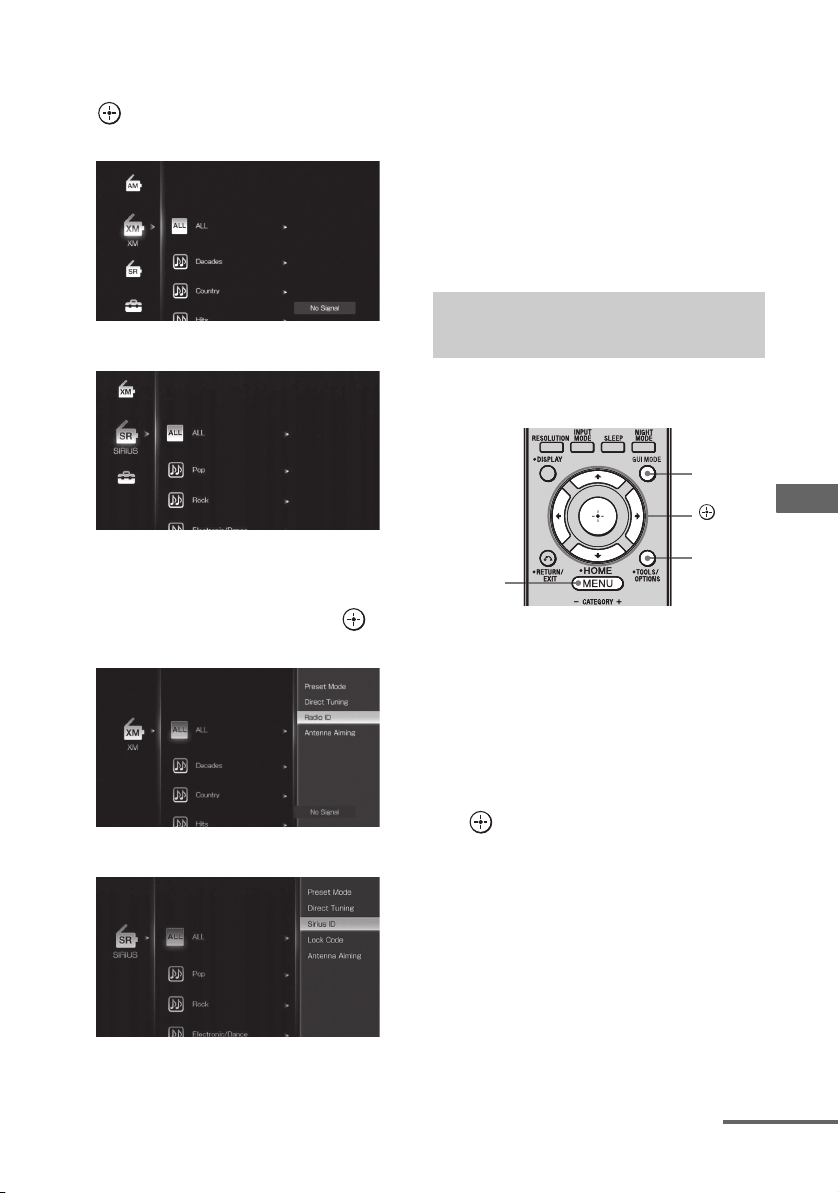
77
US
D:\NORM'S JOB\SONY HA\SO0056\STR-DA3500ES\U VERSION\US\4144907131\01US-
STRDA3500ESUC\080TUN.fm
masterpage: Right
STR-DA3500ES
4-144-907-13(1)
Tuner Operations
2 Press V/v repeatedly to select
“XM” or “SIRIUS”, then press
or b.
3 Press OPTIONS, then press V/v
repeatedly to select “Radio ID”
or “Sirius ID”, then press .
4 Check the XM Radio ID or Sirius
ID on the TV screen and write it
in the space provided here.
XM Radio ID:_____________________
SIRIUS ID:_______________________
You can also check the XM Radio ID and
SIRIUS ID using the display on the
receiver.
You can select a channel from one category or
all the categories.
1 Press GUI MODE repeatedly to
select “GUI ON”.
The GUI menu appears on the TV screen.
Press MENU if the GUI menu does not
appear on the TV screen.
2 Press V/v repeatedly to select
“XM” or “SIRIUS”, then press
or b.
XM
SIRIUS
XM
SIRIUS
Selecting a channel by Category
Mode
MENU
GUI
MODE
OPTIONS
,
V/v/B/b
continued
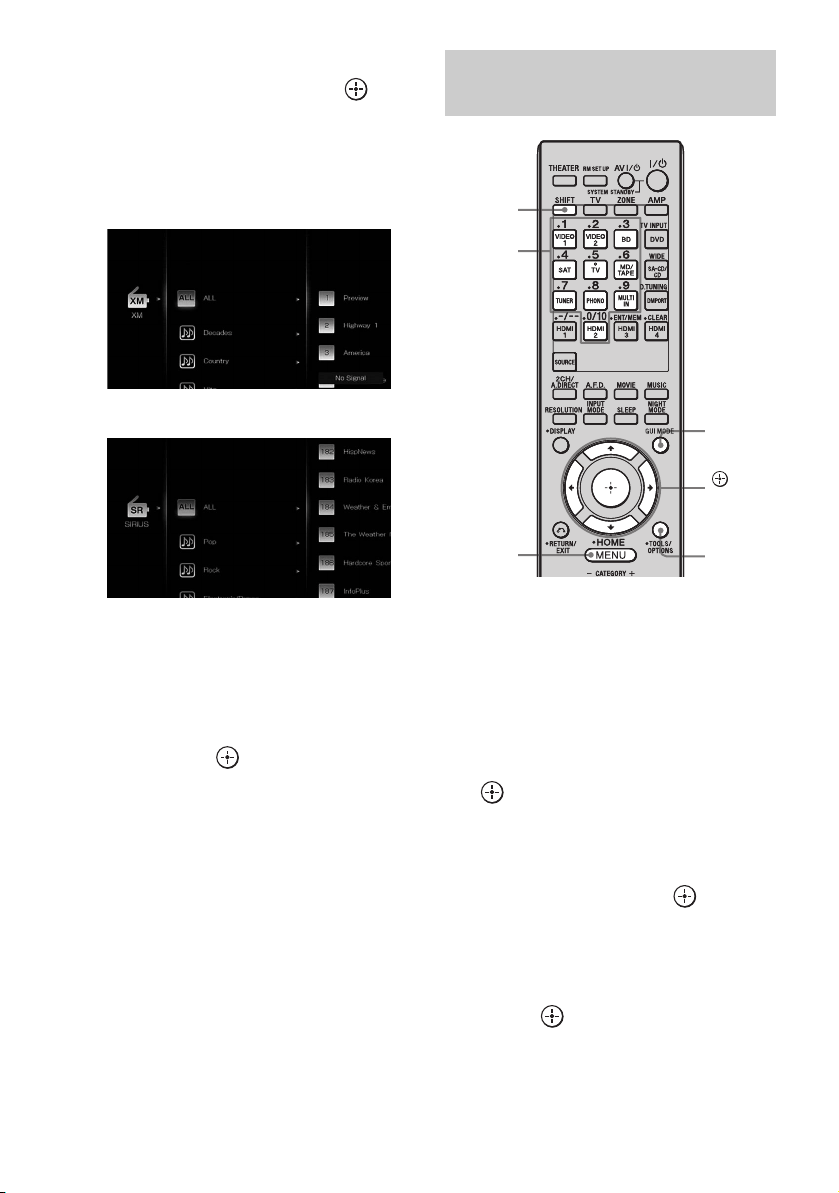
78
US
D:\NORM'S JOB\SONY HA\SO0056\STR-DA3500ES\U VERSION\US\4144907131\01US-
STRDA3500ESUC\080TUN.fm
masterpage: Left
STR-DA3500ES
4-144-907-13(1)
3 Press V/v repeatedly to select
the category, then press .
• ALL: You can select a channel from all
the categories.
• (category name): You can select a
channel from one category.
When the “Preset Mode” screen is
displayed, press OPTIONS, then press
V/v repeatedly to select “Category
Mode”.
4 Press V/v to select the channel,
then press .
The selected channel is being received.
The channel information is displayed on
the TV screen.
Note
When you select a channel in the “Category Mode”,
the channel you selected may not be the one in the
category you want. This is because one channel may
belong to more than one category.
1 Press GUI MODE repeatedly to
select “GUI ON”.
The GUI menu appears on the TV screen.
Press MENU if the GUI menu does not
appear on the TV screen.
2 Press V/v repeatedly to select
“XM” or “SIRIUS”, then press
or b.
3 Press OPTIONS.
4 Press V/v to select “Direct
Tuning”, then press .
5 Press SHIFT, then press the
numeric buttons to enter the
channel number.
6 Press .
The selected channel is tune in.
XM
SIRIUS
Selecting a channel by inputting
the channel number directly
MENU
GUI
MODE
OPTIONS
,
V/v/B/b
Numeric
buttons
SHIFT
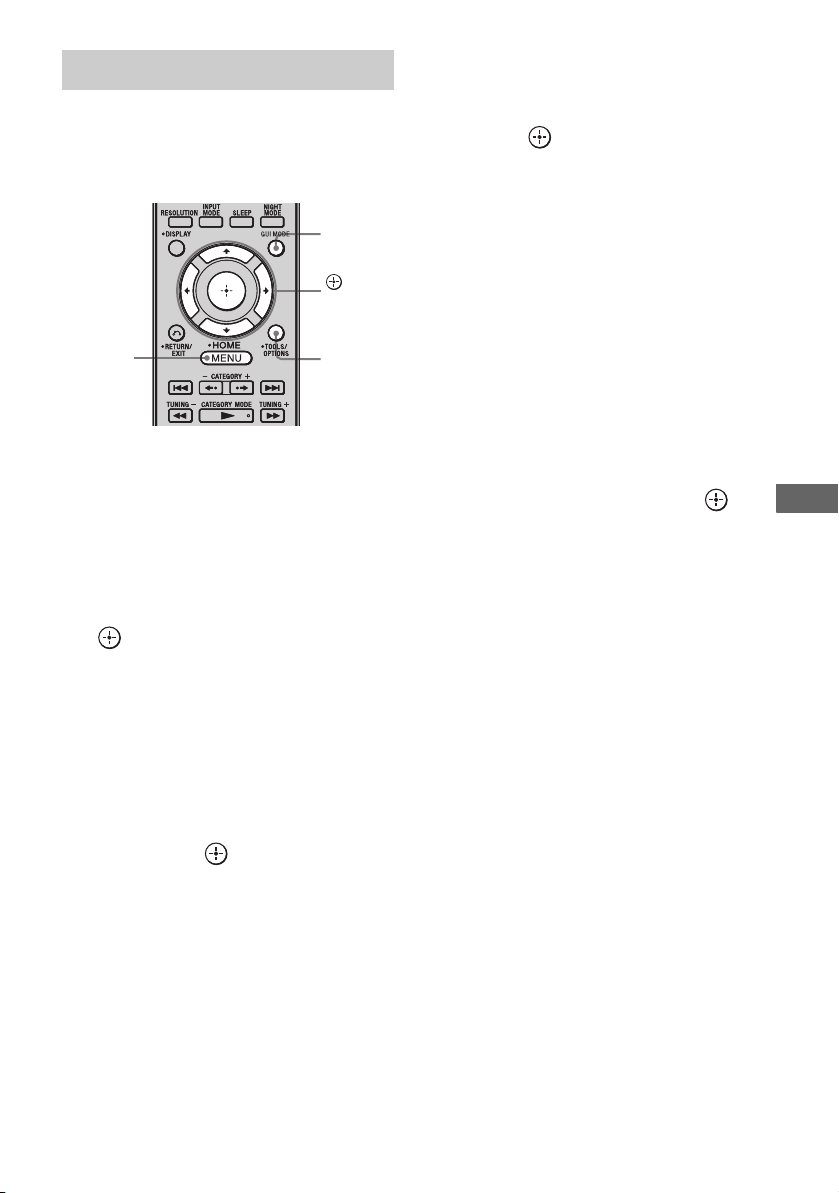
79
US
D:\NORM'S JOB\SONY HA\SO0056\STR-DA3500ES\U VERSION\US\4144907131\01US-
STRDA3500ESUC\080TUN.fm
masterpage: Right
STR-DA3500ES
4-144-907-13(1)
Tuner Operations
You can select the channels you want directly
by presetting them using the preset numbers.
You can preset up to 30 XM Radio channels
and 30 SIRIUS Satellite Radio channels.
1 Press GUI MODE repeatedly to
select “GUI ON”.
The GUI menu appears on the TV screen.
Press MENU if the GUI menu does not
appear on the TV screen.
2 Press V/v repeatedly to select
“XM” or “SIRIUS”, then press
or b.
3 Select a channel you want to
preset using Category Tuning
(page 77) or Direct Tuning
(page 78).
4 Press OPTIONS.
5 Press V/v to select “Memory”,
then press .
6 Press V/v repeatedly to select
the preset channel you want to
use as the preset channel, then
press .
Preset channels from 1 to 30 are available,
and a default channel is preset for all the
preset channels when you purchase the
receiver.
The selected channel is registered as the
preset channel you selected in step 3.
7 Repeat steps 3 to 6 to preset
another channel.
To select the preset channels
1
Repeat steps 1 and 2 of “Presetting the
channels”.
2 Press V/v to select the preset number
from the preset list, then press .
You can select stored preset channels from
1 to 30.
Notes
• The channel information you have preset may be
changed if XM Satellite Radio Inc. or SIRIUS
Satellite Radio Inc. change their channel
programming.
• When the “Category Mode” screen is displayed,
press OPTIONS, then press V/v to select “Preset
Mode”.
Presetting the channels
MENU
GUI
MODE
OPTIONS
,
V/v/B/b
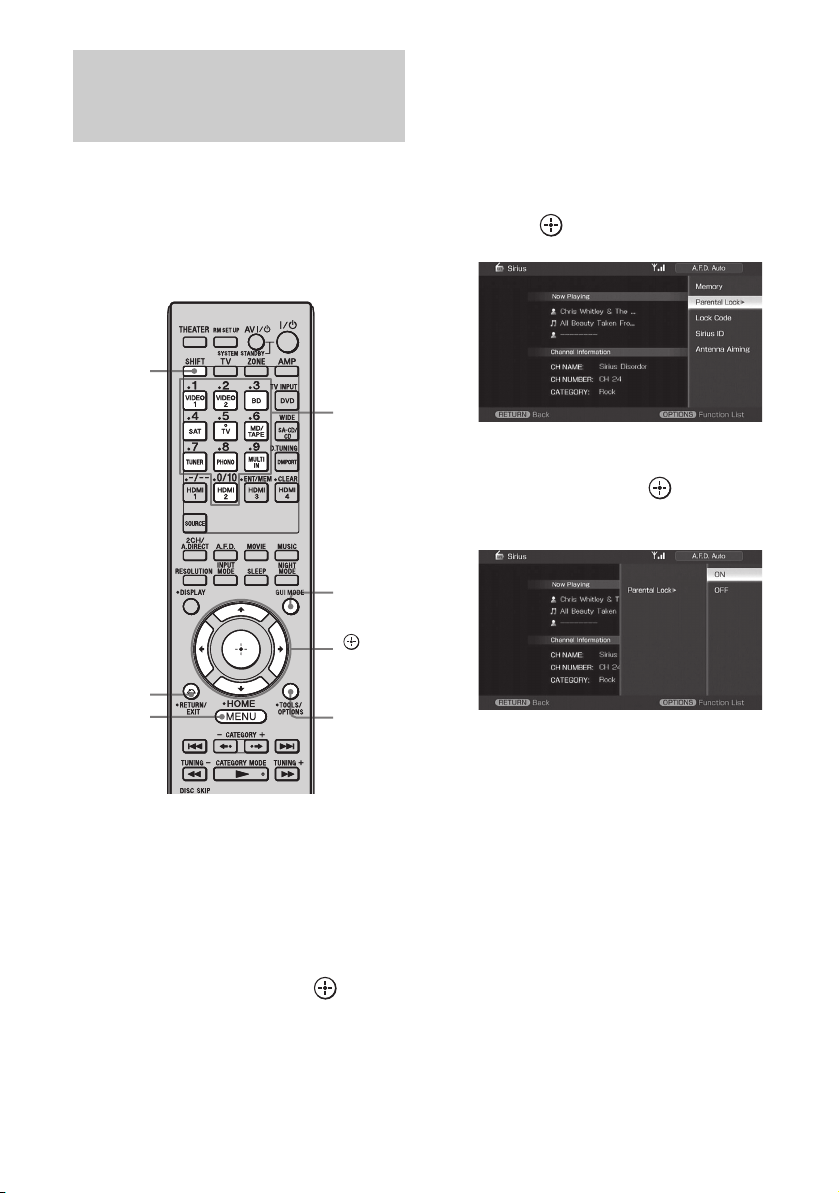
80
US
D:\NORM'S JOB\SONY HA\SO0056\STR-DA3500ES\U VERSION\US\4144907131\01US-
STRDA3500ESUC\080TUN.fm
masterpage: Left
STR-DA3500ES
4-144-907-13(1)
You can restrict access to certain channels
using your own lock code. The lock code is set
to “0000” as the default.
Change the lock code before you use this
function for the first time (see “To change the
lock code” (page 81)).
1 Press GUI MODE repeatedly to
select “GUI ON”.
The GUI menu appears on the TV screen.
Press MENU if the GUI menu does not
appear on the TV screen.
2 Press V/v repeatedly to select
“SIRIUS”, then press or b.
3 Select a channel you want to
lock using Category Tuning
(page 77) or Direct Tuning
(page 78).
4 Press OPTIONS, then press V/v
to select “Parental Lock”, then
press or b.
5 Press V/v repeatedly to select
“ON”, then press .
“Enter your 4-digit lock code.” appears.
Restricting access to specific
channels (Parental Lock)
(SIRIUS only)
MENU
RETURN/
EXIT O
Numeric
buttons
OPTIONS
,
V/v/B/b
SHIFT
GUI
MODE
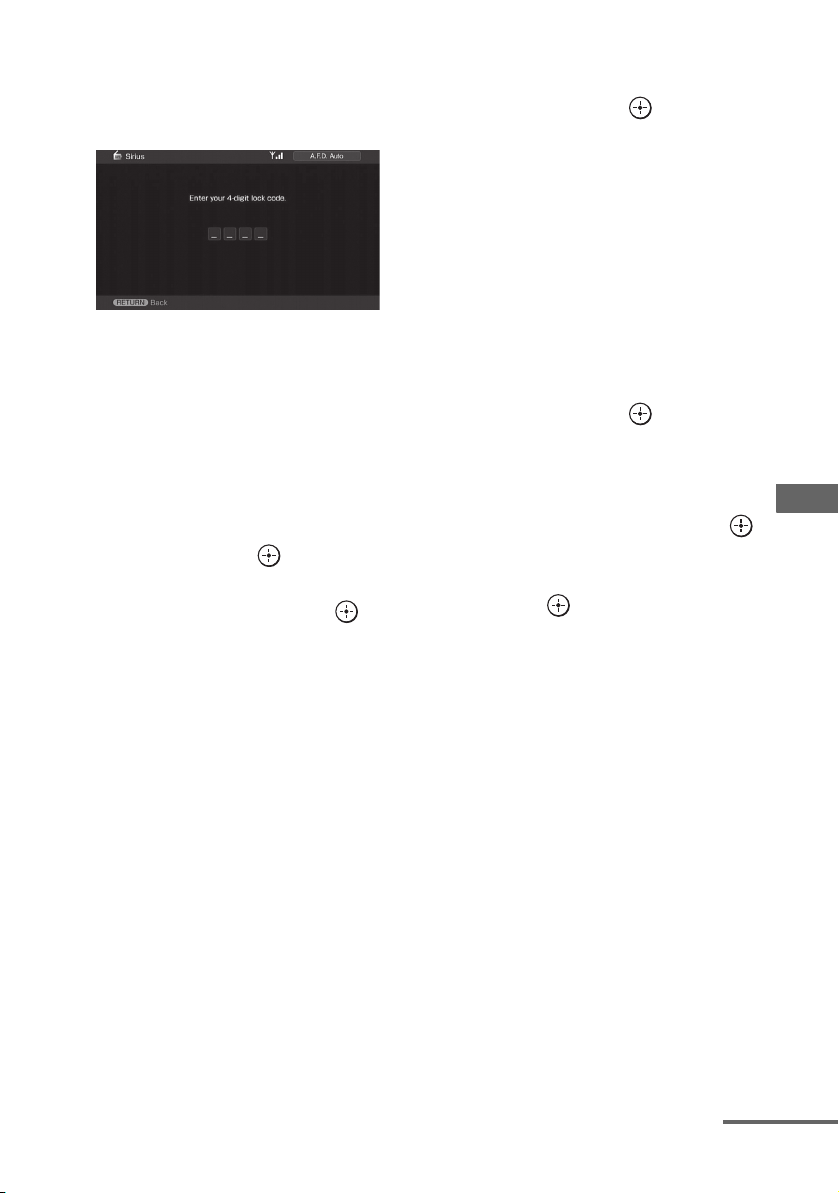
81
US
D:\NORM'S JOB\SONY HA\SO0056\STR-DA3500ES\U VERSION\US\4144907131\01US-
STRDA3500ESUC\080TUN.fm
masterpage: Right
STR-DA3500ES
4-144-907-13(1)
Tuner Operations
6 Press SHIFT, then press the
numeric buttons to enter your
4-digit lock code.
“The channel has been locked.” appears
and the Parental Lock is set.
To delete the numbers you have entered,
go back to step 4 by pressing RETURN/
EXIT O, and then repeat the procedure
above from step 4.
To change the lock code
1
Press V/v repeatedly to select
“SIRIUS”, then press or b.
2 Press OPTIONS, then press V/v to
select “Lock Code”, then press .
“Enter your 4-digit lock code.” appears.
3 Press SHIFT, then press the numeric
buttons to enter your 4-digit lock code.
“Enter a new lock code.” appears.
4 Enter a new 4-digit lock code using the
numeric buttons.
“To confirm, enter your new lock code
again.” appears.
5 Reenter the new lock code with the
numeric buttons.
“The lock code has been changed.”
appears.
To listen to the locked channels
1
Press V/v repeatedly to select
“SIRIUS”, then press or b.
2 Select a locked channel you want to
listen to using “Direct Tuning”
(page 78).
“The channel is locked. Enter your 4-digit
lock code.” appears.
3 Press SHIFT, then press the numeric
buttons to enter your 4-digit lock code.
The channel is tuned in.
To cancel the Parental Lock
1
Press V/v repeatedly to select
“SIRIUS”, then press or b.
2 Tune in the channel you want to unlock
using “Direct Tuning” (page 78).
3 Press OPTIONS, then press V/v to
select “Parental Lock”, then press
or b.
4 Press V/v repeatedly to select “OFF”,
then press .
“Enter your 4-digit lock code.” appears.
5 Press SHIFT, then press the numeric
buttons to enter your 4-digit lock code.
“The channel has been unlocked.” appears
and the channel is unlocked.
Notes
• When you select a channel using Category Tuning,
locked channels are skipped.
• When the receiver is reset to the factory settings,
the lock code returns to the default (0000), but the
Parental Lock settings are not removed.
• You cannot preset locked channels. If you set the
Parental Lock for a preset channel, the preset
information for that channel returns to the default.
• You cannot set the Parental Lock for channel 0 or
channel 184.
continued

82
US
D:\NORM'S JOB\SONY HA\SO0056\STR-DA3500ES\U VERSION\US\4144907131\01US-
STRDA3500ESUC\080TUN.fm
masterpage: Left
STR-DA3500ES
4-144-907-13(1)
XM Radio message list
Message
appears in
GUI menu
[Display
window]
Explanation Remedies
Check Antenna
[ANTENNA]
The XM antenna is not connected to
the XM Mini-Tuner and Home Dock
or the XM antenna cable is damaged.
Check that the XM antenna is connected to the
XM Mini-Tuner and Home Dock securely and
check the antenna cable for damage. Replace the
XM antenna if the cable is damaged.
CH Unauthorized
[UNAUTH]
You have selected an XM channel that
is blocked or cannot be received with
your XM subscription package.
Consult the latest channel guide at
www.xmradio.com (US residents) or
www.xmradio.ca (Canadian residents) for the
current list of channels.
For information on receiving this channel, visit
www.xmradio.com (US residents) or
www.xmradio.ca (Canadian residents). You can
also contact XM Satellite Radio at 1-800-967-
2346 (US residents) or 1-877-438-9677 (Canadian
residents).
No Signal
[NO SIGNAL]
The XM Mini-Tuner is not receiving
the XM satellite signal. The XM
antenna’s view of the satellites may be
blocked or the antenna is not properly
aimed.
Check the antenna for obstructions and reposition
the XM antenna to get a better signal reception. To
optimize the antenna position, see “Aiming the
XM Radio or SIRIUS antenna” (page 76).
Refer to the operating instructions supplied with
the XM Mini-Tuner and Home Dock for antenna
installation information.
Loading
[LOADING]
The XM Mini-Tuner is acquiring
audio or program information from the
XM satellite signal. This message can
also occur in weak XM signal
conditions.
This message should disappear in a few seconds
when the signal is strong.
If you often see this message, reposition the XM
antenna for better signal reception.
To optimize the antenna position, see “Aiming the
XM Radio or SIRIUS antenna” (page 76).
Off Air
[OFF AIR]
You have selected an XM channel that
is not currently broadcasting.
Check this XM channel later. In the meantime,
select another channel.
[––––––] No artist name or song title is available
for this selection.
—
CH Unavailable
[CH UNAVL]
The selected channel is not available.
The channel may have been reassigned
to a different channel number. This
message may occur initially with a
new radio or a radio that has not
received XM’s signal for an extended
period.
Consult the latest channel guide at
www.xmradio.com (US residents) or
www.xmradio.ca (Canadian residents) for the
current channel list. For a new radio or a radio that
has not received XM’s signal for an extended
period, allow the radio to receive the XM satellite
signal for at least 5 minutes and then select the
channel again.
Check XM Tuner
[XM TUNER]
The XM Mini-Tuner is not installed or
not fully seated in the XM Mini-Tuner
Home Dock or the XM Mini-Tuner
Home Dock is not connected to the
receiver.
Confirm the XM Mini-Tuner is fully seated in the
dock and check the XM Mini-Tuner and Home
Dock cable is connected to the receiver.
83
US
D:\NORM'S JOB\SONY HA\SO0056\STR-DA3500ES\U VERSION\US\4144907131\01US-
STRDA3500ESUC\080TUN.fm
masterpage: Right
STR-DA3500ES
4-144-907-13(1)
Tuner Operations
SIRIUS Satellite Radio message list
Message
appears in
GUI menu
[Display
window]
Explanation Remedies
Antenna Error
[ANTENNA]
The antenna is not connected properly. Check the connection between the SiriusConnect
Home tuner and the antenna.
Acquiring Signal
[ACQUIRING]
The receiving condition is not good. Try moving the antenna to another location. For
details about the antenna location, refer to the
instructions supplied with the SiriusConnect
Home tuner.
CALL 888, 539-
SIRI
[CALL 888, 539-
SIRI]
You have not subscribed for the
selected channel.
—
Check Sirius
Tuner
[SR TUNER]
The SiriusConnect Home tuner is not
connected properly.
Check all the connections, and then turn the
system on again. Also make sure if the AC adaptor
supplied with the SiriusConnect Home tuner is
connected to a wall socket.
Invalid Channel
[INVALID]
You have entered an invalid channel
number.
The channel to be tuned-in is void due to the
change by the broadcast service, or the receiving
condition is not good.
Locked Channel
[LOCKED CH]
The selected channel is locked. —
Subscription
Updated
[SUB UPDT]
The subscription information has been
updated.
—
Updating
Channels
xx% Completed
(xx are for
integers)
[UPDATING]
Channel information is being updated. —
Firmware
Updating
[FW UPDT]
The SiriusConnect Home tuner
firmware is being updated.
—
[–––––] There is no text information in the
channel.
This is not an error. The text information may not
be displayed depending on the system condition,
for example, right after the system has received a
channel.

84
US
D:\NORM'S JOB\SONY HA\SO0056\STR-DA3500ES\U VERSION\US\4144907131\01US-
STRDA3500ESUC\090OTH.fm
masterpage: Left
STR-DA3500ES
4-144-907-13(1)
Using “BRAVIA” Sync
features
“BRAVIA” Sync is compatible with a Sony
TV, Blu-ray Disc/DVD player, AV amplifier,
etc., that is equipped with the Control for
HDMI function.
By connecting Sony components that are
compatible with the “BRAVIA” Sync with a
HDMI cable (not supplied), operation is
simplified as below:
• One-Touch Play (page 87)
• System Audio Control (page 88)
• System Power-Off (page 88)
• Theater Mode Sync (page 89)
• 24p Auto Sound Sync (page 89)
Control for HDMI is a mutual control function
standard used by HDMI CEC (Consumer
Electronics Control) for HDMI (High-
Definition Multimedia Interface).
The Control for HDMI function
does not work in the following
cases:
• When you connect the receiver to a
component which does not correspond with
Sony Control for HDMI function.
• When you connect the receiver and
components using other than HDMI
connection.
We recommend that you connect the receiver
to products featuring “BRAVIA” Sync.
Note
Depending on the connected component, the
Control for HDMI function may not work. Refer to
the operating instructions of the component.
“BRAVIA” Sync features
What is “BRAVIA” Sync?
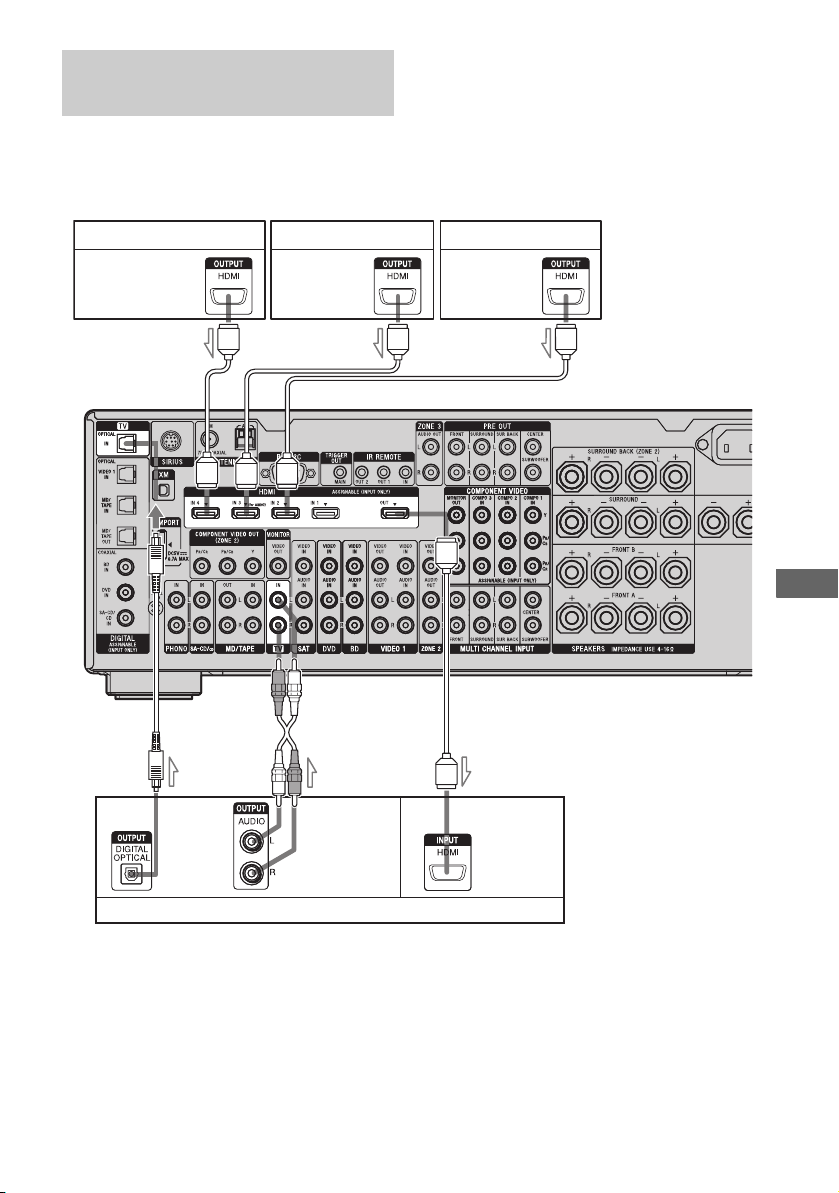
85
US
D:\NORM'S JOB\SONY HA\SO0056\STR-DA3500ES\U VERSION\US\4144907131\01US-
STRDA3500ESUC\090OTH.fm
masterpage: Right
STR-DA3500ES
4-144-907-13(1)
“BRAVIA” Sync features
Before connecting cords, be sure to disconnect
the AC power cord (mains lead).
To enjoy TV multi channel
surround sound broadcasting
You can listen to TV multi channel surround
sound broadcasting from the speakers
connected to the receiver.
Connect the OPTICAL output jack of the TV
to the OPTICAL IN jack of the receiver.
a)
Connect at least one of the audio cords (B or C).
Connecting a TV and other
components
Satellite tuner, Set-top box
A HDMI cable (not supplied)
Sony recommends that you use an HDMI-authorized cable or Sony HDMI cable.
B Optical digital cord (not supplied)
a)
C Audio cord (not supplied)
a)
Audio/video
signals
C
Audio/video
signals
Audio/video
signals
Blu-ray disc player DVD player
TV, etc.
Audio/video
signals
Audio signals
BA
AAA

86
US
D:\NORM'S JOB\SONY HA\SO0056\STR-DA3500ES\U VERSION\US\4144907131\01US-
STRDA3500ESUC\090OTH.fm
masterpage: Left
STR-DA3500ES
4-144-907-13(1)
Preparing Control for
HDMI function
This receiver supports the Control for HDMI-
Easy Setting function.
This function is only available for certain types
of TV. When you perform the Control for
HDMI-Easy Setting on the TV, the Control for
HDMI setting on this receiver will
automatically change accordingly.
During the Control for HDMI-Easy Setting
operation, “SCANNING” flashes in the
display window. This receiver will
automatically change the input to HDMI input.
When the setting is completed,
“COMPLETE” appears on the display
window.
For details, refer to the operating instructions
of the TV.
If your TV does not support the Control for
HDMI-Easy Setting function, do the following
procedures. For details on setting the TV and
the connected components, refer to the
operating instructions of the respective
components.
1 Make sure that the receiver is connected to
the TV and components (compatible with
Control for HDMI function) via HDMI
connection.
2 Turn on the receiver, TV and connected
components.
3 Set the respective Control for HDMI
function for the receiver and TV to on. See
“To set Control for HDMI” (page 87).
When the receiver menu is displayed on the
TV screen in the screen mode, press GUI
MODE repeatedly to select “GUI OFF” to
enter the display mode, then check the TV
display image of the component connected
to the receiver.
For details on setting the TV, refer to the
operating instructions of the TV.
4 Select the HDMI input of the receiver and
TV to match the HDMI input of the
connected component, so that the image
from the connected component is displayed.
5 Set the Control for HDMI function for the
connected component to on.
If the Control for HDMI function for the
connected component is already set to on,
you do not need to change the setting.
6 Repeat steps 4 and 5 for other components
that you want to use the Control for HDMI
function.
Notes
• If you unplug and reconnect the HDMI cable, be
sure to repeat steps 1 to 6 above.
• You cannot perform One-Touch Play and System
Audio Control during the Control for HDMI-Easy
Setting operation.
• Before you do the Control for HDMI-Easy Setting
from the TV, be sure to turn on the TV, connected
components and receiver.
• If the playback components cannot function after
you have made the settings for Control for HDMI-
Easy Setting, check the Control for HDMI setting
on your TV.
• If the connected components do not support the
Control for HDMI-Easy Setting, you need to set
the Control for HDMI function for the connected
components to on before you perform the Control
for HDMI-Easy Setting from the TV.
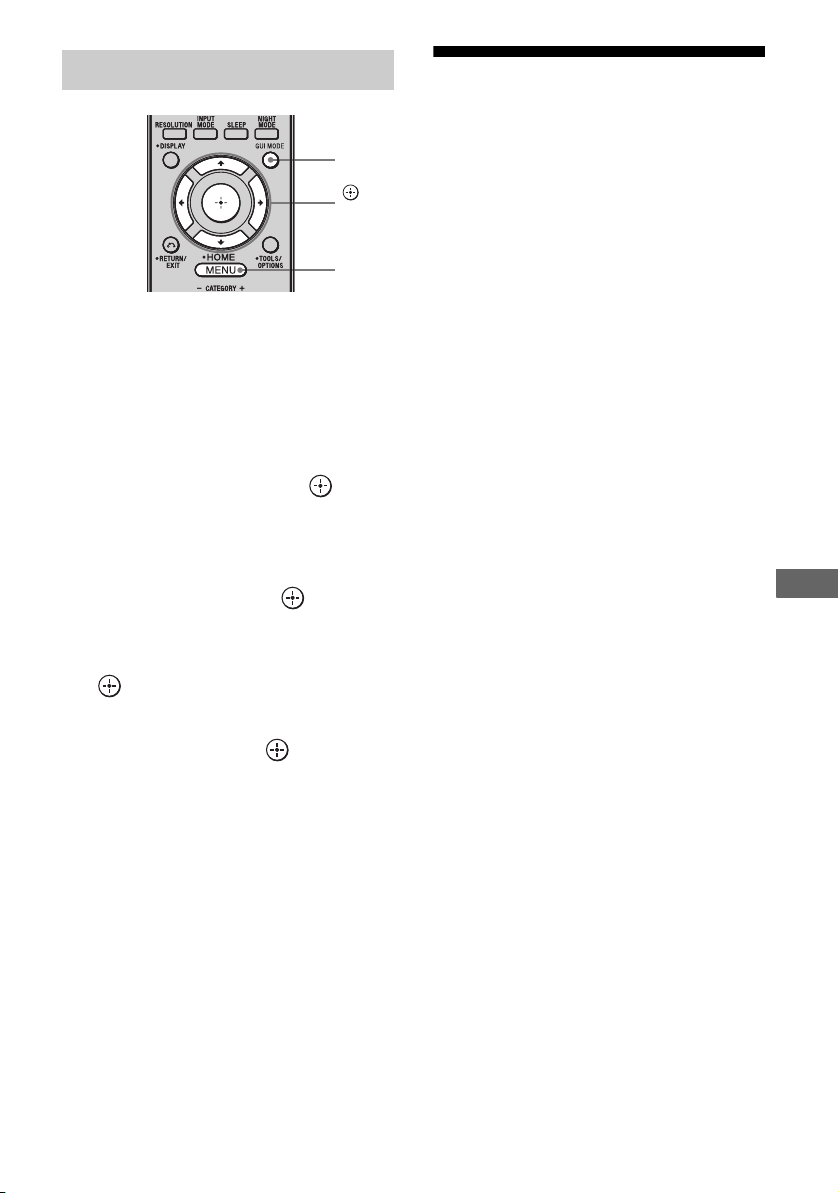
87
US
D:\NORM'S JOB\SONY HA\SO0056\STR-DA3500ES\U VERSION\US\4144907131\01US-
STRDA3500ESUC\090OTH.fm
masterpage: Right
STR-DA3500ES
4-144-907-13(1)
“BRAVIA” Sync features
1 Press GUI MODE repeatedly to
select “GUI ON”.
The GUI menu appears on the TV screen.
Press MENU if the GUI menu does not
appear on the TV screen.
2 Press V/v repeatedly to select
“Settings” then press or b.
The settings menu list appears on the TV
screen.
3 Press V/v repeatedly to select
“HDMI” then press or b.
4 Press V/v repeatedly to select
“Control for HDMI” then press
.
5 Press V/v repeatedly to select
“ON”, then press .
Control for HDMI function is activated.
Playing back components
with one-touch operation
(One-Touch Play)
With a simple operation (one-touch),
components connected to the receiver via
HDMI connections will start automatically.
You can enjoy the sound and image from the
connected components.
Play back a connected component.
The receiver and TV are turned on
simultaneously, and the sound and image are
output from the receiver and TV.
Note
Depending on the TV, the start of the content may
not be output.
To set Control for HDMI
MENU
,
V/v/B/b
GUI
MODE

88
US
D:\NORM'S JOB\SONY HA\SO0056\STR-DA3500ES\U VERSION\US\4144907131\01US-
STRDA3500ESUC\090OTH.fm
masterpage: Left
STR-DA3500ES
4-144-907-13(1)
Enjoying the TV sound
from the speakers
connected to the receiver
(System Audio Control)
You can enjoy the TV sound from the speakers
connected to the receiver by a simple
operation.
Depending on the TV settings, while you are
watching the TV, the receiver turns on and
switches to the “TV” function automatically.
TV sound is output from the speakers
connected to the receiver, and the volume of
the TV is minimized simultaneously.
You can also use the System Audio Control
function as follows.
• The sound of the TV is output from the
speakers connected to the receiver when you
turn the receiver on while the sound is being
output from the TV speaker.
• You can adjust the receiver’s volume when
you adjust the TV volume.
You can also operate this function using the
TV menu. For details, refer to the operating
instructions of the TV.
Notes
• If System Audio Control does not function
according to your TV setting, refer to the operating
instructions of the TV.
• When “Control for HDMI” is set to “ON”, the
“Audio Out” settings in the HDMI settings menu
will set automatically depending on the System
Audio Control settings.
• When you connect a TV that does not have System
Audio Control function, the System Audio Control
function does not work.
• If the TV is turned on before turning on the
receiver, the TV sound will not be output for a
moment.
Turning off the receiver
with the TV
(System Power-Off)
When you turn the TV off by using the
POWER button on the TV’s remote, the
receiver and the connected components turn
off automatically.
You can also use the receiver’s remote to turn
off the TV.
Press TV, then press AV ?/1.
The TV, receiver and the components
connected via HDMI are turned off.
Notes
• Set the TV Standby Synchro to “ON” before using
the System Power Off function. For details, refer to
the operating instructions of the TV.
• Depending on the status, the connected
components may not be turned off. For details,
refer to the operating instructions of the connected
components.
AV ?/1
TV
89
US
D:\NORM'S JOB\SONY HA\SO0056\STR-DA3500ES\U VERSION\US\4144907131\01US-
STRDA3500ESUC\090OTH.fm
masterpage: Right
STR-DA3500ES
4-144-907-13(1)
“BRAVIA” Sync features
Enjoying movies with the
optimum sound field
(Theater Mode Sync)
Press the THEATER button on the
remote of the receiver, TV, or the
Blu-ray Disc Player, while pointing
the remote toward the TV.
The sound field switches to HD-D.C.S.
To return to the previous sound field, press the
THEATER button again.
Note
The sound field may not switch depending on the
TV.
Tip
The sound field may be changed back to the
previous one when you change the TV’s input.
24p Auto Sound Sync
This function switches the sound field to HD-
D.C.S. automatically when 24p (24 frames per
second) signals are input from a playback
component, such as a Blu-ray Disc Player.
Play back content containing 24p
signals on a playback component.
The sound field switches to HD-D.C.S.
If you want the sound field to switch to HD-
D.C.S. automatically, set “24p Auto Sound
Sync” to “ON” (page 116).
Notes
• This function does not work if a player is not
compatible with 24p Auto Sound Sync.
• When “Control for HDMI” is set to “ON”,
depending on the player, the sound field may not
switch to HD-D.C.S.
When “Control for HDMI” is set to “ON”, the
receiver detects the 24p signals via “BRAVIA”
Sync. Therefore, if a player that is not compatible
with “BRAVIA” Sync sends out 24p signals, the
receiver will not switch the sound field to HD-
D.C.S. In this case, set “Control for HDMI” to
“OFF”. When “Control for HDMI” is set to “OFF”,
the receiver detects the 24p signals by itself.
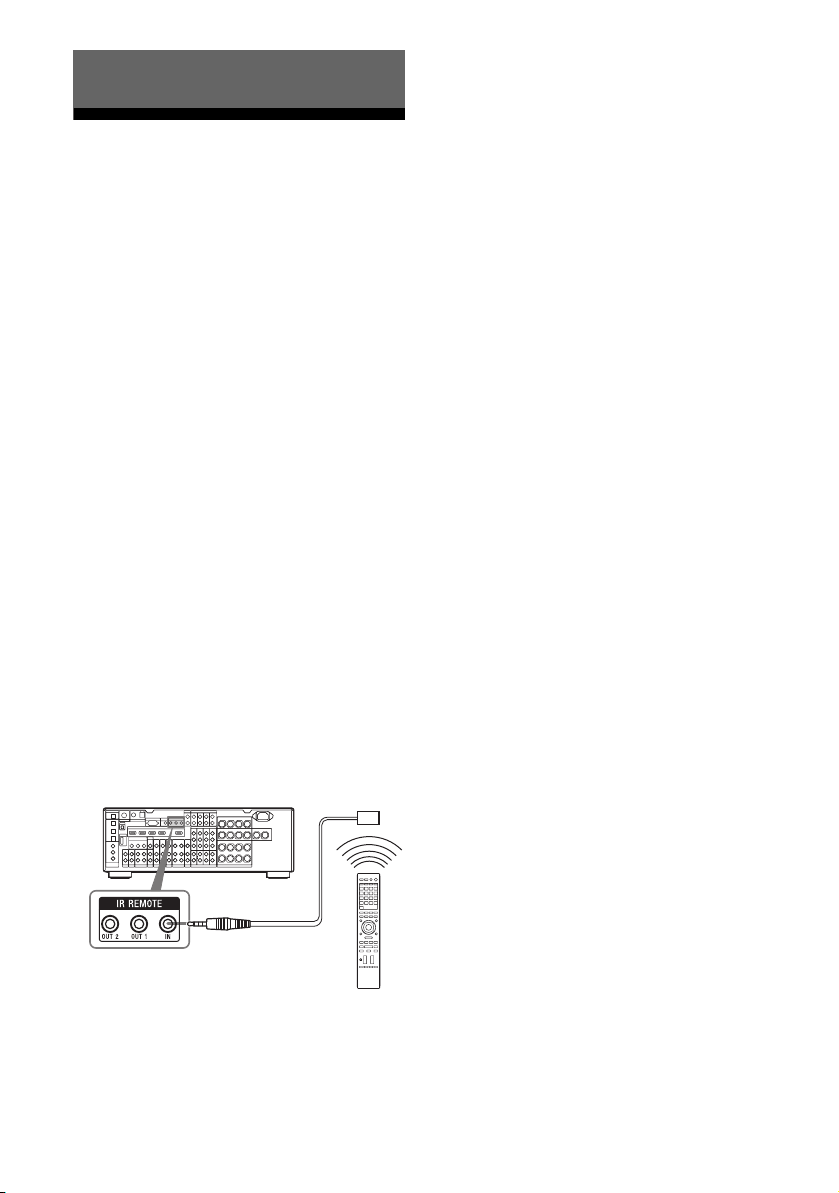
90
US
D:\NORM'S JOB\SONY HA\SO0056\STR-DA3500ES\U VERSION\US\4144907131\01US-
STRDA3500ESUC\090OTH.fm
masterpage: Left
STR-DA3500ES
4-144-907-13(1)
What you can do with the
Multi-zone function
You can enjoy images and sounds in zone 2
(other than the main zone) and sounds in zone
3 from a component connected to the receiver.
For example, you can watch the DVD in the
main zone and listen to the CD in zone 2 or
zone 3.
When using an IR repeater (not supplied), you
can operate both a component in the main zone
and Sony receiver in zone 2 or zone 3 from
zone 2 or zone 3.
Use the multi function remote in zone 2 or
zone 3. You cannot use the simple remote in a
zone (zone 2 or zone 3) other than the main
zone.
To operate the receiver from
zone 2 or zone 3
You can operate the receiver without pointing
the remote toward the remote sensor of the
receiver if you connect an IR repeater (not
supplied) to the IR REMOTE jack.
Use an IR repeater when you install the
receiver in a place where signals from the
remote cannot reach.
Using Multi-zone Features
IR repeater
(not supplied)
STR-DA3500ES
Multi function
remote
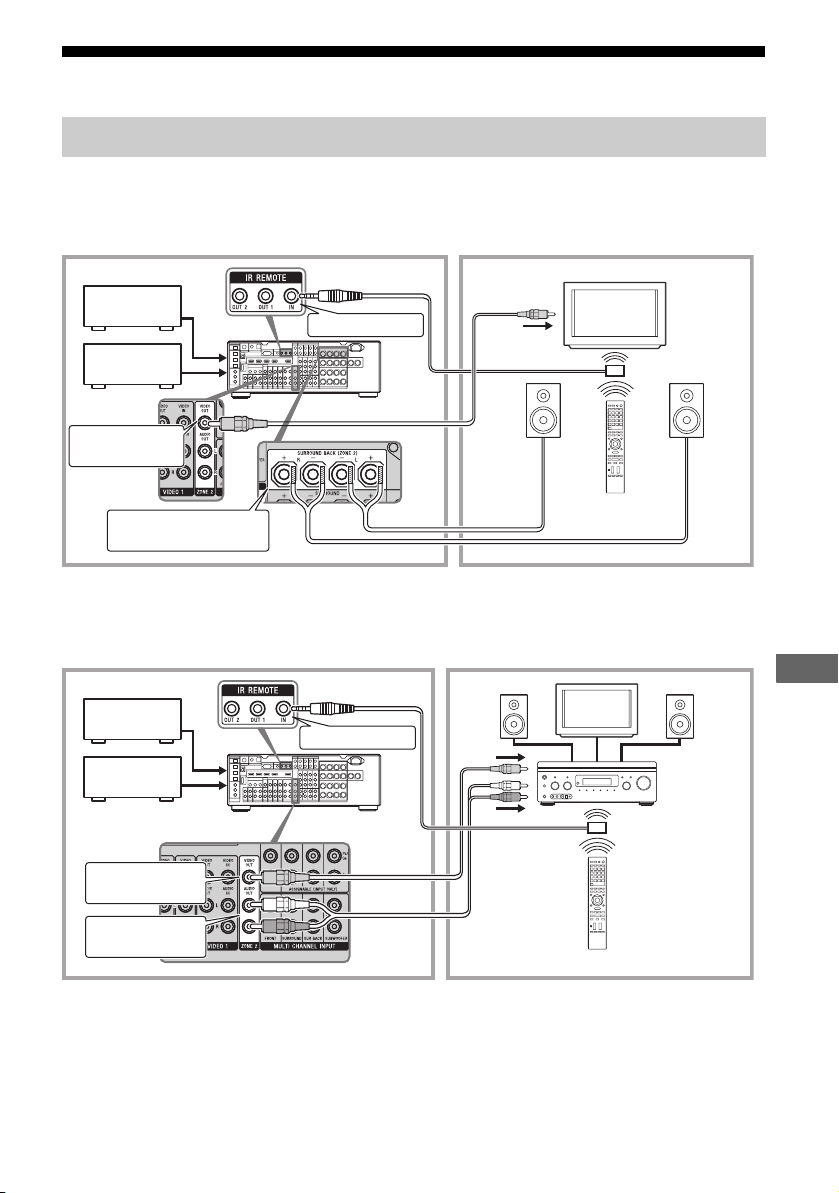
91
US
D:\NORM'S JOB\SONY HA\SO0056\STR-DA3500ES\U VERSION\US\4144907131\01US-
STRDA3500ESUC\090OTH.fm
masterpage: Right
STR-DA3500ES
4-144-907-13(1)
Using Multi-zone Features
Making a multi-zone operation
1 Outputs sound from speakers in zone 2 using the SPEAKERS
SURROUND BACK terminals of the receiver.
2 Outputs sound from speakers in zone 2 using the receiver and another
amplifier.
1: Zone 2 connections
Main zone Zone 2
TV
A
ZONE 2 VIDEO
OUT*
B
D
STR-DA3500ES
D
SURROUND BACK
SPEAKERS
Multi function
remote
IR REMOTE IN
C
Main zone Zone 2
ZONE 2 VIDEO
OUT*
TV
A
ZONE 2 AUDIO
OUT
B
DD
E
C
A Audio component
B Video component
C IR repeater (not supplied)
D Speakers
E Sony Amplifier/Receiver
* You can also connect to the COMPONENT VIDEO OUT (ZONE 2) jack.
Multi function remote
STR-DA3500ES
IR REMOTE IN
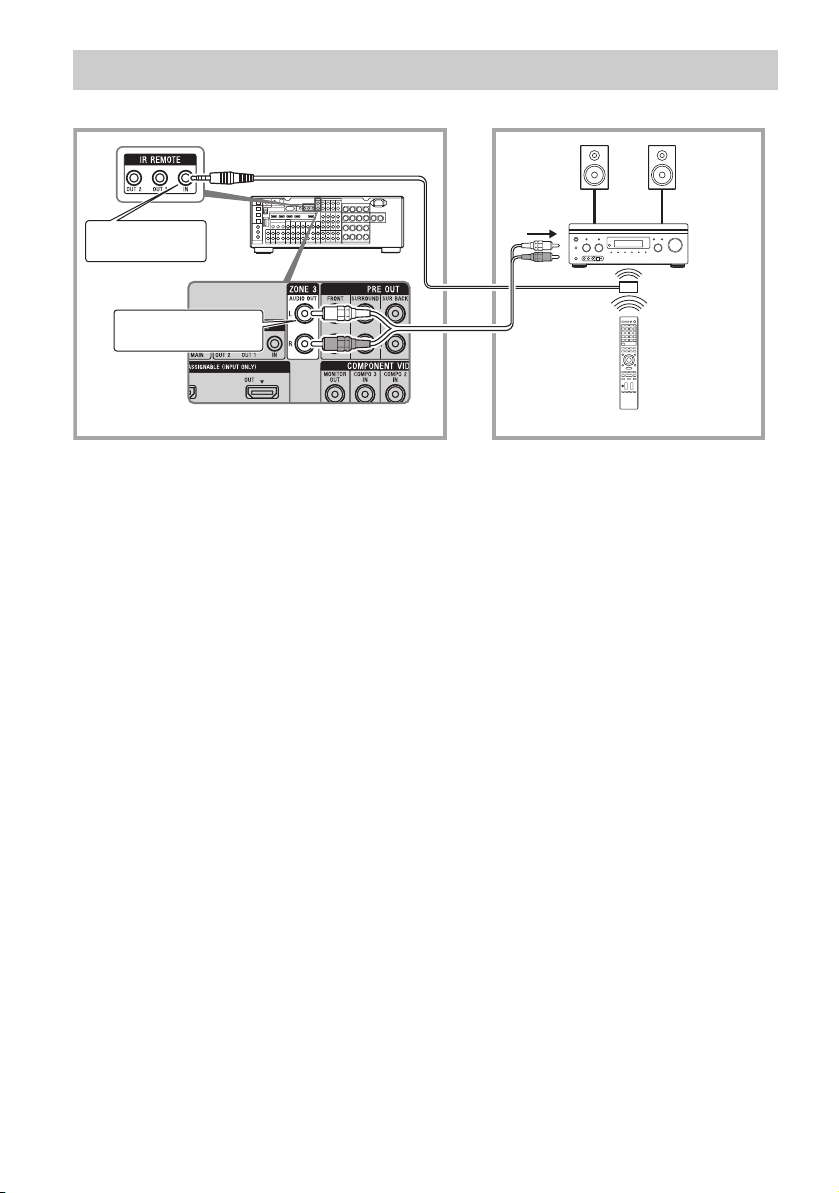
92
US
D:\NORM'S JOB\SONY HA\SO0056\STR-DA3500ES\U VERSION\US\4144907131\01US-
STRDA3500ESUC\090OTH.fm
masterpage: Left
STR-DA3500ES
4-144-907-13(1)
2: Zone 3 connections
Main zone Zone 3
ZONE 3 AUDIO OUT
BB
C
STR-DA3500ES
A
A IR repeater (not supplied)
B Speakers
C Sony Amplifier/Receiver
Multi function remote
IR REMOTE IN
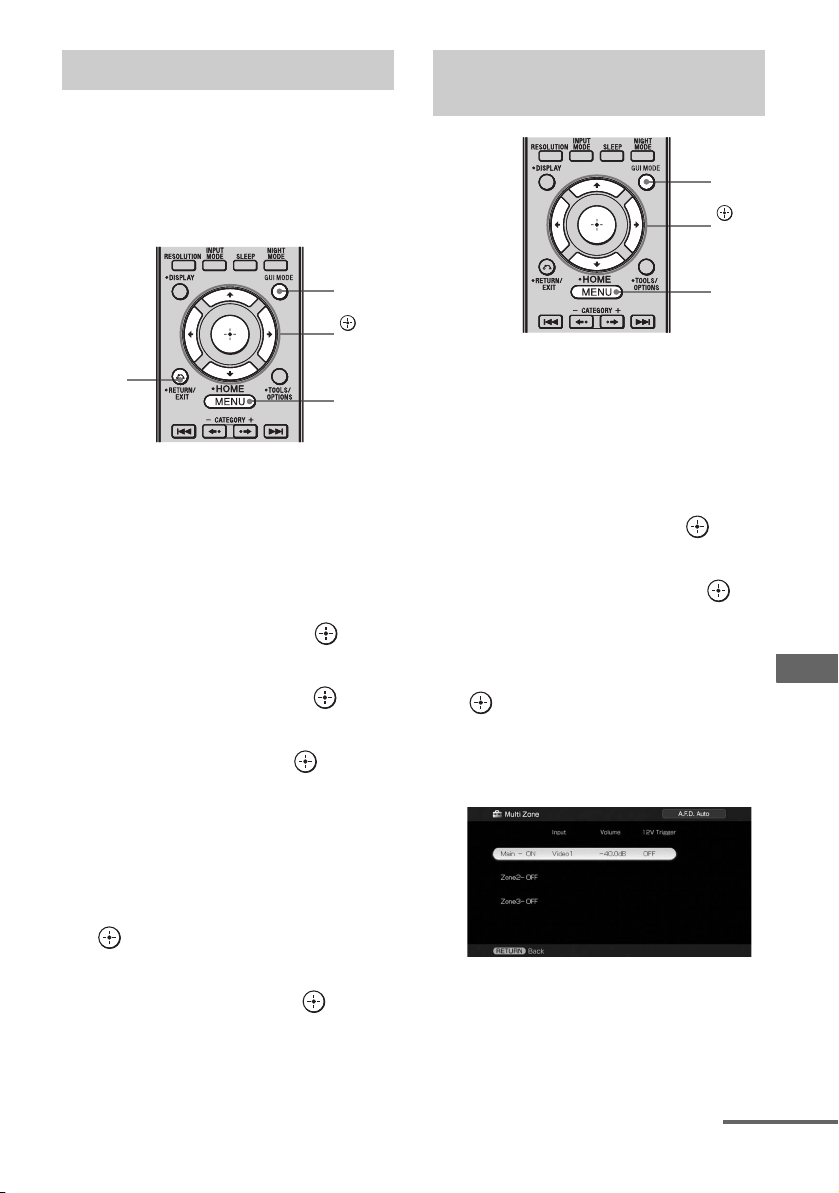
93
US
D:\NORM'S JOB\SONY HA\SO0056\STR-DA3500ES\U VERSION\US\4144907131\01US-
STRDA3500ESUC\090OTH.fm
masterpage: Right
STR-DA3500ES
4-144-907-13(1)
Using Multi-zone Features
When the speakers in zone 2 are connected to
the SPEAKERS SURROUND BACK
terminals of the receiver (page 91), make the
setting so that the sound selected in zone 2 is
output from the speakers connected to the
SPEAKERS SURROUND BACK terminals.
1 Press GUI MODE repeatedly to
select “GUI ON”.
The GUI menu appears on the TV screen.
Press MENU if the GUI menu does not
appear on the TV screen.
2 Press V/v repeatedly to select
“Settings”, then press or b.
3 Press V/v repeatedly to select
“Speaker”, then press or b.
4 Press V/v to select “Speaker
Pattern”, then press .
Select the speaker pattern that has no
surround back speakers.
5 Press RETURN/EXIT O.
6 Press V/v repeatedly to select
“Sur Back Assign”, then press
.
7 Press V/v repeatedly to select
“ZONE2”, then press .
1 Press GUI MODE repeatedly to
select “GUI ON”.
The GUI menu appears on the TV screen.
Press MENU if the GUI menu does not
appear on the TV screen.
2 Press V/v repeatedly to select
“Settings”, then press or b.
3 Press V/v repeatedly to select
“Multi Zone”, then press .
4 Press V/v to select the zone to
which you want to output
audio/video signals, then press
.
“Main” (this receiver) is always selected.
If you do not change the setting, proceed
to step 6.
Setting the speakers in zone 2
,
V/v/B/b
GUI
MODE
MENU
RETURN/
EXIT O
Setting audio/video output
signals to the zone 2/zone 3
,
V/v/B/b
GUI
MODE
MENU
continued
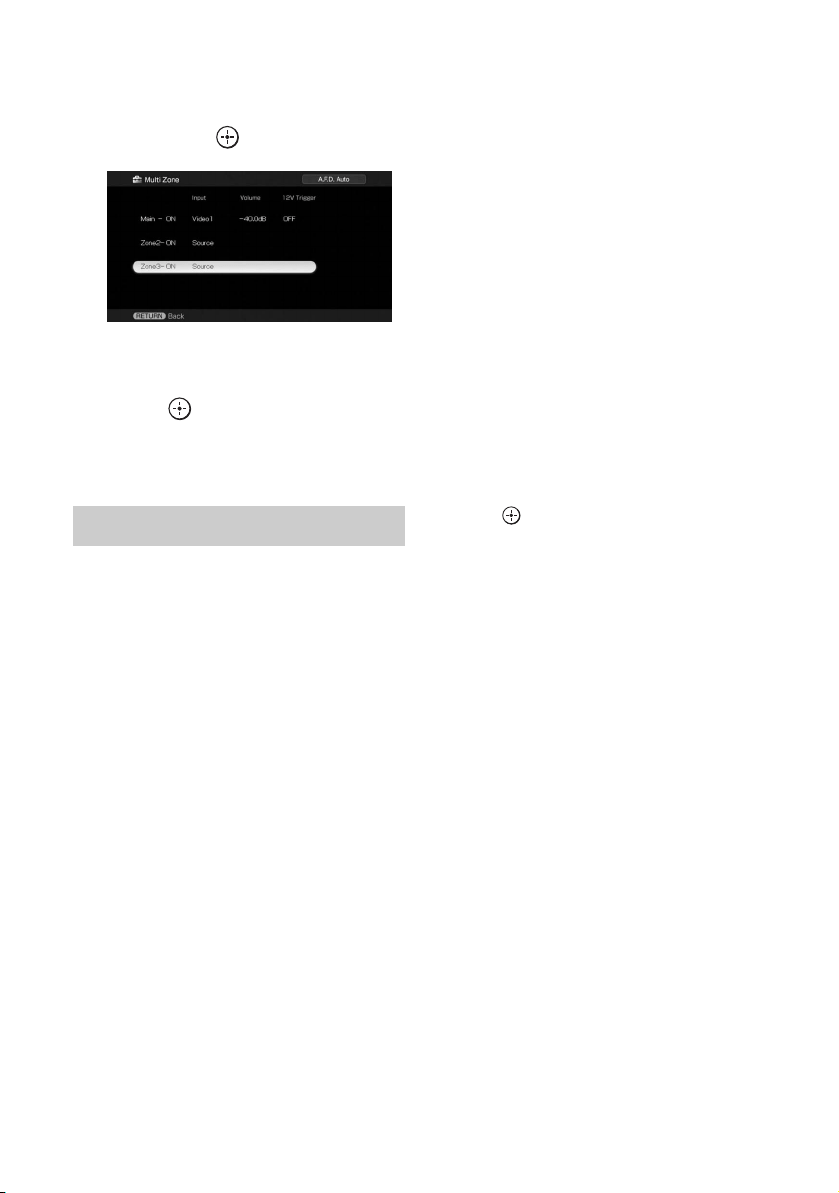
94
US
D:\NORM'S JOB\SONY HA\SO0056\STR-DA3500ES\U VERSION\US\4144907131\01US-
STRDA3500ESUC\090OTH.fm
masterpage: Left
STR-DA3500ES
4-144-907-13(1)
5 Press V/v to select
“Zone2-ON”/“Zone3-ON” or
“Zone2-OFF”/“Zone3-OFF”,
then press .
6 Press V/v/B/b repeatedly to
select item and parameter, then
press .
Note
You can only enjoy the sound in zone 3.
x Power
Lets you turn zone operation on.
• Zone2-ON or Zone3-ON
• Zone2-OFF or Zone3-OFF
x Input
Lets you select the source that is output to the
zone. You can output audio and video signals
to zone 2 and only audio signals are output to
zone 3.
x Volume
You can adjust the volume in the main zone. If
“Sur Back Assign” is set to “ZONE2” in the
Speaker setting menu, you can also adjust the
zone 2 volume.
x 12V Trigger
You can turn the receiver on/off in another
zone, or select various options for use of the
12V Trigger function, as explained below.
•OFF
Lets you turn off output of 12V triggers even
when the main receiver is turned on.
•CTRL
Lets you turn the output of 12V triggers on
or off manually using the CIS command of
the external control device.
•ZONE
Lets you turn the output of 12V triggers on
or off based on whether the selected zone is
turned on or off.
• INPUT (for “Main” only)
Lets you turn on the output of 12V triggers
when the preset input is selected.
When you select “Input”, the setting display
which sets each input trigger to on/off
appears. Press V/v to select the input, then
press to check the box.
Note
You cannot select FM/AM/XM/SIRIUS/DMPORT
in zone 3.
Tips
• Even when this receiver is in standby mode (press
?/1 on the remote to turned off this receiver), the
receiver in zone 2 or zone 3 remains turned on. To
turn off all receivers, press ?/1 and AV ?/1 on the
multi function remote at the same time (SYSTEM
STANDBY).
• Only signals from components connected to the
analog input jacks are output through the ZONE 2
OUT or ZONE 3 OUT jacks. No signals are output
from components connected to only the digital
input jacks.
• When SOURCE is selected, the signals input to the
MULTI CHANNEL INPUT jacks are not output
from the ZONE 2 OUT or ZONE 3 OUT jacks
even when the multi channel input is selected. The
analog audio signals of the current function are
output.
Multi Zone menu parameters
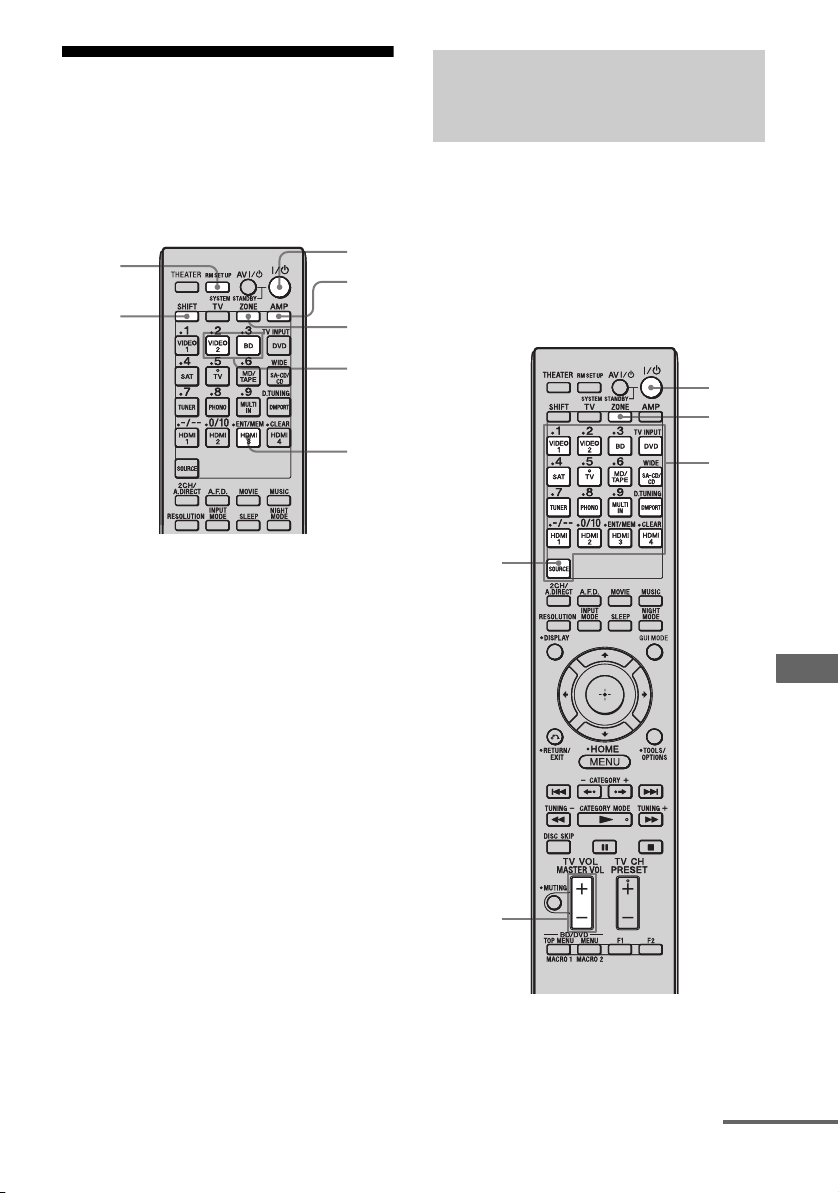
95
US
D:\NORM'S JOB\SONY HA\SO0056\STR-DA3500ES\U VERSION\US\4144907131\01US-
STRDA3500ESUC\090OTH.fm
masterpage: Right
STR-DA3500ES
4-144-907-13(1)
Using Multi-zone Features
Switching the zone
setting of the remote
The remote commander is initially set to be
used in zone 2. If you want to use it in zone 3,
switch the zone setting of the remote.
1 Press ?/1 while pressing RM
SET UP.
The AMP and ZONE buttons flash.
2 Press ZONE.
The AMP button goes off, the ZONE
button keeps flashing and the SHIFT
button lights up.
3 Press the numeric button 2 for
the zone 2, or 3 for the zone 3
while the ZONE button is
flashing.
The ZONE button lights up.
4 Press ENT/MEM.
The ZONE button flashes twice and the
remote switches to zone 2 or zone 3
mode.
For details on the connections and settings of
zone 2 and zone 3, see “Using Multi-zone
Features” (page 90).
The following operations are described for
connecting an IR repeater and operating the
receiver in zone 2 and zone 3. When an IR
repeater is not connected, use this receiver in
the main zone.
1 Turn on the main receiver (this
receiver).
AMP
?/1
2, 3
SHIFT
ZONE
RM SET
UP
ENT/
MEM
Operating the receiver from
another zone
(ZONE 2/ZONE 3 operations)
?/1
ZONE
Input
buttons
MASTER
VOL +/–
SOURCE
continued
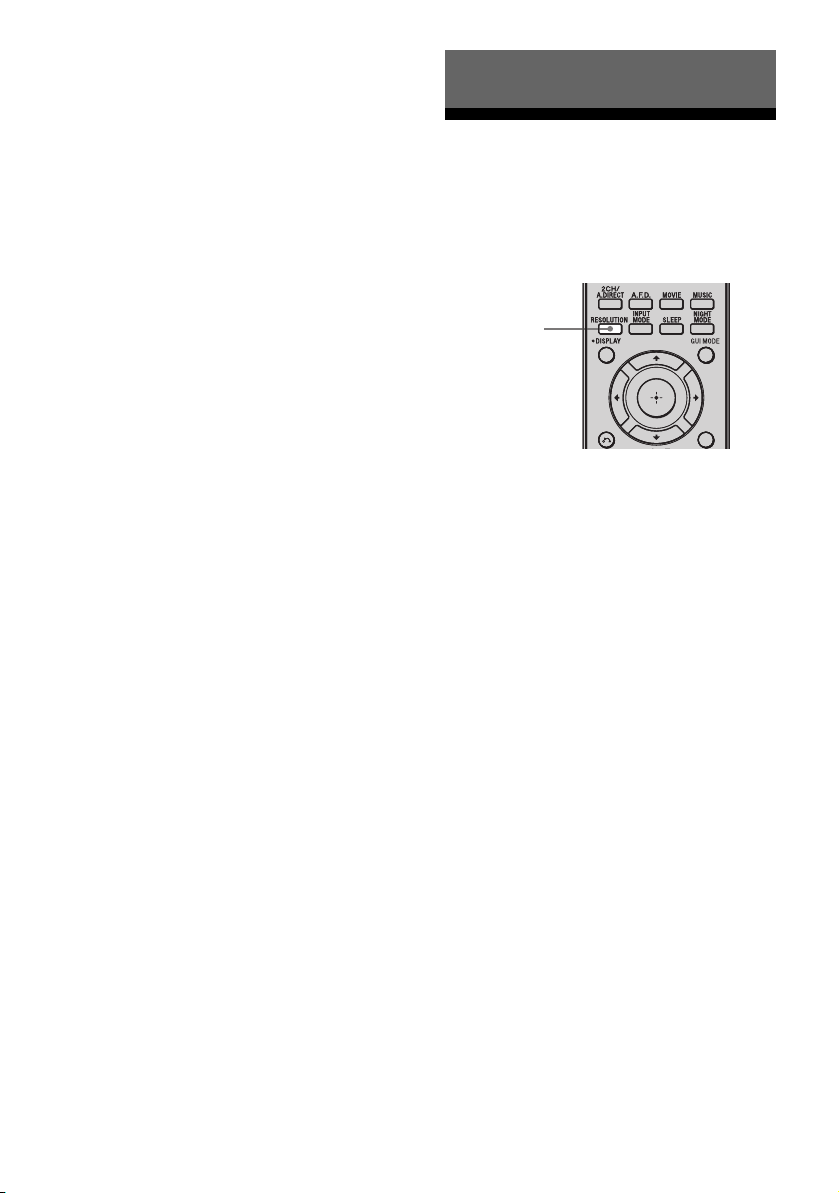
96
US
D:\NORM'S JOB\SONY HA\SO0056\STR-DA3500ES\U VERSION\US\4144907131\01US-
STRDA3500ESUC\090OTH.fm
masterpage: Left
STR-DA3500ES
4-144-907-13(1)
2 Press ZONE.
The remote switches to zone 2 or zone 3
mode.
Change the zone setting of the remote to
zone 2 or zone 3 in advance (page 95).
3 Turn on the amplifier in zone 2
or zone 3.
4 Press one of the input buttons
on the remote to select the
source signals you want to
output.
For zone 2, analog video and audio
signals are output. For zone 3, only
analog audio signals are output. When
you select SOURCE, the signals of the
current input are output.
5 Adjust to a suitable volume.
• In the case of illustration 1-1
(page 91).
Adjust the volume using MASTER
VOL +/– on the remote.
• In the case of illustration 1-2
(page 91), adjust the volume using the
receiver of zone 2.
• In case of illustration 2 (page 92), adjust
the volume using the receiver of zone 3.
Tips
• Even when this receiver is in standby mode (press
?/1 on the remote to turned off this receiver), the
receiver in zone 2 and zone 3 remains turned on. To
turn off all receivers, press ?/1 and AV ?/1 on the
multi function remote at the same time (SYSTEM
STANDBY).
• Only signals from components connected to the
analog input jacks are output through the ZONE 2
OUT or ZONE 3 OUT jacks. No signals are output
from components connected to only the digital
input jacks. You cannot select some input
according to the selected zone.
• When SOURCE is selected, the signals input to the
MULTI CHANNEL INPUT, PHONO and HDMI
1~4 jacks are not output from the ZONE 2 OUT or
ZONE 3 OUT jacks.
• You cannot select TV, PHONO, MULTI IN and
HDMI 1~4 in zone 2.
• You cannot select TV, TUNER, PHONO, MULTI
IN, DMPORT and HDMI 1~4 in zone 3.
Converting analog video
input signals
This receiver allows you to convert the
resolution of analog video input signals.
Press RESOLUTION repeatedly.
Each time you press the button, the resolution
of the output signals will be changed.
You can also use “Resolution” in the Video
settings menu.
Other Operations
RESOLUTION
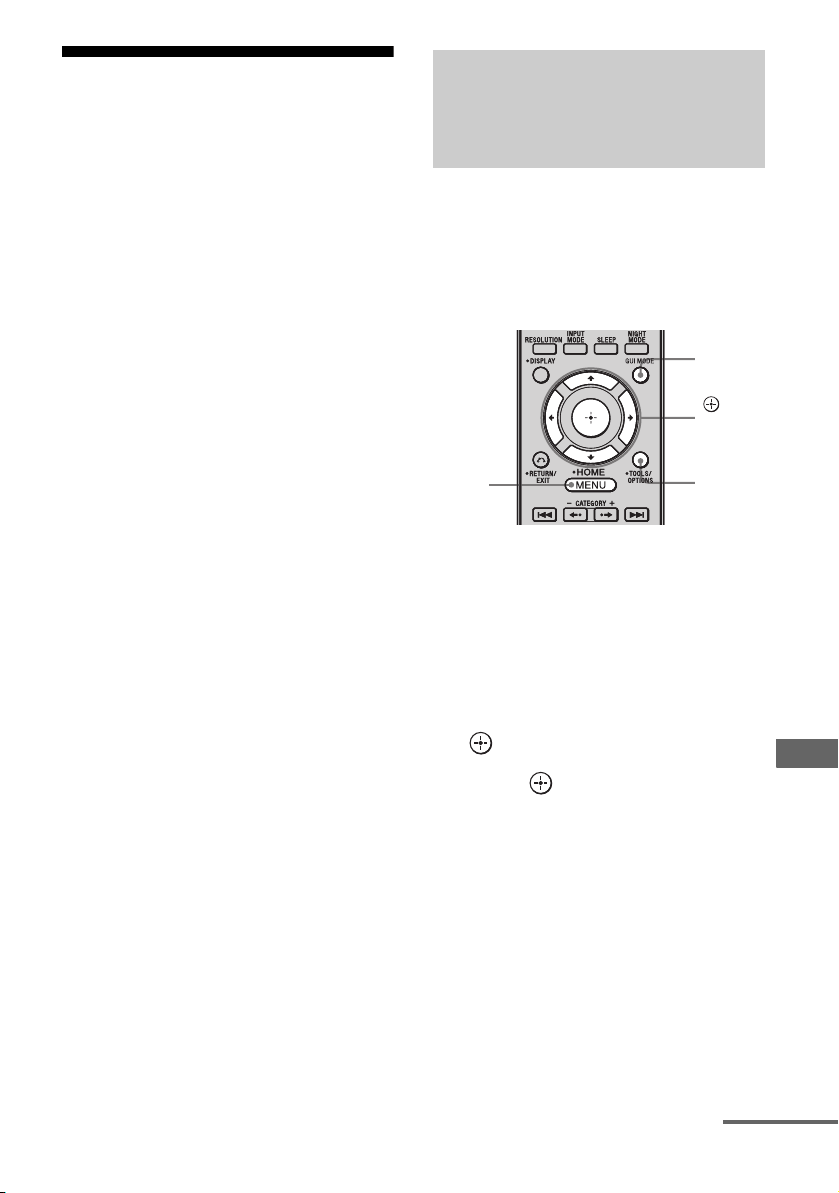
97
US
D:\NORM'S JOB\SONY HA\SO0056\STR-DA3500ES\U VERSION\US\4144907131\01US-
STRDA3500ESUC\090OTH.fm
masterpage: Right
STR-DA3500ES
4-144-907-13(1)
Other Operations
Enjoying the sound/
images from the
components connected to
the DIGITAL MEDIA PORT
The DIGITAL MEDIA PORT is for enjoying
sound/images from a portable audio/video
source or computer by connecting a DIGITAL
MEDIA PORT adapter.
For details on connecting the DIGITAL
MEDIA PORT adapter, see “Connecting
components with digital audio input/output
jacks” (page 21).
Sony offers the following DIGITAL MEDIA
PORT adapters:
• TDM-BT1/BT10 Bluetooth™ Wireless
Audio Adapter
• TDM-NW10 DIGITAL MEDIA PORT
Adapter
• TDM-NC1 Wireless Network Audio Client
• TDM-iP10/iP50 DIGITAL MEDIA PORT
Adapter
• TDM-MP10 DIGITAL MEDIA PORT
Adapter
The DIGITAL MEDIA PORT adapter is an
optional product.
Notes
• Do not connect an adapter other than the DIGITAL
MEDIA PORT adapter.
• Before disconnecting the DIGITAL MEDIA PORT
adapter, make sure to turn the receiver off using the
remote.
• Do not connect or disconnect the DIGITAL
MEDIA PORT adapter to/from the receiver while
the system is turned on.
• Depending on the type of DIGITAL MEDIA
PORT adapter, the images are also output.
• The DIGITAL MEDIA PORT adapters are
available for purchase depending on the area.
You can select an operation screen using the
GUI menu, depending on the DIGITAL
MEDIA PORT adapter you want to use. For
some adapter, such as TDM-BT1, the
operation screen is fixed and you cannot
change it on the GUI screen.
1 Press GUI MODE repeatedly to
select “GUI ON”.
The GUI menu appears on the TV screen.
Press MENU if the GUI menu does not
appear on the TV screen.
2 Press V/v repeatedly to select
“Music” or “Video”, then press
or b.
3 Press or b.
The component connected to the
DIGITAL MEDIA PORT adapter is
recognized and “DMPORT” on the screen
will change to the component’s name.
The category of the component connected
to DIGITAL MEDIA PORT adapter
appears on the TV screen.
Note
An icon which shows the component
recognized is displayed on the TV screen. If
the component connected to the adapter cannot
be recognized, “DMPORT” is displayed on the
TV screen.
Selecting an operation screen
to operate the component
connected to the DIGITAL MEDIA
PORT adapter
MENU
OPTIONS
,
V/v/B/b
GUI
MODE
continued
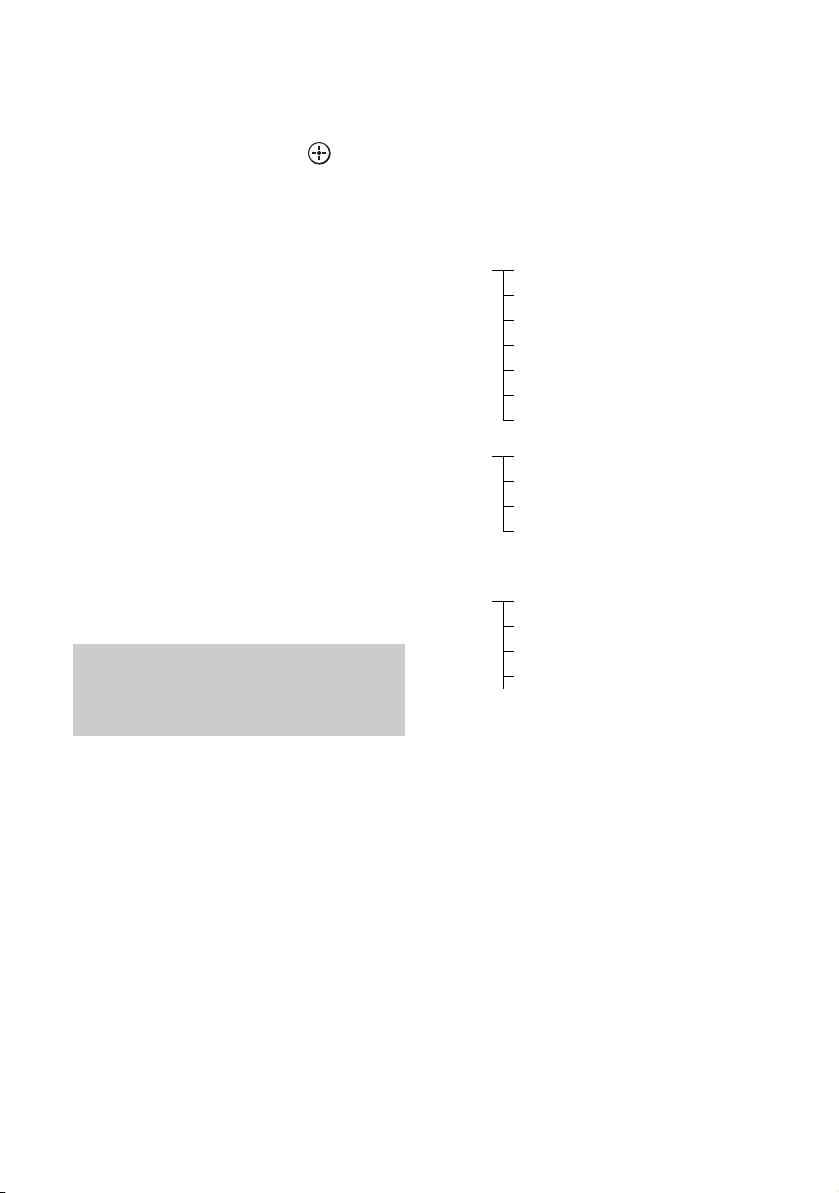
98
US
D:\NORM'S JOB\SONY HA\SO0056\STR-DA3500ES\U VERSION\US\4144907131\01US-
STRDA3500ESUC\090OTH.fm
masterpage: Left
STR-DA3500ES
4-144-907-13(1)
4 Press OPTIONS to display
“Function List”.
5 Press V/v to select “DMPORT
Control”, then press or b.
You can select the following modes in this
menu:
• System GUI
This mode is for the TDM-iP50 and
TDM-NC1. The list of tracks will be
displayed on the GUI screen of the
receiver. You can select a track you want
and play it back on each GUI screen.
• Adapter GUI
This mode is for the TDM-iP50 and
TDM-NC1. The menu of the adapter
will be displayed on the TV screen.
•iPod
This mode can be selected only when
the TDM-iP50 is connected.
If “DMPORT Control” is not displayed,
refer to the operating instructions
supplied with component for details on
operating that component.
To operate the TDM-iP50/TDM-
NC1 using the GUI menu of the
receiver
1 Make sure that “System GUI” is
selected in step 5 in “Selecting
an operation screen to operate
the component connected to
the DIGITAL MEDIA PORT
adapter” (page 97).
2 Select the content from the
contents list displayed on the
GUI screen and play it back.
The following content lists are just
examples. They may vary depending on
the components connected to the receiver.
In case of iPod
In case of Network Client
a)
Displayed only when M-crew Server is connected.
b)
Displayed only when a DLNA server other than
M-crew Server is connected.
c)
Displayed as “Genre”, “Artist” or “Album”,
depending on the “List Mode” setting.
To operate the TDM-iP50 or
TDM-NC1 using the adapter
menu
Make sure that “Adapter GUI” is selected in
step 5 in “Selecting an operation screen to
operate the component connected to the
DIGITAL MEDIA PORT adapter” (page 97).
For details on operating the adapter using the
adapter GUI menu, refer to the operating
instructions supplied with the adapter you are
using.
Operating the component
connected to the DIGITAL MEDIA
PORT adapter
Music Playlists > Playlist > Track
Artists > Artist > Album > Track
Albums > Album > Track
Songs > Track
Genres > Genre > Artist > Album > Track
Composers > Composer > Album > Track
Audiobooks > Track
Video Movies > Content
TV Shows > Episode > Content
Music Videos > Artist > Content
Video Podcast > Episode > Content
Music Surfin
a)
> Album
c)
> Track
Playlist
a)
> Playlist > Track
Web Radio
a)
> Station > Program
Music Library
b)
> Album > Track
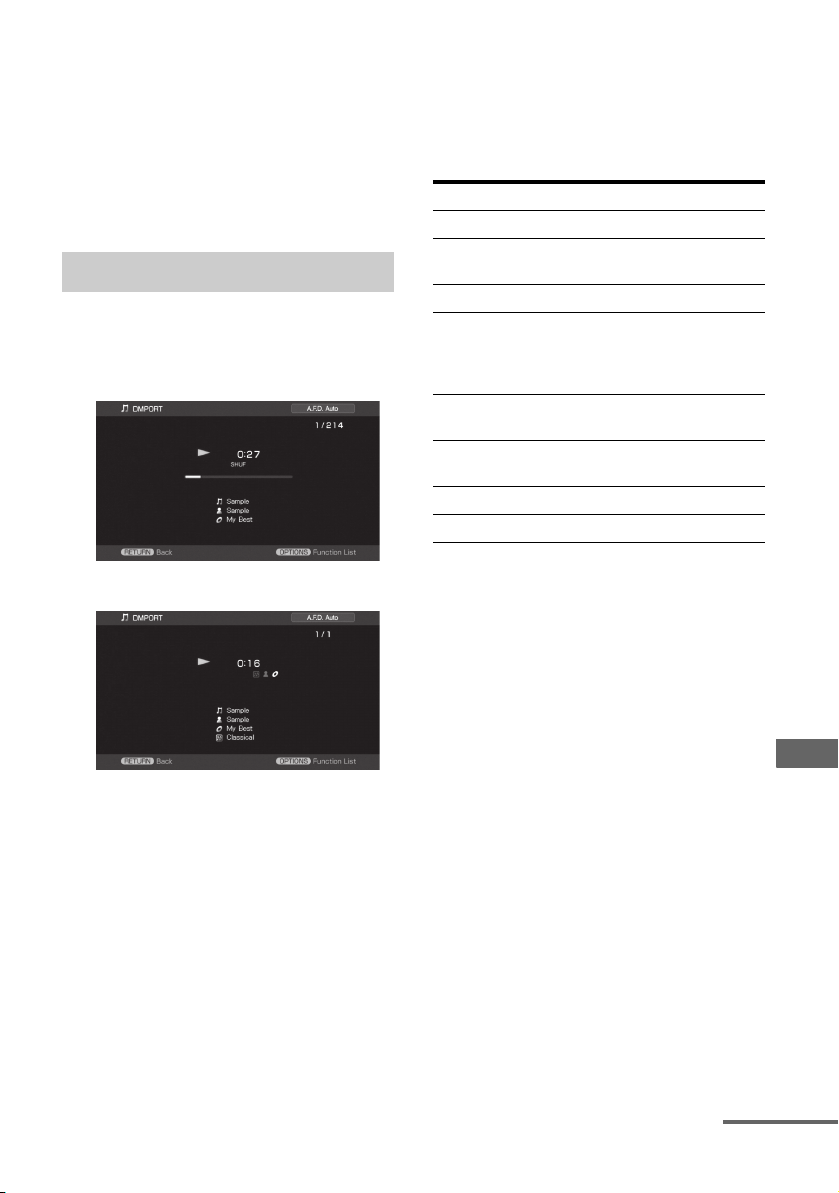
99
US
D:\NORM'S JOB\SONY HA\SO0056\STR-DA3500ES\U VERSION\US\4144907131\01US-
STRDA3500ESUC\090OTH.fm
masterpage: Right
STR-DA3500ES
4-144-907-13(1)
Other Operations
To operate the TDM-iP50 using
the iPod menu
Make sure that “iPod” is selected in step 5 in
“Selecting an operation screen to operate the
component connected to the DIGITAL
MEDIA PORT adapter” (page 97).
For details on operating the iPod, refer to the
operating instruction supplied with the iPod.
During playback of the track selected, the
displayed screen changes depending on the
DIGITAL MEDIA PORT adapter connected.
You can also operate the components
connected to the DIGITAL MEDIA PORT
adapter using the following play mode buttons
on the remote of the receiver.
Press DMPORT on the remote to enable
DMPORT operation.
* When a TDM-iP50 is connected, the receiver
enters pause mode when x is pressed.
** Fast-backward/forward while pressing and
holding the m/M button.
Option parameters in the play
modes
x Repeat Mode (TDM-iP50 only)
Plays one or all the track repeatedly.
•Off
Deactivates the repeat play mode.
•One
Plays one track repeatedly.
•All
Plays all the tracks repeatedly.
Playing back the track selected
TDM-iP50
TDM-NC1
To Do the following
Play Press N.
Pause Press X. To resume play,
press the button again.
Stop Press x.*
Find the beginning of a
track during playback, or
find the beginning of the
previous track
Press ..
Find the beginning of the
next track
Press >.
Skip to the previous
album
Press
B•
.
Skip to the next album Press
•
b.
Go backward/forward Press m/M.**
continued

100
US
D:\NORM'S JOB\SONY HA\SO0056\STR-DA3500ES\U VERSION\US\4144907131\01US-
STRDA3500ESUC\090OTH.fm
masterpage: Left
STR-DA3500ES
4-144-907-13(1)
x Shuffle (TDM-iP50 only)
Plays all the tracks in random order.
•Off
Deactivates the shuffle play mode.
• Albums
Plays all the tracks on an album in random
order.
• Songs
Plays all the tracks in “Songs” in random
order.
x Audiobook Speed (TDM-iP50
only)
Selects the display speed of the Audiobook.
•Low
Slows the display speed.
• Normal
Sets the display speed to standard.
•High
Increases the display speed.
x List Mode (TDM-NC1 only)
Selects a range of tracks to be played back.
•Genre
Plays back tracks in the selected genre.
•Artist
Plays back tracks of the selected artist.
•Album
Plays back tracks in the selected album.
Tip
The List Mode can be used with the Function List
menu even when the list is displayed.
DIGITAL MEDIA PORT message
list
*TDM-NC1 only.
Message appears Explanation
No Adapter The adapter is not connected.
No Device There is no device connected
to the adapter.
No Audio No audio file was found.
Loading The data is being read.
No Server* There is no server connected.
No Track* No track was found.
No Item* No item was found.
Connecting* Connecting to the server.
Configuring* The network is setting up.
Warning* Check the display of the
DIGITAL MEDIA PORT
adapter.
Party Mode* The unit is currently in party
mode “Guest”.
Searching* Searching the server.
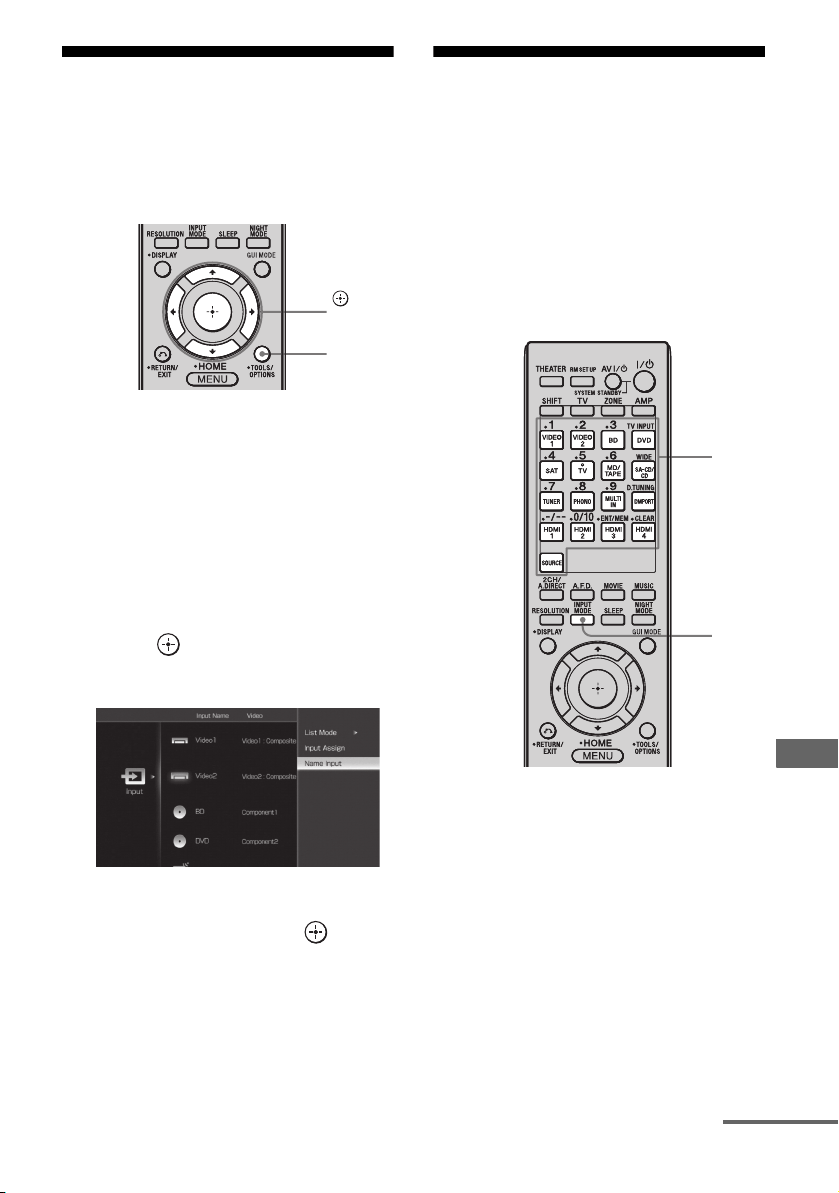
101
US
D:\NORM'S JOB\SONY HA\SO0056\STR-DA3500ES\U VERSION\US\4144907131\01US-
STRDA3500ESUC\090OTH.fm
masterpage: Right
STR-DA3500ES
4-144-907-13(1)
Other Operations
Naming inputs
You can enter a name of up to 8 characters for
inputs and display it.
This is convenient for labeling the jacks with
the names of the connected components.
1 Choose the item you want to
name.
You can name the following items.
• Auto Calibration position (page 50)
• Inputs (page 50)
• Preset stations (page 73)
2 Press OPTIONS.
3 Select “Name Input”, then
press .
The soft keyboard appears on the screen.
4 Press V/v/B/b to select a
character, then press .
5 Select [Finish] to enter the
name.
The name you entered is registered.
To cancel naming input
Select [Cancel].
Switching between
digital and analog audio
(INPUT MODE)
When you connect components to both digital
and analog audio input jacks on the receiver,
you can fix the audio input mode to either of
them, or switch from one to the other,
depending on the type of material you intend
to watch.
1 Press the input button.
You can also use INPUT SELECTOR on
the receiver.
2 Press INPUT MODE repeatedly
to select the audio input mode.
The selected audio input mode appears on
the TV screen.
OPTIONS
,
V/v/B/b
INPUT
MODE
Input
buttons
continued
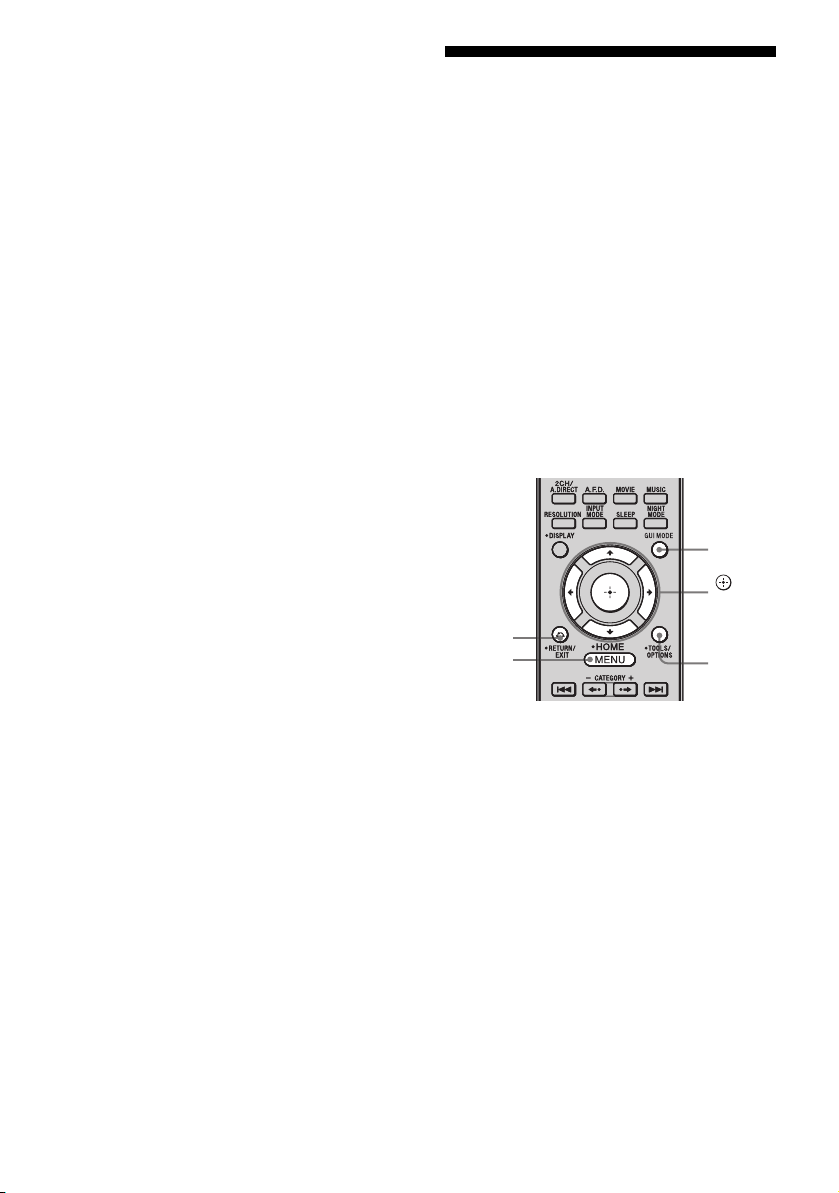
102
US
D:\NORM'S JOB\SONY HA\SO0056\STR-DA3500ES\U VERSION\US\4144907131\01US-
STRDA3500ESUC\090OTH.fm
masterpage: Left
STR-DA3500ES
4-144-907-13(1)
Audio input modes
•AUTO
Gives priority to digital audio signals when
there are both digital and analog
connections.
If there are more than one digital connection,
HDMI audio signals have priority over
COAXIAL and OPTICAL audio signals.
If there are no digital audio signals, analog
audio signals are selected.
•ANALOG
Specifies the analog audio signals input to
the AUDIO IN (L/R) jacks.
Notes
• Some audio input modes may not be set up
depending on the input.
• When HDMI input, XM, SIRIUS or DMPORT is
selected, “------” appears on the display window,
and you cannot select other audio input modes.
Select an input other than the HDMI input, XM,
SIRIUS and DMPORT input then set the audio
input mode.
• When “2ch Analog Direct” is being used, or the
multi channel input is selected, audio input mode is
set to “ANALOG”. You cannot select other audio
input modes.
Enjoying the sound/
images from other inputs
You can reassign video and/or audio signals to
another input.
Example: Connect the OPTICAL OUT jack of
the DVD player to the OPTICAL VIDEO 1 IN
jack of this receiver when you want to input
the only digital optical audio signals from the
DVD player.
Connect the component video jack of the DVD
player to the COMPONENT VIDEO COMPO
1 IN jack of this receiver when you want to
input the video signals from the DVD player.
Assign video and/or audio signals to the DVD
input jack using “Input Assign” in the Input
menu.
1 Press GUI MODE repeatedly to
select “GUI ON”.
The GUI menu appears on the TV screen.
Press MENU if the GUI menu does not
appear on the TV screen.
MENU
OPTIONS
,
V/v/B/b
GUI
MODE
RETURN/
EXIT O

103
US
D:\NORM'S JOB\SONY HA\SO0056\STR-DA3500ES\U VERSION\US\4144907131\01US-
STRDA3500ESUC\090OTH.fm
masterpage: Right
STR-DA3500ES
4-144-907-13(1)
Other Operations
2 Press V/v repeatedly to select
“Input”, then press or b.
3 Press V/v to select the input
name you want to assign.
4 Press OPTIONS, then select
“Input Assign” and then press
.
5 Select the audio and/or video
signals you want to assign to
the input which you selected in
step 3 using V/v/B/b, then
press .
6 Press RETURN/EXIT O to
enter the setting.
continued

104
US
D:\NORM'S JOB\SONY HA\SO0056\STR-DA3500ES\U VERSION\US\4144907131\01US-
STRDA3500ESUC\090OTH.fm
masterpage: Left
STR-DA3500ES
4-144-907-13(1)
Notes
• You cannot assign optical signals from an input source to the optical input jacks on the receiver, and you
cannot assign coaxial signals from the input source to the coaxial input jacks on the receiver.
• When you assign the digital audio input, the INPUT MODE setting may change automatically.
Input name
VIDEO1 VIDEO2
BD DVD SAT MD/TAPE SA-CD/
CD
MULTI IN
Assignable
video input jacks
Video1:
Composite
a – – –––––
Video2:
Composite
– a – –––––
BD: Composite – – a –––––
DVD: Composite – – – a ––––
SAT: Composite – – – – a –––
HDMI1 aaaaaaaa
HDMI2 aaaaaaaa
HDMI3 aaaaaaaa
HDMI4 aaaaaaaa
Component1 aaaaaaaa
Component2 aaaaaaaa
Component3 aaaaaaaa
None aaaaaaaa
Assignable
audio input jacks
Video1: OPT a – aaa– a –
Video2: OPT – aaaa– a –
MD/TAPE: OPT – – a aaaa –
BD: COAX aaa– aa ––
DVD: COAX aa – aaa ––
SA-CD/CD:
COAX
aa ––aaa –
Analog aaaaaaa–
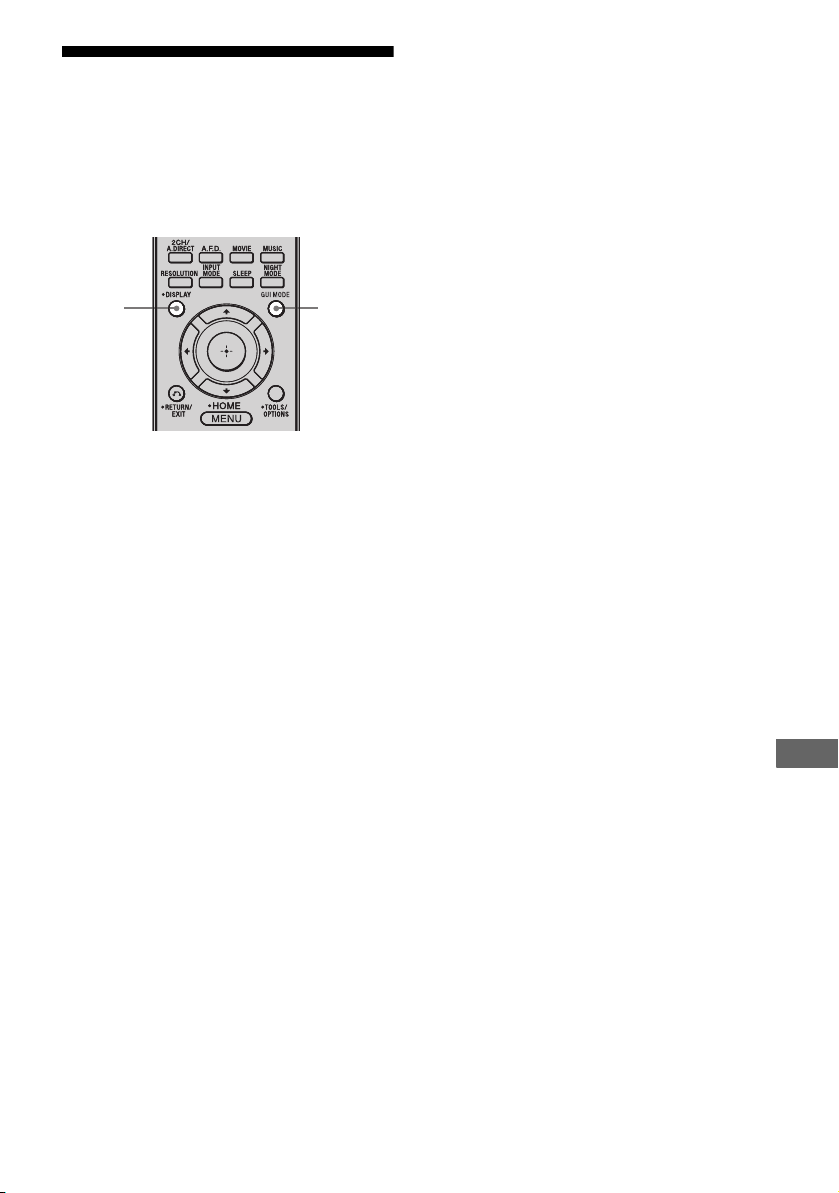
105
US
D:\NORM'S JOB\SONY HA\SO0056\STR-DA3500ES\U VERSION\US\4144907131\01US-
STRDA3500ESUC\090OTH.fm
masterpage: Right
STR-DA3500ES
4-144-907-13(1)
Other Operations
Changing the display
window
You can check the sound field, etc., by
changing the information on the display
window.
Press DISPLAY repeatedly.
Each time you press DISPLAY, the display
will change as follows.
Input name you selected* t Original input
name t Sound field type t Volume level
Tip
If you see “GUI MODE” on the display window
when you press DISPLAY, press GUI MODE
repeatedly to select “GUI OFF”.
FM and AM band
Station name* t Frequency t Sound field
type t Volume level
XM Radio and SIRIUS Satellite
Radio
Channel name t Channel number t
Category name t Artist name/Feature t
Song/Program title t Composer name
(SIRIUS only) t Signal strength t
Sound field type t Volume level
* Index name appears only when you have assigned
one to the input or preset station. Index name does
not appear when only blank spaces have been
entered.
Note
Character or marks may not be displayed for some
languages.
DISPLAY
GUI MODE
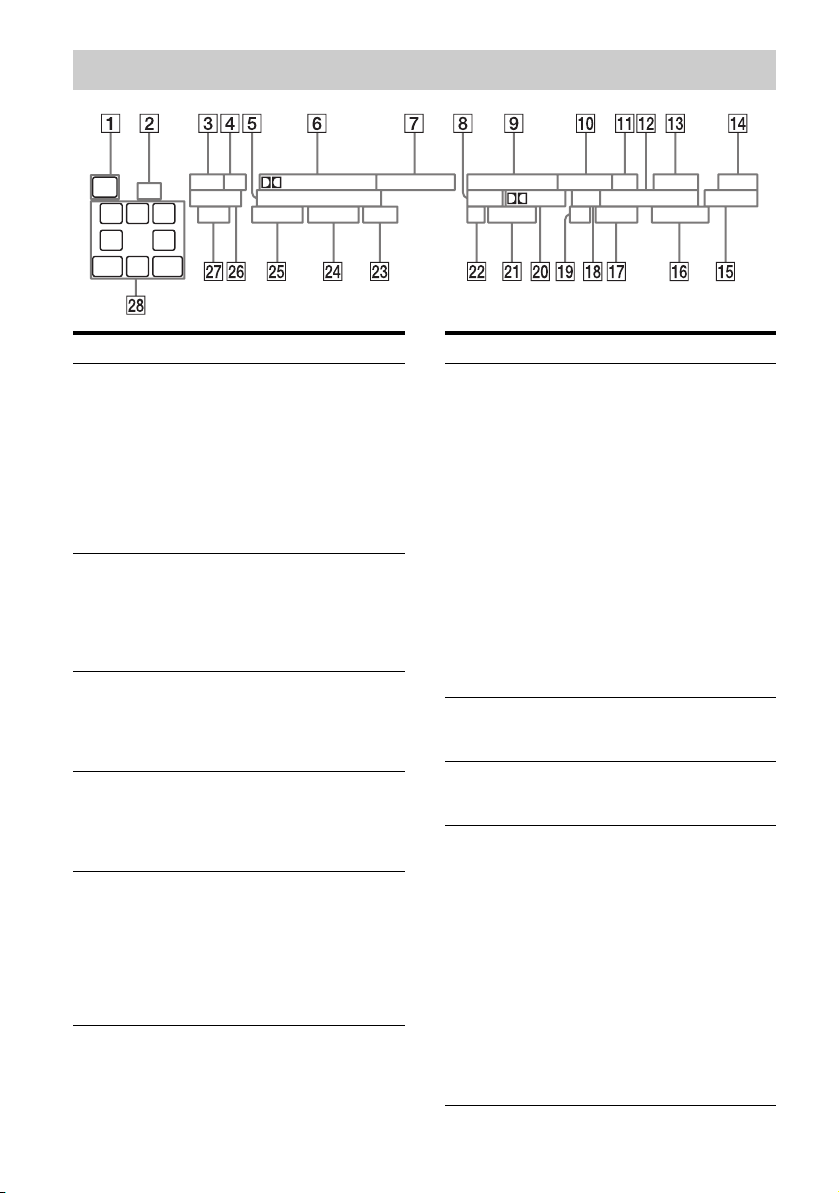
106
US
D:\NORM'S JOB\SONY HA\SO0056\STR-DA3500ES\U VERSION\US\4144907131\01US-
STRDA3500ESUC\090OTH.fm
masterpage: Left
STR-DA3500ES
4-144-907-13(1)
About the indicators on the display window
HDMI
LFE
SW
L
CR
SL
S
SR
SB L
SB
SB R
MULTI IN
COAX
OPT D
+
EX
True
HD
Neural
THX DTS D.RANGE CAT B SLEEP
+
ASPES
96 24
/
--
DTS
-
HD
MSTR HI
RES NEO:6
PL ll
MEM MONO ST ZONE 2 3
X
DMPORT ANALOG LPCM
EQ
-
Bl
AMP
XM
SIRIUS A.DIRECT
Name Function
A SW Lights up when subwoofer is
connected and the audio signal
is output from the
SUBWOOFER jack. While
this indicator lights up, the
receiver creates a subwoofer
signal based on the LFE signal
in the disc being played back or
the low frequency components
of the front channels.
B LFE Lights up when the disc being
played back contains an LFE
(Low Frequency Effect)
channel and the LFE channel
signal is actually being
reproduced.
C COAX Lights up when INPUT MODE
is set to “AUTO” and the source
signal is a digital signal being
input through the COAXIAL
jack.
D OPT Lights up when INPUT MODE
is set to “AUTO” and the source
signal is a digital signal being
input through the OPTICAL
jack.
E DTS-HD
MSTR/
DTS-HD HI
RES
“DTS-HD MSTR” lights up
when the receiver is decoding
DTS-HD Master Audio
signals.
“DTS-HD HI RES” lights up
when the receiver is decoding
DTS-HD High Resolution
signals.
F ;
D/
;
D EX/
;
D+/
;
TrueHD
“; D” lights up when the
receiver is decoding Dolby
Digital signals.
“; D EX” lights up when the
receiver is decoding Dolby
Digital Surround EX signals.
“; D+” lights up when the
receiver is decoding Dolby
Digital Plus signals.
“; TrueHD” lights up when
the receiver is decoding Dolby
TrueHD signals.
Note
When playing a Dolby Digital
format disc, be sure that you
have made digital connections
and that INPUT MODE is set
to “AUTO” (page 101).
G Neural - THX Lights up when the receiver
applies Neural - THX
processing to input signals.
H NEO:6 Lights up when DTS Neo:6
Cinema/Music decoder is
activated.
I DTS/
DTS-ES/
DTS 96/24
“DTS” lights up when the
receiver is decoding DTS
signals.
“DTS-ES” lights up when the
receiver is decoding DTS-ES
signals.
“DTS 96/24” lights up when
the receiver is decoding DTS
96 kHz/24 bit signals.
Note
When playing a DTS format
disc, be sure that you have
made digital connections and
that INPUT MODE is set to
“AUTO” (page 101).
Name Function

107
US
D:\NORM'S JOB\SONY HA\SO0056\STR-DA3500ES\U VERSION\US\4144907131\01US-
STRDA3500ESUC\090OTH.fm
masterpage: Right
STR-DA3500ES
4-144-907-13(1)
Other Operations
J D.RANGE Lights up when dynamic range
compression is activated.
K CAT Lights up when category mode
is selected during the satellite
radio operation.
L Tuner
indicators
Lights up when using the
receiver to tune in radio
stations, etc.
M SP A/SP B/
SP A+B
Lights up according to the
speaker system used (page 44).
However, these indicators do
not light up if the speaker
output is turned off or if
headphones are connected.
N SLEEP Lights up when the sleep timer
is activated.
O ZONE 2/
ZONE 3
Lights up while operation in
zone 2/zone 3 is being enabled.
P A.DIRECT Lights up when the receiver is
processing Analog Direct
signals.
Q SIRIUS Lights up when the
SiriusConnect Home tuner is
connected and “SIRIUS” is
selected.
R MEM Lights up when a memory
function, such as Preset
Memory, etc., is activated.
S XM Lights up when XM Mini
Tuner and Home Dock are
connected and “XM RADIO”
is selected.
T ; PL/
; PL II/
; PL IIx
“; PL” lights up when the
receiver applies Dolby Pro
Logic processing to 2 channel
signals in order to output the
center and surround channel
signals.
“; PL II” lights up when the
Dolby Pro Logic II decoder is
activated.
“; PL IIx” lights up when the
Dolby Pro Logic IIx decoder is
activated.
However, these indicators do
not light up if there are no
center and surround speakers
and you select a sound field
using the A.F.D. button.
Name Function
U BI-AMP Lights up when “Sur Back
Assign” is set to “BI-AMP”.
V EQ Lights up when the equalizer is
activated.
W LPCM Lights up when Linear PCM
signals are detected.
X ANALOG Lights up when
– INPUT MODE is set to
“AUTO” and no digital signal
is being input through the
COAXIAL, OPTICAL or
HDMI jacks.
– INPUT MODE is set to
“ANALOG”.
– the “2ch Analog Direct” is
being used.
Y DMPORT Lights up when DIGITAL
MEDIA PORT adapter is
connected and “DMPORT” is
selected.
Z MULTI IN Lights up when multi channel
input is selected.
wj HDMI Lights up when the receiver
recognizes a component
connected via an HDMI IN
jack.
Name Function
continued
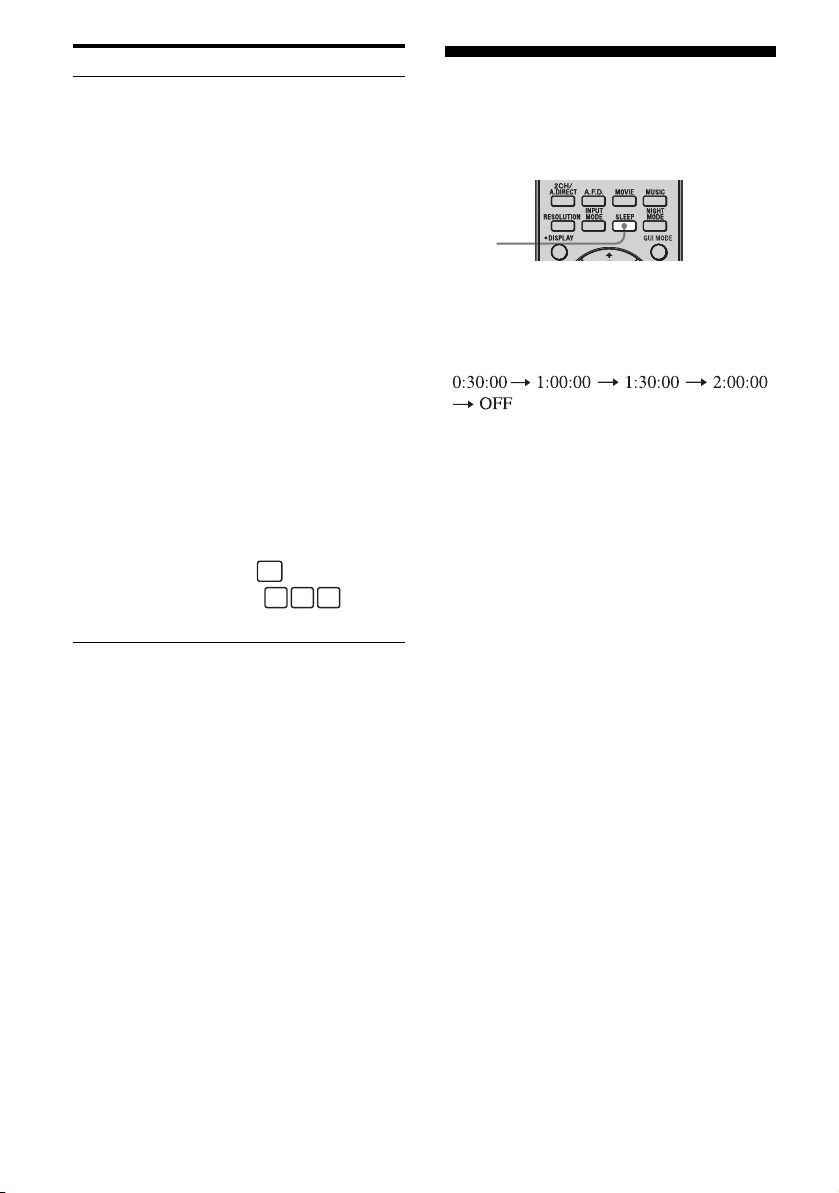
108
US
D:\NORM'S JOB\SONY HA\SO0056\STR-DA3500ES\U VERSION\US\4144907131\01US-
STRDA3500ESUC\090OTH.fm
masterpage: Left
STR-DA3500ES
4-144-907-13(1)
Using the sleep timer
You can set the receiver to turn off
automatically at a specified time.
Press SLEEP repeatedly.
Each time you press SLEEP, the display
changes cyclically as follows:
When sleep timer is being used, “SLEEP”
lights up in the display window.
Tip
To check the remaining time before the receiver
turns off, press SLEEP. The remaining time appears
on the display window. If you press SLEEP again,
the sleep timer will be cancelled.
wk Playback
channel
indicators
L
R
C
SL
SR
S
SB L
SB R
SB
The letters (L, C, R, etc.)
indicate the channels being
played back. The boxes around
the letters vary to show how the
receiver downmixes the source
sound (based on the speaker
settings).
Front Left
Front Right
Center (monaural)
Surround Left
Surround Right
Surround (monaural or the
surround components obtained
by Pro Logic processing)
Surround Back Left
Surround Back Right
Surround Back (the surround
back components obtained by
6.1 channel decoding)
Example:
Recording format (Front/
Surround): 3/2.1
When Speaker Pattern is set to
“3/0.1” (page 114)
Sound Field: A.F.D. AUTO
Name Function
SW
L
CR
SL SR
SLEEP
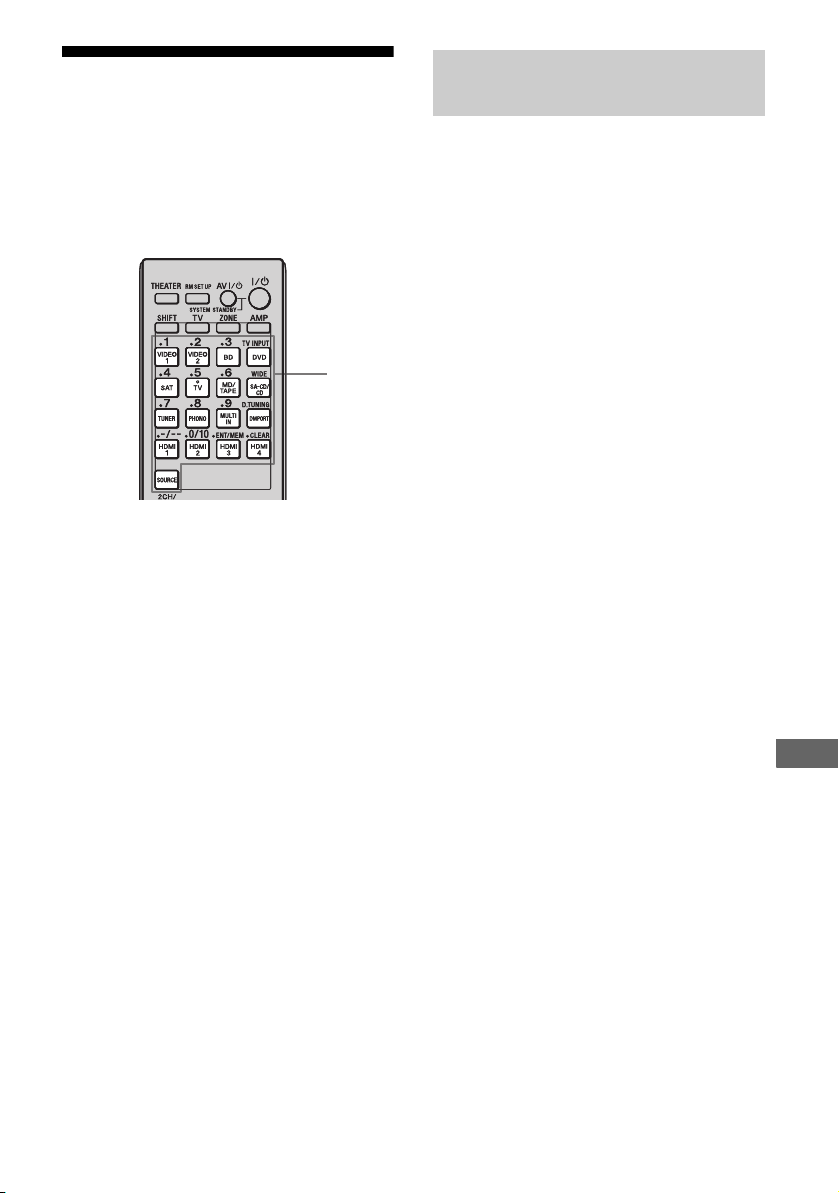
109
US
D:\NORM'S JOB\SONY HA\SO0056\STR-DA3500ES\U VERSION\US\4144907131\01US-
STRDA3500ESUC\090OTH.fm
masterpage: Right
STR-DA3500ES
4-144-907-13(1)
Other Operations
Recording using the
receiver
You can record from a video/audio component
using the receiver. Refer to the operating
instructions supplied with your recording
component.
You can record onto a MiniDisc or audio tape
using the receiver. Refer to the operating
instructions supplied with your MD deck or
tape deck.
1 Press the input button of the
playback component.
You can also use INPUT SELECTOR on
the receiver.
2 Prepare the playback
component for playing.
For example, insert a CD into the CD
player.
3 Prepare the recording
component.
Insert a blank MD or tape into the
recording deck and adjust the recording
level.
4 Start recording on the
recording deck, then start
playback on the playback
component.
Notes
• Sound adjustments do not affect the signal output
from the MD/TAPE OUT jacks.
• The audio input signals from the MULTI
CHANNEL INPUT jacks are not output.
To record digital sound
Connect a component for playback to the
digital audio input (OPTICAL IN) jack, and
connect the recording component to the
OPTICAL MD/TAPE OUT jack.
Input
buttons
Recording onto a MiniDisc or
audio tape
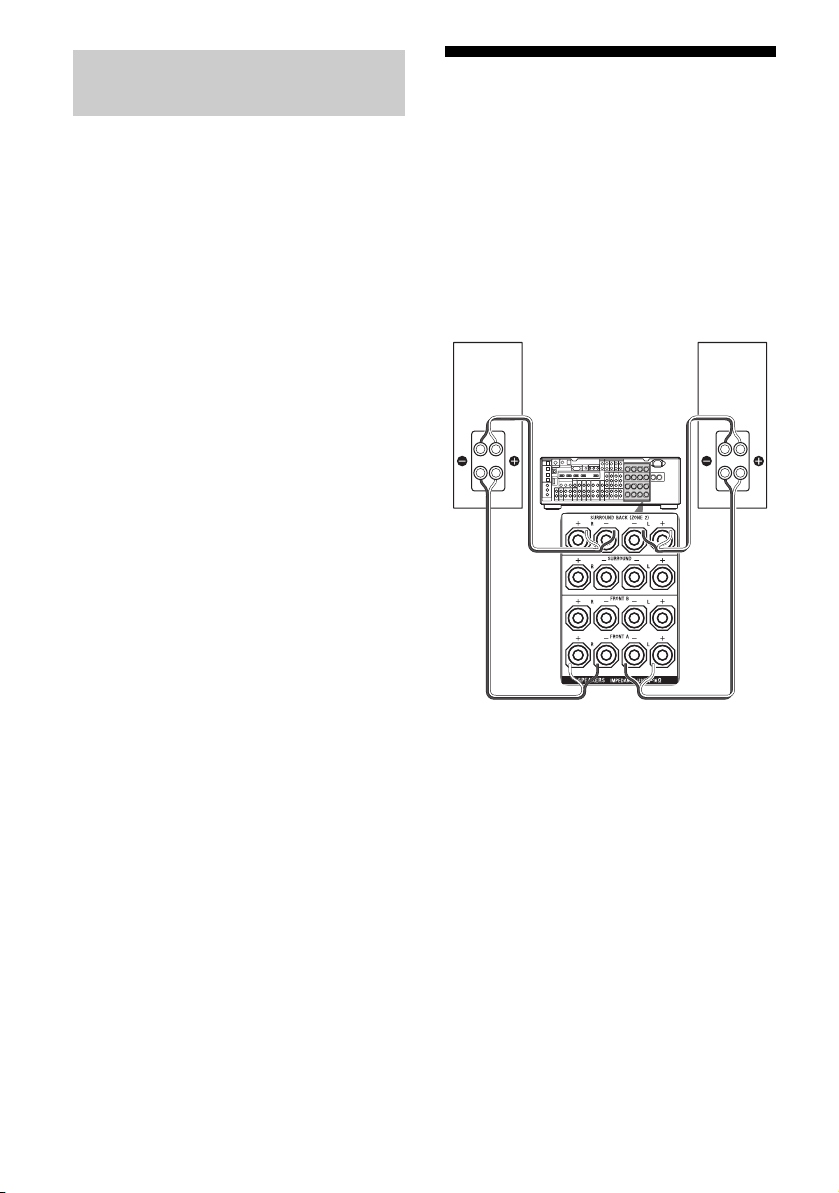
110
US
D:\NORM'S JOB\SONY HA\SO0056\STR-DA3500ES\U VERSION\US\4144907131\01US-
STRDA3500ESUC\090OTH.fm
masterpage: Left
STR-DA3500ES
4-144-907-13(1)
1 Press the input button of the
playback component.
You can also use INPUT SELECTOR on
the receiver.
2 Prepare the component for
playing.
For example, insert the video tape you
want to copy into the VCR.
3 Prepare the recording
component.
Insert a blank video tape, etc., into the
recording component (VIDEO 1) for
recording.
4 Start recording on the
recording component, then
start playback on the playback
component.
Notes
• Some sources contain copy guards to prevent
recording. In this case, you may not be able to
record from the sources.
• The audio input signals from the MULTI
CHANNEL INPUT jacks are not output.
• Only analog input signals are output from the
analog output jack (for recording).
• Only digital input signals are output from the
digital output jack (for recording).
• HDMI sound cannot be recorded.
Using a bi-amplifier
connection
If you are not using the surround back
speakers, you can use the SPEAKERS
SURROUND BACK terminals for the front
speakers in a bi-amplifier connection.
To connect the speakers
Connect the jacks on the Lo (or Hi) side of the
front speakers to the SPEAKERS FRONT A
terminals, and connect the jacks on the Hi (or
Lo) side of the front speakers to the
SPEAKERS SURROUND BACK terminals.
Make sure that the metal fittings of Hi/Lo
attached to the speakers have been removed
from the speakers. Otherwise, it may cause the
receiver to malfunction.
Recording onto a recording
media
Front speaker
(R)
Front speaker
(L)
Hi
Lo
Hi
Lo
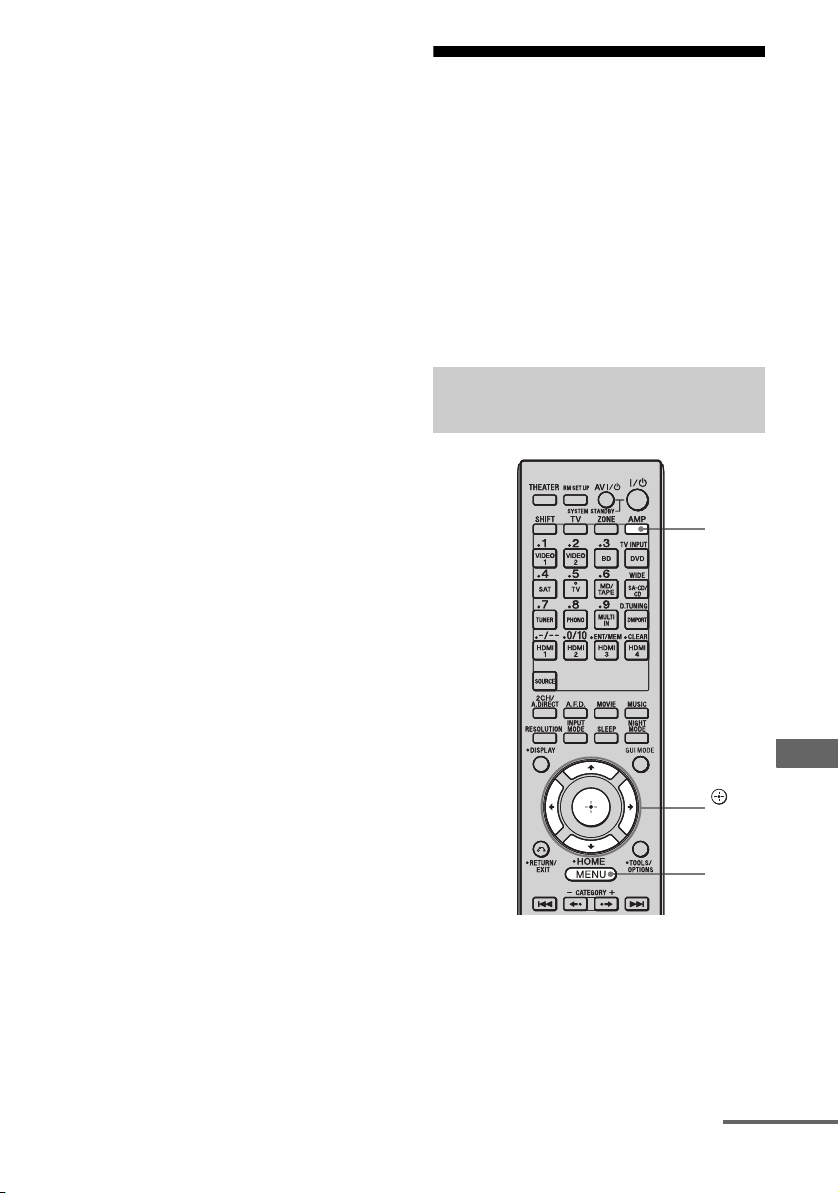
111
US
D:\NORM'S JOB\SONY HA\SO0056\STR-DA3500ES\U VERSION\US\4144907131\01US-
STRDA3500ESUC\090OTH.fm
masterpage: Right
STR-DA3500ES
4-144-907-13(1)
Other Operations
To set up the speakers
Set “Sur Back Assign” to “BI-AMP” in the
Speaker settings menu. The same signals
output from the SPEAKERS FRONT A
terminals can be output from the SPEAKERS
SURROUND BACK terminals by setting “Sur
Back Assign” to “BI-AMP”.
Notes
• You cannot use the SPEAKERS FRONT B
terminals for a bi-amplifier connection.
• Set “Sur Back Assign” to “BI-AMP” before you
perform Auto Calibration.
• If you set “Sur Back Assign” to “BI-AMP”, the
speaker level, balance, and equalizer settings of the
surround back speakers become invalid, and those
of the front speakers are used.
• Signals output from the PRE OUT jacks are used
with the same settings as those of the SPEAKERS
terminals.
• If you set “Speaker Pattern” to a setting with
surround back speakers, you cannot set “Sur Back
Assign” to “BI-AMP”.
Operating without
connecting to the TV
You can operate this receiver using the display
window if you do not use a GUI when a TV is
not connected.
Press GUI MODE to display “GUI
OFF” in the display window.
When “GUI MODE” is displayed in the
display window, the menu is set to display on
the TV screen using a GUI.
1 Press AMP.
2 Press MENU.
3 Press V/v repeatedly to select
the menu you want.
Navigating through menus on
the display window
,
V/v/B/b
AMP
MENU
continued

112
US
D:\NORM'S JOB\SONY HA\SO0056\STR-DA3500ES\U VERSION\US\4144907131\01US-
STRDA3500ESUC\090OTH.fm
masterpage: Left
STR-DA3500ES
4-144-907-13(1)
4 Press or b to enter the
menu.
5 Press V/v repeatedly to select
the parameter you want to
adjust.
6 Press or b to enter the
parameter.
7 Press V/v repeatedly to select
the setting you want.
8 Press to enter the setting.
To return to the previous
display
Press B.
To exit the menu
Press MENU.
Note
Some parameters and settings may dimmed on the
display window. This means that they are either
unavailable or fixed and unchangeable.

113
US
D:\NORM'S JOB\SONY HA\SO0056\STR-DA3500ES\U VERSION\US\4144907131\01US-
STRDA3500ESUC\090OTH.fm
masterpage: Right
STR-DA3500ES
4-144-907-13(1)
Other Operations
The following options are available in each
menu. For details on navigating through
menus, see page 111.
Overview of the menus
Menu
[Display
window]
Parameters
[Display window]
Settings Initial
Setting
Auto Calibration
[<AUTO CAL>]
Auto Calibration start
[A.CAL START]
Calibration type
[CAL TYPE]
FULL FLAT, ENGINEER,
FRONT REF, OFF
FULL
FLAT
Position
[POSITION]
POS 3, POS 2, POS 1 POS 1
Naming Inputs
[NAME IN]
For details, see “Naming inputs”
(page 101).
Level Settings
[<LEVEL>]
Test tone
[TEST TONE]
OFF, FIX xxx
a)
, AUTO xxx
a)
OFF
Phase noise
[P. NOISE]
OFF, FL/FR, FL/SR, SL/FL, SB/SL,
SBL/SL, SBR/SBL, SR/SB, SR/SBR,
SR/SL, FR/SR, FR/SL, CNT/FR,
FL/CNT
OFF
Phase audio
[P. AUDIO]
OFF, FL/FR, FL/SR, SL/FL, SB/SL,
SBL/SL, SBR/SBL, SR/SB, SR/SBR,
SR/SL, FR/SR, FR/SL, CNT/FR,
FL/CNT
OFF
Front left speaker level
[FL LEVEL]
FL -10.0 dB to FL +10.0 dB
(0.5 dB step)
FL 0 dB
Front right speaker level
[FR LEVEL]
FR -10.0 dB to FR +10.0 dB
(0.5 dB step)
FR 0 dB
Center speaker level
[CNT LEVEL]
CNT -20.0 dB to CNT +10.0 dB
(0.5 dB step)
CNT 0 dB
Surround left speaker level
[SL LEVEL]
SL -20.0 dB to SL +10.0 dB
(0.5 dB step)
SL 0 dB
Surround right speaker level
[SR LEVEL]
SR -20.0 dB to SR +10.0 dB
(0.5 dB step)
SR 0 dB
Surround back speaker level
b)
[SB LEVEL]
SB -20.0 dB to SB +10.0 dB
(0.5 dB step)
SB 0 dB
Surround back left speaker level
c)
[SBL LEVEL]
SBL -20.0 dB to SBL +10.0 dB
(0.5 dB step)
SBL 0 dB
Surround back right speaker level
c)
[SBR LEVEL]
SBR -20.0 dB to SBR +10.0 dB
(0.5 dB step)
SBR 0 dB
Subwoofer level
[SW LEVEL]
SW -20.0 dB to SW +10.0 dB
(0.5 dB step)
SW 0 dB
Dynamic range compressor
[D. RANGE]
COMP. MAX, COMP. STD,
COMP. AUTO, COMP. OFF
COMP.
AUTO
continued
114
US
D:\NORM'S JOB\SONY HA\SO0056\STR-DA3500ES\U VERSION\US\4144907131\01US-
STRDA3500ESUC\090OTH.fm
masterpage: Left
STR-DA3500ES
4-144-907-13(1)
Speaker Settings
[<SPEAKER>]
Speaker pattern
[SP PATTERN]
3/4.1, 3/4, 3/3.1, 3/3, 2/4.1, 2/4, 3/2.1,
3/2, 2/3.1, 2/3, 2/2.1, 2/2, 3/0.1, 3/0,
2/0.1, 2/0
3/4.1
Front speakers
[FRT SIZE]
LARGE, SMALL LARGE
Center speaker
[CNT SIZE]
LARGE, SMALL LARGE
Surround speakers
[SUR SIZE]
LARGE, SMALL LARGE
Surround Back Speaker Assign
[SB ASSIGN]
ZONE2, BI-AMP, OFF OFF
Front left speaker distance
[FL DIST.]
FL 3’3” to FL 32’9” (FL 1.00 m to
FL 10.00 m) (1 inch (0.01 m) step)
FL 9’10”
(3.00 m)
Front right speaker distance
[FR DIST.]
FR 3’3” to FR 32’9” (FR 1.00 m to
FR 10.00 m) (1 inch (0.01 m) step)
FR 9’10”
(3.00 m)
Center speaker distance
[CNT DIST.]
CNT 3’3” to CNT 32’9” (CNT 1.00 m
to CNT 10.00 m) (1 inch (0.01 m) step)
CNT 9’10”
(3.00 m)
Surround left speaker distance
[SL DIST.]
SL 3’3” to SL 32’9” (SL 1.00 m to
SL 10.00 m) (1 inch (0.01 m) step)
SL 9’10”
(3.00 m)
Surround right speaker distance
[SR DIST.]
SR 3’3” to SR 32’9” (SR 1.00 m to
SR 10.00 m) (1 inch (0.01 m) step)
SR 9’10”
(3.00 m)
Surround back speaker distance
[SB DIST.]
SB 3’3” to SB 32’9” (SB 1.00 m to
SB 10.00 m) (1 inch (0.01 m) step)
SB 9’10”
(3.00 m)
Surround back left speaker distance
[SBL DIST.]
SBL 3’3” to SBL 32’9” (SBL 1.00 m to
SBL 10.00 m) (1 inch (0.01 m) step)
SBL 9’10”
(3.00 m)
Surround back right speaker
distance [SBR DIST.]
SBR 3’3” to SBR 32’9” (SBR 1.00 m
to SBR 10.00 m) (1 inch (0.01 m) step)
SBR 9’10”
(3.00 m)
Subwoofer distance
[SW DIST.]
SW 3’3” to SW 32’9” (SW 1.00 m to
SW 10.00 m) (1 inch (0.01 m) step)
SW 9’10”
(3.00 m)
Distance unit
[DIST. UNIT]
FEET, METER FEET
Front speakers crossover
frequency
b)
[FRT CROSS]
CROSS 40 Hz to CROSS 200 Hz CROSS
120 Hz
Center speaker crossover
frequency
b)
[CNT CROSS]
CROSS 40 Hz to CROSS 200 Hz CROSS
120 Hz
Surround speakers crossover
frequency
b)
[SUR CROSS]
CROSS 40 Hz to CROSS 200 Hz CROSS
120 Hz
Speaker Impedance
[SP IMP.]
8 ohms, 4 ohms 8 ohms
Menu
[Display
window]
Parameters
[Display window]
Settings Initial
Setting
115
US
D:\NORM'S JOB\SONY HA\SO0056\STR-DA3500ES\U VERSION\US\4144907131\01US-
STRDA3500ESUC\090OTH.fm
masterpage: Right
STR-DA3500ES
4-144-907-13(1)
Other Operations
Surround
Settings
[<SURROUND>]
Sound field selection
[S.F. SELECT]
For details, see “Enjoying Surround
Sound” (page 59).
Enhanced Surround mode
[E.SUR MODE]
PLII
e)
, PLIIx
e)
, NEO6 CIN, NEO6
MUS, NEURAL-THX
PLIIx
Effect Type
[EFFECT]
DYNAMIC, THEATER, STUDIO THEATER
EQ Settings
[<EQ>]
Front speakers bass level
[FRT BASS]
FRT B. -10 dB to FRT B. +10 dB
(1 dB step)
FRT B.
0 dB
Front speakers treble level
[FRT TREBLE]
FRT T. -10 dB to FRT T. +10 dB
(1 dB step)
FRT T.
0 dB
Center speaker bass level
[CNT BASS]
CNT B. -10 dB to CNT B. +10 dB
(1 dB step)
CNT B.
0 dB
Center speaker treble level
[CNT TREBLE]
CNT T. -10 dB to CNT T. +10 dB
(1 dB step)
CNT T.
0 dB
Surround speakers bass level
[SUR BASS]
SUR B. -10 dB to SUR B. +10 dB
(1 dB step)
SUR B.
0 dB
Surround speakers treble level
[SUR TREBLE]
SUR T. -10 dB to SUR T. +10 dB
(1 dB step)
SUR T.
0 dB
Tuner Settings
[<TUNER>]
FM station receiving mode
[FM MODE]
STEREO, MONO STEREO
Naming preset stations
[NAME IN]
For details, see “To name preset
stations” (page 74).
XM antenna aiming mode
c)
[XM ANT AIM]
For details, see “Aiming the XM Radio
or SIRIUS antenna” (page 76).
XM radio ID
c)
[XM ID]
For details, see “Checking the XM Radio
ID or SIRIUS ID number” (page 76).
Parental lock
d)
[PARENTAL]
OFF, ON OFF
Lock code edit
d)
[CODE EDIT]
For details, see “Restricting access to
specific channels (Parental Lock)
(SIRIUS only)” (page 80).
Sirius antenna aiming mode
d)
[SR ANT AIM]
For details, see “Aiming the XM Radio
or SIRIUS antenna” (page 76).
Sirius radio ID
d)
[SIRIUS ID]
For details, see “Checking the XM Radio
ID or SIRIUS ID number” (page 76).
Menu
[Display
window]
Parameters
[Display window]
Settings Initial
Setting
continued
116
US
D:\NORM'S JOB\SONY HA\SO0056\STR-DA3500ES\U VERSION\US\4144907131\01US-
STRDA3500ESUC\090OTH.fm
masterpage: Left
STR-DA3500ES
4-144-907-13(1)
a)
xxx represent a speaker channel (FL, FR, CNT, SL, SR, SB, SBL, SBR, SW).
b)
You cannot select this setting if your speaker is set to “LARGE”.
c)
This parameter is only available if the XM Mini-Tuner and Home Dock is connected to the XM jack on the
receiver
d)
This parameter is only available if the SiriusConnect Home tuner is connected to the SIRIUS jack on the
receiver.
e)
Depending on the speaker pattern setting, the appropriate Enhanced Surround mode appears.
Audio Settings
[<AUDIO>]
Synchronizes audio with video
output
[A/V SYNC]
0 to 300 ms
(10 ms step)
0 ms
Digital broadcast language
selection
[DUAL MONO]
MAIN/SUB, MAIN, SUB MAIN
Digital audio input decoding
priority
[DEC. PRIO]
DEC. AUTO, DEC. PCM DEC.
AUTO
Audio input assignment
[A. ASSIGN]
For details, see “Enjoying the sound/
images from other inputs” (page 102).
Video Settings
[<VIDEO>]
Video signals conversion
[RESOLUTION]
DIRECT, AUTO, 480/576i, 480/576p,
720p, 1080i, 1080p
AUTO
Video input assignment
[V. ASSIGN]
For details, see “Enjoying the sound/
images from other inputs” (page 102).
HDMI Settings
[<HDMI>]
Control for HDMI
[CTRL: HDMI]
CTRL ON, CTRL OFF CTRL OFF
HDMI audio input setting
[AUDIO OUT]
AMP, TV+AMP AMP
24p Auto Sound Sync
[24p SYNC]
ON, OFF OFF
Subwoofer level for HDMI
[SW LEVEL]
SW AUTO, SW +10 dB, SW 0 dB SW AUTO
System Settings
[<SYSTEM>]
Naming inputs
[NAME IN]
For details, see “Naming inputs”
(page 101).
Brightness of the display window
[DIMMER]
100% DOWN, 60% DOWN,
0% DOWN
0% DOWN
12V Trigger
[12V TRIG.]
INPUT, ZONE, CTRL, OFF OFF
Installer Mode
[INSTALLER]
RS232C, OFF OFF
Menu
[Display
window]
Parameters
[Display window]
Settings Initial
Setting
117
US
D:\NORM'S JOB\SONY HA\SO0056\STR-DA3500ES\U VERSION\US\4144907131\01US-
STRDA3500ESUC\090OTH.fm
masterpage: Right
STR-DA3500ES
4-144-907-13(1)
Other Operations
For details on the Auto Calibration, see “9:
Calibrating the appropriate speaker settings
automatically (Auto Calibration)” (page 44).
See “Before you perform the Auto
Calibration” (page 45) before performing the
Auto Calibration.
To operate on the receiver
1
Press GUI MODE repeatedly to select
“GUI OFF”.
2 Press AMP.
Receiver operation is enabled.
3 Press MENU.
4 Press V/v repeatedly to select “<AUTO
CAL>”, then press .
5 Press V/v repeatedly to select “A.CAL
START”, then press to start the
measurement.
Measurement starts in five seconds. A
count down is displayed.
Note
While the time is counting down, stand away
from the measurement area to avoid
measurement error.
6 Measurement starts.
The measurement process will take
approximately 30 seconds. Wait until the
measurement process completes.
To cancel Auto Calibration
The measurement will be canceled when you
do the following:
– Press ?/1, input buttons or MUTING.
– Press SPEAKERS (OFF/A/B/A+B) on the
receiver.
– Change the volume level.
– Connect the headphones.
– Press GUI MODE.
Tips
• Operations other than turning the receiver on or off
are deactivated during Auto Calibration.
• In the following situations, the measurements may
not be performed correctly or Auto Calibration
cannot be performed.
– when special speakers, such as dipole speakers
are connected.
– when the multi zone function is used in zone 2/
zone 3.
To confirm/save Auto
Calibration when GUI function
is turned off
1
Confirm the measurement result.
When the measurement ends, a beep
sounds and the measurement result appears
on the display window.
Performing Auto Calibration
Measurement
result
Display
window
Explanation
When the
measurement
process
completes
properly
COMPLETE
Proceed to step
2.
When the
measurement
process fails
E-
xxx:xx
See “Message
list after Auto
Calibration
measurement”
(page 49).
continued
118
US
D:\NORM'S JOB\SONY HA\SO0056\STR-DA3500ES\U VERSION\US\4144907131\01US-
STRDA3500ESUC\090OTH.fm
masterpage: Left
STR-DA3500ES
4-144-907-13(1)
2 Press V/v repeatedly to select the item,
then press .
3 Select “SAVE EXIT” in step 2.
The measurement results are saved.
4 Press V/v repeatedly to select the Auto
Calibration type, then press .
Tip
The size of a speaker (LARGE/SMALL) is
determined by the low frequency characteristics.
The measurement results may vary, depending on
the position of the optimizer microphone and
speakers, and the shape of the room. It is
recommended that you follow the measurement
results. However, you can change those settings in
the Speaker settings menu. Save the measurement
results first, then try to change the settings if you
want.
When you select “PHASE INFO.”
You can check the phase of each speaker (in
phase/out of phase).
Press V/v repeatedly to select a speaker,
then press to return to step 2 in “To
confirm/save Auto Calibration when GUI
function is turned off”.
* xxx represent a speaker channel.
FL Front Left
FR Front Right
CNT Center
SL Surround Left
SR Surround Right
SB Surround Back
SBL Surround Back Left
SBR Surround Back Right
SW Subwoofer
Tip
Depending on the position of the subwoofer, the
measurement results for polarity may vary.
However, there will be no problems even if you
continue to use the receiver with that value.
Item Explanation
RETRY Performs the Auto Calibration
again.
SAVE EXIT Saves the measurement
results and exits the setting
process.
WARN CHECK Displays a warning
concerning the measurement
results. See “Message list
after Auto Calibration
measurement” (page 49).
PHASE INFO. Displays the phase of each
speaker (in phase/out of
phase). See “When you select
“PHASE INFO.”” (page 118).
DIST. INFO. Displays the measurement
result for speaker distance.
LEVEL INFO. Displays the measurement
result for speaker level.
EXIT Exits the setting process
without saving the
measurement results.
Auto
Calibration
type
Explanation
FULL FLAT Makes the measurement of
frequency from each speaker
flat.
ENGINEER Sets the frequency
characteristics to a set that
matches that of the Sony
listening room standard.
FRONT REF Adjusts the characteristics of
all the speakers to match the
characteristics of the front
speaker.
OFF Set the Auto Calibration EQ
to off.
Display
window
Explanation
xxx*: IN The speaker is in phase.
xxx*: OUT The speaker is out of phase. The
“+” and “–” terminals of the
speaker may be connected the
other way around. However,
depending on the speakers,
“OUT” appears on the display
window even though the speakers
are connected properly. This is
because of the speakers’
specifications. In this case, you
can continue to use the receiver.
xxx* – – – No speakers are connected.

119
US
D:\NORM'S JOB\SONY HA\SO0056\STR-DA3500ES\U VERSION\US\4144907131\01US-
STRDA3500ESUC\090OTH.fm
masterpage: Right
STR-DA3500ES
4-144-907-13(1)
Other Operations
For details on each sound field type, see
“Enjoying a pre-programmed sound field”
(page 59).
Press 2CH/A.DIRECT, A.F.D.,
MOVIE (or MOVIE (HD-D.C.S.) on
the receiver), or MUSIC repeatedly.
The selected sound field type appears on the
display window.
To select the Enhanced
Surround mode
1
Press AMP.
2 Press MENU.
3 Press V/v repeatedly to select
“<SURROUND>”, then press or b.
4 Press V/v repeatedly to select “E.SUR
MODE”, then press or b.
5 Press V/v repeatedly to select the
Enhanced Surround mode you want,
then press .
Note
The selected Enhanced Surround mode can only be
applied if you have selected “E.SURROUND” by
pressing A.F.D. repeatedly.
Press 2CH/A.DIRECT repeatedly to
select “A. DIRECT”.
For details on the tuner function, see “Tuner
Operations” (page 71).
Tuning radio stations
1
Press TUNER repeatedly to select the
FM or AM band.
You can also use INPUT SELECTOR on
the receiver.
2 Press TUNING + or TUNING –.
Press TUNING + to scan from low to high
frequencies, press TUNING – to scan from
high to low frequencies. The receiver stops
scanning whenever a station is received.
You can also press TUNING MODE on the
receiver to select “AUTO”, and then turn
TUNING +/– to select the stations.
Selecting a frequency directly
(Direct Tuning)
1
After selecting the FM or AM band,
press SHIFT and then press
D.TUNING.
2 Press the numeric buttons to enter the
frequencies, then press to enter.
Selecting a sound field type
Listening to the sound without
any adjustment (ANALOG
DIRECT)
Listening to the FM/AM radio
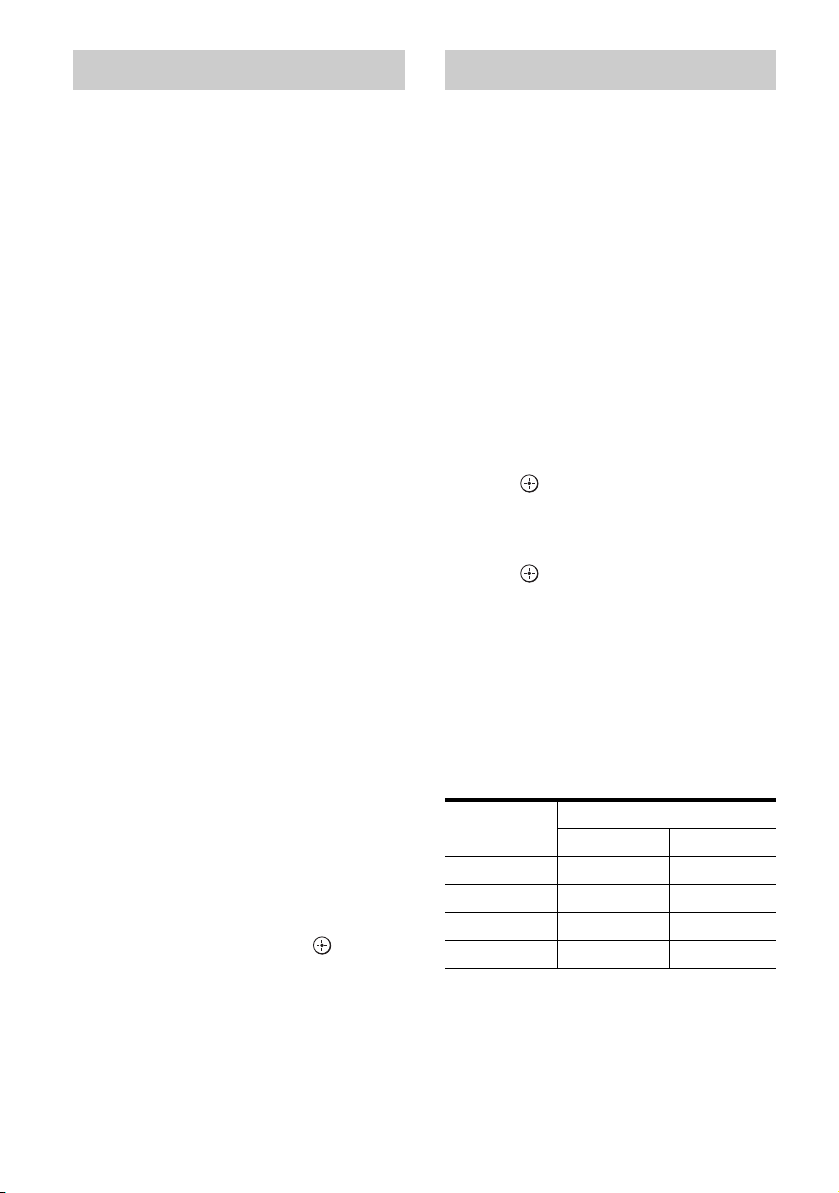
120
US
D:\NORM'S JOB\SONY HA\SO0056\STR-DA3500ES\U VERSION\US\4144907131\01US-
STRDA3500ESUC\090OTH.fm
masterpage: Left
STR-DA3500ES
4-144-907-13(1)
1 Tune in the station that you
want to preset.
For details on the operation, see “Tuning
radio stations” (page 119).
2 Press SHIFT and then press
ENT/MEM.
“MEM” lights up on the display window
for a few seconds. Perform steps 3 and 4
before “MEM” disappears.
3 Press PRESET + or PRESET –
to select a preset number.
30 FM and 30 AM preset numbers are
available. If “MEM” lights off before you
select the preset number, start again from
step 2.
4 Press ENT/MEM.
If SHIFT indicator is light off before you
press ENT/MEM, press SHIFT.
The station is stored as the selected preset
number. If “MEM”disappears before you
press ENT/MEM, start again from step 2.
5 Repeat steps 1 to 4 to preset
another station.
Selecting a preset station
1
Press TUNER repeatedly to select the
FM or AM band.
2 Press PRESET + or PRESET –
repeatedly to select the preset station
you want.
You can also press SHIFT and then press
the numeric buttons to select the preset
station you want. Then, press to enter
the selection.
You can also press TUNING MODE on the
receiver repeatedly to select “PRESET”,
then turn TUNING +/– to select the preset
stations you want.
For details on XM/SIRIUS Radio service, see
“Listening to Satellite Radio” (page 74) in
“Tuner Operations”.
Aiming the XM Radio or SIRIUS
antenna
1
Press TUNER repeatedly to select
“XM RADIO” or “SIRIUS”.
You can also use INPUT SELECTOR on
the receiver.
2 Press AMP.
3 Press MENU.
4 Press V/v repeatedly to select
“<TUNER>”.
5 Press or b to enter the menu.
6 Press V/v repeatedly to select “XM
ANT AIM” or “SR ANT AIM”.
7 Press or b to enter the parameter.
8 While checking the parameter, aim your
antenna to where the best reception
will be received.
For details on the parameter, see “XM
Signal Strength” or “SIRIUS Signal
Strength” below.
XM Signal Strength
Presetting radio stations Listening to satellite tuner
Signal
strength
Signal type
Satellite Terrestrial
GOOD S : 3 T : 3
MARGINAL S : 2 T : 2
WEAK S : 1 T : 1
NO SIGNAL S : 0 T : 0
121
US
D:\NORM'S JOB\SONY HA\SO0056\STR-DA3500ES\U VERSION\US\4144907131\01US-
STRDA3500ESUC\090OTH.fm
masterpage: Right
STR-DA3500ES
4-144-907-13(1)
Other Operations
SIRIUS Signal Strength
Checking the Satellite Tuner ID
1
Press TUNER repeatedly to select
“XM RADIO” or “SIRIUS”.
You can also use INPUT SELECTOR on
the receiver.
2 Press TUNING + or TUNING – to select
channel 0.
You can also press TUNING MODE on the
receiver to select “AUTO”, then turn
TUNING +/– to select channel 0.
3 Check the XM ID or SIRIUS ID on the
display window and write it in the space
provided here.
XM ID:_____________________
SIRIUS ID:_______________________
Selecting channels from a
category (CATEGORY TUNING)
1
Press TUNER repeatedly to select
“XM RADIO” or “SIRIUS”.
You can also use INPUT SELECTOR on
the receiver.
2 Press CATEGORY MODE repeatedly
to select “ONE CAT”.
• ALL CAT: You can select a channel from
all the categories. The initial setting is
“ALL CAT”.
• ONE CAT: You can select a channel from
one category. “CAT” lights up on the
display window when you set to “ONE
CAT” mode.
3 Press CATEGORY + or CATEGORY –
to select the category you want.
The category is selected and the channel
with the lowest number in the specified
category is selected.
4 Press TUNING + or TUNING – to select
the channel.
You can also press TUNING MODE on the
receiver to select “AUTO”, then turn
TUNING +/– to select the channel.
Selecting a channel number
directly (Direct tuning)
1
After selecting satellite tuner, press
SHIFT and then press D.TUNING.
2 Press the numeric buttons to enter the
channel number, then press to
enter.
Displaying the satellite tuner
information
Press DISPLAY repeatedly.
Each time you press DISPLAY while tuning in
the channel, the display changes cyclically as
follows:
Channel name t Channel number t
Category name t Artist name/Feature t
Song/Program title t Composer name
(SIRIUS only) t Signal strength t Sound
field t Volume level
Signal
Strength
Signal type
Satellite Terrestrial
EXC (excellent) S : 3 T : 3
GOOD S : 2 T : 2
WEAK S : 1 T : 1
NONE S : 0 T : 0

122
US
D:\NORM'S JOB\SONY HA\SO0056\STR-DA3500ES\U VERSION\US\4144907131\01US-
STRDA3500ESUC\100REM.fm
masterpage: Left
STR-DA3500ES
4-144-907-13(1)
1 Select a channel you want to
preset.
For details on this operation, see
“Selecting channels from a category
(CATEGORY TUNING)”.
2 Press SHIFT and then press
ENT/MEM.
“MEM” lights up on the display window.
3 Press PRESET + or PRESET –
to select a preset number.
You can also select the number by
pressing the numeric buttons. Preset
numbers from 1 to 30 are available.
Channel 1 is preset for the preset numbers
when you purchase the receiver.
4 Press ENT/MEM.
5 Repeat steps 1 to 4 to preset
another station.
Selecting a preset channel
1
Press TUNER repeatedly to select
“XM RADIO” or “SIRIUS”.
2 Press PRESET+ or PRESET –
repeatedly to select the preset channel
you want.
You can also press SHIFT and then press
the numeric buttons to select the preset
channel you want. Then, press to enter
the selection.
You can also press TUNING MODE on the
receiver repeatedly to select “PRESET”,
then turn TUNING +/– to select the preset
channel you want.
Operating each
component using the
multi function remote
You can control Sony or non-Sony
components you are using with the multi
function remote supplied with the receiver.
The remote is initially set to control Sony
components.
When you change the settings of the remote
according to the components you are using,
you can control non-Sony and other Sony
components that the remote is initially unable
control (page 124).
1 Press the input button that
matches the connected
component that you want to
operate.
2 Press the appropriated buttons
to use the function listed in the
table below.
Note
You may not be able to operate some functions for
the components you are using.
Presetting satellite tuner
channels
Using the Remote
Operating the components
connected to the receiver
123
US
D:\NORM'S JOB\SONY HA\SO0056\STR-DA3500ES\U VERSION\US\4144907131\01US-
STRDA3500ESUC\100REM.fm
masterpage: Right
STR-DA3500ES
4-144-907-13(1)
Using the Remote
a)
DVD player only.
b)
LD player only.
c)
Video CD only.
d)
Tape deck B only.
Table of buttons used to control each component
Component
Button
TV VCR DVD player,
DVD/VHS
combo
Blu-ray
disc player
HDD
recorder
PSX Video CD
player, LD
player
Digital
CATV
terminal
DSS Tape deck
A/B
DAT
deck
CD player,
MD deck
DIGITAL
MEDIA
PORT
device
AV ?/1
zz z z z z z z z z z
Numeric buttons
(SHIFT mode)
zz z z z z z z z z z z z
TV INPUT, WIDE
(SHIFT mode)
z
-/--
(SHIFT mode)
zz z z z z z z z z z
ENT/MEM
(SHIFT mode)
zz z z z z z
b)
zz z zz
CLEAR
(SHIFT mode)
zzzz z z
DISPLAY
zz z z z z z z z z
RETURN/EXIT
O
zzzzzzzz z
TOOLS/OPTIONS
zzzzz zz
V
/
v
/
B
/
b
,
,
MENU, HOME
zz z z z z z z z
./>
zz z z z z z z z
d)
zz z
B
•
/
•
b
zzzzz z z
m
/TUNING –,
M
/TUNING +
zz z z z z z z z z z z
DISC SKIP
z
a)
zz
c)
z
N, X, x
zz z z z z z z z z z z
MUTING,
MASTER VOL +/–,
TV VOL +/–
z
PRESET +/–,
TV CH +/–
zz z z z z
b)
zz
BD/DVD TOP
MENU, BD/DVD
MENU
zz z
F1, F2
zz
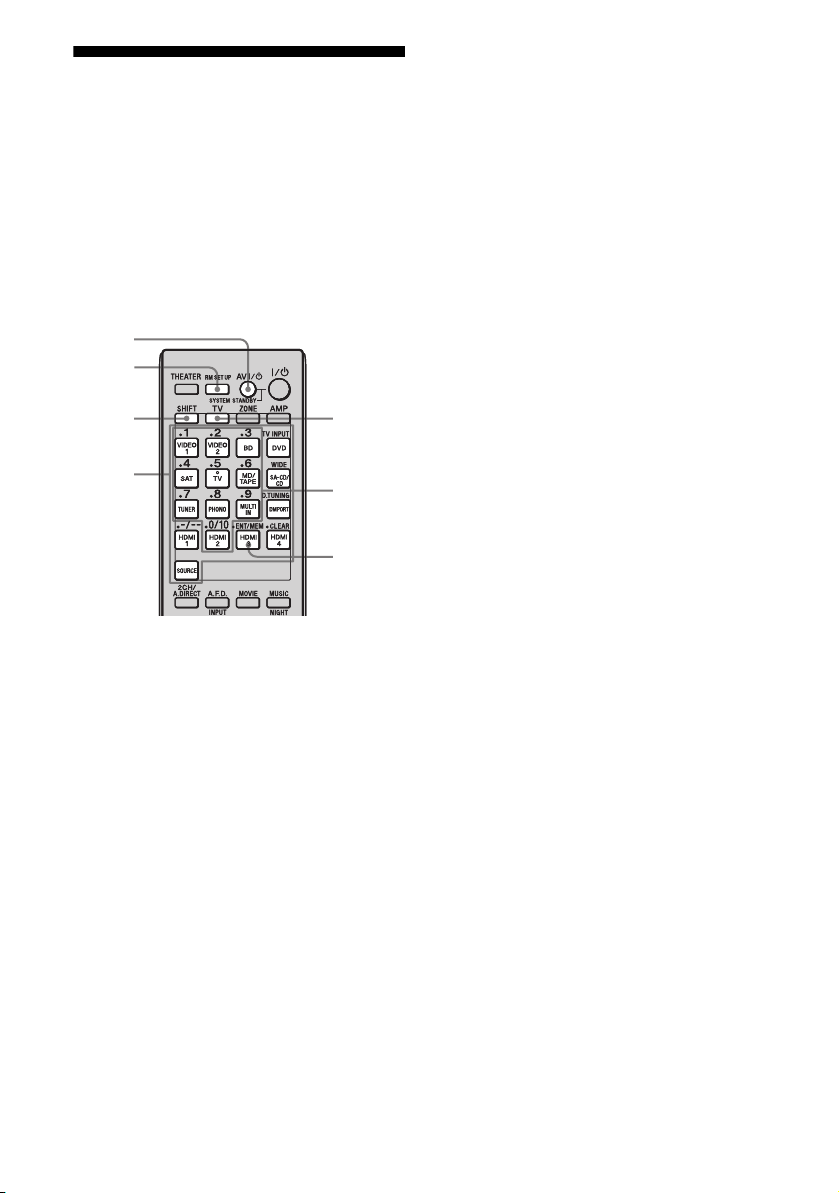
124
US
D:\NORM'S JOB\SONY HA\SO0056\STR-DA3500ES\U VERSION\US\4144907131\01US-
STRDA3500ESUC\100REM.fm
masterpage: Left
STR-DA3500ES
4-144-907-13(1)
Programming the remote
You can customize the remote to match the
components connected to your receiver. You
can even program the remote to control non-
Sony components and also Sony components
that the remote is normally unable to control.
The procedure below uses an example in
which a VCR made by a company other than
Sony is connected to the VIDEO 1 IN jacks on
the receiver.
1 While holding down RM SET
UP, press AV ?/1.
The RM SET UP button flashes.
2 While the RM SET UP button is
flashing, press the input button
(including TV) for the
component you want to control.
For example, if you are going to control a
VCR connected to VIDEO 1 IN jack,
press VIDEO1.
The RM SET UP and the SHIFT buttons
light up. The input button you selected
(VIDEO1) flashes.
If you press the button for a component of
which you cannot program the remote,
such as TUNER, PHONO, DMPORT or
SOURCE, etc., the RM SET UP button
keeps flashing.
3 Press the numeric buttons to
enter the numeric code (or one
of the codes if more than one
code exists) corresponding to
the component and the maker
of the component you want to
control.
The input button you selected in step 2
(VIDEO1) lights up. (The RM SET UP
and SHIFT buttons remains lit.)
Note
For a TV remote code value, only numbers in
the 500’s are valid.
4 Press ENT/MEM.
Once the numeric code has been verified,
the RM SET UP button flashes twice and
the remote automatically exits the
programming mode. The input button
lights off.
To cancel programming
Press RM SET UP during any step.
The numeric codes
corresponding to the
component and the maker of
the component
Use the numeric codes in the tables below to
control non-Sony components and also Sony
components that the remote is normally unable
to control. Since the remote signal that a
component accepts differs depending on the
model and year of the component, more than
one numeric code may be assigned to a
component. If you fail to program your remote
using one of the codes, try using other codes.
Notes
• The numeric codes are based on the latest
information available for each brand. There is a
chance, however, that your component will not
respond to some or all of the codes.
• All of the input buttons on this remote may not be
available when used with your particular
component.
ENT/MEM
Input
buttons
RM SET
UP
AV ?/1
Numeric
buttons
TV
SHIFT
125
US
D:\NORM'S JOB\SONY HA\SO0056\STR-DA3500ES\U VERSION\US\4144907131\01US-
STRDA3500ESUC\100REM.fm
masterpage: Right
STR-DA3500ES
4-144-907-13(1)
Using the Remote
To control a CD player
To control a DAT deck
To control an MD deck
To control a tape deck
To control an LD player
To control a video CD player
To control an HDD recorder
To control a VCR
* If an AIWA VCR does not work even though you
enter the code for AIWA, enter the code for Sony
instead.
Maker Code(s)
SONY 101, 102, 103
DENON 104, 123
JVC 105, 106, 107
KENWOOD 108, 109, 110
MAGNAVOX 111, 116
MARANTZ 116
ONKYO 112, 113, 114
PANASONIC 115
PHILIPS 116
PIONEER 117
TECHNICS 115, 118, 119
YAMAHA 120, 121, 122
Maker Code(s)
SONY 203
PIONEER 219
Maker Code(s)
SONY 301
DENON 302
JVC 303
KENWOOD 304
Maker Code(s)
SONY 201, 202
DENON 204, 205
KENWOOD 206, 207, 208, 209
NAKAMICHI 210
PANASONIC 216
PHILIPS 211, 212
PIONEER 213, 214
TECHNICS 215, 216
YAMAHA 217, 218
Maker Code(s)
SONY 601, 602, 603
PIONEER 606
Maker Code(s)
SONY 605
Maker Code(s)
SONY 307, 308, 309
Maker Code(s)
SONY 701, 702, 703, 704, 705,
706
AIWA* 710, 750, 757, 758
AKAI 707, 708, 709, 759
BLAUPUNKT 740
EMERSON 711, 712, 713, 714, 715,
716, 750
FISHER 717, 718, 719, 720
GENERAL ELECTRIC
(GE)
721, 722, 730
GOLDSTAR/LG 723, 753
GRUNDIG 724
HITACHI 722, 725, 729, 741
ITT/NOKIA 717
JVC 726, 727, 728, 736
MAGNAVOX 730, 731, 738
MITSUBISHI/MGA 732, 733, 734, 735
NEC 736
PANASONIC 729, 730, 737, 738, 739,
740
PHILIPS 729, 730, 731
PIONEER 729
RCA/PROSCAN 722, 729, 730, 731, 741,
747
SAMSUNG 742, 743, 744, 745
SANYO 717, 720, 746
SHARP 748, 749
TELEFUNKEN 751, 752
TOSHIBA 747, 756
ZENITH 754
continued

126
US
D:\NORM'S JOB\SONY HA\SO0056\STR-DA3500ES\U VERSION\US\4144907131\01US-
STRDA3500ESUC\100REM.fm
masterpage: Left
STR-DA3500ES
4-144-907-13(1)
To control a DVD player
To control a DVD recorder
To control a TV
Maker Code(s)
SONY 401, 402, 403
BROKSONIC 424
DENON 405
HITACHI 416
JVC 415, 423
MITSUBISHI 419
ORITRON 417
PANASONIC 406, 408, 425
PHILIPS 407
PIONEER 409, 410
RCA 414
SAMSUNG 416, 422
TOSHIBA 404, 421
ZENITH 418, 420
Maker Code(s)
SONY 401, 402, 403
Maker Code(s)
SONY 501
AIWA 501, 536, 539
AKAI 503
AOC 503
CENTURION 566
CORONADO 517
CURTIS-MATHES 503, 551, 566, 567
DAYTRON 517, 566
DAEWOO 504, 505, 506, 507, 515,
544
FISHER 508, 545
FUNAI 548
FUJITSU 528
GOLDSTAR/LG 503, 512, 515, 517, 534,
544, 556, 568
GRUNDIG 511, 533, 534
HITACHI 503, 513, 514, 515, 517,
519, 544, 557, 571
ITT/NOKIA 521, 522
J.C.PENNY 503, 510, 566
JVC 516, 552
KMC 517
MAGNAVOX 503, 515, 517, 518, 544,
566
MARANTZ 527
MITSUBISHI/MGA 503, 519, 527, 544, 566,
568
NEC 503, 517, 520, 540, 544,
554, 566
NORDMENDE 530, 558
NOKIA 521, 522, 573, 575
PANASONIC 509, 524, 553, 559, 572
PHILIPS 515, 518, 557, 570, 571
PHILCO 503, 504, 514, 517, 518
PIONEER 509, 525, 526, 540, 551,
555
PORTLAND 503
QUASAR 509, 535
RADIO SHACK 503, 510, 527, 565, 567
RCA/PROSCAN 503, 510, 523, 529, 544
SAMSUNG 503, 515, 517, 531, 532,
534, 544, 556, 557, 562,
563, 566, 569
SAMPO 566
SABA 530, 537, 547, 549, 558
SANYO 508, 545, 546, 560, 567
SCOTT 503, 566
SEARS 503, 508, 510, 517, 518,
551
SHARP 517, 535, 550, 561, 565
SYLVANIA 503, 518, 566
THOMSON 530, 537, 547, 549
TOSHIBA 535, 539, 540, 541, 551
TELEFUNKEN 530, 537, 538, 547, 549,
558
TEKNIKA 517, 518, 567
WARDS 503, 517, 566
YORK 566
ZENITH 542, 543, 567
GENERAL ELECTRIC
(GE)
503, 509, 510, 544
LOEWE 515, 534, 556
Maker Code(s)
127
US
D:\NORM'S JOB\SONY HA\SO0056\STR-DA3500ES\U VERSION\US\4144907131\01US-
STRDA3500ESUC\100REM.fm
masterpage: Right
STR-DA3500ES
4-144-907-13(1)
Using the Remote
To control a satellite tuner (box)
To control a cable box
To control a Blu-ray disc player
To control a PSX
To control a DVD/VIDEO
COMBO (recorder)
To control a HDD/DVD COMBO
(recorder)
Maker Code(s)
SONY 801, 802, 803, 804, 824,
825, 865
AMSTRAD 845, 846
BskyB 862
GENERAL
ELECTRIC(GE)
866
GRUNDIG 859, 860
HUMAX 846, 847
THOMSON 857, 861, 864, 876
PACE 848, 849, 850, 852, 862,
863, 864
PANASONIC 818, 855
PHILIPS 856, 857, 858, 859, 860,
864, 874
NOKIA 851, 853, 854, 864
RCA/PROSCAN 866, 871
HITACHI/BITA 868
HUGHES 867
JVC/Echostar/Dish
Network
873
MITSUBISHI 872
SAMSUNG 875
TOSHIBA 869, 870
Maker Code(s)
SONY 821, 822, 823
HAMLIN/REGAL 836, 837, 838, 839, 840
JERROLD/G.I./
MOTOROLA
806, 807, 808, 809, 810,
811, 812, 813, 814, 819
JERROLD 830, 831
OAK 841, 842, 843
PANASONIC 816, 826, 832, 833, 834,
835
PHILIPS 830, 831
PIONEER 828, 829
RCA 805
SCIENTIFIC ATLANTA 815, 816, 817
TOCOM/PHILIPS 830, 831
ZENITH 826, 827
Maker Code(s)
SONY 310, 311, 312
Maker Code(s)
SONY 313, 314, 315
Maker Code(s)
SONY 411
Maker Code(s)
SONY 401, 402, 403
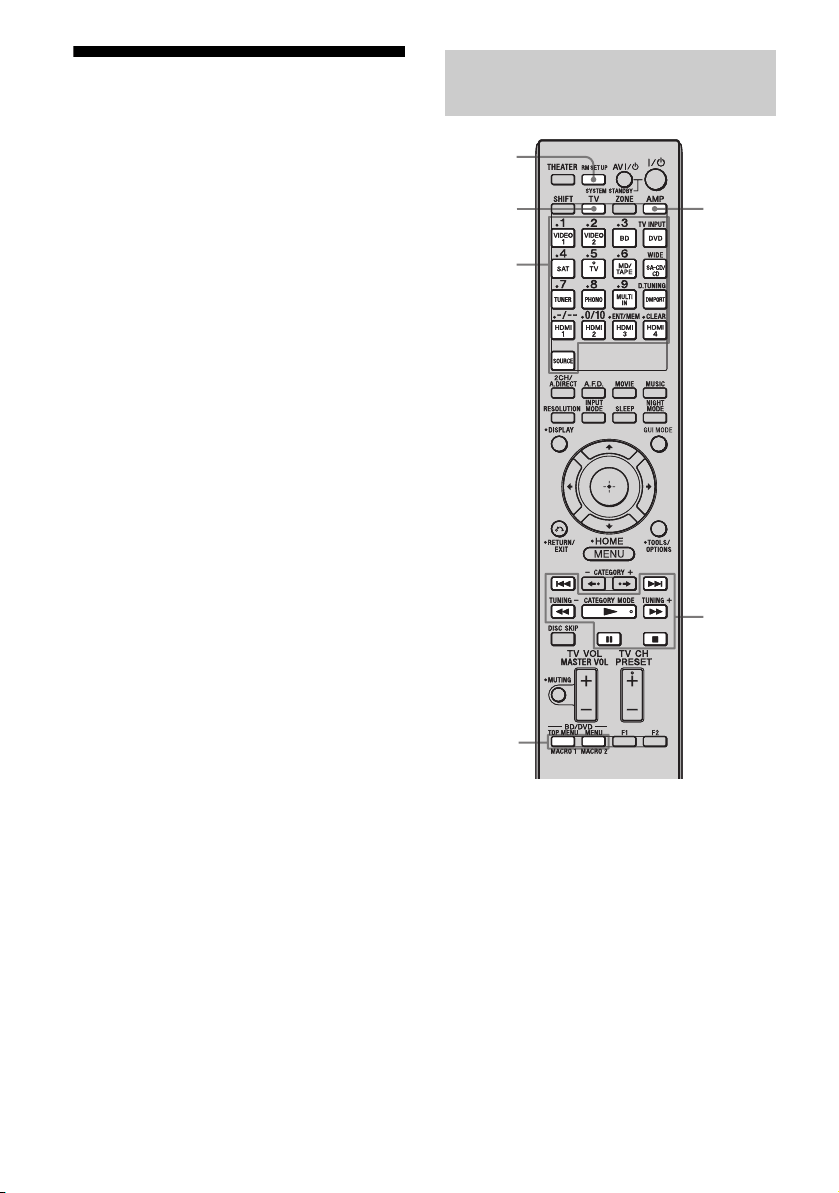
128
US
D:\NORM'S JOB\SONY HA\SO0056\STR-DA3500ES\U VERSION\US\4144907131\01US-
STRDA3500ESUC\100REM.fm
masterpage: Left
STR-DA3500ES
4-144-907-13(1)
Performing several
commands in sequence
automatically
(Macro Play)
The Macro Play function lets you link several
commands in a sequential order as a single
command.
The remote provides 2 macro lists (MACRO 1
and MACRO 2). You can specify up to 20
commands for each macro list.
Note
When setting up Macro Play, replace the batteries
with new ones.
1 While holding down RM SET
UP, press MACRO 1 or MACRO
2 for more than 1 second.
The RM SET UP button flashes and one
of the input buttons lights up (in the initial
setting, the VIDEO1 button lights up).
2 Press the input button of the
component that you want to
assign one of the following
operations.
The selected input button lights up.
Program the sequence of the
operation
Input
buttons
RM SET
UP
N, x, X,
M, m,
., >
AMP
MACRO 1
MACRO 2
TV

129
US
D:\NORM'S JOB\SONY HA\SO0056\STR-DA3500ES\U VERSION\US\4144907131\01US-
STRDA3500ESUC\100REM.fm
masterpage: Right
STR-DA3500ES
4-144-907-13(1)
Using the Remote
3 Press the button for the
operation you want to perform
to learn the function as follows.
The input button selected in step 2 flashes
twice, then lights up again.
4 Repeat steps 2 and 3. When you
want to assign another
command for the same
component, repeat step 3.
5 Press RM SET UP to finish the
programming process.
Tip
If the RM SET UP button flashes five times in
step 1, and the macro programming process
does not start, replace the batteries with new
ones.
To cancel programming
Press RM SET UP. Also, not pressing any
button for 60 seconds cancels the settings.
The previous command remains valid.
Starting macro play
1
Press AMP.
The AMP button lights up, and then turns
off.
2 Press MACRO 1 or MACRO 2 to start
the macro.
The macro starts and execute the
commands in the order you assigned them.
While the commands are being sent, the
AMP button flashes and the RM SET UP
button lights up. When the commands have
been sent, the RM SET UP and AMP
buttons light off.
To erase a programmed macro
1
While holding down RM SET UP, press
MACRO 1 or MACRO 2 for more than 1
second to clear the stored macro.
The RM SET UP button flashes.
2 Press RM SET UP.
Settings stored as macro are cleared.
Press Operations to be
programmed
N, x, X,
M, m,
., >
Performs the operation
of the button.
The input
button for more
than 1 second
Switches inputs.
MACRO 1 or
MACRO 2
Make a one second
interval. When you want
to make a longer
interval, press MACRO
1 or MACRO 2
repeatedly.
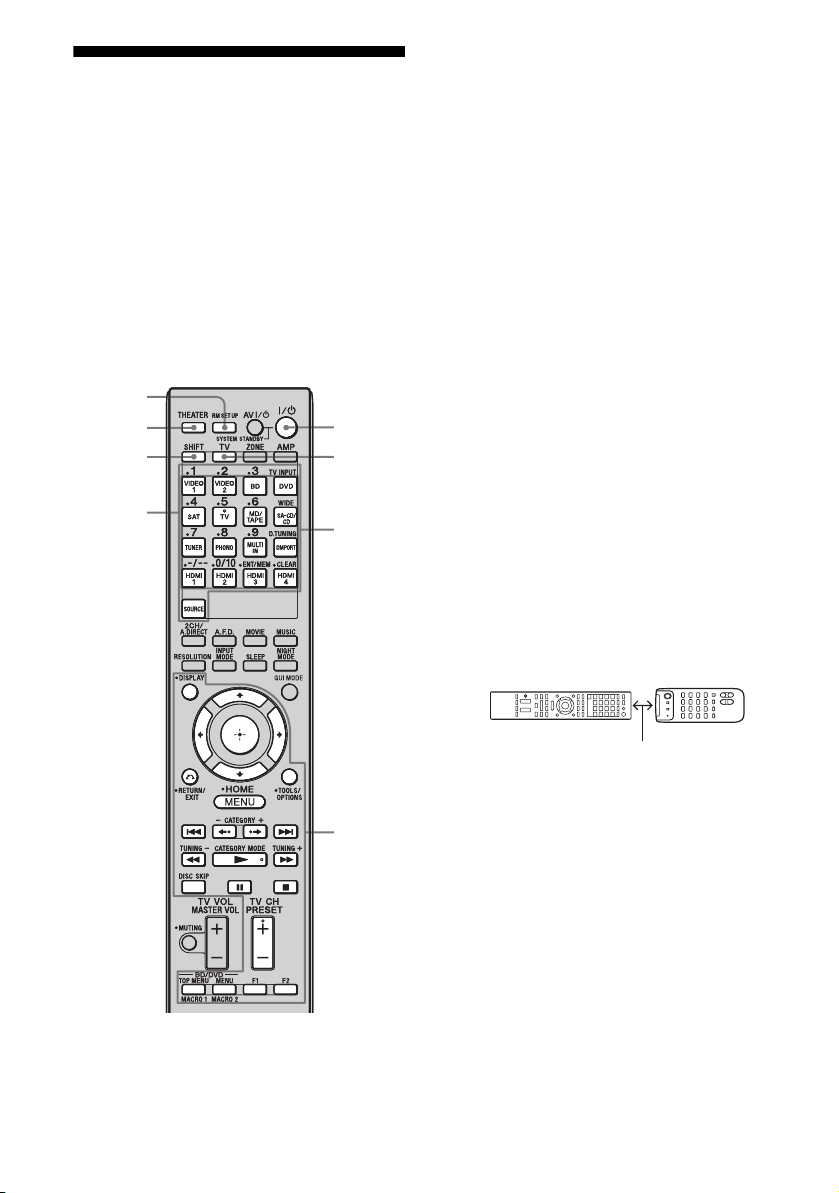
130
US
D:\NORM'S JOB\SONY HA\SO0056\STR-DA3500ES\U VERSION\US\4144907131\01US-
STRDA3500ESUC\100REM.fm
masterpage: Left
STR-DA3500ES
4-144-907-13(1)
Setting remote control
codes that are not stored
in the remote
Even if a remote control code is not one of the
presets stored in the remote, it is possible for
the remote to learn the code using the learning
function.
Note
When setting up the receiver to learn the remote
command modes, replace the batteries with new
ones.
* To store a new command on one of those
buttons, press SHIFT beforehand.
1 While holding down RM SET
UP, press THEATER.
The RM SET UP button lights up.
2 Press the input button
(including the TV button) for the
component you want to operate
with the new command.
The input button flashes. (The RM SET
UP button remains lit.)
3 Press the button on which you
want to store the new
command. For the buttons with
an asterisk in the illustration
above, press SHIFT, then press
the button.
The input button you selected in step 2
lights up. (The RM SET UP button
remains lit.)
4 Point the remote code receiver
section of the remote towards
the receiver/transmitter on the
remote control to be learned
from.
5 Press the button on the remote
commander to be learned from
to transmit the remote code.
While the remote of the receiver is
receiving the signal, the input button
selected in step 2 turns off.
The RM SET UP button flashes twice,
then the learning process is completed.
When the learning process fails, the RM
SET UP button flashes five times. Try to
perform the process again from step 2.
?/1
Input
buttons
RM SET
UP
THEATER
SHIFT
Buttons
used to
learn
code*
TV
Buttons
used to
learn
code
About 5 cm - 10 cm (2" - 4")

131
US
D:\NORM'S JOB\SONY HA\SO0056\STR-DA3500ES\U VERSION\US\4144907131\01US-
STRDA3500ESUC\100REM.fm
masterpage: Right
STR-DA3500ES
4-144-907-13(1)
Using the Remote
6 Press RM SET UP to finish the
Learning function process.
Tips
• When the memory capacity for storing remote
control codes reaches a certain limit, the RM SET
UP button flashes 10 times, and then the learning
process ends.
• If the RM SET UP button flashes five times in step
1, and the learning process does not start, replace
the batteries with new ones.
To cancel learning
Press RM SET UP. Also, not pressing any
button for 60 seconds cancels the settings.
When selecting a learned input, press the
button used to learn that function.
To erase the learned code
1
While holding down RM SET UP, press
THEATER.
2 Press the input button (VIDEO 1 in the
example) for which you want to clear
the setting.
The input button flashes. (The RM SET UP
button remains lit.)
3 Press ?/1 for more than 1 second.
The input button flashes twice.
4 Press SHIFT, then press numeric
buttons to clear the stored setting.
The RM SET UP button flashes twice, then
the clearing process is completed.
When the clearing process fails, the RM
SET UP button flashes five times. Try to
perform the process again from step 2.
Clearing all the contents
of the remote’s memory
1 Press and hold MASTER VOL –
first, then press ?/1, then press
AV ?/1.
The RM SET UP button flashes three
times.
2 Release all buttons.
All the contents of the remote’s memory
(i.e., all the programmed data) are
cleared.
Using a command that has been
learned
MASTER
VOL –
?/1
AV ?/1

132
US
D:\NORM'S JOB\SONY HA\SO0056\STR-DA3500ES\U VERSION\US\4144907131\01US-
STRDA3500ESUC\110ADD.fm
masterpage: Left
STR-DA3500ES
4-144-907-13(1)
Glossary
x Component video
A format for transmitting video signal
information consisting of three separate
signals: luminance Y, chrominance Pb, and
chrominance Pr. High quality pictures, such as
DVD video or HDTV pictures, are transmitted
more faithfully. The three jacks are color-
coded green, blue, and red.
x Composite video
A standard format for transmitting video
signal information. The luminance signal Y
and chrominance signal C are combined and
transmitted together.
x Crossover frequency
The frequency at which two speaker’s
frequencies intersect.
x Deep Color (Deep Colour)
Video signals for which the color depth of
signals passing through an HDMI jack have
been raised.
The number of colors that could be expressed
by 1 pixel was 24 bits (16,777,216 colors) with
the current HDMI jack. However, the number
of colors which can be expressed by 1 pixel
will be 36, etc., bits when the receiver
corresponds to Deep Color (Deep Colour).
Since the gradation of the depth of a color can
be expressed more finely with more bits,
continuous color changes can be more
smoothly expressed.
x Dolby Digital
Digital audio encoding/decoding technology
developed by Dolby Laboratories, Inc. It
consists of front (left/right), center, surround
(left/right) and subwoofer channels. It is a
designated audio standard for DVD-video and
also known as 5.1 channels surround.
x Dolby Digital Plus
Dolby Digital Plus provides the flexibility and
efficiency to deliver more channels of
compelling surround sound for high-definition
video media. Its superior coding efficiencies
enable up to 7.1 channels of high-quality multi
channel audio without negatively impacting
bit budgets allocated for video performance or
additional feature sets.
x Dolby Digital Surround EX
Acoustic technology developed by Dolby
Laboratories, Inc. Surround back information
is matrixed into regular left and right surround
channels so that the sound can be reproduced
in 6.1 channels. Active scenes, especially, are
recreated with a more dynamic and realistic
sound field.
x Dolby Pro Logic II
This technology converts 2 channels stereo
recorded audio into 5.1 channels for playback.
There is a MOVIE mode for movies and
MUSIC mode for stereo sources such as
music. Old movies encoded in the traditional
stereo format can be enhanced with 5.1
channels surround sound.
The GAME mode is suitable for video games.
x Dolby Pro Logic IIx
Technology for 7.1 channels (or 6.1 channels)
playback. Along with audio encoded in Dolby
Digital Surround EX, 5.1 channels Dolby
Digital encoded audio can be reproduced in
7.1 channels (or 6.1 channels). Furthermore,
existing stereo recorded content can also be
reproduced in 7.1 channels (or 6.1 channels).
x Dolby Surround (Dolby Pro
Logic)
Audio processing technology developed by
Dolby Laboratories, Inc. Center and mono
surround information is matrixed into two
stereo channels. When reproduced, audio is
decoded and output in 4 channels surround
sound. This is the most common audio
processing method for DVD-video.
Additional Information

133
US
D:\NORM'S JOB\SONY HA\SO0056\STR-DA3500ES\U VERSION\US\4144907131\01US-
STRDA3500ESUC\110ADD.fm
masterpage: Right
STR-DA3500ES
4-144-907-13(1)
Additional
Information
x Dolby TrueHD
Dolby TrueHD is Dolby’s lossless audio
technology developed for high-definition
optical discs. Dolby TrueHD audio is bit-for-
bit identical to the original studio masters and
provides supreme-quality audio up to 8
channels at 96 kHz/24 bit and up to 6 channels
at 192 kHz/24 bit. Together with high-
definition video, it offers an unprecedented
home theater experience.
x DTS 96/24
A high sound quality digital signal format. It
records audio at a sampling frequency and bit
rate of 96 kHz/24 bit which is the highest
possible for DVD-video. The number of
playback channels varies depending on the
software.
x DTS Digital Surround
Digital audio encoding/decoding technology
for theaters developed by DTS, Inc. It
compresses audio less than Dolby Digital,
delivering a higher quality sound
reproduction.
x DTS-ES
Format for 6.1 channels playback with
surround back information. There are two
modes, “Discrete 6.1” which records all
channels independently, and “Matrix 6.1”
which matrixes surround back channel into
surround left and surround right channels. It is
ideal for playback of motion picture
soundtracks.
x DTS-HD
Audio format which extends the conventional
DTS Digital Surround format.
This format consists of a core and an
extension, and the core part has DTS Digital
Surround compatibility. There are two kinds of
DTS-HD, DTS-HD High Resolution Audio
and DTS-HD Master Audio. DTS-HD High
Resolution Audio has a maximum
transmission rate of 6 Mbps, with lossy
compression (Lossy), and DTS-HD High
Resolution Audio corresponds to a maximum
sampling frequency of 96 kHz, and a
maximum of 7.1 channels. DTS-HD Master
Audio has a maximum transmission rate of
24.5 Mbps, and uses lossless compression
(Lossless), and DTS-HD Master Audio
corresponds to a maximum sampling
frequency of 192 kHz, and a maximum of 7.1
channels.
x DTS Neo:6
This technology converts 2 channels stereo
recorded audio for 7 channels playback. There
are two modes to select according to the
playback source or your preference, CINEMA
for movies, and MUSIC for stereo sources
such as music.
x HD Digital Cinema Sound
HD Digital Cinema Sound (HD-D.C.S.) is
Sony’s new innovative home theater
technology using the latest acoustic and digital
signal processing technologies. It is based on
precise response measurement data of a
mastering studio.
With HD-D.C.S., you are able to enjoy Blu-ray
and DVD movies at home with not only the
high quality of sound, but also the best sound
ambience, just as the movie’s sound engineer
intended in the mastering process.
continued

134
US
D:\NORM'S JOB\SONY HA\SO0056\STR-DA3500ES\U VERSION\US\4144907131\01US-
STRDA3500ESUC\110ADD.fm
masterpage: Left
STR-DA3500ES
4-144-907-13(1)
x HDMI (High-Definition
Multimedia Interface)
HDMI (High-Definition Multimedia
Interface) is an interface that supports both
video and audio on a single digital connection,
allowing you to enjoy high quality digital
picture and sound. The HDMI specification
supports HDCP (High-bandwidth Digital
Contents Protection), a copy protection
technology that incorporates coding
technology for digital video signals.
x High Bitrate Audio
It refers to the audio formats of the
compression method (DTS-HD Master Audio,
Dolby TrueHD, etc.) which is a high bitrate
format recorded mainly on Blu-ray disc, etc.
x Interlace
A scanning method which completes a picture
by displaying half of the lines on a tube surface
of a TV or monitor each 1/60 second. First, all
the odd-numbered lines are drawn, leaving
spaces between each line, then all the even-
numbered lines are drawn to fill the spaces.
“i” of “480i” stands for “Interlace”.
x L.F.E. (Low Frequency Effects)
Sound effects of low frequencies which are
output from a subwoofer in Dolby Digital or
DTS, etc. By adding a deep bass with a
frequency between 20 to 120 Hz, audio
becomes more powerful.
x Neural-THX
Neural-THX
®
Surround is taking surround
sound to the next level. This revolutionary new
technology delivers the rich envelopment and
discrete image detail of surround sound in a
format that is fully compatible with stereo.
Neural-THX Surround reduces the bandwidth
needed for broadcasters to deliver true, multi
channel surround presentations, and enables
7.1-channel support for gaming and movies.
By unmasking the audio details, typically lost
by other playback systems, audiences will
experience the deep ambience and subtle
details of movies, music and games. And with
this technology being used by sound designers
during content creation, as well as embedded
into playback devices, Neural-THX Surround
promises a listening experience that is true to
the original mix. Neural-THX Surround has
been chosen as the official surround sound
broadcast format for XM Satellite Radio’s
“XM HD Surround”, as well as other leading
FM/HD radio stations worldwide.
For additional information, please visit
www.neuralsurround.com.
x PCM (Pulse Code Modulation)
A method of converting analog audio to digital
audio for easy enjoyment of digital sound.
x Progressive
A scanning method that draws all scanning
lines sequentially, as opposed to interlaced
scanning where all the odd and then all the
even lines are drawn.
“p” of “480p” stands for “Progressive”.
x x.v.Color (x.v.Colour)
x.v.Color (x.v.Colour) is a more familiar term
for the xvYCC standard proposed by Sony,
and is a trademark of Sony. xvYCC is an
international standard for color space in video.
This standard can express a wider color range
than the currently used broadcast standard.

135
US
D:\NORM'S JOB\SONY HA\SO0056\STR-DA3500ES\U VERSION\US\4144907131\01US-
STRDA3500ESUC\110ADD.fm
masterpage: Right
STR-DA3500ES
4-144-907-13(1)
Additional
Information
Precautions
On safety
Should any solid object or liquid fall into the
cabinet, unplug the receiver and have it
checked by qualified personnel before
operating it any further.
On power sources
• Before operating the receiver, check that the
operating voltage is identical with your local
power supply.
The operating voltage is indicated on the
nameplate on the back of the receiver.
• The unit is not disconnected from the AC
power source (mains) as long as it is
connected to the wall outlet, even if the unit
itself has been turned off.
• If you are not going to use the receiver for a
long time, be sure to disconnect the receiver
from the wall outlet. To disconnect the AC
power cord (mains lead), grasp the plug
itself; never pull the cord.
• One blade of the plug is wider than the other
for the purpose of safety and will fit into the
wall outlet only one way. If you are unable to
insert the plug fully into the outlet, contact
your dealer.
• AC power cord (mains lead) must be
changed only at a qualified service shop.
On heat buildup
Although the receiver heats up during
operation, this is not a malfunction. If you
continuously use this receiver at a large
volume, the cabinet temperature of the top,
side and bottom rises considerably. To avoid
burning yourself, do not touch the cabinet.
On placement
• Place the receiver in a location with adequate
ventilation to prevent heat buildup and
prolong the life of the receiver.
• Do not place the receiver near heat sources,
or in a place subject to direct sunlight,
excessive dust, or mechanical shock.
• Do not place anything on top of the cabinet
that might block the ventilation holes and
cause malfunctions.
• Do not place the receiver near equipment
such as a television, VCR, or tape deck. (If
the receiver is being used in combination
with a television, VCR, or tape deck, and is
placed too close to that equipment, noise
may result, and picture quality may suffer.
This is especially likely when using an
indoor antenna (aerial). Therefore, we
recommend using an outdoor antenna
(aerial).)
• Use caution when placing the receiver on
surfaces that have been specially treated
(with wax, oil, polish, etc.) as staining or
discoloration of the surface may result.
On operation
Before connecting other components, be sure
to turn off and unplug the receiver.
On cleaning
Clean the cabinet, panel, and controls with a
soft cloth slightly moistened with a mild
detergent solution. Do not use any type of
abrasive pad, scouring powder, or solvent,
such as alcohol or benzine.
If you have any questions or problems
concerning your receiver, please consult your
nearest Sony dealer.

136
US
D:\NORM'S JOB\SONY HA\SO0056\STR-DA3500ES\U VERSION\US\4144907131\01US-
STRDA3500ESUC\110ADD.fm
masterpage: Left
STR-DA3500ES
4-144-907-13(1)
Troubleshooting
If you experience any of the following
difficulties while using the receiver, use this
troubleshooting guide to help you remedy the
problem. Should any problem persist, consult
your nearest Sony dealer.
Audio
There is no sound, no matter which
component is selected, or only a very
low-level sound is heard.
• Check that the speakers and components
are connected securely.
• Check that all speaker cords are connected
correctly.
• Check that both the receiver and all
components are turned on.
• Check that MASTER VOLUME control is
not set at VOL – dB. Try to set it at about
VOL –40.0 dB.
• Check that SPEAKERS (OFF/A/B/A+B)
is not set to off (page 44).
• Press MUTING on the remote to cancel
the muting function.
• Check that you have selected the correct
component with INPUT SELECTOR.
• Check that headphones are not connected.
• When only a very low-level sound is
heard, check to see if NIGHT MODE is
activated (page 65).
• The protective device on the receiver has
been activated. Turn off the receiver,
eliminate the short-circuit problem, and
turn on the power again.
There is no sound from a specific
component.
• Check that the component is connected
correctly to the audio input jacks for that
component.
• Check that the cord(s) used for the
connection is (are) fully inserted into the
jacks on both the receiver and the
component.
There is no sound from one of the front
speakers.
• Connect a pair of headphones to the
PHONES jack to verify that sound is
output from the headphones. If only one
channel is output from the headphones, the
component may not be connected to the
receiver correctly. Check that all the cords
are fully inserted into the jacks on both the
receiver and the component. If both
channels are output from the headphones,
the front speaker may not be connected to
the receiver correctly. Check the
connection of the front speaker which is
not outputting any sound.
• Make sure you have connected both the L
or R jack to an analog component and not
just to either the L or R jack. Use an audio
cord (not supplied).
There is no sound from analog 2
channel sources.
• Check that INPUT MODE is set to
“ANALOG” (page 102).
There is no sound from digital sources
(from COAXIAL or OPTICAL input jack).
• Check that INPUT MODE is not set to
“ANALOG” (page 102).
• Check that “2ch Analog Direct” is not
being used.
• Check to make sure the selected digital
audio input jack is not assigned to other
inputs in “Input Assign” in the Input menu
(page 102).
The left and right sounds are
unbalanced or reversed.
• Check that the speakers and components
are connected correctly and securely.
• Adjust the level parameters using the
Speaker settings menu.
137
US
D:\NORM'S JOB\SONY HA\SO0056\STR-DA3500ES\U VERSION\US\4144907131\01US-
STRDA3500ESUC\110ADD.fm
masterpage: Right
STR-DA3500ES
4-144-907-13(1)
Additional
Information
There is severe hum or noise.
• Check that the speakers and components
are connected securely.
• Check that the connecting cords are away
from a transformer or motor, and at least
10 feet (3 meters) away from a TV set or
fluorescent light.
• Move your audio components away from
the TV.
• Make sure you have grounded the U
SIGNAL GND terminal (only when a
turntable is connected).
• The plugs and jacks are dirty. Wipe them
with a cloth slightly moistened with
alcohol.
There is no sound, or only a very low-
level sound is heard from the center/
surround/surround back speakers.
• Select the “HD-D.C.S.” sound field
(page 63).
• Adjust the speaker level (page 65).
There is no sound from the surround
back speakers.
• Some discs have no Dolby Digital
Surround EX flag even though the
packages have Dolby Digital Surround EX
logos.
There is no sound from the subwoofer.
• Check that the subwoofer is connected
correctly and securely.
• Make sure you have turned on your
speaker.
• When all speakers are set to “LARGE”
and “Neo:6 Cinema” or “Neo:6 Music” is
selected, there is no sound from the
subwoofer.
The surround effect cannot be
obtained.
• Make sure the sound field function is on
(press MOVIE or MUSIC).
• Sound fields do not function for signals
with a sampling frequency of 88.2 kHz
and higher.
Dolby Digital or DTS multi channel
sound is not reproduced.
• Check that the DVD, etc. you are playing
is recorded in Dolby Digital or DTS
format.
• When connecting the DVD player, etc., to
the digital input jacks of this receiver,
make sure the setting for the digital audio
output of the connected component is
available.
Recording cannot be carried out.
• Check that the components are connected
correctly (page 20).
• Select the source component using INPUT
SELECTOR (page 50).
The MULTI CHANNEL DECODING lamp
does not light up in blue.
• Check that the playback component is
connected on a digital jack and the input is
selected properly on this receiver.
• Check whether the input source of the
software being played back corresponds to
the multi channel format.
• Check whether the setup on the playback
component is set to multi channel sound.
• Check to make sure the selected digital
audio input jack is not assigned to other
inputs in “Input Assign” in the Input menu
(page 102).
There is no sound from the component
connected to the DIGITAL MEDIA PORT
adapter.
• Adjust the volume of this receiver.
• The DIGITAL MEDIA PORT adapter
and/or component is not connected
correctly. Turn off the receiver, then
reconnect the DIGITAL MEDIA PORT
adapter and/or component.
• Check the DIGITAL MEDIA PORT
adapter and/or component device to make
sure it supports this receiver.
continued

138
US
D:\NORM'S JOB\SONY HA\SO0056\STR-DA3500ES\U VERSION\US\4144907131\01US-
STRDA3500ESUC\110ADD.fm
masterpage: Left
STR-DA3500ES
4-144-907-13(1)
Video
There is no picture or an unclear
picture appears on the TV screen.
• Select the appropriate input on the receiver
(page 50).
• Set your TV to the appropriate input mode.
• Move your audio components away from
the TV.
• Assign the video input correctly.
• The input signal should be same as input
when you are up-converting an input
signal with this receiver (page 33).
The image of the COMPONENT VIDEO
OUT is corrupted.
• Video input signals other than 480p
component are not received when signals
are output from the VIDEO jack. Input
480i component video signals.
• When component input signals other than
480p are output, use the COMPONENT
VIDEO MONITOR OUT jack and set
“Resolution” to “DIRECT”.
Recording cannot be carried out.
• Check that the components are connected
correctly (page 25).
• Select the source component using INPUT
SELECTOR (page 50).
The GUI does not appear on the TV
screen.
• Press GUI MODE repeatedly to select
“GUI ON”. Press MENU if the GUI menu
does not appear on the TVscreen.
• Check that the TV is connected correctly.
HDMI
The source sound input to the HDMI
jack is not output from the receiver or
the TV speaker.
• Check the HDMI connection (page 85).
• You cannot listen to the DSD signals of
Super Audio CD by connecting HDMI.
• Depending on the playback component,
you may need to set up the component.
Refer to the operating instructions
supplied with each component.
• Be sure to use a connecting cable for the
HDMI jack corresponding to high speed
(an HDMI version 1.3a, category 2 cable)
when you view images or listen to sound
during a 1080p or Deep Color (Deep
Colour) transmission.
The source image input to the HDMI
jack is not output from the TV.
• Check the HDMI connection (page 85).
• Depending on the playback component,
you may need to set up the component.
Refer to the operating instructions
supplied with each component.
• Be sure to use a connecting cable for the
HDMI jack corresponding to high speed
(an HDMI version 1.3a, category 2 cable)
when you view images or listen to sound
during a 1080p or Deep Color (Deep
Colour) transmission.
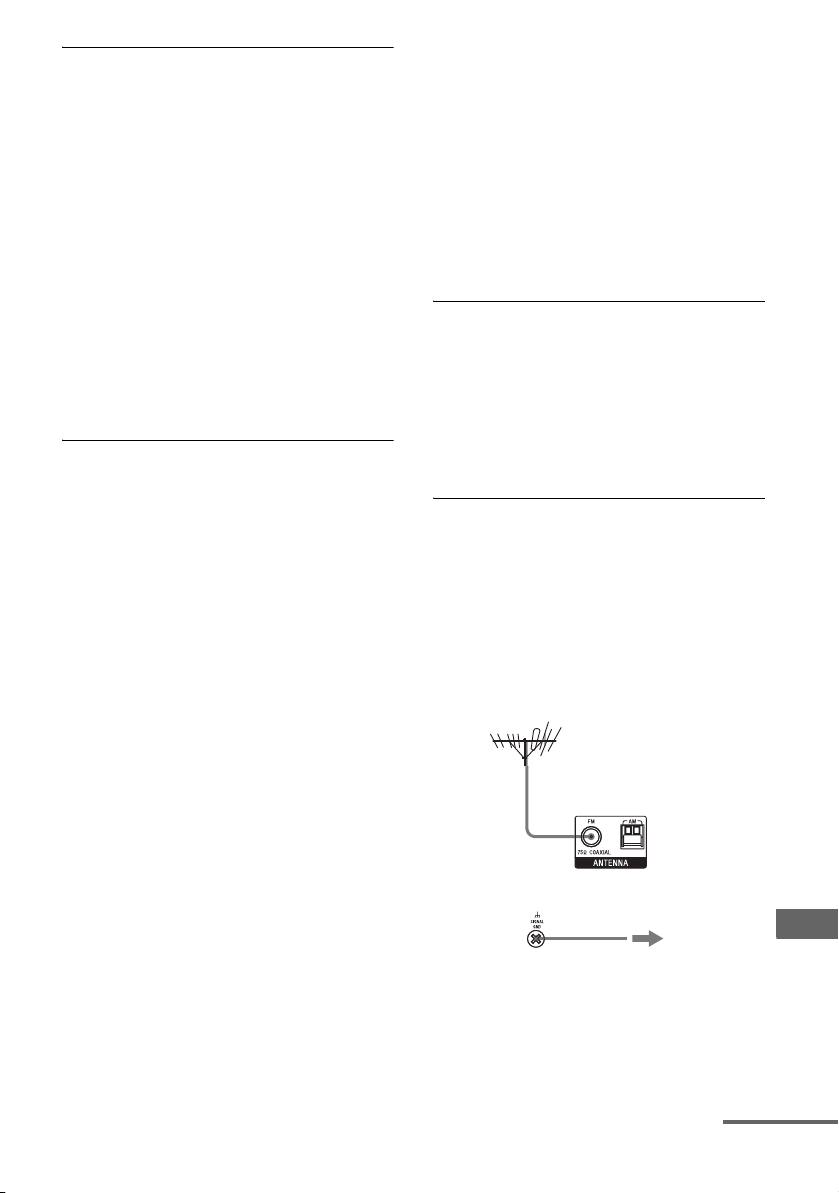
139
US
D:\NORM'S JOB\SONY HA\SO0056\STR-DA3500ES\U VERSION\US\4144907131\01US-
STRDA3500ESUC\110ADD.fm
masterpage: Right
STR-DA3500ES
4-144-907-13(1)
Additional
Information
The Control for HDMI function does not
work.
• Check the HDMI connection (page 85).
• Make sure “Control for HDMI” is set to
“ON” in the HDMI settings menu.
• Make sure the connected component is
compatible with the Control for HDMI
function.
• Check the Control for HDMI settings on
the connected component. Refer to the
operating instructions of the connected
component.
• If you change the HDMI connection,
connect/disconnect the AC power cord, or
there is a power failure, repeat the
procedures of “Preparing Control for
HDMI function” (page 86).
No sound is output from the receiver
and TV speaker while using the System
Audio Control function.
• Make sure the TV is compatible with the
System Audio Control function.
• If the TV does not have System Audio
Control function, set the “Audio Out”
settings in HDMI settings menu to
– “TV+AMP” if you want to listen to the
sound from the TV speaker and receiver.
– “AMP” if you want to listen to the sound
from the receiver.
• When you connect the receiver to a video
component (projector, etc.), sound may
not be output from the receiver. In this
case, select “AMP”.
• If you cannot listen to the sound of a
component connected to the receiver
– Change the input of the receiver to
HDMI when you want to watch a
program on a component connected via
HDMI connection to the receiver.
– Change the TV channel when you want
to watch a TV broadcast.
– Select the component or input you want
to watch when you watch a program on
the component connected to the TV.
Refer to the operating instructions of the
TV on this operation.
• When using the Control for HDMI
function, you cannot control the connected
component using TV’s remote.
– Depending on the connected component
and TV, you may need to set up the
component and TV. Refer to the
operation instructions supplied with
each component and TV.
– Change the input of the receiver to the
HDMI input connected to the
component.
The TV’s remote commander cannot be
used to control the connected
component when using the Control for
HDMI function.
• Change the input of the receiver to the
HDMI input connected to the component.
Tuner
The FM reception is poor.
• Use a 75-ohm coaxial cable (not supplied)
to connect the receiver to an outdoor FM
antenna (aerial) as shown below. If you
connect the receiver to an outdoor antenna
(aerial), ground it against lightning. To
prevent a gas explosion, do not connect the
ground (earth) wire to a gas pipe.
Receiver
To ground
Ground (earth)
wire (not supplied)
Outdoor FM antenna (aerial)
continued

140
US
D:\NORM'S JOB\SONY HA\SO0056\STR-DA3500ES\U VERSION\US\4144907131\01US-
STRDA3500ESUC\110ADD.fm
masterpage: Left
STR-DA3500ES
4-144-907-13(1)
Radio stations cannot be tuned in.
• Check that the antennas (aerials) are
connected securely. Adjust the antennas
(aerials) and connect an external antenna
(aerial), if necessary.
• Keep the satellite radio antenna, away
from the speaker cords and the power cord
(mains lead) to avoid picking up noise.
• The signal strength of the stations is too
weak (when tuning in with automatic
tuning). Use direct tuning.
• Make sure you set the tuning interval
correctly (when tuning in AM stations
with direct tuning).
• No stations have been preset or the preset
stations have been cleared (when tuning by
scanning preset stations). Preset the
stations (page 73).
• Press DISPLAY so that the frequency
appears on the display window.
The system cannot receive satellite
channels at all.
• The receiving condition is not good. Move
the antenna to the place where the
condition is good.
• Check that you subscribed to the desired
satellite radio service (see page 74).
Remote control
The remote does not function.
• Point the remote at the remote sensor on
the receiver.
• Remove any obstacles in the path between
the remote and the receiver.
• Replace all the batteries in the remote with
new ones, if they are weak.
• Make sure that the command modes of the
receiver and the remote are the same. If the
command mode of the receiver and the
remote are different, you cannot operate
the receiver with the remote (page 38).
• Make sure you select the correct input on
the remote.
• When you operate a programmed non-
Sony component, the remote may not
function properly depending on the model
and the maker of the component.
Error messages
If there is a malfunction, the display window
shows a message. You can check the condition
of the system by the message. See the
following table to solve the problem. If any
problem persists, consult your nearest Sony
dealer.
PROTECTOR
Irregular current is output to the speakers, or
the upper panel of the receiver is covered
with something. The receiver will
automatically turn off after a few seconds.
Check the connection of speakers and turn
on the power again.
For other messages, see “Message list after
Auto Calibration measurement” (page 49),
“XM Radio message list” (page 82), “SIRIUS
Satellite Radio message list” (page 83) and
“DIGITAL MEDIA PORT message list”
(page 100).

141
US
D:\NORM'S JOB\SONY HA\SO0056\STR-DA3500ES\U VERSION\US\4144907131\01US-
STRDA3500ESUC\110ADD.fm
masterpage: Right
STR-DA3500ES
4-144-907-13(1)
Additional
Information
Reference sections for clearing
the receiver’s memory
Specifications
AUDIO POWER
SPECIFICATIONS
POWER OUTPUT AND TOTAL
HARMONIC DISTORTION:
With 8 ohms loads, both channels driven, from
20 Hz – 20,000 Hz; rated 100 watts per
channel minimum RMS power, with no more
than 0.09% total harmonic distortion from 250
milliwatts to rated output.
Amplifier section
Power Output
Rated Power Output at Stereo Mode
1)
(8 ohms 20 Hz – 20 kHz, THD 0.09%):
100 W + 100 W
Reference Power Output at Stereo Mode
(4 ohms 20 Hz – 20 kHz, THD 0.15%):
85 W + 85 W
Reference Power Output (8 ohms 1 kHz, THD
0.7%)
FRONT
2)
: 110 W + 110 W
CENTER
2)
: 110 W
SURROUND
2)
: 110 W + 110 W
SURROUND BACK
2)
:
110 W + 110 W
Reference Power Output (4 ohms 1 kHz, THD
0.7%)
FRONT
2)
: 100 W + 100 W
CENTER
2)
: 100 W
SURROUND
2)
: 100 W + 100 W
SURROUND BACK
2)
:
100 W + 100 W
1)
Depending on the sound field settings and the
source, there may be no sound output.
2)
Measured under the following conditions:
Power requirements: 120 V AC, 60 Hz
Frequency response
PHONO RIAA equalization curve
±0.5 dB
Analog 10 Hz – 100 kHz,
±3 dB (with sound field
and equalizer bypassed)
To clear See
All memorized settings page 37
Customized sound fields page 64
continued

142
US
D:\NORM'S JOB\SONY HA\SO0056\STR-DA3500ES\U VERSION\US\4144907131\01US-
STRDA3500ESUC\110ADD.fm
masterpage: Left
STR-DA3500ES
4-144-907-13(1)
Input
PHONO Sensitivity: 2.5 mV
Impedance: 50 kohms
S/N
3)
: 90 dB
(A, 20 kHz LPF)
4)
Analog Sensitivity: 150 mV/
50 kohms
S/N
3)
: 100 dB
(A, 20 kHz LPF)
4)
Digital (Coaxial) Impedance: 75 ohms
S/N: 96 dB
(A, 20 kHz LPF)
4)
Digital (Optical) S/N: 96 dB
(A, 20 kHz LPF)
4)
Output (analog)
AUDIO OUT Voltage: 150 mV/
1 kohm
SUBWOOFER Voltage: 2 V/1 kohm
Equalizer
Gain levels ±10 dB, 1 dB step
3)
INPUT SHORT (with sound field and equalizer
bypassed).
4)
Weighted network.
FM tuner section
Tuning range 87.5 – 108.0 MHz
Antenna (aerial) FM wire antenna (aerial)
Antenna (aerial) terminals
75 ohms, unbalanced
Intermediate frequency
10.7 MHz
AM tuner section
Tuning range
With 10-kHz tuning scale
530 – 1,710 kHz
5)
With 9-kHz tuning scale
531 – 1,710 kHz
5)
Antenna (aerial) Loop antenna (aerial)
Intermediate frequency
450 kHz
5)
You can change the AM tuning scale to either
9 kHz or 10 kHz. After tuning in any AM station,
turn off the receiver. While holding down
TUNING MODE, press POWER on the receiver.
All preset stations will be erased when you change
the tuning scale. To reset the scale to 10 kHz (or
9 kHz), repeat the procedure.
Video section
Inputs/Outputs
Video: 1 Vp-p, 75 ohms
COMPONENT VIDEO:
Y: 1 Vp-p, 75 ohms
P
B
/C
B
: 0.7 Vp-p, 75 ohms
P
R
/C
R
: 0.7 Vp-p, 75 ohms
80 MHz HD Pass Through
HDMI Video
Input/Output (HDMI Repeater block)
640 × 480p@60 Hz
720 × [email protected]/60 Hz
1280 × [email protected]/60 Hz
1920 × [email protected]/60 Hz
1920 × [email protected]/60 Hz
720 × 576p@50 Hz
1280 × 720p@50 Hz
1920 × 1080i@50 Hz
1920 × 1080p@50 Hz
1920 × 1080p@24 Hz
General
Power requirements 120 V AC, 60 Hz
Power output (DIGITAL MEDIA PORT)
DC OUT: 5 V, 0.7A MAX
Power consumption 350 W
Power consumption (during standby mode)
0.9 W (when “Control for
HDMI” and “Installer
Mode” are set to “OFF”,
and the power for zone 2/
zone 3 is turned off.)
Dimensions (width/height/depth) (Approx.)
17 × 6 1/4 × 15 3/8 inches
(430 x 157.5 x 388 mm)
including projecting parts
and controls
Mass (Approx.) 27 lb 6 oz (12.4 kg)
143
US
D:\NORM'S JOB\SONY HA\SO0056\STR-DA3500ES\U VERSION\US\4144907131\01US-
STRDA3500ESUC\110ADD.fm
masterpage: Right
STR-DA3500ES
4-144-907-13(1)
Additional
Information
Supplied accessories
Operating Instructions (this manual)
Quick Setup Guide (1)
GUI Menu List (1)
Optimizer microphone (ECM-AC2) (1)
FM wire antenna (aerial) (1)
AM loop antenna (aerial) (1)
AC power cord (mains lead) (1)
Multi function remote commander (1)
Simple remote commander (1)
R6 (size-AA) batteries (4)
Design and specifications are subject to
change without notice.
Halogenated flame retardants are not used in
the certain printed wiring boards.

144
US
D:\NORM'S JOB\SONY HA\SO0056\STR-DA3500ES\U VERSION\US\4144907131\01US-
STRDA3500ESUC\010COVIX.fm
masterpage: Left
STR-DA3500ES
4-144-907-13(1)
Index
Symbols
U SIGNAL GND terminal 24
Numerics
2 channel 60
24p Auto Sound Sync 58
2ch Analog Direct 60, 119
2ch Stereo Mode
60
4 :
43
5.1 channel 15
7.1 channel
15
8 : 43
A
A.F.D. (mode) 62
A/V Sync 56, 116
AC power cord (mains lead) 37
AM
71, 105, 119
Audio (Settings) 56, 116
Auto Calibration 44, 113, 117
Auto Tuning
71, 119
B
BI-AMP 69
Bi-amplifier connection
110
Blu-ray disc player 27, 53
C
Calibration Type Select 48, 113
Category Mode 77, 121
CD player
21, 24, 52
Changing the display 105
Clear
memory
37
remote
131
Command mode 38
Connections
antennas (aerials)
36
audio components 20
speakers
17
video components 25
Control for HDMI
connecting
85
preparing 86
Crossover Freq 69
D
D.Range Comp (Dynamic range compressor)
70
DCAC (Digital Cinema Auto Calibration)
44
Decode Priority 56, 116
DIGITAL MEDIA PORT 10, 14, 21, 97
Direct Tuning
72, 78, 119, 121
Display 106
Distance
66
Distance Unit
70, 114
Dolby Digital EX 61
DTS Neo:6 (Cinema, Music)
62
Dual Mono
56, 116
DVD player 27, 29, 53
DVD recorder
32
E
Effect Type 115
Enhanced Setup
50
Enhanced Surround mode 59, 119
EQ (Settings)
70, 115
EQ Curve
50
Equalizer 70

145
US
D:\NORM'S JOB\SONY HA\SO0056\STR-DA3500ES\U VERSION\US\4144907131\01US-
STRDA3500ESUC\010COVIX.fm
masterpage: Right
STR-DA3500ES
4-144-907-13(1)
Additional
Information
F
FM 71, 105, 119
FM Mode 72, 115
G
Gain Adjusting (Bass/Treble) 70
GUI (Graphical User Interface) 19, 40
H
HD-D.C.S. 133
HDMI (Settings)
86, 116
HDMI jacks
9, 26
Headphone (Settings) 63
I
Input 50
Input Assign 103
INPUT MODE 101
INPUT SELECTOR
52, 53, 54, 55
Installer Mode 58, 116
iPod 98
L
Level 66, 70
LFE (Low Frequency Effect) 106
List Mode
100
Lock Code 81, 115
M
Manual Setup 65, 66
MASTER VOLUME
8, 52, 53, 54, 55
Messages
Auto Calibration
49
DIGITAL MEDIA PORT
100
error
140
SIRIUS
83
XM 82
Movie
63
MULTI CHANNEL DECODING lamp 53
Music 63
Muting
51
N
Name Input 101
Network Client 98
Neural-THX
62
NIGHT MODE 65
O
One-Touch Play 87
P
Parental Lock 80, 115
Phase Audio
69, 113
Phase Noise 69, 113
PHONES 8
PLII
62
PLIIx 62
Position (Auto Calibration) 50, 113
Preset channels
79, 122
Preset Mode 79
Preset stations 73, 120
PROTECTOR
140
Q
Quick Setup 46
R
Radio ID 76, 115, 121
Recording
109, 110
Remote 11–14, 38, 122–131
Resetting 37, 64
Resolution
57, 96, 116
continued

146
US
D:\NORM'S JOB\SONY HA\SO0056\STR-DA3500ES\U VERSION\US\4144907131\01US-
STRDA3500ESUC\010COVIX.fm
masterpage: Left
STR-DA3500ES
4-144-907-13(1)
S
Satellite radio 74
Screen Saver 58
Sleep timer
108
Sound Field Select 59, 119
Sound Field Setup 59
Speaker (Settings)
43, 69, 114
Speaker Impedance 43, 114
Speaker Pattern 67, 114
SPEAKERS (OFF/A/B/A+B)
8, 44
Super Audio CD player 21, 23, 24, 52
Sur Back Assign 69
Surround Settings
115
System (Settings) 58, 116
System Audio Control 88
System Power Off
88
T
Test Tone 68, 69, 113
Tuner
71
Tuner (Settings) 115
Tuning 71, 72, 73
U
Up converting 33
V
VCR 32, 55
Video (Settings) 57, 116
Video game
54
Z
Zone 12V Trigger 94, 116
ZONE 2
69
ZONE 3
10
Zone Input Change
94
Zone Power ON/OFF
94
Zone Volume Adjust 94


D:\NORM'S JOB\SONY HA\SO0056\STR-DA3500ES\U VERSION\US\4144907131\01US-
STRDA3500ESUC\010BCO.fm
masterpage: Left
STR-DA3500ES
4-144-907-13(1)
Sony Corporation Printed in Malaysia