
imagine the possibilities
Thank you for purchasing this Samsung product.
Electric Range
user manual
ENGLISH
NE595R0****
NE59J342*****
NE595R0ABSR_AA_DG68-00433A-09_EN.indd 1 2016-03-30 �� 8:04:04
1_ features of your new range
features of your new range
Enhanced convenience. Better cooking. Easy maintenance. Your new electric range has been designed to
bring you these benefits and more.
• Steam Quick cleaning
Thanks to Steam Quick™, Samsung’s unique technology for light-duty cleaning jobs, keeping
your oven spick-and-span is a snap — no hassle, no odor, no chemicals. Steam Quick™ cleans
the inside of your range with high-temperature steam in just 20 minutes.
• Bigger is better
With a capacity of 5.9 cubic feet, your new range is equipped with more space than any of its
competitors in the U.S. market. This means greater convenience for you when cooking for the
holidays or when entertaining.
• A cooktop with 5 burners
- Four main burners with two that dial heat up to dierent pot sizes.
- A smaller warming burner in the center of the range top.
important safety instructions
Read and follow all instructions before using your oven to prevent the risk
of fire, electric shock, personal injury, or damage when using the range.
This guide does not cover all possible conditions that may occur. Always contact
your service agent or manufacturer about problems that you do not understand.
WHAT YOU NEED TO KNOW ABOUT
SAFETY INSTRUCTIONS
Warnings and Important Safety Instructions in this manual do not cover all possible
conditions and situations that may occur. It is your responsibility to use common
sense, caution, and care when installing, maintaining, and operating your oven.
IMPORTANT SAFETY SYMBOLS AND PRECAUTIONS
What the icons and signs in this user manual mean:
WARNING
Hazards or unsafe practices that may result in severe
personal injury or death.
CAUTION
Hazards or unsafe practices that may result in minor
personal injury or property damage.
CAUTION
To reduce the risk of fire, explosion, electric shock, or
personal injury when using your oven, follow these basic
safety precautions.
NE595R0ABSR_AA_DG68-00433A-09_EN.indd 1 2016-03-30 �� 8:04:05
Important safety instructions _2
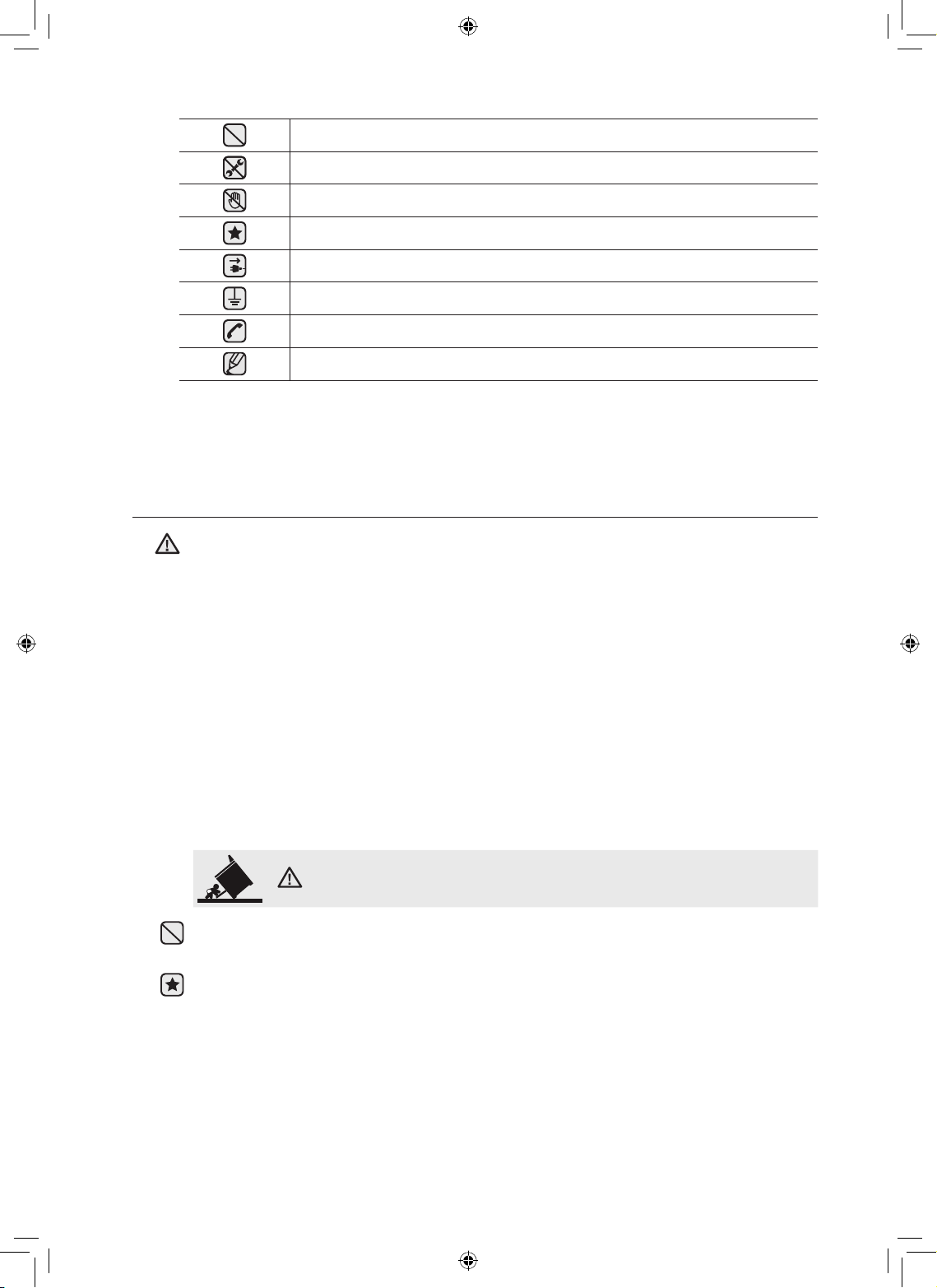
Do NOT attempt.
Do NOT disassemble.
Do NOT touch.
Follow directions explicitly.
Unplug the power plug from the wall socket.
Make sure the machine is grounded to prevent electric shock.
Call the service center for help.
Note
These warning signs are here to prevent injury to you and others.
Please follow them explicitly.
After reading this section, keep it in a safe place for future reference.
ANTI-TIP DEVICE
WARNING
WARNING - To reduce the risk of tipping the range, the range must be
secured by a properly installed Anti-Tip device. AFTER THE RANGE HAS
BEEN INSTALLED, CONFIRM THAT THE ANTI-TIP DEVICE HAS BEEN
PROPERLY INSTALLED AND VERIFY THAT THE ANTI-TIP DEVICE IS
PROPERLY ENGAGED. Refer to the installation manual for instructions.
a) If the anti-tip device is not installed, a child or adult can tip the range
and be killed.
b) Verify the anti-tip device has been properly installed and engaged at
rear right (or rear left) of the range bottom.
c) If you move the range and then move it back into place, ensure the anti-
tip device is re-engaged at the right or left rear of the range bottom.
d)
Do not operate the range without the anti-tip device in place and engaged.
e) Failure to do so can result in death or serious burns to children or adults.
WARNING
WARNING
Do not step, lean, or sit on the doors of the range. You can cause
the range to tip, resulting in burns or serious injuries.
Confirm that the Anti-Tip device is installed properly. Then, to verify that
the Anti-Tip device is engaged, grasp the top rear edge of the range and
carefully attempt to tilt it forward. The Anti-Tip device should prevent the
range from tilting forward more than a few inches.
If you pull the range out from the wall for any reason, make sure the anti-
tip device is properly engaged when you push the range back against
the wall. If it is not, there is a possible risk of the range tipping over and
causing injury if you or a child stand, sit or lean on an open door.
NE595R0ABSR_AA_DG68-00433A-09_EN.indd 2 2016-03-30 �� 8:04:08
3_ Important safety instructions
STATE OF CALIFORNIA PROPOSITION
65WARNING (US ONLY)
WARNING : This product contains chemicals known to the State of California to
cause cancer and birth defects or other reproductive harm.
FOR YOUR SAFETY
When using electrical appliances, you should follow basic safety
precautions, including the following:
CAUTION
Use this appliance only for its intended purpose as described in this
Owner’s Manual.
Potentially hot surfaces include the cooktop, areas facing the cooktop,
oven vent opening, surfaces near the opening, crevices around the oven
door.
Be sure your appliance is properly installed and grounded by a qualified
technician.
User servicing - Do not repair or replace any part of the appliance
unless specifically recommended in the manual. All other servicing should
be referred to a qualified technician.
Always disconnect the power to the appliance before servicing by
removing the fuse or switching o the circuit breaker.
Do not enter the oven.
Do not store items of interest to children in cabinets above a
range or on the back guard of a range. Children climbing on the range
to reach items could be seriously injured.
Do not leave children alone. Never leave children alone or unattended
in an area where this appliance is in use. They should never be allowed to
sit or stand on any part of the appliance.
Never use your appliance for warming or heating the room.
Do not use water on grease fires. Turn o the oven to avoid spreading
the flame. Smother the fire or flame by closing the door or use a dry
chemical, baking soda, or foam-type extinguisher.
NE595R0ABSR_AA_DG68-00433A-09_EN.indd 3 2016-03-30 �� 8:04:08
Important safety instructions _4
Storage in or on appliance. Do not store flammable materials in the
oven or near the surface units. Be sure all packing materials are removed
from the appliance before operating it. Keep plastics, clothes, and paper
away from parts of the appliance that may become hot.
Wear proper apparel. Never wear loose-fitting or hanging garments
while using the appliance.
Use only dry potholders. Placing moist or damp potholders on hot
surfaces may result in burns from steam. Do not let the potholder touch
hot heating elements. Do not use a towel or other bulky cloth.
Teach children not to play with the controls or any other part of the range.
For your safety, do not use high-pressure water cleaners or steam jet
cleaners.
If the power cord is damaged, it must be replaced by the manufacturer,
its service agent or similarly qualified persons in order to avoid a hazard.
The appliance is not intended for use by persons (including children) with
reduced physical, sensory or mental capabilities, or lack of experience
and knowledge, unless they have been given supervision or instruction
concerning use of the appliance by a person responsible for their safety.
SURFACE COOKING UNITS
Never leave surface units unattended at high heat settings.
Boilovers cause smoking and greasy spillovers that may ignite.
Do not lift the cooktop. Lifting the cooktop can damage the range and
cause the range to malfunction.
Do not operate the cooktop without cookware. If the cooktop
operates without cookware, the control knobs will become hot.
Never use the glass cooktop surface as a cutting board.
NE595R0ABSR_AA_DG68-00433A-09_EN.indd 4 2016-03-30 �� 8:04:08
5_ Important safety instructions
Use care when touching the cooktop. The glass surface of the
cooktop will retain heat after the controls have been turned o.
Be careful when placing spoons or other stirring utensils on the
glass cooktop surface when it is in use. They may become hot and
could cause burns.
Use proper pan sizes. This appliance is equipped with surface units of
dierent size. Select pots and pans that have flat bottoms large enough
to cover the surface area of the heating element. Using undersized
cookware will expose a portion of the heating element to direct contact
and may result in the ignition of clothing. Matching the size of the pot or
pan to the burner will also improve eciency.
Utensil Handles Should Be Turned Inward and Not Extend Over Adjacent
Surface Units – To reduce the risk of burns, ignition of flammable
materials, and spillage due to unintentional contact with the utensil, the
handle of a utensil should be positioned so that it is turned inward, and
does not extend over adjacent surface units.
Glazed cooking utensils. Only certain types of glass, glass/ceramic,
ceramic, earthenware, or other glazed cookware are suitable for range-
top service without breaking due to sudden changes in temperature.
Cookware handles should be turned outward and not extend
over adjacent surface units. To reduce the risk of burns, ignition
of flammable materials, and spillage due to unintentional contact with
cookware, cookware handles should be positioned so that they are
turned outward, and do not extend over adjacent surface units.
Cleaning. Read and follow all instructions and warnings on the cleaning
cream labels.
Be sure you know which control knob operates each surface unit. Make
sure you turned on the correct surface unit.
Always turn the surface units o before removing cookware.
When preparing flaming foods under the hood, turn the fan on.
Keep an eye on foods being fried at high or medium high heat settings.
NE595R0ABSR_AA_DG68-00433A-09_EN.indd 5 2016-03-30 �� 8:04:08
Important safety instructions _6
ELECTRICAL SAFETY
Proper Installation- Be sure your appliance is properly installed and
grounded by a qualified technician.
The appliance should be serviced only by qualified service personnel. Repairs
carried out by unqualified individuals may cause injury or a serious malfunction. If
your appliance is in need of repair, contact a Samsung authorized service center.
Failure to follow these instructions may result in damage and void the warranty.
Flush - mounted appliances may be operated only after they have
been installed in cabinets and workplaces that conform to the relevant
standards. This ensures sucient protection against contact for electrical
units as required by the essential safety standards.
If your appliance malfunctions or if fractures, cracks or splits appear:
- switch o all cooking zones
- unplug the range from the AC wall outlet
- contact your local service center.
WARNING
WARNING-If the surface is cracked, switch o and unplug the appliance
to avoid the possibility of electrical shock. Do not use your Induction
Cooktop until the glass surface has been replaced.
WARNING
WARNING- Ensure that the appliance is switched o before replacing
the lamp to avoid the possibility of electric shock.
The range should not be placed on a base.
The oven must be switched o before removing the guard and that, after
cleaning, the guard must be replaced in accordance with the instructions.
CHILD SAFETY
WARNING
WARNING-This appliance is not intended for use by young children or
infirm persons without the adequate supervision of a responsible adult.
Young children should be supervised to ensure that they do not play with
the appliance.
Keep children away from the door when opening or closing it as they may
bump themselves on the door or catch their fingers in the door.
The cooking zones will become hot when you cook. Always keep small
children away from the appliance.
During cleaning, the surfaces may get hotter than usual and children
should be kept away.
WARNING
WARNING- Accessible parts may become hot during use. To avoid
burns, young children should be kept away.
NE595R0ABSR_AA_DG68-00433A-09_EN.indd 6 2016-03-30 �� 8:04:08
7_ Important safety instructions
OVEN
DO NOT TOUCH THE HEATING ELEMENTS OR INTERIOR
SURFACES OF THE OVEN. Heating elements may be hot even though
they are dark in color. Interior surfaces of an oven become hot enough to
cause burns. During and after use, do not touch or let clothing or other
flammable materials contact the heating elements or interior surfaces
of the oven until they have had sucient time to cool. Other surfaces of
the appliance may become hot enough to cause burns. Among these
surfaces are oven vent openings and surfaces near these openings, oven
doors, and windows of oven doors.
Do not heat unopened food containers. Build-up of pressure may
cause the container to burst and result in injury.
Do not use the oven to dry newspapers. If overheated, they can
catch on fire.
Do not use the oven for a storage area. Items stored in an oven can
ignite.
Use care when opening the door. Let hot air or steam escape before
you remove food from or replace food into the oven.
Protective liners. Do not use aluminum foil to line the oven bottoms,
except as suggested in the manual. Improper installation of these liners
may result in a risk of electric shock or fire.
Keep oven vent ducts unobstructed. The oven vent is located above
the right rear surface unit. This area could become hot during oven use.
Never block this vent or place plastic or heat-sensitive items on it.
Placement of oven racks. Always place oven racks in the desired
location while the oven is cool. If the rack must be moved while the oven
is hot, use potholders. Do not let the potholders come in contact with the
hot heating element in the oven.
Do not allow aluminum foil or a meat probe to contact the heating
elements.
During use the appliance becomes hot.
Care should be taken to avoid touching heating elements inside the oven.
Do not use harsh abrasive cleaners or sharp metal scrapers to clean the
oven door glass since they can scratch the surface, which may result in
shattering of the glass.
NE595R0ABSR_AA_DG68-00433A-09_EN.indd 7 2016-03-30 �� 8:04:08
Important safety instructions _8
SELF-CLEANING OVENS
Do not clean the door gasket. The door gasket is essential for a good
seal. Care should be taken not to rub, damage, or move the gasket.
Never keep pet birds in the kitchen. Birds are extremely sensitive
to the fumes released during an oven self-clean cycle. Fumes may be
harmful or fatal to birds. Move birds to a well-ventilated room.
Clean only the parts listed in this manual in the self-clean cycle.
Before self-cleaning the oven, remove the partition, rack, utensils, and food.
Do not use any commercial oven cleaner or oven liner protective coating
of any kind in or on the outside of the oven. Use only a ceramic cooktop
cleaner.
Remove the nickel oven shelves from the oven before you begin the self-
cleaning cycle, or they may discolor.
If the self-clean mode malfunctions, turn the oven o and disconnect the
power supply. Have it serviced by a qualified technician.
Excess spillage must be removed before cleaning and shall specify which
utensils can be left in the oven during cleaning.
VENTILATING HOOD
Clean ventilating hoods frequently. Do not let grease accumulate on
the hood or filter.
When flaming foods under the hood, turn the fan on.
GLASS/CERAMIC COOKING SURFACES
DO NOT TOUCH SURFACE UNITS OR AREAS NEAR UNITS.
Surface units may be hot even though they are dark in color. Areas near
surface units may become hot enough to cause burns. During and after
use, do not touch, or let clothing or other flammable materials contact the
surface units or areas near the units until they have had sucient time to
cool. Among these areas are the cook-top and the facing of the cook-top.
Do not cook on a broken cooktop. If the cooktop should break,
cleaning solutions and spillovers may penetrate the broken cook-top and
create a risk of electric shock. Contact a qualified technician immediately.
Clean the cooktop with caution. If a wet sponge or cloth is used to
wipe spills on a hot cooking area, be careful to avoid steam burns. Some
cleaners can produce noxious fumes if applied to a hot surface.
NE595R0ABSR_AA_DG68-00433A-09_EN.indd 8 2016-03-30 �� 8:04:09
9_ Important safety instructions
BEFORE YOU BEGIN
Clean the oven thoroughly before using for the first time. Remove
the accessories and operate the oven at the bake setting of 400 °F for 1
hour before using. There will be a distinctive odor. This is normal. Ensure
your kitchen is well ventilated during this conditioning period.
WARNING
CRITICAL INSTALLATION WARNINGS
This appliance must be installed by a qualified technician or service
company.
- Failing to have a qualified technician install the range may result in
electric shock, fire, an explosion, problems with the product, or injury.
Unpack the oven, remove all packaging material and examine the oven
for any damage such as dents on the interior or exterior of the oven,
broken door latches, cracks in the door, or a door that is not lined up
correctly. If there is any damage, do not operate the oven and notify your
dealer immediately.
Plug the power cord into a properly grounded outlet with the proper
configuration. Your oven should be the only item connected to this circuit.
Keep all packaging materials out of the reach of children. Children may
use them for play and injure themselves.
Install your appliance on a level and hard floor that can support its weight.
- Failing to do so may result in abnormal vibrations, noise, or problems
with the product.
This appliance must be properly grounded.
Do not ground the appliance to a gas pipe, plastic water pipe, or
telephone line.
- This may result in electric shock, fire, an explosion, or problems with
the product
Do not cut or remove the ground prong from the power cord under any
circumstances.
Connect the oven to a circuit that provides the correct amperage.
NE595R0ABSR_AA_DG68-00433A-09_EN.indd 9 2016-03-30 �� 8:04:09
Important safety instructions _10
Do not install this appliance in a humid, oily or dusty location, or in a
location exposed to direct sunlight or water (rain drops).
- This may result in electric shock or fire.
Do not use a damaged power cord or loose wall socket.
- This may result in electric shock or fire.
Do not pull or excessively bend the power cord.
Do not twist or tie the power cord.
Do not hook the power cord over a metal object, place a heavy object on
the power cord, or insert the power cord between objects.
- This may result in electric shock or fire.
If the power cord is damaged, contact your nearest service center.
CAUTION
CRITICAL USAGE WARNING
If the appliance is flooded by any liquid, please contact your nearest
service center. Failing to do so may result in electric shock or fire.
If the appliance produces a strange noise, a burning smell, or smoke,
unplug the power plug immediately and contact your nearest service center.
- Failing to do so may result in electric shock or fire
In the event of a gas leak (such as propane gas, LP gas, etc.), ventilate the
area immediately. Do not touch the power cord. Do not touch the appliance.
- A spark may result in an explosion or fire.
Take care not to contact the oven door, heating elements, or any of the
other hot parts with your body while cooking or just after cooking.
- Failing to do so may result in burns.
If materials inside the oven should ignite, keep the oven door closed, turn
the oven o and disconnect the power cord, or shut o power at the fuse
or circuit breaker panel. If the door is opened, the fire may spread.
Always observe safety precautions when using your oven. Never try to
repair the oven on your own - there is dangerous voltage inside. If the
oven needs to be repaired, contact an authorized service center near you.
If you use the appliance when it is contaminated by foreign substances
such as food waste, it may result in a problem with the appliance.
Take care when removing the wrapping from food taken out of the
appliance.
- If the food is hot, hot steam may be emitted abruptly when you remove
the wrapping and this may result in burns.
NE595R0ABSR_AA_DG68-00433A-09_EN.indd 10 2016-03-30 �� 8:04:09
11_ Important safety instructions
Do not attempt to repair, disassemble, or modify the appliance yourself.
- Since a high voltage current enters the product chassis, it may result in
electric shock or fire.
- When a repair is needed, contact your nearest service center.
If any foreign substance such as water has entered the appliance, contact
your nearest service center.
- Failing to do so may result in electric shock or fire.
Do not touch the power cord with wet hands.
- This may result in electric shock.
Do not turn the appliance o while an operation is in progress.
- This may cause a spark and result in electric shock or fire.
Keep all packaging materials well out of the reach of children, as
packaging materials can be dangerous to children.
- If a child places a plastic bag over its head, the child can suocate.
Do not let children or any person with reduced physical, sensory or
mental capabilities use this appliance unsupervised.
Make sure that the appliance’s controls and cooking areas are out of the
reach of children.
- Failing to do so may result in electric shock, burns or injury.
Do not touch the inside of the appliance immediately after cooking. The
inside of the appliance will be hot.
- Failing to do so may result in burns.
Do not use or place flammable sprays or objects near the oven.
- Flammable items or sprays can cause fires or an explosion.
Do not insert fingers, foreign substances, or metal objects such as pins or
needles into inlets, outlets, or holes. If foreign substances are inserted into
any of these holes, contact your product provider or nearest service center.
Do not tamper with or make any adjustments or repairs to the door. Under
no circumstances should you remove the door or outer shell of the oven.
Do not store or use the oven outdoors.
Never use this appliance for purposes other than cooking.
-
Using the appliance for any purpose other than cooking may result in fire.
Open the cap or stopper of sealed containers (herb tonic tea bottle, baby
bottle, milk bottle and so on) before heating them. Make a hole in food items
that have shells (eggs, chestnuts, etc) with a knife before cooking them.
- Failing to do so may result in burns or injury.
NE595R0ABSR_AA_DG68-00433A-09_EN.indd 11 2016-03-30 �� 8:04:09
Important safety instructions _12
Never heat plastic or paper containers and do not use them for cooking.
- Failing to do so may result in fire.
Do not heat food wrapped in paper from magazines, newspapers, etc.
- This may result in fire.
Do not open the door when the food in the oven is burning.
- If you open the door, it causes an inflow of oxygen and may cause the
food to ignite.
Do not apply excessive pressure to the door or the inside of the
appliance. Do not strike the door or the inside or the appliance.
- Hanging on to the door may result in the product falling and cause
serious injury.
- If the door is damaged, do not use the appliance. Contact a service
center.
Do not hold food in your bare hands during or immediately after cooking.
- Use cooking gloves. The food may be very hot and you could burn
yourself.
CAUTION
USAGE CAUTIONS
If the surface is cracked, turn the appliance o.
- Failing to do so may result in electric shock.
Dishes and containers can become hot. Handle with care.
Hot foods and steam can cause burns. Carefully remove container
coverings, directing the steam away your hands and face.
Remove lids from baby food jars before heating. After heating baby food,
stir well to distribute the heat evenly. Always test the temperature by
tasting before feeding the baby. The glass jar or the surface of the food
may appear to be cooler than the interior, which can be hot enough to
burn an infant’s mouth.
Take care as beverages or food may be very hot after heating.
- Especially when feeding a child. Check that it has cooled suciently.
Take care when heating liquids such as water or other beverages.
- Make sure to stir during or after cooking.
- Avoid using a slippery container with a narrow neck.
- Wait at least 30 seconds after heating before removing the heated
liquid.
- Failing to do so may result in an abrupt overflow of the contents and
cause burns.
NE595R0ABSR_AA_DG68-00433A-09_EN.indd 12 2016-03-30 �� 8:04:09
13_ Important safety instructions
Do not stand on top of the appliance or place objects (such as laundry,
oven cover, lighted candles, lighted cigarettes, dishes, chemicals, metal
objects, etc.) on the appliance.
- Items, such as a cloth, may be caught in the door.
- This may result in electric shock, fire, problems with the product, or
injury.
Do not operate the appliance with wet hands.
- This may result in electric shock.
Do not spray volatile substances such as insecticide onto the surface of
the appliance.
- As well as being harmful to humans, it may also result in electric shock,
fire or problems with the product.
Do not put your face or body close to the appliance while cooking or
when opening the door just after cooking.
- Take care that children do not come too close to the appliance.
- Failing to do so may result in children burning themselves.
Do not place food or heavy objects over the edge of the oven door.
- If you open the door, the food or object may fall and this may result in
burns or injury.
Do not abruptly cool the door, the inside of the appliance, or a dish by
pouring water over it during or just after cooking.
- This may result in damage to the appliance. The steam or water spray
may result in burns or injury.
Do not operate while empty except for self-cleaning.
Do not defrost frozen beverages in narrow-necked bottles. The containers
can break.
Do not scratch the glass of the oven door with a sharp object.
- This may result in the glass being damaged or broken.
Do not store anything directly on top of the appliance when it is in
operation.
Do not use sealed containers. Remove seals and lids before cooking.
Sealed containers can explode due to buildup of pressure even after the
oven has been turned o.
NE595R0ABSR_AA_DG68-00433A-09_EN.indd 13 2016-03-30 �� 8:04:09
Important safety instructions _14
Take care that food you are cooking in the oven does not come into
contact with the heating element.
- This may result in fire.
Do not over-heat food.
- Overheating food may result in fire.
CAUTION
CRITICAL CLEANING WARNINGS
Do not clean the appliance by spraying water directly on to it.
Do not use benzene, thinner or alcohol to clean the appliance.
- This may result in discoloration, deformation, damage, electric shock
or fire.
Take care not to hurt yourself when cleaning the appliance (external/
internal).
- You may hurt yourself on the sharp edges of the appliance.
Do not clean the appliance with a steam cleaner.
- This may result in corrosion.
Keep the inside of the oven clean. Food particles or spattered oils stuck
to the oven walls or floor can cause paint damage and reduce the
eciency of the oven.
NE595R0ABSR_AA_DG68-00433A-09_EN.indd 14 2016-03-30 �� 8:04:09

15_ Contents
contents
INTRODUCING YOUR NEW RANGE
16
16 Overview
16 What’s included with your range
SURFACE COOKING
17
17 About surface cooking
19 How to set the appliance for surface
cooking
21 Using the proper cookware
21 Choosing the proper cookware
22 Protecting the smoothtop surface
OPERATING THE OVEN
23
23 The oven control panel
24 Setting the clock
25 Minimum and maximum settings
25 Setting the kitchen timer
26 Using the oven racks
27 Baking
28 Convection baking
30 Convection roasting
32 Timed cooking
33 Delay timed cooking
34 Broiling
36 Using the custom cook feature
37 Using the easy cook feature
38 Using the keep warm function
39 Extra features
41 Turning the oven light on and o
42 Setting the Sabbath Feature
MAINTAINING YOUR APPLIANCE
44
44 Self-cleaning
46 Steam-cleaning
47 Care and cleaning of the oven
49 Care and cleaning of the glass cooktop
51 Removing and replacing the oven door
52 Removing and replacing the storage drawer
53 Changing the oven light
TROUBLESHOOTING
54
54 Troubleshooting
WARRANTY
58
58 Warranty
NE595R0ABSR_AA_DG68-00433A-09_EN.indd 15 2016-03-30 �� 8:04:09
INTRODUCING
Introducing your new range _16
introducing your new range
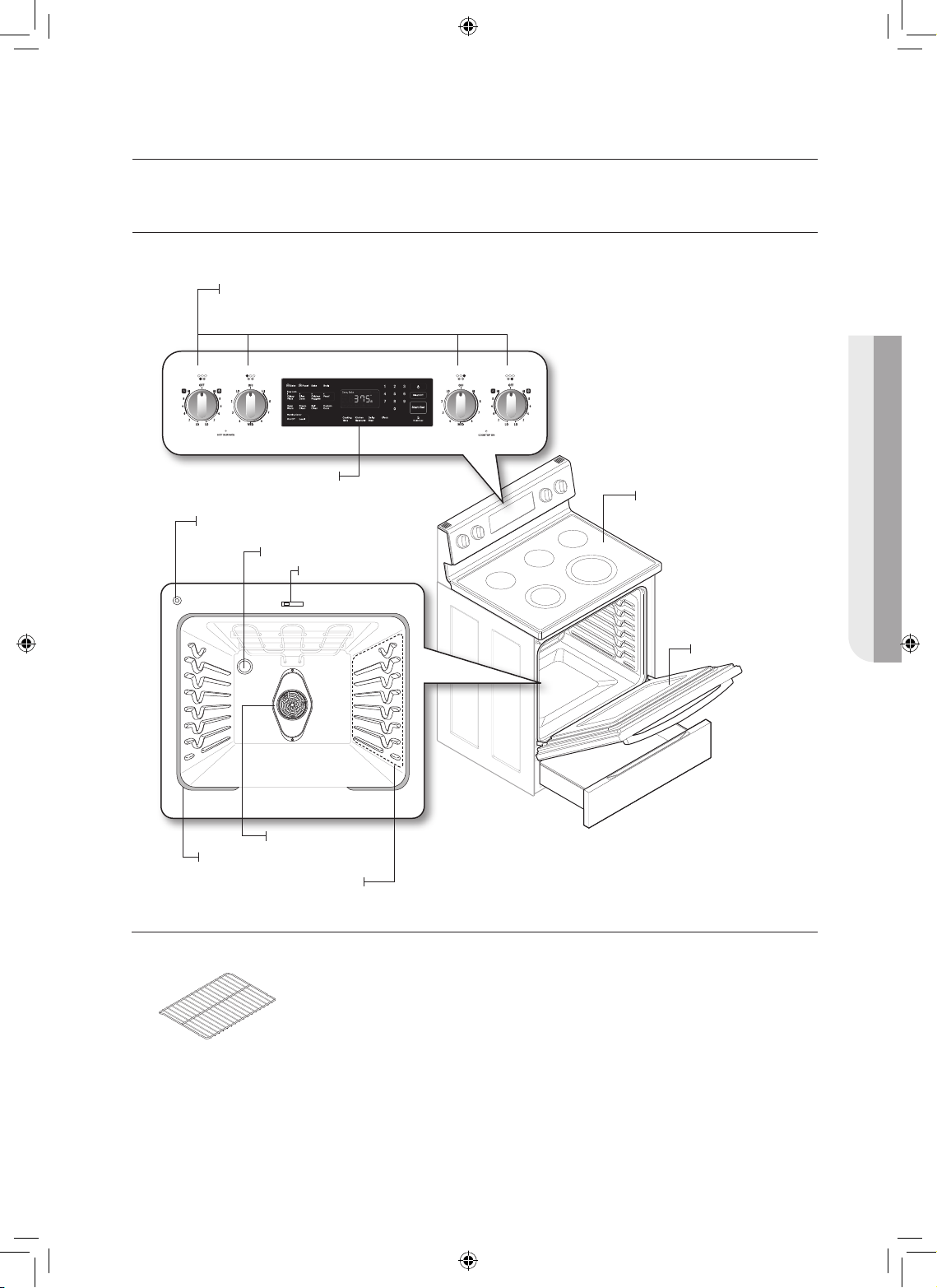
OVERVIEW
Oven door
Convection fan
Shelf position
Glass surface
Automatic oven
light switch
* Oven light
Self/steam clean latch
Gasket
Oven control panel
See page 23 for more
information
* Surface control knobs
See page 18 for more
information
WHAT’S INCLUDED WITH YOUR RANGE
* Wire racks
If you need an accessory marked with a *, you can buy it from the Samsung
Contact Center (1-800-726-7864).
NE595R0ABSR_AA_DG68-00433A-09_EN.indd 16 2016-03-30 �� 8:04:12
17_ Surface cooking
surface cooking
ABOUT SURFACE COOKING
CAUTION
BEFORE COOKING
• Do not use the glass cooktop surface as a cutting board.
• Do not place or store items that can melt or catch fire on the glass cooktop, even
when it is not being used.
• Turn the surface units on only after placing the cookware on them.
• Do not store heavy items above the cooktop surface. They could fall and damage it.
CAUTION
DURING COOKING
• Do not place aluminum foil or plastic items such as salt and pepper shakers, spoon
holders, or plastic wrappings on the range when it is in use. The hot air from the vent
could melt plastics or ignite flammable items.
• Make sure the correct surface unit is turned on.
• Never cook directly on the glass. Always use cookware.
• Always place the pan in the center of the surface unit you are cooking on.
• Never leave surface units unattended while using a high heat setting. Boilovers cause
smoking and greasy spillovers that may catch on fire.
• Turn the surface units o before removing cookware.
• Do not use plastic wrap to cover food. Plastic may melt onto the surface and be very
dicult to remove.
CAUTION
AFTER COOKING
• Do not touch the surface units until they have cooled down.
• The surface may be still be hot and burns may occur if the glass surface is touched
before it has cooled down suciently.
• Immediately clean spills on the cooking area to prevent a tough cleaning chore later.
• If cabinet storage is provided directly above the cooking surface, make sure that the
items are infrequently used and can be safely stored in an area subjected to heat.
Temperatures may be unsafe for items such as volatile liquids, cleaners or aerosol
sprays.
About the radiant surface elements
The temperature rises gradually and evenly. As the temperature rises, the radiant element will glow
red. To maintain the selected setting, the element will cycle on and o. The heating element retains
enough heat to provide a uniform and consistent heat during the o cycle. For ecient cooking,
turn o the element several minutes before cooking is complete. This will allow residual heat to
complete the cooking process.
Radiant elements have a limiter that allows the element to cycle ON and OFF, even at the HI
setting. This helps to prevent damage to the ceramic cooktop. Cycling at the HI setting is
normal and can occur if the cookware is too small for the radiant element or if the cookware
bottom is not flat.
NE595R0ABSR_AA_DG68-00433A-09_EN.indd 17 2016-03-30 �� 8:04:12
SURFACE COOKING
Surface cooking _18
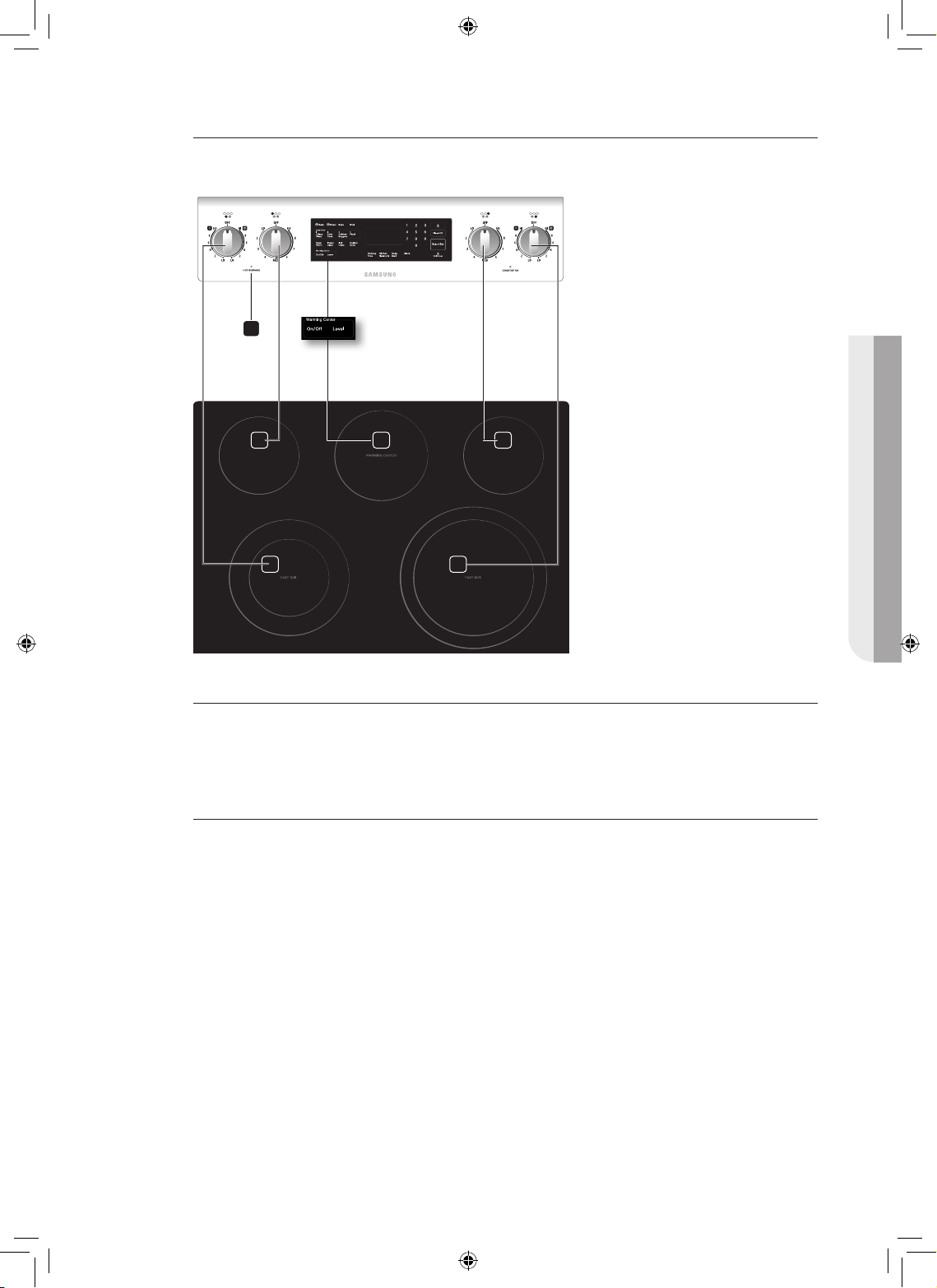
Location of the radiant surface elements and controls
The radiant control knobs operate the radiant surface elements on the cooktop as shown below.
1 5 2
3 4
6
1. Single element: Left rear
2. Single element: Right rear
3. Dual element: Left front
4. Dual element: Right front
5. Warming center: Center rear
6. Hot surface indicator
Hot surface indicator
• Comes on when the unit is turned on or hot to the touch.
• Stays on even after the unit is turned o.
• Glows until the unit is cooled to approximately 150 °F.
Cooking areas
• The cooking areas on your range are identified by permanent circles on the glass cooking
surface. For the most ecient cooking, fit the pan size to the element size.
• Pans should not extend more than ½” to 1” beyond the cooking area.
• When a control is turned on, a glow can be seen through the glass cooking surface. The
element will cycle on and o to maintain the preset heat setting, even at high settings.
• For more information on selecting proper types of cookware, refer to the section “Using the
proper cookware” on page 21.
NE595R0ABSR_AA_DG68-00433A-09_EN.indd 18 2016-03-30 �� 8:04:15
19_ Surface cooking
HOW TO SET THE APPLIANCE FOR SURFACE COOKING
CAUTION
• The surface elements may be hot and burns may occur. Do not touch the surface
elements until they have cooled down suciently.
• At high or medium-high settings, never leave food unattended. Boilovers cause
smoking and greasy spillovers may catch on fire.
• Be sure you turn the control knob to OFF when you finish cooking.
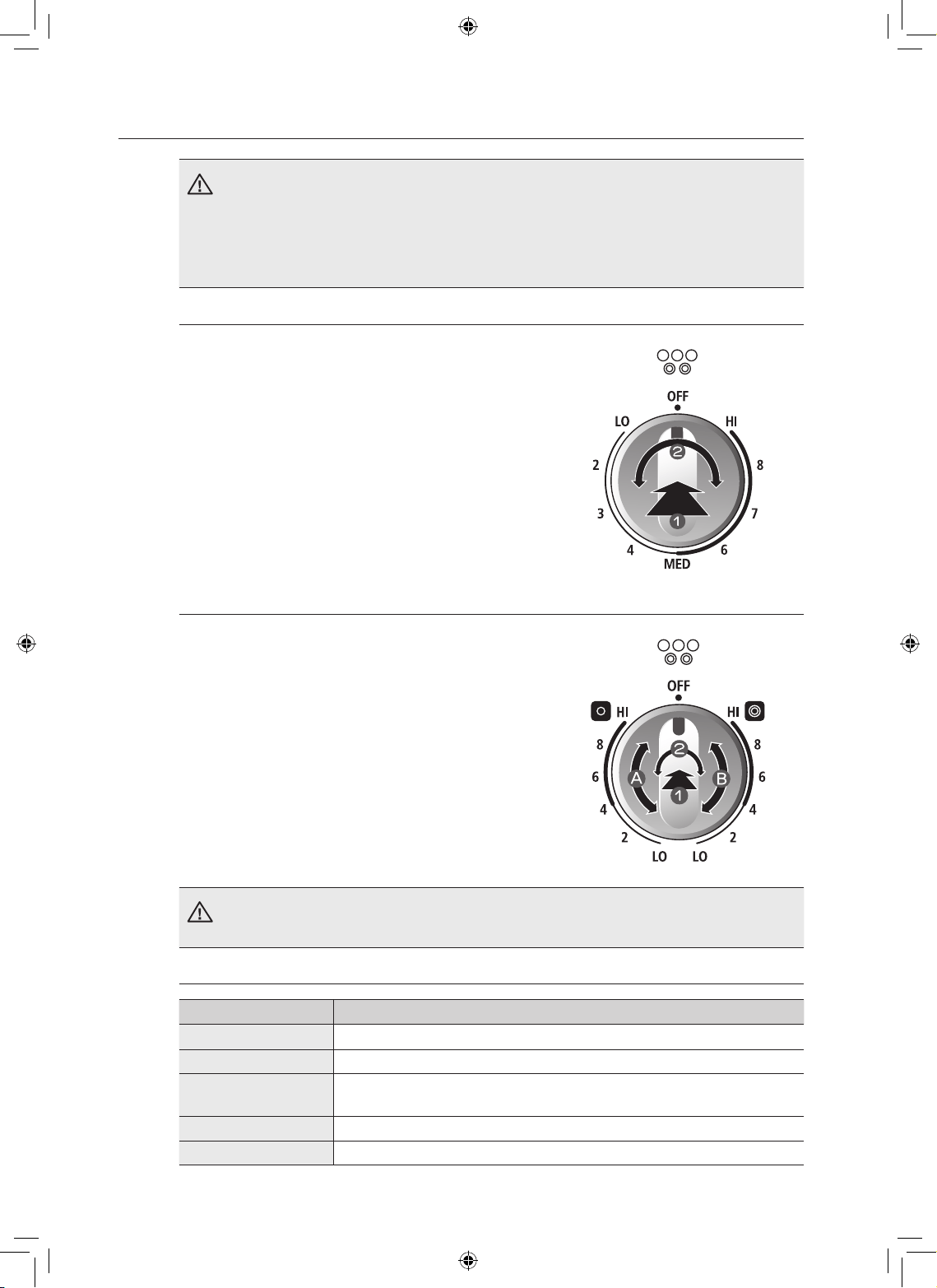
Single surface unit control knob (left rear, right rear)
1. Push the knob in.
2. Turn in either direction to the setting you want.
• At both the o and high settings, the knob clicks into
position.
Dual surface unit control knob (left front, right front)
The dual surface unit has 2 cooking sizes to select from
so you can match the size of the unit to the size of the
cookware you are using.
1
. Push the knob in.
2. Turn in either direction to the setting you want.
• To use the small surface unit, turn the control knob to
the small burner (A) settings.
• To use the large surface unit, turn the control knob to
the large burner (B) settings.
CAUTION
The area between the high and o settings is not appropriate for cooking.
Recommended settings
SETTING TYPE OF COOKING
HIGH Starting most foods, bringing water to a boil, pan broiling
MEDIUM HIGH Continuing a rapid boil, frying, deep fat frying
MEDIUM Maintaining a slow boil, thickening sauces and gravies, steaming
vegetables
MEDIUM LOW Keeping foods cooking, poaching, stewing
LOW Keeping food warm, melting, simmering
NE595R0ABSR_AA_DG68-00433A-09_EN.indd 19 2016-03-30 �� 8:04:17
SURFACE COOKING
Surface cooking _20
Using the warming center
The warming center, located in the back center of the glass surface, will keep hot, cooked food
at serving temperature.
• The surface warmer will not glow red like the cooking elements.
CAUTION
• Do not warm food on the warming center for more than two hours.
• Use only cookware and dishes recommended as safe for oven and cooktop use.
• Always use potholders or oven mitts when removing food from the warming center as
cookware and plates will be hot.
• When warming pastries and breads, the cover should have an opening to allow
moisture to escape.
• Do not use plastic wrap to cover foods. Plastic may melt onto the surface and be very
dicult to clean.
• Food should be kept in its container and covered with a lid or aluminum foil to
maintain food quality.
• Always start with hot food. Eating uncooked or cold food placed on the warming
center could result in illness.
1. Turn the warming center on.
Press the Warming Center On/O pad.
2. Select the power setting you want.
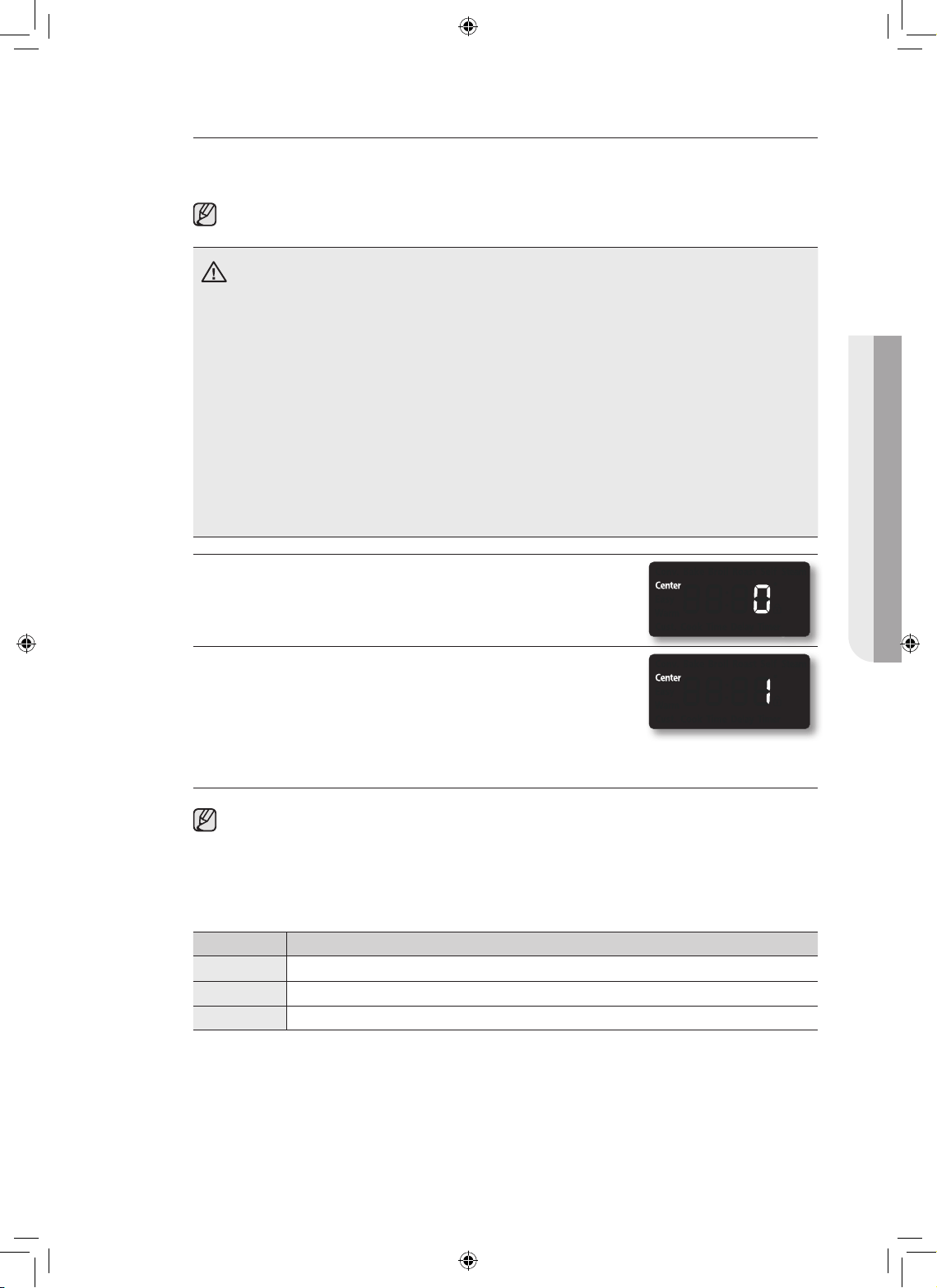
Pressing the Warming Center Level pad once will set it to the
level 1 setting. Press the pad twice for the level 2 setting, 3 times
for level 3.
3
. Turn the warming center o.
Press the Warming Center On/O pad.
• Pressing the Clear/O pad does not turn the warming center o.
• For best results, all foods on the warming center should be covered with a lid or
aluminum foil. When warming pastries or breads, the cover should be vented to allow
moisture to escape.
Recommended settings
LEVEL TYPE OF FOOD
1 Breads/pastries, casseroles, gravies, eggs
2 Dinner plate with food, soups (cream), vegetables, sauces, stews, meats
3 Fried foods, soups (liquid), hot beverages
NE595R0ABSR_AA_DG68-00433A-09_EN.indd 20 2016-03-30 �� 8:04:22
21_ Surface cooking
USING THE PROPER COOKWARE
Using the right cookware can prevent many problems, such as uneven cooking or extended
cooking times. Using the proper pans will reduce cooking times and cook food more evenly.
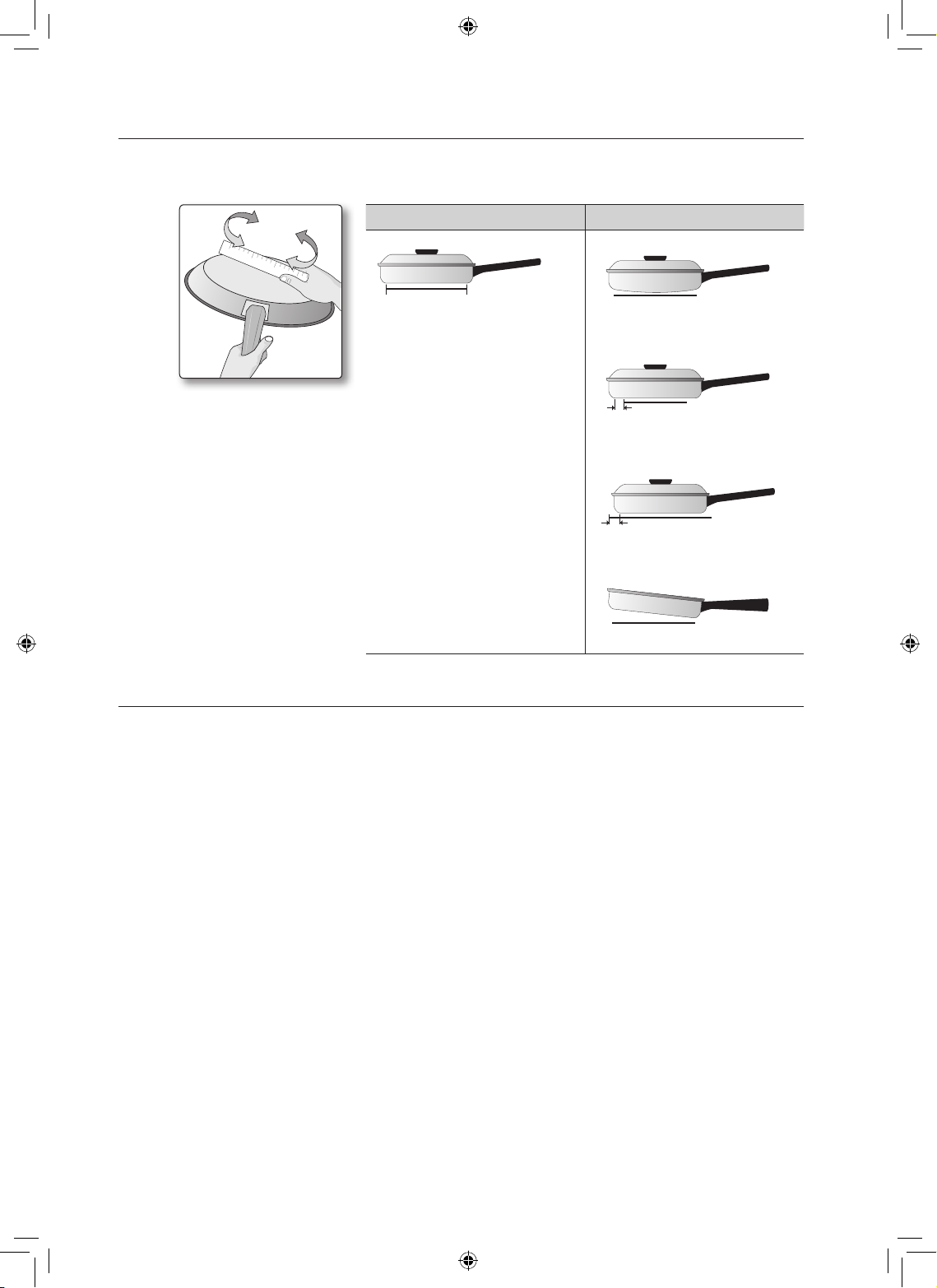
Check for flatness by
rotating a ruler across the
bottom of the cookware.
CORRECT INCORRECT
Flat bottom and straight sides.
• Tight fitting lids.
• Weight of handle does not tilt
pan.
• Pan is well balanced.
• Pan size matches the amount
of food to be prepared
and the size of the surface
element.
• Made of a material that
conducts heat well.
• Always match pot diameter to
element surface diameter.
Curved and warped pan
bottoms.
Pan overhangs element by more
than one-half inch.
Pan is smaller than element.
Heavy handle tilts pan.
CHOOSING THE PROPER COOKWARE
What your cookware is made of determines how evenly and quickly heat is transferred from the
surface element to the pan bottom.
• ALUMINUM - Excellent heat conductor. Some types of food will cause the aluminum to
darken. (Anodized aluminum cookware resists staining & pitting.). If aluminum pans are slid
across the ceramic cooktop, they may leave metal marks that resemble scratches. Remove
these marks as soon as the cooktop cools down.
• COPPER - Excellent heat conductor but discolors easily. May leave metal marks on ceramic
glass (see above).
• STAINLESS STEEL - Slow heat conductor with uneven cooking results. Is durable, easy to
clean and resists staining.
• CAST IRON - A poor conductor; retains heat very well. Cooks evenly once cooking
temperature is reached. Not recommended for use on ceramic cooktops.
• ENAMELWARE - Heating characteristics will vary depending on base material. Porcelain-
enamel coating must be smooth to avoid scratching ceramic cooktops.
• GLASS - Slow heat conductor. Not recommended for ceramic cooktop surfaces because it
may scratch the glass.
NE595R0ABSR_AA_DG68-00433A-09_EN.indd 21 2016-03-30 �� 8:04:28
SURFACE COOKING
Surface cooking _22
PROTECTING THE SMOOTHTOP SURFACE
Cleaning
• Clean the cooktop before using it for the first time.
• Clean your cooktop daily or after each use. This will keep your cooktop looking good and can
prevent damage.
• If a spillover occurs while you are cooking, immediately clean the spill from the cooking area
while it is hot to prevent a tough cleaning chore later. Using extreme care, wipe the spill with a
clean dry towel.
• Do not allow spills to remain on the cooking area or the cooktop trim for a long period of time.
• Do not use abrasive cleansing powders or scouring pads, which will scratch the cooktop.
• Do not use chlorine bleach, ammonia, or other cleansers not specifically recommended for use
on a glass-ceramic surface.
Preventing marks and scratches
• Do not use glass cookware. It may scratch the cooktop.
• Do not place a trivet or wok ring between the cooktop and the pan. These items can mark or
scratch the cooktop.
• Make sure the cooktop and the pan bottom are clean.
• Do not slide metal pans across the cooktop.
Preventing stains
• Do not use a soiled dish cloth or sponge to clean the cooktop surface. A film will remain, which
may cause stains on the cooking surface after the area is heated.
• Continuously cooking on a soiled surface can result in a permanent stain.
Preventing other damage
• Do not allow plastic, sugar, or foods with high sugar content to melt onto the hot cooktop.
Should this happen, clean immediately.
• Do not let a pan boil dry as this will damage the cooktop and the pan.
• Do not use the cooktop as a work surface or cutting board.
• Do not cook food directly on the cooktop. Always use the proper cookware.
NE595R0ABSR_AA_DG68-00433A-09_EN.indd 22 2016-03-30 �� 8:04:28
23_ Operating the oven
operating the oven
THE OVEN CONTROL PANEL
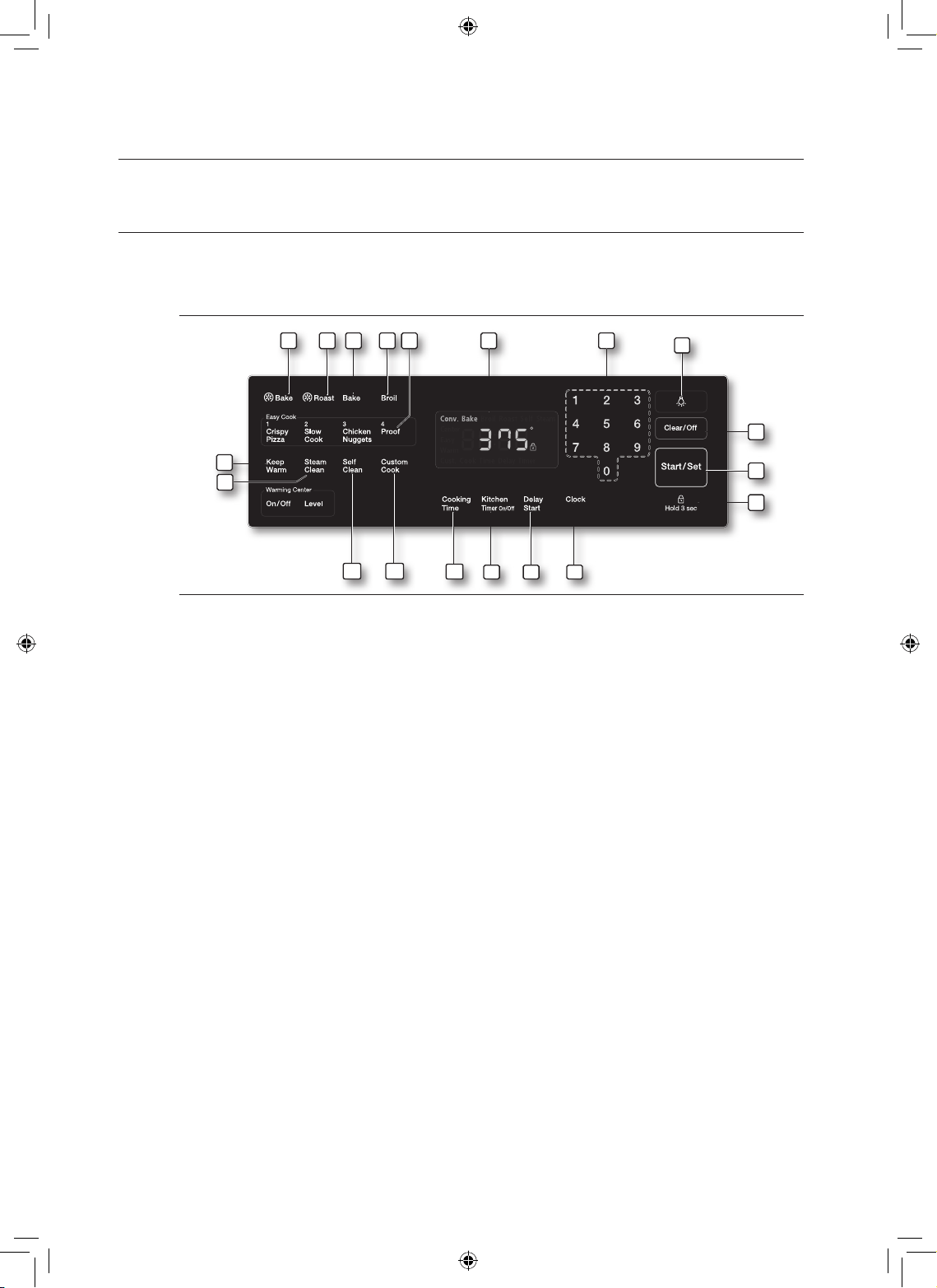
READ THE INSTRUCTIONS CAREFULLY BEFORE USING THE OVEN. For satisfactory use
of your oven, become familiar with the various features and functions of the oven as described
below. Detailed instructions for each feature and function follow later in this user manual.
3
19
4
9
2
7
65 8
113
151618
17
12
14
10
11
1. DISPLAY: Shows the time of day, oven temperature, whether the oven is in the bake, broil or
self-cleaning mode, and the times set for the timer or automatic oven operations.
2. NUMBER PAD: Use to set any function requiring numbers such as the time of day on the
clock, the timer, the oven temperature, the start time and length of operation for timed baking.
3. START/SET: Must be pressed to start any cooking or cleaning function.
4. CLEAR/OFF: Press to cancel all oven operations except the clock and timer.
5. KITCHEN TIMER ON/OFF: Press to select the timer feature.
6. DELAY START: Use along with Bake, Conv. Bake, Conv. Roast, Cooking Time, and Self
Clean pads to set the oven to start and stop automatically at a time you set.
7. COOKING TIME: Press and then use the number pad to set the amount of time you want
your food to cook. The oven will shut o when the cooking time has run out.
8. CLOCK: Press to set the time of day.
9. OVEN LIGHT: Press to turn the oven light on or o.
10. CUSTOM COOK: Press to record and recall your favorite recipe setting.
11. SELF CLEAN: Press to select the self-cleaning function.
12. STEAM CLEAN: Press to select the steam-cleaning function.
13. PROOF: Press to select a warm environment useful for rising yeast-leavened products.
14. KEEP WARM: Press to keep cooked foods warm.
15. BROIL: Press to select the broil function.
16. BAKE: Press to select the bake function.
17. CONVECTION BAKE: Press to select baking with the convection function.
18. CONVECTION ROAST: Press to select roasting with the convection function.
19. CONTROL LOCKOUT: Press to lock the buttons on the touch pad so they cannot be
activated accidentally.
NE595R0ABSR_AA_DG68-00433A-09_EN.indd 23 2016-03-30 �� 8:04:29
Operating the oven _24
OPERATING THE OVEN
SETTING THE CLOCK
The clock must be set to the correct time of day for the automatic oven timing functions to work
properly.
• The time of day cannot be changed during a timed cooking, a delay-timed cooking or a self-
cleaning cycle.
• You can choose between a 12-hour or 24-hour display. The default is 12-hour.
How to set the clock
1. Start the setup.
Press the Clock pad.
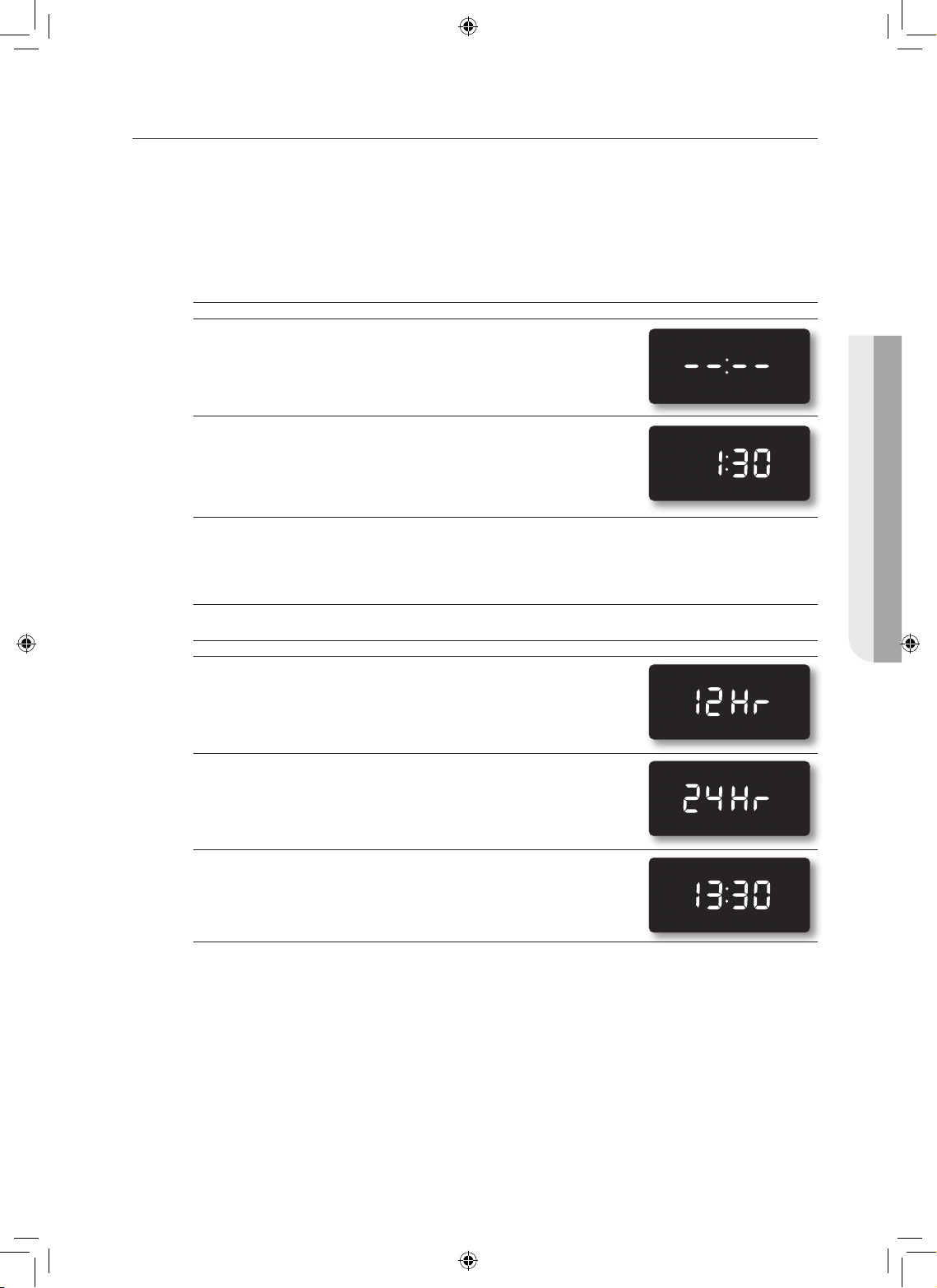
2. Enter the present tme.
Enter the current time in hours and minutes on the number pad,
eg. 1, 3, 0, for 1:30.
this step is skipped in the 24-hour display mode.
3. Exit the setup.
Press the Start/Set or Clock pad.
How to change between a 12-hour and 24-hour display
1. Start the setup.
Press Clock and 0 on the number pad at the same time for 3
seconds.
The display will show the present mode (eg. 12 hour).
2. Select the display mode you want.
Press 0 on the number pad to select 12 hour or 24 hour.
Pressing 0 on the number pad changes the display from 12 hour
to 24 hour and back again.
3. Exit the set up.
Press the Start/Set pad.
NE595R0ABSR_AA_DG68-00433A-09_EN.indd 24 2016-03-30 �� 8:04:31
25_ Operating the oven
MINIMUM AND MAXIMUM SETTINGS
All of the features listed in the table below have minimum and maximum time or temperature
settings. A beep will sound each time a pad on the control panel is pressed and the entry is
accepted. An error tone will sound in the form of a long beep if the entered temperature or time is
below the minimum or above the maximum setting for the feature.
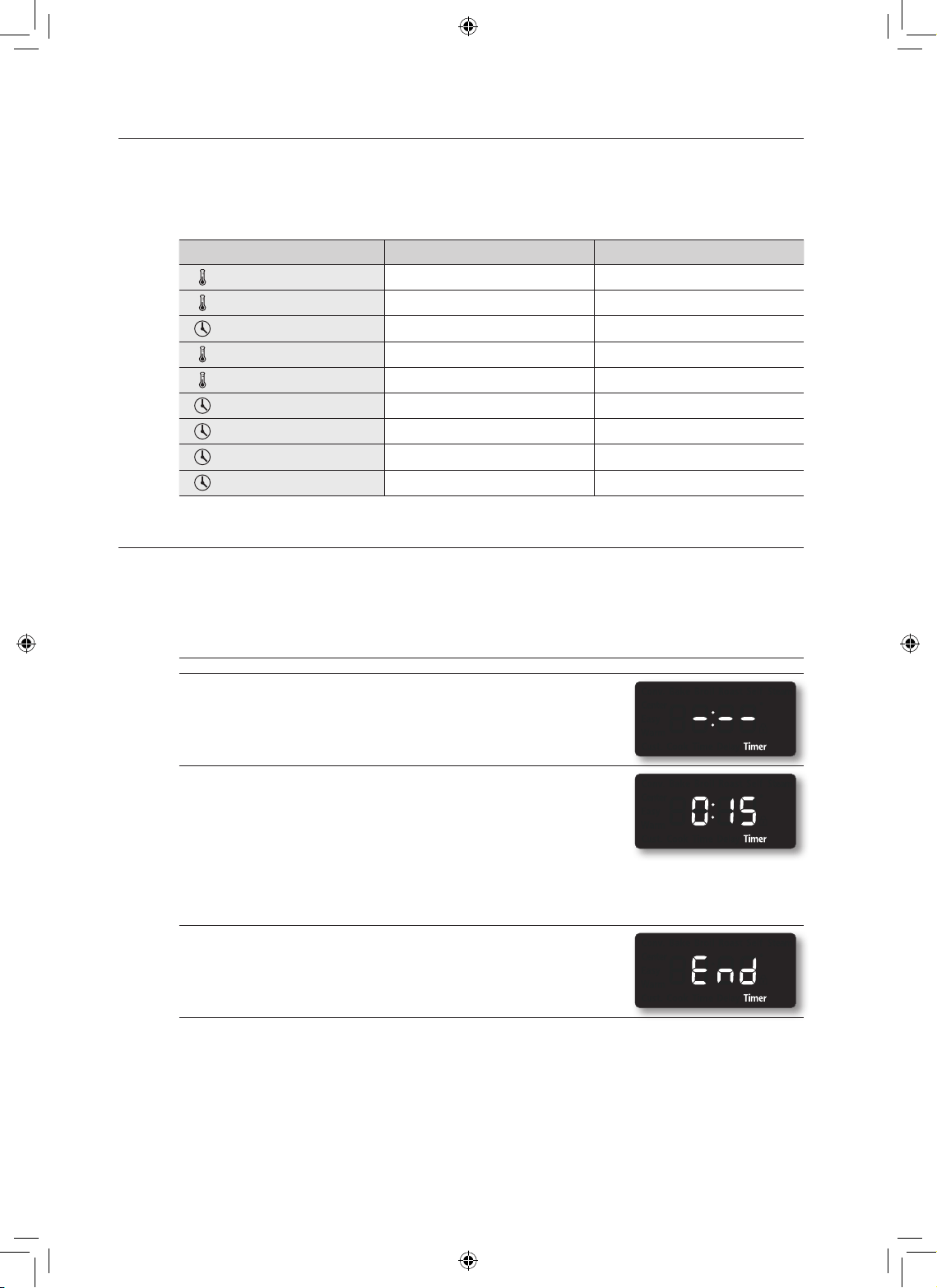
FEATURE MINIMUM MAXIMUM
Bake 150 °F (65 °C) 550 °F (285 °C)
Broil LO HI
Self Clean 2 Hr. 4 Hr.
Convection Bake 150 °F (65 °C) 550 °F (285 °C)
Convection Roast 150 °F (65 °C) 550 °F (285 °C)
Keep Warm - 3 Hr.
Warming Center - 3 Hr.
Proof - 12 Hr.
Steam Clean 20 Min. 20 Min.
SETTING THE KITCHEN TIMER
The kitchen timer serves as an extra timer that will beep when the set time has elapsed. It does
not start or stop cooking functions. You can use the kitchen timer with any of the other oven
functions.
How to set the timer
1. Turn the timer on.
Press the Kitchen Timer On/O pad.
2. Enter the amount of time you want.
Enter the amount of time you want using the number pad, eg. 1,
5. The timer can be set for any amount of time from 1 minute to 9
hours and 99 minutes. If you make a mistake, press the Kitchen
Timer On/O pad and start again.
3
. Start the timer.
Press the Kitchen Timer On/O pad.
4. When the set time has elapsed, the oven will beep and the display
will show End until you press the Kitchen Timer On/O pad. You
can cancel the timer at any time by pressing the Kitchen Timer
On/O pad.
NE595R0ABSR_AA_DG68-00433A-09_EN.indd 25 2016-03-30 �� 8:04:32
Operating the oven _26
OPERATING THE OVEN
USING THE OVEN RACKS
Oven rack positions
1
2
3
4
5
6
7
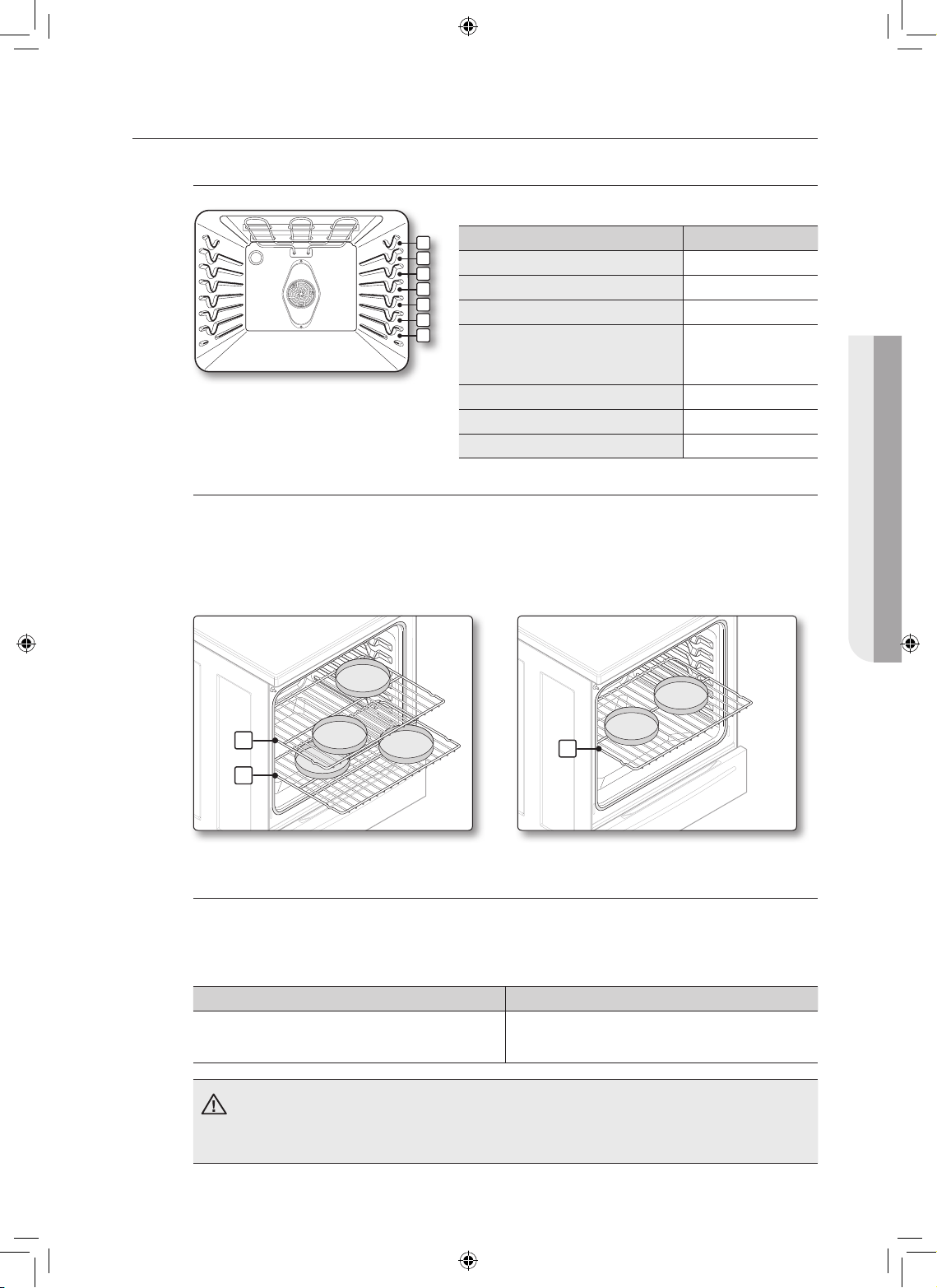
The oven has 7 rack positions (1~7).
TYPE OF FOOD RACK POSITION
Frozen pies 4
Angel food cake 2
Bundt or pound cakes 3
Biscuits, muns, brownies,
cookies, cupcakes, layer cakes,
pies
4
Casseroles 4
Small roast, ham 2
Turkey, large roast 1
Baking layer cakes
Centering the baking pans in the oven as much as possible will produce better results. If baking with
more than one pan, place the pans so each has at least 1” to 1½” of air space around it.
If baking two cake layers at the same time, place one oven rack in position 4.
If baking four cake layers at the same time, place the oven racks in positions 2 and 5.
Place the pans or cookware as shown in Fig. 1 and Fig 2.
5
2
4
Fig. 1 Fig. 2
Before using the racks
The oven has two racks.
Each rack has stops that need to be placed correctly on the supports. These stops will keep the
rack from coming completely out.
REMOVING THE RACKS REPLACING THE RACKS
1
. Pull the rack straight out until it stops.
2. Lift up the front of the rack and pull it out.
1. Place the end of the rack on the support.
2. Tilt the front end up and push the rack in.
CAUTION
• Do not cover a rack with aluminum foil or place on the oven bottom. This will disturb
the heat circulation, resulting in poor baking, and may damage the oven bottom.
• Arrange the oven racks only when the oven is cool.
NE595R0ABSR_AA_DG68-00433A-09_EN.indd 26 2016-03-30 �� 8:04:33
27_ Operating the oven
BAKING
The oven can be programmed to bake at any temperature from 150 °F to 550 °F.
How to set the thermostat
1. Start the set up.
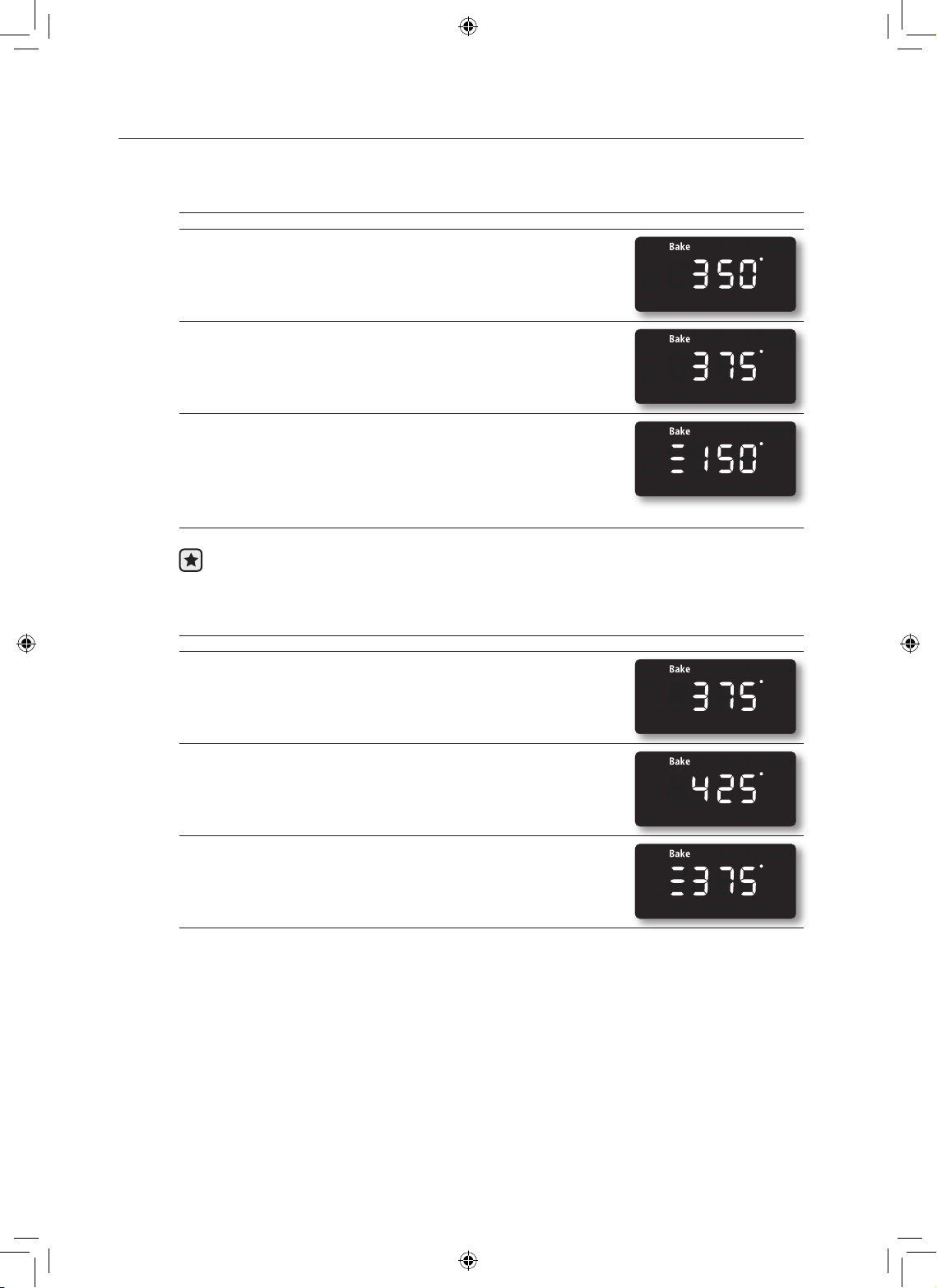
Press the Bake pad. The default temperature is 350 °F.
2. Enter the temperature you want on the number pad, eg. 3, 7, 5.
3. Start the bake function.
Press the Start/Set pad. The temperature display will start to
change once the oven temperature reaches 150 °F.
4
. If you want to cancel baking or if you have finished, press the
Clear/O pad.
Place food in the oven after preheating if the recipe calls for it. Preheating is very important
for good results when baking cakes, cookies, pastry, and breads. After the oven has
reached the desired temperature, a long beep will sound 6 times.
How to adjust the thermostat while cooking
1. Start the setup.
Press the Bake pad. The display will show the present
temperature, eg. 375 °F.
2. Enter the temperature you want, eg. 425 °F, using the number
pad.
3. Complete the entry by pressing the Start/Set pad.
NE595R0ABSR_AA_DG68-00433A-09_EN.indd 27 2016-03-30 �� 8:04:35
Operating the oven _28
OPERATING THE OVEN
CONVECTION BAKING
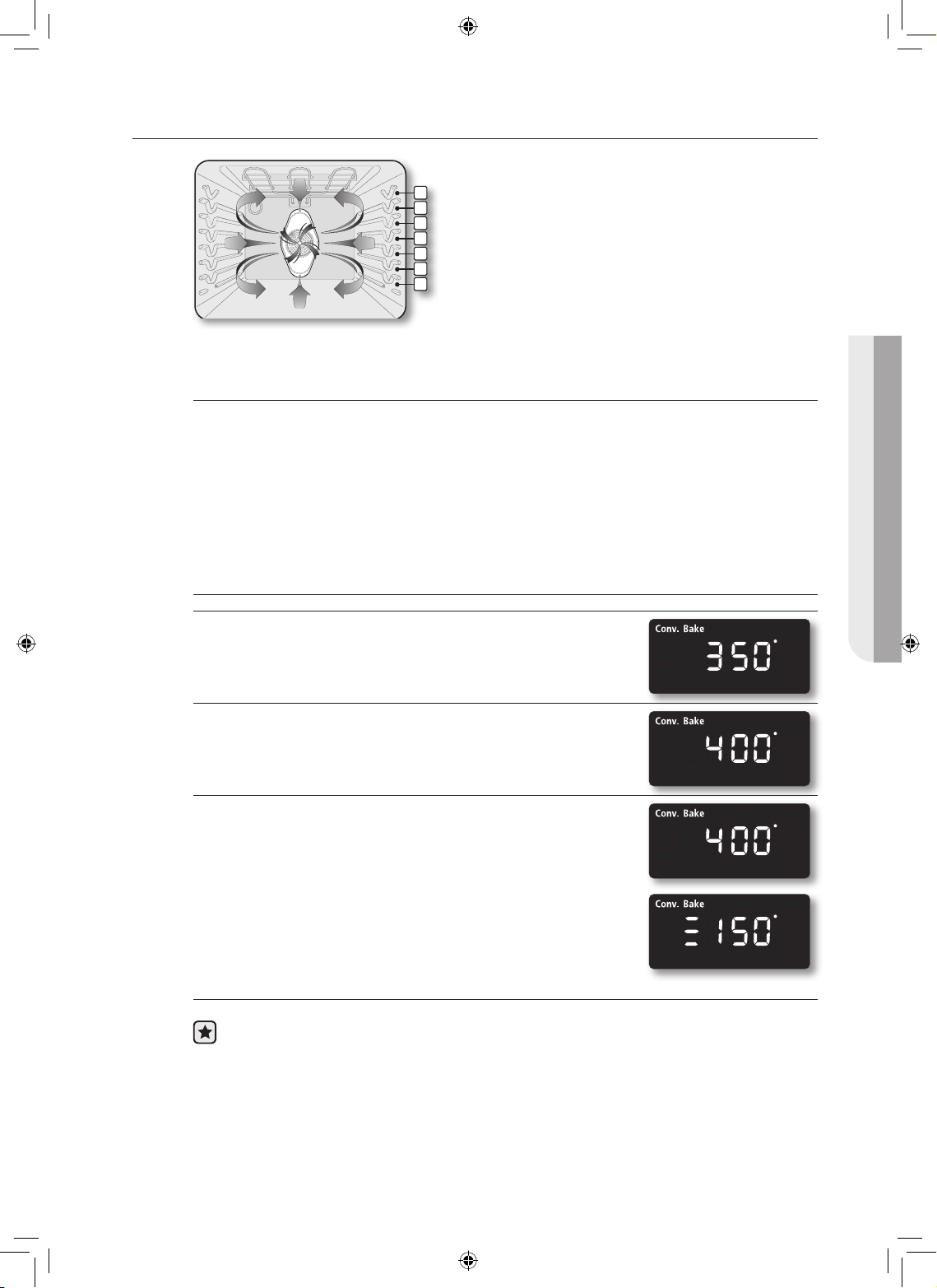
By using the convection bake feature, you will be able
to cook faster. You can program the oven for convection
baking at any temperature between 150 °F and 550 °F.
Convection baking uses a fan to circulate the oven’s heat
evenly and continuously within the oven. This improved
heat distribution allows for even cooking and excellent
results using multiple racks at the same time. Foods
cooked on a single oven rack will generally cook faster
and more evenly with convection baking. Multiple oven
rack cooking may slightly increase cook times for some foods, but the overall result is time saved.
Breads and pastries brown more evenly.
Tips for convection baking
The amount of time you save will vary depending on the amount and type of food you are
cooking. When baking cookies or biscuits, you should use pans with no sides or very low sides
to allow the heated air to circulate around the food. Using a pan with a dark finish will allow faster
cooking times.
When using convection baking with a single rack, place the oven rack in position 4. If cooking on
multiple racks, place the oven racks in positions 2 and 5 or positions 3, 5 and 6.
When baking a cake, using the bake mode will produce better results.
How to set the oven for convection baking
1. Start the convection baking mode.
Press the Conv. Bake pad. The default temperature is 350 °F.
2. Enter the temperature you want, eg. 400 °F, using the number
pad.
3. Press the Start/Set pad to begin convection baking.
Conv. Bake and the adjusted oven temperature, eg. 400 °F, will
appear in the display for 2 seconds.
The temperature display will start to change once the oven
temperature reaches 150 °F.
A beep will sound 6 times when the oven reaches the adjusted
oven temperature.
4
. Turn o or cancel convection baking by pressing the Clear/O
pad.
The convection oven fan shuts o when the oven door is opened.
DO NOT leave the door open for long periods of time while using convection cooking or you
may shorten the life of the convection heating element.
1
2
3
4
5
6
7
NE595R0ABSR_AA_DG68-00433A-09_EN.indd 28 2016-03-30 �� 8:04:38
29_ Operating the oven
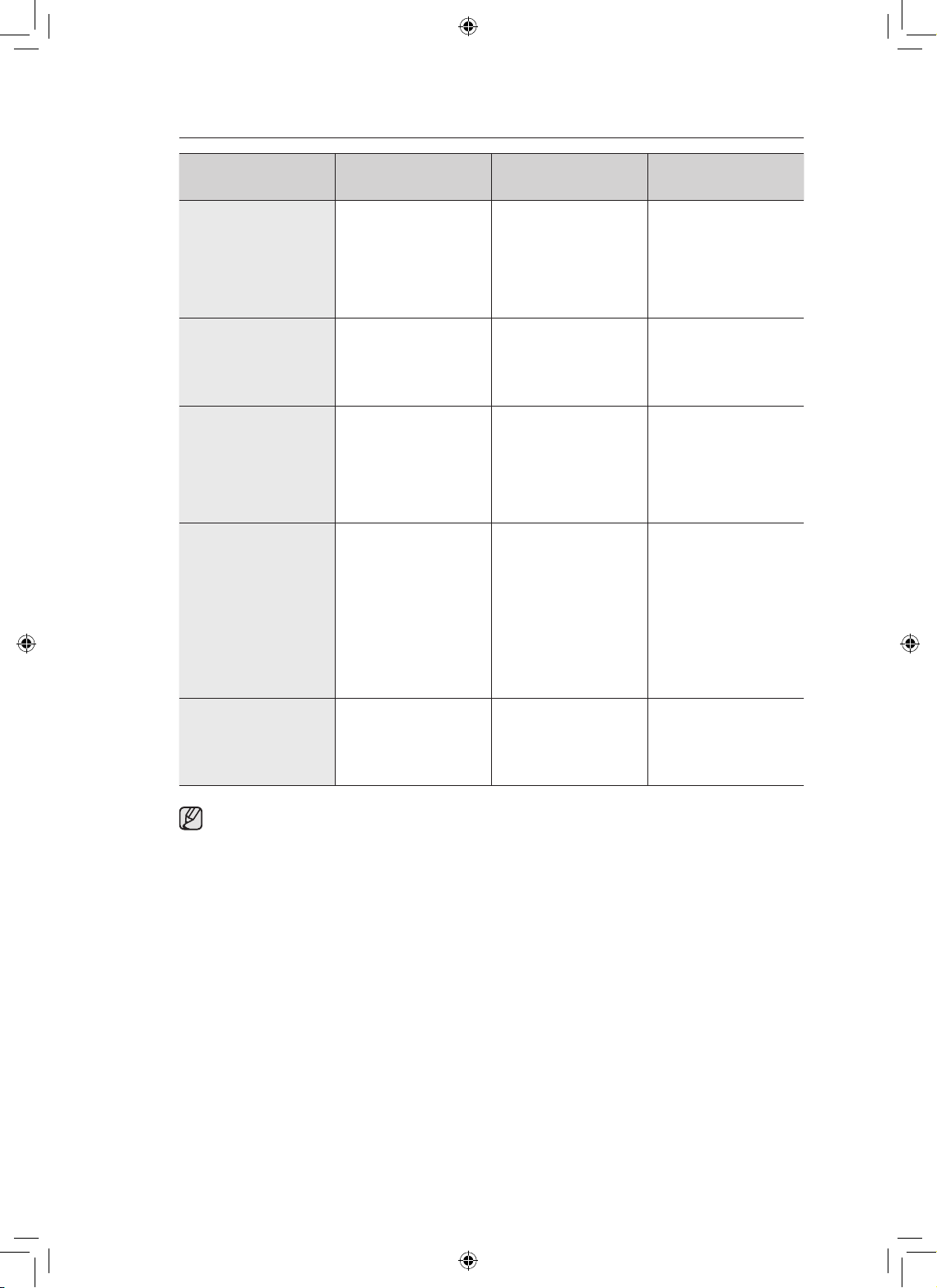
Recommended convection baking guide
Food Item Rack Position
Set Temp.*
(preheated oven) (°F)
Convection bake
time ** (min)
Cake
Cupcakes 4 325 17-19
Bundt Cake 3 325 35-43
Angel Food 2 325 35-39
Pie
2 crust, fresh, 9” 3 350-400 45-55
2 crust, frozen fruit, 9” 3 350 68-78
Cookies
Sugar 4 325-350 12-17
Chocolate Chip 4 325-350 14-18
Brownies 4 325 29-36
Breads
Yeast bread, loaf, 9x5 3 350 18-22
Yeast rolls 4 350-375 13-18
Quick Bread, loaf, 8x4 3 325-350 45-55
Biscuits 4 350-375 9-14
Muns 4 400 15-19
Pizza
Frozen 4 375-425 23-26
Fresh 4 400-425 12-15
* Actual times depend on the mixes or recipes baked.
NE595R0ABSR_AA_DG68-00433A-09_EN.indd 29 2016-03-30 �� 8:04:38
Operating the oven _30
OPERATING THE OVEN
CONVECTION ROASTING
Convection roasting is good for cooking large tender cuts of meat, uncovered.
Heat comes from the top heating element. The convection fan circulates the heated air evenly
over and around the food. Meat and poultry are browned on all sides as if they were cooked on a
rotisserie. The heated air seals in juices quickly for a moist and tender product while, at the same
time, creating a rich golden brown exterior.
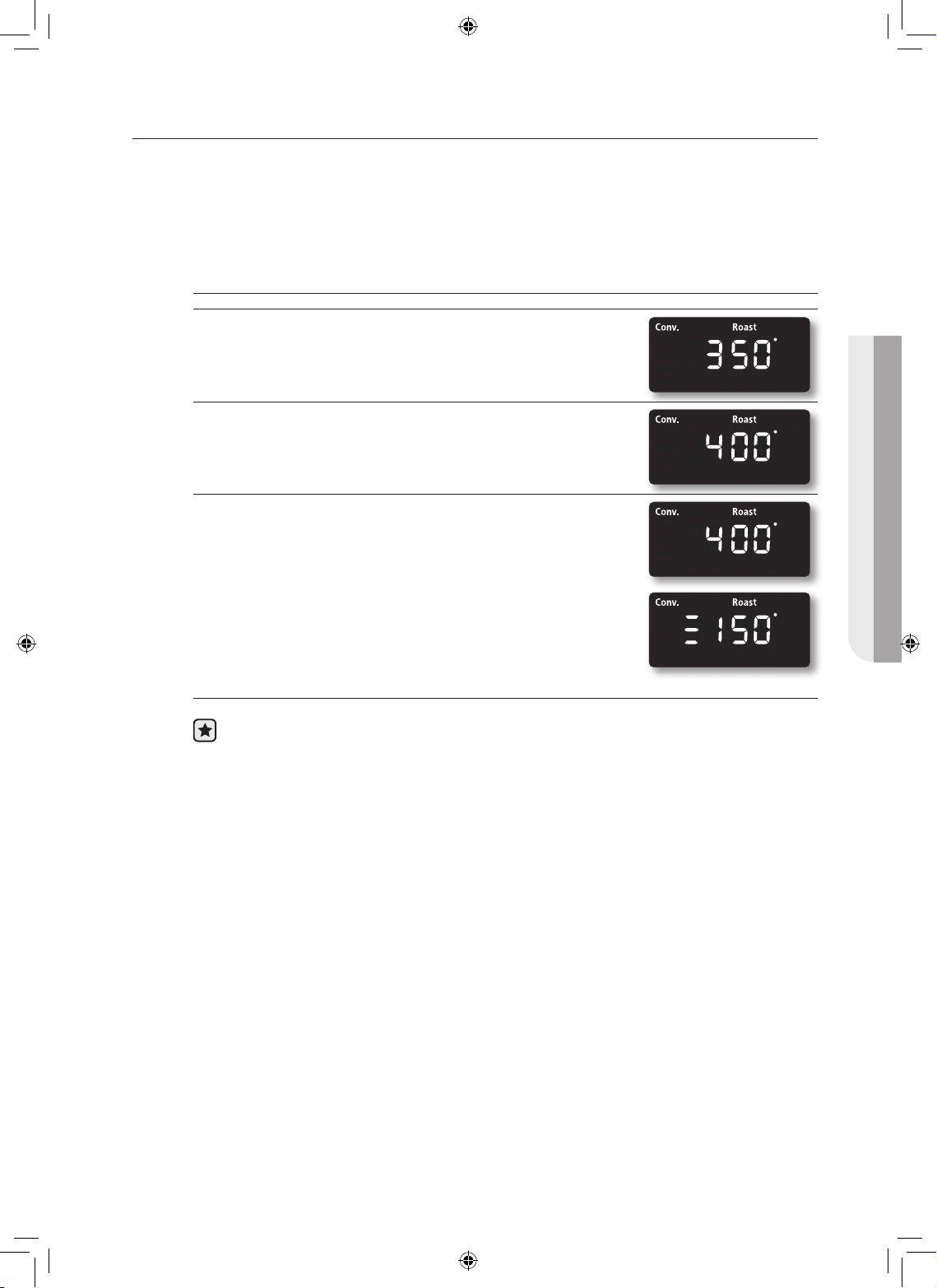
How to set the oven for convection roasting
1. Start the convection roasting mode.
Press the Conv. Roast pad. The default temperature is 350 °F.
2. Enter the temperature you want, eg. 400 °F, using the number
pad.
3. Press the Start/Set pad to begin convection roasting.
Conv. Roast and the adjusted oven temperature, eg. 400 °F, will
appear in the display for 2 seconds.
The temperature display will start to change once the oven
temperature reaches 150 °F.
A beep will sound 6 times when the oven reaches the adjusted
oven temperature.
4
. Turn o or cancel convection roasting by pressing the Clear/O
pad.
The convection oven fan shuts o when the oven door is opened.
DO NOT leave the door open for long periods of time while using convection cooking or you
may shorten the life of the convection heating element.
NE595R0ABSR_AA_DG68-00433A-09_EN.indd 30 2016-03-30 �� 8:04:39
31_ Operating the oven
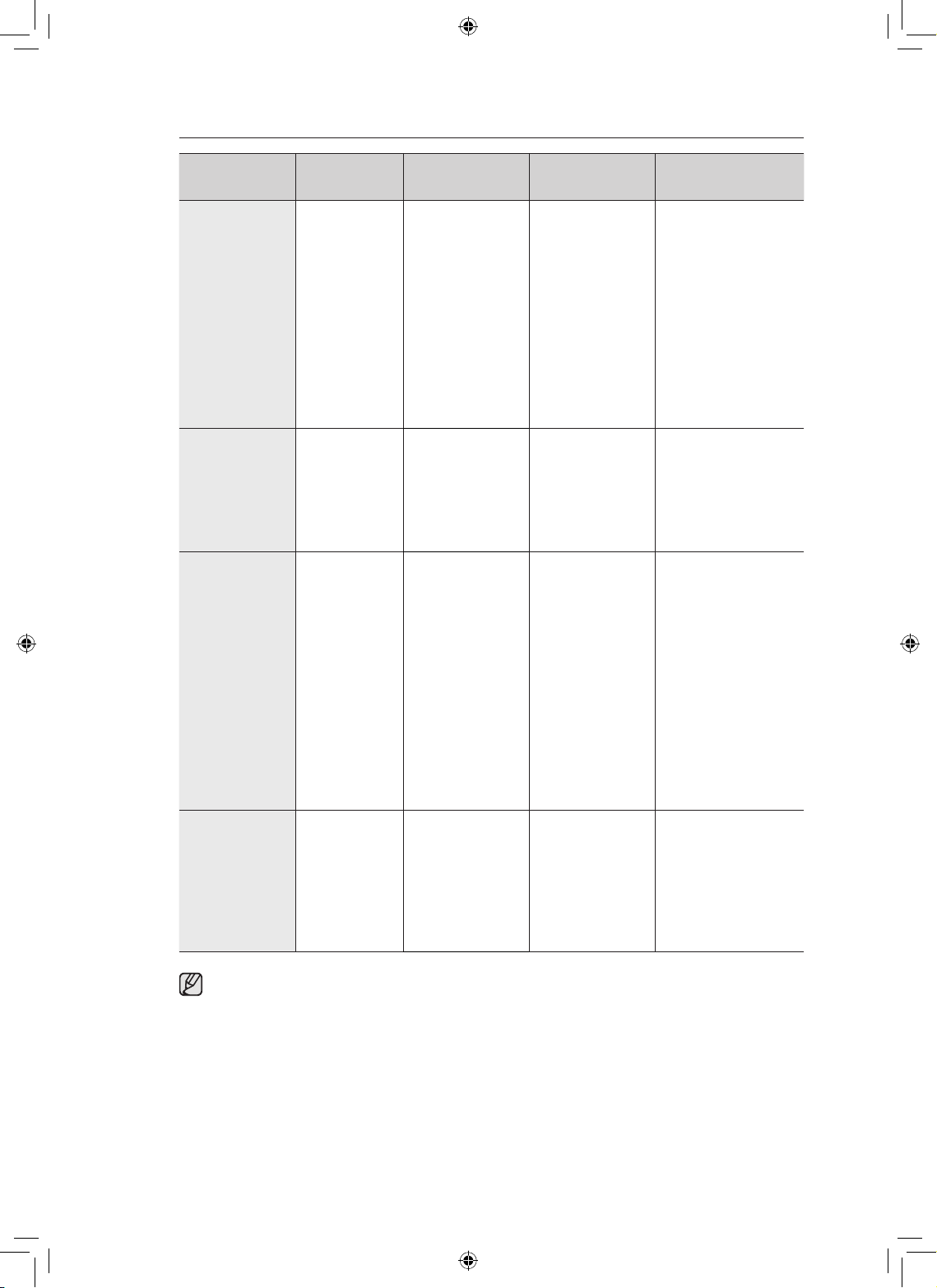
Recommended convection roasting guide
Meat Weight (lb) Oven temp. (°F)
Roasting time*
(min per lb)
Internal temp. (°F)
Beef
Rib Roast 4-6 325
25-28
28-32
145 (med/rare)
160 (medium)
Rib Eye Roast,
(boneless)
4-6 325
24-29
29-34
145 (med/rare)
160 (medium)
Rump, Eye, Tip
Sirloin (boneless)
3-6 325
25-30
28-35
145 (med/rare)
160 (medium)
Tenderloin Roast 2-3 325 28-38 145 (med/rare)
Pork
Loin Roast
(boneless or
bone-in)
5-8 350 15-25 170
Shoulder 3-6 350 20-30 160
Poultry
Chicken - whole 3-4 375 17-23 180
Turkey,
unstued**
12-15 325 12-16 180
Turkey,
unstued**
16-20 325 11-15 180
Turkey,
unstued**
21-25 325 8-12 180
Turkey Breast 3-8 325 20-25 170
Cornish Hen 1-1½ 350 45-75 (total time) 180
Lamb
Half Leg 3-4 325
25-30
30-35
160 (medium)
170 (well)
Whole Leg 6-8 325
25-30
30-35
160 (medium)
170 (well)
* Roasting times are approximate and may vary depending on the shape of the meat.
** Stued turkey requires additional roasting time. The minimum safe temperature for
stung in poultry is 165˚F.
NE595R0ABSR_AA_DG68-00433A-09_EN.indd 31 2016-03-30 �� 8:04:39
Operating the oven _32
OPERATING THE OVEN
TIMED COOKING
In timed cooking, the oven turns on immediately and cooks for the length of time you select. At
the end of the cooking time, the oven turns o automatically.
• You can use the timed cooking feature only with another cooking operation (bake, convection
bake, or convection roast).
• You can set the oven for timed cooking before setting other cooking operations.
• The clock must be set to the current time.
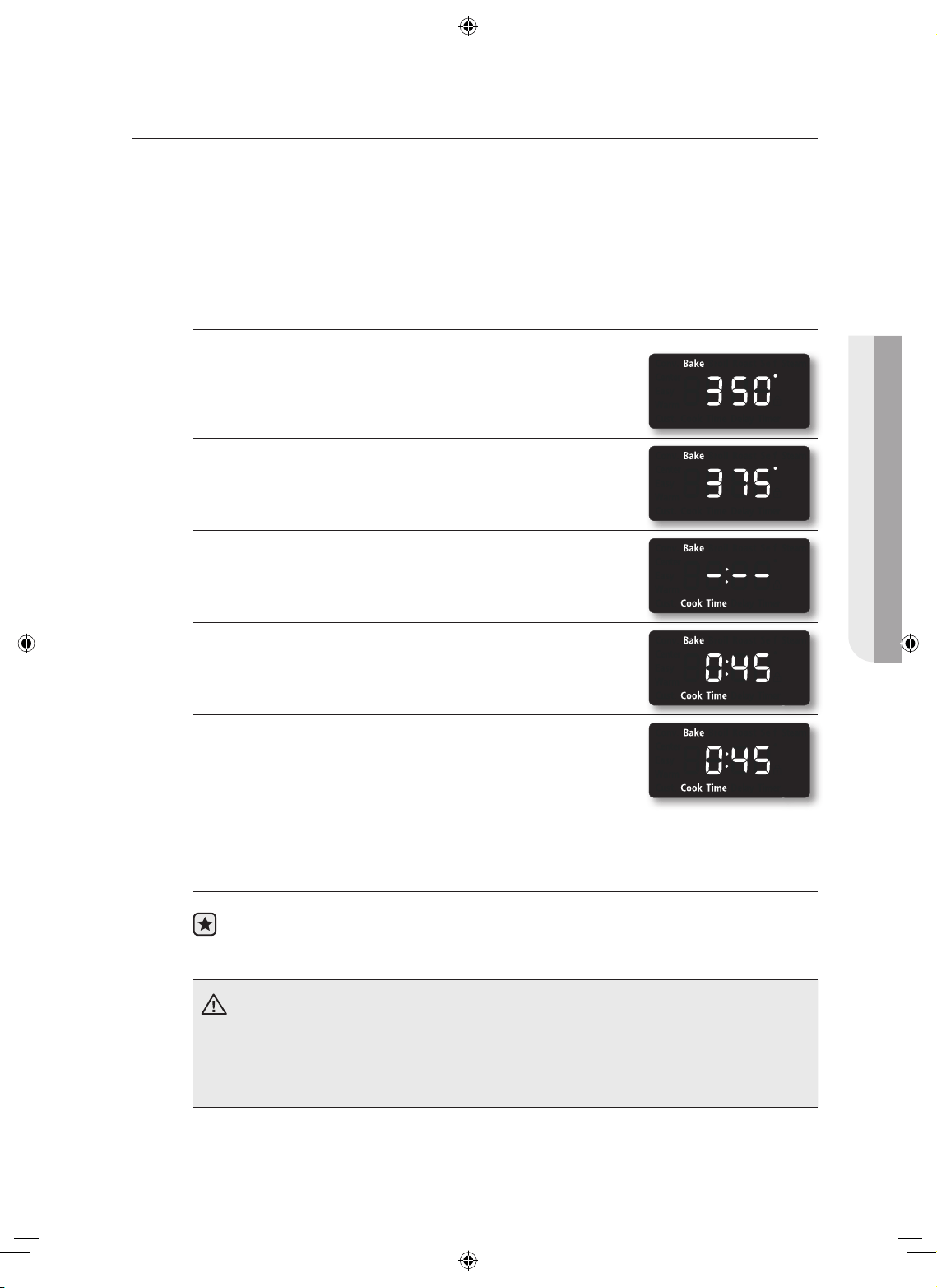
How to set the oven for timed cooking
1. Enter the setup.
Press the pad for the cooking operation you want, eg. BAKE. The
default temperature is 350 °F.
2. Enter the temperature you want, eg. 375 °F, using the number
pad.
3. Press the Cooking Time pad.
4. Enter the cooking time you want, eg. 45 min, using the number
pad.
You can set the cooking time for any amount of time from 1 minute
to 9 hours and 99 minutes.
5. Press the Start/Set pad to begin the cooking operation.
The temperature display will start to change once the oven
temperature reaches 150 °F.
The oven will continue to cook until the set amount of time has
elapsed, then turn o automatically unless the keep warm feature was
set. (Refer to the section on the keep warm feature on page 38.)
6
. You can cancel a timed cooking at any time by pressing the
Clear/O pad.
Place food in the oven after preheating if the recipe calls for it. Preheating is important for
good results when baking cakes, cookies, pastry, and breads. After the oven has reached
the desired temperature, a long beep will sound 6 times.
CAUTION
Use caution with the timed cooking or delay timed cooking features. Use these
features when cooking cured or frozen meats and most fruits and vegetables. Foods
that can easily spoil, such as milk, eggs, fish, meat or poultry, should be chilled in the
refrigerator first. Even when chilled, they should not stand in the oven for more than
1 hour before cooking begins, and should be removed promptly when cooking is
completed. Eating spoiled food can result in sickness from food poisoning.
NE595R0ABSR_AA_DG68-00433A-09_EN.indd 32 2016-03-30 �� 8:04:41
33_ Operating the oven
DELAY TIMED COOKING
In a delay timed cooking, the oven’s timer turns the oven on and o at times you select in
advance.
• You can use the delay timed cooking feature only with another cooking operation (bake,
convection bake, or convection roast).
• You can set the oven for a delay timed cooking before setting other cooking operations.
• The clock must be set to the current time.
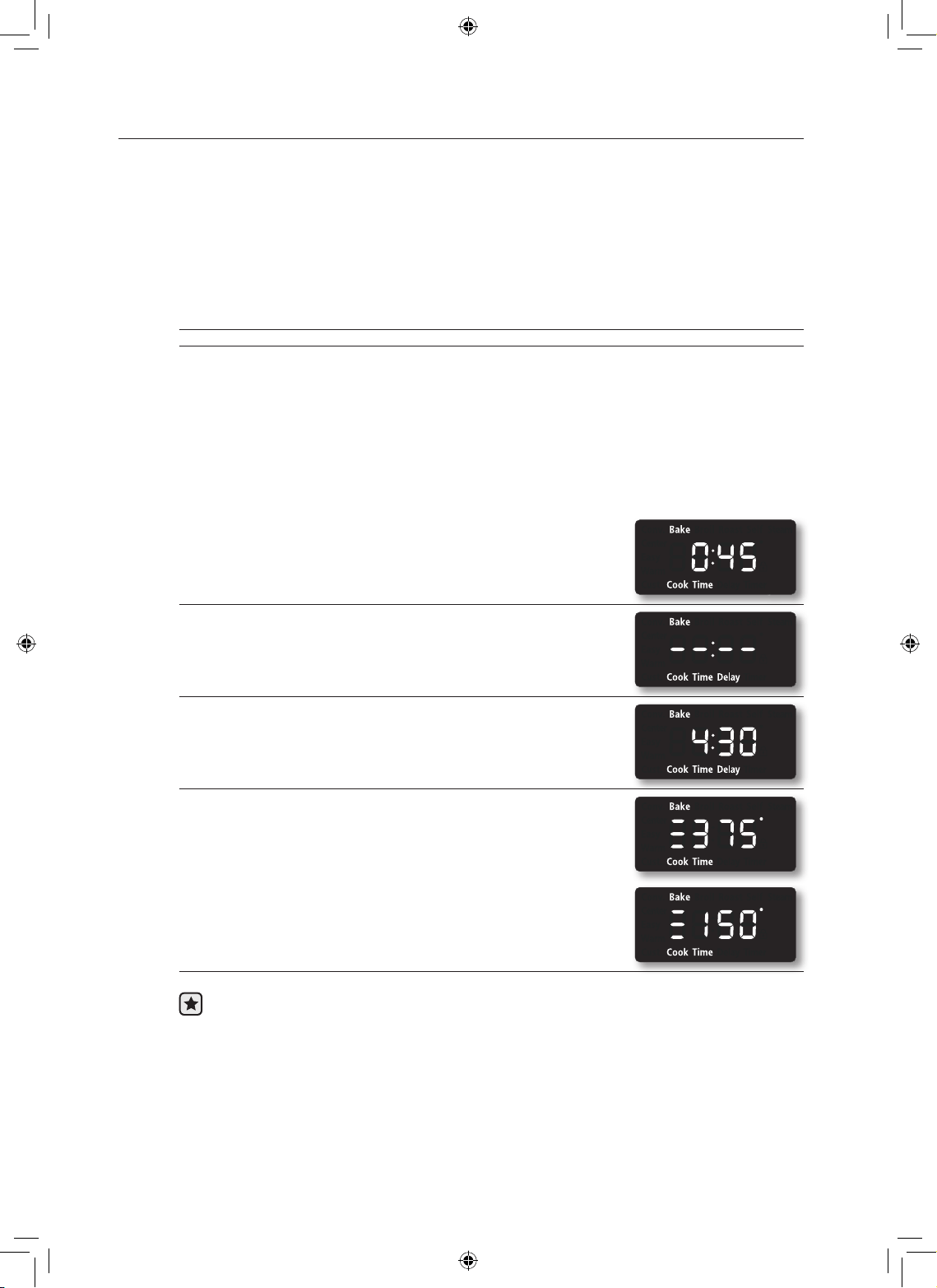
How to set the oven for delay timed cooking
1. Position the oven rack(s) and place the food in the oven.
2. Enter the setup.
Press the pad for the cooking operation you want, eg. BAKE. The
default temperature is 350 °F.
3
. Use the number pad to enter the temperature you want, eg. 375
°F.
4
. Press the Cooking Time pad.
5
. Enter the cooking time you want, eg. 45 min, using the number
pad.
You can set the cooking time for any amount of time from 1 minute
to 9 hours and 99 minutes.
6. Press the Delay Start pad.
7. Enter the time you want the oven to turn on, eg. 4:30, using the
number pad.
8. Press the Start/Set pad.
At the set time, a short beep will sound. The oven will begin to
bake. When the oven has reached the desired temperature, a long
beep will sound 6 times.
Place food in the oven after preheating if the recipe calls for it. Preheating is important for
good results when baking cakes, cookies, pastry, and breads. After the oven has reached
the desired temperature, a long beep will sound 6 times.
NE595R0ABSR_AA_DG68-00433A-09_EN.indd 33 2016-03-30 �� 8:04:43
Operating the oven _34
OPERATING THE OVEN
BROILING
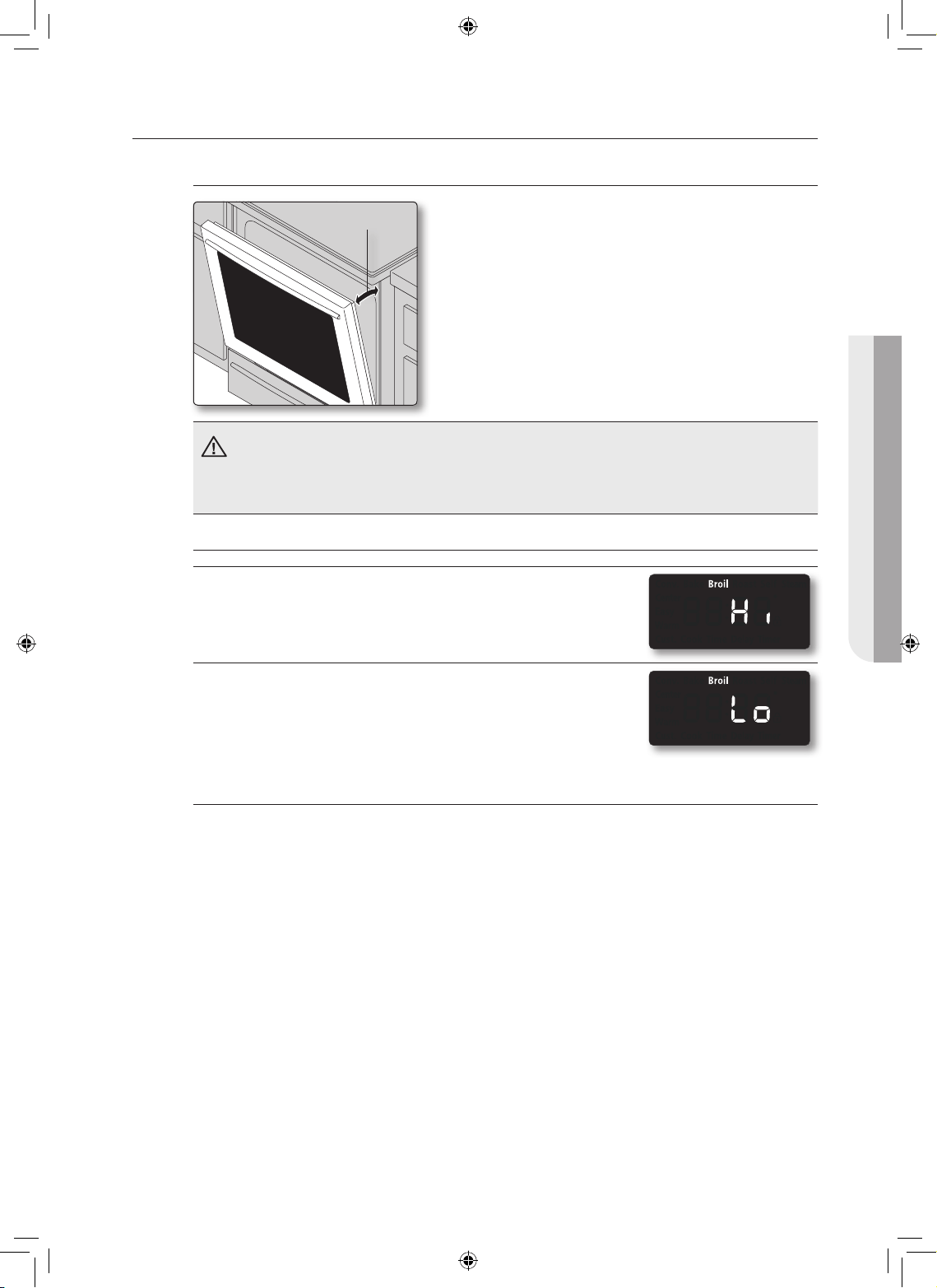
Broil stop position
Broil stop position
Leave the door open at the broil stop position. The door will
stay open by itself, yet the proper temperature is maintained
in the oven.
CAUTION
Should an oven fire occur, close the oven door and turn the oven o. If the fire continues,
throw baking soda on the fire or use a foam-type fire extinguisher. Do not put water
or flour on the fire. Flour can explode and water can cause a grease fire to spread and
cause personal injury.
How to set the oven for broiling
1. Select the broil setting you want.
Press the Broil pad once for HI or twice for LO.
Use LO to cook foods such as poultry or thick cuts of meat
thoroughly without over-browning them.
2. Start the broiling function.
Press the Start/Set pad.
Broil on one side until food is browned; turn and cook on the other
side.
3
. Press the Clear/O pad once you have finished cooking or if you
want to cancel broiling.
NE595R0ABSR_AA_DG68-00433A-09_EN.indd 34 2016-03-30 �� 8:04:44
35_ Operating the oven
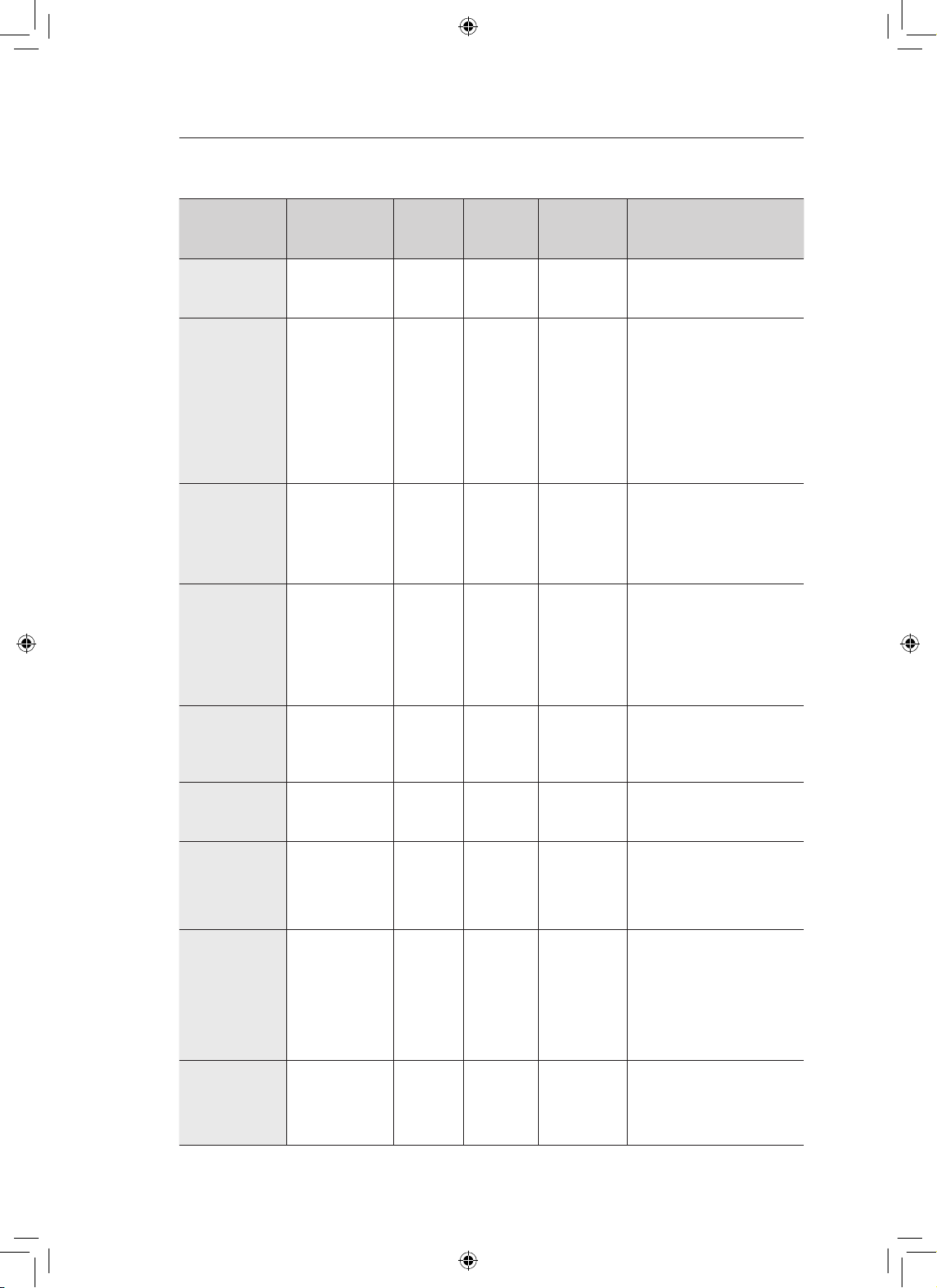
Recommended broiling guide
The size, weight, thickness, starting temperature, and your doneness preference will aect broiling
times. This guide is based on meats at refrigerator temperature.
Food
Quantity and/
or thickness
Shelf
position
First
side time
(min.)
Second
side time
(min.)
Comments
Ground Beef
Well Done
1 lb. (4 patties)
½ to ¾” thick
7 8-10 4-6
Space evenly. Up to 8
patties may be broiled at
once.
Beef Steaks
Steaks less than 1” thick.
Cook through before
browning.
Pan frying is
recommended.
Slash fat.
Rare
1” thick 1 to
1½ lbs.
7 8 3-5
Medium 7 10 4-6
Well Done 7 12 5-7
Rare
1½”thick 2 to
2½ lbs.
6 14 7-9
Medium 6 16 8-11
Well Done 6 19 11-13
Chicken
1 whole cut up
2 to 2½ lbs.,
split lengthwise
4 23-28 13-18
Broil skin-side-down first.
2 Breasts 5 13-18 5-10
Lobster Tails
2-4
10 to 12 oz.
each
4 14-18
Do not turn
over.
Cut through back of shell.
Spread open.
Brush with melted butter
before broiling and
halfway through broiling
time.
Fish Fillets ¼ to ½” thick 6 5-9 3-4
Handle and turn very
carefully. Brush with
lemon butter before and
during cooking, if desired.
Ham Slices
(precooked)
½” thick 6 5-7 3-5
Increase time 5 to 10
minutes per side for 1½”
thick or home-cured ham.
Pork Chops
Well Done
2 (½” thick) 6 7 6-8
Slash fat.
2 (1” thick)
about 1 lb.
5 9-10 7-9
Lamb Chops
Slash fat.
Medium
2 (1” thick)
about 10 to
12 oz.
6 6 4-6
Well Done 6 8 7-9
Medium
2 (1½” thick)
about 1 lb.
6 11 9
Well Done 6
13 9-11
Salmon
Steaks
2 (1” thick) 6 8 3-4
Grease pan. Brush steaks
with melted butter.
4 (1” thick)
about 1 lb.
6 9 4-6
NE595R0ABSR_AA_DG68-00433A-09_EN.indd 35 2016-03-30 �� 8:04:44
Operating the oven _36
OPERATING THE OVEN
USING THE CUSTOM COOK FEATURE
By using the custom cook feature, you can record up to 3 dierent recipe settings. The feature
may be used for baking, convection baking, or convection roasting. It will not work with any other
function, including the delay start feature.
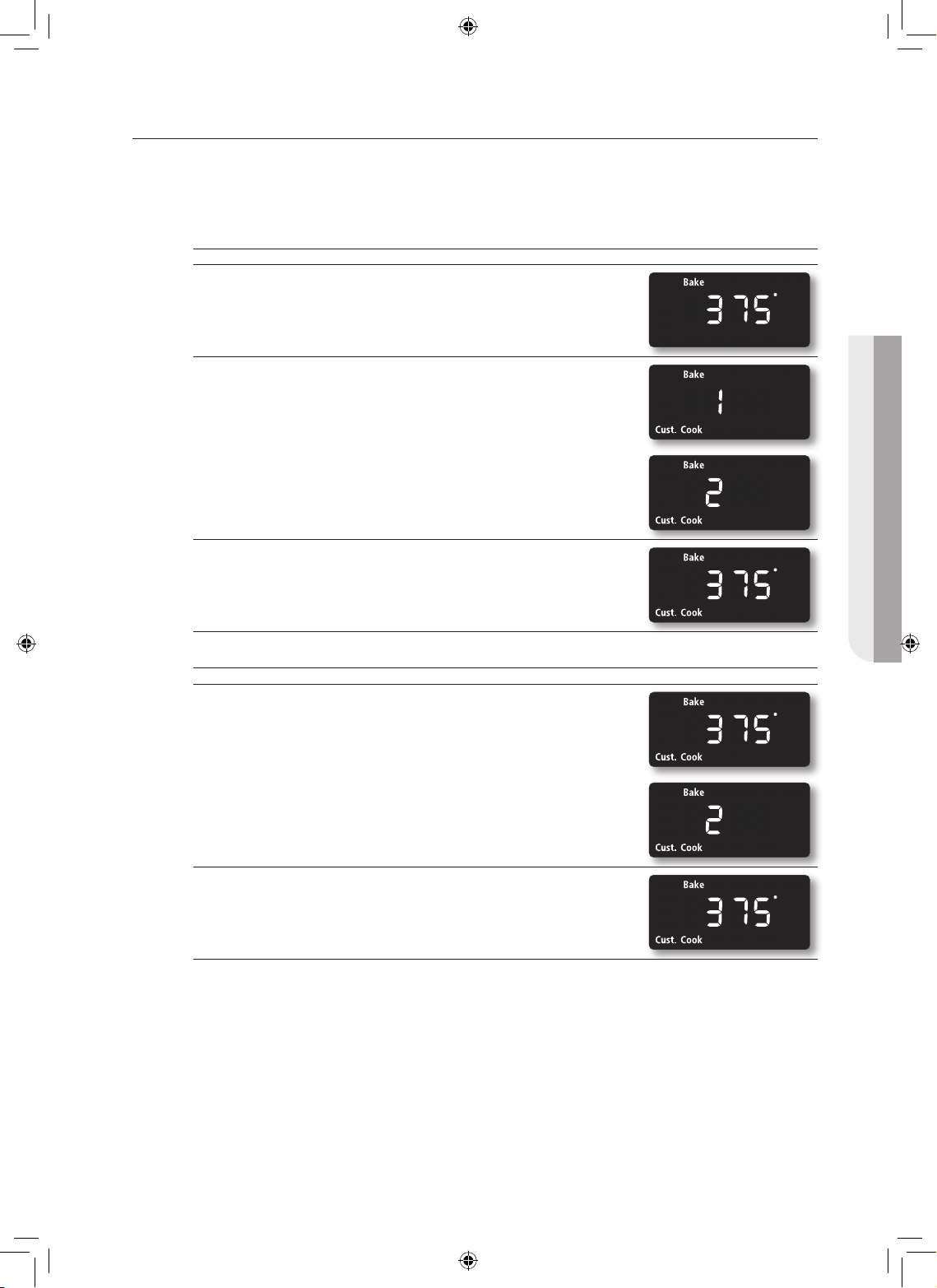
How to record a recipe setting
1. Press the pad for the cooking operation you want to store, eg.
BAKE. The default temperature is 325 °F.
2
. Use the number pad to enter the temperature you want, eg. 375
°F.
3. You can store a recipe setting in one of three Custom Cook positions.
Press the Custom Cook pad the number of times that corresponds
to the position in which you want to store the setting, eg. for Custom
Cook position 2, press the Custom Cook pad twice.
You can store recipe settings at position 1, 2, or 3.
4. Press the Start/Set pad.
How to recall a setting
1. Press the Custom Cook pad the number of times that
corresponds to the position in which the recipe setting is stored,
eg. for Custom Cook position 2, press the Custom Cook pad
twice.
2. Start the stored cooking operation.
Press the Start/Set pad.
NE595R0ABSR_AA_DG68-00433A-09_EN.indd 36 2016-03-30 �� 8:04:46
37_ Operating the oven
USING THE EASY COOK FEATURE
Slow Cook
The Slow Cook feature cooks food more slowly at lower oven temperatures. The extended
cooking times allow better distribution of flavors in many recipes. This feature is ideal for roasting
beef, pork & poultry. Slow cooking meats may result on the exterior of meats becoming dark but
nor burnt. This is normal.
1
. To enter the Slow cook mode, press the Slow Cook pad once for HI or twice for LO.
2
. To start the Slow cook function, press the Start/Set pad.
Use only 1 rack and place the rack in position 2 or 3 for the best results.Preheating the oven will not be
necessary.
Chicken Nuggets
The Chicken Nuggets feature lets you coook convenience style frozen chicken nuggets easily.
1
. To enter the Chicken Nuggets mode. press the Chicken Nuggets pad once for HI or twice for
LO.
2
. To start the Chicken Nuggets function, press the Start/Set pad.
When using this function, place the oven rack in position 5 of 6 for the best result. Preheating the oven
is not necessary.
Proof
The proofing feature maintains a warm environment useful for rising yeast-leavened products.
1
. To enter the Proof mode, press the Proof pad.
2
. To start the proofing function, press the Start/Set pad. The proofing feature automatically
provides the optimum temperature for the proof process, and therefore does not have a
temperature adjustment.
3
. Press the Clear/O pad at any time to turn o the proofing feature.
• If you press the Proof pad when the oven temperature is above 100˚F, Hot will appear in the
display. Because these functions produce the best results when started while the oven is cool, we
recommend that you wait until the oven has cooled down and Hot disappears from the display.
• To avoid lowering the oven temperature and lengthening proofing time, do not open the oven door
unnecessarily.
• Check bread products early to avoid over-proofing.
• Do not use the proofing mode for warming food or keeping food hot. The proofing oven temperature
is not hot enough to hold foods at safe temperatures. Use the warm feature. (see next page).
• For best results, cover the dough with a cloth or with plastic wrap. The plastic may need to be
anchored underneath the container so the oven fan will not blow it o.
NE595R0ABSR_AA_DG68-00433A-09_EN.indd 37 2016-03-30 �� 8:04:46
Operating the oven _38
OPERATING THE OVEN
Crispy Pizza
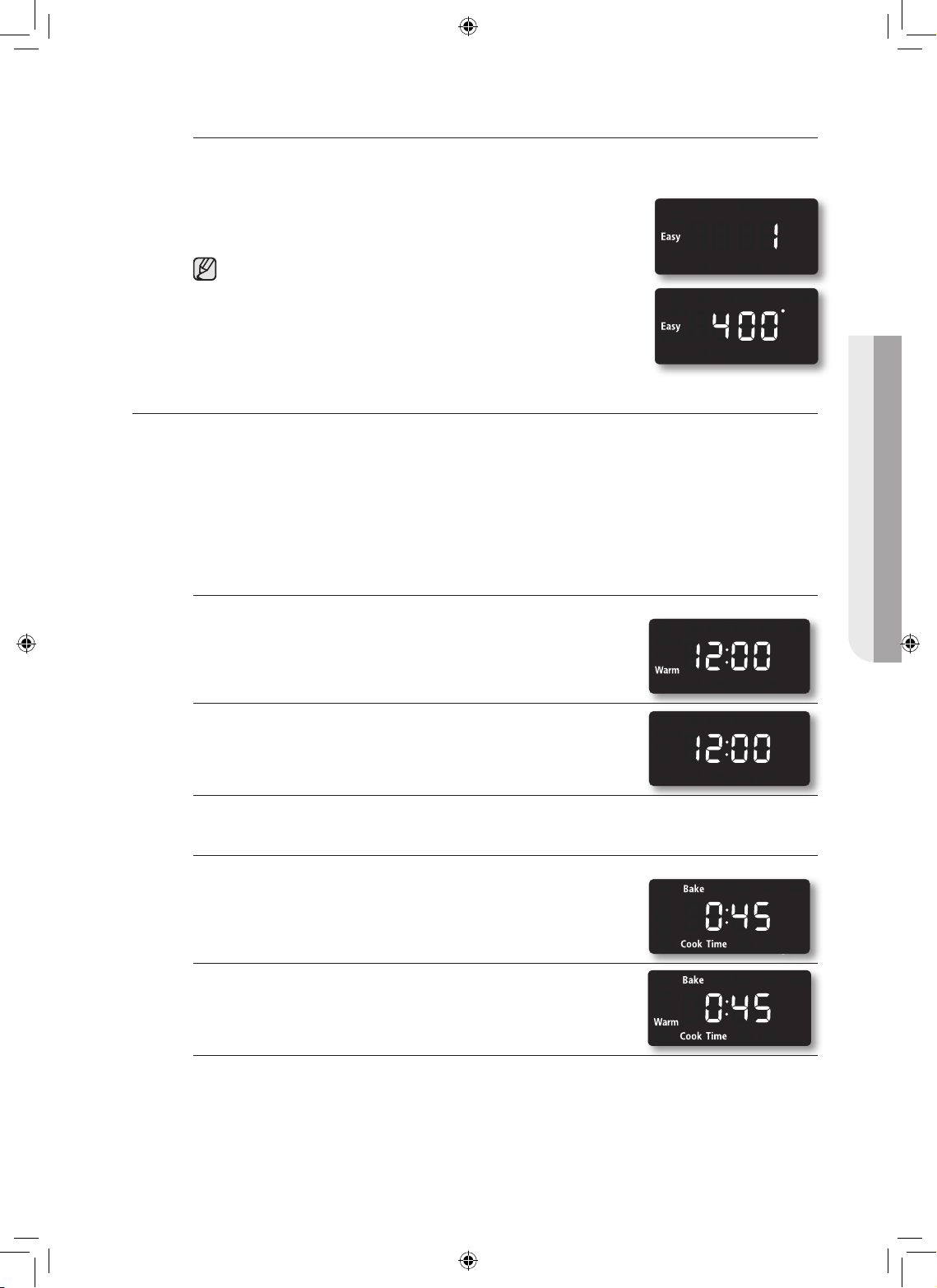
This pizza function is designed to give pizzas crisp, browned bottoms while keeping the topping moist.
1
. Press the Pizza pad.
2
. Press the Start/Set pad to begin pizza cooking.
Use only 1 rack and place the rack in position 2 or 3 for the best
results when using the pizza feature. The default temperature is
400°F. You may adjust the oven temperature to fit your needs.
Follow the package instructions for preheating and baking times.
The pizza setting is not timed. Be sure to monitor the time to
finish cooking the pizza.
USING THE KEEP WARM FUNCTION
The keep warm feature maintains an oven temperature of 170°F and will keep cooked food warm
for serving up to 3 hours after cooking has finished.
After 3 hours, the feature will shut the oven o automatically. The feature may be used without
any other cooking operations or may be set to activate after a timed or delay timed cooking
operation.
You should not use this feature to reheat cold foods.
How to use the keep warm feature
1. Press the Keep Warm pad.
2. Press the Start/Set pad.
3
. Press the Clear/O pad at any time to turn the feature o.
How to set the oven to activate the keep warm mode after a timed
cooking
1. Set up the oven for Timed Cooking.
(Refer to the section on the timed cooking feature on page 32.)
2. Press the Keep Warm pad before pressing the Start/Set pad to
begin the cooking.
3
. Press the Clear/O pad at any time to turn the feature o.
NE595R0ABSR_AA_DG68-00433A-09_EN.indd 38 2016-03-30 �� 8:04:47
39_ Operating the oven
EXTRA FEATURES
12 hour energy saving
With this feature, should you forget and leave the oven on, the control will automatically turn o
the oven after 12 hours during baking functions or after 3 hours during a broil function.
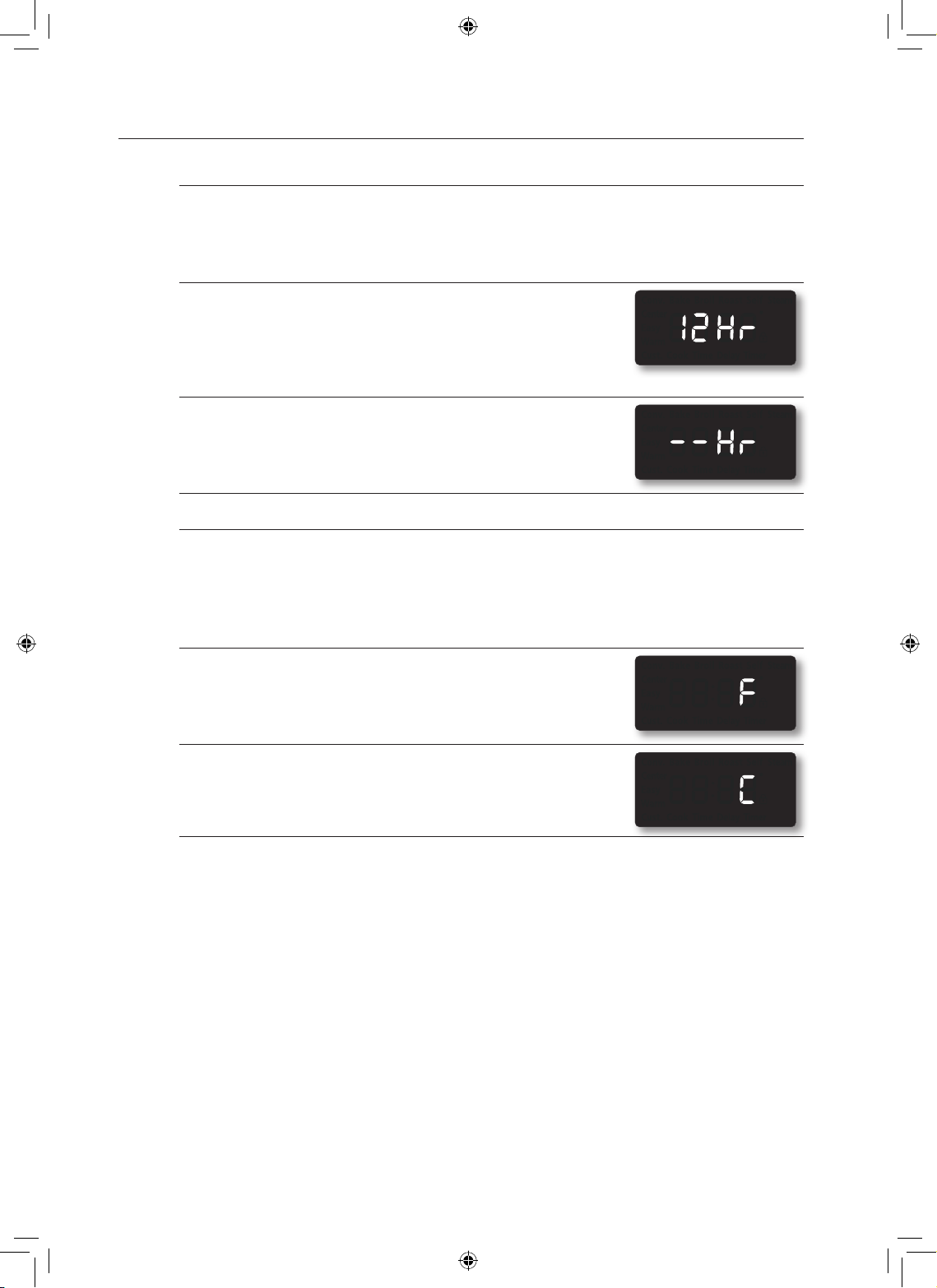
How to turn 12 hour energy saving feature on or o
1. Press Cooking Time and 0 on the number pad at the same time
for 3 seconds.
The display will show 12 Hr (12 hour shut-o) or -- Hr (no shut-
o).
The default is 12 Hr.
2. Press 0 on the number pad to select OFF or ON.
Pressing 0 on the number pad changes the mode between 12 Hr
and -- Hr.
3
. Press the Start/Set pad.
Fahrenheit or Celsius temperature selection
The oven control can be programmed to display temperatures in Fahrenheit or Centigrade. The
oven has been preset at the factory to display in Fahrenheit.
How to change the display from Fahrenheit to Centigrade or from Centigrade
to Fahrenheit
1. Press Broil and the 0 on the number pad at the same time for 3
seconds.
The display shows F (Fahrenheit) or C (Centigrade).
The default is F.
2. Press 0 on the number pad to select F or C.
Pressing 0 on the number pad changes the display between F and C.
3
. Press the Start/Set pad.
NE595R0ABSR_AA_DG68-00433A-09_EN.indd 39 2016-03-30 �� 8:04:48
Operating the oven _40
OPERATING THE OVEN
Convection auto conversion feature
When you use the auto conversion feature, the convection auto conversion feature will
automatically convert entered regular baking temperatures to convection baking temperatures.
If this feature is activated, the display will show the actual converted (reduced) temperature. For
example, if you enter a regular recipe temperature of 350 °F and press the START/SET pad, the
display will show the converted temperature of 325 °F.
How to disable or enable the auto conversion feature
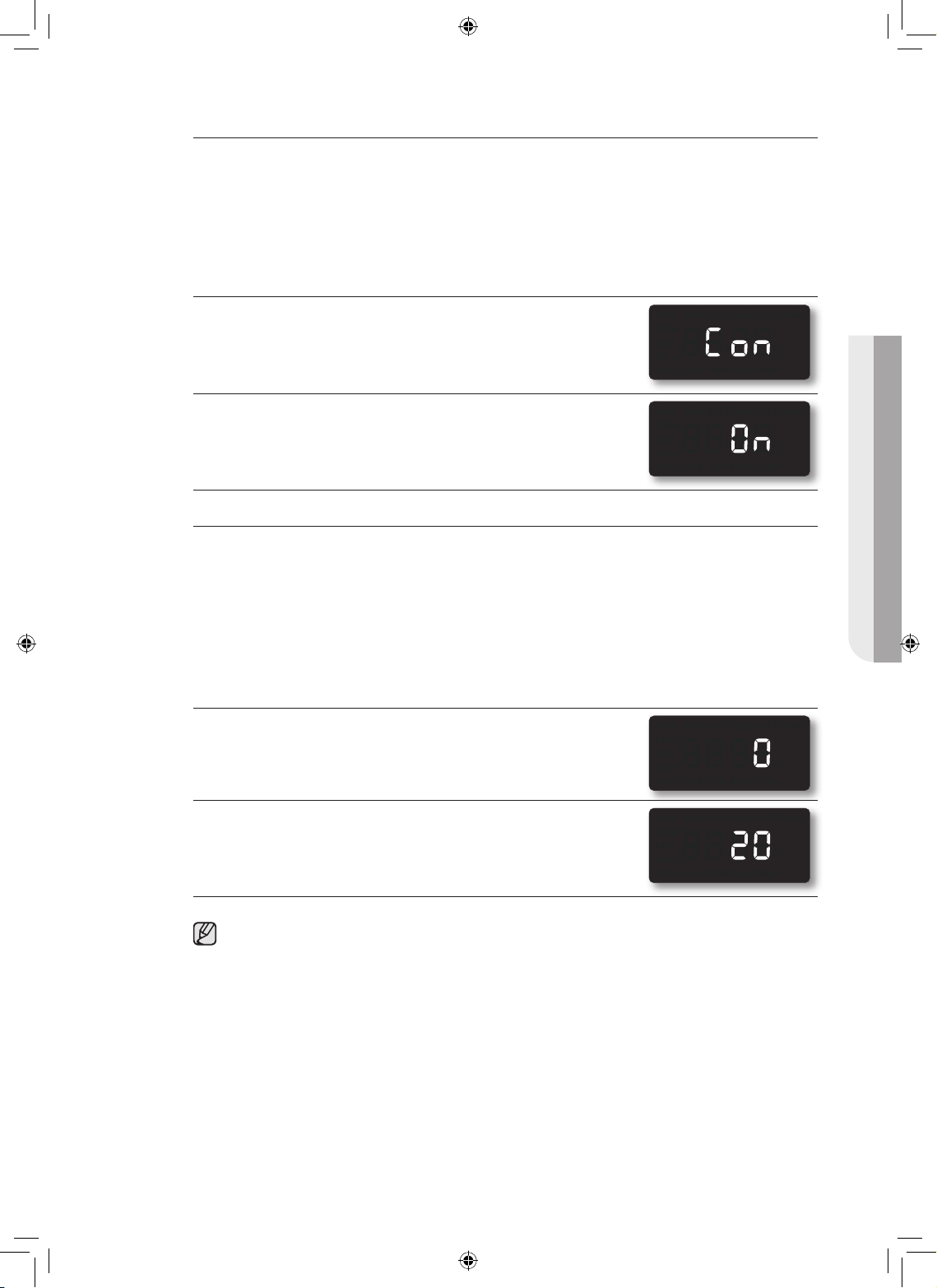
1. Press Conv. Bake and 0 on the number pad at the same time for
3 seconds.
The display will show Con On (enabled) or Con OFF (disabled).
The default setting is Con OFF.
2. Press 0 on the number pad to select Con On or Con OFF.
Pressing 0 on the number pad changes the mode between Con
On and Con OFF.
3
. Press the Start/Set pad.
Thermostat adjustment
The temperature in the oven has been preset at the factory. When first using the oven, be sure to
follow recipe times and temperatures. If you think the oven is too hot or too cool, the temperature
in the oven can be adjusted. Before adjusting, test a recipe by using a temperature setting that is
higher or lower than the recommended temperature. The baking results should help you to decide
how much of an adjustment is needed.
The oven temperature can be adjusted ±35 °F (±19°C).
How to adjust the oven temperature
1. Press Bake and 0 on the number pad at the same time for 3
seconds.
The display will show AdJ 0.
2. Enter the adjustment you want, eg. 20 °F, using the number pad.
You can adjust the temperature so that it is lower than the factory
setting by pressing the Bake pad.
3
. Press the Start/Set pad.
This adjustment will not aect the broiling or the self-cleaning temperatures. The adjustment
will be retained in memory after a power failure.
NE595R0ABSR_AA_DG68-00433A-09_EN.indd 40 2016-03-30 �� 8:04:49
41_ Operating the oven
Sound on/o
By using this feature, you can set the oven controls to operate silently.
How to turn the sound on or o
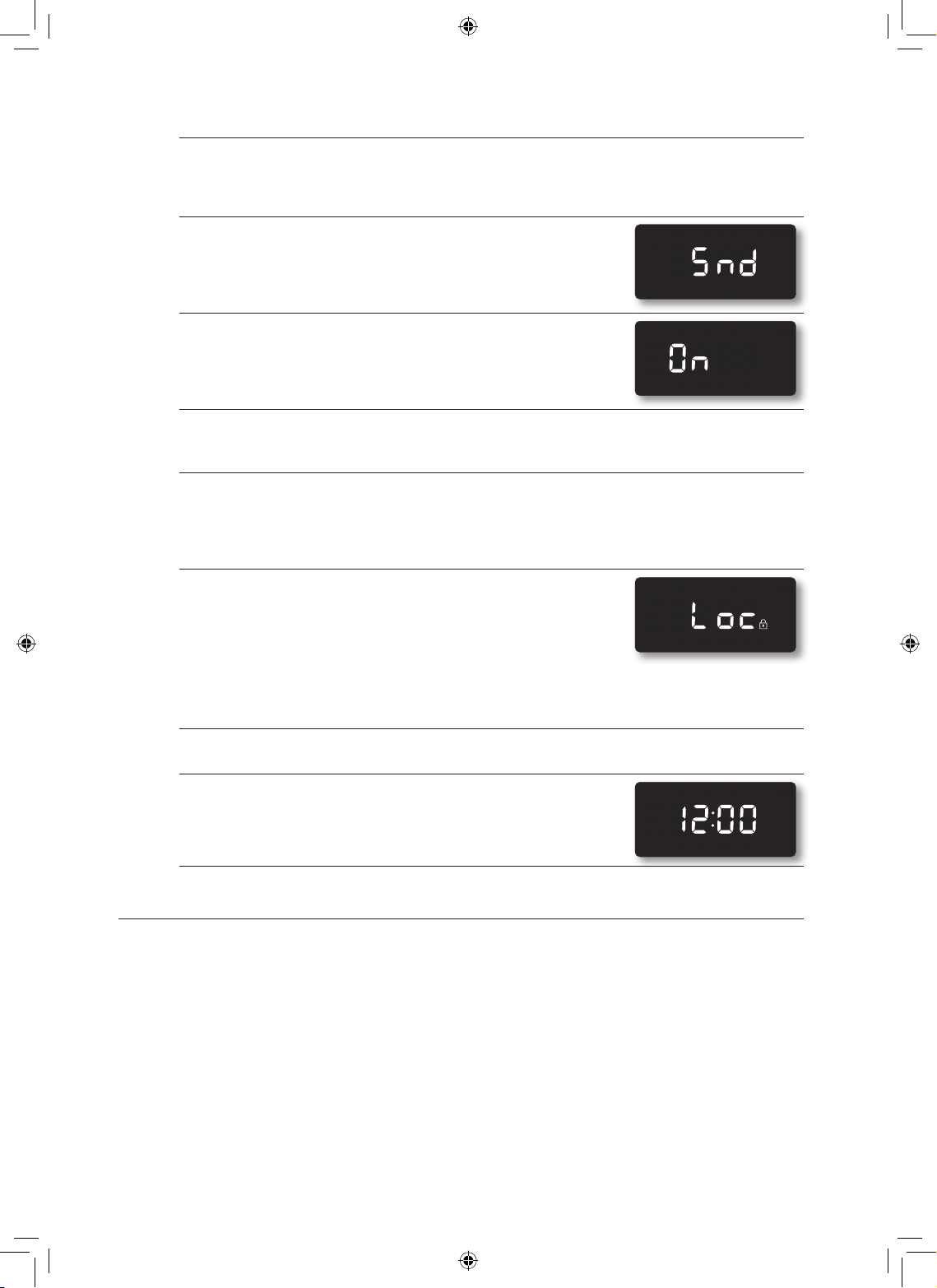
1. Press Oven Light and 0 on the number pad at the same time for
3 seconds.
The display will show Snd On (sound on) or Snd OFF (sound o).
The default setting is Snd On.
2. Press 0 on the number pad to select OFF or ON.
Pressing 0 on the number pad changes the mode between Snd
On and Snd OFF.
3
. Press the Start/Set pad.
Control lockout
This feature will allow you to lock the buttons on the touch pad so they cannot be activated
accidentally.
How to activate the control lockout feature
1. Press the Hold 3 Sec pad for 3 seconds.
The display will show Loc and a Lock icon continuously, as well as
the current time.
All functions must be cancelled before the control lockout is
activated.
This function is available when the oven temperature is under
400°F.
How to unlock the controls
1. Press the Hold 3 Sec pad for 3 seconds.
Loc and the lock icon will disappear from the display.
TURNING THE OVEN LIGHT ON AND OFF
• The oven light turns on automatically when the door is opened.
• The oven light turns o automatically when the door is closed.
• You can turn the oven light on and o manually by pressing the Oven Light pad.
NE595R0ABSR_AA_DG68-00433A-09_EN.indd 41 2016-03-30 �� 8:04:50
Operating the oven _42
OPERATING THE OVEN
SETTING THE SABBATH FEATURE
(For use on the Jewish Sabbath & Holidays)
For further assiistance, guidelines for proper usage, and a complete list of
models with the Sabbath feature, please visit the web at http:\\www.star-k.org.
You can use the Sabbath feature with baking only. The oven temperature may be set higher or
lower after setting the Sabbath feature. (The oven temperature adjustment feature should be
used only during Jewish holidays.) The display, however, will not change and tones will not sound
when a change occurs. Once the oven is properly set for baking with the Sabbath feature active,
the oven will remain on continuously until cancelled. This will override the factory preset 12 hour
energy saving feature. If you need the oven light on during the Sabbath, press the Oven Light
pad before activating the Sabbath feature. Once the oven light is turned on and the Sabbath
feature is active, the oven light will remain on until the Sabbath feature is turned o. If the oven
light needs to be o, be sure to turn the oven light o before activating the Sabbath feature.
How to use the Sabbath feature
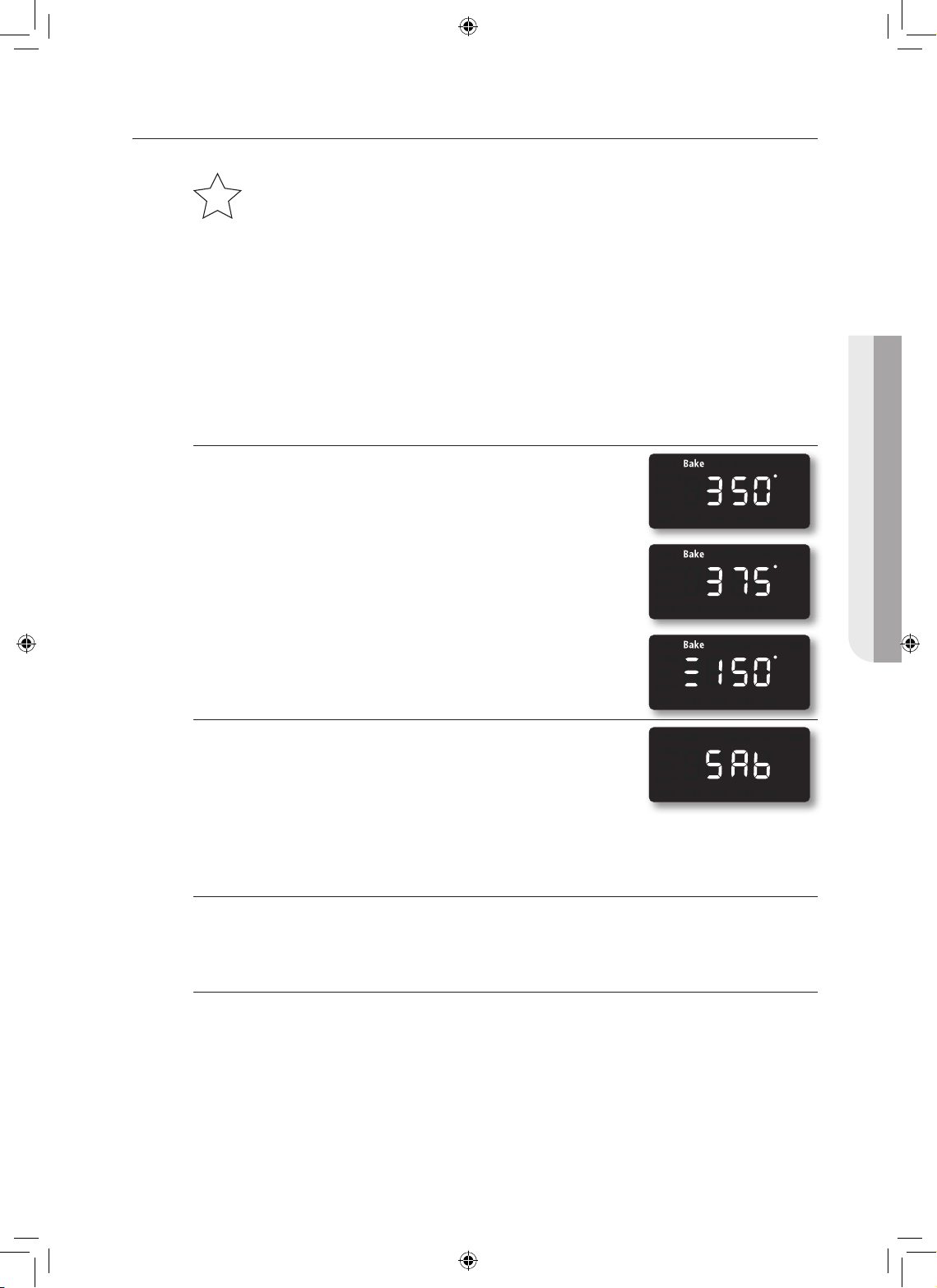
1. Press the Bake pad.
The default temperature is 350 °F.
2
. Enter the temperature you want, eg. 375 °F, by using the number
pad.
3
. Press the Start/Set pad.
The temperature display will start to change once the oven
temperature reaches 150 °F.
4. Press the Clock and the Kitchen Timer On/O pads at the
same time for 3 seconds.
The display will show SAb.
Once SAb appears in the display, the oven will not beep or display
any further changes.
You may change the oven temperature once baking has started.
Remember that the oven will not beep or display any further
changes once the Sabbath feature is engaged.
5. You can turn the oven o at any time by pressing the Clear/O
pad. This will turn only the oven o. If you want to deactivate the
Sabbath feature, hold down the Clock and KItchen Timer On/
O pads at the same time for 3 seconds. Sab will disappear from
the display.
K
NE595R0ABSR_AA_DG68-00433A-09_EN.indd 42 2016-03-30 �� 8:04:51
43_ Maintaining your appliance
Do not to attempt to activate any other program feature except BAKE while the Sabbath
feature is active. ONLY the following key pads will function correctly with the Sabbath
feature: Number, Bake, Start/Set and Clear/O pad. ALL OTHER KEYPADS should
not be used once the Sabbath feature is activated.
You can change the oven temperature, but the display will not change and tones will not
sound when a change occurs. (The oven temperature adjustment feature should be used
only on Jewish holidays.) After changing the temperature while the unit is in Sabbath mode
there is a 15 seconds delay before the unit will recognize the change.
Should you experience a power failure or interruption, the oven will shut o. When power
is returned, the oven will not turn back on automatically. SAb will be displayed in the oven
control display, but the oven will not operate. The food may be safely removed from the
oven while it is still in the Sabbath mode, however the oven cannot be turned back on until
after the Sabbath/Holidays. After the Sabbath observance, turn OFF the Sabbath mode.
Press and hold both Clock and TIMER ON/ OFF pads for at least 3 seconds simultaneously
to turn the Sabbath mode o. The oven may be used with all normal functions.
Do not open the oven door or change the oven temperature for about 30 minutes after you
have started Sabbath mode to allow the oven to reach the set temperature. Note that, for
best performance, the oven fan operates only when the oven temperature is rising.
NE595R0ABSR_AA_DG68-00433A-09_EN.indd 43 2016-03-30 �� 8:04:51
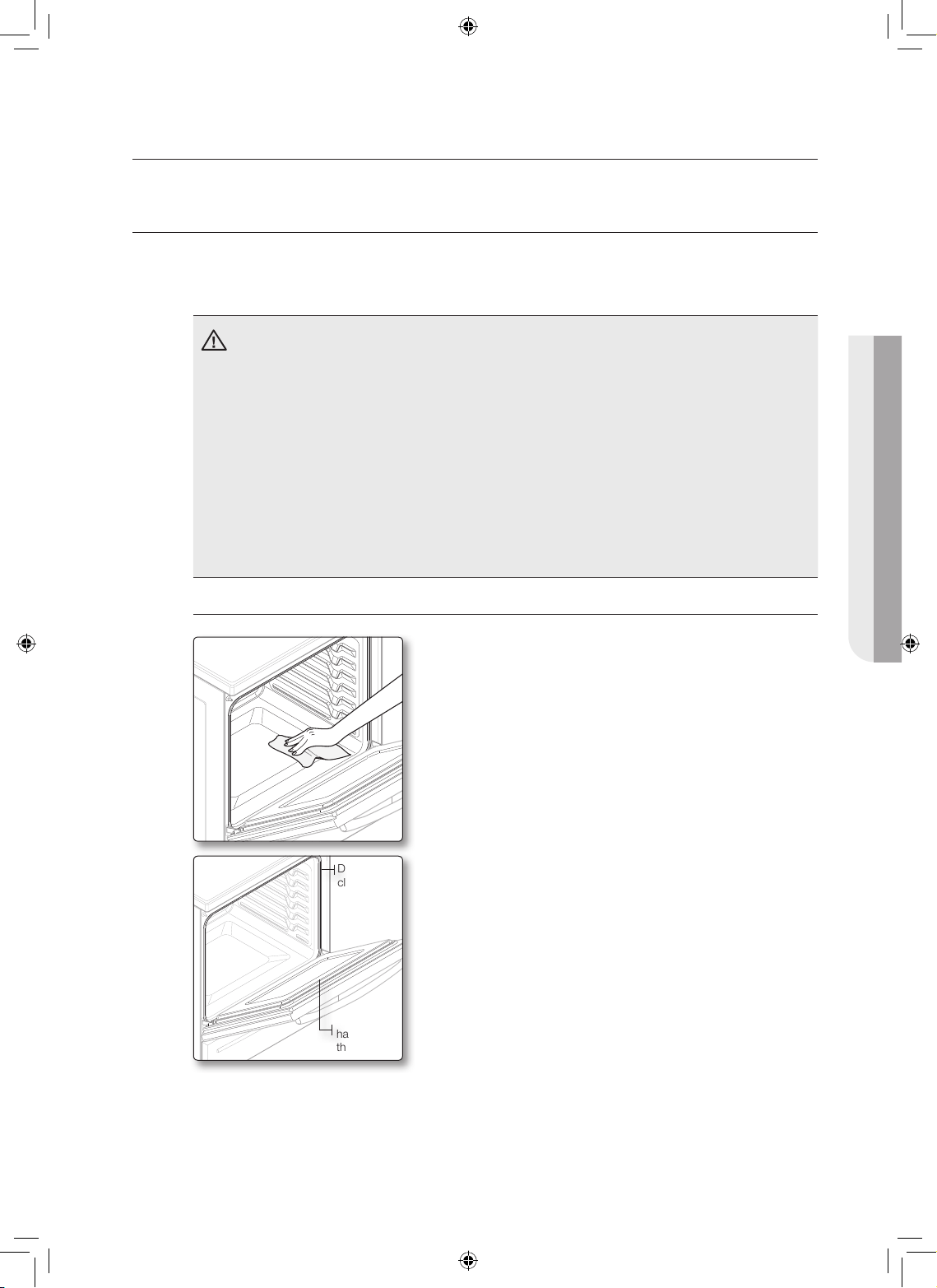
Maintaining your appliance _44
MAINTAINING YOUR APPLIANCE
maintaining your appliance
SELF-CLEANING
This self-cleaning oven uses high temperatures (well above cooking temperatures) to burn o
leftover grease and residue completely or reduce them to a finely powdered ash that you can wipe
away with a damp cloth.
CAUTION
• During the self-cleaning cycle, the outside of the range will become very hot to the
touch. Do not leave small children unattended near the appliance.
• Some birds are extremely sensitive to the fumes given o during the self-cleaning
cycle of any range. Move birds to another well-ventilated room.
• Do not line the oven walls, racks, bottom, or any other part of the range with
aluminum foil. Doing so will result in poor heat distribution, poor baking results, and
cause permanent damage to the oven interior. Aluminum foil will melt and adhere to
the interior surface of the oven.
• Do not force the oven door open. This can damage the automatic door locking
system. Use care when opening the oven door after the self-cleaning cycle is
complete. Stand to the side of the oven when opening the door to allow hot air or
steam to escape. The oven may still be VERY HOT.
Before a self-cleaning cycle
Fig. 1
• We recommend venting your kitchen with an open window
or using a ventilation fan or hood during the self-cleaning
cycle.
• Remove the wire rack, broil pan, broil pan insert, all
cookware, and any aluminum foil from the oven.
• Wipe up debris from the oven bottom. (Fig. 1)
• The silver-colored oven racks can be self-cleaned, but they
will darken, lose their luster, and become hard to slide.
• Residue on the front frame of the range and outside the
gasket on the door will need to be cleaned by hand. Clean
these areas with hot water, soap-filled steel-wool pads, or
cleansers such as Soft Scrub. Rinse well with clean water
and dry.
• Do not clean the gasket. The fiberglass material of the oven
door gasket cannot withstand abrasion. It is essential for
the gasket to remain intact. If you notice it becoming worn
or frayed, replace it. (Fig. 2)
• Make sure the oven light bulb cover is in place and the
oven light is o.
Don’t hand
clean the
oven door
gasket.
Fig. 2
You may
hand clean
the door.
NE595R0ABSR_AA_DG68-00433A-09_EN.indd 44 2016-03-30 �� 8:04:52
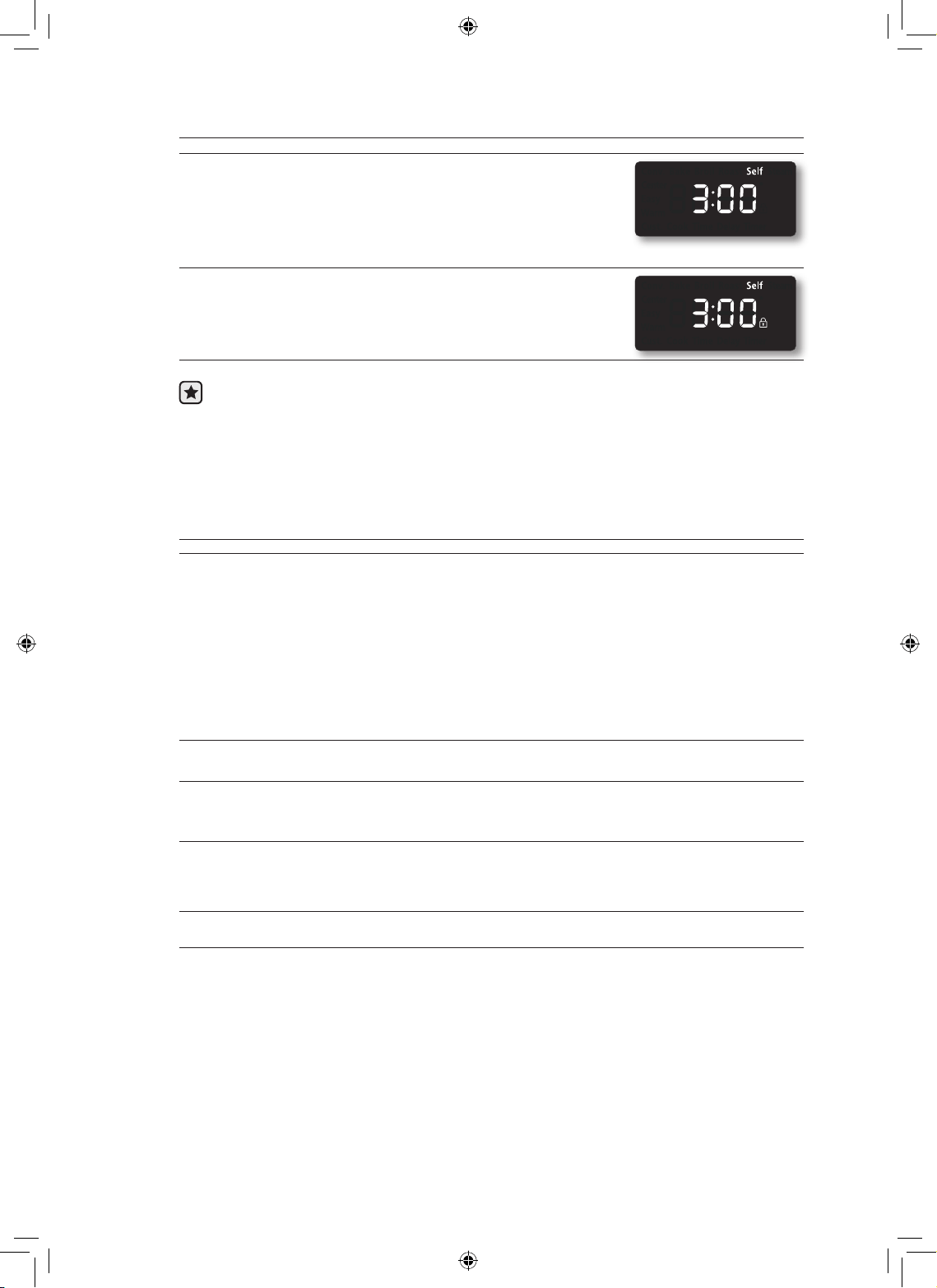
45_ Maintaining your appliance
How to set the oven for self-cleaning
1. Select the length of time for the self-cleaning operation, eg. 3
hours.
Press the Self Clean pad once for a 3 hour clean time, twice for a
4 hour clean time, or 3 times for a 2 hour clean time.
The default setting is 3 hours.
2. Start the self-cleaning cycle.
Press the Start/Set pad. The motor-driven door lock will engage
automatically.
• You will not be able to start a self-cleaning cycle if the control lockout feature is activated
or if the oven’s temperature is too hot.
• The oven door locks automatically. The display will show the clean time remaining. It
is not be possible to open the oven door until the temperature drops to a safe/cool
temperature.
• The self-cleaning feature will not operate when the warming center is on.
How to delay the start of self-cleaning
1. Press the Self Clean pad.
Select the desired self-clean time by pressing the Self Clean pad.
2
. Press the Delay Start pad.
3
. Using the Clock and number pads, enter the time you want the clean cycle to start.
4
. Press the Start/Set pad.
The display will show Delay, Self clean, and the Lock icon. The motor-driven door lock will
engage automatically.
5
. The Self-Cleaning cycle will turn on automatically at the set time.
How to turn o the self-cleaning feature
You may find it necessary to stop or interrupt a self-cleaning cycle due to smoke in the oven.
(When the self-cleaning cycle is done, End will show in the display and a beep will sound 6 times.
1. Press the Clear/O pad.
2
. You will be able to open the oven door once the oven has cooled down for approximately 1
hour.
After a self-cleaning cycle
• You may notice some white ash in the oven. Wipe it up with a damp cloth after the oven cools.
(If white spots remain, remove them with a soap-filled steel wool pad and rinse thoroughly with
a vinegar and water mixture.)
• If the oven is not clean after one cycle, repeat the cycle.
• You cannot set the oven for cooking until the oven is cool enough for the door to unlock.
NE595R0ABSR_AA_DG68-00433A-09_EN.indd 45 2016-03-30 �� 8:04:52
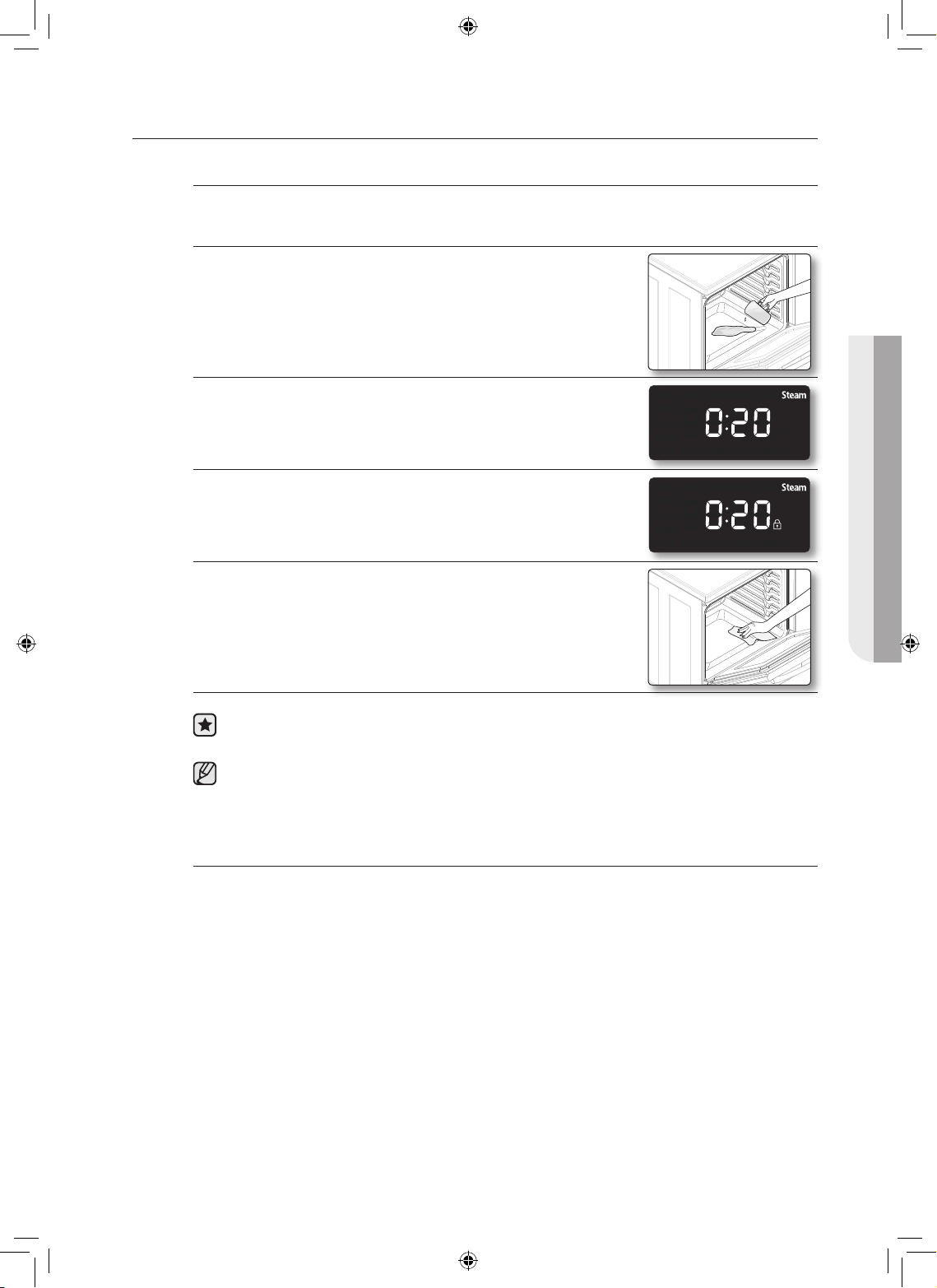
Maintaining your appliance _46
MAINTAINING YOUR APPLIANCE
STEAM-CLEANING
How to set the oven for steam-cleaning
For light cleaning, the Steam-cleaning function saves time and energy. For heavier-duty cleaning
grease, use the self-cleaning function.
1. Remove all accessories from the oven.
2. Pour approximately 10 oz. (300 ml) of water onto the bottom of the
empty oven and close the oven door.
Use normal water only, no distilled water.
3. Press the Steam Clean pad.
4. Press the Start/Set pad.
When the operation is complete, the display will blink and a beep
will sound.
5. Press the Clear/O pad.
6
. Clean the oven’s interior.
There will be a significant amount of water remaining on the
bottom of the oven after a steam-cleaning cycle. Remove the
residual water with a sponge or soft dry cloth.
When steam-cleaning, use exactly 10 oz. of water since this produces the best results.
If you press the Steam Clean pad when the oven temperature is above 100 ˚F, Hot will
appear in the display. Because these functions produce the best results when started while
the oven is cool, we recommend that you wait until the oven has cooled down and Hot
disappears from the display.
After a steam-cleaning cycle
• Take care when opening the door before a steam-cleaning procedure has ended. The water on
the bottom is hot.
• Open the oven door and remove the remaining water with a sponge. Do not leave the residual
water in the oven for any length of time. Wipe the oven clean and dry with a soft cloth. Do not
forget to wipe under the oven door seal.
• Use a detergent-soaked sponge, a soft brush, or a nylon scrubber to wipe the oven interior.
Remove stubborn residue with a nylon scourer. You can remove lime deposits with a cloth
soaked in vinegar.
• If the oven remains dirty, you can repeat the procedure once the oven has cooled.
• For heavy residue, such as grease left over from roasting, we recommend that you rub
detergent into the residue before activating the steam-cleaning function.
• After cleaning, leave the oven door ajar at a 15° angle to allow the interior enamel surface to dry
thoroughly.
NE595R0ABSR_AA_DG68-00433A-09_EN.indd 46 2016-03-30 �� 8:04:53
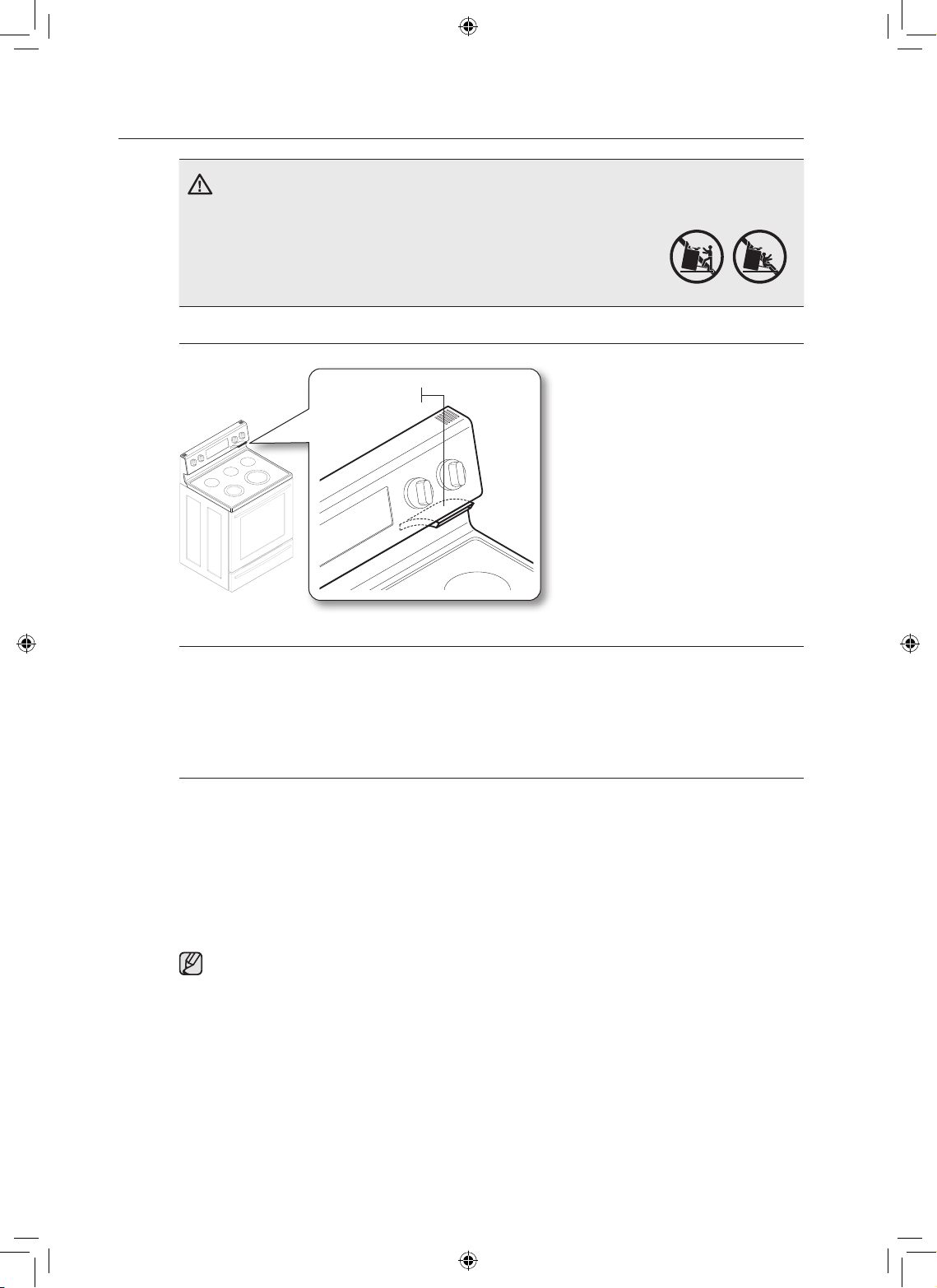
47_ Maintaining your appliance
CARE AND CLEANING OF THE OVEN
WARNING
• Be sure all controls are OFF and all surfaces are COOL before cleaning any
part of the range.
• If your range is removed for cleaning, servicing, or
any reason, be sure the Anti-Tip device is re-engaged
properly when the range is replaced. If you fail to re-
engage the Anti-Tip device, the range could tip and
cause serous injury.
Oven vent
Oven vent
• The oven vent is located above the
right rear surface unit.
• This area could become hot during
oven use.
• It is normal for steam to come out of
the vent.
• The vent is important for proper air
circulation. Never block this vent.
Cleaning painted parts and decorative trim
• For general cleaning, use a cloth with hot and soapy water.
• For more dicult residue and built-up grease, apply a liquid detergent directly onto the area and
leave for 30 to 60 minutes. Wipe with a damp cloth and dry. Do not use abrasive cleaners on
any of these surfaces. They can scratch.
Cleaning stainless steel surfaces
1. Shake the bottle of Stainless Steel Appliance Cleaner or polish well.
2. Place a small amount of stainless steel appliance cleaner or polish on a damp cloth or damp
paper towel.
3. Clean a small area, rubbing with the grain of the stainless steel if applicable.
4. Dry and bu with a clean, dry paper towel or soft cloth.
5. Repeat as necessary.
• Do not use a steel-wool pad. It will scratch the surface.
• If a mineral oil-based stainless steel appliance cleaner has been used before to clean
the appliance, wash the surface with dishwashing liquid and water prior to using the
Stainless Steel Appliance Cleaner or polish.
NE595R0ABSR_AA_DG68-00433A-09_EN.indd 47 2016-03-30 �� 8:04:54
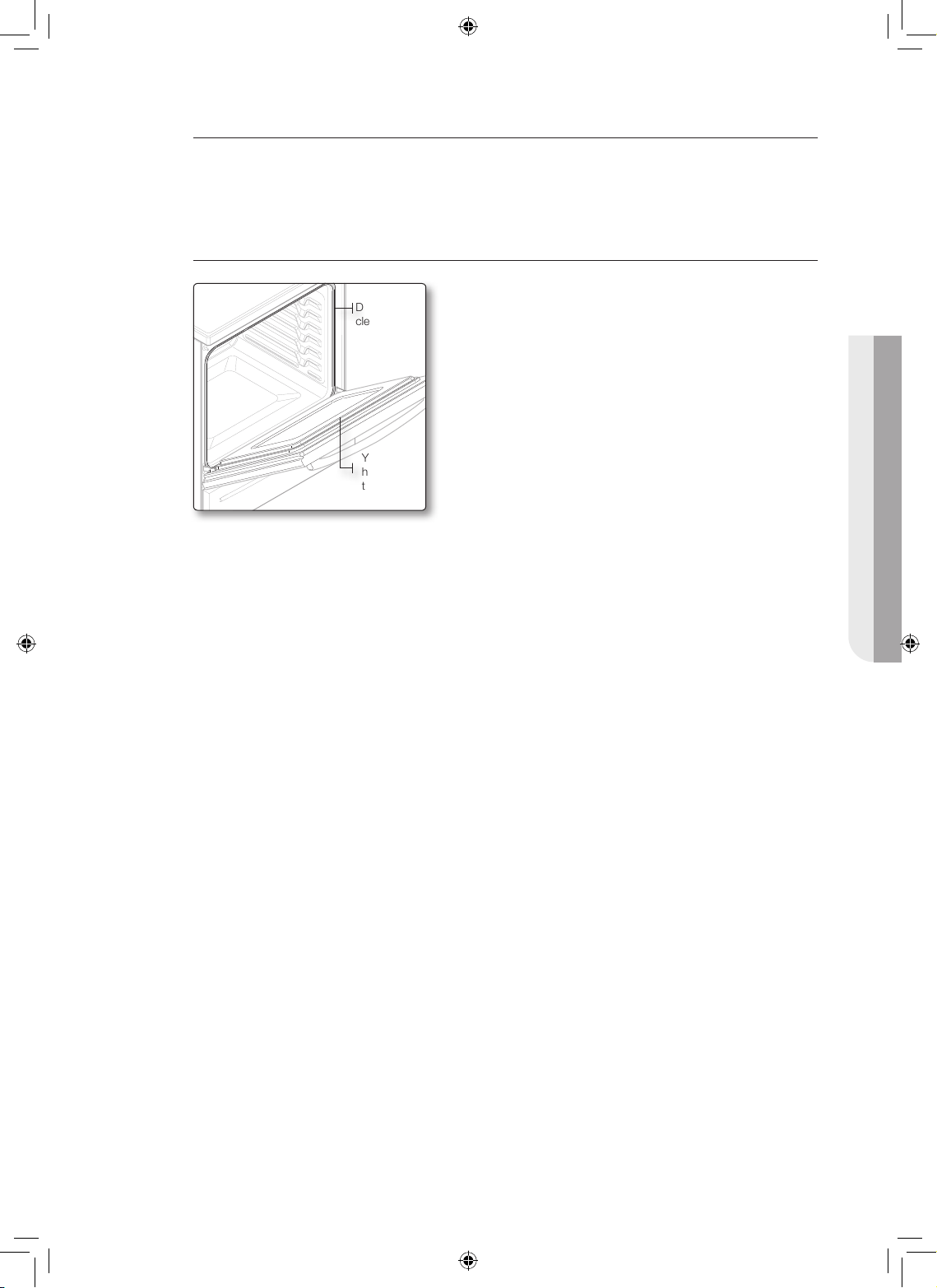
Maintaining your appliance _48
MAINTAINING YOUR APPLIANCE
Oven racks
• If the racks are left in the oven during a self-cleaning cycle, their color will turn slightly blue and
the finish will be dull. After the self-cleaning cycle is complete and the oven has cooled, rub the
sides of the racks with wax paper or a cloth containing a small amount of oil. This will help the
racks glide more easily into their tracks.
Oven door
Don’t hand
clean the
oven door
gasket.
You may
hand clean
the oven
door.
• Use soap & water to thoroughly clean the top, sides,
and front of the oven door. Rinse well. You may use a
glass cleaner on the outside glass of the oven door.
DO NOT immerse the door in water. DO NOT spray or
allow water or the glass cleaner to enter the door
vents. DO NOT use oven cleaners, cleaning powders,
or any harsh abrasive cleaning materials on the outside
of the oven door.
• DO NOT clean the oven door gasket. The oven
door gasket is made of a woven material which is
essential for a good seal. Care should be taken not to
rub, damage, or remove this gasket.
NE595R0ABSR_AA_DG68-00433A-09_EN.indd 48 2016-03-30 �� 8:04:55
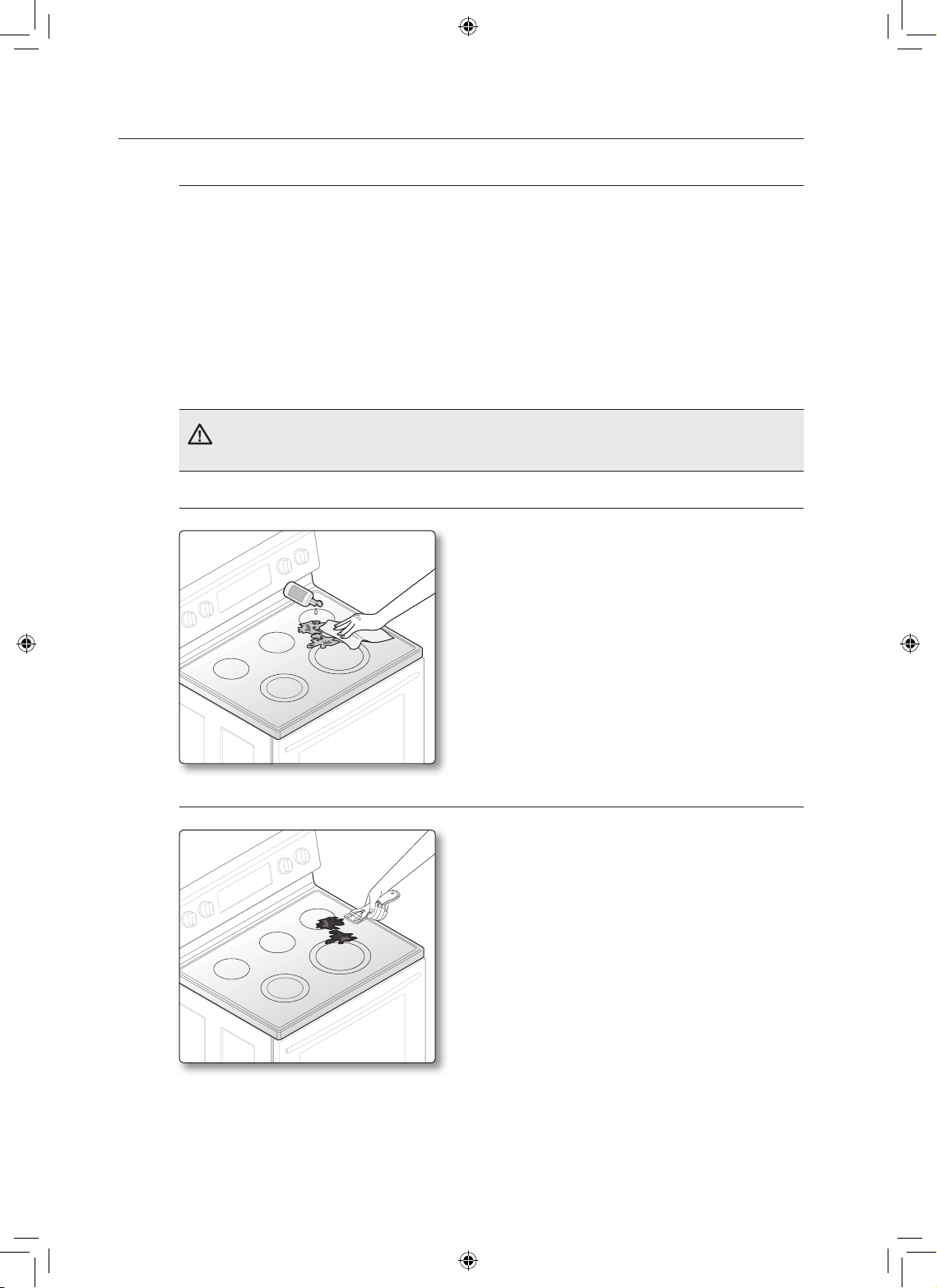
49_ Maintaining your appliance
CARE AND CLEANING OF THE GLASS COOKTOP
Normal daily use cleaning
Use only a ceramic cooktop cleaner. Other creams may not be as eective.
By following these steps, you can maintain and protect the surface of your glass cooktop.
1. Before using the cooktop for the first time, clean it with a ceramic cooktop cleaner.
This helps protect the top and makes cleanup easier.
2. Daily use of a ceramic cooktop cleaner will help keep the cooktop looking new.
3. Shake the cleaning cream well. Apply a few drops of cleaner directly to the cooktop.
4. Use a paper towel or a cleaning pad for ceramic cooktops to clean the entire cooktop surface.
5. Use a dry cloth or paper towel to remove all cleaning residue. No need to rinse.
WARNING
DAMAGE to your glass surface may occur if you use scrub pads other than those
recommended.
Removing burned-on residue
1. Allow the cooktop to cool.
2. Spread a few drops of ceramic cooktop cleaner
on the entire burned residue area.
3
. Using the cleaning pad for ceramic cooktops, rub
the residue area, applying pressure as needed.
4
. If any residue remains, repeat the steps listed
above as needed.
5
. For additional protection, after all residue has been
removed, polish the entire surface with ceramic
cooktop cleaner and a paper towel.
Removing heavy, burned-on residue
1. Allow the cooktop to cool.
2. Use a single-edge razor-blade scraper at
approximately a 45 ° angle against the glass
surface and scrape the soil. It will be necessary to
apply pressure in order to remove the residue.
3
. After scraping with the razor scraper, spread a few
drops of ceramic cooktop cleaner on the entire
burned residue area. Use the cleaning pad to
remove any remaining residue. (Do not scrape the
seal.)
4
. For additional protection, after all residue has
been removed, polish the entire surface with the
cooktop cleaner and a paper towel.
NE595R0ABSR_AA_DG68-00433A-09_EN.indd 49 2016-03-30 �� 8:04:56
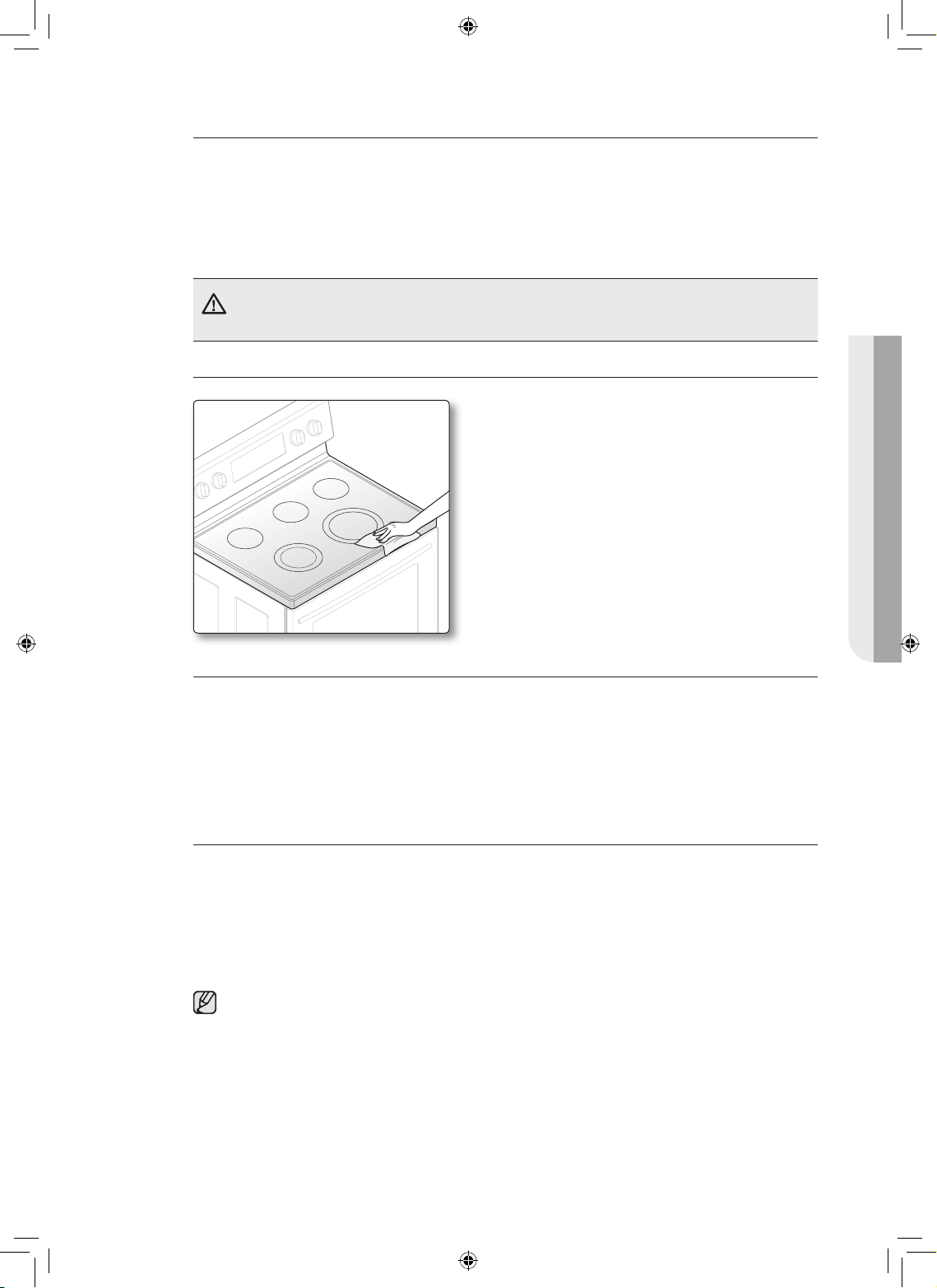
Maintaining your appliance _50
MAINTAINING YOUR APPLIANCE
Removing metal marks and scratches
1. Be careful not to slide pots and pans across your cooktop. It will leave marks on the cooktop
surface. You can remove these marks by applying ceramic cooktop cleaner with a cleaning
pad for ceramic cooktops.
2. If pots with a thin overlay of aluminum or copper are allowed to boil dry, the overlay may leave
black discoloration on the cooktop. You should remove this discoloration immediately or it may
become permanent.
WARNING
Carefully check the bottoms of pans for roughness that may scratch the cooktop.
Cleaning the cooktop seal
To clean the seal around the edges of the glass, lay a
wet cloth on it for a few minutes, then wipe clean with
a nonabrasive cleaner.
Potential for permanent damage to the glass surface
• Sugary spillovers (such as jellies, fudge, candy, syrups) or melted plastics can cause pitting
of the surface of your cooktop. This is not covered under the warranty. You should clean the
spill while it is still hot. Take special care when removing hot substances. Refer to the following
section.
• When using a scraper, be sure it is new and the razor blade is still sharp. Do not use a dull or
nicked blade.
Cleaning sugary spills and melted plastic
1. Turn o all surface units. Remove hot pans.
2. Wearing an oven mitt, use a single-edge razor-blade scraper to move the spill to a cool area of
the cooktop. Remove the spill with paper towels.
3. Any remaining spillover should be left until the surface of the cooktop has cooled.
4. Don’t use the surface units again until all of the residue has been completely removed.
If pitting or indentations in the glass surface have already occurred, the cooktop glass will
have to be replaced. In this case, service will be necessary.
NE595R0ABSR_AA_DG68-00433A-09_EN.indd 50 2016-03-30 �� 8:04:56
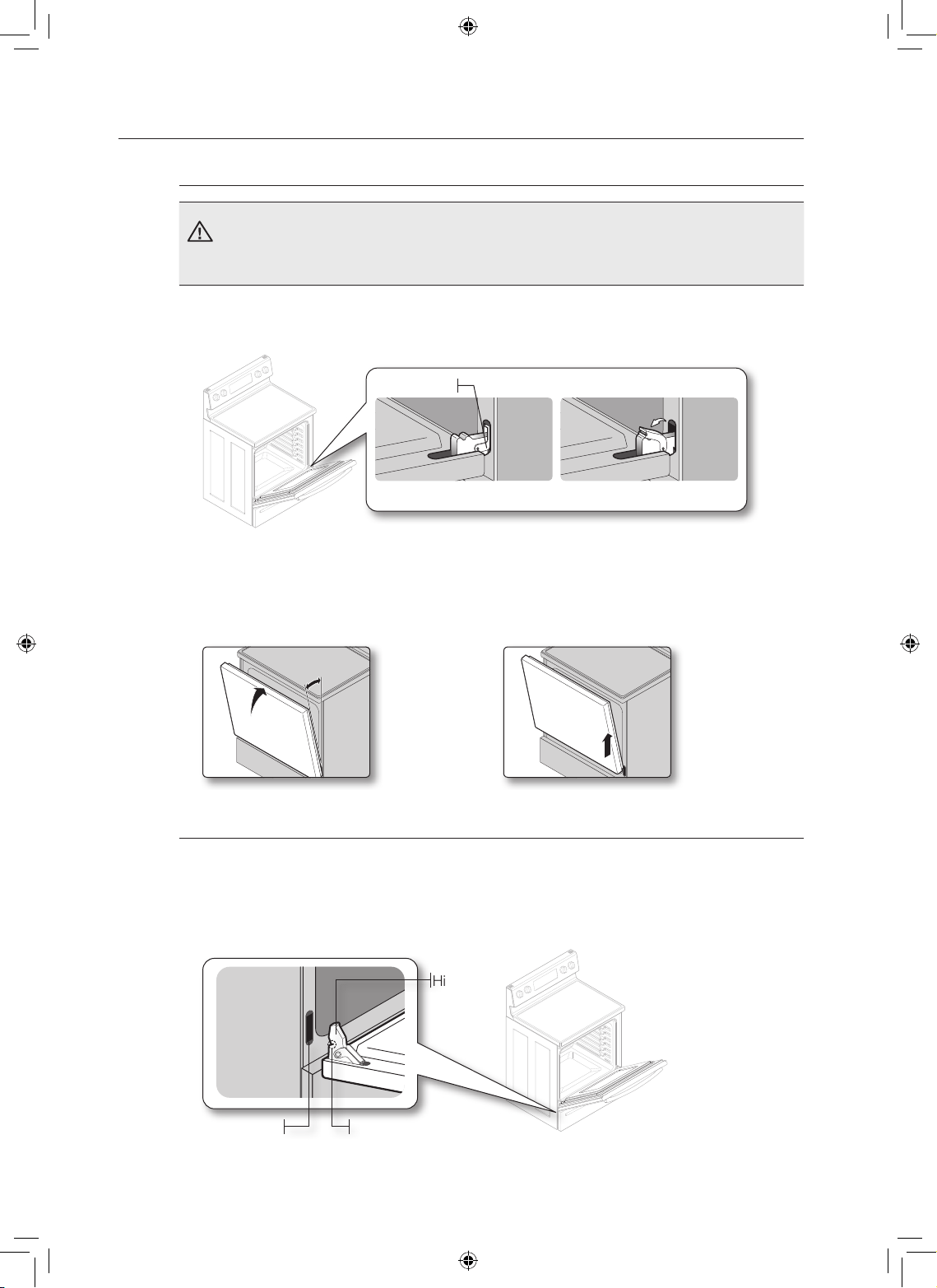
51_ Maintaining your appliance
REMOVING AND REPLACING THE OVEN DOOR
How to remove the door
CAUTION
• The door is very heavy. Be careful when removing and lifting the door. Do not lift the
door by the handle.
• Turn the power OFF before removing the door.
1. Open the door completely.
2. Pull the hinge locks down toward the door frame to the unlocked position.
Hinge lock
Locked position Unlocked position
3. Firmly grasp both sides of the door at the top.
4. Close the door to the door removal position, which is approximately 5 degrees from vertical
(Fig. 1).
5. Lift door up and out until the hinge arm is clear of the slot (Fig. 2).
about 5 °
Fig. 1 Fig. 2
How to replace the door
1. Firmly grasp both sides of the door at the top.
2. With the door at the same angle as the removal position, slide the indentation of the hinge arm
into the bottom edge of the hinge slot. The notch in the hinge arm must be fully inserted into
the bottom of the slot.
Bottom
edge of slot
Indentation
Hinge arm
NE595R0ABSR_AA_DG68-00433A-09_EN.indd 51 2016-03-30 �� 8:04:57
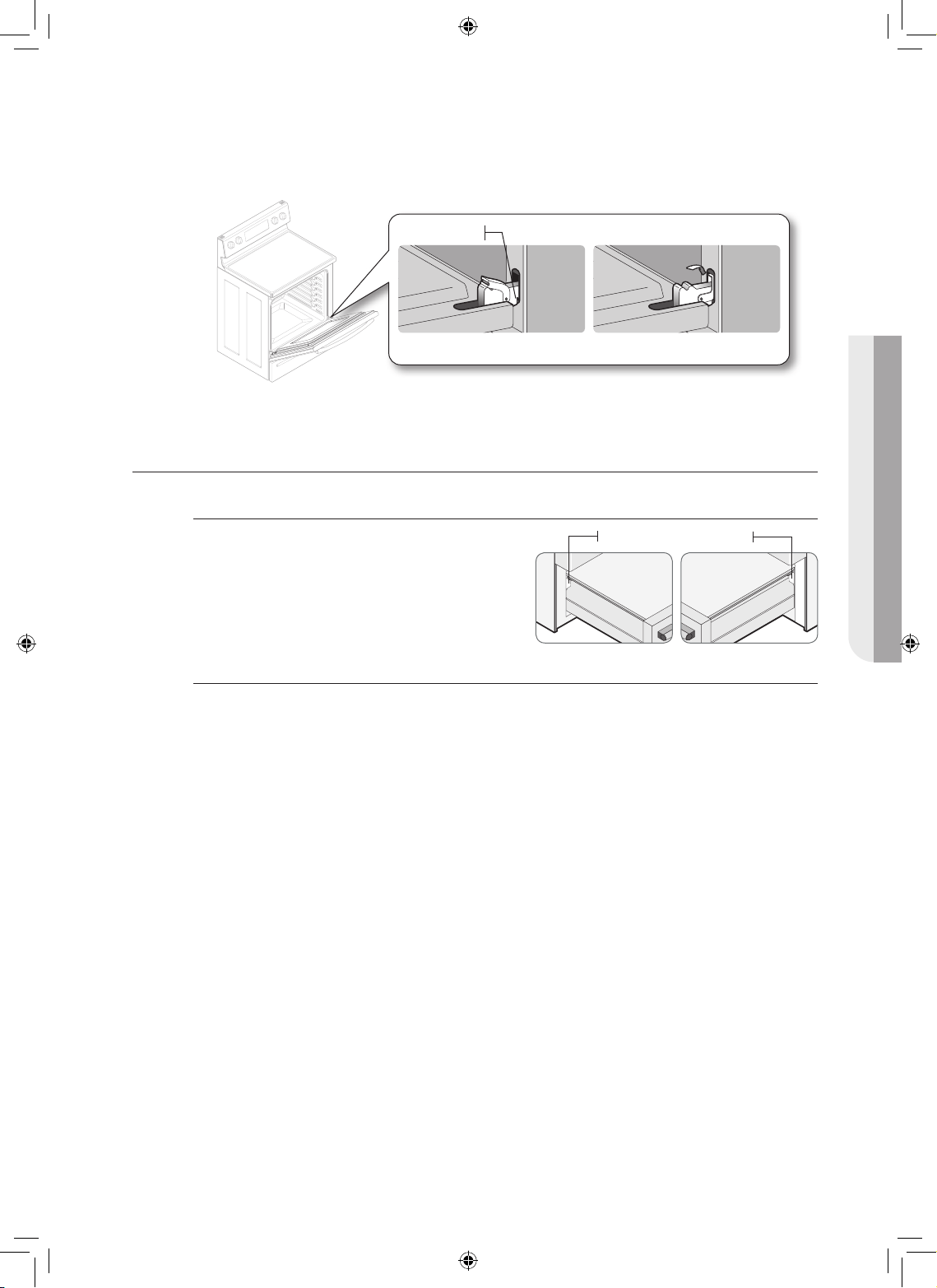
Maintaining your appliance _52
MAINTAINING YOUR APPLIANCE
3. Open the door fully. If the door will not open fully, the indentation is not inserted correctly in the
bottom edge of the slot.
4. Push the hinge locks up against the front frame of the oven cavity to the locked position.
Hinge lock
Unlocked position Locked position
5. Close the oven door.
REMOVING AND REPLACING THE STORAGE DRAWER
How to remove the storage drawer
1. Pull the drawer out until it stops.
2. Tilt the front of the drawer and pull out it until it
stops.
3 Lift and pull the drawer out.
How to replace the storage drawer
1. Put the left side of the drawer over the left hook and the right side over the right hook.
2. Push the drawer until it stops.
3. Tilt and lift the drawer.
4. Push the drawer in.
Hook
Hook
NE595R0ABSR_AA_DG68-00433A-09_EN.indd 52 2016-03-30 �� 8:04:58
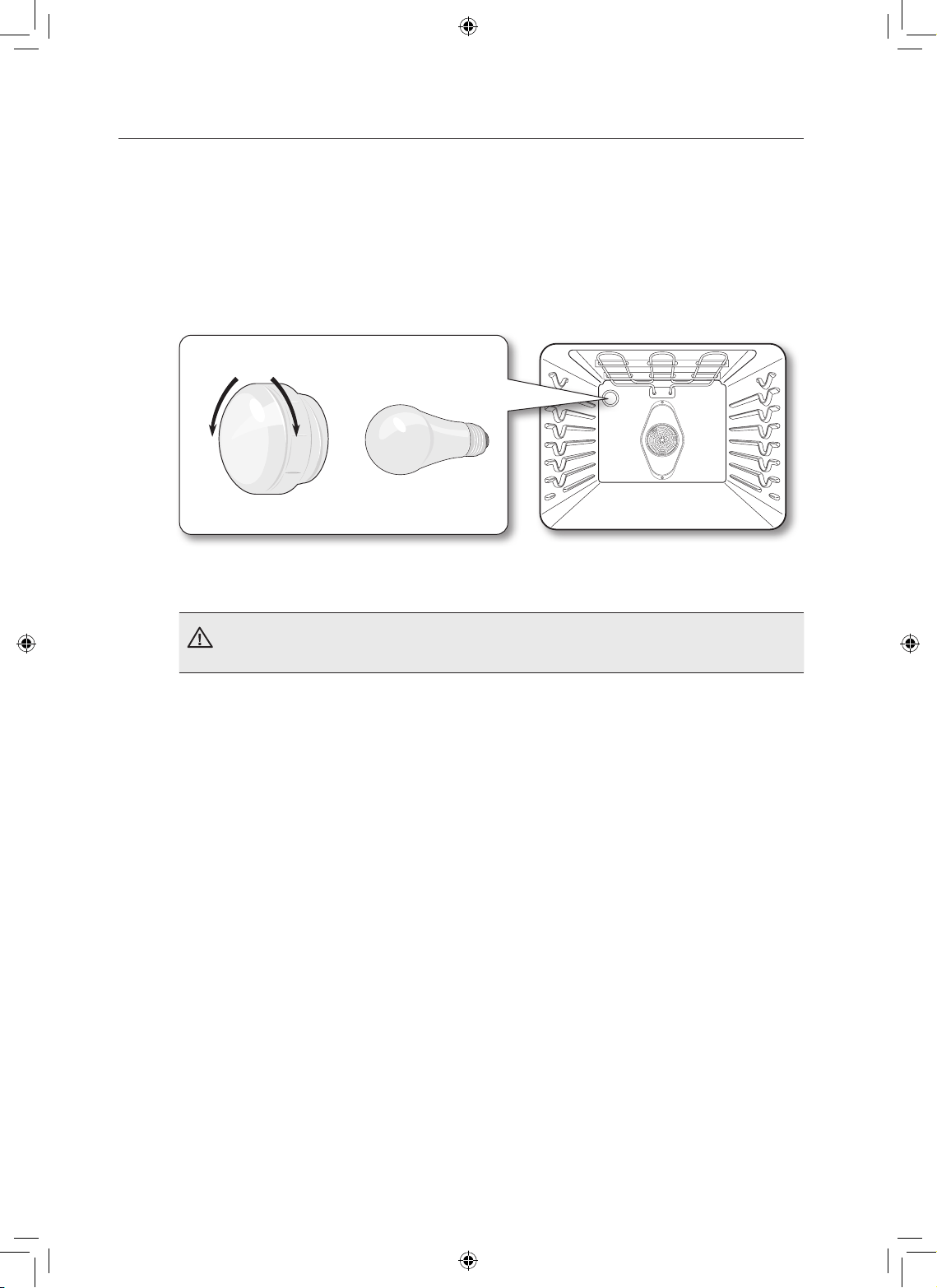
53_ Maintaining your appliance
CHANGING THE OVEN LIGHT
The oven light is a standard 40-watt appliance bulb. It will come on when the oven door is open.
When the oven door is closed, press the OVEN LIGHT pad to turn it on or o. It will not work
during a self-cleaning cycle.
1. Make sure the oven and the bulb are cool.
2. Unplug the range or disconnect power.
3. Turn the glass bulb cover in the back of the oven counterclockwise to remove.
4. Turn the bulb counterclockwise to remove it from its socket.
Remove
Glass bulb cover Bulb
Replace
5. Replace the light bulb and glass bulb cover by turning them clockwise.
6. Plug in the range or reconnect power.
CAUTION
Before changing your oven light bulb, disconnect the electrical power to the range at the
main fuse or circuit breaker panel. Make sure the oven and the bulb are cool.
NE595R0ABSR_AA_DG68-00433A-09_EN.indd 53 2016-03-30 �� 8:04:58
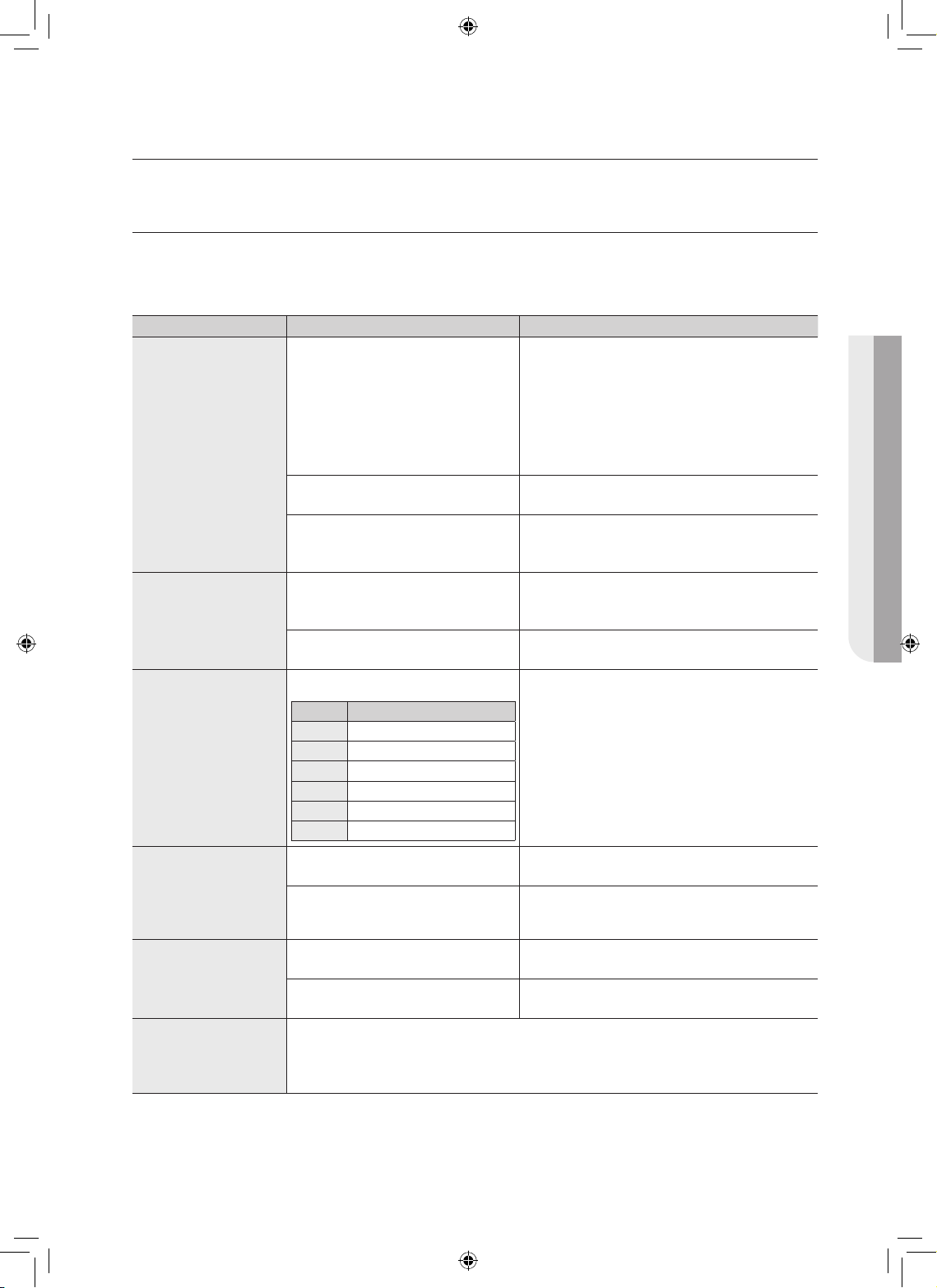
TROUBLESHOOTING
Troubleshooting _54
troubleshooting
TROUBLESHOOTING
Samsung works hard to ensure that you don’t have problems with your new electric range. If you run into
unexpected trouble, look first for a solution in the table below. If, after trying the suggested solution, you’re
still having trouble, call Samsung at 1-800-SAMSUNG (1-800-726-7864).
PROBLEM POSSIBLE CAUSE SOLUTION
The range is not
level.
The appliance has been installed
improperly.
• Place the oven rack in the center of the
oven. Place a level on the oven rack.
Adjust the leveling legs at the base of the
range until the oven rack is level.
• Insure the floor is level and strong and
stable enough to adequately support the
range.
The floor is sagging or sloping.
• Contact a carpenter to correct the
situation.
The kitchen cabinets are not
properly aligned and make the
range appear to be not level.
• Insure the cabinets are square and provide
sucient room for installation.
The appliance
must be accessed
for servicing and
cannot be moved
easily.
The kitchen cabinets are not
square and built too tightly in to the
appliance.
• Contact a builder or installer to make the
appliance accessible.
Carpet is interfering with
movement of the range.
• Provide sucient space so the range can
be lifted over the carpet.
The oven control
beeps and displays
an F error code.
You have a function error code.
CODE CAUSE
-SE- Shorted key
E-27 Oven sensor opened
E-28 Oven sensor shorted
E-08 Oven heating error
E-0A Oven heating over
E-0E Door locking error
• Press the CLEAR/OFF pad and restart
the oven. If the problem persists,
disconnect all power to the range for at
least 30 seconds and then reconnect the
power. If this does not solve the problem,
call for service.
The surface units
will not maintain
a rolling boil or
will not cook fast
enough.
Improper cookware is being used.
• Use pans which are flat and match the
diameter of the surface unit selected.
In some areas, the power (voltage)
may be low.
• Cover the pan with a lid until the desired
heat is obtained.
The surface units
will not turn on.
A fuse in your home may be blown
or the circuit breaker tripped.
• Replace the fuse or reset the circuit
breaker.
The cooktop controls are set
improperly.
• Check to see the correct control is set for
the surface unit you are using.
The surface unit
stops glowing when
changed to a lower
setting.
This is normal. The unit is still on and hot.
NE595R0ABSR_AA_DG68-00433A-09_EN.indd 54 2016-03-30 �� 8:04:58
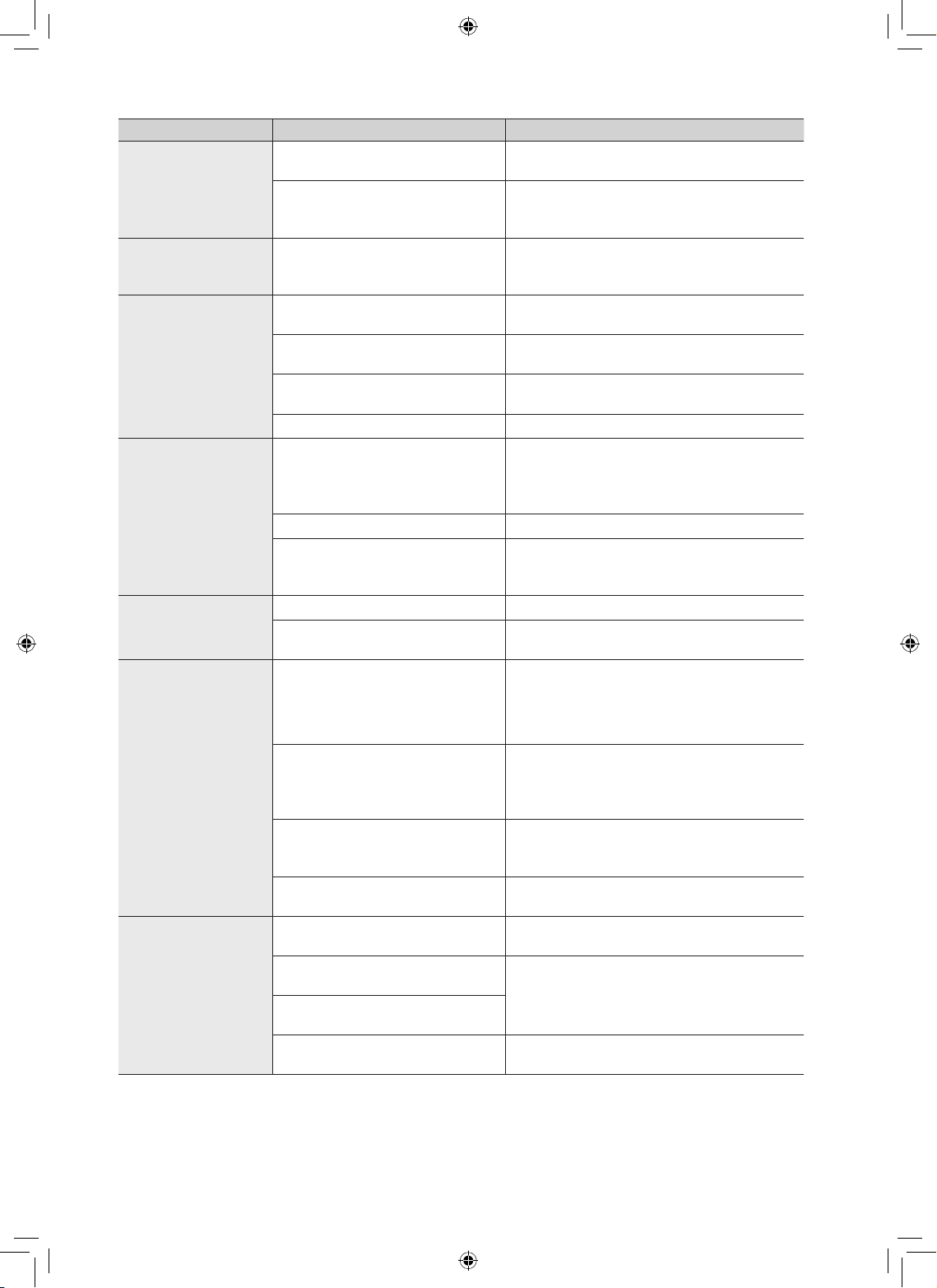
55_ Troubleshooting
PROBLEM POSSIBLE CAUSE SOLUTION
Areas of
discoloration on the
cooktop
Food spillover was not cleaned.
• Refer to the section on care and cleaning
of the glass cooktop on page 54.
The surface is hot and the model
features a light-colored cooktop.
• This is normal. The surface may appear
discolored when it is hot. This is temporary
and will disappear as the glass cools.
The surface unit
frequently cycles on
and o.
This is normal.
• The element will cycle on and o to
maintain the heat setting.
The oven will not
turn on.
The range is not completely
plugged into the electrical outlet.
• Make sure the electrical plug is inserted
into a live, properly grounded outlet.
A fuse in your home may be blown
or the circuit breaker tripped.
• Replace the fuse or reset the circuit
breaker.
The oven controls have been set
improperly.
• See the chapter on operating the oven.
The oven is too hot.
• Allow the oven to cool.
The appliance will
not turn on.
The appliance is not completely
plugged into the electrical outlet or
a fuse in your home may be blown
or the circuit breaker tripped.
• Make sure the power cord is plugged into
a live, properly grounded outlet. Check the
fuse and circuit breakers.
Incomplete service wiring.
• Call for service.
Power outage.
• Check to see if the house lights will turn
on. If required, call your local electric
company for service.
The oven light will
not turn on.
The light bulb is loose or defective.
• Tighten or replace the bulb.
The switch operating light is
broken.
• Call for service.
Oven smokes
excessively during
broiling.
The control has not been set
properly.
• Refer to the section on setting oven
controls.
• Make sure the oven door is opened to the
broil stop position.
The meat has been placed too
close to the element.
• Reposition the rack to provide proper
clearance between the meat and the
element. Preheat the broil element for
searing.
The meat has not been properly
prepared.
• Remove the excess fat from the meat. Cut
away fatty edges that may curl, leaving the
lean intact.
Grease has built up on oven
surfaces.
• Regular cleaning is necessary when
broiling frequently.
Food does not bake
or roast properly.
The oven controls have not been
set correctly.
• See the chapter on operating the oven.
The oven rack has been positioned
incorrectly or is not level.
• See the section on using the oven racks
on page 52.
Incorrect cookware or cookware of
improper size being used.
The oven sensor needs to be
adjusted.
• See the section on adjusting the
thermostat on page 46.
NE595R0ABSR_AA_DG68-00433A-09_EN.indd 55 2016-03-30 �� 8:04:59
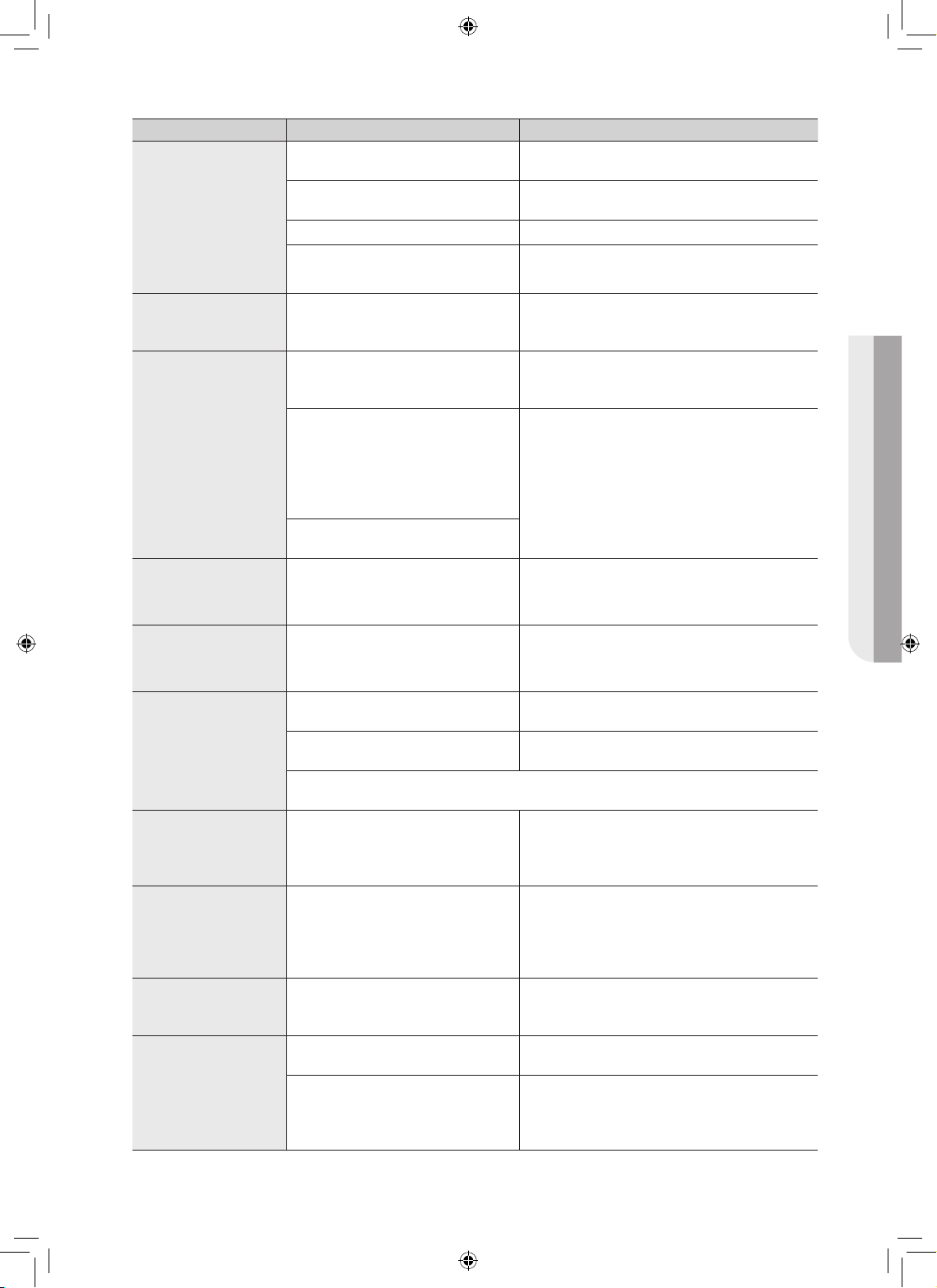
TROUBLESHOOTING
Troubleshooting _56
PROBLEM POSSIBLE CAUSE SOLUTION
Food does not broil
properly.
The oven controls have been set
incorrectly.
• Press the BROIL pad.
The rack has not been properly
positioned.
• See the broiling guide on page 41.
Cookware not suited for broiling.
• Use suitable cookware.
In some areas the power (voltage)
may be low.
• Preheat the broil element for 10 minutes.
• See the broiling guide on page 41.
The oven
temperature is too
hot or too cold.
The oven sensor needs to be
adjusted.
• See the section on adjusting the
thermostat on page 46.
Scratches or
abrasions on
cooktop surface
The cooktop is being cleaned
improperly.
• Scratches are not removable. Tiny
scratches will become less visible in time
as a result of cleaning.
Cookware with rough bottoms
were used on the cooktop or
there were coarse particles (eg.
salt or sand) present between the
cookware and the surface of the
cooktop.
• To avoid scratches, use the recommended
cleaning procedures. Make sure the
bottoms of cookware are clean before use,
and use cookware with smooth bottoms.
Cookware has been slid across the
cooktop surface.
Brown streaks or
specks
Boilovers have been cooked onto
the surface.
• Use the blade scraper to remove soil.
• See the section on care and cleaning of
the glass cooktop on page 54.
Areas of
discoloration with
metallic sheen
Mineral deposits from water and
food have been left on the surface
of the cooktop.
• Remove using a ceramic-glass cooktop
cleaning cream.
• Use cookware with clean, dry bottoms.
The oven will not
self-clean.
The oven temperature is too high
to set a self-clean operation.
• Allow the range to cool and reset the
controls.
The oven controls have been set
incorrectly.
• See the section on self-cleaning on page
47.
A self-cleaning cycle cannot be started if the oven lockout feature has been
activated or if a radiant surface element is on.
“Crackling” or
“popping” sound
This is the sound of the metal
heating and cooling during
both the cooking and cleaning
functions.
• This is normal.
Excessive smoking
during a self-
cleaning cycle
There is excessive soiling in the
oven.
• Press the CLEAR/OFF pad. Open the
windows to rid the room of smoke. Wait
until the self-cleaning cycle is cancelled.
Wipe up the excessive soil and reset the
oven for self-cleaning.
The oven door will
not open after a
self-cleaning cycle.
The oven is too hot.
• Allow the oven to cool.
Oven not clean after
a self-cleaning cycle
The oven controls were not set
correctly.
• See the section on self-cleaning on page
49.
The oven was heavily soiled.
• Wipe up heavy spillovers before starting
the self-cleaning cycle. Heavily soiled
ovens may need to self-clean again or for
a longer period of time.
NE595R0ABSR_AA_DG68-00433A-09_EN.indd 56 2016-03-30 �� 8:04:59
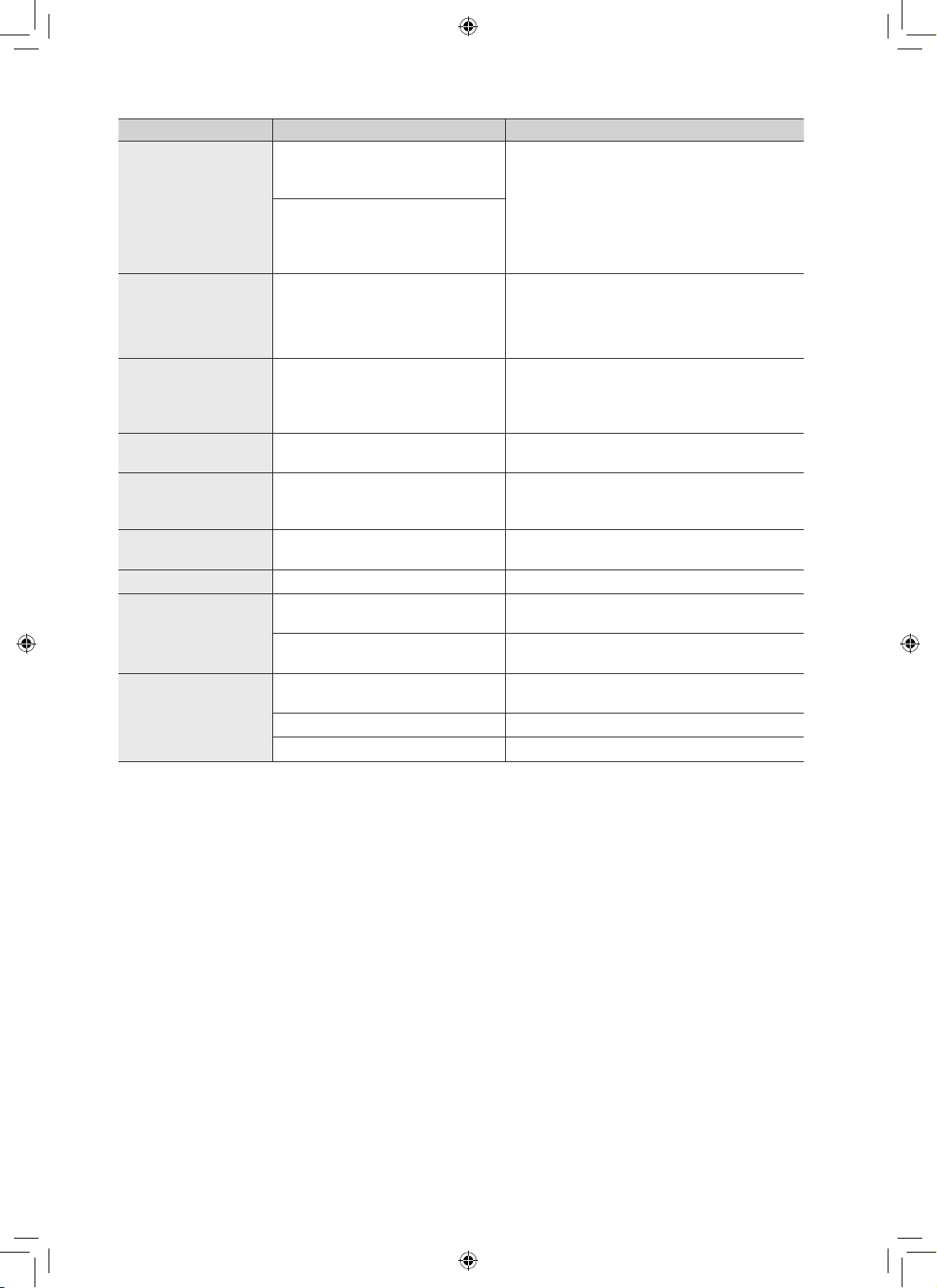
57_ Troubleshooting
PROBLEM POSSIBLE CAUSE SOLUTION
Steam from the vent When using the convection
feature, it is normal to see steam
coming out of the oven vent.
• This is normal.
As the number of racks or amount
of food being cooked increases,
the amount of visible steam will
increase.
Burning or oily odor
emitting from the
vent
This is normal in a new oven and
will disappear in time.
• To speed the process, set a self-cleaning
cycle for a minimum of 3 hours.
• See the section on self-cleaning on page
49.
Strong odor An odor from the insulation around
the inside of the oven is normal
for the first few times the oven is
used.
• This is temporary.
Fan noise A convection fan may automatically
turn on and o.
• This is normal.
Oven racks are
dicult to slide.
The shiny, silver-colored racks
were cleaned in a self-cleaning
cycle.
• Apply a small amount of vegetable oil to
a paper towel and wipe the edges of the
oven racks with the paper towel.
Display goes blank. A fuse in your home may be blown
or the circuit breaker tripped.
• Replace the fuse or reset the circuit
breaker.
Display flashes. There was a power failure.
• Reset the clock.
Drawer does not
slide smoothly or
drags.
The drawer is out of alignment.
• Fully extend the drawer and push it all the
way in. See the page 57.
The drawer is over-loaded or the
load is unbalanced.
• Reduce weight. Redistribute drawer
contents.
Excessive
condensation in the
drawer
There is liquid present in the
drawer.
• Remove the liquid.
Uncovered foods.
• Cover food with a lid or aluminum foil.
The temperature is set too high.
• Adjust the temperature to a lower setting.
NE595R0ABSR_AA_DG68-00433A-09_EN.indd 57 2016-03-30 �� 8:04:59

WARRANTY
Warranty _58
warranty
PLEASE DO NOT DISCARD THIS REPLACES THE WARRANTY PAGE IN THE USE & CARE GUIDE
SAMSUNG ELECTRIC RANGE
LIMITED WARRANTY TO ORIGINAL PURCHASER
This SAMSUNG brand product, as supplied and distributed by SAMSUNG ELECTRONICS AMERICA, INC. (SAMSUNG) and delivered
new, in the original carton to the original consumer purchaser, is warranted by SAMSUNG against manufacturing defects in materials
and workmanship for a limited warranty period of:
One (1) Year Parts and Labor, One (1) Year Parts Warranty
For Glass Cooktop and Heater Radiant
This limited warranty begins on the original date of purchase, and is valid only on products purchased and used in the United States. To
receive warranty service, the purchaser must contact SAMSUNG for problem determination and service procedures. Warranty service
can only be performed by a SAMSUNG authorized service center. The original dated bill of sale must be presented upon request as
proof of purchase to SAMSUNG or SAMSUNG’s authorized service center. Samsung will provide in-home service during the warranty
period at no charge subject to availability within the contiguous United States. In home service is not available in all areas. To receive in
home service product must be unobstructed and accessible to the service agent. If service is not available Samsung may elect to provide
transportation of the product to and from an authorized service center.
SAMSUNG will repair or replace this product, at our option and at no charge as stipulated herein, with new or reconditioned parts or
products if found to be defective during the limited warranty period specified above. All replaced parts and products become the property
of SAMSUNG and must be returned to SAMSUNG. Replacement parts and products assume the remaining original warranty, or ninety
(90) days, whichever is longer.
This limited warranty covers manufacturing defects in materials and workmanship encountered in normal, noncommercial use of this
product and shall not apply to the following: damage which occurs in shipment; delivery and installation; applications and uses for which
this product was not intended; altered product or serial numbers; cosmetic damage or exterior finish; accidents, abuse, neglect, fire,
water, lightning or other acts of nature; use of products, equipment, systems, utilities, services, parts, supplies, accessories, applications,
installations, repairs, external wiring or connectors not supplied or authorized by SAMSUNG which damage this product or result
in service problems; incorrect electrical line voltage, fluctuations and surges; customer adjustments and failure to follow operating
instructions, maintenance and environmental instructions that are covered and prescribed in the instruction book; product removal and
reinstallation; problems caused by pest infestations, and overheating or overcooking by user. This limited warranty shall not cover cases
of incorrect electric current, voltage or supply, light bulbs, house fuses, house wiring, cost of a service call for instructions, or fixing
installation errors. Furthermore, damage to the glass cooktop caused by the use of cleaners other than the recommended cleaners and
pads, damage to the glass cook top caused by hardened spills of sugary materials or melted plastic that are not cleaned according to the
directions in the use and care guide are not covered. SAMSUNG does not warrant uninterrupted or error-free operation of the product.
EXCEPT AS SET FORTH HEREIN THERE ARE NO WARRANTIES ON THIS PRODUCT EITHER EXPRESS OR IMPLIED AND
SAMSUNG DISCLAIMS ALL WARRANTIES INCLUDING, BUT NOT LIMITED TO, ANY IMPLIED WARRANTIES OF MERCHANTABILITY,
INFRINGEMENT OR FITNESS FOR A PARTICULAR PURPOSE. NO WARRANTY OR GUARANTY GIVEN BY ANY PERSON, FIRM OR
CORPORATION WITH RESPECT TO THIS PRODUCT SHALL BE BINDING ON SAMSUNG. SAMSUNG SHALL NOT BE LIABLE FOR
LOSS OF REVENUE OR PROFITS, FAILURE TO REALIZE SAVINGS OR OTHER BENEFITS, OR ANY OTHER SPECIAL, INCIDENTAL
OR CONSEQUENTIAL DAMAGES CAUSED BY THE USE, MISUSE OR INABILITY TO USE THIS PRODUCT, REGARDLESS OF
THE LEGAL THEORY ON WHICH THE CLAIM IS BASED, AND EVEN IF SAMSUNG HAS BEEN ADVISED OF THE POSSIBILITY OF
SUCH DAMAGES. NOR SHALL RECOVERY OF ANY KIND AGAINST SAMSUNG BE GREATER IN AMOUNT THAN THE PURCHASE
PRICE OF THE PRODUCT SOLD BY SAMSUNG AND CAUSING THE ALLEGED DAMAGE. WITHOUT LIMITING THE FOREGOING,
PURCHASER ASSUMES ALL RISK AND LIABILITY FOR LOSS, DAMAGE OR INJURY TO PURCHASER AND PURCHASER’S
PROPERTY AND TO OTHERS AND THEIR PROPERTY ARISING OUT OF THE USE, MISUSE OR INABILITY TO USE THIS PRODUCT.
THIS LIMITED WARRANTY SHALL NOT EXTEND TO ANYONE OTHER THAN THE ORIGINAL PURCHASER OF THIS PRODUCT, IS
NONTRANSFERABLE AND STATES YOUR EXCLUSIVE REMEDY.
Some provinces or territories may or may not allow limitations on how long an implied warranty lasts, or the exclusion or limitation of
incidental or consequential damages, so the above limitations or exclusions may not apply to you. This warranty gives you specific legal
rights, and you may also have other rights which vary from state to state. User Replaceable Parts may be sent to the customer for unit
repair. If necessary, a Service Engineer can be dispatched to perform service.
To obtain warranty service, please contact SAMSUNG at:
Samsung Electronics America, Inc.
85 Challenger Road Ridgefield Park, NJ 07660
1-800-SAMSUNG (726-7864) and www.samsung.com/us/support
NE595R0ABSR_AA_DG68-00433A-09_EN.indd 58 2016-03-30 �� 8:04:59
DG68-00433A-09
Please be advised that the Samsung warranty does NOT cover service calls to explain product
operation, correct improper installation, or perform normal cleaning or maintenance.
QUESTIONS OR COMMENTS?
COUNTRY CALL OR VISIT US ONLINE AT
U.S.A
Consumer Electronics
1-800-SAMSUNG (726-7864) www.samsung.com/us/support
CANADA 1-800-SAMSUNG (726-7864)
www.samsung.com/ca/support (English)
www.samsung.com/ca_fr/support (French)
NE595R0ABSR_AA_DG68-00433A-09_EN.indd 59 2016-03-30 �� 8:04:59

imagine las posibilidades
Gracias por adquirir este producto Samsung.
Estufa eléctrica
manual del usuario
ESPAÑOL
NE595R0****
NE59J342*****
NE595R0ABSR_AA_DG68-00433A-09_MES.indd 1 2016-03-30 �� 8:07:28
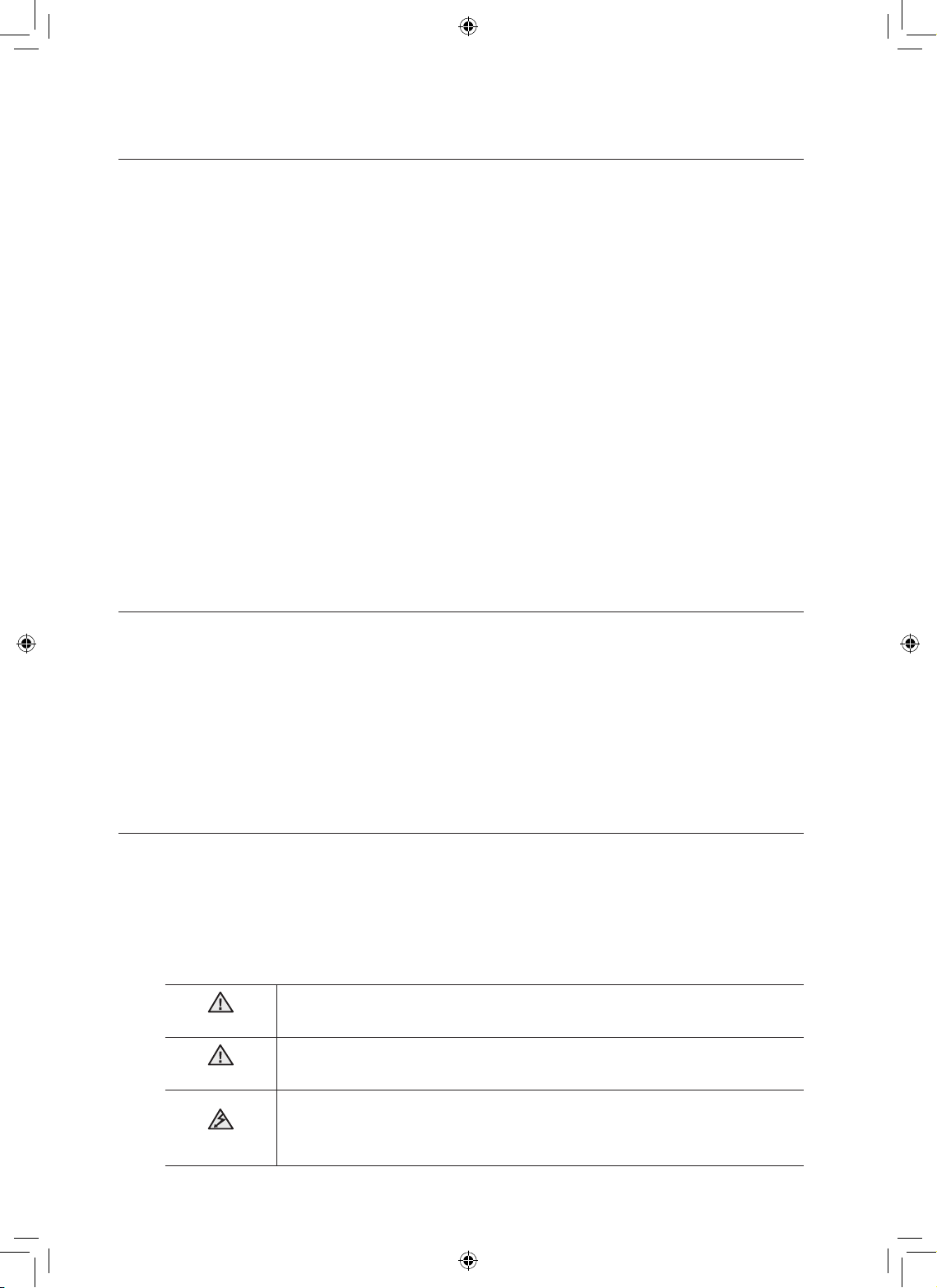
1_ características de su nueva estufa
características de su nueva estufa
Mayor funcionalidad. Mejor cocción. Fácil mantenimiento. Su nueva estufa fue diseñada para brindarle
estas ventajas y aun más.
• Limpieza Steam Quick
Gracias a Steam Quick™, la tecnología exclusiva de Samsung para trabajos de limpieza leves, mantener
su horno reluciente resulta facilísimo — sin complicaciones, sin olor, sin productos químicos. El sistema
Steam Quick™ limpia el interior de su estufa con vapor a alta temperatura en tan solo 20 minutos.
• Cuanto más grande mejor
Con una capacidad de 5.9 pies cúbicos, su nueva estufa tiene más espacio que cualquiera de
sus competidores en el mercado estadounidense. Esto significa mayor comodidad para usted
cuando cocine para festividades o cuando reciba huéspedes.
• Una cubierta con 5 quemadores
- Cuatro quemadores principales, dos de los cuales permiten regular la transmisión de calor para
diferentes tamaños de ollas.
- Un quemador de menor tamaño para calentar, ubicado en el centro de la cubierta de la estufa.
instrucciones de seguridad importantes
Lea y siga todas las instrucciones antes de utilizar su horno con el fin de
evitar riesgos de incendio, descargas eléctricas, lesiones personales o
daños al utilizar su estufa. Esta guía no cubre todas las situaciones que podrían
ocurrir. Siempre tome contacto con su agente de servicio o con el fabricante para
consultar sobre cualquier problema que usted no comprenda.
LO QUE NECESITA SABER SOBRE LAS
INSTRUCCIONES DE SEGURIDAD
Las advertencias y las instrucciones de seguridad importantes de este manual no cubren
todos los problemas y situaciones que podrían ocurrir. Usted tiene la responsabilidad de usar
el sentido común, de ser precavido y cuidadoso al instalar, mantener y manejar su horno.
SÍMBOLOS Y PRECAUCIONES DE SEGURIDAD IMPORTANTES
Significado de iconos y símbolos en este manual del usuario:
ADVERTENCIA
Prácticas peligrosas o inseguras que pueden provocar
lesiones graves o la muerte.
PRECAUCIÓN
Prácticas peligrosas o inseguras que pueden provocar
lesiones leves o daños a la propiedad.
PRECAUCIÓN
Para reducir el riesgo de incendio, explosión, descarga eléctrica
o lesiones personales cuando utilice el horno, siga estas
instrucciones básicas de seguridad.
NE595R0ABSR_AA_DG68-00433A-09_MES.indd 1 2016-03-30 �� 8:07:29
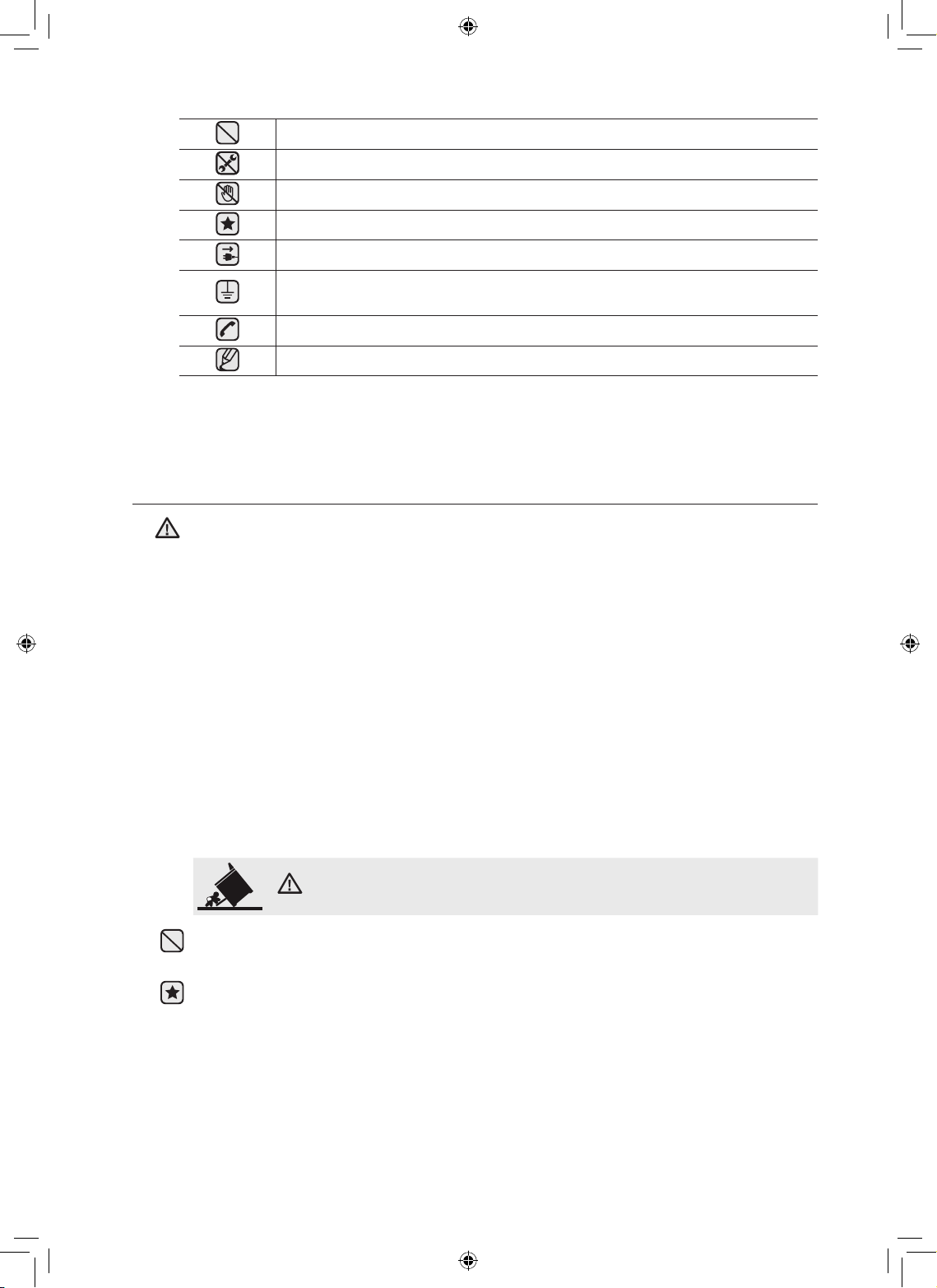
Instrucciones de seguridad importantes _2
NO intentar.
NO desensamblar.
NO tocar.
Siga las instrucciones fielmente.
Desenchufe la alimentación eléctrica del tomacorriente de la pared.
Asegúrese de que la máquina tenga buena conexión a tierra para
evitar descargas eléctricas.
Comuníquese con el centro de servicio técnico para obtener ayuda.
Nota
Estas señales de advertencia se incluyen para evitar lesiones a usted y a otras personas.
Sígalos explícitamente.
Una vez que haya leído esta sección, consérvela en un lugar seguro para consultas futuras.
DISPOSITIVO ANTI INCLINACIÓN
ADVERTENCIA
ADVERTENCIA- Para reducir el riesgo de inclinación o vuelco de la estufa, ésta
debe asegurarse mediante un dispositivo anti inclinación correctamente instalado.
DESPUÉS DE INSTALAR LA ESTUFA, CONFIRME QUE EL DISPOSITIVO ANTI
INCLINACIÓN ESTÉ CORRECTAMENTE INSTALADO Y VERIFIQUE QUE ESTÉ
CORRECTAMENTE CONECTADO. Consulte el manual de instalación donde se
brindan las instrucciones correspondientes.
a)
Si el dispositivo anti inclinación no está instalado, un niño o un adulto podrían
inclinar la estufa y morir.
b)
Verifique que el dispositivo anti inclinación haya sido instalado y conectado correctamente
en la parte posterior derecha (o posterior izquierda) de la base de la estufa.
c)
Si mueve la estufa y luego la vuelve a colocar en su lugar, asegúrese de volver a conectar el
dispositivo anti inclinación en la parte posterior derecha o izquierda de la base de la estufa.
d) No opere la estufa sin el dispositivo anti inclinación en su lugar y conectado.
e) No hacerlo puede provocar la muerte o quemaduras serias a niños o adultos.
ADVERTENCIA
ADVERTENCIA
No se pare sobre las puertas de la estufa, ni se apoye o siente sobre ellas. Puede
causar que la estufa se incline o vuelque, produciendo quemaduras o lesiones severas.
Confirme que el dispositivo anti inclinación se encuentre instalado correctamente. Luego,
para verificar que dicho dispositivo esté conectado, tome el borde superior trasero de la
estufa y cuidadosamente intente inclinarla hacia adelante. El dispositivo anti inclinación
debería prevenir que la estufa se incline hacia adelante más de unas pocas pulgadas.
Si, por cualquier razón, hala la estufa alejándola de la pared, asegúrese de que el dispositivo
anti inclinación encaje correctamente cuando empuje la estufa a su lugar contra la pared.
Si no se encuentra encajado, hay riesgo de que la estufa se incline o vuelque y cause
lesiones si usted o un niño se parasen, sentasen o apoyasen sobre una puerta abierta.
NE595R0ABSR_AA_DG68-00433A-09_MES.indd 2 2016-03-30 �� 8:07:32
3_ Instrucciones de seguridad importantes
ADVERTENCIA SOBRE LA STATE OF
CALIFORNIA PROPOSITION 65 (SOLO EE.UU.)
ADVERTENCIA: Este producto contiene productos químicos reconocidos en el
estado de California como capaces de provocar cáncer y defectos de nacimiento
u otras afecciones reproductivas.
PARA SU SEGURIDAD
Cuando utilice electrodomésticos, debe seguir precauciones de seguridad básicas, a
saber:
PRECAUCIÓN
Utilice este electrodoméstico solo para el uso para el que fue destinado, tal como se
describe en este Manual del Usuario.
Las superficies que podrían estar calientes incluyen la cubierta, áreas enfrente de la
cubierta, abertura de ventilación del horno, superficies cercanas a dicha abertura y las
hendeduras alrededor de la puerta del horno.
Asegúrese de que su electrodoméstico sea correctamente instalado y conectado a
tierra por un técnico calificado.
Mantenimiento del usuario- No repare ni reemplace ninguna pieza de este
electrodoméstico salvo que esto se encuentre específicamente recomendado
en el manual. Todas las demás tareas de reparación o mantenimiento deben ser
encomendadas a un técnico calificado.
Antes de realizar tareas de mantenimiento o reparación, siempre desconecte la
alimentación eléctrica al electrodoméstico quitando el fusible o accionando el
disyuntor.
No se introduzca en el horno.
Ningún artículo que pueda resultar de interés para los niños debe
almacenarse en gabinetes arriba de una estufa o en su anaquel posterior.
Los niños que se trepasen a la estufa para alcanzar los elementos podrían resultar
seriamente lesionados.
No deje solos a los niños. Los niños nunca deben quedar solos o sin vigilancia en
el lugar donde se utiliza este electrodoméstico. Nunca se les debe permitir sentarse o
pararse sobre ninguna parte del electrodoméstico.
Nunca utilice su electrodoméstico para entibiar o calentar el ambiente.
No eche agua sobre grasas en llamas. Apague el horno para evitar que las llamas
se extiendan. Ahogue el fuego o llama cerrando la puerta, o bien utilice un producto
químico seco, bicarbonato de sosa o un extintor de incendio a base de espuma.
NE595R0ABSR_AA_DG68-00433A-09_MES.indd 3 2016-03-30 �� 8:07:32
Instrucciones de seguridad importantes _4
Almacenamiento en o sobre el electrodoméstico. No almacene materiales
inflamables en el horno o cerca de las unidades de superficie. Asegúrese de que todos
los materiales de embalaje hayan sido retirados del electrodoméstico antes de ponerlo
en funcionamiento. Mantenga materiales plásticos, indumentaria y papeles alejados de
las partes del electrodoméstico que podrían calentarse.
Utilice la indumentaria apropiada. Nunca use prendas amplias o colgantes
mientras utiliza el electrodoméstico.
Utilice solamente agarradores aislantes secos. Colocar agarradores aislantes
mojados o húmedos sobre superficies calientes podría producir quemaduras por
vapor. No permita que el agarrador entre en contacto con los elementos calentadores.
No utilice una toalla o cualquier otra tela voluminosa.
Enséñele a los niños que no deben jugar con los controles ni con ninguna otra parte
de la estufa.
Por seguridad, no use limpiadores de agua a alta presión ni limpiadores a chorro de
vapor.
Si el cable de alimentación está dañado, debe ser reemplazado por el fabricante, su
agente de servicios o personas igualmente calificadas para evitar riesgos.
El uso de este electrodoméstico no es apto para personas (incluye niños) con
capacidades físicas, sensoriales o mentales reducidas, o que no tengan experiencia y
conocimientos, a menos que sean supervisados o hayan recibido instrucción sobre el
uso del electrodoméstico por parte de una persona responsable de su seguridad.
UNIDADES DE SUPERFICIE DE COCCIÓN
Nunca deje sin atención unidades de superficie reguladas a altas
temperaturas. Los derrames por exceso de hervor producen humo y los derrames
de sustancias grasas pueden arder en llamas.
No levante la cubierta. Levantar la cubierta puede dañar la estufa y generar un
funcionamiento defectuoso.
No haga funcionar la cubierta sin utensilios de cocina. Si se hace funcionar la
cubierta sin un recipiente de cocción, se calentarán las perillas de control.
Nunca utilice la superficie de la cubierta de vidrio como tabla para cortar.
NE595R0ABSR_AA_DG68-00433A-09_MES.indd 4 2016-03-30 �� 8:07:32
5_ Instrucciones de seguridad importantes
Sea precavido al tocar la cubierta. La superficie de vidrio de la cubierta retendrá el
calor aún después de que se hayan apagado los controles.
Tenga cuidado cuando coloque cucharas u otros utensilios para revolver
sobre la superficie de vidrio de la cubierta mientras se encuentre en uso.
Podrían calentarse y causar quemaduras.
Utilice recipientes de cocción del tamaño adecuado. Este electrodoméstico se
encuentra equipado con unidades de superficie de diferentes tamaños. Seleccione
ollas y sartenes que tengan bases planas lo suficientemente grandes para cubrir la
superficie del elemento calentador. Si se utilizan recipientes demasiado pequeños, una
porción del elemento calentador quedará expuesta al contacto directo y podría causar
que sus ropas ardieran. Hacer coincidir el tamaño de la olla o sartén con el quemador
también mejorará la eficiencia.
Las manijas de los utensilios deben estar posicionadas hacia adentro y sin proyectarse
sobre unidades de superficie adyacentes – Para reducir el riesgo de quemaduras,
encendido de materiales inflamables y derrames causados por contactos accidentales
con el utensilio, las manijas de todo utensilio deben estar posicionadas hacia adentro y
sin proyectarse sobre unidades de superficie adyacentes.
Utensilios de cocción vidriados, enlozados o esmaltados. Solamente ciertos
tipos de utensilios para cocinar de vidrio, vitro-cerámico o cerámica, o con superficies
esmaltadas o con otros tratamientos son aptos para uso en la parte superior de la
estufa sin romperse por bruscas diferencias de temperatura.
Las manijas de los utensilios deben estar giradas hacia afuera y no
proyectarse sobre unidades de superficie adyacentes. Para reducir el riesgo
de quemaduras, encendido de materiales inflamables y derrames causados por
contactos accidentales con el utensilio, las manijas de los utensilios deben estar
posicionadas hacia afuera y sin proyectarse sobre unidades de superficie adyacentes.
Limpieza. Lea y siga todas las instrucciones y advertencias de las etiquetas de las
cremas de limpieza.
Asegúrese de saber cuál de las perillas controla cada unidad de superficie. Asegúrese
de que encendió la unidad de superficie correcta.
Siempre apague las unidades de superficie antes de retirar los recipientes de cocción.
Cuando prepare platillos flambeados debajo de la campana, encienda el ventilador.
Vigile las frituras que se realicen con regulaciones de temperatura altas o medianas.
NE595R0ABSR_AA_DG68-00433A-09_MES.indd 5 2016-03-30 �� 8:07:32
Instrucciones de seguridad importantes _6
SEGURIDAD ELÉCTRICA
Instalación adecuada- Asegúrese de que su electrodoméstico sea correctamente
instalado y conectado a tierra por un técnico calificado.
El electrodoméstico debe ser reparado únicamente por personal técnico calificado.
Las reparaciones realizadas por personas no calificadas pueden causar lesiones o
fallas graves. Si necesita reparar su electrodoméstico, comuníquese con un centro
de servicio autorizado de Samsung. No seguir estas instrucciones puede resultar en
daños y anular la garantía.
Los electrodomésticos montados a nivel pueden operarse solo después de que fueron
instalados en gabinetes y lugares de trabajo que cumplen con las normas pertinentes.
Esto garantiza protección suficiente contra contacto para unidades eléctricas según lo
establecen estas normas de seguridad esenciales.
Si su electrodoméstico funciona mal o si aparecen roturas, rajaduras o grietas:
- apague todas las zonas de cocción
- desenchufe la estufa del tomacorriente CA de la pared
- comuníquese con su centro de servicio local.
ADVERTENCIA
ADVERTENCIA-Si la superficie está rajada, apague y desenchufe el electrodoméstico
para evitar la posibilidad de una descarga eléctrica. No utilice su cubierta de inducción
hasta que la superficie de vidrio haya sido reemplazada.
ADVERTENCIA
ADVERTENCIA- Asegúrese de que el electrodoméstico esté apagado antes de
reemplazar la bombilla de luz para evitar la posibilidad de una descarga eléctrica.
La estufa no debe colocarse sobre una base.
El horno debe apagarse antes de retirar la protección y, después de la limpieza,
se debe volver a colocar la protección de acuerdo con las instrucciones.
SEGURIDAD DE LOS NIÑOS
ADVERTENCIA
ADVERTENCIA-Este electrodoméstico no está previsto para ser usado por niños o
personas discapacitadas sin la adecuada supervisión de un adulto responsable.
Los niños deben ser supervisados para garantizar que no jueguen con el electrodoméstico.
Mantenga a los niños alejados de la puerta cuando la abra o la cierre ya que podría
golpearlos o pillarles los dedos.
Las zonas de cocción se calentarán cuando usted cocine. Siempre mantenga a los niños
alejados del electrodoméstico.
Durante la limpieza, las superficies pueden calentarse más de lo habitual, por lo tanto,
los niños deben mantenerse alejados.
ADVERTENCIA
ADVERTENCIA- Las partes accesibles pueden calentarse durante el uso.
Los niños pequeños deben mantenerse alejados para evitar quemaduras.
NE595R0ABSR_AA_DG68-00433A-09_MES.indd 6 2016-03-30 �� 8:07:33
7_ Instrucciones de seguridad importantes
HORNO
NO TOQUE LOS ELEMENTOS CALENTADORES NI LAS SUPERFICIES
INTERIORES DEL HORNO. Los elementos calentadores pueden estar calientes
aun cuando su color sea oscuro. Las superficies interiores de un horno se calientan
lo suficiente como para producir quemaduras. Durante y después del uso, no toque
los elementos calentadores ni las superficies interiores del horno y tampoco permita
que sus ropas ni otros materiales inflamables entren en contacto con ellos hasta que
haya transcurrido tiempo suficiente como para que se enfríen. Otras superficies del
electrodoméstico pueden calentarse lo suficiente como para producir quemaduras.
Entre ellas se encuentran las aberturas de ventilación del horno y superficies cercanas
a estas aberturas, las puertas del horno y las ventanas de las puertas del horno.
No caliente envases de alimentos que no hayan sido abiertos.
La acumulación de presión puede hacer que el envase explote y causar lesiones.
No utilice el horno para secar periódicos. Si se recalientan, pueden arder en
llamas.
No utilice el horno para almacenar objetos ni alimentos.
Los elementos almacenados en un horno pueden prenderse fuego.
Cuando abra la puerta, hágalo con precaución. Permita la salida del vapor o aire
caliente antes de retirar o volver a colocar alimentos en el horno.
Revestimientos protectores. No utilice papel de aluminio para revestir el fondo del
horno, salvo de la manera sugerida en el manual. La instalación incorrecta de estos
revestimientos puede causar riesgos de descarga eléctrica o incendio.
Mantenga los conductos de ventilación del horno libres de obstrucciones.
La abertura de ventilación se encuentra ubicada por sobre la unidad de superficie
trasera derecha. Esta área podría calentarse durante el uso del horno.
Nunca tapone esta abertura de ventilación ni coloque elementos de plástico o
sensibles al calor sobre dicha abertura.
Colocación de las parrillas del horno. Siempre coloque las parrillas del horno en
la posición deseada mientras el horno esté frío. Si debe moverse la parrilla cuando el
horno está caliente, use agarradores aislantes. No deje que los agarradores aislantes
entren en contacto con el elemento calentador caliente en el horno.
No permita que papel de aluminio o una sonda para carne entren en contacto con los
elementos calentadores.
Durante el uso, el electrodoméstico se calienta.
Se debe tener la precaución de evitar tocar los elementos calentadores del interior del
horno.
No utilice limpiadores abrasivos ni espátulas de metal filosas para limpiar el vidrio de
la puerta del horno ya que podrían rayar la superficie, lo cual puede provocar que el
vidrio se haga añicos.
NE595R0ABSR_AA_DG68-00433A-09_MES.indd 7 2016-03-30 �� 8:07:33
Instrucciones de seguridad importantes _8
HORNOS AUTO-LIMPIANTES
No limpie la junta selladora de la puerta. La junta de la puerta es esencial para lograr que
el horno quede bien sellado. Se debe tener cuidado de no frotar, dañar o mover la junta.
Nunca tenga aves mascota en la cocina. Las aves son extremadamente sensibles a
las emanaciones gaseosas que se producen durante el ciclo de auto-limpieza del horno.
Tales emanaciones pueden resultar dañinas o mortales para las aves. Lleve las aves a una
habitación bien ventilada.
Aplique el ciclo de auto-limpieza únicamente a las piezas enumeradas en este
manual. Antes de la auto-limpieza del horno, quite la partición, parrillas, utensilios y alimentos.
No use ningún producto limpiador de hornos ni revestimiento protector dentro del horno ni sobre
sus superficies exteriores. Use solo un producto de limpieza para superficies de cocción cerámicas.
Retire los estantes niquelados del horno antes de comenzar el ciclo de auto-limpieza, de lo
contrario pueden sufrir alteraciones de color.
Si el ciclo de auto-limpieza funciona mal, apague el horno y desconecte la alimentación
eléctrica. Hágalo reparar por un técnico calificado.
Los derrames excesivos deben eliminarse antes de la limpieza y se especifica qué utensilios
pueden dejarse en el horno durante la limpieza.
CAMPANAS DE VENTILACIÓN
Limpie con frecuencia las campanas de ventilación. No deje que se acumule grasa en
la campana o el filtro.
Cuando flambee alimentos debajo de la campana, encienda el ventilador.
SUPERFICIES DE COCCIÓN VITRO-CERÁMICAS
NO TOQUE LAS UNIDADES DE SUPERFICIE NI LAS ÁREAS CERCANAS A LAS
UNIDADES. Las unidades de superficie pueden estar calientes aun cuando su color sea
oscuro. Las áreas cercanas a las unidades de superficie pueden calentarse lo suficiente
como para producir quemaduras. Durante y después del uso, no toque las unidades de
superficie ni las áreas cercanas ni tampoco permita que sus ropas ni otros materiales
inflamables entren en contacto con ellas hasta que haya transcurrido tiempo suficiente
como para que se enfríen. Entre estas áreas se cuentan la cubierta y su revestimiento.
No cocine sobre una cubierta quebrada. Si la cubierta se quebrase, las soluciones de
limpieza y sustancias derramadas podrían penetrar la cubierta quebrada y generar riesgos
de descarga eléctrica. Comuníquese inmediatamente con un técnico calificado.
Limpie la cubierta con precaución. Si utiliza una esponja o un paño húmedo para limpiar
derrames en una superficie de cocción caliente, cuídese de posibles quemaduras por
vapor. Algunos productos de limpieza pueden producir emanaciones nocivas si se aplican
sobre una superficie caliente.
NE595R0ABSR_AA_DG68-00433A-09_MES.indd 8 2016-03-30 �� 8:07:33
9_ Instrucciones de seguridad importantes
ANTES DE COMENZAR
Limpie el horno a fondo antes de utilizarlo por primera vez.
Retire los accesorios y opere el horno en el modo de horneado a 400 °F
durante 1 hora antes de utilizarlo. Se notará un olor característico.
Esto es normal. Asegúrese de que su cocina se encuentre bien ventilada
durante el período de acondicionamiento.
ADVERTENCIA
ADVERTENCIAS FUNDAMENTALES PARA
LA INSTALACIÓN
La instalación de este electrodoméstico debe estar a cargo de un técnico o una
compañía de servicio calificados.
- Si la estufa no es instalada por un técnico calificado, pueden producirse descargas
eléctricas, un incendio, una explosión, problemas con el producto o lesiones.
Desembale el horno, quite todo el material de embalaje y examine el horno
para determinar si hay daños tales como abolladuras en el interior o exterior del
electrodoméstico, pestillos de la puerta rotos, rajaduras en la puerta o una puerta
que no esté correctamente alineada. Si hay algún daño, no ponga el horno en
funcionamiento y notifique de inmediato al distribuidor.
Enchufe el cable de alimentación en un tomacorriente conectado a tierra con la
configuración adecuada. Su horno debe ser el único elemento conectado en este
circuito.
Mantenga todos los materiales de embalaje fuera del alcance de los niños.
Podrían utilizarlos para jugar y lastimarse.
Instale el electrodoméstico en un piso nivelado y resistente que pueda soportar el
peso.
- No hacerlo puede provocar vibraciones anormales, ruidos o problemas con el
producto.
Este electrodoméstico debe conectarse a tierra correctamente.
No conecte el aparato a una tubería de gas, una tubería plástica de agua o un cable
de teléfono.
- Esto puede provocar descargas eléctricas, un incendio, una explosión o problemas
con el producto.
No corte ni retire el pin de conexión a tierra del cable de alimentación bajo ninguna
circunstancia.
Conecte el horno a un circuito que proporcione el amperaje correcto.
NE595R0ABSR_AA_DG68-00433A-09_MES.indd 9 2016-03-30 �� 8:07:33
Instrucciones de seguridad importantes _10
No instale este electrodoméstico en un lugar húmedo, engrasado o cubierto de polvo,
ni en un lugar expuesto a la luz solar directa o al agua (gotas de lluvia).
- Se puede producir una descarga eléctrica o un incendio.
No utilice un cable de alimentación dañado ni un tomacorriente de pared flojo.
- Se puede producir una descarga eléctrica o un incendio.
No jale ni doble excesivamente el cable de alimentación.
No retuerza ni ate el cable de alimentación.
No enganche el cable de alimentación de un objeto metálico, ni coloque un objeto
pesado sobre el cable de alimentación, ni introduzca el cable de alimentación entre
objetos.
- Se puede producir una descarga eléctrica o un incendio.
Si se daña el cable de alimentación, comuníquese con el centro de servicio técnico
más cercano.
PRECAUCIÓN
ADVERTENCIA FUNDAMENTAL PARA EL USO
Si el electrodoméstico se inunda con cualquier líquido, comuníquese con el centro de
servicios más cercano: No hacerlo puede provocar descarga eléctrica o incendio.
Si el electrodoméstico produce un ruido extraño, olor a quemado o humo, desenchufe de
inmediato la alimentación y comuníquese con el centro de servicio técnico más cercano.
- No hacerlo puede provocar una descarga eléctrica o un incendio
En caso de producirse una fuga de gas (como gas propano, gas LP, etc.), ventile el área de
inmediato. No toque el cable de alimentación. No toque el electrodoméstico.
- Una chispa puede causar una explosión o un incendio.
Tenga cuidado de no entrar en contacto con la puerta del horno, los elementos calentadores
o cualquier otra pieza caliente con su cuerpo mientras cocina o justo después de cocinar.
- No hacerlo puede provocar quemaduras.
Si los materiales en el interior del horno se prendieran fuego, mantenga la puerta cerrada,
apague el horno y desconecte el cable de alimentación o corte la alimentación en el panel
del disyuntor o fusible. Si abre la puerta, el fuego puede expandirse.
Siempre respete las precauciones de seguridad cuando utilice su horno. Nunca intente
reparar el horno: contiene voltaje peligroso en el interior. Si se debe reparar el horno,
comuníquese con un centro de servicio técnico autorizado cercano.
Si utiliza el electrodoméstico cuando está contaminado por sustancias extrañas como, por
ejemplo, restos de comida, pueden surgir problemas en el equipo.
Tenga cuidado al quitar el envoltorio cuando retira comida del electrodoméstico.
- Si la comida está caliente, puede salir vapor caliente cuando retira el envoltorio y esto
puede provocar quemaduras.
NE595R0ABSR_AA_DG68-00433A-09_MES.indd 10 2016-03-30 �� 8:07:33
11_ Instrucciones de seguridad importantes
No intente reparar, desarmar ni modificar el electrodoméstico.
- Dado que una corriente de alta tensión ingresa en el chasis del producto, se puede
provocar una descarga eléctrica o un incendio.
-
Cuando sea necesaria una reparación, comuníquese con el centro de servicio técnico más cercano.
Si alguna sustancia extraña como, por ejemplo, agua ingresa en el electrodoméstico,
comuníquese con el centro de servicio técnico más cercano.
- No hacerlo puede provocar una descarga eléctrica o un incendio.
No toque el cable de alimentación con las manos húmedas.
- Se puede producir una descarga eléctrica.
No apague el electrodoméstico cuando hay una operación en progreso.
- Esto puede provocar chispas y causar una descarga eléctrica o un incendio.
Mantenga todos los materiales de embalaje fuera del alcance de los niños, ya que pueden
ser peligrosos para ellos.
- Si un niño se coloca una bolsa de plástico en la cabeza, puede asfixiarse.
No deje que los niños ni ninguna persona con capacidades físicas, sensoriales o mentales
reducidas utilice el electrodoméstico sin supervisión.
Asegúrese de que los controles del electrodoméstico y las áreas de cocción estén fuera del
alcance de los niños.
- No hacerlo puede provocar una descarga eléctrica, quemaduras o lesiones.
No toque el interior del electrodoméstico inmediatamente después de cocinar.
El interior del electrodoméstico estará caliente.
- No hacerlo puede provocar quemaduras.
No utilice ni coloque objetos ni aerosoles inflamables cerca del horno.
- Los elementos inflamables o aerosoles pueden causar incendios o una explosión.
No introduzca los dedos, sustancias extrañas ni objetos metálicos como alfileres o agujas
en las entradas, tomacorrientes u orificios. Si se introducen sustancias extrañas en alguno
de estos orificios, comuníquese con el distribuidor del producto o con el centro de servicio
técnico más cercano.
No altere ni haga ajustes ni reparaciones en la puerta. Bajo ninguna circunstancia debe
quitar la puerta o la coraza externa del horno.
No almacene ni utilice el horno al aire libre.
Nunca use este electrodoméstico con otros fines que no sean cocinar.
- El uso de este electrodoméstico para otro fin que no sea cocinar puede provocar un
incendio.
Abra la tapa o el tapón de recipientes sellados (botellas de té tónico de hierbas,
mamaderas, botellas de leche, etc.) antes de calentarlos. Haga un orificio en alimentos que
tiene cáscaras (huevos, castañas, etc.) con un cuchillo, antes de cocinarlos.
- No hacerlo puede provocar quemaduras o lesiones.
NE595R0ABSR_AA_DG68-00433A-09_MES.indd 11 2016-03-30 �� 8:07:33
Instrucciones de seguridad importantes _12
Nunca caliente en recipientes de plástico ni papel y no los utilice para cocinar.
- No hacerlo puede provocar un incendio.
No caliente comida envuelta en papel de revistas, periódicos, etc.
- Se puede provocar un incendio.
No abra la puerta cuando los alimentos en el horno se están quemando.
- Si abre la puerta, se provoca una entrada de oxígeno que puede causar que los
alimentos se enciendan.
No aplique presión excesiva a la puerta o al interior del electrodoméstico.
No golpee la puerta o la parte interior del electrodoméstico.
- Colgarse de la puerta puede provocar fallas en el producto y causar lesiones graves.
- Si la puerta está dañada, no use el electrodoméstico. Comuníquese con un centro de
servicios.
No sostenga alimentos con los manos durante o inmediatamente después de cocinar.
- Use guantes de cocina. Los alimentos pueden estar muy calientes y podría quemarse.
PRECAUCIÓN
PRECAUCIONES PARA EL USO
Si la superficie está rajada, apague el electrodoméstico.
- No hacerlo puede provocar una descarga eléctrica.
La vajilla y los envases pueden calentarse. Manipúlelos con cuidado.
Los alimentos calientes y el vapor pueden provocar quemaduras.
Retire cuidadosamente las tapas de los envases, dirigiendo el vapor lejos de las
manos y la cara.
Retire las tapas de los frascos de alimentos para bebé antes de calentarlos.
Después de calentar los alimentos para bebé, revuelva bien para distribuir el calor
en forma pareja. Siempre pruebe los alimentos para corroborar la temperatura antes
de alimentar al bebé. Los frascos de vidrio o la superficie de los alimentos pueden
parecer más fríos que el interior, el cual puede estar lo suficientemente caliente como
para quemar la boca de un niño.
Tenga cuidado dado que las bebidas o los alimentos pueden estar muy calientes
después de calentarlos.
- Especialmente cuando alimenta a un niño. Compruebe que se enfrió lo suficiente.
Tenga cuidado al calentar líquidos como, por ejemplo, agua u otras bebidas.
- Asegúrese de revolver durante o después de cocinar.
- Evite utilizar un recipiente resbaladizo con cuello angosto.
- Después de calentar un líquido, espere al menos 30 segundos antes de retirarlo.
- No hacerlo puede provocar un derrame súbito del contenido y causar quemaduras.
NE595R0ABSR_AA_DG68-00433A-09_MES.indd 12 2016-03-30 �� 8:07:33
13_ Instrucciones de seguridad importantes
No se pare sobre el electrodoméstico ni coloque sobre él objetos (como ropa sucia,
fundas para hornos, velas encendidas, cigarrillos encendidos, platos, productos químicos,
objetos metálicos, etc.).
- Artículos como trapos de cocina pueden quedar enganchados en la puerta.
- Se pueden producir descargas eléctricas, un incendio, problemas con el producto
o lesiones.
No haga funcionar el aparato con las manos húmedas.
- Se puede producir una descarga eléctrica.
No rocíe sustancias volátiles como insecticidas en la superficie del electrodoméstico.
- Además de ser perjudiciales para las personas, pueden producirse descargas
eléctricas, un incendio o problemas con el producto.
No acerque el rostro ni el cuerpo al electrodoméstico mientras está cocinando o al
abrir la puerta inmediatamente después de la cocción.
- Asegúrese de que los niños no se acerquen demasiado al electrodoméstico.
- No hacerlo puede provocar quemaduras a los niños.
No coloque alimentos ni objetos pesados sobre el borde de la puerta del horno.
- Si abre la puerta, los alimentos o el objeto podrían caerse y provocar quemaduras
o lesiones.
No enfríe abruptamente la puerta, el interior del electrodoméstico ni el plato vertiendo
agua sobre estas partes durante o después de la cocción.
- Esto puede provocar daños en el electrodoméstico.
El vapor o el rocío de agua pueden provocar quemaduras o lesiones.
No haga funcionar el horno mientras está vacío excepto para auto-limpieza.
No descongele bebidas congeladas en botellas de cuello angosto.
Los envases pueden romperse.
No raye el vidrio de la puerta del horno con un objeto puntiagudo.
- Esto puede provocar que el vidrio se dañe o se rompa.
No almacene nada directamente encima del electrodoméstico cuando está en
funcionamiento.
No utilice recipientes sellados. Quíteles los sellos y las tapas antes de cocinar.
Los recipientes sellados pueden explotar debido a la acumulación de presión incluso
después de que el horno se ha apagado.
NE595R0ABSR_AA_DG68-00433A-09_MES.indd 13 2016-03-30 �� 8:07:33
Instrucciones de seguridad importantes _14
Tenga cuidado de que los alimentos que está cocinando en el horno no entren en
contacto con el elemento calentador.
- Se puede provocar un incendio.
No caliente los alimentos en exceso.
- El sobrecalentamiento de los alimentos puede provocar un incendio.
PRECAUCIÓN
ADVERTENCIAS FUNDAMENTALES PARA LA
LIMPIEZA
No rocíe agua directamente sobre el electrodoméstico para limpiarlo.
No utilice benceno, diluyente ni alcohol para limpiar el electrodoméstico.
- Esto puede provocar decoloración, deformación, daños, descargas eléctricas o un
incendio.
Tenga cuidado de no lastimarse cuando limpia el electrodoméstico (exterior/interior)
- Puede lastimarse con los bordes filosos del electrodoméstico.
No limpie el electrodoméstico con un limpiador a vapor.
- Esto puede provocar corrosión.
Mantenga limpia la parte interna del horno. Las partículas de alimentos o los aceites
salpicados que se adhieren a las paredes o al piso pueden causar daños en la pintura
y reducir la eficiencia del horno.
NE595R0ABSR_AA_DG68-00433A-09_MES.indd 14 2016-03-30 �� 8:07:33

15_ Contenido
contenido
INTRODUCCIÓN A SU NUEVA ESTUFA
16
16 Descripción general
16 Elementos incluidos con su estufa
SUPERFICIE DE COCCIÓN
17
17 Acerca de la superficie de cocción
19 Como regular la estufa para la cocción en superficie
21 Utilización de los recipientes de cocción correctos
21 Selección de los recipientes de cocción correctos
22 Protección de la lisura de la superficie de cocción
OPERACIÓN DEL HORNO
23
23 panel de control del horno
24 Ajuste del reloj
25 Ajustes mínimos y máximos
25 Cómo programar el temporizador de cocina
26 Uso de las parrillas del horno
27 Hornear
28 Hornear por convección
30 Asar por convección
32 Cocción por temporizador
33 Cocción temporizada diferida
34 Asar a la parrilla
36 Cómo utilizar la función de cocción personalizada
37 Cómo utilizar la función de cocción fácil
38 Cómo usar la función mantener caliente
39 Funciones adicionales
41 Cómo encender y apagar la luz del horno
42 Cómo programar la función shabat
MANTENIMIENTO DE SU ELECTRODOMÉSTICO
44
44 Auto-limpieza
46 Limpieza con vapor
47 Cuidado y limpieza del horno
49 Cuidado y limpieza de la cubierta de vidrio
51 Cómo retirar y volver a colocar la puerta del horno
52 Cómo retirar y volver a colocar el cajón de almacenamiento
53 Recambio de la luz del horno
RESOLUCIÓN DE PROBLEMAS
54
54 Resolución de problemas
GARANTÍA
58
58 Garantía
NE595R0ABSR_AA_DG68-00433A-09_MES.indd 15 2016-03-30 �� 8:07:34
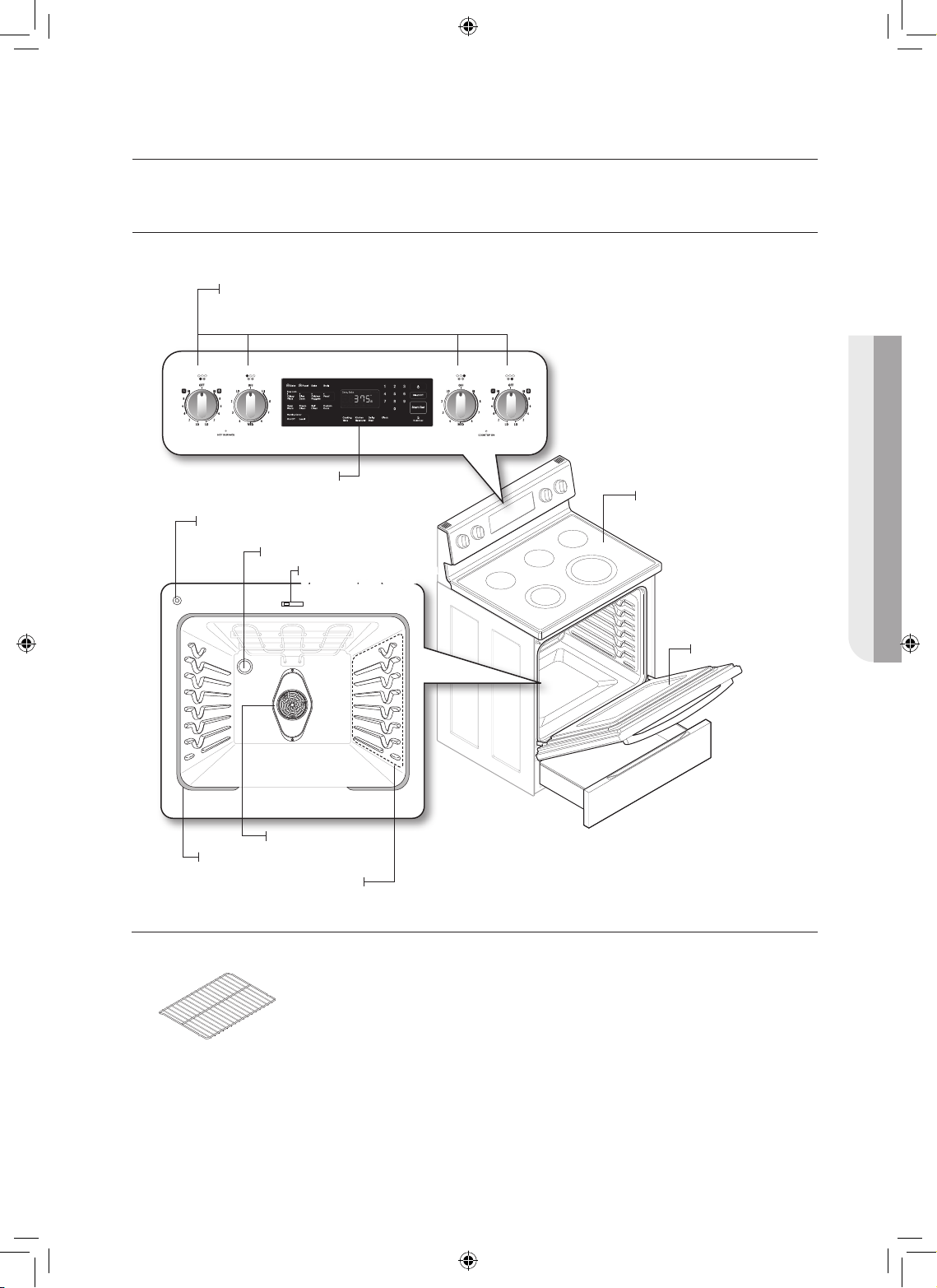
INTRODUCCIÓN
Introducción a su nueva estufa _16
introducción a su nueva estufa
DESCRIPCIÓN GENERAL
Puerta del horno
Ventilador de
convección
Posición del estante
Superficie de vidrio
Interruptor de la luz
automática del horno
* Luz del horno
Pestillo de auto-limpieza
y limpieza con vapor
Junta selladora
Panel de control del horno
Consulte la página 23 para
obtener más información
* Perillas de control de la
superficie
Consulte la página 18 para obtener
más información
ELEMENTOS INCLUIDOS CON SU ESTUFA
* Estantes de alambre
Si necesita un accesorio marcado con un *, puede adquirirlo en el Centro de
contacto de Samsung (1-800-726-7864).
NE595R0ABSR_AA_DG68-00433A-09_MES.indd 16 2016-03-30 �� 8:07:36
17_ Superficie de cocción
superficie de cocción
ACERCA DE LA SUPERFICIE DE COCCIÓN
PRECAUCIÓN
ANTES DE COCINAR
• No utilice la superficie de la cubierta de vidrio como tabla para cortar.
• No coloque ni almacene sobre la cubierta de vidrio elementos susceptibles de derretirse o prenderse fuego,
aun cuando no se encuentre en uso.
• Encienda las unidades de superficie solamente después de colocar los recipientes de cocción sobre ellas.
• No almacene objetos pesados por encima de la superficie de cocción. Podrían caerse y dañar tal superficie
PRECAUCIÓN
DURANTE LA COCCIÓN
• Mientras la estufa esté en uso, no coloque sobre ella papel de aluminio ni elementos plásticos tales como
saleros y pimenteros, apoyos para cucharas, ni envoltorios plásticos. El aire caliente que sale por la
abertura de ventilación podría derretir plásticos o hacer arder elementos inflamables.
• Asegúrese de que se encuentre encendida la unidad de superficie correcta.
• Nunca cocine directamente sobre el vidrio. Siempre utilice recipientes.
• Siempre coloque la cacerola o sartén en el centro de la unidad de superficie sobre la cual está cocinando.
• Nunca deje las unidades de superficie sin atención mientras las utiliza reguladas a altas temperaturas.
Los derrames por exceso de hervor producen humo y los derrames de sustancias grasas pueden arder en
llamas.
• Apague las unidades de superficie antes de retirar los recipientes de cocción.
• No utilice películas plásticas para tapar los alimentos. El plástico podría derretirse, caer sobre la superficie y
resultar muy difícil de quitar.
PRECAUCIÓN
DESPUÉS DE COCINAR
• No toque las unidades de superficie hasta que se hayan enfriado.
• La superficie podría estar caliente aún y se podrían producir quemaduras si se la toca antes de que se haya
enfriado lo suficiente.
• Limpie inmediatamente los derrames sobre las áreas de cocción, a fin de evitar un duro trabajo de limpieza
más adelante.
• Si hay gabinetes de almacenamiento instalados directamente sobre la superficie de limpieza, procure que
sean elementos de uso infrecuente y asegúrese de que puedan ser almacenados con seguridad en un
lugar que reciba calor. Las temperaturas alcanzadas pueden resultar inseguras para elementos tales como
líquidos volátiles, agentes limpiadores o spray en aerosol.
Sobre los elementos radiantes de la superficie
La temperatura se eleva en forma gradual y pareja. Al elevarse la temperatura, el elemento irradiará un color rojo.
Para mantener la regulación seleccionada, el elemento alternará ciclos de encendido y apagado. El elemento calentador
retiene calor suficiente como para suministrar calor suficiente y uniforme durante su ciclo de apagado. Para mejorar la
eficiencia de cocción, apague el elemento varios minutos antes de que se complete la cocción. Esto permitirá que el calor
residual complete el proceso de cocción.
Los elementos radiantes tienen un dispositivo limitante que les permite alternar en ciclos ON (de encendido) y
OFF (Apagado) aun en la regulación HI (ALTA). Esto ayuda a evitar daños a la cubierta cerámica. La alternancia
en ciclos en la regulación HI es normal y puede ocurrir si el recipiente de cocción es demasiado pequeño para el
elemento radiante o si la base del recipiente no es plana.
NE595R0ABSR_AA_DG68-00433A-09_MES.indd 17 2016-03-30 �� 8:07:36
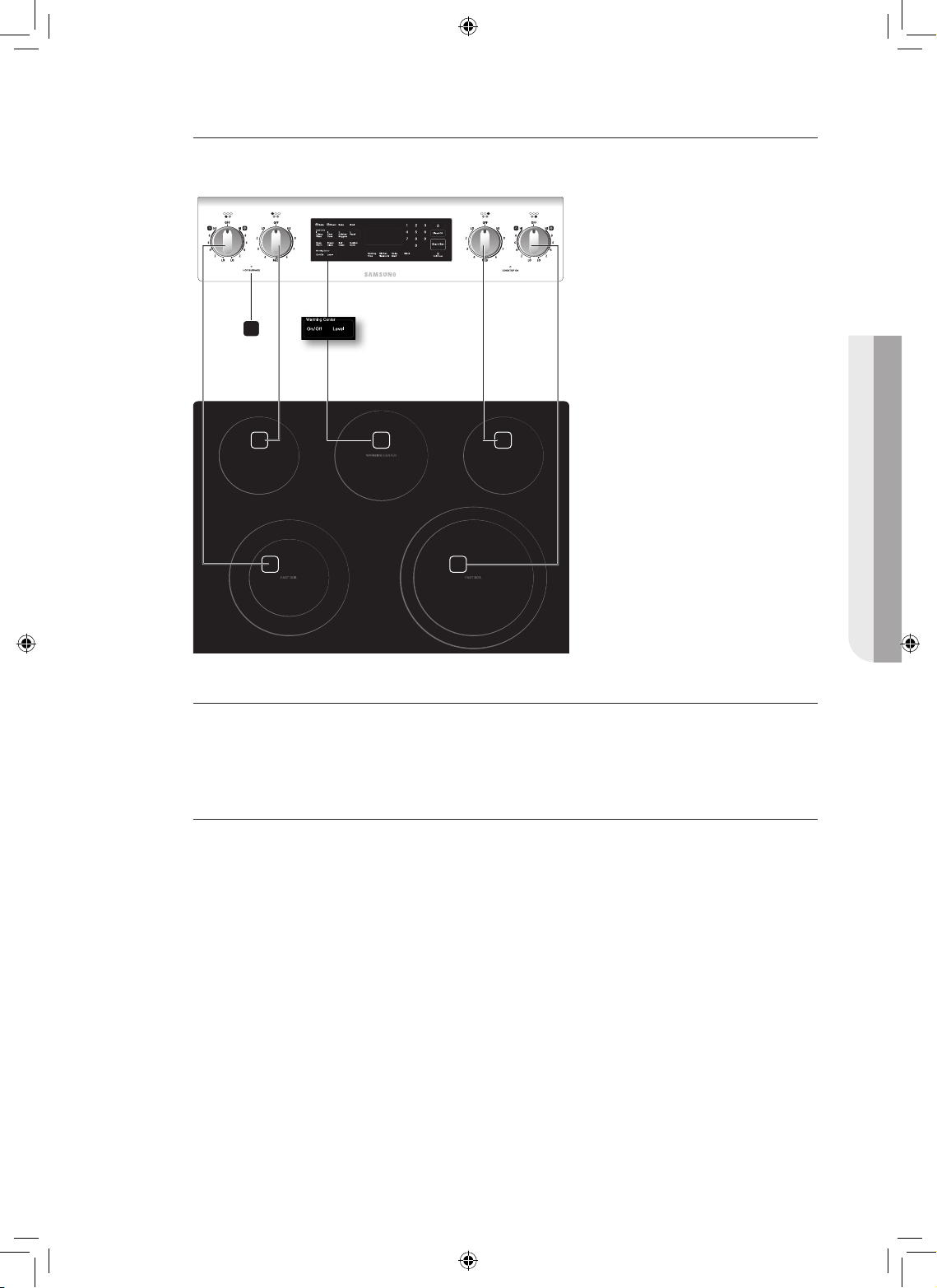
SUPERFICIE DE COCCIÓN
Superficie de cocción _18
Ubicación de los elementos radiantes de la superficie y los controles
Las perillas controlan los elementos radiantes de la superficie de cocción tal como se indica a continuación.
1 5 2
3 4
6
1. Elemento simple:
Trasero izquierdo
2. Elemento simple:
Trasero derecho
3. Elemento doble:
Delantero izquierdo
4. Elemento doble:
Delantero derecho
5. Centro de calentamiento:
Trasero central
6. Indicador de superficie
caliente
Indicador de superficie caliente
• Se ilumina cuando la unidad se encuentra encendida o caliente al tacto.
• Permanece iluminada aún después de que se haya apagado la unidad.
• Emite luz hasta que la unidad se haya enfriado hasta aproximadamente 150 °F.
Áreas de cocción
• Las áreas de cocción de su estufa están señaladas por círculos permanentes sobre la
superficie de cocción de vidrio. Para lograr la máxima eficiencia de cocción, seleccione un
tamaño de recipiente adecuado con relación al elemento calentador.
• Los recipientes de cocción no deben proyectarse más de ½" a 1" más allá del área de
cocción.
• Cuando un control se encuentra encendido, se puede ver una luz tenue a través de la
superficie de cocción de vidrio. El elemento alternará ciclos de encendido y apagado
para mantener la regulación de temperatura seleccionada previamente, aun cuando
se hayan regulado temperaturas altas.
• Para mayor información sobre la selección de tipos correctos de recipientes de cocción,
consulte la sección "Utilización de los recipientes de cocción correctos", en la página 21.
NE595R0ABSR_AA_DG68-00433A-09_MES.indd 18 2016-03-30 �� 8:07:38
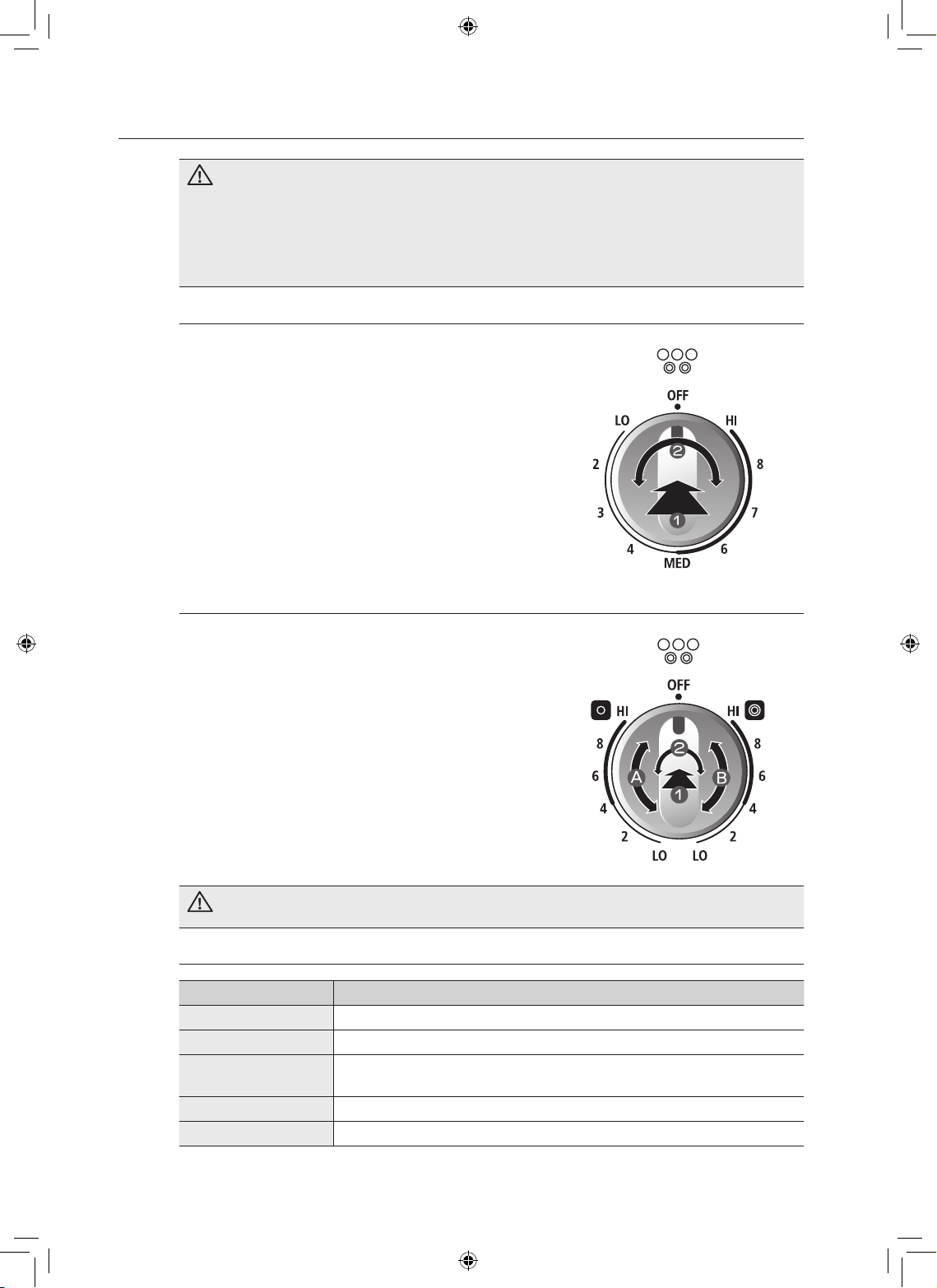
19_ Superficie de cocción
COMO REGULAR LA ESTUFA PARA LA COCCIÓN EN SUPERFICIE
PRECAUCIÓN
• Los elementos de superficie pueden estar calientes y pueden causar quemaduras.
No toque los elementos de superficie hasta que se hayan enfriado lo suficiente.
• Nunca deje la comida desatendida, cuando haya regulado temperaturas altas o de medianas a altas.
Los derrames por exceso de hervor producen humo y los derrames de sustancias grasas pueden arder en
llamas.
• Asegúrese de girar la perilla de control a OFF (Apagado) cuando haya terminado de cocinar.
Perilla de control de unidades de superficie simples (trasera izquierda, trasera derecha)
1. Empuje la perilla hacia adentro.
2. Gire en cualquier dirección hasta la regulación deseada.
• Tanto en la posición de apagado como en la regulación alta, la perilla
se asienta en la posición con un "clic".
Perilla de control de unidades de superficie duales (delantera izquierda, delantera derecha)
La unidad de superficie dual ofrece dos diámetros de cocción que se
deben seleccionar para hacer corresponder el tamaño de la unidad con
el tamaño de los recipientes de cocción que se están utilizando.
1
. Empuje la perilla hacia adentro.
2. Gire en cualquier dirección hasta la regulación deseada.
• Para utilizar la unidad de superficie más pequeña, gire la perilla a la
posición de regulación quemador pequeño (A).
• Para utilizar la unidad de superficie más grande, gire la perilla a la
posición de regulación quemador grande (B).
PRECAUCIÓN
La zona entre las regulaciones alta (HI) y apagada (OFF) no es apropiada para cocinar.
Regulaciones recomendadas
REGULACIÓN TIPO DE COCCIÓN
ALTO Cocción inicial de la mayoría de las comidas, hacer hervir agua, asar en cacerola
MEDIO ALTO Mantener un hervor rápido, frituras, frituras sumergidas en grasa
MEDIO Mantener un hervor lento, reducir salsas y jugos de cocción, cocción al vapor de
vegetales
MEDIO BAJO Mantener el proceso de cocción, escalfado, cocer guisados.
BAJO Mantener la comida caliente, derretir, hervir a fuego lento
NE595R0ABSR_AA_DG68-00433A-09_MES.indd 19 2016-03-30 �� 8:07:40
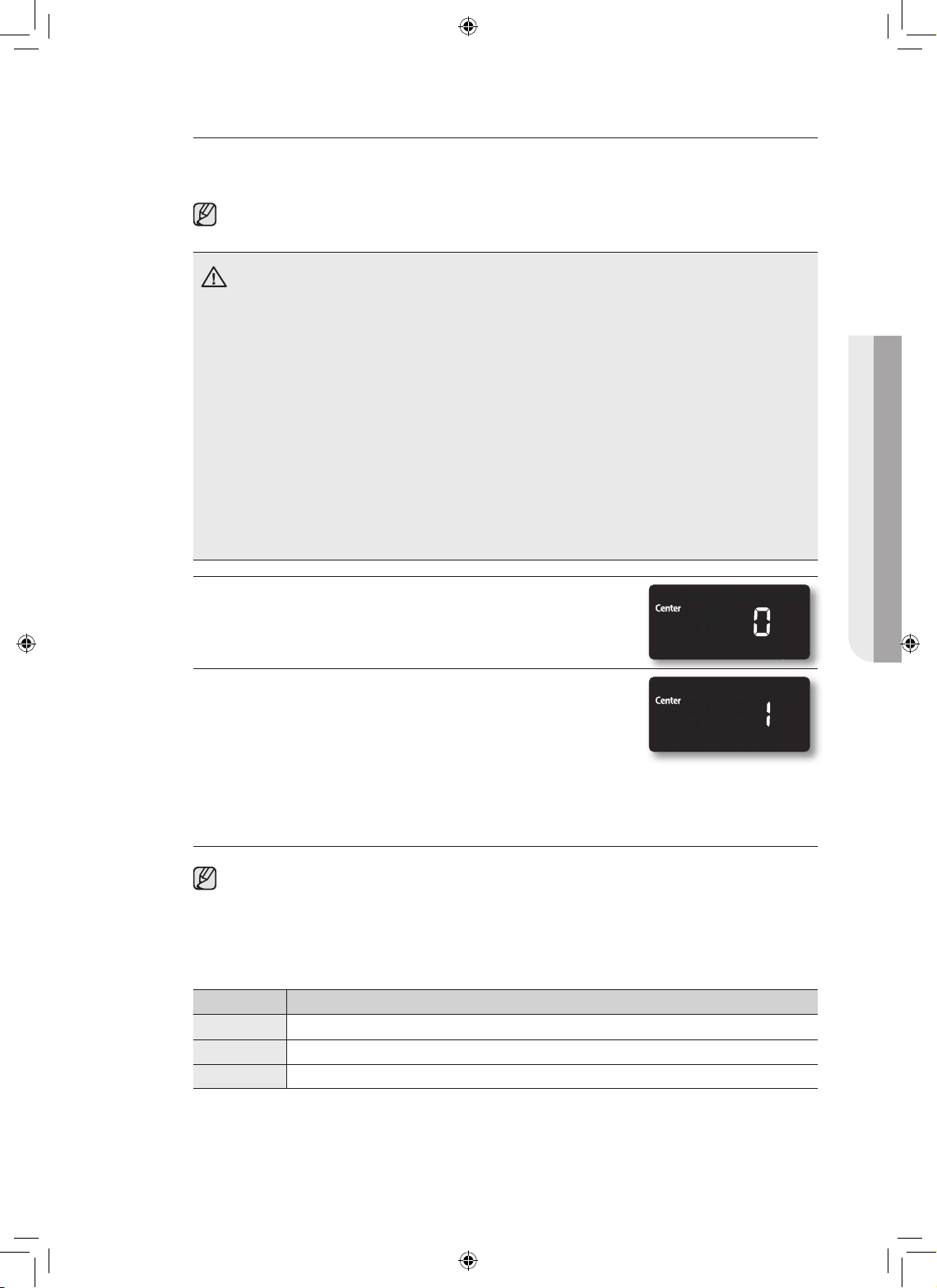
SUPERFICIE DE COCCIÓN
Superficie de cocción _20
Uso del centro de calentamiento
El centro de calentamiento, ubicado en la parte posterior central de la superficie de vidrio
mantendrá calientes los alimentos ya cocidos, a temperatura apta para servir.
• El calentador de superficie no se pondrá al rojo como los demás elementos de
cocción.
PRECAUCIÓN
• No mantenga alimentos sobre el centro de calentamiento por más de dos horas.
• Utilice únicamente recipientes y vajilla recomendada como segura para uso en horno
y sobre superficies de cocción.
• Siempre utilice agarradores o guantes aislantes cuando retira los alimentos del centro
de calentamiento ya que los recipientes y los platos estarán calientes.
• Cuando se calientan pasteles y panes, la tapa debe tener una abertura para permitir
que escape la humedad.
• No utilice películas plásticas para tapar la comida. El plástico podría derretirse, caer
sobre la superficie y resultar muy difícil de limpiar.
• Los alimentos deben mantenerse en su recipiente y cubrirse con una tapa o papel de
aluminio para mantener su calidad.
• Siempre comience con alimentos calientes. Consumir alimentos que fueron colocados
sobre el centro de calentamiento crudos o fríos podría causar enfermedades.
1. Encienda el centro de calentamiento.
Presione la tecla Warming Center On/O
(Centro de calentamiento Encender/Apagar).
2. Regule la potencia al nivel deseado.
Presionar la tecla Warming Center Level (Centro de
calentamiento nivel) una vez lo regulará en el nivel 1.
Presione la tecla dos veces para regularlo en el nivel 2, y 3 veces
para el nivel 3.
3
. Apague el centro de calentamiento.
Presione la tecla Warming Center On/O
(Centro de calentamiento Encender/Apagar).
• Presionar la tecla Clear/O (Borrar/Apagar) no apaga el centro de calentamiento.
• Para obtener óptimos resultados, todas las comidas en el centro de calentamiento
deben cubrirse con una tapa o papel de aluminio. Cuando se calientan pasteles o panes,
la tapa debe tener una abertura para permitir que escape la humedad.
Regulaciones recomendadas
NIVEL TIPO DE ALIMENTO
1 Panes y pasteles, guisados, reducciones de cocción, huevos
2 Plato de mesa con comida, sopas crema, vegetales, salsas, guisos, carnes
3 Comidas fritas, sopas líquidas, bebidas calientes
NE595R0ABSR_AA_DG68-00433A-09_MES.indd 20 2016-03-30 �� 8:07:44
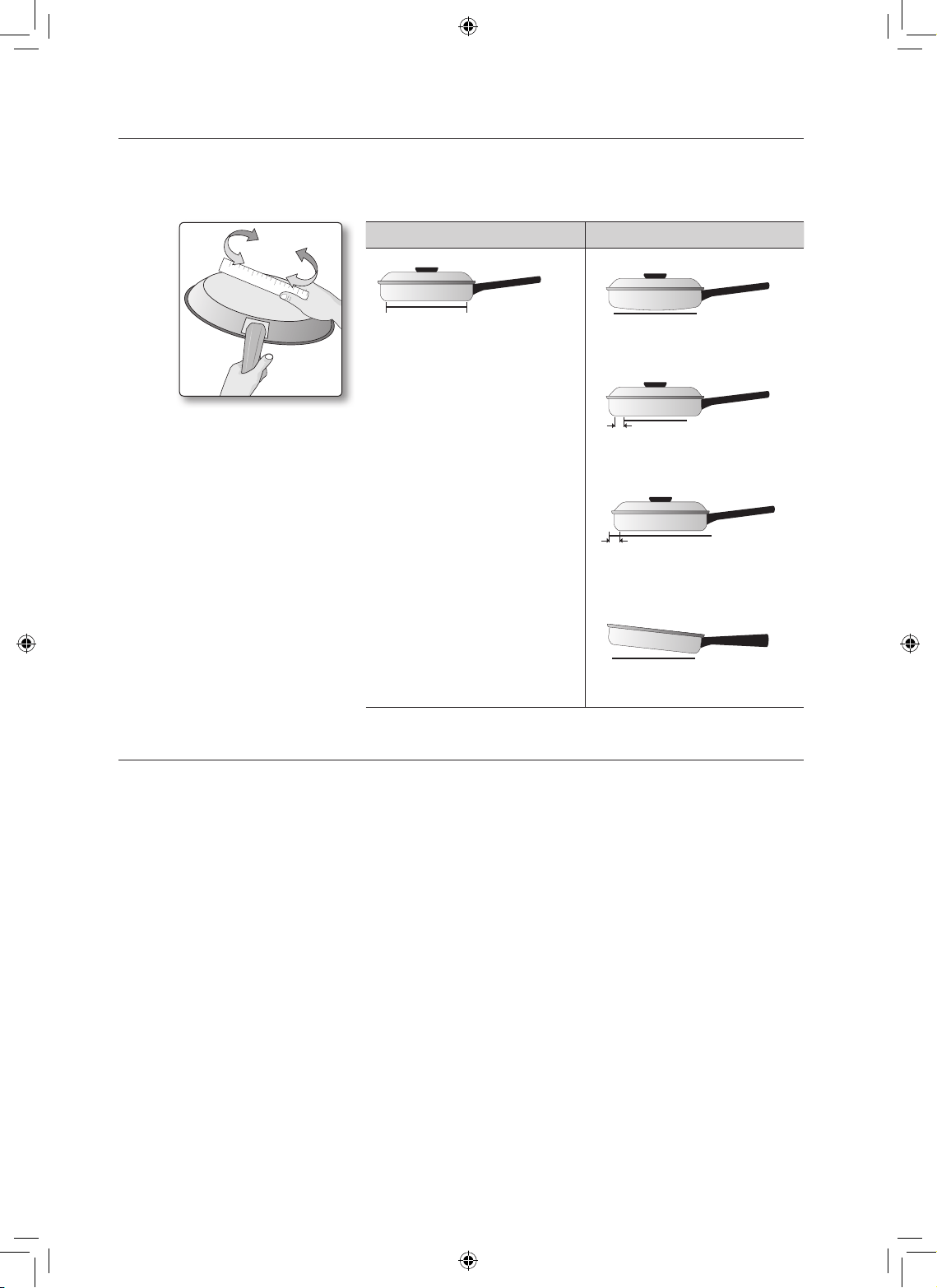
21_ Superficie de cocción
UTILIZACIÓN DE LOS RECIPIENTES DE COCCIÓN CORRECTOS
Utilizar los recipientes de cocción correctos puede evitar muchos problemas, tales como cocción
despareja o tiempos de cocción demasiado largos. Utilizar las cacerolas y sartenes adecuadas
redundará en menor tiempo de cocción y los alimentos se cocinarán en forma más pareja.
Controle que el fondo sea plano
haciendo girar una regla sobre
la base del recipiente.
CORRECTO INCORRECTO
Fondo plano y lados verticales.
• Tapas bien ajustadas.
• El peso del mango no inclina el
recipiente.
• El recipiente está bien equilibrado.
• El tamaño del recipiente guarda
adecuada relación con la cantidad de
alimento que se preparará y con el
elemento calentador.
• Hecho de un material que es buen
conductor del calor.
• Siempre haga corresponder el
diámetro del recipiente con el
diámetro del elemento calentador.
Recipientes cuyos fondos están
curvados o deformados.
El recipiente sobresale del elemento en
más de media pulgada.
El recipiente es más pequeño que el
elemento calentador.
Mango demasiado pesado causa
inclinación del recipiente.
SELECCIÓN DE LOS RECIPIENTES DE COCCIÓN CORRECTOS
El material del que están hechos sus recipientes de cocción determina que tan rápida y
parejamente se transfiere el calor del elemento calentador de la superficie al fondo del recipiente.
• ALUMINIO - Excelente conductor de calor. Algunos tipos de alimentos causarán el
oscurecimiento del aluminio. (Los recipientes de aluminio anodizado son resistentes a las
manchas y a las picaduras). Si se deslizan recipientes de aluminio sobre la cubierta de cocción
cerámica, podrían quedar marcas de metal semejantes a rayaduras. Retire estas marcas ni bien
la cubierta se enfríe.
• COBRE - Excelente conductor de calor pero su color se altera con facilidad. Puede dejar
marcas de metal sobre la superficie vitro-cerámica (ver arriba).
• ACERO INOXIDABLE - Lento conductor de calor, los resultados de cocción pueden ser
desparejos. Es duradero, fácil de limpiar y resistente a las manchas.
• HIERRO FUNDIDO - Mal conductor del calor; retiene el calor muy bien. Una vez alcanzada
la temperatura necesaria, produce cocción uniforme. Se desaconseja su uso en superficies de
cocción cerámicas.
• UTENSILIOS ESMALTADOS - Las características de conducción de calor dependerán del
material base. Los revestimientos de porcelana deben ser lisos para evitar rayaduras en las
superficies de cocción cerámicas.
• VIDRIO - Lento conductor de calor. Se desaconseja su uso en superficies de cocción
cerámicas porque puede causar rayaduras.
NE595R0ABSR_AA_DG68-00433A-09_MES.indd 21 2016-03-30 �� 8:07:50
SUPERFICIE DE COCCIÓN
Superficie de cocción _22
PROTECCIÓN DE LA LISURA DE LA SUPERFICIE DE COCCIÓN
Limpieza
• Limpie la cubierta antes de utilizarla por primera vez.
• Limpie su cubierta diariamente o después de cada uso. Esto mantendrá la buena apariencia de
la cubierta y puede evitar daños.
• Si durante la cocción ocurre un derrame, límpielo inmediatamente del área de cocción mientras
esté caliente para evitar tener que hacer un duro trabajo de limpieza más adelante. Con
extremo cuidado, limpie el derrame con una toalla limpia y seca.
• No permita que los derrames permanezcan mucho tiempo en el área de cocción o las
terminaciones de la cubierta.
• No utilice polvos limpiadores abrasivos, paños abrasivos ni esponjas metálicas, porque
producirán rayaduras en la cubierta.
• No utilice cloro, amoníaco ni otros productos limpiadores no específicamente recomendados
para ser usados en superficies vitro-cerámicas.
Cómo evitar marcas y rayaduras
• No utilice recipientes de cocción de vidrio. Pueden causar rayaduras en la cubierta.
• No coloque un trébedes o un aro para wok entre la cubierta y el recipiente. Estos elementos
pueden marcar o rayar la cubierta.
• Asegúrese de que la cubierta y el fondo del recipientes se encuentren limpios.
• No deslice recipientes metálicos sobre la cubierta.
Prevención de manchas
• No utilice paños ni esponjas sucias para limpiar la superficie de cocción. Quedará una película
que podría causar manchas sobre la superficie de cocción cuando se caliente el área.
• La cocción continuada sobre una superficie sucia puede causar manchas permanentes.
Prevención de otros daños
• No permita que plásticos, azúcar o alimentos con alto contenido de azúcar se derritan sobre la
cubierta. Si esto ocurriese, limpie inmediatamente.
• No permita que un recipiente quede seco por hervor prolongado, ya que esto dañará la
cubierta y el recipiente.
• No utilice la cubierta como mesada ni como tabla para cortar.
• No cocine alimentos directamente sobre la cubierta. Use siempre los recipientes de cocción
adecuados.
NE595R0ABSR_AA_DG68-00433A-09_MES.indd 22 2016-03-30 �� 8:07:51
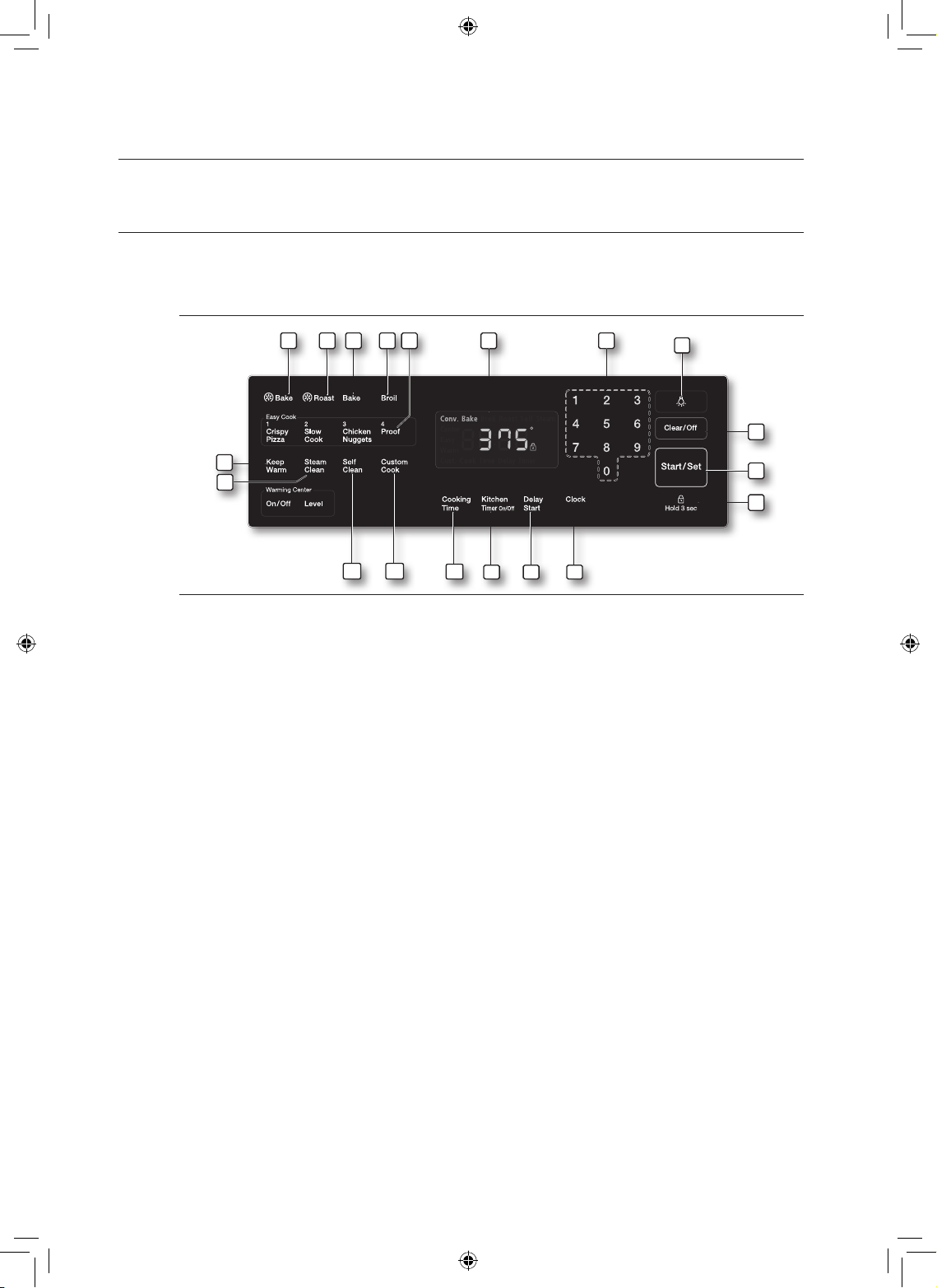
23_ Operación del horno
operación del horno
PANEL DE CONTROL DEL HORNO
LEA LAS INSTRUCCIONES CON ATENCIÓN ANTES DE UTILIZAR EL HORNO. Para obtener un funcionamiento
satisfactorio del horno, familiarícese con las diversas características y funciones del horno, tal como se describen a
continuación. Encontrará instrucciones detalladas para cada característica y función más adelante en este manual.
3
19
4
9
2
7
65 8
113
151618
17
12
14
10
11
1. PANTALLA: Muestra la hora del día, la temperatura del horno, si el horno está en el modo de hornear, asar a la parrilla o
auto-limpieza y las horas fijadas para el temporizador o las operaciones automáticas del horno.
2. TECLAS NUMÉRICAS: Utilícelas para marcar o fijar cualquier función que requiera números tales como la hora en el reloj,
el temporizador, la temperatura del horno y la hora de comienzo y la duración de la operación para el caso de horneado
temporizado.
3. START/SET (INICIO/CONFIGURAR): Debe presionarse para comenzar cualquier función de cocción o limpieza.
4. CLEAR/OFF (BORRAR/APAGAR) Presione para cancelar todas las operaciones del horno excepto reloj y temporizador.
5. KITCHEN TIMER ON/OFF (ACTIVAR/DESACTIVAR TEMPORIZADOR DE COCINA): Presione para seleccionar la
función temporizador.
6. DELAY START (INICIO RETARDADO): Utilice en conjunción con las teclas Bake (Hornear), Conv. Bake (Hornear por
convección), Conv. Roast (Asar por convección), Cooking Time (Tiempo de cocción) y Self Clean (Auto-limpieza) para
programar que el horno se active y detenga automáticamente a las horas que usted fije.
7. COOKING TIME (TIEMPO DE COCCIÓN): Presione y luego utilice el teclado numérico para programar la duración de la
cocción para los alimentos en cuestión. El horno se apagará cuando haya transcurrido el tiempo de cocción.
8. CLOCK (RELOJ): Presione para fijar la hora del día.
9. LUZ DEL HORNO: Presione para encender o apagar la luz del horno.
10. CUSTOM COOK (COCCIÓN PERSONALIZADA): Presione para grabar y recuperar la programación de su receta
favorita.
11. SELF CLEAN (AUTO-LIMPIEZA): Presione para seleccionar la función de auto-limpieza.
12. STEAM CLEAN (LIMPIEZA CON VAPOR): Presione para seleccionar la función de limpieza con vapor.
13. PROOF (ENTIBIAR PARA LEUDADO): Presione para seleccionar un ambiente tibio que favorezca la acción de las
levaduras.
14. KEEP WARM (MANTENER CALIENTE): Presione para mantener la temperatura de las comidas cocidas.
15. BROIL (ASAR A LA PARRILLA): Presione para seleccionar la función de asar sobre parrilla.
16. BAKE (HORNEAR): Presione para seleccionar la función de hornear.
17. CONVECTION BAKE (HORNEAR POR CONVECCIÓN): Presione para seleccionar la función de hornear en la
modalidad de convección.
18. CONVECTION ROAST (ASAR POR CONVECCIÓN): Presione para seleccionar la función de asar al horno en la
modalidad de convección.
19. CONTROL LOCKOUT (TRABA DE CONTROLES): Presione para bloquear los botones en el panel táctil de modo que
no pueda activarse accidentalmente.
NE595R0ABSR_AA_DG68-00433A-09_MES.indd 23 2016-03-30 �� 8:07:51
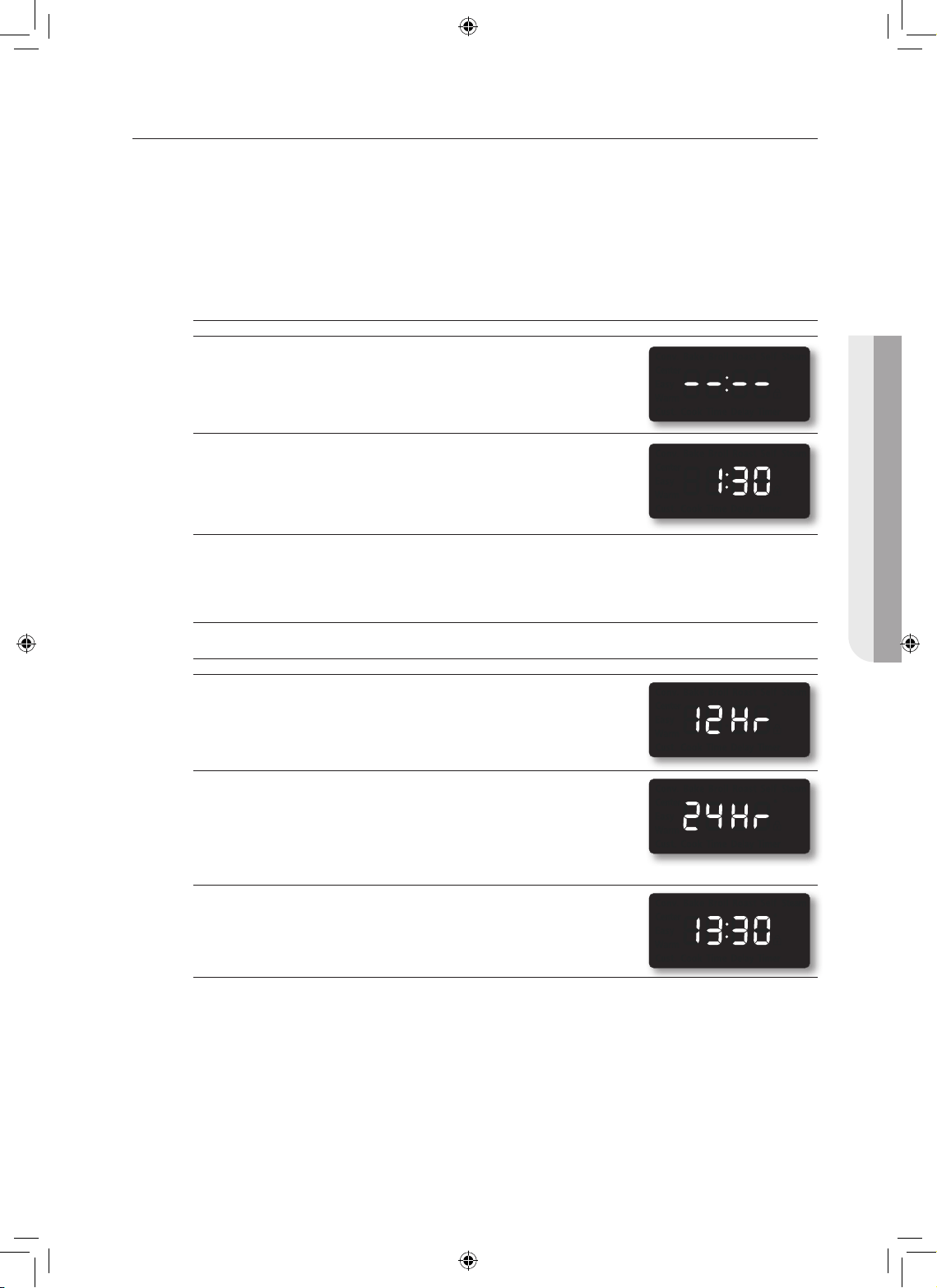
Operación del horno _24
OPERACIÓN DEL HORNO
AJUSTE DEL RELOJ
El Clock (Reloj) debe ajustarse para mostrar la hora correcta y permitir el buen funcionamiento
de las opciones de temporizador del horno.
• La hora del día no se puede cambiar mientras estén en proceso una cocción regida por el
temporizador, una cocción temporizada diferida o un ciclo de auto-limpieza.
• Se puede optar entre mostrar un ciclo de 12 horas o de 24 horas. La configuración
predeterminada es de 12 horas.
Cómo ajustar el reloj
1. Inicio de la configuración.
Presione la tecla Clock (Reloj).
2. Ingreso de la hora del momento.
Ingrese la hora del momento en horas y minutos mediante las
teclas numéricas, por ejemplo: 1, 3, 0, para 1:30.
En el modo de formato de 24 horas este paso se saltea.
3. Finalización de la configuración.
Presione la tecla Start/Set (Inicio/Configurar) o Clock (Reloj).
Cómo efectuar el cambio para ver ciclos de 12 horas o de 24 horas
1. Inicio de la configuración.
Presione Clock (Reloj) y 0 en el teclado numérico
simultáneamente durante 3 segundos.
La pantalla mostrará el modo en uso (por ejemplo, 12 horas).
2 Selección del modo de visualización que se desea.
Presione 0 en el teclado numérico para seleccionar 12 horas o
24horas.
Presionar 0 en el teclado numérico cambia el formato de
12 horas a 24 horas.
3. Finalización de la configuración.
Presione la tecla Start/Set (Inicio/Configurar).
NE595R0ABSR_AA_DG68-00433A-09_MES.indd 24 2016-03-30 �� 8:07:54
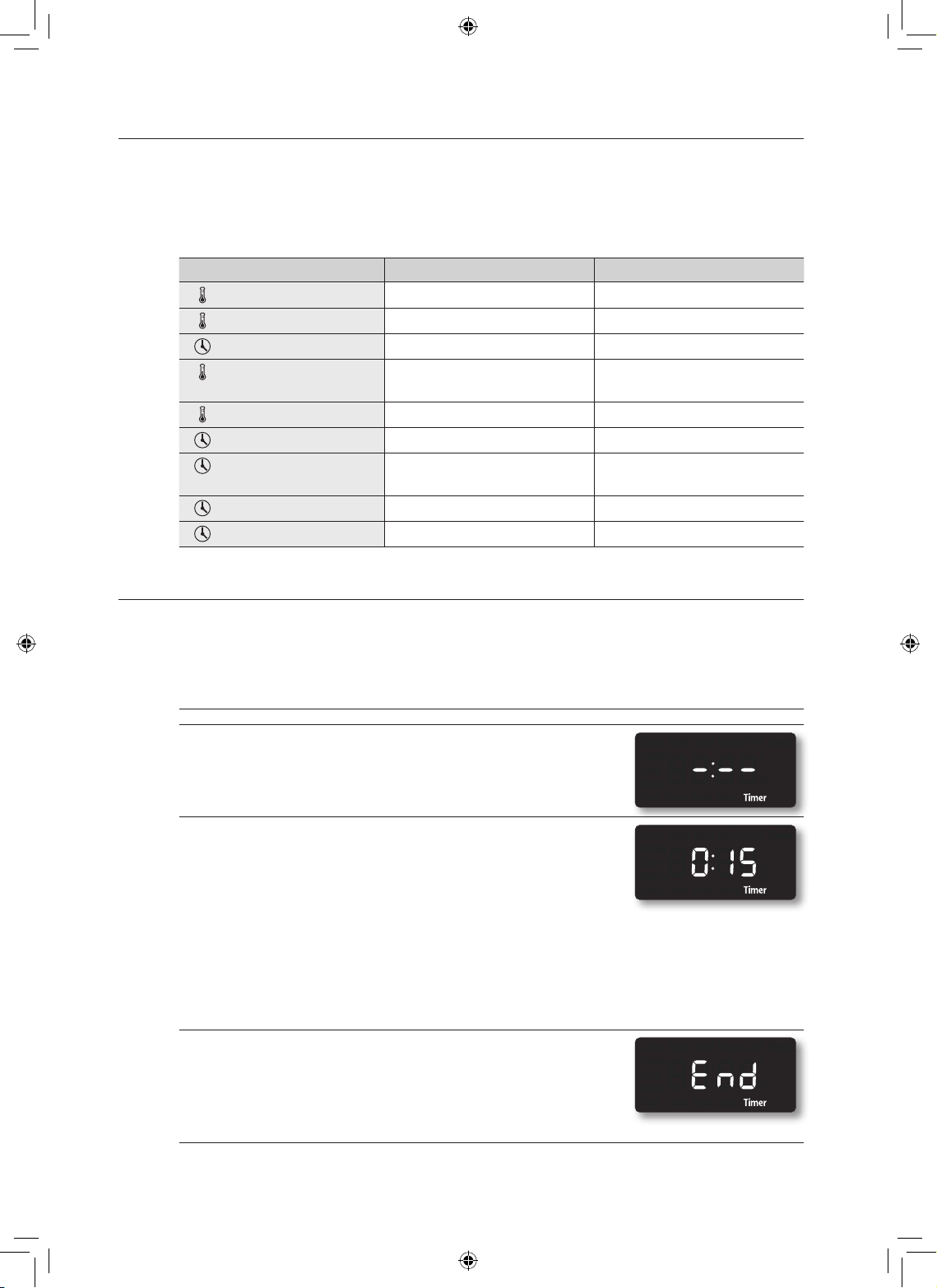
25_ Operación del horno
AJUSTES MÍNIMOS Y MÁXIMOS
Todas las funciones enumeradas en la siguiente tabla tienen ajustes de tiempo o temperatura
mínimos y máximos. Se oirá una señal sonora cada vez que se presione una tecla del panel de
control y el dato ingresado haya sido aceptado. Si la temperatura o el tiempo ingresados se
encuentran por debajo del mínimo o por arriba del valor ajustable máximo para la función en
cuestión, sonará un tono de error en la forma de un sonido más prolongado.
FUNCIÓN MÍNIMO MÁXIMO
Hornear 150 °F (65 °C) 550 °F (285 °C)
Asar a la parrilla BAJA ALTA
Auto-limpieza 2 H 4 H
Hornear por
convección
150 °F (65 °C) 550 °F (285 °C)
Asar por convección 150 °F (65 °C) 550 °F (285 °C)
Mantener caliente - 3 H
Centro de
calentamiento
- 3 H
Entibiar para leudado - 12 H
Limpieza con vapor 20 Min 20 Min
CÓMO PROGRAMAR EL TEMPORIZADOR DE COCINA
El temporizador de cocina funciona como un temporizador adicional que emitirá un sonido agudo
cuando el tiempo fijado haya transcurrido. No inicia ni detiene las funciones de cocción.
Puede usar el temporizador de cocina con cualquiera de las otras funciones del horno.
Cómo programar el temporizador
1. Encienda el temporizador.
Presione la tecla Kitchen Timer On/O (Activar/Desactivar
temporizador de cocina).
2. Ingrese el tiempo que desea.
Ingrese el tiempo que desea mediante las teclas numéricas, por
ejemplo 1, 5. El temporizador puede configurarse para cualquier
cantidad de tiempo, desde 1 minuto hasta 9 horas y 99 minutos.
Si comete un error presione la tecla Kitchen Timer On/O
(Activar/Desactivar temporizador de cocina) y comience
nuevamente.
3
. Active el temporizador.
Presione la tecla Kitchen Timer On/O (Activar/Desactivar
temporizador de cocina).
4. Cuando haya transcurrido el tiempo fijado, el horno emitirá un
sonido agudo y en la pantalla se verá "End" (Fin) hasta que usted
presione la tecla Kitchen Timer On/O (Activar/Desactivar
temporizador de cocina). El temporizador se puede desactivar
en cualquier momento presionando la tecla Kitchen Timer
On/O (Activar/Desactivar temporizador de cocina).
NE595R0ABSR_AA_DG68-00433A-09_MES.indd 25 2016-03-30 �� 8:07:55
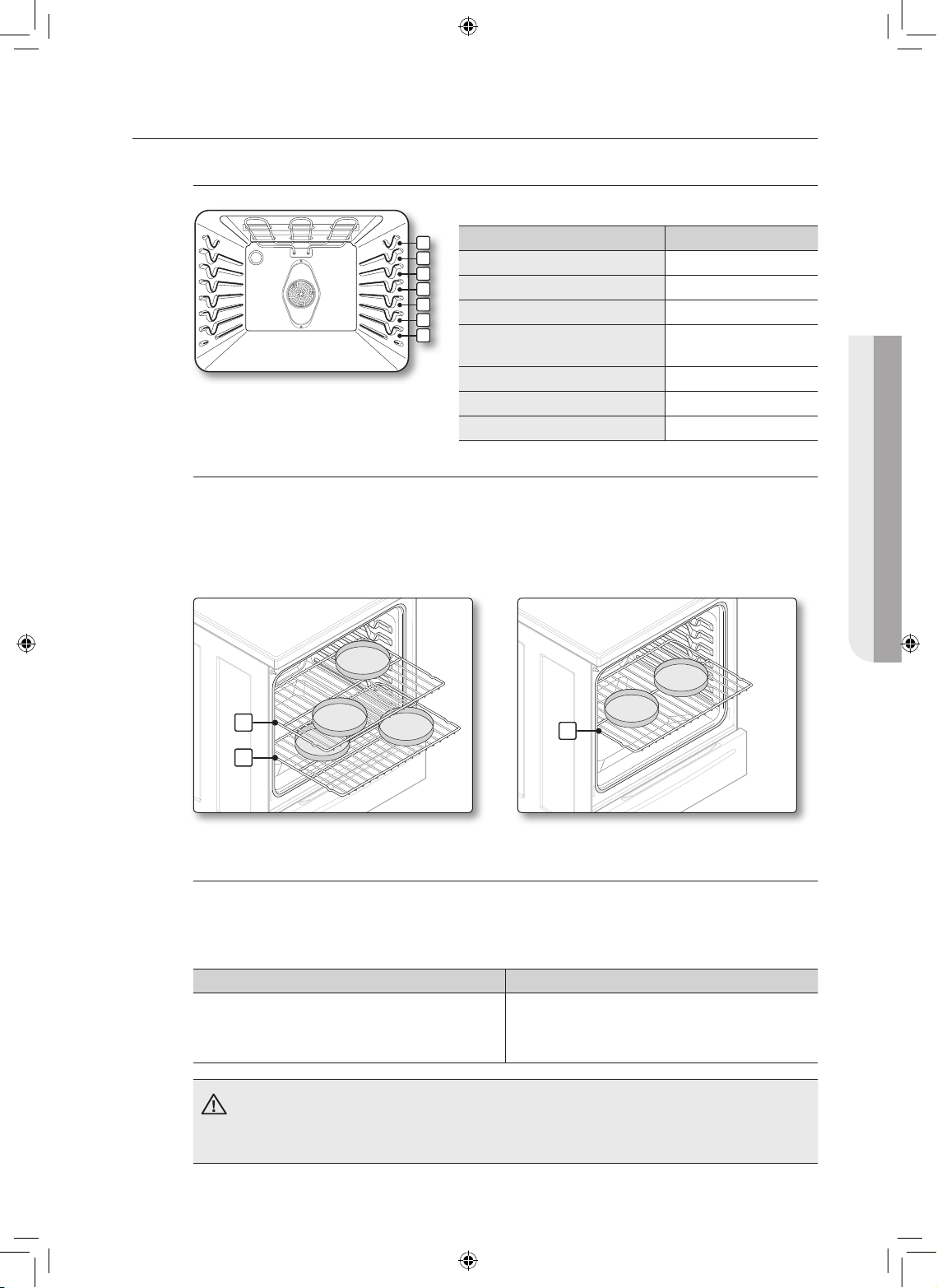
Operación del horno _26
OPERACIÓN DEL HORNO
USO DE LAS PARRILLAS DEL HORNO
Posiciones de las parrillas en el horno
1
2
3
4
5
6
7
El horno tiene siete posiciones para las parrillas (1~7).
TIPO DE ALIMENTO
POSICIÓN DE LA PARRILLA
Tartas congeladas 4
Pastel de ángel 2
Panqués o pasteles en molde savarin 3
Galletas, magdalenas, brownies, pastelillos
individuales, pasteles en capas, tartas
4
Guisos 4
Jamón, carnes asadas de pequeño tamaño
2
Pavo, carnes asadas grandes 1
Cómo hornear pasteles en capas
Colocar los moldes o las charolas lo más cerca posible del centro del horno producirá los mejores resultados. Si hornea
con más de un molde o charola, posiciónelos de manera tal que cada uno tenga 1" a 1½" de espacio libre a su alrededor.
Si hornea dos capas de pasteles al mismo tiempo, coloque una parrilla del horno en la posición 4.
Si hornea cuatro capas de pasteles al mismo tiempo, coloque las parrillas del horno en las posiciones 2 y 5.
Coloque los recipientes como se muestra en las figuras 1 y 2.
5
2
4
Fig. 1 Fig. 2
Antes de usar las parrillas
El horno tiene dos parrillas.
Cada parrilla tiene topes que requieren colocación correcta sobre las guías. Estos topes impedirán
que la parrilla se salga completamente.
RETIRAR LAS PARRILLAS RECOLOCAR LAS PARRILLAS
1
. Jale la parrilla directamente hacia afuera hasta que se
trabe.
2
. Levante la parte delantera de la parrilla y extráigala.
1. Coloque el extremo de la parrilla sobre la guía.
2. Incline el extremo delantero y empuje la parrilla hacia
adentro.
PRECAUCIÓN
• Las parrillas no deben cubrirse con papel de aluminio ni colocarse sobre el fondo del horno. Tales acciones
alterarían la circulación del calor, crearían problemas en el proceso de horneado y podrían dañar el fondo del horno.
• Coloque las parrillas en la distribución deseada solamente cuando el horno se encuentre frío.
NE595R0ABSR_AA_DG68-00433A-09_MES.indd 26 2016-03-30 �� 8:07:56
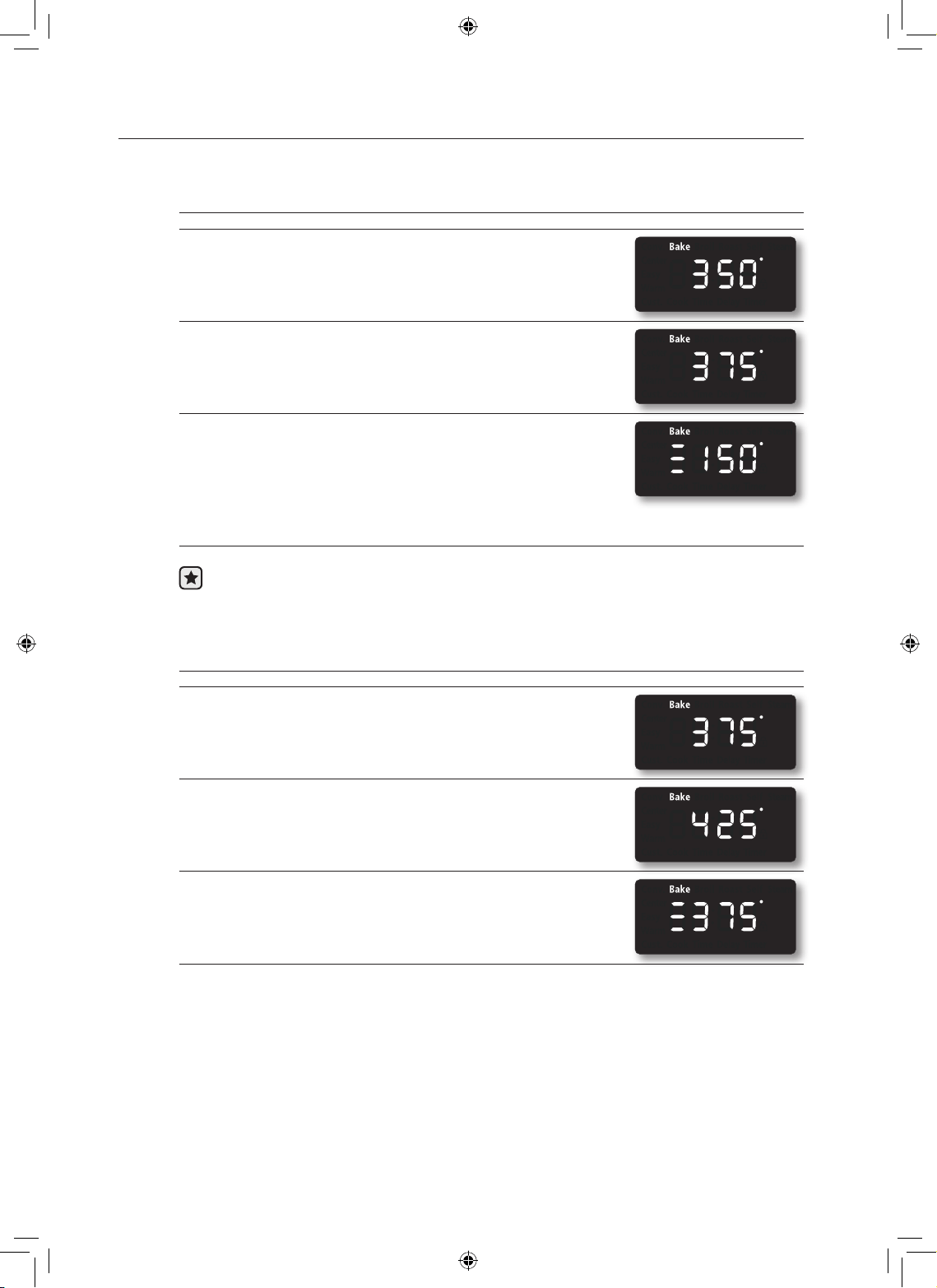
27_ Operación del horno
HORNEAR
El horno puede programarse para hornear a cualquier temperatura en el rango de 150 °F a 550 °F.
Cómo ajustar el termostato
1. Comience el proceso de ajuste.
Presione la tecla Bake (Hornear).
La temperatura predeterminada es de 350 °F.
2. Ingrese la temperatura que desea mediante las teclas numéricas,
por ejemplo 3, 7, 5.
3. Active la función de hornear.
Presione la tecla Start/Set (Inicio/Configurar). El indicador de
temperatura comenzará a variar una vez que la temperatura del
horno alcance 150 °F.
4
. Si desea cancelar el horneado o si ha completado el proceso,
presione la tecla Clear/O (
Borrar/Apagar
).
Coloque los alimentos en el horno después de precalentarlo, si así lo requiere la receta.
El precalentamiento es muy importante para lograr buenos resultados cuando se hornean
tortas, pasteles, galletas, masas y panes. Cuando el horno haya alcanzado la temperatura
deseada, sonará un "bip" prolongado 6 veces.
Cómo ajustar el termostato durante el proceso de cocción.
1. Inicie la configuración.
Presione la tecla Bake (Hornear). La pantalla mostrará la
temperatura fijada hasta el momento, por ejemplo 375 °F.
2. Ingrese la temperatura que desea, por ejemplo 425 °F, mediante
las teclas numéricas.
3. Complete el ingreso presionando la tecla Start/Set
(Inicio/Configurar).
NE595R0ABSR_AA_DG68-00433A-09_MES.indd 27 2016-03-30 �� 8:07:58
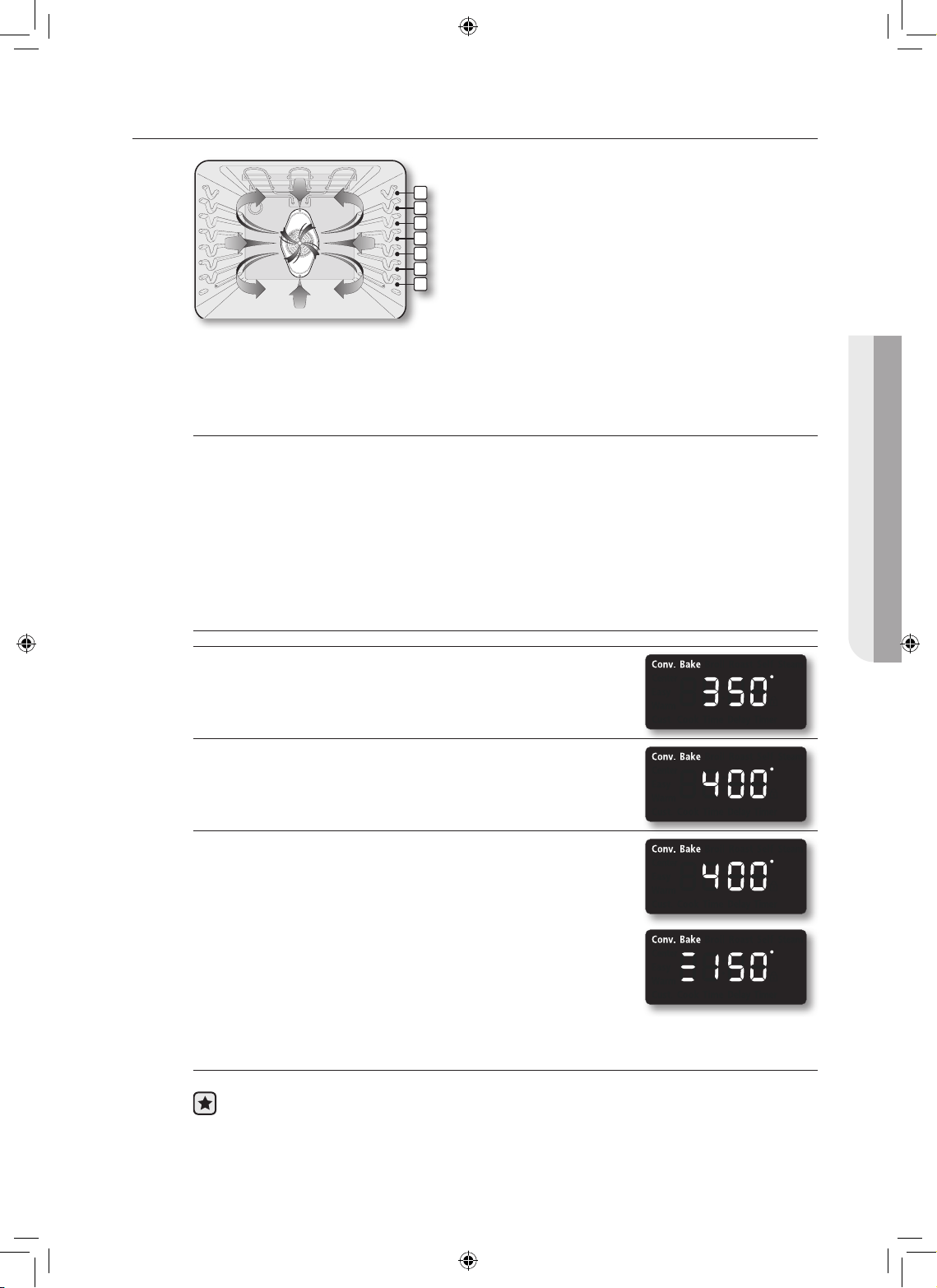
Operación del horno _28
OPERACIÓN DEL HORNO
HORNEAR POR CONVECCIÓN
Utilizar la función de hornear por convección, le permitirá
una cocción más rápida. Se puede programar el horno
para hornear por convección a temperaturas de entre
150°F y 550 °F.
En el horneado por convección se activa un ventilador
para hacer circular el calor del horno en forma pareja y
continua. Esta mejor distribución del calor posibilita la
cocción pareja y excelentes resultados cuando se utilizan
múltiples parrillas al mismo tiempo. Las comidas que se
cocinen sobre una única parrilla generalmente se cocinarán en forma más rápida y pareja si se
utiliza la función de hornear por convección. La cocción utilizando múltiples parrillas en el horno
puede resultar en tiempos de cocción un poco más largos para ciertas comidas, pero a fin de
cuentas se ahorra tiempo. Los panes, pasteles y masas se doran en forma más pareja.
Consejos para el horneado por convección
El tiempo que ahorre dependerá del tipo y de la cantidad de alimento que esté cocinando.
Al hornear galletas, se aconseja utilizar charolas sin lados o con lados muy bajos para permitir que
el aire caliente circule alrededor de la comida. Utilizar una charola de superficie oscura permitirá
una cocción más rápida.
Cuando hornee por convección con un única parrilla, colóquela en la posición 4. Si cocina con
parrillas múltiples, colóquelas en las posiciones 2 y 5 o las posiciones 3, 5 y 6.
Si hornea una torta o pastel, el modo de hornear simple producirá mejores resultados.
Cómo ajustar el horno para hornear por convección.
1. Active el modo de hornear por convección.
Presione la tecla Conv. Bake (Hornear por convección).
La temperatura predeterminada es de 350 °F.
2. Ingrese la temperatura que desea, por ejemplo 400 °F, utilizando
el teclado numérico.
3. Presione la tecla Start/Set (Inicio/Configurar) para comenzar
con el horneado por convección.
Conv. Bake (Hornear por convección) y la temperatura ajustada
del horno, por ejemplo 400 °F, se verán en la pantalla durante
2segundos.
El indicador de temperatura comenzará a variar una vez que la
temperatura del horno alcance 150 °F.
Cuando el horno alcance la temperatura deseada, sonará un
"bip" 6 veces.
4
. Apague o cancele el proceso de horneado por convección
presionando la tecla Clear/O (Borrar/Apagar).
Cuando se abre la puerta del horno, el ventilador del horno de convección se apaga.
NO DEJE la puerta del horno abierta durante mucho tiempo mientras funciona en modo de
convección porque ello podría reducir la vida útil del elemento radiante de convección.
1
2
3
4
5
6
7
NE595R0ABSR_AA_DG68-00433A-09_MES.indd 28 2016-03-30 �� 8:08:00
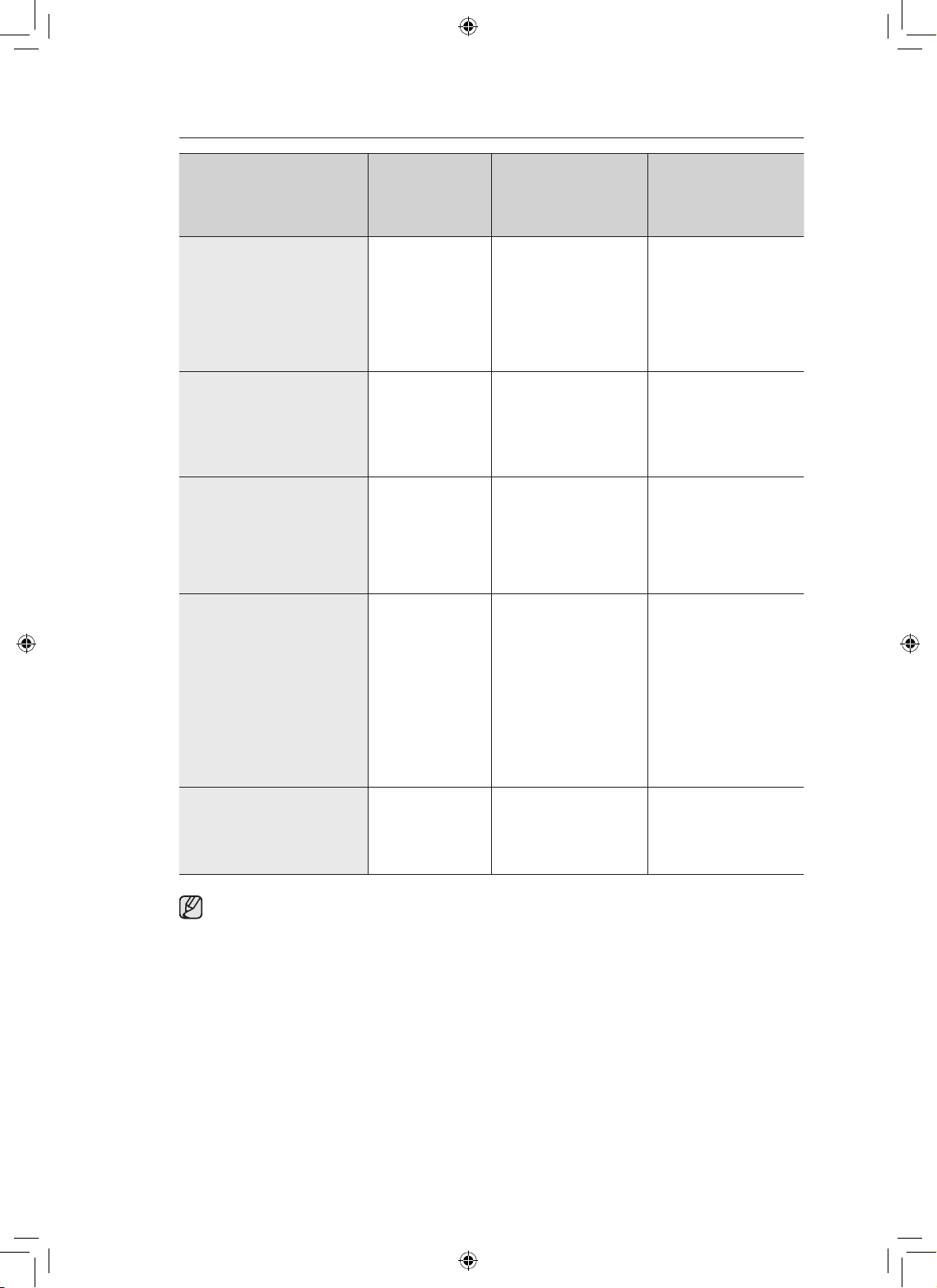
29_ Operación del horno
Guía de recomendaciones para horneado por convección
Tipo de alimento
Posición de la
parrilla
Ajuste de
temperatura *
(horno precalentado)
(°F)
Tiempo de horneado
por convección **
(min)
Pasteles
Pastelillos individuales 4 325 17-19
Panqués y pasteles en
molde savarin
3 325 35-43
Pastel de ángel 2 325 35-39
Tartas
Doble masa, fresca, 9" 3 350-400 45-55
Doble masa, fruta
congelada, 9"
3 350 68-78
Galletitas
Azucaradas 4 325-350 12-17
De chispas de chocolate 4 325-350 14-18
Brownies 4 325 29-36
Panes
Pan leudado, pan de 9 x 5 3 350 18-22
Panecillos leudados 4 350-375 13-18
Quick Bread (pan rápido),
pan de 8 x 4
3 325-350 45-55
Panecillos 4 350-375 9-14
Muns 4 400 15-19
Pizza
Congelada 4 375-425 23-26
Natural 4 400-425 12-15
* Los tiempos reales dependen de las mezclas o recetas horneadas.
NE595R0ABSR_AA_DG68-00433A-09_MES.indd 29 2016-03-30 �� 8:08:00
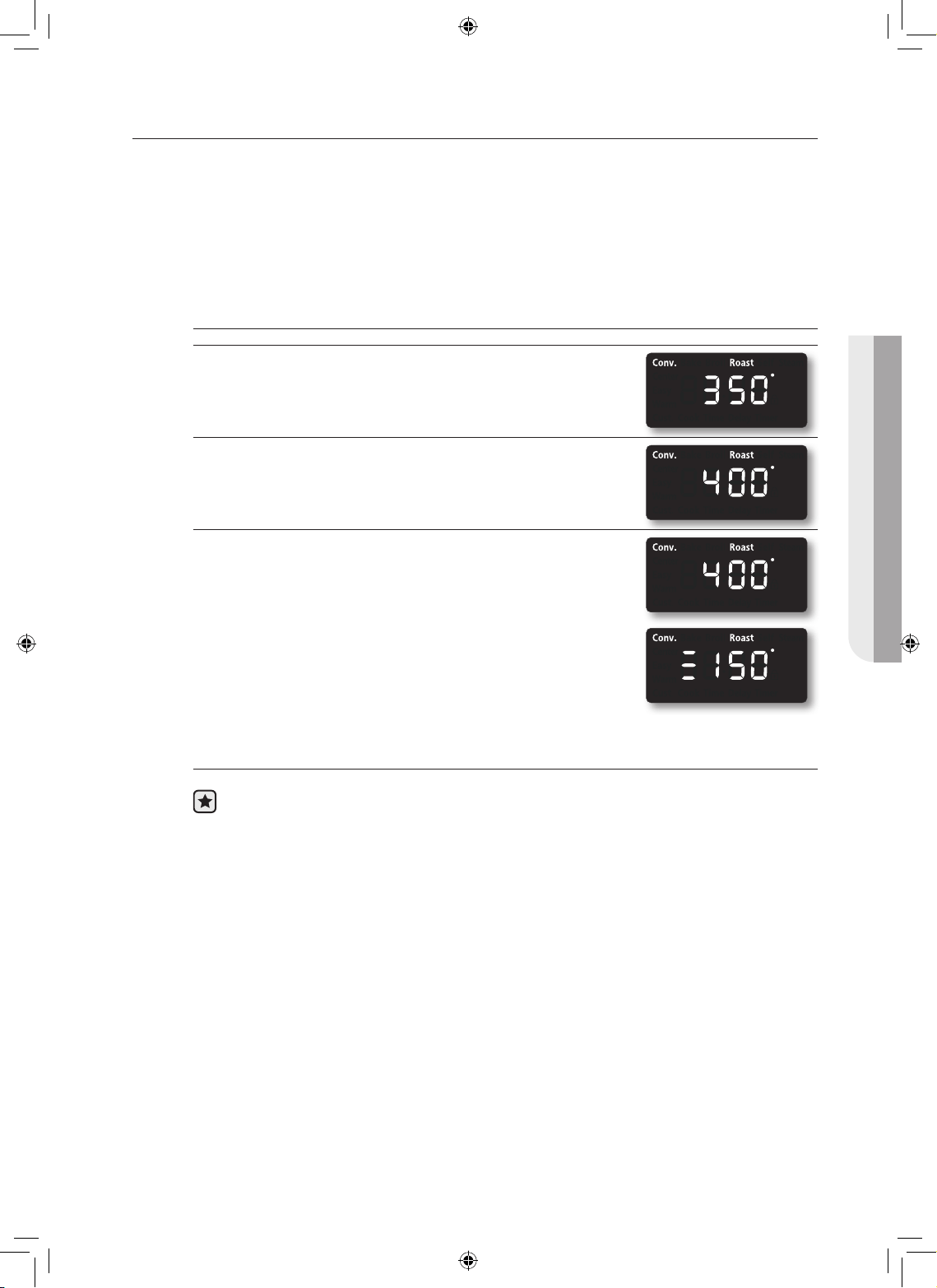
Operación del horno _30
OPERACIÓN DEL HORNO
ASAR POR CONVECCIÓN
Asar al horno por convección es conveniente para cortes de carne tiernos y de gran tamaño, sin
cubrir.
El calor procede del elemento radiante ubicado en la parte superior. El ventilador de convección
hacer circular el aire caliente en forma pareja sobre y por alrededor de la comida. Las carnes,
incluidas las aves, se doran por todos lados como si hubiesen sido cocidas en un rosticero
(asador giratorio). El aire caliente rápidamente sella los alimentos dejando dentro los jugos y el
producto resulta jugoso y tierno, a la vez que el exterior adquiere un atractivo color pardo dorado.
Cómo ajustar el horno para asar al horno por convección
1. Active el modo asar por convección.
Presione la tecla Conv. Roast (Asar por convección).
La temperatura predeterminada es de 350 °F.
2. Ingrese la temperatura que desea, por ejemplo 400 °F, utilizando
el teclado numérico.
3. Presione la tecla Start/Set (Inicio/Configurar) para comenzar
con el asado por convección.
Conv. Roast (Asar por convección) y la temperatura ajustada
del horno, por ejemplo 400 °F, se verán en la pantalla durante
2segundos.
El indicador de temperatura comenzará a variar una vez que la
temperatura del horno alcance 150 °F.
Cuando el horno alcance la temperatura deseada, sonará un
"bip" 6 veces.
4
. Apague o cancele el proceso de asado por convección
presionando la tecla Clear/O (Borrar/Apagar).
Cuando se abre la puerta del horno, el ventilador del horno de convección se apaga.
NO DEJE la puerta del horno abierta durante mucho tiempo mientras funciona en modo de
convección porque ello podría reducir la vida útil del elemento radiante de convección.
NE595R0ABSR_AA_DG68-00433A-09_MES.indd 30 2016-03-30 �� 8:08:01
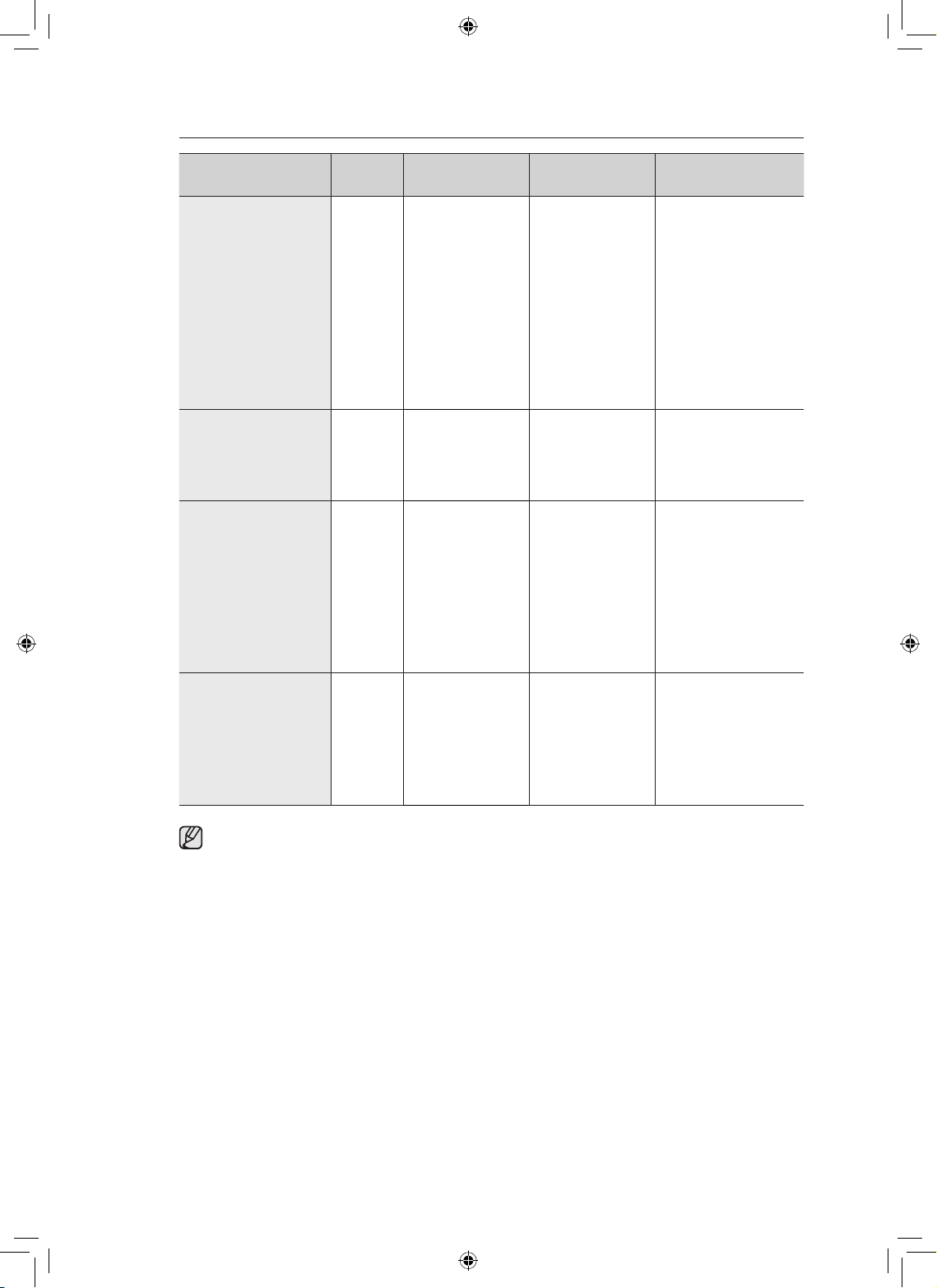
31_ Operación del horno
Guía de recomendaciones para asar al horno por convección
Carne
Peso
(en libras)
Temp. del horno
(°F)
Tiempo para asar*
(min por libra)
Temp. interna (°F)
Carne de res
Asado de costillar 4-6 325
25-28
28-32
145 (a punto/poco hecho)
160 (a punto)
Asado de costillar
(sin hueso)
4-6 325
24-29
29-34
145 (a punto/poco hecho)
160 (a punto)
Trasero, Ojo de redondo,
Contrafilete
(sin hueso)
3-6 325
25-30
28-35
145 (a punto/poco hecho)
160 (a punto)
Asado de lomo 2-3 325 28-38 145 (a punto/poco hecho)
Carne de cerdo
Lomo Asado
(con o sin hueso)
5-8 350 15-25 170
Paleta 3-6 350 20-30 160
Ave
Pollo entero 3-4 375 17-23 180
Pavo, sin rellenar** 12-15 325 12-16 180
Pavo, sin rellenar** 16-20 325 11-15 180
Pavo, sin rellenar** 21-25 325 8-12 180
Pechuga de pavo 3-8 325 20-25 170
Gallina de Cornualles 1-1½ 350 45-75 (tiempo total) 180
Cordero
Media pierna 3-4 325
25-30
30-35
160 (a punto)
170 (bien cocido)
Pierna entera 6-8 325
25-30
30-35
160 (a punto)
170 (bien cocido)
* Los tiempos de cocción son aproximados y pueden variar dependiendo de la forma de
la pieza.
**
El pavo relleno requiere más tiempo para asarse. La temperatura segura mínima para el
relleno de aves es 165 ˚F.
NE595R0ABSR_AA_DG68-00433A-09_MES.indd 31 2016-03-30 �� 8:08:01
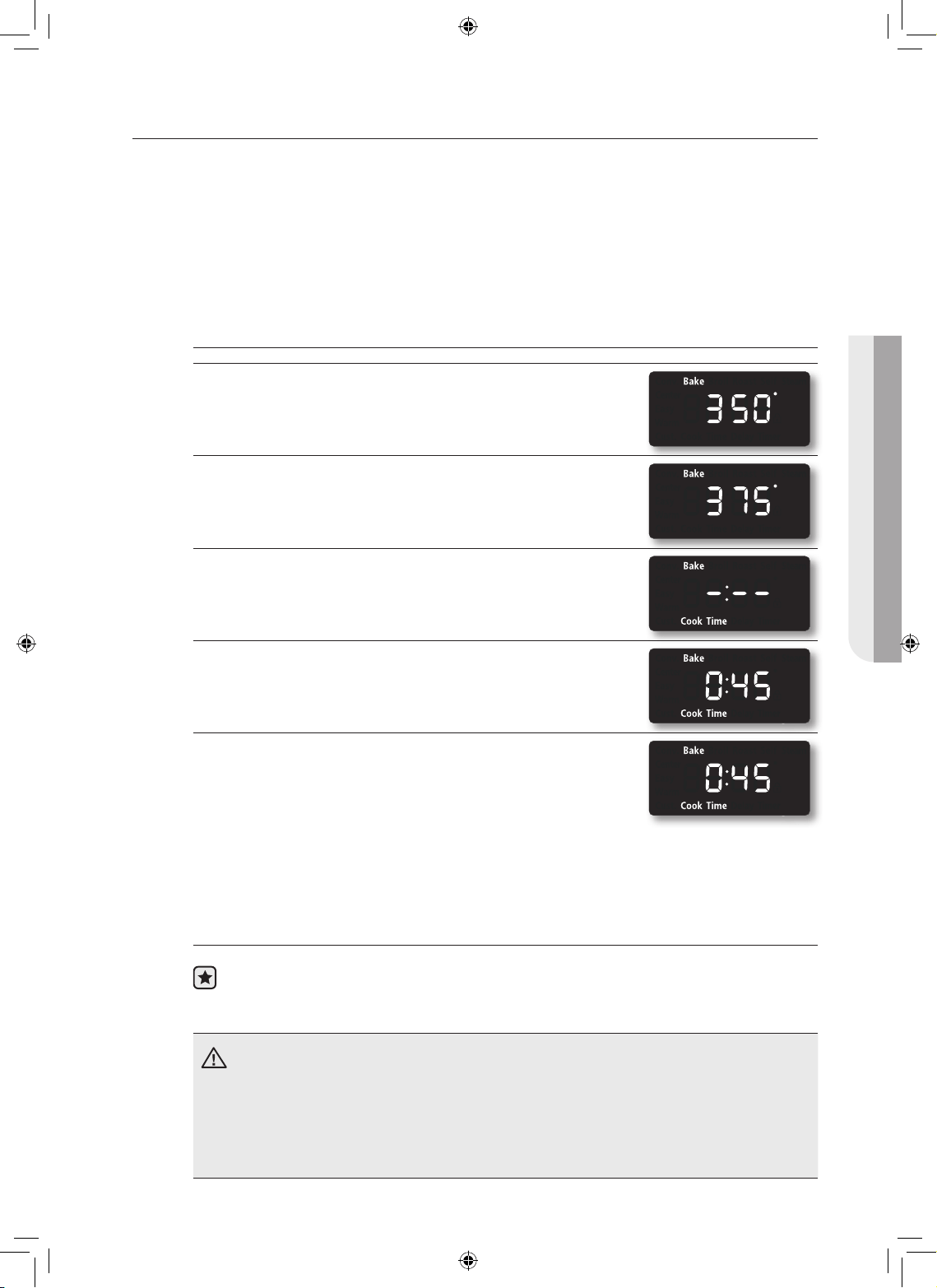
Operación del horno _32
OPERACIÓN DEL HORNO
COCCIÓN POR TEMPORIZADOR
En un proceso de cocción regido por el temporizador, el horno se enciende inmediatamente y cocina durante el
tiempo que usted fije. Una vez completado ese tiempo de cocción, el horno se apaga automáticamente.
• La función de cocción regida por temporizador se puede utilizar únicamente en combinación con otra operación
de cocción (hornear, hornear por convección, asar al horno por convección).
• Se puede programar el horno para cocción regida por temporizador antes de seleccionar las otras operaciones
de cocción.
• Se debe ajustar el reloj en la hora actual.
Cómo programar el horno para cocción regida por el temporizador
1. Ingrese la configuración.
Presione la tecla para definir la operación de cocción que desea, por ejemplo
Bake (Hornear). La temperatura predeterminada es de 350 °F.
2. Ingrese la temperatura que desea, por ejemplo 375°F, utilizando el teclado
numérico.
3. Presione la tecla Cooking Time (Tiempo de cocción).
4. Ingrese el tiempo de cocción que desea, por ej. 45 min, utilizando el teclado
numérico.
El tiempo de cocción se puede fijar para cualquier duración desde 1 minuto
hasta 9 horas y 99 minutos.
5. Presione la tecla Start/Set (Inicio/Configurar) para comenzar con la
cocción.
El indicador de temperatura comenzará a variar una vez que la temperatura
del horno alcance 150 °F.
El horno continuará cocinando hasta que haya transcurrido el tiempo fijado,
luego se apagará automáticamente salvo que se haya programado la función
de mantener caliente.
(Consulte la sección sobre la función de mantener caliente en la página 38.)
6
. Un proceso de cocción regido por temporizador se puede cancelar en
cualquier momento presionando la tecla Clear/O (Borrar/Apagar).
Coloque los alimentos en el horno después de precalentarlo, si así lo requiere la receta. El precalentamiento
es importante para lograr buenos resultados cuando se hornean tortas, pasteles, galletas, masas y panes.
Cuando el horno haya alcanzado la temperatura deseada, sonará un "bip" prolongado 6 veces.
PRECAUCIÓN
Tenga precaución al utilizar las funciones de cocción por temporizador o cocción temporizada
diferida. Utilice estas funciones para cocinar carnes curadas o congeladas y la mayor parte de las
frutas y vegetales. Los alimentos que se pueden echar a perder con facilidad tales como leche, huevos,
pescado, carnes (incluidas las aves) deben enfriarse previamente en el refrigerador. Aun enfriados, no
deben permanecer en el horno durante más de una hora antes de que se inicie la cocción y una vez
completada la cocción deben retirarse a la brevedad. La ingestión de alimentos en mal estado puede
producir intoxicación alimentaria.
NE595R0ABSR_AA_DG68-00433A-09_MES.indd 32 2016-03-30 �� 8:08:03
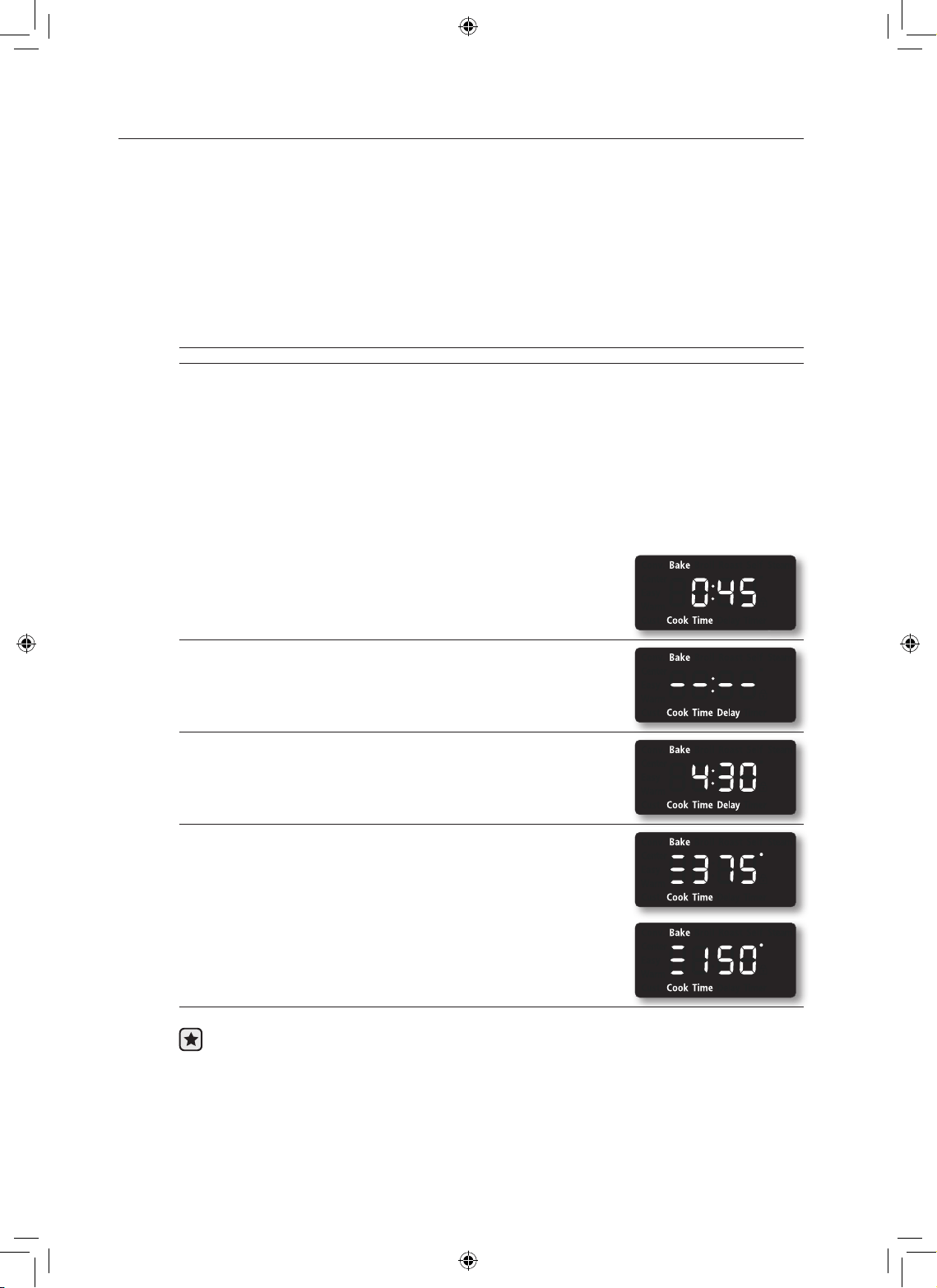
33_ Operación del horno
COCCIÓN TEMPORIZADA DIFERIDA
En una cocción con inicio retardado, el temporizador del horno enciende y apaga el horno a las
horas que usted seleccione con anticipación.
• La función de cocción temporizada diferida se puede utilizar únicamente en combinación con
otra operación de cocción (hornear, hornear por convección, asar al horno por convección).
• Se puede programar el horno para cocción temporizada diferida antes de seleccionar las otras
operaciones de cocción.
• Se debe ajustar el reloj en la hora actual.
Cómo programar el horno para cocción temporizada diferida
1. Coloque la(s) parrilla(s) y los alimentos en el horno.
2. Ingrese la configuración.
Presione la tecla para definir la operación de cocción que desea,
por ejemplo Bake (Hornear). La temperatura predeterminada es de
350 °F.
3
. Utilice el teclado numérico para ingresar la temperatura que desea,
por ejemplo 375 °F.
4
. Presione la tecla Cooking Time (Tiempo de cocción).
5
. Ingrese el tiempo de cocción que desea, por ej. 45 min, utilizando
el teclado numérico.
El tiempo de cocción se puede fijar para cualquier duración desde
1 minuto hasta 9 horas y 99 minutos.
6. Presione la tecla Delay Start (Inicio retardado).
7. Ingrese la hora a la cual desea que se encienda el horno, por
ejemplo 4:30, mediante las teclas numéricas.
8. Presione la tecla Start/Set (Inicio/Configurar).
A la hora fijada, se emitirá un breve "bip". El horno comenzará la
cocción. Una vez que el horno haya alcanzado la temperatura
deseada, sonará un "bip" prolongado 6 veces.
Coloque los alimentos en el horno después de precalentarlo, si así lo requiere la receta.
El precalentamiento es importante para lograr buenos resultados cuando se hornean
tortas, pasteles, galletas, masas y panes. Cuando el horno haya alcanzado la temperatura
deseada, sonará un "bip" prolongado 6 veces.
NE595R0ABSR_AA_DG68-00433A-09_MES.indd 33 2016-03-30 �� 8:08:05
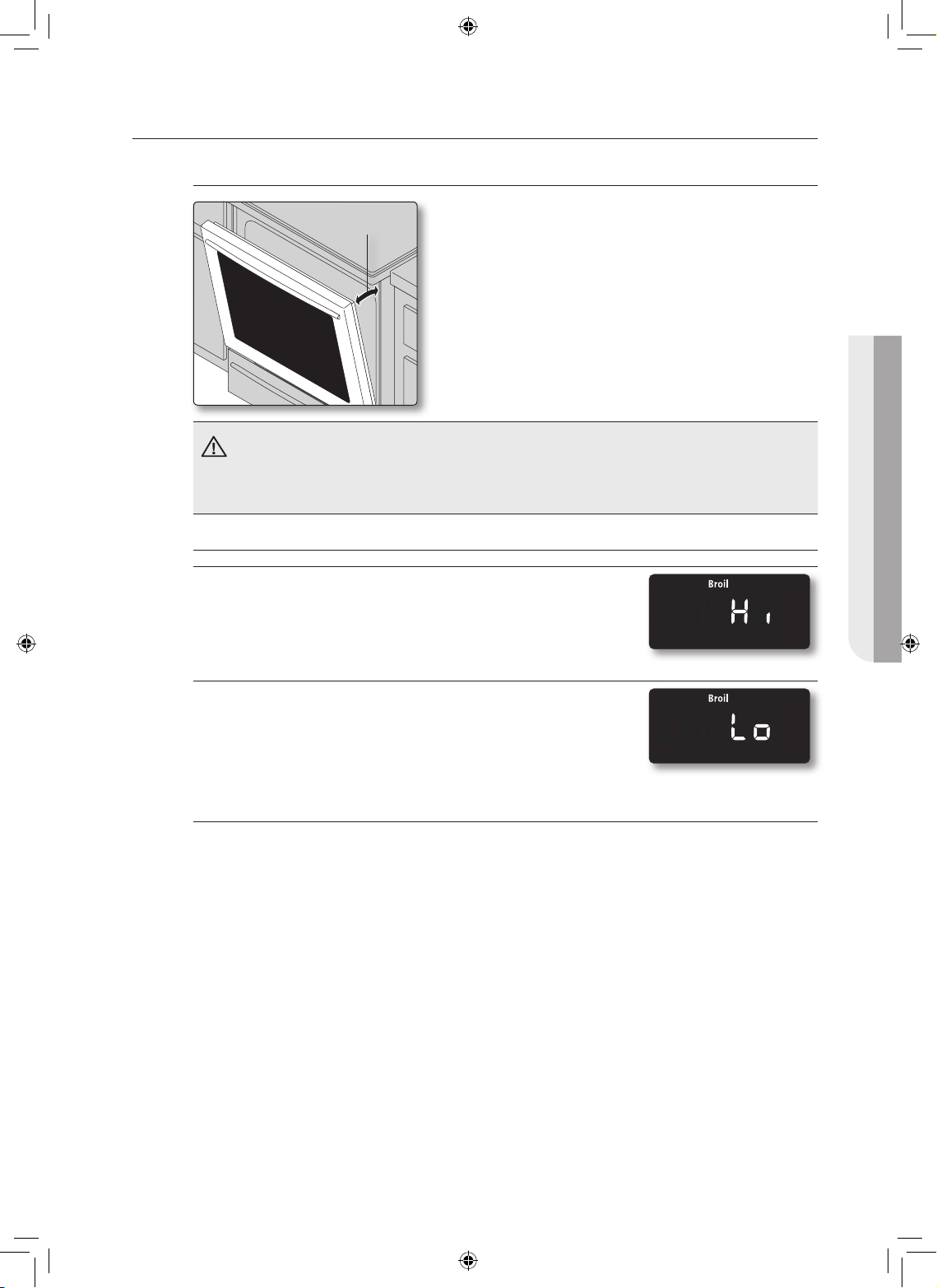
Operación del horno _34
OPERACIÓN DEL HORNO
ASAR A LA PARRILLA
Posición de traba para asar a la parrilla
Posición de traba
para asar a la parrilla.
Deje la puerta abierta en la posición de traba para asar a la
parrilla. La puerta se mantendrá abierta en esa posición por
si sola; sin embargo, el horno se mantiene a la temperatura
correcta.
PRECAUCIÓN
Si se produjese fuego dentro del horno, cierre la puerta del horno y apague el horno.
Si el fuego continúa, arroje bicarbonato de sodio sobre las llamas o utilice un extintor
de espuma. No eche agua ni harina sobre el fuego. La harina podría explotar y el agua
puede causar que la grasa en llamas se extienda y cause lesiones personales.
Cómo ajustar el horno para asar a la parrilla
1. Regule la temperatura de asar al nivel deseado.
Presione la tecla Broil (Asar a la parrilla) una vez para HI (ALTA)
o dos veces para LO (BAJA).
Use LO (BAJA) para cocinar comidas tales como aves o cortes de
carne gruesos sin tostarlos en exceso.
2. Active la función de asar a la parrilla.
Presione la tecla Start/Set (Inicio/Configurar).
Ase a la parrilla sobre un lado hasta que los alimentos queden
dorados; luego deles vuelta y cocine el otro lado.
3
. Presione la tecla Clear/O (Borrar/Apagar) una vez cuando
haya completado la cocción o si desea cancelarla.
NE595R0ABSR_AA_DG68-00433A-09_MES.indd 34 2016-03-30 �� 8:08:06
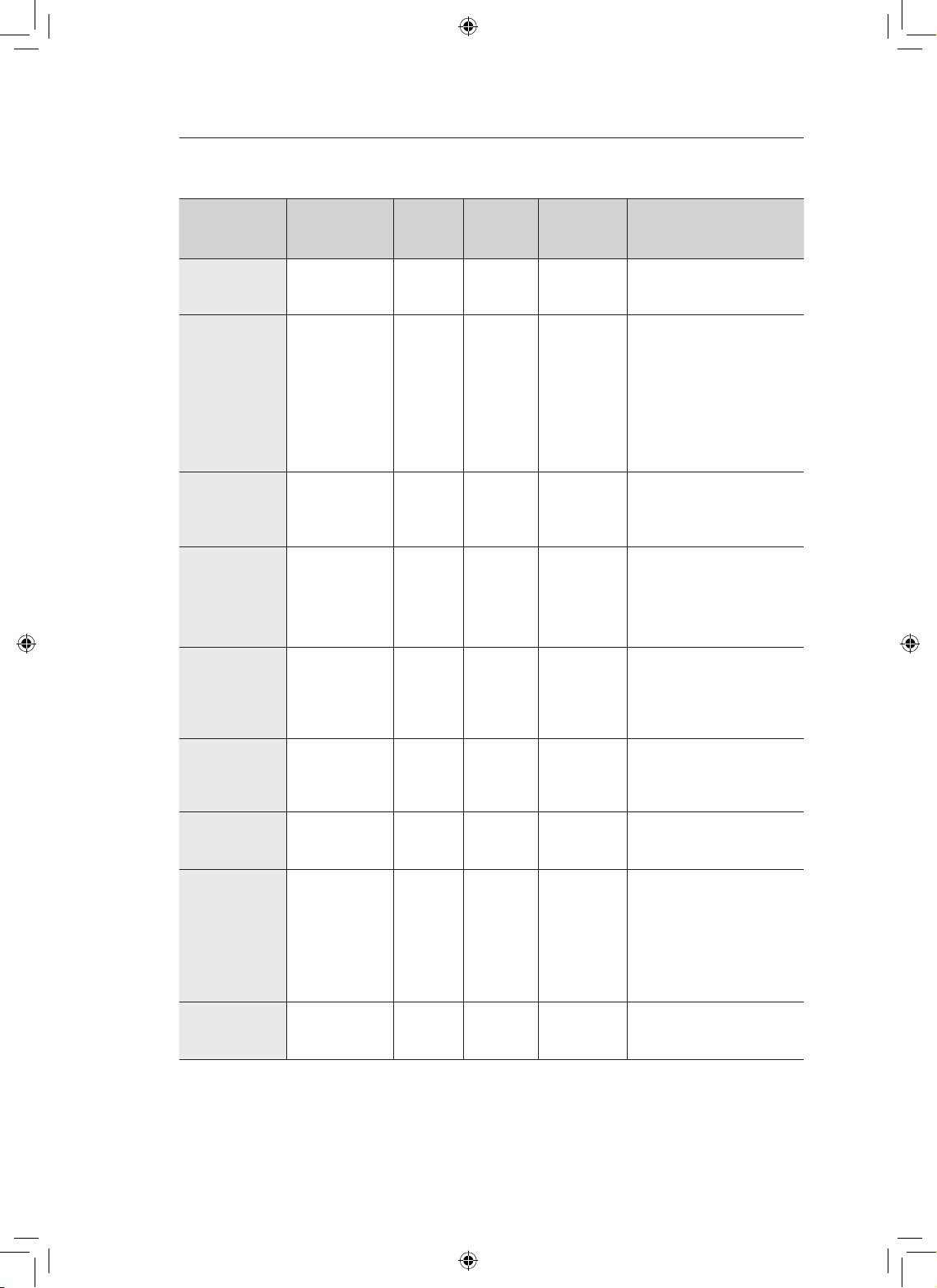
35_ Operación del horno
Guía de recomendaciones para asar a la parrilla
Los tiempos necesarios para asar a la parrilla dependerán del tamaño, peso, espesor, temperatura inicial y su preferencia
en cuanto al grado de cocción. Esta guía esta basada en carnes a temperatura de refrigerador.
Alimento
Cantidad y/o
grosor
Posición
del estante
Tiempo
primer lado
(min)
Tiempo
segundo lado
(min)
Comentarios
Carne molida
Muy hecho
1 lb
(4 hamburguesas)
½ a ¾" grosor
7 8-10 4-6
Uniformemente espaciados
Se pueden asar hasta
8hamburguesas a la vez
Bistecs de carne
de res
Filetes de menos de 1" de espesor.
Se cocinan completamente antes
de dorarse.
Se recomienda cocer en sartén.
Efectuar cortes en la grasa.
Poco hecho
1" grosor 1 a 1½ lb
7 8 3-5
A punto 7 10 4-6
Muy hecho 7 12 5-7
Poco hecho
1½" grueso
2 a 2½ lb
6 14 7-9
A punto 6 16 8-11
Muy hecho 6 19 11-13
Pollo
1 entero trozado
2 a 2½ lb, abrir a
lo largo
4 23-28 13-18
Asar primero con la piel hacia
abajo.
2 Pechugas 5 13-18 5-10
Colas de langosta
2-4
10 a 12 onzas
cada una
4 14-18 No dar vuelta.
Cortar por el dorso del caparazón.
Abrir para extender.
Cepillar con mantequilla derretida
antes de asar y en la mitad del
tiempo de cocción.
Filetes de
pescado
¼ a ½" grosor 6 5-9 3-4
Manejar y dar vuelta con mucho
cuidado. Cepillar con una mezcla
de mantequilla y limón previamente
y durante la cocción, si así lo
desea.
Lonchas de jamón
(precocidas)
½" grosor 6 5-7 3-5
Aumente el tiempo de cocción
de 5 a 10 minutos por lado para
lonchas de 1½" de grosor o jamón
curado casero.
Chuletas de cerdo
Muy hecho
2 (½" grosor) 6 7 6-8
Efectuar cortes en la grasa.
2 (1" grosor)
aprox. 1 lb
5 9-10 7-9
Chuletas de
cordero
Efectuar cortes en la grasa.
A punto
2 (1" grosor)
aprox. 10 a 12 oz
6 6 4-6
Muy hecho 6 8
7-9
A punto
2 (1½" grosor)
aprox. 1 lb
6 11 9
Muy hecho 6 13 9-11
Salmón
Rodajas
2 (1" grosor) 6 8 3-4
Engrase la asadera. Cepille los
filetes con mantequilla derretida.
4 (1" grosor)
aprox. 1 lb
6 9 4-6
NE595R0ABSR_AA_DG68-00433A-09_MES.indd 35 2016-03-30 �� 8:08:06
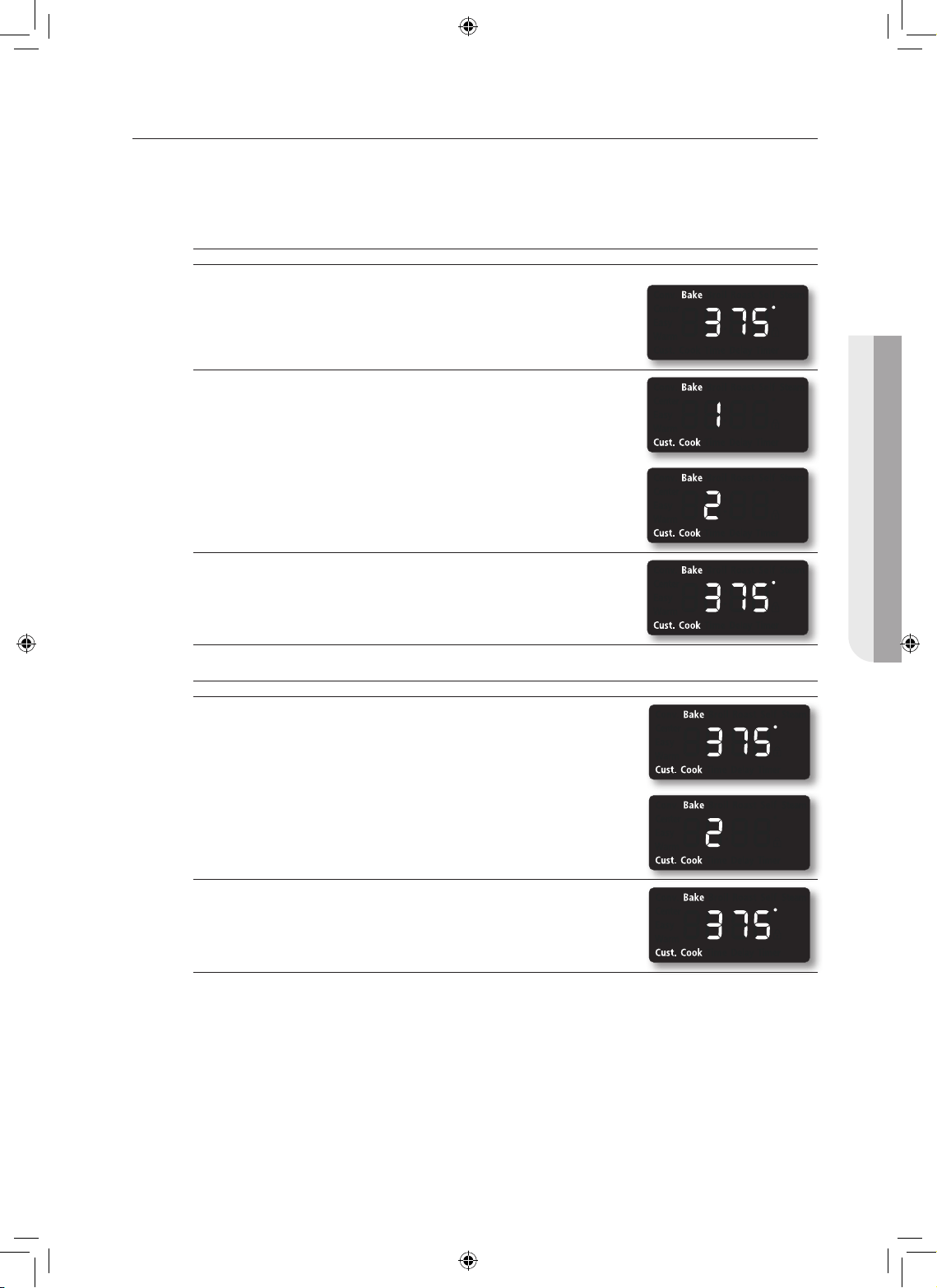
Operación del horno _36
OPERACIÓN DEL HORNO
CÓMO UTILIZAR LA FUNCIÓN DE COCCIÓN PERSONALIZADA
La función de cocción personalizada, le permite programar la cocción para hasta tres recetas
distintas. Esta función se puede utilizar para hornear, hornear por convección, o asar al horno por
convección. No opera con ninguna otra función, incluida la de inicio retardado.
Cómo registrar los ajustes para una receta
1. Presione la tecla para el funcionamiento en la cocción que desea
almacenar, por ej., Bake (Hornear).
La temperatura predeterminada es de 325 °F.
2
. Utilice el teclado numérico para ingresar la temperatura que
desea, por ejemplo 375 °F.
3. Puede almacenar un ajuste de receta en una de tres posiciones
de cocción personalizada. Presione la tecla Custom Cook
(Cocción personalizada) la cantidad de veces que corresponda
a la posición en la que desea almacenar el ajuste; por ejemplo
para la cocción personalizada posición 2, presione la tecla
Custom Cook (Cocción personalizada) dos veces.
Puede almacenar ajustes de receta en la posición 1, 2 o 3.
4. Presione la tecla Start/Set (Inicio/Configurar).
Cómo recuperar un ajuste
1. Presione la tecla Custom Cook (Cocción personalizada) la
cantidad de veces que corresponda a la posición en la que desea
almacenar la receta; por ejemplo para la cocción personalizada
posición 2, presione la tecla Custom Cook (Cocción
personalizada) dos veces.
2. Inicie la operación de cocción registrada.
Presione la tecla Start/Set (Inicio/Configurar).
NE595R0ABSR_AA_DG68-00433A-09_MES.indd 36 2016-03-30 �� 8:08:09
37_ Operación del horno
CÓMO UTILIZAR LA FUNCIÓN DE COCCIÓN FÁCIL
Cocción lenta
La función Cocción lenta cocina los alimentos más lentamente a más baja temperatura del horno.
Los tiempos de cocción prolongados permiten una mejor distribución de sabores en muchas
recetas. Esta función es ideal para asar carne, cerdo y aves. Cocinar lentamente las carnes puede
dar como resultado que la parte exterior de las carnes se oscurezca pero no se queme. Esto es
normal.
1
. Para ingresar el modo Slow cook (Cocción lenta), presione la tecla Slow Cook (Cocción
lenta) una vez para HI (ALTA) o dos veces para LO (BAJA).
2
. Para iniciar la función de cocción lenta, presione la tecla Start/Set (Inicio/Configurar).
Use solo 1 parrilla y colóquela en la posición 2 o 3 para obtener los mejores resultados. No es
necesario precalentar el horno.
Nuggets de pollo
La función Nuggets de pollo le permite cocinar fácilmente nuggets de pollo congelados.
1
. Para ingresar el modo Chicken Nuggets (Nuggets de pollo), presione la tecla Chicken
Nuggets (Nuggets de pollo) una vez para HI (ALTA) o dos veces para LO (Baja).
2
Para iniciar la función Nuggets de pollo, presione la tecla Start/Set (Inicio/Configurar).
Al usar esta función, coloque la rejilla del horno en la posición 5 de 6 para obtener el mejor resultado.
No es necesario precalentar el horno.
Entibiar para leudado
Esta función mantiene un ambiente tibio que favorece la acción de las levaduras.
1
. Para ingresar el modo Proof (Entibiar para leudado), presione la tecla Proof (Entibiar para
leudado).
2
.
Para iniciar la función de entibiar para leudado, presione la tecla Start/Set (Inicio/Configurar).
Esta función automáticamente genera la temperatura óptima para el proceso de leudado y,
por ende, no le corresponde ningún ajuste de temperatura.
3
. Presione la tecla Clear/O (Borrar/Apagar) en cualquier momento para desactivar esta
función.
• Si presiona la tecla Proof (Entibiar para leudado) cuando la temperatura del horno es superior a
los 100 ˚F, la palabra Hot (Caliente) aparecerá en la pantalla. Dado que estas funciones producen
mejores resultados si se inician cuando el horno esta frío, le recomendamos que aguarde hasta que
el horno se haya enfriado y "Hot" (Caliente) desaparezca de la pantalla.
• Para evitar reducir la temperatura del horno y extender el tiempo de leudado, no abra la puerta del
horno si no fuese necesario.
• Controle el pan y alimentos similares para evitar que se excedan en este proceso.
• No utilice el modo de entibiar para calentar los alimentos ni para mantenerlos calientes. En esta
función, el horno no estará lo suficientemente caliente como para mantener los alimentos a
temperaturas seguras. Use la función de mantener caliente. (Consulte la página siguiente.)
• Para obtener mejores resultados, cubra la masa con un paño o con un envoltorio plástico.
Es posible que el plástico deba engancharse debajo del recipiente para que el ventilador del horno
no lo vuele.
NE595R0ABSR_AA_DG68-00433A-09_MES.indd 37 2016-03-30 �� 8:08:09
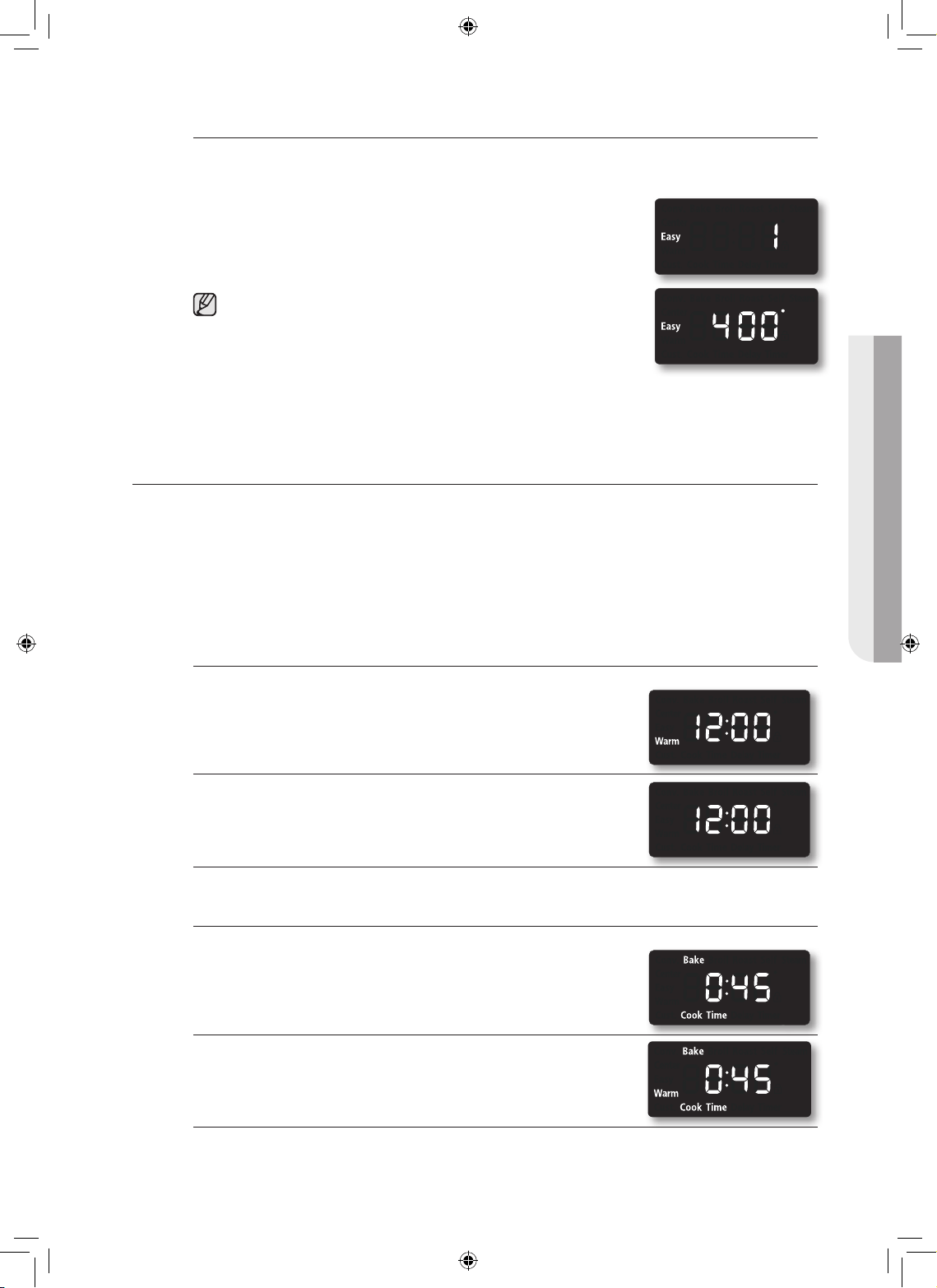
Operación del horno _38
OPERACIÓN DEL HORNO
Pizza crujiente
Esta función de pizza está diseñada para producir una base crujiente y tostada y a la vez
mantener la cobertura jugosa.
1
. Presione la tecla Pizza.
2
. Presione la tecla Start/Set (Inicio/Configurar) para
comenzar con la cocción de la pizza.
Use solo 1 rejilla y coloque la rejilla en la posición 2 o 3 para
obtener los mejores resultados al usar la función pizza.
La temperatura predeterminada es 400 °F. Puede ajustar la
temperatura del horno para que se adapte a sus necesidades.
Siga las instrucciones del paquete para los tiempos de
precalentado y horneado. La configuración de la pizza no está
temporizada. Asegúrese de controlar cuándo finaliza la cocción
de la pizza.
CÓMO USAR LA FUNCIÓN MANTENER CALIENTE
Esta función mantiene una temperatura del horno de 170 °F y mantendrá los alimentos cocidos
calientes para servir por hasta tres horas después de finalizada la cocción.
Después de 3 horas, la función apagará el horno automáticamente. Esta función puede utilizarse
sin combinar con otras operaciones de cocción o se puede configurar para que se active después
de una operación de cocción regida por el temporizador o de inicio retardado.
No debe usar esta función para recalentar alimentos fríos.
Cómo utilizar la función de mantener caliente
1. Presione la tecla Keep Warm (Mantener caliente).
2. Presione la tecla Start/Set (Inicio/Configurar).
3
. Presione la tecla Clear/O (Borrar/Apagar) en cualquier
momento para desactivar esta función.
Cómo programar el horno para que se active la función mantener
caliente a continuación de una cocción temporizada
1. Programe el horno para Timed Cooking (Cocción con
temporizador).
(Consulte la sección sobre cocción con temporizador en la página 32.)
2. Presione la tecla Keep Warm (Mantener caliente) antes de
presionar Start/Set (Inicio/Configurar) para iniciar la cocción.
3
. Presione la tecla Clear/O (Borrar/Apagar) en cualquier
momento para desactivar esta función.
NE595R0ABSR_AA_DG68-00433A-09_MES.indd 38 2016-03-30 �� 8:08:11
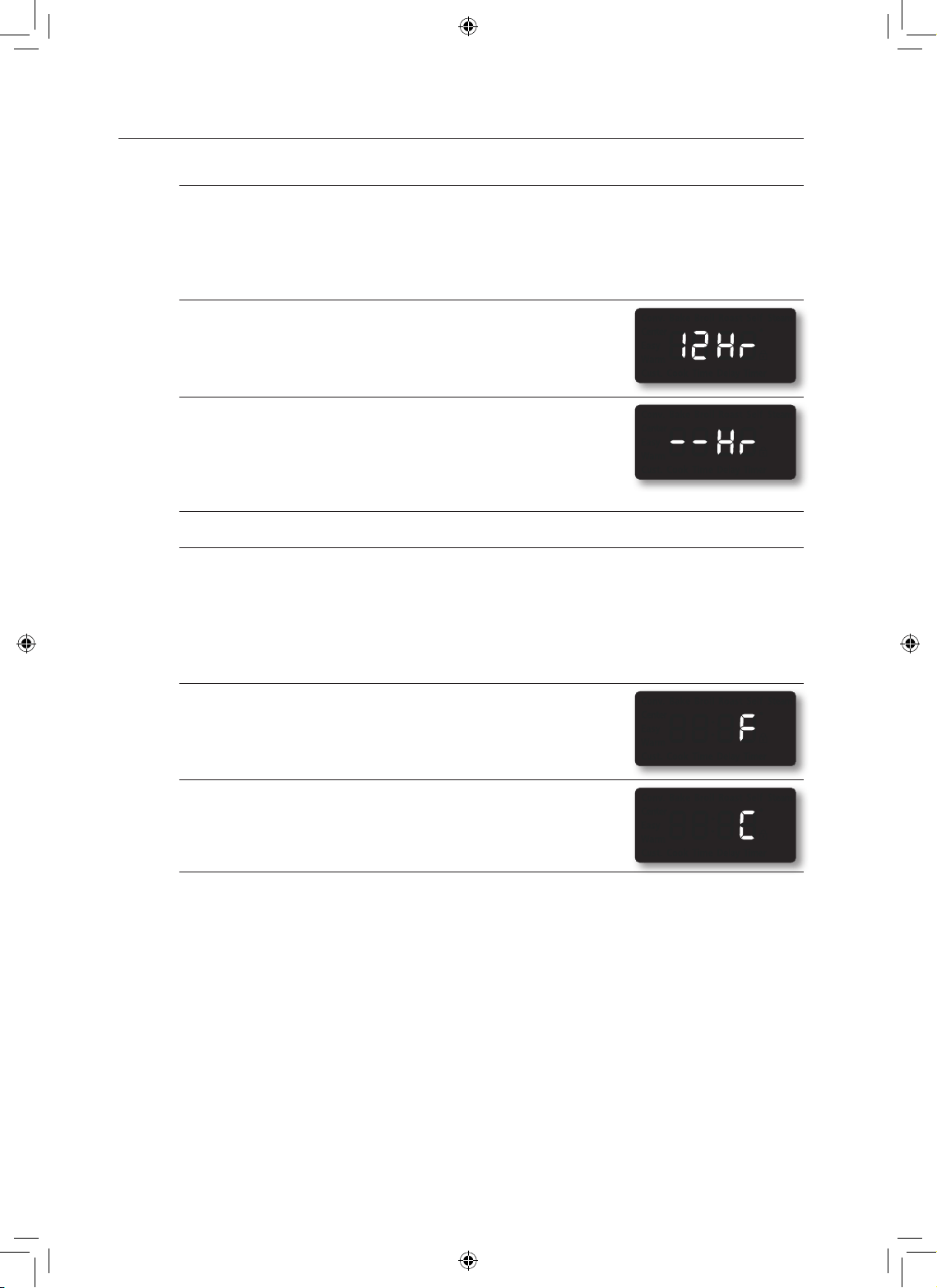
39_ Operación del horno
FUNCIONES ADICIONALES
Ahorro de energía transcurridas 12 horas
Con esta función, si usted se olvidase de que el horno está encendido, el control apagará el
horno automáticamente transcurridas 12 horas si está operando en funciones de horneado y
transcurridas 3 horas si está asando a la parrilla.
Cómo activar y desactivar la función de ahorro de energía transcurridas 12 horas
1. Presione Cooking Time (Tiempo de cocción) y 0 en el teclado
numérico simultáneamente durante 3 segundos.
La pantalla mostrará 12 Hr (cierre en 12 horas) o -- Hr (sin cierre).
El valor predeterminado es 12 Hr.
2. Presione 0 en el teclado numérico para seleccionar OFF
(DESACTIVADO) o ON (ACTIVADO).
Presionar 0 en el teclado numérico conmuta el modo entre 12 Hr
y -- Hr.
3
. Presione la tecla Start/Set (Inicio/Configurar).
Selección de temperatura entre Fahrenheit o Celsius
Se puede programar el control del horno para que las temperaturas se muestren en grados
Fahrenheit o Centígrados. El horno viene de fábrica configurado para mostrar las temperaturas en
Fahrenheit.
Cómo cambiar la pantalla de Fahrenheit a Centígrados o de Centígrados a
Fahrenheit
1. Presione Broil (Asar a la parrilla) y 0 en el teclado numérico
simultáneamente durante 3 segundos.
En la pantalla se verá F (Fahrenheit) o C (Centígrados).
La configuración por defecto es F.
2. Presione 0 en el teclado numérico para seleccionar F o C.
Presionar 0 en el teclado numérico conmuta la pantalla entre F y C.
3. Presione la tecla Start/Set (Inicio/Configurar).
NE595R0ABSR_AA_DG68-00433A-09_MES.indd 39 2016-03-30 �� 8:08:12
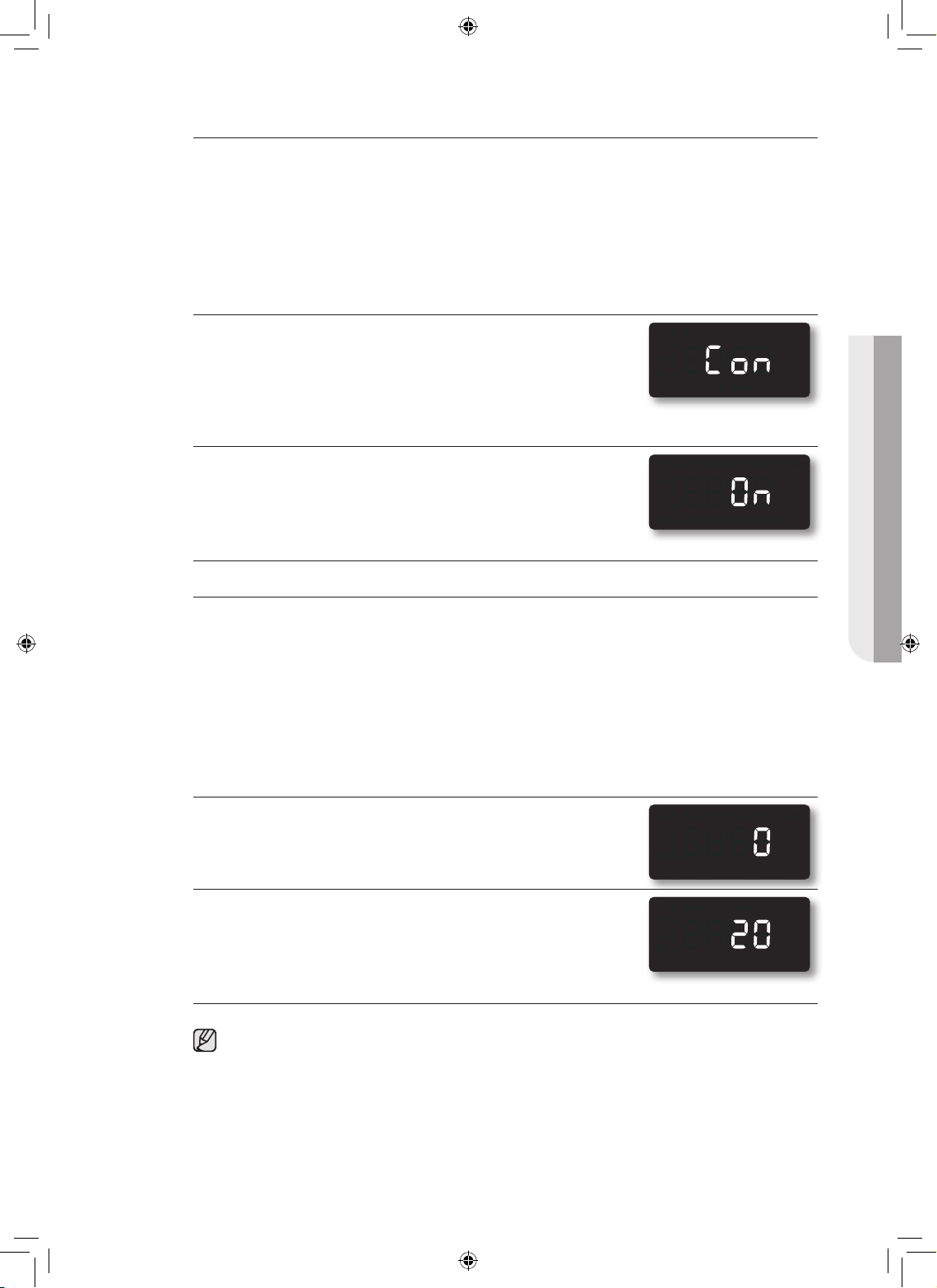
Operación del horno _40
OPERACIÓN DEL HORNO
Función de auto-conversión por convección
Cuando se utiliza la función de autoconversión, la función de autoconversión por convección
convertirá automáticamente las temperaturas normales ingresadas a las temperaturas
correspondientes para convección.
Si se encuentra activada esta función, en la pantalla se verá la temperatura real convertida
(reducida). Por ejemplo, si usted ingresa una temperatura de receta normal de 350 °F y presiona
Start/Set (Inicio/Configurar), en la pantalla se verá la temperatura convertida de 325 °F.
Cómo desactivar o activar la función de auto-conversión
1. Presione Conv. Bake (Hornear por convección) y 0 en el
teclado numérico simultáneamente durante 3 segundos.
En la pantalla se verá Con On (Conversión activada) (habilitado)
o Con OFF (Conversión desactivada) (deshabilitado).
La configuración predeterminada es Con OFF (Conversión
desactivada).
2. Presione 0 en el teclado numérico para seleccionar Con On
(Conversión activada) o Con OFF (Conversión desactivada).
Presionar 0 en el teclado numérico conmuta el modo entre Con
On (Conversión activada) o Con OFF (Conversión desactivada).
3
. Presione la tecla Start/Set (Inicio/Configurar).
Ajuste del termostato
La temperatura dentro del horno ya ha sido regulada en la fábrica. Al principio, cuando utilice el
horno, asegúrese de seguir las indicaciones de tiempo y temperatura de las recetas. En caso de
que usted crea que la temperatura del horno es excesiva o insuficiente, es posible ajustarla. Antes
de ajustar, pruebe una receta utilizando una regulación de temperatura más alta o más baja que la
recomendada. Los resultados de horneado de esa manera probablemente le sirvan de guía para
decidir la magnitud del ajuste requerido.
La temperatura del horno puede ajustarse en ±35°F (±19 °C).
Cómo ajustar la temperatura del horno
1. Presione Bake (Hornear) y 0 en el teclado numérico
simultáneamente durante 3 segundos.
En la pantalla se verá AdJ 0.
2. Ingrese el ajuste que desea, por ejemplo 20°F, utilizando las
teclas numéricas.
Se puede ajustar la temperatura a un nivel más bajo que el
configurado en fábrica presionando la tecla Bake (Hornear).
3
. Presione la tecla Start/Set (Inicio/Configurar).
Este ajuste no afectará las temperaturas para asar a la plancha ni la de auto-limpieza.
El ajuste se mantendrá en la memoria incluso después de un corte de electricidad.
NE595R0ABSR_AA_DG68-00433A-09_MES.indd 40 2016-03-30 �� 8:08:14
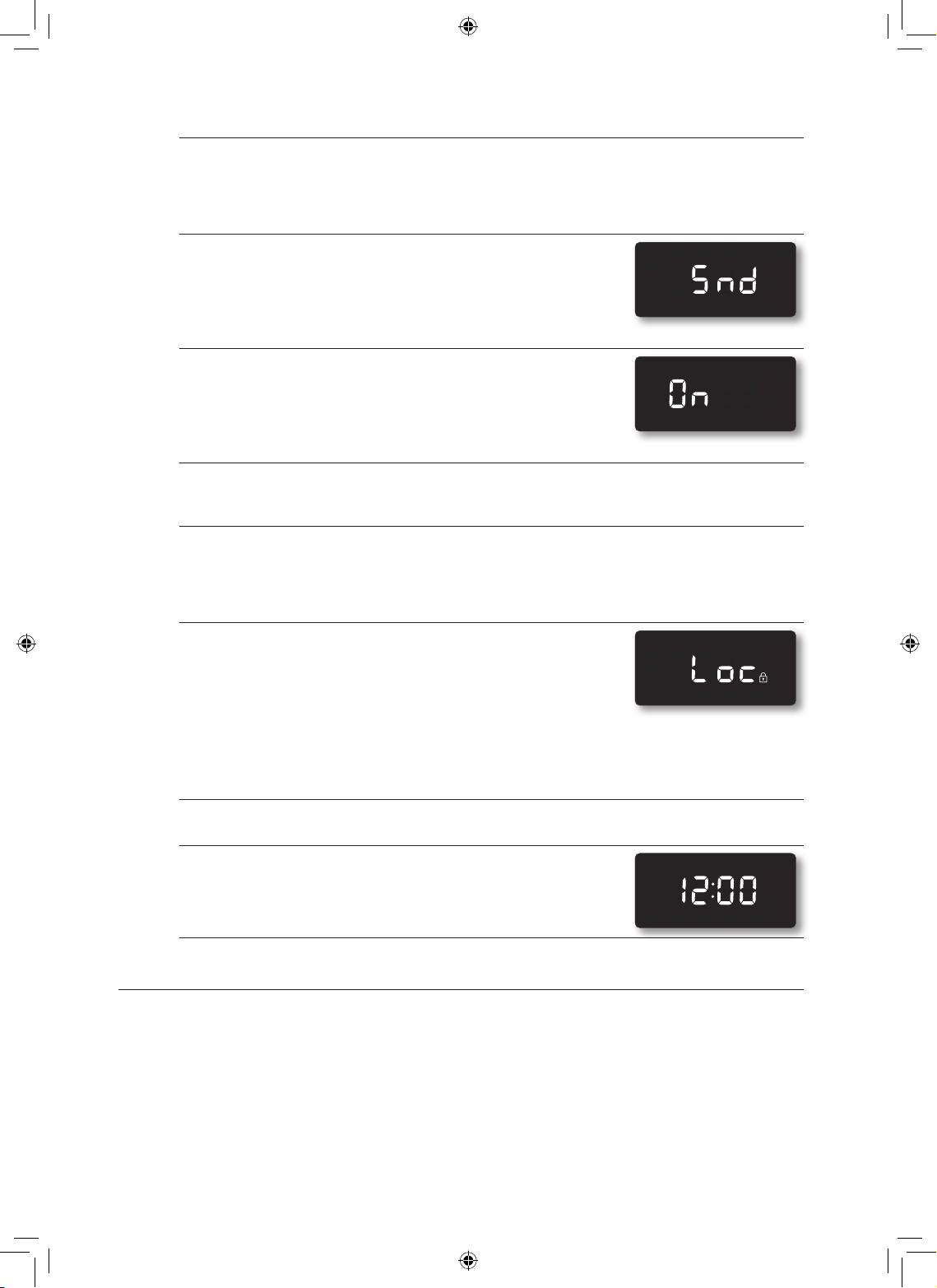
41_ Operación del horno
Activar o desactivar las señales sonoras
Mediante esta función se pueden configurar los controles del horno para que funcionen
silenciosamente.
Cómo encender o apagar el sonido
1. Presione Luz del horno y 0 en el teclado numérico
simultáneamente durante 3 segundos.
La pantalla mostrará Snd On (Sonido activado) o Snd OFF
(Sonido desactivado).
El ajuste predeterminado es Snd On (Sonido activado).
2. Presione 0 en el teclado numérico para seleccionar OFF
(DESACTIVADO) o ON (ACTIVADO).
Presionar 0 en el teclado numérico conmuta el modo entre Snd
On (Sonido activado) y Snd OFF (Sonido desactivado).
3
. Presione la tecla Start/Set (Inicio/Configurar).
Traba de controles
Esta le función permite trabar los botones del panel táctil de modo que no puedan activarse
accidentalmente.
Cómo activar la función de traba de controles
1. Presione la tecla Hold 3 Sec (Mantener 3 seg) durante
3segundos.
La pantalla indicará Loc y aparecerá continuamente el icono de
bloqueo al igual que la hora actual.
Se deben cancelar todas las funciones antes de poder activar la
traba de controles.
Esta función solo está disponible cuando la temperatura del horno
es inferior a 400°F.
Cómo destrabar los controles
1. Presione la tecla Hold 3 Sec (Mantener 3 seg) durante
3segundos.
Loc y el icono de bloqueo desaparecerán de la pantalla.
CÓMO ENCENDER Y APAGAR LA LUZ DEL HORNO
• La luz del horno se enciende automáticamente cuando se abre la puerta.
• La luz del horno se apaga automáticamente cuando se cierra la puerta.
• La luz del horno se puede encender y apagar manualmente presionando la tecla Luz del horno.
NE595R0ABSR_AA_DG68-00433A-09_MES.indd 41 2016-03-30 �� 8:08:15
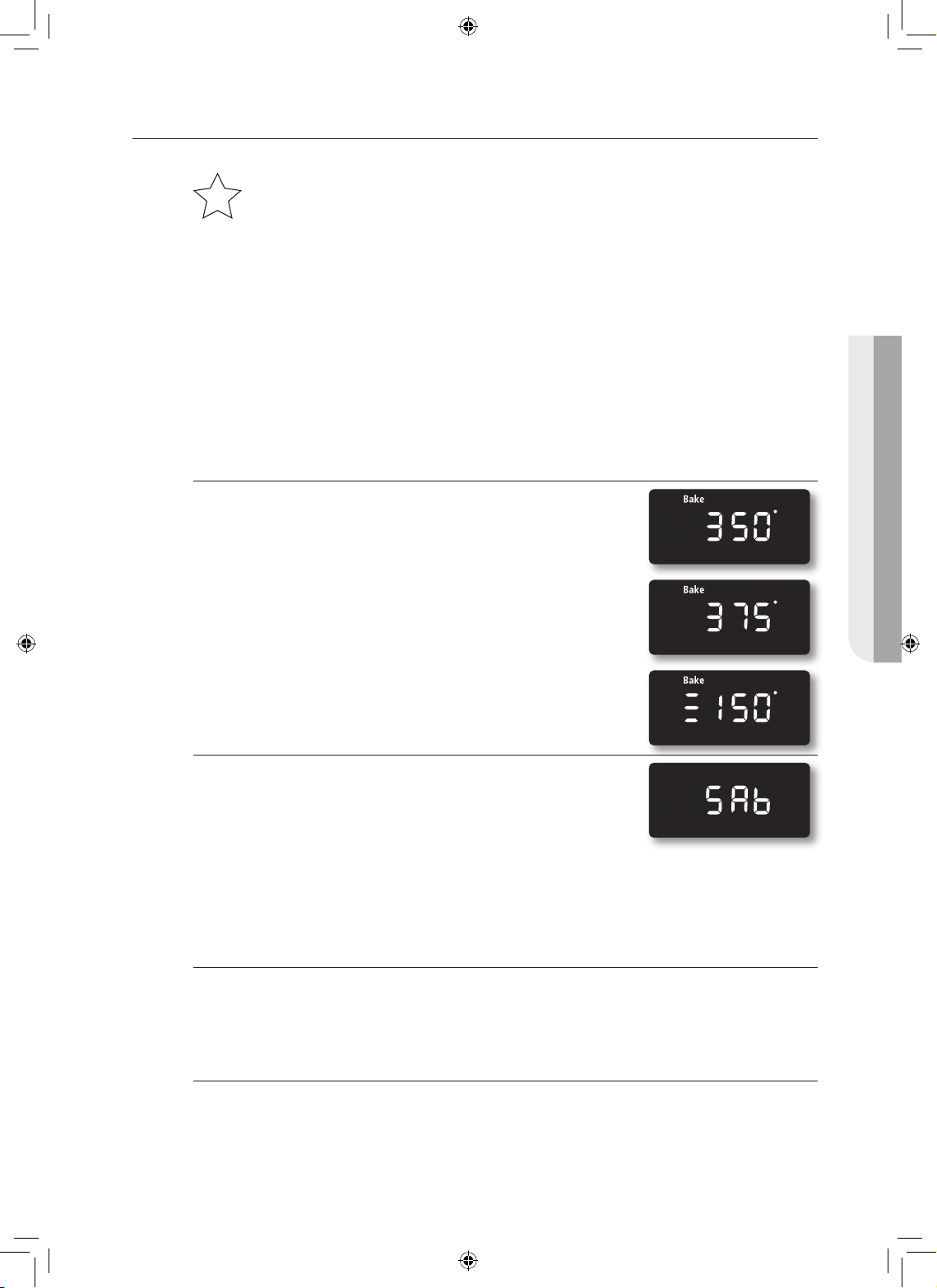
Operación del horno _42
OPERACIÓN DEL HORNO
CÓMO PROGRAMAR LA FUNCIÓN SHABAT
(Para uso en el Shabat y otras fechas sagradas judías)
Para obtener asistencia adicional, pautas para el uso adecuado y una lista
completa de modelos con la función Shabat, visite la web en http:\\www.star-k.org.
Puede usar la función Shabat solo con horneado. La temperatura del horno se puede regular
más alta o más baja después de haber configurado la función Shabat. (La función de ajuste de
temperatura del horno debe utilizarse solamente durante fechas sagradas judías.) Sin embargo,
la pantalla no cambiará ni se producirán sonidos cuando se produzca un cambio. Una vez que el
horno se encuentra correctamente configurado para hornear con la función Shabat activada, el
horno permanecerá encendido continuamente hasta que se cancele. Esto anulará la función de
ahorro de energía transcurridas 12 horas que viene configurada de fábrica. Si la luz del horno es
necesaria durante el Shabat, presione la tecla Luz del horno antes de activar la función Shabat.
Una vez que la luz del horno se encuentre encendida y se encuentre activada la función Shabat,
la luz del horno permanecerá encendida hasta que la función Shabat sea desactivada. Si la luz del
horno debe estar apagada, asegúrese de apagarla antes de activar la función Shabat.
Cómo utilizar la función Shabat
1. Presione la tecla Bake (Hornear).
La temperatura predeterminada es de 350 °F.
2
. Ingrese la temperatura que desea, por ejemplo 375 °F, utilizando
el teclado numérico.
3
. Presione la tecla Start/Set (Inicio/Configurar).
El indicador de temperatura comenzará a variar una vez que la
temperatura del horno alcance 150 °F.
4. Presione las teclas Clock (Reloj) y Kitchen Timer On/O
(Activar/Desactivar temporizador de cocina) simultáneamente
durante 3 segundos.
En la pantalla se verá SAb.
Una vez que SAb haya aparecido en la pantalla, el horno ya no
emitirá señales sonoras ni mostrará ningún cambio.
Usted podrá cambiar la temperatura del horno una vez
comenzada la operación de hornear. Recuerde que, una vez
activada la función Shabat, el horno ya no emitirá señales sonoras
ni mostrará ningún cambio.
5. El horno se podrá apagar en cualquier momento presionando la
tecla Clear/O (Borrar/Apagar). Esto apagará el horno. Si desea
desactivar la función Shabat, mantenga presionadas las teclas
Clock (Reloj) y Kitchen Timer On/O (Activar/Desactivar
temporizador de cocina) simultáneamente durante 3 segundos.
La palabra Sab desaparecerá de la pantalla.
K
NE595R0ABSR_AA_DG68-00433A-09_MES.indd 42 2016-03-30 �� 8:08:17
43_ Mantenimiento de su electrodoméstico
No intente activar ninguna otra función de programa excepto Bake (Hornear) mientras la
función Shabat está activa. ÚNICAMENTE las siguientes teclas funcionarán correctamente
con la función Shabat: Número, Bake (Hornear), Start/Set (Inicio/Configurar) y
Clear/O (Borrar/Apagar). NINGUNA DE LAS DEMÁS TECLAS deben utilizarse una
vez que se haya activado la función Shabat.
Puede cambiar la temperatura del horno, pero la pantalla no cambiará y los tonos no
sonarán cuando se produzca un cambio. (La función de ajuste de temperatura del horno
debe utilizarse solamente en fechas sagradas judías.) Después de cambiar la temperatura
mientras la unidad está en modo Shabat hay una demora de 15 segundos antes de que la
unidad reconozca el cambio.
Si se produjera un corte o interrupción de electricidad, el horno se apagará. Cuando vuelva
la electricidad el horno no se encenderá automáticamente. Aparecerá SAb en la pantalla
de control del horno, pero el horno no funcionará. Los alimentos pueden retirarse con
seguridad del horno mientras está en la función Shabat, sin embargo, el horno no puede
volver a encenderse hasta después del Shabat/fechas sagradas judías. Después de la
celebración del Shabat apague el modo Shabat. Mantenga presionadas simultáneamente
las teclas Bake (Hornear) y Timer On/ Of (Activar/Desactivar temporizador) durante al
menos 3 segundos para apagar el modo Shabat. El horno podrá entonces usarse con
todas las funciones normales.
No abra la puerta del horno ni cambie la temperatura del horno durante alrededor de
30minutos después de haber iniciado el modo Shabat para permitir que el horno alcance
la temperatura fijada. Observe que para obtener un mejor rendimiento, el ventilador del
horno funciona solamente cuando la temperatura del horno está aumentando.
NE595R0ABSR_AA_DG68-00433A-09_MES.indd 43 2016-03-30 �� 8:08:17
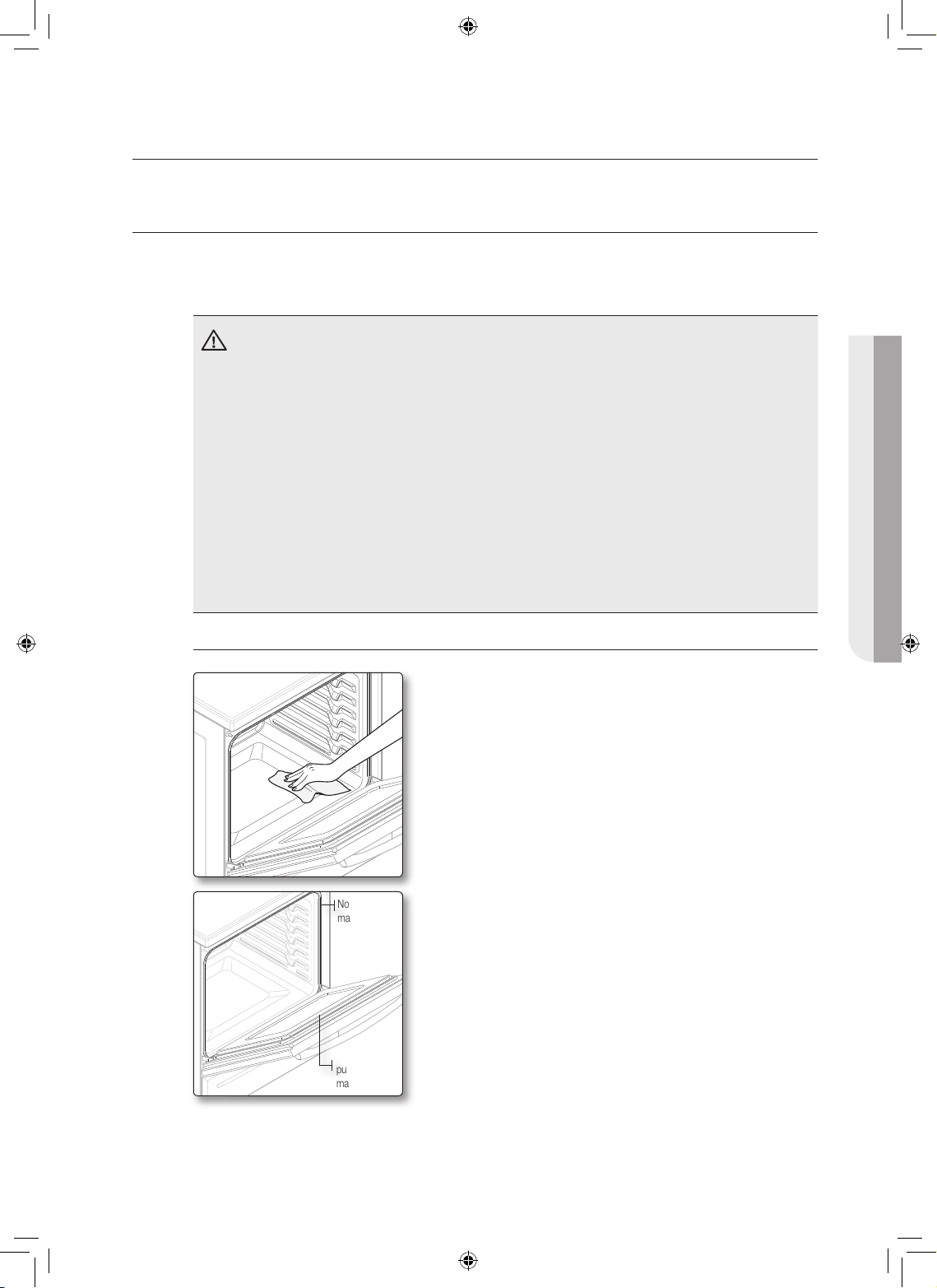
Mantenimiento de su electrodoméstico _44
MANTENIMIENTO DE SU ELECTRODOMÉSTICO
mantenimiento de su electrodoméstico
AUTO-LIMPIEZA
Este horno auto-limpiante utiliza altas temperaturas (mucho más altas que las temperaturas de
cocción) para eliminar por incineración los restos de grasa y otros residuos o reducirlas a fino
polvo de ceniza que se puede limpiar con un paño húmedo.
PRECAUCIÓN
• Durante el ciclo de auto-limpieza, el exterior de la estufa puede volverse muy
caliente al tacto. No deje a niños pequeños sin vigilancia en la proximidad del
electrodoméstico.
• Algunas aves son muy sensibles a las emanaciones que se producen durante el ciclo
de auto-limpieza de cualquier estufa. Lleve las aves a otra habitación bien ventilada.
• No revista con papel de aluminio las paredes del horno, parrillas, fondo o ninguna otra
parte de la estufa. Hacerlo podría tener como consecuencia una mala distribución del
calor, malos resultados de horneado y daños permanentes al interior del horno.
El papel de aluminio se derretirá y adherirá a la superficie interior del horno.
• No fuerce la apertura de la puerta del horno. Tales maniobras pueden dañar el
sistema de traba automática de la puerta. Tenga precaución al abrir la puerta del
horno cuando se haya completado el ciclo de auto-limpieza. Tome una posición hacia
un lado del horno cuando abra la puerta para dejar salir el vapor o aire caliente.
El horno aún se encontrará MUY CALIENTE.
Antes de un ciclo de auto-limpieza
Fig. 1
• Recomendamos habilitar una ventilación en su cocina
con una ventana abierta o mediante una campana de
ventilación o ventilador durante el ciclo de auto-limpieza.
• Retire del horno las parrillas, la asadera y su accesorio,
todos los recipientes de cocción y todo el papel de
aluminio.
• Utilice una esponja o un paño para retirar la suciedad del
fondo del horno. (Fig. 1)
• Las parrillas plateadas pueden soportar el ciclo de auto-
limpieza, pero se oscurecerán, perderán lustre y se volverán
difíciles de deslizar.
• Los residuos sobre el marco frontal de la estufa y la parte
que queda por fuera de la junta selladora de la puerta
deben ser limpiados manualmente. Limpie estas áreas con
agua caliente, esponjas de lana de acero bien enjabonadas
o productos de limpieza tales como Sofá. Enjuague
cuidadosamente con agua limpia y seque las superficies.
• No limpie la junta selladora. El material de fibra de vidrio de
la junta de la puerta del horno no resiste la abrasión.
Es fundamental que esa junta selladora permanezca
intacta. Si usted nota que se está desgastando o
deshilachando, reemplácela. (Fig. 2)
• Asegúrese de que la cubierta de la bombilla de la luz del
horno se encuentre bien colocada y que la luz del horno
esté apagada.
No limpie
manualmente
la junta
selladora de
la puerta del
horno.
Fig. 2
La puerta se
puede limpiar
manualmente.
NE595R0ABSR_AA_DG68-00433A-09_MES.indd 44 2016-03-30 �� 8:08:18
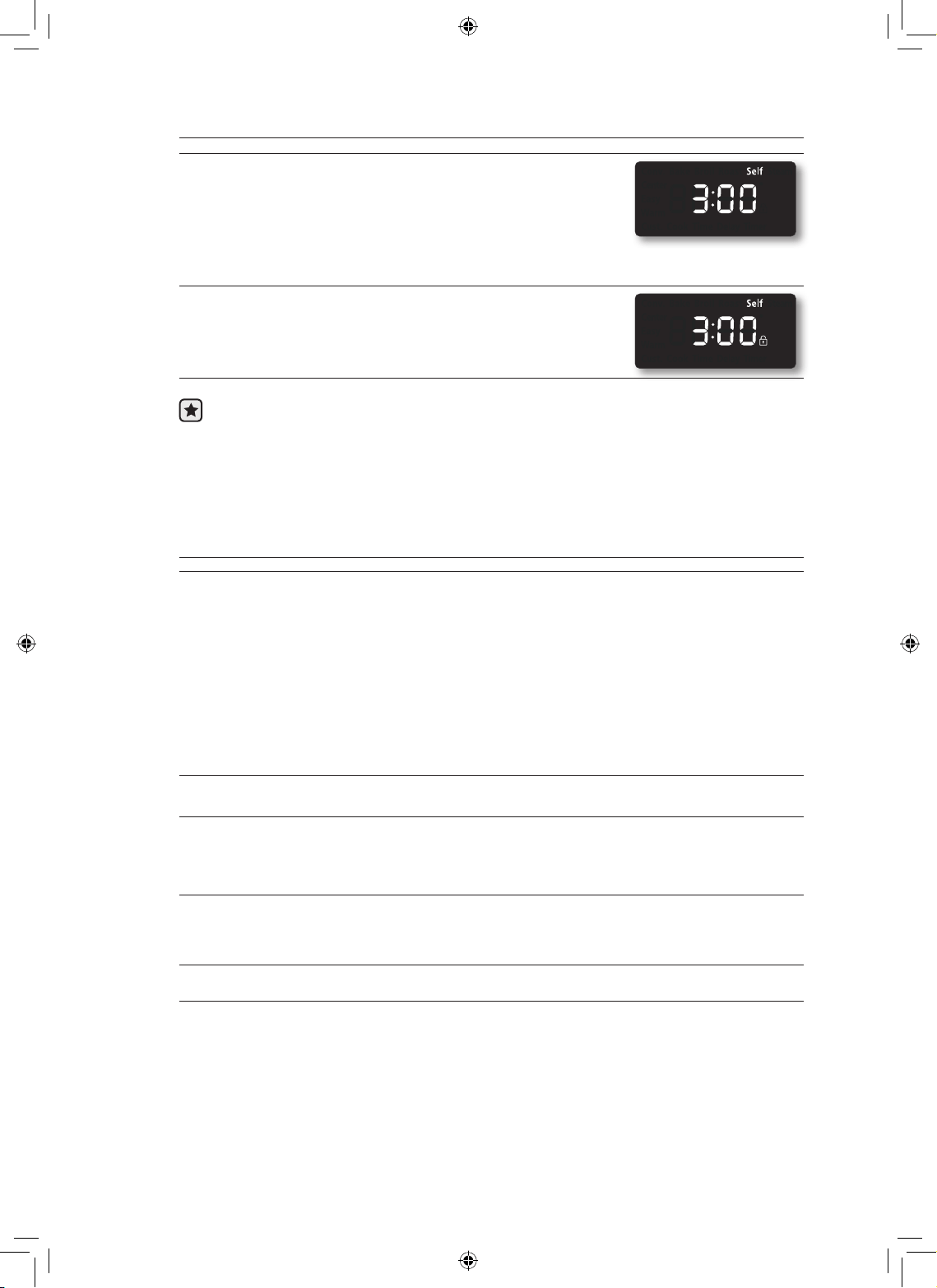
45_ Mantenimiento de su electrodoméstico
Cómo programar el horno para auto-limpieza
1. Seleccione la duración de la operación de auto-limpieza, por
ejemplo: 3 horas.
Presione la tecla Self Clean (Auto-limpieza) una vez para 3 horas
de tiempo de limpieza, dos veces para un tiempo de limpieza de
4horas, o 3 veces para un tiempo de limpieza de 2 horas.
La configuración predeterminada es de 3 horas.
2. Inicie el ciclo de auto-limpieza.
Presione la tecla Start/Set (Inicio/Configurar).
Un motor cerrará automáticamente la cerradura de la puerta.
• Le resultará imposible iniciar un ciclo de auto-limpieza si se encuentra activada la función
de traba de controles o si la temperatura del horno es demasiado elevada.
• Las puertas del horno se traban automáticamente. En la pantalla se verá el tiempo que
falta para completar la limpieza. La apertura de la puerta será imposible hasta que la
temperatura del horno disminuya hasta un nivel seguro.
• La función de auto-limpieza no funcionará cuando el centro de calentamiento esté encendido.
Cómo diferir el inicio del proceso de auto-limpieza
1.
Presione la tecla Self Clean (Auto-limpieza).
Seleccione el tiempo de auto-limpieza deseado presionando Self Clean (Auto-limpieza).
2. Presione la tecla Delay Start (Inicio retardado).
3
. Utilizando Clock (Reloj) y las teclas numéricas, ingrese la hora a la que desea que se inicie el
ciclo de limpieza.
4
. Presione la tecla Start/Set (Inicio/Configurar).
En la pantalla se verá Delay Start (Inicio retardado), Self Clean (Auto-limpieza) y el icono
de bloqueo. Un motor cerrará automáticamente la cerradura de la puerta.
5
. El ciclo de auto-limpieza se activará automáticamente a la hora fijada.
Como apagar la función de auto-limpieza
Es posible que se vea en la necesidad de detener o interrumpir un ciclo de auto-limpieza debido a
humo dentro del horno. (Cuando el ciclo de auto-limpieza haya finalizado, en la pantalla se verá la
leyenda "End" y sonarán 6 "bips".
1. Presione la tecla Clear/O (Borrar/Apagar).
2
. La puerta solamente se podrá abrir cuando la temperatura del horno se haya reducido lo
suficiente, lo cual demora aproximadamente una hora.
Después de un ciclo de auto-limpieza
• Es posible que note una cierta cantidad de ceniza blanca dentro del horno. Límpiela con un
paño húmedo una vez que el horno se haya enfriado. (Si quedan manchas blancas, quítelas
con una esponja de lana de acero bien enjabonada y enjuague a fondo con una mezcla de
vinagre y agua).
• Si el horno no ha quedado limpio después de un ciclo, repita el ciclo.
• No se puede programar el horno para cocción hasta que su temperatura se haya reducido lo
suficiente como para permitir que la puerta se destrabe.
NE595R0ABSR_AA_DG68-00433A-09_MES.indd 45 2016-03-30 �� 8:08:19
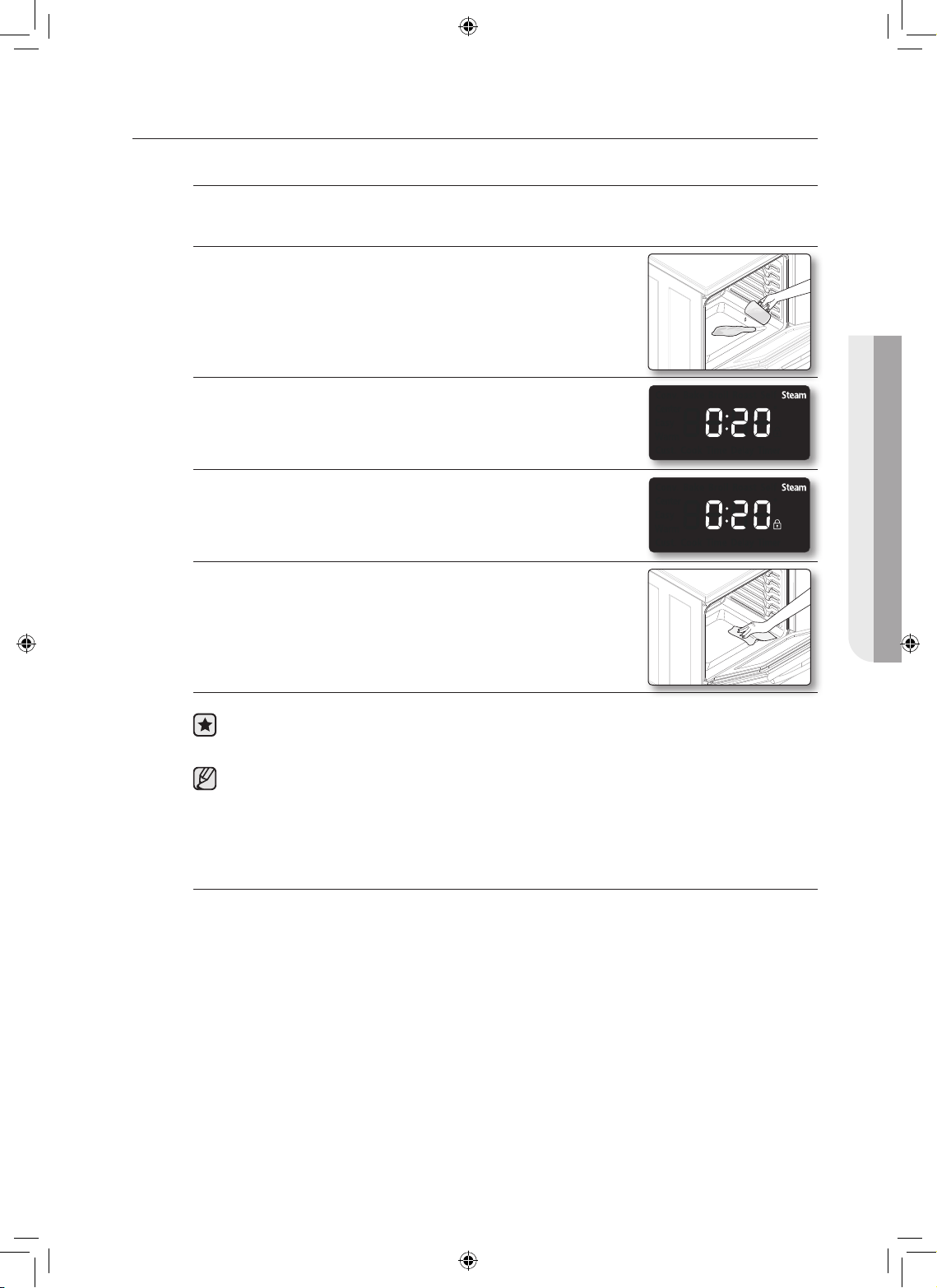
Mantenimiento de su electrodoméstico _46
MANTENIMIENTO DE SU ELECTRODOMÉSTICO
LIMPIEZA CON VAPOR
Cómo programar el horno para limpieza con vapor
Para limpieza liviana, la función de limpieza con vapor ahorra tiempo y energía. Si se requiere un
trabajo de limpieza de grasa más intenso, use la función de auto-limpieza.
1. Retire del horno todos los accesorios.
2. Vierta aproximadamente 10 onzas (300 ml) de agua en el fondo
del horno vacío y cierre la puerta del horno.
Utilice solamente agua normal, no agua destilada.
3. Presione la tecla Steam Clean (Limpieza con vapor).
4. Presione la tecla Start/Set (Inicio/Configurar).
Cuando se haya completado la operación, la pantalla parpadeará
y sonará un "bip".
5. Presione la tecla Clear/O (Borrar/Apagar).
6
. Limpie el interior del horno.
Después de un ciclo de limpieza al vapor quedará una significativa
cantidad de agua en la parte inferior del horno. Retire el agua
residual utilizando una esponja o un paño suave seco.
Al realizar la limpieza al vapor, utilice exactamente 10 onzas (300 ml) de agua, ya que así se
obtienen los mejores resultados.
Si presiona la tecla Steam Clean (Limpieza con vapor) cuando la temperatura del horno
se encuentra por encima de los 100 ˚F, aparecerá la palabra Hot (Caliente) en la pantalla.
Dado que estas funciones producen mejores resultados si se inician cuando el horno esta
frío, le recomendamos que aguarde hasta que el horno se haya enfriado y "Hot" (Caliente)
desaparezca de la pantalla.
Después de un ciclo de limpieza al vapor
• Tenga cuidado al abrir la puerta antes de que finalice el procedimiento de limpieza al vapor.
El agua en la base está caliente.
• Abra la puerta del horno y retire el agua remanente con una esponja. No permita que el agua
residual permanezca en el horno por más tiempo que el indispensable. Limpie el horno y
séquelo con un paño suave. No olvide limpiar debajo de la junta selladora de la puerta del horno.
• Para limpiar el interior del horno, utilice una esponja empapada en detergente, un cepillo suave,
o un estropajo de nylon. Quite los residuos tenazmente adheridos con un estropajo de nylon.
Para quitar los depósitos calcáreos puede utilizar un paño empapado en vinagre.
• Si el horno aún está sucio, puede repetir el proceso una vez que el horno se haya enfriado.
• Para el caso de residuos pesados, tales como la grasa remanente después de asar, le
recomendamos que frote detergente sobre el residuo antes de activar la función de limpieza al vapor.
• Después de limpiar, deje la puerta del horno entornada en un ángulo de 15° para que la
superficie interior esmaltada pueda secarse completamente.
NE595R0ABSR_AA_DG68-00433A-09_MES.indd 46 2016-03-30 �� 8:08:20
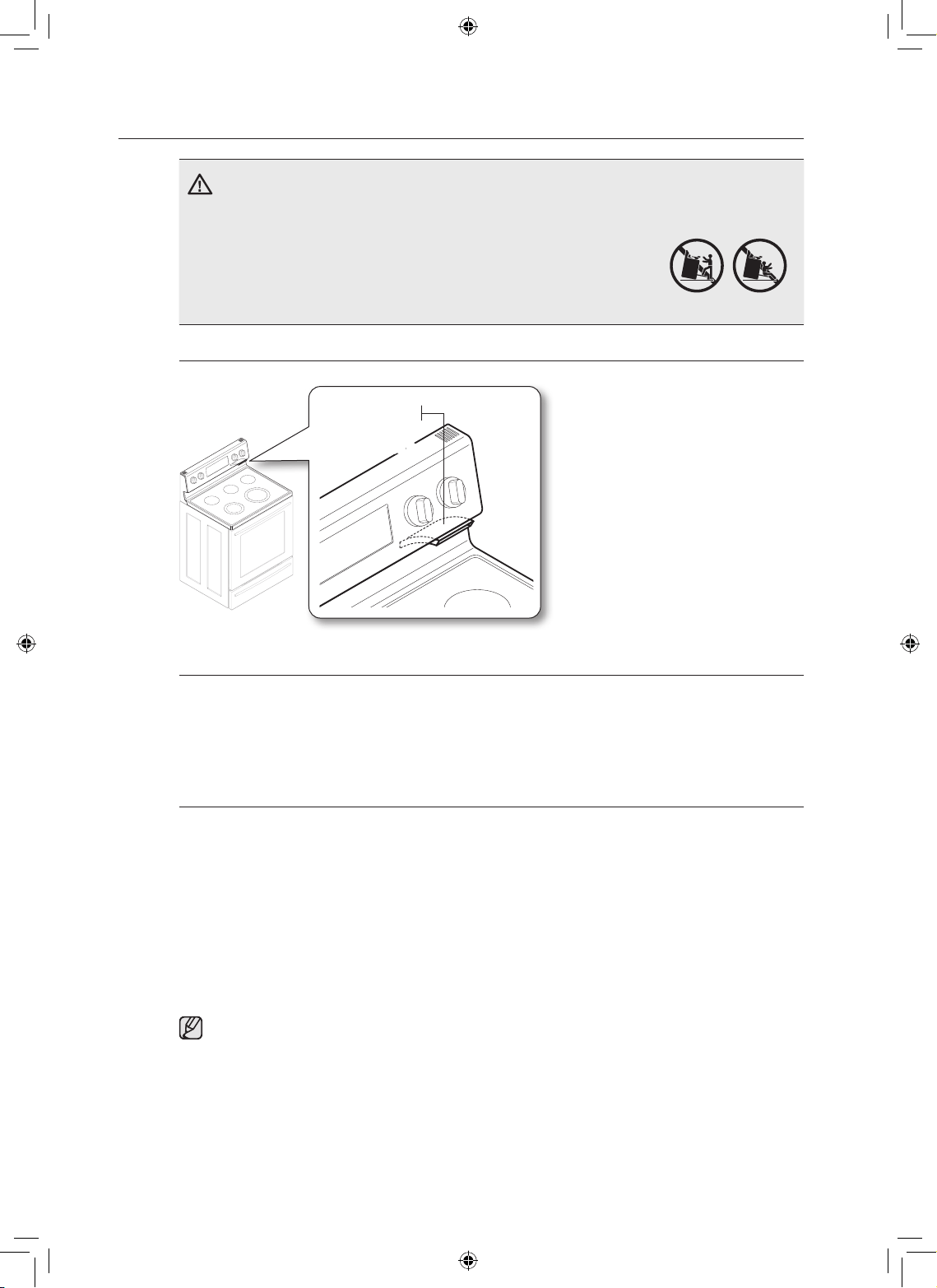
47_ Mantenimiento de su electrodoméstico
CUIDADO Y LIMPIEZA DEL HORNO
ADVERTENCIA
• Asegúrese de que todos los controles estén APAGADOS y todas las
superficies FRÍAS antes de limpiar cualquier parte de la estufa.
• Si su estufa es removida para limpieza, reparación o
cualquier motivo, asegúrese de que el dispositivo anti
inclinación se vuelva a encastrar correctamente cuando
se vuelve a colocar la estufa. Si no vuelve a encastrar
el dispositivo anti inclinación, la estufa podría inclinarse
y producir lesiones graves.
Abertura de ventilación del horno
Abertura de
ventilación del
horno
• La abertura de ventilación se
encuentra ubicada por sobre
la unidad de superficie trasera
derecha.
• Esta área podría calentarse durante
el uso del horno.
• Es normal que salga vapor por esta
abertura.
• La abertura de ventilación es
importante para la correcta
circulación del aire. Nunca tapone
esta abertura de ventilación.
Limpieza de las partes pintadas y las terminaciones decorativas
• Para su limpieza general, utilice un paño con agua jabonosa caliente.
• Para residuos más resistentes o grasa acumulada, aplique un detergente líquido directamente
sobre el área y espere de 30 a 60 minutos. Limpie con un paño húmedo y luego seque.
No utilice limpiadores abrasivos sobre ninguna de estas superficies. Pueden causar rayaduras.
Limpieza de superficies de acero inoxidable.
1. Agite bien el envase del producto limpiador de electrodomésticos de acero inoxidable o de
líquido de pulir.
2. Coloque una pequeña cantidad de producto limpiador de electrodomésticos de acero
inoxidable o de líquido de pulir sobre un paño húmedo o sobre una toalla de papel húmeda.
3. Limpie un área pequeña, frotando en la dirección del grano del acero inoxidable, si fuese el
caso.
4. Seque y lustre con una toalla de papel seca y limpia o un paño húmedo.
5. Repita en la medida de lo necesario.
• No use una esponja de lana de acero. Rayará la superficie.
• Si anteriormente el electrodoméstico fue limpiado utilizando un producto a base de
aceite mineral, lave la superficie con líquido lavavajilla y agua antes de utilizar producto
limpiador de electrodomésticos de acero inoxidable o de líquido de pulir.
NE595R0ABSR_AA_DG68-00433A-09_MES.indd 47 2016-03-30 �� 8:08:20
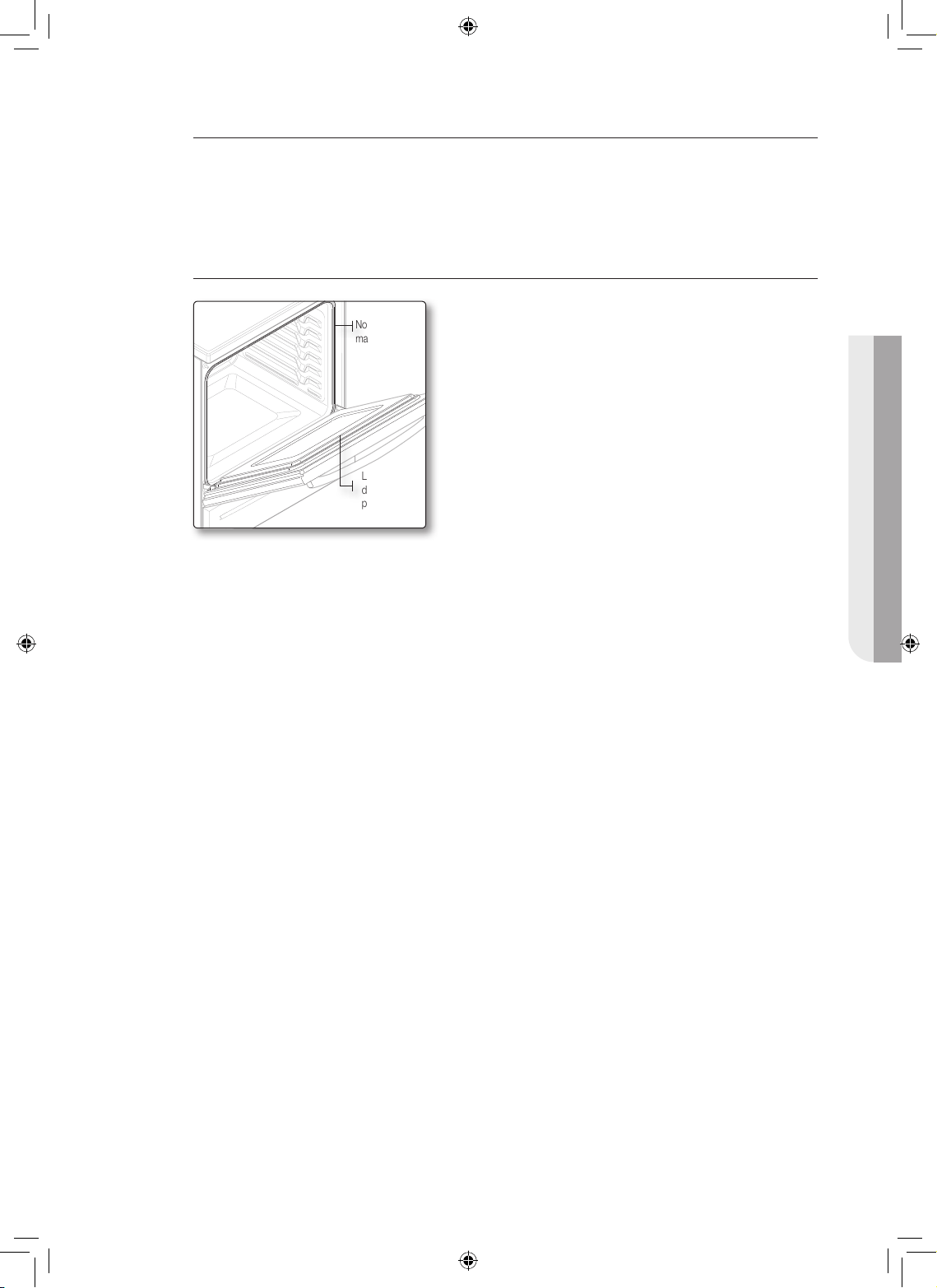
Mantenimiento de su electrodoméstico _48
MANTENIMIENTO DE SU ELECTRODOMÉSTICO
Parrillas del horno
• Si las parrillas se dejan en el horno durante un ciclo de auto-limpieza, su color virará a tonos
azulados y se volverán opacas. Una vez finalizado el ciclo de auto-limpieza y que se haya
enfriado el horno, frote las barras laterales de las parrillas con un papel encerado o con un paño
humedecido con una pequeña cantidad de aceite. Esto permitirá que las parrillas se deslicen
más fácilmente en sus carriles.
Puerta del horno
No limpie
manualmente
la junta
selladora de
la puerta del
horno.
La puerta
del horno se
puede limpiar
manualmente.
• Utilice agua y jabón para limpiar a fondo la parte
superior, los lados y el frente de la puerta del horno.
Enjuague bien. Se puede utilizar un líquido limpiavidrios
sobre la cara exterior de la ventana de la puerta del
horno. NO sumerja la puerta en agua. NO rocíe ni
permita que agua ni líquido limpiavidrios penetre
en los orificios de ventilación de la puerta.
NO utilice productos para limpiar hornos, polvos
de pulir, ni ningún material de limpieza fuertemente
abrasivo sobre el exterior de la puerta del horno.
• NO limpie la junta selladora de la puerta del
horno. La junta selladora de la puerta del horno está
confeccionada con un material tejido que es esencial
para un cierre bien sellado. Se debe tener cuidado de
no frotar, dañar o retirar la junta.
NE595R0ABSR_AA_DG68-00433A-09_MES.indd 48 2016-03-30 �� 8:08:20
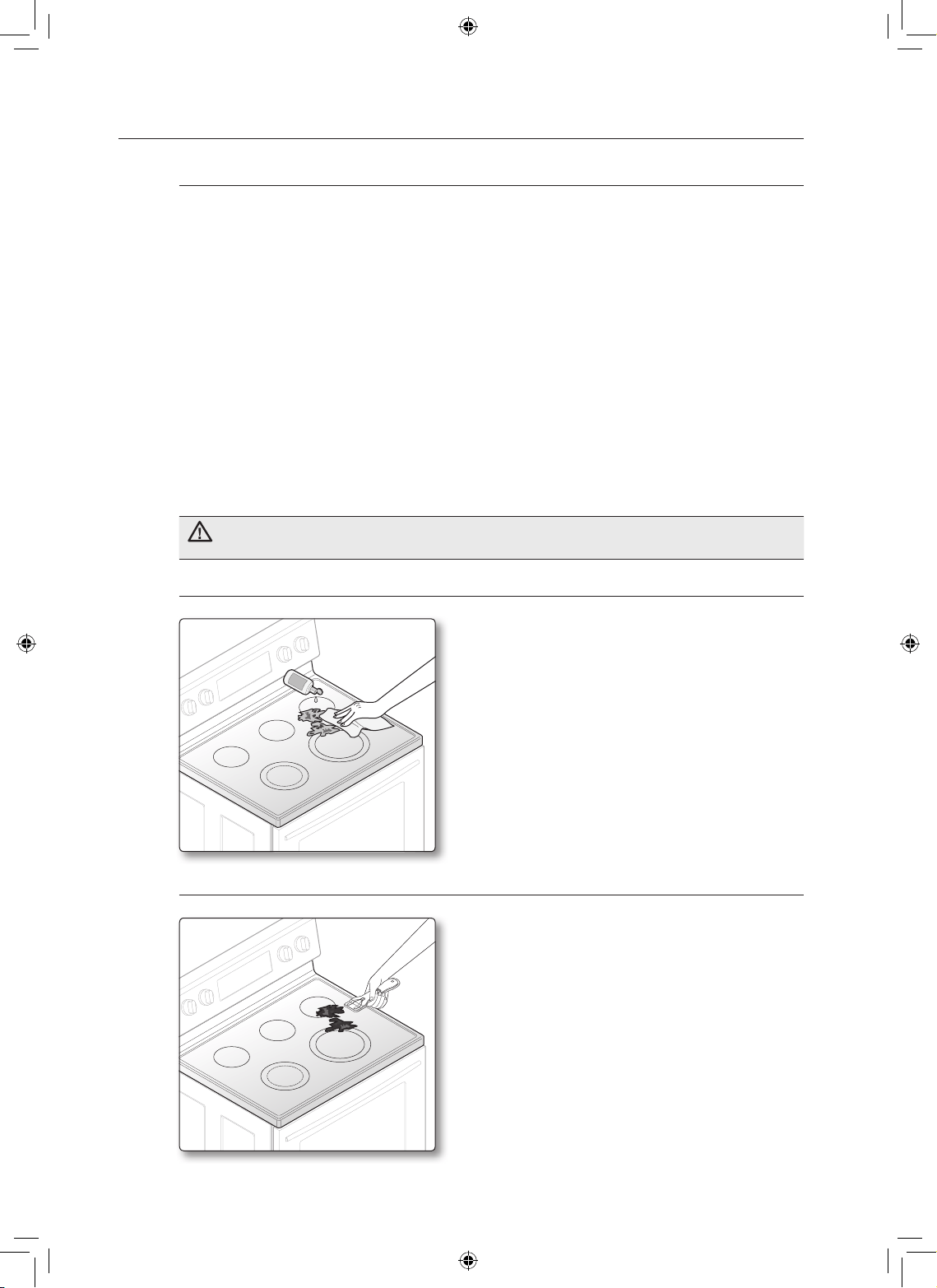
49_ Mantenimiento de su electrodoméstico
CUIDADO Y LIMPIEZA DE LA CUBIERTA DE VIDRIO
Limpieza en el uso normal diario
Use solo un producto de limpieza para superficies de cocción cerámicas. Otras cremas podrían
resultar menos efectivas.
Seguir estos pasos le permitirá mantener y proteger la superficie de su cubierta de vidrio.
1. Antes de utilizar la cubierta por primera vez, límpiela con un producto de limpieza para
superficies de cocción cerámicas.
Esto ayuda a proteger la cubierta y facilita la limpieza.
2. Utilizar diariamente un producto de limpieza para superficies de cocción cerámicas ayudará a
que la cubierta mantenga la apariencia de nueva.
3. Agite bien la crema de limpieza. Aplique unas pocas gotas del producto de limpieza
directamente sobre la cubierta.
4. Utilice una toalla de papel o una almohadilla para limpiar superficies de cocción cerámicas
para limpiar toda la superficie de la cubierta.
5. Utilice un paño seco o una toalla de papel para quitar todos los residuos de la limpieza.
No es necesario enjuagar.
ADVERTENCIA
Se podrían producir DAÑOS a la superficie de vidrio si se utilizaran almohadillas o
estropajos distintos de los recomendados.
Cómo quitar los residuos quemados
1. Espere que la cubierta se enfríe.
2.
Esparza unas pocas gotas de limpiador para superficies de
cocción cerámicas sobre toda la zona de residuos quemados.
3. Utilice el paño de limpieza para superficies de cocción
cerámicas y frote la zona de los residuos aplicando la
presión necesaria.
4
. Si queda algún residuo, repita los pasos arriba enumerados
según resulte necesario.
5
. Para protección adicional, después de haber quitado todo
el residuo, lustre toda la superficie con el producto de
limpieza para la cubierta cerámica y una toalla de papel.
Cómo quitar gruesas capas de residuos quemados y adheridos
1. Espere que la cubierta se enfríe.
2.
Utilice una rasqueta de navaja de un solo filo a un ángulo de
45° sobre la superficie de vidrio y raspe la suciedad. Será
necesario aplicar presión para poder quitar los residuos.
3. Después de raspar con la rasqueta de navaja, esparza
unas pocas gotas de limpiador para superficies de cocción
cerámicas sobre toda la zona de residuos quemados.
Utilice el paño de limpieza para quitar los residuos que
queden. (No raspe la junta selladora).
4
. Para protección adicional, después de haber quitado todo
el residuo, lustre toda la superficie con el producto de
limpieza para la cubierta y una toalla de papel.
NE595R0ABSR_AA_DG68-00433A-09_MES.indd 49 2016-03-30 �� 8:08:21
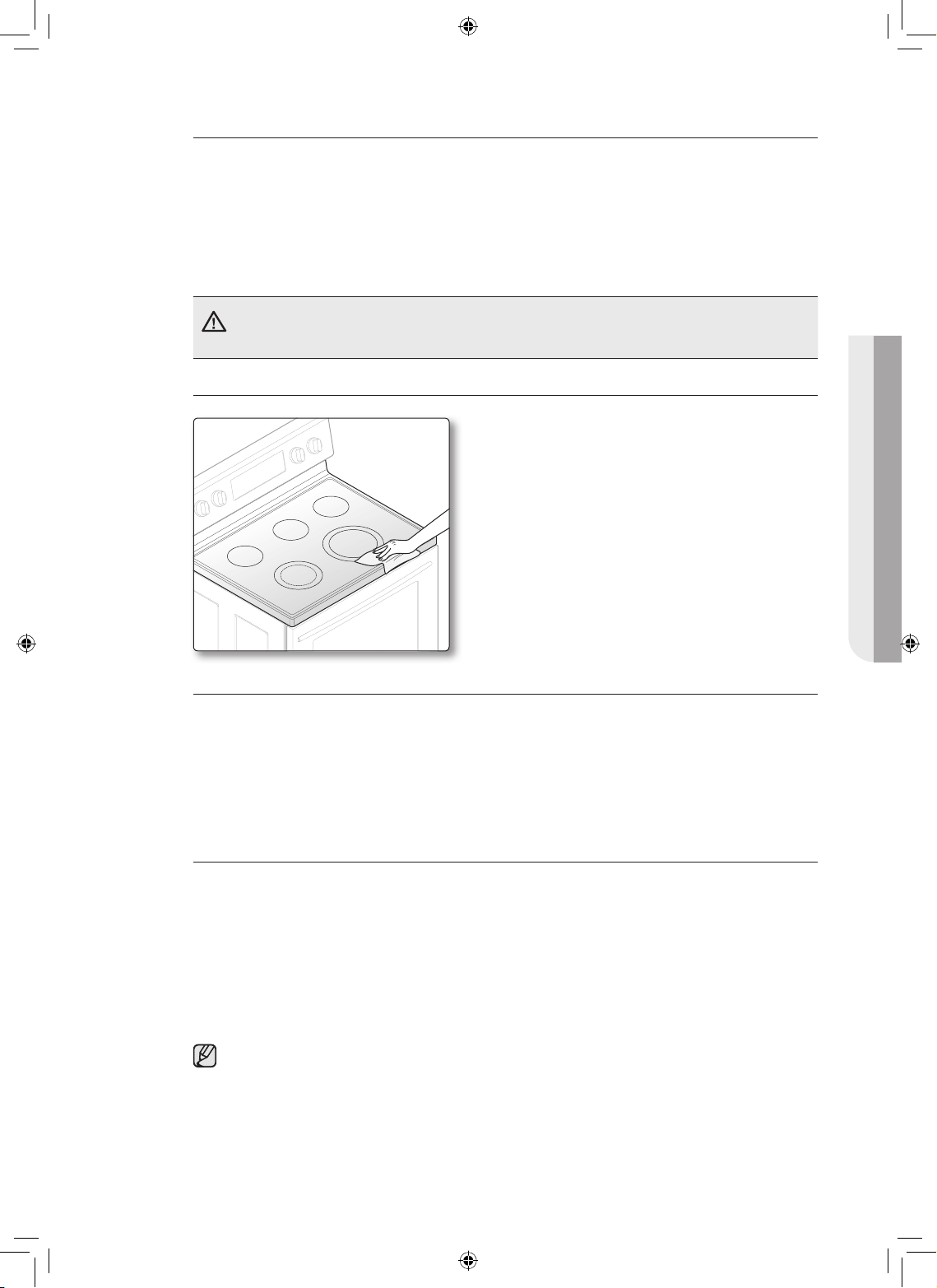
Mantenimiento de su electrodoméstico _50
MANTENIMIENTO DE SU ELECTRODOMÉSTICO
Cómo quitar marcas de metal y arañazos
1. Tenga cuidado de no deslizar las cacerolas y sartenes sobre la cubierta de su estufa.
Esto dejará marcas en la superficie de la cubierta. Puede quitar estas marcas utilizando o un
limpiador para superficies de cocción cerámicas con un paño de limpieza específico para
limpiar estas superficies.
2. Si recipientes de limpieza someramente revestidos con aluminio o cobre se dejan hirviendo
hasta secarse, el revestimiento puede dejar manchas de color sobre la cubierta.
Estas manchas de color se deben quitar inmediatamente o se pueden volver permanentes.
ADVERTENCIA
Controle cuidadosamente los fondos de los recipientes de cocción para asegurarse de
que estén libres de rugosidades que puedan rayar la cubierta.
Limpieza de la junta selladora de la cubierta
Para limpiar la junta selladora a lo largo de los bordes
del vidrio, deje un paño mojado reposando contra ella
por unos minutos y luego limpie con un producto no
abrasivo.
Potenciales daños permanentes a la superficie de vidrio
• Los derrames de materiales azucarados (tales como jaleas, caramelo, almíbares) o plásticos
fundidos pueden causar picaduras en la superficie de la cubierta. Esta situación no está
cubierta por la garantía. El derrame debe limpiarse mientras permanezca caliente.
Sea especialmente cuidadoso al quitar sustancias calientes. Consulte la sección siguiente.
• Si utiliza una rasqueta, asegúrese de que sea nueva y que su navaja mantenga buen filo.
No utilice una navaja sin filo o con mordeduras.
Limpieza de derrames azucarados y plástico fundido
1. Apague todas las unidades de superficie. Quite todos los recipientes de cocción calientes.
2. Usando un guante aislante, utilice una rasqueta de navaja de un solo filo para mover la
sustancia derramada a una zona de la cubierta que no se encuentre caliente.
Quite la sustancia derramada con toallas de papel.
3. El remanente del derrame debe dejarse hasta que la superficie de cocción se haya enfriado.
4. No vuelva a utilizar las unidades de superficie hasta que todo el residuo haya sido quitado
completamente.
Si ya se han producido picaduras o hendiduras en la superficie del vidrio, la cubierta
de vidrio deberá ser reemplazada. En tal caso, será necesario llamar al servicio de
reparaciones.
NE595R0ABSR_AA_DG68-00433A-09_MES.indd 50 2016-03-30 �� 8:08:21
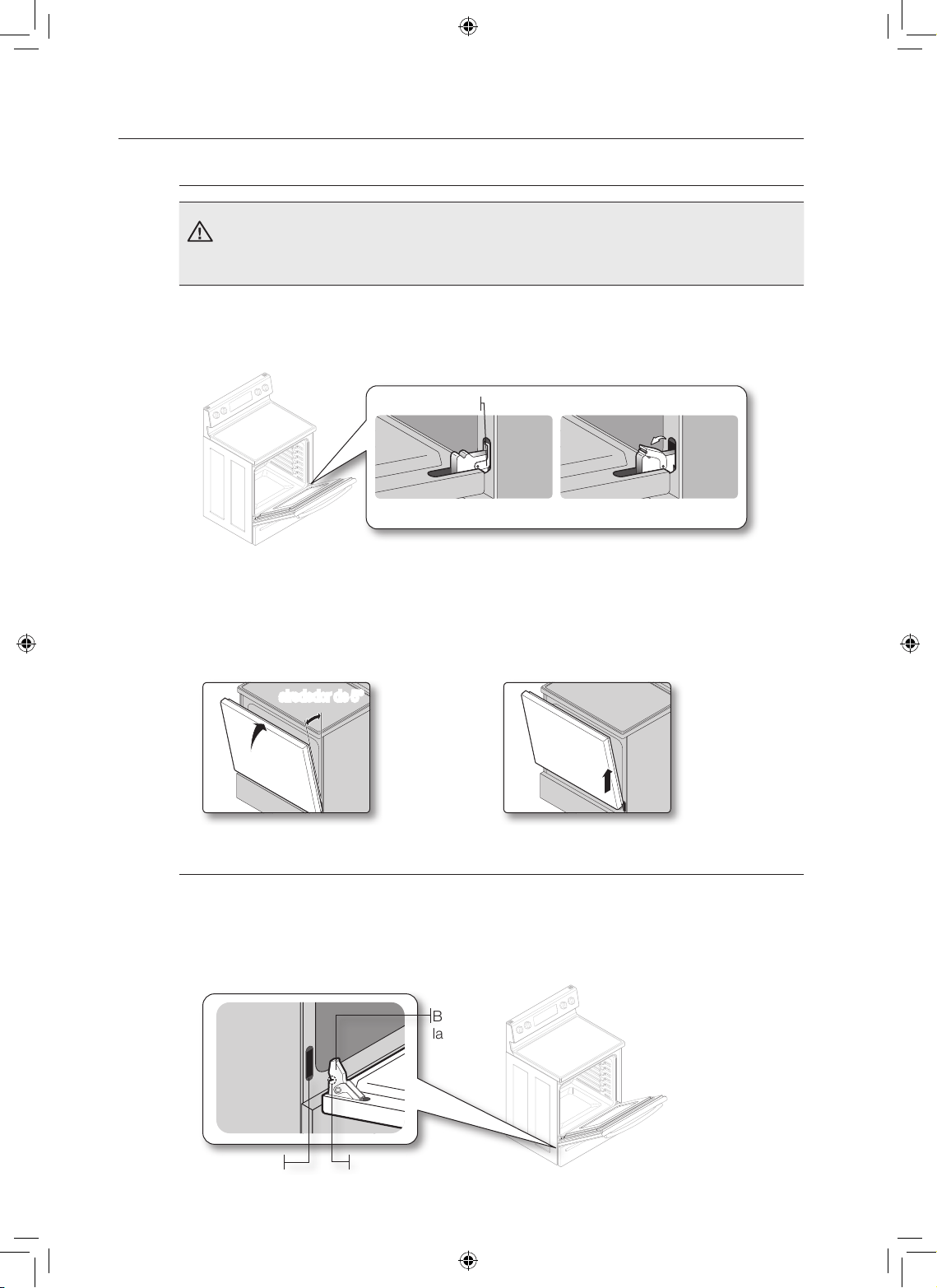
51_ Mantenimiento de su electrodoméstico
CÓMO RETIRAR Y VOLVER A COLOCAR LA PUERTA DEL HORNO
Cómo retirar la puerta
PRECAUCIÓN
• La puerta es muy pesada. Tenga cuidado al retirarla y levantarla. No levante la puerta
halando de la manija.
• Desconecte la electricidad antes de retirar la puerta.
1. Abra la puerta por completo.
2. Jale las trabas de las bisagras hacia abajo, hacia el marco de la puerta hasta la posición
destrabada.
Traba de la bisagra
Posición trabada Posición destrabada
3. Sujete firmemente ambos lados de la puerta en su extremo superior.
4. Cierre la puerta hasta la posición de remoción, que es a aproximadamente 5grados de la
posición vertical (Fig. 1).
5. Levante la puerta y hale hacia afuera hasta que el brazo de la bisagra esté fuera de la ranura
(Fig. 2).
alrededor de 5°
Fig. 1 Fig. 2
Cómo volver a colocar la puerta
1. Sujete firmemente ambos lados de la puerta en su extremo superior.
2. Con la puerta en el mismo ángulo que en la posición para retirar, deslice la muesca del brazo
de la bisagra hasta que encaje en el borde inferior de la ranura para la bisagra. La muesca en
el brazo de la bisagra debe quedar completamente inserta en la parte inferior de la ranura.
Borde inferior
de la ranura
Muesca
Brazo de
la bisagra
NE595R0ABSR_AA_DG68-00433A-09_MES.indd 51 2016-03-30 �� 8:08:22
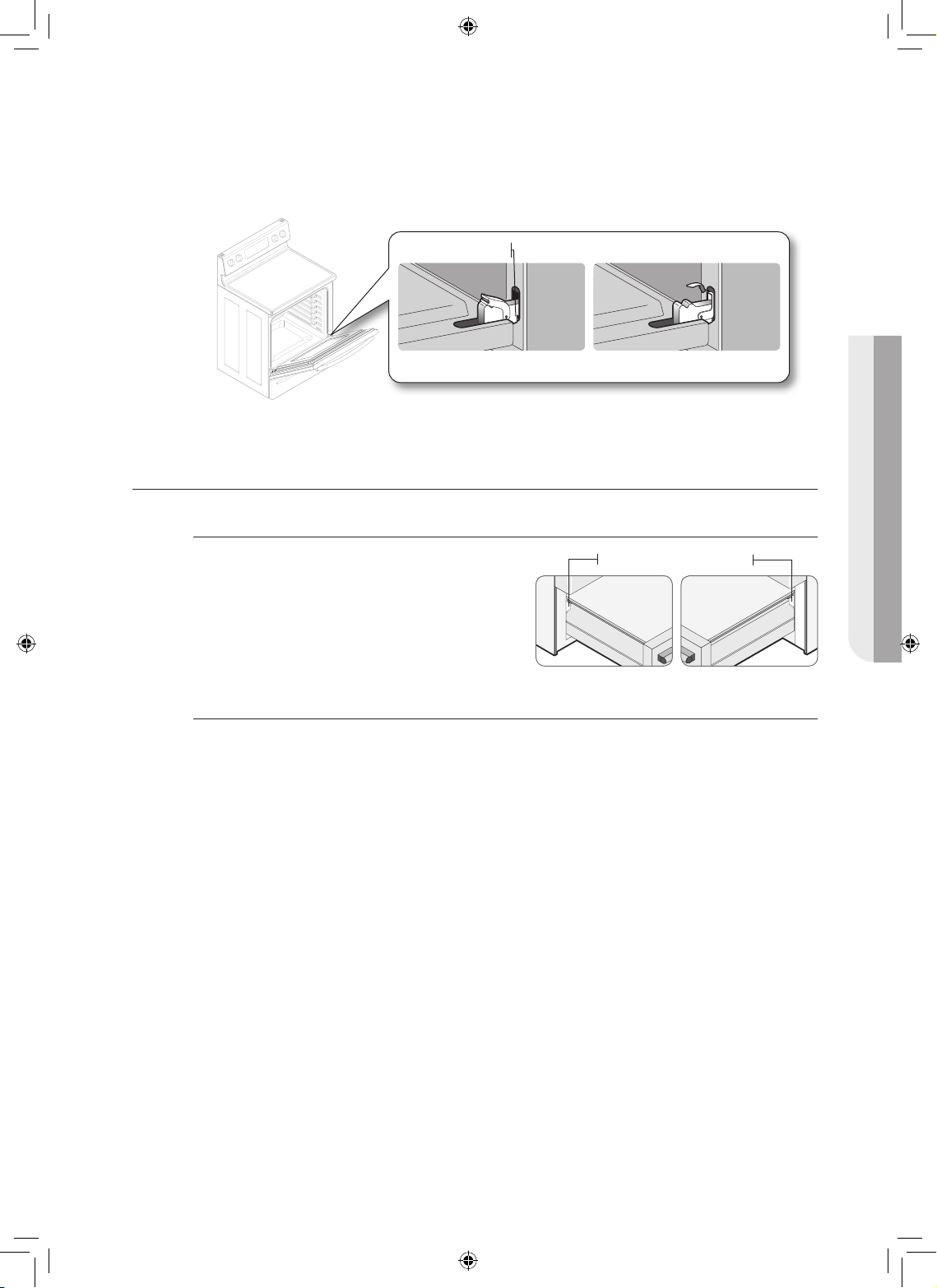
Mantenimiento de su electrodoméstico _52
MANTENIMIENTO DE SU ELECTRODOMÉSTICO
3. Abra la puerta por completo. Si la puerta no se abre completamente, la muesca no se
encuentra correctamente insertada en el borde inferior de la ranura.
4. Empuje las trabas de bisagra hacia arriba contra el marco frontal de la cavidad del horno hasta
que queden en la posición trabada.
Traba de la bisagra
Posición destrabada Posición trabada
5. Cierre la puerta del horno.
CÓMO RETIRAR Y VOLVER A COLOCAR EL CAJÓN DE ALMACENAMIENTO
Cómo retirar el cajón de almacenamiento
1. Retire el cajón hacia afuera hasta que se
detenga.
2. Incline el frontal del cajón y extráigalo hasta que
se detenga.
3 Levante el cajón y extráigalo.
Cómo volver a colocar el cajón de almacenamiento
1. Ponga el lado izquierdo del cajón sobre el gancho izquierdo y el lado derecho sobre el gancho
derecho.
2. Empuje el cajón hasta que se detenga.
3. Incline y levante el cajón.
4. Empuje el cajón hacia adentro.
Gancho
Gancho
NE595R0ABSR_AA_DG68-00433A-09_MES.indd 52 2016-03-30 �� 8:08:23
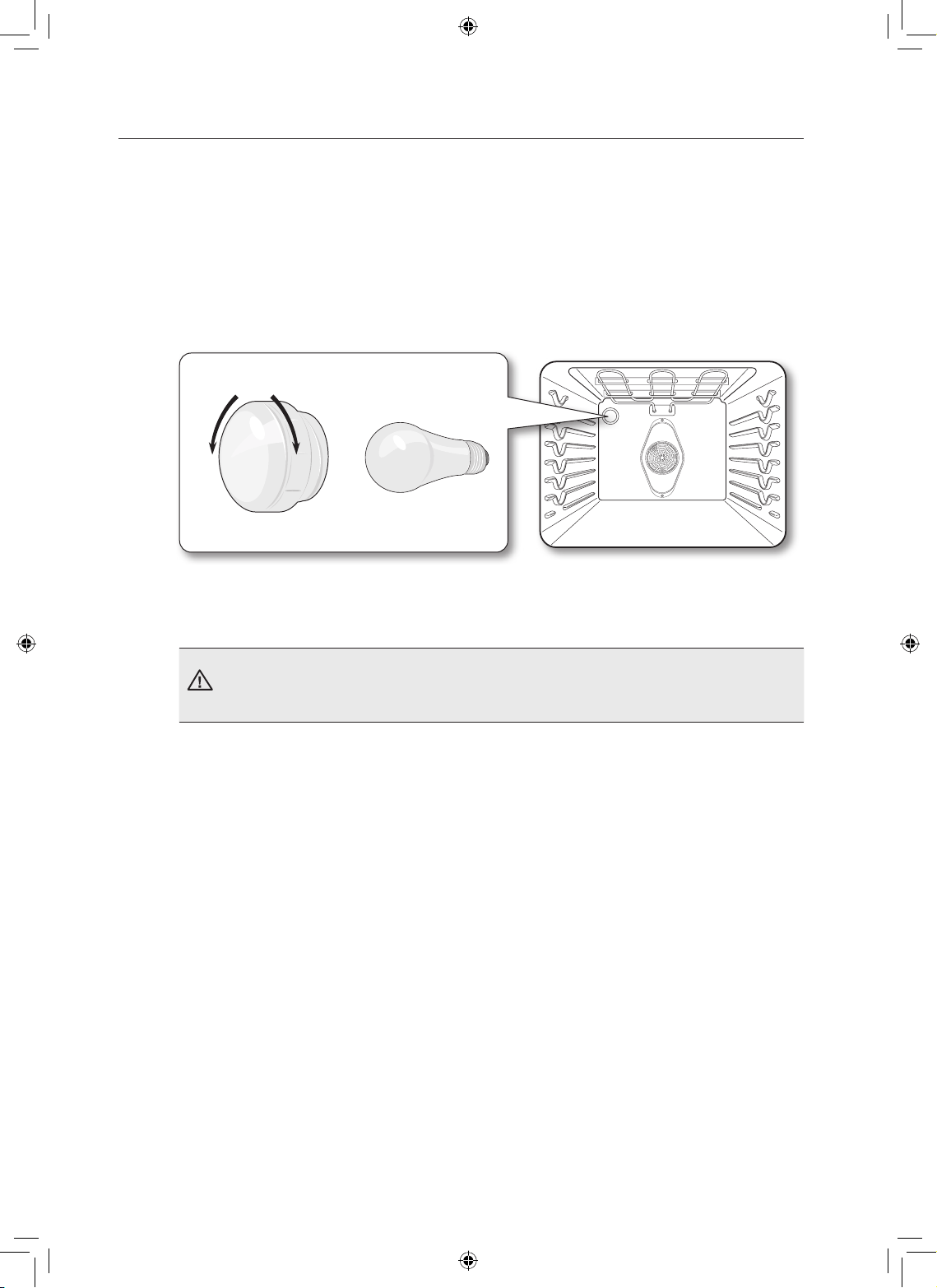
53_ Mantenimiento de su electrodoméstico
RECAMBIO DE LA LUZ DEL HORNO
La luz del horno es una bombilla para electrodomésticos estándar de 40 watts. Se encenderá al
abrirse la puerta del horno. Cuando la puerta del horno se encuentre cerrada, presione la tecla
Luz del horno para encenderla o apagarla. No funcionará durante el ciclo de auto-limpieza.
1. Asegúrese de que el horno y la bombilla se encuentren fríos.
2. Desenchufe la estufa o desconecte la corriente.
3. Para retirar la cubierta de vidrio de la bombilla en la parte trasera del horno, gírela en sentido
contrario a las agujas del reloj.
4. Gire la bombilla en sentido contrario a las agujas del reloj para retirarla de su casquillo.
Retirar
Cubierta de vidrio de
la bombilla
Bombilla
Volver a colocar
5. Vuelva a colocar la bombilla de luz y su cubierta de vidrio girándolas en el sentido de las
agujas del reloj.
6. Enchufe la estufa o vuelva a conectar la electricidad.
PRECAUCIÓN
Antes de cambiar la bombilla de la luz de su horno, desconecte la alimentación de
electricidad a la estufa en el fusible principal o en el panel del disyuntor. Asegúrese de
que el horno y la bombilla se encuentren fríos.
NE595R0ABSR_AA_DG68-00433A-09_MES.indd 53 2016-03-30 �� 8:08:23
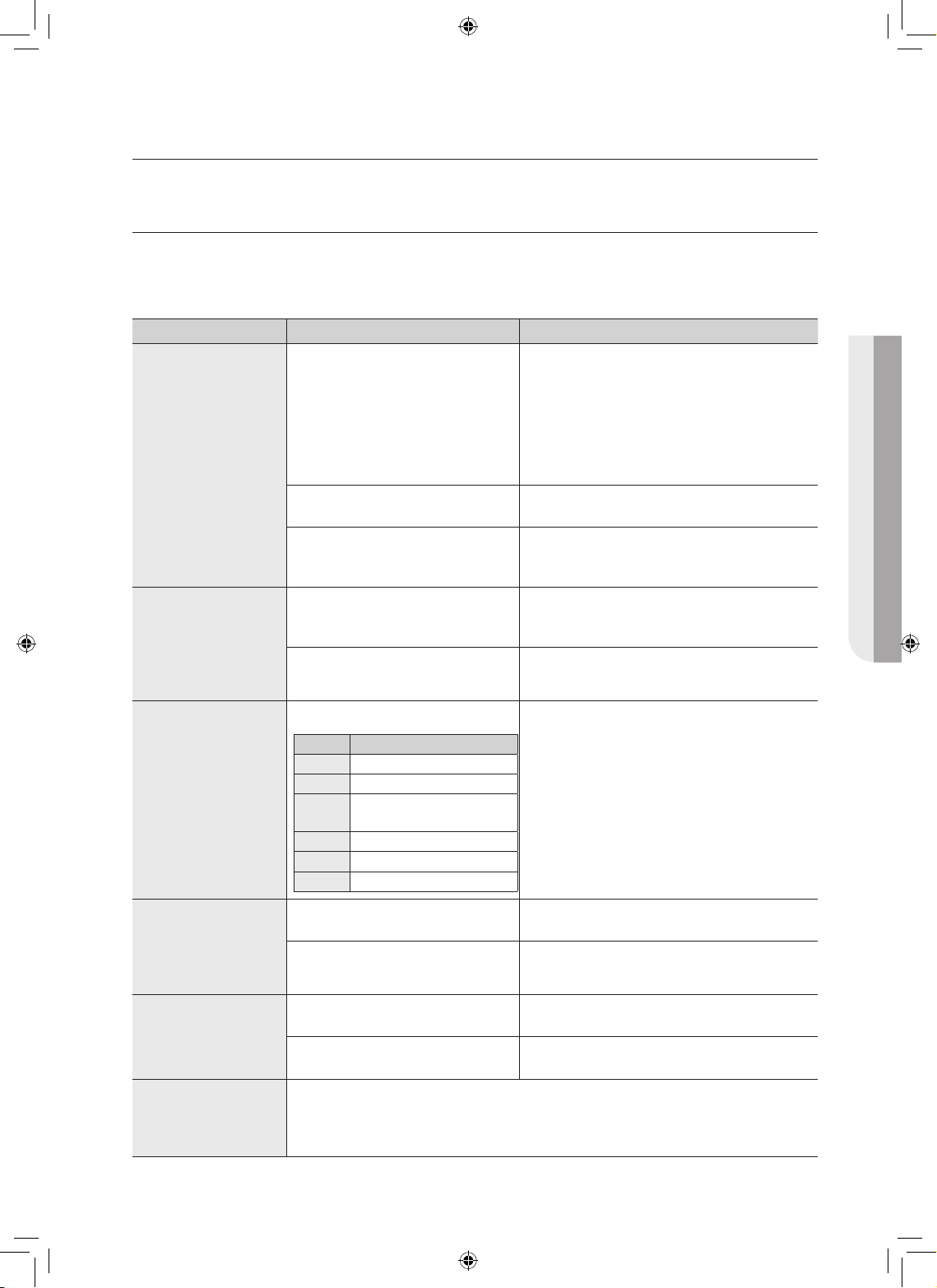
RESOLUCIÓN DE PROBLEMAS
Resolución de problemas _54
resolución de problemas
RESOLUCIÓN DE PROBLEMAS
Samsung hace grandes esfuerzos para asegurar que usted no experimente problemas con su nueva estufa
eléctrica. Si se encuentra con problemas inesperados, como primera medida busque la solución en la
siguiente tabla. Si, luego de intentar la solución sugerida, aún experimenta problemas, llame a Samsung al
número 1-800-SAMSUNG (1-800-726-7864).
PROBLEMA CAUSA POSIBLE SOLUCIÓN
La estufa está
desnivelada.
El electrodoméstico fue instalado
incorrectamente.
• Coloque la parrilla del horno en el centro del horno.
Coloque un nivel sobre la parrilla. Ajuste las patas de
nivelación en la base de la estufa hasta que la parrilla
del horno quede nivelada.
• Asegúrese de que el piso esté nivelado y sea lo
suficientemente fuerte y estable como para soportar la
estufa.
El piso se encuentra vencido, combado,
hundido o inclinado.
• Contáctese con un carpintero para corregir esta
situación.
Son los gabinetes de cocina los que están
desalineados y hacen que la estufa parezca
desnivelada.
• Asegúrese de que los gabinetes se encuentren en
escuadra y dejan suficiente lugar para la instalación.
Es necesario acceder
al electrodoméstico
para efectuarle servicio
de mantenimiento o
reparación y resulta difícil
de mover.
Los gabinetes de cocina no están en
escuadra o están construidos demasiado
apretados contra el electrodoméstico.
• Comuníquese con un constructor o instalador para
posibilitar el acceso al electrodoméstico.
La alfombra interfiere con el movimiento de
la estufa.
• Despeje suficiente espacio para que la estufa pueda ser
levantada por encima de la alfombra.
El control del horno emite
un "bip" y muestra un
código de error F.
Usted tiene un código de error de función.
CÓDIGO CAUSA
-SE- Tecla en cortocircuito
E-27 Sensor del horno abierto
E-28 Sensor del horno en
cortocircuito.
E-08 Error de calentamiento del horno
E-0A El horno recalienta
E-0E Error de la traba de la puerta
• Presione la tecla Clear/O (Borrar/Apagar)
y encienda nuevamente el horno.
Si el problema persiste, desconecte toda alimentación
eléctrica a la estufa durante por lo menos 30 segundos
y luego reconecte la alimentación eléctrica.
Si esto no soluciona el problema, llame al servicio de
reparaciones.
Las unidades de
superficie no mantienen
un hervor continuo o no
cocinan con la rapidez
esperable.
Se están utilizando recipientes de cocción no
apropiados.
• Utilice recipientes de fondo plano y cuyo diámetro se
corresponda con la unidad de superficie seleccionada.
En algunas áreas, el potencial eléctrico
(voltaje) puede estar demasiado bajo.
• Cubra el recipiente con una tapa hasta que se alcance
la temperatura deseada.
Las unidades de
superficie no se
encienden.
Puede haberse quemado un fusible en su
casa o haberse disparado el disyuntor.
• Reemplace el fusible o reinicie el disyuntor.
Los controles de la superficie de cocción
están incorrectamente configurados.
• Controle que se encuentre configurado el control
correcto para la unidad de superficie en uso.
La unidad de superficie
deja de estar al rojo vivo
cuando se cambia a una
regulación más baja.
Esto es normal. La unidad todavía se encuentra encendida y caliente.
NE595R0ABSR_AA_DG68-00433A-09_MES.indd 54 2016-03-30 �� 8:08:24
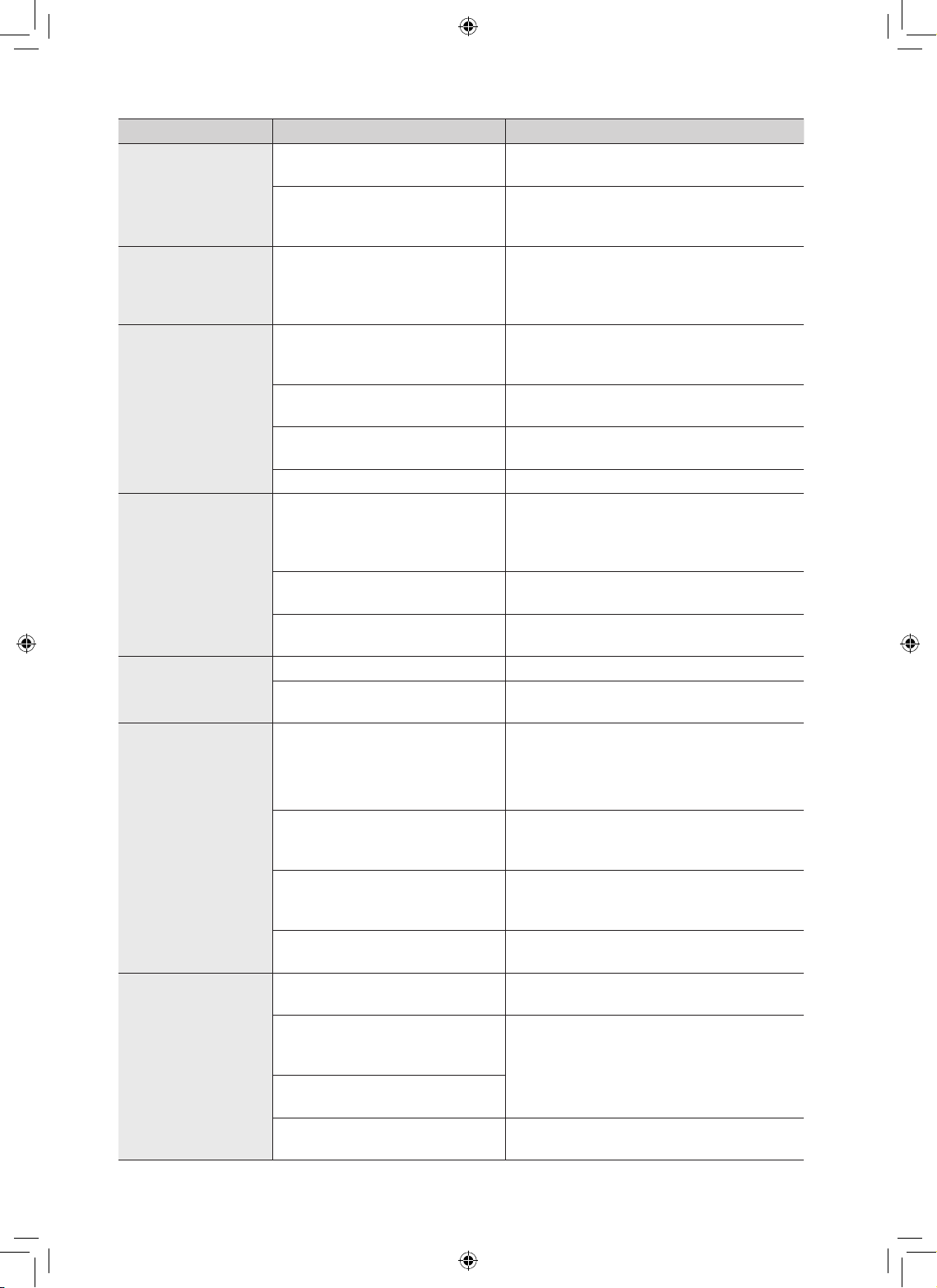
55_ Resolución de problemas
PROBLEMA CAUSA POSIBLE SOLUCIÓN
Zonas con alteraciones de
color en la cubierta.
Se omitió limpiar alimentos derramados.
• Consulte la sección sobre cuidado y limpieza de la
cubierta de vidrio en la página 54.
La superficie está caliente y el modelo se
caracteriza por una cubierta de color claro.
• Esto es normal. El color de la superficie puede aparecer
alterado cuando está caliente. Esto es transitorio y
desaparecerá a medida que el vidrio se enfríe.
La unidad de superficie
alterna frecuentemente
entre encendido y
apagado.
Esto es normal.
• El elemento pasará por ciclos de encendido y apagado
para mantener la regulación de calor.
El horno no se enciende. La estufa no se encuentra bien enchufada al
tomacorriente.
• Asegúrese de que el enchufe se encuentre insertado
en un tomacorriente alimentado con corriente y bien
conectado a tierra.
Puede haberse quemado un fusible en su
casa o haberse disparado el disyuntor.
• Reemplace el fusible o reinicie el disyuntor.
Los controles del horno se han configurado
incorrectamente.
• Vea el capítulo donde se describe la operación del
horno.
El horno está demasiado caliente.
• Espere a que el horno se enfríe.
La estufa no se enciende. La estufa no se encuentra bien enchufada al
tomacorriente o tal vez en su casa se haya
quemado un fusible o activado el disyuntor.
• Asegúrese de que el cable de alimentación se
encuentre enchufado en un tomacorriente alimentado
con corriente y bien conectado a tierra. Controle los
fusibles y disyuntores.
El servicio técnico no completó la conexión
de cables.
• Solicite servicio técnico.
Hay un corte de energía en su localidad.
• Controle si se encienden las luces de su casa. De ser
necesario, llame a su compañía de electricidad local.
No se enciende la luz del
horno.
La bombilla está floja o fallada.
• Ajuste o reemplace la bombilla.
El interruptor de la luz está roto o
descompuesto.
• Solicite servicio técnico.
El horno emite demasiado
humo cuando se asa a la
parrilla.
El control no fue regulado correctamente.
• Consulte la sección sobre la regulación de los controles
del horno.
• Asegúrese de que la puerta del horno se encuentre
entornada a la posición de traba para asar a la parrilla.
La carne fue colocada demasiado próxima al
elemento radiante.
• Cambie la posición de la parrilla para dejar el espacio
adecuado entre la carne y el elemento radiante. Si
desea sellar la carne, precaliente el elemento radiante.
La carne no fue preparada correctamente.
• Quite el exceso de grasa de la carne. Corte y retire los
bordes grasos que podrían retorcerse, dejando intacto
la carne magra.
Hay acumulación de grasa sobre las
superficies del horno.
• Es necesario limpiar con regularidad si se asa a la
parrilla con frecuencia.
Los alimentos no se
hornean o asan como es
debido.
Los controles del horno se han configurado
incorrectamente.
• Vea el capítulo donde se describe la operación del
horno.
La parrilla del horno fue colocada en una
posición incorrecta o no se encuentra
nivelada.
• Vea la sección sobre el uso de las parrillas del horno en
la página 52.
Se están utilizando recipientes de cocción no
adecuados o de tamaño incorrecto.
El sensor del horno requiere ajuste.
• Vea la sección sobre cómo ajustar el termostato en la
página 46.
NE595R0ABSR_AA_DG68-00433A-09_MES.indd 55 2016-03-30 �� 8:08:24
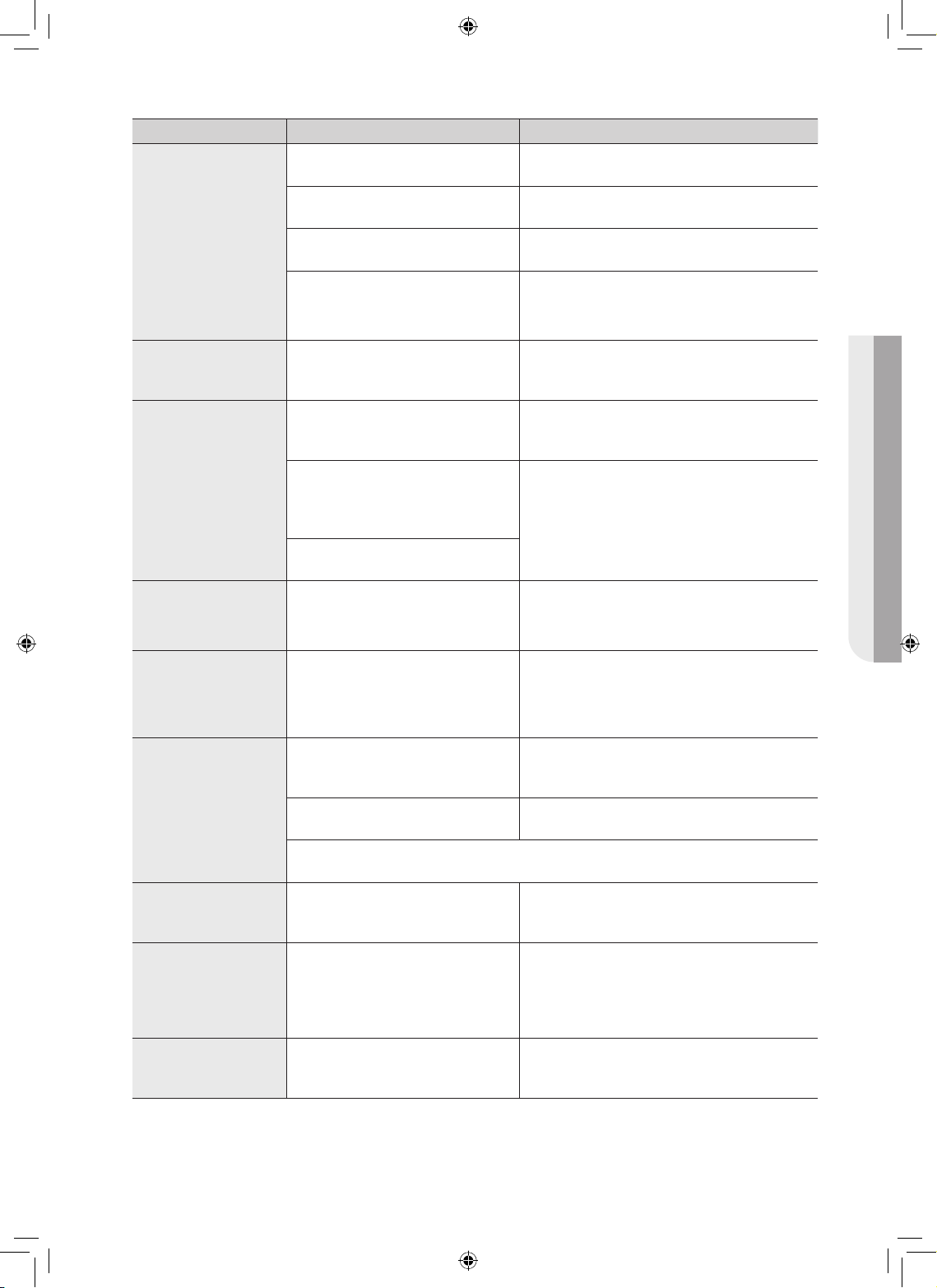
RESOLUCIÓN DE PROBLEMAS
Resolución de problemas _56
PROBLEMA CAUSA POSIBLE SOLUCIÓN
Los alimentos no
se asan a la parrilla
correctamente.
Los controles del horno se han configurado
incorrectamente.
• Presione la tecla Broil (Asar a la parrilla).
La parrilla fue colocada en una posición
incorrecta.
• Vea la guía para asar a la parrilla en la página 41.
El recipiente no es adecuado para asar a la
parrilla.
• Utilice utensilios de cocción adecuados.
En algunas áreas, el potencial eléctrico
(voltaje) puede estar demasiado bajo.
• Precaliente durante diez minutos el elemento radiante
para asar a la parrilla.
• Vea la guía para asar a la parrilla en la página 41.
El horno está a
temperatura demasiado
alta o demasiado baja.
El sensor del horno requiere ajuste.
• Vea la sección sobre cómo ajustar el termostato en la
página 46.
Rayaduras o abrasiones
en la superficie de la
cubierta
La limpieza de la cubierta se está realizando
incorrectamente.
• Las rayaduras son imposibles de quitar.
Por efectos de la limpieza, las rayaduras muy pequeñas
se volverán menos visibles con el transcurrir del tiempo.
Se usaron sobre la cubierta recipientes
de cocción con fondos rugosos, o se
depositaron partículas gruesas y abrasivas
(por ejemplo, sal o arena).
• Para evitar rayaduras, utilice los procedimientos de
limpieza recomendados. Asegúrese de que estén
limpios los fondos de los recipientes de cocción antes
de usarlos y utilice recipientes de fondos lisos.
Se ha deslizado algún utensilio de cocina
sobre la superficie de cocción.
Pintas o vetas pardas Ocurrieron derrames que fueron cocinados
hasta adherirse a la superficie.
• Utilice la rasqueta de navaja para quitar la suciedad.
• Vea la sección sobre cuidado y limpieza de la cubierta
de vidrio en la página 54.
Zonas con alteración de
color con brillo metálico
Depósitos minerales originados en el agua
o los alimentos permanecieron sobre la
superficie de la cubierta.
• Quítelos utilizando una crema de limpieza para
superficies de cocción vitro-cerámicas.
• Utilice recipientes de cocción con fondos limpios y
secos.
El horno no ejecuta el
proceso de auto-limpieza.
La temperatura del horno es demasiado alta
como para programar una operación de
auto-limpieza.
• Espere que la estufa se enfríe y ajuste los controles.
Los controles del horno se han configurado
incorrectamente.
• Vea la sección sobre auto-limpieza en la página 47.
No se puede iniciar un ciclo de auto-limpieza si ha activado la función de traba del horno o si algún elemento
radiante de superficie se encuentra encendido.
Se oyen ruidos como
crujidos o suaves
estallidos
Estos son los ruidos que emite el metal al
calentarse y enfriarse durante las funciones
de cocción y limpieza.
• Esto es normal.
Humo excesivo durante
un ciclo de auto-limpieza
El horno se encuentra demasiado sucio.
• Presione la tecla Clear/O (Borrar/Apagar).
Abra las ventanas para que el humo salga del ambiente.
Aguarde hasta que el ciclo de auto-limpieza se cancele.
Retire la suciedad excesiva con un paño o almohadilla y
nuevamente programe el horno para auto-limpieza.
Después de un ciclo de
auto-limpieza la puerta
del horno, no se abre.
El horno está demasiado caliente.
• Espere a que el horno se enfríe.
NE595R0ABSR_AA_DG68-00433A-09_MES.indd 56 2016-03-30 �� 8:08:24
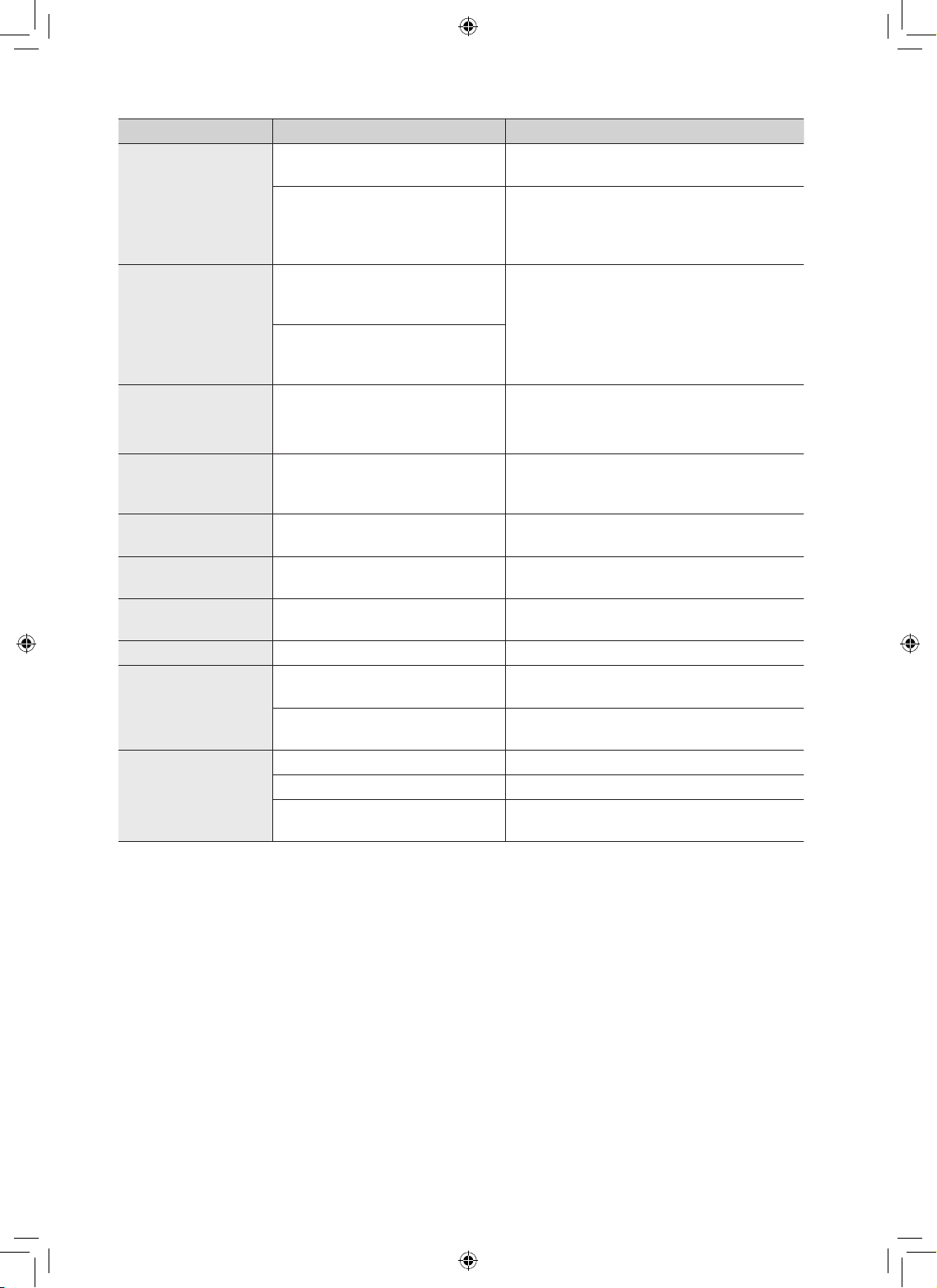
57_ Resolución de problemas
PROBLEMA CAUSA POSIBLE SOLUCIÓN
Cumplido un ciclo de
auto-limpieza, el horno
aún no está limpio
Los controles del horno se han configurado
incorrectamente.
• Vea la sección sobre auto-limpieza en la página 49.
El horno tenía suciedad pesada.
• Limpie los derrames pesados antes de iniciar el ciclo
de auto-limpieza. Cuando el horno está muy sucio,
puede ser necesario repetir la auto-limpieza o darle una
duración mayor.
La abertura de ventilación
despide vapor
Cuando se usa la función de convección,
es normal ver salir vapor por la abertura de
ventilación.
• Esto es normal.
La cantidad de vapor visible aumenta cuando
se usan más parrillas o se cocina mayor
cantidad de alimento.
Olores a quemado o
a aceite emanan de la
abertura de ventilación
Esto es normal cuando el horno es nuevo y
desaparecerá con el tiempo.
• Para acelerar este proceso, programe un ciclo de auto-
limpieza de por lo menos 3horas.
• Vea la sección sobre auto-limpieza en la página 49.
Olor fuerte Las primeras veces que se usa el horno, es
normal que emane olor del material aislante
que envuelve al horno.
• Esto es transitorio.
Ruido del ventilador Un ventilador de convección puede
encenderse y apagarse automáticamente.
• Esto es normal.
Resulta difícil deslizar las
parrillas del horno.
Las parrillas plateadas quedaron dentro del
horno durante un ciclo de auto-limpieza.
• Aplique una pequeña cantidad de aceite vegetal sobre
una toalla de papel y frote con él los lados de la parrilla.
La pantalla queda en
blanco.
Puede haberse quemado un fusible en su
casa o haberse disparado el disyuntor.
• Reemplace el fusible o reinicie el disyuntor.
La pantalla parpadea. Hubo un corte de energía eléctrica.
• Reajuste el reloj.
El cajón no se desliza con
suavidad o se arrastra
con fricción.
El cajón se encuentra desalineado.
• Jale el cajón hacia afuera completamente y empújelo
totalmente hacia adentro. Vea la página 57.
El cajón está sobrecargado o la carga está
desbalanceada.
• Reduzca el peso. Redistribuya el contenido de los
cajones.
Condensación excesiva
dentro del cajón
Hay líquido en el cajón.
• Extraiga el líquido.
Alimentos sin cubrir.
• Cubra los alimentos con una tapa o papel de aluminio.
La regulación de temperatura es demasiado
alta.
• Regule la temperatura a un nivel más bajo.
NE595R0ABSR_AA_DG68-00433A-09_MES.indd 57 2016-03-30 �� 8:08:24

GARANTÍA
Garantía _58
garantía
CONSERVE ESTA HOJA - REEMPLAZA LA PÁGINA DE GARANTÍA EN LA GUÍA DE USO Y MANTENIMIENTO
ESTUFA ELÉCTRICA SAMSUNG
GARANTÍA LIMITADA PARA EL COMPRADOR ORIGINAL
El presente producto de la marca SAMSUNG, tal como lo provee y distribuye SAMSUNG ELECTRONICS AMERICA, INC. (SAMSUNG) y lo
entrega como nuevo, en su empaque de cartón original al comprador o consumidor original, está garantizado por SAMSUNG contra defectos de
fabricación de los materiales y la mano de obra durante el período limitado de la garantía de:
Garantía de un (1) año por repuestos y mano de obra, un (1) año por repuestos
Para la cubierta de vidrio y la hornalla radiante
La presente garantía limitada comienza en la fecha original de compra y es válida únicamente para productos comprados y usados en los Estados
Unidos. Para recibir el servicio técnico de la garantía, el comprador debe comunicarse con SAMSUNG con el fin de que se determine el problema
y los procedimientos del servicio. El servicio técnico de la garantía solo puede ser prestado por un centro de servicio técnico autorizado de
SAMSUNG. Se debe presentar la factura de compra original como prueba de compra a SAMSUNG o al servicio técnico autorizado de SAMSUNG.
Samsung brindará servicio técnico a domicilio sin cargo durante el período de garantía, sujeto a disponibilidad, dentro del territorio contiguo de los
Estados Unidos. El servicio técnico a domicilio no se encuentra disponible en todas las áreas. Como condición para que se preste este servicio a
domicilio, el producto debe encontrarse libre de obstrucciones y accesible para el agente de servicio. Si el servicio no está disponible, Samsung
podrá optar por brindar el servicio de transporte del producto de ida y vuelta al centro de servicio.
SAMSUNG reparará o reemplazará el producto a nuestra discreción y sin cargo tal como se establece en la presente garantía, con piezas o
productos nuevos o reacondicionados si se comprueba que es defectuoso durante el período limitado de la garantía especificado anteriormente.
Todas las piezas y los productos reemplazados pasan a ser propiedad de SAMSUNG y deben ser devueltos a SAMSUNG. Las piezas y los
productos reemplazados asumen la garantía original que resta, o noventa (90) días, el período que sea el más prolongado.
La presente garantía limitada cubre defectos de fabricación de los materiales y la mano de obra encontrados durante el uso normal y doméstico
de este producto y no será válida para lo siguiente: daños que ocurran durante el envío; entrega e instalación; aplicaciones y usos para los cuales
el presente producto no fue destinado; producto o números de serie alterados; daño cosmético o acabado exterior; accidentes, abuso, descuido,
incendio, inundación, caída de rayos, u otros casos fortuitos o de fuerza mayor; uso de productos, equipo, sistemas, utilidades, servicios, piezas,
suministros, accesorios, aplicaciones, instalaciones, reparaciones, cableado externo o conectores no provistos ni autorizados por SAMSUNG
que dañen este producto o que acarreen problemas en el servicio; voltaje de la línea eléctrica incorrecto, fluctuaciones y sobretensión; ajustes
del cliente e incumplimiento de lo establecido en el manual de instrucciones sobre instrucciones de utilización, mantenimiento y ambientales
que están cubiertas y recomendadas en el manual de instrucciones; desmontaje y reinstalación del producto; problemas causados por plagas;
recalentamiento o exceso de cocción causado por el usuario. Esta garantía limitada no cubre casos de corriente, voltaje o alimentación eléctrica
incorrectos, bombillas de luz, fusibles y cableado en la casa, el costo de las llamadas al servicio técnico para solicitar instrucciones, ni la corrección
de errores de instalación. Tampoco están cubiertos los daños a la cubierta de vidrio causados por el uso de productos y elementos de limpieza
distintos de los productos y almohadillas recomendadas, daños a la cubierta de vidrio causados por derrames endurecidos de sustancias
azucaradas o plásticos fundidos que no hubiesen sido limpiados de acuerdo con las instrucciones incluidas en la guía de uso y cuidados.
SAMSUNG no garantiza el funcionamiento ininterrumpido o sin errores del producto.
SALVO LO ESTABLECIDO EN ESTE DOCUMENTO, NO EXISTEN GARANTÍAS RESPECTO DE ESTE PRODUCTO NI EXPRESAS NI TÁCITAS
Y SAMSUNG DESCONOCE Y RECHAZA TODA GARANTÍA INCLUIDAS, AUNQUE NO TAXATIVAMENTE ENUMERADAS, TODA GARANTÍA
TÁCITA DE COMERCIABILIDAD, INFRACCIÓN O APTITUD PARA UN PROPÓSITO ESPECIAL. NINGUNA OTRA GARANTÍA OTORGADA POR
PERSONA, COMPAÑÍA O CORPORACIÓN ALGUNA CON RESPECTO AL PRESENTE PRODUCTO REVESTIRÁ CARÁCTER VINCULANTE
PARA SAMSUNG. SAMSUNG NO SERÁ RESPONSABLE POR PÉRDIDA DE INGRESOS O LUCRO CESANTE, IMPOSIBILIDAD DE GENERAR
AHORROS U OBTENER OTROS BENEFICIOS, O CUALQUIER DAÑO DERIVADO DE CIRCUNSTANCIAS ESPECIALES, DAÑO IMPREVISTO O
DERIVADO CAUSADO POR EL USO, USO INCORRECTO, O INCAPACIDAD PARA USAR EL PRESENTE PRODUCTO, INDEPENDIENTEMENTE
DE LA TEORÍA LEGAL EN QUE SE FUNDE EL RECLAMO Y AUN CUANDO SE LE HAYA NOTIFICADO A SAMSUNG DE LA POSIBILIDAD DE
TALES DAÑOS. NINGÚN RESARCIMIENTO DE NINGUNA ÍNDOLE CONTRA SAMSUNG SUPERARÁ EL MONTO DEL PRECIO DE COMPRA
DEL PRODUCTO VENDIDO POR SAMSUNG Y CAUSANTE DEL PRESUNTO DAÑO. SIN LIMITAR LO PRECEDENTE, EL COMPRADOR ASUME
TODO EL RIESGO Y LA RESPONSABILIDAD POR PÉRDIDA, DAÑO O LESIÓN AL COMPRADOR Y A LOS BIENES DEL COMPRADOR Y
A TERCEROS Y A SUS BIENES DERIVADOS DEL USO, USO INCORRECTO O INCAPACIDAD PARA USAR EL PRESENTE PRODUCTO. LA
PRESENTE GARANTÍA LIMITADA NO SE EXTENDERÁ A NINGUNA PERSONA DISTINTA DEL COMPRADOR ORIGINAL DEL PRESENTE
PRODUCTO, ES INTRANSFERIBLE Y ESTABLECE SU EXCLUSIVA REPARACIÓN.
Algunos territorios o provincias pueden permitir, o no, las limitaciones en cuanto al plazo de una garantía implícita, o la exclusión o limitación de
daños imprevistos o derivados, por lo tanto las limitaciones o exclusiones antedichas pueden no aplicarse en su caso. Esta garantía le otorga
derechos legales específicos, y además puede tener otros derechos que varían según el Estado en el que se encuentre. Las piezas sustituibles por
el usuario se pueden enviar al cliente para la reparación de la unidad. Si es necesario, se puede enviar a un técnico para que efectúe el servicio.
Para recibir un servicio técnico de garantía, comuníquese con SAMSUNG a:
Samsung Electronics America, Inc.
85 Challenger Road Ridgefield Park, NJ 07660, Estados Unidos,
1-800-SAMSUNG (726-7864) y www.samsung.com/us/support
NE595R0ABSR_AA_DG68-00433A-09_MES.indd 58 2016-03-30 �� 8:08:24
Tenga en cuenta que la garantía de Samsung NO cubre las llamadas de servicio para explicar
el funcionamiento del producto, corregir una instalación inadecuada o realizar tareas de
limpieza o mantenimiento.
Escanee el código QR* o visite
www.samsung.com/spsn
para ver nuestros útiles videos
instructivos y programas en
vivo
* Requiere un lector instalado en su teléfono
inteligente
DG68-00433A-09
¿TIENE PREGUNTAS O COMENTARIOS?
PAÍS LLAME AL O VISÍTENOS EN LÍNEA EN
U.S.A
Consumer Electronics
1-800-SAMSUNG (726-7864) www.samsung.com/us/support
CANADA 1-800-SAMSUNG (726-7864)
www.samsung.com/ca/support (English)
www.samsung.com/ca_fr/support (French)
NE595R0ABSR_AA_DG68-00433A-09_MES.indd 59 2016-03-30 �� 8:08:24