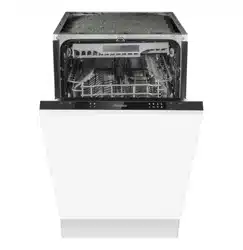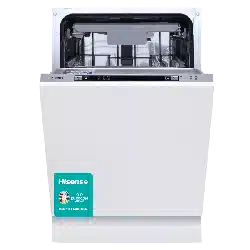
Operating instructions
Dishwasher
HV672C60UK

Contents
4Your dishwasher .....................................................................................................................
5Safety instructions ..................................................................................................................
6Installation .................................................................................................................................
6Winter storage/transport ...........................................................................................................
6Overflow guard function ...........................................................................................................
6Packaging .................................................................................................................................
6Disposal ....................................................................................................................................
7Before washing for the first time ...........................................................................................
7Water hardness .........................................................................................................................
7Set the Water hardness ............................................................................................................
7Top up with salt ........................................................................................................................
8Set the Rinse aid .......................................................................................................................
8Top up with rinse aid ................................................................................................................
9Greener dishwashing ..............................................................................................................
9The dishwasher saves energy and water ..................................................................................
10Loading the dishwasher .........................................................................................................
10Fragile dishes ............................................................................................................................
10Loading affects the results ........................................................................................................
10The dishwasher's baskets ........................................................................................................
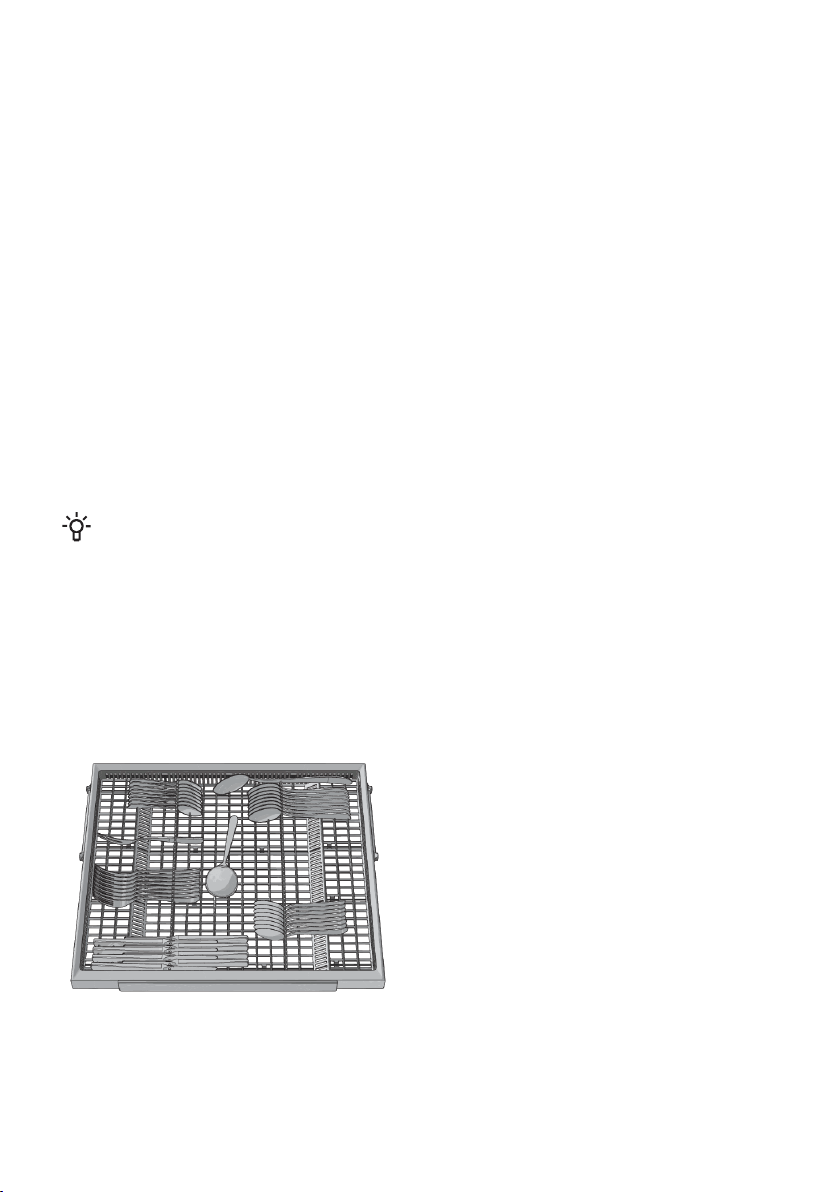
10Top cutlery tray .........................................................................................................................
11Upper basket ............................................................................................................................
12Lower basket ............................................................................................................................
13Using the dishwasher .............................................................................................................
13Add detergent ...........................................................................................................................
14The main power switch .............................................................................................................
14PROGRAM - Select program ....................................................................................................
15EXTRA - Select option ..............................................................................................................
16Starting the dishwasher ............................................................................................................
16TIME - Time remaining ..............................................................................................................
16Status light ................................................................................................................................
16Stopping or changing a program ..............................................................................................
16If you want to load more dishes ................................................................................................
16If the dishwasher is turned off due to a power failure ...............................................................
17Once the program has finished .................................................................................................
17How to get the best drying results ............................................................................................
17Unloading the dishwasher ........................................................................................................
18Program chart ...........................................................................................................................
19Settings ....................................................................................................................................
19Open the settings menu: ...........................................................................................................
19You can now adjust the following settings: ..............................................................................
21Care and cleaning ...................................................................................................................
21Top up with rinse aid ................................................................................................................
21Top up with salt ........................................................................................................................
22Cleaning the filters ....................................................................................................................
23Cleaning the spray arms ...........................................................................................................
2

23Clean the dishwasher inside and out ........................................................................................
24Remove blockages ...................................................................................................................
26Troubleshooting ......................................................................................................................
31Installation ...............................................................................................................................
31Safety instructions ....................................................................................................................
31Setup .........................................................................................................................................
32Drainage connection .................................................................................................................
32Connection to water supply ......................................................................................................
32Electrical connection .................................................................................................................
34Service .....................................................................................................................................
35Technical data and energy labelling .....................................................................................
35Technical data ...........................................................................................................................
35Information for consumers ........................................................................................................
35Information for test institute ......................................................................................................
3
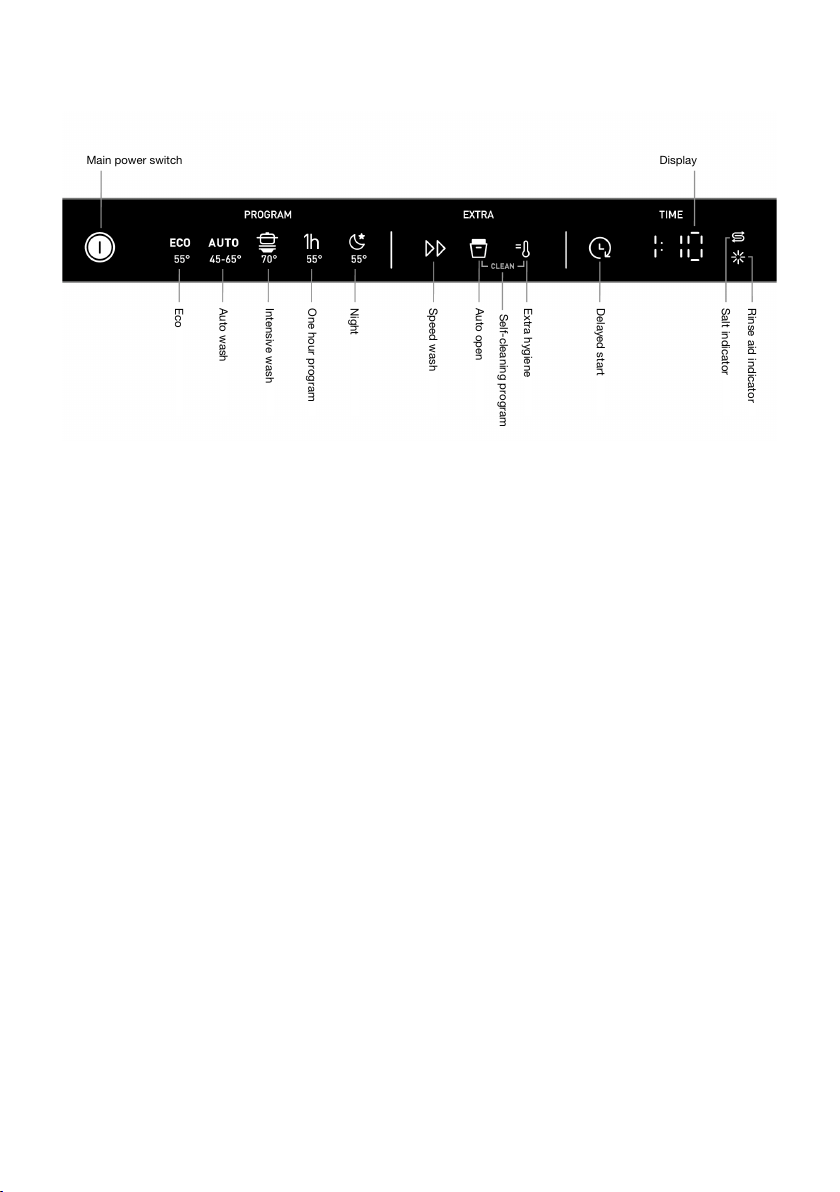
Your dishwasher
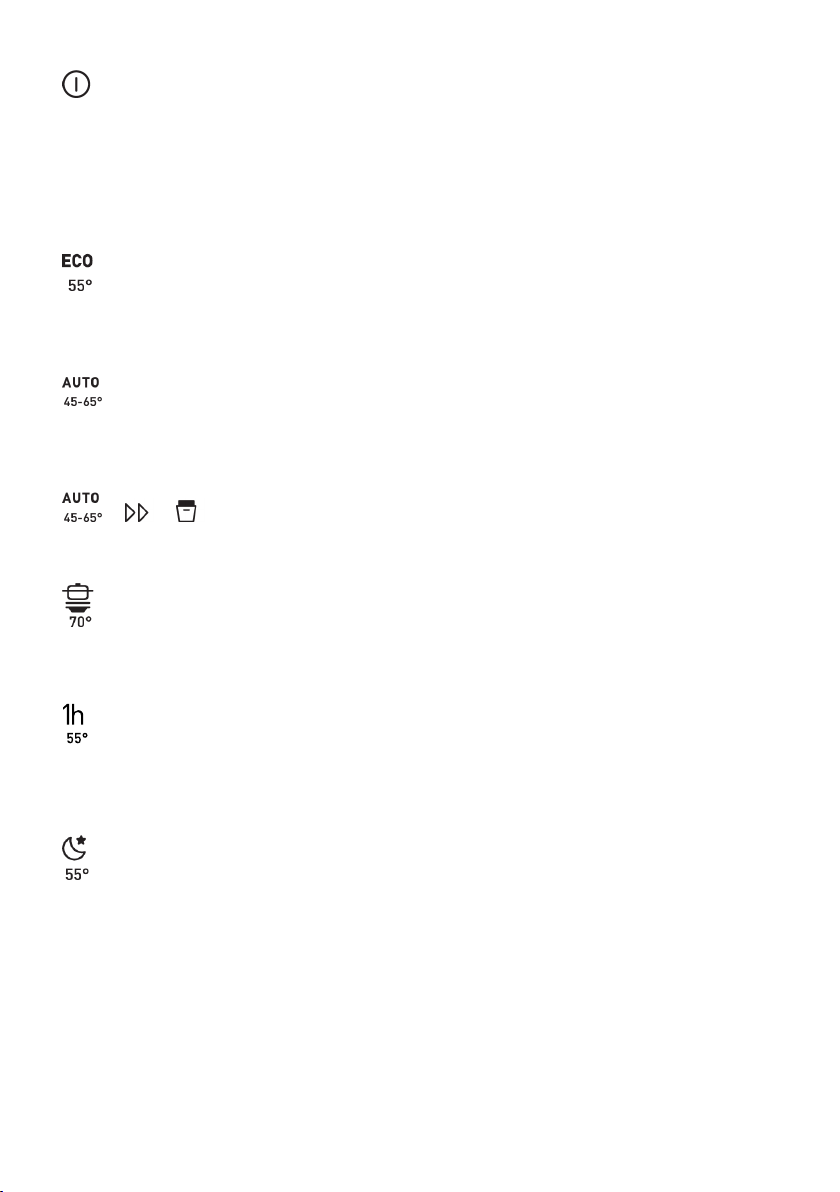
DisplayMain power switch
Eco
Speed wash
Auto wash
Intensive wash
One hour program
Night
Delayed start
Auto open
Extra hygiene
Salt indicator
Rinse aid indicator
Self-cleaning program
Install the dishwasher, see the chapter Installation. Following this, open the door and press the main
power switch to start using the machine.
The first time the dishwasher is switched on, it is important that you choose the right settings to ensure
good dishwashing results. See the chapter Before washing for the first time.
4

Safety instructions
• Read the operating instructions and keep them in a safe
place!
• Number of standard place settings: 16
• Never use the dishwasher for any purpose other than that
specified in these operating instructions.
• Do not load the dishwasher door or dishwasher baskets with
anything other than dishes.
• Never leave the dishwasher door open as someone may trip
on it.
• Use only dishwasher detergent!
• This machine can be used by children aged 8 and upwards,
and by people with reduced physical capacity, mental ability,
memory loss or lacking experience and knowledge. These
individuals must be supervised when using the machine or
have instructions on how to use the machine and understand
the risks that can occur. Cleaning of the machine must not
be carried out by children without supervision.
• Damaged mains cables must only be replaced by a qualified
electrician.
• Only use the dishwasher in household-type environments
for dishwashing household dishes. All other use is prohibited.
• Never place dishes with solvent residues in the dishwasher
due to the risk of explosion. Nor may dishes that contain
ash, wax or lubricants be washed in the dishwasher.
• Children must be watched. Do not allow children to use or
play with the dishwasher. Be especially vigilant when the
door is open. Some detergent may remain inside! After
adding detergent, always start the dishwasher immediately.
WARNING!
Knives and other pointed items must be placed horizontally
in the dishwasher's special cutlery baskets.
5

WARNING!
Children must be supervised – dishwasher detergent is
corrosive!
Installation
See the chapter Installation.
Winter storage/transport
Store the dishwasher above freezing and avoid long transport distances in very cold weather. Transport
the dishwasher upright or laying on its back.
Overflow guard function
The overflow protection starts pumping out the machine and turns off the water supply if the water
level in the dishwasher exceeds the normal level. If the overflow protection is triggered, F54 appears
on the display. Turn off the water supply and contact your nearest service centre.
Packaging
The outer packaging protects the product during transport. The packaging material is recyclable.
Separate the different packaging materials to help reduce raw material use and waste. Your dealer
can take the packaging for recycling or direct you to the nearest recycling centre. The packaging is
comprised of:
• Corrugated cardboard made from up to 100% recycled material.
• Expanded polystyrene (EPS) with no added chlorine or fluorine.
• Supports made from untreated wood.
• Protective plastic made from polyethylene (PE).
Disposal
The dishwasher is manufactured and labelled for recycling.
When the dishwasher has reached the end of its service life and is to be disposed of, it should
immediately be made unusable. Pull out the power cable and cut it as short as possible.
Contact your local authority for information about where and how your dishwasher should be correctly
recycled.
6
Before washing for the first time
Water hardness
In order to achieve good dishwashing results, the dishwasher needs soft water (water with low mineral
content). Hard water leaves a white coating on dishes and the dishwasher.
Checking water hardness
Water hardness is specified using the German water hardness scale (°dH) or the French water hardness
scale (°fH).
A water supply with a water hardness in excess of 6°dH (9°fH) must be softened. This is done
automatically with the aid of the built-in water softener. In order for the water softener to function
optimally, it must be adjusted to the hardness of the water supply. Once you have adjusted the water
softener, use detergent and rinse aid doses suitable for soft water.
Contact the local waterworks to check the water hardness in your area.
Make a note of the water hardness:____________
If the water hardness exceeds 50°dH (89°fH), we recommend connecting an external water softener.
Increased consumption during regeneration
The dishwasher's built-in water softener is regularly regenerated to maintain its function. Regeneration
extends the dishwashing program and increases energy and water consumption. Just how often the
dishwasher's water softener is regenerated depends on the selected setting.
Example: If the Ecoprogram is run with a water hardness of 14 °dH (25 °fH), the water softener is
regenerated at regular intervals (after 6 dishwashing cycles), energy consumption increases by 0.015
kWh and water consumption increases by 2.3 litres while the program time is extended by 3 minutes.
Regeneration occurs during the program's main wash.
WARNING!
Hard water leaves a white coating on dishes and inside the dishwasher. It is therefore important
that you select the right setting for the water softener! See Water hardness in the chapter Settings.
Never run the dishwasher with an empty salt compartment if the water supply has a water
hardness in excess of 6°dH (9°fH).
Set the Water hardness
Chapter Settings describes how to adjust the water softener.
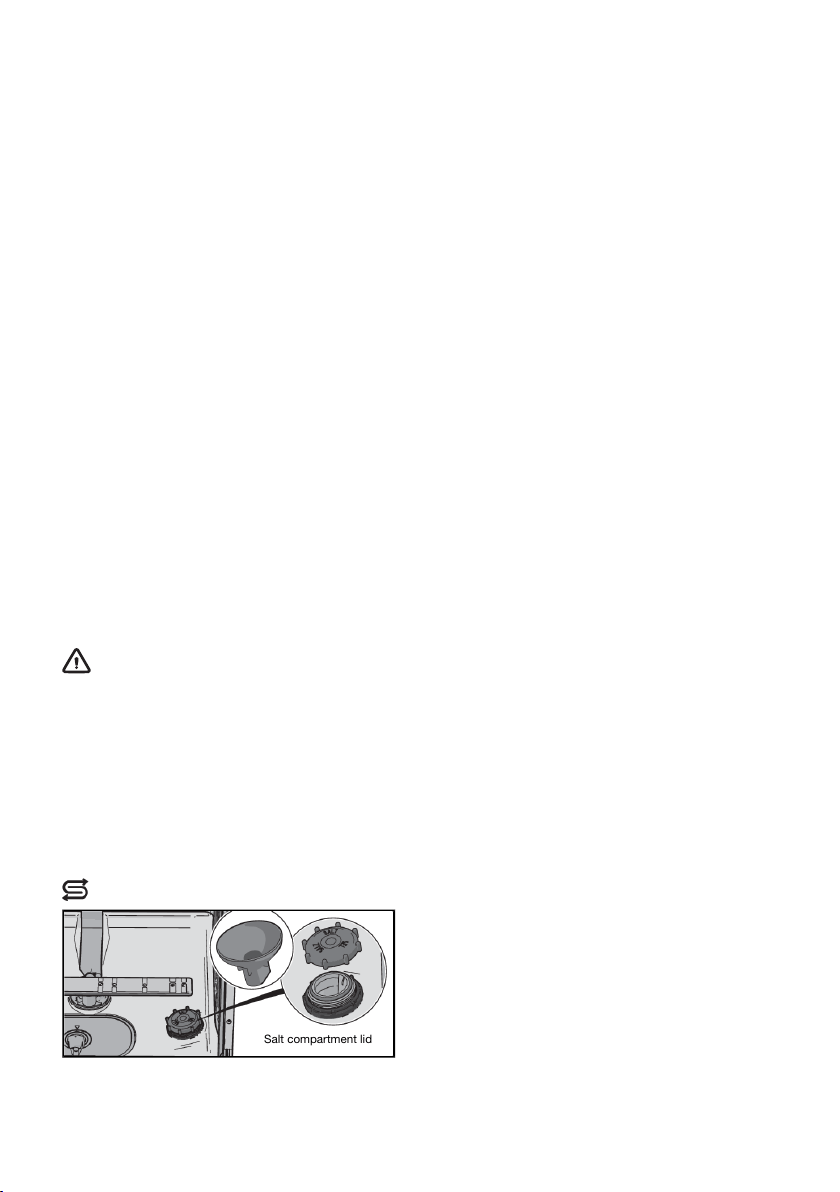
Top up with salt
Salt compartment lid
1. Unscrew the salt compartment lid.
7
2. Place the funnel supplied with the dishwasher in the salt compartment top-up hole. First, pour in
about 1 l of water.
3. Then add salt, a maximum of 630 gram, until the compartment is full. Use large grain salt or special
dishwasher salt.
4. Wipe up any excess salt so that the lid can be screwed on firmly.
In order to avoid rust stains a dishwashing program must be started immediately after adding salt.
Set the Rinse aid
The chapter Settings describes how to set the rinse aid dosage.
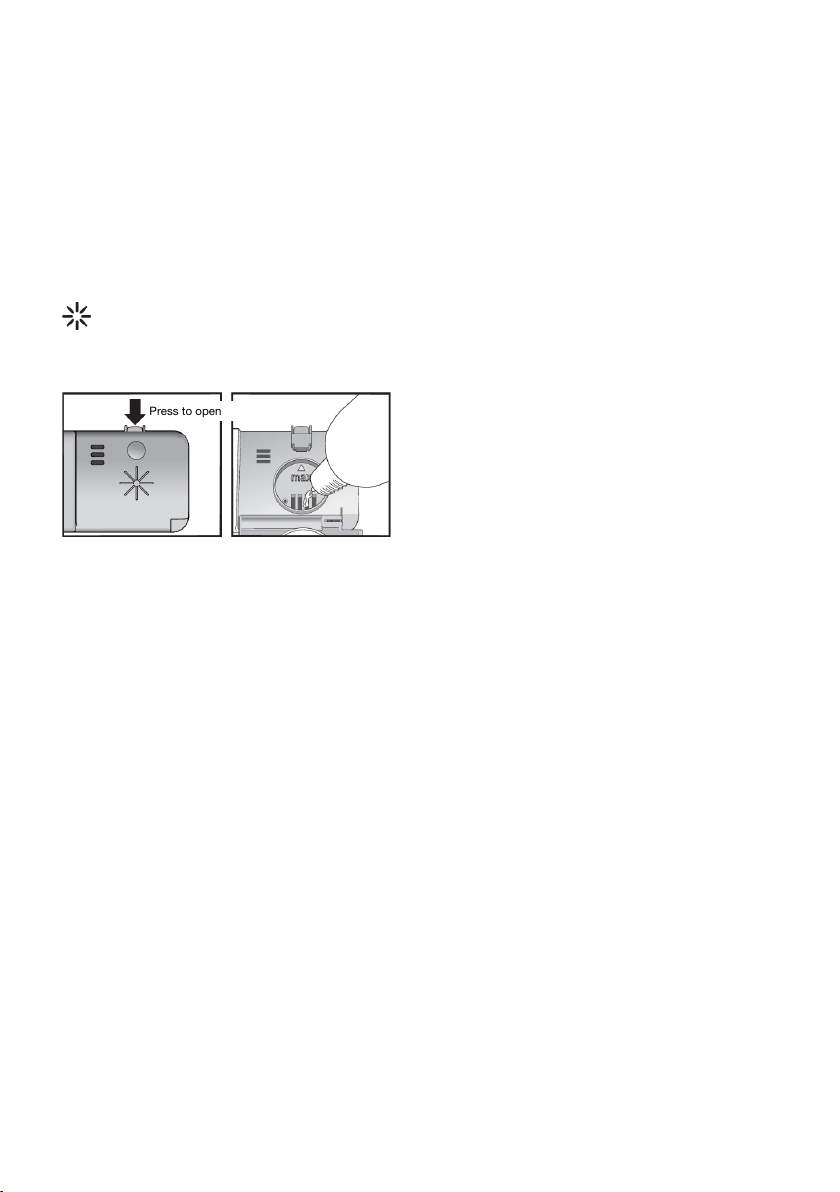
Top up with rinse aid
Drying is faster and a better result is achieved if you use rinse aid. You will also achieve a better
dishwashing result with clear and spotless dishes.
Press to open
1. Open the rinse aid compartment lid.
2. Carefully top up with rinse aid to the level marked max.
3. Wipe up any splashes of rinse aid around the compartment.
4. Close the lid firmly.
8

Greener dishwashing
The dishwasher saves energy and water
When using a dishwasher in a residential setting, less energy and water are generally used compared
to washing the dishes by hand.
Do not rinse under running water
Do not rinse the dishes under running water as this will lead to increased energy and water consumption.
Simply scrape off large food particles before loading the dishwasher.
Choose a green detergent
Read the environmental declaration on the packaging!
Too much detergent, rinse aid and salt can result in less effective dishwashing and also entail greater
environmental impact.
Run a fully loaded dishwasher
Save energy and water by waiting until the dishwasher is full before running a program (see number
of standard place settings).
Run programs at a lower temperature
If the dishes are only slightly dirty, you can select a program with a low temperature.
Select dishwashing program – Eco
This program is suitable for washing normally dirty dishes and is the most effective program in terms
of combined energy and water consumption. This program is used to assess compliance with EU
legislation on ecodesign.
The dishwashing program is designed for an effective wash using as little energy and water as possible.
The program washes at a low temperature for a long time.
Select option – Auto open
Better drying results are achieved if you use the Auto open option, which automatically opens the
dishwasher door. Wait until the dishwasher indicates that the program has ended and the dishes have
cooled before unloading the dishwasher. (If the dishwasher is built-in the surrounding furnishings must
be resistant to any condensation from the dishwasher.)
Connect to cold water
Connect the dishwasher to the cold water supply if the building is heated using oil, electricity or gas.
Connection to hot water supply
Connect the dishwasher to the hot water supply (max. 70 °C) if the building is heated using an
energy-efficient means such as district heating, solar power or geothermal power. Choosing a hot
water connection cuts dishwashing times and reduces the dishwasher's energy consumption.
NOTE!
Do not exceed the permitted water supply temperature. Certain materials used in some cookware
cannot withstand strong heat.
9
Loading the dishwasher
Fragile dishes
Some cookware is not dishwasher safe. This can be for several reasons. Some materials cannot
withstand strong heat, others can be damaged by dishwashing detergent.
Exercise caution with, for example, handmade items, fragile decoration, crystal/glassware, silver,
copper, tin, aluminium, wood and plastic. Look for the "Dishwasher safe" marking.
Loading affects the results
Load the dishes carefully to ensure the best washing and drying results with the lowest possible energy
and water consumption. Give your dishwasher the best chance to reach and clean all surfaces, as
well as to dry the dishes as thoroughly as possible.
• All dirty surfaces should face inwards and downwards!
• Dishes should not be placed in or on each other.
• Angle dishes with hollows, such as cups, so that the rinse water will run off. This is also important
for plastic items.
• Make sure small items cannot fall through the dishwasher basket; place them in the top cutlery
tray.
NOTE!
Check that the spray arms can rotate freely.
The dishwasher's baskets
The dishwasher is equipped with a top cutlery tray, an upper basket and a lower basket.
The appearance of the baskets may differ depending on the dishwasher setup.
Top cutlery tray
The top cutlery tray has space for cutlery, ladles, whisks, serving cutlery and similar items.
10
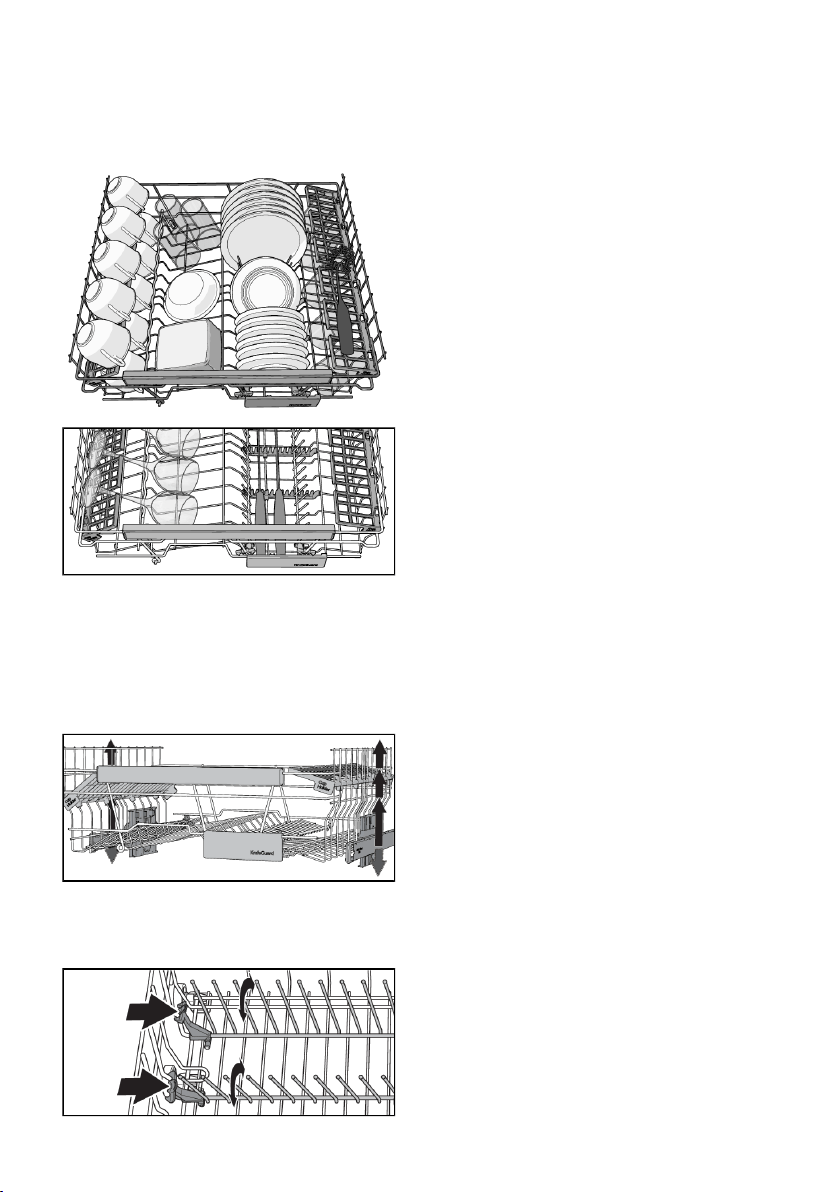
Upper basket
Place glasses, cups, bowls, side plates and saucers in the upper basket. All dirty surfaces should face
inwards and downwards! Wine glasses are placed on the wine glass shelf and knives are placed in
the knife stand on the right (if fitted).
Raising and lowering the upper basket
1. Pull out the upper basket.
2. Grab the sides of the upper basket with both hands and lift it up.
3. Repeatedly lift the basket with both hands to change its position. (The upper basket can be set
in three positions.) When the upper basket is in the highest position lifting it will return it to the
lowest position. Note that both sides of the basket must always be set to the same height.
Foldable tines
The foldable tines can be folded up or down to make it easier to load pots, bowls and glasses. Release
the foldable tines by pressing the catch inwards before adjusting their position.
11
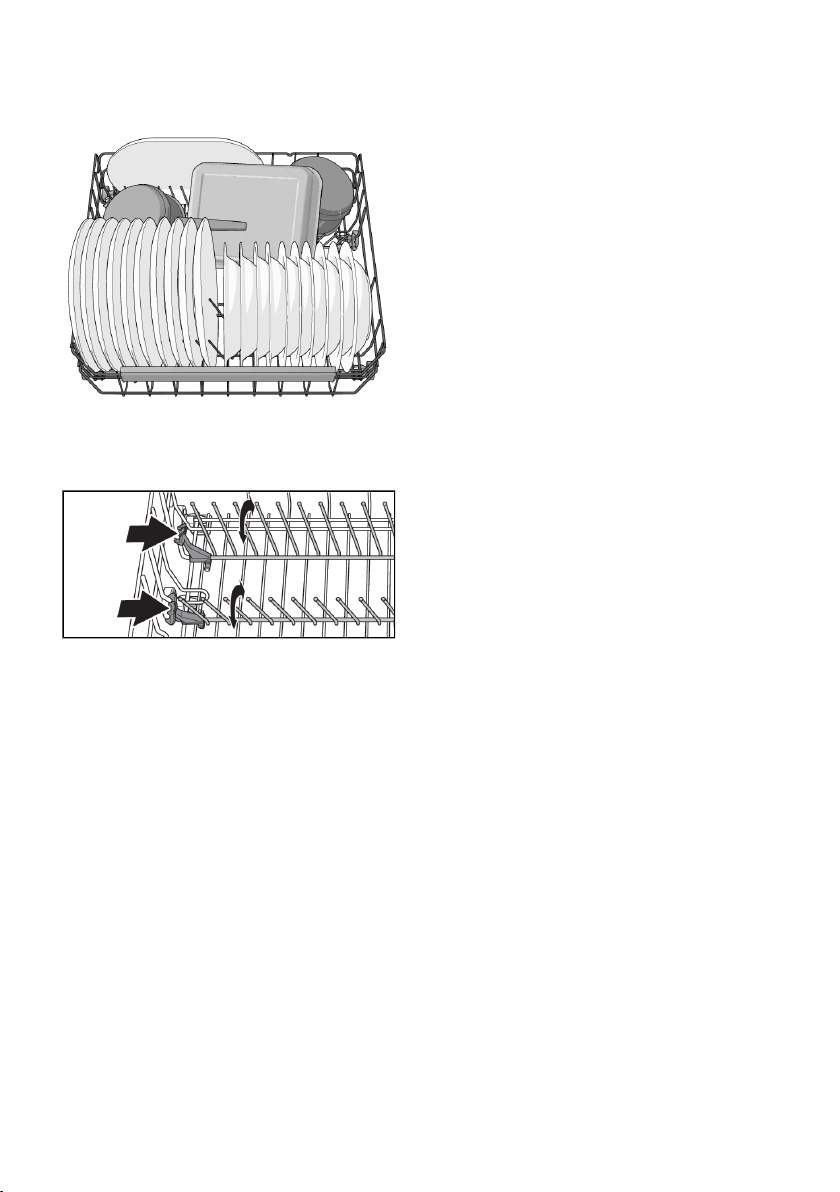
Lower basket
Place plates, side plates, serving dishes and pots in the lower basket.
Foldable tines
Fold down the foldable tines (plate supports) when dishwashing pots. Release the foldable tines by
pressing the catch inwards before adjusting their position.
12
Using the dishwasher
Add detergent
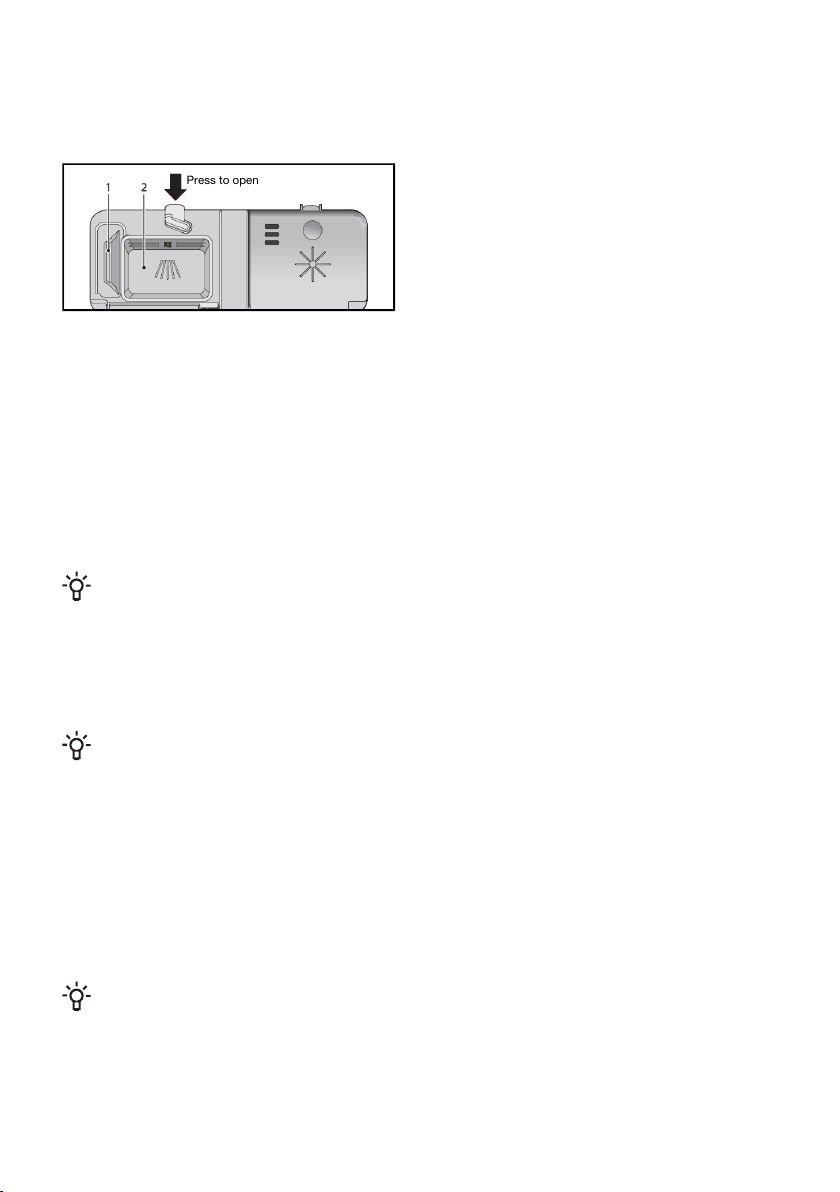
Press to open
1. Prewash detergent compartment
2. Main wash detergent compartment
Detergent is added according to water hardness.
Follow the instructions on the detergent packaging. This dishwasher is fitted with a water softener,
so use detergent and rinse aid doses suitable for soft water.
Too much detergent can result in less effective dishwashing and also entails greater environmental
impact.
The detergent compartment must be dry when adding detergent. There is one compartment for the
prewash and one for the main wash. If powder or liquid dishwasher detergent is used, add a small
amount of the detergent to the prewash compartment. Contact the detergent manufacturer if you
have questions about the detergent.
NOTE!
Use only dishwasher detergent! Washing up liquid must not be used as the foam that forms
prevents the dishwasher from operating effectively.
Dishwasher tablets
Halve the tablet if it is difficult to close the dispenser lid. There is a risk that the detergent will not be
released properly if the lid is tight and will not open correctly.
NOTE!
Dishwasher tablets are not recommended for short programs (less than 75 minutes). Use powder
or liquid dishwasher detergent instead.
All-in-one detergent
There are many types of all-in-one detergents on the market. Read through the directions for these
products carefully.
Chapter Settings describes how to activate TAB (3-in-1/ All-in-one detergent). Note that salt must be
put in the salt compartment. If you are not satisfied with the dishwashing or drying results, deactivate
the setting TAB (3-in-1/ All-in-one detergent) and top up with salt, detergent and rinse aid. See Chapter
Before washing for the first time.
NOTE!
Optimal washing and drying results are achieved by using normal detergent together with
separately dispensed rinse aid and salt.
13
The main power switch
Press and hold the main power switch until the display lights up. Also check that the water tap is on.
PROGRAM - Select program
Select a program to suit the type of dishes and how dirty they are. Eco is always pre-selected.
Press the desired program until the program symbol is activated.
Eco
This program is suitable for washing normally dirty dishes and is the most effective program in terms
of combined energy and water consumption. This program is used to assess compliance with EU
legislation on ecodesign.
Auto wash
The dishwasher can measure how dirty the dishes are and adjust water consumption and temperature
accordingly. When newly installed, the program needs to be run five times before it is fully adapted
and can provide the best results.
+ + QuickIntensive
1)
QuickIntensive (Auto wash + Speed wash + Auto open) is an effective program for slightly dried
leftovers. (This program is not intended for burnt food, such as on oven dishes.)
Intensive wash
A program with a high temperature to dissolve grease on very dirty dishes, such as pans, casserole
dishes and oven dishes. If these dishes do not completely fill the dishwasher, you can add plates and
the like.
One hour program
A quick program for slightly dried leftovers. (This program is not intended for burnt food, such as on
oven dishes.)
In combination with Speed wash, a shorter program is achieved (15 minutes).
Night
A quieter dishwashing program, suitable for running at night. To keep the noise down, the program
time is extended.
1)
Program time 90 minutes.
14
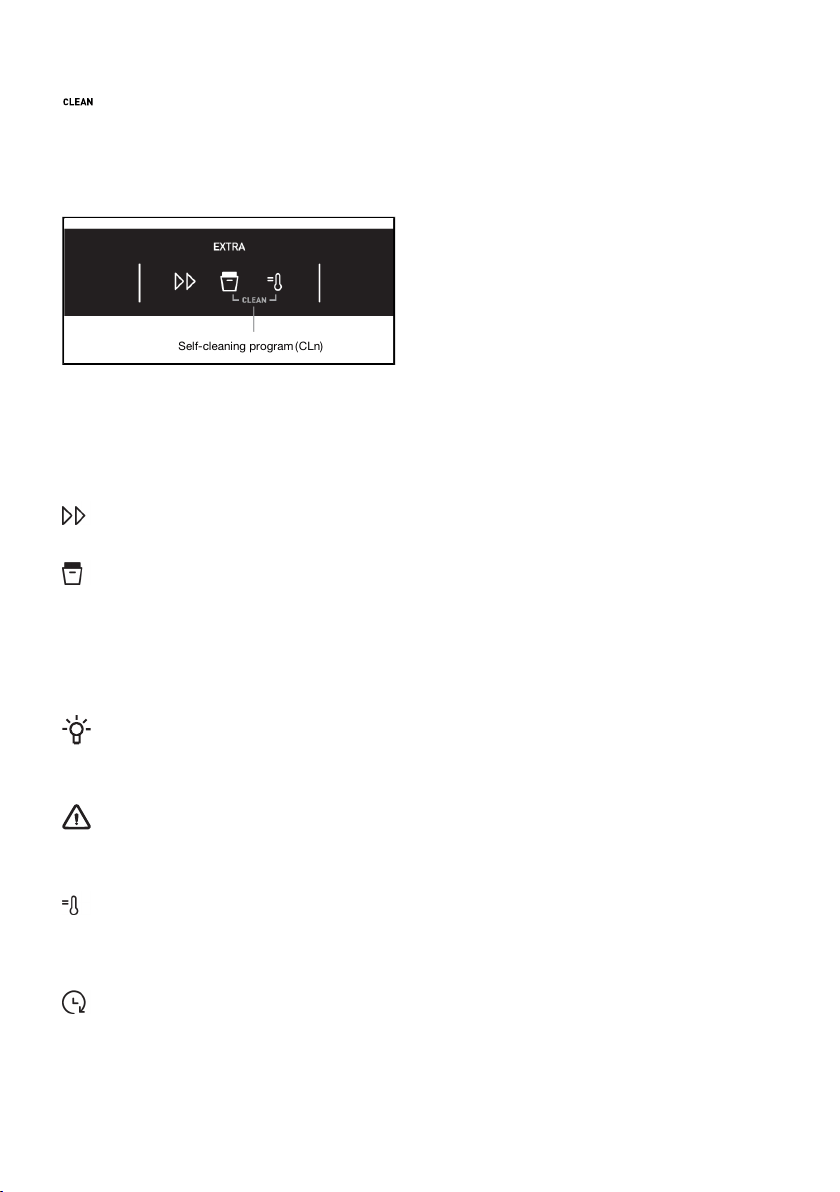
Self-cleaning program
Self-cleaning program for hygienic cleaning of the dishwasher tub, spray arms and spray pipes.
This program should be run (with no dishes in the machine) using normal dishwasher detergent or
citric acid. Special dishwasher cleaners are also available on the market. For the removal of limescale
deposits, see Dishwasher tub in the chapter Care and cleaning.
Press and hold the option buttons for
Self-cleaning program to activate the program.
Self-cleaning program starts when the door is
closed.
Self-cleaning program (CLn)
EXTRA - Select option
To select an option, press one of the option buttons until the option is activated. The available options
vary between program and some options cannot be combined (available options glow dimly).
Speed wash
This option shortens the program time, but uses more energy and water.
Auto open
2)
The dishwasher door opens automatically, which improves the drying results. Wait until the dishwasher
indicates that the program has ended and the dishes have cooled before unloading the dishwasher.
(If the dishwasher is built-in the surrounding furnishings must be resistant to any condensation from
the dishwasher.)
The drying time for the Auto open option varies between programs.
NOTE!
For the best drying results, do not close the door before the drying phase has finished and the
machine has automatically switched off.
WARNING!
The dishwasher door must not be blocked or closed when opened automatically. Doing so may
damage the door lock mechanism. Wait at least 5 minutes before closing the door.
Extra hygiene
This option is intended for situations where demands on hygiene are especially high, such as when
dishwashing baby bottles and cutting boards. The temperature is increased in both the main wash
and the final rinse.
Delayed start
When you select Delayed start the dishwasher will start 1-24 hours after you close the door.
2)
The Auto open option is pre-selected for some programs.
15
1. Press the button once to activate Delayed start. Press the button several times – or hold it in – to
set the desired number of hours.
2. Close the door and the dishwasher counts down 1 hour at a time and starts after the selected
delay.
If you want to cancel the Delayed start option, open the door and press and hold the main power
switch until the display turns off.
Starting the dishwasher
Close the door to start the dishwasher. If the main power switch is on the dishwasher will start
automatically when the door is closed.
TIME - Time remaining
Once you have chosen a program and options, the time the program took when last used is displayed.
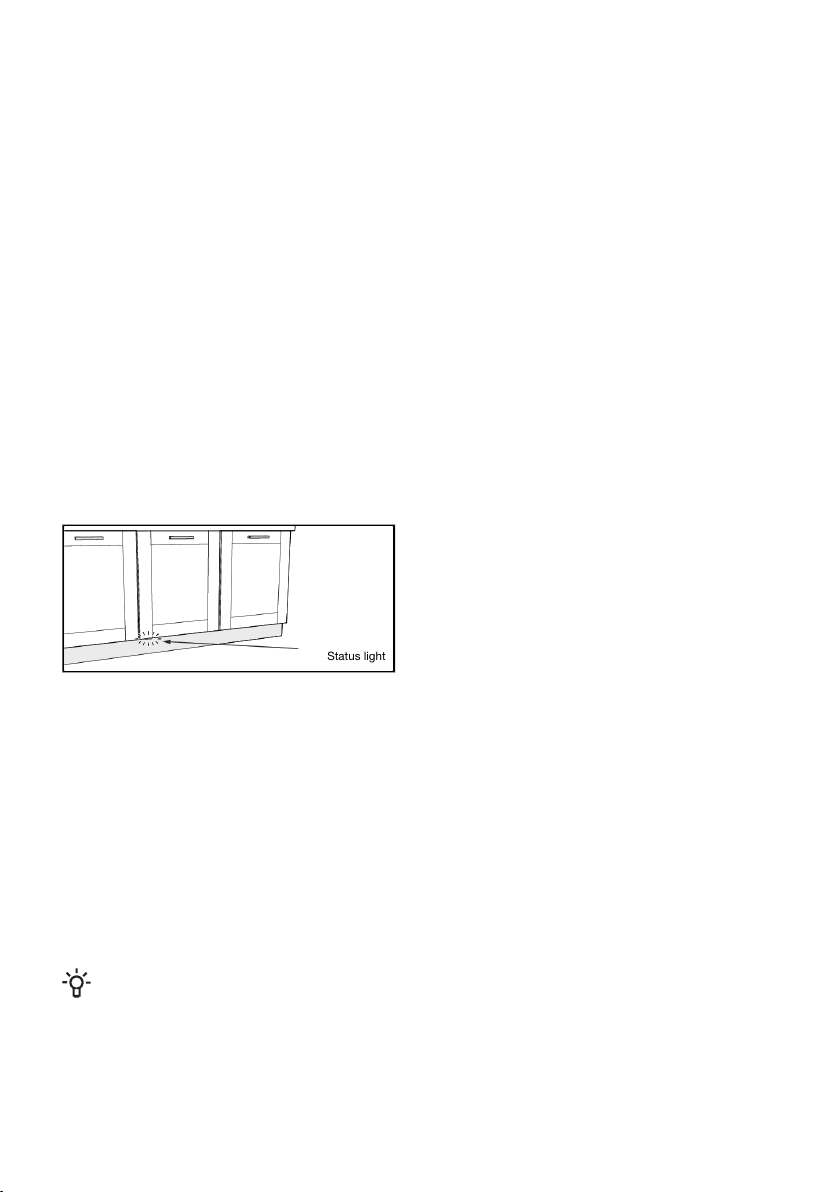
Status light
The status light on the bottom part of the dishwasher indicates that a program has started.
Flashing light
A flashing light indicates that the door has been opened while a program is in progress. If it flashes
when the door is closed, an error has occurred. See the chapter Troubleshooting.
Status light
Stopping or changing a program
If you want to change program after starting the dishwasher, open the door then press and hold the
main power switch until the display turns off. Add more detergent if the lid of the detergent dispenser
has opened. Then press the main power switch, select a new program and close the door.
If you want to load more dishes
Open the door. The dishwasher stops automatically. Add the dishes and close the door. After a while,
the dishwasher continues the program.
If the dishwasher is turned off due to a power failure
If the dishwashing program was not finished, the interrupted program continues when power is restored.
NOTE!
During drying, the program is interrupted if the power is cut or the door is open for more than 2
minutes.
16

Once the program has finished
The end of the program is indicated by one short signal from the buzzer. The chapter Settings describes
how to change this function.
Moreover, the end of the program is indicated by the status light turning off. See Status light in the
chapter Using the dishwasher.
The dishwasher switches off automatically after the program ends. Shut off the water tap after each
use.
How to get the best drying results
• Fully load the dishwasher.
• Angle dishes with hollows, such as cups, so that the rinse water will run off. This is also important
for plastic items.
• Top up with rinse aid or increase the rinse aid dosage level.
• Activate the Auto open option.
• Allow the dishes to cool before unloading the dishwasher.
Unloading the dishwasher
Hot porcelain is more fragile. Leave the dishes to cool in the dishwasher before unloading them.
Unload the lower basket first to avoid any water drops from the upper basket falling onto the dishes
in the lower basket.
17
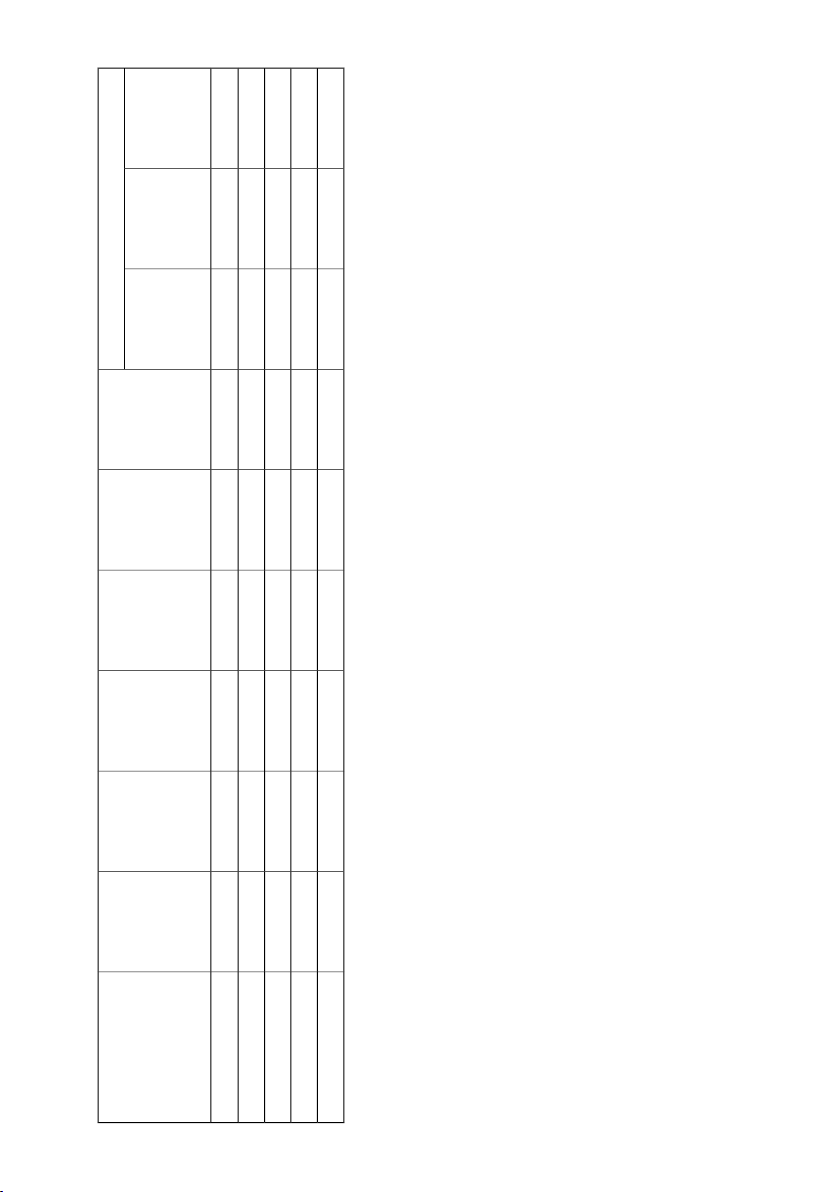
Program chart
Consumption values
1)
Final rinseNumber of
rinses
Main washPrewashesEXTRA
- Options
Detergent,
compart-
ment 1 / 2
(ml)
PROGRAM
- Program
Water
cons. (L)
Energy
(approx.
kWh)
Dishwash-
ing time
(approx.
hrs:min)
9.60.763:2548 °C255 °C0Auto open--- / 25
Eco
2)
9-180.9-1.52:10-2:5065 °C2-350-65 °C1-3Auto open--- / 25Auto wash
151.62:5570 °C270 °C210 / 25Intensive wash
8.50.81:0065 °C255 °C---- / 25One hour program
9.61.15:2865 °C250 °C0--- / 25Night
1)
Consumption values vary depending on the temperature of the incoming water, room temperature, load size, selected additional functions and
more. The values for the Eco program are accurate, others are indicative only.
2)
This program is suitable for washing normally dirty dishes and is the most effective program in terms of combined energy and water consumption.
This program is used to assess compliance with EU legislation on ecodesign.
18
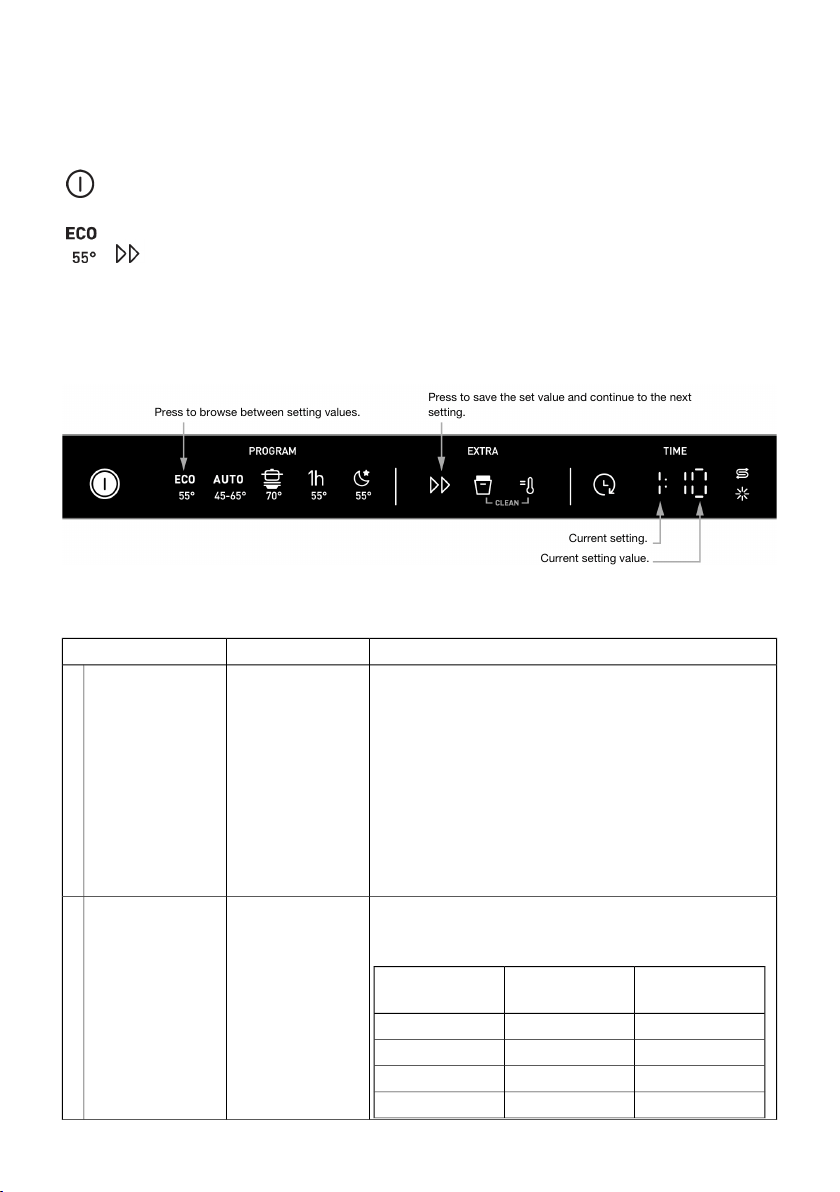
Settings
Open the settings menu:
First, open the door. Turn off the machine. Press and hold the main power switch
until the display lights up.
1
Within 10 seconds:
- press the program button for Eco and the option button for Speed wash.
2
+
The display shows the settings menu (current setting and its currently set value).3
(Exit the menu by browsing through the menu or pressing the main power switch.)
Navigate the settings menu:
Press to browse between setting values.
Press to save the set value and continue to the next
setting.
Current setting.
Current setting value.
You can now adjust the following settings:
OptionsSettings
Rinse aid dosage setting.1:00 - 1:05Rinse aid1
Increase the rinse aid dosage:
• If the dishes have water marks.
Decrease the rinse aid dosage:
• If the dishes have a sticky white/blue film.
• If the dishes are streaked.
• Build-up of foam. If you have very soft water, the
rinse aid can be diluted 50:50 with water.
Pre-selected at factory: 05
Adjusting the water softener. Select a setting depending
on the hardness of the water supply. It is important that
this setting is correct!
2:00 - 2:09Water hardness2
Recommended
setting
French water
hardness scale
German water
hardness scale
2:000-9°fH0-5°dH
2:0110-14°fH6-8°dH
2:0215-20°fH9-11°dH
2:0321-25°fH12-14°dH
19
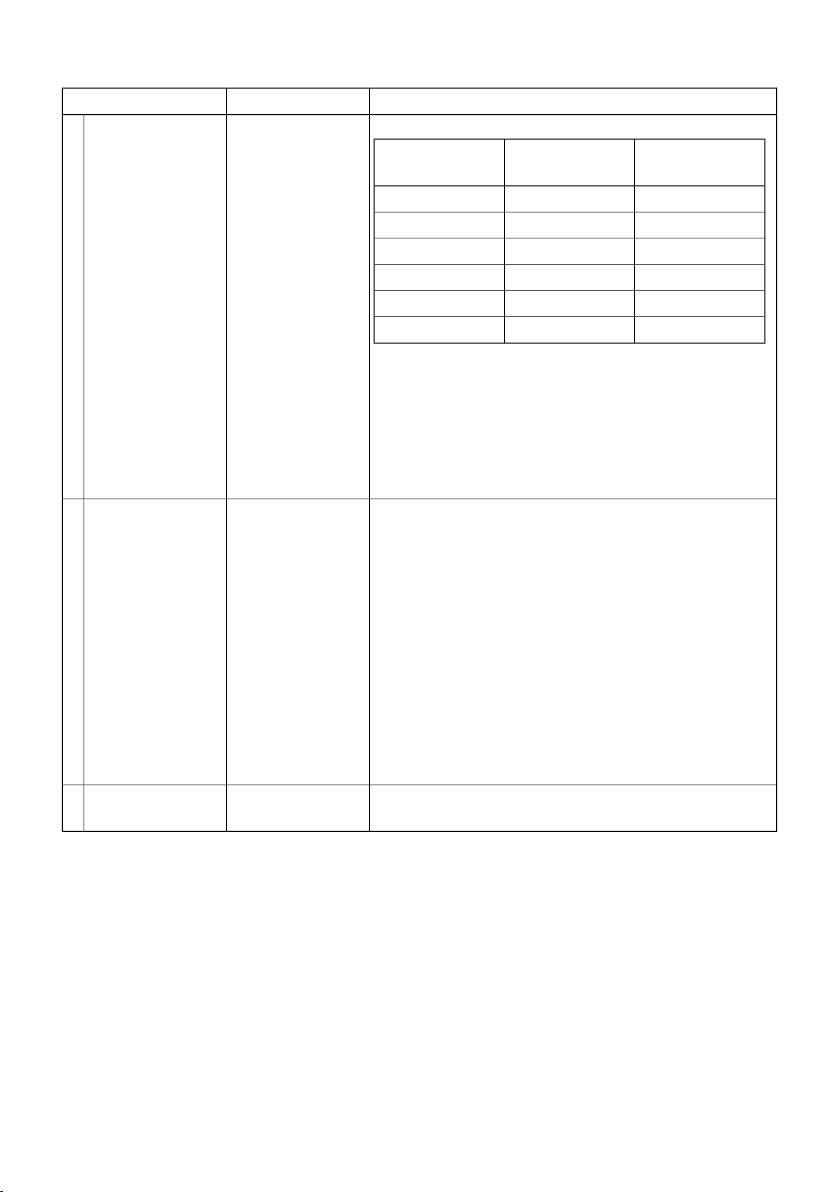
Table continued from last page
OptionsSettings
Table continued from last page
Recommended
setting
French water
hardness scale
German water
hardness scale
2:0426-34°fH15-19°dH
2:0535-43°fH22-24°dH
2:0644-52°fH25-29°dH
2:0753-70°fH30-39°dH
2:0871-88°fH40-49°dH
2:0989°fH50°dH
Do not forget to put salt in the salt compartment after
you have set the water softener to 2:01 - 2:09.
For a water supply with a hardness under 6°dH (9°fH),
select 2:00. The water softener is deactivated and no
salt is needed.
Pre-selected at factory: 04
You can activate this setting when using 3-in-1/ All-in-
one detergent. The dishwashing programs automatically
adapt to provide the best possible dishwashing and
drying results every time. If this setting is activated there
is no need to add rinse aid since this option disables
rinse aid dispensing. It also reduces the amount of salt
added to the water softener. Note that salt must be put
in the salt compartment.
3:00 (Off)
3:01 (On)
TAB
(3-in-1/all-in-one
detergent)
3
In order to achieve good dishwashing results, it is essen-
tial to check which type of detergent or all-in-one
product best suits your needs! Read the detergent
packaging carefully for information on proper use. Al-
ways follow the directions for use or information on the
detergent packaging!
The dishwasher uses a buzzer to indicate when a pro-
gram is finished or when a fault has occurred.
4:00 - 4:03Buzzer volume4
20
Care and cleaning
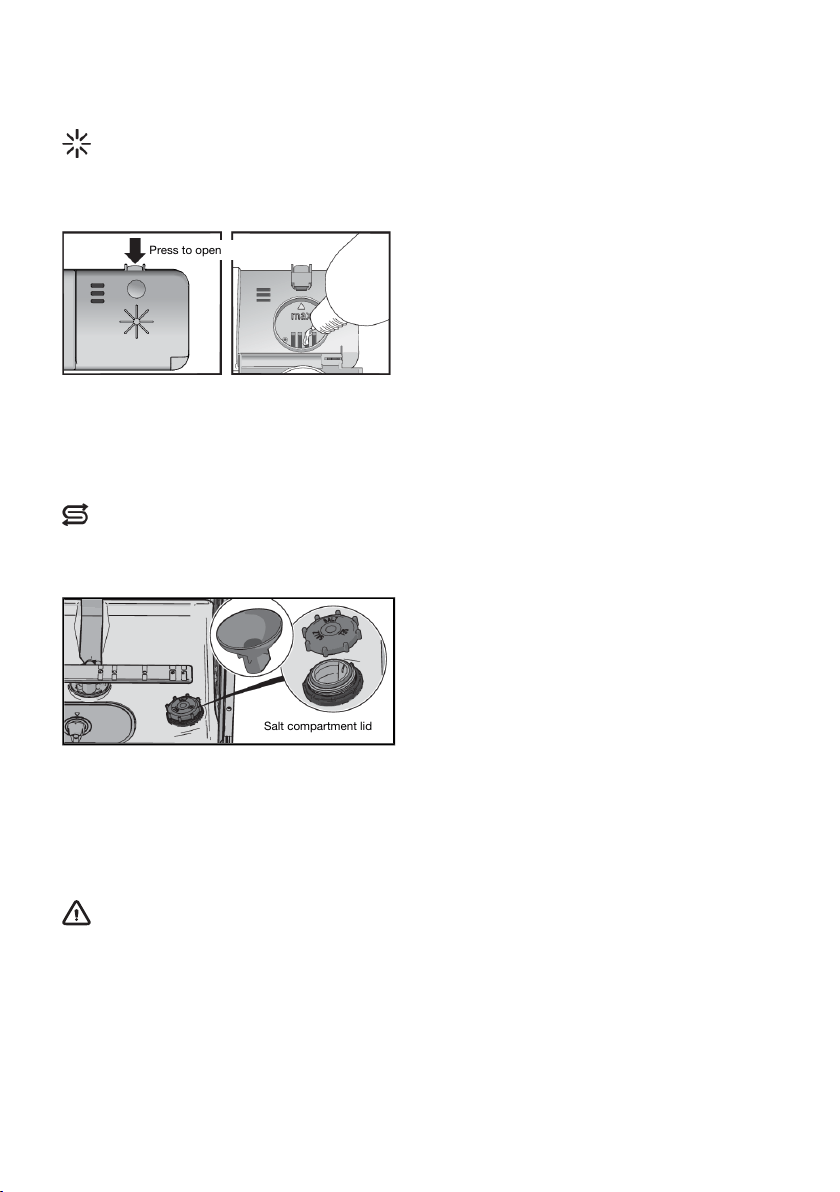
Top up with rinse aid
When the rinse aid needs topping up, the above symbol lights on the display.
After topping up, it may take a while before the symbol goes out.
Press to open
1. Open the rinse aid compartment lid.
2. Carefully top up with rinse aid to the level marked max.
3. Wipe up any splashes of rinse aid around the compartment.
4. Close the lid firmly.
Top up with salt
When the salt needs topping up, the above symbol lights on the display.
After topping up, it may take a while before the symbol goes out.
Salt compartment lid
1. Unscrew the salt compartment lid.
2. Place the funnel supplied with the dishwasher in the salt compartment top-up hole. (Water is only
needed the first time.)
3. Then add salt, a maximum of 630 gram, until the compartment is full. Use large grain salt or special
dishwasher salt.
4. Wipe up any excess salt so that the lid can be screwed on firmly.
WARNING!
In order to avoid rust stains a dishwashing program must be started immediately after adding
salt.
Never pour dishwasher detergent into the salt compartment. This destroys the water softener!
21
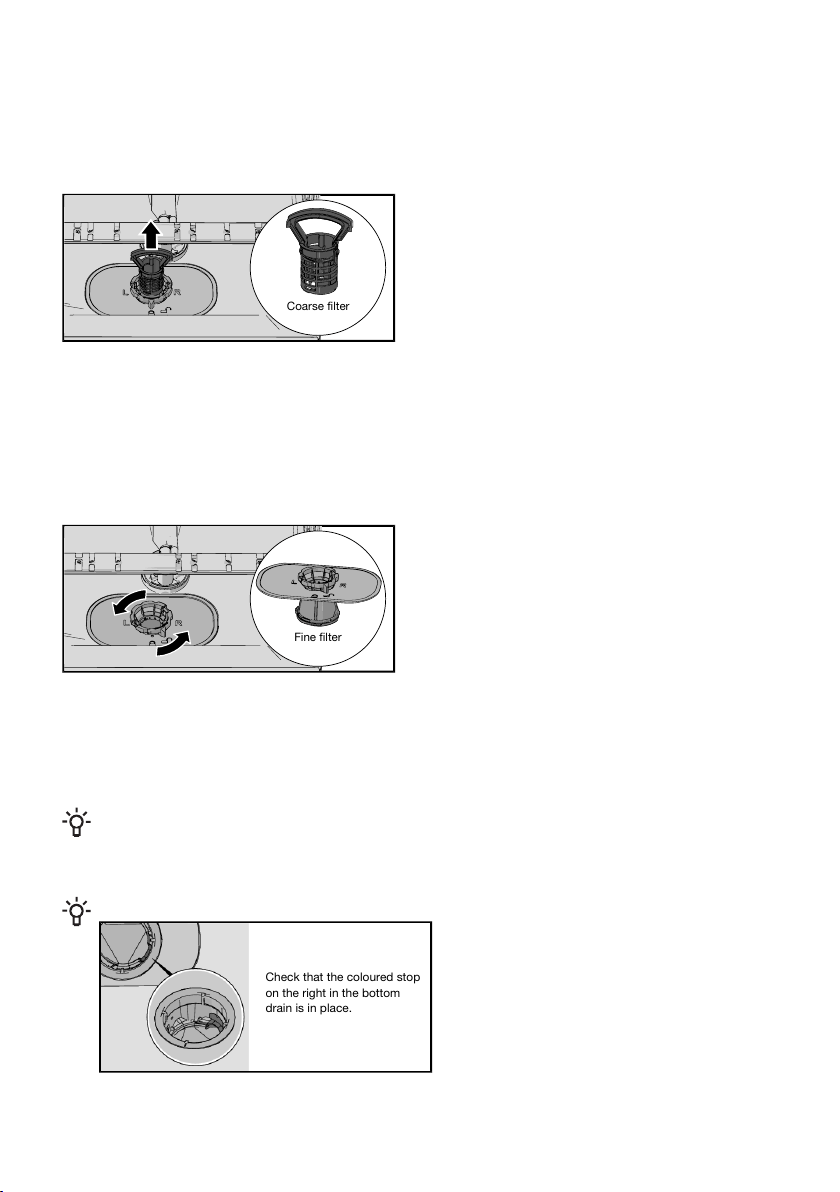
Cleaning the filters
Coarse filter
The coarse filter traps larger food particles, which cannot get past the drainage pump. Empty the
coarse filter when necessary. It should be cleaned at regular intervals depending on how often the
dishwasher is used.
Coarse filter
1. Lift the coarse filter by the handle.
2. Empty the coarse filter.
3. Refit the coarse filter. Press it down until it clicks into place.
Fine filter
Debris that collects on the fine filter is automatically rinsed away during each wash. Clean the fine
filter when necessary. It should be cleaned at regular intervals depending on how often the dishwasher
is used.
Fine filter
1. Turn the locking ring anticlockwise and lift the fine filter straight up.
2. Clean the fine filter.
3. Refit the fine filter and turn the locking ring clockwise to its stop position. Check that the edges
seal properly.
Remember to refit the coarse filter!
NOTE!
Dishwashing results may be affected if the coarse and fine filters are incorrectly fitted. The
dishwasher must not be used without the filters in place!
NOTE!
Check that the coloured stop
on the right in the bottom
drain is in place.
22
NOTE!
Dishwashing results may be affected if the coarse and fine filters are incorrectly fitted. The
dishwasher must not be used without the filters in place!
Cleaning the spray arms
Holes and bearings can sometimes become blocked. Remove any debris using a pin or the like. The
spray arms also have holes underneath.
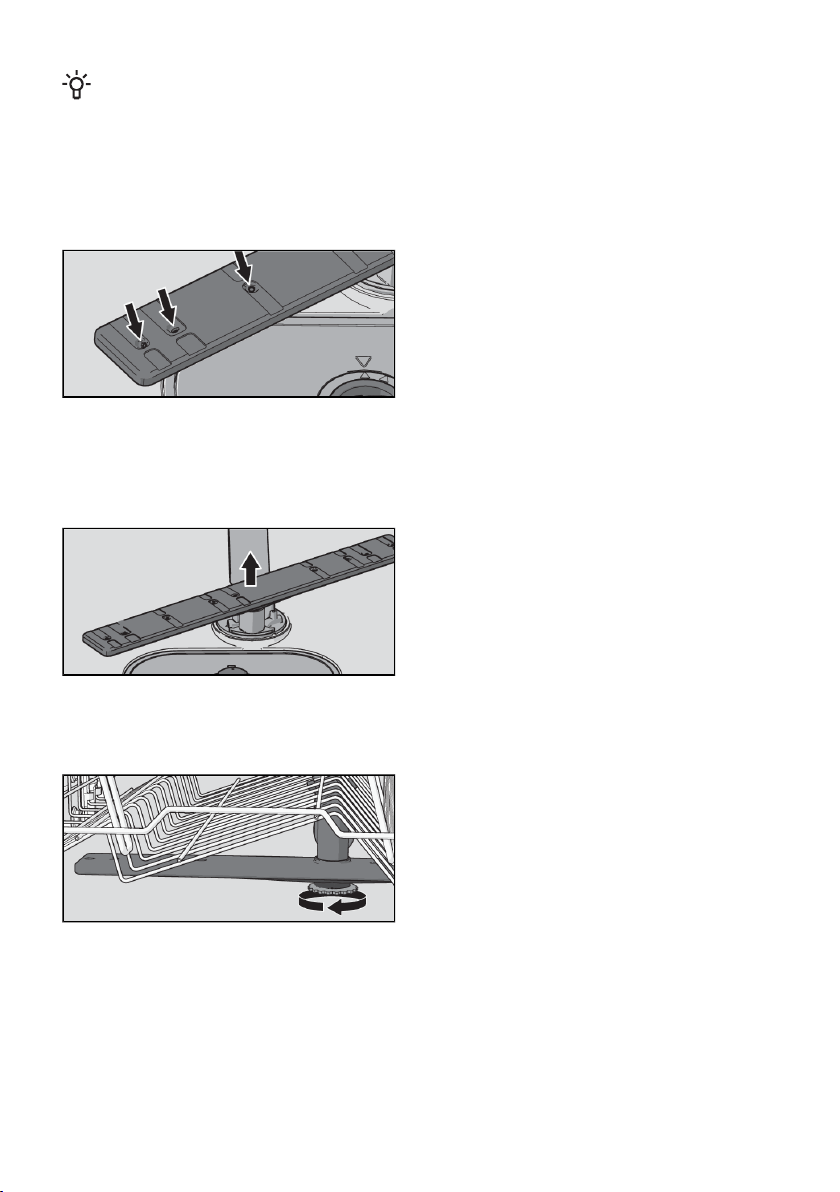
To facilitate cleaning you can remove the spray arms. Remember to fit them firmly back into place
afterwards.
Lower spray arm
• Pull the lower spray arm straight up to release it.
Upper spray arm
1. Pull out the upper basket.
2. Unscrew the spray arm bearings counterclockwise to remove the spray arm from the upper basket.
Clean the dishwasher inside and out
Door and door seal
Open the door. Clean the sides of the door and the door seal regularly with a slightly damp cloth.
Clean the door seal at the lower front edge of the dishwasher with a washing-up brush.
23
Display and buttons
Keep the display and the buttons clean. If necessary, wipe them with a dry or slightly damp cloth.
Never use cleaning products – they may scratch the surface.
Use the main power switch to switch off the dishwasher when cleaning the buttons to avoid activating
them inadvertently.
Dishwasher tub
The dishwasher tub is made of stainless steel and is kept clean through normal use (when used
regularly).
If you have hard water, limescale deposits may build up in the dishwasher. If this happens, run the
Self-cleaning program program with two tablespoons of citric acid in the detergent compartment (with
no dishes in the machine). Special dishwasher cleaners are also available on the market.
Remove blockages
Unblocking the drainage pump
If the dishwasher still contains water after the program has finished, something may be blocking the
drainage pump. Such blockages are easily removed.
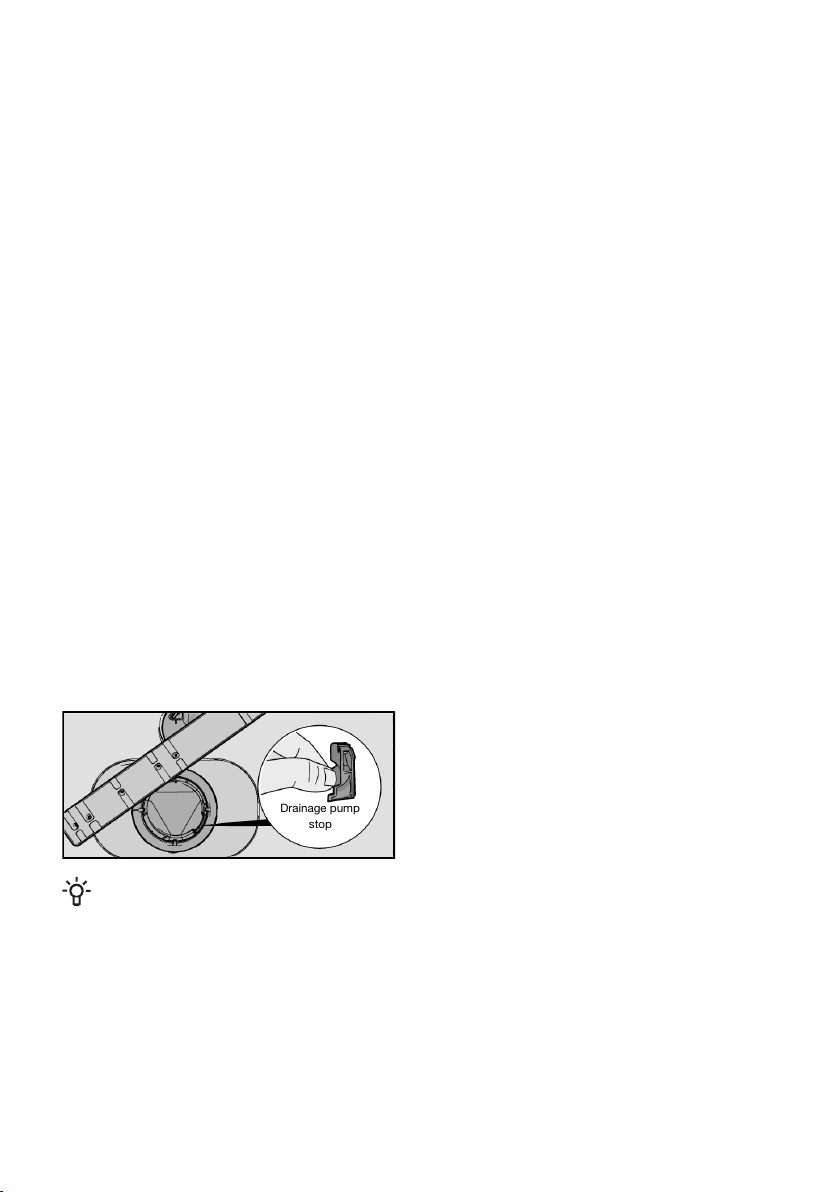
1. Turn off the machine using the main power switch and unplug it from the wall socket.
2. Remove the coarse filter and the fine filter.
3. Scoop out the water from the dishwasher tub.
4. In order to inspect the drainage pump, remove the coloured stop on the right in the bottom drain.
5. Turn the pump wheel located behind the drainage pump stop by hand. Carefully remove any items.
6. Refit the drainage pump stop along with the fine and coarse filters.
7. Plug the machine in again.
If the dishwasher still does not start and a whirring sound is heard, the overflow protection has
been activated.
• Shut off the water.
• Remove the plug from the wall socket.
• Call the service department.
Drainage pump
stop
NOTE!
Do not forget to refit the drainage pump stop.
Unblocking the inlet hose filter
If the water supply contains small particles, the outer filter on the inlet hose may become blocked,
which results in Water inlet fault.
1. Turn off the machine using the main power switch and unplug it from the wall socket.
2. Turn off the water tap.
3. Unscrew the inlet hose.
4. Carefully remove the outer filter from the inlet hose and clean it.
5. Refit the filter and check that the gasket is correctly positioned.
24
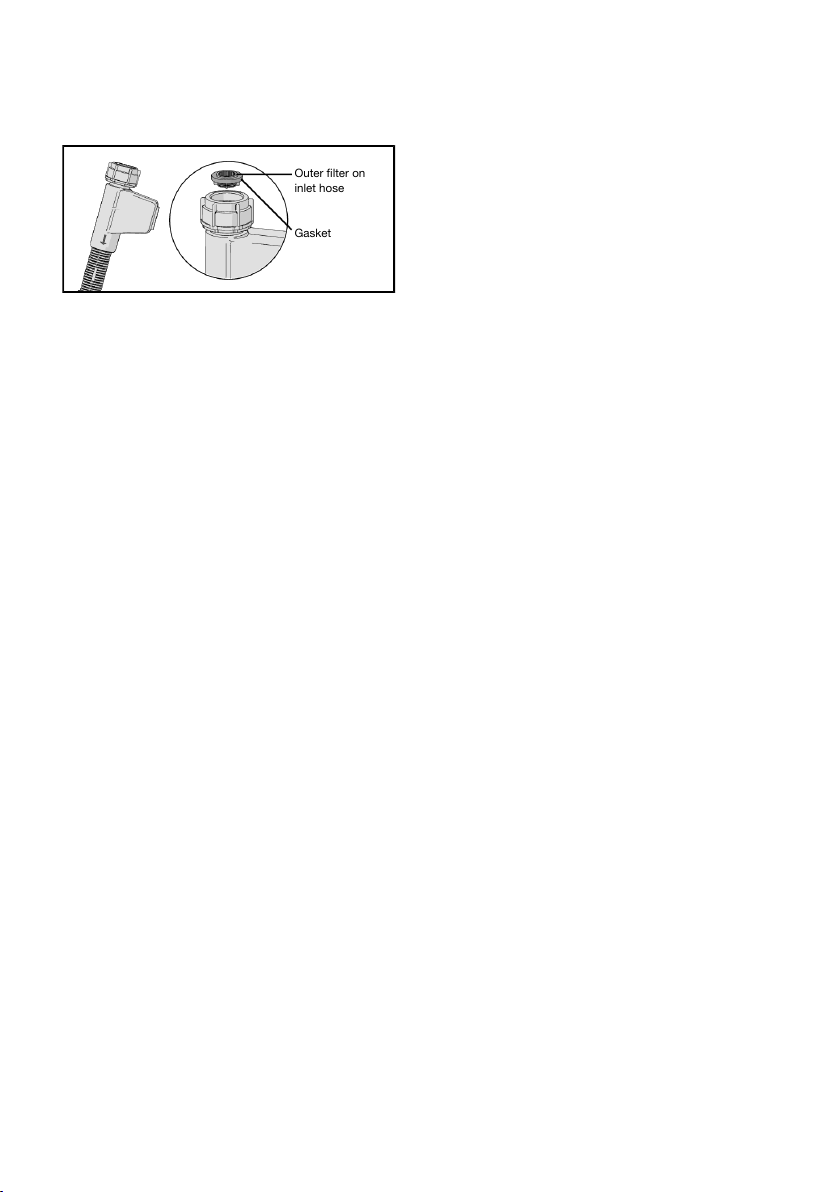
6. Screw the inlet hose firmly into place.
7. Plug the machine into the wall socket and turn on the water tap. Allow the pressure to settle for
a while and check that the connection is watertight.
Outer filter on
inlet hose
Gasket
25
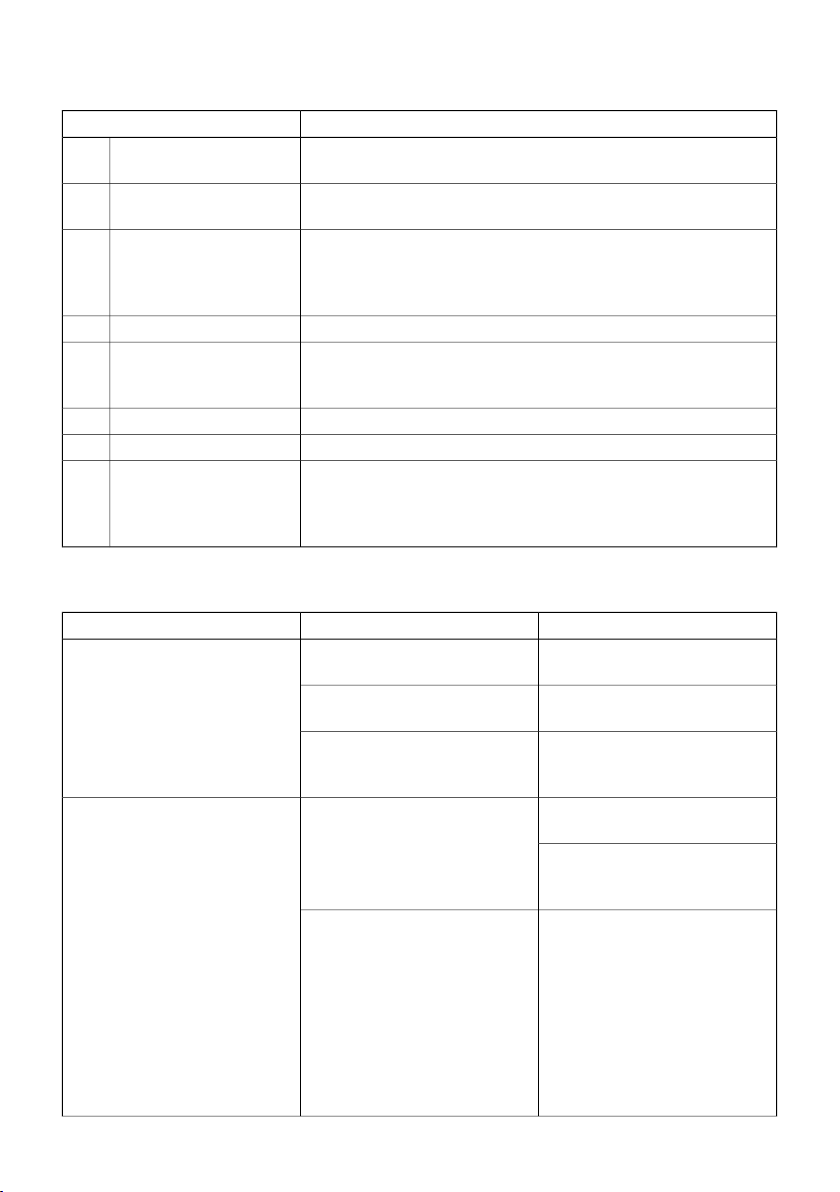
Troubleshooting
ActionType of fault on the display
Clear the drainage pump. See the chapter Care and cleaning. If
the problem persists, call the service department.
OverfillingF10
See “Water remains in the dishwasher” in the table “Problem”
below. If the problem persists, call the service department.
Water outlet faultF11
Check that the water tap is on. Check that the outer filter on the
inlet hose is not blocked. See Unblocking the inlet hose filter in
the chapter Care and cleaning. If the problem persists, call the
service department.
Water inlet faultF12
Turn off the water tap and call the service department.Inlet valve leakageF40
Clean the coarse and fine filters. Check that the outer filter on the
inlet hose is not blocked. If the problem persists, call the service
department.
Water level faultF52
Turn off the water tap and call the service department.OverfillingF54
Call the service department.Circulation faultF56
Check that the water tap is on. Check that the outer filter on the
inlet hose is not blocked. See Unblocking the inlet hose filter in
the chapter Care and cleaning. If the problem persists, call the
service department.
Water inlet faultF67
Press any button to clear the error message.
ActionPossible causesProblem
Wait a moment then try again.You have pressed the buttons
too soon after opening the door.
The buttons do not react when
pressed.
Clean with a dry or slightly
damp cloth.
The buttons are dirty.
Open the door. The buttons only
react to use when the door is
open.
The door is closed.
Check that the baskets are cor-
rectly positioned horizontally.
The baskets are not correctly
positioned.
Cannot close door.
Check that the dishes are not
blocking the baskets from slid-
ing properly into place.
Check the door lock. If it does
not click into place and lock,
open the door.
The door lock does not click in-
to place and lock.
Press and hold the button for
the Auto open option until the
button starts flashing. Wait until
it stops flashing (60 seconds).
Close the door. Check that the
door lock clicks into place and
locks.
26
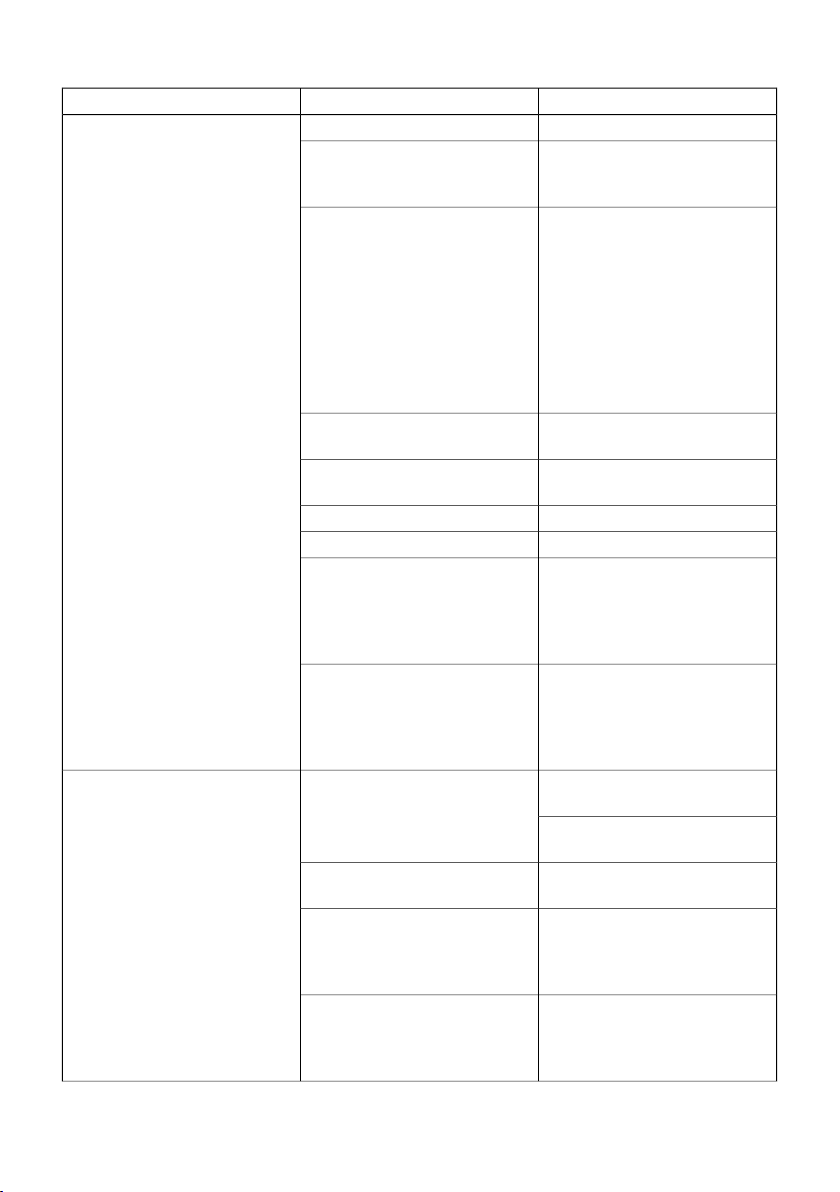
Table continued from last page
ActionPossible causesProblem
Check.The door is not properly closed.The dishwasher does not start.
Close the door and wait. After
a while, the dishwasher contin-
ues the program.
You have opened the dishwash-
er to add more dishes while a
program is in progress.
Check the door lock. If it does
not click into place and lock,
open the door.
The door lock has not clicked
into place and locked.
Press and hold the button for
the Auto open option until the
button starts flashing. Wait until
it stops flashing (60 seconds).
Close the door. Check that the
door lock clicks into place and
locks.
Check.A fuse/circuit breaker has been
tripped.
Check.The plug is not plugged into the
wall socket.
Check.The water tap is turned off.
Check.Overflow/leaks.
Turn off the water tap. Pull out
the plug and call the service
department.
A whirring sound (the drainage
pump) is heard from the dish-
washer and does not stop when
the main power switch is turned
off.
Press and hold the main power
switch until the display turns off
if you want to cancel the
Delayed start option. Restart the
dishwasher.
Check that the Delayed start
option has not been selected.
Remove the arms and clean
them.
The spray arms do not rotate.The dishes are not clean.
Check that the dishes are not
blocking the spray arms.
Clean the spray arms. See the
chapter Care and cleaning.
Spray arm holes or bearings
blocked.
Select a program with a high
temperature to dissolve grease
on very dirty dishes, such as In-
tensive wash.
Unsuitable dishwashing pro-
gram.
Dose according to water hard-
ness. Far too much or far too
little detergent results in poorer
dishwashing results.
Incorrect detergent dosage.
27
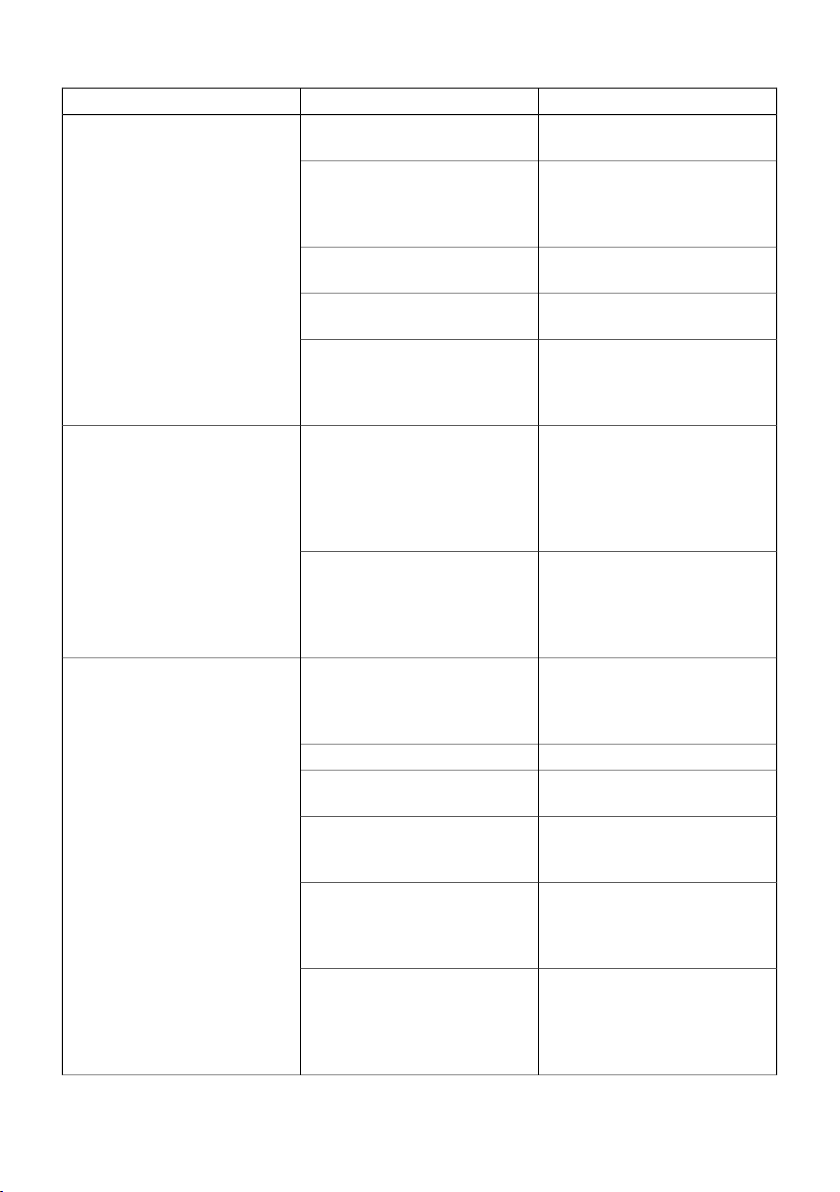
Table continued from last page
ActionPossible causesProblem
Avoid large packages.Old detergent. Detergent is a
perishable product.
Do not cover porcelain with
large bowls or the like. Avoid
placing very tall glasses in the
corners of the baskets.
Dishes loaded incorrectly.
Place dishes to sit steady.Glasses and cups have toppled
over during the program.
Check that the filter handle is
locked in the stop position.
The filters are not fitted cor-
rectly.
Check that the coloured stop
on the right in the bottom drain
is in place. See the chapter Care
and cleaning.
Drainage pump stop missing.
Rinse off these types of food-
stuffs if not starting the dish-
washer immediately. Consider
using the One hour program
program with the Speed wash
option.
Some foodstuffs, such as mus-
tard, mayonnaise, lemon, vineg-
ar, salt and dressings, can
cause spots on stainless steel
if left for too long.
Spots on stainless steel or sil-
ver.
In order to avoid marks and tar-
nishing, separate dishes made
from different metals, such as
silver, stainless steel and alu-
minium.
All stainless steel can cause
spots on silver if they come into
contact during dishwashing.
Aluminium can also cause spots
on dishes.
Check that the salt compart-
ment lid is properly tightened.
Otherwise call the service de-
partment.
The water softener is leaking
salt.
Spots or films on the dishes.
See the chapter Settings.Incorrect water softener setting.
See the chapter Settings.Incorrect rinse aid dosage set-
ting.
Top up with salt. See the
chapter Before washing for the
first time.
Salt compartment empty.
Inactivate the setting TAB (3-in-
1/ All-in-one detergent) and top
up salt and rinse aid.
3-in-1/ All-in-one detergent is
used and the setting TAB (3-in-
1/ All-in-one detergent) is activ-
ated.
Wash crystal at a low temperat-
ure and with a conservative
amount of detergent. Contact
the detergent manufacturer.
Too high temperature and/or
too much detergent can cause
etching on crystal. Unfortu-
nately, this cannot be repaired,
only prevented.
28
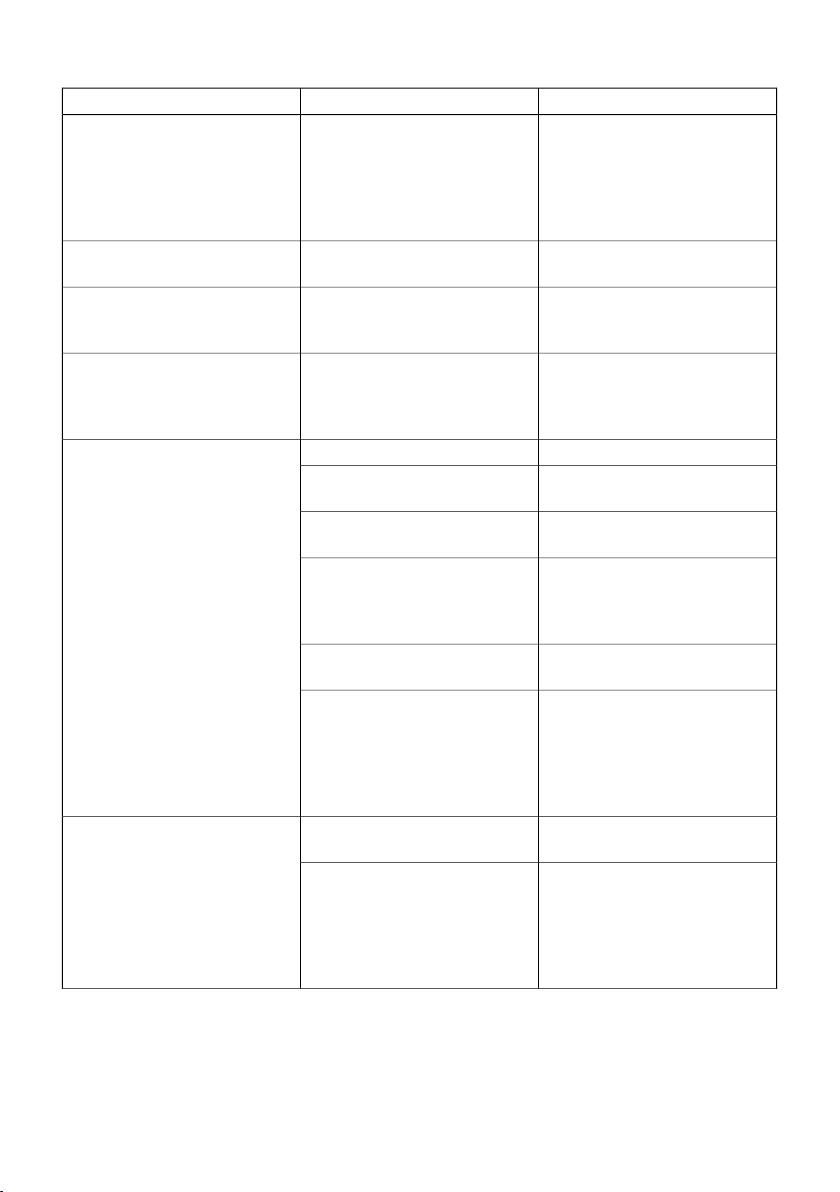
Table continued from last page
ActionPossible causesProblem
Reduce the amount. See the
sections Before washing for the
first time and Settings. If you
have very soft water, you may
want to dilute the rinse aid
50:50 with water.
Rinse aid dosage setting too
high.
The dishes have a sticky
white/blue film.
Use a detergent with a bleach-
ing agent.
Lipstick and tea can be difficult
to wash off.
Spots left after washing.
The detergent compartment
must be dry when adding deter-
gent.
The detergent compartment
was damp when adding deter-
gent.
Detergent residue in the deter-
gent compartment after dish-
washing.
Check that the dishes are
placed securely. Spin the spray
arms to make sure they can ro-
tate.
The dishes are not correctly
placed or the spray arms are not
rotating.
Rattling sound when dishwash-
ing.
Clean the coarse and fine filters.The filters are blocked.Water remains in the dishwash-
er.
Check that the filter handle is
locked in the stop position.
The filters are not fitted cor-
rectly.
Clean the drainage pump. See
the chapter Care and cleaning.
Debris in the drainage pump.
Check that the coloured stop
on the right in the bottom drain
is in place. See the chapter Care
and cleaning.
Drainage pump stop missing.
Check that the hose is free from
kinks and sharp bends.
Kink in drainage hose.
Disconnect the drainage hose
where it connects to the sink
unit's water trap. Check that no
debris has fastened and that the
connection has an inner diamet-
er of at least 14 mm.
Blocked drainage hose.
Clean with washing-up brush
and low foaming cleaner.
Dirt around the seals and in
corners.
Bad odour in dishwasher.
Run a program with a higher
temperature about once a
month. Or select the self-clean-
ing program. See Self-cleaning
program in the chapter Using
the dishwasher.
Low temperature programs
have been selected for a pro-
longed period.
29
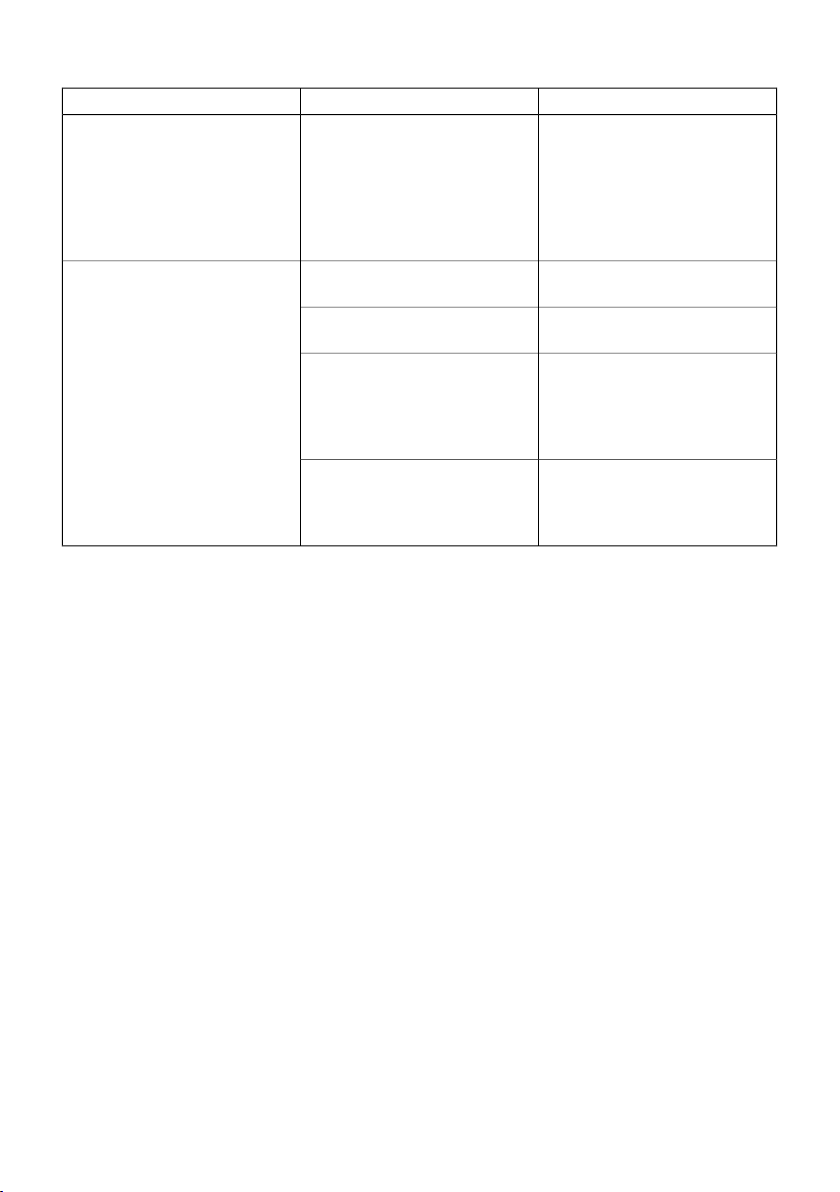
Table continued from last page
ActionPossible causesProblem
Select a program with a high
temperature to dissolve grease
on very dirty dishes, such as In-
tensive wash. Or run a self-
cleaning program. See Self-
cleaning program in the chapter
Using the dishwasher.
Low temperature programs
have been selected for a pro-
longed period.
Grease deposits in the dish-
washer.
Activate the Auto open option.The Auto open option is not ac-
tivated.
The dishes are not dry enough.
Fully load the dishwasher.The dishwasher is not fully
loaded.
Top up with rinse add or in-
crease the rinse aid dosage.
See the sections Before wash-
ing for the first time and Set-
tings.
Rinse aid needs topping up or
dosage is set too low.
Inactivate the setting TAB (3-in-
1/ All-in-one detergent) and top
up salt and rinse aid.
3-in-1/ All-in-one detergent is
used and the setting TAB (3-in-
1/ All-in-one detergent) is activ-
ated.
30
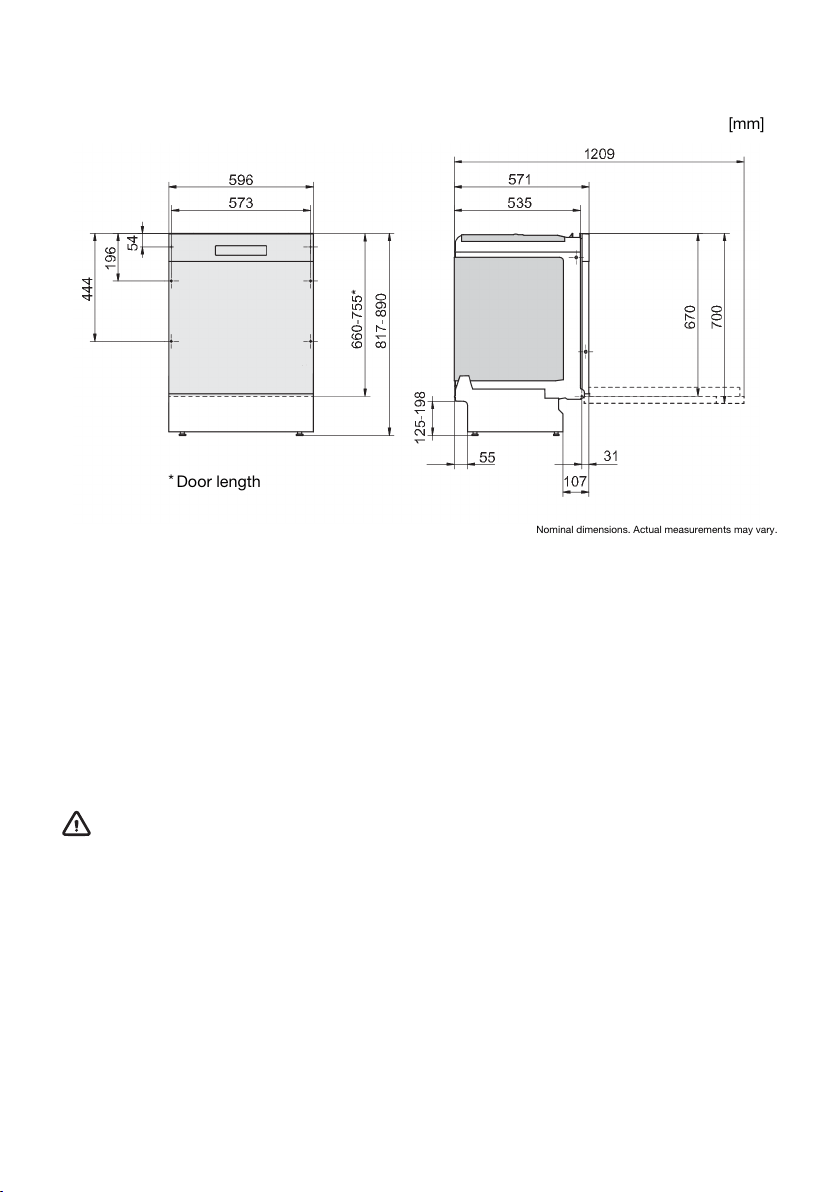
Installation
[mm]
Door length
*
Nominal dimensions. Actual measurements may vary.
It is important that you read through and follow the instructions and directions below. Conduct
installation and connection in accordance with the separate installation instructions.
Safety instructions
• Connections to electricity, water and drainage must be performed by a qualified professional.
• Always follow applicable regulations for water, drainage and electricity.
• Take care during installation! Wear protective gloves! There must always be two people!
• Place a drip tray on the floor beneath the dishwasher to prevent damage from any water leaks.
• Before screwing the dishwasher into place, test the dishwasher by running the One hour program
program with the Speed wash option. Check that the dishwasher fills with water and drains. Check
also that none of the connections leak.
WARNING!
Turn off the water supply when installing the dishwasher!
The plug must be disconnected or power to the socket turned off while the work is carried out!
Setup
• The recess and connection dimensions are included in the separate installation instructions. Check
that all dimensions are correct before starting the installation. Note that the height of the cover
door can be adjusted to match other fittings.
• Make sure the area on which the dishwasher is to be installed is firm. Adjust the adjustable feet
so that the dishwasher is level.
• If the dishwasher is built-in the surrounding furnishings must be resistant to any condensation
from the dishwasher.
31

• Affix the protective film (packed in the document bag) to the underside of the worktop. The
protective film is to protect the worktop from moisture.
• Check that the machine is installed such that the door opens freely, otherwise door lock functionality
may be disrupted.
• Note that the door springs may need adjusting after a cover door has been fitted. Adjust the left
and right door springs equally until the door is evenly balanced.
Drainage connection
See the separate installation instructions for necessary information.
This dishwasher is suitable for installing in a raised recess (to attain an ergonomic working height).
This means that the dishwasher can be placed so that the drainage hose runs to a lower level than
the bottom of the dishwasher, such as by routing it directly to a floor drain. The dishwasher is fitted
with an integrated anti-siphon device to prevent the machine from being emptied of water during the
wash cycle.
The drainage hose can also be connected to a connection nipple on the sink unit's water trap. The
connection nipple must have an internal diameter of at least 14 mm.
The drainage hose may be extended by a maximum of 3 m (the total length of the drainage hose must
not exceed 4.5 m). Any joins and connecting pipes must have an internal diameter of at least 14 mm.
However, the drainage hose should ideally be replaced with a new hose without joins.
No part of the drainage hose may be more than 950 mm above the bottom of the dishwasher.
Attach the drainage hose with a hose clamp. Ensure that the drainage hose has no kinks.
Connection to water supply
Use only the inlet hose supplied with the dishwasher. Do not re-use old or other spare hoses.
The supply pipe must be fitted with a water tap (stopcock). The water tap must be easily accessible,
so that the water can be shut off if the dishwasher has to be moved.
Once the installation is complete, turn on the water tap and allow the pressure to settle for a while.
Check that all connections are watertight.
Connection to cold water supply
Connect the dishwasher to the cold water supply if the building is heated using oil, electricity or gas.
Connection to hot water supply
Connect the dishwasher to the hot water supply (max. 70 °C) if the building is heated using an
energy-efficient means such as district heating, solar power or geothermal power. Choosing a hot
water connection cuts dishwashing times and reduces the dishwasher's energy consumption.
NOTE!
Do not exceed the permitted water supply temperature. Certain materials used in some cookware
cannot withstand strong heat. See Fragile dishes in the chapter Loading the dishwasher.
Electrical connection
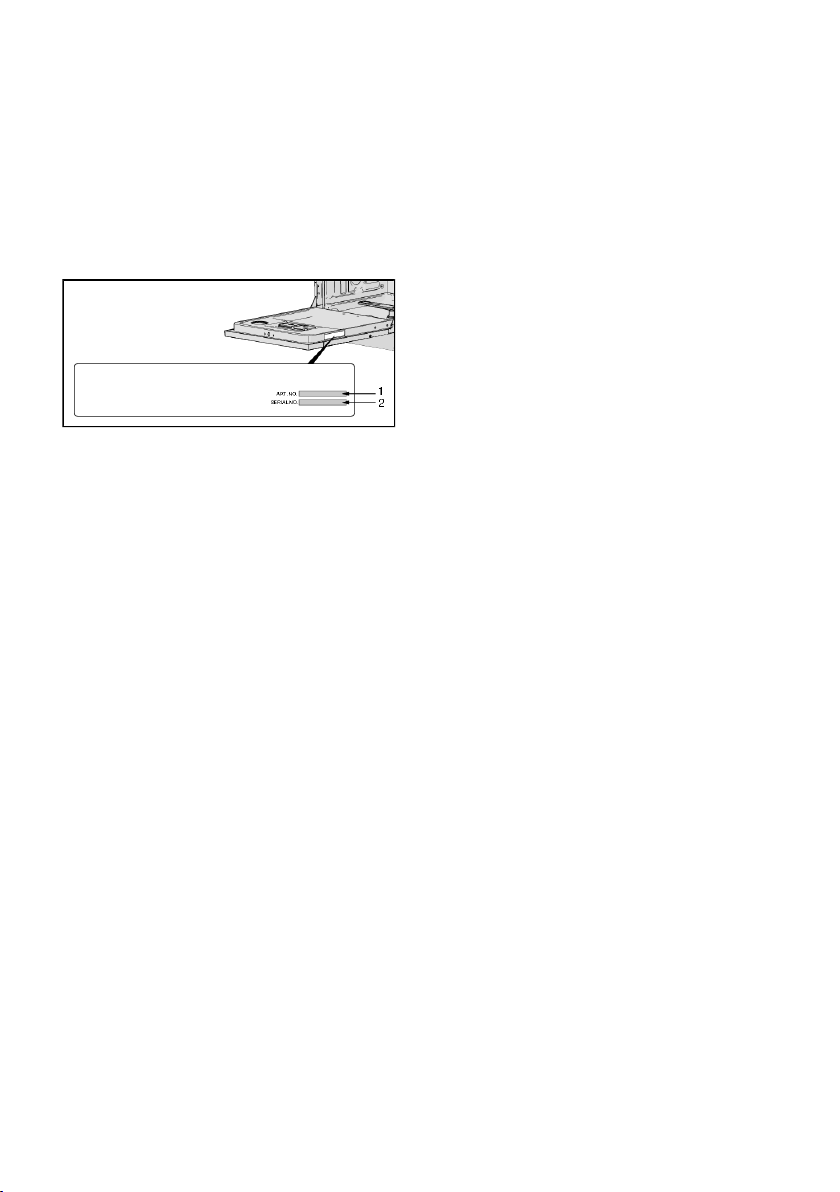
Information about the electrical connection can be found on the serial number plate. This specification
must match the electricity supply.
The dishwasher must be connected to an earthed socket.
32

The electric wall socket must be placed outside of the installation area to be easily accessible after
installing the dishwasher. Do not use an extension cord!
NOTE!
Electrical cable replacements as well as repairs and maintenance relating to safety or performance
must be carried out by the manufacturer's service centre or someone similarly professionally
qualified.
33
Service
Read the chapter Troubleshooting before contacting the service centre. If you have encountered a
problem that you cannot resolve, please contact your nearest service centre for professional help,
see www.hisense.com. Our website also has information about spare part availability and what you
can repair yourself.
When making contact, provide the details on the serial number plate. Include the article number (1)
and the serial number (2).
Please note that non-professional repairs may risk user safety and affect the warranty.
34
Technical data and energy labelling
Technical data
817-890 mmHeight:
596 mmWidth:
571 mmDepth:
35 kg
1)
Weight:
0.03–1.0 MPaWater pressure:
See serial number plateElectrical connection:
See serial number plateRated power:
1)
Weight can vary due to different specifications.
Information for consumers
Information about your product can be found at global.hisense.com, where you will also find a link to
the European Product Database for Energy Labelling, EPREL. Or else visit https://eprel.ec.europa.eu
directly. Follow the instructions to search by model name.
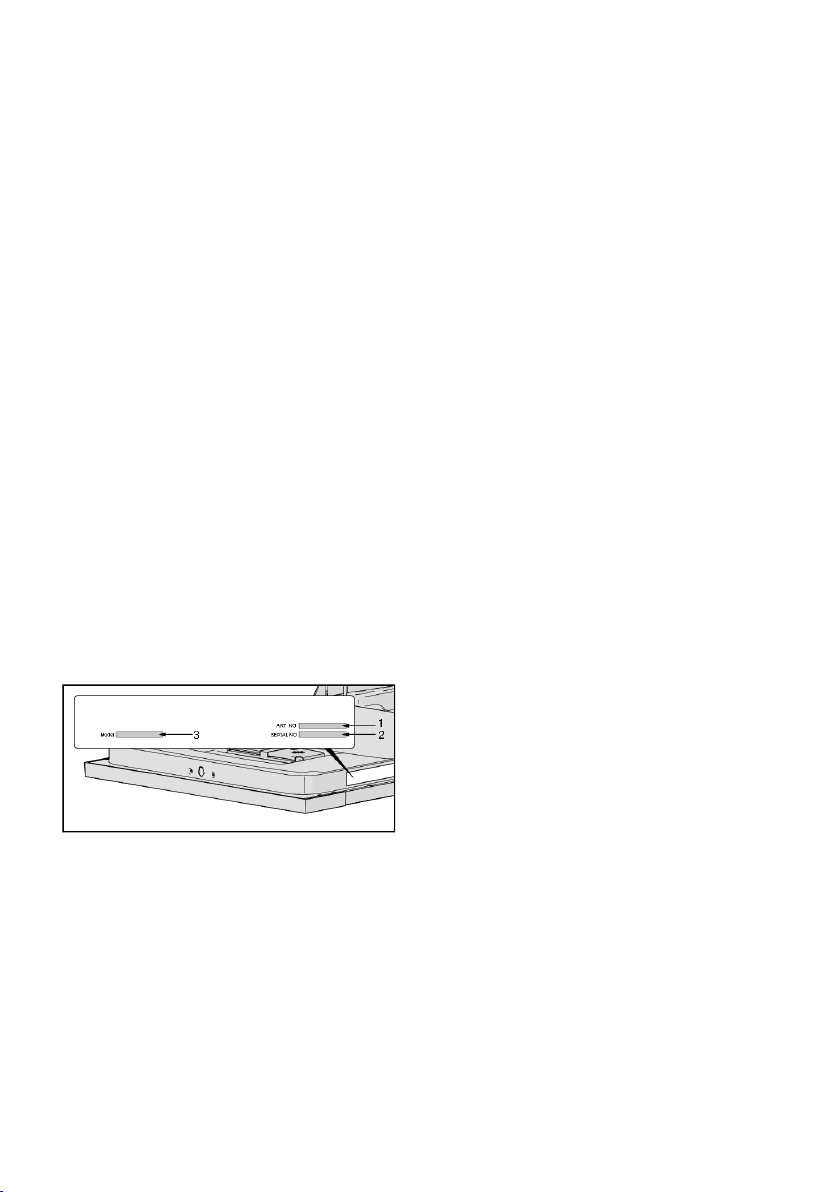
See the information on the serial number plate. Make a note of the model name (3).
Information for test institute
Information about this product can be found in the European Product Database for Energy Labelling,
The request should include the details on the serial number plate. Include the article number (1), the
serial number (2) and the model name (3).
35
We reserve the right to make changes.
www.hisense.com
839522-a2