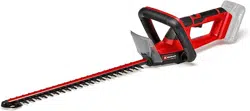

PSLHTM20
USER’S MANUAL
CORDLESS GRASS &
SHRUB SHEARS

2
CAUTION: Read all safety regulations and instructions.
failures made in following the safety regulations and instructions may result in an electric hock,
re and/or serious injury.
Keep all safety regulations and instructions in a safe place for future use.
The term “electric tool“ is used in the safety regulation that refers to electric tools operated from the
mains power supply (with a power cable) and to battery operated electric tools (without a power cable).
1. WORKPLACE SAFETY
• Keep your work area clean and well illuminated. Untidy or unlit work areas can result in accidents.
• Do not use this tool in a potentially explosive environment containing combustible liquids, gases or dust. Electric
tools generate sparks, which can in turn ignite dust or vapors.
• Keep children and other persons away from the electric tool while it is being used. Allowing yourself to get dis
tracted can cause you to lose control of the tool.
2. ELECTRICAL SAFETY
• The tool’s connector plug must be able to t into the socket outlet. Do not modify the plug in any way! Do not use
adapter plugs in conjunction with electrically grounded tools. Unmodied plugs and matching socket outlets
reduce the risk of an electric shock.
• Avoid touching grounded surfaces, such as those of pipes/tubes, heaters, cookers and refrigerators.
There is an increased risk of getting an electric shock if you are electrically grounded.
• Keep the tool away from rain and moisture/wet conditions. Penetration of water into an electric tool increases
the risk of an electric shock.
• Do not use the cable to carry the tool, hang it up or pull the plug out of the socket. Keep the cable away from
sources of heat, oil, sharp edges and moving tool parts. Damaged or tangled cable increases the risk of an
electric shock.
• If you intend to use an electric tool outdoors, ensure that you only use extension cable that is approved for outdoor
applications. Using extension cable that is approved for outdoor applications reduces the risk of an
electric shock.
• If operation of the electric tool in a damp environment can not be avoided, use a earth-leakage circuit-breaker. The
earth-leakage circuit-breaker reduces the risk of an electric shock.
3. PERSONAL SAFETY
• Be alert, work conscientiously and exercise appropriate caution when using the electric tool. Do not use the tool
if you are tired or under the inuence of drugs/medication nor alcohol. One moment of carelessness or lack
of attention when using the electric tool can cause serious body injury.
• Always wear personal protective equipment (PPE) including safety goggles. Wearing personal protective
equipment such as mask, non-slip footwear, protective headgear and ear muffs (depending upon the
type of electric tool and the particular application) reduces the risk of injury.
• Make sure that the tool cannot start up accidentally. Ensure that the electric tool is switched off before you
connect the tool to the power supply and/or insert the battery, or pick up and carry the tool. Physical touching
the switch with your ngers when carry the tool or connecting the tool to the power supply switched on
can lead to accidents.
• Remove adjusting tools/wrench(es) prior to switching on the power tool. A tool or wrench that is positioned
inside a rotating power tool part can cause injury.
• Avoid abnormal working postures. Make sure you stand squarely and keep your balance at ll times. This way you
will be able to have better control over the tool in unexpected situations.
• Wear suitable clothes. Never wear loose tting clothes or jewelry. Keep hair, clothes and gloves away from parts.
Loose clothing, dangling jewelry and long hair can be caught by moving parts. If dust extraction and dust
collection devices can be mounted, ensure that these are connected and are properly used. The use of
a dust extraction system can reduce the danger posed by dust.

3
4. USING THE TREATMENT OF ELECTRIC TOOLS.
• Do not overload your tool. Only use suitable electric tools to perform your work. Using the right electric tool al
lows you to work better and safer within the tool’s quoted capacity range.
• Do not use an electric tool whose switch is defective. An electric tool that no longer can be switched on or off
is dangerous and must be repaired.
• Pull the plug out of the socket and/or remove the battery before making any adjustments to the tool, changing
accessories or put the tool down. This precaution eliminates the possibility of inadvertently starting the tool.
• When not in use, store electric tools out of the reach of children. Do not allow those persons to use this tool who
are unfamiliar with it or who have not read these instructions. Electric tools are dangerous when they are
used by inexperienced persons.
• Take good care of your tool. Check that moving parts properly function and do not jam, that parts are not broken off
or damaged in any way and that the tool can be used to its full capacity. Have damaged parts repaired prior to using
the tool. The cause of many accidents can be traced back to poorly maintained electric tools.
• Keep your blades sharp and clean. Properly maintained blades with sharp edges jam less frequently and
are easier to use.
• Make sure to use electric tools, accessories, attachments, etc. in accordance with these instructions. Take the
conditions in your work area and the job in hand into account. Using electric tools for applications other than
those intended can lead to dangerous situations.
5. CAREFUL HANDLING AND USE OF CORDLESS EQUIPMENT.
• Ensures that the equipment is switched off before you insert the battery. Inserting the battery into an electric
tool that is switched on can cause accidents.
• Only charge the batteries in charges that are recommended by the manufacturer. A charge that is designed for
a certain type of batteries may pose a re risk if it used with other types of batteries.
• Use only the correct batteries in the electric tools. The use of other batteries may result in injuries and re risk.
• Keep unused batteries away from paper clips, coins, keys, nails screws and other metallic objects that could cause
a short circuit between the contacts. A short circuit between the battery contacts may cause burns or a re.
• In case of incorrect use, uid may escape from the battery. Avoid contact with it. If you touch it by mistake, rinse
the affected area with water. If you get the uid in your eyes, also seek medical advice. Leaking battery uid can
cause skin irritation or burns.
6. SERVICE
• Have your tool repaired only by authorized specialists using original replacement parts. This will ensure that your
tool remains safe to use.
• The battery pack supplied with your cordless tool is not charged. The battery pack has to be changed
before you use the tool for the rst time
• The battery pack does not reach its maximum capacitance until it has been charged and discharged
approximately ve times.
• Battery pack lose their charge even when they are not being used. Regular charging is therefore
recommended.
• Please check the data marked on the rating plate of the battery charger. Be sure to connect the
battery charger to a power supply with the voltage marked on the rating plate. Never connect it to a
different mains voltage.
• Keep the battery charger and the cordless tool out of children’s reach.
• Wear suitable work clothes. Wear safety goggles.
ADDITIONAL SAFETY NOTES
4
• Never open the battery pack. Avoid contact with a leaking battery pack. In case of accidental contact
wash the affected area of skin with soap and water. If battery acids gets in your eye, rinse out the eye
with clear water for at least 10 minutes and seek a doctor’s advice immediately. Neutralize other affected
areas with a mild acid such as lemon juice or vinegar.
• Protect the battery charger and its cable from damage and sharp edges. Have damaged cables repaired
without delay by a qualied electrician.
• Make sure that the contacts of the battery pack do not come into contact with other metallic objects
such as nails or screws. There is a risk of short-circuiting.
• Use only battery charges that are intended for the battery pack in question.
• Do not use damaged battery chargers.
• Leave repairs strictly to the appointed service center or authorized dealers.
• Do not use the supplied battery charger to charge other cordless tools.
• Never allow the battery pack to become fully discharged. This will cause it to develop a defect.
• Timely recharging of the battery pack will help it serve you well for a long time. You must recharge the
battery pack when you notice that the power of the cordless tool drops.
• In heavy use the battery pack will become warm. Allow the battery pack to cool to room temperature
before commencing with the charging.
• Protect your cordless tools and the battery charger from moisture and rain.
• Do not use the cordless tool or the battery charger near vapors and inammable liquids.
• Do not throw battery packs into an open re. There is a risk of explosions.
• Use the battery charger only in dry conditions and an ambient temperature of 10-40 degree Celsius.
• Do not keep the battery charger in places where the temperature is liable to reach 50 degree Celsius.
In particular do not leave the battery charger in a car that is parked in the sunshine.
• Do not ignite the battery pack or expose it to re.
CORDLESS GRASS & SHRUB SHEARS LAYOUT
5

6
PROPER USE
OPERATION
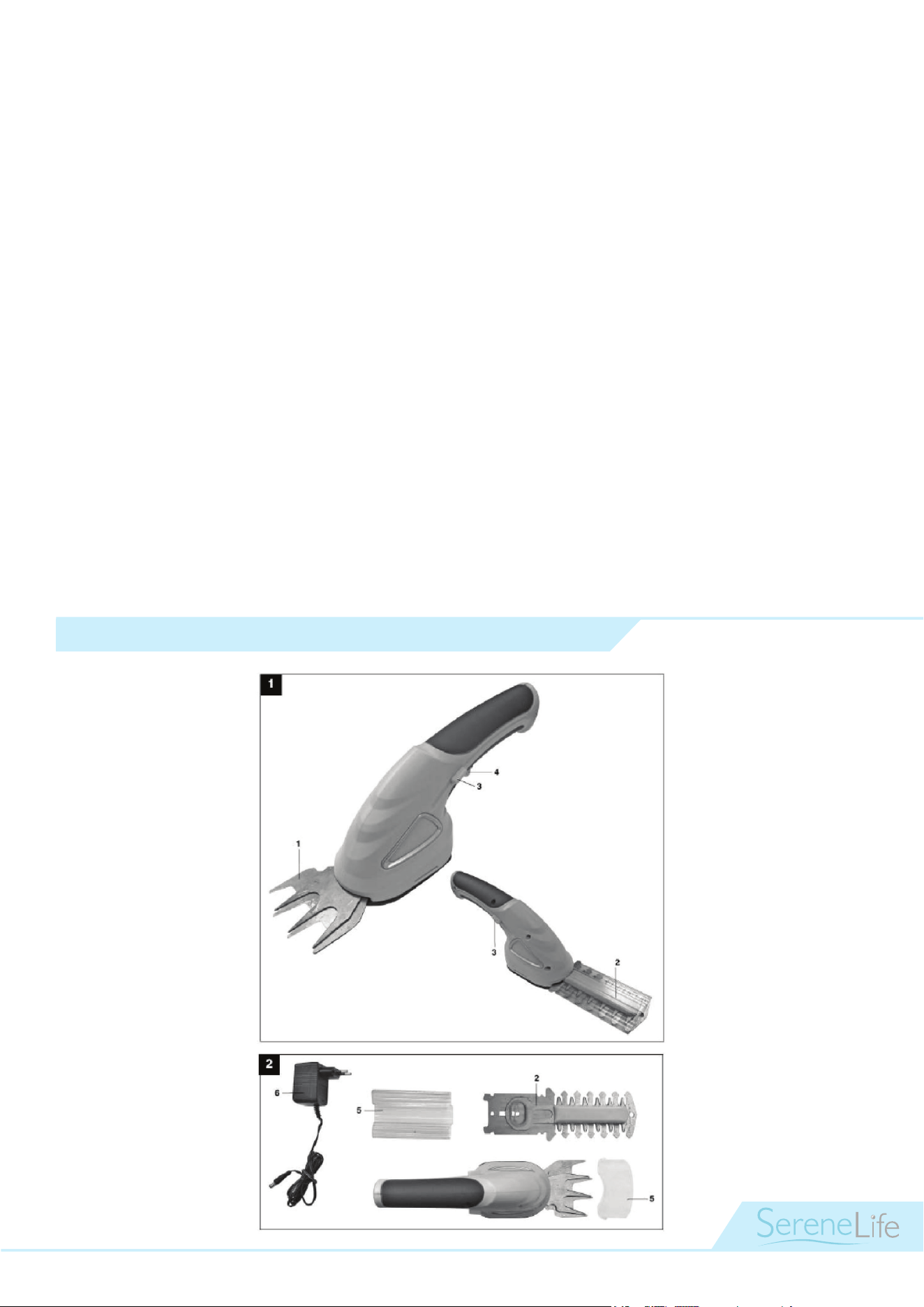
1. Grass Cutter Blade
2. Shrub Cutter Blade
3. Safety Lock-off
4. ON/OFF Button
5. Blade Guard
6. Battery Charger
The equipment is designed for cutting the edges of lawns and small areas of grass in private and hobby
gardens. Tool for private and hobby gardens are not suitable for use in public gures, parks and sport cen-
ters, along roadways, on farms or in the forestry sectors. For the tool to be used properly it is imperative
to follow the instructions set out in the manufacturer’s directions for use.
IMPORTANT! It is prohibited to use the tool to chop material for composting because of the potential
danger to persons and property.
The machine is to be used only for its prescribed purpose. Any other use is deemed to be case of misuse.
The user / operator and not the manufacturer will be liable for nay damage or injuries of any kind caused
as a result of this. Please note that our equipment has not been designed for use in commercial, trade or
industrial applications. Our warranty will be voided if the machine is used in commercial, trade or industrial
businesses or for equivalent purpose.
Before Starting
Charging the battery pack (Fig. 1/3)
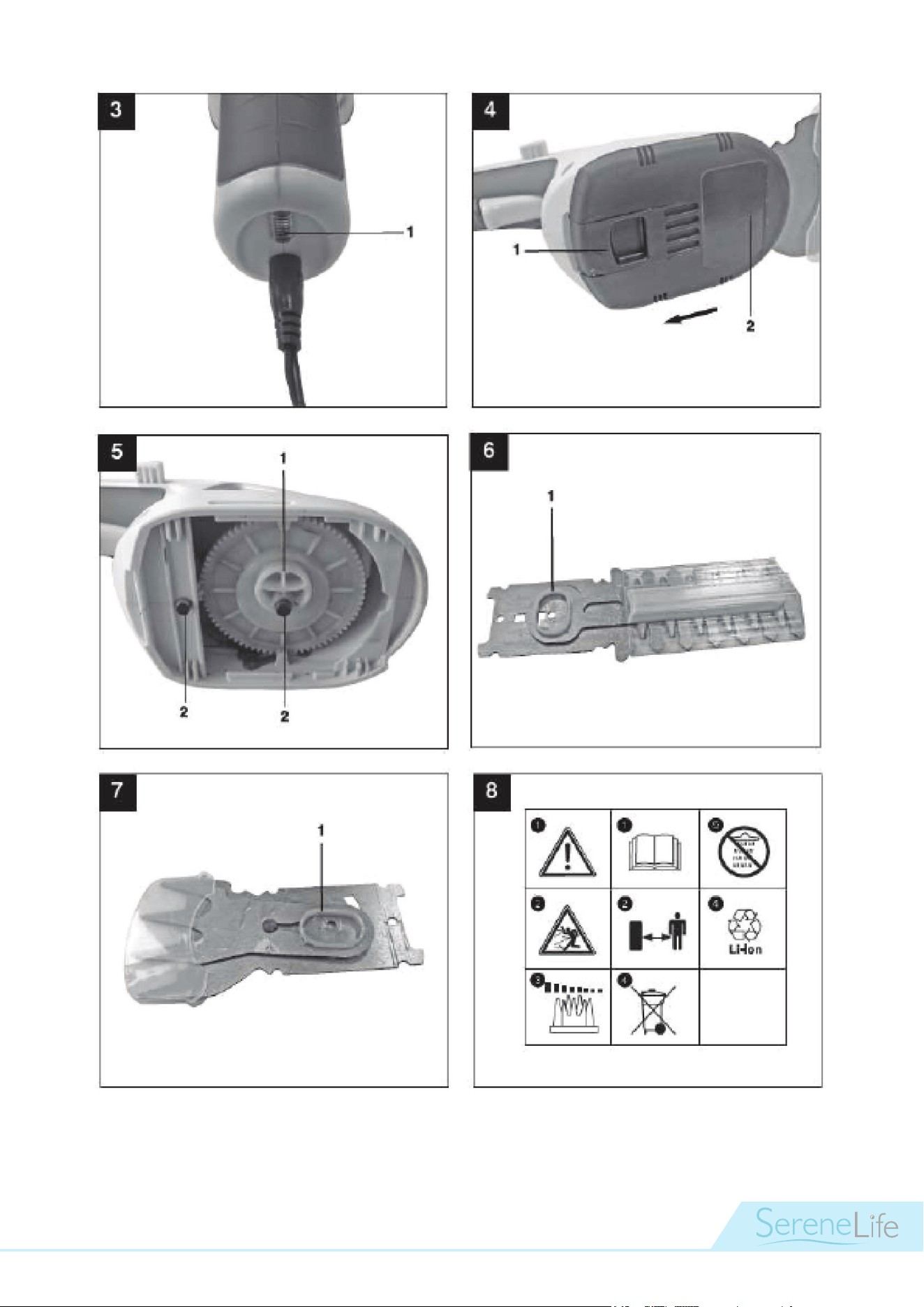
• Connect the charger to the charging station (Fig. 3)
• Check that your mains voltage is the same as the marked on the rating plate of the battery charger. Plug
the battery charger in a socket outlet. The green LED (Fig. 3 / Item 1) comes on to indicate that charging
voltage is available.
• The battery pack is being charged, An empty battery pack requires a maximum charging period of 3 to 5
hours. The temperature of the battery pack may rise slightly during the charging operation. This is normal.
• As soon as the battery pack is fully charged, the red LED (Fig. 3 / Item 1) extinguishes if the recharge
able battery fails to charge. Check whether there is a voltage at the socket outlet. Timely recharging of
the battery pack will help it serve you well for a long time. Recharging is always necessary when you
notice a drop in the tool’s performance. Never allow the battery pack to become fully discharged. This
will cause it to develop a defect.
Operation
The area to be cit must rst be cleared of stones and other solid objects. The safety lock-off (Fig. 1 / Item
3) prevents the tool being started unintentionally. Activate the safety lock-off (Fig. 1 / Item 3) by pushing
it forward and pressing the ON/OFF switch (Fig. 1 / Item 4) at the same time. To switch off the tool, let go
of the ON/OFF switch (Fig. 1 / Item 4).
Cutting the grass
Allow the grass cutter to glide above the ground. The best results are achieved when the lawn is dry. When
you notice a drop of cutting performance, recharge the tool immediately so that the battery does nto be-
come fully discharged.

7
Trimming hedges
The tool can be used to trim small hedges and shrubs. Hold the tool slightly tilted in relation to the hedge
you want to cut. First cut the sides from the bottom up, then cut the top. Watch out for foreign objects in
or on the hedge which could damage the blades.
Best time to trim hedges:
• As a general rule, hedges which lose their leaves in the autumn should be trimmed in June and October.
• Hedges which do not lose their leaves should be cut in April and August.
Changing the blades
IMPORTANT! Risk of injury!
To remove the blades, raise the lug (Fig 4 / Item 1) and push off the cover (Fig. 4 / item 2) in direction of
the arrow. Once you have removed the blade you will be able to see the toothed wheels of the gear unit
(Fig. 5). Make sure that no dirt gets into the gear unit when you change the blade. To assemble, proceed
in reverse order.
When you t the grass cutter blade. Check the position of the pin for the eccentric connector (Fig. 5 /
Item 1).
• Take the hedge cutter blade and slide the eccentric mount (Fig. 6 / Item 1) into position so that the pin
for the eccentric connector and the eccentric mount r together precisely when assembled. Slot the
hedge cutter blade onto the guide pins (Fig. 5 / Item 2).
When you t the grass cutter blade. Check the position of the pin for the eccentric connector (Fig. 5 /
Item 1) again.
• Shift the eccentric mount (Fig. 7 / Item 1) on the grass cutter blade to the left or the right to nd the
position at which the pin for the eccentric connector (Fig. 5 / Item 1) and the eccentric mount (Fig. 7 /
Item 1) match up.
Cleaning
• Keep all safety devices, air vents and the motor housing free of dirt and dust as far as possible. Wipe
the equipment with a clean cloth or blow it with compressed air at low pressure.
• We recommend that you clean the device immediately each time you have nished using it.
• Clean the equipment regularly with a moist cloth and some soft soap. Do not use cleaning agents or
solvents; these could attack the plastic parts of the equipment, Ensure that no water can seep into the
device.
• A few drops of oil (e.g. sewing machine oil) will improve the cutting performance of the blades, but never
apply any grease to the blades. To ensure constant exact cutting it is also important to remove grass
remnants and dirt from between the upper and lower blade.
IMPORTANT! Never clean the tool under running water -- and particularly with high pressure -- be-
cause of the potential danger to persons and property. Keep your cordless grass cutter and hedge
trimmer in a dry and frost-proof place. Keep out-of-reach of children.

8
CORDLESS GRASS & SHRUB SHEARS
FEATURES AND SPECIFICATIONS
Features:
• Vers atile & Cordles s Cutting Ability
• Landscaping Made Easy: Hassle-Free Design
• 2-in-1 System with Quick Change Blades
• Includes Grass Cutting Blade & Hedge Trim Blade
• Easy-to-Use 'Glide-Cut' Technology
• Built-in Rechargeable Battery
• Lightweight, Portable & Powerful
• Comfortable Hand-held Grip
• Simple One-Handed Operation
• Integrated 'Blade Guard' for Precision & Control
• Includes Battery Wall Charger Adapter
• Perfect fo
r Lawns, Gardens, Sidewalks, Walkways, Landscapes
• Safety Power Lock Switch
Technical Specs:
• Construction Material: Metal Alloy, Engineered ABS
• Operation Speed: 1000+ RPM
• Cutting Width (Grass Cutter): 70mm
• Cutting Width (Hedge Trimmer): 100mm
• Blade Length (Hedge Trimmer): 215mm
• Average Charge Time: 4 Hours
• Battery Type: Lithium, 3.6V
• Power: DC 4.5V, 500mAh
• Dimensions: 11.6'' x 3.0'' x 4.5''
• Sold as: 1
• Weight: 1.3 lbs.