Inca HC Electronic Control 03/15 - Page 1
READ THESE INSTRUCTIONS BEFORE YOU START INSTALLING THIS Range hood
WARNING: - TO REDUCE THE RISK OF A RANGE TOP GREASE FIRE:
a) Never leave surface units unattended at high settings. Boilovers cause smoking and greasy spillovers that may ignite.
Heat oils slowly on low or medium setting.
b) Always turn hood ON when cooking at high heat or when ambeing food
(i.e. Crepes Suzette, Cherries Jubilee, Peppercorn Beef Flambé).
c) Clean ventilating fans frequently. Grease should not be allowed to accumulate on fan or lter.
d) Use proper pan size. Always use cookware appropriate for the size of the surface element.
WARNING: - TO REDUCE THE RISK OF INJURY TO PERSONS IN THE EVENT OF A RANGE TOP GREASE FIRE, OBSERVE
THE FOLLOWING (*):
a) SMOTHER FLAMES with a close-tting lid, cookie sheet, or metal tray, then turn off the burner. BE CAREFUL TO PRE-
VENT BURNS. If the ames do not go out immediately EVACUATE AND CALL THE FIRE DEPARTMENT.
b) NEVER PICK UP A FLAMING PAN - You may be burned.
c) DO NOT USE WATER, including wet dishcloths or towels - a violent steam explosion will result.
d) Use an extinguisher ONLY if:
1) You know you have a Class ABC extinguisher, and you already know how to operate it.
2) The re is small and contained in the area where it started.
3) The re department is being called.
4) You can ght the re with your back to an exit.
(*) Based on “Kitchen Firesafety Tips” published by NFPA.
ALL WALL AND FLOOR OPENINGS WHERE THE Range hood IS INSTALLED MUST BE SEALED.
This range hood requires at least 24" of clearance between the bottom of the range hood and the cooking surface or countertop.
This minimum clearance may be higher depending on local building code. For example, for gas ranges, a minimum of 30" is
recommened and may be required. Overhead cabinets on both sides of this unit must be a minimum of 18" above the cooking
surface or countertop. Consult the cooktop or range installation instructions given by the manufacturer before making any cutouts.
LISEZ BIEN CETTE FICHE AVANT D'INSTALLER LA HOTTE
AVERTISSEMENT - POUR MINIMISER LE RISQUE D’UN FEU DE GRAISSE SUR LA TABLE DE CUISSON : a) Ne jamais laisser
un élément de la table de cuisson fonctionner sans surveillance à la puissance de chauffage maximale; un renversement/
débordement de matière graisseuse pourrait provoquer une inammation et le génération de fumée. Utiliser toujours une
puissance de chauffage moyenne ou basse pour le chauffage d’huile. b) Veiller à toujours faire fonctionner le ventilateur
de la hotte lors d’une cuisson avec une puissance de chauffage élevée ou lors de la cuisson d’un mets à amber (i.e.
Crepes Suzette, Cherries Jubilee, Peppercorn Beef Flambé). c) Nettoyer fréquemment les ventilateurs d’extraction. Veiller
à ne pas laisser de la graisse s’accumuler sur les surfaces du ventilateur ou des ltres. d) Utiliser toujours un ustensile
de taille appropriée. Utiliser toujours un ustensile de taille adapté à la taille de l’élément chauffant.
AVERTISSEMENT: - POUR PRÉVENIR LES BLESSURES EN CAS DE FEU SUIVRE LES RECOMMANDATIONS SUIVANTES
(*): a) ÉTOUFFEZ LE FEU avec un couvercle métallique et fermez le brûleur. Si le feu ne s'éteint pas tout de suite, QUIT-
TEZ LES LIEUX ET APPELEZ LES POMPIERS. b) NE TOUCHEZ JAMAIS UNE CASSEROLE EN FLAMMES. c) N'UTILISEZ
JAMAIS DE L'EAU ou un torchon mouillé pour éteindre le feu - ce qui pourrait causer une explosion de vapeur. d) N'utilisez
un extincteur que si: 1. Vous avez un modèle ABC et vous connaissez bien son mode d'emploi. 2. Le feu est petit et peu
répandu. 3. Les pompiers sont déjà prévenus. 4. Vous avez une sortie derrière vous. (*) Basé sur la "cuisine Firesafety
incline" édité par NFPA.
TOUTE OUVERTURE DANS LE MUR OU LE PLANCHER À PROXIMITÉ DE LA HOTTE DOIT ÊTRE SCELLÉ
Gardez 24 po. de hauteur entre le bas de la hotte et la surface de cuisson. Cette hauteur minimum peut être plus haute suivant
le code municipal. Par exemple, les cuisinières à gaz peuvent requérir 30 po. de hauteur. Les armoires au-dessus de chaque
côté devront être au moins à 18 po. au-dessus de la surface de cuisson. Consultez la che technique avant de découper les
armoires.
02',1&$%,*(6%
5,)
1',6B
'$7$1RY
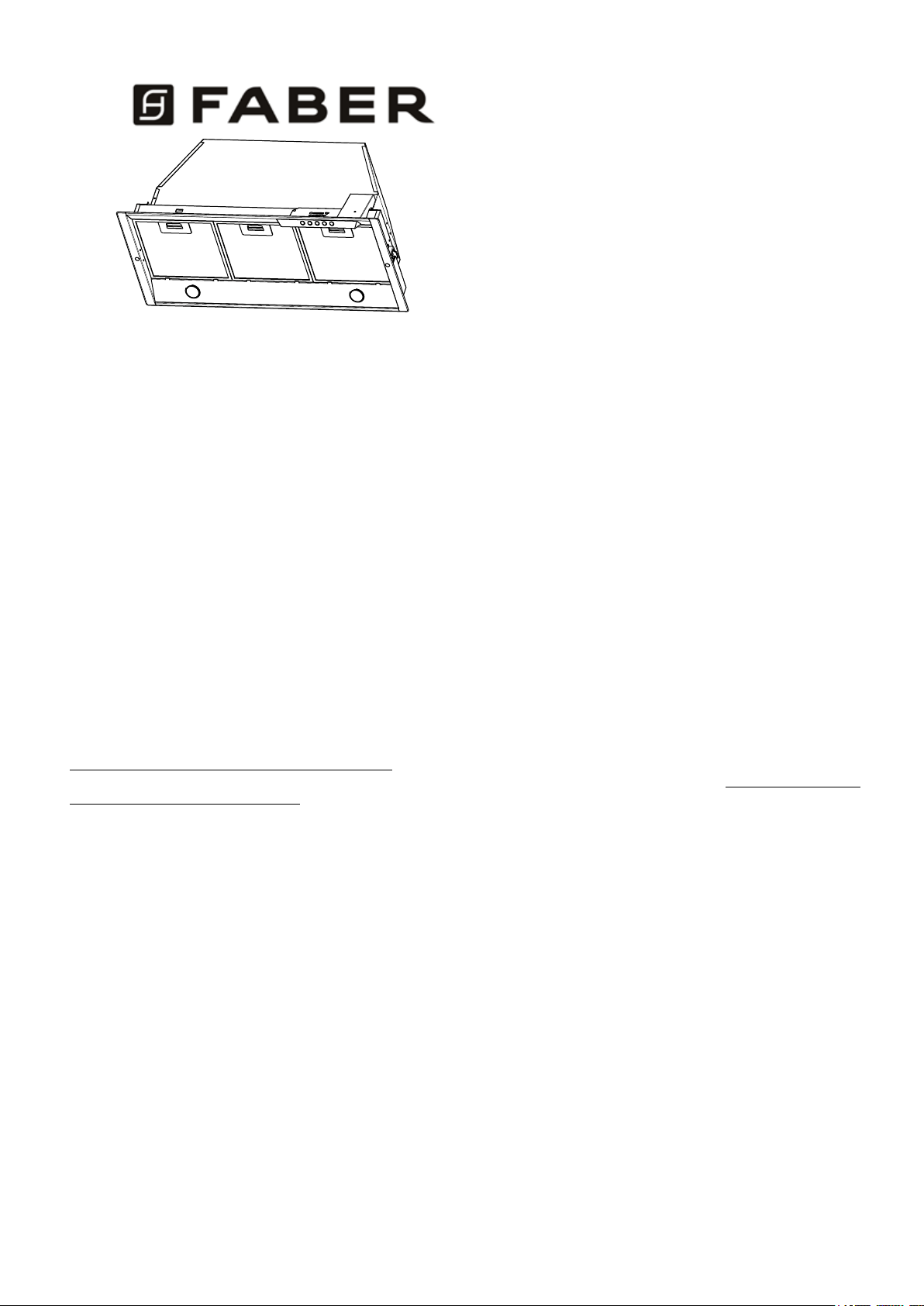
INCA HC SS (electronic controls)
Power Module Range hood
READ AND SAVE THESE INSTRUCTIONS
The Installer must leave these instructions with the homeowner.
The homeowner must keep these instructions for future reference and
for local electrical inspectors' use.
• Installation Instructions
• Use and Care Information
Inca HC Electronic Control 03/15 - Page 2
VENTING REQUIREMENTS
Determine which venting method is best for your application.
Ductwork can extend either through the wall or the roof.
The length of the ductwork and the number of elbows should
be kept to a minimum to provide efcient performance. The
size of the ductwork should be uniform. Do not install two
elbows together. Use duct tape to seal all joints in the ductwork
system. Use caulking to seal exterior wall or oor opening
around the cap.
Flexible ductwork is not recommended. If it is used,
each foot of exible ductwork used is equivalent to
two feet of straight metal ductwork when calculating
the ductrun length. Thus, a exible elbow equals two
standard elbows.
Make sure there is proper clearance within the wall or oor
for exhaust duct before making cutouts. Do not cut a joist or
stud unless absolutely necessary. If a joist or stud must be
cut, then a supporting frame must be constructed.
FOR MORE SPECIFIC DUCTWORK INFORMATION, GO
TO PAGE 4.
WARNING - To Reduce The Risk Of Fire, Use Only Metal
Ductwork.
ELECTRICAL REQUIREMENTS
A 120 volt, 60 Hz AC-only electrical supply is required on a
separate 15 amp fused circuit. A time-delay fuse or circuit
breaker is recommended. The fuse must be sized per local
codes in accordance with the electrical rating of this unit as
specied on the serial/rating plate located inside the unit
near the eld wiring compartment. THIS UNIT MUST BE
CONNECTED WITH COPPER WIRE ONLY. Wire sizes
must conform to the requirements of the National Electrical
Code, ANSI/NFPA 70 - latest edition, and all local codes and
ordinances. Wire size and connections must conform with the
rating of the appliance. Copies of the standard listed above
may be obtained from:
National Fire Protection Association
Batterymarch Park
Quincy, Massachusetts 02269
• Venting system MUST terminate outside the home.
• DO NOT terminate the ductwork in an attic or other
enclosed space.
• DO NOT use 4" laundry-type wall caps.
• Flexible-type ductwork is not recommended.
• DO NOT obstruct the ow of combustion and
ventilation air.
• Failure to follow venting requirements may result in
a re.
This appliance should be connected directly to the fused
disconnect (or circuit breaker) through exible, armored or
nonmetallic sheathed copper cable. Allow some slack in the
cable so the appliance can be moved if servicing is ever nec-
essary. A UL Listed, 1/2" conduit connector must be provided
at each end of the power supply cable (at the appliance and
at the junction box).
When making the electrical connection, cut a 1 1/4" hole
in the wall. A hole cut through wood must be sanded until
smooth. A hole through metal must have a grommet.
WARNING - TO REDUCE THE RISK OF FIRE OR ELECTRIC
SHOCK, do not use this fan with any solid-state speed
control device.
WARNING - TO REDUCE THE RISK OF FIRE, ELECTRI-
CAL SHOCK, OR INJURY TO PERSONS, OBSERVE THE
FOLLOWING: Use this unit only in the manner intended
by the manufacturer. If you have any questions, contact
the manufacturer.
Before servicing or cleaning unit, switch power off at
service panel and lock the service disconnecting means
to prevent power from being switched on accidentally.
When the service disconnecting means cannot be locked,
securely fasten a prominent warning device, such as a
tag, to the service panel.
CAUTION: For General Ventilating Use Only. Do Not
Use To Exhaust Hazardous or Explosive Materials and
Vapors.
WARNING - TO REDUCE THE RISK OF FIRE, ELECTRI-
CAL SHOCK, OR INJURY TO PERSONS, OBSERVE THE
FOLLOWING: Installation Work And Electrical Wiring Must
Be Done By Qualied Person(s) In Accordance With All
Applicable Codes And Standards, Including Fire-Rated
Construction.
Sufcient air is needed for proper combustion and
exhausting of gases through the ue (chimney) of fuel
burning equipment to prevent backdrafting. Follow the
heating equipment manufacturer's guideline and safety
standards such as those published by the National Fire
Protection Association (NFPA), and the American Society
for Heating, Refrigeration and Air Conditioning Engineers
(ASHRAE), and the local code authorities.
When cutting or drilling into wall or ceiling, do not dam-
age electrical wiring and other hidden utilities.
Ducted fans must always be vented to the outdoors.
WARNING
• Electrical ground is required on this range hood.
• If cold water pipe is interrupted by plastic,
nonmetallic gaskets or other materials, DO NOT
use for grounding.
• DO NOT ground to a gas pipe.
• DO NOT have a fuse in the neutral or grounding
circuit. A fuse in the neutral or grounding circuit
could result in electrical shock.
• Check with a qualied electrician if you are in
doubt as to whether the range hood is properly
grounded.
• Failure to follow electrical requirements may result
in a re.
WARNING
For residential use only.
!
!
Cold Weather installations
An additional back draft damper should be installed to minimize
backward cold air ow and a nonmetallic thermal break should
be installed to minimize conduction of outside temperatures
as part of the vent system. The damper should be on the cold
air side of the thermal break. The break should be as close as
possible to where the vent system enters the heated portion
of the house.
CAUTION: To reduce risk of re and to properly exhaust air, be
sure to duct air outside - do not vent exhuast air into spaces within
walls or ceilings or into attics, crawl spaces or garages.
Inca HC Electronic Control 03/15 - Page 3
RÈGLEMENTS D'ÉVACUATION
Conrmer la sortie d'évacuation - soit par le mur, soit par
le toit.
Utilisez une longueur de tuyauterie minimale avec les moindres
de coudes pour la plus grande ecacité. Le diamètre de
tuyauterie doit être uniforme. N'installez jamais 2 coudes
ensemble. Scellez bien tous les joints avec un ruban adhésif
métallique à l'intérieur et scellez bien le clapet extérieur avec
du calfeutrage.
Utilisez un tuyau d'évacuation rigide lorsque possible.
Un tuyau exible égale deux fois plus qu'un tuyau rigide,
ce qui réduit la puissance d'évacuation.
Veillez à ce que l'espace pour le tuyau soit ample - ainsi
on n'aurait pas besoin de découper les supports de mur
intérieur. Si ce découpage est nécessaire, veillez bien à ce
qu'un renforcement soit mis en place.
RÈGLEMENTS D'ÉVACUATION ADDITIONELL - PAGE 10.
AVERTISSEMENT - Pour Ne Pas Risquer Un Feu, Utilisez
Seulement Les Matériaux Métalliques.
installé à chaque bout de l (soit à l'appareil ainsi qu'à la
boite à fusible).
Faites un trou de 1 1/4 po. dans le mur. S'il s'agit d'un trou en
bois - sablez-le bien, tandis qu'un trou passant par le métal
demande un bouche-trou.
AVERTISSEMENT - POUR RÉDUIRE LE RISQUE
D'INCENDIE OU DE CHOC ELECTRIQUE, ne pas utiliser
ce ventilateur en conjonction avec un dispositif de réglage
de vitesse à semi-conducteurs.
AVERTISSEMENT – POUR MINIMISER LES RISQUES
D’INCENDIE, CHOC ÉLECTRIQUE OU DOMMAGES
CORPORELS, OBSERVER LES PRESCRIPTIONS
SUIVANTES: Suivez les recommandations du fabricant
et entre en communication avec lui pour toute
information.
Fermez le courant avant tout entretien et veillez a ce qu'il
reste fermé. Si on ne peut pas verrouiller le panneaux
du service électrique, afchez un avis de danger sur la
porte.
AVIS: Pour L'évacuation Générale - Veillez à Ne Pas Evacuer
Des Matériaux Ou Vapeurs Explosif.
AVERTISSEMENT – POUR MINIMISER LES RISQUES
D’INCENDIE, CHOC ÉLECTRIQUE OU DOMMAGES
CORPORELS, OBSERVER LES PRESCRIPTIONS
SUIVANTES: L'installation Et Le Raccordement Electrique
Doivent Se Faire Par Un Technicien Qualié Selon Tous
Les Codes Municipaux.
An d'obtenir un rendement maximal en ce qui a trait à la
combustion ainsi qu'à l'évacuation des gaz par la conduite
de cheminée, une bonne aération est nécessaire pour
tous les appareils à combustion. Suivez les conseils et
mesures de sécurité du fournisseur tels que ceux publiés
par l'Association Nationale de la Sauvegarde contre
l'Incendie et l'Association Américaine d'Ingénieurs de
Chauffage, Frigorifaction et Air Climatisé ainsi que les
codes municipaux.
En perçant un mur veillez à ne pas perforer un autre l
électrique.
Une ventilateur à évacuation extérieure doit être
raccordée à l'extérieur.
AVERTISSEMENT
• Le système d'évacuation DOIT sortir à l'extérieur.
• N'ÉVACUEZ PAS le conduit soit dans une
mansarde soit dans un espace enfermé.
• N'UTILISEZ PAS un clapet de séchoir à 4
pouces.
• N'utilisez pas un conduit exible.
• N'ENCOMBREZ PAS la circulation d'air.
• Faute de suivre cet avertissement pourrait
occasionner un feu.
FICHE TECHNIQUE ÉLECTRIQUE
Le raccordement électrique doit se faire avec un circuit séparé
de 15 ampères fusible à 120V, 60 Hz, courant alternant. On
recommande un coupe-circuit. La taille du fusible doit se
conformer aux codes municipaux suivant la spécication
électrique sur la plaque intérieure. Le diamètre du l
devra aussi se conformer aux règlements du code national
électrique, ANSI/NFPA 70 - ainsi qu'aux règlements locaux
et les spécications de cet appareil. On peut obtenir ces
informations chez:
l'Association Nationale de la Prévention du Feu
Batterymarch Park
Quincy, Massachusetts 02269
Raccordez cet appareil directement au coupe-circuit avec un
l exiblle couvert en cuivre en laissant un peu de lâchement
dans le l pour permettre le déplacement de l'appareil.
Veillez a ce qu'un contact d'un demi-pouce (1/2 po.) soit
• Une prise à terre est nécessaire pout cette hotte.
• N'utilisez pas un tuyau à l'eau froide pour la mise
à terre s'il est branché à un joint plastique, non-
métallique ou autre.
• NE JOIGNEZ PAS la mise à terre à conduit de gaz.
• N'INSTALLEZ PAS un fusible dans le circuit de
mise à terre - ce qui peut causer une secousse
électrique.
• Vériez avec un électricien certié à ce que la
hotte soit bien mise à terre.
• Faute de suivre ces recommandations pourrait
occasionner un feu.
AVERTISSEMENT
Uniquement pour usage menager.
!
!
Installations pour régions à climat froid
On devrait installer un clapet antireux additionnel pour minimiser le
reux d'air froid, et incorporer un élément non métallique d'isolation
thermique pour minimiser la conduction de chaleur par l'intermédiaire
du conduit d'évacuation, de l'intérieur de la maison à l'extérieur. Le
clapet anti-reux doit être placé du côté air froid par rapport à l'élément
d'isolation thermique. L'isolant thermique doit être aussi proche que
possible de l'endroit où le système d'évacuation s'introduit dans la
partie chauffée de la maison.
Inca HC Electronic Control 03/15 - Page 4
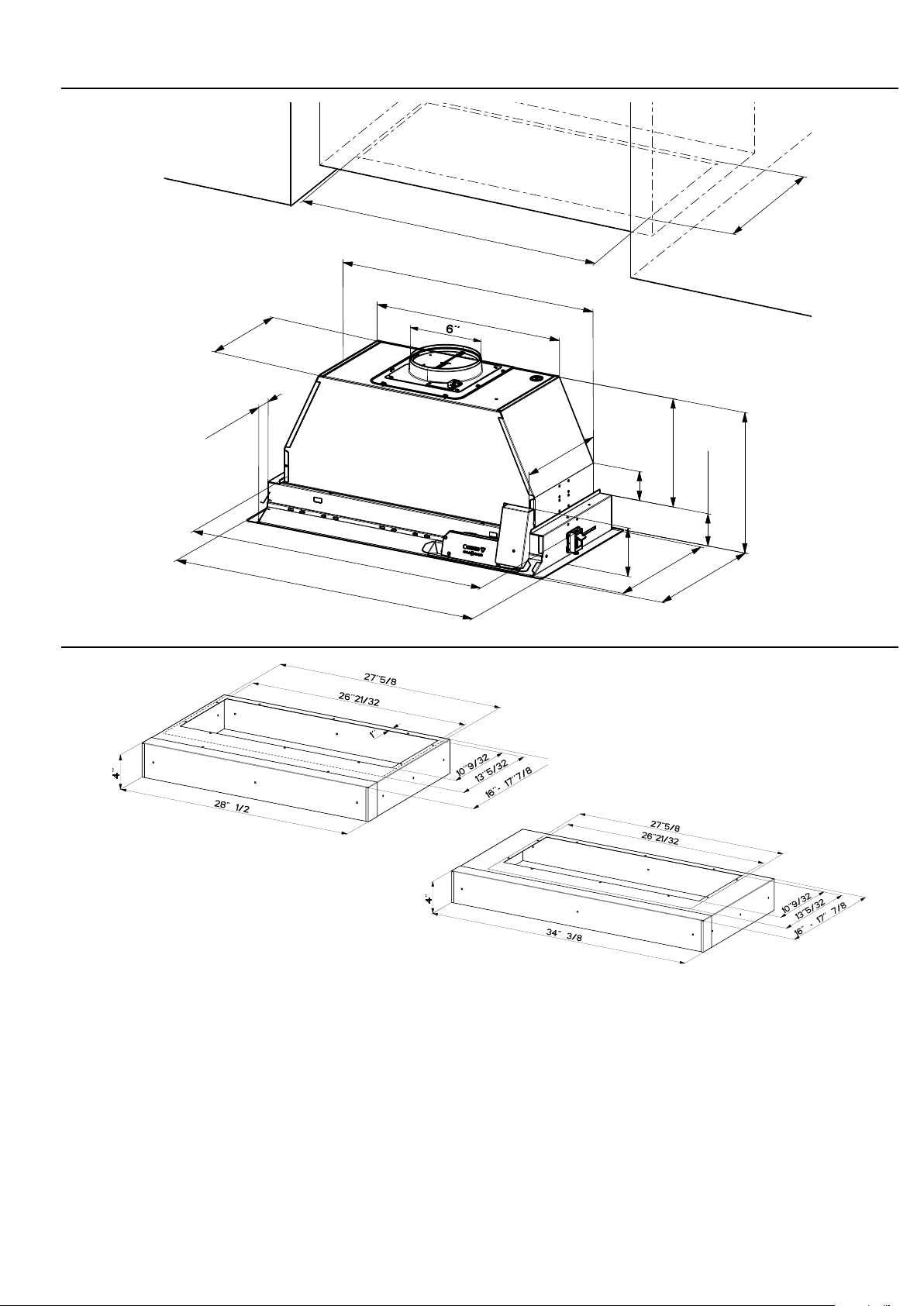
RANGE HOOD AND CUT-OUT DIMENSIONS / DIMENSIONS DE LA HOTTE ET DU PRÉCOUPÉE
Standard Liner 36 Stainless (LINE36ST)
designed for 36” wide installations
Cadre Standard 36 Axier Inoxydable (620000305)
peut être employée les hottes encastrable sur mesure de 36"
Standard Liner 30 Stainless (LINE30ST)
designed for 30” wide installations
Cadre Standard 30 Axier Inoxydable (620000304)
peut être employée les hottes encastrable sur mesure de 30"
Note: Standard Liners are pre-cut for installation of Inca Smart. For installations with
the Inca HC SS, remove the additional perforated section.
Note: Les Cadres Standard sont précoupés pour l'installation de l'Inca Smart. Pour
des installations avec L'Inca HC SS, enlevez la section perforée additionnelle.
LINER DIMENSIONS / DIMENSIONS DU CADRE
FIGURE 1
Pre-Planning Your Installation -
Important: The recommended height to install this hood o the
cooktop is a minimum of 24" and a maximum of 30” for maximum eectiveness. Also consult the cooktop
manufacturer’s recommendation.
Planiez votre installation - Important : La hauteur recommandée pour installer cette hotte au-des-
sus de la surface de cuisson est d’un minimum de 24” et d’un maximum de 30” pour un maximum
d’ecacité. De plus, nous vous recommandons consulter le manuel de recommandations du fabricant
de la surface de cuisson.
27 5/8"
13 5/32"
17 3/8"
24"
9 5/8"
1 9/16"
28 3/8"
27 9/16"
13"
13 3/32"
3 3/32"
10"
3"
5''
10 3/4''
MOD. INCA BIG ESB
RIF. -
N.DIS. 352_731.1
DATA 24-Nov-10
13 3/4

Inca HC Electronic Control 03/15 - Page 5
PLAN YOUR DUCTWORK
The Inca HC SS requires 6" round
ductwork. To ensure that the blower
performs to its highest possible capacity,
ductwork should be as short and straight
as possilbe.
For satisfactory performance the duct run
should not exceed 50 equivalent feet if
ducted using the required minimum 6"
round duct. Calculate the length of the
ductwork by adding the equivalent feet
in FIGURE A for each piece of duct
in the system An example is given in
FIGURE B.
For best results, use no more than three
90° elbows. Make sure that there is a
minimum of 24" of straight duct between
elbows if more than one is used. Do not
install two elbows together.
TOOLS NEEDED FOR INSTALLATION
• Saber Saw or Jig Saw
• Drill
• 1 1/4" Wood Drill Bit
• Pliers
• Phillips Screwdriver
• Wire Stripper or Utility Knife
• Metal Snips
• Measuring Tape or Ruler
• Level
• Pencil
• Caulking Gun
• Duct Tape
PARTS SUPPLIED FOR INSTALLATION
• 1 Backdraft Damper
• 1 Vent Grate (for recirculating installations only)
• 1 Literature Package
PARTS NEEDED FOR INSTALLATION
• 2 Conduit Connectors
• Power Supply Cable
• 1 Wall or Roof Cap
• All Metal Ductwork
The Inca HC SS power pack range hood is designed to oer a wide exibility of
installations. The range hood can be ducted vertically (FIGURE 2) or horizontally
(FIGURE 3) through a 6" round vent. The unit can also be installed in a recirculat-
ing conguration (FIGURE 4). The unit comes standard in top venting position.
45˚ Elbow
90˚ Elbow
90˚ Flat Elbow
Wall Cap
FIGURE A
9 Feet Straight Duct
2 - 90˚ Elbows
Wall Cap
Total System
9.0 feet
10.0 feet
0.0 feet
19.0 feet
FIGURE B
3.0 feet
5.0 feet
12.0 feet
0.0 feet
HORIZONTAL DUCTING
FIGURE 2
VERTICAL
DUCTING
For direct rear venting, you must change the blower position. Remove the 12 screws
that hold the metal housing to the range hood body. Rotate the metal housing for
direct rear venting. Replace all screws, making sure that they are rmly fastened.
FIGURE 3
RECIRCULATING INSTALLATIONS
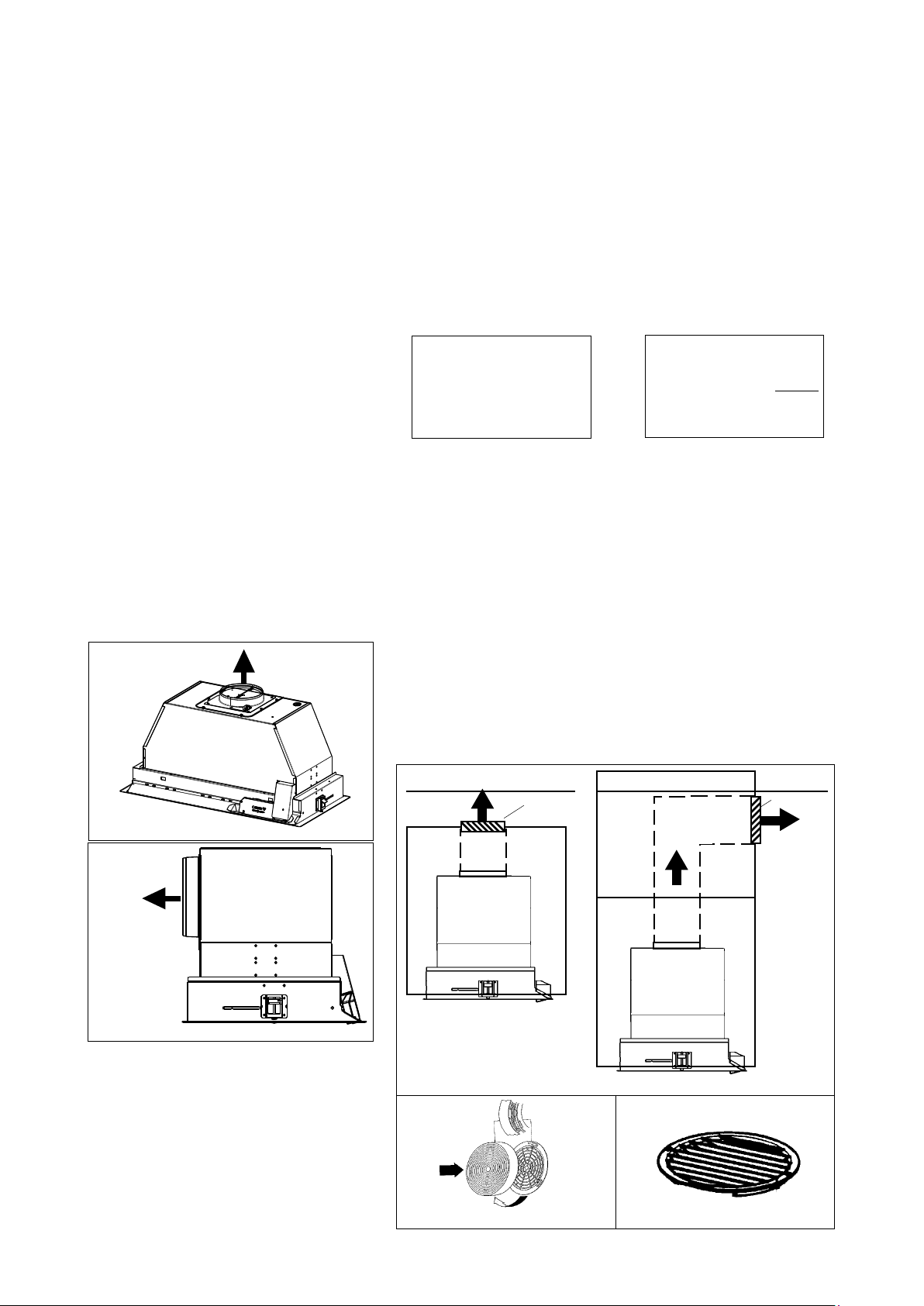
For recirculating installations (FIGURE 4), Charcoal Filters are necessary. Remove
all three grease lters and set aside. Attach one charcoal lter to each end of the
blower. Each charcoal lter attaches to the black grid on the side of the blower.
Rotate the lter clockwise to install and counterclockwise to remove (FIGURE 4A).
Replace all three grease lters. Recirculating installations also require some duct
work to divert the air out of the cabinet. The duct work must not terminate inside
the cabinet. The plastic vent grate supplied with the range hood (FIGURE 4B)
can be used to cover the duct opening.
NOTE: The transformer on the right hand side of the Inca HC may need to be
rotated in order to t the charcoal lters inside the hood. Loosen the screw
holding the black, round transformer and rotate 90º to make room for the
lter. Tighten the screw after rotating.
6” round
duct
ceiling
hood
vent grate
cabinet
ceiling
sot
vent grate
cabinet
6” round
duct
FIGURE 4A FIGURE 4B
FIGURE 4
hood
Inca HC Electronic Control 03/15 - Page 6
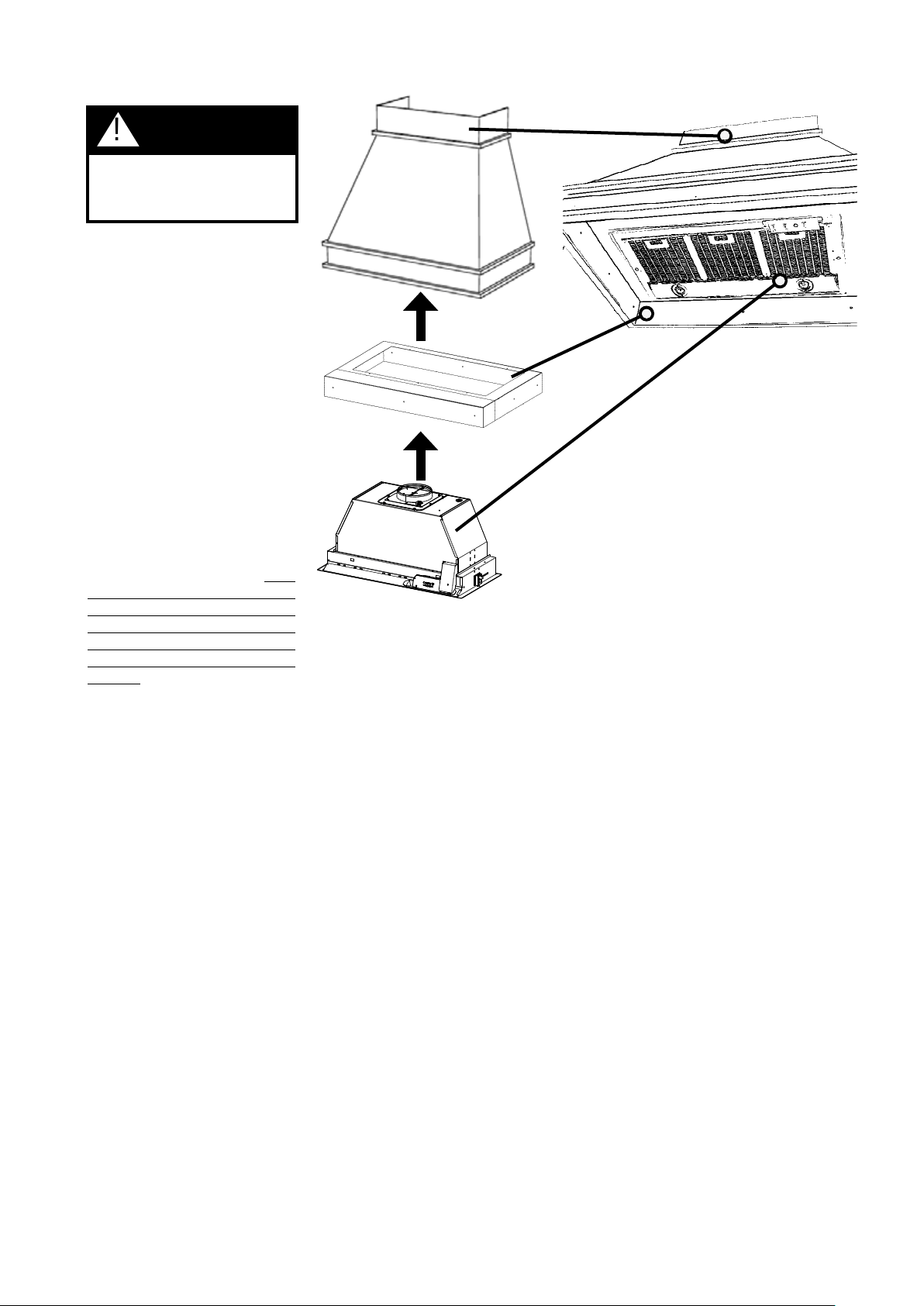
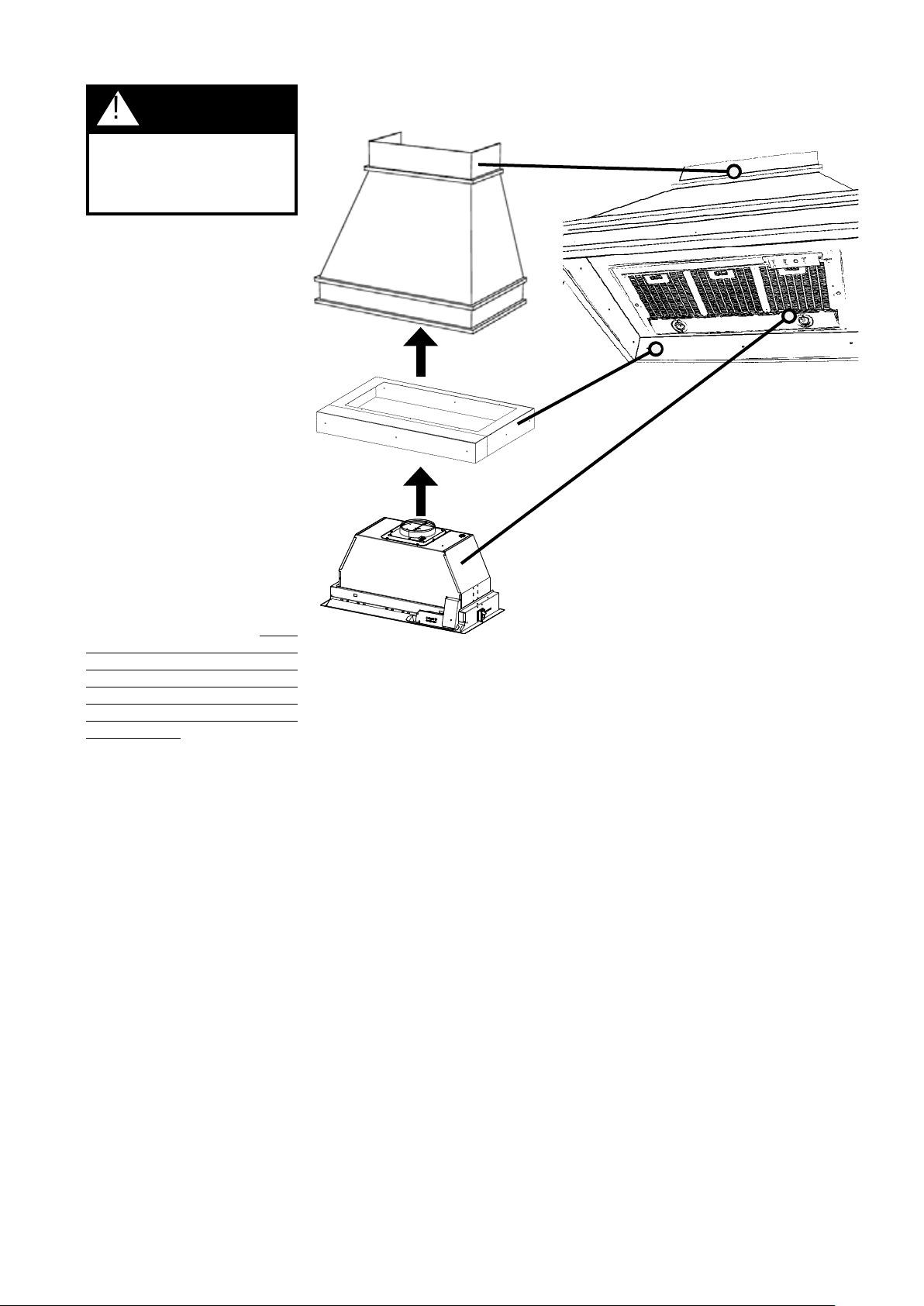
FOR INSTALLATIONS WITH LINERS
CUSTOM/WOOD
HOOD
STANDARD LINER
WARNING
!
When building a custom hood,
always follow all applicable
codes and standards.
1. The custom/wood hood must have a sturdy base (3/4" plywood recommended) to
accomodate the cut-out for the Inca HC SS. The base must be recessed to accomodate
the height of the Liner (see LINER DIMENSIONS on Page 4). The Liner attaches to the
bottom of the base using screws appropriate for the size and material of your custom/
wood hood. The Inca HC SS inserts into the cut-out in the Liner and base.
2. Position the rear section of the Liner so that it abuts the back edge of your custom/
wood hood. Using a pen, trace the outline of the pre-cut out. Remove the Liner and
proceed to MAKE YOUR CUT-OUTS on Page 7. Install both sections of the Liner and
proceed to INSTALL THE Range hood on Page 7.
INCA HC SS
The Inca HC SS can be used with
custom cabinetry and hoods 30"
wide and up. Choose either a
custom liner or our Standard Liner
designed for 30" and 36" wide
installations.
Liners create a perfectly-sealed,
non-combustible finish for the
underside of your custom/wood
hood.
The Standard Liners are made up of
two sections: a larger, rear section
(pre-cut out for insertion of the
Inca Smart) and a front section for
a total adjustable depth between
16" and 17 7/8".
!!! IMPORTANT NOTE: YOU
MUST REMOVE THE ADDITIONAL
PERFORATED SECTION AROUND
THE PRE-CUT-OUT WHEN
INSTALLING THE STANDARD
LINER WITH THE INCA HC SS
MODEL.
Consider the shape, size, and
weight of the Inca HC SS and Liner
to determine the conguration
of the custom/wood hood. See
Range hood AND CUT-OUT
DIMENSIONS AND LINER
DIMENSIONS on Page 4.
OPTIONAL ACCESSORIES AVAILABLE
• Charcoal Filter Kit
For recirculating installations only,
replace charcoal lters as needed
part # FILTER1
• Liners
Create a perfectly-sealed, non-combustible perimeter around the Inca HC SS. Depth adjustable from 16" - 17
7/8".
Standard Liner 30 Stainless - part # LINE30ST
Standard Liner 36 Stainless - part # LINE36ST
• Make-Up Air Damper
Meets make-up air codes, this kit uses an air switch above the hood to activate the make-up air damper to open and bring fresh air
whenever the hood fan is operating and then close tightly when the hood is o.
Make-up air damper kit 6" - part # MUDAMPER6
Make-up air damper kit 8" - part # MUDAMPER8
• CFM Reducer
Reduces the cfm level to under 300 for make up air codes #CFMRED
Inca HC Electronic Control 03/15 - Page 7
INSTALL THE Range hood
1. Remove the range hood from the carton and place
on a at surface. Cover the surface to prevent accidental
damage. Remove all parts including the backdraft damper,
plastic grille and literature package before discarding the
carton.
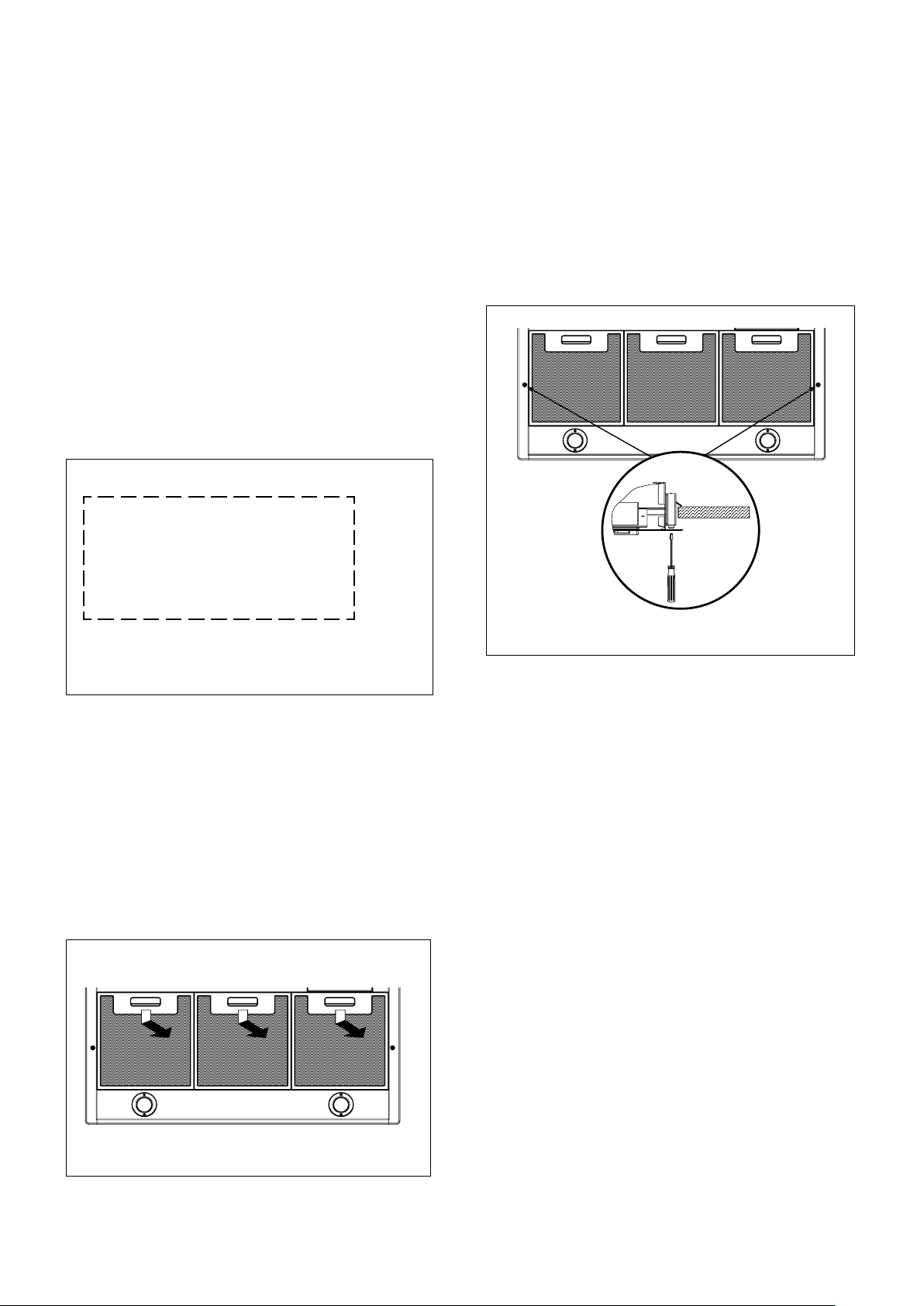
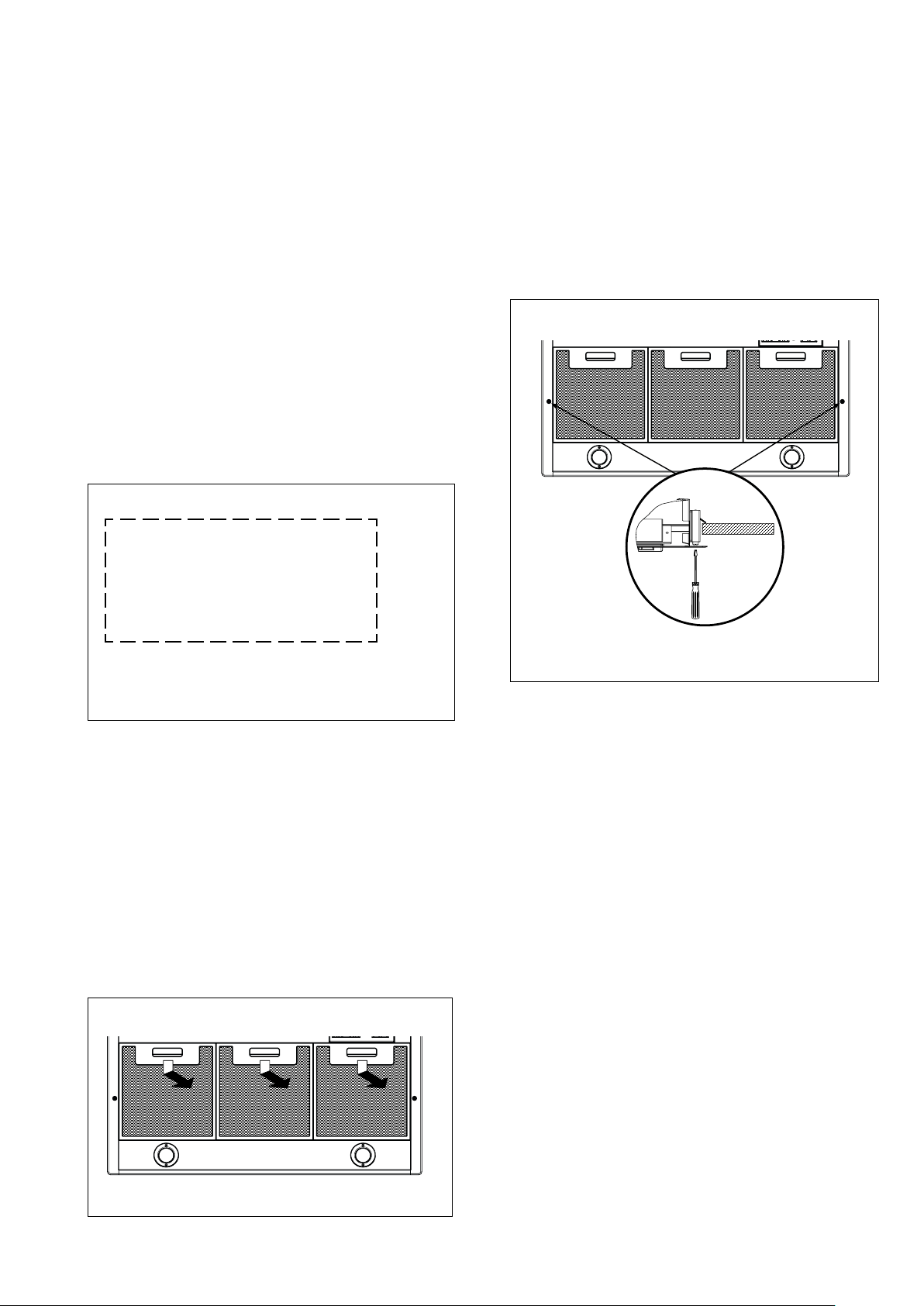
2. Remove the grease lters from the range hood and set
aside. The grease lters are removed by pressing the handle
of the lter as indicated in FIGURE 6. When replacing, make
sure that the lters are properly positioned with the handles
in front and visible.
MAKE YOUR CUT-OUTS
1. Disconnect and move freestanding range from cabinet
opening to provide easier access to upper cabinet and rear
wall. Put a thick, protective covering over cooktop, set-in
range or countertop to protect from damage or dirt.
2. Determine and clearly mark with a pencil the center
line on the cabinet where the range hood will be installed.
3. Determine and make all necessary cuts in the wall for
the ductwork. Install the ductwork before the range hood.
4. Determine the proper location for the Power Supply
Cable. Use a 1 1/4" Drill Bit to make this hole. Install the
cable. Use caulking to seal around the hole. DO NOT turn
on the power until installation is complete.
5. Make the cut-out opening where the range hood will be
installed (FIGURE 5).
FIGURE 5
CUT-OUT
27 5/8"
13 5/32"
FIGURE 6
3. Place the round damper into the exhaust opening of
the range hood and press down.
4. The range hood mounts to the cabinet by two spring
loaded brackets, one on each side of the range hood. Lift
the range hood into the cutout opening in the cabinet. Be
careful not to damage the cabinet, range hood or other ap-
pliances.
5. Tighten the range hood to the cabinet by rotating the
screws indicated in FIGURE 7 with a phillips screw driver.
FIGURE 7
6. Remove the metal knockout hole on the back or top of the
right side of the hood with a at head screwdriver. Feed the
Power Supply Cable through the electrical knockout.
Remove the cover from the eld wiring compartment with a
phillips screwdriver. Connect the Power Supply Cable to
the range hood cable. Attach the White lead of the power
supply to the White lead of the range hood with a twist-on type
wire connector. Attach the Black lead of the power supply
to the Black lead of the range hood with a twist-on type wire
connector. Attach the Power Supply Cable grounding lead
to the green screw provided. Replace the cover.
7. Replace the grease lters.
8. Connect the ductwork to the damper and seal all con-
nections with duct tape.
9. Turn the power supply on. Turn on the blower and
light. If the range hood does not operate, check that the
circuit breaker is not tripped or the house fuse blown. If the
unit still does not operate, disconnect the power supply and
check that the wiring connections have been made properly.
Inca HC Electronic Control 03/15 - Page 8
Cleaning
The metal grease lters should be cleaned frequently in hot
detergent solution or washed in the dishwasher. Stainless
steel cleaner should be used on stainless range hoods. Abra-
sives and scouring agents can scratch range hood nishes
and should not be used to clean nished surfaces.
Replacing the Halogen Lights
Purchase halogen bulb - (Max 20W, 12V, type MR11 bulb
with glass lens)
Before attempting to replace the lamps, make sure that the
light switch is turned o, and that the other lamps have had
sucient time to cool. Halogen bulbs burn extremely hot and
serious injury could result from touching a hot bulb.
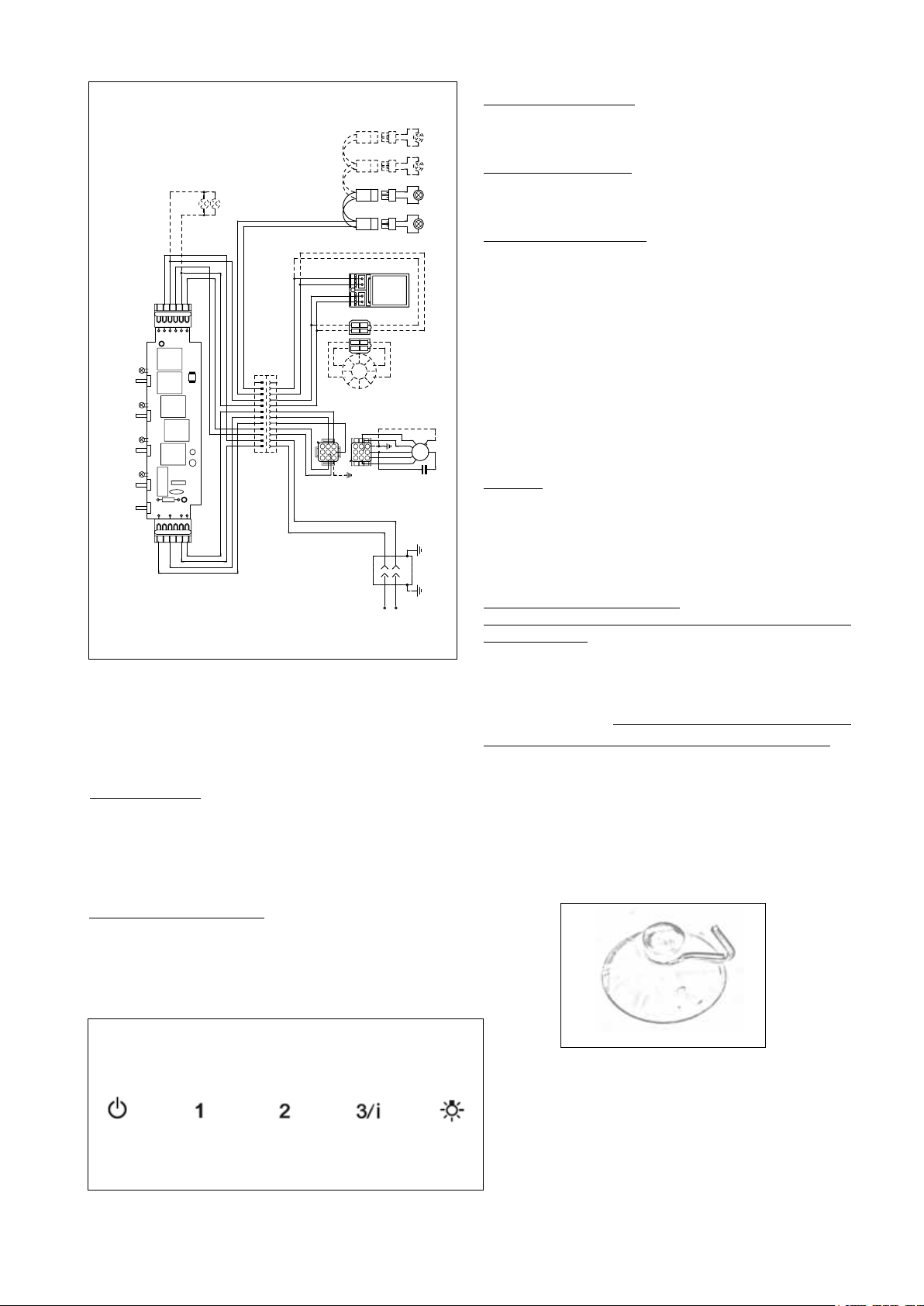
The method to replace the lamps is to use a 1 1/4" suction
cup (FIGURE 9), found at a hardware store or through Faber.
Attach the suction cup to the bulb and pull rmly down on
the bulb and replace with a new lamp.
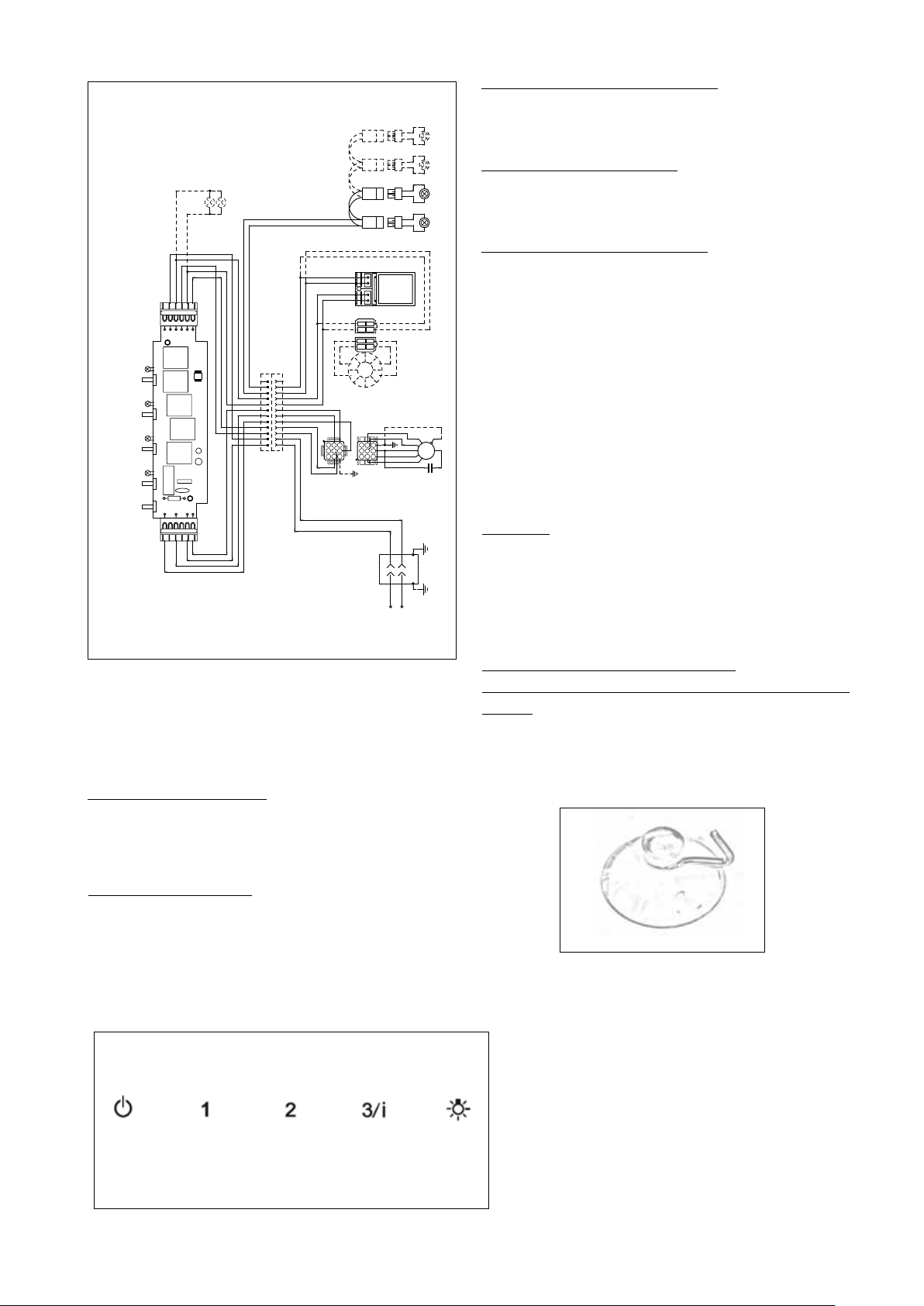
WIRING DIAGRAM
• This range hood uses 20 watt Halogen Lamps.
USE AND CARE INFORMATION
This range hood system is designed to remove smoke, cook-
ing vapors and odors from the cooktop area.
For Best Results
Start the range hood several minutes before cooking to
develop proper airow. Allow the unit to operate for several
minutes after cooking is complete to clear all smoke and
odors from the kitchen.
Range hood Control Panel
The control panel, located on the right-hand side under the
canopy. The position and function of each control button is
indicated in FIGURE 8. A blue LED back light indicates the
current speed and when the light is on.
FIGURE 8
FIGURE 9
0123456789
Creato da.
Rev :
Ver :
DOLCE CORRADO
Materiali: non deveno contenere Pb, Cr6+, Hg, PBB, pbde, ai sensi della direttiva 2002/95 CE
SCHEMA ELETTRICO M8-4V ESB FARETTI
Non rilevare quote dal grafico non apportare modifiche senza l'autorizzazione d'ufficio progettazione
a termini di legge ci riserviamo la proprieta' del presente disegno con divieto di ripr oduzione totale o parziale
Code :
Disegno N :
Data:
08.Set.2010
LINE IN
120Vac
60Hz ~
L
N
Y-G
WIRING BOX
BLU
RED
BLK
WHT
Y-G
1
2
3
4
5
6
BLK
V1
MC
F
V2
ESB
0
MOTOR
1
MOTOR
BRW
GRY
BLU
123
654
789
123
654
987
RED
M8 4V
120V ~
WHT
BRW
2
SPEED
BLU
BLK
1
1
BLK
BLK
WHT
2
2
WHT
ORG
BRW
3
3
BRW
GRY
4
4
GRY
RED
WHT
BLU
Y-G
BLU
5
5
BLU
3/I
SPEED
RED
6
6
RED
WHT
7
7
WHT
VLT(ORG)
8
8
VLT(ORG)
RED(ORG)
9
9
RED(ORG)
RED
10
10
RED
VLT
11
11
VLT
0-1
LIGHT
12
12
TOROIDAL
TRANSFORMER
WHT
4
3
BLK
RED
2
1
BLK
N
L
V4
L
V3
ORG
2
1
RED
ORG
4
3
VLT
WHT
1
2
3
4
5
6
ORG
WHT
BRW
GRY
ORG
RED(ORG)
VLT(ORG)
RED
VLT
PRI.
SEC.
ELECTRONIC
TRNSFORMER
VLT
RED
HALOGEN
LAMPS
VLT
INCANDESCENT
LAMP
RED
HALOGEN
LAMPS
HALOGEN
LAMPS
HALOGEN
LAMPS
Light On/Off Button ( L )
On/Off switch for the halogen lights. Press the light button
to turn the light ON. and again to turn off.
Blower Off Button ( M )
Off switch for the blower. The blower can be operated by
pressing any of the speed buttons
Blower Speed Button ( V )
The speed control for the blower. Press the switch "1" for
LOW speed, "2" for MEDIUM speed and "3" for HIGH speed.
Hold down the speed 3 button for 5 seconds to activate the
intensive speed. The intensive speed setting is indicated by a
blinking blue light. This operates the hood for 10 minutes on
the high speed and then returns to the previous speed.
NOTE: It is not recommended to use the lighting
as a night light or for an extended time beyond
normal cooking times. The halogen lights life span
will be reduced.
L
M
V

Inca HC Electronic Control 03/15 - Page 9
FABER WARRANTY & SERVICE (SAVE FOR YOUR RECORDS)
All Faber products are warranteed against any defect in materials or workmanship for the
original purchaser for a period of 1 year from the date of original purchase. This warranty
covers labor and replacement parts. To obtain warranty service, contact the dealer from
whom you purchased the range hood, or the local Faber distributor. If you cannot identify
a local Faber distributor, contact us at (508) 358-5353 for the name of a distributor in your
area.
The Following is not covered by Faber's warranty:
1. Service calls to correct the installation of your range hood, to instruct you how to use your
range hood, to replace or repair house fuses or to correct house wiring or plumbing.
2. Service calls to repair or replace range hood light bulbs, fuses or lters. Those
consumable parts are excluded from warranty coverage.
3. Repairs when your range hood is used for other than normal, single-family
household use.
4. Damage resulting from accident, alteration, misuse, abuse, re, ood, acts of God,
improper installation, installation not in accordance with electrical or plumbing codes, or
use of products not approved by Faber.
5. Replacement parts or repair labor costs for units operated outside the United States or
Canada, including any non-UL or C-UL approved Faber range hoods.
6. Repairs to the hood resulting from unauthorized modications made to the
range hood.
7. Expenses for travel and transportation for product service in remote locations and pickup
and delivery charges. Faber range hoods should be serviced in the home.
Record Your Information Below:
Serial #: __________________________
Date of Purchase: ______________
Inca HC Electronic Control 03/15 - Page 10
OUTILS NÉCESSAIRES À L’INSTALLATION
• Scie sauteuse ou à découper
• Perceuse
• Mèche à bois 1 1/4 po
• Pinces
• Tournevis Phillips
• Dénude l ou couteau tout usage
• Pince coupante à l métallique
• Ruban à mesurer ou règle
• Niveau
• Crayon
• Outil à calfeutrage
• Ruban à conduit
PIÈCES FOURNIES POUR L’INSTALLATION
• 1 registre à clapet
• Une grille (POUR RECIRCULATION D'AIR)
• 1 nécessaire de documentation
PIÈCES NÉCESSAIRES POUR
L’INSTALLATION
• 2 connecteurs de conduit
• Câble d’alimentation
• 1 capuchon de mur ou de toit
• Conduit en métal
PLAN DU CONDUIT
La hotte Inca HC SS requiert
le conduit rond de 6 po. Pour assurer que
le ventilateur marche le mieux, le conduit doit être aussi court et aussi
droit que possible.
Pour obtenir des performances satisfaisantes, le parcours du conduit ne
doit pas dépasser 50 pieds équivalents si canalisé en utilisant le minimum
requis de 6 "conduit rond. Calculer la longueur du conduit en ajoutant
l’équivalent en pied de la FIGURE A pour chaque pièce du conduit
du système. Un exemple est donné à la FIGURE B. Pour de meilleurs
résultats, ne pas utiliser plus de trois coudes de 90
o
. S’assurer qu’il y
ait un minimum de 24 po de conduit droit entre les coudes si l’on utilise
plus d’un coude. Ne pas installer deux coudes ensemble.
La hotte Inca HC SS est conçue pour orir une grande exibilité
d’installations. Elle peut être installée avec conduit horizontal ou vertical
par une ventilation rond de 6 po ou avec une conguration de recircula-
tion d’air. La hotte arrives avec conduit vertical. Les FIGURES 2 et 3
montrent l’installation avec conduit vertical et horizontal.
9 pi de conduit droit
2 Coudes 90˚
Capuchon de mur
Système total
9,0 pi
10,0 pi
0,0 pi
19,0 pi
FIGURE B
3,0 pi
5,0 pi
12,0 pi
0,0 pi
Coude 45˚
Coude 90˚
Coude plat 90˚
Capuchon de mur
FIGURE A
CONDUIT
VERTICAL
Pour la sortie postérieure de l'air on doit changer la
position du diuseur selon l'ordre des opérations
suivantes . Enlever les 12 vis qui xent la partie
mètallique à la carcasse de la hotte. Tourner le
diuseur. S' assurer que le cable est positionné
correctement. Replacer toutes les vis en
s'assurant qu'ils sont parfaitement vissées.
CONDUIT
HORIZONTAL
FIGURE 3
INSTALLATION POUR RECIRCULATION D'AIR
Un nécessaire des Filtres au Charbon (FIGURE 4A) est requis pour ce
type d'installation. Installation pour recirculaton d'air requis conduit
pour divertir l'air à l'extérieur de l'armoire. Ne la conduit terminez pas dan
l'armoire. La grille en plastique fournie avec la hotte peut être utilisée pour
couvrir l’ouverture du conduit, tel qu’il est illustré à la (FIGURE 4B).
FIGURE 4A
FIGURE 2
FIGURE 4B
6 po
conduit
rond
hotte
l'armoire
FIGURE 4
plafond
grille
plafond
sote
grille
l'amoire
6 po
conduit
rond
hotte
REMARQUE: Le transformateur sur le côté droit de l'Inca HC
peut-être besoin d'être mis en rotation pour s'adapter aux ltres
à charbon à l'intérieur de la hotte. Desserrer la vis retenant le noir,
le transformateur rond et tourner de 90 º à faire de la place pour le
ltre. Serrer la vis après la rotation.
Inca HC Electronic Control 03/15 - Page 11
INSTALLATIONS AVEC CADRES
HOTTE
ENCASTRABLE
CADRE STANDARD
AVERTISSEMENT
!
En constuisant une hotte
encastrable sur commande,
suivez toujours tous les codes
et normes applicables.
1. La hotte encastrable doit avoir une base vigoureuse (3/4” contre-plaqué recommandé)
pour adapter au coupe-circuit pour l'Inca HC SS. La base doit être enfoncée pour adapter
à la taille du Cadre (voir les DIMENSIONS DU CADRE à la page 4). Les attaches de
Cadre au fond de la base à l’aide des vis appropriées pour la hotte encastrable. L’Inca
HC SS est installé dans le coupe-circuit dans le Cadre et la base.
2. Placez la section arrière du Cadre de sorte qu’il aboute le bord arrière de votre hotte
encastrable. En utilisant un stylo, tracez le contour de la sortie précoupée. Enlevez le
Cadre et procédez FAIRE LA COUPE à la page 11. Installez les deux sections du Cadre
et procédez INSTALLATION DE LA HOTTE à la page 11.
INCA HC SS
L'Inca HC SS peut être installée
avec hottes sur mesure 30" ou
plus. Choisissez un recouvrement
fait sur mesure ou notre cadre 30"
et 36" standard.
Pour des hottes encastrable,
choisissez un recouvrement fait
sur commande ou notre Cadre
Standard conçu pour 30” et 36”
installations. Les Cadres créent
une nition parfait-scellée et non-
combustible pour le dessous de
votre hotte encastrable.
Les Cadres Standard se
composent de deux sections:
une plus grande, arrière section
(précoupée pour l’insertion de
l’Inca Smart) et une section avant
pour une profondeur réglable
totale entre 16” et 17 7/8”.
!!! NOTE IMPORTANTE: VOUS
DEVEZ ENLEVER LA SECTION
PERFORÉE ADDITIONNELLE
AUTOUR DU PRÉCOUPÉE
EN INSTALLANT LE CADRE
STANDARD AVEC LE MODÈLE DE
L'INCA HC SS.
Considérez la forme, la taille, et
le poids de l’Inca HC SS et du
Cadre déterminer la conguration
de la hotte encastrable. Voir des
DIMENSIONS DE LA HOTTE ET
DU PRÉCOUPÉE ET DIMENSIONS
DU CADRE à la page 4.
ACCESSOIRES POUR L’INSTALLATION
• Filtres au Charbon
Pour installations sans conduit
part # FILTER1
• Cadres
16" - 17
7/8" prof. ajustable
Cadre Standard 30 - part # LINE30ST
Cadre Standard 36 - part # LINE36ST
Maquillage Air Amortisseur
Répond maquillage codes d'air, ce kit utilise un commutateur à air ci-dessus le capot pour activer le volet d'air make-up pour ouvrir
et apporter de l'air frais à chaque fois que le ventilateur de la hotte est en marche et puis fermez hermétiquement lorsque le capot
est éteint.
Make-up kit de volet d'air 6" part # MUDAMPER6
Make-up kit de volet d'air 8" part # MUDAMPER8
CFM Réducteur
Réduit le niveau de cfm à moins de 300 pour le maquillage codes d'air
Inca HC Electronic Control 03/15 - Page 12
INSTALLATION DE LA HOTTE
1. Retirer l’appareil de la boîte et le déposer sur une surface
plate pour l’assemblage. Couvrir la surface pour éviter tout
dommage. Retirer toutes les pièces incluant les le registre à
clapet, la grille en plastique, et nécessaire de documentation
avant de jeter la boîte.
2. Retirer les ltres pour la graisse de l’appareil et mettre
de côté. Retirer les ltres pour la graisse en pressant sur la
poignée à l’avant du ltre, tel qu’il est illustré à la FIGURE
6. Au moment de les replacer, s’assurer que les ltres soi-
ent positionnés adéquatement, la poignée vers l’avant et
visible.
FAIRE LA COUPE
1. Débrancher et enlever la cuisinière an d’avoir un
meilleur accès aux armoires supérieures et au mur arrière.
Placer un recouvrement épais sur la plaque de cuisson, la
cuisinière encastrée ou le dessus du comptoir pour protéger
des dommages et de la poussière.
2. Déterminer et marquer clairement, à l’aide d’un crayon,
la ligne centrale sur le mur où la hotte sera installée.
3. Déterminer et faire toutes les coupes nécessaires dans le
mur pour les conduits. Installer les conduits avant la hotte.
4. Déterminer l’emplacement approprié pour le câble
d’alimentation. Utiliser une mèche de 1
1/4 po pour faire un
trou et y passer le câble d’alimentation. Utiliser du calfeutrage
pour sceller tout autour du trou. NE PAS mettre en circuit
tant que l’installation n’est pas complétée.
5. Découper l'ouverture où la hotte sera installée (FIGURE
5).
FIGURE 5
CUT-OUT
27 5/8"
13 5/32"
FIGURE 6
3. Placer le registre rond dans l'ouverture d'échappement
de la hotte et appuyer fortement sur le registre.
4. Installer la hotte sur l’armoire à l’aide de deux xations
à ressort, une de chaque côté de la hotte. Placer la hotte
dans l’ouverture pratiquée dans l’armoire. Attention de ne
pas endommager l’armoire, la hotte ou d’autres appareils.
5. Utiliser un tournevis Phillips et serrer la vis de reglement
(FIGURE 7) tandis que les xations s'attachent fortement à
la surface.
6. Retirer le couvercle du compartiment de lage. Passer
le câble d’alimentation dans la pastille enfonçable. Attacher
le l blanc du câble d’alimentation sur le l blanc de la hotte
avec une cosse. Attacher le l noir du câble d’alimentation au
l noir de la hotte avec une cosse. Brancher le l de mise à
la terre vert (jaune et vert) sous la vis de mise à la terre verte.
Utiliser les quatre trous fournis et xer le compartiment de lage
au mur ou à l'armoire, déterminé par l'emplacement du câble
d’alimentation (vis non fournies). Replacer le couvercle.
7. Replacer les ltres pour la graisse.
8. Brancher le conduit sur le registre et sceller toutes les
connexions avec du ruban à conduit.
9. Mettre l’alimentation en circuit. Mettre en circuit le
ventilateur et la lumière. Si la hotte ne fonctionne pas, véri-
er si le disjoncteur n’est pas fermé ou si le fusible n’est pas
grillé. Si l’appareil ne fonctionne toujours pas, débrancher
l’alimentation et vérier si les connexions ont été eectuées
correctement.
FIGURE 7
REMARQUE: S'il ya léger écart entre l'armoire et le
centre de la hotte après l'avoir correctement installé le
produit, contactez Faber pour recevoir une trousse pour
résoudre ce problème.
Inca HC Electronic Control 03/15 - Page 13
Nettoyage
Nettoyer régulièrement les ltres de métal avec une solution
d’eau chaude et de détergent ou mettre au lave-vaisselle.
Utiliser un nettoyant pour l’acier inoxydable sur les hottes
en acier inoxydable. Ne pas employer de produits abrasifs
ou de récurants qui endommagent les surfaces en acier
inoxydable.
Remplacement de la lumière halogène
FAIRE ATTENTION QUE L'AMPOULE PEUT ÊTRE
CHAUD
Une méthode pour substituer les lampes est d'utiliser des 1
1/4"tasses d'aspiration (de la FIGURE 9). Attachez la tasse
d'aspiration à l'ampoule et tirez fermement vers le bas sur
l'ampoule et la substituez avec une nouvelle lampe.
• Cette hotte utilise les ampoule halogènes de 20 W.
DIAGRAMME DE FILAGE
UTILISATION ET ENTRETIEN
Cette hotte est conçue pour enlever la fumée, les vapeurs
de cuisson et les odeurs de la cuisine.
Pour de meilleurs résultats
Mettre la hotte en circuit avant de commencer la cuisson.
Laisser l’appareil fonctionner quelques minutes après la
cuisson pour éliminer la fumée et les odeurs.
Panneau de commandes
Le panneau de commandes est situé sur le côté droit sous
la hotte. La position et la fonction de chaque bouton sont
indiquées à la FIGURE 8.
FIGURE 9
FIGURE 8
0123456789
Creato da.
Rev :
Ver :
DOLCE CORRADO
Materiali: non deveno contenere Pb, Cr6+, Hg, PBB, pbde, ai sensi della direttiva 2002/95 CE
SCHEMA ELETTRICO M8-4V ESB FARETTI
Non rilevare quote dal grafico non apportare modifiche senza l'autorizzazione d'ufficio progettazione
a termini di legge ci riserviamo la proprieta' del presente disegno con divieto di ripr oduzione totale o parziale
Code :
Disegno N :
Data:
08.Set.2010
LINE IN
120Vac
60Hz ~
L
N
Y-G
WIRING BOX
BLU
RED
BLK
WHT
Y-G
1
2
3
4
5
6
BLK
V1
MC
F
V2
ESB
0
MOTOR
1
MOTOR
BRW
GRY
BLU
123
654
789
123
654
987
RED
M8 4V
120V ~
WHT
BRW
2
SPEED
BLU
BLK
1
1
BLK
BLK
WHT
2
2
WHT
ORG
BRW
3
3
BRW
GRY
4
4
GRY
RED
WHT
BLU
Y-G
BLU
5
5
BLU
3/I
SPEED
RED
6
6
RED
WHT
7
7
WHT
VLT(ORG)
8
8
VLT(ORG)
RED(ORG)
9
9
RED(ORG)
RED
10
10
RED
VLT
11
11
VLT
0-1
LIGHT
12
12
TOROIDAL
TRANSFORMER
WHT
4
3
BLK
RED
2
1
BLK
N
L
V4
L
V3
ORG
2
1
RED
ORG
4
3
VLT
WHT
1
2
3
4
5
6
ORG
WHT
BRW
GRY
ORG
RED(ORG)
VLT(ORG)
RED
VLT
PRI.
SEC.
ELECTRONIC
TRNSFORMER
VLT
RED
HALOGEN
LAMPS
VLT
INCANDESCENT
LAMP
RED
HALOGEN
LAMPS
HALOGEN
LAMPS
HALOGEN
LAMPS
M
V L
Bouton marche-arrêt de la lumière (L)
Interrupteur marche-arrêt pour la lumière. Régler à « 1 »
pour mettre en circuit (ON) et à « 0 » pour mettre hors circuit
(OFF).
Ventilateur outre de bouton (M)
Outre du commutateur pour le ventilateur. Le ventilateur
peut être actionné en appuyant sur les boutons l'uns des de
vitesse
Bouton de vitesse du ventilateur (V)
Commande de vitesse pour le ventilateur. Pressez le " de
commutateur ; 1" ; pour à vitesse réduite, " ; 2" ; pour la vitesse
MOYENNE et le " ; 3" ; pour la vitesse. Maintenez le bouton
de la vitesse 3 pendant 5 secondes pour activer la vitesse
intensive. Ce qui fonctionne le capot pendant 10 minutes sur
la vitesse et renvoie alors la vitesse précédente.
REMARQUE: Il n'est pas recommandé d'utiliser
l'éclairage comme une lampe de nuit ou pendant
une période prolongée au-delà des temps de
cuisson normales. La durée de vie éclairage
halogène sera réduite.
Achat ampoule halogène - (Max 20W, 12V, type
MR11 ampoule avec lentille en verre)

Inca HC Electronic Control 03/15 - Page 14
Faber garantit à l’utilisateur-acheteur d’origine que les produits Faber vendus neufs par nous sont sans
vice de matériel et de main-d’oeuvre d’origine pour une période d’un an à partir de la date d’achat.
La garantie couvre la main-d’oeuvre et les pièces de remplacement. An d’obtenir un service sous
garantie, communiquer avec le marchand où la hotte a été achetée ou le distributeur Faber de la
région. Si l’on ne peut trouver de distributeur Faber, communiquer avec nous au (508) 358-5353 an
d’obtenir le nom d’un distributeur dans la région.
Les frais suivants ne sont pas couverts par la garantie Faber :
1. Les appels de service pour corriger l’installation de votre hotte de cuisinière, pour vous in-
diquer
comment utiliser votre hotte de cuisinière, pour remplacer ou réparer les fusibles de votre maison
ou
pour corriger votre câblage ou votre système de plomberie.
2. Les appels de service pour remplacer ou réparer les ampoules, les fusibles ou les
ltres de votre hotte de cuisinière.
3. Les réparations lorsque votre hotte de cuisinière a été utilisée plus que la normale,
c'est-à-dire plus que pour une famille par foyer.
4. Les dommages résultant d’un accident, de l’altération, d’une mal utilisation, d’un acte
de Dieu, d’une installation inappropriée, d’une installation non-conforme aux
normes d’électricité ou de plomberie ou d’une utilisation de l’appareil non approuvée par Fab-
er.
5. Les pièces de remplacement ou les frais de main d’œuvre pour les unités
utilisées en dehors du Canada ou des États Unis, incluant toutes hotte de cuisinière
approuvée par Faber non UL ou C-UL.
6. Les réparations dues à des modications non-autorisées sur votre hotte de cuisinière.
7. Les frais de transport de l’appareil pour réparations à distance.
Enregistrez Votre Information Ci-dessous:
Séquentiel #: __________________________
Date d'achat: ______________
FABER GARANTIE ET SERVICE (
ÉCONOMISER POUR VOS ENREGISTREMENTS
)