Operating and Installation Instructions
Refrigerators
To prevent accidents and machine damage, read these instructions be-
fore installation or use.
en-US M.-Nr. 11 447 680

Contents
2
IMPORTANT SAFETY INSTRUCTIONS ............................................................ 5
Caring for the environment .............................................................................. 13
Saving energy .................................................................................................... 14
Guide to the appliance...................................................................................... 16
Control panel....................................................................................................... 16
Explanation of symbols ....................................................................................... 17
Accessories ......................................................................................................... 19
Accessories supplied ..................................................................................... 19
Optional accessories...................................................................................... 20
Switching on and off ......................................................................................... 21
Cleaning the refrigerator................................................................................. 21
Operating the appliance...................................................................................... 21
Switching on the appliance ................................................................................. 21
Switching off the appliance................................................................................. 22
Switching off for longer periods of time .............................................................. 22
The correct temperature................................................................................... 23
... in the refrigerator section and in the PerfectFresh zone.................................. 23
Automatic cold air circulation (DynaCool) ...................................................... 23
Temperature display ............................................................................................ 24
Setting the temperature....................................................................................... 24
Temperature range ......................................................................................... 24
Adjusting the temperature in the PerfectFresh zone ........................................... 25
Using Automatic SuperCool............................................................................. 26
Door alarm ......................................................................................................... 27
Cancelling the door alarm ................................................................................... 27
Selecting additional settings............................................................................ 28
Safety lock ...................................................................................................... 28
Temperature unit (Celsius or Fahrenheit)............................................................. 29
Audible signals ............................................................................................... 31
Display brightness .......................................................................................... 32
Sabbath mode ................................................................................................. 33
Carbon filter replacement indicator................................................................ 35
Storing food in the refrigerator section........................................................... 36
Different storage zones ....................................................................................... 36
Food which is not suitable for storage in the refrigerator section ....................... 37
Notes on buying food.......................................................................................... 37

Contents
3
Storing food correctly.......................................................................................... 37
Storing food in the PerfectFresh zone............................................................. 38
Dry compartment ............................................................................................. 39
Humidity-controlled compartment , .............................................................. 39
Adjusting the interior fittings............................................................................ 41
Adjusting the door shelf/bottle shelf ................................................................... 41
Adjusting the bottle holder .................................................................................. 41
Moving the shelf/shelf with lighting..................................................................... 41
Adjusting the bottle rack ..................................................................................... 42
PerfectFresh drawers........................................................................................... 42
Moving the carbon filter ...................................................................................... 43
Defrosting........................................................................................................... 44
Cleaning and care ............................................................................................. 45
Cleaning agents................................................................................................... 45
Preparing the appliance for cleaning................................................................... 46
Cleaning the interior and accessories ................................................................. 48
Cleaning the door seal ........................................................................................ 49
Cleaning the ventilation gaps .............................................................................. 49
Starting up the appliance after cleaning ............................................................. 50
Replacing the carbon filters ................................................................................ 50
Frequently Asked Questions ............................................................................ 52
Causes of noises ............................................................................................... 60
Customer Service.............................................................................................. 61
Contact in the event of a fault ............................................................................. 61
Appliance warranty and product registration ...................................................... 61
Information for dealers ..................................................................................... 62
Demo mode ...................................................................................................... 62
Installation.......................................................................................................... 64
Installation ........................................................................................................... 64
Side-by-side................................................................................................... 64
Installation location ........................................................................................ 64
Ventilation....................................................................................................... 65
Door panel...................................................................................................... 66
Before installing the appliance ....................................................................... 67
Installation dimensions........................................................................................ 69
Limiting the opening angle of the appliance door............................................... 70

Contents
4
Changing the door hinging.................................................................................. 70
Building in the appliance ..................................................................................... 74
Installing the cabinet door.............................................................................. 82
Electrical connection ........................................................................................... 87
IMPORTANT SAFETY INSTRUCTIONS
5
This refrigeration appliance complies with current safety require-
ments. Inappropriate use can, however, lead to personal injury and
material damage.
Please read the operating and installation instructions carefully be-
fore using the refrigeration appliance for the first time. They con-
tain important information on safety, installation, use, and mainte-
nance. This is to protect yourself from injury, and from damaging
your refrigeration appliance.
Miele expressly and strongly advises that you read and follow the
instructions in the chapter on installing the refrigeration appliance,
as well as the IMPORTANT SAFETY INSTRUCTIONS.
Miele cannot be held liable for injury or damage caused by non-
compliance with these instructions.
Keep these instructions in a safe place and pass them on to any
future owner.
Appropriate use
This appliance is intended for use in the home and similar environ-
ments.
This appliance is not intended for use outdoors, in damp environ-
ments or in places exposed to rain.
This refrigeration appliance is intended for domestic use only for
the cool storage of food and drink.
Any other usage is at the owner’s risk and could be dangerous.
IMPORTANT SAFETY INSTRUCTIONS
6
This refrigeration appliance is not suitable for storing and keeping
cool medicines, blood plasma, laboratory preparations, or other simi-
lar substances or products that are subject to the Medical Device Di-
rective. Incorrect use of the refrigeration appliance for such purposes
may cause deterioration of the items stored. The refrigeration appli-
ance is also not suitable for use in areas where there is a risk of ex-
plosion.
Miele cannot be held liable for damage resulting from incorrect or
improper use or operation.
This refrigeration appliance may only be used by people (including
children) with reduced physical, sensory, or mental capabilities or
lack of experience and knowledge if they are supervised while using
it.
The refrigeration appliance may only be used by these people with-
out supervision if they have been shown how to use it in a safe way
and recognize and understand the consequences of incorrect opera-
tion.
Safety with children
To reduce the risk of injury, do not allow children to play in, on or
near the appliance.
Ensure that any packing material is disposed of safely and kept
out of the reach of children. DANGER of suffocation!
IMPORTANT SAFETY INSTRUCTIONS
7
Technical safety
The coolant circuit has been checked for leaks. The refrigeration
appliance complies with statutory and regulatory requirements..
This refrigeration appliance contains the coolant Isobutane
(R600a), a natural gas which is environmentally friendly. Although it is
combustible, it does not damage the ozone layer and does not con-
tribute to the greenhouse effect.
The use of this coolant has, however, led to a slight increase in the
noise level of the appliance. In addition to the noise of the compres-
sor, you might be able to hear the coolant flowing around the cooling
circuit. Unfortunately, this cannot be avoided, but it does not affect
the performance of the refrigeration appliance.
When transporting and installing the refrigeration appliance, ensure
that no parts of the cooling circuit are damaged. Splashes of coolant
can damage the eyes.
In the event of damage:
- Avoid open flames or anything which creates a spark.
- Disconnect the refrigeration appliance from the power supply.
- Ventilate the room where the refrigeration appliance is located for
several minutes.
- Contact Miele Customer Service.
The more coolant there is in a refrigeration appliance, the larger
the room it should be installed in. In the event of a leakage, if the ap-
pliance is in a small room, there is the danger of a combustible gas/
air mixture building up. For every 11g of coolant, at least 1m
3
of
room space is required. The amount of coolant in the refrigeration
appliance is stated on the data plate inside the appliance.
IMPORTANT SAFETY INSTRUCTIONS
8
To avoid the risk of damage to the appliance, make sure that the
connection data (fuse rating, frequency and voltage) on the data
plate corresponds to the household supply.
Check that this is the case before connecting the appliance. Consult
a qualified electrician if in any doubt.
The electrical safety of the appliance can only be guaranteed
when correctly grounded. It is essential that this standard safety re-
quirement is met. If in any doubt please have the electrical installa-
tion tested by a qualified electrician.
Reliable and safe operation of this appliance can only be assured
if it has been connected to the electricity supply.
If the power cord is damaged, it must be replaced by a Miele au-
thorized technician in order to protect the user from harm.
Do not connect the appliance to the electrical supply with a power
bar or extension cord. These are a fire hazard and do not guarantee
the required safety of the appliance.
If moisture gets into electrical components or into the power cord,
it could cause a short circuit. Therefore, do not operate the machine
in areas where there may be moisture or splashing water (e.g.,
garages, laundry rooms).
This appliance must not be installed and operated in mobile in-
stallations (e.g. on a ship).
Do not use a damaged appliance. It could be dangerous. Check
the appliance for visible signs of damage.
For safety reasons, this appliance may only be used after it has
been built in.
During installation, side-by-side heater installation, maintenance
and repair work, the appliance must be disconnected from the elec-
trical power supply. It is only completely isolated from the electricity
supply when:
- the circuit breaker has been tripped, or
IMPORTANT SAFETY INSTRUCTIONS
9
- the screw-type fuses on the electrical service panel have been re-
moved or
- the power cord has been unplugged. Pull on the plug and not on
the cord when removing it from the outlet.
Installation, repair, and maintenance work should only be per-
formed by a Miele-authorized service technician.
Work by unqualified persons could be dangerous and may void the
warranty.
Any manufacturer's warranty will be void if the appliance is not re-
paired by a Miele approved service technician.
Defective components should only be replaced by Miele original
parts. Only with these parts can the manufacturer guarantee the
safety of the appliance.
Correct use
The appliance is designed for use within a certain climate range
(ambient temperatures), and should not be used outside this range.
The climate range for your appliance is stated on the data plate in-
side the appliance. Installing it in a room with too low an ambient
temperature, e.g. a garage, will lead to the appliance switching off
for longer periods so that it cannot maintain the required tempera-
ture.
WARNING! DANGER of overheating! Do not cover or block the air
vents. This can impair the efficiency of the appliance, increase the
power consumption and cause damage to the appliance.
If storing food which contains a lot of fat or oil in the appliance,
make sure that it does not come into contact with plastic compo-
nents as this could cause stress cracks or break the plastic.
Risk of fire and explosion. Do not store any explosive materials or
products containing flammable propellants (e.g., spray cans) in the
appliance. Electrical components can cause flammable mixes of
gases to ignite.
IMPORTANT SAFETY INSTRUCTIONS
10
Risk of explosion. Do not operate any electrical equipment (e.g.,
an electric ice-cream maker) inside the refrigeration appliance. Risk
of sparking and explosion.
When eating stored food, there is a danger of food poisoning.
Storage times will depend on several factors, including the freshness
and quality of the food, as well as the temperature at which it is
stored. Observe the manufacturer's “use-by” dates and storage in-
structions.
Use only genuine original Miele parts. If parts or accessories from
other manufacturers are used, the warranty may become invalid.
Cleaning and maintenance
Do not use any oil or grease on the door seals.
They can cause the seals to deteriorate over time.
Never use a steam cleaner to clean the appliance.
The steam can reach the electrical components and cause a short
circuit.
Sharp edged or pointed objects will damage the evaporator, caus-
ing irreversible damage to the appliance. Do not use sharp edged or
pointed objects to
- remove frost or ice,
- separate frozen foods or remove ice trays.
Never place electric heaters or candles in the appliance to defrost
it. These can damage the plastic parts.
Do not use defrosting sprays or de-icers, as they could contain
substances which could damage the plastic parts or which might
cause the build-up of gases and pose a danger to health.
Transport
To avoid damage to the appliance, always transport it upright and
in its packaging.
IMPORTANT SAFETY INSTRUCTIONS
11
Risk of injury and damage. The refrigeration appliance is very
heavy and must be transported by 2people.
Disposal of your old appliance
Children could become trapped in the machine and could suffo-
cate.
- Remove the machine doors.
- Remove the drawers.
- Leave the adjustable shelves in the machine so children cannot
climb inside.
DANGER of electric shock!
- Cut the plug off the power cord.
- Cut the power cord off the old appliance.
Dispose of them separately from the appliance.
Ensure that the appliance is not stored in the vicinity of gasoline or
inflammable gases and liquids during and after disposal.
Make sure that the coolant pipework is not damaged during dis-
posal to avoid uncontrolled leakage of oil and coolant (see data plate
for coolant type).
If your old refrigeration appliance has a door lock, destroy it. This
will prevent the risk of children playing accidentally locking them-
selves in and endangering their lives.
Splashes of coolant can cause damage to the eyes. Be careful not
to damage any part of the pipework while awaiting disposal, e.g. by
- puncturing the coolant channels in the evaporator,
- kinking any pipework,
- scratching the surface coating.
IMPORTANT SAFETY INSTRUCTIONS
12
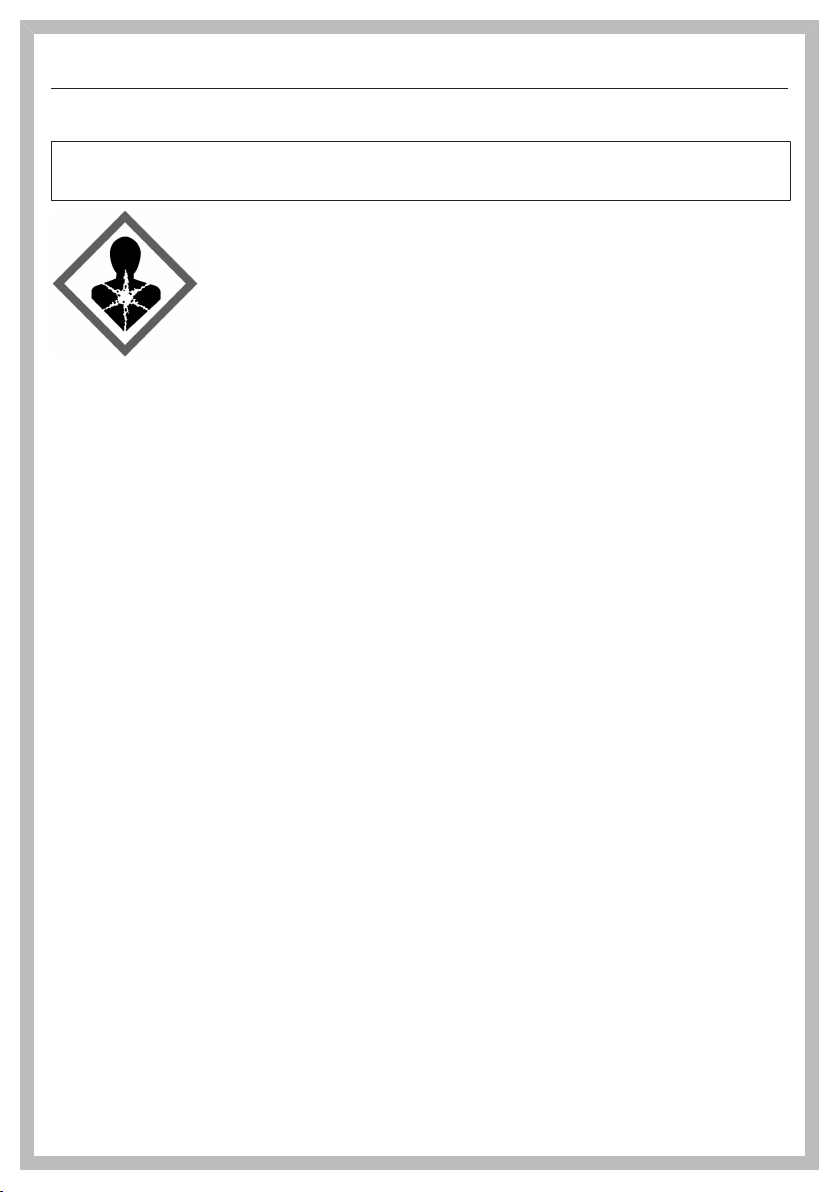
Symbol on the compressor (depending on model)
This information is only relevant for recycling. There is no risk during normal oper-
ation.
The oil in the compressor can be fatal if swallowed or if it pene-
trates the airways.
Caring for the environment
13
Disposal of packaging material
The packaging is designed to protect
the appliance from damage during
transportation. The packaging materials
used are selected from materials which
are environmentally friendly for disposal
and should be recycled.
Ensure that any plastic wrappings,
bags, etc. are disposed of safely and
kept out of the reach of children. Return
the packaging to your dealer.
Disposing of your old appli-
ance
Electronic and electrical appliances
contain many valuable materials. They
also contain certain materials, com-
pounds, and components which were
essential for their correct functioning
and safety. These could be hazardous
to your health and to the environment if
disposed of with general waste or if
handled incorrectly. Please do not,
therefore, dispose of your old appliance
with general waste.
Instead, please make use of officially
designated collection and disposal
points to dispose of and recycle electri-
cal and electronic appliances. By law,
you are solely responsible for deleting
any personal data from the appliance
prior to disposal.
Take care not to damage your refrigera-
tion appliance’s pipework before or dur-
ing transportation to an authorized col-
lection depot.
This is to ensure that coolant in the
cooling circuit and oil in the compressor
is contained, and will not leak into the
environment.
Please ensure that your old appliance
poses no risk to children while being
stored for disposal. For additional infor-
mation, see “IMPORTANT SAFETY IN-
STRUCTIONS” in these operating and
installation instructions.
Saving energy
14
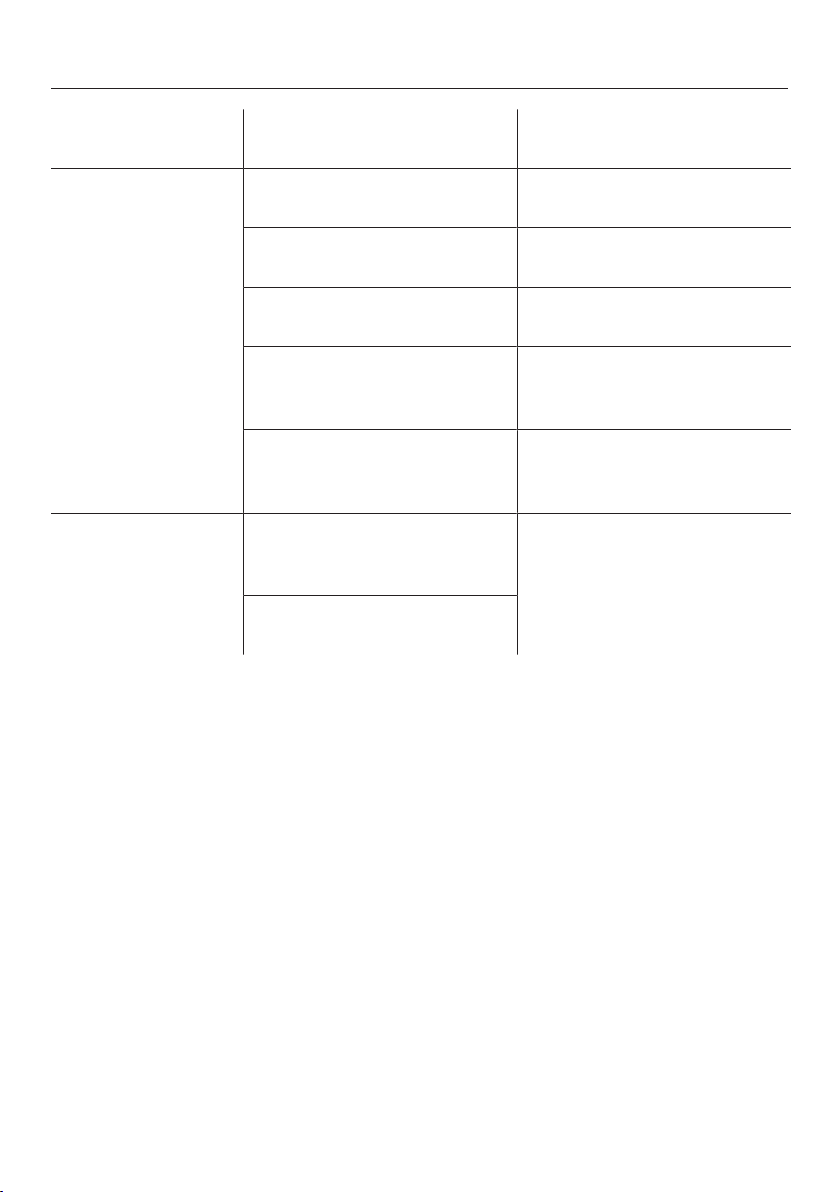
Normal
energy consumption
Increased
energy consumption
Installation /
Maintenance
In a well-ventilated room. In an enclosed, poorly venti-
lated room.
Protected from direct sun-
light.
In direct sunlight.
Away from heat sources (ra-
diator, range/oven).
Near a heat source (radiator,
oven).
Where the ideal room tem-
perature is approx. 68°F
(20°C).
Where the ambient room
temperature is above 77°F
(25°C).
Air vents uncovered and
dusted regularly.
Where the ventilation open-
ings are blocked and full of
dust.
Temperature
setting
39°F to 41°F (4°C to 5°C) in
the refrigerator section
The lower the temperature in
the appliance, the higher the
energy consumption.
PerfectFresh zone 32°F
(0°C)
Saving energy
15
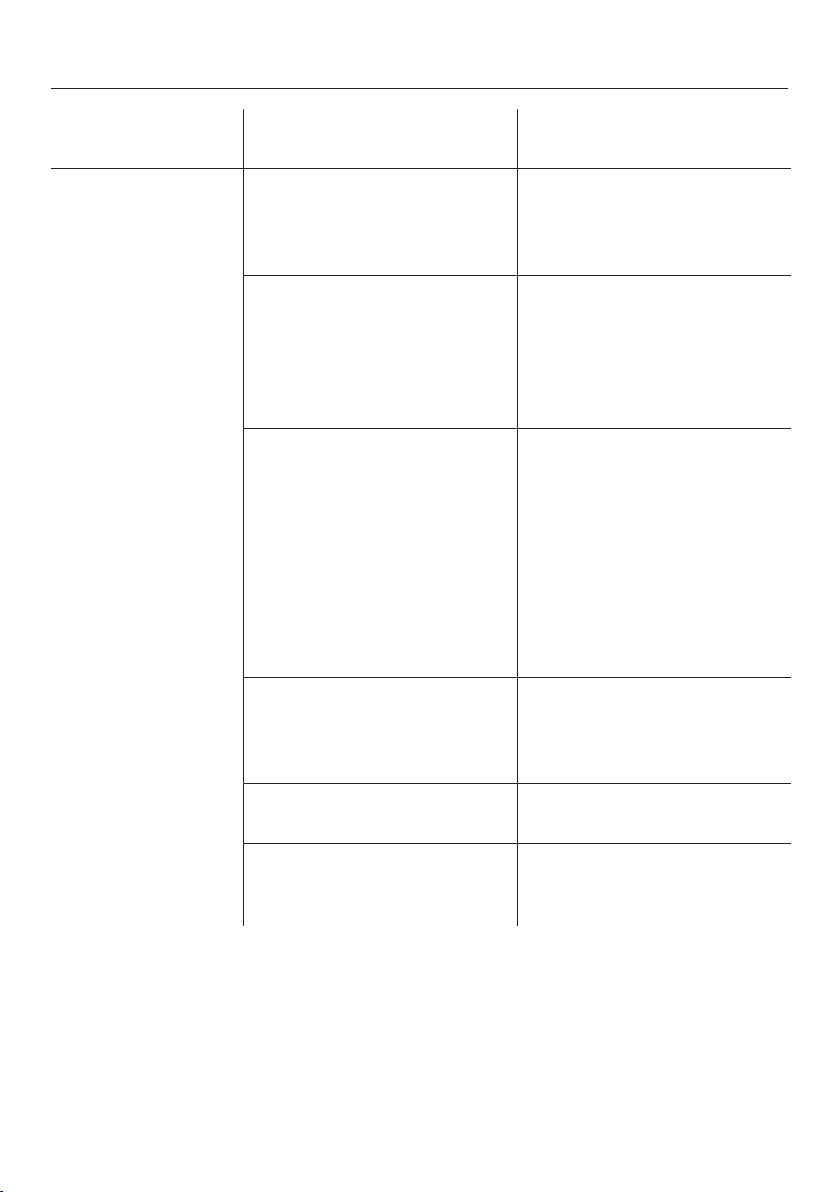
Normal
energy consumption
Increased
energy consumption
Use The drawers, and shelves
are arranged as they were
when the appliance was de-
livered.
Only open the door when
necessary and for as short a
time as possible. Store food
in an organized way.
Frequent opening of the
door for long periods will
cause a loss of coldness.
The appliance will try to cool
down and the compressor
will run for longer periods.
When shopping, use a
cooler bag and place the
food in the appliance as
soon as possible.
Replace any food removed
as quickly as possible, be-
fore it warms up too much.
Allow hot food and drinks to
cool down before placing
them in the appliance.
Hot food or food at room
temperature raises the tem-
perature inside the refrigera-
tion appliance. The appli-
ance will try to cool down
and the compressor will run
for longer periods.
Store food well packaged or
covered.
The evaporation or conden-
sation of liquids in the refrig-
erator section will cause a
loss of coldness.
Place frozen food in the re-
frigerator section to defrost.
Do not overfill the appliance
in order to allow the air to
circulate.
Poor air circulation will
cause a loss of coldness.
Guide to the appliance
16
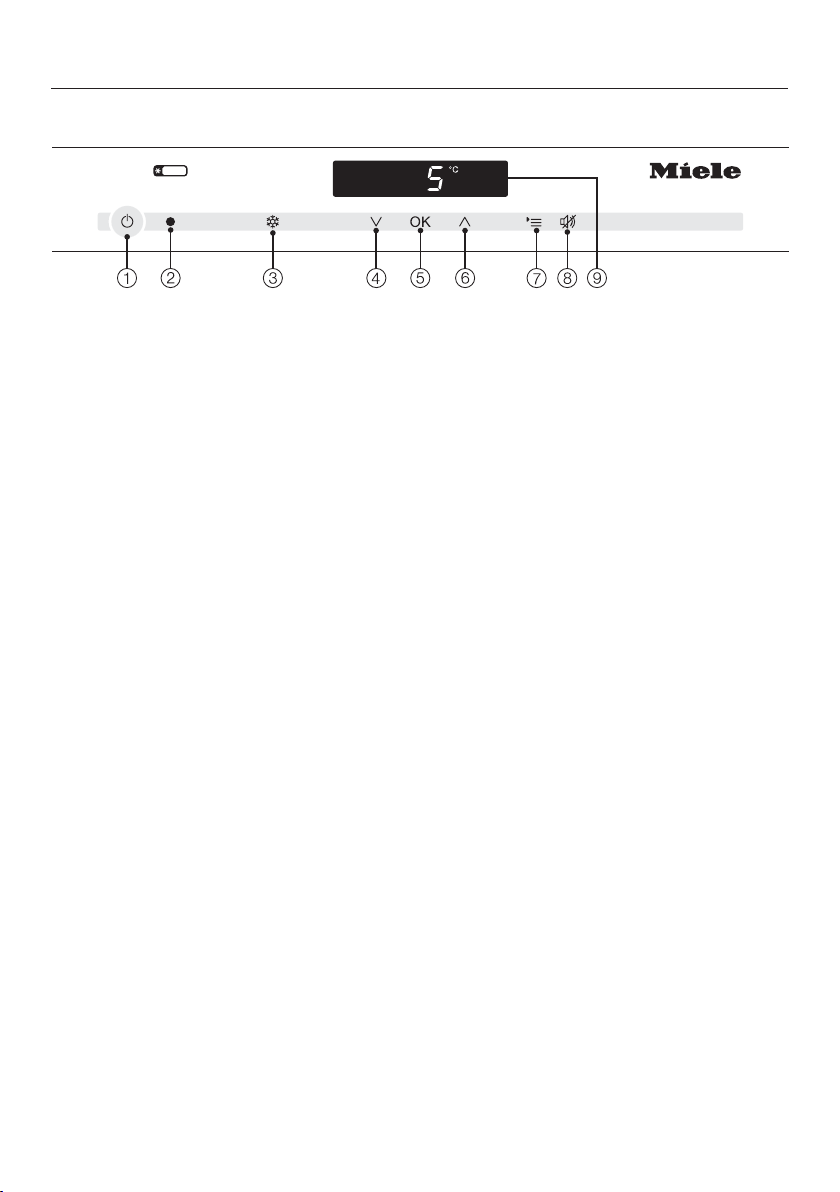
Control panel
a
On/Off button
for the whole appliance
b
Optical interface
(for Miele Technical Service only)
c
For switching the
Automatic SuperCool function on
and off
d
For setting the temperature
( for colder);
selection button in settings mode
e
For confirming your selection (OK
button)
f
For setting the temperature
( for warmer);
selection button in settings mode
g
For selecting and deselecting set-
tings mode
h
For switching off the door alarm
i
Display with temperature and sym-
bols (symbols only visible in settings
mode, in the event of an alarm/mes-
sage; see table for explanation of
symbols)
Guide to the appliance
17
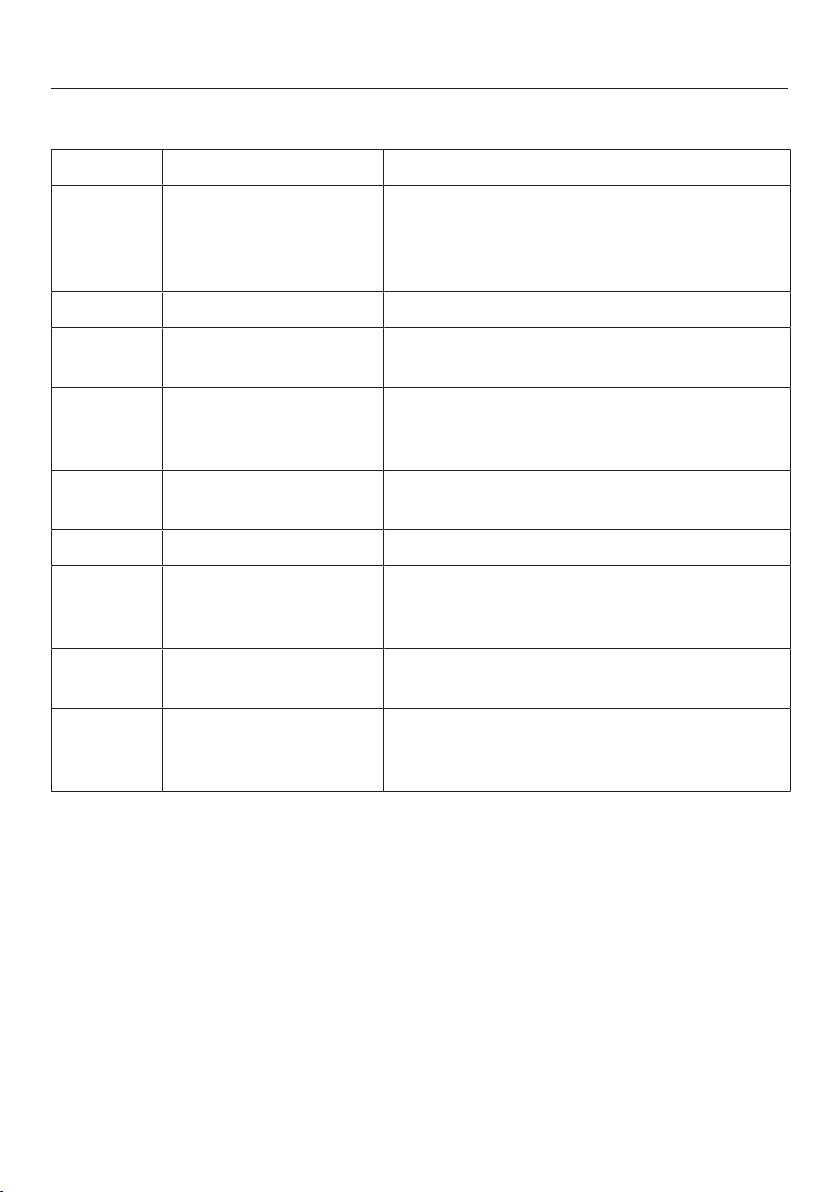
Explanation of symbols
Symbol Meaning Function
Safety lock Prevents the user from unintentionally
switching off the appliance, adjusting the
temperature, switching on the Automatic
SuperCool functions, or entering settings
Acoustic signals Choice of sensor tone and door alarm tone
Display Brightness
Settings
For adjusting the brightness of the display
Carbon filter replace-
ment indicator (Active
AirClean)
This function must be activated after in-
stalling a carbon filter; it lights up to remind
you to replace it
PerfectFresh
temperature
For adjusting the temperature in the
PerfectFresh zone
Sabbath Mode For turning Sabbath mode on and off
Power connection Confirms that the appliance is connected to
the electrical supply when it is not switched
on
Alarm Lights up when the door alarm is activated;
flashes in the event of fault messages
Demo mode
(only visible when
Demo mode is active)
For turning off Demo mode
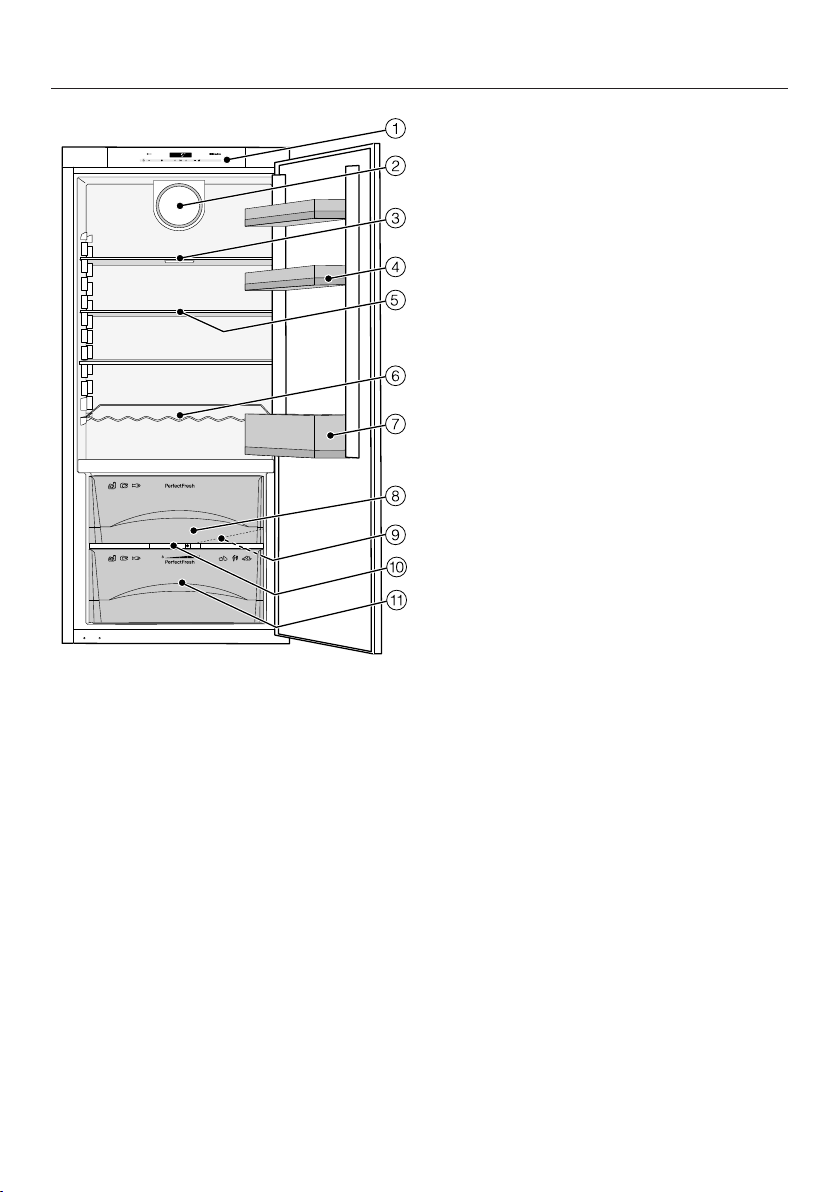
Guide to the appliance
18
This drawing shows an example of an appli-
ance model.
a
Control panel
b
Fan
c
Shelf with
lighting (FlexiLight)
d
Egg tray/door shelf
e
Adjustable rack
f
Bottle rack
g
Bottle shelf
h
PerfectFresh zone dry compartment
i
Condensate channel and drain hole
j
Regulator for setting the moisture
level in the humidity-controlled com-
partments
k
PerfectFresh zone humidity-con-
trolled compartment (depending on
model)
Guide to the appliance
19
Accessories
Accessories supplied
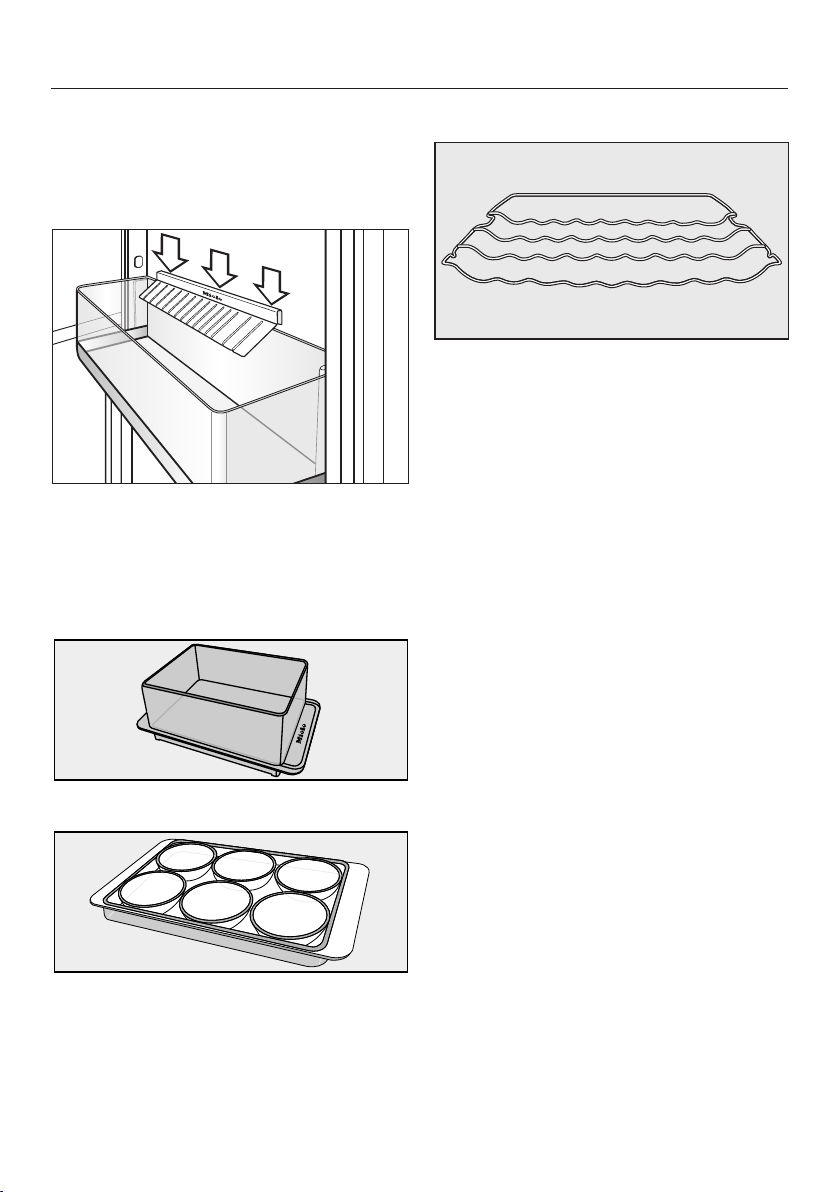
Bottle holder
The non-slip fins of the bottle holder jut
out into the bottle shelf and make bot-
tles more secure when you open and
close the appliance door.
Butter dish
Egg tray
Bottle rack
Bottles can be stored horizontally in the
refrigerator section using the bottle rack
to save space.
The bottle rack can be placed at differ-
ent positions in the refrigerator section.
Guide to the appliance
20
Optional accessories
A range of useful Miele accessories and
care products are available for your ap-
pliance.
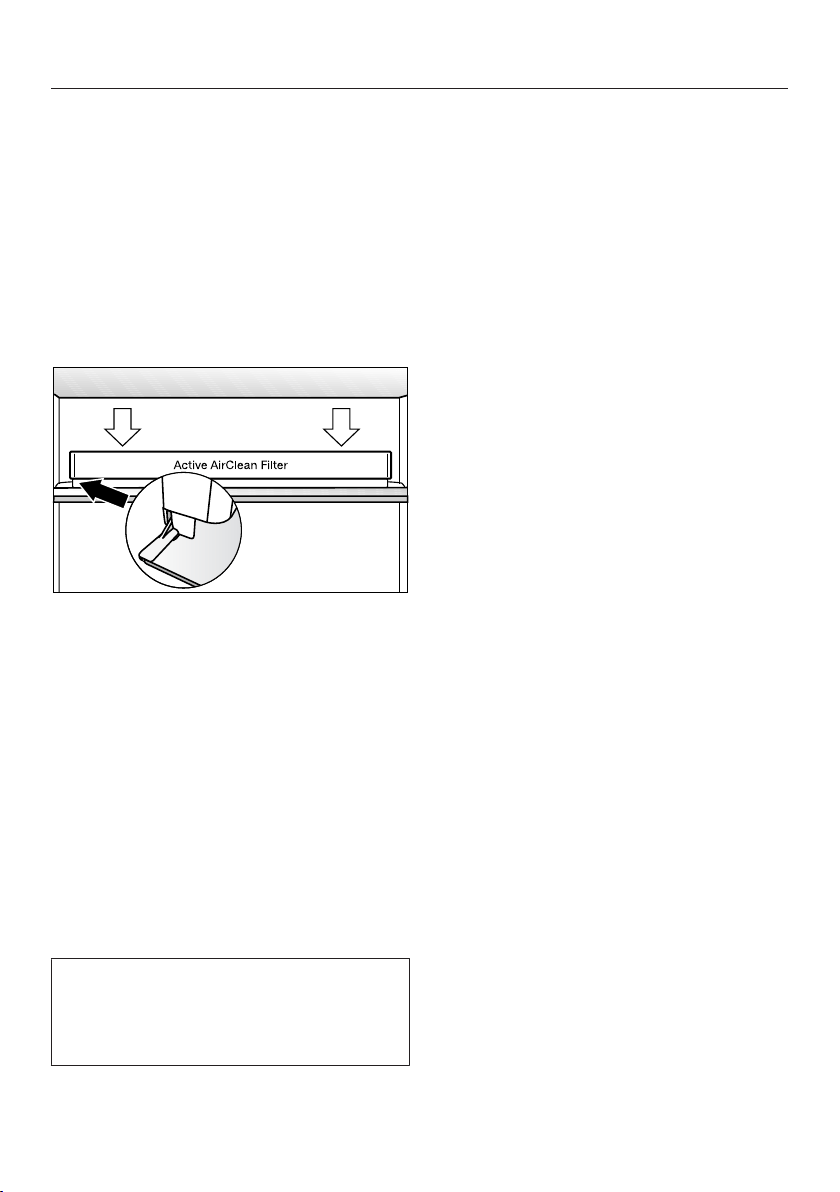
KKF-FF Active AirClean carbon filter
with holder
Carbon filters neutralize unpleasant
odors in the refrigerator section for im-
proved air quality.
The carbon filter holder clips onto the
protective strip at the back of the shelf
and can be moved as necessary.
Now activate the carbon filter replace-
ment indicator in Settings mode (see
“Selecting additional settings” - “Car-
bon filter replacement indicator”).
KKF-RF
ActiveAirClean replacement filters
Replacement filters to fit the Active Air-
Clean holder are available. We recom-
mend replacing the carbon filters every
6months.
Accessories are available to order via
the Miele Webstore, from Miele di-
rectly (see back cover for contact de-
tails) or from your Miele dealer.
Switching on and off
21
Before first use
Packaging material
Remove all packaging material from
the inside of the appliance.
Protective film
The stainless steel trim on the interior
shelves and door shelves in the appli-
ance has a layer of protective film to
prevent scratching in transit.
Remove this protective film once the
appliance has been installed.
Cleaning the refrigerator
Please refer to the relevant instruc-
tions in “Cleaning and care”.
Clean the inside of the appliance and
the accessories.
Operating the appliance
A light touch on the sensors is all that is
required to operate this appliance.
A tone will sound each time a sensor is
touched. You can deactivate this if you
wish (see “Selecting additional settings
- Audible signals”).
Switching on the appliance
Once the appliance is connected to the
electricity supply, the power supply
symbol will soon appear on the dis-
play.
Touch the On/Off button.
The power connection symbol goes
out and the temperature appears in the
display.
The appliance starts cooling.
When the door is opened, the interior
lighting comes on and the LED lighting
on the shelves becomes brighter until it
reaches its maximum brightness.
To enable the temperature to get suf-
ficiently cold inside the appliance, al-
low the appliance to run for a few
hours before placing food in it.
Switching on and off
22
Switching off the appliance
Touch the On/Off sensor.
If this does not work, the safety lock
is activated.
The temperature shown on the display
will go out and the power connection
symbol appears.
The interior lighting goes out and cool-
ing is switched off.
Switching off for longer peri-
ods of time
If, during a long absence, the refrig-
eration appliance is switched off but
not cleaned and the door(s) left shut,
there is a danger of bacteria building
up inside the appliance.
It is essential to clean the refrigera-
tion appliance.
If the refrigeration appliance is not go-
ing to be used for a longer period of
time, observe the following:
Turn the appliance off.
Unplug the appliance or trip the cir-
cuit breaker.
Clean the refrigeration appliance and
leave the door ajar to air the appli-
ance and avoid odors building up in-
side.

The correct temperature
23
It is very important to set the correct
temperature for storing food in the ap-
pliance. Bacteria will cause food which
is not stored at the correct temperature
to deteriorate rapidly. Temperature influ-
ences the growth rate of these bacteria.
Reducing the temperature reduces their
growth rate.
The temperature in the appliance will
rise:
- the more often the appliance door is
opened and the longer it is kept open
- the more food that is stored in it
- the warmer the food is that is being
put into it
- the higher the ambient temperature
surrounding the refrigeration appli-
ance is. The appliance is designed
for use within specific ambient tem-
peratures (climate range). Do not use
in ambient temperatures for which it
is not designed
... in the refrigerator section
and in the PerfectFresh zone
We recommend a temperature of 39°F
(4°C) in the refrigerator section.
The temperature in the PerfectFresh
zone is controlled automatically, and is
maintained at 32°F to 37°F (0°C to
3°C).
Automatic cold air circulation (Dyna-
Cool)
The fan automatically turns on when the
cooling system for the refrigerator sec-
tion turns on. It distributes the tempera-
ture in the refrigerator section to all ar-
eas evenly so that all the food inside will
be chilled to about the same degree.
The correct temperature
24
Temperature display
In normal operation, the temperature
display shows the current average
refrigerator temperature.
Depending on the ambient temperature
and the temperature setting, it can take
the appliance a few hours to reach the
temperature required and for this tem-
perature to then be shown as a con-
stant temperature in the display.
Setting the temperature
Use the two sensor buttons below
the display to set the temperature.
When you touch the sensor button
- The temperature decreases.
- The temperature increases.
The temperature value flashes while the
temperature is being set.
The following changes will be seen on
the display when the sensor buttons are
touched:
- With the first touch: The last temper-
ature set flashes.
- Each subsequent touch: The temper-
ature changes in 1° increments.
- Keeping your finger on the sensor
button: The temperature changes
continuously.
Approximately 5seconds after the last
time a sensor button was touched, the
actual temperature inside the appliance
will automatically be displayed.
Or
Touch the OK button to confirm the
selection.
If you have adjusted the temperature,
wait for approximately 6hours if the
appliance is not very full and for ap-
proximately 24hours if the appliance
is full before checking the temperature
display. It will take this long for an accu-
rate reading to be given.
If, after this time, the temperature is
still too high or too low, adjust it
again.
Temperature range
The temperature in the refrigerator sec-
tion can be set between 37°F (3°C) and
49°F (9°C).
The correct temperature
25
Adjusting the temperature in
the PerfectFresh zone
In the PerfectFresh zone, the tempera-
ture is automatically maintained be-
tween32°F (0°C) and37°F (3°C). How-
ever, if you would like it to be warmer or
colder, e.g., when storing fish, you can
adjust the temperature slightly.
The default setting for the tempera-
ture in the PerfectFresh zone is5.
Under certain circumstances, a set-
ting from1 to4 can cause negative
temperatures to be reached. This can
cause food to freeze.
Touch the settings button.
All symbols available for selection will
appear on the display and the sym-
bol will flash.
Touch the buttons for setting the tem-
perature ( or ) repeatedly until the
symbol flashes on the display.
Touch the OK button to confirm the
selection.
The most recently selected setting
flashes and the symbol lights up in
the display.
You can now adjust the temperature
in the PerfectFresh zone by touching
the or button. You can choose
from settings 1to9:
1: lowest temperature,
9: highest temperature.
Touch the OK button to confirm the
selection.
The selected setting is applied; the
symbol flashes.
Touch the settings button to exit Set-
tings mode.
If you do not do this, the appliance
electronics will exit Settings mode
automatically after approximately one
minute.
The newly set temperature for the Per-
fectFresh zone will gradually be
reached.
Using Automatic SuperCool
26
Automatic SuperCool function
The Automatic SuperCool function can
be used to rapidly reduce the tempera-
ture in the refrigerator section to its low-
est setting (depending on the room
temperature).
Switching on Automatic SuperCool
Automatic SuperCool is particularly rec-
ommended for the rapid chilling of large
amounts of fresh food or drink.
Touch the Automatic SuperCool but-
ton; it will light up yellow.
The appliance will work at full power to
lower the temperature in the refrigerator
section.
Switching off Automatic SuperCool
The Automatic SuperCool function will
switch itself off automatically after ap-
proximately 12hours. The appliance will
then run at normal power again.
To save energy, you can switch the Au-
tomatic SuperCool function off yourself
once food and drinks are sufficiently
chilled.
Touch the Automatic SuperCool but-
ton; the yellow light will go out.
The appliance will then continue run-
ning at normal power.
Door alarm
27
The refrigeration appliance is fitted with
a warning system to prevent energy be-
ing wasted and food becoming warm if
the appliance door is left open.
An alarm will sound if the door is left
open for too long. The alarm symbol
will light up.
The amount of time until the door alarm
is triggered depends on the setting se-
lected and can be either 2minutes (fac-
tory default) or 4minutes. However, the
door alarm can also be turned off (see
“Selecting additional settings – Audible
signals”).
As soon as the door is closed, the
alarm stops sounding and the alarm
symbol disappears from the display.
If no alarm sounds even though there
is a door alarm, the alarm has been
turned off in settings mode (see “Se-
lecting additional settings – Audible
signals”).
Cancelling the door alarm
If the alarm is disturbing you, it can be
switched off.
Touch the sensor to turn off the door
alarm.
The alarm will stop.
The alarm symbolwill continue to be
displayed until the door is closed.
Selecting additional settings
28
Certain settings for the appliance can
only be selected in settings mode.
While you are in settings mode, the
door alarm and any other fault mes-
sages are suppressed automatically,
but the alarm symbol lights up on
the display.
Available settings
Activate and deactivate the
safety lock
°C
°F
Select the temperature unit
(Celsius or Fahrenheit)
Switch audible signals on/off
Change the brightness of the
display
Adjust the temperature in the
PerfectFresh zone
Switch Sabbath mode on/off
Replace the carbon filters (Ac-
tive AirClean)
The process of adjusting the tempera-
ture in the PerfectFresh zone is de-
scribed in “The correct temperature”.
All other available settings are de-
scribed below.
Safety lock
The safety lock can be activated to pre-
vent:
- the appliance being switched off by
mistake,
- the temperature being changed by
mistake,
- Automatic SuperCool being selected
by mistake,
- settings being adjusted by mistake (it
is only possible to deactivate the
safety lock).
This prevents the appliance being
switched off or settings adjusted with-
out your knowledge; for example, by
children.
Activating and deactivating the safety
lock
Touch the settings sensor.
All symbols available for selection will
appear in the display and the symbol
flashes.
Touch the OK sensor to confirm your
selection.
The last selected setting flashes and
the symbol lights up in the display.
Selecting additional settings
29
By touching theorsensor, you
can now select whether the safety
lock is activated or deactivated:
0: the safety lock is deactivated
1: the safety lock is activated.
Touch the OK sensor to confirm your
selection.
The selected setting will be adopted
and thesymbol will flash.
Touch the settings sensor to leave the
settings mode.
Otherwise the appliance will exit the
settings mode automatically after ap-
proximately one minute.
Thesymbol will appear in the display
when the safety lock is activated.
Temperature unit (Celsius or
Fahrenheit)
The temperature can be displayed in ei-
ther Fahrenheit °F or Celsius °C. De-
grees Fahrenheit °F is the factory set-
ting.
Setting the temperature display to
Celsius
Touch the settings sensor.
All symbols available for selection will
appear on the display and the sym-
bol will flash.
Touch the sensors for setting the
temperature (or) repeatedly until
°C and °F flash on the display.
Touch the OK sensor to confirm the
selection.
°F will flash on the display.
Selecting additional settings
30
You can now select °C by touching
the or sensors.
Touch the OK sensor to confirm the
selection.
The selected setting is saved.
Touch the settings sensor to exit set-
tings mode.
If you do not do this, the appliance
electronics will exit settings mode au-
tomatically after approximately
1minute.
The temperature will now be displayed
in Celsius.
Setting the temperature display to
Fahrenheit
Touch the settings sensor.
All symbols available for selection will
appear on the display and the sym-
bol will flash.
Touch the sensors for setting the
temperature (or) repeatedly until
°C and °F flash on the display.
Touch the OK sensor to confirm the
selection.
°C will flash on the display.
You can now select °F by touching
the or sensors.
Touch the OK sensor to confirm the
selection.
The selected setting is saved.
Selecting additional settings
31
Touch the settings sensor to exit set-
tings mode.
If you do not do this, the appliance
electronics will exit settings mode au-
tomatically after approximately
1minute.
The temperature will now be displayed
in Fahrenheit.
Audible signals
The appliance features audible signals
such as a keypad tone and door alarm
tone.
The keypad tone and door alarm tone
can be switched on or off.
There are four settings to choose from.
Option3is set at the factory; this
means that the keypad tone and the
door alarm are switched on.
Switching acoustic signals on/off
Touch the settings sensor.
All symbols available for selection will
appear on the display and the sym-
bol will flash.
Touch the sensors for setting the
temperature (or) repeatedly until
the symbol flashes on the display.
Touch the OK sensor to confirm the
selection.
The most recently selected setting
flashes and the symbol lights up on
the display.
Selecting additional settings
32
Now touch the or sensors to se-
lect:
0:keypad tone off; door alarm off
1:keypad tone off; door alarm on
(after 4minutes)
2:keypad tone off; door alarm on
(after 2minutes)
3:keypad tone on; door alarm on
(after 2minutes)
Touch the OK sensor to confirm the
selection.
The selected setting is applied; the
symbol flashes.
Touch the settings sensor to exit set-
tings mode.
If you do not do this, the appliance
electronics will exit settings mode au-
tomatically after approximately
1minute.
Display brightness
You can adjust the brightness of the
display to suit the ambient light condi-
tions in the room.
The display brightness can be adjusted
incrementally from1to3. The factory
default setting is 3(maximum bright-
ness).
Changing the brightness of the dis-
play
Touch the settings sensor.
All symbols available for selection will
appear in the display and the sym-
bol flashes.
Touch the sensors for setting the
temperature ( or ) repeatedly until
the symbol flashes in the display.
Touch the OK sensor to confirm your
selection.
The last selected setting flashes and
the symbol lights up in the display.
Selecting additional settings
33
By touching the orsensor, you
can now alter the brightness of the
display:
1: Dimmest setting
2: Medium setting
3: Brightest setting.
Touch the OK sensor to confirm your
selection.
The selected setting will be adopted
and thesymbol will flash.
Touch the settings sensor to leave the
settings mode.
Otherwise the appliance will exit the
settings mode automatically after ap-
proximately one minute.
Sabbath mode
The appliance offers a Sabbath mode
for the purposes of religious obser-
vance.
The following are switched off:
- the interior lighting when the appli-
ance door is opened,
- all audible and visual signals,
- the temperature display,
- Automatic SuperCool (if previously
switched on).
The following can be selected:
- the settings button for switching off
Sabbath mode
- and the On/Off button.
The Sabbath mode function will switch
itself off automatically after approxi-
mately 120hours.
Ensure that the appliance door is
properly closed, as visual and audible
alarms are switched off.
Danger of food poisoning!
Any power failure during Sabbath
mode will not be shown on the dis-
play. After a power failure, the appli-
ance will restart in Sabbath mode.
When power is restored, no notifica-
tion of the power failure will appear
on the display.
If there is a power failure during Sab-
bath mode, check the quality of the
food. Do not consume any defrosted
food.
Selecting additional settings
34
Turning on Sabbath mode
Touch the Settings sensor.
All symbols available for selection will
appear in the display and the sym-
bol flashes.
Touch the sensors for setting the
temperature ( or ) repeatedly until
the symbol flashes in the display.
Touch the OK sensor to confirm your
selection.
The last selected setting flashes and
the symbol lights up in the display.
By touching the or sensor you
can now switch on Sabbath mode. To
do this, select the 1setting.
Touch the OK sensor to confirm your
selection.
The selected setting is applied, the
symbol lights up.
As soon as the symbol goes out in
the display after 3 seconds, Sabbath
mode is switched on.
Turn off Sabbath mode after the Sab-
bath has passed.
Turning off Sabbath mode
Touch the Settings sensor to leave
Sabbath mode.
The temperature will appear in the dis-
play and the interior lighting will come
on.
Selecting additional settings
35
Carbon filter replacement indi-
cator
This appliance is not supplied with
carbon filters with a KKF-FF holder
(Active AirClean). The holder is avail-
able as an optional accessory (see
“Accessories – Optional accessories”).
The carbon filter replacement indicator
must be activated once the filters have
been installed.
You will be reminded to replace the fil-
ters after approx.6months (see “Clean-
ing and maintenance - Replacing car-
bon filters”). Thesymbol is illumi-
nated in the display.
After replacing the filter(s), the counter
must be reset. The indicator will then go
out.
Activating the carbon filter replace-
ment indicator or resetting the
counter
Touch the settings sensor button.
All symbols available for selection will
appear on the display and the sym-
bol will flash.
Touch the sensor buttons for setting
the temperature ( or ) repeatedly
until the symbol flashes on the
display.
Touch the OK sensor button to con-
firm the selection.
The most recently selected setting
flashes and the symbol lights up in
the display.
Touch or to make your selection
:Carbon filter replacement indicator
deactivated
1:Carbon filter replacement indicator
activated
2:Counter reset.
Touch the OK sensor button to con-
firm the selection.
The selected setting is applied; the
symbol flashes.
Touch the settings sensor button to
exit Settings mode.
If you do not do this, the appliance
electronics will exit Settings mode
automatically after approximately one
minute.
Storing food in the refrigerator section
36
Do not load more than a maximum of
35lb (16kg) of food in the appliance
door.
Risk of fire from electrical appli-
ances.
Operating electrical devices in the
appliance can cause sparks to form.
Do not operate any electrical devices
inside the appliance.
Risk of explosion due to
flammable mixes of gases.
Electrical components can cause
flammable mixes of gases to ignite.
Do not store any explosive materials
or products containing flammable
propellants (e.g., spray cans) in the
appliance. The spray cans in ques-
tion can be identified by the contents
printed on the can or by a flame
symbol. Electrical components can
cause escaping gases to ignite.
Risk of damage due to greasy or
oily foods.
If storing food which contains a lot of
fat or oil in the appliance or the door,
make sure that it does not come into
contact with plastic components as
this could cause stress cracks or
break the plastic.
Make sure that no fat or oil leaks
onto the plastic parts of the appli-
ance.
Different storage zones
Due to natural air circulation, there are
different temperature zones in the re-
frigerator section.
Cold, heavy air sinks to the lowest sec-
tion of the refrigeration section. Make
use of the different zones when placing
food in the appliance.
Tip: To allow air to circulate efficiently,
do not pack food too closely together in
the refrigerator.
If there is insufficient air circulation,
the cooling performance will de-
crease and energy consumption will
increase.
Do not cover the fan in the rear wall
of the appliance.
Tip: Do not store food in such a way
that it touches the rear wall of the refrig-
erator section as it may freeze to the
rear wall.
This appliance has DynamicCooling,
which helps to keep an even tempera-
ture when the fan is running. When
DynamicCooling is turned on, the dif-
ference between the various zones is
less pronounced.
Warmest area
The warmest area in the refrigerator
section is in the top section of the door.
Use this for storing butter so that it re-
mains spreadable and cheese so that it
retains its flavor.
Coldest area
The coldest area in the refrigerator sec-
tion is directly above the dividing plate
of the PerfectFresh zone and against
the rear wall. However, inside the Per-
fectFresh zone is even colder.

Storing food in the refrigerator section
37
Use these areas in the refrigerator sec-
tion and in the PerfectFresh zone for all
delicate and highly perishable food,
e.g.:
- fish, meat, poultry,
- cold cuts
- dishes or baked goods containing
eggs or cream,
- fresh dough, cake mixtures, pizza or
pie dough,
Food which is not suitable for
storage in the refrigerator sec-
tion
Not all food is suitable for refrigeration
at temperatures below 41°F (5°C) be-
cause it is sensitive to cold. Depending
on the type of food, the appearance,
consistency, flavor, and/or vitamin con-
tent may be altered if stored at too cold
a temperature.
Foods which are sensitive to cold in-
clude:
- Pineapples, avocados, bananas,
pomegranates, mangoes, melons,
papayas, passion fruit, citrus fruits
such as lemons, oranges, mandarins,
grapefruits
- Fruit (which is not yet ripe)
- Eggplants, cucumbers, potatoes,
peppers, tomatoes, zucchini
- Hard cheeses (e.g., Parmesan)
Notes on buying food
The freshness of food when first placed
in the appliance is an important factor
in determining how long it stays fresh,
and how long it can be kept in the ap-
pliance.
Take into account the use-by date and
the correct storage temperature.
Time out of the refrigerator, e.g., trans-
porting food in a warm car, should be
kept to a minimum.
Tip: Take a cool bag when shopping,
and load food in the appliance as soon
as possible.
Storing food correctly
Food should generally be stored cov-
ered or packaged in the refrigerator
section (there are some exceptions to
this rule in the PerfectFresh zone - see
below). This will prevent food smells
from affecting other foods, food from
drying out, and also any cross-contami-
nation of bacteria. This is especially im-
portant for storing animal products.
The shelf life of food can be significantly
increased by setting the correct tem-
perature and maintaining good stan-
dards of hygiene.
Storing food in the PerfectFresh zone
38
The PerfectFresh zone provides ideal
storage conditions for fruit, vegetables,
fish, meat, and dairy products. Food
stays fresh considerably longer while
retaining both flavor and vitamins.
The temperature in the PerfectFresh
zone is controlled automatically, and is
maintained at 32°F to 37°F (0°C to 3°C).
While lower than the temperature in a
standard refrigerator, this is the opti-
mum temperature range for storing
fresh food which is not sensitive to
cold. The deterioration process is de-
celerated at this temperature range so
food can be stored without loss of
freshness for considerably longer than
in a standard refrigerator.
The humidity level in the PerfectFresh
zone can also be regulated to suit the
food being stored. Food retains its own
moisture if stored at a higher humidity
and so does not dry out as quickly. This
allows it to stay crisp and fresh for
longer.
Remember that the fresher the food
when it is placed in the appliance, the
longer it will stay fresh.
Take food out of the PerfectFresh zone
approximately 30to60minutes before
using it. The aroma and taste do not
fully develop until the food has
reached room temperature.
The PerfectFresh zone is di-
vided into two compartments:
- The upper dry compartment has a
temperature of between 32°F and
37°F (0°C and 3°C). The humidity
level in this compartment is not in-
creased .
You should use this compartment to
store fish, meat, dairy products, and
any other type of food, as long as it is
packaged.
- The lower humidity-controlled com-
partment (or compartments, de-
pending on model) has a temperature
of 32°F to 37°F (0°C to 3°C). The hu-
midity can be kept at a reduced or
increased level by positioning the
slide control accordingly.
If the humidity level is increased, use
this compartment to store fruit and
vegetables.

Storing food in the PerfectFresh zone
39
Dry compartment
The dry compartment is suitable for
storing perishable foods such as:
- fresh fish and shellfish;
- meat and poultry;
- salads;
- dairy products such as yogurt,
cheese, cream, etc.;
- any type of food can in fact be stored
in this compartment, as long as it is
packaged.
The low temperature in the dry com-
partment is its most distinctive feature.
The humidity level is similar to that in a
conventional refrigerator.
Please note that foods rich in protein
deteriorate faster than others.
Shellfish, for example, deteriorate faster
than fish, and fish deteriorates faster
than meat.
For hygiene reasons, you should always
keep these foods covered or wrapped.
Humidity-controlled compart-
ment ,
The humidity-controlled compartment
has a slide control which is used to reg-
ulate the humidity in this compartment.
Slide the control to the or humidity
setting.

Storing food in the PerfectFresh zone
40
The following tips may help if you
find that food you have stored does
not keep well (for example, the food
wilts or becomes withered after only
a short storage time):
Only place fresh food in the appliance
as the initial condition of the food is
crucial to maintaining freshness.
Clean the compartments in the Per-
fectFresh zone before storing food in
them.
Very wet food should be dried off be-
fore storing it.
Do not store any food in the Perfect-
Fresh zone which is sensitive to cold
(see “Food which is not suitable for
storage in the refrigerator section”).
For the type of food being stored, se-
lect the correct PerfectFresh com-
partment and the appropriate posi-
tion of the slide control for the humid-
ity-controlled compartment (reduced
or increased humidity).
An increased humidity level in the
humidity-controlled compartment is
achieved by the moisture present in
the food being stored; i.e., the more
food stored in the compartment, the
higher the humidity.
If too much moisture has gathered on
the base of the compartment and this
is affecting the food, dry the com-
partment – particularly the base and
underneath the lid – with a cloth, and
place a rack or similar item in the
compartment so that excess moisture
can drain away.
If the humidity level becomes too low,
wrap the food in airtight packaging.
If you think that the temperature in
the PerfectFresh zone is not correct,
try regulating it first by adjusting the
temperature in the refrigerator section
slightly (1–2°). To prevent frost dam-
age to food, a higher temperature
must be set if ice crystals begin to
form on the bases of the PerfectFresh
compartments.
Adjusting the interior fittings
41
Adjusting the door shelf/bottle
shelf
Tip: Only move the door shelves/bottle
shelves in the door when they are
empty.
Push the door shelf/bottle shelf up-
ward, then remove it by pulling it for-
ward.
Replace the shelf at the required
height. Ensure that it is securely
pushed back into position.
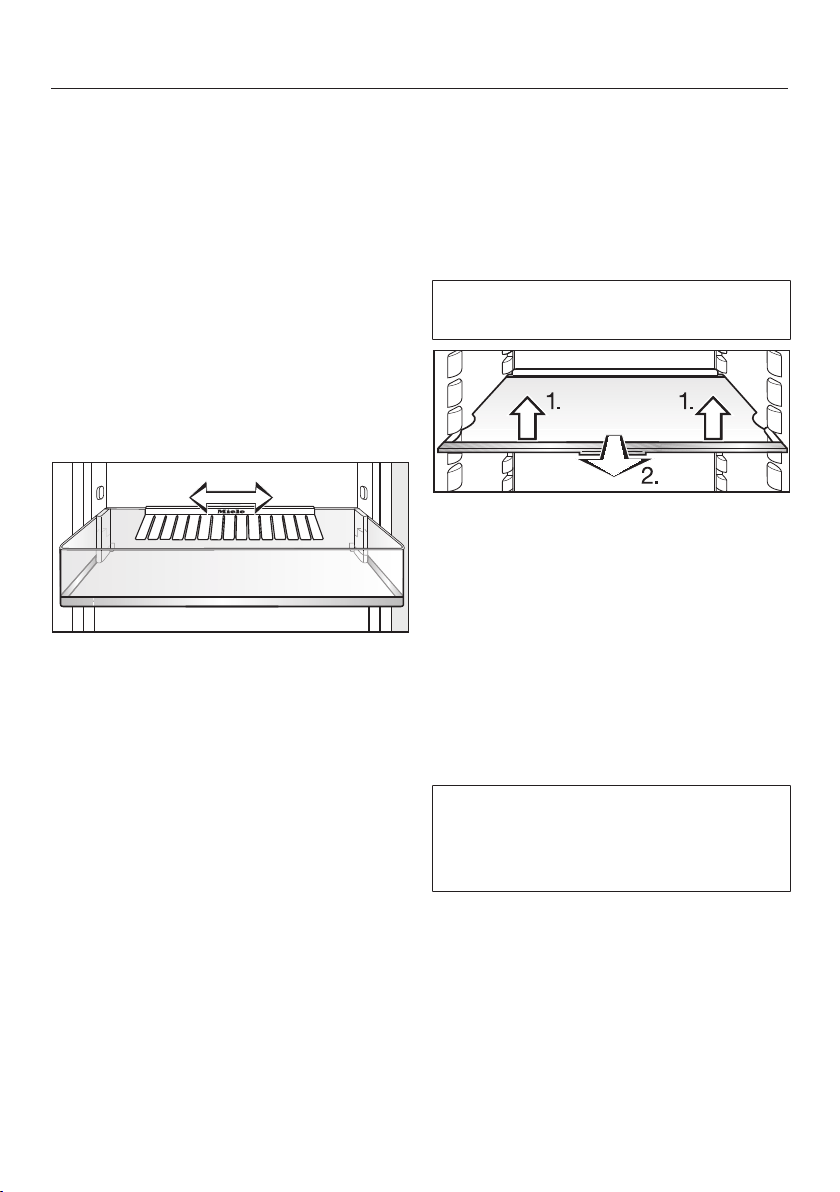
Adjusting the bottle holder
The bottle holder can be moved left or
right to create more room for drink car-
tons.
The bottle holder can be removed com-
pletely, for example for cleaning:
Lift up the bottle shelf and pull it out.
Detach the bottle holder from the
back edge of the bottle shelf.
Moving the shelf/shelf with
lighting
By adjusting the position of the shelf
with lighting in the refrigerator section,
you can change the illumination in this
section as required.
Stops prevent the shelves from being
dislodged by mistake.
The shelves can be adjusted accord-
ing to the height of the food:
1. Lift the shelf up slightly at the front.
2. Pull it forward a little and lift it until
the notch at the side is in line with
the shelf support. It can then be
raised or lowered to the required
level.
Push in the shelf until it clicks into po-
sition.
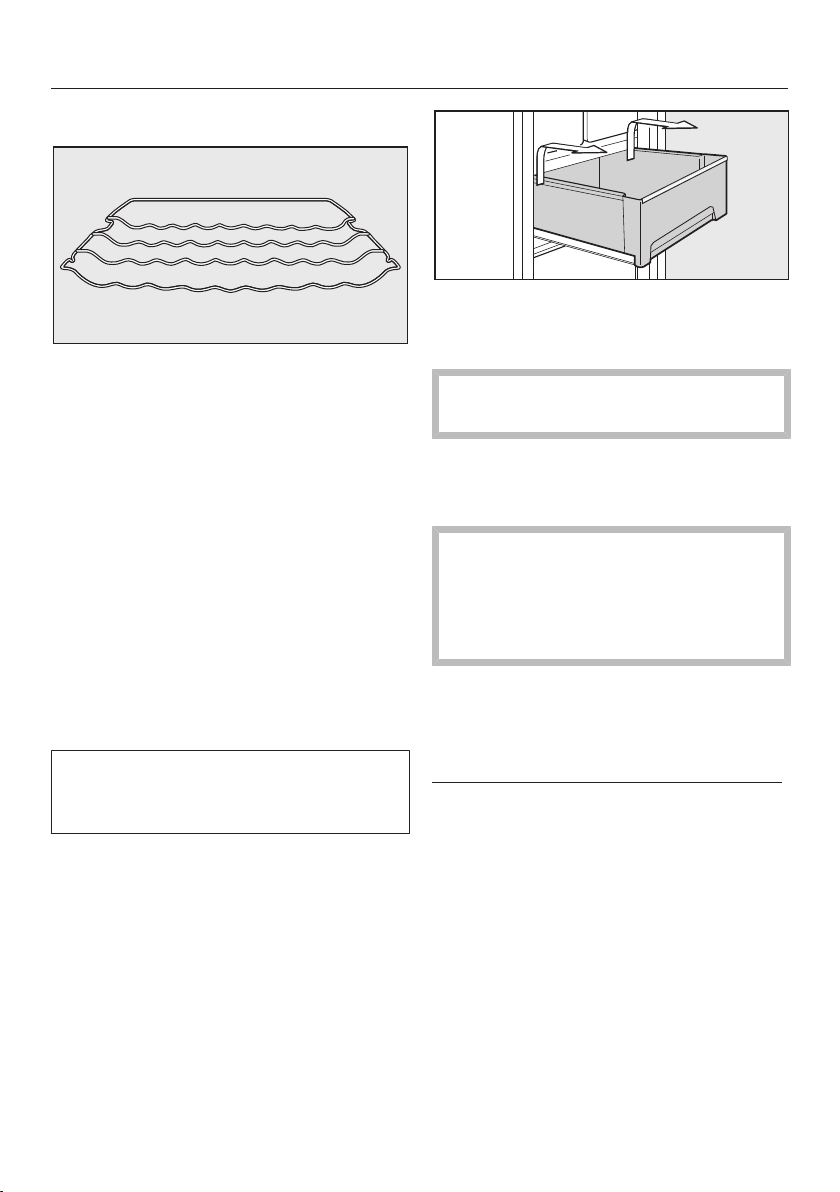
The raised edge on the protective strip
at the back must face upward to pre-
vent food from touching the back of
the appliance and freezing to it.
Adjusting the interior fittings
42
Adjusting the bottle rack
The bottle rack can be placed at differ-
ent positions in the appliance.
Lift the bottle rack slightly at the front,
pull it forward a little, lift the recess
over the shelf supports, and move the
shelf up or down.
The stop bar at the back must face up-
ward to prevent the bottles from touch-
ing the back wall.
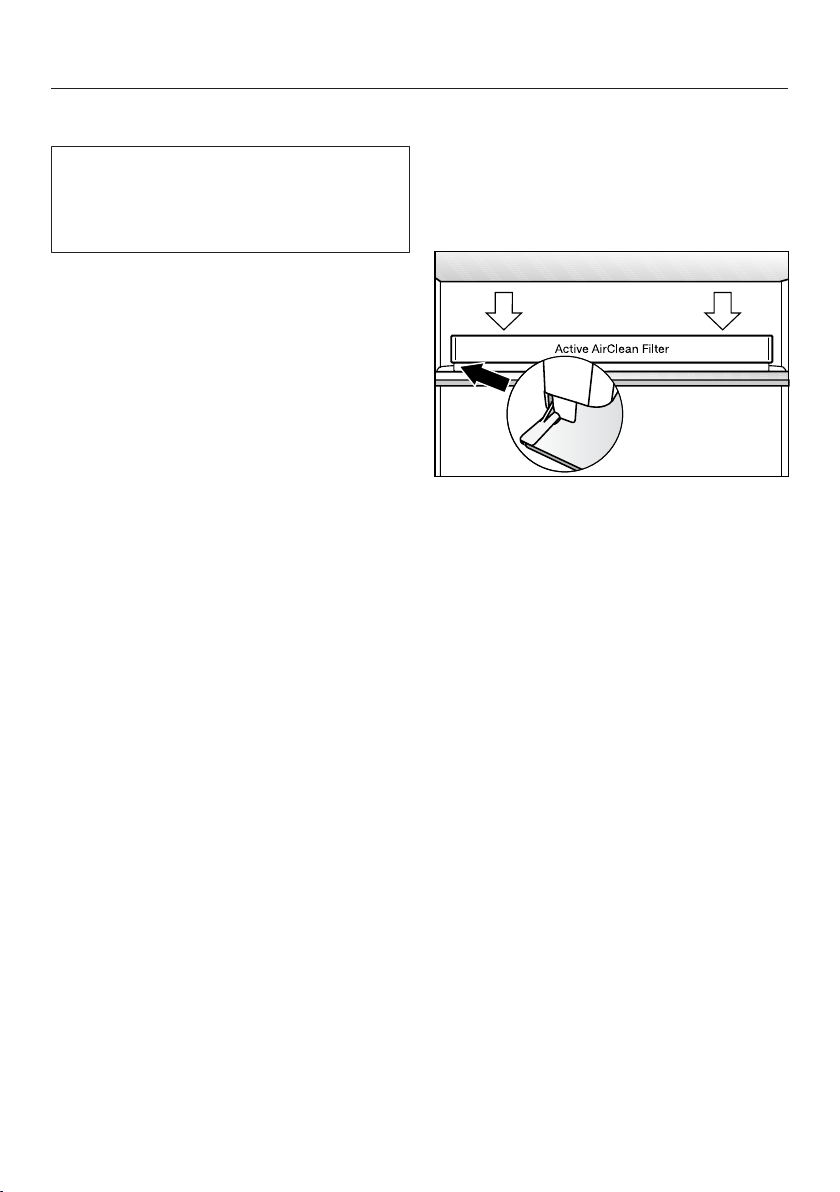
PerfectFresh drawers
The drawers in the PerfectFresh zone
are on telescopic rails, and can be re-
moved for filling, emptying, or cleaning
purposes:
To make it easier to pull out the draw-
ers, remove the bottle shelf from the
appliance door.
Pull the drawers out as far as they will
go.
Holding the sides of the drawer at the
back, lift it up and then pull it forward
and out.
Push the runners back in again to
avoid damaging them!
Carefully pull out the lid between the
drawers slightly, and lift it down and
out.
Be careful not to wash away the spe-
cial lubricant in the telescopic run-
ners during cleaning.
Wipe the telescopic runners with a
damp cloth to clean them.
To replace the drawer lid, insert it
from beneath into the holders, and
push it back until it clicks into place.
Inserting the fruit and vegetable drawer
Push the runners back in completely
and then place the drawers on them.
Push the drawer into the appliance
until it clicks into position.
Adjusting the interior fittings
43
Moving the carbon filter
The carbon filter with KKF-FF holder
(Active AirClean) is available as an op-
tional accessory (see “Accessories -
Optional accessories”).
When you are storing very strong-
smelling food (e.g., cheese):
- Place the holder with the carbon fil-
ters on the adjustable shelf where this
food is being kept.
- Change the carbon filters sooner if
necessary.
- Use additional carbon filters (with
holders) in the appliance (see “Acces-
sories – Optional accessories”).
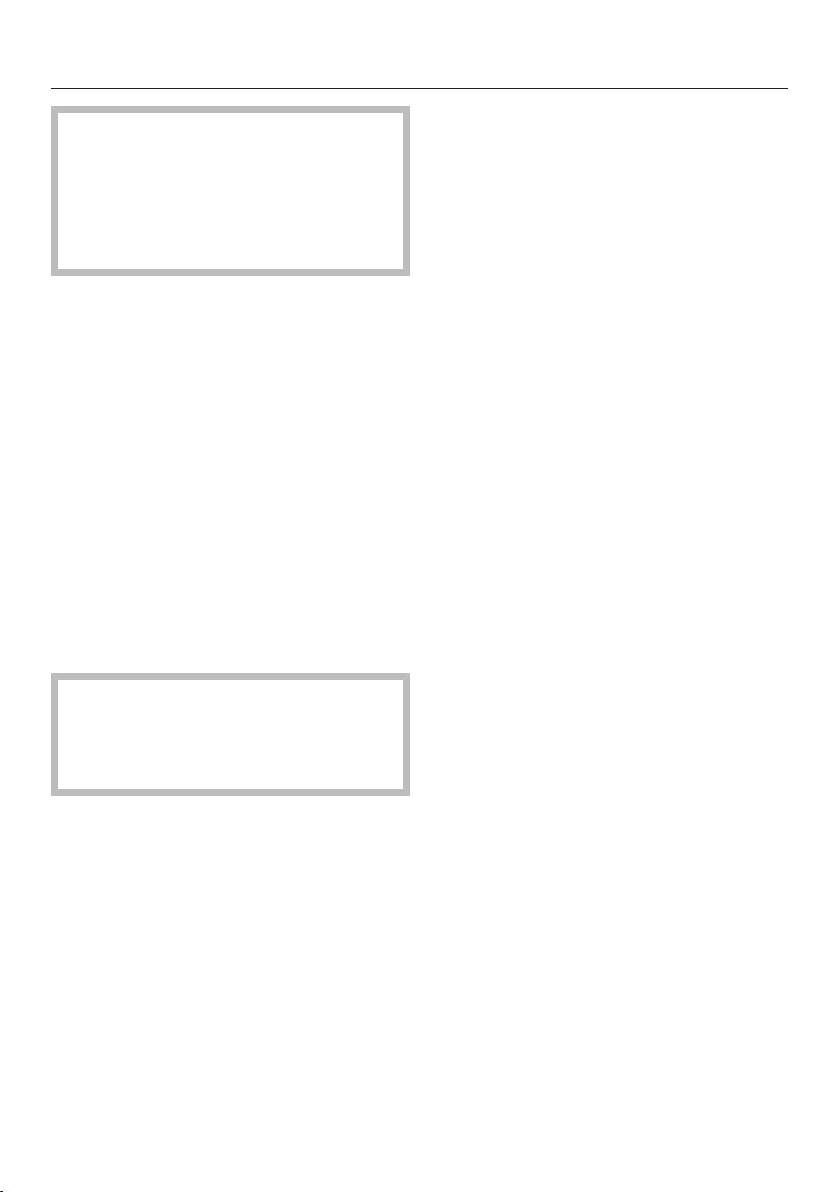
The holder for the carbon filters sits on
the protective strip at the back of the
adjustable shelf.
To move the carbon filter, pull the
holder up and off the protective strip.
Refit the holder on the protective strip
of the shelf you wish to use it on.
Defrosting
44
WARNING! DANGER of injury
and damage!
Do not use any mechanical or other
types of aids which are not recom-
mended by the manufacturer to ac-
celerate the defrosting process.
Refrigerator section and
PerfectFresh zone
The refrigerator section and the Perfect-
Fresh zone defrost automatically.
Condensate and ice can build up on the
back wall of the refrigerator section and
the PerfectFresh zone while the com-
pressor is running. You do not need to
remove this, as it will defrost and evap-
orate automatically with the warmth
generated by the compressor.
The condensate drains through a chan-
nel and drain pipe into an evaporation
system at the back of the appliance.
The condensate must always be
able to drain properly.
Keep the condensate channel and
drain hole clean to enable this.
Cleaning and care
45
WARNING! DANGER of electric
shock!
Unplug the appliance or trip the cir-
cuit breaker.
WARNING! Fire hazard!
Do not damage the coolant
pipework.
Make sure that water cannot get into
the electronic unit or into the lighting
or the metal discs (contacts) in the
left-hand shelf supports.
Cleaning water must not get into the
drain hole.
Do not use a steam cleaner. Steam
from a steam cleaning appliance
could reach the electrical compo-
nents and cause a short circuit.
The data plate located inside the ap-
pliance must not be removed. It con-
tains information which is required in
the event of a service call.
Cleaning agents
Cleaning and conditioning agents
used inside the appliance must be
food safe.
To avoid damaging the surfaces of your
appliance, do not use
- cleaning products containing soda,
ammonia, acid, or chloride,
- lime scale removers,
- abrasive cleaning products, such as
scouring powder, scouring liquid, or
pumice stones,
- cleaners containing solvents,
- stainless steel cleaners,
- dishwasher detergent,
- oven sprays,
- glass cleaning agents,
- hard, abrasive sponges and brushes,
such as pot scrubbers,
- eraser sponges,
- sharp metal scrapers.
We recommend using a clean sponge,
lukewarm water with a little liquid dish
soap to clean the surfaces of the appli-
ance.
The following pages contain important
information on cleaning.
Cleaning and care
46
Preparing the appliance for
cleaning
Turn the appliance off.
The display goes out and the cooling
function is turned off.
Unplug the appliance or switch off
the breaker.
Take any food out of the appliance
and store it in a cool place.
Remove the door shelf/bottle shelf
from the door.
Remove the PerfectFresh zone draw-
ers and the lid (see “Adjusting the in-
terior fittings – PerfectFresh zone
drawers”).
Remove the glass plate from the di-
vider panel.
Take out all other removable parts for
cleaning.
Adjustable shelf/Adjustable shelf
with lighting
The stainless steel trim with LED
lighting and stainless steel trims on
the shelves are not suitable for dish-
washers!
The stainless steel trim with LED
lighting must not be placed in water
for cleaning!
Proceed as follows to remove the stain-
less steel trim with LED lighting or the
stainless steel trim and rear protective
strip:
Place the shelf on a soft surface (e.g.,
a dish towel) with the top side facing
downward.
Stainless steel trim with LED light-
ing
Warning! Ensure that you always
loosen the side on which the con-
tacts (metal discs) for the LED light-
ing are not located first.
Cleaning and care
47
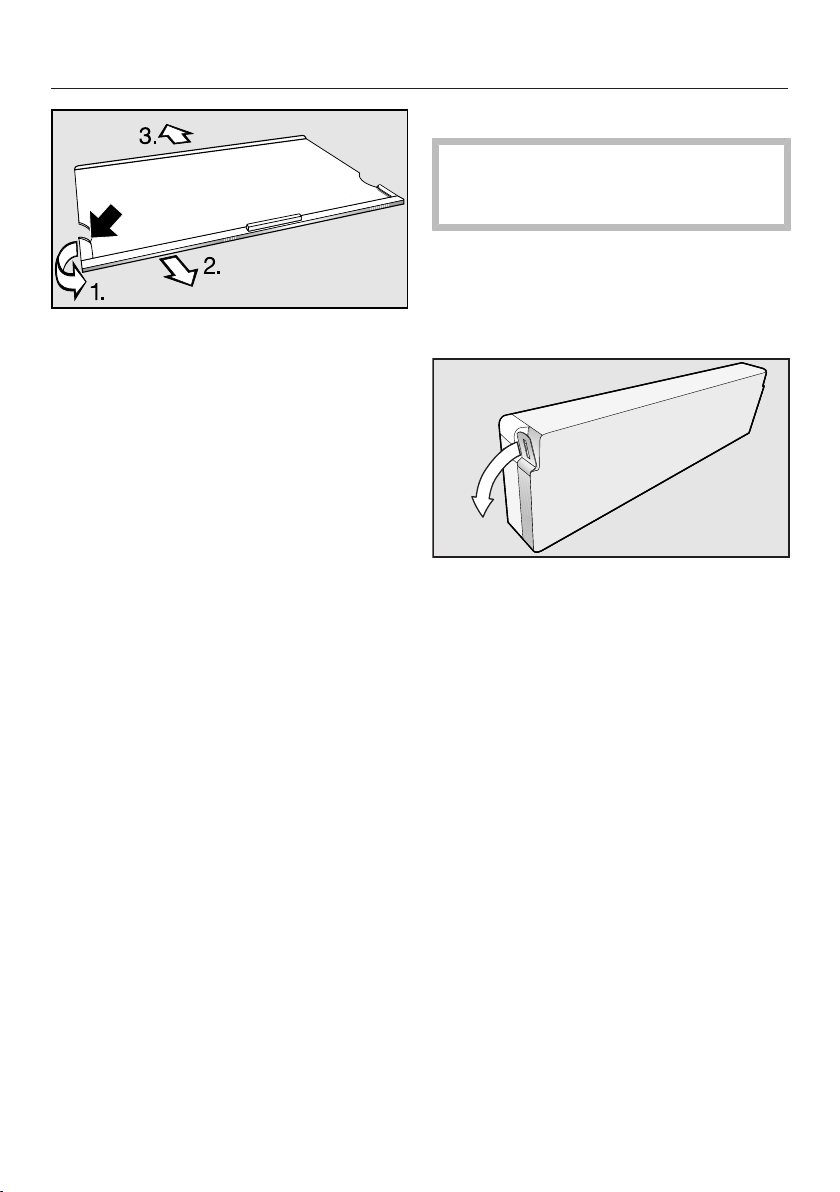
Grasp the plastic surround on the
left-hand side of the stainless steel
trim at its rearmost point.
1. Pull the plastic surround from the
shelf and
2. pull the trim off at the same time.
Then do the same on the opposite
side.
3. Then pull the protective strip off.
After cleaning, reattach the stainless
steel trim/protective strip by following
the same procedure in reverse.
Door shelves and bottle shelves
The stainless steel trim on the bottle
and door shelves is not suitable for
dishwashers!
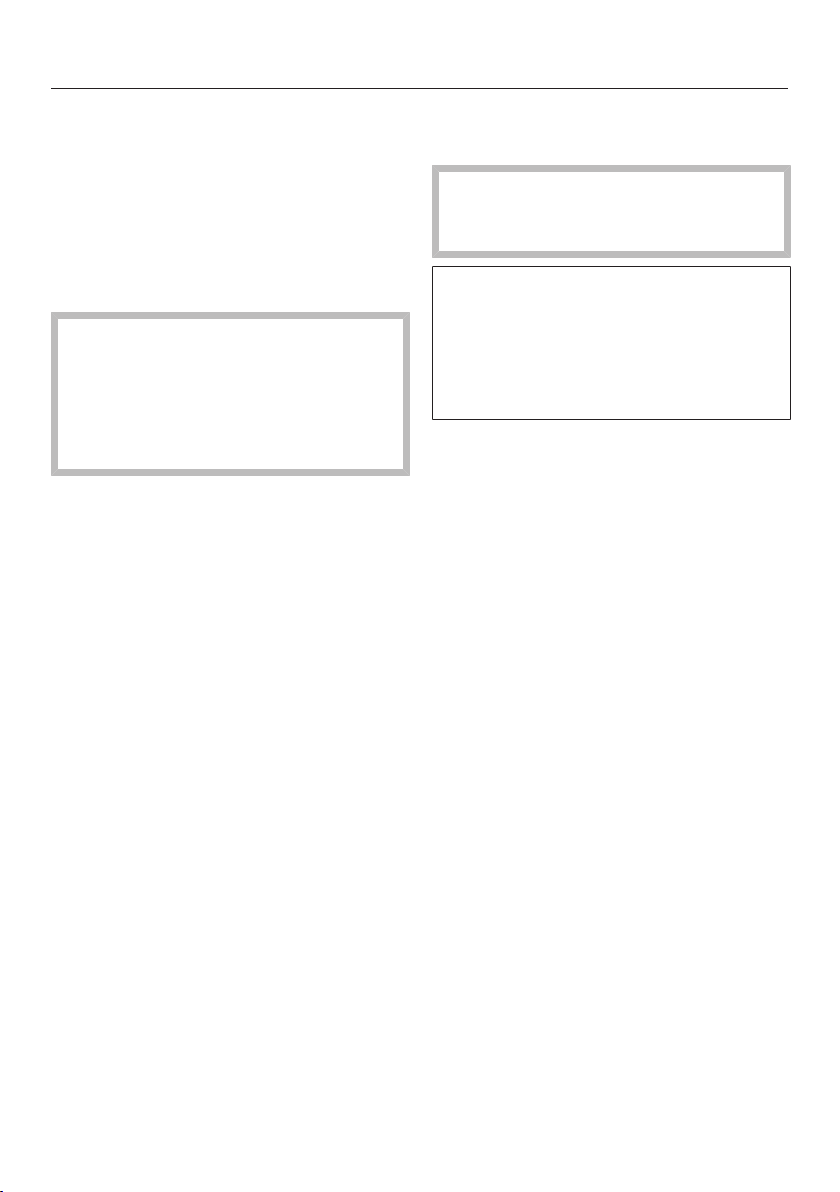
To remove the stainless steel trim, pro-
ceed as follows:
Place the door/bottle shelf with the
front side on the work surface.
Take hold of one end of the trim and
pull it off the shelf. The entire section
of stainless steel trim will now come
off the shelf.
After cleaning, reattach the stainless
steel trim to the shelf by following the
same procedure in reverse.
Cleaning and care
48
Cleaning the interior and ac-
cessories
Clean the interior with a clean
sponge, lukewarm water, and a little
liquid dish soap.
After cleaning, wipe with clean water
and dry with a soft cloth.
The stainless steel trim on the bottle
and door shelves is not suitable for
dishwashers.
Remove the stainless steel trim and
strips before putting the shelves in
the dishwasher.
The following parts cannot be cleaned
in a dishwasher:
- the stainless steel trim or strips
- the protective strips at the back of
the adjustable shelves
- all drawers and drawer lids (depend-
ing on model)
- the bottle rack
Clean these parts by hand.
The following parts can be cleaned in
the dishwasher:
The maximum temperature of the
dishwasher program selected must
not exceed 131°F (55°C)!
Contact with natural dyes from car-
rots, tomatoes, and ketchup, etc. may
discolor the plastic parts in the dish-
washer.
This discoloration does not affect the
stability of the parts.
- Bottle holder, butter dish, egg tray
(depending on model)
- Bottle shelves and door shelves on
the inside of the door (without stain-
less steel trim)
- Adjustable shelves (with trim and
strips removed)
Cleaning and care
49
Clean the condensate channel and
drain opening frequently using a cot-
ton swab or similar item to ensure
that condensate can drain away
freely.
To do this, remove the PerfectFresh
zone drawers.
Be careful not to wash out the spe-
cial lubricant in the telescopic run-
ners during cleaning.
The PerfectFresh zone drawers are on
telescopic runners. Wipe the tele-
scopic runners with a damp cloth to
clean them.
Leave the door open to air the appli-
ance for a short while and to prevent
odors developing.
Cleaning the door seal
If the door seal is damaged or has
come out of the groove, the door will
not close properly and this will affect
cooling. As a result, condensate will
build up in the interior cabinet and
this can cause a build-up of ice.
Do not damage the door seal, and
make sure that it does not come out
of its groove.
Risk of damage as a result of in-
correct cleaning.
If you treat the door seal with oils or
grease, it can become porous.
Do not use any oils or grease on the
door seal.
The door seal should be cleaned reg-
ularly with clean water and then
wiped thoroughly dry with a cloth.
Cleaning the ventilation gaps
A build-up of dust will increase the en-
ergy consumption of the appliance.
The ventilation gaps should be
cleaned on a regular basis with a
brush or vacuum cleaner (you could
use a Miele Vacuum Cleaner dusting
brush, for example).
Cleaning and care
50
Starting up the appliance after
cleaning
Replace all shelves and accessories
in the appliance.
Reconnect to the power supply and
switch the appliance back on.
Switch on the automatic SuperCool
function for a while so that the refrig-
erator section can cool down quickly.
Put the food back in the appliance
and close the door.
Replacing the carbon filters
The carbon filter with KKF-FF holder
(Active AirClean) is available as an op-
tional accessory (see “Guide to the
appliance” section “Optional acces-
sories”).
Replace the carbon filters in the holder
around every 6months.
Replacement KKF-RFcarbon filters
can be obtained from Miele Customer
Service, from your dealer, or from
Miele’s website.
Tip: The carbon filter holder is dish-
washer safe.
Pull the carbon filter holder upward to
remove it from the adjustable shelf.
When in position, the carbon filters
must not touch the back wall of the
refrigeration appliance, as the mois-
ture could cause them to stick to it.
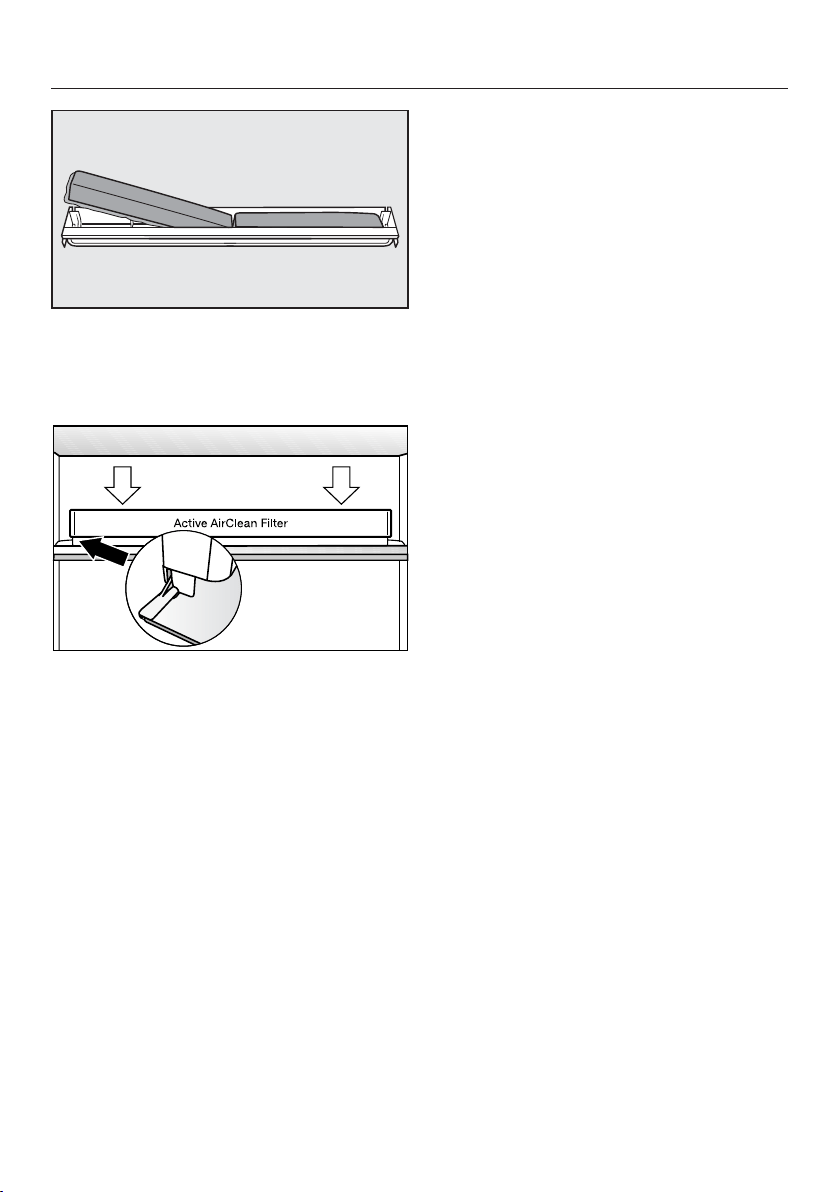
Insert the new carbon filters deep
enough in the holder to ensure that
they do not protrude over the edge
of the holder.
Cleaning and care
51
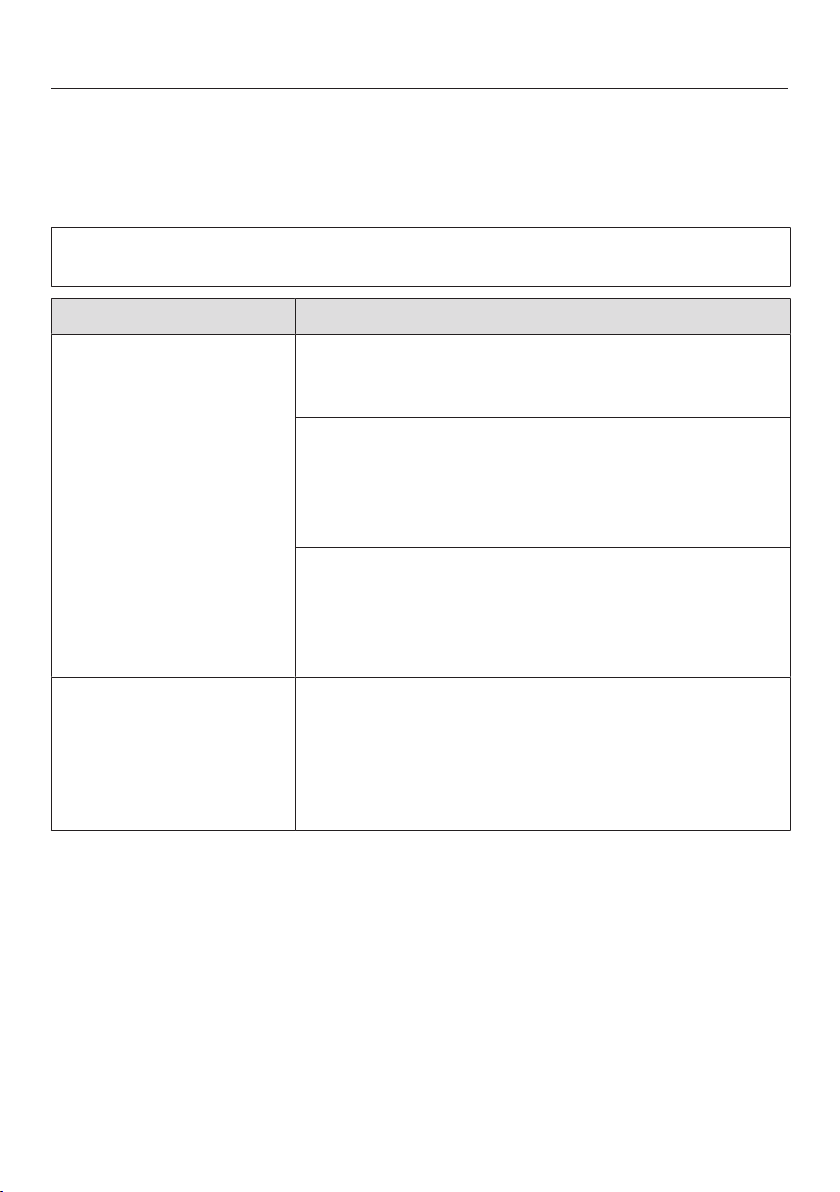
Remove both carbon filters and place
the new filters with the surrounding
edge pointing downward in the
holder.
Place the holder in the middle of the
raised edge at the back of any of the
adjustable shelves so that it clicks
into position.
Frequently Asked Questions
52
With the help of the following guide minor faults in the performance of the ma-
chine, some of which may result from incorrect operation, can be remedied with-
out contacting the Service Department.
This guide may help you to find the reason for the fault, and how to correct it.
To prevent cold from escaping, open the appliance doors as little as possible un-
til the fault has been corrected.
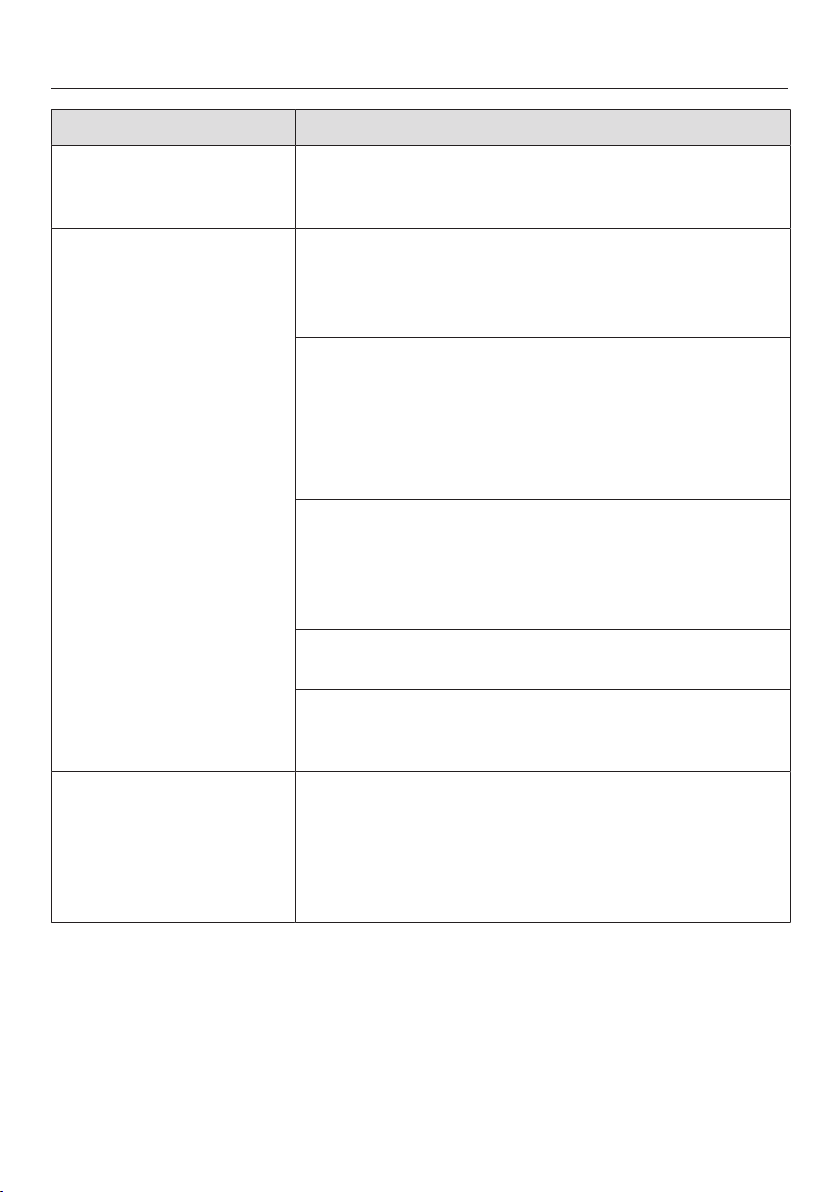
Problem Possible cause and solution
The appliance is not
getting cold, the interior
lighting does not come
on when the door is
opened, and the display
is not lit up.
The appliance is not switched on and the power sup-
ply symbol is lit up in the display.
Switch the appliance on.
The plug is not properly plugged into the electrical
outlet.
Insert the plug correctly into the socket. The power
supply symbol appears in the display when the
appliance is switched off.
Check whether the fuse has tripped. There could be
a fault with the appliance, the household electrical
wiring or another electrical appliance.
Contact a qualified electrician or Miele Technical
Service for assistance.
The symbol has lit up
on the display and the
appliance is not cooling
although the controls
and the interior lighting
are working.
Demo mode is on. This allows the appliance to be
presented in the showroom without the cooling sys-
tem being switched on. Do not activate this setting
for domestic use.
Turn off demo mode (see “Information for dealers -
Demo mode”).
Frequently Asked Questions
53
Problem Possible cause and solution
The compressor runs
continuously.
Not a fault. To save energy, the compressor runs at
a lower speed when less cooling is required. This
increases the compressor run time.
The compressor is turn-
ing on more frequently
and for longer periods
of time; the temperature
in the appliance is too
low.
The ventilation grille is obstructed or dusty.
Do not block the ventilation grille.
Clean the ventilation grille on a regular basis to re-
move any dust.
The door has been opened too frequently, or a large
amount of food has just been put in at once.
Only open the door when necessary and for as
short a time as possible.
After a while, the temperature will return to normal by
itself.
The ambient temperature is too high. The higher the
ambient temperature, the longer the compressor has
to run.
See “installation location” in the “Installation” sec-
tion.
The temperature setting is too low.
Correct the temperature setting.
The Automatic SuperCool function is still turned on.
To save energy, you can turn off Automatic Super-
Cool early yourself.
The compressor comes
on less and less often
and for shorter periods
of time. The tempera-
ture in the appliance
rises.
This is not a fault. The temperature is too high.
Correct the temperature setting.
Check the temperature again after 24hours.
Frequently Asked Questions
54
Problem Possible cause and solution
An LED indicator light is
flashing at the back of
the refrigerator at the
bottom near the com-
pressor (depending on
model).
The electronic for the
compressor is equipped
with an operation and
fault diagnosis LED in-
dicator light.
The indicator light flashes several times every 5sec-
onds.
A fault has occurred.
Contact Customer Service.
The indicator light flashes regularly every 15sec-
onds.
This is not a fault. This flashing is normal.
The door seal is dam-
aged and needs to be
replaced.
No tools are required to change the door seal.
Contact Miele Service.
Ice or condensation has
built up inside the appli-
ance.
The door seal has come out of its groove.
Check that the door seal is correctly positioned in
the groove.
The door seal is damaged.
Check whether the door seal is damaged.
Frequently Asked Questions
55
Messages in the display
Message Possible cause and solution
The alarm symbol
lights up in the display
and an alarm tone
sounds.
The door alarm has been activated.
Close the appliance door. The alarm symbol
will go out, and the alarm tone will stop.
The symbol lights up
in the display. You can-
not switch the appli-
ance off.
The safety lock has been activated.
Completely deactivate the safety lock (see “Select-
ing additional settings”, section “Activating and de-
activating the safety lock”).
lights up in the dis-
play.
The Replace carbon filter reminder setting has
been activated. This is the reminder to change the fil-
ter (Active AirClean).
Replace the carbon filter in the holder (see “Clean-
ing and maintenance - Replacing the filter”).
Reset the counter (see “Selecting further settings –
Carbon filter replacement indicator”).
“F0toF9” appears in
the display.
There is a fault.
Contact Miele Technical Service.
Frequently Asked Questions
56
The interior lighting is not working.
Problem Possible cause and solution
The interior lighting is
not working.
The refrigeration appliance has not been turned on.
Turn the refrigeration appliance on.
Sabbath mode is on: The display is black and the
appliance is cooling.
Touch the settings button to exit Sabbath mode.
The temperature will then appear in the display and
the interior lighting will come on (see “Selecting fur-
ther settings – Switching Sabbath mode on/off”).
To avoid overheating, the interior lighting switches it-
self off automatically after approximately 15minutes
if the appliance door is left open. If this is not the
cause, there is a fault.
Risk of electric shock due to exposed, live
electrical components.
When removing the lighting cover, there is a risk of
coming into contact with live electrical compo-
nents.
Do not remove the lighting cover. The LED lighting
may only be repaired or replaced by Customer
Service.
Risk of injury from LED lighting.
This lighting corresponds to risk group RG2. If the
cover is defective, there is a risk of eye injury.
If the lighting cover is defective, do not look from a
close range directly into the lighting with optical in-
struments (e.g., magnifying glass or similar).
Contact Customer Service.
Frequently Asked Questions
57
Problem Possible cause and solution
The LED lighting on one
of the shelves is not
working.
The shelf is not sitting correctly on the shelf sup-
ports.
Check that the shelf is positioned correctly on the
shelf supports. The shelf has a metal disc (con-
tacts) at the front left corner which supplies power
to the LED lighting.
Push in the shelf until it clicks into position.
The metal disc is not clean and dry.
Clean it with a damp cloth and dry with a lint-free
cloth.
The LED lighting on the stainless steel trim is faulty.
Risk of electric shock due to exposed, live
electrical components.
When removing the lighting cover, there is a risk of
coming into contact with live electrical compo-
nents.
Do not remove the lighting cover. The LED lighting
may only be repaired or replaced by Customer
Service.
Risk of injury from LED lighting.
This lighting corresponds to risk group RG2. If the
cover is defective, there is a risk of eye injury.
If the lighting cover is defective, do not look from a
close range directly into the lighting with optical in-
struments (e.g., magnifying glass or similar).
Replace the adjustable shelf with LED lighting. A
replacement is available from Customer Service.
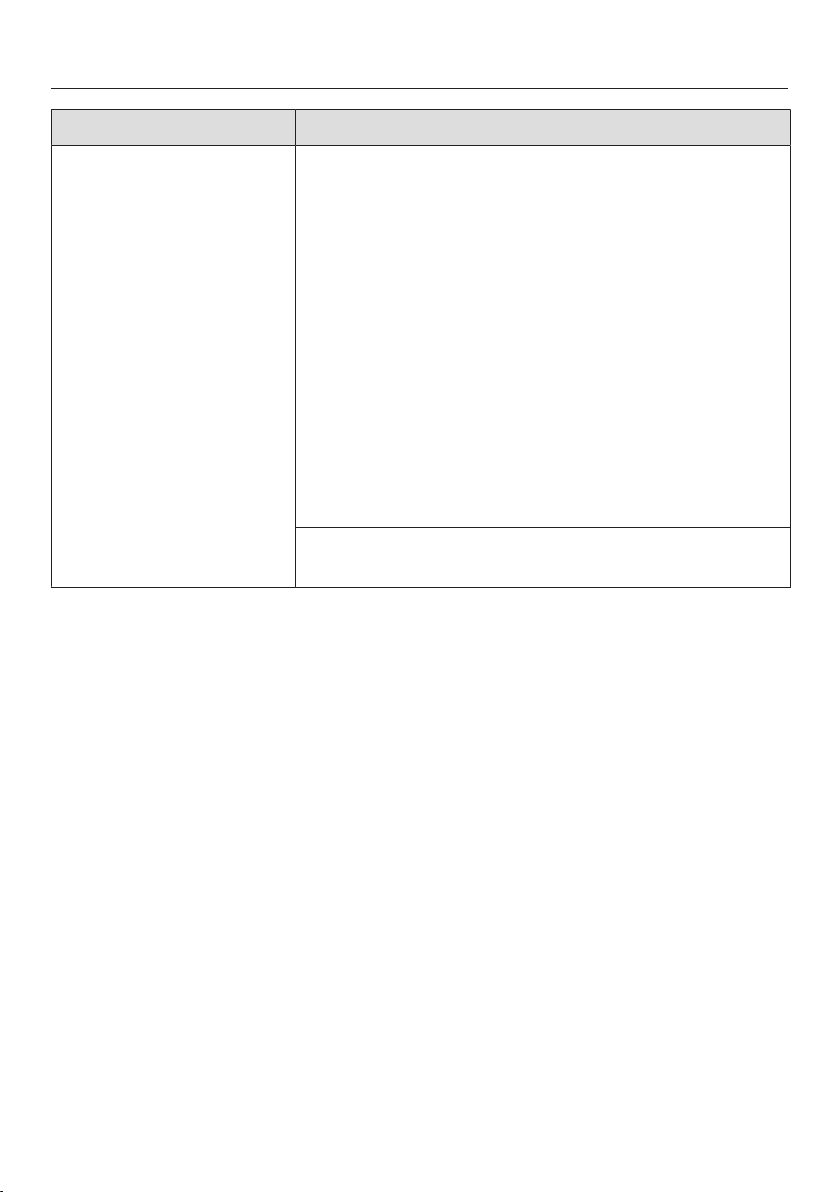
Frequently Asked Questions
58
Problem Possible cause and solution
The LED lighting is not
working on any of the
shelves.
Liquid has come into contact with the LED lighting on
a shelf or the metal contacts in the left-hand shelf
supports.
The safety shut-off mechanism has switched off the
LED lighting on all the shelves.
Wipe the stainless steel trim with LED lighting with
a damp cloth and dry it or leave it outside the ap-
pliance to dry. Clean the metal contacts in the
shelf supports in the same way.
Ensure that the contacts are clean and dry before
replacing the shelves with LED lighting.
Push in the shelf until it clicks into position.
Close the appliance door.
When the door is opened again, the interior lighting
will come on.
If this does not happen, there is a fault.
Contact Customer Service.
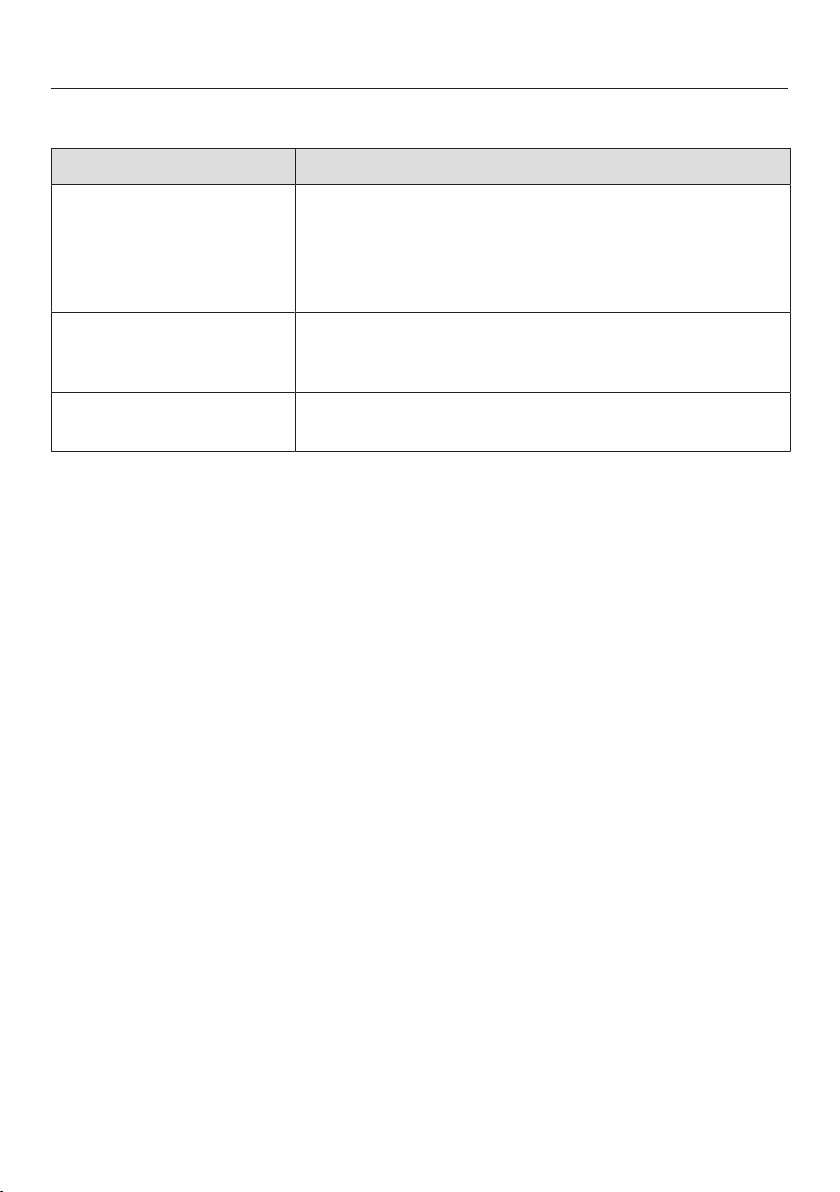
Frequently Asked Questions
59
Other problems
Problem Possible cause and solution
An alarm does not
sound even though the
appliance door has
been open for a long
time.
This is not a fault. The alarm tone has been
switched off in settings mode (see “Acoustic sig-
nals” under “Selecting additional settings”).
The external walls of
the appliance feel
warm.
This is not a fault. The warmth created by the evap-
orator is used to prevent condensation.
The floor of the refriger-
ator section is wet.
The drain hole is blocked.
Clean the condensate channel and the drain hole.
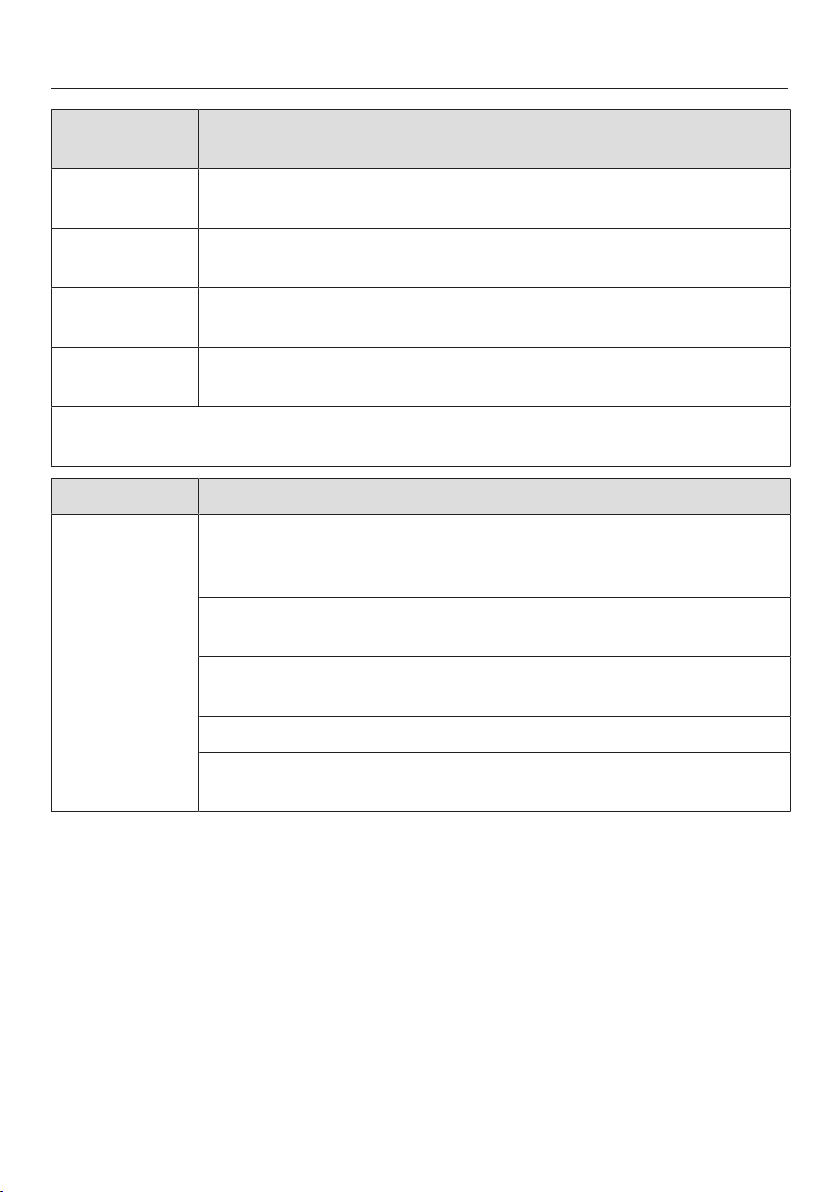
Causes of noises
60
Normal
noises
Cause
Brrrrr... A humming noise is made by the motor (compressor). This noise
can get louder for brief periods when the motor switches on.
Blub, blub... A gurgling noise can be heard when the coolant circulates
through the pipes.
Click... Clicking sounds occur whenever the thermostat switches the
motor on or off.
Crack... A cracking sound can be heard when materials expand inside
the appliance.
Please bear in mind that a certain amount of noise is unavoidable (from the com-
pressor and the coolant circulating through the system).
Noises Possible cause and solution
Rattling,
clinking
The appliance is uneven. Realign the appliance using a spirit
level, by raising or lowering the screw feet underneath the appli-
ance or place something underneath it.
The appliance is touching another appliance or piece of furni-
ture. Move it away.
Drawers, baskets or shelves are unstable or sticking. Check all
removable items and refit them correctly.
Bottles or containers are touching each other. Separate them.
The transport cable clips are hanging loose at the back of the
appliance. Remove the cable clips.
Customer Service
61
Contact in the event of a fault
In the event of a fault which you cannot
remedy yourself, please contact your
Miele dealer or Miele Customer Service.
You can book a Miele Customer Ser-
vice call-out online at www.miele.com/
service.
Contact information for Miele Cus-
tomer Service can be found at the end
of this document.
Please quote the model identifier and
serial number of your appliance (SN)
when contacting Miele Customer Ser-
vice. Both pieces of information can be
found on the data plate.
You will find the data plate inside your
appliance.
Appliance warranty and prod-
uct registration
You can register your product and/or
view the manufacturer´s warranty terms
and conditions for Miele appliances and
vacuum cleaners at
www.mieleusa.com.
Information for dealers
62
Demo mode
The appliance can be demonstrated in
the showroom or at exhibitions in
“Demo mode”. In this mode, the control
panel and interior lighting are active but
the compressor remains off.
Turning on demo mode
Switch the appliance off by touching
the On/Off button.
If this does not work, the safety lock
is activated.
The temperature shown on the display
will go out and the power connection
symbol appears.
Touch and hold the button.
At the same time, briefly touch the
on/off button (without letting go of
the button!).
Keep your finger on the button un-
til the symbol appears on the dis-
play.
Release the button.
Demo mode is on and the symbol is
illuminated on the display.
Information for dealers
63
Turning off Demo mode
Thesymbol is illuminated in the dis-
play.
Touch the settings sensor.
All symbols available for selection will
appear in the display and thesymbol
flashes.
Touch the sensors for setting the
temperature (or) repeatedly un-
til thesymbol flashes in the display.
Touch the OK sensor to confirm your
selection.
The1 symbol flashes in the display
(meaning: Demo mode is active) and
thesymbol is illuminated.
Touch theorsensor so that the
symbol0appears in the display
(meaning: Demo mode is inactive).
Touch the OK sensor to confirm your
selection.
The selected setting will be adopted
and thesymbol will flash.
Touch the settings sensor to leave the
settings mode.
Otherwise the appliance will exit the
settings mode automatically after ap-
proximately one minute.
Demo mode is turned off and
thesymbol disappears.
Installation
*INSTALLATION*
64
Installation
Side-by-side
The KS 37472 iD appliance has two
foamed-in side-wall heaters, enabling it
to be installed side-by-side with all
other appliances. Each appliance must
be installed in its own housing unit.
Please contact your dealer for specific
information about which combinations
will work with your appliance.
WARNING! This appliance must
be built in, otherwise it could tip
over!
Install the appliance in accordance
with the installation instructions.
Fire hazard and risk of damage!
The appliance must not be installed
underneath a cooktop.
Installation location
This appliance should be installed in a
dry, well-ventilated room.
When deciding where to install your ap-
pliance, please bear in mind that the
energy consumption will increase if in-
stalled near to a heater, a cooker, or
other appliance that gives off heat. Di-
rect sunlight should also be avoided.
The higher the room temperature, the
longer the compressor has to run and
the higher the energy consumption is.
When installing the appliance, please
note:
- The electrical socket must be easily
accessible in an emergency and not
concealed behind the appliance.
- The plug and power cord must not
touch the back of the appliance as
they could be damaged by vibrations
from the appliance.
- Do not plug other appliances into
electrical sockets behind this appli-
ance.
Risk of damage due to high hu-
midity.
In environments with high humidity,
condensation can build up on exter-
nal refrigeration appliance panels,
which can cause corrosion.
Install the refrigeration appliance in a
dry and/or air-conditioned room with
sufficient ventilation.
After installation, make sure that the
appliance door closes properly, the
ventilation gaps are not covered, and
the refrigeration appliance has been
installed in accordance with these
operating and installation instruc-
tions.
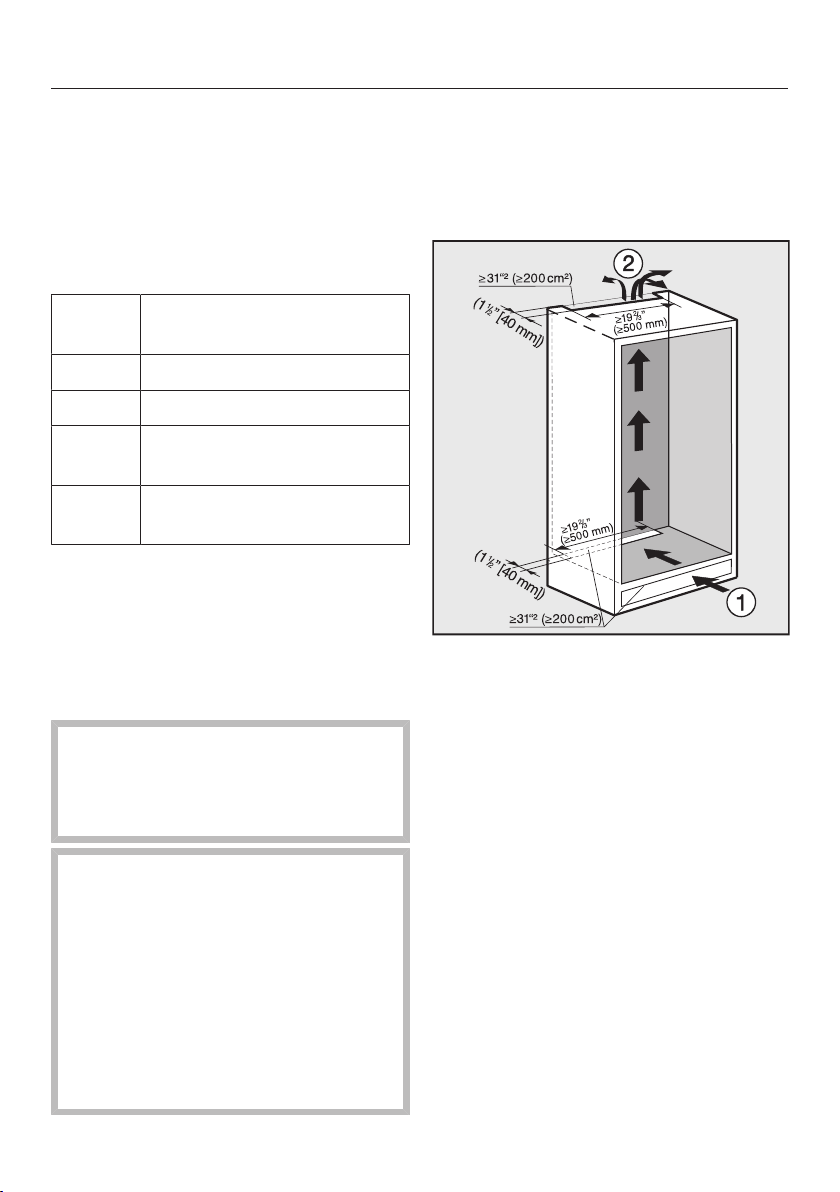
Installation
*INSTALLATION*
65
Climate class
The appliance is designed for use within
a certain climate range (ambient tem-
peratures) and should not be used out-
side this range. The climate range of the
appliance is stated on the data plate in-
side the appliance.
Climate
class
Room temperature
SN 50°F to 90°F / 10°C to 32°C
N 60°F to 90°F / 16°C to 32°C
ST 60°F to 100°F / 16°C to
38°C
T 60°F to 109°F / 16°C to
43°C
Operating in a room which is too cold
will cause the compressor to turn off for
too long, causing the internal tempera-
ture in the appliance to rise, resulting in
damage.
Ventilation
WARNING! Fire hazard!
Operation of the appliance is limited.
Keep the ventilation slits free from
obstruction.
If the ventilation slits are not kept
free and unobstructed the compres-
sor will switch on more often and will
run for longer.
This can cause higher energy con-
sumption and to an increased com-
pressor operating temperature,
which can result in damage to the
compressor.
Do not block the ventilation slits.
The air at the back wall of the appliance
warms up. Therefore the cabinet must
be constructed in such a way that en-
sures unhindered ventilation (see “Built-
in dimensions”).
- The air influx enters via the toe-
kick and the air outlet is at the top
at the rear of the cabinet.
- To ensure ventilation an air channel of
a minimum 9/16" (40mm) depth
must be provided at the back of the
appliance.
- The ventilation slits in the toe-kick, in
the cabinet and under the top of the
cabinet must provide a total passage
volume of at least 31 square inches
to allow the warm air to dissipate
unimpeded.
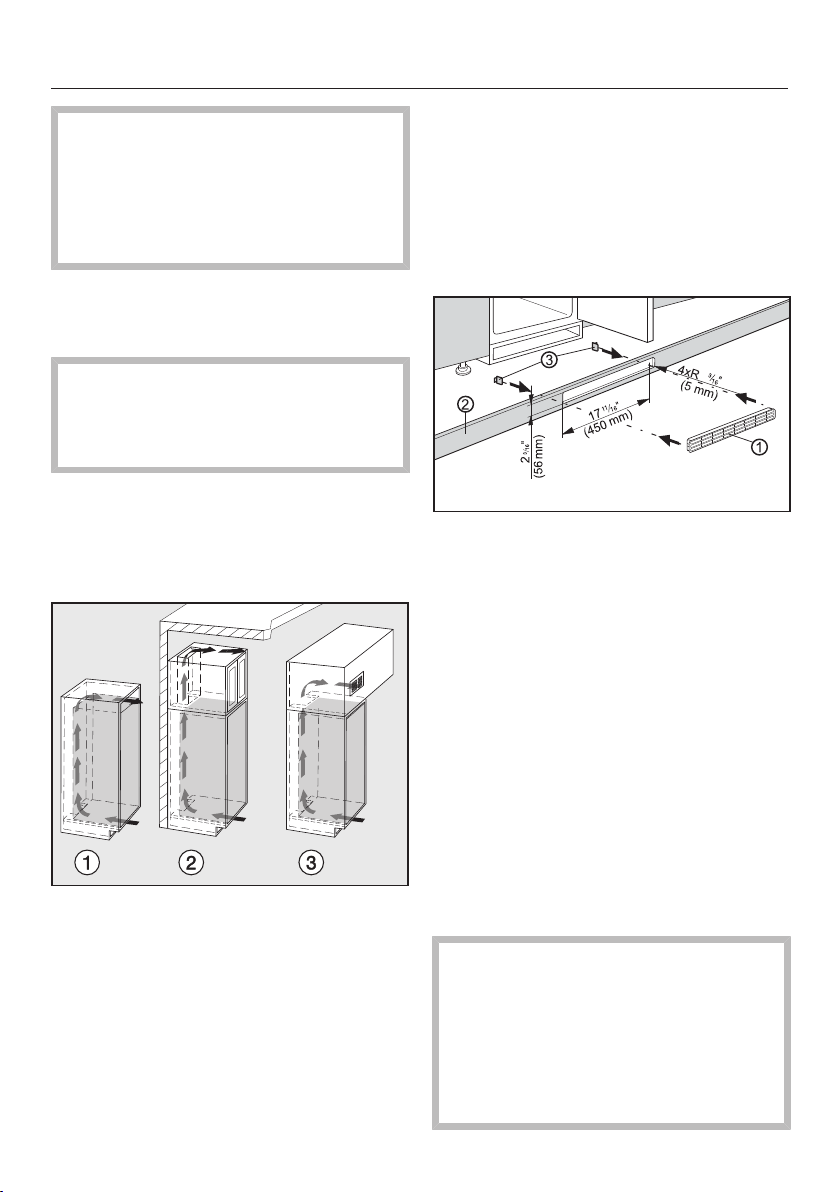
Installation
*INSTALLATION*
66
If you wish to fit a grille in the ventila-
tion openings, the ventilation open-
ings must be larger than 31 square
inches. The passage volume of 31
square inches is the total area of the
opening slits in the grille.
- Important! The larger the ventilation
slits, the more economically the ap-
pliance will work.
The ventilation slits must not be
blocked or obstructed in any way.
Clean the ventilation slits on a regu-
lar basis.
Top ventilation gap
The ventilation gap at the top of the ap-
pliance can be constructed in different
ways:
a
Directly above the appliance with a
ventilation grille (free airflow of at
least 31sqinches (200cm²))
b
Between the kitchen cabinetry and
the ceiling
c
In a suspended ceiling
Lower ventilation slit
The appliance can be ventilated via the
cabinet plinth with the ventilation grille
supplied or with a minimum ventilation
opening of 31 square inches cross-sec-
tion area. When using the grille sup-
plied, please proceed as follows:
Cut an opening in plinth as shown
in the diagram.
Place ventilation grille in the open-
ing.
Push snap fasteners into the venti-
lation grille from behind until the
hooks touch the plinth.
Reinstall the plinth with the ventilation
grille.
Door panel
The required door panel must be min.
5/8” (16mm) and max. 3/4” (19mm)
thick.
Weight of the door panel
If the door panel is too heavy,
this can cause damage!
Installing a door panel which is heav-
ier than the maximum permitted
weight could damage the hinges.
This can cause subsequent func-
tional problems.
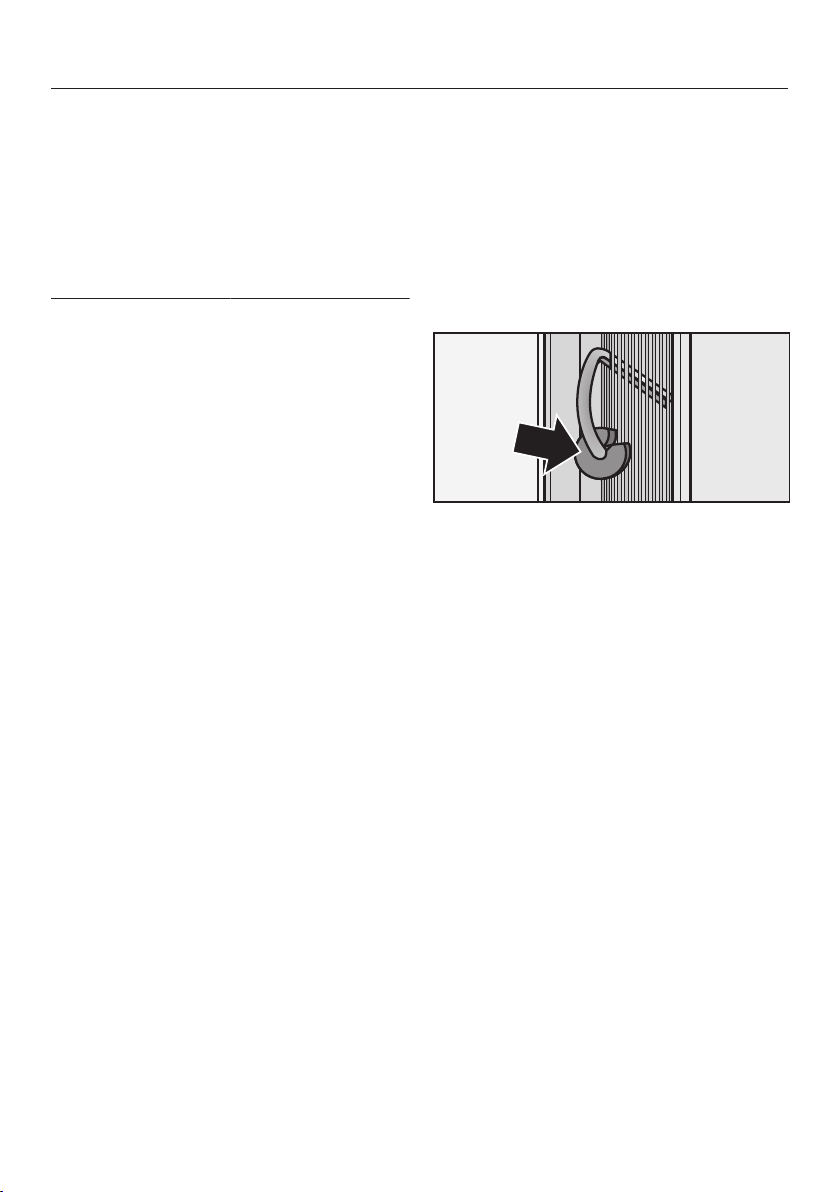
Installation
*INSTALLATION*
67
Before installing the cabinet door, en-
sure that the weight of the door does
not exceed the maximum permitted
weight:
Appliance Maximum weight
of cabinet door in
lb (kg)
KS 37472 iD 57(26)
Before installing the appliance
Before installation, remove the bag of
installation and other accessories
from the appliance and remove the
profile strip from the outer appliance
door.
Do not remove the following from
the back of the appliance
- the spacers (depending on the
model). They ensure the distance re-
quired between the back of the appli-
ance and the wall.
- the bags located in the metal grille
(heat exchanger, depending on
model).
These are required for the functioning
of the appliance. Their contents are
not toxic or hazardous.
Remove the cable clips from the back
of the appliance.
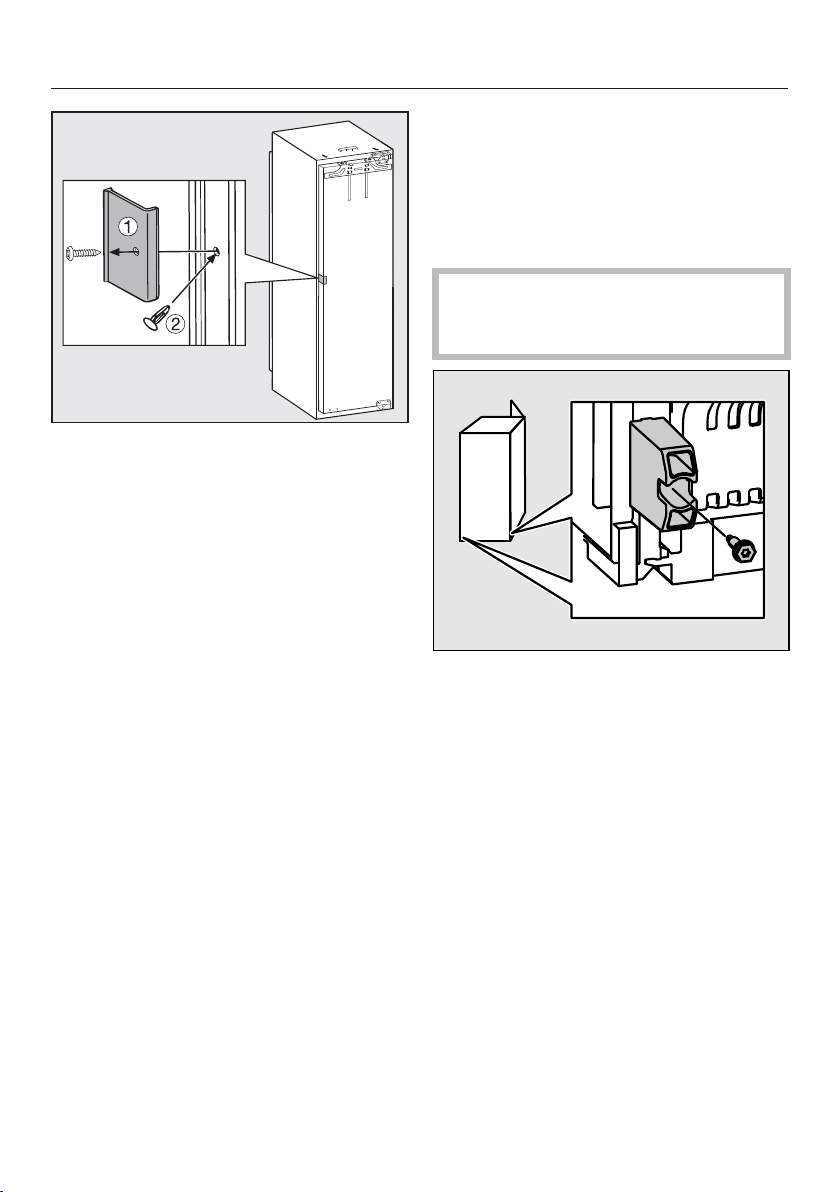
Installation
*INSTALLATION*
68
Remove red transport safety de-
vice (depending on model) and use
the stopper supplied to cover the
hole.
Wall spacer at the back
At a furniture depth of less than
213/4'' (553mm), you can remove the
wall spacer from the back of the appli-
ance so that you can push the appli-
ance right into the niche.
Removing the wall spacer can in-
crease energy consumption as there
is then a smaller ventilation area.
Loosen the screw and remove the
wall spacer.
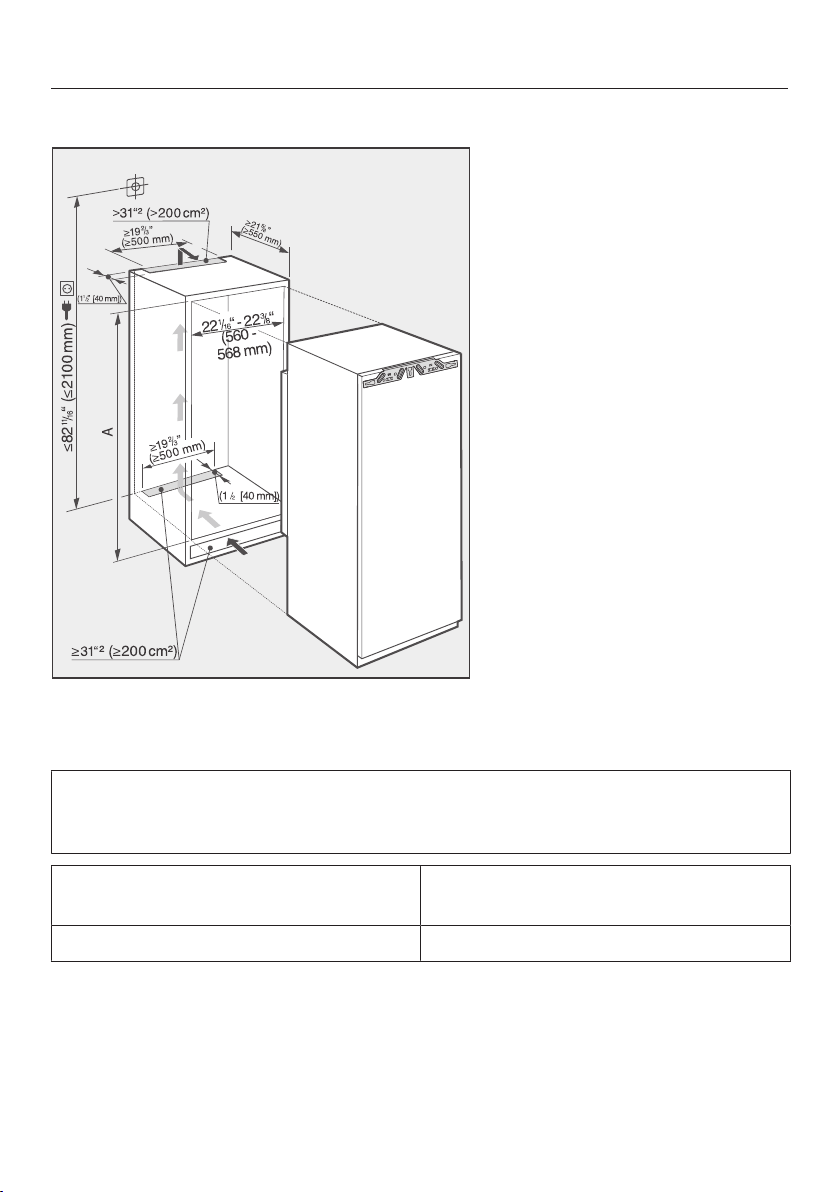
Installation
*INSTALLATION*
69
Installation dimensions
* The declared energy consumption was achieved with a niche depth of
221/16“(560mm). The appliance is fully capable of functioning at a niche depth
of 215/8”(550mm), but will consume slightly more energy.
If the appliance is suitable for installation in a niche, ensure before installation
that it has precisely the correct dimensions. The specified ventilation grille dimen-
sions must be observed to ensure that the appliance functions correctly.
Niche height
A
KS37472iD 693/4"-703/8"(1,772-1,788mm)
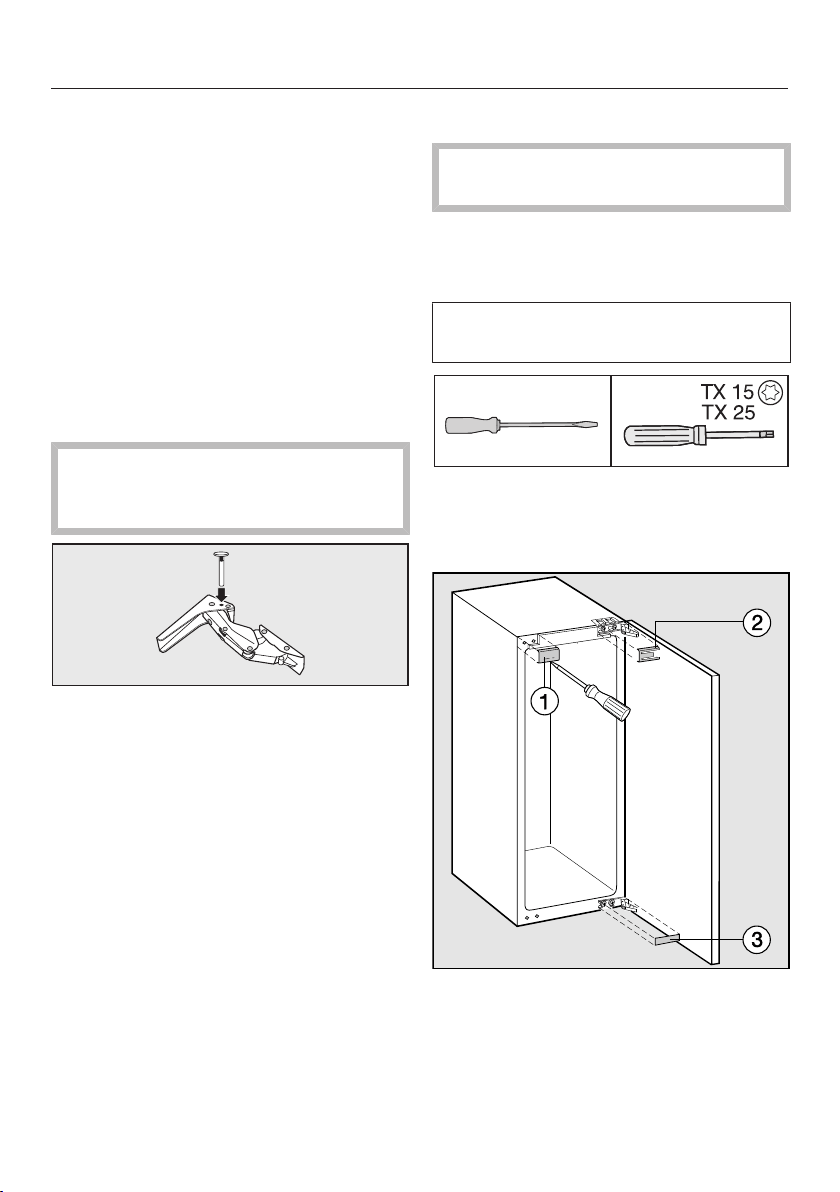
Installation
*INSTALLATION*
70
Limiting the opening angle of
the appliance door
The door hinges are set to enable the
appliance door to be opened wide.
However, if the opening angle of the
door needs to be limited for any reason,
the hinge can be adjusted to accommo-
date this.
If, for example, the appliance door hits
an adjacent wall when it is opened, you
should limit the opening angle of the
appliance door to 90°.
The locking pins for limiting the door
opening must be fitted before the ap-
pliance is installed.
Insert the locking pins supplied for
limiting the door opening into the
hinges from above.
The door opening angle is now limited
to approx. 90°.
Changing the door hinging
Always change the door hinging with
the assistance of another person.
The appliance is supplied with right-
hand hinging. If left-hand hinging is re-
quired, the hinges must be changed:
To change the door hinging, you will
need the following tools:
Open the appliance door.
Remove the adjustable shelves/bottle
shelf from the appliance door.
Lift off the covers: , , and .
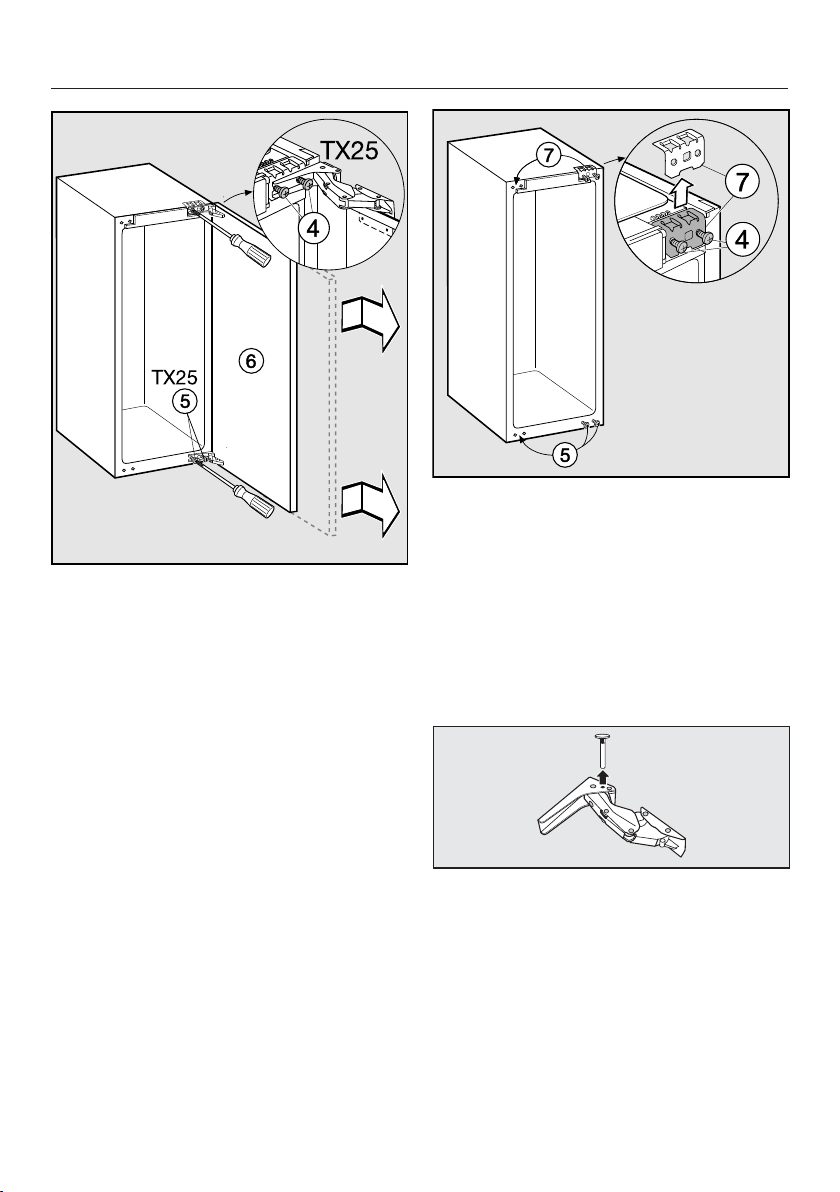
Installation
*INSTALLATION*
71
Slightly loosen the hinge screws:
and.
Push the door outward and take it
off its hinges.
Undo the screws completely.
Fit the bracket on the opposite
side and attach the screws loosely.
Undo the screws completely and
loosely screw them in on the opposite
side.
If you have inserted pins into the hinges
to limit the door’s opening angle:
Remove the locking pins from the top
of the hinges.
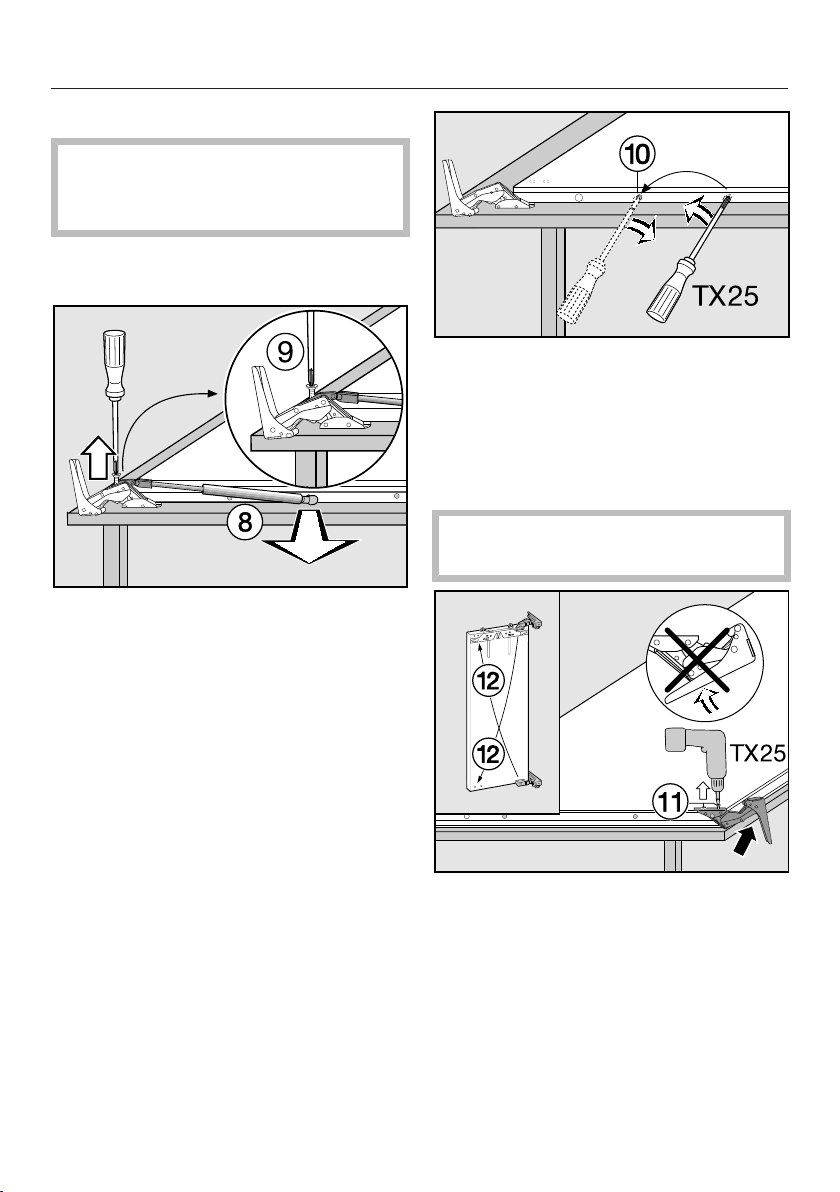
Installation
*INSTALLATION*
72
Removing the soft-close mechanism
Warning! The soft-close mecha-
nism folds in when dismantled!
Danger of injury!
Place the door on a stable surface
with the front facing down.
Remove the soft-close mechanism
from the ball joint.
Unscrew the mount and pull the
soft-close mechanism toward you
and off.
Using a screwdriver, remove the ball
joint and screw it into the adjacent
hole.
Now turn over the appliance door so
that the front is facing up (hinges re-
main open).
Danger of injury!
Do not close the hinges.
Remove the screws .
Replace the hinges in their diagonally
opposite corners.
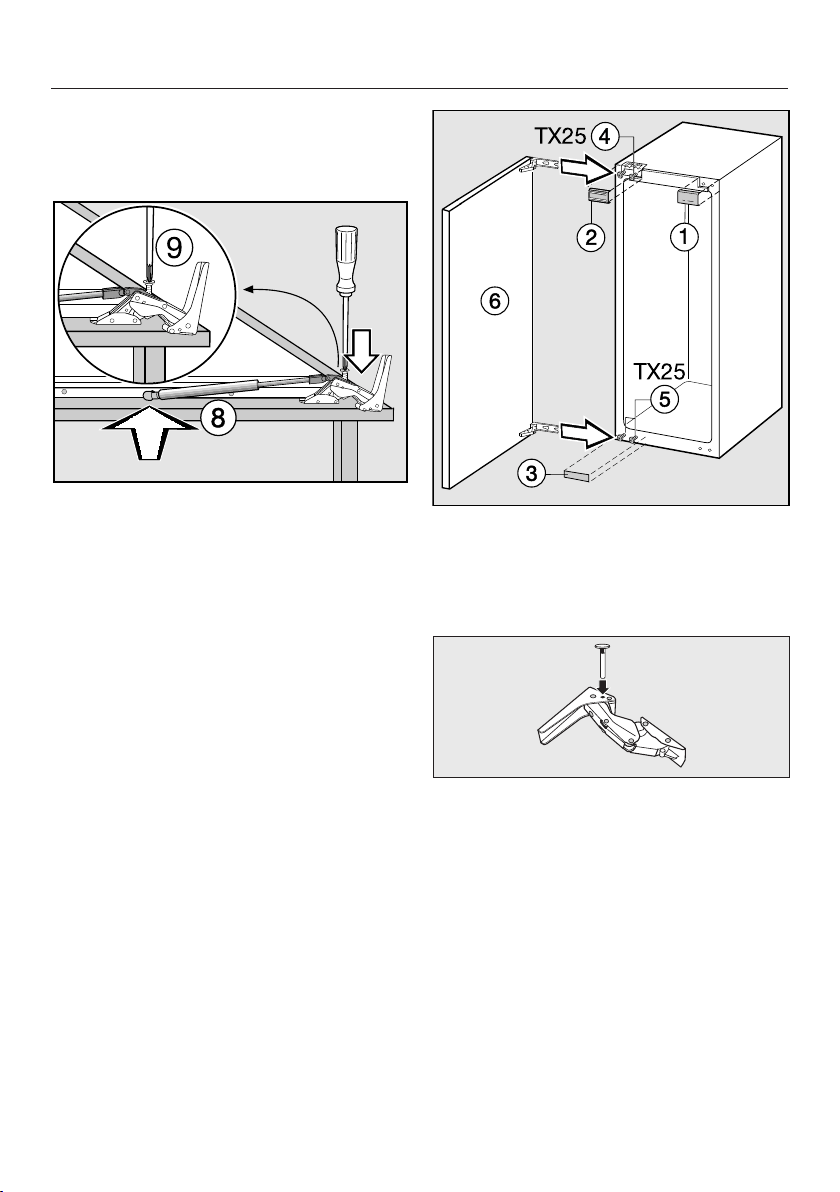
Installation
*INSTALLATION*
73
Fastening the soft-close mechanism
Now turn over the appliance door so
that the outer side faces downward.
Screw the mount onto the hinge
and firmly tighten.
Open out the soft-close mecha-
nism, and hook it onto the ball
joint.
Hang the appliance door onto the
pre-fitted screws and , and se-
curely tighten the screws and .
Replace the covers: , , and .
Refit the locking pins into the top of
the hinges to prevent the door from
opening too far.
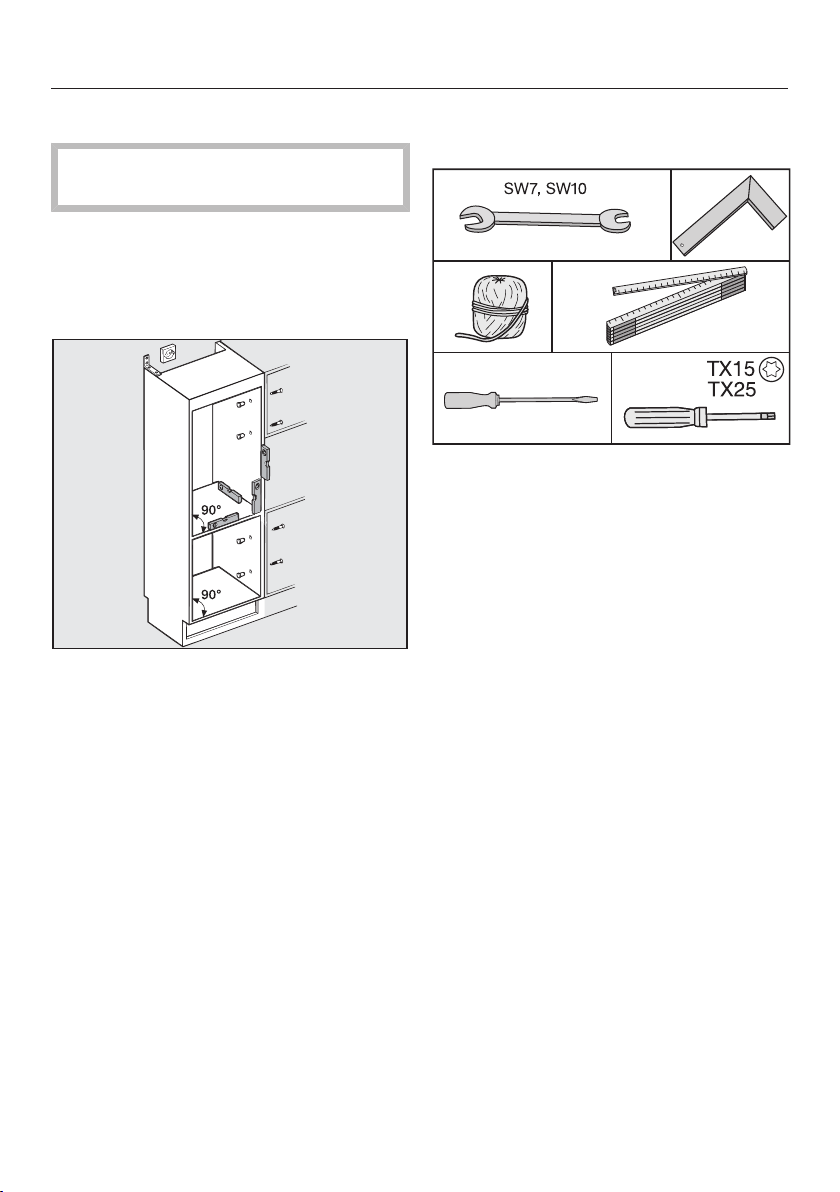
Installation
*INSTALLATION*
74
Building in the appliance
Two people are required to install the
appliance.
Install the appliance in stable, solid
cabinetry, positioned on an even and
level floor.
Secure the cabinetry against tipping.
Use a level to align the appliance. The
cabinet corners must be at 90° an-
gles to each other, otherwise the cab-
inet door will not sit straight on all
4corners.
The required ventilation gaps must be
provided (see “Installation – Installa-
tion notes”).
To install the appliance, you will need
the following tools:
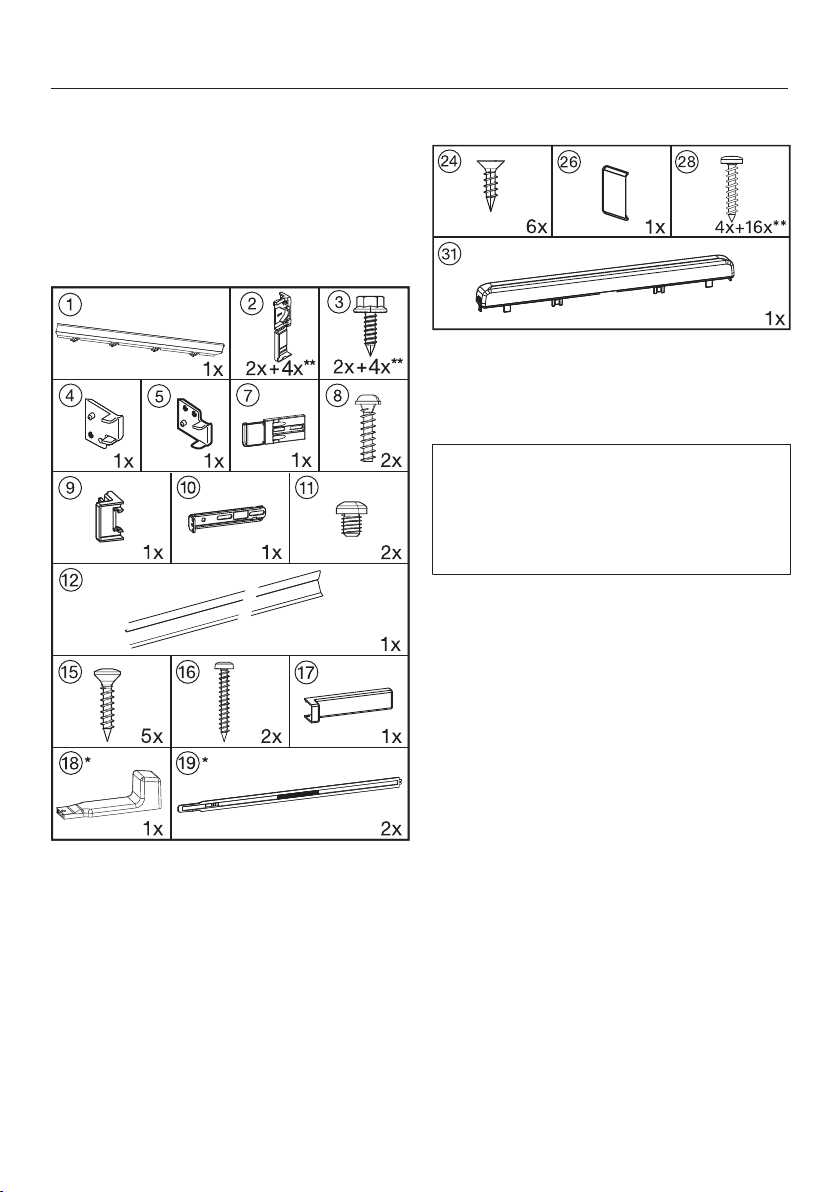
Installation
*INSTALLATION*
75
Parts required for installation:
All installation parts are number-coded.
This coding is also used in the installa-
tion instructions.
- For building the appliance into the
niche:
*These parts are only supplied with ap-
pliances with a niche height of
55"(140cm) or more.
**Number depends on niche height;
maximum number applies to appliances
requiring a niche height of 55"(140cm)
or more (also contains additional instal-
lation parts for fitting large or divided
cabinet doors).
- For installing the cabinet door:
**Number depends on niche height.
Also contains additional installation
parts for fitting large or divided cabinet
doors.
All installation instructions given are
for a right-hand hinged appliance. If
you have converted the appliance to
left-hand hinging, you will need to
adapt these instructions accordingly.
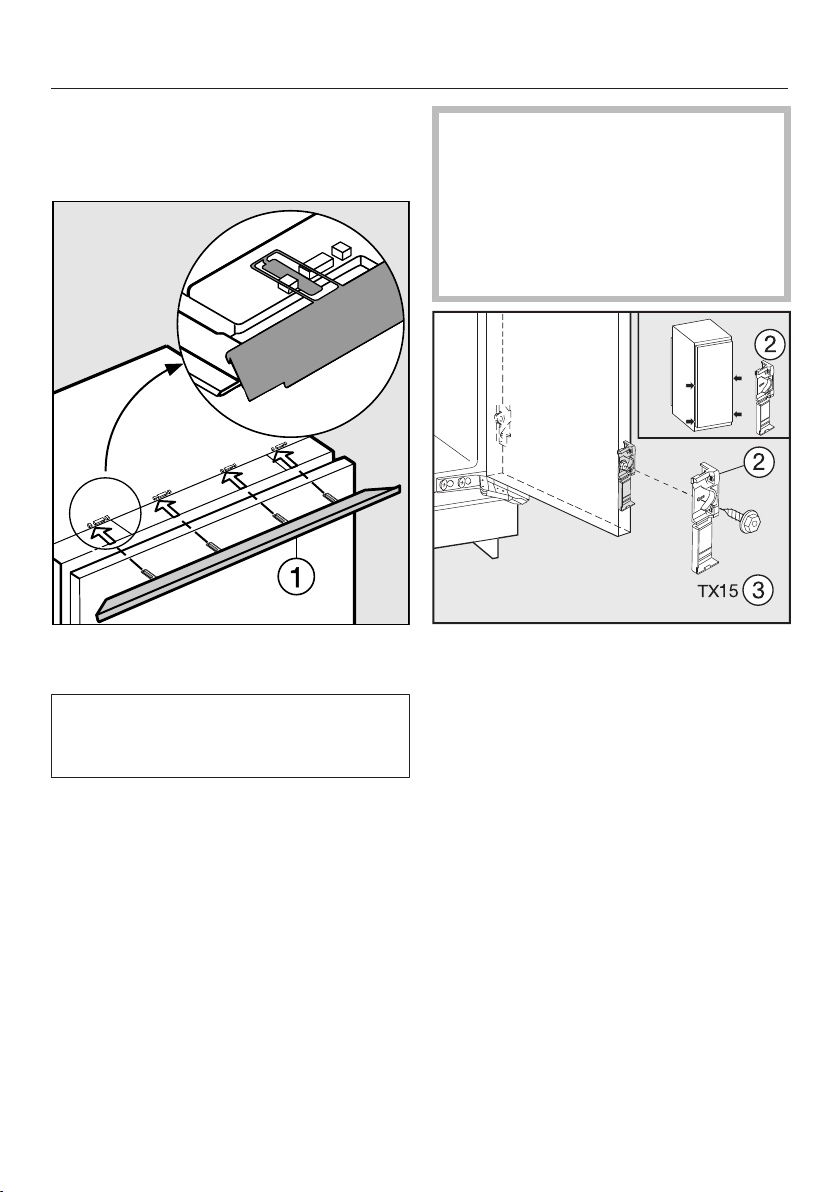
Installation
*INSTALLATION*
76
Preparing the appliance
Position the appliance directly in front
of the cabinet niche.
Push the filler strip lugs into the
holders from the front.
If the appliance is hinged on the left,
slide the lugs into the right-hand
opening of the holder.
Risk of damage to the securing
bracket and cover.
The cover on the securing bracket
can easily become detached.
Always close the cover as soon as
you have finished working on the
bracket.
Loosely screw the securing brack-
ets into the pre-drilled holes in the
appliance door using the hex
screws.
Tip: Secure a pair of brackets in the
handle area of the door.
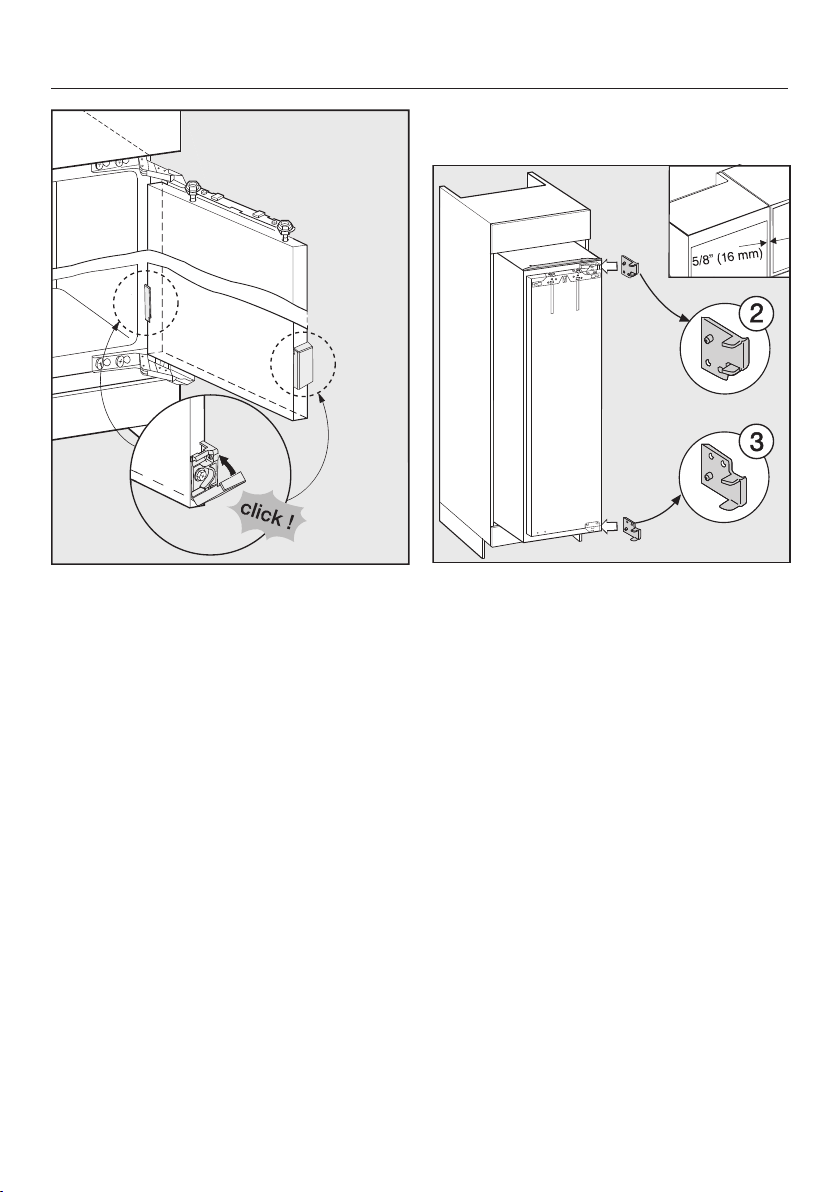
Installation
*INSTALLATION*
77
Close the covers.
Push the appliance two-thirds of the
way into the built-in niche. Take care
not to trap the power cord when
pushing the appliance into its niche.
Tip: Tie a piece of string to the plug to
“lengthen” the power cord; this will help
you to push the appliance into position.
Pull the power cord through the cabinet
by the other end of the string so that
the appliance can be connected to the
power supply easily after installation.
With 5/8" (16mm) thick cabinet walls
only:
Clip the spacers and onto the
right of the hinges.
Open the appliance door.
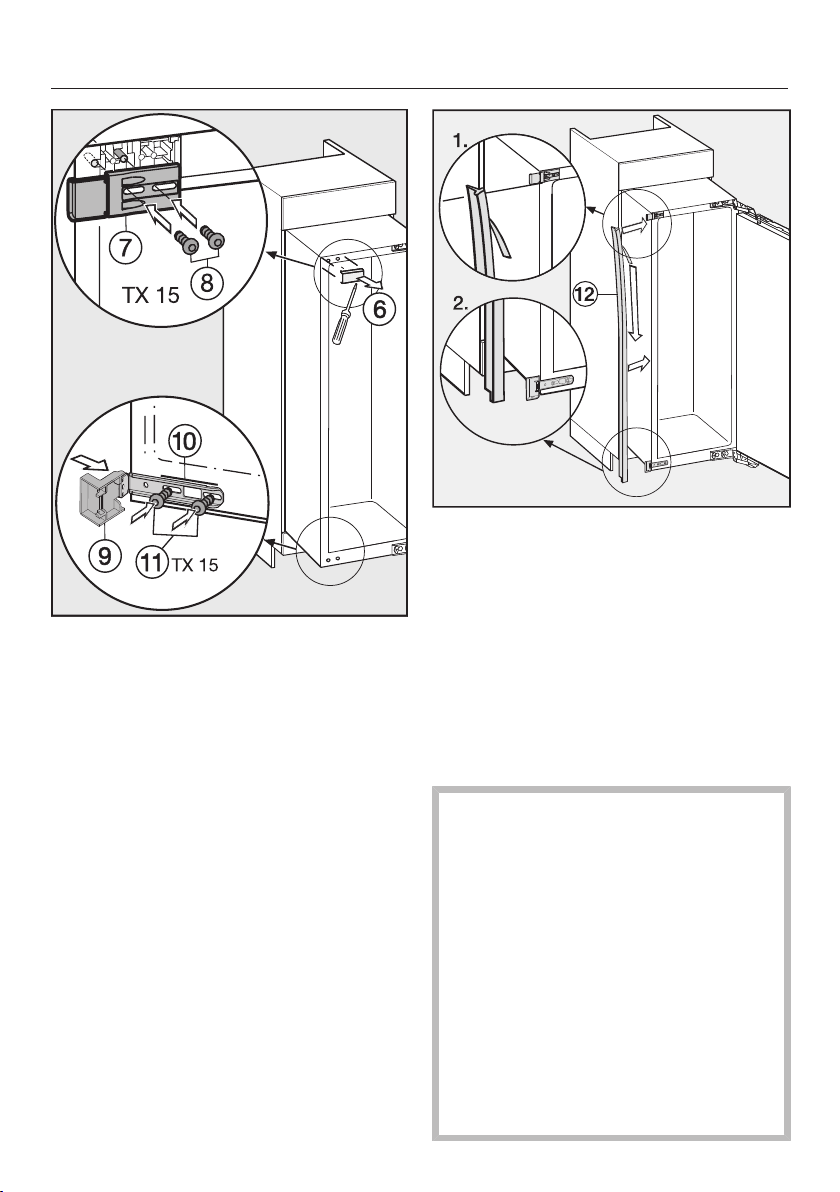
Installation
*INSTALLATION*
78
Remove the cover.
Loosely fit the connecting bracket
using the screws.
Tip: Do not tighten the screws, to allow
for the position of the connecting
bracket to be adjusted.
Push the contact component onto
the fixing bracket.
Loosely fit the securing bracket
using the screws.
Tip: Do not tighten the screws, to allow
for the position of the connecting
bracket to be adjusted.
Carefully remove the protective film
from the sealing strip.
Stick the sealing strip onto the
side of the appliance on which the
door will open, flush with the front.
1. Align the sealing strip with the bot-
tom edge of the top fixing bracket.
2. Stick it down along its entire length.
Building in the appliance
If the appliance is pushed too far into
the niche, the appliance door may
not close properly once the cabinet
door has been fitted. This can cause
ice to build up, condensate to accu-
mulate, and cause the appliance to
malfunction. These can all lead to in-
creased energy consumption.
Push the appliance into the built-in
niche, making sure a gap of
15/8" (42mm) is maintained all
around between the appliance cas-
ing and the front of the cabinet side
walls.
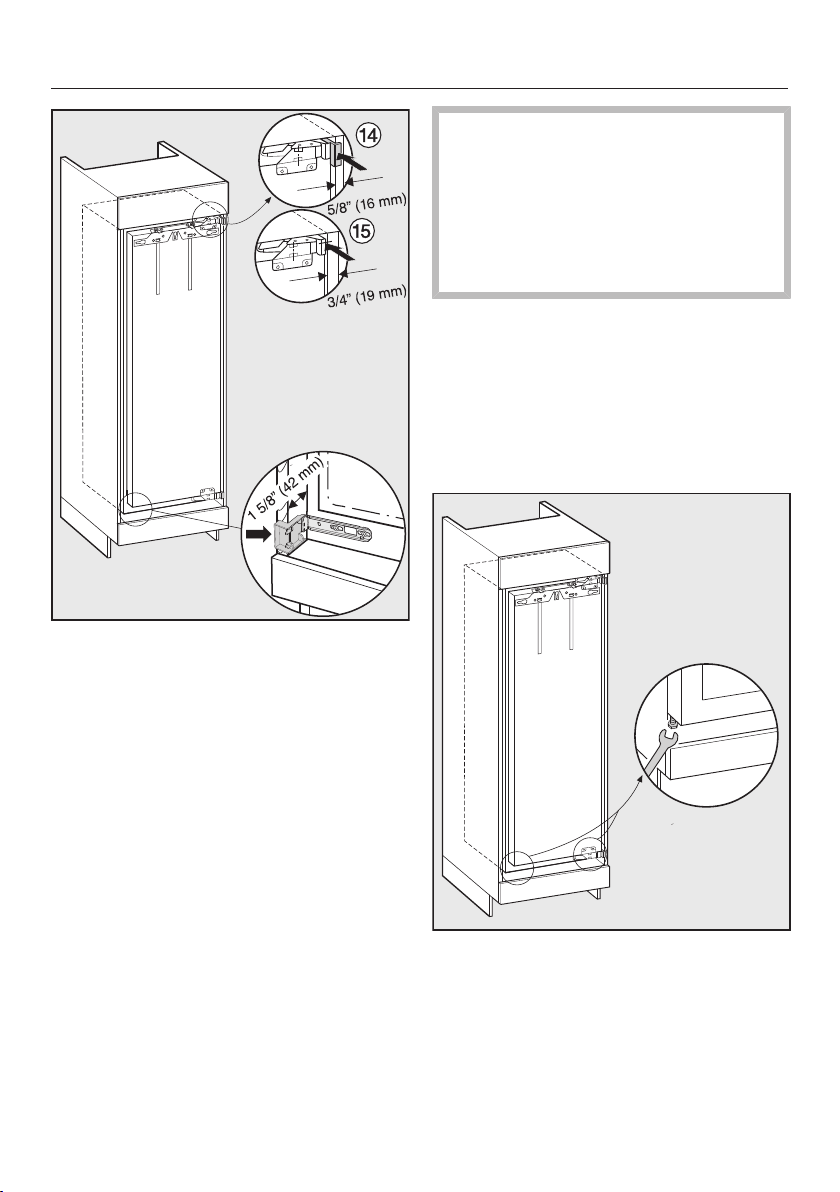
Installation
*INSTALLATION*
79
Now push the appliance into the
niche until all fixing brackets at the
top and bottom are touching the front
edge of the cabinet side wall.
- 5/8" (16mm) thick walls:
The spacers should touch the front
edge of the cabinet side walls at the
top and bottom.
- 3/4" (19mm) thick walls:
The front edges of the top and bot-
tom hinges should be flush with the
front edge of the cabinet side wall.
This ensures a distance of
15/8" (42mm) to the front edges of the
cabinet unit side walls all the way
round.
Important for cabinetry with door fit-
tings (such as stubs and seals).
Take the dimensions of the fittings
into account.
Check to make sure there is a gap all
round of 15/8" (42mm) to the front
edges of the door fittings.
Pull the appliance forward by the ap-
propriate dimension.
Tip: If possible, remove the door fittings
and push the appliance into the niche
until all securing brackets at the top and
bottom are touching the front edge of
the cabinet side wall.
Align the appliance on both sides via
the adjustable feet so that it stands
level.
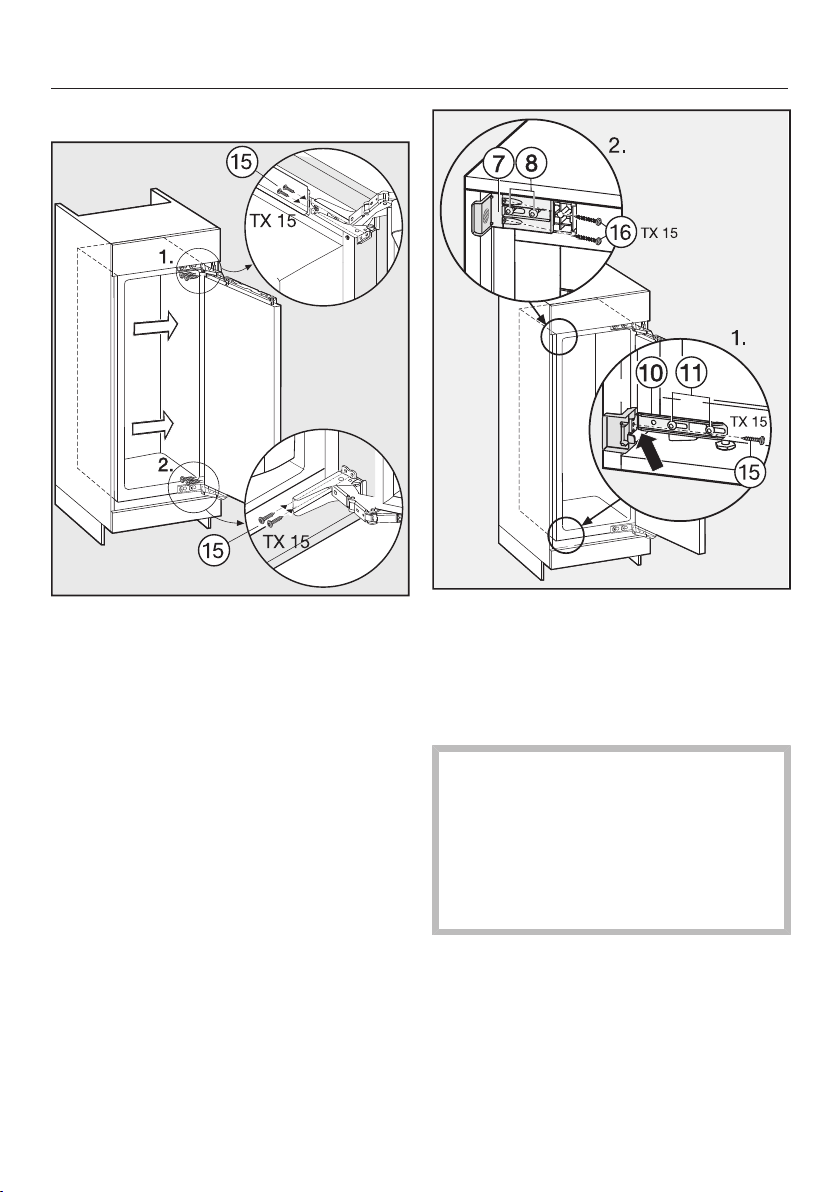
Installation
*INSTALLATION*
80
Securing the appliance in the niche
Push the appliance onto the cabinet
wall on the hinge side.
Screw the particle board screws
through the hinge plates at the top
and bottom to secure the appliance
to the housing unit.
Push the loose securing bracket
against the cabinet wall.
Fix the securing bracket to the
cabinet wall with the screw.
Tip: Pre-drill the hole.
The appliance must not pull back
into the unit, as otherwise the gap of
1 5/8" (42mm) will not be maintained
all the way round.
Push the protruding bracket toward
the cabinet wall using your thumb
while tightening the screws.
Fix the securing bracket to the
cabinet wall with the screws.
Tip: Pre-drill the holes.
Re-tighten screws and .
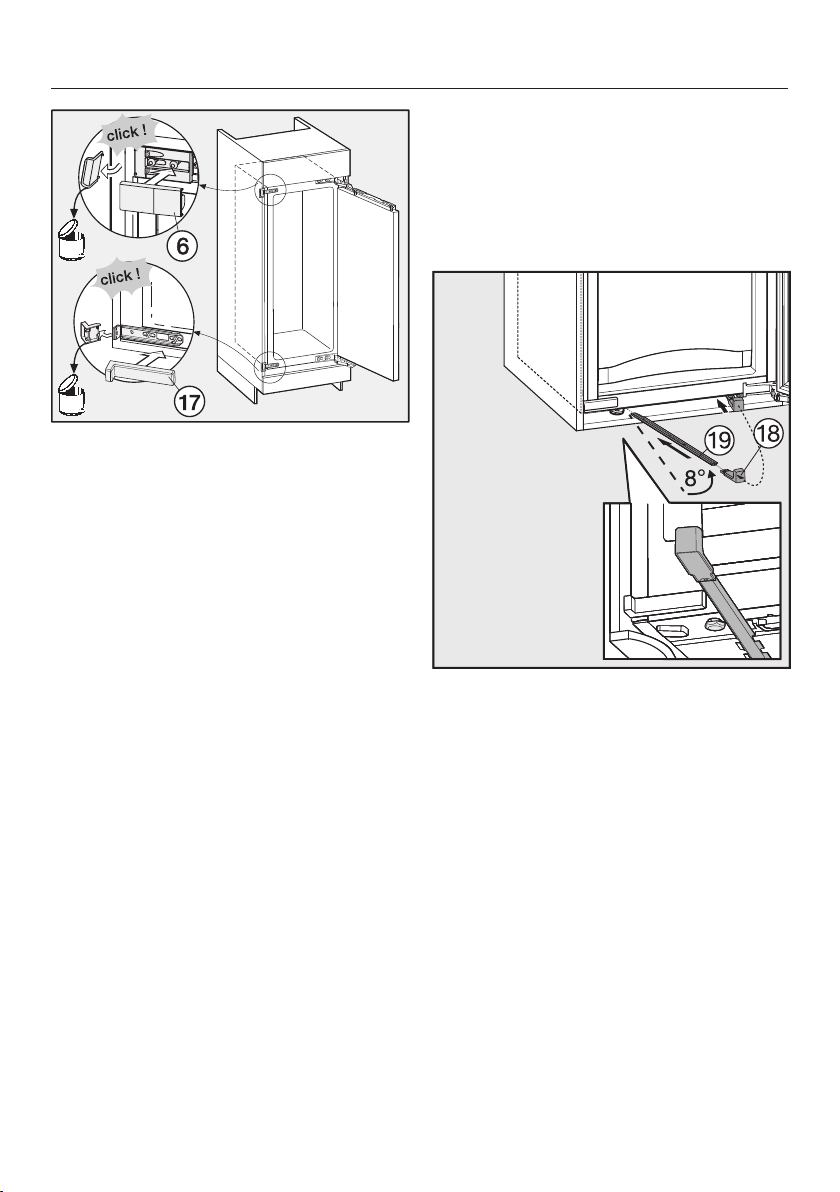
Installation
*INSTALLATION*
81
Snap off any protruding ends from
the securing bracket. They are no
longer required and can be disposed
of.
Place the covers and on the se-
curing bracket.
Only for an appliance with a niche
height greater than 55" (140cm)
To give the appliance additional security
in the niche, push the rods supplied be-
tween the appliance and the cabinet
base:
First secure the handle to one of
the stabilizing rods.
Use the handle to push the stabilizing
rod into the guide as far as it will
go. Remove the handle and fit it to
the other stabilizing rod supplied and
push this into its guide as far as it will
go.
Tip: Keep the handle somewhere safe
in case you ever need to fit the appli-
ance into a new housing unit.
Close the appliance doors.
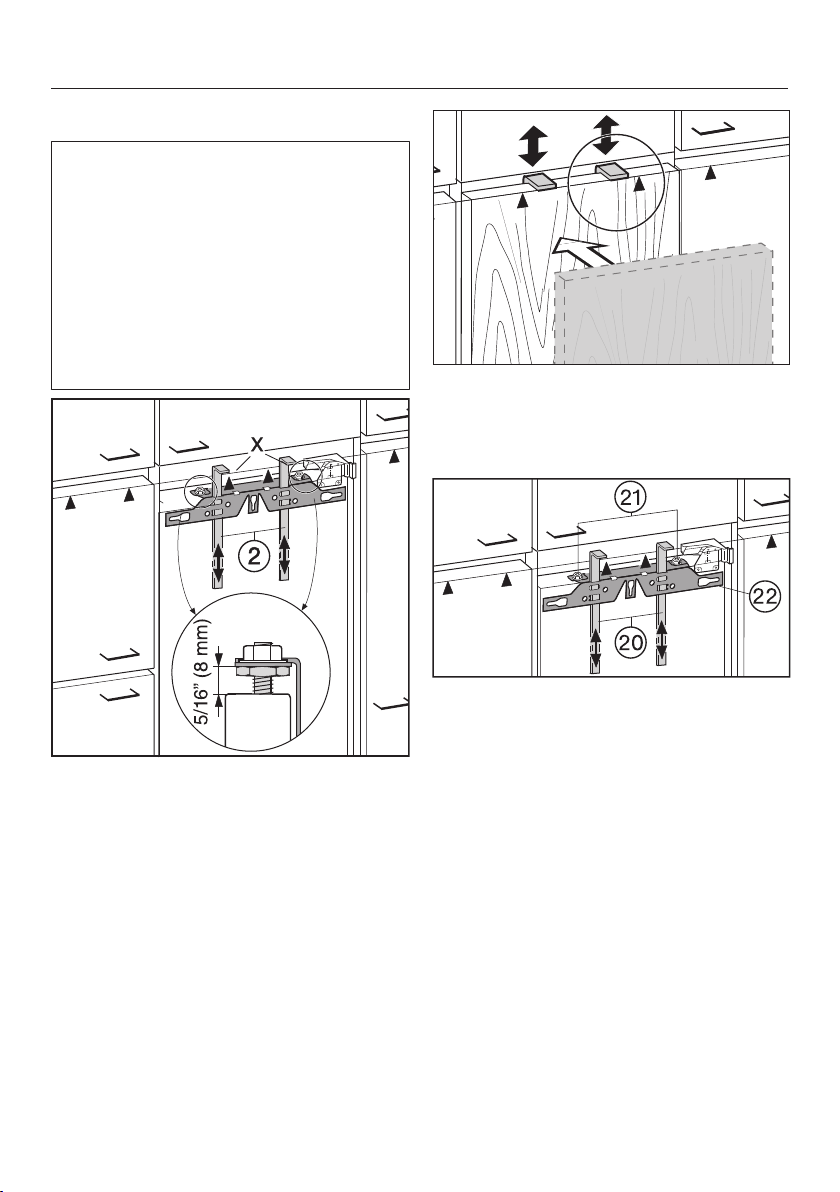
Installation
*INSTALLATION*
82
Installing the cabinet door
If installed in a run of units, make sure
that the top edge of the cabinet door
is at the same height as neighboring
unit doors.
The cabinet door must be installed
level, and not under tension.
The next section gives instructions on
how to install a cabinet door that is at
least 5/8" - 3/4" (16 - 19mm) thick.
The distance between the appliance
door and the mounting frame is set to
5/16" (8mm) at the factory. Check
this distance and adjust it if neces-
sary.
Push the installation aids to the
height of the cabinet door. The lower
contact edge X of the installation aids
must be at the same height as the
upper edge of the cabinet door to be
installed (symbol).
Tip: Push up the installation aids to-
gether with the cabinet front until they
are at the same height as the neighbor-
ing unit doors.
Unscrew the nuts and remove the
mounting frame together with the
installation aids.
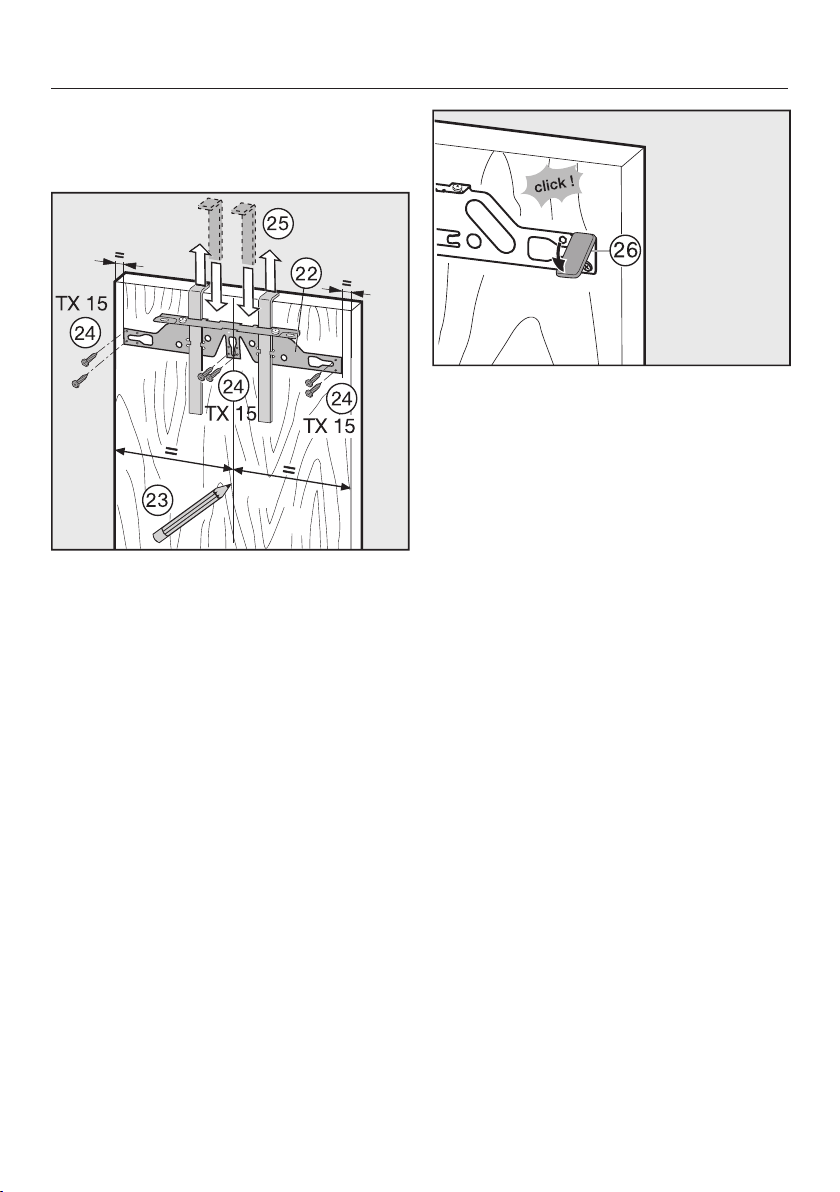
Installation
*INSTALLATION*
83
Place the cabinet door on a stable
surface with the outer side facing
downward.
Draw a faint central line with a pencil
on the inside of the cabinet door.
Hang the mounting frame with the
installation aids on the inside of the
cabinet door. Align the mounting
frame centrally.
Attach the mounting frame securely
using at least 6 short chipboard
screws. (On raised paneled doors,
only use 4 screws on the edges.) Pre-
drill holes into the cabinet door if nec-
essary.
Pull the installation aids upward to re-
move them.
Turn them around and push them all
the way into the middle slots on the
mounting frame for safekeeping.
Attach the side cover to the
mounting frame on the side opposite
the hinge.
Turn the cabinet door over and attach
the handle (if required).
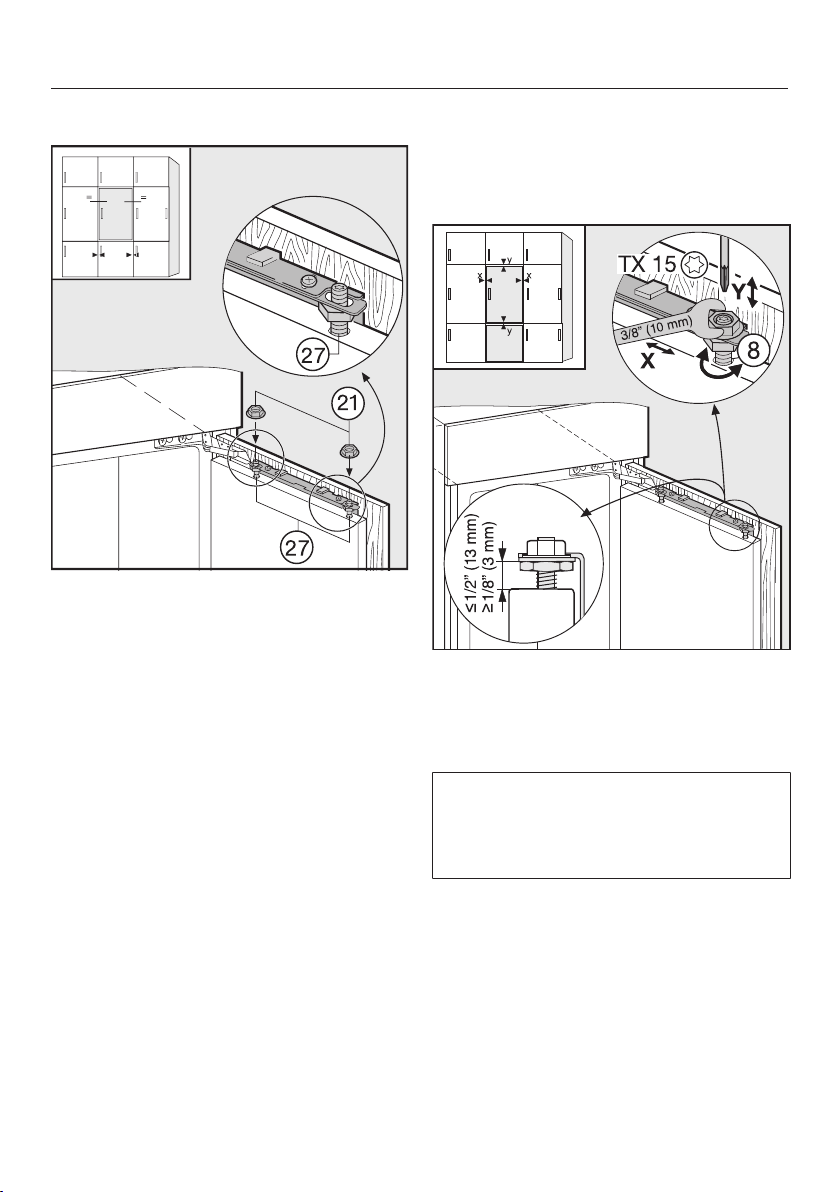
Installation
*INSTALLATION*
84
Open the appliance door.
Hang the cabinet door on the adjust-
ing bolts.
Screw the nuts loosely onto the
adjusting bolts.
Close the door and check the dis-
tance between the door and adjacent
cabinet doors. The distance should
be the same.
Adjusting the position of the door
Check the distance between the door
and adjacent cabinet doors. The dis-
tance should be the same.
X: side adjustments
Move the cabinet door.
Y: height adjustment
The distance between the appliance
door and the mounting frame is set to
5/16" (8mm). Only adjust the distance
within the specified range.
Turn the adjusting bolts with a
screwdriver.
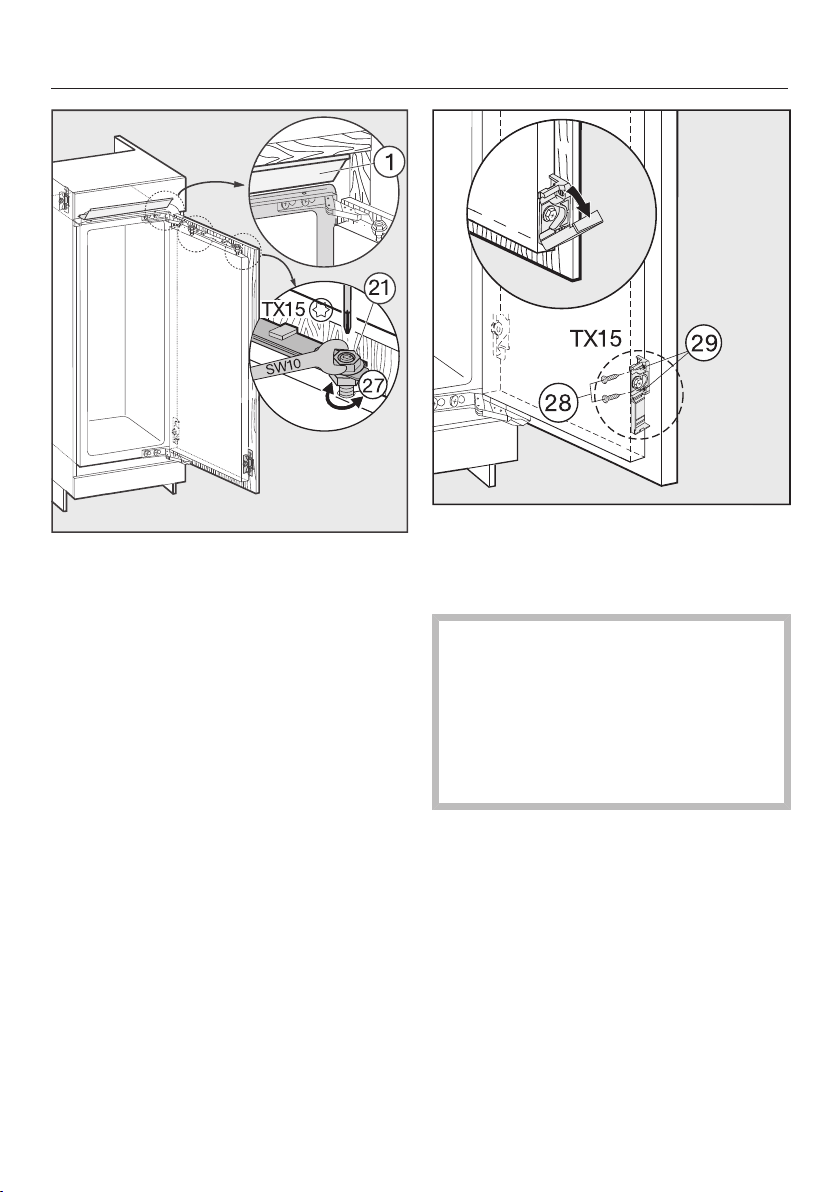
Installation
*INSTALLATION*
85
While counterholding the adjusting
bolts with a screwdriver, tighten
the nuts with a wrench.
The filler strip must not protrude; it
must completely disappear into the
niche.
Open the cover.
Fit the screws into the holes.
Tip: Pre-drill the holes.
Risk of damage to the securing
bracket and cover.
The cover on the securing bracket
can easily become detached.
Always close the cover as soon as
you have finished working on the
bracket.
Close the cover and close the door.
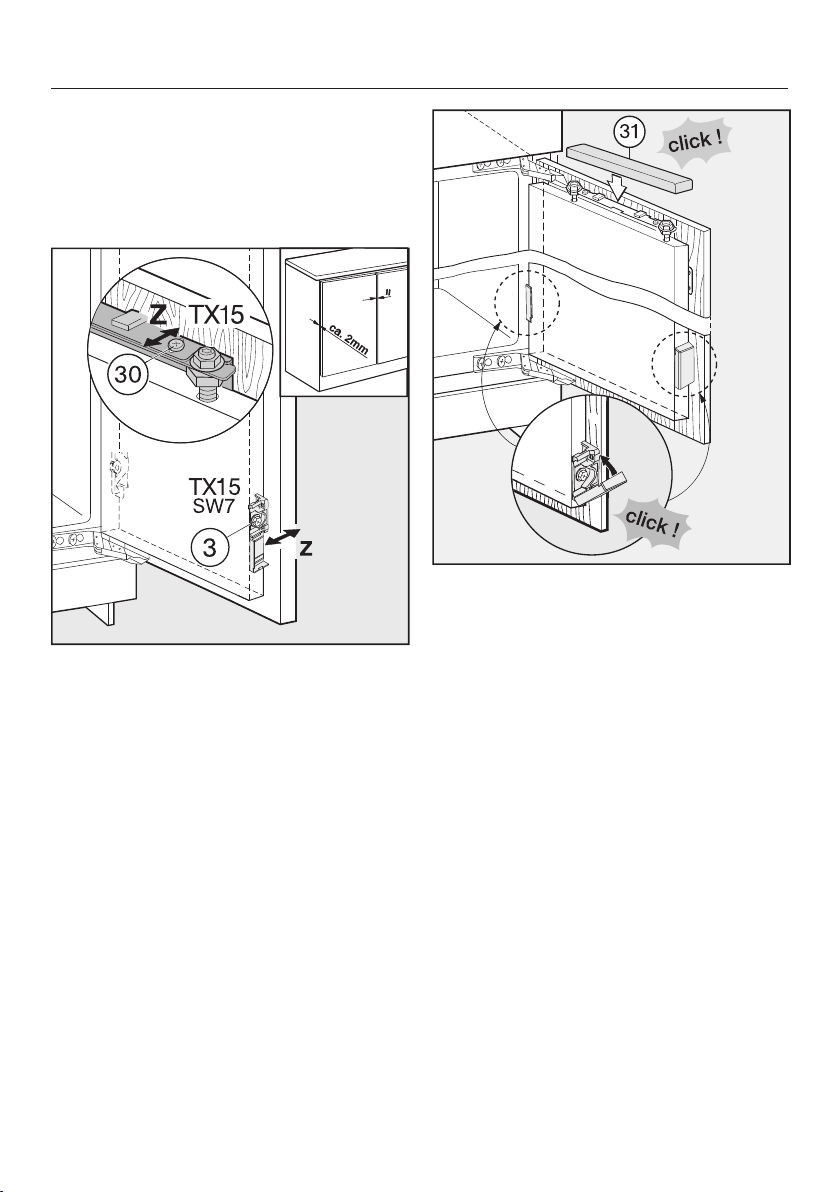
Installation
*INSTALLATION*
86
Z: depth adjustment
Check the distance between the cabi-
net door and the housing unit. A dis-
tance of approximately 1/16" (2mm) is
required.
Loosen screws and .
Tighten all the screws again.
Replace the cover and click it into
place.
Close the covers on the securing
brackets.
The appliance is properly installed in
the niche if:
- the door closes properly
- the door does not touch the housing
unit
- the seal on the top corner of the han-
dle side is firmly seated
To double check place a flashlight in
the appliance and close the door.
Turn the lights out in the room. If you
can see any light shining out from the
sides, double check the individual in-
stallation steps.
Installation
*INSTALLATION*
87
Electrical connection
Danger of electric shock!
The appliance must only be switched
on when it has been installed in ac-
cordance with the installation in-
structions.
Ground the appliance.
The appliance must not be grounded
via a gas pipe.
If in doubt, have a suitably qualified
and experienced electrician check
that the installation complies with rel-
evant regulations.
Do not install a fuse into neutral cur-
rent or grounding electrical circuit.
Do not use extension cords or un-
grounded (two prong) adapters.
Do not use a frayed or damaged
power cord.
Danger of electric shock!
For protection against electric shock
this appliance is equipped with a
pole-free plug which is protected
against reverse polarity. The plug
must be grounded in the usual way.
Do not remove the round grounding
connector pin from the plug.
Use only a grounded plug adapter.
Wait for 1hour after installation before
plugging the appliance into the power
supply. This allows coolant and refriger-
ator oil to settle in accordance with reg-
ulations.
Ensure that the voltage of the main
power supply corresponds with the
connection voltage of the appliance. A
power supply of 110 - 120 V, 60 Hz and
15 Amp (20 Amp for side-by-side instal-
lation) with a NEMA 5-15 molded plug,
which is protected by a main switch or
a fuse, is required to operate the appli-
ance.
The manufacturer recommends operat-
ing the appliance on a separate circuit
to avoid overloading the electrical cir-
cuit.
All relevant legal electrical, fire and
building regulations must be observed
when installing the socket and/or the
appliance.
In certain countries appliances are re-
quired to be connected to the electrical
supply via a wall-mounted ON/OFF
switch.
To avoid the risk of fire, electric shock
or other injuries installation and connec-
tion of the appliance must be carried
out by a suitably qualified electrician in
accordance with all relevant local and
national regulations and standards, in-
cluding fire prevention.

Installation
*INSTALLATION*
88
The outlet must be easily accessible in
an emergency so that the appliance can
be quickly disconnected from the elec-
trical supply in case of an emergency.
The socket must be located so that the
upper edge is a maximum
82" (2100mm) distance from the upper
edge of the base of the kitchen cabinet.
If the outlet is no longer accessible
once the appliance has been installed,
an all-pole disconnect device with a
contact opening of at least 1/8" (3mm)
must be present on site. The discon-
nect device may be circuit breaker, a
fuse, or a contactor (compliant with lo-
cal regulations).
The plug and power cord must not
come into contact with the back of the
appliance as vibrations can cause dam-
age to these components. This, in turn,
could result in a short circuit.
Do not plug in other devices behind this
appliance.
Do not connect the appliance to an in-
verter such as those used with an au-
tonomous energy source e.g. solar
power. When switched on, peak loads
in the system can cause the safety
switch-off mechanism to be triggered.
This can damage the electronic unit.
The appliance must not be used with
so-called energy-saving devices ei-
ther. These reduce the amount of en-
ergy supplied to the appliance, causing
it to overheat.
If the power cord needs to be replaced,
this must be done by a qualified techni-
cian.



9 Independence Way
Princeton, NJ 08540
Phone:
Fax:
www.mieleusa.com
U.S.A.
Miele, Inc.
National Headquarters
Please have the model and serial number
of your appliance available when
contacting Customer Service.
Canada
Importer
Miele Limited
Headquarters and Miele Centre
800-843-7231
609-419-4298
Customer Service & Support
Phone:
Fax:
161 Four Valley Drive
Vaughan, ON L4K 4V8
www.miele.ca
888-99-MIELE(64353)
888-586-8056
Customer Care Centre
Phone:
800-565-6435
905-532-2272
International Headquarters
Miele & Cie. KG
Carl-Miele-Straße 29
33332 Gütersloh
Germany

M.-Nr. 11 447 680 / 00en-US
KS 37472 iD