

M3 convertible
handbook.book Page 1 Tuesday, July 30, 2002 9:28 AM
Online Edition for Part-No. 01 41 0 156 854 - © 09/02 BMW AG

Thank you for deciding on a BMW M3 convertible.
Thorough familiarity with your vehicle will provide you with enhanced control and
security when you drive it. Therefore, we have one request:
Read the information contained in this Owner's Manual before driving your new
BMW M3 convertible for the first time. It contains important information on vehicle
operation that will enable you to make full use of the advanced technical equipment
of your BMW M3 convertible. In addition, you will receive information on vehicle
maintenance to help ensure operating and traffic safety as well as the best possible
value retention of your BMW.
For more detailed information refer to the Supplemental Manuals.
BMW M also makes decisive contributions toward greater safety in traffic through
its BMW driver training.
This Owner's Manual should be considered a permanent part of this vehicle. It
should stay with the vehicle when sold to provide the next owner with important
operating, safety and maintenance information.
We wish you an enjoyable driving experience.
BMW M
handbook.book Page 3 Tuesday, July 30, 2002 9:28 AM
Online Edition for Part-No. 01 41 0 156 854 - © 09/02 BMW AG
4
Notes
© 2002 BMW M GmbH
Munich, Germany
Reprinting, including excerpts, only with the
written consent of BMW M GmbH, Munich.
Order No. 01 41 0 156 854
US English VIII/02
Printed in Germany
Printed on environmentally friendly paper –
bleached without chlorine, suitable for recycling.
About this Owner's Manual
We have made every effort to ensure
that you are able to find what you need
in this Owner's Manual as quickly as
possible. The fastest way to find certain
topics is by using the detailed index at
the end. If you wish to gain an initial
overview of your vehicle, you will find
this in the first chapter.
Should you wish to sell your BMW at
some time in the future, please remem-
ber to hand over this Owner's Manual
to the new owner; it is an important part
of the vehicle.
Should you have any further questions,
your BMW center will be glad to assist
at any time.
Symbols used
Indicates precautions that must
be followed precisely in order to
avoid the possibility of personal injury
and serious damage to the vehicle.
Contains information that will
assist you in gaining the optimum
benefit from your vehicle and enable
you to care more effectively for your
vehicle.
Refers to measures that can be
taken to help protect the environ-
ment.
Marks the end of a specific item of
information.
Indicates special equipment, coun-
try-specific equipment and optional
extras.
Identifies systems or components
which can be activated or adapted
to suit an individual driver's require-
ments – Vehicle Memory, Key Memory.
Refer to page 65. Activation and adjust-
ments on some of these systems can
be performed at your BMW center.
<
Your individual vehicle
On purchasing your BMW, you have
decided in favor of a model with individ-
ualized equipment and features. This
Owner's Manual will describe all of the
equipment that the BMW M3 convert-
ible has to offer you.
We hope you will understand that
equipment and features are included
that you might not have chosen for your
vehicle. You can easily identify any dif-
ferences with the aid of the asterisk
used to identify all optional equipment
and accessories.
If your BMW features equipment that is
not described in this Owner's Manual,
such as a car radio or telephone, we
have enclosed Supplementary Owner's
Manuals. We ask you to read these
manuals as well.
handbook.book Page 4 Tuesday, July 30, 2002 9:28 AM
Online Edition for Part-No. 01 41 0 156 854 - © 09/02 BMW AG

5
Notes
Status at time of printing
BMW pursues a policy of continuous,
ongoing development that is conceived
to ensure that our vehicles continue to
embody the highest quality and safety
standards combined with advanced,
state-of-the-art technology. For this
reason, the features described in this
Owner's Manual could differ from those
on your vehicle. Nor can errors and
omissions be entirely ruled out. You are
therefore asked to appreciate that no
claims can be recognized on the basis
of the data, illustrations or descriptions
in this Owner's Manual.
For your own safety
Use unleaded gasoline only. Fuels
containing up to and including
10% ethanol or other oxygenates with
up to 2.8% oxygen by weight – that is,
15% MTBE or 3% methanol plus an
equivalent amount of co-solvent – will
not void the applicable warranties
respecting defects in materials or work-
manship. Field experience has indi-
cated significant differences in fuel
quality – volatility, composition, addi-
tives, etc. – among gasolines offered for
sale in the United States and Canada.
The use of poor quality fuels may result
in driveability, starting and stalling
problems especially under certain envi-
ronmental conditions, such as high
ambient temperature and high altitude.
Should you encounter driveability prob-
lems which you suspect could be
related to the fuel you are using, we
recommend that you respond by
switching to a recognized high-quality
brand.
Failure to comply with these recom-
mendations may result in unscheduled
maintenance.
Obey pertinent safety rules when you
are handling gasoline.
<
Important safety information!
For your own safety, use genuine parts
and accessories approved by BMW.
When you purchase accessories tested
and approved by BMW and Original
BMW Parts, you simultaneously acquire
the assurance that they have been thor-
oughly tested by BMW to ensure opti-
mum performance when installed on
your vehicle.
BMW warrants these parts to be free
from defects in material and workman-
ship.
BMW will not accept any liability for
damages resulting from installation of
parts and accessories not approved by
BMW.
BMW cannot test every product made
by other manufacturers to verify if it can
be used on a BMW safely and without
risk to either the vehicle, its operation,
or its occupants.
Original BMW Parts, BMW Accessories
and other products approved by BMW,
together with professional advice on
using these items, are available from all
BMW centers.
Installation and operation of non-BMW
approved accessories such as alarms,
radios, amplifiers, radar detectors,
wheels, suspension components, brake
handbook.book Page 5 Tuesday, July 30, 2002 9:28 AM
Online Edition for Part-No. 01 41 0 156 854 - © 09/02 BMW AG

6
Notes
dust shields, telephones – including
operation of any portable cellular phone
from within the vehicle without using an
externally mounted antenna – or trans-
ceiver equipment, such as CB, walkie-
talkie, ham radio or similar, may cause
extensive damage to the vehicle, com-
promise its safety, interfere with the
vehicle's electrical system or affect the
validity of the BMW Limited Warranty.
Contact your BMW center for additional
information. Do not use key or remote
control to lock doors or luggage com-
partment with anyone inside the vehi-
cle. Refer to the Owner's Manual for
more details.
<
Maintenance, replacement, or
repair of the emission control
devices and systems may be performed
by any automotive repair establishment
or individual using any certified auto-
motive part.
<
Symbol on vehicle parts
Indicates that you should consult
the relevant section of this
Owner's Manual for information on a
particular part or assembly.
Service and warranty
This manual is supplemented by a Ser-
vice and Warranty Information Booklet
for US models or a Warranty and Ser-
vice Guide Booklet for Canadian mod-
els.
We recommend that you read this pub-
lication thoroughly.
Your BMW is covered by the following
warranties:
>
New Vehicle Limited Warranty
>
Rust Perforation Limited Warranty
>
Federal Emissions System Defect
Warranty
>
Federal Emissions Performance War-
ranty
>
California Emission Control System
Limited Warranty.
Detailed information about these war-
ranties is listed in the Service and War-
ranty Information Booklet for US mod-
els or in the Warranty and Service
Guide Booklet for Canadian models.
Reporting safety defects
The following only applies to vehicles
owned and operated in the US.
If you believe that your vehicle has a
defect which could cause a crash or
could cause injury or death, you should
immediately inform the National High-
way Traffic Safety Administration
NHTSA in addition to notifying BMW of
North America, LLC, P.O. Box 1227,
Westwood, New Jersey 07675-1227,
Telephone toll-free 1-800-831-1117.
If NHTSA receives similar complaints, it
may open an investigation, and if it
finds that a safety defect exists in a
group of vehicles, it may order a recall
and remedy campaign. However,
NHTSA cannot become involved in indi-
vidual problems between you, your
dealer, or BMW of North America, LLC.
To contact NHTSA, you may either call
the Auto Safety Hotline toll-free at
1-800-424-9393 or 366-0123 in the
Washington, D.C. area, or write to:
NHTSA, U.S. Department of Transpor-
tation, Washington, D.C. 20590. You
can also obtain other information about
motor vehicle safety from the Hotline.
handbook.book Page 6 Tuesday, July 30, 2002 9:28 AM
Online Edition for Part-No. 01 41 0 156 854 - © 09/02 BMW AG

7
handbook.book Page 7 Tuesday, July 30, 2002 9:28 AM
Online Edition for Part-No. 01 41 0 156 854 - © 09/02 BMW AG

Contents
Notes
About this Owner's Manual 4
Symbols used 4
Your individual vehicle 4
Status at time of printing 5
For your own safety 5
Symbol on vehicle parts 6
Service and warranty 6
Reporting safety defects 6
Overview
Cockpit 14
Instrument cluster 16
Indicator and warning lamps 18
Steering wheel with multifunction
buttons 22
Hazard warning triangle* 23
First-aid kit* 23
Refueling 24
Fuel specifications 25
Tire inflation pressure 25
Controls and features
Opening and closing:
Keys 30
Central locking system 30
Opening and closing – via the
remote control 31
Opening and closing – via the
door lock 33
Opening and closing – from the
inside 34
Luggage compartment lid 35
Luggage compartment 37
Alarm system* 38
Electric power windows 40
Convertible top 41
Wind deflector* 46
To adjust:
Safe seating position 48
Seats 49
Power seat adjustment 49
Head restraints 50
Entering the rear 51
Safety belts 52
Seat and mirror memory 53
Seat heating* 54
Steering wheel 55
Mirrors 55
handbook.book Page 8 Tuesday, July 30, 2002 9:28 AM
Online Edition for Part-No. 01 41 0 156 854 - © 09/02 BMW AG

Contents
9
Passenger safety systems:
Airbags 57
Transporting children safely 59
Rollover protection system 63
Vehicle Memory, Key
Memory 65
Driving:
Ignition lock 66
Starting engine and driving
off 67
Switching off the engine 69
Parking brake 69
Manual transmission 70
Sequential M gearbox
SMG II* 71
Turn signal indicator/Headlamp
flasher 76
Washer/wiper system/Rain
sensor* 77
Cruise control 78
Everything under control:
Odometer 80
Tachometer 80
Temperature gauge 80
Fuel gauge 81
Engine coolant temperature
gauge 81
Service interval display 82
Check Control 82
Clock 83
Computer 84
Technology for safety and
driving convenience:
Park Distance Control (PDC)* 86
Dynamic Stability Control
(DSC) 87
Flat Tire Monitor 88
M Engine dynamics control 91
Lamps:
Parking lamps/Low beams 92
Instrument lighting 93
High beams/Standing lamps 93
Fog lamps 94
Interior lamps 94
Reading lamps 94
Controlling the climate for
pleasant driving:
Automatic climate control 96
Interior conveniences:
Glove compartment 101
Storage compartments 101
Cellular phone* 102
Ashtray, front* 102
Ashtray, rear* 103
Loading and transporting:
Ski bag* 104
Cargo loading 106
Roof-mounted luggage rack for
the hardtop* 107
Operation, maintenance
Special operating instructions:
Break-in procedures 110
Driving notes 111
Antilock Brake System
(ABS) 111
Brake system 112
Hardtop* 113
Wheels and tires:
Tire inflation pressure 115
Tire condition 115
Tire replacement 116
Wheel and tire
combinations 118
Winter tires 118
Snow chains* 119
In the engine compartment:
Hood 120
Engine compartment
essentials 122
Washer fluids 124
Engine oil 124
Coolant 126
Brake fluid 127
Maintenance:
The BMW Maintenance
System 128
Laws and regulations:
California Proposition 65
warning 130
OBD interface socket 130
Controls and features
handbook.book Page 9 Tuesday, July 30, 2002 9:28 AM
Online Edition for Part-No. 01 41 0 156 854 - © 09/02 BMW AG

Contents
Owner service procedures
Replacement procedures:
Onboard tool kit 134
Windshield wiper blades 134
Lamps and bulbs 135
Repairing a flat tire 139
Battery 143
Fuses 144
Giving and receiving
assistance:
Jump-starting 145
Towing the vehicle 146
Technical data
Engine data 150
Dimensions 151
Weights 152
Capacities 153
Index
Everything from A to Z 156
handbook.book Page 10 Tuesday, July 30, 2002 9:28 AM
Online Edition for Part-No. 01 41 0 156 854 - © 09/02 BMW AG

11
handbook.book Page 11 Tuesday, July 30, 2002 9:28 AM
Online Edition for Part-No. 01 41 0 156 854 - © 09/02 BMW AG
12
handbook.book Page 12 Tuesday, July 30, 2002 9:28 AM
Online Edition for Part-No. 01 41 0 156 854 - © 09/02 BMW AG

13
Overview
Controls and features
Operation, maintenance
Owner service procedures
Technical data
Index
OverviewControlsMaintenanceRepairsDataIndex
handbook.book Page 13 Tuesday, July 30, 2002 9:28 AM
Online Edition for Part-No. 01 41 0 156 854 - © 09/02 BMW AG
14
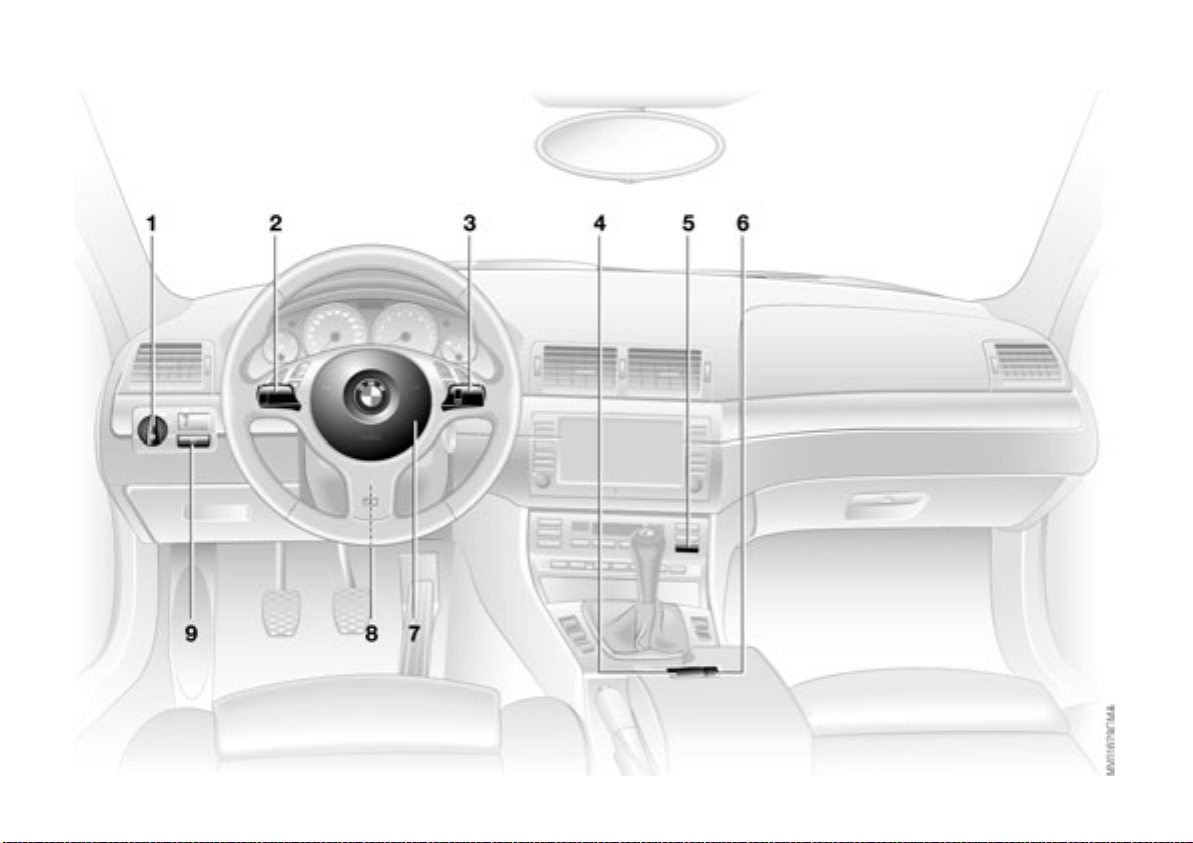
Cockpit
handbook.book Page 14 Tuesday, July 30, 2002 9:28 AM
Online Edition for Part-No. 01 41 0 156 854 - © 09/02 BMW AG

15
1 Parking lamps/Low beams 92
2
>
Turn signal indicators 76
>
Standing lamps 93
>
High beams 93
>
Headlamp flasher 76
>
Computer 84
3 Washer/wiper system/Rain
sensor 77
4 Hazard warning flashers
5 Rear window defroster 99
6 Central locking system 30
7 Horn: the entire surface
8 Steering wheel 55
9 Fog lamps 94
Cockpit
OverviewControlsMaintenanceRepairsDataIndex
handbook.book Page 15 Tuesday, July 30, 2002 9:28 AM
Online Edition for Part-No. 01 41 0 156 854 - © 09/02 BMW AG
16
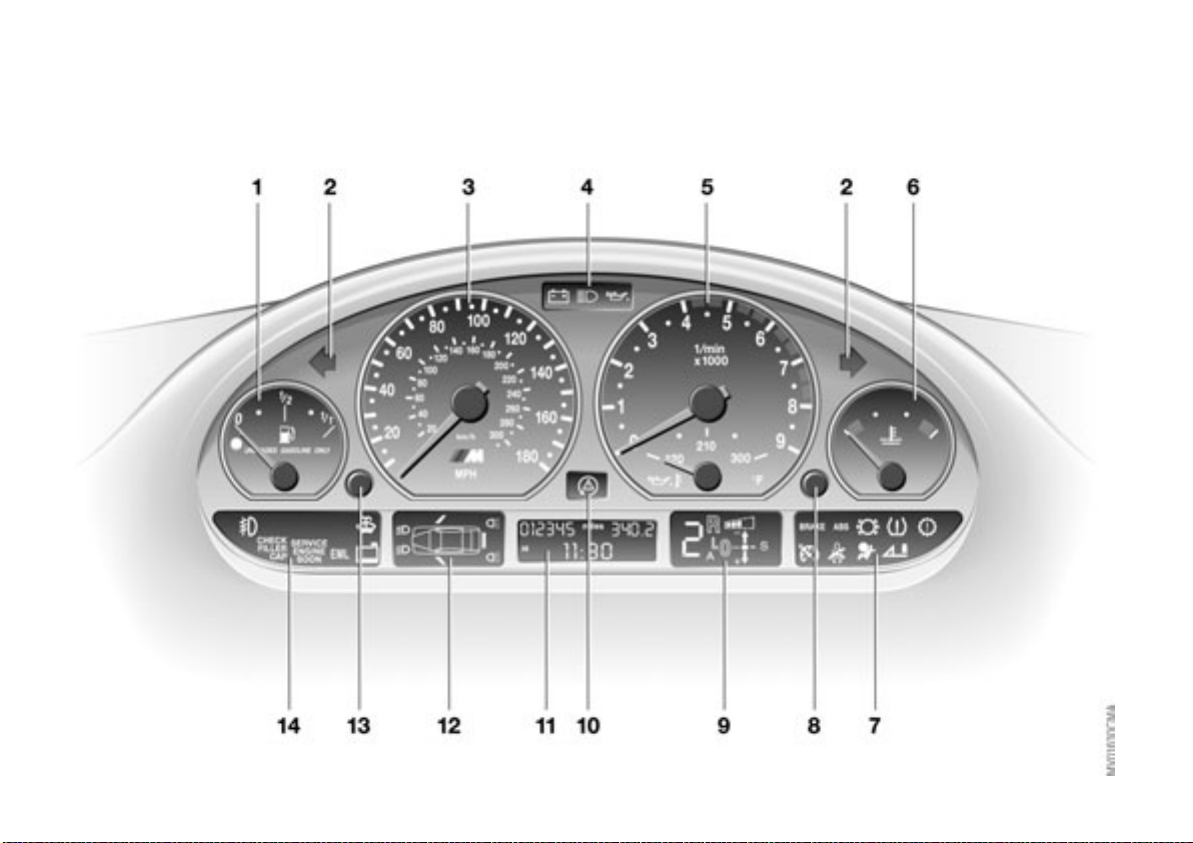
Instrument cluster
handbook.book Page 16 Tuesday, July 30, 2002 9:28 AM
Online Edition for Part-No. 01 41 0 156 854 - © 09/02 BMW AG

17
1 Fuel gauge 81
2 Turn signal indicator 20
3 Speedometer
4 Indicator and warning lamps 18
to 21
5 Tachometer and engine oil
temperature gauge 80
6 Engine coolant temperature
gauge 81
7 Indicator and warning lamps 18
to 21
8 Clock reset
>
Clock 83
>
Unit of measure of outside
temperature display 84
9 Display for sequential M gearbox
SMG II 72
10 Indicator lamp for Dynamic Stability
Control (DSC) 87
11 Display for
>
Trip odometer 80
>
Clock 83
>
Service interval 82
>
Computer 84
12 Check Control 82
13 Trip odometer, reset to zero 80
14 Indicator and warning lamps 18
to 21
Instrument cluster
OverviewControlsMaintenanceRepairsDataIndex
handbook.book Page 17 Tuesday, July 30, 2002 9:28 AM
Online Edition for Part-No. 01 41 0 156 854 - © 09/02 BMW AG
18
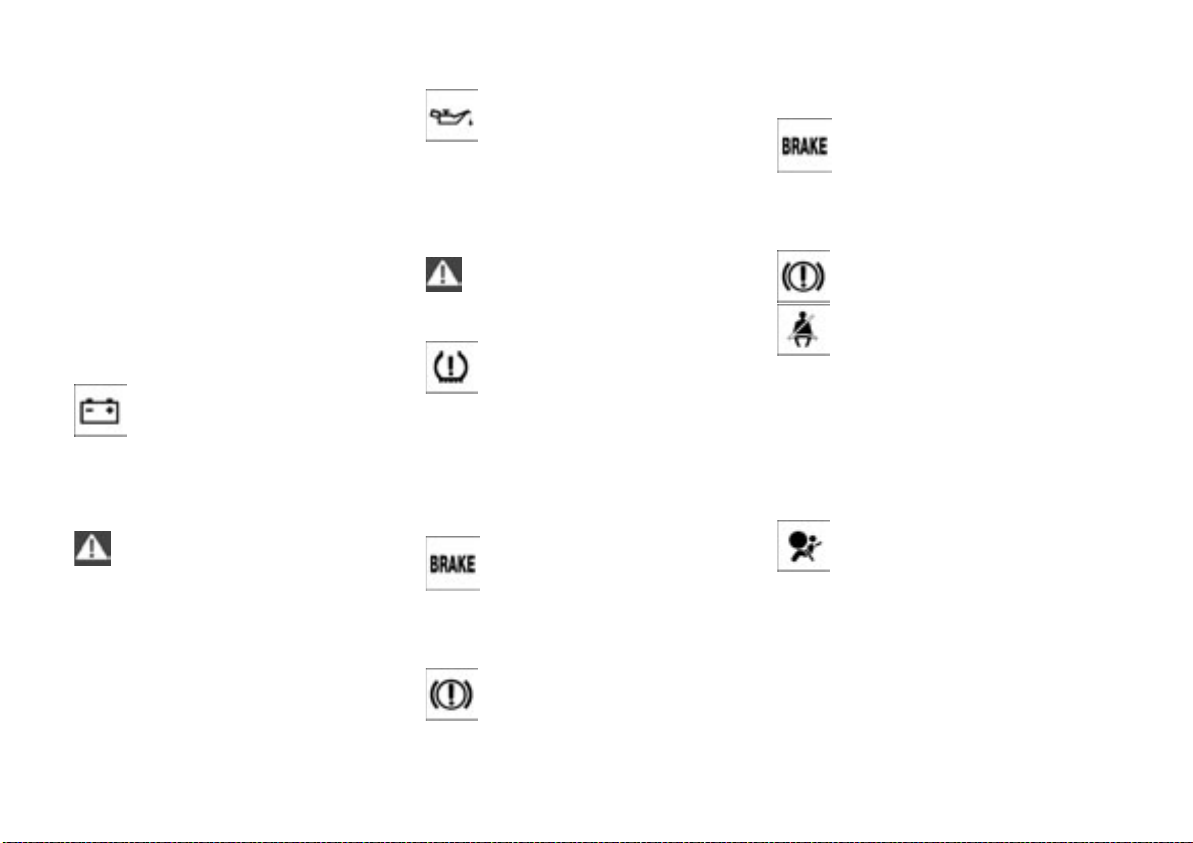
Indicator and warning lamps
Technology that monitors itself
Indicator and warning lamps that are
identified by
●
are tested for proper
functioning whenever the ignition key is
turned. They each light up once for dif-
ferent periods of time.
If a fault should occur in one of these
systems, the corresponding lamp does
not go out after the engine is started or
it lights up while the vehicle is moving.
You will see how to react to this below.
Red: stop immediately
Battery charge current
●
The battery is no longer being
charged. There is a malfunction
of the alternator drive belt or in the
charging circuit of the alternator. please
contact the nearest BMW center.
If the drive belt is defective, stop
and switch off the engine immedi-
ately to prevent overheating and seri-
ous engine damage. If the drive belt is
defective, increased steering effort is
also required.
<
Engine oil pressure
●
An alarm sounds at the same
time. Stop vehicle immediately
and switch off engine. Check the
engine oil level and top up as required.
If the oil level is correct, please contact
the nearest BMW center.
Do not continue driving, as the
engine could sustain serious dam-
age from inadequate lubrication.
<
Flat Tire Monitor
●
In addition, an acoustic signal is
sounded: a tire failure has
occurred. To come to an immediate
stop, reduce speed, while avoiding any
sudden, jerky braking or steering
maneuvers.
For additional information: refer to
page 88
Brake warning lamp
●
If the lamp comes on when the
parking brake is not engaged:
check the brake fluid level. Before driv-
ing further, be sure to comply with the
instructions on pages 112 and 127.
Brake warning lamp for Cana-
dian models.
Red: an important reminder
Brake warning lamp
●
Comes on when the parking
brake is engaged – an additional
acoustic signal sounds when starting
off. For additional information: refer to
page 69
Brake warning lamp for Cana-
dian models.
Lock backrest/Please fasten
safety belts
●
comes on together with an
acoustic signal until the safety belts are
fastened. Flashes when the backrest is
not locked.
For additional information on locking
the backrest, refer to page 51
For additional information on safety
belts: refer to page 52
Airbags
●
Please have the system
inspected at your BMW center.
For additional information: refer to
page 57
handbook.book Page 18 Tuesday, July 30, 2002 9:28 AM
Online Edition for Part-No. 01 41 0 156 854 - © 09/02 BMW AG
19
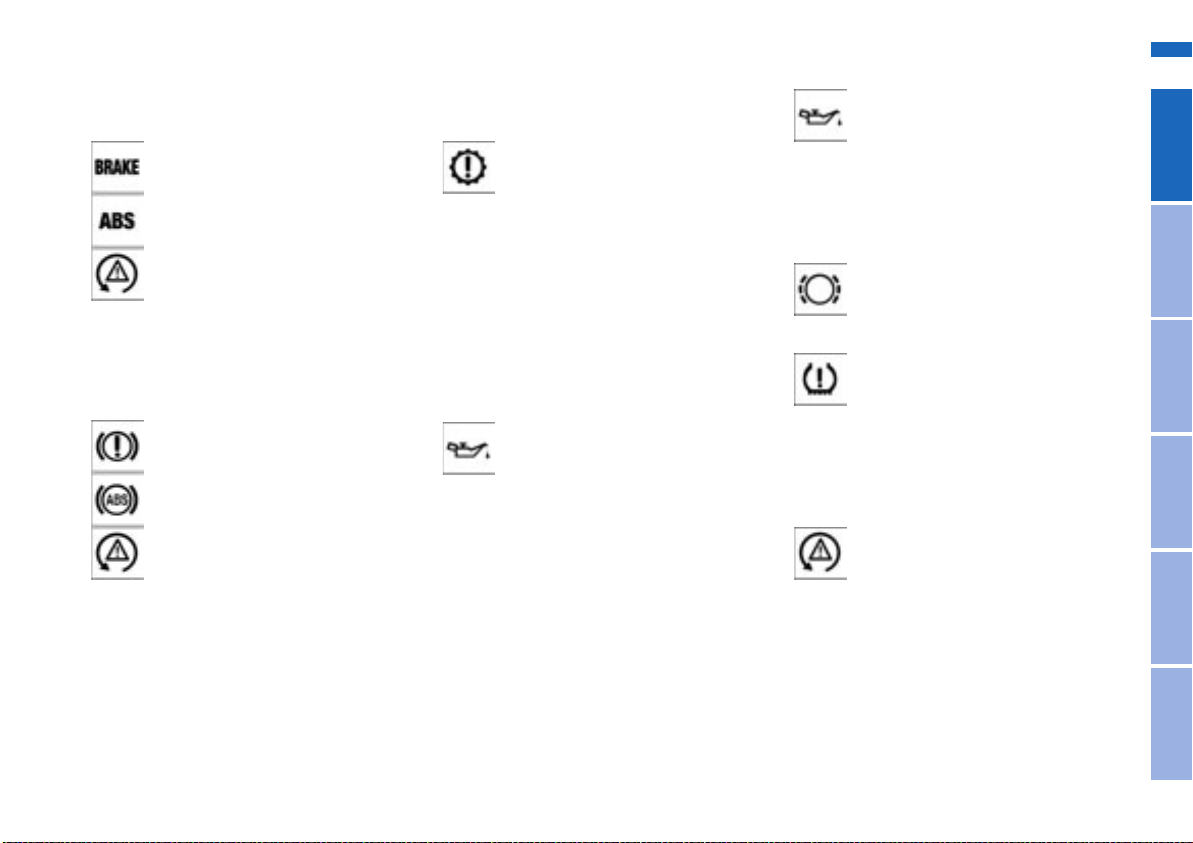
Red and yellow: continue driving
cautiously
The red brake warning lamp
lights up together with the yel-
low indicator lamps for ABS
●
and DSC:
The entire ABS, CBC and DSC
control system has failed. Con-
tinue to drive; drive cautiously
and defensively and avoid full
brake applications. Please have the
system checked by your BMW center
as soon as possible.
For additional information: refer to
pages 87, 111
Indicator and warning lamps
CBC, ABS and DSC for Cana-
dian models.
Orange: consult the nearest BMW
center
Sequential M gearbox SMG II
If the indicator lamp fails to go
out after the engine has been
started, or if it comes on during normal
driving: this indicates a malfunction in
the system. Please consult the nearest
BMW center.
Indicator lamp flashes: a system over-
load has occurred.
For additional information: refer to
page 75
Yellow: check as soon as possible
Engine oil level
Comes on while driving and is
accompanied by an alarm: the
engine oil level has fallen to the abso-
lute minimum; refill as soon as possible.
Do not drive more than 30 miles/50 km
before refilling.
For additional information: refer to
page 124
Engine oil level
Comes on after the engine has
been shut off and is accompa-
nied by an alarm: add engine oil at your
earliest opportunity such as when you
stop to refuel
For additional information: refer to
page 124
Brake pads
●
Have the brake pads checked.
For additional information: refer
to page 112
Flat Tire Monitor
●
The Flat Tire Monitor has been
deactivated, either at the button
or in response to a system malfunction.
In the event of a malfunction, have the
system checked by your BMW center.
For additional information: refer to
pages 25, 88
Dynamic Stability Control
(DSC)
●
The indicator lamp flashes and
an acoustic signal sounds: the system
is active and governs drive and braking
force.
If the indicator lamp fails to go out after
the engine is started, or if it comes on
during normal driving and stays on:
DSC has been deactivated, either at the
Indicator and warning lamps
OverviewControlsMaintenanceRepairsDataIndex
handbook.book Page 19 Tuesday, July 30, 2002 9:28 AM
Online Edition for Part-No. 01 41 0 156 854 - © 09/02 BMW AG
20
button or in response to a system mal-
function. In the event of a malfunction,
have the system checked by your near-
est BMW center.
For additional information: refer to
page 87
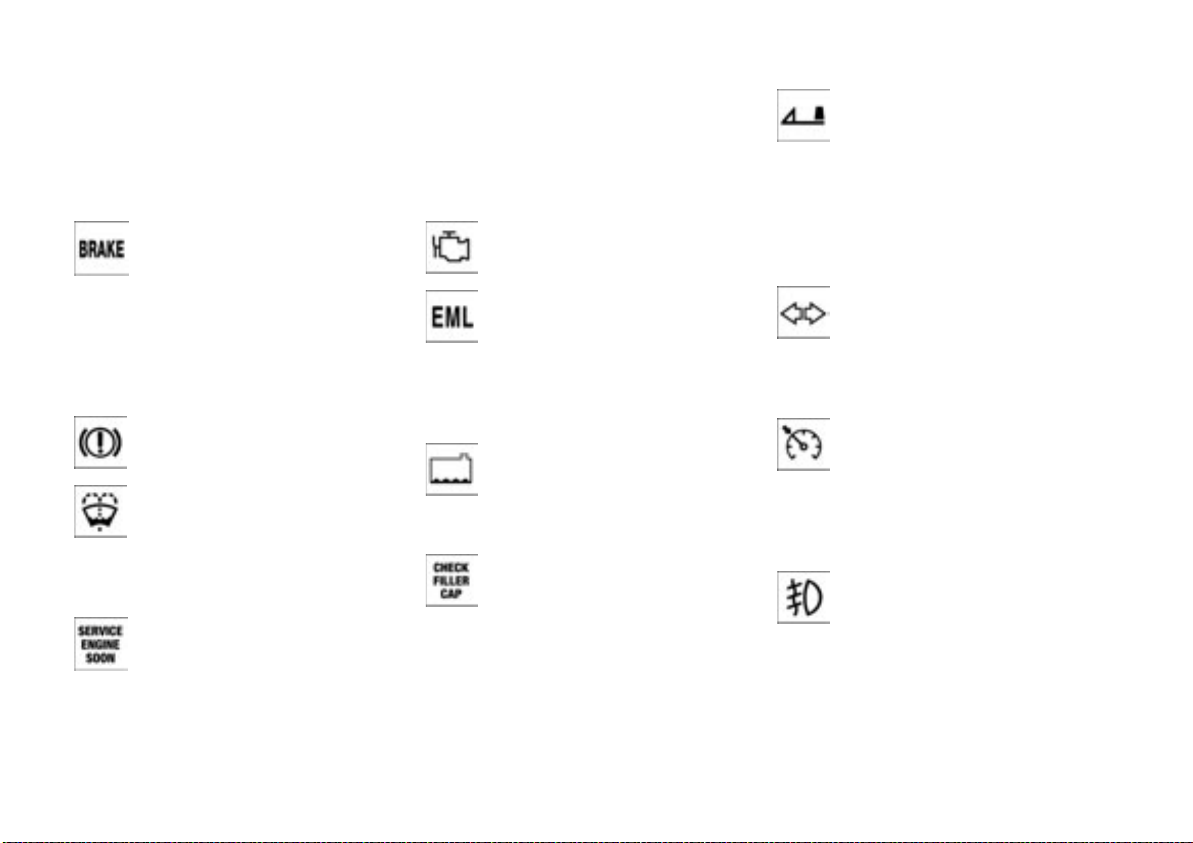
Dynamic Brake Control (DBC)
●
Malfunction in DBC system.
Conventional braking efficiency
is available and unrestricted.
Have the system checked and repaired
at your BMW center as soon as possi-
ble.
For additional information: refer to
page 88
Dynamic Brake Control (DBC)
warning lamp for Canadian
models.
Add washer fluid
The washer fluid is too low. Top
off the fluid at the earliest
opportunity.
For additional information: refer to
page 124
SERVICE ENGINE SOON
●
If the indicator lamp comes on
either continuously or intermit-
tently, this indicates a fault in the emis-
sions-related electronic systems.
Although the vehicle remains opera-
tional, you should have the systems
checked by your BMW center at the
earliest possible opportunity.
For additional information: refer to
page 130
Service Engine Soon warning
lamp for Canadian models.
Engine electronics
●
There is a fault in the electronic
engine-management system.
You can continue to drive with reduced
engine output or engine speed. Please
have the system inspected at your
BMW center.
Add coolant
Coolant level too low, top up as
soon as possible.
For additional information: refer to
page 126
CHECK FILLER CAP
●
This indicator lamp comes on
when the fuel filler cap is loose
or missing.
Close the filler cap tightly: refer to
page 24
Rollover protection system
●
The rollover protection system is
deactivated due to a malfunc-
tion. Please have the system inspected
immediately at your BMW center.
For additional information: refer to
page 63
Green: for your information
Turn signal indicator
Flashes when turn signals are
on. Rapid flashing: indicates a
system malfunction.
For additional information: refer to
page 76
Cruise control
Lights up when the cruise con-
trol is activated. Ready for oper-
ation via the steering wheel with multi-
function buttons.
For additional information: refer to
page 78
Front fog lamps
Lights up whenever the fog
lamps are on.
For additional information: refer to
page 94
Indicator and warning lamps
handbook.book Page 20 Tuesday, July 30, 2002 9:28 AM
Online Edition for Part-No. 01 41 0 156 854 - © 09/02 BMW AG

21
Blue: for your information
High beams
Comes on when the high beams
are on or the headlamp flasher
is actuated.
For additional information: refer to
pages 76, 93
Indicator and warning lamps
OverviewControlsMaintenanceRepairsDataIndex
handbook.book Page 21 Tuesday, July 30, 2002 9:28 AM
Online Edition for Part-No. 01 41 0 156 854 - © 09/02 BMW AG

22
Steering wheel with multifunction buttons
These buttons let you operate the fol-
lowing functions quickly and without
being distracted from traffic conditions:
>
Selected radio functions
>
The cruise control
>
Several telephone
*
functions.
The controls are active only when
the corresponding systems and
accessories are switched on.
<
Press briefly:
Accept incoming call, start dialing, ter-
minate call.
Switch between phone and radio, cas-
sette, CD and MD.
Forward:
> Radio
Press briefly: station scan in FM band
Extended pressure: station search
> CD/MD
Press briefly: jump to next track
Extended pressure: search function
in track
> Cassette
Press briefly: jump to next track or
stop fast forward
Extended pressure: fast forward
> Phone
Scan personal phone book.
Rewind: same functions as forward.
Volume.
Cruise control: select a stored setting.
Cruise control: store and accelerate +
or decelerate and store –.
Cruise control: activate/interrupt/deac-
tivate.
handbook.book Page 22 Tuesday, July 30, 2002 9:28 AM
Online Edition for Part-No. 01 41 0 156 854 - © 09/02 BMW AG
23
Hazard warning triangle*
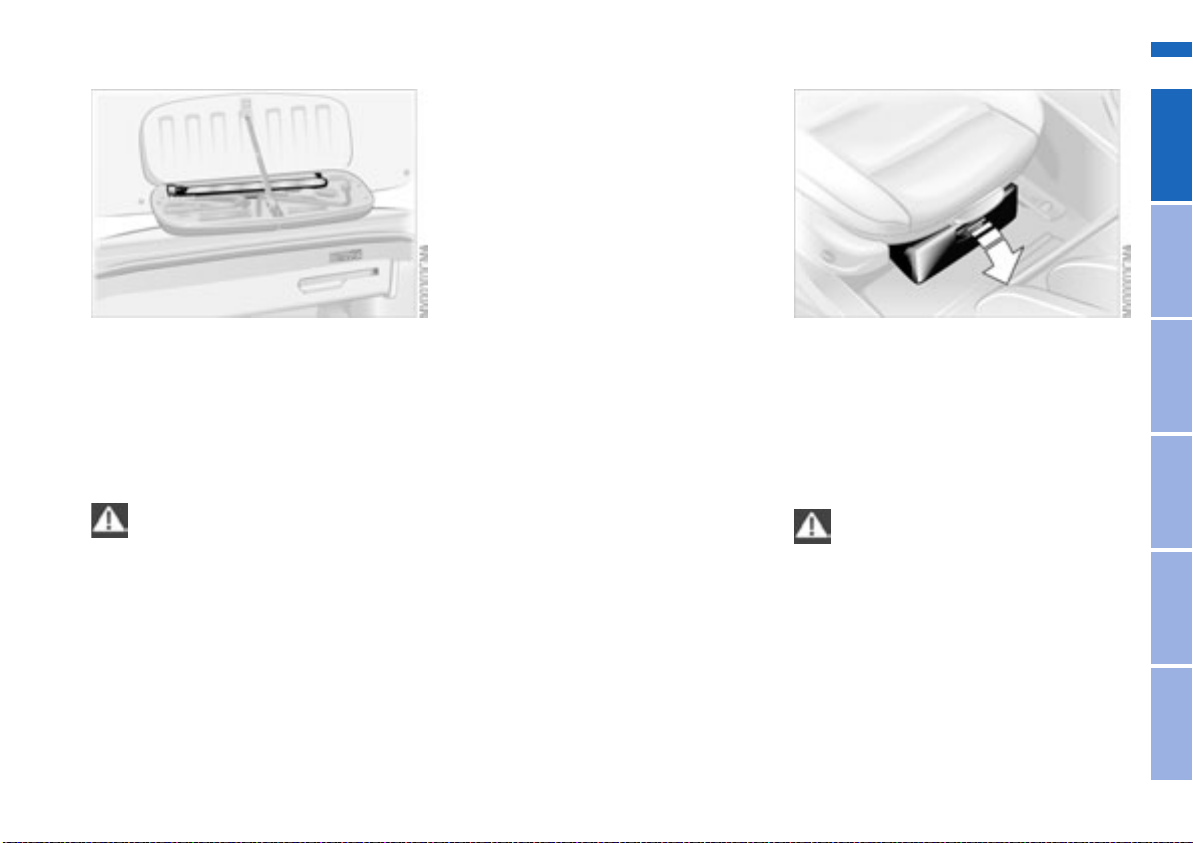
The hazard warning triangle is stored
ready to use in the luggage compart-
ment lid inside the toolbox for the
onboard tool kit.
To open the container, loosen the wing
nut.
Always observe all legal regula-
tions requiring a warning triangle
to be carried in the vehicle.<
First-aid kit*
The first-aid kit is located under the
front passenger's seat.
To open: pull the handle and fold the
cover down.
To fasten: fold the cover up and press it
until the tab engages.
Several of the items contained in
the first-aid kit have a limited ser-
vice life. For this reason, check the
expiration dates of each of the items
regularly, and replace any with passed
dates. You can acquire replacements in
any drugstore or pharmacy.
Always observe all legal regulations
requiring a first-aid kit to be carried in
the vehicle.<
OverviewControlsMaintenanceRepairsDataIndex
handbook.book Page 23 Tuesday, July 30, 2002 9:28 AM
Online Edition for Part-No. 01 41 0 156 854 - © 09/02 BMW AG
24
Refueling
Fuel filler door
Always switch off the engine
before refueling, as it is not possi-
ble to add fuel with the engine running,
and attempts may also trigger the
SERVICE ENGINE SOON lamp.<
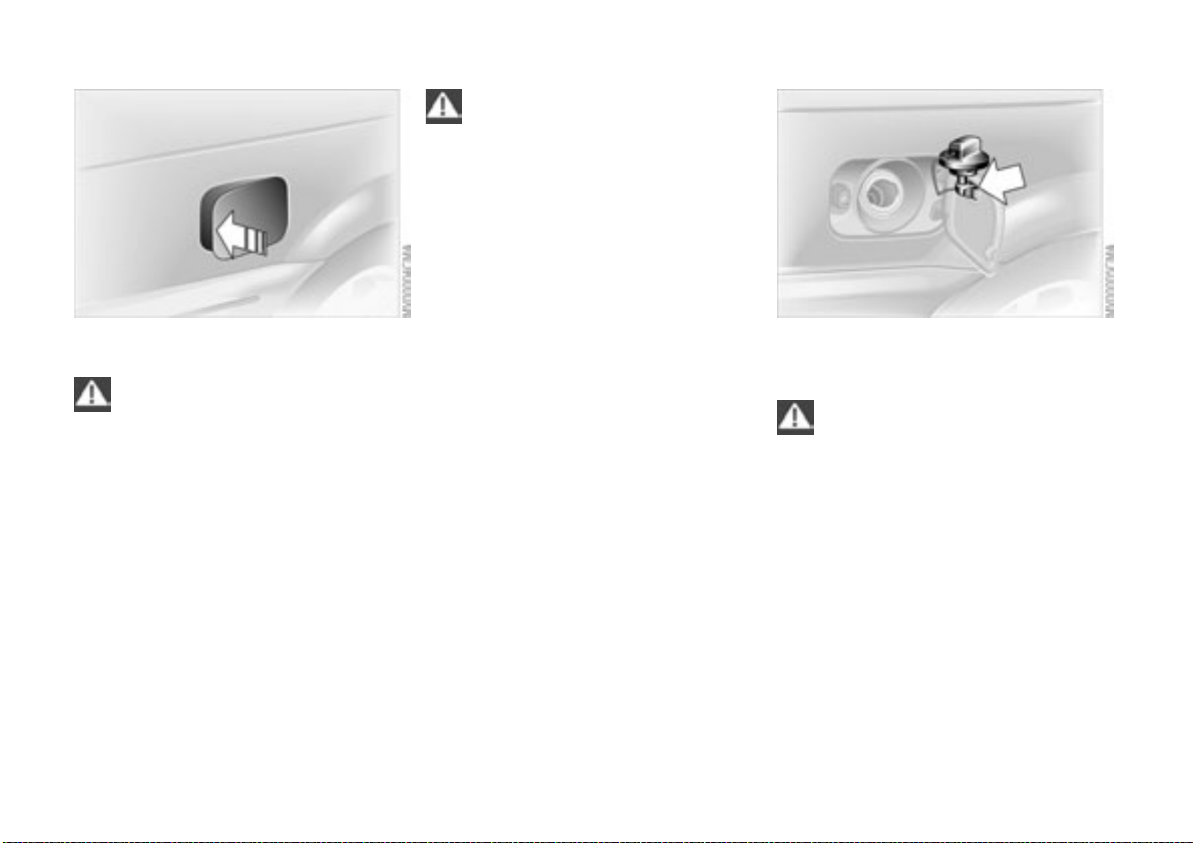
Press on the rear edge of the fuel filler
door to open and close it.
If an electrical malfunction occurs, you
can unlock the fuel filler door manually:
Pull the knob with the fuel pump symbol
on the right trim panel of the luggage
compartment.
When handling fuels, comply with
all of the applicable safety precau-
tions posted at the service station.
Never carry spare fuel containers in
your vehicle. Whether empty or full,
these containers can leak, cause an
explosion, or lead to fire in the event of
a collision.<
Simple and environmentally
friendly
Open the filler cap carefully to
prevent fuel from spraying out.
Fuel spray may cause injury.<
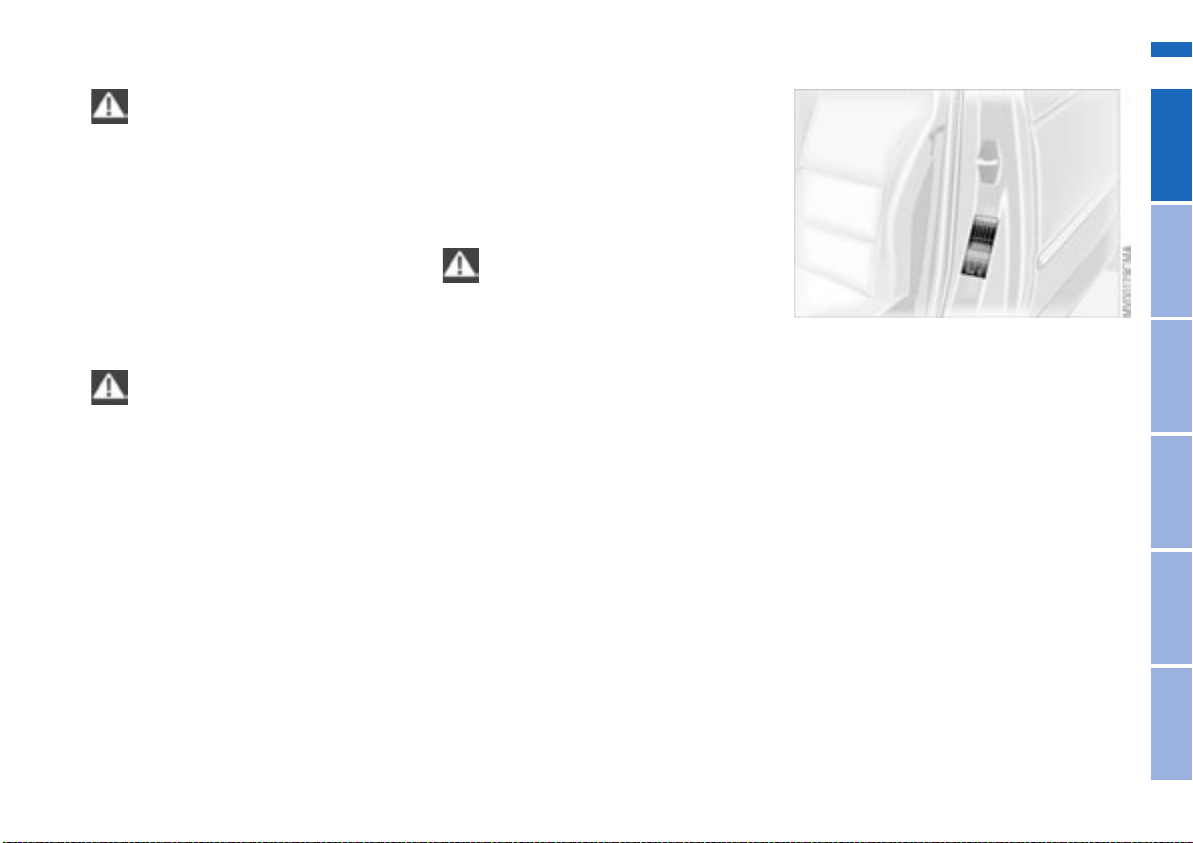
Keep the filler cap in the bracket
attached to the fuel filler door – see
arrow.
When refueling, insert the filler nozzle
completely into the filler pipe. Pulling
the nozzle out of the pipe during refuel-
ing
> results in premature pump shutoff
> and will reduce the effect of the vapor
recovery system on the pump.
The fuel tank is full when the filler noz-
zle shuts off the first time.
handbook.book Page 24 Tuesday, July 30, 2002 9:28 AM
Online Edition for Part-No. 01 41 0 156 854 - © 09/02 BMW AG
25
Close the fuel filler cap carefully
after refueling until a click is
heard. While closing, be sure not to
squeeze the strap which is fastened to
the cap. A loose or missing cap will
activate the CHECK FILLER CAP
lamp.<
Fuel tank capacity
> Approx. 16.6 gal./63 liters, of which
> approx. 2.1 gal./8 liters are reserve
capacity.
Do not drive to the last drop of
fuel. This can prevent the engine
from operating properly and result in
damage.<
Fuel specifications
The engine uses lead-free gasoline
only.
Required fuel:
> Premium Unleaded Gasoline,
min. 91 AKI.
AKI = Anti Knock Index
Never use leaded fuel, as it would
cause permanent and irreversible
damage to the oxygen sensor and the
catalytic converter.<
Tire inflation pressure
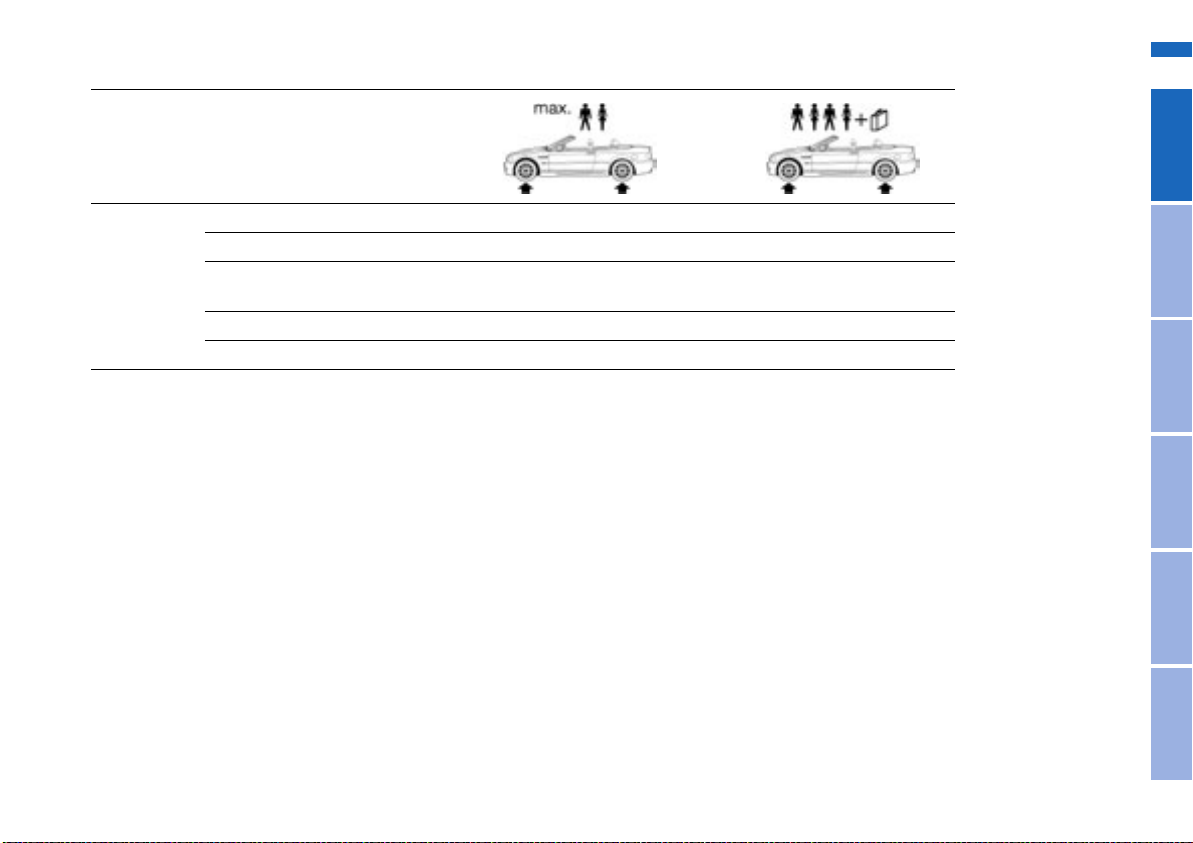
The specified inflation pressures are
provided on a sticker attached to the
B-pillar and are visible with the driver's
door open.
Checking tire pressures
All pressures are specified in the units
usually used in your country – psi/kilo-
pascal – for tires at ambient tempera-
tures, also refer to the following tire
inflation pressure table.
After correcting the tire inflation pres-
sure, reinitialize the Flat Tire Monitor so
that it can monitor the tire inflation
pressure, refer to page 88.
Refueling
OverviewControlsMaintenanceRepairsDataIndex
handbook.book Page 25 Tuesday, July 30, 2002 9:28 AM
Online Edition for Part-No. 01 41 0 156 854 - © 09/02 BMW AG

26
Check the tire pressures on a reg-
ular basis – at least twice a month
– and before every extended journey.
Incorrect tire pressure can otherwise
lead to driving instability, tire damage
and accidents.<
Comply with tire approval
specifications
The inflation pressures in the table
apply to BMW-approved tire sizes and
tire manufacturers. Your BMW center
will be glad to supply this information.
Higher pressures may be required for
tires made by other manufacturers.
Your vehicle is equipped with tires
which not only meet US standards, but
also European standards. We recom-
mend the exclusive use of BMW-
approved tires.
Tire inflation pressure
handbook.book Page 26 Tuesday, July 30, 2002 9:28 AM
Online Edition for Part-No. 01 41 0 156 854 - © 09/02 BMW AG
27
BMW Tires
All pressure specifications in
the table are indicated in psi/
kilopascal with cold tires –
cold = ambient temperature
225/45 ZR 18 33/230 - 41/280 -
255/40 ZR 18 - 35/240 - 48/330
M3
convertible
225/40 ZR 19 33/230 - 41/280 -
255/35 ZR 19 - 35/240 - 48/330
225/45 R 17 91 H M+S 33/230 38/260 36/250 46/320
Tire inflation pressure
OverviewControlsMaintenanceRepairsDataIndex
handbook.book Page 27 Tuesday, July 30, 2002 9:28 AM
Online Edition for Part-No. 01 41 0 156 854 - © 09/02 BMW AG
28
handbook.book Page 28 Tuesday, July 30, 2002 9:28 AM
Online Edition for Part-No. 01 41 0 156 854 - © 09/02 BMW AG

29
Overview
Controls and features
Operation, maintenance
Owner service procedures
Technical data
Index
OverviewControlsMaintenanceRepairsDataIndex
handbook.book Page 29 Tuesday, July 30, 2002 9:28 AM
Online Edition for Part-No. 01 41 0 156 854 - © 09/02 BMW AG
30
Opening and closing
Keys
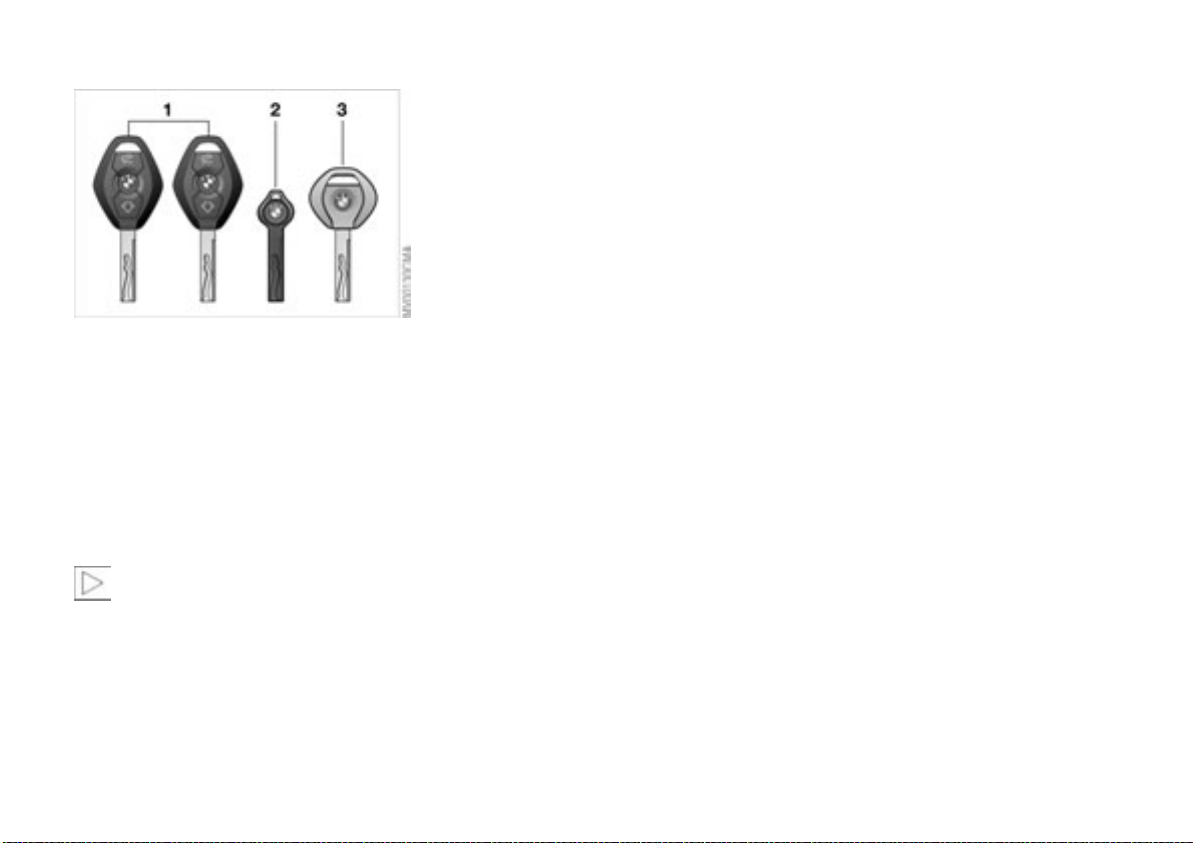
The key set
1 Master keys with remote control unit
– determine the functions of the Key
Memory, refer to page 65.
You can mark the individual keys for
subsequent identification by apply-
ing the colored decals that you
received when accepting delivery of
your vehicle
There is an extended-life battery
in every master key with remote
control that is charged automatically in
the ignition lock as you drive.
For this reason, if you have a master
key with remote control that is other-
wise not used, use that key at least
once every year while driving for an
extended period to charge the bat-
tery.<
2 Spare master key – for storage in a
safe place, such as in your wallet.
This key is not intended for constant
use
3 Door and ignition key – the locks for
the luggage compartment lid and the
glove compartment cannot be oper-
ated with this key. This is useful for
valet parking, for example
Central locking system
The concept
The central locking system engages
and releases the locks on the
> doors
> luggage compartment lid
> fuel filler door and
> glove compartment.
The central locking system is ready for
operation whenever the driver's door is
closed.
The central locking system can be
operated
> from outside via the door lock and
using the remote control
> from inside via the central locking
system button.
If it is operated from inside, the fuel
filler door will not be locked, refer to
page 34.
Operating it from outside simulta-
neously activates the anti-theft system,
which prevents the doors from being
unlocked via the door lock buttons or
the door release handles. The alarm
system is also armed or disarmed.
The central locking system unlocks
automatically in the event of an acci-
dent. In addition, the hazard warning
flashers and interior lamps come on.
handbook.book Page 30 Tuesday, July 30, 2002 9:28 AM
Online Edition for Part-No. 01 41 0 156 854 - © 09/02 BMW AG
31
Opening and closing – via the remote control
The concept
The remote control gives you an excep-
tionally convenient method for unlock-
ing and locking your vehicle. Further-
more, it provides two additional
functions:
> Switch on the interior lamps, refer to
page 32.
With this function you can also
search for your vehicle – when
parked in an underground garage, for
instance
> Open the luggage compartment lid,
refer to page 32.
The luggage compartment lid will
open slightly, regardless of whether it
was locked or unlocked.
The anti-theft system is also deacti-
vated/activated simultaneously with the
unlocking or locking of the vehicle, and
the alarm system is disarmed/armed,
and the interior lamps are switched
on/off.
You can have a signal set to con-
firm that the vehicle's locks have
engaged securely.<
Master keys with remote control
Since passengers or animals
remaining in the vehicle might be
able to lock the doors from the inside,
always take the vehicle's keys with you
so that the vehicle can be opened again
from the outside at any time.<
If it is no longer possible to lock
the vehicle via the remote control,
the battery is discharged. Use this key
while driving for an extended period in
order to recharge the battery. Guard
the remote control against unauthorized
use by only surrendering the spare key
or the door and ignition key, e.g. for
valet parking.
In the event of a system malfunction,
please contact your BMW center. You
can also obtain replacement keys
there.<
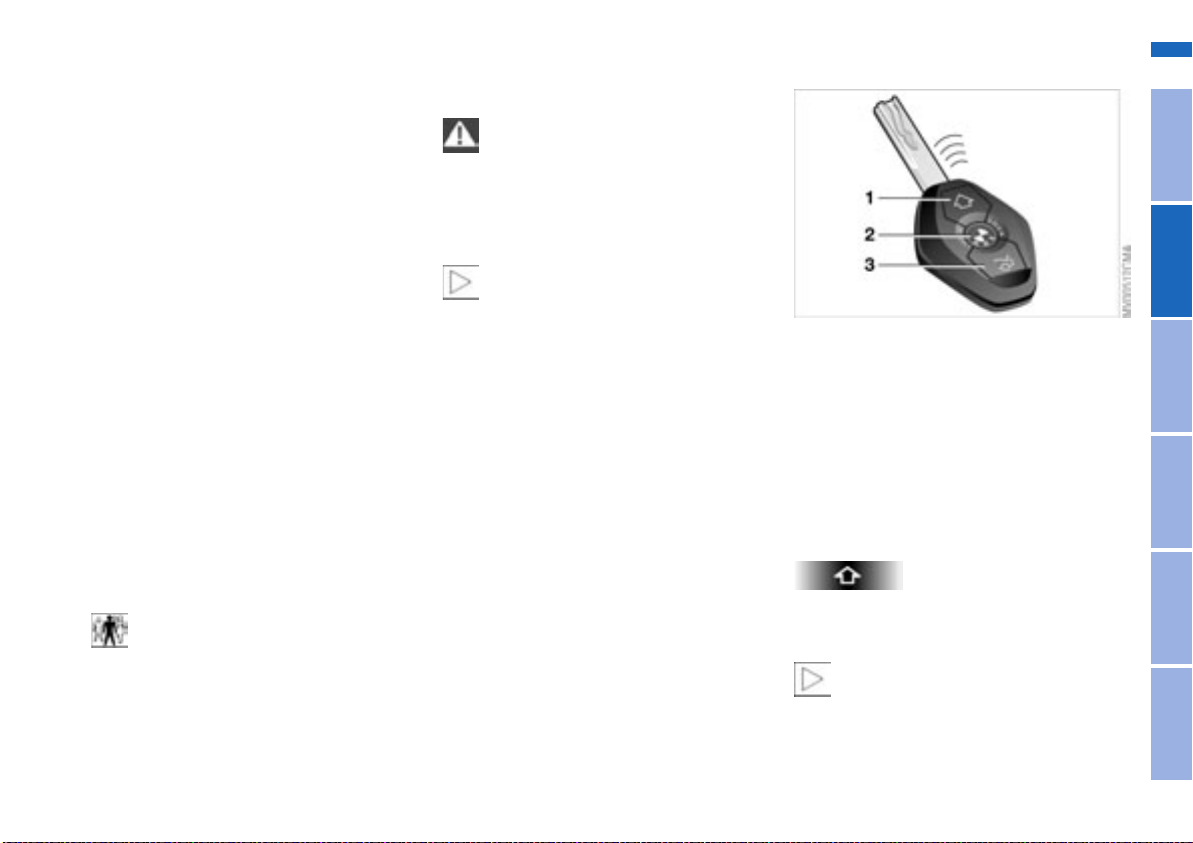
1 Unlock, disarm the alarm system
2 Lock and secure, arm alarm system,
activate interior lamps, disarm tilt
alarm sensor and interior motion sen-
sor
3 Open luggage compartment, Panic
mode – trigger alarm
To release
Press button to unlock the driver's door
only.
Press the button twice in order to
unlock the entire vehicle.<
OverviewControlsMaintenanceRepairsDataIndex
handbook.book Page 31 Tuesday, July 30, 2002 9:28 AM
Online Edition for Part-No. 01 41 0 156 854 - © 09/02 BMW AG

32
To lock and secure
Press button.
To switch on the interior lamps
After locking the vehicle, press button
again.
To deactivate the tilt alarm* and
interior motion sensors*
Press button a second time immedi-
ately after locking.
For additional information: page 39.
To open the luggage
compartment
Press button.
The lid will open slightly, no matter
whether it was locked or unlocked.
Before and after a trip, be sure
that the luggage compartment lid
has not been opened unintentionally.<
Panic mode – trigger alarm
By pressing button for more than
two seconds, the alarm can be
sounded in the event of danger, if it is
armed.
To switch off the alarm:
Press button.
External systems
Local systems or devices in the area
may interference with remote control
function.
If this should occur, you can still open
and close the vehicle using the master
key in both the door and luggage com-
partment locks.
For US owners only
The transmitter and receiver units com-
ply with part 15 of the FCC Federal
Communications Commission regula-
tions. Operation is governed by the fol-
lowing:
FCC ID:
> LX8EWS
> LX8FZVS
> LX8FZVE.
Compliance statement:
This device complies with part 15 of the
FCC Rules. Operation is subject to the
following two conditions:
> This device may not cause harmful
interference, and
> this device must accept any interfer-
ence received, including interference
that may cause undesired operation.
Any unauthorized modifications to
these devices could void the
user's authority to operate the equip-
ment.<
Opening and closing – via the remote control
handbook.book Page 32 Tuesday, July 30, 2002 9:28 AM
Online Edition for Part-No. 01 41 0 156 854 - © 09/02 BMW AG
33
Opening and closing – via the door lock
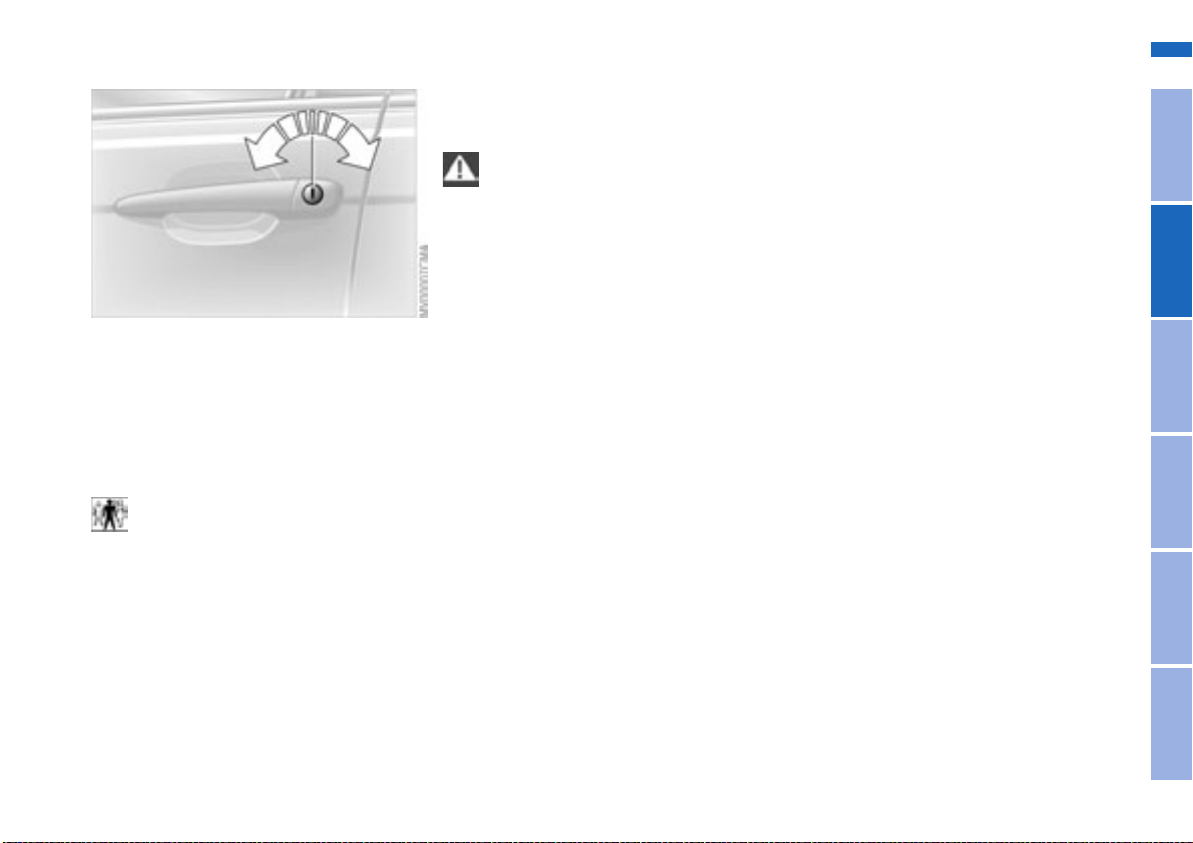
Turning the key in the door lock once
unlocks the driver's door, the fuel filler
door and the glove compartment.
Turning the key a second time unlocks
the passenger's door and the luggage
compartment lid.
You can have a signal set to con-
firm that the vehicle's locks have
engaged securely.<
Convenience operation
With the door closed you can also
operate the power windows and the
convertible top with the door lock.
> To open: with the door closed after
turning the key for the second time,
hold the key in the Unlock position
> To fasten: with the door closed, hold
the key in the Lock position.
Whenever closing the windows or
sliding/tilt sunroof you should
always monitor their path and progress
to ensure that no one is injured occur.
Releasing the key stops the opera-
tion.<
Manual operation
In the event of electrical malfunction
Turn the key all the way to the left or
right to unlock/lock the driver's door.
OverviewControlsMaintenanceRepairsDataIndex
handbook.book Page 33 Tuesday, July 30, 2002 9:28 AM
Online Edition for Part-No. 01 41 0 156 854 - © 09/02 BMW AG
34
Opening and closing – from the inside
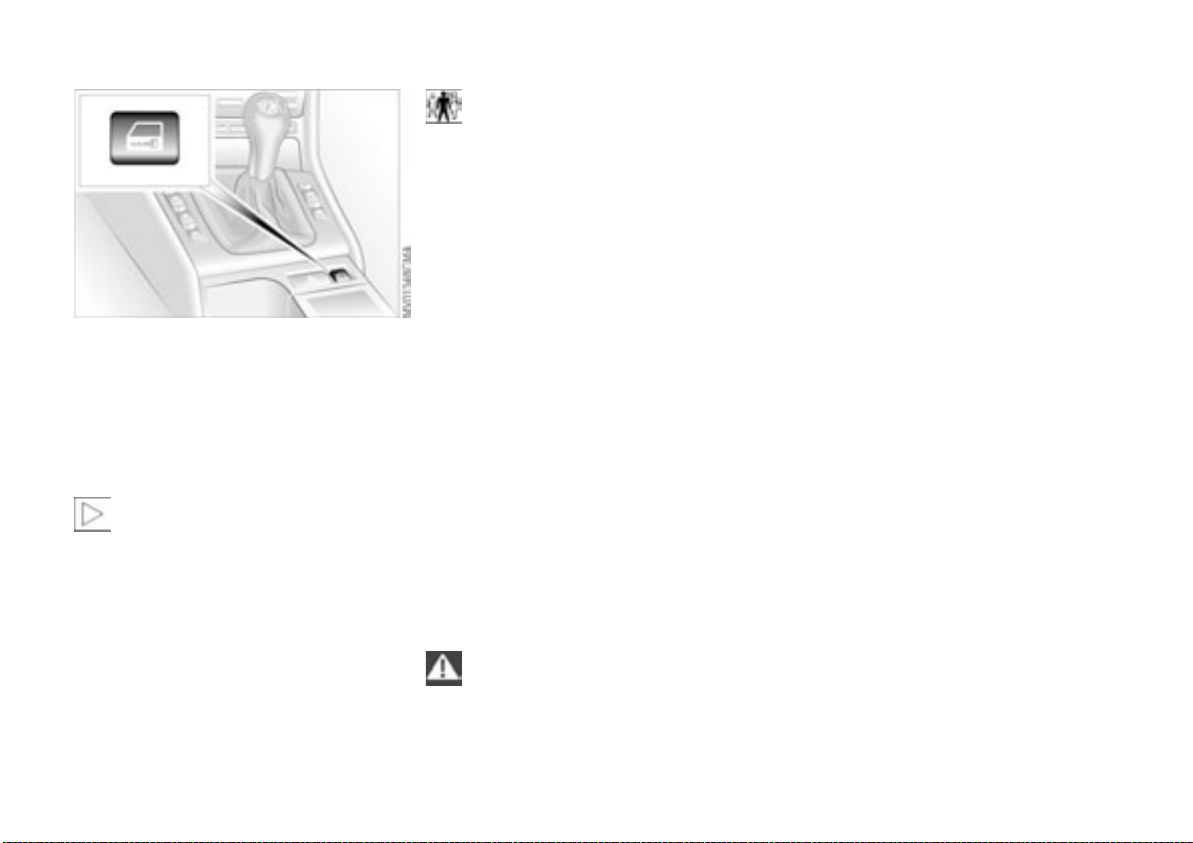
With this button you operate the central
locking system whenever the doors are
closed. The doors and luggage com-
partment lid are unlocked or locked
only. The anti-theft alarm system is not
activated.
If only the driver's door was
unlocked from the outside and
you press the button, then, with the
driver's door still open, the passenger's
door, the luggage compartment lid, the
fuel filler door and the glove compart-
ment will unlock, too.
If the driver's door is closed, it will be
locked.<
If you desire, the central locking
system can be activated automati-
cally as soon as you begin to drive. You
may also have this adjusted so that it is
specific to keys.<
To unlock and open the doors
> Either unlock the doors together with
the button for the central locking sys-
tem and then pull each of the release
handles above the armrests or
> pull the release handle for each door
twice: the first pull unlocks the door,
and the second one opens it.
To lock
> Either use the central locking button
to lock all doors at once
or
> press the individual door lock buttons
down. As an added design feature to
prevent the driver from being inad-
vertently locked out of the vehicle,
the driver's door lock button will not
engage as long as the door is open.
Since passengers or animals
remaining in the vehicle might be
able to lock the doors from the inside,
always take the vehicle's keys with you
so that the vehicle can be opened again
from the outside at any time.<
handbook.book Page 34 Tuesday, July 30, 2002 9:28 AM
Online Edition for Part-No. 01 41 0 156 854 - © 09/02 BMW AG
35
Luggage compartment lid
The lock
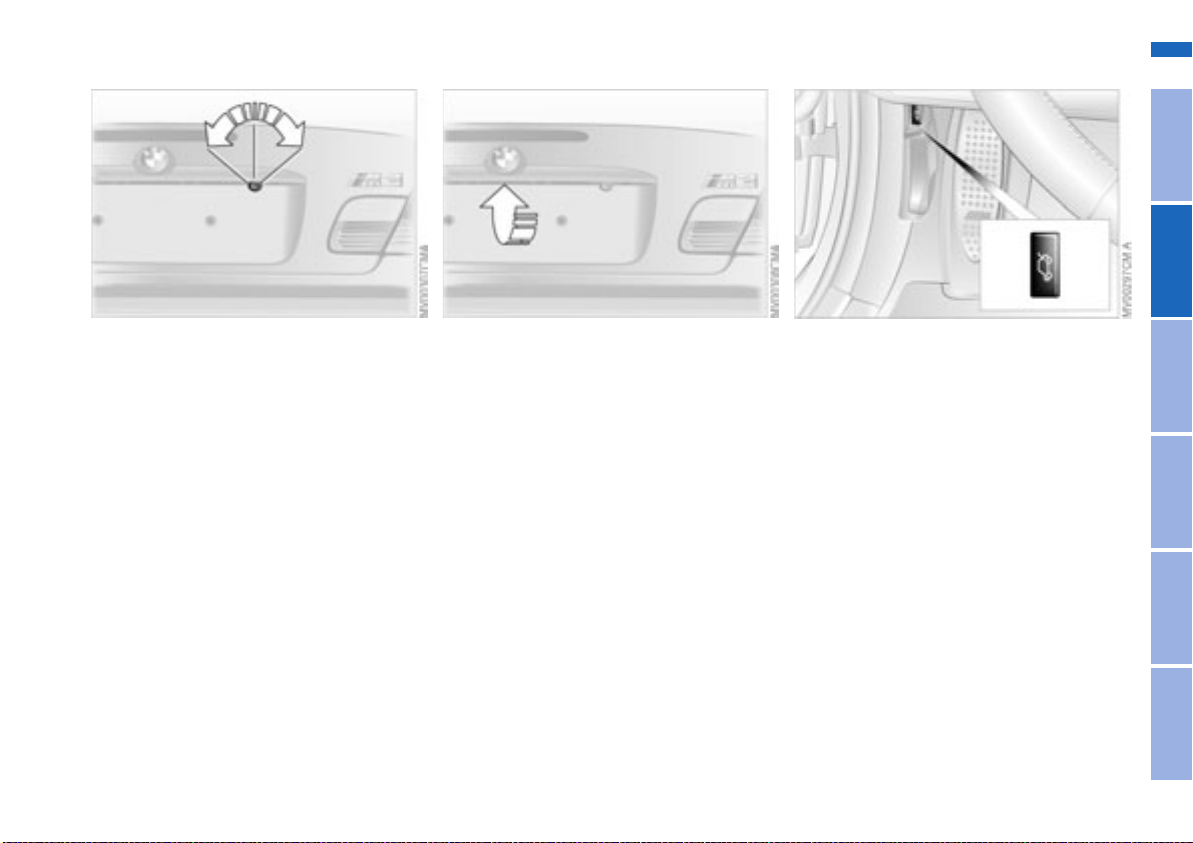
Only the master keys fit in the lock for
the luggage compartment lid, refer to
page 30.
To secure separately
Lock the glove compartment using the
master key.
The luggage compartment lid is locked
and disconnected from the central lock-
ing system. If you surrender only the
door and ignition key – refer to page 30
– this will prevent unauthorized access
via the luggage compartment lid, which
is an advantage for valet parking, for
instance.
To open from the outside
Press the button in the handle recess –
see arrow: the luggage compartment lid
opens slightly.
The luggage compartment is lighted
when the luggage compartment lid is
opened.
Manual operation
In the event of electrical malfunction
Turn the master key to the right as far
as it will go, the luggage compartment
lid will open slightly.
The luggage compartment lid is locked
again as soon as you close the lid.
To open from the inside
If the luggage compartment lid has not
been locked separately, you can open it
with this button in the footwell on the
driver's side when the vehicle is sta-
tionary.
OverviewControlsMaintenanceRepairsDataIndex
handbook.book Page 35 Tuesday, July 30, 2002 9:28 AM
Online Edition for Part-No. 01 41 0 156 854 - © 09/02 BMW AG
36
To close
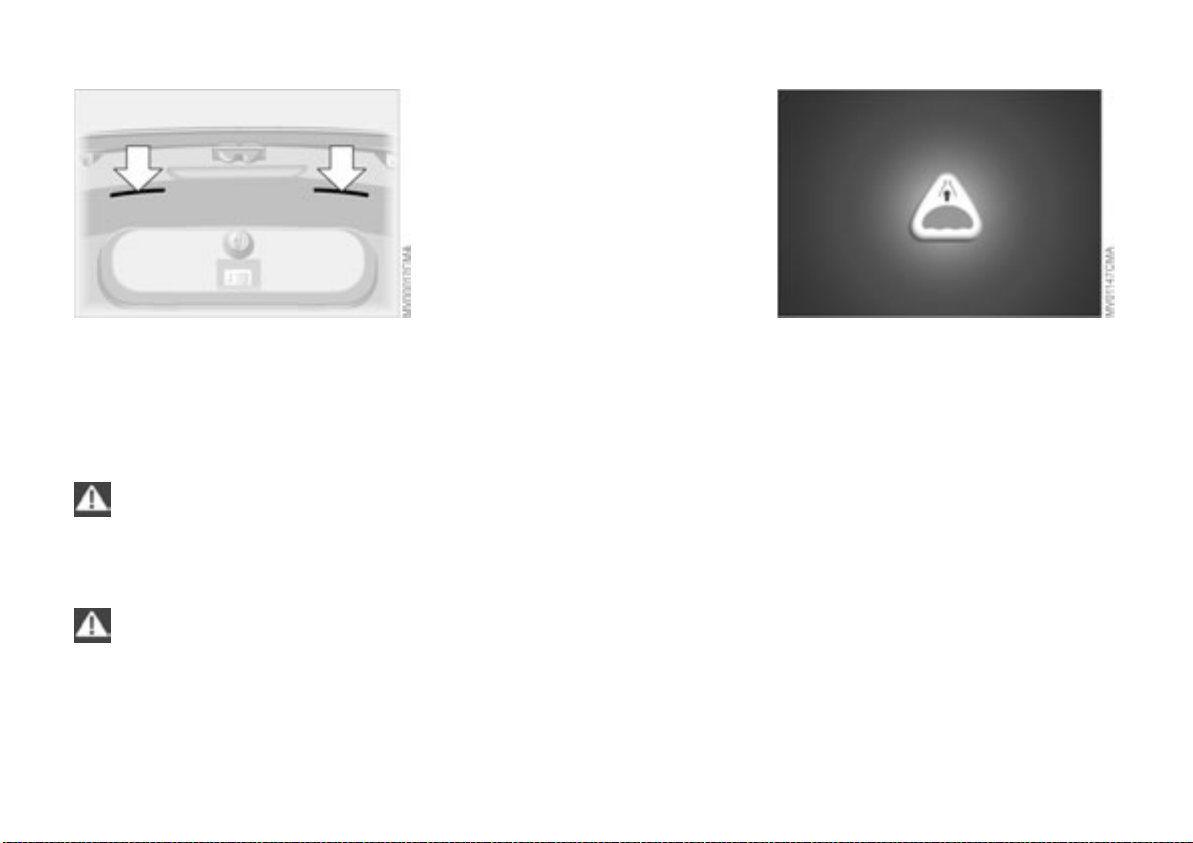
The handle recesses – see arrows – in
the interior trim panel of the luggage
compartment lid make it easier to pull
the lid down.
To avoid injuries, be sure that the
travel path of the luggage com-
partment lid is clear when it is closed,
following the same precautions as with
all closing procedures.<
Operate the vehicle only when the
luggage compartment lid is com-
pletely closed. Otherwise, exhaust
fumes could penetrate the interior of
the vehicle.<
Nevertheless, should it be absolutely
necessary to operate the vehicle with
the luggage compartment lid open, with
closed convertible top:
1. Close all windows
2. Greatly increase the quantity of air
from the automatic climate control
system, refer to page 98.
Emergency release
This lever releases the luggage com-
partment lid from the luggage compart-
ment's interior.
Luggage compartment lid
handbook.book Page 36 Tuesday, July 30, 2002 9:28 AM
Online Edition for Part-No. 01 41 0 156 854 - © 09/02 BMW AG
37
Luggage compartment
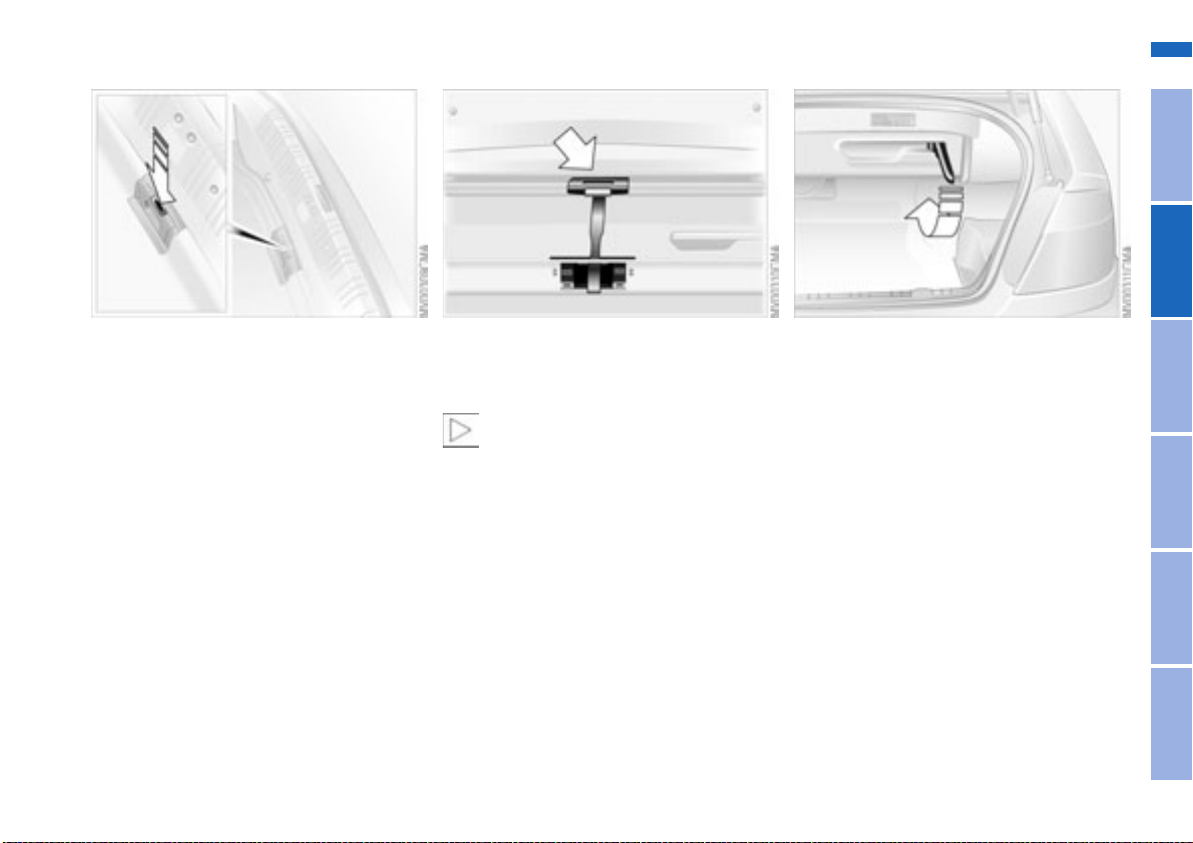
To fold up and secure the floor
panel
1. Pull up at the handle and fold the
panel up
2. Press the button – see arrow – to
release the hanger from the handle
3. Hook the handle into the rubber seal
of the drip rail – see arrow.
Carefully replace the hanger in its
holder when lowering the floor
panel back down.<
The fittings at the corners of the lug-
gage compartment provide you with a
convenient means of attaching luggage
nets* and flexible straps for securing
luggage.
Refer also to Cargo loading on
page 106.
Enlarging luggage compartment
With the convertible top closed, you
can enlarge the luggage compartment.
To do this, flip the handle outward and
press it down and toward the front of
the vehicle – see arrow. The convertible
top compartment panel is now raised
and secured.
To fold down the convertible top
compartment panel
To open the convertible top, the con-
vertible top compartment panel must
be lowered. To do this, fold out the
handle and pull opposite the direction
of travel.
OverviewControlsMaintenanceRepairsDataIndex
handbook.book Page 37 Tuesday, July 30, 2002 9:28 AM
Online Edition for Part-No. 01 41 0 156 854 - © 09/02 BMW AG

38
When opening the convertible top,
refer to page 41, make sure that
the luggage compartment is set up for
this, otherwise you may damage some-
thing.<
Alarm system*
The concept
The vehicle alarm system responds:
> When a door, the hood or the lug-
gage compartment lid are opened
> To movement inside the vehicle –
interior motion sensor
> Altering the vehicle tilt, e.g. as would
occur while attempting to steal the
wheels or tow the vehicle – tilt alarm
sensor system
> To interruption of battery voltage.
The system responds to unauthorized
vehicle entry and attempted theft by
simultaneously activating the following:
> Sounding an acoustic alarm for
30 seconds
> Activating the hazard warning flash-
ers for approx. five minutes
> Flashing the high beams on and off in
rhythm with the hazard warning flash-
ers.
To arm and disarm the alarm
system
When the vehicle is locked or unlocked
by using a key or with the remote con-
trol, the alarm system is also simulta-
neously armed or disarmed.
You can have a signal set as
acknowledgment for both arming
and disarming the alarm.<
You can also open the luggage com-
partment lid when the system is armed
by pressing the button of the remote
control, refer to page 32. When it is
closed, the lid is once again secured.
Luggage compartment
handbook.book Page 38 Tuesday, July 30, 2002 9:28 AM
Online Edition for Part-No. 01 41 0 156 854 - © 09/02 BMW AG
39
Indicator lamp displays
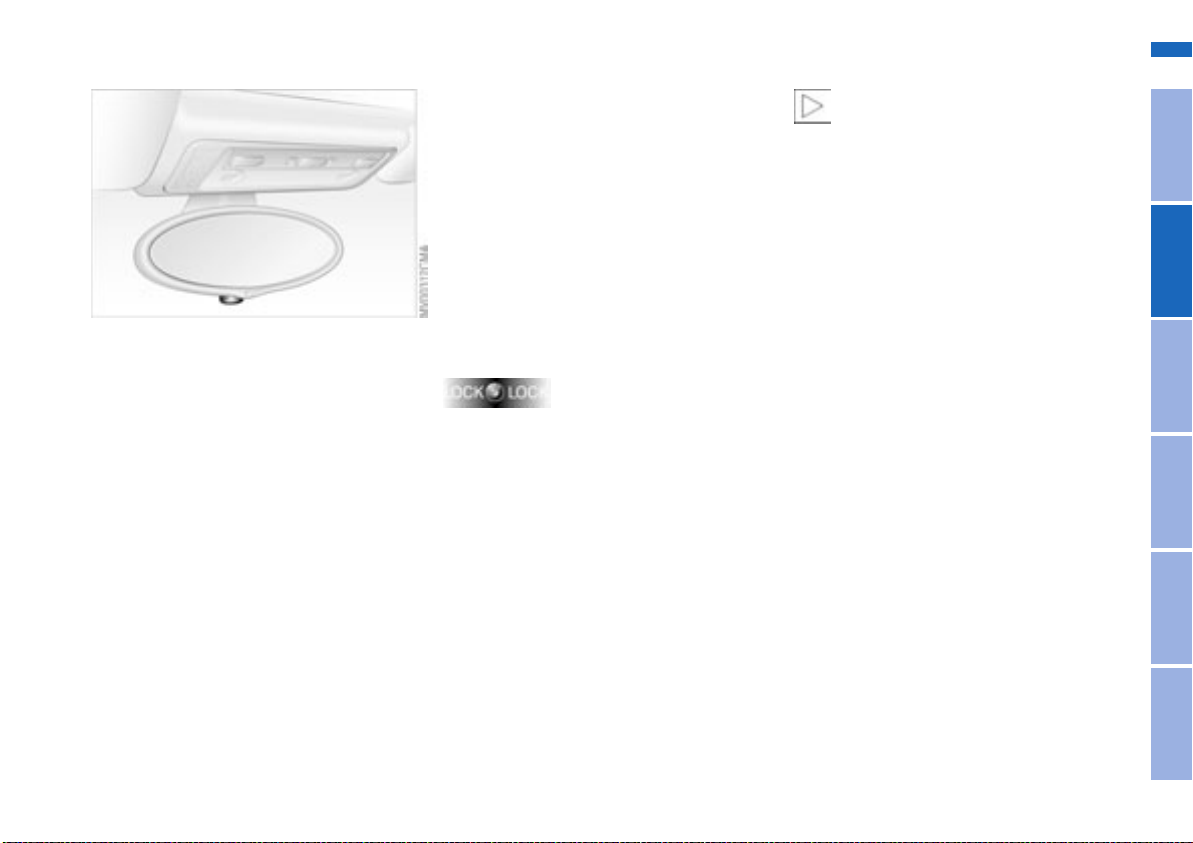
> The indicator lamp below the interior
rearview mirror flashes continuously:
the system is armed
> The indicator lamp flashes when it is
armed: the door(s), the hood or lug-
gage compartment lid are not com-
pletely closed. Even if you do not
close the alerted area, the remaining
areas are deadlocked, and the indi-
cator lamp flashes continuously after
ten seconds. However, the interior
motion sensor is not activated
> If the indicator lamp goes out when
the system is disarmed: no manipula-
tion or attempted intrusions have
been detected in the period since the
system was armed
> If the indicator lamp flashes for
ten seconds when the system is dis-
armed: an attempted entry has been
detected in the period since the sys-
tem was armed.
Following triggering of an alarm, the
indicator lamp will flash continuously.
Avoiding unintentional alarms
The tilt alarm sensor and interior motion
sensor may be deactivated at the same
time. You can do this to prevent a false
alarm from being triggered in garages
with elevator ramps, for instance, or
when the vehicle is transported by train:
Lock the vehicle twice to arm the sys-
tem. Press button on the remote control
twice in succession or lock the vehicle
twice with the key.
The indicator lamp lights up briefly and
then flashes continuously. The tilt alarm
sensor and the interior motion sensor
are deactivated as long as the system is
armed.
Interior motion sensor*
Deactivate the interior motion sensor –
see Avoiding unintentional alarms – if
persons or animals are left in the vehi-
cle.
The tilt and interior motion sen-
sors are inadvertently switched off
when convenience closing of the win-
dows is interrupted within the first
10 seconds and then started again. If
this happens, they must be disarmed
and reactivated.<
Alarm system*
OverviewControlsMaintenanceRepairsDataIndex
handbook.book Page 39 Tuesday, July 30, 2002 9:28 AM
Online Edition for Part-No. 01 41 0 156 854 - © 09/02 BMW AG
40
Electric power windows
To open and close windows
When leaving the vehicle, always
remove the ignition key from the
lock and remember to close the doors
to prevent children from operating the
power windows and injuring them-
selves, etc.<
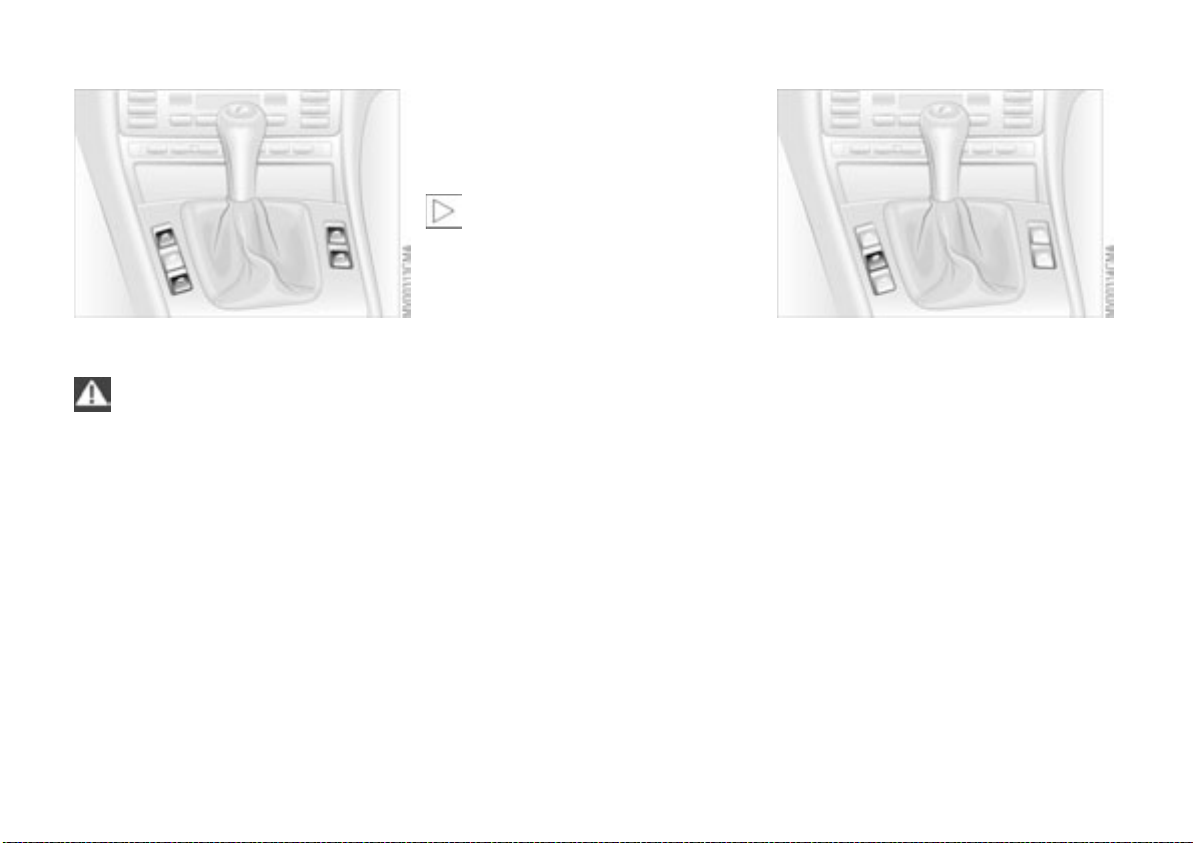
With the ignition key in position 1 or
higher
> Press the switch until you feel resis-
tance: the window continues to move
as long as you continue to press the
switch
> Press the switch briefly past the pres-
sure point: the window moves auto-
matically. Touching the switch again
stops the opening cycle.
You can close the windows in the same
manner by pulling the switch. The win-
dow on the passenger side and the rear
windows to not close automatically.
The window on the passenger
side closes automatically in igni-
tion key position 2 only.<
For convenience closing via the door
lock, refer to page 33.
Operating all windows at once
With the ignition key in position 1 or
higher
> Press the switch until you feel resis-
tance: all of the windows will con-
tinue to lower as long as you con-
tinue to press the switch
> Press the switch briefly past the pres-
sure point: all windows will move
automatically. Pressing the switch
again stops the opening cycle.
You can close the windows in the same
manner by pulling the switch. The win-
dows cannot be closed automatically
using this switch.
For convenience closing via the door
lock, refer to page 33.
handbook.book Page 40 Tuesday, July 30, 2002 9:28 AM
Online Edition for Part-No. 01 41 0 156 854 - © 09/02 BMW AG

41
After the ignition has been
switched off
After the ignition has been switched off:
You can still use the electric power win-
dows for up to 15 minutes, as long as
no one opens any of the doors.
Convertible top
The completely automatically operated
convertible top combines assured pro-
tection against the elements together
with simple and easy handling.
So that you will get the most out of
enjoying your convertible, here are a
few tips:
> It is advisable to close the convertible
top when the vehicle is being parked.
The closed convertible top not only
protects the passenger compartment
from unforeseeable damage from the
weather, it also provides a certain
degree of theft protection. In addi-
tion, keep valuables only in the
locked luggage compartment, even
with the convertible top closed
> Never mount a roof-mounted luggage
rack on the convertible top
> At temperatures below 147/–106
do not operate the convertible top to
prevent damage.
Never store the convertible top
while it is wet to avoid permanent
damage from moisture.<
Electric power windows
OverviewControlsMaintenanceRepairsDataIndex
handbook.book Page 41 Tuesday, July 30, 2002 9:28 AM
Online Edition for Part-No. 01 41 0 156 854 - © 09/02 BMW AG
42
Driving with the opening or clos-
ing operation not completely
ended can lead to damage and/or inju-
ries.
Traffic laws applicable in your area take
precedence when you operate the con-
vertible top, otherwise you may be
breaking the law.
Do not lay objects on the convertible
top, since they would fall off when the
convertible top is operated and cause
damage or injuries.
Do not reach into the convertible top
mechanism during opening and closing.
Keep children away from the moving
parts of the convertible top during
operation.<
If possible, only operate the con-
vertible top with the vehicle
stopped, as otherwise the process may
be interrupted.
If you set the convertible top in motion
with the vehicle stationary and then
have to start suddenly – for instance, at
a traffic light – you can still complete
the operation by driving as slowly as
possible and again pressing and main-
taining pressure on the button.
Before closing the convertible top,
remove any objects from the windshield
frame that could keep the convertible
top from closing properly.<
To close the electric power win-
dows while driving, always be
sure to first close either the rear win-
dows, or all 4 windows at the same
time, otherwise, at high speed, the win-
dows may not close tightly.<
At higher speeds, the ensuing
vacuum in the passenger com-
partment can cause the convertible top
to begin fluttering. Increase the air sup-
ply via the ventilation controls so that a
vacuum does not occur in the vehicle.<
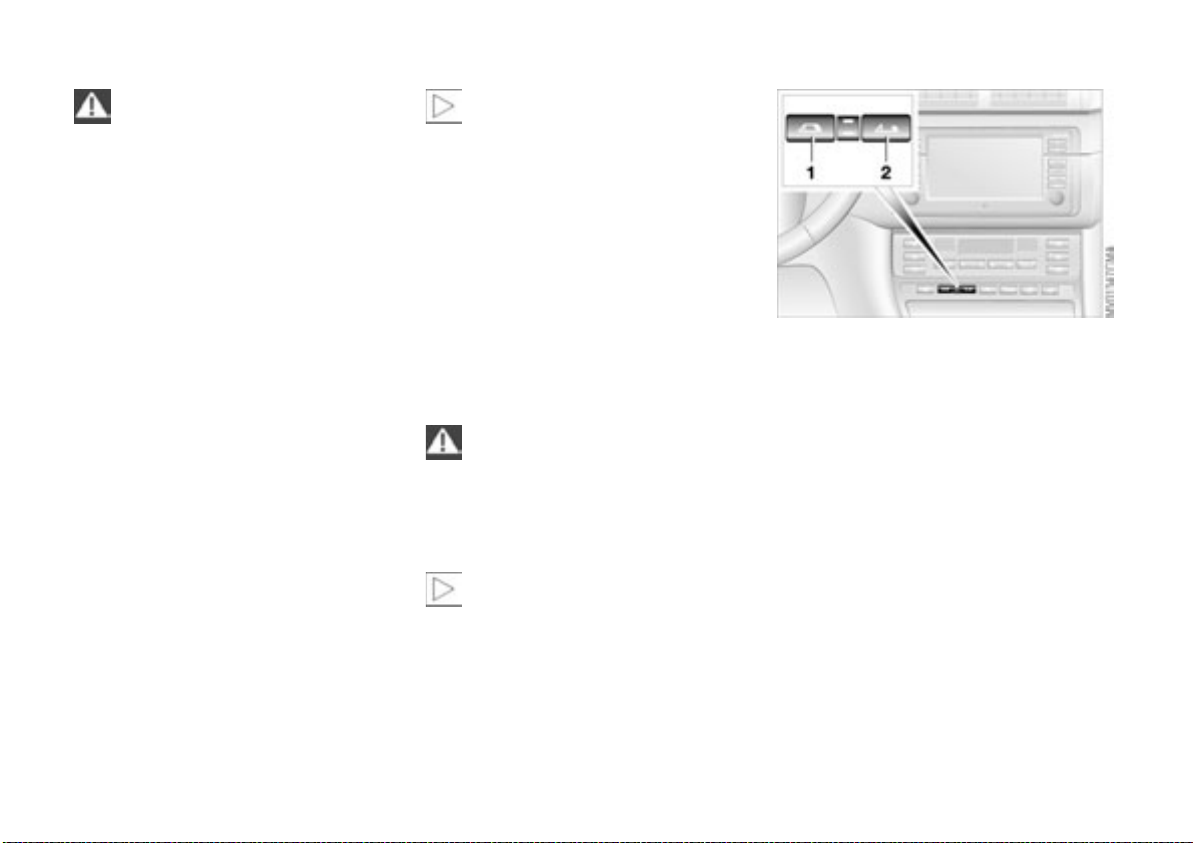
1 To close
2 To open
Locks and security systems
From ignition key position 1 or higher,
with the vehicle stationary
If at all possible, only operate the con-
vertible top if the engine is running. This
saves unnecessary battery wear.
1. Read and comply with the preceding
safety precautions
2. Before opening the convertible top,
make sure that the convertible top
compartment panel in the luggage
compartment is lowered, refer to
page 37
3. Make sure that the luggage compart-
ment lid is closed
Convertible top
handbook.book Page 42 Tuesday, July 30, 2002 9:28 AM
Online Edition for Part-No. 01 41 0 156 854 - © 09/02 BMW AG

43
4. Press and hold the corresponding
button for convertible top operation.
The red indicator lamp will light up
while the convertible top is in motion.
It goes out as soon as the opening or
closing operation has been com-
pleted.
If the red indicator lamp flashes after
the button is released, then the
opening or closing operation is not
yet completed. The sequence can be
continued in the desired direction by
pressing this button.
If the yellow indicator lamp lights up
continuously with the button
pressed, then the convertible top
compartment panel is raised and the
convertible top cannot be moved,
refer to step 2.
The automatic sequence will be
interrupted immediately if you
release the button that operates the
top. The sequence can be continued in
the desired direction by pressing this
button.<
During convertible top operation
the rear window moves toward the
passenger compartment. To prevent
injuries, make sure that the closing path
of the convertible top is unobstructed.<
When operating the convertible top, the
windows will lower slightly when you
press the button, and after the opening
or closing operation has finished, they
will go back up, if you keep holding the
button down for more than 2 seconds
after the indicator lamp has gone out.
The luggage compartment lid cannot be
opened while the convertible top is in
motion.
Do not close the side power win-
dows using the buttons if the con-
vertible top operation has been inter-
rupted.<
If the convertible top has been
stored in the convertible top com-
partment for longer periods, e.g. during
the winter months while the hardtop is
being used, it may be necessary to
manually support the first automatic
closing operation: if the convertible top
should halt right before the closing
phase is completed, press against the
front part of the convertible top frame
from the outside to help the closing
process along. Keep pressing the but-
ton while doing so until the top starts
up again on its own.<
Operate the convertible top manu-
ally in emergency situations only
to avoid causing damage due to incor-
rect operation.<
If the opening or closing operation
is interrupted, the convertible top
remains in the respective position for
15 minutes, and the sequence can be
continued in the desired direction with
the button. After that, the convertible
top can be moved again and, if it is an
emergency situation, you may have to
help the top along manually. This can
also be done in ignition key position 0.
In certain cases, the luggage compart-
ment lid cannot be opened if the open-
ing or closing operation has been inter-
rupted.<
Convenience operation from the
driver's door lock
Refer to page 33.
Convertible top
OverviewControlsMaintenanceRepairsDataIndex
handbook.book Page 43 Tuesday, July 30, 2002 9:28 AM
Online Edition for Part-No. 01 41 0 156 854 - © 09/02 BMW AG
44
Closing manually in the event of
an electrical malfunction
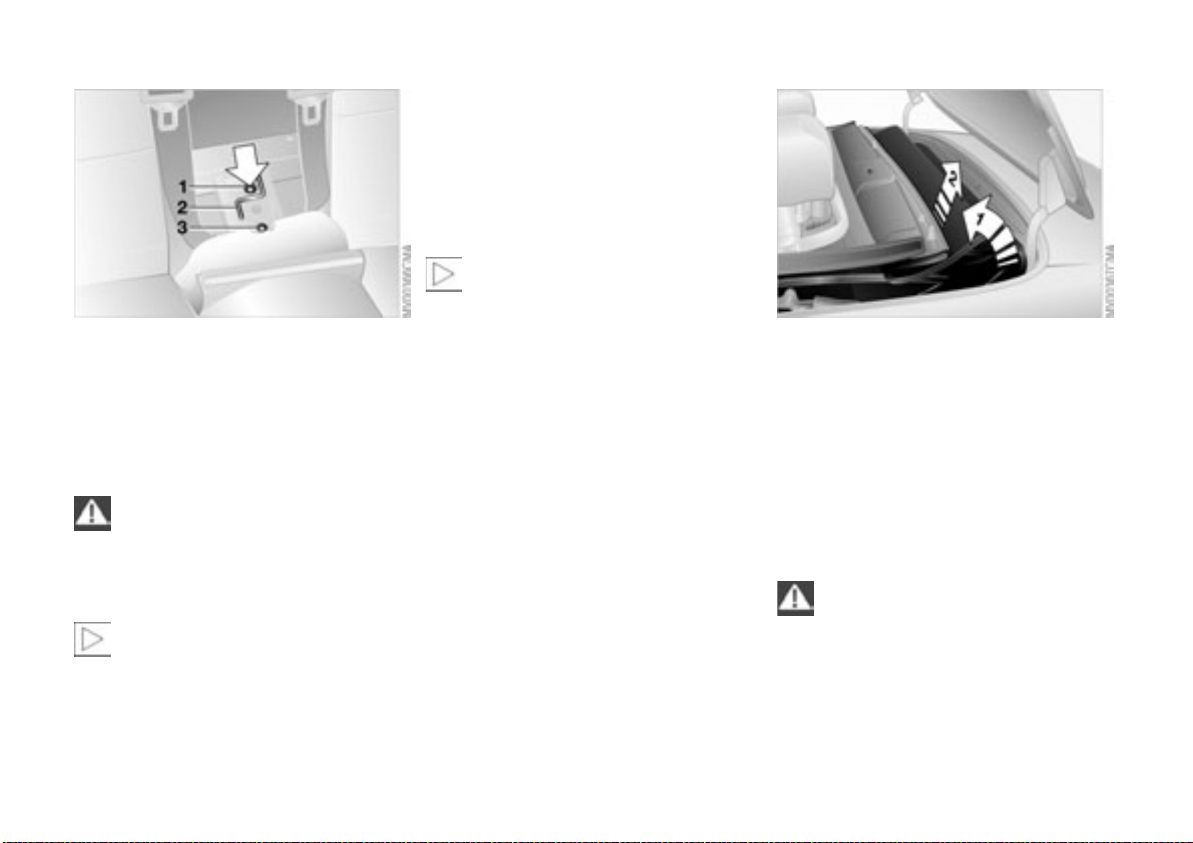
1 Emergency operation
2 Allen wrench
3 Recess
Only actuate the convertible top
manually to close it, however
never to open it, as the convertible top
compartment lid cannot be locked and
would open during driving.<
Manual closing is best carried out
with two persons from outside
with the driver's door open and the
driver's seat folded forward. No one is
to be in the rear seat while you are
doing this.<
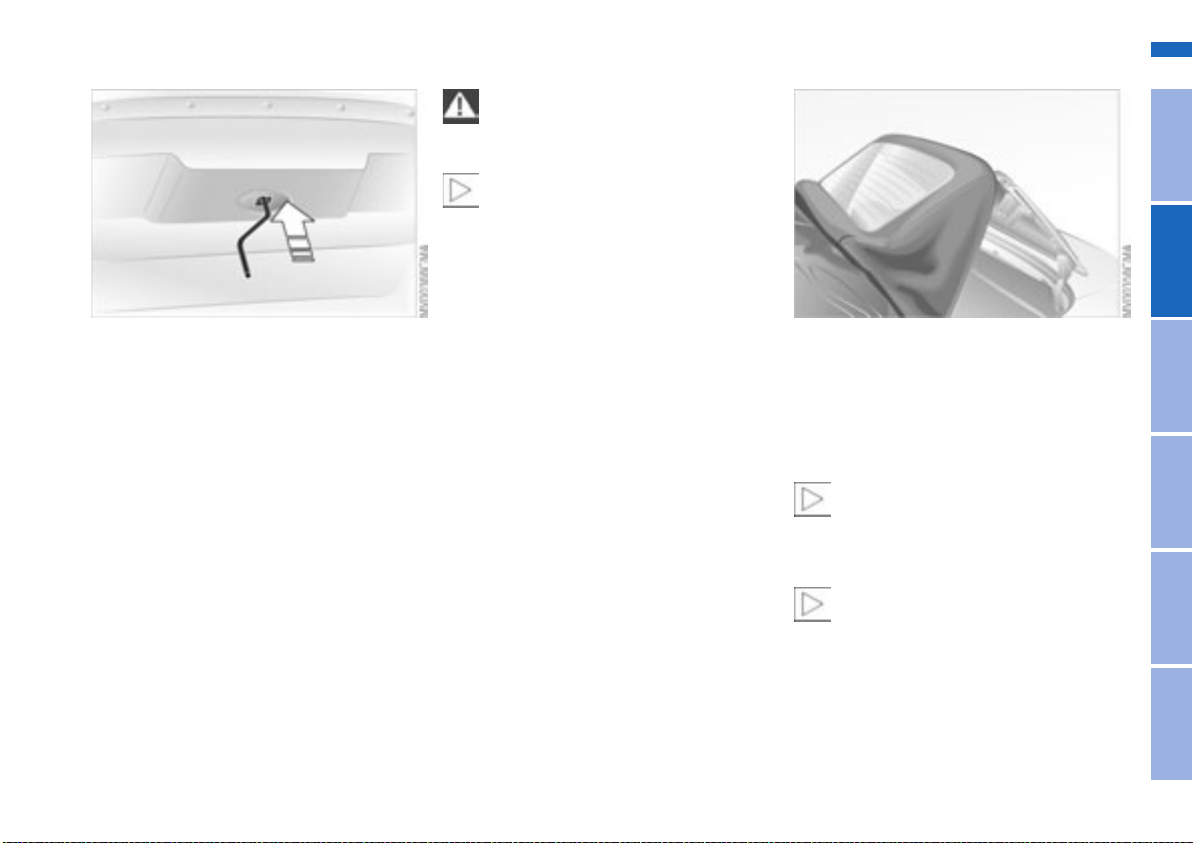
1. Remove the center piece between
the rear seats. Take the trim off of the
guide rod and flip it forward. Press
down hard on the emergency lock 1
– see arrow. After a brief pause, the
mechanisms for the convertible top
compartment lid will be unlocked
If the mechanisms for the convert-
ible top compartment lid do not
unlock, then insert the Allen wrench 2
into the recess 3 and turn clockwise
until the mechanisms unlock.<
2. If the luggage compartment lid is
closed, open the convertible top
compartment lid up as far as the stop
will allow
3. Grasp the convertible top by the lat-
eral guide section – see arrow 1 –
and the front convertible top frame –
see arrow 2. Lift out the top and
swing forward until you encounter a
perceptible resistance at a stop.
Position the rear convertible top
frame vertically and close the con-
vertible top compartment lid. Flip the
rear convertible top frame downward
To avoid damaging the side trim,
always fold the convertible top
forward before folding the rear frame
brace up into its vertical position.<
Convertible top
handbook.book Page 44 Tuesday, July 30, 2002 9:28 AM
Online Edition for Part-No. 01 41 0 156 854 - © 09/02 BMW AG
45
4. Lift out the cover panel that is in the
center of the front convertible top
frame
5. Put the Allen wrench 2 – refer to
page 44 – into the hex slot – see
arrow
6. Pull down on the front convertible
top frame as far as possible. Close
the convertible top further by turning
the wrench in a clockwise direction;
continue turning until the front con-
vertible top frame is locked to the
windshield frame. The rear convert-
ible top frame will automatically be
pressed down onto the convertible
top compartment lid and, because of
the tension, will close completely.
The closing operation must be
completed, as otherwise damage
and/or injuries may result.<
Please consult your BMW center
to have the defect corrected.<
Position for cleaning
To be able to access the convertible
top compartment, lean the rear frame of
the convertible top against the cover of
the convertible top compartment.
First, use the button for activating
the convertible top to unlock the
locks of the convertible top compart-
ment. Refer to page 42.<
For additional information on vehi-
cle care, refer to the Caring for
your vehicle brochure.<
Convertible top
OverviewControlsMaintenanceRepairsDataIndex
handbook.book Page 45 Tuesday, July 30, 2002 9:28 AM
Online Edition for Part-No. 01 41 0 156 854 - © 09/02 BMW AG
46
Wind deflector*
With the convertible top open, the wind
deflector keeps air movement in the
passenger compartment to a minimum,
thus providing you with a pleasant
drive, even at higher speeds. The wind
deflector comes in a protective sleeve,
and because of its slim dimensions, can
be easily stored in the luggage com-
partment.
Installation
1. Remove wind deflector from the pro-
tective sleeve
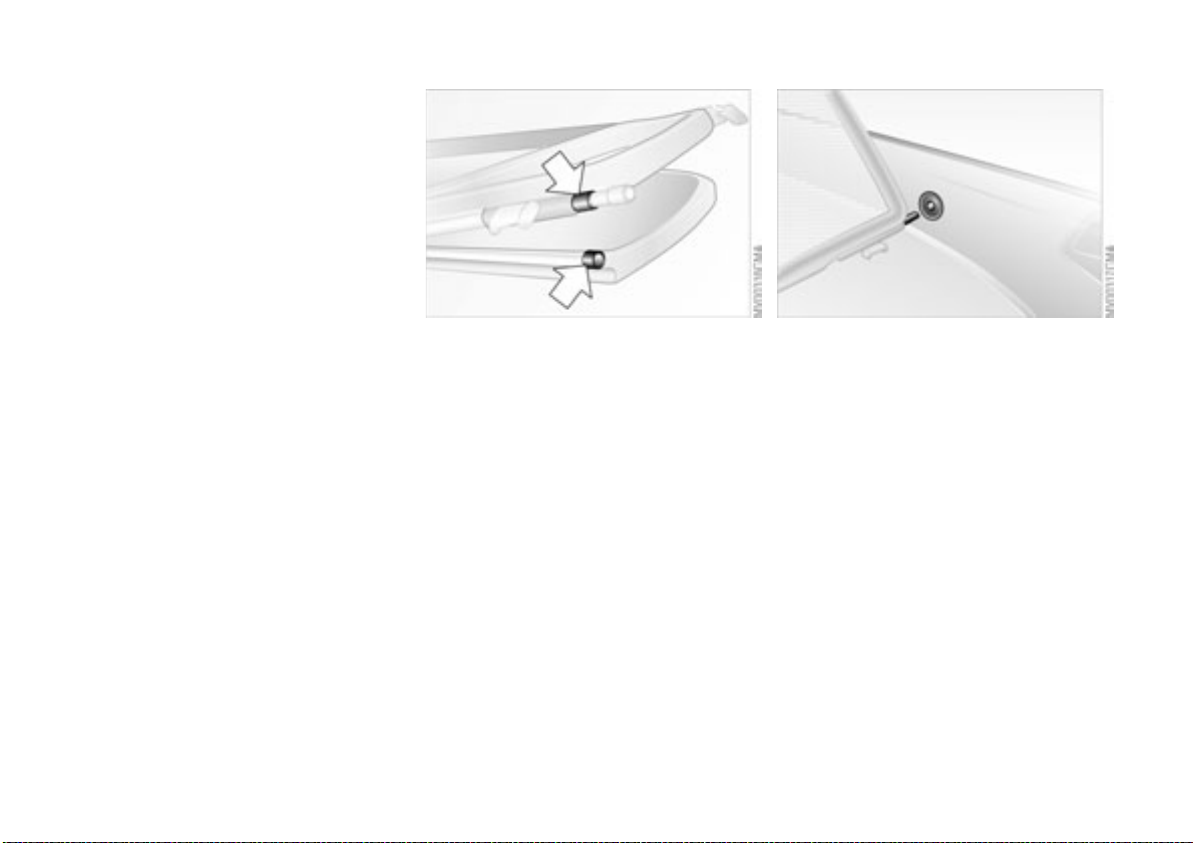
2. Flip out both sides and lock into
place. It is essential for the two com-
ponents marked in the illustration –
see arrows – to mesh at this point
3. Hold the wind deflector so that the
smaller half points toward the front
and guide the mounting pin for the
side piece into the proper opening
4. Pull back on the mounting pin for the
other side piece by using a slide, so
that the mounting pin can be guided
into the opening provided
5. Unlock the convertible top compart-
ment lid via the convertible top con-
trol button, refer to page 42, and
open the convertible top compart-
ment lid
6. Flip the back half of the wind deflec-
tor backward, so that the mounts are
lying on the vehicle
handbook.book Page 46 Tuesday, July 30, 2002 9:28 AM
Online Edition for Part-No. 01 41 0 156 854 - © 09/02 BMW AG

47
7. Close the convertible top compart-
ment lid via the convertible top con-
trol button. The wind deflector is now
attached so that it is theft-proof.
Operate the convertible top com-
partment lid from above only in
order to avoid any pinching.
With the wind deflector in place: never
push the front seats all the way back to
avoid damaging the wind deflector.<
Removal
Follow the same procedure as when
installing, just reverse the steps.
Wind deflector*
OverviewControlsMaintenanceRepairsDataIndex
handbook.book Page 47 Tuesday, July 30, 2002 9:28 AM
Online Edition for Part-No. 01 41 0 156 854 - © 09/02 BMW AG

48
To adjust
Safe seating position
For relaxed and fatigue-free driving you
should select a sitting position that
reflects your personal requirements. In
combination with the safety belts and
airbags, the correct seating position
plays an important role in enhancing
occupant safety in the event of an acci-
dent. To ensure that the vehicle's safety
systems provide you with optimal pro-
tection, we request that you direct your
careful attention to the following sec-
tion.
For supplementary information on
transporting children, refer to page 59.
Sitting safely with airbags
Always maintain an adequate dis-
tance between yourself and the
airbags. Always hold the steering wheel
by the rim to keep any chance of injury
to hands or arms to an absolute mini-
mum should the airbag be deployed.
Never allow any objects, individuals or
animals to obstruct the areas between
passengers and airbags. Never use the
front airbag's cover as a storage tray or
support for objects of any kind. Never
allow front passengers to rest their feet
or legs on the airbag cover.<
For airbag locations and additional
information on airbags, refer to
page 57.
Sitting safely with safety belts
Never allow more than one person
to wear a single safety belt. Never
allow infants or small children to ride in
a passenger's lap. Avoid twisting the
belt while routing it firmly across the
pelvis and shoulder, wear it as snugly
against your body as possible. Do not
allow the belt to rest against hard or
fragile objects in your pockets. Do not
route the belt across your neck, or run it
across sharp edges. Be sure that the
belt does not become caught or
jammed. Avoid wearing bulky clothing
and pull on the lap belt periodically to
retension it over your shoulders. In the
event of a frontal impact, a loose lap
belt could slide over the hips, leading to
abdominal injury. In addition, the safety
belt's restraint effectiveness is reduced
if the belt is worn loosely. Expectant
mothers should always wear their
safety belts, taking care to position the
lap belt against the lower hips, where it
will not exert pressure against the
abdominal area.<
For information on using the safety
belts, refer to page 52.
handbook.book Page 48 Tuesday, July 30, 2002 9:28 AM
Online Edition for Part-No. 01 41 0 156 854 - © 09/02 BMW AG
49
Seats
When adjusting your seat, always
observe the following precautions
Never try to adjust your seat while
operating the vehicle. The seat
could respond with an unexpected
movement, and the ensuing loss of
vehicle control could lead to an acci-
dent. Never ride with the backrest
reclined to an extreme horizontal angle
– important for front passengers to
remember. Keep the backrest relatively
upright to minimize the risk of sliding
under the safety belt and sustaining
injury in an accident.
With the wind deflector in place: never
push the front seats all the way back to
avoid damaging the wind deflector.<
Adjusting the seats
> Power seat adjustment, refer to
page 49
> Head restraint, refer to page 50
> Entering the rear, refer to page 51.
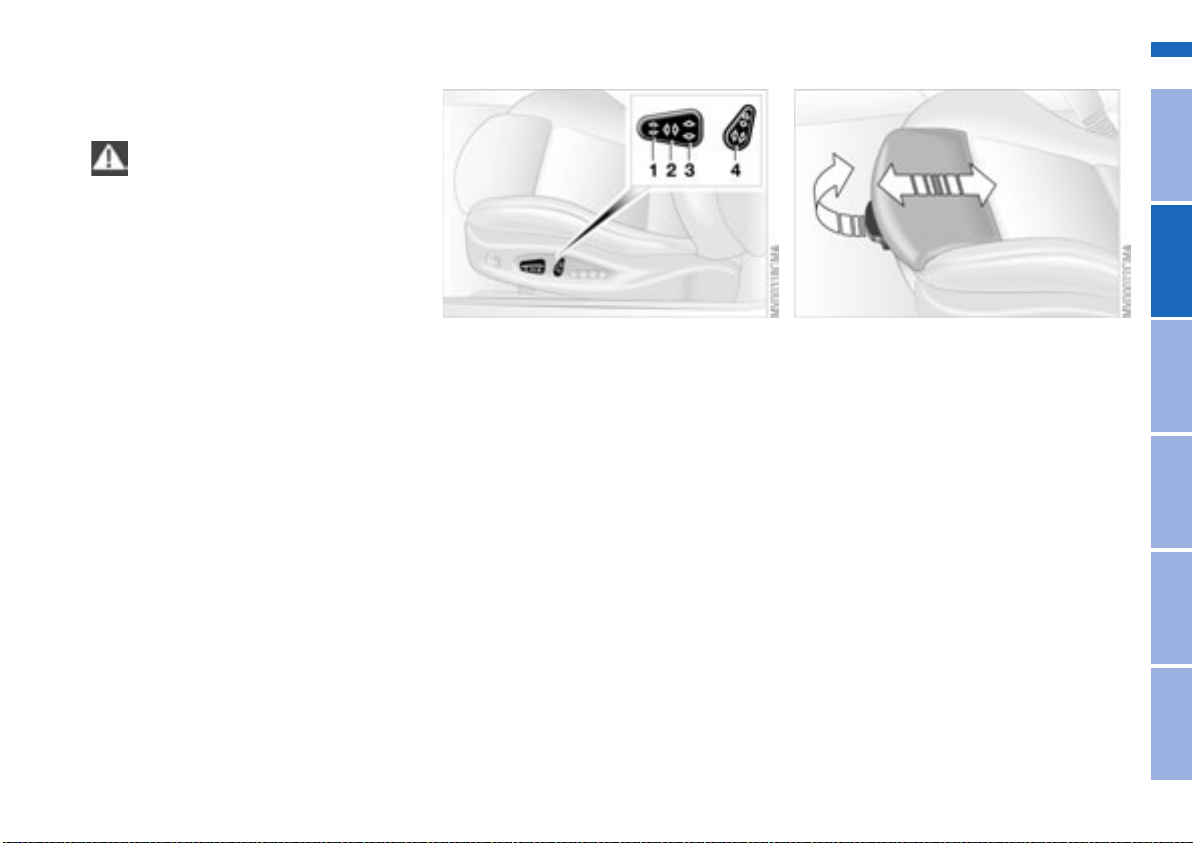
Power seat adjustment
Seat adjustment
1 Tilt angle
2 Forward/backward adjustment
3 Height
4 Backrest angle
You can manually adjust the thigh sup-
port.
Thigh support
Pull the lever and adjust the position of
the cushion for thigh support as
desired.
OverviewControlsMaintenanceRepairsDataIndex
handbook.book Page 49 Tuesday, July 30, 2002 9:28 AM
Online Edition for Part-No. 01 41 0 156 854 - © 09/02 BMW AG
50
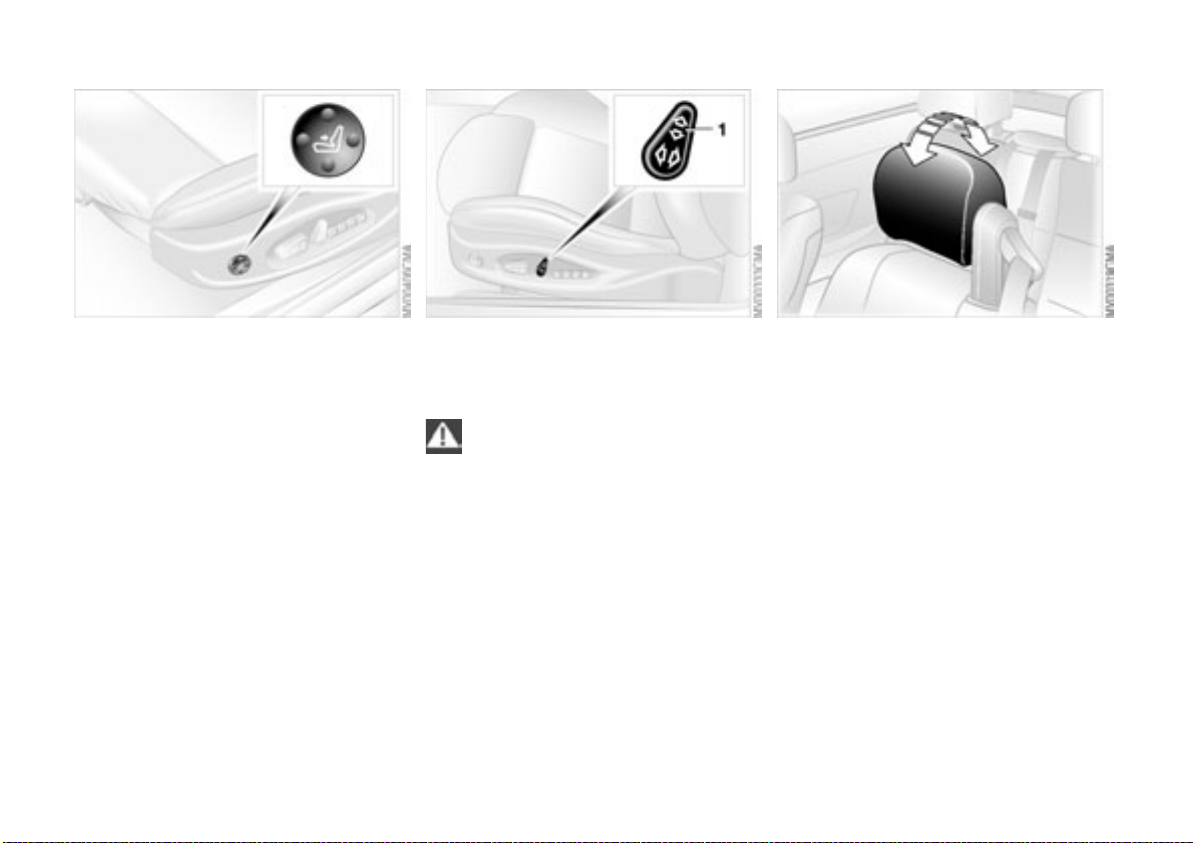
Adjusting the lumbar support*
You can adjust the backrest's contour
for additional support in the curvature
of your spine's lumbar region.
The upper hips and spinal column
receive supplementary support to help
you maintain a relaxed, upright position.
> Press the front/rear of switch:
increase/decrease curvature
> Press the upper/lower end of the
switch: increase the upper/lower cur-
vature.
Head restraints
Front head restraints
1 Height
Head restraints reduce the risk of
spinal injury in the event of an
accident.
Adjust the head restraint.
When moving the head restraints up or
down, do not grab on between the
head restraint and the upper edge of
the backrest to avoid the possibility of
injury.<
Tilt angle: position the head restraints
manually in the preferred position.
Power seat adjustment
handbook.book Page 50 Tuesday, July 30, 2002 9:28 AM
Online Edition for Part-No. 01 41 0 156 854 - © 09/02 BMW AG
51
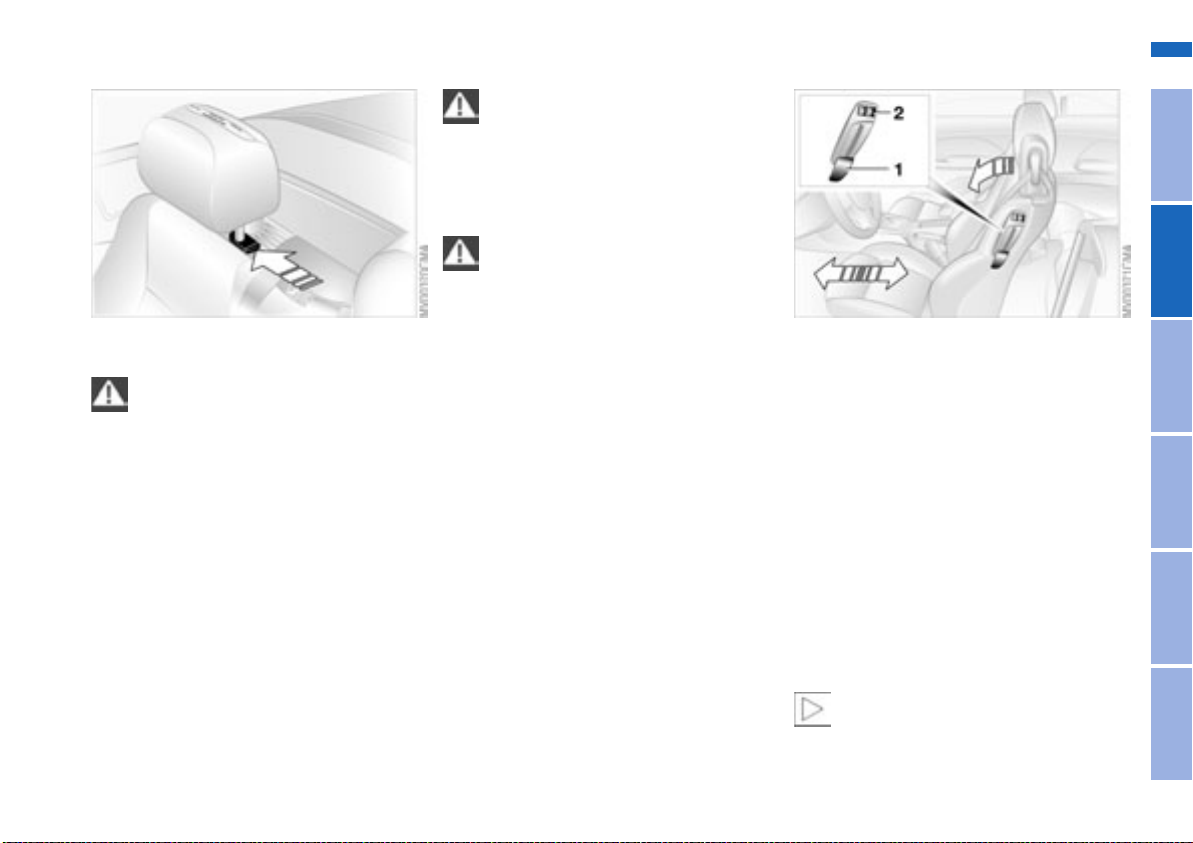
Rear head restraints
The rear head restraints may only
be lowered if there are no passen-
gers in the rear seats. If you do so, you
are in violation of the law. Raise the rear
head restraints before taking on any
passengers in the back.<
To completely lower the rear head
restraints:
1. Press the button – see arrow – and
hold it down
2. Push the head restraint down from
above.
Raising the rear head restraints
Raise the head restraints until you hear
them click into place.
Do not remove the rear head
restraints as this would damage
them.<
For further information, please consult
your BMW center.
Do not use the rear head
restraints as storage shelves.
Always keep the travel path for the roll-
over protection system free and clear.
Under no circumstances should you put
any kind of cover such as an antima-
cassar on the head restraints, refer also
to the labeling on the head restraints.<
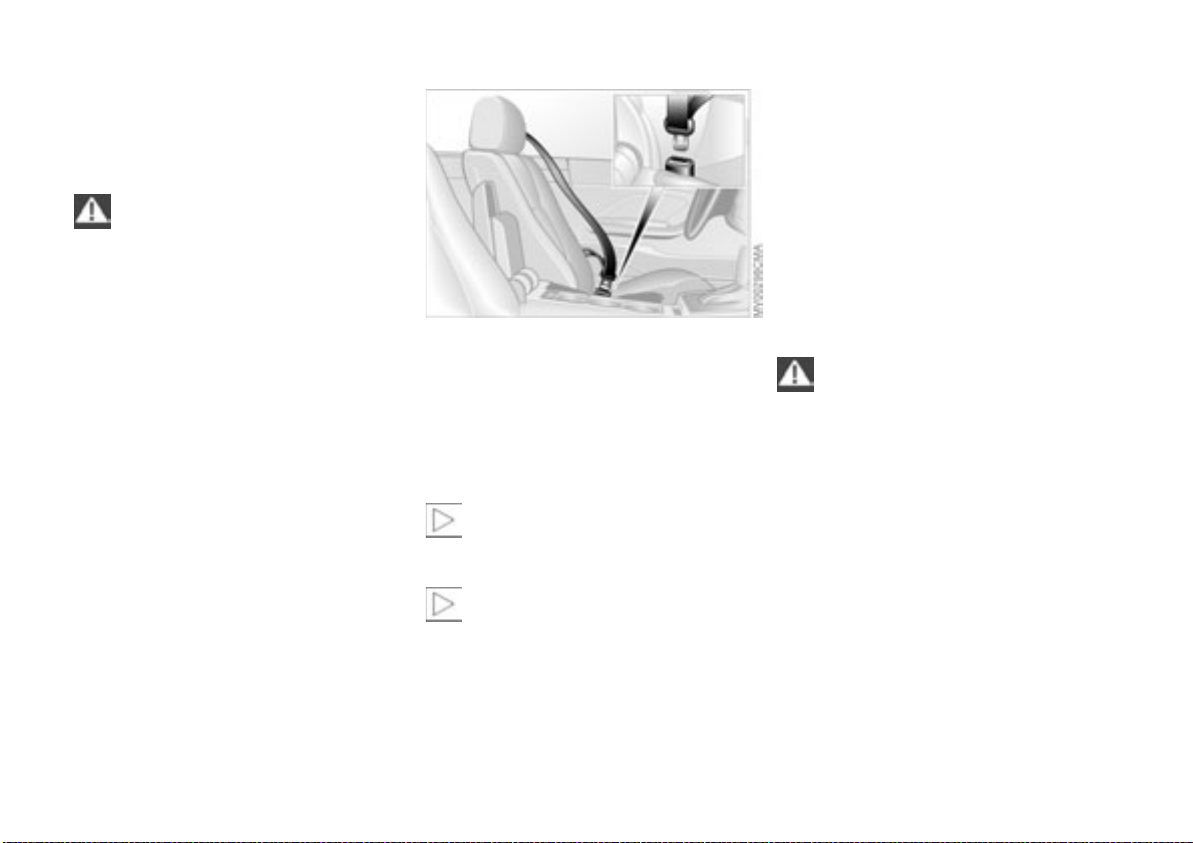
Entering the rear
The Seat-integrated safety belt system
(SGS) allows for easy access to the
rear.
1. Lift the lever 1 up and tilt the back-
rest forward
2. Press and hold button 2 in driving
direction until the seat moves to the
desired position
3. After entering the rear, fold back and
lock the backrest
4. Press button 2 opposite the direction
of travel and hold. The seat moves
back into its previous position. If the
button 2 is released beforehand, the
seat stops in the respective position.
The seat can be locked into posi-
tion when it is tilted forward. This
is particularly convenient when entering
the vehicle on an incline, for example.
Head restraints
OverviewControlsMaintenanceRepairsDataIndex
handbook.book Page 51 Tuesday, July 30, 2002 9:28 AM
Online Edition for Part-No. 01 41 0 156 854 - © 09/02 BMW AG
52
Press against the backrest until you
hear it snap into place. Lever 1 does
not have to be released to fold the seat
back.<
Lock both backrests while driving,
otherwise there is a danger of an
unexpected movement causing an
accident.<
The indicator lamp in the instrument
cluster flashes, when the backrest is
not locked, refer to page 18.
Safety belts
Always wear your safety belt
Always fasten your safety belt before
starting off. As supplemental restraint
devices, the airbags are designed to
enhance the effectiveness of the safety
belts, and not to replace them.
Before putting your safety belts on
in the rear, take them out of the
holder.<
Leave the rear safety belts in the
holders if they are not needed, in
order to avoid unwanted movement
from the safety belts at high speeds.<
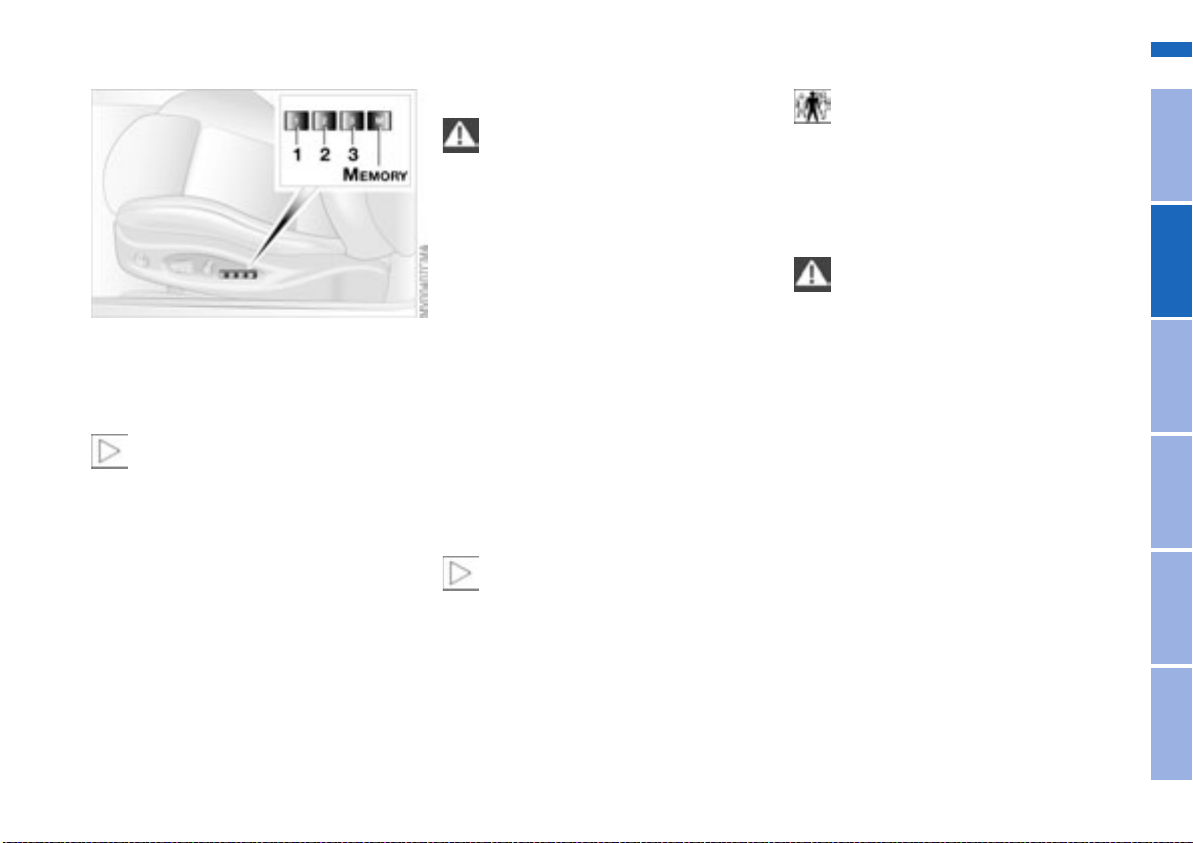
To close
Make sure you hear the lock engage in
the belt buckle.
To release
1. Press the red button in the belt
buckle
2. Hold the belt
3. Guide the belt back into its reel.
Adjusting safety belt height
The front safety belt automatically
adjusts your body size via the setting of
the head restraint height, refer to
page 50.
If the safety belt system has been
subjected to the stresses involved
in an accident or otherwise damaged:
have the entire safety belt mechanism
replaced by your BMW center, includ-
ing the safety belt tensioner. In addi-
tion, have your BMW center inspect the
safety belt anchors. If a child-restraint
system was in the vehicle during an
accident, consult the manufacturer's
instructions regarding replacement.<
Entering the rear
handbook.book Page 52 Tuesday, July 30, 2002 9:28 AM
Online Edition for Part-No. 01 41 0 156 854 - © 09/02 BMW AG
53
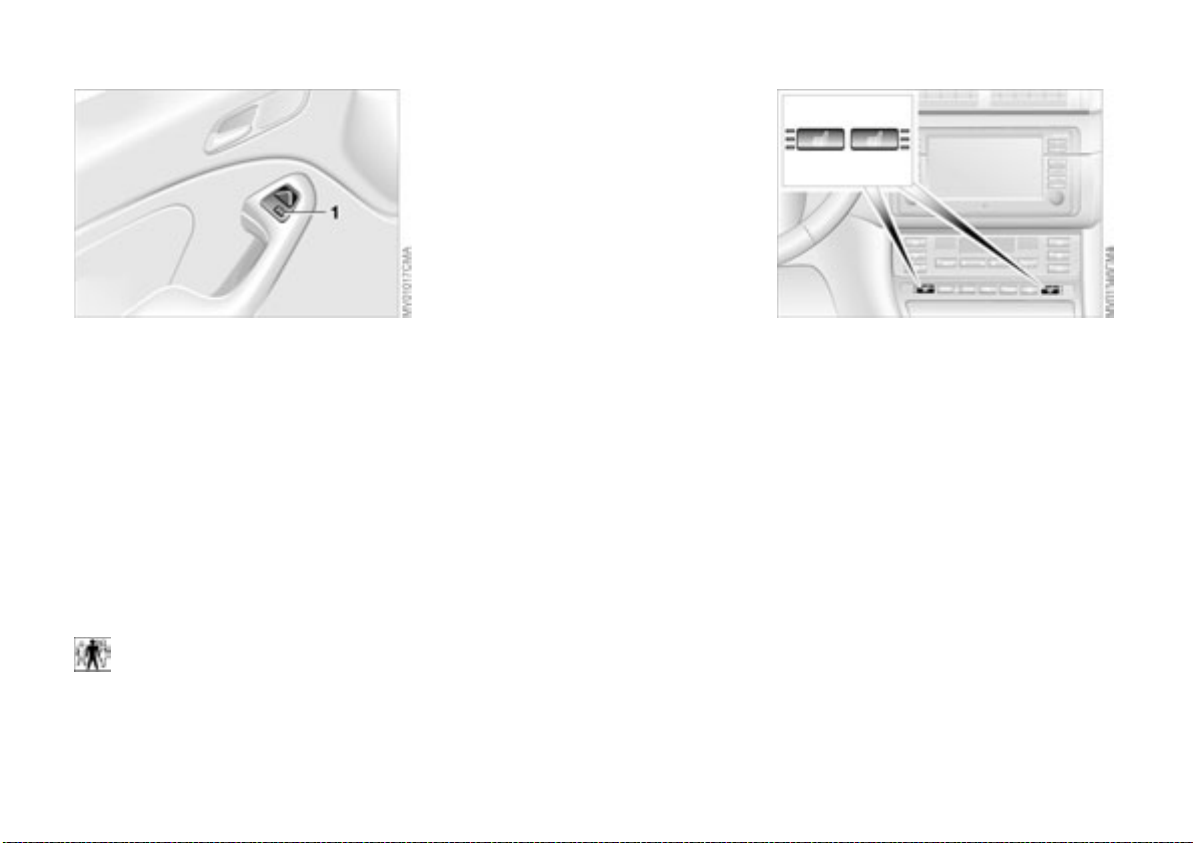
Seat and mirror memory
You can store and recall three different
driver's seat and outside mirror posi-
tions.
The setting for the lumbar support
is not stored in memory.<
To store
1. Ignition key in position 1 or 2
2. Adjust your seat and outside mirrors
to the desired position
3. Press the MEMORY button: the indi-
cator lamp in the button lights up
4. Press memory button 1, 2 or 3, as
desired. The indicator lamp goes out.
To select a stored setting
Do not select a memory position
while the vehicle is moving. If you
do so, there is a risk of accident from
unexpected seat movement.<
Driver's door open after unlocking or
ignition key in position 1:
> Briefly press memory button 1, 2 or 3,
as desired.
Movement stops immediately when
one of the seat-adjustment or mem-
ory buttons is operated during the
adjustment process.
With the driver's door closed and the
ignition key either removed or in posi-
tion 0 or 2:
> Press and hold the desired memory
button – 1, 2 or 3 – until the adjust-
ment process is completed.
If you press the MEMORY button
accidentally: press the button
again; the indicator lamp goes out.<
Your BMW center can adjust your
vehicle's systems in such a man-
ner that your personalized settings are
automatically set for the seat and exte-
rior mirror positions when you unlock
the vehicle with your personal remote
control.<
Before activating the programmed
adjustment feature, ensure that
the footwell behind the driver's seat is
empty and unobstructed. If you fail to
do so, any persons, animals or objects
behind the seat could be injured or
damaged by a rearward movement of
the seat.<
OverviewControlsMaintenanceRepairsDataIndex
handbook.book Page 53 Tuesday, July 30, 2002 9:28 AM
Online Edition for Part-No. 01 41 0 156 854 - © 09/02 BMW AG
54
Passenger-side exterior mirror tilt
function
Automatic curb monitor*
1. Move mirror selector switch 1 to the
driver's mirror position
2. When shifting into Reverse, or plac-
ing the selector lever in position R,
the passenger-side mirror tilts down-
ward. This brings the lower area
adjacent to the vehicle – curbs, etc. –
into the driver's field of vision while
parking.
How far the passenger mirror tilts
can be set individually for each
ignition key.<
You can deactivate this automatic fea-
ture by setting the mirror selection
switch to the passenger side position.
Seat heating*
The seat cushion and backrest can be
heated with the ignition key in
position 2.
You can call up different heating modes
by repeatedly pressing the buttons.
You can also switch the higher heating
modes off directly:
Press the button and hold it slightly
longer.
Seat and mirror memory
handbook.book Page 54 Tuesday, July 30, 2002 9:28 AM
Online Edition for Part-No. 01 41 0 156 854 - © 09/02 BMW AG
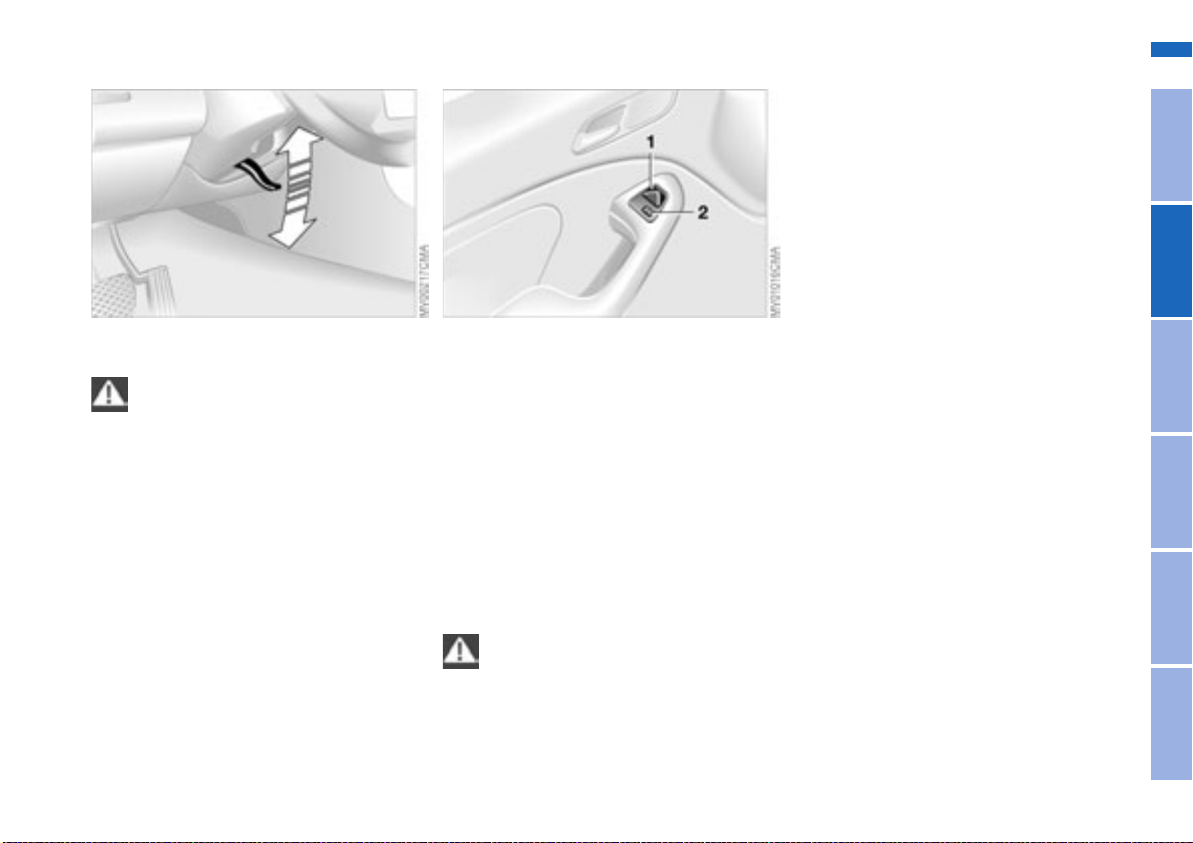
55
Steering wheel
To adjust
Never attempt to adjust the steer-
ing wheel while driving the vehicle
– it could respond with unexpected
movement, posing a potential accident
hazard.<
1. Push the locking lever downward
2. Adjusting steering column reach and
rake for your selected seating posi-
tion
3. Pull the lever back up.
Mirrors
To adjust exterior mirrors
1 Switch for 4-way adjustment
2 Selection switch for changing
between mirrors
To adjust manually
The mirrors can also be adjusted manu-
ally:
Press the edges of the lens.
To store the mirror setting, refer to Seat
and mirror memory on page 53.
The passenger-side mirror fea-
tures a convex lens. When esti-
mating the distance between yourself
and other traffic, bear in mind that the
objects reflected in the mirror are closer
than they appear. This means that esti-
mations of the distance to following
traffic should not be regarded as pre-
cise.<
Electric defrosting
Both mirrors are heated automatically in
ignition key position 2.
OverviewControlsMaintenanceRepairsDataIndex
handbook.book Page 55 Tuesday, July 30, 2002 9:28 AM
Online Edition for Part-No. 01 41 0 156 854 - © 09/02 BMW AG
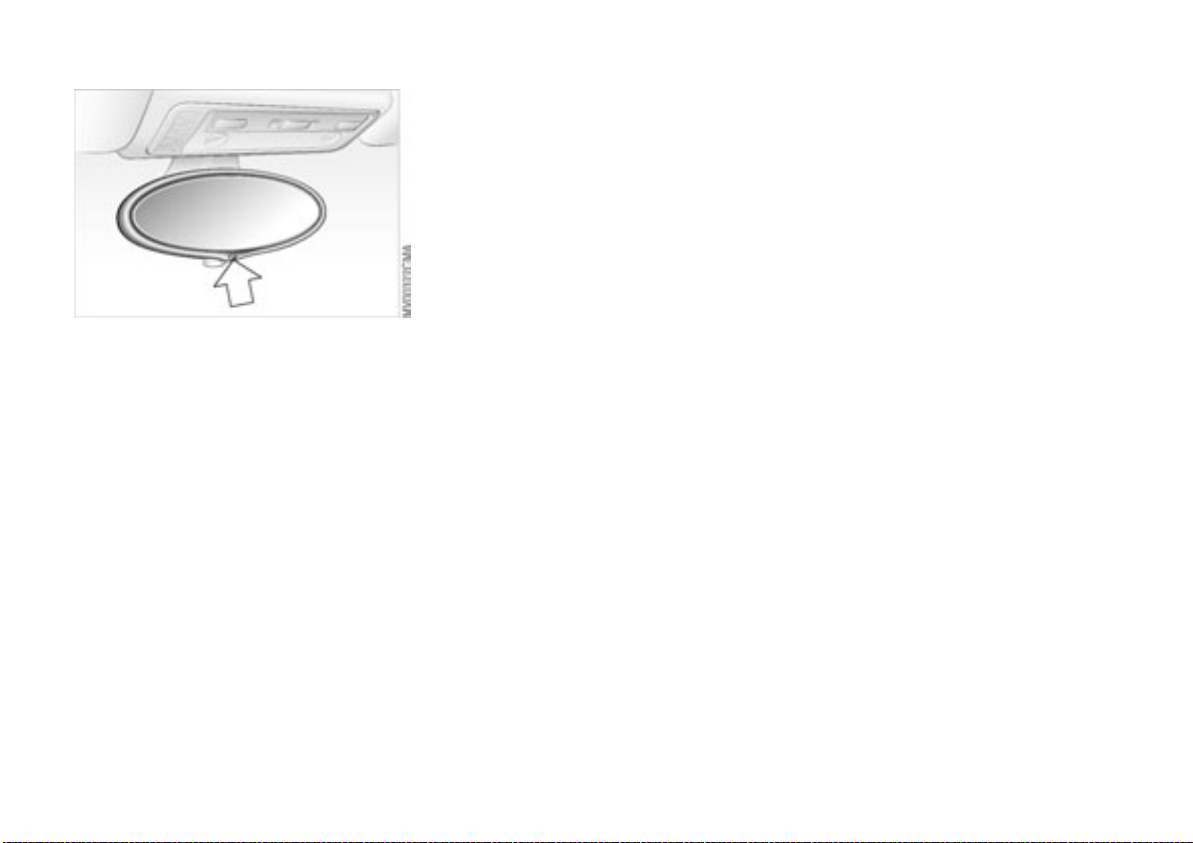
56
Interior rearview mirror with
automatic dimming feature
This mirror automatically dims through
an infinitely variable range and switches
automatically to its clear, undimmed
mode whenever you engage reverse
gear.
There are two photocells for automatic
dimming. One photocell – see arrow – is
positioned in the mirror's frame, while
the other is slightly offset on the oppo-
site side of the mirror.
For the mirror to function perfectly,
keep the photocells clean and the area
between the inside rearview mirror and
the windshield free of any obstruction
like stickers, etc.
Mirrors
handbook.book Page 56 Tuesday, July 30, 2002 9:28 AM
Online Edition for Part-No. 01 41 0 156 854 - © 09/02 BMW AG
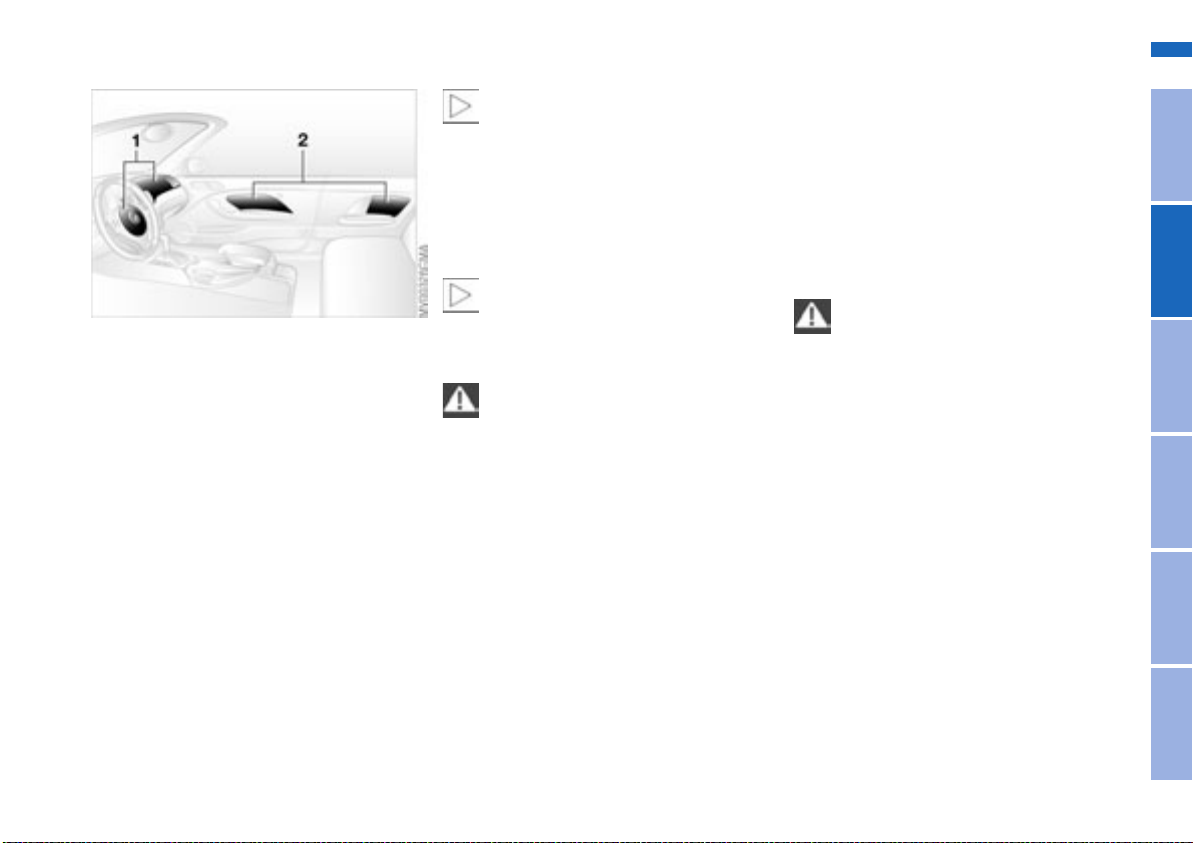
57
Passenger safety systems
Airbags
1 Front airbags on the driver and pas-
senger sides
2 Side airbags on the driver and pas-
senger sides – front and rear*
Protective effect
The front airbags protect the driver and
passenger in the event of a head-on
collision where the protection provided
by the safety belt alone would not be
adequate. The side airbags help pro-
vide protection in the event of a colli-
sion from the side. Each of the side air-
bags is designed to help support the
seat occupant's upper body.
For information on the correct sitting
position, refer to page 48.
The side airbags in the rear pas-
senger area* of your vehicle may
already have been deactivated either at
the time of manufacture or by a BMW
center. You may have them activated if
you desire to do so. Please contact
your BMW center for additional infor-
mation.<
The airbags will not be triggered in
the event of a minor accident, cer-
tain vehicle rollover situations or colli-
sions from the rear.<
Do not apply adhesive materials to
the cover panels of the airbags,
cover them or modify them in any other
way. Do not attempt to remove the air-
bag restraint system from the vehicle. In
the event of a malfunction, deactivation
or triggered activation – as a response
to an accident – of the airbag restraint
system, consult your BMW center for
inspection, repair or disassembly. Mod-
ifications may not be made on either
the wiring or the individual components
in the airbag system. This includes the
upholstered covers on the steering
wheel, the instrument panel, the side
trim panels of the doors and front roof
pillars and on the sides of the front
headliner. Do not attempt to remove or
dismantle the steering wheel. Unpro-
fessional attempts to service the sys-
tem could lead to failure in an emer-
gency or undesired airbag activation,
either of which could result in personal
injury. Do not touch the individual com-
ponents directly after the system has
been triggered, as otherwise there is a
danger of burns.<
At all times, occupants should sit
upright and be properly restrained
– infants and small children in appropri-
ate child-restraint systems; larger chil-
dren and adults using the safety belts.
Never let an occupant's head rest near
or on a side airbag because the inflating
airbag could cause a serious or fatal
injury. Please note that the word Airbag
imprinted on the door trim panel indi-
cates the airbag's location.
Accident research shows that the saf-
est place for children in an automobile
is in the rear seat. However, a child sit-
ting in the rear seat and not properly
restrained may place his or her head on
or near the side airbag, if so equipped.
For example, a child – even though
belted – may fall asleep with his or her
head against the side airbag. It may be
difficult for a driver to ensure that chil-
dren in the rear seat will remain prop-
OverviewControlsMaintenanceRepairsDataIndex
handbook.book Page 57 Tuesday, July 30, 2002 9:28 AM
Online Edition for Part-No. 01 41 0 156 854 - © 09/02 BMW AG
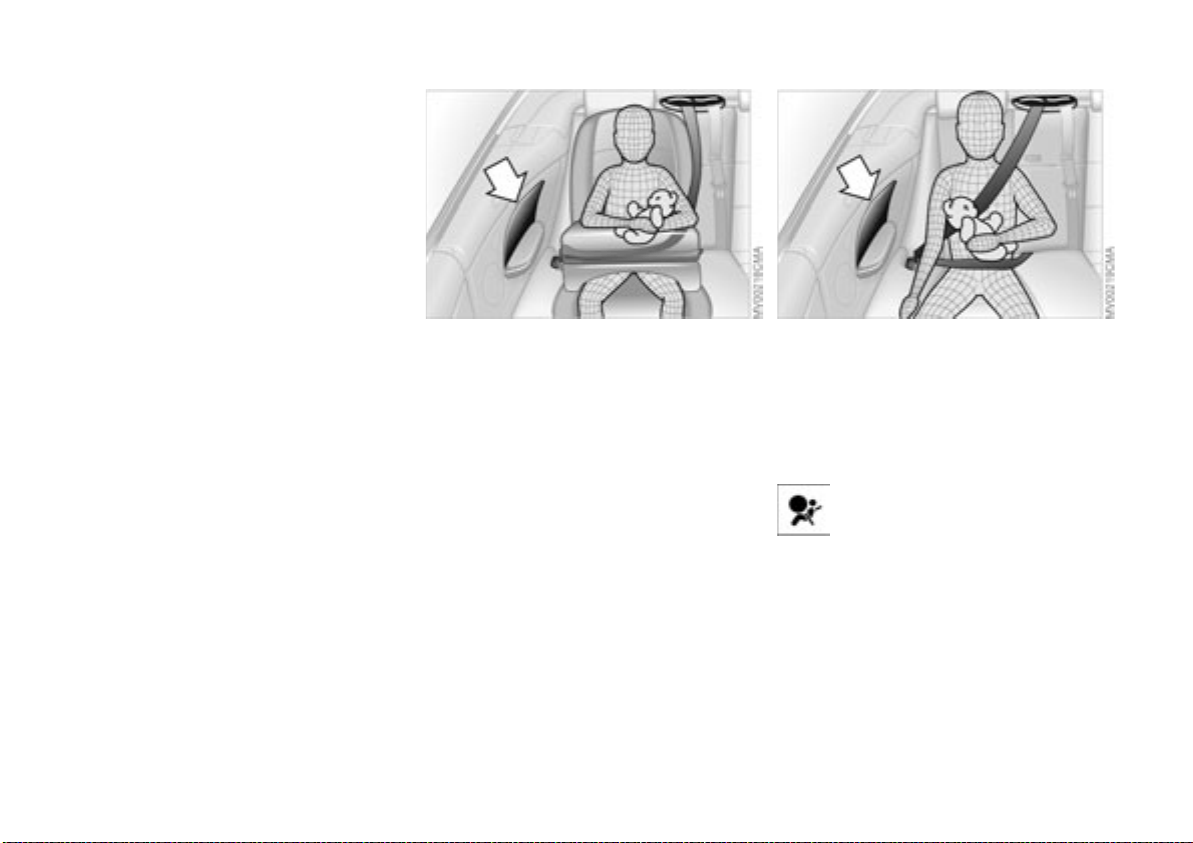
58
erly positioned at all times and not
place their heads on or near the side
airbag. Therefore, we recommend that
the rear seat side airbags, if provided,
be deactivated if you plan to transport
children in the rear seat.
The rear seat side airbags may already
have been deactivated, either at the
time of manufacture or by a BMW cen-
ter. Labels in the door opening should
indicate the status of your rear-seat
side airbags. If you are uncertain of
their status, or wish to have the airbags
activated or deactivated, please con-
tact your BMW center.<
Even when all these guidelines are
observed, there is still a small residual
risk of injuries to the face, hands and
arms occurring from airbag deployment
in isolated instances.
The ignition and inflation noise may
provoke a mild temporary hearing loss
in extremely sensitive individuals.
Airbag warning information is also pro-
vided on the sun visors.
This is the right way a child should sit in
a child-restraint when rear side airbags,
see arrow, are provided.
This is the right way a larger child
should sit wearing the seat belt when
rear side airbags, see arrow, are pro-
vided.
Indicator lamp
The indicator lamp indicates the
operational status of the airbag
system when the ignition key is
in position 1 or higher.
System operational:
> The indicator lamp comes on briefly
when the ignition key is turned to
position 1 or higher.
System malfunction:
> Indicator lamp does not come on or
> indicator lamp lights up continuously.
Airbags
handbook.book Page 58 Tuesday, July 30, 2002 9:28 AM
Online Edition for Part-No. 01 41 0 156 854 - © 09/02 BMW AG
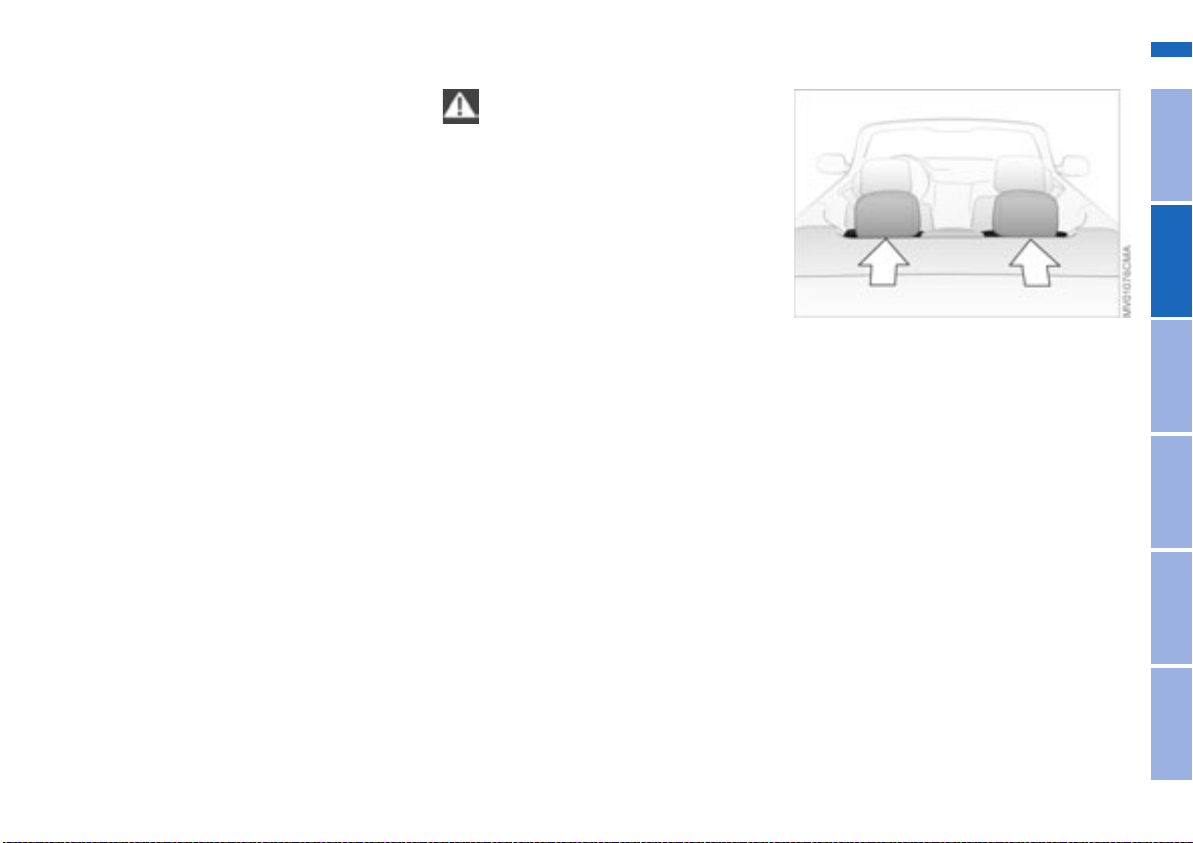
59
If there is a system malfunction, there is
a risk that the airbags will not be trig-
gered within their normal response
range, even if the level of impact would
normally have triggered them.
Have your BMW center inspect the sys-
tem immediately.
Transporting children safely
Leave the rear safety belts in the
holders if they are not needed to
avoid unwanted movement from the
safety belts at high speeds.<
Commercially available child seats
complying with the legal standard are
designed to be secured with a seat belt
or with the seat belt portion of a combi-
nation lap/shoulder belt. Improperly or
inadequately installed restraint sys-
tems can increase the risk of injury to
children. Always read and follow the
instructions that come with the system.
Child-restraint system with tether
strap
If you use a child-restraint system with
a tether strap, two additional tether
anchorage points have been provided –
refer to the arrows in the illustration.
Airbags
OverviewControlsMaintenanceRepairsDataIndex
handbook.book Page 59 Tuesday, July 30, 2002 9:28 AM
Online Edition for Part-No. 01 41 0 156 854 - © 09/02 BMW AG
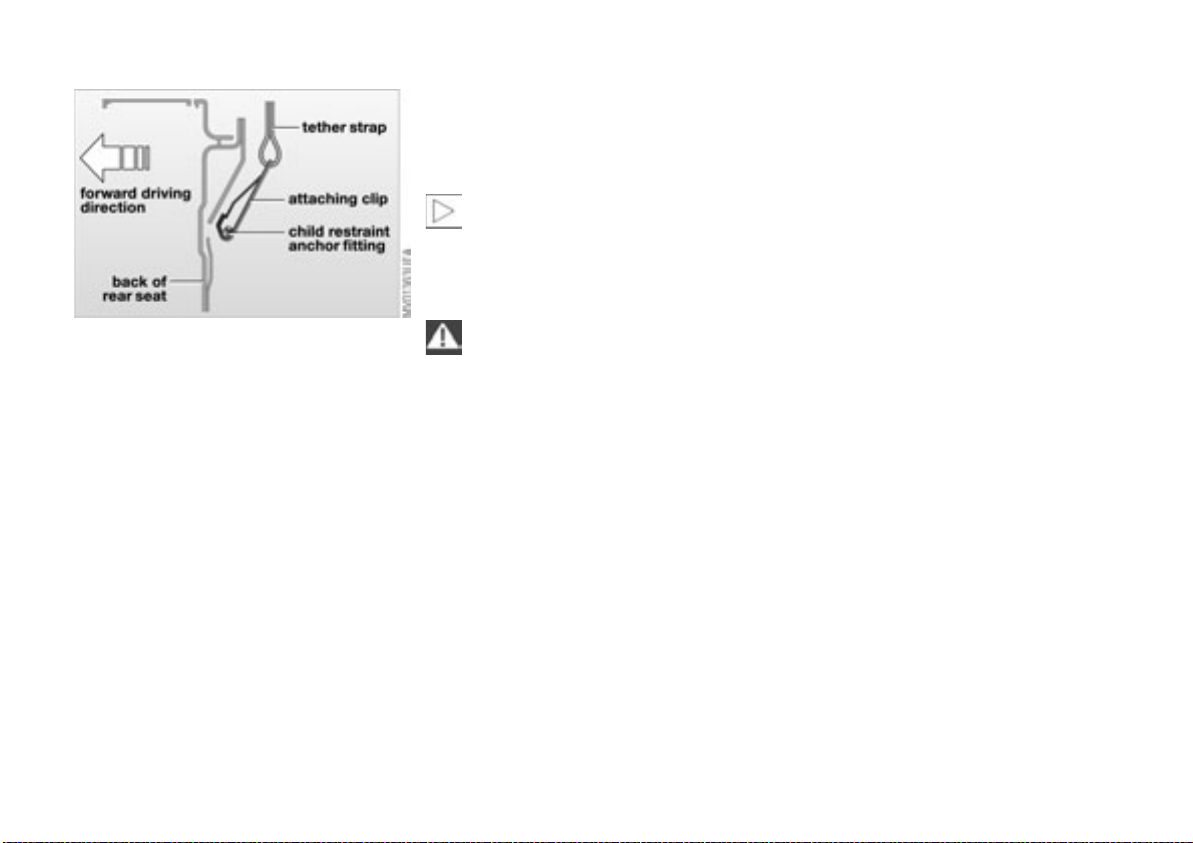
60
Depending on the location selected for
seating in the rear passenger area,
attach the tether strap to the corre-
sponding anchorage point to secure the
child-restraint system, as shown in the
illustration.
1. Open the convertible top compart-
ment lid, refer to page 41
2. Lift the headrest and pass the tether
strap between the headrest and the
seat back. It is recommended that
you return the head restraint back to
its lowest possible position
3. Adjust the tether strap according to
the child-restraint manufacturer's
instructions
4. Close the convertible top compart-
ment panel.
It is recommended to cover the child-
restraint attaching clip with a soft mate-
rial to prevent damage to the stored
soft top.
Should a hard top be installed, the
fitting of child harness tether
strap/s – if child seat is required – is
necessary before installation of the
hard top.<
Before installing any child-
restraint device or child seat,
please read the following:
Never install a rearward-facing child-
restraint system in the front passenger
seat of this vehicle.
Your vehicle is equipped with an airbag
supplemental restraint system for the
front passenger. Because the backrest
on any rear-facing child-restraint sys-
tem – of the kind designed for infants
under 1 year and 20 lbs/9 kg – would
be within the airbag's deployment
range, you should never mount such a
device in the front passenger seat, as
the impact of the airbag against the
child-restraint's backrest could lead to
serious or fatal injuries.
If it is necessary for a child – not an
infant – to ride in the front seat, certain
precautions should be taken. First,
move the passenger seat as far away
from the instrument panel as possible.
This important precaution is intended to
maximize the distance between the air-
bag and the child. Older children
Transporting children safely
handbook.book Page 60 Tuesday, July 30, 2002 9:28 AM
Online Edition for Part-No. 01 41 0 156 854 - © 09/02 BMW AG
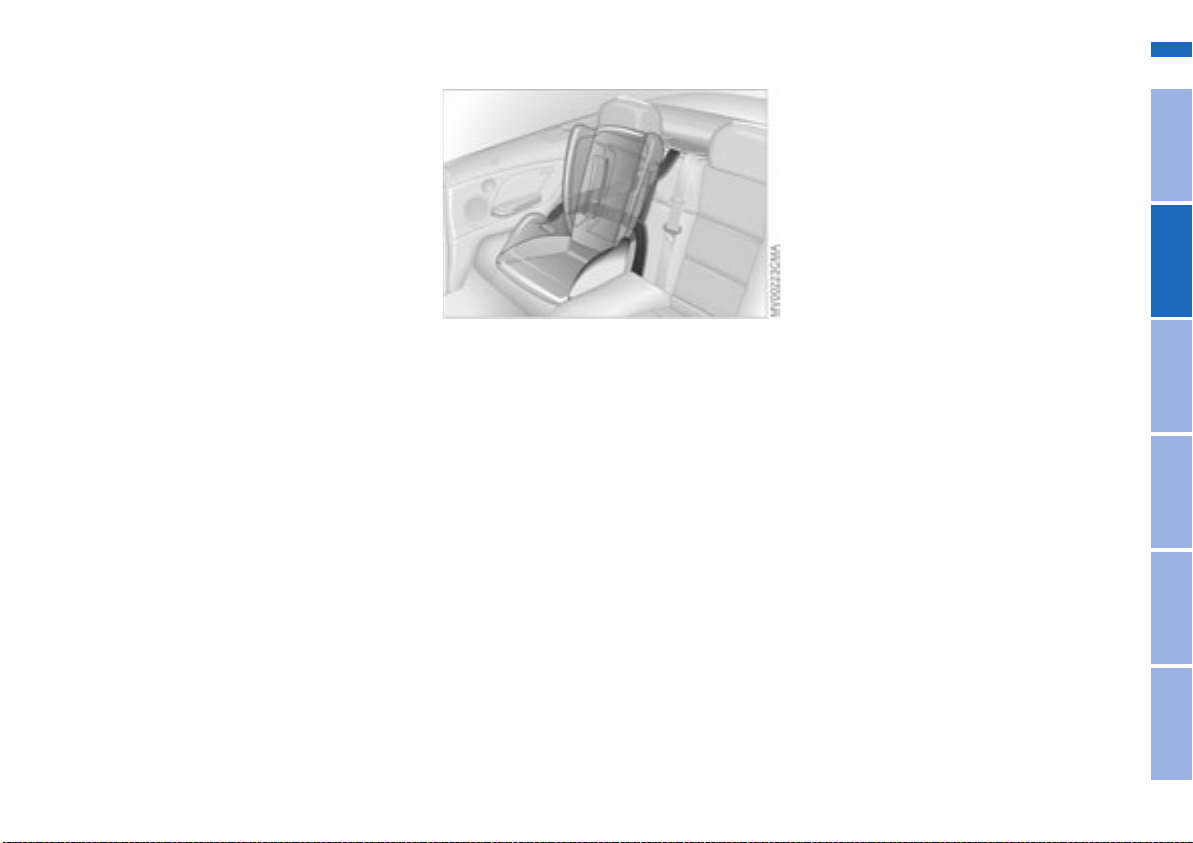
61
should be tightly secured with the
safety belt after they have outgrown a
booster seat that is appropriate for their
age, height, and weight.
Younger children should be secured in
an appropriate forward-facing child-
restraint system that has first been
properly secured with a safety belt.
Never install a rearward-facing child-
restraint system in the front passenger
seat.
We strongly urge you to carefully read
and comply with the instructions for
installation and use provided by the
child-restraint's manufacturer whenever
you use such a device.
Do not attempt to modify child-restraint
systems. If you do this, the protection
provided by these systems could be
impaired.
Be sure that all occupants – of all ages –
remain properly and securely restrained
at all times.<
All rear seating positions in your vehicle
meet the recommendations of
SAE J1819, an industry-recommended
practice for securing child-restraint sys-
tems in motor vehicles.
Securing child-restraint system
All of the rear belt retractors and the
front passenger's safety belt can be
locked for mounting and securing child-
restraint systems.
A label with the appropriate instructions
for this is located in the immediate
vicinity of the buckle latch of each
safety belt.
To lock the safety belt
Extract the entire length of the belt from
the inertia reel mechanism. Allow the
reel to retract the belt somewhat and
engage the buckle, then tighten the belt
against the child-restraint system. The
retraction mechanism is now locked.
The belt cannot be extracted further.
Always observe the installation instruc-
tions provided by the manufacturer of
the child-restraint system.
To unlock the safety belt
Release the safety belt, remove the
child seat and retract the safety belt to
its end position on the belt retractor.
Transporting children safely
OverviewControlsMaintenanceRepairsDataIndex
handbook.book Page 61 Tuesday, July 30, 2002 9:28 AM
Online Edition for Part-No. 01 41 0 156 854 - © 09/02 BMW AG
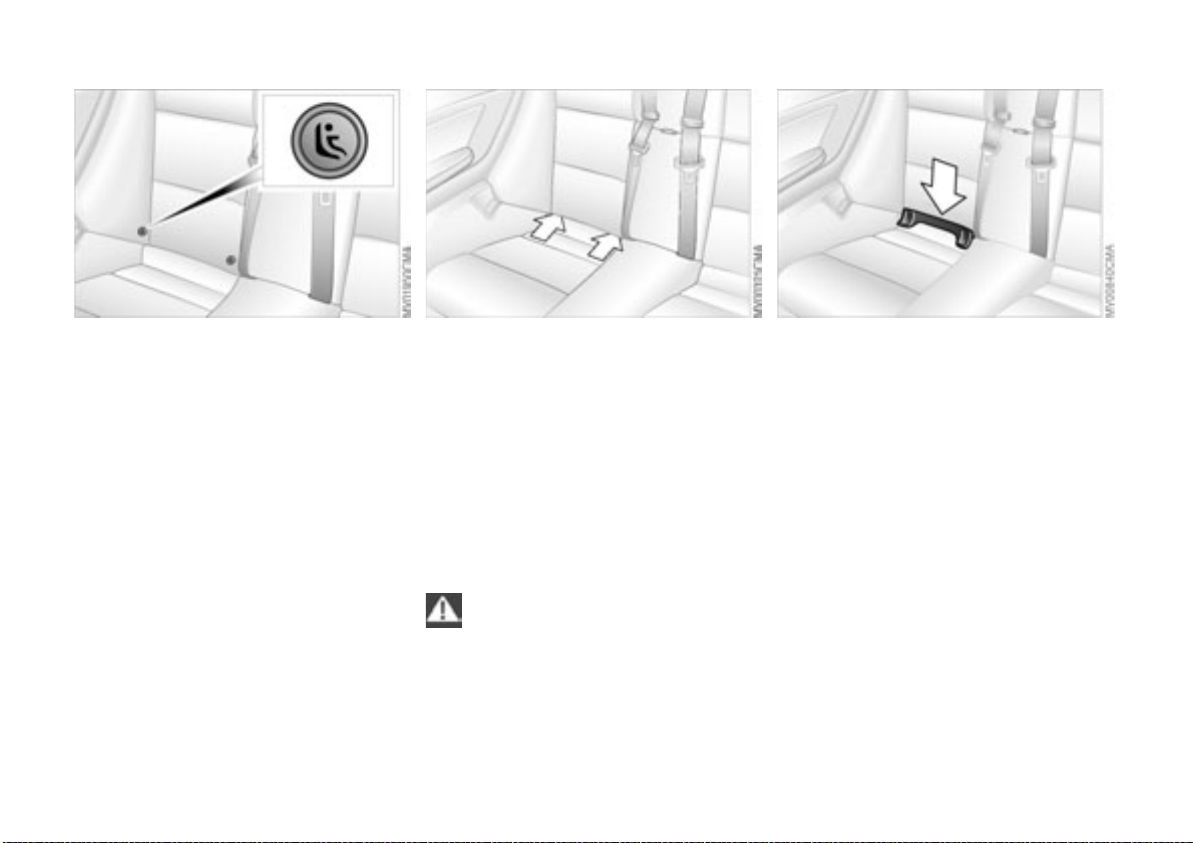
62
LATCH child-restraint mounting
system
LATCH: Lower Anchors and Tether for
CHildren
Canadian models only:
The LATCH anchorage points are iden-
tified by buttons.
The left and right rear seats are both
equipped with a LATCH child-restraint
mounting system.
The anchorage points for the LATCH
child-restraint system installation are
located behind the upholstery at the
positions indicated by the arrows.
Carefully slide the brackets through the
gaps in the upholstery at the indicated
locations.
Always follow all manufacturer's
instructions and observe all safety
precautions when installing the LATCH
child-restraint mounting system.
Leave the rear safety belts in the hold-
ers if they are not needed to avoid
unwanted movement from the safety
belts at high speeds.<
To prevent damage to the upholstery,
you can purchase an insertion aid* from
your BMW center.
Firmly press the insertion aid into the
gap between the seat cushion and
backrest, continuing until the two
guides snap into place on the LATCH
brackets in the seat.
The illustration is an example showing
the anchorages for a LATCH child-
restraint system on the right rear seat.
Transporting children safely
handbook.book Page 62 Tuesday, July 30, 2002 9:28 AM
Online Edition for Part-No. 01 41 0 156 854 - © 09/02 BMW AG
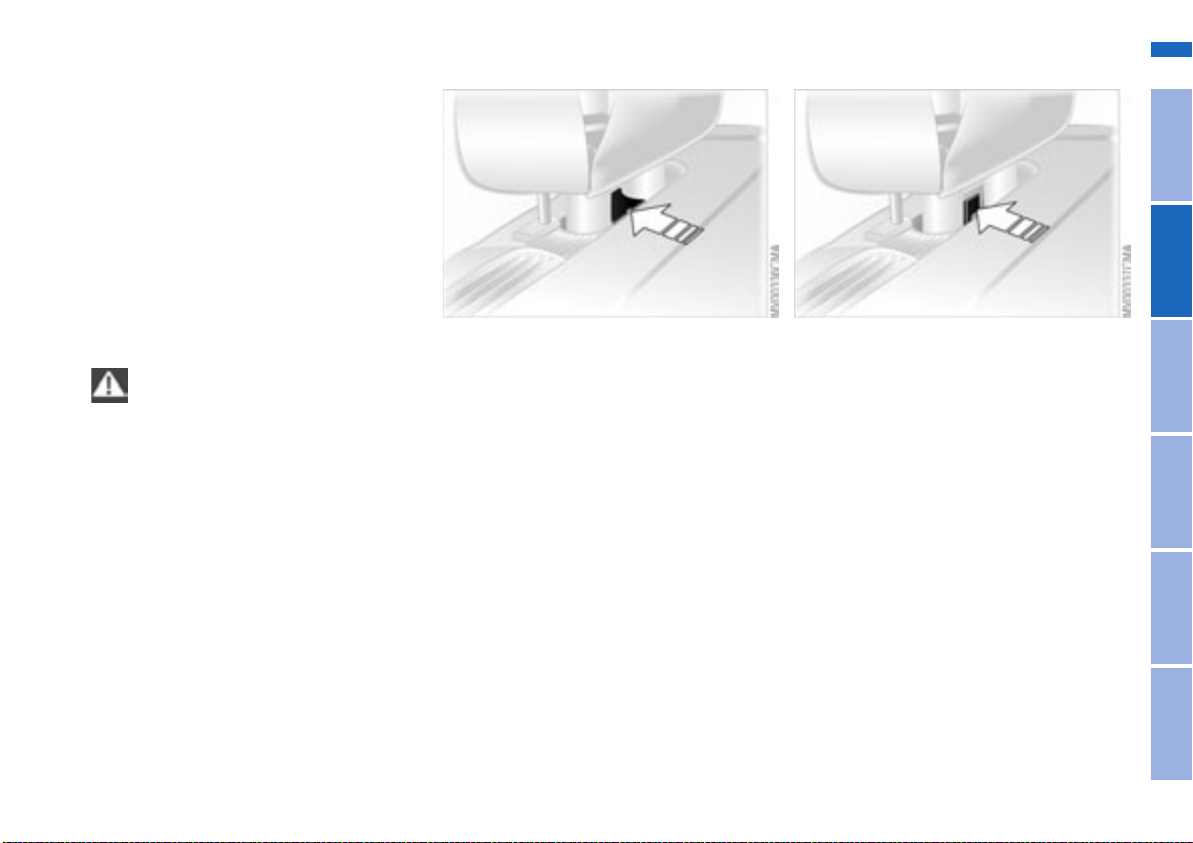
63
Rollover protection system
In the event of an accident or some
other critical driving situation – extreme
tilting in the longitudinal or transverse
axis, loss of contact with the ground –
the rollover protection system will be
automatically activated. The protective
bars located in the rear head restraints
extend within fractions of a second.
In addition to the integrated rollover bar
in the windshield frame, the rollover
protection system affords all the vehicle
occupants necessary headroom.
Always keep the travel path for the
rollover protection system free
and clear. Under no circumstances
should you cover the head restraints.
In the event of less serious accidents,
the safety belt will protect you and,
depending on the severity of the acci-
dent, so will the safety belt tensioner
and the multi-stage airbag restraint sys-
tem as well.<
If, after being automatically triggered,
the protective function is not needed,
then the rollover protection system can
be lowered back into place. No special
tool is needed for this.
1. Using a screwdriver from the on-
board tool kit, remove the cover
panel; to do this, position the screw-
driver under the notch – see arrow
2. Pull up on the lever toward the front
of the vehicle – see arrow – and keep
it in this position
OverviewControlsMaintenanceRepairsDataIndex
handbook.book Page 63 Tuesday, July 30, 2002 9:28 AM
Online Edition for Part-No. 01 41 0 156 854 - © 09/02 BMW AG
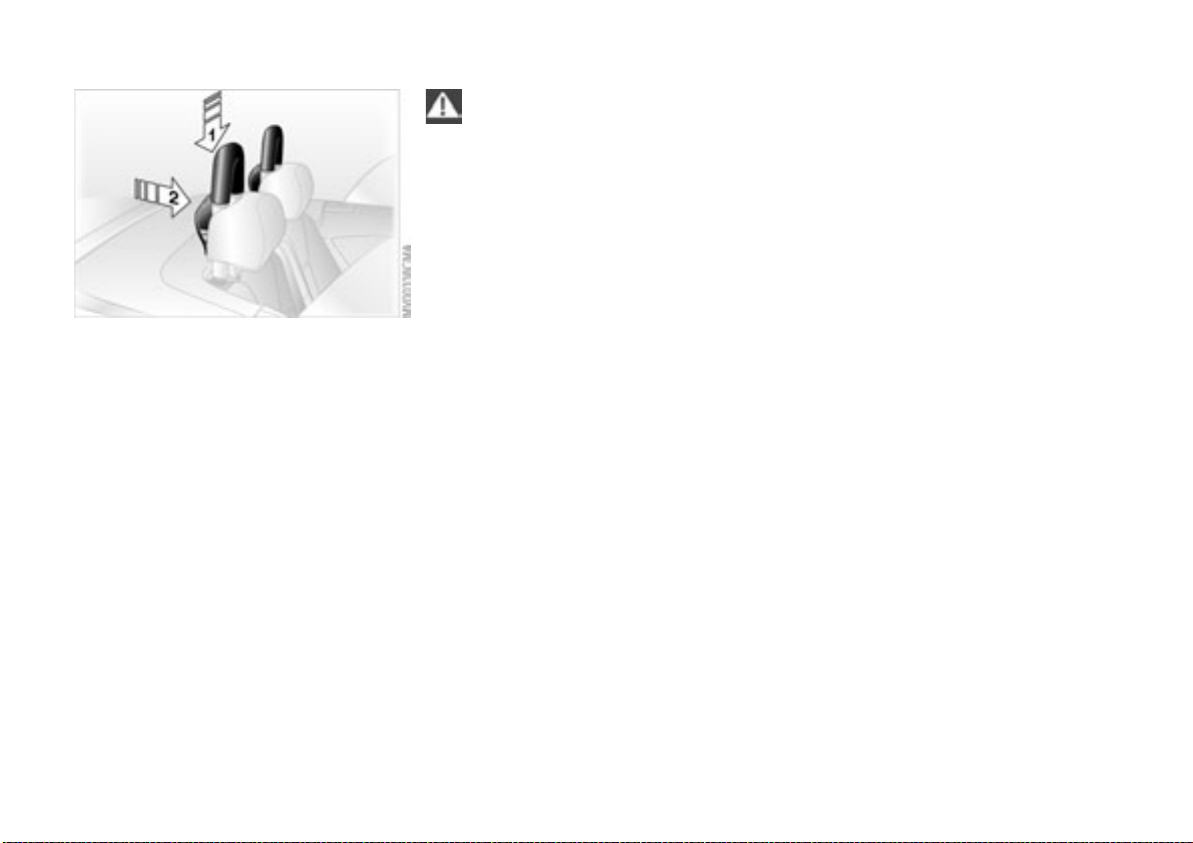
64
3. Keep pressing down on the protec-
tive bar from on top – see arrow 1 –
until you hear it click into place
4. Put the cover panel back in place
and press down firmly
5. Push the back panel of the head
restraint closed – see arrow 2.
Do the same for the second protective
bar. If you are not familiar with any of
the procedures, consult your BMW
center.
Have the rollover protection system
checked out by your BMW center after
it has been inadvertently triggered.
Do not move the convertible top
under any circumstances if the
rollover protection system has
extended.
Do not use the rear head restraints as
storage shelves.
Absolutely no modifications are to be
made to any of the rollover protection
system's individual components or any
of its wiring.
Only your BMW center is to carry out
any work on the rollover protection sys-
tem.
Work done on the system that is carried
out improperly could lead to failure in
an emergency or accidental airbag acti-
vation.
Regarding having the system checked
to ensure long-term operation: be scru-
pulous in adhering to the Service Inter-
val Display for maintenance intervals.
Every two years at the latest, the roll-
over protection system must be
inspected by a BMW center.<
Rollover protection system
handbook.book Page 64 Tuesday, July 30, 2002 9:28 AM
Online Edition for Part-No. 01 41 0 156 854 - © 09/02 BMW AG
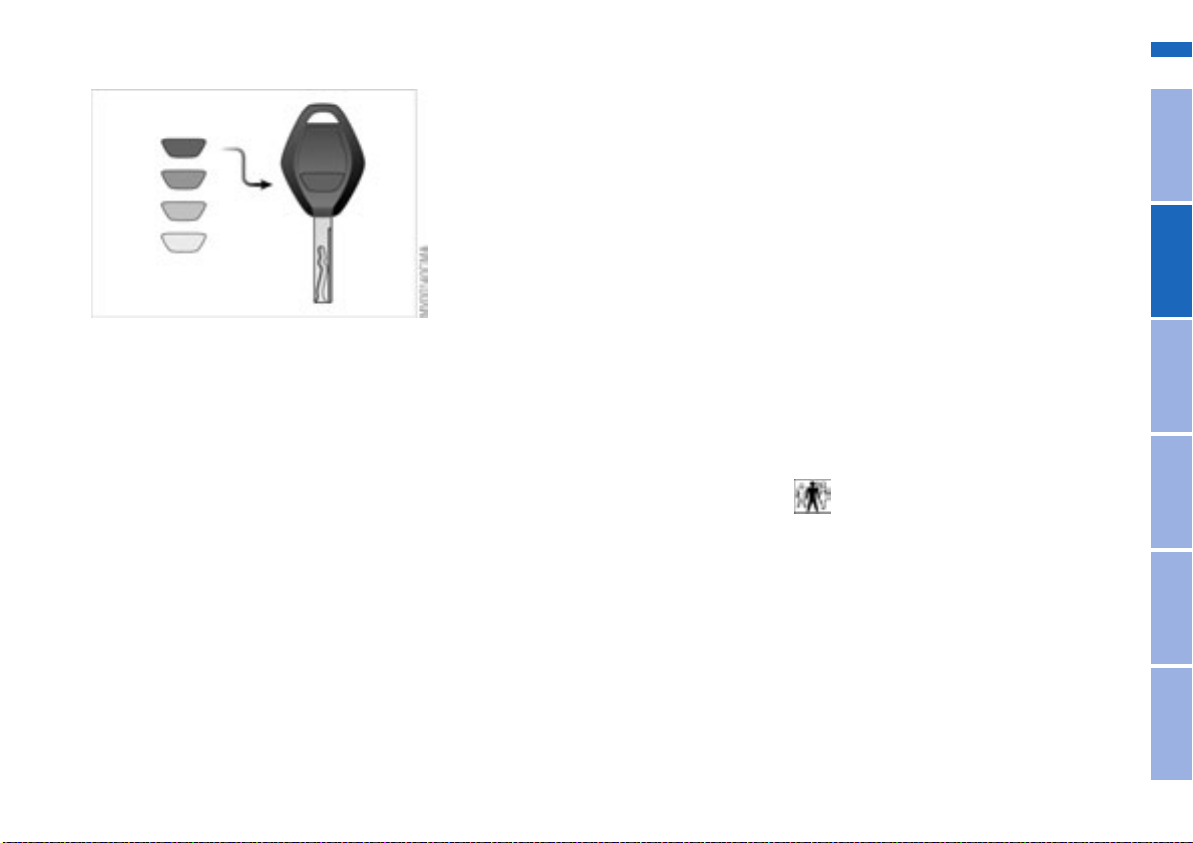
65
Vehicle Memory, Key Memory
How the system functions
You have probably frequently wished
that you could configure individual
functions of your vehicles to reflect your
own personal requirements. In engi-
neering your vehicle, BMW has pro-
vided for a number of options for per-
sonal adjustment that can be
programmed into your vehicle at your
BMW center.
The available configuration data fall into
two categories, according to whether
their primary orientation is the vehicle –
Vehicle Memory – or the individual –
Key Memory. You can have up to four
different basic settings adjusted for four
different persons. The only require-
ment is that each person uses his or her
own remote control key.
When your vehicle is unlocked with the
remote control, the vehicle recognizes
the individual user by means of a data
exchange with the key, and makes
adjustments accordingly.
In order for you to distinguish between
different keys, colored decals are sup-
plied together with the keys.
What the system can do
Your BMW center can provide you with
details on the possibilities that the Vehi-
cle and Key Memory systems offer.
Examples for Vehicle Memory:
> Various signals that can serve as
acknowledgment for locking and
unlocking the vehicle, refer to
page 31
> Activates/deactivates the Follow me
home lamps function, refer to
page 92
> Activates/deactivates daytime driv-
ing lamps, refer to page 92
> Sets the units of measure for display-
ing time, outside temperature, dis-
tance traveled and fuel consumption
in the instrument cluster.
> Indicates via an acoustic tone that
PDC has been activated, refer to
page 86
> Switches on rear window defroster
automatically, refer to page 99
> After giving an ice warning, the dis-
play returns to the previous setting,
refer to page 84.
Examples for Key Memory:
> Locks the vehicle automatically after
you start off, refer to page 34
> Automatically moves the seat and
outside mirror into position for the
programmed driver when unlocking
the vehicle, refer to page 53
> Automatic tilting of the passenger-
side mirror, refer to page 54
> After the engine is started, calls up
the last selected driving program for
each shifting mode, refer to page 74.
You will see this symbol through-
out the Owner's Manual. It is to
remind you at appropriate places of the
settings that are available to you.<
OverviewControlsMaintenanceRepairsDataIndex
handbook.book Page 65 Tuesday, July 30, 2002 9:28 AM
Online Edition for Part-No. 01 41 0 156 854 - © 09/02 BMW AG
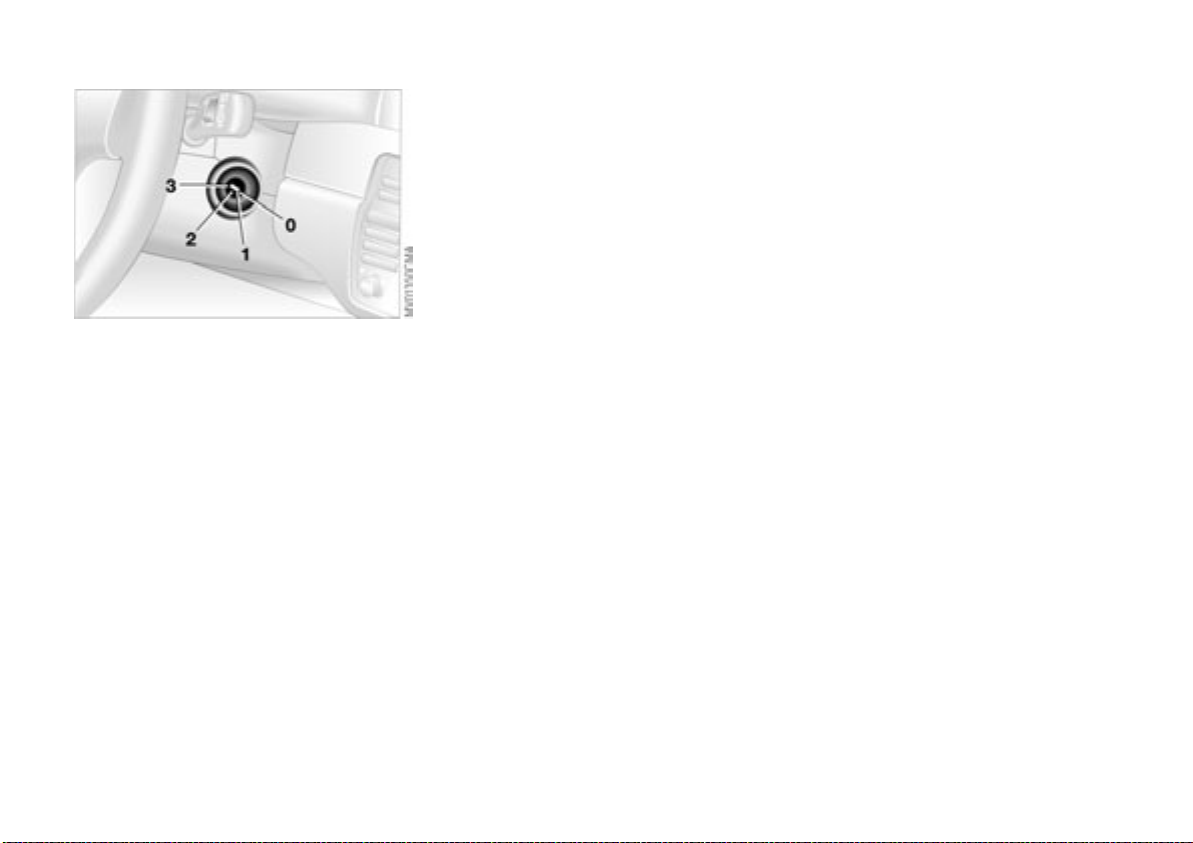
66
Driving
Ignition lock
Ignition key positions
0 Steering locked
1 Steering unlocked
2 Ignition switched on
3 Starting engine
Steering locked
The key can be inserted or removed in
this position only.
After removing the key, turn the steer-
ing wheel slightly to the left or right until
the lock engages.
If the key is not removed, an acoustic
signal is sounded after the driver's door
has been opened.
Once the ignition has been switched
off, ignition key in position 0 or
removed, the radio functions are still
available for approx. 20 minutes. Turn
the radio back on to use it.
Steering unlocked
You will find that it is often easier to turn
the ignition key from position 0 to posi-
tion 1 when you move the steering
wheel slightly to help disengage the
lock.
Individual electrical accessories are
ready for operation.
handbook.book Page 66 Tuesday, July 30, 2002 9:28 AM
Online Edition for Part-No. 01 41 0 156 854 - © 09/02 BMW AG

67
Starting engine and driving off
Do not allow the engine to warm
up by leaving it running while the
vehicle remains stationary. Instead,
drive off immediately at a moderate
engine speed.<
Do not allow the engine to run in
enclosed spaces. Otherwise,
breathing the exhaust fumes can lead
to unconsciousness and death. The
exhaust gases contain carbon monox-
ide, an odorless and colorless, but
highly toxic gas. Do not leave the vehi-
cle unattended with the engine running.
An unattended vehicle with a running
engine represents a safety hazard.<
If the engine does not start on the first
attempt, such as when it is very hot or
cold:
> Press the accelerator pedal halfway
down while engaging the starter.
Cold starts at very low temperatures
below about 57/–156 and at high
altitudes above 3,300 ft/1,000 m:
> On the first start attempt, it may be
necessary to engage the starter for a
longer period, but no longer than
20 seconds.
Extended starting attempts, char-
acterized by excessively frequent
or long periods with the starter
engaged, can damage the catalytic
converter.<
When driving, standing at idle,
and parking the vehicle, take care
to avoid contact between the hot
exhaust system and flammable materi-
als – grass, hay, leaves, etc. Such con-
tact could lead to a fire, resulting in
serious personal injury and property
damage.<
Manual transmission
1. Engage the parking brake
2. Gearshift lever in idling position
3. Press the clutch pedal at low tem-
peratures
4. Start the engine. Do not press the
accelerator pedal. Do not actuate the
starter for too short a time. Do not
turn it for more than approx.
20 seconds. Release the ignition key
immediately when the engine starts.
Sequential M gearbox SMG II
1. Depress footbrake
2. Move selector lever into position 0
3. Start the engine. Do not actuate the
starter for too short a time. Do not
turn it for more than approx.
20 seconds. Release the ignition key
immediately when the engine starts
4. Engage a driving position
5. Release footbrake and slowly
depress accelerator pedal.
With the engine running, the gear
indicator in the SMG display
flashes to indicate that a driving posi-
tion is engaged with the driver's door
open or if the hood is not closed prop-
erly, refer to page 72.
If none of the pedals is actuated, then
the gearbox is automatically taken out
of gear after approx. 4 seconds. Then
the desired direction of travel must be
selected again with the selector lever in
position 0. Driving off is not possible
with the hood open.<
Before exiting the vehicle with the
engine running, move the selector
lever into position 0 and apply the park-
ing brake.
Never leave the vehicle unattended
with the engine running. An unat-
tended vehicle with a running engine
represents a safety hazard.<
OverviewControlsMaintenanceRepairsDataIndex
handbook.book Page 67 Tuesday, July 30, 2002 9:28 AM
Online Edition for Part-No. 01 41 0 156 854 - © 09/02 BMW AG

68
Engine idle speed is controlled by the
engine computer system. Increased
speeds at start-up are normal and
should decrease as the engine warms
up. If engine speed does not decrease,
service is required.
To prevent the battery from discharg-
ing, always deactivate electrical
devices that are not in use. Switch the
ignition off when the vehicle is not
being driven.
Starting engine and driving off
handbook.book Page 68 Tuesday, July 30, 2002 9:28 AM
Online Edition for Part-No. 01 41 0 156 854 - © 09/02 BMW AG
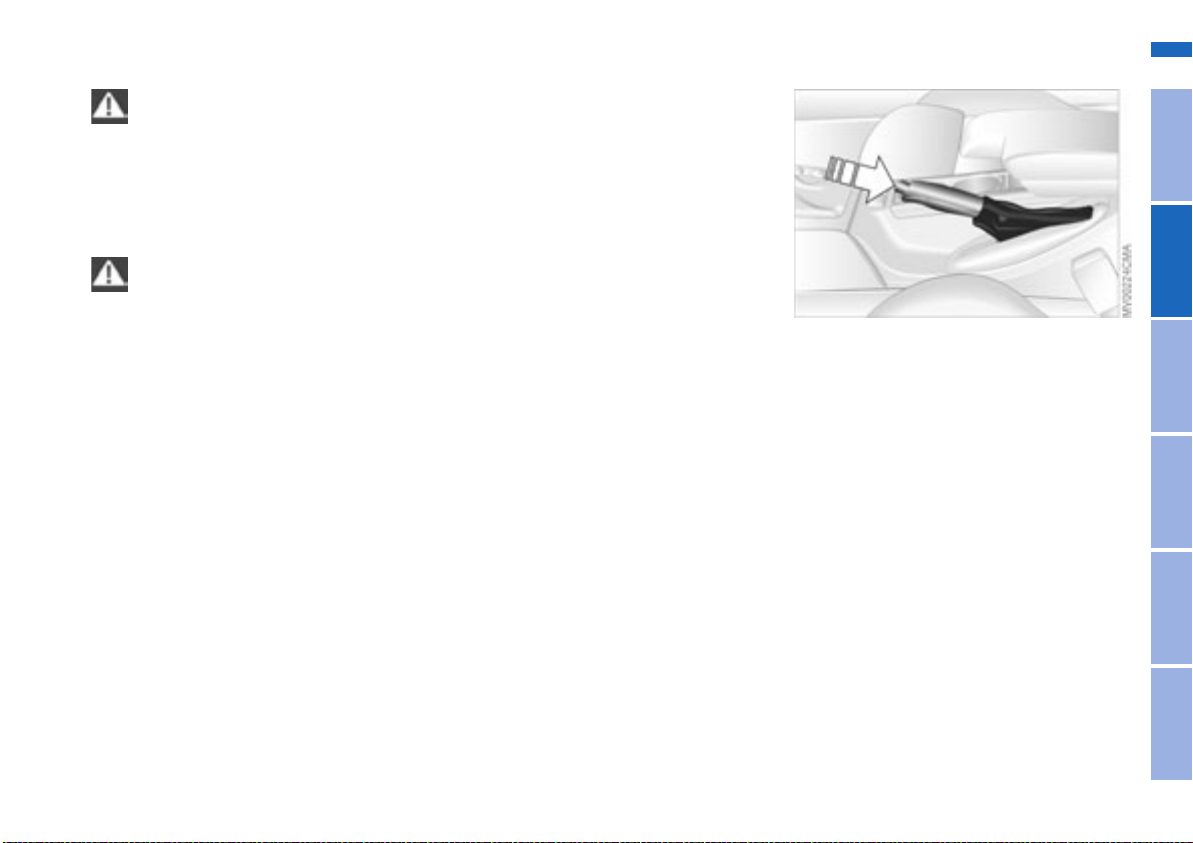
69
Switching off the engine
You should never remove the igni-
tion key when the vehicle is in
motion, as the steering lock could
engage.
When you leave the vehicle, always
remove the ignition key and engage the
steering lock.<
Always engage the parking brake
when parking on downhill roads.
Engaging a gear may not sufficiently
secure the vehicle against rolling.<
Manual transmission
Turn the ignition key to position 1 or 0.
Sequential M gearbox SMG II
If you turn the ignition key to position 1
or 0 with the selector lever in the for-
ward or reverse position, a gear auto-
matically remains engaged.
If you turn the ignition key to position 1
or 0 with the selector lever in position 0,
a warning tone and the flashing gear
indicator in the SMG display remind you
that the vehicle is not secured against
rolling.
The warning stops after approx. ten
seconds. If you move the selector lever
into a forward or reverse position dur-
ing this time, a gear is automatically
engaged.
Parking brake
The parking brake is designed primarily
to prevent the vehicle from rolling when
it is parked. It operates against the rear
wheels.
To engage
The detent engages automatically, and
the indicator lamp in the instrument
cluster comes on when the ignition key
is in position 2, refer to page 18.
To release
Pull up slightly on the lever, press the
button – see arrow – and lower the
lever.
OverviewControlsMaintenanceRepairsDataIndex
handbook.book Page 69 Tuesday, July 30, 2002 9:28 AM
Online Edition for Part-No. 01 41 0 156 854 - © 09/02 BMW AG
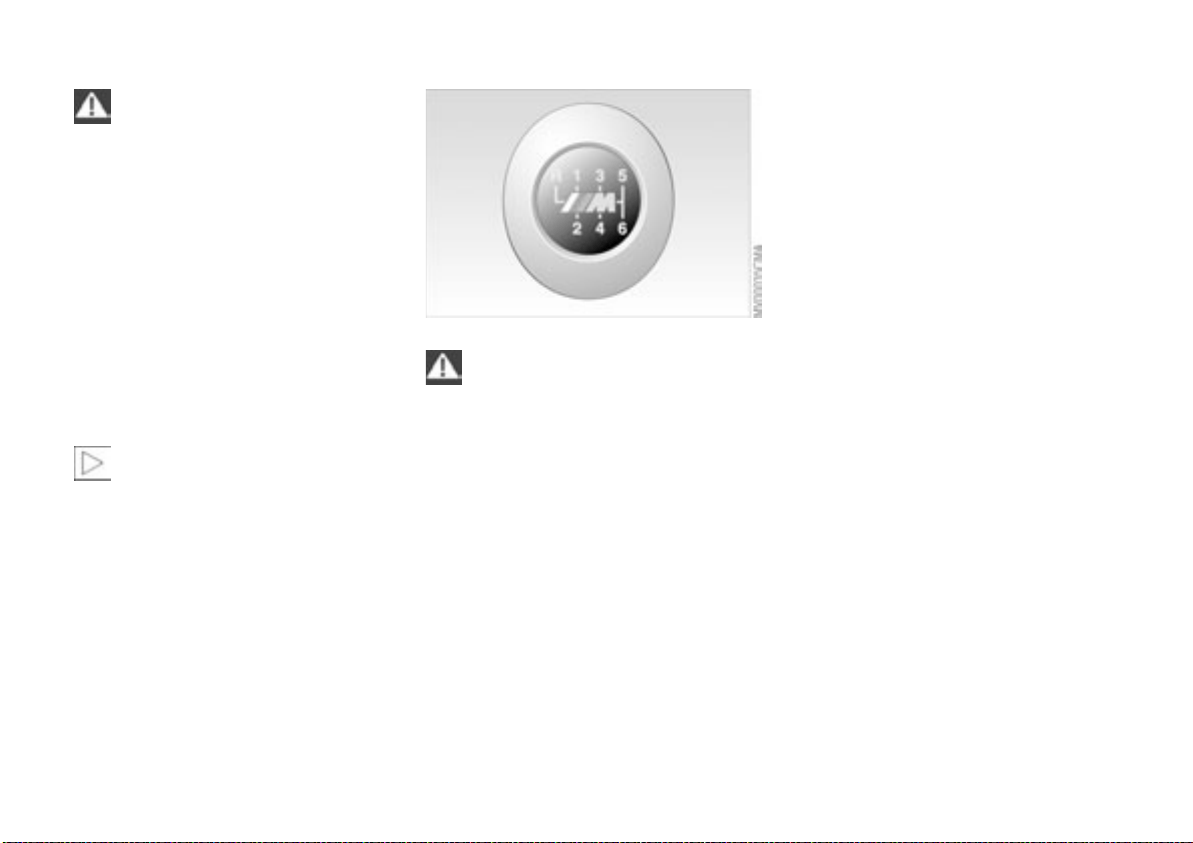
70
If exceptional circumstances
make it necessary to engage the
parking brake while the vehicle is in
motion, do not pull it with excessive
pressure. Keep your thumb pressed
against the release button while care-
fully pulling the lever up.
Excessive pressure can lead to over-
braking and loss of traction – fishtailing
– at the rear axle.
The brake lamps do not come on when
the parking brake is engaged.
Always engage the parking brake when
parking on downhill roads. Engaging a
gear may not sufficiently secure the
vehicle against rolling.<
To avoid corrosion and one-sided
braking, apply the parking brake
lightly from time to time when coasting
to a standstill – at a traffic signal, for
example – provided that it is safe to do
so.<
Manual transmission
When shifting gears in the
fifth/sixth gear plane, be sure to
press the gearshift lever to the right in
order to prevent inadvertent selection
of a gear in the third/fourth gear plane.
Do not hold the vehicle in place on
slopes by slipping or "riding" the clutch.
Use the parking brake instead. Riding
the clutch causes the clutch assembly
to wear out sooner.<
Reverse
Select only when the vehicle is station-
ary. Press the shift lever to the left to
overcome the resistance.
As you do this, the backup lamps will
light up automatically when the ignition
key is in position 2.
Parking brake
handbook.book Page 70 Tuesday, July 30, 2002 9:28 AM
Online Edition for Part-No. 01 41 0 156 854 - © 09/02 BMW AG
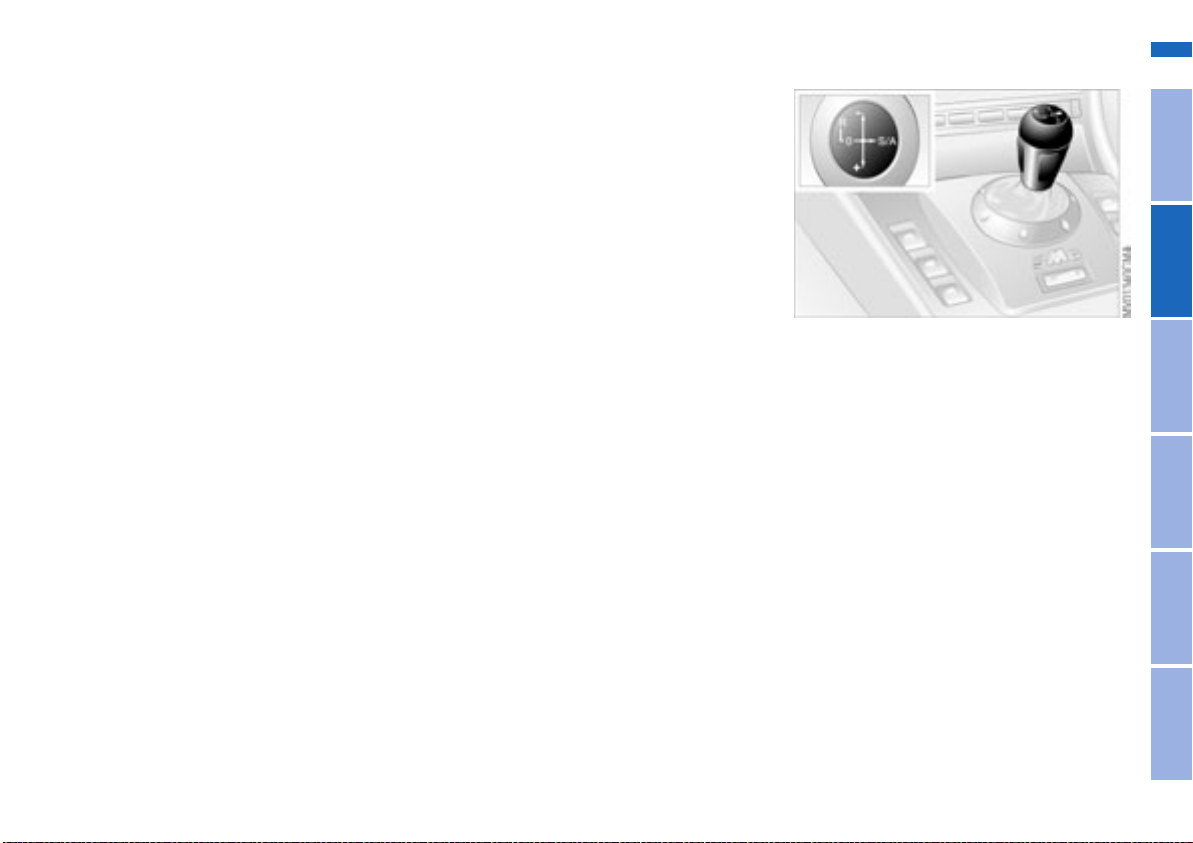
71
Sequential M gearbox SMG II*
The concept
The sequential M gearbox SMG II is an
automated manual gearbox with which
clutching and shifting is assumed by an
electro-hydraulic system.
The SMG II is operated via two shift
paddles on the steering wheel and the
selector lever in the center console.
It offers the following functions:
> Sequential and automated shifting
mode
> Ability to choose between different
driving programs, Drivelogic
> Gradient assistance, refer to page 74
> Upshift display and shift lights, refer
to page 75
> RPM matching on downshifts
> Driving dependent functions:
The respective driving situation, e.g.
cornering, mountain driving or brak-
ing, is detected by sensors and taken
into account for shifting, e.g. to
achieve optimum gear selection dur-
ing deceleration and subsequent
acceleration
> Slip recognition at the rear axle for
increasing driving stability, e.g. dur-
ing downshifting on slippery road
surfaces
> Operating safety through protection
against misshifting.
Under normal operating conditions, fuel
consumption is lowest when driving in
the first driving program of the auto-
mated shifting mode.
Selector lever position
R: Reverse position
0: Position 0 (Neutral)
Forward position with one-touch mode:
> S: sequential mode
> A: automated mode
> +: upshifting in sequential mode
> –: downshifting in sequential mode.
The SMG II is ready for operation from
ignition key position two or higher.
For your safety, it is only possible to
engage a driving position with the vehi-
cle stopped approx. 2 seconds after
engaging position 0 with the footbrake
depressed – Shiftlock function.
OverviewControlsMaintenanceRepairsDataIndex
handbook.book Page 71 Tuesday, July 30, 2002 9:28 AM
Online Edition for Part-No. 01 41 0 156 854 - © 09/02 BMW AG
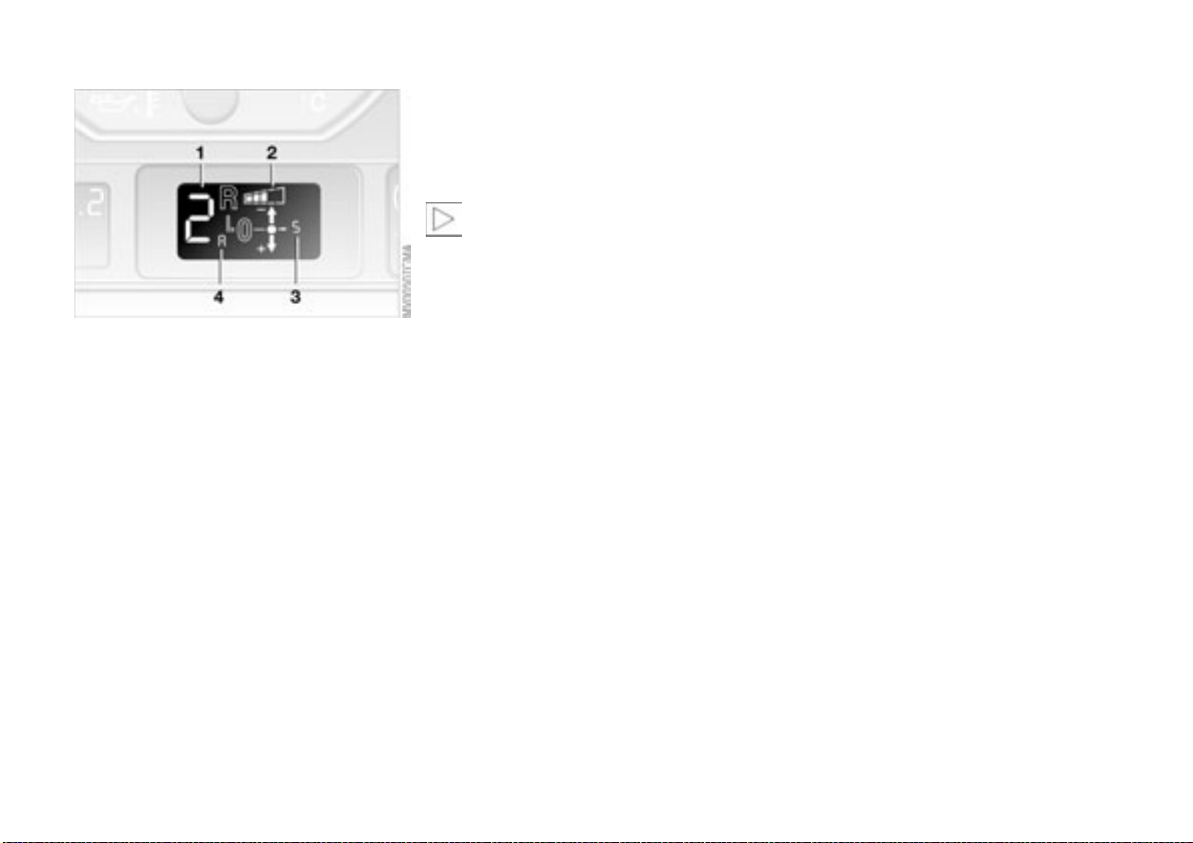
72
Display in instrument cluster
The selector lever position, currently
engaged gear and selected driving pro-
gram are displayed in the instrument
cluster.
1 Engaged gear
2 Selected driving program, corre-
sponds to the number of illuminated
fields, refer to page 74
3 Tapping the selector lever to the right
switches over into the displayed shift
mode
4 "A" indicates an activated automated
shift mode
R – Reverse position
Only engage with the vehicle stopped
or at low speed, e.g. for rocking free in
deep snow.
An intermittent signal tone indi-
cates that the reverse position has
been engaged.<
0 – Position 0 (Neutral)
Always engage before starting the
engine.
If the driving situation requires, e.g.
when downshifting on slippery roads,
the SMG II automatically disengages
and reengages the clutch, i.e. it is not
necessary to manually engage
position 0.
S – Sequential mode
In the sequential mode all forward
gears are to be shifted by the driver.
Changeover from automated to
sequential mode:
> Tap the selector lever to the right
toward S or
> Change gears with the selector lever
or the shift paddles on the steering
wheel.
You do not need to reduce the throttle
for shifting.
Sequential M gearbox SMG II*
handbook.book Page 72 Tuesday, July 30, 2002 9:28 AM
Online Edition for Part-No. 01 41 0 156 854 - © 09/02 BMW AG
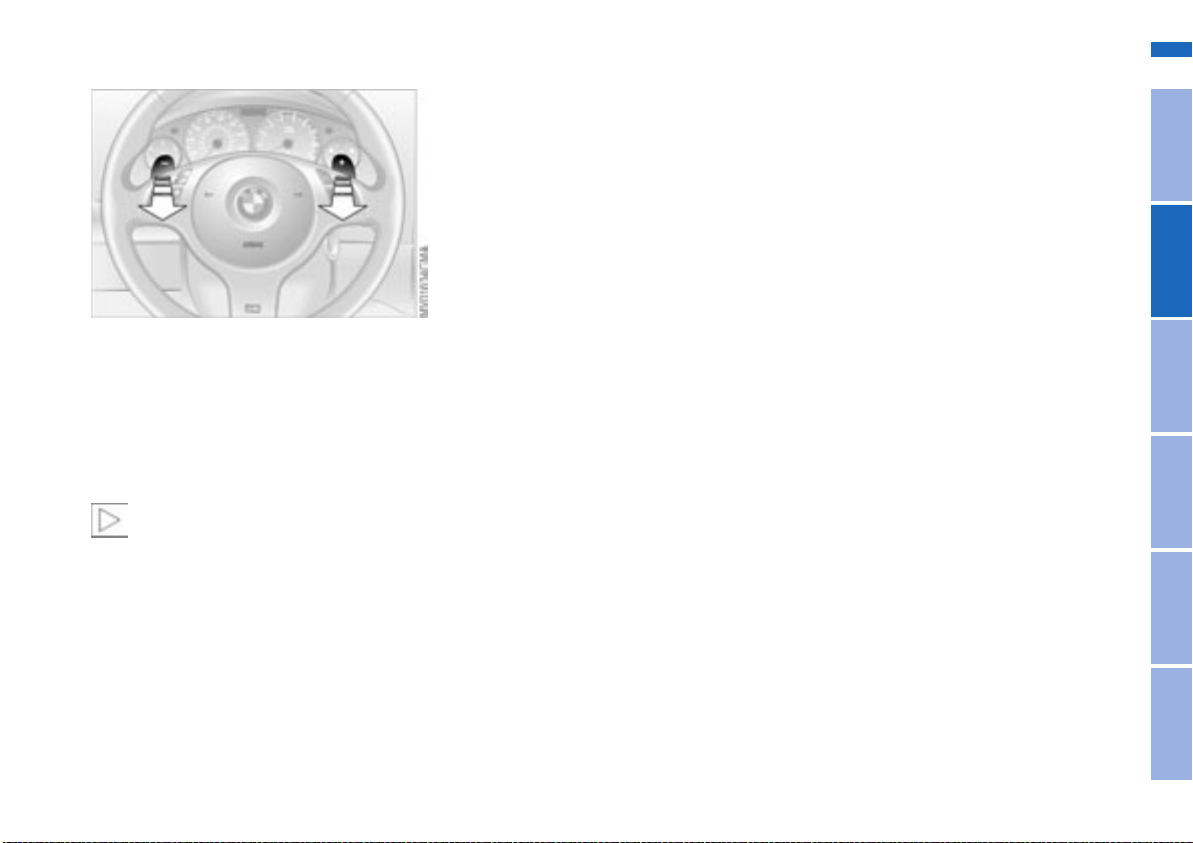
73
Shifting gears with shift paddles on
steering wheel:
> To upshift, briefly pull the right pad-
dle +
> To downshift, briefly pull the left pad-
dle –.
Shift paddles with various widths
matched to the shape of your
hand are available from your BMW cen-
ter.<
Shifting gears with selector lever:
> To upshift, pull the selector lever
backward +
> To downshift, push the selector lever
forward toward –.
No automatic upshifting is carried out in
the sequential mode.
You accelerate from higher gears, e.g.
during passing, by manually downshift-
ing.
In the following situations the SMG II
helps you think in the sequential mode:
> Upshifts and downshifts are only exe-
cuted when the new gear will provide
a suitable combination of vehicle and
engine speed, i.e., downshifts that
would cause the engine to overrev
will not be executed
> During a stop the gearbox is auto-
matically downshifted into the first
gear so that, e.g. before a traffic light,
it is only necessary to accelerate to
continue driving
> When the speed is reduced, the
gearbox is automatically down-
shifted shortly before a gear-depen-
dent minimum speed is reached with-
out you taking any action.
A – Automated mode
Each time the engine is started, the
automated mode is activated as soon
as you move the selector lever into the
forward driving position.
In the automated mode all forward
gears are automatically shifted.
Changeover from sequential to auto-
mated mode: tap the selector lever to
the right toward A. Watch the display in
the instrument cluster, refer to page 72.
For rapid acceleration, e.g. during
passing, depress the accelerator pedal
completely – kickdown. The gearbox
now downshifts in dependence on the
selected driving program.
Even in the automated mode, you can
help specify the shifting point: if a gear-
dependent minimum speed is
exceeded, you can upshift by slowly
reducing pressure on the accelerator
pedal. In the process, the respective
driving situation is detected by sensors
and taken into account.
Sequential M gearbox SMG II*
OverviewControlsMaintenanceRepairsDataIndex
handbook.book Page 73 Tuesday, July 30, 2002 9:28 AM
Online Edition for Part-No. 01 41 0 156 854 - © 09/02 BMW AG
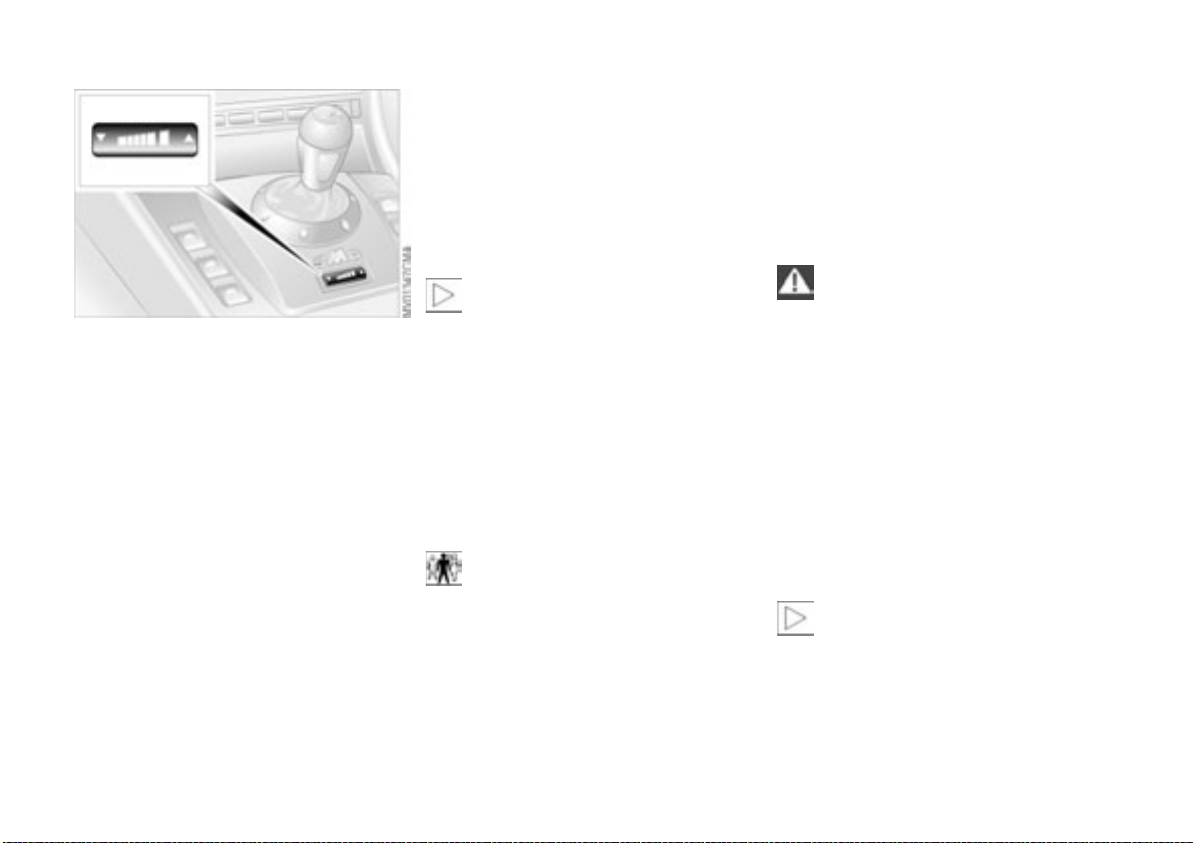
74
Drivelogic
Drivelogic makes various driving pro-
grams available to you.
Press the Drivelogic repeatedly until the
desired driving program is shown in the
SMG display of the instrument cluster,
refer to page 72.
In the automated mode you can select
from five driving programs ranging from
convenience mode/winter operation to
sporty and highly dynamic.
In the first automated driving program,
starting off takes place in second gear,
which is advisable under winter road
conditions with ice and snow.
In the sequential mode you can choose
from six driving programs ranging from
balanced, dynamic driving – 1 – to
sporty, puristic driving – 6. The sporty,
puristic driving program can only be
activated with the Dynamic Stability
Control (DSC) deactivated, refer to
page 87.
To maintain vehicle stability,
always drive with the DSC acti-
vated on whenever possible.<
Following each change between the
sequential and the automated mode,
the last driving program selected in the
respective mode is active. Exception:
instead of the last selected sequential
driving program 6, program 5 is acti-
vated only after the engine has been
started again.
Your vehicle is set so that when
the engine is started, the last
selected driving program saved in your
key is activated for each shifting
mode.<
Gradient assistance
The gradient assistance enables start-
ing off on grades with virtually no roll-
back. It can be activated in the sequen-
tial and automated mode with the vehi-
cle stopped and can be used for both
forward and reverse driving.
The vehicle may roll slightly before
it is held by the gradient assis-
tance after releasing the footbrake.
Two seconds after the footbrake is
released, the vehicle begins to roll, as it
is no longer held with the gradient
assistance.<
1. Depress footbrake with vehicle
stopped
2. Activate the gradient assistance by
pulling the left paddle for at least
0.5 seconds. An increase in the
engine speed indicates that the gra-
dient assistance is activated
Briefly pulling the left paddle again
deactivates the gradient assis-
tance again.<
3. Release the footbrake and start off
within two seconds.
The gradient assistance must be reacti-
vated before each use.
Sequential M gearbox SMG II*
handbook.book Page 74 Tuesday, July 30, 2002 9:28 AM
Online Edition for Part-No. 01 41 0 156 854 - © 09/02 BMW AG
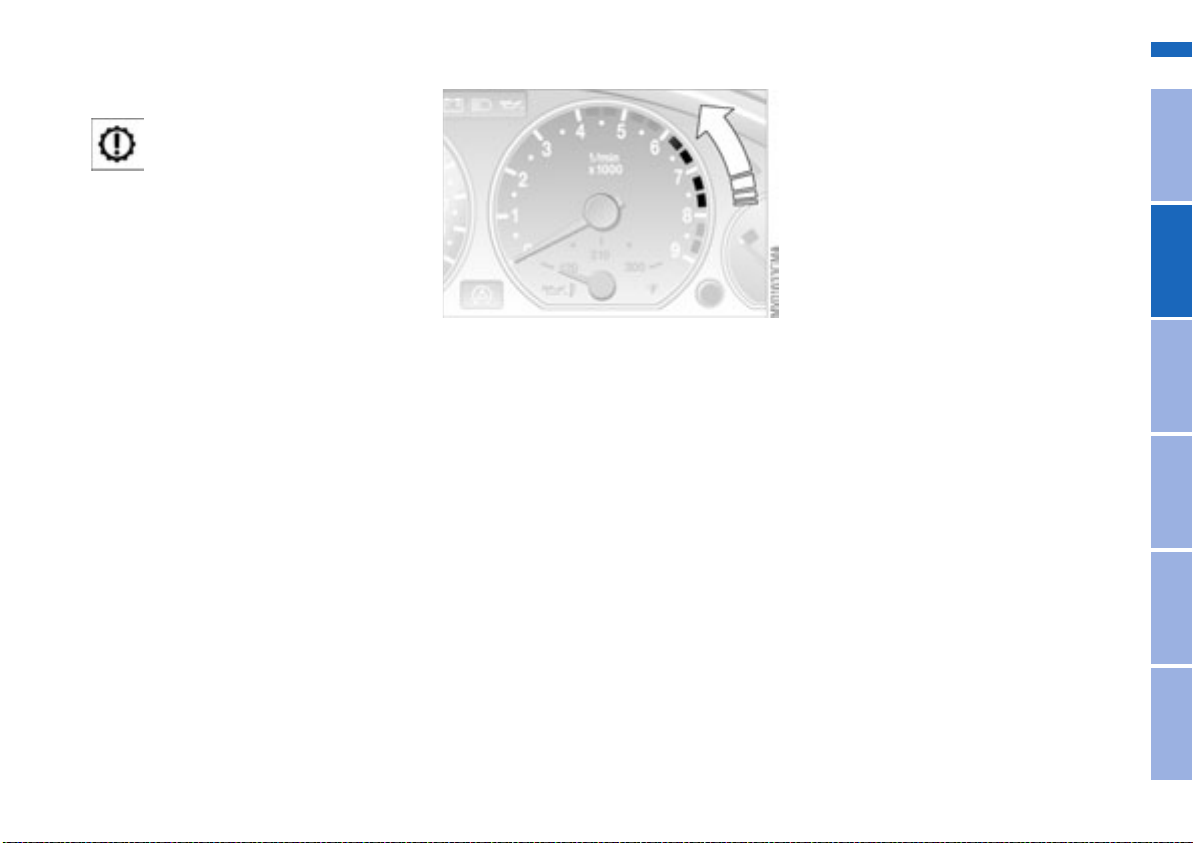
75
Indicator lamp
The transmission indicator lamp
in the instrument cluster goes
out after the engine is started.
> If it does not go out, or if it lights up
during driving, a fault has occurred.
The available functions may be lim-
ited under certain circumstances.
Drive carefully and with the Dynamic
Stability Control (DSC) activated.
Have the system checked by the
nearest BMW center
> If the indicator lamp flashes while
driving, the system is overloaded.
Avoid high loads until the indicator
lamp goes out again permanently.
Shift lights
To achieve the best possible vehicle
acceleration with a sporty driving style
in the sequential mode, shift lights in
the instrument cluster indicate the opti-
mum shifting point shortly before the
maximum engine speed is reached.
1. When the maximum engine speed is
approached, yellow indicator fields,
shift lights, in the tachometer light up
consecutively to indicate the
approaching upshift time
2. Shift at the latest when the last indi-
cator field lights up red.
Tire replacement, snow chains
Following a tire or wheel change and
after mounting or removing snow
chains, the slip recognition of the
SMG II must become familiar with the
changed condition.
Reinitialize the system afterwards:
1. Move the selector lever into
position 0 on a straight stretch of
road at a speed of over 20 mph /
30 km/h
2. Pull both shift paddles for approx.
two seconds.
If you do not carry out the initialization,
the system automatically learns the
changed condition gradually during
driving. This can become apparent due
to brief opening and closing of the
clutch.
Sequential M gearbox SMG II*
OverviewControlsMaintenanceRepairsDataIndex
handbook.book Page 75 Tuesday, July 30, 2002 9:28 AM
Online Edition for Part-No. 01 41 0 156 854 - © 09/02 BMW AG
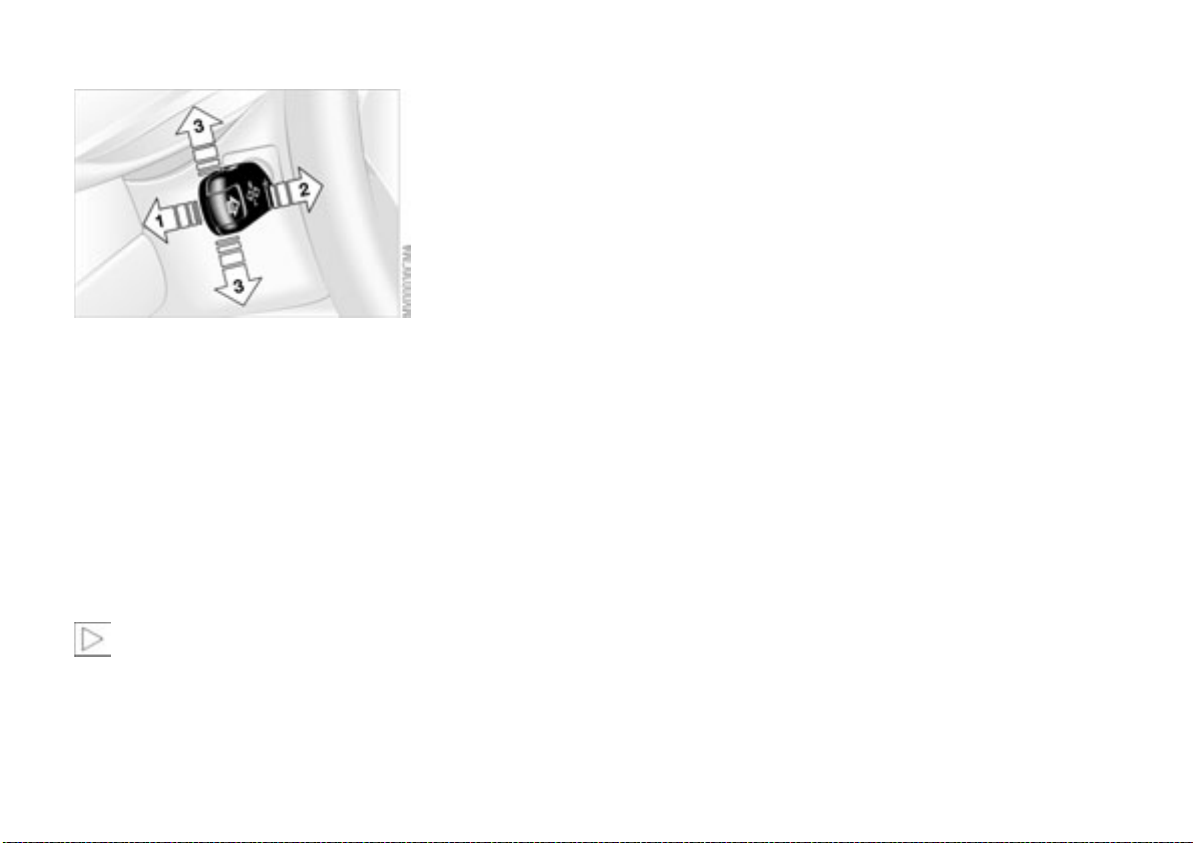
76
Turn signal indicator/Headlamp flasher
1 High beams – blue indicator lamp
2 Headlamp flasher – blue indicator
lamp
3 Turn signal indicator – green indicator
accompanied by periodic clicking
sound from the relay
To signal briefly
Press the lever up to but not beyond
the resistance point. It then returns to
the center position when released.
If the flashing indicator lamp and
the clicking from the relay are
both faster than normal, one of the turn
signal indicators has failed.<
handbook.book Page 76 Tuesday, July 30, 2002 9:28 AM
Online Edition for Part-No. 01 41 0 156 854 - © 09/02 BMW AG
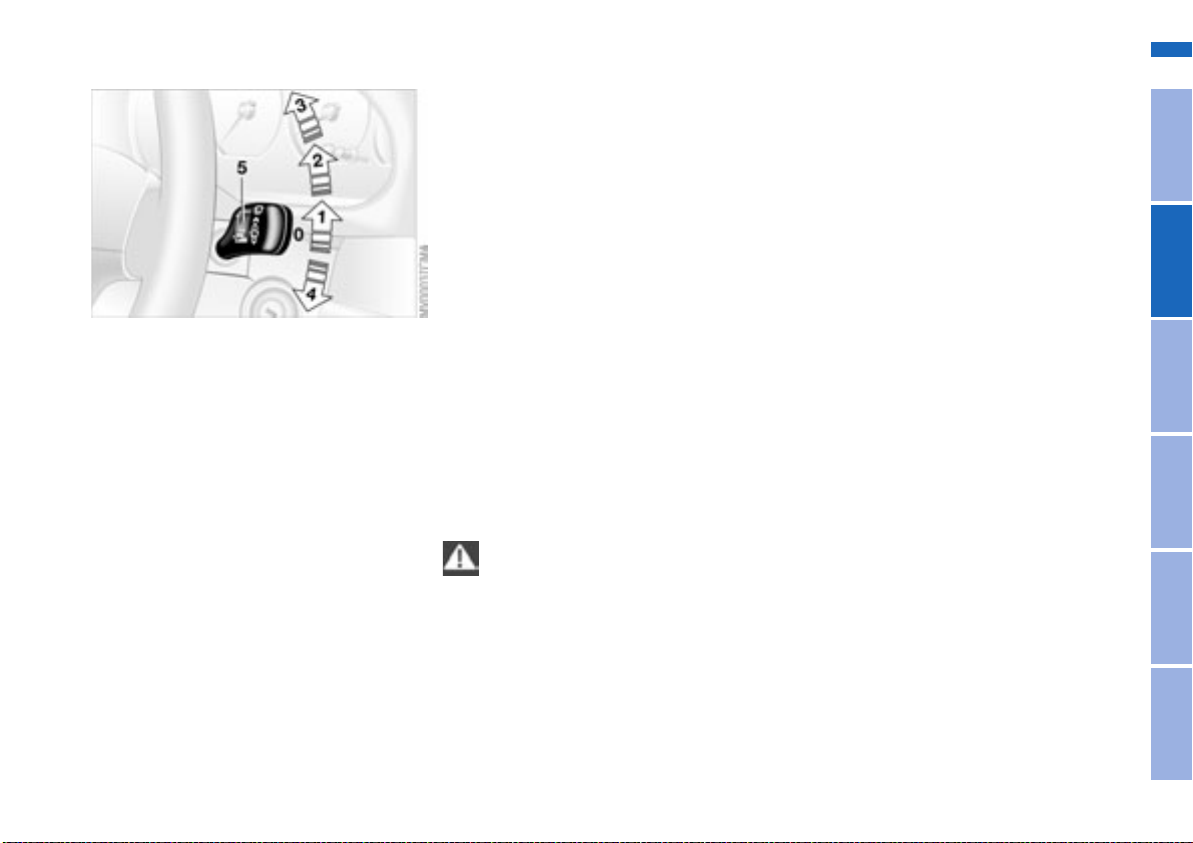
77
Washer/wiper system/Rain sensor*
0 Wipers retracted
1 Intermittent operation or rain sensor
2 Normal wiper speed
3 Fast wiper speed
4 Brief wipe
5 Rotary dial for control of the wipe
interval or the sensitivity of the rain
sensor
Intermittent mode
Not on vehicles with rain sensor.
You can set the wipe interval at four
stages with rotary dial 5. In addition, the
wipe interval is varied automatically
depending on road speed.
Rain sensor
The rain sensor is positioned on the
windshield, directly behind the interior
rearview mirror.
To activate the rain sensor:
> With the ignition key in position 1 or
higher, move the lever to position 1.
The wipers travel once across the
windshield, regardless of the weather
> You can leave the lever permanently
in position 1. It is then only necessary
to activate the rain sensor when the
ignition key is in position 1 or higher.
Activate by briefly turning rotary dial
5.
To adjust the sensitivity of the rain sen-
sor: turn rotary dial 5.
To deactivate the rain sensor: put lever
in position 0.
Turn the rain sensor off in auto-
matic car washes. Failure to do so
could result in damage caused by
undesired wiper activation.<
Normal wiper speed
When the vehicle is stationary, the wip-
ers switch automatically to intermittent
wipe – not on vehicles with rain sensor.
Fast wiper speed
When the vehicle is stationary, the wip-
ers operate at normal speed – not on
vehicles with rain sensor.
OverviewControlsMaintenanceRepairsDataIndex
handbook.book Page 77 Tuesday, July 30, 2002 9:28 AM
Online Edition for Part-No. 01 41 0 156 854 - © 09/02 BMW AG
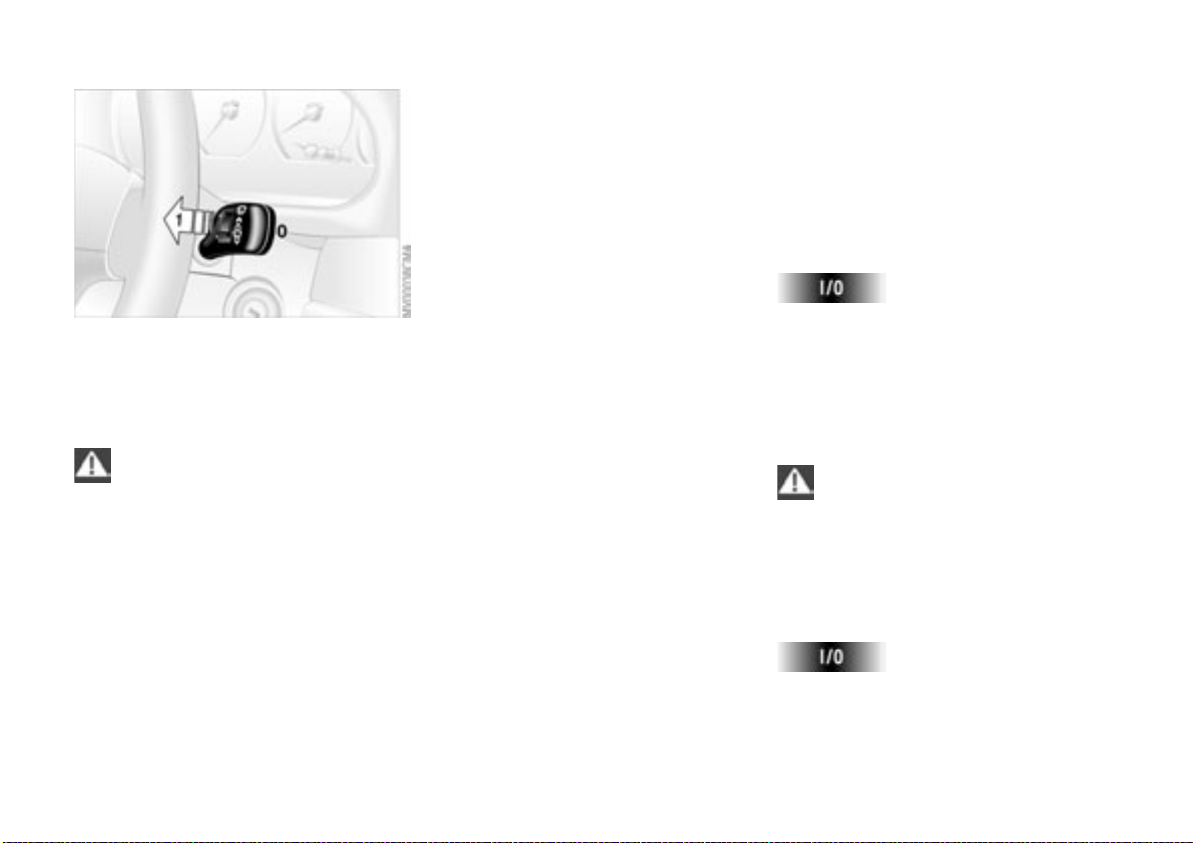
78
0 Wipers retracted
1 Clean windshield and headlamps
Clean windshield and headlamps*
Do not use the washers if there is
any danger that the fluid will
freeze on the windshield, as your vision
could be obscured. Always use a wind-
shield washer antifreeze in cold
weather. Refer to page 124.
Do not use the washers when the reser-
voir is empty. This could cause damage
to the washer pump.<
The system sprays washer fluid against
the windshield and activates the wipers
for a brief period.
When the vehicle's lighting system is
switched on, the headlamps will also be
cleaned at reasonable intervals.
Windshield washer nozzles
The windshield washer jets are warmed
automatically when the ignition key is in
position 2.
Cruise control
Starting at about 20 mph / 30 km/h, you
can maintain and store any vehicle
speed that you specify.
The cruise control is operational when-
ever the engine is running and the sys-
tem has been activated.
To activate the system
With the ignition key in position 2 or
higher:
Press the button. The indicator lamp in
the instrument cluster comes on, refer
to page 20. You can now use the cruise
control.
Do not use cruise control on twist-
ing roads, when high traffic den-
sity prevents driving at a constant
speed, or when the road surface is slick
– snow, rain, ice – or loose – rocks or
gravel, sand.<
To deactivate the system
Press button as often as you need to
until the indicator lamp in the instru-
ment cluster goes out.
Washer/wiper system/Rain sensor*
handbook.book Page 78 Tuesday, July 30, 2002 9:28 AM
Online Edition for Part-No. 01 41 0 156 854 - © 09/02 BMW AG

79
Cruise control is also deactivated when
the ignition key is in position 0.
The speed stored in memory is deleted.
To store and maintain speed or to
accelerate
Press button "+" briefly:
The system stores and maintains the
current vehicle speed. Every time you
tap the button, the speed increases by
0.6 mph / 1 km/h.
Press and hold button "+":
The vehicle accelerates without pres-
sure on the accelerator pedal. When
you release the button, the system
stores and maintains the current speed.
If on a downhill gradient the
engine braking effect is not suffi-
cient, the controlled speed can be
exceeded. Speed can drop on uphill
grades if the engine output is insuffi-
cient.<
To decelerate
Press button "–" briefly:
When cruise control is active, every tap
of the button reduces the speed by
approx. 0.6 mph / 1 km/h.
Press and hold button "–":
With the cruise control active, the sys-
tem automatically reduces the throttle
opening to slow the vehicle. When you
release the button, the system stores
and maintains the current speed.
To interrupt the cruise control
Each time zou activate the system,
press the button. The indicator lamp
stays on. You can use the cruise control
again whenever you want by calling up
the speed that was stored last.
In addition, cruise control is interrupted
automatically:
> If the brakes are applied
> When pressing down the clutch pedal
> If you exceed or fall below the pro-
grammed speed for an extended
period – by depressing the accelera-
tor, for example
> Sequential M gearbox SMG II, refer
to page 71: when shifting in the
sequential mode.
To recall the stored setting
Press button:
The vehicle accelerates to and main-
tains the last speed stored.
Cruise control
OverviewControlsMaintenanceRepairsDataIndex
handbook.book Page 79 Tuesday, July 30, 2002 9:28 AM
Online Edition for Part-No. 01 41 0 156 854 - © 09/02 BMW AG
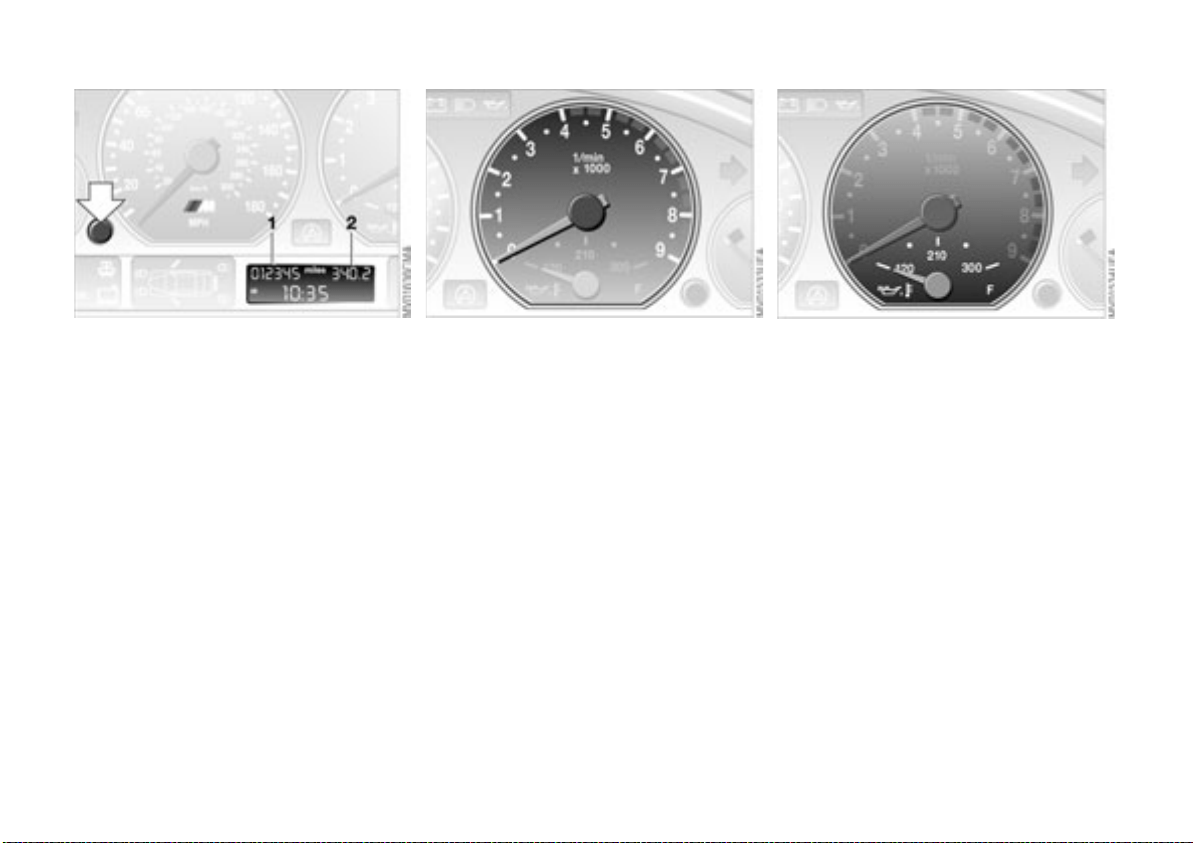
80
Everything under control
Odometer
1 Odometer
2 Trip odometer
Odometer
You can activate the displays shown in
the illustration with the ignition key in
position 0 by pressing the left button,
see arrow, in the instrument cluster.
Trip odometer
To reset the trip odometer to zero,
press the left button – see arrow – with
the ignition key in position 1 or higher.
Tachometer
Variable pre-warning zone
The yellow pre-warning zone displays
current permissible engine speeds,
depending on the engine temperature.
As the engine temperature climbs,
some of the sectors for this pre-warning
zones will go out one after the other.
Avoid engine speeds in the early warn-
ing zone if possible.
Never allow the engine to operate with
the needle in the red overspeed zone of
the gauge.
To protect the engine, the fuel supply is
interrupted when you approach this
sector.
Temperature gauge
The general operating temperature lies
between 1757/806 and 2507/
1206. During high-performance driv-
ing, do not exceed a maximum value of
3007/1506.
handbook.book Page 80 Tuesday, July 30, 2002 9:28 AM
Online Edition for Part-No. 01 41 0 156 854 - © 09/02 BMW AG
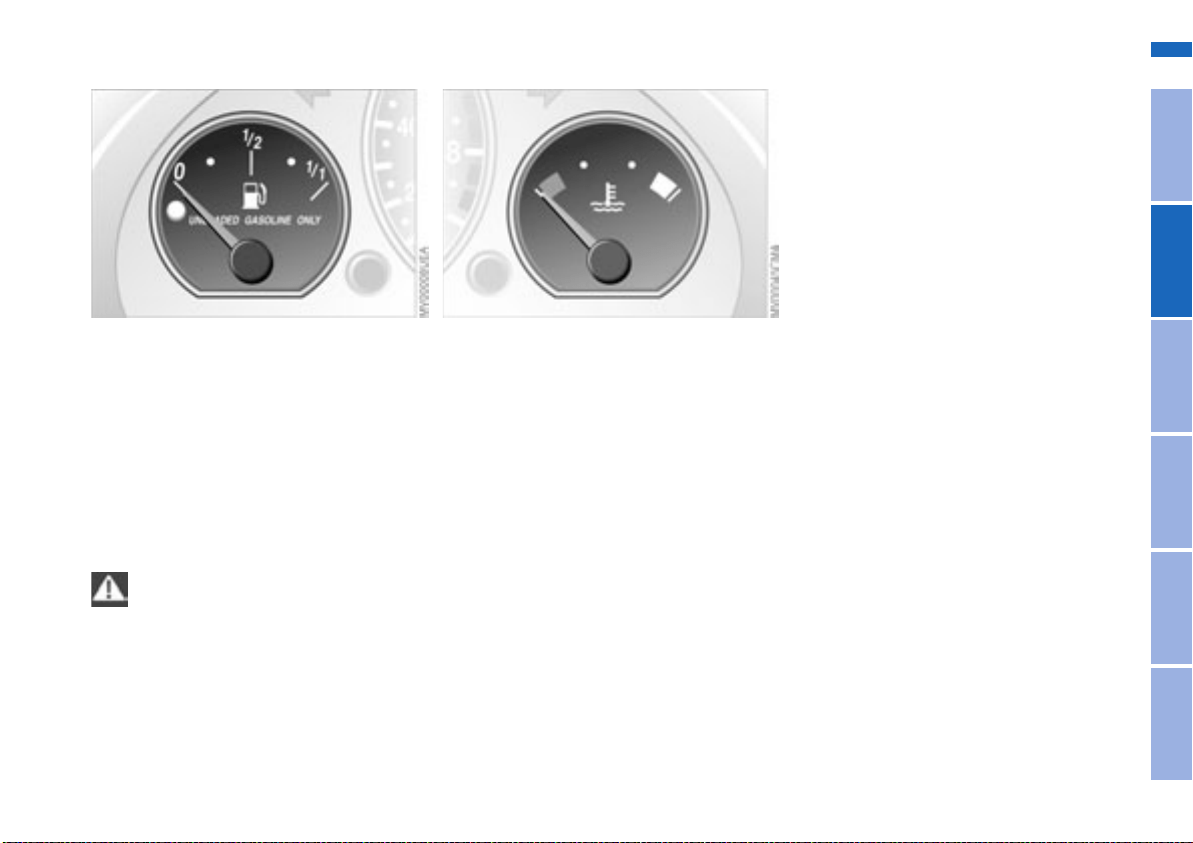
81
Fuel gauge
Once the indicator lamp stays on con-
tinuously, there are still approx.
2 gallons/8 liters of fuel in the fuel tank.
Fuel tank capacity approx. 16.6 gal./
63 liters.
If the tilt of the vehicle varies – when
you are driving in mountainous areas,
for example – the needle may fluctuate
slightly.
Fill the fuel tank before it is com-
pletely empty. Driving to the last
drop of fuel can prevent the engine
from operating properly and result in
damage.<
When you switch on the ignition, the
indicator lamp lights up briefly as an
operation check.
Engine coolant temperature gauge
Blue
The engine is still cold. Drive at moder-
ate engine and vehicle speeds.
Red
When you switch on the ignition, the
warning lamp comes on briefly as an
operation check.
If the lamp comes on while operating
the vehicle: the engine has overheated.
Switch off the engine immediately and
allow it to cool down.
To check the coolant level, refer to
page 126.
Between the blue and red zones
Normal operating range. The needle
may rise as far as the edge of the red
sector during normal operation.
OverviewControlsMaintenanceRepairsDataIndex
handbook.book Page 81 Tuesday, July 30, 2002 9:28 AM
Online Edition for Part-No. 01 41 0 156 854 - © 09/02 BMW AG
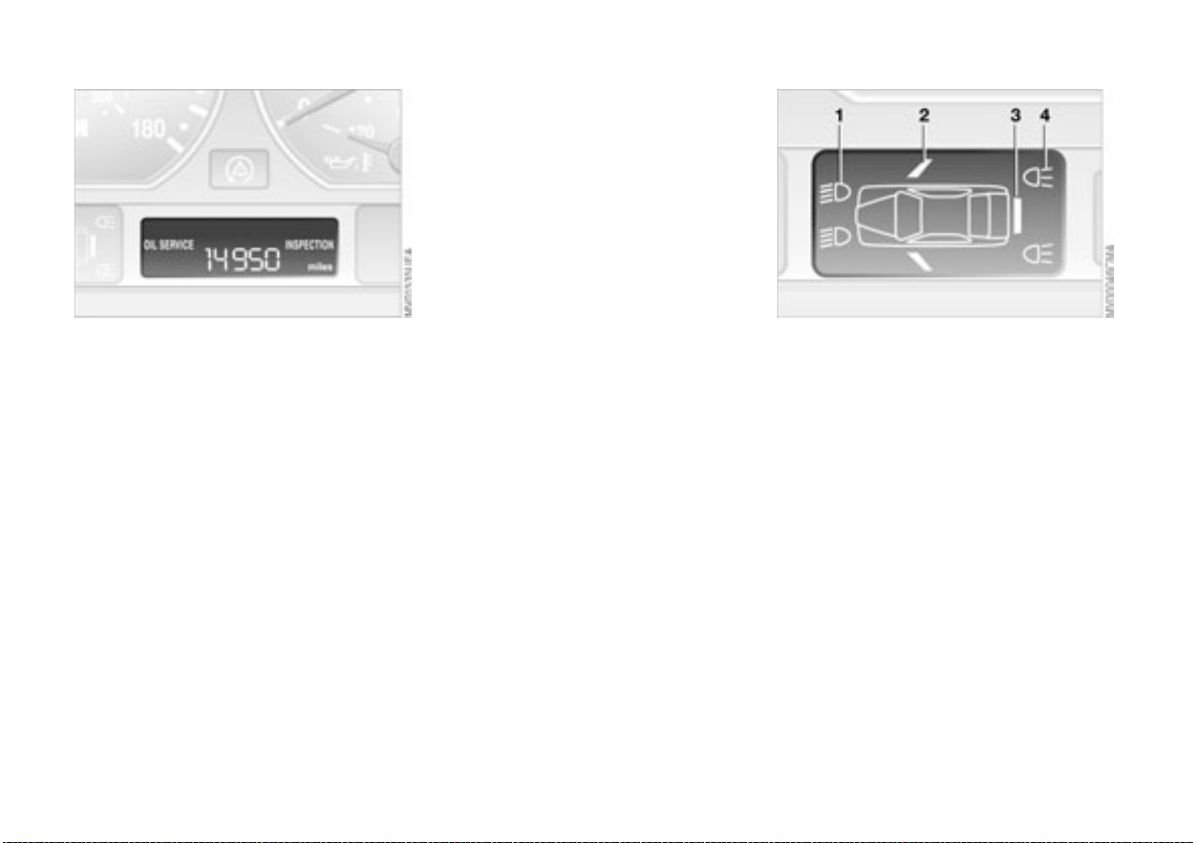
82
Service interval display
Remaining distance to next
service
The displays shown in the illustration
appear for a few seconds when the
ignition key is in position 1 or higher or
after the engine is started.
The next service due appears with the
message OIL SERVICE or
INSPECTION, together with the dis-
tance remaining in miles – in kilometers
in Canada – before the next scheduled
service.
The computer bases its calculations of
the remaining distance on the preced-
ing driving style.
A flashing message and a "–" in front of
the number mean that the service inter-
val has already been exceeded by the
distance shown on the display. Please
contact your BMW center for an
appointment.
Check Control
Display
When the ignition key is in position 2 or
higher, the following information or
conditions are displayed until the cause
has been corrected:
1 Inspect the low-beam and high-beam
headlamps, as well as the parking
lamps
2 Door open
3 Luggage compartment lid open
4 Check brake and tail lamps
When you open the driver's door after
completing a journey, an acoustic
warning signal will sound if you have
forgotten to turn off the headlamps.
handbook.book Page 82 Tuesday, July 30, 2002 9:28 AM
Online Edition for Part-No. 01 41 0 156 854 - © 09/02 BMW AG
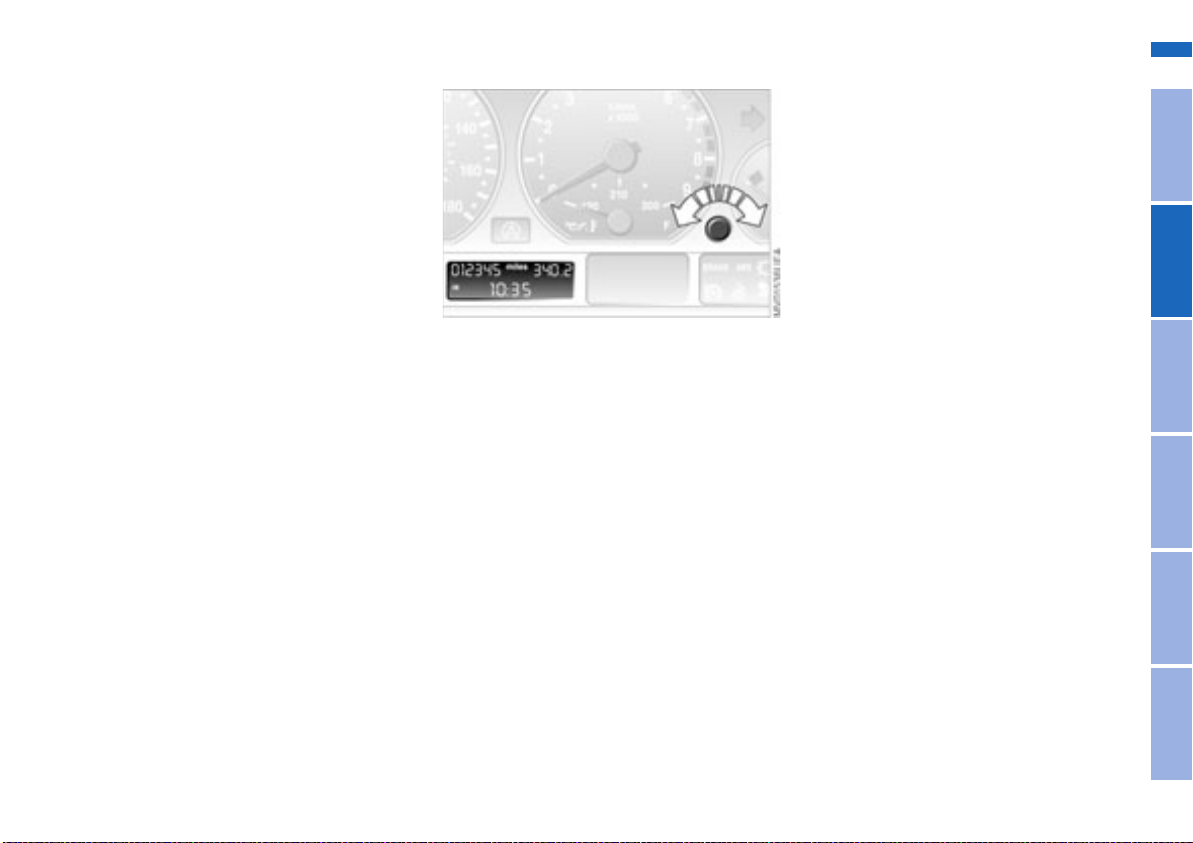
83
Clock
If you wish to have a permanent time
display, you can make this adjustment
in the car radio* display, refer to the
Owner's Manual for Radio.
You can set the time of day, and the
display for the car radio, as follows.
To adjust
When the ignition key is in position 1 or
higher, the time of day appears in the
display.
To set ahead: turn the right button to
the right.
To set back: turn the right button to the
left.
The adjustment speed will increase the
longer you continue to hold the right
button.
To change the display mode: press the
right button briefly.
Every time you press the knob, the
clock display alternates between the
12-hour and 24-hour mode.
In ignition key position 0: the time is
displayed for a few seconds after you
press the left button, refer to Odometer
on page 80.
OverviewControlsMaintenanceRepairsDataIndex
handbook.book Page 83 Tuesday, July 30, 2002 9:28 AM
Online Edition for Part-No. 01 41 0 156 854 - © 09/02 BMW AG
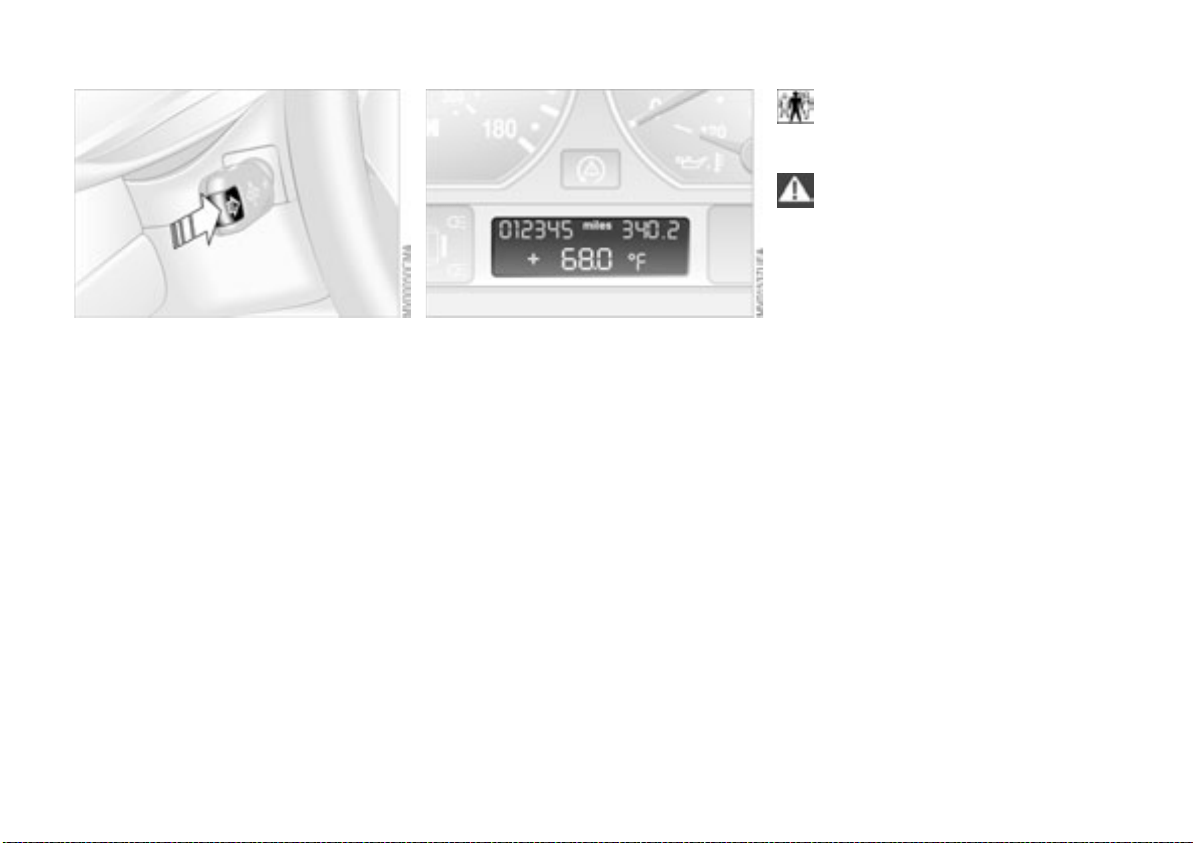
84
Computer
Mode selection
With the ignition key in position 1 and
higher, you can use the button in the
turn signal lever to retrieve information
from the computer for display in the
instrument cluster. Each time you press
the button briefly in the direction of the
steering column, a new function is
called up in the display.
The displays appear in the following
order:
Time of day, outside temperature, aver-
age fuel consumption, cruising range,
average vehicle speed.
When the ignition key is in position 1 or
higher, the last active setting is dis-
played.
Outside temperature
You can change the units of measure –
6/7 – for the outside temperature dis-
play by pressing the right-hand reset
button in the instrument cluster while
the temperature display is active. The
units of measure – 6/7 – in the tem-
perature display of the automatic cli-
mate control change automatically,
refer to page 96.
Ice warning
If the outside temperature drops to
about 37.57/+36, then the computer
will automatically switch to a display of
the outside temperature. In addition, a
signal sounds as a warning and the dis-
play flashes for a brief period.
After giving an ice warning, the
display returns to the previous
setting.<
The ice warning does not alter the
fact that surface ice can form at
temperatures above 37.57/+36, on
bridges or shaded road surfaces, for
instance.<
handbook.book Page 84 Tuesday, July 30, 2002 9:28 AM
Online Edition for Part-No. 01 41 0 156 854 - © 09/02 BMW AG
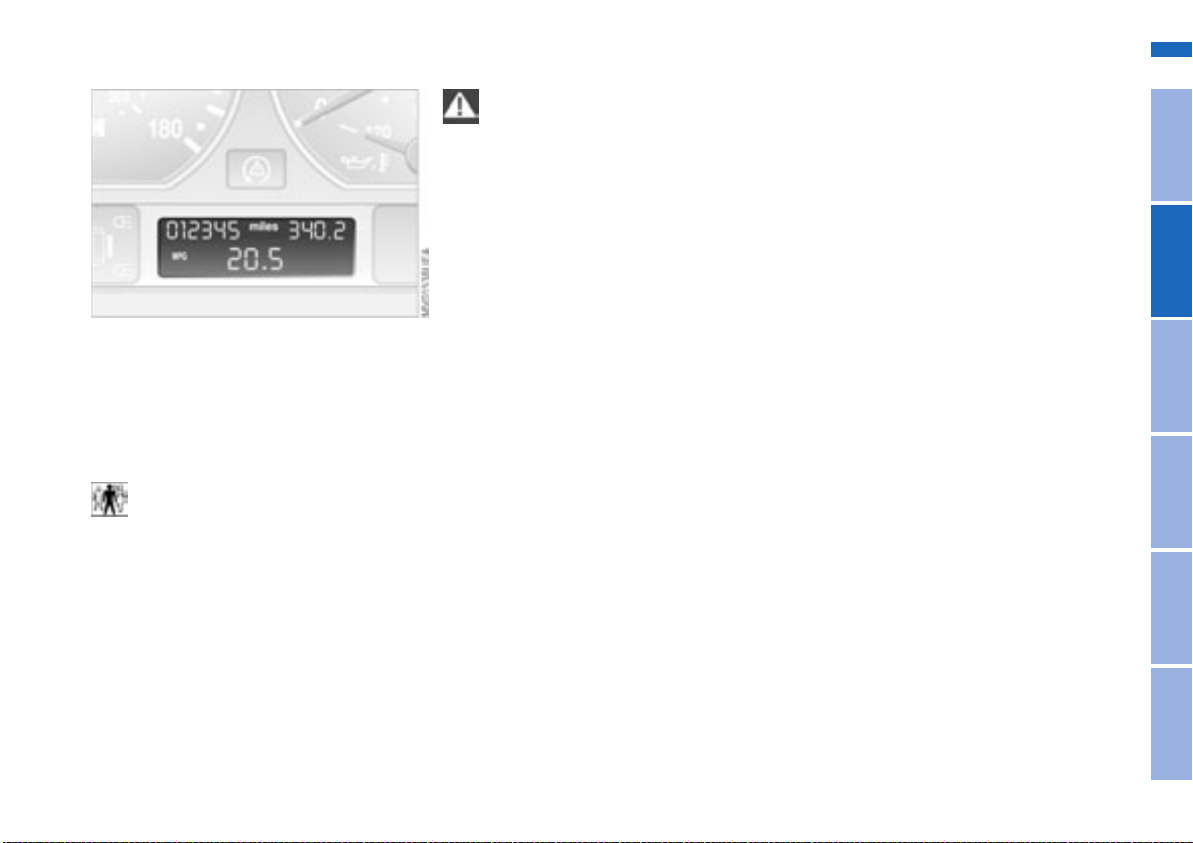
85
Average fuel consumption
If you continue to press and hold the
button on the turn signal lever, the aver-
age fuel consumption being displayed
is recalculated from that point.
If you wish, you can have the aver-
age fuel consumption displayed in
a different unit of measure.<
Range
The computer bases its calculations of
the cruising range on the preceding
driving style and on the remaining fuel
in the tank.
It is important that you refuel when
the cruising range falls below
approx. 35 miles/50 kilometers. Other-
wise, the engine cannot be guaranteed
to operate properly and damage may
result.<
Average speed
If you continue to hold the button on the
turn signal lever, the average fuel con-
sumption being displayed for that
speed is recalculated from that point in
time.
Any time spent when the vehicle is sta-
tionary and the engine is shut off is
ignored for the calculation.
Computer
OverviewControlsMaintenanceRepairsDataIndex
handbook.book Page 85 Tuesday, July 30, 2002 9:28 AM
Online Edition for Part-No. 01 41 0 156 854 - © 09/02 BMW AG

86
Technology for safety and driving convenience
Park Distance Control (PDC)*
The concept
PDC assists you when you back into a
parking space. Acoustic signals alert
you to the momentary distance to an
object behind your vehicle. To do this,
four ultrasonic sensors in the rear
bumper measure the distance to the
nearest object. The range for the sen-
sors located at both rear corners ends
approx. 2 ft/60 cm behind the bumpers.
The range for the two middle sensors is
slightly less than 5 ft/1.50 m.
PDC is a parking aid that can
identify objects if they are
approached slowly, as is generally the
case when parking. Avoid driving
towards objects rapidly; due to underly-
ing physical principles, the system may
otherwise alert you too late for you to
take evasive steps.<
The system is activated automatically
about one second after you engage
reverse with the ignition key in
position 2.
Let this short period elapse before
driving backwards.<
PDC is deactivated when you shift back
out of Reverse.
You can have a signal set to con-
firm that the PDC has been acti-
vated.<
Acoustic signals
The distance to the nearest object is
indicated by a tone sounding at various
intervals. As the distance between vehi-
cle and object decreases, the intervals
between the tones become shorter. A
continuous tone indicates the pres-
ence of an object less than 1 ft/30 cm
away.
The warning signal is canceled after
approx. three seconds if the distance to
the object remains constant during this
time – if you are moving parallel to
a wall, for instance.
System malfunctions will be indicated
by a continuous high-pitched tone
when the system is activated the first
time. Please have your BMW center
resolve the problem.
PDC does not remove the driver's
personal responsibility for evaluat-
ing the distance between the vehicle
and any objects. Even when sensors
are involved, there is a blind spot in
which objects cannot be detected. This
applies especially in those cases where
the system approaches the physical
limits of ultrasonic measurement, as
occurs with tow bars and trailer cou-
plings, and in the vicinity of thin or
wedge-shaped objects. Moreover, low
objects that have already been
detected – such as a curb edge – can
disappear out of the detection range of
the sensors before a continuous tone
sounds.
Loud sources of sound from outside or
inside the vehicle could drown out the
PDC signal tone.<
Keep the sensors clean and free
of ice or snow in order to ensure
that they will continue to operate effec-
tively.
Do not apply high pressure spray to the
sensors for a prolonged period of time.
Always maintain a distance of more
than 4 in/10 cm.<
handbook.book Page 86 Tuesday, July 30, 2002 9:28 AM
Online Edition for Part-No. 01 41 0 156 854 - © 09/02 BMW AG
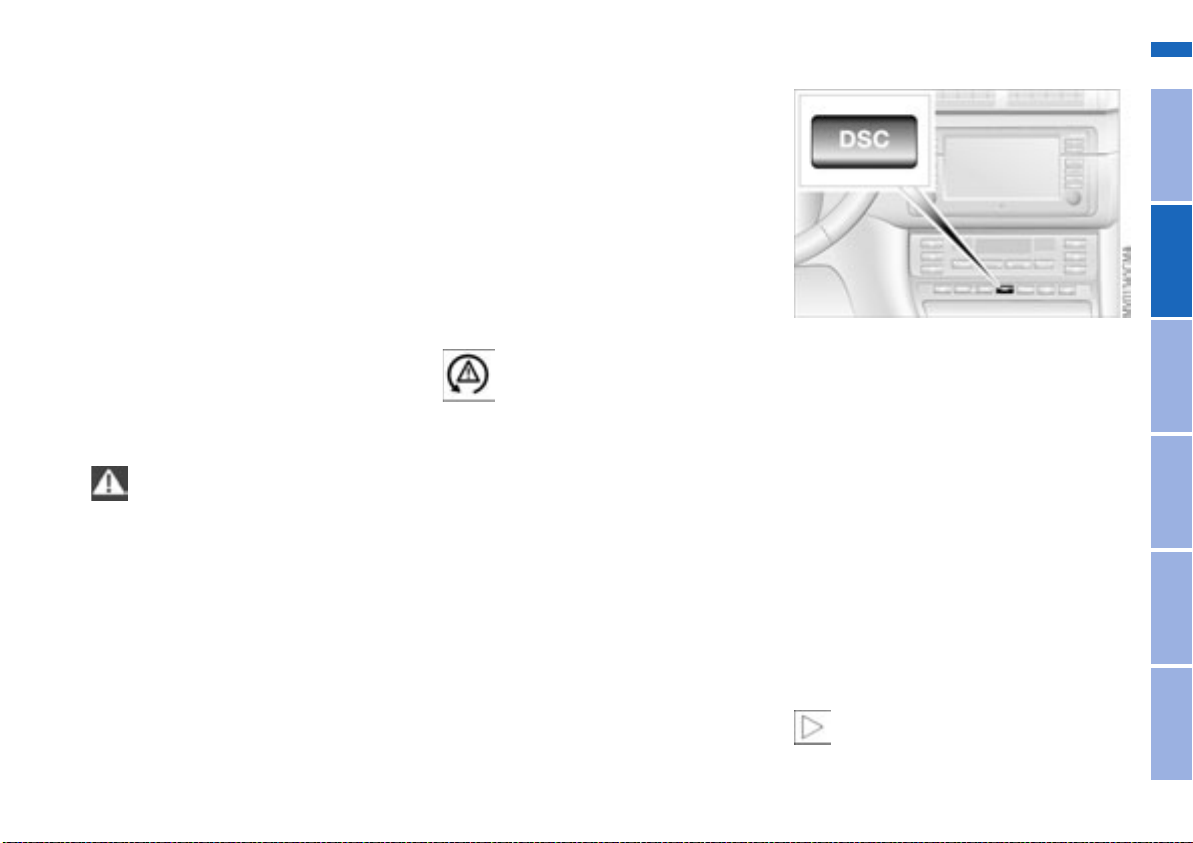
87
Dynamic Stability Control (DSC)
The concept
DSC maintains vehicle stability, even in
critical driving situations.
The system optimizes vehicle stability
during acceleration and when starting
from a full stop, as well as optimizing
traction. In addition, it recognizes
unstable vehicle conditions, such as
understeering or oversteering, and,
within physically feasible limits, helps
keeping the vehicle on a steady course
by reducing the engine speed and
brake applications to the individual
wheels.
The system starts up automatically
each time you start the engine.
The laws of physics cannot be
repealed, even with DSC. The
results of driving irresponsibly rest with
the driver. We therefore urge you to
avoid using the additional safety margin
of the system as an excuse for taking
risks. Do not make any modifications to
the DSC system. Allow only authorized
technicians to perform service proce-
dures on the DSC.
At first, you may need some time to
become accustomed to this system's
intervention. However, it guarantees
optimum drive force and at the same
time, the best possible vehicle stabil-
ity.<
Indicator lamp
The indicator lamp in the instru-
ment cluster will go out shortly
after the ignition has been
switched on, refer to page 19.
> Indicator lamp flashes: the system is
active and is controlling the drive
torque based on driving conditions
> If the indicator lamp fails to go out
after the engine has been started, or
if it comes on during normal driving
and stays on: the system has been
deactivated via the button or is
defective. You can continue to drive
the vehicle normally, but without
DSC. Please consult your BMW cen-
ter for repairs.
To deactivate the system
Press the button; the indicator lamp
comes on and stays on.
The vehicle does not execute the stabil-
ity-enhancement and traction-control
functions when DSC is deactivated.
We recommend that you deactivate the
system for increased traction:
> When rocking the vehicle or starting
off in deep snow or on loose surfaces
> When driving with snow chains
> When driving on snow-covered
grades, in deep snow, or on a snow-
covered surface that has been
packed down from being driven on.
To maintain vehicle stability,
always drive with the system
switched on whenever possible.<
OverviewControlsMaintenanceRepairsDataIndex
handbook.book Page 87 Tuesday, July 30, 2002 9:28 AM
Online Edition for Part-No. 01 41 0 156 854 - © 09/02 BMW AG

88
To reactivate the system
Press the button again; the indicator
lamp goes out.
Dynamic Brake Control (DBC)
DBC is an integral component of the
DSC system.
If you apply the brakes rapidly, this sys-
tem automatically generates maximum
braking force boost and thus helps to
achieve the shortest possible braking
distance in panic braking situations. All
of the benefits of the ABS system are
exploited under these circumstances.
Do not reduce the pressure on the
brake pedal for the duration of the
brake application. When the brake
pedal is released, the DBC is deacti-
vated.
Flat Tire Monitor
The concept
As you drive, the Flat Tire Monitor
keeps track of pressure levels in all four
tires. The system detects whenever the
inflation pressure in a tire drops off sig-
nificantly.
Controlling the tire pressure is based
on monitoring the rpm that the tires
have relative to each other. A flat tire is
detected and reported because the rpm
suddenly deviate drastically from one
another.
Dynamic Stability Control (DSC)
handbook.book Page 88 Tuesday, July 30, 2002 9:28 AM
Online Edition for Part-No. 01 41 0 156 854 - © 09/02 BMW AG
89
Initializing the system
Initializing is necessary to familiarize the
system with the correct inflation pres-
sures.
Repeat this process after any changes
in tire inflation pressure, tire rotation or
replacement.
1. Check the tire inflation pressures in
all the tires, comparing them with the
inflation pressure table, refer to
page 25, and adjust them if neces-
sary
2. Turn the ignition key to position 2
3. Press button as long as you need to
until the indicator lamp in the instru-
ment cluster lights up. After a little
while, the indicator lamp will go out
by itself
4. After a few minutes, the Flat Tire
Monitor will accept the current infla-
tion pressure as the value to be mea-
sured against, and from that point on
can detect and report a flat tire.
To activate/deactivate the system
The system is automatically activated in
ignition key position 2 and conse-
quently is on whenever the vehicle is
operated.
To deactivate the system: tap the but-
ton, the indicator lamp will light up yel-
low.
To activate the system: tap the button
again; the indicator lamp goes out.
Deactivate the system when snow
chains are mounted, since false warn-
ings and undetected losses in pressure
are possible under these kinds of con-
ditions.
Flat Tire Monitor
OverviewControlsMaintenanceRepairsDataIndex
handbook.book Page 89 Tuesday, July 30, 2002 9:28 AM
Online Edition for Part-No. 01 41 0 156 854 - © 09/02 BMW AG

90
Flat tire
The red warning lamp in the
instrument cluster lights up to
warn of pressure loss and tire
failure. In addition, an acoustic signal is
sounded. To come to an immediate
stop, reduce speed, while avoiding any
sudden, jerky braking or steering
maneuvers.
Fix the flat tire using the M Mobility sys-
tem, refer to page 139.
To reset the indicator lamp: the red
indicator lamp has to be switched off
manually after putting on a new wheel.
At this point, hold the Flat Tire Monitor
button down until the indicator lamp
goes out. Reinitialize the system after-
ward.
The Flat Tire Monitor cannot pro-
vide you with advance warning of
sudden and severe tire damage caused
by external factors.
Another factor which the Flat Tire Moni-
tor does not recognize is the balanced
and very gradual pressure loss that
takes place in all tires over an extended
period of time.<
Check tire inflation pressures on a
regular basis, correcting them as
necessary, refer to page 25.
Under certain circumstances, there
may be false warnings or a delayed
detection of losses in pressure when
driving on snow-covered or slippery
road surfaces.
Performance-oriented driving – slip at
the drive wheels and high levels of lat-
eral acceleration – can also delay the
appearance of status reports in the Flat
Tire Monitor's display panel.<
System malfunctions
As long as there is still a malfunction,
the indicator lamp in the instrument
cluster will stay lit up yellow.
Please contact your BMW center for
additional information.
Flat Tire Monitor
handbook.book Page 90 Tuesday, July 30, 2002 9:28 AM
Online Edition for Part-No. 01 41 0 156 854 - © 09/02 BMW AG
91
M Engine dynamics control
The system – Sport mode – will cause
the engine to respond more spontane-
ously to any motion of the accelerator
pedal.
Activating/deactivating Sport
mode
Activating: with the ignition key in posi-
tion 2, press the SPORT button. The
indicator lamp will come on.
Each time you activate the sys-
tem, the vehicle may gain speed
without any additional pressure on the
accelerator pedal.<
Deactivating: press the SPORT button
again; the indicator lamp will go out.
The Sport mode is deactivated every
time the engine is started.
OverviewControlsMaintenanceRepairsDataIndex
handbook.book Page 91 Tuesday, July 30, 2002 9:28 AM
Online Edition for Part-No. 01 41 0 156 854 - © 09/02 BMW AG
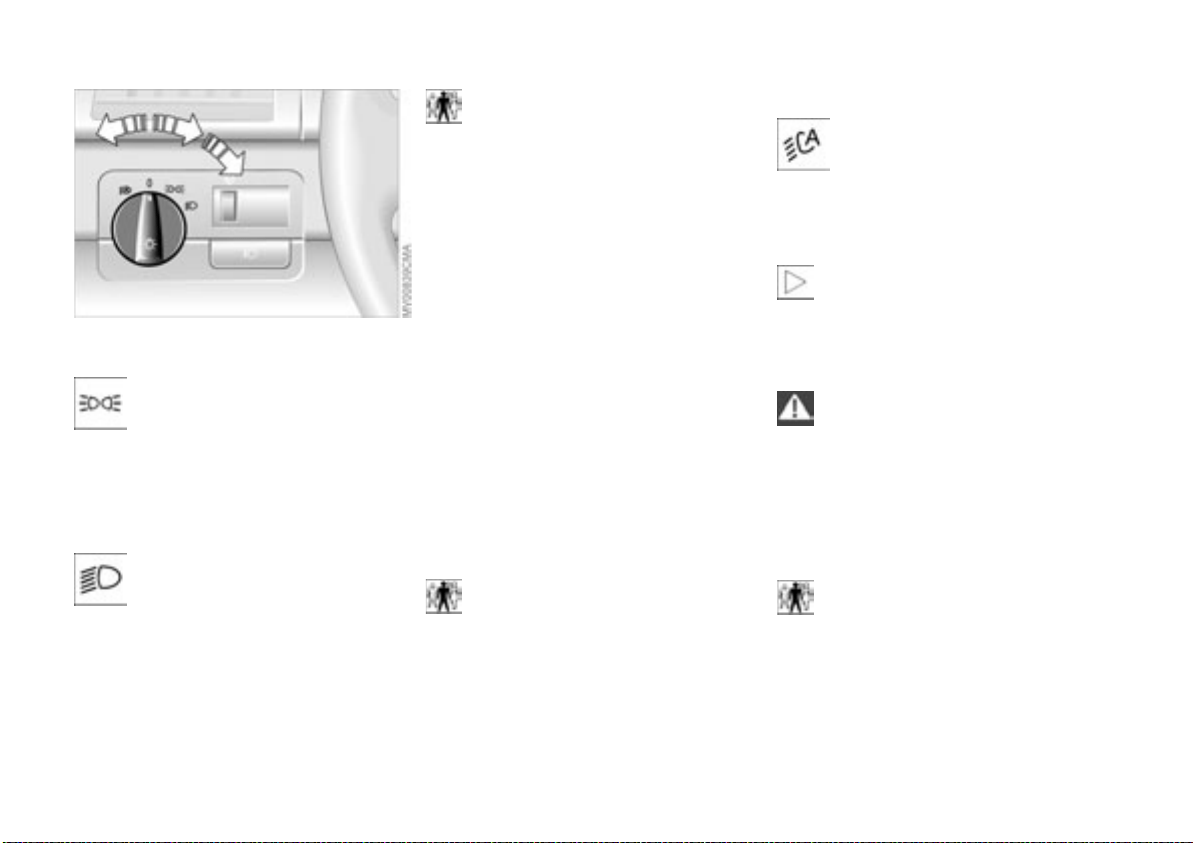
92
Lamps
Parking lamps/Low beams
Parking lamps
The front, rear and side vehicle
lighting is switched on. You can
use this to signal the position of
the vehicle when it is parked. For light-
ing on one side for parking as an addi-
tional feature, refer to page 93.
Low beams
When you switch the ignition off
with the low-beam headlamps
on, only the parking lamps will
remain on.
Follow me home lamps
When you activate the headlamp
flasher after parking the vehicle and
switching off the lights, the low beams
will come on for a brief period.
You can also have this function
deactivated.<
LIGHTS ON warning
Whenever you open the driver's door
after having turned the ignition key to
position 0, you will hear an acoustic
signal for a few seconds to remind you
that the lamps have not been switched
off.
Daytime driving lamps*
If you desire, the light switch can be left
in the low-beam position: when the
ignition is switched off, the external
lighting is also switched off.
Observe the legal regulations regarding
the use of daytime driving lamps.
When required, switch on the parking
lamps as usual as described under
Parking lamps.
You can have the activation set-
tings for the daytime driving lamps
programmed on your vehicle.<
Automatic headlamp control*
When the switch is in this posi-
tion, the system automatically
responds to changes in ambient
light – in tunnels, at dusk, etc. – and to
rain and snow by switching the low
beams on or off.
The vehicle's external lamps
remain on constantly when you
switch on the front fog lamps after the
headlamps have come on automati-
cally.<
Automatic headlamp control can-
not serve as a substitute for your
personal judgement in determining
when the lamps should be switched on.
For example, the sensors are not able
to detect fog. In such situations switch
on the lamp manually, as otherwise a
safety hazard will result.<
You can have the sensitivity of
your vehicle's automatic head-
lamp control adjusted.<
handbook.book Page 92 Tuesday, July 30, 2002 9:28 AM
Online Edition for Part-No. 01 41 0 156 854 - © 09/02 BMW AG
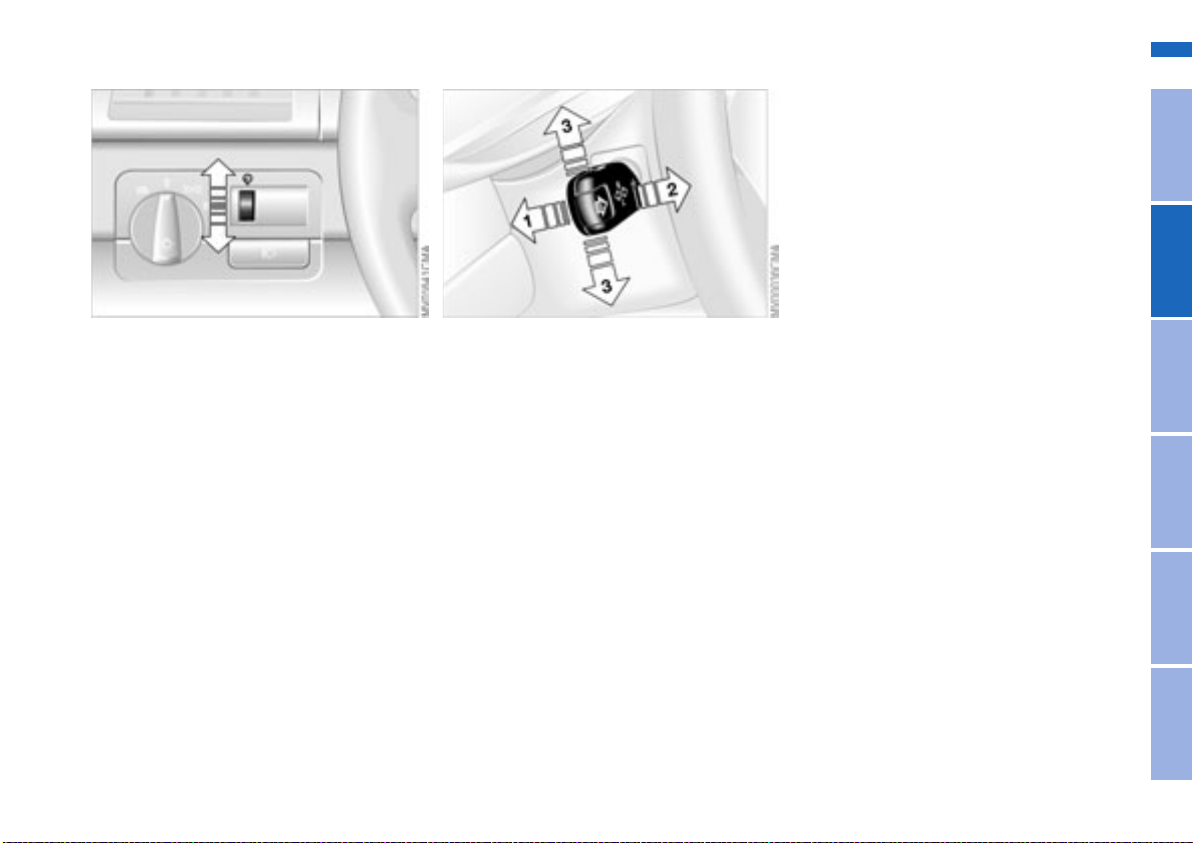
93
Instrument lighting
Turn the rotary dial to control the light-
ing when the parking or low beam
lamps are on.
High beams/Standing lamps
1 High beams – blue indicator lamp
2 Headlamp flasher – blue indicator
lamp
3 Standing lamps
Standing lamps, left or right
As an additional feature, you can illumi-
nate your vehicle on either side for
parking, if you wish to do so:
With the ignition key in position 0, push
the lever in the appropriate direction.
The lever engages in the turn signal
position.
OverviewControlsMaintenanceRepairsDataIndex
handbook.book Page 93 Tuesday, July 30, 2002 9:28 AM
Online Edition for Part-No. 01 41 0 156 854 - © 09/02 BMW AG
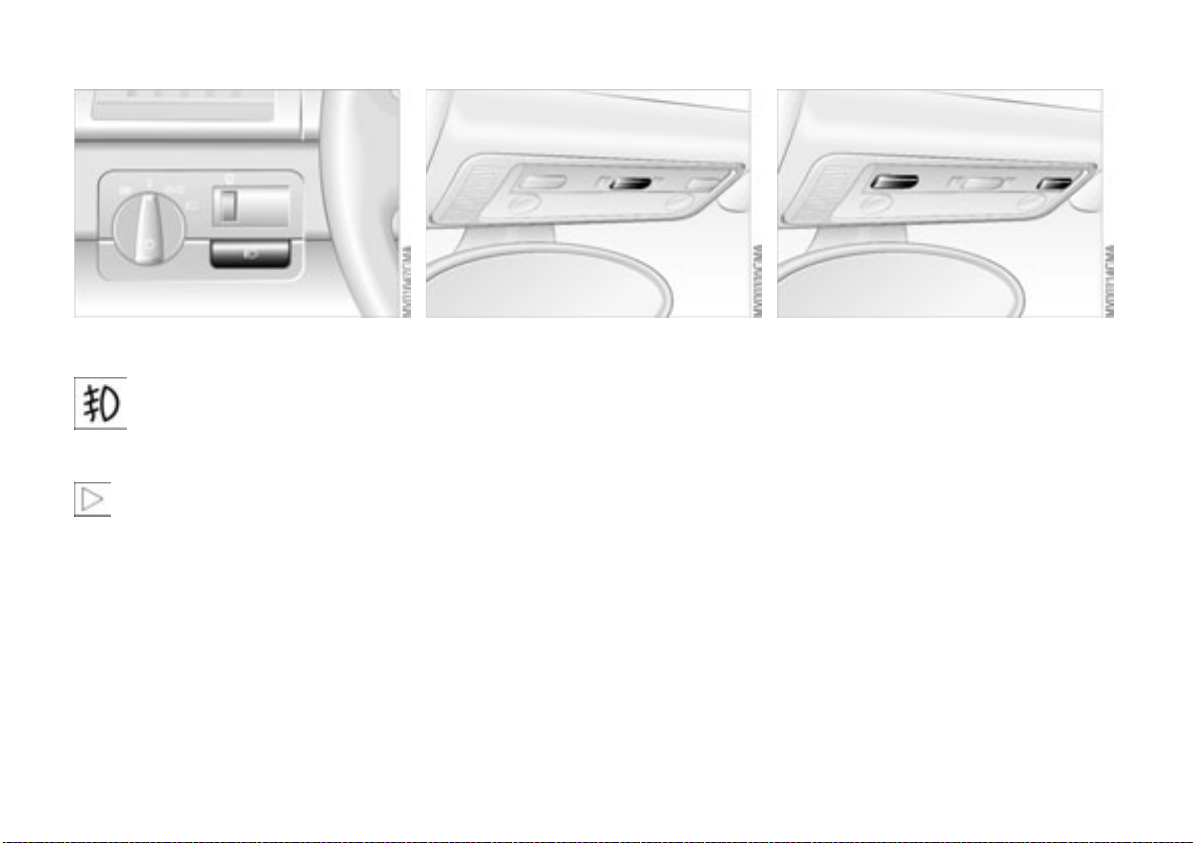
94
Fog lamps
Front fog lamps
The green indicator lamp in the
instrument cluster lights up to
indicate that the front fog lamps
are on.
If the automatic headlamp control
is on, the low beams will come on
automatically whenever you activate
the front fog lamps.<
Interior lamps
The interior lamps operate automati-
cally.
To switch the interior lamps on
and off manually
Press the button briefly.
If you want the interior lamps to remain
off all the time, press and hold the but-
ton for approx. three seconds.
Press the button briefly to revert to nor-
mal operation.
Reading lamps
Front reading lamps
Switch on and off with the button adja-
cent to each lamp.
handbook.book Page 94 Tuesday, July 30, 2002 9:28 AM
Online Edition for Part-No. 01 41 0 156 854 - © 09/02 BMW AG
95
Rear reading lamps
With the hardtop reading lamps are also
located in the rear, refer to page 113.
Switch on and off with the button adja-
cent to each lamp.
In order to prevent battery dis-
charge, all of the lamps in the
vehicle are automatically switched off
approx. 15 minutes after you turn the
ignition key to position 0.<
Reading lamps
OverviewControlsMaintenanceRepairsDataIndex
handbook.book Page 95 Tuesday, July 30, 2002 9:28 AM
Online Edition for Part-No. 01 41 0 156 854 - © 09/02 BMW AG
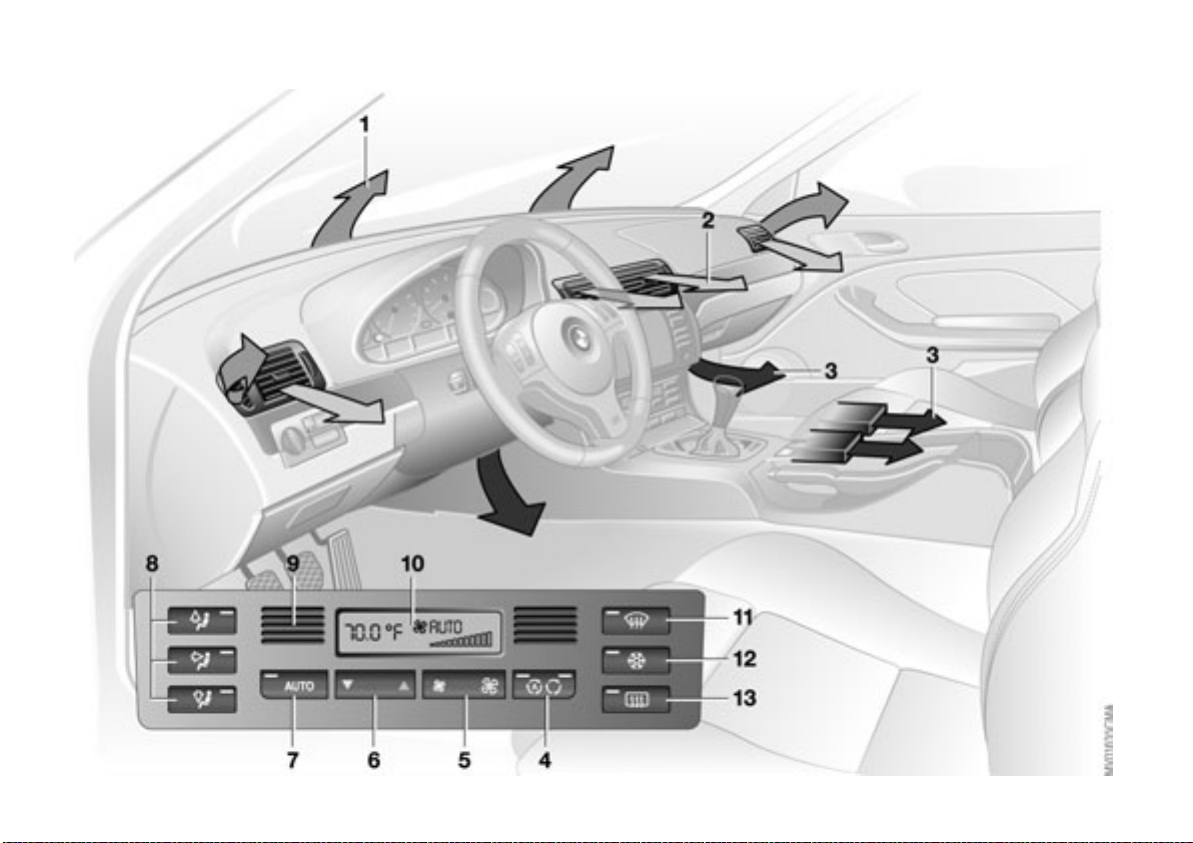
96
Controlling the climate for pleasant driving
Automatic climate control
handbook.book Page 96 Tuesday, July 30, 2002 9:28 AM
Online Edition for Part-No. 01 41 0 156 854 - © 09/02 BMW AG

97
1 Air onto the windshield and the side
windows
2 Air for the upper body area 99
3 Air to the footwell
4 Outside air/Automatic recirculated-
air control (AUC)/Recirculated
air 99
5 Air supply/Blower 98
6 Temperature 98
7 Automatic air distribution and
supply 98
8 Individual air distribution 98
9 Interior temperature sensor – please
keep clear and unobstructed
10 Display for temperature and air
supply 98
11 To defrost windows and remove
condensation 98
12 Air conditioning 98
13 Rear window defroster 99
Automatic climate control
OverviewControlsMaintenanceRepairsDataIndex
handbook.book Page 97 Tuesday, July 30, 2002 9:28 AM
Online Edition for Part-No. 01 41 0 156 854 - © 09/02 BMW AG

98
Tips for pleasant driving
Use the automatic mode – switch on
with AUTO button 7. Select the desired
interior temperature.
Detailed setting options are described
for you in the following sections.
You can make the settings of your
vehicle in such a manner that,
when you unlock the vehicle with the
remote control of your personal key,
your own personalized setting for the
automatic climate control is initiated.<
Automatic air distribution and
supply
The AUTO program adjusts the
air distribution and the air sup-
ply for you and in addition adapts the
temperature to external influences –
summer, winter – to meet preferences
you can specify.
Individual air distribution
You can cancel the AUTO pro-
gram by selecting specific dis-
tribution patterns to suit your
own individual requirements.
While the AUTO program is then deacti-
vated, the automatic airflow control
remains in operation. Air flows onto
the windows , toward the upper
body , and into the footwell . You
can reactivate the automatic air supply
by pressing the AUTO button.
Temperature
The interior temperature that
appears in the display panel is a
general figure intended for reference
purposes. We recommend 727/+226
as a comfortable setting, even if the air
conditioning is on. When you start the
vehicle, the system ensures that the
selected temperature is reached as
quickly as possible. It then maintains
this temperature, regardless of the sea-
son.
To select the units of measure 6/7
of the display, refer to page 84.
Air supply/Blower
By pressing the left or right half
of the button, you can vary the
air supply. This deactivates the auto-
matic air supply – the AUTO display dis-
appears from the panel. Nevertheless,
the automatic air distribution remains
unchanged. You can reactivate the
automatic air supply by pressing the
AUTO button.
When the lowest blower speed is set
and you press the left half of the button,
all of the displays are canceled: the
blower, heating and air conditioner are
switched off, and the air supply is
stopped. You can reactivate the system
by pressing any button for the auto-
matic climate control.
To defrost windows and remove
condensation
This program quickly removes
ice and condensation from the
windshield and the side windows.
Air conditioning
The air is cooled and dehumidi-
fied and – depending on the
temperature setting – rewarmed.
Depending on the weather, the wind-
shield may fog over briefly when the
engine is started. Air conditioning helps
prevent the windows from fogging up.
Condensation forms during opera-
tion of the air conditioning system,
which then exits under the vehicle.
Traces of condensed water of this kind
are thus normal.<
Automatic climate control
handbook.book Page 98 Tuesday, July 30, 2002 9:28 AM
Online Edition for Part-No. 01 41 0 156 854 - © 09/02 BMW AG
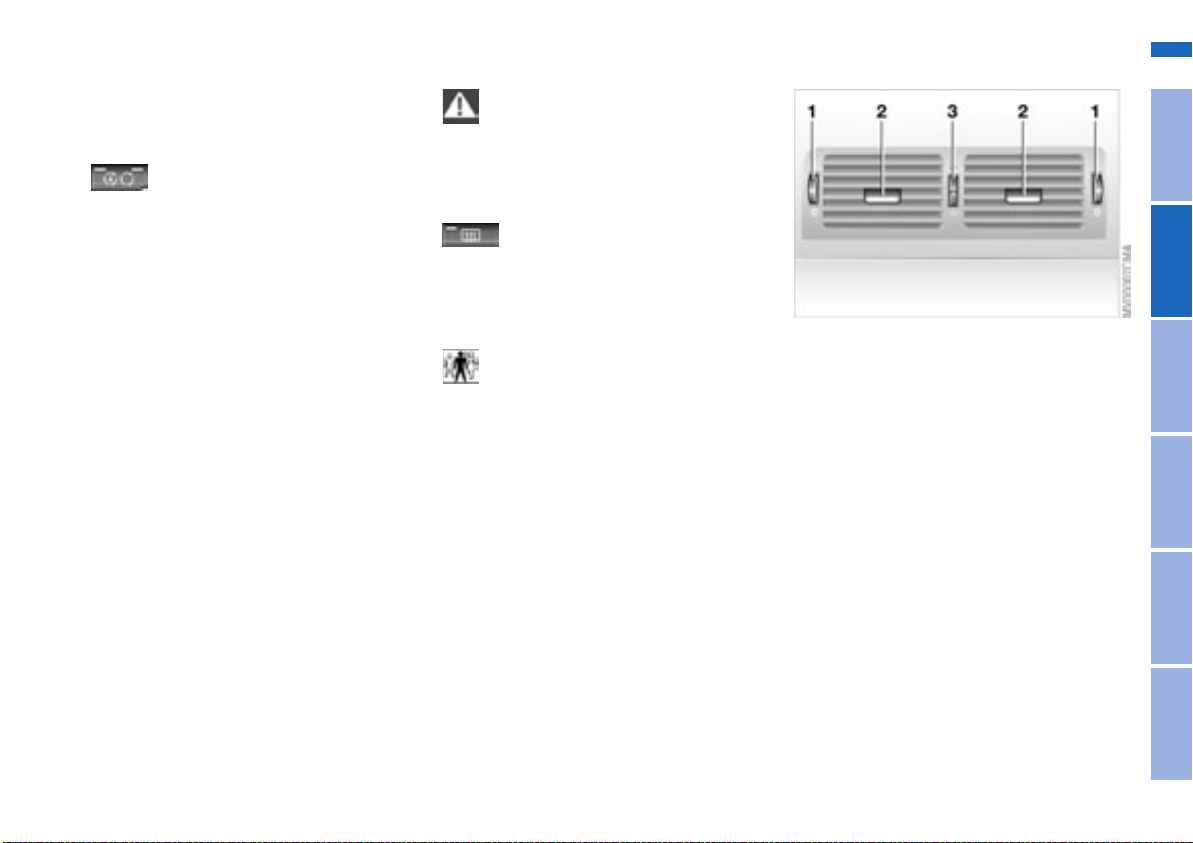
99
Outside air/Automatic
recirculated-air control (AUC)/
Recirculated air
You can respond to unpleasant
external odors or pollutants by
temporarily stopping the flow of outside
air. The system then recirculates the air
currently within the vehicle.
By repeatedly pressing the button, you
can select one of three different operat-
ing modes.
> Indicator lamps off: outside air always
flowing into the vehicle
> Left-hand indicator lamp on – auto-
matic mode: the system detects pol-
lutants in the outside air and
responds by deactivating the outside
airflow as required. The system then
recirculates the air currently within
the vehicle.
Depending on air quality require-
ments, the system automatically
switches between outside air supply
and recirculation of the air already
within the vehicle
> Right-hand indicator lamp on: the
flow of outside air is permanently
blocked. The system recirculates the
air already within the vehicle.
If the windows fog over in the
recirculated-air mode, switch the
recirculated-air mode off and increase
the air supply as required.<
Rear window defroster
With the convertible top closed
or with the hardtop* mounted,
press the button. The indicator lamp
remains on. The rear window defroster
switches off automatically.
You can have your vehicle pro-
grammed in such a way that the
rear window defroster switches on
automatically. This occurs within 5 min-
utes after starting the engine when out-
side temperatures are below approx.
397/+46.<
Draft-free ventilation
You can adjust the blower controls for
the upper body area to obtain the opti-
mum airflow rates and directions for
your personal requirements:
1 Rotary dials for opening and closing
the vents at any setting desired
2 Lever for adjusting airflow direction
3 With the rotary dial you can adjust the
temperature of the outgoing air:
> Turn toward blue – colder
> Turn toward red – warmer
Automatic climate control
OverviewControlsMaintenanceRepairsDataIndex
handbook.book Page 99 Tuesday, July 30, 2002 9:28 AM
Online Edition for Part-No. 01 41 0 156 854 - © 09/02 BMW AG

100
Microfilter, activated-charcoal
filter
The built-in microfilter removes dust
and pollen from the incoming air. The
activated-charcoal filter provides addi-
tional protection by filtering gaseous
pollutants from the outside air. Your
BMW center will replace the combined
filter as a standard part of your sched-
uled maintenance. A substantial reduc-
tion in airflow indicates that the filter
needs to be replaced early.
Automatic climate control
handbook.book Page 100 Tuesday, July 30, 2002 9:28 AM
Online Edition for Part-No. 01 41 0 156 854 - © 09/02 BMW AG
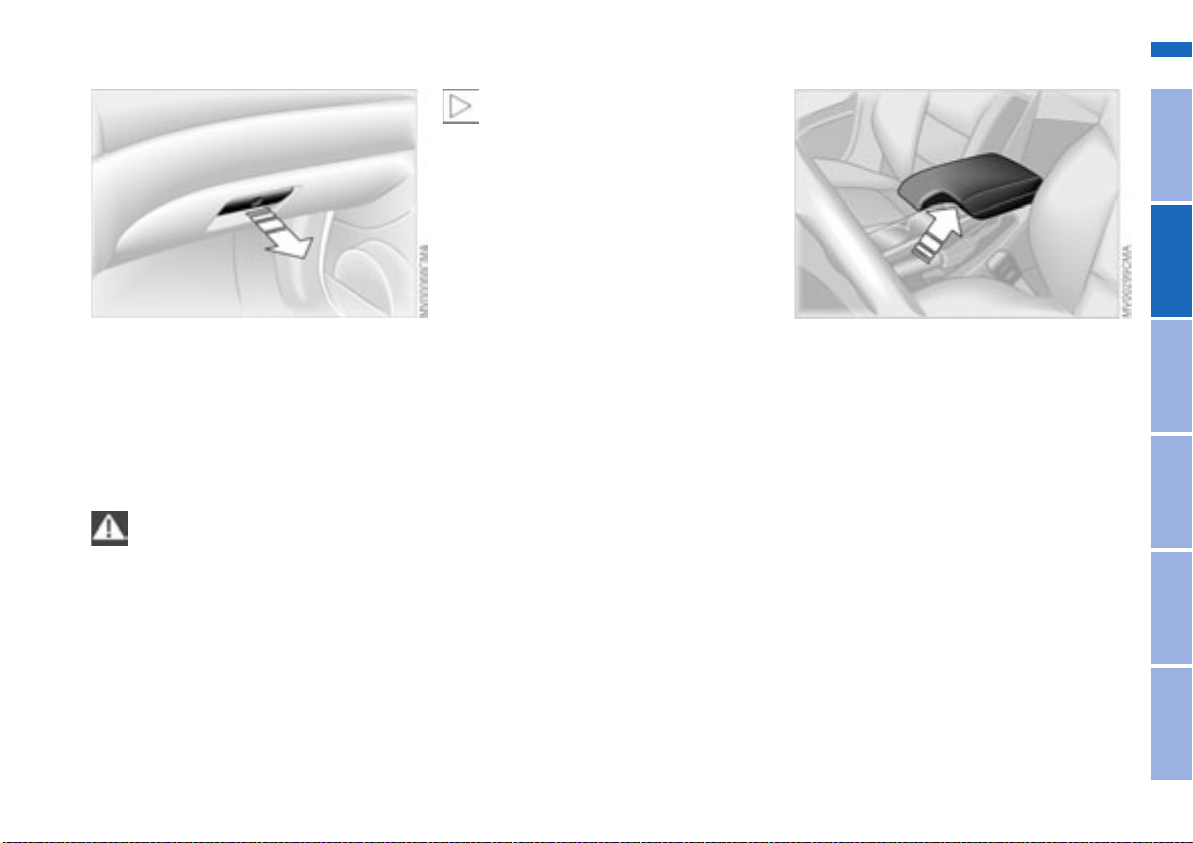
101
Interior conveniences
Glove compartment
To open
Pull the handle. The glove compartment
will light up.
To close
Fold up cover.
To prevent injury in the event of an
accident, close the glove com-
partment immediately after use.<
To lock
Lock with one of the master keys. A
master key can also be used for unlock-
ing.
If – for example for valet parking –
you turn over only your door and
ignition key, refer to page 30, then
access to the glove compartment and
the luggage compartment is not possi-
ble.<
Storage compartments
Front center armrest
To open: press the button and lift
upward – see arrow.
Other compartments and nets
You will find additional storage areas in
the doors and in the center console
above the ashtray. Storage nets are
located on the backrests of the front
seats.
OverviewControlsMaintenanceRepairsDataIndex
handbook.book Page 101 Tuesday, July 30, 2002 9:28 AM
Online Edition for Part-No. 01 41 0 156 854 - © 09/02 BMW AG
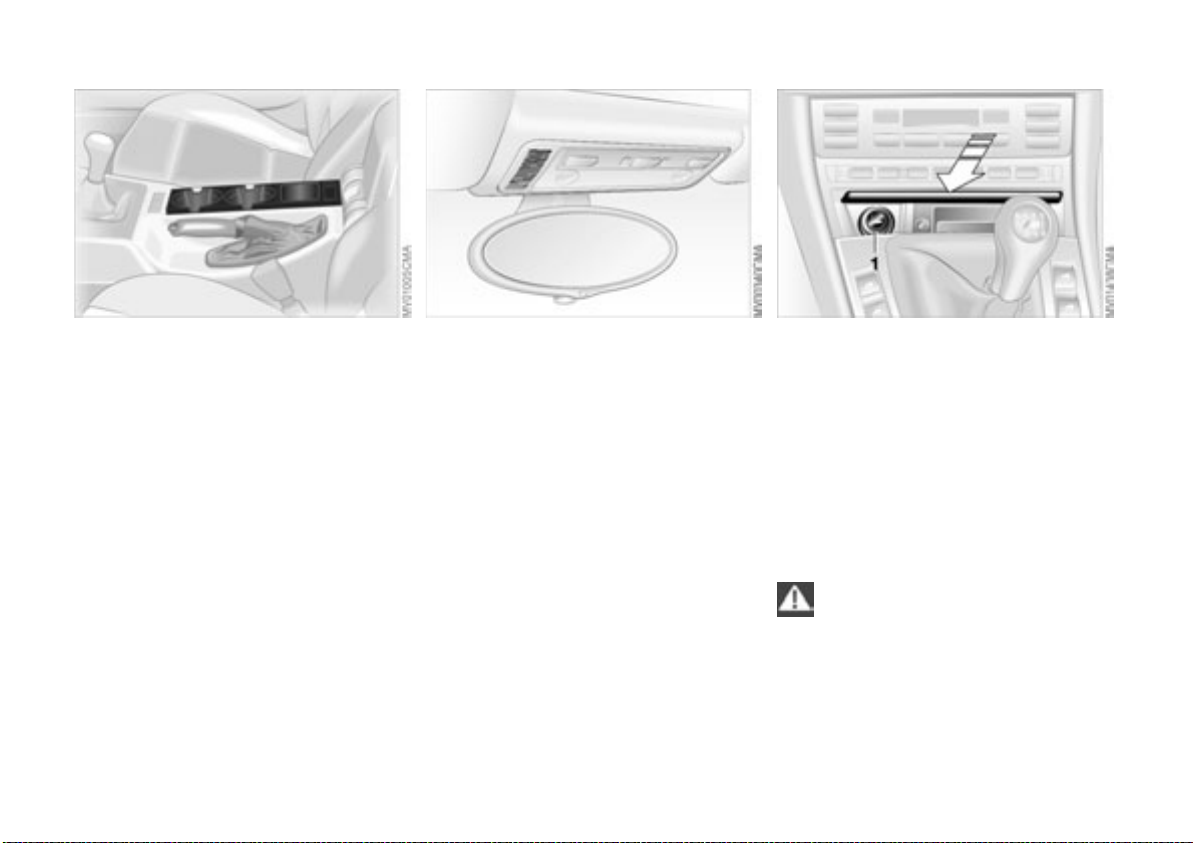
102
Beverage holder, coin box
A coin box and two beverage holders
are provided in the center console.
Cellular phone*
Hands-free system
In vehicles equipped with telephone
preparation* or with the communica-
tions package*, the cover for the
hands-free microphone is located
above the interior rearview mirror on
the driver side.
For further information on the cellular
phone, refer to the separate Owner's
Manual.
Ashtray, front*
To empty
Press on the edge of the open cover –
see arrow: you can now pull the ashtray
upward for removal.
Extinguishing cigarettes
Tap off the ash and gently press the tip
into the funnel.
Cigarette lighter
Hold or touch the hot cigarette
lighter by the knob only. Holding
or touching it in other areas could result
in burns.
The cigarette lighter remains opera-
tional when the ignition key has been
removed. For this reason, children
should never be left in the vehicle unat-
tended.<
Storage compartments
handbook.book Page 102 Tuesday, July 30, 2002 9:28 AM
Online Edition for Part-No. 01 41 0 156 854 - © 09/02 BMW AG
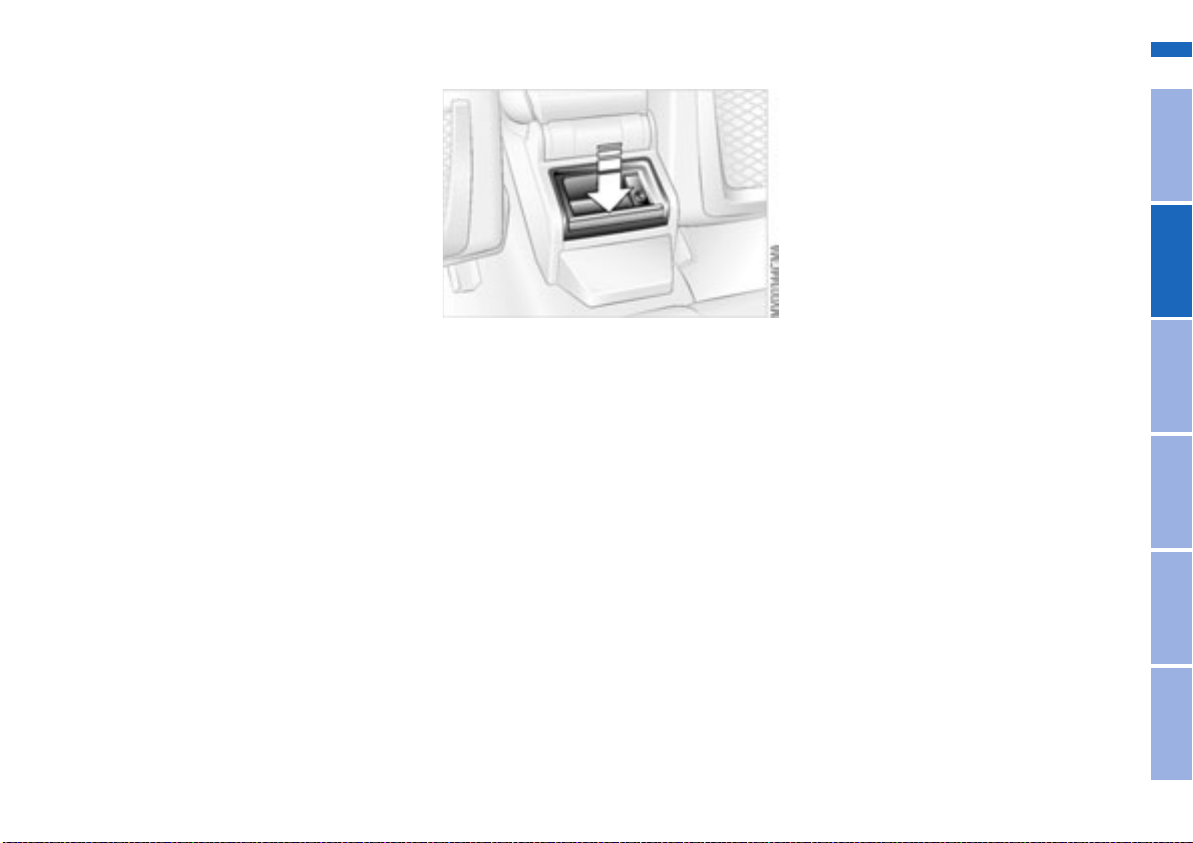
103
Press lighter 1 in. As soon as the lighter
jumps back out, it can be removed.
Cigarette lighter socket
It can be used for attaching power sup-
plies for flashlights, car vacuum clean-
ers and other similar appliances up to a
rating of approx. 200 watts at 12 volts.
Avoid damaging the socket due to
inserting plugs of different shapes or
sizes.
Ashtray, rear*
To empty
Press on the edge of the raised cover in
the opening direction – see arrow. You
can now pull the ashtray upward for
removal.
Ashtray, front*
OverviewControlsMaintenanceRepairsDataIndex
handbook.book Page 103 Tuesday, July 30, 2002 9:28 AM
Online Edition for Part-No. 01 41 0 156 854 - © 09/02 BMW AG
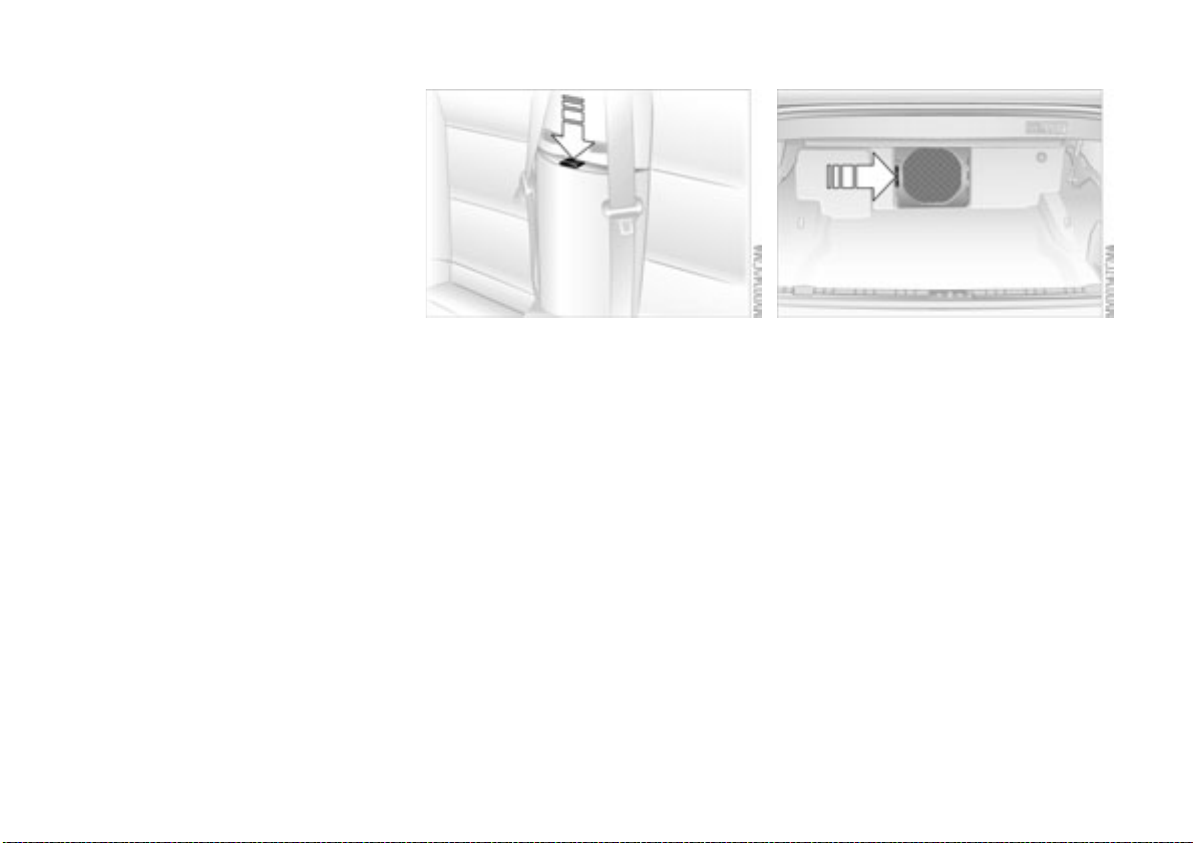
104
Loading and transporting
Ski bag*
The ski bag allows the safe and clean
transport of up to 3 pairs of standard
skis or up to two snowboards.
The length of the ski bag and the addi-
tional space provided in the luggage
compartment make it possible to carry
skis up to 6 ft 10 in / 2.10 m long.
Because of the tapered shape of the
bag, only two pairs of skis longer than
6 ft 10 in / 2.10 m can be carried.
Loading
1. Release the safety belts from their
holders
2. Press lever downward – see arrow –
and remove the center piece by pull-
ing it forward
3. Extend the ski bag between the front
seats. The zipper provides conve-
nient access to stored items. It may
be opened to allow the ski bag to dry
4. Press the release button in the lug-
gage compartment – see arrow
handbook.book Page 104 Tuesday, July 30, 2002 9:28 AM
Online Edition for Part-No. 01 41 0 156 854 - © 09/02 BMW AG
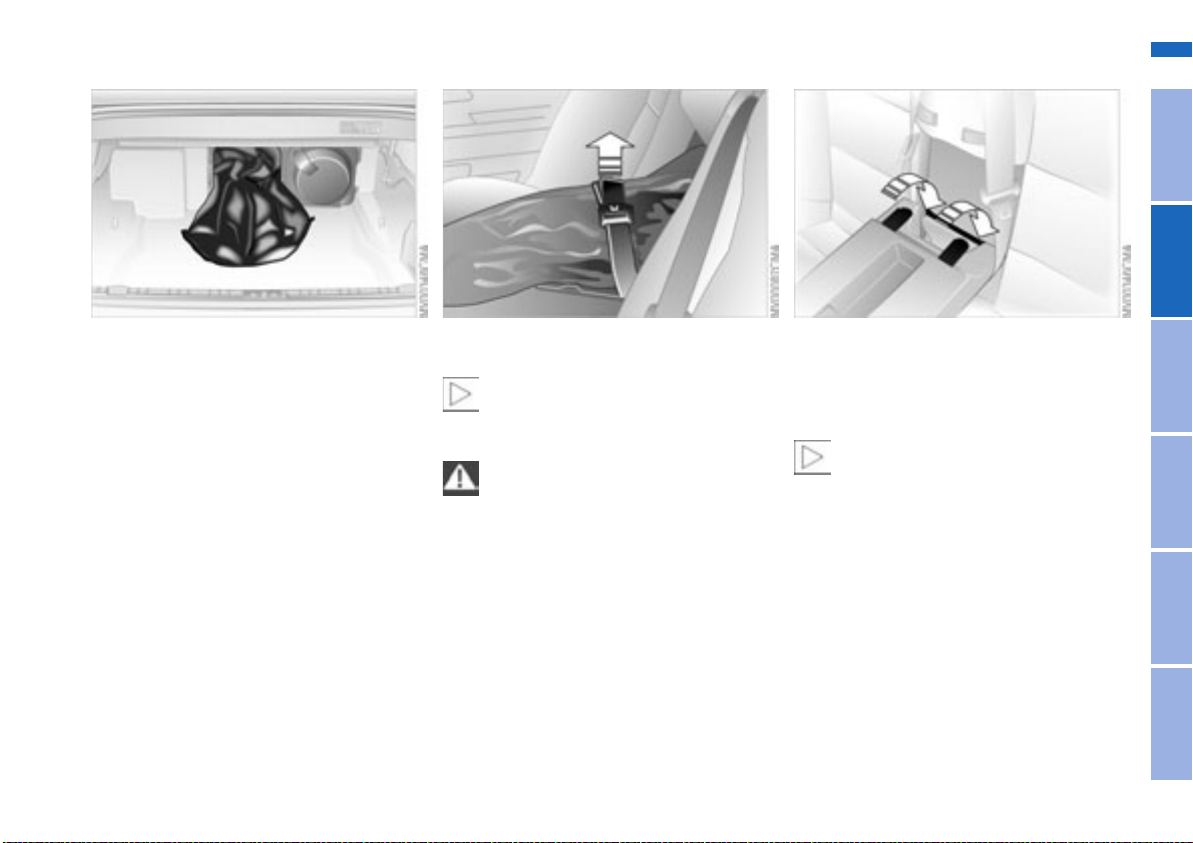
105
5. Secure the cover panel with the
magnetic retainer on the rear wall
and pull out the ski bag.
Securing cargo
Secure skis and any other objects
stored in the bag by tightening the
retaining strap at the buckle.<
Please be sure that the skis are
clean before loading them into the
bag. Be careful to avoid damage from
sharp edges.<
Storing the ski bag
To store the ski bag, perform the above
steps in reverse sequence.
When reattaching the center
piece, guide both bars into the
guide and press the center piece back
into place. Secure the safety belts in
their holders again.<
Ski bag*
OverviewControlsMaintenanceRepairsDataIndex
handbook.book Page 105 Tuesday, July 30, 2002 9:28 AM
Online Edition for Part-No. 01 41 0 156 854 - © 09/02 BMW AG
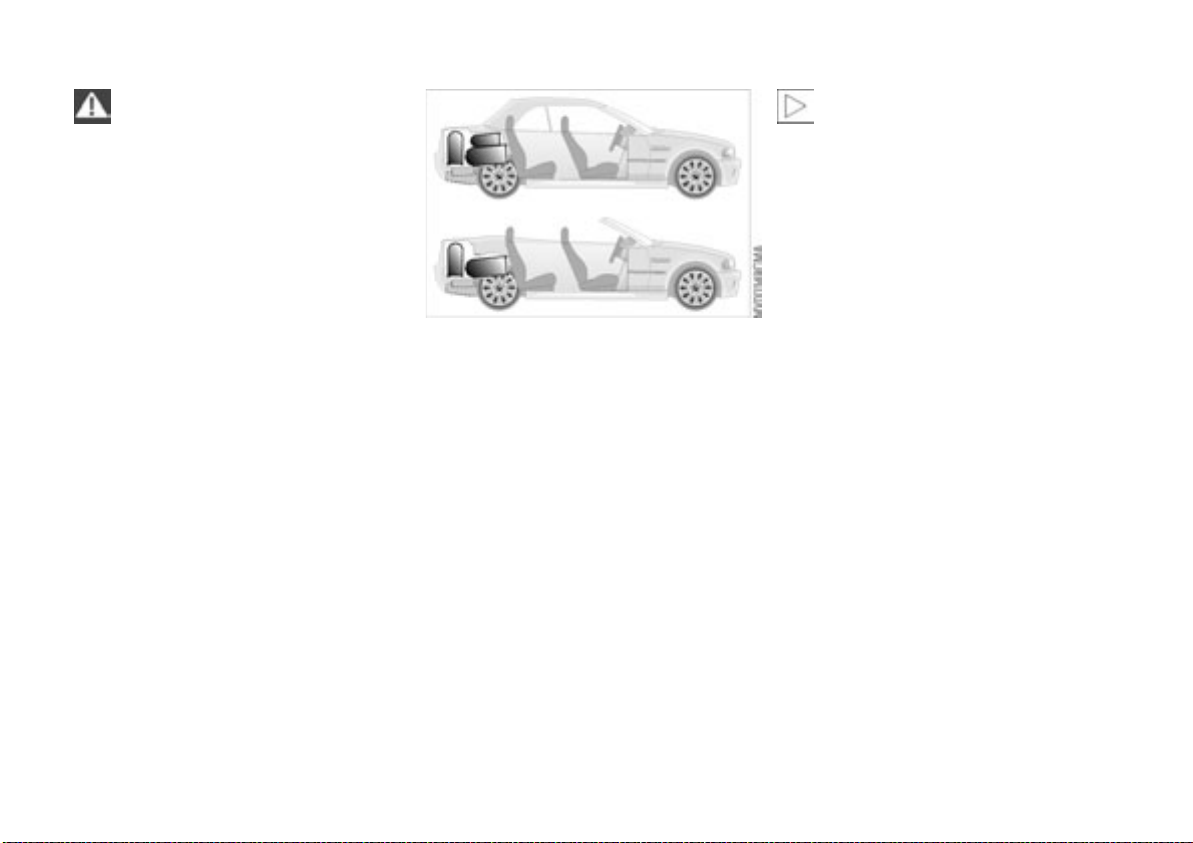
106
Cargo loading
Always position and secure the
load correctly. If you do not, it can
endanger the passengers during brak-
ing or evasive maneuvers.
Do not exceed the approved gross
weight or the approved maximum axle
loads, refer to page 152. Otherwise the
vehicle's operating safety is no longer
assured and you are in violation of the
law
Do not stow heavy or hard objects in
the passenger compartment without
first securing them. Otherwise they
would be thrown around during braking
and evasive maneuvers and endanger
the occupants.<
Stowing cargo
> Load heavy cargo as far forward as
possible – directly behind the back-
rests or the luggage compartment
partition – and as low as possible
> Cover sharp edges and corners.
You can enlarge the luggage com-
partment when the convertible top
is closed, refer to page 37. To do this
you have to fold the convertible top
compartment panel up.
We recommend that you always fold
the convertible top compartment panel
down as soon as you have removed
your cargo from the luggage compart-
ment. This way, you can be sure that
you can always operate you convertible
top at any time.
Conversely, when the convertible top is
closed, raise the convertible top com-
partment panel before stowing your
cargo in the luggage compartment to
avoid any damage to the convertible
top compartment or your load.<
handbook.book Page 106 Tuesday, July 30, 2002 9:28 AM
Online Edition for Part-No. 01 41 0 156 854 - © 09/02 BMW AG
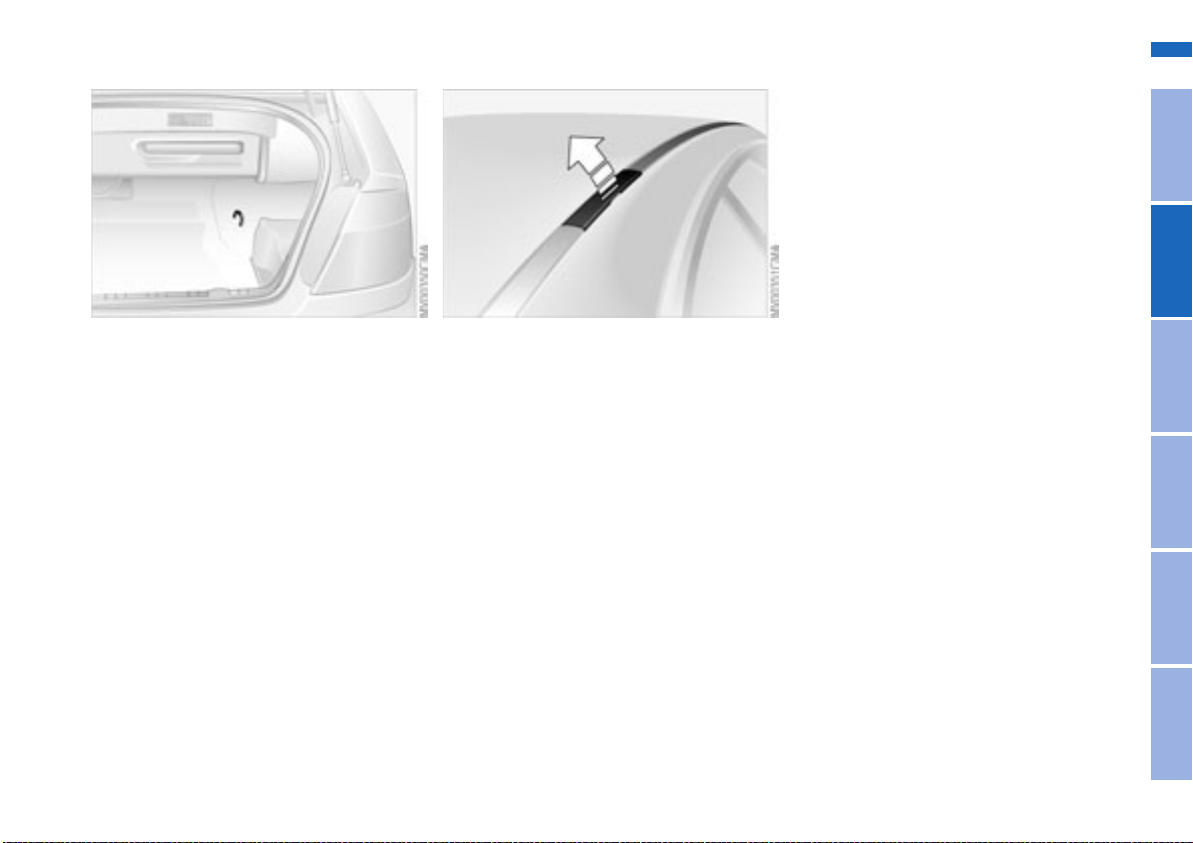
107
Securing the cargo in the luggage
compartment
> For small, light items, use the rubber-
lined non-skid side of the floor mat or
secure with a luggage compartment
net* or elastic straps, refer to page 37
> For large, heavy pieces, see your
BMW center for load-securing
devices*. Lashing fittings located in
the luggage compartment can be
used for fastening the load-securing
devices.
Comply with the information enclosed
with the load-securing devices.
Roof-mounted luggage rack for the hardtop*
A special roof-rack system is available
as an optional extra for your BMW.
Please observe the precautions
included with the installation instruc-
tions.
Anchorages
Access to the mounting points:
To fold up the cover – see arrow –
please use the tool which is provided
with the luggage system.
Loading and driving notes
Because roof racks raise the center of
gravity of the vehicle when loaded, they
exercise a major effect on its handling
and steering response.
When loading, be sure to remember not
to exceed the approved roof weight or
the approved gross vehicle weight or
the axle loads. You will find the specifi-
cations under Technical data on
page 152.
Make sure that the load is not too bulky,
and attempt to distribute it evenly.
Always load the heaviest pieces first so
that they are at the bottom. Make sure
that no objects get in the way when the
luggage compartment lid is opening or
closing.
Secure the roof-mounted luggage cor-
rectly and safely to prevent it from shift-
ing or being lost during driving.
Drive smoothly and avoid sudden
acceleration or braking. Do not corner
at high speeds.
Cargo loading
OverviewControlsMaintenanceRepairsDataIndex
handbook.book Page 107 Tuesday, July 30, 2002 9:28 AM
Online Edition for Part-No. 01 41 0 156 854 - © 09/02 BMW AG

108
handbook.book Page 108 Tuesday, July 30, 2002 9:28 AM
Online Edition for Part-No. 01 41 0 156 854 - © 09/02 BMW AG

109
Overview
Controls and features
Operation, maintenance
Owner service procedures
Technical data
Index
OverviewControlsMaintenanceRepairsDataIndex
handbook.book Page 109 Tuesday, July 30, 2002 9:28 AM
Online Edition for Part-No. 01 41 0 156 854 - © 09/02 BMW AG

110
Special operating instructions
Break-in procedures
To ensure that your vehicle provides
maximum economy throughout a long
service life, we request that you
observe the following suggestions.
Because of its engineering design,
the BMW M3 convertible is an
especially high-quality vehicle. It is in
your best interest to follow the break-in
tips very closely. Doing this, you will
create the basis for a long, optimum
service life.<
Engine and differential
> Up to 1,250 miles/2,000 km: drive at
varying engine and road speeds, but
do not exceed the following engine or
road speeds:
5,500 rpm or 105 mph/170 km/h.
Obey your local and state maximum
speed limits.
Do not depress the accelerator pedal to
the full-throttle position.
Vehicles with SMG II, refer to page 71:
refrain from using driving program 6 in
the sequential mode during the break-
in period.
> Following the break-in inspection at
1,250 miles/2,000 km, you can grad-
ually increase engine or road speeds.
Follow the same break-in procedure if
either the engine or the differential
should have to be replaced in the
future.
Tires
Due to technical factors associated
with their manufacture, tires do not
achieve their full traction potential until
an initial break-in period has elapsed.
Thus drive with extra care during the
initial 200 miles/300 km.
Obey your local and state maximum
speed limits.
When the vehicle is operated on
wet or slushy roads, a wedge of
water may form between the tire and
the road surface. This phenomenon is
referred to as hydroplaning, and can
lead to partial or complete loss of trac-
tion, vehicle control and braking effec-
tiveness. Reduce your speed on wet
roads.<
Brake system
Approx. 300 miles/500 km must elapse
before the brake pads and rotors
achieve the optimal pad-surface and
wear patterns required for trouble-free
operation and long service life later on.
To break in the separate parking brake
drums, apply the parking brake lightly
when coasting to a standstill – at a traf-
fic signal, for instance – use caution to
avoid posing a danger to other road
users.
To avoid corrosion, repeat this proce-
dure from time to time.
The brake lamps do not come on
when the parking brake is set.
Vacuum for the brake system servo unit
on your BMW is available only when the
engine is running. When you move the
vehicle with the engine off – when tow-
ing, for example – substantially higher
levels of pedal force will be required to
brake the vehicle.<
Clutch
The clutch will also begin to function
optimally after about 300 miles/500 km.
Drive cautiously during this break-in
period and do not press the clutch or
shift at high engine speeds.
handbook.book Page 110 Tuesday, July 30, 2002 9:28 AM
Online Edition for Part-No. 01 41 0 156 854 - © 09/02 BMW AG

111
Driving notes
Brakes: do not rest your foot on
the brake pedal while driving.
Even light but consistent pedal pres-
sure can lead to high temperatures,
brake wear and possibly even brake
failure.
Hydroplaning: when driving on wet or
slushy roads, reduce road speed. If you
do not, a wedge of water can form
between tires and road surface. This
phenomenon is referred to as hydro-
planing, and can lead to partial or com-
plete loss of traction, vehicle control
and braking effectiveness.
Driving through water: do not drive
through water on the road if it is deeper
than 1 ft/30 cm, and then only at walk-
ing speed. Otherwise, the vehicle's
engine, the electrical systems and the
transmission may be damaged.<
Antilock Brake System (ABS)
The concept
The Antilock Brake System (ABS) keeps
the wheels from locking during braking,
thereby enhancing active driving safety.
Braking with ABS
If you are in a situation that requires full
braking, you will exploit the full benefits
of the ABS system if you apply maxi-
mum pedal pressure, panic stop. Since
the vehicle maintains steering respon-
siveness, you can avoid possible obsta-
cles with a minimum of steering effort,
despite the full brake application.
Pulsation at the brake pedal combines
with sounds from the hydraulic circuits
to indicate to the driver that ABS is in
its active mode.
Cornering Brake Control (CBC)
CBC is an advanced engineering
design of the ABS. When braking while
cornering at high speed or braking dur-
ing high lateral acceleration, or when
braking during a lane change, vehicle
stability is improved and steering
response is enhanced.
OverviewControlsMaintenanceRepairsDataIndex
handbook.book Page 111 Tuesday, July 30, 2002 9:28 AM
Online Edition for Part-No. 01 41 0 156 854 - © 09/02 BMW AG

112
Brake system
Brake fluid level
Low brake fluid level in the reservoir
combined with longer than usual pedal
travel may indicate a defect in one of
the brake system's hydraulic circuits.
Proceed to the nearest BMW cen-
ter. Higher brake application pres-
sure may be necessary when stopping,
and the vehicle may exhibit a slight ten-
dency to pull to one side. Brake dis-
tances may even be longer. Please
remember to adapt your driving style
accordingly.<
Disc brakes
When the vehicle is driven only occa-
sionally, during extended periods when
the vehicle is not used at all, and in
operating conditions where brake appli-
cations are less frequent, there is an
increased tendency for corrosion of the
rotors and accumulation of contamina-
tion on the brake pads. This occurs
because the minimal pressure that must
be exerted by the pads to clean the
rotors by brake applications is not
reached.
Corrosion on brake rotors is signaled by
a running or pulsation during braking;
even extended subsequent braking will
not cure this phenomenon.
It is a good idea to periodically dry the
brakes with a gentle application when
driving in rain and on wet roads. Watch
traffic conditions to ensure that this
maneuver does not endanger other
road users. The heat generated in this
process helps dry the pads and rotors
to ensure that your brake system will
respond with undiminished efficiency
when you need it.
Extended or steep mountain descents
should be driven in the gear in which
only minimal periodic brake applica-
tions are required. This helps avoid
placing excessive loads on the brake
system. Stay within the allowable rpm
range. For additional information, refer
to page 80.
Do not coast with the clutch
depressed or with the gearshift
lever in idle. Do not coast with the
engine switched off. If you do so the
engine provides no braking effect and
there is no power assist for braking or
steering when the engine is not run-
ning.<
Brake pads
For your own safety: use only
brake pads which BMW has
approved for your specific vehicle
model. BMW cannot evaluate non-
approved brake pads to determine if
they are suitable for use, and therefore
cannot ensure the operating safety of
the vehicle if they are installed.<
handbook.book Page 112 Tuesday, July 30, 2002 9:28 AM
Online Edition for Part-No. 01 41 0 156 854 - © 09/02 BMW AG
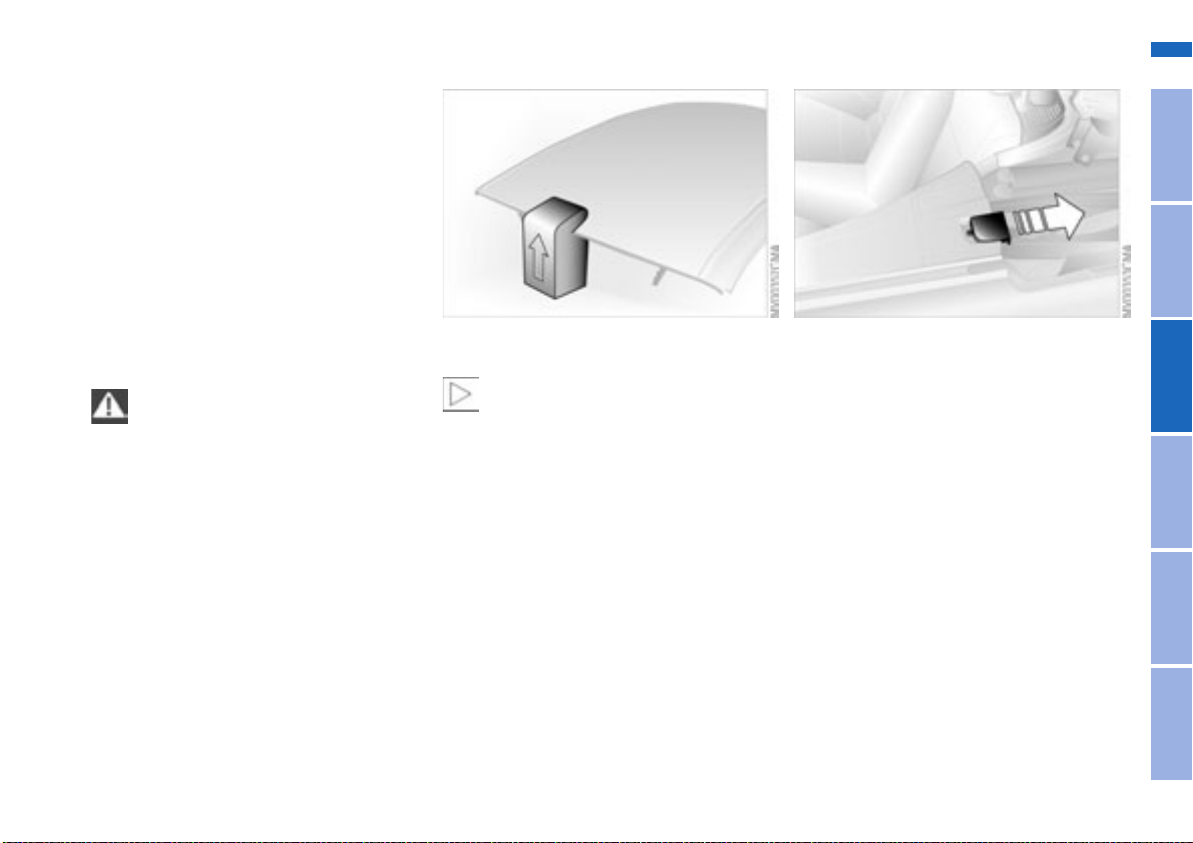
113
Hardtop*
It is not necessary to remove the fabric
top even in the winter, when the hard-
top is generally in constant use. But you
can also remove it at any time with no
problem. Before the fabric top is stored
in the convertible top compartment, it
must be absolutely dry in order to avoid
water spot and mildew from forming.
The hardtop offers reading lamps and
clothing hooks that can be used just by
pressing. In addition, a roof-rack
assembly is possible. In this regard,
please contact your BMW center.
When suspending articles of
clothing from the hooks, be sure
that they will not obstruct the driver's
vision. Do not hang heavy objects on
the hooks. If you do so, they could
cause personal injury during braking or
evasive maneuvers.<
Two people are required for installation
or removal. Work with extreme caution
in order to avoid paint damage and
damage to the body or hardtop.
To facilitate hardtop installation or
removal, you can obtain a specially
designed hardtop lift* or hardtop rack*
at your BMW center.
Storage
Storing the hardtop on the floor:
slide the styrofoam block that
came with the hardtop forward to its
center. The arrow on top of the styro-
foam block has to be pointing upward
when you are doing this.<
Installation
1. Lower the side windows completely
and flip the sun visors down. If nec-
essary, remove the antenna rod to
avoid any damage
2. Open the convertible top compart-
ment lid slightly by pressing the but-
ton for the convertible top operation,
refer to page 42
3. Remove the trim pieces on both
sides by pulling them off toward the
back – see arrow – and reclose the
convertible top compartment lid
OverviewControlsMaintenanceRepairsDataIndex
handbook.book Page 113 Tuesday, July 30, 2002 9:28 AM
Online Edition for Part-No. 01 41 0 156 854 - © 09/02 BMW AG
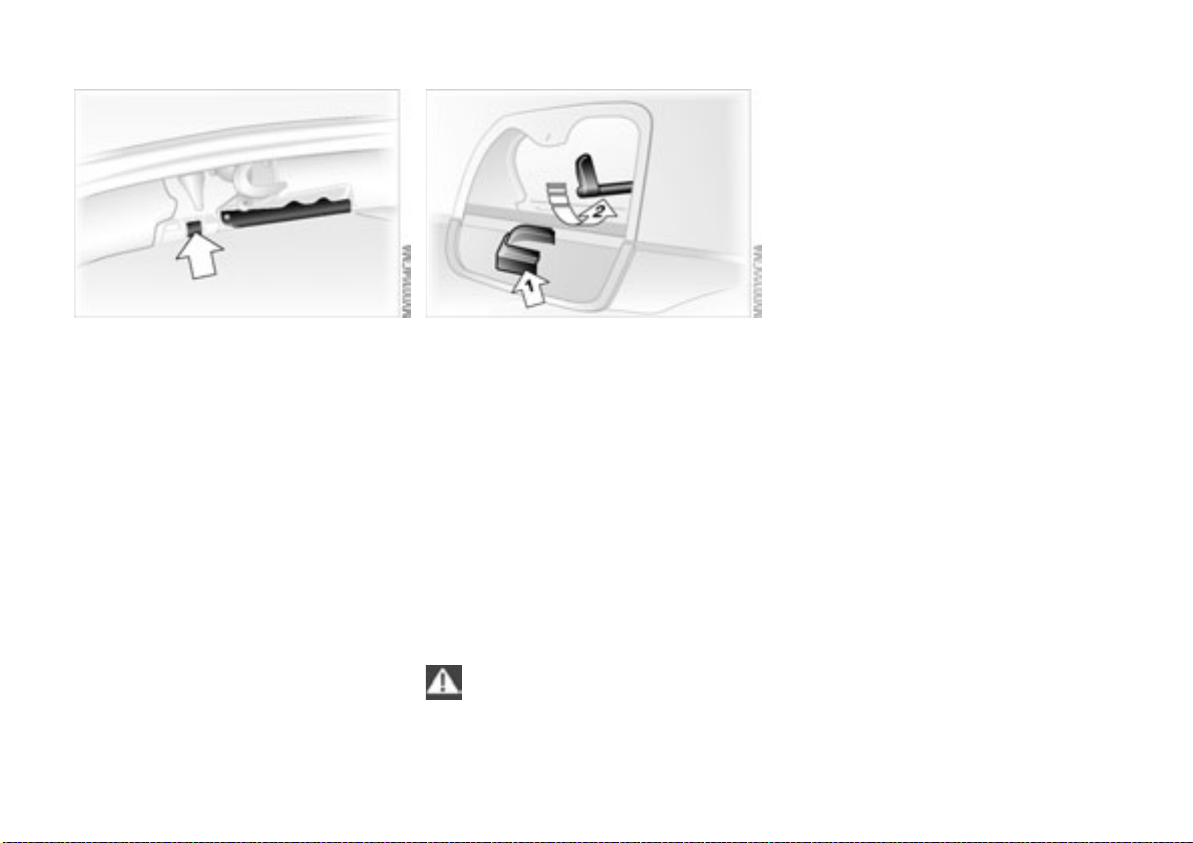
114
4. Raise the two front locking levers on
the hardtop. Press on the buttons to
do so – see arrow. The levers will
release slightly. Raise the levers as
far as the stop will allow
5. Before installing, first flip the cover
panels that are located underneath
the left and right interior lamps down.
To do this, press on the slight bump
on the cover panel. There is a holder
in the cover panel to securely store
the trim pieces that have been
removed – see arrow 1
6. Open the red release lever as far as
the stop will allow – see arrow 2
7. Position the hardtop onto the sup-
ports with the help of a second per-
son. Be sure to put the mountings
exactly into the proper brackets
Lift the hardtop carefully. Be
extremely careful not to shift the
seals. Seals that have been shifted out
of place or actually pulled out cause
leaks.<
8. In the back, close the red locking
levers by turning to the inside as far
as the stop located behind the trim
will allow. Flip the cover panels back
into place
9. To lock the hardtop in the front, keep
pressing on the front locking levers
until you hear it engage.
Removal
Follow the same procedure as when
installing, just reverse the steps.
Hardtop*
handbook.book Page 114 Tuesday, July 30, 2002 9:28 AM
Online Edition for Part-No. 01 41 0 156 854 - © 09/02 BMW AG
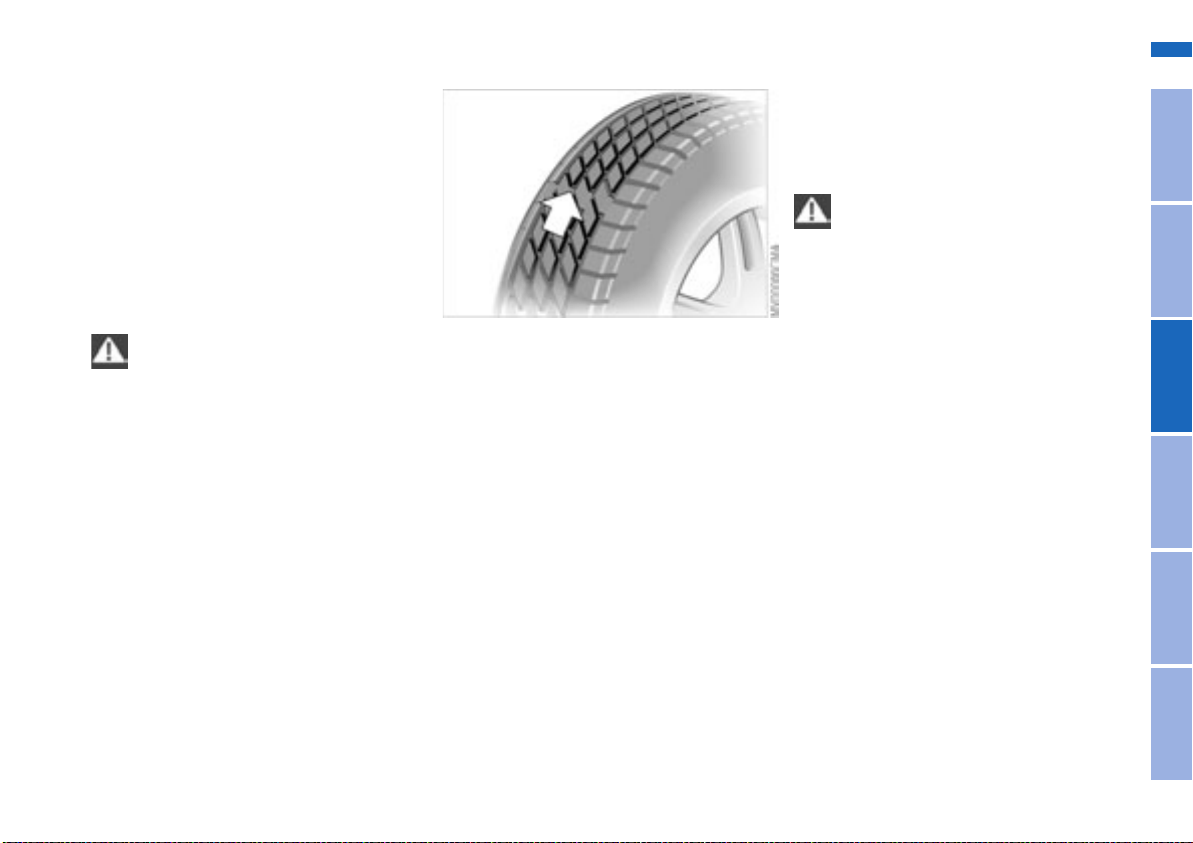
115
Wheels and tires
Tire inflation pressure
Information for your safety
The factory-approved tires are matched
to your vehicle and have been selected
to provide optimum safety and driving
comfort when used properly.
It is not merely the tire's service life, but
also driving comfort and – above all else
– driving safety that depend on the con-
dition of the tires and the maintenance
of the specified tire pressure.
Incorrect tire inflation pressure is
a frequent cause of tire damage. It
also significantly influences the road-
holding ability of your BMW. Check tire
inflation pressures on a regular basis,
refer to page 25, at least every two
weeks and before beginning a longer
trip. Incorrect tire pressure can other-
wise lead to driving instability, tire dam-
age and accidents.<
Tire condition
Tire tread – tire damage
Inspect your tires frequently for tread
wear, signs of damage and for foreign
objects lodged in the tread. Check the
tread depth.
Tread depth should not be allowed to
go below 1/8 in / 3 mm, even though
the legally specified minimum tread
depth is only 1/16 in / 1.6 mm.
Below 1/8 in / 3 mm tread depth, there
is a great risk of hydroplaning, even at
relatively moderate speeds and with
only small amounts of water on the
road. Tread wear indicators in the
tread-groove base – see arrow – are
distributed around the wheel circumfer-
ence and are labeled on the tire side-
wall with TWI – Tread Wear Indicator. At
a tread depth of 1/16 in / 1.6 mm, the
indicators signal that the legally permis-
sible wear limit has been reached.
Do not drive on a deflated – flat –
tire. A flat tire greatly impairs
steering and braking response, and can
lead to complete loss of control over
the vehicle.
Avoid overloading the vehicle so that
the permitted load on the tires is not
exceeded. Overloading can lead to
overheating and internal tire damage.
You could have a blowout as a result.
Unusual vibrations encountered during
normal vehicle operation can indicate
tire failure or some other vehicle defect.
This type of problem can be caused by
contact with curbs, etc. This is also true
for irregularities in the vehicle's han-
dling characteristics, such as a pro-
nounced tendency to pull to the left or
right. Should this occur, respond by
immediately reducing your speed. Pro-
OverviewControlsMaintenanceRepairsDataIndex
handbook.book Page 115 Tuesday, July 30, 2002 9:28 AM
Online Edition for Part-No. 01 41 0 156 854 - © 09/02 BMW AG

116
ceed carefully to the nearest BMW cen-
ter or professional tire center, or have
the vehicle towed in to have it, its
wheels or its tires inspected.
Tire damage, up to and including blow-
outs, can endanger the lives of both the
vehicle occupants and other road
users<
Tire replacement
DOT quality grades
> Treadwear
> Traction AA A B C
> Temperature A B C
All passenger car tires must con-
form to Federal Safety Require-
ments in addition to these grades.<
Tread wear
The treadwear grade is a comparative
rating based on the wear rate of the tire
when tested under controlled condi-
tions on a specified government test
course.
For example, a tire graded 150 would
wear one and one-half – 1
1
/
2
– times as
well on the government course as a tire
graded 100. The relative performance
of tires depends upon the actual condi-
tions of their use, however, and may
depart significantly from the norm due
to variations in driving habits, service
practices and differences in road char-
acteristics and climate.
Traction
The traction grades, from highest to
lowest, are AA, A, B and C.
Those grades represent the tire's ability
to stop on wet pavement as measured
under controlled conditions on speci-
fied government test surfaces of
asphalt and concrete. A tire marked C
may have poor traction performance.
The traction grade assigned to
this tire is based on straight-
ahead braking traction tests, and does
not include acceleration, cornering,
hydroplaning, or peak traction charac-
teristics.<
Temperature
The temperature grades are A – the
highest – B and C, representing the
tire's resistance to the generation of
heat and its ability to dissipate heat
when tested under controlled condi-
tions on a specified indoor laboratory
test wheel.
Sustained high temperature can cause
the material of the tire to degenerate
and reduce tire life, and excessive tem-
perature can lead to sudden tire failure.
The grade C corresponds to a level of
performance which all passenger car
tires must meet under the Federal
Motor Vehicle Safety Standard No. 109.
Tire condition
handbook.book Page 116 Tuesday, July 30, 2002 9:28 AM
Online Edition for Part-No. 01 41 0 156 854 - © 09/02 BMW AG

117
Grades B and A represent higher levels
of performance on the laboratory test
wheel than the minimum required by
law.
The temperature grade for this tire
is established for a tire that is
properly inflated and not overloaded.
Excessive speed, under-inflation, or
excessive loading, either separately or
in combination, can cause heat buildup
and possible tire failure.<
Uniform Tire Quality Grading
Quality grades can be found where
applicable on the tire sidewall between
tread shoulder and maximum section
width. For example:
Treadwear 200 Traction AA
Temperature A
Tire age
The date on which the tire was manu-
factured is indicated by the code on the
sidewall:
DOT ... 3502 indicates that the tire was
manufactured in week 35 of the year
2002.
BMW recommends the replacement of
all tires when the tires are no more than
6 years old, even if a tire life of 10 years
is possible.
Following wheel/tire changes
Following wheel and/or tire changes
you will need to reinitialize both the Flat
Tire Monitor and the sequential M gear-
box SMG II, refer to pages 75, 89.
Tire replacement
OverviewControlsMaintenanceRepairsDataIndex
handbook.book Page 117 Tuesday, July 30, 2002 9:28 AM
Online Edition for Part-No. 01 41 0 156 854 - © 09/02 BMW AG

118
Wheel and tire combinations
The right choice
BMW recommends using only
wheels and tires that have been
approved by BMW for use on your par-
ticular model. Although other wheels
and tires may theoretically have the
same dimensions, variations in factors
such as manufacturing tolerances can
result in contact between tire and body-
work, ultimately leading to serious acci-
dents. If non-approved wheels and tires
are used, BMW cannot evaluate their
suitability, and therefore cannot be held
liable for driving safety.<
BMW tests certain tire brands for each
tire size, classifies them as road-safe
and approves them. Consult your BMW
center for more information. Observe
any country-specific regulations, e.g.
on making a corresponding entry in the
vehicle documents.
The correct wheel and tire combi-
nation affects different systems
such as ABS, DSC, Flat Tire Monitor.
The function of these systems is
impaired if improper wheel and tire
combinations are used.
Therefore, only use tires of the same
brand and same tread configuration on
the vehicle and, for example following a
tire failure, restore the approved wheel
and tire combination as soon as possi-
ble.<
The use of rims and lug bolts that
do not meet the specifications of
the original factory-installed equipment
will affect the safe operation of your
vehicle and may cause an accident and
personal injury.
Never mix tires of different design, such
as steel-belted radials with radial bias-
belted or bias-ply tires, etc. Mixing tire
types will adversely affect roadholding
and can lead to loss of vehicle con-
trol.<
Storage
Store wheels and tires in a cool, dry
place, protecting them against light
whenever possible. Protect the tires
against contact with oil, grease and
fuel.
Winter tires
Choosing the right tire
BMW recommends winter tires – M+S
tires – for operation under inclement
winter driving conditions. While all-sea-
son tires – M+S designation – provide
better winter traction than the corre-
sponding summer tires, they generally
do not achieve the performance of win-
ter tires.
In the interest of safe tracking and
steering response, install radial tires
made by the same manufacturer and
with the same tread configuration on all
four wheels if you elect to mount winter
tires.
When mounting winter wheels,
observe the different recesses of
the front and rear wheels, as otherwise
damage may result.<
handbook.book Page 118 Tuesday, July 30, 2002 9:28 AM
Online Edition for Part-No. 01 41 0 156 854 - © 09/02 BMW AG

119
Do not exceed specified
maximum speeds
Never exceed the maximum
speed for which the winter tires
are rated.
Unprofessional attempts by laymen to
service tires can lead to damage and
accidents.
Have this work performed by skilled
professionals only. Your BMW center
will be glad to assist you with both their
expertise and the proper equipment for
your vehicle.<
Tire condition, tire pressure
At tread depth below approx. 3/16 in /
4 mm, their performance under winter
driving conditions deteriorates notice-
ably. Worn tires should therefore be
replaced for safety considerations.
Comply with the specified tire inflation
pressures – and be sure to have the
wheel and tire assembly balanced
every time you change a tire or wheel.
Snow chains*
Only certain snow chains have been
tested by BMW and determined and
approved as roadworthy. Consult your
BMW center for more information.
BMW recommends using only these
approved fine-link snow chains. Use
them in pairs on winter tires, but only on
both rear wheels.
Comply with all manufacturer's safety
precautions when mounting the chains.
Do not exceed a speed of 30 mph /
50 km/h with snow chains.
After mounting or removing snow
chains, always reinitialize the sequential
M gearbox SMG II, refer to page 89.
It is not possible to mount snow
chains on tires with 18- and 19-
inch wheels.
Deactivate the Flat Tire Monitor when
using snow chains. Malfunction warn-
ings and undetected losses in pressure
are a possibility when driving with snow
chains.
For additional information, refer to
page 88.<
Winter tires
OverviewControlsMaintenanceRepairsDataIndex
handbook.book Page 119 Tuesday, July 30, 2002 9:28 AM
Online Edition for Part-No. 01 41 0 156 854 - © 09/02 BMW AG
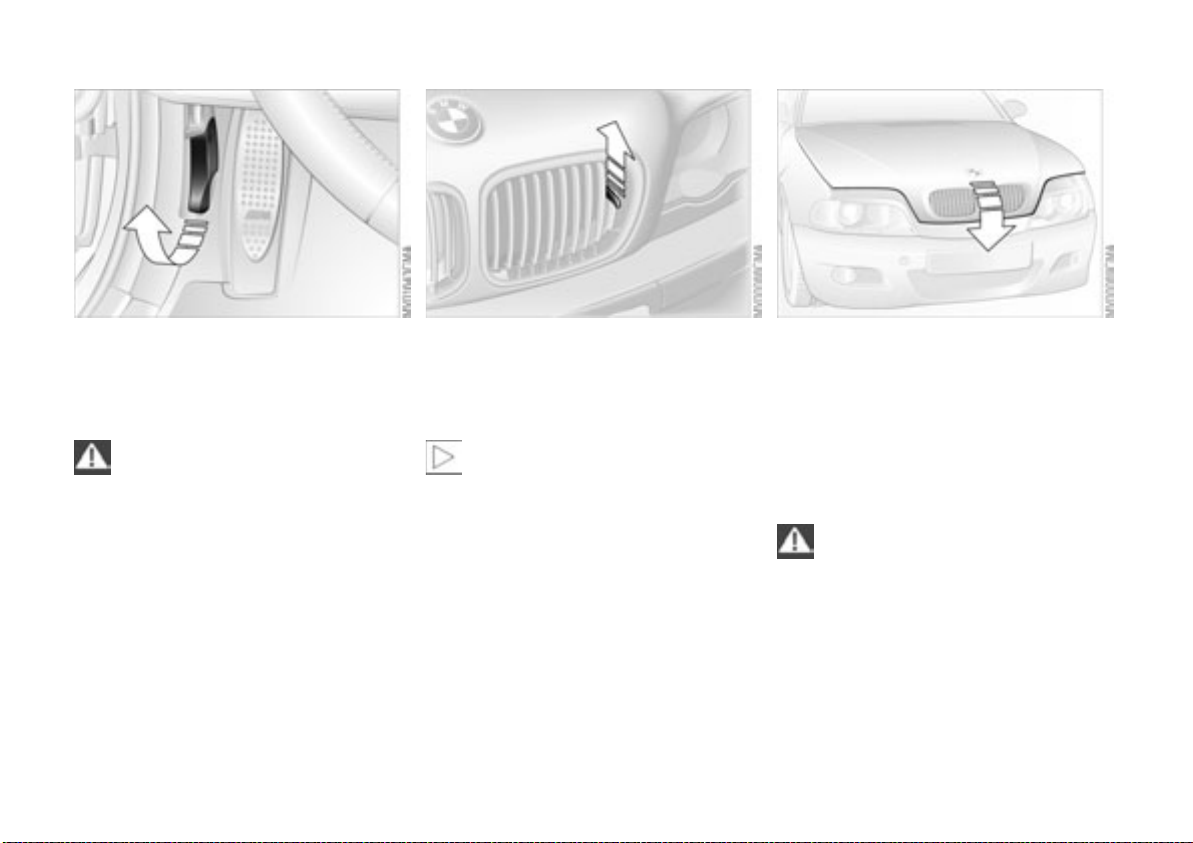
120
In the engine compartment
Hood
To release
Pull the lever located under the left-
hand side of the instrument panel.
Do not attempt to service your
vehicle if you do not have the
required technical background. Failure
to work in an informed, professional
manner when servicing components
and materials constitutes a safety haz-
ard for vehicle occupants and other
road users. If you are not familiar with
the guidelines, please have the opera-
tions performed by your BMW center.<
To open
Pull the release handle and open the
hood.
It is not possible to drive off using
SMG II when the hood is open.<
To close
Pull the hood downwards and allow the
hood to fall from a minimum height of
1 ft/30 cm so that it audibly engages.
Check for proper locking by pulling on
the hood at the left and right above the
headlamps.
To avoid injuries, be sure that the
travel path of the hood is clear
when it is closed, following the same
safety precautions used in all closing
procedures.
If you notice while driving that the hood
is not completely closed, stop immedi-
ately and close it securely.<
handbook.book Page 120 Tuesday, July 30, 2002 9:28 AM
Online Edition for Part-No. 01 41 0 156 854 - © 09/02 BMW AG

121
OverviewControlsMaintenanceRepairsDataIndex
handbook.book Page 121 Tuesday, July 30, 2002 9:28 AM
Online Edition for Part-No. 01 41 0 156 854 - © 09/02 BMW AG
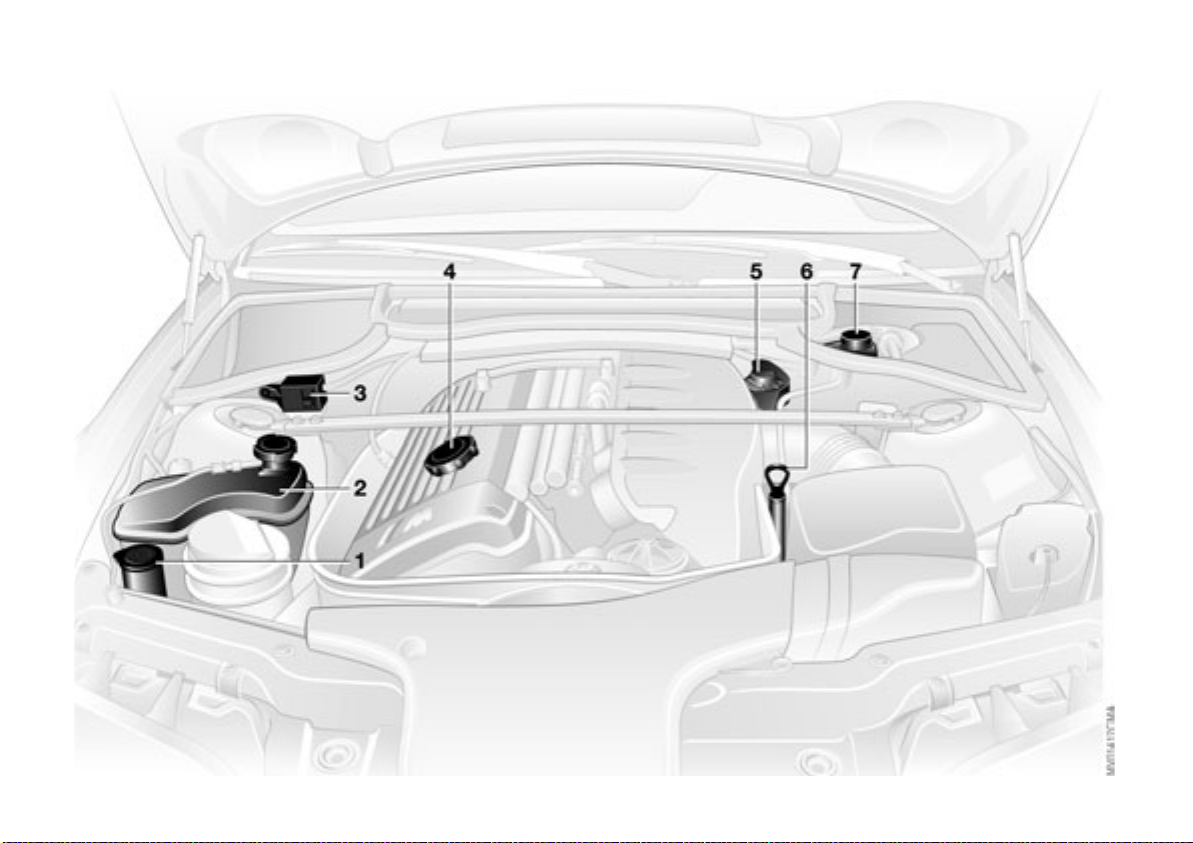
122
Engine compartment essentials
handbook.book Page 122 Tuesday, July 30, 2002 9:28 AM
Online Edition for Part-No. 01 41 0 156 854 - © 09/02 BMW AG

123
1 Filler neck for windshield and head-
lamp washer cleaning system 124
2 Coolant expansion tank 126
3 Positive terminal connection for
jump-starting – positive terminal 145
4 Engine oil filler neck 125
5 Expansion tank for SMG hydraulic
unit – checking and possible refilling
by your BMW center 71
6 Engine oil dipstick 124
7 Filler neck for brake fluid 127
Engine compartment essentials
OverviewControlsMaintenanceRepairsDataIndex
handbook.book Page 123 Tuesday, July 30, 2002 9:28 AM
Online Edition for Part-No. 01 41 0 156 854 - © 09/02 BMW AG
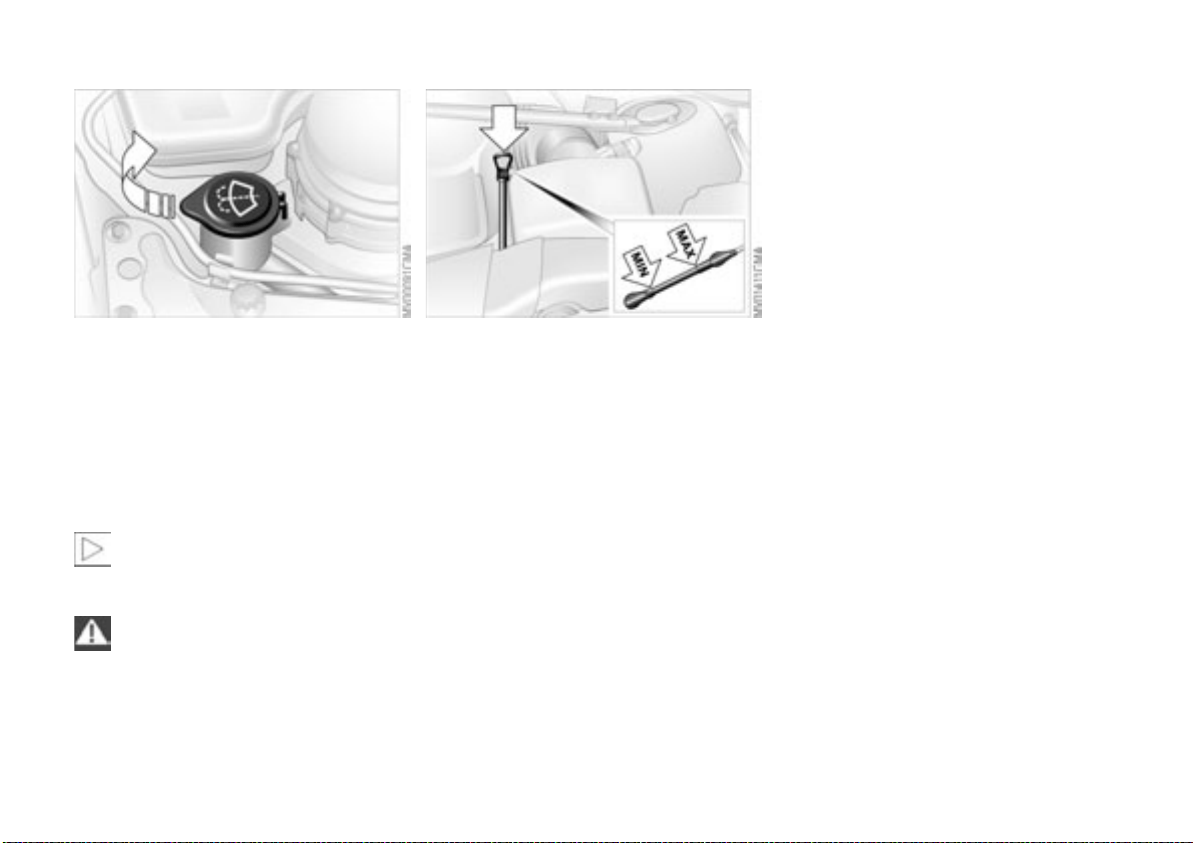
124
Washer fluids
Headlamp* and windshield
washer system
Capacity approx.
5.6 US quarts/5.3 liters.
Fill with water and – if required – with a
washer antifreeze additive according to
manufacturer's recommendations.
We recommend that you mix the
washer fluid before adding it to
the reservoir.<
Antifreeze agents for the washer
fluid are highly flammable. For this
reason, keep them away from sources
of flame and store them only in their
closed original containers, inaccessible
to children. Comply with the instruc-
tions on the containers.<
Engine oil
Checking the oil level
1. Park the vehicle on a level surface
2. Switch the engine off after it has
reached normal operating tempera-
ture
3. After approx. 5 minutes, pull the dip-
stick out and wipe it off with a clean
lint-free cloth, paper towel, or similar
material
4. Carefully push the dipstick all the
way into the guide tube and pull it
out again
5. The oil level should be between the
two marks on the dipstick.
As with fuel economy, oil consumption
is directly influenced by your driving
style and vehicle operating conditions.
The oil volume between the two marks
on the dipstick corresponds to approx.
1.4 US quarts/1.3 liter.
handbook.book Page 124 Tuesday, July 30, 2002 9:28 AM
Online Edition for Part-No. 01 41 0 156 854 - © 09/02 BMW AG
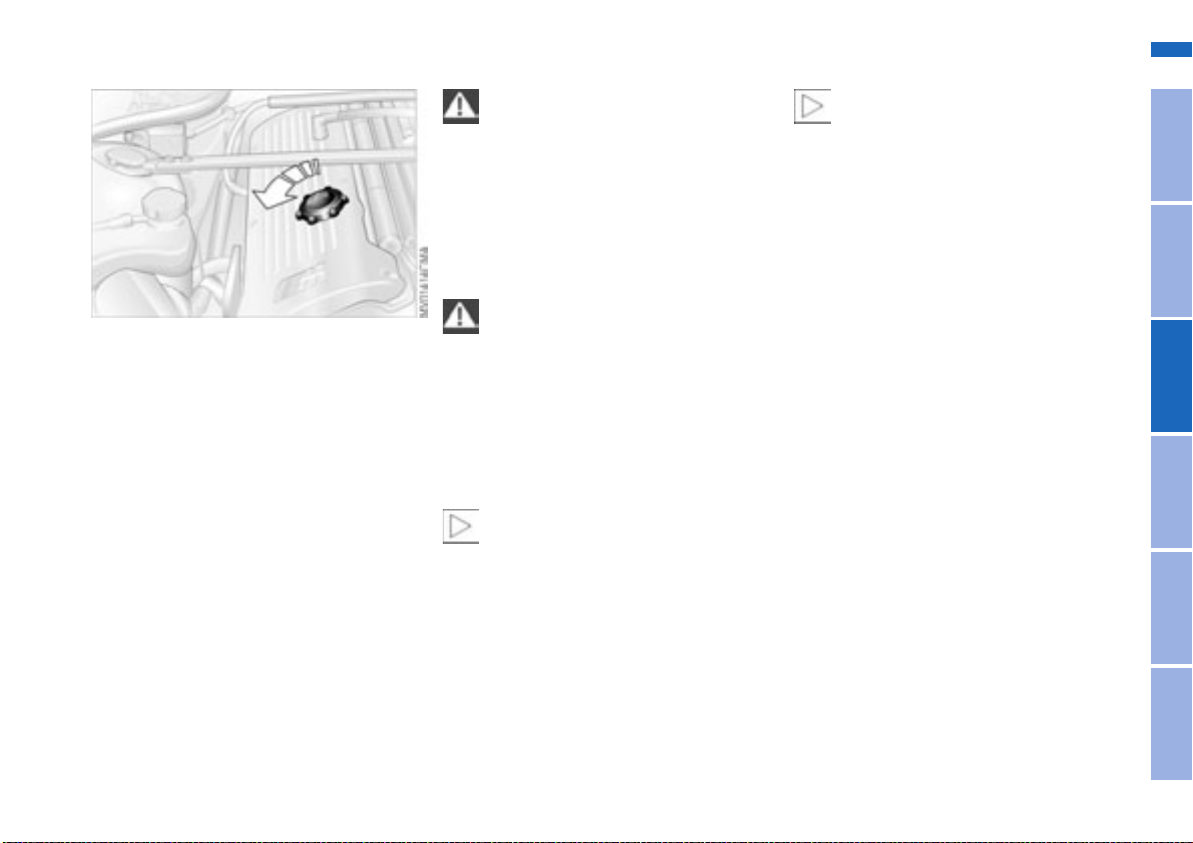
125
Adding engine oil
While you should wait until the level has
dropped to just above the lower mark
before adding oil, you should never
allow the oil level to fall below this
mark.
Do not fill beyond the upper mark on
the dipstick. Excess oil will damage the
engine.
Before checking the engine oil level
after topping up, restart the engine and
allow it to run to obtain a correct dis-
play. Then proceed as described under
Checking the oil level.
BMW engines are designed to
operate without oil additives; the
use of additives could lead to damage
in some cases. This also applies to the
manual transmission, the differential,
and the power steering system.<
Recommendation: have the oil changed
by your BMW center only.
Continuous exposure to used oil
has caused cancer in laboratory
testing. For this reason, thoroughly
wash any areas of skin that come into
contact with oil using soap and water.
Always store oils, grease and similar
materials so that they are inaccessible
to children. Comply with warning labels
and information on containers.<
Comply with the applicable envi-
ronmental laws regulating the dis-
posal of used oil.<
Specified engine oils
The quality of the engine oil is
extremely important for the function
and life of an engine. Based on exten-
sive testing, BMW has approved only
certain grades of engine oil.
Use only oils approved for your vehicle
model.
Ask your BMW center for details
concerning oils that have been
approved. You can also call BMW of
North America toll-free at 1-800-831-
1117 or visit this website:
www.bmwusa.com to obtain this infor-
mation.<
Alternative oil types
If a High Performance Synthetic Oil
approved by BMW should be unavail-
able, you may use small volumes of
other synthetic oils for topping up
between oil changes. The following
data must appear on the packaging:
> Viscosity
preferred: SAE 10W-60
alternative: SAE 5W-40 or
SAE 10W40
> Specifications
preferred: API SJ/CF
alternative: API SJ – also SK, SL, S
etc.
Low ambient temperatures
The oils used by BMW at the factory for
your vehicle model can be used at virtu-
ally any ambient temperature.
Engine oil
OverviewControlsMaintenanceRepairsDataIndex
handbook.book Page 125 Tuesday, July 30, 2002 9:28 AM
Online Edition for Part-No. 01 41 0 156 854 - © 09/02 BMW AG
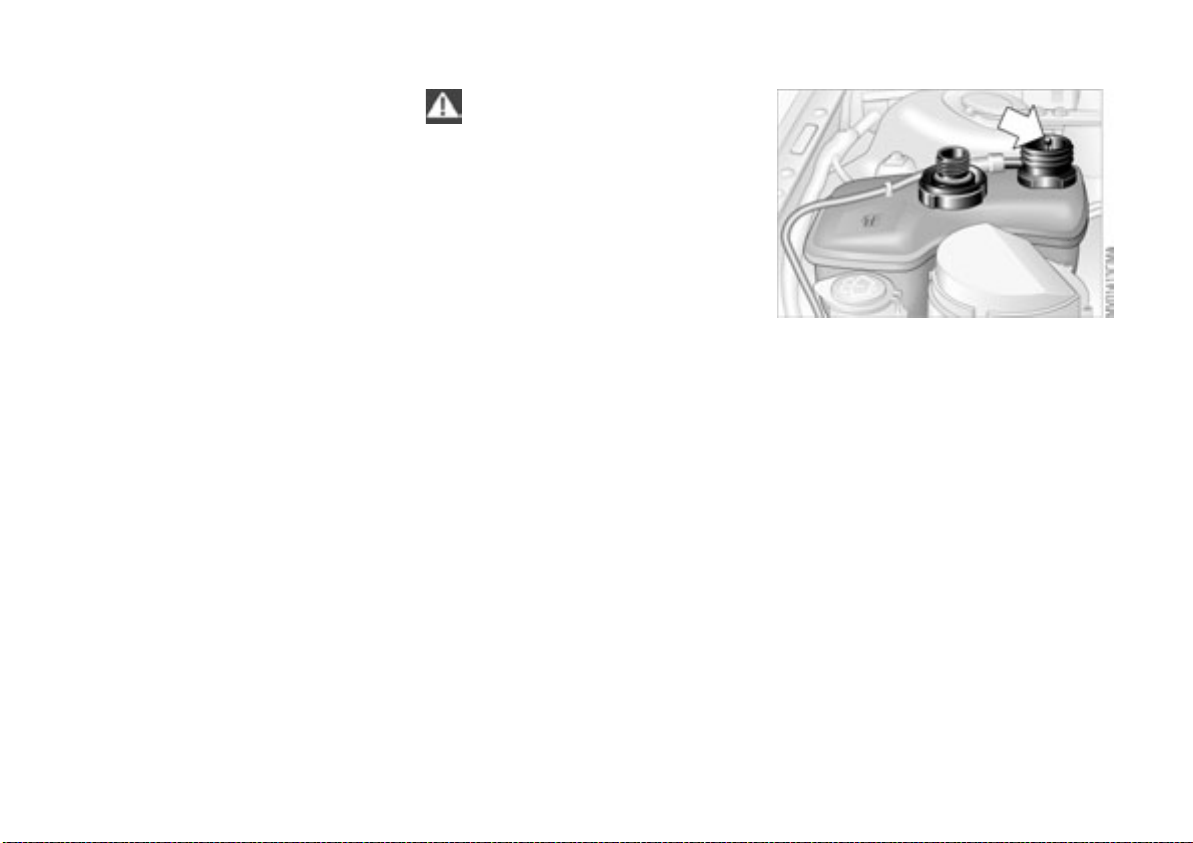
126
However, if the vehicle is exposed to
temperatures below –47 /–206 for
extended periods, please have your
BMW center recommend a suitable oil.
Coolant
Do not add coolant to the cooling
system when the engine is hot. If
you attempt to do so, escaping coolant
can cause burns.
Antifreeze and anti-corrosion agents
are hazardous to health. You should
always store them in their closed origi-
nal containers and in a location inac-
cessible to children. Antifreeze and
anti-corrosion agents are inflammable.
For this reason, do not spill them on hot
engine parts. They could ignite and
cause burns. Comply with the instruc-
tions on the containers.<
Check the coolant level and add
coolant
Check the coolant level when the
engine is cold, approx. 687/+206.
1. Open the cap for the expansion tank
by turning it slightly counterclock-
wise to allow accumulated pressure
to escape. Then open
2. The coolant level is correct when the
upper end of the red float is at least
even with the upper edge of the filler
neck – refer to the arrow in the illus-
tration – but no more than 3/4 in/
2 cm above it – that is, up to the sec-
ond mark on the float. Refer also to
the schematic diagram next to the
filler neck
Engine oil
handbook.book Page 126 Tuesday, July 30, 2002 9:28 AM
Online Edition for Part-No. 01 41 0 156 854 - © 09/02 BMW AG
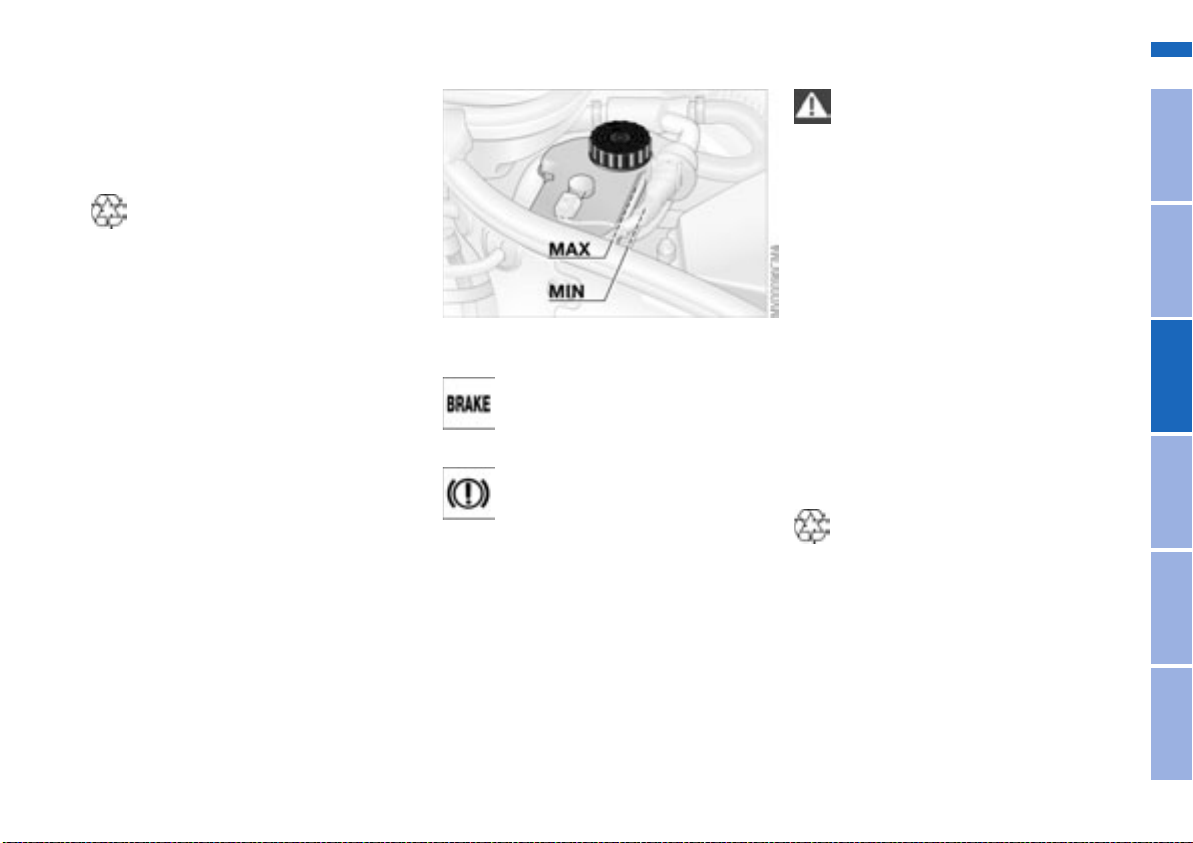
127
3. If necessary, add coolant. If the cool-
ant is low, slowly add coolant until
the correct level is reached — do not
overfill.
Comply with the applicable envi-
ronmental laws regulating the dis-
posal of antifreeze agents with corro-
sion inhibitor.<
Brake fluid
Indicator lamp
The brake warning lamp comes
on when the parking brake is
not engaged: brake fluid level
too low, refer to page 18.
Brake warning lamp for Cana-
dian models.
Adding brake fluid
For adding brake fluid or for determin-
ing and correcting the cause of brake
fluid loss, consult your BMW center.
Your BMW center is familiar with the
specifications for factory-approved
brake fluids – DOT 4.
Due to loss in brake fluid, pedal travel
can lengthen and braking efficiency
may be reduced. Refer to the informa-
tion on page 112.
Brake fluid is hygroscopic, that is,
it absorbs moisture from the air
over time.
In order to ensure the safety and reli-
ability of the brake system, have the
brake fluid changed every two years by
a BMW center. Refer also to the Service
and Warranty Information Booklet for
US models or the Warranty and Service
Guide Booklet for Canadian models.
Brake fluid is toxic and damages the
vehicle's paint. You should always store
it in its closed original container and in
a location inaccessible to children.
Do not spill the brake fluid and do not
fill the brake fluid reservoir beyond the
MAX mark. The brake fluid could ignite
upon contact with hot engine parts and
cause serious burns.<
Comply with the applicable envi-
ronmental laws regulating
the disposal of brake fluid.<
Coolant
OverviewControlsMaintenanceRepairsDataIndex
handbook.book Page 127 Tuesday, July 30, 2002 9:28 AM
Online Edition for Part-No. 01 41 0 156 854 - © 09/02 BMW AG
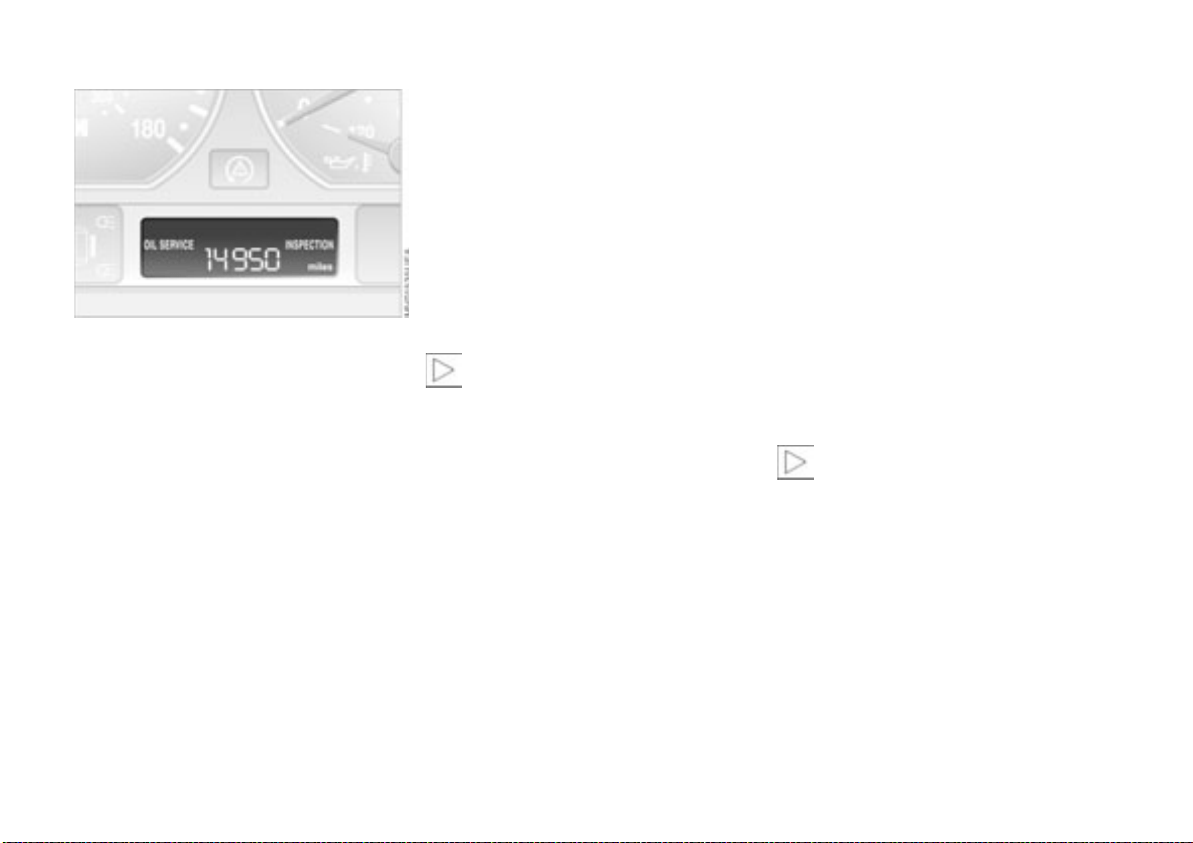
128
Maintenance
The BMW Maintenance System
The BMW Maintenance System has
been designed as a reliable means of
providing maximum driving and operat-
ing safety – and as cost-effectively for
you as possible. Please keep in mind
that regular maintenance is not only
necessary for the safety of your vehicle,
but also plays a significant role in main-
taining the resale value of the vehicle.
Service interval display
While conventional systems rely on dis-
tance traveled alone to determine when
service is due, the BMW Maintenance
System has for years taken the actual
conditions under which the vehicle
operates into consideration, because
miles can be traveled in many different
ways:
For example, 62,000 miles/100,000 km
short-distance driving are not equal to
the same 62,000 miles/100,000 km of
long-distance travel.
The BMW Maintenance System
includes the Engine Oil Service and
Inspections I and II.
Have a break-in inspection per-
formed at 1,250 miles/2,000 km
regardless of the service interval indi-
cated on the display.<
Determining the maintenance intervals
according to the actual loads on the
vehicle covers every kind of operating
situation. Minimal-use drivers – who
drive significantly fewer than
6,200 miles/10,000 km annually –
should have the engine oil changed at
least every 2 years since oil deterio-
rates over time, regardless of use.
Service and Warranty Information
Booklet for US models/Warranty
and Service Guide Booklet for
Canadian models
For additional information on required
maintenance intervals and procedures,
please refer to the Service and War-
ranty Information Booklet for US mod-
els, or the Warranty and Service Guide
Booklet for Canadian models.
As a precaution against corrosion, it is
advisable to have the body checked for
damage from rocks or gravel at the
same time, depending upon operating
conditions.
Have your BMW center perform
maintenance and repair.
Be sure that all maintenance work is
recorded in the Service and Warranty
Information Booklet for US models, or
in the Warranty and Service Guide
Booklet for Canadian models. These
entries are your verification for the reg-
ular maintenance of your vehicle and
are required for the performance of
warranty repairs.<
handbook.book Page 128 Tuesday, July 30, 2002 9:28 AM
Online Edition for Part-No. 01 41 0 156 854 - © 09/02 BMW AG

129
Care
You can find everything you need to
know on this topic by consulting the
separate Caring for your vehicle bro-
chure.
The BMW Maintenance System
OverviewControlsMaintenanceRepairsDataIndex
handbook.book Page 129 Tuesday, July 30, 2002 9:28 AM
Online Edition for Part-No. 01 41 0 156 854 - © 09/02 BMW AG
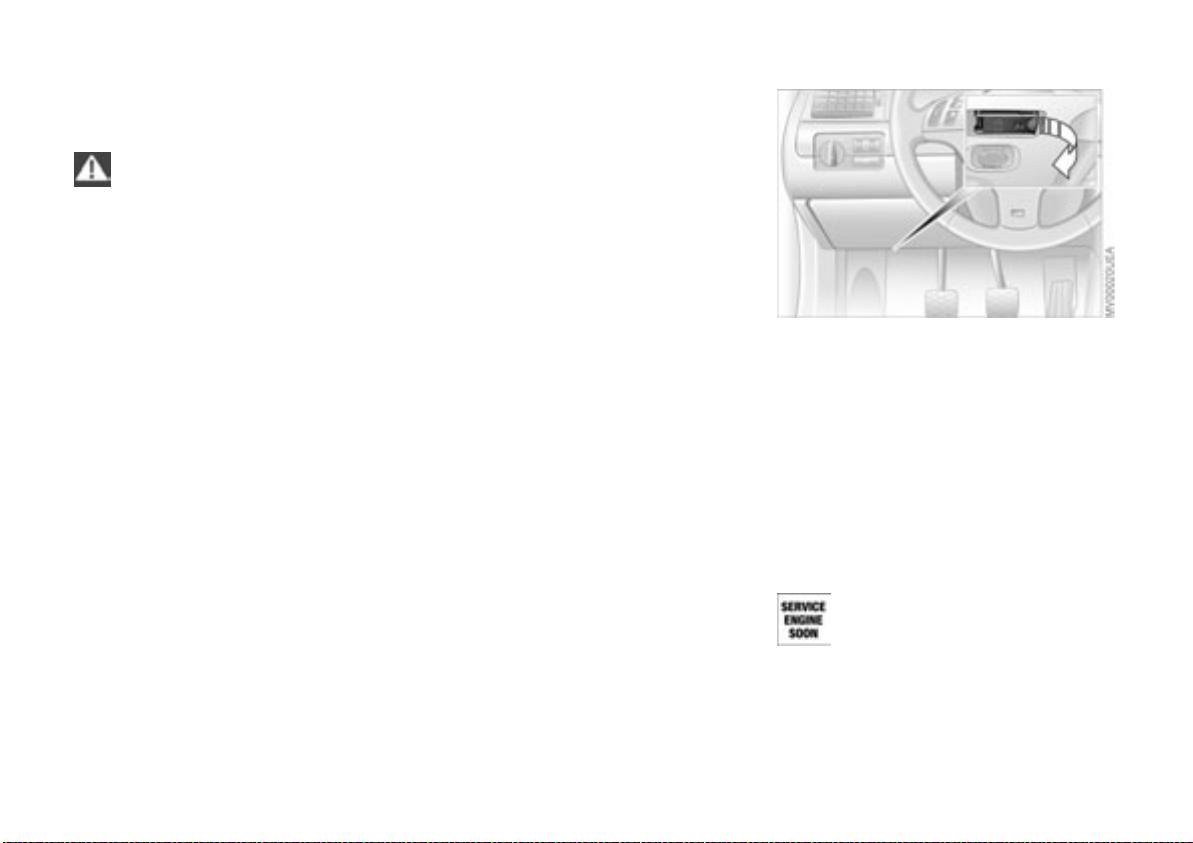
130
Laws and regulations
California Proposition 65 warning
California laws require us to state the
following warning:
Engine exhaust, some of its con-
stituents, and certain vehicle com-
ponents contain or emit chemicals
known to the State of California to
cause cancer and birth defects and
reproductive harm. In addition, certain
fluids contained in vehicles and certain
products of component wear contain or
emit chemicals known to the State of
California to cause cancer and birth
defects or other reproductive harm.
Battery posts, terminals and related
accessories contain lead and lead com-
pounds. Wash your hands after hand-
ling.
Used engine oil contains chemicals that
have caused cancer in laboratory ani-
mals. Always protect your skin by
washing thoroughly with soap and
water.<
OBD interface socket
The Onboard Diagnostic (OBD) inter-
face socket is located on the left of the
driver's side at the bottom of the instru-
ment panel and under a cover. The
cover has the letters OBD on it.
The purpose of the OBD system is to
assure proper emission-control system
operation for the vehicle's lifetime by
monitoring emission-related compo-
nents and systems for deterioration and
malfunction.
An illuminated indicator informs
you of the need for service, not
that you need to stop the vehi-
cle. However, the systems should be
checked by your BMW center at the
earliest possible opportunity.
handbook.book Page 130 Tuesday, July 30, 2002 9:28 AM
Online Edition for Part-No. 01 41 0 156 854 - © 09/02 BMW AG

131
If the indicator blinks or flashes, this
indicates a high level of engine misfire.
Reduce speed and contact your near-
est BMW center immediately. Severe
engine misfiring for even a short period
of time can seriously damage emission-
control system components, especially
the catalytic converter.
Service Engine Soon warning
lamp for Canadian models.
If the fuel filler cap is not on tight
enough, the OBD system can
detect leaking vapor and the indicator
will light up. If the fuel filler cap is then
tightened, the indicator will usually go
out after a short period of time.<
OBD interface socket
OverviewControlsMaintenanceRepairsDataIndex
handbook.book Page 131 Tuesday, July 30, 2002 9:28 AM
Online Edition for Part-No. 01 41 0 156 854 - © 09/02 BMW AG
132
handbook.book Page 132 Tuesday, July 30, 2002 9:28 AM
Online Edition for Part-No. 01 41 0 156 854 - © 09/02 BMW AG
133
Overview
Controls and features
Operation, maintenance
Owner service procedures
Technical data
Index
OverviewControlsMaintenanceRepairsDataIndex
handbook.book Page 133 Tuesday, July 30, 2002 9:28 AM
Online Edition for Part-No. 01 41 0 156 854 - © 09/02 BMW AG
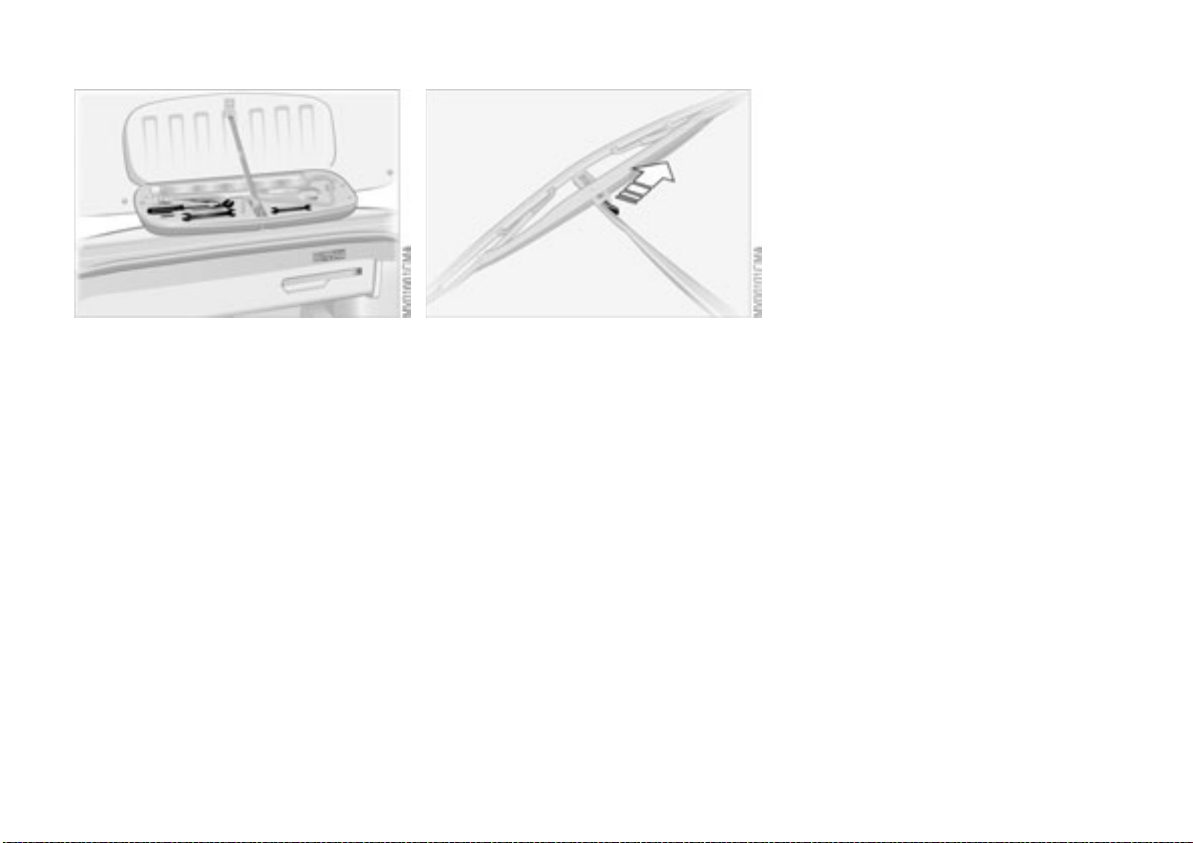
134
Replacement procedures
Onboard tool kit
The onboard tool kit is located in the
luggage compartment lid.
To open, loosen the wing nut. For stor-
age place of towing eyelet, refer to
page 146.
Windshield wiper blades
1. Switch off the engine
2. Fold the wiper arm completely out
from the windshield
3. Position the wiper blade at an angle
and pull the release spring – see
arrow
4. Fold the wiper blade down and
unhook it toward the windshield
5. Pull the wiper blade past the wiper
arm toward the top
6. Insert a new wiper blade and apply
pressure until you hear it engage.
handbook.book Page 134 Tuesday, July 30, 2002 9:28 AM
Online Edition for Part-No. 01 41 0 156 854 - © 09/02 BMW AG

135
Lamps and bulbs
The lamps and bulbs make essential
contributions to the safety of your vehi-
cle. Therefore, comply fully with the fol-
lowing instructions during bulb replace-
ment. If you are not familiar with any of
the procedures, consult your BMW
center.
Do not touch the glass portion of
a new bulb with your bare hands
since even small amounts of impurities
burn in to the surface and reduce the
service life of the bulb. Use a clean
cloth, paper napkin, or a similar mate-
rial, or hold the bulb by its metallic
base.<
A replacement bulb set is available from
your BMW center.
Before working on the electrical
system, switch off the electrical
accessory you are working on or dis-
connect the cable from the negative
terminal of the battery. Failure to
observe this precaution could result in
short circuits.
To prevent injuries and damage when
changing a bulb, be sure to comply with
any instructions provided by the bulb
manufacturer.<
Low beams and high beams
> Low beams: H7 bulb, 55 watts
> High beams: H7 bulb, 55 watts
The H7 bulb is pressurized. There-
fore, wear safety glasses and pro-
tective gloves. Failure to comply with
this precaution could lead to injury if the
bulb is damaged.<
Please contact a BMW center in case of
a malfunction.
Parking lamps
5 watt bulb
Please contact a BMW center in case of
a malfunction.
When cleaning the headlamps, please
follow the instructions in the Caring for
your vehicle brochure.
Xenon lamps*
The service life of these bulbs is very
long and the probability of a failure is
very low, provided that they are not
switched on and off an unusual number
of times. If one of these bulbs should
nevertheless fail, it is possible to con-
tinue driving with great caution using
the fog lamps, provided traffic laws in
your area do not prohibit this.
Because of the extremely high
voltages involved, any work on the
xenon lighting system, including bulb-
changing, should be carried out by
technically-qualified personnel only.
Otherwise, there is a risk of fatal
injury.<
OverviewControlsMaintenanceRepairsDataIndex
handbook.book Page 135 Tuesday, July 30, 2002 9:28 AM
Online Edition for Part-No. 01 41 0 156 854 - © 09/02 BMW AG
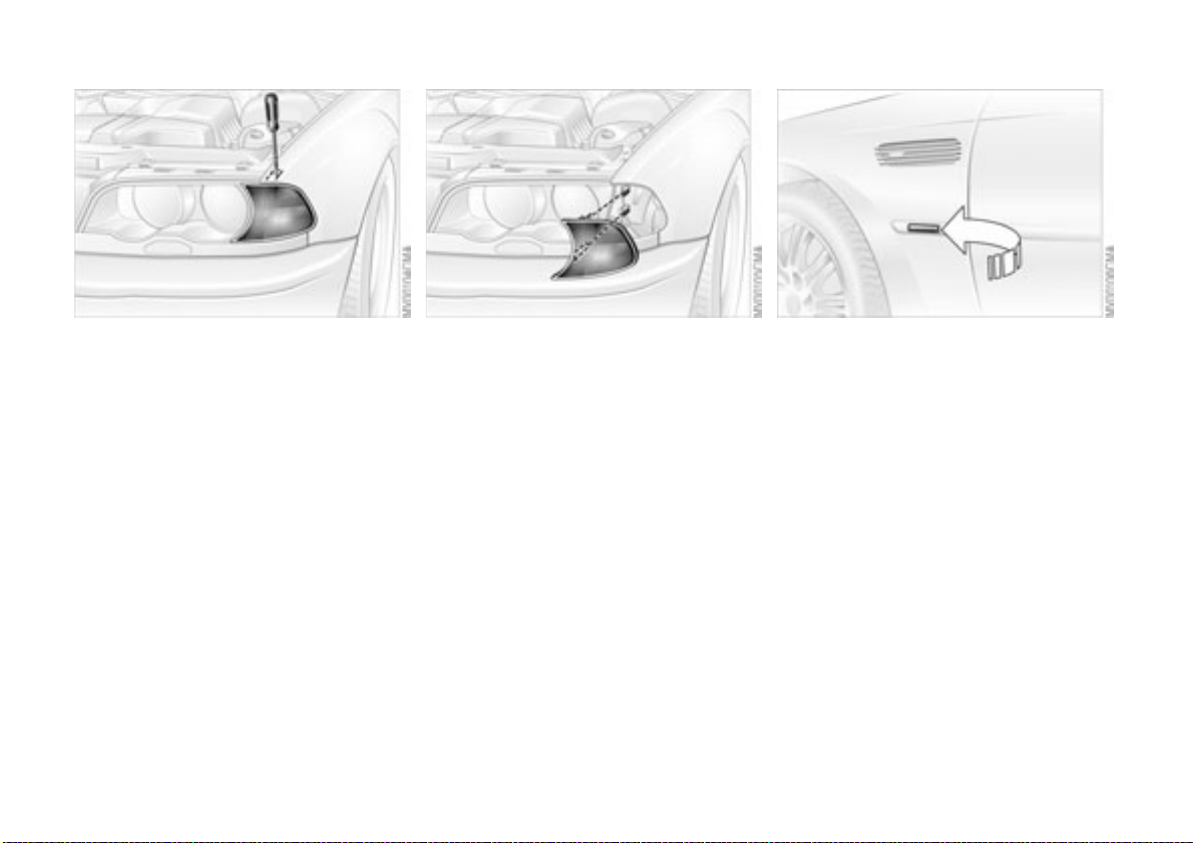
136
Front turn signal indicators
21 watt bulb
1. Extend a screwdriver through the
upper opening loosen the screw and
remove it
2. Remove lamp by pulling it out toward
the front
3. Applying light pressure, turn the bulb
to the left. Remove and exchange the
bulb
4. Insert the 2 pins on the lamp into the
guides on the vehicle
5. Slide in the lamp and screw the bulb
in place through the upper opening.
Side turn signal indicators
5 watt bulb
1. Use finger pressure against the rear
end of the lamp – see arrow – to
press it forward for removal
2. Apply gentle pressure to the bulb
while turning it to the left to remove.
Lamps and bulbs
handbook.book Page 136 Tuesday, July 30, 2002 9:28 AM
Online Edition for Part-No. 01 41 0 156 854 - © 09/02 BMW AG
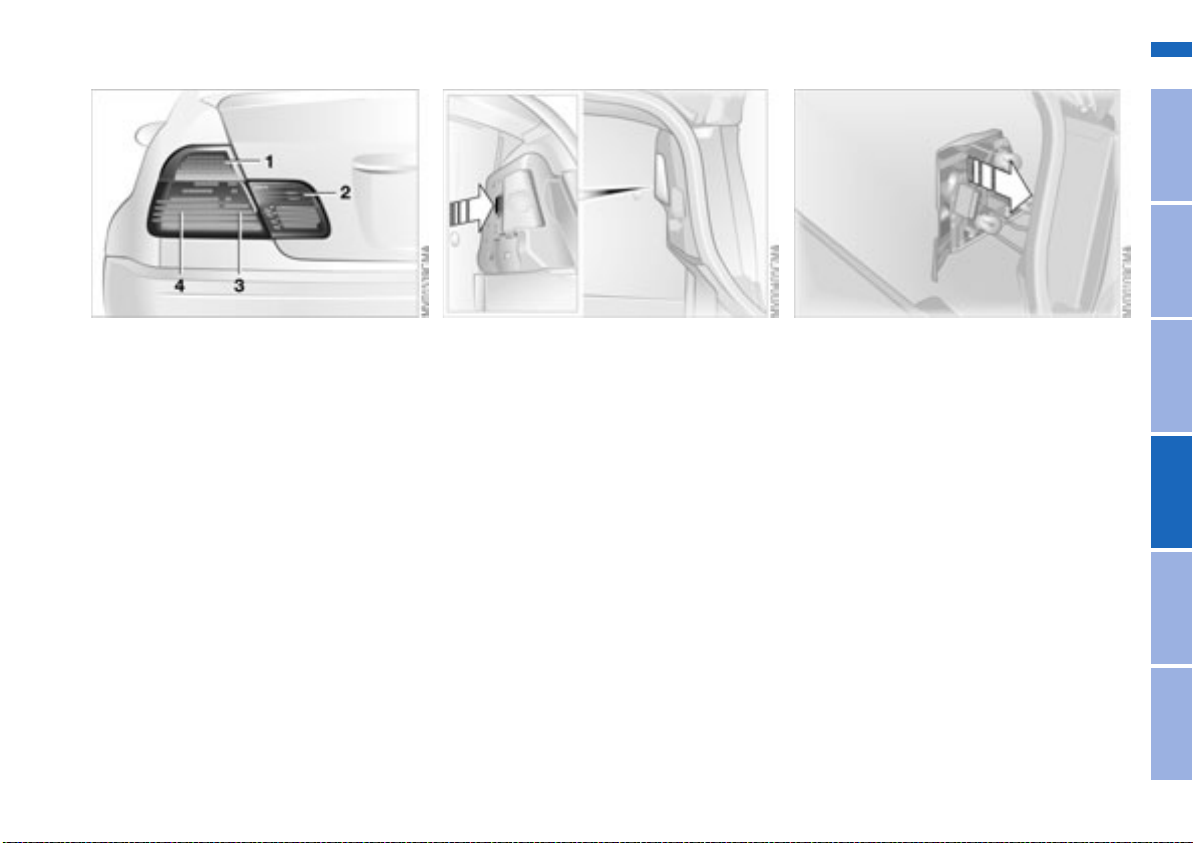
137
Tail lamps
1 Turn signal indicator
2 Backup lamp
3 Tail lamp
4 Tail lamp/brake lamp
Tail lamp 4: 21/4 watt bulb
Remaining bulbs: 21 watt
The illustration shows the right-hand
luggage compartment opening.
Bulbs in the fender:
All of the bulbs are integrated in a cen-
tral bulb holder.
1. Release the bulb holder – see arrow
2. Take out the bulb holder
3. Unplug the power supply receptacle.
Set the bulb holder aside, on the lug-
gage compartment floor, for example
4. Applying light pressure, turn the bulb
to the left. Remove and exchange the
bulb
5. Plug in the power supply receptacle
6. Reattach the bulb holder until you
hear it snap into place – see arrow.
Lamps and bulbs
OverviewControlsMaintenanceRepairsDataIndex
handbook.book Page 137 Tuesday, July 30, 2002 9:28 AM
Online Edition for Part-No. 01 41 0 156 854 - © 09/02 BMW AG
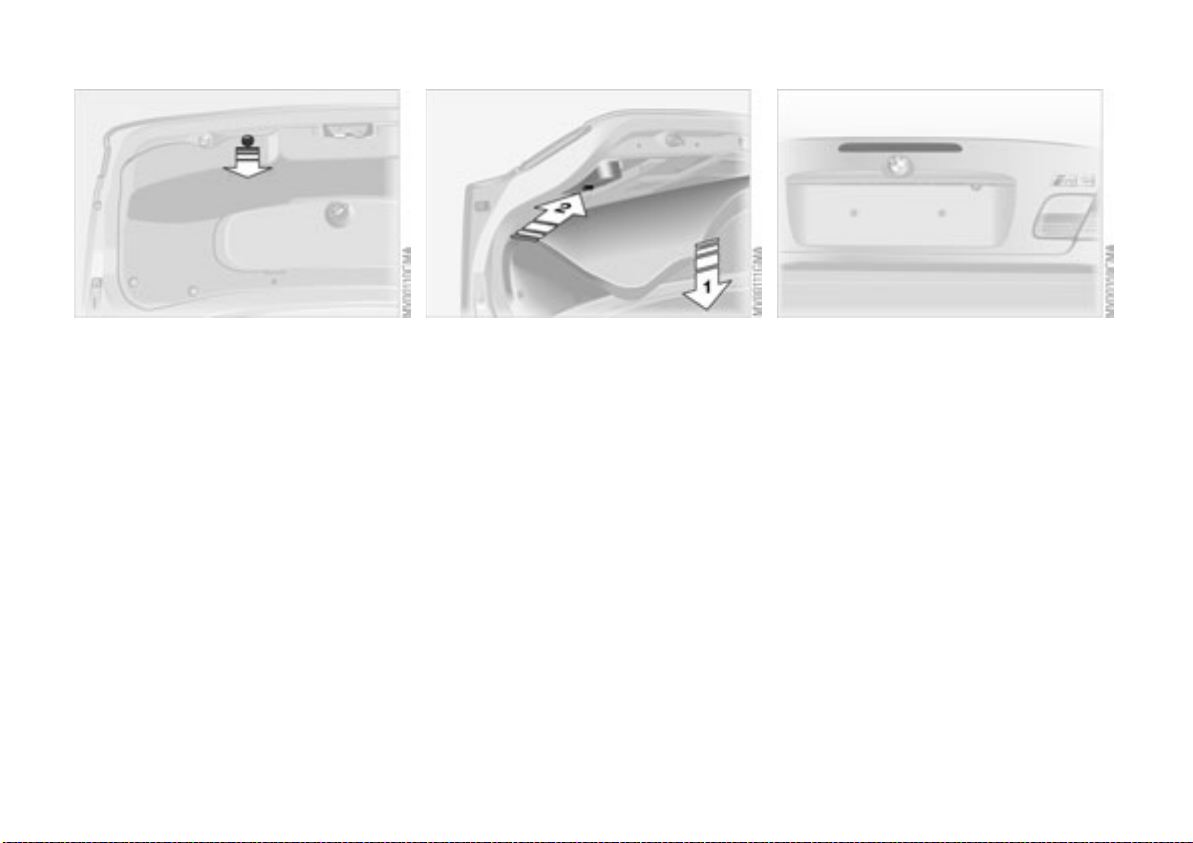
138
Bulbs in the luggage compartment lid
1. Using a screwdriver, loosen the clip
2. Fold the trim panel down – see
arrow 1. Disengage the bulb holder –
see arrow 2 – and remove it
3. Applying light pressure, turn the bulb
to the left. Remove and exchange the
bulb
4. Press the bulb holder into position
until you hear it engage
5. Reinstall the trim with the clip.
Center high-mount brake lamp
LED strip in luggage compartment lid.
Please contact a BMW center in case of
a malfunction.
Lamps and bulbs
handbook.book Page 138 Tuesday, July 30, 2002 9:28 AM
Online Edition for Part-No. 01 41 0 156 854 - © 09/02 BMW AG
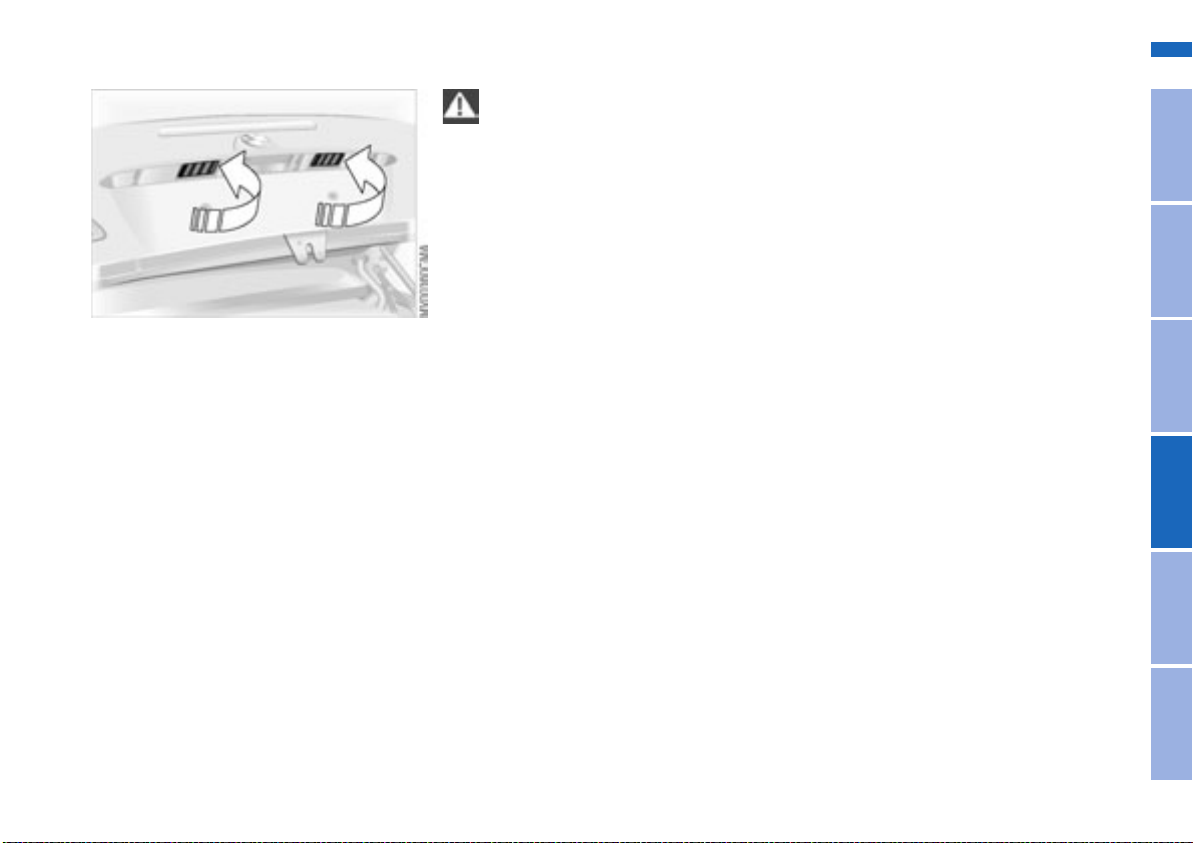
139
License plate lamps
5 watt bulb
1. Place a screwdriver in the slot and
press toward the left – see arrow – to
release the lens
2. Replace the bulb.
Repairing a flat tire
Precautions in case of a flat tire:
Stop the vehicle as far as possible
from passing traffic; switch on the haz-
ard warning flashers.
Turn the steering wheel to the straight-
ahead position and engage the steering
lock. Shift into 1st or reverse and
engage the parking brake.
All passengers should be outside the
vehicle and well away from your imme-
diate working area – behind a guardrail,
for instance.
If necessary, set up your warning trian-
gle or portable hazard warning lamp on
the roadside at an appropriate distance
from the rear of the vehicle. Comply
with all safety guidelines and regula-
tions.<
M Mobility system
You will find an M Mobility system in
your BMW M3 convertible for repairing
flat tires. With this system you can
apply a sealing liquid to the inside of
the tire that seals off the damaged point
and then continue driving.
The M Mobility system makes trans-
porting a spare wheel superfluous,
thereby reducing the amount of weight
you have to carry around.
Using the M Mobility system
To repair a flat tire using the M Mobility
system, proceed as follows:
> Preparing the M Mobility system for
use, refer to the next column
> This is part of the M Mobility system,
refer to page 140
> Filling with sealant, refer to page 141
> Distributing sealant, refer to
page 141
> Inflating tire to correct pressure, refer
to page 142.
Lamps and bulbs
OverviewControlsMaintenanceRepairsDataIndex
handbook.book Page 139 Tuesday, July 30, 2002 9:28 AM
Online Edition for Part-No. 01 41 0 156 854 - © 09/02 BMW AG
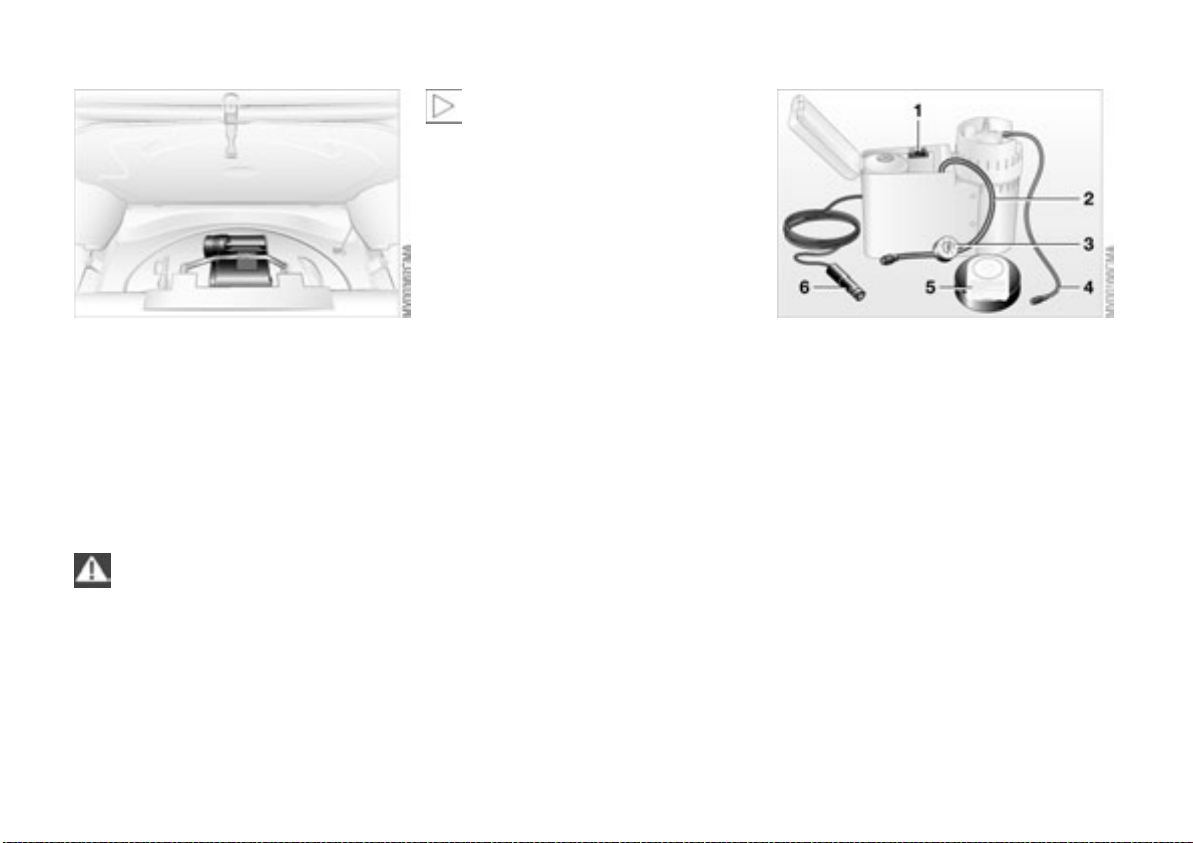
140
Preparing the M Mobility system
for use
The M Mobility system is located in the
luggage compartment under the floor
panel:
1. Lift the floor panel
2. Loosen the M Mobility system from
its storage location.
Before you use the M Mobility sys-
tem, read the warnings and dan-
ger notices on the device carefully.<
If possible, leave the foreign object in
the tire.
Pull off the sticker 5, refer to the second
column on the right, for the speed limit
and apply it to the steering wheel.
Please keep in mind that the fluids
bottle in the system's sealant con-
tainer has to be changed every 3 years
by your BMW center, if the unit has not
been used.<
This is part of the M Mobility
system
1 On/Off switch
2 Connection hose with manometer for
connecting the compressor with the
sealant container or to connect the
compressor to the wheel
3 Manometer for indicating the tire
pressure
4 Connector hose from the sealant
container to the wheel
5 Sticker with speed limit
6 Plug and cable for the cigarette
lighter socket
7 Protective gloves, not shown
Repairing a flat tire
handbook.book Page 140 Tuesday, July 30, 2002 9:28 AM
Online Edition for Part-No. 01 41 0 156 854 - © 09/02 BMW AG
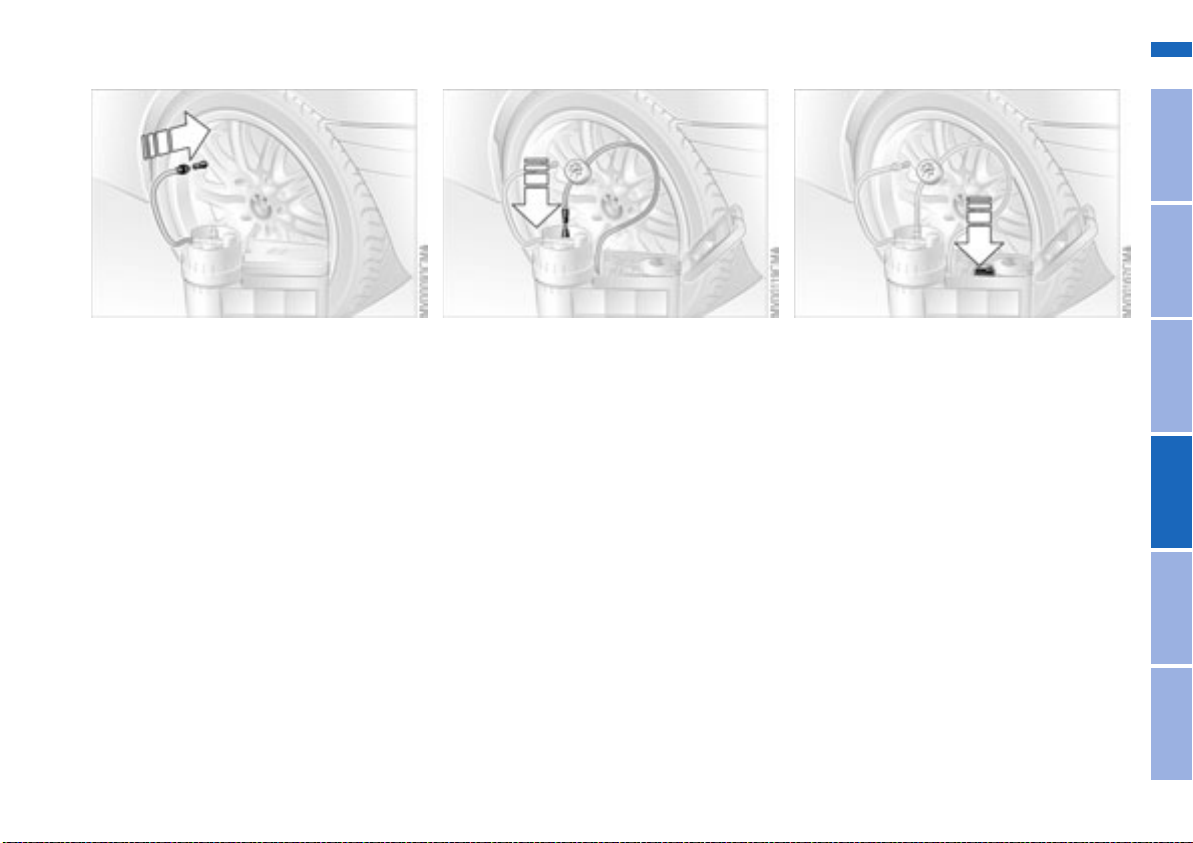
141
Filling with sealant
1. Take off the round cover and take out
hose 4. Unscrew the valve dust cap
from the defective wheel and screw
the hose to the valve. Keep the dust
cap in a safe place
2. Flip open the cover and pull out the
enclosed protective gloves. Take out
hose 2 with the manometer and
screw it to the terminal for the seal-
ant container as shown in the illustra-
tion
3. Make sure that the system has been
switched off, position 0.
Take out plug 6 and insert it into the
cigarette lighter socket in the pas-
senger compartment, refer to
page 103
4. Make sure that the screw on the rear
of the pressure gauge 3 is tightened
down. Turn on the M Mobility sys-
tem, position I, refer to illustration,
and allow minutes to elapse, to let
the sealant flow in. It does not matter
afterward, what the tire's inflation
pressure is
5. Turn the system off.
Disconnect the connector hose from
the sealant container and the wheel
valve. Stow the M Mobility system in
the luggage compartment.
Distributing the sealant
Right afterward, drive at least
1 1/4 miles/2 km, so that the liquid
sealant distributes evenly throughout
the inside of the tire.
Repairing a flat tire
OverviewControlsMaintenanceRepairsDataIndex
handbook.book Page 141 Tuesday, July 30, 2002 9:28 AM
Online Edition for Part-No. 01 41 0 156 854 - © 09/02 BMW AG
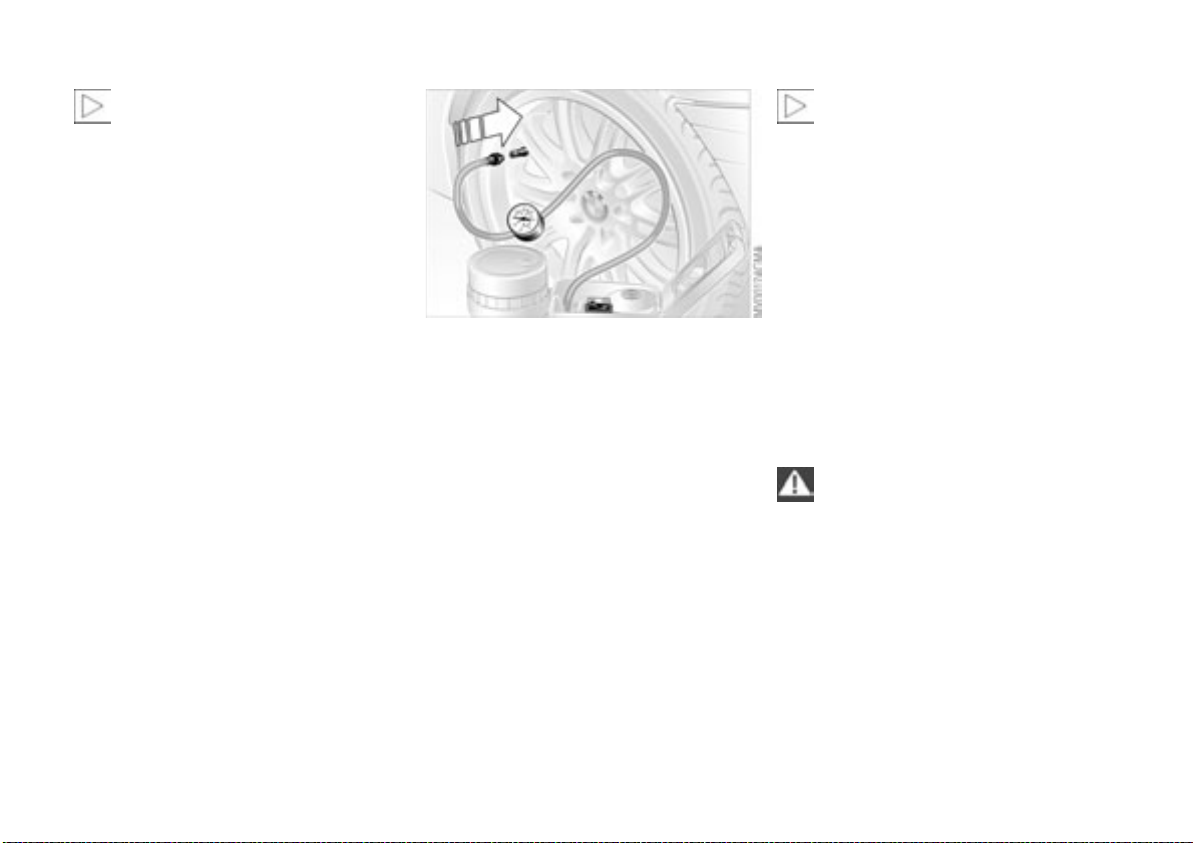
142
Do not exceed a maximum speed
of 40 mph / 60 km/h. If possible,
keep the vehicle speed above 10 mph /
20 km/h.
Stop in a suitable spot.<
Inflating tire to correct pressure
1. Take out the hose with the pressure
gauge and screw it onto the valve.
Take the plug out and plug it into the
cigarette lighter socket in the pas-
senger compartment
2. Reset the air pressure to
29 psi/200 kilopascal, and:
> Increase tire pressure: switch on
the M Mobility System, position I.
Switch off the unit briefly to check
the current tire pressure
> Decrease tire pressure: turn the
screw on the back of the manome-
ter, a valve located there will open
Even if the tire fails to hold the
pressure, you should still carry out
Step 3 before proceeding to drive the
vehicle again, refer to Distributing the
sealant for more information. Then
repeat Steps 1 through 3.
The use of the M Mobility system may
be ineffective if the damaged area in
the tire is larger than approx. 3/16 in /
4 mm. Please consult the nearest BMW
center if the tire cannot be temporarily
repaired with the M Mobility system.<
3. Unscrew the hose from the valve and
stow the M Mobility system in the
luggage compartment. Screw the
dust cap onto the valve again.
Do not exceed the maximum
speed limit described below, oth-
erwise it could lead to accidents.<
When you start driving again, do not
exceed the permissible maximum
speed of 45 mph / 80 km/h.
Repairing a flat tire
handbook.book Page 142 Tuesday, July 30, 2002 9:28 AM
Online Edition for Part-No. 01 41 0 156 854 - © 09/02 BMW AG

143
You will find corresponding
instructions for using the
M Mobility system on the device.
Replace the defective tire as soon as
possible and have the new wheel bal-
anced. Reinitialize the Flat Tire Monitor,
and refer to page 89 for further informa-
tion. Have the M Mobility system
refilled. Contact your BMW center for
this.<
Protect valve stems against dirt using
screw-on dust caps. Dirty valve stems
frequently lead to slow pressure loss.
Battery
Battery posts, terminals, and
related accessories contain lead
and lead compounds. Wash hands after
handling.<
Maintenance
The battery is completely maintenance-
free. That means that the original bat-
tery acid will normally last for the ser-
vice life of the battery under moderate
climate conditions.
Please consult your BMW center
whenever you have any questions
concerning the battery. Since the bat-
tery is absolutely maintenance-free, the
following statements are for your infor-
mation only.<
Never disconnect the battery
when the engine is running; the
ensuing voltage surge would seriously
damage the vehicle's onboard elec-
tronic systems.<
Charging the battery
Charge the battery in the vehicle only
when the engine is not running. Use the
connections provided in the engine
compartment. For information on the
connections, see Jump-starting,
page 145.
Return used batteries to a recy-
cling point or your BMW center.
Maintain the battery in an upright posi-
tion for transport and storage. Secure
the battery against tilting in transit.<
Repairing a flat tire
OverviewControlsMaintenanceRepairsDataIndex
handbook.book Page 143 Tuesday, July 30, 2002 9:28 AM
Online Edition for Part-No. 01 41 0 156 854 - © 09/02 BMW AG
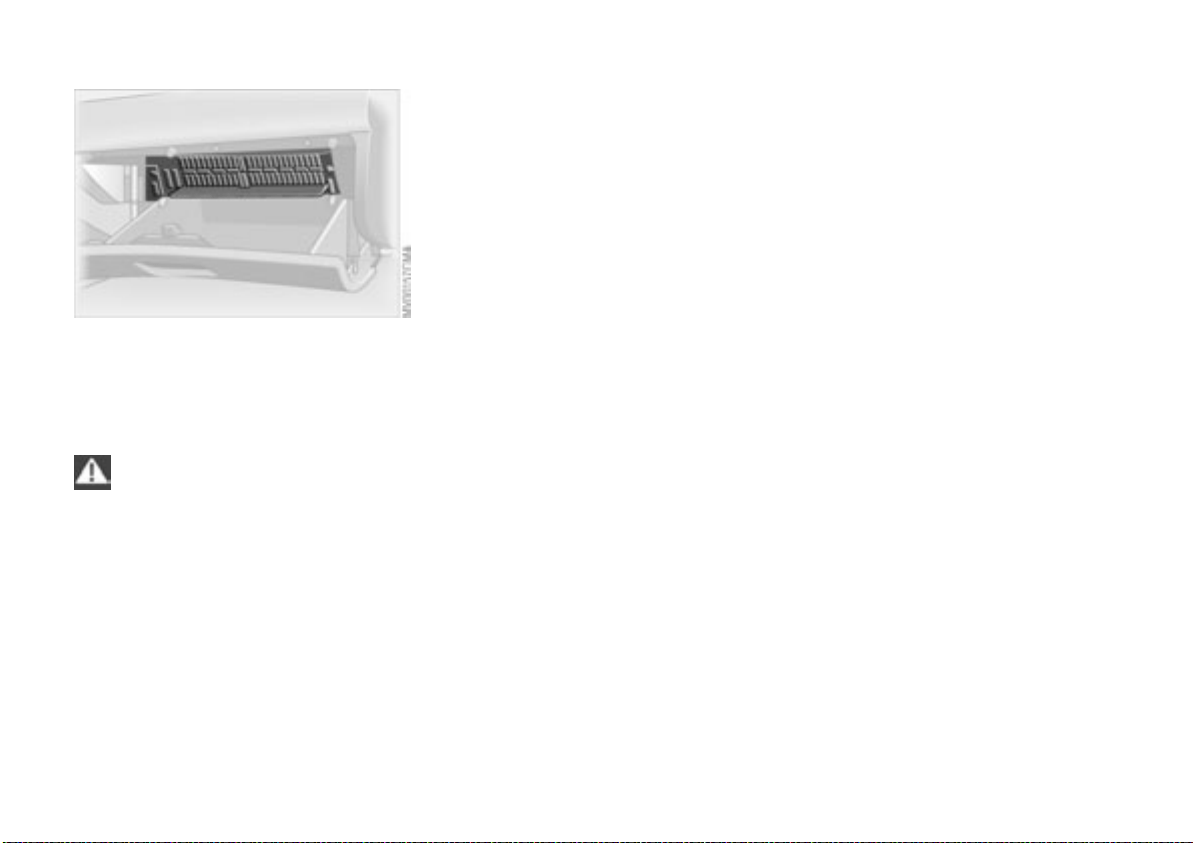
144
Fuses
You will find the fuses and information
on their respective allocation in the
glove compartment behind a panel with
two snap clips.
Do not attempt to repair a blown
fuse or replace it with a fuse
having a different color or amperage
rating. To do this could cause a fire in
the vehicle resulting from a circuit over-
load.<
handbook.book Page 144 Tuesday, July 30, 2002 9:28 AM
Online Edition for Part-No. 01 41 0 156 854 - © 09/02 BMW AG
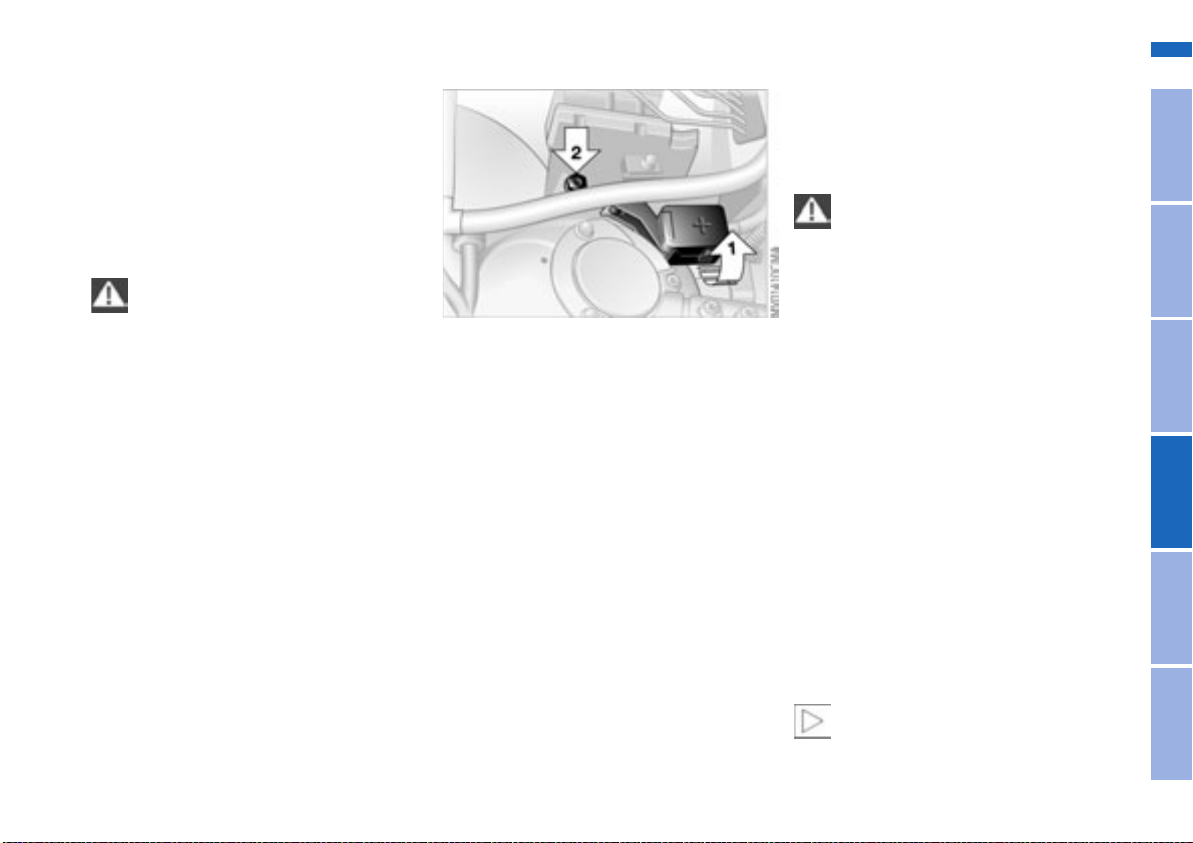
145
Giving and receiving assistance
Jump-starting
When your battery is discharged, you
can use two jumper cables to start your
vehicle with power from the battery in a
second vehicle. You can also use the
same method to help start another
vehicle. Use only jumper cables with
fully insulated handles on the terminal
clamps.
Do not touch high-voltage wiring
and cables on a running engine.
Contact with components carrying high
voltage can be harmful or fatal.
Carefully observe the following instruc-
tions to avoid personal injury and/or
damage to one or both vehicles.<
1. The battery in the support vehicle
must be rated at 12 volts. This infor-
mation is provided on the battery
label
2. Stop the engine of the support vehi-
cle and switch off all electrical com-
ponents in both vehicles – except for
the hazard warning flashers of the
support vehicle
3. Make absolutely certain that there is
no contact between the bodywork of
the two vehicles – short circuit haz-
ard
4. The auxiliary jump-starting terminal
located in your BMW's engine com-
partment acts as the positive battery
terminal. The cover of this auxiliary
terminal is marked with a + sign.
Remove by pulling the tab, see
arrow 1. Start by connecting the
jumper cable from the positive termi-
nal of the discharged battery to the
positive terminal of the support bat-
tery
5. Then connect the negative terminals
with the other jumper cable. Attach
the cable to either the support vehi-
cle's negative battery terminal or to a
suitable ground on its engine or
bodywork. Then connect the other
end to the negative battery terminal
or a suitable ground on the vehicle
being started. Your BMW is
equipped with a special nut for this
purpose – see arrow 2
Always adhere to this sequence
when connecting jumper cables;
failure to observe this procedure can
lead to sparks at the battery terminals
and pose an injury hazard.<
6. Start the engine of the support vehi-
cle and let it run for several minutes
at a slightly elevated engine idle
speed
7. Start the engine of the other vehicle
as usual. If the first start attempt is
not successful, wait a few minutes
before another attempt in order to
allow the discharged battery to
recharge
8. Allow the engines to run for several
minutes before disconnecting the
jumper cables
9. Then disconnect the jumper cables
in the opposite order.
Have the battery recharged at your
BMW center as required.
Do not use spray starter fluids to
start the engine.<
OverviewControlsMaintenanceRepairsDataIndex
handbook.book Page 145 Tuesday, July 30, 2002 9:28 AM
Online Edition for Part-No. 01 41 0 156 854 - © 09/02 BMW AG
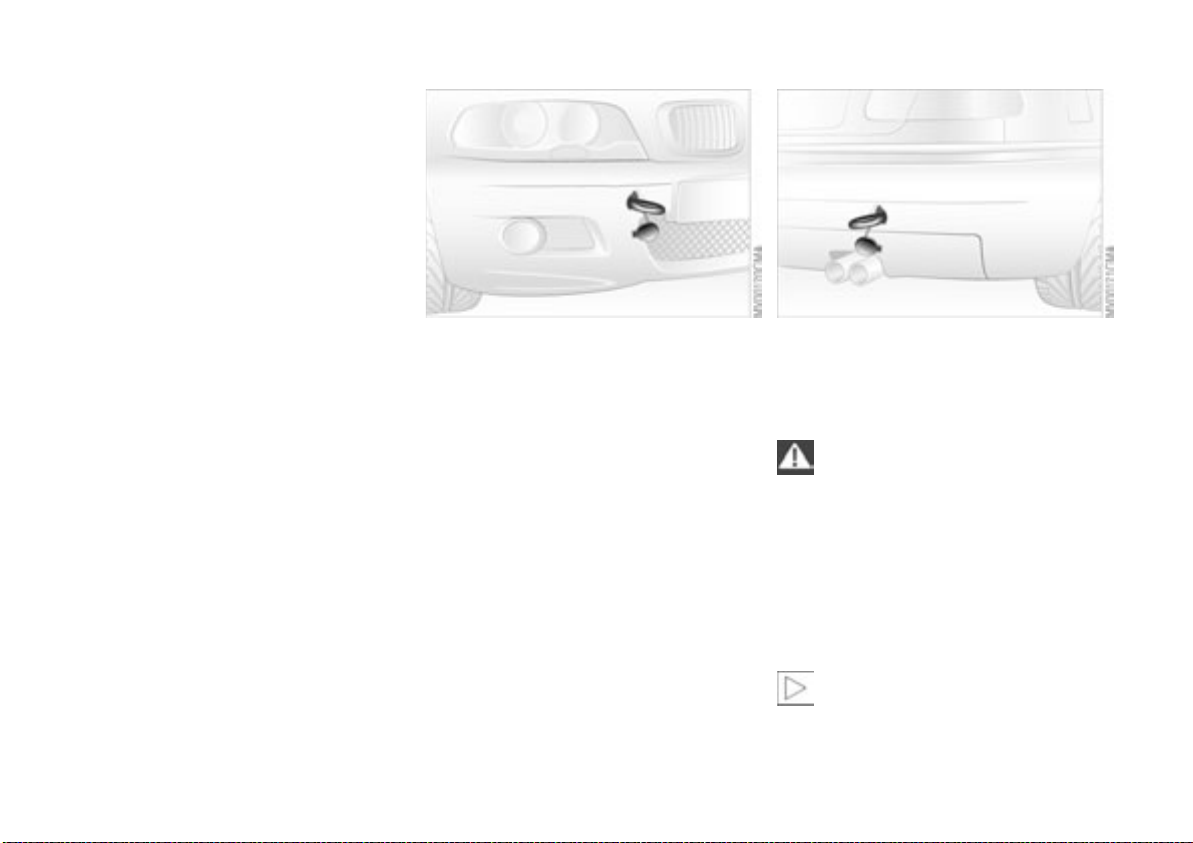
146
Towing the vehicle
Towing eyelet
The towing eyelet, which can be
unscrewed, is in the luggage compart-
ment under the floor mat and must
remain in the vehicle. This eyelet is
designed for installation in the tow
sockets located at the front and rear of
the vehicle. It is intended for towing on
paved road surfaces only.
The towing eyelet should not be used
to pull a vehicle out of deep snow, mud,
sand, etc.
Comply with all applicable towing laws
and regulations at all times.
Access to tow sockets
Front:
Press out the cover panel with a screw-
driver at the top of the recess.
Rear:
Press out the cover panel with a screw-
driver at the top of the recess.
Make sure the towing eyelet is
firmly screwed all the way in, oth-
erwise the thread could be damaged.
Only use the towing eyelet provided in
the vehicle to avoid damage.
Do not tow the vehicle by any compo-
nents of the running gear, or lash them
down in any way. If you do, the compo-
nents could be damaged, possibly
leading to accidents.<
Keep the vehicles in line and avoid
towing at an offset angle. Ensure
that the tow rope connecting the two
vehicles is tight, with no slack, before
starting off.<
handbook.book Page 146 Tuesday, July 30, 2002 9:28 AM
Online Edition for Part-No. 01 41 0 156 854 - © 09/02 BMW AG
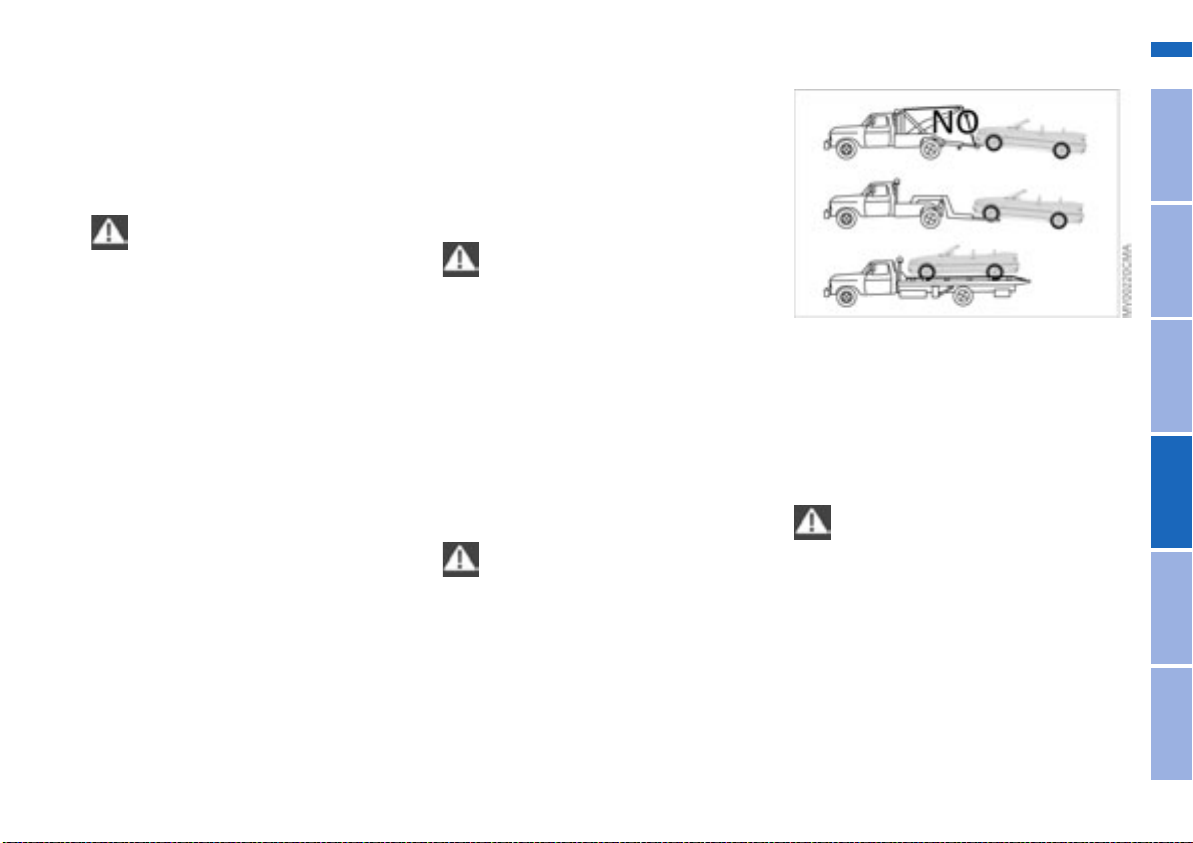
147
Use only a nylon towing strap to tow
the vehicle, since the inherent resil-
ience of this material helps protect both
vehicles from sudden jerking move-
ments.
The towed vehicle should always
be the lighter of the two vehicles.
If this is not the case, it will not be pos-
sible to control vehicle handling.<
Tow-starting
For instructions on jump-starting, refer
to page 145.
Never attempt to use your vehicle to
push another vehicle, since damage to
the energy-absorbing bumpers could
result.
Towing a vehicle
1. Gearshift lever in Neutral
2. Towing speed:
Max. 45 mph / 70 km/h
3. Towing distance:
Max. 95 miles/150 km
4. Leave the ignition key at position 1 to
ensure that the brake lamps, turn sig-
nal indicators, horn and windshield
wipers remain operative, and to pre-
vent the steering lock detent from
engaging
5. Switch on the hazard-warning sys-
tem – observe applicable legal regu-
lations.
Find some means of identifying the
vehicle in tow, for instance, place a sign
or warning triangle in the rear window.
Make sure that the ignition key
remains in position 1 even when
the electrical system has failed to pre-
vent the steering lock from engaging.
The steering and brakes are without
power-assist when the engine is off.
This means that increased effort is
required for steering and braking.<
Vehicle with sequential M gearbox
SMG II:
To push or tow, engage selector lever
in position 0.
Never work on the vehicle with a
driving position engaged.<
Towing with a commercial tow
truck
> Do not tow with sling-type equipment
> Use wheel lift or flatbed equipment
> Please comply with applicable state
towing laws.
Never allow passengers to ride in
a towed vehicle for any reason.
Never attach tie-down hooks, chains,
straps, or tow hooks to tie rods, control
arms, or any other part of the vehicle
suspension, as severe damage to these
components will occur, possibly lead-
ing to accidents.<
Towing the vehicle
OverviewControlsMaintenanceRepairsDataIndex
handbook.book Page 147 Tuesday, July 30, 2002 9:28 AM
Online Edition for Part-No. 01 41 0 156 854 - © 09/02 BMW AG
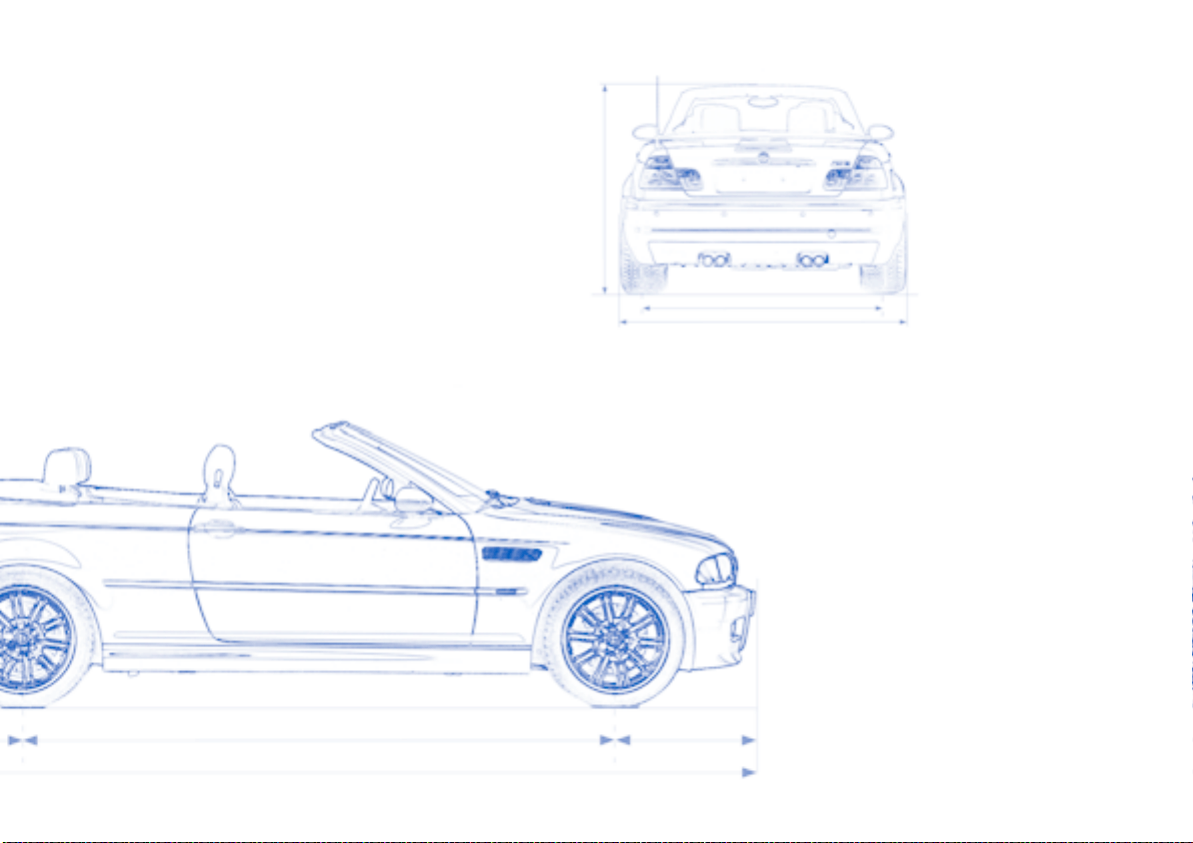
148
handbook.book Page 148 Tuesday, July 30, 2002 9:28 AM
Online Edition for Part-No. 01 41 0 156 854 - © 09/02 BMW AG
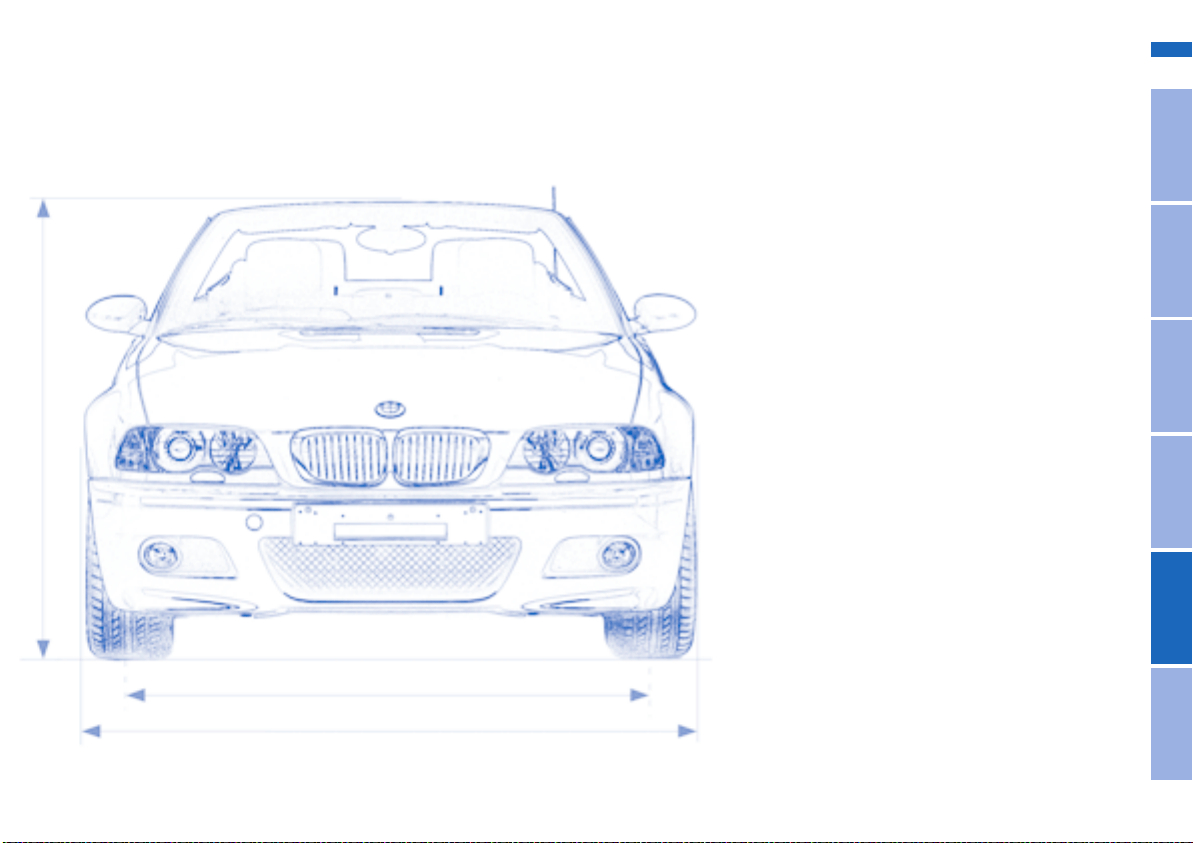
149
Overview
Controls and features
Operation, maintenance
Owner service procedures
Technical data
Index
OverviewControlsMaintenanceRepairsDataIndex
handbook.book Page 149 Tuesday, July 30, 2002 9:28 AM
Online Edition for Part-No. 01 41 0 156 854 - © 09/02 BMW AG

150
Engine data
Displacement
Number of cylinders
cu in/cm
3
198.1/3,246
6
Max. power output
at engine speed
hp/kW
rpm
333/248
7,900
Maximum torque
at engine speed
lb ft/Nm
rpm
262/355
4,900
Compression ratio ε 11.5
Stroke
Bore
in/mm
in/mm
3.58/91
3.43/87
Fuel-injection system Digital electronic engine-management
system
handbook.book Page 150 Tuesday, July 30, 2002 9:28 AM
Online Edition for Part-No. 01 41 0 156 854 - © 09/02 BMW AG
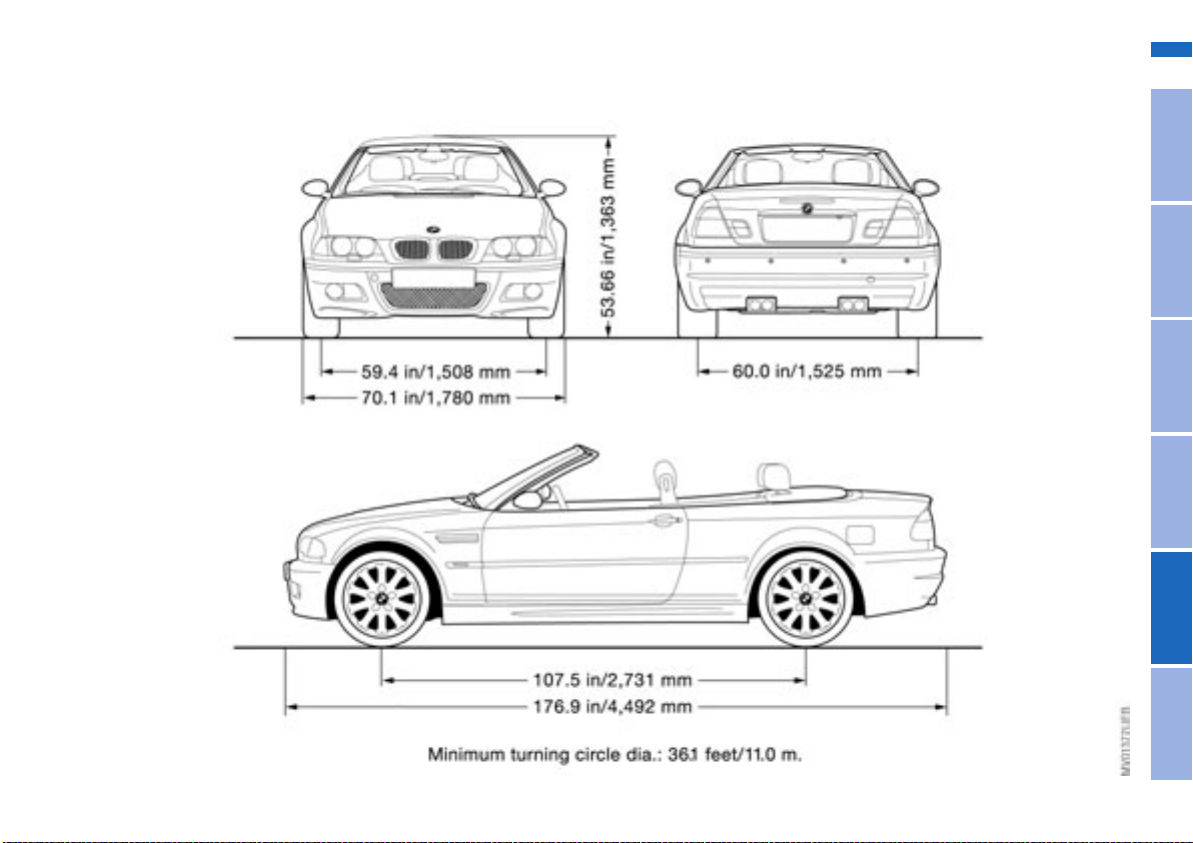
151
Dimensions
OverviewControlsMaintenanceRepairsDataIndex
handbook.book Page 151 Tuesday, July 30, 2002 9:28 AM
Online Edition for Part-No. 01 41 0 156 854 - © 09/02 BMW AG

152
Weights
Curb weight lbs/kg 3,782/1,715
Approved gross vehicle weight lbs/kg 4,630/2,100
Approved front axle load lbs/kg 2,183/990
Approved rear axle load lbs/kg 2,579/1,170
Permissible roof load for the hardtop lbs/kg 165/75
Luggage compartment capacity
with the convertible top compartment raised
cu ft/l 9.2/260
10.6/300
Approved axle loads and approved gross vehicle weight may not be exceeded.
handbook.book Page 152 Tuesday, July 30, 2002 9:28 AM
Online Edition for Part-No. 01 41 0 156 854 - © 09/02 BMW AG

153
Capacities
Notes
Fuel tank
Reserve
gal./liters
gal./liters
approx. 16.6/63
approx. 2.1/8
Fuel specification: page 25
Windshield washer system/
Headlamp cleaning system quarts/liters approx. 5.6/5.3
For details: page 124
Cooling system including heater circuit quarts/liters approx. 9.8/9.3 For details: page 126
Engine with oil filter change quarts/liters approx. 5.8/5.5 For details: page 125
Manual transmission quarts/liters approx. 1.9/1.8 Oil change during running-in check
and during each inspection II
Differential quarts/liters approx. 1.2/1.1 Oil change during running-in check
and during each inspection II
OverviewControlsMaintenanceRepairsDataIndex
handbook.book Page 153 Tuesday, July 30, 2002 9:28 AM
Online Edition for Part-No. 01 41 0 156 854 - © 09/02 BMW AG

154
handbook.book Page 154 Tuesday, July 30, 2002 9:28 AM
Online Edition for Part-No. 01 41 0 156 854 - © 09/02 BMW AG

155
Overview
Controls and features
Operation, maintenance
Owner service procedures
Technical data
Index
OverviewControlsMaintenanceRepairsDataIndex
handbook.book Page 155 Tuesday, July 30, 2002 9:28 AM
Online Edition for Part-No. 01 41 0 156 854 - © 09/02 BMW AG

Everything from A to Z
A
ABS Antilock Brake System
indicator lamp 19
Accessories 5
Activated-charcoal filter 100
Adding brake fluid 122, 127
Air conditioning 98
Air distribution, automatic 98
Air distribution, individual 98
Air nozzles 96
Air outlets 96
Air pressure 115
checking 25
Air supply 98
Air supply vents
recirculated-air mode 99
Airbags 57
warning lamp 18
Alarm system 38
avoiding false alarm 39
indicator lamp 39
interior motion sensor 38
tilt alarm sensor 38
Antifreeze 126
Antilock Brake System
(ABS) 111
indicator lamp 19
Anti-theft system 30, 38
Armrest 101
Ashtray
front 102
rear 103
AUC Automatic recircu-
lated-air control 99
Automatic car wash, refer to
the Caring for your vehicle
brochure
Automatic climate control 96
Automatic cruise control 78
Automatic dimming, interior
rearview mirror 56
Automatic headlamp
control 92
Automatic recirculated-air
control (AUC) 99
Auxiliary terminal for jump-
starting 122, 145
Average fuel
consumption 85
Average speed 85
Avoiding unintentional
alarms 39
Axle loads 152
B
Backrests
unlocking 51
Backup lamps 70
replacing bulb 137
Battery 143
charge 143
charge current 18
charge current lamp 18
Belts 52
Beverage holder 102
Blower 98
BMW Maintenance
System 128
Bore 150
Bottle holder, see Beverage
holder 102
Brake fluid level 112
warning lamp 18, 127
Brake hydraulic system
warning lamp 18
Brake lamps
replacing bulb 137
Brake pads 112
Brake system
brake fluid level, warning
lamp 18
brake pads, indicator
lamp 19
Brakes
malfunctions 112
parking brake 69
Braking
driving notes 111
Break-in procedures 110
Bulb replacement 135
C
California Proposition
65 warning 130
Can holder, see Beverage
holder 102
Capacities 153
Car care, refer to the Caring
for your vehicle brochure
Car vacuum cleaner, con-
necting 103
Car wash, refer to the Caring
for your vehicle brochure
Care, refer to the Caring for
your vehicle brochure
Cargo loading 106
Caring for headlamp cov-
ers, refer to the Caring for
your vehicle brochure 135
CBC Cornering Brake Con-
trol 111
indicator lamp 19
Cellular phone 102
Center armrest 101
Center high-mount brake
lamp 138
Central locking system 30
button 34
Check Control 82
CHECK FILLER CAP
indicator lamp 19
Checking coolant level 126
Checking oil level 124
Child seat 59
Child-restraint systems 59
Cigarette lighter 102
Clean windshield 78
handbook.book Page 156 Tuesday, July 30, 2002 9:28 AM
Online Edition for Part-No. 01 41 0 156 854 - © 09/02 BMW AG

Everything from A to Z
157
Cleaning position, convert-
ible top 45
Cleaning windshield 78
Clock 83
refer also to the radio or
onboard computer
Owner's Manual
Cockpit 14
Code, tires 118
Coin box 102
Compression ratio 150
Computer 84
Condensation, removing
from windows 98
Configure personal settings
Vehicle Memory, Key
Memory 65
Consumption
display 81
fuel 85
Convertible top
cleaning position 45
electrical malfunction 44
emergency operation 44
opening and closing 42
Convertible top operation
fully automatic convertible
top 41
Coolant 122, 126, 153
indicator lamp 19
Cooling system 153
Copyright 4
Cornering Brake Control
(CBC) 111
Cruise control 78
indicator lamp 20
Cup holder, see Beverage
holder 102
Curb weight 152
Cushion height 151
D
Data
dimensions 151
engine 150
weights 152
Daytime driving lamps 92
DBC Dynamic Brake
Control 88
warning lamp 19
Defrost position 98
Defrosting rear window 99
Defrosting windows 98
Digital clock 83
Dimensions 151
Dipstick, engine oil 124
Disc brakes 112
Displacement 150
Display lighting 93
Displays 16
Distance warning 86
Door key 30
Door lock buttons 34
Doors
emergency operation 33
manual operation 33
remote control 31
unlocking and locking
31, 33
Drivelogic 74
Driving notes
braking 111
disc brakes 112
general 111
hydroplaning 111
DSC Dynamic Stability Con-
trol 87
indicator lamp 19
Dynamic Brake Control
(DBC) 88
Dynamic Stability Control
(DSC) 87
indicator lamp 19
E
Electric malfunction
doors 33
Electric power windows 40
Electrical accessories, fail-
ure 144
Electrical malfunction
convertible top 44
fuel filler door 24
Emergency operation
doors 33
fuel filler door 24
Emergency release
luggage compartment
lid 36
Engine
displacement 150
output 150
starting 67
switching off 69
torque 150
Engine compartment 122
Engine coolant 153
refilling 126
temperature gauge 81
Engine data 150
Engine electronics
warning lamp 19
Engine oil
adding 122, 124
capacity 153
consumption 124
dipstick 124
quality 125
types 125
viscosity 125
Engine oil level
check 122
indicator lamp 19
warning lamp 18
OverviewControlsMaintenanceRepairsDataIndex
handbook.book Page 157 Tuesday, July 30, 2002 9:28 AM
Online Edition for Part-No. 01 41 0 156 854 - © 09/02 BMW AG

Everything from A to Z
Engine oil pressure
warning lamp 18
Engine speed 150
Entering the rear 51
Exterior mirrors 55
Eyelet, towing 146
F
False alarm, avoiding 39
Fault displays 82
First-aid kit 23
Flat tire 115
repairing 139
Flat Tire Monitor 88
indicator lamp 18, 19
Fog lamps 94
Fold down convertible top
compartment panel 37
Follow me home lamps 92
Footbrake 112
Footbrake, refer to Driving
notes 111
Footwell lamps 94
Front airbags 57
Front fog lamps 94
indicator lamp 20
Front seat adjustment 49
Frost protection,
radiator 126
Fuel 25
Fuel consumption 85
display 81
Fuel filler door 24
release following an elec-
trical malfunction 24
Fuel gauge 81
Fuel specifications 25
Fuel tank capacity 153
Fuel tank display 81
Fuel tank gauge 81
Fuel-injection system 150
Fully automatic convertible
top 41
operation 41
Fuses 144
replacing 144
G
Gasoline 25
Gasoline gauge 81
Gearbox, sequential 71
Gearshift lever 70
Glove compartment 101
Grills 96
Gross vehicle weight 152
H
Hands-free system 102
Hardtop 113
Hazard warning flashers 14
Hazard warning triangle 23
Head restraints 50
Headlamp 92
Headlamp cleaning system
122, 124, 153
Headlamp control 92
Headlamp flasher 76, 93
Heated mirror 55
Heated seats 54
Heavy loads 106
High beams 76, 93
indicator lamps 21
Holder for beverages 102
Hood release 120
Horn 14
Hydroplaning 111, 115
I
Ice warning 84
Ignition key 30
positions 66
Ignition lock 66
Imprint 4
Indicator lamps 18
Individual settings, Vehicle
Memory, Key Memory 65
Inflation pressure 25, 115
INSPECTION 82
Instrument cluster 16
Instrument lighting 93
Instrument panel 14, 16
Interface socket for onboard
diagnostics (OBD) 130
Interior lamps 32, 94
remote control 32
Interior motion sensor 38
remote control 32
switching off 32, 39
Interior rearview mirror
automatic dimming
feature 56
Interior temperature
adjusting 98
Intermittent mode 77
J
Jump-starting 145
K
Key Memory 65
Keys 30
L
Lamp replacement 135
Lamps
daytime driving lamps 92
fog lamps 94
footwell lamps 94
headlamp flasher 76, 93
high beams 93
instrument lighting 93
interior lamps 94
low beams 92
parking lamps 92
reading lamps 94
standing lamps 93
Lashing fittings 107
handbook.book Page 158 Tuesday, July 30, 2002 9:28 AM
Online Edition for Part-No. 01 41 0 156 854 - © 09/02 BMW AG

Everything from A to Z
159
LATCH child-restraint
mounting system 62
Leather care, refer to the
Caring for your vehicle
brochure
Length 151
License plate lamp
replacing bulb 139
Light switch 92
Lighter 102
Lighting, see lamps
LIGHTS ON warning 92
Load-securing devices 106
Lock, steering wheel 66
Low beams 92
bulb replacement 135
Luggage compartment
35, 37
capacity 152
floor panel 37
increase volume 37
Luggage compartment lid 35
emergency release 36
manual operation 35
opening from the inside 35
remote control 32
securing separately 35
Luggage compartment light-
ing 35
Luggage rack 107
Lumbar support 50
M
M Engine dynamics
control 91
M Mobility system 139
M+S tires 118
Maintenance 82, 128
Malfunction displays 82
Manual operation
convertible top 44
Manual transmission 70
Master keys 30
with remote control 30
Memory 53, 65
Microfilter 100
Microphone 102
Mirror defrosting 55
Mirror memory 53
Mirrors 55
automatic curb monitor 54
inside rearview 56
outside 55
Mobility system 139
Modifications, technical 5
Mounting the roof rack 113
Multifunction switch 76
N
Navigation system, refer to
Owner's Manual for
Onboard Computer
Neckrest 50
O
OBD interface socket 130
Odometer 80
Oil
additives 125
capacity 153
quality 125
viscosity 125
Oil change interval, see Ser-
vice and Warranty Infor-
mation Booklet for US
models / Warranty and
Service Guide Booklet for
Canadian models
Oil filter change 153
Oil level
checking 124
indicator lamp 19
warning lamp 18
Oil pressure
warning lamp 18
OIL SERVICE 82
Oil types 125
Onboard computer, refer to
the Owner's Manual for
Onboard Computer
Onboard tool kit 134
Opening and closing
from inside 34
via remote control 31
via the door lock 33
Operating elements 14
Outlets, ventilation 96
Outside temperature dis-
play 84
P
Paintwork care, refer to the
Caring for your vehicle
brochure
Panic mode, trigger
alarm 32
Park Distance Control
(PDC) 86
Parking aid 86
Parking brake 69
Parking lamps 92
PDC Park Distance
Control 86
Pollen 100
Power output 150
Power seat 49
Pressure, tires 25, 115
R
Radiator 153
Radio navigation, refer to
Owner's Manual for
Radio 85
Radio, refer to the Owner's
Manual for Radio
Rain sensor 77
Range 85
OverviewControlsMaintenanceRepairsDataIndex
handbook.book Page 159 Tuesday, July 30, 2002 9:28 AM
Online Edition for Part-No. 01 41 0 156 854 - © 09/02 BMW AG

Everything from A to Z
Reading lamps
front 94
rear 95
Rear lamps 137
Rear window defroster 99
Rear-entry assist 51
Rearview mirror 55
Recirculated-air mode 99
Refueling 24
Remote control 31
Remote key 30
Replacement key 30, 31
Reporting safety defects 6
Reserve indicator lamp 81
Restraint system 59
Reverse 70
Rims 118
Rollover protection
system 63
indicator lamp 19
lowering 63
Roof load capacity 152
Roof-mounted luggage
rack 107
S
Safe seating position 48
Safety belts 52
seat-integrated belt sys-
tem (SGS) 51
Seat
rear-entry assist 51
Seat adjustment 48, 49
lumbar support 49, 50
power seats 49
Seat heating 54
Seat memory 53
Securing cargo 106
Securing child-restraint sys-
tem 61
Securing devices 107
Sequential M gearbox
SMG II 71
indicator lamp 19, 75
Service and Warranty Infor-
mation Booklet 128
SERVICE ENGINE SOON
warning lamp 19
Service interval display
82, 128
Set clock 83
Side airbags 57
Side turn signals
bulb replacement 136
Size 151
Ski bag 104
SMG gearbox 71
Snow chains 119
Socket 103
Spare key 30
Speedometer 16
Sport mode 91
Standing lamps 93
bulb replacement 135
Starting problems 67
Starting the engine 67
Steering wheel lock 66
Steering wheel with multi-
function buttons 22
Steering wheel, adjusting 55
Storage compartments 101
Stroke 150
Summer tires 118
Surface ice warning 84
Switching off the engine 69
Symbols used 4
T
Tachometer 16, 80
Tail lamp assembly
replacing bulb 137
Tail lamps 137
replacing bulb 137
Tank capacity 153
Technical data 150
Technical modifications 5
Telephone hookup 102
Telephone, refer to the sep-
arate Owner's Manual
Temperature adjustment 98
Temperature display
engine coolant 81
ice warning 84
interior temperature 98
outside temperature 84
Temperature gauge 80
Temperature layering 99
Thigh support area, adjust-
ing 49
Third brake lamp 138
Tilt alarm
deactivate 32, 39
Tilt alarm sensor
remote control 32
Time 83
Tire code 118
Tire damage 115
Tire inflation pressure
25, 115
checking 25
Tire pressure monitor
(TPM) 88
Tire replacement 116
Tire tread 115
Tools 134
Torque 150
Towing eyelet 146
Towing the vehicle 146
Track 151
Transmission 70
Transporting children
safely 59
Tread depth, tires 115
Tread wear indicator 115
Trip odometer 80
Trunk, see Luggage com-
partment 35, 152
handbook.book Page 160 Tuesday, July 30, 2002 9:28 AM
Online Edition for Part-No. 01 41 0 156 854 - © 09/02 BMW AG

Everything from A to Z
161
Trunk lid, see Luggage com-
partment lid 35
Turn signal indicator 76
indicator lamps 20
replacing bulb 136
Turning circle 151
U
Uniform Tire Quality
Grading 117
Upholstery care, refer to the
Caring for your vehicle
brochure
Used batteries 143
V
Vacuum cleaner, connect-
ing 103
Variable pre-warning
zone 80
Vehicle
break-in procedures 110
starting 67
switching off 69
Vehicle battery 143
Vehicle Memory 65
Vehicle weight 152
Ventilation 96
draft-free 99
Viscosity 125
W
Warning lamp Please fasten
safety belts 18
Warning lamps 18
Warning messages 82
Warranty and Service Guide
Booklet 128
Warranty, refer also to sepa-
rate booklet 6
Washer fluid
adding 124, 153
indicator lamp 19
Washer/wiper system 77
Washing vehicle, refer to the
Caring for your vehicle
brochure
Water on roadways
deep water 111
Wear indicator for tires 115
Weights 152
Wheelbase 151
Wheels and tires 118
Wheelslip control, see
DSC 87
Width 151
Wind deflector 46
Window condensation,
removing 98
Windows
convenience operation 33
defrosting 98
Windshield washer reservoir
filling 124, 153
Windshield wiper blades,
replacing 134
Windshield wipers 77
Winter tires 118
Wiper blades, replacing 134
Work in the engine compart-
ment 120
X
Xenon lamps 135
OverviewControlsMaintenanceRepairsDataIndex
handbook.book Page 161 Tuesday, July 30, 2002 9:28 AM
Online Edition for Part-No. 01 41 0 156 854 - © 09/02 BMW AG

handbook.book Page 162 Tuesday, July 30, 2002 9:28 AM
Online Edition for Part-No. 01 41 0 156 854 - © 09/02 BMW AG

163
OverviewControlsMaintenanceRepairsDataIndex
handbook.book Page 163 Tuesday, July 30, 2002 9:28 AM
Online Edition for Part-No. 01 41 0 156 854 - © 09/02 BMW AG

handbook.book Page 164 Tuesday, July 30, 2002 9:28 AM
Online Edition for Part-No. 01 41 0 156 854 - © 09/02 BMW AG
Refueling
To ensure that you always have conve-
nient access to all essential information
when you stop for fuel, we recommend
that you take the time to fill out the
adjoining chart by entering the data that
apply to your vehicle. Consult the index
for individual specifications.
Fuel
Please enter your preferred fuel here.
Engine oil
The oil quantity between the two marks
on the dipstick is approx.
1.4 US quarts/1.3 liters.
Tire inflation pressure
Designation
Quality
Summer tires Winter tires
front rear front rear
Up to 2 persons
4 persons plus luggage
handbook.book Page 165 Tuesday, July 30, 2002 9:28 AM
Online Edition for Part-No. 01 41 0 156 854 - © 09/02 BMW AG

More about BMW
bmwusa.com
The Ultimate
Driving Machine
01 41 0 156 854 ue
handbook.book Page 166 Tuesday, July 30, 2002 9:28 AM
Online Edition for Part-No. 01 41 0 156 854 - © 09/02 BMW AG