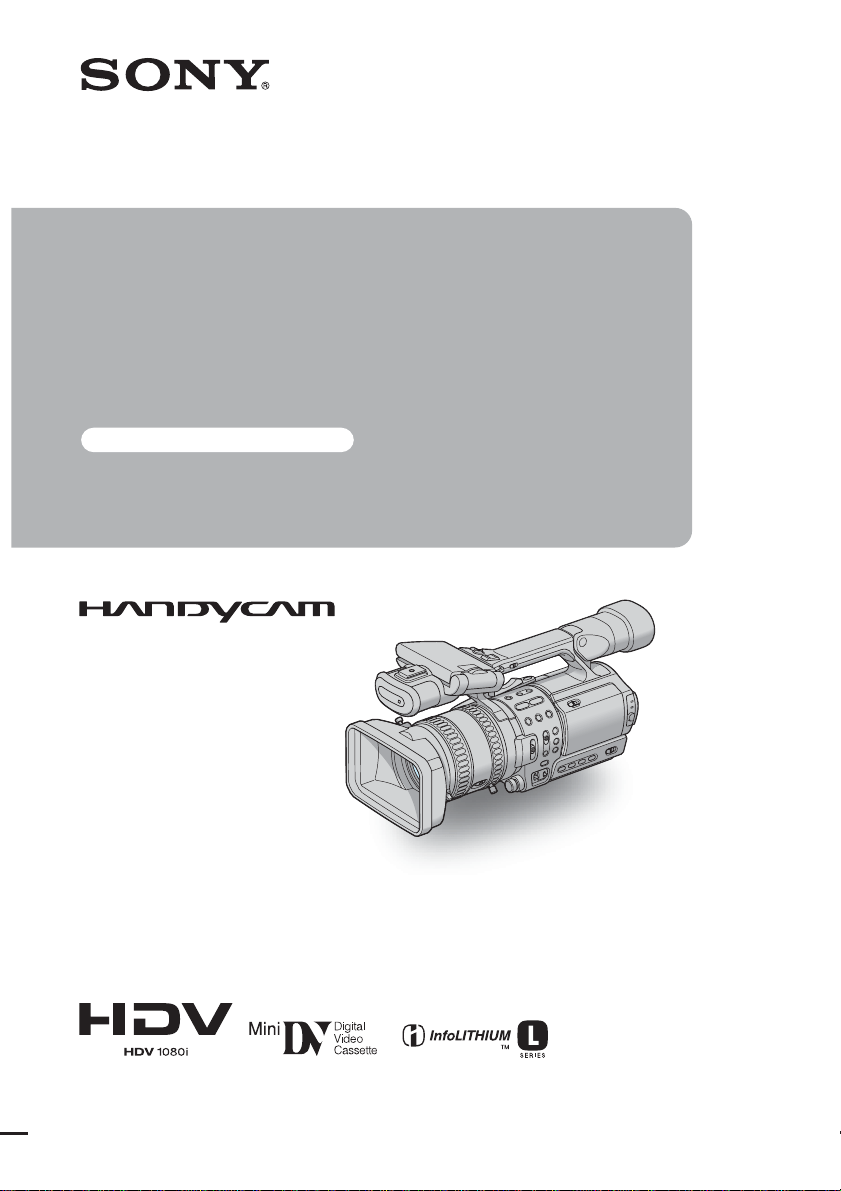
2-178-348-11(1)
© 2004 Sony Corporation
Operating
Instructions
Read this first
Digital HD Video Camera Recorder
HDR-FX1
2
Read this first
Before operating the unit, please read this
manual thoroughly, and retain it for future
reference.
WARNING
To prevent fire or shock hazard, do not
expose the unit to rain or moisture.
This symbol is intended to alert the
user to the presence of uninsulated
“dangerous voltage” within the
product’s enclosure that may be of
sufficient magnitude to constitute
a risk of electric shock to persons.
This symbol is intended to alert the
user to the presence of important
operating and maintenance
(servicing) instructions in the
literature accompanying the
appliance.
For customers in the U.S.A. and
CANADA
RECYCLING LITHIUM-ION BATTERIES
Lithium-Ion batteries are
recyclable.
You can help preserve our
environment by returning your
used rechargeable batteries to the
collection and recycling location nearest you.
For more information regarding recycling of
rechargeable batteries, call toll free 1-800-822-
8837, or visit http://www.rbrc.org/
Caution: Do not handle damaged or leaking
Lithium-Ion batteries.
For customers in the U.S.A.
If you have any questions about this product, you
may call:
Sony Customer Information Center 1-800-222-
SONY (7669)
The number below is for the FCC related matters
only.
Regulatory Information
Owner’s Record
The model and serial numbers are located on the
bottom. Record the serial number in the space
provided below. Refer to these numbers whenever
you call upon your Sony dealer regarding this
product.
Model No. HDR-FX1
Serial No.
Model No.AC-
Serial No.
Declaration of Conformity
Trade Name: SONY
Model No.: HDR-FX1
Responsible Party: Sony Electronics Inc.
Address: 16450 W. Bernardo Dr, San Diego,
CA 92127 U.S.A.
Telephone No.: 858-942-2230
This device complies with Part 15 of the FCC Rules.
Operation is subject to the following two conditions:
(1) This device may not cause harmful interference,
and (2) this device must accept any interference
received, including interference that may cause
undesired operation.

3
CAUTION
You are cautioned that any changes or
modifications not expressly approved in this
manual could void your authority to operate this
equipment.
b Note:
• This equipment has been tested and found to comply
with the limits for a Class B digital device, pursuant
to Part 15 of the FCC Rules.
These limits are designed to provide reasonable
protection against harmful interference in a
residential installation. This equipment generates,
uses, and can radiate radio frequency energy and, if
not installed and used in accordance with the
instructions, may cause harmful interference to radio
communications. However, there is no guarantee
that interference will not occur in a particular
installation. If this equipment does cause harmful
interference to radio or television reception, which
can be determined by turning the equipment off and
on, the user is encouraged to try to correct the
interference by one or more of the following
measures:
– Reorient or relocate the receiving antenna.
– Increase the separation between the equipment and
receiver.
– Connect the equipment to an outlet on a circuit
different from that into which the receiver is
connected.
– Consult the dealer or an experienced radio/TV
technician for help.
The interface cable supplied must be used with the
equipment in order to comply with the limits for a
digital device pursuant to Subpart B of Part 15 of
FCC Rules.
Notes on use
Your camcorder is capable of recording in both
HDV and DV formats. You can use only mini DV
cassettes in your camcorder.
The HDV standards
• Digital high-definition (HD) video signals are
recorded and played back on a DV format cassette.
• HDV signals are compressed in MPEG2 format,
which is adopted in BS (broadcast satellite) digital
and terrestrial digital HDTV broadcastings and in
Blu-ray disc recorders.
z
Tip
• Your camcorder adopts the HDV1080i
specification, which utilizes 1080 effective scanning
lines, within the HDV standards, and records
pictures at the image bit rate of about 25 Mbps. The
i.LINK Interface is adopted as the digital interface
enabling a digital connection with TVs and personal
computers compatible with the HDV format.
Recording
• Before starting to record, test the recording function
to make sure the picture and sound are recorded
without any problems.
• Compensation for the contents of recordings cannot
be provided, even if recording or playback is not
possible due to a malfunction of the camcorder,
storage media, etc.
• TV color systems differ depending on the country/
region. To view your recordings on a TV, you need
an NTSC system-based TV.
• Television programs, films, video tapes, and other
materials may be copyrighted. Unauthorized
recording of such materials may be contrary to the
copyright laws.
The LCD panel, viewfinder, and lens
• The LCD screen and the viewfinder are
manufactured using extremely high-precision
technology, so over 99.99% of the pixels are
operational for effective use.
However, there may be some tiny black points and/
or bright points (white, red, blue, or green in color)
that appear constantly on the LCD screen and the
viewfinder.
These points are normal results of the manufacturing
process and do not affect the recording in any way.
• Exposing the LCD screen, the viewfinder, or the lens
to direct sunlight for long periods of time may cause
malfunctions. Be careful when placing the camera
near a window or outdoors.
,continued
4
• Do not aim at the sun. Doing so might cause your
camcorder to malfunction. Take pictures of the sun
only in low light conditions, such as at dusk.
Playing back HDV tapes on other
devices
A tape recorded in the HDV format cannot be
played back on a device that is not compatible
with the HDV format. The screen appears blue.
Check the contents of tapes by playing them
back on this camcorder prior to playing them
back on other devices.
Connecting other devices
Before connecting your camcorder to other device
such as a VCR or a computer with an i.LINK cable,
be sure to insert the connector plug in the proper
direction. If you insert the connector plug forcibly
in the wrong direction, the terminal may be
damaged, or this may cause a malfunction of your
camcorder.
Using this manual
The images of the LCD screen and the viewfinder
used on this manual are captured using a digital
still camera, and thus may appear different from
what you see.
Using the camcorder
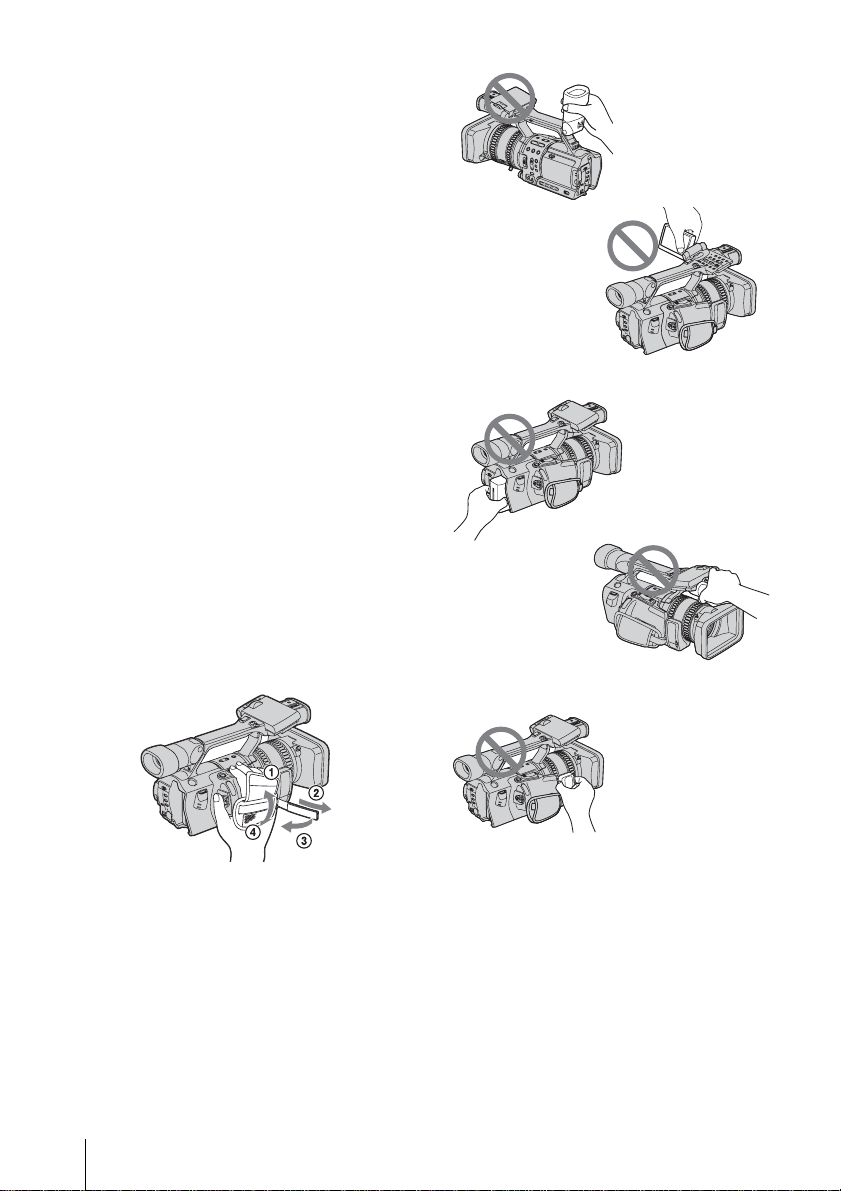
• To ensure a good grip, fasten the grip belt as shown
in the following illustration.
• You can change the language to be used for screen
display on your camcorder (p. 18).
• Do not hold the camcorder by the following parts.
Viewfinder
LCD panel
Battery pack
Microphone
Jack holder

5
Read this first............................................................................................. 2
Quick Start Guide
Recording movies ...................................................................................... 8
Getting started
Step 1: Checking supplied items.............................................................. 10
Step 2: Charging the battery pack............................................................ 11
Using an outside power source ................................................................................. 14
Step 3: Turning the power on................................................................... 14
Step 4: Adjusting the LCD panel and viewfinder...................................... 15
Adjusting the LCD panel ........................................................................................... 15
Adjusting the viewfinder ............................................................................................ 15
Step 5: Setting the date and time............................................................. 16
Step 6: Inserting a cassette tape.............................................................. 17
Step 7: Setting the screen language........................................................ 18
Recording
Recording movies .................................................................................... 20
Recording for a longer time ................................................................................ 22
Using zoom ............................................................................................................... 22
Recording in mirror mode ......................................................................................... 23
Displaying the recording setup information – Status check ...................................... 24
Adjusting the exposure............................................................................. 25
Adjusting the exposure for backlit subjects ............................................................... 25
Recording the subject lit by strong light – SPOT LIGHT ........................................... 25
Adjusting the white balance ...................................................................................... 26
Recording using manual adjustments...................................................... 27
Adjusting the iris ........................................................................................................ 28
Adjusting the gain ..................................................................................................... 28
Adjusting the shutter speed ...................................................................................... 29
Adjusting the volume of light – ND FILTER .............................................................. 30
Displaying the zebra pattern to adjust the brightness ............................................... 31
Table of Contents
,continued

6
Adjusting the focus................................................................................... 32
Adjusting the focus manually .....................................................................................32
Enhancing the outline to focus – PEAKING ..............................................................33
Customizing the picture quality or sound................................................. 34
Customizing the picture quality – PICTURE PROFILE .............................................34
Adjusting the audio recording level – Microphone volume level ................................36
Recording a picture using various features.............................................. 37
Developing scenes smoothly – Shot transition ..........................................................37
Fading in and out of a scene– FADER ......................................................................38
Recording an index signal at the beginning of recording ...........................................39
Recording in 16:9 wide rec mode ....................................................... 40
Reviewing the most recently recorded scenes – Rec Review ................. 41
Playback
Viewing movies........................................................................................ 42
Playing back in various modes ..................................................................................43
Various playback functions ...................................................................... 44
Searching for the last scene of the most recent recording – END SEARCH .............44
Displaying the screen indicators ................................................................................44
Displaying the date/time and camera settings data – Data code ..............................44
Displaying the video information – Status check .......................................................45
Playing the picture on a TV...................................................................... 46
Viewing the picture on a high definition TV ...............................................................46
Viewing the picture on a 16:9 TV or a 4:3 TV ............................................................48
Locating a scene on a tape for playback.................................................. 49
Searching quickly for a desired scene – Zero set memory ........................................49
Searching for a scene by date of recording – Date search .......................................50
Searching for a recording start point – Index search .................................................50

7
Advanced operations
Using the Menu
Selecting menu items .........................51
Using the (CAMERA SET) menu
– STDYSHOT TYP/FRAME REC,
etc. ...............................................52
Using the (AUDIO SET) menu
– AUDIO MIX, etc. ........................56
Using the (LCD/VF SET) menu
– LCD COLOR, etc. .....................58
Using the (IN/OUT REC) menu
– REC FORMAT/TV TYPE, etc. ...59
Using the (OTHERS) menu
– CLOCK SET/WORLD TIME,
etc. ...............................................62
Customizing Personal Menu ..............65
Assigning the functions ......................68
Dubbing/Editing
Dubbing to another tape ....................70
Recording pictures from a VCR
or TV ............................................74
Connecting to a computer ..................77
Dubbing sound to a recorded
tape ........................................78
Connecting an analog VCR to the
computer via your camcorder
– Signal conversion function ........81
Troubleshooting
Troubleshooting .................................83
Warning indicators and messages .....88
Additional Information
Using your camcorder abroad ............90
HDV format and recording/playback ..91
About the “InfoLITHIUM” battery
pack ..............................................92
About i.LINK .......................................94
Maintenance and precautions ............95
Specification .......................................98
Quick Reference
Identifying parts and controls ...........100
Index ................................................107
Note on the icons used in this manual
: Features available for the HDV
format only.
: Features available for the DV format only.
Quick Start Guide
8
Quick Start Guide
Recording movies
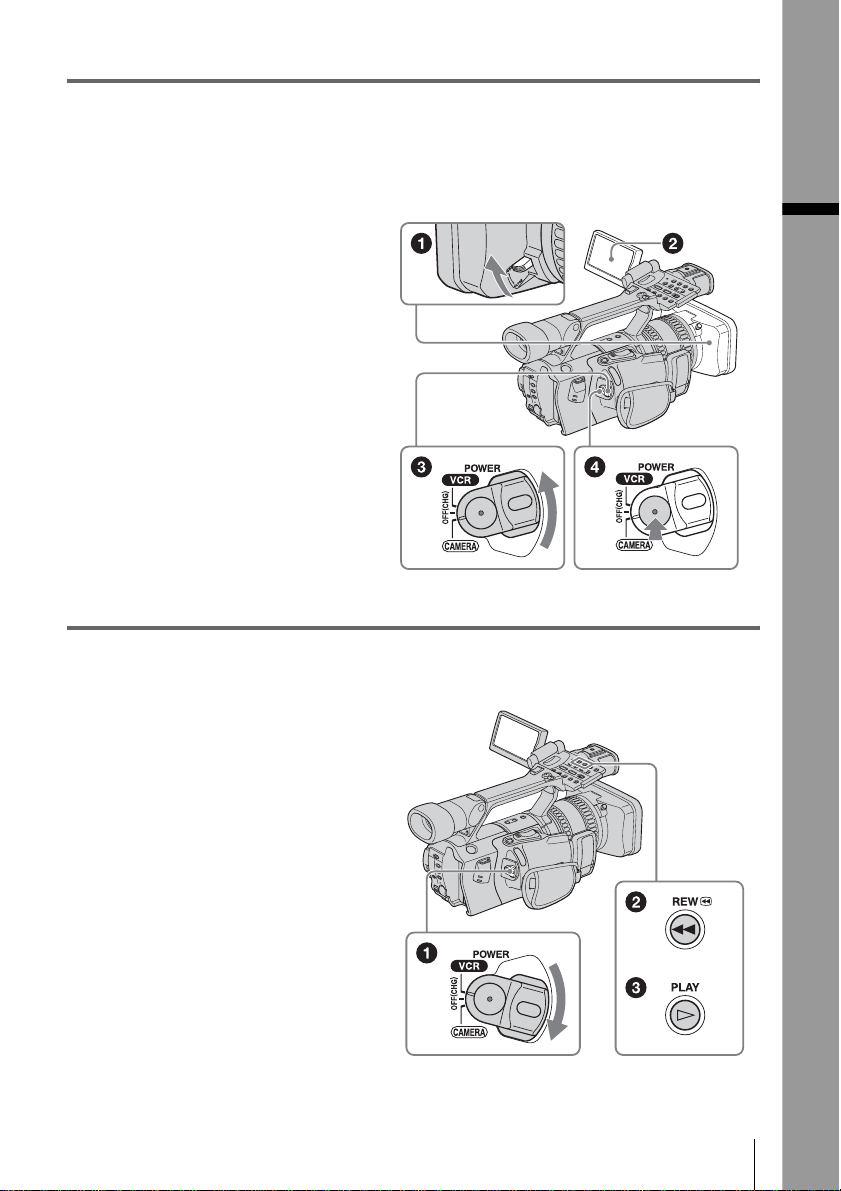
1 Attach the charged battery pack to the camcorder.
To charge the battery, see page 11.
2 Insert a cassette into the camcorder.
Press the battery pack and slide it down.
a Slide the OPEN/
EJECT lever in
the direction of the
arrow to open the lid.
The cassette compartment
comes out automatically.
b Insert the cassette with
its window-side facing
out, then push the center
of the back of the
cassette.
c Press on the
cassette
compartment.
Close the cassette lid after
the cassette compartment
slides back in by itself.
Battery Pack
OPEN/EJECT lever
Window-side
Quick Start Guide
Quick Start Guide
9
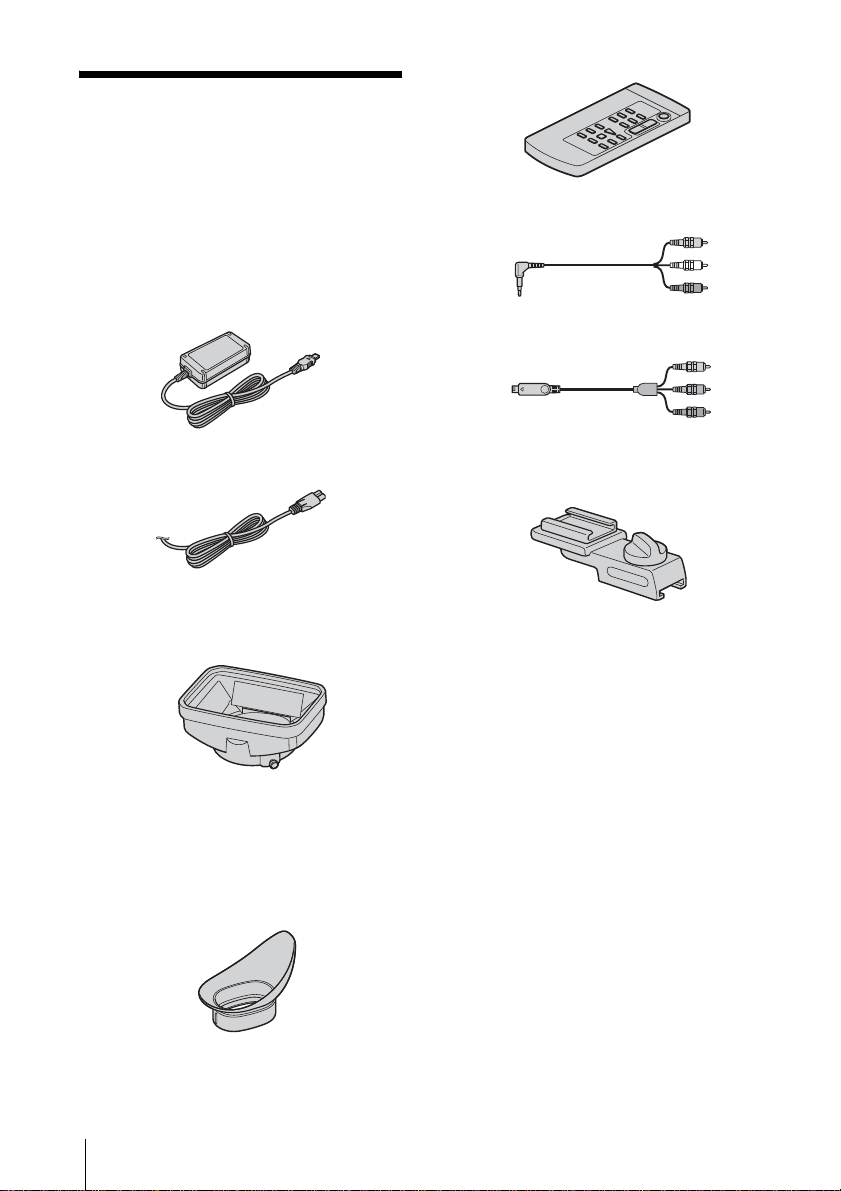
3 Start recording while checking the subject on the LCD screen.
The date and time is not set up in the default setting. To set the date and time, see page 16.
The pictures are recorded in the HDV format in the default setting. To record in the DV format,
see page 60.
4 View the recorded picture on the LCD screen.
a Open the hood shutter.
b Open the LCD panel and
adjust the angle.
c While pressing the green
button, set the POWER
switch to CAMERA.
d Press REC START/STOP.
Recording starts. To change to
standby mode, press REC
START/STOP again.
a While pressing the green
button, set the POWER
switch to VCR.
b Press m (rewind).
c Press N (play) to start the
playback.
To stop, press x (stop).
To turn off the power, set the POWER
switch to OFF (CHG).
Getting started
10
Getting started
Step 1: Checking
supplied items
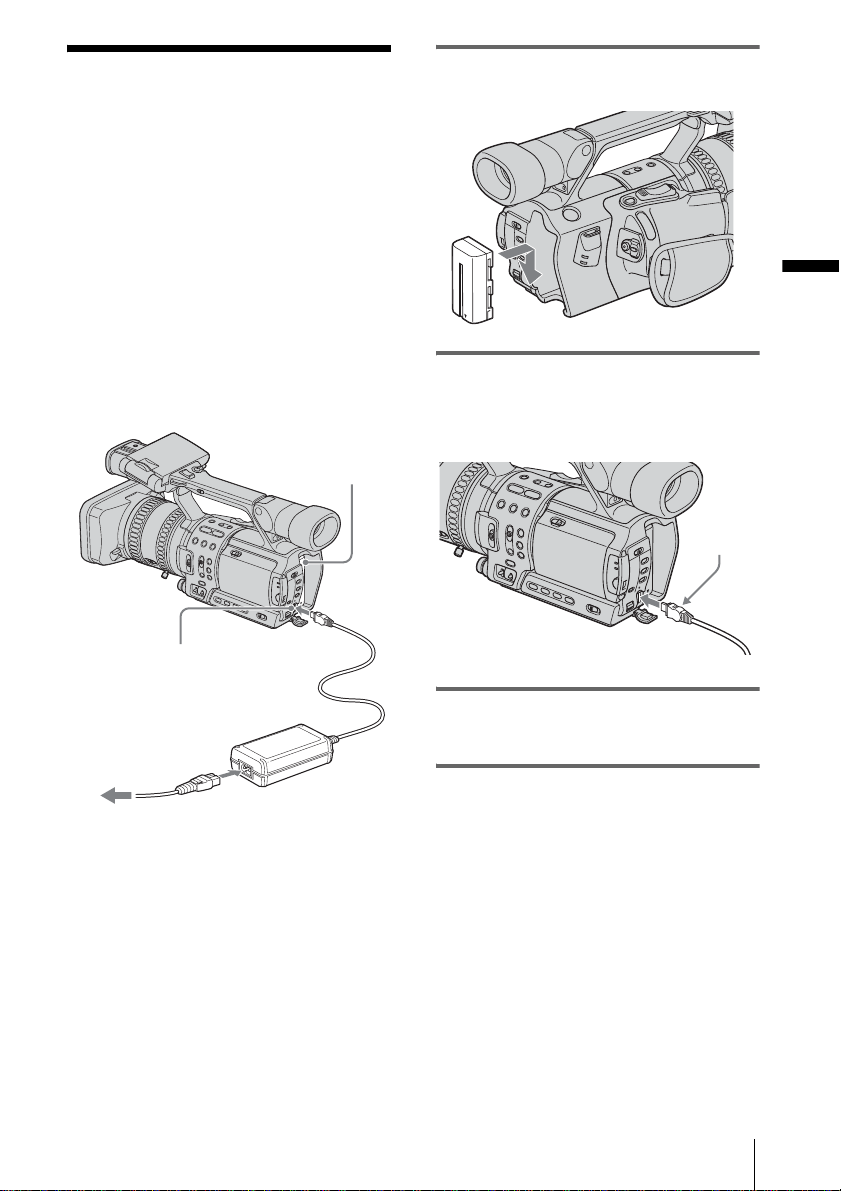
Make sure you have following items supplied
with your camcorder.
The number in parentheses indicates the number
of that item supplied.
AC Adaptor (1)
Power cord (1)
Lens hood (1)
This is attached to your camcorder.
b Note
• If you attach an optical filter (optional) or so, remove
the lens hood.
Large eyecup (1)
To attach it to your camcorder, see page 16.
Wireless Remote Commander (1)
A/V connecting cable (1)
Component video cable (1)
Shoe adaptor (1)
To attach it to your camcorder, see page 104.
Rechargeable battery pack NP-F570 (1)
Size AA (R6) batteries (2)
To insert the batteries in the Remote
Commander, see page 105.
Cleaning cassette (1)
Shoulder strap (1)
To attach it to your camcorder, see page 101.
Operating Instructions (This manual) (1)
Getting started
Getting started
11
Step 2: Charging the
battery pack
You can charge the battery by attaching the
“InfoLITHIUM” battery pack (L series) to
your camcorder.
b Note
• You cannot use batteries other than the
“InfoLITHIUM” battery pack (L series) (p. 92).
• Do not short-circuit the DC plug of the AC Adaptor
with any metallic objects. This may cause a
malfunction.
• Use a nearby wall outlet when using the AC
Adaptor. Disconnect the AC Adaptor from the wall
outlet immediately if any malfunction occurs.
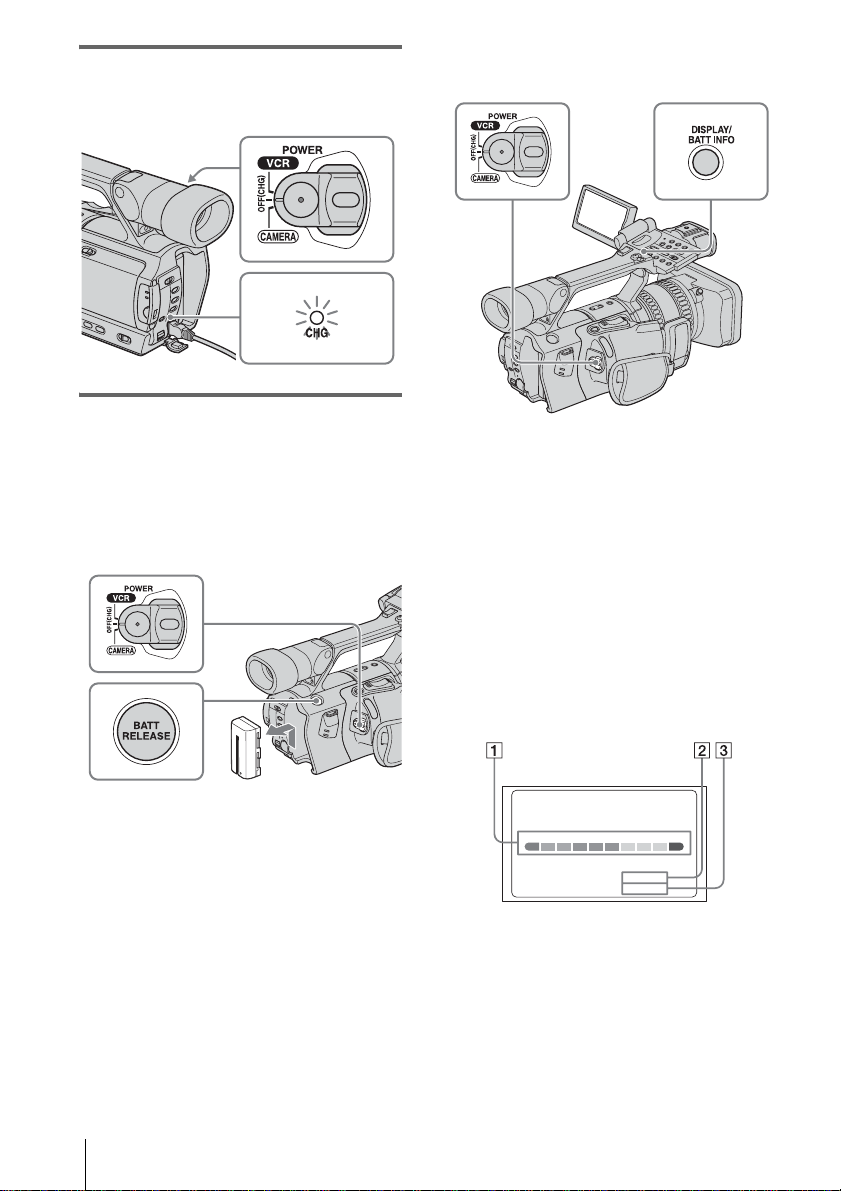
1 Press the battery pack and slide it
down.
2 With the b mark on the DC plug
facing the battery pack, connect the
AC Adaptor to the DC IN jack on your
camcorder.
3 Connect the power cord to the AC
Adaptor.
4 Connect the power cord to the wall
outlet.
To the wall outlet
DC plug
DC IN jack
Power cord
AC Adaptor
Battery pack
b mark
,continued
Getting started
12
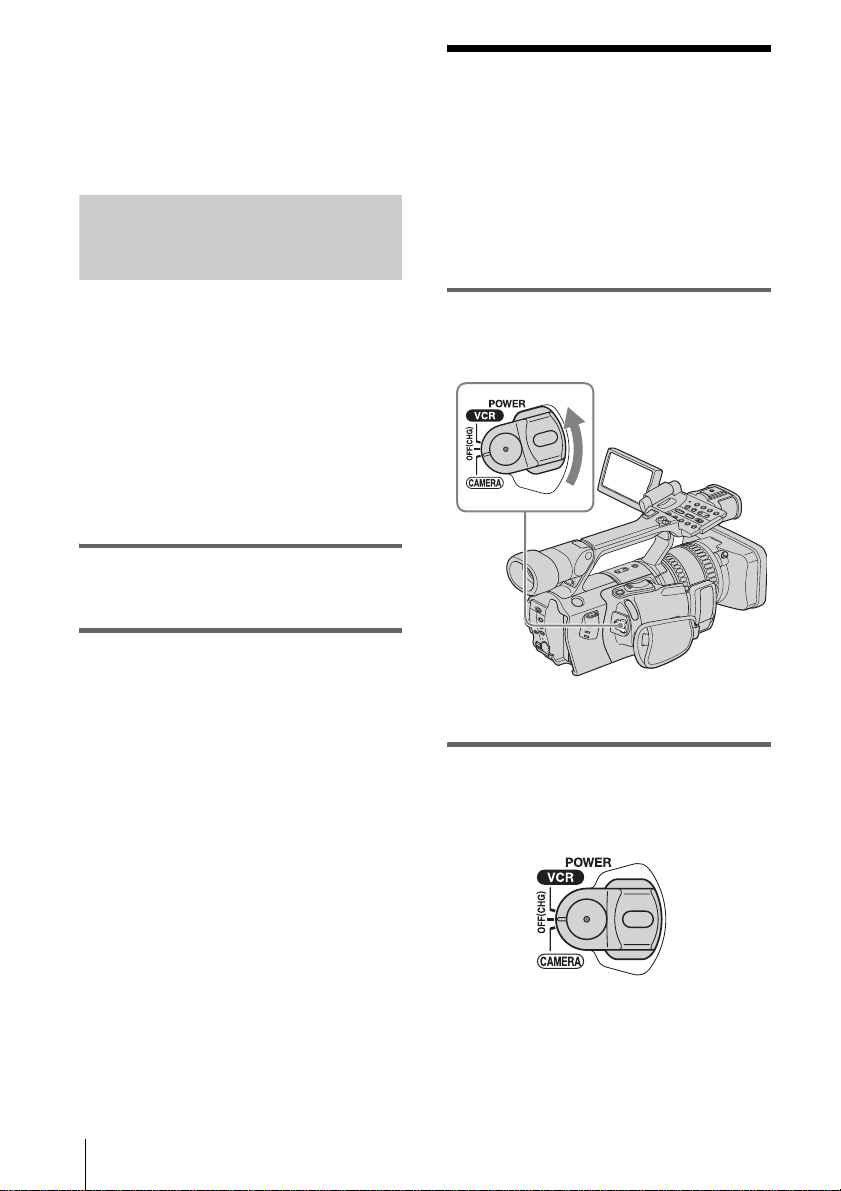
5 Set the POWER switch to OFF (CHG).
The CHG (charge) lamp lights up and
charging starts.
After charging the battery
The CHG (charge) lamp turns off when the
battery is fully charged. Disconnect the AC
Adaptor from the DC IN jack.
To remove the battery pack
1
Set the POWER switch to OFF (CHG).
2 Press BATT RELEASE and slide the
battery pack up.
To check the remaining battery – Battery
Info
You can check the battery’s current charge level
and its current remaining recording time both
during charging or when the power is turned off.
The remaining recording time in the selected
recording format appears.
1 Set the POWER switch to OFF (CHG).
2 Open the LCD panel and adjust the
angle.
3 Press DISPLAY/BATT INFO.
The battery information appears for about
7 seconds.
Keep the button pressed to view it for about
20 seconds.
A Battery charge level: Displays
approximate remaining amount of
power left in the battery pack.
B Possible recording time using the LCD
panel.
C Possible recording time using the
viewfinder.
BATTERY INFO
50%0% 100%
BATTERY CHARGE LEVEL
REC TIME AVAILABLE
LCD SCREEN:
VIEWFINDER:
110
min
125 min

Getting started
Getting started
13
Charging time
Approximate number of minutes required when
you fully charge a fully discharged battery pack
at 25°C (77°F). (10 – 30°C (50 – 86°F)
recommended.)
b Note
• NP-F330/F530/500/510/710 battery packs cannot be
used with your camcorder.
Recording time
Approximate number of minutes available
when you use a fully charged battery pack at
25°C (77°F).
Recording in the HDV format
Recording in the DV format
• The top figures show an approximate number of
minutes when the LCD BACKLIGHT switch is set
to ON.
• The middle figures show an approximate number of
minutes when the LCD BACKLIGHT switch is set
to OFF.
• The bottom figures show an approximate number of
minutes when recording with the viewfinder.
• “Typical recording time” means an approximate
number of minutes when recording while you
repeatedly record, start/stop, move the POWER
switch to change the power mode, and zoom. The
actual battery life may be shorter.
z Tip
• You can also use NP-F550/F730/F750/F960 battery
packs. After charging these battery packs, make a
trial recording with them before an actual recording
to see the recording time. The recording time varies
depending on the environment where the camcorder
is used. Press DISPLAY/BATT INFO to display the
recording time on the screen.
Playing time
Approximate number of minutes available
when you use a fully charged battery pack at
25°C (77°F).
HDV format pictures
DV format pictures
* With the LCD BACKLIGHT switch set to ON.
b Note
• The power will not be supplied from the battery pack
when the AC Adaptor is connected to the DC IN jack
of your camcorder, even if its power cord is
disconnected from the wall outlet.
• The recording and playback time will be shorter
when you use your camcorder in low temperature.
Battery pack
NP-F570 (supplied) 260
NP-F770 370
NP-F970 485
Battery pack Continuous
recording
time
Typical
recording
time
NP-F570
(supplied)
110
125
125
60
65
65
NP-F770 235
260
255
130
130
130
NP-F970 360
390
385
200
205
205
Battery pack Continuous
recording
time
Typical
recording
time
NP-F570
(supplied)
120
130
130
65
65
65
NP-F770 255
275
275
140
140
140
NP-F970 380
410
410
210
215
215
Battery pack LCD panel
opened*
LCD panel
closed
NP-F570
(supplied)
175 195
NP-F770 360 400
NP-F970 545 605
Battery pack LCD panel
opened*
LCD panel
closed
NP-F570
(supplied)
200 235
NP-F770 415 480
NP-F970 630 725
,continued
Getting started
14
• The CHG (charge) lamp flashes during charging, or
the battery information will not be correctly
displayed in following conditions.
– The battery pack is not attached correctly.
– The battery pack is damaged.
– The battery pack is fully discharged. (For Battery
information only.)
Using an outside power source
You can use the AC Adaptor as the power
source when you do not want the battery to
run out. While you are using the AC Adaptor,
the battery pack will not lose its charge even
when it is attached to your camcorder.
PRECAUTION
Even if your camcorder is turned off, AC power
(house current) is still supplied to it while
connected to the wall outlet via the AC Adaptor.
Connect your camcorder as shown in
“Step 2: Charging the battery pack”
(p. 11).
Step 3: Turning the
power on
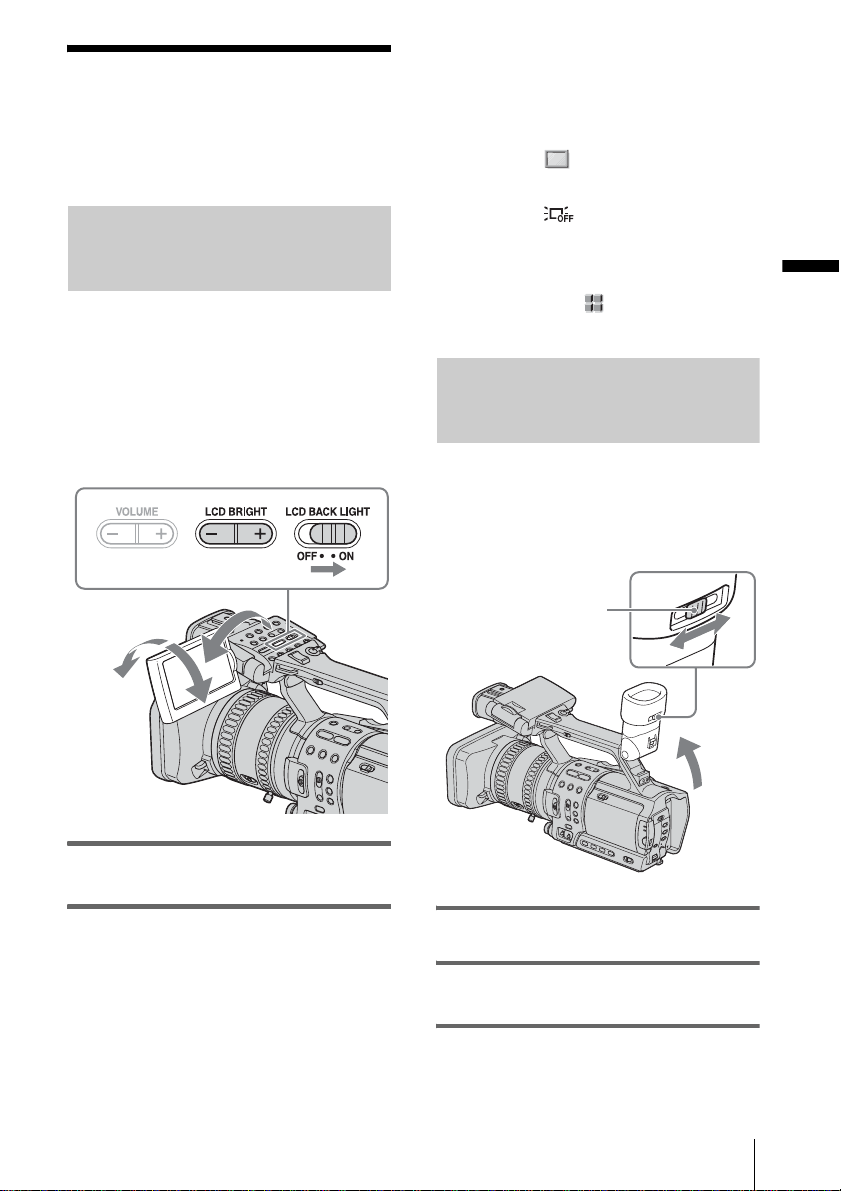
You need to set the POWER switch to the
respective power mode to record or play back
pictures.
When using this camcorder for the first time,
the [CLOCK SET] screen appears (p. 16).
While pressing the green button, set the
POWER switch.
The power turns on.
• CAMERA: To record pictures.
• VCR: To play or edit pictures.
To turn off the power
Set the POWER switch to OFF (CHG).
Getting started
Getting started
15
Step 4: Adjusting the
LCD panel and
viewfinder
Adjusting the LCD panel
You can adjust the angle and brightness of
the LCD panel to meet various recording
situations.
Even when there are obstructions between
you and the subject, you can check the
subject on the LCD screen during recording
by adjusting the angle of the LCD panel.
Open the LCD panel 180 degrees, then
rotate it to the desired position.
To adjust the brightness of the LCD
screen
Adjust the brightness by pressing LCD
BRIGHT – or +.
z Tip
• If you rotate the LCD panel until it faces down, you
can close and restore the LCD panel to the original
position with the LCD screen facing out.
• If you are using the battery pack for power source,
you can select the brightness by setting [LCD BL
LEVEL] on the [LCD/VF SET] menu
(p. 58).
• When you use your camcorder in bright conditions
using the battery pack, set the LCD BACKLIGHT
switch to OFF ( appears). This position saves
battery power.
• Even if you change the brightness of the LCD panel,
the brightness of recorded pictures is not affected.
• You can turn off the operation confirmation beep by
setting [BEEP] on the (OTHERS) menu to
[OFF]
(p. 62).
Adjusting the viewfinder
You can view images using the viewfinder
when you close the LCD panel. Use the
viewfinder when the battery is running out, or
when the screen is hard to see.
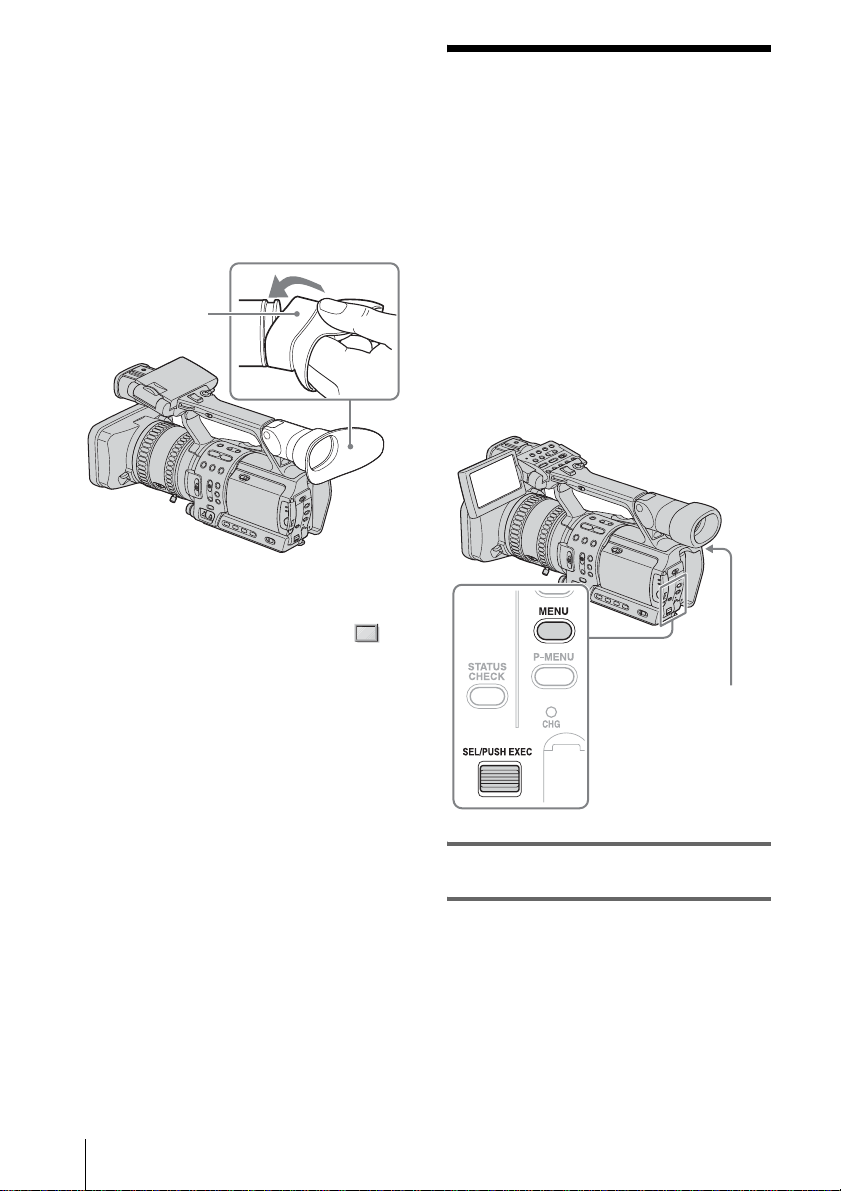
1 Lift up the viewfinder.
2 Adjust the viewfinder lens adjustment
lever until the picture is clear.
180 degrees
Up to about
100 degrees
Viewfinder lens
adjustment lever
Getting started
16
When the picture in the viewfinder is
hard to see
If you cannot see the picture in the viewfinder
clearly under bright circumstances, use the
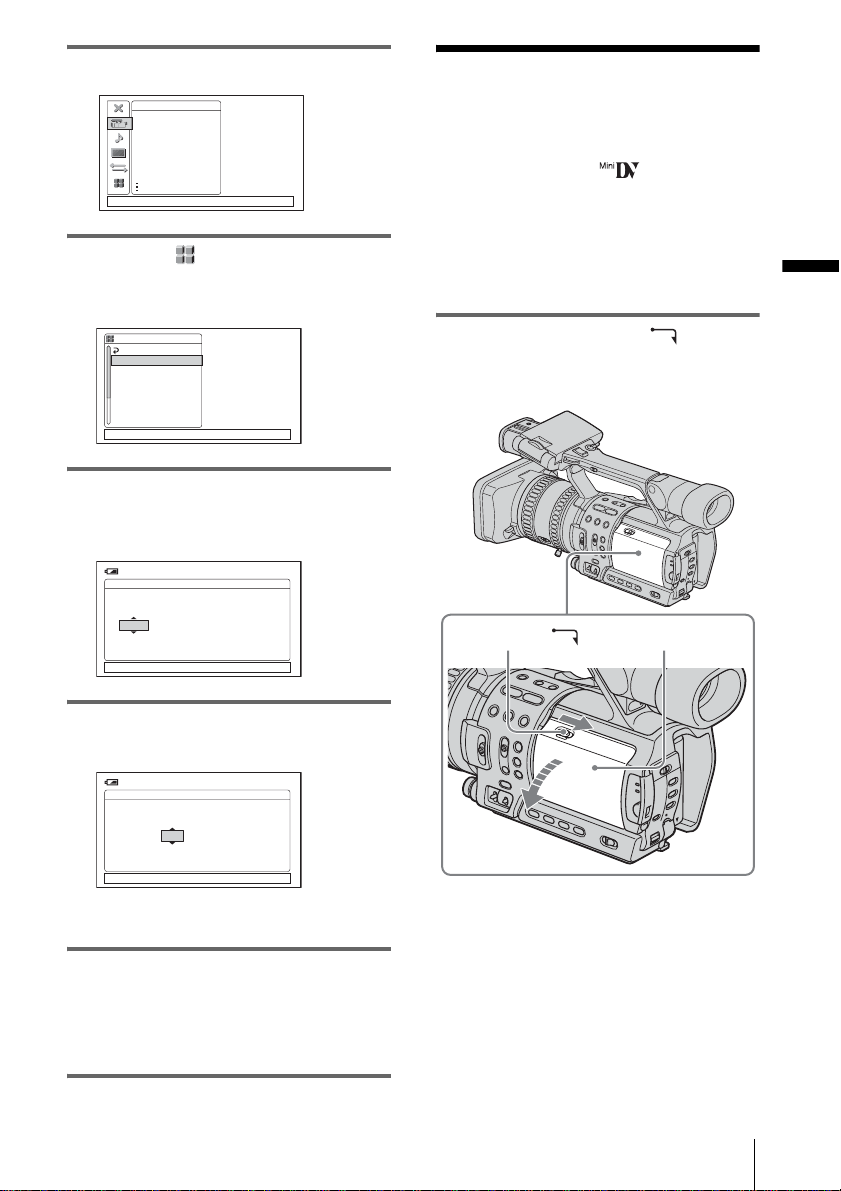
supplied large eyecup.
To attach the large eyecup, stretch it a little and
align it with the groove of the viewfinder, then
slide it up to the end. You can attach the large
eyecup facing either the right or left side.
z Tip
• To select the brightness of the viewfinder backlight
when you are using the battery pack, select
(LCD/VF SET) menu, then [VF B.LIGHT] (p. 58).
Step 5: Setting the
date and time
Set the date and time when using this
camcorder for the first time. If you do not set
the date and time, the [CLOCK SET] screen
appears every time you turn on your
camcorder.
b Note
• If you do not use your camcorder for about 3
months, the built-in rechargeable button-type
battery gets discharged and the date and time
settings may be cleared from the memory. In that
case, charge the rechargeable button-type battery
(p. 97) and then set the date and time again.
1 Turn on your camcorder (p. 14).
2 Open the LCD panel and adjust the
angle.
Proceed to step 6 when you set the clock for
the first time.
Large eyecup
(supplied)
POWER switch
Getting started
Getting started
17
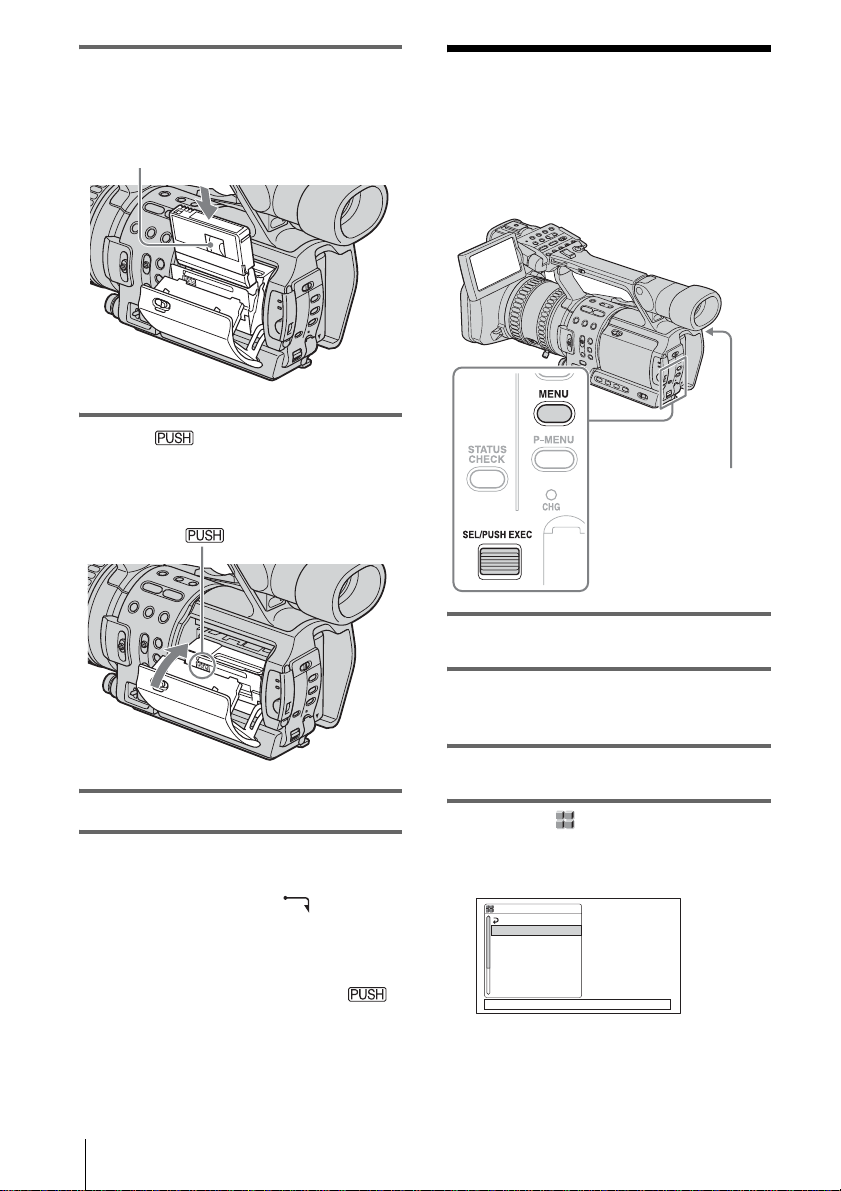
3 Press MENU.
4 Select the (OTHERS) menu by
turning the SEL/PUSH EXEC dial,
then press the dial.
5 Select [CLOCK SET] by turning the
SEL/PUSH EXEC dial, then press the
dial.
6 Set [Y] (year) by turning the SEL/
PUSH EXEC dial, then press the dial.
You can set any year up to the year 2079.
7 Set [M] (month), [D] (day), hour and
minute in the same way as was done in
step 6, then press the dial.
For midnight, set it to 12:00AM.
For midday, set it to 12:00PM.
Step 6: Inserting a
cassette tape
You can use mini DV cassettes only.
For details on these cassettes (such as write-
protection), see page 91.
b Note
• Do not force the cassette into the compartment. This
may cause a malfunction of your camcorder.
1 Slide the OPEN/EJECT lever in
the direction of the arrow and open the
lid.
The cassette compartment automatically
comes out and opens up.
CAMERA SET
WB PRESET
AE RESPONSE
GAIN SETUP
SHOT TRANS
STEADYSHOT
STDYSHOT TYP
FLCKR REDUCE
[
MENU
]
:END
OTHERS
RETURN
ASSIGN BTN
CLOCK SET
WORLD TIME
LANGUAGE
BEEP
REC LAMP
FORMAT LAMP
[
MENU
]
:END
120min
CLOCK SET
[
MENU
]
:CANCEL
AMDMY 12100:JAN2004
120min
CLOCK SET
[
MENU
]
:CANCEL
AMDMY 12100:JAN2004
Lid
OPEN/EJECT lever
,continued
Getting started
18
2 Insert a cassette with its window-side
facing out.
3 Press on the cassette
compartment.
The cassette compartment automatically
slides back in.
4 Close the lid.
To eject the cassette
1
Slide the OPEN/EJECT lever in the
direction of the arrow and open the lid.
The cassette compartment automatically
comes out.
2 Take out the cassette, then press .
The cassette compartment automatically
slides back in.
3 Close the lid.
Step 7: Setting the
screen language
You can select the language to be used on the
LCD screen.
1 Turn on your camcorder.
2 Open the LCD panel and adjust the
angle.
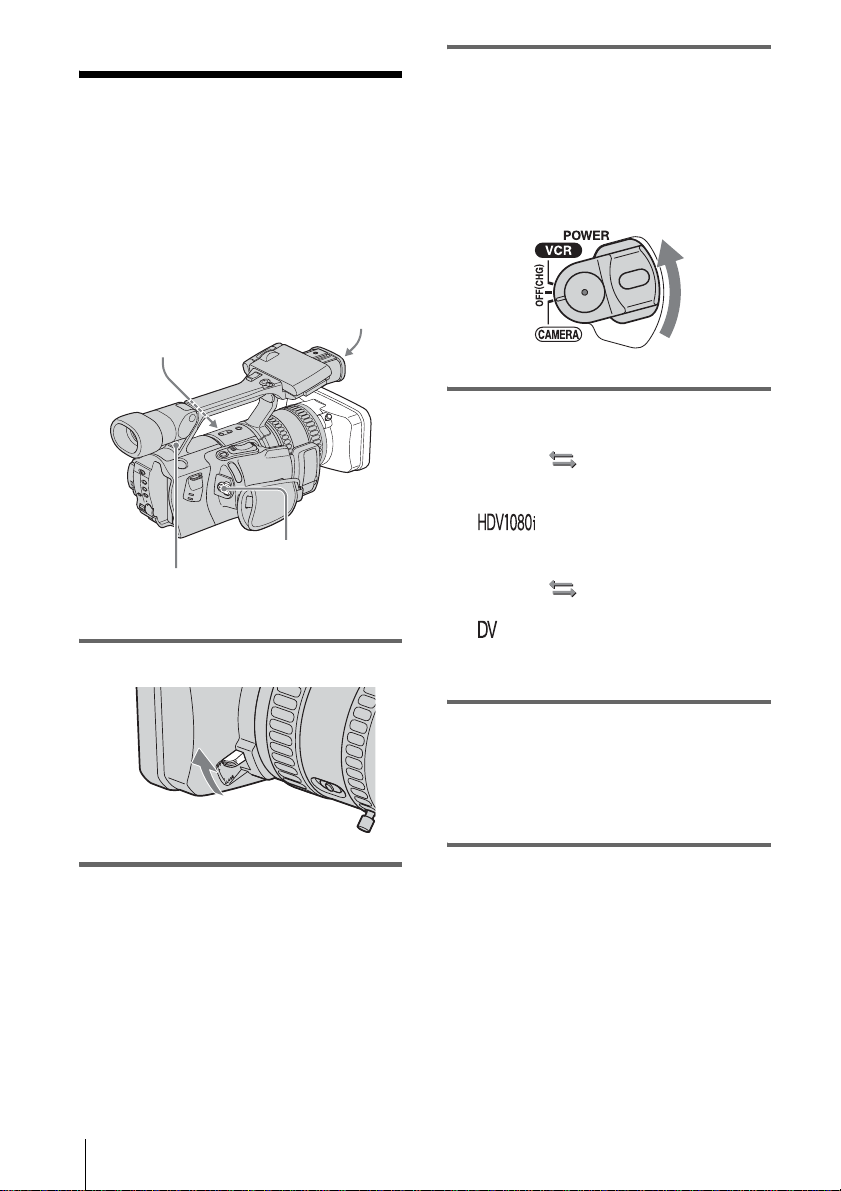
3 Press MENU.
4 Select the (OTHERS) menu by
turning the SEL/PUSH EXEC dial,
then press the dial.
Window-side
Push the center of the back
of the cassette lightly.
POWER switch
OTHERS STBY
RETURN
ASSIGN BTN
CLOCK SET
WORLD TIME
LANGUAGE
BEEP
REC LAMP
FORMAT LAMP
[
MENU
]
:END

Getting started
Getting started
19
5 Select [LANGUAGE] by turning the
SEL/PUSH EXEC dial, then press the
dial.
6 Select the desired language by turning
the SEL/PUSH EXEC dial, then press
the dial.
7 Press MENU to hide the menu screen.
z Tip
• Your camcorder offers [ENG [SIMP]] (simplified
English) for when you cannot find your native
tongue among the options.
0:00:00
[
MENU
]
:END
LANGUAGE
ENGLISH
ENG
[
SIMP
]
FRAN
Ç
AIS
ESPA
Ñ
OL
PORTUGUÊS
Recording
20
Recording
Recording movies
You can record movies in either the HDV or
the DV format.
Before recording, follow steps 1 to 7 in
“Getting started” (p. 10 - p. 18).
Movies will be recorded along with stereo
sound.
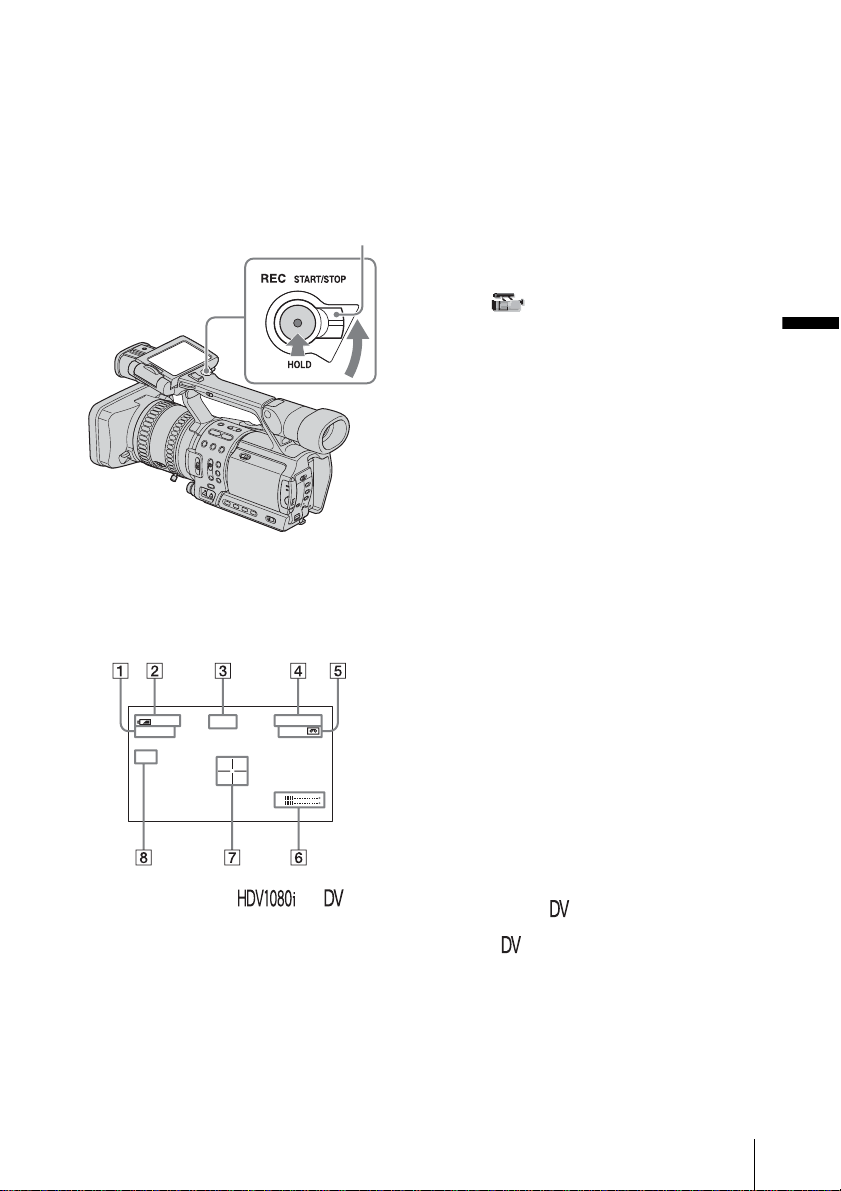
1 Open the shutter of the lens hood.
2 Open the LCD panel and adjust the
angle.
3 While pressing the green button, set
the POWER switch to CAMERA.
The HDV format lamp lights up and your
camcorder is set to recording standby (the
default setting).
It takes some time for your camcorder to be
set to recording standby.
4 Select the recording format.
To record in the HDV format
Select the (IN/OUT REC) menu,
[REC FORMAT], then [HDV1080i] (the
default setting)(p. 60).
appears on the LCD screen and
your camcorder is set to recording standby.
To record in the DV format
Select the (IN/OUT REC) menu,
[REC FORMAT], then [DV] (p. 60).
appears on the LCD screen, the DV
format lamp lights up, and your camcorder
is set to recording standby.
5 Press REC START/STOP.
Recording starts. [REC] appears on the
LCD screen and the Camera recording
lamps light up.
Press REC START/STOP again to stop
recording.
To turn the power off
Set the POWER switch to OFF (CHG).
Format lamps
POWER switch and
REC START/STOP
Camera recording lamp
Camera recording
lamp
Recording
Recording
21
To record from a low-angle
Use the REC START/STOP button on the
handle after releasing the HOLD lever.
To view the picture during recording, face the
LCD panel or the viewfinder upward, or face
the LCD screen down, then close and restore the
LCD panel to the original position with the LCD
screen facing out.
Indicators displayed during recording
The indicators will not be recorded on the tape.
Date/time and the camera settings data (p. 44)
will not be displayed during recording.
A Recording format ( or )
Recording mode (SP or LP) is also
displayed in the DV format.
B Remaining battery
The indicated time may not be correct,
depending on the environment where you
are using your camcorder. When you open
or close the LCD panel, it takes about
1 minute to display the correct remaining
battery time.
C Recording status ([STBY] (standby) or
[REC] (recording))
D Time code or tape counter (hour:
minute: second)
The time code of this camcorder utilizes the
drop-frame system.
E Recording capacity of the tape (p. 64)
F Microphone volume level (p. 36)
G Center marker (p. 55)
The center marker appears at the center of
the screen when [CENTER MARKR] on
the (CAMERA SET) menu is set to
[ON]. It helps composing pictures on the
screen.
H ND filter
If [ND1] or [ND2] flashes on the screen,
activate the ND filter (p. 30).
b Note
• Before changing the battery pack, set the POWER
switch to OFF (CHG).
• When the camcorder is left in recording standby for
more than about 5 minutes, your camcorder exits the
recording standby mode (the drum stops rotating) to
prevent tape wear and battery loss. Since the power
does not turn off, you can restart recording by
pressing REC START/STOP again. It takes some
time to restart recording, but this not a malfunction.
z Tip
• You can record the color bars on a tape. If you record
movies including the color bars, you can adjust the
color while observing the color bars when you are
viewing the pictures on a TV or monitor. To display
the color bars, press BARS. Press BARS again to
hide the color bars.
• To ensure smooth transition on a tape from the last
recorded scene to the next, note the following.
– Do not remove the cassette. (The picture will be
recorded continuously without a break even when
you turn the power off).
– Do not record pictures in the HDV format and the
DV format on the same tape.
– Do not record pictures in SP mode and LP mode on
the same tape.
– Avoid stopping then recording a movie in the LP
mode.
• The recording time, date, and the camera settings
data are recorded automatically on the tape without
being displayed on the screen. You can view this
information during playback by pressing DATA
CODE (p. 44).
HOLD lever
60
min
60
min
0:00:00
REC
L
ND
1
R
HDV1080
i
,continued
Recording
22
• Following functions may not work correctly with the
tape recorded in the HDV format and the DV format
mixed:
– Zero set memory
– Date search
– Index search
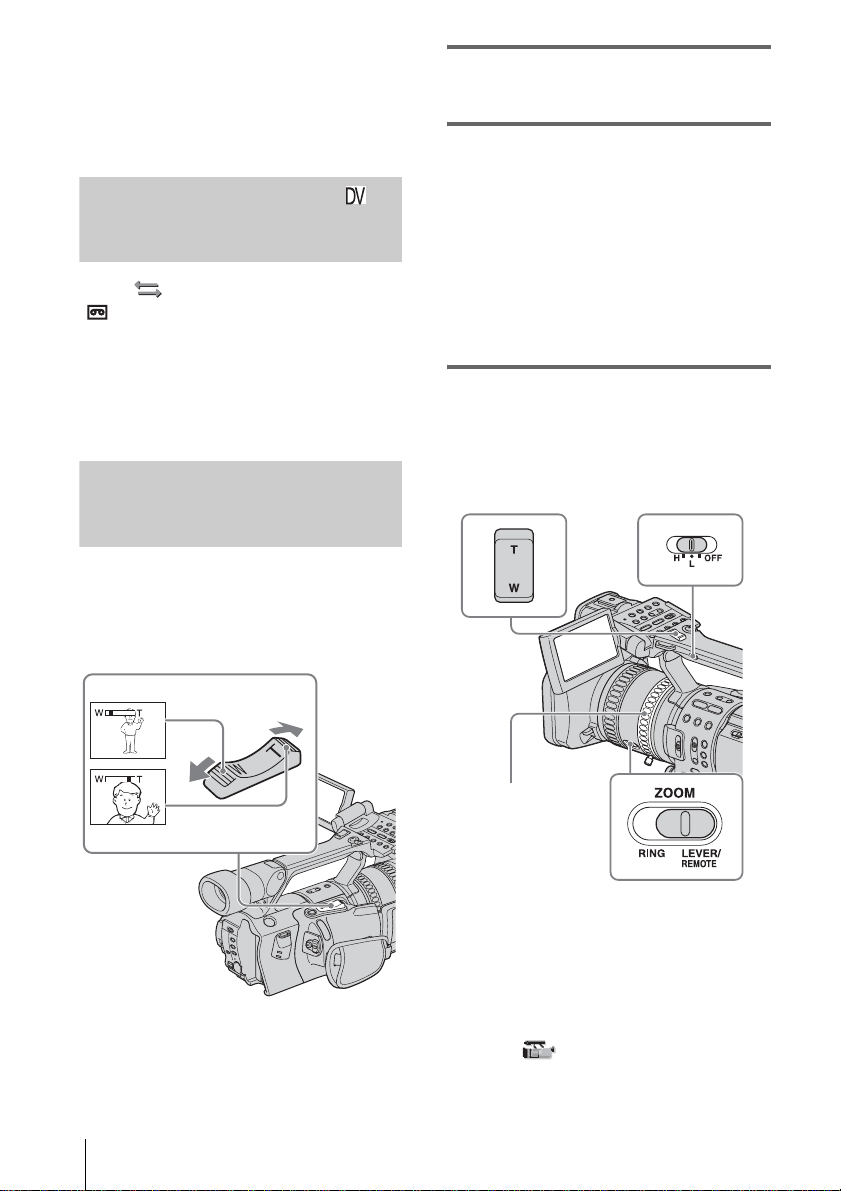
Recording for a longer time
On the (IN/OUT REC) menu, select
[ REC MODE], then [LP] (p. 60).
In the LP mode, you can record 1.5 times
longer than you can when recording in the SP
mode.
A tape recorded in the LP mode should be
played back only on this camcorder.
Using zoom
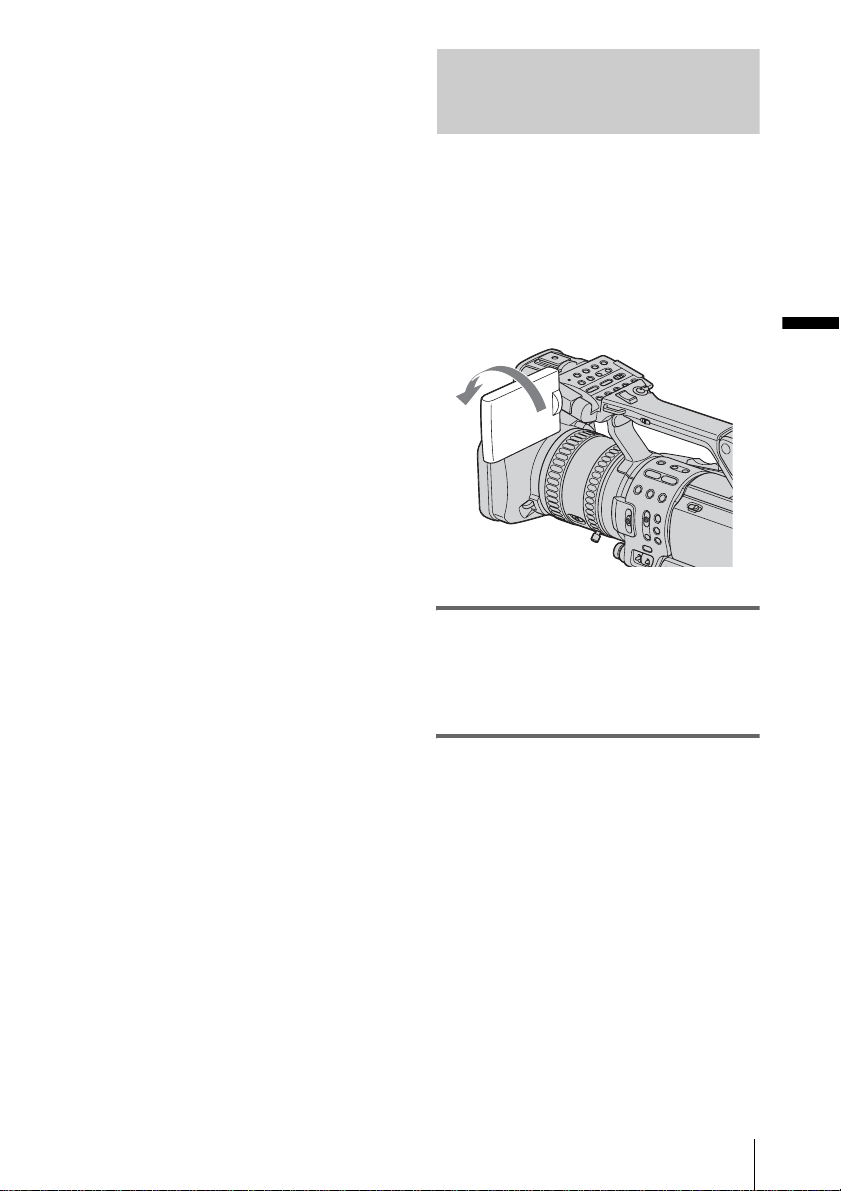
Zoom levers are mounted on the camera itself
and on the handle.
Occasional use of the zoom is effective, but
use it sparingly for the best results.
1 Set the ZOOM switch to LEVER/
REMOTE.
2 Press the power zoom lever slightly for
a slower zoom. Press it further for a
faster zoom.
To record a wider range of view
Press the W side of the power zoom lever.
The subject appears farther away (Wide
angle).
To record a closer view
Press the T side of the power zoom lever.
The subject appears closer (Telephoto).
Using the handle zoom
You can adjust the zoom speed with the handle
zoom switch when using the handle zoom lever.
1 Set the ZOOM switch to LEVER/
REMOTE.
2 Set the handle zoom switch to H (high) or
L (low).
You can set the zoom speed of H or L of the
handle zoom lever in [HANDLE ZOOM]
on the (CAMERA SET) menu. In the
default setting, [H] is set to 6, and [L] is set
to 3 (p. 54).
1 cm (approx. 1/2 inch)*
80 cm (approx. 2 5/8 feet)*
* The minimum distance required between your
camcorder and the subject to get a sharp focus with
that side of the lever.
Zoom ring
Handle zoom switch
Handle zoom lever
Recording
Recording
23
3 Press the handle zoom lever to zoom in or
out.
b Note
• You cannot adjust the zoom speed by pressing the
handle zoom lever. Change the zoom speed by
setting [HANDLE ZOOM] (p. 54).
• You cannot use the handle zoom lever when the
handle zoom switch is set to OFF.
• You cannot change the zoom speed of the power
zoom lever on the camera itself by switching the
handle zoom switch.
Using the zoom ring
You can zoom at the desired speed. Fine
adjustment is also possible.
1 Set the ZOOM switch to RING.
2 Rotate the zoom ring to zoom.
b Note
• Rotate the zoom ring at an appropriate speed.
Zooming may not be able to catch up the rotating
speed of the ring if it is rotated too fast.
• When you zoom using the Remote Commander, set
the ZOOM switch to LEVER/REMOTE.
• Zoomed position and picture angle change when the
ZOOM switch is switched from LEVER/REMOTE
to RING.
• If you rotate the zoom ring fast, motor noise will
become louder as the zoom motor rotates at high
speeds. If the motor noise is so loud that can be
recorded, use the zoom lever or the Remote
Commander.
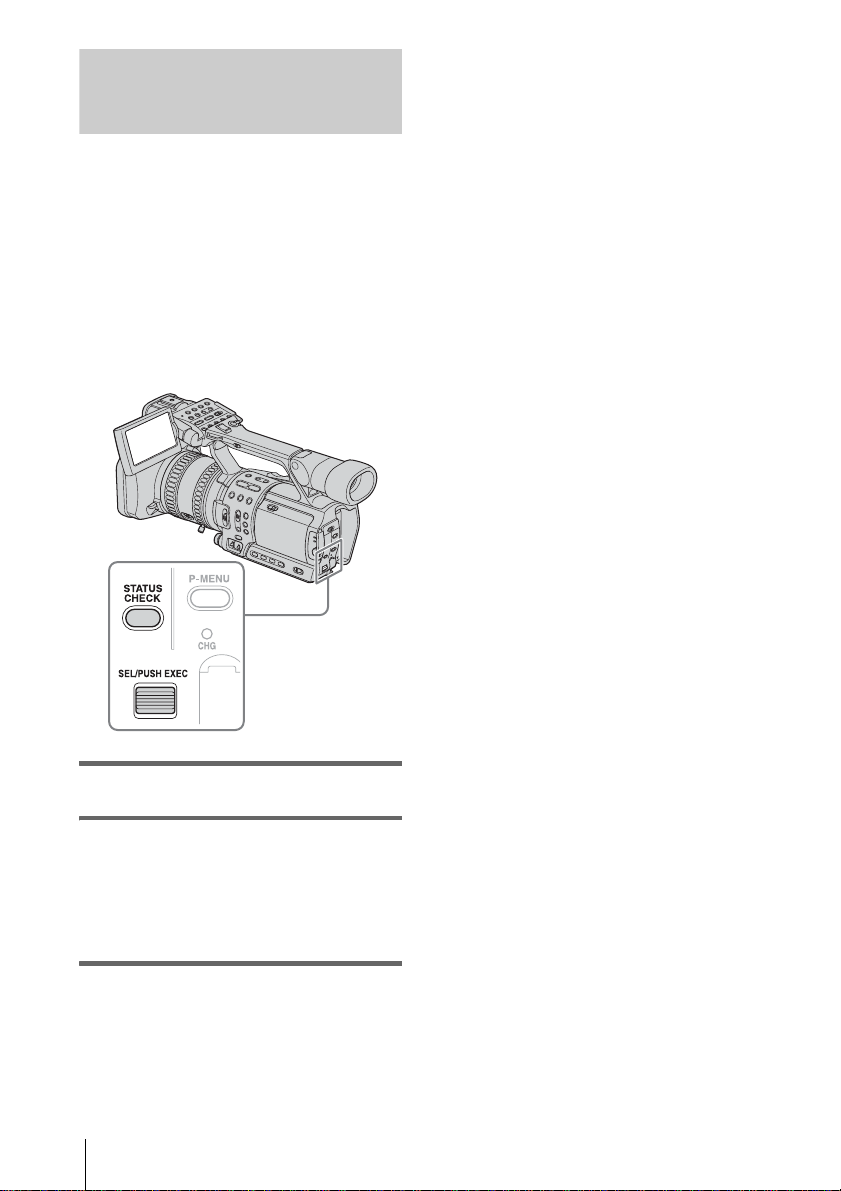
Recording in mirror mode
You can turn the LCD panel towards the
subject so that you and your subject can share
the image being recorded. You can also
utilize this function when recording yourself,
or to keep the attention of small children
attracted to the camcorder while you record
them.
Open the LCD panel 180 degrees, then
rotate it towards the subject until it clicks.
A mirror-image of the subject appears on the
LCD screen, but the picture will be normal
when recorded.
Up to about 100 degrees
Recording
24
Displaying the recording setup
information – Status check
You can check the setup value of the
following items in the standby mode or
during recording.
• Audio setup such as microphone volume level
(p. 36)
• Output setup ([COMPONENT], [i.LINK
CONV], and [TV TYPE] settings) (p. 60)
• Functions assigned to the ASSIGN buttons
(p. 68)
• Picture profile setup (p. 34)
1 Press STATUS CHECK.
2 Turn the SEL/PUSH EXEC dial to
display the desired item.
Each time you turn the dial, the items
appear in the following order:
AUDIO t OUTPUT t ASSIGN t
PICT. PROFILE
To turn off the display of the recording
setup information
Press STATUS CHECK.
b Note
• Information of the picture profile setup does not
appear when it is set to [OFF].
Recording
Recording
25
Adjusting the
exposure
The exposure is adjusted automatically in the
default setting.
If you want to record brighter or darker
pictures than those of the auto exposure
adjustment, use the manual adjustment
function (p. 27), or customize the picture
quality by using the PICTURE PROFILE
function (p. 34).
Adjusting the exposure for backlit
subjects
When your subject has its back to the sun or
other light, you can adjust the exposure to
prevent the subject from becoming
shadowed.
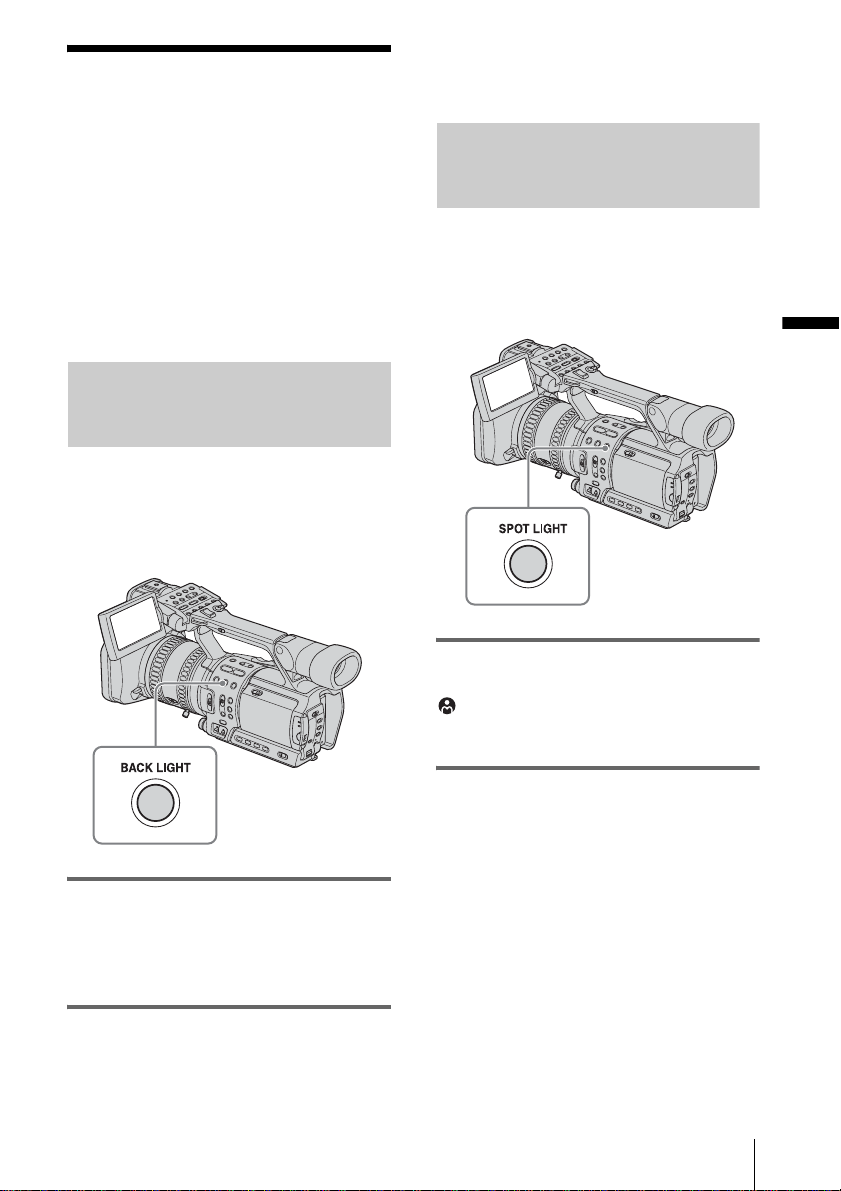
Press BACK LIGHT during recording or
in the standby mode.
. appears.
To cancel the back light function, press BACK
LIGHT again.
b Note
• The back light function is canceled when you press
SPOT LIGHT.
• You cannot use the back light function if 2 or more
items out of iris, gain, and shutter speed are adjusted
manually.
Recording the subject lit by
strong light – SPOT LIGHT
When the subject is lit by strong light, such as
in a theater, use the spot light function to
prevent people’s faces from appearing
excessively white.
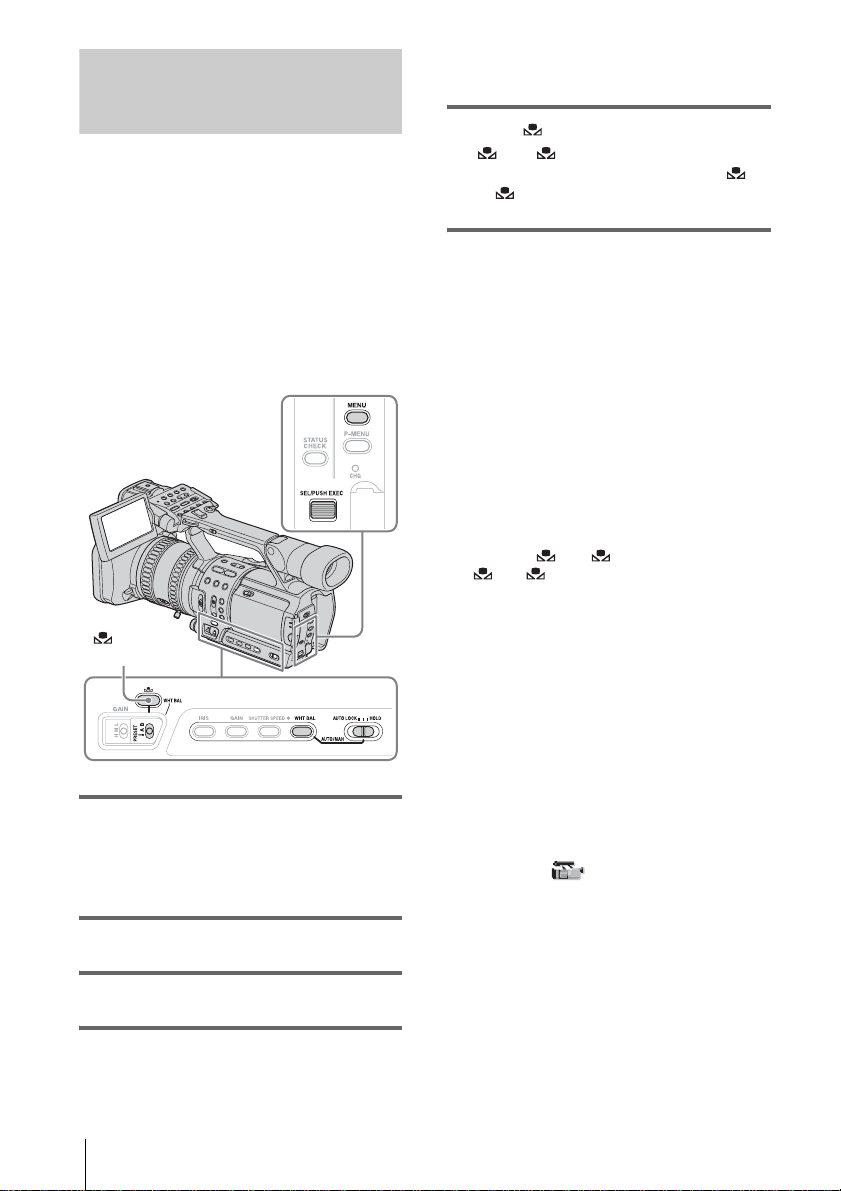
During recording or in the standby mode,
press SPOT LIGHT.
appears.
To cancel the spot light function, press SPOT
LIGHT again.
b Note
• The spot light function is canceled when you press
BACK LIGHT.
• You cannot use the spot light function if 2 or more
items out of iris, gain, and shutter speed are adjusted
manually.
Recording
26
Adjusting the white balance
You can adjust the white balance according
to the light of the recording environment.
The white balance adjustment data for 2
different recording conditions can be set up
and memorized separately in memory A and
B. During recording, you can recall the setup
data from the memory with the WHT BAL
(white balance) switch. The setup data will be
retained for about 3 months as long as it is not
readjusted even if the power is disconnected.
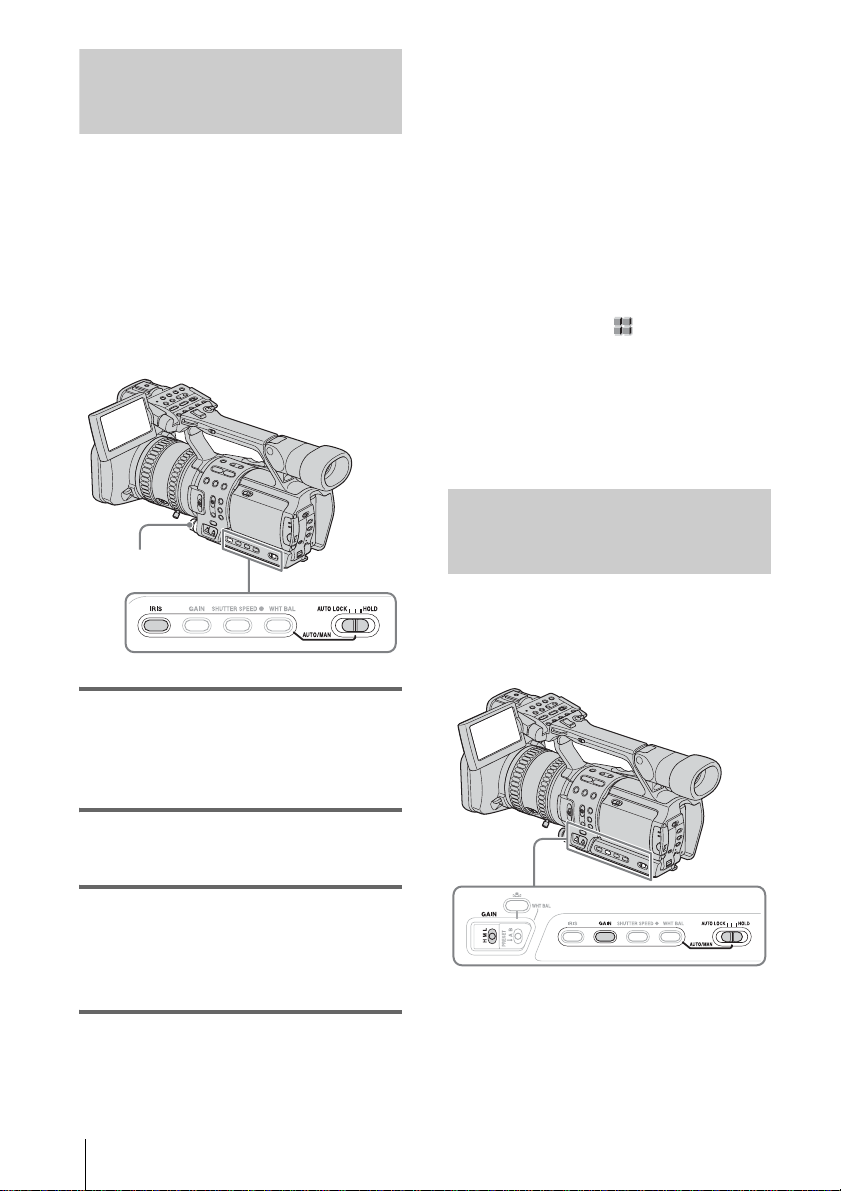
1 During recording or in the standby
mode, set the AUTO LOCK switch to
the center position to release the auto
lock mode.
2 Press WHT BAL.
3 Set the WHT BAL switch to A or B.
4 Shoot a white subject such as a piece of
paper filling the entire screen under
the same lighting condition as that of
the subject.
5 Press (one-push) WHT BAL.
A or B flashes quickly.
When the white balance is adjusted, A
or B lights up and the adjustment data is
memorized.
To recall adjustment data from the
memory
1
During recording or in the standby
mode, set the AUTO LOCK switch to the
center position to release the auto lock
mode.
2 Set the WHT BAL switch to A or B.
3 Press WHT BAL.
The white balance is set to the recalled
adjustment.
b Note
• Avoid subjecting your camcorder to mechanical
shock while A or B is flashing.
• If A or B does not change from flashing to lit
steadily, your camcorder is unable to set up the white
balance. In this case, use the preset or automatic
white balance.
To use the preset white balance
Your camcorder has 2 sets of preset white
balance values to be selected according to the
light of the recording scene.
1 During recording or in the standby
mode, set the AUTO LOCK switch to the
center position to release the auto lock
mode.
2 Press MENU.
3 Select the (CAMERA SET) menu
by turning the SEL/PUSH EXEC dial,
then press the dial.
4 Select [WB PRESET] by turning the
SEL/PUSH EXEC dial, then press the
dial.
5 Select the desired item by turning the
SEL/PUSH EXEC dial, then press the
dial.
(one-push)
WHT BAL

Recording
Recording
27
6 Press MENU to hide the menu screen.
7 Set the WHT BAL switch to PRESET.
8 Press WHT BAL.
The white balance is set to the selected
setting.
To restore the automatic white balance
Press WHT BAL, or set the AUTO LOCK
switch to AUTO LOCK.
b Note
• If you set the AUTO LOCK switch to AUTO
LOCK, other manually adjusted items (iris, gain,
shutter speed) also become temporarily automatic.
Recording using
manual adjustments
You can manually adjust the iris, gain, etc.
according to the brightness of the recording
scene or in order to obtain desired effects.
Adjust the iris, gain, shutter speed, and white
balance after setting the AUTO LOCK
switch to the center position to release the
auto lock mode.
Depending on the position of the AUTO
LOCK switch, you can hold or release the
settings of these functions.
See page 26 for details on how to adjust the
white balance.
b Note
• If you want to set the exposure intentionally to other
than a proper level, adjust the iris, gain, and shutter
speed manually.
• If you adjust only one of either iris, shutter speed, or
gain manually, you can record with iris priority,
shutter speed priority, or gain priority, respectively.
z Tip
• To adjust the brightness of pictures, set all of the iris,
gain, and shutter speed to the manual adjustment
mode, then rotate the iris dial.
Item Recording scene
[OUTDOOR]
()
• general night views,
neon signs, or fireworks
• sunset, sunrise
• under daylight
fluorescent lamps
[INDOOR] (n) • at party or in studios
where lighting
conditions change
quickly
• under video lamps such
as those in a studio, under
sodium lamps, mercury
lamps, or warm white
fluorescent lamps
Position Purpose
AUTO LOCK To adjust automatically.
Center (to
release the auto
lock mode)
To adjust manually.
HOLD Select this position after adjusting
the settings manually to retain
them.
Recording
28
Adjusting the iris
You can manually adjust the light volume
entering the lens.
As the iris is opened (smaller aperture
values), the light volume increases. The
range of focus narrows and only the subject
appears in sharp focus.
As the iris is closed (larger aperture values),
the light volume decreases and the range of
focus widens.
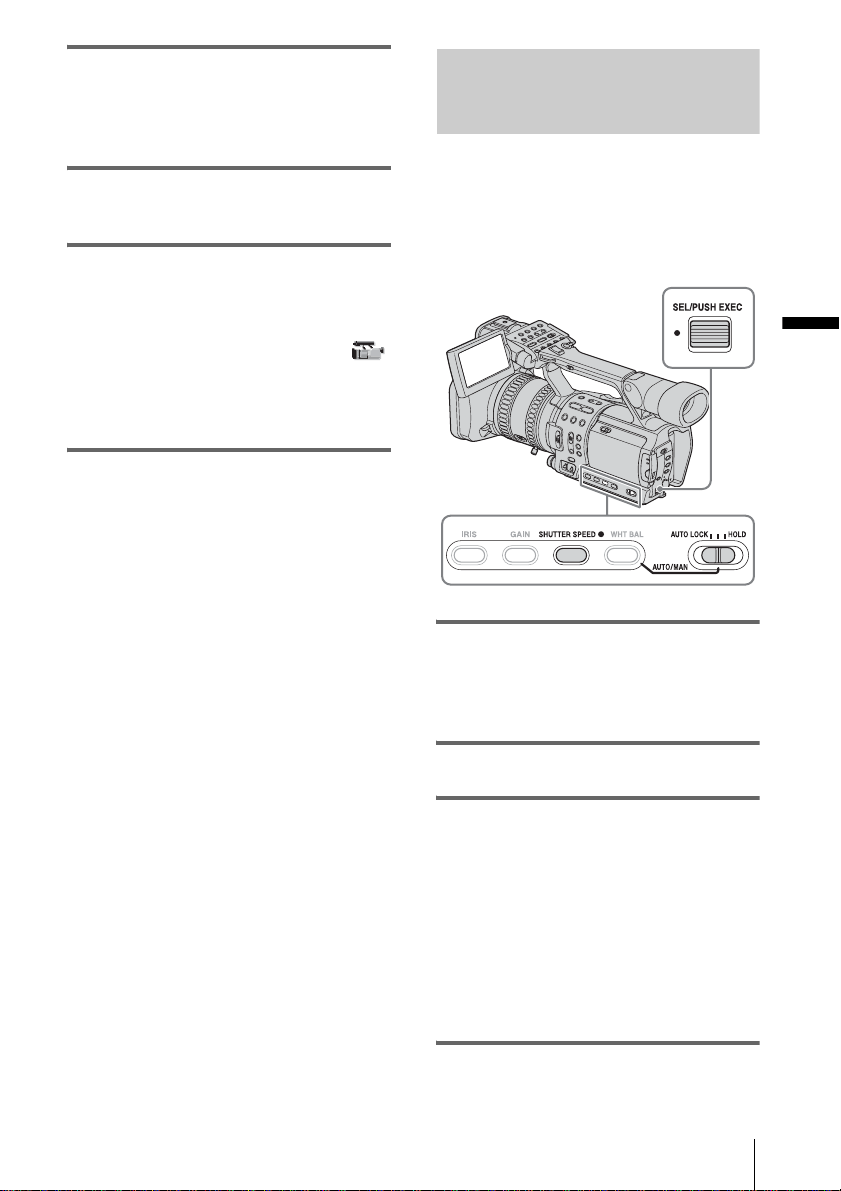
1 During recording or in the standby
mode, set the AUTO LOCK switch to
the center position to release the auto
lock mode.
2 Press IRIS.
The current aperture value (F) appears.
3 Rotate the IRIS dial to a desired
aperture value.
The aperture value (F) varies from F1.6 to
F11, and Close, and the corresponding
value appears.
To restore automatic adjustment
Press IRIS, or set the AUTO LOCK switch to
AUTO LOCK.
b Note
• If you set the AUTO LOCK switch to AUTO
LOCK, other manually adjusted items (gain, shutter
speed, white balance) also become temporarily
automatic.
• As you shift the zoom from W (wide) to T
(telephoto), the aperture value varies from F1.6 to
F2.8.
z Tip
• You can select the rotation direction of the iris dial
with [IRIS DIAL] on the (OTHERS) menu
(p. 63).
• The iris has an important effect on the “depth of
field,” that is, the focused range. An open iris makes
the depth of field shallower (shorter focused range),
and a closed iris makes the depth of field deeper
(longer focused range). Use the iris effectively
according to your purpose of recording.
Adjusting the gain
Adjust the gain manually when shooting
blackish or dark objects if you do not want
the AGC (auto gain control) to be activated.
IRIS dial
Recording
Recording
29
1 During recording or in the standby
mode, set the AUTO LOCK switch to
the center position to release the auto
lock mode.
2 Press GAIN.
The current gain value appears.
3 Set the GAIN switch to the desired
position.
3 gain levels (H, M, L) are available.
You can set the value for the respective
positions with [GAIN SETUP] on the
(CAMERA SET) menu (p. 52).
The default settings for each position are
18 dB (H), 9 dB (M) and 0 dB (L).
The larger the number, the greater the gain.
To restore automatic adjustment
Press GAIN, or set the AUTO LOCK switch to
AUTO LOCK.
b Note
• If you set the AUTO LOCK switch to AUTO
LOCK, other manually adjusted items (iris, shutter
speed, white balance) also become temporarily
automatic.
Adjusting the shutter speed
You can manually adjust and fix the shutter
speed for your convenience. Depending on
the shutter speed, you can make the subject
look still, or on the contrary, emphasize the
fluidity of movement.
1 During recording or in the standby
mode, set the AUTO LOCK switch to
the center position to release the auto
lock mode.
2 Press SHUTTER SPEED.
3 Adjust the shutter speed by turning
the SEL/PUSH EXEC dial.
You can select a shutter speed between 1/4
second and 1/10000 second.
The selected shutter speed appears on the
screen. For example, if you select 1/100
second, [100] appears. The larger the
number that appears on the screen, the
faster the shutter speed. The smaller the
number that appears on the screen, the
slower the shutter speed.
,continued
Recording
30
To restore automatic adjustment
Press SHUTTER SPEED, or set the AUTO
LOCK switch to AUTO LOCK.
b Note
• If you set the AUTO LOCK switch to AUTO
LOCK, other manually adjusted items (iris, gain,
white balance) also become temporarily automatic.
z Tip
• It is difficult to focus automatically at a lower shutter
speed. Manual focusing with your camcorder
attached to a tripod is recommended.
• The picture may flicker or change colors under
fluorescent lamps, sodium lamps, or mercury lamps.
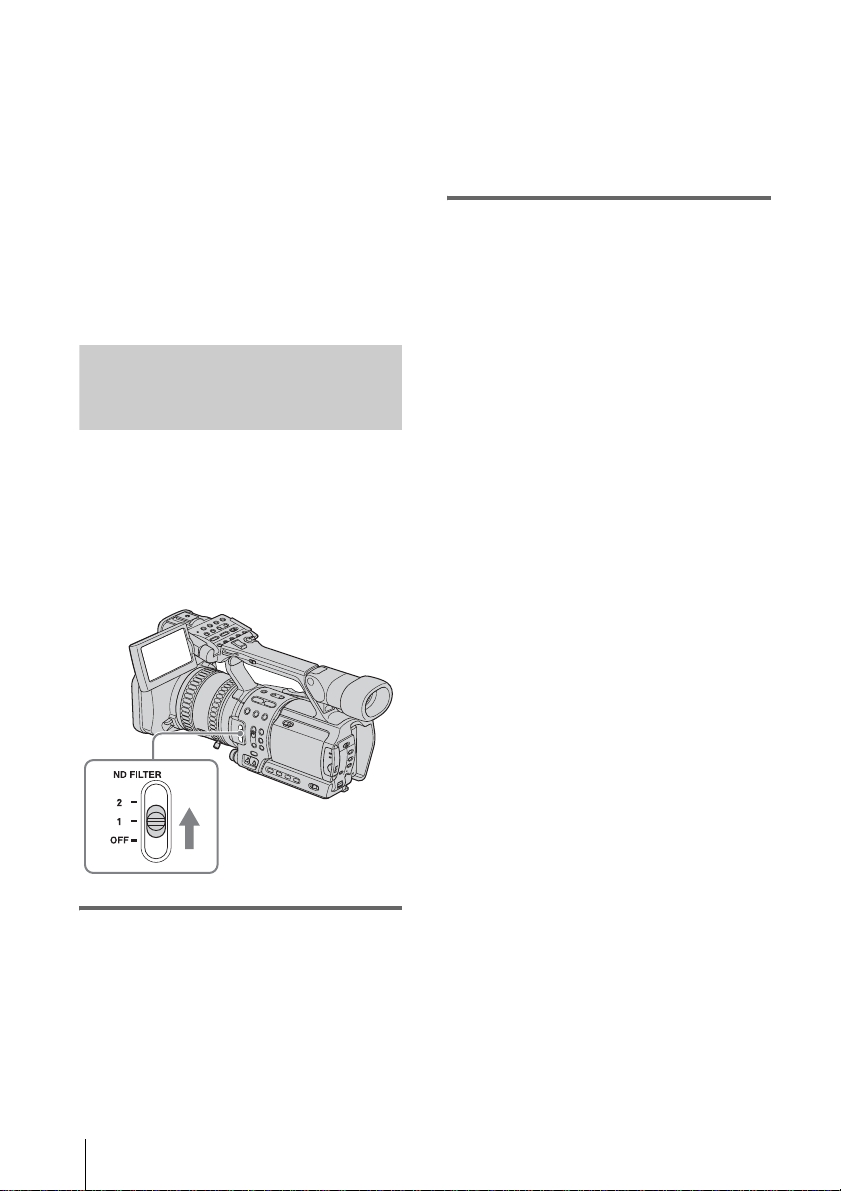
Adjusting the volume of light
– ND FILTER
You can record the subject clearly by using
the ND filter when the recording
environment is too bright.
There are 2 levels of ND filter setting. ND
filter 1 reduces the volume of light to about
1/6, and ND filter 2 to about 1/32.
If [ND1] or [ND2] flashes in the standby
mode, set the ND FILTER switch to the
respective position.
If [ND1] flashes
Set the ND FILTER switch to 1 to turn on
[ND1].
If [ND2] flashes
Set the ND FILTER switch to 2 to turn on
[ND2].
If [ND OFF] flashes
Set the ND FILTER switch to OFF to turn off
the indicator.
b Note
• If you move the ND FILTER switch during
recording, the picture and sound may be distorted.
• If you adjust the iris manually, no ND filter indicator
will appear even if the ND filter should be activated.
z Tip
• If you close the iris extensively when recording a
bright subject, diffraction may occur, resulting in a
fuzzy focus. (This is a common phenomenon with
video cameras.) The ND filter suppresses this
phenomenon and gives better recording results.
Recording
Recording
31
Displaying the zebra pattern to
adjust the brightness
If there is a part of the screen where
brightness is over a certain level, the part may
appear excessively white when played back.
By displaying the zebra pattern on such a
part, you can be reminded to adjust the
brightness before recording.
Select the brightness level to display the
zebra pattern in the menu setting.
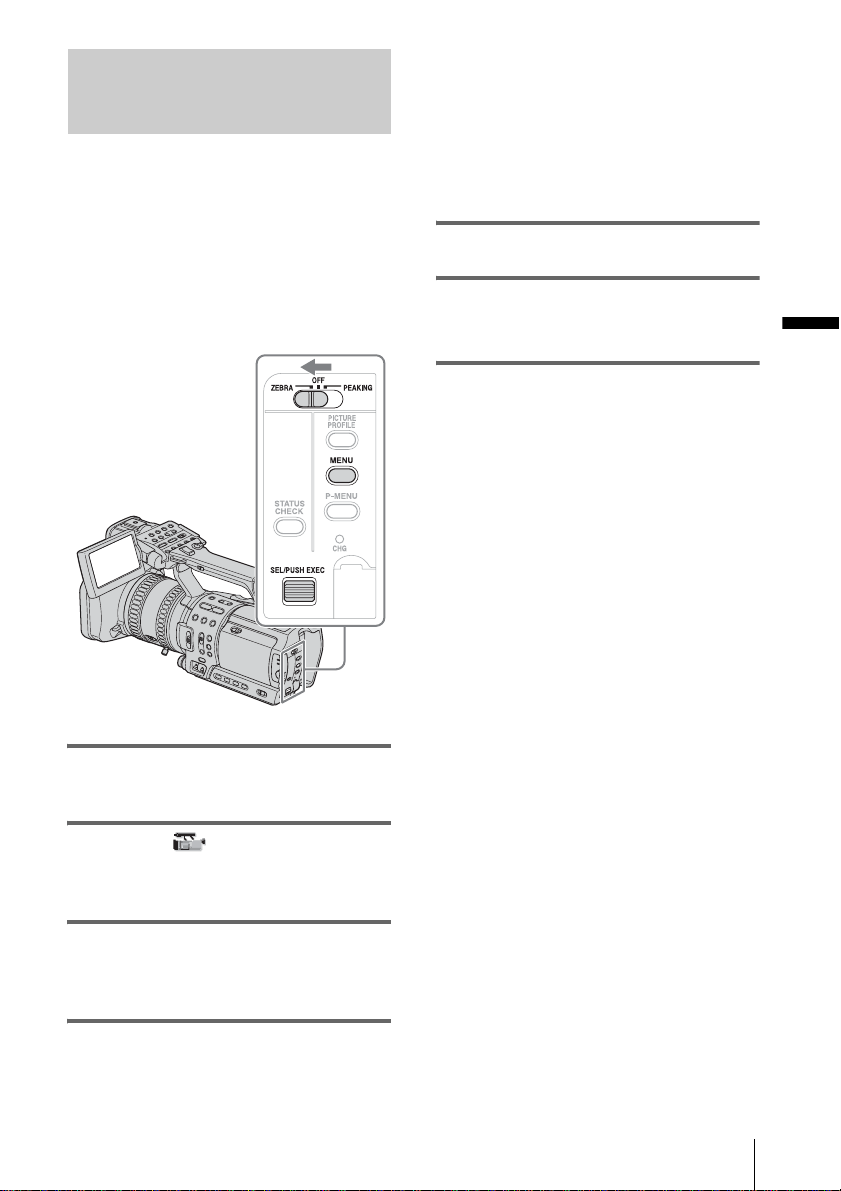
1 During recording or in the standby
mode, press MENU.
2 Select the (CAMERA SET) menu
by turning the SEL/PUSH EXEC dial,
then press the dial.
3 Select [ZEBRA LEVEL] by turning
the SEL/PUSH EXEC dial, then press
the dial.
4 Select the desired level by turning the
SEL/PUSH EXEC dial, then press the
dial.
Select a value from [70] to [100] or [100+].
If you select [70], the zebra pattern appears
at the part of 70±5 % of the brilliance
signal.
If you select [100+], the zebra pattern
appears at all areas of the brilliance signal
over 100 %.
The default setting is [100+].
5 Press MENU to hide the menu screen.
6 Set the ZEBRA/PEAKING switch to
ZEBRA.
The zebra pattern will appear.
To hide the zebra pattern
Set the ZEBRA/PEAKING switch to OFF.
b Note
• The zebra pattern is not recorded on the tape.
• You cannot use the zebra pattern when the peaking
function is activated (p. 33).
Recording
32
Adjusting the focus
The focus is adjusted automatically in the
default setting.
Adjusting the focus manually
You can adjust the focus manually according
to the recording conditions.
Use this function in the following cases.
– To record a subject behind a window covered
with raindrops.
– To record horizontal stripes.
– To record a subject with little contrast
between the subject and its background.
– When you want to focus on a subject in the
background.
– To record a stationary subject using a tripod.
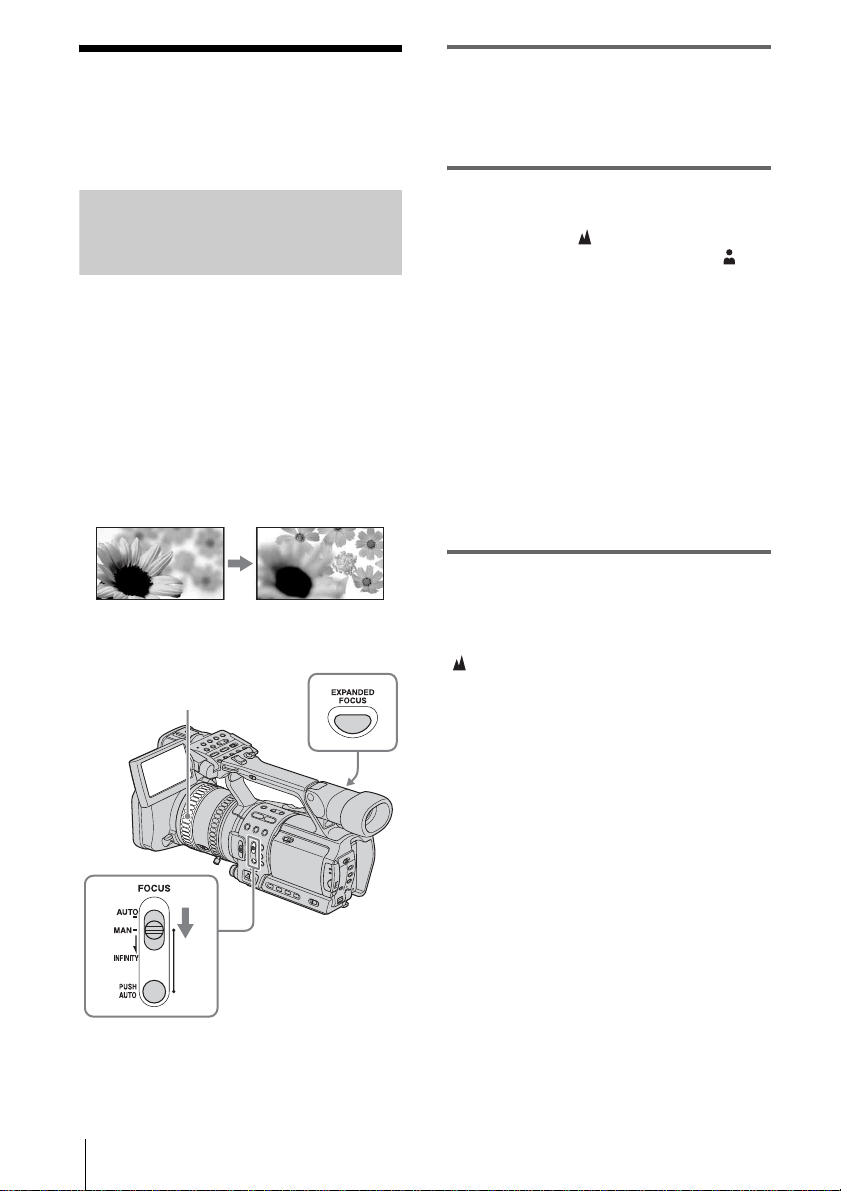
1 During recording or in the standby
mode, set the FOCUS switch to MAN
(manual).
9 appears.
2 Rotate the focus ring and adjust the
focus.
9 changes to when the focus cannot be
adjusted any farther.
9 changes to
when the focus cannot be adjusted any
closer.
Tips for focusing manually
• It is easier to focus on the subject when
you use the zoom function. Move the
power zoom lever towards T (telephoto)
to adjust the focus, and then, towards W
(wide angle) to adjust the zoom for
recording.
• When you want to record a close-up
image of a subject, move the power zoom
lever towards W (wide angle) to fully
magnify the image, then adjust the focus.
To focus on a distant subject
Record the subject with the FOCUS switch slid
down to INFINITY.
appears.
If you release the switch, it returns to automatic
focusing.
Use this function to record a distant subject
when a close subject is focused using automatic
focusing.
To use the expanded focus
Press EXPANDED FOCUS.
[EXPANDED FOCUS] appears and the center
of the screen is magnified by about 2 times. It
will be easier to confirm the focus setting during
manual focusing. The screen returns to the
original size after about 5 seconds.
As long as the focus ring is rotated, the image
remains magnified. The image returns to the
original size in about 2 seconds after you release
the ring, or when you press REC START/
STOP.
To adjust the focus automatically
Set the FOCUS switch to AUTO.
Focus ring
Recording
Recording
33
To focus automatically temporarily
Record the subject with PUSH AUTO pressed.
If you release the button, the setting returns to
manual focusing.
Use this function to shift the focus from one
subject to another. The scenes will transition
smoothly.
z Tip
• The focal distance information (for when it is dark
and hard to adjust the focus) appears for about 3
seconds in the following cases. (It will not be
displayed correctly if you are using a conversion
lens (optional).)
– When the focus mode is switched from automatic
to manual.
– When you rotate the focus ring.
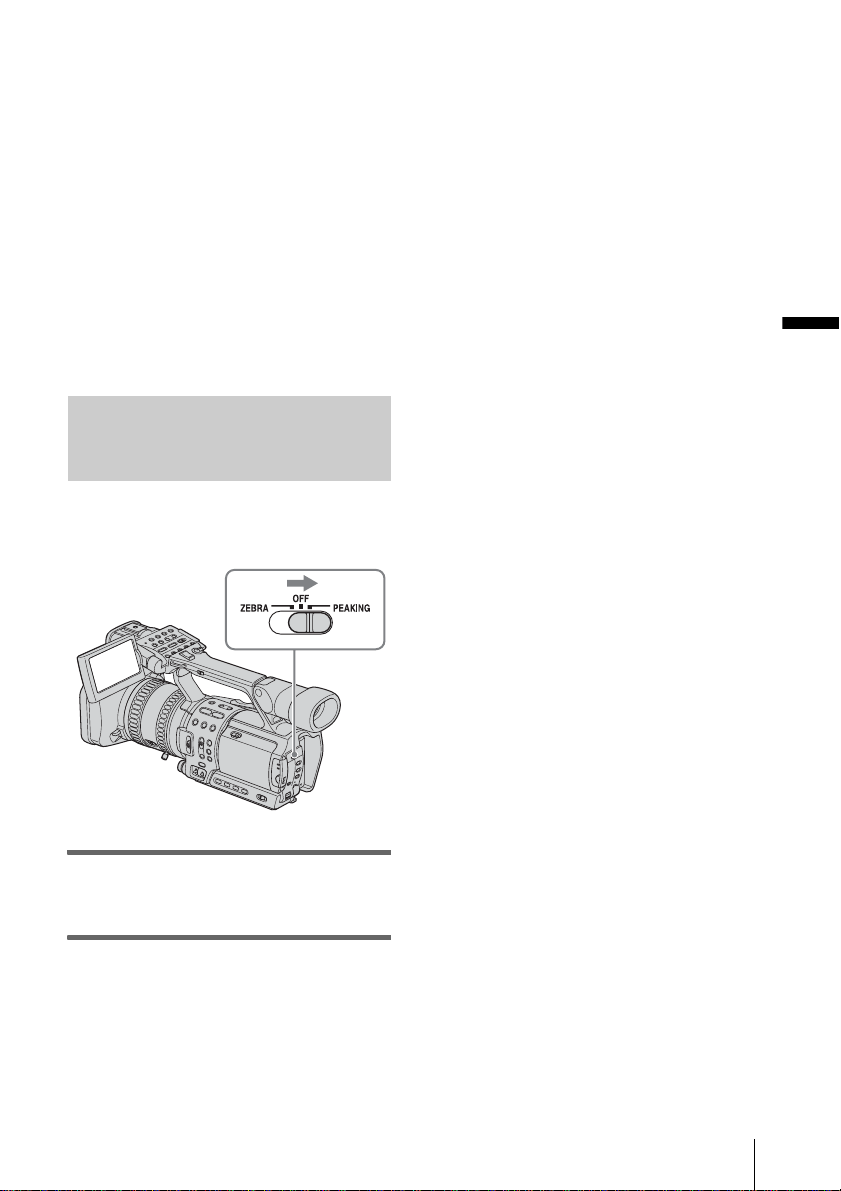
Enhancing the outline to focus
– PEAKING
You can enhance the outline of the image on
the screen for easier focusing.
During recording or in standby mode, set
the ZEBRA/PEAKING switch to
PEAKING.
To cancel peaking
Set the ZEBRA/PEAKING switch to OFF.
b Note
• The peaking is not recorded on the tape.
• You cannot use the peaking function when the zebra
pattern is activated (p. 31).
z Tip
• For easier focusing, use peaking together with the
expanded focus.
Recording
34
Customizing the
picture quality or
sound
Customizing the picture quality
– PICTURE PROFILE
You can customize the picture quality by
adjusting the color intensity, brightness,
white balance, etc. You can set 6 different
picture quality settings depending on the
recording time of day, the weather, or the
camera person, and store them in the
memory.
Connect your camcorder to a TV or monitor,
and adjust the picture quality while observing
the picture on the TV or monitor screen.
At the default setting, [PP1] through [PP6]
are registered with picture quality settings for
the following recording conditions.
You can change the above default settings at
your convenience.
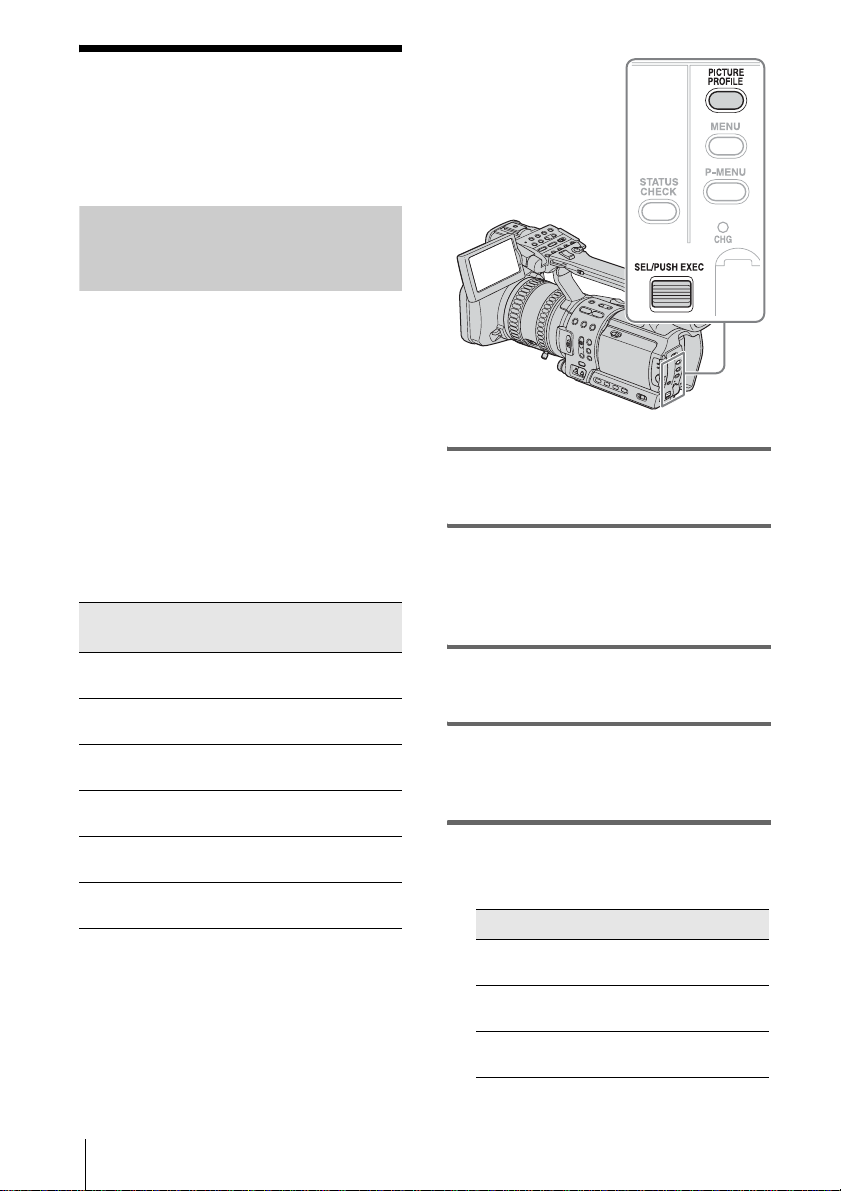
1 In the standby mode, press PICTURE
PROFILE.
2 Select a picture profile number by
turning the SEL/PUSH EXEC dial,
then press the dial.
[PP1] through [PP6] are available.
3 Select [SETTING] by turning the SEL/
PUSH EXEC dial, then press the dial.
4 Select an item to be adjusted by
turning the SEL/PUSH EXEC dial,
then press the dial.
5 Adjust the picture quality by turning
the SEL/PUSH EXEC dial, then press
the dial.
Picture profile
number
Recording condition
PP1 Appropriate setting to record in
the HDV format
PP2 Appropriate setting to record in
the DV format
PP3 Appropriate setting to record
people
PP4 Appropriate setting to record
film-like pictures
PP5 Appropriate setting to record
sunset
PP6 Appropriate setting to record in
black and white
Item Adjustment
[COLOR
LEVEL]
–7 (low) to +7 (high)
–8: black and white
[COLOR
PHASE]
–7 (greenish) to +7 (reddish)
[SHARP-
NESS]
0 (softer) to 15 (clearer)

Recording
Recording
35
6 Repeat steps 4 and 5 to adjust other
items.
7 Select [ RETURN] by turning the
SEL/PUSH EXEC dial, then press the
dial.
8 Select [OK] by turning the SEL/PUSH
EXEC dial, then press the dial.
A picture profile indicator appears.
To cancel the picture profile recording
Select [OFF] in step 2, then press the SEL/
PUSH EXEC dial.
To check the picture profile settings
During recording or in the standby mode, press
STATUS CHECK (p. 24).
To copy the picture profile setting to
other picture profiles
1
Press PICTURE PROFILE.
2 Select the number of the picture profile
to be copied from by turning the SEL/
PUSH EXEC dial, then press the dial.
3 Select [SETTING] by turning the SEL/
PUSH EXEC dial, then press the dial.
[SKINTONE
DTL]
To make wrinkles less
noticeable by suppressing the
outlines on the part of skin
color to be enhanced.
[TYPE1] (the color range
recognized as a skin color is
narrow) to [TYPE3] (the color
range recognized as a skin
color is wide)
In the case of [TYPE3], the
effect may also be applied to a
color that is not a skin color.
[OFF]: no adjustment
[AE SHIFT] –7 (darker) to +7 (lighter)
[AGC LIMIT] Select the upper limit for the
gain ([OFF], 12dB, 6dB,
0dB).
[OFF] is 18dB.
[AT IRIS
LMT]
Select the highest aperture
value for the automatic
adjustment (F11, F6.8, F4).
[WB SHIFT] –7 (to make white parts
bluish) to +7 (to make white
parts reddish)
[AWB SENS] To set the auto white balance
operation under a reddish light
source such as an
incandescent lamp or candle,
or under a blueish light source
such as in outdoor shade.
[HIGH] (reddishness or
blueishness is reduced) to
[LOW] (reddishness or
blueishness is increased)
[AWB SENS] is not effective
under a clear sky or the sun.
[CINEMA-
TONE γ]
[ON]: Pictures are recorded
with the gamma curve that
reproduces the natural
gradation sequence, similar to
that of film cameras.
Item Adjustment
[CINE-
FRAME]
[CINEFRAME 30]:
Pictures are recorded with a
cinema-like atmosphere. This
produces the feel of
smoothness better than
[CINEFRAME 24].
[CINEFRAME 24]:
Pictures are recorded with the
atmosphere of 24 frames per
second adopted by film
recording.
[OFF]: normal recording
[COPY] To copy a picture profile
setting to other picture
profiles.
[RESET] To restore the default setting
of the picture profile.
Item Adjustment
,continued
Recording
36
4 Select [COPY] by turning the SEL/
PUSH EXEC dial, then press the dial.
5 Select the number of the picture profile
to be copied to by turning the SEL/PUSH
EXEC dial, then press the dial.
6 Select [YES] again by turning the SEL/
PUSH EXEC dial, then press the dial.
If you decide not to copy the settings, select
[NO].
7 Press PICTURE PROFILE.
To reset the picture profile settings
You can reset the picture profile settings by
picture profile number. You cannot reset all
picture profile settings at once.
1 Press PICTURE PROFILE.
2 Select the number of the picture profile
to be reset by turning the SEL/PUSH
EXEC dial, then press the dial.
3 Select [SETTING] by turning the SEL/
PUSH EXEC dial, then press the dial.
4 Select [RESET] by turning the SEL/
PUSH EXEC dial, then press the dial.
5 Select [YES] by turning the SEL/PUSH
EXEC dial, then press the dial.
If you decide not to reset the picture profile,
select [NO].
6 Press PICTURE PROFILE.
b Note
• If you adjust all of the iris, shutter speed and gain
manually, you cannot obtain the effect of [AE
SHIFT].
• If you adjust the iris manually, you cannot obtain the
effect of [AT IRIS LMT].
• If the object is so bright that the aperture value set in
[AT IRIS LMT] is not appropriate, the shutter speed
may reach 1/2000 automatically.
• If you adjust the gain manually, you cannot obtain
the effect of [AGC LIMIT].
• If you select [CINEFRAME 24] when the shutter
speed is slower than 1/30, the shutter speed is
automatically set to 1/60.
• If you select [CINEFRAME 30] when the shutter
speed is slower than 1/15, the shutter speed is
automatically set to 1/30.
Adjusting the audio recording
level – Microphone volume level
You can adjust the microphone volume when
recording. Checking the volume with
headphones is recommended.
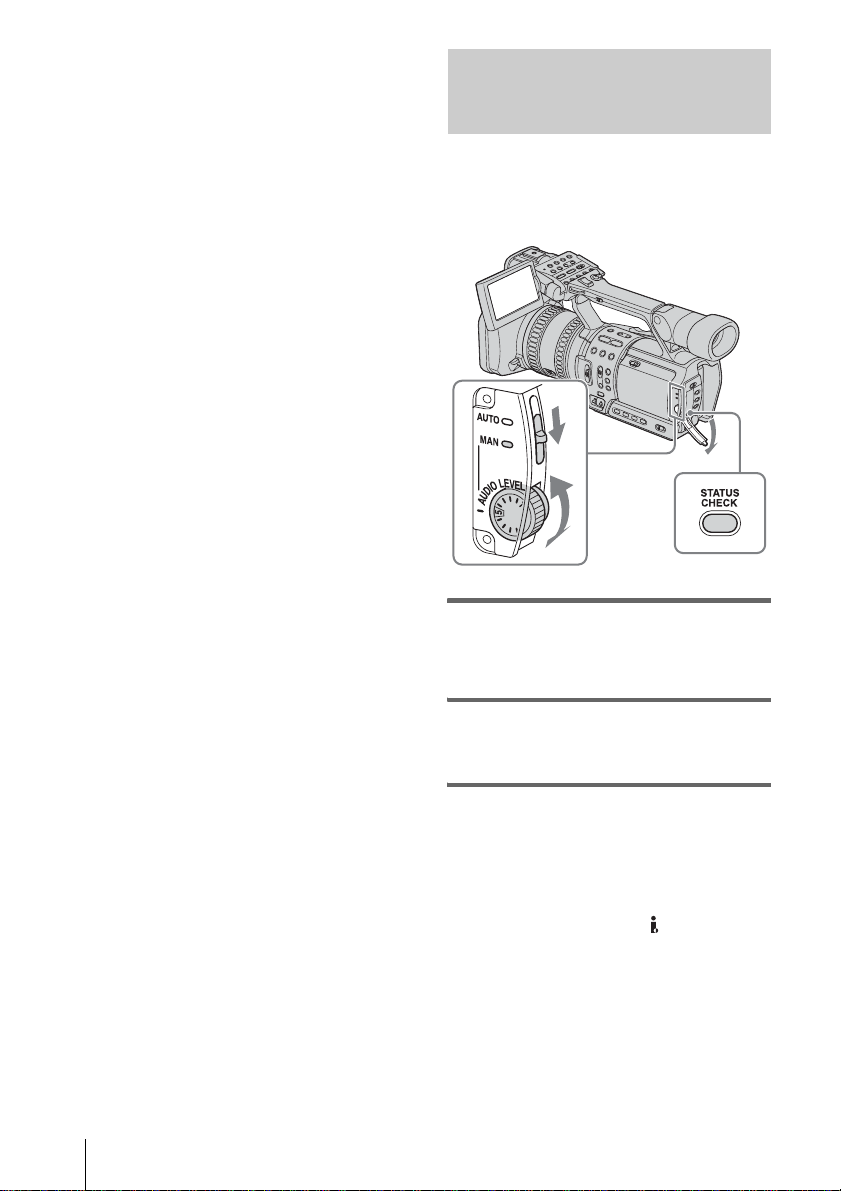
1 Open the cover and set the AUTO/
MAN switch to MAN.
The audio level meter appears.
2 During recording or in the standby
mode, adjust the volume by turning
the AUDIO LEVEL dial.
To restore automatic adjustment
Set the AUTO/MAN switch to AUTO.
b Note
• You cannot adjust the volume of audio input from
the AUDIO/VIDEO jack or the HDV/DV jack.
z Tip
• To check the audio setting information in greater
detail, press STATUS CHECK (p. 24). You can also
check the microphone volume during automatic
adjustment.

Recording
Recording
37
Recording a picture
using various
features
Developing scenes smoothly
– Shot transition
You can register the settings of focus, zoom,
iris, gain, shutter speed, and white balance,
and then change the recording setting from
the current one to the registered one, resulting
in a smooth transition of scenes (Shot
transition).
For example, you can shift the focus from
closer objects to farther objects, or change the
depth of field by adjusting the iris. In
addition, you can develop scenes under
different recording conditions smoothly. If
you register the manual adjustment function
of the white balance, the scenes will develop
smoothly between objects indoor and those
outdoor.
Use a tripod to avoid camera-shake.
Set the transition curve and duration using
[SHOT TRANS] on the (CAMERA
SET) menu (p. 53).
Step 1: Store the settings
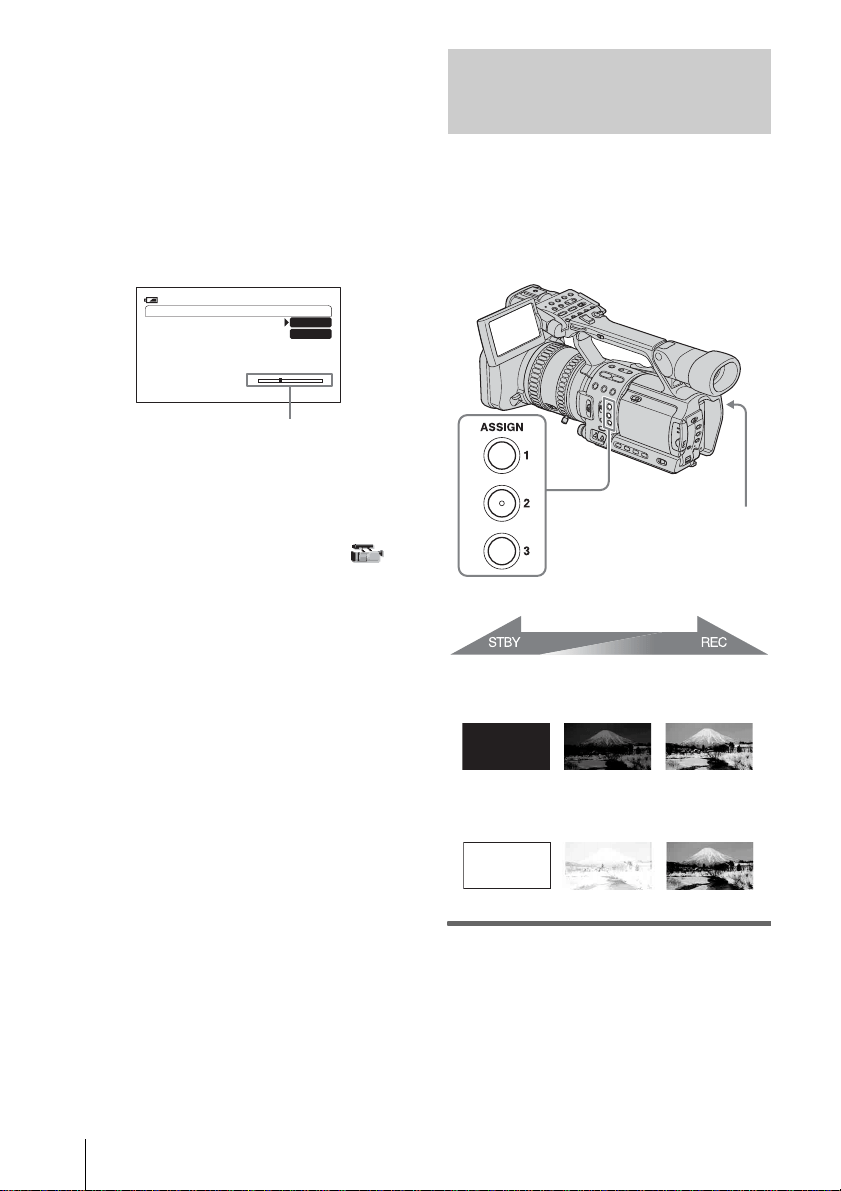
1
Press STORE/CHECK/EXEC
repeatedly to turn on the STORE lamp.
2 Adjust the desired items manually.
To adjust the camera setup items such as iris
manually, set the AUTO LOCK switch to
the center position to release the auto lock
mode. See pages 26 to 29 for details on
adjustment.
3 Press a button (A or B) to select the
storage location.
The setting is stored in the selected button.
The settings are called Shot A and Shot B
respectively.
b Note
• If you set the POWER switch to OFF (CHG), the
settings stored in Shot A and B are deleted.
Step 2: Check the stored settings (Shot)
1
Press STORE/CHECK/EXEC
repeatedly to turn on the CHECK lamp.
2 Press the button (A or B) in which the
setting was stored.
The selected setting will take effect on the
picture on the screen. The focus, zoom, and
so on, are automatically adjusted as stored
in the setting.
b Note
• You cannot check the transition time and curve set
using [SHOT TRANS] on the (CAMERA
SET) menu.
SHOT A
SHOT B
REC
START/STOP
,continued
Recording
38
Recording using the Shot transition
function
1
Press STORE/CHECK/EXEC
repeatedly to turn on the EXEC lamp.
2 Press REC START/STOP.
3 Press the button (A or B) in which the
desired setting was stored.
Pictures will be recorded with the settings
that were changed automatically from the
current ones to the stored ones.
b Note
• You cannot zoom, focus, or adjust manually while
checking or activating the Shot transition.
• When you change [SHOT TRANS] on the
(CAMERA SET) menu, turn off the STORE/
CHECK/EXEC lamp by pressing the button.
• You cannot return from the stored Shot A or B
settings to previous settings after you activate the
Shot transition during recording.
• If you press the following buttons during the shot
transition operation, the operation is canceled:
–PICTURE PROFILE
–MENU
–P-MENU
– EXPANDED FOCUS
– STATUS CHECK
z Tip
• You can record using both settings by making them
change either from Shot A to Shot B or from Shot B
to Shot A. For example, to change from Shot A to
Shot B, turn on the CHECK lamp and press A
followed by REC START/STOP, then turn on the
EXEC lamp and press B.
• You can rehearse the shot transition by pressing the
button (A or B), in which the desired setting was
stored, before pressing REC START/STOP in step
2.
To cancel the operation
Press STORE/CHECK/EXEC repeatedly until
the STORE/CHECK/EXEC lamps are all
turned off.
Fading in and out of a scene
– FADER
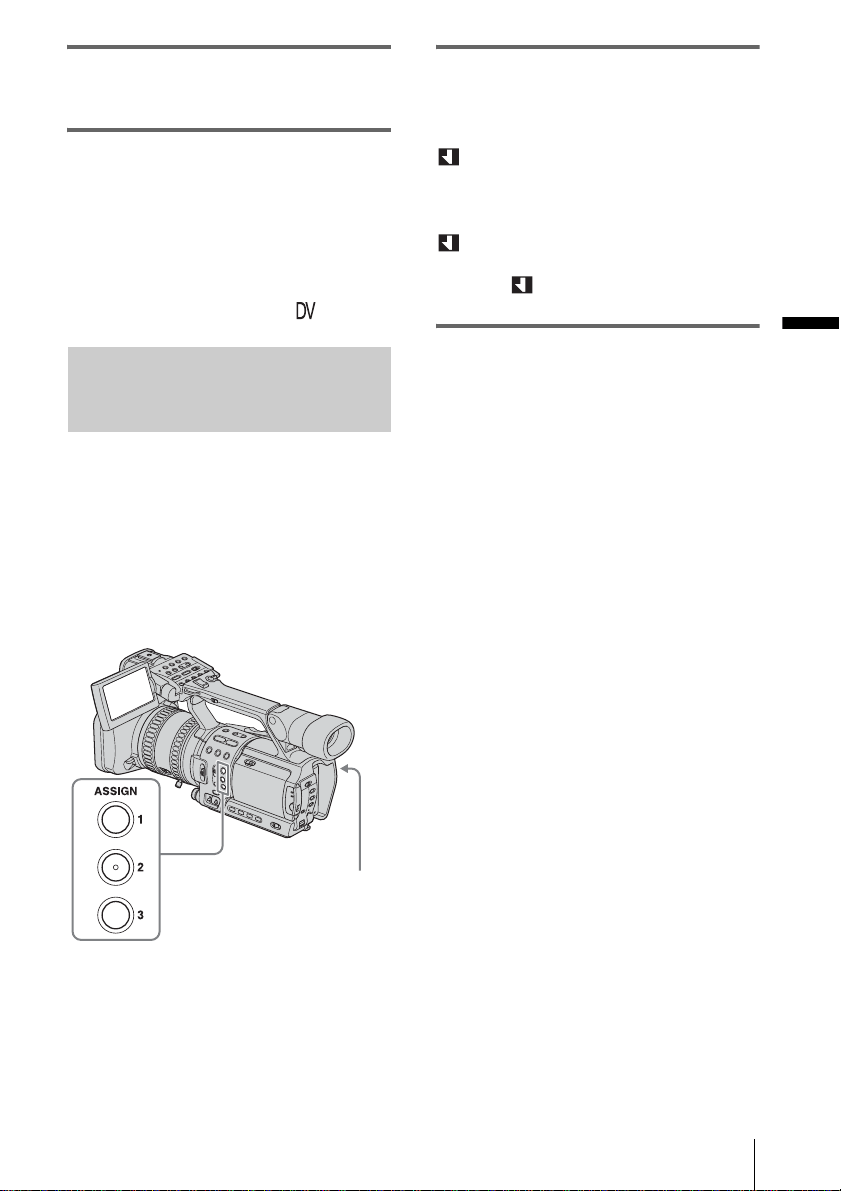
You can add the following effects to
currently recording pictures.
Assign the FADER function to one of the
ASSIGN buttons in advance. See page 68 for
details on how to assign a function.
[BLACK FADER]
[WHITE FADER]
1 Press the ASSIGN button assigned to
the FADER function in the standby
mode (to fade in) or during recording
(to fade out).
Each time you press the button, the
indicator changes as follows:
[BLACK FADER] t [WHITE FADER]
t no display
SHOT TRANS EXEC
ES
REC 0:00:05120min
SHOT A
SHOT B
Transition bar
S: start
E: end
REC START/STOP
Recording
Recording
39
2 Press REC START/STOP.
The FADER indicator stops flashing and
disappears when the fade is complete.
To cancel the operation
Press the ASSIGN button assigned to the
FADER function repeatedly until the FADER
indicators disappear.
b Note
• You cannot use the FADER function together with
[FRAME REC] (Frame recording).
Recording an index signal at the
beginning of recording
If you make an index for a scene, you can
easily search for the scene later (p. 50).
The index function will make it easier to
check the transition of recording or edit your
pictures using index signals.
Assign the index function to one of the
ASSIGN buttons in advance. See page 68 to
assign a function.
Press the ASSIGN button assigned to the
index function.
When pressed during recording
appears for about 7 seconds and an index
signal is recorded.
When pressed in the standby mode
flashes.
After you press REC START/STOP to start
recording, appears for about 7 seconds and
an index signal is recorded.
To cancel the operation
Before starting to record, press the ASSIGN
button assigned to the index function again.
b Note
• You cannot record an index signal on a recorded tape
afterward.
REC START/STOP
Recording
40
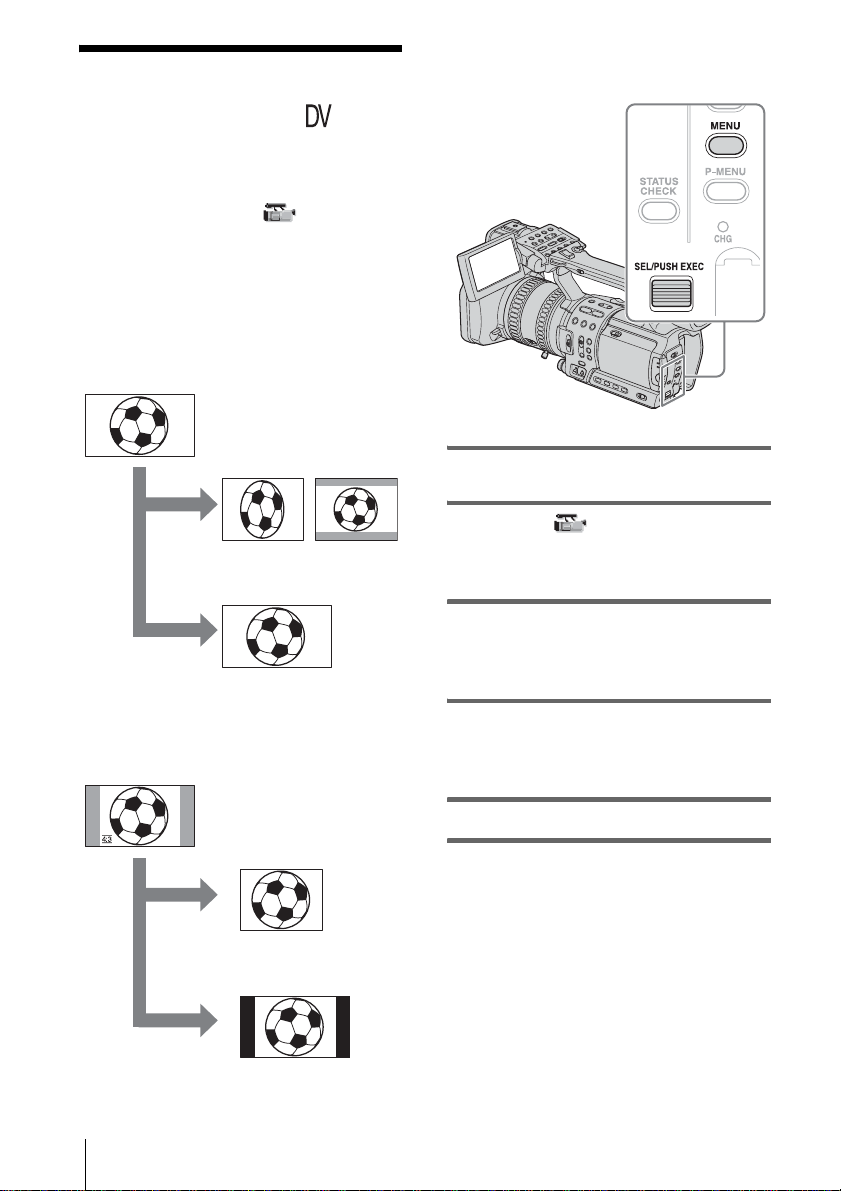
Recording in 16:9
wide rec mode
You can display pictures recorded in the DV
format on the entire TV screen by setting
[DV WIDE REC] on the (CAMERA
SET) menu at the time of recording.
Refer to the operating instructions supplied
with your TV as well.
[ON]
Select [ON] to view the recorded pictures on a
16:9 wide TV screen.
[OFF]
Select [OFF] to view the recorded pictures on a
4:3 TV screen.
* The playback picture may look different depending
on the TV connected.
1 In the standby mode, press MENU.
2 Select the (CAMERA SET) menu
by turning the SEL/PUSH EXEC dial,
then press the dial.
3 Select [DV WIDE REC] by turning the
SEL/PUSH EXEC dial, then press the
dial.
4 Select [ON] or [OFF] depending on the
TV, then press the SEL/PUSH EXEC
dial.
5 Press MENU to hide the menu screen.
On the LCD screen or viewfinder screen
On a 4:3 TV screen*
On a 16:9 wide TV
screen
On the LCD screen or viewfinder screen
On a 4:3 TV screen
On a 16:9 wide TV
screen*
The dark bars are
translucent on the screen.
Recording
Recording
41
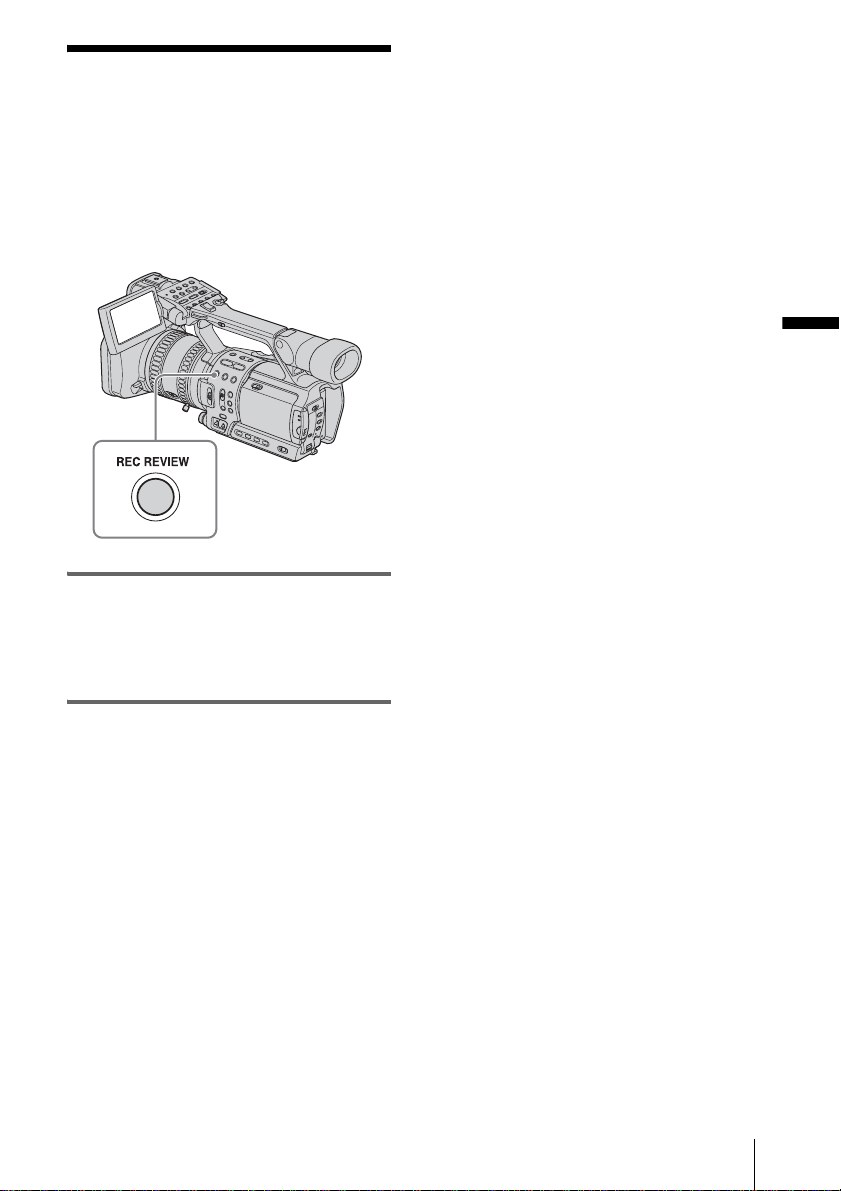
Reviewing the most
recently recorded
scenes – Rec Review
You can view a few seconds of the scene
recorded just before you stopped the tape.
In the standby mode, press REC
REVIEW.
The last few seconds of the most recently
recorded scene are played back. Then, your
camcorder is set to the standby mode.
Playback
42
Playback
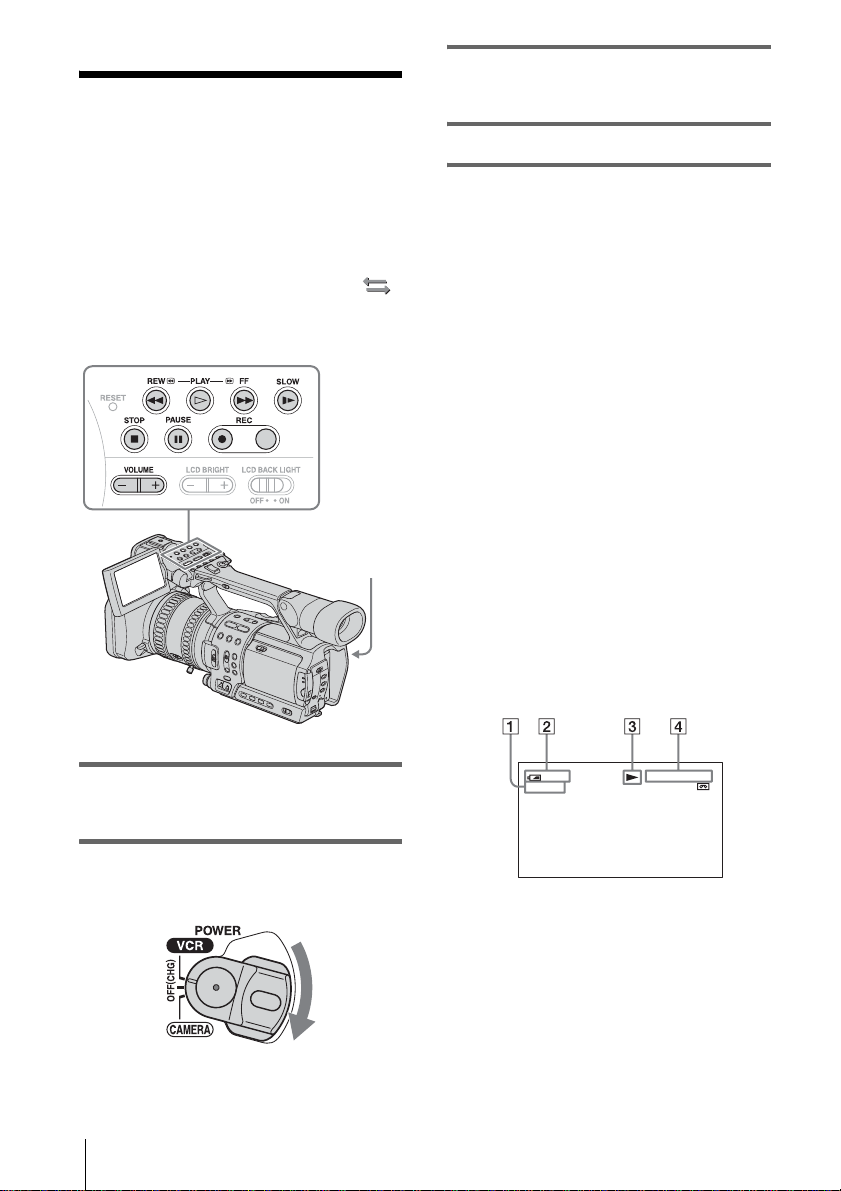
Viewing movies
Make sure you have a recorded cassette
inserted into your camcorder.
Some of the operations are possible using the
Remote Commander.
When you want to play back recordings on
your TV, see page 46.
When playing back the tape, select the
(IN/OUT REC) menu, [VCR HDV/DV],
then [AUTO] (the default setting).
1 Open the LCD panel and adjust the
angle.
2 While pressing the green button, set
the POWER switch to VCR.
3 Press m (rewind) to go to the point
you want to view.
4 Press N (play) to start playback.
To adjust the volume
Adjust the volume by pressing VOLUME
– (decrease) / + (increase).
To stop playback
Press x (stop).
To pause
Press X (pause) during playback.
Press N (play) or X (pause) again to restart the
playback.
Playback stops automatically when the pause
mode continues for more than 5 minutes.
To fast forward or rewind
Press M (fast forward) or m (rewind) in stop
mode.
To review movies on the viewfinder
Close the LCD panel. Then, adjust the
viewfinder angle.
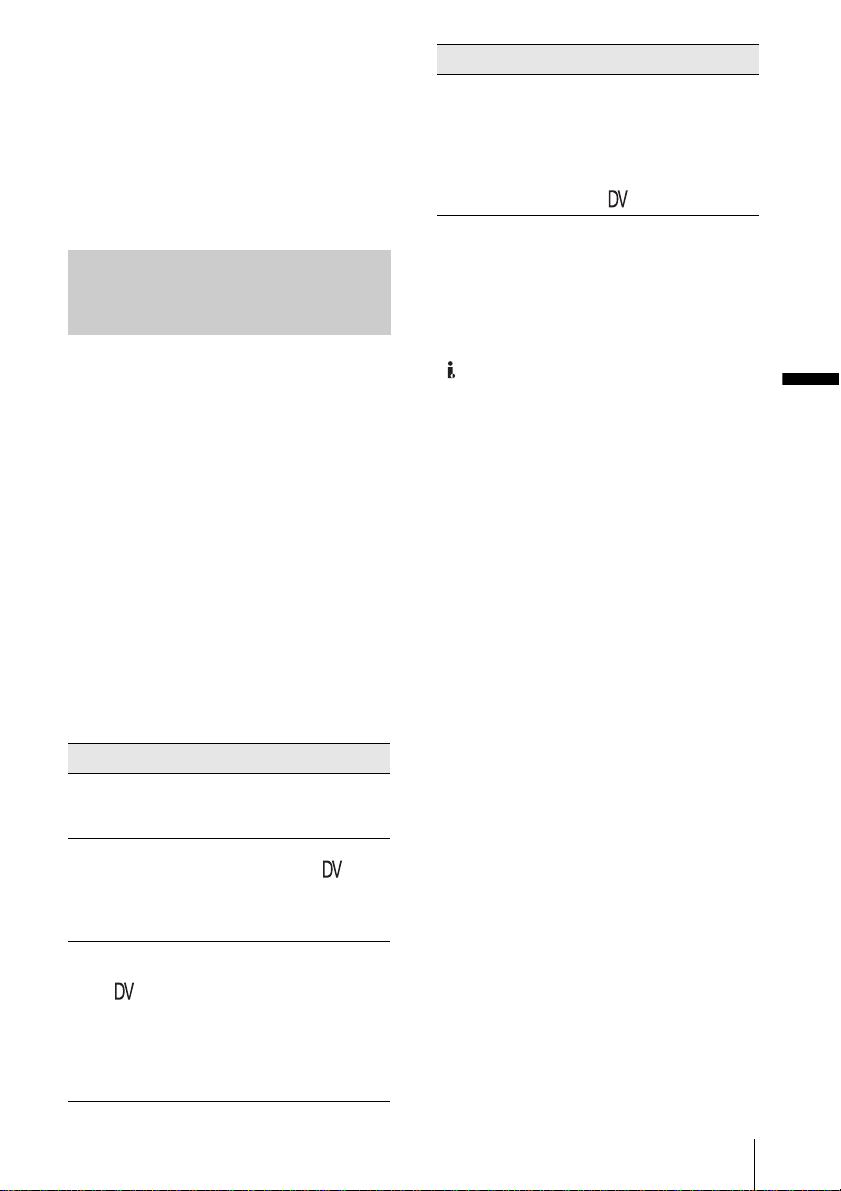
Indicators displayed during tape
playback
A Format of the playback signal
(HDV1080i or DV) / Recording mode (SP
or LP)
B Remaining battery
C Tape transport indicator
D Time code (hour: minute: second: frame)
or tape counter (hour: minute: second)
The time code of this camcorder is of the
drop-frame system.
POWER switch
0:00:00:0060
min
60
min
HDV1080
i
Playback
Playback
43
b Note
• When playing back a tape recorded in the HDV and
DV formats, and the signal switches between HDV
and DV, the picture and sound disappear
temporarily.
• You cannot play back the tape recorded in the HDV
format on video cameras of the DV format or mini-
DV players.
• Recording mode (SP or LP) appears when a tape
recorded in the DV format is played back.
Playing back in various modes
To fast forward or rewind during
playback – Picture search
Keep on pressing M (fast forward) or m
(rewind) during playback.
To resume normal playback, release the button.
To view the picture while fast
forwarding or rewinding – Skip scan
Keep on pressing M (fast forward) or m
(rewind) while fast forwarding or rewinding the
tape.
To resume fast forwarding or rewinding, release
the button.
To play back in various modes
You will not hear the recorded sound. Also, you
may see mosaic-like images of the previously
played picture remaining on the screen.
To return to the normal playback mode, press N
(play).
* Horizontal lines may appear at the top, bottom, or in
the center of the screen. This is not a malfunction.
b Note
• Pictures in the HDV format are not output from the
HDV/DV jack when they are paused or played
back in other than normal playback mode.
• Pictures in the HDV format may appear distorted
during:
– Picture search
– Reverse playback
To Press
change the
playback
direction*
I (reverse) on the Remote
Commander during playback.
play back slowly y (slow) during playback.
To reverse direction
1 Press I (reverse) on the
Remote Commander.
2 y (slow).
play back 2 times
faster (double
speed)
×2 (double speed) on the
Remote Commander during
playback.
To reverse direction
1 Press I (reverse) on the
Remote Commander.
2 ×2 (double speed) on the
Remote Commander.
play back frame
by frame
C (frame) on the Remote
Commander during playback
pause.
To reverse direction, press c
(frame) on the Remote
Commander during playback
pause.
To Press
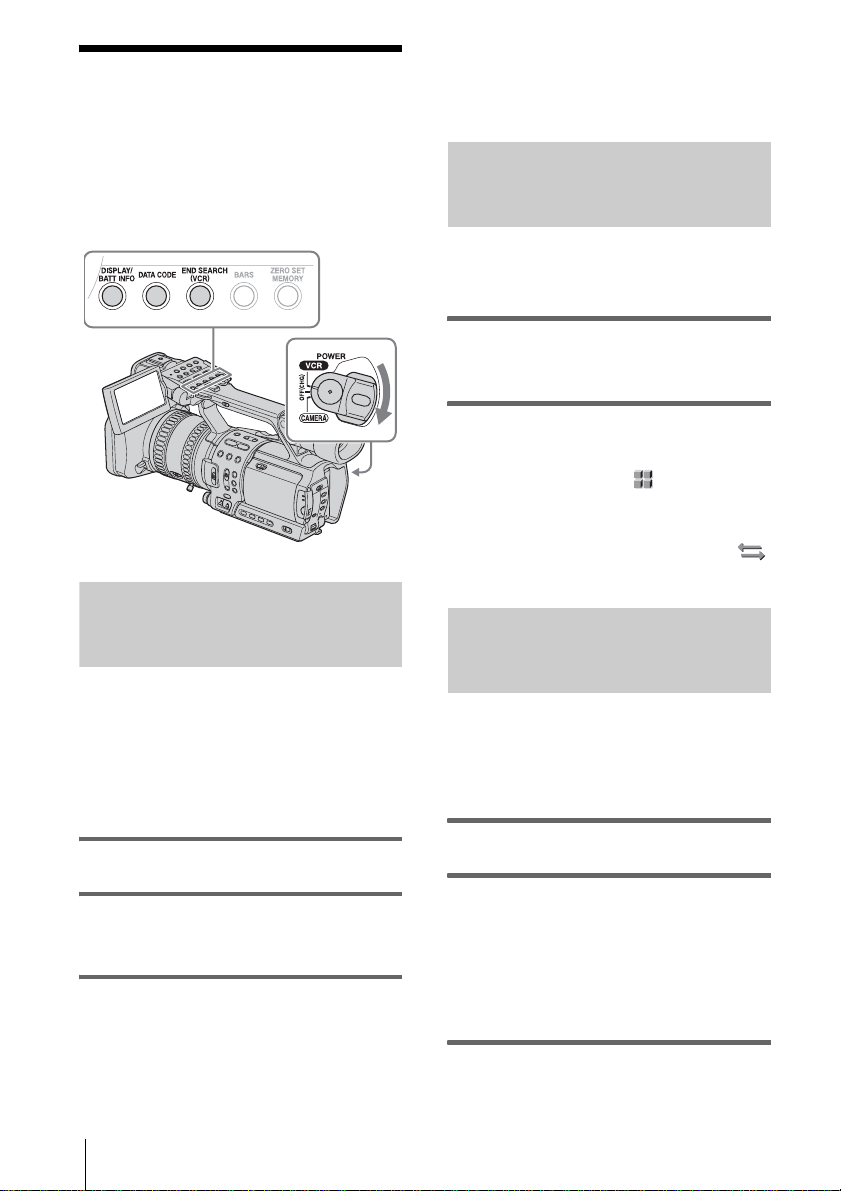
Playback
44
Various playback
functions
You can locate the end of the last recording,
or display the date of recording and camera
settings data.
Searching for the last scene of the
most recent recording
– END SEARCH
This function is handy when you have played
back the tape, for example, but want to start
recording right after the most recently
recorded scene. The END SEARCH function
will not work once you eject the cassette after
you have recorded on the tape.
1 Set the POWER switch to VCR.
2 Press END SEARCH (VCR).
The last scene of the most recent recording
is played back for about 5 seconds.
To cancel the operation
Press END SEARCH (VCR).
b Note
• The END SEARCH function will not work correctly
when there is a blank section between recorded
sections on the tape.
Displaying the screen indicators
You can choose to display the time code, tape
counter, and other information on the screen.
Press DISPALY/BATT INFO.
The indicator switches on or off as you press the
button.
z Tip
• You can display the screen indicators during
playback on a TV. Select the (OTHERS) menu,
[DISP OUTPUT], then [V-OUT/PANEL] (p. 64).
However, only playback mode indicators and tape
counter appear when playing back a tape recorded in
the HDV format, and [COMPONENT] on the
(IN/OUT REC) menu is set to [1080i/480i].
Displaying the date/time and
camera settings data – Data code
During playback, you can view the date/time
data and the camera settings data that are
automatically recorded while recording
pictures on a tape.
1 Set the POWER switch to VCR.
2 Press DATA CODE on the camcorder
or Remote Commander during
playback or playback pause.
Each time you press the button, the
indicators appear in turn as follows:
Date/time t Camera settings data t (no
display)
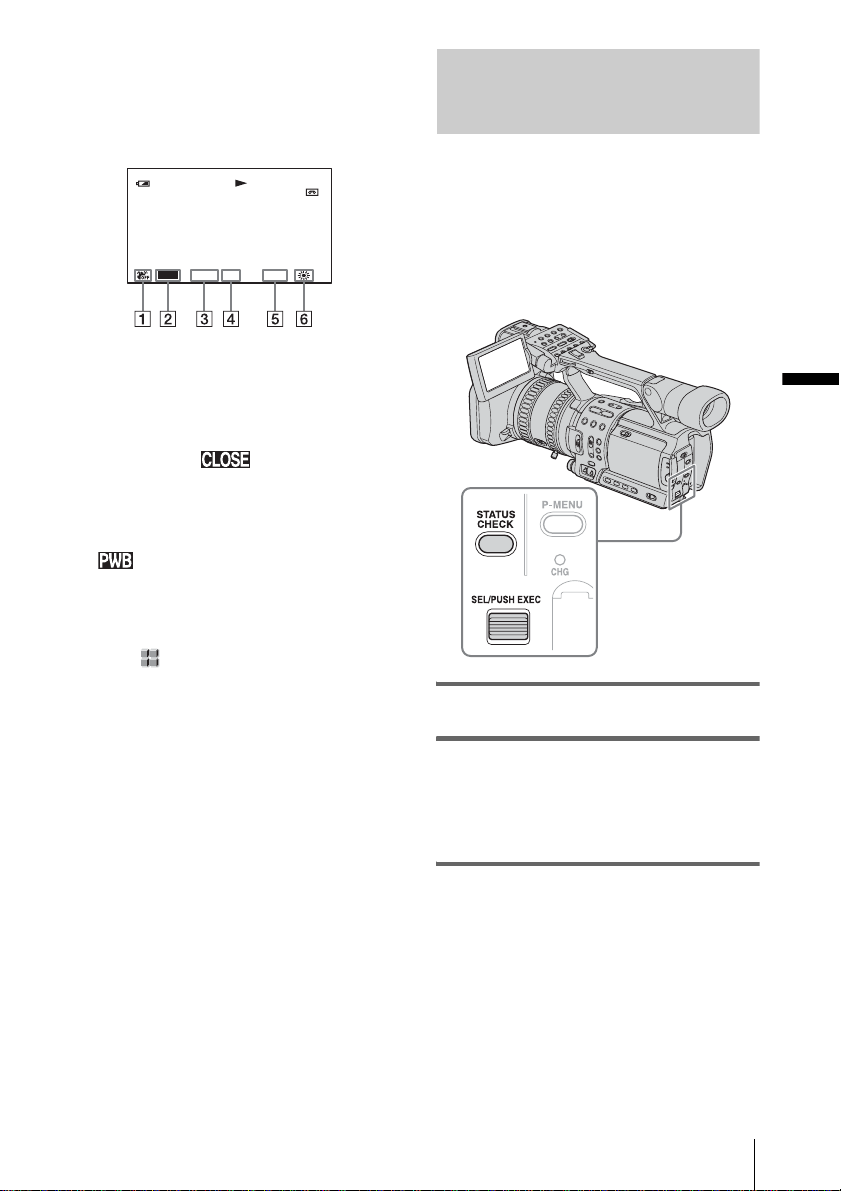
Playback
Playback
45
Camera settings data display
In the date/time data display, the date and time
is displayed in the same area.
If you record the picture without setting the
clock, [--- -- ----] and [--:--:--] will appear.
A SteadyShot off
B Exposure
C Aperture value
If you manually adjust the aperture value to
the maximum, appears.
D Gain
E Shutter speed
F White balance
appears when pictures recorded by
using the shot transition function are played
back.
To hide the camera settings data
Select the (OTHERS) menu, [DATA
CODE] then [DATE] (p. 63).
Each time you press DATA CODE, the date/
time indicator turns on and off.
Displaying the video information
– Status check
You can check the setup value of the
following items.
• Audio setup such as audio mix (p. 56)
• Output signal setup ([VCR HDV/DV], etc.)
(p. 59)
• Functions assigned to the ASSIGN buttons
(p. 68)
1 Press STATUS CHECK.
2 Turn the SEL/PUSH EXEC dial to
display the desired item.
Each time you turn the dial, the items
appear in the following order:
AUIDO t OUTPUT t ASSIGN
To turn off the video information
Press STATUS CHECK.
F1.7 1006
dB
0:00:00
AUTO
60
min
60
min
HDV1080
i
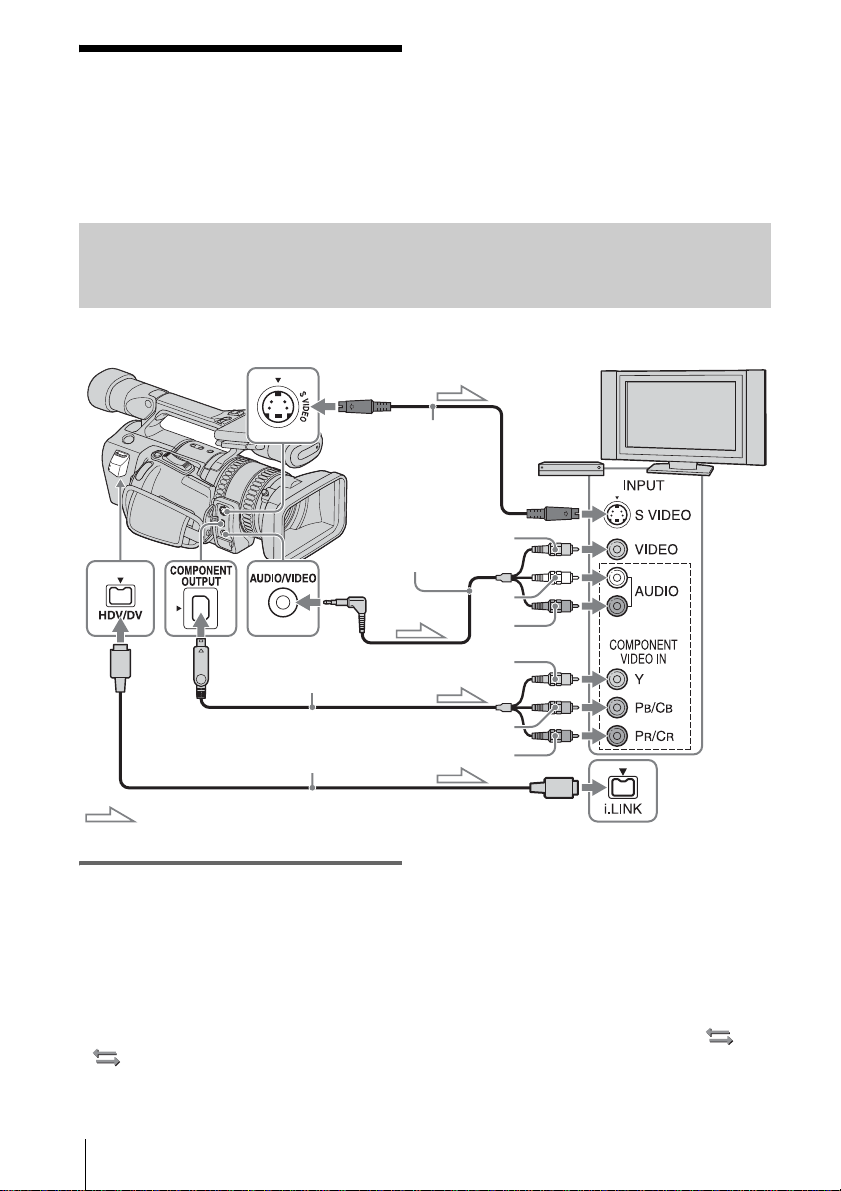
Playback
46
Playing the picture on
a TV
TV connections differ depending on the type
of TV.
Connect the supplied AC Adaptor to the wall
outlet for the power supply (p. 14).
Refer also to the instruction manuals supplied
with the devices to be connected.
To copy to another tape, see page 70.
Viewing the picture on a high definition TV
Connect your camcorder and your TV
using either cables described below.
To connect the TV using an i.LINK cable
This connection is recommended when your TV
is compatible with HDV/DV and has an i.LINK
jack.
• Before connecting the i.LINK cable, select the
(IN/OUT REC) menu, [VCR HDV/DV],
then [AUTO] (the default setting).
• In case of this connection, the TV needs to be
set so that it recognizes that the camcorder is
connected. Refer to the operating manual
supplied with the TV for the details.
To connect the TV using the component
video cable
• To view the picture recorded in the HDV
format, set [COMPONENT] on the (IN/
OUT REC) menu according to your TV
(p. 60). When the picture recorded in the DV
Signal flow
A/V connecting
cable (supplied)
Yellow
White
Red
S video cable
(optional)
TV
Component video cable (supplied)
i.LINK cable (optional)
When you have an S video jack
on your TV or VCR
Red
Blue
Green

Playback
Playback
47
format is played back, an equivalent signal
with [480i] is output, even if [1080i/480i] is
selected.
• Only video signals are output from the
COMPONENT OUTPUT jack. To output
audio signals, connect the white and red plugs
of the A/V connecting cable to the audio input
jack of your TV.
To connect the TV using the A/V
connecting cable
When there is an S video jack on the device to
be connected, connect it with your camcorder
by the S video jacks using an S video cable
(optional) instead of the yellow video plug of
the A/V connecting cable (supplied). This
connection produces pictures more faithfully on
the TV connected. The audio will not be output
when you connect with the S video cable alone.
b Note
• Be sure that you set [VCR HDV/DV] before
connecting the i.LINK cable. Otherwise, the TV
might not be able to recognize the video signal
correctly.
• Pictures in the DV format are not output from the
COMPONENT OUT jack, if copyright protection
signals are recorded in the pictures.
z Tip
• If you connect your camcorder to your TV using
more than one type of cables to output the pictures in
analog signal, the output signals have priority in the
following order:
COMPONENT OUTPUT jack t S video jack t
AUDIO/VIDEO jack
• See page 94 for details on i.LINK.
When your TV is connected to a VCR
Connect your camcorder to the LINE IN input
on the VCR using the A/V connecting cable. Set
the input selector on the VCR to LINE.
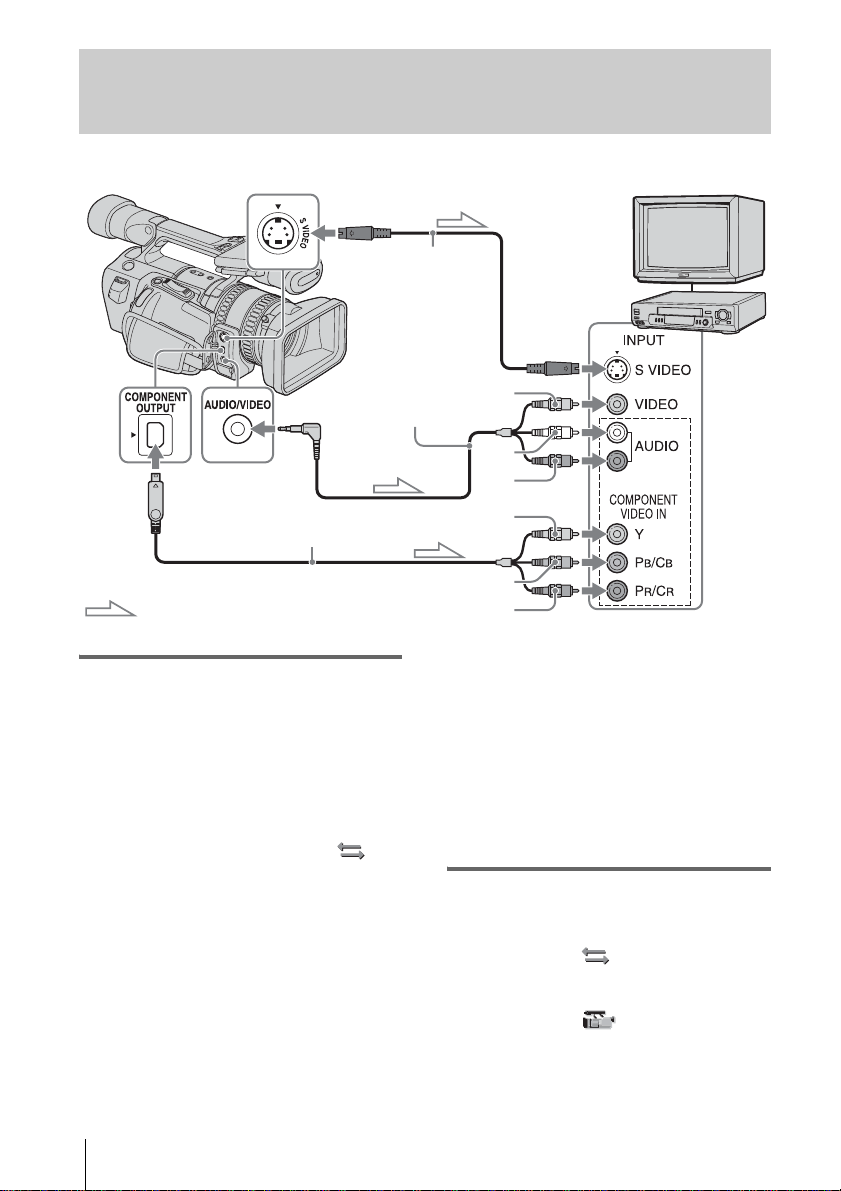
Playback
48
Viewing the picture on a 16:9 TV or a 4:3 TV
Connect your camcorder and your TV or
VCR using either cables described below.
To connect the TV using the component
video cable
This connection is recommended when your TV
has COMPONENT VIDEO jacks.
• To view the picture recorded in the HDV
format, set [COMPONENT] on the (IN/
OUT REC) menu according to your TV
(p. 60). When a picture recorded in the DV
format is played back, an equivalent signal
with [480i] is output, even if [1080i/480i] is
selected.
• Only video signals are output from the
COMPONENT OUTPUT jack. To output
audio signals, connect the white and red plugs
of the A/V connecting cable to the audio input
jack of your TV or VCR.
To connect the TV using the A/V
connecting cable
When there is an S video jack on the device to
be connected, connect it with your camcorder
by the S video jacks using an S video cable
(optional) instead of the yellow video plug of
the A/V connecting cable (supplied). Use an S
video cable to produce high resolution pictures.
The audio will not be output when you connect
with the S video cable alone.
To view the picture on a 4:3 TV
• To view the picture recorded in the HDV
format, select the (IN/OUT REC) menu,
[TV TYPE], then [4:3] (p. 61).
• To view the picture recorded in the DV
format, select the (CAMERA SET)
menu, [DV WIDE REC], then [OFF] before
recording (p. 40).
Signal flow
A/V connecting
cable (supplied)
Yellow
White
Red
When you have an S video jack
on your TV or VCR
S video cable
(optional)
TV or VCR
Component video cable (supplied)
Red
Blue
Green
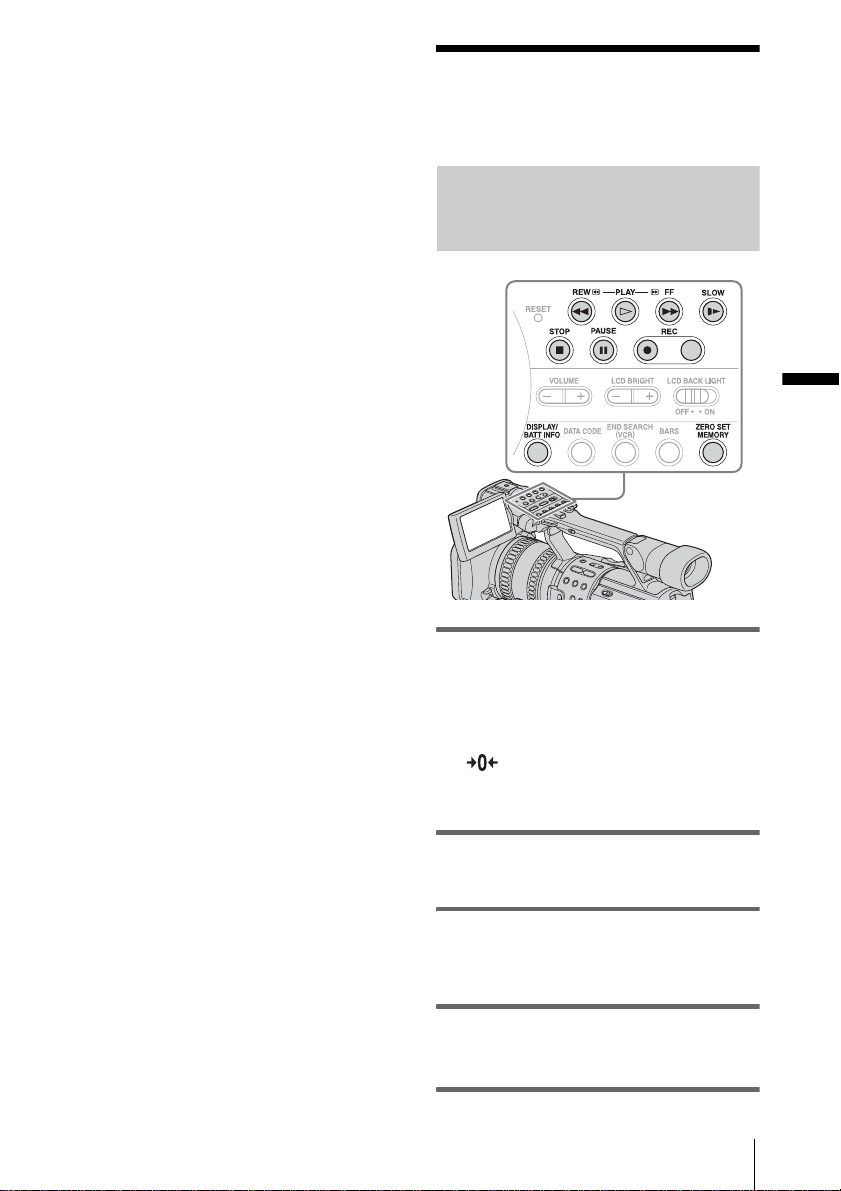
Playback
Playback
49
When your TV is connected to a VCR
Connect your camcorder to the LINE IN input
on the VCR using the A/V connecting cable. Set
the input selector on the VCR to LINE.
When your TV is monaural (When your
TV has only one audio input jack)
Connect the yellow plug of the A/V connecting
cable to the video input jack and connect the
white or the red plug to the audio input jack of
your TV or VCR.
When you want to play the sound in monaural
mode, use a connecting cable (optional) for that
purpose.
b Note
• Pictures in the DV format are not output from the
COMPONENT OUT jack, if copyright protection
signals are recorded in the pictures.
Locating a scene on a
tape for playback
Searching quickly for a desired
scene – Zero set memory
1 During playback, press ZERO SET
MEMORY on your camcorder or
Remote Commander at the point you
want to locate later on.
The tape counter is reset to “0:00:00” and
appears on the screen.
If the tape counter is not displayed, press
DISPALY/BATT INFO.
2 Press x (stop) when you want to stop
playback.
3 Press m (rewind).
The tape stops automatically when the tape
counter reaches “0:00:00.”
4 Press N (play).
The playback starts from the point
designated “0:00:00” on the tape counter.
,continued
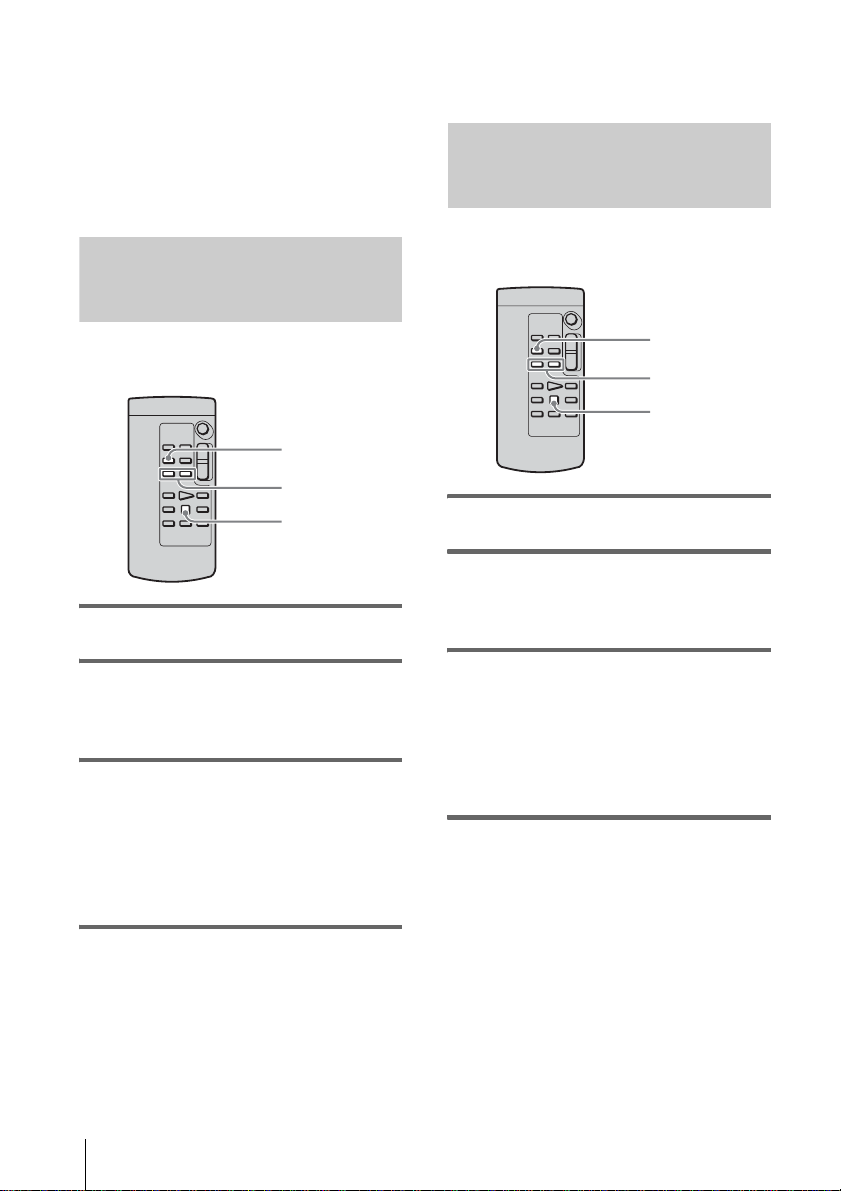
Playback
50
To cancel the operation
Press ZERO SET MEMORY again.
b Note
• There may be a discrepancy of several seconds
between the time code and the tape counter.
• Zero set memory will not function correctly if there
is a blank section between recorded sections on the
tape.
Searching for a scene by date of
recording – Date search
You can locate the point where the recording
date changes.
1 Set the POWER switch to VCR.
2 Press SEARCH MODE on the Remote
Commander repeatedly to select
[DATE SEARCH].
3 Press . (previous)/> (next) on
the Remote Commander to select a
recording date.
You can select the previous or the next date
of the present point on the tape.
Playback starts automatically from the
point where the date changes.
To cancel the operation
Press STOP on the Remote Commander.
b Note
• If 1 day’s recording is less than 2 minutes, your
camcorder may not accurately find the point where
the recording date changes.
• The Date search will not function correctly when
there is a blank section between recorded sections on
the tape.
Searching for a recording start
point – Index search
You can locate the point where an index
signal is recorded (p. 39).
1 Set the POWER switch to VCR.
2 Press SEARCH MODE on the Remote
Commander repeatedly to select
[INDEX SEARCH].
3 Press . (previous)/> (next) on
the Remote Commander to select an
index point.
You can select the previous or the next
index signal of the present point on the tape.
Playback starts automatically from the
point where the index signal is recorded.
To cancel the operation
Press STOP on the Remote Commander.
b Note
• If 1 day’s recording is less than 2 minutes, your
camcorder may not accurately find the index point.
• The Index search will not function correctly when
there is a blank section between recorded sections on
the tape.
. / >
SEARCH MODE
STOP
. / >
SEARCH MODE
STOP
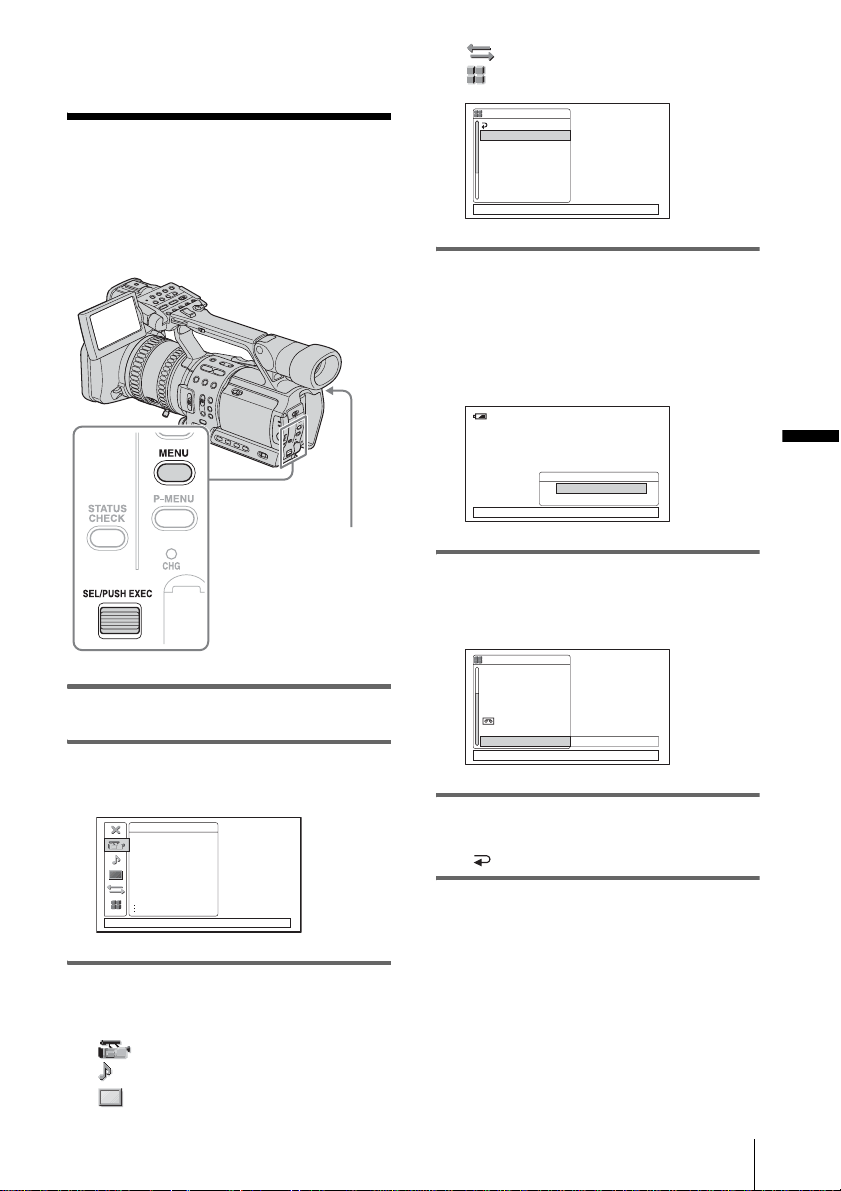
Using the Menu
Using the Menu
51
B
Advanced operations
Using the Menu
Selecting menu items
You can change various settings or make
detailed adjustments using the menu items
displayed on the screen.
1 Turn on the power (p. 14).
2 Press MENU to display the menu
index screen.
3 Select the icon of the desired menu by
turning the SEL/PUSH EXEC dial,
then press the dial.
CAMERA SET (p. 52)
AUDIO SET (p. 56)
LCD/VF SET (p. 58)
IN/OUT REC (p. 59)
OTHERS (p. 62)
4 Select the desired item by turning the
SEL/PUSH EXEC dial, then press the
dial.
The available menu items vary depending
on the power mode of your camcorder.
Unavailable items will be grayed out.
5 Select the desired setting by turning
the SEL/PUSH EXEC dial, then press
the dial.
6 Press MENU to hide the menu screen.
To return to the previous screen, select
[ RETURN].
POWER switch
CAMERA SET
WB PRESET
AE RESPONSE
GAIN SETUP
SHOT TRANS
STEADYSHOT
STDYSHOT TYP
FLCKR REDUCE
[
MENU
]
:END
STBY
OTHERS STBY
RETURN
ASSIGN BTN
CLOCK SET
WORLD TIME
LANGUAGE
BEEP
REC LAMP
FORMAT LAMP
[
MENU
]
:END
0:00:00120min
REMOTE CTRL
STBY
[
MENU
]
:END
ON
OFF
OTHERS STBY
BEEP
REC LAMP
FORMAT LAMP
IRIS DIAL
LETTER SIZE
REMAINING
DISP OUTPUT
REMOTE CTRL
OFF
[
MENU
]
:END
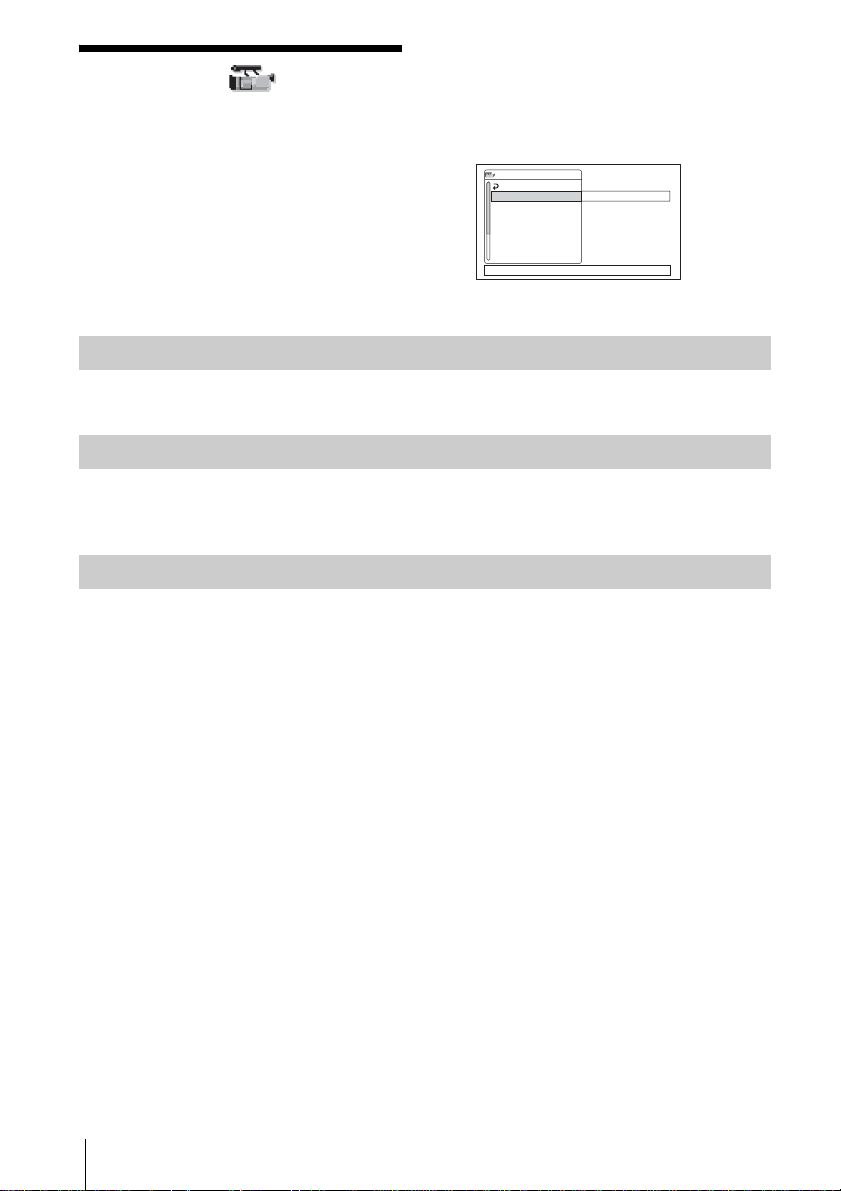
Using the Menu
52
Using the
(CAMERA SET) menu
– STDYSHOT TYP/FRAME REC, etc.
You can select the items listed below on the
CAMERA SET menu. For details on how to
select items, see “Selecting menu items”
(p. 51).
The default settings are marked with G. The
indicators in parentheses appear when the
setting is selected. The settings you can adjust
vary depending on the power mode of your
camcorder. The screen shows the items you can
operate at the moment. Unavailable items will
be grayed out.
WB PRESET
Select to use the preset white balance. See page 26 for details.
AE RESPONSE
Select the speed to adjust the exposure automatically, in accordance with the
brightness of the subject. [FAST], [MIDDLE], and [SLOW] are available.
GAIN SETUP
Select the adjustment value for each position (H, M, and L) of the GAIN switch
(p. 28).
1 Select [H], [M], or [L] by turning the SEL/PUSH EXEC dial, then press
the dial.
2 Select an adjustment value by turning the SEL/PUSH EXEC dial, then
press the dial.
0dB, 3dB, 6dB, 9dB, 12dB, 15dB, and 18dB are available. The larger the
number, the greater the gain.
3 Select [OK] by turning the SEL/PUSH EXEC dial, then press the dial.
4 Press MENU to hide the menu screen.
CAMERA SET STBY
RETURN
WB PRESET
AE RESPONSE
GAIN SETUP
SHOT TRANS
STEADYSHOT
STDYSHOT TYP
FLCKR REDUCE
[
MENU
]
:END
OUTDOOR
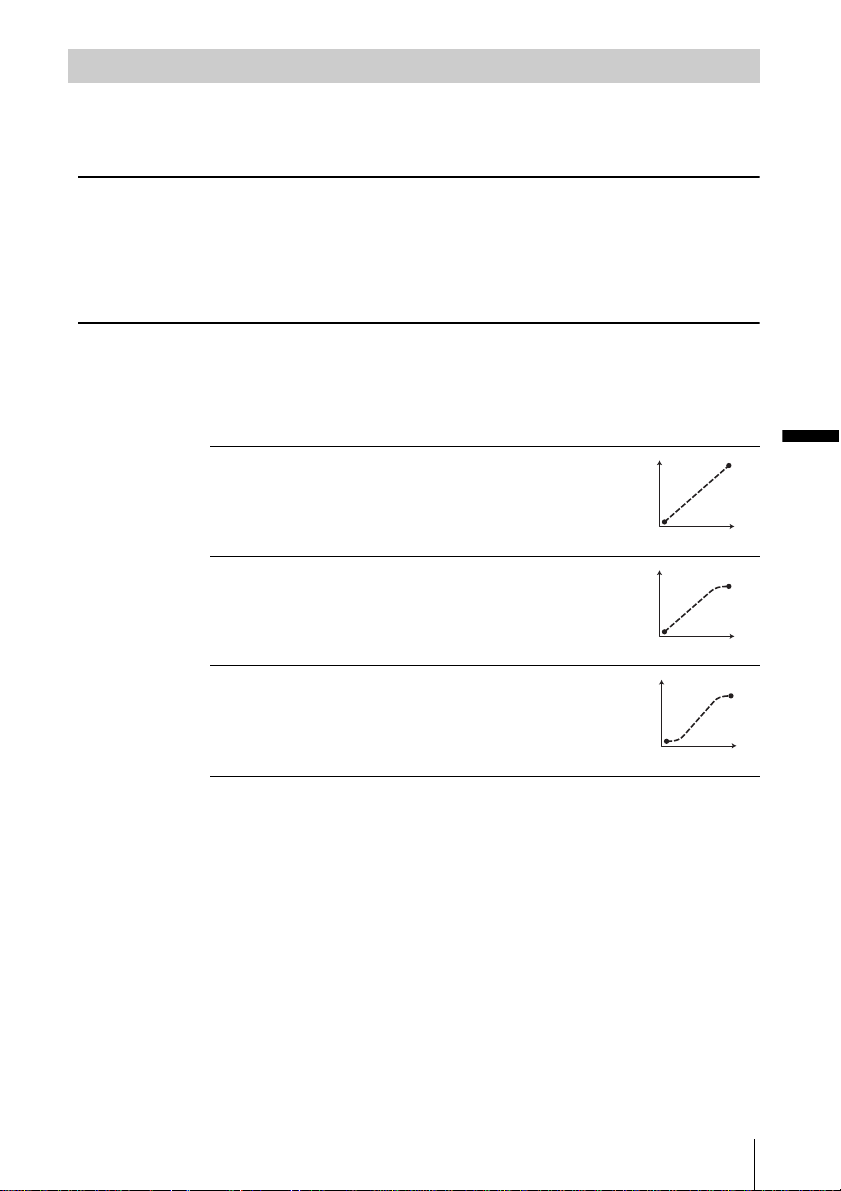
Using the Menu
Using the Menu
53
SHOT TRANS
Select this setting to set the transition duration and time. See page 37 for details
on using the shot transition function.
TRANS TIME
Select the time that takes to make a transition from the current setting to the
selected setting.
Duration from [2.0 sec] through [15.0 sec] are available. It is set to [4.0 sec] in the
default setting.
TRANS CURVE
Select the transition curve.
The figures below show the transition curve of each mode.
*1: parameter level
*2: transition of time
b Note
• Before setting [SHOT TRANS], turn off all of the STORE/CHECK/EXEC lamps by
pressing the button repeatedly (p. 37).
LINEAR Select to make the transition linearly.
GSOFT STOP Select to make the transition slowly at the end.
SOFT TRANS Select to make the transition slowly at the
beginning and end, and linearly in between.
*1
*2
*1
*2
*1
*2
,continued

Using the Menu
54
STEADYSHOT
b Note
• The SteadyShot function does not work well when a wide conversion lens other than VCL-
HG0872 (optional) is attached to your camcorder.
• When using VCL-HG0872, select [WIDE CONV.] in [STDYSHOT TYP] below.
STDYSHOT TYP
You can select the type of the SteadyShot function that compensates for camera-
shake. To release the SteadyShot function, select [OFF] in [STEADYSHOT] or
use the ASSIGN button assigned to the SteadyShot function (p. 68).
FLCKR REDUCE
b Note
• Flickering may not be reduced depending on the light source.
HANDLE ZOOM
Select this item to set the zoom speed of position H and L of the handle zoom
switch (p. 22).
1 Select [H] or [L] by turning the SEL/PUSH EXEC dial, then press the
dial.
2 Select a zoom speed by turning the SEL/PUSH EXEC dial, then press the
dial.
GON Select to activate the SteadyShot function. You can select the type of
the SteadyShot function in [STDYSHOT TYP].
OFF ( ) Select to deactivate the SteadyShot function. Select when recording
using a tripod. More natural pictures are produced.
You can also deactivate the SteadyShot function by using the
ASSIGN button assigned to the SteadyShot function (p. 68).
HARD Select to activate the SteadyShot function with stronger effect. This
mode is not recommended for recording with camera panning
technique.
GSTANDARD Select to activate the standard SteadyShot function.
SOFT Select to activate the SteadyShot function so that it leaves a slight
unsteadiness on the picture so the picture looks natural.
WIDE CONV. Select when a wide conversion lens (optional) is attached. This mode
is the most effective with Sony VCL-HG0872 wide conversion lens.
GON Select to record under normal conditions. Flickering of the screen
under a light source such as fluorescent lamps will be reduced.
OFF Select when you do not want to reduce flickering of the screen.
Using the Menu
Using the Menu
55
Speeds 1 through 8 are available. The larger the number, the faster the zoom
speed.
3 Select [OK] by turning the SEL/PUSH EXEC dial, then press the dial.
4 Press MENU to hide the menu screen.
ZEBRA LEVEL
See page 31 for details.
CENTER MARKR
b Note
• The center marker and its position do not affect the adjustment, setting, or recording in any
way.
FRAME REC
You can record pictures with a stop-motion animated effect by alternately
recording a few frames and then moving the subject a little. Operate your
camcorder using the Remote Commander to prevent camera shake.
b Note
• When you use frame recording continuously, the remaining tape time will not be indicated
correctly.
• The last scene will be longer than other scenes.
• You cannot record index signals during frame recording.
DV WIDE REC
See page 40 for details.
GOFF Select when you do not want to display the center marker on the
screen (p. 21).
ON Select to display the center marker on the screen.
GOFF Select to record in the standard recording mode.
ON ( ) Select to record pictures using the FRAME REC function.
1 Select [ON], then press the dial.
2 Press MENU to hide the menu screen.
3 Press REC START/STOP.
A picture (approximately 6 frames) is recorded, and your
camcorder enters the standby mode.
4 Move the subject and repeat step 3.
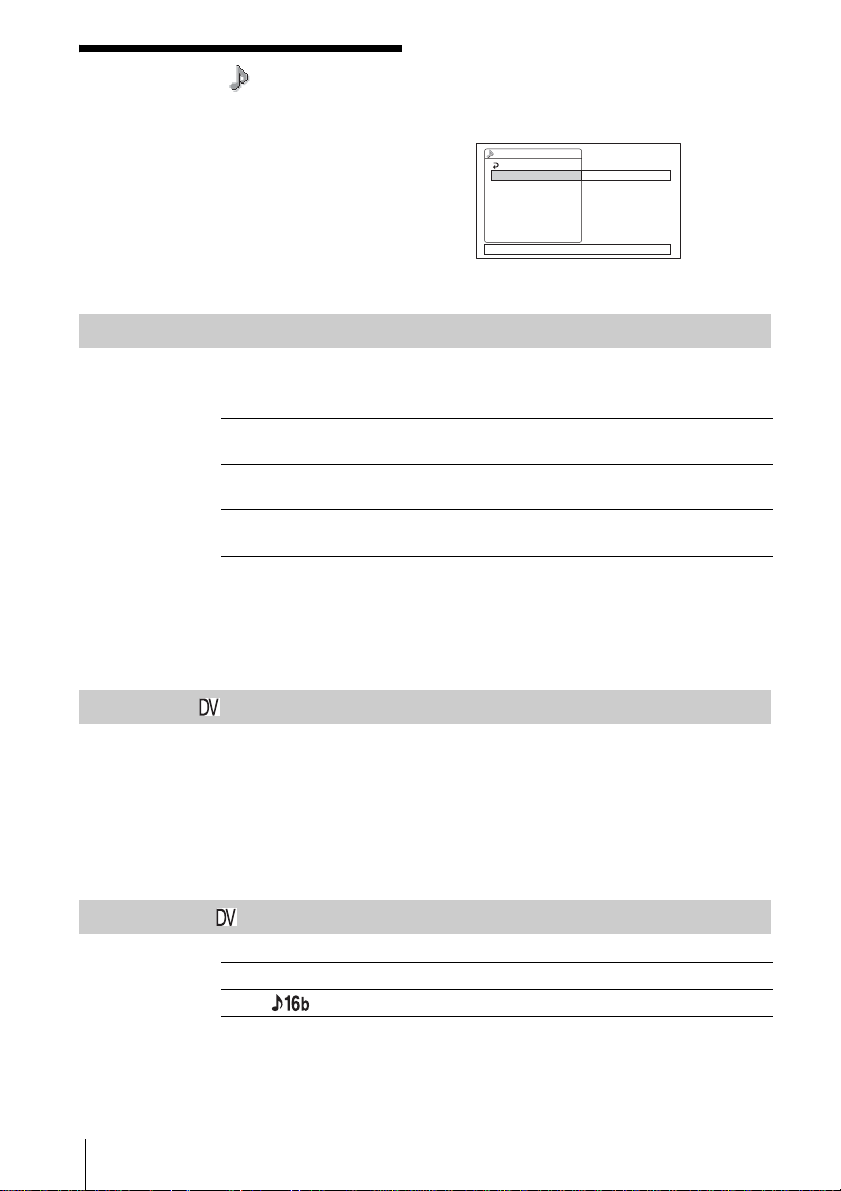
Using the Menu
56
Using the (AUDIO
SET) menu
– AUDIO MIX, etc.
You can select the items listed below on the
AUDIO SET menu. For details on how to select
items, see “Selecting menu items” (p. 51).
The default settings are marked with G. The
indicators in parentheses appear when the
setting is selected. The settings you can adjust
vary depending on the power mode of your
camcorder. The screen shows the items you can
operate at the moment. Unavailable items will
be grayed out.
MULTI-SOUND
You can select how to play back audio on a tape that was recorded in stereo mode
using another camcorder.
b Note
• You can play back a dual sound track cassette on this camcorder. However, you cannot
record a dual sound track on this camcorder.
• The setting returns to [STEREO] when you disconnect the power source from your
camcorder for more than 5 minutes.
AUDIO MIX
You can adjust the audio balance between the originally recorded sound (ST1)
and sound added afterwards (ST2) on the tape (p. 79).
b Note
• You cannot adjust sound recorded in 16 bit audio mode.
• Only the originally recorded sound will be heard when you disconnect the power source
from your camcorder for more than 5 minutes.
AUDIO MODE
b Note
• When recording in the HDV format, sound is automatically recorded in [16BIT] mode.
AUDIO SET
RETURN
MULTI–SOUND
AUDIO MIX
AUDIO MODE
WIND
MIC/LINE IN
[
MENU
]
:END
STEREO
GSTEREO Select to play back a stereo tape or dual sound track tape with both
main and sub sound.
1 Select to play back a stereo tape with the left channel sound or a dual
sound track tape with the main sound.
2 Select to play back a stereo tape with the right channel sound or a dual
sound track tape with the sub sound.
G12BIT Select to record in the 12-bit mode (2 stereo sounds).
16BIT ( ) Select to record in the 16-bit mode (1 stereo sound with high quality).

Using the Menu
Using the Menu
57
WIND
MIC/LINE IN
GON Standard setting.
OFF Select when you want to record the sound as it is without reducing the
noise caused by wind.
GEXT MIC Select to input an audio signal when a microphone is connected to the
MIC/LINE jack.
LINE Select to input an audio signal when an audio device is connected to
the MIC/LINE jack.

Using the Menu
58
Using the (LCD/VF
SET) menu
– LCD COLOR, etc.
You can select the items listed below on the
LCD/VF SET menu. For details on how to
select items, see “Selecting menu items”
(p. 51).
The default settings are marked with G. The
settings you can adjust vary depending on the
power mode of your camcorder. The screen
shows the items you can operate at the moment.
Unavailable items will be grayed out.
LCD COLOR
Turn the SEL/PUSH EXEC dial to adjust the color on the LCD screen. The
recorded picture will not be affected by this setting.
LCD BL LEVEL
You can adjust the brightness of the LCD screen’s backlight. The recorded picture
will not be affected by this setting.
b Note
• When you connect your camcorder to outside power sources, [BRIGHT] is automatically
selected for this setting.
VF B.LIGHT
You can adjust the brightness of the viewfinder. The recorded picture will not be
affected by this setting.
b Note
• When you connect your camcorder to outside power sources, [BRIGHT] is automatically
selected for this setting.
LCD/VF SET
RETURN
LCD COLOR
LCD BL LEVEL
VF B. LIGHT
[
MENU
]
:END
GNORMAL Standard brightness.
BRIGHT Select to brighten the LCD screen.
GNORMAL Standard brightness.
BRIGHT To brighten the viewfinder screen.
Low intensity
High intensity
Using the Menu
Using the Menu
59
Using the (IN/OUT
REC) menu
– REC FORMAT/TV
TYPE, etc.
You can select the items listed below on the IN/
OUT REC menu. For details on how to select
these items, see “Selecting menu items” (p. 51).
The default settings are marked with G. The
indicators in parentheses appear when the
setting is selected. The settings you can adjust
vary depending on the power mode of your
camcorder. The screen shows the items you can
operate at the moment. Unavailable items will
be grayed out.
VCR HDV/DV
Select the playback signal. Normally select [AUTO].
When the camcorder is connected to another device using an i.LINK cable, select
the signal to be input/output from the HDV/DV jack. The selected signal is
recorded or played back.
b Note
• Disconnect the i.LINK cable before setting [VCR HDV/DV]. Otherwise, the connected TV
may not be able to recognize the video signal from this camcorder.
• When [AUTO] is selected and the signal switches between HDV and DV, the picture and
sound disappear temporarily.
• When [i.LINK CONV] is set to [ON], pictures are output as follows:
– at [AUTO], an HDV signal is converted to the DV format and output; a DV signal is
output as it is.
– at [HDV], an HDV signal is converted to the DV format and output; a DV signal is not
output.
– at [DV], a DV signal is output as it is; an HDV signal is not output.
IN/OUT REC
RETURN
VCR HDV/DV
REC MODE
COMPONENT
i . LINK CONV
TV TYPE
A/V DV OUT
[
MENU
]
:END
AUTO
GAUTO • Select this to play back signals by switching the format between
HDV and DV automatically.
• For an i.LINK connection, select this to record/play back signals
input/output from the HDV/DV jack by switching the format
between HDV and DV automatically.
HDV • Select this to play back the signals in the HDV format only.
• For an i.LINK connection, select this to record/play back the input/
output signals in the HDV format only.
Select this when connecting the camcorder to a computer, etc.
(p. 77).
DV • Select this to play back the signals in the DV format only.
• For an i.LINK connection, select this to record/play back the input/
output signals in the DV format only.
Select this when connecting the camcorder to a computer, etc.
(p. 77).
,continued
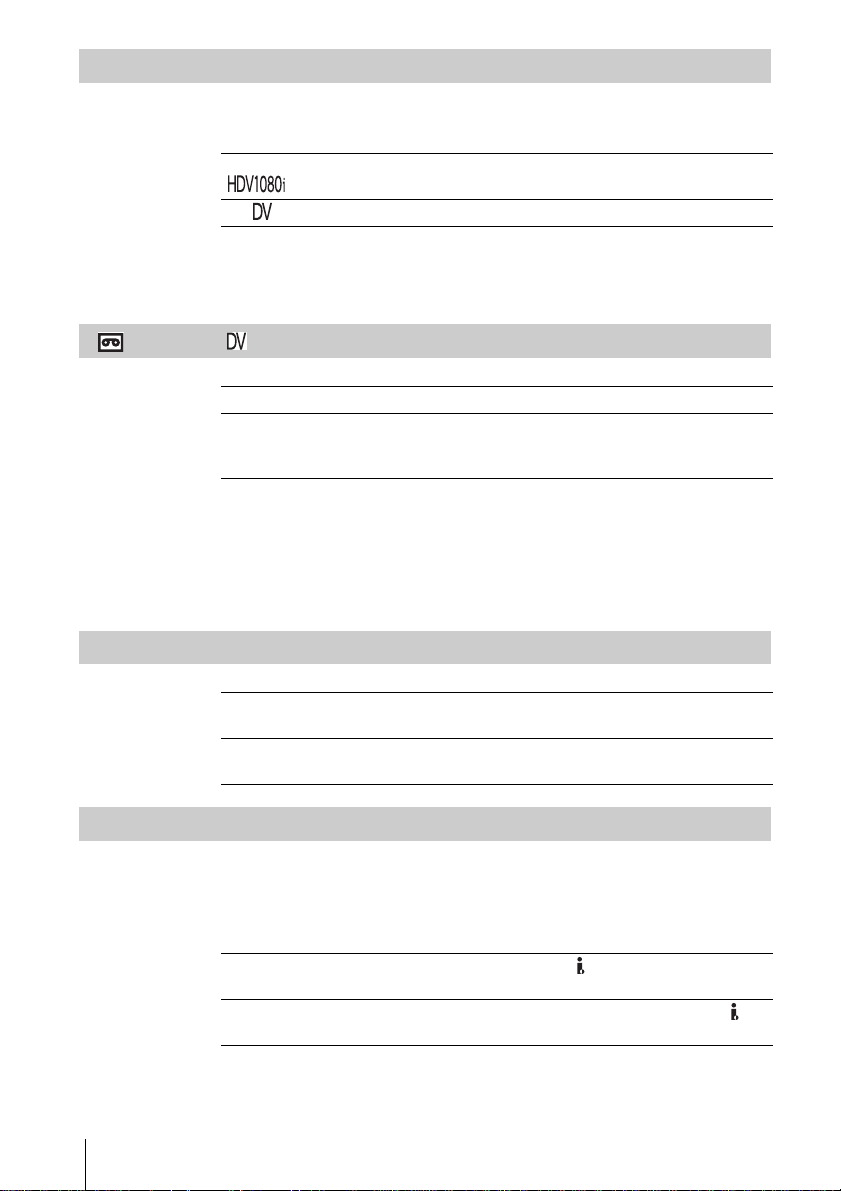
Using the Menu
60
REC FORMAT
Selects a recording format when the POWER switch is set at CAMERA. The
format lamp of the selected format will light up during recording.
z Tip
• When you output the picture during recording simultaneously to a connected device using
an i.LINK cable, also set [i.LINK CONV] accordingly (p. 60).
REC MODE
b Note
• You cannot add sound on a tape recorded in the LP mode.
• If you record in the LP mode, a random square noise may appear or sound may be
interrupted when you play back the tape on other camcorders or VCRs.
• When you mix recordings in the SP mode and in the LP mode on one tape, the playback
picture may be distorted or the time code may not be written properly between the scenes.
COMPONENT
i.LINK CONV
When the POWER switch is set to CAMERA, this setting is effective only when
[HDV1080i] is selected in [REC FORMAT].
When the POWER switch is set to VCR, this setting is effective only when
[AUTO] or [HDV] is selected in [VCR HDV/DV].
b Note
• See [VCR HDV/DV] for information about an input signal via an i.LINK connection.
GHDV1080i
()
Select to record in the HDV1080i specification.
DV ( ) Select to record in the DV format.
GSP ( SP ) Select to record in the SP (Standard Play) mode on a tape.
LP ( LP ) Select to increase the recording time to 1.5 times that of the SP mode
(Long Play). The use of Sony Excellence/Master mini DV cassettes is
recommended to get the most out of your camcorder.
480i Select when connecting your camcorder to a TV with the component
input jack.
G1080i/480i Select when connecting your camcorder to a TV that has the
component input jack and is capable of displaying the 1080i signal.
GOFF Select to output the pictures from the HDV/DV jack in accordance
with the [REC FORMAT] and [VCR HDV/DV] settings.
ON (HDVcDV) Select to always output the pictures in the DV format from the
HDV/DV jack.
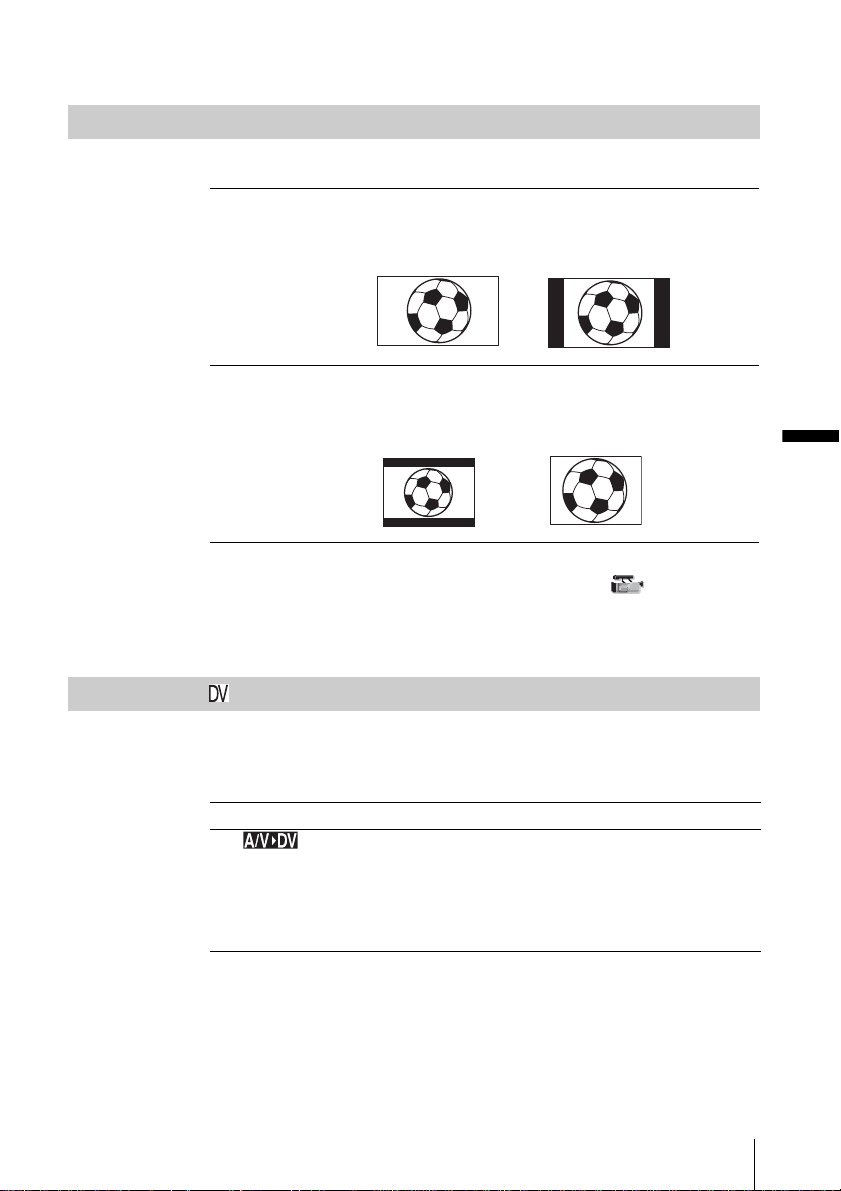
Using the Menu
Using the Menu
61
• Disconnect the i.LINK cable before setting [i.LINK CONV]. Otherwise, the connected
video device may not be able to recognize the video signal from this camcorder.
TV TYPE
You need to convert the signal depending on the TV connected.
z Tip
• When you view pictures recorded with [DV WIDE REC] on the (CAMERA SET)
menu set to [ON] on a 4:3 standard TV, pictures may appear as they are in height, but are
compressed in width depending on the TV. If you view the recorded pictures on such type
of 4:3 standard TV, set [DV WIDE REC] to [OFF] before recording.
A/V c DV OUT
You can connect a digital device and an analog device to your camcorder and
convert the signal transmitted from the connected devices to the appropriate signal
on your camcorder.
G16:9 Select to view your pictures on a 16:9 wide TV.
The recorded pictures will appear as follows:
4:3 Select to view your pictures on a 4:3 standard TV.
The recorded pictures will appear as follows:
GOFF Select when you are not using the Signal conversion function.
ON ( ) To output analog images and sound in digital format using your
camcorder.
The analog signal input to the AUDIO/VIDEO jack of your camcorder
will be converted and output from the i.LINK Interface of your
camcorder.
For details, see page 81.
When HDV pictures
are played back
When DV pictures
are played back
When HDV pictures
are played back
When DV pictures
are played back
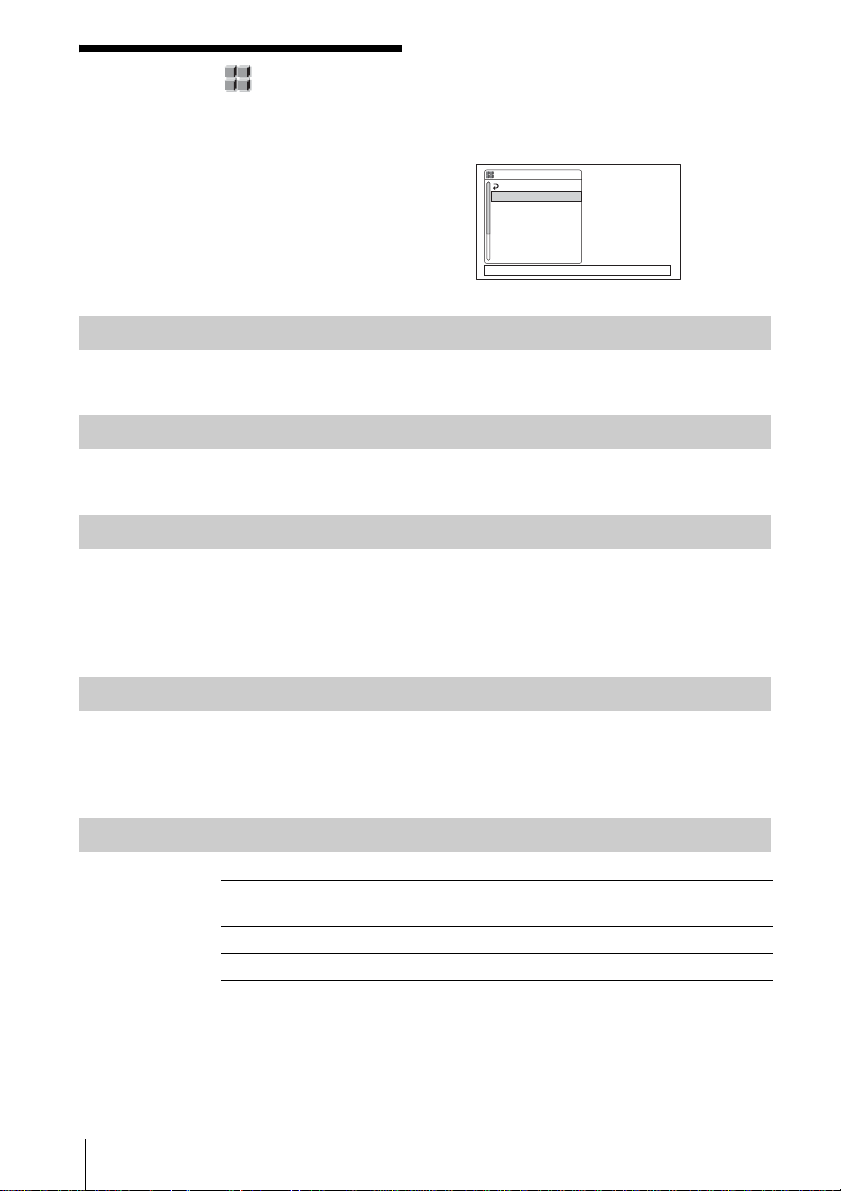
Using the Menu
62
Using the (OTHERS)
menu
– CLOCK SET/WORLD TIME,
etc.
You can select the items listed below on the
OTHERS menu. For details on how to select
these items, see “Selecting menu items” (p. 51).
The default settings are marked with G. The
indicators in parentheses appear when the
setting is selected. The settings you can adjust
vary depending on the power mode of your
camcorder. The screen shows the items you can
operate at the moment. Unavailable items will
be grayed out.
ASSIGN BTN
You can assign functions to the ASSIGN buttons (p. 68).
CLOCK SET
You can set the date and time (p. 16).
WORLD TIME
You can adjust the time difference when using your camcorder abroad. Set the
time difference by turning the SEL/PUSH EXEC dial, the clock will be adjusted
in accordance with the time difference. If you set the time difference to 0, the
clock returns to the originally set time.
LANGUAGE
You can select or change the language used for the on-screen display (p. 18). You
can select from English, Simplified English, Canadian-French, Latin American
Spanish, Brazilian-Portuguese, Traditional-Chinese, or Korean.
BEEP
OTHERS
RETURN
ASSIGN BTN
CLOCK SET
WORLD TIME
LANGUAGE
BEEP
FORMAT LAMP
DATA CODE
[
MENU
]
:END
GMELODY Select to play a melody when you start/stop recording, or when an
unusual condition occurs on your camcorder.
NORMAL Select to sound a beep instead of the melody.
OFF Select to cancel the melody, the beep sound, and the shutter sound.

Using the Menu
Using the Menu
63
REC LAMP
FORMAT LAMP
b Note
• The format lamp lights up according to the format of the playback or of an input signal from
another device when [VCR HDV/DV] on the (IN/OUT REC) menu is set to [AUTO].
IRIS DIAL
You can select the rotation direction of the iris dial to open or close the iris.
DATA CODE
Select the item to be displayed when you press DATA CODE (p. 44).
LETTER SIZE
GON Select to turn on the camera recording lamps on the front and rear of
your camcorder during recording.
OFF Select this setting in the following recording situations. The camera
recording lamps on the front and rear will not light up during
recording.
• When you do not want the subject to be nervous about being
recorded.
• When you are recording close to the subject.
• When the subject reflects the light of the recording lamp.
GON Select to turn on the format lamp. The lamp of the format that is
selected in [REC FORMAT] lights up when the POWER switch is set
to CAMERA. The lamp of the format that is selected in [VCR HDV/
DV] lights up when the POWER switch is set to VCR.
OFF Select when you do not want to turn on the format lamp. The i.LINK
lamp also does not light up.
GNORMAL Select to rotate clockwise when looked at from the lens side to close
the iris and decrease the light volume.
OPPOSITE Select to rotate counter clockwise when looked at from the lens side
to close the iris and decrease the light volume.
GDATE/CAM Select to display the date and time, or the camera settings data during
playback.
DATE Select to display the date and time during playback.
GNORMAL Select to display the menu screen at normal size.
2x Select to display the selected menu item at double the normal height.
,continued

Using the Menu
64
REMAINING
DISP OUTPUT
b Note
• You cannot input a signal to your camcorder if you press DISPLAY/BATT INFO while
[V-OUT/PANEL] is selected.
REMOTE CTRL
b Note
• The setting returns to [ON] when you have the power source disconnected from your
camcorder for more than 5 minutes.
GAUTO Select to display the remaining tape indicator for about 8 seconds:
• After you set the POWER switch to CAMERA or VCR with a
cassette inserted, and your camcorder calculates the remaining
amount of tape.
• After you press N (play) or DISPLAY/BATT INFO.
ON Select to always display the remaining tape indicator.
GLCD PANEL Select to show indicators such as the time code on the LCD screen and
in the viewfinder.
V-OUT/PANEL Select to show indicators such as the time code on the TV screen, LCD
screen, and in the viewfinder.
GON Select when using the Remote Commander supplied with your
camcorder.
OFF Select to deactivate the Remote Commander to prevent your
camcorder from responding to a command sent by another VCR
remote control unit.
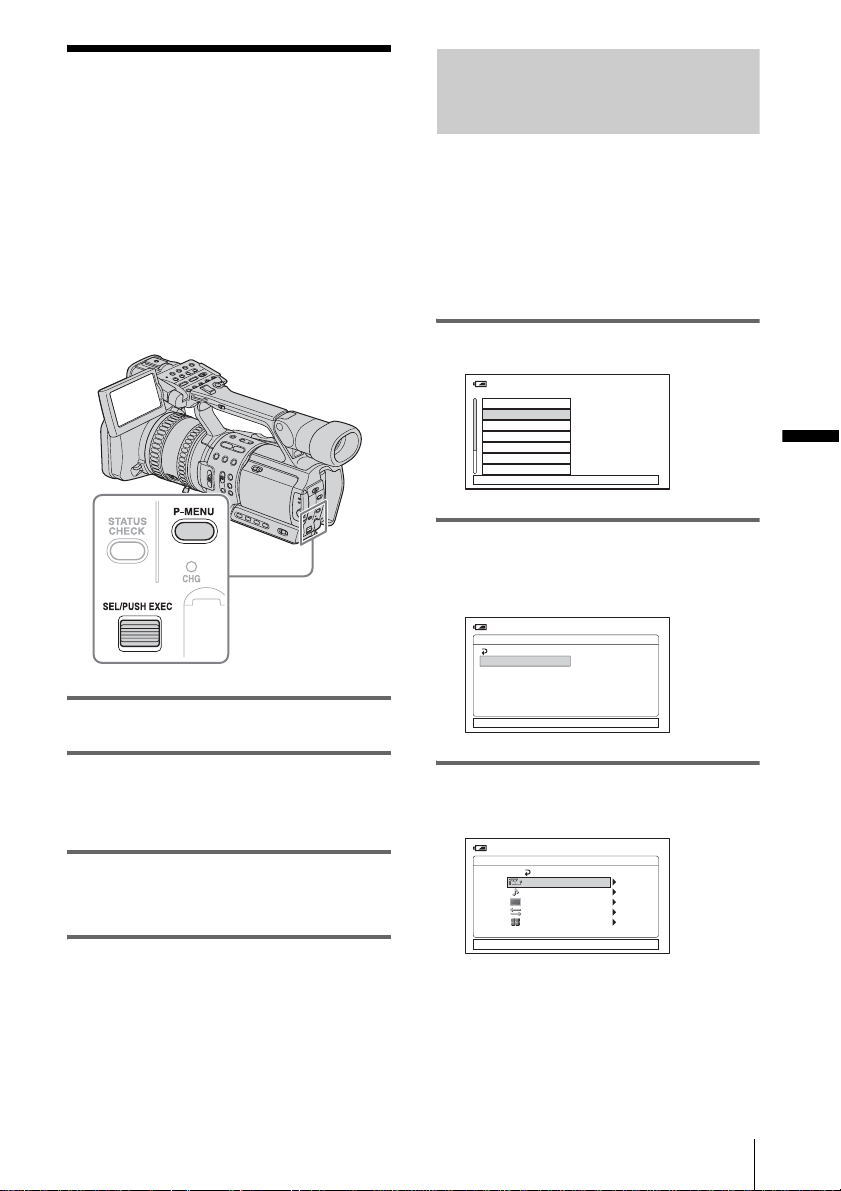
Using the Menu
Using the Menu
65
Customizing Personal
Menu
The available items vary depending on the
power mode of your camcorder.
Unavailable items will be grayed out.
You can add frequently used menu items to
Personal Menu, or sort them in the order you
like (customizing). You can customize the
Personal Menu for each power mode of your
camcorder.
1 Press P-MENU.
2 Select the desired item by turning the
SEL/PUSH EXEC dial, then press the
dial.
3 Select the desired setting by turning
the SEL/PUSH EXEC dial, then press
the dial.
Adding a menu – Add
You can add frequently used menu items to
Personal Menu for easier and faster access.
b Note
• You can add up to 28 menu items each for the
CAMERA and VCR modes. If you want to add
more, you must delete a less important menu item
before adding a new menu item (p. 66).
1 Press P-MENU.
2 Select [P-MENU SETUP] by turning
the SEL/PUSH EXEC dial, then press
the dial.
3 Select [ADD] by turning the SEL/
PUSH EXEC dial, then press the dial.
0:00:00120min STBY
[
P–MENU
]
:END
END
P–MENU
SHOT TRANS
REC FORMAT
AE RESPONSE
WB PRESET
GAIN SETUP
ASSIGN BTN
0:00:00120min STBY
P–MENU SETUP
RETURN
ADD
DELETE
SORT
RESET
[
P–MENU
]
:END
0:00:00120min STBY
[
P–MENU
]
:END
Select the category.
RETURN
CAMERA SET
AUDIO SET
LCD/VF SET
IN/OUT REC
OTHERS
,continued
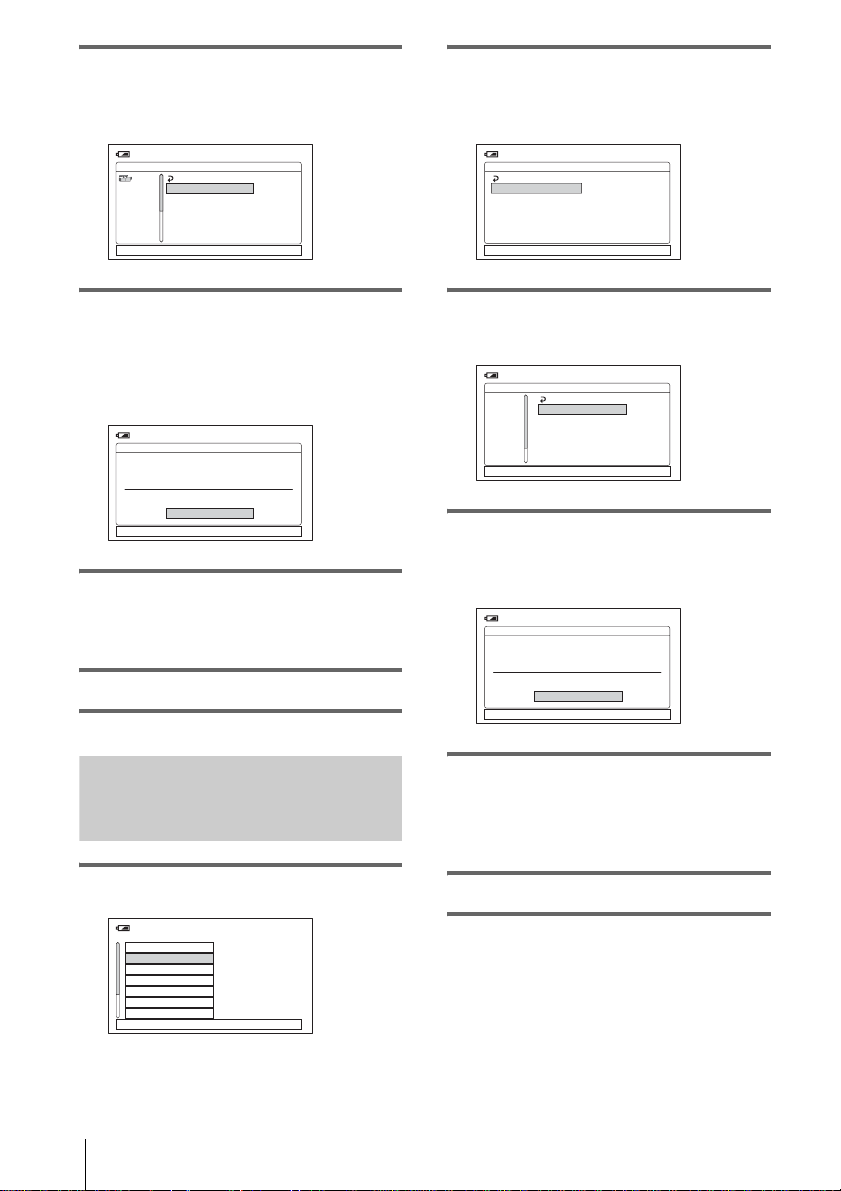
Using the Menu
66
4 Select a menu category by turning the
SEL/PUSH EXEC dial, then press the
dial.
5 Select a menu item by turning the SEL/
PUSH EXEC dial, then press the dial.
The available items vary depending on the
power mode of the camcorder.
Only the available items are displayed.
6 Select [YES] by turning the SEL/
PUSH EXEC dial, then press the dial.
The menu is added to the end of the list.
7 Press P-MENU.
Deleting menu – Delete
1 Press P-MENU.
2 Select [P-MENU SETUP] by turning
the SEL/PUSH EXEC dial, then press
the dial.
3 Select [DELETE] by turning the SEL/
PUSH EXEC dial, then press the dial.
4 Select the item that you want to delete
by turning the SEL/PUSH EXEC dial,
then press the dial.
5 Select [YES] by turning the SEL/
PUSH EXEC dial, then press the dial.
The selected menu is deleted from Personal
Menu.
6 Press P-MENU.
0:00:00120min STBY
[
P–MENU
]
:END
Select the item.
RETURN
WB PRESET
AE RESPONSE
GAIN SETUP
SHOT TRANS
STEADYSHOT
STDYSHOT TYP
0:00:00120min STBY
[
P–MENU
]
:END
ADD
YES
NO
STDYSHOT TYP
Add to CAMERA
mode's P–MENU?
0:00:00120min STBY
[
P–MENU
]
:END
END
P–MENU
SHOT TRANS
REC FORMAT
AE RESPONSE
WB PRESET
GAIN SETUP
ASSIGN BTN
0:00:00120min STBY
P–MENU SETUP
RETURN
ADD
DELETE
SORT
RESET
[
P–MENU
]
:END
0:00:00120min STBY
[
P–MENU
]
:END
Select item to delete.
RETURN
SHOT TRANS
ASSIGN BTN
REC FORMAT
AE RESPONSE
WB PRESET
GAIN SETUP
0:00:00120min STBY
[
P–MENU
]
:END
DELETE
YES
NO
AE RESPONSE
De l ete f r om CAMERA
mode's P–MENU?
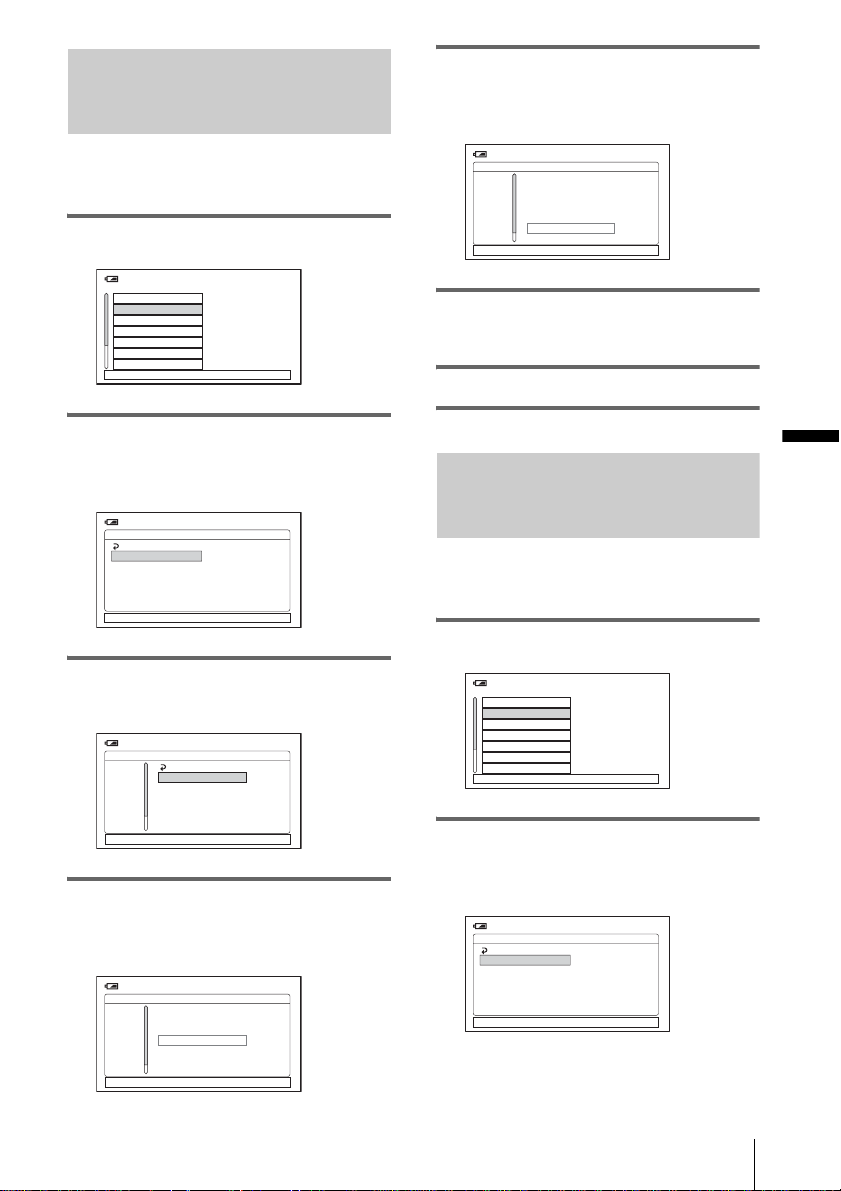
Using the Menu
Using the Menu
67
Arranging the order of menus
displayed on Personal Menu
– Sort
You can sort the menus added to Personal Menu
in the desired order.
1 Press P-MENU.
2 Select [P-MENU SETUP] by turning
the SEL/PUSH EXEC dial, then press
the dial.
3 Select [SORT] by turning the SEL/
PUSH EXEC dial, then press the dial.
4 Select the menu item you want to move
by turning the SEL/PUSH EXEC dial,
then press the dial.
5 Move the menu item to the desired
place by turning the SEL/PUSH EXEC
dial.
6 Press the SEL/PUSH EXEC dial.
To sort more items, repeat steps 4 to 6.
7 Press P-MENU.
Initializing the settings – Reset
You can initialize Personal Menu to the default
settings after adding or deleting menus.
1 Press P-MENU.
2 Select [P-MENU SETUP] by turning
the SEL/PUSH EXEC dial, then press
the dial.
0:00:00120min STBY
[
P–MENU
]
:END
END
P–MENU
SHOT TRANS
REC FORMAT
AE RESPONSE
WB PRESET
GAIN SETUP
ASSIGN BTN
0:00:00120min STBY
P–MENU SETUP
RETURN
ADD
DELETE
SORT
RESET
[
P–MENU
]
:END
0:00:00120min STBY
[
P–MENU
]
:END
Select i tem to move.
RETURN
SHOT TRANS
ASSIGN BTN
REC FORMAT
AE RESPONSE
WB PRESET
GAIN SETUP
1
2
3
4
5
6
0:00:00120min
[
P–MENU
]
:END
Select new locat ion.
SHOT TRANS
ASSIGN BTN
REC FORMAT
AE RESPONSE
WB PRESET
GAIN SETUP
ZEBRA LEVEL
1
2
3
4
5
6
7
STBY
0:00:00120min
[
P–MENU
]
:END
Select new locat ion.
SHOT TRANS
ASSIGN BTN
REC FORMAT
WB PRESET
GAIN SETUP
AE RESPONSE
ZEBRA LEVEL
1
2
3
4
5
6
7
STBY
0:00:00120min STBY
[
P–MENU
]
:END
END
P–MENU
SHOT TRANS
REC FORMAT
AE RESPONSE
WB PRESET
GAIN SETUP
ASSIGN BTN
0:00:00120min STBY
P–MENU SETUP
RETURN
ADD
DELETE
SORT
RESET
[
P–MENU
]
:END
,continued
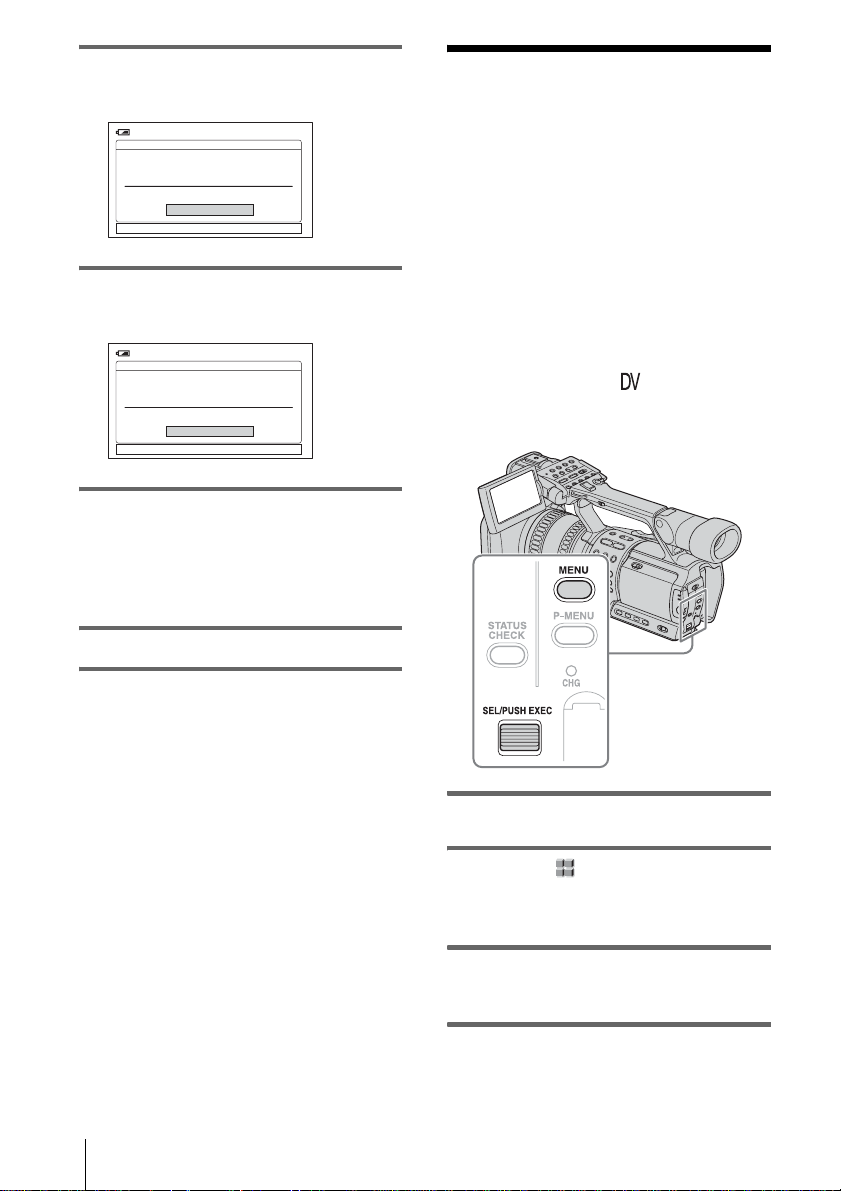
Using the Menu
68
3 Select [RESET] by turning the SEL/
PUSH EXEC dial, then press the dial.
4 Select [YES] by turning the SEL/
PUSH EXEC dial, then press the dial.
5 Select [YES] by turning the SEL/
PUSH EXEC dial, then press the dial.
The Personal Menu settings return to the
default settings.
To cancel initialization, select [NO].
6 Press P-MENU.
Assigning the
functions
Depending on the functions, you need to assign
them to the ASSIGN buttons to use them. You
can assign single function to each ASSIGN 1/2/
3 button.
Functions you can assign to the ASSIGN
buttons
• [FADER] (p. 38)
• [STEADYSHOT]
• [INDEX SAVE] (p. 39)
• [AUDIO DUB] (p. 79)
• [DISPLAY] (p. 44)
• [BARS] (p. 21)
1 Press MENU.
2 Select the (OTHERS) menu by
turning SEL/PUSH EXEC dial, then
press the dial.
3 Select [ASSIGN BTN] by turning SEL/
PUSH EXEC dial, then press the dial.
4 Select the number of the ASSIGN
button you want to assign the function
0:00:00120min
[
P–MENU
]
:END
RESET
YES
NO
Initialize
CAMERA mode's
P–MENU se t t i ng?
STBY
0:00:00120min
[
P–MENU
]
:END
RESET
YES
NO
Are you sure?
STBY

Using the Menu
Using the Menu
69
by turning SEL/PUSH EXEC dial,
then press the dial.
[ASSIGN1] through [ASSIGN3] are
available. [------] is displayed at the number
that no function is assigned.
5 Select the function to be assigned by
turning SEL/PUSH EXEC dial, then
press the dial.
6 Select [OK] by turning SEL/PUSH
EXEC dial, then press the dial.
7 Press MENU to hide the menu.
z Tip
• When you press the ASSIGN button assigned to the
[STEADYSHOT], the SteadyShot function is
released and appears on the LCD screen. To
activate the SteadyShot fucntion, press the same
button again. You can select the effect level of the
SteadyShot function at [STDYSHOT TYP] on the
(CAMERA SET) menu (p. 54).
• There are independent buttons of DISPLAY and
BARS, however you can assign them also to the
ASSIGN buttons at your convenience. You can use
both buttons.
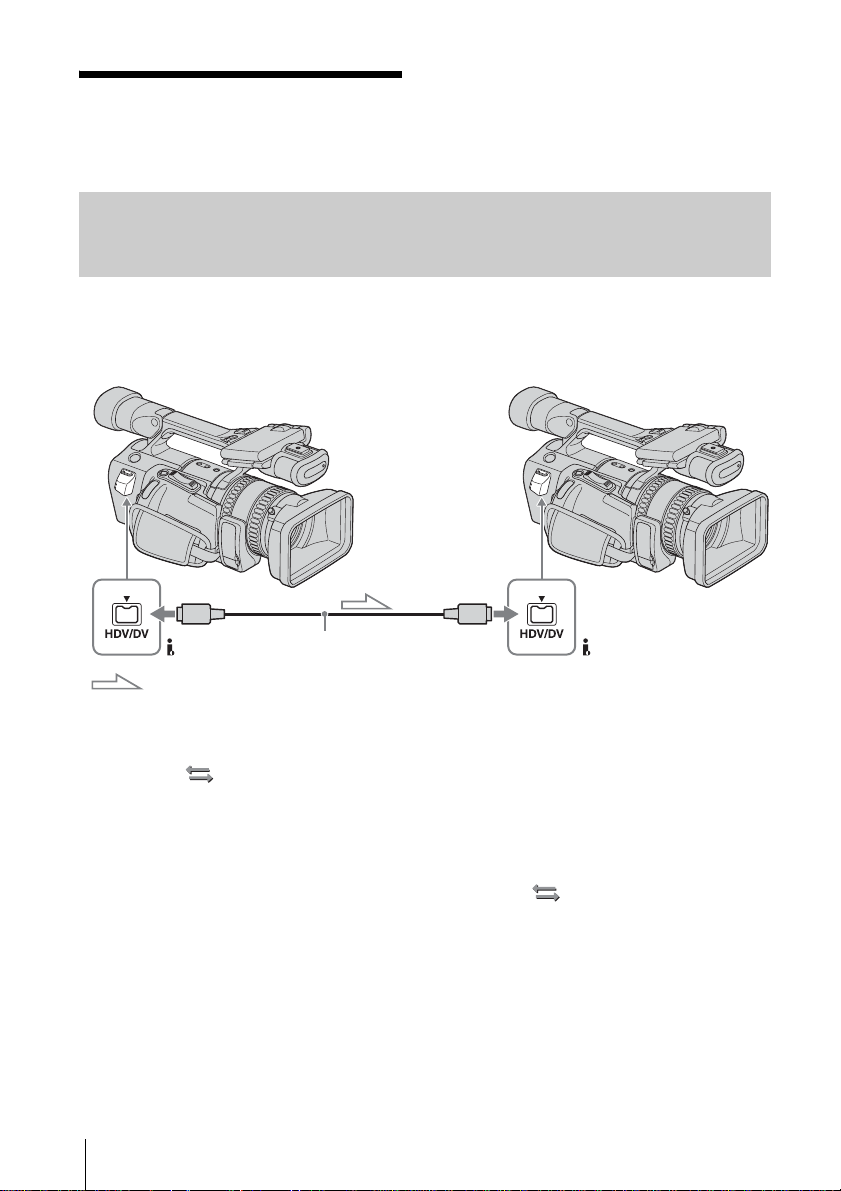
Dubbing/Editing
70
Dubbing/Editing
Dubbing to another
tape
You can copy a picture played back on your
camcorder to other recording devices (such
as VCRs).
Connect your camcorder to a VCR as shown
in the following illustration.
Connecting a VCR
To dub to an HDV compatible device
Connect your camcorder to an HDV compatible
device using an i.LINK cable (optional).
To select the video format to be dubbed
The video format to be dubbed depends on the
settings of [VCR HDV/DV] and [i.LINK
CONV] on the (IN/OUT REC) menu.
Before setting these menu items, disconnect the
i.LINK cable.
• Pictures will be dubbed in the recorded format
when [VCR HDV/DV] is set to [AUTO] and
[i.LINK CONV] is set to [OFF].
• Pictures, including those recorded in the HDV
format, will be dubbed in the DV format when
[VCR HDV/DV] is set to [AUTO], and
[i.LINK CONV] is set to [ON].
• Only pictures in the selected format will be
dubbed when [VCR HDV/DV] is set to
[HDV] or [DV]. Other pictures will be dubbed
as blank portions, so neither picture nor sound
will be dubbed.
b Note
• If you change the settings of [VCR HDV/DV] and
[i.LINK CONV] with the i.LINK cable connected,
the video device may not be able to recognize the
video signal from the camcorder at the time of
dubbing.
• When [VCR HDV/DV] is set to [AUTO] and the
signal switches between HDV and DV, the picture
and sound disappear temporarily.
• When the recorder is an HDR-FX1, set [VCR HDV/
DV] on the (IN/OUT REC) menu to [AUTO]
on the recording HDR-FX1 (p. 74).
i.LINK cable (optional)
Signal flow
HDV/DV jack
Recorder
HDV/DV jack
Player
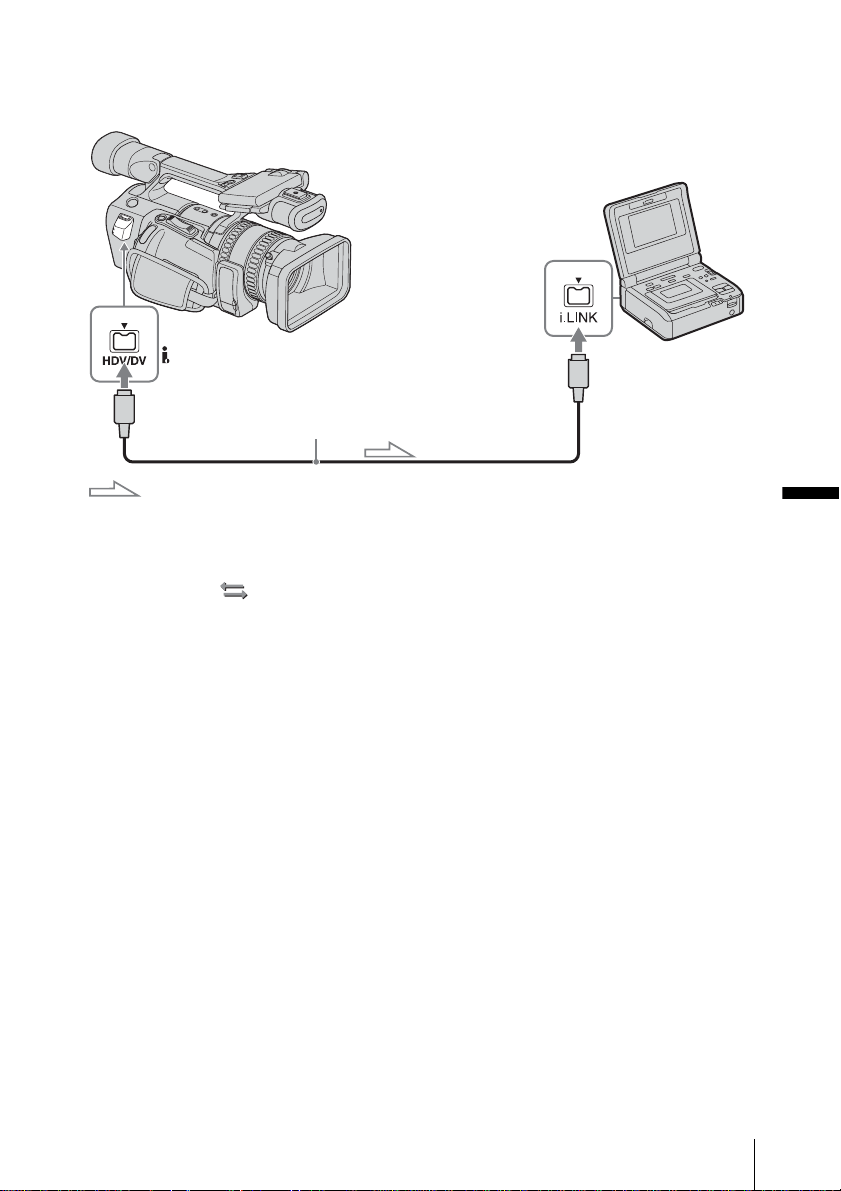
Dubbing/Editing
Dubbing/Editing
71
To dub to a DV device
Connect your camcorder to a VCR using an
i.LINK cable (optional).
To select the video format to be dubbed
The video format to be dubbed depends on the
settings of [VCR HDV/DV] (p. 59) and [i.LINK
CONV] (p. 60) in the (IN/OUT REC)
menu. Before setting these menu items,
disconnect the i.LINK cable.
• Pictures, including those recorded in the HDV
format, will be dubbed in the DV format when
[VCR HDV/DV] is set to [AUTO] and
[i.LINK CONV] is set to [ON].
• If the tape was recorded with the HDV and
DV formats mixed, set [VCR HDV/DV] to
[DV] to dub only pictures in the DV format.
Pictures in the HDV format will be dubbed as
blank portions, so neither picture nor sound
will be dubbed.
b Note
• If you change the settings of [VCR HDV/DV] and
[i.LINK CONV] with the i.LINK cable connected,
the video device may not be able to recognize the
video signal from the camcorder at the time of
dubbing.
• If [i.LINK CONV] is set to [OFF] while [VCR
HDV/DV] is set to [AUTO], pictures recorded in the
HDV mode will be recorded as blank portions, so
neither picture nor sound will be recorded.
• When [VCR HDV/DV] is set to [HDV], the
connected DV device cannot recognize pictures, so
pictures will be dubbed as blank portions.
• When [VCR HDV/DV] is set to [AUTO] and the
signal switches between HDV and DV, the picture
and sound disappear temporarily.
i.LINK cable (optional)
HDV/DV jack
Signal flow
i.LINK jack
i.LINK compatible
devices
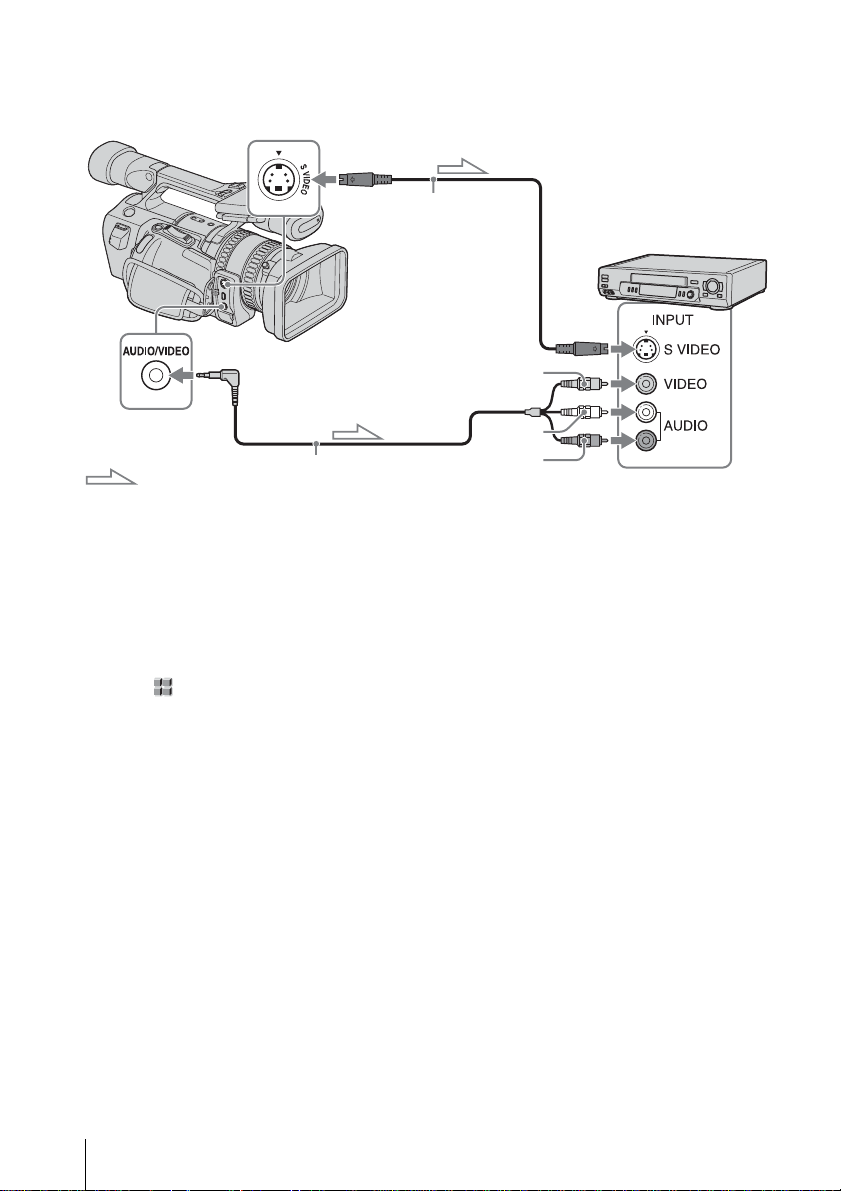
Dubbing/Editing
72
To dub to an AV device
Connect your camcorder to a VCR using the A/
V connecting cable (supplied).
* When there is an S video jack on the device to be
connected, connect an S video cable (optional) to
that jack instead of using the yellow video plug of
the A/V connecting cable (supplied). This
connection produces higher quality DV format
pictures. The audio will not be output if you connect
with the S video cable alone.
b Note
• Select the (OTHERS) menu, [DISP OUTPUT],
then [LCD PANEL] (the default setting) (p. 64).
• When you connect your camcorder to a monaural
device, connect the yellow plug of the A/V
connecting cable to the video jack, and the red or the
white plug to the audio jack on the VCR or the TV.
z Tip
• To record the date/time and camera settings data,
first have them displayed on screen (p. 44).
A/V connecting cable
(supplied)
Signal flow
VCRs
AUDIO/VIDEO jack
Yellow
Red
White
When you have an S video jack on
your VCR *
S video cable
(optional)

Dubbing/Editing
Dubbing/Editing
73
Dubbing to another tape
1 Connect the recording device to your
camcorder (p. 70).
2 Prepare the recording device.
• Insert a cassette for recording.
• If the recording device has an input
selector, set it to the input mode.
3 Prepare your camcorder for playback.
• Insert the recorded cassette.
• Set the POWER switch to VCR.
4 Start the playback on your camcorder,
and record it on the VCR.
Refer to the operating instructions supplied
with your VCR for details.
5 When the dubbing is finished, stop
your camcorder and the VCR.
b Note
• When you use an i.LINK cable, the recorded picture
becomes rough when a picture is paused on your
camcorder while recording it to a VCR.
• Pictures recorded in the HDV format are not output
from the HDV/DV jack during playback pause or
in playback modes other than normal playback.
• When you use an i.LINK cable, you cannot record
the picture and sound separately.
z Tip
• The i.LINK lamp, HDV or DV, on the HDV/DV
jack holder will light up and indicate the format of
the output signal when you use an i.LINK cable.
• When you use an i.LINK cable, the video and sound
signals are transmitted digitally, producing high
quality pictures.
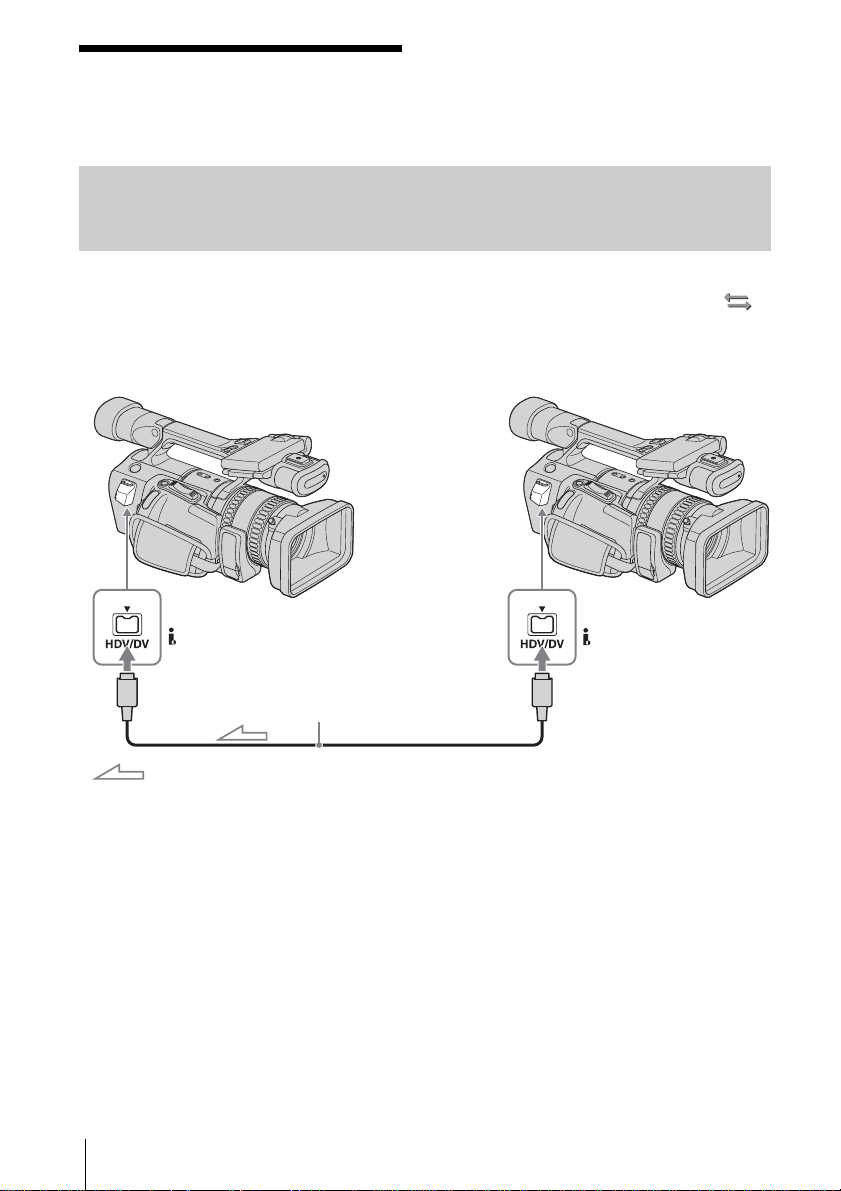
Dubbing/Editing
74
Recording pictures
from a VCR or TV
You can record pictures or TV programs
from a VCR or TV on a tape inserted in your
camcorder.
Connecting a VCR or TV
To record from an HDV compatible device
You can record and edit pictures from an HDV
compatible VCR. Use your camcorder as a
recorder and connect it to an HDV compatible
device using an i.LINK cable (optional).
On this camcorder (recorder), select the
(IN/OUT REC) menu, [VCR HDV/DV], then
[AUTO] (p. 59) before connecting.
b Note
• In case of digital broadcasting, you may not be
allowed to record some programs for copyright
reasons (p. 91).
i.LINK cable (optional)
Signal flow
Player
HDV/DV jack
Recorder
HDV/DV jack
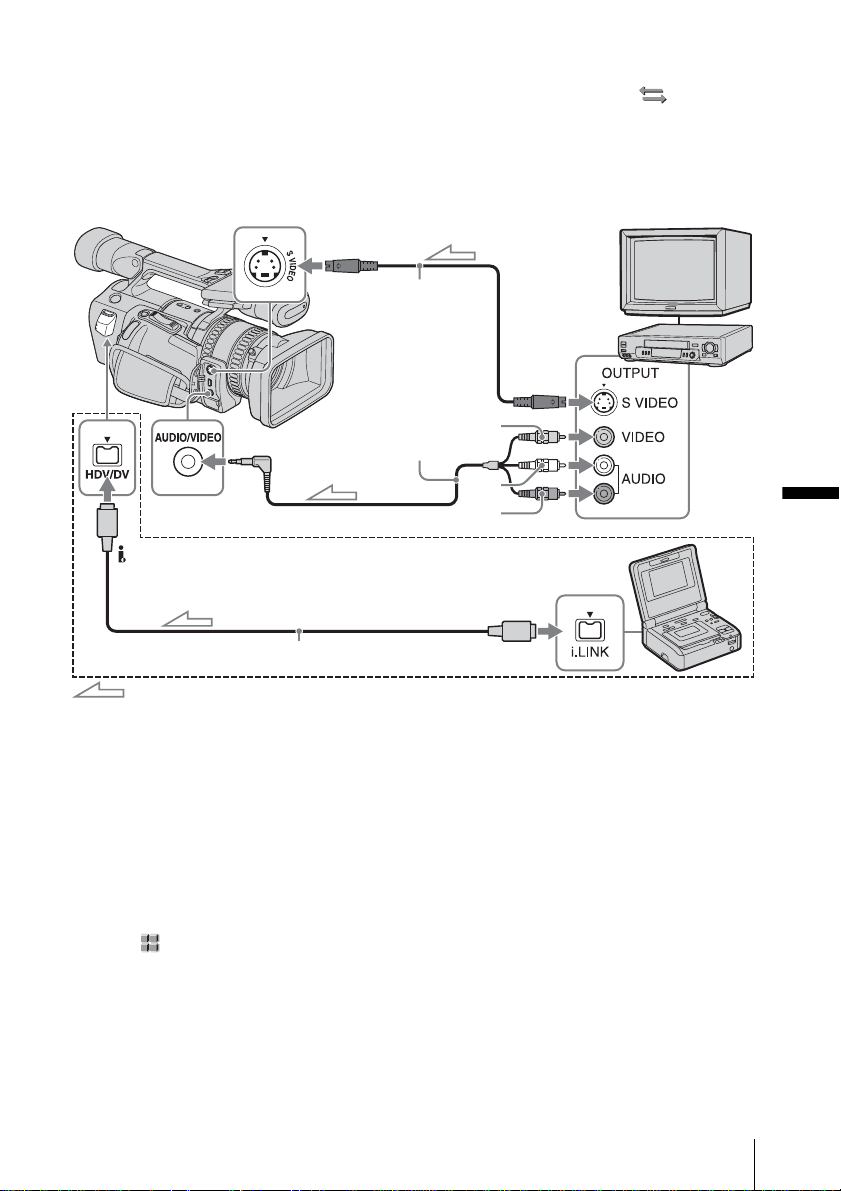
Dubbing/Editing
Dubbing/Editing
75
To record from a DV/AV device
You can record and edit pictures or TV
programs from a VCR or TV. Use your
camcorder as a recorder and connect it to a VCR
using the A/V connecting cable (supplied). You
can connect a DV compatible device also using
an i.LINK cable (optional).
When you use an i.LINK cable to connect a DV
compatible device, select the (IN/OUT
REC) menu, [VCR HDV/DV], then [DV] or
[AUTO] (p. 59) before connecting.
* When there is an S video jack on the device to be
connected, connect an S video cable (optional) to
that jack instead of using the yellow video plug of
the A/V connecting cable (supplied). This
connection produces higher quality DV format
pictures. The audio will not be output if you connect
with the S video cable alone.
b Note
• You can record pictures from DV/AV devices only
in the DV format.
• When you use the A/V connecting cable (supplied),
select the (OTHERS) menu, [DISP OUTPUT],
then [LCD PANEL] (the default setting) (p. 64).
• When you connect your camcorder to a monaural
device, connect the yellow plug of the A/V
connecting cable to the video jack, and the red or the
white plug to the audio jack on the VCR or the TV.
Only the sound from the connected plug is recorded.
• When a 4:3 video signal is input, it appears with
black bands on the right and left sides on the screen
of your camcorder.
z Tip
• If the recording device has an i.LINK jack, it is
recommended to connect it using an i.LINK cable
(optional).
A/V connecting
cable (supplied)
i.LINK cable (optional)
HDV/DV jack
Signal flow
i.LINK jack
VCRs or TVs
Yellow
Red
White
When you have an S video jack on
your TV or VCR *
S video cable
(optional)
Connecting with an i.LINK cable
AUDIO/VIDEO
jack
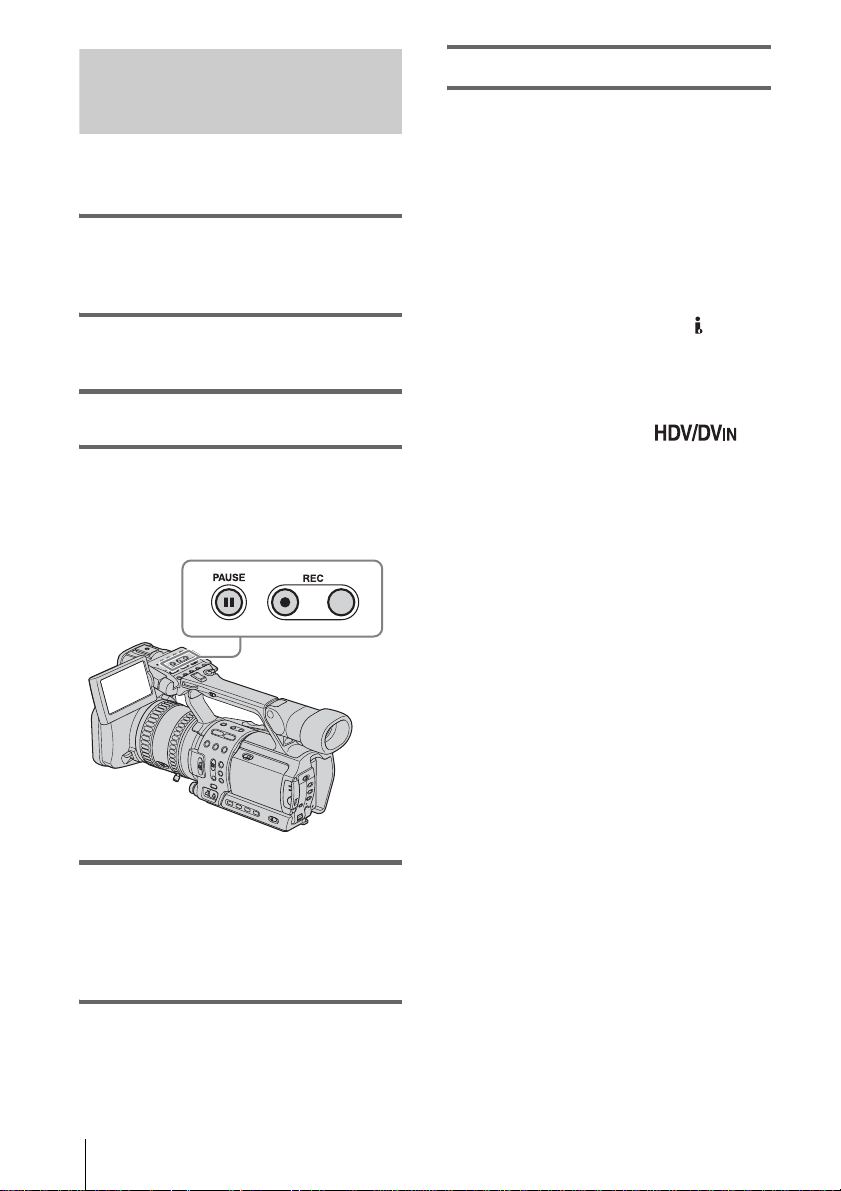
Dubbing/Editing
76
Recording movies
Insert a cassette for recording in your camcorder
before the following operations.
1 Connect your TV or VCR to your
camcorder as a playback device
(p. 74).
2 If you are recording from a VCR,
insert a cassette.
3 Set the POWER switch to VCR.
4 Set your camcorder to recording
pause.
While pressing X (pause), press both z
REC (record) buttons simultaneously.
5 Start playing the cassette on your
VCR, or select a TV program.
The picture played on the connected device
appears on the LCD screen of your
camcorder.
6 Press X (pause) again at the point you
want to start recording.
7 Press x (stop) to stop recording.
b Note
• When you use an i.LINK cable, the recorded picture
becomes rough when a picture is paused on your
VCR.
• When you use an i.LINK cable, you cannot record
the picture and sound separately.
• When you use an i.LINK cable, if you pause or stop
the recording and restart it, the picture may not be
recorded smoothly.
z Tip
• The i.LINK lamp, HDV or DV, on the HDV/DV
jack holder will light up and indicate the format of
the input signal when you use an i.LINK cable.
• When you use an i.LINK cable, the video and sound
signals are transmitted digitally, producing high
quality pictures.
• When you use an i.LINK cable,
appears during recording. This indicator may appear
on the screen of the playback device, however they
will not be recorded.
• Index signals are automatically recorded on the tape
during recording. You can also record index signals
at the desired positions during recording by pressing
the ASSIGN button assigned to the index function
(p. 39).
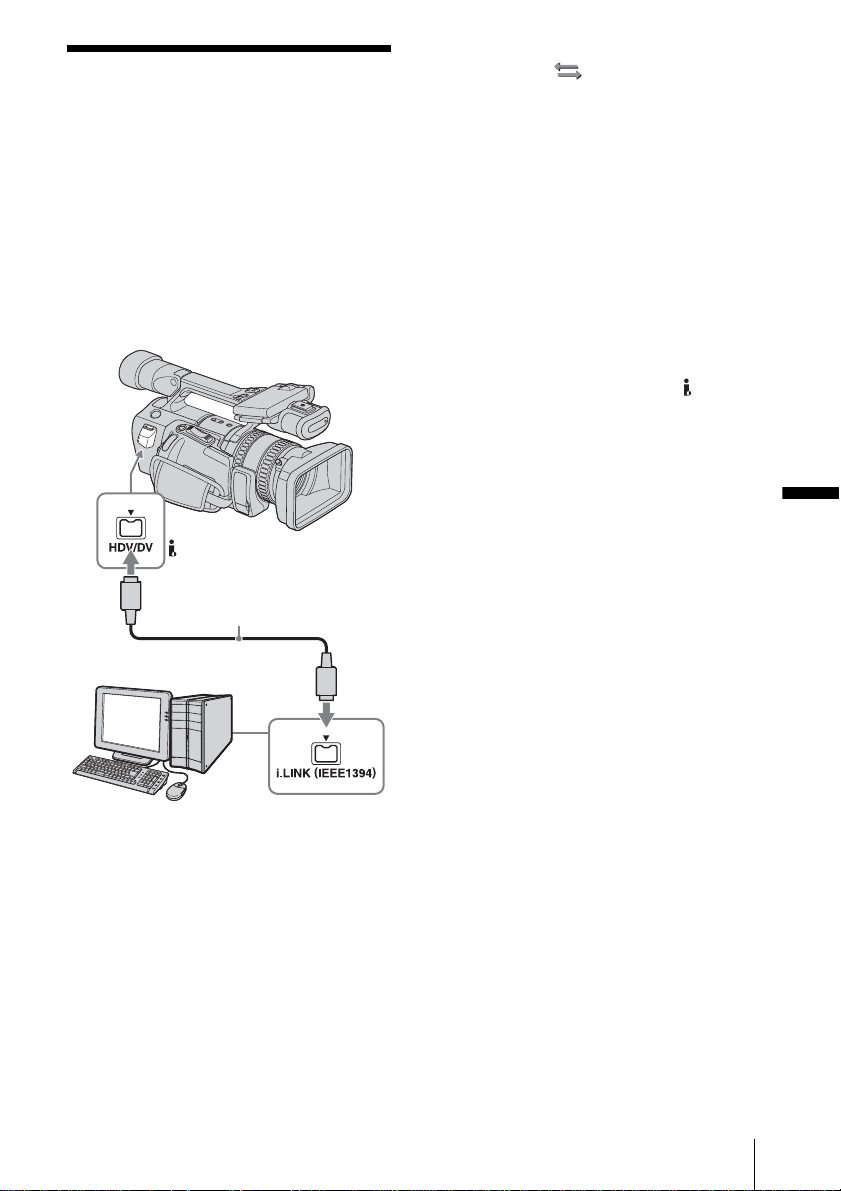
Dubbing/Editing
Dubbing/Editing
77
Connecting to a
computer
To use your camcorder by connecting it to a
computer using an i.LINK cable, the computer
must have an i.LINK interface, and application
software to read video signals must be installed
on the computer.
Refer to the manual supplied with the
application software for the system
requirements of the computer.
Connecting the computer
• Before connecting your camcorder to the
computer with an i.LINK cable, be sure to
insert the connector plug in the proper
direction. If you insert the connector plug
forcibly in the wrong direction, the terminal
may be damaged, or this may cause a
malfunction of your camcorder.
• Connect the i.LINK cable to the computer
first, then to your camcorder. Connecting in
the opposite order may cause static electricity
to build up, resulting in a malfunction of your
camcorder.
• Be sure to set [VCR HDV/DV] and [i.LINK
CONV] on the (IN/OUT REC) menu
before connecting the i.LINK cable. If you
connect the i.LINK cable first, the computer
may hang up or may not recognize the signal
from your camcorder.
b Note
• Connect a computer that can handle the signal of the
format indicated by the i.LINK lamps. If you
connect a computer that cannot handle the signal, the
computer may hang up or may not recognize the
signal from your camcorder.
• Disconnect the i.LINK cable before resetting [REC
FORMAT] when the POWER switch is set to
CAMERA. Otherwise, the computer may hang up.
z Tip
• The i.LINK lamp, HDV or DV, on the HDV/DV
jack holder will light up and indicate the format of
the input signal when you use an i.LINK cable.
To import pictures on a tape to the
computer
• To scan pictures recorded in the HDV format
on the tape in the HDV format, set [VCR
HDV/DV] to [HDV] (p. 59) and [i.LINK
CONV] to [OFF] (p. 60).
• To scan pictures recorded in the DV format on
the tape in the DV format, set [VCR HDV/
DV] to [DV] (p. 59).
• To scan pictures recorded in the HDV format
on the tape in the DV format, set [VCR HDV/
DV] to [HDV] (p. 59) and [i.LINK CONV] to
[ON] (p. 60).
b Note
• Pictures may not be imported correctly depending
on the application software of the computer.
• You cannot import pictures recorded in the DV
format in the HDV format.
To import pictures from the computer to
your camcorder
In the HDV format
Set [VCR HDV/DV] to [HDV] (p. 59) and
[i.LINK CONV] to [OFF] (p. 60).
In the DV format
Set [VCR HDV/DV] to [DV] (p. 59).
HDV/DV jack
i.LINK cable (optional)
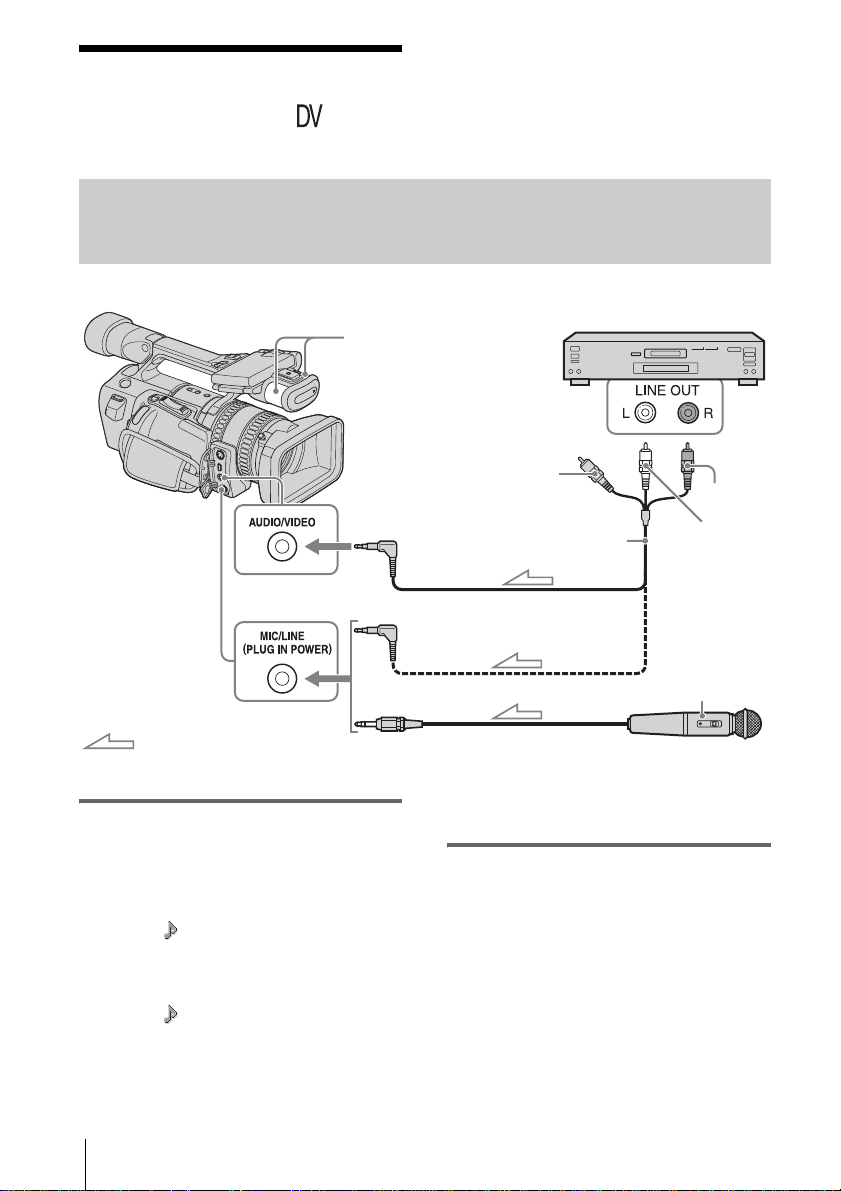
Dubbing/Editing
78
Dubbing sound to a
recorded tape
You can record additional audio to the
original sound on a tape recorded in the DV
format. You can add sound to a tape already
recorded in the 12-bit mode without erasing
the original sound.
Preparing for audio dubbing
Record audio in one of the following ways.
• Using the internal microphone (no connection
required).
• Connecting a microphone (optional) to the
MIC/LINE jack. (A)
Select the (AUDIO SET) menu, [MIC/
LINE IN], then [EXT MIC] (p. 57).
• Connecting an audio device (optional) to the
MIC/LINE jack. (B)
Select the (AUDIO SET) menu, [MIC/
LINE IN], then [LINE] (p. 57).
• Connecting an audio device to the AUDIO/
VIDEO jack. (C)
The audio input to be recorded takes precedence
in the order of MIC/LINE jack t AUDIO/
VIDEO jack t internal microphone.
b Note
• When you use the AUDIO/VIDEO jack or the
internal microphone to record additional sound, the
picture will not be output from the AUDIO/VIDEO
jack. Check the picture on the LCD screen or the
viewfinder, and the sound on the headphones.
• You cannot record additional audio:
– When the tape is recorded in the HDV format.
– When the tape is recorded in the 16-bit mode.
– When the tape is recorded in the LP mode.
– When your camcorder is connected using an
i.LINK cable.
BMIC (PLUG IN POWER)/LINE
jack
Microphone (optional)
A/V connecting cable
(supplied)
Internal microphone
Signal flow
CAUDIO/VIDEO jack
Audio device (such as
CD/MD players)
Do not connect the
Video plug (yellow).
Audio output jacks
Audio R
(red)
Audio L
(white)
AMIC (PLUG IN POWER)/LINE jack
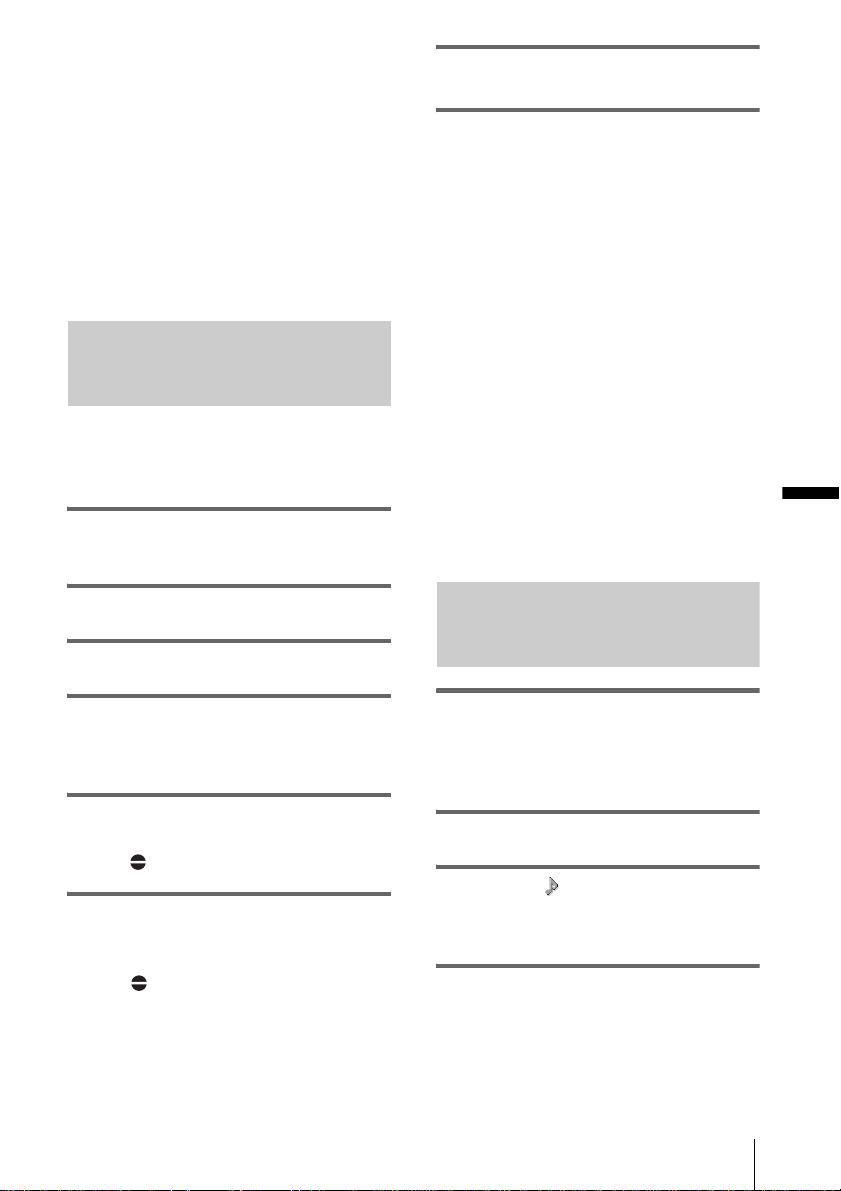
Dubbing/Editing
Dubbing/Editing
79
– On blank sections of the tape.
– When the write-protect tab of the cassette is set to
SAVE.
– On the tape recorded on another device with a 4ch
microphone (4CH MIC REC).
• When you use an external microphone (optional) to
record additional audio, you can check the picture
and the sound by connecting your camcorder to a TV
using the A/V connecting cable. However, sound
you have recorded afterwards is not output from the
speaker. Check the sound by using headphones or a
TV.
• The sound from a monaural device connected to the
MIC/LINE jack is recorded in the L channel.
Recording sound
Assign the audio dubbing function to one of the
ASSIGN buttons in advance. See page 68 for
details on how to assign a function.
1 Insert a recorded cassette into your
camcorder.
2 Set the POWER switch to VCR.
3 Press N (play) to play the tape.
4 Press X (pause) at the point where you
want to start recording the sound.
The playback pauses.
5 Press the ASSIGN button assigned to
audio dubbing.
The X mark appears on the LCD screen.
6 Press X (pause) and start playing back
the audio you want to record at the
same time.
The mark remains on the LCD screen
while sound is recorded.
The new sound is recorded in stereo 2
(ST2).
7 Press x (stop) when you want to stop
recording.
To set the end point for audio dubbing
During playback, press ZERO SET MEMORY
at the scene at which you want to stop audio
dubbing. Then, perform steps 4 to 6. The
recording stops automatically at the selected
scene.
b Note
• You can only record additional audio over a tape
recorded on your camcorder. The sound may
deteriorate when you dub audio on a tape recorded
on other camcorders (including other HDR-FX1
camcorders).
z Tip
• You can manually adjust the microphone volume
when you are:
– Recording sound from an external microphone or
audio device connected to the MIC/LINE jack.
– Recording sound from a device connected to the
AUDIO/VIDEO jack.
– Recording sound using the internal microphone.
Checking and adjusting the
recorded sound
1 Play back the tape on which you have
recorded audio following the
procedures in “Recording sound”
(p. 79).
2 Press MENU.
3 Select the (AUDIO SET) menu by
turning the SEL/PUSH EXEC dial,
then press the dial.
4 Select [AUDIO MIX] by turning the
SEL/PUSH EXEC dial, then press the
dial.
,continued

Dubbing/Editing
80
5 Turn the SEL/PUSH EXEC dial to
adjust the balance between the original
sound (ST1) and the sound recorded
afterwards (ST2), then press the dial.
The original sound (ST1) is output in the
default setting.
The adjusted audio balance returns to the
default setting about 5 minutes after the
battery pack or other power sources have
been disconnected.
6 Press MENU to hide the menu screen.
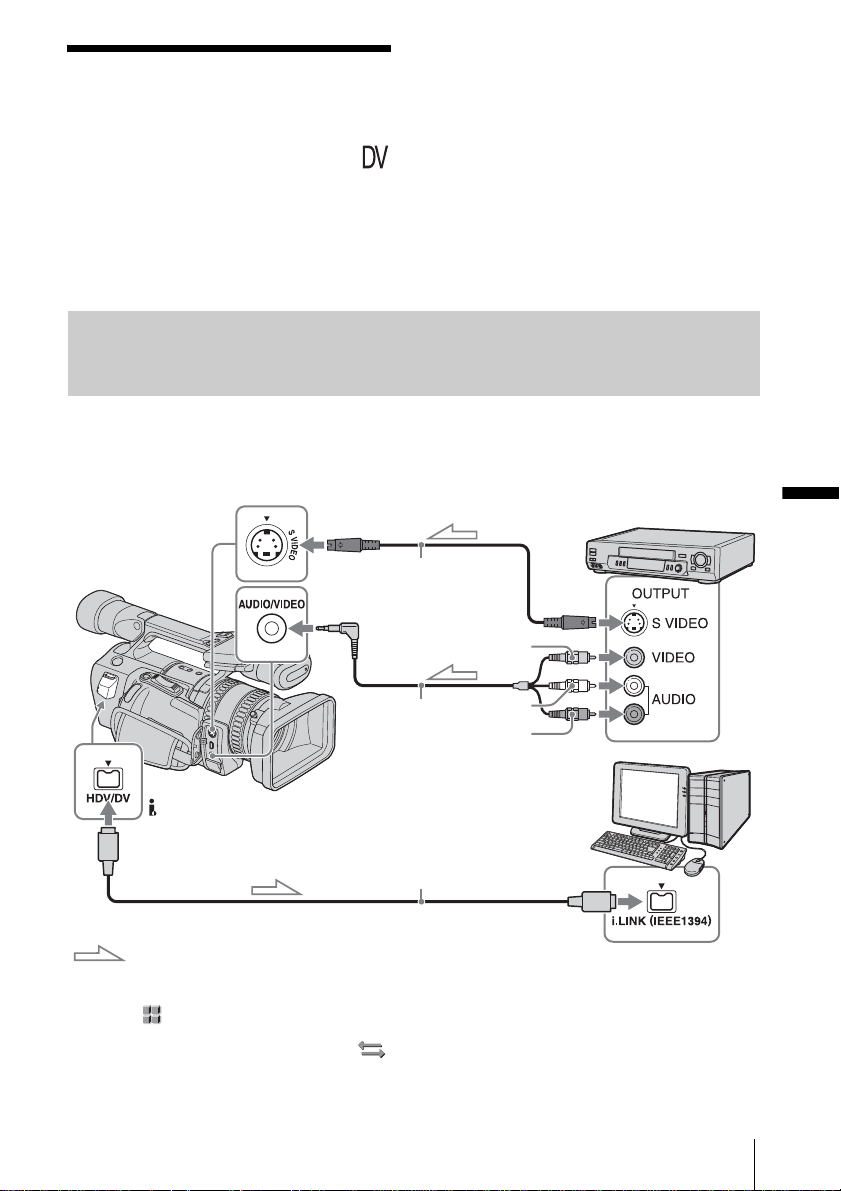
Dubbing/Editing
Dubbing/Editing
81
Connecting an analog
VCR to the computer
via your camcorder
– Signal conversion function
Connect an analog video device to your
camcorder using the A/V connecting cable
(supplied), and a digital device such as a
computer to your camcorder using an i.LINK
cable (optional). Your camcorder converts
the analog video signal from the VCR to a
digital signal and transmits it to the computer
to be dubbed.
To use the signal conversion function,
application software to import video signals
must be installed on the computer.
Connecting a compuer
Refer to the manual supplied with the
application software for the system
requirements of the computer.
b Note
• Select the (OTHERS) menu, [DISP OUTPUT],
then [LCD PANEL] (the default setting) (p. 64).
• Before connecting the i.LINK cable, select the
(IN/OUT REC) menu, [VCR HDV/DV], then [DV]
(p. 59). If you do this operation with the i.LINK
cable connected, the computer may hang up or may
not recognize this camcorder.
Signal flow
HDV/DV jack
i.LINK cable (optional)
A/V connecting
cable (supplied)
AUDIO/VIDEO jack
When you have an S video jack
on your VCR
S video cable
(optional)
Yellow
Red
White

Dubbing/Editing
82
Importing a picture to the
computer
1 Turn on the analog device.
2 Set the POWER switch to VCR.
Use the AC Adaptor (supplied) as the
power source.
3 Press MENU.
4 Select the (IN/OUT REC) menu
by turning the SEL/PUSH EXEC dial,
then press the dial.
5 Select [A/V t DV OUT] by turning
the SEL/PUSH EXEC dial, then press
the dial.
6 Select [ON] by turning the SEL/PUSH
EXEC dial, then press the dial.
7 Press MENU to hide the menu screen.
8 Start playback on the analog device.
9 Start importing on the computer.
Refer to the manual supplied with the
program software or its on-line help for
details.
After importing the picture and sound
Stop importing on the computer, and stop
playback on the analog device.
b Note
• Your camcorder may not be able to output the signal
to the computer correctly depending on the video
signal input to your camcorder.
• You cannot import pictures that have been recorded
using a copyright protection signal to a computer via
your camcorder.
• Analog signals are not output from the
COMPONENT OUTPUT jack.
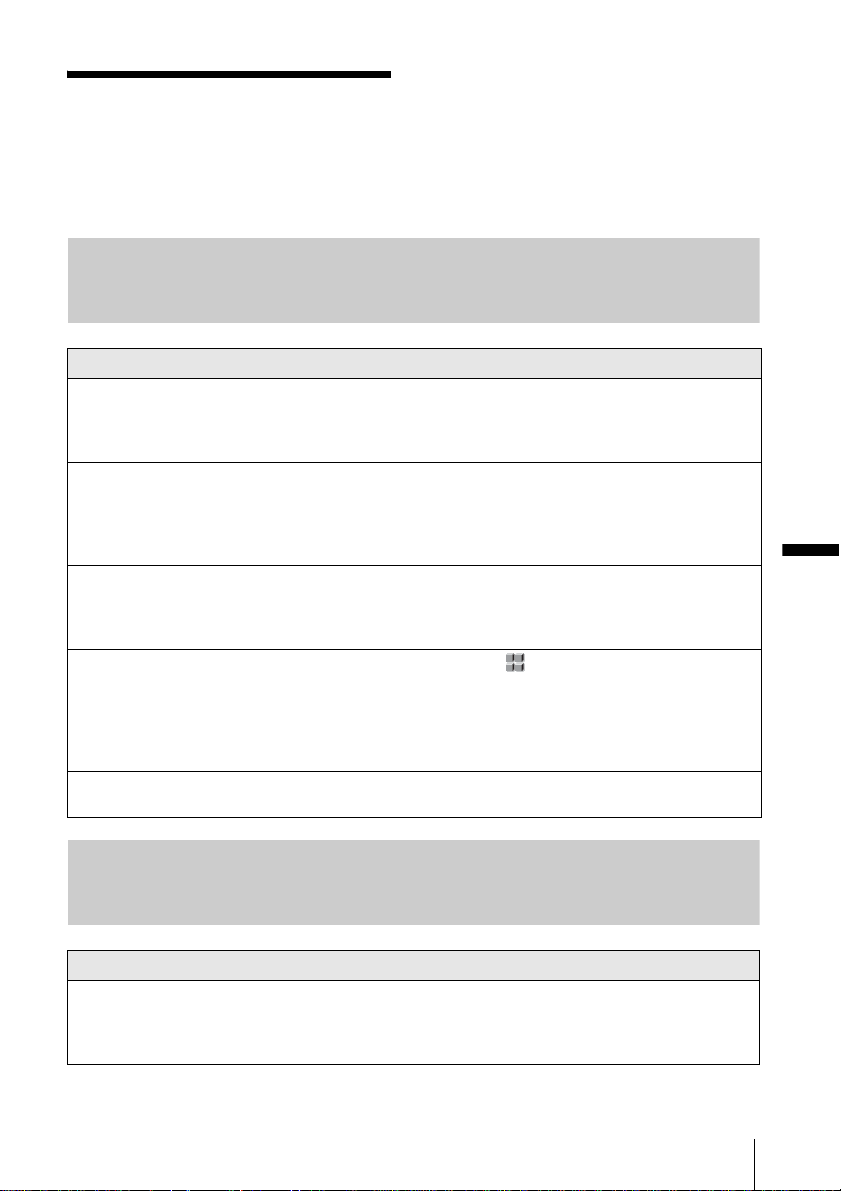
Troubleshooting
Troubleshooting
83
Troubleshooting
Troubleshooting
If you run into any problem using your
camcorder, use the following table to
troubleshoot the problem. If the problem
persists, remove the power source and
contact your Sony dealer.
If “C:ss:ss” is displayed on the LCD
screen or the viewfinder, the self-diagnosis
display function is activated. See page 88 for
details.
Overall operations
Batteries/Power sources
Symptom Cause and/or Corrective Actions
The power does not turn on. • The battery pack is discharged, running low, or not attached to the
camcorder.
cAttach a charged battery pack to the camcorder (p. 11).
cUse the AC Adaptor to connect to the wall outlet (p. 14).
The camcorder does not operate even
when the power is set to on.
cDisconnect the AC Adaptor from the wall outlet or remove the battery
pack, then reconnect it after about 1 minute. If the functions still do not
work, press the RESET button using a sharp-pointed object. If you press
the RESET button, all settings including the clock setting (except the
Personal Menu and Picture Profile settings) are reset.
A clattering noise is heard when the
camcorder is handled with the
POWER switch set to OFF (CHG) or
VCR.
• This is because some lens functions on the camcorder use a linear
mechanism. This is not a malfunction.
The supplied Remote Commander
does not function.
cSet [REMOTE CTRL] on the (OTHERS) menu to [ON] (p. 64).
cInsert batteries into the battery compartment with the + – polarities
correctly matching the + – marks. If this still does not solve the problem,
insert new batteries since the batteries are dead (p. 105).
cRemove any obstructions between the Remote Commander and the
remote sensor.
The camcorder gets warm. • This is because the power has been turned on for a long time. This is not
a malfunction.
Symptom Cause and/or Corrective Actions
The CHG (charge) lamp does not
light while the battery pack is being
charged.
cAttach the battery pack to the camcorder correctly. If the lamp still does
not light up, then it indicates that no power is supplied from the wall
outlet.
• The battery charge is completed (p. 11).
,continued
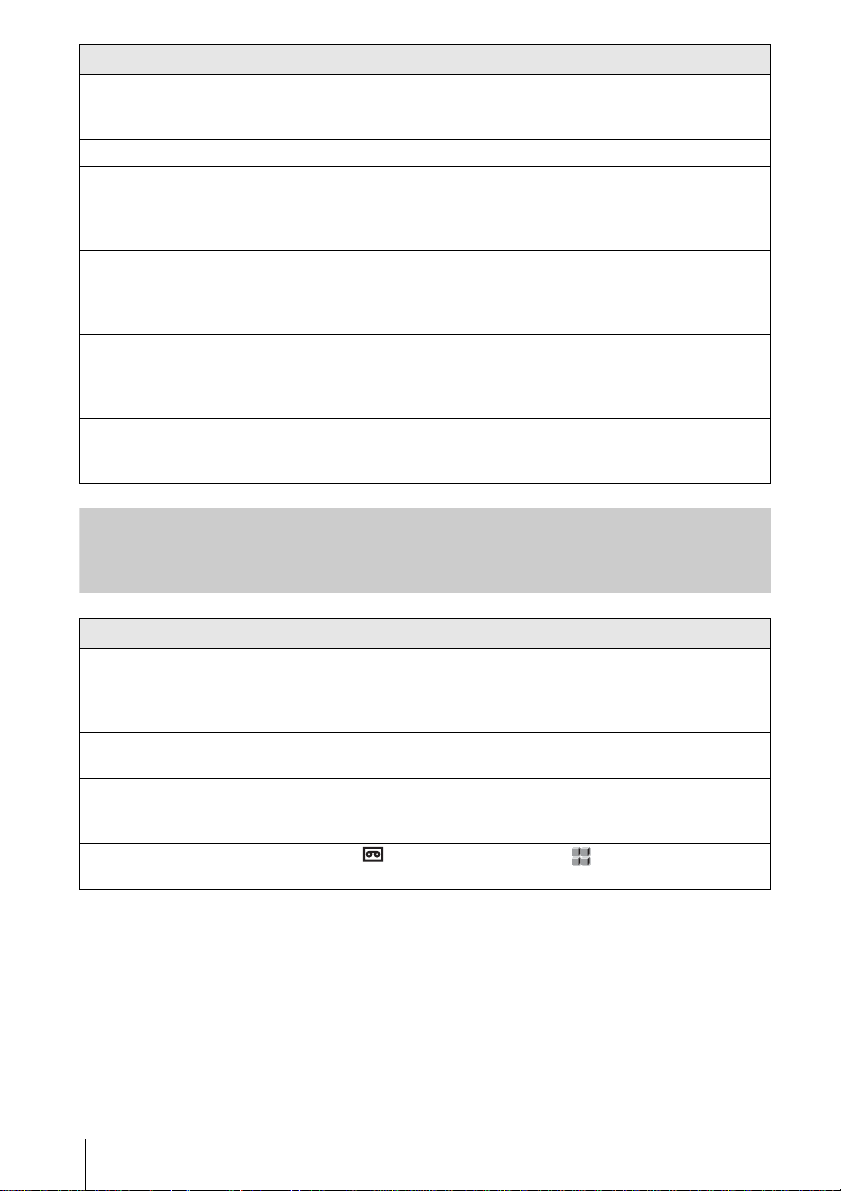
Troubleshooting
84
Cassette tapes
The CHG (charge) lamp flashes while
the battery pack is being charged.
cAttach the battery pack to the camcorder correctly. If the problem
persists, disconnect the AC Adaptor from the wall outlet and contact
your Sony dealer. The battery pack may be damaged (p. 11, 93).
The battery pack is not charged. cSet the POWER switch to OFF (CHG).
The battery pack is quickly
discharged.
• The temperature of the environment is too low, or the battery pack has
not been charged enough. This is not a malfunction.
cFully charge the battery again. If the problem persists, replace the
battery pack with a new one. It may be damaged (p. 11, 93).
The remaining battery time indicator
does not indicate the correct time.
• The temperature of the environment is too high or too low, or the battery
pack has not been charged enough. This is not a malfunction.
cFully charge the battery again. If the problem persists, replace the
battery pack with a new one. It may be damaged (p. 11, 93).
The power turns off frequently
although the remaining battery
indicator indicates that the battery
pack has enough power to operate.
• A problem has occurred in the remaining battery time indicator, or the
battery pack has not been charged enough.
cFully charge the battery again to correct the indication (p. 11).
A problem occurs when the
camcorder is connected to the AC
Adaptor.
cTurn off the power, and disconnect the AC Adaptor from the wall outlet.
Then, connect it again.
Symptom Cause and/or Corrective Actions
Cassette cannot be ejected from the
compartment.
cMake sure the power source (battery pack or AC Adaptor) is connected
correctly (p. 11).
cRemove the battery pack from the camcorder, then attach it again (p. 11).
cAttach a charged battery pack to the camcorder (p. 11).
Cassette is not ejected even when the
cassette lid is open.
cMoisture condensation is starting in your camcorder (p. 95).
The Cassette Memory indicator does
not appear while using a cassette with
Cassette Memory.
cSince your camcorder is not compatible with the Cassette Memory, no
indicator appears.
The remaining tape indicator is not
displayed.
cSet [ REMAINING] to [ON] on the (OTHERS) menu to always
display the remaining tape indicator (p. 64).
Symptom Cause and/or Corrective Actions
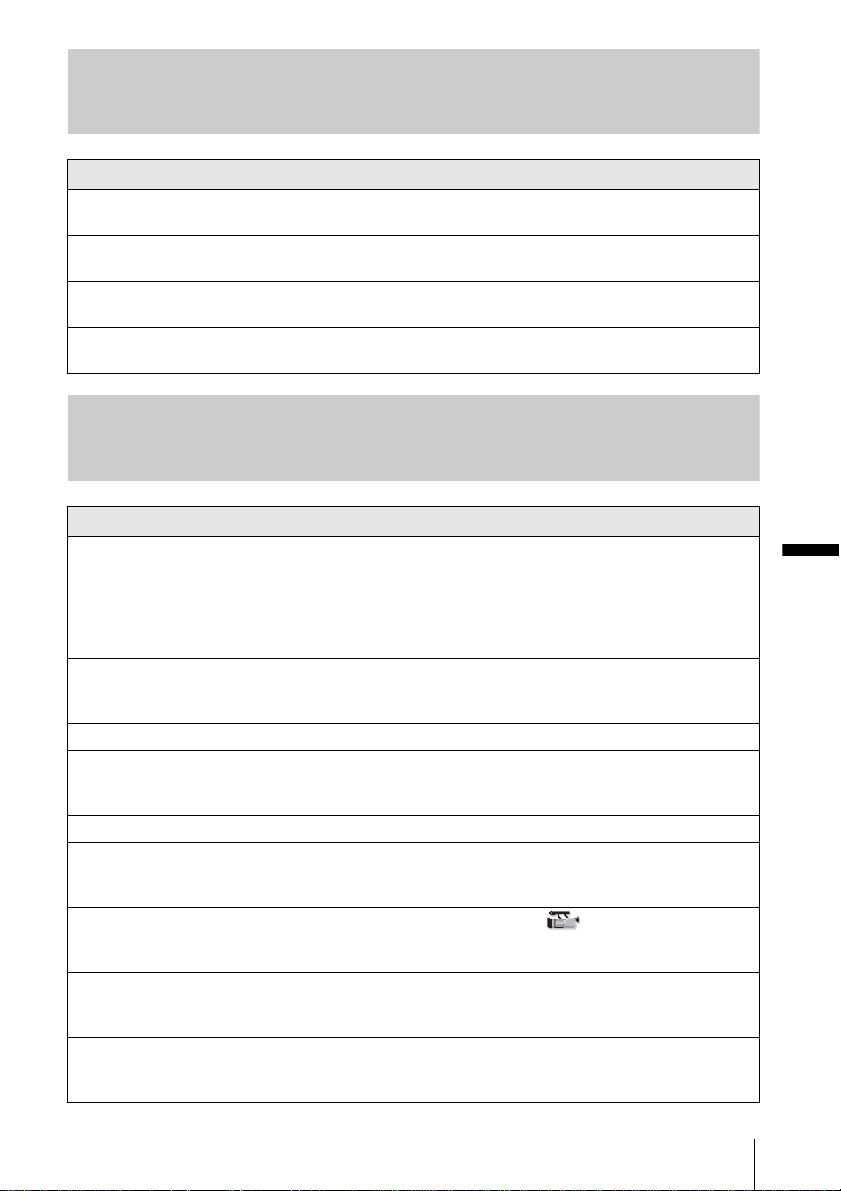
Troubleshooting
Troubleshooting
85
LCD screen/viewfinder
Recording
Symptom Cause and/or Corrective Actions
An unknown language appears on the
screen.
cSee page 18.
An unknown indicator appears on the
screen.
cRefer to the indicator list (p. 106).
The picture in the viewfinder is not
clear.
cUse the viewfinder lens adjustment lever to adjust the lens (p. 15).
The picture in the viewfinder has
disappeared.
cClose the LCD panel. The picture is not displayed in the viewfinder
when the LCD panel is open (p. 15).
Symptom Cause and/or Corrective Actions
The tape does not start when you
press REC START/STOP.
cSet the POWER switch to CAMERA (p. 14).
cThe tape has reached the end. Rewind it, or insert a new cassette.
cSet the write-protect tab to REC or insert a new cassette (p. 91).
cThe tape is stuck to the drum due to moisture condensation. Remove the
cassette and leave your camcorder for at least 1 hour, then re-insert the
cassette (p. 95).
The tape does not start when you
press REC START/STOP on the
handle.
cRelease the HOLD lever (p. 21).
The power abruptly turns off. cCharge the battery pack (p. 11).
The zoom does not function. cSet the ZOOM switch correctly (p. 22).
cWhen using the zoom lever on the Remote Commander, set the ZOOM
switch to LEVER/REMOTE (p. 23).
The handle zoom does not work. cSet the handle zoom switch to H or L (p. 22).
Zoom or shot transition stops in the
middle of the operation.
• This occurs when you replace a cassette during the operation (when the
camcorder is connected to another recording device for the purpose of
backup recording).
The SteadyShot does not function. cSet [STEADYSHOT] to [ON] in the (CAMERA SET) menu
(p. 54).
cPress the ASSIGN button assigned to the SteadyShot (p. 68).
The auto focus does not function. cSet the FOCUS switch to AUTO to enable auto focus (p. 32).
cThe recording conditions are not suitable for auto focus. Adjust the focus
manually (p. 32).
A vertical band appears when
recording candlelight or electric light
in the dark.
• This occurs when the contrast between the subject and the background is
too high. This is not a malfunction.
,continued
Troubleshooting
86
Playback
A vertical band appears when
recording a bright subject.
• This phenomenon is called the smear effect. This is not a malfunction.
Tiny spots in white appear on the
screen.
• The spots appear at a slower shutter speed. This is not a malfunction.
Oblique stripes appear on the screen. cSet the ZEBRA/PEAKING switch to OFF (p. 31).
Picture appears too bright on the
screen, and the subject does not
appear on the screen.
cCancel the back light function (p. 25).
Symptom Cause and/or Corrective Actions
Cannot play back. cIf the tape has reached the end, rewind the tape (p. 42).
Cannot play back in reverse direction. cReverse playback is not possible with the tape recorded in the HDV
format.
Horizontal lines appear on the
picture. The displayed pictures are
not clear or do not appear.
cClean the head using the cleaning cassette (p. 96).
Fine patterns flicker, diagonal lines
look jagged.
cAdjust [SHARPNESS] to the – (soften) side in the PICTURE PROFILE
function (p. 34).
No sound or only a low sound is
heard.
cSet [MULTI-SOUND] to [STEREO] on the (AUDIO SET) menu
(p. 56).
cTurn up the volume (p. 42).
cOn the (AUDIO SET) menu, adjust [AUDIO MIX] from the [ST2]
(additional sound) side until the sound is heard appropriately (p. 56).
cWhen you are using an S VIDEO cable or a component video cable,
make sure the red and white plugs of the A/V connecting cable are
connected as well (p. 46).
The sound breaks off. cClean the head using the cleaning cassette (p. 96).
The date search and index search do
not work.
• There is a blank section at the beginning or in the middle of the tape. This
is not a malfunction.
“---” is displayed on the screen. • The tape you are playing was recorded without setting the date and time.
• A blank section on the tape is being played.
• The data code on a tape with a scratch or noise cannot be read.
END SEARCH does not work. • The POWER switch is set to CAMERA.
• The cassette was ejected after recording (p. 44).
• The cassette is new and has nothing recorded.
END SEARCH does not work
correctly.
• There is a blank section at the beginning or in the middle of the tape. This
is not a malfunction.
No picture appears during END
SEARCH or Rec Review.
• The tape was recorded in both HDV and DV formats. This is not a
malfunction.
Symptom Cause and/or Corrective Actions
Troubleshooting
Troubleshooting
87
Dubbing
Cannot view the picture or hear the
sound on the TV connected with the
component video cable.
cSet [COMPONENT] on the (IN/OUT REC) menu according to the
requirements of the connected device (p. 60).
cWhen you are using the component video cable, make sure the red and
white plugs of the A/V connecting cable are connected (p. 46).
The picture appears distorted on the
4:3 TV.
• This happens when viewing a picture recorded in the 16:9 wide mode on
a 4:3 TV.
cTo play back the picture, set [TV TYPE] on the (IN/OUT REC)
menu (p. 61).
cBefore recording, set [DV WIDE REC] on the (CAMERA SET)
menu to [OFF] (p. 40).
Noises appear and or is
displayed on the screen.
• The tape was recorded in a TV color system other than that of your
camcorder. This is not a malfunction (p. 90).
appears on the LCD
screen.
• This appears when you play back a tape recorded on other recording
devices using a 4-channel microphone. This camcorder does not comply
with the 4-channel microphone recording standard.
Symptom Cause and/or Corrective Actions
Pictures from connected devices are
not displayed on the LCD screen or
the viewfinder.
cSet [DISP OUTPUT] to [LCD PANEL] on the (OTHERS) menu
(p. 64).
Cannot dub correctly using the A/V
connecting cable.
cSet [DISP OUTPUT] to [LCD PANEL] on the (OTHERS) menu
(p. 64).
When connected using an i.LINK
cable, no picture appears on the
monitor screen during dubbing.
cSet [VCR HDV/DV] on the (IN/OUT REC) menu according to the
requirements of the connected device (p. 59).
New sound added to a recorded tape
is not heard.
cIn the (AUDIO SET) menu, adjust [AUDIO MIX] from the [ST1]
(original sound) side until the sound is heard properly (p. 56).
Pictures disappears for a moment
when you press EXPANDED
FOCUS.
• If you press EXPANDED FOCUS during recording in the DV format
while transferring pictures to the connected device, pictures disappear
when switching from the normal size to the expanded size.
Symptom Cause and/or Corrective Actions
Troubleshooting
88
Warning indicators and messages
Self-diagnosis display/Warning indicators
If indicators appear on the LCD screen or in the viewfinder, check the following. See the page in
parentheses for details.
* You hear a melody or beep sound when the warning indicators appear on the screen.
Indication Cause and/or Corrective Actions
C:ss:ss/E:ss:ss (Self-
diagnosis display)
Some symptoms can be fixed by yourself. If the problem persists even after
you tried a couple of times, contact your Sony dealer or local authorized
Sony service facility.
C:04:ss
cA battery pack that is not an “InfoLITHIUM” battery pack is being used.
Use an “InfoLITHIUM” battery pack (p. 92).
C:21:ss
cMoisture condensation has occurred. Remove the cassette and leave your
camcorder for at least 1 hour, then re-insert the cassette (p. 95).
C:22:ss
cClean the head using the cleaning cassette (p. 96).
C:31ss / C:32ss
cSymptoms that are not described above have occurred. Remove and
insert the cassette, then operate your camcorder again. Do not perform
this procedure if moisture starts to condense (p. 95).
cRemove the power source. Reconnect it again and operate your
camcorder again.
cChange the tape.
E:61:ss / E:62:ss
cContact your Sony dealer or local authorized Sony service facility.
Inform them of the 5-digit code, which starts from “E.”
E (Battery level warning) • The battery pack is nearly used up.
• Depending on the operating, environmental, or battery conditions, the
E indicator may flash, even if there are approximately 5 to 10 minutes
remaining.
% (Moisture condensation warning)* cEject the cassette, set the POWER switch to OFF (CHG), and leave it for
about 1 hour with the cassette lid open (p. 95).
Q (Warning indicator pertaining to
the tape)
Slow flashing:
• There is less than 5 minutes remaining on the tape.
• No cassette is inserted.*
• The write-protect tab on the cassette is set to lock (p. 91).*
Fast flashing:
• The tape has run out.*
Z (Eject cassette warning)* Slow flashing:
• The write-protect tab on the cassette is set to lock (p. 91).
Fast flashing:
• Moisture condensation has occurred (p. 95).
• The self-diagnosis display code is displayed (p. 88).
Troubleshooting
Troubleshooting
89
Warning messages
If messages appear on the screen, check the following. See the page in parentheses for details.
* Appears only for the pictures recorded in the DV format.
Subjects Indications Corrective Actions/
References
Battery Use the “InfoLITHIUM” battery pack. cSee page 92.
Battery level is low. cCharge the battery (p. 11).
Old battery. Use a new one. cSee page 92.
Z Re-attach the power source. –
Moisture
condensation
% Z Moisture condensation. Eject the cassette. cSee page 95.
% Moisture condensation. Turn off for 1H. cSee page 95.
Cassette/Tape Q Insert a cassette. cSee page 17.
Z Reinsert the cassette. cThe cassette might be damaged, etc.
Q Z The tape is locked - check the tab. cSee page 91.
Q The tape has reached the end. –
Others Cannot record due to copyright protection. –
Cannot add audio. Disconnect the i.LINK cable. cSee page 78.
Not recorded in SP mode. Cannot add audio.* cSee page 78.
Not recorded in 12-bit audio. Cannot add audio.* cSee page 78.
Cannot add audio on the blank portion of a tape. cSee page 78.
HDV recorded tape. Cannot add audio. cSee page 78.
Cannot add audio. cSee page 78
No registered value set in SHOT-A. cRegister a setting in A (p. 37).
No registered value set in SHOT-B. cRegister a setting in B (p. 37).
Change to correct tape format. cThe pictures cannot be played back
because of an incompatible format.
No output image in “VCR HDV/DV”. Change
format.
cStop inputting the playback signal,
or reset [VCR HDV/DV] (p. 59).
Already added to CAMERA mode’s P-MENU. –
Already added to VCR mode’s P-MENU. –
x Dirty video head. Use a cleaning cassette. cSee page 96.
Additional Information
90
Additional Information
Using your camcorder
abroad
Power supply
You can use your camcorder in any country/
regions using the AC Adaptor supplied with
your camcorder within AC 100 V to 240 V,
50/60 Hz.
Use a commercially available AC plug
adaptor [a], if necessary, depending on the
design of the wall outlet [b].
On TV color systems
Your camcorder is an NTSC system-based
camcorder. If you want to view the playback
picture recorded in the DV format on a TV, it
must be an NTSC system-based TV (see
following list) with the AUDIO/VIDEO input
jack.
On HDV compatible TVs
An HDV compatible TV with the component
input jack is required to view playback pictures
recorded in the HDV format. See the table
below.
It is recommended to use an i.LINK cable to
connect these TVs.
As of 1st October, 2004
b Note
• Some models are not available depending on the
country or region.
Simple setting of the clock by time
difference
You can easily set the clock to the local time by
setting a time difference when using your
camcorder abroad. Select [WORLD TIME] on
the (OTHERS) menu, then set the time
difference (p. 62).
System Used in
NTSC Bahama Islands, Bolivia, Canada,
Central America, Chile, Colombia,
Ecuador, Guyana, Jamaica, Japan,
Korea, Mexico, Peru, Surinam,
Taiwan, the Philippines, the
U.S.A., Venezuela, etc.
PAL Australia, Austria, Belgium,
China, Czech Republic, Denmark,
Finland, Germany, Holland, Hong
Kong, Hungary, Italy, Kuwait,
Malaysia, New Zealand, Norway,
Poland, Portugal, Singapore,
Slovak Republic, Spain, Sweden,
Switzerland, Thailand, United
Kingdom, etc.
PAL - M Brazil
PAL - N Argentina, Paraguay, Uruguay
SECAM Bulgaria, France, Guiana, Iran,
Iraq, Monaco, Russia, Ukraine, etc.
AC-L15A/L15B
[a]
[b]
Sony TV models
KD-34XBR960, KD-36XS955, KD-34XS955,
KD-30XS955
KDE-55XBR950, KDE-50XS955, KDE-42XS955,
KDE-37XS955
KDF-60WE655, KDF-55WE655, KDF-50WE655,
KDF-42WE655, KDF-60XS655, KDF-55XS655
KDP-57WS655, KDP-51WS655
KE-42M1
KE-MX42K1, KE-MX42N1, KE-MX32K1,
KE-MX32N1, KE-P42M1
KF-50WE620, KF-42WE620
KLV-32M1, KLV-23M1
KP-57WS520, KP-51WS520, KP-46WT520
KV-36HS420, KV-34HS420, KV-32HS420,
KV-30HS420, KV-27HS420
KV-DX32K9H, KV-DX32K90B, KV-DX32K90L
KV-HR36N90, KV-HR36K90, KV-HR32K90,
KV-HR34N90, KV-HR29N90
KV-HZ34N90, KV-HZ29N90, etc.
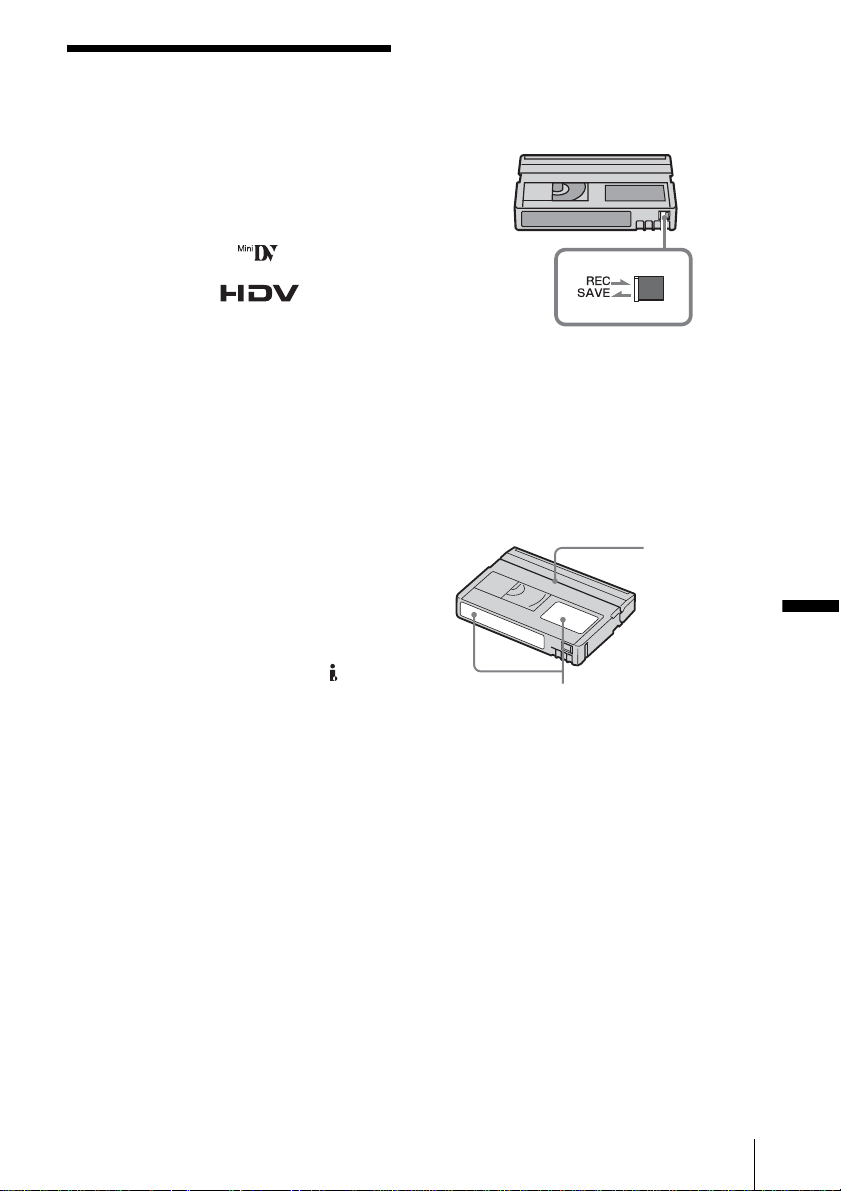
Additional Information
Additional Information
91
HDV format and
recording/playback
Your camcorder is capable of recording in both
HDV and DV formats.
You can use only mini DV cassettes in your
camcorder.
Use a cassette with the mark.
What is the HDV ( ) format?
The HDV format is a video format developed to
record and play back digital high definition
(HD) video signals on a DV cassette.
Your camcorder adopts the Interlace mode with
1080 effective scan lines of screen ruling
(1080i, number of pixels 1440 × 1080 dots).
The video bit rate for recording is about 25
Mbps.
i.LINK is adopted for the digital interface,
enabling a digital connection with an HDV
compatible TV or computer.
Playback
• Your camcorder can play back pictures in both
the DV format and HDV1080i specification.
• Your camcorder can play back a picture
recorded in the 720/30p system of the HDV
format but cannot output it from the HDV/
DV jack.
Copyright signal
When you play back
If the cassette you play back on your camcorder
contains copyright signals, you cannot copy it to
a tape in another video device connected to your
camcorder.
When you record
You cannot record software on your
camcorder that contains copyright
control signals for copyright protection
of software.
[Cannot record due to copyright protection.]
appears on the LCD screen, or on the TV screen
if you try to record such software.
Your camcorder does not record copyright
control signals on the tape when it records.
Notes on cassette tapes
To prevent accidental erasure
Slide the write-protect tab on the cassette to set
to SAVE.
REC: The cassette can be recorded.
SAVE: The cassette cannot be recorded (write-
protected).
When labeling the cassette
Be sure to place the label only on the locations
as shown in the following illustration so as not
to cause malfunction of your camcorder.
After using the cassette
Rewind the tape to the beginning to avoid
distortion of the picture or the sound. The
cassette should then be put in its case, and stored
in an upright position.
Do not put a label
along this border.
Labeling position
,continued
Additional Information
92
When cleaning the gold-plated
connector
Generally, clean the gold-plated connector on a
cassette with a cotton-wool swab after every 10
times it has been ejected.
If the gold-plated connector on the cassette is
dirty or dusty, the remaining tape indicator may
not be indicated correctly.
b Note
• Your camcorder is not compatible with Cassette
Memory.
are trademarks.
HDV and are trademarks of
Sony Corporation and JVC.
All other product names mentioned herein may
be the trademarks or registered trademarks of
their respective companies.
Furthermore, “™” and “®” are not mentioned
in each case in this manual.
About the
“InfoLITHIUM”
battery pack
This unit is compatible with the
“InfoLITHIUM” battery pack (L series). Your
camcorder operates only with the
“InfoLITHIUM” battery pack.
“InfoLITHIUM” L series battery packs have the
mark.
What is the “InfoLITHIUM” battery
pack?
The “InfoLITHIUM” battery pack is a lithium-
ion battery pack that has functions for
communicating information related to operating
conditions between your camcorder and an
optional AC Adaptor/charger.
The “InfoLITHIUM” battery pack calculates
the power consumption according to the
operating conditions of your camcorder, and
displays the remaining battery time in minutes.
With an AC Adaptor/charger (optional), the
remaining battery time and charging time
appear.
To charge the battery pack
• Be sure to charge the battery pack before you
start using your camcorder.
• We recommend charging the battery pack in
an ambient temperature of between 10°C to
30°C (50°F to 86°F) until the CHG (charge)
lamp turns off. If you charge the battery pack
outside of this temperature range, you may not
be able to charge it efficiently.
• After charging is complete, either disconnect
the cable from the DC IN jack on your
camcorder or remove the battery pack.
To use the battery pack effectively
• Battery pack performance decreases when the
surrounding temperature is 10°C (50°F) or
below, and the length of time you can use the
battery pack becomes shorter. In that case, do
one of the following to use the battery pack for
a longer time.
Gold-plated
connector

Additional Information
Additional Information
93
– Put the battery pack in a pocket to warm it
up, and insert it in your camcorder right
before you start taking shots.
– Use a large capacity battery pack: NP-F770/
F970 (optional).
• Frequent use of the LCD screen or a frequent
playback, fast forward or rewind operation
wears out the battery pack faster. We
recommend using a large capacity battery
pack: NP-F770/F970 (optional).
• Be sure to set the POWER switch to OFF
(CHG) when not recording or playing back on
your camcorder. The battery pack is also
consumed when your camcorder is in
recording standby or playback pause.
• Have spare battery packs ready for 2 or 3
times the expected recording time, and make
trial recordings before making the actual
recording.
• Do not expose the battery pack to water. The
battery pack is not water resistant.
About remaining battery time indicator
• When the power goes off even though the
remaining battery time indicator indicates that
the battery pack has enough power to operate,
charge the battery pack fully again. The
indication on the remaining battery time will
be indicated correctly. Note, however, that the
battery indication will not be restored if it is
used in high temperatures for a long time, or if
left in a fully charged state, or when the
battery pack is frequently used.
Use the remaining battery time indication as a
guide to the approximate shooting time.
• The E mark that indicates low battery flashes
even if there are still 5 to 10 minutes of battery
time remaining, depending on the operating
conditions or ambient temperature and
environment.
About storage of the battery pack
• If the battery pack is not used for a long time,
fully charge the battery pack and use it on your
camcorder once a year to maintain the proper
function.
To store the battery pack, remove it from your
camcorder and put it in a dry, cool place.
• To discharge the battery pack on your
camcorder completely, eject a cassette and
leave your camcorder in tape recording
standby until the power goes off.
About battery life
• The battery life is limited. Battery capacity
drops little by little as you use it more and
more, and as time passes. When the available
battery time is shortened considerably, a
probable cause is that the battery pack has
reached the end of its life. Please buy a new
battery pack.
• The battery life varies depending on how it is
stored and the operating conditions and
environment for each battery pack.
“InfoLITHIUM” is a trademark of Sony
Corporation.

Additional Information
94
About i.LINK
The i.LINK Interface on this unit is an i.LINK-
compliant Interface. This section describes the
i.LINK standard and its features.
What is i.LINK?
i.LINK is a digital serial interface for
transferring digital video, digital audio, and
other data to other i.LINK-compatible device.
You can also control other device using the
i.LINK.
i.LINK-compatible device can be connected
using an i.LINK cable. Possible applications are
operations and data transactions with various
digital AV devices.
When 2 or more i.LINK-compatible device are
connected to this unit in a daisy chain,
operations and data transactions are possible
with not only the device that this unit is
connected to but also with other devices via the
directly connected device.
Note, however, that the method of operation
sometimes varies according to the
characteristics and specifications of the device
to be connected. Also, operations and data
transactions may not be possible on some
connected device.
b Note
• Normally, only one device can be connected to this
unit with the i.LINK cable. When connecting this
unit to an HDV/DV compatible device having two or
more i.LINK Interfaces, refer to the operating
instructions of the device to be connected.
z Tip
• i.LINK is a more familiar term for the IEEE 1394
data transport bus proposed by Sony, and is a
trademark approved by many corporations.
• IEEE 1394 is an international standard standardized
by the Institute of Electrical and Electronics
Engineers.
About i.LINK Baud rate
i.LINK’s maximum baud rate varies according
to the device. There are 3 types.
S100 (approx. 100Mbps*)
S200 (approx. 200Mbps)
S400 (approx. 400Mbps)
The baud rate is listed under “Specifications” in
the operating instructions of each piece of
device. It is also indicated near the i.LINK
interface on some device.
The maximum baud rate for device that does not
have any indication (such as this unit) is
“S100.”
The baud rate may differ from the indicated
value when the unit is connected to device with
a different maximum baud rate.
* What is Mbps?
Mbps stands for “megabits per second,” or the
amount of data that can be sent or received in
1 second. For example, a baud rate of 100 Mbps
means that 100 megabits of data can be sent in
1 second.
To use i.LINK functions on this unit
For details on how to dub when this unit is
connected to other video device having a
i.LINK Interface, see page 70.
This unit can also be connected to other i.LINK
compatible device made by Sony (e.g. a VAIO
series personal computer) as well as to video
device.
Some i.LINK compatible video device such as
Digital Televisions, DVD recorders/players,
and MICROMV recorders/players are not
compatible with this unit. Before connecting to
other device, be sure to confirm whether the
device is compatible with HDV/DV or not.
For details on precautions and compatible
application software, refer also to the operating
instructions for the device to be connected.
About the required i.LINK cable
Use the Sony i.LINK 4-pin-to-4-pin cable
(during HDV/DV dubbing).
i.LINK and are trademarks of Sony
Corporation.

Additional Information
Additional Information
95
Maintenance and
precautions
On use and care
• Do not use or store the camcorder and
accessories in the following locations.
– Anywhere extremely hot or cold. Never
leave them exposed to temperatures above
60°C (140°F), such as under direct sunlight,
near heaters or in a car parked in the sun.
They may malfunction or become
deformed.
– Near strong magnetic fields or mechanical
vibration. The camcorder may malfunction.
– Near strong radio waves or radiation. The
camcorder may not be able to record
properly.
– Near AM receivers and video equipment.
Noise may occur.
– Sandy beach or anywhere dusty. If sand or
dust gets in your camcorder, it may
malfunction. Sometimes this malfunction
cannot be repaired.
– Near windows or outdoors, where the LCD
screen, the viewfinder, or the lens may be
exposed to direct sunlight. This damages
the inside of the viewfinder or the LCD
screen.
– Anywhere very humid.
• Operate your camcorder on DC 7.2 V (battery
pack) or DC 8.4 V (AC Adaptor).
• For DC or AC operation, use the accessories
recommended in these operating instructions.
• Do not let your camcorder get wet, for
example, from rain or sea water. If your
camcorder gets wet, it may malfunction.
Sometimes this malfunction cannot be
repaired.
• If any solid object or liquid gets inside the
casing, unplug your camcorder and have it
checked by a Sony dealer before operating it
any further.
• Avoid rough handling, disassembling,
modifying, or mechanical shock. Be
particularly careful of the lens.
• Keep the POWER switch set to OFF (CHG)
when you are not using your camcorder.
• Do not wrap your camcorder with a towel, for
example, and operate it. Doing so might cause
heat to build up inside.
• When disconnecting the power cord, pull by
the plug and not the cord.
• Do not damage the power cord such as by
placing anything heavy on it.
• Keep metal contacts clean.
• Keep the Remote Commander and button-
type battery out of children’s reach. If the
battery is accidentally swallowed, consult a
doctor immediately.
• If the battery electrolytic liquid has leaked,
– consult your local authorized Sony service
facility.
– wash off any liquid that may have contacted
your skin.
– if any liquid gets in your eyes, wash with
plenty of water and consult a doctor.
When not using your camcorder for a
long time
Occasionally turn it on and let it run such as by
playing back tapes for about 3 minutes.
Moisture condensation
If your camcorder is brought directly from a
cold place to a warm place, moisture may
condense inside your camcorder, on the surface
of the tape, or on the lens. In this state, the tape
may stick to the head drum and be damaged or
your camcorder may not operate correctly. If
there is moisture inside your camcorder, [%Z
Moisture condensation. Eject the cassette] or [
%
Moisture condensation. Turn off for 1H.]
appears. The indicator will not appear when the
moisture condenses on the lens.
If moisture condensation has occurred
None of the functions except cassette ejection
will work. Eject the cassette, turn off your
camcorder, and leave it for about 1 hour with
the cassette lid open. Your camcorder can be
used again if
% or Z does not appear when the
power is turned on again.
If moisture starts to condense, your camcorder
sometimes cannot detect condensation. If this
happens, the cassette is sometimes not ejected
for 10 seconds after the cassette lid is opened.
,continued

Additional Information
96
This is not a malfunction. Do not close the
cassette lid until the cassette is ejected.
Note on moisture condensation
Moisture may condense when you bring your
camcorder from a cold place into a warm place
(or vice versa) or when you use your camcorder
in a humid place as shown below.
• When you bring your camcorder from a ski
slope into a place warmed up by a heating
device.
• When you bring your camcorder from an air-
conditioned car or room into a hot place
outside.
• When you use your camcorder after a squall or
a shower.
• When you use your camcorder in a hot and
humid place.
How to prevent moisture condensation
When you bring your camcorder from a cold
place into a warm place, put your camcorder in
a plastic bag and seal it tightly. Remove the bag
when the air temperature inside the plastic bag
has reached the surrounding temperature (after
about 1 hour).
Video head
• When the video head becomes dirty, you
cannot record pictures normally, or distorted
picture or sound is played back.
• If the following problem occurs, clean the
video heads for 10 seconds with the cleaning
cassette.
– Mosaic-pattern noise appears on the
playback picture or the screen is displayed
in blue.
– Playback pictures do not move.
– A part of playback pictures does not move.
– Playback pictures do not appear or the
sound breaks off.
–[
x Dirty video head. Use a cleaning
cassette.] appears on the screen during
recording.
• The video head suffers from wear after long
use. If you cannot obtain a clear image even
after using a cleaning cassette, it might be
because the video head is worn. Please contact
your Sony dealer or local authorized Sony
service facility to have the video head
replaced.
LCD screen
• Do not add excessive pressure on the LCD
screen, as it may cause damage.
• If your camcorder is used in a cold place, a
residual image may appear on the LCD screen.
This is not a malfunction.
• While using your camcorder, the back of the
LCD screen may heat up. This is not a
malfunction.
To clean the LCD screen
• If fingerprints or dust make the LCD screen
dirty, it is recommended to use an LCD
cleaning cloth (optional) to clean it. When you
use the LCD Cleaning Kit (optional), do not
apply the cleaning liquid directly to the LCD
screen. Use cleaning paper moistened with the
liquid.
Cleaning the casing
• If the casing is soiled, clean the camcorder
body with a soft cloth lightly moistened with
water, and then wipe the casing with a dry soft
cloth.
• Avoid the following to prevent the finish from
being damaged.
– Using chemicals such as thinner, benzine,
alcohol, chemical cloths, repellent and
insecticide.
– Handling with above substances on your
hands.
– Leaving the case in contact with rubber or
vinyl objects for a long period of time.
About care and storage of the lens
• Wipe the surface of the lens clean with a soft
cloth in the following instances:
– When there are fingerprints on the lens
surface.
– In hot or humid locations
– When the lens is exposed to salty air such as
at the seaside.
• Store in a well-ventilated location subject to
little dirt or dust.
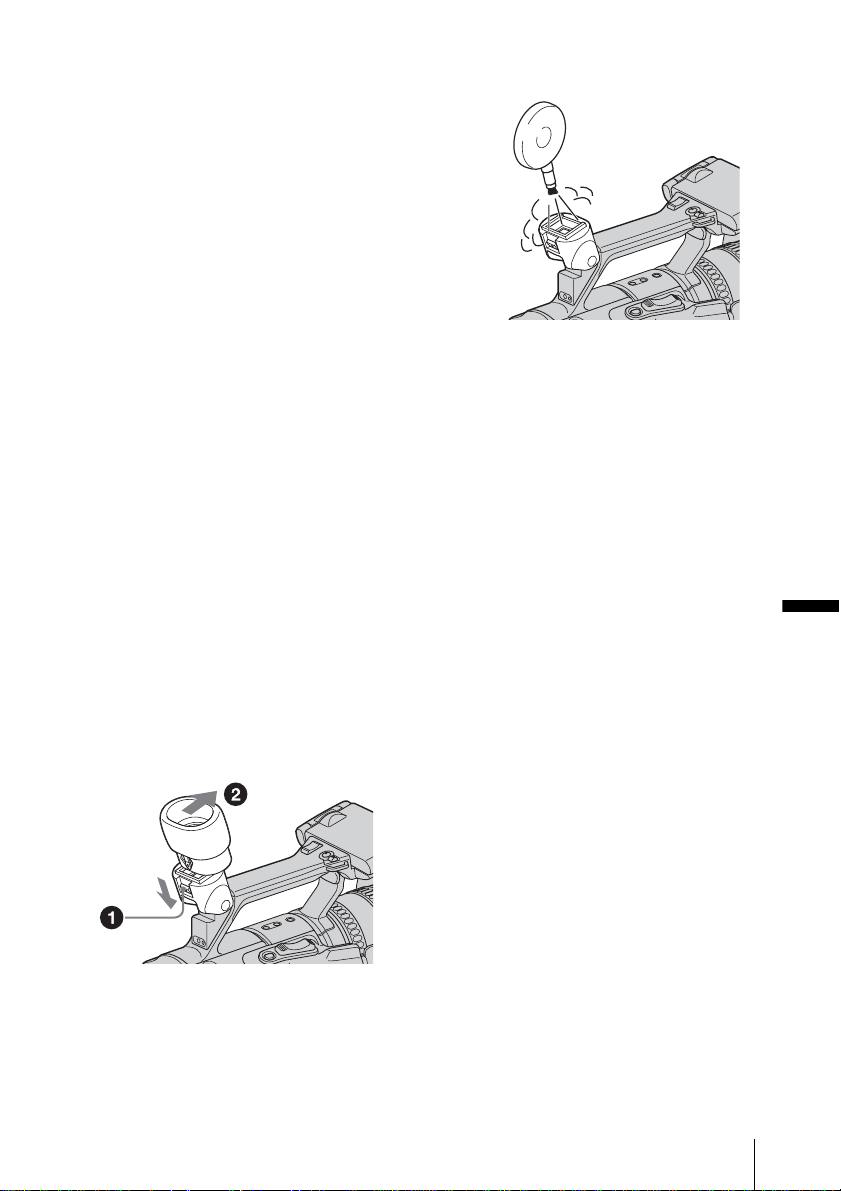
Additional Information
Additional Information
97
• To prevent molds periodically clean the lens
as described above.
It is recommended you operate your camcorder
about once a month to keep it in an optimum
state for a long time.
To charge the pre-installed button-type
battery
Your camcorder has a pre-installed button-type
battery to retain the date, time, and other
settings even when the POWER switch is set to
OFF (CHG). The pre-installed button-type
battery is always charged while you are using
your camcorder but it will get discharged
gradually if you do not use your camcorder. The
button-type battery will be fully discharged in
about 3 months if you do not use your
camcorder at all. However, even if the pre-
installed button-type battery is not charged, the
camcorder operation will not be affected if you
are not recording the date.
Procedures
Connect your camcorder to a wall outlet using
the supplied AC Adaptor, and leave it with the
POWER switch set to OFF (CHG) for more
than 24 hours.
Removing dust from inside the
viewfinder
1
Remove the viewfinder.
While sliding the viewfinder release lever
down
1, slide and remove the viewfinder
2.
2 Remove dust from inside the viewfinder
and the part shown below with a blower.

Additional Information
98
Specification
System
Video recording system (HDV)
2 rotary heads, Helical scanning system
Video recording system (DV)
2 rotary heads, Helical scanning system
Audio recording system (HDV)
Rotary heads, MPEG-1 Audio Layer2
Quantization: 16 bits (Fs 48 kHz, stereo)
Transfer rate: 384 kbps
Audio recording system (DV)
Rotary heads, PCM system
Quantization: 12 bits (Fs 32 kHz, stereo 1,
stereo 2), 16 bits (Fs 48 kHz, stereo)
Video signal
NTSC color, EIA standards, 1080/60i
specification
Usable cassette
Mini DV cassette with the mark
printed
Tape speed (HDV)
Approx. 18.81 mm/s
Tape speed (DV)
SP: Approx. 18.81 mm/s
LP: Approx. 12.56 mm/s
Recording/playback time (HDV)
60 min (using a DVM60 cassette)
Recording/playback time (DV)
SP: 60 min (using a DVM60 cassette)
LP: 90 min (using a DVM60 cassette)
Fast forward/rewind time
Approx. 2 min 40 s (using a DVM60 cassette)
Viewfinder
Electric viewfinder (color)
Image device
6 mm (1/3 type) 3CCD (Charge Coupled
Device)
Gross: Approx. 1 120 000 pixels
Effective: Approx. 1 070 000 pixels
Lens
Carl Zeiss Vario-Sonnar T*
Combined power zoom lens
Filter diameter: 72 mm (2 7/8 in.)
12 × (Optical)
F = 1.6 ~ 2.8
Focal length
4.5-54mm (3/16- 21/4in.)
When converted to a 35 mm still camera
32.5 - 390 mm (1 5/16 - 15 3/8 in.)
(40 - 480 mm (1 5/8 - 19 in.) in 4:3 TV mode)
Color temperature
[AUTO], [ONE-PUSH A/B], [INDOOR]
(3 200 K), [OUTDOOR] (5 800 K)
Minimum illumination
3 lx (lux) (F 1.6)
Input/Output connectors
Audio/Video input/output
Video signal: 1 Vp-p, 75 Ω (ohms),
unbalanced, sync negative
Audio signal: 327 mV (at load impedance
47 kΩ (kilohms)), Input impedance more than
47 kΩ (kilohms), Output impedance less than
2.2 kΩ (kilohms)
S VIDEO input/output
Luminance signal: 1 Vp-p, 75 Ω (ohms),
unbalanced
Chrominance signal: 0.286 Vp-p, 75 Ω
(ohms), unbalanced
COMPONENT OUTPUT jack
Y: 1 Vp-p (0.3 V sync negative)
P
B/PR, CB/CR: +/- 350 mVp-p, Input
impedance 75 Ω (ohms)
Headphones jack
Stereo minijack (Ø 3.5 mm)
LANC jack
Stereo mini-minijack (Ø 2.5 mm)
MIC jack
Minijack, 0.388 mV low impedance with DC
2.5 to 3.0 V, output impedance 6.8 kΩ
(kilohms) (Ø 3.5 mm), Stereo type
HDV/DV jack
i.LINK Interface (IEEE1394, 4-pin connector
S100)
LCD screen
Picture
8.8 cm (3.5 type)
Total dot number
250 000 (1 120 × 224)

Additional Information
Additional Information
99
General
Power requirements
DC 7.2 V (battery pack)
DC 8.4 V (AC Adaptor)
Average power consumption (when using the
battery pack)
During camera recording using the viewfinder
with normal brightness:
HDV recording 7.4 W
DV recording 6.9 W
During camera recording using the LCD with
normal brightness:
HDV recording 8.0 W
DV recording 7.5 W
Operating temperature
0°C to 40°C (32°F to 104°F)
Storage temperature
-20°C to + 60°C (-4°F to + 140°F)
Dimensions (approx.)
151 × 181 × 365 mm (6 × 7 1/4 × 14 3/8 in.)
(w/h/d)
Mass (Approx.)
2.0 kg (4 lb 6 1/2 oz) main unit only
2.1 kg (4 lb 10 1/8 oz) including the NP-F570
rechargeable battery pack, DVM60 cassette
and lens hood.
Supplied accessories
See page 10.
AC Adaptor AC-L15A/L15B
Power requirements
AC 100 - 240 V, 50/60 Hz
Current consumption
0.35 - 0.18 A
Power consumption
18 W
Output voltage
DC 8.4 V, 1.5 A
Operating temperature
0°C to 40°C (32°F to 104°F)
Storage temperature
-20°C to + 60°C (-4°F to + 140°F)
Dimensions (approx.)
56 × 31 × 100 mm (2 1/4 × 1 1/4 × 4 in.) (w/h/
d) excluding the projecting parts
Mass (approx.)
190 g (6.7 oz) excluding the power cord
Rechargeable battery pack (NP-F570)
Maximum output voltage
DC 8.4 V
Output voltage
DC 7.2 V
Capacity
15.8 Wh (2 200 mAh)
Dimensions (approx.)
38.4 × 20.6 × 70.8 mm
(1 9/16 × 13/16 × 2 7/8 in.) (w/h/d)
Mass (approx.)
100 g (3.5 oz)
Operating temperature
0°C to 40°C (32°F to 104°F)
Type
Lithium ion
Design and specifications are subject to change
without notice.
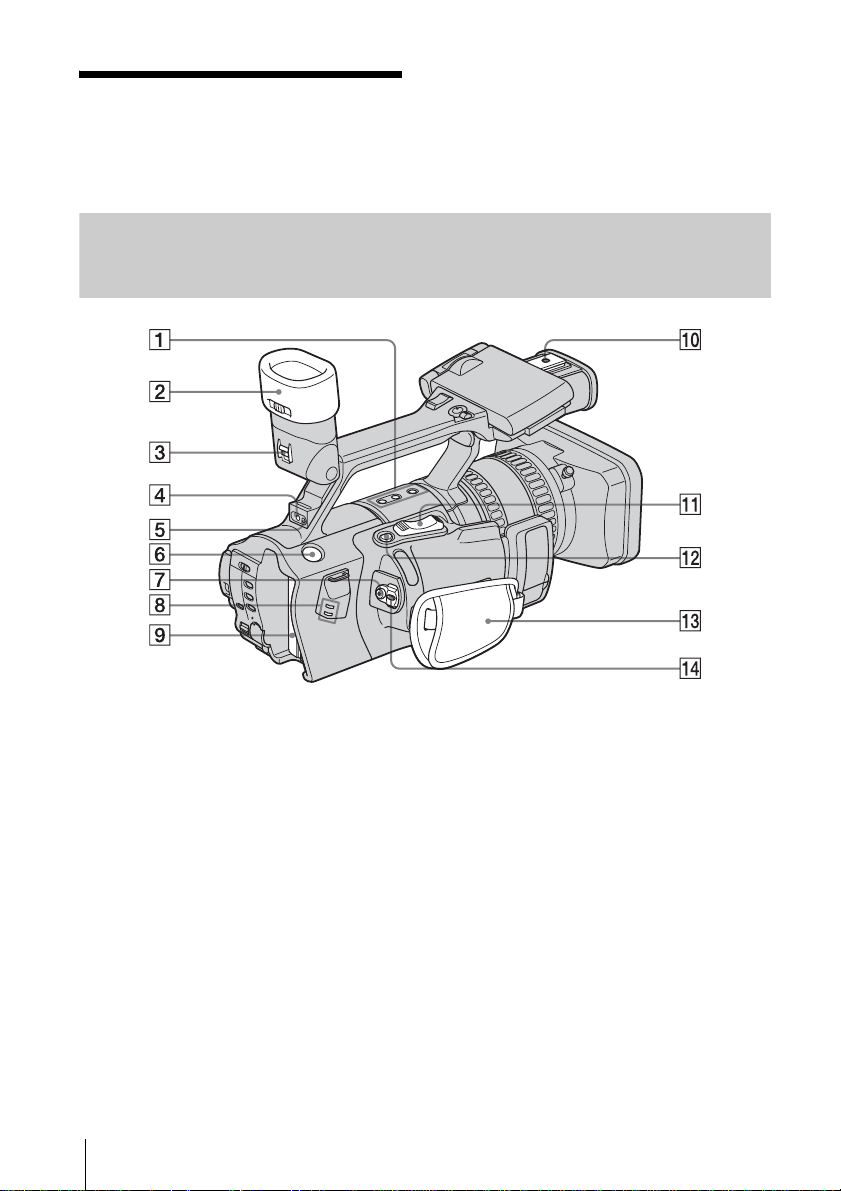
Quick Reference
100
Quick Reference
Identifying parts and
controls
Camcorder
A SHOT TRANSITION operation buttons
(p. 37)
B Eyecup (p. 16)
C Viewfinder release lever (p. 97)
D Rear remote sensor
E Rear camera recording lamp (p. 20)
F BATT RELEASE (battery release)
button (p. 12)
G REC START/STOP button (p. 20)
H i.LINK lamps (HDV/DV) (p. 73)
Lights up when handling an i.LINK signal.
I Battery pack (p. 11)
J Shoe adaptor attaching part (p. 104)
K Power zoom lever (p. 22)
L EXPANDED FOCUS button (p. 32)
M Grip belt (p. 4)
N POWER switch (p. 14)
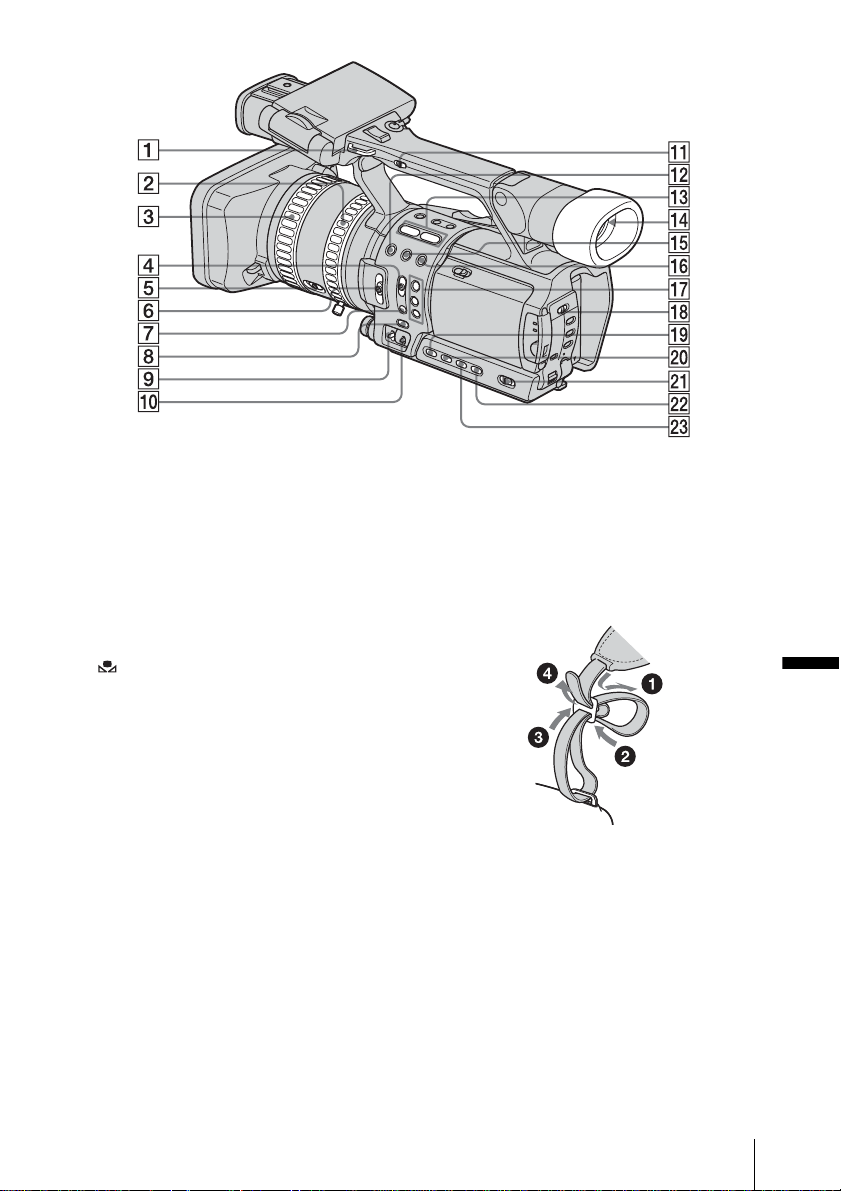
Quick Reference
Quick Reference
101
A Hook for the shoulder strap
B Zoom ring (p. 23)
C Focus ring (p. 32)
D FOCUS switch (AUTO/MAN (manual)/
INFINITY) (p. 32)
E ZOOM switch (p. 22)
F ND FILTER switch (1/2/OFF) (p. 30)
G PUSH AUTO button (p. 33)
H WHT BAL (One-push white balance)
button (p. 26)
I GAIN switch (H/M/L) (p. 28)
J WHT BAL (white balance) switch (A/B/
PRESET) (p. 26)
K Handle zoom switch (H/L/OFF) (p. 22)
L REC REVIEW button (p. 41)
M Format lamps (p. 20)
N Viewfinder (p. 3, 15)
O BACK LIGHT button* (p. 25)
P SPOT LIGHT button (p. 25)
Q ASSIGN buttons (1/2/3)* (p. 68)
R ZEBRA/PEAKING switch (p. 31, 33)
S IRIS button (p. 28)
T GAIN button* (p. 28)
U AUTO LOCK switch (p. 26, 28, 29)
V WHT BAL (white balance) button (p. 26)
W SHUTTER SPEED button (p. 29)
* Each of the buttons has a raised tactile dot. (The
ASSIGN button has it on the 2 button.) Use it to
identify the location of the buttons.
To attach the shoulder strap
Attach the shoulder strap supplied with your
camcorder to the hooks for the shoulder strap.
,continued
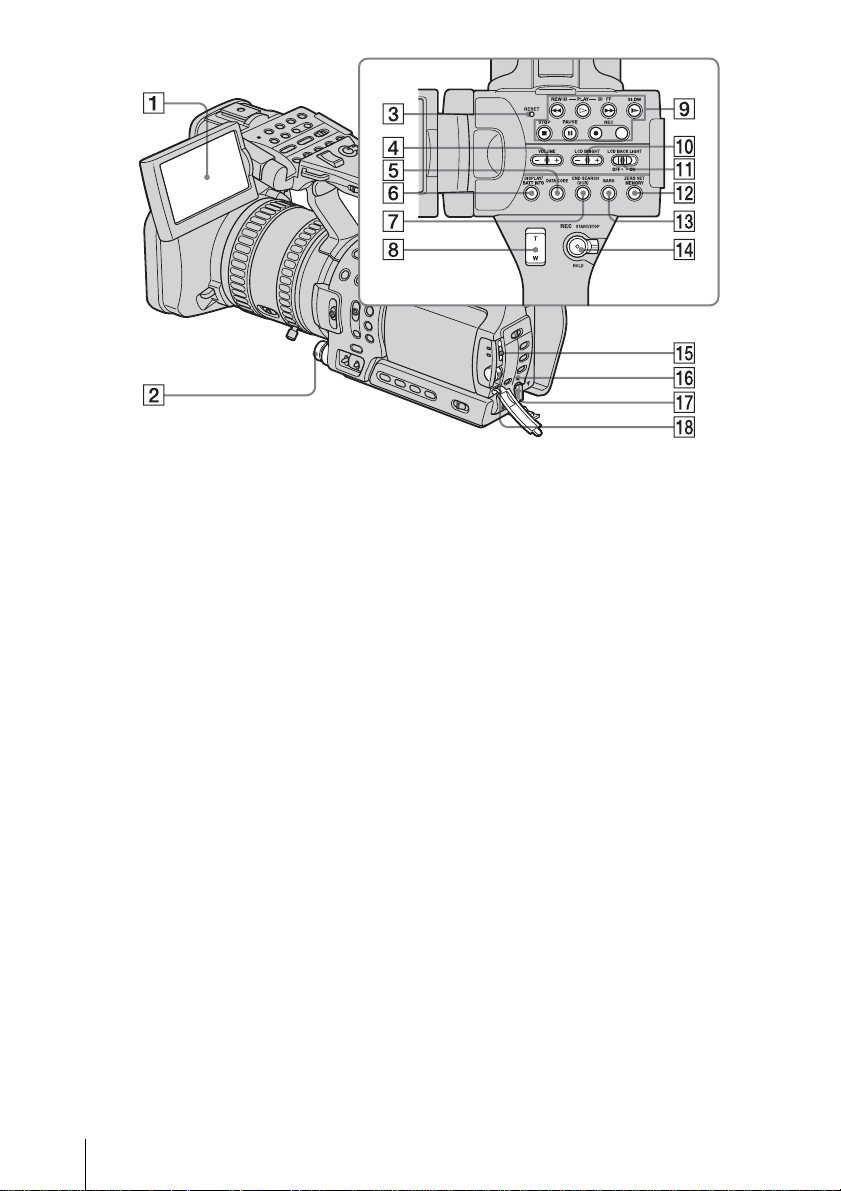
Quick Reference
102
A LCD screen (p. 3, 15)
B IRIS dial (p. 28)
C RESET button
If you press RESET, all settings including
the clock setting (except the Personal Menu
and Picture Profile settings) return to the
default.
D VOLUME –/+ buttons* (p. 42)
E DATA CODE button (p. 44)
F DISPLAY/BATT INFO button (p. 12)
G END SEARCH (VCR) button (p. 44)
H Handle zoom lever (p. 22)
I Video control buttons (Rewind,
Playback*, Fast-forward, Pause, Stop,
Slow, Record) (p. 42)
J LCD BRIGHT –/+ buttons (p. 15)
K LCD BACKLIGHT switch (p. 15)
L ZERO SET MEMORY button (p. 49)
M BARS button (p. 21)
N REC START/STOP button and HOLD
lever (p. 21)
O AUTO/MAN (manual) audio switch
(p. 36)
P CHG (charge) lamp (p. 11)
Q DC IN jack (p. 11)
R AUDIO LEVEL dial (p. 36)
* Each of the buttons has a raised tactile dot. (The
VOLUME button has it on the + side.) Use it to
identify the location of the buttons.
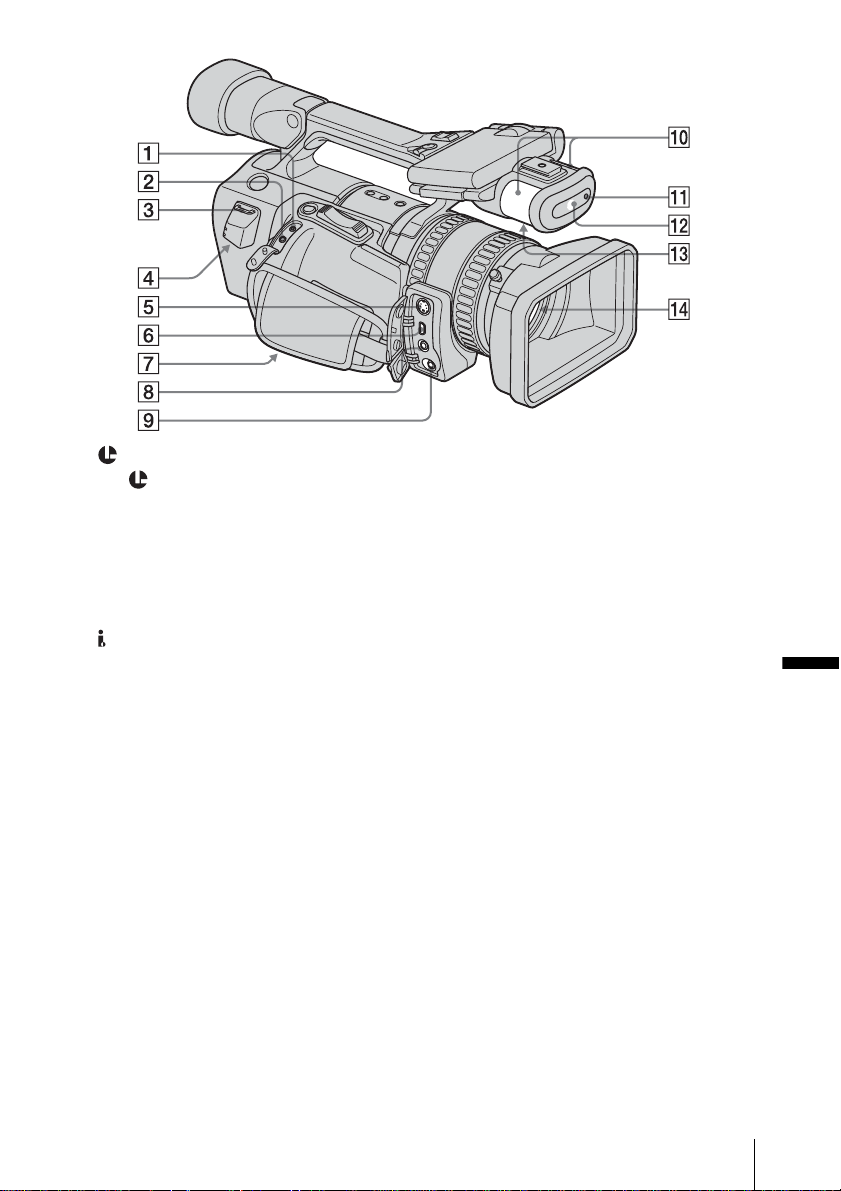
Quick Reference
Quick Reference
103
A LANC jack (blue)
The LANC control jack is used for
controlling the tape transport of video
device and peripherals connected to it.
B
i (headphones) jack
When you use headphones, the speaker on
your camcorder is silent.
C Hook for the shoulder strap (p. 101)
D HDV/DV jack (p. 46, 70, 71, 74, 75, 77)
E S VIDEO jack (p. 46, 48, 72, 75)
F COMPONENT OUTPUT jack (p. 46, 48)
G Tripod receptacle
Make sure that the length of the tripod
screw is less than 5.5 mm (7/32 inch).
Otherwise, you cannot attach the tripod
securely, and the screw may damage your
camcorder.
H AUDIO/VIDEO jack (p. 46, 48, 72, 75,
78)
I MIC (PLUG IN POWER)/LINE jack
(red) (p. 78)
J Microphone (p. 78)
K Front camera recording lamp (p. 20)
L Front remote sensor
M Speaker
N Lens (Carl Zeiss Lens)
Your camcorder is equipped with a Carl
Zeiss lens which can reproduce fine images.
The lens for your camcorder was developed
jointly by Carl Zeiss, in Germany, and Sony
Corporation. It adopts the MTF
measurement system for video cameras and
offers a quality as fine as a Carl Zeiss lens.
The lens for your camcorder is also T*-
coated to suppress unwanted reflection and
faithfully reproduce colors.
MTF stands for Modulation Transfer
Function.The value number indicates the
amount of light from a subject coming into
the lens.
,continued
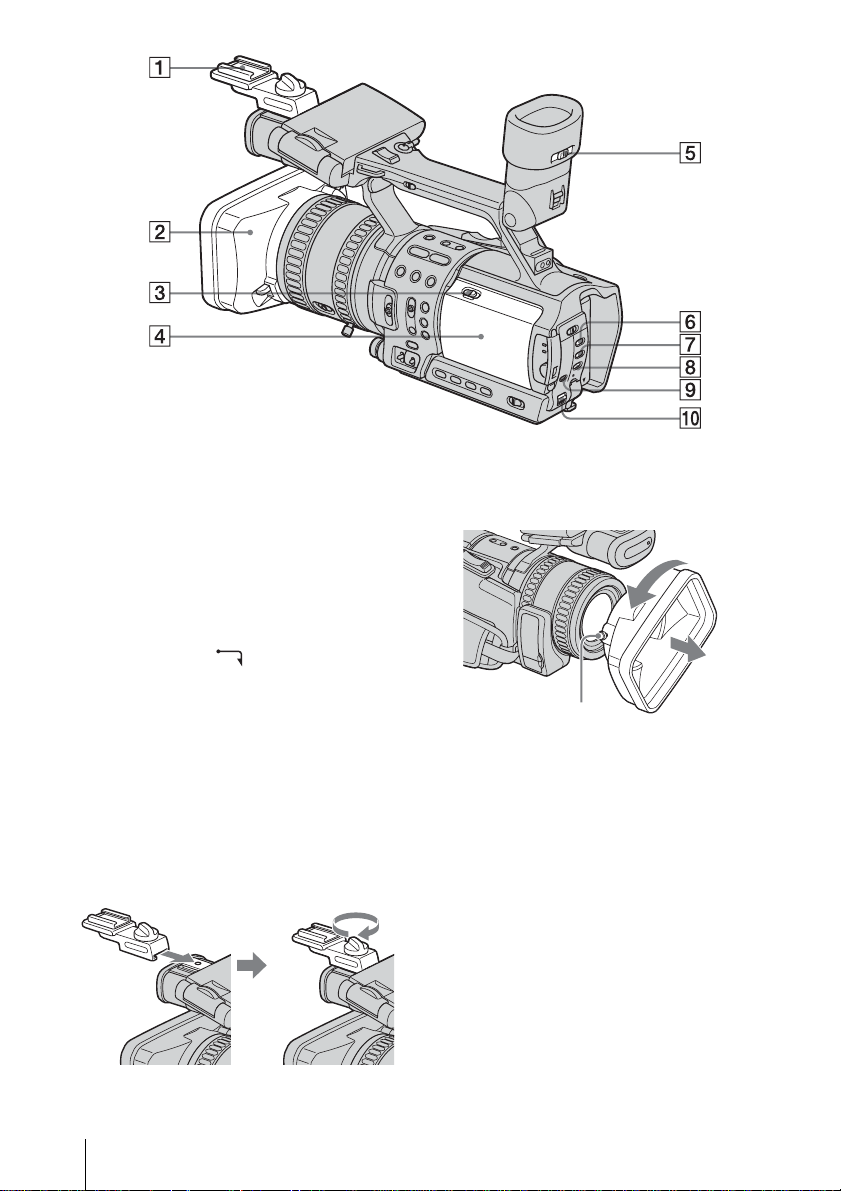
Quick Reference
104
A Shoe adaptor
To connect an accessory, press down and
push it to the end, and then tighten the
screw. To remove an accessory, loosen the
screw, and then press down and pull out the
accessory.
When you attach the shoe adaptor, be
careful not to damage the LCD panel.
B Lens hood (p. 20)
C OPEN/EJECT lever (p. 17)
D Cassette compartment lid (p. 17)
E Viewfinder lens adjustment lever (p. 15)
F PICTURE PROFILE button (p. 34)
G MENU button (p. 51)
H P-MENU button (p. 65)
I STATUS CHECK button (p. 24, 45)
J SEL/PUSH EXEC dial (p. 51)
To attach the shoe adaptor
To remove the lens hood
Loosen the lens hood fixing screw, then turn the
lens hood in the direction of the arrow.
To attach the lens hood
Align the marks on the lens hood to those on the
camcorder, and turn the lens hood in the
opposite direction of the arrow in the figure
above. Tighten the lens hood fixing screw.
Hood fixing screw
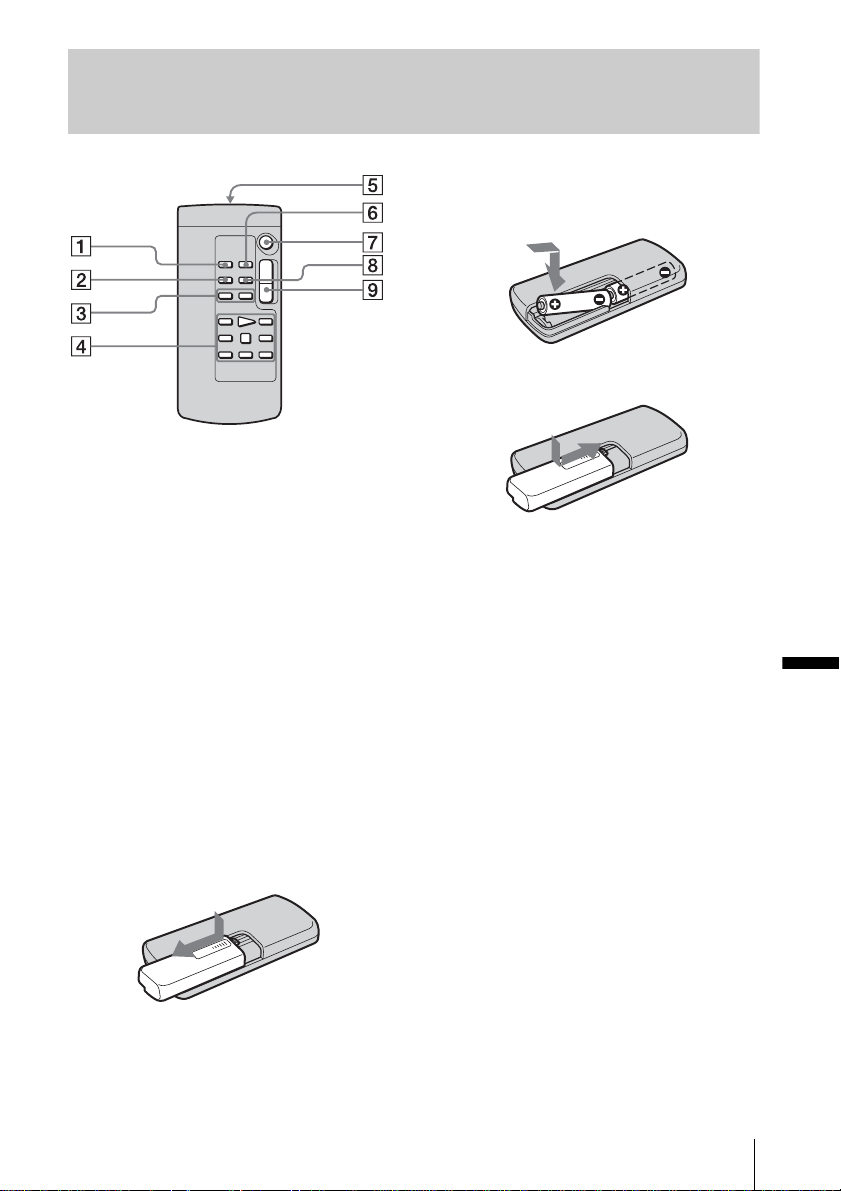
Quick Reference
Quick Reference
105
Remote Commander
A DISPLAY button (p. 44)
B SEARCH MODE button (p. 50)
C ./> buttons (p. 50)
D Video control buttons (Rewind,
Playback, Fast-forward, Pause, Stop,
Frame, Slow, ×2) (p. 42)
E Transmitter
After turning on your camcorder, point
towards the remote sensor to control your
camcorder.
F ZERO SET MEMORY button (p. 49)
G REC START/STOP button (p. 20)
H DATA CODE button (p. 44)
I Power zoom button (p. 22)
To insert the batteries
1
Press and pull out the cover of the
battery compartment.
2 Insert 2 size AA (R6) batteries by
matching the + and – on the batteries to
the + and – in the battery compartment.
3 Replace the cover back until it clicks.
b Notes on the Remote Commander
• Point the remote sensor away from strong light
sources such as direct sunlight or overhead lighting.
Otherwise, the Remote Commander may not
function properly.
• The Remote Commander may not function properly
when the remote sensor is obstructed with a
conversion lens (optional).
• When you are operating with the Remote
Commander supplied with your camcorder, your
VCR may also operate. In that case, select a
commander mode other than VTR 2 for your VCR,
or cover the sensor of your VCR with black paper.
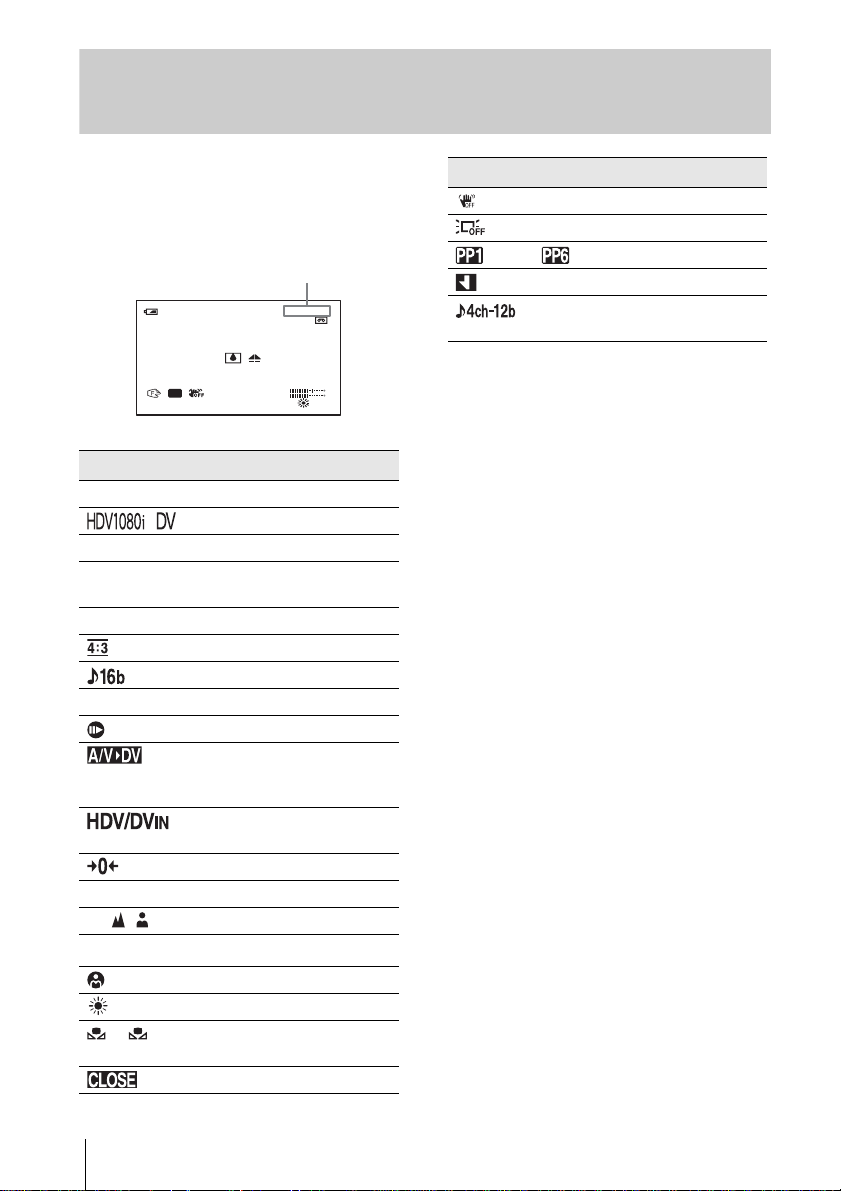
Quick Reference
106
Indicators for the LCD screen and viewfinder
Following indicators will appear on the LCD
screen and viewfinder to indicate the state of
your camcorder.
* Appears only for the pictures in the DV format.
Indicators Meanings
y120min Remaining battery (p. 21)
, Recording format (p. 20)
SP , LP Recording mode (p. 22)
STBY/REC Recording standby/
recording mode
ND
1
, ND
2
, ND
OFF
ND filter (p. 30)
4:3 standard mode (p. 40)
Audio mode (p. 56)*
60min q Remaining tape (p. 21)
Frame recording (p. 55)*
Output analog images and
sound in digital format
(p. 61)*
HDV input/DV input
(p. 76)
Zero set memory (p. 49)
Q Z Warning (p. 88)
9 Manual focus (p. 32)
.
Backlight (p. 25)
Spot light (p. 25)
n Preset white balance (p. 26)
A, B One-push white balance
(p. 26)
Iris closed (p. 28)
L
ND
1
R
F1.6 18
dB
180
HDV1080
i
0:00:00120min
60min
PP1
STBY
Example: Indicators in the CAMERA mode
Time code (p. 44)/Tape counter (p. 44)/
Self-diagnosis (p. 88)
SteadyShot off (p. 54, 68)
LCD backlight off (p. 16)
through Picture Profile (p. 34)
Index recording (p. 39)
4-channel microphone
recording standard (p. 87)*
Indicators Meanings

Quick Reference
Quick Reference
107
Index
Numerics
16:9 wide recording (DV
WIDE REC) ................40
A
A/V connecting cable
.......47, 48, 72, 75, 78, 81
AC Adaptor........................14
AE RESPONSE .................52
AE SHIFT..........................35
AGC LIMIT.......................35
Aperture .............................28
ASSIGN BTN....................68
AT IRIS LMT ....................35
Audio dubbing
(AUDIO MIX) ......56, 79
AUDIO MODE..................56
AWB SENS .......................35
B
BACK LIGHT (camera) ....25
Battery
Battery Info .................12
Battery pack ................11
Remaining battery
time.................21, 93
Remote Commander..105
BEEP..................................62
BLACK FADER................38
Button-type battery............97
C
Camera settings data
display .........................44
Cassette..............................17
Center marker (CENTER
MARKR).....................55
Charging the battery
Battery pack ................11
Pre-installed button-type
battery...................97
CINEFRAME ....................35
CINEMATONE γ ..............35
Cleaning cassette................96
Clock set (CLOCK SET) ...16
Color bar ............................21
COLOR LEVEL................34
COLOR PHASE................34
COMPONENT..................60
Component video
cable......................46, 48
Computer connection ........77
Customizing Personal
Menu...........................65
D
Data code (DATA CODE)
..............................44, 63
Date search........................50
Date/time.....................16, 44
Display
DISP OUTPUT...........64
Display indicators.....106
Dual sound track tape........56
Dubbing.............................70
E
END SEARCH..................44
Expanded focus .................32
Exposure............................25
F
FADER..............................38
Flickering (FLCKR
REDUCE)...................54
Focus .................................32
FORMAT LAMP ..............63
Frame playback .................43
Frame recording (FRAME
REC) ...........................55
Full charge.........................11
G
Gain ...................................28
GAIN SETUP....................52
Grip belt...............................4
H
HANDLE ZOOM..............54
Handle zoom speed ...........22
HDV ........................3, 90, 91
Headphones jack..............103
I
i.LINK ...............................94
i.LINK cable
46, 70, 71, 74, 75, 77, 81
i.LINK CONV................... 60
Index search...................... 50
Index signal....................... 39
"InfoLITHIUM" battery
pack ............................ 92
Iris..................................... 28
IRIS DIAL ........................ 63
L
LANC.............................. 103
Language
(LANGUAGE)........... 18
Large eyecup..................... 16
LCD back light (LCD BL
LEVEL)...................... 58
LCD brightness (LCD
BRIGHT).................... 15
LCD COLOR.................... 58
LCD screen ......................... 3
Lens hood........................ 104
Low-angle recording......... 21
LP (Long Play)
See Recording mode (REC
MODE)
M
Main sound
See MULTI-SOUND
Manual focus..................... 32
Menu
AUDIO SET............... 56
CAMERA SET........... 52
IN/OUT REC.............. 59
LCD/VF SET.............. 58
OTHERS .................... 62
Selecting items........... 51
Menu letter size (LETTER
SIZE).......................... 63
MIC/LINE IN.................... 57
Microphone volume
level............................ 36
Mirror mode...................... 23
Moisture condensation...... 95
MPEG2 ............................... 3
MULTI-SOUND............... 56
N
ND FILTER ...................... 30
,continued

Quick Reference
108
NTSC.................................90
O
Operation confirmation beep
See BEEP
P
PAL ...................................90
PEAKING ......................... 33
Personal Menu
(P-MENU).................. 65
PICTURE PROFILE.........34
Picture search....................43
Playback
Double speed..............43
Frame..........................43
Reverse....................... 43
Slow............................43
Playing time ......................13
R
Rec review......................... 41
Recording capacity
Display........................ 21
REMAINING .............64
Recording format (REC
FORMAT).................. 60
Recording lamp (REC
LAMP)........................63
Recording mode (REC
MODE).......................60
Recording time.................. 13
Remote Commander........105
REMOTE CTRL ........64
Remote sensor.........100, 103
RESET.............................102
S
S video.......47, 48, 72, 75, 81
Self-diagnosis display ....... 88
SHARPNESS....................34
Shoe adaptor....................104
Shot transition ................... 37
SHOT TRANS............53
Shutter speed.....................29
Signal conversion function
(A/V c DV OUT).61, 82
SKINTONE DTL.............. 35
Skip scan ...........................43
Smooth transition
See END SEARCH
SP (Standard Play)
See Recording mode (REC
MODE)
SPOT LIGHT.....................25
STATUS CHECK........24, 45
SteadyShot
(STEADYSHOT)........54
SteadyShot type
(STDYSHOT TYP).....54
Stereo.................................56
Sub sound
See MULTI-SOUND
T
Tape counter ................21, 49
Telephoto
See Zoom
Time code ..........................21
Transition curve (TRANS
CURVE)......................53
Transition time (TRANS
TIME)..........................53
TV color systems...............90
TV TYPE...........................61
U
Using abroad......................90
V
VCR HDV/DV...................59
Video head.........................96
Viewfinder
Adjusting.....................15
Brightness
(VF B.LIGHT)......58
Maintenance................97
Volume ..............................42
W
Warning indicators.............88
Warning messages .............88
WB PRESET .....................26
WB SHIFT.........................35
White balance ....................26
WHITE FADER ................38
Wide angle
See Zoom
Wind noise (WIND) ..........57
WORLD TIME .................62
Write-protect tab ...............91
Z
Zebra pattern .....................31
ZEBRA LEVEL .........31
Zero set memory................49
Zoom .................................22
Zoom ring..........................23




Printed in Japan
Printed on 100% recycled paper using
VOC (Volatile Organic Compound)-free
vegetable oil based ink.