Cyber-shot User Guide
PrintSearch
Before Use
Operating the camera
Shooting
Viewing
Useful shooting functions
Useful viewing functions
Changing settings
Viewing images on a TV
Using with your computer
Printing
Troubleshooting
Precautions / About this camera
Contents list
Top page
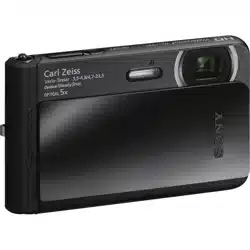
DSC-TX30
User Guide
Use this manual if you encounter any problems, or have any questions about the camera.
Back to top
Copyright 2013 Sony Corporation
1
Cyber-shot User Guide
PrintSearch
Before Use
Operating the camera
Shooting
Viewing
Useful shooting functions
Useful viewing functions
Changing settings
Viewing images on a TV
Using with your computer
Printing
Troubleshooting
Precautions / About this camera
Contents list
Top page > Before Use
Before Use
How to use this User Guide
How to use this User Guide
Names of parts and list of icons displayed on the screen
Names of parts
List of icons displayed on the screen
Using the wrist strap
Using the wrist strap
Using the internal memory
Using the internal memory
Using the In-Camera Guide
In-Camera Guide
Back to top
Copyright 2013 Sony Corporation
2
Cyber-shot User Guide
PrintSearch
Before Use
Operating the camera
Shooting
Viewing
Useful shooting functions
Useful viewing functions
Changing settings
Viewing images on a TV
Using with your computer
Printing
Troubleshooting
Precautions / About this camera
Contents list
Top page > Operating the camera
Operating the camera
Operating the camera
Taking advantage of the touch panel
Using MENU items (Shooting)
Using MENU items (Viewing)
Changing camera settings
Customizing the desired items
Customizing the desired items
Back to top
Copyright 2013 Sony Corporation
3
Cyber-shot User Guide
PrintSearch
Before Use
Operating the camera
Shooting
Viewing
Useful shooting functions
Useful viewing functions
Changing settings
Viewing images on a TV
Using with your computer
Printing
Troubleshooting
Precautions / About this camera
Contents list
Top page > Shooting
Shooting
Shooting still images
Shooting still images
Zoom (Still images)
Shooting movies
Shooting movies
Zoom (Movies)
Shooting still images while recording a movie (Dual Rec)
Selecting the shooting mode based on the subject
Shooting mode functions
Intelligent Auto
Superior Auto
Background Defocus
Program Auto
3D Still Image
iSweep Panorama
Picture Effect
Scene Selection
Back to top
Copyright 2013 Sony Corporation
4
Cyber-shot User Guide
PrintSearch
Before Use
Operating the camera
Shooting
Viewing
Useful shooting functions
Useful viewing functions
Changing settings
Viewing images on a TV
Using with your computer
Printing
Troubleshooting
Precautions / About this camera
Contents list
Top page > Viewing
Viewing
Viewing still images
Viewing still images
Playback zoom
Wide Zoom
Viewing burst images
Viewing burst images
Viewing movies
Viewing movies
Viewing panoramic images
Scrolling the panoramic images for display
Back to top
Copyright 2013 Sony Corporation
5
Cyber-shot User Guide
PrintSearch
Before Use
Operating the camera
Shooting
Viewing
Useful shooting functions
Useful viewing functions
Changing settings
Viewing images on a TV
Using with your computer
Printing
Troubleshooting
Precautions / About this camera
Contents list
Top page > Useful shooting functions
Useful shooting functions
Functions available for each shooting mode
Functions available for each shooting mode
MENU items available for each shooting mode
Menu items available for shooting
Tracking focus
Flash
LED Light
Macro
Photo Creativity
Cont. Shooting Settings
Self-Timer
Movie shooting scene
Easy Mode
HDR Painting effect
Area of emphasis
Color hue
Extracted Color
Illustration Effect
Defocus Effect
Soft Skin Effect
Still Image Size(Dual Rec)
Still Image Size/Panorama Image Size
Movie Quality/Movie Size
Exposure Compensation
ISO
White Balance
Focus
Metering Mode
Scene Recognition
Smile Shutter
Smile Detection Sensitivity
Face Detection
Anti Blink
Movie SteadyShot
Back to top
Copyright 2013 Sony Corporation
6
Cyber-shot User Guide
PrintSearch
Before Use
Operating the camera
Shooting
Viewing
Useful shooting functions
Useful viewing functions
Changing settings
Viewing images on a TV
Using with your computer
Printing
Troubleshooting
Precautions / About this camera
Contents list
Top page > Useful viewing functions
Useful viewing functions
Functions available for each view mode
MENU items available for each view mode
MENU items (Viewing)
Easy Mode
Date Select
Calendar
Image Index
Number of images in index
Slideshow
Delete
Beauty Effect
Retouch
Picture Effect
Paint
3D Viewing
View Mode
Display Cont. Shooting Group
Protect
Print (DPOF)
Rotate
Volume
Exposure data
Back to top
Copyright 2013 Sony Corporation
7
Cyber-shot User Guide
PrintSearch
Before Use
Operating the camera
Shooting
Viewing
Useful shooting functions
Useful viewing functions
Changing settings
Viewing images on a TV
Using with your computer
Printing
Troubleshooting
Precautions / About this camera
Contents list
Top page > Changing settings
Changing settings
Shooting Settings
Movie format
AF Illuminator
Grid Line
Clear Image Zoom
Digital Zoom
Wind Noise Reduct.
Scene Recog. Guide
Red Eye Reduction
Blink Alert
Write Date
Disp. Resolution
Main Settings
Beep
Panel Brightness
Language Setting
Display color
Demo Mode
Initialize
CTRL FOR HDMI
USB Connect Setting
USB Power Supply
LUN Setting
Download Music
Empty Music
Power Save
Version
Memory Card Tool/Internal Memory Tool
Format
Create REC.Folder
Change REC.Folder
Delete REC.Folder
Copy
File Number
Clock Settings
Area Setting
Date & Time Setting
Back to top
Copyright 2013 Sony Corporation
8
Cyber-shot User Guide
PrintSearch
Before Use
Operating the camera
Shooting
Viewing
Useful shooting functions
Useful viewing functions
Changing settings
Viewing images on a TV
Using with your computer
Printing
Troubleshooting
Precautions / About this camera
Contents list
Top page > Viewing images on a TV
Viewing images on a TV
Viewing an image on a High Definition (HD) TV
Viewing an image on an HD TV using the HDMI Cable (sold separately)
Viewing an image on a “BRAVIA” Sync-compatible TV
Viewing an image on a “BRAVIA” Sync-compatible TV
Viewing 3D images on a 3D TV
Viewing 3D images on a 3D TV
Back to top
Copyright 2013 Sony Corporation
9
Cyber-shot User Guide
PrintSearch
Before Use
Operating the camera
Shooting
Viewing
Useful shooting functions
Useful viewing functions
Changing settings
Viewing images on a TV
Using with your computer
Printing
Troubleshooting
Precautions / About this camera
Contents list
Top page > Using with your computer
Using with your computer
Recommended computer environment
Recommended computer environment
Using the software
“PlayMemories Home” (Windows)
Installing “PlayMemories Home” (Windows)
“Music Transfer”
Software for Mac
Importing images to a computer
Connecting the camera to the computer
Importing images to a computer
Deleting the USB connection
Creating a disc of movies
Selecting the method for creating a disc of movies
Back to top
Copyright 2013 Sony Corporation
10
Cyber-shot User Guide
PrintSearch
Before Use
Operating the camera
Shooting
Viewing
Useful shooting functions
Useful viewing functions
Changing settings
Viewing images on a TV
Using with your computer
Printing
Troubleshooting
Precautions / About this camera
Contents list
Top page > Printing
Printing
Printing still images
Printing still images
Back to top
Copyright 2013 Sony Corporation
11
Cyber-shot User Guide
PrintSearch
Before Use
Operating the camera
Shooting
Viewing
Useful shooting functions
Useful viewing functions
Changing settings
Viewing images on a TV
Using with your computer
Printing
Troubleshooting
Precautions / About this camera
Contents list
Top page > Troubleshooting
Troubleshooting
If you have problems
If you have problems
Troubleshooting
Battery pack and power
Shooting still images/movies
Viewing images
Computers
Memory card
Internal memory
Printing
Touch Panel/Screen
Others
Warning indicators and messages
Self-diagnosis display
Messages
Situations this camera has difficulty handling
Situations this camera has difficulty handling
Back to top
Copyright 2013 Sony Corporation
12
Cyber-shot User Guide
PrintSearch
Before Use
Operating the camera
Shooting
Viewing
Useful shooting functions
Useful viewing functions
Changing settings
Viewing images on a TV
Using with your computer
Printing
Troubleshooting
Precautions / About this camera
Contents list
Top page > Precautions / About this camera
Precautions / About this camera
Precautions
Precautions
On the internal rechargeable backup battery
Battery pack
Charging the battery pack
Memory card
On cleaning
On cleaning
Number of still images and recordable time of movies
Number of still images
Recordable time of movies
Using the camera abroad
Using the camera abroad
On TV color systems
About this camera
Carl Zeiss lens
AVCHD format
License
Trademarks
Trademarks
Back to top
Copyright 2013 Sony Corporation
13
Cyber-shot User Guide
PrintSearch
Before Use
Operating the camera
Shooting
Viewing
Useful shooting functions
Useful viewing functions
Changing settings
Viewing images on a TV
Using with your computer
Printing
Troubleshooting
Precautions / About this camera
Contents list
Top page > Contents list
Contents list
Before Use
How to use this User Guide
How to use this User Guide
Names of parts and list of icons displayed on the screen
Names of parts
List of icons displayed on the screen
Using the wrist strap
Using the wrist strap
Using the internal memory
Using the internal memory
Using the In-Camera Guide
In-Camera Guide
Back to top
Operating the camera
Operating the camera
Taking advantage of the touch panel
Using MENU items (Shooting)
Using MENU items (Viewing)
Changing camera settings
Customizing the desired items
Customizing the desired items
Back to top
Shooting
Shooting still images
Shooting still images
Zoom (Still images)
Shooting movies
Shooting movies
Zoom (Movies)
Shooting still images while recording a movie (Dual Rec)
Selecting the shooting mode based on the subject
Shooting mode functions
Intelligent Auto
Superior Auto
14

Background Defocus
Program Auto
3D Still Image
iSweep Panorama
Picture Effect
Scene Selection
Back to top
Viewing
Viewing still images
Viewing still images
Playback zoom
Wide Zoom
Viewing burst images
Viewing burst images
Viewing movies
Viewing movies
Viewing panoramic images
Scrolling the panoramic images for display
Back to top
Useful shooting functions
Functions available for each shooting mode
Functions available for each shooting mode
MENU items available for each shooting mode
Menu items available for shooting
Tracking focus
Flash
LED Light
Macro
Photo Creativity
Cont. Shooting Settings
Self-Timer
Movie shooting scene
Easy Mode
HDR Painting effect
Area of emphasis
Color hue
Extracted Color
Illustration Effect
Defocus Effect
Soft Skin Effect
Still Image Size(Dual Rec)
Still Image Size/Panorama Image Size
Movie Quality/Movie Size
Exposure Compensation
15

ISO
White Balance
Focus
Metering Mode
Scene Recognition
Smile Shutter
Smile Detection Sensitivity
Face Detection
Anti Blink
Movie SteadyShot
Back to top
Useful viewing functions
Functions available for each view mode
MENU items available for each view mode
MENU items (Viewing)
Easy Mode
Date Select
Calendar
Image Index
Number of images in index
Slideshow
Delete
Beauty Effect
Retouch
Picture Effect
Paint
3D Viewing
View Mode
Display Cont. Shooting Group
Protect
Print (DPOF)
Rotate
Volume
Exposure data
Back to top
Changing settings
Shooting Settings
Movie format
AF Illuminator
Grid Line
Clear Image Zoom
Digital Zoom
Wind Noise Reduct.
Scene Recog. Guide
Red Eye Reduction
16

Blink Alert
Write Date
Disp. Resolution
Main Settings
Beep
Panel Brightness
Language Setting
Display color
Demo Mode
Initialize
CTRL FOR HDMI
USB Connect Setting
USB Power Supply
LUN Setting
Download Music
Empty Music
Power Save
Version
Memory Card Tool/Internal Memory Tool
Format
Create REC.Folder
Change REC.Folder
Delete REC.Folder
Copy
File Number
Clock Settings
Area Setting
Date & Time Setting
Back to top
Viewing images on a TV
Viewing an image on a High Definition (HD) TV
Viewing an image on an HD TV using the HDMI Cable (sold separately)
Viewing an image on a “BRAVIA” Sync-compatible TV
Viewing an image on a “BRAVIA” Sync-compatible TV
Viewing 3D images on a 3D TV
Viewing 3D images on a 3D TV
Back to top
Using with your computer
Recommended computer environment
Recommended computer environment
Using the software
“PlayMemories Home” (Windows)
Installing “PlayMemories Home” (Windows)
“Music Transfer”
17

Software for Mac
Importing images to a computer
Connecting the camera to the computer
Importing images to a computer
Deleting the USB connection
Creating a disc of movies
Selecting the method for creating a disc of movies
Back to top
Printing
Printing still images
Printing still images
Back to top
Troubleshooting
If you have problems
If you have problems
Troubleshooting
Battery pack and power
Shooting still images/movies
Viewing images
Computers
Memory card
Internal memory
Printing
Touch Panel/Screen
Others
Warning indicators and messages
Self-diagnosis display
Messages
Situations this camera has difficulty handling
Situations this camera has difficulty handling
Back to top
Precautions / About this camera
Precautions
Precautions
On the internal rechargeable backup battery
Battery pack
Charging the battery pack
Memory card
On cleaning
On cleaning
Number of still images and recordable time of movies
Number of still images
18

Cyber-shot User Guide
PrintSearch
Before Use
Operating the camera
Shooting
Viewing
Useful shooting functions
Useful viewing functions
Changing settings
Viewing images on a TV
Using with your computer
Printing
Troubleshooting
Precautions / About this camera
Contents list
Top page > Before Use > How to use this User Guide > How to use this User Guide
How to use this User Guide
Selecting a topic to display
Searching a topic by keyword
Returning to a previous page
Printing out a page
Marks and notations used in this User Guide
The images used as examples in this User Guide are reproduced images, and are not actual images
shot using this camera.
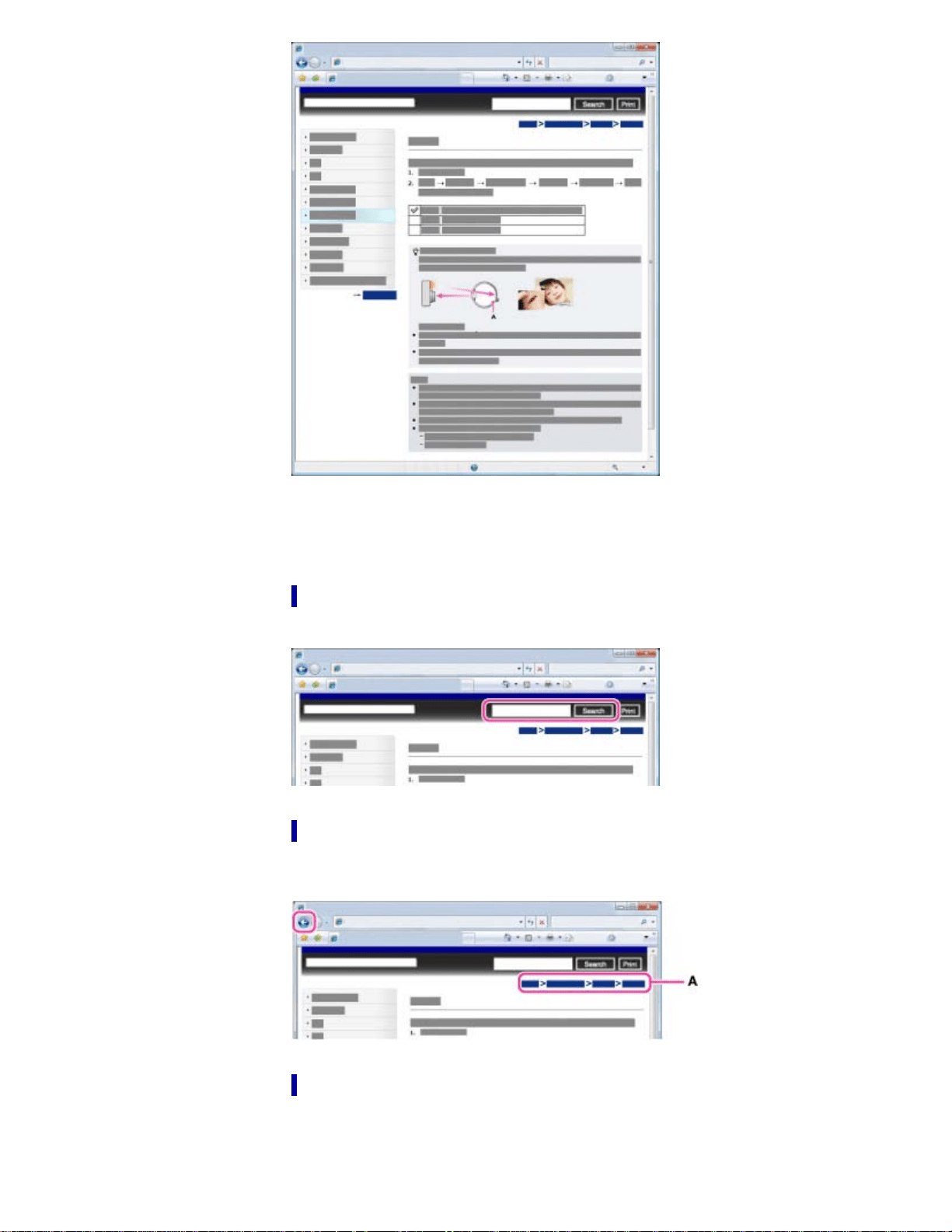
Selecting a topic to display
The following illustrations take Internet Explorer 7 as an example.
1. Click a title in the side bar on the left of the browser window.
The title’s topic list appears in the right pane.
2. Click a topic title in the list.
Descriptions appear in the right pane.
20
Changing the font size
Change the font size by changing the setting of your web browser. For how to change the font size
setting, refer to the Help of your web browser.
Searching a topic by keyword
Enter the keyword in the search window, then click the [Search] button.
Returning to a previous page
Use the browser’s back button to return to a previously viewed page, or use the breadcrumb trail
navigation (A) to display the desired page.
Printing out a page
Click the [Print] button to print out the page you are viewing.
21
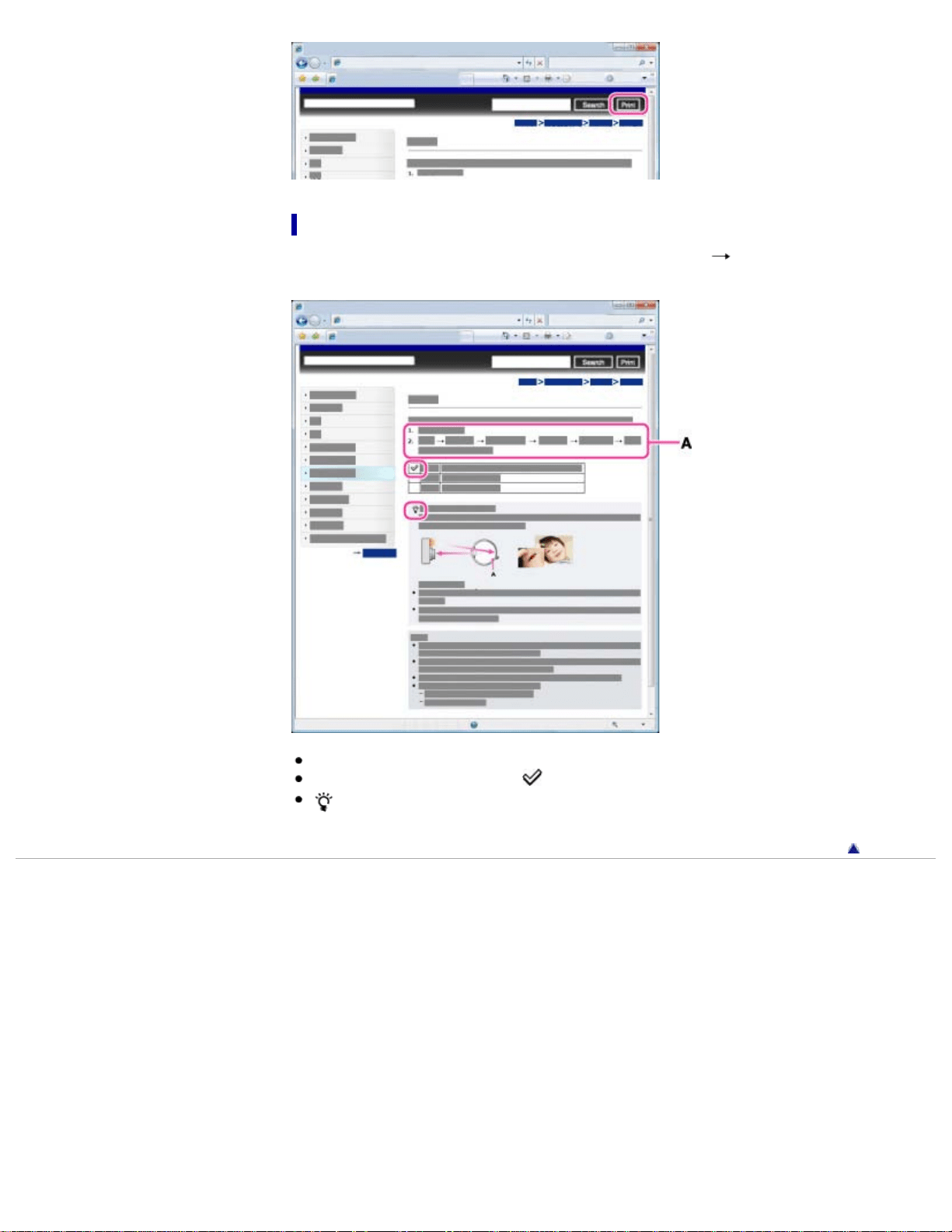
Marks and notations used in this User Guide
In this User Guide, the sequence of operations is shown by arrows ( ) (A).
Operate the camera in the order indicated.
Icons in the operating procedure sentences appear when the camera is in its default settings.
The default setting is indicated by
.
indicates information that is useful to know.
Back to top
Copyright 2013 Sony Corporation
22
Cyber-shot User Guide
PrintSearch
Before Use
Operating the camera
Shooting
Viewing
Useful shooting functions
Useful viewing functions
Changing settings
Viewing images on a TV
Using with your computer
Printing
Troubleshooting
Precautions / About this camera
Contents list
Top page > Before Use > Names of parts and list of icons displayed on the screen > Names of parts
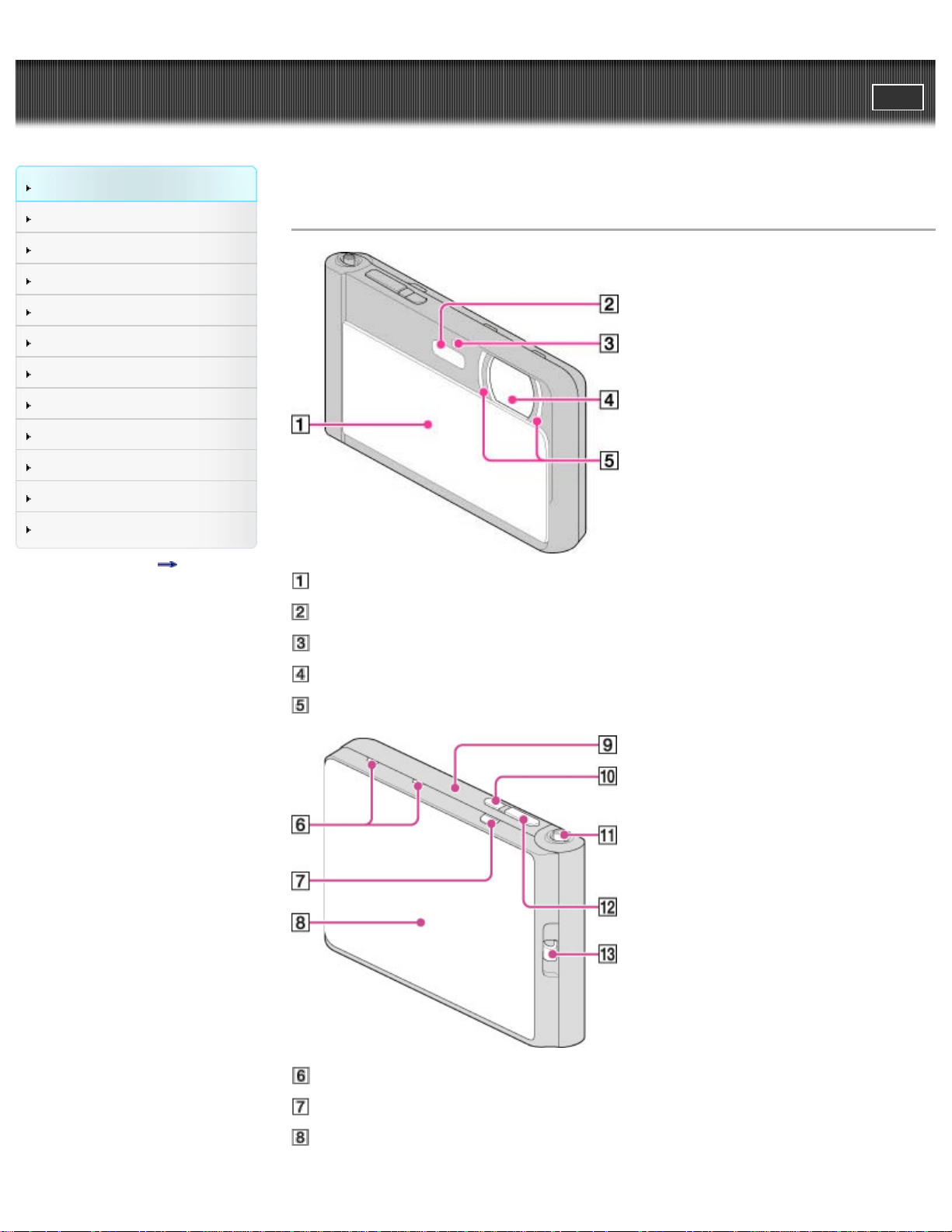
Names of parts
Lens cover
Flash
Self-timer lamp / Smile Shutter lamp / AF illuminator
Lens
LED light
Microphone
MOVIE (Movie) button
OLED screen/Touch panel
23
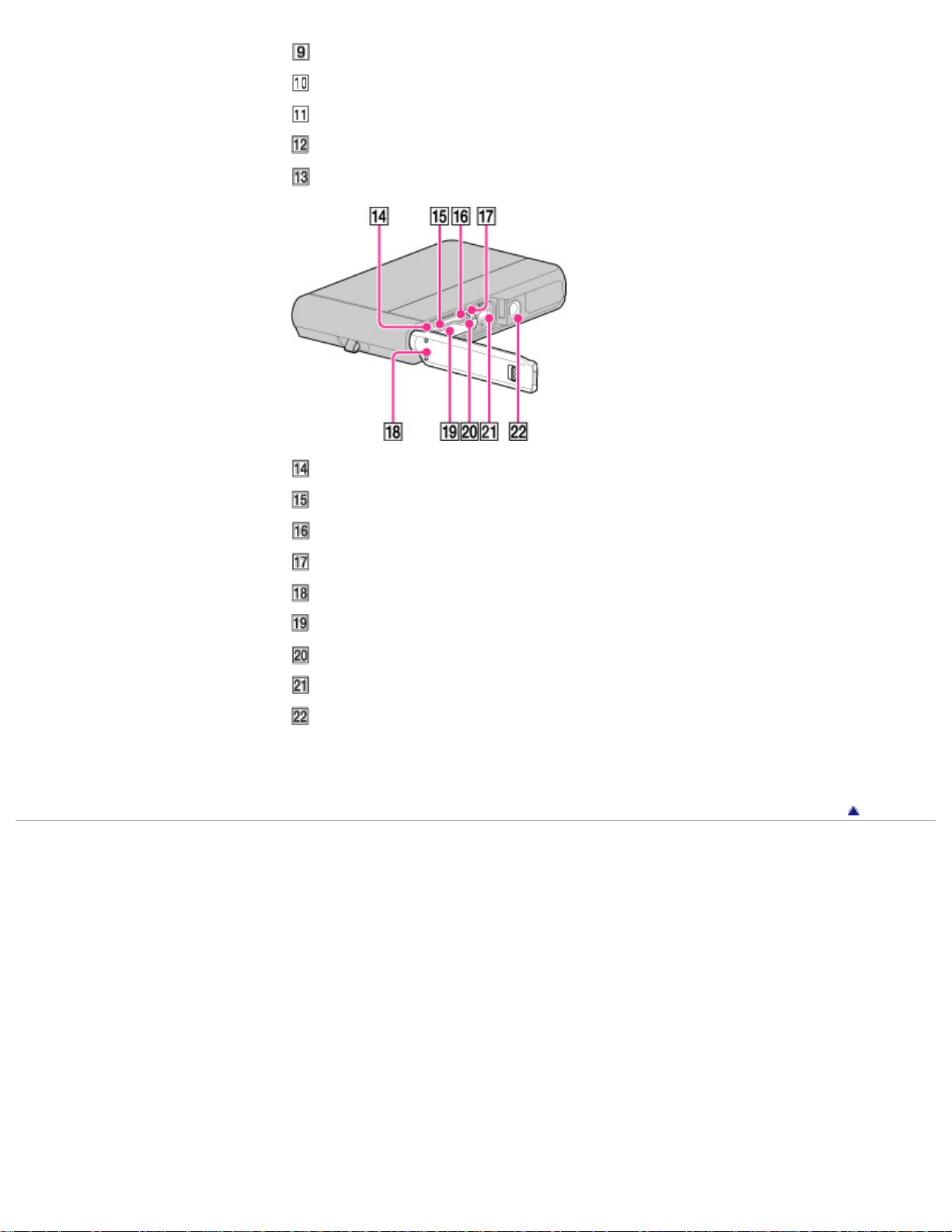
Speaker (built-in)
ON/OFF (Power) button
W/T (zoom) lever
Shutter button
Hook for wrist strap
Multi/Micro USB Terminal *
Charge lamp
Memory card slot
Battery eject lever
Battery/Memory card cover
Battery insertion slot
Access lamp
HDMI micro jack
Tripod receptacle
* Supports Micro USB compatible device.
Back to top
Copyright 2013 Sony Corporation
24
Cyber-shot User Guide
PrintSearch
Before Use
Operating the camera
Shooting
Viewing
Useful shooting functions
Useful viewing functions
Changing settings
Viewing images on a TV
Using with your computer
Printing
Troubleshooting
Precautions / About this camera
Contents list
Top page > Before Use > Names of parts and list of icons displayed on the screen > List of icons
displayed on the screen
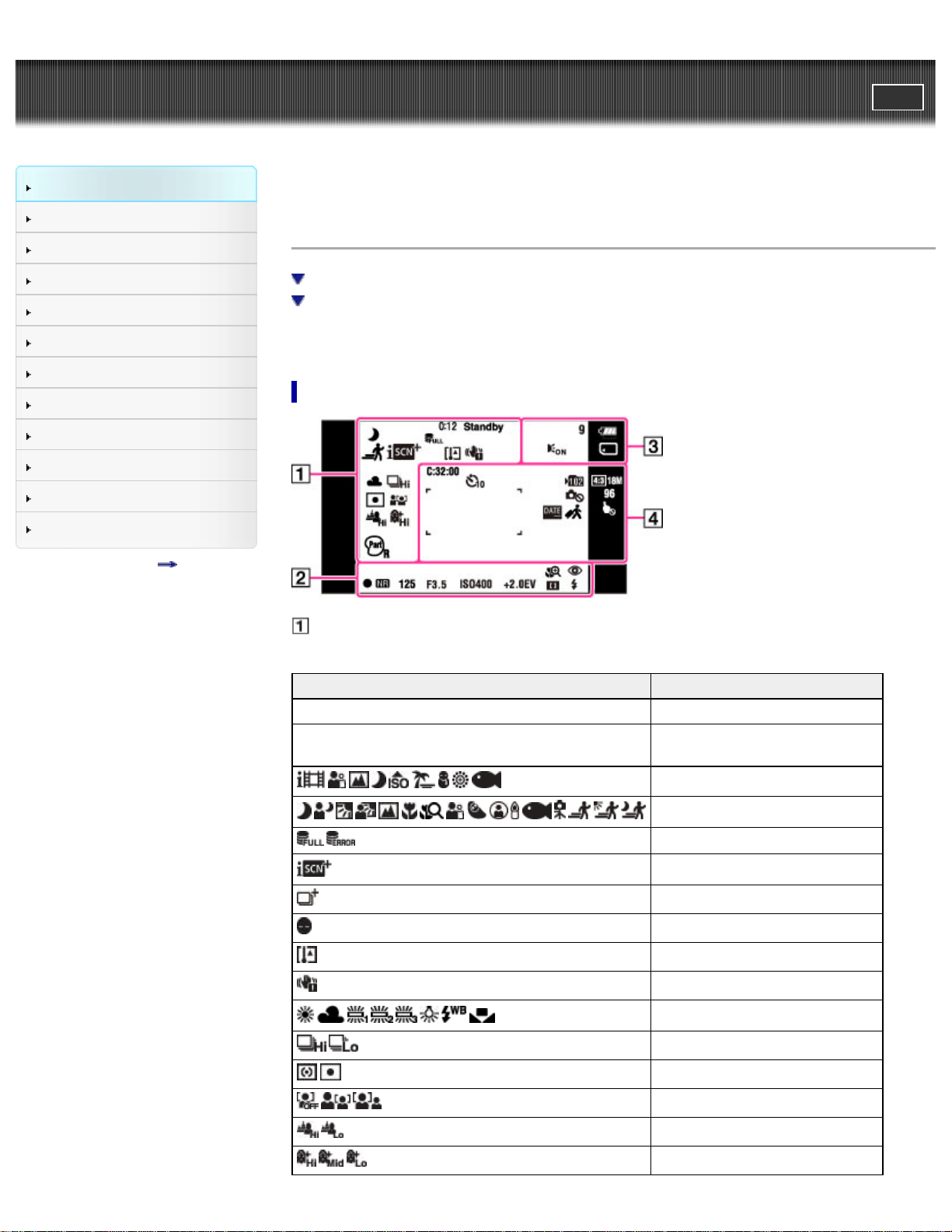
List of icons displayed on the screen
List of shooting mode icons
List of viewing mode icons
Icons are displayed on the screen to indicate the camera status.
The displayed icon positions may differ according to the shooting mode.
List of shooting mode icons
Display Indication
0:12 Recording time (m:s)
REC
Standby
Recording a movie/Movie standby
Movie shooting scene
Scene Recognition icon
Database file full/Database file error
Scene Recognition
Overlay icon
Anti Blink
Overheating warning
Vibration warning
White Balance
Burst Shooting Interval
Metering Mode
Face Detection
Defocus Effect
Soft Skin Effect
25
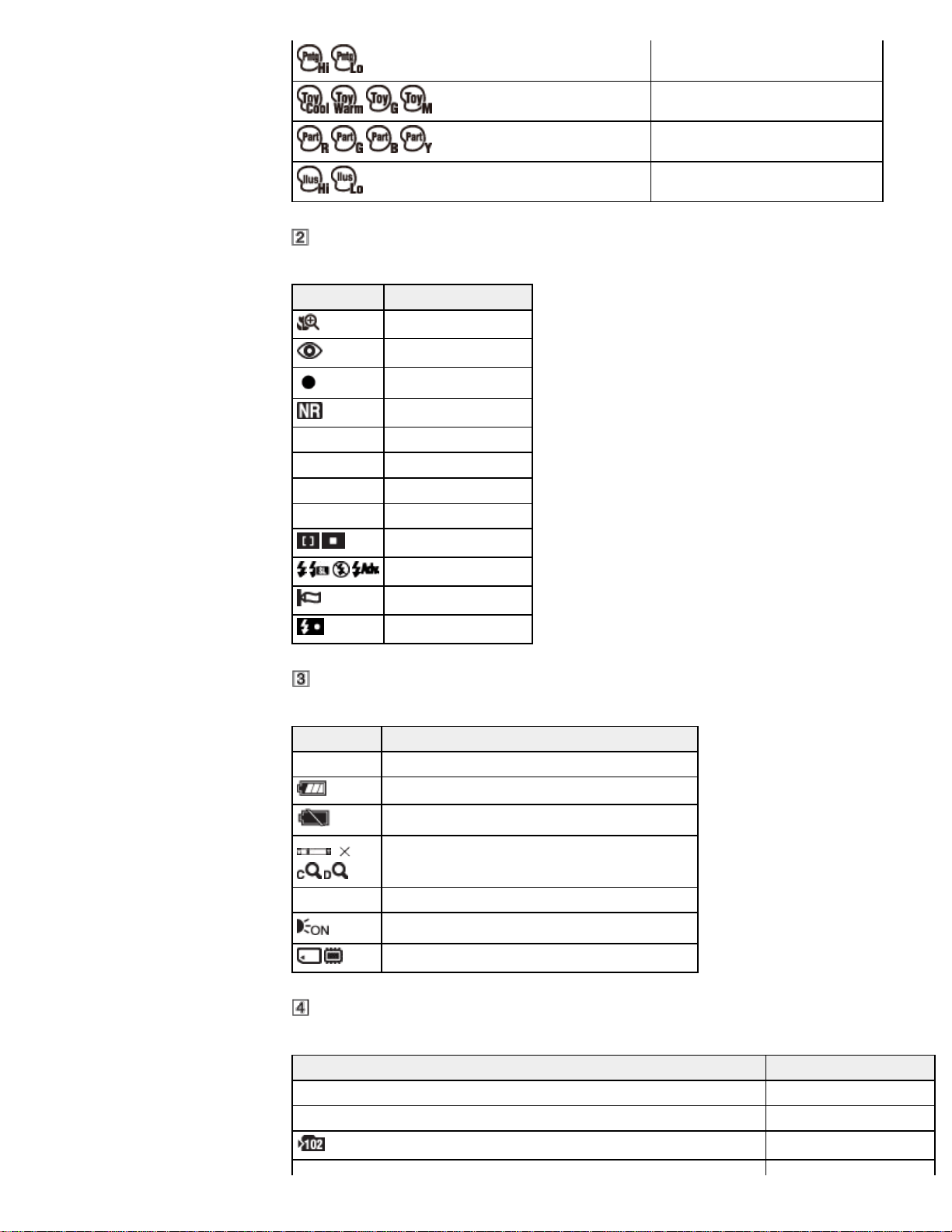
HDR Painting effect
Color hue
Extracted Color
Illustration effect
Display Indication
Magnifying Glass Plus
Red-eye reduction
AE/AF lock
NR slow shutter
125 Shutter speed
F3.5 Aperture value
ISO400 ISO number
+2.0EV Exposure value
Focus
Flash mode
Wind Noise Reduction
Flash charging
Display Indication
9 Number of recordable images (Dual Rec)
Battery remaining
Low battery warning
1.4
Zoom scaling
CAPTURE Importing still images
AF Illuminator
Recording Media (Memory card, internal memory)
Display Indication
100Min Recordable time
C:32:00 Self-diagnosis display
Recording folder
26
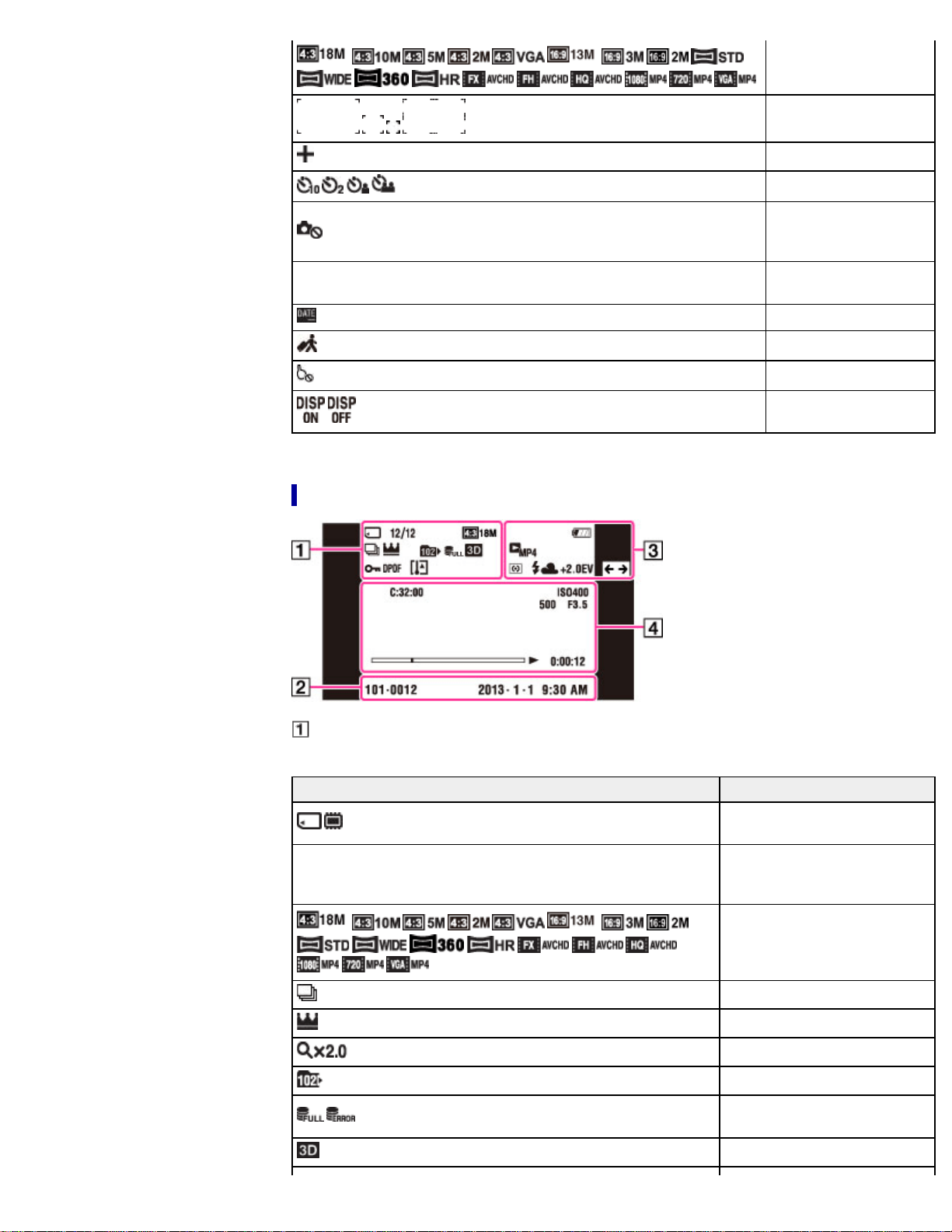
Image size/Panorama
image size/Quality
AF range finder frame
Spot metering cross-hairs
Self-timer
Warning indicator
pertaining to still image
recording
96
Number of recordable
images
Write Date
Destination
Touch panel invalid
Enable/Disable touch
panel
List of viewing mode icons
Display Indication
Playback Media (Memory card,
internal memory)
12/12
Image number/Number of
images recorded in selected date
range, folder
Image size/Panorama image
size/Quality
Burst Images
Main image in the burst group
Playback zoom
Playback folder
Database file full/Database file
error
3D images
27
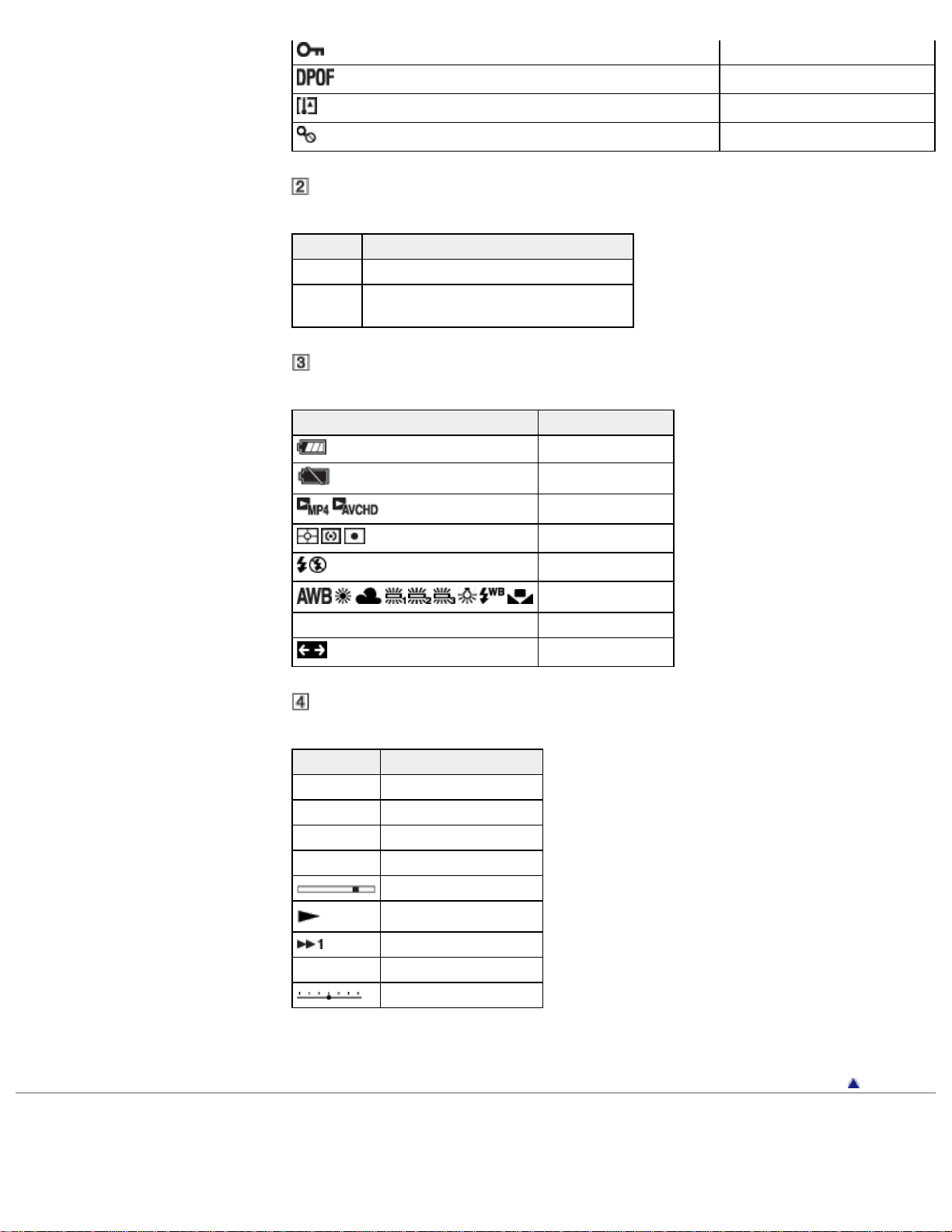
Protect
Print order (DPOF)
Overheating warning
Enlargement unavailable
Display Indication
101-0012 Folder-file number
2013-1-1
9:30 AM
Recorded date/time of the playback image
Display Indication
Battery remaining
Low battery warning
View mode
Metering Mode
Flash mode
White Balance
+2.0EV Exposure value
Wide zoom
Display Indication
C:32:00 Self-diagnosis display
ISO400 ISO number
500 Shutter speed
F3.5 Aperture value
Playback bar
Playback
Variable speed playback
00:00:12 Counter
Volume
Back to top
Copyright 2013 Sony Corporation
28
Cyber-shot User Guide
PrintSearch
Before Use
Operating the camera
Shooting
Viewing
Useful shooting functions
Useful viewing functions
Changing settings
Viewing images on a TV
Using with your computer
Printing
Troubleshooting
Precautions / About this camera
Contents list
Top page > Before Use > Using the wrist strap > Using the wrist strap
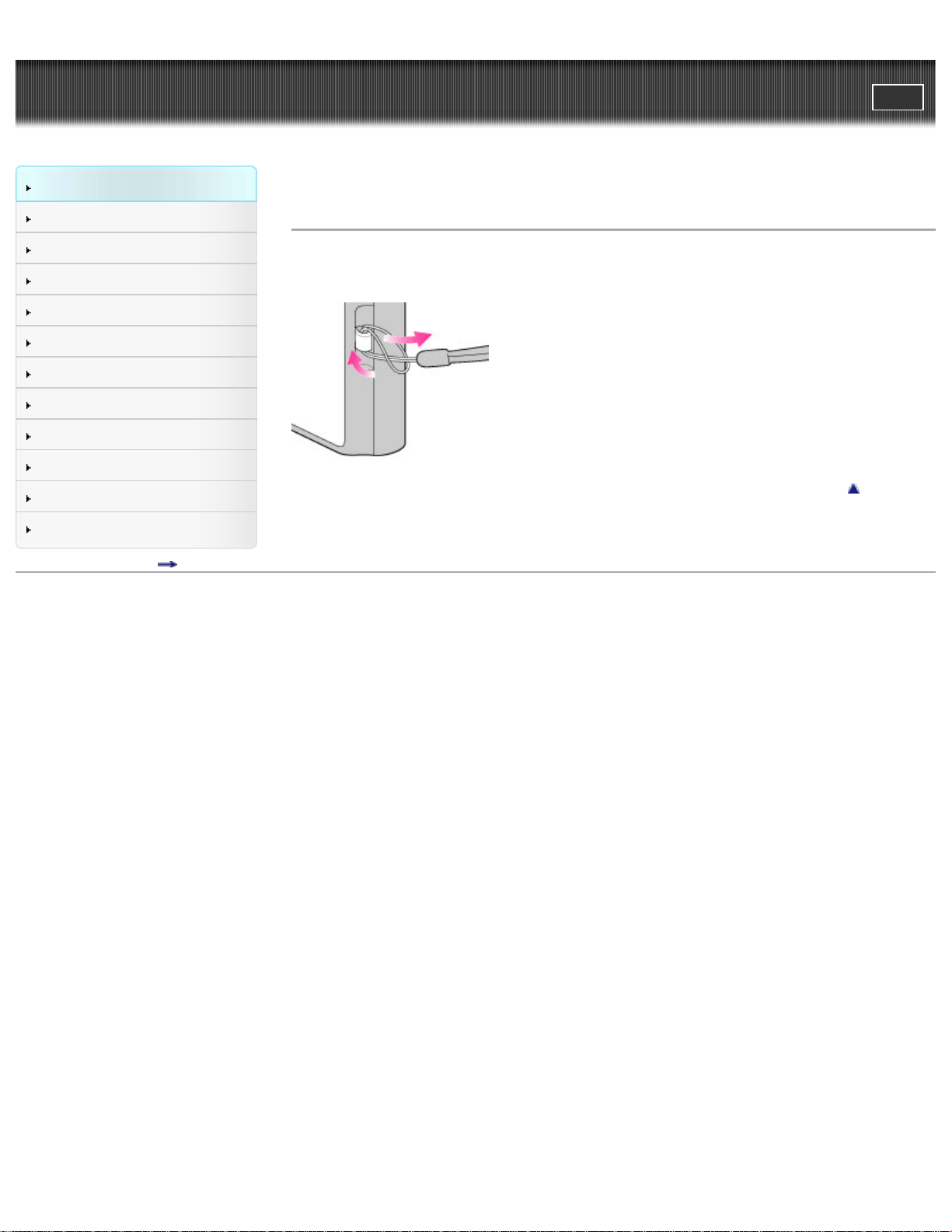
Using the wrist strap
Attach the strap and place your hand through the loop to prevent the camera from damage by being
dropped or submerged.
Back to top
Copyright 2013 Sony Corporation
29
Cyber-shot User Guide
PrintSearch
Before Use
Operating the camera
Shooting
Viewing
Useful shooting functions
Useful viewing functions
Changing settings
Viewing images on a TV
Using with your computer
Printing
Troubleshooting
Precautions / About this camera
Contents list
Top page > Before Use > Using the internal memory > Using the internal memory
Using the internal memory
On image data stored in the internal memory
The camera has approximately 48 MB of internal memory. You can record still images on the internal
memory when there is no memory card inserted in the camera.
When a memory card is inserted
[Recording]: Images are recorded on the memory card.
[Playback]: Images on the memory card are played back.
[Menu, Settings, etc.]: Various functions can be performed on images on the memory card.
When there is no memory card inserted
[Recording]: Images are recorded using the internal memory. However, movies cannot be recorded to
the internal memory.
[Playback]: Images stored in the internal memory are played back.
[Menu, Settings, etc.]: Various functions can be performed on images in the internal memory.
On image data stored in the internal memory
We recommend that you copy (back up) data using one of the following methods.
To copy (back up) data on a hard disk of your computer
Without a memory card inserted in the camera, import the images into a computer. [Details]
To copy (back up) data on a memory card
Prepare a memory card with sufficient free capacity, then copy the images in the internal memory to the
memory card. [Details]
Notes
You cannot transfer image data on a memory card to the internal memory.
By making a USB connection between the camera and a computer, you can transfer data stored in
the internal memory to a computer. However you cannot transfer data on a computer to the internal
memory.
Back to top
Copyright 2013 Sony Corporation
30
Cyber-shot User Guide
PrintSearch
Before Use
Operating the camera
Shooting
Viewing
Useful shooting functions
Useful viewing functions
Changing settings
Viewing images on a TV
Using with your computer
Printing
Troubleshooting
Precautions / About this camera
Contents list
Top page > Before Use > Using the In-Camera Guide > In-Camera Guide
In-Camera Guide
This camera is equipped with built-in instruction guide. This allows you to search the camera’s functions
according to your needs.
You can use the selected function after reading the guide.
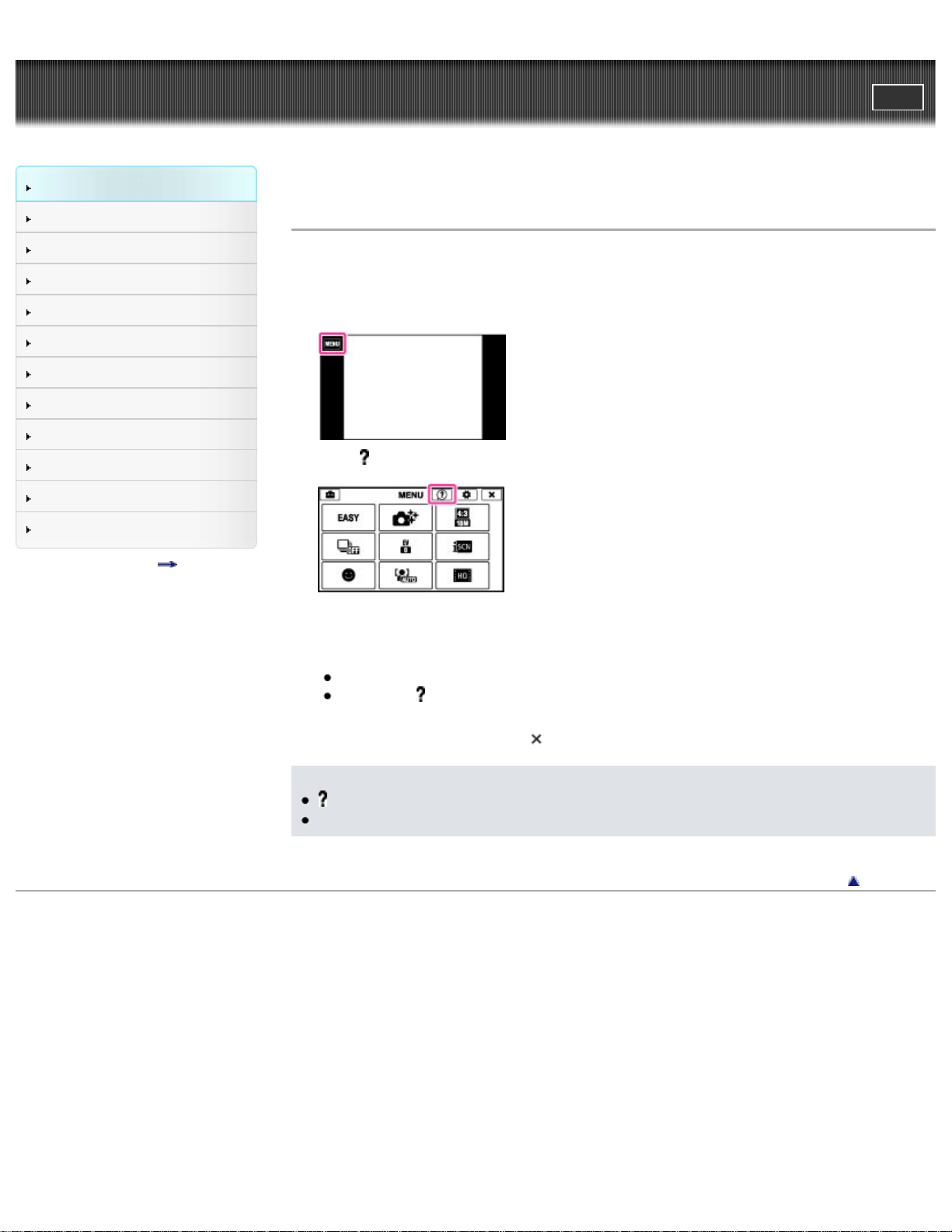
1. Touch MENU.
2. Touch (In-Camera Guide).
3. Touch the desired MENU item.
The explanation for the selected item is displayed.
4. Drag the screen to see the summary, operation guide and details.
When you select [Use this function], the camera switches to the selected mode automatically.
If you touch
(In-Camera Guide) when the MENU screen is not displayed, you can search the
guide using keywords or icons.
5. To end [In-Camera Guide], touch
.
Notes
(In-Camera Guide) is not available in Easy Mode.
Depending on the selected functions, the operating guide and details may not be displayed.
Back to top
Copyright 2013 Sony Corporation
31
Cyber-shot User Guide
PrintSearch
Before Use
Operating the camera
Shooting
Viewing
Useful shooting functions
Useful viewing functions
Changing settings
Viewing images on a TV
Using with your computer
Printing
Troubleshooting
Precautions / About this camera
Contents list
Top page > Operating the camera > Operating the camera > Taking advantage of the touch panel
Taking advantage of the touch panel
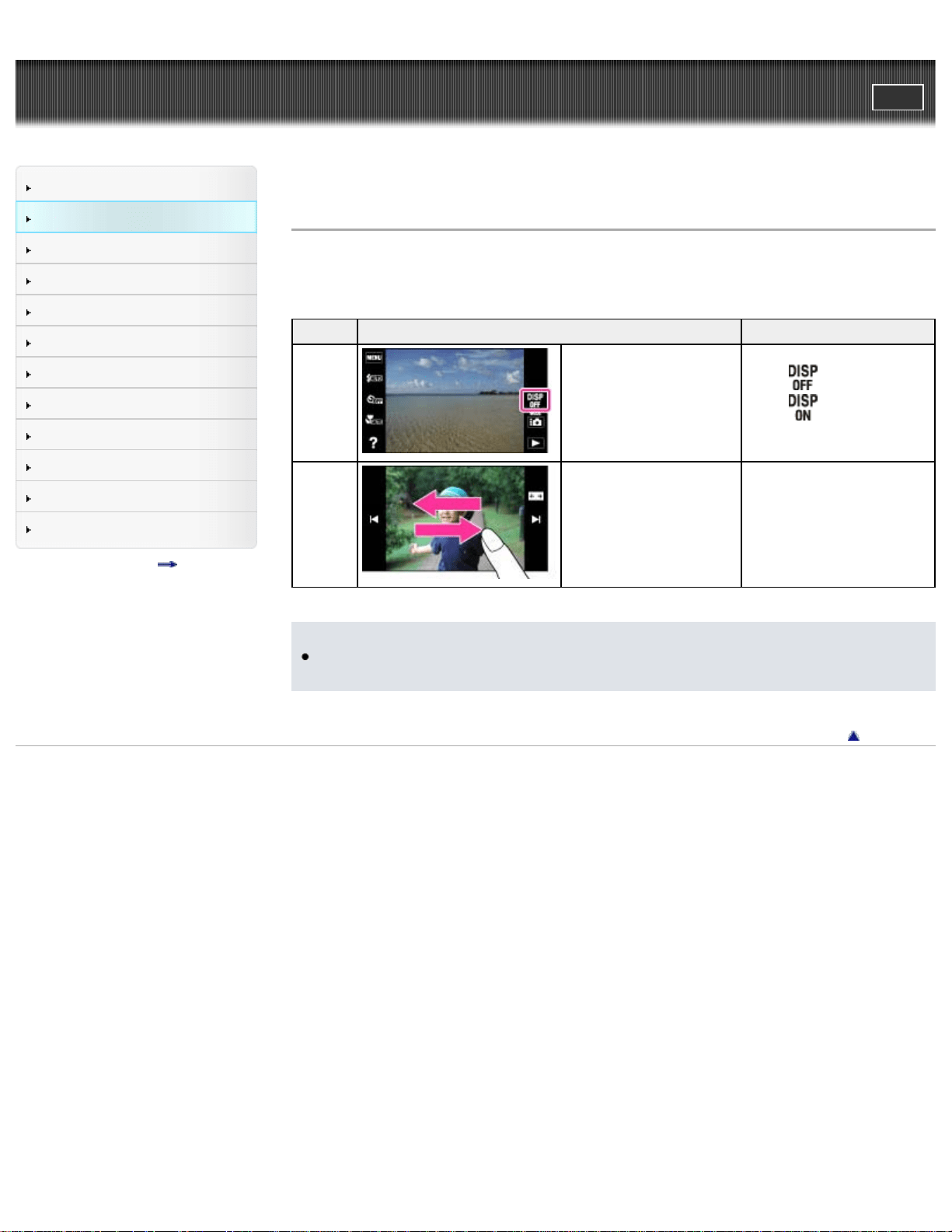
The available functions may differ according to the screen mode. Touch the screen to perform
operations such as enlarging desired images or selecting a function with your finger.
Screen Action Operating method
Shooting
Invalids the touch panel
operation
Touch
few seconds.
Touch
few seconds to
display the icon.
Viewing
Displays the previous/next
image or page
Drag the screen to the right
or left.
Notes
To operate the touch panel, press it lightly with your finger. Pressing hard or using a pointed object
could damage the touch panel.
Back to top
Copyright 2013 Sony Corporation
32
Cyber-shot User Guide
PrintSearch
Before Use
Operating the camera
Shooting
Viewing
Useful shooting functions
Useful viewing functions
Changing settings
Viewing images on a TV
Using with your computer
Printing
Troubleshooting
Precautions / About this camera
Contents list
Top page > Operating the camera > Operating the camera > Using MENU items (Shooting)
Using MENU items (Shooting)
You can display and easily select the functions that can be used on the currently displayed screen
during shooting.
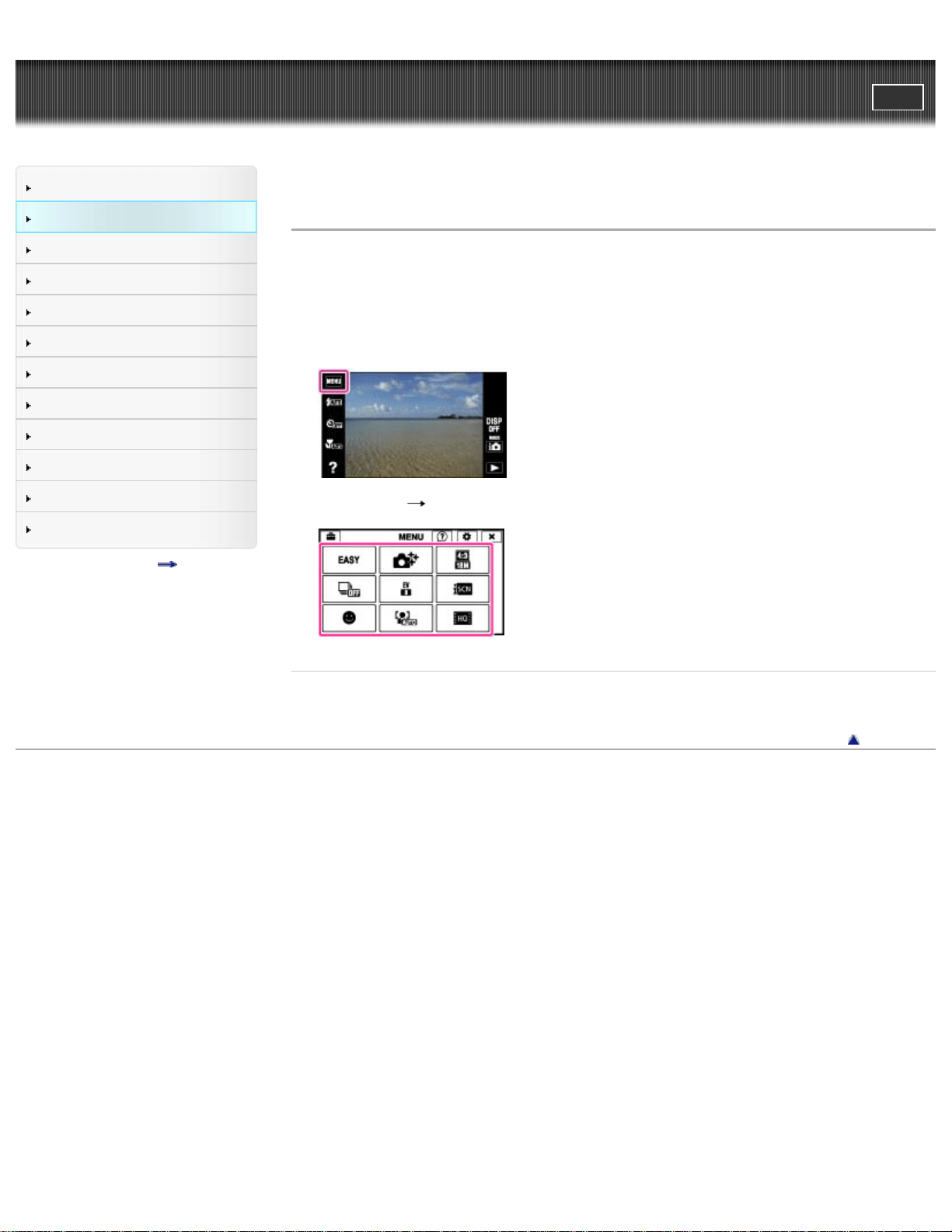
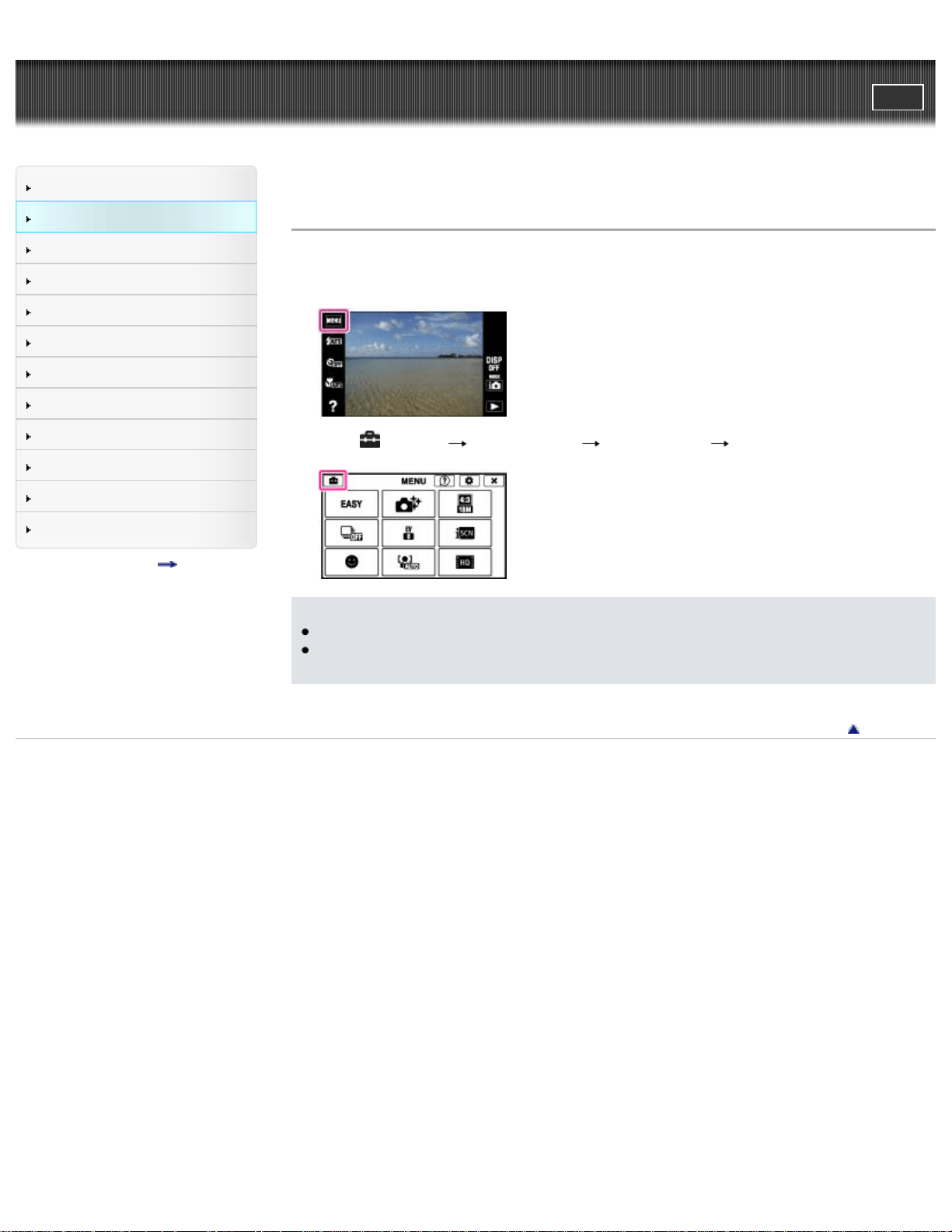
1. Lower the lens cover to switch to shooting mode.
2. Touch the MENU icon to display the MENU screen.
The 4 menu items usually displayed under MENU will not appear on the MENU screen.
3. Touch MENU desired mode
Related Topic
Customizing the desired items
Back to top
Copyright 2013 Sony Corporation
33
Cyber-shot User Guide
PrintSearch
Before Use
Operating the camera
Shooting
Viewing
Useful shooting functions
Useful viewing functions
Changing settings
Viewing images on a TV
Using with your computer
Printing
Troubleshooting
Precautions / About this camera
Contents list
Top page > Operating the camera > Operating the camera > Using MENU items (Viewing)
Using MENU items (Viewing)
You can select the various viewing functions easily from the screen.
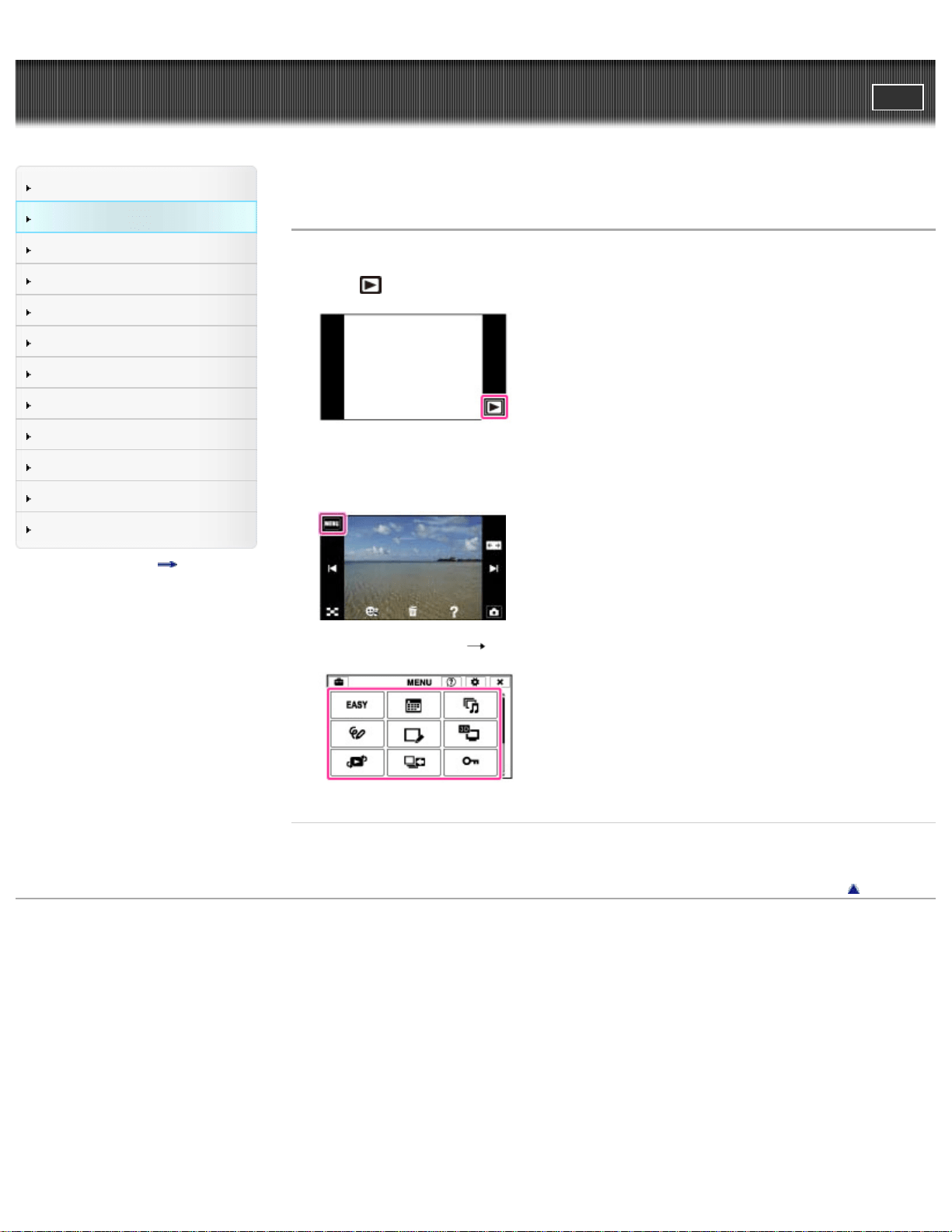
1. Touch
(Playback) to switch to playback mode.
2. Touch MENU to display the Menu screen.
The 4 menu items usually displayed in the lower part of the screen will not appear on the MENU
screen.
3. Touch the MENU items desired mode
Related Topic
Customizing the desired items
Back to top
Copyright 2013 Sony Corporation
34
Cyber-shot User Guide
PrintSearch
Before Use
Operating the camera
Shooting
Viewing
Useful shooting functions
Useful viewing functions
Changing settings
Viewing images on a TV
Using with your computer
Printing
Troubleshooting
Precautions / About this camera
Contents list
Top page > Operating the camera > Operating the camera > Changing camera settings
Changing camera settings
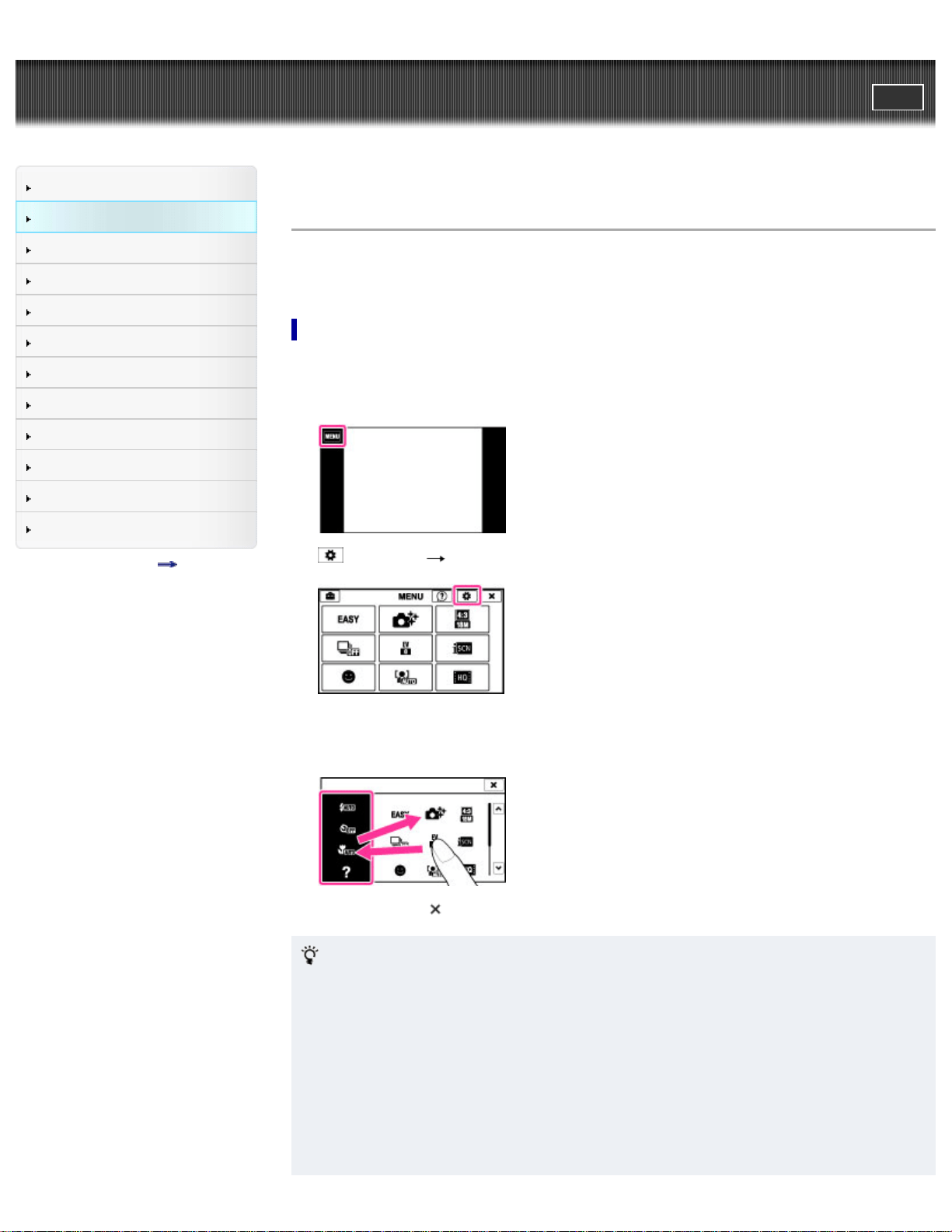
You can change the settings on the [Settings] screen.
1. Touch MENU to display the Menu screen.
2. Touch (Settings) desired category desired function desired mode
Notes
[Shooting Settings] appears only when settings have been entered from shooting mode.
[Memory Card Tool] appears only when a memory card is inserted in the camera, while [Internal
Memory Tool] appears only when a memory card is not inserted.
Back to top
Copyright 2013 Sony Corporation
35
Cyber-shot User Guide
PrintSearch
Before Use
Operating the camera
Shooting
Viewing
Useful shooting functions
Useful viewing functions
Changing settings
Viewing images on a TV
Using with your computer
Printing
Troubleshooting
Precautions / About this camera
Contents list
Top page > Operating the camera > Customizing the desired items > Customizing the desired items
Customizing the desired items
You can customize the buttons to the desired shooting modes or MENU items and layout, so that you
can conveniently locate frequently used buttons.
Customizing MENU items
You can customize four menus displayed under the MENU button or in the lower part of the screen to
the desired button in shooting mode/playback mode.
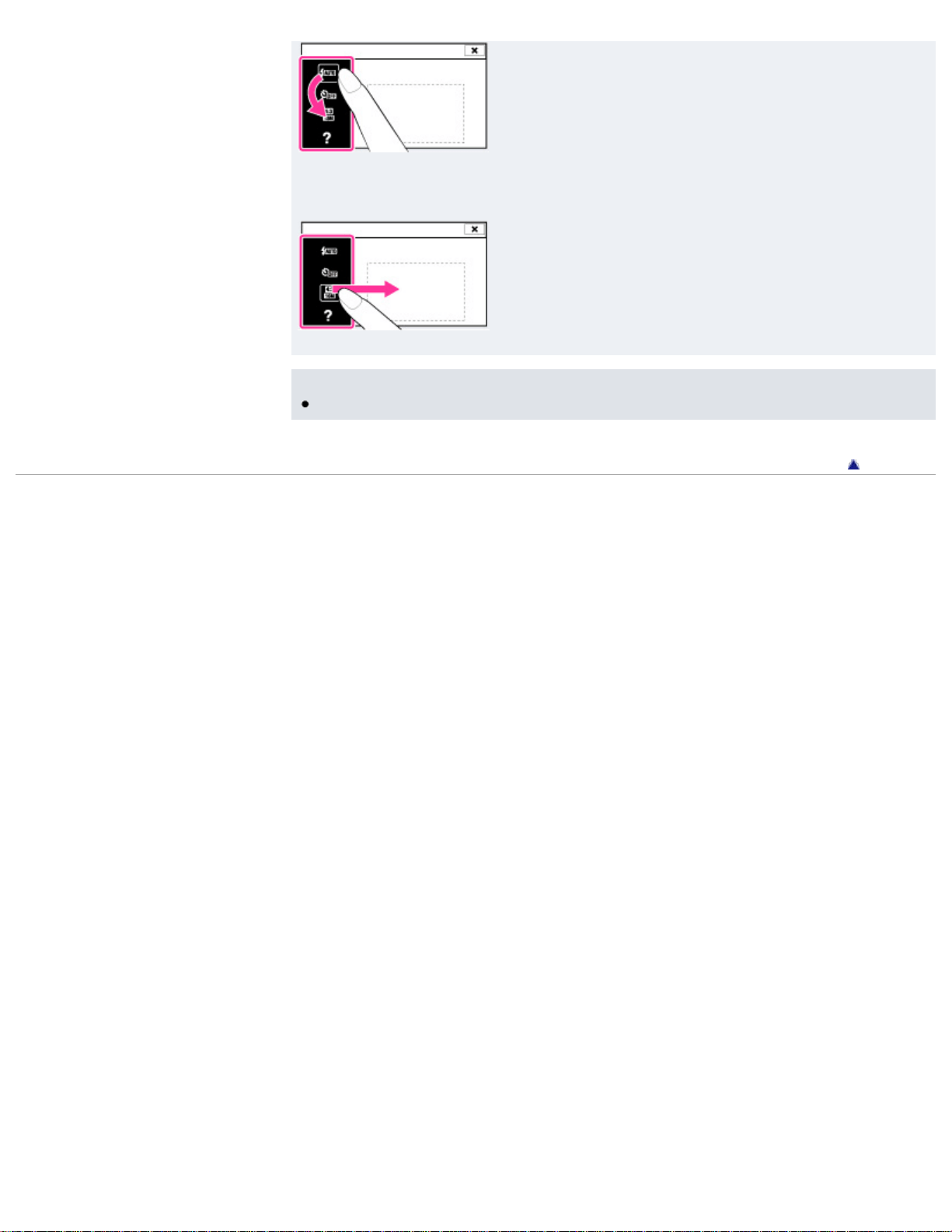
1. Touch MENU to display the MENU screen.
2. (Customize) [OK]
3. Keep touching the desired MENU item icon and drag it to the desired position in the customize area.
It swaps the position with the MENU item icon currently at the position in the customize area. In
playback mode, the customize area is displayed in the lower part of the screen.
4. To cancel, touch or [OK].
Taking advantage of customization
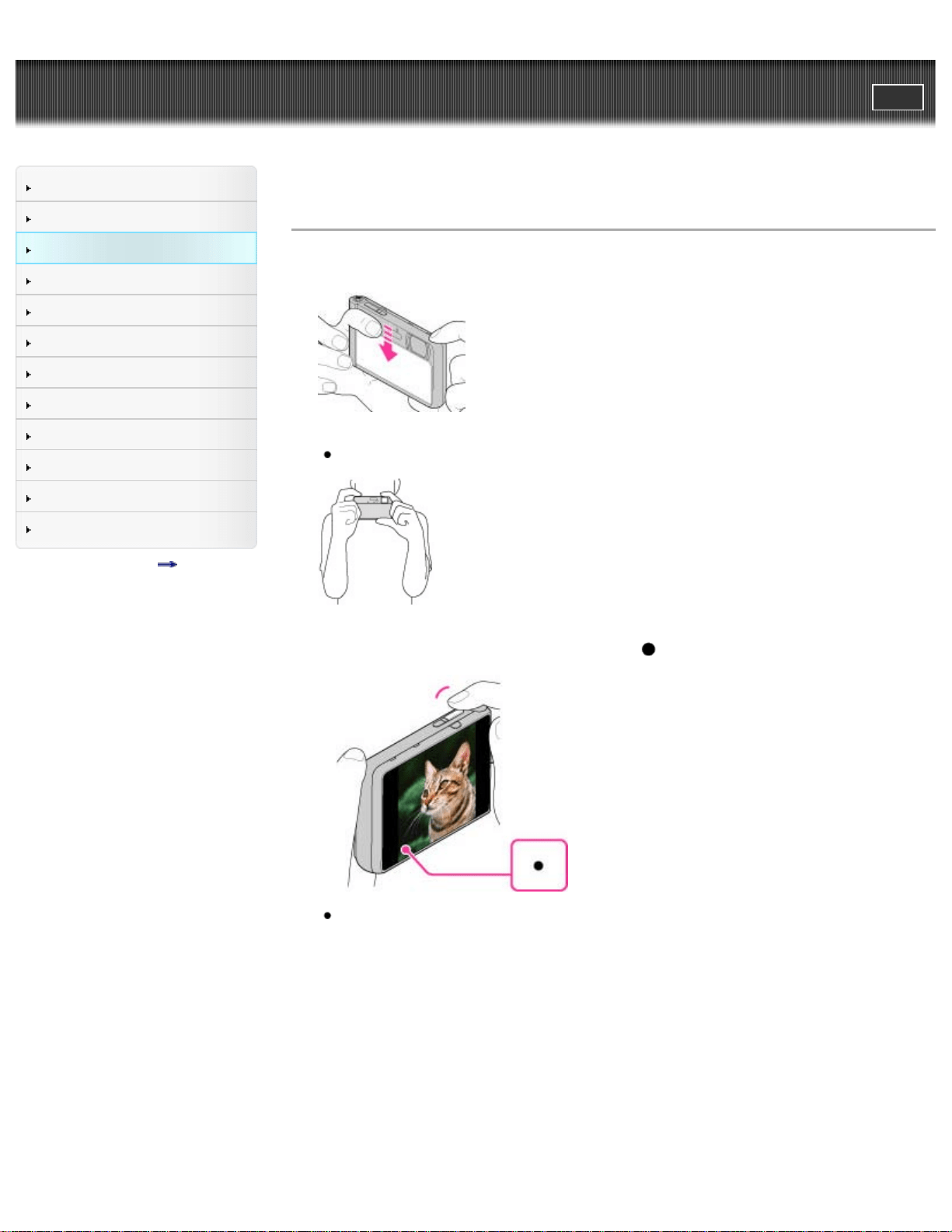
In addition to swapping MENU icons, you can also swap the positions of MENU icons in the
customization area, or reduce the number of MENU icons.
Swapping MENU icons inside the customization area
Touch a MENU icon inside the customization area and drag it to the desired position.
36
Cyber-shot User Guide
PrintSearch
Before Use
Operating the camera
Shooting
Viewing
Useful shooting functions
Useful viewing functions
Changing settings
Viewing images on a TV
Using with your computer
Printing
Troubleshooting
Precautions / About this camera
Contents list
Top page > Shooting > Shooting still images > Shooting still images
Shooting still images
1. Lower the lens cover to switch to shooting mode.
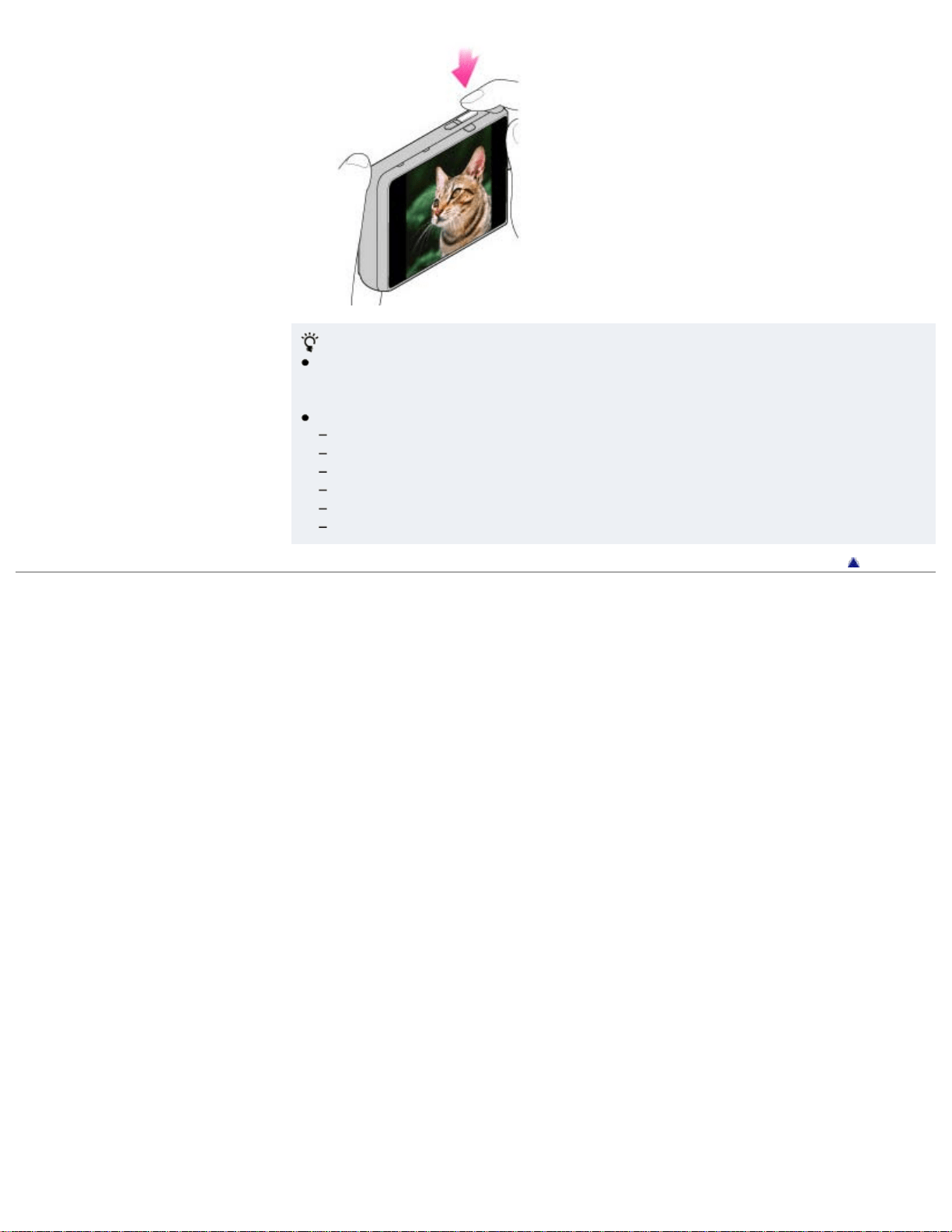
2. Hold the camera steady as illustrated and compose the shot.
Do not put your fingers on the flash or lens when shooting.
3. Press the shutter button halfway down to focus.
When the image is in focus, a beep sounds and the
indicator lights.
The shortest shooting distance is approximately 3 cm (0.10 ft.) (W), 60 cm (1.97 ft.) (T) (from the
lens).
4. Press the shutter button fully down.
38
If you shoot a still image of a subject that is difficult to focus on
When the camera cannot focus on the subject automatically, the AE/AF lock indicator changes to
slowly flashing and the beep does not sound. Either recompose the shot or change the focus
setting. [Details]
Focusing may be difficult in the following situations:
It is dark and the subject is distant.
The contrast between the subject and the background is poor.
The subject is seen through glass.
The subject is moving quickly.
There is reflective light or shiny surfaces.
The subject is backlit or there is a flashing light.
Back to top
Copyright 2013 Sony Corporation
39
Cyber-shot User Guide
PrintSearch
Before Use
Operating the camera
Shooting
Viewing
Useful shooting functions
Useful viewing functions
Changing settings
Viewing images on a TV
Using with your computer
Printing
Troubleshooting
Precautions / About this camera
Contents list
Top page > Shooting > Shooting still images > Zoom (Still images)
Zoom (Still images)
Available zoom
Zoom scale
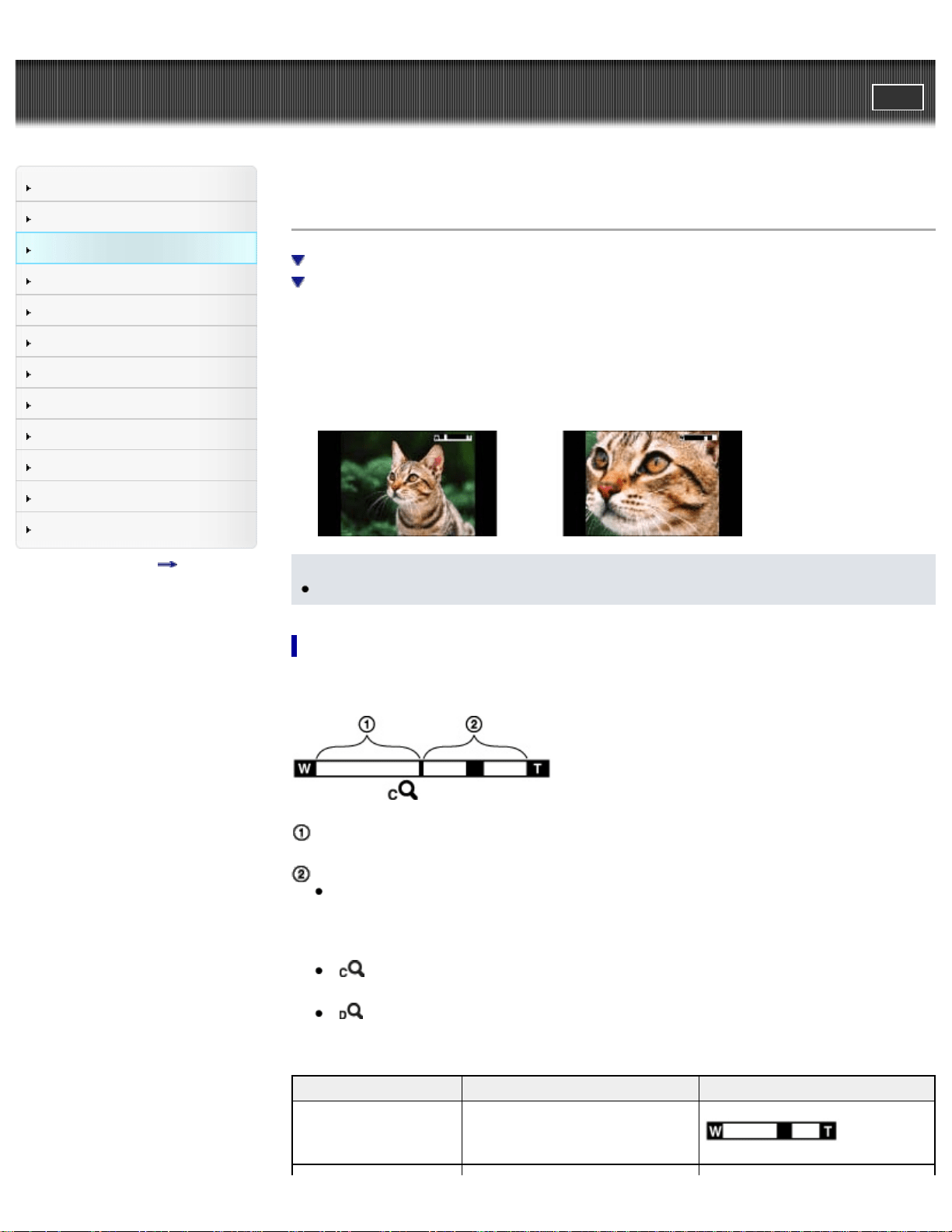
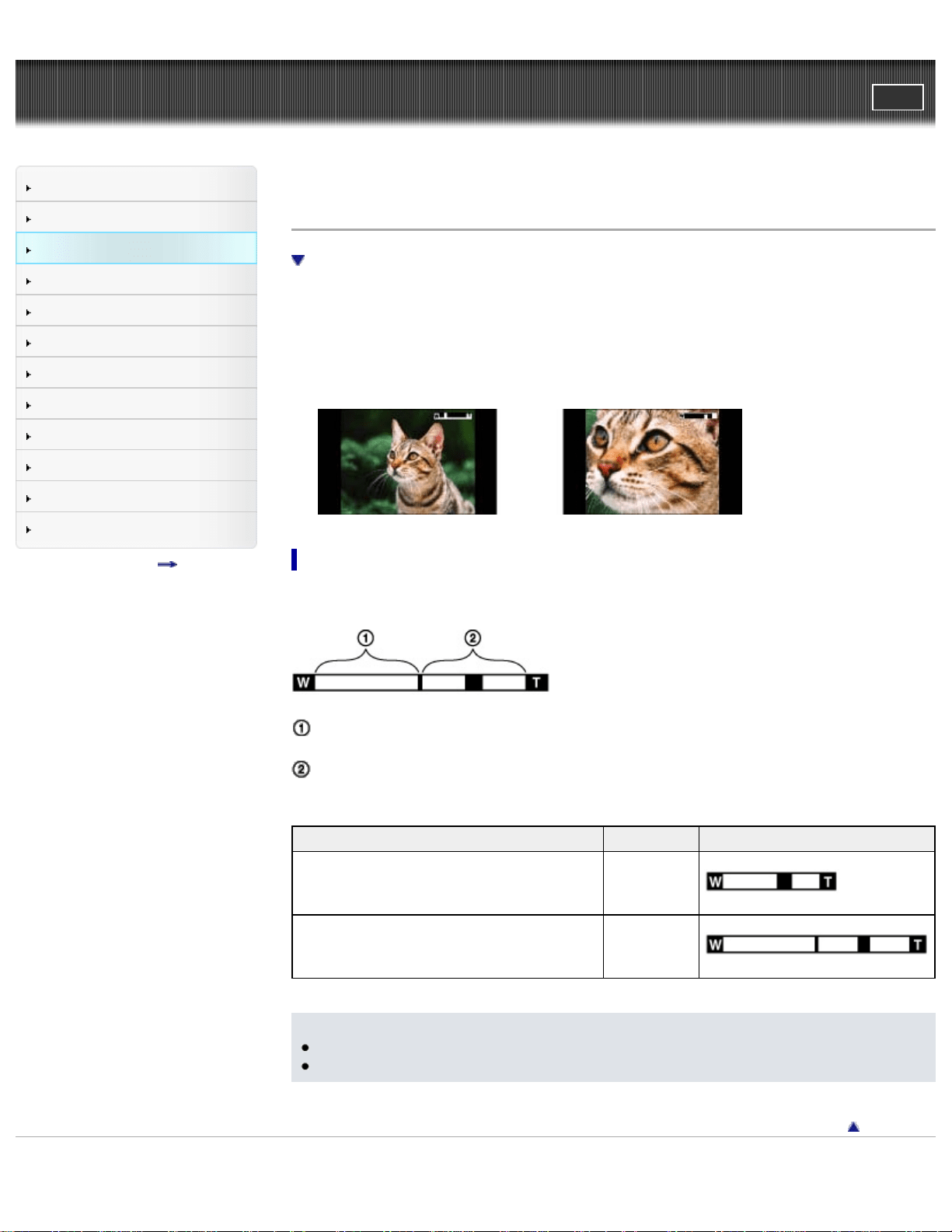
Enlarges images with the W/T (zoom) lever when shooting. The camera’s optical zoom function can
enlarge images up to 5×.
Optical zoom allows you to enlarge an image without deteriorating its original quality.
1. Set the camera to shooting mode.
2. Slide the W/T (zoom) lever.
Slide the lever to the T side to zoom in, or to the W side to zoom out.
Notes
Zoom is locked to the W side in [iSweep Panorama] mode.
Available zoom
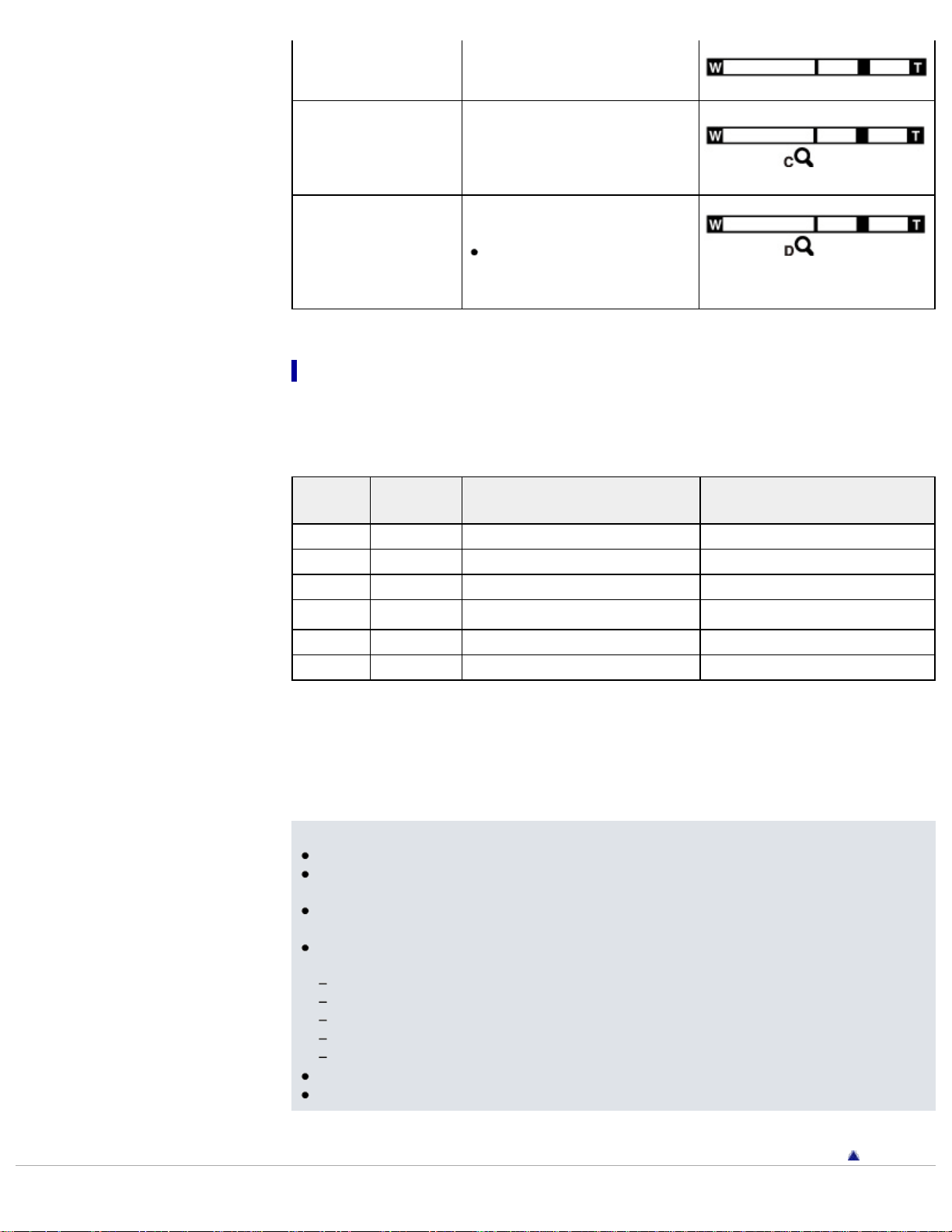
You can combine certain zoom settings to zoom in at high magnification. The icon on the screen
changes in accordance with the zoom you use.
Optical zoom range
The camera’s optical zoom function can enlarge images up to 5×.
Zoom range other than optical zoom
Zoom with the original image quality
When [Image Size] is set to other than the maximum image size, you can shoot still images with no
deterioration in the original image quality, even if the optical zoom scale exceeds 5× magnification, by
trimming image processing.
( ) [Clear Image Zoom]
Zoom with close to the original image quality [Details]
( ) [Digital Zoom]
Less than the original image quality [Details]
Operation Settings Zoom bar
Using optical zoom only
[Still Image Size]: [18M]
[Clear Image Zoom]: [Off]
[Digital Zoom]: [Off]
40
Zooming images without
deterioration
[Still Image Size]: other than [18M]
[Clear Image Zoom]: [Off]
[Digital Zoom]: [Off]
Shooting clear images
using [Clear Image
Zoom]
(close to the original
image quality)
[Clear Image Zoom]: [On]
[Digital Zoom]: [Off]
Zooming to the maximum
zoom range
[Clear Image Zoom]: [On]
[Digital Zoom]: [On]
[Clear Image Zoom] may not be
available for some settings.
[Details]
Zoom scale
The supported zoom scales are different depending on the settings or the image size. The table below
summarizes the zoom scales when [Clear Image Zoom] and [Digital Zoom] are set to [On] and when
[Macro] is set to other than [Magnifying Glass Plus].
Image
size
Optical
zoom
Zoom with [Clear Image
Zoom] [On]
Zoom with maximum zoom
scale*
1
18M 5× 10× 20×
10M 5× 13× 26×
5M 5× 18× 37×
VGA 5× 76×
76×*
2
16:9(13M) 5× 10× 20×
16:9(2M) 5× 25× 51×
*
1
The maximum zoom scale is the magnification when [Clear Image Zoom] is set to [On] or [Digital Zoom] is set
to [On]. The maximum zoom scale varies depending on the settings. The maximum zoom scale for the
default setting is the same as when [Clear Image Zoom] is [On]. [Details]
*
2
When [Still Image Size] is set to [VGA], [Digital Zoom] is limited; magnification will be the same when [Digital
Zoom] is set to [Off], and when [Clear Image Zoom] is set to [On].
Notes
The default setting for [Clear Image Zoom] is [On].
The default setting for [Digital Zoom] is [Off]. Set [Digital Zoom] to [On] to enlarge images even with
deterioration. [Details]
The default setting for [Still Image Size] is set to maximum. To change the zoom scale, change [Still
Image Size]. [Details]
Zoom functions other than the optical zoom are not available when shooting in the following
situations:
In [Picture Effect]
In [Background Defocus]
When the Smile Shutter function is activated.
When [Self-Timer] is set to [Self-portrait One Person] or [Self-portrait Two People].
When [Backlight Correction HDR] mode is selected in Scene Selection.
The Face Detection function does not operate when you use other than the optical zoom.
Zoom scales are different when [Macro] is set to [Magnifying Glass Plus]. [Details]
Back to top
41

Copyright 2013 Sony Corporation
42
Cyber-shot User Guide
PrintSearch
Before Use
Operating the camera
Shooting
Viewing
Useful shooting functions
Useful viewing functions
Changing settings
Viewing images on a TV
Using with your computer
Printing
Troubleshooting
Precautions / About this camera
Contents list
Top page > Shooting > Shooting movies > Shooting movies
Shooting movies
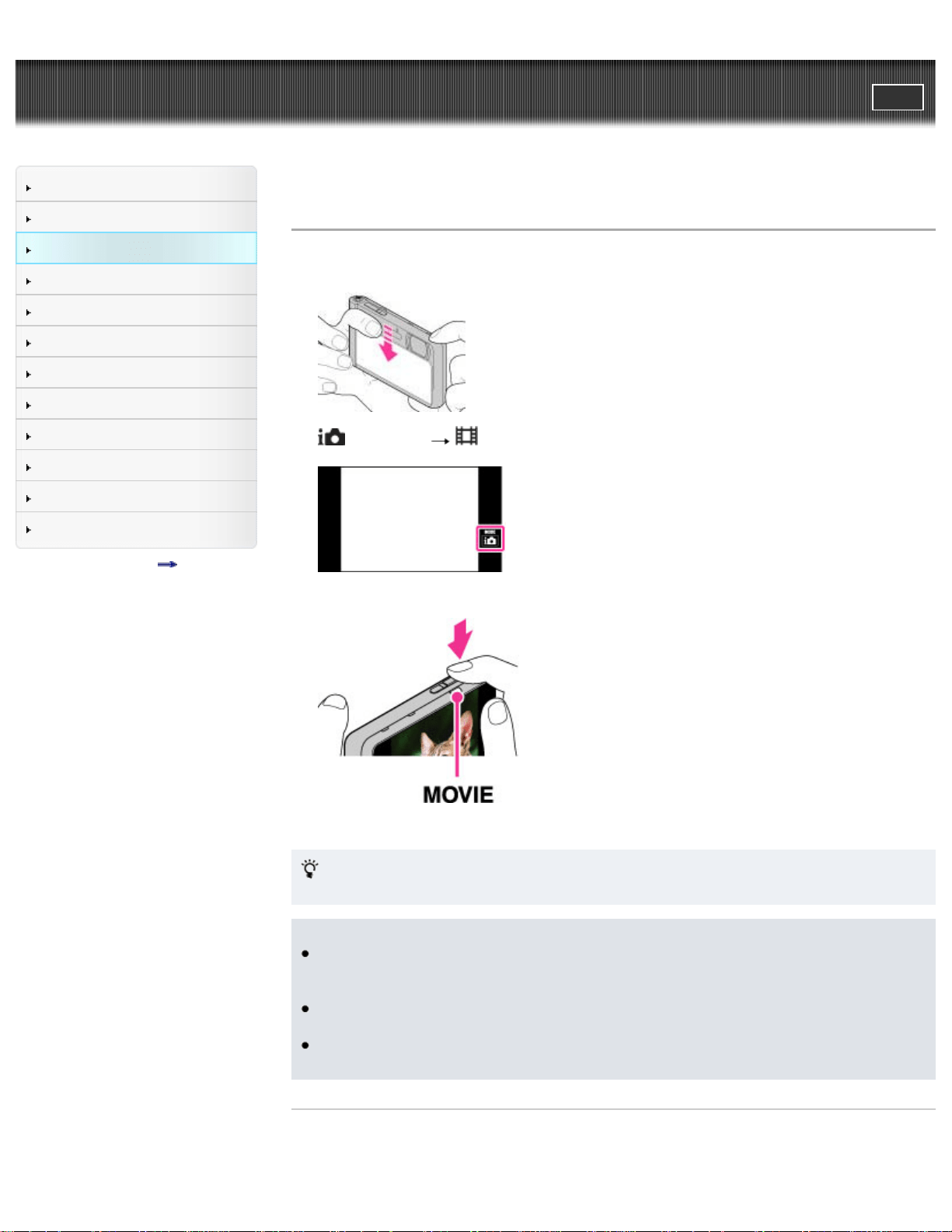
1. Lower the lens cover.
2. (REC Mode) (Movie Mode)
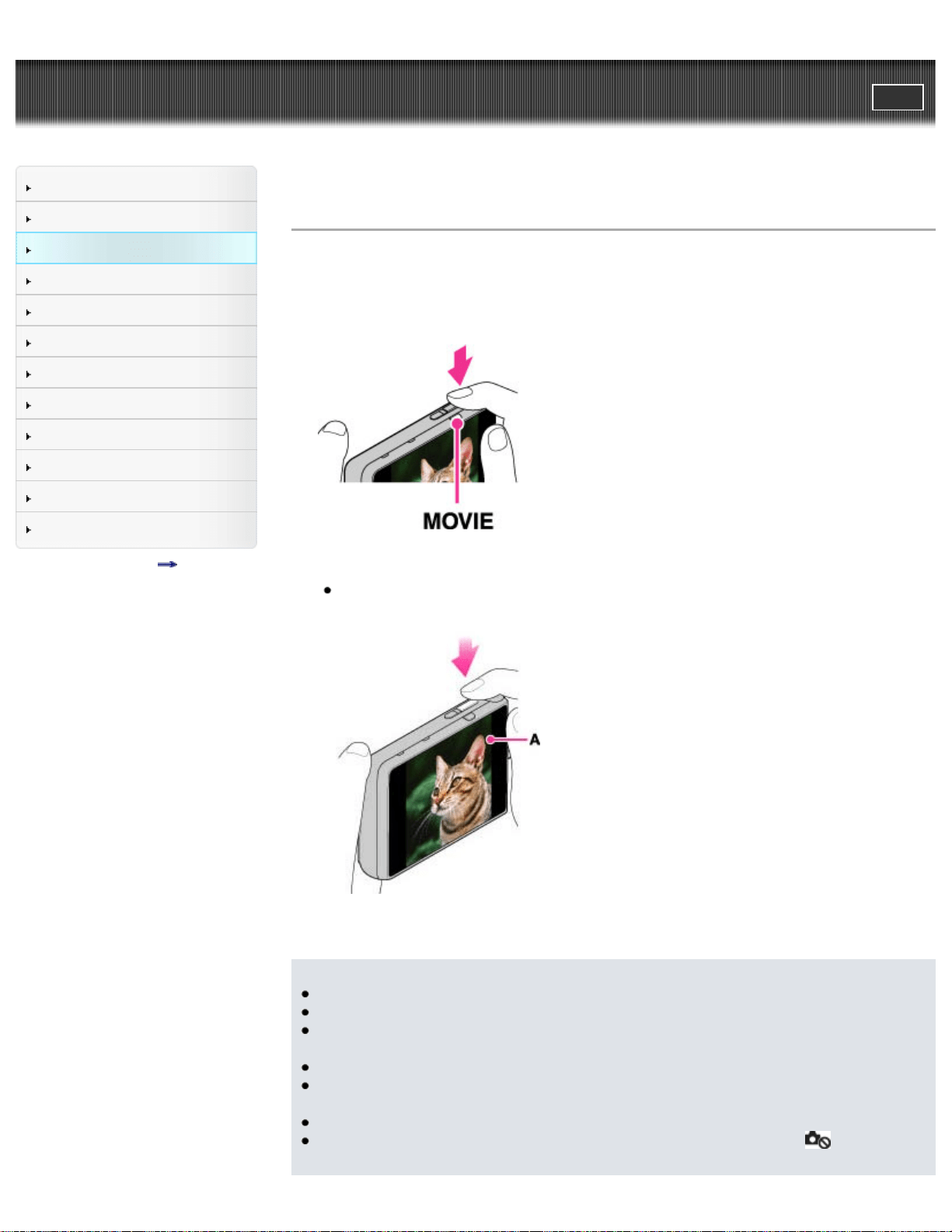
3. Press the MOVIE (Movie) button to start recording.
4. Press the MOVIE button again to stop recording.
MOVIE (Movie) button
You can start recording a movie by pressing the MOVIE button in any recording mode.
Notes
The sound of the lens and lever operating will be recorded when the zoom function operates while
shooting a movie. The sound of the MOVIE button operating may also be recorded when you press
the MOVIE button to stop recording.
Continuous shooting is possible for approximately 29 minutes at one time at the camera’s default
settings and when the temperature is approximately 25°C (77°F).
When movie recording is finished, you can restart recording by pressing the MOVIE button again.
Recording may stop to protect the camera depending on the ambient temperature.
Related Topic
Zoom (Movies)
43

Cyber-shot User Guide
PrintSearch
Before Use
Operating the camera
Shooting
Viewing
Useful shooting functions
Useful viewing functions
Changing settings
Viewing images on a TV
Using with your computer
Printing
Troubleshooting
Precautions / About this camera
Contents list
Top page > Shooting > Shooting movies > Zoom (Movies)
Zoom (Movies)
Available zoom
Enlarges images with the W/T (zoom) lever when shooting. The camera’s optical zoom function can
enlarge images up to 5×.
Optical zoom allows you to enlarge an image without deteriorating its original quality.
1. Set the camera to shooting mode.
2. Slide the W/T (zoom) lever.
Slide the lever to the T side to zoom in, or to the W side to zoom out.
Available zoom
You can exceed 5× optical zoom to zoom in. To zoom past the optical zoom range, set [Digital Zoom] to
[On]. The camera can enlarge images up to 20×.
Optical zoom range
Optical zoom: The camera’s optical zoom function can enlarge images up to 5×.
Zoom range other than optical zoom
[Digital Zoom]: Less than original image quality. [Details]
Operation Settings Zoom bar
To zoom in to the maximum scale before image
quality deterioration occurs
[Digital
Zoom]: [Off]
To zoom in to the maximum scale
[Digital
Zoom]: [On]
Notes
[Clear Image Zoom] is not available while recording movies.
The camera zooms slowly while recording movies.
Back to top
Copyright 2013 Sony Corporation
45
Cyber-shot User Guide
PrintSearch
Before Use
Operating the camera
Shooting
Viewing
Useful shooting functions
Useful viewing functions
Changing settings
Viewing images on a TV
Using with your computer
Printing
Troubleshooting
Precautions / About this camera
Contents list
Top page > Shooting > Shooting movies > Shooting still images while recording a movie (Dual Rec)
Shooting still images while recording a movie (Dual Rec)
You can shoot still images while recording a movie. The camera keeps recording the movie even if you
shoot still images.
Up to 10 still images can be shot during one movie recording.
1. Press the MOVIE (Movie) button to start recording a movie.
2. Shoot with the shutter button.
A still image is recorded.
The number of recordable still images (A) appears on the screen when you press the shutter
button halfway down.
3. Press the MOVIE button again to stop recording.
After recording movies, the recorded still images are displayed in frames on the screen.
Notes
The Dual Rec function cannot be used for underwater shooting.
Flash is not available for shooting still images during movie recording.
The size of a still image that can be shot while recording a movie varies depending on the movie
size. For details, see “Still Image Size(Dual Rec).” [Details]
The sound of the shutter button operating may be recorded.
When the Smile Shutter function is set to [On], the shutter releases automatically each time the
camera detects a smiling face.
When the camera is on [Standby] in movie mode, you cannot use [Smile Shutter].
If the memory card capacity is insufficient or you have already shot 10 images,
appears on the
screen. This icon means that you cannot shoot any more still images.
46

Cyber-shot User Guide
PrintSearch
Before Use
Operating the camera
Shooting
Viewing
Useful shooting functions
Useful viewing functions
Changing settings
Viewing images on a TV
Using with your computer
Printing
Troubleshooting
Precautions / About this camera
Contents list
Top page > Shooting > Selecting the shooting mode based on the subject > Shooting mode functions
Shooting mode functions
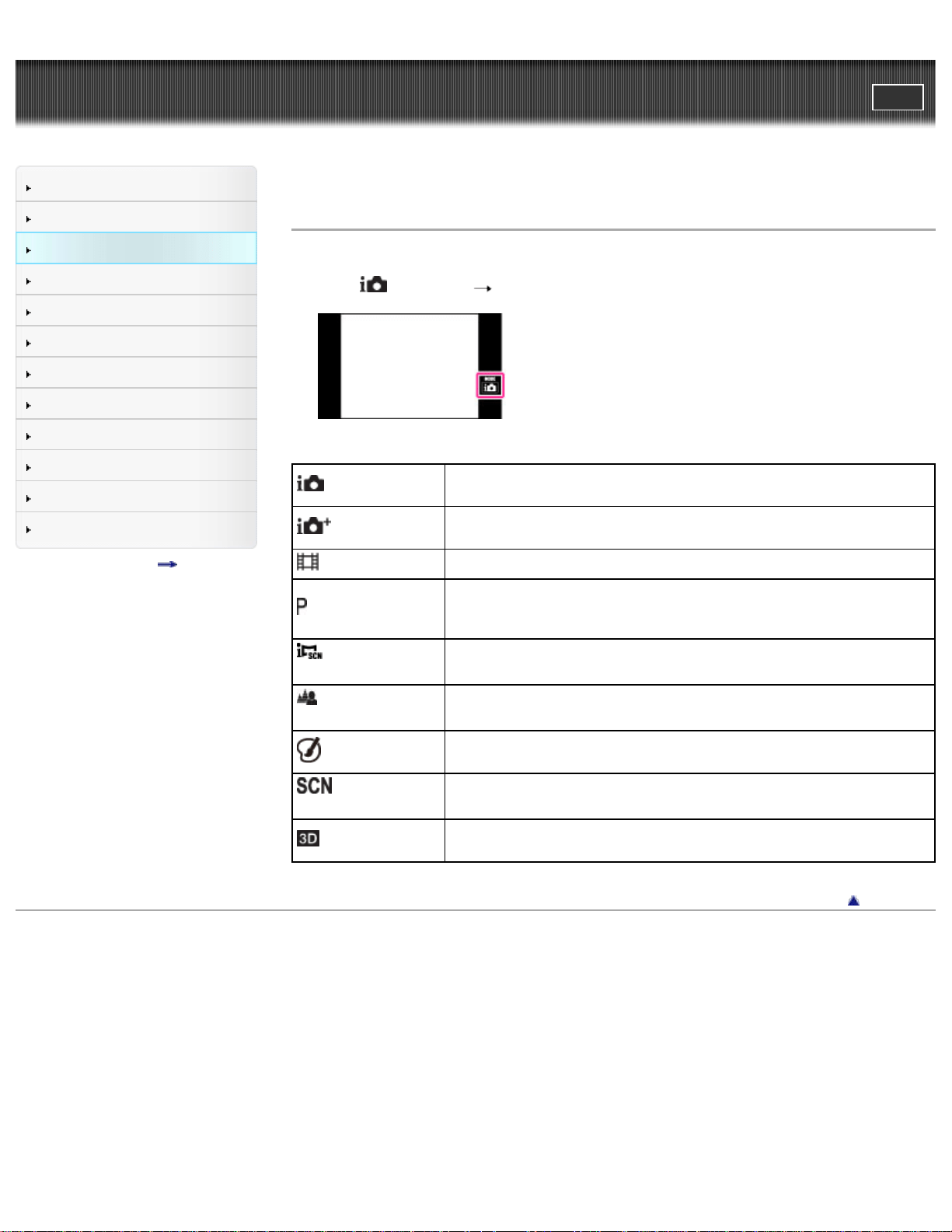
You can select the shooting mode based on condition and objective.
1. Touch
(REC Mode) desired mode
(Intelligent Auto)
Allows you to shoot still images with the setting adjusted automatically.
[Details]
(Superior Auto)
Allows you to shoot still images in higher quality than with Intelligent Auto
mode. [Details]
(Movie Mode)
Allows you to change the setting for movie recording. [Details]
(Program Auto)
Allows you to shoot with the exposure adjusted automatically (both the shutter
speed and the aperture value).
Also you can select various settings using the menu. [Details]
(Panorama
Shooting Scene)
Allows you to create a panoramic image from composite images. [Details]
(Background
Defocus)
Allows you to shoot an image with background defocus and define the
subject. [Details]
(Picture Effect)
Allows you to shoot a still image with an original texture according to the
desired effect. [Details]
(Scene
Selection)
Allows you to shoot with preset settings according to the scene. [Details]
(3D Still Image)
Allows you to shoot images that can be played back stereoscopically on a 3D
TV. [Details]
Back to top
Copyright 2013 Sony Corporation
48
Cyber-shot User Guide
PrintSearch
Before Use
Operating the camera
Shooting
Viewing
Useful shooting functions
Useful viewing functions
Changing settings
Viewing images on a TV
Using with your computer
Printing
Troubleshooting
Precautions / About this camera
Contents list
Top page > Shooting > Selecting the shooting mode based on the subject > Intelligent Auto
Intelligent Auto
On Scene Recognition
Features of Auto shooting modes
Allows you to shoot still images with the setting adjusted automatically.
1. Set the camera to shooting mode.
2.
(REC Mode) (Intelligent Auto)
3. Shoot with the shutter button.
On Scene Recognition
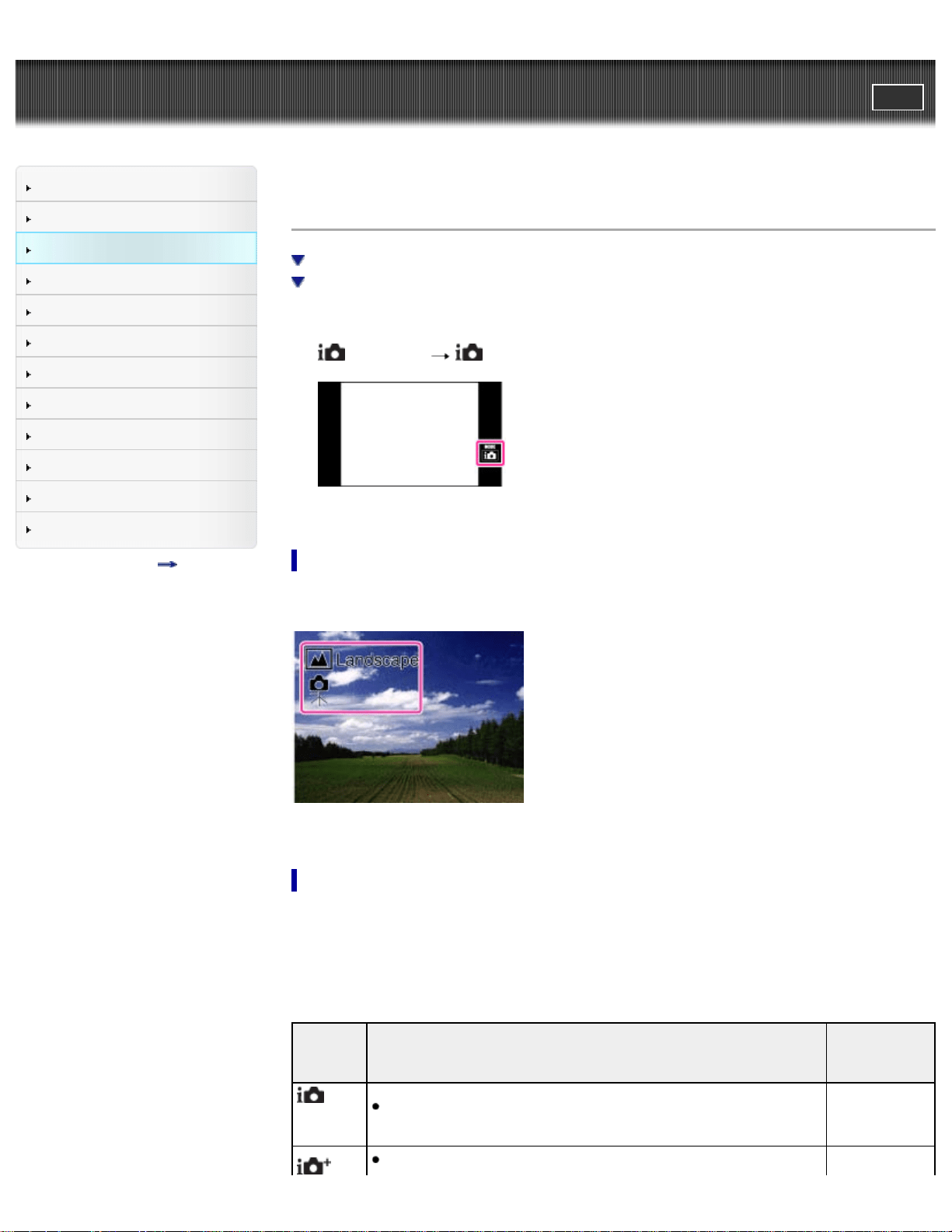
Scene Recognition operates in Intelligent Auto mode. This function lets the camera automatically
recognize the shooting conditions and shoot the image.
Features of Auto shooting modes
In Superior Auto mode, the camera shoots a higher-quality image than in Intelligent Auto mode. The
camera also shoots multiple images based on the recognized scene, then creates a composite of the
multiple images (Overlay shooting).
Program Auto mode allows you to change various shooting settings, such as the white balance or ISO
settings.
REC
Mode
When to use
Major
restricted
functions
(Intelligent
Auto)
Use when you want the camera to automatically recognize the
shooting conditions and shoot some images continuously.
Forced flash
Use when you shoot images under difficult conditions, such as low
49
(Superior
Auto)
light or backlit scenes.
Use when you want to shoot a higher-quality image than in
(Intelligent Auto) mode.
Continuous
shooting, Smile
Shutter
(Program
Auto)
Use when you want to shoot using customized shooting settings with
the exposure (both the shutter speed and the aperture value) adjusted
automatically.
Scene
Recognition
Notes
In [Intelligent Auto] mode, you may be unable to shoot low light or backlit scenes clearly.
In [Superior Auto] mode, it takes some time to record an image, because the camera overlays the
images.
Related Topic
Scene Recognition
Functions available for each shooting mode
MENU items available for each shooting mode
Back to top
Copyright 2013 Sony Corporation
50
Cyber-shot User Guide
PrintSearch
Before Use
Operating the camera
Shooting
Viewing
Useful shooting functions
Useful viewing functions
Changing settings
Viewing images on a TV
Using with your computer
Printing
Troubleshooting
Precautions / About this camera
Contents list
Top page > Shooting > Selecting the shooting mode based on the subject > Superior Auto
Superior Auto
The camera combines Scene Recognition and high-quality image technology to automatically shoot the
images with the optimal settings.
1. Set the camera to shooting mode.
2.
(REC Mode) (Superior Auto)
3. Shoot with the shutter button.
The camera shoots burst images when needed and overlays the multiple images. By overlaying the
images, the camera records an image with less subject blur and noises.
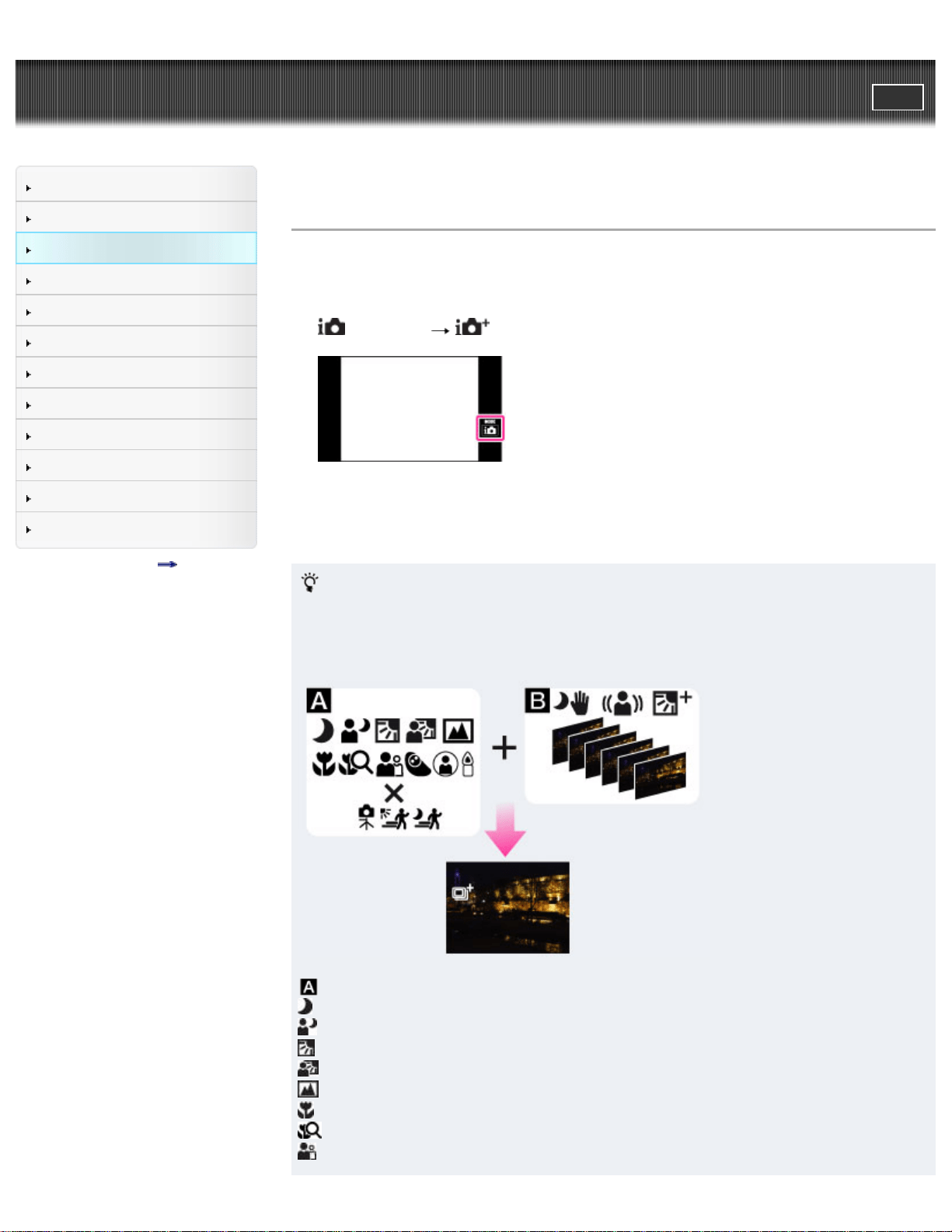
What is the difference between Superior Auto mode and Intelligent Auto mode?
In Superior Auto mode, the camera shoots burst images based on the recognized scene, then creates
a composite of the burst images (Overlay shooting).
The camera automatically corrects the backlight and reduces the noise by overlaying images, so a
higher-quality image results than in Intelligent Auto mode.
: Scene Recognition
Night Scene
Night Portrait
Backlight
Backlight Portrait
Landscape
Macro
Close Focus
Portrait
51
Infant
Spotlight
Low Light
Tripod
Move (Bright)
Move (Dark)
: Overlaying processing
Hand-held Twilight
Anti Motion Blur
Backlight Correction HDR
The camera automatically selects an overlaying mode based on the recognized scene, and
(overlay) appears on the screen.
Notes
When the camera overlays the images, it takes more time to record an image.
In low light conditions such as night scenes, set [Flash] to [Off] to achieve the optimal effect of the
overlaid images.
Related Topic
Scene Recognition
Functions available for each shooting mode
MENU items available for each shooting mode
Back to top
Copyright 2013 Sony Corporation
52
Cyber-shot User Guide
PrintSearch
Before Use
Operating the camera
Shooting
Viewing
Useful shooting functions
Useful viewing functions
Changing settings
Viewing images on a TV
Using with your computer
Printing
Troubleshooting
Precautions / About this camera
Contents list
Top page > Shooting > Selecting the shooting mode based on the subject > Background Defocus
Background Defocus
Allows you to shoot an image with image processing so that the subject stands out from the background.
1. Set the camera to shooting mode.
2.
(REC Mode) (Background Defocus)
3. Shoot with the shutter button.
Tips for adjusting the intensity of the background defocus
Before shooting, touch [Defocus Effect] on the left side of the screen
[Low], [Mid] or [High] to
change the intensity of the background defocus effect.
Tips for defocusing the background
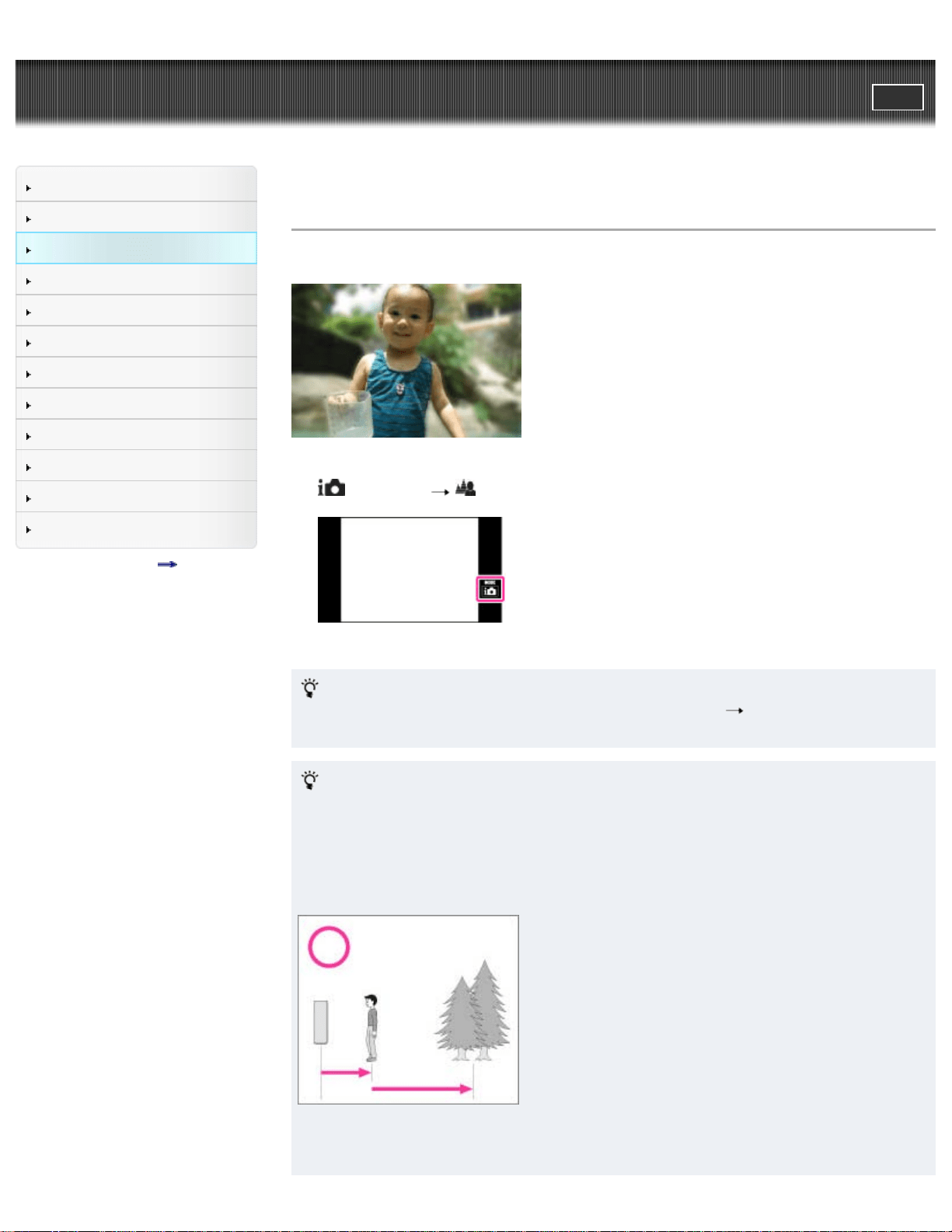
Position of the subject and the background
If you shoot an image with the subject and background far apart, as shown in the illustration, the
background can be defocused. Shoot from the recommended shooting distance indicated on the
screen.
Subject is sufficiently distant from the background
Subject and background are too close
53
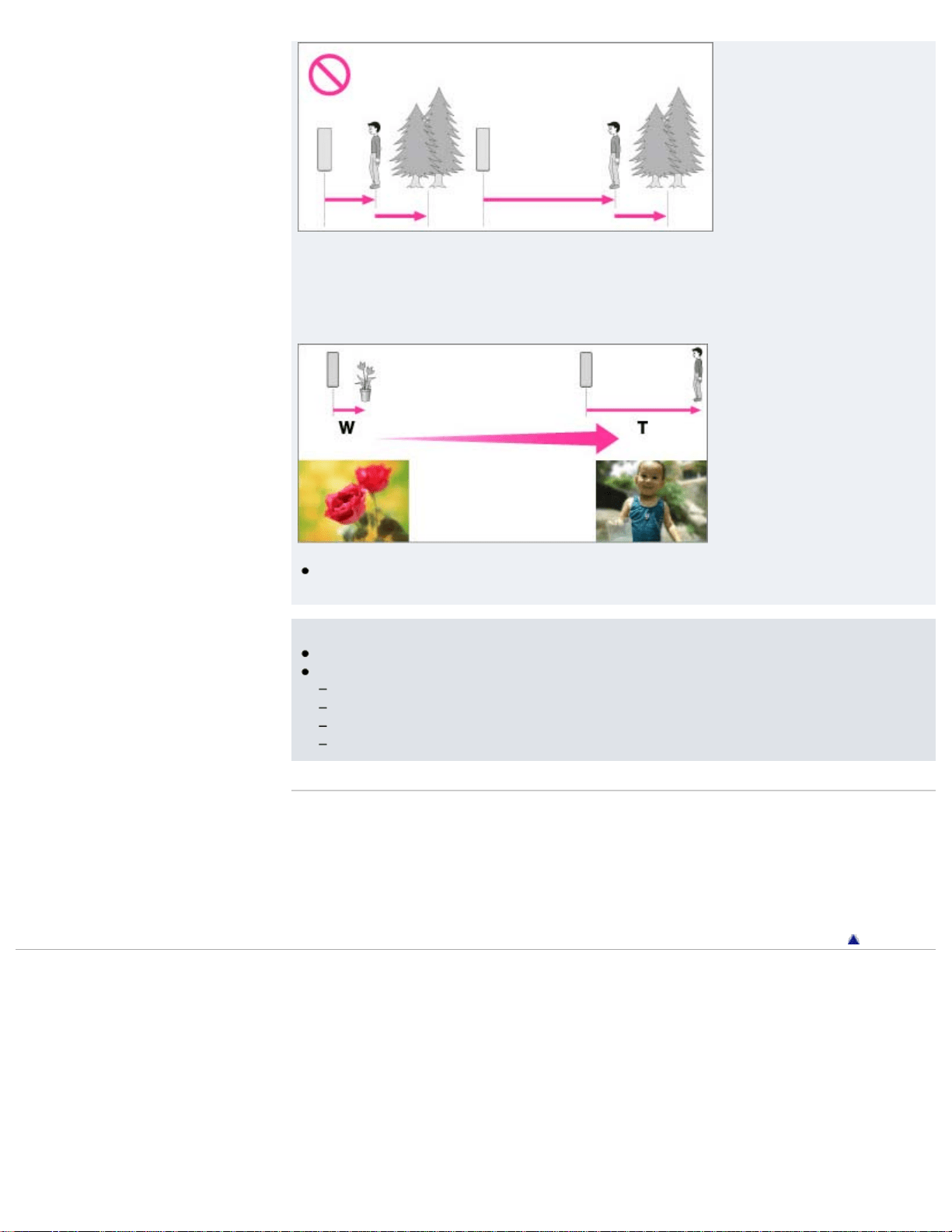
Zoom scale and position of the subject
When you shoot a flower and a small item from close up, slide the W/T (zoom) lever to the W side. For
shooting people, move a short distance away from the subject and slide the W/T (zoom) lever to the T
side.
To lock the focus on the subject more easily, use the tracking focus function of the camera.
[Details]
Notes
When shooting, hold the camera still to reduce camera shake.
If you are unable to defocus effectively, try the following steps:
Slide the W/T (zoom) lever to the T side.
Approach the subject until you are within the recommended shooting distance.
Separate the subject and the background.
Touch the area to adjust its focus.
Related Topic
Defocus Effect
Tracking focus
Functions available for each shooting mode
MENU items available for each shooting mode
Back to top
Copyright 2013 Sony Corporation
54
Cyber-shot User Guide
PrintSearch
Before Use
Operating the camera
Shooting
Viewing
Useful shooting functions
Useful viewing functions
Changing settings
Viewing images on a TV
Using with your computer
Printing
Troubleshooting
Precautions / About this camera
Contents list
Top page > Shooting > Selecting the shooting mode based on the subject > Program Auto
Program Auto
Allows you to shoot with the exposure adjusted automatically (both the shutter speed and the aperture
value). Also you can select various settings using the menu.
1. Set the camera to shooting mode.
2.
(REC Mode) (Program Auto)
3. Shoot with the shutter button.
Related Topic
Functions available for each shooting mode
MENU items available for each shooting mode
Back to top
Copyright 2013 Sony Corporation
55
Cyber-shot User Guide
PrintSearch
Before Use
Operating the camera
Shooting
Viewing
Useful shooting functions
Useful viewing functions
Changing settings
Viewing images on a TV
Using with your computer
Printing
Troubleshooting
Precautions / About this camera
Contents list
Top page > Shooting > Selecting the shooting mode based on the subject > 3D Still Image
3D Still Image
Shooting a 3D image. Images recorded using the 3D functions can be played back stereoscopically on a
3D TV.
1.
(REC Mode) (3D Still Image)
2. Shoot with the shutter button.
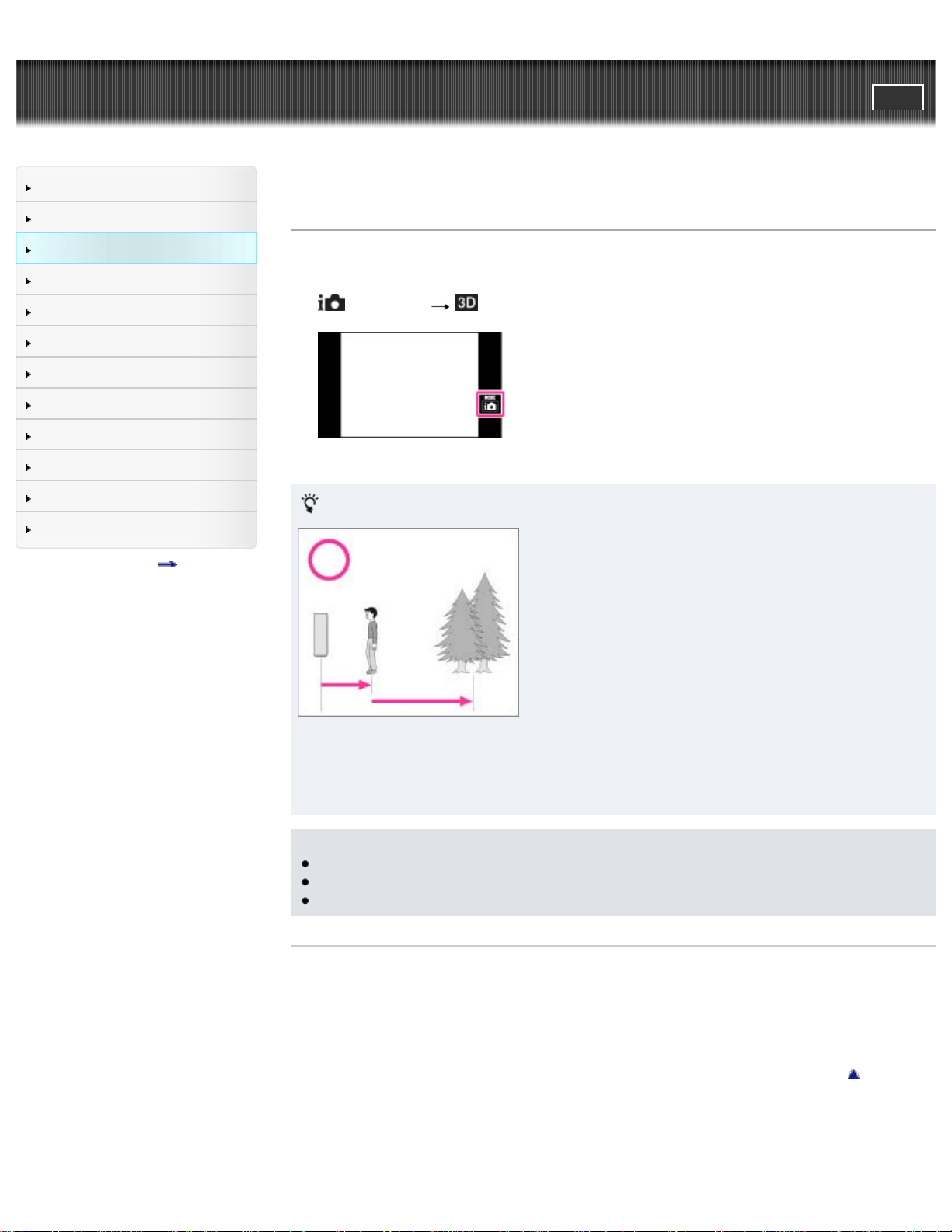
Tips for shooting 3D images
Approach a subject with the subject and background far apart, as shown in the illustration.
The 3D effect may not work effectively when the scene is too dark, the subject is moving or you moved
the camera after setting the AE/AF lock.
If you shoot the image in a dark place, noise may be highly visible.
Notes
The available image size is [18M] or [16:9(13M)].
The 3D images are played back as standard still images on this camera.
This function is not suited to underwater shooting.
Related Topic
Viewing 3D images on a 3D TV
Functions available for each shooting mode
MENU items available for each shooting mode
Back to top
Copyright 2013 Sony Corporation
56
Cyber-shot User Guide
PrintSearch
Before Use
Operating the camera
Shooting
Viewing
Useful shooting functions
Useful viewing functions
Changing settings
Viewing images on a TV
Using with your computer
Printing
Troubleshooting
Precautions / About this camera
Contents list
Top page > Shooting > Selecting the shooting mode based on the subject > iSweep Panorama
iSweep Panorama
Allows you to create a panoramic image from composite images. The camera also automatically detects
people’s faces or moving subjects.
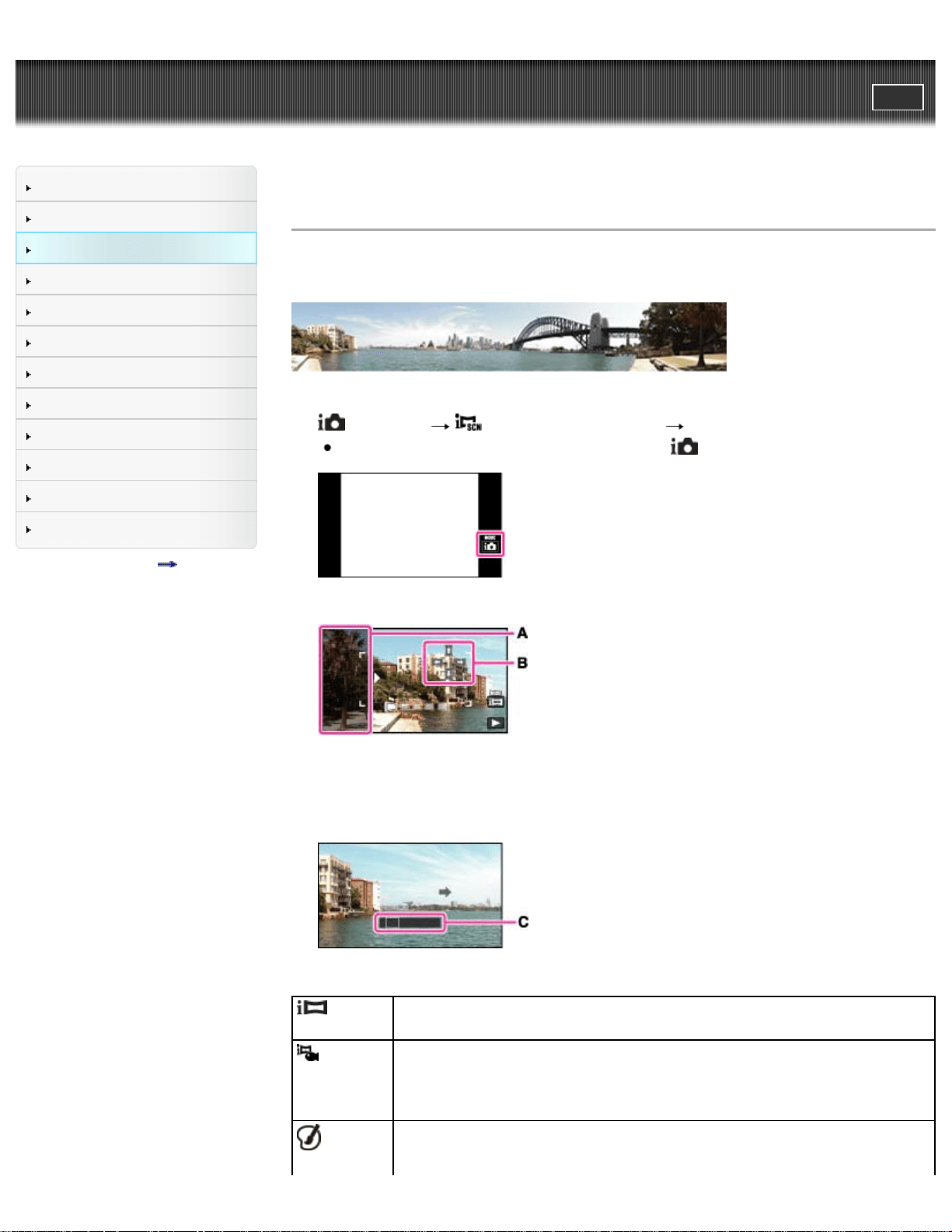
1. Set the camera to shooting mode.
2.
(REC Mode) (Panorama Shooting Scene) desired mode
If you want to change to another mode, reselect from
(REC Mode).
3. Align the camera with the end of the subject to be shot and press the shutter button.
A: This part will not be recorded.
Touch B to change the shooting direction. If you set [Underwater iSweep Panorama], change the
shooting direction before putting the camera into the water.
4. Pan the camera to the end of the guide (C), following the arrow indication on the screen.
(iSweep
Panorama)
Shoots a regular panorama image.
(Underwater
iSweep
Panorama)
Allows you to shoot a panoramic image with the camera submerged. White balance is
set to the optimum state in water. Set to [Underwater iSweep Panorama] before
putting the camera into the water.
(Picture
Effect)
Allows you to shoot a panoramic image with a desired picture effect added.
57
Tips for shooting a panoramic image
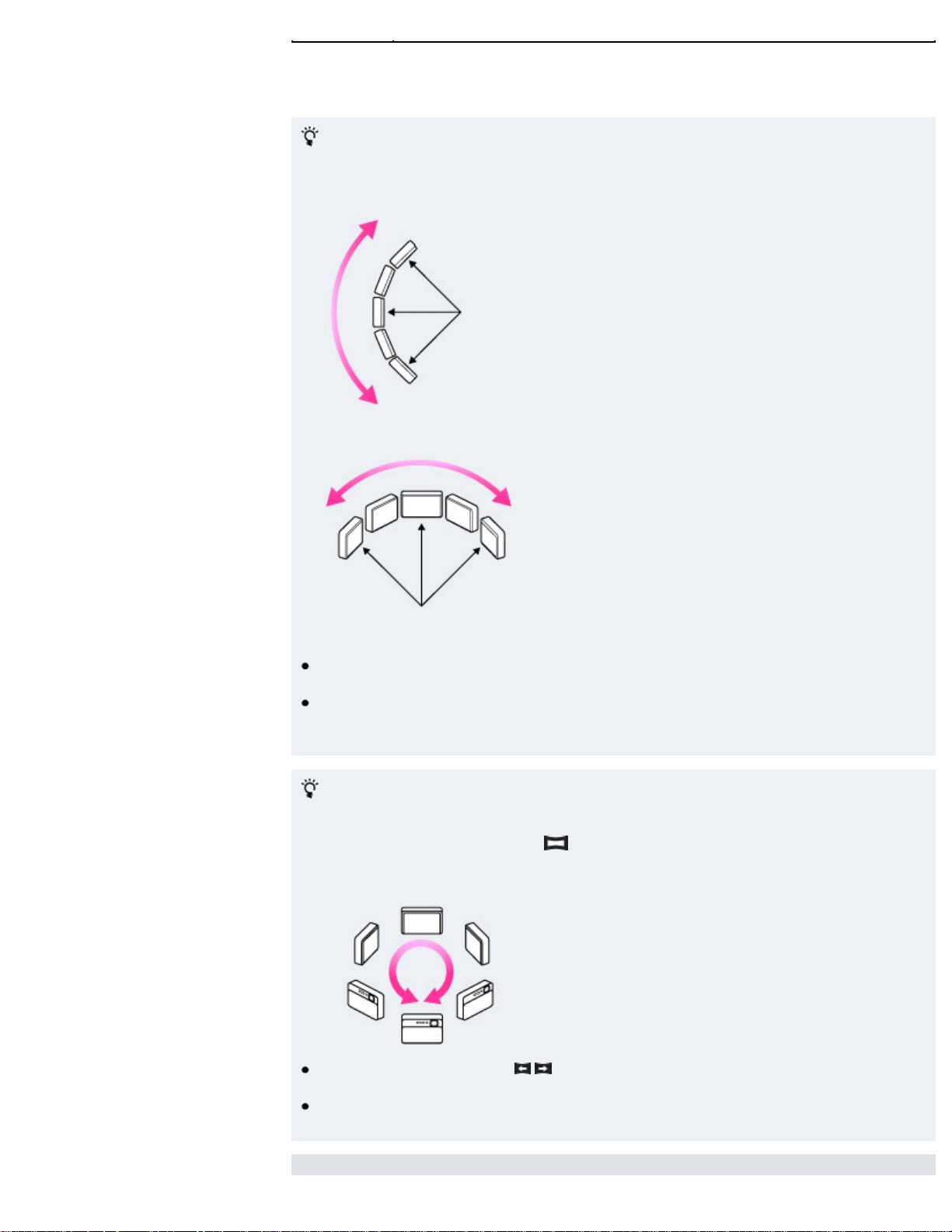
Pan the camera in an arc at a constant velocity in the direction indicated on the screen. Subjects at
rest are more suited for panorama shots than moving subjects.
Radius as short as possible.
Vertical direction
Horizontal direction
First, press the shutter button halfway to lock the focus and exposure. Then, press the shutter
button fully down and pan or tilt the camera.
If a section with greatly varied shapes or scenery is concentrated along a screen edge, the image
composition may fail. In such case, adjust the frame composition so that the section is in the center
of the image, then shoot again.
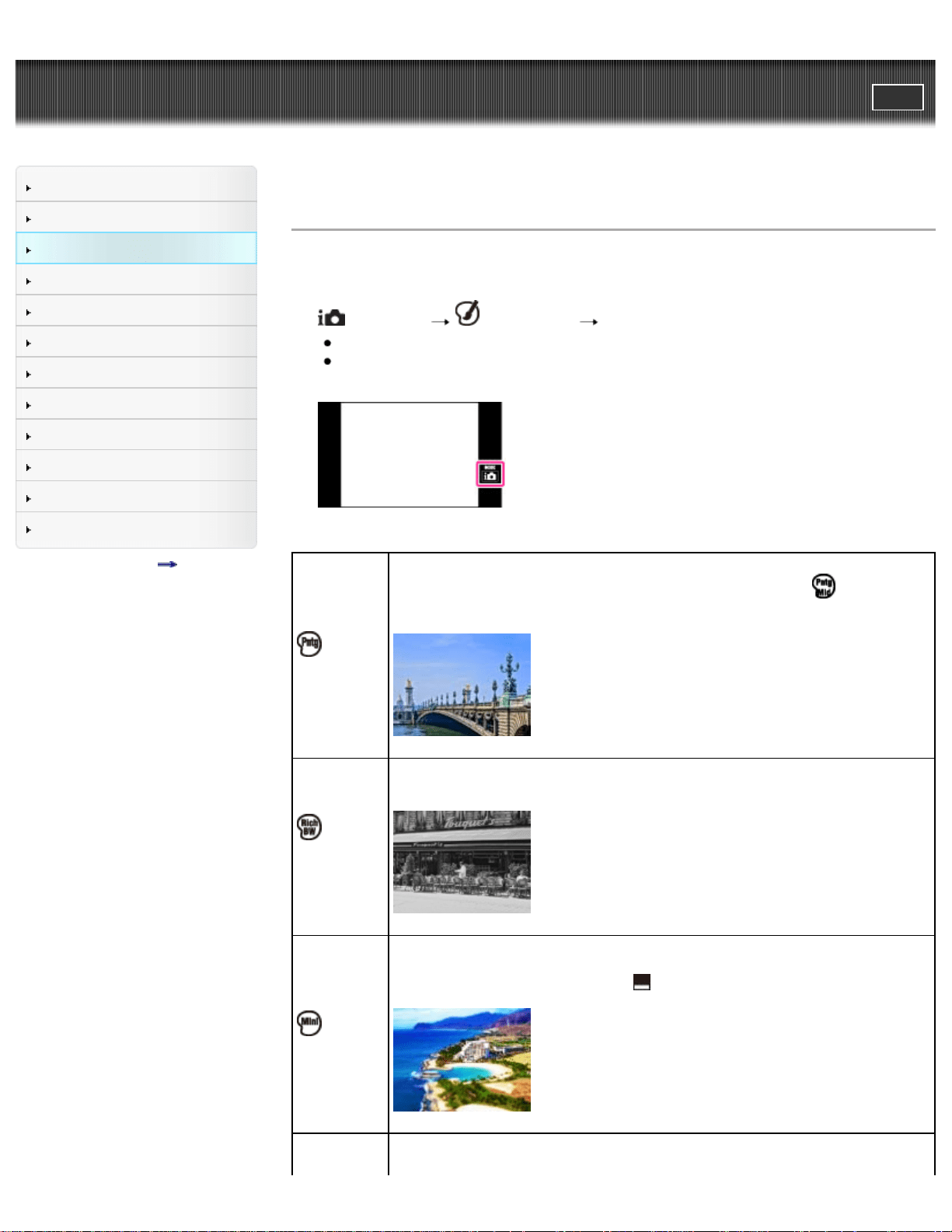
To shoot a 360 degree panoramic image
This camera is equipped with a panorama shooting function, capable of shooting a near-full 360
degree panoramic image.
Shoot a panoramic image by setting
(Panorama Image Size) to [360°]. Recorded panoramic
images can be scrolled accurately when played on the camera.
Select a shooting direction with / . You cannot shoot a panoramic image in a vertical direction
with [Panorama Image Size] set to [360°].
The image actually recorded may not cover 360 degrees, depending on the subject or the way it is
shot.
58

Notes
If you cannot pan the camera across the entire subject within the given time, a gray area occurs in
the composite image. If this happens, move the camera faster to record a full panoramic image.
Since several images are stitched together, the stitched part will not be recorded smoothly.
When the whole angle of panoramic shooting and the AE/AF locked angle are very different in
brightness, color and focus, the shooting will not be successful. If this happens, change AE/AF
locked angle and shoot again.
You cannot create panoramic images in the following situations:
You pan the camera too quickly or too slowly.
There is too much camera shake.
Related Topic
Scrolling the panoramic images for display
Still Image Size/Panorama Image Size
Functions available for each shooting mode
MENU items available for each shooting mode
Picture Effect
Back to top
Copyright 2013 Sony Corporation
59
Cyber-shot User Guide
PrintSearch
Before Use
Operating the camera
Shooting
Viewing
Useful shooting functions
Useful viewing functions
Changing settings
Viewing images on a TV
Using with your computer
Printing
Troubleshooting
Precautions / About this camera
Contents list
Top page > Shooting > Selecting the shooting mode based on the subject > Picture Effect
Picture Effect
Allows you to shoot a still image with an original texture according to the desired effect.
1. Set the camera to shooting mode.
2.
(REC Mode) (Picture Effect) desired mode
If you want to select other Picture Effect mode, select from REC mode.
If you want to add an effect to a movie, press the MOVIE (Movie) button after selecting the
desired effect.
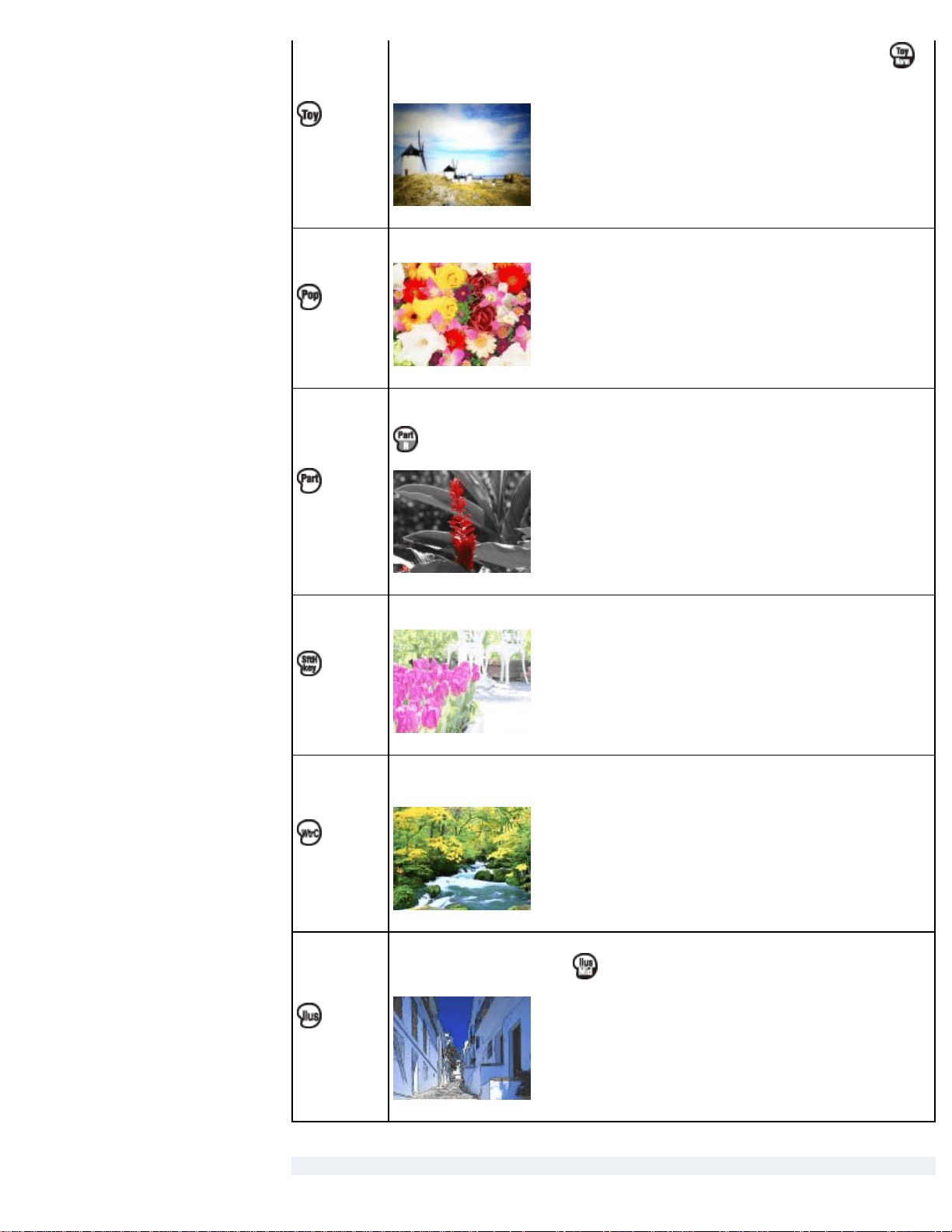
(HDR
Painting)
Allows you to shoot multiple images with different exposures to create a single image
that looks like an oil painting. You can change the effect level using
(HDR Painting
effect).
(Rich-
tone
Monochrome)
Allows you to shoot multiple images with different exposures to create a single, sharp
monochrome image.
(Miniature)
Allows an image to be processed so that it looks as though you were shooting
dioramas. The image is blurred except one part, for a high-contrast image. You can
select a part to be not blurred by using
(Area of emphasis).
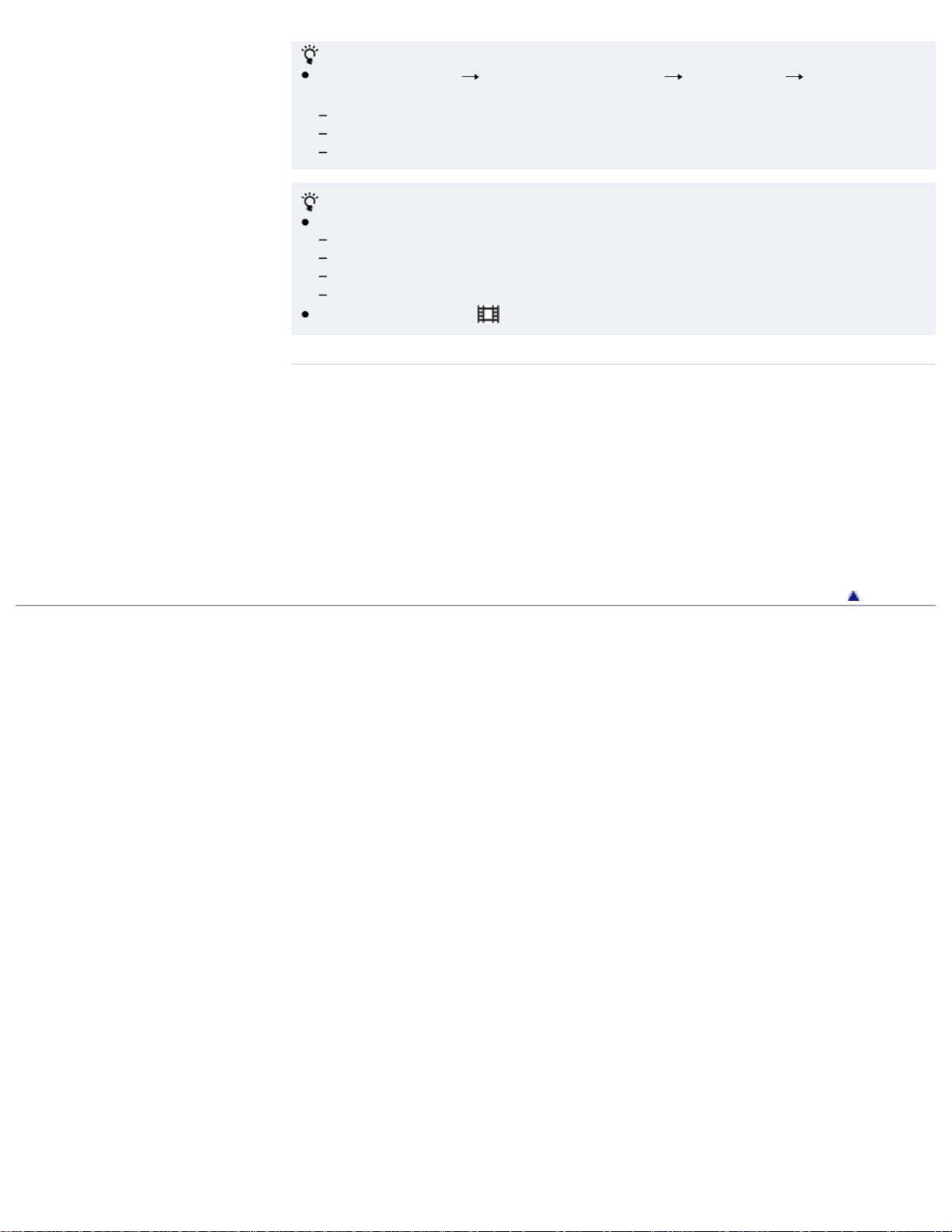
Allows you to shoot images with effects such as tunnel effect, high contrast, or color
60
(Toy
camera)
cast as if they were shot with a toy camera. You can change the color hue using
(Color hue).
(Pop
Color)
Allows you to shoot a pop art-like colorful image with emphasis on the color tone.
(Partial
Color)
Allows you to shoot an image that makes a strong impression by leaving a specified
color on portions of a monochrome image. You can select the color to extract using
(Extracted Color).
(Soft
High-key)
Allows you to shoot soft, clear images with an emphasis on brightness.
(Watercolor)
Allows you to shoot an image with ink bleed and blurring effects as if it painted with
watercolors.
(Illustration)
Allows you to shoot an illustration-like image by emphasizing the outlines. You can
change the effect level using
(Illustration Effect).
61
To add an effect when shooting panoramic image
If you set [REC Mode]
[Panorama Shooting Scene] [Picture Effect] desired mode, the
following Picture Effect modes are effective:
[Pop Color]
[Partial Color]
[Soft High-key]
To add an effect to a movie
The following Picture Effect modes are also effective for movies and Dual Rec shots.
[Toy camera]
[Pop Color]
[Partial Color]
[Soft High-key]
When set [REC Mode] to
(Movie Mode), you cannot set the Picture Effect.
Related Topic
HDR Painting effect
Area of emphasis
Color hue
Extracted Color
Illustration Effect
Functions available for each shooting mode
MENU items available for each shooting mode
iSweep Panorama
Back to top
Copyright 2013 Sony Corporation
62
Cyber-shot User Guide
PrintSearch
Before Use
Operating the camera
Shooting
Viewing
Useful shooting functions
Useful viewing functions
Changing settings
Viewing images on a TV
Using with your computer
Printing
Troubleshooting
Precautions / About this camera
Contents list
Top page > Shooting > Selecting the shooting mode based on the subject > Scene Selection
Scene Selection
Allows you to shoot with preset settings according to the scene.
For still images:
1. Set the camera to shooting mode.
2.
(REC Mode) (Scene Selection) desired mode
If you want to select other Scene Selection mode, select from REC Mode.
For movies:
1. Set the camera to shooting mode.
2.
(REC Mode) (Movie Mode) MENU (Movie shooting scene)
(Scene Selection) desired mode
If you want to select other Scene Selection mode, select from the MENU.
Scene Selection modes with an * mark are not available for [Scene Selection] in [Movie shooting scene].
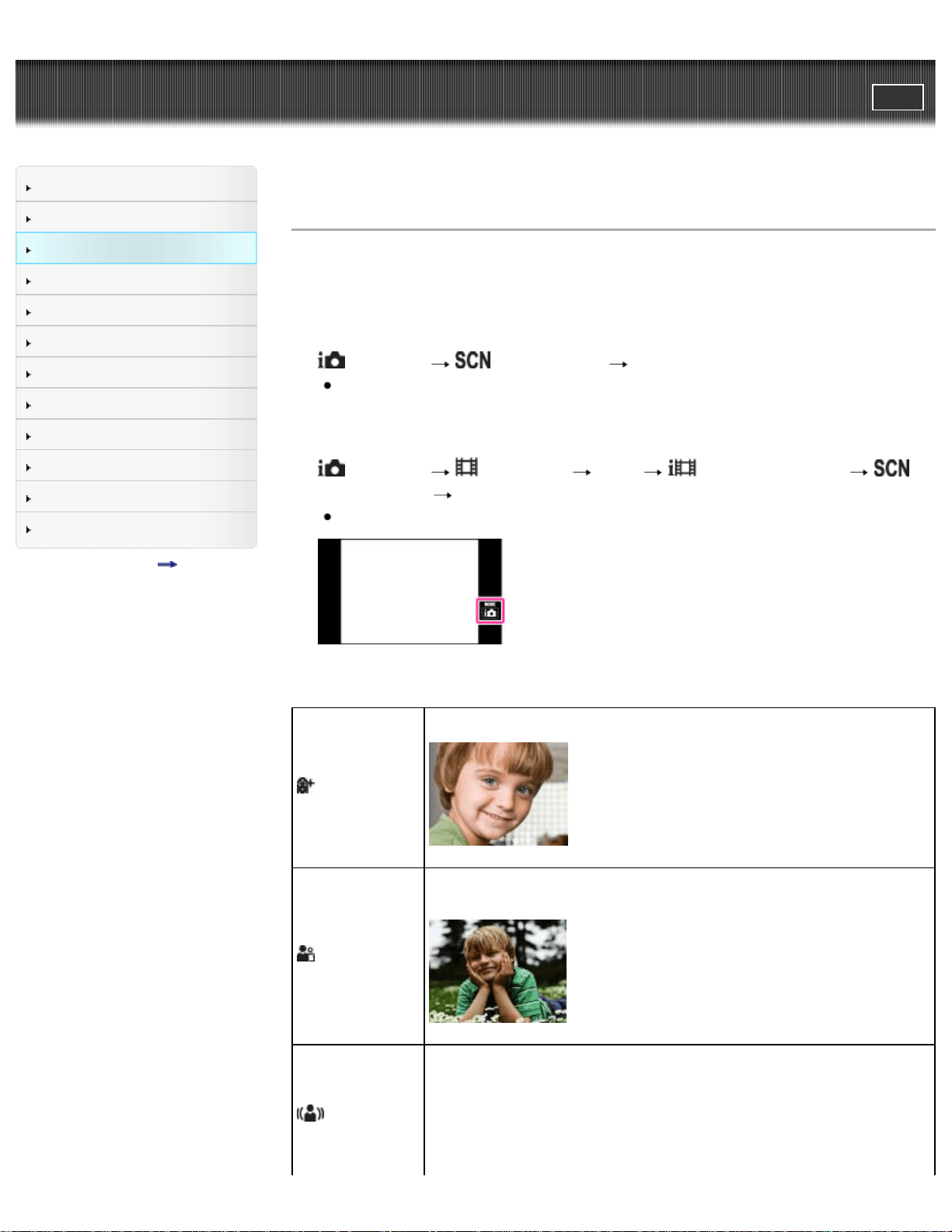
(Soft Skin) *
Allows you to shoot faces for smoothness.
(Soft Snap)
Allows you to shoot images with a softer atmosphere for portraits and flowers,
etc.
(Anti Motion
Blur)*
Allows you to shoot indoor shots without using the flash to reduce subject blur.
63
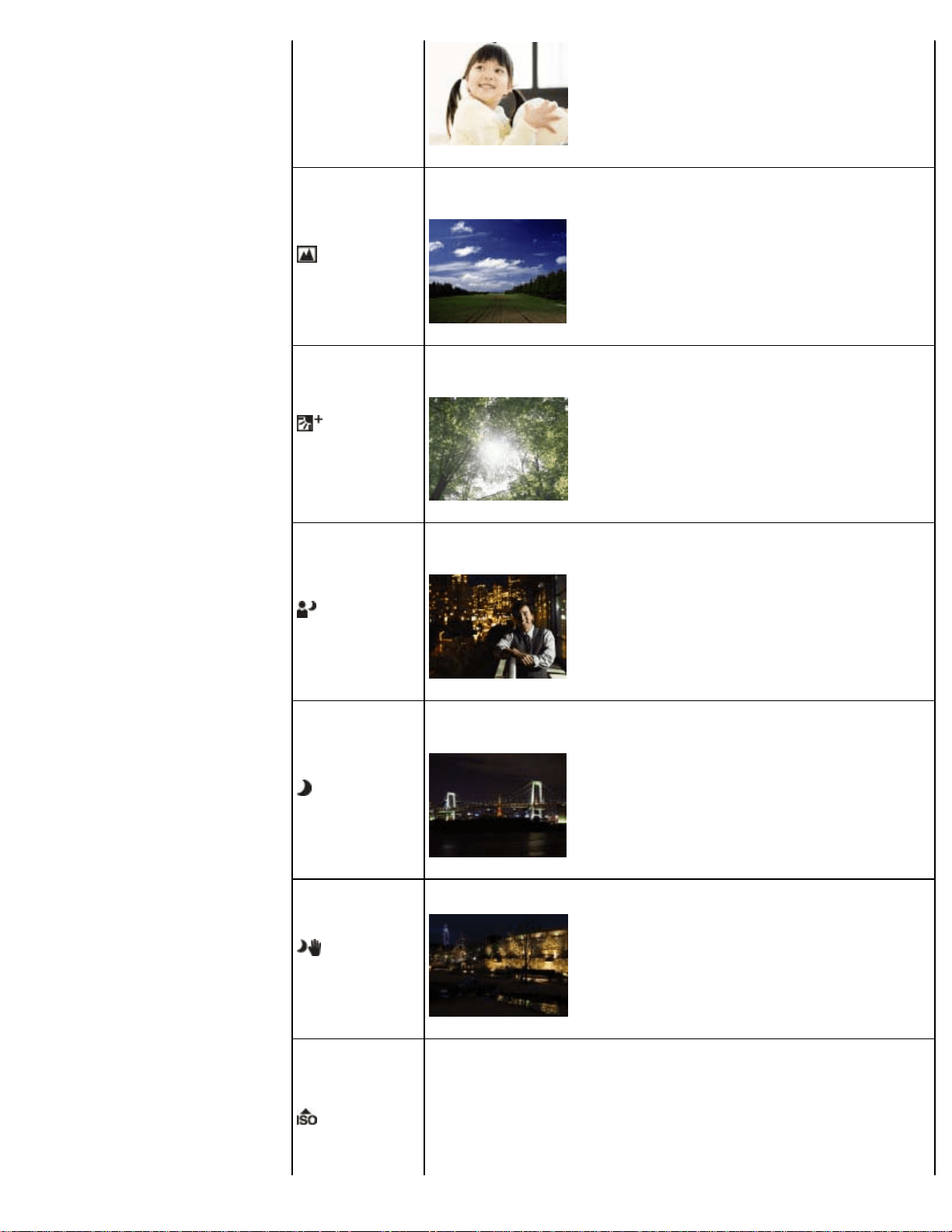
(Landscape)
Allows easy shooting of distant scenes by focusing in the distance. Shoots vivid
blue sky and flora colors.
(Backlight
Correction HDR) *
Allows you to shoot three images having different exposures to create a single
image with a greater range of gradation.
(Night Portrait) *
Allows you to shoot sharp images of people with the night view in the
background without compromising the atmosphere.
(Night Scene)
Allows you to shoot night scenes at far distance without losing the dark
atmosphere of the surroundings.
(Hand-held
Twilight) *
Allows you to shoot night scenes with less noise without using a tripod.
(High
Sensitivity)
Allows you to shoot images without a flash under low light conditions, reducing
blur.
64
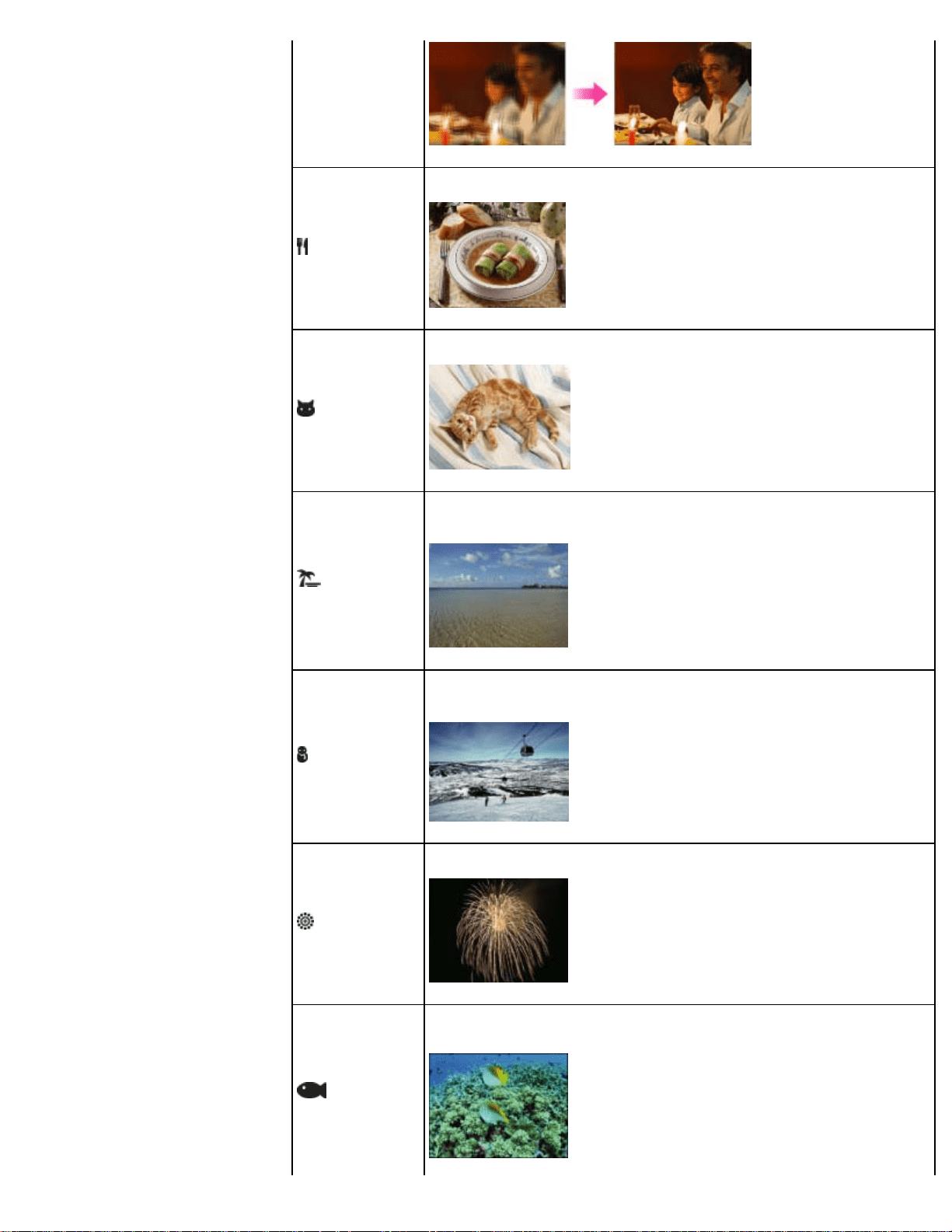
(Gourmet) *
Allows you to shoot food arrangements in delicious and bright color.
(Pet) *
Allows you to shoot images of your pet with the best settings.
(Beach)
Allows you to shoot scenes on the beach in bright and vivid colors even under
the sunlight.
(Snow)
Allows you to record clear images preventing sunken colors in snowy scenes or
other places where the whole screen appears white.
(Fireworks)
Allows you to record fireworks in all their splendor.
(Underwater)
Allows you to shoot underwater in natural colors.
65
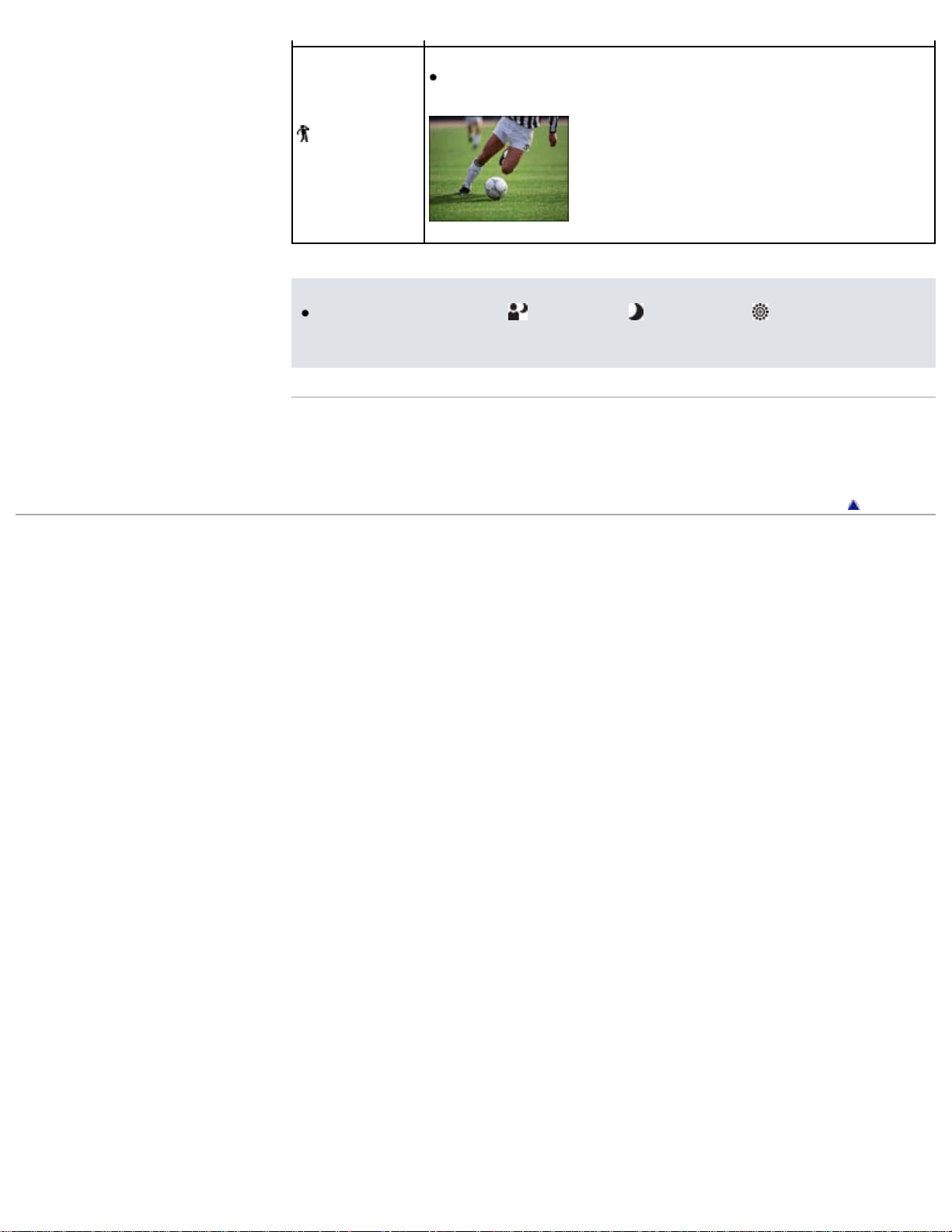
(Hi-Speed
Shutter) *
Allows you to capture fast moving subjects outdoors or in other bright places.
The shutter speed becomes faster, so images shot in dark places become
darker.
Notes
When you shoot images using
(Night Portrait), (Night Scene) or (Fireworks) mode, the
shutter speed is slower and the images tend to blur. To prevent blurring, the use of a tripod is
recommended.
Related Topic
Functions available for each shooting mode
MENU items available for each shooting mode
Back to top
Copyright 2013 Sony Corporation
66
Cyber-shot User Guide
PrintSearch
Before Use
Operating the camera
Shooting
Viewing
Useful shooting functions
Useful viewing functions
Changing settings
Viewing images on a TV
Using with your computer
Printing
Troubleshooting
Precautions / About this camera
Contents list
Top page > Viewing > Viewing still images > Viewing still images
Viewing still images
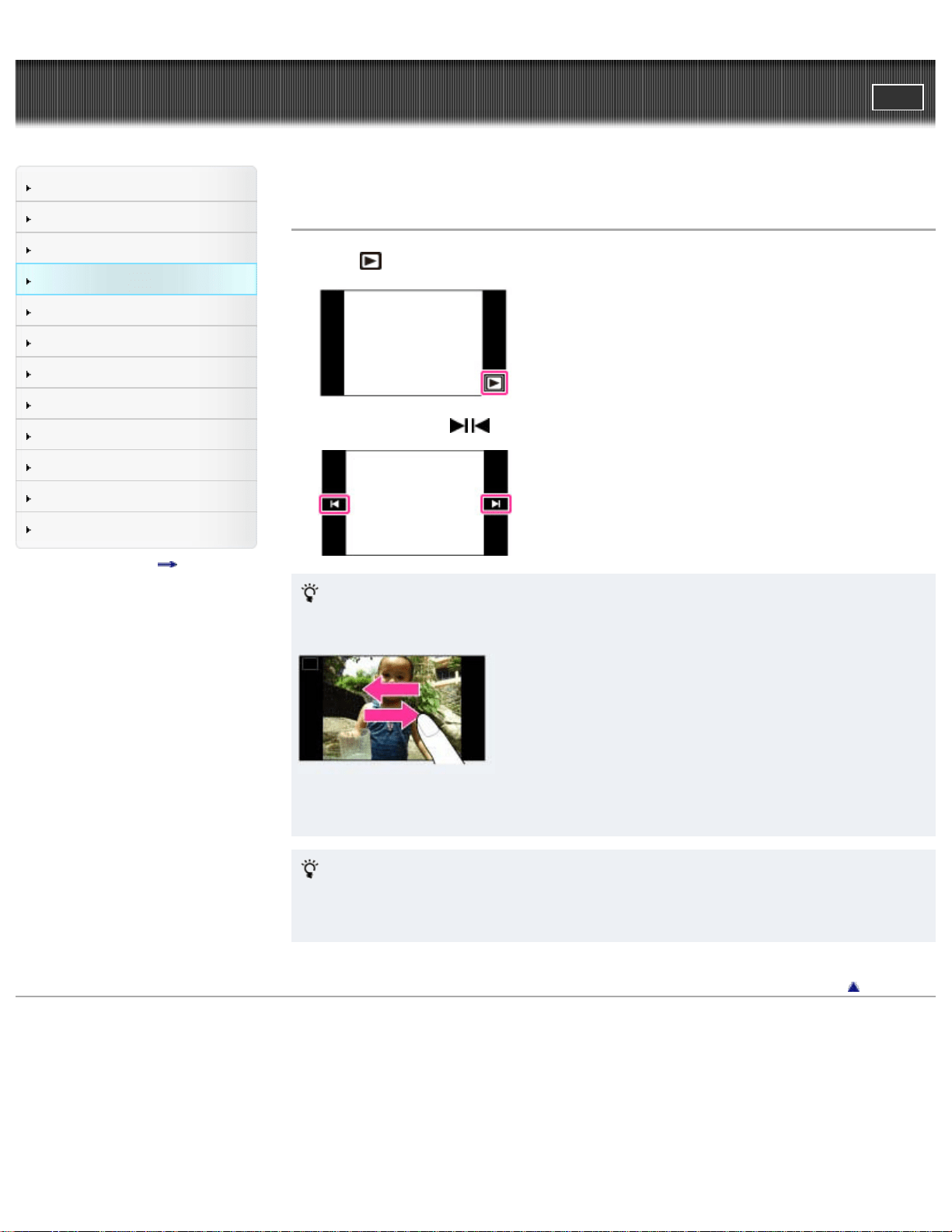
1. Touch (Playback) to switch to playback mode.
2. Select an image with / .
Taking advantage of dragging operations
You can perform the following actions by dragging the screen during playback.
Displays the next/previous image
In playback mode, drag the screen to the right or left. To change images continuously, drag the screen
to the right or left and keep touching the screen.
Viewing images taken with a different camera
If you insert a memory card which has images taken with a different camera, registration screen with
the message “Files found which were not recognized Import files” will be displayed.
To view unregistered images, register them by selecting [OK].
Back to top
Copyright 2013 Sony Corporation
67
Cyber-shot User Guide
PrintSearch
Before Use
Operating the camera
Shooting
Viewing
Useful shooting functions
Useful viewing functions
Changing settings
Viewing images on a TV
Using with your computer
Printing
Troubleshooting
Precautions / About this camera
Contents list
Top page > Viewing > Viewing still images > Playback zoom
Playback zoom
To save enlarged images
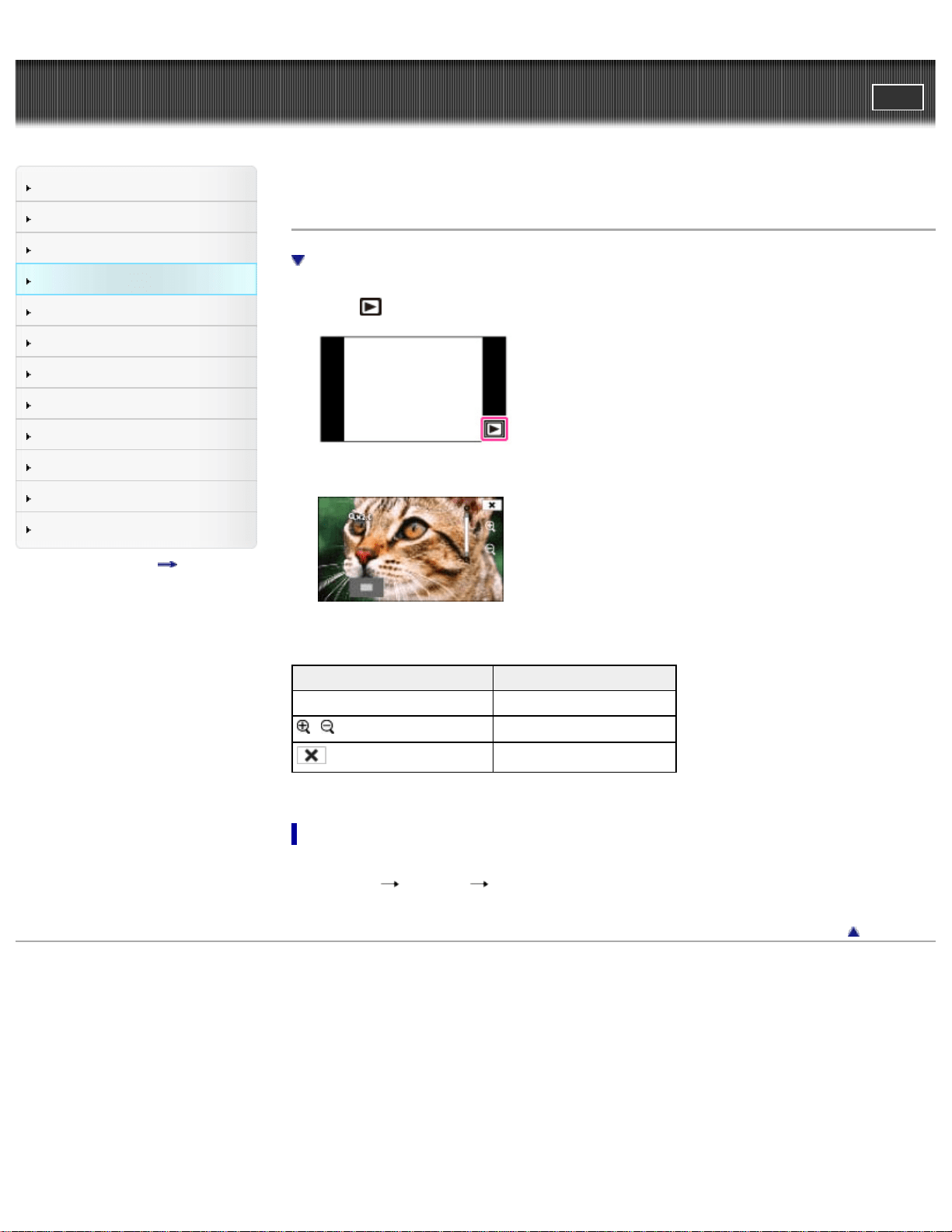
Enlarges the image being played back.
1. Touch
(Playback) to switch to playback mode.
2. Slide the zoom (W/T) lever to the T side.
3. Adjust the zoom scale and position.
Button/Operation method Action
Drag up/down/right/left Changes the zoom position.
/
Changes the zoom scale.
Cancels playback zoom.
To save enlarged images
You can save an enlarged image by using the trimming function.
Touch MENU
[Retouch] [Trimming (Resize)].
Back to top
Copyright 2013 Sony Corporation
68
Cyber-shot User Guide
PrintSearch
Before Use
Operating the camera
Shooting
Viewing
Useful shooting functions
Useful viewing functions
Changing settings
Viewing images on a TV
Using with your computer
Printing
Troubleshooting
Precautions / About this camera
Contents list
Top page > Viewing > Viewing still images > Wide Zoom
Wide Zoom
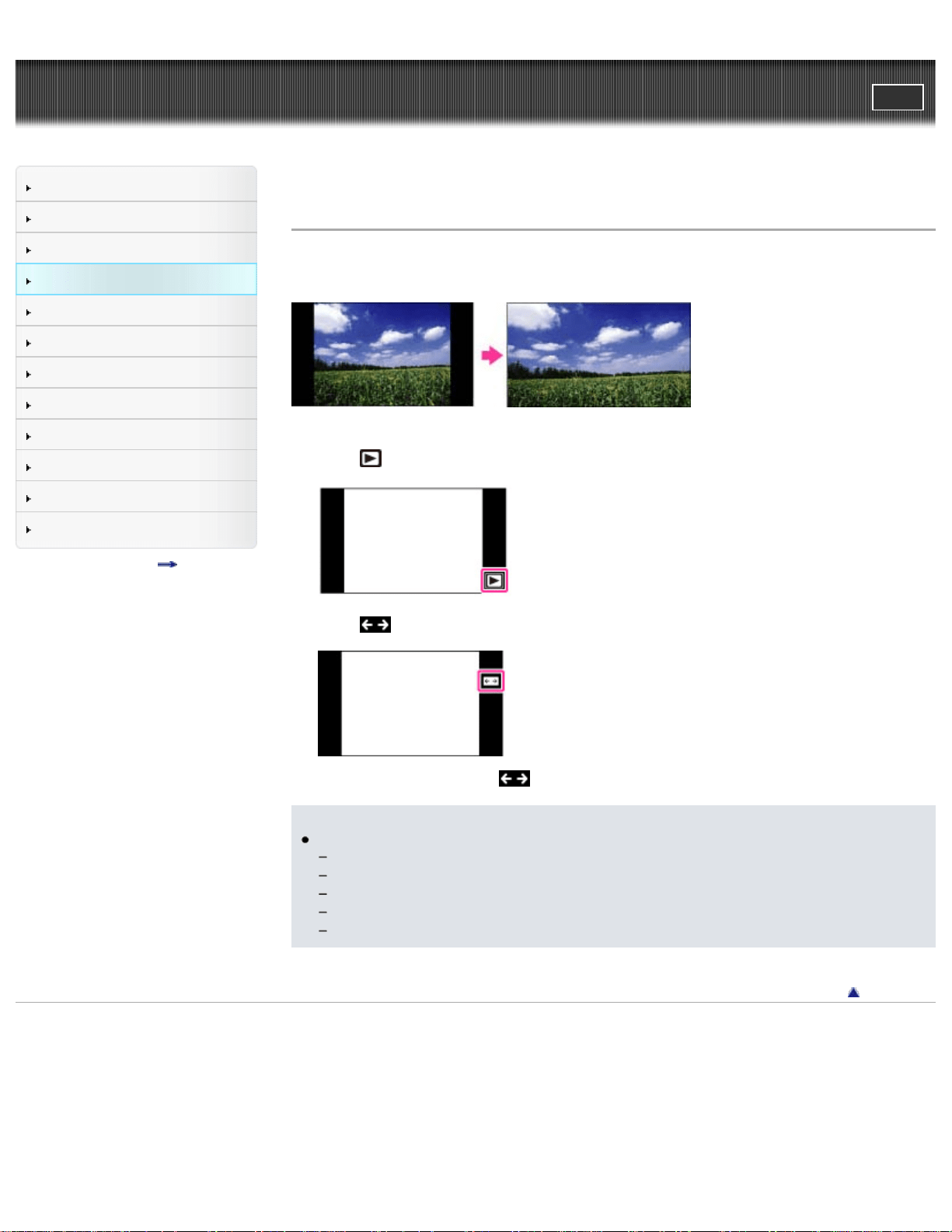
In single-image mode, still images at a 4:3 aspect ratio are displayed over the entire screen. In this case,
the top and bottom of the image will be slightly cropped.
1. Touch (Playback) to switch to playback mode.
2. Touch (Wide Zoom).
3. To cancel Wide Zoom, touch (Wide Zoom) again.
Notes
Wide Zoom is not available for the following image files:
Movies
Panoramic images
Images displayed in a burst group
16:9 images
3D Image
Back to top
Copyright 2013 Sony Corporation
69
Cyber-shot User Guide
PrintSearch
Before Use
Operating the camera
Shooting
Viewing
Useful shooting functions
Useful viewing functions
Changing settings
Viewing images on a TV
Using with your computer
Printing
Troubleshooting
Precautions / About this camera
Contents list
Top page > Viewing > Viewing burst images > Viewing burst images
Viewing burst images
Tilt playback
Unfold
You can select the playback method for continuous (burst) shots when [View Mode] is set to [Date View]
and [Display Cont. Shooting Group] is set to [Display Main Image Only].
[View Mode] is set to [Date View] and [Display Cont. Shooting Group] is set to [Display Main Image
Only] in its default setting.
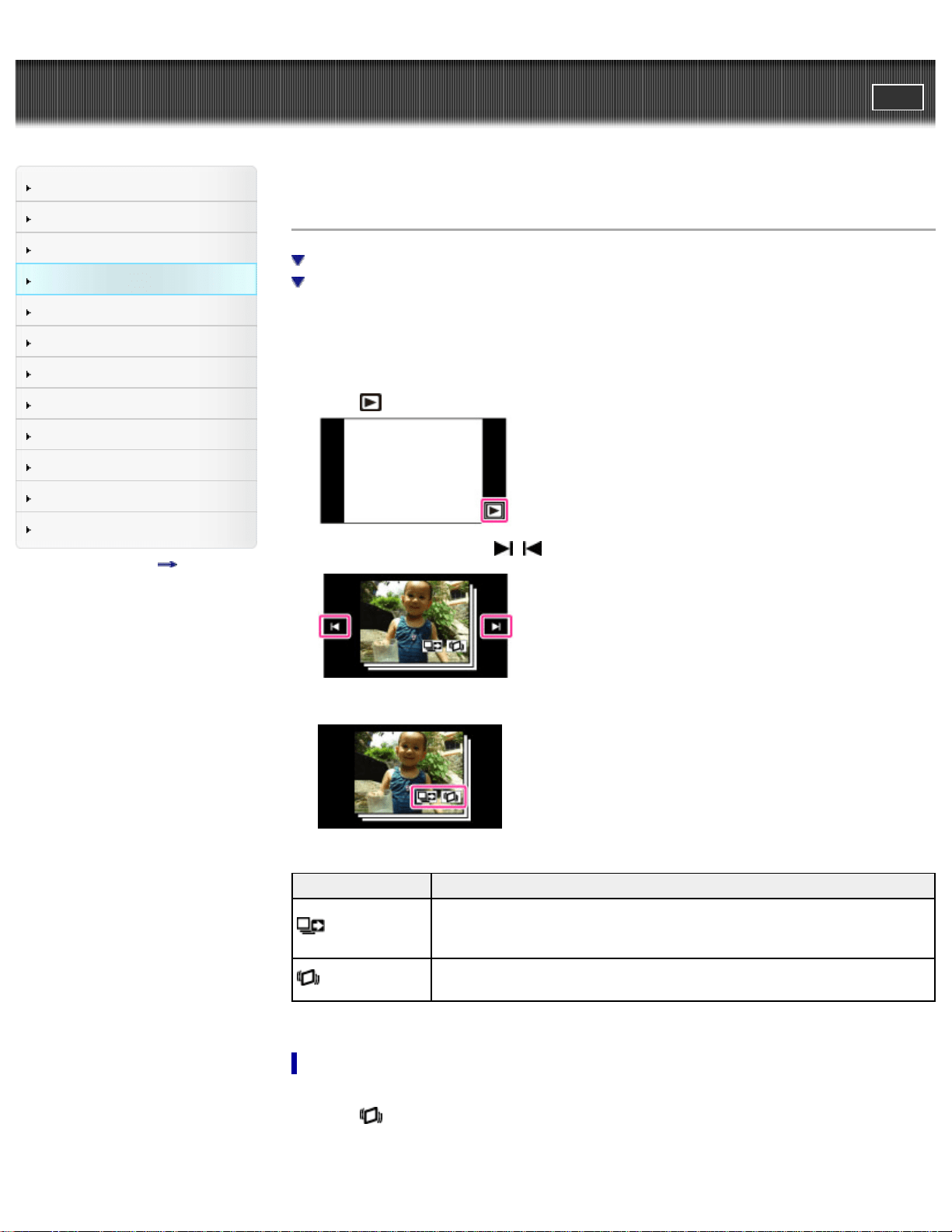
1. Touch
(Playback) to switch to playback mode.
2. Select the burst images with / .
3. Touch the desired playback button according to the playback mode.
Button/Operation Action
Only the main image is displayed.
The display switches between single image display and thumbnail image
display each time you touch the screen.
You can view the burst images as a movie by tilting the camera to the right or
left.
Tilt playback
The burst shots are played back smoothly as a movie.
1. Touch
.
2. Tilt the camera to the right or left, with the center of the camera as the axis.
70
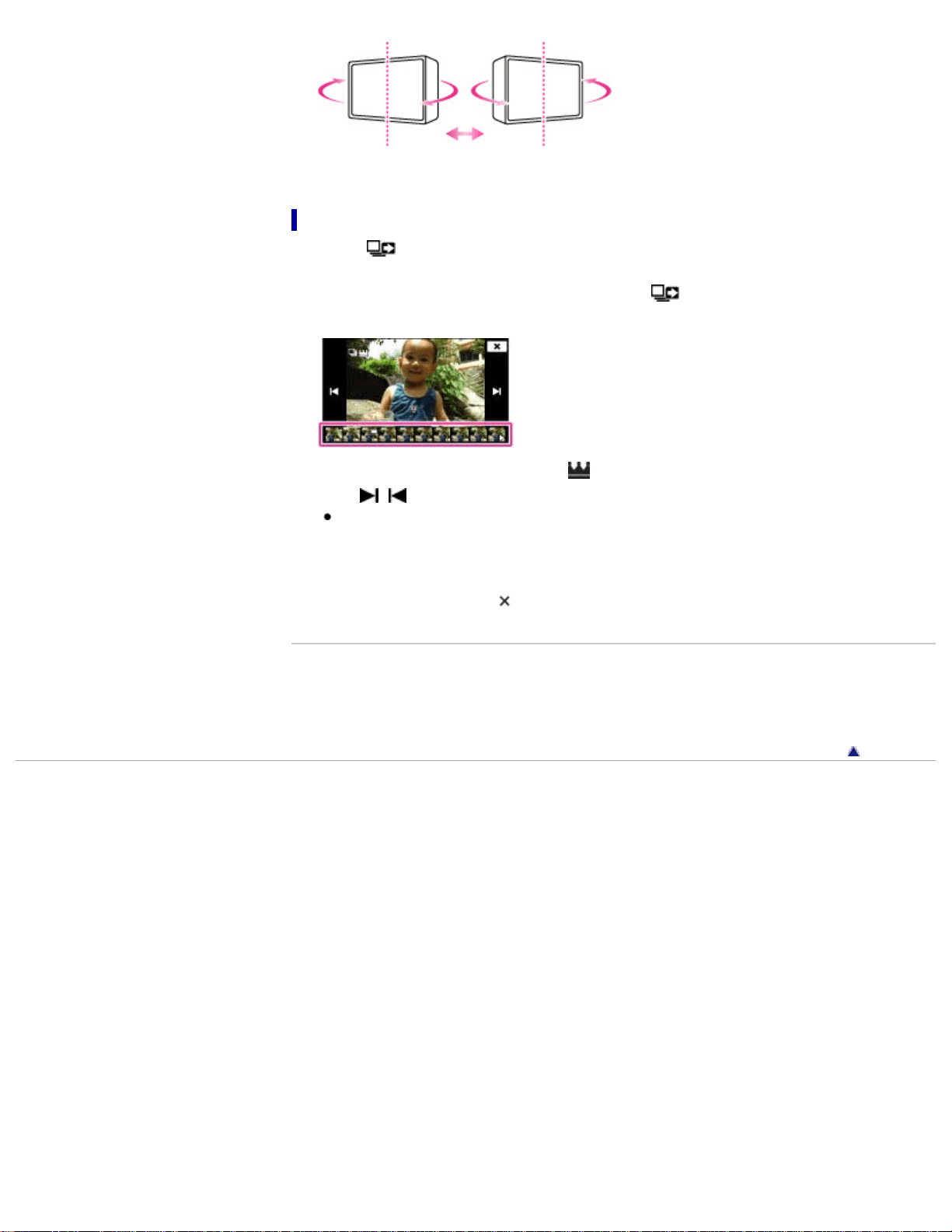
3. To exit tilt playback, touch the screen.
Unfold
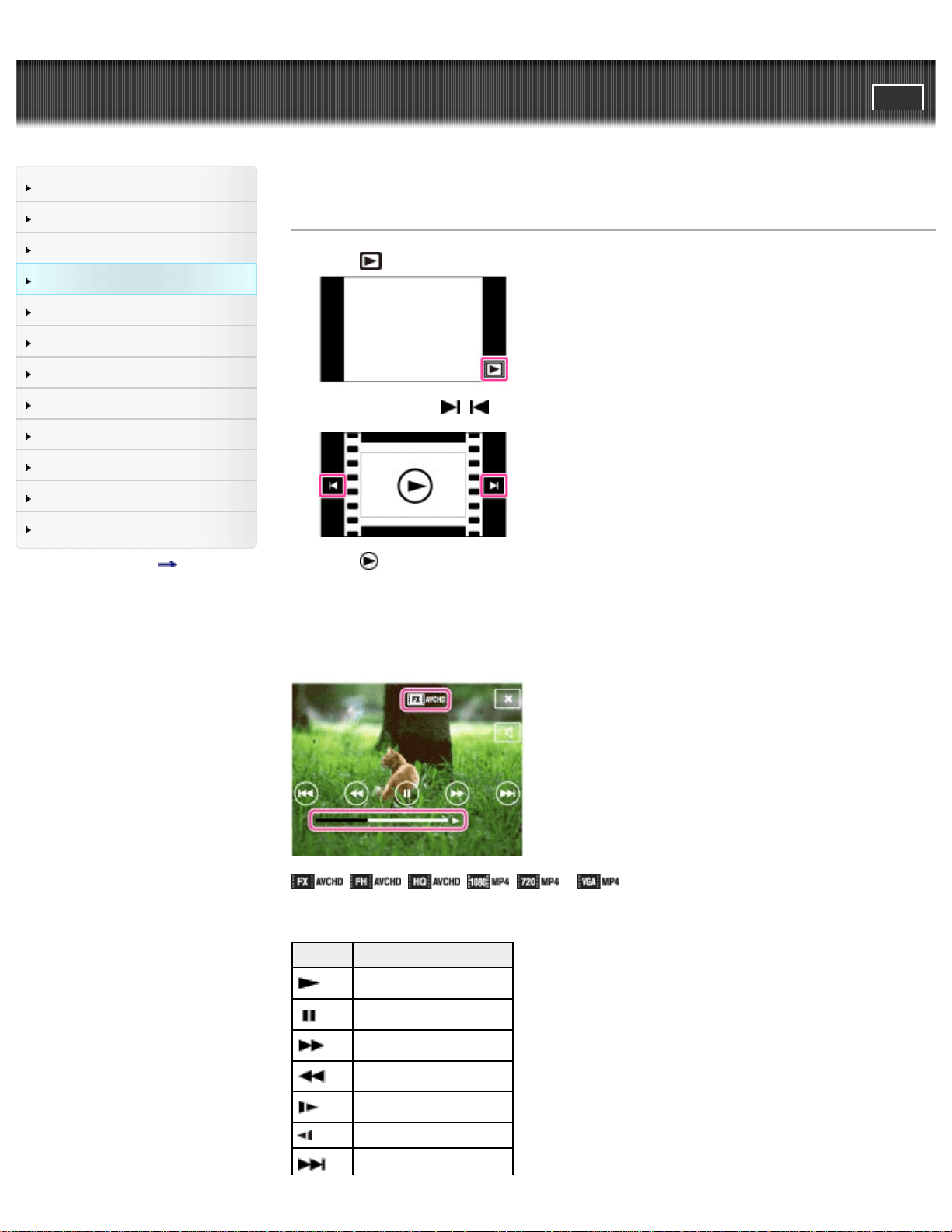
If you touch , only the main image is displayed. You can display a line-up of images by following the
procedure below.
1. Display the main image in playback mode, then touch
.
The images are displayed in the index.
When images are displayed in an index, is displayed on the main image.
2. Touch
/ to display each image in a burst group.
You can also select an image to be displayed by touching the thumbnail image at the bottom of
the screen.
3. The display switches between single image display and thumbnail image display each time you
touch the screen.
4. To cancel the display, touch
.
Related Topic
View Mode
Display Cont. Shooting Group
Back to top
Copyright 2013 Sony Corporation
71
Cyber-shot User Guide
PrintSearch
Before Use
Operating the camera
Shooting
Viewing
Useful shooting functions
Useful viewing functions
Changing settings
Viewing images on a TV
Using with your computer
Printing
Troubleshooting
Precautions / About this camera
Contents list
Top page > Viewing > Viewing movies > Viewing movies
Viewing movies
1. Touch (Playback) to switch to playback mode.
2. Select a movie with / .
3. Touch on the screen.
When you touch the screen during playback, operation buttons are displayed.
On the movie viewing screen
When you touch the screen during playback, the playback bar appears, indicating the playback position
of a movie and operation buttons are displayed.
, , , , or appears on the movie viewing screen.
The icon displayed may vary depending on image size and quality.
Button Action
Playback
Pause
Fast forward
Fast rewind
Slow playback
Slow rewind playback
Chapter advance
72
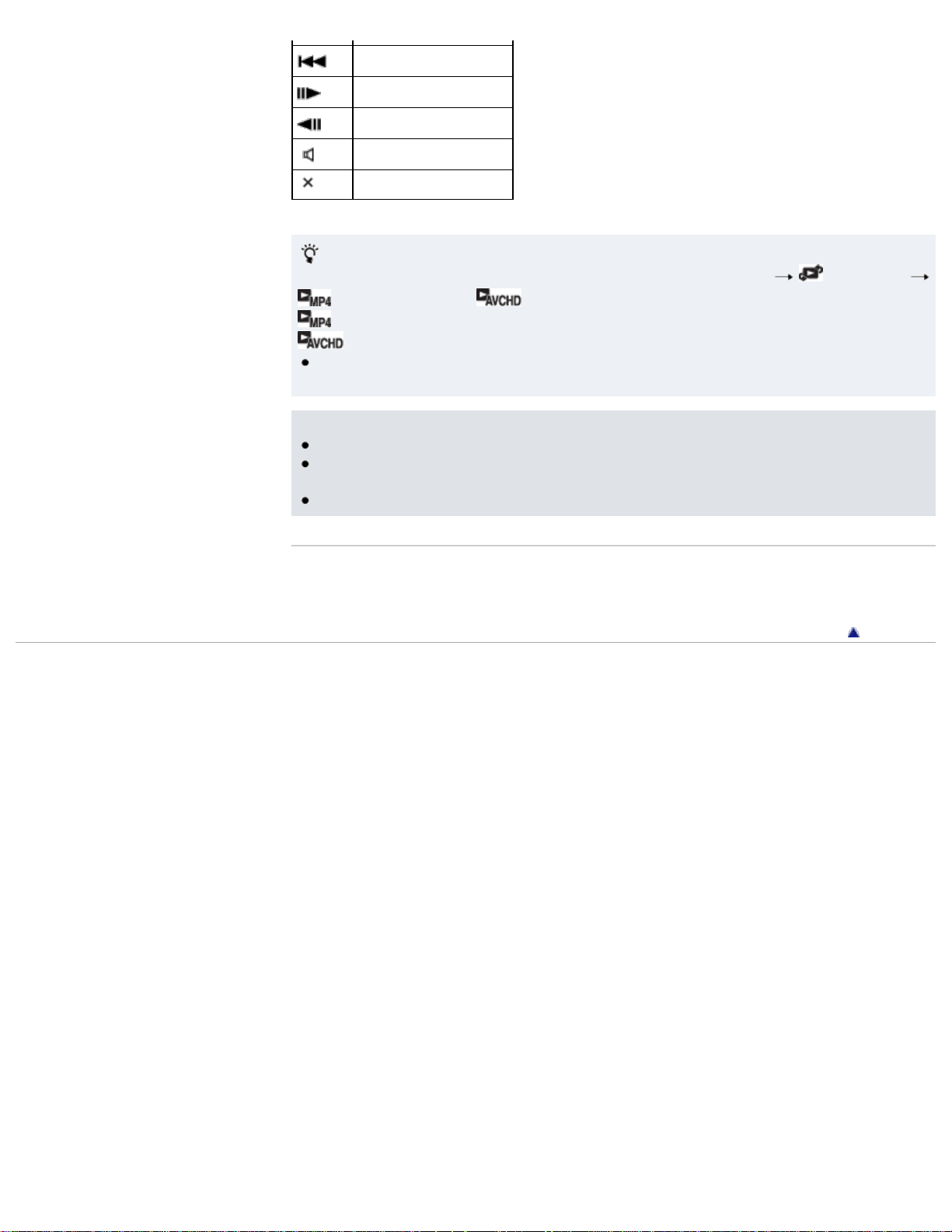
Chapter rewind
Frame advance
Frame rewind
Volume settings
Closes the control panel
To display only movies on the index screen
You can view only movie thumbnails on the index screen by touching MENU
(View Mode)
(Folder view (MP4)) or (AVCHD view).
(Folder view (MP4)): Displays MP4-format movie thumbnails on the index screen.
(AVCHD view): Displays AVCHD-format movie thumbnails on the index screen.
When a movie file is played back to the end, the camera automatically starts playing back the next
movie file.
Notes
The buttons on the control panel will vary depending on the playback status.
The screen changes to the next/previous image when you touch the Chapter advance/Chapter
rewind button in Date View setting.
You may not be able to play back some movies using other cameras.
Related Topic
View Mode
Back to top
Copyright 2013 Sony Corporation
73
Cyber-shot User Guide
PrintSearch
Before Use
Operating the camera
Shooting
Viewing
Useful shooting functions
Useful viewing functions
Changing settings
Viewing images on a TV
Using with your computer
Printing
Troubleshooting
Precautions / About this camera
Contents list
Top page > Viewing > Viewing panoramic images > Scrolling the panoramic images for display
Scrolling the panoramic images for display
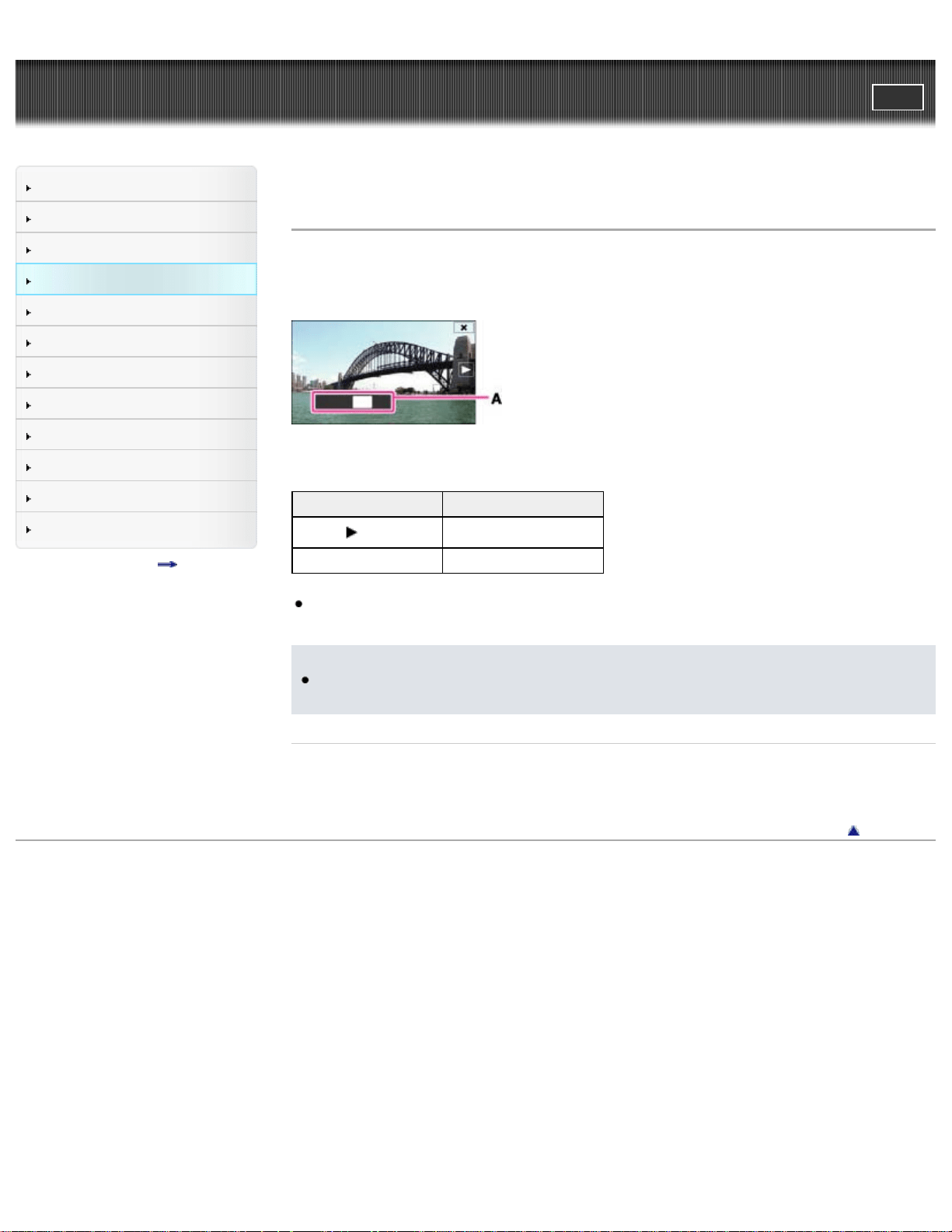
You can scroll panoramic images by touching the playback icon while panoramic images are being
displayed.
In playing back, touch the screen to display the operation buttons.
A: Shows the displayed area of the whole panoramic image
Button/Operation Action
Touch
Starts scrolling playback
Drag up/down/right/left Scrolls image
Panoramic images recorded using another camera may not be scrolled correctly when being played
back.
Notes
A panoramic image recorded in [High Resolution] size requires a longer time to scroll than a normal
size panoramic image.
Related Topic
Still Image Size/Panorama Image Size
Back to top
Copyright 2013 Sony Corporation
74
Cyber-shot User Guide
PrintSearch
Before Use
Operating the camera
Shooting
Viewing
Useful shooting functions
Useful viewing functions
Changing settings
Viewing images on a TV
Using with your computer
Printing
Troubleshooting
Precautions / About this camera
Contents list
Top page > Useful shooting functions > Functions available for each shooting mode > Functions
available for each shooting mode
Functions available for each shooting mode
Functions available in REC modes
Functions available in Scene Selection
Functions available in Picture Effect
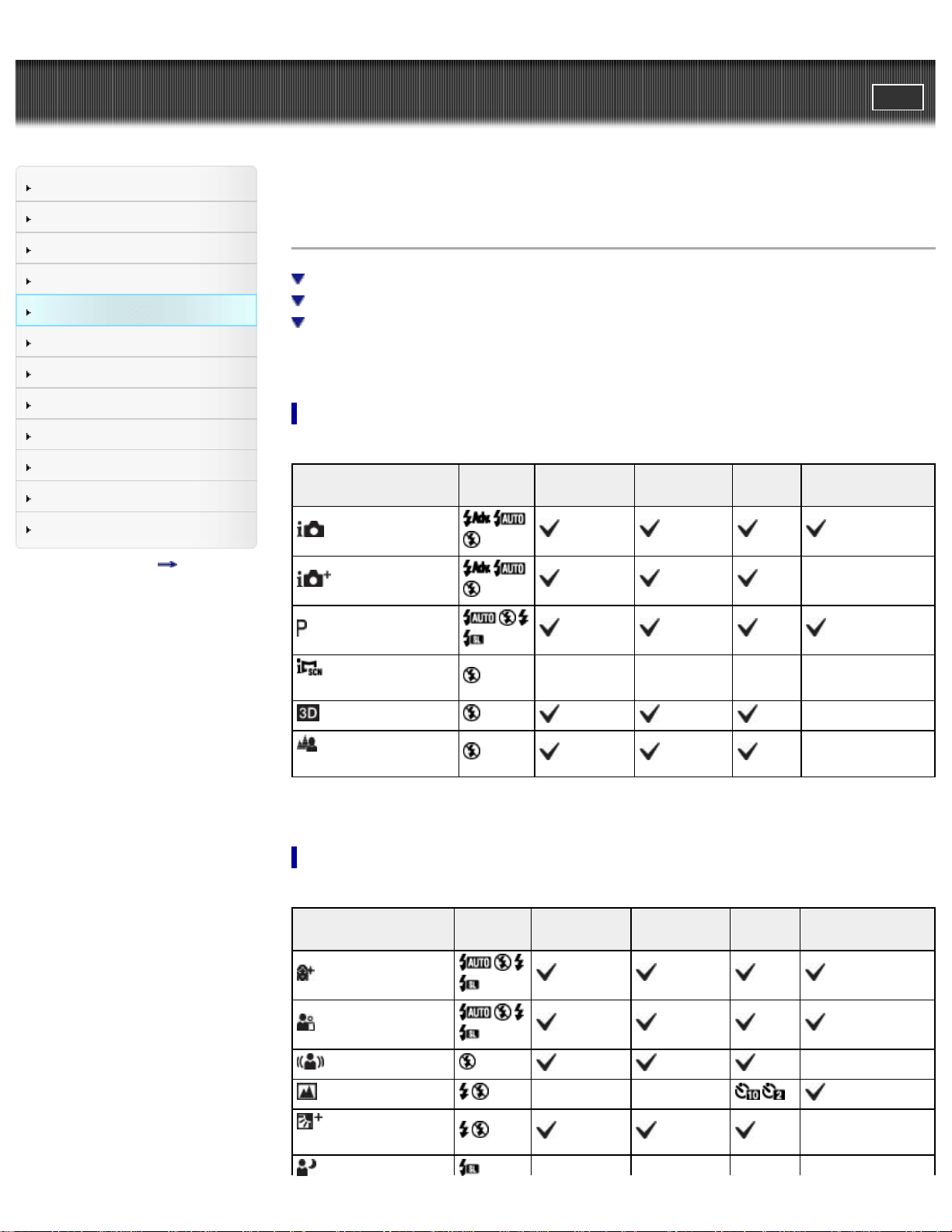
In the table below, a checkmark indicates a user-changeable function, while — indicates an
unchangeable one. The icons below [Self-Timer] and [Flash] indicate the available modes.
Functions available in REC modes
Flash
Face
Detection
Tracking
focus
Self-
Timer
Continuous
Shooting
(Intelligent Auto)
(Superior Auto)
—
(Program Auto)
(Panorama Shooting
Scene)
— — — —
(3D Still Image)
—
(Background
Defocus)
*
—
* [Off] cannot be selected for [Face Detection].
Functions available in Scene Selection
Flash
Face
Detection
Tracking
focus
Self-
Timer
Continuous
Shooting
(Soft Skin)
*
(Soft Snap)
*
(Anti Motion Blur)
—
(Landscape)
— —
(Backlight
Correction HDR)
—
75
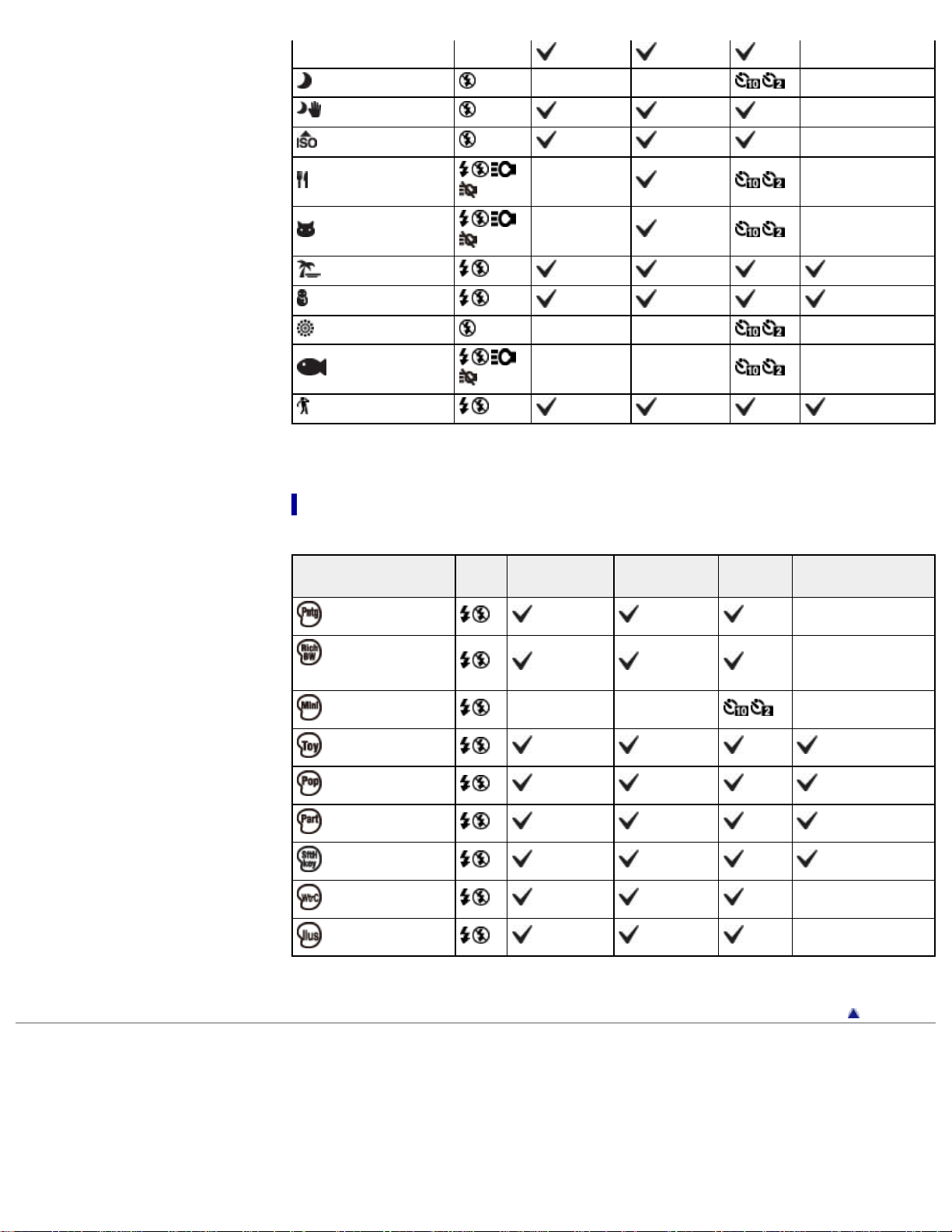
(Night Portrait)
—
(Night Scene)
— —
—
(Hand-held Twilight)
—
(High Sensitivity)
—
(Gourmet)
—
—
(Pet)
—
—
(Beach)
(Snow)
(Fireworks)
— —
—
(Underwater)
— —
—
(Hi-Speed Shutter)
* [Off] cannot be selected for [Face Detection].
Functions available in Picture Effect
Flash
Face
Detection
Tracking
focus
Self-
Timer
Continuous
Shooting
(HDR Painting)
—
(Rich-tone
Monochrome)
—
(Miniature)
— —
—
(Toy camera)
(Pop Color)
(Partial Color)
(Soft High-key)
(Watercolor)
—
(Illustration)
—
Back to top
Copyright 2013 Sony Corporation
76
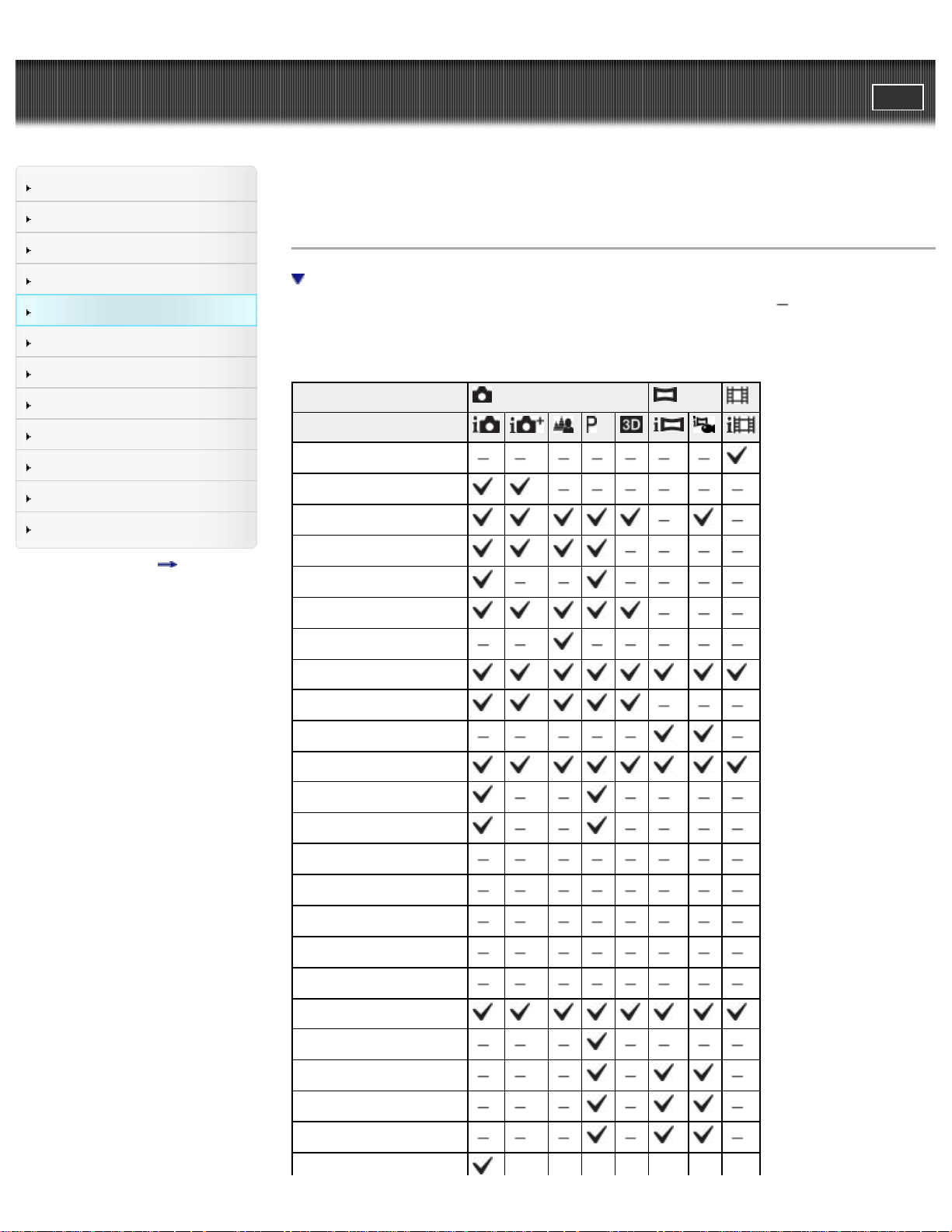
Cyber-shot User Guide
PrintSearch
Before Use
Operating the camera
Shooting
Viewing
Useful shooting functions
Useful viewing functions
Changing settings
Viewing images on a TV
Using with your computer
Printing
Troubleshooting
Precautions / About this camera
Contents list
Top page > Useful shooting functions > Functions available for each shooting mode > MENU items
available for each shooting mode
MENU items available for each shooting mode
MENU items not available in Scene Selection/Picture Effect mode
In the table below, a checkmark indicates settings that can be changed, while
indicates settings that
cannot be changed. A setting may be fixed or restricted depending on the shooting mode. For details,
see each topic.
Menu items
Movie shooting scene
Photo Creativity
Easy Mode
Flash
LED Light*
1
Self-Timer
Defocus Effect
Still Image Size(Dual Rec)
Still Image Size
Panorama Image Size
Movie Quality / Movie Size
Cont. Shooting Settings
Macro
HDR Painting effect
Area of emphasis
Color hue
Extracted Color
Illustration Effect
Exposure Compensation
ISO
White Balance*
2
Focus
Metering Mode
Scene Recognition
77
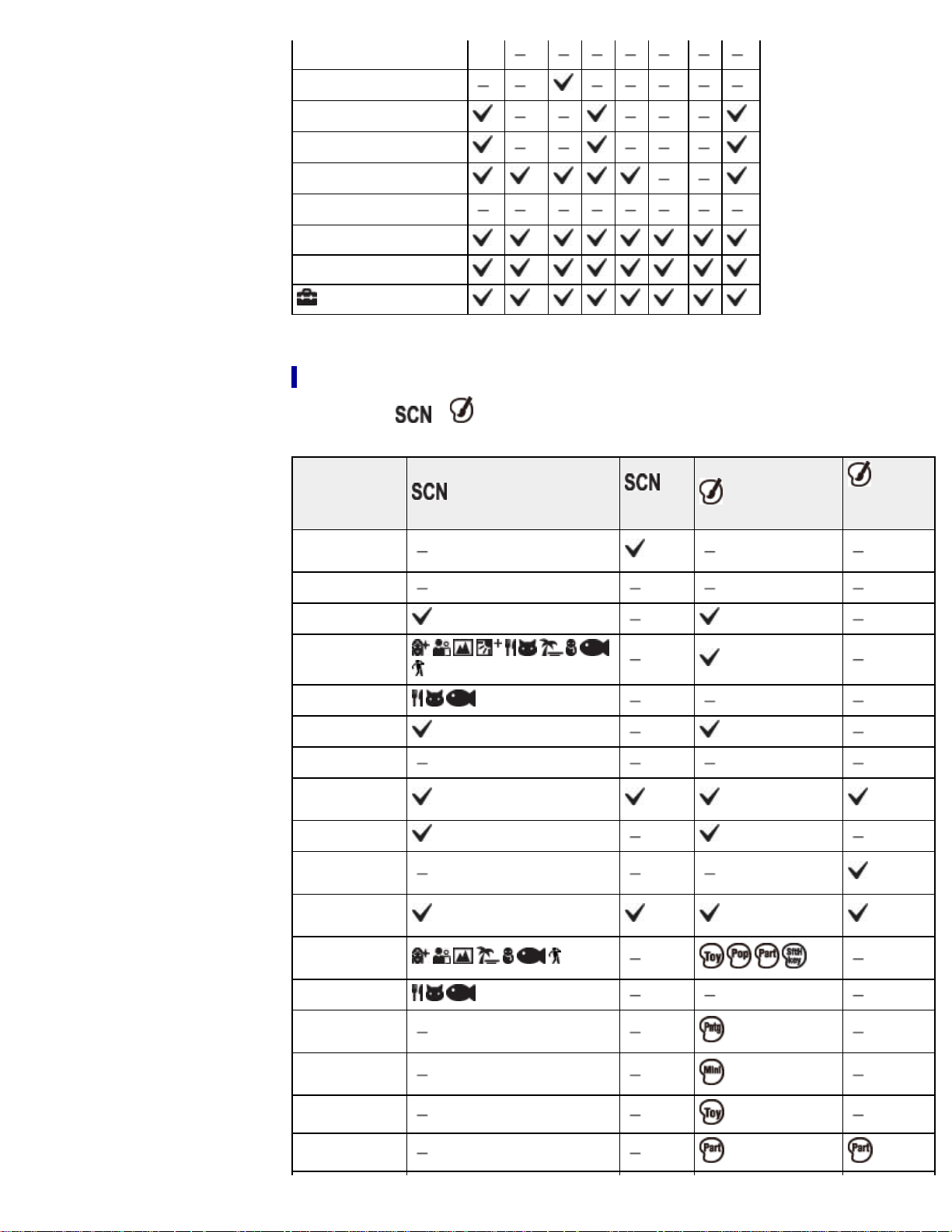
Soft Skin Effect*
3
Smile Shutter
Smile Detection Sensitivity
Face Detection*
4
Anti Blink
Movie SteadyShot
In-Camera Guide
(Settings)
MENU items not available in Scene Selection/Picture Effect mode
The icons below or indicate the available modes.
Menu items
(Still images)
(Movies)
(Still images) (Panorama
images)
Movie shooting
scene
Photo Creativity
Easy Mode
Flash
LED Light*
1
Self-Timer
Defocus Effect
Still Image
Size(Dual Rec)
Still Image Size
Panorama
Image Size
Movie Quality /
Movie Size
Cont. Shooting
Settings
Macro
HDR Painting
effect
Area of
emphasis
Color hue
Extracted Color
78
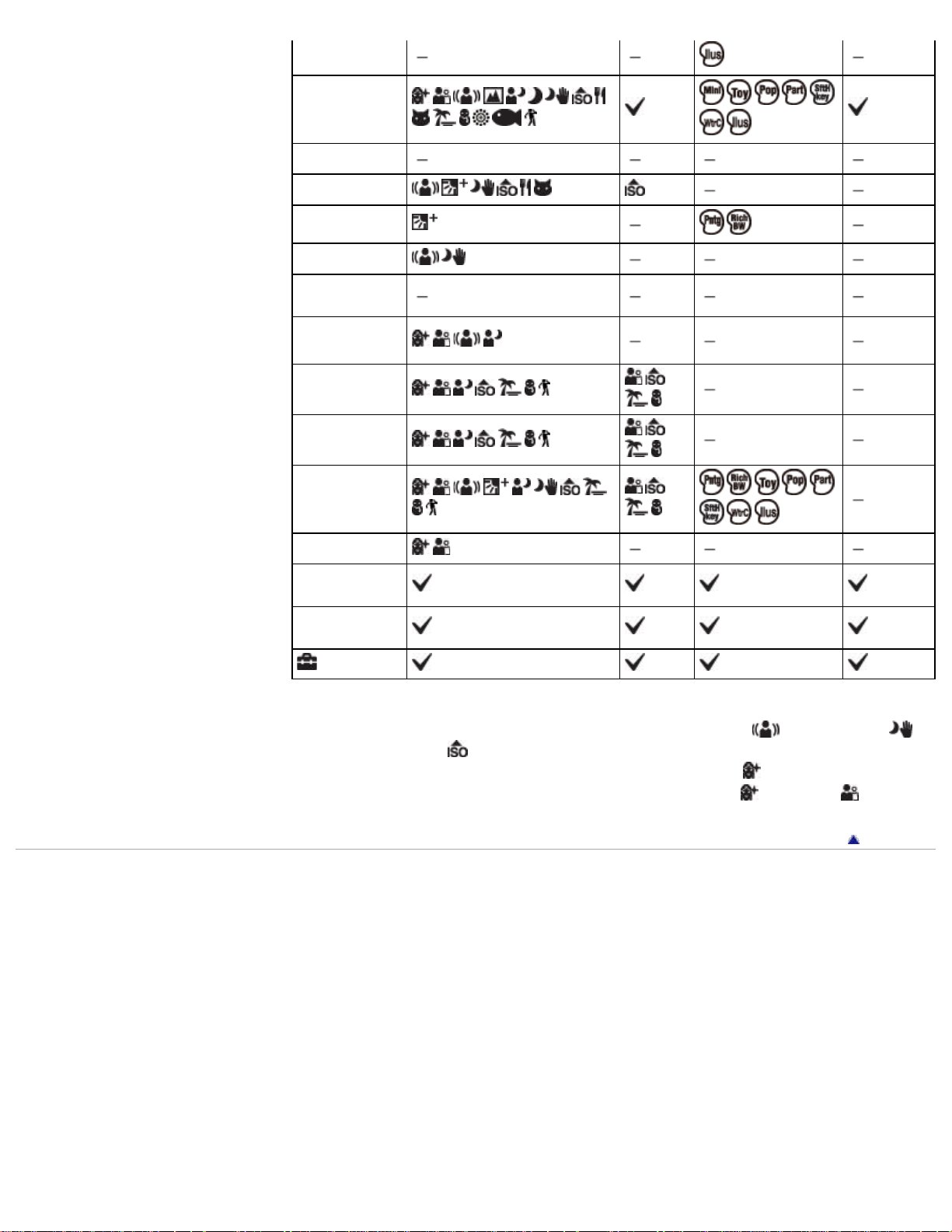
Illustration Effect
Exposure
Compensation
ISO
White Balance*
2
Focus
Metering Mode
Scene
Recognition
Soft Skin
Effect*
3
Smile Shutter
Smile Detection
Sensitivity
Face
Detection*
4
Anti Blink
Movie
SteadyShot
In-Camera
Guide
(Settings)
*1 You can only set when [Macro] is set to [Magnifying Glass Plus].
*2 [Flash] cannot be selected for [White Balance] when Scene Selection is set to
(Anti Motion Blur),
(Hand-held Twilight) or (High Sensitivity).
*3 [Off] cannot be selected for [Soft Skin Effect] when Scene Selection is set to
(Soft Skin).
*4 [Off] cannot be selected for [Face Detection] when Scene Selection is set to
(Soft Skin) or (Soft Snap).
Back to top
Copyright 2013 Sony Corporation
79
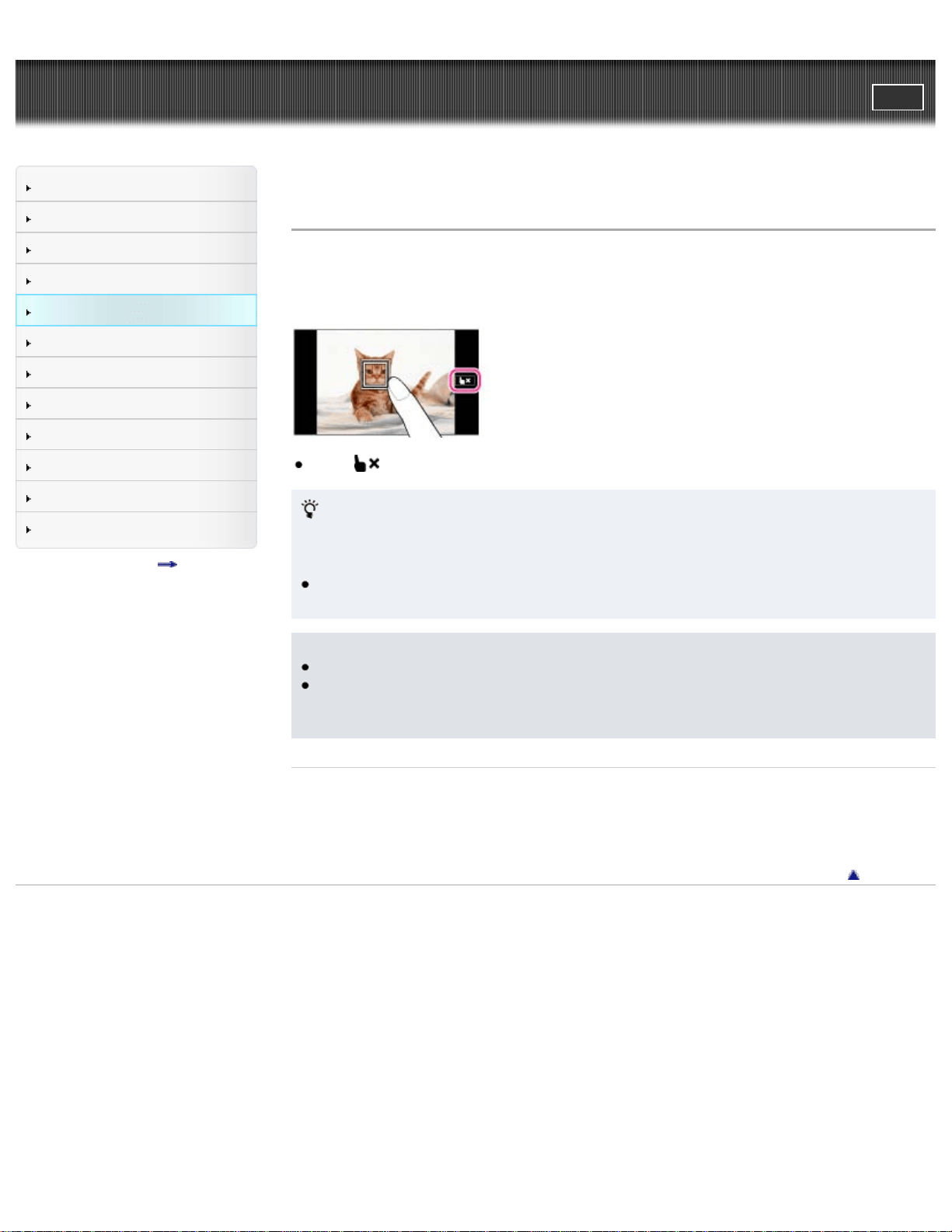
Cyber-shot User Guide
PrintSearch
Before Use
Operating the camera
Shooting
Viewing
Useful shooting functions
Useful viewing functions
Changing settings
Viewing images on a TV
Using with your computer
Printing
Troubleshooting
Precautions / About this camera
Contents list
Top page > Useful shooting functions > Menu items available for shooting > Tracking focus
Tracking focus
The camera tracks the subject and adjusts the focus automatically even when the subject is moving
(Tracking focus).
1. Aim the camera at the subject and touch the place you want to focus.
Touch to cancel the tracking focus.
Tracking a face
If you use the tracking focus function while the Face Detection function is activated, you can select a
face to be given priority and register that face with the camera. Even if the registered face disappears
from the screen, when it shows up on the screen again, the camera focuses on the registered face.
When a specified face is registered in the camera memory and you use the Smile Shutter function,
the camera searches only for that face’s smile.
Notes
When you use zoom functions other than optical zoom, the tracking focus function is not available.
Tracking focus will automatically be canceled when the subject disappears from the screen or has
failed to be tracked. However, if the target of the tracking focus is a specified face, the camera
keeps tracking on that face even if the face disappears from the screen.
Related Topic
Face Detection
Functions available for each shooting mode
Back to top
Copyright 2013 Sony Corporation
80
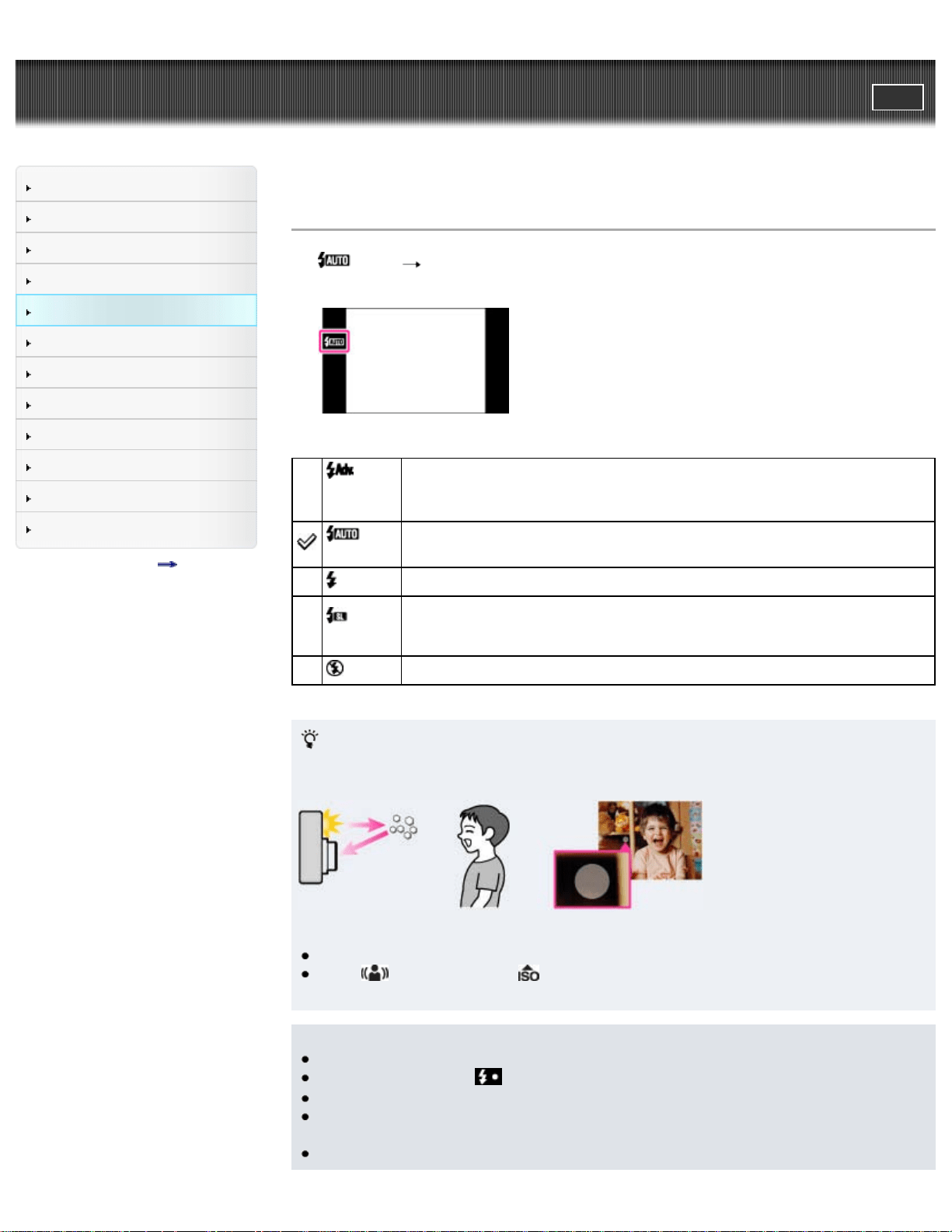
Cyber-shot User Guide
PrintSearch
Before Use
Operating the camera
Shooting
Viewing
Useful shooting functions
Useful viewing functions
Changing settings
Viewing images on a TV
Using with your computer
Printing
Troubleshooting
Precautions / About this camera
Contents list
Top page > Useful shooting functions > Menu items available for shooting > Flash
Flash
1. (Flash) desired mode
If the button is not displayed on the left side of the screen, touch MENU.
(Advanced
Flash)
Flash automatically operates in dark locations or when the subject is backlit. The ISO
sensitivity is increased in a dark place to shoot a farther distance brighter.
(Auto)
Flashes when shooting in low light or backlit conditions.
(On)
Flash always operates.
(Slow
Synchro)
Flash always operates.
The shutter speed is slow in a dark place to clearly shoot the background that is out
of flash light.
(Off)
Flash does not operate.
When the “White circular spots” appears in flash photos
This is caused by particles (dust, pollen, etc.) floating close to the lens. When they are accentuated by
the camera’s flash, they appear as white circular spots.
How can the “White circular spots” be reduced?
Light the room and shoot the subject without a flash.
Select
(Anti Motion Blur) or (High Sensitivity) mode in Scene Selection. ([Flash] is set to
[Off].)
Notes
The flash strobes twice. The first flash adjusts the light quantity.
While charging the flash,
is displayed.
[Advanced Flash] can be set only when shooting mode is set to [Intelligent Auto] or [Superior Auto].
When [Macro] is set to [Magnifying Glass Plus], [LED Light] is set and you cannot use the flash.
You cannot use the flash during continuous shooting.
You cannot use the flash during burst shooting.
81

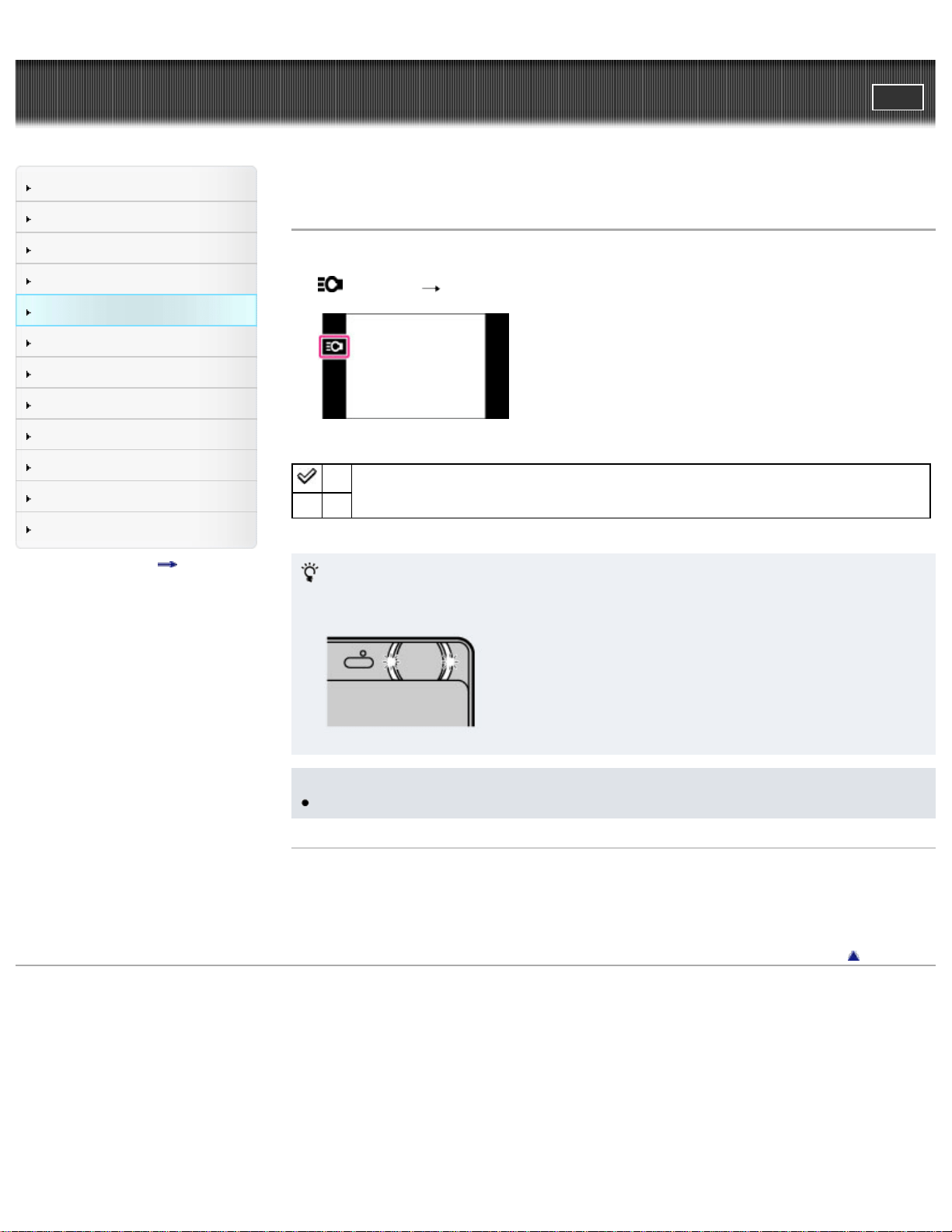
Cyber-shot User Guide
PrintSearch
Before Use
Operating the camera
Shooting
Viewing
Useful shooting functions
Useful viewing functions
Changing settings
Viewing images on a TV
Using with your computer
Printing
Troubleshooting
Precautions / About this camera
Contents list
Top page > Useful shooting functions > Menu items available for shooting > LED Light
LED Light
When [Macro] is set to [Magnifying Glass Plus], you can illuminate a subject with the LED Light.
1.
(LED Light) desired mode
On
When you set [Macro] to [Magnifying Glass Plus], select whether or not to use the LED light.
Off
About the LED light
You can illuminate the subject or compensate for a shadow cast on the subject, by turning the LED
light on.
Notes
Do not look directly at the LED light when it is on. It may damage your eyes.
Related Topic
Functions available for each shooting mode
MENU items available for each shooting mode
Back to top
Copyright 2013 Sony Corporation
83
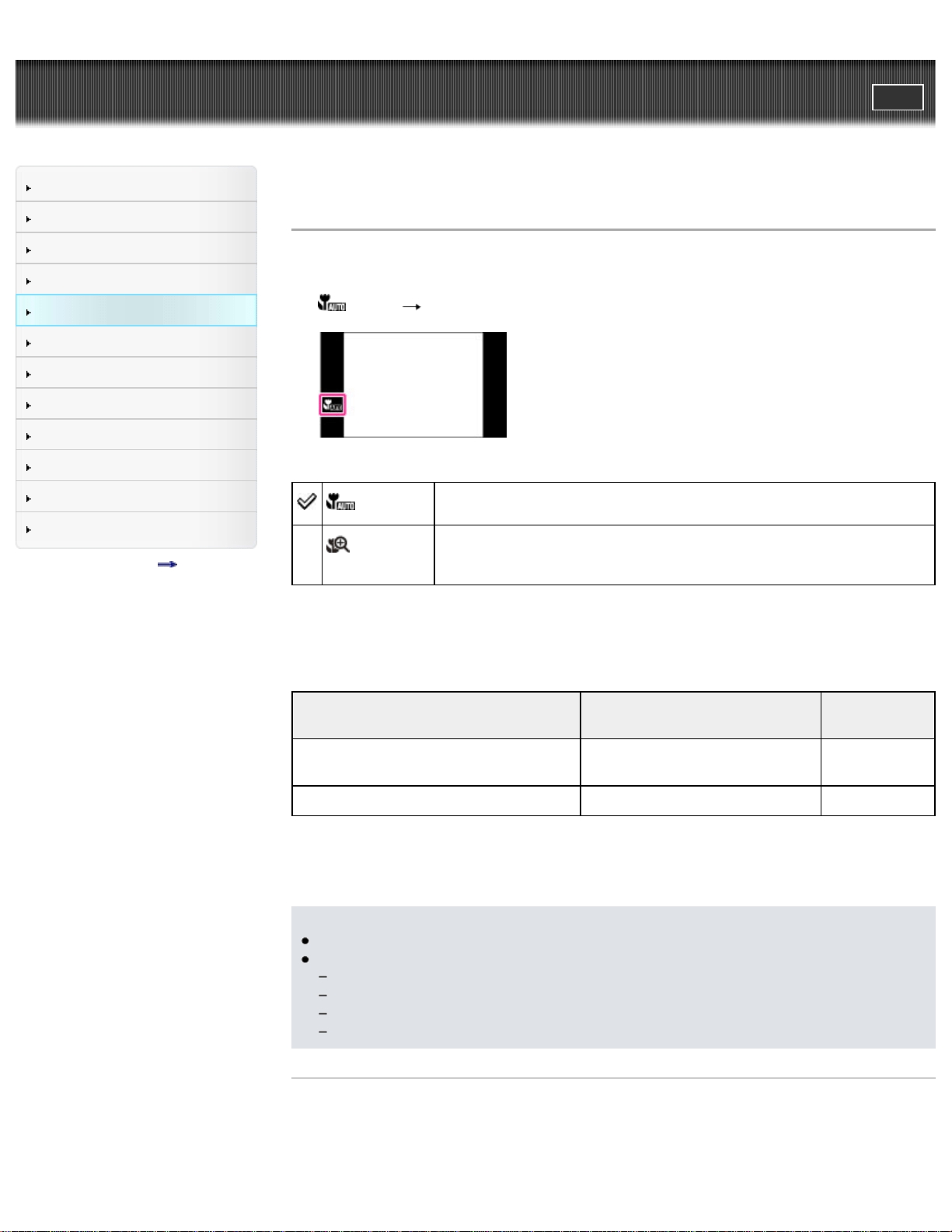
Cyber-shot User Guide
PrintSearch
Before Use
Operating the camera
Shooting
Viewing
Useful shooting functions
Useful viewing functions
Changing settings
Viewing images on a TV
Using with your computer
Printing
Troubleshooting
Precautions / About this camera
Contents list
Top page > Useful shooting functions > Menu items available for shooting > Macro
Macro
The camera is set to Macro mode automatically. You can focus closer if the [Magnifying Glass Plus] is
set. Also, you can illuminate the subject with the LED light.
1.
(Macro) desired mode.
(Auto)
The camera adjusts the focus automatically from distant subjects to close-up.
You can shoot up to 3 cm (0.10 ft.) from the subject.
(Magnifying
Glass Plus)
Use this mode to shoot at close distances.
You can shoot up to 1 cm (0.03 ft.) from the subject, and light the LED light.
The central portion is enlarged by 2×.
When [Macro] is set to [Magnifying Glass Plus]
Maximum magnification ratio
*
1
Zoom scale
*
2
Maximum value at the camera default setting
*
3
6.7 4.6
Maximum value with Digital zoom [On] *
3
15 10
*1 At shortest shooting distance of 1 cm (0.03 ft.) (35 mm equivalent).
*2 Based on an image taken at furthermost W setting.
*3 When the image size is set to [18M]
Notes
When [Macro] is set to [Magnifying Glass Plus], [Clear Image Zoom] always set to [On].
Note the following points when using the Magnifying Glass Plus mode.
You cannot use the Scene Recognition or Face Detection functions.
This mode is cancelled if you turn off the power or switch the REC mode to another one.
[Flash] cannot be set.
The focus speed becomes slower.
Related Topic
MENU items available for each shooting mode
LED Light
84

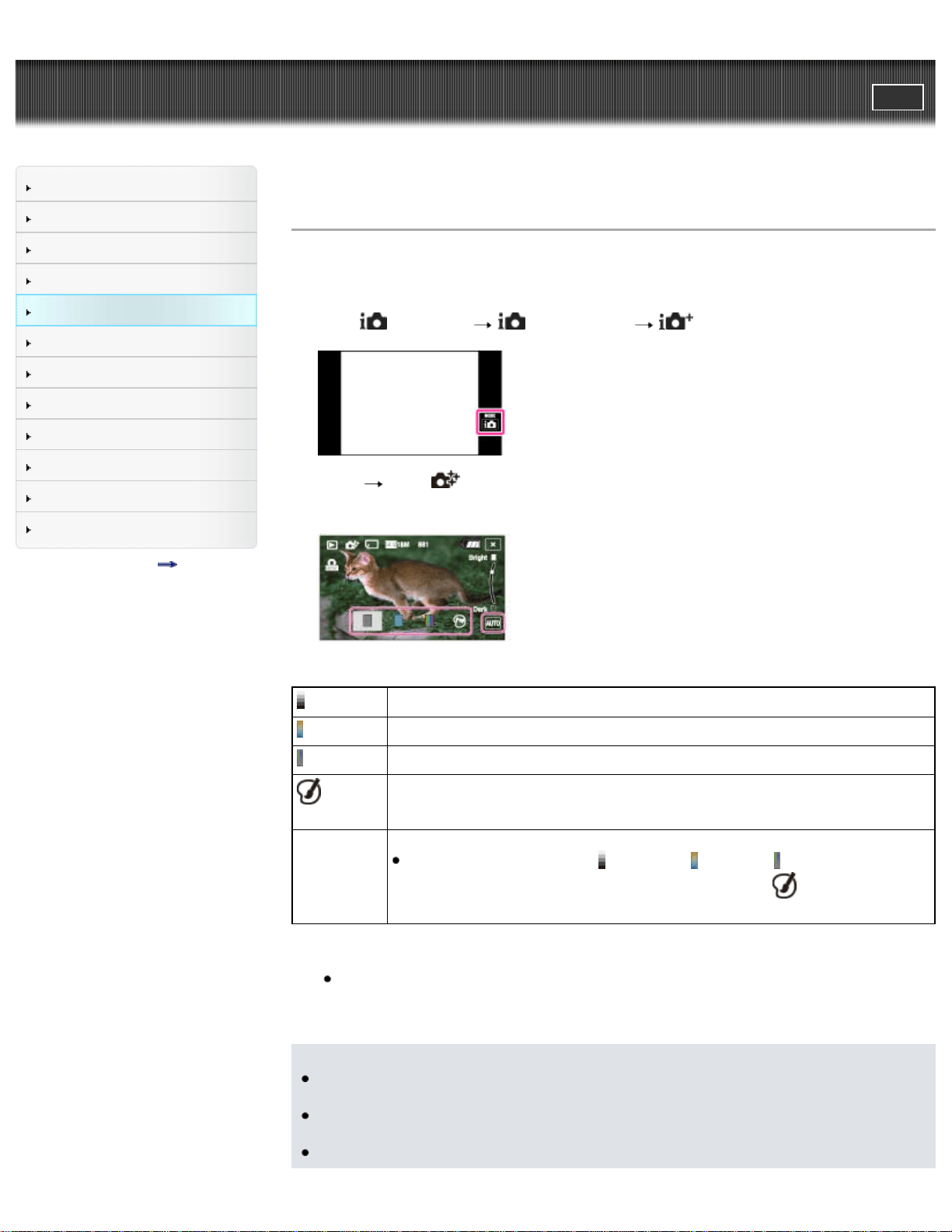
Cyber-shot User Guide
PrintSearch
Before Use
Operating the camera
Shooting
Viewing
Useful shooting functions
Useful viewing functions
Changing settings
Viewing images on a TV
Using with your computer
Printing
Troubleshooting
Precautions / About this camera
Contents list
Top page > Useful shooting functions > Menu items available for shooting > Photo Creativity
Photo Creativity
Photo Creativity is a mode that you can operate the camera intuitively using unusual screen display.
When shooting mode is set to [Intelligent Auto] or [Superior Auto], you can change the settings easily
and shoot images.
1. Touch
(REC Mode) (Intelligent Auto) (Superior Auto).
2. MENU Touch (Photo Creativity).
3. Touch the desired item on the screen.
(Brightness)
Adjusts brightness.
(Color)
Adjusts color.
(Vividness)
Adjusts vividness.
(Picture
Effect)
Shoots a still image with an original texture according to the desired effect.
[AUTO]/[OFF]
The settings for [Photo Creativity] revert to the default settings.
When you change settings for
(Brightness), (Color) and (Vividness), [AUTO] is
displayed on the screen and when you change settings for
(Picture Effect),
[OFF] is displayed.
4. Touch the scale or an item on the screen to change the settings.
You can combine some settings by repeating step 3 and 4.
5. When shooting still images: Shoot with the shutter button.
When recording movies: Press MOVIE (Movie) button to start recording.
Notes
When you record movies in [Photo Creativity] mode, you cannot change the settings during
recording.
If you switch the camera mode to [Intelligent Auto] mode or turn off the camera, the settings you
changed are reverted to the default settings.
If [Photo Creativity] is set when shooting images in [Superior Auto], images cannot be overlaid.
86

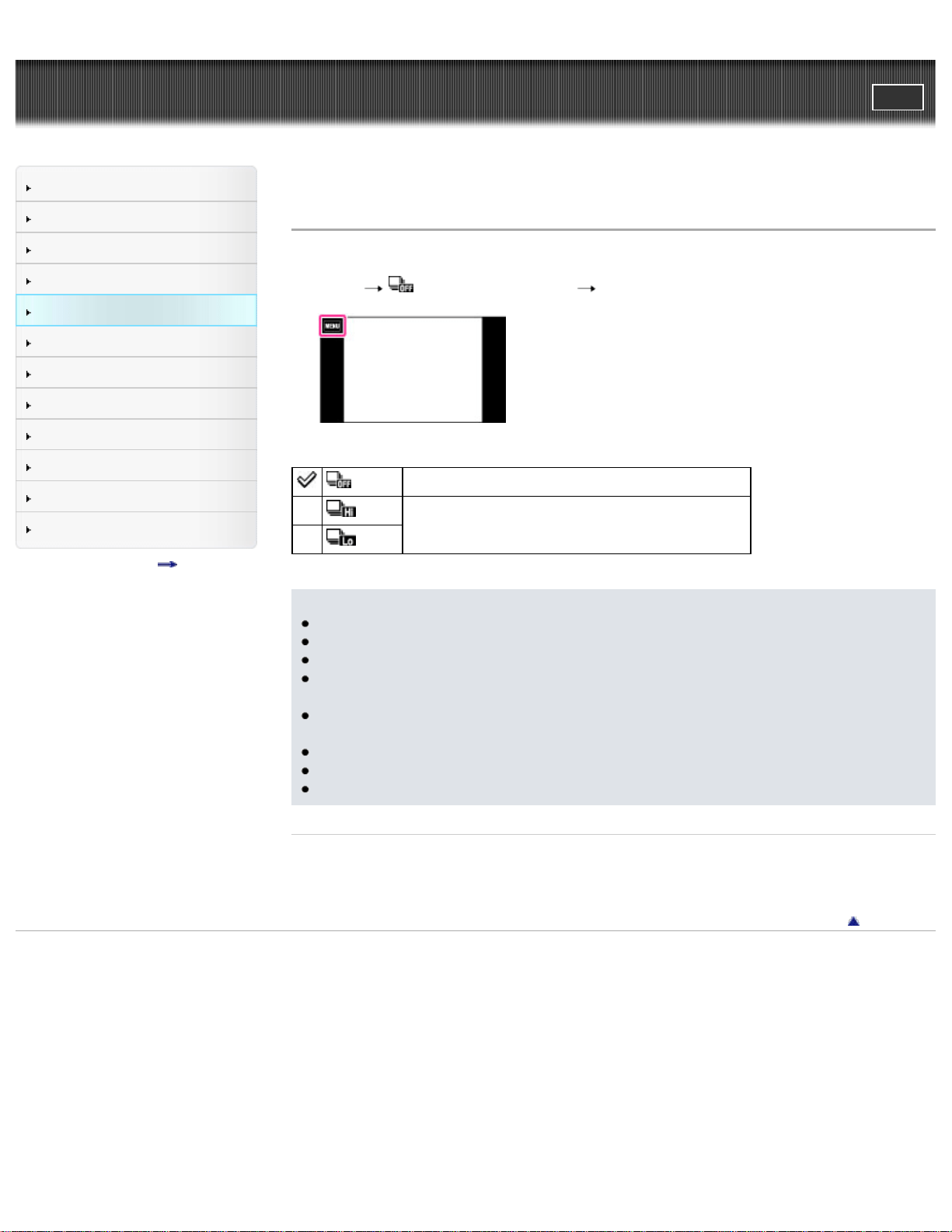
Cyber-shot User Guide
PrintSearch
Before Use
Operating the camera
Shooting
Viewing
Useful shooting functions
Useful viewing functions
Changing settings
Viewing images on a TV
Using with your computer
Printing
Troubleshooting
Precautions / About this camera
Contents list
Top page > Useful shooting functions > Menu items available for shooting > Cont. Shooting Settings
Cont. Shooting Settings
The camera shoots up to 10 continuous frames in one burst when you hold down the shutter button.
1. MENU
(Cont. Shooting Settings) desired mode
(Off)
Records a single image.
(High)
Shoots from 2 to a maximum of 10 successive images.
(Low)
Notes
[Flash] is set to [Off].
When recording with the self-timer, a series of up to 10 images is recorded.
The recording interval becomes longer, depending on the setting for the image size.
[Focus], [White Balance], and [Exposure Compensation] are adjusted for the first image, and these
settings are also used for the other images.
When the [Cont. Shooting Settings] is set to [High] or [Low], up to ISO800 can be selected for ISO
speed.
[VGA] image size will be set while recording on internal memory.
When the battery level is low, or when the internal memory or a memory card is full, the burst stops.
In slow shutter speed conditions, the burst of shots per second may be decreased.
Related Topic
MENU items available for each shooting mode
Back to top
Copyright 2013 Sony Corporation
88
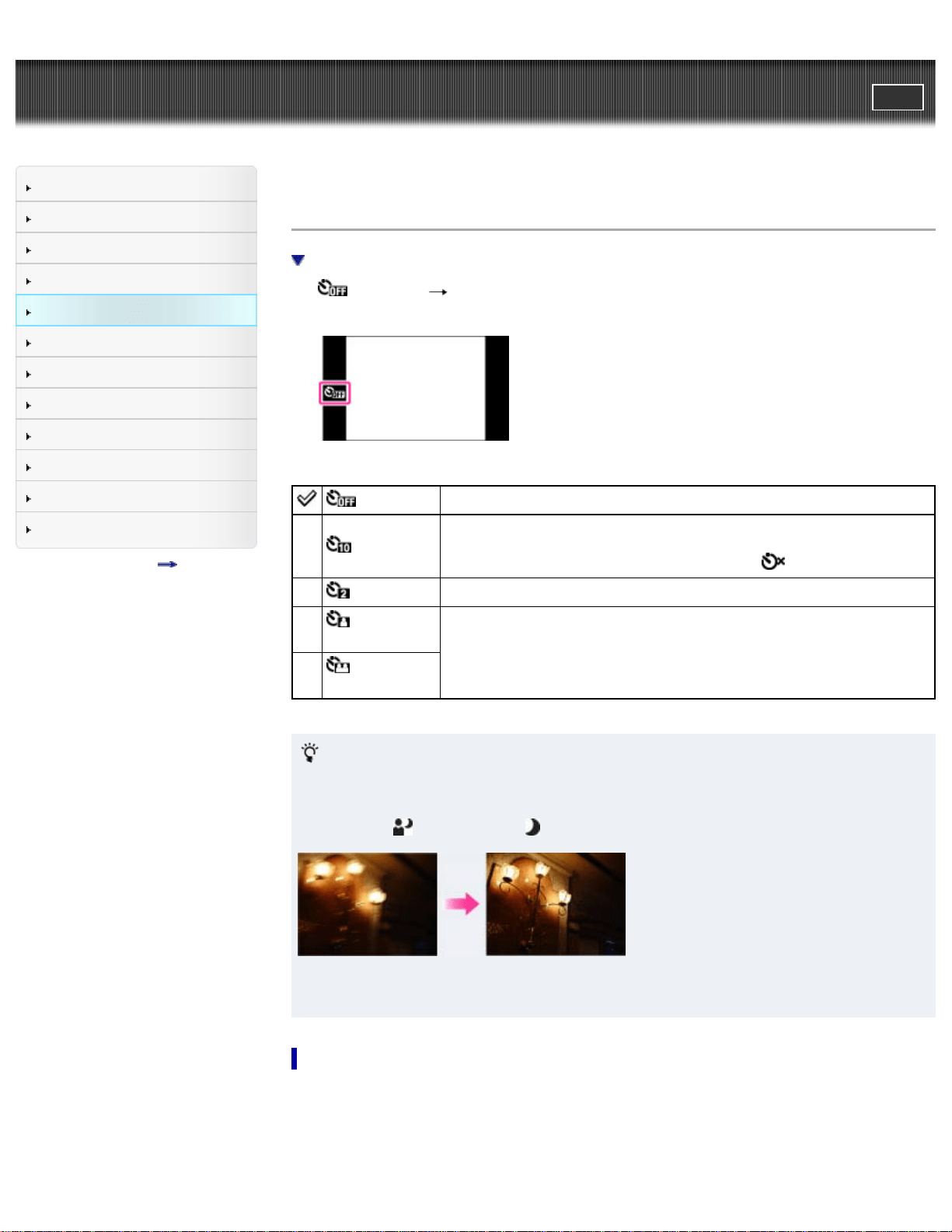
Cyber-shot User Guide
PrintSearch
Before Use
Operating the camera
Shooting
Viewing
Useful shooting functions
Useful viewing functions
Changing settings
Viewing images on a TV
Using with your computer
Printing
Troubleshooting
Precautions / About this camera
Contents list
Top page > Useful shooting functions > Menu items available for shooting > Self-Timer
Self-Timer
Automatic shooting with Self-portrait timer
1.
(Self-Timer) desired mode
If the button is not displayed on the left side of the screen, touch MENU.
(Off)
Does not use the self-timer.
(10sec)
Sets the self-timer to a 10-second delay.
When you press the shutter button, the self-timer lamp flashes and a beep
sounds until the shutter operates. To cancel, touch
.
(2sec)
Sets the self-timer to a 2-second delay.
(Self-portrait
One Person)
Sets the self-timer to Self-portrait timer.
When the camera detects the specified number of faces, a beep sounds, and
the shutter operates 2 seconds later.
(Self-portrait
Two People)
Hints for preventing blur
If your hands or body moves while holding the camera and pressing the shutter button, “Camera
shake” occurs.
Camera shake occurs frequently under low-light or slow shutter speed conditions, such as those
encountered in
(Night Portrait) or (Night Scene) mode.
To reduce camera shake, set the self-timer to a 2-second delay and brace your arms against your
sides after pressing the shutter button.
Automatic shooting with Self-portrait timer
Point the lens at yourself so that the selected number of faces are reflected in the screen. The shutter
operates automatically. Do not move your camera after the beep sounds.
89

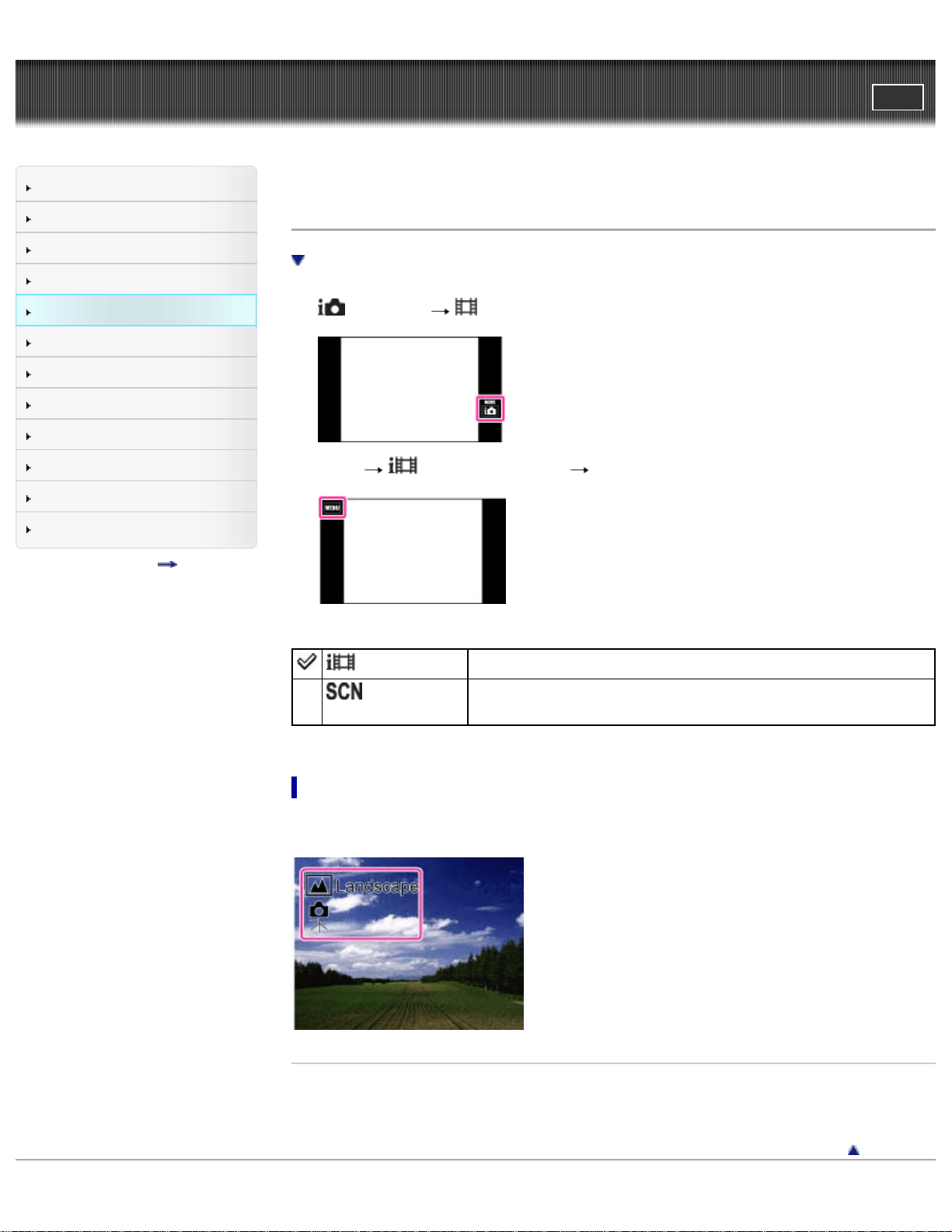
Cyber-shot User Guide
PrintSearch
Before Use
Operating the camera
Shooting
Viewing
Useful shooting functions
Useful viewing functions
Changing settings
Viewing images on a TV
Using with your computer
Printing
Troubleshooting
Precautions / About this camera
Contents list
Top page > Useful shooting functions > Menu items available for shooting > Movie shooting scene
Movie shooting scene
On Scene Recognition
Allows you to shoot with preset settings according to the scene when the camera is in movie mode.
1.
(REC Mode) (Movie Mode)
2. MENU (Movie shooting scene) desired mode
(Intelligent Auto)
Adjusts the setting automatically. [Details]
(Scene
Selection)
Allows you to shoot movies with preset settings according to the scene.
[Details]
On Scene Recognition
Scene Recognition operates in Intelligent Auto mode. This function lets the camera automatically
recognize the shooting conditions and shoot the image.
Related Topic
MENU items available for each shooting mode
Back to top
91

Copyright 2013 Sony Corporation
92
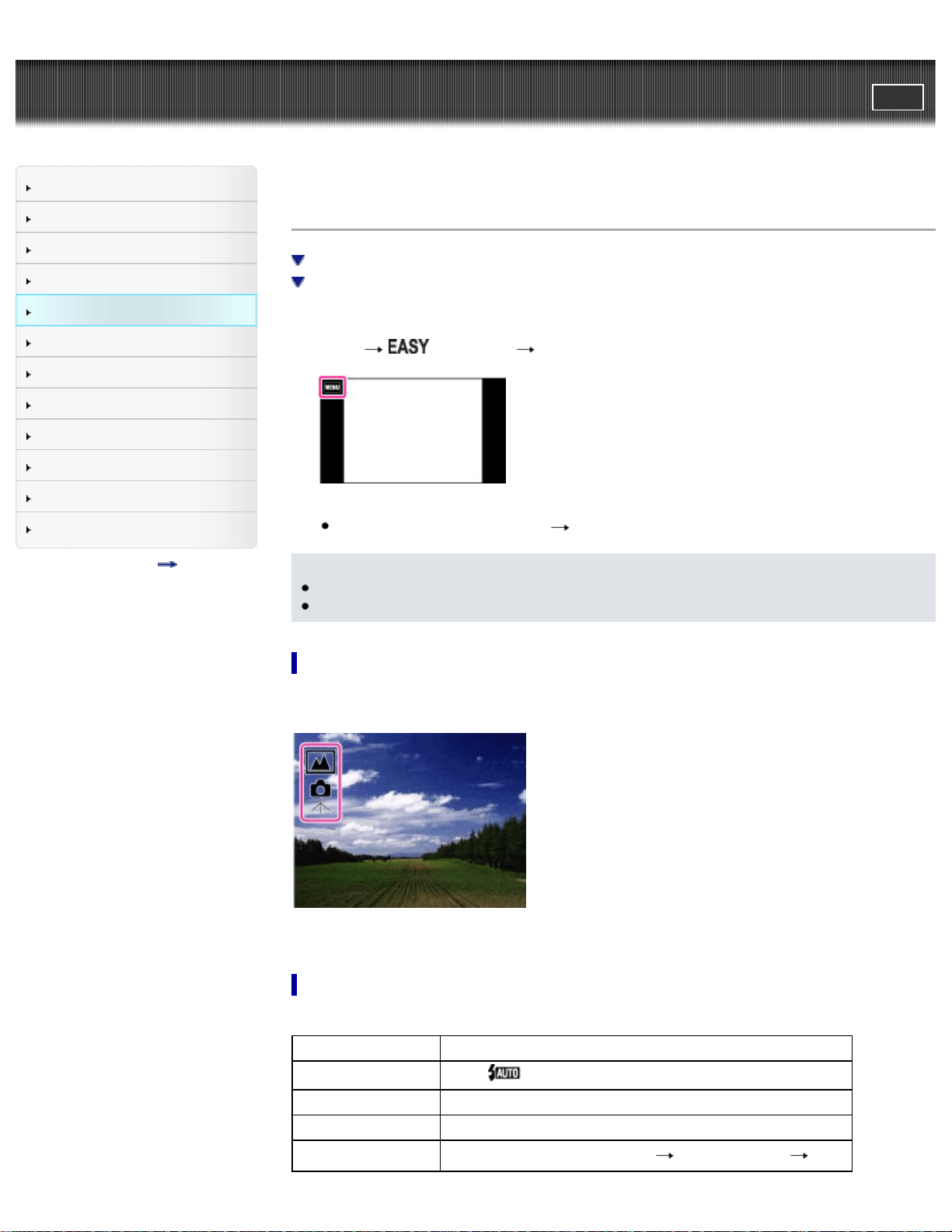
Cyber-shot User Guide
PrintSearch
Before Use
Operating the camera
Shooting
Viewing
Useful shooting functions
Useful viewing functions
Changing settings
Viewing images on a TV
Using with your computer
Printing
Troubleshooting
Precautions / About this camera
Contents list
Top page > Useful shooting functions > Menu items available for shooting > Easy Mode
Easy Mode
On Scene Recognition
Shooting functions available in Easy Mode (Shooting)
Allows you to shoot still images using the minimum necessary functions.
The text size increases and indicators become easier to see.
1. MENU
(Easy Mode) [OK]
2. Shoot with the shutter button.
To end Easy Mode, touch MENU [Exit Easy Mode].
Notes
The battery power may decrease faster because the screen brightness increases automatically.
The playback mode also changes to [Easy Mode].
On Scene Recognition
Scene Recognition operates in Easy Mode. This function lets the camera automatically recognize the
shooting conditions and shoot the image.
Shooting functions available in Easy Mode (Shooting)
MOVIE (Movie) button Allows you to record movies with their audio.
Flash
Touch
. Select between [Auto] or [Off] mode.
Still Image Size Select between [Large] or [Small] size.
Self-Timer Select between [On] or [Off] mode.
Exit Easy Mode To end Easy Mode, touch MENU
[Exit Easy Mode] [OK].
93

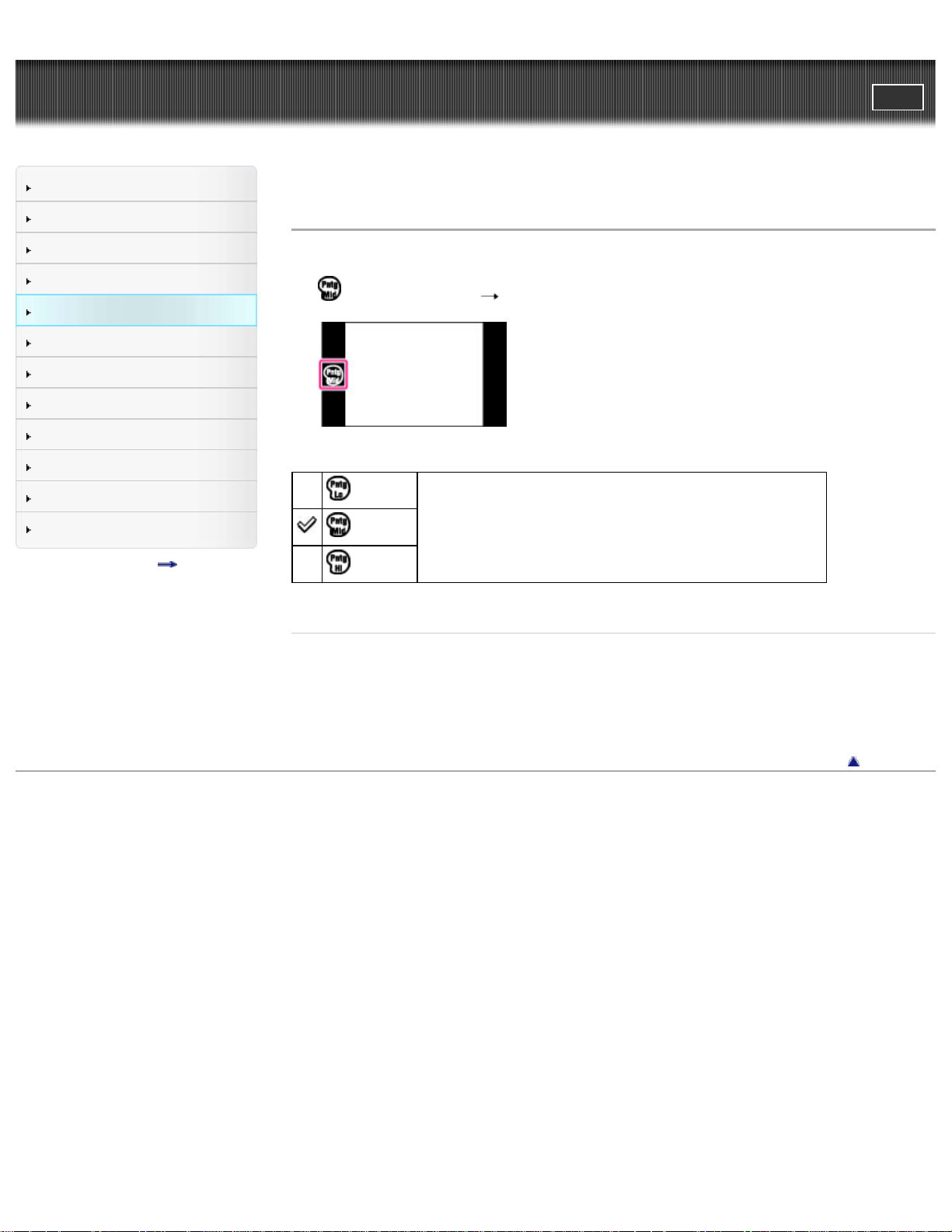
Cyber-shot User Guide
PrintSearch
Before Use
Operating the camera
Shooting
Viewing
Useful shooting functions
Useful viewing functions
Changing settings
Viewing images on a TV
Using with your computer
Printing
Troubleshooting
Precautions / About this camera
Contents list
Top page > Useful shooting functions > Menu items available for shooting > HDR Painting effect
HDR Painting effect
When you select [HDR Painting] in Picture Effect, set the effect level.
1.
(HDR Painting effect) desired mode
(Low)
Select weak, medium or strong effects that emphasize color, etc.
(Medium)
(High)
Related Topic
Picture Effect
MENU items available for each shooting mode
Back to top
Copyright 2013 Sony Corporation
95
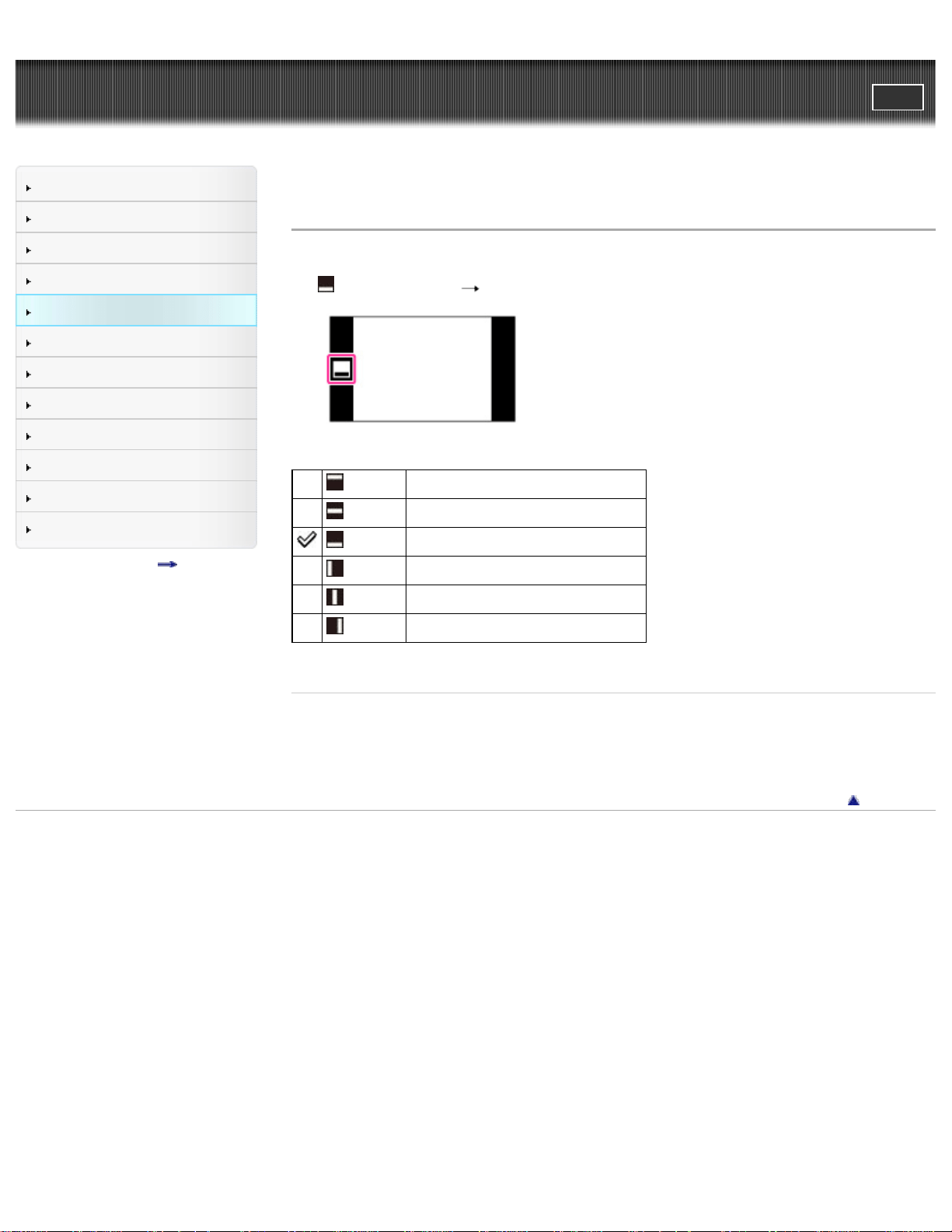
Cyber-shot User Guide
PrintSearch
Before Use
Operating the camera
Shooting
Viewing
Useful shooting functions
Useful viewing functions
Changing settings
Viewing images on a TV
Using with your computer
Printing
Troubleshooting
Precautions / About this camera
Contents list
Top page > Useful shooting functions > Menu items available for shooting > Area of emphasis
Area of emphasis
When you select [Miniature] in Picture Effect, set the part you want attention on.
1.
(Area of emphasis) desired mode
(Top)
Sets area of emphasis at the top.
(Center)
Sets area of emphasis in the center.
(Bottom)
Sets area of emphasis at the bottom.
(Left)
Sets area of emphasis to the left.
(Middle)
Sets area of emphasis in the middle.
(Right)
Sets area of emphasis to the right.
Related Topic
Picture Effect
MENU items available for each shooting mode
Back to top
Copyright 2013 Sony Corporation
96
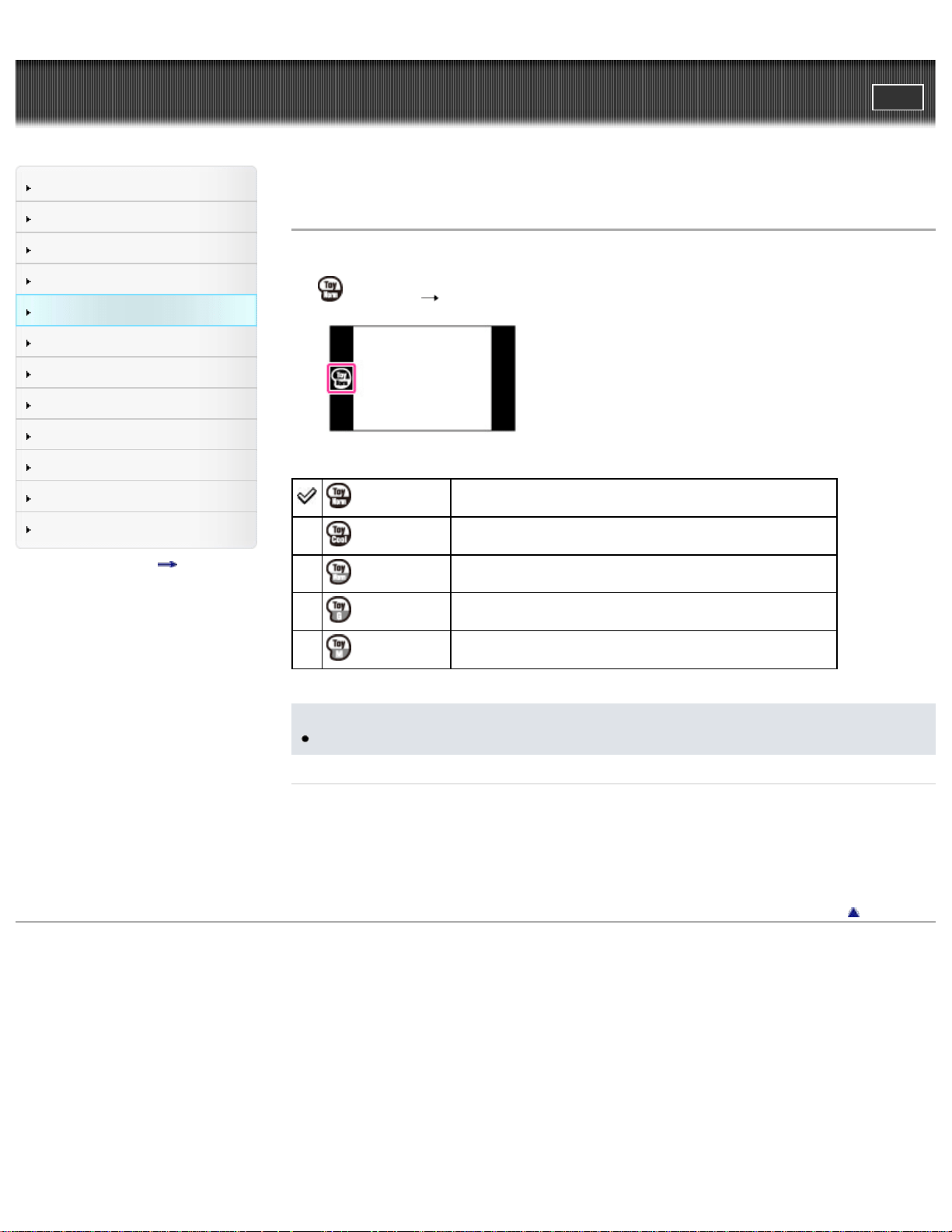
Cyber-shot User Guide
PrintSearch
Before Use
Operating the camera
Shooting
Viewing
Useful shooting functions
Useful viewing functions
Changing settings
Viewing images on a TV
Using with your computer
Printing
Troubleshooting
Precautions / About this camera
Contents list
Top page > Useful shooting functions > Menu items available for shooting > Color hue
Color hue
When you select [Toy camera] in Picture Effect, adjust the color hue.
1.
(Color hue) desired mode
(Normal)
Adds a normal hue and darkens the surroundings.
(Cool hue)
Adds a bluish cool hue and darkens the surroundings.
(Warm hue)
Adds a reddish warm hue and darkens the surroundings.
(Green hue)
Adds a green filter-like hue and darkens the surroundings.
(Magenta hue)
Adds a magenta filter-like hue and darkens the surroundings.
Notes
It is recommended that you shoot a test image in advance for some subjects.
Related Topic
Picture Effect
MENU items available for each shooting mode
Back to top
Copyright 2013 Sony Corporation
97
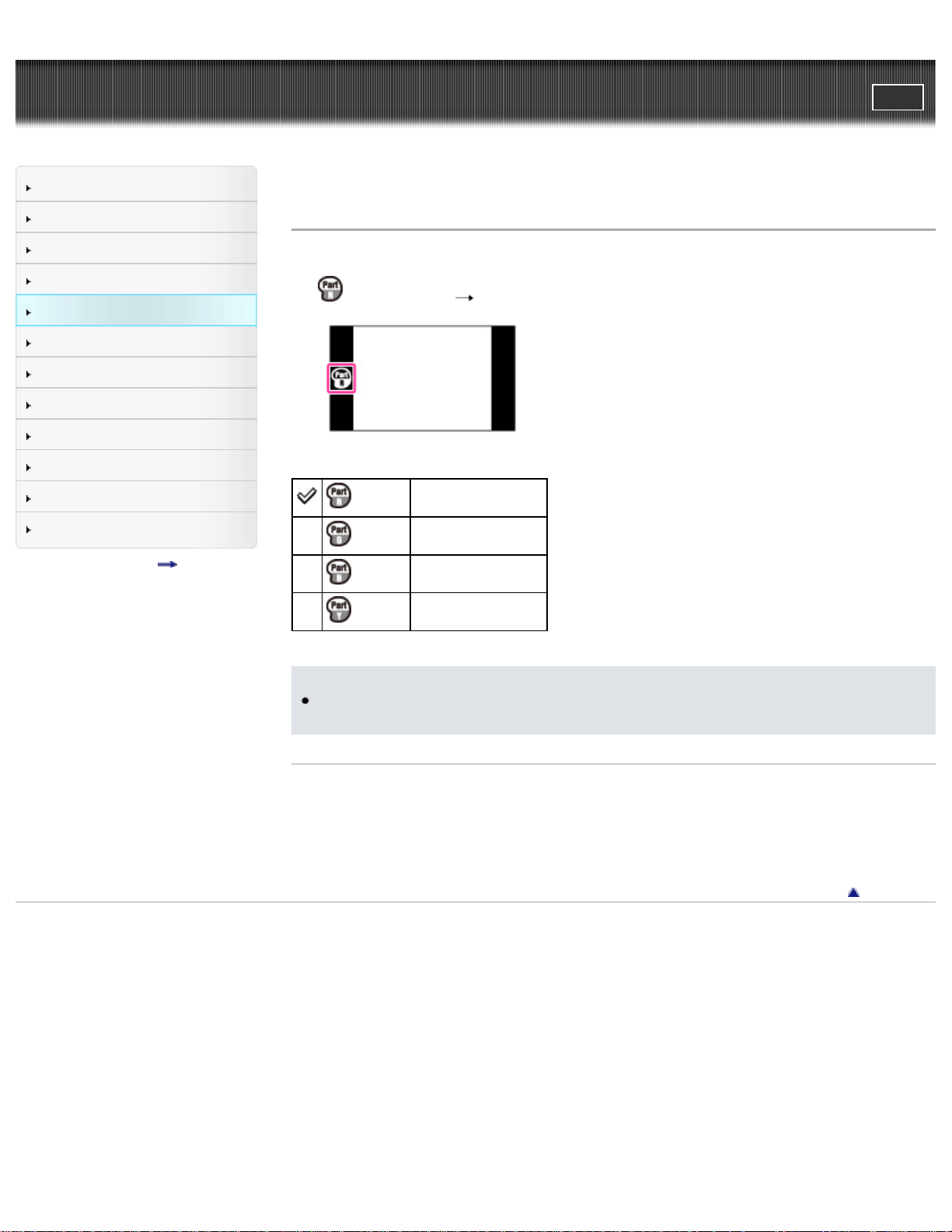
Cyber-shot User Guide
PrintSearch
Before Use
Operating the camera
Shooting
Viewing
Useful shooting functions
Useful viewing functions
Changing settings
Viewing images on a TV
Using with your computer
Printing
Troubleshooting
Precautions / About this camera
Contents list
Top page > Useful shooting functions > Menu items available for shooting > Extracted Color
Extracted Color
When you select [Partial Color] in Picture Effect, select the color to extract.
1.
(Extracted Color) desired mode
(Red)
Extracts red only.
(Green)
Extracts green only.
(Blue)
Extracts blue only.
(Yellow)
Extracts yellow only.
Notes
When [Partial Color] is selected, images may not retain the selected color, depending on the
subject.
Related Topic
Picture Effect
MENU items available for each shooting mode
Back to top
Copyright 2013 Sony Corporation
98
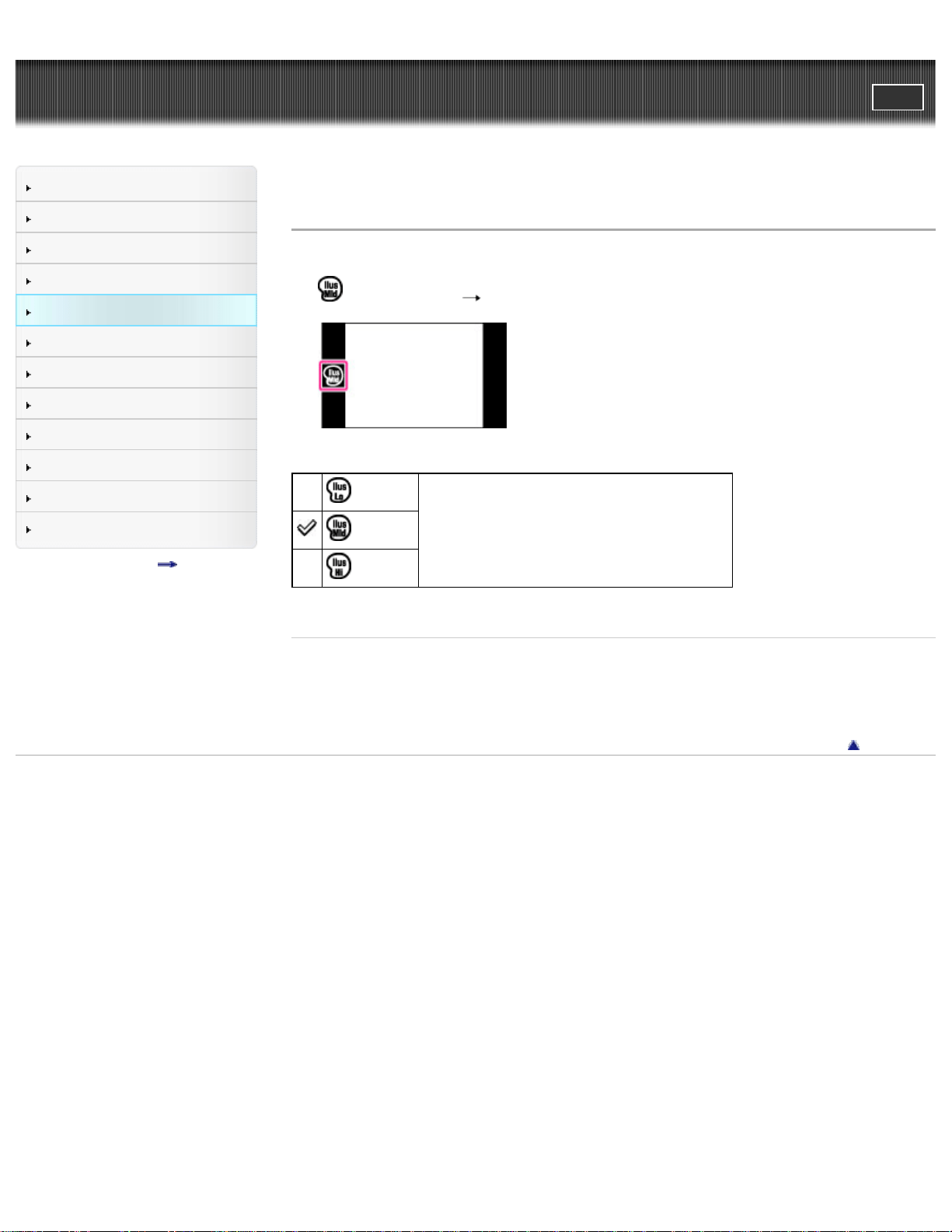
Cyber-shot User Guide
PrintSearch
Before Use
Operating the camera
Shooting
Viewing
Useful shooting functions
Useful viewing functions
Changing settings
Viewing images on a TV
Using with your computer
Printing
Troubleshooting
Precautions / About this camera
Contents list
Top page > Useful shooting functions > Menu items available for shooting > Illustration Effect
Illustration Effect
When you select [Illustration] in Picture Effect, set the effect level.
1.
(Illustration Effect) desired mode
(Low)
Adds a weak, medium or strong Illustration effect.
(Medium)
(High)
Related Topic
Picture Effect
MENU items available for each shooting mode
Back to top
Copyright 2013 Sony Corporation
99
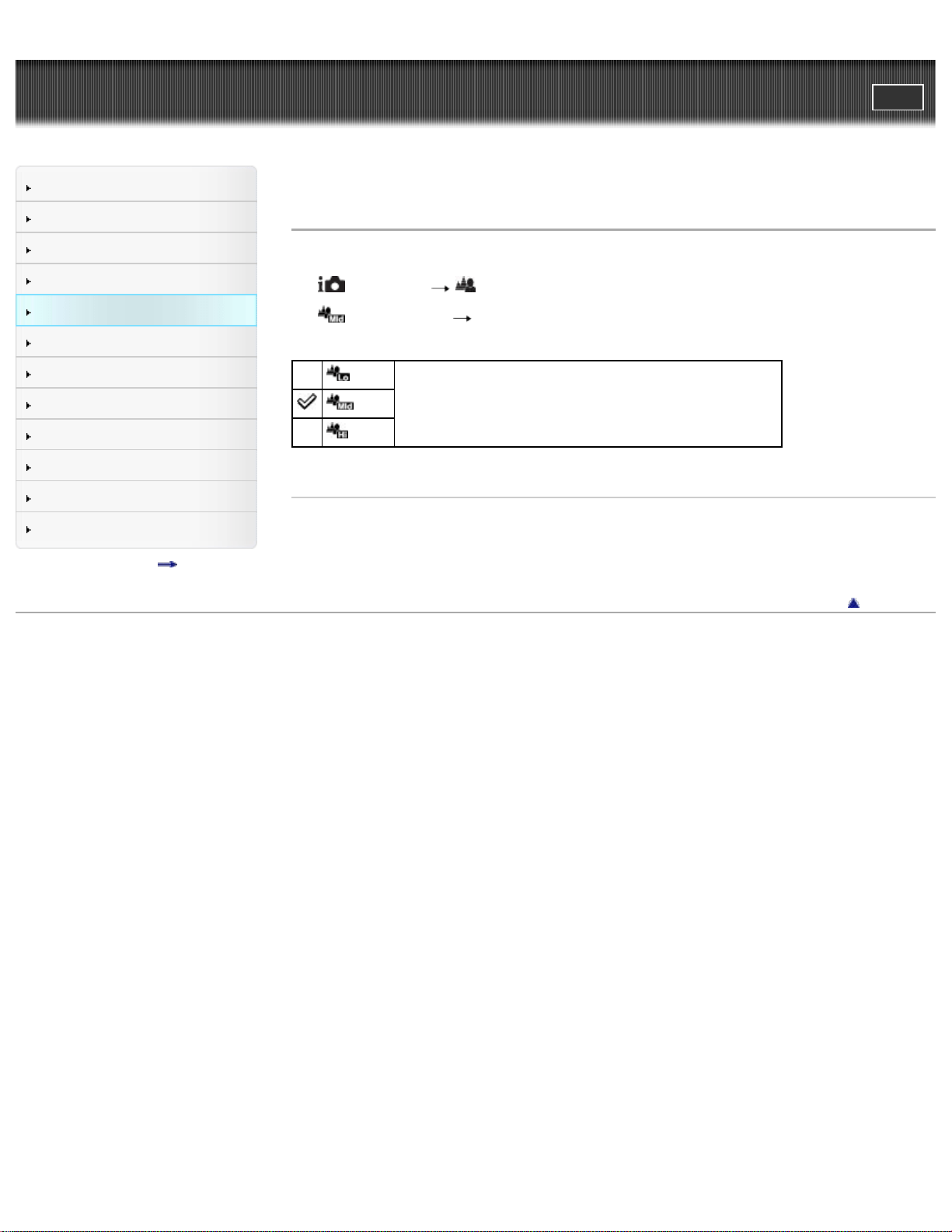
Cyber-shot User Guide
PrintSearch
Before Use
Operating the camera
Shooting
Viewing
Useful shooting functions
Useful viewing functions
Changing settings
Viewing images on a TV
Using with your computer
Printing
Troubleshooting
Precautions / About this camera
Contents list
Top page > Useful shooting functions > Menu items available for shooting > Defocus Effect
Defocus Effect
Sets the level of background defocus effect when shooting in Background Defocus mode.
1.
(REC Mode) (Background Defocus)
2.
(Defocus Effect) desired mode
(Low)
Select a weak, medium or strong Background Defocus effect.
(Mid)
(High)
Related Topic
Background Defocus
Back to top
Copyright 2013 Sony Corporation
100
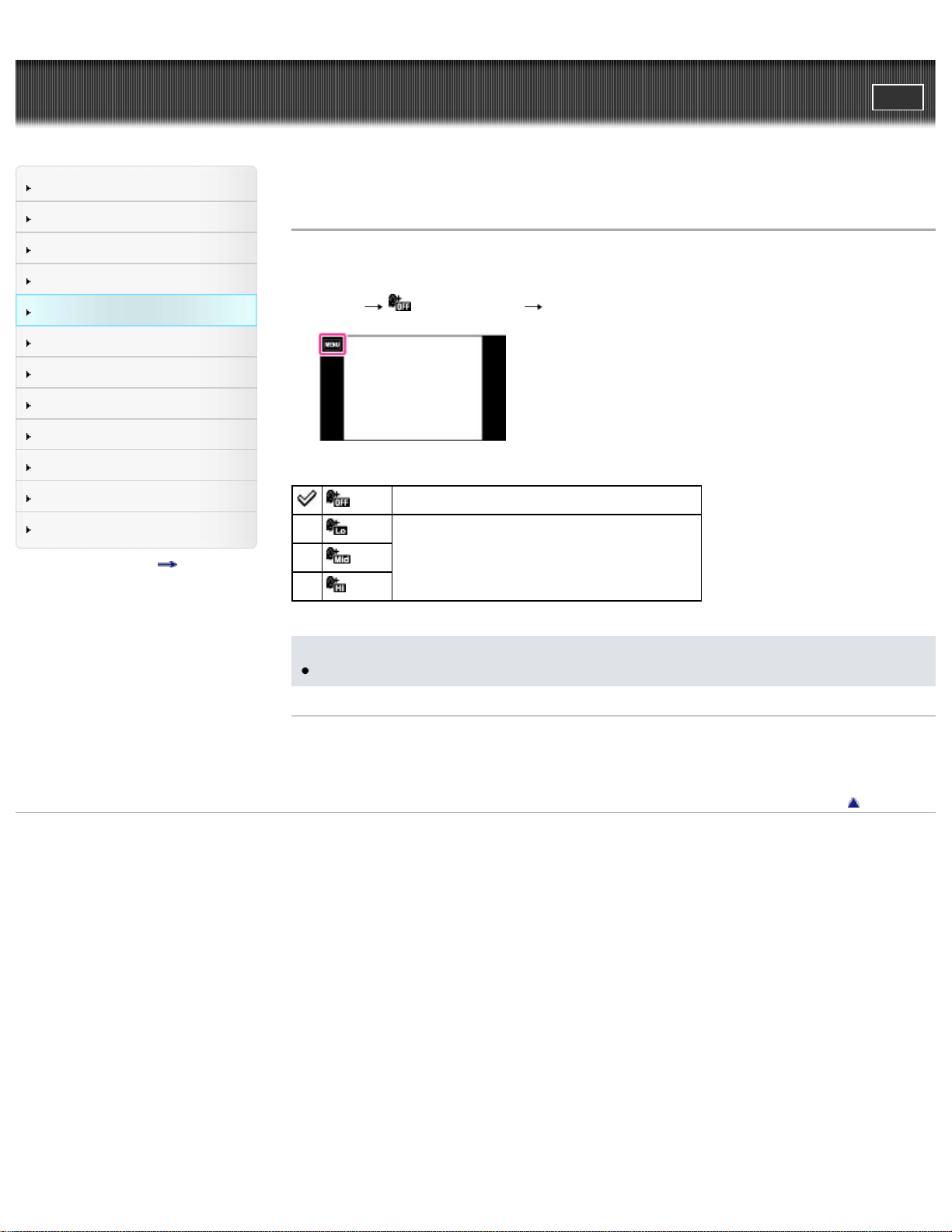
Cyber-shot User Guide
PrintSearch
Before Use
Operating the camera
Shooting
Viewing
Useful shooting functions
Useful viewing functions
Changing settings
Viewing images on a TV
Using with your computer
Printing
Troubleshooting
Precautions / About this camera
Contents list
Top page > Useful shooting functions > Menu items available for shooting > Soft Skin Effect
Soft Skin Effect
When the Face Detection function is activated, sets whether to use the Soft Skin effect, and the effect
level.
1. MENU
(Soft Skin Effect) desired mode
(Off)
Does not use the Soft Skin Effect.
(Low)
Adds a weak, medium or strong Soft Skin Effect.
(Mid)
(High)
Notes
The [Soft Skin Effect] may not be visible depending on the subject.
Related Topic
MENU items available for each shooting mode
Back to top
Copyright 2013 Sony Corporation
101
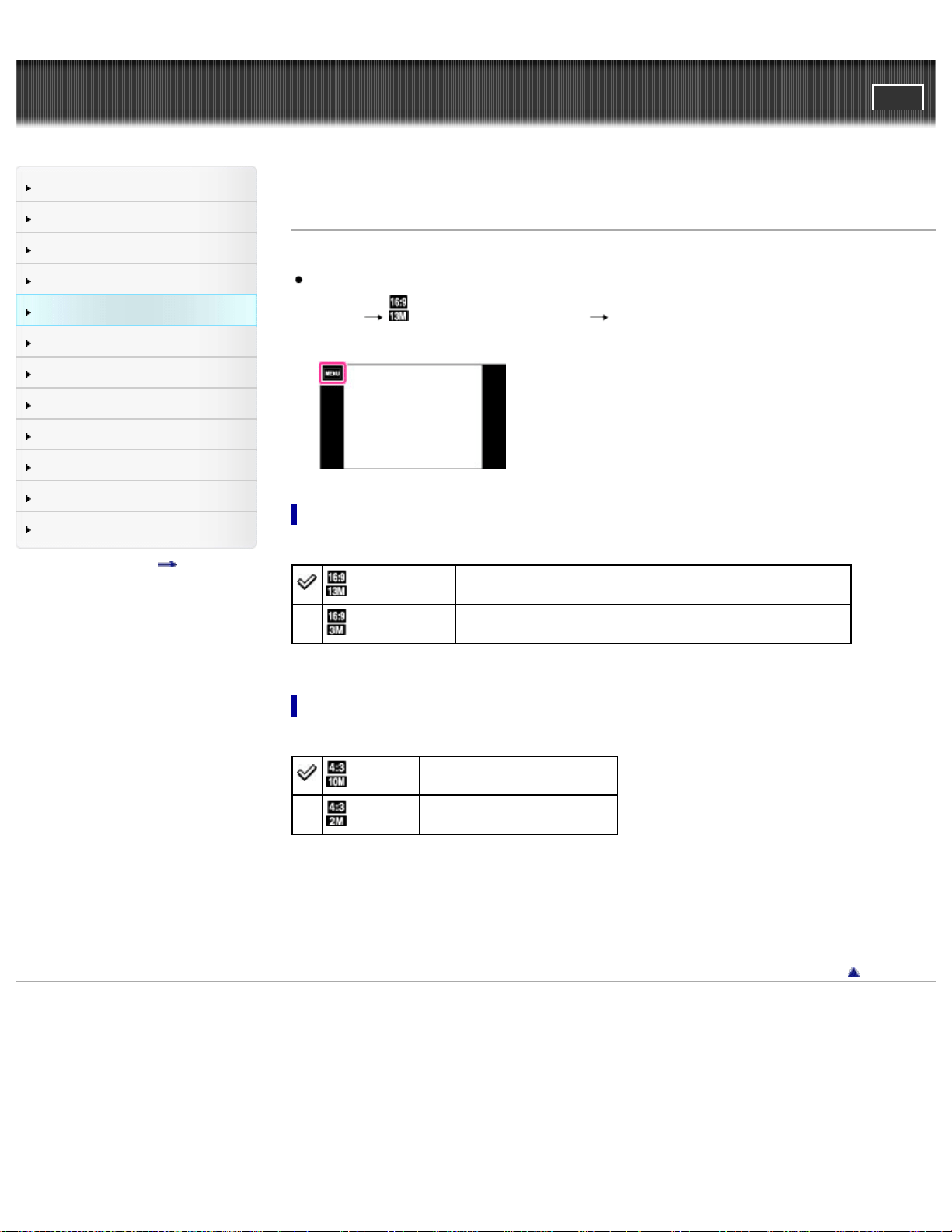
Cyber-shot User Guide
PrintSearch
Before Use
Operating the camera
Shooting
Viewing
Useful shooting functions
Useful viewing functions
Changing settings
Viewing images on a TV
Using with your computer
Printing
Troubleshooting
Precautions / About this camera
Contents list
Top page > Useful shooting functions > Menu items available for shooting > Still Image Size(Dual Rec)
Still Image Size(Dual Rec)
Sets the still image size shot while recording a movie.
Up to 10 still images can be shot during one movie recording.
1. MENU
(Still Image Size(Dual Rec)) desired size
Set using the buttons displayed on the left of the screen depending on the REC mode.
When [Movie Size] is set to other than [VGA]
16:9(13M Level)
For viewing on a high-definition TV and printing up to A3+ size
16:9(3M)
For viewing on a high-definition TV
When [Movie Size] is set to [VGA]
10M Level
For prints up to A3 size
2M
For prints up to 10×15 cm size
Related Topic
MENU items available for each shooting mode
Back to top
Copyright 2013 Sony Corporation
102
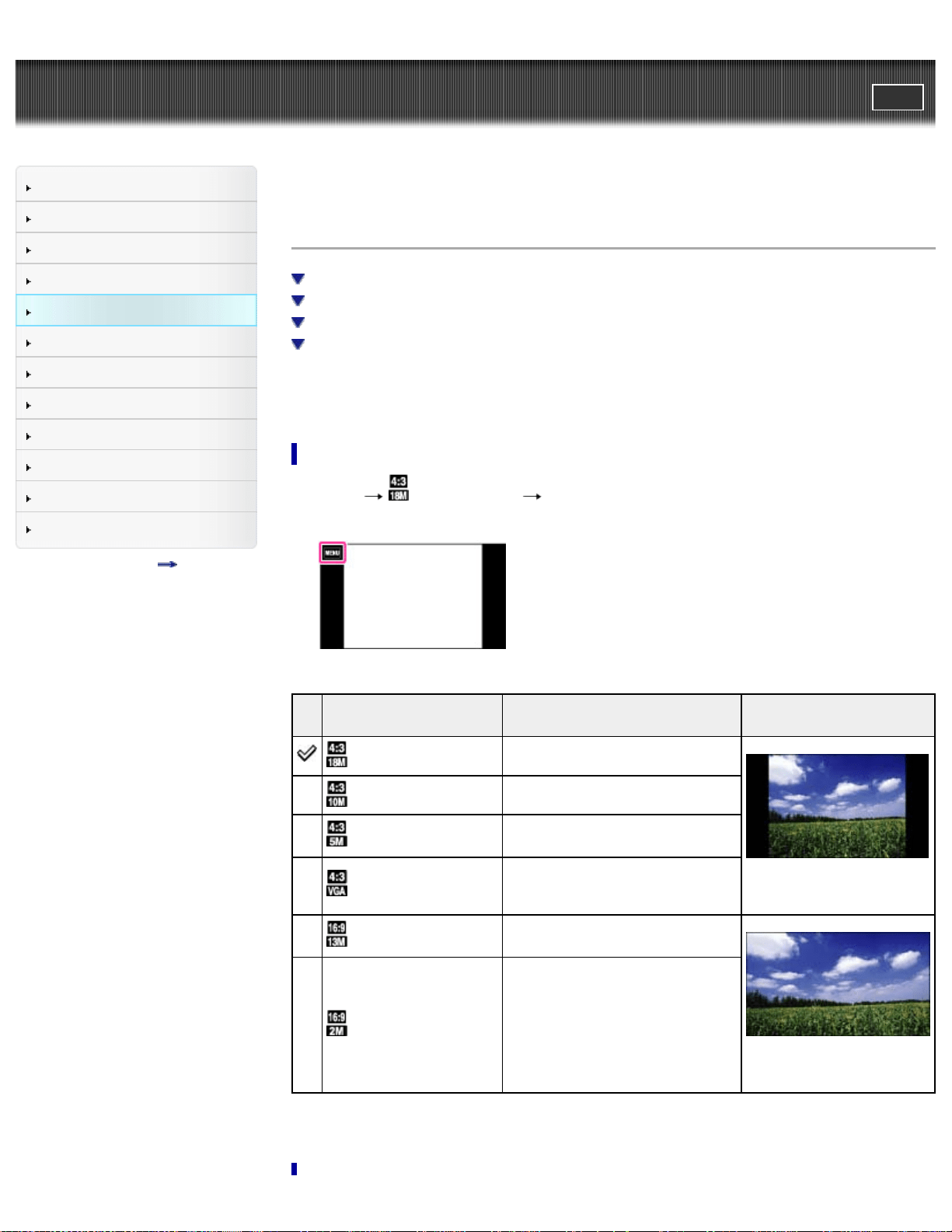
Cyber-shot User Guide
PrintSearch
Before Use
Operating the camera
Shooting
Viewing
Useful shooting functions
Useful viewing functions
Changing settings
Viewing images on a TV
Using with your computer
Printing
Troubleshooting
Precautions / About this camera
Contents list
Top page > Useful shooting functions > Menu items available for shooting > Still Image Size/Panorama
Image Size
Still Image Size/Panorama Image Size
Image size when shooting still images
3D Still Image Size
Image size in Easy Mode
Image size when shooting using Sweep Panorama
The image size determines the size of the image file that is recorded when you take an image.
The larger the image size, the more detail will be reproduced when the image is printed on large-format
paper. The smaller the image size, the more images can be recorded.
Image size when shooting still images
1. MENU (Still Image Size) desired size
Set using the buttons displayed on the left of the screen depending on the REC mode.
Still image size
(Horizontal × Vertical)
Usage guidelines
Displaying on the
screen
(4896×3672)
For prints up to A3+ size
Images are displayed in 4:3
aspect ratio.
(3648×2736)
For prints up to A3 size
(2592×1944)
For prints from 10×15 cm up to A4
size
(640×480)
For e-mail attachments
(4896×2752)
For viewing on a high-definition TV
and printing up to A3+ size
Images will fill the entire
screen.
(1920×1080)
For viewing on a high-definition TV
103
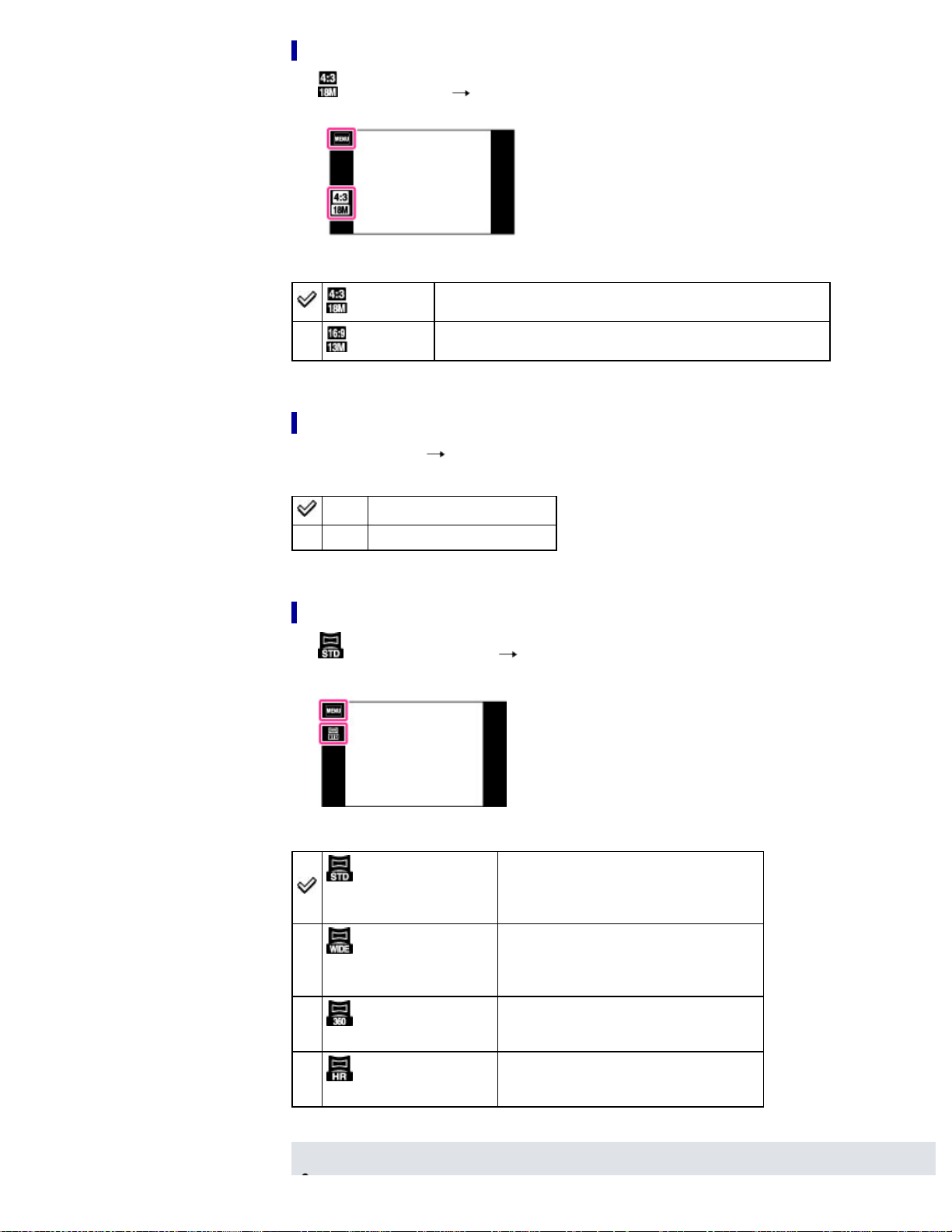
3D Still Image Size
1. (Still Image Size) desired size
(4896×3672)
For prints up to A3+ size
(4896×2752)
For viewing on a high-definition TV and printing up to A3+ size
Image size in Easy Mode
1. [Still Image Size] desired size
Large Shoots images in [18M] size.
Small Shoots images in [5M] size.
Image size when shooting using Sweep Panorama
1. (Panorama Image Size) desired size
When the button is not displayed on the left of the screen, touch MENU.
(Standard)
(Horizontal: 4912 × 1080)
(Vertical: 3424 × 1920)
Shoots images using standard size.
(Wide)
(Horizontal: 7152 × 1080)
(Vertical: 4912 × 1920)
Shoots images using wide size.
(360°)
(Horizontal: 11520 × 1080)
Shoots images using a 360 degree.
(High Resolution)
(Horizontal: 10480 × 4096)
Shoots high-resolution panorama in 43M.
Notes
104

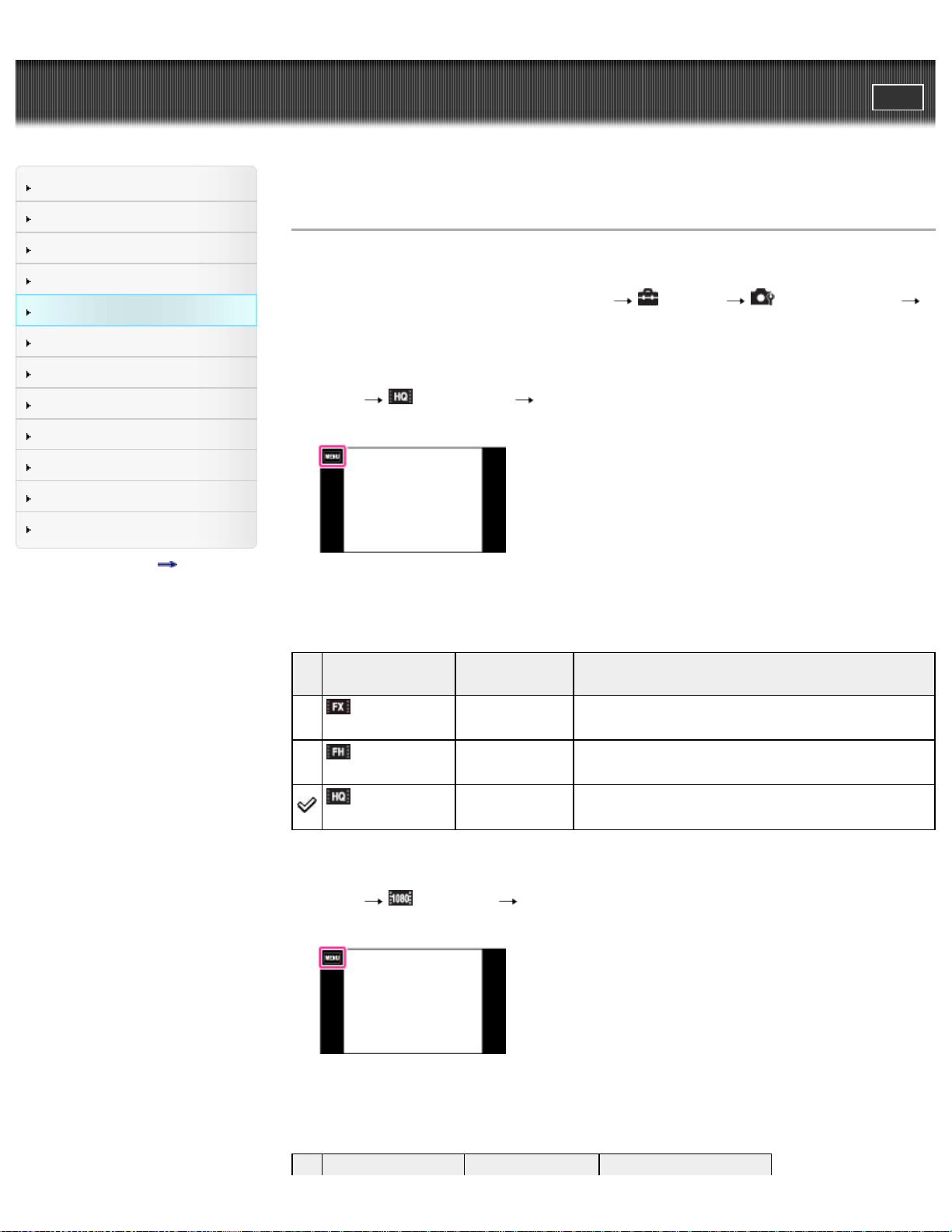
Cyber-shot User Guide
PrintSearch
Before Use
Operating the camera
Shooting
Viewing
Useful shooting functions
Useful viewing functions
Changing settings
Viewing images on a TV
Using with your computer
Printing
Troubleshooting
Precautions / About this camera
Contents list
Top page > Useful shooting functions > Menu items available for shooting > Movie Quality/Movie Size
Movie Quality/Movie Size
The larger the size of the movie image, the higher the image quality. The higher the amount of data
used per second (average bit-rate), the higher the image quality.
Select a movie recording format by touching MENU
(Settings) (Shooting Settings)
[Movie format] in shooting mode. [Details]
You can set [Movie Quality] in AVCHD format, and set [Movie Size] in MP4 format.
Movie Quality (recording format: AVCHD)
1. MENU (Movie Quality) desired mode
Set using the buttons displayed on the left of the screen depending on the REC mode.
Movies shot are recorded in AVCHD format, at approximately 60 fields/sec (for 1080 60i-compatible
devices) or 50 fields/sec (for 1080 50i-compatible devices), in interlaced mode, with Dolby Digital
audio, AVCHD format.
Movie quality
Average bit-
rate
Description
AVC HD 24M
(FX)
24 Mbps
Shoots at the highest picture quality of 1920×1080
(60i/50i) size.
AVC HD 17M
(FH)
17 Mbps
Shoots at a high picture quality of 1920×1080 (60i/50i)
size.
AVC HD 9M
(HQ)
9 Mbps
Shoots at a standard picture quality of 1440×1080
(60i/50i) size.
Movie Size (recording format: MP4)
1. MENU (Movie Size) desired size
Set using the buttons displayed on the left of the screen depending on the REC mode.
Movies shot with this camera are recorded in MPEG-4 format, at approximately 30 frames/sec (for
1080 60i-compatible devices) or approximately 25 frames/sec (for 1080 50i-compatible devices), in
progressive mode, with AAC audio, mp4 format.
Movie image size Average bit-rate Description
106
MP4 12M
12 Mbps Shoots at 1440×1080 size
MP4 6M
6 Mbps Shoots at 1280×720 size
MP4 3M
3 Mbps Shoots at VGA size
Notes
A telephoto image is produced when [MP4 3M] image size is selected.
When you create AVCHD discs from movies recorded in [AVC HD 24M (FX)], it will take time as the
image quality must be converted. To save [AVC HD 24M (FX)] movies without converting the image
quality, use Blu-ray discs.
Related Topic
MENU items available for each shooting mode
Back to top
Copyright 2013 Sony Corporation
107
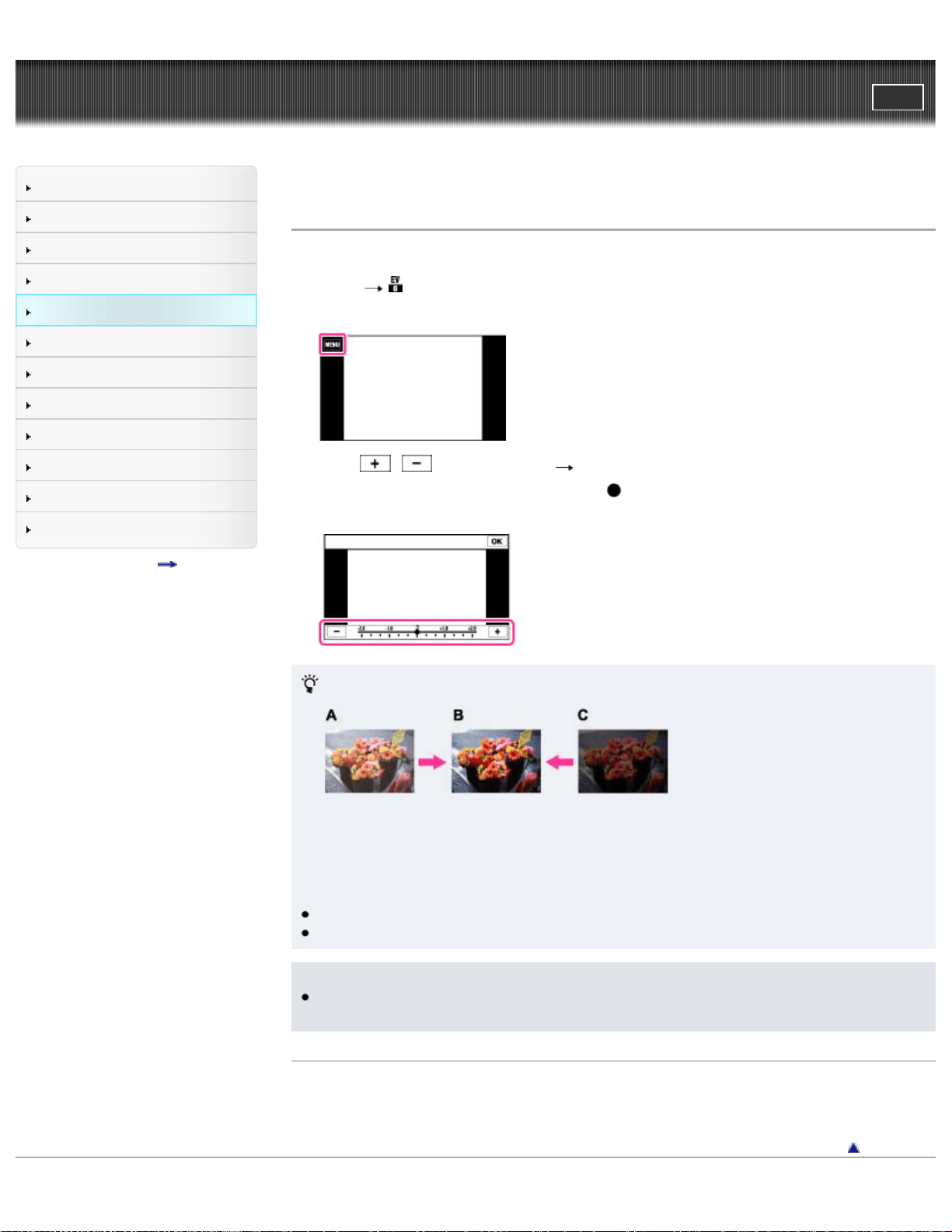
Cyber-shot User Guide
PrintSearch
Before Use
Operating the camera
Shooting
Viewing
Useful shooting functions
Useful viewing functions
Changing settings
Viewing images on a TV
Using with your computer
Printing
Troubleshooting
Precautions / About this camera
Contents list
Top page > Useful shooting functions > Menu items available for shooting > Exposure Compensation
Exposure Compensation
You can adjust the exposure manually in 1/3 EV steps in a range of –2.0 EV to +2.0 EV.
1. MENU
(Exposure Compensation)
Depending on the REC mode, this is set using buttons displayed on the left side of the screen.
2. Touch / to adjust exposure [OK].
You can also adjust the exposure by touching
of the adjustment bar and dragging to the right or
left.
Adjusting the exposure for better looking images
A: Overexposure (too much light)
B: Correct exposure
C: Underexposure (too little light)
When the image shot is overexposed, adjust [Exposure Compensation] to the minus side.
When the image shot is underexposed, adjust [Exposure Compensation] to the plus side.
Notes
If you shoot a subject in extremely bright or dark conditions, or when you use the flash, the
exposure adjustment may not be effective.
Related Topic
MENU items available for each shooting mode
Back to top
Copyright 2013 Sony Corporation
108

109
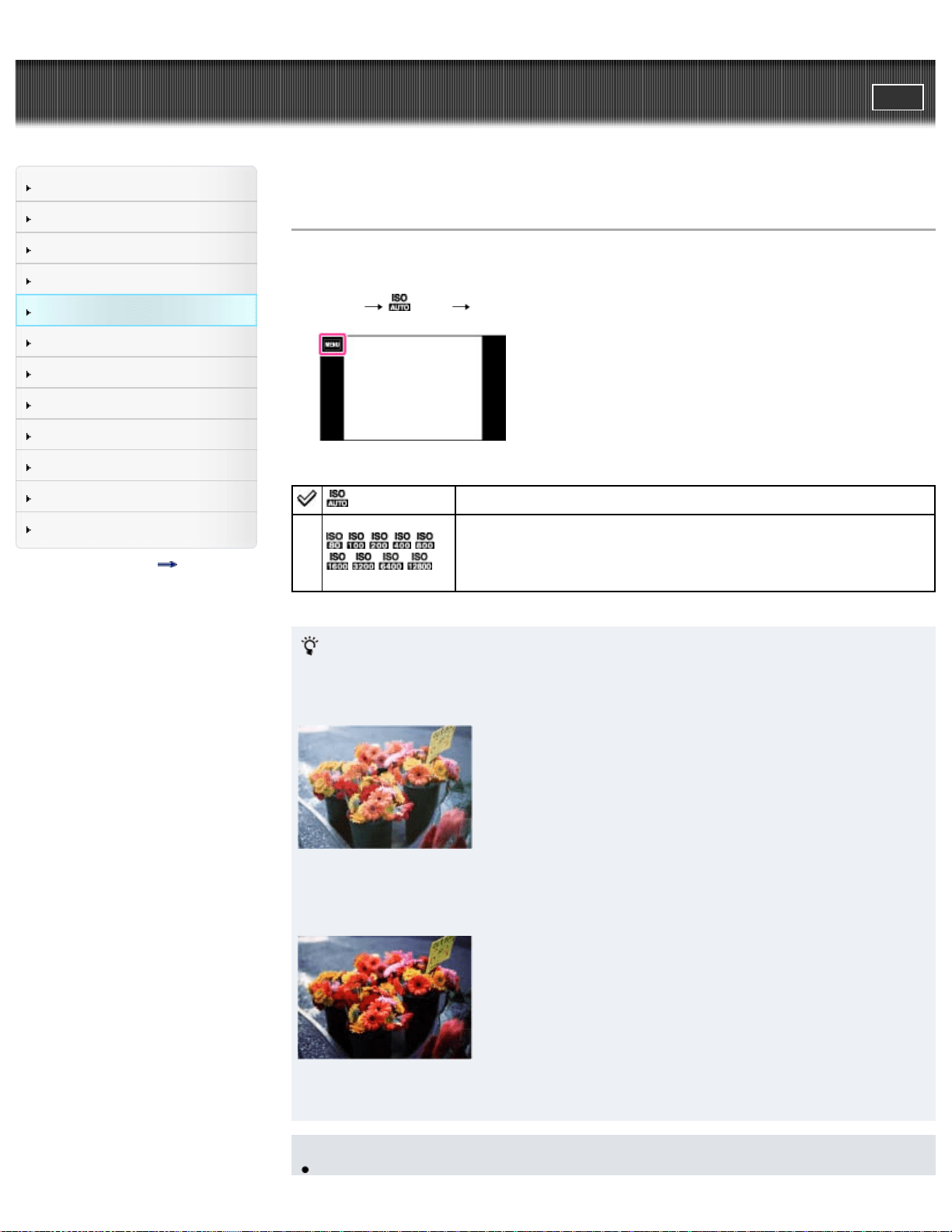
Cyber-shot User Guide
PrintSearch
Before Use
Operating the camera
Shooting
Viewing
Useful shooting functions
Useful viewing functions
Changing settings
Viewing images on a TV
Using with your computer
Printing
Troubleshooting
Precautions / About this camera
Contents list
Top page > Useful shooting functions > Menu items available for shooting > ISO
ISO
Adjusts the luminous sensitivity when the camera is set to Program Auto or [Underwater] in Scene
Selection. In movie mode, [ISO] is fixed to [Auto].
1. MENU
(ISO) desired mode
(Auto)
Sets the ISO sensitivity automatically.
/ / / / /
/ / /
You can reduce image blurring in dark locations or with moving subjects by
increasing the ISO sensitivity (select a larger number).
Higher ISO settings than [ISO6400] are achieved using Clear Image
technology and overlay burst shooting.
Adjusting ISO Sensitivity (Recommended Exposure Index)
ISO sensitivity is a speed rating for recording media that incorporates an image sensor that receives
light. Even when the exposure is the same, images differ depending on the ISO sensitivity.
High ISO sensitivity
Records a bright image even in dark locations while increasing shutter speed to reduce blur.
However, the image tends to become noisy.
Low ISO sensitivity
Records a smoother image.
However, when the exposure is insufficient, the image may become darker.
Notes
110

When [ISO] is set to [ISO6400] or [ISO12800], it takes some time to record an image, because the
camera overlays the image. The flash does not operate with these settings.
You can select only from [Auto], [ISO80] to [ISO800] when the shooting mode is set to burst
shooting mode.
Related Topic
MENU items available for each shooting mode
Back to top
Copyright 2013 Sony Corporation
111
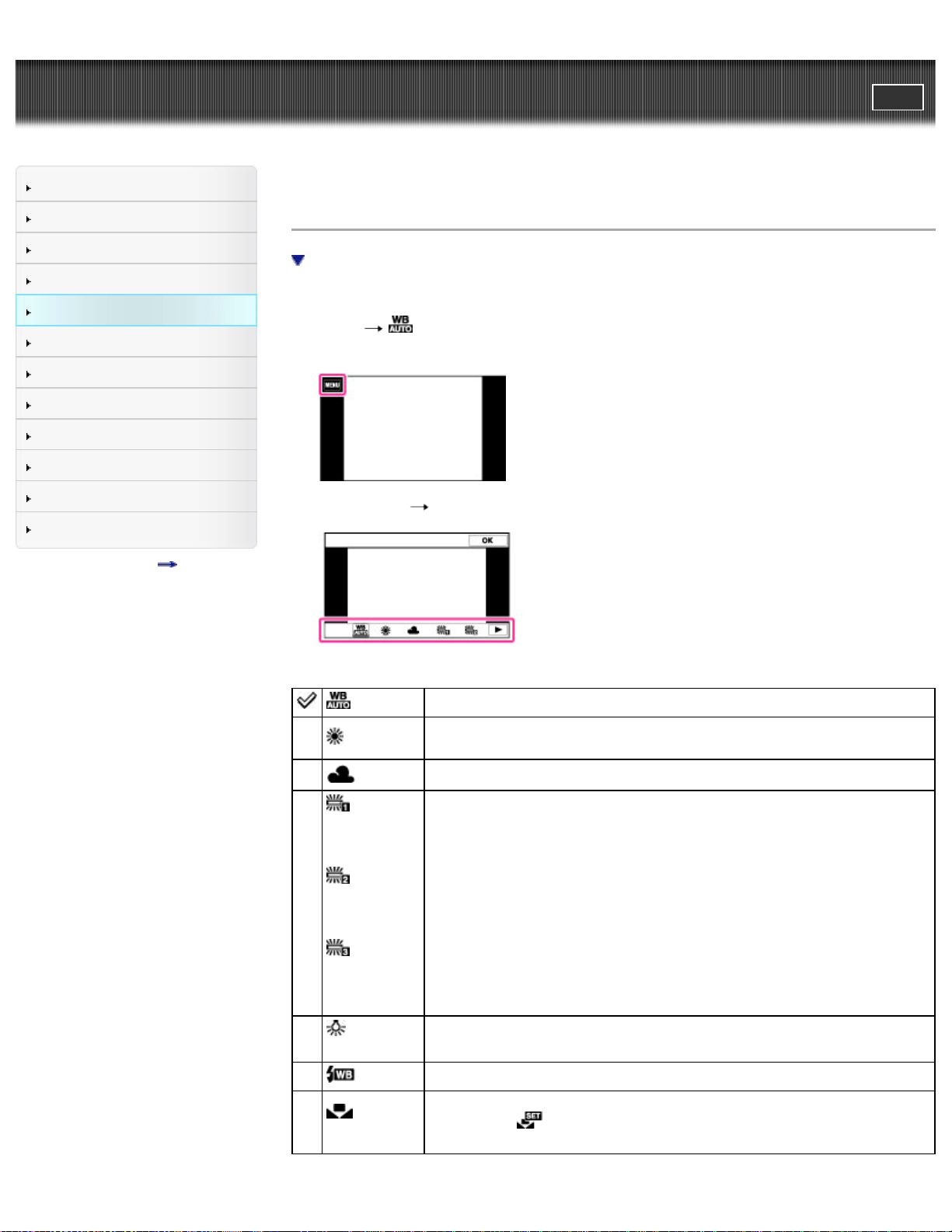
Cyber-shot User Guide
PrintSearch
Before Use
Operating the camera
Shooting
Viewing
Useful shooting functions
Useful viewing functions
Changing settings
Viewing images on a TV
Using with your computer
Printing
Troubleshooting
Precautions / About this camera
Contents list
Top page > Useful shooting functions > Menu items available for shooting > White Balance
White Balance
To capture the basic white color in One Push Set mode
Adjusts color tones according to the surrounding light conditions. Use this function if image color
appears unnatural.
1. MENU
(White Balance)
Depending on the REC mode, this is set using buttons displayed on the left side of the screen.
2. Desired mode [OK]
(Auto)
Adjusts the white balance automatically so that the colors appear natural.
(Daylight)
Adjusts for outdoors conditions on a fine day, evening views, night scenes, neon
signs, fireworks, etc.
(Cloudy)
Adjusts for a cloudy sky or a shady location.
(Fluorescent
White Balance
1)
(Fluorescent
White Balance
2)
(Fluorescent
White Balance
3)
[Fluorescent White Balance 1]: Adjusts for white fluorescent lighting.
[Fluorescent White Balance 2]: Adjusts for natural white fluorescent lighting.
[Fluorescent White Balance 3]: Adjusts for day white fluorescent lighting.
(Incandescent)
Adjusts for places under incandescent lamp, or under bright lighting, such as in a
photo studio.
(Flash)
Adjusts for the flash conditions.
(One
Push)
Adjusts the white balance depending on the light source. The white color
memorized in
(One Push Set) mode becomes the basic white color. Use this
mode when [Auto] and other settings do not provide accurate colors.
112
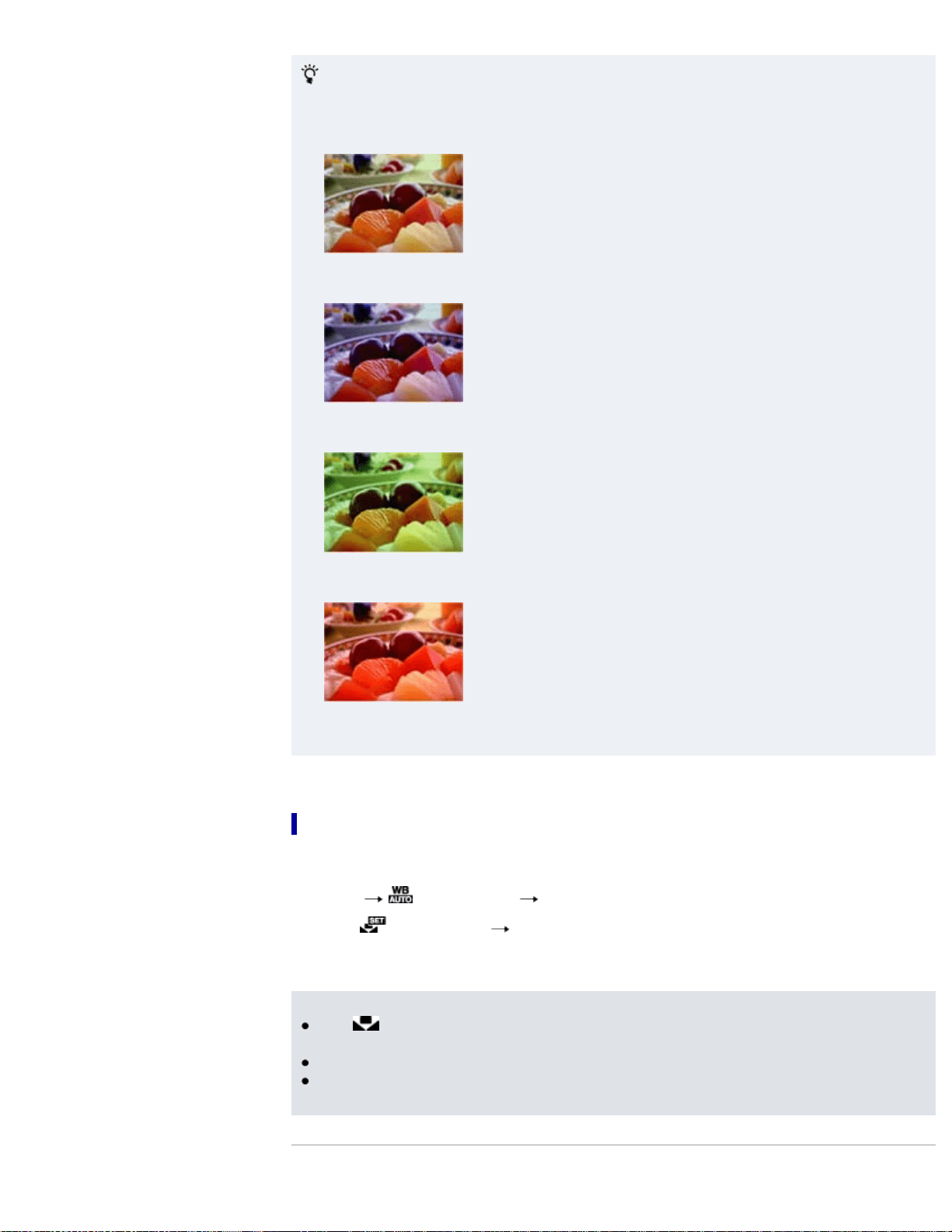
Effects of lighting conditions
The apparent color of the subject is affected by the lighting conditions.
The color tones are adjusted automatically, but you can adjust color tones manually using the White
Balance function.
Daylight (White as Standard)
Cloudy (Bluish)
Fluorescent (Green-tinged)
Incandescent (Reddish)
To capture the basic white color in One Push Set mode
1. Frame a white object such as a piece of paper filling the screen under the same lighting conditions
as you will shoot the subject.
2. MENU
(White Balance) [One Push]
3. Touch
(One Push Set) [OK].
The screen momentarily turns black, and when the white balance has been adjusted and stored in
the memory, the recording screen is displayed again.
Notes
If the
indicator flashes while shooting, the white balance cannot be set. Use automatic white
balance.
Do not shake or strike the camera while [One Push Set] is in progress.
When flash mode is set to other than [Auto] or [Off], the white balance is adjusted to the condition
with the flash emitting.
Related Topic
113

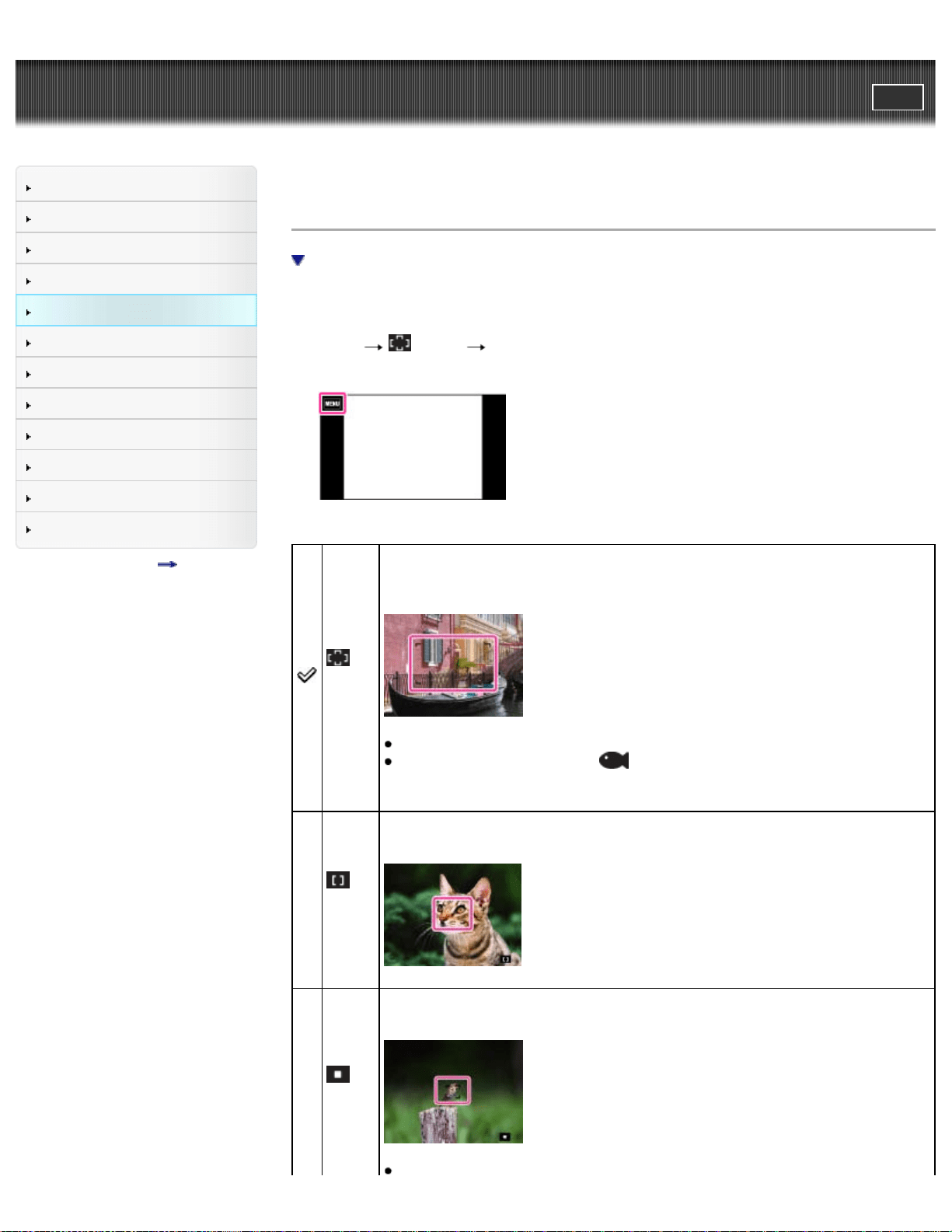
Cyber-shot User Guide
PrintSearch
Before Use
Operating the camera
Shooting
Viewing
Useful shooting functions
Useful viewing functions
Changing settings
Viewing images on a TV
Using with your computer
Printing
Troubleshooting
Precautions / About this camera
Contents list
Top page > Useful shooting functions > Menu items available for shooting > Focus
Focus
Focusing on subjects near the edge of the screen
You can change the focus method. Use the menu when it is difficult to get the proper focus in auto focus
mode.
AF stands for “Auto Focus,” a function that adjusts the focus automatically.
1. MENU
(Focus) desired mode
Depending on the shooting mode, this is set using buttons displayed on the left side of the screen.
(Multi
AF)
Focuses on a subject in all ranges of the finder frame automatically.
When you press the shutter button halfway down in still image shooting mode, a green
frame is displayed around the area that is in focus.
When the Face Detection function is active, AF operates with priority on faces.
When Scene Selection is set to
(Underwater), focus operation is adjusted to
underwater shooting. When focus is achieved by half pressing the shutter button, a
large frame is displayed in green.
(Center
AF)
Focuses on a subject in the center of the finder frame automatically. Using the AF lock
function together, you can compose the image the way you want.
(Spot
AF)
Focuses on an extremely small subject or a narrow area automatically. Using the AF
lock function together, you can compose the image the way you want.
115
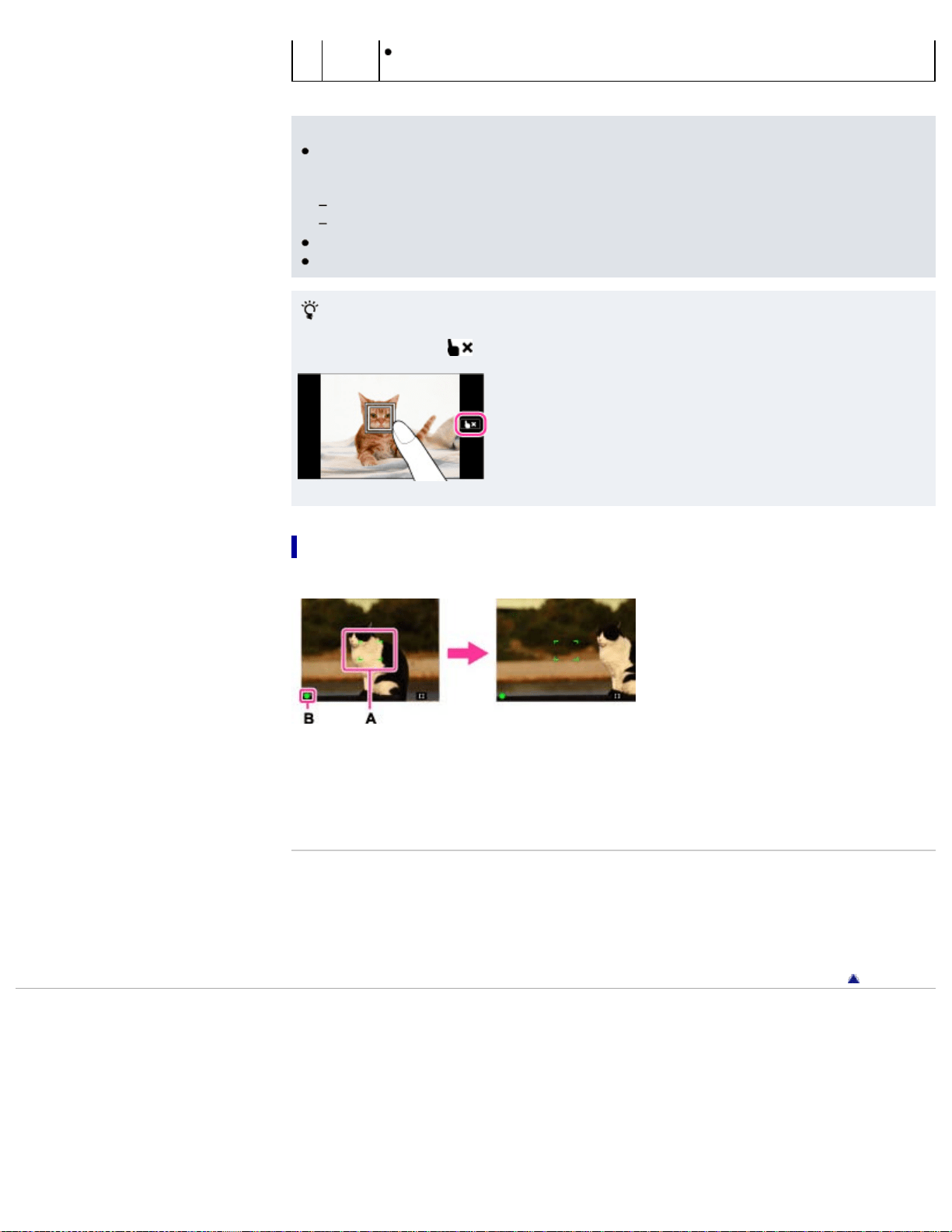
Hold the camera steady so as not to misalign the subject and the AF range finder
frame.
Notes
When you use the following functions, the AF range finder frame is disabled and a dotted line
appears instead. In this case, the camera works to focus on the subjects at the center of the
screen.
Zoom functions other than optical zoom
AF illuminator
When the focus mode is set to other than [Multi AF], you cannot use the Face Detection function.
If tracking focus is activated, the camera focuses with priority on the subject to be tracked.
Quickly choosing the priority subject
Touching the screen displays a frame, and then pressing the shutter button halfway down brings the
frame into focus. Touch
to cancel the focus.
Focusing on subjects near the edge of the screen
If the subject is out of focus, do as follows:
1. Recompose the shot so that the subject is centered in the AF range finder (A), and press the
shutter button halfway to focus on the subject (AF lock).
2. When the AE/AF lock indicator (B) stops flashing and remains on, return to the fully composed shot,
and press the shutter button fully down.
Related Topic
Tracking focus
MENU items available for each shooting mode
Back to top
Copyright 2013 Sony Corporation
116
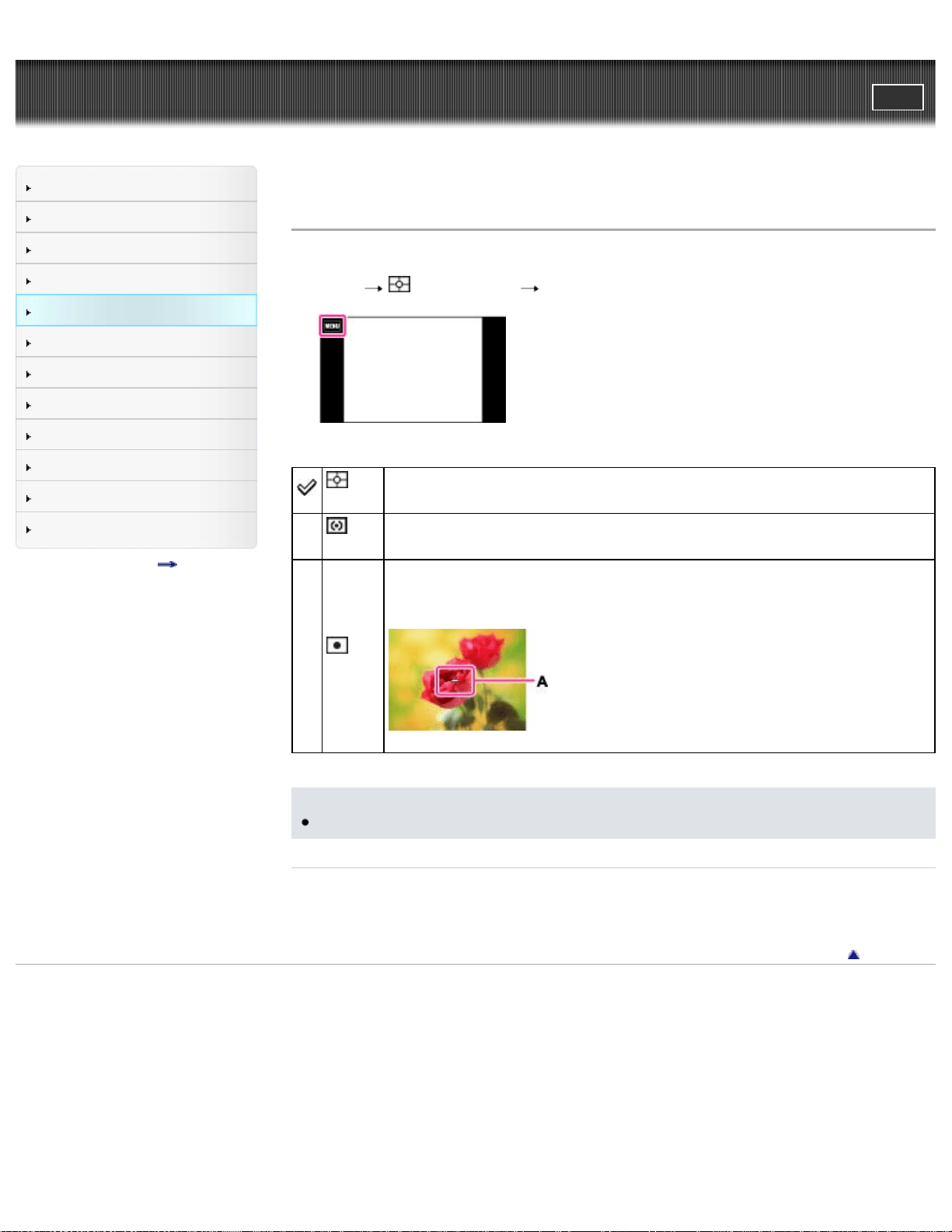
Cyber-shot User Guide
PrintSearch
Before Use
Operating the camera
Shooting
Viewing
Useful shooting functions
Useful viewing functions
Changing settings
Viewing images on a TV
Using with your computer
Printing
Troubleshooting
Precautions / About this camera
Contents list
Top page > Useful shooting functions > Menu items available for shooting > Metering Mode
Metering Mode
Selects the metering mode that sets which part of the subject to measure to determine the exposure.
1. MENU
(Metering Mode) desired mode
(Multi)
Divides into multiple regions and measures each region. The camera determines a well-
balanced exposure (Multi-pattern metering).
(Center)
Measures the center of the image, and determines the exposure based on the
brightness of the subject there (Center-weighted metering).
(Spot)
Align the spot metering cross hairs (A) on the subject to meter one part of the subject
(Spot metering). This function is useful when the subject is backlit or when there is
strong contrast between the subject and the background.
Notes
In movie mode, the setting is fixed to [Multi].
Related Topic
MENU items available for each shooting mode
Back to top
Copyright 2013 Sony Corporation
117
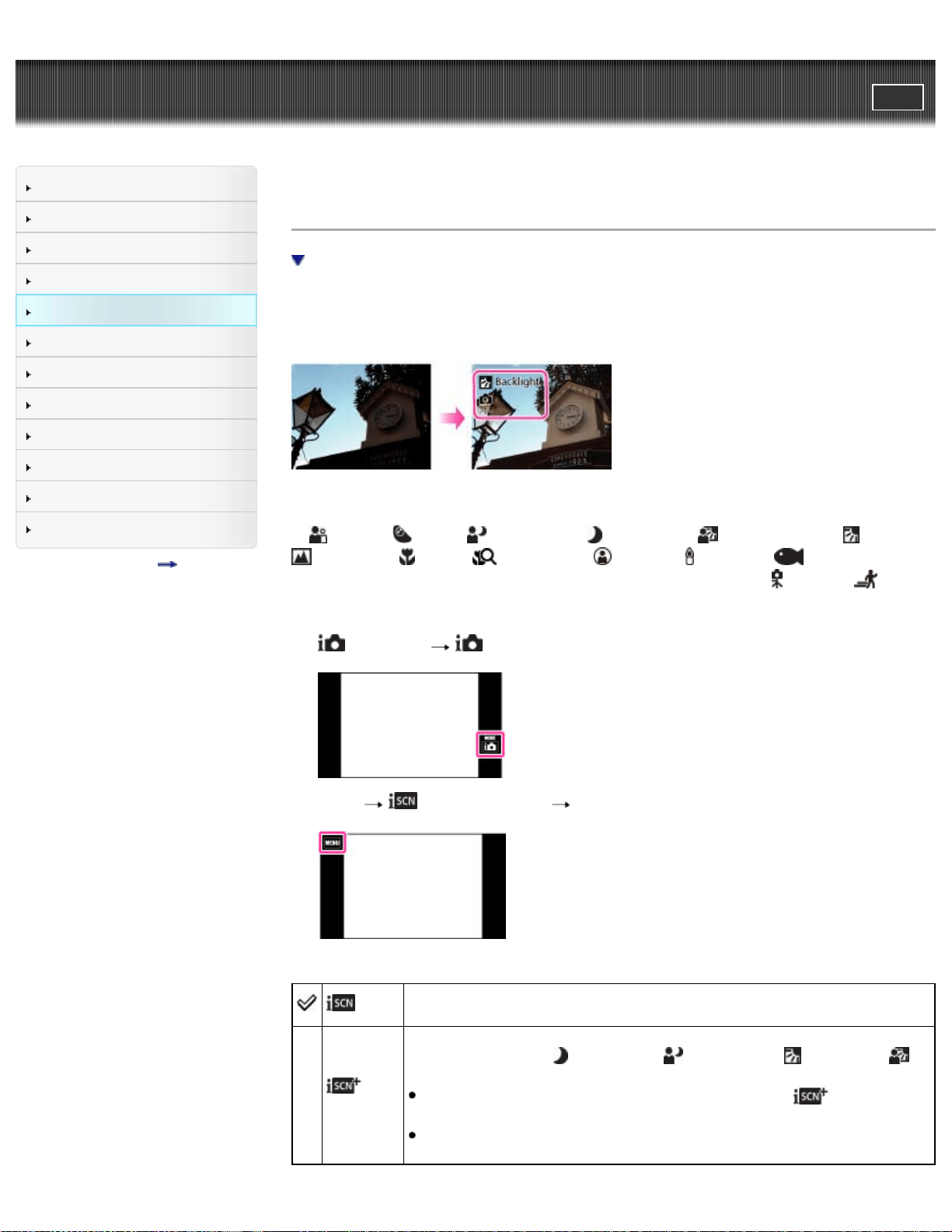
Cyber-shot User Guide
PrintSearch
Before Use
Operating the camera
Shooting
Viewing
Useful shooting functions
Useful viewing functions
Changing settings
Viewing images on a TV
Using with your computer
Printing
Troubleshooting
Precautions / About this camera
Contents list
Top page > Useful shooting functions > Menu items available for shooting > Scene Recognition
Scene Recognition
Advanced mode
The camera automatically detects shooting conditions, and then takes the shot. When a motion is
detected, the ISO sensitivity is increased according to the movement to reduce subject blur. When the
camera is set to Intelligent Auto mode, you can select [Advanced] mode, in which the camera
automatically shoots two images.
In Scene Recognition, the position of an icon displayed on the screen is different depending on whether
the camera recognizes a scene or condition. If the camera recognizes a scene, icons and guides such
as
(Portrait), (Infant), (Night Portrait), (Night Scene), (Backlight Portrait), (Backlight),
(Landscape), (Macro), (Close Focus), (Spotlight), (Low Light), (Underwater) are
displayed on the first line. If the camera recognizes a condition, icons such as
(Tripod) or (Move)
are displayed on the second line. The camera may recognize both the scene and condition, or just one.
1.
(REC Mode) (Intelligent Auto)
2. MENU (Scene Recognition) desired mode
(Auto)
When the camera recognizes the scene, it switches to the optimal settings and
shoots the image.
(Advanced)
When the camera recognizes the scene, it switches to the optimal settings. When
the camera recognizes
(Night Scene), (Night Portrait), (Backlight) or
(Backlight Portrait), it automatically changes the setting and shoots another image.
When you shoot 2 images consecutively, the + mark on the
icon will turn
green.
When [Anti Blink] is displayed, 2 images are taken automatically and the image
with the eyes open is selected automatically. [Details]
118
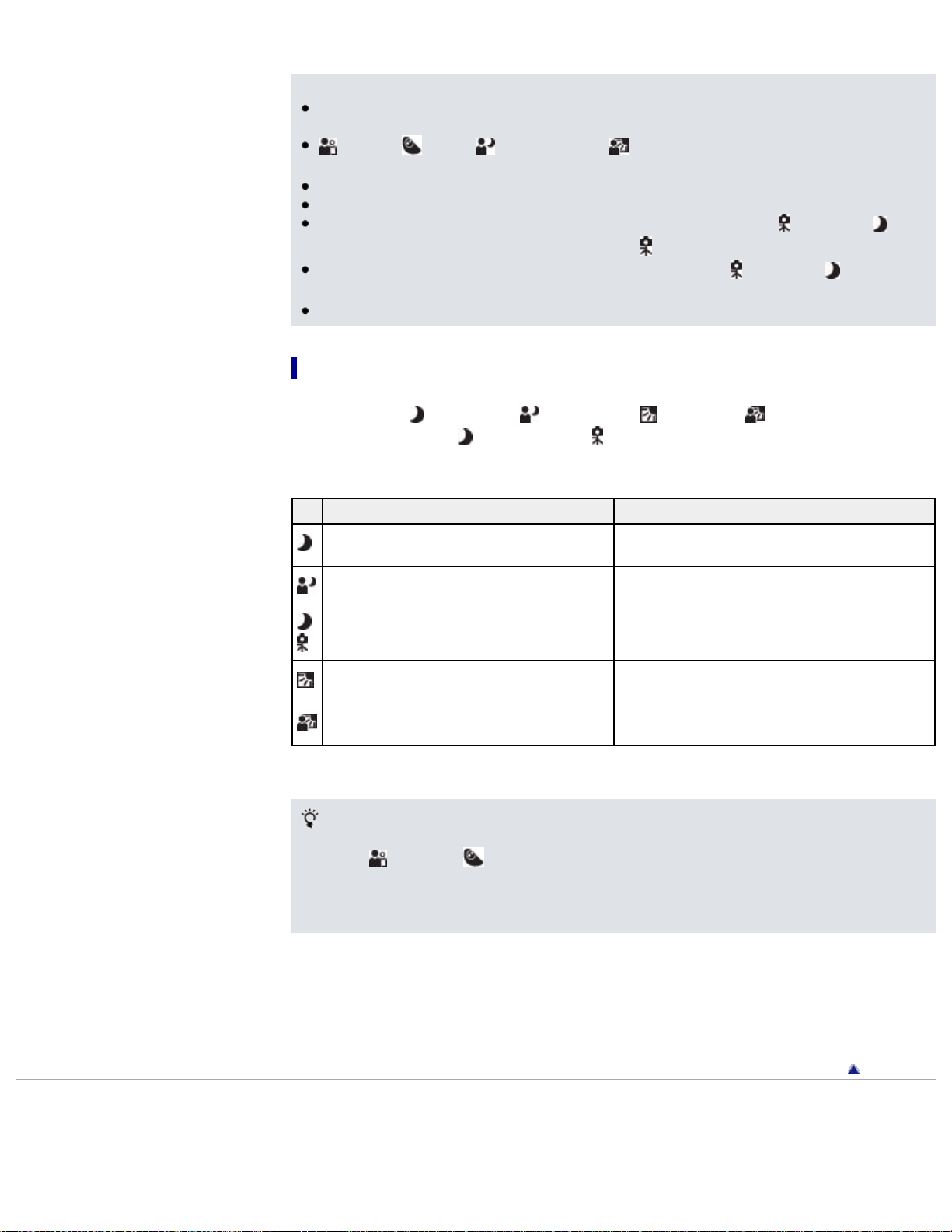
Notes
The Scene Recognition function does not operate when you shoot images using zoom functions
other than the optical zoom.
(Portrait), (Infant), (Night Portrait) or (Backlight Portrait) are not recognized in tracking
focus mode.
The available flash settings are [Auto], [Advanced Flash] or [Off].
These scenes may not be recognized depending on the situation.
If the environment causes vibrations to be transferred to the camera when
(Tripod) and (Night
Scene) conditions are recognized at the same time,
(Tripod) condition may not be recognized.
Sometimes a slow shutter results when a scene is recognized as a
(Tripod) and (Night Scene)
at the same time. Keep the camera still during shooting.
When shooting movies, Advanced mode is not available.
Advanced mode
In [Advanced] mode, the camera shoots two images consecutively with the settings differing as follows
when it recognizes
(Night Scene), (Night Portrait), (Backlight) or (Backlight Portrait) scenes,
which tend to blur or when
(Night Scene) and (Tripod) conditions are recognized at the same time.
You can select the desired image from the two images shot.
First Image* Second Image
Shoots in Slow Synchro
Shoots with sensitivity increased and shake
reduced
Shoots in Slow Synchro with the face which
the flash strobes on as guide
Shoots with sensitivity increased with the face as
guide and shake reduced
Shoots in Slow Synchro
Shoots with even slower shutter speed without
increasing sensitivity
Shoots with the flash
Shoots with the brightness and contrast of the
background adjusted
Shoots with the face which the flash strobes
on as guide
Shoots with the brightness and contrast of the
face and the background adjusted
* When [Flash] is set to [Auto].
What is the Anti Blink function?
When set to [Advanced], the camera automatically shoots two images consecutively* when it
recognizes
(Portrait) or (Infant). The camera will select, display, and record the image which the
eyes are not blinked automatically. If the eyes are closed in both images, the message “Blinked eye
detected” is displayed.
* except when the flash strobes/when the shutter speed is slow.
Related Topic
MENU items available for each shooting mode
Back to top
Copyright 2013 Sony Corporation
119
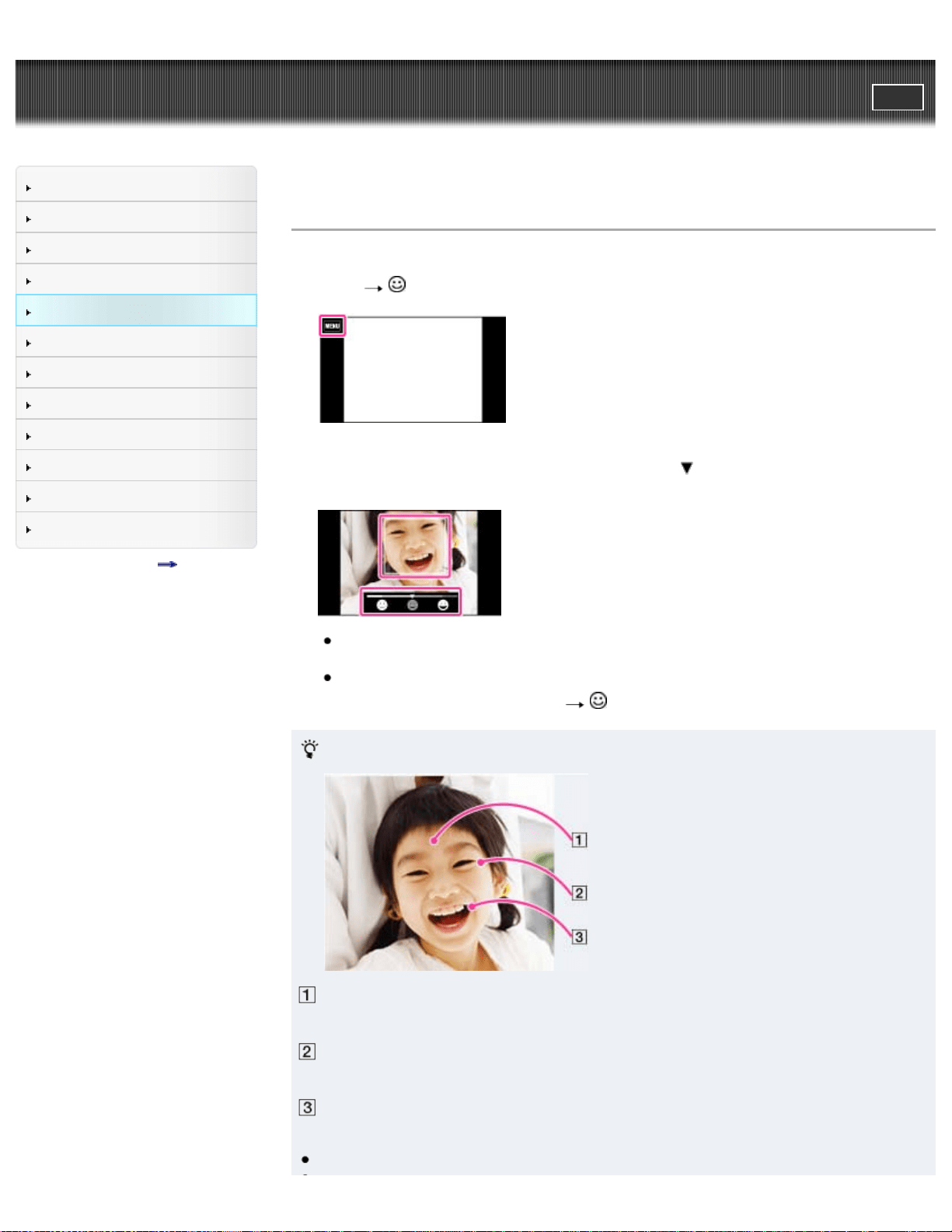
Cyber-shot User Guide
PrintSearch
Before Use
Operating the camera
Shooting
Viewing
Useful shooting functions
Useful viewing functions
Changing settings
Viewing images on a TV
Using with your computer
Printing
Troubleshooting
Precautions / About this camera
Contents list
Top page > Useful shooting functions > Menu items available for shooting > Smile Shutter
Smile Shutter
When the camera detects a smile, the shutter is released automatically.
1. MENU
(Smile Shutter)
2. Wait for a smile to be detected.
When a smile is detected and the smile level exceeds the
point on the indicator, the camera
records images automatically.
Touch the indicator icon to set the sensitivity of the Smile Shutter function for detecting smiles.
[Details]
When shooting movies, the indicator is not displayed. [Details]
3. To end the Smile Shutter, touch MENU
(Smile Shutter).
Tips for better capturing of smiles
Do not cover the eyes with the bangs. Do not obscure the face by hat, masks,
sunglasses, etc.
Try to orient the face in front of the camera and be as level as possible. Keep
the eyes narrowed.
Give a clear smile with an open mouth. The smile is easier to detect when
the teeth are shown.
The shutter operates when any person whose face is being detected smiles.
120

You can select or register the priority subject for face detection with [Face Detection]. When the
selected face is registered in the camera memory, Smile Detection is performed only for that face.
[Details]
If a smile is not detected, set [Smile Detection Sensitivity] to [Slight Smile].
Notes
Shooting using the Smile Shutter ends automatically when either the memory card or internal
memory becomes full.
Smiles may not be detected correctly depending on the conditions.
You cannot use Smile Shutter when you use zoom functions other than optical zoom.
Related Topic
Smile Detection Sensitivity
MENU items available for each shooting mode
Back to top
Copyright 2013 Sony Corporation
121
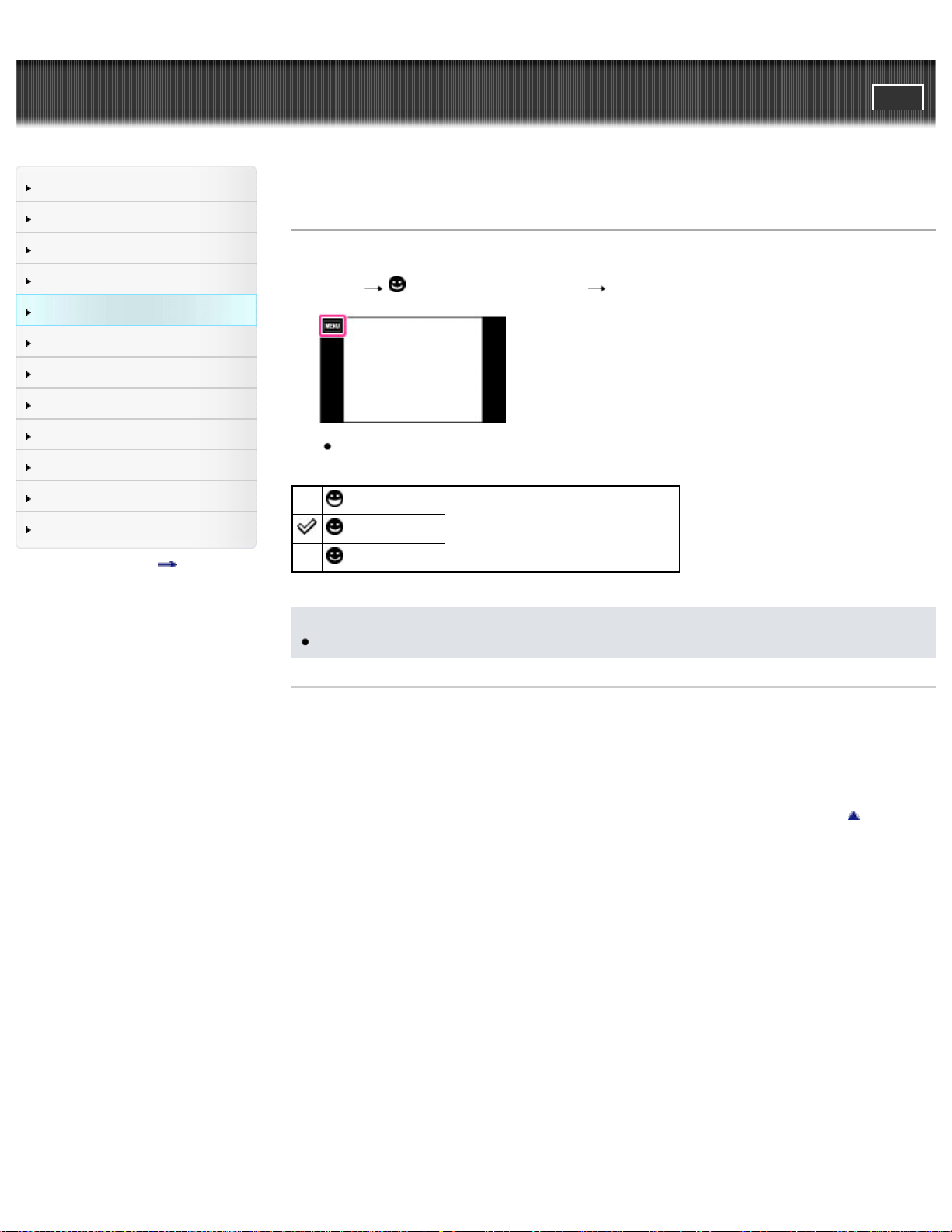
Cyber-shot User Guide
PrintSearch
Before Use
Operating the camera
Shooting
Viewing
Useful shooting functions
Useful viewing functions
Changing settings
Viewing images on a TV
Using with your computer
Printing
Troubleshooting
Precautions / About this camera
Contents list
Top page > Useful shooting functions > Menu items available for shooting > Smile Detection Sensitivity
Smile Detection Sensitivity
When shooting movies, sets the sensitivity of the Smile Shutter function for detecting smiles.
1. MENU
(Smile Detection Sensitivity) desired mode
Sets the sensitivity by touching indicator icon while shooting still images. [Details]
(Big Smile)
Detects a big, normal or slight smile.
(Normal Smile)
(Slight Smile)
Notes
Smiles may not be detected correctly depending on the conditions.
Related Topic
Smile Shutter
MENU items available for each shooting mode
Back to top
Copyright 2013 Sony Corporation
122
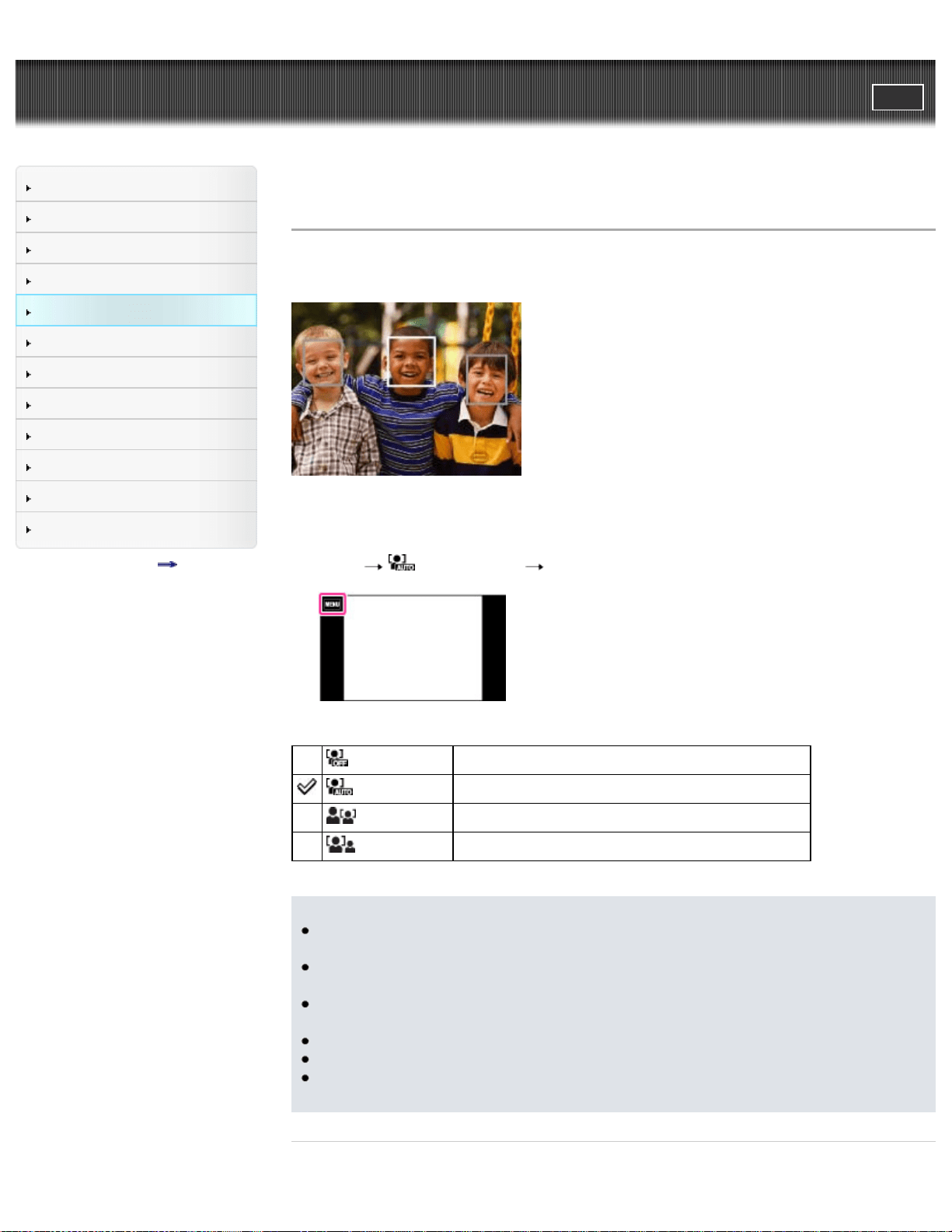
Cyber-shot User Guide
PrintSearch
Before Use
Operating the camera
Shooting
Viewing
Useful shooting functions
Useful viewing functions
Changing settings
Viewing images on a TV
Using with your computer
Printing
Troubleshooting
Precautions / About this camera
Contents list
Top page > Useful shooting functions > Menu items available for shooting > Face Detection
Face Detection
When the Face Detection function is used, the camera detects the faces of your subjects and adjusts the
focus, flash, exposure, white balance and red-eye reduction settings automatically.
When the camera detects more than one subject, the camera will judge which is the main subject and
set focus by priority. The frame for which the focus is set will turn green by pressing the shutter button
halfway down.
1. MENU
(Face Detection) desired mode
(Off)
Does not use the Face Detection.
(Auto)
Selects the face the camera is to automatically focus on.
(Child Priority)
Detects and shoots with priority on a child’s face.
(Adult Priority)
Detects and shoots with priority on an adult’s face.
Notes
[Off] is not available when [Self-Timer] is set to [Self-portrait One Person] or [Self-portrait Two
People].
You can select [Face Detection] only when the focus mode is set to [Multi AF] and the metering
mode is set to [Multi].
The Face Detection function does not operate when you use zoom functions other than optical
zoom.
Up to 8 faces of your subjects can be detected.
Adults and children may not be recognized correctly depending on the conditions.
During Smile Shutter shooting, [Face Detection] is automatically set to [Auto] even if it is set to
[Off].
Related Topic
123

Cyber-shot User Guide
PrintSearch
Before Use
Operating the camera
Shooting
Viewing
Useful shooting functions
Useful viewing functions
Changing settings
Viewing images on a TV
Using with your computer
Printing
Troubleshooting
Precautions / About this camera
Contents list
Top page > Useful shooting functions > Menu items available for shooting > Anti Blink
Anti Blink
When Scene Selection is set to [Soft Skin] or [Soft Snap] and the subject blinks while you are shooting
an image, the camera automatically shoots two images consecutively. The camera will automatically
select, display and record the image in which the eyes are not blinked.
1. MENU
(Anti Blink) desired mode
(Auto)
When Face Detection is active, the Anti Blink function operates so that images with the
subject’s eyes open are recorded.
(Off)
Does not use the Anti Blink function.
Notes
Anti Blink does not work in the following situations:
When using the flash
During burst shooting
When the Face Detection function does not work
When the Smile Shutter function is activated
Sometimes the Anti Blink function does not work depending on the situation.
When the Anti Blink function is set to [Auto] but only images with the subject’s eyes closed are
recorded, the message “Blinked eye detected” is displayed on the screen. Shoot again as
necessary.
Related Topic
Scene Selection
MENU items available for each shooting mode
Back to top
Copyright 2013 Sony Corporation
125
Cyber-shot User Guide
PrintSearch
Before Use
Operating the camera
Shooting
Viewing
Useful shooting functions
Useful viewing functions
Changing settings
Viewing images on a TV
Using with your computer
Printing
Troubleshooting
Precautions / About this camera
Contents list
Top page > Useful shooting functions > Menu items available for shooting > Movie SteadyShot
Movie SteadyShot
The strength of the SteadyShot effect when shooting movies can be adjusted.
1. MENU
(Movie SteadyShot) desired mode
(Standard)
Reduces camera shake during movie shooting under stable conditions.
(Active)
Reduces camera shake when shooting images while walking or zooming.
Notes
If you change the setting for [Movie SteadyShot], the angle of view will change.
Related Topic
Shooting movies
MENU items available for each shooting mode
Back to top
Copyright 2013 Sony Corporation
126
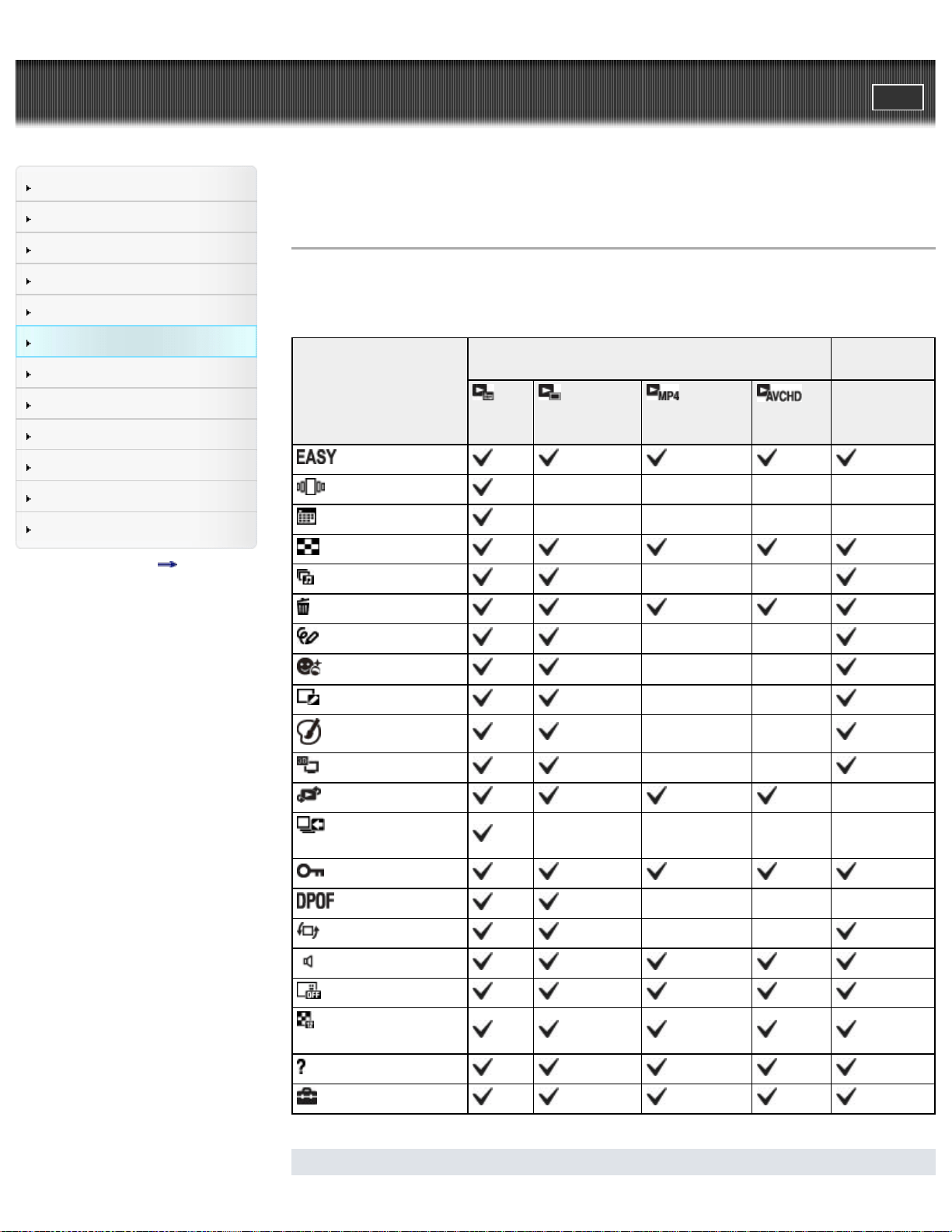
Cyber-shot User Guide
PrintSearch
Before Use
Operating the camera
Shooting
Viewing
Useful shooting functions
Useful viewing functions
Changing settings
Viewing images on a TV
Using with your computer
Printing
Troubleshooting
Precautions / About this camera
Contents list
Top page > Useful viewing functions > Functions available for each view mode > MENU items available
for each view mode
MENU items available for each view mode
In the table below, a checkmark indicates a user-changeable function, while — indicates an
unchangeable one.
Menu items
Memory card
Internal
Memory
Date
View
Folder view
(Still)
Folder view
(MP4)
AVCHD
view
Folder View
(Easy Mode)
(Date Select)
— — — —
(Calendar)
— — — —
(Image Index)
(Slideshow)
— —
(Delete)
(Paint)
— —
(Beauty Effect)
— —
(Retouch)
— —
(Picture Effect)
— —
(3D Viewing)
— —
(View Mode)
—
(Display Cont.
Shooting Group)
— — — —
(Protect)
(Print (DPOF))
— — —
(Rotate)
— —
(Volume)
(Exposure data)
(Number of images in
index)
(In-Camera Guide)
(Settings)
Notes
127

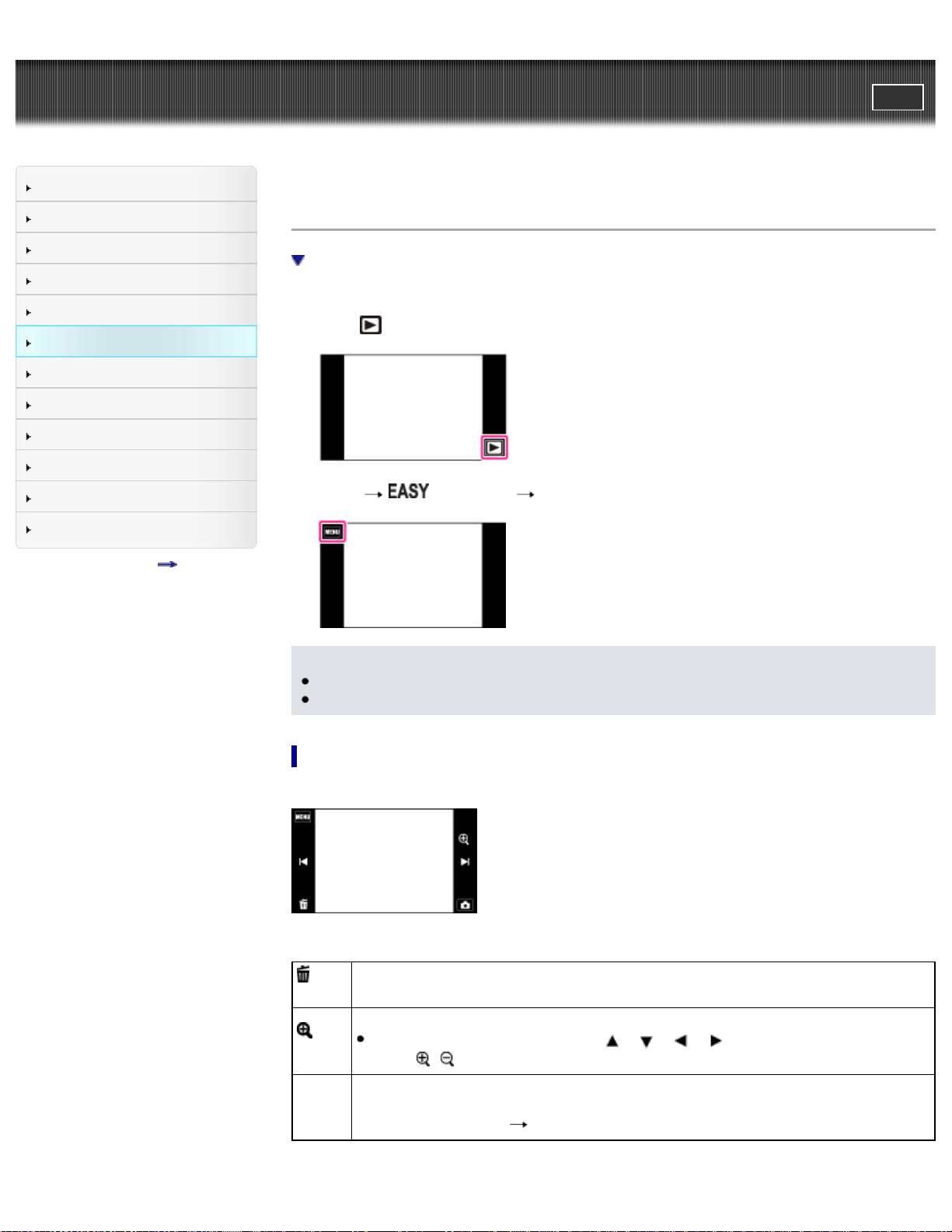
Cyber-shot User Guide
PrintSearch
Before Use
Operating the camera
Shooting
Viewing
Useful shooting functions
Useful viewing functions
Changing settings
Viewing images on a TV
Using with your computer
Printing
Troubleshooting
Precautions / About this camera
Contents list
Top page > Useful viewing functions > MENU items (Viewing) > Easy Mode
Easy Mode
Viewing functions available in Easy Mode
When viewing still images in Easy Mode, the playback screen text becomes larger, indicators become
easier to see, and fewer functions can be used.
1. Touch
(Playback) to switch to playback mode.
2. MENU (Easy Mode) [OK]
Notes
The battery charge is used up more quickly because the screen brightness increases automatically.
The shooting mode also changes to [Easy Mode].
Viewing functions available in Easy Mode
In Easy Mode, only the deletion and the zoom functions are available.
(Delete)
You can delete the currently displayed image.
(Zoom)
Enlarges the displayed image.
Drag up, down, right or left, or touch
/ / / to change the zoom position.
Touch
/ to change the zoom magnification.
MENU
You can delete currently displayed image with [Delete Single Image], and delete all images
in the selected date range or internal memory (if selected) with [Delete All Images].
Select [Exit Easy Mode]
[OK] to exit Easy Mode.
129

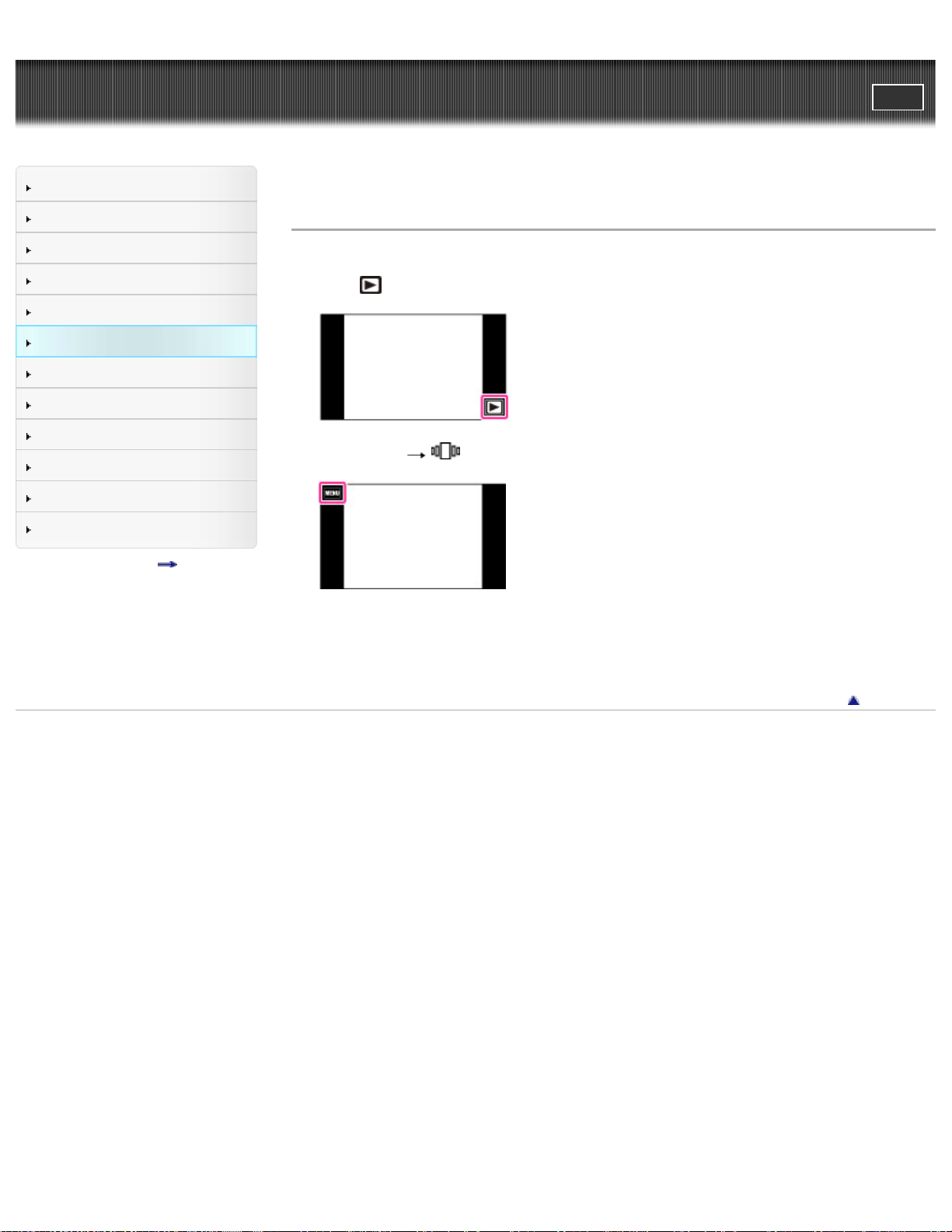
Cyber-shot User Guide
PrintSearch
Before Use
Operating the camera
Shooting
Viewing
Useful shooting functions
Useful viewing functions
Changing settings
Viewing images on a TV
Using with your computer
Printing
Troubleshooting
Precautions / About this camera
Contents list
Top page > Useful viewing functions > MENU items (Viewing) > Date Select
Date Select
Selects the desired image to view by date.
1. Touch
(Playback) to switch to playback mode.
2. Touch MENU (Date Select).
3. Display images shot on a specific date at center of the screen by dragging right or left on the screen
to select the date.
4. Touch the center of image.
Back to top
Copyright 2013 Sony Corporation
131
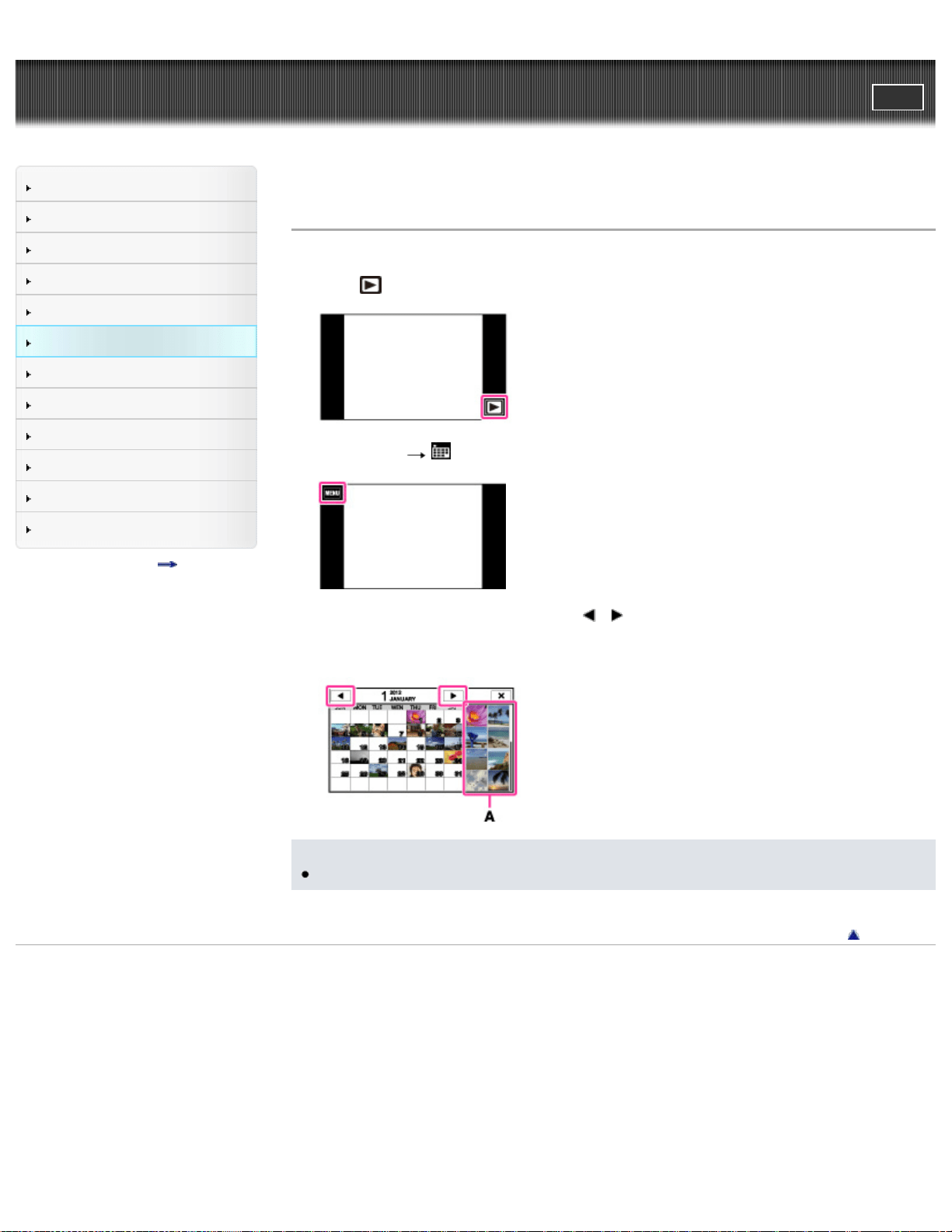
Cyber-shot User Guide
PrintSearch
Before Use
Operating the camera
Shooting
Viewing
Useful shooting functions
Useful viewing functions
Changing settings
Viewing images on a TV
Using with your computer
Printing
Troubleshooting
Precautions / About this camera
Contents list
Top page > Useful viewing functions > MENU items (Viewing) > Calendar
Calendar
This feature selects the date to be played back on the calendar when using Date View.
1. Touch
(Playback) to switch to playback mode.
2. Touch MENU (Calendar).
3. Select the month you want to display with / , then touch the desired date.
Drag the thumbnails of images for the selected date (A) up or down to change the page. Touch an
image to return to the single-image screen for that image.
Notes
This function is not displayed when the internal memory is used.
Back to top
Copyright 2013 Sony Corporation
132
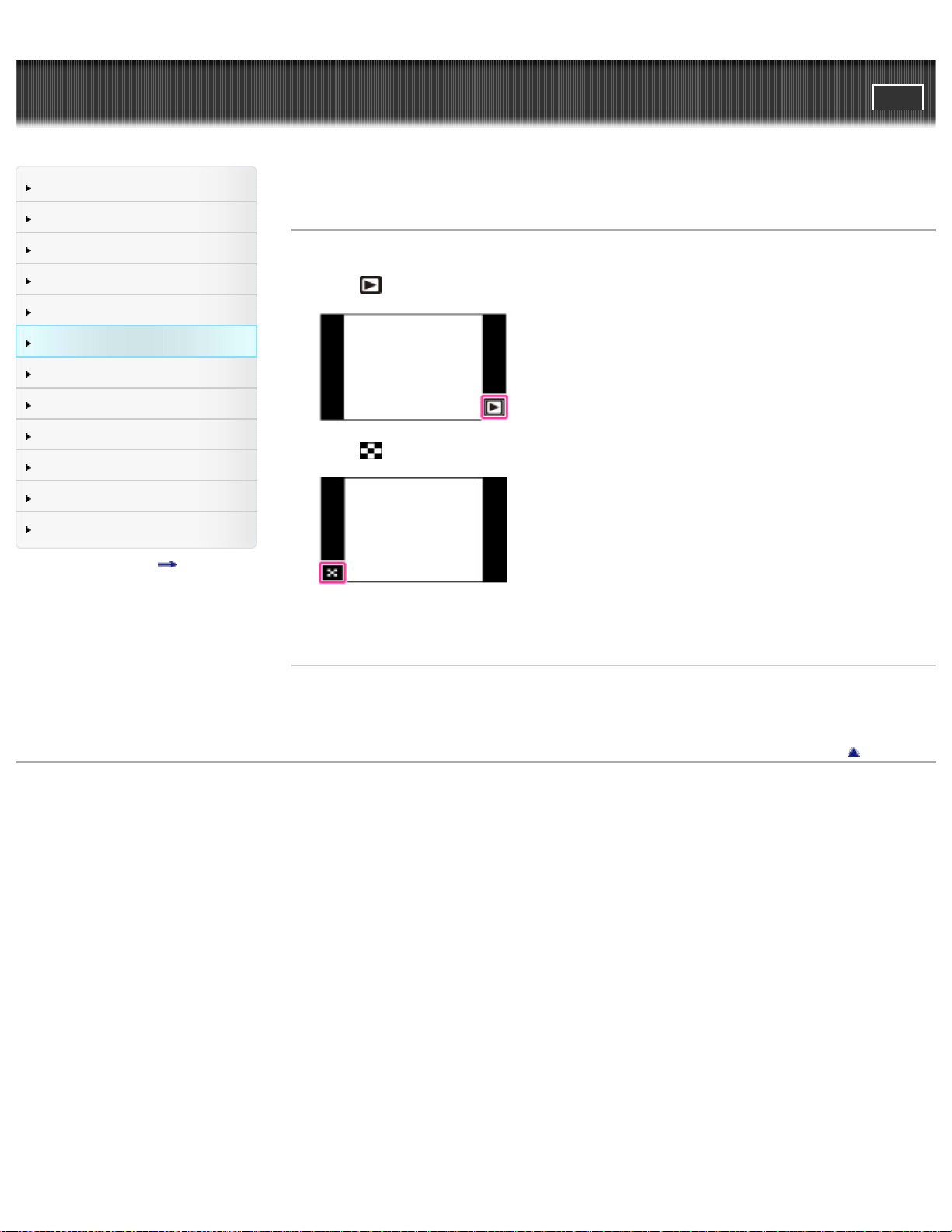
Cyber-shot User Guide
PrintSearch
Before Use
Operating the camera
Shooting
Viewing
Useful shooting functions
Useful viewing functions
Changing settings
Viewing images on a TV
Using with your computer
Printing
Troubleshooting
Precautions / About this camera
Contents list
Top page > Useful viewing functions > MENU items (Viewing) > Image Index
Image Index
Displays multiple images at the same time.
1. Touch
(Playback) to switch to playback mode.
2. Touch (Image Index) or slide the W/T (zoom) lever to the W side.
3. Touch the screen and drag up or down to change the page.
Touch an image on the index screen to return to the single-image screen for that image.
Related Topic
Number of images in index
Back to top
Copyright 2013 Sony Corporation
133
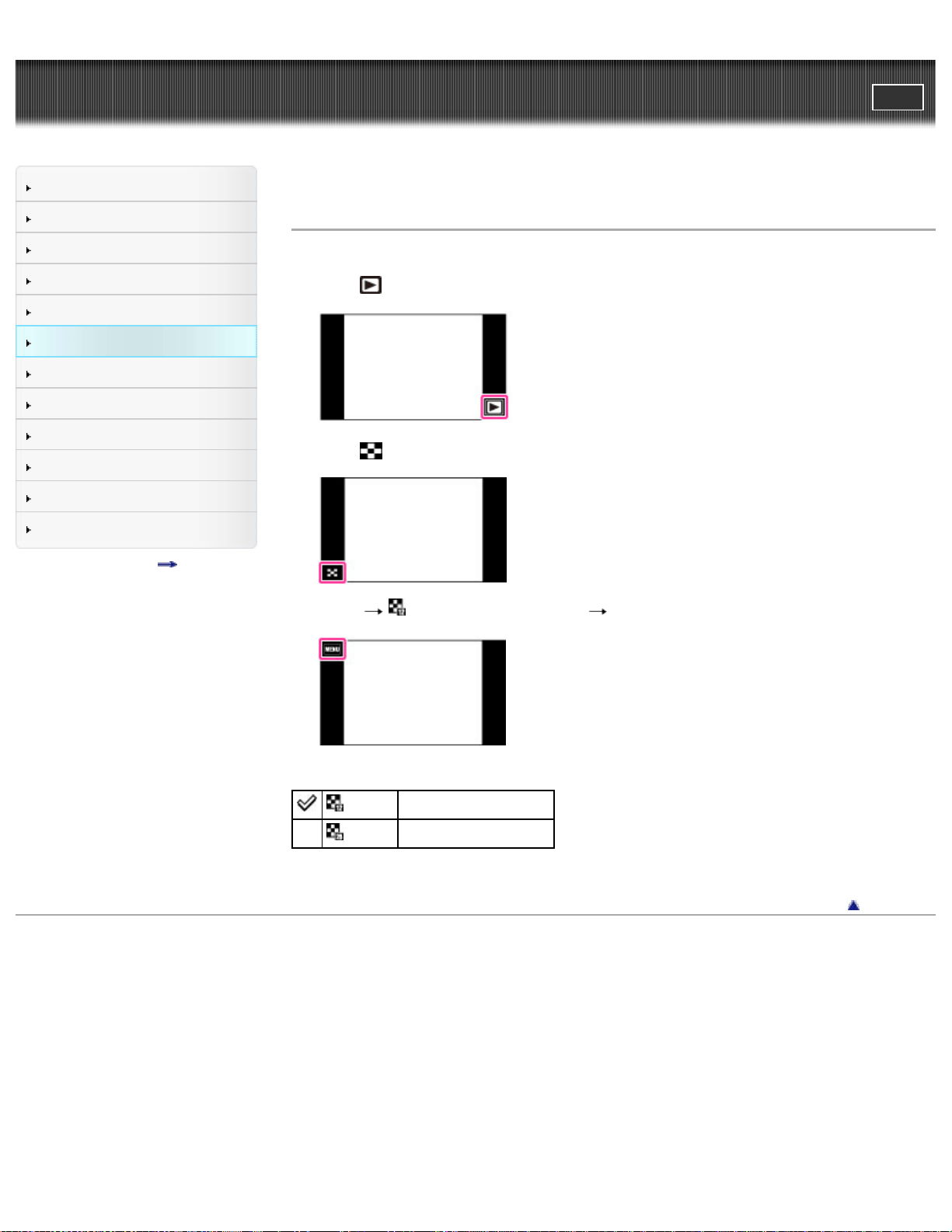
Cyber-shot User Guide
PrintSearch
Before Use
Operating the camera
Shooting
Viewing
Useful shooting functions
Useful viewing functions
Changing settings
Viewing images on a TV
Using with your computer
Printing
Troubleshooting
Precautions / About this camera
Contents list
Top page > Useful viewing functions > MENU items (Viewing) > Number of images in index
Number of images in index
Sets the number of images displayed in the index screen.
1. Touch
(Playback) to switch to playback mode.
2. Touch (Image Index) or slide the W/T (zoom) lever to the W side.
3. MENU (Number of images in index) desired mode
(12-up)
Displays 12-up images.
(28-up)
Displays 28-up images.
Back to top
Copyright 2013 Sony Corporation
134
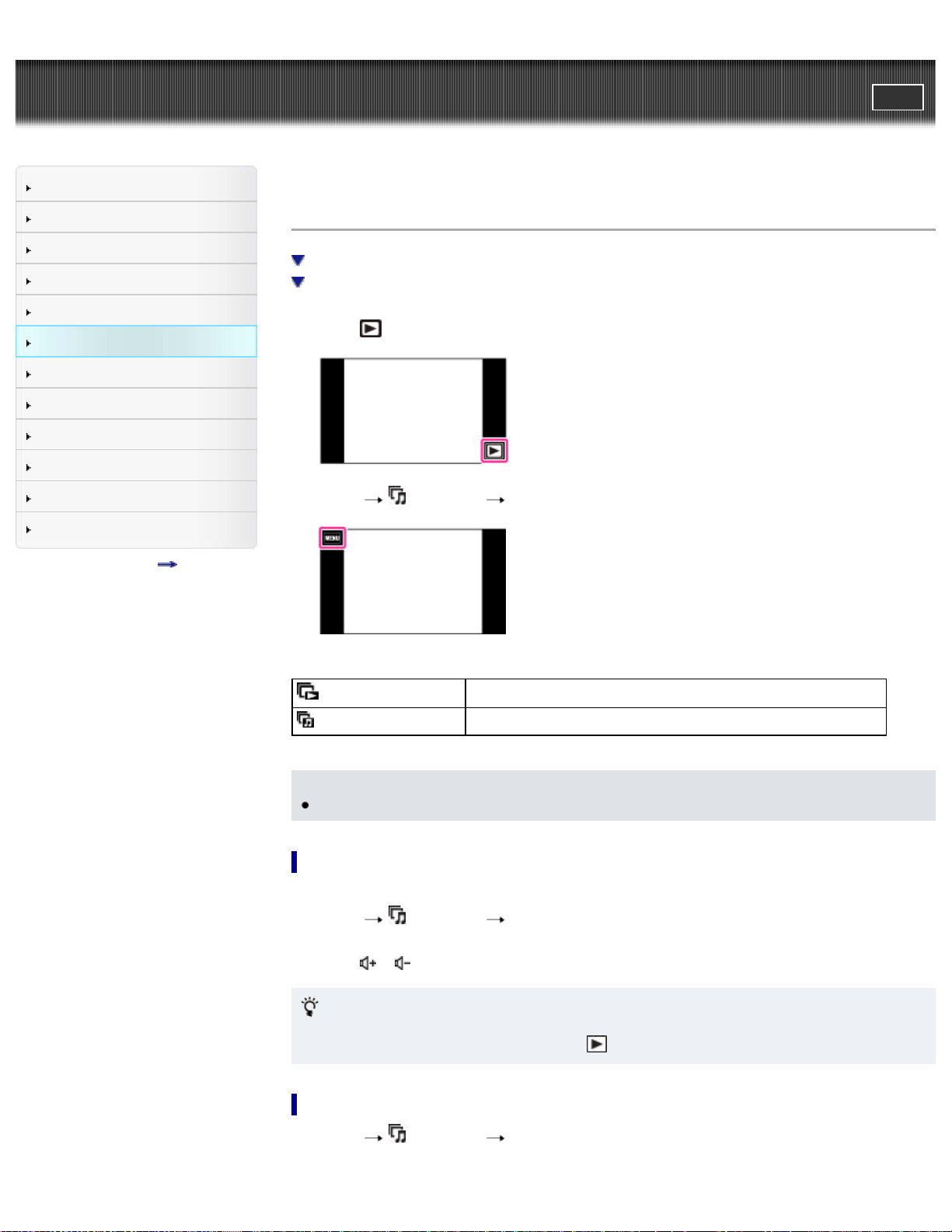
Cyber-shot User Guide
PrintSearch
Before Use
Operating the camera
Shooting
Viewing
Useful shooting functions
Useful viewing functions
Changing settings
Viewing images on a TV
Using with your computer
Printing
Troubleshooting
Precautions / About this camera
Contents list
Top page > Useful viewing functions > MENU items (Viewing) > Slideshow
Slideshow
Continuous Playback
Slideshow with music
Images are automatically played back in succession.
1. Touch
(Playback) to switch to playback mode.
2. MENU (Slideshow) desired slideshow
(Continuous Playback)
Starts playback from the currently displayed image.
(Slideshow with music)
Plays back still images in succession along with effects and music.
Notes
[Slideshow] is not available when [View Mode] is set to [Folder view (MP4)] or [AVCHD view].
Continuous Playback
1. Select the desired image for playing.
2. MENU
(Slideshow) [Continuous Playback]
3. To end continuous playback, touch the screen, and then touch [Exit Continuous Playback].
Touch
or on the screen to adjust the movie volume.
Viewing panoramic images during continuous playback
The whole panoramic image is displayed for 3 seconds.
You can scroll a panoramic image by touching
.
Slideshow with music
1. MENU (Slideshow) [Slideshow with music]
2. Desired setting [OK]
135
3. To end continuous playback, touch the screen, and then touch [Exit Slideshow].
Notes
[Slideshow with music] is not available for the following images:
Panoramic images
3D images recorded in [Standard] or [Wide] size
Playback Selection
Selects the group of images to be shown. The setting is fixed to [Folder] when the internal memory is
used to record images.
All Plays a slideshow of all the images in order.
This
Date
Plays a slideshow of images with the currently selected date range when View Mode is
[Date View].
Folder Plays a slideshow of images in the currently selected folder in Folder View.
Effects
Selects the playback speed and mood for slideshows. If the playback time of movie is long, an image is
taken from it and displayed.
Simple
A simple slideshow switching images at a preset interval.
The playback interval is adjustable in [Interval] and you can thoroughly enjoy your
images.
Nostalgic A moody slideshow reproducing the atmosphere of a movie scene.
Stylish A stylish slideshow proceeding at a middle tempo.
Active A high-tempo slideshow suitable for active scenes.
Music
Specifies the music to be played during slideshows. You can select more than one background music
track. Touch
to listen to each background music. Touch or to adjust the background music
volume.
Music1 The default setting for a [Simple] slideshow.
Music2 The default setting for a [Nostalgic] slideshow.
Music3 The default setting for a [Stylish] slideshow.
Music4 The default setting for an [Active] slideshow.
Muting Does not use music.
Notes
The movies are played back without their audio.
Interval
Sets the screen switching interval. The setting is fixed to [Auto] when [Simple] is not selected as the
[Effects].
136

1 sec
Sets the display interval of images for a [Simple] slideshow.
3 sec
5 sec
10 sec
Auto The interval is set to suit the selected [Effects] item.
Selecting background music
You can transfer a desired music file from your CDs or MP3 files to the camera to play back during
slideshow. To transfer music, install the “Music Transfer” software to your computer.
Related Topic
“Music Transfer”
Back to top
Copyright 2013 Sony Corporation
137
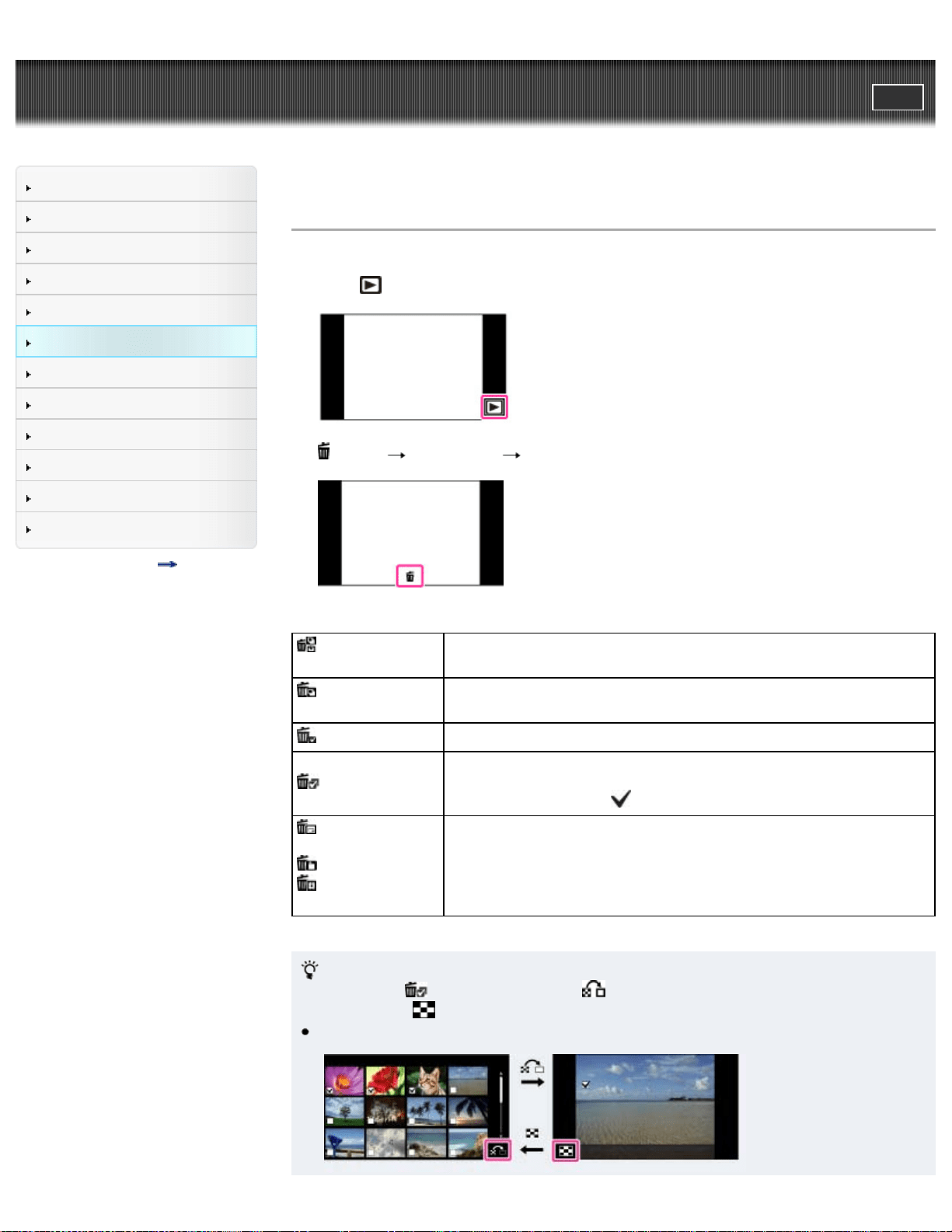
Cyber-shot User Guide
PrintSearch
Before Use
Operating the camera
Shooting
Viewing
Useful shooting functions
Useful viewing functions
Changing settings
Viewing images on a TV
Using with your computer
Printing
Troubleshooting
Precautions / About this camera
Contents list
Top page > Useful viewing functions > MENU items (Viewing) > Delete
Delete
Allows you to select unwanted images for deletion.
1. Touch
(Playback) to switch to playback mode.
2. (Delete) desired mode [OK]
(All but This
Image)
Deletes burst group images other than the selected image in Display Cont.
Shooting Group mode.
(All Imgs in This
Cnt.Sht. Grp.)
Deletes all images in the selected burst group at once.
(This Image)
Deletes the currently displayed image in single-image mode.
(Multiple Images)
Allows you to select and delete multiple images.
After step 2, select an image, then touch it. To cancel the selection, touch the
image again to cancel the
mark.
(All Images on This
Date)
(All in This Folder)
(All AVCHD view
files)
Deletes all still images and movies in the selected date range or folder, or all
AVCHD movies at once.
You can switch between index and single-image mode when selecting images
When you select
(Multiple Images), touch on the index screen to return to the single-image
screen, and touch
on the single-image screen to return to the index screen.
You can also switch between index and single-image mode in [Protect] or [Print (DPOF)].
138

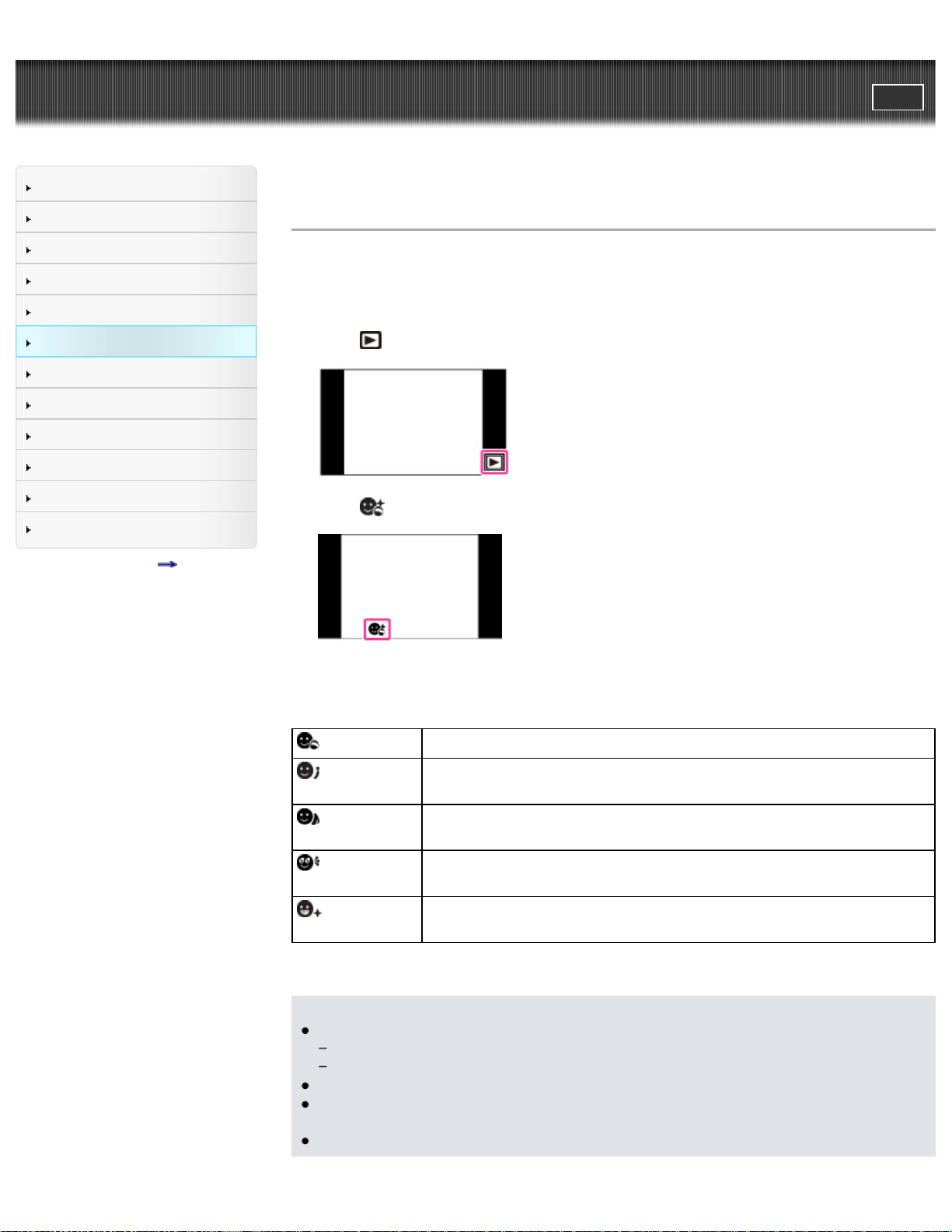
Cyber-shot User Guide
PrintSearch
Before Use
Operating the camera
Shooting
Viewing
Useful shooting functions
Useful viewing functions
Changing settings
Viewing images on a TV
Using with your computer
Printing
Troubleshooting
Precautions / About this camera
Contents list
Top page > Useful viewing functions > MENU items (Viewing) > Beauty Effect
Beauty Effect
Allows you to apply a cosmetic effect on a recorded still image to make a person in the image look
better; for example, retouching for smoother skin, larger eyes or whiter teeth.
You can set the effects from level 1 to 5. The effected file is saved as a new file. The original image is
retained as is.
1. Touch
(Playback) to switch to playback mode.
2. Touch (Beauty Effect).
3. Select a face that you want to apply a cosmetic effect.
4. Select the desired effect and perform retouching according to the operation method in each mode.
(Skin Toning)
Retouch the image to change the skin color to the desired effect.
(Skin
Smoothing)
Retouch the image to remove age spots and wrinkles from the skin.
(Shine
Removal)
Retouch the image to suppress the oily skin look.
(Eye
Widening)
Retouch the image to enlarge the eyes.
(Teeth
Whitening)
Retouch the image to whiten the teeth. You may not be able to whiten teeth for
some images.
To use multiple effects continuously, select a different effect after setting the first effect.
Notes
You cannot use [Beauty Effect] for the following images
Panoramic images
Movies
You cannot apply a cosmetic effect on an extremely small face in the image.
To apply a cosmetic effect on more than one face, select a previously-saved image file processed
by a cosmetic effect, then select another face to apply that effect.
The cosmetic effect may not produce a satisfactory result in the case of some images.
140

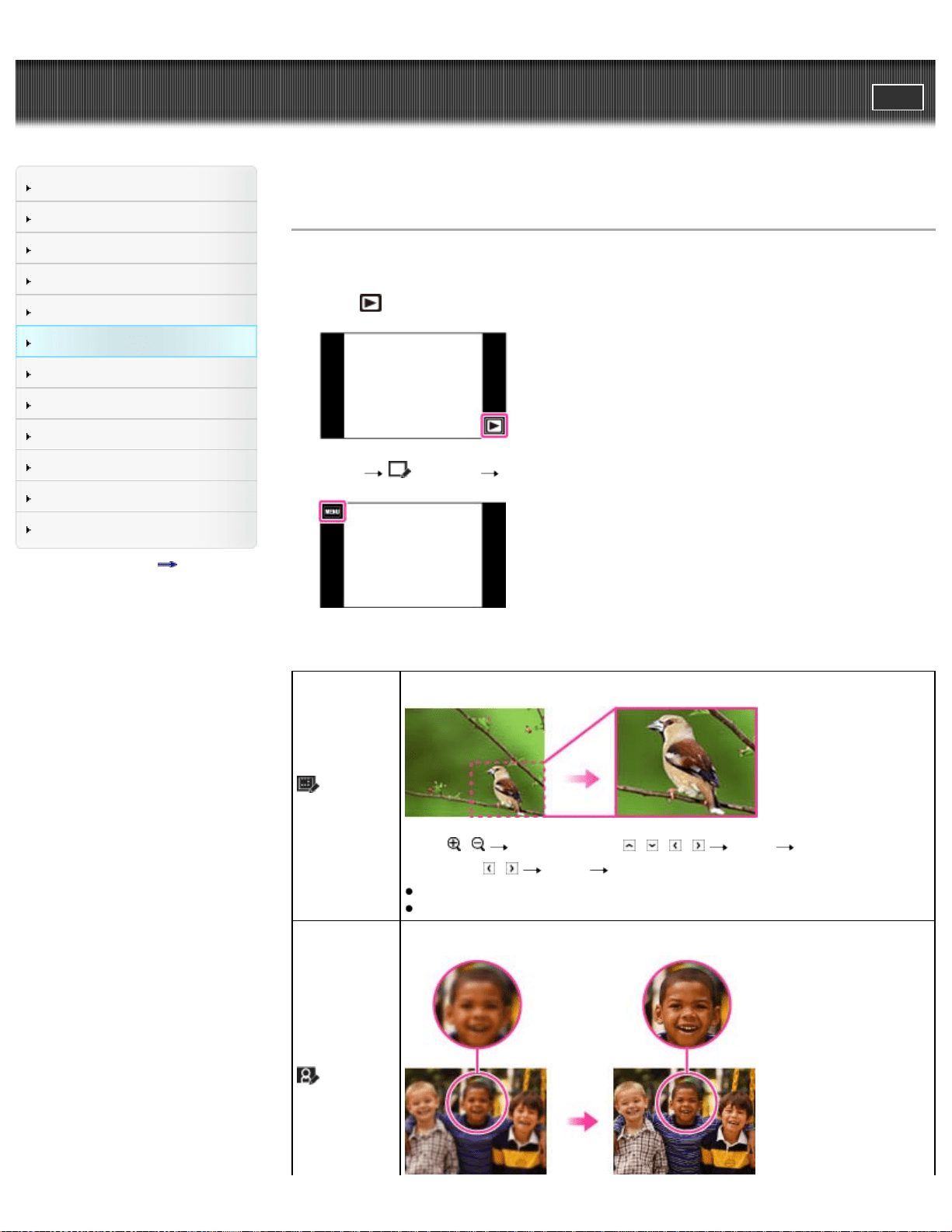
Cyber-shot User Guide
PrintSearch
Before Use
Operating the camera
Shooting
Viewing
Useful shooting functions
Useful viewing functions
Changing settings
Viewing images on a TV
Using with your computer
Printing
Troubleshooting
Precautions / About this camera
Contents list
Top page > Useful viewing functions > MENU items (Viewing) > Retouch
Retouch
Retouches a recorded image and saves it as a new file.
The original image is retained.
1. Touch
(Playback) to switch to playback mode.
2. MENU (Retouch) desired mode
3. Perform retouching according to the operation method in each mode.
(Trimming
(Resize))
Records the zoomed playback image.
Touch / set the point with / / / [Next] select an image size
to save with
/ [Next] [OK].
The quality of trimmed images may deteriorate.
The image size that you can trim may vary depending on the image.
(Unsharp
masking)
Sharpens the image within a chosen frame.
142

Touch the area (frame) of the desired image to retouch [Next] [OK].
Depending on the image, sufficient correction may not be applied and the image
quality may deteriorate.
Notes
You cannot retouch the following images:
Panoramic images
3D images
Movies
Images displayed in a burst group
Back to top
Copyright 2013 Sony Corporation
143
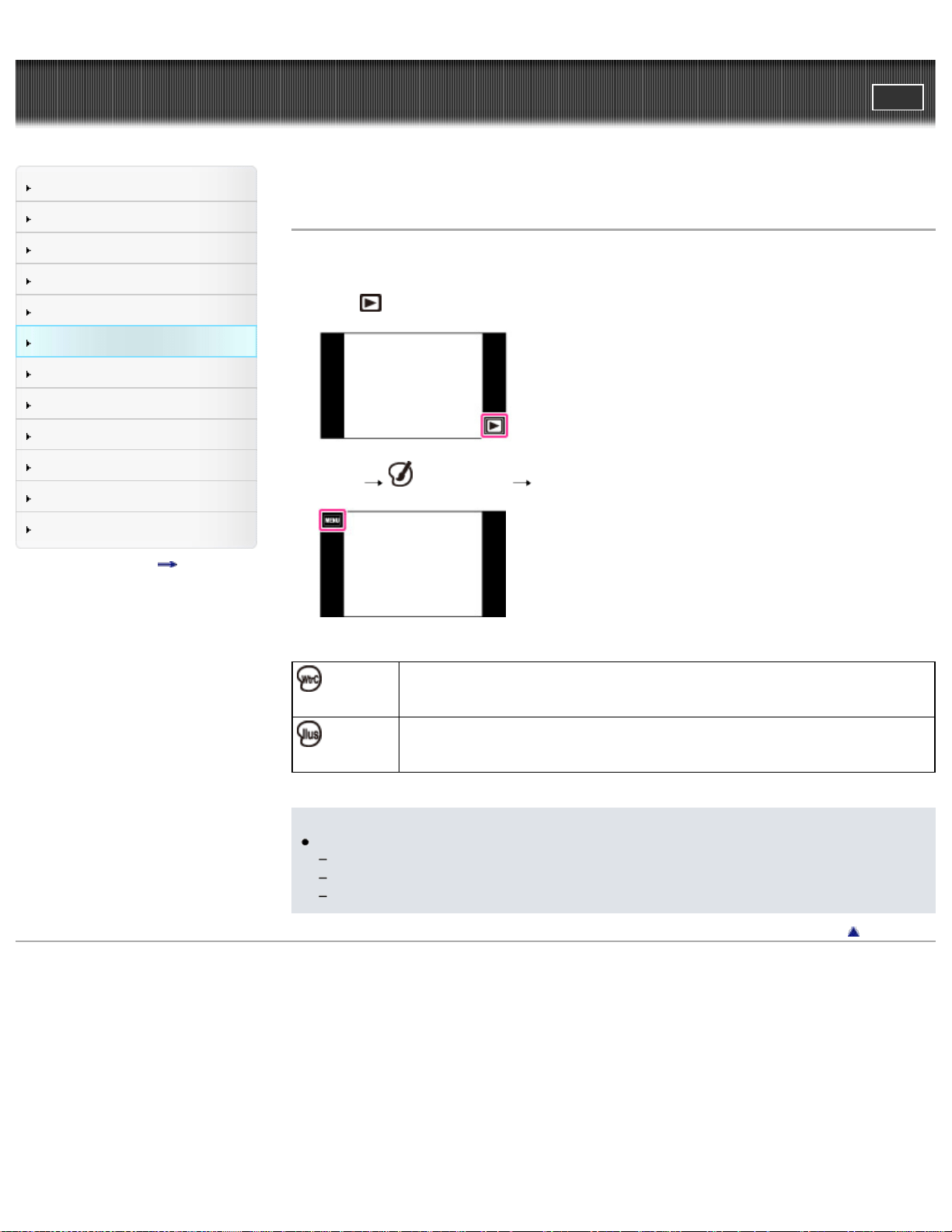
Cyber-shot User Guide
PrintSearch
Before Use
Operating the camera
Shooting
Viewing
Useful shooting functions
Useful viewing functions
Changing settings
Viewing images on a TV
Using with your computer
Printing
Troubleshooting
Precautions / About this camera
Contents list
Top page > Useful viewing functions > MENU items (Viewing) > Picture Effect
Picture Effect
Retouches a recorded image so that it looks like a watercolor or illustration, and saves it as a new file.
The original image is retained.
1. Touch
(Playback) to switch to playback mode.
2. MENU (Picture Effect) desired mode
(Watercolor)
Adds ink bleed and gradational effects to images, as if they were painted using
watercolors.
(Illustration)
Adds illustration-like effects to images by emphasizing the contours, etc.
Notes
You cannot use [Picture Effect] for the following images:
Panoramic images
3D images
Movies
Back to top
Copyright 2013 Sony Corporation
144
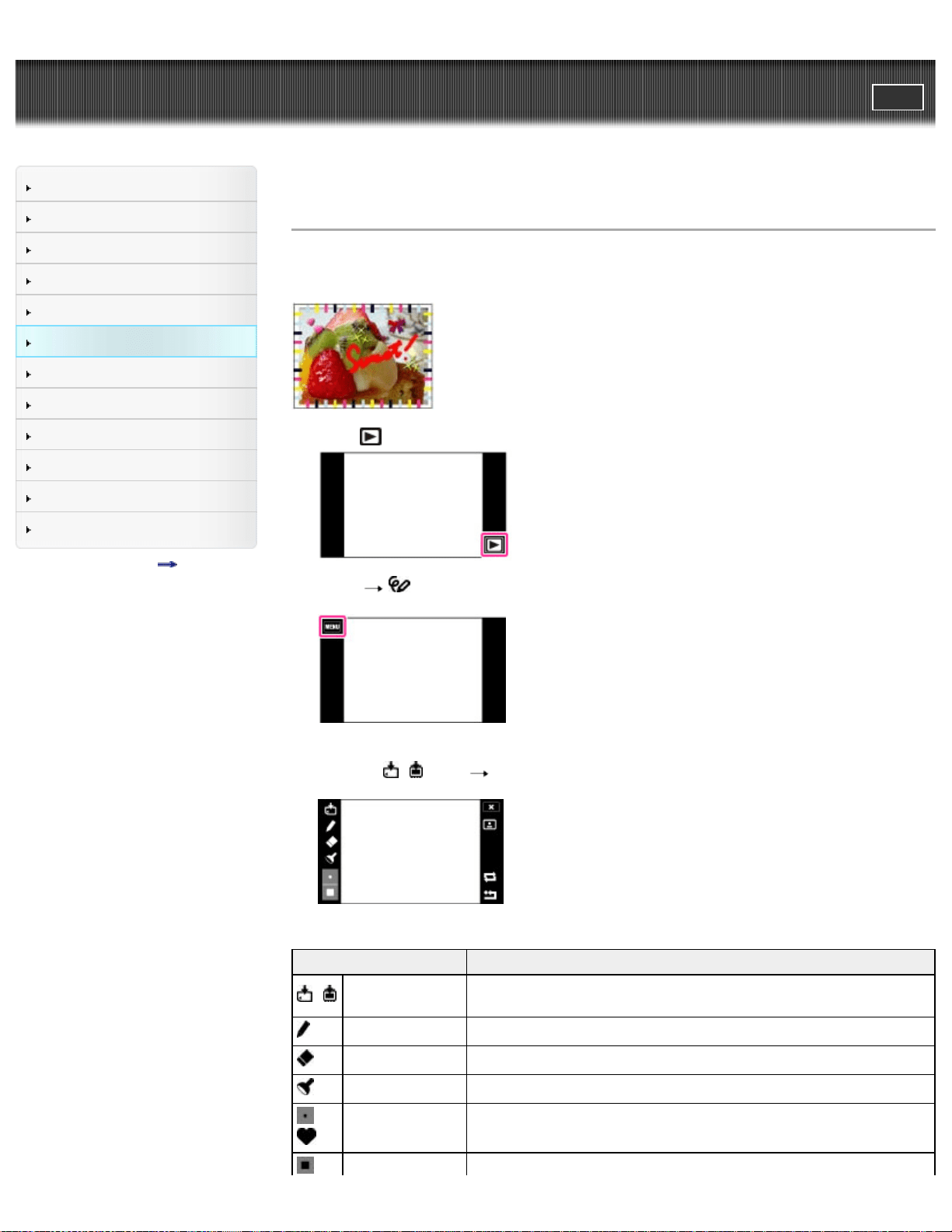
Cyber-shot User Guide
PrintSearch
Before Use
Operating the camera
Shooting
Viewing
Useful shooting functions
Useful viewing functions
Changing settings
Viewing images on a TV
Using with your computer
Printing
Troubleshooting
Precautions / About this camera
Contents list
Top page > Useful viewing functions > MENU items (Viewing) > Paint
Paint
Paints or adds stamps to a still image and saves it as a new file.
The original image is retained.
1. Touch (Playback) to switch to playback mode.
2. MENU (Paint)
3. Draw on the image with your finger.
4. Touch the
/ button select the saved image size.
Button Action
/
Save
Saves the image in VGA or 5M format in the internal memory or on a
memory card.
Pen Paints characters or graphics.
Eraser Makes corrections.
Stamp Applies a stamp to the image.
/
Thickness/Stamps Selects the pen or eraser thickness, or the stamp.
Color Selects the color.
145
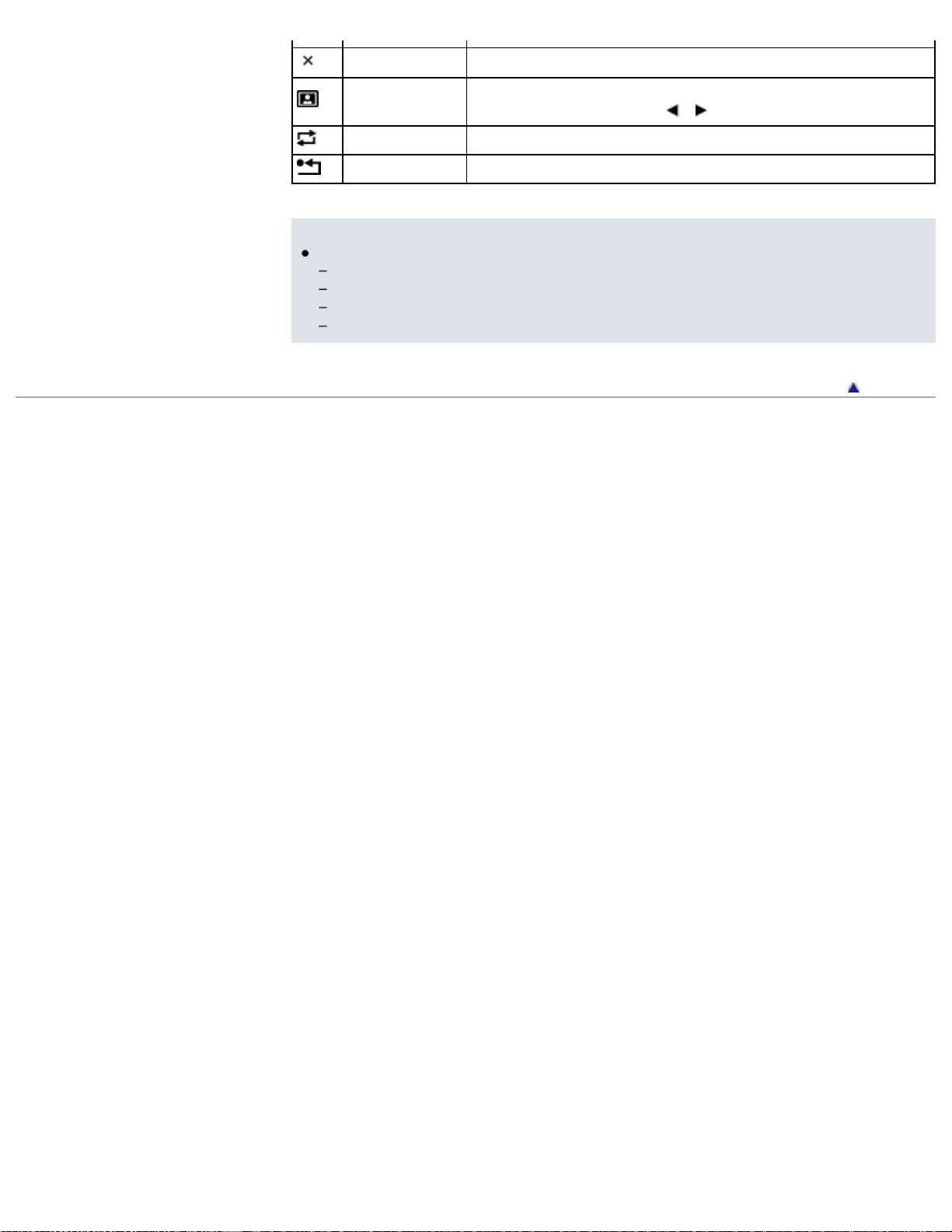
Exit Exits paint mode.
Frame
Adds a frame.
Selects the desired frame with
/ .
Revert Undoes the last action.
Clear all Erases all painting.
Notes
You cannot paint or put stamps on the following images:
Panoramic images
3D images
Movies
Images displayed in a burst group
Back to top
Copyright 2013 Sony Corporation
146
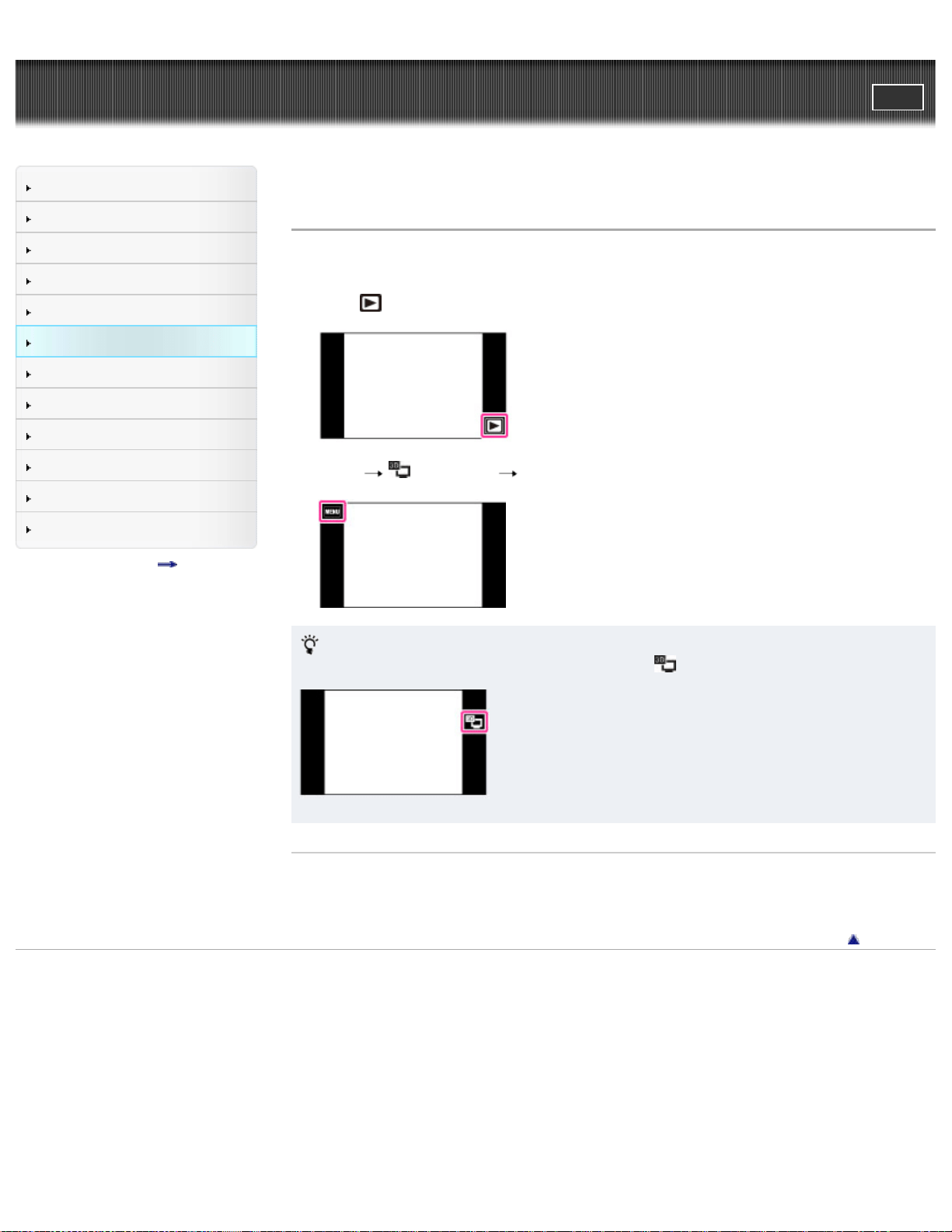
Cyber-shot User Guide
PrintSearch
Before Use
Operating the camera
Shooting
Viewing
Useful shooting functions
Useful viewing functions
Changing settings
Viewing images on a TV
Using with your computer
Printing
Troubleshooting
Precautions / About this camera
Contents list
Top page > Useful viewing functions > MENU items (Viewing) > 3D Viewing
3D Viewing
Select [3D Viewing] when you want to play back images shot in 3D mode on the 3D TV. Connect the
camera and the 3D TV using an HDMI Cable (sold separately).
1. Touch
(Playback) to switch to playback mode.
2. MENU (3D Viewing) [OK]
Setting to 3D Viewing mode easily
You can set the camera to 3D Viewing mode by touching
on the upper right side of the screen.
Related Topic
Viewing 3D images on a 3D TV
Back to top
Copyright 2013 Sony Corporation
147
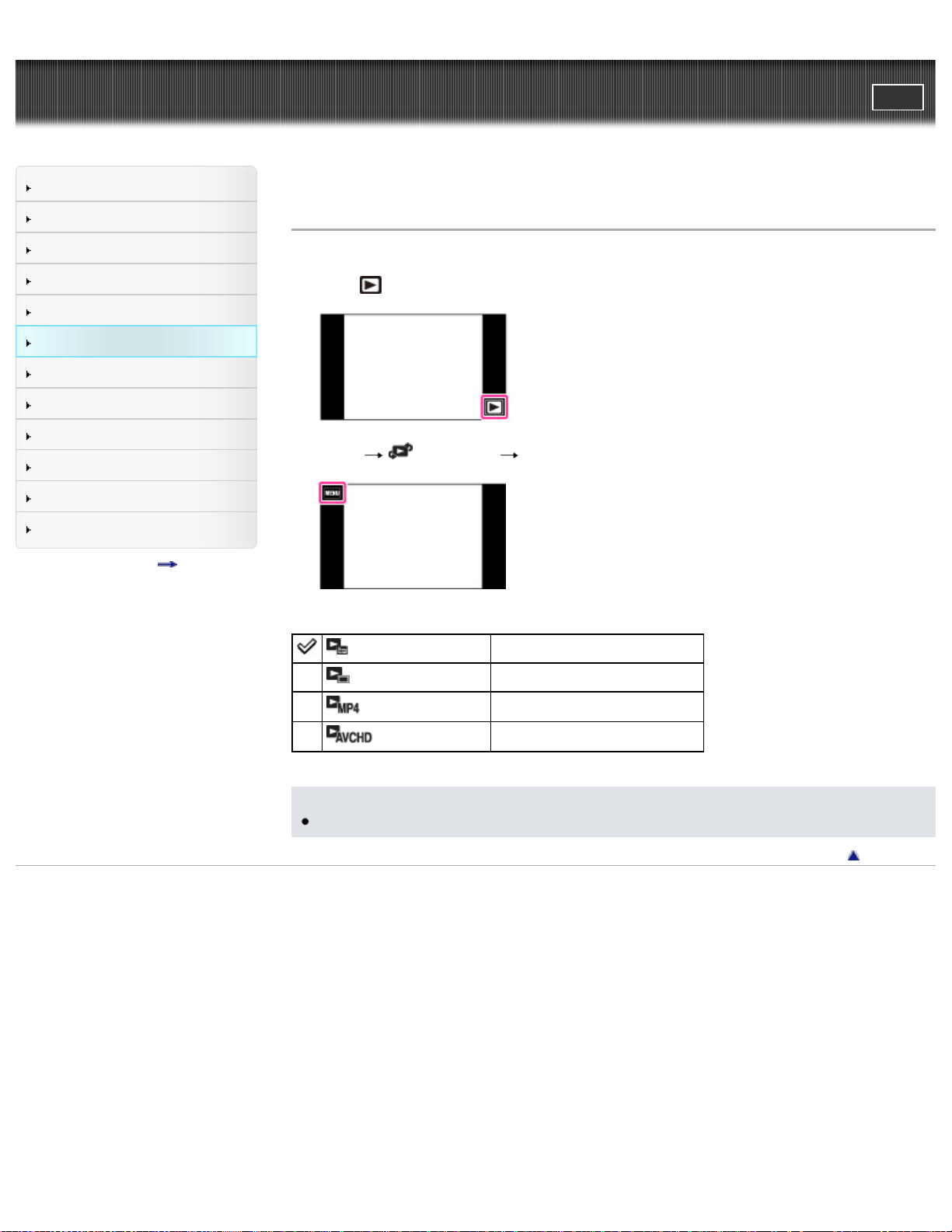
Cyber-shot User Guide
PrintSearch
Before Use
Operating the camera
Shooting
Viewing
Useful shooting functions
Useful viewing functions
Changing settings
Viewing images on a TV
Using with your computer
Printing
Troubleshooting
Precautions / About this camera
Contents list
Top page > Useful viewing functions > MENU items (Viewing) > View Mode
View Mode
Allows you to select the display format for images.
1. Touch
(Playback) to switch to playback mode.
2. MENU (View Mode) desired mode
(Date View)
Displays images by date.
(Folder view (Still))
Displays still images.
(Folder view (MP4))
Displays MP4-format movies.
(AVCHD view)
Displays AVCHD-format movies.
Notes
When the internal memory is used to record images, still images are displayed in the Folder View.
Back to top
Copyright 2013 Sony Corporation
148
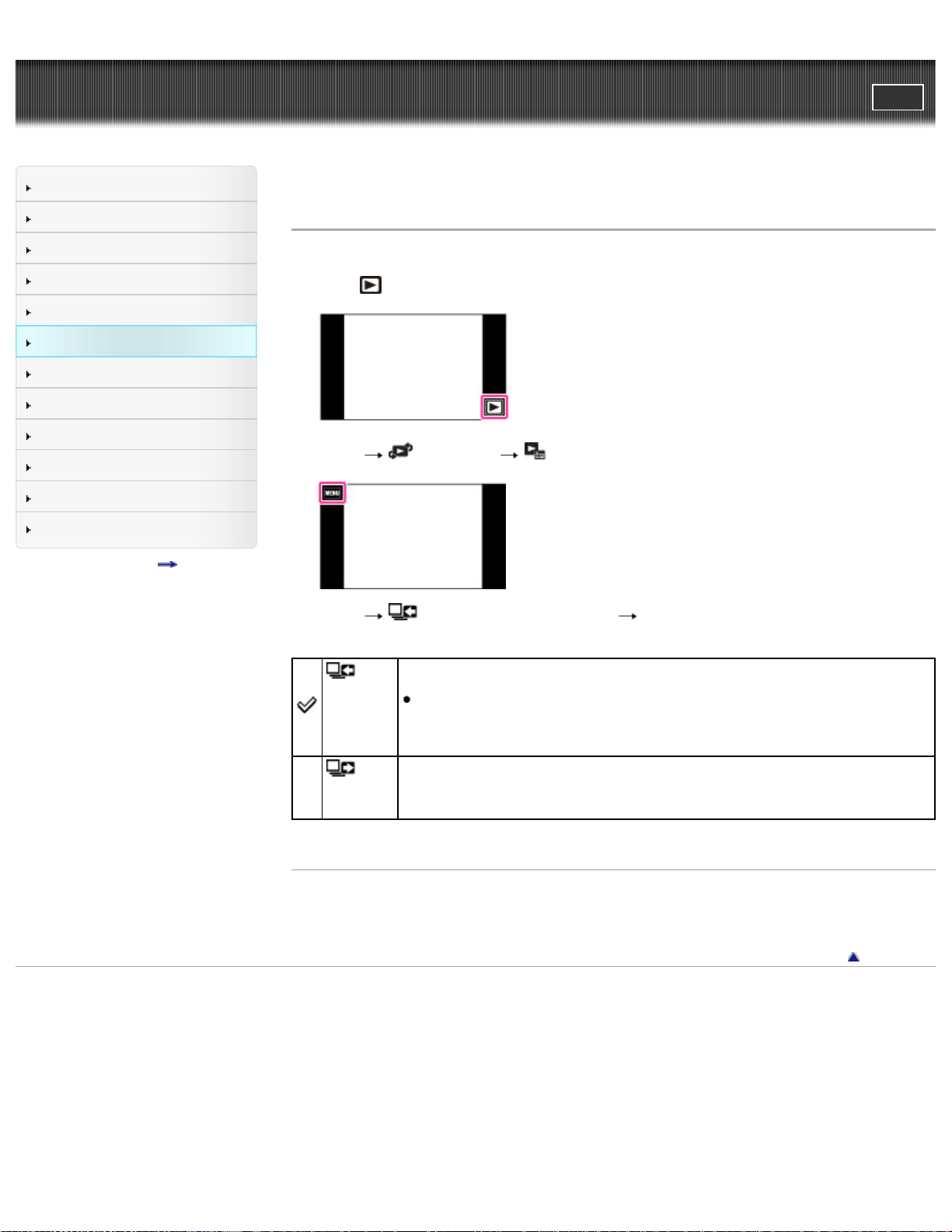
Cyber-shot User Guide
PrintSearch
Before Use
Operating the camera
Shooting
Viewing
Useful shooting functions
Useful viewing functions
Changing settings
Viewing images on a TV
Using with your computer
Printing
Troubleshooting
Precautions / About this camera
Contents list
Top page > Useful viewing functions > MENU items (Viewing) > Display Cont. Shooting Group
Display Cont. Shooting Group
You can select to display burst images in groups or display all images during playback.
1. Touch
(Playback) to switch to playback mode.
2. MENU (View Mode) (Date View)
3. MENU (Display Cont. Shooting Group) desired setting
(Display
Main
Image
Only)
Groups burst images, then plays back the main image only.
When Face Detection is performed in burst mode, the camera determines and
displays the optimum image as the main image. When Face Detection is not
performed, the first image in the burst group is displayed as the main image.
(Display
All)
Plays back all burst images one at a time.
Related Topic
Viewing burst images
Back to top
Copyright 2013 Sony Corporation
149
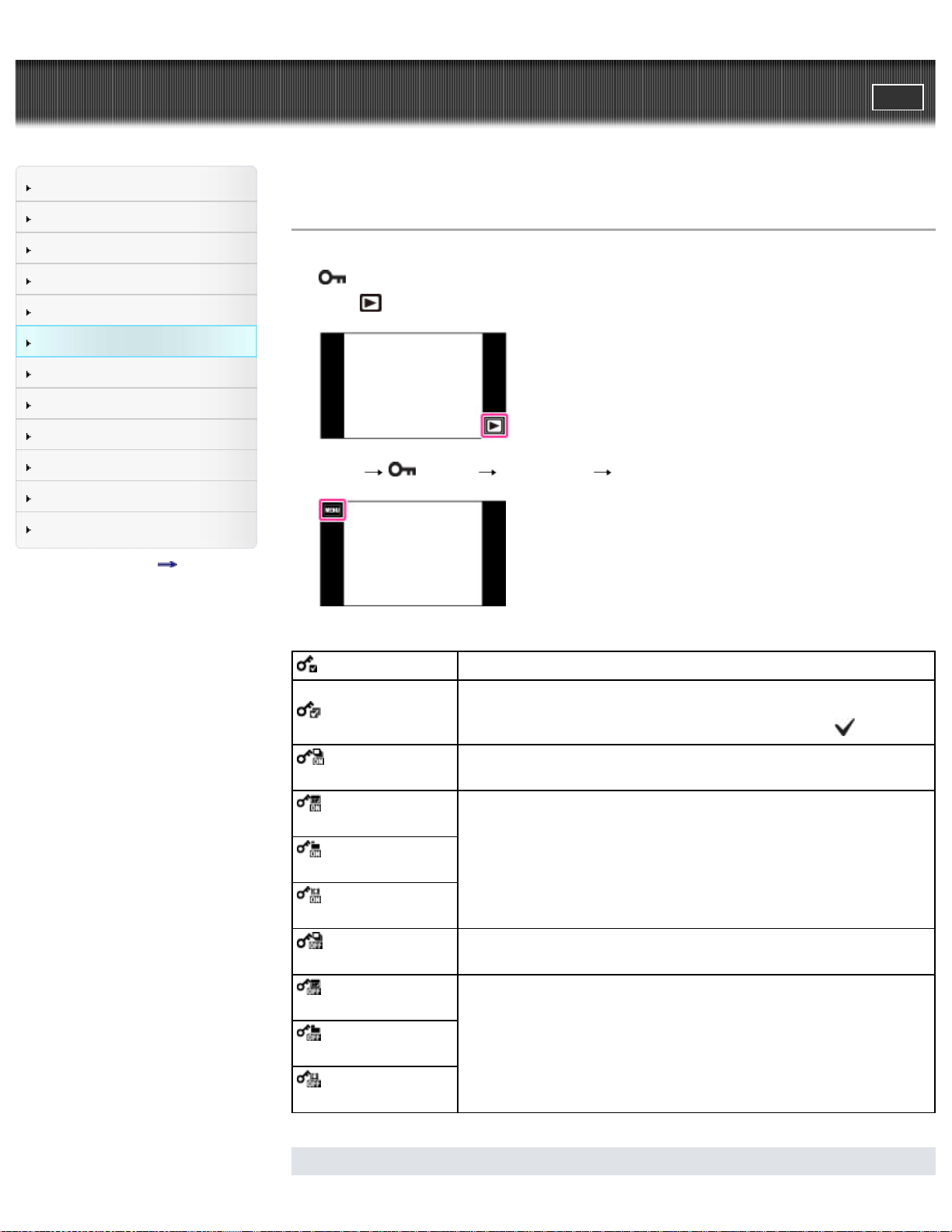
Cyber-shot User Guide
PrintSearch
Before Use
Operating the camera
Shooting
Viewing
Useful shooting functions
Useful viewing functions
Changing settings
Viewing images on a TV
Using with your computer
Printing
Troubleshooting
Precautions / About this camera
Contents list
Top page > Useful viewing functions > MENU items (Viewing) > Protect
Protect
Protects recorded images against accidental erasure.
The
mark is displayed for registered images.
1. Touch
(Playback) to switch to playback mode.
2. MENU (Protect) desired mode [OK]
(This Image)
Protects the currently displayed image in single-image mode.
(Multiple Images)
You can select and protect multiple images.
After step 2, select an image to be protected, then touch it.
To cancel the selection, touch the image again to cancel the
mark.
(Set All Cont.
Shooting Imgs.)
Protects all images in the selected burst group at once in Display Cont.
Shooting Group mode.
(Set All on This
Date)
Protects all images in the date range or folder, or all AVCHD movies.
(Set All in This
Folder)
(Set All AVCHD
view files)
(Rmv. All Cnt.
Shoot. Images.)
Releases all protected images in the selected burst group at once in
Display Cont. Shooting Group mode.
(Remove All on This
Date)
Releases all images in the date range or folder, or all AVCHD movies at
once.
(Remove All in This
Folder)
(Remove All AVCHD
view files)
Notes
150

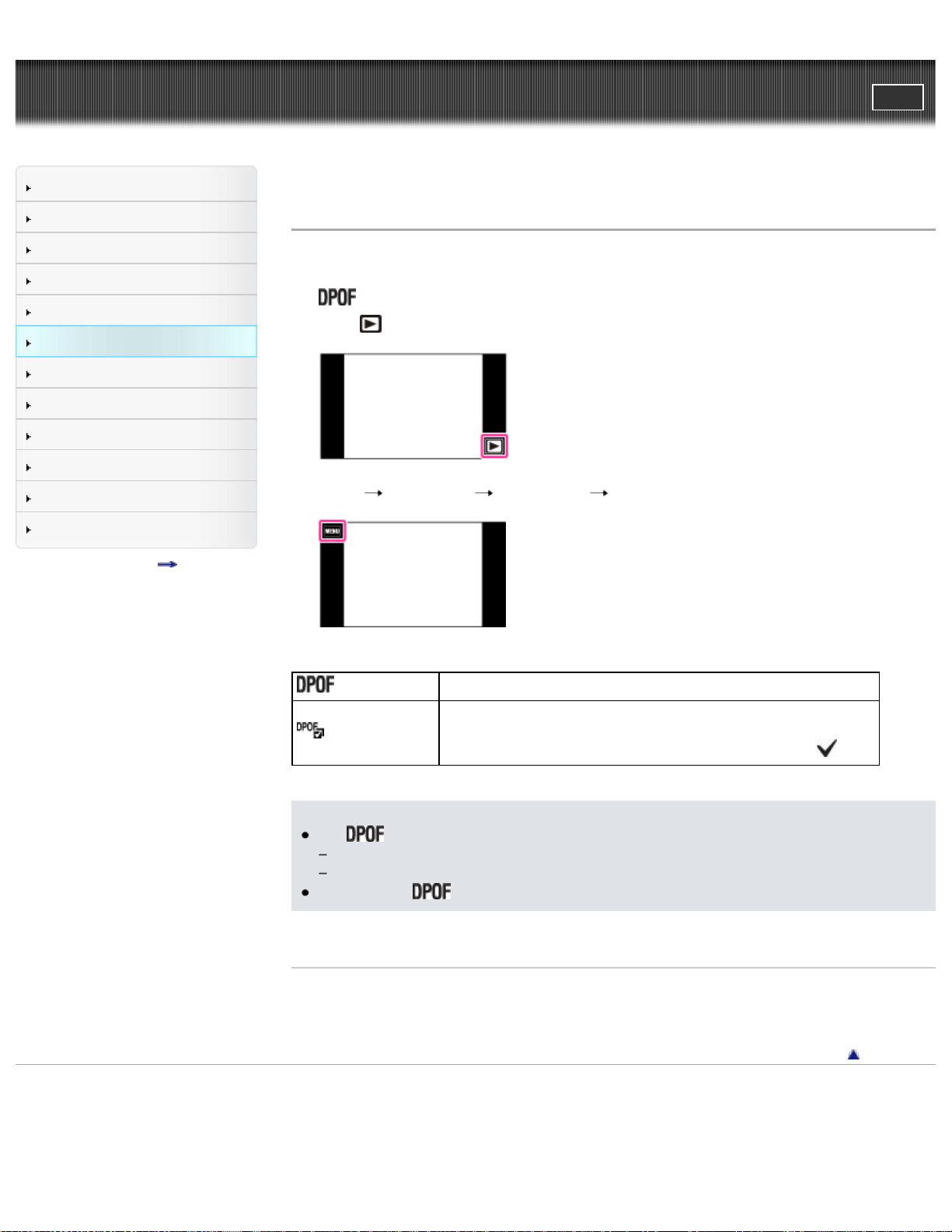
Cyber-shot User Guide
PrintSearch
Before Use
Operating the camera
Shooting
Viewing
Useful shooting functions
Useful viewing functions
Changing settings
Viewing images on a TV
Using with your computer
Printing
Troubleshooting
Precautions / About this camera
Contents list
Top page > Useful viewing functions > MENU items (Viewing) > Print (DPOF)
Print (DPOF)
DPOF (Digital Print Order Format) is a function that allows you to specify the images of the memory card
that you want to print out later.
The
(Print order) mark is displayed for registered images.
1. Touch
(Playback) to switch to playback mode.
2. MENU Print (DPOF) desired mode [OK]
(This Image)
Orders printing the currently displayed image in single-image mode.
(Multiple Images)
You can select and order multiple images to be printed.
After step 2, select an image to be printed, then touch it.
To cancel the selection, touch the image again to cancel the
mark.
Notes
The
(Print order) mark cannot be added to the following images:
Movies
Images in the internal memory
You can add a
(Print order) mark to a maximum 999 images.
Related Topic
Printing still images
Back to top
Copyright 2013 Sony Corporation
152
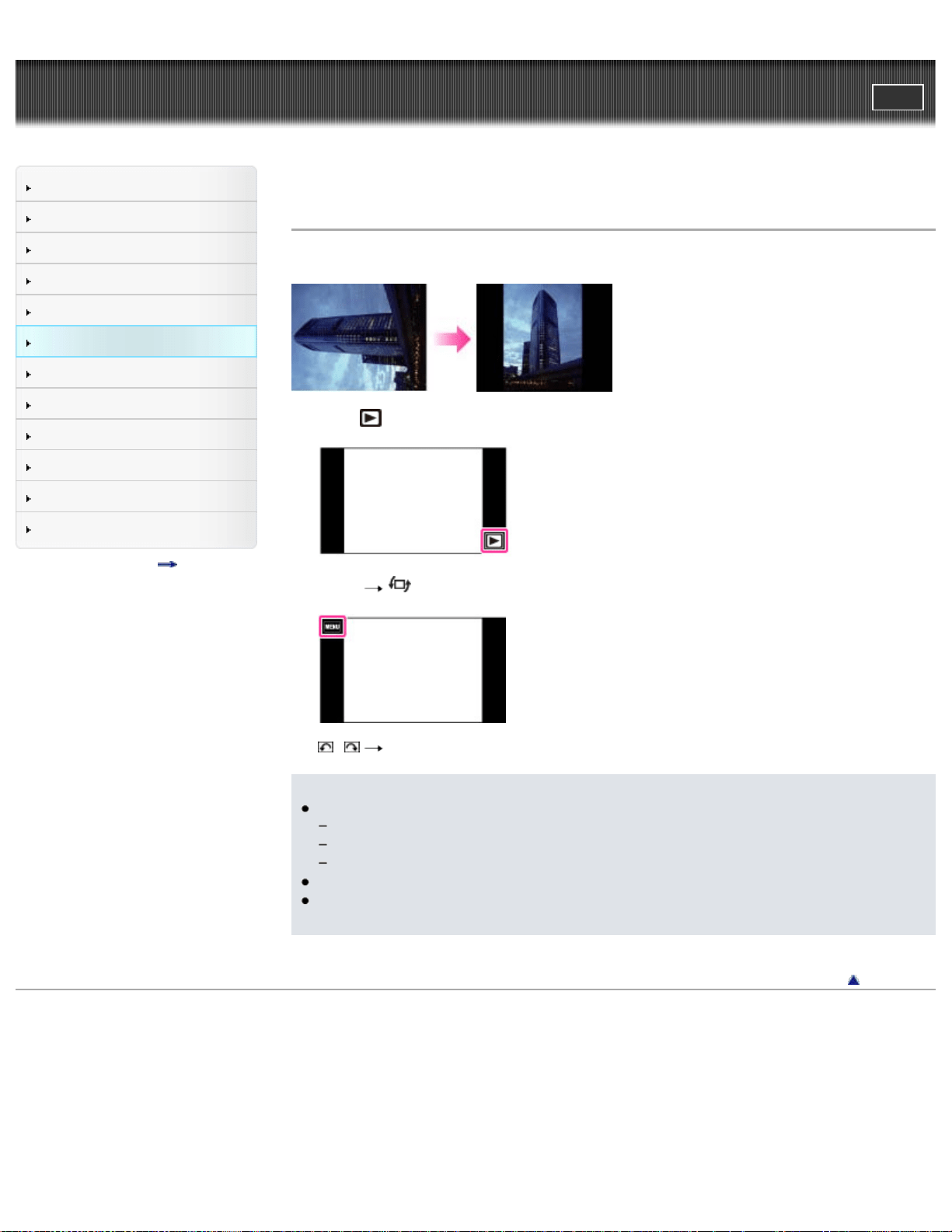
Cyber-shot User Guide
PrintSearch
Before Use
Operating the camera
Shooting
Viewing
Useful shooting functions
Useful viewing functions
Changing settings
Viewing images on a TV
Using with your computer
Printing
Troubleshooting
Precautions / About this camera
Contents list
Top page > Useful viewing functions > MENU items (Viewing) > Rotate
Rotate
Rotates a still image. Use this to display a horizontal orientation image in vertical orientation.
1. Touch (Playback) to switch to playback mode.
2. MENU (Rotate)
3. / [OK]
Notes
You cannot rotate the following images:
Movies
3D Image
Images displayed in a burst group
You may not be able to rotate images shot with other cameras.
When viewing images on a computer, the image rotation information may not be reflected
depending on the software.
Back to top
Copyright 2013 Sony Corporation
153
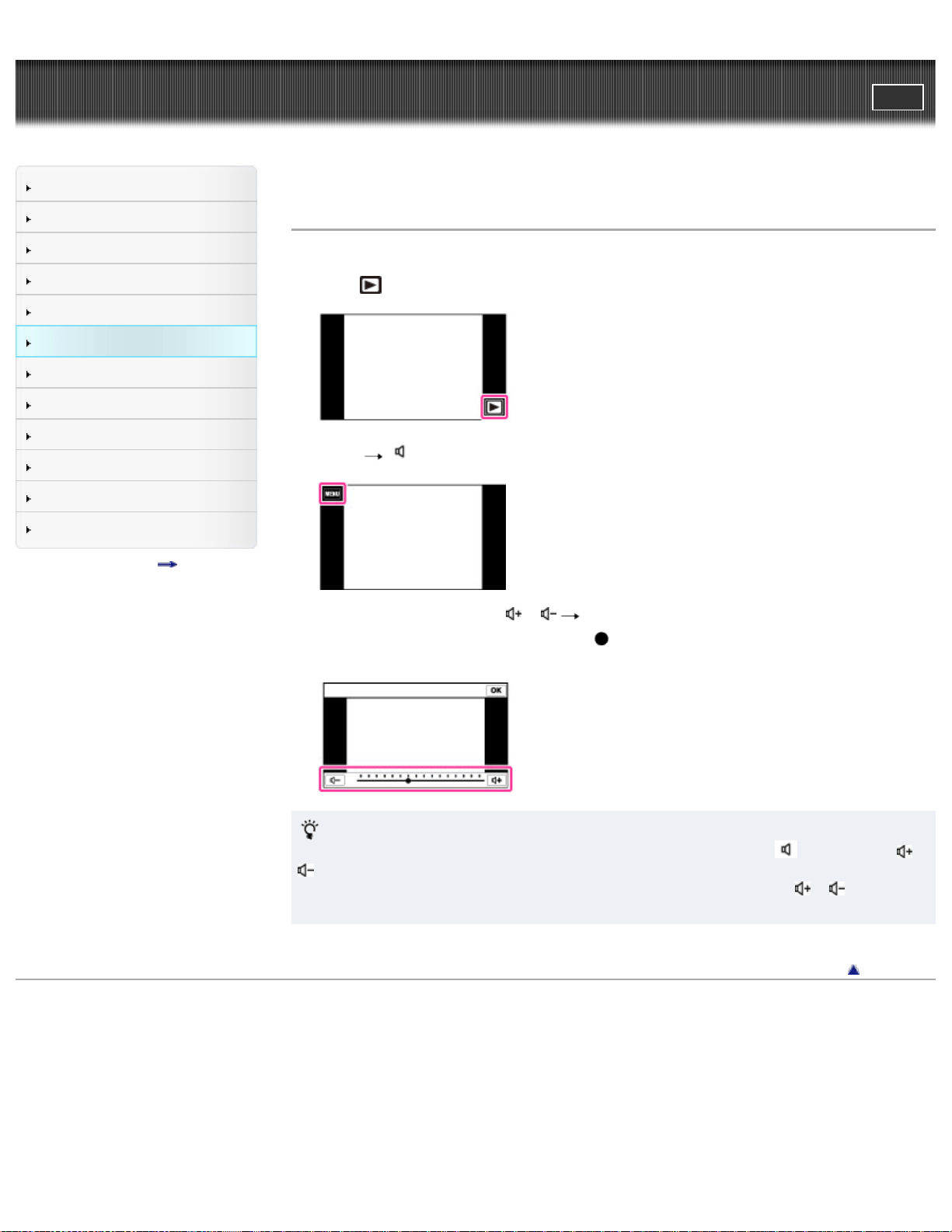
Cyber-shot User Guide
PrintSearch
Before Use
Operating the camera
Shooting
Viewing
Useful shooting functions
Useful viewing functions
Changing settings
Viewing images on a TV
Using with your computer
Printing
Troubleshooting
Precautions / About this camera
Contents list
Top page > Useful viewing functions > MENU items (Viewing) > Volume
Volume
Adjusts the volume for slideshow and movie playback.
1. Touch
(Playback) to switch to playback mode.
2. MENU (Volume)
3. Adjust the volume by touching or [OK].
You can also adjust the volume by touching
on the volume adjustment bar and dragging to the
right or left.
Adjusting the volume during playback of a movie or slideshow
Movie playback: Touch the screen to display the operation buttons, touch
and then touch or
to adjust the volume.
Slideshow: Touch the screen to display the volume control screen, then touch
or to adjust the
volume.
Back to top
Copyright 2013 Sony Corporation
154
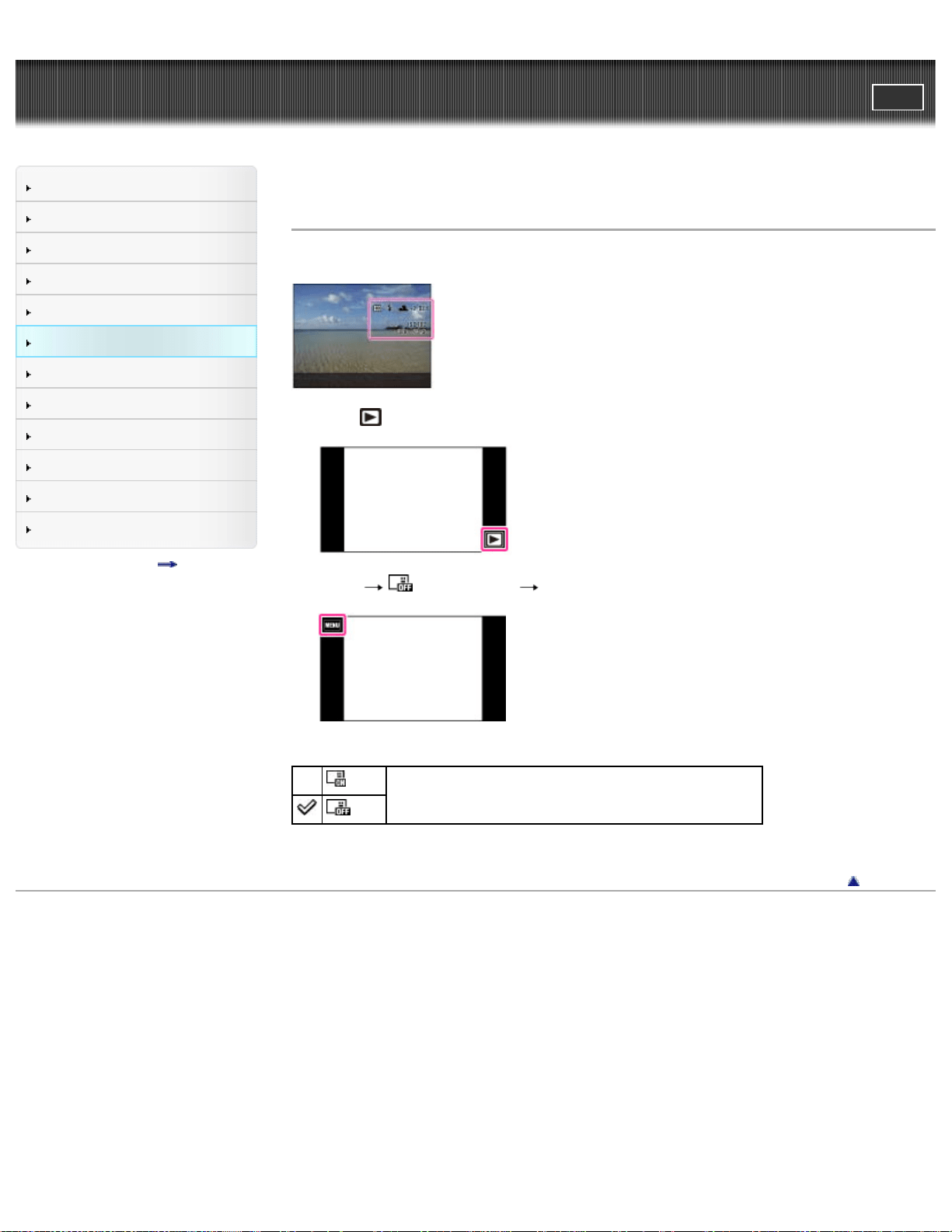
Cyber-shot User Guide
PrintSearch
Before Use
Operating the camera
Shooting
Viewing
Useful shooting functions
Useful viewing functions
Changing settings
Viewing images on a TV
Using with your computer
Printing
Troubleshooting
Precautions / About this camera
Contents list
Top page > Useful viewing functions > MENU items (Viewing) > Exposure data
Exposure data
Sets whether or not to display the exposure data of the currently displayed file.
1. Touch (Playback) to switch to playback mode.
2. MENU (Exposure data) desired mode
(On)
Displays/Does not display the exposure data on the screen.
(Off)
Back to top
Copyright 2013 Sony Corporation
155
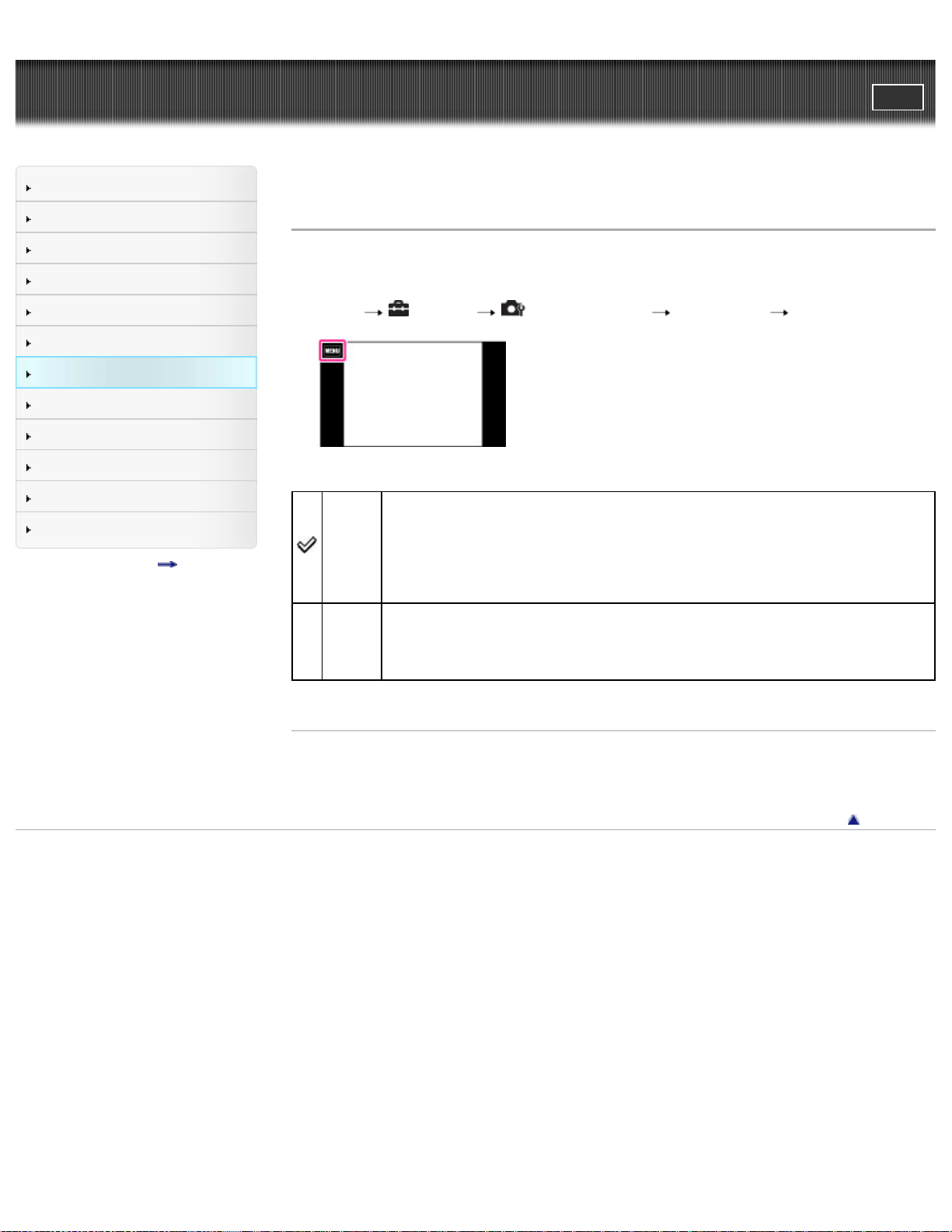
Cyber-shot User Guide
PrintSearch
Before Use
Operating the camera
Shooting
Viewing
Useful shooting functions
Useful viewing functions
Changing settings
Viewing images on a TV
Using with your computer
Printing
Troubleshooting
Precautions / About this camera
Contents list
Top page > Changing settings > Shooting Settings > Movie format
Movie format
You can set the recording method used to record movies.
1. Set the camera to shooting mode.
2. MENU
(Settings) (Shooting Settings) [Movie format] desired mode
AVCHD
AVCHD movies are recorded. Sets the recording method to AVCHD, which is suitable
for viewing smooth video images on a high-definition television.
Blu-ray discs, AVCHD discs and DVD-Video discs can be created using the software
“PlayMemories Home.” When you create AVCHD discs from movies recorded in [AVC
HD 24M (FX)], it will take time as the image quality must be converted. To save [AVC
HD 24M (FX)] movies without converting the image quality, use Blu-ray discs. [Details]
MP4
MP4 (AVC) movies are recorded. Sets the recording method to MP4, which is suitable
for WEB uploads and e-mail attachments.
No discs can be created from MP4 movies, even if you use the software “PlayMemories
Home.”
Related Topic
AVCHD format
Back to top
Copyright 2013 Sony Corporation
156
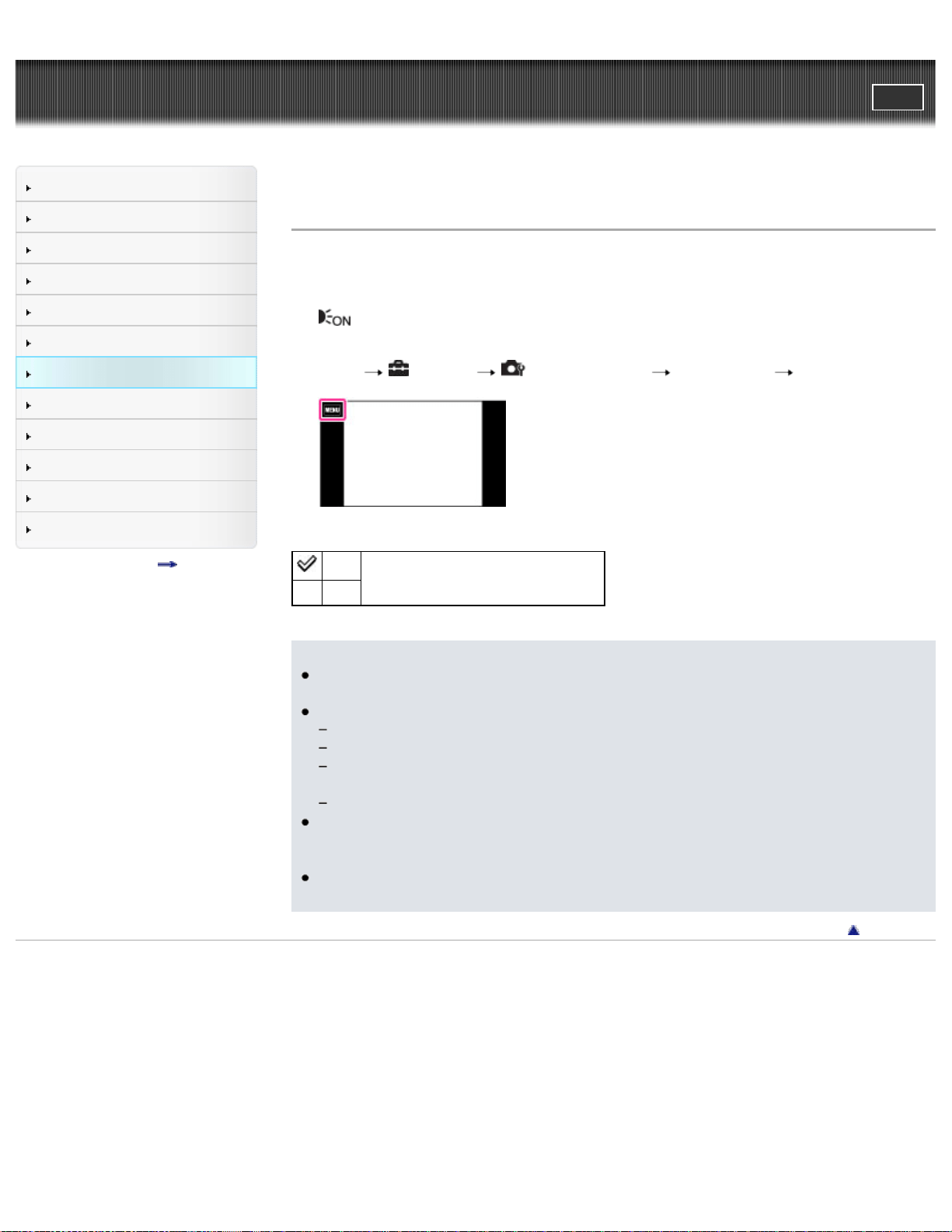
Cyber-shot User Guide
PrintSearch
Before Use
Operating the camera
Shooting
Viewing
Useful shooting functions
Useful viewing functions
Changing settings
Viewing images on a TV
Using with your computer
Printing
Troubleshooting
Precautions / About this camera
Contents list
Top page > Changing settings > Shooting Settings > AF Illuminator
AF Illuminator
The AF illuminator supplies fill light to focus more easily on a subject in dark surroundings.
The AF illuminator emits red light allowing the camera to focus easily when the shutter button is pressed
halfway, until the focus is locked.
The
indicator appears at this time.
1. Set the camera to shooting mode.
2. MENU
(Settings) (Shooting Settings) [AF Illuminator] desired mode
Auto
Uses/Does not use the AF illuminator.
Off
Notes
Focus is achieved as long as the AF illuminator light reaches the subject, regardless of whether
light fails to reach the center of the subject.
You cannot use the AF illuminator in the following situations:
In movie mode
In [iSweep Panorama]
When [Landscape], [Night Scene], [Pet], [Fireworks] or [Hi-Speed Shutter] mode is selected in
Scene Selection.
When [Self-Timer] is set to [Self-portrait One Person] or [Self-portrait Two People].
When you use the AF illuminator, the normal AF range finder frame is disabled and a new AF range
finder frame is displayed by a dotted line. AF operates with priority on subjects located near the
center of the frame.
The AF illuminator emits very bright light. Although there is no health hazard, do not look directly
into the AF illuminator emitter at close range.
Back to top
Copyright 2013 Sony Corporation
157
Cyber-shot User Guide
PrintSearch
Before Use
Operating the camera
Shooting
Viewing
Useful shooting functions
Useful viewing functions
Changing settings
Viewing images on a TV
Using with your computer
Printing
Troubleshooting
Precautions / About this camera
Contents list
Top page > Changing settings > Shooting Settings > Grid Line
Grid Line
With reference to the grid lines, you can easily set a subject in a horizontal/vertical position.
1. Set the camera to shooting mode.
2. MENU
(Settings) (Shooting Settings) [Grid Line] desired mode
On Displays the grid lines. The grid lines are not recorded.
Off Does not display the grid lines.
Back to top
Copyright 2013 Sony Corporation
158
Cyber-shot User Guide
PrintSearch
Before Use
Operating the camera
Shooting
Viewing
Useful shooting functions
Useful viewing functions
Changing settings
Viewing images on a TV
Using with your computer
Printing
Troubleshooting
Precautions / About this camera
Contents list
Top page > Changing settings > Shooting Settings > Clear Image Zoom
Clear Image Zoom
Total zoom scale when [Clear Image Zoom] is selected (including 5× optical zoom)
[Clear Image Zoom] allows you to enlarge the image with close to the original image quality when
shooting still images.
The camera zooms images with the original image quality first depending on the selected still image size.
When [Clear Image Zoom] is set to [On], the camera automatically switches over to [Clear Image Zoom]
when the zoom range without deterioration of the original image quality is exceeded.
1. Set the camera to shooting mode.
2. MENU
(Settings) (Shooting Settings) [Clear Image Zoom] desired mode
On
Zooms the images with close to the original image quality, depending on the image size.
Switches to [Clear Image Zoom] within the range where
is displayed.
Off Does not use [Clear Image Zoom].
Notes
To zoom the images within the range where original image quality can be retained, set both [Clear
Image Zoom] and [Digital Zoom] to [Off]. [Details]
[Clear Image Zoom] function does not operate in the following situations:
In movie mode
In [iSweep Panorama]
In [Picture Effect]
In [Background Defocus]
When the Smile Shutter function is activated.
When [Self-Timer] is set to [Self-portrait One Person] or [Self-portrait Two People].
When [Cont. Shooting Settings] is set to [High] or [Low].
When [Backlight Correction HDR] mode is selected in Scene Selection.
The Face Detection function does not operate in the range of [Clear Image Zoom].
Total zoom scale when [Clear Image Zoom] is selected (including 5×
optical zoom)
The supported zoom scales are different depending on the image size. These scales apply when
[Macro] is set to other than [Magnifying Glass Plus]. [Details]
Image size Total zoom scale
18M Approx. 10×
10M Approx. 13×
159

Cyber-shot User Guide
PrintSearch
Before Use
Operating the camera
Shooting
Viewing
Useful shooting functions
Useful viewing functions
Changing settings
Viewing images on a TV
Using with your computer
Printing
Troubleshooting
Precautions / About this camera
Contents list
Top page > Changing settings > Shooting Settings > Digital Zoom
Digital Zoom
Sets the total zoom scale (including 5× optical zoom). When [Digital Zoom] is set to [On], the camera
zooms images without deteriorating the original quality, but it automatically switches over to [Digital
Zoom] when that zoom range (for achieving the original image quality) is exceeded.
When [Clear Image Zoom] is set to [On] to shoot still images, the camera automatically switches over to
[Digital Zoom] when the [Clear Image Zoom] range is exceeded. [Details]
1. Set the camera to shooting mode.
2. MENU
(Settings) (Shooting Settings) [Digital Zoom] desired mode
On
The quality of the resulting image will deteriorate when
is displayed, since the zoom
function is switched over to [Digital Zoom], but you can enlarge images 4× up to the
maximum zoom scale.
Off Does not use [Digital Zoom].
Notes
When using [Clear Image Zoom], the maximum zoom scale for [Digital Zoom] is 2×.
[Digital Zoom] is not available in the following situations:
In [iSweep Panorama]
In [Picture Effect]
In [Background Defocus]
When the Smile Shutter function is activated.
When [Self-Timer] is set to [Self-portrait One Person] or [Self-portrait Two People].
When [Backlight Correction HDR] mode is selected in Scene Selection.
The Face Detection function does not operate in the range of [Digital Zoom].
Back to top
Copyright 2013 Sony Corporation
161
Cyber-shot User Guide
PrintSearch
Before Use
Operating the camera
Shooting
Viewing
Useful shooting functions
Useful viewing functions
Changing settings
Viewing images on a TV
Using with your computer
Printing
Troubleshooting
Precautions / About this camera
Contents list
Top page > Changing settings > Shooting Settings > Wind Noise Reduct.
Wind Noise Reduct.
Reduces the noise of the wind when shooting movies.
1. Set the camera to shooting mode.
2. MENU
(Settings) (Shooting Settings) [Wind Noise Reduct.] desired mode
On
Reduces/Does not reduce wind noise.
Off
Notes
If [Wind Noise Reduct.] is set to [On] even though the wind is not blowing strongly, the recorded
sounds other than the wind may be hard to hear.
Back to top
Copyright 2013 Sony Corporation
162
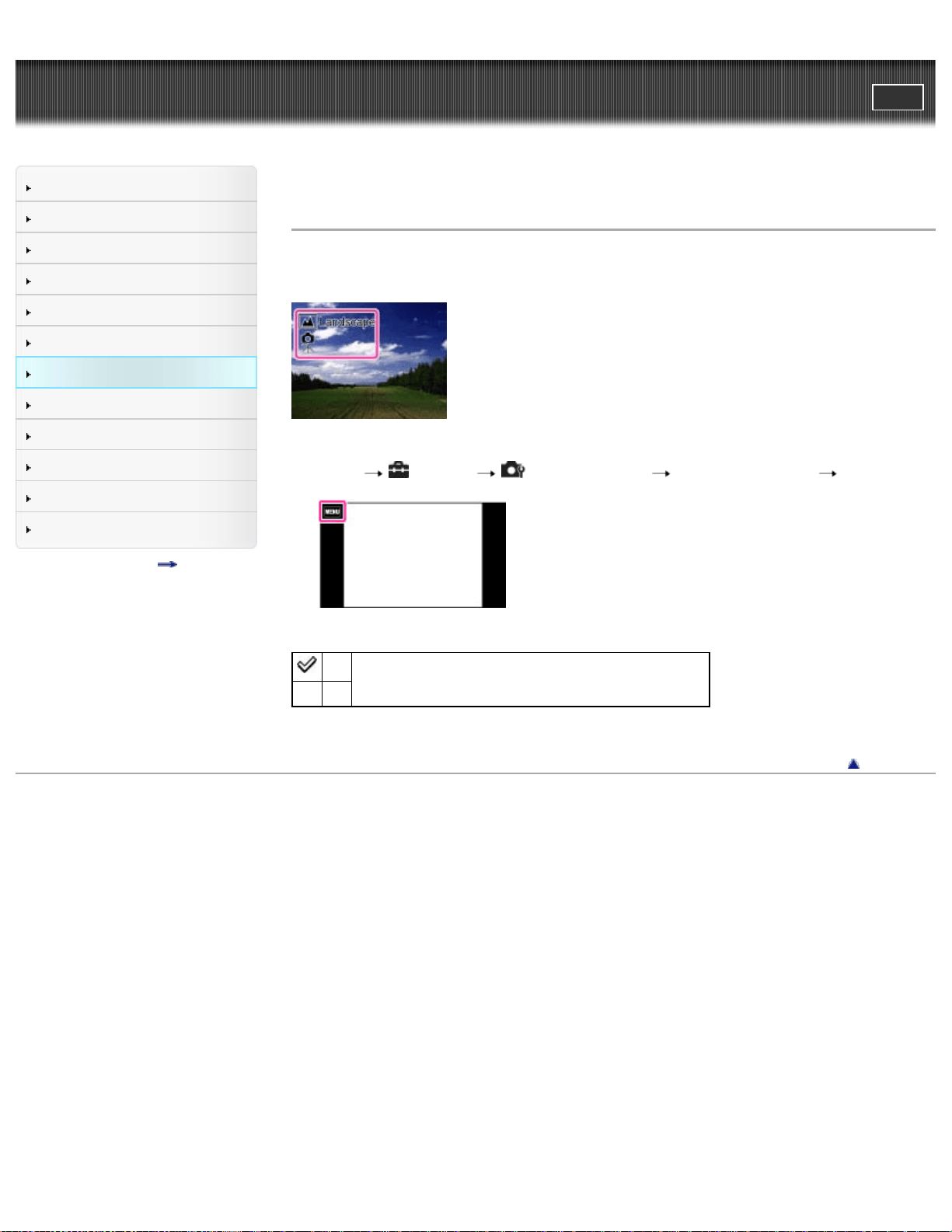
Cyber-shot User Guide
PrintSearch
Before Use
Operating the camera
Shooting
Viewing
Useful shooting functions
Useful viewing functions
Changing settings
Viewing images on a TV
Using with your computer
Printing
Troubleshooting
Precautions / About this camera
Contents list
Top page > Changing settings > Shooting Settings > Scene Recog. Guide
Scene Recog. Guide
You can select whether or not the guide is displayed next to the Scene Recognition icon when Scene
Recognition is activated.
1. Set the camera to shooting mode.
2. MENU
(Settings) (Shooting Settings) [Scene Recog. Guide] desired mode
On
Displays/Does not display the Scene Recognition Guide.
Off
Back to top
Copyright 2013 Sony Corporation
163
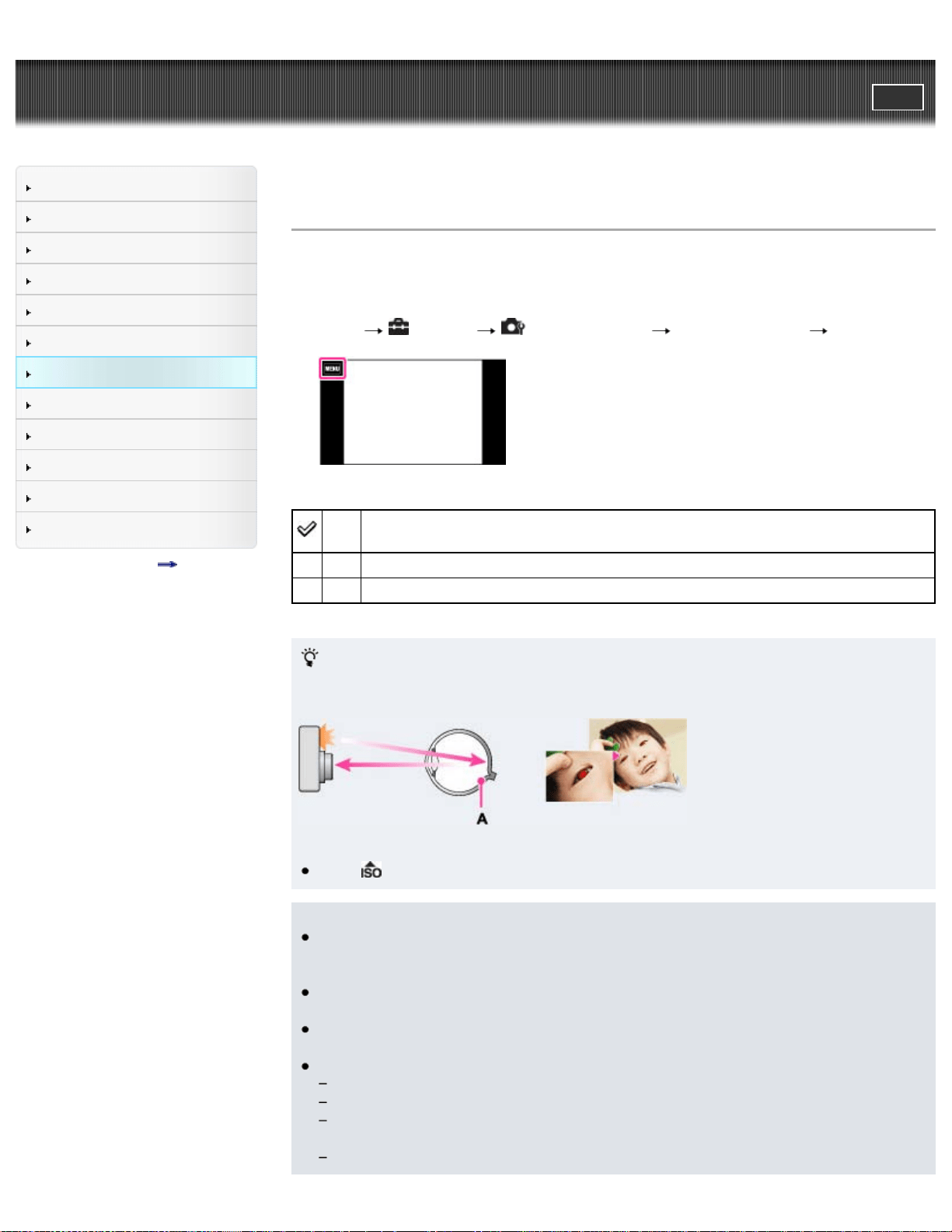
Cyber-shot User Guide
PrintSearch
Before Use
Operating the camera
Shooting
Viewing
Useful shooting functions
Useful viewing functions
Changing settings
Viewing images on a TV
Using with your computer
Printing
Troubleshooting
Precautions / About this camera
Contents list
Top page > Changing settings > Shooting Settings > Red Eye Reduction
Red Eye Reduction
The flash strobes two or more times before shooting to reduce the red-eye phenomenon when using the
flash.
1. Set the camera to shooting mode.
2. MENU
(Settings) (Shooting Settings) [Red Eye Reduction] desired mode
Auto
When the Face Detection function is activated, the flash strobes automatically to reduce the
red-eye phenomenon.
On The flash always strobes to reduce the red-eye phenomenon.
Off Does not use Red Eye Reduction.
What causes the red-eye phenomenon?
Pupils become dilated in dark environments. Flash light is reflected off the blood vessels at the back of
the eye (retina) (A), causing the “red-eye” phenomenon.
Other ways to reduce red-eye
Select
(High Sensitivity) mode in Scene Selection. (The flash is set to [Off] automatically.)
Notes
To avoid blurring of images, hold the camera firmly until the shutter is released. It usually takes a
second until the shutter is released, and also be sure not to allow the subject to move during this
period.
Red Eye Reduction may not produce the desired effects. It depends on individual differences and
conditions, such as distance to the subject, or if the subject looked away from the pre-strobe.
If you do not use the Face Detection function, Red Eye Reduction does not work, even when you
select [Auto].
[Red Eye Reduction] is set to [Off] in the following situations:
In [Background Defocus]
In 3D shooting mode
When [Anti Motion Blur], [Hand-held Twilight], [High Sensitivity], [Gourmet], [Pet], [Fireworks] or
[Underwater] mode is selected in Scene Selection.
When Smile Shutter function is activated.
164

Cyber-shot User Guide
PrintSearch
Before Use
Operating the camera
Shooting
Viewing
Useful shooting functions
Useful viewing functions
Changing settings
Viewing images on a TV
Using with your computer
Printing
Troubleshooting
Precautions / About this camera
Contents list
Top page > Changing settings > Shooting Settings > Blink Alert
Blink Alert
When an image with the subject’s eyes closed is recorded while Face Detection is activated, the
message “Blinked eye detected” is displayed.
1. Set the camera to shooting mode.
2. MENU
(Settings) (Shooting Settings) [Blink Alert] desired mode
Auto
Displays/hides the “Blinked eye detected” message.
Off
Back to top
Copyright 2013 Sony Corporation
166
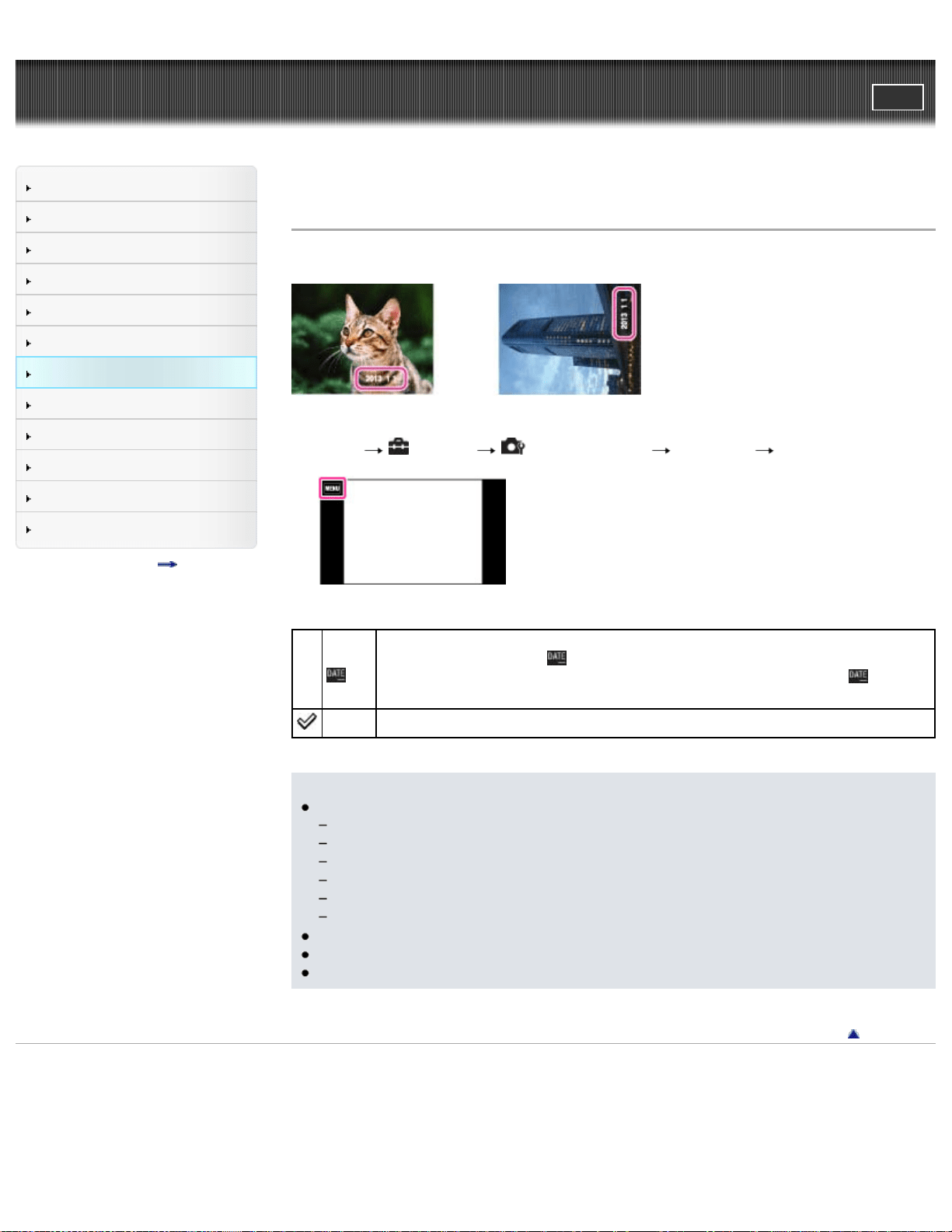
Cyber-shot User Guide
PrintSearch
Before Use
Operating the camera
Shooting
Viewing
Useful shooting functions
Useful viewing functions
Changing settings
Viewing images on a TV
Using with your computer
Printing
Troubleshooting
Precautions / About this camera
Contents list
Top page > Changing settings > Shooting Settings > Write Date
Write Date
Sets whether to record a shooting date on the still image.
1. Set the camera to shooting mode.
2. MENU
(Settings) (Shooting Settings) [Write Date] desired mode
On (
)
Records a shooting date.
When [On] is selected, the
mark will appear on the screen while shooting.
However, in some shooting modes that cannot record dates on images, the
mark will
disappear.
Off Does not record a shooting date.
Notes
You cannot record dates in the following situations:
In movie mode
When shooting still images while recording a movie (Dual Rec)
When shooting panoramic images
In burst shooting mode
In [Easy Mode]
In 3D shooting mode
If you shot images with the date once, you cannot delete the date from the images later.
The dates are doubly printed, if you set the camera to superimpose the dates when printing.
The recorded time of the image cannot be superimposed on the image.
Back to top
Copyright 2013 Sony Corporation
167
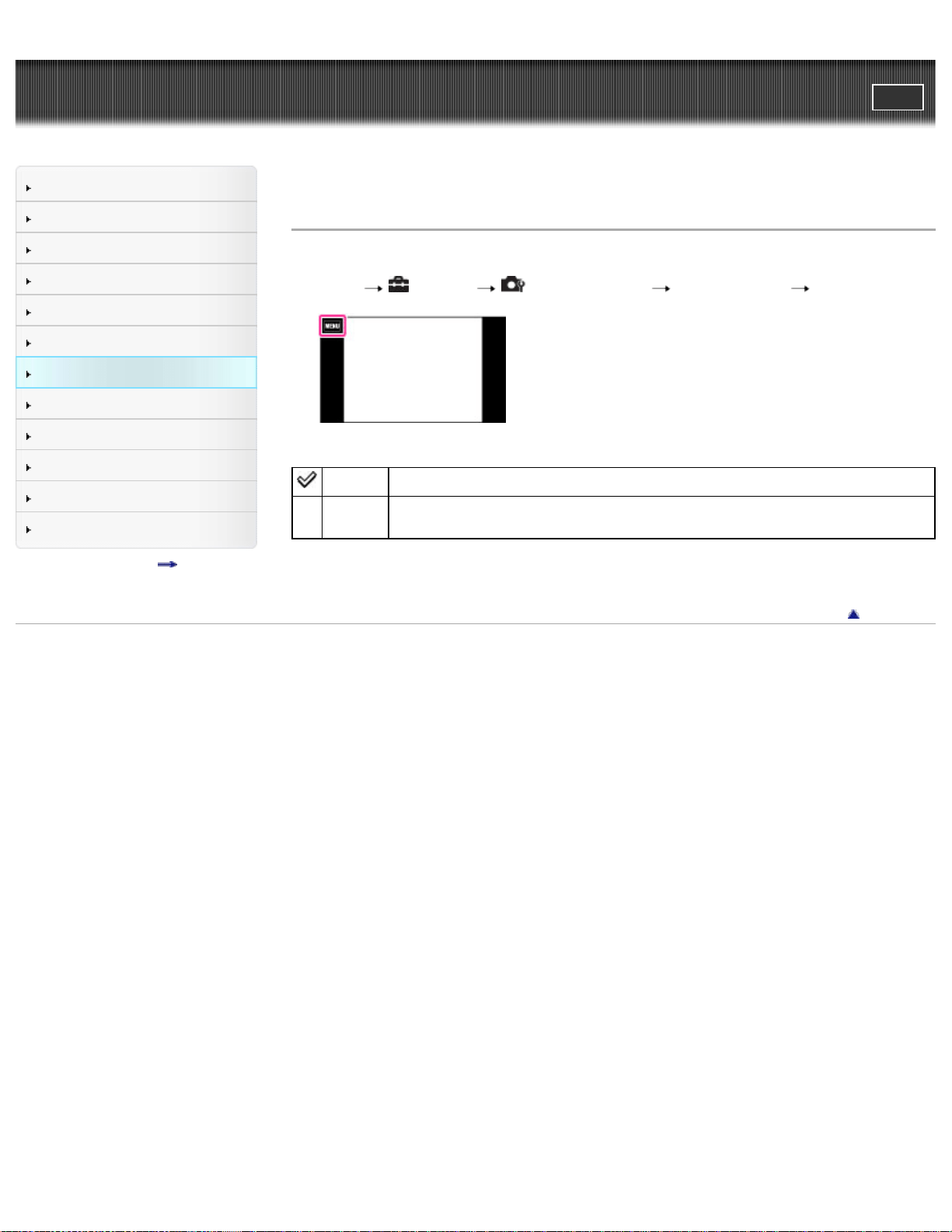
Cyber-shot User Guide
PrintSearch
Before Use
Operating the camera
Shooting
Viewing
Useful shooting functions
Useful viewing functions
Changing settings
Viewing images on a TV
Using with your computer
Printing
Troubleshooting
Precautions / About this camera
Contents list
Top page > Changing settings > Shooting Settings > Disp. Resolution
Disp. Resolution
Adjusts the image quality of the image displayed on the screen.
1. MENU
(Settings) (Shooting Settings) [Disp. Resolution] desired mode
Standard Displays the image on the screen in standard image quality.
High
Displays the image on the screen in high image quality. The battery power may
decrease faster.
Back to top
Copyright 2013 Sony Corporation
168
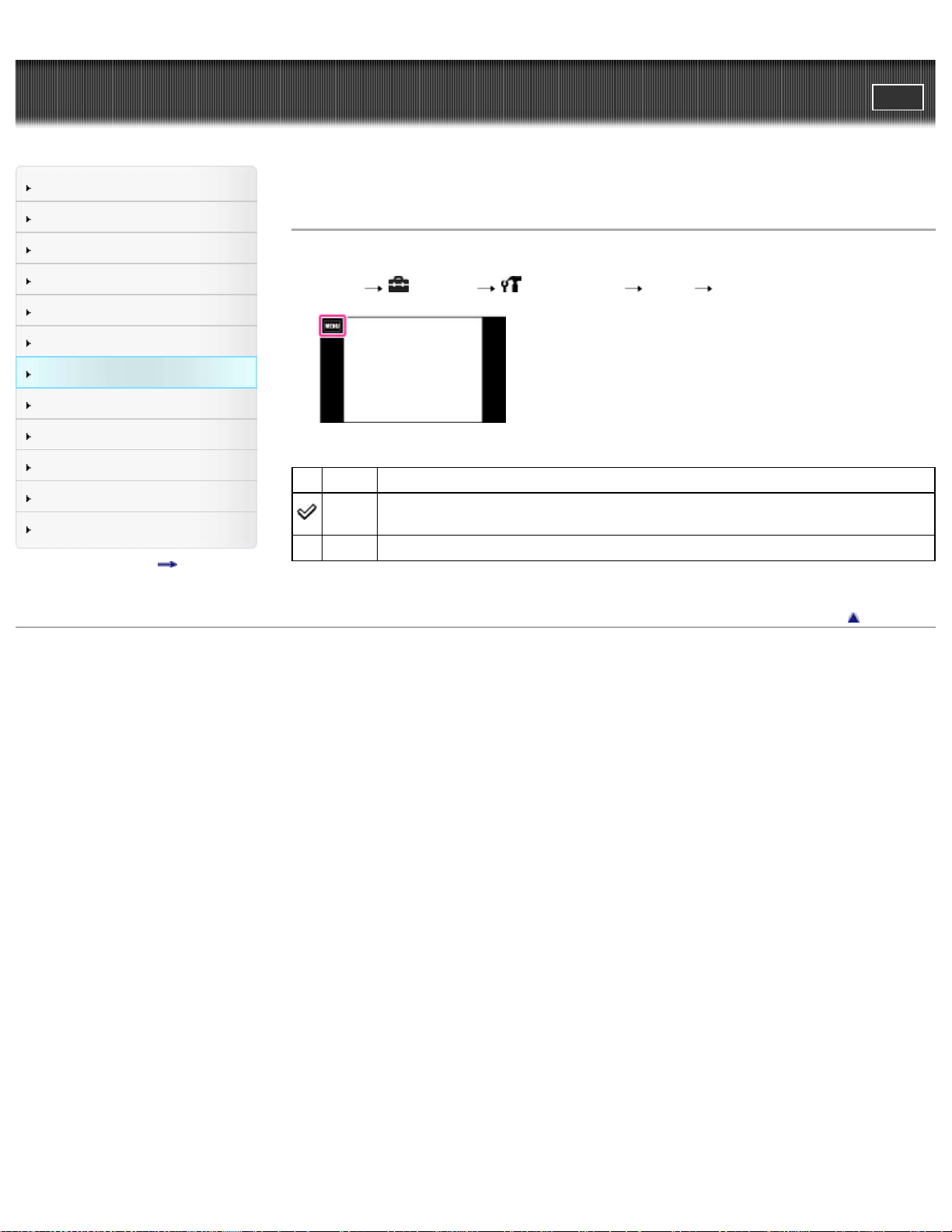
Cyber-shot User Guide
PrintSearch
Before Use
Operating the camera
Shooting
Viewing
Useful shooting functions
Useful viewing functions
Changing settings
Viewing images on a TV
Using with your computer
Printing
Troubleshooting
Precautions / About this camera
Contents list
Top page > Changing settings > Main Settings > Beep
Beep
Selects the sound produced when you operate the camera.
1. MENU
(Settings) (Main Settings) [Beep] desired mode
Shutter Turns on the shutter sound when you press the shutter button.
On
Turns on the beep/shutter sound when you operate the touch panel/press the shutter
button.
Off Turns off the beep/shutter sound.
Back to top
Copyright 2013 Sony Corporation
169
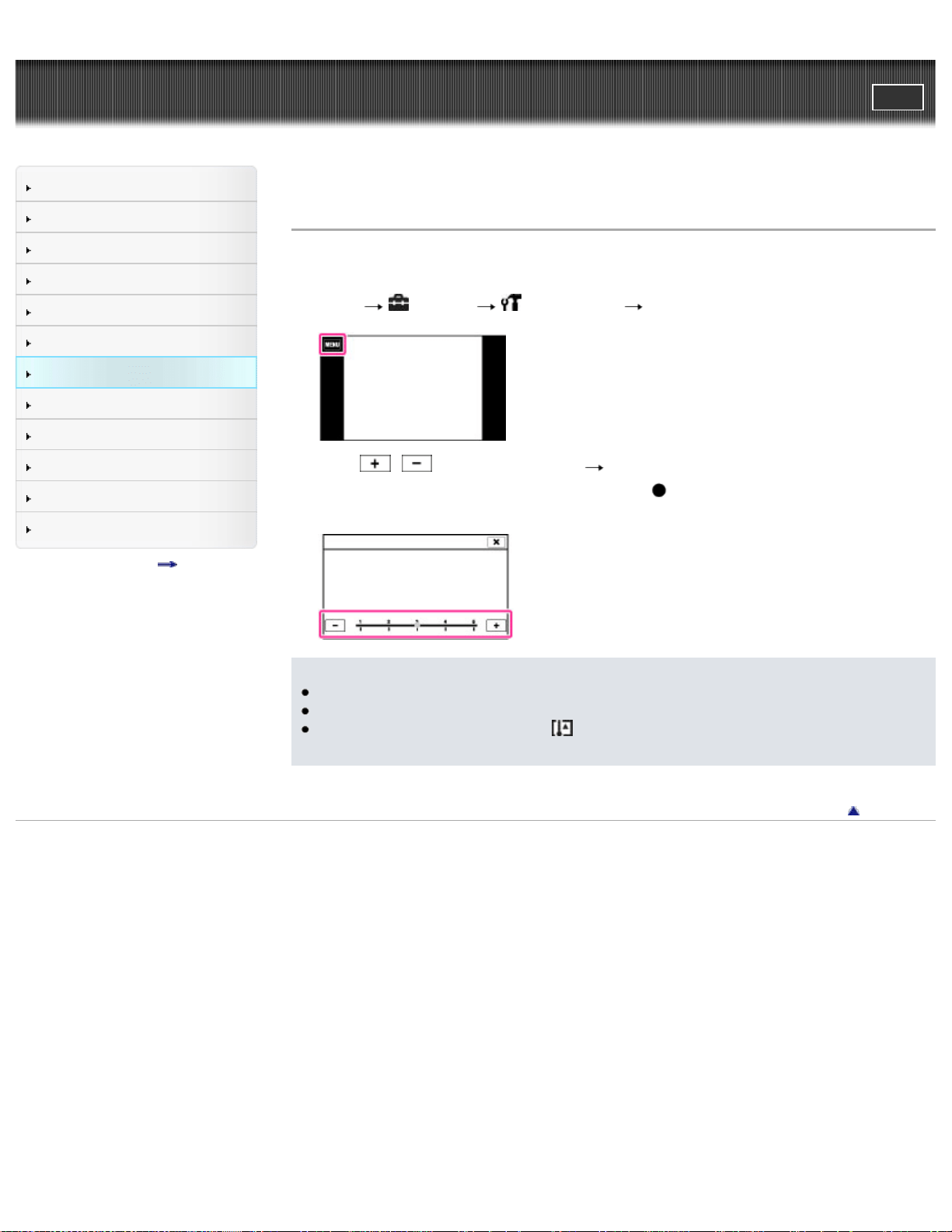
Cyber-shot User Guide
PrintSearch
Before Use
Operating the camera
Shooting
Viewing
Useful shooting functions
Useful viewing functions
Changing settings
Viewing images on a TV
Using with your computer
Printing
Troubleshooting
Precautions / About this camera
Contents list
Top page > Changing settings > Main Settings > Panel Brightness
Panel Brightness
You can select the brightness level from 1 to 5. The screen becomes brighter as the number rises.
When you use the camera in bright outside light, select a higher number to see the screen easier.
1. MENU
(Settings) (Main Settings) [Panel Brightness]
2. Touch / to adjust the brightness [OK]
You can also adjust the panel brightness by touching
of the adjustment bar and dragging to the
left/right.
Notes
The brighter the screen, the faster the battery pack runs out.
The screen grows dark if you do not operate the camera while the power is on.
When the high-temperature indicator (
) is displayed, the screen may grow dark regardless of the
settings. [Details]
Back to top
Copyright 2013 Sony Corporation
170
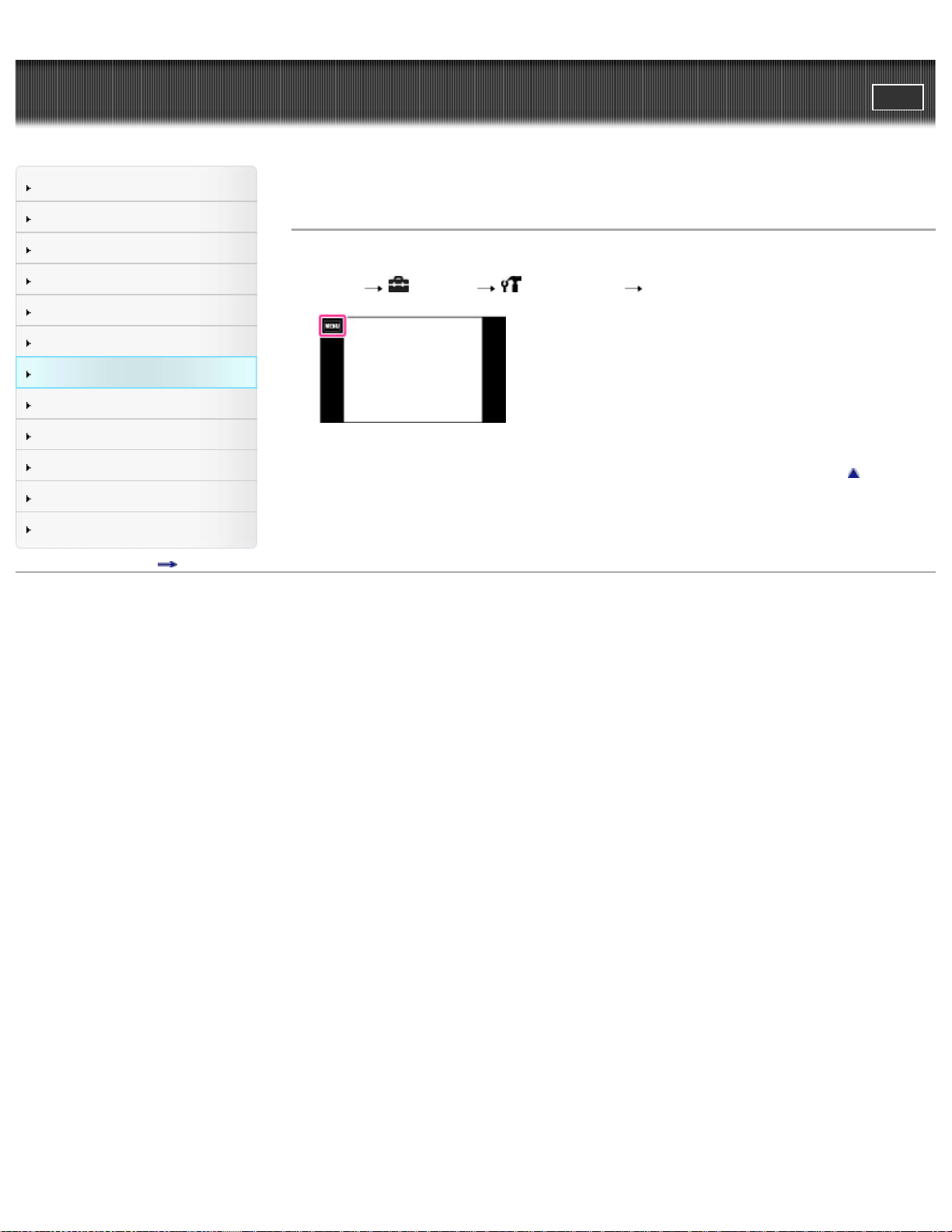
Cyber-shot User Guide
PrintSearch
Before Use
Operating the camera
Shooting
Viewing
Useful shooting functions
Useful viewing functions
Changing settings
Viewing images on a TV
Using with your computer
Printing
Troubleshooting
Precautions / About this camera
Contents list
Top page > Changing settings > Main Settings > Language Setting
Language Setting
Selects the language to be used in the menu items, warnings and messages.
1. MENU
(Settings) (Main Settings) [Language Setting]
Back to top
Copyright 2013 Sony Corporation
171
Cyber-shot User Guide
PrintSearch
Before Use
Operating the camera
Shooting
Viewing
Useful shooting functions
Useful viewing functions
Changing settings
Viewing images on a TV
Using with your computer
Printing
Troubleshooting
Precautions / About this camera
Contents list
Top page > Changing settings > Main Settings > Display color
Display color
Sets the color of the screen display.
1. MENU
(Settings) (Main Settings) [Display color] desired mode
Black
Sets the background color of the screen.
White
Pink
Back to top
Copyright 2013 Sony Corporation
172
Cyber-shot User Guide
PrintSearch
Before Use
Operating the camera
Shooting
Viewing
Useful shooting functions
Useful viewing functions
Changing settings
Viewing images on a TV
Using with your computer
Printing
Troubleshooting
Precautions / About this camera
Contents list
Top page > Changing settings > Main Settings > Demo Mode
Demo Mode
You can set whether to use a demonstration of Smile Shutter or AVCHD movie playback.
When there is no need to view a demonstration, set to [Off].
1. MENU
(Settings) (Main Settings) [Demo Mode] desired mode [OK]
Demo
Mode1
A demonstration of the shooting functions will be performed.
Demo
Mode2
Automatically starts the Smile Shutter demonstration when no operation is performed for
15 seconds.
Demo
Mode3
If no operation is performed for a set period of time while the camera is connected to an
HD TV, a demonstration of AVCHD movie playback will automatically start.
Off Does not perform a demonstration.
Notes
Pressing the shutter button during the Smile Shutter demonstration operates the shutter, but no
image is recorded.
During a demonstration, if the number of images saved in the internal memory increases, the
camera may automatically delete the images. It is recommended to make a backup copy of the
images on the internal memory before a demonstration.
Back to top
Copyright 2013 Sony Corporation
173
Cyber-shot User Guide
PrintSearch
Before Use
Operating the camera
Shooting
Viewing
Useful shooting functions
Useful viewing functions
Changing settings
Viewing images on a TV
Using with your computer
Printing
Troubleshooting
Precautions / About this camera
Contents list
Top page > Changing settings > Main Settings > Initialize
Initialize
Initializes the setting to the default setting.
Even if you execute [Initialize] the images are retained.
1. MENU
(Settings) (Main Settings) [Initialize] [OK]
Notes
Be sure not to remove the battery pack while initializing.
Back to top
Copyright 2013 Sony Corporation
174
Cyber-shot User Guide
PrintSearch
Before Use
Operating the camera
Shooting
Viewing
Useful shooting functions
Useful viewing functions
Changing settings
Viewing images on a TV
Using with your computer
Printing
Troubleshooting
Precautions / About this camera
Contents list
Top page > Changing settings > Main Settings > CTRL FOR HDMI
CTRL FOR HDMI
This setting allows (TV) remote control of a camera that is connected to a “BRAVIA” Sync TV using the
HDMI Cable (sold separately).
1. MENU
(Settings) (Main Settings) [CTRL FOR HDMI] desired mode
On
Enables/disables remote-controlled operation.
Off
Notes
You can perform the operation of the camera with the remote controller of your TV by connecting
your camera to a “BRAVIA” Sync-compatible TV.
Related Topic
Viewing an image on a “BRAVIA” Sync-compatible TV
Back to top
Copyright 2013 Sony Corporation
175
Cyber-shot User Guide
PrintSearch
Before Use
Operating the camera
Shooting
Viewing
Useful shooting functions
Useful viewing functions
Changing settings
Viewing images on a TV
Using with your computer
Printing
Troubleshooting
Precautions / About this camera
Contents list
Top page > Changing settings > Main Settings > USB Connect Setting
USB Connect Setting
Selects the USB mode when connecting the camera to a computer or a USB device using the micro
USB cable.
1. MENU
(Settings) (Main Settings) [USB Connect Setting] desired mode
Auto
Depending on the computer or other USB devices you connect to the camera, the
connection mode is automatically selected from [MTP] or [Mass Storage].
When you use Windows 7 or Windows 8, [MTP] is selected and Windows 7 or Windows
8-specific functions become available.
MTP
Establishes a MTP connection between the camera and a computer or other USB
devices.
When you use Windows 7 or Windows 8, [MTP] is selected and specific functions
become available.
When you use other operating systems (Vista/XP, MacOS X), the AutoPlay Wizard
appears, and the still images in the recording folder on the camera are imported to the
computer.
Mass
Storage
Establishes a Mass Storage connection between the camera and a computer or other
USB device.
Notes
If Device Stage* does not appear when connecting the camera to a Windows 7 or Windows 8
computer, set [USB Connect Setting] to [Auto].
* Device Stage is a menu screen to manage connected devices, such as a camera. (Function of Windows 7 or
Windows 8)
Back to top
Copyright 2013 Sony Corporation
176
Cyber-shot User Guide
PrintSearch
Before Use
Operating the camera
Shooting
Viewing
Useful shooting functions
Useful viewing functions
Changing settings
Viewing images on a TV
Using with your computer
Printing
Troubleshooting
Precautions / About this camera
Contents list
Top page > Changing settings > Main Settings > USB Power Supply
USB Power Supply
Sets whether to use the USB power supplied function when the camera is connected to a computer or a
USB device using the micro USB cable.
1. MENU
(Settings) (Main Settings) [USB Power Supply] desired mode
On The power is supplied when connected using the micro USB cable.
Off
Disables USB power supplied function even if you connect the camera to a device such as a
computer using the micro USB cable.
Back to top
Copyright 2013 Sony Corporation
177
Cyber-shot User Guide
PrintSearch
Before Use
Operating the camera
Shooting
Viewing
Useful shooting functions
Useful viewing functions
Changing settings
Viewing images on a TV
Using with your computer
Printing
Troubleshooting
Precautions / About this camera
Contents list
Top page > Changing settings > Main Settings > LUN Setting
LUN Setting
Sets the display method for the recording media displayed on a computer screen or other monitor when
the camera is connected with a computer or AV component using a USB connection.
1. MENU
(Settings) (Main Settings) [LUN Setting] desired mode
Multi
The images both on the memory card and in the internal memory are displayed. Select
this setting when you connect the camera to a computer.
Single
When the memory card is inserted into the camera, the images on the memory card are
displayed; when it is not inserted, the images in the internal memory are displayed. Select
this setting in cases where the images of both the memory card and the internal memory
are not displayed when the camera is connected to a device other than a computer.
Back to top
Copyright 2013 Sony Corporation
178
Cyber-shot User Guide
PrintSearch
Before Use
Operating the camera
Shooting
Viewing
Useful shooting functions
Useful viewing functions
Changing settings
Viewing images on a TV
Using with your computer
Printing
Troubleshooting
Precautions / About this camera
Contents list
Top page > Changing settings > Main Settings > Download Music
Download Music
You can change background music tracks using “Music Transfer.”
1. MENU
(Settings) (Main Settings) [Download Music]
The message “Connect to PC” is displayed.
2. Make a USB connection between the camera and a computer, then start “Music Transfer.”
3. Follow the instructions on the screen to change music files.
Back to top
Copyright 2013 Sony Corporation
179
Cyber-shot User Guide
PrintSearch
Before Use
Operating the camera
Shooting
Viewing
Useful shooting functions
Useful viewing functions
Changing settings
Viewing images on a TV
Using with your computer
Printing
Troubleshooting
Precautions / About this camera
Contents list
Top page > Changing settings > Main Settings > Empty Music
Empty Music
You can delete all the background music files stored in the camera. It can be used in cases such as
when the background music files are damaged and cannot be played.
1. MENU
(Settings) (Main Settings) [Empty Music] [OK]
Related Topic
“Music Transfer”
Back to top
Copyright 2013 Sony Corporation
180
Cyber-shot User Guide
PrintSearch
Before Use
Operating the camera
Shooting
Viewing
Useful shooting functions
Useful viewing functions
Changing settings
Viewing images on a TV
Using with your computer
Printing
Troubleshooting
Precautions / About this camera
Contents list
Top page > Changing settings > Main Settings > Power Save
Power Save
Sets the length of time until the screen goes dark and the time until the camera turns off.
If you do not operate the camera for a certain period of time while the power is on using the battery pack,
the screen goes dark and the camera later turns off automatically to prevent wearing down the battery
pack (Auto power-off function).
1. MENU
(Settings) (Main Settings) [Power Save] desired mode
Max
Saves battery power better than when set to [Standard].
If the camera is not operated for a certain period of time, the power turns off
automatically. In shooting mode, the screen automatically goes dark before the power
turns off.
Standard
If the camera is not operated for a certain period of time, the power turns off
automatically. In shooting mode, the screen automatically goes dark before the power
turns off.
It takes longer before the power turns off than when set to [Max].
Off Does not use the Auto power-off function.
Notes
The camera does not enter Power Save under conditions such as during a slideshow, when
recording movies or when the camera is connected to a computer.
To prevent burn-in on the screen, the screen goes dark when the camera is not operated for a
certain period of time even if [Power Save] is set to [Off], but the camera is not turned off.
Back to top
Copyright 2013 Sony Corporation
181
Cyber-shot User Guide
PrintSearch
Before Use
Operating the camera
Shooting
Viewing
Useful shooting functions
Useful viewing functions
Changing settings
Viewing images on a TV
Using with your computer
Printing
Troubleshooting
Precautions / About this camera
Contents list
Top page > Changing settings > Main Settings > Version
Version
Displays the software version installed on this camera.
1. MENU
(Settings) (Main Settings) [Version]
Back to top
Copyright 2013 Sony Corporation
182
Cyber-shot User Guide
PrintSearch
Before Use
Operating the camera
Shooting
Viewing
Useful shooting functions
Useful viewing functions
Changing settings
Viewing images on a TV
Using with your computer
Printing
Troubleshooting
Precautions / About this camera
Contents list
Top page > Changing settings > Memory Card Tool/Internal Memory Tool > Format
Format
Formats the memory card or the internal memory.
When you use a memory card with this camera for the first time, it is recommended to format the card
using the camera for stable performance of the memory card before shooting. Note that formatting
permanently erases all data on the memory card, and is unrecoverable. Save precious data on a
computer, etc.
1. MENU
(Settings) (Memory Card Tool) or (Internal Memory Tool) [Format]
[OK]
Notes
Note that formatting permanently erases all data including even protected images.
Back to top
Copyright 2013 Sony Corporation
183
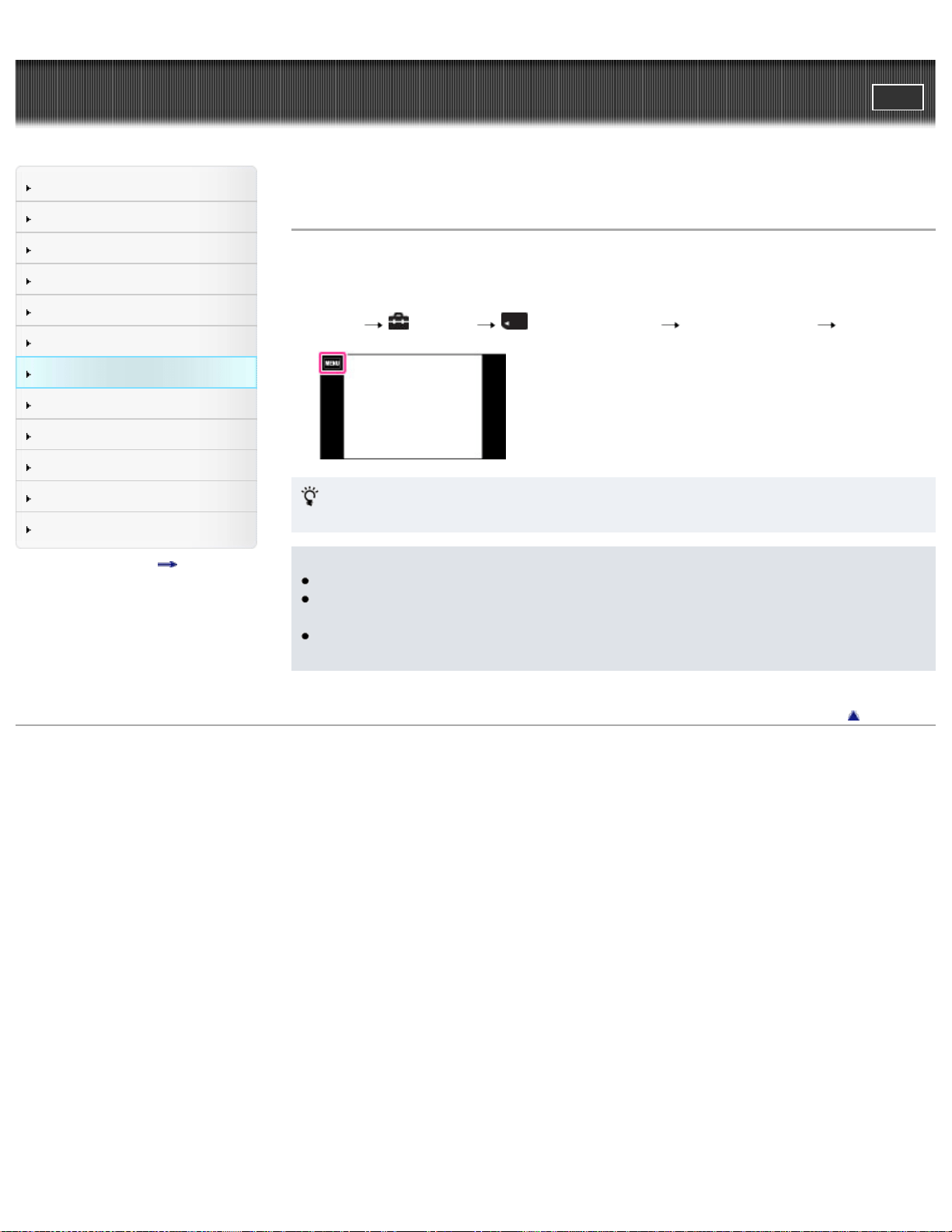
Cyber-shot User Guide
PrintSearch
Before Use
Operating the camera
Shooting
Viewing
Useful shooting functions
Useful viewing functions
Changing settings
Viewing images on a TV
Using with your computer
Printing
Troubleshooting
Precautions / About this camera
Contents list
Top page > Changing settings > Memory Card Tool/Internal Memory Tool > Create REC.Folder
Create REC.Folder
Creates a folder in a memory card for recording images.
Images are recorded in the newly created folder until you create another folder or select another
recording folder.
1. MENU
(Settings) (Memory Card Tool) [Create REC.Folder] [OK]
On the folders
After a new folder is created, you can change the storage destination folder. [Details]
Notes
This item is not displayed when the internal memory is used to record images.
When you insert a memory card that was used with other equipment into the camera and shoot
images, a new folder may be automatically created.
Up to 4,000 images can be stored in one folder. When the folder capacity is exceeded, a new
folder is automatically created.
Back to top
Copyright 2013 Sony Corporation
184
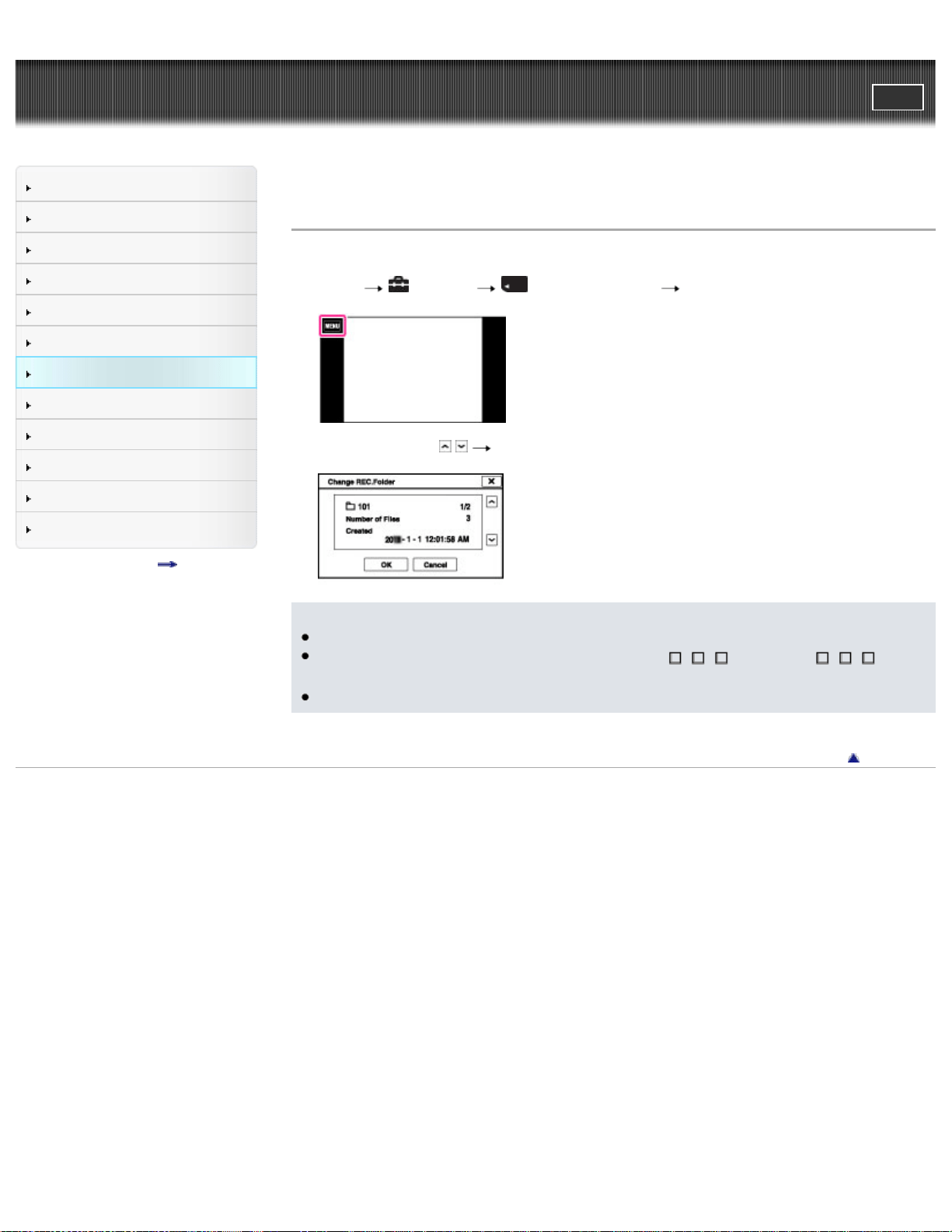
Cyber-shot User Guide
PrintSearch
Before Use
Operating the camera
Shooting
Viewing
Useful shooting functions
Useful viewing functions
Changing settings
Viewing images on a TV
Using with your computer
Printing
Troubleshooting
Precautions / About this camera
Contents list
Top page > Changing settings > Memory Card Tool/Internal Memory Tool > Change REC.Folder
Change REC.Folder
Changes the folder in the memory card that is currently used for recording images.
1. MENU
(Settings) (Memory Card Tool) [Change REC.Folder]
2. Select a folder with / [OK].
Notes
This item is not displayed when the internal memory is used to record images.
You cannot select a folder with a number that has only “
MSDCF” or “ ANV01”
as a recording folder.
You cannot move recorded images to another folder.
Back to top
Copyright 2013 Sony Corporation
185
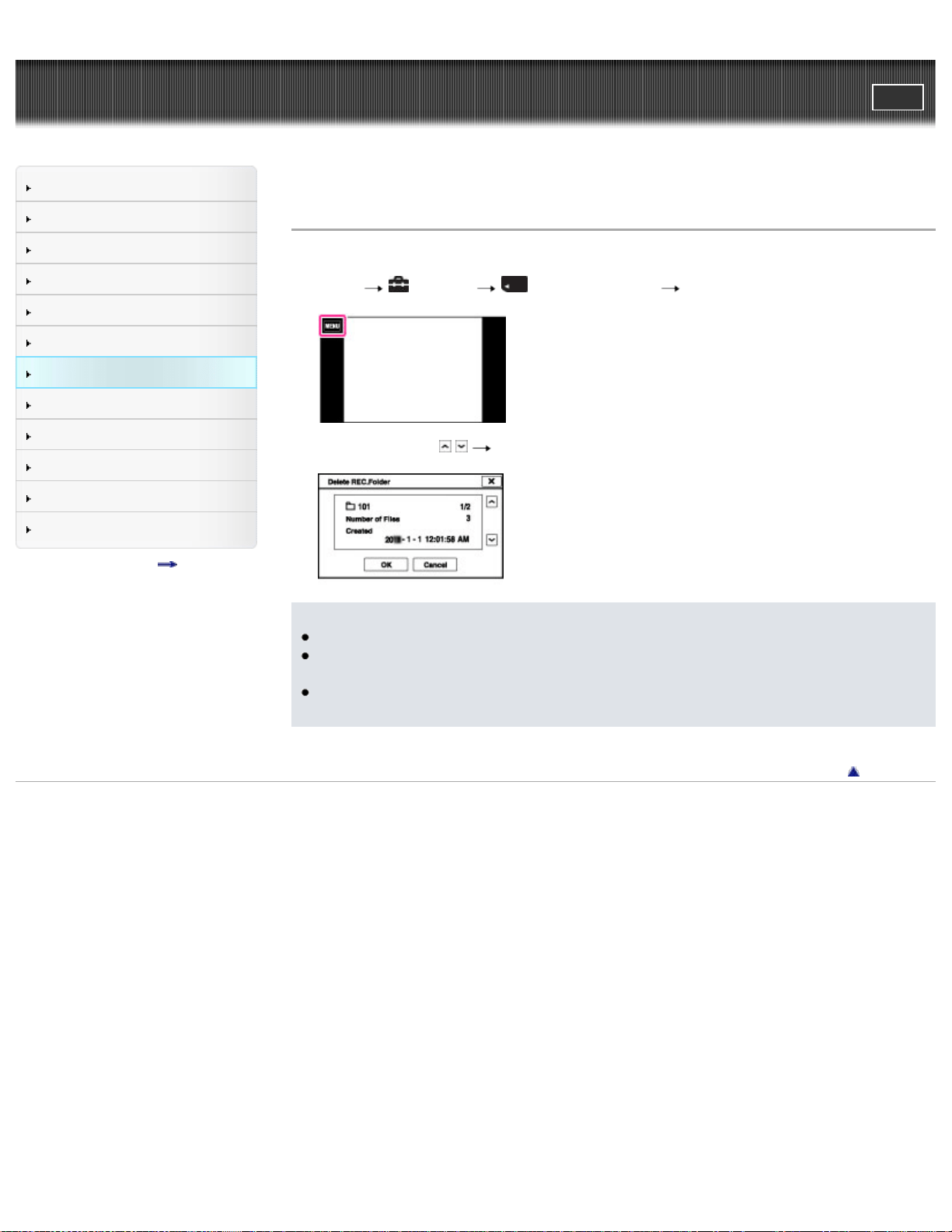
Cyber-shot User Guide
PrintSearch
Before Use
Operating the camera
Shooting
Viewing
Useful shooting functions
Useful viewing functions
Changing settings
Viewing images on a TV
Using with your computer
Printing
Troubleshooting
Precautions / About this camera
Contents list
Top page > Changing settings > Memory Card Tool/Internal Memory Tool > Delete REC.Folder
Delete REC.Folder
Deletes a folder for recording images in a memory card.
1. MENU
(Settings) (Memory Card Tool) [Delete REC.Folder]
2. Select a folder with / [OK].
Notes
This item is not displayed when the internal memory is used to record images.
If you delete the folder set as the recording folder using [Delete REC.Folder], the folder that has the
largest folder number is selected as the next recording folder.
If a folder contains protected images or files that cannot be played back by the camera, images
other than these images are deleted and the folder will remain.
Back to top
Copyright 2013 Sony Corporation
186
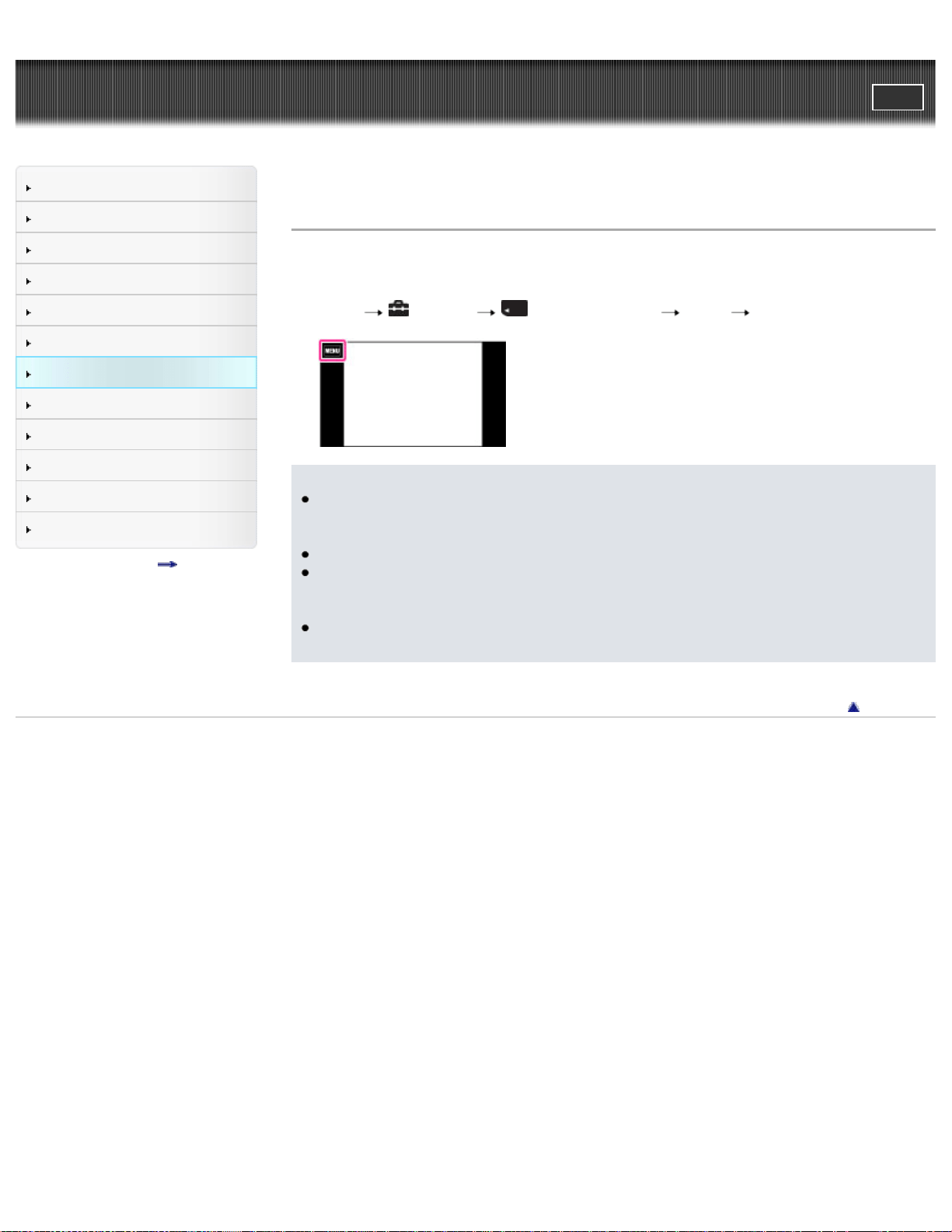
Cyber-shot User Guide
PrintSearch
Before Use
Operating the camera
Shooting
Viewing
Useful shooting functions
Useful viewing functions
Changing settings
Viewing images on a TV
Using with your computer
Printing
Troubleshooting
Precautions / About this camera
Contents list
Top page > Changing settings > Memory Card Tool/Internal Memory Tool > Copy
Copy
Copies all images in the internal memory to a memory card.
1. Insert a memory card with sufficient free capacity into the camera.
2. MENU
(Settings) (Memory Card Tool) [Copy] [OK]
Notes
Use a fully charged battery pack. If you attempt to copy image files using a battery pack with little
remaining charge, the battery pack may run out, causing copying to fail or possibly corrupting the
data.
Images cannot be copied individually.
The original images in the internal memory are retained even after copying. To delete the contents
of the internal memory, remove the memory card after copying, then format the internal memory
([Format] in [Internal Memory Tool]).
The data will be copied to the recording folder that is currently being used, with a number one
higher than the largest data number in that folder. [Details]
Back to top
Copyright 2013 Sony Corporation
187
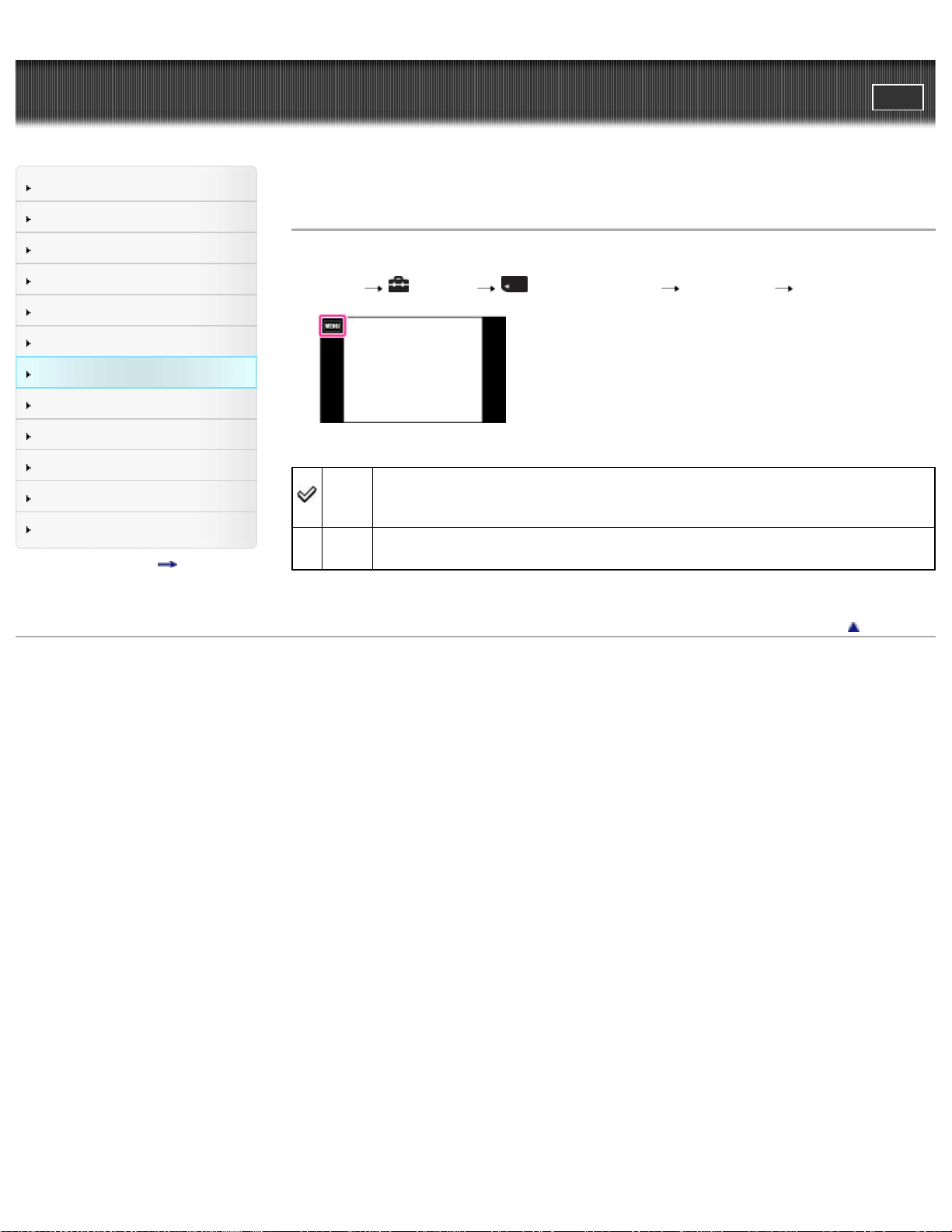
Cyber-shot User Guide
PrintSearch
Before Use
Operating the camera
Shooting
Viewing
Useful shooting functions
Useful viewing functions
Changing settings
Viewing images on a TV
Using with your computer
Printing
Troubleshooting
Precautions / About this camera
Contents list
Top page > Changing settings > Memory Card Tool/Internal Memory Tool > File Number
File Number
Selects the method used to assign file numbers to images.
1. MENU
(Settings) (Memory Card Tool) [File Number] desired mode
Series
Assigns numbers to files in sequence even if the recording folder or the memory card is
changed. (When the replaced memory card contains a file with a number higher than the
last assigned number, a number one higher than the largest number is assigned.)
Reset
Starts from 0001 each time the folder is changed. (When the recording folder contains a
file, a number one higher than the largest number is assigned.)
Back to top
Copyright 2013 Sony Corporation
188
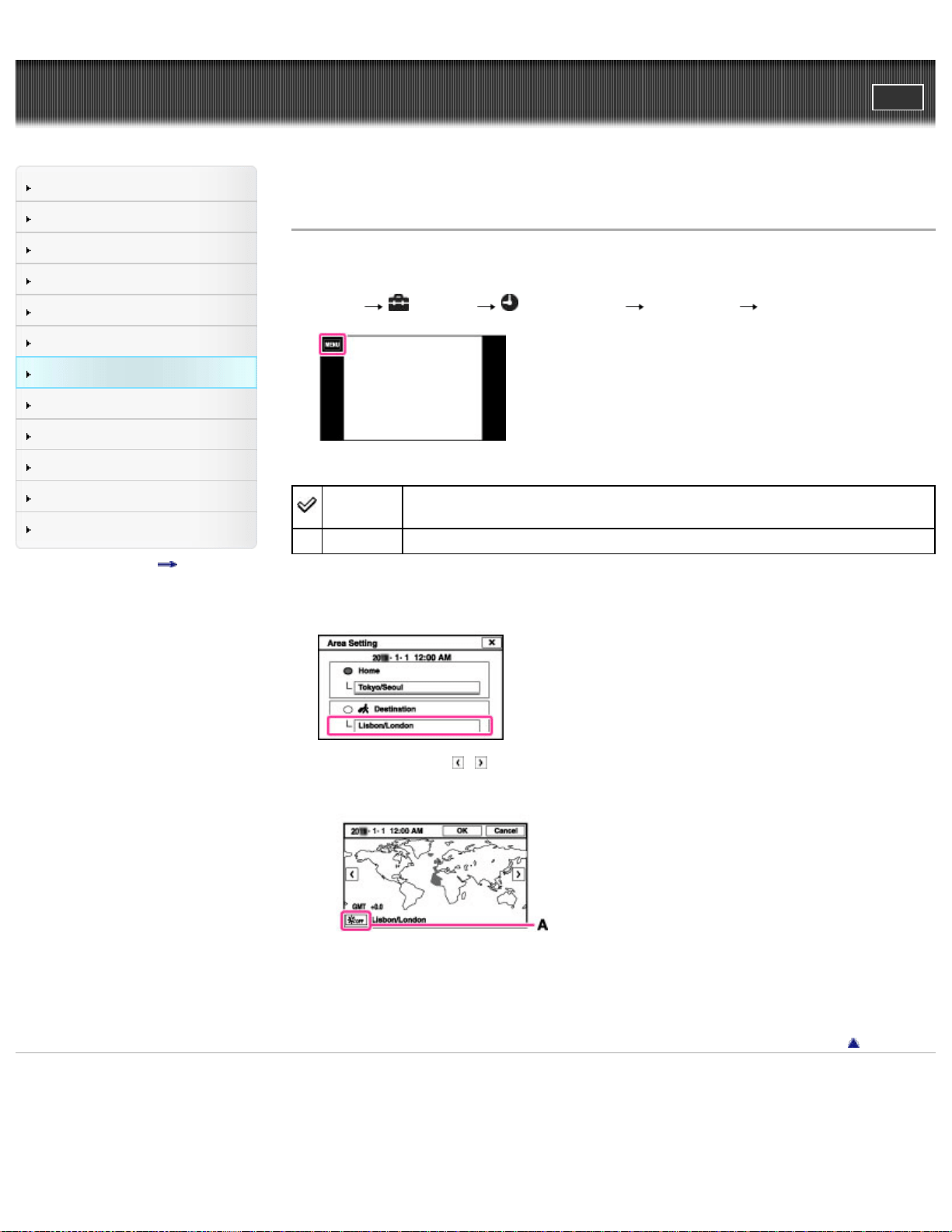
Cyber-shot User Guide
PrintSearch
Before Use
Operating the camera
Shooting
Viewing
Useful shooting functions
Useful viewing functions
Changing settings
Viewing images on a TV
Using with your computer
Printing
Troubleshooting
Precautions / About this camera
Contents list
Top page > Changing settings > Clock Settings > Area Setting
Area Setting
Sets the area in which you are using this camera.
Setting a frequently visited destination lets you easily adjust the time when you visit that destination.
1. MENU
(Settings) (Clock Settings) [Area Setting] desired mode
Home
You use the camera in your area. When the currently set area differs from your
home area, you must make the Area Setting.
Destination You use the camera set to the time at your destination. Set the destination area.
2. Touch the [Destination] area.
3. Select the area using / .
4. Touch Summer Time icon (A), then select Summer Time On/Off.
5. Touch [OK].
Back to top
Copyright 2013 Sony Corporation
189
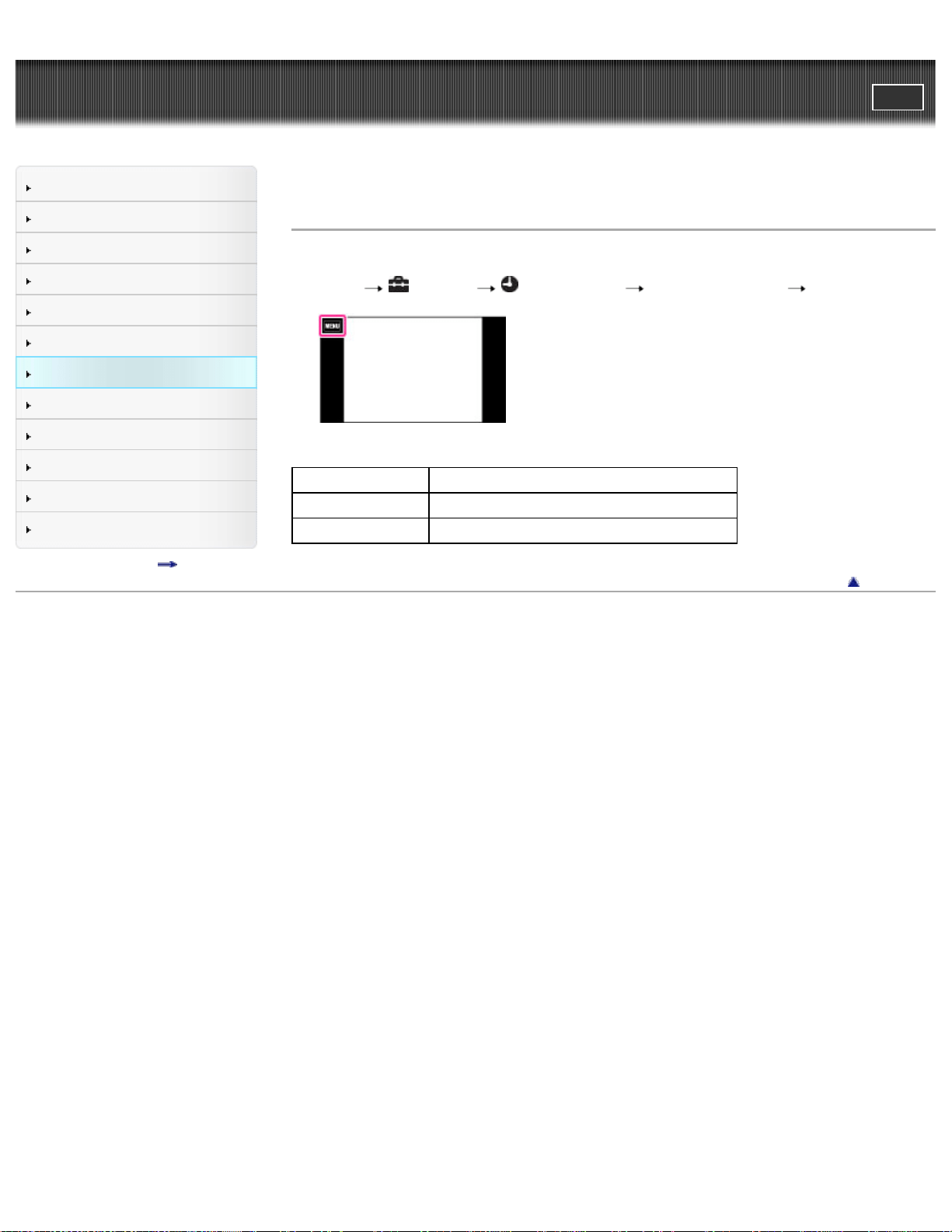
Cyber-shot User Guide
PrintSearch
Before Use
Operating the camera
Shooting
Viewing
Useful shooting functions
Useful viewing functions
Changing settings
Viewing images on a TV
Using with your computer
Printing
Troubleshooting
Precautions / About this camera
Contents list
Top page > Changing settings > Clock Settings > Date & Time Setting
Date & Time Setting
Sets the date and time again.
1. MENU
(Settings) (Clock Settings) [Date & Time Setting] desired mode
Date & Time Format You can select the date and time display format.
Summer Time You can select Summer Time [On]/[Off].
Date & Time You can set the date and time.
Back to top
Copyright 2013 Sony Corporation
190
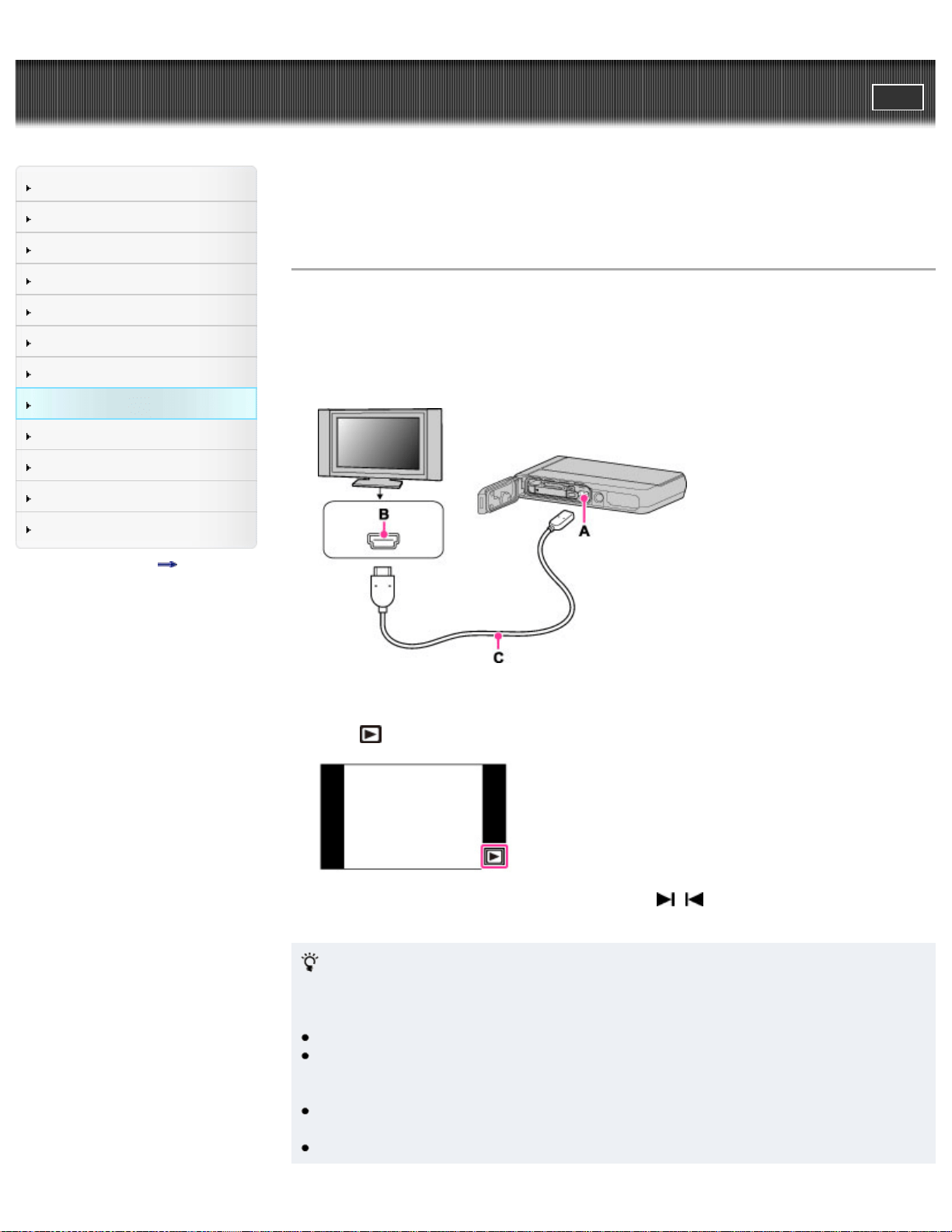
Cyber-shot User Guide
PrintSearch
Before Use
Operating the camera
Shooting
Viewing
Useful shooting functions
Useful viewing functions
Changing settings
Viewing images on a TV
Using with your computer
Printing
Troubleshooting
Precautions / About this camera
Contents list
Top page > Viewing images on a TV > Viewing an image on a High Definition (HD) TV > Viewing an
image on an HD TV using the HDMI Cable (sold separately)
Viewing an image on an HD TV using the HDMI Cable (sold
separately)
Connect the camera to an HD (High Definition) TV that has an HDMI jack using the HDMI Cable (sold
separately).
1. Turn off both the camera and the TV.
2. Connect the HDMI micro jack of the camera (A) and the HDMI jack of the TV (B) using an HDMI
Cable (sold separately) (C).
3. Turn on the TV and set the input.
4. Press the ON/OFF (Power) button.
5. Touch
(Playback).
Images shot with the camera appear on the TV. Touch / on the screen to select the desired
image.
“PhotoTV HD”
This camera is compatible with the “PhotoTV HD” standard.
By connecting a Sony TV compatible with “PhotoTV HD” using an HDMI Cable (sold separately), a
whole new world of photos can be comfortably enjoyed in breathtaking Full HD quality.
“PhotoTV HD” allows for a highly-detailed, photo-like expression of subtle textures and colors.
When the camera is connected to a Sony TV compatible with Video A mode using an HDMI Cable,
your TV is automatically set to the picture quality suitable for still images. When the setting of the
TV is set to Video, the picture quality is set to that suitable for movies.
When playing back an AVCHD movie, it is recommended that you set [View Mode] to [AVCHD
view].
For details, see the operating instructions of the TV.
191

Notes
Images shot in [VGA] image size cannot be played back in the HD format.
Do not connect the camera and equipment to be connected using both output terminals. When the
camera and TV are connected using output terminals, no video or sound are produced. Such a
connection can also cause problems with the camera and/or connected equipment.
The camera may not work properly with some HD TVs. For example, you may not be able to view a
video on your HD TV or hear sound from the HD TV.
Use an HDMI Cable with the HDMI logo.
Use an HDMI micro connector on one end (for the camera), and a connector suitable for connection
to your TV on the other end. You cannot view images on a TV that does not have an HDMI
connector.
Recording may automatically stop to protect the camera after a period of time if you are shooting
movies when the camera and TV are connected by an HDMI Cable (sold separately).
Related Topic
Viewing 3D images on a 3D TV
Back to top
Copyright 2013 Sony Corporation
192
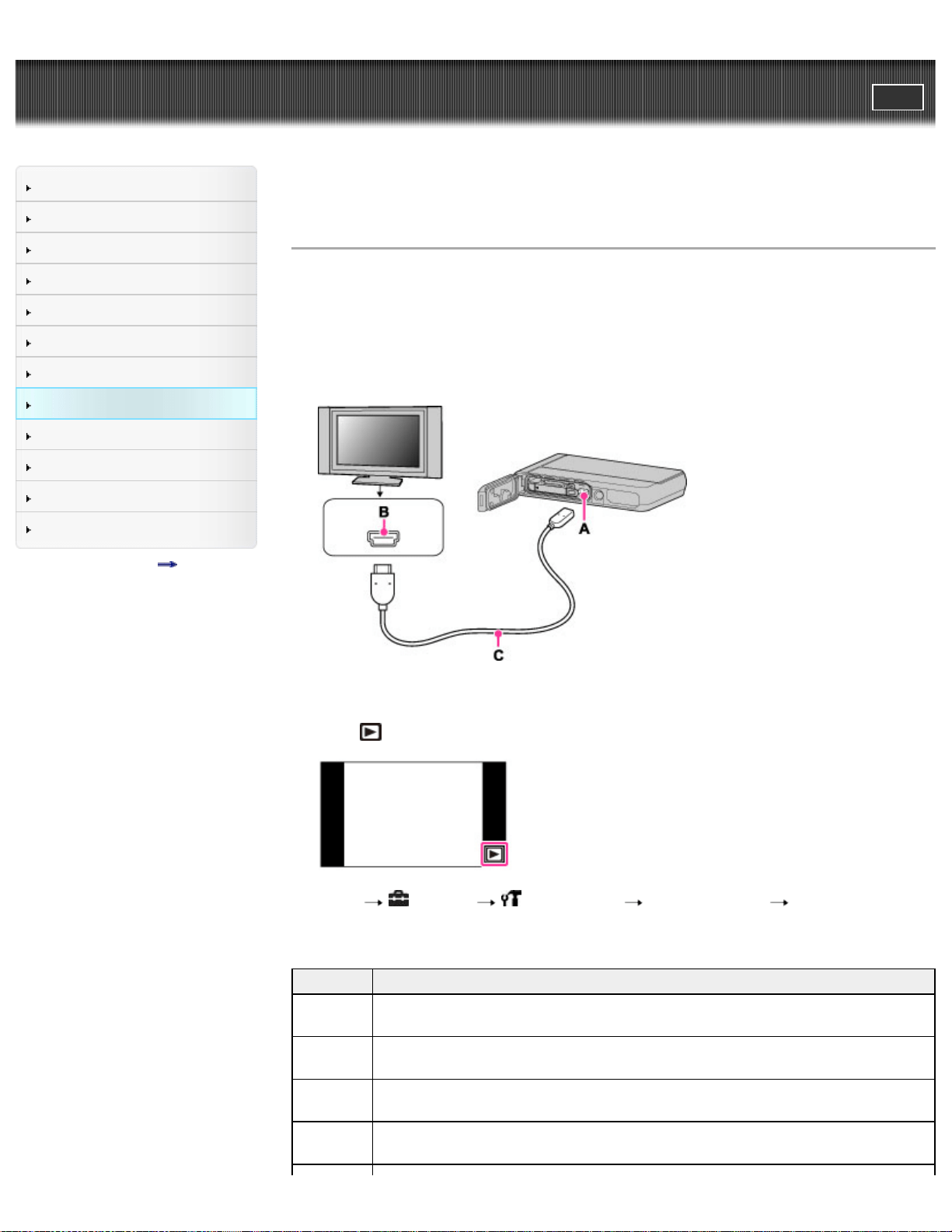
Cyber-shot User Guide
PrintSearch
Before Use
Operating the camera
Shooting
Viewing
Useful shooting functions
Useful viewing functions
Changing settings
Viewing images on a TV
Using with your computer
Printing
Troubleshooting
Precautions / About this camera
Contents list
Top page > Viewing images on a TV > Viewing an image on a “BRAVIA” Sync-compatible TV > Viewing
an image on a “BRAVIA” Sync-compatible TV
Viewing an image on a “BRAVIA” Sync-compatible TV
When you use a TV that has “BRAVIA” Sync (compatible with SYNC MENU) support, you can operate
the playback functions of the camera using the remote controller supplied with the TV by connecting the
camera to the TV using an HDMI Cable (sold separately).
1. Turn off both the camera and the TV.
2. Connect the HDMI micro jack of the camera (A) and the HDMI jack of the TV (B) using an HDMI
Cable (sold separately) (C).
3. Turn on the TV and set the input.
4. Press the ON/OFF (Power) button.
5. Touch
(Playback).
6. MENU (Settings) (Main Settings) [CTRL FOR HDMI] [On]
7. Press the SYNC MENU button of the TV’s remote controller to select the desired mode.
Menu Function
Slideshow
with music
Automatically plays back images with sound effects or background music in a continuous
loop.
Single
Image
Plays back a single image at a time.
Image
Index
Displays multiple images at the same time.
3D
Viewing
Plays back 3D images recorded in 3D shooting mode.
193
Delete Deletes recorded images.
PB Zoom Plays back enlarged images.
Wide
Zoom
Plays back 4:3 aspect ratio still images in 16:9 aspect ratio when you view a single
image. In that case, the top and bottom of the image will be slightly cropped.
Rotate Rotates a still image.
View Mode Selects the display format for viewing multiple images.
Exit Exits from the playback operations.
Notes
When the camera is connected to a TV set using an HDMI Cable, the functions that you can
operate are limited.
When you touch the screen of the camera while you operate the remote controller, the remote
controller operation is temporarily interrupted.
You can perform the operation of the camera with the remote controller of your TV by connecting
your camera to a “BRAVIA” Sync-compatible TV. For details, see the operating instructions of the
TV.
If the camera functions in an undesired manner when you are controlling it using the TV’s remote
controller, such as when connected via HDMI to another manufacturer’s TV, touch MENU
(Settings) (Main Settings) [CTRL FOR HDMI] [Off].
When the camera is in Easy Mode, SYNC MENU does not appear on the TV.
Back to top
Copyright 2013 Sony Corporation
194
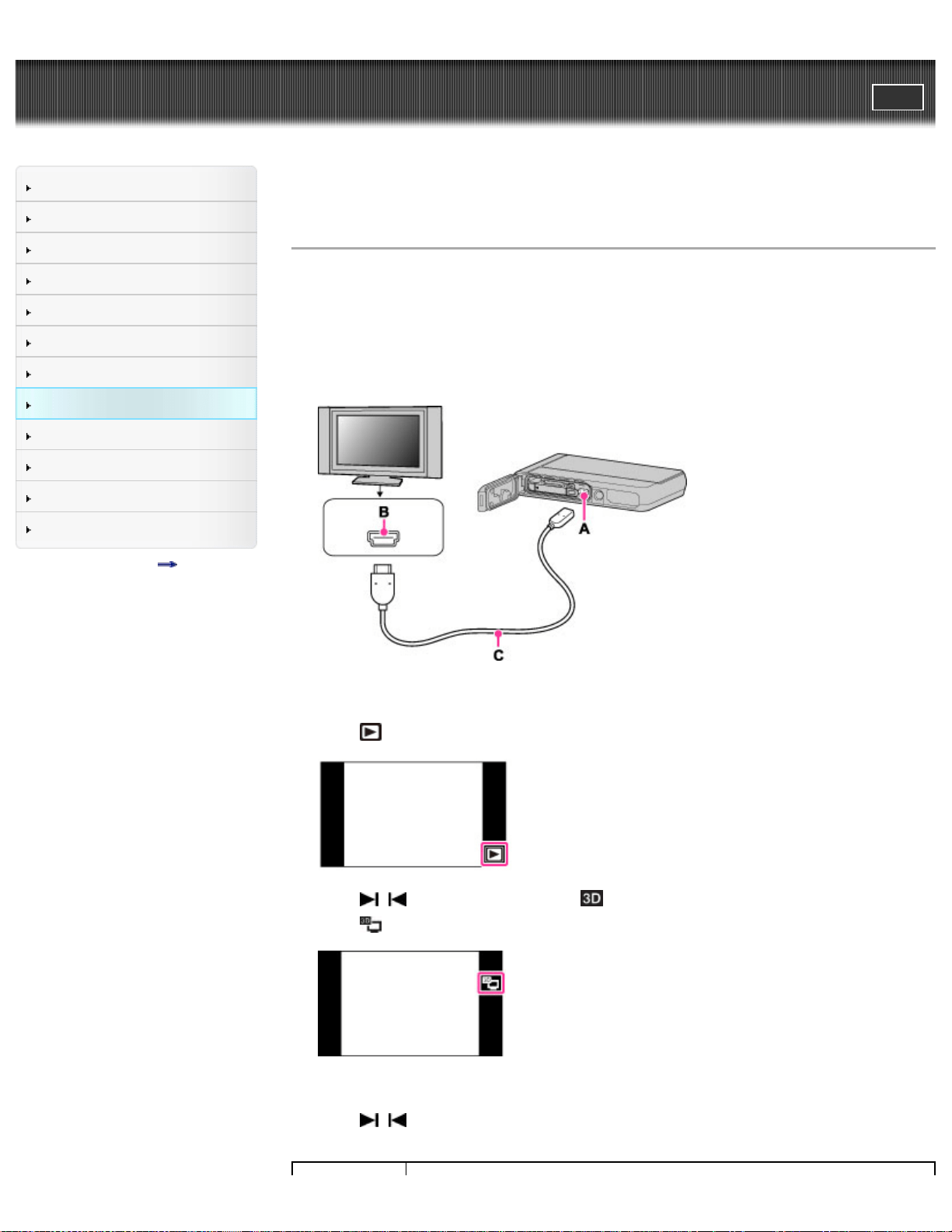
Cyber-shot User Guide
PrintSearch
Before Use
Operating the camera
Shooting
Viewing
Useful shooting functions
Useful viewing functions
Changing settings
Viewing images on a TV
Using with your computer
Printing
Troubleshooting
Precautions / About this camera
Contents list
Top page > Viewing images on a TV > Viewing 3D images on a 3D TV > Viewing 3D images on a 3D
TV
Viewing 3D images on a 3D TV
You can view 3D images recorded on the camera in 3D format by connecting the camera to a 3D TV
using an HDMI Cable (sold separately).
Refer also to the operating instructions supplied with the TV.
1. Turn off both the camera and the TV.
2. Connect the HDMI micro jack of the camera (A) and the HDMI jack (B) using an HDMI Cable (sold
separately) (C).
3. Turn on the TV and set the input.
4. Press the ON/OFF (Power) button.
5. Touch
(Playback).
6. Touch / to select images shot using (3D Shooting) mode.
7. Touch
(3D Viewing).
8. Touch [OK].
Images shot with the camera appear on the TV.
9. Touch
/ to select the images and select the desired mode.
195
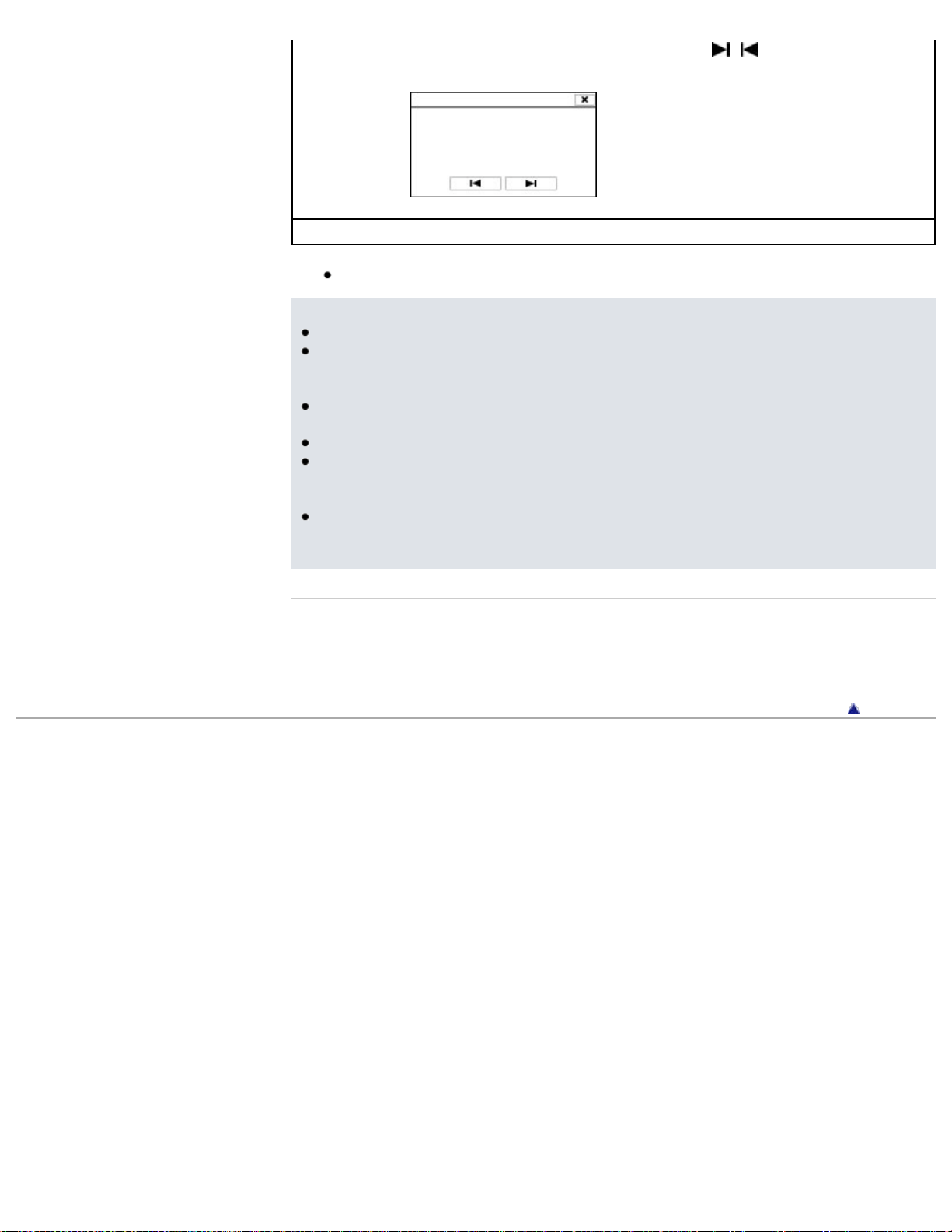
Continuous
Playback
Continuously plays back only 3D images. Touch
/ to change the image to the
next/previous one.
Exit 3D Viewing Ends 3D playback.
You can change the zoom scale for 3D still images using the W/T (zoom) lever.
Notes
When you select [3D Viewing] mode, only 3D images are displayed.
Do not connect the camera and equipment to be connected using output terminals. When the
camera and equipment are connected using output terminals, no video and sound are produced.
Such a connection can also cause trouble of the camera and/or connected equipment.
This function may not work properly with some TVs. For example, you may not be able to view a
video on your TV, output in 3D mode or hear sound from the TV.
Use an HDMI Cable with the HDMI logo.
When connecting the camera to a TV, use an HDMI Cable that can be connected to the HDMI
micro jack on the camera end and to the TV jack. You cannot view images on a TV that does not
have an HDMI connector.
Recording may automatically stop to protect the camera after a period of time when you shoot
movies in the condition where the camera and TV are connected by an HDMI Cable (sold
separately).
Related Topic
3D Viewing
Viewing an image on an HD TV using the HDMI Cable (sold separately)
Back to top
Copyright 2013 Sony Corporation
196
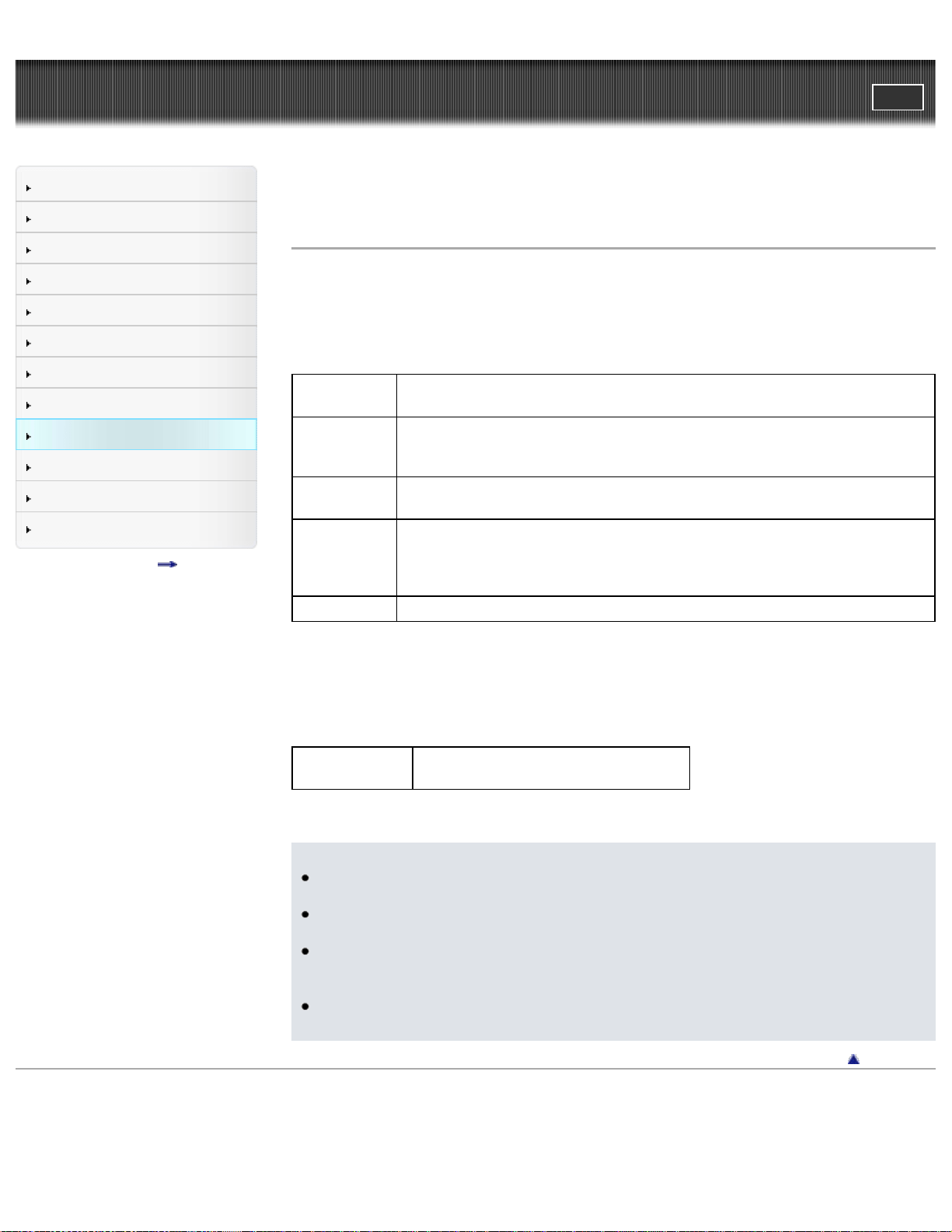
Cyber-shot User Guide
PrintSearch
Before Use
Operating the camera
Shooting
Viewing
Useful shooting functions
Useful viewing functions
Changing settings
Viewing images on a TV
Using with your computer
Printing
Troubleshooting
Precautions / About this camera
Contents list
Top page > Using with your computer > Recommended computer environment > Recommended
computer environment
Recommended computer environment
The following computer environment is recommended when using the software “PlayMemories Home”
(Windows) and “Music Transfer” (Windows/Mac) and when importing images via a USB connection.
Windows
OS (pre-
installed)
Microsoft Windows XP* SP3/Windows Vista SP2/Windows 7 SP1/Windows 8
CPU
Intel Pentium III 800 MHz or faster (For playing/editing the High Definition movies:
Intel Core Duo 1.66 GHz or faster/Intel Core 2 Duo 1.66 GHz or faster (Intel Core 2
Duo 2.26 GHz or faster is required when processing AVC HD (FX/FH) movies.))
Memory
Windows XP: 512 MB or more (1 GB or more is recommended.)
Windows Vista/Windows 7/Windows 8: 1 GB or more
Hard Disk
(Disk space
required for
installation)
Approximately 500 MB
Display 1,024×768 dots or more
* 64-bit editions and Starter (Edition) are not supported.
Windows Image Mastering API (IMAPI) Ver.2.0 or later is required to create discs.
Mac
OS (pre-installed)
USB Connection: Mac OS X v10.5 to v10.8
Music Transfer: Mac OS X v10.5 to v10.8*
* Equipped with Intel processor
Notes
Operation is not assured in an environment based on an upgrade of the operating systems
described above or in a multi-boot environment.
If you connect two or more USB devices to a single computer at the same time, some devices,
including the camera, may not operate, depending on the types of USB devices you are using.
Connecting the camera using a USB interface that is compatible with Hi-Speed USB (USB 2.0)
allows advanced transfer (high speed transfer), as the camera is compatible with Hi-Speed USB
(USB 2.0).
When your computer resumes activity from suspend or sleep mode, communication between the
camera and your computer may not recover at the same time.
Back to top
Copyright 2013 Sony Corporation
197
Cyber-shot User Guide
PrintSearch
Before Use
Operating the camera
Shooting
Viewing
Useful shooting functions
Useful viewing functions
Changing settings
Viewing images on a TV
Using with your computer
Printing
Troubleshooting
Precautions / About this camera
Contents list
Top page > Using with your computer > Using the software > “PlayMemories Home” (Windows)
“PlayMemories Home” (Windows)
Below are examples of the functions available when you use “PlayMemories Home.”
“PlayMemories Home” allows you to import images shot with the camera to a computer for display.
Make a USB connection between the camera and your computer, and click [Import].
You can display images stored on a computer by shooting date in a calendar display.
You can save and print images with the date.
You can edit still images, such as resizing (Resize) and cropping (Trimming).
You can correct still images, and change the shooting date and time.
Blu-ray discs, AVCHD discs and DVD-Video discs can be created from AVCHD movies imported to a
computer.
You can upload images to a network service. (An internet connection environment is required.)
For other details, see
(PlayMemories Home Help Guide).
Notes
Mac does not support “PlayMemories Home.” Use the application bundled with the Mac to play
back images.
Back to top
Copyright 2013 Sony Corporation
198
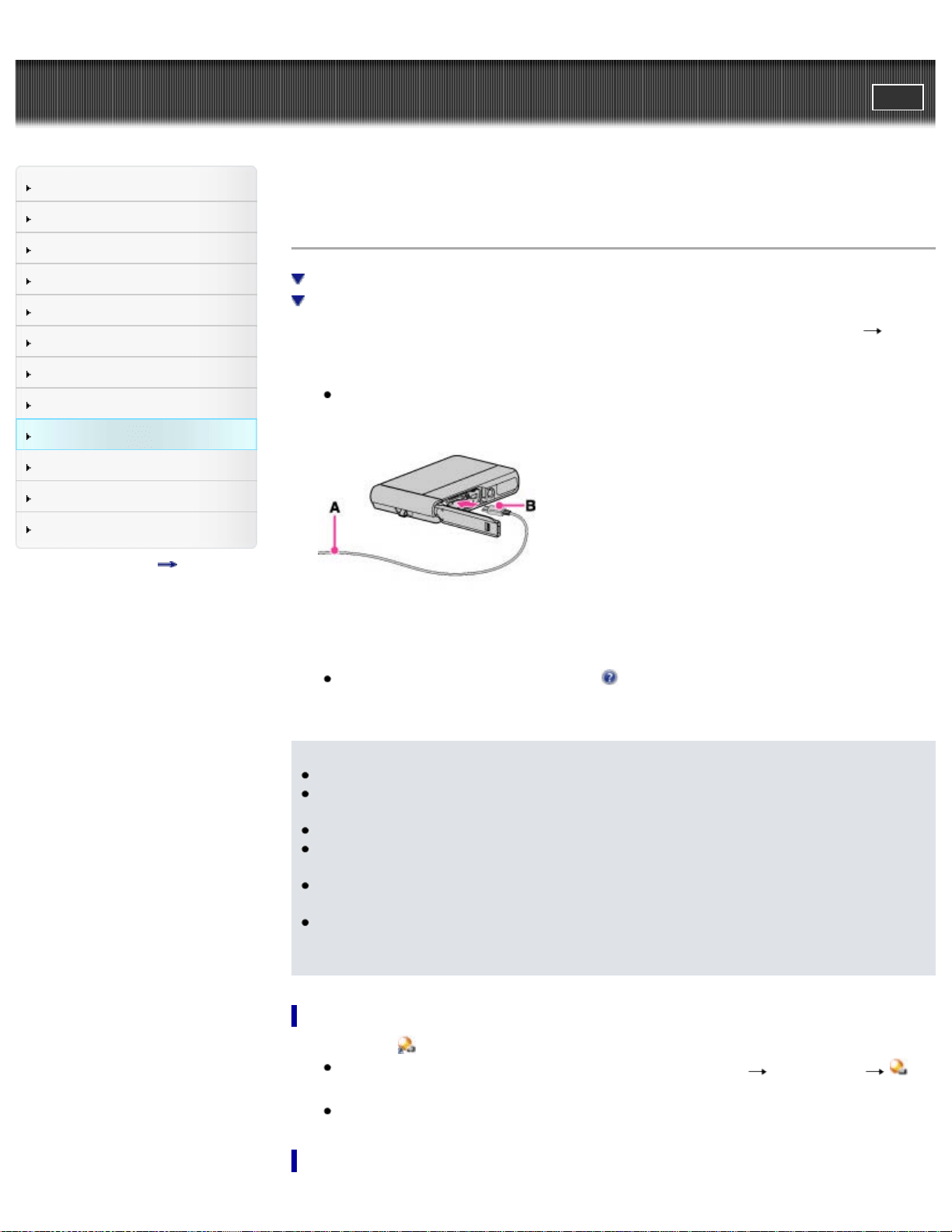
Cyber-shot User Guide
PrintSearch
Before Use
Operating the camera
Shooting
Viewing
Useful shooting functions
Useful viewing functions
Changing settings
Viewing images on a TV
Using with your computer
Printing
Troubleshooting
Precautions / About this camera
Contents list
Top page > Using with your computer > Using the software > Installing “PlayMemories Home”
(Windows)
Installing “PlayMemories Home” (Windows)
Starting “PlayMemories Home” (Windows)
Accessing to “PlayMemories Home Help Guide” (Windows)
1. Using the Internet browser on your computer, go to the following URL, then click [Install]
[Run].
www.sony.net/pm
2. Follow the instructions on the screen to complete the installation.
When the message to connect the camera to a computer is displayed, connect using the micro
USB cable (supplied) (A).
A: To a USB jack of the PC
B: To the Multi/Micro USB Terminal
For details on “PlayMemories Home,” see
(PlayMemories Home Help Guide) or the following
PlayMemories Home support page (English only):
http://www.sony.co.jp/pmh-se/
Notes
Log on as Administrator.
It may be necessary to restart your computer. When the restart confirmation message appears,
restart the computer following the instructions on the screen.
DirectX may be installed depending on your computer’s system environment.
Mac does not support “PlayMemories Home.” Use the application bundled with the Mac to play
back images.
If “PlayMemories Home” has already been installed on your computer, connect the camera with the
computer and register your camera with “PlayMemories Home.” The available functions activate.
If the software “PMB (Picture Motion Browser)” has already been installed on your computer,
“PlayMemories Home” will overwrite it and will be installed. Although some “PlayMemories Home”
functions differ from those of “PMB,” use “PlayMemories Home.”
Starting “PlayMemories Home” (Windows)
1. Double-click (PlayMemories Home) on the desktop.
To start “PlayMemories Home” from the Start menu, select [Start]
[All Programs]
(PlayMemories Home).
For Windows 8, select the [PlayMemories Home] icon on the Start screen.
Accessing to “PlayMemories Home Help Guide” (Windows)
199

1. Double-click (PlayMemories Home Help Guide) on the desktop.
To start “PlayMemories Home Help Guide” from the Start menu, select [Start]
[All Programs]
[PlayMemories Home] [PlayMemories Home Help Guide].
Windows 8: select the [PlayMemories Home Help Guide] from [Help] in [PlayMemories Home].
Back to top
Copyright 2013 Sony Corporation
200
Cyber-shot User Guide
PrintSearch
Before Use
Operating the camera
Shooting
Viewing
Useful shooting functions
Useful viewing functions
Changing settings
Viewing images on a TV
Using with your computer
Printing
Troubleshooting
Precautions / About this camera
Contents list
Top page > Using with your computer > Using the software > “Music Transfer”
“Music Transfer”
“Music Transfer” allows you to replace the Music files provided in the camera at the factory with your
favorite tracks, and to delete and add Music files.
You can also restore the tracks stored at the factory to your camera.
Download the software from the following URL and install it on your computer.
Windows: http://www.sony.co.jp/imsoft/Win/
Mac: http://www.sony.co.jp/imsoft/Mac/
The following track types can be imported using “Music Transfer.”
MP3 files stored on the hard disk of your computer
Music CD tracks
Preset-music saved on the camera
Before starting up “Music Transfer” perform MENU
(Settings) (Main Settings)
[Download Music], and connect the camera to the computer.
For other details, see the help in “Music Transfer.”
Related Topic
Download Music
Empty Music
Back to top
Copyright 2013 Sony Corporation
201
Cyber-shot User Guide
PrintSearch
Before Use
Operating the camera
Shooting
Viewing
Useful shooting functions
Useful viewing functions
Changing settings
Viewing images on a TV
Using with your computer
Printing
Troubleshooting
Precautions / About this camera
Contents list
Top page > Using with your computer > Using the software > Software for Mac
Software for Mac
For details on software for Macs, access the following URL:
http://www.sony.co.jp/imsoft/Mac/
Notes
The available software varies depending on the area.
Back to top
Copyright 2013 Sony Corporation
202
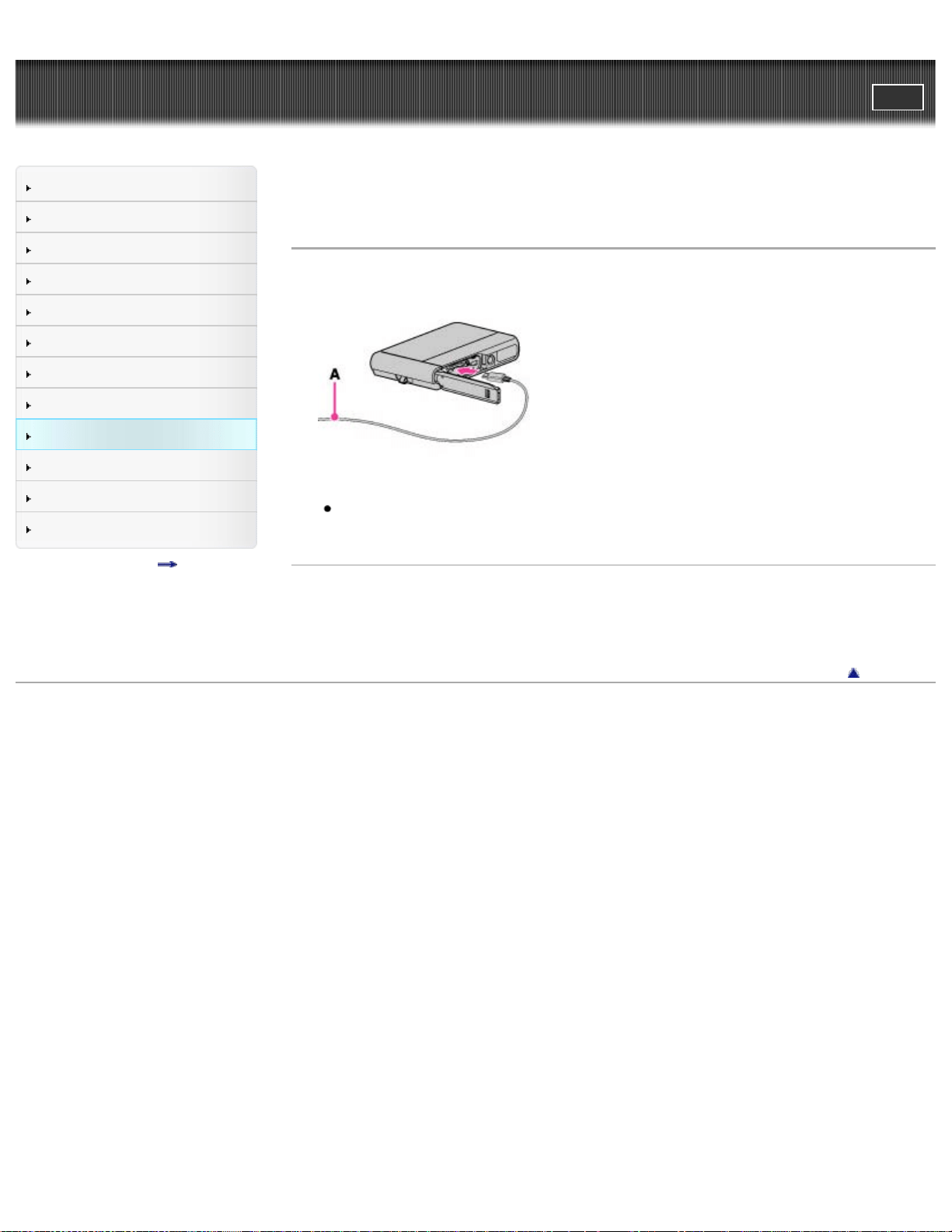
Cyber-shot User Guide
PrintSearch
Before Use
Operating the camera
Shooting
Viewing
Useful shooting functions
Useful viewing functions
Changing settings
Viewing images on a TV
Using with your computer
Printing
Troubleshooting
Precautions / About this camera
Contents list
Top page > Using with your computer > Importing images to a computer > Connecting the camera to
the computer
Connecting the camera to the computer
1. Connect the camera to your computer using the micro USB cable (A).
When connecting the camera to a computer using the micro USB cable, power feeding from the
computer starts if [USB Power Supply] is set to [On]. ([On] is the default setting.)
Related Topic
USB Connect Setting
LUN Setting
Back to top
Copyright 2013 Sony Corporation
203
Cyber-shot User Guide
PrintSearch
Before Use
Operating the camera
Shooting
Viewing
Useful shooting functions
Useful viewing functions
Changing settings
Viewing images on a TV
Using with your computer
Printing
Troubleshooting
Precautions / About this camera
Contents list
Top page > Using with your computer > Importing images to a computer > Importing images to a
computer
Importing images to a computer
“PlayMemories Home” allows you to easily import images.
For details on “PlayMemories Home” functions, see the “PlayMemories Home Help Guide.”
Importing images to a Windows computer without using “PlayMemories
Home”
When the AutoPlay Wizard appears after making a USB connection between the camera and a
computer, click [Open folder to view files]
[OK] [DCIM] or [MP_ROOT] copy the desired
images to the computer.
If the Device Stage screen appears with Windows 7 or Windows 8, double-click [Browse Files]
media icon folder in which the image you want to import is stored.
Importing images to a Mac computer without using “PlayMemories
Home”
Connect the camera to your Mac computer. Double-click the newly recognized icon on the desktop
the folder in which the image you want to import is stored. Then drag and drop the image file on to the
hard disk icon.
Notes
Use “PlayMemories Home” for operations such as when importing AVCHD movies to a computer
(Windows).
Use the “iMovie” software bundled with Mac for operations such as importing AVCHD movies to a
computer (Mac).
If operations are performed on an AVCHD movie file or folder on the camera from a PC while the
camera is connected to a PC, it may destroy the image file or playback may become impossible. Do
not delete or copy AVCHD movies on the camera’s memory card from a PC. Sony bears no
responsibility for the result of operations of this type.
The camera creates a 3D image by combining a JPEG file with an MPO file. If you delete either file
on a PC, you cannot playback the 3D image.
Back to top
Copyright 2013 Sony Corporation
204
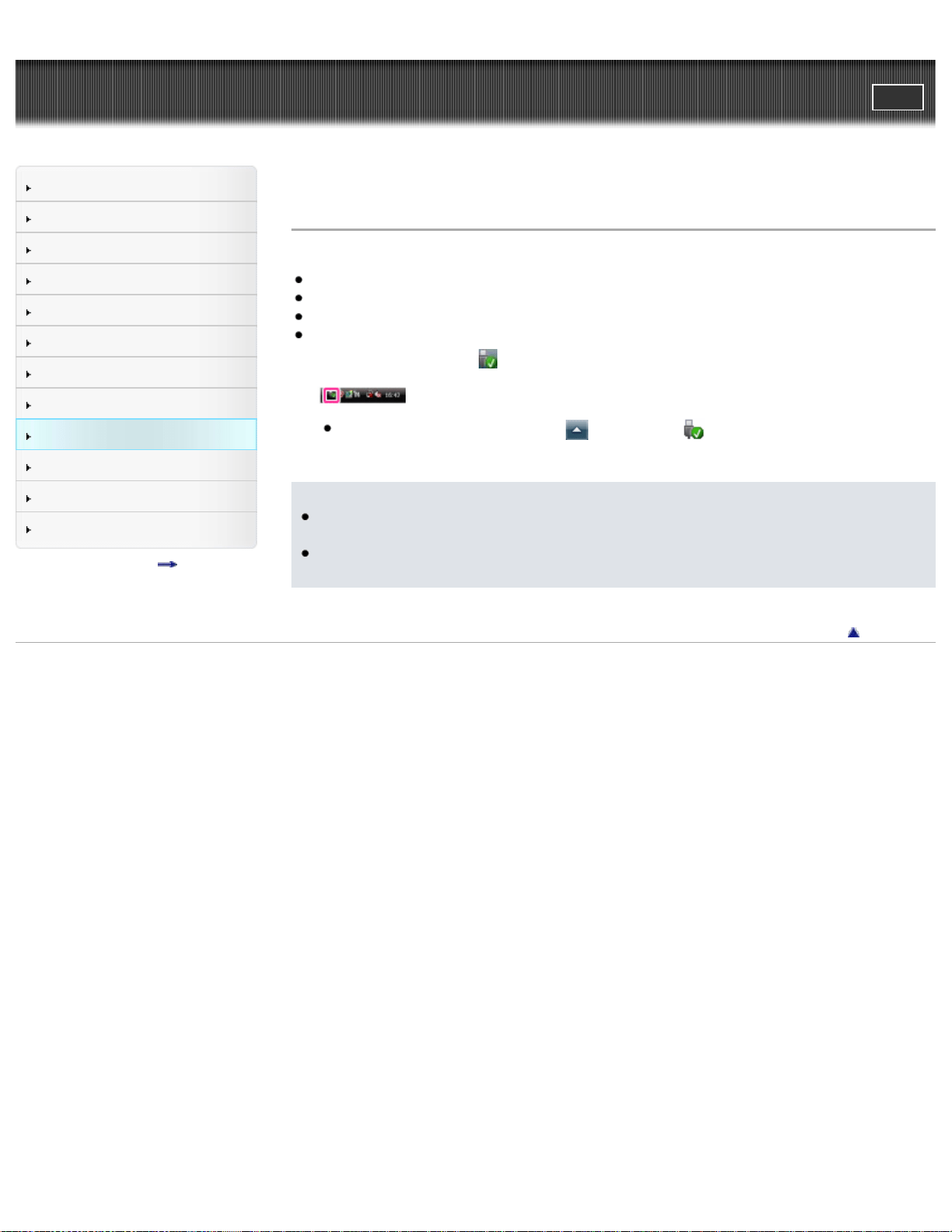
Cyber-shot User Guide
PrintSearch
Before Use
Operating the camera
Shooting
Viewing
Useful shooting functions
Useful viewing functions
Changing settings
Viewing images on a TV
Using with your computer
Printing
Troubleshooting
Precautions / About this camera
Contents list
Top page > Using with your computer > Importing images to a computer > Deleting the USB connection
Deleting the USB connection
Perform the procedures from step 1 to 2 below before:
Disconnecting the cable.
Removing a memory card.
Inserting a memory card into the camera after copying images from the internal memory.
Turning off the camera.
1. Click the disconnect icon (
) on the tasktray.
With Windows 7 or Windows 8, click first, then click .
2. Click [Safely remove USB Mass Storage Device].
Notes
Drag and drop the icon of the memory card or the drive icon to the “Trash” icon beforehand when
you use a Mac computer, and the camera is disconnected from the computer.
The disconnect icon may not appear when you use a Windows 7 computer. In this case, you can
disconnect the camera from the computer without following the above steps.
Back to top
Copyright 2013 Sony Corporation
205
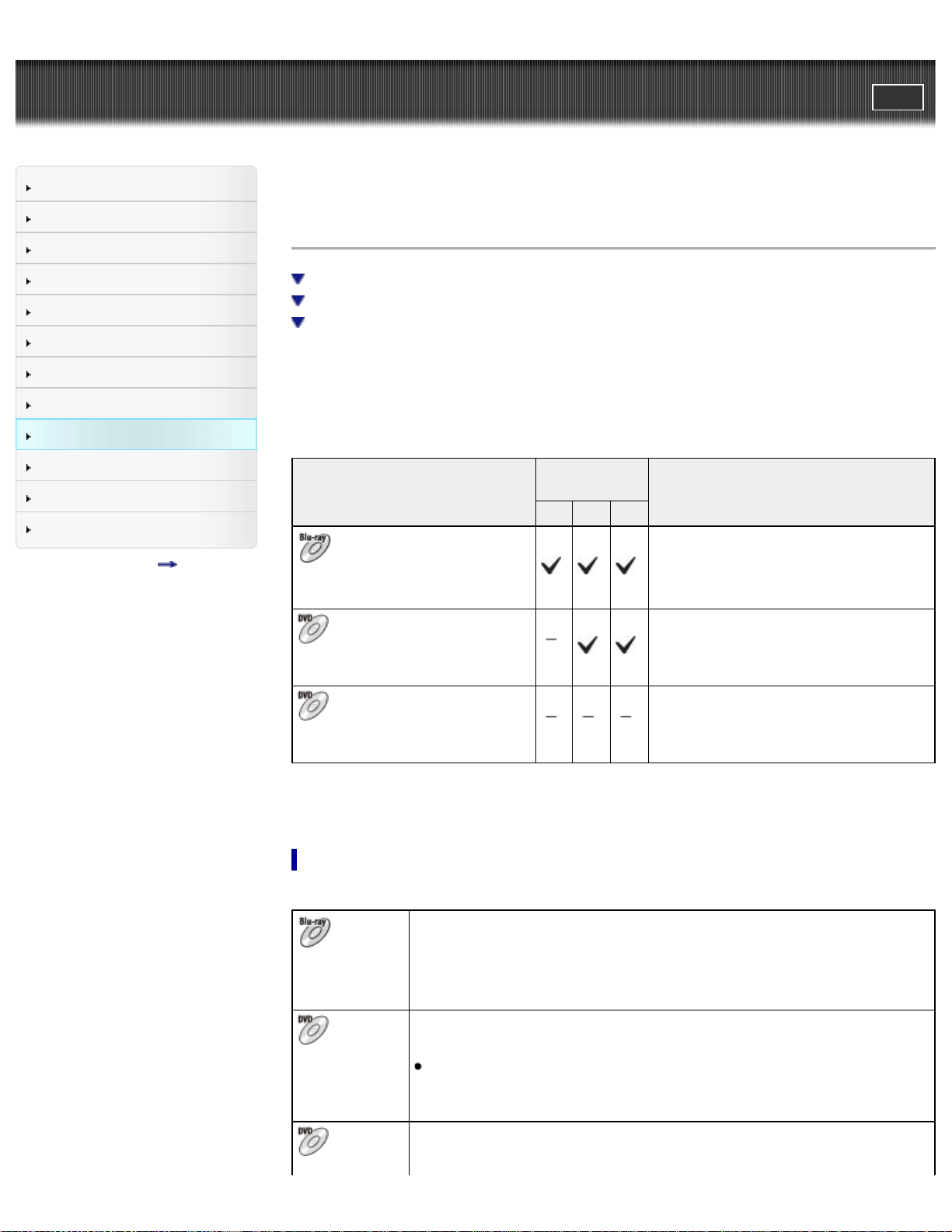
Cyber-shot User Guide
PrintSearch
Before Use
Operating the camera
Shooting
Viewing
Useful shooting functions
Useful viewing functions
Changing settings
Viewing images on a TV
Using with your computer
Printing
Troubleshooting
Precautions / About this camera
Contents list
Top page > Using with your computer > Creating a disc of movies > Selecting the method for creating a
disc of movies
Selecting the method for creating a disc of movies
Characteristics of each type of disc
Creating a disc with a device other than a computer
Creating Blu-ray discs
You can create a disc from AVCHD movies that have been recorded with this camera.
Select the method that suits your disc player.
For details on the method for creating a disc using “PlayMemories Home,” see “PlayMemories Home
Help Guide.”
To import movies into a PC, see [Details].
Disc type/Purpose
Recordable
movie quality
Player
FX FH HQ
For saving images in high-definition
image quality (HD)
Blu-ray disc playback devices (Sony Blu-ray
disc player, PlayStation 3, etc.)
For saving images in high-definition
image quality (HD) (AVCHD disc)
*
AVCHD format playback devices (Sony Blu-
ray disc player, PlayStation 3, etc.)
For saving images in standard
definition image quality (STD)
* * *
Ordinary DVD playback devices (DVD
player, computer that can play DVDs, etc.)
*Movies can be saved by converting them to lower image quality when creating a disc using “PlayMemories
Home.”
Characteristics of each type of disc
High-definition
image quality
(HD)
Using a Blu-ray disc enables you to record high-definition image quality (HD)
movies of a longer duration than DVD discs.
High-definition
image quality
(HD) (AVCHD
disc)
High-definition image quality (HD) movies can be recorded on DVD media, such as
DVD-R discs, and a high-definition image quality (HD) disc is created.
You can play a high-definition image quality (HD) disc on AVCHD format
playback devices, such as a Sony Blu-ray disc player and a PlayStation 3. You
cannot play the disc on ordinary DVD players.
Standard definition image quality (STD) movies converted from high-definition
206
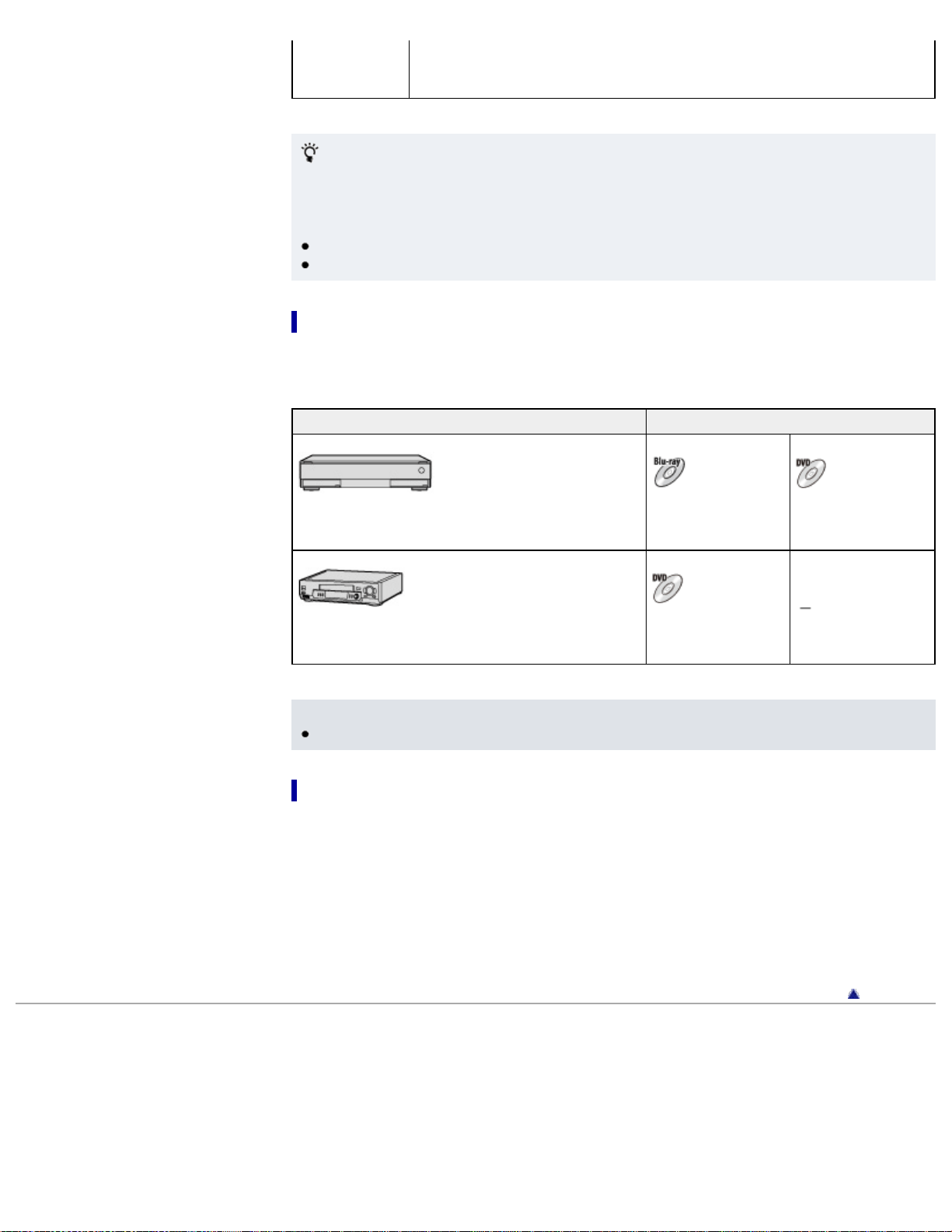
Standard
definition image
quality (STD)
image quality (HD) movies can be recorded on DVD media, such as DVD-R discs,
and a standard definition image quality (STD) disc is created.
Types of discs that can be used with “PlayMemories Home”
The following 12-cm discs can be used with “PlayMemories Home.” For information on Blu-ray discs,
see [Details].
DVD-R / DVD+R / DVD+R DL: Cannot be re-written.
DVD-RW / DVD+RW: Can be re-written and used again.
Always maintain your PlayStation 3 to use the latest version of the PlayStation 3 system software.
The PlayStation 3 may not be available in some countries/regions.
Creating a disc with a device other than a computer
You can also create a disc using a Blu-ray recorder and so on. Depending on which device you use, the
types of disc that can be created vary.
Devices Disc type
Creates a Blu-ray disc or a disc in standard definition
image quality (STD) using a Blu-ray recorder.
High-definition image
quality (HD)
Standard definition
image quality (STD)
Creates a disc in standard definition image quality
(STD) using a device such as an HDD recorder.
Standard definition
image quality (STD)
Notes
For details on how to create a disc, refer to the operating instructions of the device you use.
Creating Blu-ray discs
You can create Blu-ray discs from AVCHD movies imported to a PC.
The PC in question must be capable of creating Blu-ray discs. BD-R (not re-writable) or BD-RE (re-
writable) discs can be used. Multi-session recordings cannot be made.
To create Blu-ray discs using “PlayMemories Home,” be sure to install the dedicated add-on software.
For details, see the following URL:
http://support.d-imaging.sony.co.jp/BDUW/
To install, your PC must be connected to the Internet.
For detailed operations, see “PlayMemories Home Help Guide.”
Back to top
Copyright 2013 Sony Corporation
207
Cyber-shot User Guide
PrintSearch
Before Use
Operating the camera
Shooting
Viewing
Useful shooting functions
Useful viewing functions
Changing settings
Viewing images on a TV
Using with your computer
Printing
Troubleshooting
Precautions / About this camera
Contents list
Top page > Printing > Printing still images > Printing still images
Printing still images
You can print still images using the following methods.
Printing directly using a printer which supports your memory card type.
For details, see the operating instructions supplied with the printer.
Printing using a computer
You can import images to a computer using the supplied “PlayMemories Home” software and print
the images.
For details, see the “PlayMemories Home Help Guide.”
Printing at a shop
You can take a memory card to a photo printing service shop. As long as the shop supports photo
printing services conforming to DPOF, you can make a
(Print order) mark on images in
advance in the playback mode so that you do not have to reselect them when you print them out at
the shop. Before you take image data to a shop, always copy (back up) your data.
Notes
When you print still images shot in [16:9] mode, both edges may be cut off.
You cannot print panoramic images depending on the printer.
Back to top
Copyright 2013 Sony Corporation
208
Cyber-shot User Guide
PrintSearch
Before Use
Operating the camera
Shooting
Viewing
Useful shooting functions
Useful viewing functions
Changing settings
Viewing images on a TV
Using with your computer
Printing
Troubleshooting
Precautions / About this camera
Contents list
Top page > Troubleshooting > If you have problems > If you have problems
If you have problems
If you experience trouble with the camera, try the following solutions.
1. Check the items under “Troubleshooting”, then check your camera.
If a code such as “C/E:
: ” appears on the screen, see “Self-diagnosis display”.
2. Remove the battery pack, wait for about one minute, re-insert the battery pack, then turn on the
power.
3. Initialize the settings. [Details]
4. Consult your Sony dealer or local authorized Sony service facility.
Be aware that by sending the camera for repair, you give consent that the contents of the internal
memory, music files may be checked.
Additional information on this product and answers to frequently asked questions can be found at our
Customer Support Website.
http://www.sony.net/
Back to top
Copyright 2013 Sony Corporation
209
Cyber-shot User Guide
PrintSearch
Before Use
Operating the camera
Shooting
Viewing
Useful shooting functions
Useful viewing functions
Changing settings
Viewing images on a TV
Using with your computer
Printing
Troubleshooting
Precautions / About this camera
Contents list
Top page > Troubleshooting > Troubleshooting > Battery pack and power
Battery pack and power
Cannot insert the battery pack into the camera.
Make sure the direction of the battery pack is correct, and insert it until the battery eject lever is
locked.
Cannot turn on the camera.
After inserting the battery pack into the camera, it may take a few moments for the camera to power
up.
Make sure that the battery pack is inserted correctly.
The battery pack will discharge by itself even if you do not use it. Charge the battery pack before use.
Check that the battery pack type is compatible. [Details]
The power turns off suddenly.
Depending on the camera and battery temperature, the power may turn off automatically to protect
the camera. In this case, a message is displayed on the screen before the power turns off.
If you do not operate the camera for a certain period of time while the power is on and [Power Save]
is set to [Standard] or [Max], the camera turns off automatically to prevent draining the battery pack.
Turn on the camera again.
If you do not operate the camera for a certain period of time while the power is on and [Power Save]
is set to [Off] or the camera is connected to AC adaptor to supply the power, the screen automatically
goes dark to prevent burn-in on the screen. Touch the screen again to display.
The remaining charge indicator is incorrect.
This is caused when you use the camera in an extremely hot or cold location.
Battery capacity decreases over time and through repeated use. If decreased usage time between
charges becomes significant, it is probably time to replace it with a new one.
The charge lamp of the camera flashes while charging the battery.
Check that the battery pack type is compatible. [Details].
The charge lamp of the camera flashes infrequently when you use a battery pack that has not been
used for a long time. In such cases, remove the battery pack from the camera and re-insert it.
For details, see “Battery pack”. [Details]
The battery is not charged even if the charge lamp turns off and charging is
finished.
This happens when you charge the battery pack in an extremely hot or cold location. Charge the
battery pack within the proper charging temperature range of between 10°C to 30°C (50°F to 86°F).
210

Cyber-shot User Guide
PrintSearch
Before Use
Operating the camera
Shooting
Viewing
Useful shooting functions
Useful viewing functions
Changing settings
Viewing images on a TV
Using with your computer
Printing
Troubleshooting
Precautions / About this camera
Contents list
Top page > Troubleshooting > Troubleshooting > Shooting still images/movies
Shooting still images/movies
Cannot record images.
If images are recorded on the internal memory even when a memory card is inserted into the camera,
make sure that the memory card is fully inserted into the camera.
Check the free capacity of the internal memory or memory card. If it is full, do one of the following:
Delete unnecessary images. [Details]
Change the memory card.
You cannot record images while charging the flash.
When recording movies, it is recommended that you use the following memory cards:
“Memory Stick Micro” (Mark2) media
microSD memory card, microSDHC memory card or microSDXC memory card (Class 4 or faster)
Set [Demo Mode] to [Off]. [Details]
Smile Shutter function does not work.
No image is shot if a smiling face is not detected. [Details]
Set [Demo Mode] to [Off]. [Details]
Anti-blur function does not work.
The anti-blur function may not work properly when shooting night scenes.
Shoot after pressing the shutter button halfway down.
Recording takes a long time.
When the shutter speed becomes slower than a certain speed, for example, when you shoot images
in dark locations, the camera automatically reduces the image noise. This function is called NR
(noise reduction) slow shutter and the shooting time takes longer.
The image is out of focus.
The subject is too close. When shooting, make sure to position the lens farther away from the subject
than the shortest shooting distance in the following situation.
In Intelligent Auto mode, Superior Auto mode, Easy Mode: approximately 3 cm (0.10 ft.) (W), 60 cm
(1.97 ft.) (T) (from the lens).
In other shooting modes: approximately 3 cm (0.10 ft.) (W), 60 cm (1.97 ft.) (T) (from the lens). Or
set to Magnifying Glass Plus mode and shoot about 1 cm (0.03 ft.) to 20 cm (0.66 ft.).
[Landscape], [Night Scene] or [Fireworks] mode is selected in the Scene Selection when shooting still
images.
Zoom does not work.
You cannot use the optical zoom when:
212

Shooting in [iSweep Panorama]
You cannot use zoom functions other than optical zoom when:
Shooting in [Background Defocus]
[Backlight Correction HDR] mode is selected in the Scene Selection
Shooting in 3D mode
The Smile Shutter is working.
When [Self-Timer] is set to [Self-portrait One Person] or [Self-portrait Two People].
Cannot select the Face Detection function.
You can select Face Detection only when the focus mode is set to [Multi AF] and the metering mode
is set to [Multi].
You cannot select Face Detection when the Magnifying Glass Plus mode is activated.
The flash does not work.
You cannot use the flash when:
Shooting in [Background Defocus]
Burst mode is selected. [Details]
[Anti Motion Blur] mode, [Night Scene] mode, [Hand-held Twilight] mode,[High Sensitivity] mode or
[Fireworks] mode is selected in Scene Selection.
Shooting in [iSweep Panorama]
Shooting in 3D mode
Shooting in movie mode
Set the flash to [On] when Picture Effect is selected or when Scene Selection is set to [Landscape],
[Backlight Correction HDR], [Gourmet], [Pet], [Beach], [Snow], [Underwater] or [Hi-Speed Shutter]
mode. [Details]
Fuzzy white circular spots appear in images shot using the flash.
Particles (dust, pollen, etc.) in the air, and the floating object underwater reflected the flash light and
appeared in the image. This is not a malfunction. [Details]
The close-up shoot function (Macro / Focus On) does not work.
[Landscape], [Night Scene] or [Fireworks] mode is selected in the Scene Selection.
When Magnifying Glass Plus mode is selected, the shooting distance is approximately 1 cm (0.03 ft.)
to 20 cm (0.66 ft.).
[Macro] is set to [Auto] in the following situations:
Shooting in [iSweep Panorama]
When the Smile Shutter function is activated.
In [Easy Mode]
When [Self-Timer] is set to [Self-portrait One Person] or [Self-portrait Two People].
Macro shooting cannot be turned off.
There is no function for forcibly turning off macro shooting. In [Auto] mode, you can even shoot a
distant subject.
The date and time are not displayed on the screen.
While shooting, the date and time are not displayed. They are displayed only during playback.
The F value and shutter speed flash when you press and hold the shutter
213

button halfway down.
The exposure is incorrect. Correct the exposure. [Details]
The image colors are not correct.
Picture Effect is selected. [Details]
Adjust [White Balance]. [Details]
Noise appears in the image when you view the screen in a dark place.
The camera is attempting to increase the visibility of the screen by temporarily brightening the image
under conditions of low illumination. There is no effect on the recorded image.
There is a dark shadow on the image.
Depending on the brightness of the subject, you may see a dark shadow when you change the
aperture. This is not a malfunction.
The eyes of the subject come out red.
Set [Red Eye Reduction] to [Auto] or [On]. [Details]
Shoot the subject at a distance closer than the flash range using the flash.
Light the room and shoot the subject.
Dots appear and remain on the screen.
This is not a malfunction. These dots are not recorded.
Cannot shoot images in succession.
You cannot shoot images in succession while the Smile Shutter function is activated.
The internal memory or memory card is full. Delete unnecessary images. [Details]
The battery level is low. Insert a charged battery pack.
The same image is shot several times.
Set [Cont. Shooting Settings] to [Off]. [Details]
[Scene Recognition] is set to [Advanced]. [Details]
The buttons and icons no longer appear.
If you touch , all indicators will disappear. Touch on the right of the screen for few seconds.
While you touch the upper right of the screen during shooting images, the buttons or icons are
temporarily turned off. The buttons and icons will reappear when your fingers move away from the
screen.
Back to top
Copyright 2013 Sony Corporation
214
Cyber-shot User Guide
PrintSearch
Before Use
Operating the camera
Shooting
Viewing
Useful shooting functions
Useful viewing functions
Changing settings
Viewing images on a TV
Using with your computer
Printing
Troubleshooting
Precautions / About this camera
Contents list
Top page > Troubleshooting > Troubleshooting > Viewing images
Viewing images
Cannot play back images.
Make sure that the memory card is fully inserted into the camera.
The folder/file name has been changed on your computer.
No guarantees are made for playing back, on this camera, files containing images which were
processed on a computer or images which were shot using other cameras.
The camera is in USB mode. Delete the USB connection. [Details]
Use “PlayMemories Home” to play images stored on a PC with this camera. Use the application
bundled with the Mac to play back images.
3D images consist of a JPEG file and an MPO file. If either file is deleted on the PC, the camera may
not operate correctly.
Cannot hear music during slideshow.
Transfer music files to the camera with “Music Transfer.” [Details]
Slideshow is played back with [Continuous Playback]. Select [Slideshow with music] and play back.
The image does not appear on the TV.
For viewing movies, the camera and television must use the same color television system. [Details]
Check whether the connection is correct. [Details]
The 3D images do not appear on the TV even though the camera is in [3D
Viewing] mode.
Check that the TV is set to display the 3D images.
Back to top
Copyright 2013 Sony Corporation
215
Cyber-shot User Guide
PrintSearch
Before Use
Operating the camera
Shooting
Viewing
Useful shooting functions
Useful viewing functions
Changing settings
Viewing images on a TV
Using with your computer
Printing
Troubleshooting
Precautions / About this camera
Contents list
Top page > Troubleshooting > Troubleshooting > Computers
Computers
Your computer does not recognize the camera.
Set [USB Connect Setting] to [Mass Storage]. [Details]
Use the micro USB cable.
Disconnect the USB cable from both the computer and the camera, and connect it again firmly.
Disconnect all equipment other than the camera, the keyboard and the mouse from the USB
connectors of your computer.
Connect the camera directly to your computer without passing through a USB hub or other device.
Set [USB Power Supply] to [Off]. Your computer may recognize the camera.
Cannot import images.
Connect the camera and your computer correctly making a USB connection. [Details]
When you shoot images with a memory card formatted by a computer, you may not be able to import
the images to a computer. Shoot using a memory card formatted by the camera. [Details]
After making a USB connection, “PlayMemories Home” does not start
automatically.
Make the USB connection after the computer is turned on.
Cannot play back images on your computer.
If you are using “PlayMemories Home,” refer to “PlayMemories Home Help Guide.” [Details]
Consult the computer or software manufacturer.
The image and sound are interrupted by noise when you view a movie on a
computer.
You are playing back the movie directly from the memory card. Import the movie to your computer
using “PlayMemories Home” and play it back. [Details]
Images once exported from a computer cannot be viewed on the camera.
Use “PlayMemories Home” to play images stored on a PC with this camera. Use the application
bundled with the Mac to play back images.
Register the image in the Image Database File and play in [Date View]. [Details]
Event View is not available on this camera.
Back to top
Copyright 2013 Sony Corporation
216
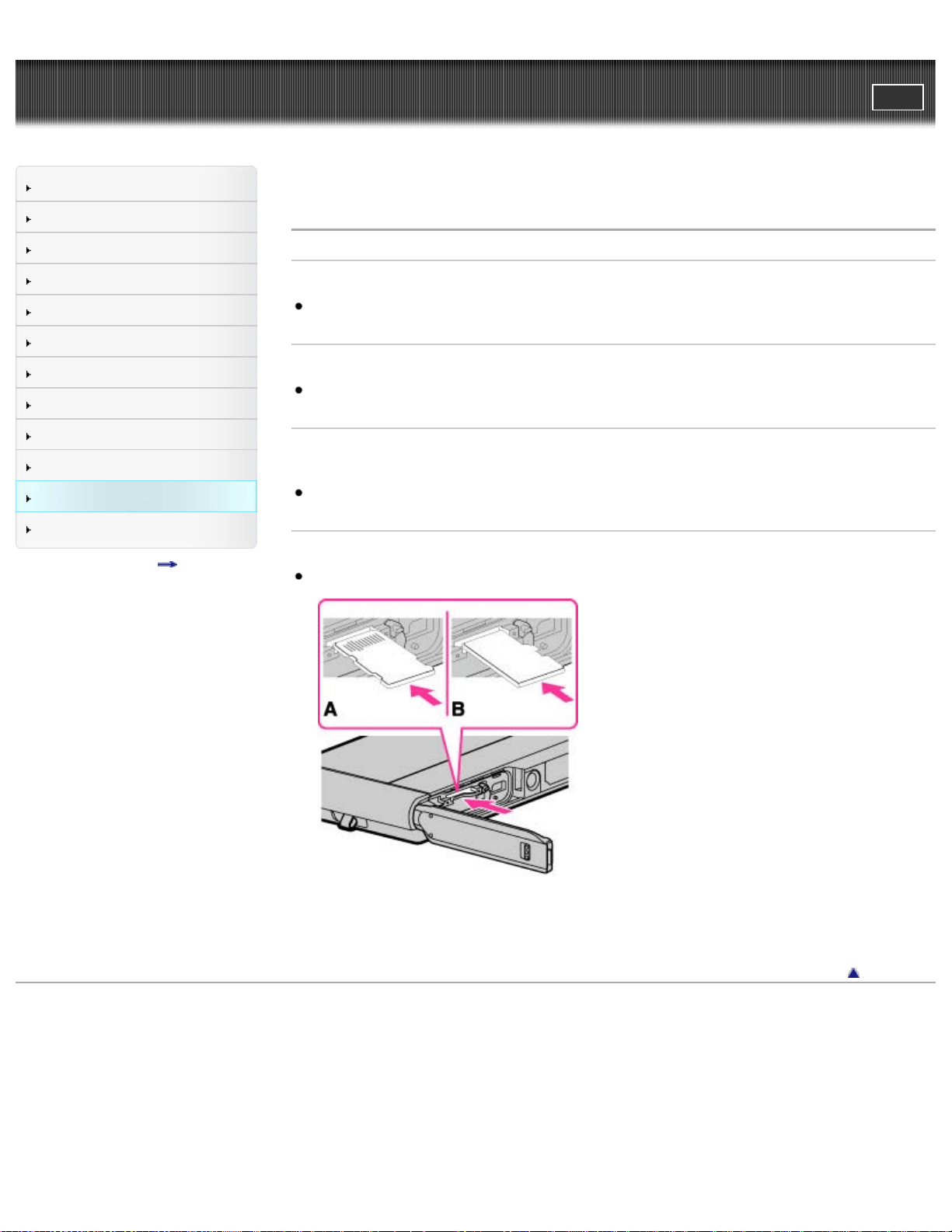
Cyber-shot User Guide
PrintSearch
Before Use
Operating the camera
Shooting
Viewing
Useful shooting functions
Useful viewing functions
Changing settings
Viewing images on a TV
Using with your computer
Printing
Troubleshooting
Precautions / About this camera
Contents list
Top page > Troubleshooting > Troubleshooting > Memory card
Memory card
Cannot insert a memory card.
Insert the memory card in the correct direction.
You have formatted a memory card by mistake.
All the data on the memory card is deleted by formatting. You cannot restore it.
Images are recorded on the internal memory even when a memory card is
inserted into the camera.
Make sure that the memory card is fully inserted into the camera.
A memory card cannot be recognized.
Insert the memory card in the correct direction.
A: “Memory Stick Micro” media
B: microSD memory card
Back to top
Copyright 2013 Sony Corporation
217
Cyber-shot User Guide
PrintSearch
Before Use
Operating the camera
Shooting
Viewing
Useful shooting functions
Useful viewing functions
Changing settings
Viewing images on a TV
Using with your computer
Printing
Troubleshooting
Precautions / About this camera
Contents list
Top page > Troubleshooting > Troubleshooting > Internal memory
Internal memory
Cannot play back or record images using the internal memory.
There is a memory card inserted in the camera. Remove it.
Cannot copy the data stored in the internal memory to a memory card.
The memory card is full. Copy to a memory card with sufficient capacity.
Cannot copy the data on the memory card or the computer to the internal
memory.
This feature is not available.
Back to top
Copyright 2013 Sony Corporation
218
Cyber-shot User Guide
PrintSearch
Before Use
Operating the camera
Shooting
Viewing
Useful shooting functions
Useful viewing functions
Changing settings
Viewing images on a TV
Using with your computer
Printing
Troubleshooting
Precautions / About this camera
Contents list
Top page > Troubleshooting > Troubleshooting > Printing
Printing
Images are printed with both edges cut off.
Depending on your printer, all the edges of the image may be cut off. Especially when you print an
image shot with the image size set to [16:9], the lateral end of the image may be cut off.
When printing images using your printer, cancel the trimming or borderless settings. Consult the
printer manufacturer as to whether the printer provides these functions or not.
When having images printed at a digital print shop, ask the shop whether they can print the images
without cutting off both edges.
Cannot print images with the date.
Using “PlayMemories Home,” you can insert the date on still images. [Details]
Select MENU
(Shooting Settings) [Write Date] [On] to insert a date on the image.
Make sure that once the date is inserted, you cannot remove that date from the image.
Cannot print 3D images as they are displayed on the camera’s screen.
3D images displayed on the camera are MPO files, but the images to be printed are JPEG files, so in
some cases, the images to be printed out will differ from the ones displayed on the screen.
Back to top
Copyright 2013 Sony Corporation
219
Cyber-shot User Guide
PrintSearch
Before Use
Operating the camera
Shooting
Viewing
Useful shooting functions
Useful viewing functions
Changing settings
Viewing images on a TV
Using with your computer
Printing
Troubleshooting
Precautions / About this camera
Contents list
Top page > Troubleshooting > Troubleshooting > Touch Panel/Screen
Touch Panel/Screen
Cannot operate the touch panel buttons correctly or fully.
The touch panel may not react the operation when sticking the protection film on.
If you touch an area other than that for the operation you want to perform, the operation may not
work properly.
When operating the touch panel, do not touch any other area except the desired area.
When a bright image is displayed on the screen, brightness on the screen
appears different from the actual image.
When a very bright image is displayed on the screen, the camera automatically turns down the
brightness in order to protect the screen.
The screen may become dark under the following conditions. Since the image on the screen is
displayed darker than the actual image, the appearance of the image displayed on the screen may
be different from that of the recorded image.
When displaying the very bright image
When shooting the bright subject with EV set to + side.
When shooting a bright subject using the same locked exposure reading after locking AE on a dark
subject.
The screen goes dark, the screen vanishes.
If the camera is not operated for a certain period of time, the screen automatically goes dark to
prevent burn-in on the screen. Return to normal screen when you operate the camera.
Back to top
Copyright 2013 Sony Corporation
220
Cyber-shot User Guide
PrintSearch
Before Use
Operating the camera
Shooting
Viewing
Useful shooting functions
Useful viewing functions
Changing settings
Viewing images on a TV
Using with your computer
Printing
Troubleshooting
Precautions / About this camera
Contents list
Top page > Troubleshooting > Troubleshooting > Others
Others
The lens gets fogged.
Moisture condensation has occurred. Pull out the battery and the memory card and open up the
battery/memory card cover, then put down the camera in dry place until the moisture has evaporated.
The camera becomes warm when you use it for a long time.
This is not a malfunction.
The Clock Set screen appears when you turn on the camera.
Set the date and time again. [Details]
The internal rechargeable backup battery has discharged. Insert a charged battery, and set aside for
24 hours or more with the power left off.
The date or time is incorrect.
The Area Setting is set to a different location than your current location. Change the setting by MENU
(Settings) [Clock Settings] [Area Setting].
Back to top
Copyright 2013 Sony Corporation
221
Cyber-shot User Guide
PrintSearch
Before Use
Operating the camera
Shooting
Viewing
Useful shooting functions
Useful viewing functions
Changing settings
Viewing images on a TV
Using with your computer
Printing
Troubleshooting
Precautions / About this camera
Contents list
Top page > Troubleshooting > Warning indicators and messages > Self-diagnosis display
Self-diagnosis display
If a code starting with a letter of the alphabet appears, the self-diagnosis function on the camera is
working.
The last two digits (indicated by
) will differ depending on the state of the camera.
If you cannot solve the problem even after trying the following corrective actions a few times, the camera
may need repair.
Contact your Sony dealer or local authorized Sony service facility.
C:32:
There is trouble with the camera’s hardware. Turn the power off and on again.
C:13:
The camera cannot read or write data on the memory card. Try turning off and on the camera again,
or taking out and inserting the memory card several times.
The internal memory has experienced a format error, or an unformatted memory card is inserted.
Format the internal memory or the memory card. [Details]
The inserted memory card cannot be used with the camera, or the data is damaged. Insert a new
memory card.
E:61:
E:62:
E:91:
A camera malfunction has occurred. Initialize the camera, then turn the power on again. [Details]
E:94:
There is a malfunction when writing or deleting data. Repair is required. Contact your Sony dealer or
local authorized Sony service facility. Be prepared to give all numbers in the error code beginning
from the E.
Back to top
Copyright 2013 Sony Corporation
222
Cyber-shot User Guide
PrintSearch
Before Use
Operating the camera
Shooting
Viewing
Useful shooting functions
Useful viewing functions
Changing settings
Viewing images on a TV
Using with your computer
Printing
Troubleshooting
Precautions / About this camera
Contents list
Top page > Troubleshooting > Warning indicators and messages > Messages
Messages
If the following messages appear, follow the instructions.
The battery level is low. Charge the battery pack immediately. Depending on the conditions of use or
the type of battery pack, the indicator may flash even though there are still 5 minutes to 10 minutes
of remaining battery time left.
Camera overheating Allow it to cool
The camera temperature has risen. The power may turn off automatically, or you may be unable to
record movies. Leave the camera in a cool location until the temperature goes down.
Internal memory error
Turn the power off and then on again.
Memory card error has occurred. Cannot write data to memory card.
The inserted memory card cannot be used in the camera. [Details]
The terminal section of the memory card is dirty.
The memory card is damaged.
This memory card is not formatted correctly.
The inserted memory card cannot be used in the camera. [Details]
This memory card may not be able to record or play images correctly.
The inserted memory card cannot be used in the camera. [Details]
Buffer overflow. Writing to the media was not completed in time.
If you use a memory card that has been recorded and erased repeatedly, or that was formatted on a
different camera, the data writing speed may be too slow. First back up any data on the card to a
computer, and then reformat the card before using it. [Details]
The writing speed of the memory card you are using is not sufficient for movie recordings. Use one of
the memory cards listed below.
“Memory Stick Micro” (Mark2) media, microSD memory card (Class 4 or faster).
This is a read- only memory card.
The camera cannot record or delete images on this memory card.
223

Writing to the memory card was not completed correctly Recover data
Reinsert the memory card, and touch [OK] to recover the data.
No images
No images that can be played back have been recorded in the internal memory.
No images that can be played back have been recorded in this folder of the memory card.
No still images
There are no 3D images that can be played back in [3D Viewing] mode.
The selected folder or date does not contain a file that can be played back in a slideshow.
File found which was not recognized
You tried to delete a folder containing a file that cannot be played on this camera. Delete the file on a
computer and then delete the folder.
Folder error. Cannot record to the selected folder. Please select a different
folder.
A folder with the same first three digit number already exists on the memory card (for example:
123MSDCF and 123ABCDE). Select another folder [Details], or create a new folder [Details].
Cannot create more folders
The folder with a name beginning with “999” exists on the memory card. You cannot create any
folders if this is the case.
Empty folder contents
You tried to delete a folder containing one or more files. Delete all of the files and then delete the
folder.
Folder protected
You tried to delete a folder that is protected as read only on a computer.
File Error.
An error occurred while the image was playing back.
No guarantees are made for playing back, on this camera, files containing images which were
processed on a computer or images which were shot using other cameras.
Read only folder
You have selected a folder that cannot be set as a recording folder on the camera. Select another
folder. [Details]
File protected
Release the protection. [Details]
224

Image size over limit
You are playing back an image with size that cannot be played back on the camera.
Unable to detect face for retouch
You may not be able to retouch the image depending on the image.
(Vibration warning indicator)
Camera shake may occur due to insufficient light. Use the flash, or mount the camera on a tripod to
secure the camera.
MP4 12M is not supported with this memory card.
MP4 6M is not supported with this memory card.
For recording movies, it is recommended that you use one of the memory cards listed below.
“Memory Stick Micro” (Mark2) media, microSD memory card (Class 4 or faster)
Movie with different video signal format from this device recorded. Recording
is unavailable in this movie format.
Set [Movie format] to [MP4]. [Details]
Maximum number of images already selected.
Up to 100 files can be selected when using [Multiple Images].
You can add
(Print order) marks to up to 999 files.
Error Playing Music
Delete the Music file, or replace it with a normal Music file.
Execute [Empty Music], then download a new Music file.
Error Formatting Music
Execute [Empty Music].
Operation cannot be executed in unsupported files.
Processing and other editing functions of the camera cannot be performed on image files that have
been processed using a computer or images that were recorded with other cameras.
Preparing image database file. Please wait.
The camera restores the date information, etc., in cases where images have been deleted on a PC,
etc.
The necessary Image Database File is created after the memory card is formatted.
The number of images exceeds that for which date management in a database file by the camera is
possible. To register additional images in the Image Database File, delete images in [Date View].
225

Inconsistencies found in image database file. Do you want to repair the image
database file?
AVCHD movies cannot be recorded or played because the Image Database File is corrupt. Follow
the on-screen instructions to recover the Image Database File.
It is not possible to record to the camera’s Image Database File or play back using [Date View]. Use
“PlayMemories Home” to back up all images to a PC and use it to restore a memory card.
Image Database File error. Cannot recover data.
Import all of the images to the computer with “PlayMemories Home,” and format the memory card or
the internal memory. To view the images again with the camera, export the imported images to the
camera with “PlayMemories Home.” [Details]
Recording function unavailable due to high internal temperature.
The camera temperature has risen. You cannot record images until the temperature has gone down.
Recording has stopped due to increased camera temperature.
Recording has stopped due to a rise in temperature while recording a movie. Please wait until the
temperature goes down.
When you record movies for a long time, the camera temperature rises. In this case, stop recording
movies.
Back to top
Copyright 2013 Sony Corporation
226
Cyber-shot User Guide
PrintSearch
Before Use
Operating the camera
Shooting
Viewing
Useful shooting functions
Useful viewing functions
Changing settings
Viewing images on a TV
Using with your computer
Printing
Troubleshooting
Precautions / About this camera
Contents list
Top page > Troubleshooting > Situations this camera has difficulty handling > Situations this camera
has difficulty handling
Situations this camera has difficulty handling
The camera cannot take full advantage of some features under certain circumstances.
When shooting under the following conditions, either recompose the shot or change the shooting mode,
then shoot the images again.
Low light conditions
iSweep Panorama
Background Defocus
Tracking focus
3D Still Image
Overly bright conditions
Background Defocus
Tracking focus
Varying levels of brightness
Tracking focus
Flickering lights
iSweep Panorama
Subjects too close to the camera
iSweep Panorama
Background Defocus
Subjects too far from the camera
Background Defocus
Large moving subjects or subjects that move too quickly
Superior Auto
Background Defocus
Tracking focus
3D Still Image
Subjects too small or too large
Tracking focus
Background Defocus
Background the same color as the subject
Background Defocus
Scenes with little contrast, such as the sky or a sandy beach
iSweep Panorama
Superior Auto
Scenes changing constantly, such as waterfalls
iSweep Panorama
Superior Auto
227

Cyber-shot User Guide
PrintSearch
Before Use
Operating the camera
Shooting
Viewing
Useful shooting functions
Useful viewing functions
Changing settings
Viewing images on a TV
Using with your computer
Printing
Troubleshooting
Precautions / About this camera
Contents list
Top page > Precautions / About this camera > Precautions > Precautions
Precautions
Internal memory and memory card back up
On database files
Do not use/store the camera in the following places
On carrying
On operating temperatures
On moisture condensation
Functions built into this camera
On image data compatibility
Notes when playing movies on other devices
Notes on the screen and lens
Internal memory and memory card back up
Do not turn off the camera, remove the battery pack, or remove the memory card while the access lamp
is lit. Otherwise, the internal memory data or the memory card may be damaged. Be sure to make a
backup copy to protect your data.
On database files
When you insert a memory card without a database file into the camera and turn on the power, part of
the memory card capacity is used to automatically create a database file. It may take some time until
you can perform the next operation.
Do not use/store the camera in the following places
In an extremely hot, cold or humid place
In places such as in a car parked in the sun, the camera body may become deformed and this may
cause a malfunction.
Storing under direct sunlight or near a heater
The camera body may become discolored or deformed, and this may cause a malfunction.
In a location subject to rocking vibration
Near strong magnetic place
In sandy or dusty places
On carrying
Do not sit down in a chair or other place with the camera in the back pocket of your trousers or skirt, as
this may cause malfunction or damage the camera.
On operating temperatures
Your camera is designed for use under the temperatures between -10°C and +40°C (14°F and 104°F).
Shooting in extremely cold or hot places that exceed this range is not recommended.
On moisture condensation
229

If the camera is brought directly from a cold to a warm location, moisture may condense inside or
outside the camera. This moisture condensation may cause a malfunction of the camera.
If moisture condensation occurs, pull out the battery and the memory card and open up the
battery/memory card cover, then put down the camera in dry place until the moisture has evaporated.
Note that if you attempt to shoot with moisture remaining inside the lens, you will be unable to record
clear images.
Functions built into this camera
This manual describes the functions of 1080 60i-compatible devices and 1080 50i-compatible
devices.
To check if your camera is a 1080 60i-compatible device or 1080 50i-compatible device, check for
the following marks on the bottom of the camera.
1080 60i-compatible device: 60i
1080 50i-compatible device: 50i
Do not watch 3D images shot with this camera for extended periods of time on 3D-compatible
monitors.
When you view 3D images shot with this camera on a 3D-compatible monitor, you may experience
discomfort in the form of eye strain, fatigue, or nausea. To prevent these symptoms, we recommend
that you take regular breaks.
However, you need to determine for yourself the length and frequency of breaks you require, as they
vary according to the individual. If you experience any type of discomfort, stop viewing the 3D images
until you feel better, and consult a physician as necessary. Also refer to the operating instructions
supplied with the device or software you have connected or are using with this camera.
Note that a child’s eyesight is still at the development stage (particularly children below the age of 6).
Consult a pediatrician or ophthalmologist before letting your child view 3D images, and make sure
he/she observes the above precautions when viewing such images.
On image data compatibility
The camera conforms with DCF (Design rule for Camera File system) universal standard established
by JEITA (Japan Electronics and Information Technology Industries Association).
Sony does not guarantee that the camera will play back images recorded or edited with other
equipment, or that other equipment will play back images recorded with the camera.
Notes when playing movies on other devices
This camera uses MPEG-4 AVC/H.264 High Profile for AVCHD format recording. Movies recorded in
AVCHD format with this camera cannot be played by the following devices.
Other devices compatible with AVCHD format that does not support High Profile
Devices incompatible with the AVCHD format
This camera also uses MPEG-4 AVC/H.264 Main Profile for MP4 format recording. For this reason,
movies recorded in MP4 format with this camera cannot be played on devices other than those that
support MPEG-4 AVC/H.264.
You can play a high-definition image quality (HD) disc only on AVCHD format playback devices. A
DVD player or DVD recorder cannot play back a disc recorded in high-definition image quality (HD)
because they are not compatible with the AVCHD format. In addition, if you insert a high-definition
image quality (HD) disc recorded in AVCHD format into a DVD player or DVD recorder, you may not
be able to eject the disc.
Notes on the screen and lens
The screen is manufactured using extremely high-precision technology so over 99.99% of the pixels
are operational for effective use. However, some tiny black and/or bright dots (white, red, blue or
green) may appear on the screen. These dots are a normal result of the manufacturing process and
do not affect the recording.
Exposing the screen or the lens to direct sunlight for long periods may cause malfunctions. Be
careful when placing the camera near a window or outdoors.
Do not press against the screen. The screen may be discolored or a malfunction may result.
Images may trail across on the screen in a cold location. This is not a malfunction.
230

Cyber-shot User Guide
PrintSearch
Before Use
Operating the camera
Shooting
Viewing
Useful shooting functions
Useful viewing functions
Changing settings
Viewing images on a TV
Using with your computer
Printing
Troubleshooting
Precautions / About this camera
Contents list
Top page > Precautions / About this camera > Precautions > On the internal rechargeable backup
battery
On the internal rechargeable backup battery
This camera has an internal rechargeable battery for maintaining the date and time and other settings
regardless of whether the power is on or off.
This rechargeable battery is continually charged as long as you are using the camera. However, if you
use the camera for only short periods, it discharges gradually, and if you do not use the camera at all for
about one month it becomes completely discharged. In this case, be sure to charge this rechargeable
battery before using the camera.
However, even if this rechargeable battery is not charged, you can still use the camera, but the date and
time will not be indicated.
Charging method of the internal rechargeable backup battery
Insert a charged battery pack in the camera, and then leave the camera for 24 hours or more with the
power off.
Back to top
Copyright 2013 Sony Corporation
232
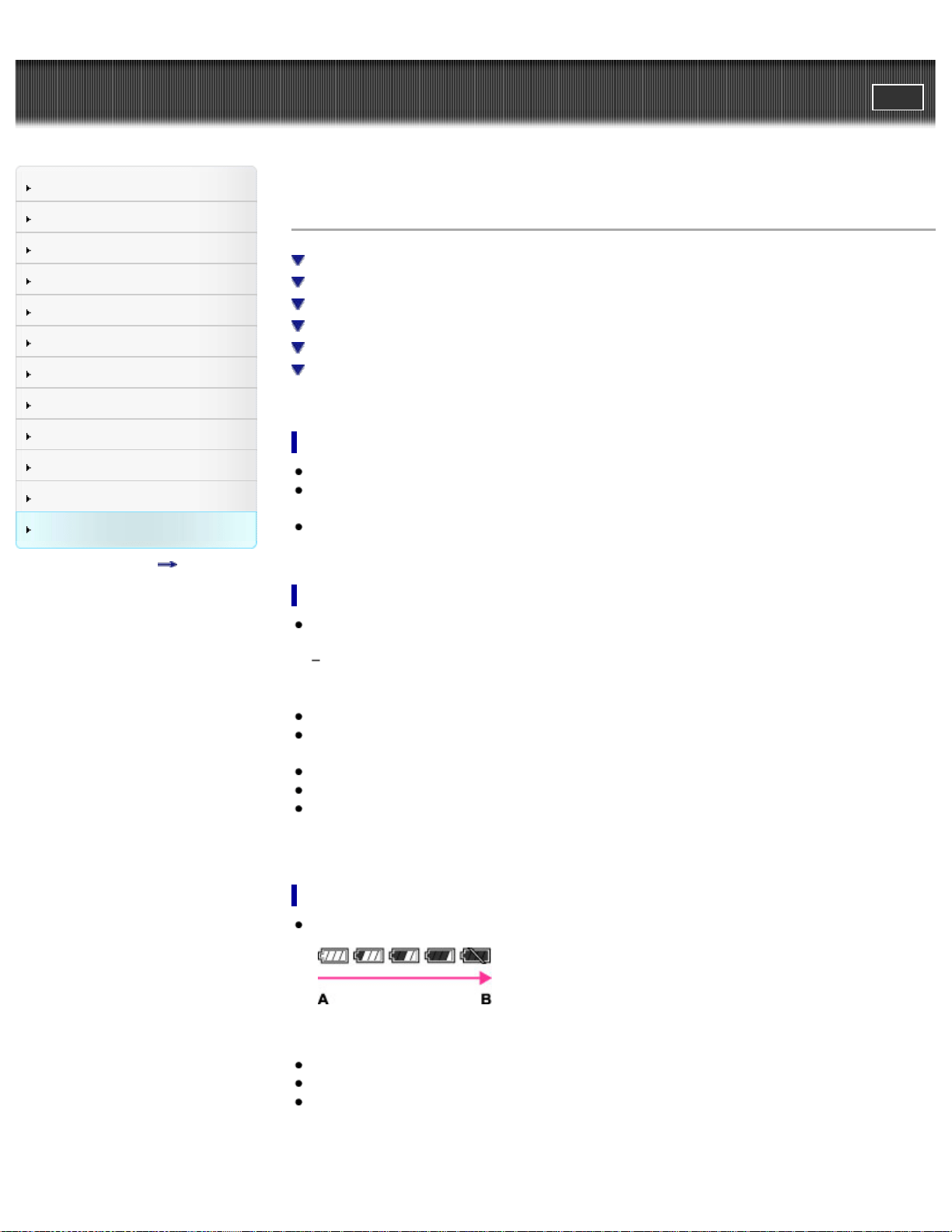
Cyber-shot User Guide
PrintSearch
Before Use
Operating the camera
Shooting
Viewing
Useful shooting functions
Useful viewing functions
Changing settings
Viewing images on a TV
Using with your computer
Printing
Troubleshooting
Precautions / About this camera
Contents list
Top page > Precautions / About this camera > Precautions > Battery pack
Battery pack
On charging the battery pack
Effective use of the battery pack
Remaining battery charge
How to store the battery pack
On battery life
Compatible battery pack
On charging the battery pack
Charge the battery pack (supplied) before using the camera for the first time.
You can charge the battery pack even if it is not completely discharged. In addition, even if the
battery pack is not fully charged, you can use the partially charged capacity of the battery pack as is.
We recommend charging the battery pack in an ambient temperature of between 10°C to 30°C (50°F
to 86°F). The battery pack may not be effectively charged in temperatures outside this range.
Effective use of the battery pack
Battery performance decreases in low temperature surroundings. So in cold places, the operational
time of the battery pack is shorter. We recommend the following to ensure longer battery pack use:
Put the battery pack in a pocket close to your body to warm it up, and insert it in the camera
immediately before you start shooting.
(If there are any metal objects such as keys in your pocket, be aware of short-circuits.)
The battery pack will run out quickly if you use the flash or zoom frequently.
We recommend having spare battery packs handy for two times or three times the expected shooting
time, and making trial shots before taking the actual shots.
Do not expose the battery pack to water. The battery pack is not water-resistant.
Do not leave the battery pack in extremely hot places, such as in a car or under direct sunlight.
You may not be able to turn on the camera or the battery pack may not be effectively charged if the
terminal section of the battery is dirty. In this case, wipe any dust off lightly using a soft cloth or a
cotton swab to clean the battery.
Remaining battery charge
A remaining charge indicator appears on the screen.
A: High
B: Low
It takes about one minute until the correct remaining charge indicator appears.
The remaining charge indicator may not be correct under certain circumstances.
When [Power Save] is set to [Standard] or [Max], if you do not operate the camera for a certain
period of time while the power is on, the screen becomes dark, then the camera turns off
automatically (Auto power-off function).
233

How to store the battery pack
Fully discharge the battery pack before storing and store the camera in a cool, dry place. To maintain
the battery pack’s function, charge the battery pack and then fully discharge it in the camera at least
once a year while storing.
To use the battery pack up, leave the camera in slideshow playback mode until the power goes off.
To prevent staining the terminal, short-circuiting, etc., be sure to use a plastic bag, etc. to keep away
from metal materials when carrying or storing.
On battery life
The battery life is limited. Battery capacity decreases over time and through repeated use. If
decreased usage time between charges becomes significant, it is probably time to replace it with a
new one.
The battery life varies according to how it is stored and the operating conditions and environment in
which each battery pack is used.
Compatible battery pack
The NP-BN (supplied) or NP-BN1 (sold separately) can be used with this model.
Back to top
Copyright 2013 Sony Corporation
234
Cyber-shot User Guide
PrintSearch
Before Use
Operating the camera
Shooting
Viewing
Useful shooting functions
Useful viewing functions
Changing settings
Viewing images on a TV
Using with your computer
Printing
Troubleshooting
Precautions / About this camera
Contents list
Top page > Precautions / About this camera > Precautions > Charging the battery pack
Charging the battery pack
The supplied AC Adaptor is dedicated to this camera. Do not connect with other electronic devices.
Doing so may cause a malfunction. Also, make sure to use a genuine Sony AC Adaptor.
If the charge lamp of the camera flashes during charging, remove the battery pack being charged,
and then insert the same battery pack into the camera securely again. If the charge lamp flashes
again, this may indicate a battery error or that a battery pack other than the specified type has been
inserted. Check that the battery pack is the specified type. If the battery pack is the specified type,
remove the battery pack, replace it with a new or different one and check that the battery is charged
correctly. If the battery is charged correctly, a battery error may have occurred.
If the charge lamp flashes even if the AC Adaptor is connected to the camera and the wall outlet (wall
socket), this indicates that the charging has stopped temporarily and is on standby. Charging stops
and enters standby mode automatically when the temperature is outside of the recommended
operating temperature. When the temperature returns to the appropriate range, charging resumes
and the charge lamp lights up again. We recommend charging the battery pack in an ambient
temperature of between 10°C to 30°C (50°F to 86°F).
Using the supplied AC Adaptor, you can charge the battery pack inserted in the camera. In addition,
power supply via AC Adaptor in playback mode is also available. However, in shooting mode, power
supply via AC Adaptor is not available. You need the AC Adaptor AC-UD10 (sold separately) or AC-
UD11* (sold separately) for shooting to supply a power from the wall outlet (wall socket) during
shooting.
* The AC Adaptor AC-UD11 (sold separately) may not be available in some countries/regions.
Back to top
Copyright 2013 Sony Corporation
235
Cyber-shot User Guide
PrintSearch
Before Use
Operating the camera
Shooting
Viewing
Useful shooting functions
Useful viewing functions
Changing settings
Viewing images on a TV
Using with your computer
Printing
Troubleshooting
Precautions / About this camera
Contents list
Top page > Precautions / About this camera > Precautions > Memory card
Memory card
Memory card
“Memory Stick” media
Memory card
The following memory cards are compatible with this camera.
Types of memory card In this manual
Memory Stick Micro
“Memory Stick Micro” media
Memory Stick Micro (Mark2)
microSD memory card
microSD memory cardmicroSDHC memory card
microSDXC memory card
This camera should be operated at between –10°C and +40°C (14°F and 104°F), but according to
the type of memory card, the operating temperature may vary. For details, see the operating
instructions supplied with the memory card.
“Memory Stick Micro” media of up to 16 GB and microSD memory cards of up to 64 GB have been
tested and proven to operate with your camera.
When recording movies, it is recommended that you use the following memory cards:
(Mark2) (“Memory Stick Micro” (Mark2) media)
microSD memory card (Class 4 or faster)
Notes
To ensure stable operations of the memory card, we recommend that you use this camera to
format any memory card being used with this camera for the first time. Note that formatting will
erase all data recorded on the memory card. This data cannot be restored. Be sure to backup any
important data to a PC or other storage location.
If you repeatedly record/delete images, fragmentation of data may occur on the memory card.
Movies may not be able to be saved or recorded. In such a case, save your images to a PC or
other storage location, then [Format].
A memory card formatted with a computer is not guaranteed to operate with the camera.
Data read/write speeds differ depending on the combination of the memory card and the equipment
used.
Data may be corrupted in the following cases:
When the memory card is removed or the camera is turned off during a read or write operation
When the memory card is used in locations subject to static electricity or electrical noise
We recommend backing up important data.
Do not attach a label on the memory card itself nor on a memory card adaptor.
Do not touch the terminal section of the memory card with your hand or a metal object.
Do not strike, bend or drop the memory card.
Do not disassemble or modify the memory card.
Do not expose the memory card to water.
Do not leave the memory card within the reach of small children. They might accidentally swallow it.
Insert a memory card that fits the memory card slot size. Otherwise, it will cause a malfunction.
Do not use or store the memory card under the following conditions:
236
High temperature locations such as the hot interior of a car parked in direct sunlight
Locations exposed to direct sunlight
Humid locations or locations with corrosive substances present
“Memory Stick” media
The types of “Memory Stick” media that can be used with the camera are listed in the table below.
However, proper operation cannot be guaranteed for all “Memory Stick” media functions.
“Memory Stick” media type Recording/Playback
Memory Stick Micro
*1
Memory Stick Micro (Mark2)
*1*2
*1 “Memory Stick Micro” media are equipped with MagicGate functions. MagicGate is copyright protection
technology that uses encryption technology. Data recording/playback that requires MagicGate functions
cannot be performed with the camera.
*2 AVCHD movies, [MP4 12M] and [MP4 6M] size movies cannot be recorded on “Memory Stick” media or the
internal memory other than “Memory Stick Micro” (Mark2) media.
Back to top
Copyright 2013 Sony Corporation
237
Cyber-shot User Guide
PrintSearch
Before Use
Operating the camera
Shooting
Viewing
Useful shooting functions
Useful viewing functions
Changing settings
Viewing images on a TV
Using with your computer
Printing
Troubleshooting
Precautions / About this camera
Contents list
Top page > Precautions / About this camera > On cleaning > On cleaning
On cleaning
Cleaning the lens and flash
If the lens or flash becomes dirty (fingerprints, dust, etc.), gently wipe clean with a soft cloth.
Cleaning the flash
Clean the flash surface before use. The heat of the flash emission may cause dirt on the flash surface to
start smoking or burning. Wipe the flash surface with a soft cloth to remove dirt or dust, etc.
Cleaning the camera surface
Clean the camera surface with a soft cloth slightly moistened with water, then wipe the surface with a dry
cloth. To prevent damage to the finish or casing:
Do not expose the camera to chemical products such as thinner, benzine, alcohol, disposable cloths,
insect repellent, sunscreen or insecticide.
Do not touch the camera with any of the above on your hand.
Do not leave the camera in contact with rubber or vinyl for a long time.
Back to top
Copyright 2013 Sony Corporation
238
Cyber-shot User Guide
PrintSearch
Before Use
Operating the camera
Shooting
Viewing
Useful shooting functions
Useful viewing functions
Changing settings
Viewing images on a TV
Using with your computer
Printing
Troubleshooting
Precautions / About this camera
Contents list
Top page > Precautions / About this camera > Number of still images and recordable time of
movies > Number of still images
Number of still images
The number of still images may vary depending on the shooting conditions and the memory card.
(Units: Images)
Size
Internal memory Memory card formatted with this camera
Approx. 48 MB 2 GB 4 GB 8 GB 16 GB 32 GB 64 GB
18M 7 295 590 1200 2400 4800 9600
10M 9 385 780 1550 3150 6300 12500
5M 16 670 1300 2700 5400 10500 21000
VGA 155 6400 12500 25500 40000 40000 40000
16:9(13M) 8 325 660 1300 2650 5300 10500
16:9(2M) 29 1150 2350 4750 9500 19000 36000
Notes
When an image shot with other cameras is played back on this camera, the image may not appear
in the actual image size.
Back to top
Copyright 2013 Sony Corporation
239
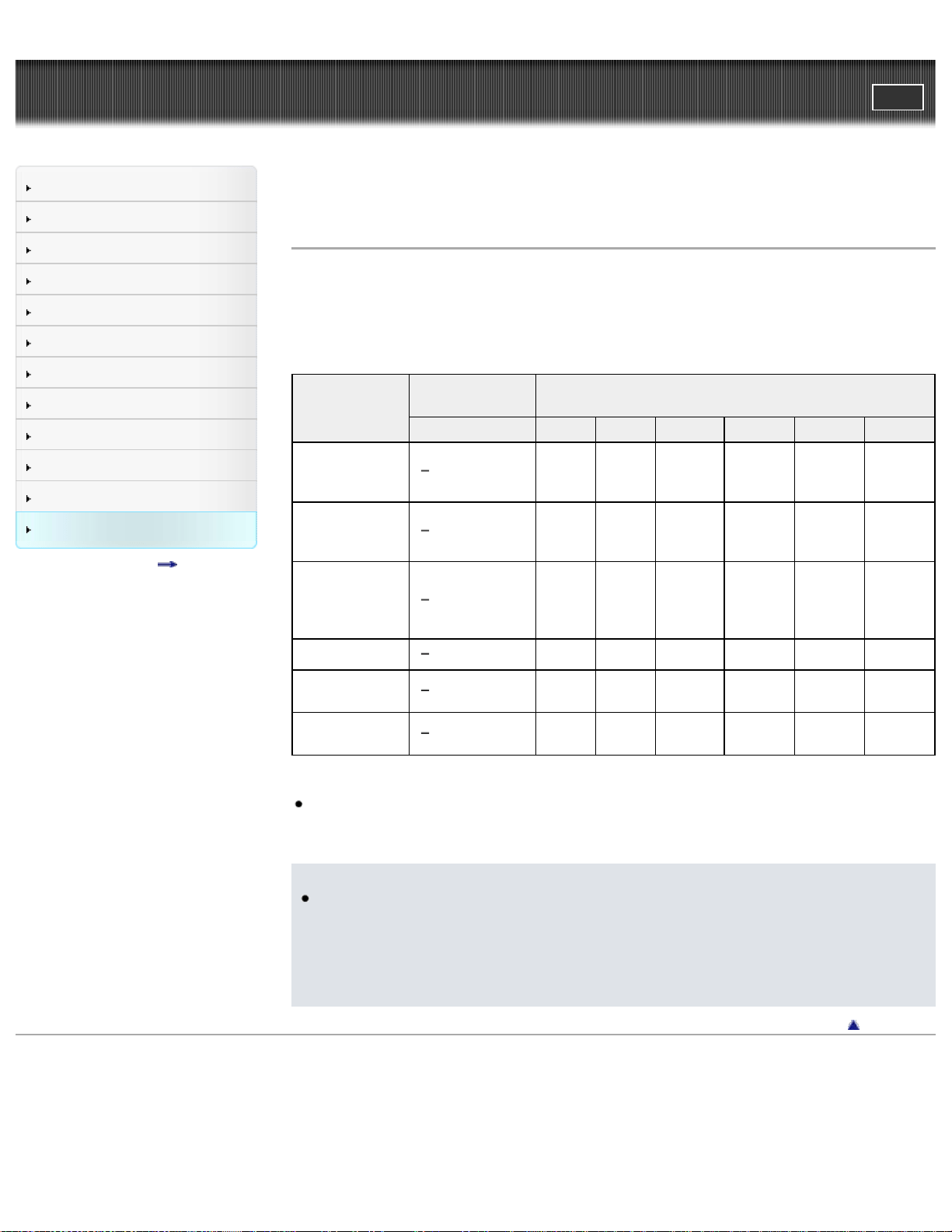
Cyber-shot User Guide
PrintSearch
Before Use
Operating the camera
Shooting
Viewing
Useful shooting functions
Useful viewing functions
Changing settings
Viewing images on a TV
Using with your computer
Printing
Troubleshooting
Precautions / About this camera
Contents list
Top page > Precautions / About this camera > Number of still images and recordable time of
movies > Recordable time of movies
Recordable time of movies
The table below shows the approximate maximum recording times. The recordable time may vary
depending on the shooting conditions and the memory card.
(h (hour), m (minute))
Quality/Size
Internal
memory
Memory card formatted with this camera
Approx. 48 MB 2 GB 4 GB 8 GB 16 GB 32 GB 64 GB
AVC HD 24M
(FX)
10 m
(10 m)
20 m
(20 m)
40 m
(40 m)
1 h 30 m
(1 h 30
m)
3 h
(3 h)
6 h
(6 h)
AVC HD 17M
(FH)
10 m
(10 m)
25 m
(25 m)
1 h
(1 h)
2 h
(2 h)
4 h 5 m
(4 h 5 m)
8 h 15 m
(8 h 15
m)
AVC HD 9M
(HQ)
25 m
(15 m)
50 m
(35 m)
1 h 45 m
(1 h 20
m)
3 h 35 m
(2 h 45
m)
7 h 20 m
(5 h 30
m)
14 h 40
m
(11 h 5
m)
MP4 12M
15 m 40 m 1 h 20 m 2 h 45 m 5 h 30 m 11 h 5 m
MP4 6M
35 m
1 h 15
m
2 h 40 m 5 h 20 m
10 h 50
m
21 h 45
m
MP4 3M
1 h 10
m
2 h 20
m
4 h 55 m 9 h 55 m 20 h
40 h 10
m
The number in ( ) is the minimum recordable time.
Continuous shooting is possible for approximately 29 minutes (a product specification limit). The
maximum continuous recording time of an MP4 (12M) format movie is about 15 minutes (limited by
the 2 GB file size restriction).
Notes
The recordable time of movies varies because the camera is equipped with VBR (Variable Bit-
Rate), which automatically adjusts image quality depending on the shooting scene.
When you record a fast-moving subject, the image is clearer but the recordable time is shorter
because more memory is required for recording.
The recordable time also varies depending on the shooting conditions, the subject or the image
quality/size settings.
Back to top
Copyright 2013 Sony Corporation
240
Cyber-shot User Guide
PrintSearch
Before Use
Operating the camera
Shooting
Viewing
Useful shooting functions
Useful viewing functions
Changing settings
Viewing images on a TV
Using with your computer
Printing
Troubleshooting
Precautions / About this camera
Contents list
Top page > Precautions / About this camera > Using the camera abroad > Using the camera abroad
Using the camera abroad
You can use the AC Adaptor (supplied) in any country or region where the power supply is within 100 V
to 240 V AC, 50 Hz/60 Hz.
Notes
An electronic voltage transformer is unnecessary and its use may cause a malfunction.
Back to top
Copyright 2013 Sony Corporation
241
Cyber-shot User Guide
PrintSearch
Before Use
Operating the camera
Shooting
Viewing
Useful shooting functions
Useful viewing functions
Changing settings
Viewing images on a TV
Using with your computer
Printing
Troubleshooting
Precautions / About this camera
Contents list
Top page > Precautions / About this camera > Using the camera abroad > On TV color systems
On TV color systems
To view movies shot using this camera on a television, the camera and television must use the same
color television system. Check the color TV system for the country or region where you are using the
camera.
NTSC system
Bahama Islands, Bolivia, Canada, Central America, Chile, Colombia, Ecuador, Jamaica, Japan, Korea,
Mexico, Peru, Surinam, Taiwan, the Philippines, the U.S.A., Venezuela, etc.
PAL system
Australia, Austria, Belgium, China, Croatia, Czech Republic, Denmark, Finland, Germany, Holland, Hong
Kong, Hungary, Indonesia, Italy, Kuwait, Malaysia, New Zealand, Norway, Poland, Portugal, Romania,
Singapore, Slovak Republic, Spain, Sweden, Switzerland, Thailand, Turkey, United Kingdom, Viet Nam,
etc.
PAL-M system
Brazil
PAL-N system
Argentina, Paraguay, Uruguay
SECAM system
Bulgaria, France, Greece, Guiana, Iran, Iraq, Monaco, Russia, Ukraine, etc.
Back to top
Copyright 2013 Sony Corporation
242
Cyber-shot User Guide
PrintSearch
Before Use
Operating the camera
Shooting
Viewing
Useful shooting functions
Useful viewing functions
Changing settings
Viewing images on a TV
Using with your computer
Printing
Troubleshooting
Precautions / About this camera
Contents list
Top page > Precautions / About this camera > About this camera > Carl Zeiss lens
Carl Zeiss lens
The camera is equipped with a Carl Zeiss lens which is capable of reproducing sharp images with
excellent contrast. The lens for the camera has been produced under a quality assurance system
certified by Carl Zeiss in accordance with the quality standards of Carl Zeiss in Germany.
Back to top
Copyright 2013 Sony Corporation
243
Cyber-shot User Guide
PrintSearch
Before Use
Operating the camera
Shooting
Viewing
Useful shooting functions
Useful viewing functions
Changing settings
Viewing images on a TV
Using with your computer
Printing
Troubleshooting
Precautions / About this camera
Contents list
Top page > Precautions / About this camera > About this camera > AVCHD format
AVCHD format
The AVCHD format has been developed for high-definition digital video cameras when recording an HD
(High-Definition) signal at the 1080i*
1
or 720p*
2
specification using high-efficiency compression coding
technology. The MPEG-4 AVC/H.264 format is adopted to compress video data, and the Dolby Digital or
Linear PCM system is used to compress audio data.
The MPEG-4 AVC/H.264 format is capable of compressing images at higher efficiency than that of the
conventional image compression format. The MPEG-4 AVC/H.264 format enables a high definition video
signal shot on a digital video camera recorder to be recorded on 8 cm DVD discs, hard disk drive, flash
memory, memory card, etc.
Recording and playback on the camera
Based on the AVCHD format, your camera records with the high definition image quality (HD) mentioned
below.
Video signal*
3
:
1080 60i-compatible device
MPEG-4 AVC/H.264 1920×1080/60i, 1440×1080/60i
1080 50i-compatible device
MPEG-4 AVC/H.264 1920×1080/50i, 1440×1080/50i
Audio signal: Dolby Digital 2ch
Recording media: Memory card
*1 1080i specification
A high definition specification which utilizes 1,080 effective scanning lines and the interlace system.
*2 720p specification
A high definition specification which utilizes 720 effective scanning lines and the progressive system.
*3 Data recorded in AVCHD format other than the above mentioned cannot be played on your camera.
Back to top
Copyright 2013 Sony Corporation
244
Cyber-shot User Guide
PrintSearch
Before Use
Operating the camera
Shooting
Viewing
Useful shooting functions
Useful viewing functions
Changing settings
Viewing images on a TV
Using with your computer
Printing
Troubleshooting
Precautions / About this camera
Contents list
Top page > Precautions / About this camera > About this camera > License
License
Notes on the License
This camera comes with software that are used based on licensing agreements with the owners of that
software. Based on requests by the owners of copyright of these software applications, we have an
obligation to inform you of the following.
Licenses (in English) are recorded in the internal memory of your camera. Establish a Mass Storage
connection between the camera and a computer to read licenses in the “PMHOME” - “LICENSE” folder.
THIS PRODUCT IS LICENSED UNDER THE AVC PATENT PORTFOLIO LICENSE FOR THE
PERSONAL USE OF A CONSUMER OR OTHER USES IN WHICH IT DOES NOT RECEIVE
REMUNERATION TO
(i) ENCODE VIDEO IN COMPLIANCE WITH THE AVC STANDARD (“AVC VIDEO”)
AND/OR
(ii) DECODE AVC VIDEO THAT WAS ENCODED BY A CONSUMER ENGAGED IN A PERSONAL
ACTIVITY AND/OR WAS OBTAINED FROM A VIDEO PROVIDER LICENSED TO PROVIDE AVC
VIDEO.
NO LICENSE IS GRANTED OR SHALL BE IMPLIED FOR ANY OTHER USE.
ADDITIONAL INFORMATION MAY BE OBTAINED FROM MPEG LA, L.L.C. SEE
HTTP://WWW.MPEGLA.COM
On GNU GPL/LGPL applied software
The software that is eligible for the following GNU General Public License (hereinafter referred to as
“GPL”) or GNU Lesser General Public License (hereinafter referred to as “LGPL”) are included in the
camera.
This informs you that you have a right to have access to, modify, and redistribute source code for these
software programs under the conditions of the supplied GPL/LGPL.
Source code is provided on the web. Use the following URL to download it.
http://www.sony.net/Products/Linux/
We would prefer you do not contact us about the contents of source code.
Licenses (in English) are recorded in the internal memory of your camera. Establish a Mass Storage
connection between the camera and a computer to read licenses in the “PMHOME” - “LICENSE” folder.
Back to top
Copyright 2013 Sony Corporation
245
Cyber-shot User Guide
PrintSearch
Before Use
Operating the camera
Shooting
Viewing
Useful shooting functions
Useful viewing functions
Changing settings
Viewing images on a TV
Using with your computer
Printing
Troubleshooting
Precautions / About this camera
Contents list
Top page > Precautions / About this camera > Trademarks > Trademarks
Trademarks
The following marks are trademarks of Sony Corporation.
, “Cyber-shot,” “Memory Stick,” , “Memory Stick Micro,” ,
“MagicGate,”
, “BRAVIA,” “PhotoTV HD.”
“Blu-ray Disc
” and “Blu-ray ” are trademarks of the Blu-ray Disc Association.
“AVCHD” and “AVCHD” logotype are trademarks of Panasonic Corporation and Sony Corporation.
Dolby and the double-D symbol are trademarks of Dolby Laboratories.
The terms HDMI and HDMI High-Definition Multimedia Interface, and the HDMI Logo are trademarks
or registered trademarks of HDMI Licensing LLC in the United States and other countries.
Microsoft, Windows, DirectX and Windows Vista are either registered trademarks or trademarks of
Microsoft Corporation in the United States and/or other countries.
Mac, Mac OS and “iMovie” are trademarks or registered trademarks of Apple Inc.
Intel, Pentium and Intel Core are trademarks or registered trademarks of Intel Corporation.
microSDXC logos are trademarks of SD-3C, LLC.
“PlayStation” is a registered trademark of Sony Computer Entertainment Inc.
In addition, system and product names used in this manual are, in general, trademarks or registered
trademarks of their respective developers or manufacturers. However, the
or marks are not
used in all cases in this manual.
Back to top
Copyright 2013 Sony Corporation
246