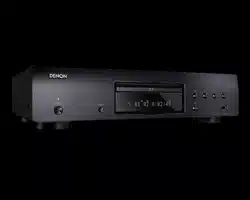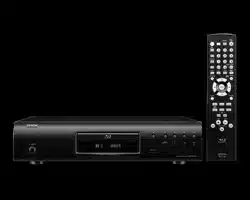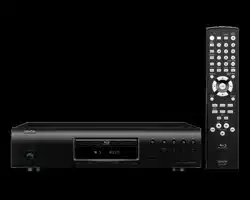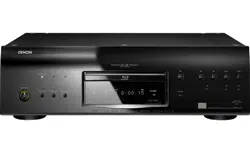
UNIVERSAL AUDIO / VIDEO PLAYER
DBP-A100
Graphical User Interface
English
Use this manual in combination with the operating
guide displayed on the GUI screen.
GUI Menu Operation (vpage 22)
Français
Utilisez ce manuel en même temps que le guide
d’utilisation afché sur l’écran GUI (Interface
graphique).
Fonctionnement du menu de l’interface graphique GUI
(vpage 22)
Español
Utilice este manual conjuntamente con la guía de
uso que aparece en la pantalla GUI.
Uso de los menús GUI (vpágina 22)
Owner’s Manual
Manuel de l’Utilisateur
Manual del usuario
b Button illustrations used in this manual for operation explanation are for the
Remote Control Unit.
You can operate the unit using the button of the same name on the front panel
of the unit.
b Les illustrations des boutons présentes dans ce manuel servent à expliquer le
fonctionnement de la télécommande.
Vous pouvez contrôler l’appareil à l’aide du bouton portant le même nom sur la
façade de l’appareil.
b Las ilustraciones de los botones utilizadas en este manual con propósitos de
explicación son para la unidad del mando a distancia.
Puede operar la unidad utilizando el botón del mismo nombre en el panel
delantero de la unidad.
1.DBP-A100_E3_ENG_007.indd 1 2010/08/12 19:20:01
I
n
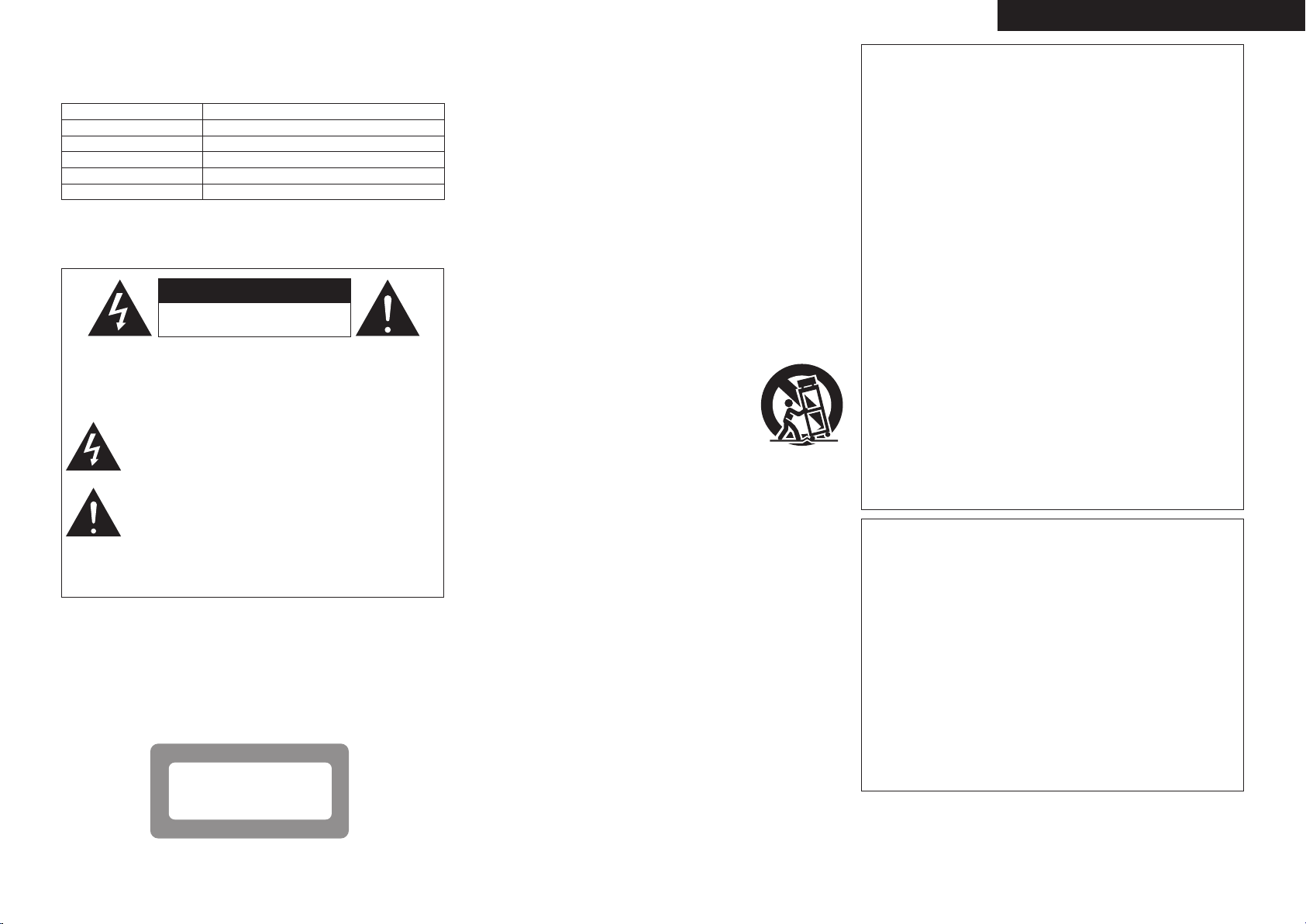
SAFETY PRECAUTIONS
CAUTION
RISK OF ELECTRIC SHOCK
DO NOT OPEN
CAUTION:
TO REDUCE THE RISK OF ELECTRIC SHOCK, DO NOT REMOVE
COVER (OR BACK). NO USER-SERVICEABLE PARTS INSIDE.
REFER SERVICING TO QUALIFIED SERVICE PERSONNEL.
The lightning flash with arrowhead symbol, within an equilateral
triangle, is intended to alert the user to the presence of
uninsulated “dangerous voltage” within the product’s enclosure
that may be of sufficient magnitude to constitute a risk of electric
shock to persons.
The exclamation point within an equilateral triangle is intended
to alert the user to the presence of important operating
and maintenance (servicing) instructions in the literature
accompanying the appliance.
WARNING:
TO REDUCE THE RISK OF FIRE OR ELECTRIC SHOCK, DO NOT
EXPOSE THIS APPLIANCE TO RAIN OR MOISTURE.
,
CLASS 1
LASER
PRODUCT
,
,,
CAUTION:
USE OF CONTROLS OR ADJUSTMENTS OR PERFORMANCE
OF PROCEDURES OTHER THAN THOSE SPECIFIED HEREIN MAY
RESULT IN HAZARDOUS RADIATION EXPOSURE.
THIS PRODUCT SHOULD NOT BE ADJUSTED OR REPAIRED BY
ANYONE EXCEPT PROPERLY QUALIFIED SERVICE PERSONNEL.
n
Laser Class (IEC 60825-1:2001)
IMPOTANT SAFETY
INSTRUCTIONS
1. Read these instructions.
2. Keep these instructions.
3. Heed all warnings.
4. Follow all instructions.
5. Do not use this apparatus near water.
6. Clean only with dry cloth.
7. Do not block any ventilation openings.
Install in accordance with the manufacturer's instructions.
8. Do not install near any heat sources such as radiators, heat registers,
stoves, or other apparatus (including amplifiers) that produce heat.
9. Do not defeat the safety purpose of the polarized or grounding-type plug. A
polarized plug has two blades with one wider than the other. A grounding
type plug has two blades and a third grounding prong. The wide blade or the
third prong are provided for your safety. If the provided plug does not fit into
your outlet, consult an electrician for replacement of the obsolete outlet.
10. Protect the power cord from being walked on or pinched particularly at
plugs, convenience receptacles, and the point where they exit from the
apparatus.
11. Only use attachments/accessories specified by the manufacturer.
12. Use only with the cart, stand, tripod, bracket, or table
specified by the manufacturer, or sold with the apparatus.
When a cart is used, use caution when moving the cart/
apparatus combination to avoid injury from tip-over.
13. Unplug this apparatus during lightning storms or when
unused for long periods of time.
14. Refer all servicing to qualified service personnel.
Servicing is required when the apparatus has been damaged in any way,
such as power-supply cord or plug is damaged, liquid has been spilled or
objects have fallen into the apparatus, the apparatus has been exposed to
rain or moisture, does not operate normally, or has been dropped.
15. Batteries shall not be exposed to excessive heat such as sunshine, fire or
the like.
CAUTION:
•Theventilationshould not be impeded by covering the ventilation
openings with items, such as newspapers, tablecloths, curtains,
etc.
•No naked ame sources, such as lighted candles, should be
placed on the unit.
•Observeandfollowlocalregulationsregardingbatterydisposal.
•Donotexposetheunittodrippingorsplashinguids.
•Donotplaceobjects filled with liquids, such as vases, on the unit.
ATTENTION:
•Laventilationnedoitpasêtregênéeenrecouvrantlesouvertures
de la ventilation avec des objets tels que journaux, rideaux, tissus,
etc.
•Aucuneammenue,parexempleunebougie,nedoitêtreplacée
sur l’appareil.
•Veillezàrespecterlesloisenvigueurlorsquevousjetezlespiles
usagées.
•L’appareilnedoitpasêtreexposéàl’eauouàl’humidité.
•Nepasposerd’objetcontenantduliquide,parexempleunvase,
sur l’appareil.
PRECAUCIÓN:
•Laventilaciónnodebequedarobstruidaporhabersecubiertolas
aperturasconobjetoscomoperiódicos,manteles,cortinas,etc.
•Nodebecolocarsesobreelaparatoningunafuenteinamablesin
protección,comovelasencendidas.
•Alahoradedeshacersedelaspilas,respetelanormativaparael
cuidado del medio ambiente.
•Noexponerelaparatoalgoteoosalpicadurascuandoseutilice.
•Nocolocarsobreelaparatoobjetosllenosdelíquido,comojarros.
CAUTION:
To completely disconnect this product from the mains, disconnect
the plug from the wall socket outlet.
The mains plug is used to completely interrupt the power supply to
the unit and must be within easy access by the user.
PRECAUTION:
Pour déconnecter complètement ce produit du courant secteur,
débranchezlaprisedelaprisemurale.
La prise secteur est utilisée pour couper complètement
l’alimentation de l’appareil et l’utilisateur doit pouvoir y accéder
facilement.
PRECAUCIÓN:
Paradesconectarcompletamenteesteproductodelaalimentación
eléctrica,desconecte el enchufe del enchufe de la pared.
Elenchufedelaalimentacióneléctricaseutilizaparainterrumpirpor
completoelsuministrodealimentacióneléctricaalaunidadydebe
de encontrarse en un lugar al que el usuario tenga fácil acceso.
The serial number of this product may be found on the back of the unit. No
others have the same serial number as yours. You should record the number and
other vital information here and retain this book as a permanent record of your
purchase to aid identification in case of theft.
Date of Purchase
Dealer Purchase from
Dealer Address
DealerPhoneNo.
ModelNo.
SerialNo.
ENGLISHFRANCAISESPAÑOL
1.DBP-A100_E3_ENG_007.indd 3 2010/08/12 19:20:02
II
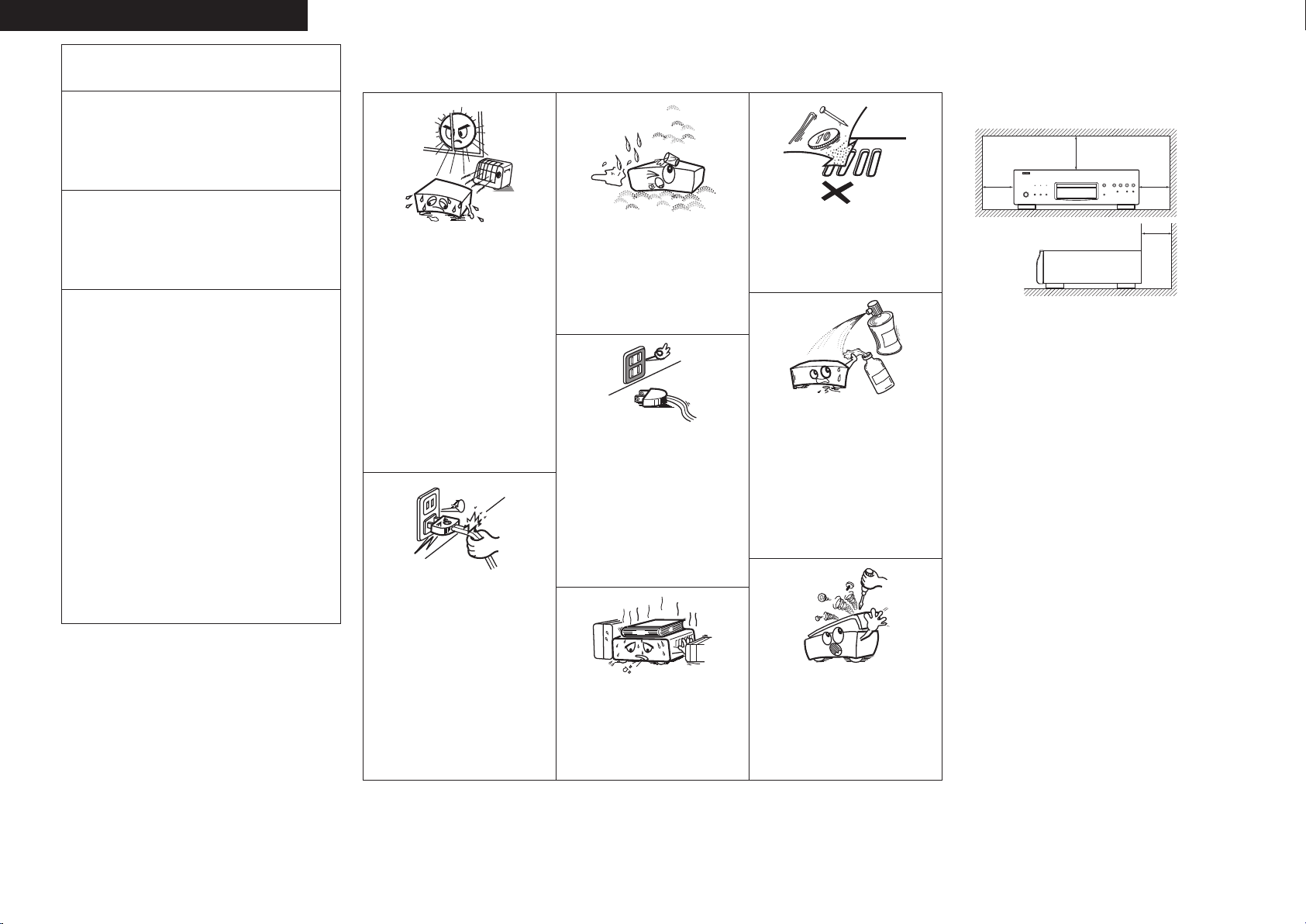
• Avoidhightemperatures.
Allow for sufficient heat dispersion when
installed in a rack.
• Eviterdestempératuresélevées.
Tenir compte d’une dispersion de chaleur
suffisante lors de l’installation sur une
étagère.
• Evitealtastemperaturas.
Permite la suciente dispersión del calor
cuando está instalado en la consola.
• Handlethepowercordcarefully.
Hold the plug when unplugging the cord.
• Manipuler le cordon d’alimentation avec
précaution.
Tenir la prise lors du débranchement du
cordon.
• Manejeelcordóndeenergíaconcuidado.
Sostenga el enchufe cuando desconecte el
cordóndeenergía.
• Keep the unit free from moisture, water,
and dust.
• Protégerl’appareil contre l’humidité,l’eau
et la poussière.
• Mantenga el equipo libre de humedad,
agua y polvo.
• Unplugthepowercordwhennotusingthe
unit for long periods of time.
• Débrancher le cordon d’alimentation
lorsquel’appareiln’estpasutilisépendant
delonguespériodes.
• Desconecte el cordón de energía cuando
no utilice el equipo por mucho tiempo.
* (For apparatuses with ventilation holes)
• Donotobstructtheventilationholes.
• Nepasobstruerlestrousd’aération.
• Noobstruyalosoriciosdeventilación.
• Donotletforeignobjectsintotheunit.
• Ne pas laisser des objets étrangers dans
l’appareil.
• No deje objetos extraños dentro del
equipo.
• Do not let insecticides, benzene, and
thinner come in contact with the unit.
• Nepasmettreencontactdesinsecticides,
du benzène et un diluant avec l’appareil.
• No permita el contacto de insecticidas,
gasolina y diluyentes con el equipo.
• Never disassemble or modify the unit in
any way.
• Nejamaisdémonteroumodierl’appareil
d’une manière ou d’une autre.
• Nuncadesarmeo modique elequipo de
ninguna manera.
n
NOTE ON USE / OBSERVATIONS RELATIVES A L’UTILISATION /
NOTAS SOBRE EL USO
FCC INFORMATION
(For US customers)
1. PRODUCT
This product complies with Part 15 of the FCC
Rules. Operation is subject to the following two
conditions: (1) this product may not cause harmful
interference, and (2) this product must accept any
interference received, including interference that
may cause undesired operation.
2. IMPORTANT NOTICE: DO NOT MODIFY THIS
PRODUCT
This product, when installed as indicated in the
instructions contained in this manual, meets FCC
requirements. Modification not expressly approved
byDENONmayvoidyourauthority,grantedbythe
FCC, to use the product.
3. NOTE
This product has been tested and found to comply
with the limits for a Class B digital device, pursuant
to Part 15 of the FCC Rules. These limits are
designed to provide reasonable protection against
harmful interference in a residential installation.
This product generates, uses and can radiate radio
frequency energy and, if not installed and used
in accordance with the instructions, may cause
harmful interference to radio communications.
However, there is no guarantee that interference
will not occur in a particular installation. If this
product does cause harmful interference to radio
or television reception, which can be determined
by turning the product OFF and ON, the user is
encouraged to try to correct the interference by one
or more of the following measures:
•Reorientorrelocatethereceivingantenna.
•Increase the separation between the equipment
and receiver.
•Connect the product into an outlet on a circuit
different from that to which the receiver is
connected.
•Consult the local retailer authorizedto distribute
this type of product or an experienced radio/TV
technician for help.
This Class B digital apparatus complies with Canadian
ICES-003.
Cet appareil numérique de la classe B est conforme à la
normeNMB-003duCanada.
n
Copyrights / Droits d’auteur /
Derechos de Autor
•It isprohibitedbylawtoreproduce, broadcast,
rent or play discs in public without the consent
of the copyright holder.
•Lareproduction,ladiffusion,lalocation,leprêt
ou la lecture publique de ces disques sont
interdits sans le consentement du détenteur
des droits d’auteur.
•De acuerdo con las leyes está prohibido
reproducir, emitir, alquilar o interpretar discos en
públicosinlaautorizacióndelpropietariodelos
derechos de autor.
n CAUTIONS ON INSTALLATION
PRÉCAUTIONS D’INSTALLATION
EMPLAZAMIENTO DE LA
INSTALACIÓN
z z
z
Wall
Paroi
Pared
z
zFor proper heat dispersal, do not install this
unit in a confined space, such as a bookcase
or similar enclosure.
• More than 0.1 m (4 in.) is recommended.
• Do not place any other equipment on this unit.
zPour permettre la dissipation de chaleur
requise, n’installez pas cette unité dans un
espace confiné tel qu’une bibliothèque ou un
endroit similaire.
• Une distance de plus de 0.1 m (4 po) est
recommandée.
• Neplacezaucunmatérielsurcetappareil.
zPara la dispersión del calor adecuadamente,
no instale este equipo en un lugar confinado
tal como una librería o unidad similar
• Se recomienda dejar más de 0.1 m (4 pulg.) alrededor.
• Nocoloqueningúnotroequiposobrelaunidad.
ENGLISH FRANCAIS ESPAÑOL
1.DBP-A100_E3_ENG_007.indd 4 2010/08/12 19:20:03
ENGLISH
1
TroubleshootingInformationHDMI Control FunctionPlaybackSetupConnectionsGetting Started Specications
Contents
Features ·························································································· 2
Getting Started
Accessories ···················································································· 2
Cautions on Handling ···································································· 3
Cautions on Installation ································································ 3
About Media ·················································································· 3
Playable Media ············································································· 3
Cautions on Using Media ····························································· 6
About the Remote Control ··························································· 7
Inserting the Batteries ·································································· 7
Operating Range of the Remote Control ····································· 7
Remote Control Settings (Remote Control Side) ························ 7
Part Names and Functions ···························································· 8
Front Panel ···················································································· 8
Display ·························································································· 8
Rear Panel ····················································································· 9
Remote Control ·········································································· 10
Connections
Preparation ·················································································· 12
Connecting Cables ····································································· 12
1.
Home Theater Playback – Playing on a Multi-channel System –
··· 13
Using an HDMI Cable to Connect to an AV Amp or Television
··· 13
Required Settings for HDMI Connection ··································· 13
Connecting to an AV Amp with No HDMI Audio Input ·············· 15
Connecting to a Device with an Analog Multi-channel
Audio Input Terminal ·································································· 16
DENON LINK Connection q Making a Jitter-free Connection ·· 17
DENON LINK Connection w Making a Normal Connection ······ 17
Connecting to an AV Amp with No HDMI Video Input ·············· 17
2. Playing with a Direct Connection to a TV ····························· 18
3. Playing Back 2-Channel Audio ··············································· 18
Connecting to a Device with Analog 2-channel Audio Input
Terminals with a Stereo Pin Plug Cable ····································· 18
4. Recording a CD ········································································ 19
Connecting to a Digital Recording Device ································· 19
5. Using BD-LIVE function or updating the software version of
DBP-A100 ····················································································· 19
Connecting to a Network ··························································· 19
Connecting the Power Cord ······················································· 20
Once Connections are Complete ··············································· 20
Turning the Power On ································································· 20
GUI Menu Setup
Menu Map ···················································································· 21
GUI Menu Operation ··································································· 22
Examples of GUI Menu Screen Displays ··································· 22
Language Setup ··········································································· 23
HDMI Setup ·················································································· 23
Video Setup ················································································· 24
Audio Setup ················································································· 25
DENON LINK Setup ····································································· 28
Pure Direct Setup ········································································ 28
Ratings ························································································· 29
Network Setup ············································································ 29
Display Setup ··············································································· 30
Other Setup ················································································· 31
Various Settings
Setting the Audio Mode ······························································ 32
Changing the Playback File Display ··········································· 32
Making Other Settings ································································ 32
Adjusting the Picture Quality (Picture Control) ························ 33
Playback
Introduction ················································································· 34
Before Playing a Disc ································································· 34
Before Playing an SD Memory Card ·········································· 34
About Playback Information ······················································· 34
Information Bar Display ······························································ 34
Media Player Display ·································································· 35
Playing BDs and DVD-Videos ····················································· 36
Playing Super Audio CDs ···························································· 37
Playing CDs ·················································································· 37
Playing DVD-Audio ······································································ 37
Playing High-Quality Audio (Pure Direct Function) ·················· 38
Playing Files ················································································· 38
Playing Files ················································································ 39
Screen Display During Playback ················································ 40
Operation During Playback ························································ 40
Operations Enabled During Playback ········································ 41
Pausing ······················································································· 41
Stopping (Resume Function) ······················································ 41
Skipping to a Desired Chapter/Track/File ··································· 41
Finding Specic Sections with Search Modes··························· 42
Memorizing Locations to Replay
(Marker Function) ······································································ 43
Fast-Forward/Fast-Reverse ························································· 43
Playing Images Frame by Frame ················································ 43
Slow-Forward/Slow-Reverse Playback ······································· 43
Playing in Random Order (Random Playback) ··························· 44
Playing Repeatedly (Repeat Playback) ······································· 44
Playing Repeatedly Between Specied Points (A-B Repeat) ····· 44
Playing in Your Preferred Order (Program Playback) ·················· 45
Switching Audio ········································································· 45
Changing the Subtitles and Subtitle Style ································· 46
Switching the Angle ··································································· 47
Changing the Brightness of the Display (Dimmer Control) ····· 47
Web control function ·································································· 47
HDMI Control Function ···············································49
About DENON LINK ···································································· 50
About Advanced AL24 Processing ············································· 50
About Copyright Protection Technology ·································· 50
Trademark Information ······························································· 50
Language Code List ····································································· 51
Country Code List ······································································· 52
Explanation of Terms ·································································· 53
Index ····························································································· 54
Troubleshooting ·······························································55
Specications·····································································57
Other Information
1.DBP-A100_E3_ENG_007.indd 1 2010/08/12 19:20:03
ENGLISH
2
TroubleshootingInformationHDMI Control FunctionPlaybackSetupConnectionsGetting Started Speci cations
Features
A Universal Blu-ray Disc player that plays Super
Audio CD and DVD-Audio formats
vpage 3, 4 “Playable Media”
Jitter-free transmission thanks to a fusion
of DENON LINK 4th generation and HDMI
transmission technology
In addition to multi-channel, digitally balanced transmission of
Super Audio CD achieved in 3rd generation, DENON LINK 4th
generation provides jitter control functionality during digital signal
transmission.(described as 3rd or 4th in the following sentences)
vpage 17 “DENON LINK Connection q Making a Jitter-free
Connection”
Equipped with Dolby TrueHD, DTS-HD Master
Audio decoder
Compatible with Linear PCM 192 kHz (one of the BD audio
formats) and multi-channel output (6-ch).
vpage 16 “Connecting to a Device with an Analog Multi-
channel Audio Input Terminal”
Equipped with Advanced AL24 Processing on all
channels to enhance HD audio performance
Detailed picture rendering with minimal distortion; accurate
sound location and rich bass.
Achieves playback more faithful to the original sound on all
channels.
GUI equipped for excellent operability and
visibility
vpage 22 “GUI Menu Operation”
HDMI control ready
vpage 49 “HDMI Control Function”
Newly developed “S. V. H. Mechanism” with low
center of gravity, vibration damping, quietness
and high accuracy
Employs 6-block construction to eliminate both
electrical and magnetic interference
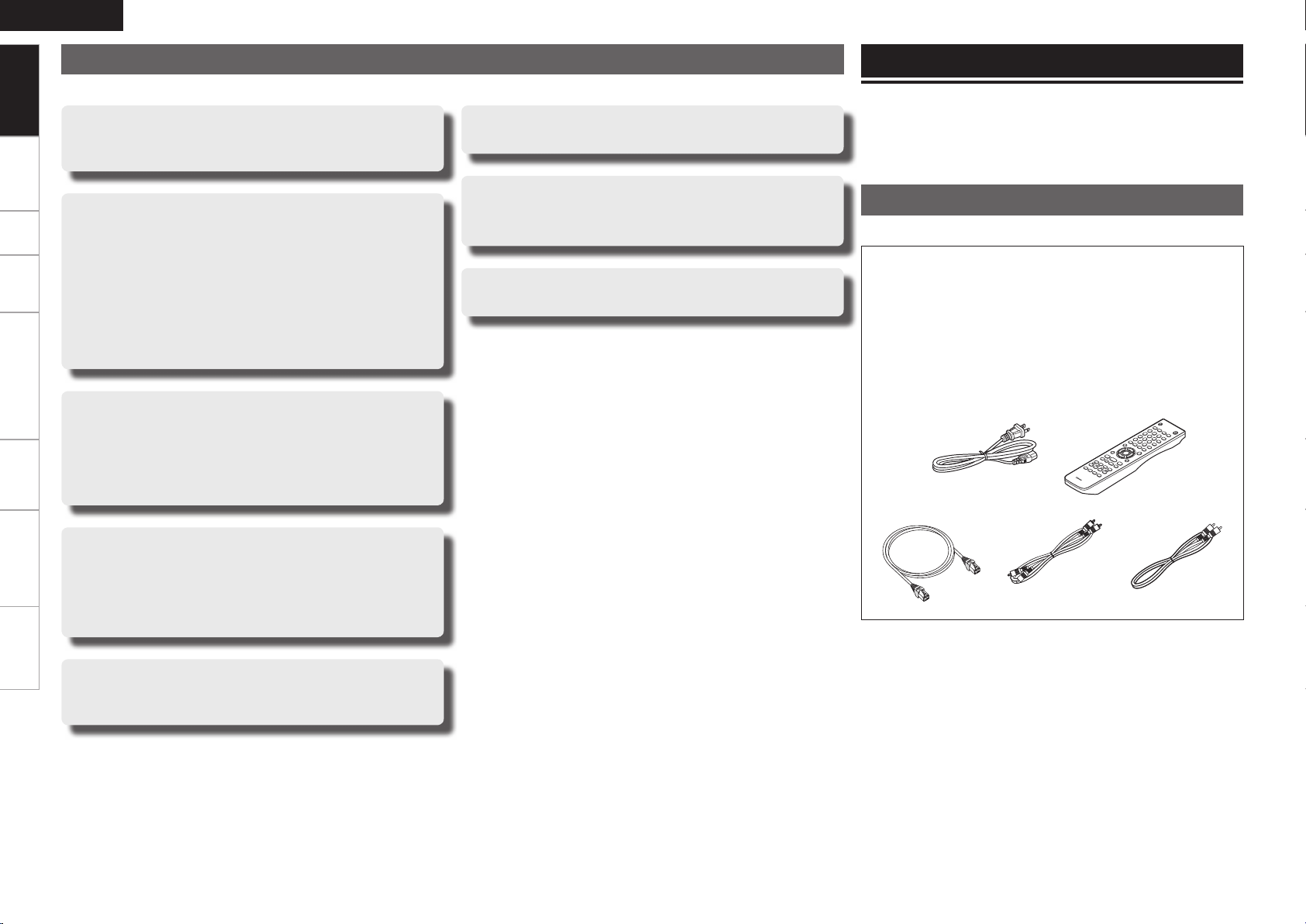
Check that the following parts are supplied with the product.
q Owner’s manual ...................................................................... 1
w Service station list ................................................................... 1
e Power cord (Cord length: Approx. 5.9ft/1.8m) ....................... 1
r Remote control (RC-1140) ...................................................... 1
t R6/AA batteries ....................................................................... 2
y DENON LINK cable (Cord length: Approx. 4.9ft/1.5 m) .......... 1
u Audio cable (Cord length: Approx. 4.9ft/1.5m) ....................... 1
i Video cable (Cord length: Approx. 4.9ft/1.5m) ....................... 1
o Warranty (for North America model only) ............................... 1
Thank you for purchasing this DENON product. To ensure proper
operation, please read this owner’s manual carefully before using the
product.
After reading the manual be sure to keep it for future reference.
Accessories
Getting Started
Getting Started
e r
uy i
1.DBP-A100_E3_ENG_007.indd 2 2010/08/12 19:20:04
ENGLISH
3
TroubleshootingInformationHDMI Control FunctionPlaybackSetupConnections Specications
• Before turning the power switch on
Check once again that all connections are correct and that there are
no problems with the connection cables.
• Power is supplied to some of the circuitry even when the unit is set
to the standby mode. When leaving home for long periods of time,
be sure to unplug the power cord from the power outlet.
• Image persistence (image burn-in)
Do not leave still images of the disc menu, DBP-A100 menu, etc.,
displayed on the TV screen for long periods. This can result in image
persistence (image burn-in) on the screen.
• About Condensation
If the DBP-A100 unit is moved from a cold place to a warm place, or
installed in a room subject to rapid temperature rise from a heater,
etc., condensation may form on parts inside the unit (operating
parts and lenses).
If used under this condition, the DBP-A100 will not operate correctly
and damage may result. If condensation forms on the unit, leave the
DBP-A100 off for 1 to 2 hours before using it again.
• Cautions on using mobile phones
Using a mobile phone near this unit may result in noise. If that
occurs, move the mobile phone away from the unit when it is in
use.
• Moving the unit
Be sure to remove a disc, turn off the power and unplug the power
cord from the power outlet. Next, disconnect the connection cables
to other system equipment before moving the unit.
• About Care
• Wipe the cabinet and control panel clean with a soft cloth.
• Follow the instructions when using a chemical cleaner.
• Benzene, paint thinner or other organic solvents, as well as
insecticide, may cause material changes and discoloration if brought
into contact with the unit, and should, therefore, not be used.
• Proper Ventilation
If the unit is left in a room full of the smoke from cigarettes, etc., for
long periods of time, the surface of the optical pickup may get dirty,
preventing it from receiving signals inproperly.
• Note that for explanatory purposes the illustrations in these
instructions may differ from the actual unit.
Cautions on Handling About Media
Playable Media
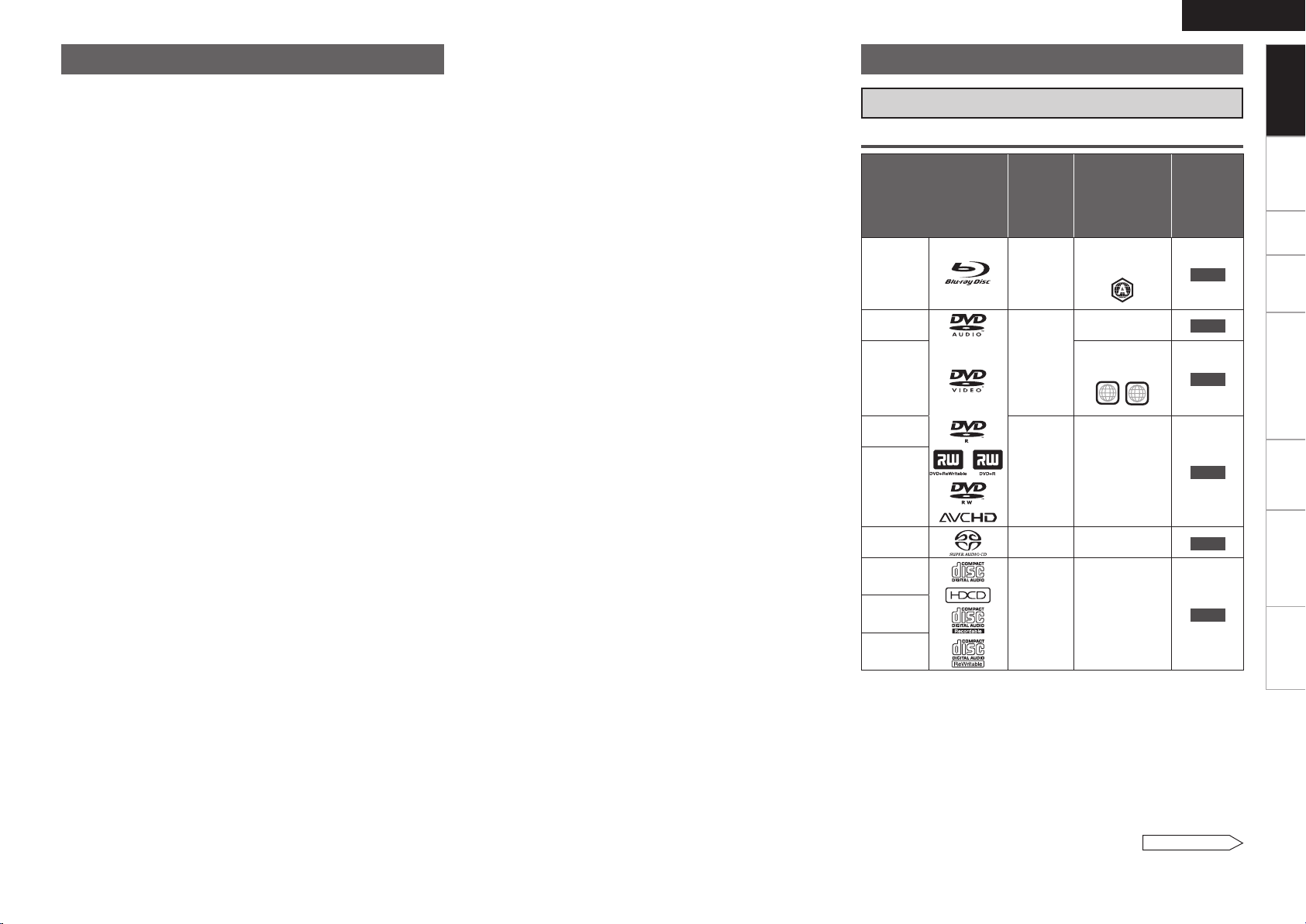
Playable Media
Playable
formats/
modes
Playable
region codes
Symbols
Used
in this
Owner’s
Manual
BD-Video
z1,z2
–
Discs with
BD
DVD-Audio
z1
–
–
DVD-A
DVD-Video
z1,z2
Include region
ALL
1
DVD-V
DVD-R,
DVD+R
Video
mode,
AVCHD
format
–
DVD
DVD-RW,
DVD+RW
Super Audio
CD
– –
SA-CD
CD
– –
CD
CD-R
CD-RW
Discs
z1 :
BD-Video/DVD-Audio/DVD-Video discs may not operate as
described in this manual due to menu structure.
z2 :
BD players and BD-Video discs, and DVD players and DVD-
Video discs each have their region codes (codes assigned
for each region). Playback is not possible if the codes do not
match.
Getting Started
See overleaf
1.DBP-A100_E3_ENG_007.indd 3 2010/08/12 19:20:04
ENGLISH
4
TroubleshootingInformationHDMI Control FunctionPlaybackSetupConnectionsGetting Started Specications
NOTE
• A disc may not be accessible or may play incorrectly due to audio
and video interruptions, etc., depending on the recording conditions
when recorded with a BD recorder or DVD recorder.
• Unnalised DVD-R/-RW/+R/+RW, and CD-R/-RW discs may not play
back. Finalize discs before playing.
The following discs will not play back on this unit.
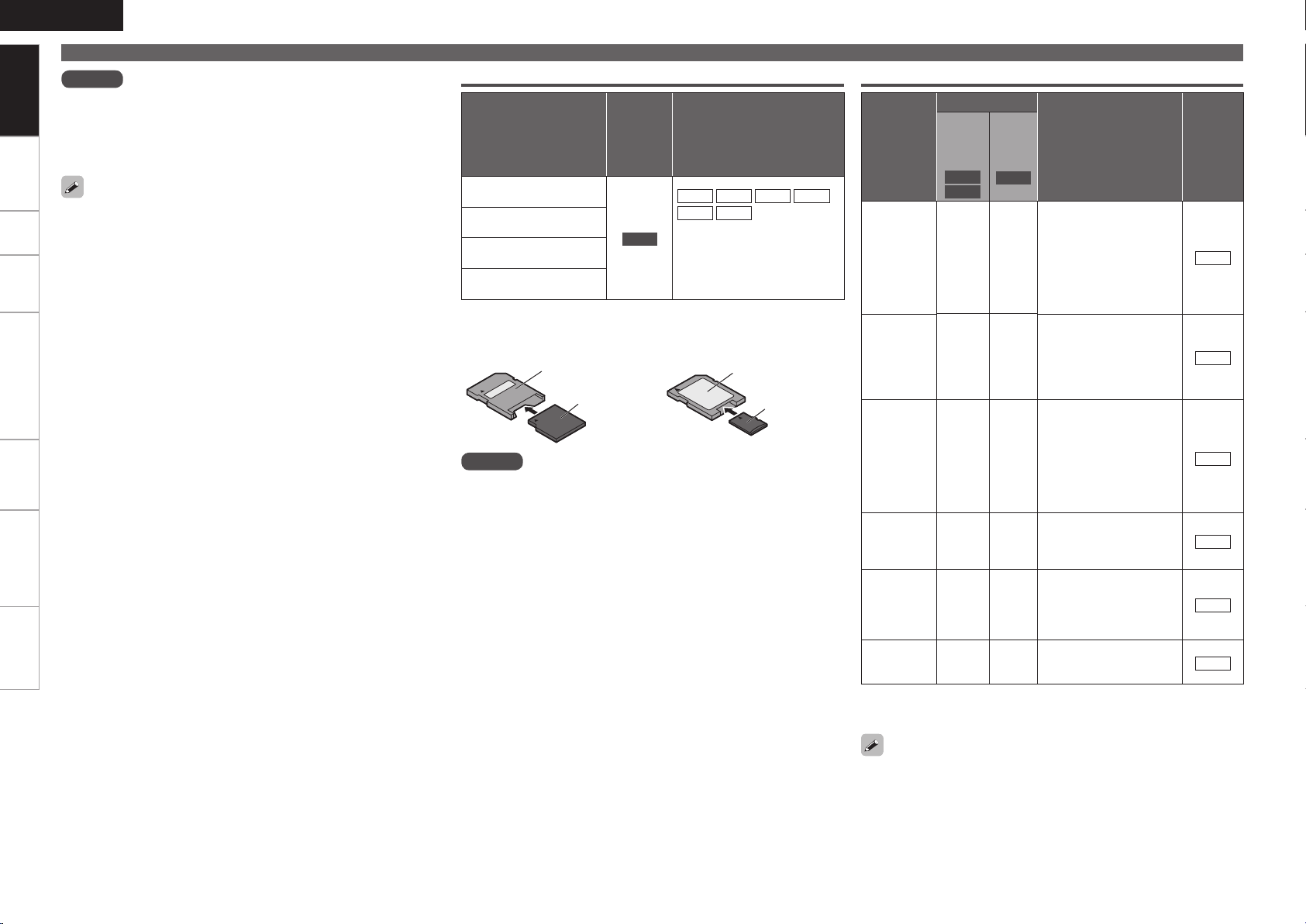
SD Memory Cards
Playable cards
Symbols
Used
in this
Owner’s
Manual
Playable les
(Symbols Used in this
Owner’s Manual)
SD Memory Cards z1
(8 MB ~ 2 GB)
SD
MP3
WMA
AAC
LPCM
JPEG
DivX
· Data recorded for BD BONUS
VIEW use
· See “Files” in “Playable
Media” (vpage 4) for more
information on les.
SDHC Memory Cards
z1
(4 GB)
miniSD Cards
z2
(8 MB ~ 2 GB)
microSD Cards
z2
(8 MB ~ 2 GB)
z1 :
This unit supports SD Memory Cards with FAT16 le systems,
and SDHC Memory Cards with FAT32 le systems.
z2 :
MiniSD cards and microSD cards require adapters.
miniSD Card
Adapter
miniSD Card
microSD Card
Adapter
microSD Card
NOTE
• This unit does not support mini SDHC and micro SDHC Memory
Cards.
• Insert or remove your SD Memory Card while the power is in
standby. If you insert a SD Memory Card while the power is ON, the
SD Memory Card may not be read.
• The SD card used for the Bonus View function must have a capacity
of 1GB or greater. Also the SD card must be initialized on the DBP-
A100 (vpage 31).
Files
Playable
les
(Extension)
Playable Media
File specication
Symbols
Used
in this
Owner’s
Manual
DVD-R/
-RW/
+R/+RW
CD-R/-RW
DVD
CD
SD
Memory
Cards
SD
MP3
(.mp3)
S S
• Sampling frequency:
44.1 kHz, 48 kHz
• Bit rate:
64 kbps ~ 320 kbps
(144 kbps
non-compatible)
• Audio type:
MPEG 1 Audio Layer 3
MP3
WMA z
(.wma)
S S
• Sampling frequency:
44.1 kHz, 48 kHz
• Bit rate:
48 kbps ~ 192 kbps
• Audio type:
WMA Version 9
WMA
AAC z
(.m4a)
S S
• Sampling frequency:
44.1 kHz, 48 kHz
• Bit rate:
64 kbps ~ 192 kbps
(Variable Bit Rate non
compatible)
• Audio type:
AAC
AAC
LPCM
(.wav)
S S
• Sampling frequency:
44.1 kHz, 48 kHz
• Bit length: 16 bit
• Number of channels: 2-ch
LPCM
JPEG
(.jpg/.jpeg)
S S
• Maximum resolution:
4,096 x 4,096 pixels
• Minimum resolution:
32 × 32 pixels
• Maximum le size: 12 MB
JPEG
DivX
®
(.avi/.divx)
S S
• Compatible versions:
Up to DivX
®
6
• Maximum size: 2 GB
DivX
z :
This unit cannot play les recorded under DRM (Digital Rights
Management) other than DivX
®
les.
• The abovementioned le type may also fail to play back depending
on conditions at the time of recording.
• If characters not supported on the menu screen are included in
a le name, title, artist name or album title, they will not display
correctly.
• JPEG images stored in the progressive format cannot be viewed.
• BD-RE Ver1.0 (BD disc with cartridge)
• BD-ROM/BD-R/BD-RE discs containing recorded movie, still image,
audio, and/or other, les
• BD-R/BD-RE in which BDMV/BDAV is recorded
• HD DVD
• DVD-RAM
• CDV (Only the audio part can be played)
• CD-G (Only the audio signals can be output)
• Non-standard CD (CD with copy protection, etc.)
• Unauthorised disc (Pirated disc)
• Disc with recording area less than 55 mm in diameter
• Video Single Disc (VSD) / CVD/ Video CD / Super Video CD /
CompactDisc-Interactive (CD-I) / Photo CDs
About Media
Getting Started
1.DBP-A100_E3_ENG_007.indd 4 2010/08/12 19:20:04
ENGLISH
5
TroubleshootingInformationHDMI Control FunctionPlaybackSetupConnections Specications
About Media
About DivX
®
Video-on-Demand (VOD)
• When you purchase or rent a DivX
®
le through the ofcial site of
DivX
®
Video-On-Demand (VOD) services, a DBP-A100 registration
code is required. For details, see “DivX
®
Registration” (vpage
29).
• A DivX
®
VOD le recorded with a
different code from the DBP-A100
registration code cannot be played
back.
• Some DivX
®
VOD les are restricted
to a certain number of playable
times. If your DivX
®
VOD le has
such a limit, the number of playable
times is displayed on the DivX
®
VOD display screen.
Use to select “Yes” if you want
to play a le, or to select “No” if you
do not want to play it. Then, press
to conrm the selection.
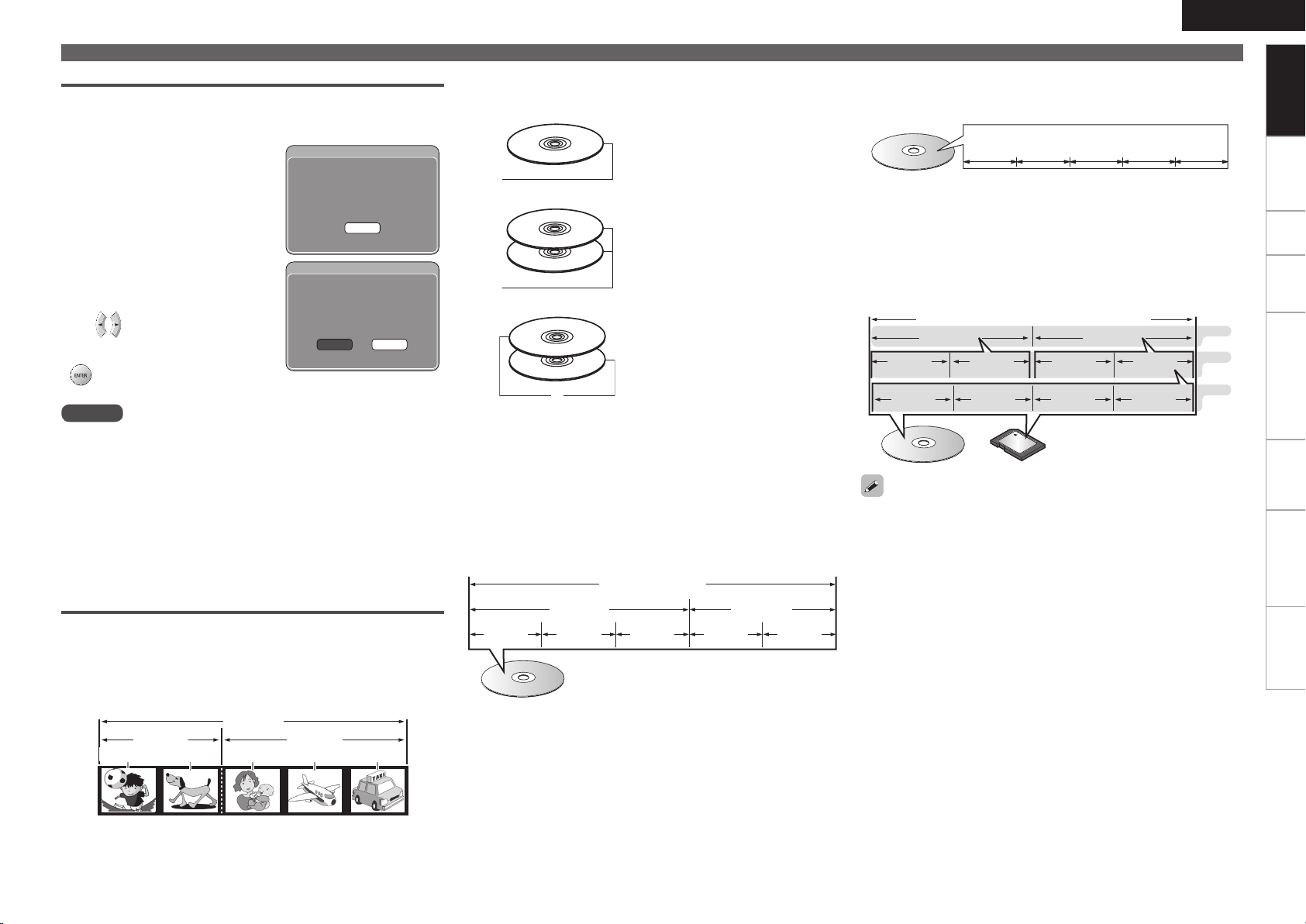
About Discs and Files
n BD-Video, DVD-Video
BD/DVD-Video discs are divided into several large sections (titles)
and small sections (chapters). These sections are all allotted
numbers, called title numbers and chapter numbers.
GExampleH
BD、DVD
タイトル1
チャプター1 チャプター2 チャプター1 チャプター2 チャプター3
タイトル2
n Super Audio CD
GType of Super Audio CDH
• Single layer disc
Single layer Super Audio CD with
only an HD layer
z
.
• Dual layer disc
Super Audio CD with a double HD
layer
z
, offering extended playing
time and high sound quality.
• Hybrid disc
Two-layer Super Audio CD with an
HD layer
z
and a CD layer.
The signals on the CD layer can
be played on a regular CD player.
CD layer
HD layer
HD layer
HD layer
z
:
All Super Audio CDs contain an HD (High Density) layer with high
density Super Audio CD signals. This layer can contain a stereo
channel area, a multi-channel area, or both a stereo channel and
multi-channel area.
n CD
CDs are divided into several sections (tracks). These sections are
all allotted numbers called track numbers.
n File
MP3/WMA/AAC/LPCM/JPEG/DivX
®
les recorded on DVD-R/-
RW/+R/+RW, CD-R/-RW and SD Memory Card are divided into
large segments (folders) and small segments (les). Files are
stored in folders, and folders can be placed for storage in a
hierarchy. The DBP-A100 can recognize up to 8 levels of folders.
SD
Memory Card
DVD-R/-RW、CD-R/-RWまたはSDカード
File1 File2 File3
Folder3
1st level
2nd level
3rd level
File4 File5
File6 File7
Folder1 Folder2
Track1 Track2 Track3 Track4 Track5
Title1 Title2
Chapter 3
BD, DVD
Chapter 2Chapter 1Chapter 2Chapter 1
DVD-R/-RW/+R/+RW, CD-R/-RW
or SD Memory Card
OK
DivX Authorization Error
Authorization Error.
This player is not authorized
to play this video.
Yes No
DivX Rental
View DivX(R) VOD Rental
This rental has 3 views left.
Do you want to use
one of your 3 views now?
When writing MP3/WMA/AAC/JPEG/DivX
®
les on a CD-R/-RW disc,
set the writing software’s format to “ISO9660”. The les may not play
properly if they are recorded in other formats. For details, refer to the
instructions of your writing software.
n DVD-Audio
DVD-Audio discs are divided into several large sections (groups)
and small sections (tracks). These sections are all allotted numbers,
called group numbers and track numbers.
♪ ♪ ♪ ♪
DVDオーディオ
Track1 Track2 Track1Track3
グループ1 グループ2
♪
Track2
DVD-Audio
Group1 Group2
Getting Started
NOTE
• ABOUT DIVX VIDEO: DivX
®
is a digital video format created by
DivX, Inc. This is an ofcial Divx Certied device that plays DivX
video. Visit www.divx.com for more information and software tools
to convert your les into DivX video.
• ABOUT DIVX VIDEO-ON-DEMAND: This DivX Certied
®
device
must be registered in order to play DivX Video-on-Demand (VOD)
content. To generate the registration code, locate the DivX VOD
section in the device setup menu. Go to vod.divx.com with this
code to complete the registration process and learn more about
DivX VOD.
1.DBP-A100_E3_ENG_007.indd 5 2010/08/12 19:20:05
ENGLISH
6
TroubleshootingInformationHDMI Control FunctionPlaybackSetupConnectionsGetting Started Specications
About Media
Cautions on Using Media
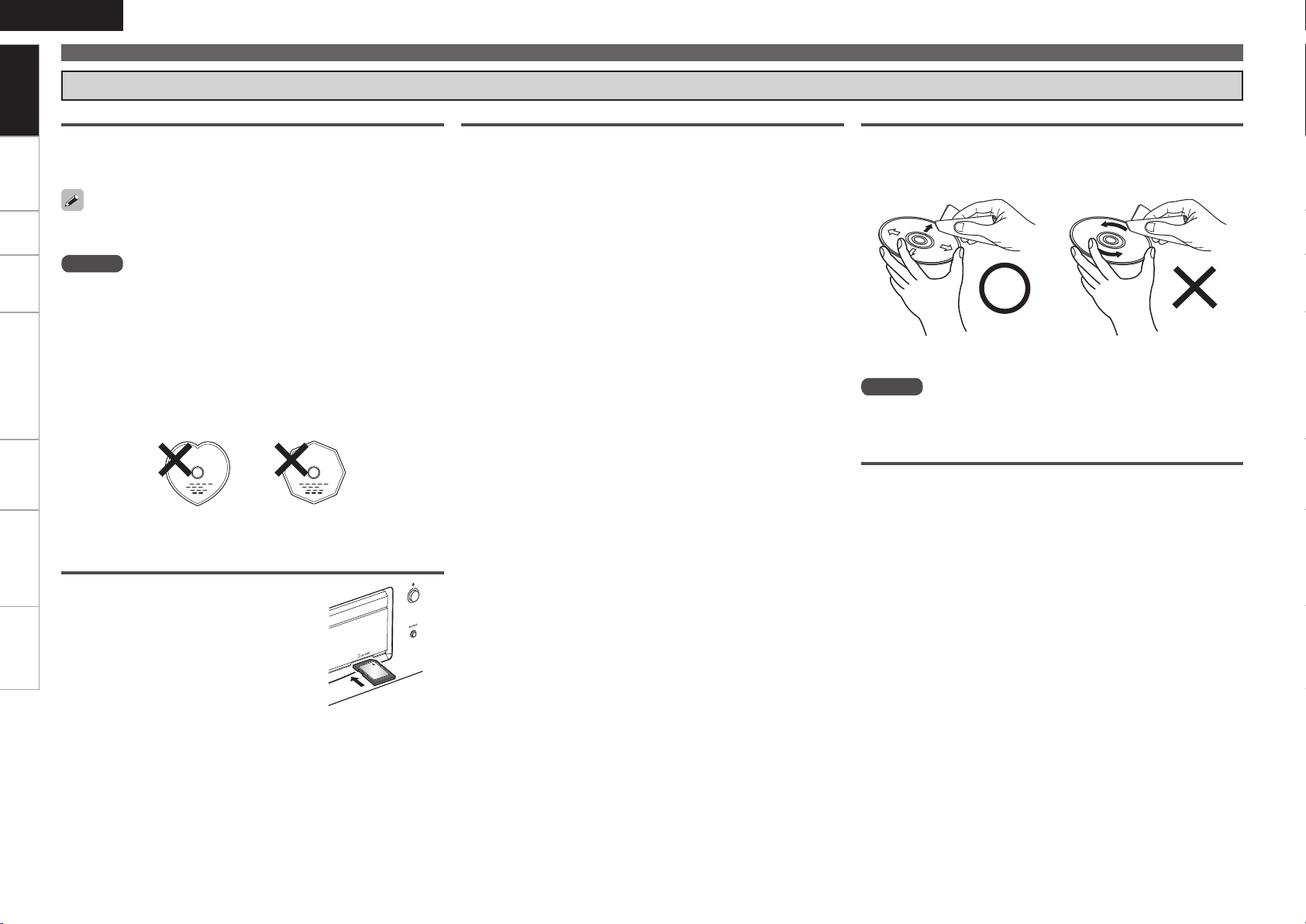
Inserting a Disc
• Set the disc in the tray label side up.
• Make sure the disc tray is fully open when inserting the disc.
• Place the disc horizontally in the tray, aligned with the tray guide.
NOTE
• Only load one disc at a time. Loading two or more discs can damage
the unit or scratch the discs.
• Do not use cracked or warped discs or discs that have been repaired
with adhesive, etc.
• Do not use discs on which the sticky part of cellophane tape or
labels is exposed or on which there are traces of where labels have
been removed. Such discs can get caught inside the player and
damage it.
• Do not use discs in special shapes, as they may damage the
player.
• Do not push the disc tray in by hand when the power is off.
Doing so could damage the set.
If a disc that cannot be played is loaded or the disc is loaded up-
sidedown, “NO DISC” is displayed on the player’s display.
How to Handle Media
• Do not get ngerprints, oil or dirt on discs.
• Take special care not to scratch discs when removing them from
their cases.
• Do not bend or heat discs.
• Do not enlarge the hole in the center.
• Do not write on the labeled (printed) surface with ball-point pens,
pencils, etc., or stick new labels on discs.
• Condensation may form on discs if they are moved suddenly from
a cold place (outdoors for example) to a warm place, but do not try
to dry discs with a hairdryer, etc.
• Do not eject a SD Memory Card or turn off the DBP-A100 while a
card is being played. This may result in malfunction or loss of the
card’s data.
• Do not attempt to open or modify SD Memory Cards.
• SD Memory Cards and les can be damaged by static electricity.
Do not touch the metal contacts of an SD Memory Card with your
ngers.
• Do not use warped SD Memory Cards.
• After use, be sure to remove any disc or SD Memory Card, and store
it in its proper card case, to avoid dust, scratches and deformation.
• Do not store discs in the following places:
1.Places exposed to direct sunlight for long periods of time
2.Dusty or humid places
3.Places exposed to heat from heaters, etc.
Cleaning Discs
• If there are ngerprints or dirt on a disc, wipe them off before using
the disc.
• Use a commercially available disc cleaning set or a soft cloth to
clean discs.
Gently wipe the disc from the
inside towards the outside.
Do not wipe with a circular
motion.
NOTE
Do not use record spray, antistatic agents, benzene, thinner or other
solvents.
About Copyrights
• Unauthorised copying, broadcasting, public performance and
lending of discs are prohibited.
• This product incorporates copyright protection technology that is
protected by U.S. patents and other intellectual property rights.
• This item incorporates copy protection technology that is protected
by U.S. patents and other intellectual property rights of Rovi
Corporation. Reverse engineering and disassembly are prohibited.
• Portions of this product are protected under copyright law and
provided under license by ARIS/SOLANA/4C.
Getting Started
Inserting an SD Memory Card
• Insert an SD Memory Card in the
direction of the arrow into the SD
CARD slot with the label facing up.
• Insert the card straight into the SD
CARD slot until it clicks.
• To remove the card, push it in and then
release to eject.
SD
Memory Card
SD
Memory Card
1.DBP-A100_E3_ENG_007.indd 6 2010/08/12 19:20:06
ENGLISH
7
TroubleshootingInformationHDMI Control FunctionPlaybackSetupConnections Specications
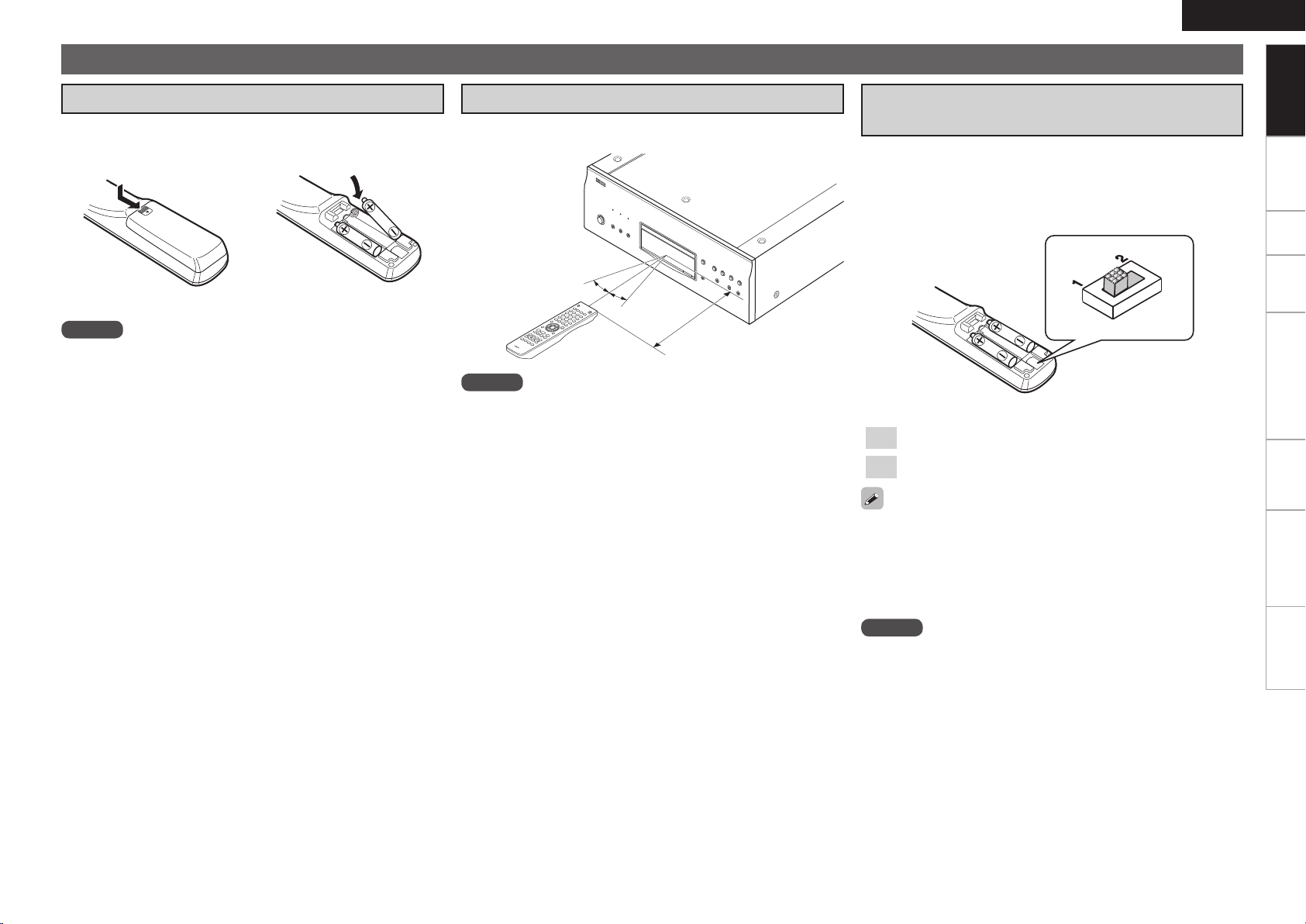
Inserting the Batteries
About the Remote Control
e Put the rear cover back on.
q Remove the rear cover. w Set three R6/AA batteries in
the battery compartment in the
indicated direction.
NOTE
• Use R6/AA batteries in this remote control.
• Replace the batteries with new ones if the set does not operate
even when the remote control is operated close to the unit. (The
supplied batteries are only for verifying operation.)
• Be sure to insert the batteries in the proper direction, following the
“q” and “w” marks in the battery compartment.
• To prevent damage or leakage of battery uid:
Do not use a new battery with an old one.
Do not use two different types of batteries.
Do not attempt to charge dry batteries.
Do not short-circuit, disassemble, heat or dispose of batteries
in a re.
• If the battery uid leaks, carefully wipe the uid off the inside of the
battery compartment and insert new batteries.
• Remove the batteries from the remote control if it will not be used
for a long time.
• Used batteries should be disposed of in accordance with local
regulations on battery disposal.
Operating Range of the Remote Control
Operate the remote control while pointing it at the remote sensor.
30°
30°
Approx.23feet/7m
NOTE
The set may function improperly or the remote control may not
operate if the remote control sensor is exposed to direct sunlight,
strong articial light from an inverter type uorescent lamp or infrared
light.
Remote Control Settings (Remote
Control Side)
Switches when the DBP-A100’s remote control operates another
DENON BD players in the vicinity.
Set the remote control code simultaneously on the main unit, too.
For instructions on setting codes, see GUI menu: “Other Setup” –
“Remote Control Setting” – “Remote ID” (vpage 31).
GRemote control code settingH
1
: Set the remote control code to “1”.
2
: Set the remote control code to “2”.
• If the signal code of the remote control does not match the signal
code of the unit, the remote control code set on the unit is shown
on the display.
GExampleH
If the code setting on the unit is “DENON 1”, and the setting on the
remote control is “2”, “PLAYER 1” is shown on the display.
NOTE
• Match the signal code of the remote control with the signal code of
the unit. If the remote control code is different, you cannot operate
the DBP-A100 with the remote control.
• Even if you change the remote control code, set the GUI menu
“Other Setup” – “Remote Control setting” – “Receive Legacy
Remocon” (vpage 31) to “Off” when operating the DBP-A100
with a remote control other than DENON’s.
Getting Started
1.DBP-A100_E3_ENG_007.indd 7 2010/08/12 19:20:06
TroubleshootingInformationHDMI Control FunctionPlaybackSetupConnections Specications
ENGLISH
8
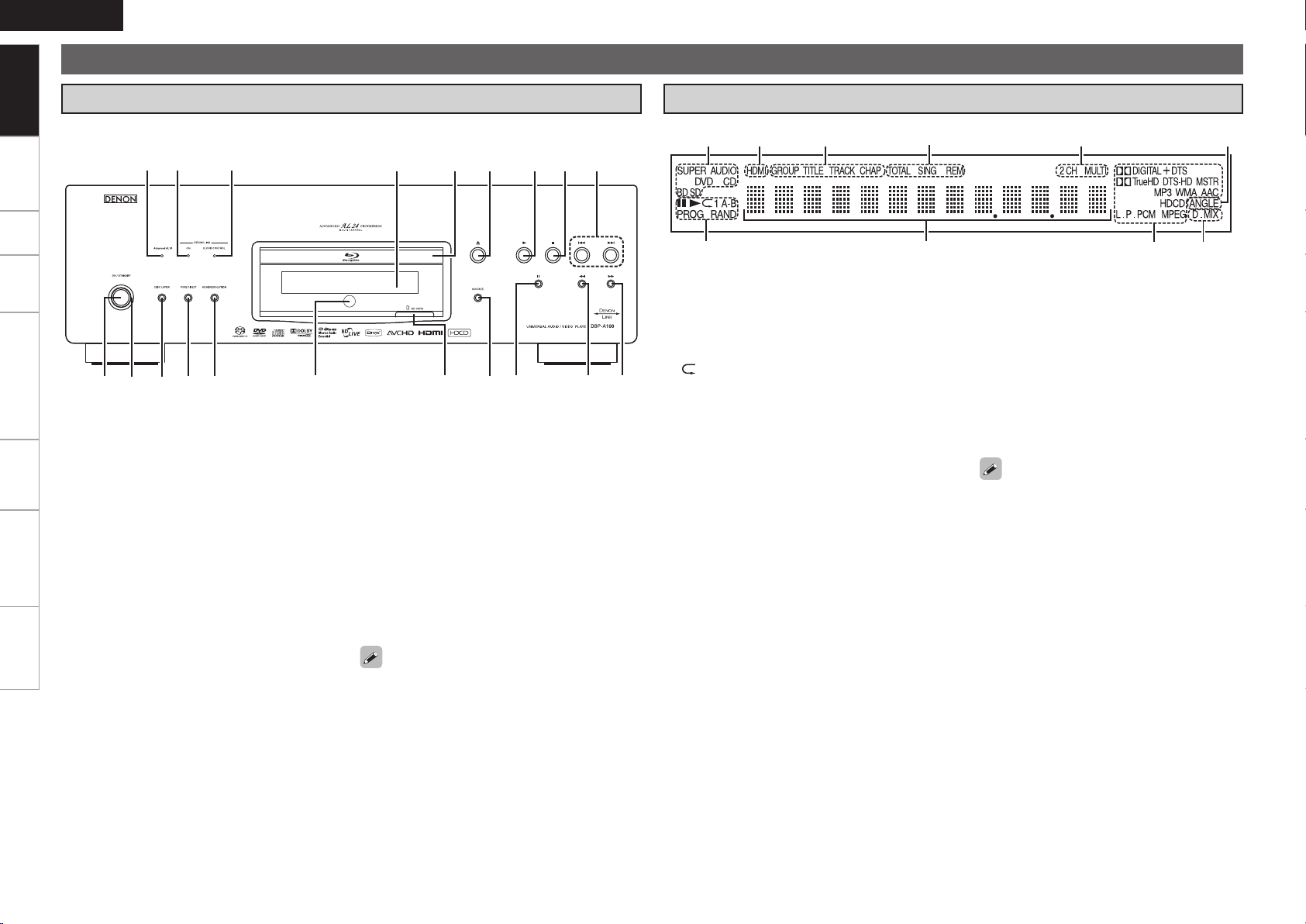
Front Panel
Part Names and Functions
For buttons not explained here, see the page indicated in parentheses ( ).
Q2Q3Q4Q5
i o Q0 Q1
Q6
Q7
Q8Q9W0
q ew
r
t y u
Display
wq e r
tyuioQ0
q Playback mode indicators
1 : During Playback
3 : During pause and step-by-step playback
PROG : During program playback
RAND : During random playback
1 A-B : During repeat playback
w Information display
Displays various information or playback
elapsed time and so on of the disc.
e Playback format indicators
r Downmix indicator
Displayed when playing back downmix
permitted audio.
t Angle information indicator
Displayed when a scene on the currently playing
disc has been shot at various angles.
y Audio channel indicators
Displays the number of audio signal channels
during playback.
2CH : 2-channel playback
MULTI : Multi-channel playback
u Time mode indicators
TOTAL : Total time of Super Audio CD and CD
SING : Elapsed time of title/chapter/track/le
being played
REM : Remaining time of title/chapter/track/le
being played
i Group/Title/Track/Chapter indicators
o HDMI output indicator
Display when HDMI video or audio signals are
being output.
Does not display when the HDMI cable is
not correctly connected or when the HDMI
connection is not veried.
Q0 Media indicators
BD : BD
DVD : DVD-Video, DVD-R/+R/-RW/+RW
DVD AUDIO : DVD-Audio
SUPER AUDIO CD : Super Audio CD
CD : CD
SD : SD Memory Card
Displays the inserted media.
Getting Started
q Power operation button
(ON/STANDBY) ··········································· (20)
w Power indicator ·········································· (20)
e DISC LAYER button ···································· (37)
r PURE DIRECT button ·································· (38)
t HDMI RESOLUTION button ······················· (13)
y Remote control sensor ································· (7)
u SD CARD slot ················································ (6)
i SOURCE button ·········································· (34)
o Pause/Still button (3) ·························· (41, 43)
Q0 Fast reverse/slow button (6) ················· (43)
Q1 Fast forward/slow button (7) ················ (43)
Q2 Reverse-skip/Forward-skip buttons
(8, 9)··················································· (41)
Q3 Stop button (2) ··········································· (41)
Q4 Play button (1) ··········································· (37)
Q5 Disc tray open/close button (5) ················ (34)
Q6 Disc tray ························································ (6)
Q7 Display ··························································· (8)
Q8 CLOCK CONTROL indicator················· (17, 28)
Lights when playing BD with DENON LINK 4th
(jitter free) connections.
Q9 DENON LINK indicator ······························· (50)
W0 ADVANCED AL24 indicator ······················· (50)
When power is in standby mode, press Q4 and Q5
to turn the power on.
1.DBP-A100_E3_ENG_007.indd 8 2010/08/12 19:20:06
TroubleshootingInformationHDMI Control FunctionPlaybackSetupConnectionsGetting Started Specications
ENGLISH
9
Part Names and Functions
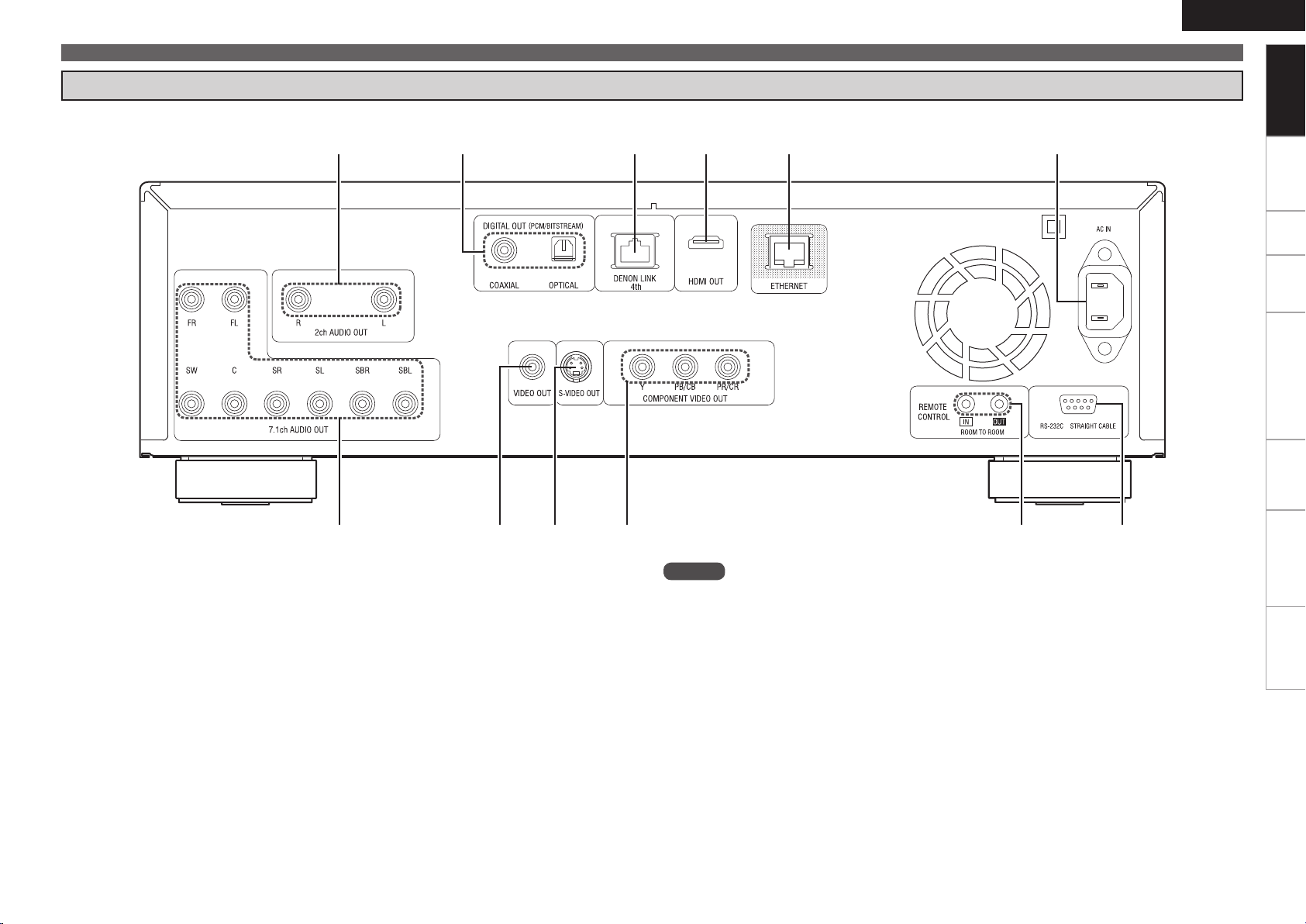
Rear Panel
For buttons not explained here, see the page indicated in parentheses ( ).
q
Q2 Q1 Q0 o i u
w e t yr
Getting Started
q 7.1ch AUDIO OUT connectors ··················· (16)
w VIDEO OUT connector ······························· (18)
e S-VIDEO OUT connector ···························· (18)
r COMPONENT VIDEO OUT connectors ····· (18)
t ROOM TO ROOM IN/OUT jacks
Extension jack for future use.
y RS-232C connector
Extension connector for future use.
u AC inlet (AC IN) ··········································· (20)
i ETHERNET connector ··························· (19, 20)
o HDMI OUT connectors ······························· (13)
Q0 DENON LINK 4th connector ······················ (17)
Q1 DIGITAL OUT OPTICAL/COAXIAL
connectors ··················································· (15)
Q2 2ch AUDIO OUT connectors ······················ (18)
For software recorded in multi-channel, analog
signals that have been down-mixed into 2
channels are output.
NOTE
• Do not touch the inner pins of the connectors on the rear panel. Electrostatic discharge may cause
permanent damage to the unit.
• Do not put your nger or foreign objects in the fan opening. Doing so could cause injury or unit failure.
• When outputting audio from a DTS-HD 7.1-channel source to HDMI or analog 7.1 channel audio, and to
2-channel analog audio, perform the following settings so that the audio is down mixed to the correct
2-channel analog audio output signal as intended by the producer of the source and DTS, Inc.
• In “HDMI Setup”, set “Audio Setup” to “2Ch” (vpage 23).
• In “Audio Setup”, set “7.1ch Audio Out” to “2 Channel” (vpage 25).
If “Audio Setup” in “HDMI Setup” and “7.1ch Audio Out” in “Audio Setup” are not set to “2Ch” or “2
Channel” respectively, 2-channel analog audio is output using this unit’s own downmix.
In this case, the downmix may differ from that intended by the producer of the source and DTS, Inc.
1.DBP-A100_E3_ENG_007.indd 9 2010/08/12 19:20:06
ENGLISH
10
TroubleshootingInformationHDMI Control FunctionPlaybackSetupConnectionsGetting Started Specications
Part Names and Functions
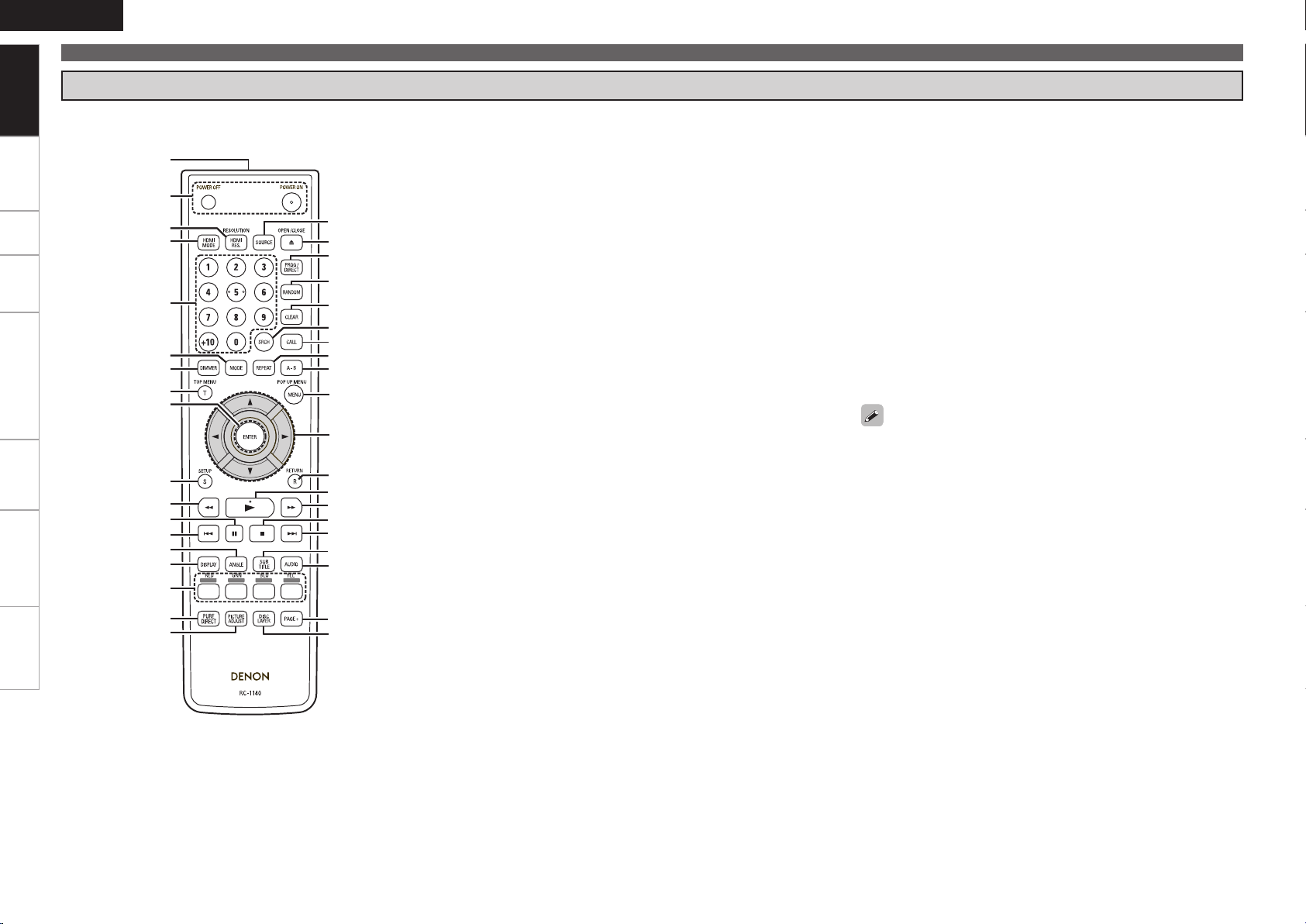
Remote Control
For buttons not explained here, see the page indicated in parentheses ( ).
• When power is in standby, press W0 and E1 to turn the power on.
• You can use Q6 when operating the BD popup menu screen, etc.
q Remote control signal transmitter ············································(7)
w POWER buttons (POWER OFF, POWER ON) ··························(20)
e HDMI RESOLUTION button (HDMI RES.) ·······························(13)
r HDMI MODE button ·································································(14)
t Number buttons (0 ~ 9, +10) ··············································(35, 36)
y MODE button ············································································(32)
u DIMMER button ········································································(47)
i TOP MENU button (T) ······························································(36)
o ENTER button ···········································································(22)
Q0 SETUP button (S) ······································································(21)
Q1 Fast-reversing button (6) ·····················································(43)
Q2 Pause/Still button (3) ························································(41, 43)
Q3 Reverse-skip button (8) ·······················································(41)
Q4 ANGLE button ···········································································(47)
Q5 DISPLAY button ········································································(34)
Q6 RED/GRN/BLU/YEL buttons
Q7 PURE DIRECT button ································································(38)
Q8 PICTURE ADJUST button ························································(33)
Q9 SOURCE button ········································································(34)
W0 Disc tray OPEN/CLOSE button (5) ·········································(34)
W1 PROGRAM/DIRECT button (PROG/DIRECT) ··························(45)
W2 RANDOM button·······································································(44)
W3 CLEAR button ···········································································(33)
W4 SEARCH button (SRCH) ···························································(37)
W5 CALL button ··············································································(45)
W6 REPEAT button ········································································(44)
W7 A-B button ·················································································(44)
W8 MENU/POP UP MENU button ·················································(36)
W9 Cursor buttons (uiop) ·························································(22)
E0 RETURN button (R) ···································································(22)
E1 Play button (1) ·········································································(37)
E2 Fast-forwarding button (7) ··················································(43)
E3 Stop button (2) ·········································································(41)
E4 Forward-skip button (9) ······················································(41)
E5 SUBTITLE button ······································································(46)
E6 AUDIO button ·····································································(45, 46)
E7 PAGE + button ··········································································(38)
E8 DISC LAYER button ··································································(37)
Getting Started
q
w
Q9
W0
W1
W2
W3
W4
W5
W6
W7
W8
W9
E0
E3
E4
E2
E1
E5
E6
E7
E8
e
r
t
y
u
i
o
Q0
Q1
Q3
Q4
Q2
Q5
Q6
Q7
Q8
1.DBP-A100_E3_ENG_007.indd 10 2010/08/12 19:20:07
ENGLISH
11
TroubleshootingInformationHDMI Control FunctionPlaybackSetupGetting Started Specications
Connections
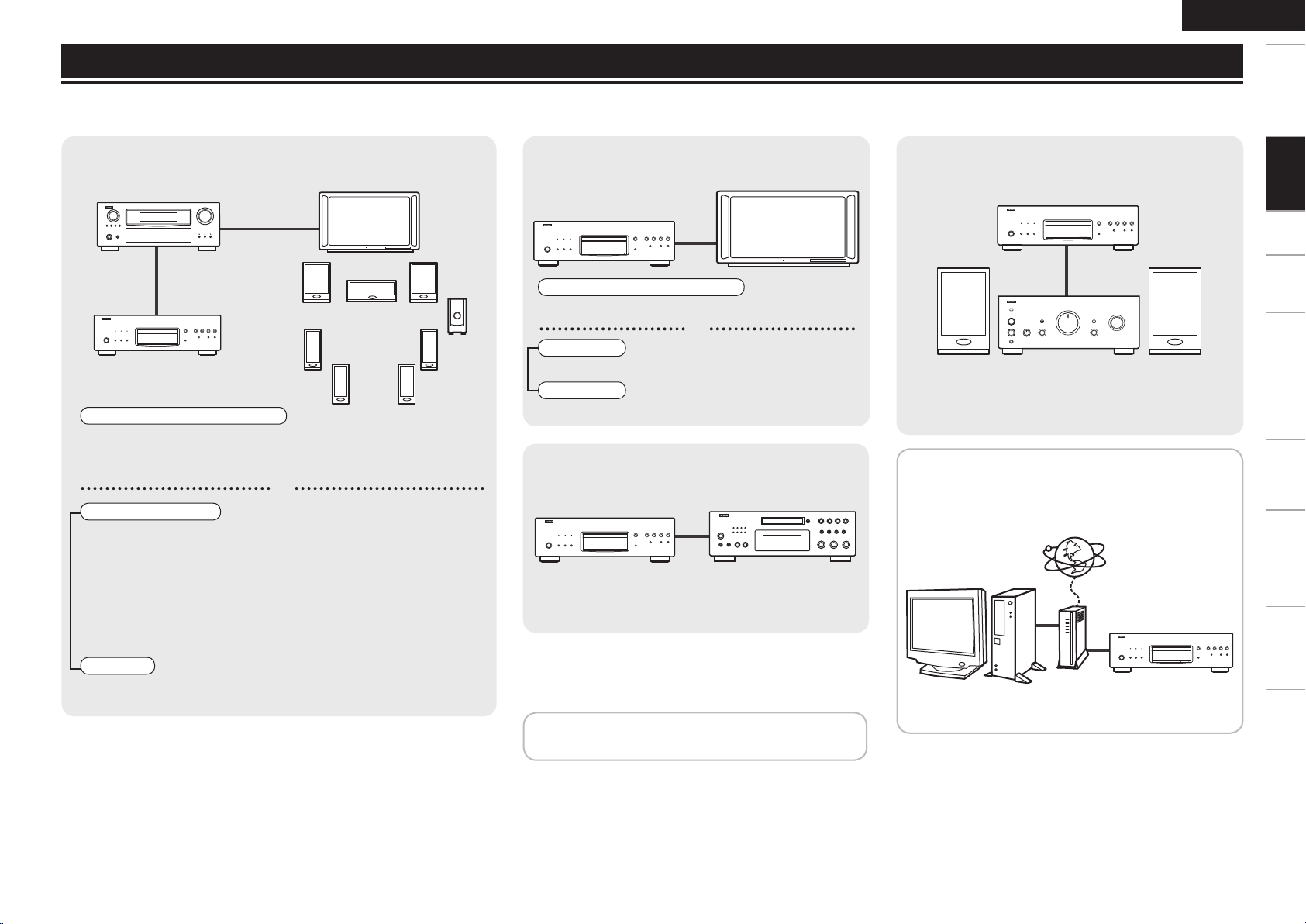
Connect the DBP-A100 as follows before using. Make connections according to the equipment you are connecting.
Some DBP-A100 settings may be necessary depending on the connection method. Check each connection item for more information.
1
Home Theater Playback
vpage 13
– Playing on a Multi-Channel System –
Multi-channel Audio + Video
• HDMI connection
“Using an HDMI Cable to Connect to an AV Amp or Television” (vpage
13)
or
Multi-channel Audio
• DENON LINK connection
“Making a Jitter-free Connection” (vpage 17)
“Making a Normal Connection” (vpage 17)
• Digital audio connection
“Connection to an AV Amp with No HDMI Audio Input” (vpage 15)
• Analog 7.1ch connection
“Connecting to a Device with an Analog Multi-channel Audio Input
Terminal” (vpage 16)
Video
• Analog video connection
“Connection to an AV Amp with No HDMI Video Input” (vpage 17)
2
Playing with a Direct
Connection to a TV
vpage 18
Audio + Video
• HDMI connection (vpage 13)
or
Audio
• Analog audio connection (vpage 18)
Video
• Analog video connection (vpage 18)
4
Recording a CD
vpage 19
• Digital output
“Connecting to a Digital Recording Device” (vpage
15)
DBP-A100
DBP-A100
DBP-A100
3
Playing 2-Channel Audio
vpage 18
• 2-ch stereo pin plug cable (unbalanced) connection
“Connecting to a Device with Analog 2-channel Audio
Input Terminal with Stereo Pin Plug Cable” (vpage 18)
5
Using the BD-LIVE
function or updating
the software version of
DBP-A100
vpage 19
• LAN connection
“Connecting to a Network” (vpage 19)
DBP-A100
DBP-A100
• Connecting the Power Cord
• Once Connections are Completed
vpage 20
Connections
1.DBP-A100_E3_ENG_007.indd 11 2010/08/12 19:20:07
ENGLISH
12
TroubleshootingInformationHDMI Control FunctionPlaybackSetupConnectionsGetting Started Specications
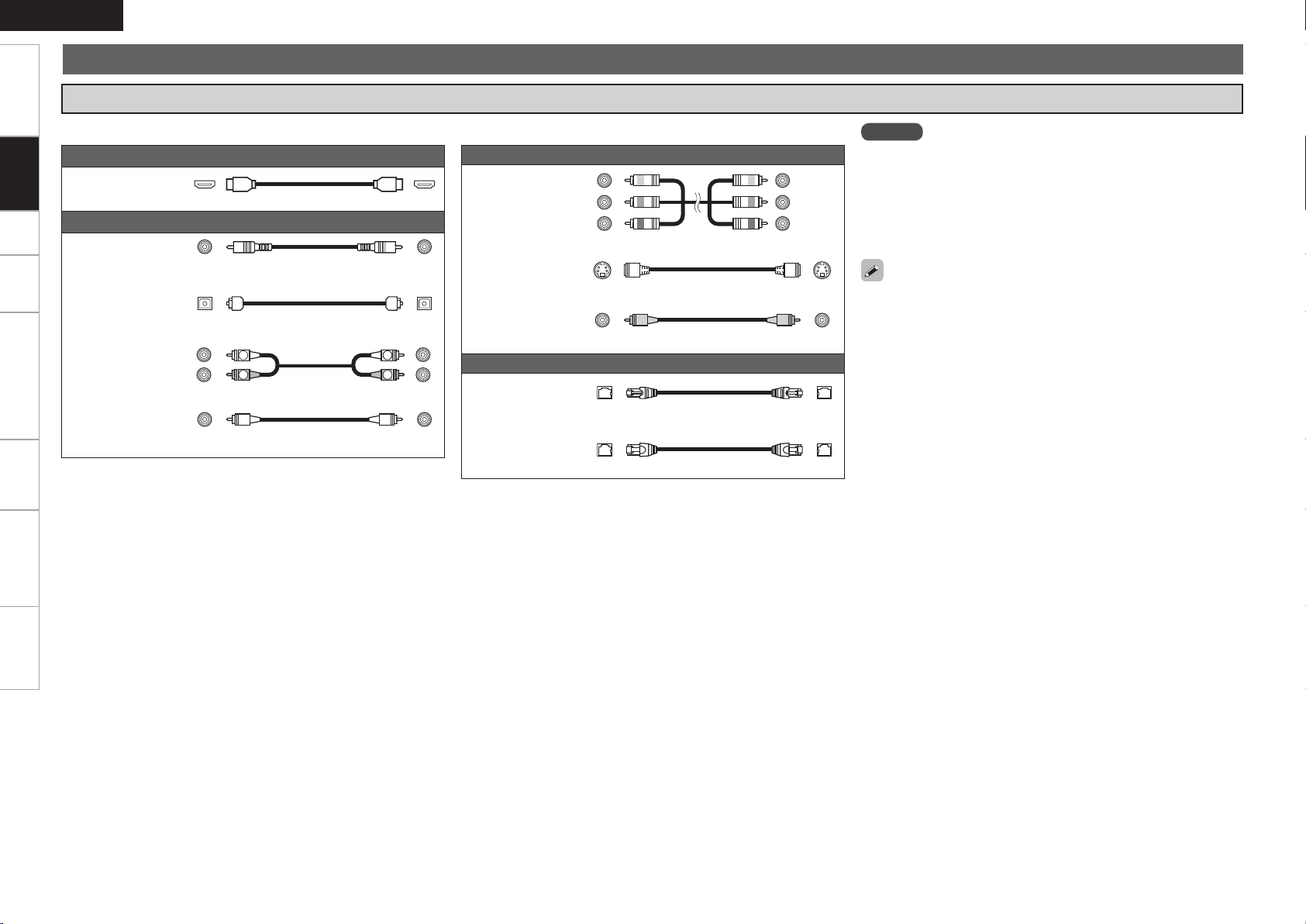
Video cables
Component video
connections
(Sold separately)
Component video (75 Ω) cable
S-Video
connections
(Sold separately)
S-Video cable
Video connections
(Included)
75 Ω pin-plug video cable
Other cables
DENON LINK
connections
(Included)
DENON LINK cable
Network
connections
(Sold separately)
Ethernet cable
Preparation
Connecting Cables
Prepare cables corresponding to the devices you choose.
Audio and video cables
HDMI connections
(Sold separately)
19-pin HDMI cable
Audio cables
Coaxial digital
connections
(Sold separately)
Coaxial digital (75 Ω pin-plug) cable
Optical digital
connections
(Sold separately)
Optical cable
Analog connections
(stereo, surround)
(1 included)
R
L
R
L
Stereo pin plug cable
Analog connections
(center, subwoofer)
(Sold separately)
Pin-plug cable
(Y)
(PB/CB)
(PR/CR)
NOTE
• Do not plug the power cord into the power outlet until all connections
are complete.
• Be sure to read the owner’s manuals for connected devices.
• First check the connection channels and then correctly connect the
input and output channels.
• Do not bundle the power cord with connection cables. This can
result in noise.
• Use only HDMI (High Denition Multimedia Interface) cables that
bear the HDMI logo (genuine HDMI product). Using cables without
the HDMI logo (non-genuine HDMI product) may result in abnormal
playback.
• When outputting deep colour or 1080p, etc., we recommend you
use a High Speed HDMI cable for enhanced, high-quality playback.
Connections
1.DBP-A100_E3_ENG_007.indd 12 2010/08/12 19:20:07
TroubleshootingInformationHDMI Control FunctionPlaybackSetupGetting Started Specications
ENGLISH
13
1. Home Theater Playback – Playing on a Multi-channel System –
Connections
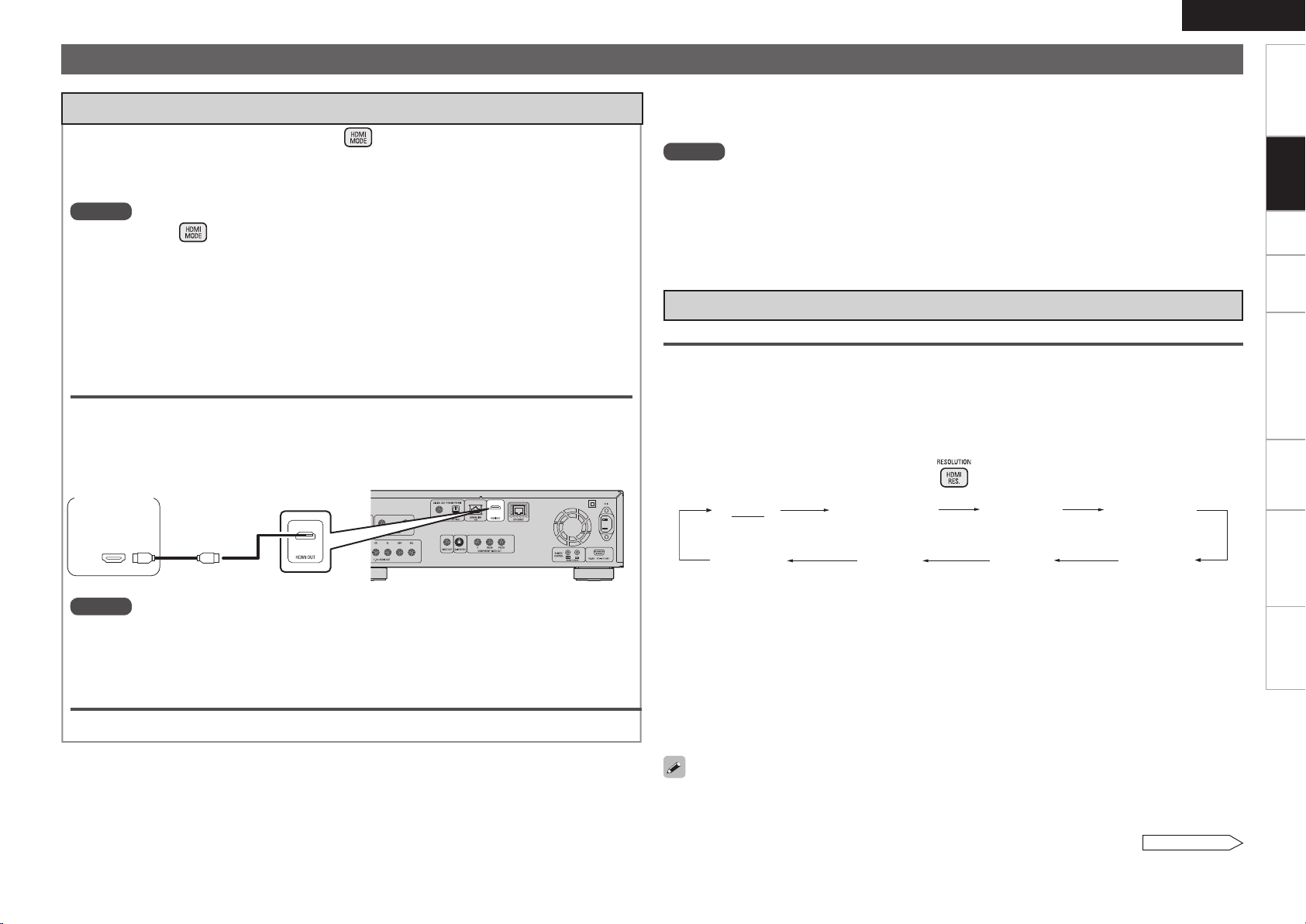
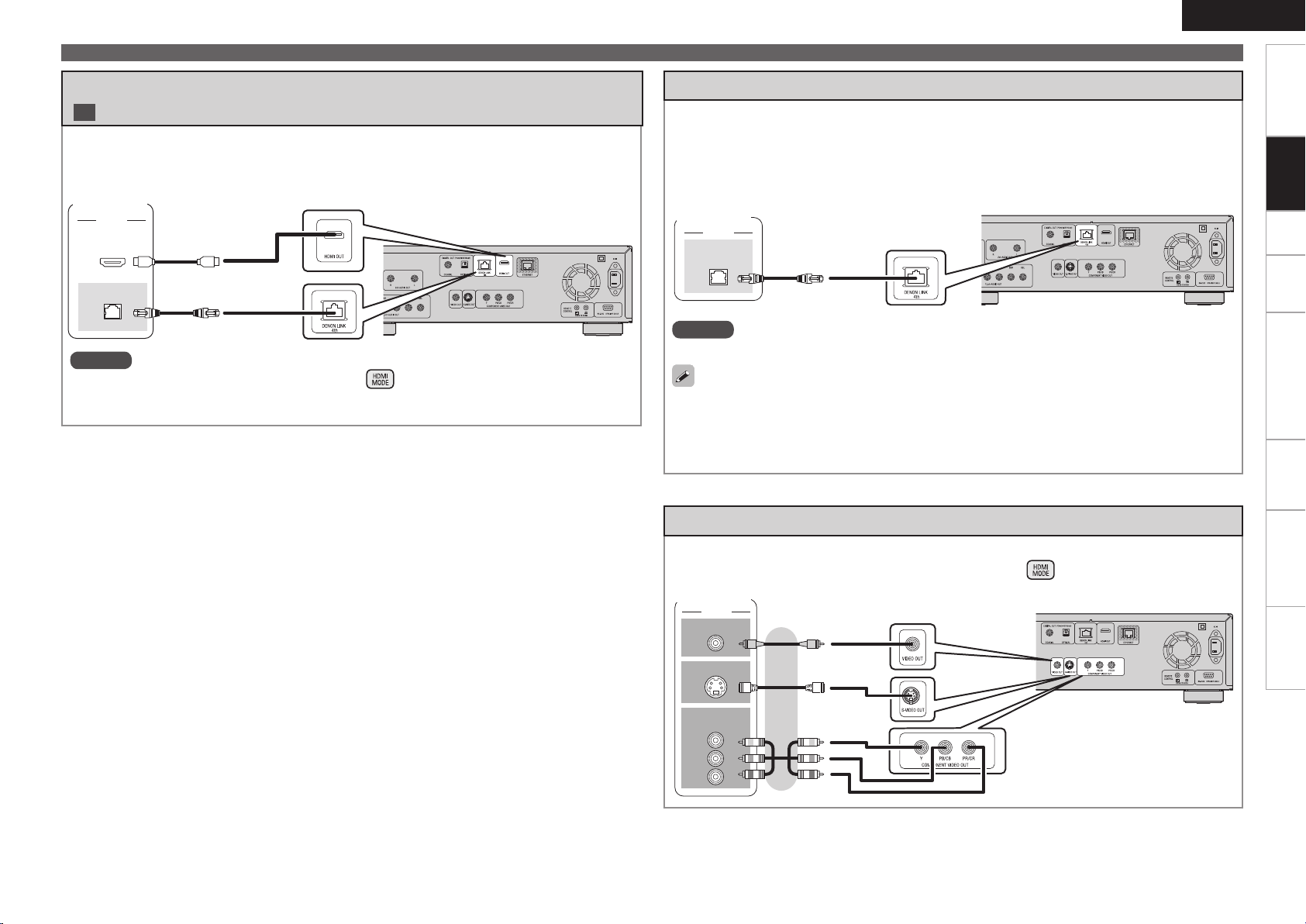
• When connecting with an HDMI cable, press and set it to “HDMI On”.
• Your DBP-A100 automatically detects the audio/video signal supported by the connected HDMI
device and outputs the signal. To change the setting, see “HDMI Setup” on the GUI menu
(vpage 23, 24).
NOTE
• When you press and set it to “HDMI On”, no video signals are output from the component
video outputs.
• To disable video or audio output from the HDMI terminal, set the “Video Out” of the “Pure Direct
Setup”, which outputs high quality analog audio, to “Off”. To enable the HDMI signal output, set the
Pure Direct mode to one of the following settings:
• Pure Direct mode “Off” or “User Preset 1” or “User Preset 2” (b)
(“Playing Back High-Quality Audio (Pure Direct Function) ” vpage 38)
b Do this after setting “Pure Direct Setup” – “User Preset 1” or “User Preset 2” – “Video Out” on the
GUI menu to “On” (vpage 28).
Using an HDMI Cable to Connect to an AV Amp or Television
With “HDMI On”
Audio/video signals are output from the HDMI terminal.
When the HDMI video resolution is set to “Auto” as described in “HDMI Video Resolution Settings”
(vpage 13), the DBP-A100 outputs the highest resolution video signal that is supported by the
connected equipment.
IN
HDMI
AV Amp or
TV
With “HDMI Off”
Audio/video is not output from the HDMI terminal.
NOTE
• When audio/video signals are output from the HDMI terminal, no video signals are output from the
component terminals.
• When a signal comprising 24 frames per second, such as 1080P24, is output from the HDMI terminal,
no video signals are output from the video or S-Video outputs.
n Connection to a device with a DVI-D terminal
If you use a HDMI/DVI-D conversion cable (sold separately), HDMI video signals are converted to DVI-
D signals, enabling connection to a device with a DVI-D terminal.
NOTE
• In this case, the audio signal is not output. Make the appropriate audio connections for your devices.
(vpage 14 ~ 20).
• The video signal will be in RGB format.
• You cannot output to a DVI-D device that does not support HDCP (high-bandwidth digital content
copyright protection system).
• Video may not be output depending on the combination of devices.
Setting HDMI Video Output
n Make HDMI Output Signal and HDMI Control Function Settings
“HDMI Setup” (vpage 23, 24)
n Make the Video Output Signal Setting for the Connected Television
“Video Setup” (vpage 24)
n HDMI Video Resolution Settings
• Change the HDMI video resolution by pressing . Switch the output mode as follows. The default
settings is underlined.
Auto
480/576i
1080P24
1080P
1080i
480/576P
720P
Source Direct
• If the HDMI resolution is not set to “Auto”, set it to correspond with the resolution of your television.
Images will not be projected normally if the television resolution and DBP-A100’s output resolution do
not match.
• Audio and video will be temporarily interrupted if the power of the connected device currently playing
is turned off, or the input is switched.
• When you change the HDMI video resolution of the DBP-A100, it takes a few seconds up to about 10
seconds for validation between the DBP-A100 and the connected device. Audio/video is not output
during this period.
• When outputting deep colour or 1080p, etc., we recommend you use a High Speed HDMI cable for
enhanced high-quality playback.
Required Settings for HDMI Connection
(480/576 interlaced)
(480/576 progressive)
(720 progressive)(1080 interlaced)(1080 progressive)(1080 progressive, 24-frame)
(Source direct)
(Auto)
When outputting a video signal comprising 24 frames per second from the HDMI terminal, select
“1080P24” or “Source Direct” after setting the GUI menu “HDMI Setup” – “I/P Direct” (vpage 23) to
“On”.
See overleaf
1.DBP-A100_E3_ENG_007.indd 13 2010/08/12 19:20:08
TroubleshootingInformationHDMI Control FunctionPlaybackSetupGetting Started Specications
ENGLISH
14
1. Home Theater Playback – Playing on a Multi-channel System –
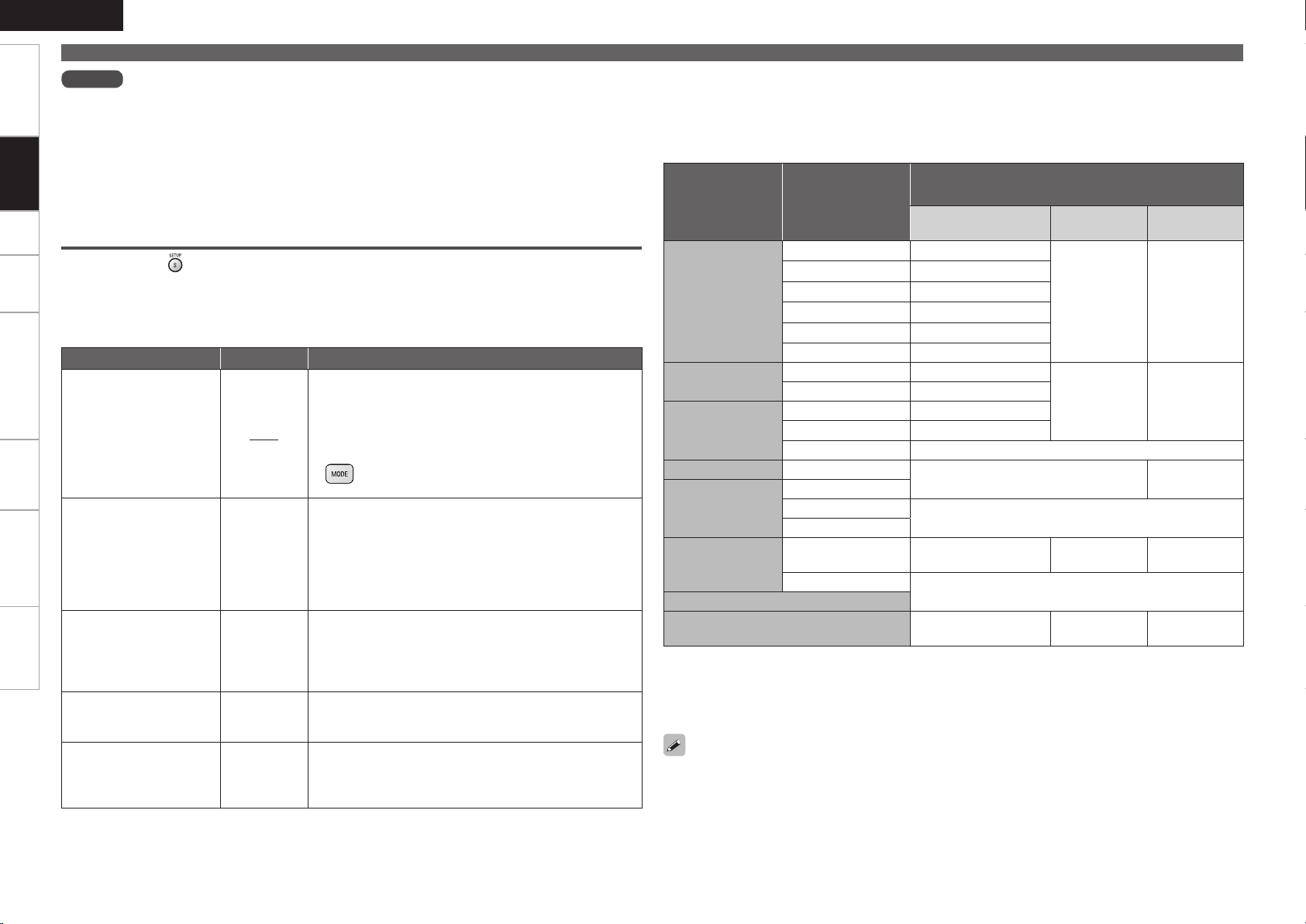
Setting HDMI Audio Output
• When you press and set “HDMI Setup” – “Audio Setup” to “Auto” (vpage 23) on the GUI menu,
the audio mode is set according to the connected device.
• When you want to set the HDMI audio output to one of your choosing change it according to the
following table.
• Refer to the owner’s manual of the connected device for HDMI audio input specications compatible
with the connected device.
Device to be connected Setting items About output signal and speaker settings
Devices with the following
built-in decoders
· Dolby TrueHD
· Dolby Digital Plus
· Dolby Digital
· DTS-HD
· DTS
Auto
DBP-A100 outputs a bitstream signal that is decoded by
the connected device.
b In this case, you cannot make a speaker setting for
HDMI audio with the DBP-A100.
Make the setting with the connected device.
b When outputting Dolby TrueHD or DTS-HD audio, press
and set “BD Audio Mode” to “HD Audio Output”
(vpage 32).
Devices compatible with
multi-channel HDMI audio
input, but not capable of
speaker settings for each
channel
Multi LPCM
BM On
Outputs multi-channel Linear PCM audio signals with
speaker settings by the DBP-A100.
b For speaker settings, on the GUI menu, “Audio Setup”
– “7.1ch Audio Out” – “Multi Channel” – “Speaker
Conguration” (vpage 25).
b BM : Bass Management (means multi-channel speaker
setting)
Devices compatible with
multi-channel HDMI audio
input, and capable of
speaker settings for each
channel
Multi LPCM
BM Off
Output of multi-channel Linear PCM audio signals from the
DBP-A100.
Make speaker settings with the connected device.
b BM : Bass Management (means multi-channel speaker
setting)
Devices compatible with 2-
channel HDMI audio input
2Ch
Downmixed 2-channel Linear PCM audio signals are output
from the DBP-A100.
Make speaker settings with the connected device.
Devices not compatible
with HDMI audio signal
input
Mute
Audio signal are not output from the DBP-A100’s HDMI
terminal.
Only video signals are output from the HDMI terminal.
b Make the audio connections.
NOTE
• When the HDMI video resolution is set to “1080P24”, a HDMI video signal is output from the DBP-A100
with a resolution of 1080P and a frame rate of 24 frames per second, regardless of the video signal
on the disc being played. Because of this, when playing discs containing video signals recorded with
a frame rate of something other than 24 frames per second, the movement of the picture may be
unnatural. If this happens, set the HDMI video resolution to something other than “1080P24”.
• When the “I/P Direct” (vpage 23) setting is “On” and a disc with a frame rate of 24 frames per second
is played, no video signals are output from the video or S-Video outputs.
• When the “I/P Direct” (vpage 23) setting is “Off”, “1080P24” is not displayed.
n Audio signal from the HDMI output terminal
You can change the audio format and playback the number of channels according to the specications
of the device to which the DBP-A100’s HDMI audio output signals are input. Make settings while
checking the specications of the audio device to be connected as well as the audio format/number
of channels stored in media and les for playback.
Media/Files Audio format
Setting “HDMI Setup” – “Audio Setup” (vpage 23) on
the GUI menu
Auto
Multi LPCM
BM On/Off
2Ch
BD
Dolby Digital
Dolby Digitalz1
Multi LPCM
2-ch Downmix
LPCM
Dolby Digital Plus
Dolby Digital Plusz1
Dolby TrueHD
Dolby TrueHD
z
1
DTS
DTSz1
DTS-HD
DTS-HDz1
LPCM Multi LPCM
AVCHD
Dolby Digital Dolby Digital
Multi LPCM
2-ch Downmix
LPCM
LPCM Multi LPCM
DVD-Video
Dolby Digital Dolby Digital
DTS DTS
LPCM, MPEG 2-ch LPCM
DVD-Audio LPCM, PPCM
Multi LPCM
2-ch Downmix
LPCM
Super audio CDz2
Multi area
Stereo area
2-ch LPCM
CD layer
DivX
®
Dolby Digital Dolby Digital Multi LPCM
2-ch Downmix
LPCM
MP3, MP2
2-ch LPCM
CD, MP3, WMA, AAC, LPCM
DTS-CD DTS Multi LPCM
2-ch Downmix
LPCM
z1 :
Multi LPCM signals are output when “BD Audio Mode” is set to “Mix Audio Output ” (vpage 32).
Multi LPCM signals are output when outputting HDMI video signals with resolutions of 480i/576i or
480p/576p.
z2 :
Super Audio CD audio signals are output at 44.1 kHz 16-bit.
Even if “HDMI Setup” – “Audio Setup” on the GUI menu is set to “Auto” (vpage 23), multilinear PCM
or downmixed 2-channel linear PCM signals are output if a device that does not support bitstream is
connected.
Connections
1.DBP-A100_E3_ENG_007.indd 14 2010/08/12 19:20:08
TroubleshootingInformationHDMI Control FunctionPlaybackSetupGetting Started Specications
ENGLISH
15
Copyright protection system
In order to play back digital video and audio such as BD-Video or DVD-Video via HDMI connection,
both the player and TV or the AV Amp need to support the copyright protection system known as
HDCP(High-bandwidth Digital Content Protection System). HDCP is copyright protection technology
comprising data encryption and authentication of the connected AV device. Our DBP-A100 supports
HDCP.
NOTE
• If a device that does not support HDCP is connected, video and audio are not output correctly. Read the
owner’s manual of your television or AV Amp for more information.
• The audio signal from the HDMI output terminal (sampling frequency, number of channels, etc.) may be
limited by the HDMI audio specications of the connected device for permissible inputs. For example,
if the HDMI audio specication of the connected device is 5.1 channels, 5.1-channel audio will be
automatically output even when playing back 7.1 channels on the DBP-A100. In this case, analog audio
output will also be 5.1-channel.
• Audio signal input may not be supported depending on the HDMI compatible monitor (projector, etc.)
being used.
When the DBP-A100 is connected to this kind of device, audio signals are not output from the HDMI
terminal.
1. Home Theater Playback – Playing Back Using Multi-channel System –
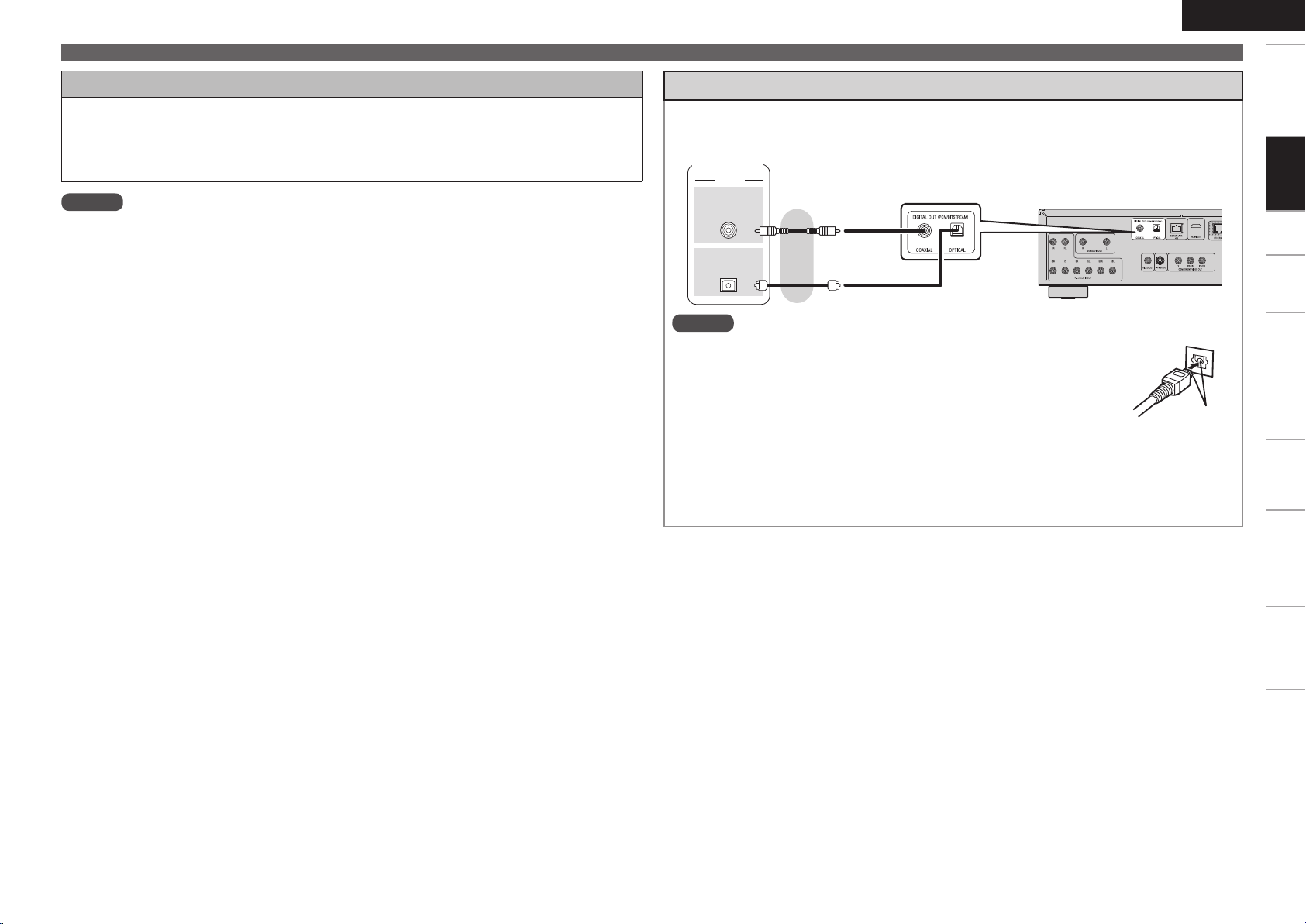
Connecting to an AV Amp with No HDMI Audio Input
When playing back Dolby Digital Plus/Dolby TrueHD/DTS-HD audio recorded on a BD disc, the DBP-
A100 outputs Dolby Digital or DTS bitstream from its digital audio output terminal.
AUDIO
COAXIAL
IN
IN
OPTICAL
AV Amp
NOTE
• Dolby TrueHD/Dolby Digital Plus/DTS-HD audio signals are not output with
this connection.
When outputting Dolby TrueHD/Dolby Digital Plus/DTS-HD audio signals, do
so with an HDMI connection (vpage 13, “Using an HDMI Cable to Connect
to an AV Amp or Television”).
• Super Audio CD’s DSD signal cannot be output. Also, during CD layer
playback, 44.1 kHz/16-bit Linear PCM is output.
• Do not output DTS audio signals to an AV Amp that does not support DTS. Playing back a BD/DVD
disc with recorded DTS content can generate noise and even damage your speakers.
• When connecting with an optical transmission cable (sold separately), make sure the plug shape
aligns with the socket, and insert fully.
Match the
shapes
Connections
1.DBP-A100_E3_ENG_007.indd 15 2010/08/12 19:20:08
TroubleshootingInformationHDMI Control FunctionPlaybackSetupGetting Started Specications
ENGLISH
16
1. Home Theater Playback – Playing Back Using Multi-channel System –
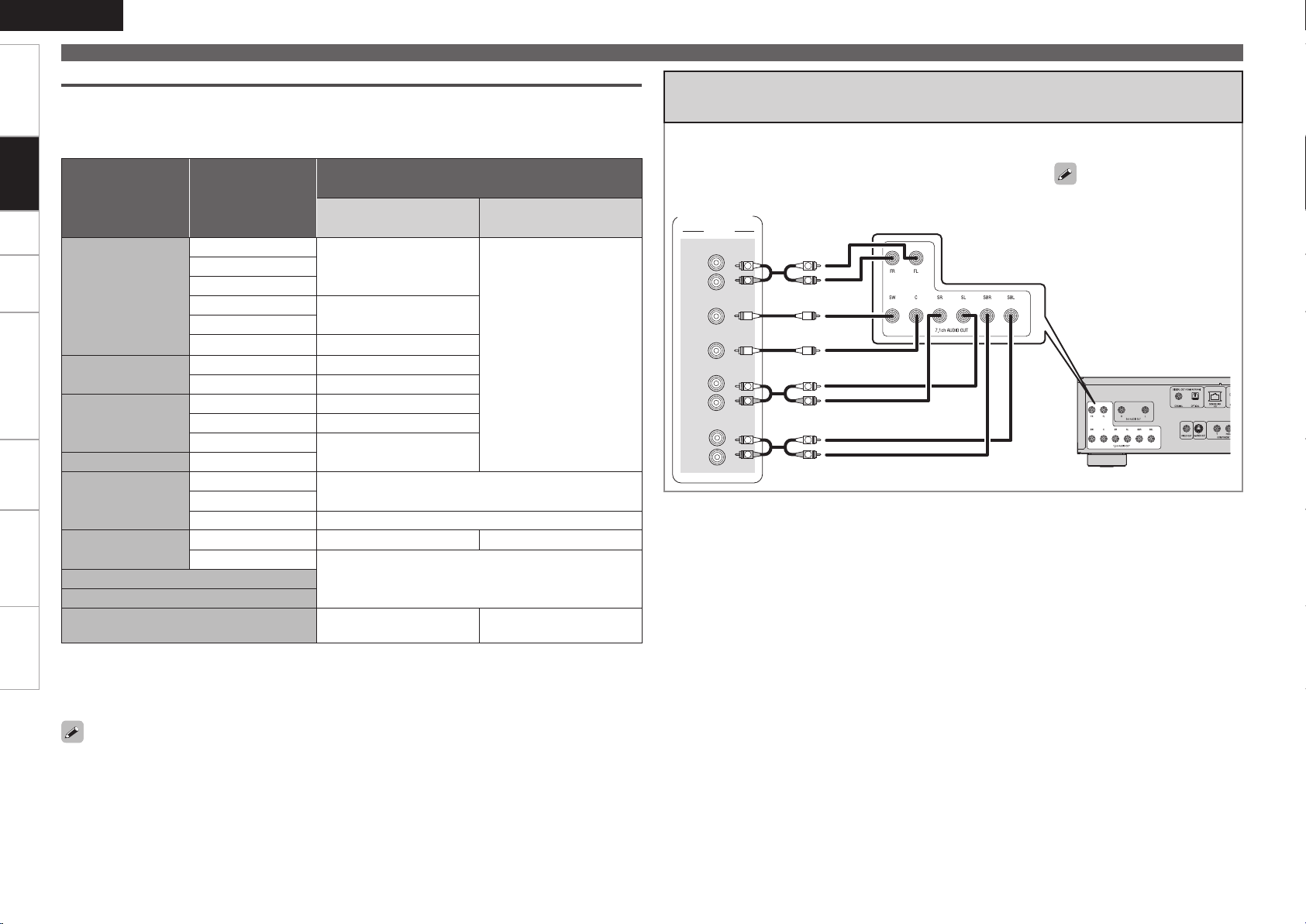
Audio Signal from the Digital Audio Output (Optical/Coaxial) Terminal
The DBP-A100 can convert and output digital audio signal format recorded on various media.
Convert the digital audio signal in accordance with the specications of the device that is to input digital
audio output signals from the DBP-A100.
Media/Files Audio format
Setting “Audio Setup” – “Digital Out” (vpage 27) on
the GUI menu
Bitstream
PCM/
PCM Down Sampling
BD
Dolby Digital
Dolby Digitalz1
2-ch Downmix LPCM
Dolby Digital Plus
Dolby TrueHD
DTS
DTSz1
DTS-HD
LPCM
2-ch Downmix LPCMz1
AVCHD
Dolby Digital Dolby Digital
LPCM 2-ch Downmix LPCM
DVD-Video
Dolby Digital Dolby Digital
DTS DTS
LPCM, MPEG
2-ch Downmix LPCM
DVD-Audio LPCM, PPCM
Super Audio CD
Multi area
Audio is not output
Stereo area
CD layer 2-ch LPCM
DivX
®
Dolby Digital Dolby Digital 2-ch Downmix LPCM
MP3, MP2
2-ch LPCMCD
MP3, WMA, AAC, LPCM
DTS-CD DTS
2-ch Downmix LPCM
(DTSz2)
z1 :
Bitstream signals are output according to the BD re-encode setting when “BD Audio Mode” is set
to “Mix Audio Output” (vpage 32).
z2 :
When “HDMI Setup” – ”Audio Setup” is set to “Auto” on the GUI menu and bitstream is output from
the HDMI , the DTS bitstream is output from the digital audio output (optical/coaxial) as well.
For content with copyright protection, audio signal is down-sampled to 48kHz 16bit and output.
Connecting to a Device with an Analog Multi-channel Audio
Input Terminal
Outputs multi-channel audio decoded by the DBP-A100.
If your audio system has an analog multi-channel audio input terminal, connect using audio cable (sold
separately).
FRONT
SUBWOOFER
R
L
R
L
R
L
SURROUND
SURROUND BACK
CENTER
AUDIO
R R
L L
R R
L L
R R
L L
AV Amp
In the case of a 5.1-channel
connection, you do not need to
connect the SBR/SBL terminals.
In this case, on the GUI menu,
select “Audio Setup” – “7.1ch
Audio Out” – “Multi Channel” –
“Speaker Conguration” – “Surr.
Back”, and set “Size” to “None”
(vpage 25).
Connections
1.DBP-A100_E3_ENG_007.indd 16 2010/08/12 19:20:09
TroubleshootingInformationHDMI Control FunctionPlaybackSetupGetting Started Specications
ENGLISH
17
1. Home Theater Playback – Playing Back Using Multi-channel System –
NOTE
• When using DENON LINK 4th functions, press the and set to “HDMI On”.
• The jitter-free function does not work except during BD playback. In this case, the video signal is
output from the HDMI OUT terminal, and the audio signal from the DENON LINK terminal.
When you connect the DBP-A100 to a DENON LINK 4th compatible AV Amp using a DENON LINK
cable and HDMI cable, during BD playback the DBP-A100’s circuit operates with the AV Amp’s master
clock signal. (The clock control indicator of the DBP-A100 lights.) This enables transmission of high-
quality digital audio with minimal jitter.
DENON LINK
AUDIO
IN
HDMI
AV Amp
DENON LINK Connection q Making a Jitter-free Connection
BD
Connecting to an AV Amp with No HDMI Video Input
VIDEO
VIDEO IN
S VIDEO IN
Y
P
B
PR
COMPONENT
VIDEO IN
AV Amp
NOTE
DENON LINK does not support BD audio transmission.
• When connecting to a DENON LINK-compatible AV Amp, the multi-channel signals of DVD-Audio
discs, Super Audio CDs, etc., can be transferred as such in digital format.
• The DENON LINK connection requires the version of AV Amp to be connected to match the DBP-
A100 version. Check the version of the AV Amp, and then on the GUI Menu, set “DENON LINK
Setup” – “DENON LINK Mode” (vpage 28).
If the DBP-A100 and AV Amp versions do not match, audio cannot be output correctly.
DENON LINK
AUDIO
AV Amp
• DENON LINK supports digital transmission up to 24 bit/2-ch at 192/176.4 kHz, and up to 24 bit/6-ch
at 96 kHz or less.
• When you have made a DENON LINK connection, the DBP-A100’s speaker setting becomes invalid.
(Make the speaker setting on the connected AV Amp)
• DENON LINK 2nd cannot transmit multi/stereo area audio of a Super Audio CD.
DENON LINK Connection w Making a Normal Connection
• Check the video terminals and connect to one of them.
• When connecting using the component video outputs, press
and set it to “HDMI Off”.
Connections
1.DBP-A100_E3_ENG_007.indd 17 2010/08/12 19:20:09
TroubleshootingInformationHDMI Control FunctionPlaybackSetupGetting Started Specications
ENGLISH
18
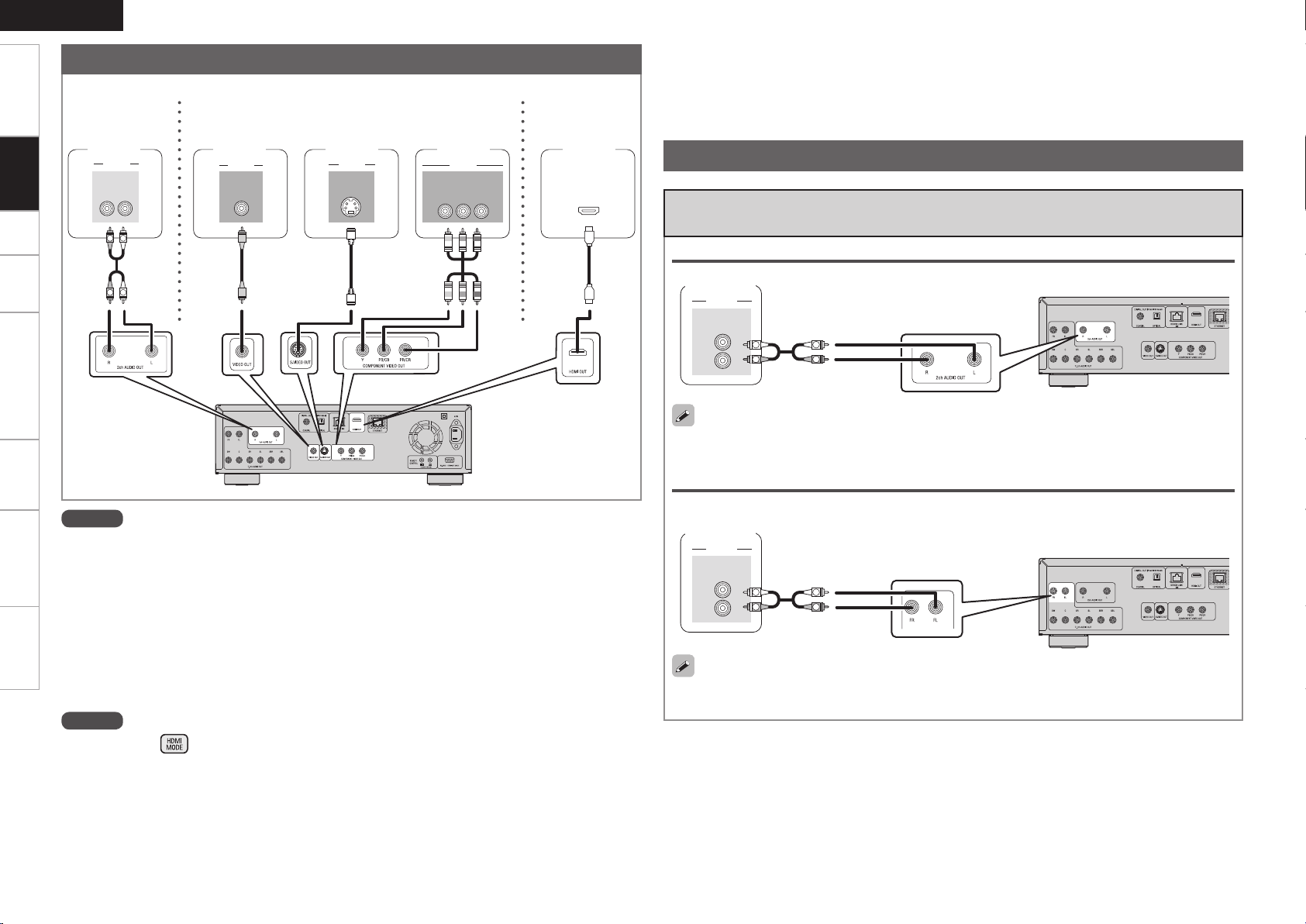
2. Playing with a Direct Connection to a TV
Check the television’s audio and video terminals and connect to one of them.
AUDIO
AUDIO
IN
LR
VIDEO
IN
VIDEO
VIDEO
IN
S VIDEO
VIDEO
COMPONENT VIDEO
Y P
B
PR
IN
IN
HDMI
R
L
R
L
TV
Audio terminals Video terminal S-Video input
terminal
Component video
input terminal
HDMI input
terminal
TV TV TV TV
(Sold
separately)
(supplied)(supplied)
(Sold
separately)
(Sold
separately)
NOTE
Do not connect the DBP-A100’s video output via a VCR (Video Cassette Recorder). Some media contain
copy prohibiting signals, which will disturb the screen image.
When playing an NTSC disc,the DBP-A100’s video output changes to the NTSC signal format.
When playing a PAL disc, the DBP-A100’s video output changes to the PAL signal format.
n When connected to the television’s component video input terminal
• The DBP-A100’s component video output supports 480i/576i/480p/576p/720p/1080i output. Match the
output to the corresponding resolution of the connected television by setting on the GUI menu: “Video
Setup” – “Component Resolution” (vpage 24). Images will not be projected normally if the television
resolution and DBP-A100’s output resolution do not match. Copyright protected DVDs are output in
480i/576i or 480p/576p.
NOTE
When you press and set it to “HDMI On”, no video signals are output from the component video
terminals. When using the component video terminals, set the HDMI mode to “HDMI Off”.
n When connected to the HDMI input terminal
It outputs both digital video and digital audio signals.
See “Required Settings for HDMI Connection” (vpage 13) for HDMI video output and audio output
settings.
3. Playing Back 2-Channel Audio
Connecting to a Device with Analog 2-channel Audio Input
Terminals with a Stereo Pin Plug Cable
AUDIO
AUDIO
IN
L
R
R
L
R
L
Stereo
For software recorded in multi-channel, an analog signal down-mixed to 2 channels is output.
AUDIO
AUDIO
IN
L
R
R
L
R
L
Stereo
For software recorded in multi-channel, an analog signal down-mixed to 2 channels is output.
When connecting using the analog 2-channel audio output terminals
When connecting using the analog 7.1-channel audio output terminals
On the GUI menu, select “Audio Setup” – “7.1ch Audio Out”, and set it to “2 channel” (vpage 25).
Connections
1.DBP-A100_E3_ENG_007.indd 18 2010/08/12 19:20:10
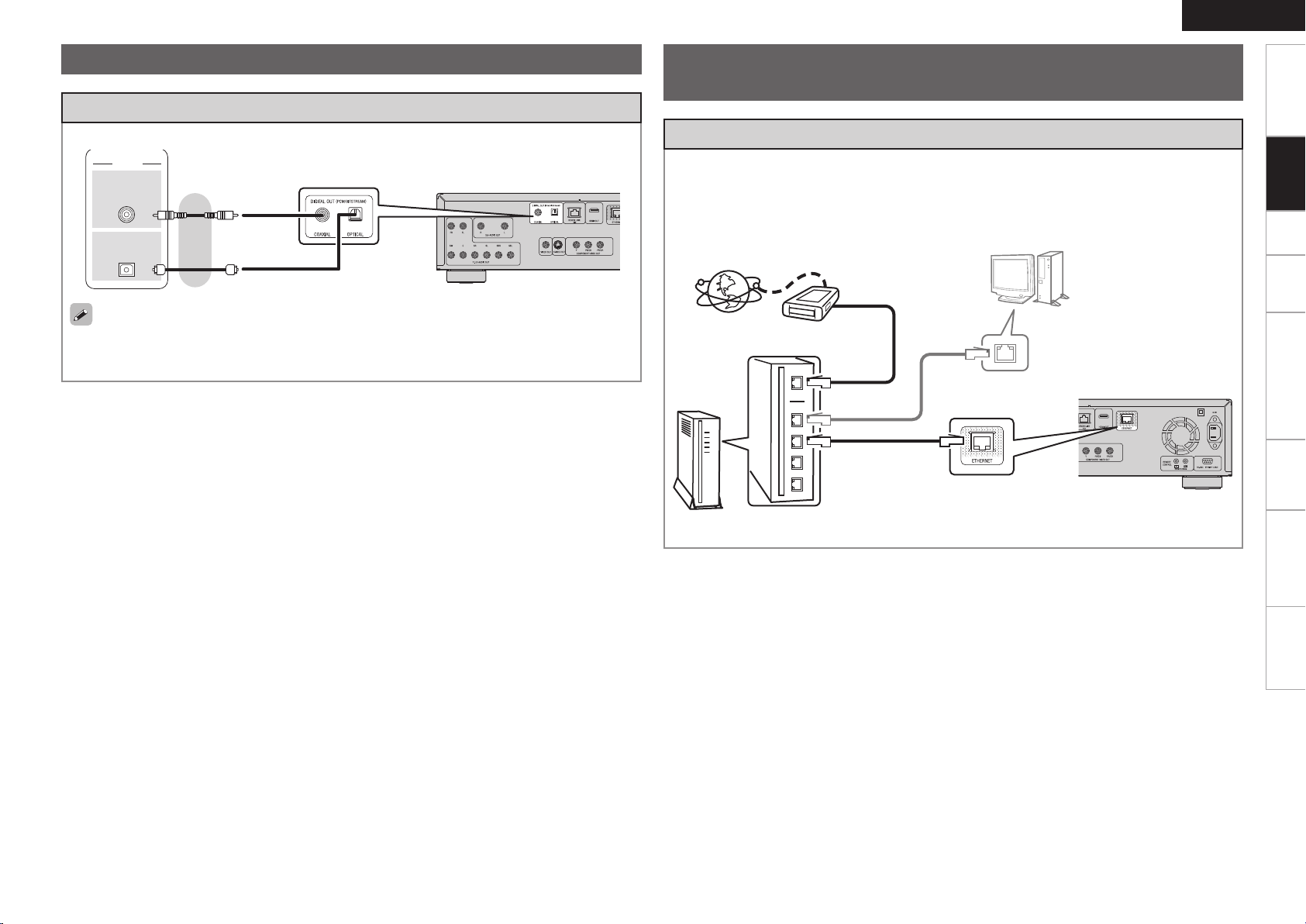
TroubleshootingInformationHDMI Control FunctionPlaybackSetupGetting Started Specications
ENGLISH
19
Connecting to a Digital Recording Device
AUDIO
COAXIAL
IN
IN
OPTICAL
MD Recorder
When converting multi-channel audio to 2-channel for output, select “Audio Setup” – “Digital Out” on
the GUI menu and set it to “PCM Down Sampling” (vpage 27). If you play back DVD or other media
with an incorrect conguration, a deafening noise occurs that may damage your speakers.
4. Recording a CD
Connecting to a Network
• You can use a disc that offers the BD-LIVE function by connecting the unit to the Internet (vpage
36).
• You can update by downloading the latest rmware from the Internet.
For more information, on the GUI menu select “Other Setup” – “Firmware Update” (vpage 31).
• You can also operate this unit from a computer using the Web control function (vpage 47).
Internet
Modem
Router
Computer
LAN port/
Ethernet
connector
To WAN port
To LAN port
To LAN port
ETHERNET
connector
5. Using BD-LIVE function or updating the software
version of DBP-A100
Connections
• See “Network Setup” (vpage 29) on the GUI menu for more information on network settings.
1.DBP-A100_E3_ENG_007.indd 19 2010/08/12 19:20:10
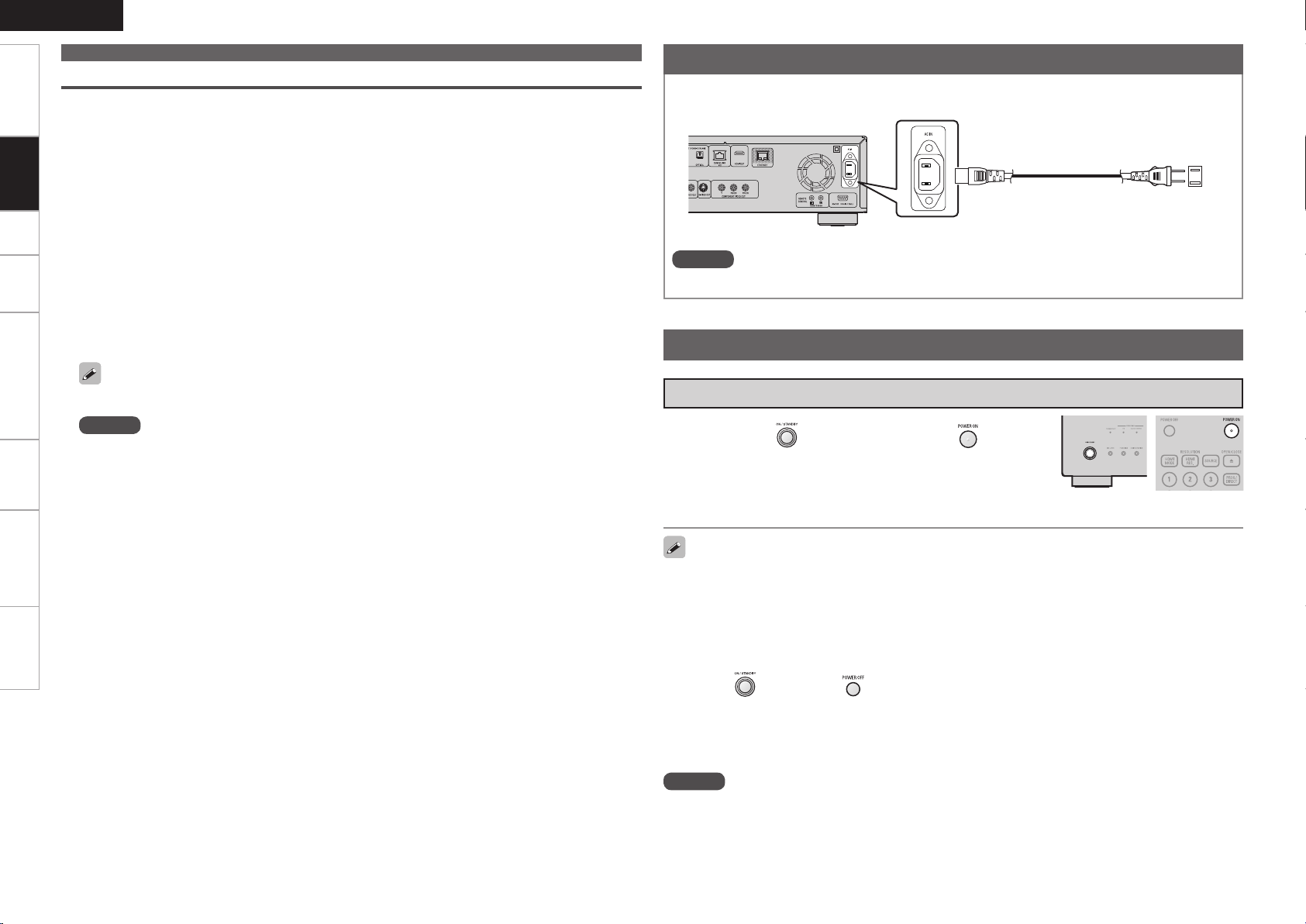
TroubleshootingInformationHDMI Control FunctionPlaybackSetupGetting Started Specications
ENGLISH
20
System Requirements
n Internet Connection via Broadband
n Modem
A device that connects to the broadband and conducts communications on the Internet.
Some modems also incorporate a router.
n Router
When using the DBP-A100, we recommend a router with the following features.
• Built-in DHCP (Dynamic Host Conguration Protocol) server.
This function automatically assigns an IP address on the LAN.
• Built-in 100BASE-TX switch (built-in switching hub compatible with speeds upwards of 100 Mbps)
n Ethernet cable (CAT-5 or greater recommended)
• An ethernet cable is not included with the DBP-A100.
• Use only shielded STP or ScTP LAN cable which is available at retailer.
• We recommend a shielded straight cable (normal type) for Ethernet connections.
If you use the at type or a non-shielded cable, the noise may adversely affect other devices.
For Internet connections, use an ISP (Internet Service Provider). Ask your local dealer for details.
NOTE
•Do not connect an ETHERNET connector directly to the LAN port/Ethernet connector on your computer.
• It is necessary to subscribe to an ISP in order to connect to the Internet. If you already have a
broadband connection, there is no need to subscribe anew.
• The router you can use varies with the ISP. For more information, contact your ISP or PC dealer.
• DENON assumes no responsibility whatsoever for any communication errors or problems resulting
from customer's network environment or connected devices.
n Other
• The DBP-A100 can use the DHCP function to automatically set up the network.
• When setting up your network manually, after subscribing to an ISP, make the settings according to
directions in “Network Setup” on the GUI menu (vpage 29).
• If you connect the DBP-A100 to a network without a DHCP function, conduct IP address and other
settings according to “Network Setup” on the GUI menu (vpage 29).
• The DBP-A100 does not support PPPoE. If you subscribe to a service that is set with PPPoE, a PPPoE-
compatible router is required.
• When setting up the network manually, consult with your network administrator for the settings to
make.
5. Using BD-LIVE function or updating the software version of DBP-A100
Connecting the Power Cord
Connect the included power cord to the DBP-A100, and plug it into an AC outlet.
NOTE
• Be sure to insert the power plug rmly. Incomplete connection results in noise.
Once Connections are Complete
On the GUI menu, when “Other Setup” – “Auto Power Mode” – “On” (vpage 31), the following states are
maintained for about 30 minutes, and then the power is automatically turned to standby.
Turning the Power On
n When power is switched to standby
Press either on the unit, or on the remote control.
GPower indicator status in standby modeH
• Power Saving Standby : Off
• Normal Standby : Red
• Quick Start Mode : Red
NOTE
During power standby, a slight amount of power is consumed. To totally cut off the power, remove the
power cord from the power outlet.
Press the unit’s or the remote control’s .
The power turns on, and the power indicator lights green.
“LOADING” appears on the display, and disc information is read.
b The “NO DISC” message is displayed if a disc is not loaded.
(DBP-A100)
(Remote control
unit)
• Disc not loaded
• Playback has stopped
• Stopped due to resume function
Connections
Power cord
(included)
To household power
outlet (AC 120 V, 60 Hz)
1.DBP-A100_E3_ENG_007.indd 20 2010/08/12 19:20:11
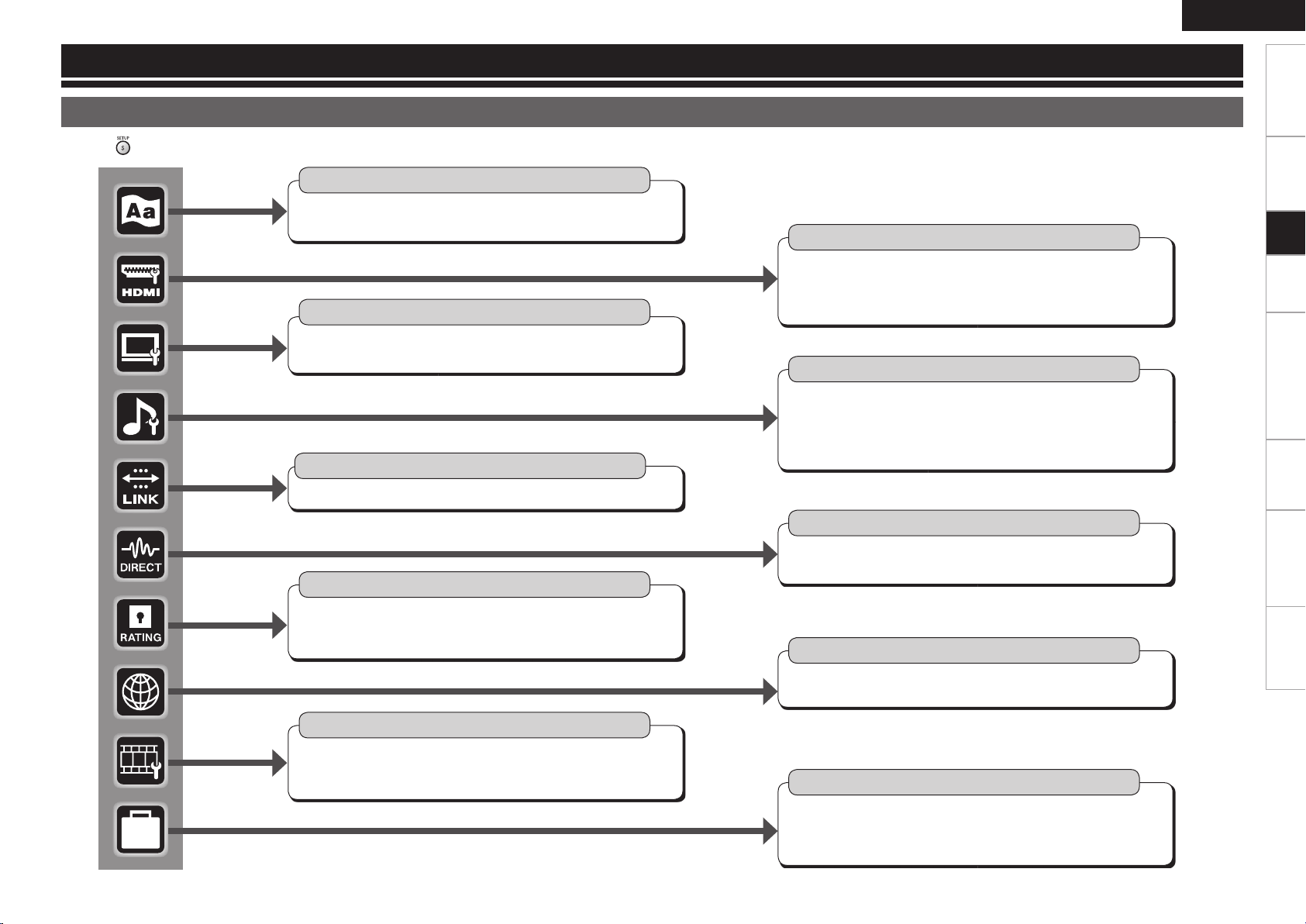
ENGLISH
21
TroubleshootingInformationHDMI Control FunctionPlaybackConnectionsGetting Started Speci cations
Pressing displays the GUI menu. From this menu, you can move to various setting screens.
GUI Menu Setup
Network Setup (vpage 29, 30)
n DHCP
n Proxy
Language Setup (vpage 23)
n Dialog
n Subtitles
Video Setup (vpage 24)
n TV Aspect (Aspect ratio)
n Component Resolution
DENON LINK Setup (vpage 28)
n DENON LINK Mode
Pure Direct Setup (vpage 28)
n User Preset 1
n User Preset 2
Ratings (vpage 29)
n Password
n BD Rating Level
n DVD Rating Level
Display Setup (vpage 30)
n Screen Saver
n Wallpaper
n Still Mode
Other Setup (vpage 31)
n Auto Power Mode
n Power Saving
n Remote Control Settings
n BD Data Utility
Menu Map
n Slide Show Time
n Temporary Display
n Captions
n Rating Country Codes
n DivX Registration
n Progressive Mode
n TV Active Area
n Disc Menus
n GUI Language
n Initialize
n Firmware Update
n Information
n Maintenance Mode
n IP Address
n MAC Address
Setup
HDMI Setup (vpage 23, 24)
n Auto Format
n I/P Direct
n Color Space
n Deep Color
n Audio Setup
n SA-CD Audio Out
n HDMI Control
Audio Setup (vpage 25 ~ 27)
n 7.1-ch Audio Out
• Multi Channel
• 2-Channel
n Subwoofer Mode
n Source Direct
n Compression
n BD Effect Sound
n BD Re-Encoder
n Digital Out
n Downmix
1.DBP-A100_E3_ENG_007.indd 21 2010/08/12 19:20:13
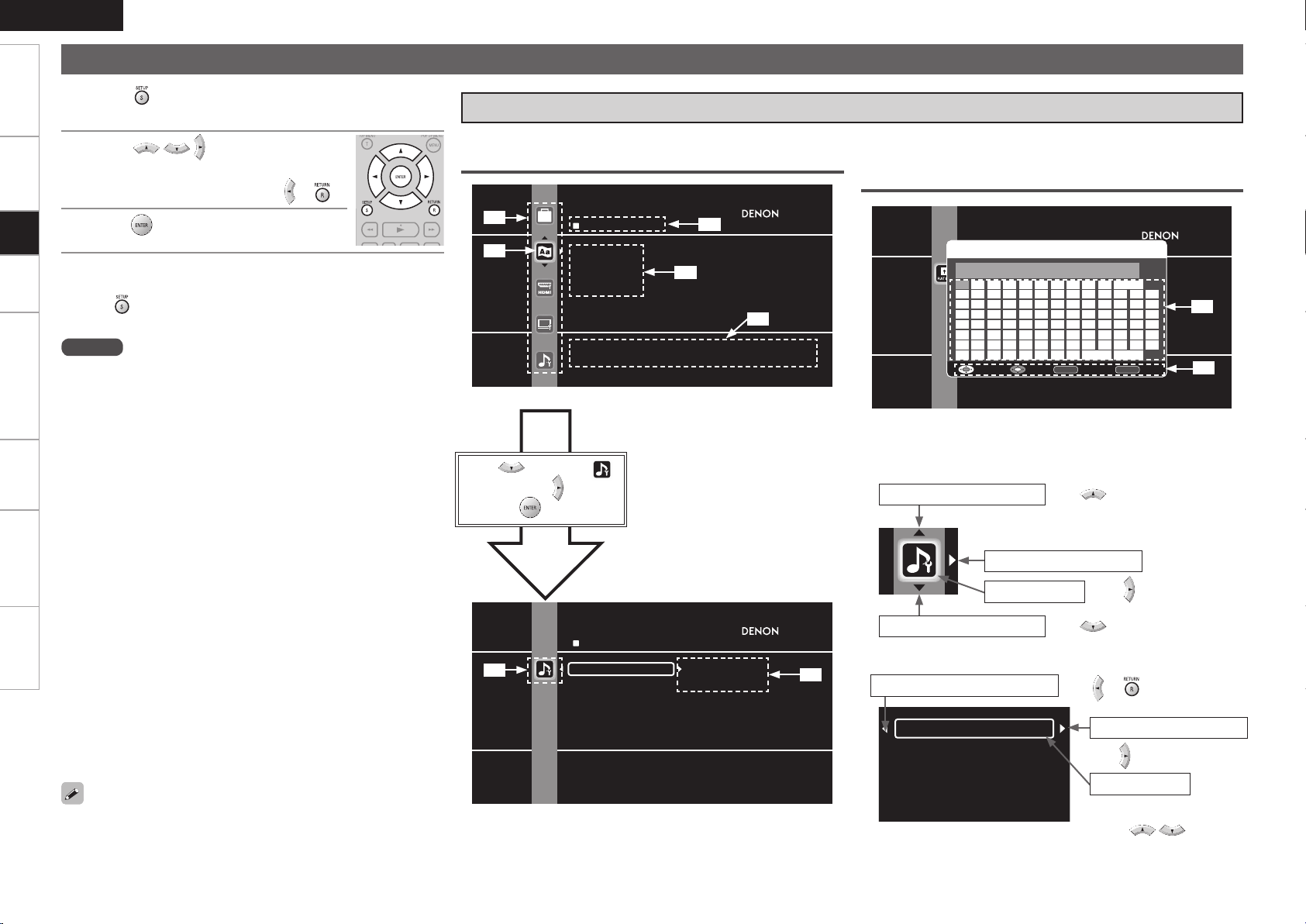
ENGLISH
22
TroubleshootingInformationHDMI Control FunctionPlaybackConnectionsGetting Started Speci cations
GUI Menu Operation
Typical examples are described below.
Examples of GUI Menu Screen Displays
n Exiting the GUI Menu
Press while the GUI menu is displayed.
• The GUI menu display disappears.
NOTE
You must use the GUI menu to make settings or operate while a disc
or SD Memory Card is not inserted. In cases in which the resume
function is activated, you may not make correct settings.
Text colors of selected items of the GUI menu are as follows:
• White : These items can be selected.
• Gray : These items cannot be selected.
(Use to switch.)
7.1ch Audio Out
Subwoofer Mode
Compression
Source Direct
BD Effect Sound
Switch to the next item
Selected item
Switch the selected item
Switch to the next item
b Switch the selected item
using .
n Icon
n List
GExample 1H Menu selection screen (Top menu)
AUDIO SETUP
7.1ch Audio Out Multi Channel
Subwoofer Mode 2 Channel
Compression
Source Direct
BD Effect Sound
Set to output analog 7.1ch audio.
RATINGS
視聴制限国コード アルゼンチン
オーストラリア
BD視聴制限レベル ベルギー
ブラジル
カナダ
オーストリア
国コードを入力してください
Enter the country code.
1
a
n
A
N
!
.
_
2 3 4 5 6 7 8 9 0 Space
b c d e f g h i j k l m
o p q r s t u v w x y z
B C D E F G H I J K L M
O P Q R S T U V W X Y Z
“ # $ % & ’ ( ) * + , −
/ : ; < = > ? @ [ ¥ ] ^
{ | } ` ˜ ← → Delete Finish
RETURN0-9
CURSOR Enter 0〜9
Return
■
LANGUAGE SETUP
Dialog
Subtitle
GUI Language
Disc Menus
Set the language used for playback dialogs, subtitles, and
menus.
GExample 2H Rating-Country Code input screen (with
virtual keyboard)
z3
z4
z5
z2
z1
z1 : List of GUI menu setup icons
z2 : Currently selected setup icon
z3 : Currently selected setup item
z4 : List of currently selected setup items
z5 : Guide text for the currently selected
setup item
Press to select “ ”
and then press .
(Or press .)
z6
z7
z8
z9
z6 : Selected setup icon
z7 : Options of the selected setup item
z8 : Virtual keyboard
z9 : Operation button guide
Selected item
(Use to switch.)
Switch the selected item
(Use to switch.)
(Use
to switch.)
Returns to the previous item
(Use or to switch.)
1
Press .
The GUI menu is displayed on the TV screen.
2
Press to select the menu to
be set or operated.
b To return to the previous item, press or .
3
Press to enter a setting.
Setup
1.DBP-A100_E3_ENG_007.indd 22 2010/08/12 19:20:15
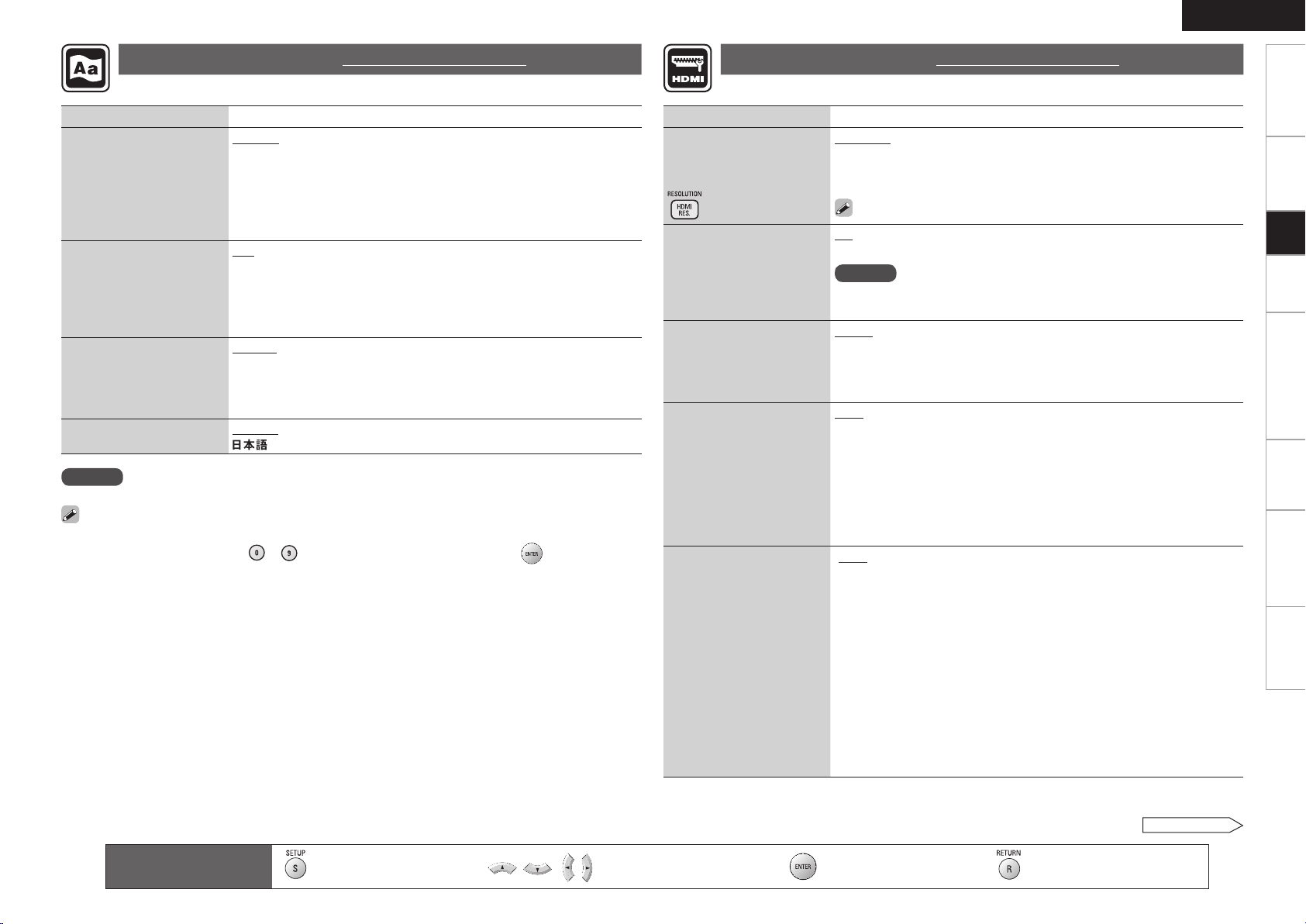
TroubleshootingInformationHDMI Control FunctionPlaybackConnectionsGetting Started Speci cations
ENGLISH
23
Setting items
Setting contents
Dialog
Sets the dialog used to play
BDs or DVDs.
Original : Plays the dialog selected at the top in the language menu
stored in the disc.
English/French/Spanish/German/Japanese/Italian/Swedish/Dutch/
Russian/Chinese/Korean/Danish/Finnish/Norwegian/Icelandic/
Hungarian/Romanian/Turkish/Greek/Irish/Portuguese/Polish/Czech/
Slovak/Bulgarian
Others : Enter the language code.
Subtitle
Sets the subtitle language
used to play BDs or DVDs.
Off : No subtitles displayed
English/French/Spanish/German/Japanese/Italian/Swedish/Dutch/
Russian/Chinese/Korean/Danish/Finnish/Norwegian/Icelandic/
Hungarian/Romanian/Turkish/Greek/Irish/Portuguese/Polish/Czech/
Slovak/Bulgarian
Others : Enter the language code.
Disc Menus
Sets the language used for
BD or DVD menus.
English/French/Spanish/German/Japanese/Italian/Swedish/Dutch/
Russian/Chinese/Korean/Danish/Finnish/Norwegian/Icelandic/
Hungarian/Romanian/Turkish/Greek/Irish/Portuguese/Polish/Czech/
Slovak/Bulgarian
Others : Enter the language code.
GUI Language
Sets the GUI language.
English/Français/Español/Deutsch/Italiano/Svenska/Nederlands/
NOTE
The setting may not be active depending on the disc.
If “Other” is selected for “Dialog”, “Subtitle” or “Disc Menus”, refer to the “Language Code List” (vpage
51), and use the number buttons ~ to input the language code, then press to set.
Setting items
Setting contents
Auto Format
Sets the content of HDMI
video output resolution item
“Auto” (vpage 14) with
.
Max Res. : Outputs data using the maximum resolution that can be
handled by the connected TV.
Panel Res. : Outputs data using the maximum resolution of the panel of
the connected TV.
If the TV does not support 1080P24, video is output in 1080P format.
I/P Direct
Sets whether the I/P
converter converts 24P
frames.
Off : Converts 1080 progressive 24 frames to 60 frames.
On : Outputs 1080 progressive 24 frames without conversion.
NOTE
When “I/P Direct” is set to “On” and some discs are played, no video
signal is output from the video and S-Video terminals.
Color Space
Sets the video signal system
to be output from HDMI.
YCbCr : Outputs in the YCbCr video format.
RGB Normal : Outputs using the RGB video system (16 (black) to 235
(white)).
RGB Enhanced : Outputs using the RGB video system (0 (black) to 255
(white)).
Deep Color
Sets the HDMI terminal to
output Deep Color.
Expands the color depth
(number of used colors)
of the HDMI video signal,
enabling playback with more
natural colors and free of
streaking.
Auto : Deep Color is automatically output when the connected HDMI
device supports Deep Color.
Off : No Deep Color output.
Audio Setup
Sets the audio signal system
to be output from HDMI.
GAutoH : Automatically selects and outputs signals that can be input to
the connected HDMI device. The bitstream signal takes priority.
GMulti LPCM BM OnH : Decoded Linear PCM multi-channel signal is
output by the DBP-A100. Speaker settings are enabled. (BM: Bass
Management)
For settings, on the GUI menu, refer to, “Audio Setup” – “7.1-ch Audio
Out” (vpage 25, 26).
• Speaker Con guration : Sets the speaker con guration used for
playback. Automatically sets channel components and characteristics
according to the settings.
• Channel Level : Sets the volume of the test tone to be the same when
it is output from each speaker.
• Distance : Sets the distance between the listening position and each
speaker.
Sets the language used for playback dialogs, subtitles, and menus. Sets the HDMI output signal or HDMI control function.
Language Setup
Default settings are underlined.
HDMI Setup
Default settings are underlined.
Remote control operation
buttons
:
Displays the menu
Cancels the menu
:
Moves the cursor
(Up/Down/Left/Right)
:Makes the setting :Returns to previous menu
Setup
See overleaf
1.DBP-A100_E3_ENG_007.indd 23 2010/08/12 19:20:16

TroubleshootingInformationHDMI Control FunctionPlaybackConnectionsGetting Started Speci cations
ENGLISH
24
HDMI Setup
Setting items
Setting contents
Audio Setup
GMulti LPCM BM OffH : Decoded Linear PCM multi-channel signal is
output by the DBP-A100. This setting is not made in speaker settings.
(BM: Bass Management)
G2ChH : Outputs the downmixed 2-channel LPCM signal.
GMuteH : Does not output audio from HDMI.
SA-CD Audio Out
Sets to output the stereo/
multi area audio of Super
Audio CD to the HDMI
terminal.
On : Super Audio CD audio is output.
Off : Super Audio CD audio is not output.
The Super Audio CD audio signal is a 44.1 kHz/16-bit Linear PCM output.
HDMI Control
Can operate the unit in
conjunction with an HDMI
control supported device.
GControlH
• Off : Disables the HDMI control function.
• On : Links with the device connected to HDMI.
GPower Off ControlH
• On : Turns the DBP-A100’s power to standby through linkage to the TV.
• Off : Does not turn the DBP-A100's power to standby through linkage
to the TV.
• For the HDMI control function to operate, it is necessary for the DBP-
A100 or HDMI-compatible TV connected to the DBP-A100 to have an
HDMI connection.
• Refer to “HDMI Control Function” (vpage 449) for more information
on HDMI control functions.
• The HDMI control function from the connected device is enabled when,
on the GUI menu, “DENON LINK Setup” – “DENON LINK Mode” is set
to “4th” (vpage 28).
• After the “HDMI Control” setting has been changed, always turn off the
power to the connected equipment and then turn it back on.
NOTE
If you set “DENON LINK Setup” – “DENON LINK Mode” on the GUI menu to “4th”, you will no longer be
able to change the “HDMI Control” – ”Control” setting. To change the setting, switch the “DENON LINK
Mode” to a setting other than “4th” rst and then change the setting.
Setting items
Setting contents
TV Aspect (Aspect ratio)
Set the screen type and
display mode of the TV.
16:9 Squeeze Auto : Outputs to a wide screen TV. For 4:3 video, displays
in the center of the screen without changing the aspect ratio. z1
WIDE (16:9) : Outputs to a wide-screen TV.
4:3 PS : Outputs to a 4:3 TV. For wide video, trim the left and right side of
the image and display in 4:3 aspect ratio. z2
4:3 LB : Outputs to a 4:3 TV. Displays all of the wide video.
Component Resolution z3
Sets the component output
resolution.
480/576i, 480/576P, 720P, 1080i,
Source Direct : Outputs video using its source resolution. Converts a
1080p video source to 1080i.
Progressive Mode
Sets an appropriate
progressive conversion
mode for the source video
material.
Auto : Detects the type of video material and automatically switches the
mode. Normally, this setting is used.
Video1 : Suitable for playing video material discs.
Video2 : Suitable for playing video material discs or 30-frame lm material
discs.
TV Active Area
Sets the horizontal display
range when the analog
video output resolution is
480i/576i.
Full : Setting when a home-use monitor is connected.
Normal : This setting is used when video synchronization is disturbed on
a professional-use monitor.
This is not available for HDMI output.
z1 :
This has no effect on the video and S-Video outputs.
z2 :
Depending on the video content, even though you set it to 4:3 PS ( Pan Scan), the content may be
output in 4:3 LB ( Letter Box).
z3 :
When video is output from the HDMI terminal, no video signal is output from the component
terminals.
Set the video output signal according to the connected TV.
Video Setup
Default settings are underlined.
Remote control operation
buttons
:
Displays the menu
Cancels the menu
:
Moves the cursor
(Up/Down/Left/Right)
:Makes the setting :Returns to previous menu
Setup
1.DBP-A100_E3_ENG_007.indd 24 2010/08/12 19:20:17
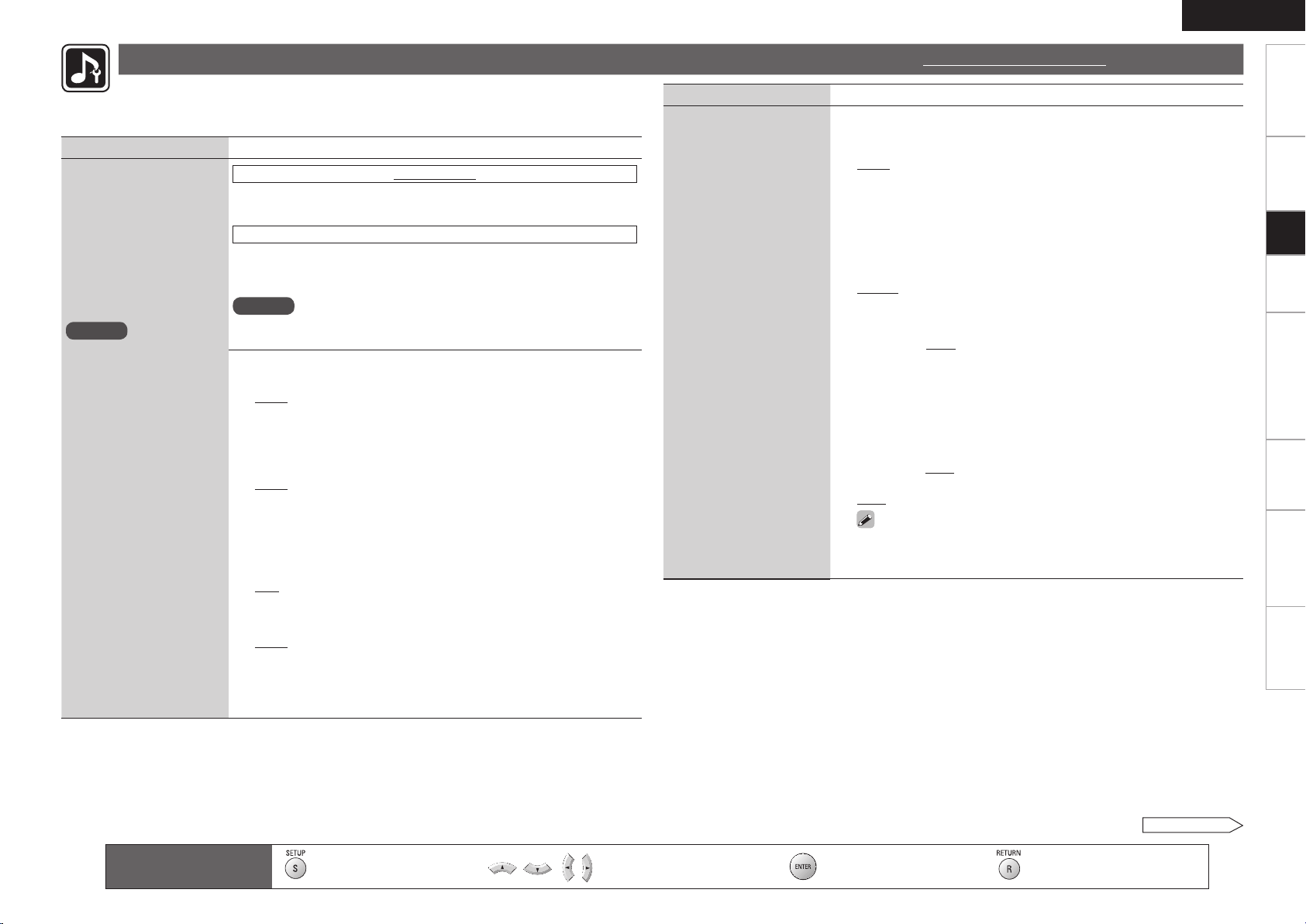
TroubleshootingInformationHDMI Control FunctionPlaybackConnectionsGetting Started Speci cations
ENGLISH
25
Setting items
Setting contents
7.1ch Audio Out
GSurr. BackH : Sets the presence, size and number of surround back
speakers.
• Size : Sets the surround back speaker size.
Large : For use with large speakers that can adequately play back low
frequencies.
Small : For use with small speakers that cannot adequately play back
low frequencies.
None : Select when no surround back speakers are connected.
• Number : Sets the number of surround back speakers.
1 spkr : Use only one surround back speaker. Surround back audio is
output from the surround back L terminal.
2 spkrs : Use two surround back speakers.
GCrossover Freq.H : Sets the upper limit of the low frequency signal
output from the subwoofer.
• 40Hz/60Hz/80Hz/90Hz/100Hz/110Hz/120Hz/150Hz/200Hz/250Hz
: Keeps the output level below the set frequency to avoid overloading
the speci ed low frequency performance of your subwoofer. Sets
one of these frequencies according to the low frequency output
capabilities of your speakers.
• Advanced : Sets the low frequency signals to be output from the
signals of the respective speakers to the subwoofer.
Front, Center, Surround, Surr. Back
40Hz/60Hz/80Hz/90Hz/100Hz/110Hz/120Hz/150Hz/200Hz/250Hz
LFE / LFE+Main
80Hz/90Hz/100Hz/110Hz/120Hz/150Hz/200Hz/250Hz
When, on the GUI menu, “Audio Setup” – “7.1ch Audio Out”– “Multi
Channel” – “Speaker Con guration” – “Subwoofer” is set to “Yes”
(vpage 25), you can select “LFE” or “LFE+Main”.
Setting items
Setting contents
7.1ch Audio Out
Makes the audio setting
for output of analog 7.1-
channel audio to a multi-
channel ampli er.
To set “7.1ch Audio Out”,
set “HDMI Setup” – “Audio
Setup” on the GUI menu to
“2Ch” or “Mute” (vpage
24).
NOTE
You cannot select “None”
or “No” for “HDMI Setup”
– Audio Setup” – “Multi
LPCM BM On” – “Speaker
Con guration” (vpage 23,
24) on the GUI menu.
Multi Channel
Set the speaker con guration, channel level and distance for multi-
channel playback.
2 Channel
Outputs multi-channel downmixed audio from the front speaker output
terminals (FL/FR) of the 7.1-channel audio output terminals. Make this
setting when outputting to a TV and 2-channel ampli er.
NOTE
The 7.1-channel audio output terminals only outputs to FL/FR when you
make this setting.
n Speaker Con guration : Sets the speaker con guration.
GFrontH : Sets the front speaker size.
• Large : For use with large speakers that can adequately play back low
frequencies.
• Small : For use with small speakers that cannot adequately play back
low frequencies.
GCenterH : Sets the presence and size of the center speaker.
• Large : For use with large speakers that can adequately play back low
frequencies.
• Small : For use with small speakers that cannot adequately play back
low frequencies.
• None : Select when no center speaker is connected.
GSubwooferH : Sets the presence of a subwoofer.
• Yes : Use a subwoofer.
• No : Select when a subwoofer is not connected.
GSurroundH : Sets the presence and size of the surround speakers.
• Large : For use with large speakers that can adequately play back low
frequencies.
• Small : For use with small speakers that cannot adequately play back
low frequencies.
• None : Select when surround speakers are not connected.
Set the speaker or audio to be output.
Setting related to each channel setting and other audio in the case of outputting analog
audio signals decoded by the DBP-A100.
Audio Setup
Default settings are underlined.
Remote control operation
buttons
:
Displays the menu
Cancels the menu
:
Moves the cursor
(Up/Down/Left/Right)
:Makes the setting :Returns to previous menu
Setup
See overleaf
1.DBP-A100_E3_ENG_007.indd 25 2010/08/12 19:20:17
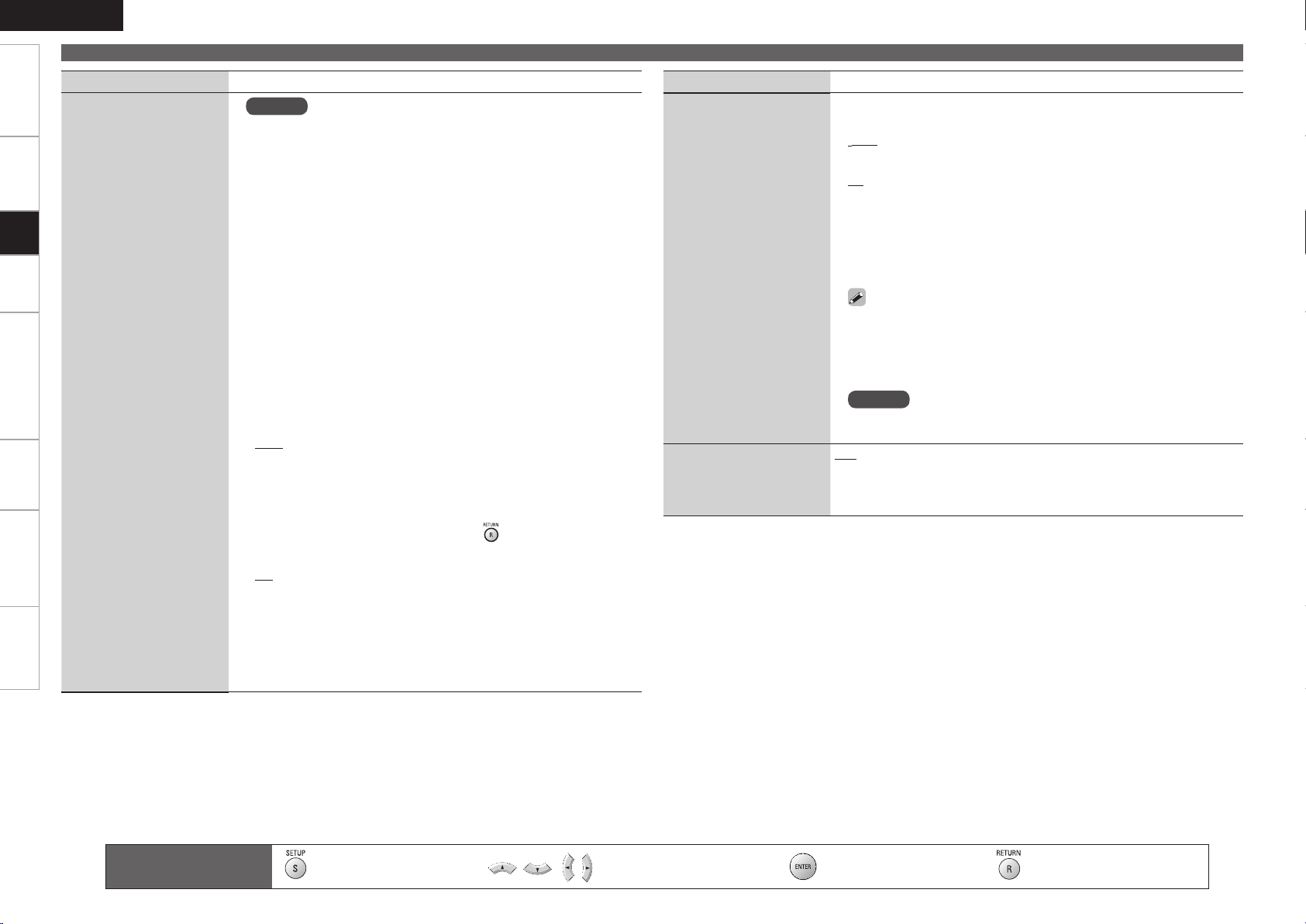
TroubleshootingInformationHDMI Control FunctionPlaybackConnectionsGetting Started Specications
ENGLISH
26
Setting items
Setting contents
7.1-ch Audio Out
NOTE
• Select “Large” or “Small” not according to the physical size of the
speaker but according to the low frequency reproduction capabilities
based on the frequency set at “Crossover Freq.”.
• On the GUI menu, if the “Audio Setup” – “7.1-ch Audio Out”– “Multi
Channel” – “Speaker Conguration” item setting is changed, other
settings are automatically changed as well.
GExampleH
If you set “Front” to “Small”, “Subwoofer” is set to “Yes” and “Large”
cannot be selected for “Center”, “Surround” and “Surr. Back”.
• Audio signal (sampling frequency, number of channels) from the
HDMI output terminal may be restricted by the specication of the
HDMI audio that can be input by the device on the other side.
GExampleH
If the HDMI audio specication of the device on the other side
is 5.1-channel, even when DBP-A100 plays back in 7.1-channel,
5.1-channel audio is output automatically. In that case, the analog
audio output becomes 5.1-channel output as well.
n Channel Level : Sets the volume of the test tone to be the same when
output from each speaker.
GModeH : Select a test tone output method.
• Auto : Automatically switches the test tone output speaker.
• Manual : Manually switches the test tone output speaker.
GStartH : Begins outputting the test tone.
Front L / Center / Front R / Surround R /
Surr. Back R / Surr. Back L / Surround L / Subwoofer
b When the test tone output stops, press
.
GSW +10dBH : Increases the subwoofer output level by 10 dB.
z
• Off : Does not change the subwoofer output level.
• On : Increases the subwoofer output level by +10 dB.
z : “SW +10dB” cannot be set for “HDMI Setup” – “Audio Setup” –
“Multi LPCM BM On” – “Channel Level” on the GUI menu.
GDefaultH : Resets all channel level settings to factory default.
• No : Does not Reset.
• Yes : Resets.
Audio Setup
Setting items
Setting contents
7.1ch Audio Out
n Distance : Sets the distance between the listening position and each
speaker.
GFeetH or GMetersH : Set the unit of distance.
GStepH : Set the minimum variable width of the distance.
1ft, 0.1ft, 0.1m, 0.01m
GDefaultH : Reset all distance settings to factory default.
Front L / Front R / Center / Subwoofer / Surround L / Surround R /
Surr. Back L / Surr. Back R : Select the speaker you want to set, and
set the distance. Set the value that is closest to the measured distance.
0 ~ 60ft or 0 ~ 18m
• Default settings :
Front/Center/Subwoofer : 12 feet (3.6 meters)
Surround/Surr. Back : 10 feet (3.0 meters)
• Set the difference in the distance betweem the speakers to less than
20 feet (6.0 meters).
NOTE
When “BD Audio Mode” is set to “HD Audio Output” (vpage 32), the
“Distance” setting is disabled during DTS-HD 192kHz audio playback.
Subwoofer Mode
Sets the type of low
frequency signal to be
output from the subwoofer.
LFE : Adds the low frequency signal of the channel for which the speaker
size is set to “small” to the subwoofer signal and outputs it.
LFE+Main : Adds the low frequency signal of all channels to the
subwoofer signal and outputs it.
Remote control operation
buttons
:
Displays the menu
Cancels the menu
:
Moves the cursor
(Up/Down/Left/Right)
:Makes the setting :Returns to previous menu
Setup
1.DBP-A100_E3_ENG_007.indd 26 2010/08/12 19:20:18
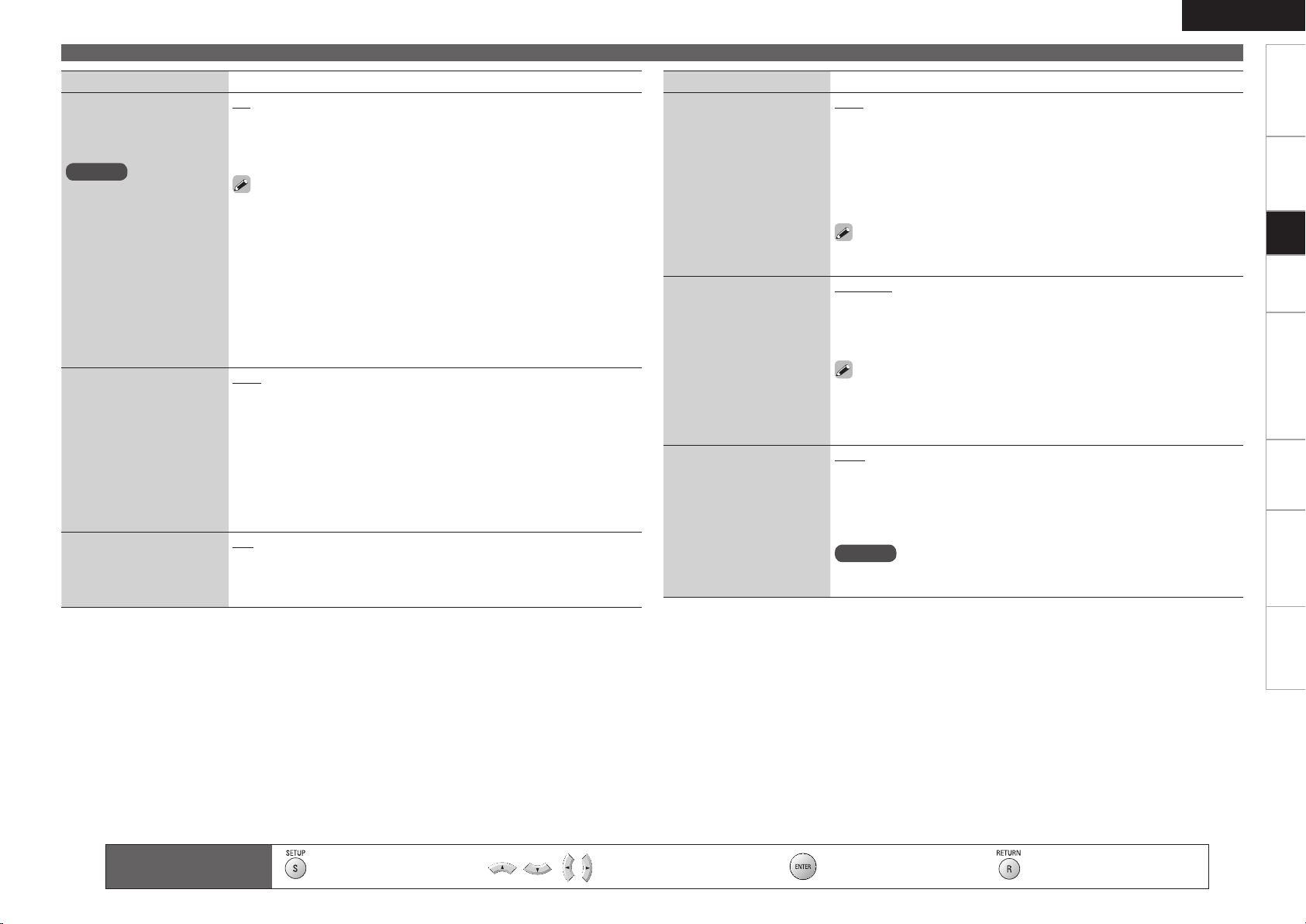
TroubleshootingInformationHDMI Control FunctionPlaybackConnectionsGetting Started Specications
ENGLISH
27
Setting items
Setting contents
Source Direct
Disables the speaker and
subwoofer settings and
outputs the disc audio as is.
NOTE
Set to within the playback
frequency band of the
amplier you will use:
“On” at “50 kHz” or “100
kHz”. Settings outside the
frequency band can result
in damage to your amplier
and even re.
Off : Enables the speaker and subwoofer settings.
On : 50kHz : Outputs the disc content as is. When playing Super Audio
CD, outputs up to 50 kHz audio signals.
On : 100kHz : Outputs the disc content as is. When playing Super Audio
CD, outputs up to 100 kHz audio signals.
• Setting “On: 50 kHz” or “On: 100 kHz” enables full-range playback
on all channels recommended for DTS. (Note that this results in a 5
dB increase in subwoofer volume, and a 15 dB increase with Super
Audio CDs). This also allows you to play back the 6-channel source of
DVD-Audio recorded on all channels with the full frequency range. In
this case, make analog connections according to the disc operating
manual.
• When set to “On: 50 kHz” or “On: 100 kHz”, all speaker sizes are set to
“Large” and “Yes” is set for the subwoofer.
• Even when set to “On: 50 kHz” or “On: 100 kHz”, the “Channel Level”
and “Distance” settings can be made.
Compression
Compresses the dynamic
range of Dolby TrueHD/
Dolby Digital/Dolby Digital
Plus audio. At night or other
times when you cannot play
back at high volume, this
compensates by reducing
high level sounds and
increasing low level sounds.
Auto : Automatically compresses the Dolby TrueHD audio dynamic
range. The sound is not compressed when playing signals other than
Dolby TrueHD signals.
Off : Dynamic Range compression is not applied.
Low : Sets minimum dynamic range compression.
Middle : Sets medium dynamic range compression.
High : Sets maximum dynamic range compression.
BD Effect Sound
Sets for a clicking and other
sound outputs during BD
popup menu operation.
On : Outputs BD effect sound.
Off : Does not output BD effect sound.
Audio Setup
Setting items
Setting contents
BD Re-Encoder
Sets the format during
output of the BD’s Mix
Audio signal from the digital
output terminal.
Auto : Outputs the primary audio (main audio) in the same type of audio
format. Dolby Digital/Dolby Digital Plus/Dolby TrueHD are output as
Dolby Digital, DTS/DTS-HD are output as DTS and Linear PCM is output
as Linear PCM.
Dolby Digital:Outputs to the digital audio output terminal (optical/
coaxial) with Dolby Digital.
DTS : Outputs to the digital audio output terminal (optical/coaxial) with
DTS.
Valid when “BD Audio Mode” is set to “Mix Audio Output” (vpage
32).
Digital Out
Sets the audio signal of
digital audio output.
For more information on each
audio signal, refer to “Audio
Signal from the Digital Audio
Output (Optical/Coaxial)
Terminal” (vpage 17).
Bitstream : Outputs a bitstream signal. Converts Dolby TrueHD, Dolby
Digital Plus to Dolby Digital, and DTS-HD to DTS for output.
PCM : Outputs the downmixed audio signal to 2-ch LPCM.
PCM Down Sampling : Converts sampling frequency audio greater than
48 kHz to a 48 kHz 2-ch LPCM audio output signal.
• When outputting CD, etc. to a digital recording device, such as a CD
recorder, convert to PCM or PCM down sampling.
• When a disc with recorded Linear PCM or PPCM (Packed PCM) is played
back, this outputs Linear PCM regardless of the setting.
Downmix
Sets the method used to
convert a multi-channel
audio signal to a 2-channel
signal.
Lt/Rt : Signals are converted to Dolby Surround compatible 2-channel
audio signals for output. This setting is valid for DTS-HD, DTS Digital
Surround, Dolby Digital Plus and Dolby Digital audio signals. (If the
connected AV Amp is Dolby Pro Logic compatible, the AV Amp plays
back using surround audio.)
Stereo : Outputs by converting to 2-ch (stereo) audio.
NOTE
In order to enable the “Lt/Rt” setting when playing back BD, set “BD
Audio Mode” to “HD Audio Output” (vpage 32).
Remote control operation
buttons
:
Displays the menu
Cancels the menu
:
Moves the cursor
(Up/Down/Left/Right)
:Makes the setting :Returns to previous menu
Setup
1.DBP-A100_E3_ENG_007.indd 27 2010/08/12 19:20:18
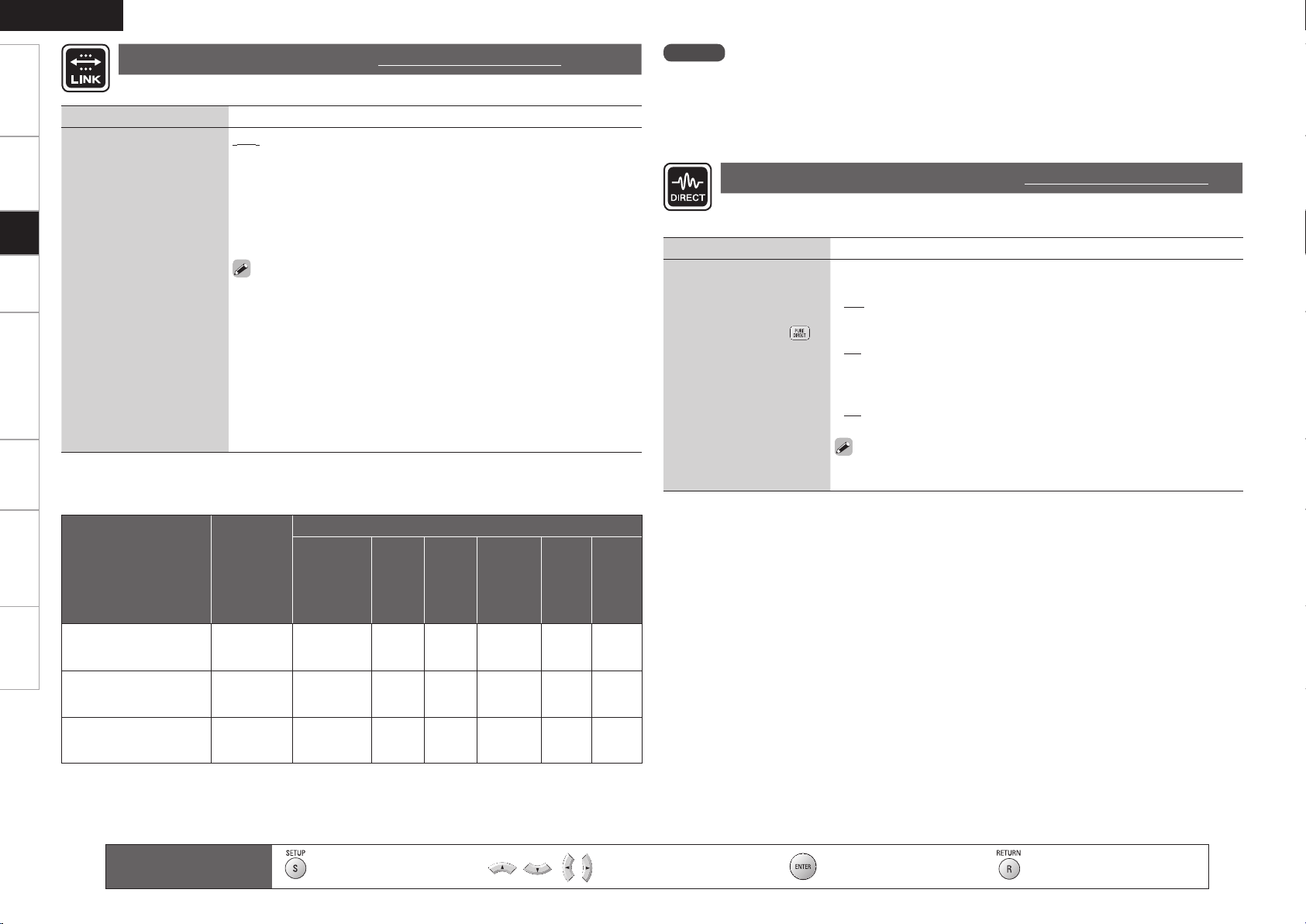
TroubleshootingInformationHDMI Control FunctionPlaybackConnectionsGetting Started Speci cations
ENGLISH
28
Setting items
Setting contents
DENON LINK Mode
Sets the audio output of
DENON LINK.
GOffH : Does not use DENON LINK.
G
2nd
H : Outputs digital audio using DENON LINK 2nd.
G3rdH : Outputs digital audio using DENON LINK 3rd.
G4thH : Outputs digital audio using DENON LINK 4th.
Compatible with jitter-free connections. For more information, refer to
“DENON LINK Connection q Making a Jitter-free Connection” (vpage
17).
• HDMI : Improves HDMI digital signal jitter.
• When set to “4th”, the HDMI control function becomes available from
the connected device.
• When “4th” is set and jitter-free connection is set up, audio affected
by the jitter-free function is output from the HDMI terminal during BD
playback. When playing back media other than that, the video signal is
output from the HDMI terminal and the audio signal is output from the
DENON LINK terminal, respectively.
• To play DENON LINK 4th signals, connect to a DENON LINK
4th-compatible AV Amp using an HDMI and a DENON LINK cable.
• For information on the 4th setting of the AV Amp, see the owner's
manual of the AV Amp.
Set the audio signal to be output from the DENON LINK terminal.
DENON LINK Setup
Default settings are underlined.
Setting items
Setting contents
User Preset 1/
User Preset 2
Sets the operating mode
for “User Preset 1” or “User
Preset 2” selected by .
Setting each of these items
to “Off” enables output of
high quality analog signals
free of interference from
their associated circuits.
GDigital OutH : Sets whether to output signals to the digital audio output
terminal.
• On : Enables digital audio output.
• Off : Disables digital audio output.
GVideo OutH : Sets the option of video output.
• On : Enables video output.
• Off : Disables video output. This setting also disables audio output from
the HDMI terminal.
GDisplayH : Set the option for front panel display.
• On : Turns on the display.
• Off : Turns off the display.
For more information, see “Playing Back High-quality Audio (Pure Direct
Function)” (vpage 38).
Makes settings for digital audio and video output modes during Pure Direct mode, as well
as for display messages. Two types of setting can be made.
Pure Direct Setup
Default settings are underlined.
n Signals Compatible with DENON LINK Setting and Transmission
The DENON LINK setting for the DENON LINK version of the connected AV Amp is as follows:
DENON LINK version of
AV Amp
The DENON
LINK setting
of the
DBP-A100
Media
BD
(During
jitter-free
connection)
DVD-
Video
DVD-
Audio
Super
audio
CD
CD SD
2nd Generation
(“2nd” displayed near
terminal)
“2nd”
A S S A S S
3rd Generation
(“3rd” displayed near
terminal)
“3rd”
A S S S S S
4th Generation
(“4th” displayed near
terminal)
“4th”
S S S S S S
NOTE
With DENON LINK connections, no audio signals other than those of BD are output from the HDMI
terminal.
(When “DENON LINK Mode” is set to “2nd” and “HDMI Setup” – “SA-CD Audio Out” (vpage 24) is set
to “On”, the audio signals of Super Audio CD are output from the HDMI terminal.)
Remote control operation
buttons
:
Displays the menu
Cancels the menu
:
Moves the cursor
(Up/Down/Left/Right)
:Makes the setting :Returns to previous menu
Setup
1.DBP-A100_E3_ENG_007.indd 28 2010/08/12 19:20:18
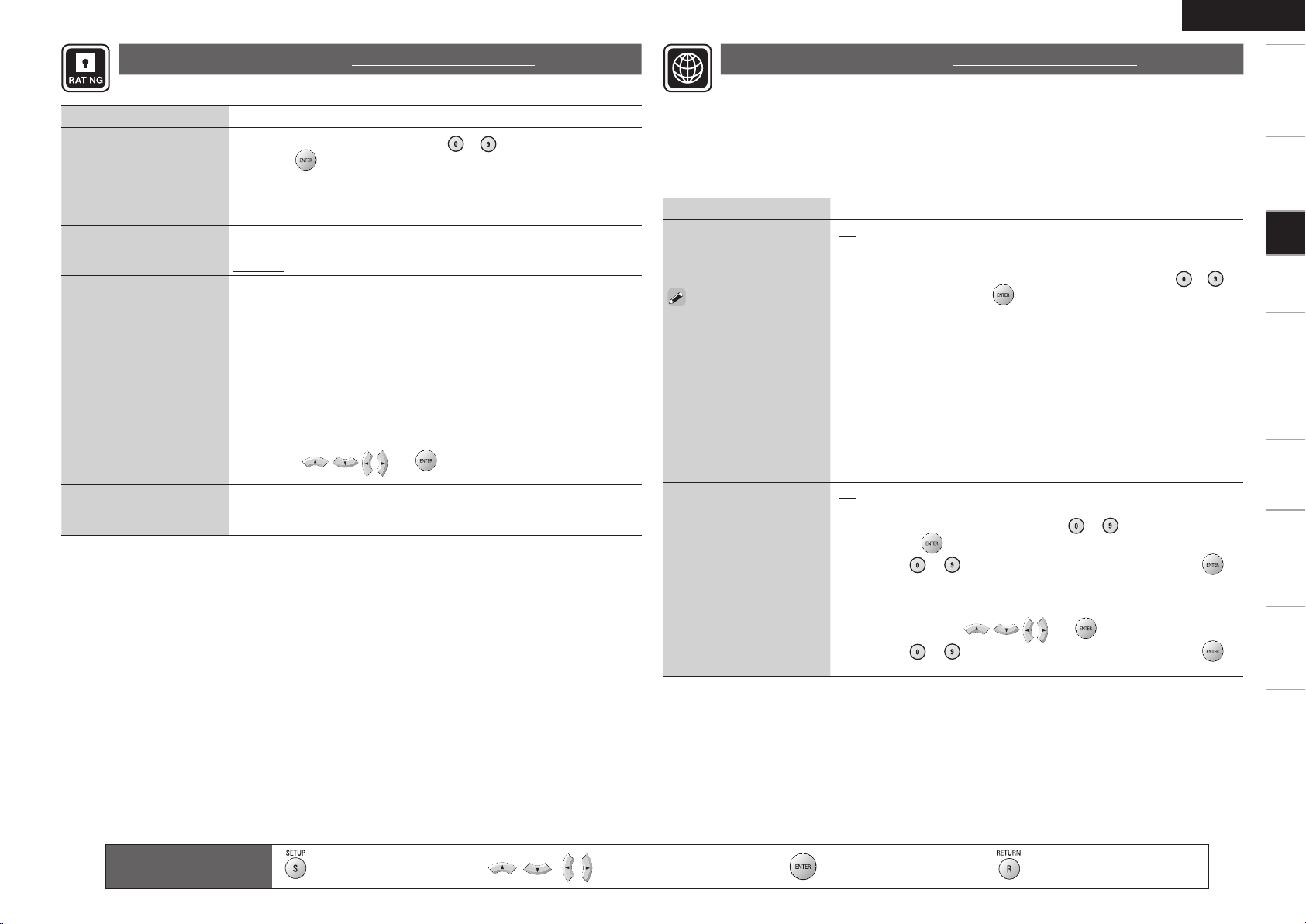
TroubleshootingInformationHDMI Control FunctionPlaybackConnectionsGetting Started Speci cations
ENGLISH
29
Setting items
Setting contents
Password
Sets the password for
changing the parental
control level and parental
control country code of BD
and DVD.
Change : Changes the password.Use ~ to enter a password and
then press to nalize it.
The default setting is “0000”.
BD Rating Level
Sets the parental level for
playing BD.
Level 0 ~ 254 : Sets the age allowed to play back media. Restricts
playback of discs with relevant parental control.
No Limit : Does not restrict playing of BDs.
DVD Rating Level
Sets the parental level for
playing DVDs.
Level1 ~ 8 : Sets the parental level for playing DVDs.
Lock All : Restricts playing of all DVDs.
No Limit : Does not restrict playing of DVDs.
Rating Country Code
Sets the standard country
parental control.
Applies the parental level of
the set country.
Argentina / Australia / Austria / Belgium / Brazil / Canada / Chile /
China/ Denmark / Finland / France / Germany / Hong Kong / India
/ Indonesia / Italy / Japan / Korea, Republic of / Malaysia / Mexico
/ Netherlands /New Zealand / Norway / Pakistan / Philippines /
Portugal / Russian Federation / Singapore / Spain / Switzerland
/ Sweden / Taiwan / Thailand / United Kingdom / United States /
Colombia / Greece / Ireland / Luxembourg / Poland
Others : Input the country code. Refer to “Country Code List” (vpage
52) and use and on the virtual keyboard to input the
country code.
DivX Registration
Displays the DivX
®
registration
code.
Show Code :
Displays
the DivX
®
registration code
Set BD or DVD parental lock or display DivX
®
registration codes.
Ratings
Default settings are underlined.
Setting items
Setting contents
DHCP
Sets how to perform network
con guration, automatically
or manually.
Since the factory default
setting is “On”, you do not
need to set items such as
the IP address if the DHCP
server of the broadband
router is set to “Enable”.
Con gure a proxy server if
necessary.
GOnH : Automatically con gures the network via the DHCP function.
GOffH : When connecting to a network that lacks the DHCP function,
manually con gure the following network settings. Consult with the ISP
or your network administrator for what settings to make. Use ~ to
enter values and then press to nalize them.
• IP Address (BD-LIVE, Update) : Manually con gure the IP address for
BD-LIVE or Firmware Updates.
• IP Address (Control) : This is a con guration for future extensions.
Usually it is not necessary to con gure this.
• Subnet Mask : If a xDSL modem or terminal adaptor is directly
connected to the DBP-A100, enter the subnet mask provided by the ISP,
usually in a document. Usually, “255.255.255.0” is set.
• Default Gateway : If the device is connected to a gateway (router),
enter its IP address.
• Primary DNS : Enter the primary DNS.
• Secondary DNS : Enter the secondary DNS.
Proxy
Setting for connecting to the
Internet via a proxy server.
GOffH Does not use a proxy server.
GOn (Address)H Set to connect to the Internet via a proxy server. Use the
address to specify the proxy server. Use ~ to enter the address
and then press to nalize it.
• Port : Use ~ to enter the port number and then press to
nalize it.
GOn (Name)H Set to connect to the Internet via a proxy server. Specify the
proxy server using the domain name. Input the domain name with the
virtual keyboard, using and .
• Port : Use ~ to enter the port number and then press to
nalize it.
Settings for connecting to the Internet.
You can use a disc which offers BD-LIVE functions by connecting the unit to the Internet
(vpage 36).
To obtain update support for your DBP-A100, you can download the latest rmware from
our website.
Follow the instructions in “Connecting to the Network” (vpage 19) to make network
connections.
Network Setup
Default settings are underlined.
Remote control operation
buttons
:
Displays the menu
Cancels the menu
:
Moves the cursor
(Up/Down/Left/Right)
:Makes the setting :Returns to previous menu
Setup
1.DBP-A100_E3_ENG_007.indd 29 2010/08/12 19:20:19
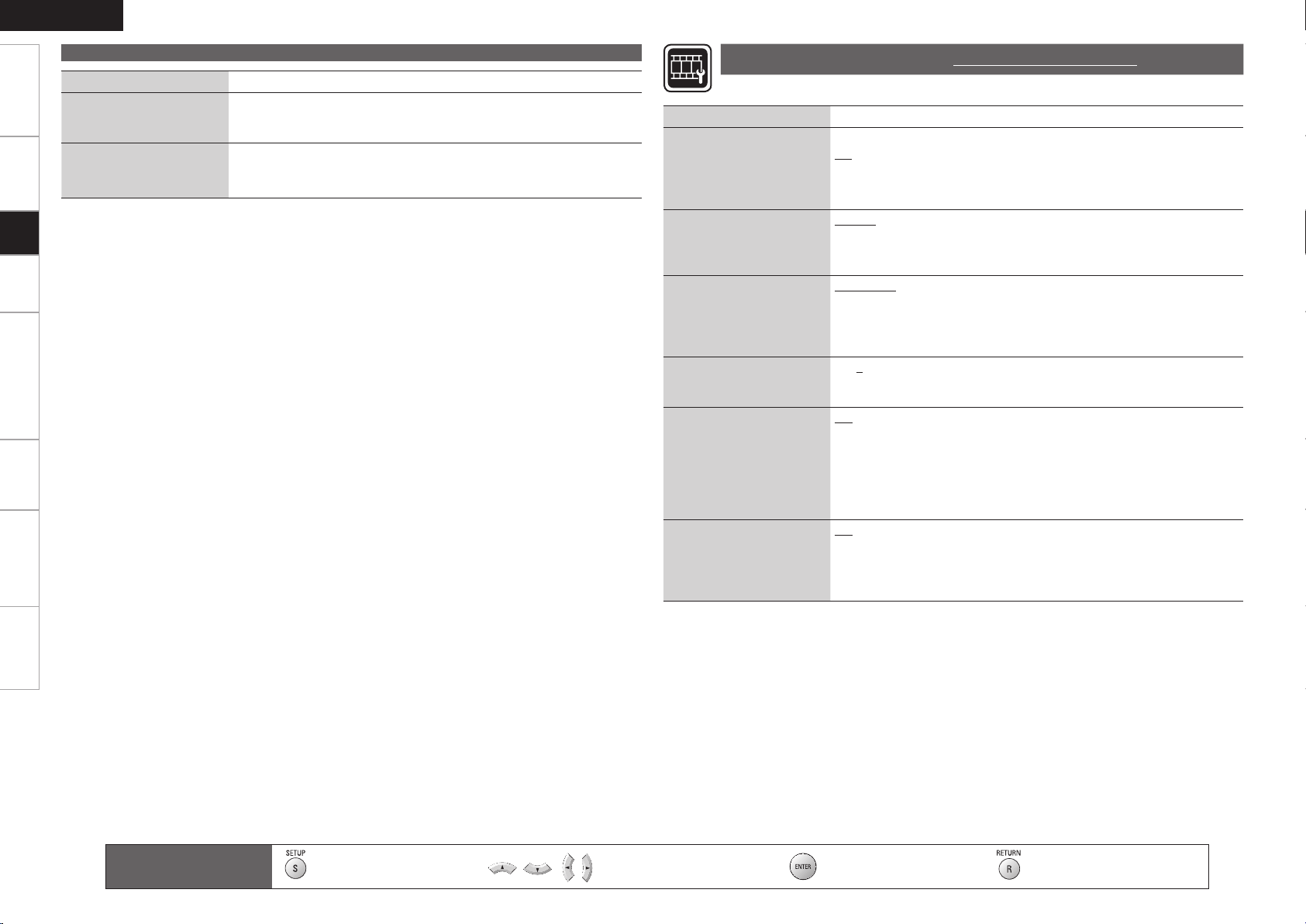
TroubleshootingInformationHDMI Control FunctionPlaybackConnectionsGetting Started Speci cations
ENGLISH
30
Setting items
Setting contents
Screen Saver
Sets the screensaver.
Off : Does not use the screensaver.
On : The screensaver function activates when stop or pause status
continues for about three minutes. The screensaver function also
activates during playback of a CD, Super Audio CD or audio le when no
operations are performed for about three minutes.
Wallpaper
Setting for displaying the
background when playback
is stopped.
Picture : Displays the DENON logo.
Black : Sets the background to black.
Gray : Sets the background to gray.
Blue : Sets the background to blue.
Still Mode
Sets image quality when
paused.
Automatic : Displays automatically using “Field” or “Frame” according to
the still image information.
Field : Set when there is a blurred image when “Automatic” image display
is set.
Frame : Set to display non-moving images in high resolution.
Slide Show Time
Sets the display time of
JPEG les.
3 ~ 5 ~ 100sec : This sets how long to display each frame of a JPEG le
during slideshow playback.
Temporary Display
When the display is set to
“Off” by the Dimmer Control
(vpage 47) or Pure Direct
Function (vpage 38), this
sets it to temporarily display
operations received.
Off : Does not temporarily display operations.
On : Temporarily displays operations.
Captions
This setting outputs a
subtitles signal to a closed
caption decoder (sold
separately).
Off : Does not output the closed caption (subtitle) signal.
On : Outputs the closed caption (subtitle) signal.
Settings for display-related items.
Display Setup
Default settings are underlined.
Remote control operation
buttons
:
Displays the menu
Cancels the menu
:
Moves the cursor
(Up/Down/Left/Right)
:Makes the setting :Returns to previous menu
Setup
Setting items
Setting contents
IP Address BD-LIVE, Firmware Update : Displays the IP address for BD-LIVE or
Firmware Updates.
Control : Displays the IP address for future extensions.
MAC Address BD-LIVE, Firmware Update : Displays the MAC address for BD-LIVE or
Firmware Updates.
Control : Displays the MAC address for future extensions.
Network Setup
1.DBP-A100_E3_ENG_007.indd 30 2010/08/12 19:20:19
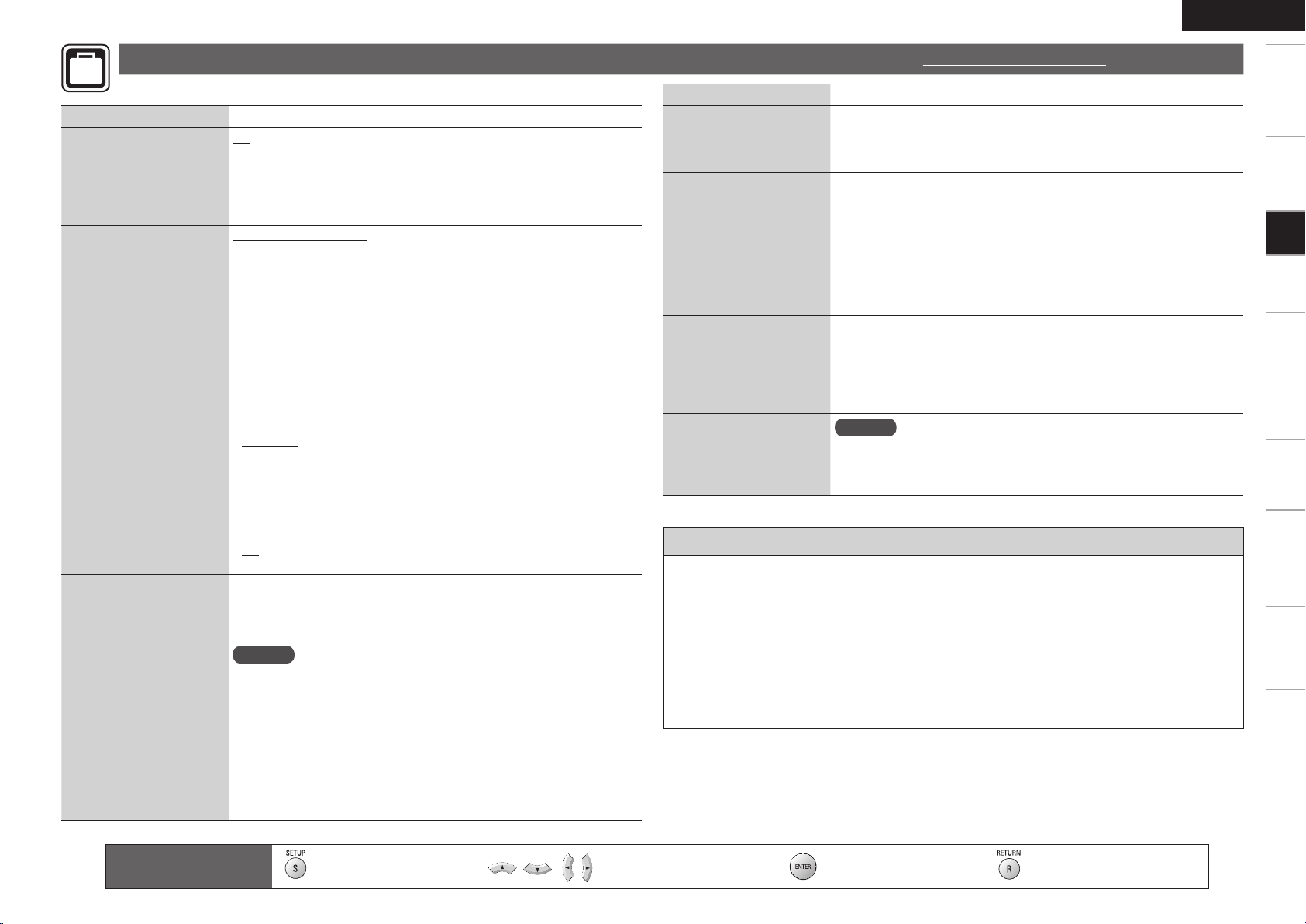
TroubleshootingInformationHDMI Control FunctionPlaybackConnectionsGetting Started Speci cations
ENGLISH
31
Setting items
Setting contents
Initialize
All settings including audio
mode and picture quality are
set to default settings.
Cancel : Does not initialize.
OK : Executes initialization.
Firmware Update
Updates the rmware of the
unit via the Internet.
Check for Update : Checks if a newer version of rmware exists. You can
also check approximately how long it will take to complete an update.
Start : Starts rmware update.
When updating starts, the power indicator lights red and the GUI screen
shuts down.
While updating, a rough estimate of remaining time is indicated on the
display.
When updating is complete the power indicator lights green and the
normal status is resumed.
Information
Displays the license for
the IPA font used by this
product.
GFont LicenseH
Japanese (Original) : Displays in Japanese.
The font used in this product’s GUI menu screen conforms to IPA
font speci cations. See the following URL for the IPA font license
agreement.
http://ipafont.ipa.go.jp/enduser_license.html
Maintenance Mode
Use when receiving
maintenance from a DENON
service engineer or custom
installer.
NOTE
Only use this function if so instructed by a DENON service person or
installer.
Cautions on “Firmware Update”
• In order to use these functions, you must have the correct system requirements and settings for a
broadband Internet connection (vpage 19, 29).
• Do not turn off the power until updating is complete.
• Information regarding the “Firmware Update” function will be announced on the DENON web site
each time related plans are decided.
• Even with a broadband connection to the Internet, approximately 1 hour is required to complete the
updating procedure.
Once updating starts, you cannot perform normal operations on the DBP-A100 until updating is
complete. Also, settings of the GUI menu of DBP-A100 and/or image adjustment settings may be
initialized.
• If a disc is in the tray, remove it before performing “Firmware Update”.
Remote control operation
buttons
:
Displays the menu
Cancels the menu
:
Moves the cursor
(Up/Down/Left/Right)
:Makes the setting :Returns to previous menu
Setup
Setting items
Setting contents
Auto Power Mode
This setting automatically
sets the power to standby.
Off : Does not use the auto power mode.
On : This setting automatically sets the power to standby if any of the
following states continues for approximately 30 minutes.
• Disc not loaded
• Playback stopped
• Stopped due to the resume function
Power Saving
Sets to power saving mode
during standby.
Power Saving Standby : This is the lowest power consumption mode.
During standby, operations are not accepted via HDMI control or RS-232C.
Power indicator status in standby mode : Off
Normal Standby : During standby, operations are accepted via RS-232C.
Power consumption is slightly higher at this time.
Power indicator status in standby mode : Red
Quick Start Mode : Start up time is faster but power consumption
during standby is higher. Operations are accepted via HDMI Control and
RS-232C.
Power indicator status in standby mode : Red
Remote Control Setting
(Main unit side)
Sets the remote control.
GRemote IDH
Switches the DBP-A100’s remote control ID code when other DENON BD
Players are in the vicinity.
• DENON 1 :
Set the switch in the remote control battery compartment to
“1” as well (“Remote Control Settings (Remote Control Side)” vpage 7).
• DENON 2 :
Set the switch in the remote control battery compartment to
“2” as well (“Remote Control Settings (Remote Control Side)” vpage 7).
GReceive Existing Remote ControlH
Set whether or not to accept remote control signals of a DENON DVD
player or other device.
• On : Accepts
• Off : Does not accept
BD Data Utility
Erases data on SD Memory
Card, and initializes cards.
BD Data Erase : Erases both internal memory and SD Memory Card
storage.
Initialize SD Card : Initializes the SD card to be used for the Bonus View
and BD-LIVE functions.
NOTE
• Insert or remove a SD Memory Card while the power is in standby.
If the SD Memory Card is inserted when the power is switched on,
there are occasions where the card cannot be read, or the BD cannot
be played.
• The SD card used for the Bonus View function must have a capacity of
1GB or greater. Also the SD card must be initialized on the DBP-A100.
• This operation will delete all the data. Do not perform this operation
when an SD card containing MP3 or JPEG data is inserted.
• Remove the disc from the disc tray when carrying out “BD Data Erase”
or “Initialize SD Card”.
Sets other items.
Other Setup
Default settings are underlined.
1.DBP-A100_E3_ENG_007.indd 31 2010/08/12 19:20:19
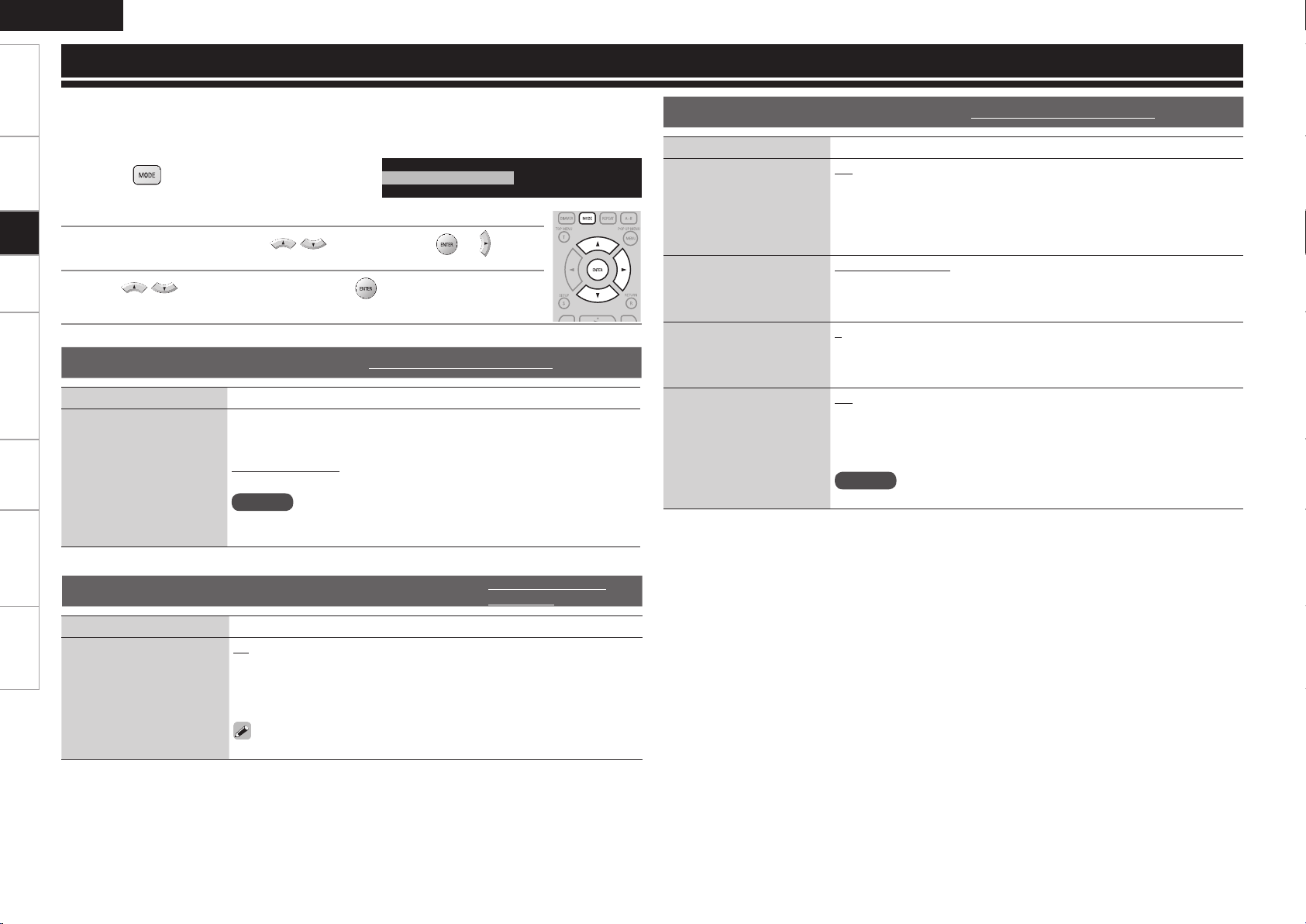
TroubleshootingInformationHDMI Control FunctionPlaybackConnectionsGetting Started Specications
ENGLISH
32
Setup
Setting items
Setting contents
File lter
Selects the le formats you
wish to play from among the
les mixed on a disc.
All : Plays MP3/WMA/AAC/LPCM/JPEG/DivX
®
les.
Audio : Plays MP3/WMA/AAC/LPCM les.
Picture : Plays JPEG les.
Video : Plays DivX
®
les.
Audio & Picture : Plays MP3/WMA/AAC/LPCM/JPEG les.
This operation is effective only when playback is stopped.
Setting items
Setting contents
Secondary Video (PIP) Off : Does not display Secondary Video(Picture-In-picture).
1/Xz : Displays the rst Secondary Video.
2/Xz : Displays the second Secondary Video.
X/Xz : Displays the X th Secondary Video.
z: “X” is the number of Secondary Videos recorded and differs
depending on the disc (“Playing Bonus View” vpage 36)
Audio/Video Sync
Corrects displaced video-
audio playback timing.
HDMI / Component : Audio output is synchronized to the video output
from the HDMI terminal or component terminals.
S-VIdeo /Video : Audio output is synchronized to the video output from
the S-Video or Video terminals.
Audio Delay Adjust
While viewing video,
manually adjust the time to
delay audio output.
0 ~ 200msec : Use this to adjust the audio output delay time manually.
Vertical Stretch
Extends the cinemascope
size video vertically.
Off : Displays the source video signal without modication. This should
normally be set to “Off”.
On : Set when viewing cinemascope size video with a combination of
projector and anamorphic lens. Extends the image vertically so that the
top and bottom black portions disappear.
NOTE
This has no effect with the video and S-Video outputs.
Changing the Playback File Display
Default settings are
underlined.
Making Other Settings
Default settings are underlined.
You can set the audio mode and switch the kind of les to play.
You can make various mode settings during playback. The setting menu is displayed at the top of
the screen.
Various Settings
Setting items
Setting contents
BD Audio Mode
Switches the BD audio
playback mode.
HD Audio Output : Can view by outputting high quality signals such as
Dolby TrueHD, Dolby Digital Plus, or DTS-HD as its high sound quality
bitstream. Cannot listen to interactive or secondary audio.
Mix Audio Output : Outputs a mix of primary audio/interactive audio/
secondary audio.
NOTE
When “BD Audio Mode” is set to “Mix Audio Output”, DTS-HD 192kHz
audio is decoded to 96kHz.
1
Press .
Displays a menu of items that can be set.
b The display content changes depending on the media being played.
2
Select a setting item using , and then press or .
3
Use to select a setting and use to change the setting.
Vertical Stretch
All
Off
BD Audio Mode
Mix Audio Output
File filter
Setting the Audio Mode
Default settings are underlined.
1.DBP-A100_E3_ENG_007.indd 32 2010/08/12 19:20:19
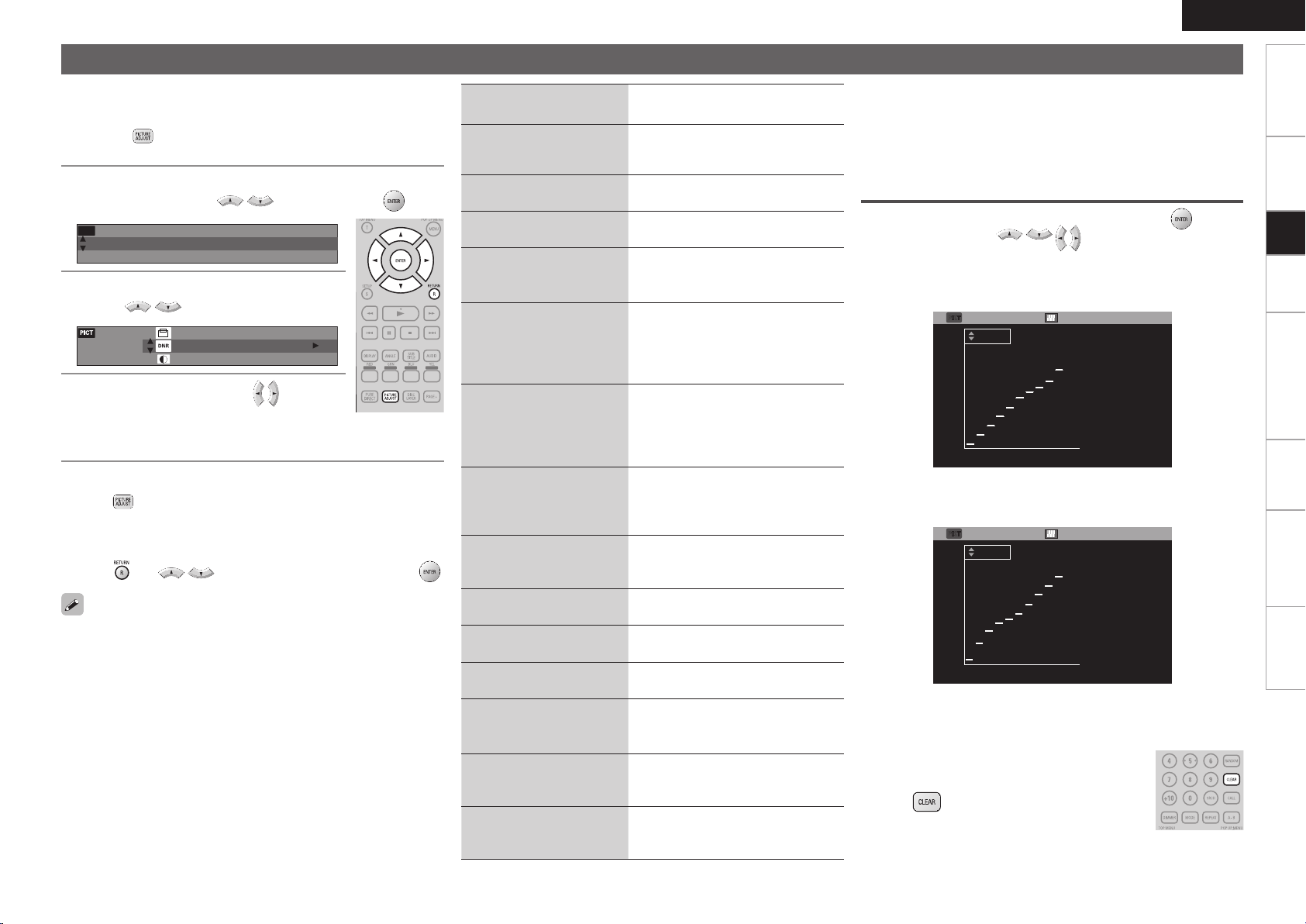
ENGLISH
33
TroubleshootingInformationHDMI Control FunctionPlaybackSetupConnectionsGetting Started SpecicationsSetup
Setting items
Setting
contents
Default
DNR
Reduces noise in the entire
picture.
0 ~ +3 0
Contrast
Adjusts picture contrast.
–6 ~ +6
0
Brightness
Adjusts picture brightness.
0 ~ +12 0
Enhancer
z
3
Strengthens the contours of
the picture.
0 ~ +11 0
Gamma Correction
z
1
Adjusts video brightness in
detail.
G0 ~ 9
G0 = 24 / G1 = 32
G2 = 48 / G3 = 64
G4 = 80 / G5 = 96
G6 = 128 / G7 = 160
G8 = 192 / G9 = 224
Sharpness (medium range)
z
1, 3
Adjusts picture sharpness
for the medium frequency
range.
–6 ~ +6
0
Sharpness (high range)
z
3
Adjusts picture sharpness
for the higher frequency
range.
–6 ~ +6 0
Hue (color tone)
z
4
Adjusts the green and red
color balance.
–6 ~ +6 0
White Level
Adjusts the white level.
–5 ~ +5 0
Black Level
z
3
Adjusts the black level.
–5 ~ +5 0
Chroma Level
Adjusts the color density.
–6 ~ +6 0
Setup Level
z
2
Adjusts the black areas of
the image.
0 IRE
7.5 IRE
7.5 IRE
H.Position
z
3
Adjusts the left/right
position.
–7 ~ +7 0
V.Position
z
3
Adjusts the top/bottom
position.
–7 ~ +7 0
You can adjust the picture quality to your liking.
You can store up to a maximum of 5 values in memory.
n To Finalize Picture Adjustments
Press with the picture adjusted.
n When Outputting Standard Picture Quality without
Using Picture Adjustment
Press and to select “Standard” and then press .
Gamma Correction
When you select “Gamma Correction”, and then press , you can
change the setting with .
In the example of the graph below, the horizontal axis shows the
brightness level of the pictured recorded on the disc. The vertical axis
shows the brightness of the picture output by the DBP-A100.
PICT
Gamma CorrectionMemory 5
0
0
255
255
G0:024
• When the brighter areas on the disc side are adjusted to be output
darker, the normally hard to see bright parts become clearly
discernible images.
PICT
Gamma CorrectionMemory 5
0
0
255
255
G0:024
• When the darker areas on the disc side are adjusted to be output
brighter, the normally hard to see dark parts become clearly
discernible images.
n Resuming Initial Values after Gamma
Correction
Press while the graph is displayed.
The picture adjustment settings are retained in memory even after
the power is turned off.
Adjusting the Picture Quality (Picture Control)
1
Press .
The currently set status is displayed.
2
Select the memory number you want (“Memory 1” ~
“Memory 5”) with , and then press .
Standard
Memory 1
Memory 5
PICT
3
Select the item(s) you wish to change
with .
Memory 1
DNR
Contrast
V.Position
0
0
0
4
Change the setting with .
b Refer to the table on the right for information on the different
settings.
z1:This is not available for HDMI output.
z2: Effective only for the 480i video signal from the video output terminal, S
video output terminal, and component video output terminal.
z3: This has no effect with the video and S-Video outputs.
z4: This has no effect with the video and S-Video outputs when playing PAL
video.
1.DBP-A100_E3_ENG_007.indd 33 2010/08/12 19:20:20
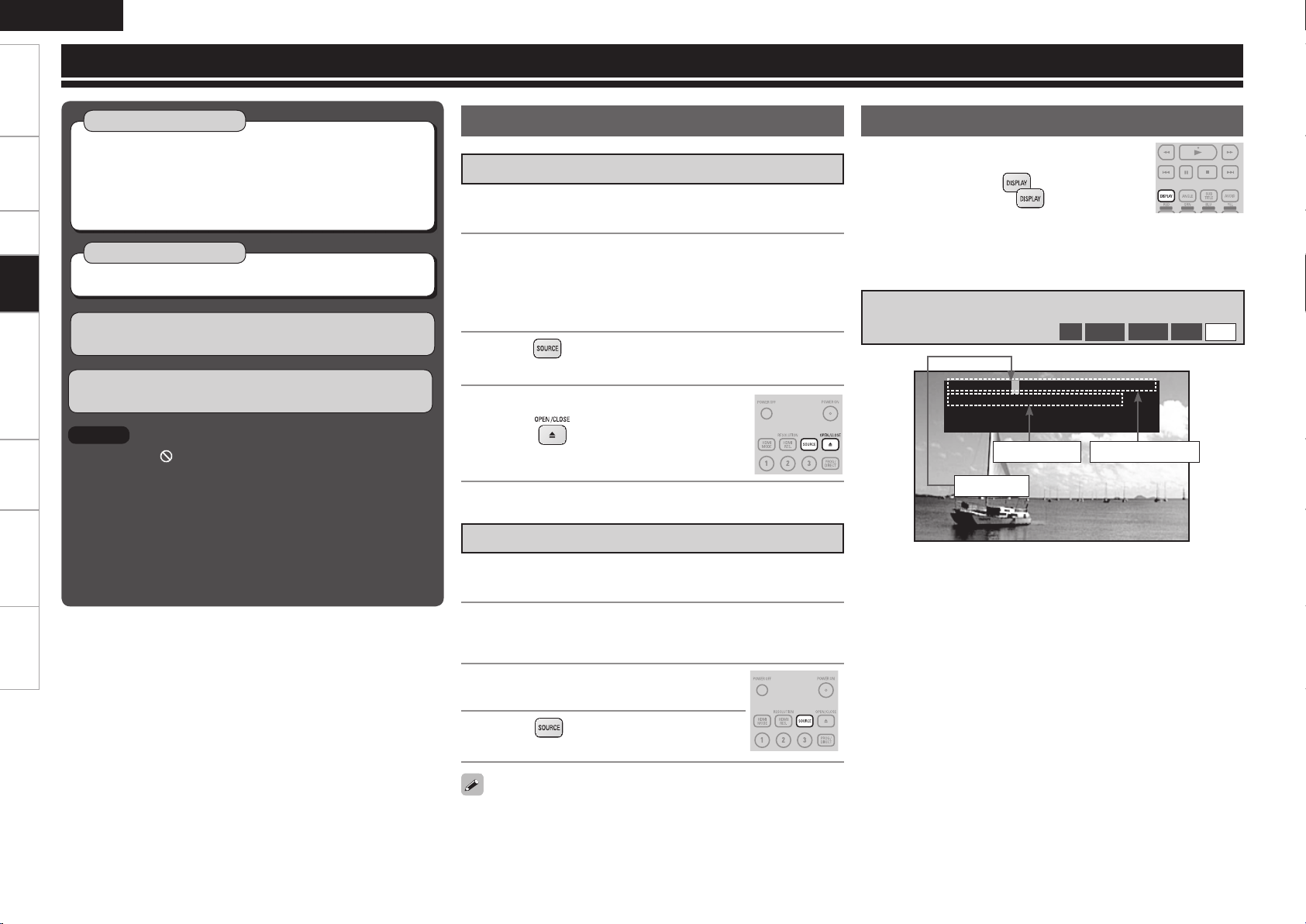
ENGLISH
34
TroubleshootingInformationHDMI Control FunctionSetupConnectionsGetting Started Speci cationsSetup
Playback
Introduction
Before Playing a Disc
The playback media mode setting remains in memory, even when the
power is set to standby.
NOTE
• The symbol “ ” (prohibited mark) may appear on the top
right of the TV screen during an operation. This means that the
operation being conducted is prohibited.
• Depending on the disc, certain operations may not be as
described in this manual. Check each disc owner’s manual for
more information.
• During playback of a 2-layered disc, pictures may stop
momentarily. This happens when the 1st layer switches to the
2nd layer. This is not a malfunction.
Playing Discs
n Playing BD and DVD-Videos (vpage 36)
n Playing Super Audio CDs (vpage 37)
n Playing CDs (vpage 37)
n Playing DVD-Audio (vpage 37, 38)
n Playing High-Quality Audio (vpage 38)
Playing Files
n Playing Files (vpage 38 ~ 40)
Operations Enabled During Playback
(vpage 41)
1
Turn on the power of the ampli er and TV.
Set the TV and ampli er source to DBP-A100 input.
2
Turn the DBP-A100 on.
b When you wish to play a bonus view, before turning the DBP-A100
on insert a SD Memory Card that has at least 1GB and has been
initialized by DBP-A100.
3
Press to set the playback media mode to “DISC
MODE”.
4
Insert a disc.
• Press to open/close the disc tray.
• Insert the disc with the side you want to play
face down.
Before Playing an SD Memory Card
1
Turn on the power of the ampli er and TV.
Set the TV and ampli er source to DBP-A100 input.
2
Insert a SD Memory Card.
Insert the SD Memory Card in the direction indicated by the
arrow with the label side up (vpage 6, 8).
3
Turn the DBP-A100 on.
4
Press to set the playback media
mode to “SD CARD MODE”.
The displayed playback information toggles
between the information bar and the media
player screen each time is pressed.
To close the display, press until it goes
away.
Title
Title Elapsed
Chapter
00:05:52
1/61/1
Disc informationTime display
Cursor
b Displayed content differs depending on the media being played.
Also, the information displayed while playing and stopped differs.
b Displayed inside the frame at the top of the screen.
(See the next page.)
About Playback Information
Information Bar Display
BD
DVD-A
DVD-V
DVD
DivX
Playback
Web control function
(vpage 47,48)
1.DBP-A100_E3_ENG_007.indd 34 2010/08/12 19:20:21
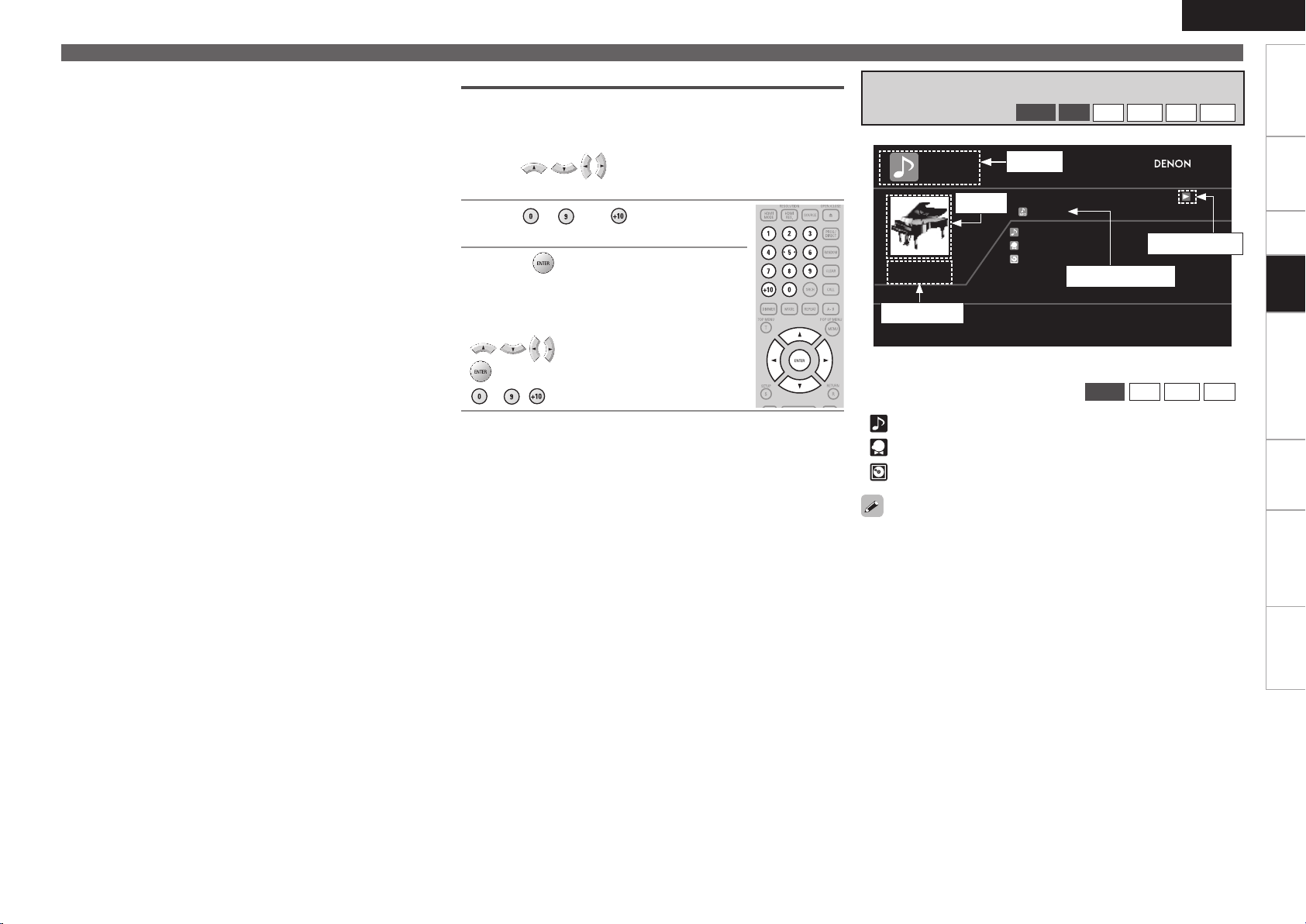
ENGLISH
35
TroubleshootingInformationHDMI Control FunctionPlaybackSetupConnectionsGetting Started SpecicationsPlayback
DATA DISC
Single Elapsed
00:25
Song
Artist
Album
Now PlayingTrack 2
n Disc Information Display
• Title Title being played/total number of titles
• Chapter Chapter being played/total number of
chapters
• Group Group being played/total number of
groups
• Track Track being played/total number of tracks
n Time Display
• Title Elapsed
• Title Remain
• Chapter Elapsed
• Chapter Remain
• Group Elapsed
• Group Remain
• Track Elapsed
• Track Remain
n HDMI Output Signal Display
• Video Info Video output signal format/resolution
• Audio Info Audio format being output
• Max Channel Number of audio channels that the
connected device can receive
1
Use to move the cursor to the item that
you wish to nd.
2
Use ~ and to enter a value.
3
Press .
The search is executed and playback begins.
b If the input number information is not on the
disc, the current playback display reappears.
········································ Select
································································ Set
~
,
······························ Number entry
n Disc Information Display
SA-CD
MP3
WMA
AAC
• Title
• Artist name
• Album title
For information on the time display and the HDMI output signal
display, see “Information Bar Display” (vpage 34).
Image
Media
Track being played
Playback mode
Time Display
About Playback Information
Searching with the Information Bar
When you enter a number to nd in the orange cursor area, that
location is found. You can search in four modes, “Title”, “Chapter”,
“Group” and “Track search”.
Media Player Display
SA-CD
CD
MP3
WMA
AAC
LPCM
1.DBP-A100_E3_ENG_007.indd 35 2010/08/12 19:20:21
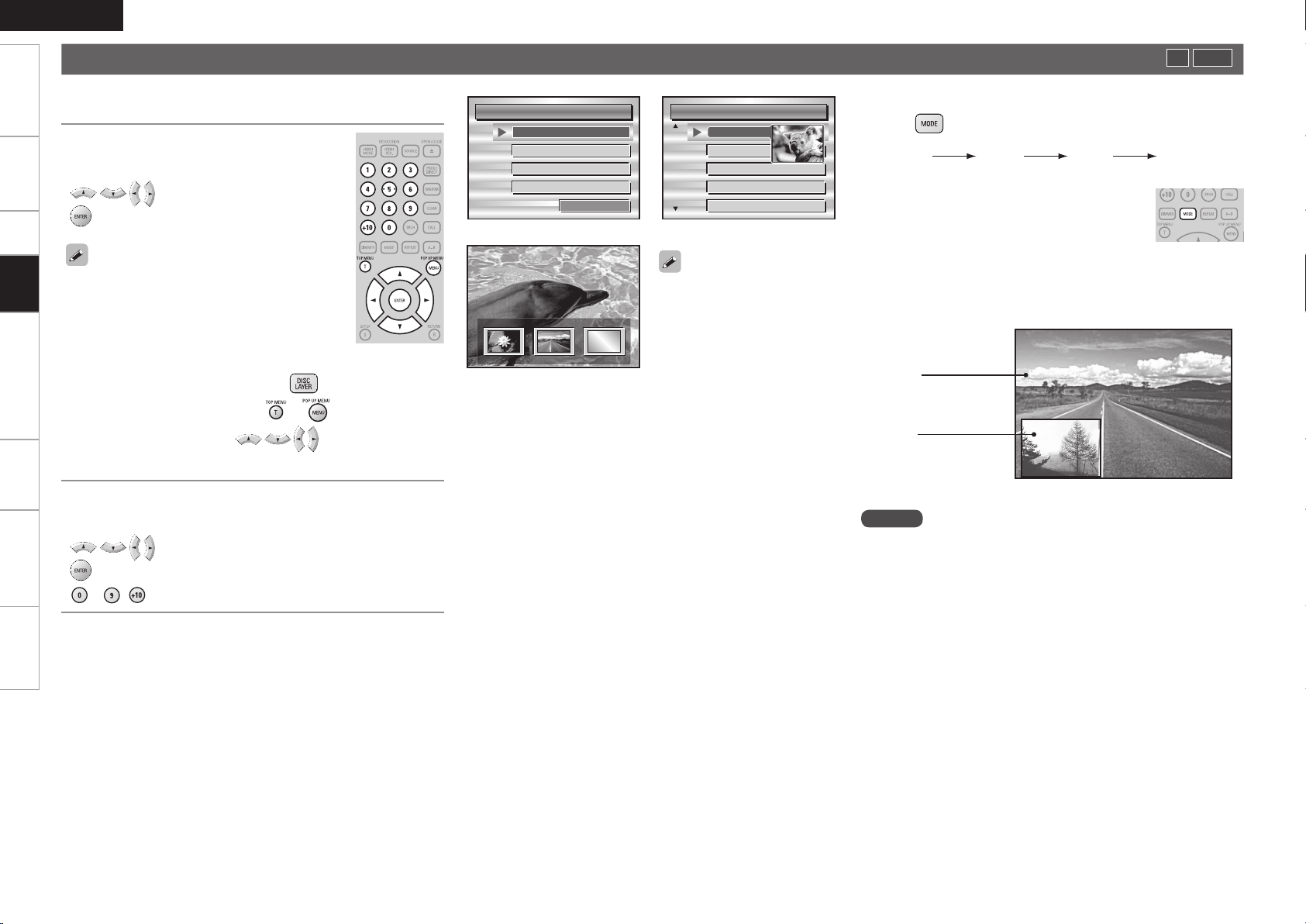
ENGLISH
36
TroubleshootingInformationHDMI Control FunctionPlaybackSetupConnectionsGetting Started Speci cationsPlayback
Title1 Topmenu
Chapter3
Chapter4
Chapter5
Chapter6
【例】トップメニュー
DiscMenus
AudioSetup
Angle
SubStory
TopMenu
【例】ディスクメニュー
Subtitle
【例】ポップアップメニュー
Chapter2
Popupmenu
Title1 Title2 Bonustitle
Ifyouhaveso
methingtosa
y,seethispict
urebeforeyou
GExampleH Top menuGExampleH Disc menu
GExampleH Popup menu
With BD, depending on the disc,
you can select title and chapter
from the popup menu.
n Playing BD-Videos Compatible with Bonus View
• With a disc that is compatible with bonus view (picture-in-picture),
in addition to the main video (primary video) stored on the disc, you
can play back the video director’s commentary and simultaneously
ongoing sub-story, as well as sub-video such as alternative camera
angles (secondary video).
• Some BD discs use SD cards as the recording memory for Bonus
View playback. With the DBP-A100 is in standby, insert the SD
Memory Card before playing the disc.
• The playback method, etc., is determined by the disc, and varies
depending on the disc. Refer to the operation guide of the relevant
disc.
n Playing Bonus Views
Press to select the secondary video display you wish to
play.
Off 1/X
2/X X/X
GSelectable itemH
Off
: Does not display Secondary Video.
1/X
z
: Displays the rst Secondary Video .
2/X
z
: Displays the second Secondary Video.
X/X
z
: Displays the X th Secondary Video.
z:
“X” is the number of Secondary Videos recorded and differs
depending on the disc.
Main video
(primary video)
Sub video
(secondary video)
GExampleH Bonus view
n Enjoying BD-LIVE features
• The functions that can be used with BD-LIVE differ from disc to
disc. For details on the functions and how to operate them, see the
individual disc’s on-screen displays and explanations.
• An SD card must be loaded in the DBP-A100 in order to save
downloaded contents for using BD-LIVE functions. Use an SD
card with a capacity of 1 GB or greater. Also, the SD card must be
formatted on the DBP-A100.
• Do not remove the SD card from the DBP-A100 while playing a
BD-LIVE compatible disc.
NOTE
• Insert or remove a SD Memory Card while the power is in standby.
If you insert a SD Memory Card while the power is ON, the SD
Memory Card may not be read.
• The SD card used for the BD-LIVE and Bonus View Functions
must have a capacity of 1GB or greater. Also the SD card must be
initialized on the DBP-A100 (vpage 31).
• To use BD-LIVE functions, connect the DBP-A100 to the Internet and
make the settings described below, as necessary:
Connections ··············· “Connecting to the Network” (vpage 19)
Settings ······················ “Network Setup” (vpage 29)
• Depending on your network environment, it may take time to
connect to the network or connection may not be possible.
• Remove the write protection of the SD Memory card.
1
Playback preparation (“Before Playing a Disc”
vpage 34).
2
Make the various settings for playback
on the disc menu.
········································ Select
······················································· Playback
• You can make the following settings on the disc
menu. (The items you can set differ depending
on the contents of your disc.)
· Subtitle language
· Audio language
· Audio format etc.
• When playing a BD hybrid disc, the disc layer can be changed to
“BD layer” or “DVD layer” by pressing
.
• During DVD-Video playback, press
or to display the menu.
• If the menu continues, press to get to the next part.
3
Select the playback title or chapter from the top
menu for playback.
········································ Select
······················································· Playback
~
,
······································ Playback
Playing BDs and DVD-Videos
BD
DVD-V
1.DBP-A100_E3_ENG_007.indd 36 2010/08/12 19:20:22
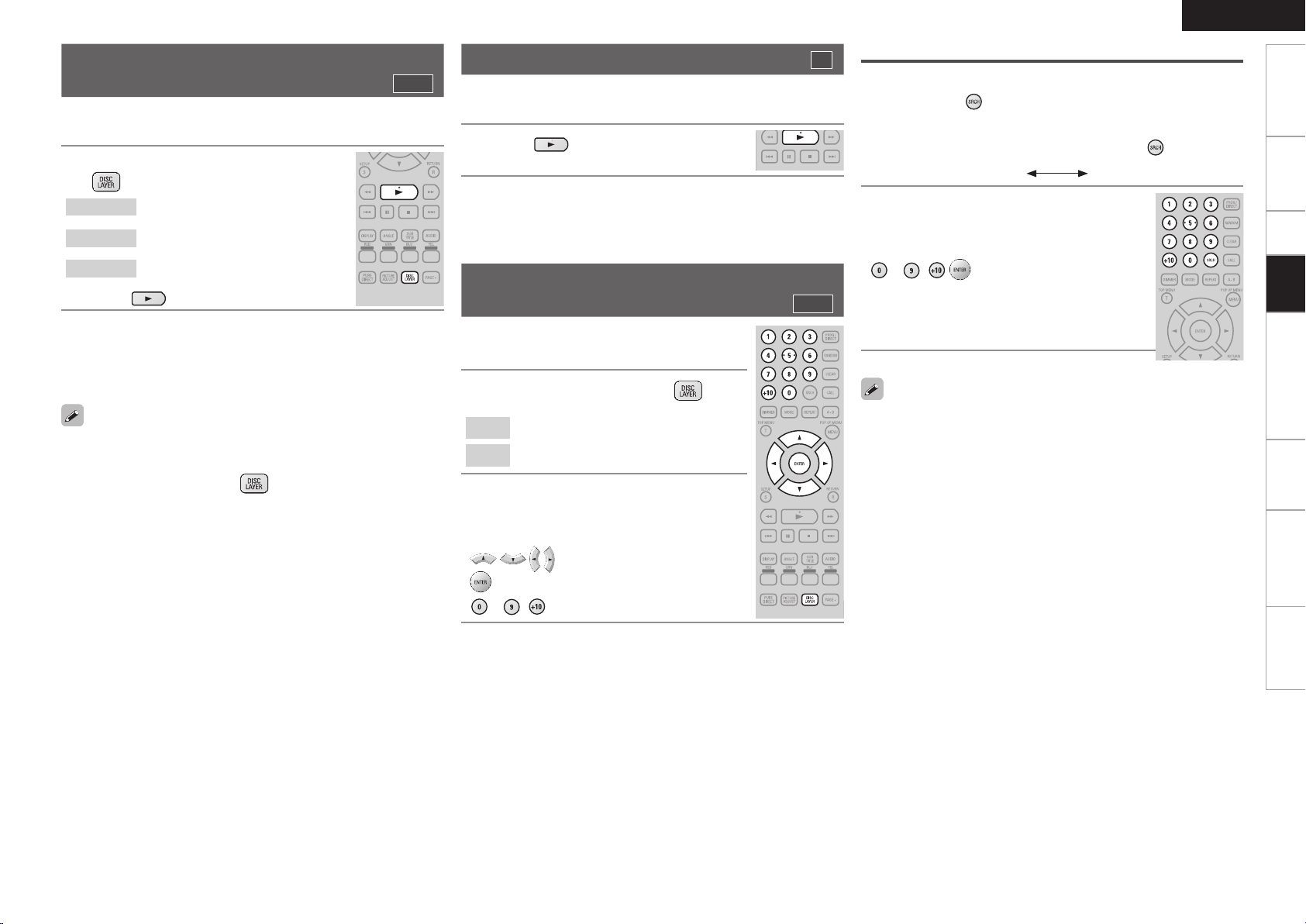
ENGLISH
37
TroubleshootingInformationHDMI Control FunctionPlaybackSetupConnectionsGetting Started SpecicationsPlayback
• If you play a disc that does not have the area or layer you selected,
choose the playback area or layer to play in the order “Multi”,
“Stereo”, “CD”.
• The area/layer selected with remains in the memory even
when the power is turned off.
n When Viewing the Text or Playback Time Display
See “Media Player Display” (vpage 35).
Playing Super Audio CDs
SA-CD
1
Playback preparation (“Before Playing a Disc”
vpage 34).
2
Select the playback area and layer with
.
Multi
: Plays the multi-channel area of the
HD layer.
Stereo
: Plays the 2-channel area of the HD
layer.
CD
: Plays the CD layer.
b Pressing
plays the selected area/layer.
n When Viewing the Playback Time Display
See “Media Player Display” (vpage 35).
Playing CDs
CD
1
Playback preparation (“Before Playing a Disc”
vpage 34).
2
Press .
Playback begins.
1
Playback preparation (“Before Playing
a Disc” vpage 34).
2
Select the part to play with .
Audio
: Plays the audio part.
Video
: Plays the video part.
3
If a top menu is available, select the
playback group and track from the top
menu, and then play the disc.
········································ Select
·············································Set or playback
~
,
······································ Playback
n When Viewing the Text or Playback Time Display
See “Information Bar Display” (vpage 34).
Playing DVD-Audio
DVD-A
Changing the Group/Track
The search mode selected with this operation is memorized until the
unit goes into standby or the disc tray is opened.
1
While stopped or during playback, select the search
mode with .
The search mode is displayed in the top-right of the screen.
b The search mode changes each time you press
.
Group search mode Track search mode
2
Select the playback group and track
from the top menu, and then play the
disc.
~
,
Plays the group or track of the pressed number.
b See “Looking for Specic Sections with the
Search Modes” (vpage 42) for instructions on
inputting numbers.
1.DBP-A100_E3_ENG_007.indd 37 2010/08/12 19:20:22
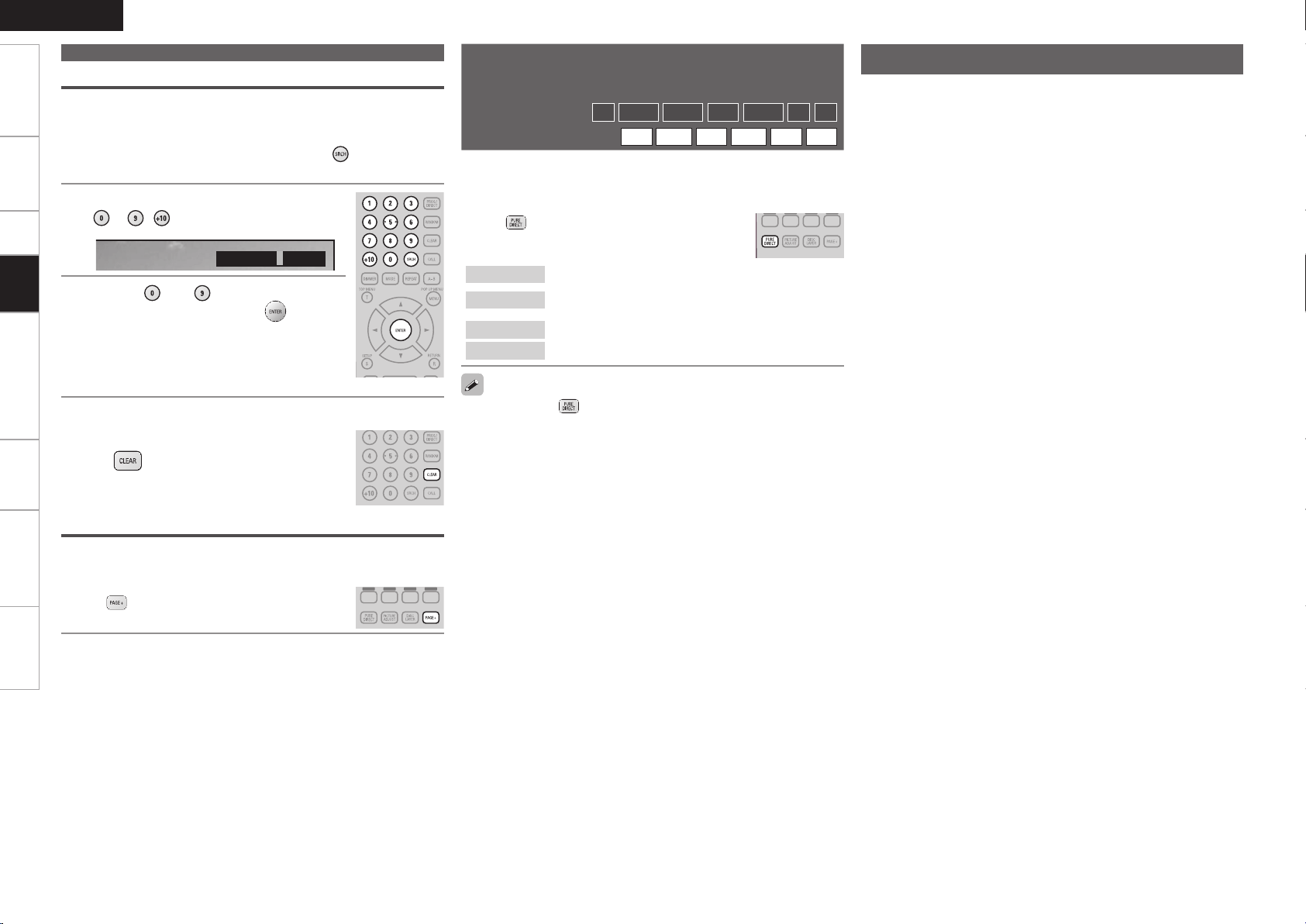
ENGLISH
38
TroubleshootingInformationHDMI Control FunctionPlaybackSetupConnectionsGetting Started SpecicationsPlayback
n If you enter the wrong password
Press to erase the input number and then
enter the correct number.
Playing Bonus Group
DVD-Audio discs may have a bonus group that can be played after
entering a password.
Selecting Still Images
When a DVD-Audio disc has still images on it, you can choose the
image to display.
1
While stopped, select “Group” with .
2
Enter the bonus group number with
~ , .
Group –/5
3
Using ~ enter the 4-digit
password, and then press .
Playback will begin from the 1st track of the
selected group.
b The password may also be entered on the menu
screen by following the on-screen instructions.
Press during playback.
The next still image is displayed.
Playing DVD-Audio
Playing Files
n About the File Display
Limits to the number of folders and les that can be displayed by
the DBP-A100 are as follows.
(The limited number includes the root folder.)
• Number of folder directory levels ··················8 levels
• Number of folders ················································999
• Number of les ··················································9999
• Number characters per
· File name, Folder name ········································32
· Artist name, title, etc.··········································· 60
b Text longer than one line is scroll-displayed.
b If characters not supported on the menu screen are included in a
le name, title, artist name or album title, they are not displayed
correctly.
This enables you to play high quality audio by stopping the video
signal, etc., output, and outputting the analog audio signal only.
• You cannot use while the GUI menu is displayed.
• With Pure Direct on and the main unit display set to off, indicators
other than power are turned off.
• The pure direct setting returns to “Off” when the DBP-A100 is put
in standby mode.
Press while stopped and then select the
pure direct mode.
Off
:
On
:
User Preset 1
:
User Preset 2
This turns off the pure direct function.
This turns off the digital signal output, video signal
output and display on the display screen.
Operates with the registered pure direct setting.
(“Pure Direct Setup” vpage 28)
Playing High-Quality Audio
(Pure Direct Function)
BD
DVD-A
DVD-V
DVD
SA-CD
CD
SD
MP3
WMA
AAC
LPCM
DivX
JPEG
1.DBP-A100_E3_ENG_007.indd 38 2010/08/12 19:20:22
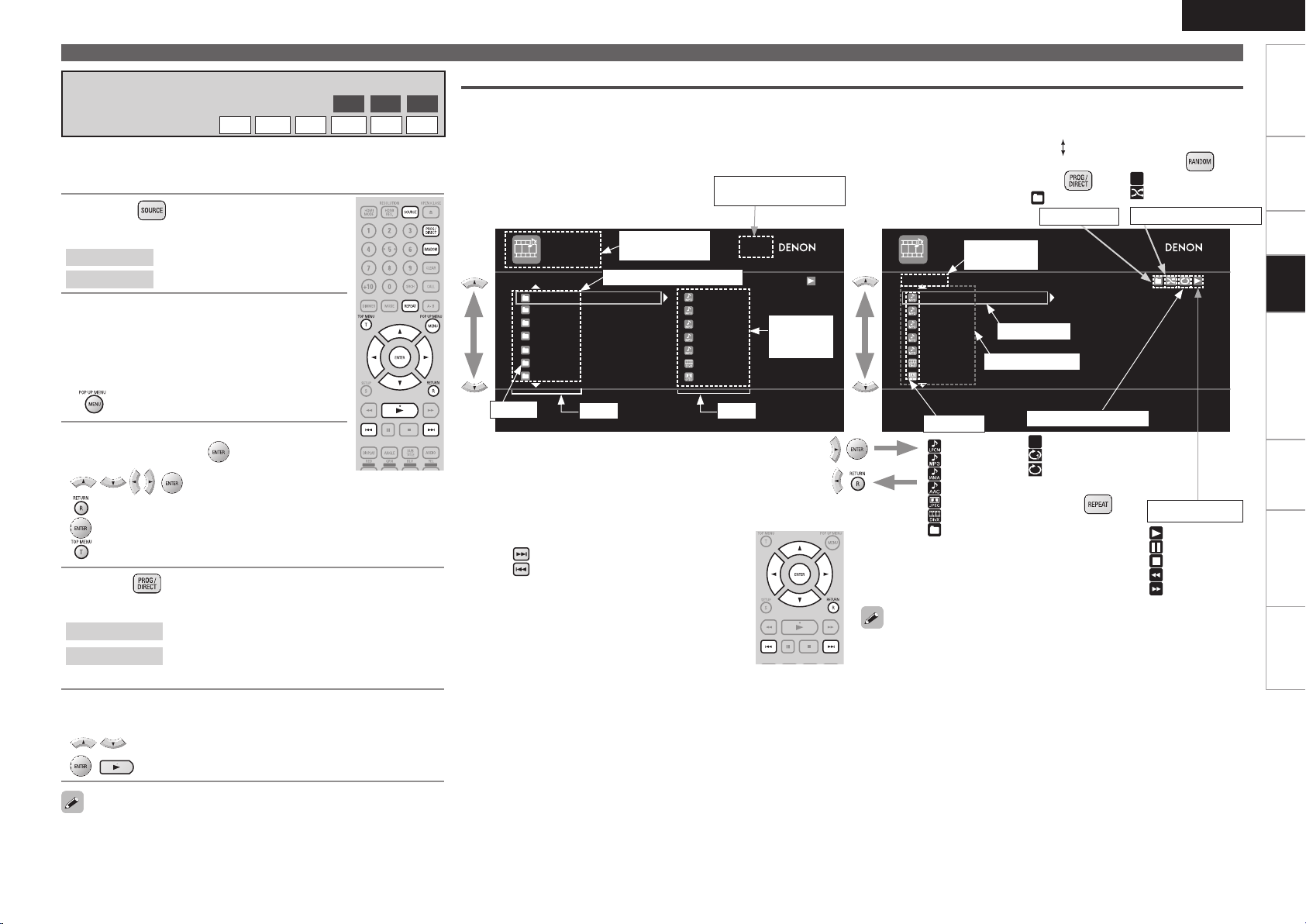
ENGLISH
39
TroubleshootingInformationHDMI Control FunctionPlaybackSetupConnectionsGetting Started SpecicationsPlayback
DATA DISC
Root/
Folder A
Folder B
File A
File B
File C
File D
File E
DivX File 1
JPEG File 1
Folder C
Folder D
Folder E
Folder F
Folder G
[1/18]
DATA DISC
Folder A
File A
File B
File C
File D
File E
DivX File 1
JPEG File 1
[1/12]
GFile browser screenH GItem selected screenH
About folder and le displays
n File Browser Screen
Media currently
playing
Current level folder/le list
Folder
Selected le
File for playback
File types
Random playback mode
For information on playable media and les, see “Playable Media”
(vpage 3, 4).
,
,
LPCM le
MP3 le
WMA le
AAC le
JPEG le
DivX
®
le
Folder
Random playback off
Random playback on
Repeat Off
Track Repeat
All Repeat
Play
Pause
Stop
Fast-reverse
Fast-forward
Operation during playback differs depending on the le being played.
See “Operation During Playback” (vpage 40).
Playing Files
DVD
CD
SD
MP3
WMA
AAC
LPCM
DivX
JPEG
1
Turn the DBP-A100 on.
2
Press , and select the playback
media mode.
DISC MODE
: Plays discs
SD CARD MODE
: Plays SD memory cards
3
Load media.
The le browser screen will appear.
b See “Inserting a Disc” and “Inserting an SD
Memory Card” (vpage 6) for how to load
media
b If le browser screen does not appear, press
.
4
Select the folder of the data to be
played and press .
, ···· Display screen selection
············································ To next level up
······································· To next level down
·············································To the top level
5
Press to select a playback mode.
All Track Mode
: Plays back all les on the media.
Folder Mode
: Plays back les in the selected folder. The folder
icon is displayed in the playback mode indicator.
6
Selecting and playing les.
················································· Select
, ································Set or playback
Files inside
selected
folder
Selected folder number/
Total number of folders
b
q
b
w
Repeat playback mode
Playback mode
n To Switch the Page Displayed
Press to display the next page.
Press to display the previous page.
Current level
folder name
Press .
Press
.
Folder Mode
Press .
Folder Mode
All Track Mode
Folder mode
File Playback
1.DBP-A100_E3_ENG_007.indd 39 2010/08/12 19:20:23
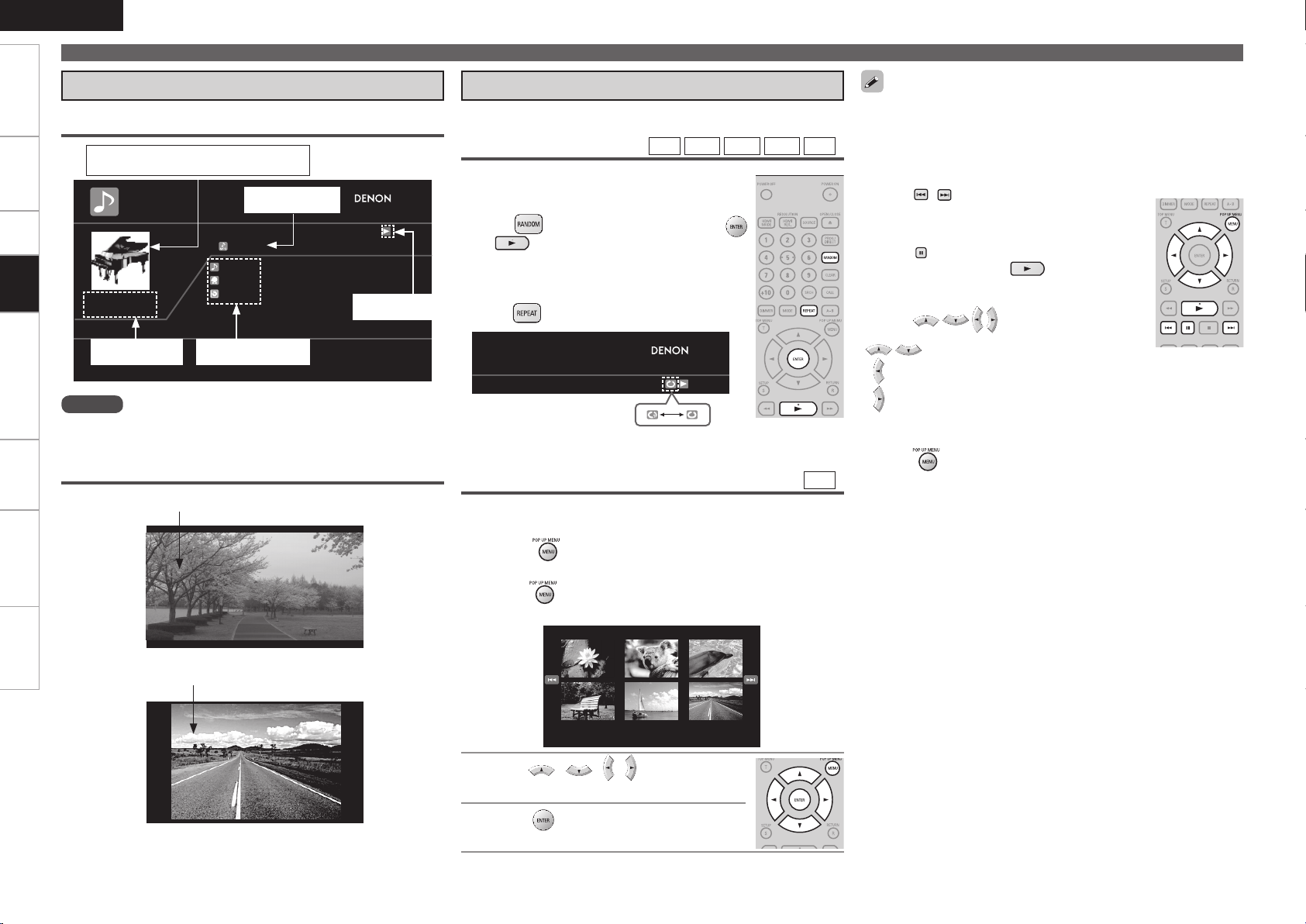
ENGLISH
40
TroubleshootingInformationHDMI Control FunctionPlaybackSetupConnectionsGetting Started SpecicationsPlayback
DATA DISC
Single Elapsed
00:25
Song
Artist
Album
Now PlayingTrack 2
File Playback
Screen Display During Playback
Display during Playback of Audio Files
Track number
during playback
Display of DivX
®
Files and JPEG Files
Displays video being played.
Displays still image being played
Operation During Playback
Audio le and DivX
®
le operation
MP3
WMA
AAC
LPCM
DivX
n Playback in Any Order (Random
Playback)
Press while stopped and then press
or .
n Playing Back Repeatedly (Repeat
Playback)
Press to select the repeat playback mode.
DATA DISC
Now PlayingTrack 2
• Set the image display time on the GUI menu with: “Display Setup”
– “Slide Show Time” (vpage 30).
• With a large image le, the image may display for longer than the
set time.
Playback mode
display
File name/Artist name/
Album Title
n Changing the Still Image being Played
Press , .
• Before playback or display of next image.
n Pausing the Display
Press .
• To cancel pause, press .
n Changing the Still Image Orientation
Press .
·······································180° rotation
·············································Rotates 90° left
···········································Rotates 90° right
n Returning to the Thumbnail Display Screen
Press .
1
Press while the le browser screen is displayed.
A thumbnail screen will appear.
b Pressing
while the thumbnail screen is displayed returns you
to the le browser screen.
1/25
2
Use to select still
images.
3
Press .
Displays selected image on full screen.
Elapsed time and
remaining time
NOTE
The display of JPEG image data of cover art, etc., recorded on the le
being played is enabled when playing MP3 and AAC audio les.
Displays the JPEG image data of cover art,
etc., recorded on the le being played.
Playing JPEG Files (Still Image)
JPEG
Slide-show playback of JPEG still image les stored on CD-R/-RW,
DVD-R/-RW/+R/+RW disc and SD Memory Card.
1.DBP-A100_E3_ENG_007.indd 40 2010/08/12 19:20:24
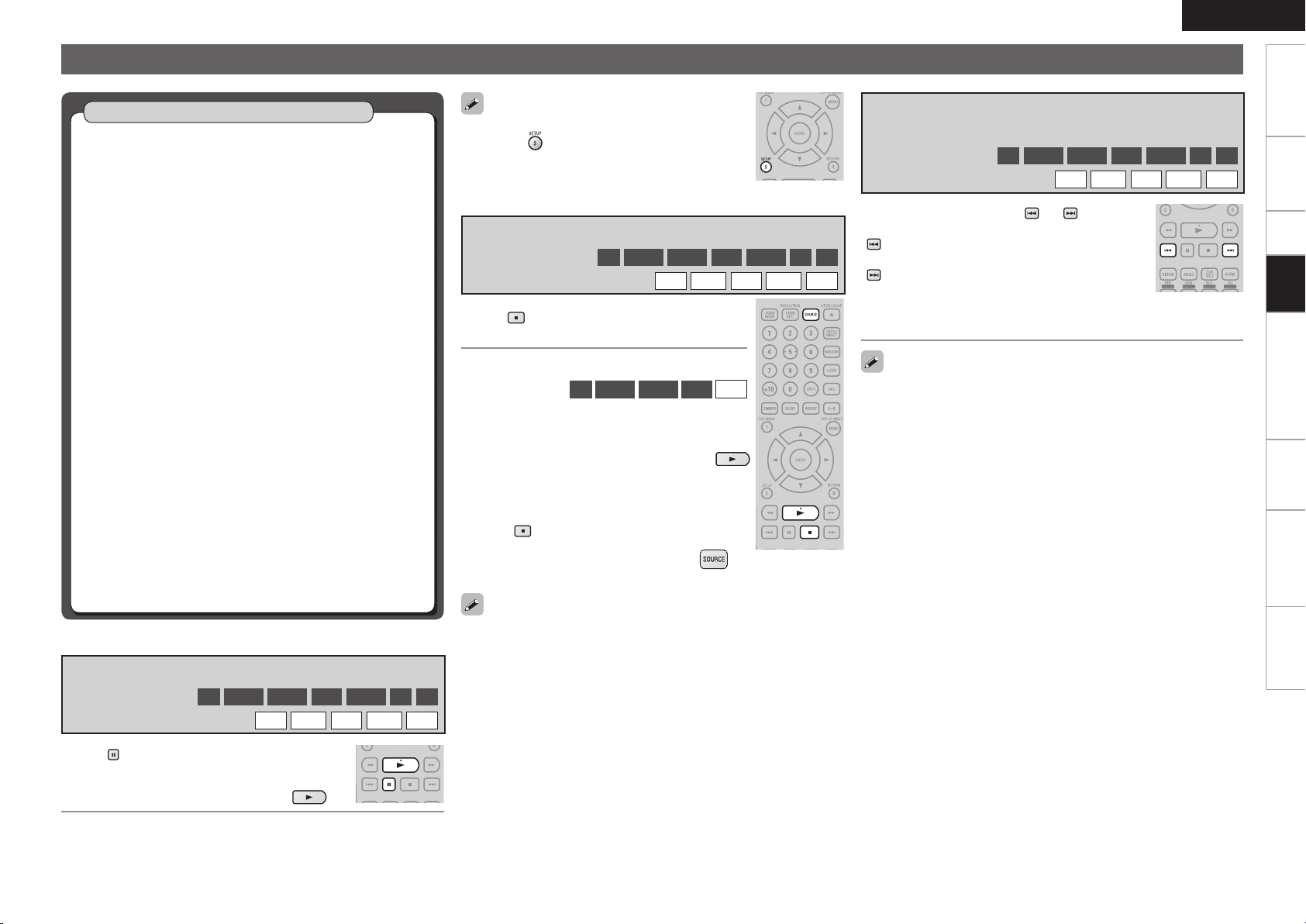
ENGLISH
41
TroubleshootingInformationHDMI Control FunctionPlaybackSetupConnectionsGetting Started Speci cationsPlayback
Operations Enabled During Playback
If the video is blurred while paused, stop playback
and press , then, on the GUI menu, change
“Display Setup” – “Still Mode” – “Field” (vpage
30).
n About the Resume Function
BD
DVD-A
DVD-V
DVD
DivX
When playback is stopped, the stop position is
memorized.
• The “1” indicator ashes on the display. To
resume play from the stop position, press
while stopped.
n To Cancel the Resume Function
Perform one of the following operations.
• Press while stopped.
• Open the disc tray.
• Change the playback media mode with .
• Remove the SD Memory Card.
Skipping to the start of a title or group may be prohibited, depending
on the disc.
• The resume function does not work with menu playback or BD-J
(Blu-ray Disc Java) compatible discs.
• The resume function remains valid even when the standby mode
is set. With DivX
®
les, however, the resume function is cancelled
even when the standby mode is set.
• The resume function is cancelled when the power is cut off by
unplugging the power cord.
Pausing
BD
DVD-A
DVD-V
DVD
SA-CD
CD
SD
MP3
WMA
AAC
LPCM
DivX
Stopping ( Resume Function)
BD
DVD-A
DVD-V
DVD
SA-CD
CD
SD
MP3
WMA
AAC
LPCM
DivX
Skipping to a Desired Chapter/Track/File
BD
DVD-A
DVD-V
DVD
SA-CD
CD
SD
MP3
WMA
AAC
LPCM
DivX
Press during playback.
The “3” indicator will light on the display.
b Resume normal playback by pressing .
Press during playback.
Playback stops.
During playback, press or .
Playback begins from the start of the chapter/
track/ le being played.
Playback begins from the start of the next
chapter/track/ le.
b Continue pressing and skip to the chapter/track/ le by the number
of times pressed.
Operations Enabled During Playback
n Pausing (vpage 41)
n Stopping (Resume Function) (vpage 41)
n Skipping to a Desired Chapter/Track/File (vpage
41)
n Finding Speci c Sections with Search Modes
(vpage 42)
n Memorizing Locations to Replay (Marker Function)
(vpage 43)
n Fast-Forward/Fast-Reverse (vpage 43)
n Playing Images Frame by Frame (vpage 43)
n Slow Forward/Slow Reverse Playback (vpage
43)
n Playback in Random Order (Random Playback)
(vpage 44)
n Playing Back Repeatedly (Repeat Playback)
(vpage 44)
n Repeat Playback between Speci ed Points (A-B
Repeat) (vpage 44)
n Playing Back in your Preferred Order (Program
Playback) (vpage 45)
n Switching Audio (vpage 45, 46)
n Changing the Subtitles and Subtitle Style (vpage
46)
n Switching the Angle (vpage 47)
n Changing the Brightness of the Display (Dimmer
Control) (vpage 47)
1.DBP-A100_E3_ENG_007.indd 41 2010/08/12 19:20:27
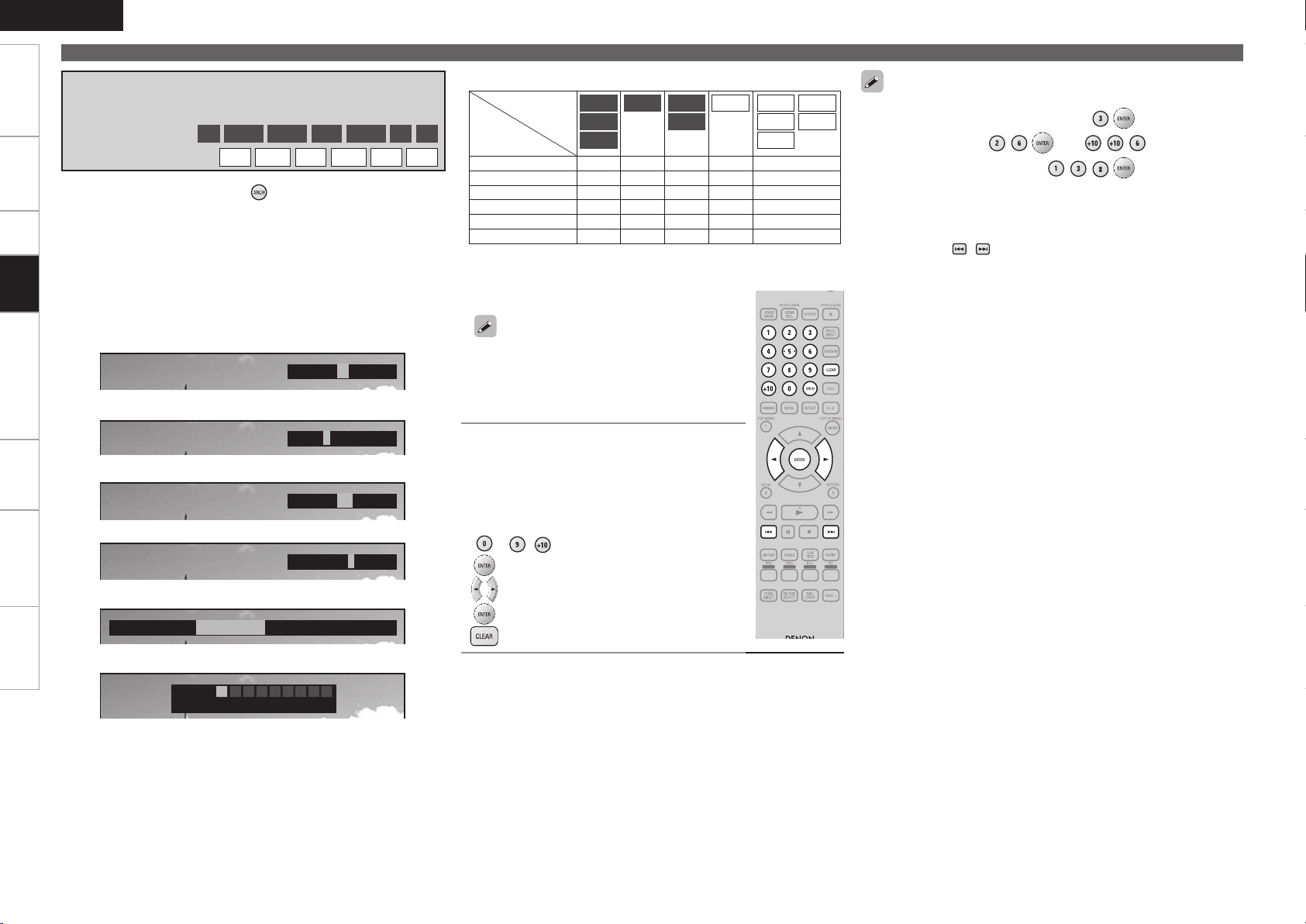
ENGLISH
42
TroubleshootingInformationHDMI Control FunctionPlaybackSetupConnectionsGetting Started SpecicationsPlayback
Finding Specic Sections with Search
Modes
BD
DVD-A
DVD-V
DVD
SA-CD
CD
SD
MP3
WMA
AAC
LPCM
DivX
JPEG
1
During playback, press and then select the search
mode.
The search mode setting bar is displayed at the top of the
screen.
• The search mode changes each time the button is pressed.
n Chapter search
Chapter – –/21
n Title search
Title –/5
n Track search
Track – –/15
n Group search
Group –/5
n Time search
Total Time 10 : 15 11Time Search – – – : – – : – –
n Marker search
Marker
Time – – : – – : – –
1 2 3 4 5 6 7 8
AC
GSearch mode-compatible media and lesH
Media / le
Search mode
BD
DVD-V
DVD
DVD-A SA-CD
CD
DivX MP3
WMA
LPCM
JPEG
AAC
Chapter search
S
Title search
S
Time search
S S S S
Marker search b S S S
Track search
S S S S
Group search
S
Operations Enabled During Playback
• Entering numbers
To enter 3 ··············································· z
To enter 26 ··············· z or
To enter 138 ······························· z
z:
Depending on number of recorded songs or chapters, you may
not need to use the “ENTER” button.
• The search modes do not operate during program or random
playback. Use
, to cue.
• Time search works with title and track playback time. It is not does
not work with chapter playback time.
• Search modes may not operate with some discs.
b About Marker Search
Plays back from your selected marker number.
• When the entry mode for chapter/title/track/
group search continues for about 5 seconds with
no operation, it is cancelled.
• When the power is set to standby or the disc is
removed, the set marker is deleted.
2
Enter search conditions or make
settings on the search mode setting
bar.
Once an entry is nalized, it searches for the
specied location.
~ , ···························· Number entry
········································ Finalizes number
··························Marker number selection
Finalizes the marker number or plays back
·······················Cancels the marker number
1.DBP-A100_E3_ENG_007.indd 42 2010/08/12 19:20:27
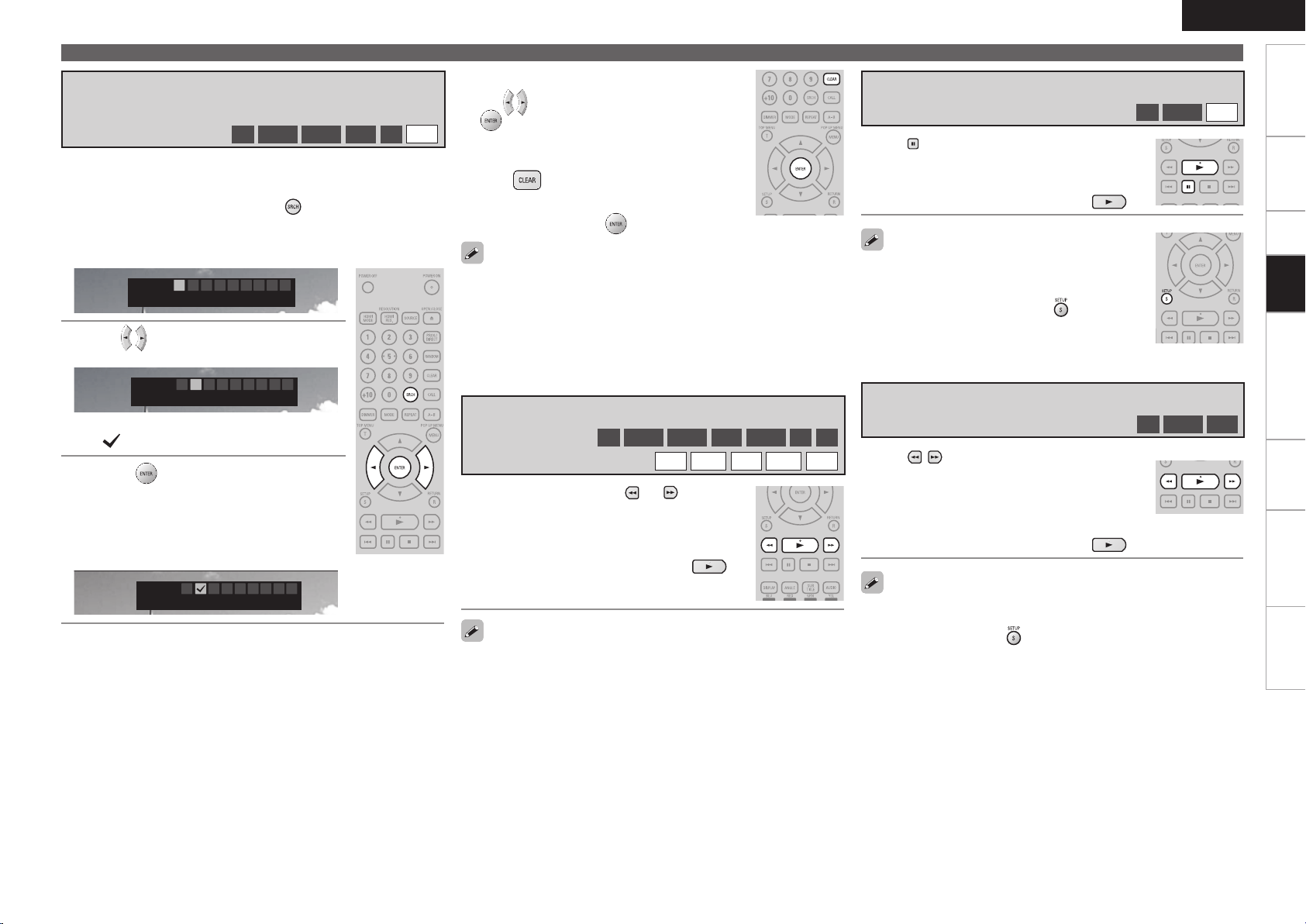
ENGLISH
43
TroubleshootingInformationHDMI Control FunctionPlaybackSetupConnectionsGetting Started SpecicationsPlayback
Operations Enabled During Playback
• You cannot fast-forward/fast-reverse across les or tracks during
program or random playback.
• Fast-forward/fast-reverse may be disabled with some DivX
®
les.
• Audio is not output during fast-forward/fast-reverse of a BD or
DVD.
• Frame by frame reverse playback is not available
with the DBP-A100.
• If the video is shaky during frame by frame
playback,
stop playback, press , then on the
GUI
menu, change “Display Setup” – “Still Mode”
– “Field” (vpage 30).
Fast-Forward/Fast-Reverse
BD
DVD-A
DVD-V
DVD
SA-CD
CD
SD
MP3
WMA
AAC
LPCM
DivX
During playback, press or .
• The fast-forward/fast-reverse speed changes
each time the button is pressed.
• The speed varies with the disc and le.
b Resume normal playback by pressing .
Press while paused.
The disc advances frame by frame each time the
button is pressed.
b Resume normal playback by pressing .
Playing Images Frame by Frame
BD
DVD-V
DivX
• Subtitles may not appear depending on the locations you have
memorized.
• The markers you have set will be erased if you turn the power to
standby or eject the disc.
• The marker function does not operate across titles and groups.
• Marker search can only be performed during playback.
You can attach a marker to a location you want to view or hear
again, so that playback begins at that location.
n To Play Back Memorized Locations
Use to select the marker number, then press
.
n To erase markers
Select the number you want to erase, and then
press .
n To erase all markers
Select “AC” and press .
1
During playback, press , and then select
“Marker”.
The search mode setting bar is displayed at the top of the
screen.
Marker
Time – – : – – : – –
1 2 3 4 5 6 7 8
AC
2
Use to select a number.
Marker
Time – – : – – : – –
1 2 3 4 5 6 7 8
AC
b Numbers you have already set will be displayed
as “ ”.
3
Press at the location you want to
memorize.
The location is registered for the selected
marker number.
b The elapsed playing time at the set location is
displayed.
Marker
Time 1 : 23 : 45
1 3 4 5 6 7 8
AC
Memorizing Locations to Replay (Marker
Function)
BD
DVD-V
DVD-A
DVD
SD
DivX
• Audio is not output during slow-forward/slow-reverse playback.
• If the video is blurred during slow-forward/slow-reverse playback,
stop playback and press , then on the GUI menu, change “Display
Setup” – “Still Mode” – “Field” (vpage 30).
Slow-Forward/Slow-Reverse Playback
BD
DVD-V
DVD
Press while paused.
The speed changes each time the button is
pressed.
b The speed of slow-reverse playback does not
change.
b Resume normal playback by pressing .
1.DBP-A100_E3_ENG_007.indd 43 2010/08/12 19:20:28
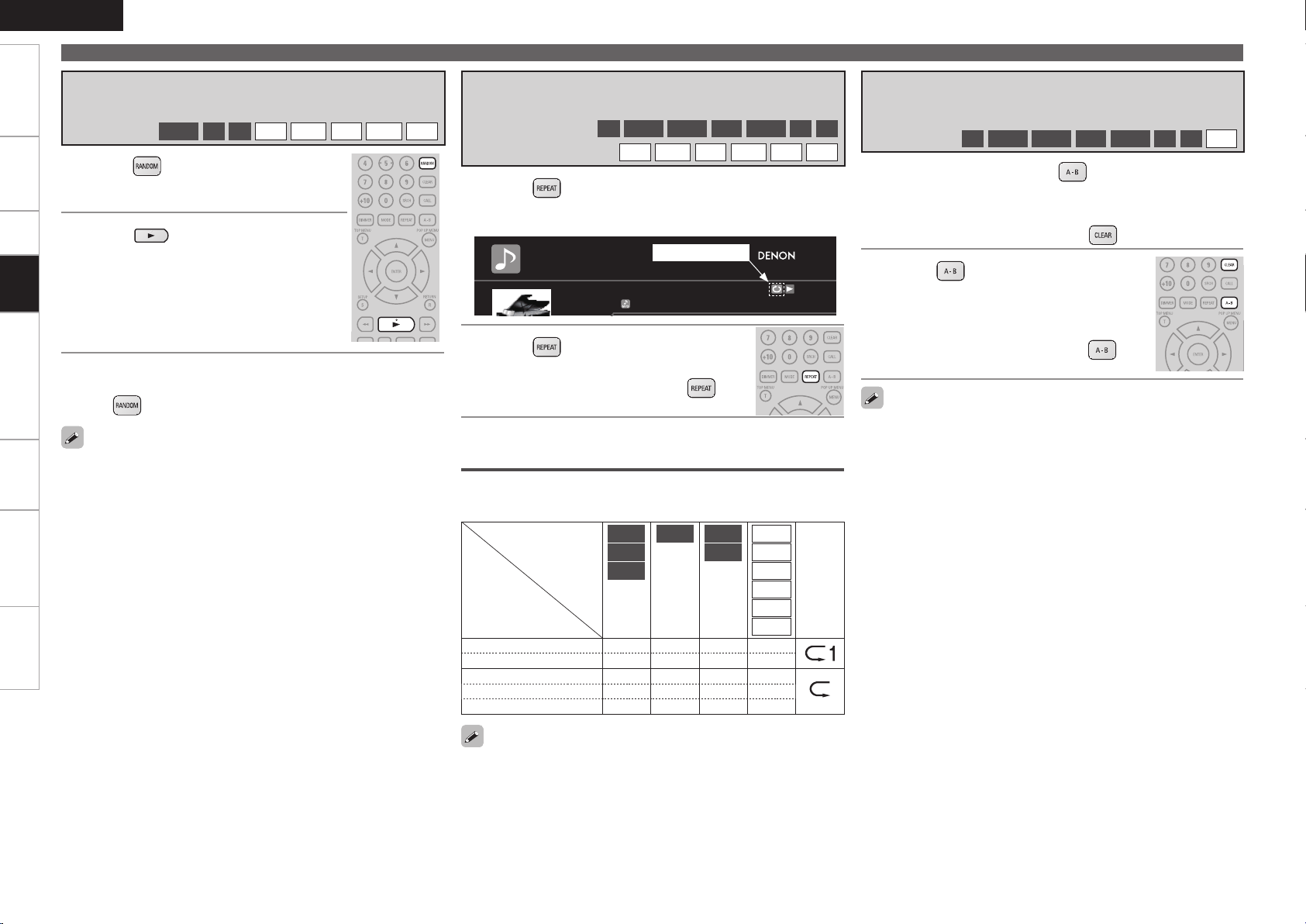
ENGLISH
44
TroubleshootingInformationHDMI Control FunctionPlaybackSetupConnectionsGetting Started SpecicationsPlayback
Operations Enabled During Playback
• Some repeat modes may not be accessible depending on some
discs. With some discs, even when set to repeat playback, the disc
may not return to the start of title or chapter, and may advance to
the next scene.
• Repeat playback is not available during A-B repeat playback.
• You cannot skip a title/le with A-B repeat.
• If you perform a search operation during A-B repeat playback, A-B
repeat playback is cancelled.
• A-B repeat playback may not be available with some scenes.
• A-B repeat playback of MP3/WMA/AAC/JPEG/LPCM les is not
available.
• A-B repeat playback is not available during repeat playback.
• A-B repeat playback may not be available with some DivX
®
les.
About Repeat Modes
The available repeat modes vary depending on the disc or le you
are playing.
Media/File
Mode
BD
DVD-V
DVD
DVD-A SA-CD
CD
MP3
WMA
AAC
LPCM
DivX
JPEG
Display
Chapter repeat
S
Track repeat
S S S
Title repeat
S
Group repeat
S
All repeat
S S
Playing Repeatedly
(Repeat Playback)
BD
DVD-A
DVD-V
DVD
SA-CD
CD
SD
MP3
WMA
AAC
LPCM
DivX
JPEG
Playing Repeatedly Between Specied
Points (A-B Repeat)
BD
DVD-A
DVD-V
DVD
SA-CD
CD
SD
DivX
1
Press during playback.
The repeat mode icon is displayed at the top of the screen.
• The repeat mode changes each time the button is pressed.
DATA DISC
Single Elapsed
00:35
Song
Artist
Album
Now PlayingTrack 2
2
Press to select the repeat mode.
b To resume normal playback, press , and
select “Repeat Off”.
1
During playback, press at the desired starting
point (A).
The “A–” indicator will light on the display.
b To cancel the starting point (A), press .
2
Press again at the desired ending
point (B).
The “B” indicator will light on the display, and
A-B repeat playback will start.
b To resume normal playback, press , and
select “Repeat Off”.
Random playback may not be available with some discs.
n Resuming Normal Playback
Press while stopped.
Playing in Random Order
(Random Playback)
SA-CD
CD
SD
MP3
WMA
AAC
LPCM
DivX
1
Press while stopped.
The “RAND” lights on the display and “Random
Mode” is displayed on the screen.
2
Press to play.
Repeat mode
1.DBP-A100_E3_ENG_007.indd 44 2010/08/12 19:20:28
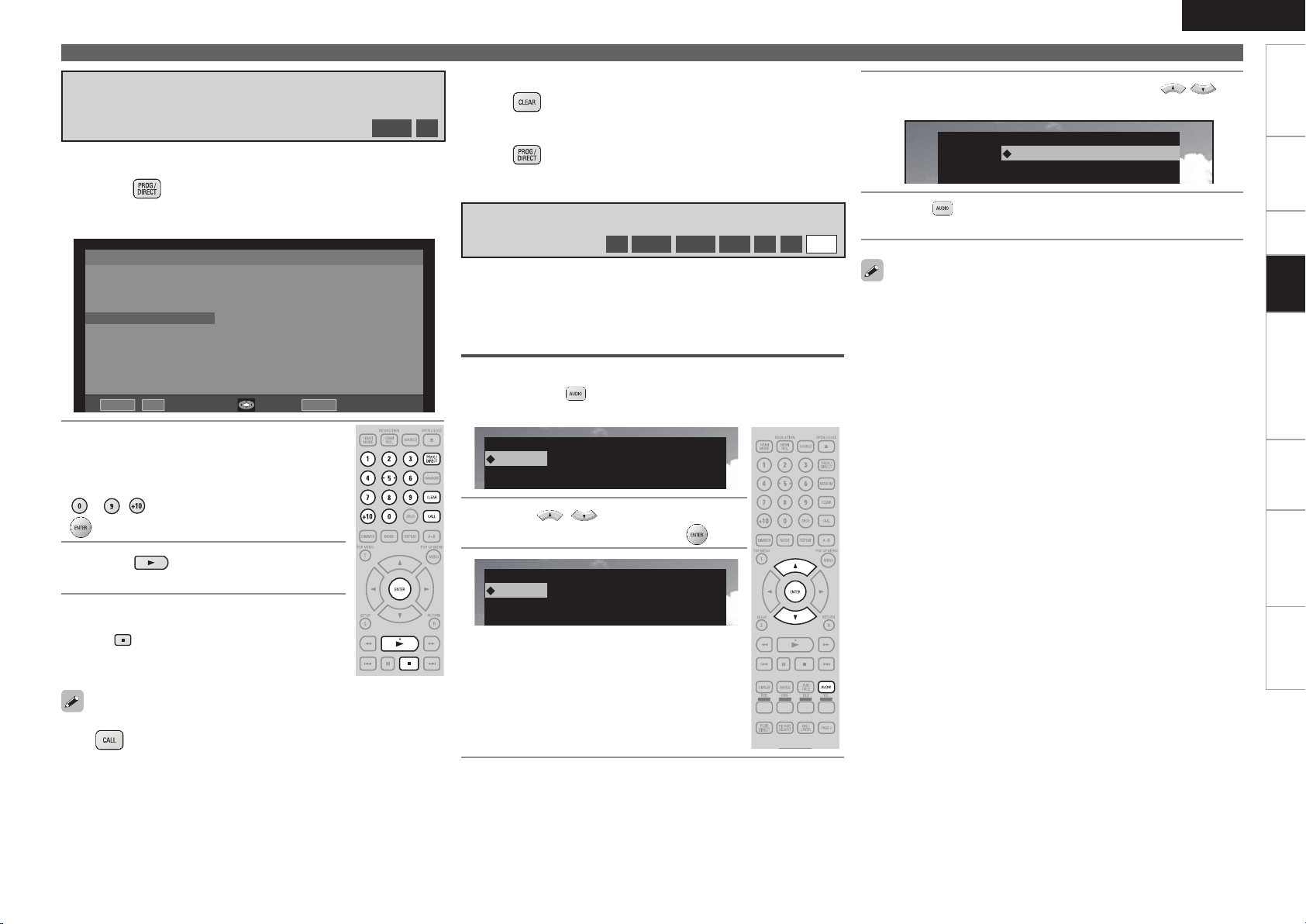
ENGLISH
45
TroubleshootingInformationHDMI Control FunctionPlaybackSetupConnectionsGetting Started SpecicationsPlayback
Switching a BD’s Primary Audio/Secondary Audio
With discs and les that have multiple audio track recording, you
can change the audio during playback.
With BD, you can set playback to sub-track audio, such as
interactive audio and commentary audio, etc., with “Secondary”.
Operations Enabled During Playback
You can program up to a maximum of 20 tracks.
n Checking the Program Contents
Press during playback.
The program setting screen will appear.
Playing in Your Preferred Order (Program
Playback)
SA-CD
CD
Switching Audio
BD
DVD-A
DVD-V
DVD
CD
SD
DivX
1
Press while stopped during stop.
The “PROG” indicator lights on the display, and the program
setting screen appears.
PROGRAM
Enter Clear
Track 1 - 16 Total Time 3 : 32
No.
1
2
3
4
5
6
7
8
9
10
Track
5
2
3
-
-
No.
11
12
13
14
15
16
17
18
19
20
Track
0-9 CLEAR+10
2
Enter the track numbers you want
to program on the program setting
screen.
~
,
············································· Entry
·······················································Set entry
3
Press .
Playback begins in the programmed order.
1
During playback of Primary Audio/Secondary Audio
title, press .
The audio number currently being played is displayed.
Audio
Primary
1/5 : Dolby Digital 3/2.1 English
Secondary
–/1 : Off
2
Press , select “Primary” or
“Secondary”, and then press .
Audio
Primary
1/5 : Dolby Digital 3/2.1 English
Secondary
–/1 : Off
b If multiple audio items are recorded, “the current
audio number/number of recorded audio items”
is displayed.
b When “BD Audio Mode” is set to “HD Audio
Output” (vpage 32), “Secondary” audio is not
output.
n Erasing Programmed Tracks One by One
Press during stop.
n Erasing All Programming
Press .
You can also check the contents of the program on the unit’s display.
Press while stopped.
• Depending on the disc, audio switching may be restricted to
operation of the disc menu. In this case, switch the audio on the
disc menu.
• Be sure to set “BD Audio Mode” to “Mix Audio Output” (vpage
32) for playing back secondary audio.
• Depending on the BD, even if picture-in-picture playback is set to
“Off”, Secondary Audio only may be output.
3
Select your desired audio language with .
Audio
Primary
2/5 : Dolby Digital 3/2.1 Japanese
Secondary
–/1 : Off
4
Press .
The setup screen disappears.
1.DBP-A100_E3_ENG_007.indd 45 2010/08/12 19:20:29
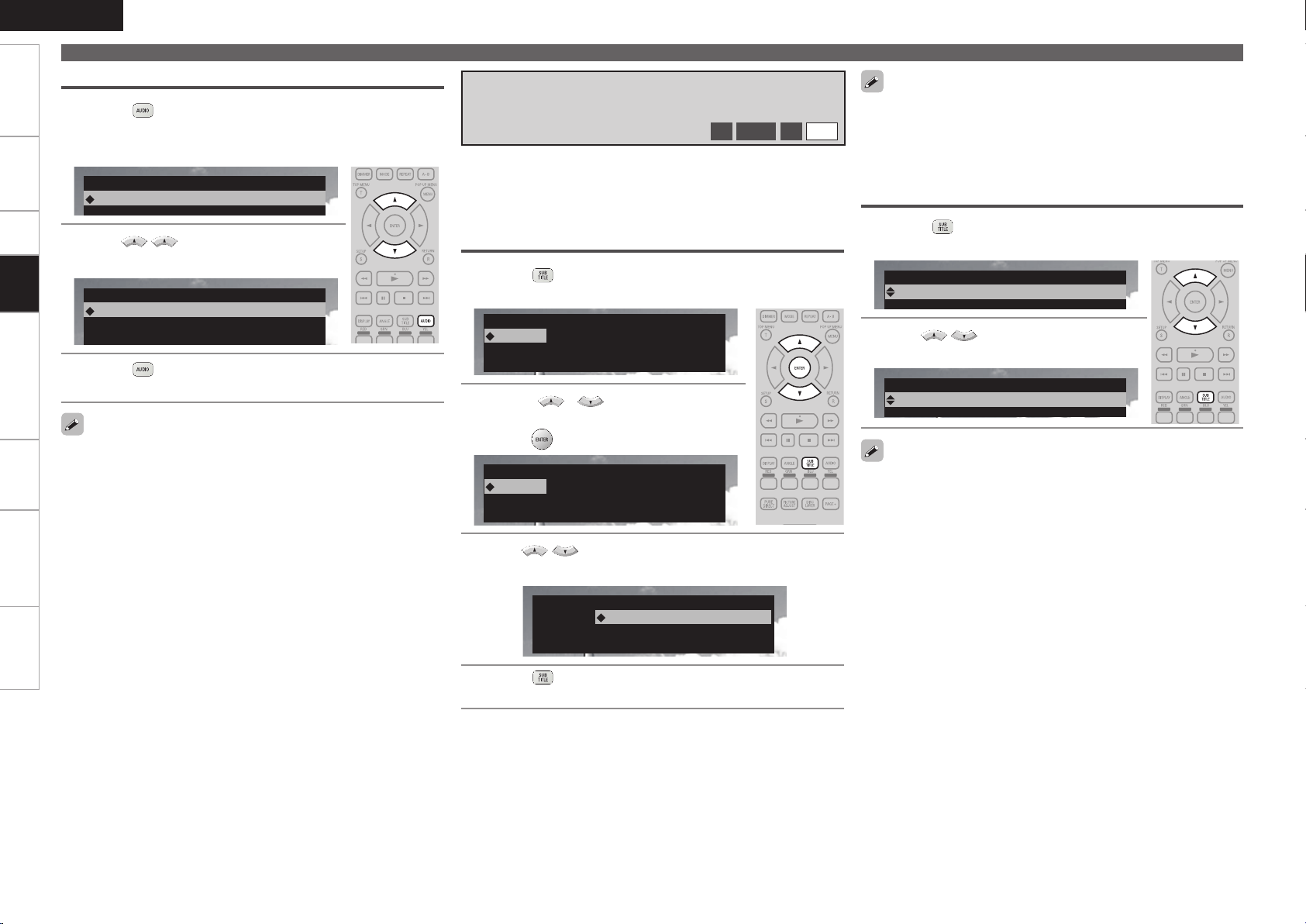
ENGLISH
46
TroubleshootingInformationHDMI Control FunctionPlaybackSetupConnectionsGetting Started SpecicationsPlayback
Switching a BD’s Primary Subtitle/Secondary Subtitle
and Subtitle Style
• If a disc does not include subtitles and/or subtitle style, “Not
Available” is displayed.
• Depending on the disc, subtitle switching may be restricted to
operation of the disc menu. In this case, switch the subtitles on
the disc menu.
During playback of a disc or le with recorded subtitles, you can
switch the subtitles on/off as well as the subtitle language.
With BD, you can change the style of displayed subtitles.
Operations Enabled During Playback
Changing the Subtitles and Subtitle
Style
BD
DVD-V
SD
DivX
1
Press during playback.
The subtitle number currently being played is displayed.
Subtitle
Primary
1/5 : English
Off
Secondary
Style
–/1 :
1 :
2
With , select “Primary”,
“Secondary” and “Style”, and then
press .
Subtitle
Primary
1/5 : English
Off
Secondary
Style
–/1 :
1 :
3
Use to select your desired subtitle language
and subtitle style.
Subtitle
Primary
Off
Secondary
Style
–/1 :
1 :
1/5 : English
4
Press .
The setup screen disappears.
Selecting DVD-Video and DivX
®
File Subtitles
With a DivX
®
le, the currently playing subtitle number and number
of recorded subtitles are displayed; the language option is not
displayed.
1
Press during playback.
The subtitle number currently being played is displayed.
Subtitle
–/5
: Off
2
Use to select subtitles.
Subtitle
1/5
: English
• With DVD-R/-RW with bilingual soundtrack recording, you can
switch between “Main” (main audio) and “Sub” (secondary audio) or
“Main/Sub” (main audio + secondary audio).
• In CD audio mode, you can switch to “Stereo”, “L-ch” (left channel)
or “R-ch” (right channel).
• With a DivX
®
le, “MP3” or “Dolby Digital” audio formats and the
number of recorded audio modes are displayed. “– – –“ appears for
audio other than these.
• With DTS-CD (5.1 music disc), you cannot switch audio modes.
Audio Switching (Media Other than BD)
1
Press during playback.
The audio number currently being played is displayed.
GExampleH DVD
Audio
: Dolby Digital1/5 3/2.1 English
2
Use to select audio
GExampleH DVD-Video
Audio
: Dolby Digital2/5 3/2.1 Japanese
3
Press .
The setup screen disappears.
1.DBP-A100_E3_ENG_007.indd 46 2010/08/12 19:20:30
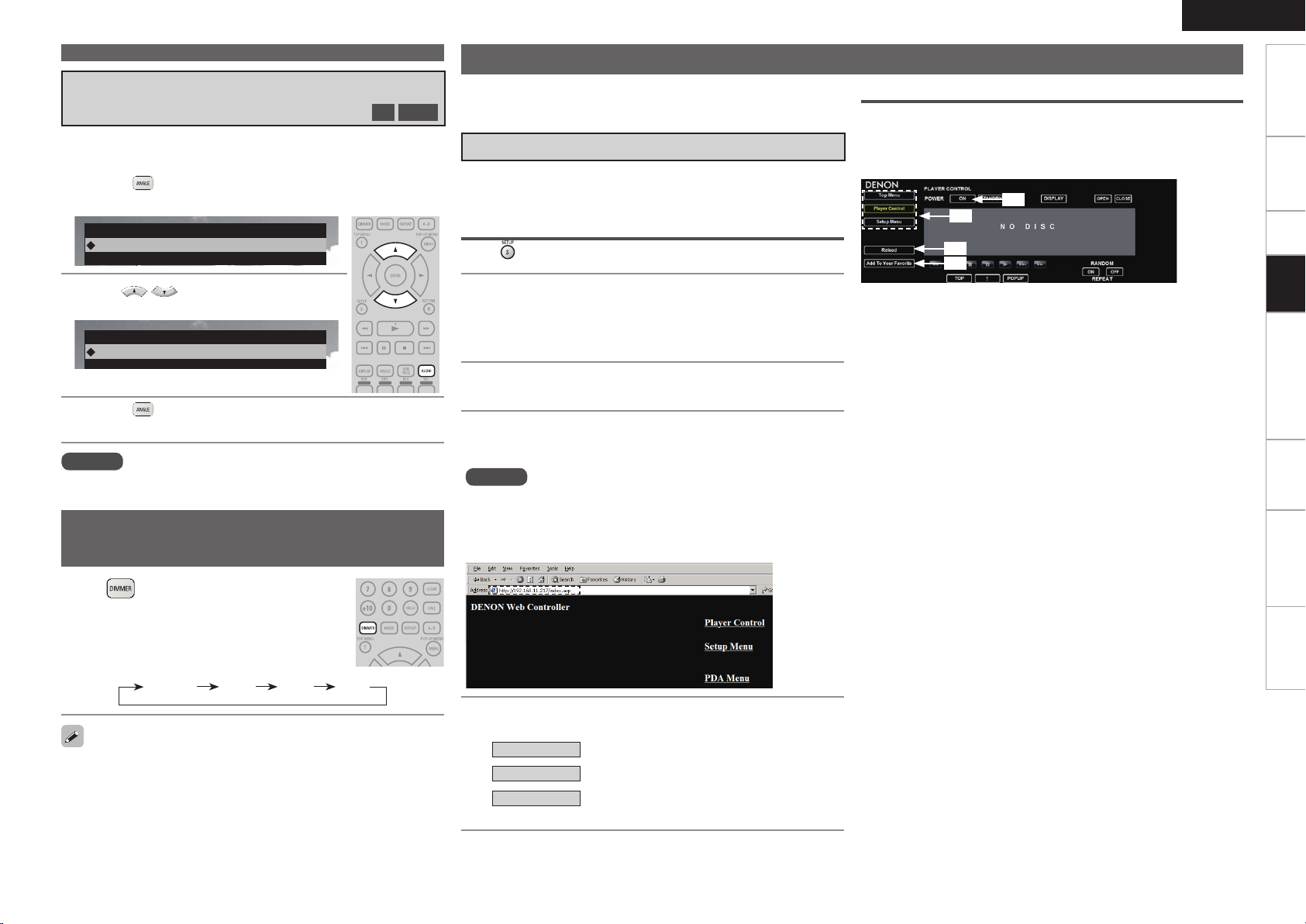
ENGLISH
47
TroubleshootingInformationHDMI Control FunctionPlaybackSetupConnectionsGetting Started SpecicationsPlayback
Operations Enabled During Playback
During playback of a BD or DVD-Video recorded with several
camera angles, you can change the angle.
Switching the Angle
BD
DVD-V
NOTE
Angle changing may be restricted, depending on the disc.
1
Press during playback.
The angle number currently being played is displayed.
Angle
1/3
2
Use to select angle.
Angle
2/3
3
Press .
The setup screen disappears.
Press .
The brightness changes each time the button is
pressed.
Normal Dim Dark Off
Changing the Brightness of the
Display (Dimmer Control)
Even when “Off” is selected, the status of operations that are
performed appears momentarily on the display if “Display Setup”
– “Temporary Display” on the GUI menu is set to “On” (vpage 30).
DBP-A100 has “Web control function” support that allows you to
operate DBP-A100 via LAN from your PC, PDA, iPod® touch, and
iPhone®.
Operating DBP-A100 using a PC browser
• Connect DBP-A100 to the network. (“Connecting to the Network”
(vpage 19).
• Please use the Internet Explorer or FireFox browser.
Preparation
Press
on the remote control to display the GUI menu.
1
Check the IP address of DBP-A100. (vpage 30)
• Select “Network Setup” from the GUI menu and then select
“IP Address”.
• The address displayed for “Control” is the IP address of DBP-
A100.
2
Enter the DBP-A100 IP address in browser’s address
box.
• For example, if the IP address of DBP-A100 is “192.168.11.217”,
enter http://192.168.11.217.
• The top menu appears on the PC screen.
NOTE
If you set “DHCP” in “Network Setup” of the GUI menu to “On”, the IP
address of DBP-A100 will change every time DBP-A100 is connected.
Check the IP address, whenever you use the Web control function.
(vpage 30)
3
Click the menu you want to operate.
Player Control
Click to operate DBP-A100.
Setup Menu
Click to operate the Setup Menu.
PDA Menu
Click to operate DBP-A100 using a PDA
terminal.
Player Control
You can perform basic operations of DBP-A100 from a PC screen
using the “Player Control” menu. Each operation button on this
screen functions in the same way as the buttons on DBP-A100 and
remote control.
q
w
e
r
q Shortcut key to each menu.
w Click when you update to the latest information.
e Click to add a setting to “Favorites”.
r To turn on power using the ON button of a PC browser, set “Power
Saving” in “Other Setup” of the GUI menu to “Quick Start Mode”.
(vpage 31)
Web control function
1.DBP-A100_E3_ENG_007.indd 47 2010/08/12 19:20:30
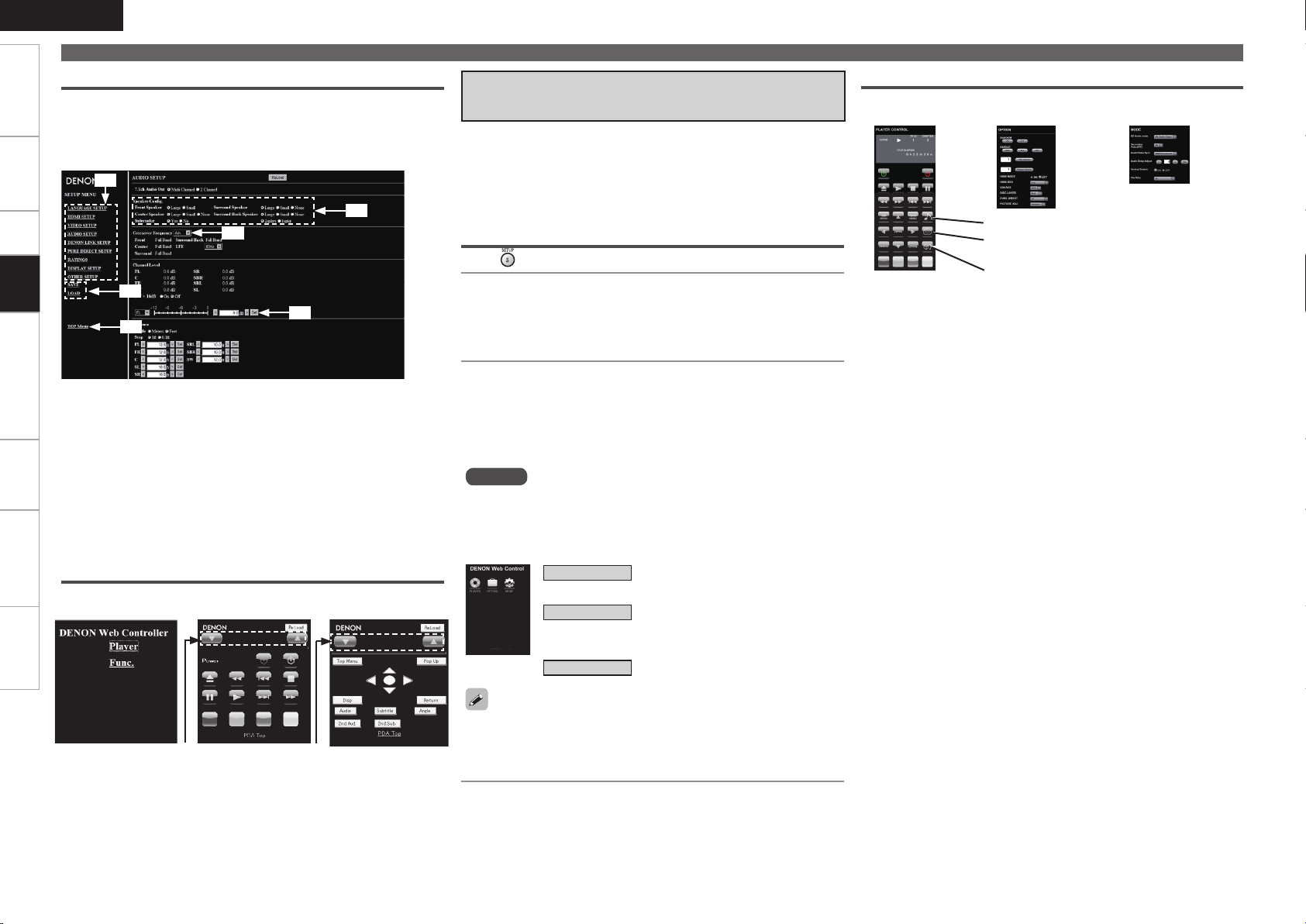
ENGLISH
48
TroubleshootingInformationHDMI Control FunctionPlaybackSetupConnectionsGetting Started Specications
q Click the menu from which you want to make settings.
• The display on the right becomes each setting screen.
w “SAVE”: Click to save settings. The settings are saved on your PC.
“LOAD”: Click to recall settings.
e Click the setting item.
r Click “f” and select from the displayed items.
t Enter values or click “o” or “p” to make the setting.
Click “Set” to set the values.
y Click to return to the top menu.
PDA Menu
You can perform basic operations of DBP-A100 from a PDA using the
PDA Menu screen.
n Player
Buttons for switching
the displayed screens
n Func.
Buttons for switching
the displayed screens
Operating DBP-A100 using the iPod
browser
• You can perform basic operations of DBP-A100 using network-ready
iPod products such as iPhone® and iPod® touch.
• Before starting the operation, connect DBP-A100 to the network.
(“Connecting to the Network” vpage 19).
iPhone® and iPod® touch is a trademark or registered trademark of
Apple Inc. in the U.S. and other countries.
Preparation
Press
on the remote control to display the GUI menu.
1
Check the IP address of DBP-A100. (vpage 30)
Select “Network Setup” from the GUI menu and then select “IP
Address”.
The address displayed for “Control” is the IP address of DBP-
A100.
2
Enter the DBP-A100 IP address in browser’s address
box.
• For example, if the IP address of DBP-A100 is “192.168.11.217”,
enter http://192.168.11.217.
• The top menu appears on the PC screen.
NOTE
If you set “DHCP” in “Network Setup” of the GUI menu to “On”, the IP
address of DBP-A100 will change every time DBP-A100 is connected.
Check the IP address, whenever you use the Web control function.
(vpage 30)
PLAYER
Click to display the screen used for
basic playback operation.
OPTION
Click to operate random or repeat
playback and perform output signal-
related settings.
MODE
Click to perform advanced settings.
• For details on setting items, see the Owner’s Manual.
• To switch to another mode while the operation screen of each
mode is being displayed, use the iPod browser’s back button “0“
to return to the top menu.
Operaation the iPod menu screen
n PLAYER n OPTION n MODE
“Switching audio” (vpage 45)
“Switching subtitles and subtitle style”
(vpage 46)
“Switching the angle” (vpage 47)
Playback
Web control function
Setup Menu
You can perform various settings of DBP-A100 on the Setup Menu
screen.
For further information about setting items, see “GUI Menu Setup”
on page v21.
e
r
t
w
y
q
1.DBP-A100_E3_ENG_007.indd 48 2010/08/12 19:20:31
ENGLISH
49
TroubleshootingInformationHDMI Control FunctionPlaybackSetupConnectionsGetting Started Specications
When you make HDMI connections with a TV or AV Amp compatible
with DBP-A100 and HDMI control functions, you can perform the
following operations by setting up the HDMI control functions of
each device.
n TV or AV Amp power is turned on by operating the
DBP-A100 and functions change with DBP-A100
input.
n Turning off the TV’s power turns the DBP-A100’s
power to standby.
n Operating the DBP-A100 via the TV’s remote
control.
(When the TV’s remote control has player operation buttons)
If the HDMI control function does not operate properly, check the
following points.
• Is the TV or AV Amp compatible with the HDMI control function?
• Are the HDMI control function settings of all equipment correct?
(Step 3)
• After setting, did you add another HDMI device connection or make
any changes in the connections? If so make the settings again.
HDMI Control Functions
NOTE
• The HDMI control function controls operations of a TV that is
compatible with the HDMI control function. Make sure that the TV
and HDMI are connected when you perform HDMI control.
• Some functions may not operate depending on the connected TV
or AV Amp. Check the owner’s manual of each device for details
beforehand.
• When “Other Setup” – “Power Saving” on the GUI menu is set
to “Power Saving Standby” or “Normal Standby” (vpage 31),
the player’s power cannot be turned on using the HDMI control
function.
• When “HDMI Setup” – “HDMI Control” – “Power Off Control” on the
GUI menu is set to “Off” (vpage 24), the DBP-A100 does not go
to standby even if the connected device is in the standby mode.
• When “DENON LINK Setup” – “DENON LINK Mode” on the GUI
menu is set to “4th”, the HDMI control function is enabled for the
connected devices.
1
Set the HDMI control function to “On”.
On the GUI menu, set “HDMI Setup” – “HDMI Control” (vpage
24).
2
Turn on all the equipment connected by HDMI cable.
3
Set the HDMI control function for all equipment
connected by HDMI cable.
On the GUI menu, set the DBP-A100 with “HDMI Setup” –
“HDMI Control” (vpage 24).
b Please refer to the owner’s manuals of connected devices for how
to make settings.
b Carry out Steps 2 and 3 if any of the equipment was unplugged.
4
To ensure that the DBP-A100’s HDMI video output is
projected on the TV screen, change the input function
of the TV and AV Amp.
5
When you turn the TV’s power to standby, check that
the power of the DBP-A100 and AV Amp also goes on
standby.
HDMI Control Function
1.DBP-A100_E3_ENG_007.indd 49 2010/08/12 19:20:31
ENGLISH
50
TroubleshootingHDMI Control FunctionPlaybackSetupConnectionsGetting Started SpecicationsPlayback HDMI Control Function
“Blu-ray Disc” and “ ” are
trademarks.
is a trademark of the DVD Format /
Logo licensing Corporation.
HDMI, the HDMI Logo and High-Denition
Multimedia Interface are trademarks or
registered trademarks of HDMI Licensing
LLCintheUnitedStatesandothercountries.
Java and all other trademarks and logos
are trademarks or registered trademarks of
Sun Microsystems, Inc. in the United States
and/or other countries.
Manufactured under license from Dolby
Laboratories.“Dolby”,“ProLogic”andthe
double-D symbol are trademarks of Dolby
Laboratories.
Manufactured under license under U.S.
Patent #’s: 5,451,942; 5,956,674; 5,974,380;
5,978,762; 6,226,616; 6,487,535; 7,392,195;
7,272,567; 7,333,929; 7,212,872 & other U.S.
and worldwide patents issued & pending.
DTS and the Symbol are registered trademarks,
& DTS-HD, DTS-HD Master Audio | Essential
and the DTS logos are trademarks of DTS,
Inc. Product includes software. © DTS, Inc. All
Rights Reserved.
Windows Media and the Windows logo
are trademarks or registered trademarks of
Microsoft Corporation in the United States
and/or other countries.
DivX®, DivX Certied®, and associated
logos are registered trademarks of DivX,
Inc. and are used under license.
DENON LINK is a unique digital, balanced transfer type of interface
developed by DENON. It offers high-speed, high-quality transfer of
digital audio data with low signal loss. It can be used with DENON
AV Amp equipped with a special DENON LINK connector via a single
cable to enable playback with high sound quality. It allows digital
transfer of the 192 kHz/24 bit 2-channel digital signals of DVD-Audio
discs, PCM multi-channel signals, etc. Full-spec digital transfer of the
audio contents of Super Audio CD is possible by connecting a player
equipped for DENON LINK 3rd Generation.
During processing of DENON LINK, the DENON LINK indicator of the
display lights.
DENON LINK 4th uses the clock of the AV Amp connected by DENON
LINK to achieve HDMI signal transfer with little jitter when playing BD.
“Advanced AL24 Processing” installed in the analog output dramatically
improves the information volume on the time axis with independent
speed signal detection and processing technology for the PCM signal
playback system. In addition to data expansion to 24 bit, it conducts
natural interpolation processing with no loss of original data by digital
upsampling. The “Advanced AL24” indicator lights on the front panel
when Advanced AL24 Processing is in operation.
This item incorporates copy protection technology that is protected
by U.S. patents and other intellectual property rights of Rovi
Corporation. Reverse engineering and disassembly are prohibited.
Other Information
About Advanced AL24
Processing
Trademark Information
About Copyright Protection
Technology
About DENON LINK
®
, HDCD
®
, High Denition
Compatible Digital
®
and Microsoft
®
are
either registered trademarks or trademarks
of Microsoft Corporation, Inc. in the United
States and/or other countries. HDCD
system manufactured under license from
Microsoft Corporation, Inc. This product is
covered by one or more of the following: In
the USA: 5,479,168, 5,638,074, 5,640,161,
5,808,574, 5,838,274, 5,854,600, 5,864,311,
5,872,531, and in Australia: 669114. Other
patents pending.
“AVCHD” and the “AVCHD” logo are
trademarks of Panasonic Corporation and
Sony Corporation.
“BONUSVIEW” is the trademark of Blu-ray
Disc Association.
The “BD-LIVE” logo is a trademark of Blu-
ray Disc Association.
The SDHC-logo is trademarkedk.
This product uses the following technologies:
Information
1.DBP-A100_E3_ENG_007.indd 50 2010/08/12 19:20:31
ENGLISH
51
TroubleshootingInformationHDMI Control FunctionPlaybackSetupConnectionsGetting Started Specications
Language Code List
Language Code
A
Abkhazian
4748
Afar
4747
Afrikaans
4752
Albanian
6563
Amharic
4759
Arabic
4764
Armenian
5471
Assamese
4765
Aymara
4771
Azerbaijani
4772
B
Bashkir
4847
Basque
5167
Bengali;Bangla
4860
Bhutani
5072
Bihari
4854
Bislama
4855
Breton
4864
Bulgarian
4853
Burmese
5971
Belarusian
4851
C
Cambodian
5759
Catalan
4947
Chinese
7254
Corsican
4961
Croatian
5464
Czech
4965
D
Danish
5047
Dutch
6058
E
English
5160
Esperanto
5161
Estonian
5166
F
Faroese
5261
Fiji
5256
Finnish
5255
French
5264
Frisian
5271
G
Galician
5358
Georgian
5747
German
5051
Greek
5158
Greenlandic
5758
Guarani
5360
Gujarati
5367
H
Hausa
5447
Hebrew
5569
Hindi
5455
Hungarian
5467
Language Code
I
Icelandic
5565
Indonesian
5560
Interlingua
5547
Interlingue
5551
Inupiak
5557
Irish
5347
Italian
5566
J
Japanese
5647
Javanese
5669
K
Kannada
5760
Kashmiri
5765
Kazakh
5757
Kinyarwanda
6469
Kirghiz
5771
Kirundi
6460
Korean
5761
Kurdish
5767
L
Laothian
5861
Latin
5847
Latvian; Lettish
5868
Lingala
5860
Lithuanian
5866
M
Macedonian
5957
Malagasy
5953
Malay
5965
Malayalam
5958
Maltese
5966
Maori
5955
Marathi
5964
Moldavian
5961
Mongolian
5960
N
Nauru
6047
Nepali
6051
Norwegian
6061
O
Occitan
6149
Oriya
6164
Oromo (Afan)
6159
P
Punjabi
6247
Pashto; Pushto
6265
Persian
5247
Polish
6258
Portuguese
6266
Q
Quechua
6367
R
Rhaeto-Romance
6459
Romanian
6461
Russian
6467
Language Code
S
Samoan
6559
Sangho
6553
Sanskrit
6547
Scots Gaelic
5350
Serbian
6564
Serbo-Croatian
6554
Sesotho
6566
Setswana
6660
Shona
6560
Sindhi
6550
Singhalese
6555
Siswat
6565
Slovak
6557
Slovenian
6558
Somali
6561
Spanish
5165
Sundanese
6567
Swahili
6569
Swedish
6568
T
Tagalog
6658
Tajik
6653
Tamil
6647
Tatar
6666
Telugu
6651
Thai
6654
Tibetan
4861
Tigrinya
6655
Tonga
6661
Tsonga
6665
Turkish
6664
Turkmen
6657
Twi
6669
U
Ukrainian
6757
Urdu
6764
Uzbek
6772
V
Vietnamese
6855
Volapuk
6861
W
Welsh
4971
Wolof
6961
X
Xhosa
7054
Y
Yiddish
5655
Yoruba
7161
Z
Zulu
7267
Information
1.DBP-A100_E3_ENG_007.indd 51 2010/08/12 19:20:32
ENGLISH
52
TroubleshootingInformationHDMI Control FunctionPlaybackSetupConnectionsGetting Started Specications
Country Code
A
AFGHANISTAN
AF
ÅLAND ISLANDS
AX
ALBANIA
AL
ALGERIA
DZ
AMERICAN SAMOA
AS
ANDORRA
AD
ANGOLA
AO
ANGUILLA
AI
ANTARCTICA
AQ
ANTIGUA AND BARBUDA
AG
ARMENIA
AM
ARUBA
AW
AZERBAIJAN
AZ
B
BAHAMAS
BS
BAHRAIN
BH
BANGLADESH
BD
BARBADOS
BB
BELARUS
BY
BELIZE
BZ
BENIN
BJ
BERMUDA
BM
BHUTAN
BT
BOLIVIA
BO
BOSNIA AND HERZEGOVINA
BA
BOTSWANA
BW
BOUVET ISLAND
BV
BRITISH INDIAN OCEAN
TERRITORY
IO
BRUNEI DARUSSALAM
BN
BULGARIA
BG
BURKINA FASO
BF
BURUNDI
BI
C
CAMBODIA
KH
CAMEROON
CM
CAPE VERDE
CV
CAYMAN ISLANDS
KY
CENTRAL AFRICAN
REPUBLIC
CF
CHAD
TD
CHRISTMAS ISLAND
CX
COCOS (KEELING) ISLANDS
CC
COMOROS
KM
CONGO
CG
CONGO, THE DEMOCRATIC
REPUBLIC OF THE
CD
COOK ISLANDS
CK
COSTA RICA
CR
CÔTE D’IVOIRE
CI
CROATIA
HR
Country Code
CUBA
CU
CYPRUS
CY
CZECH REPUBLIC
CZ
D
DJIBOUTI
DJ
DOMINICA
DM
DOMINICAN REPUBLIC
DO
E
ECUADOR
EC
EGYPT
EG
EL SALVADOR
SV
EQUATORIAL GUINEA
GQ
ERITREA
ER
ESTONIA
EE
ETHIOPIA
ET
F
FALKLAND ISLANDS
(MALVINAS)
FK
FAROE ISLANDS
FO
FIJI
FJ
FRENCH GUIANA
GF
FRENCH POLYNESIA
PF
FRENCH SOUTHERN
TERRITORIES
TF
G
GABON
GA
GAMBIA
GM
GEORGIA
GE
GHANA
GH
GIBRALTAR
GI
GREENLAND
GL
GRENADA
GD
GUADELOUPE
GP
GUAM
GU
GUATEMALA
GT
GUERNSEY
GG
GUINEA
GN
GUINEA-BISSAU
GW
GUYANA
GY
H
HAITI
HT
HEARD ISLAND AND
MCDONALD ISLANDS
HM
HOLY SEE (VATICAN CITY
STATE)
VA
HONDURAS
HN
HUNGARY
HU
I
ICELAND
IS
IRAN, ISLAMIC REPUBLIC
OF
IR
IRAQ
IQ
ISLE OF MAN
IM
ISRAEL
IL
J
JAMAICA
JM
JERSEY
JE
Country Code
JORDAN
JO
K
KAZAKHSTAN
KZ
KENYA
KE
KIRIBATI
KI
KOREA, DEMOCRATIC
PEOPLE’S REPUBLIC OF
KP
KUWAIT
KW
KYRGYZSTAN
KG
L
LAO PEOPLE’S
DEMOCRATIC REPUBLIC
LA
LATVIA
LV
LEBANON
LB
LESOTHO
LS
LIBERIA
LR
LIBYAN ARAB JAMAHIRIYA
LY
LIECHTENSTEIN
LI
LITHUANIA
LT
M
MACAO
MO
MACEDONIA, THE FORMER
YUGOSLAV REPUBLIC OF
MK
MADAGASCAR
MG
MALAWI
MW
MALDIVES
MV
MALI
ML
MALTA
MT
MARSHALL ISLANDS
MH
MARTINIQUE
MQ
MAURITANIA
MR
MAURITIUS
MU
MAYOTTE
YT
MICRONESIA, FEDERATED
STATES OF
FM
MOLDOVA
MD
MONACO
MC
MONGOLIA
MN
MONTENEGRO
ME
MONTSERRAT
MS
MOROCCO
MA
MOZAMBIQUE
MZ
MYANMAR
MM
N
NAMIBIA
NA
NAURU
NR
NEPAL
NP
NETHERLANDS ANTILLES
AN
NEW CALEDONIA
NC
NICARAGUA
NI
NIGER
NE
NIGERIA
NG
NIUE
NU
Country Code
NORFOLK ISLAND
NF
NORTHERN MARIANA
ISLANDS
MP
O
OMAN
OM
P
PALAU
PW
PALESTINIAN TERRITORY,
OCCUPIED
PS
PANAMA
PA
PAPUA NEW GUINEA
PG
PARAGUAY
PY
PERU
PE
PITCAIRN
PN
PUERTO RICO
PR
Q
QATAR
QA
R
RÉUNION
RE
ROMANIA
RO
RWANDA
RW
S
SAINT BARTHÉLEMY
BL
SAINT HELENA
SH
SAINT KITTS AND NEVIS
KN
SAINT LUCIA
LC
SAINT MARTIN
MF
SAINT PIERRE AND
MIQUELON
PM
SAINT VINCENT AND THE
GRENADINES
VC
SAMOA
WS
SAN MARINO
SM
SAO TOME AND PRINCIPE
ST
SAUDI ARABIA
SA
SENEGAL
SN
SERBIA
RS
SEYCHELLES
SC
SIERRA LEONE
SL
SLOVAKIA
SK
SLOVENIA
SI
SOLOMON ISLANDS
SB
SOMALIA
SO
SOUTH AFRICA
ZA
SOUTH GEORGIA AND
THE SOUTH SANDWICH
ISLANDS
GS
SRI LANKA
LK
SUDAN
SD
SURINAME
SR
SVALBARD AND JAN
MAYEN
SJ
SWAZILAND
SZ
SYRIAN ARAB REPUBLIC
SY
Country Code
T
TAJIKISTAN
TJ
TANZANIA, UNITED
REPUBLIC OF
TZ
TIMOR-LESTE
TL
TOGO
TG
TOKELAU
TK
TONGA
TO
TRINIDAD AND TOBAGO
TT
TUNISIA
TN
TURKEY
TR
TURKMENISTAN
TM
TURKS AND CAICOS
ISLANDS
TC
TUVALU
TV
U
UGANDA
UG
UKRAINE
UA
UNITED ARAB EMIRATES
AE
UNITED STATES MINOR
OUTLYING ISLANDS
UM
URUGUAY
UY
UZBEKISTAN
UZ
V
VANUATU
VU
VATICAN CITY STATE
VA
VENEZUELA
VE
VIET NAM
VN
VIRGIN ISLANDS, BRITISH
VG
VIRGIN ISLANDS, U.S.
VI
W
WALLIS AND FUTUNA
WF
WESTERN SAHARA
EH
Y
YEMEN
YE
Z
ZAMBIA
ZM
ZIMBABWE
ZW
Country Code List
Information
1.DBP-A100_E3_ENG_007.indd 52 2010/08/12 19:20:32
ENGLISH
53
TroubleshootingInformationHDMI Control FunctionPlaybackSetupConnectionsGetting Started Specications
Numerics
4:3 letterbox
When a wide (16:9) disc is played on the DBP-A100 while connected
to a 4:3 TV, this function displays the image with a black area at the
top and bottom.
4:3 pan-and-scan
When a wide (16 : 9) disc is played on the DBP-A100 while connected
to a 4:3 TV, this function cuts the left and right of the displayed image
to the 4 : 3 size according to the disc's control information.
A
Anamorphic lens
This lens enlarges the 16:9 image to a 2.35:1 image when projecting
the image with a projector.
Aspect ratio
This is the length and width ratio of the TV screen. The conventional
TV screen's ratio is 4:3 and a wide screen TV's screen ratio is
16:9.
B
BD-J (Java)
BD-Videos offer fun software with more interactive functions (games)
that use Java applications.
BD-LIVE
The DBP-A100 can be connected to the Internet to enjoy a number
of features, including additional contents such as special videos or
subtitles, network games, etc.
Bit rate
This is the amount of video or audio data recorded on a disc that is
read in one second.
Blu-ray disc
This is a one-sided, one-layer disc with 25GB capacity for recording
high vision video movie and games.
Bonus View
Special images for BD-Videos. It includes comments from the movie
director, simultaneously developing sub-stories, and images from
different angles.
C
Chapter
This is a break intended by the producer, who organizes the titles
of BD or DVD-Videos. The chapter search function searches for the
beginning of this break.
D
Deep Color
This technology allows expression of more colors than the
conventional 8-bit and can reproduce more natural colors without any
color streaking.
DHCP (Dynamic Host Conguration Protocol)
This mechanism automatically performs network congurations,
such as IP addressing for network devices, including DBP-A100, PCs,
and broadband routers.
Dolby Digital (5.1-ch Surround)
This is a stereophonic effect developed by Dolby Laboratories. This
is a maximum of 5.1 channels, independent multi-channel audio
system.
Dolby Digital Plus
This is an extended version of Dolby Digital and is a high sound
quality, digital audio technology adopted as an optional audio for Blu-
ray discs.
Dolby TrueHD
This lossless coding technology is adopted as an optional audio for
Blu-ray disc and supports 7.1 channels.
Downmix
This function converts the number of channels of surround audio to
less channels for playback.
DTS
This is an abbreviation of Digital Theater System, which is a digital
audio system developed by DTS. When playing audio on this system
while connected to a device such as a DTS amplier, accurate sound
eld position and realistic sound effects can be obtained, making you
feel like you are in a movie theater.
DTS-HD
This audio technology provides an enhanced functionality and a
higher quality of sound than conventional DTS and is adopted as
an optional audio for Blu-ray disc. This technology supports multi-
channel, high data transfer speed, high sampling-frequency, and
lossless audio playback. A maximum of 7.1 channels are supported
on Blu-ray discs.
Dynamic range
The difference between the maximum, undistorted sound level and
the minimum sound level that is discernible above the noise emitted
by the device.
F
Finalizing
This process enables BD/DVD/CD discs recorded with a recorder to
be played by other players.
H
HDCP
When transmitting digital signals between devices, this copyright
protection technology encrypts the signals to prevent content from
being copied without authorization.
HDMI
This is an abbreviation of High-Denition Multimedia Interface, which
is an AV digital interface that can be connected to a TV or amplier.
Video signal and audio signal can be connected with 1 cable.
I
Interlacing (interlaced scanning)
This conventional method used to project images on a TV displays 1
frame of image in half and half, respectively as 2 elds.
Interactive audio
This is audio recorded in the titles of BD-Videos, such as clicking
sounds made during operations.
L
LFE
This is an abbreviation of Low Frequency Effect, which is an output
channel that emphasizes low-frequency effect sounds. Surround
audio is intensied by outputting 20Hz to 120Hz deep bass.
Linear PCM
This is an uncompressed PCM (Pulse Code Modulation) signal. This
is the same system as the CD audio but uses 192kHz, 96kHz, and
48kHz sampling frequencies on BD or DVD and provides higher
sound quality than CDs.
M
MPEG
This is an abbreviation of Moving Picture Experts Group, which is
an international standard of the moving picture audio compression
method. Images on BDs and DVDs are recorded using this method.
P
Picture-in-picture
This BD-Video function allows you to view scenes, such as the making
of or commentary on the movie, in the secondary video while viewing
the main story in the primary video.
Popup menu
This type of menu is recorded with BD software. While playing back
a BD, this menu can be displayed on the front of the screen and can
be operated.
Primary audio
This audio signal is recorded in the main story in BD-Video.
Progressive (sequential scanning)
This is a system for scanning the video signal that displays 1 frame of
video as one image. Compared to the interlace system, this system
provides images with less ickering and bleeding.
R
Rating
Depending on the age of the viewer, this function restricts the playing
of BD-Videos or DVD-Videos. DBP-A100 can be set to restrict viewing
in 0 to 254 levels for BD-Videos, and 1 to 8 levels for DVD-Videos.
Region code
This code indicates the country or region where the BD or DVD-Video
can be played back.
S
Secondary audio
This is audio content, such as the director's comments, and other
data recorded in the bonus view of BD-Video.
T
Title
This is the unit of content that consists of chapters of BD or DVD
-Videos. Some BDs or DVD-Videos may include multiple titles.
Explanation of Terms
Information
1.DBP-A100_E3_ENG_007.indd 53 2010/08/12 19:20:32
ENGLISH
54
TroubleshootingInformationHDMI Control FunctionPlaybackSetupConnectionsGetting Started Specications
Index
Information
vA page
Adjusting the Picture Quality ··························································33
Advanced AL24 Processing ····························································48
Analog 7.1ch Connection ·······························································16
Analog Audio Connection ·······························································18
Audio Format ············································································14, 16
Audio Mode ····················································································32
Audio Setup ····················································································25
Auto Power Mode ···········································································31
vB page
BD ·······························································································3, 53
BD-Video ·······················································································3, 5
BD-LIVE ·····················································································36, 53
Bonus View ···············································································36, 53
Brightness of the Display ·······························································47
vC page
Cables Used for Connections ·························································12
CD ·································································································3, 5
CD-R/-RW ······················································································3, 5
Channel Level ············································································23, 25
Chapter ·······················································································5, 51
Component Resolution ···································································24
Component Video Output ·······························································18
Country Code ··················································································52
vD page
Deep Color ················································································23, 53
DENON LINK ·······································································17, 28, 50
Digital Audio Connection ································································19
Digital Audio Output ·······································································27
DivX® ······························································································4,5
Dolby Digital ········································································14, 16, 51
Dolby Digital Plus ································································14, 16, 51
Dolby TrueHD ······································································14, 16, 51
Downmix ···················································································27, 51
DTS ·····················································································14, 16, 51
DTS-HD ···············································································14, 16, 51
DVD-Audio ····················································································3, 5
DVD-R/-RW/+R/+RW ·····································································3, 5
DVD-Video ·····················································································3, 5
DVI-D Terminal ················································································13
Dynamic Range ·········································································27, 51
vF page
File ·································································································4, 5
File Browser Screen ········································································39
Finalizing ·····················································································4, 53
Firmware Update ············································································31
Folder ································································································5
vG page
Group ································································································5
vH page
HDCP·························································································15, 53
HD Layer ···························································································5
HDMI ···················································································12, 13, 53
HDMI Connection ···········································································13
HDMI Control Function ···································································47
HDMI Setup ····················································································23
Home Theater Playback ··································································11
vI page
Information Bar Display ··································································34
Interlacing ·······················································································51
vJ page
Jitter-free Connection ·····································································17
JPEG··································································································4
vL page
Language Code ···············································································51
Language Setup ··············································································23
Letter Box ··················································································24, 53
LFE ····························································································26, 53
Linear PCM(LPCM) ·····························································14, 16, 53
LPCM ··················································································14, 16, 53
vM page
Maintenance Mode ·········································································31
Marker Function ··············································································43
Menu Map ······················································································21
MP3 ·······················································································4, 14, 16
Multi linear PCM ·············································································14
vN page
Network ····················································································19, 29
vP page
Pan Scan ···················································································24, 53
Picture-in-Picture ·······································································36, 53
Playback(BD) ···················································································36
Playback(CD) ···················································································37
Playback(DVD) ·················································································36
Playback(DVD-Audio) ······································································37
Playback(JPEG) ···············································································39
Playback(Super Audio CD) ······························································37
Power Saving ··················································································31
Primary Audio ··················································································53
Progressive ···············································································24, 53
Pure Direct ················································································28, 38
vR page
Rating ························································································29, 53
Region Code ···············································································3, 53
Remote Control Setting ··································································31
Remote Control ·················································································7
Repeat Mode ··················································································44
Resume Function ············································································41
vS page
Screen Saver ···················································································30
SD Memory Card ··········································································4, 5
Search Mode···················································································42
Secondary Audio ·············································································53
Setting HDMI Audio Output ···························································14
Setting HDMI Video Output ····························································13
Source Direct ··················································································27
Speaker Conguration ······························································23, 25
Subtitle ····························································································46
Super Audio CD ············································································3, 5
vT page
Time Display ···················································································35
Title ·····························································································5, 53
Track ··································································································5
TV Aspect ··················································································24, 53
vV page
Vertical Stretch ················································································32
Video Setup ·····················································································24
vW page
Web control ····················································································47
WMA ·································································································4
1.DBP-A100_E3_ENG_007.indd 54 2010/08/12 19:20:32
TroubleshootingInformationHDMI Control FunctionPlaybackSetupConnectionsGetting Started Specications
ENGLISH
55
If a problem occurs, rstly check the following:
1. Are the connections correct?
2. Is the set being operated as described in the owner’s manual?
3. Are other components operating properly?
If this unit does not operate properly, check the items listed in the table below. If the problem continues
there may be a malfunction.
In this case, disconnect the power immediately and contact your retail outlet.
Troubleshooting
Symptom Cause / Countermeasure Page
Power does not turn
on.
• Check if the power cord is properly connected.
• Plug the power supply cord into the power outlet.
• The safety protection device may be activated. Unplug the power
cord once, and wait for 5-10 seconds and then plug it in again.
• The safety function puts the DBP-A100 into the standby status
when the fan stops. Check the back of the set to see if something
is keeping the fan from rotating.
20
–
–
3, 9
Unable to play back
BD-LIVE / bonus view.
• Does the SD Memory Card have more than 1GB of available
space?
• Has the SD Memory Card been initialized by the DBP-A100?
• Was the SD Memory Card inserted while the power of the unit
was on. (Insert the SD Memory Card while the DBP-A100 is in the
standby status.)
• Remove the write protection of the SD Memory Card.
4, 36
31
4, 36
–
No picture appears. • Switch the TV's input setting to the external input connected to
the player.
• Is the Pure Direct function set to “On”? Set it to “Off”.
Also, is “Pure Direct Setup” – “Video Out” on the GUI menu set
to “Off” at the “User Preset 1” or “User Preset 2” setting? Set it
to “On”.
• Is the HDMI mode set to “HDMI On”? In this case, video signals are
output from the video, S-Video and HDMI terminals, but not from
the component terminals.
• Check the connection of the video/S-Video/component video
cable.
• Is the GUI menu “HDMI Setup” – “I/P Direct” set to “On”? If so, no
video signals are output from the video and S-Video terminals during
playback of certain discs.
• Does the “Video Setup” – “Component Resolution” setting on the
GUI menu match the connected device's resolution? Set it so that
it matches.
–
28, 38
13
18
23
24
Symptom Cause / Countermeasure Page
Video and audio are
not output via the
HDMI connection.
• Check the connection of the HDMI cable.
• Is the “HDMI” indicator on the display of the DBP-A100 lit?
• Is the Pure Direct function set to “On”? Set it to “Off”.
Also, is “Pure Direct Setup” – “Video Out” on the GUI menu set
to “Off” at the “User Preset 1” or “User Preset 2” setting? Set it
to “On”.
• Is the HDMI mode set to “HDMI Off”? If so, video signals are output
from the video and S-Video terminals, but not from the HDMI
terminal.
• Check whether the connected display device or other device
supports HDCP. This unit will not output a video signal unless the
other device supports HDCP. See the owner’s manual of your TV,
AV Amp, etc.
• Check that the setting of the HDMI video resolution supports the
resolution of the connected device. When set to “Auto”, DBP-
A100 makes the setting automatically.
13
8
28, 38
13
15
13
HD audio is not
output.
• Set “BD Audio Mode” to “HD Audio Output”. 32
The picture is not
displayed or is
disrupted.
The picture of a BD-
Video or DVD-Video
disc is in black and
white.
• The picture may be slightly disturbed right after fast-forwarding
or reversing. This is not a malfunction.
• Connect the DBP-A100’s video/S-Video/component video output
either directly to the TV or to the TV via the AV Amp. Do not
connect via a VCR, (video cassette recorder). Some discs include
copy prohibit signals, and when such discs are played via a VCR
the copy guard system may disrupt the picture.
• Is a disc that is not compatible with the player or a disc with
a different region number loaded? (This player supports region
code “A” for BD-Video discs, “1” or “ALL” for DVD-Video discs.)
• Is the GUI menu “HDMI Setup” – “I/P Direct” set to “On”? If so, no
video signals are output from the video and S-Video terminals during
playback of certain discs.
–
18
3
23
Troubleshooting
1.DBP-A100_E3_ENG_007.indd 55 2010/08/12 19:20:32
TroubleshootingInformationHDMI Control FunctionPlaybackSetupConnectionsGetting Started Specications
ENGLISH
56
• Some functions may not be used under certain operating conditions, but this is not failure of the unit.
Read the description in this Owner’s Manual for details on correct operations.
• The volume may differ from disc to disc. This is due to the differences in how the signals are recorded
on the disc and is not a malfunction.
• During programmed playback, it is not possible to perform random playback or to start playback from
a desired track or le.
• Some functions are prohibited on some discs.
Symptom Cause / Countermeasure Page
The unit is operated
by the remote control
of an other DENON
product.
• The unit is designed to be operated by the remote controls of
other DENON products.
• To avoid the unit being operated by the remote controls of other
devices, set “Other Setup” – “Remote Control Setting” – “Receive
Legacy Remocon” to “Off” on the GUI menu.
7, 31
31
Buttons do not work
or the unit stops
responding.
• Operations may not be permitted by the disc.
• The safety protection device may be activated. Unplug the power
cord once, and wait for 5-10 seconds and then plug it in again.
• Refer to the instructions of the disc.
–
–
–
A playable disc is not
read.
• The pickup lens may be dirty. Before requesting servicing, try
cleaning the laser pickup with a commercially available lens
cleaner. (Do not use a cleaner with a brush because it may
damage the lens.)
–
The camera angle
does not switch.
• If the multiple angles are not recorded in a BD-Video or DVD-
Video, the camera angle cannot be switched. Also, multiple
angles may only be recorded for specic scenes.
47
Playback does not
start when a title is
selected.
• Playback may be prohibited by the viewing restriction setting.
Check the “Ratings” setting on the GUI menu.
29
I have forgotten the
password for the
rating level.
• On the GUI menu, perform the “Other Setup” – “Initialize”
procedure.
31
Troubleshooting
Symptom Cause / Countermeasure Page
No sound or the
sound is hard to
hear.
• Check the audio connections of connected devices and
speakers.
• Is the power connected audio devices turned on?
Is the input selection set to the input to which the DBP-A100 is
connected?
• Is the audio output properly selected?
11 ~ 20
–
13 ~ 20
The picture freezes
momentarily during
playback.
• If a disc is scratched or contaminated with ngerprints, the disc
may not play correctly. Clean the disc or replace with a non-
scratched disc.
• There may be a problem with the data recorded on the disc.
6
–
Playback does not
start even when 1 is
pressed, or starts but
stops immediately.
• Is there condensation inside the player or on the disc? (Let it sit
for 1 to 2 hours with the power off.)
• When the disc is scratched or contaminated with ngerprints,
the disc may not play correctly. Clean the disc or replace with a
non-scratched disc.
• Is the disc loaded upside-down? Load the disc properly, with the
side to be played face down.
• Is an unplayable disc loaded?
3
6
6
3, 4
Subtitles are not
displayed.
• Subtitles cannot be displayed for BD-Video, DVD-Video or DivX
®
les that do not contain subtitles.
• Is the subtitle setting “Off”? Use the disc menu or
to set the
subtitles to display.
46
23
My SD Memory Card
cannot be read.
• The format of the card does not match this unit or the card is not
compatible.
• Is the playback media mode set to “SD CARD MODE”?
Select “SD CARD MODE” with
.
31
34
No return to start-up
screen when a disc is
removed.
• There may be an internal error. Set the power to standby, wait
awhile, then turn the power back on.
–
The set cannot be
operated with the
remote control.
• Aim the remote control directly at the infrared sensor window on
the front of the unit.
• Operate within a distance of 7 meters from the remote control
sensor.
• Remove any obstacles.
• Replace the batteries with new ones.
• Insert the batteries in the proper direction, checking the q and
w marks.
• Match the signal code of the remote control to the signal code
of the unit.
7
7
–
7
7
7
1.DBP-A100_E3_ENG_007.indd 56 2010/08/12 19:20:32

TroubleshootingInformationHDMI Control FunctionPlaybackSetupConnectionsGetting Started Specications
ENGLISH
57
Specications
n Audio performance
Signal format : NTSC
Applicable discs /memory cards : (1) BD-Video discs :
12 cm, 1 side, 1 layer; 12 cm, 1 side, 2 layers
(2) DVD-Video / DVD-Audio discs :
12 cm, 1 side, 1 layer; 12 cm, 1 side, 2 layers /
12 cm, 2 sides, 2 layers (1 side, 1 layer)
8 cm, 1 side, 1 layer; 8 cm, 1 side, 2 layers /
8 cm, 2 sides, 2 layers (1 side, 1 layer)
(3) Super Audio CDs :
12 cm, 1 layer / 12 cm, 2 layer / 12 cm, Hybrid
(4) Compact Discs (CD-DA) :
12 cm, / 8 cm, discs
(5) Memory cards :
SD Memory Card / SDHC Memory Card / miniSD Card /
microSD Card
S-Video output : Y output level : 1Vp-p (75 Ω)
C output level : 0.286 Vp-p
Output terminal : S-Video, 1 set
Video output : Output level : 1Vp-p (75 Ω)
Output terminal : Pin-jack, 1 set
Component video output : Y output level : 1Vp-p (75 Ω)
Pb/Cb output level / Pr/Cr output level : 0.648 Vp-p (75 Ω)
Output terminal : Pin-jack, 1 set
HDMI output : Output terminal : 19-pin HDMI terminals, 1 set
HDMI ver. 1.3a
(Deep Colour, Dolby Digital Plus, Dolby TrueHD, DTS-HD)
Analog audio output : Output level : 2 Vrms (10 kΩ)
2 channels output terminal : Pin-jack, 1 set
7.1 channels output terminal : Pin-jack, 1 set
Audio output characteristics : (1) Frequency response
q BD (Multi linear PCM)
w DVD (Multi linear PCM)
e Super Audio CD
r CD
: 2Hz ~ 22kHz (48kHz sampling)
: 2Hz ~ 44kHz (96kHz sampling)
: 2Hz ~ 88kHz (192kHz sampling)
: 2Hz ~ 22kHz (48kHz sampling)
: 2Hz ~ 44kHz (96kHz sampling)
: 2Hz ~ 88kHz (192kHz sampling)
: 2Hz ~ 100kHz
: 2Hz ~ 20kHz
(2) S/N ratio : 125dB
(3) Total harmonic distortion : 1kHz 0.0008%
(4) Dynamic range : 110dB
Digital audio output :
Optical digital output: Optical connector, 1 set
Coaxial digital output: Pin jack, 1 set
n General
Power supply : AC 120 V, 60 Hz
Power consumption :
(vpage 31 “Power Saving”)
55 W
• When in Power Saving Standby : 0.3 W
• When in Normal Standby : 0.8 W
• When in Quick Start Mode :
20 ~ 35 W (Changes according to connection status, etc.)
Maximum external dimensions : 434 (W) x 137 (H) x 383 (D) mm (17-3/32” x 5-25/64” x 15-5/64”)
Weight : 11.3 kg (24 lbs)
n Remote control unit (RC-1140)
Remote control type : Infrared pulse
Batteries : R6/AA Type (two batteries)
Maximum external dimensions : 58 (W) x 230 (H) x 37 (D) mm (2-9/32” x 9-1/16” x 1-29/64”)
Weight : 205 g (Approx. 7.2 oz) (included batteries)
z
For purposes of improvement, specications and design are subject to change without notice.
Specications
1.DBP-A100_E3_ENG_007.indd 57 2010/08/12 19:20:32

LICENSE
1
This section describes software license used for DBP-A100. To maintain the correct content, the
original (English) is used.
n
Exhibit-A
GNU GENERAL PUBLIC LICENSE
Version 2, June 1991
Copyright (C) 1989, 1991
Free Software Foundation, Inc. 59 Temple Place, Suite
330, Boston, MA 02111-1307 USA
Everyone is permitted to copy and distribute verbatim
copies of this license document, but changing it is not
allowed.
Preamble
The licenses for most software are designed to take away
your freedom to share and change it. By contrast, the
GNU General Public
License is intended to guarantee your freedom to share
and change free software--to make sure the software is
free for all its users. This General Public License applies
to most of the Free Software Foundations software and
to any other program whose authors commit to using it.
(Some other Free Software Foundation software is covered
by the GNU Library General Public License instead.) You
can apply it to your programs, too.
When we speak of free software, we are referring to
freedom, not price. Our General Public Licenses are
designed to make sure that you have the freedom to
distribute copies of free software (and charge for this
service if you wish), that you receive source code or can
get it if you want it, that you can change the software or
use pieces of it in new free programs; and that you know
you can do these things.
To protect your rights, we need to make restrictions that
forbid anyone to deny you these rights or to ask you to
surrender the rights. These restrictions translate to certain
responsibilities for you if you distribute copies of the
software, or if you modify it.
For example, if you distribute copies of such a program,
whether gratis or for a fee, you must give the recipients all
the rights that you have. You must make sure that they,
too, receive or can get the source code. And you must
show them these terms so they know their rights.
We protect your rights with two steps: (1) copyright the
software, and (2) offer you this license which gives you
legal permission to copy, distribute and/or modify the
software.
Also, for each author’s protection and ours, we want to
make certain that everyone understands that there is no
warranty for this free software. If the software is modied
by someone else and passed on, we want its recipients
to know that what they have is not the original, so that
any problems introduced by others will not reect on the
original authors’ reputations.
Finally, any free program is threatened constantly by
software patents. We wish to avoid the danger that
redistributors of a free program will individually obtain
patent licenses, in effect making the program proprietary.
To prevent this, we have made it clear that any patent must
be licensed for everyone’s free use or not licensed at all.
The precise terms and conditions for copying, distribution
and modication follow.
TERMS AND CONDITIONS FOR COPYING,
DISTRIBUTION AND MODIFICATION
0. This License applies to any program or other work
which contains a notice placed by the copyright holder
saying it may be distributed under the terms of this
General Public License. The “Program”, below, refers
to any such program or work, and a “work based
on the Program” means either the Program or any
derivative work under copyright law: that is to say, a
work containing the Program or a portion of it, either
verbatim or with modications and/or translated into
another language. (Hereinafter, translation is included
without limitation in the term “modication”.) Each
licensee is addressed as “you”.
Activities other than copying, distribution and
modication are not covered by this License; they
are outside its scope. The act of running the Program
is not restricted, and the output from the Program is
covered only if its contents constitute a work based
on the Program (independent of having been made by
running the Program). Whether that is true depends on
what the Program does.
1. You may copy and distribute verbatim copies of the
Program’s source code as you receive it, in any medium,
provided that you conspicuously and appropriately
publish on each copy an appropriate copyright notice
and disclaimer of warranty; keep intact all the notices
that refer to this License and to the absence of any
warranty; and give any other recipients of the Program
a copy of this License along with the Program.
You may charge a fee for the physical act of transferring
a copy, and you may at your option offer warranty
protection in exchange for a fee.
2. You may modify your copy or copies of the Program
or any portion of it, thus forming a work based on the
Program, and copy and distribute such modications
or work under the terms of Section 1 above, provided
that you also meet all of these conditions:
a) You must cause the modied les to carry prominent
notices stating that you changed the les and the
date of any change.
b) You must cause any work that you distribute
or publish, that in whole or in part contains or is
derived from the Program or any part thereof, to be
licensed as a whole at no charge to all third parties
under the terms of this License.
c) If the modied program normally reads commands
interactively when run, you must cause it, when
started running for such interactive use in the most
ordinary way, to print or display an announcement
including an appropriate copyright notice and a
notice that there is no warranty (or else, saying
that you provide a warranty) and that users may
redistribute the program under these conditions,
and telling the user how to view a copy of this
License.
(Exception: if the Program itself is interactive but
does not normally print such an announcement,
your work based on the Program is not required to
print an announcement.)
These requirements apply to the modied work as
a whole. If identiable sections of that work are not
derived from the Program, and can be reasonably
considered independent and separate works in
themselves, then this License, and its terms, do not
apply to those sections when you distribute them as
separate works. But when you distribute the same
sections as part of a whole which is a work based on
the Program, the distribution of the whole must be on
the terms of this License, whose permissions for other
licensees extend to the entire whole, and thus to each
and every part regardless of who wrote it.
Thus, it is not the intent of this section to claim rights
or contest your rights to work written entirely by you;
rather, the intent is to exercise the right to control the
distribution of derivative or collective works based on
the Program.
In addition, mere aggregation of another work not
based on the Program with the Program (or with a
work based on the Program) on a volume of a storage
or distribution medium does not bring the other work
under the scope of this License.
3. You may copy and distribute the Program (or a
work based on it, under Section 2) in object code or
executable form under the terms of Sections 1 and 2
above provided that you also do one of the following:
a) Accompany it with the complete corresponding
machine-readable source code, which must be
distributed under the terms of Sections 1 and 2
above on a medium customarily used for software
interchange; or,
b) Accompany it with a written offer, valid for at least
three years, to give any third party, for a charge no
more than your cost of physically performing source
distribution, a complete machine-readable copy of
the corresponding source code, to be distributed
under the terms of Sections 1 and 2 above on a
medium customarily used for software interchange;
or,
c) Accompany it with the information you received as
to the offer to distribute corresponding source code.
(This alternative is allowed only for noncommercial
distribution and only if you received the program in
object code or executable form with such an offer,
in accord with Subsection b above.)
The source code for a work means the preferred
form of the work for making modications to it. For
an executable work, complete source code means all
the source code for all modules it contains, plus any
associated interface denition les, plus the scripts
used to control compilation and installation of the
executable.
However, as a special exception, the source code
distributed need not include anything that is normally
distributed (in either source or binary form) with the
major components (compiler, kernel, and so on) of the
operating system on which the executable runs, unless
that component itself accompanies the executable.
If distribution of executable or object code is made by
offering access to copy from a designated place, then
offering equivalent access to copy the source code from
the same place counts as distribution of the source
code, even though third parties are not compelled to
copy the source along with the object code.
License
4. You may not copy, modify, sublicense, or distribute
the Program except as expressly provided under this
License. Any attempt otherwise to copy, modify,
sublicense or distribute the Program is void, and will
automatically terminate your rights under this License.
However, parties who have received copies, or rights,
from you under this License will not have their licenses
terminated so long as such parties remain in full
compliance.
5. You are not required to accept this License, since you
have not signed it. However, nothing else grants you
permission to modify or distribute the Program or its
derivative works. These actions are prohibited by
law if you do not accept this License. Therefore, by
modifying or distributing the Program (or any work
based on the Program), you indicate your acceptance
of this License to do so, and all its terms and conditions
for copying, distributing or modifying the Program or
works based on it.
6. Each time you redistribute the Program (or any work
based on the Program), the recipient automatically
receives a license from the original licensor to copy,
distribute or modify the Program subject to these
terms and conditions. You may not impose any further
restrictions on the recipients’ exercise of the rights
granted herein.
You are not responsible for enforcing compliance by
third parties to this License.
7. If, as a consequence of a court judgment or allegation
of patent infringement or for any other reason (not
limited to patent issues), conditions are imposed on
you (whether by court order, agreement or otherwise)
that contradict the conditions of this License, they do
not excuse you from the conditions of this License. If
you cannot distribute so as to satisfy simultaneously
your obligations under this License and any other
pertinent obligations, then as a consequence you
may not distribute the Program at all. For example,
if a patent license would not permit royalty-free
redistribution of the Program by all those who receive
copies directly or indirectly through you, then the only
way you could satisfy both it and this License would
be to refrain entirely from distribution of the Program.
If any portion of this section is held invalid or
unenforceable under any particular circumstance,
the balance of the section is intended to apply and
the section as a whole is intended to apply in other
circumstances.
It is not the purpose of this section to induce you to
infringe any patents or other property right claims or
to contest validity of any such claims; this section has
the sole purpose of protecting the integrity of the free
software distribution system, which is implemented
by public license practices. Many people have
made generous contributions to the wide range of
software distributed through that system in reliance
on consistent application of that system; it is up to
the author/donor to decide if he or she is willing to
distribute software through any other system and a
licensee cannot impose that choice.
This section is intended to make thoroughly clear what
is believed to be a consequence of the rest of this
License.
4.DBP-A100_Backpage_007.indd 1 2010/08/12 19:38:20

LICENSE
2
8. If the distribution and/or use of the Program is restricted
in certain countries either by patents or by copyrighted
interfaces, the original copyright holder who places
the Program under this License may add an explicit
geographical distribution limitation excluding those
countries, so that distribution is permitted only in or
among countries not thus excluded. In such case, this
License incorporates the limitation as if written in the
body of this License.
9. The Free Software Foundation may publish revised
and/or new versions of the General Public License
from time to time. Such new versions will be similar in
spirit to the present version, but may differ in detail to
address new problems or concerns.
Each version is given a distinguishing version number.
If the Program species a version number of this
License which applies to it and “any later version”, you
have the option of following the terms and conditions
either of that version or of any later version published
by the Free Software Foundation. If the Program does
not specify a version number of this License, you
may choose any version ever published by the Free
Software Foundation.
10. If you wish to incorporate parts of the Program into
other free programs whose distribution conditions are
different, write to the author to ask for permission. For
software which is copyrighted by the Free Software
Foundation, write to the Free Software Foundation; we
sometimes make exceptions for this. Our decision will
be guided by the two goals of preserving the free status
of all derivatives of our free software and of promoting
the sharing and reuse of software generally.
NO WARRANTY
11. BECAUSE THE PROGRAM IS LICENSED FREE
OF CHARGE, THERE IS NO WARRANTY FOR
THE PROGRAM, TO THE EXTENT PERMITTED BY
APPLICABLE LAW. EXCEPT WHEN OTHERWISE
STATED IN WRITING THE COPYRIGHT HOLDERS
AND/OR OTHER PARTIES PROVIDE THE PROGRAM
“AS IS” WITHOUT WARRANTY OF ANY KIND,
EITHER EXPRESSED OR IMPLIED, INCLUDING, BUT
NOT LIMITED TO, THE IMPLIED WARRANTIES OF
MERCHANTABILITY AND FITNESS FOR A PARTICULAR
PURPOSE. THE ENTIRE RISK AS TO THE QUALITY
AND PERFORMANCE OF THE PROGRAM IS WITH
YOU. SHOULD THE PROGRAM PROVE DEFECTIVE,
YOU ASSUME THE COST OF ALL NECESSARY
SERVICING, REPAIR OR CORRECTION.
12. IN NO EVENT UNLESS REQUIRED BY APPLICABLE
LAW OR AGREED TO IN WRITING WILL ANY
COPYRIGHT HOLDER, OR ANY OTHER PARTY WHO
MAY MODIFY AND/OR REDISTRIBUTE THE PROGRAM
AS PERMITTED ABOVE, BE LIABLE TO YOU FOR
DAMAGES, INCLUDING ANY GENERAL, SPECIAL,
INCIDENTAL OR CONSEQUENTIAL DAMAGES
ARISING OUT OF THE USE OR INABILITY TO USE THE
PROGRAM (INCLUDING BUT NOT LIMITED TO LOSS
OF DATA OR DATA BEING RENDERED INACCURATE
OR LOSSES SUSTAINED BY YOU OR THIRD PARTIES
OR A FAILURE OF THE PROGRAM TO OPERATE WITH
ANY OTHER PROGRAMS), EVEN IF SUCH HOLDER
OR OTHER PARTY HAS BEEN ADVISED OF THE
POSSIBILITY OF SUCH DAMAGES.
END OF TERMS AND CONDITIONS
How to Apply These Terms to Your New Programs
If you develop a new program, and you want it to be of
the greatest possible use to the public, the best way to
achieve this is to make it free software which everyone
can redistribute and change under these terms.
To do so, attach the following notices to the program. It
is safest to attach them to the start of each source le
to most effectively convey the exclusion of warranty; and
each le should have at least the “copyright” line and a
pointer to where the full notice is found.
<one line to give the program’s name and a brief idea
of what it does.>
Copyright (C) <year> <name of author>
This program is free software; you can redistribute it
and/or modify it under the terms of the GNU General
Public License as published by the Free Software
Foundation; either version 2 of the License, or (at your
option) any later version.
This program is distributed in the hope that it will
be useful, but WITHOUT ANY WARRANTY; without
even the implied warranty of MERCHANTABILITY or
FITNESS FOR A PARTICULAR PURPOSE. See the
GNU General Public License for more details.
You should have received a copy of the GNU General
Public License along with this program; if not, write to
the Free Software Foundation, Inc., 59 Temple Place,
Suite 330, Boston, MA 02111-1307 USA
Also add information on how to contact you by electronic
and paper mail.
If the program is interactive, make it output a short notice
like this when it starts in an interactive mode:
Gnomovision version 69, Copyright (C) year name of
author
Gnomovision comes with ABSOLUTELY NO
WARRANTY; for details type ‘show w’. This is free
software, and you are welcome to redistribute it under
certain conditions; type ‘show c’ for details.
The hypothetical commands ‘show w’ and ‘show c’
should show the appropriate parts of the General Public
License. Of course, the commands you use may be called
something other than ‘show w’ and ‘show c’; they could
even be mouse-clicks or menu items--whatever suits your
program.
You should also get your employer (if you work as a
programmer) or your school, if any, to sign a “copyright
disclaimer” for the program, if necessary. Here is a
sample; alter the names:
Yoyodyne, Inc., hereby disclaims all copyright interest
in the program ‘Gnomovision’ (which makes passes at
compilers) written by James Hacker.
<signature of Ty Coon>, 1 April 1989
Ty Coon, President of Vice
This General Public License does not permit incorporating
your program into proprietary programs. If your program
is a subroutine library, you may consider it more useful to
permit linking proprietary applications with the library. If
this is what you want to do, use the GNU Library General
Public License instead of this License.
n
Exhibit-B
GNU LESSER GENERAL PUBLIC LICENSE
Version 2.1, February 1999
Copyright (C) 1991, 1999 Free Software Foundation, Inc.
59 Temple Place, Suite 330, Boston, MA 02111-1307
USA
Everyone is permitted to copy and distribute verbatim
copies of this license document, but changing it is not
allowed.
[This is the rst released version of the Lesser GPL. It
also counts as the successor of the GNU Library Public
License, version 2, hence the version number 2.1.]
Preamble
The licenses for most software are designed to take away
your freedom to share and change it. By contrast, the
GNU General Public Licenses are intended to guarantee
your freedom to share and change free software--to make
sure the software is free for all its users.
This license, the Lesser General Public License, applies
to some specially designated software packages--
typically libraries--of the Free Software Foundation and
other authors who decide to use it. You can use it too,
but we suggest you rst think carefully about whether
this license or the ordinary General Public License is the
better strategy to use in any particular case, based on the
explanations below.
When we speak of free software, we are referring to
freedom of use, not price. Our General Public Licenses
are designed to make sure that you have the freedom
to distribute copies of free software (and charge for this
service if you wish); that you receive source code or can
get it if you want it; that you can change the software and
use pieces of it in new free programs; and that you are
informed that you can do these things.
To protect your rights, we need to make restrictions that
forbid distributors to deny you these rights or to ask you
to surrender these rights. These restrictions translate to
certain responsibilities for you if you distribute copies of
the library or if you modify it.
For example, if you distribute copies of the library,
whether gratis or for a fee, you must give the recipients
all the rights that we gave you. You must make sure that
they, too, receive or can get the source code. If you link
other code with the library, you must provide complete
object les to the recipients, so that they can relink them
with the library after making changes to the library and
recompiling it. And you must show them these terms so
they know their rights. We protect your rights with a two-
step method: (1) we copyright the library, and (2) we offer
you this license, which gives you legal permission to copy,
distribute and/or modify the library.
To protect each distributor, we want to make it very clear
that there is no warranty for the free library. Also, if the
library is modied by someone else and passed on, the
recipients should know that what they have is not the
original version, so that the original author’s reputation
will not be affected by problems that might be introduced
by others.
Finally, software patents pose a constant threat to the
existence of any free program. We wish to make sure
that a company cannot effectively restrict the users of
a free program by obtaining a restrictive license from a
patent holder. Therefore, we insist that any patent license
obtained for a version of the library must be consistent
with the full freedom of use specied in this license.
Most GNU software, including some libraries, is covered
by the ordinary GNU General Public License. This license,
the GNU Lesser General Public License, applies to certain
designated libraries, and is quite different from the
ordinary General Public License. We use this license for
certain libraries in order to permit linking those libraries
into non-free programs.
When a program is linked with a library, whether statically or
using a shared library, the combination of the two is legally
speaking a combined work, a derivative of the original
library. The ordinary General Public License therefore
permits such linking only if the entire combination ts its
criteria of freedom. The Lesser General Public License
permits more lax criteria for linking other code with the
library.
We call this license the “Lesser” General Public License
because it does Less to protect the user’s freedom than
the ordinary General Public License. It also provides
other free software developers Less of an advantage over
competing non-free programs. These disadvantages are
the reason we use the ordinary General Public License
for many libraries. However, the Lesser license provides
advantages in certain special circumstances.
For example, on rare occasions, there may be a special
need to encourage the widest possible use of a certain
library, so that it becomes a de-facto standard. To achieve
this, non-free programs must be allowed to use the library.
A more frequent case is that a free library does the same
job as widely used non-free libraries. In this case, there
is little to gain by limiting the free library to free software
only, so we use the Lesser General Public License.
In other cases, permission to use a particular library in non-
free programs enables a greater number of people to use
a large body of free software. For example, permission to
use the GNU C Library in non-free programs enables many
more people to use the whole GNU operating system, as
well as its variant, the GNU/Linux operating system.
Although the Lesser General Public License is Less
protective of the users’ freedom, it does ensure that the
user of a program that is linked with the Library has the
freedom and the wherewithal to run that program using a
modied version of the Library.
The precise terms and conditions for copying, distribution
and modication follow. Pay close attention to the
difference between a “work based on the library” and a
“work that uses the library”.
The former contains code derived from the library,
whereas the latter must be combined with the library in
order to run.
4.DBP-A100_Backpage_007.indd 2 2010/08/12 19:38:20

LICENSE
3
TERMS AND CONDITIONS FOR COPYING,
DISTRIBUTION AND MODIFICATION
0. This License Agreement applies to any software library
or other program which contains a notice placed by
the copyright holder or other authorized party saying
it may be distributed under the terms of this Lesser
General Public License (also called “this License”).
Each licensee is addressed as “you”.
A “library” means a collection of software functions
and/or data prepared so as to be conveniently linked
with application programs (which use some of those
functions and data) to form executables.
The “Library”, below, refers to any such software
library or work which has been distributed under these
terms. A “work based on the Library” means either
the Library or any derivative work under copyright
law: that is to say, a work containing the Library or a
portion of it, either verbatim or with modications and/
or translated straightforwardly into another language.
(Hereinafter, translation is included without limitation
in the term “modication”.)
“Source code” for a work means the preferred form of
the work for making modications to it. For a library,
complete source code means all the source code for
all modules it contains, plus any associated interface
denition les, plus the scripts used to control
compilation and installation of the library.
Activities other than copying, distribution and
modication are not covered by this License; they are
outside its scope. The act of running a program using
the Library is not restricted, and output from such a
program is covered only if its contents constitute a
work based on the Library (independent of the use
of the Library in a tool for writing it). Whether that is
true depends on what the Library does and what the
program that uses the Library does.
1. You may copy and distribute verbatim copies of the
Library’s complete source code as you receive it, in
any medium, provided that you conspicuously and
appropriately publish on each copy an appropriate
copyright notice and disclaimer of warranty; keep
intact all the notices that refer to this License and to
the absence of any warranty; and distribute a copy of
this License along with the Library.
You may charge a fee for the physical act of transferring
a copy, and you may at your option offer warranty
protection in exchange for a fee.
2. You may modify your copy or copies of the Library or
any portion of it, thus forming a work based on the
Library, and copy and distribute such modications
or work under the terms of Section 1 above, provided
that you also meet all of these conditions:
a) The modied work must itself be a software library.
b) You must cause the les modied to carry prominent
notices stating that you changed the les and the
date of any change.
c) You must cause the whole of the work to be licensed
at no charge to all third parties under the terms of
this License.
d) If a facility in the modied Library refers to a function
or a table of data to be supplied by an application
program that uses the facility, other than as an
argument passed when the facility is invoked, then
you must make a good faith effort to ensure that,
in the event an application does not supply such function
or table, the facility still operates, and performs whatever
part of its purpose remains meaningful.
(For example, a function in a library to compute
square roots has a purpose that is entirely well-
dened independent of the application. Therefore,
Subsection 2d requires that any application-supplied
function or table used by this function must be
optional: if the application does not supply it, the
square root function must still compute square
roots.)
These requirements apply to the modied work
as a whole. If identiable sections of that work are
not derived from the Library, and can be reasonably
considered independent and separate works in
themselves, then this License, and its terms, do not
apply to those sections when you distribute them as
separate works. But when you distribute the same
sections as part of a whole which is a work based on
the Library, the distribution of the whole must be on
the terms of this License, whose permissions for other
licensees extend to the entire whole, and thus to each
and every part regardless of who wrote it.
Thus, it is not the intent of this section to claim rights
or contest your rights to work written entirely by you;
rather, the intent is to exercise the right to control the
distribution of derivative or collective works based on
the Library.
In addition, mere aggregation of another work not
based on the Library with the Library (or with a work
based on the Library) on a volume of a storage or
distribution medium does not bring the other work
under the scope of this License.
3. You may opt to apply the terms of the ordinary GNU
General Public License instead of this License to a
given copy of the Library. To do this, you must alter all
the notices that refer to this License, so that they refer
to the ordinary GNU General Public License, version
2, instead of to this License. (If a newer version than
version 2 of the ordinary GNU General Public License
has appeared, then you can specify that version
instead if you wish.) Do not make any other change in
these notices.
Once this change is made in a given copy, it is
irreversible for that copy, so the ordinary GNU General
Public License applies to all subsequent copies and
derivative works made from that copy.
This option is useful when you wish to copy part of the
code of the Library into a program that is not a library.
4. You may copy and distribute the Library (or a portion
or derivative of it, under Section 2) in object code or
executable form under the terms of Sections 1 and
2 above provided that you accompany it with the
complete corresponding machine-readable source
code, which must be distributed under the terms of
Sections 1 and 2 above on a medium customarily used
for software interchange.
If distribution of object code is made by offering
access to copy from a designated place, then offering
equivalent access to copy the source code from the
same place satises the requirement to distribute
the source code, even though third parties are not
compelled to copy the source along with the object
code.
5. A program that contains no derivative of any portion
of the Library, but is designed to work with the Library
by being compiled or linked with it, is called a “work
that uses the Library”. Such a work, in isolation, is
not a derivative work of the Library, and therefore falls
outside the scope of this License.
However, linking a “work that uses the Library” with
the Library creates an executable that is a derivative
of the Library (because it contains portions of the
Library), rather than a “work that uses the library”. The
executable is therefore covered by this License.
Section 6 states terms for distribution of such
executables.
When a “work that uses the Library” uses material
from a header le that is part of the Library, the object
code for the work may be a derivative work of the
Library even though the source code is not.
Whether this is true is especially signicant if the work
can be linked without the Library, or if the work is
itself a library. The threshold for this to be true is not
precisely dened by law.
If such an object le uses only numerical parameters,
data structure layouts and accessors, and small
macros and small inline functions (ten lines or less in
length), then the use of the object le is unrestricted,
regardless of whether it is legally a derivative work.
(Executables containing this object code plus portions
of the Library will still fall under Section 6.)
Otherwise, if the work is a derivative of the Library, you
may distribute the object code for the work under the
terms of Section 6. Any executables containing that
work also fall under Section 6, whether or not they are
linked directly with the Library itself.
6. As an exception to the Sections above, you may also
combine or link a “work that uses the Library” with the
Library to produce a work containing portions of the
Library, and distribute that work under terms of your
choice, provided that the terms permit modication
of the work for the customer’s own use and reverse
engineering for debugging such modications.
You must give prominent notice with each copy of
the work that the Library is used in it and that the
Library and its use are covered by this License. You
must supply a copy of this License. If the work during
execution displays copyright notices, you must include
the copyright notice for the Library among them, as
well as a reference directing the user to the copy of
this License. Also, you must do one of these things:
a) Accompany the work with the complete
corresponding machine-readable source code
for the Library including whatever changes were
used in the work (which must be distributed under
Sections 1 and 2 above); and, if the work is an
executable linked with the Library, with the complete
machine-readable “work that uses the Library”, as
object code and/or source code, so that the user
can modify the Library and then relink to produce
a modied executable containing the modied
Library. (It is understood that the user who changes
the contents of denitions les in the Library will not
necessarily be able to recompile the application to
use the modied denitions.)
b) Use a suitable shared library mechanism for linking
with the Library. A suitable mechanism is one that
(1) uses at run time a copy of the library already
present on the user’s computer system, rather than
copying library functions into the executable, and
(2) will operate properly with a modied version of
the library, if the user installs one, as long as the
modied version is interface-compatible with the
version that the work was made with.
c) Accompany the work with a written offer, valid
for at least three years, to give the same user the
materials specied in Subsection 6a, above, for a
charge no more than the cost of performing this
distribution.
d) If distribution of the work is made by offering access
to copy from a designated place, offer equivalent
access to copy the above specied materials from
the same place.
e) Verify that the user has already received a copy of
these materials or that you have already sent this
user a copy.
For an executable, the required form of the “work that
uses the Library” must include any data and utility
programs needed for reproducing the executable from
it. However, as a special exception, the materials to be
distributed need not include anything that is normally
distributed (in either source or binary form) with the
major components (compiler, kernel, and so on) of the
operating system on which the executable runs, unless
that component itself accompanies the executable.
It may happen that this requirement contradicts the
license restrictions of other proprietary libraries that
do not normally accompany the operating system.
Such a contradiction means you cannot use both them
and the Library together in an executable that you
distribute.
7. You may place library facilities that are a work based on
the Library side-by-side in a single library together with
other library facilities not covered by this License, and
distribute such a combined library, provided that the
separate distribution of the work based on the Library
and of the other library facilities is otherwise permitted,
and provided that you do these two things:
a) Accompany the combined library with a copy of the
same work based on the Library, uncombined with
any other library facilities. This must be distributed
under the terms of the Sections above.
b) Give prominent notice with the combined library of
the fact that part of it is a work based on the Library,
and explaining where to nd the accompanying
uncombined form of the same work.
8. You may not copy, modify, sublicense, link with, or
distribute the Library except as expressly provided
under this License. Any attempt otherwise to copy,
modify, sublicense, link with, or distribute the Library is
void, and will automatically terminate your rights under
this License. However, parties who have received
copies, or rights, from you under this License will not
have their licenses terminated so long as such parties
remain in full compliance.
4.DBP-A100_Backpage_007.indd 3 2010/08/12 19:38:20

LICENSE
4
9. You are not required to accept this License, since
you have not signed it. However, nothing else grants
you permission to modify or distribute the Library or
its derivative works. These actions are prohibited
by law if you do not accept this License. Therefore,
by modifying or distributing the Library (or any work
based on the Library), you indicate your acceptance of
this License to do so, and all its terms and conditions
for copying, distributing or modifying the Library or
works based on it.
10. Each time you redistribute the Library (or any work
based on the Library), the recipient automatically
receives a license from the original licensor to copy,
distribute, link with or modify the Library subject to
these terms and conditions. You may not impose
any further restrictions on the recipients’ exercise
of the rights granted herein. You are not responsible
for enforcing compliance by third parties with this
License.
11. If, as a consequence of a court judgment or allegation
of patent infringement or for any other reason (not
limited to patent issues), conditions are imposed on
you (whether by court order, agreement or otherwise)
that contradict the conditions of this License, they do
not excuse you from the conditions of this License. If
you cannot distribute so as to satisfy simultaneously
your obligations under this License and any other
pertinent obligations, then as a consequence you may
not distribute the Library at all. For example, if a patent
license would not permit royalty-free redistribution of
the Library by all those who receive copies directly or
indirectly through you, then the only way you could
satisfy both it and this License would be to refrain
entirely from distribution of the Library. If any portion
of this section is held invalid or unenforceable under
any particular circumstance, the balance of the section
is intended to apply, and the section as a whole is
intended to apply in other circumstances.
It is not the purpose of this section to induce you to
infringe any patents or other property right claims or
to contest validity of any such claims; this section has
the sole purpose of protecting the integrity of the free
software distribution system which is implemented
by public license practices. Many people have
made generous contributions to the wide range of
software distributed through that system in reliance
on consistent application of that system; it is up to
the author/donor to decide if he or she is willing to
distribute software through any other system and a
licensee cannot impose that choice.
This section is intended to make thoroughly clear what
is believed to be a consequence of the rest of this
License.
12. If the distribution and/or use of the Library is restricted
in certain countries either by patents or by copyrighted
interfaces, the original copyright holder who places
the Library under this License may add an explicit
geographical distribution limitation excluding those
countries, so that distribution is permitted only in or
among countries not thus excluded. In such case, this
License incorporates the limitation as if written in the
body of this License.
13. The Free Software Foundation may publish revised
and/or new versions of the Lesser General Public
License from time to time. Such new versions will be
similar in spirit to the present version, but may differ in
detail to address new problems or concerns.
Each version is given a distinguishing version number.
If the Library species a version number of this
License which applies to it and “any later version”, you
have the option of following the terms and conditions
either of that version or of any later version published
by the Free Software Foundation. If the Library does
not specify a license version number, you may choose
any version ever published by the Free Software
Foundation.
14. If you wish to incorporate parts of the Library into
other free programs whose distribution conditions are
incompatible with these, write to the author to ask for
permission. For software which is copyrighted by the
Free Software Foundation, write to the Free Software
Foundation; we sometimes make exceptions for
this. Our decision will be guided by the two goals of
preserving the free status of all derivatives of our free
software and of promoting the sharing and reuse of
software generally.
NO WARRANTY
15. BECAUSE THE LIBRARY IS LICENSED FREE OF
CHARGE, THERE IS NO WARRANTY FOR THE LIBRARY,
TO THE EXTENT PERMITTED BY APPLICABLE LAW.
EXCEPT WHEN OTHERWISE STATED IN WRITING
THE COPYRIGHT HOLDERS AND/OR OTHER
PARTIES PROVIDE THE LIBRARY “AS IS” WITHOUT
WARRANTY OF ANY KIND, EITHER EXPRESSED OR
IMPLIED, INCLUDING, BUT NOT LIMITED TO, THE
IMPLIED WARRANTIES OF MERCHANTABILITY AND
FITNESS FOR A PARTICULAR PURPOSE. THE ENTIRE
RISK AS TO THE QUALITY AND PERFORMANCE OF
THE LIBRARY IS WITH YOU. SHOULD THE LIBRARY
PROVE DEFECTIVE, YOU ASSUME THE COST OF ALL
NECESSARY SERVICING, REPAIR OR CORRECTION.
16. IN NO EVENT UNLESS REQUIRED BY APPLICABLE
LAW OR AGREED TO IN WRITING WILL ANY
COPYRIGHT HOLDER, OR ANY OTHER PARTY WHO
MAY MODIFY AND/OR REDISTRIBUTE THE LIBRARY
AS PERMITTED ABOVE, BE LIABLE TO YOU FOR
DAMAGES, INCLUDING ANY GENERAL, SPECIAL,
INCIDENTAL OR CONSEQUENTIAL DAMAGES
ARISING OUT OF THE USE OR INABILITY TO USE THE
LIBRARY (INCLUDING BUT NOT LIMITED TO LOSS
OF DATA OR DATA BEING RENDERED INACCURATE
OR LOSSES SUSTAINED BY YOU OR THIRD PARTIES
OR A FAILURE OF THE LIBRARY TO OPERATE WITH
ANY OTHER SOFTWARE), EVEN IF SUCH HOLDER
OR OTHER PARTY HAS BEEN ADVISED OF THE
POSSIBILITY OF SUCH DAMAGES.
END OF TERMS AND CONDITIONS
How to Apply These Terms to Your New Libraries
If you develop a new library, and you want it to be of
the greatest possible use to the public, we recommend
making it free software that everyone can redistribute
and change. You can do so by permitting redistribution
under these terms (or, alternatively, under the terms of the
ordinary General Public License).
To apply these terms, attach the following notices to the
library. It is safest to attach them to the start of each source
le to most effectively convey the exclusion of warranty;
and each le should have at least the “copyright” line and
a pointer to where the full notice is found.
<one line to give the library’s name and a brief idea of
what it does.>
Copyright (C) <year> <name of author>
This library is free software; you can redistribute it and/or
modify it under the terms of the GNU Lesser General Public
License as published by the Free Software Foundation;
either version 2.1 of the License, or (at your option) any
later version.
This library is distributed in the hope that it will be useful,
but WITHOUT ANY WARRANTY; without even the implied
warranty of MERCHANTABILITY or FITNESS FOR A
PARTICULAR PURPOSE. See the GNU Lesser General
Public License for more details.
You should have received a copy of the GNU Lesser
General Public License along with this library; if not, write
to the Free Software Foundation, Inc., 59 Temple Place,
Suite 330, Boston, MA 02111-1307 USA
Also add information on how to contact you by electronic
and paper mail.
You should also get your employer (if you work as a
programmer) or your school, if any, to sign a “copyright
disclaimer” for the library, if necessary. Here is a sample;
alter the names:
Yoyodyne, Inc., hereby disclaims all copyright interest
in the library ‘Frob’ (a library for tweaking knobs) written
by James Random Hacker.
<signature of Ty Coon>, 1 April 1990
Ty Coon, President of Vice
That’s all there is to it!
n
Exhibit-C
Copyright notice:
(C) 1995-2004 Jean-loup Gailly and Mark Adler
This software is provided ‘as-is’, without any express or
implied warranty. In no event will the authors be held liable
for any damages arising from the use of this software.
Permission is granted to anyone to use this software for
any purpose, including commercial applications, and to
alter it and redistribute it freely, subject to the following
restrictions:
1. The origin of this software must not be misrepresented;
you must not claim that you wrote the original
software. If you use this software in a product, an
acknowledgment in the product documentation would
be appreciated but is not required.
2. Altered source versions must be plainly marked as
such, and must not be misrepresented as being the
original software.
3. This notice may not be removed or altered from any
source distribution.
Jean-loup Gailly Mark Adler
jloup@gzip.org madler@alumni.caltech.edu
If you use the zlib library in a product, we would appreciate
*not* receiving lengthy legal documents to sign. The
sources are provided for free but without warranty of
any kind. The library has been entirely written by Jean-
loup Gailly and Mark Adler; it does not include third-party
code.
If you redistribute modied sources, we would appreciate
that you include in the le ChangeLog history information
documenting your changes. Please read the FAQ for
more information on the distribution of modied source
versions.
n
Exhibit-D
Copyright (c) 1998, 1999, 2000 Thai Open Source Software
Center Ltd and Clark Cooper
Copyright (c) 2001, 2002 Expat maintainers.
Permission is hereby granted, free of charge, to any
person obtaining a copy of this software and associated
documentation les (the “Software”), to deal in the
Software without restriction, including without limitation
the rights to use, copy, modify, merge, publish, distribute,
sublicense, and/or sell copies of the Software, and to
permit persons to whom the Software is furnished to do
so, subject to the following conditions:
The above copyright notice and this permission notice
shall be included in all copies or substantial portions of
the Software.
THE SOFTWARE IS PROVIDED “AS IS”, WITHOUT
WARRANTY OF ANY KIND, EXPRESS OR IMPLIED,
INCLUDING BUT NOT LIMITED TO THE WARRANTIES
OF MERCHANTABILITY, FITNESS FOR A PARTICULAR
PURPOSE AND NONINFRINGEMENT.
IN NO EVENT SHALL THE AUTHORS OR COPYRIGHT
HOLDERS BE LIABLE FOR ANY CLAIM, DAMAGES
OR OTHER LIABILITY, WHETHER IN AN ACTION OF
CONTRACT, TORT OR OTHERWISE, ARISING FROM, OUT
OF OR IN CONNECTION WITH THE SOFTWARE OR THE
USE OR OTHER DEALINGS IN THE SOFTWARE.
n
Exhibit-E
The Independent JPEG Group’s JPEG software
README for release 6b of 27-Mar-1998
This distribution contains the sixth public release of the
Independent JPEG Group’s free JPEG software. You are
welcome to redistribute this software and to use it for any
purpose, subject to the conditions under LEGAL ISSUES,
below.
Serious users of this software (particularly those
incorporating it into larger programs) should contact IJG at
jpeg-info@uunet.uu.net to be added to our electronic mailing
list. Mailing list members are notied of updates and have a
chance to participate in technical discussions, etc.
This software is the work of Tom Lane, Philip Gladstone,
Jim Boucher, Lee Crocker, Julian Minguillon, Luis Ortiz,
George Phillips, Davide Rossi, Guido Vollbeding, Ge’
Weijers, and other members of the Independent JPEG
Group.
IJG is not afliated with the ofcial ISO JPEG standards
committee.
DOCUMENTATION ROADMAP
This le contains the following sections:
OVERVIEW General description of JPEG and
the IJG software.
LEGAL ISSUES Copyright, lack of warranty,
terms of distribution.
REFERENCES Where to learn more about
JPEG.
ARCHIVE LOCATIONS Where to nd newer versions of
this software.
RELATED SOFTWARE Other stuff you should get.
FILE FORMAT WARS Software *not* to get.
TO DO Plans for future IJG releases.
Other documentation les in the distribution are:
User documentation:
4.DBP-A100_Backpage_007.indd 4 2010/08/12 19:38:20

LICENSE
5
install.doc How to congure and install the
IJG software.
usage.doc Usage instructions for cjpeg,
djpeg, jpegtran, rdjpgcom, and
wrjpgcom.
*.1 Unix-style man pages for
programs (same info as usage.
doc).
wizard.doc Advanced usage instructions for
JPEG wizards only.
change.log Version-to-version change
highlights.
Programmer and internal documentation:
libjpeg.doc How to use the JPEG library in
your own programs.
example.c Sample code for calling the
JPEG library.
structure.doc Overview of the JPEG library’s
internal structure.
lelist.doc Road map of IJG les.
coderules.doc Coding style rules --- please read
if you contribute code.
Please read at least the les install.doc and usage.doc.
Useful information can also be found in the JPEG FAQ
(Frequently Asked Questions) article. See ARCHIVE
LOCATIONS below to nd out where to obtain the FAQ
article.
If you want to understand how the JPEG code works, we
suggest reading one or more of the REFERENCES, then
looking at the documentation les (in roughly the order
listed) before diving into the code.
OVERVIEW
This package contains C software to implement JPEG image
compression and decompression. JPEG (pronounced “jay-
peg”) is a standardized compression method for full-color
and gray-scale images. JPEG is intended for compressing
“real-world” scenes; line drawings, cartoons and other
non-realistic images are not its strong suit. JPEG is lossy,
meaning that the output image is not exactly identical to
the input image. Hence you must not use JPEG if you
have to have identical output bits. However, on typical
photographic images, very good compression levels can
be obtained with no visible change, and remarkably high
compression levels are possible if you can tolerate a low-
quality image. For more details, see the references, or just
experiment with various compression settings.
This software implements JPEG baseline, extended-
sequential, and progressive
compression processes. Provision is made for supporting
all variants of these
processes, although some uncommon parameter settings
aren’t implemented yet.
For legal reasons, we are not distributing code for the
arithmetic-coding
variants of JPEG; see LEGAL ISSUES. We have made no
provision for supporting
the hierarchical or lossless processes dened in the
standard.
We provide a set of library routines for reading and writing
JPEG image les, plus two sample applications “cjpeg”
and “djpeg”, which use the library to perform conversion
between JPEG and some other popular image le
formats.
The library is intended to be reused in other applications.
In order to support le conversion and viewing software,
we have included considerable functionality beyond the
bare JPEG coding/decoding capability; for example, the
color quantization modules are not strictly part of JPEG
decoding, but they are essential for output to colormapped
le formats or colormapped displays. These extra functions
can be compiled out of the library if not required for a
particular application. We have also included “jpegtran”,
a utility for lossless transcoding between different JPEG
processes, and “rdjpgcom” and “wrjpgcom”, two simple
applications for inserting and extracting textual comments
in JFIF les.
The emphasis in designing this software has been on
achieving portability and exibility, while also making it
fast enough to be useful. In particular, the software is
not intended to be read as a tutorial on JPEG. (See the
REFERENCES section for introductory material.) Rather,
it is intended to be reliable, portable, industrial-strength
code. We do not claim to have achieved that goal in every
aspect of the software, but we strive for it.
We welcome the use of this software as a component of
commercial products.
No royalty is required, but we do ask for an
acknowledgement in product documentation, as described
under LEGAL ISSUES.
LEGAL ISSUES
In plain English:
1. We don’t promise that this software works. (But if you
nd any bugs, please let us know!)
2. You can use this software for whatever you want. You
don’t have to pay us.
3. You may not pretend that you wrote this software.
If you use it in a program, you must acknowledge
somewhere in your documentation that you’ve used
the IJG code.
In legalese:
The authors make NO WARRANTY or representation,
either express or implied, with respect to this software, its
quality, accuracy, merchantability, or tness for a particular
purpose. This software is provided “AS IS”, and you, its
user, assume the entire risk as to its quality and accuracy.
This software is copyright (C) 1991-1998, Thomas G.
Lane.
All Rights Reserved except as specied below.
Permission is hereby granted to use, copy, modify, and
distribute this software (or portions thereof) for any
purpose, without fee, subject to these conditions:
(1) If any part of the source code for this software is
distributed, then this README le must be included,
with this copyright and no-warranty notice unaltered;
and any additions, deletions, or changes to the original
les must be clearly indicated in accompanying
documentation.
(2) If only executable code is distributed, then the
accompanying documentation must state that
“this software is based in part on the work of the
Independent JPEG Group”.
(3) Permission for use of this software is granted only if
the user accepts full responsibility for any undesirable
consequences; the authors accept NO LIABILITY for
damages of any kind.
These conditions apply to any software derived from or
based on the IJG code, not just to the unmodied library.
If you use our work, you ought to acknowledge us.
Permission is NOT granted for the use of any IJG author’s
name or company name in advertising or publicity relating
to this software or products derived from it. This software
may be referred to only as “the Independent JPEG Group’s
software”.
We specically permit and encourage the use of this
software as the basis of commercial products, provided
that all warranty or liability claims are assumed by the
product vendor.
ansi2knr.c is included in this distribution by permission of
L. Peter Deutsch, sole proprietor of its copyright holder,
Aladdin Enterprises of Menlo Park, CA.
ansi2knr.c is NOT covered by the above copyright and
conditions, but instead by the usual distribution terms of
the Free Software Foundation; principally, that you must
include source code if you redistribute it. (See the le
ansi2knr.c for full details.) However, since ansi2knr.c is
not needed as part of any program generated from the
IJG code, this does not limit you more than the foregoing
paragraphs do.
The Unix conguration script “congure” was produced
with GNU Autoconf.
It is copyright by the Free Software Foundation but is
freely distributable.
The same holds for its supporting scripts (cong.
guess, cong.sub, ltcong, ltmain.sh). Another support
script, install-sh, is copyright by M.I.T. but is also freely
distributable.
It appears that the arithmetic coding option of the JPEG
spec is covered by patents owned by IBM, AT&T, and
Mitsubishi. Hence arithmetic coding cannot legally be
used without obtaining one or more licenses. For this
reason, support for arithmetic coding has been removed
from the free JPEG software.
(Since arithmetic coding provides only a marginal gain
over the unpatented Huffman mode, it is unlikely that very
many implementations will support it.)
So far as we are aware, there are no patent restrictions on
the remaining code.
The IJG distribution formerly included code to read and
write GIF les.
To avoid entanglement with the Unisys LZW patent, GIF
reading support has been removed altogether, and the
GIF writer has been simplied to produce “uncompressed
GIFs”. This technique does not use the LZW algorithm; the
resulting GIF les are larger than usual, but are readable by
all standard GIF decoders.
We are required to state that
“The Graphics Interchange Format(c) is the Copyright
property of CompuServe Incorporated. GIF(sm) is a
Service Mark property of CompuServe Incorporated.”
REFERENCES
We highly recommend reading one or more of these
references before trying to understand the innards of the
JPEG software.
The best short technical introduction to the JPEG
compression algorithm is
Wallace, Gregory K. “The JPEG Still Picture
Compression Standard”, Communications of the ACM,
April 1991 (vol. 34 no. 4), pp. 30-44.
(Adjacent articles in that issue discuss MPEG motion
picture compression, applications of JPEG, and related
topics.) If you don’t have the CACM issue handy, a
PostScript le containing a revised version of Wallace’s
article is available at ftp://ftp.uu.net/graphics/jpeg/
wallace.ps.gz. The le (actually a preprint for an article
that appeared in IEEE Trans. Consumer Electronics) omits
the sample images that appeared in CACM, but it includes
corrections and some added material. Note: the Wallace
article is copyright ACM and IEEE, and it may not be used
for commercial purposes.
A somewhat less technical, more leisurely introduction
to JPEG can be found in “The Data Compression Book”
by Mark Nelson and Jean-loup Gailly, published by M&T
Books (New York), 2nd ed. 1996, ISBN 1-55851-434-1. This
book provides good explanations and example C code for
a multitude of compression methods including JPEG. It
is an excellent source if you are comfortable reading C
code but don’t know much about data compression
in general. The book’s JPEG sample code is far from
industrial-strength, but when you are ready to look at a full
implementation, you’ve got one here...
The best full description of JPEG is the textbook “JPEG
Still Image Data Compression Standard” by William
B. Pennebaker and Joan L. Mitchell, published by Van
Nostrand Reinhold, 1993, ISBN 0-442-01272-1. Price
US$59.95, 638 pp.
The book includes the complete text of the ISO JPEG
standards (DIS 10918-1 and draft DIS 10918-2).
This is by far the most complete exposition of JPEG in
existence, and we highly recommend it.
The JPEG standard itself is not available electronically;
you must order a paper copy through ISO or ITU. (Unless
you feel a need to own a certied ofcial copy, we
recommend buying the Pennebaker and Mitchell book
instead; it’s much cheaper and includes a great deal of
useful explanatory material.)
In the USA, copies of the standard may be ordered from
ANSI Sales at (212) 642-4900, or from Global Engineering
Documents at (800) 854-7179. (ANSI doesn’t take credit
card orders, but Global does.) It’s not cheap: as of 1992,
ANSI was charging $95 for Part 1 and $47 for Part 2, plus
7% shipping/handling. The standard is divided into two
parts, Part 1 being the actual specication, while Part 2
covers compliance testing methods. Part 1 is titled “Digital
Compression and Coding of Continuous-tone Still Images,
Part 1: Requirements and guidelines” and has document
numbers ISO/IEC IS 10918-1, ITU-T T.81. Part 2 is titled
“Digital Compression and Coding of Continuous-tone Still
Images, Part 2: Compliance testing” and has document
numbers ISO/IEC IS 10918-2, ITU-T T.83.
Some extensions to the original JPEG standard are dened
in JPEG Part 3, a newer ISO standard numbered ISO/IEC
IS 10918-3 and ITU-T T.84. IJG currently does not support
any Part 3 extensions.
The JPEG standard does not specify all details of an
interchangeable le format. For the omitted details we
follow the “JFIF” conventions, revision 1.02. A copy of the
JFIF spec is available from:
Literature Department
C-Cube Microsystems, Inc.
1778 McCarthy Blvd.
Milpitas, CA 95035
phone (408) 944-6300, fax (408) 944-6314
4.DBP-A100_Backpage_007.indd 5 2010/08/12 19:38:21

LICENSE
6
A PostScript version of this document is available by FTP
at ftp://ftp.uu.net/graphics/jpeg/jf.ps.gz. There is also a
plain text version at ftp://ftp.uu.net/graphics/jpeg/jf.txt.
gz, but it is missing the gures.
The TIFF 6.0 le format specication can be obtained by
FTP from ftp://ftp.sgi.com/graphics/tiff/TIFF6.ps.gz. The
JPEG incorporation scheme found in the TIFF 6.0 spec of
3-June-92 has a number of serious problems.
IJG does not recommend use of the TIFF 6.0 design (TIFF
Compression tag 6).
Instead, we recommend the JPEG design proposed by
TIFF Technical Note #2 (Compression tag 7). Copies of
this Note can be obtained from ftp.sgi.com or from ftp://
ftp.uu.net/graphics/jpeg/. It is expected that the next
revision of the TIFF spec will replace the 6.0 JPEG design
with the Note’s design.
Although IJG’s own code does not support TIFF/JPEG,
the free libtiff library uses our library to implement TIFF/
JPEG per the Note. libtiff is available from ftp://ftp.sgi.
com/graphics/tiff/.
ARCHIVE LOCATIONS
The “ofcial” archive site for this software is ftp.uu.net
(Internet address 192.48.96.9). The most recent released
version can always be found there in directory graphics/
jpeg. This particular version will be archived as ftp://ftp.
uu.net/graphics/jpeg/jpegsrc.v6b.tar.gz.
If you don’t have direct Internet access, UUNET’s archives
are also available via UUCP; contact help@uunet.uu.net
for information on retrieving les that way.
Numerous Internet sites maintain copies of the UUNET
les. However, only ftp.uu.net is guaranteed to have the
latest ofcial version.
You can also obtain this software in DOS-compatible “zip”
archive format from the SimTel archives (ftp://ftp.simtel.
net/pub/simtelnet/msdos/graphics/), or on CompuServe in
the Graphics Support forum (GO CIS:GRAPHSUP), library
12 “JPEG Tools”. Again, these versions may sometimes
lag behind the ftp.uu.net release.
The JPEG FAQ (Frequently Asked Questions) article is a
useful source of general information about JPEG. It is
updated constantly and therefore is not included in this
distribution. The FAQ is posted every two weeks to
Usenet newsgroups comp.graphics.misc, news.answers,
and other groups.
It is available on the World Wide Web at http://www.faqs.
org/faqs/jpeg-faq/ and other news.answers archive sites,
including the ofcial news.answers archive at rtfm.mit.
edu: ftp://rtfm.mit.edu/pub/usenet/news.answers/jpeg-
faq/.
If you don’t have Web or FTP access, send e-mail to mail-
server@rtfm.mit.edu with body
send usenet/news.answers/jpeg-faq/part1
send usenet/news.answers/jpeg-faq/part2
RELATED SOFTWARE
Numerous viewing and image manipulation programs
now support JPEG. (Quite a few of them use this library
to do so.) The JPEG FAQ described above lists some of
the more popular free and shareware viewers, and tells
where to obtain them on Internet.
If you are on a Unix machine, we highly recommend Jef
Poskanzer’s free PBMPLUS software, which provides
many useful operations on PPM-format image les. In
particular, it can convert PPM images to and from a
wide range of other formats, thus making cjpeg/djpeg
considerably more useful. The latest version is distributed
by the NetPBM group, and is available from numerous
sites, notably ftp://wuarchive.wustl.edu/graphics/graphics/
packages/NetPBM/.
Unfortunately PBMPLUS/NETPBM is not nearly as portable
as the IJG software is; you are likely to have difculty
making it work on any non-Unix machine.
A different free JPEG implementation, written by the
PVRG group at Stanford,
is available from ftp://havefun.stanford.edu/pub/jpeg/.
This program is designed for research and experimentation
rather than production use; it is slower, harder to use, and
less portable than the IJG code, but it is easier to read
and modify. Also, the PVRG code supports lossless
JPEG, which we do not. (On the other hand, it doesn’t do
progressive JPEG.)
FILE FORMAT WARS
Some JPEG programs produce les that are not compatible
with our library.
The root of the problem is that the ISO JPEG committee
failed to specify a concrete le format. Some vendors
“lled in the blanks” on their own, creating proprietary
formats that no one else could read. (For example, none
of the early commercial JPEG implementations for the
Macintosh were able to exchange compressed les.)
The le format we have adopted is called JFIF (see
REFERENCES). This format has been agreed to by a
number of major commercial JPEG vendors, and it has
become the de facto standard. JFIF is a minimal or “low
end” representation.
We recommend the use of TIFF/JPEG (TIFF revision 6.0
as modied by TIFF Technical Note #2) for “high end”
applications that need to record a lot of additional data
about an image. TIFF/JPEG is fairly new and not yet
widely supported, unfortunately.
The upcoming JPEG Part 3 standard denes a le format
called SPIFF.
SPIFF is interoperable with JFIF, in the sense that most
JFIF decoders should be able to read the most common
variant of SPIFF. SPIFF has some technical advantages
over JFIF, but its major claim to fame is simply that it is an
ofcial standard rather than an informal one. At this point
it is unclear whether SPIFF will supersede JFIF or whether
JFIF will remain the de-facto standard. IJG intends to
support SPIFF once the standard is frozen, but we have
not decided whether it should become our default output
format or not.
(In any case, our decoder will remain capable of reading
JFIF indenitely.)
Various proprietary le formats incorporating JPEG
compression also exist.
We have little or no sympathy for the existence of these
formats. Indeed, one of the original reasons for developing
this free software was to help force convergence on
common, open format standards for JPEG les. Don’t use
a proprietary le format!
TO DO
The major thrust for v7 will probably be improvement of
visual quality.
The current method for scaling the quantization tables
is known not to be very good at low Q values. We
also intend to investigate block boundary smoothing,
“poor man’s variable quantization”, and other means
of improving quality-vs-le-size performance without
sacricing compatibility.
In future versions, we are considering supporting some
of the upcoming JPEG Part 3 extensions --- principally,
variable quantization and the SPIFF le format.
As always, speeding things up is of great interest.
Please send bug reports, offers of help, etc. to jpeg-info@
uunet.uu.net.
n
Exhibit-F
COPYRIGHT NOTICE, DISCLAIMER, and LICENSE:
If you modify libpng you may insert additional notices
immediately following this sentence.
libpng version 1.2.6, August 15, 2004, is Copyright (c)
2004 Glenn Randers-Pehrson, and is distributed according
to the same disclaimer and license as libpng-1.2.5 with
the following individual added to the list of Contributing
Authors
Cosmin Truta
libpng versions 1.0.7, July 1, 2000, through 1.2.5 - October
3, 2002, are Copyright (c) 2000-2002 Glenn Randers-
Pehrson, and are distributed according to the same
disclaimer and license as libpng-1.0.6 with the following
individuals added to the list of Contributing Authors
Simon-Pierre Cadieux
Eric S. Raymond
Gilles Vollant
and with the following additions to the disclaimer:
There is no warranty against interference with your
enjoyment of the library or against infringement.
There is no warranty that our efforts or the library will
fulll any of your particular purposes or needs. This
library is provided with all faults, and the entire risk of
satisfactory quality, performance, accuracy, and effort
is with the user.
libpng versions 0.97, January 1998, through 1.0.6, March
20, 2000, are Copyright (c) 1998, 1999 Glenn Randers-
Pehrson, and are distributed according to the same
disclaimer and license as libpng-0.96, with the following
individuals added to the list of Contributing Authors:
Tom Lane
Glenn Randers-Pehrson
Willem van Schaik
libpng versions 0.89, June 1996, through 0.96, May 1997,
are Copyright (c) 1996, 1997 Andreas Dilger Distributed
according to the same disclaimer and license as libpng-
0.88, with the following individuals added to the list of
Contributing Authors:
John Bowler
Kevin Bracey
Sam Bushell
Magnus Holmgren
Greg Roelofs
Tom Tanner
libpng versions 0.5, May 1995, through 0.88, January
1996, are Copyright (c) 1995, 1996 Guy Eric Schalnat,
Group 42, Inc.
For the purposes of this copyright and license,“Contributing
Authors” is dened as the following set of individuals:
Andreas Dilger
Dave Martindale
Guy Eric Schalnat
Paul Schmidt
Tim Wegner
The PNG Reference Library is supplied “AS IS”. The
Contributing Authors and Group 42, Inc. disclaim all
warranties, expressed or implied, including, without
limitation, the warranties of merchantability and of tness
for any purpose. The Contributing Authors and Group
42, Inc. assume no liability for direct, indirect, incidental,
special, exemplary, or consequential damages, which may
result from the use of the PNG Reference Library, even if
advised of the possibility of such damage.
Permission is hereby granted to use, copy, modify,
and distribute this source code, or portions hereof,
for any purpose, without fee, subject to the following
restrictions:
1. The origin of this source code must not be
misrepresented.
2. Altered versions must be plainly marked as such and
must not be misrepresented as being the original
source.
3. This Copyright notice may not be removed or altered
from any source or altered source distribution.
The Contributing Authors and Group 42, Inc. specically
permit, without fee, and encourage the use of this source
code as a component to supporting the PNG le format
in commercial products. If you use this source code in
a product, acknowledgment is not required but would be
appreciated.
A “png_get_copyright” function is available, for convenient
use in “about” boxes and the like: printf(“%s”,png_get_
copyright(NULL)); Also, the PNG logo (in PNG format, of
course) is supplied in the les “pngbar.png” and “pngbar.
jpg (88x31) and “pngnow.png” (98x31).
Libpng is OSI Certied Open Source Software. OSI
Certied Open Source is a certication mark of the Open
Source Initiative.
Glenn Randers-Pehrson
glennrp@users.sourceforge.net
August 15, 2004
n
Exhibit-G
Copyright (c) 2001,2003 Keith Packard
Permission to use, copy, modify, distribute, and sell this
software and its documentation for any purpose is hereby
granted without fee, provided that the above copyright
notice appear in all copies and that both that copyright
notice and this permission notice appear in supporting
documentation, and that the name of Keith Packard not be
used in advertising or publicity pertaining to distribution
of the software without specic, written prior permission.
Keith Packard makes no representations about the
suitability of this software for any purpose. It is provided
“as is” without express or implied warranty.
KEITH PACKARD DISCLAIMS ALL WARRANTIES WITH
REGARD TO THIS SOFTWARE, INCLUDING ALL IMPLIED
WARRANTIES OF MERCHANTABILITY AND FITNESS, IN
NO EVENT SHALL KEITH PACKARD BE LIABLE FOR ANY
SPECIAL, INDIRECT OR CONSEQUENTIAL DAMAGES OR
ANY DAMAGES WHATSOEVER RESULTING FROM LOSS
OF USE, DATA OR PROFITS, WHETHER IN AN ACTION OF
CONTRACT, NEGLIGENCE OR OTHER TORTIOUS ACTION,
ARISING OUT OF OR IN CONNECTION WITH THE USE OR
PERFORMANCE OF THIS SOFTWARE.
4.DBP-A100_Backpage_007.indd 6 2010/08/12 19:38:21

LICENSE
7
n
Exhibit-H
The FreeType Project LICENSE
2002-Apr-11 Copyright 1996-2002 by David Turner, Robert
Wilhelm, and Werner Lemberg
Introduction
The FreeType Project is distributed in several archive
packages; some of them may contain, in addition to the
FreeType font engine, various tools and contributions
which rely on, or relate to, the FreeType Project.
This license applies to all les found in such packages,
and which do not fall under their own explicit license.
The license affects thus the FreeType font engine, the
test programs, documentation and makeles, at the very
least.
This license was inspired by the BSD, Artistic, and IJG
(Independent JPEG Group) licenses, which all encourage
inclusion and use of free software in commercial and
freeware products alike. As a consequence, its main
points are that:
• We don’t promise that this software works. However,
we will be interested in any kind of bug reports. (‘as is’
distribution)
• You can use this software for whatever you want, in
parts or full form, without having to pay us. (‘royalty-
free’usage)
• You may not pretend that you wrote this software. If
you use it, or only parts of it, in a program, you must
acknowledge somewhere in your documentation that
you have used the FreeType code. (‘credits’)
We specically permit and encourage the inclusion of this
software, with or without modications, in commercial
products.
We disclaim all warranties covering The FreeType Project
and assume no liability related to The FreeType Project.
Finally, many people asked us for a preferred form for a
credit/disclaimer to use in compliance with this license.
We thus encourage you to use the following text:
Portions of this software are copyright © 1996-2002
The FreeType Project (www.freetype.org). All rights
reserved.
Legal Terms
0. Denitions
Throughout this license, the terms ‘package’,
‘FreeType Project’, and ‘FreeType archive’ refer to the
set of les originally distributed by the authors (David
Turner, Robert Wilhelm, and Werner Lemberg) as the
‘FreeType Project’, be they named as alpha, beta or
nal release.
‘You’ refers to the licensee, or person using the project,
where ‘using’ is a generic term including compiling the
project’s source code as well as linking it to form a
‘program’ or ‘executable’.
This program is referred to as ‘a program using the
FreeType engine’.
This license applies to all les distributed in the original
FreeType Project, including all source code, binaries
and documentation, unless otherwise stated inthe
le in its original, unmodied form a distributed in the
original archive.
If you are unsure whether or not a particular le is
covered by this license, you must contact us to verify
this.
The FreeType Project is copyright (C) 1996-2000 by
David Turner,
Robert Wilhelm, and Werner Lemberg. All rights
reserved except as specied below.
1. No Warranty
THE FREETYPE PROJECT IS PROVIDED ‘AS IS’
WITHOUT WARRANTY OF ANY KIND, EITHER
EXPRESS OR IMPLIED, INCLUDING, BUT NOT
LIMITED TO, WARRANTIES OF MERCHANTABILITY
AND FITNESS FOR A PARTICULAR PURPOSE. IN NO
EVENT WILL ANY OF THE AUTHORS OR COPYRIGHT
HOLDERS BE LIABLE FOR ANY DAMAGES CAUSED
BY THE USE OR THE INABILITY TO USE, OF THE
FREETYPE PROJECT.
2. Redistribution
This license grants a worldwide, royalty-free, perpetual
and irrevocable right and license to use, execute,
perform, compile, display, copy, create derivative
works of, distribute and sublicense the FreeType Project
(in both source and object code forms) and derivative
works thereof for any purpose; and to authorize others
to exercise some or all of the rights granted herein,
subject to the following conditions:
• Redistribution of source code must retain this license
le (‘FTL.TXT’) unaltered; any additions, deletions or
changes to the original les must be clearly indicated in
accompanying documentation. The copyright notices
of the unaltered, original les must be preserved in all
copies of source les.
• Redistribution in binary form must provide a disclaimer
that states that the software is based in part of the
work of the FreeType Team, in the distribution
documentation. We also encourage you to put an
URL to the FreeType web page in your documentation,
though this isn’t mandatory.
These conditions apply to any software derived from or
based on the FreeType Project, not just the unmodied
les. If you use our work, you must acknowledge us.
However, no fee need be paid to us.
3. Advertising
Neither the FreeType authors and contributors nor
you shall use the name of the other for commercial,
advertising, or promotional purposes without specic
prior written permission.
We suggest, but do not require, that you use one or
more of the following phrases to refer to this software
in your documentation or advertising materials:
‘FreeType Project’, ‘FreeType Engine’, ‘FreeType library’,
or ‘FreeType Distribution’.
As you have not signed this license, you are not
required to accept it. However, as the FreeType
Project is copyrighted material, only this license, or
another one contracted with the authors, grants you
the right to use, distribute, and modify it.
Therefore, by using, distributing, or modifying the
FreeType Project, you indicate that you understand and
accept all the terms of this license.
4. Contacts
There are two mailing lists related to FreeType:
• freetype@freetype.org
Discusses general use and applications of FreeType,
as well as future and wanted additions to the library
and distribution.
If you are looking for support, start in this list if
you haven’t found anything to help you in the
documentation.
• devel@freetype.org
Discusses bugs, as well as engine internals, design
issues, specic licenses, porting, etc.
• http://www.freetype.org
Holds the current FreeType web page, which will allow
you to download our latest development version and
read online documentation.
You can also contact us individually at:
David Turner <david.turner@freetype.org>
Robert Wilhelm <robert.wilhelm@freetype.org>
Werner Lemberg <werner.lemberg@freetype.org>
n
Exhibit-I
z This document is freely plagiarised from the ‘Artistic
Licence’, distributed as part of the Perl v4.0 kit by Larry
Wall, which is available from most major archive sites
This documents purpose is to state the conditions under
which these Packages (See denition below) viz: “Crack”,
the Unix Password Cracker, and “CrackLib”, the Unix
Password Checking library, which are held in copyright
by Alec David Edward Muffett, may be copied, such that
the copyright holder maintains some semblance of artistic
control over the development of the packages, while giving
the users of the package the right to use and distribute
the Package in a more-or-less customary fashion, plus the
right to make reasonable modications.
So there.
Denitions:
A “Package” refers to the collection of les distributed by
the Copyright Holder, and derivatives of that collection of
les created through textual modication, or segments
thereof.
“Standard Version” refers to such a Package if it has not
been modied, or has been modied in accordance with
the wishes of the Copyright Holder.
“Copyright Holder” is whoever is named in the copyright
or copyrights for the package.
“You” is you, if you’re thinking about copying or distributing
this Package.
“Reasonable copying fee” is whatever you can justify
on the basis of media cost, duplication charges, time of
people involved, and so on. (You will not be required to
justify it to the Copyright Holder, but only to the computing
community at large as a market that must bear the fee.)
“Freely Available” means that no fee is charged for the
item itself, though there may be fees involved in handling
the item. It also means that recipients of the item may
redistribute it under the same conditions they received it.
1. You may make and give away verbatim copies of the
source form of the Standard Version of this Package
without restriction, provided that you duplicate all
of the original copyright notices and associated
disclaimers.
2. You may apply bug xes, portability xes and other
modications derived from the Public Domain or from
the Copyright Holder. A Package modied in such a
way shall still be considered the Standard Version.
3. You may otherwise modify your copy of this Package
in any way, provided that you insert a prominent notice
in each changed le stating how and when AND WHY
you changed that le, and provided that you do at least
ONE of the following:
a) place your modications in the Public Domain or
otherwise make them Freely Available, such as by
posting said modications to Usenet or an equivalent
medium, or placing the modications on a major
archive site such as uunet.uu.net, or by allowing the
Copyright Holder to include your modications in
the Standard Version of the Package.
b) use the modied Package only within your
corporation or organization.
c) rename any non-standard executables so the
names do not conict with standard executables,
which must also be provided, and provide separate
documentation for each non-standard executable
that clearly documents how it differs from the
Standard Version.
d) make other distribution arrangements with the
Copyright Holder.
4. You may distribute the programs of this Package in
object code or executable form, provided that you do
at least ONE of the following:
a) distribute a Standard Version of the executables
and library les, together with instructions (in the
manual page or equivalent) on where to get the
Standard Version.
b) accompany the distribution with the machine-
readable source of the Package with your
modications.
c) accompany any non-standard executables with their
corresponding Standard Version executables, giving
the non-standard executables non-standard names,
and clearly documenting the differences in manual
pages (or equivalent), together with instructions on
where to get the Standard Version.
d) make other distribution arrangements with the
Copyright Holder.
5. You may charge a reasonable copying fee for any
distribution of this Package. You may charge any fee
you choose for support of this Package.
YOU MAY NOT CHARGE A FEE FOR THIS PACKAGE
ITSELF. However, you may distribute this Package in
aggregate with other (possibly commercial) programs
as part of a larger (possibly commercial) software
distribution provided that YOU DO NOT ADVERTISE
this package as a product of your own.
6. The name of the Copyright Holder may not be used
to endorse or promote products derived from this
software without specic prior written permission.
7. THIS PACKAGE IS PROVIDED “AS IS” AND WITHOUT
ANY EXPRESS OR IMPLIED WARRANTIES,
INCLUDING, WITHOUT LIMITATION, THE IMPLIED
WARRANTIES OF MERCHANTIBILITY AND FITNESS
FOR A PARTICULAR PURPOSE.
n
Exhibit-J
Unless otherwise “explicitly” stated, the following text
describes the licensed conditions under which the contents
of this libcap release may be used and distributed:
Redistribution and use in source and binary forms of libcap,
with or without modication, are permitted provided that
the following conditions are met:
1. Redistributions of source code must retain any existing
copyright notice, and this entire permission notice in
its entirety, including the disclaimer of warranties.
2. Redistributions in binary form must reproduce all prior
and current copyright notices, this list of conditions,
and the following disclaimer in the documentation
and/or other materials provided with the distribution.
3. The name of any author may not be used to endorse or
promote products derived from this software without
their specic prior written permission.
4.DBP-A100_Backpage_007.indd 7 2010/08/12 19:38:21

LICENSE
8
ALTERNATIVELY, this product may be distributed under
the terms of the GNU General Public License, in which
case the provisions of the GNU GPL are required INSTEAD
OF the above restrictions. (This clause is necessary due
to a potential conict between the GNU GPL and the
restrictions contained in a BSD-style copyright.)
THIS SOFTWARE IS PROVIDED “AS IS” AND ANY
EXPRESS OR IMPLIED WARRANTIES, INCLUDING,
BUT NOT LIMITED TO, THE IMPLIED WARRANTIES OF
MERCHANTABILITY AND FITNESS FOR A PARTICULAR
PURPOSE ARE DISCLAIMED.
IN NO EVENT SHALL THE AUTHOR(S) BE LIABLE FOR ANY
DIRECT, INDIRECT, INCIDENTAL, SPECIAL, EXEMPLARY,
OR CONSEQUENTIAL DAMAGES (INCLUDING, BUT NOT
LIMITED TO, PROCUREMENT OF SUBSTITUTE GOODS
OR SERVICES; LOSS OF USE, DATA, OR PROFITS; OR
BUSINESS INTERRUPTION) HOWEVER CAUSED AND ON
ANY THEORY OF LIABILITY, WHETHER IN CONTRACT,
STRICT LIABILITY, OR TORT (INCLUDING NEGLIGENCE
OR OTHERWISE) ARISING IN ANY WAY OUT OF THE
USE OF THIS SOFTWARE, EVEN IF ADVISED OF THE
POSSIBILITY OF SUCH DAMAGE.
n
Exhibit-K
Copyright 1995 by Wietse Venema. All rights reserved.
Some individual les may be covered by other copyrights.
This material was originally written and compiled by
Wietse Venema at Eindhoven University of Technology,
The Netherlands, in 1990, 1991, 1992, 1993, 1994 and
1995.
Redistribution and use in source and binary forms are
permitted provided that this entire copyright notice is
duplicated in all such copies.
This software is provided “as is” and without any expressed
or implied warranties, including, without limitation, the
implied warranties of merchantibility and tness for any
particular purpose.
n
Exhibit-L
Copyright (c) 1989 The Regents of the University of
California.
All rights reserved.
Redistribution and use in source and binary forms, with
or without modication, are permitted provided that the
following conditions are met:
1. Redistributions of source code must retain the
above copyright notice, this list of conditions and the
following disclaimer.
2. Redistributions in binary form must reproduce the
above copyright notice, this list of conditions and the
following disclaimer in the documentation and/or other
materials provided with the distribution.
3. All advertising materials mentioning features or
use of this software must display the following
acknowledgement:
This product includes software developed by the
University of California, Berkeley and its contributors.
4. Neither the name of the University nor the names of
its contributors may be used to endorse or promote
products derived from this software without specic
prior written permission.
THIS SOFTWARE IS PROVIDED BY THE REGENTS AND
CONTRIBUTORS “AS IS” AND ANY EXPRESS OR IMPLIED
WARRANTIES, INCLUDING, BUT NOT LIMITED TO, THE
IMPLIED WARRANTIES OF MERCHANTABILITY AND
FITNESS FOR A PARTICULAR PURPOSE ARE DISCLAIMED.
IN NO EVENT SHALL THE REGENTS OR CONTRIBUTORS
BE LIABLE FOR ANY DIRECT, INDIRECT, INCIDENTAL,
SPECIAL, EXEMPLARY, OR CONSEQUENTIAL DAMAGES
(INCLUDING, BUT NOT LIMITED TO, PROCUREMENT
OF SUBSTITUTE GOODS OR SERVICES; LOSS OF USE,
DATA, OR PROFITS; OR BUSINESS INTERRUPTION)
HOWEVER CAUSED AND ON ANY THEORY OF LIABILITY,
WHETHER IN CONTRACT, STRICT LIABILITY, OR TORT
(INCLUDING NEGLIGENCE OR OTHERWISE) ARISING IN
ANY WAY OUT OF THE USE OF THIS SOFTWARE, EVEN
IF ADVISED OF THE POSSIBILITY OF SUCH DAMAGE.
n
Exhibit-M
Copyright (c) 1998 Red Hat Software
Permission is hereby granted, free of charge, to any
person obtaining a copy of this software and associated
documentation les (the “Software”), to deal in the
Software without restriction, including without limitation
the rights to use, copy, modify, merge, publish, distribute,
sublicense, and/or sell copies of the Software, and to
permit persons to whom the Software is furnished to do
so, subject to the following conditions:
The above copyright notice and this permission notice
shall be included in all copies or substantial portions of
the Software.
THE SOFTWARE IS PROVIDED “AS IS”, WITHOUT
WARRANTY OF ANY KIND, EXPRESS OR IMPLIED,
INCLUDING BUT NOT LIMITED TO THE WARRANTIES
OF MERCHANTABILITY, FITNESS FOR A PARTICULAR
PURPOSE AND NONINFRINGEMENT. IN NO EVENT
SHALL THE X CONSORTIUM BE LIABLE FOR ANY
CLAIM, DAMAGES OR OTHER LIABILITY, WHETHER
IN AN ACTION OF CONTRACT, TORT OR OTHERWISE,
ARISING FROM, OUT OF OR IN CONNECTION WITH THE
SOFTWARE OR THE USE OR OTHER DEALINGS IN THE
SOFTWARE.
Except as contained in this notice, the name of the X
Consortium shall not be used in advertising or otherwise
to promote the sale, use or other dealings in this
Software without prior written authorization from the X
Consortium.
n
Exhibit-N
Copyright (c) 2004-2005 by Internet Systems Consortium,
Inc. (“ISC”)
Copyright (c) 1995-2003 by Internet Software Consortium
Permission to use, copy, modify, and distribute this
software for any purpose with or without fee is hereby
granted, provided that the above copyright notice and this
permission notice appear in all copies.
THE SOFTWARE IS PROVIDED “AS IS” AND ISC
DISCLAIMS ALL WARRANTIES WITH REGARD TO THIS
SOFTWARE INCLUDING ALL IMPLIED WARRANTIES OF
MERCHANTABILITY AND FITNESS.
IN NO EVENT SHALL ISC BE LIABLE FOR ANY SPECIAL,
DIRECT, INDIRECT, OR CONSEQUENTIAL DAMAGES OR
ANY DAMAGES WHATSOEVER RESULTING FROM LOSS
OF USE, DATA OR PROFITS, WHETHER IN AN ACTION OF
CONTRACT, NEGLIGENCE OR OTHER TORTIOUS ACTION,
ARISING OUT OF OR IN CONNECTION WITH THE USE OR
PERFORMANCE OF THIS SOFTWARE.
Internet Systems Consortium, Inc.
950 Charter Street Redwood City, CA 94063
<info@isc.org> http://www.isc.org/
n
Exhibit-O
OpenBSD: telnet.c,v 1.6 1998/07/27 15:29:29 millert Exp
NetBSD: telnet.c,v 1.7 1996/02/28 21:04:15 thorpej Exp
Copyright (c) 1988, 1990, 1993
The Regents of the University of California. All rights
reserved.
Redistribution and use in source and binary forms, with
or without modication, are permitted provided that the
following conditions are met:
1. Redistributions of source code must retain the
above copyright notice, this list of conditions and the
following disclaimer.
2. Redistributions in binary form must reproduce the
above copyright notice, this list of conditions and the
following disclaimer in the documentation and/or other
materials provided with the distribution.
3. All advertising materials mentioning features or
use of this software must display the following
acknowledgement:
This product includes software developed by the
University of California, Berkeley and its contributors.
4. Neither the name of the University nor the names of
its contributors may be used to endorse or promote
products derived from this software without specic
prior written permission.
THIS SOFTWARE IS PROVIDED BY THE REGENTS AND
CONTRIBUTORS “AS IS” AND ANY EXPRESS OR IMPLIED
WARRANTIES, INCLUDING, BUT NOT LIMITED TO, THE
IMPLIED WARRANTIES OF MERCHANTABILITY AND
FITNESS FOR A PARTICULAR PURPOSE ARE DISCLAIMED.
IN NO EVENT SHALL THE REGENTS OR CONTRIBUTORS
BE LIABLE FOR ANY DIRECT, INDIRECT, INCIDENTAL,
SPECIAL, EXEMPLARY, OR CONSEQUENTIAL DAMAGES
(INCLUDING, BUT NOT LIMITED TO, PROCUREMENT OF
SUBSTITUTE GOODS OR SERVICES; LOSS OF USE, DATA,
OR PROFITS; OR BUSINESS INTERRUPTION) HOWEVER
CAUSED AND ON ANY THEORY OF LIABILITY, WHETHER
IN CONTRACT, STRICT LIABILITY, OR TORT (INCLUDING
NEGLIGENCE OR OTHERWISE) ARISING IN ANY WAY
OUT OF THE USE OF THIS SOFTWARE, EVEN IF ADVISED
OF THE POSSIBILITY OF SUCH DAMAGE.
n
Exhibit-P
ORIGINAL LICENSE:
This software is
(c) Copyright 1992 by Panagiotis Tsirigotis
The author (Panagiotis Tsirigotis) grants permission to use,
copy, and distribute this software and its documentation
for any purpose and without fee, provided that the
above copyright notice extant in les in this distribution
is not removed from les included in any redistribution
and that this copyright notice is also included in any
redistribution.
Modications to this software may be distributed, either
by distributing the modied software or by distributing
patches to the original software, under the following
additional terms:
1. The version number will be modied as follows:
a. The rst 3 components of the version number
(i.e <number>.<number>.<number>) will remain
unchanged.
b. A new component will be appended to the version
number to indicate the modication level. The
form of this component is up to the author of the
modications.
2. The author of the modications will include his/her
name by appending it along with the new version
number to this le and will be responsible for any
wrong behavior of the modied software.
The author makes no representations about the suitability
of this software for any purpose. It is provided “as is”
without any express or implied warranty.
Modications:
Version: 2.1.8.7-current
Copyright 1998-2001 by Rob Braun
Sensor Addition
Version: 2.1.8.9pre14a
Copyright 2001 by Steve Grubb
This is an exerpt from an email I recieved from the original
author, allowing xinetd as maintained by me, to use the
higher version numbers:
I appreciate your maintaining the version string guidelines
as specied in the copyright. But I did not mean them to
last as long as they did.
So, if you want, you may use any 2.N.* (N >= 3) version
string for future xinetd versions that you release. Note that
I am excluding the 2.2.* line; using that would only create
confusion. Naming the next release 2.3.0 would put to
rest the confusion about 2.2.1 and 2.1.8.*.
n
Exhibit-Q
Except where otherwise noted in the source code (e.g.
the les hash.c, list.c and the trio les, which are covered
by a similar licence but with different Copyright notices)
all the les are:
Copyright (C) 1998-2003 Daniel Veillard. All Rights
Reserved.
Permission is hereby granted, free of charge, to any
person obtaining a copy of this software and associated
documentation les (the “Software”), to deal in the
Software without restriction, including without limitation
the rights to use, copy, modify, merge, publish, distribute,
sublicense, and/or sell copies of the Software, and to
permit persons to whom the Software is furnished to do
so, subject to the following conditions:
The above copyright notice and this permission notice
shall be included in all copies or substantial portions of
the Software.
4.DBP-A100_Backpage_007.indd 8 2010/08/12 19:38:21

LICENSE
9
THE SOFTWARE IS PROVIDED “AS IS”, WITHOUT
WARRANTY OF ANY KIND, EXPRESS OR IMPLIED,
INCLUDING BUT NOT LIMITED TO THE WARRANTIES
OF MERCHANTABILITY, FITNESS FOR A PARTICULAR
PURPOSE AND NONINFRINGEMENT. IN NO EVENT
SHALL THE DANIEL VEILLARD BE LIABLE FOR ANY
CLAIM, DAMAGES OR OTHER LIABILITY, WHETHER
IN AN ACTION OF CONTRACT, TORT OR OTHERWISE,
ARISING FROM, OUT OF OR IN CONNECTION WITH THE
SOFTWARE OR THE USE OR OTHER DEALINGS IN THE
SOFTWARE.
Except as contained in this notice, the name of Daniel
Veillard shall not be used in advertising or otherwise to
promote the sale, use or other dealings in this Software
without prior written authorization from him.
n
Exhibit-R
LICENSE ISSUES
The OpenSSL toolkit stays under a dual license, i.e. both
the conditions of the OpenSSL License and the original
SSLeay license apply to the toolkit.
See below for the actual license texts. Actually both
licenses are BSD-style Open Source licenses. In case of
any license issues related to OpenSSL please contact
openssl-core@openssl.org.
OpenSSL License
Copyright (c) 1998-2004 The OpenSSL Project. All rights
reserved.
Redistribution and use in source and binary forms, with
or without modication, are permitted provided that the
following conditions are met:
1. Redistributions of source code must retain the
above copyright notice, this list of conditions and the
following disclaimer.
2. Redistributions in binary form must reproduce the
above copyright notice, this list of conditions and the
following disclaimer in the documentation and/or other
materials provided with the distribution.
3. All advertising materials mentioning features or
use of this software must display the following
acknowledgment:
“This product includes software developed by the
OpenSSL Project for use in the OpenSSL Toolkit.
(http://www.openssl.org/)”
4. The names “OpenSSL Toolkit” and “OpenSSL Project”
must not be used to endorse or promote products
derived from this software without prior written
permission. For written permission, please contact
openssl-core@openssl.org.
5. Products derived from this software may not be called
“OpenSSL” nor may “OpenSSL” appear in their names
without prior written permission of the OpenSSL
Project.
6. Redistributions of any form whatsoever must retain
the following acknowledgment:
“This product includes software developed by the
OpenSSL Project for use in the OpenSSL Toolkit
(http://www.openssl.org/)”
THIS SOFTWARE IS PROVIDED BY THE OpenSSL
PROJECT “AS IS” AND ANY EXPRESSED OR IMPLIED
WARRANTIES, INCLUDING, BUT NOT LIMITED TO,
THE IMPLIED WARRANTIES OF MERCHANTABILITY
AND FITNESS FOR A PARTICULAR PURPOSE ARE
DISCLAIMED.
IN NO EVENT SHALL THE OpenSSL PROJECT OR
ITS CONTRIBUTORS BE LIABLE FOR ANY DIRECT,
INDIRECT, INCIDENTAL, SPECIAL, EXEMPLARY, OR
CONSEQUENTIAL DAMAGES (INCLUDING, BUT NOT
LIMITED TO, PROCUREMENT OF SUBSTITUTE GOODS
OR SERVICES; LOSS OF USE, DATA, OR PROFITS; OR
BUSINESS INTERRUPTION) HOWEVER CAUSED AND ON
ANY THEORY OF LIABILITY, WHETHER IN CONTRACT,
STRICT LIABILITY, OR TORT (INCLUDING NEGLIGENCE
OR OTHERWISE) ARISING IN ANY WAY OUT OF THE
USE OF THIS SOFTWARE, EVEN IF ADVISED OF THE
POSSIBILITY OF SUCH DAMAGE.
This product includes cryptographic software written by
Eric Young (eay@cryptsoft.com). This product includes
software written by Tim Hudson (tjh@cryptsoft.com).
Original SSLeay License
Copyright (C) 1995-1998 Eric Young (eay@cryptsoft.com)
All rights reserved.
This package is an SSL implementation written by Eric
Young (eay@cryptsoft.com).
The implementation was written so as to conform with
Netscapes SSL.
This library is free for commercial and non-commercial
use as long as the following conditions are aheared to.
The following conditions apply to all code found in this
distribution, be it the RC4, RSA, lhash, DES, etc., code; not
just the SSL code. The SSL documentation included with
this distribution is covered by the same copyright terms
except that the holder is Tim Hudson (tjh@cryptsoft.com).
Copyright remains Eric Youngs, and as such any Copyright
notices in the code are not to be removed.
If this package is used in a product, Eric Young should be
given attribution as the author of the parts of the library
used.
This can be in the form of a textual message at program
startup or in documentation (online or textual) provided
with the package.
Redistribution and use in source and binary forms, with
or without modication, are permitted provided that the
following conditions are met:
1. Redistributions of source code must retain the
copyright notice, this list of conditions and the
following disclaimer.
2. Redistributions in binary form must reproduce the
above copyright notice, this list of conditions and the
following disclaimer in the documentation and/or other
materials provided with the distribution.
3. All advertising materials mentioning features or
use of this software must display the following
acknowledgement:
“This product includes cryptographic software written
by Eric Young (eay@cryptsoft.com)”
The word ‘cryptographic’ can be left out if the rouines
from the library being used are not cryptographic
related :-).
4. If you include any Windows specic code (or a
derivative thereof) from the apps directory (application
code) you must include an acknowledgement:
“This product includes software written by Tim Hudson
(tjh@cryptsoft.com)”
THIS SOFTWARE IS PROVIDED BY ERIC YOUNG “AS
IS” AND ANY EXPRESS OR IMPLIED WARRANTIES,
INCLUDING, BUT NOT LIMITED TO, THE IMPLIED
WARRANTIES OF MERCHANTABILITY AND FITNESS
FOR A PARTICULAR PURPOSE ARE DISCLAIMED. IN
NO EVENT SHALL THE AUTHOR OR CONTRIBUTORS
BE LIABLE FOR ANY DIRECT, INDIRECT, INCIDENTAL,
SPECIAL, EXEMPLARY, OR CONSEQUENTIAL DAMAGES
(INCLUDING, BUT NOT LIMITED TO, PROCUREMENT OF
SUBSTITUTE GOODS OR SERVICES; LOSS OF USE, DATA,
OR PROFITS; OR BUSINESS INTERRUPTION) HOWEVER
CAUSED AND ON ANY THEORY OF LIABILITY, WHETHER
IN CONTRACT, STRICT LIABILITY, OR TORT (INCLUDING
NEGLIGENCE OR OTHERWISE) ARISING IN ANY WAY
OUT OF THE USE OF THIS SOFTWARE, EVEN IF ADVISED
OF THE POSSIBILITY OF SUCH DAMAGE.
The licence and distribution terms for any publically
available version or derivative of this code cannot be
changed. i.e. this code cannot simply be copied and put
under another distribution licence [including the GNU
Public Licence.]
n
Exhibit-S
Copyright (c) 1998-2001,2002 Free Software Foundation,
Inc.
Permission is hereby granted, free of charge, to any
person obtaining a copy of this software and associated
documentation les (the “Software”), to deal in the Software
without restriction, including without limitation the rights
to use, copy, modify, merge, publish, distribute, distribute
with modications, sublicense, and/or sell copies of the
Software, and to permit persons to whom the Software
is furnished to do so, subject to the following conditions:
The above copyright notice and this permission notice
shall be included in all copies or substantial portions of
the Software.
THE SOFTWARE IS PROVIDED “AS IS”, WITHOUT
WARRANTY OF ANY KIND, EXPRESS OR IMPLIED,
INCLUDING BUT NOT LIMITED TO THE WARRANTIES
OF MERCHANTABILITY, FITNESS FOR A PARTICULAR
PURPOSE AND NONINFRINGEMENT.
IN NO EVENT SHALL THE ABOVE COPYRIGHT HOLDERS
BE LIABLE FOR ANY CLAIM, DAMAGES OR OTHER
LIABILITY, WHETHER IN AN ACTION OF CONTRACT,
TORT OR OTHERWISE, ARISING FROM, OUT OF OR IN
CONNECTION WITH THE SOFTWARE OR THE USE OR
OTHER DEALINGS IN THE SOFTWARE.
Except as contained in this notice, the name(s) of the
above copyright holders shall not be used in advertising
or otherwise to promote the sale, use or other dealings in
this Software without prior written authorization.
n
Exhibit-T
Copyright (c) 1990 The Regents of the University of
California.
All rights reserved.
Redistribution and use in source and binary forms, with
or without modication, are permitted provided that the
following conditions are met:
1. Redistributions of source code must retain the
above copyright notice, this list of conditions and the
following disclaimer.
2. Redistributions in binary form must reproduce the
above copyright notice, this list of conditions and the
following disclaimer in the documentation and/or other
materials provided with the distribution.
3. All advertising materials mentioning features or
use of this software must display the following
acknowledgement:
This product includes software developed by the
University of California, Berkeley and its contributors.
4. Neither the name of the University nor the names of
its contributors may be used to endorse or promote
products derived from this software without specic
prior written permission.
THIS SOFTWARE IS PROVIDED BY THE REGENTS AND
CONTRIBUTORS “AS IS” AND ANY EXPRESS OR IMPLIED
WARRANTIES, INCLUDING, BUT NOT LIMITED TO, THE
IMPLIED WARRANTIES OF MERCHANTABILITY AND
FITNESS FOR A PARTICULAR PURPOSE ARE DISCLAIMED.
IN NO EVENT SHALL THE REGENTS OR CONTRIBUTORS
BE LIABLE FOR ANY DIRECT, INDIRECT, INCIDENTAL,
SPECIAL, EXEMPLARY, OR CONSEQUENTIAL DAMAGES
(INCLUDING, BUT NOT LIMITED TO, PROCUREMENT OF
SUBSTITUTE GOODS OR SERVICES; LOSS OF USE, DATA,
OR PROFITS; OR BUSINESS INTERRUPTION) HOWEVER
CAUSED AND ON ANY THEORY OF LIABILITY, WHETHER
IN CONTRACT, STRICT LIABILITY, OR TORT (INCLUDING
NEGLIGENCE OR OTHERWISE) ARISING IN ANY WAY
OUT OF THE USE OF THIS SOFTWARE, EVEN IF ADVISED
OF THE POSSIBILITY OF SUCH DAMAGE.
Copyright (C) 1985-2005 by the Massachusetts Institute
of Technology.
All rights reserved.
Export of this software from the United States of America
may require a specic license from the United States
Government. It is the responsibility of any person or
organization contemplating export to obtain such a license
before exporting.
WITHIN THAT CONSTRAINT, permission to use, copy,
modify, and distribute this software and its documentation
for any purpose and without fee is hereby granted, provided
that the above copyright notice appear in all copies and
that both that copyright notice and this permission notice
appear in supporting documentation, and that the name of
M.I.T. not be used in advertising or publicity pertaining to
distribution of the software without specic, written prior
permission. Furthermore if you modify this software you
must label your software as modied software and not
distribute it in such a fashion that it might be confused
with the original MIT software.
M.I.T. makes no representations about the suitability
of this software for any purpose. It is provided “as is”
without express or implied warranty.
THIS SOFTWARE IS PROVIDED “AS IS” AND WITHOUT
ANY EXPRESS OR IMPLIED WARRANTIES, INCLUDING,
WITHOUT LIMITATION, THE IMPLIED WARRANTIES OF
MERCHANTIBILITY AND FITNESS FOR A PARTICULAR
PURPOSE.
4.DBP-A100_Backpage_007.indd 9 2010/08/12 19:38:21

LICENSE
10
Individual source code les are copyright MIT, Cygnus
Support, OpenVision, Oracle, Sun Soft, FundsXpress, and
others.
Project Athena, Athena, Athena MUSE, Discuss,
Hesiod, Kerberos, Moira, and Zephyr are trademarks of
the Massachusetts Institute of Technology (MIT). No
commercial use of these trademarks may be made
without prior written permission of MIT.
“Commercial use” means use of a name in a product or
other for-prot manner. It does NOT prevent a commercial
rm from referring to the MIT trademarks in order to
convey information (although in doing so, recognition of
their trademark status should be given).
The following copyright and permission notice applies to
the OpenVision Kerberos Administration system located
in kadmin/create, kadmin/dbutil, kadmin/passwd, kadmin/
server, lib/kadm5, and portions of lib/rpc:
Copyright, OpenVision Technologies, Inc., 1996, All
Rights Reserved
WARNING: Retrieving the OpenVision Kerberos
Administration system source code, as described below,
indicates your acceptance of the following terms. If you
do not agree to the following terms, do not retrieve the
OpenVision Kerberos administration system.
You may freely use and distribute the Source Code
and Object Code compiled from it, with or without
modication, but this Source Code is provided to you
“AS IS” EXCLUSIVE OF ANY WARRANTY, INCLUDING,
WITHOUT LIMITATION, ANY WARRANTIES OF
MERCHANTABILITY OR FITNESS FOR A PARTICULAR
PURPOSE, OR ANY OTHER WARRANTY, WHETHER
EXPRESS OR IMPLIED. IN NO EVENT WILL OPENVISION
HAVE ANY LIABILITY FOR ANY LOST PROFITS, LOSS OF
DATA OR COSTS OF PROCUREMENT OF SUBSTITUTE
GOODS OR SERVICES, OR FOR ANY SPECIAL,
INDIRECT, OR CONSEQUENTIAL DAMAGES ARISING
OUT OF THIS AGREEMENT, INCLUDING, WITHOUT
LIMITATION, THOSE RESULTING FROM THE USE OF
THE SOURCE CODE, OR THE FAILURE OF THE SOURCE
CODE TO PERFORM, OR FOR ANY OTHER REASON.
OpenVision retains all copyrights in the donated Source
Code. OpenVision also retains copyright to derivative
works of the Source Code, whether created by
OpenVision or by a third party. The OpenVision copyright
notice must be preserved if derivative works are made
based on the donated Source Code.
OpenVision Technologies, Inc. has donated this
Kerberos Administration system to MIT for inclusion
in the standard Kerberos 5 distribution. This donation
underscores our commitment to continuing Kerberos
technology development and our gratitude for the
valuable work which has been performed by MIT and
the Kerberos community.
Portions contributed by Matt Crawford <crawdad@fnal.
gov> were work performed at Fermi National Accelerator
Laboratory, which is operated by Universities Research
Association, Inc., under contract DE-AC02-76CHO3000
with the U.S. Department of Energy.
The implementation of the Yarrow pseudo-random number
generator in src/lib/crypto/yarrow has the following
copyright:
Copyright 2000 by Zero-Knowledge Systems, Inc.
Permission to use, copy, modify, distribute, and sell this
software and its documentation for any purpose is hereby
granted without fee, provided that the above copyright
notice appear in all copies and that both that copyright
notice and this permission notice appear in supporting
documentation, and that the name of Zero-Knowledge
Systems, Inc. not be used in advertising or publicity
pertaining to distribution of the software without specic,
written prior permission. Zero-Knowledge Systems, Inc.
makes no representations about the suitability of this
software for any purpose. It is provided “as is” without
express or implied warranty.
ZERO-KNOWLEDGE SYSTEMS, INC. DISCLAIMS ALL
WARRANTIES WITH REGARD TO THIS SOFTWARE,
INCLUDING ALL IMPLIED WARRANTIES OF
MERCHANTABILITY AND FITNESS, IN NO EVENT SHALL
ZERO-KNOWLEDGE SYSTEMS, INC. BE LIABLE FOR ANY
SPECIAL, INDIRECT OR CONSEQUENTIAL DAMAGES OR
ANY DAMAGES WHATSOEVER RESULTING FROM LOSS
OF USE, DATA OR PROFITS, WHETHER IN AN ACTION
OF CONTRACT, NEGLIGENCE OR OTHER TORTUOUS
ACTION, ARISING OUT OF OR IN CONNECTION WITH
THE USE OR PERFORMANCE OF THIS SOFTWARE.
The implementation of the AES encryption algorithm in
src/lib/crypto/aes has the following copyright:
Copyright (c) 2001, Dr Brian Gladman <brg@gladman.
uk.net>, Worcester, UK.
All rights reserved.
LICENSE TERMS
The free distribution and use of this software in both
source and binary form is allowed (with or without
changes) provided that:
1. distributions of this source code include the above
copyright notice, this list of conditions and the
following disclaimer;
2. distributions in binary form include the above
copyright notice, this list of conditions and the
following disclaimer in the documentation and/or
other associated materials;
3. the copyright holder’s name is not used to endorse
products built using this software without specic
written permission.
DISCLAIMER
This software is provided “as is” with no explcit or implied
warranties in respect of any properties, including, but not
limited to, correctness and tness for purpose.
The implementation of the RPCSEC_GSS authentication
avor in src/lib/rpc has the following copyright:
Copyright (c) 2000 The Regents of the University of
Michigan.
All rights reserved.
Copyright (c) 2000 Dug Song <dugsong@UMICH.EDU>.
All rights reserved, all wrongs reversed.
Redistribution and use in source and binary forms, with
or without modication, are permitted provided that the
following conditions are met:
1. Redistributions of source code must retain the
above copyright notice, this list of conditions and the
following disclaimer.
2. Redistributions in binary form must reproduce the
above copyright notice, this list of conditions and the
following disclaimer in the documentation and/or other
materials provided with the distribution.
3. Neither the name of the University nor the names of
its contributors may be used to endorse or promote
products derived from this software without specic
prior written permission.
THIS SOFTWARE IS PROVIDED “AS IS” AND ANY
EXPRESS OR IMPLIED WARRANTIES, INCLUDING,
BUT NOT LIMITED TO, THE IMPLIED WARRANTIES OF
MERCHANTABILITY AND FITNESS FOR A PARTICULAR
PURPOSE ARE DISCLAIMED. IN NO EVENT SHALL THE
REGENTS OR CONTRIBUTORS BE LIABLE FOR ANY
DIRECT, INDIRECT, INCIDENTAL, SPECIAL, EXEMPLARY,
OR CONSEQUENTIAL DAMAGES (INCLUDING, BUT NOT
LIMITED TO, PROCUREMENT OF SUBSTITUTE GOODS
OR SERVICES; LOSS OF USE, DATA, OR PROFITS; OR
BUSINESS INTERRUPTION) HOWEVER CAUSED AND ON
ANY THEORY OF LIABILITY, WHETHER IN CONTRACT,
STRICT LIABILITY, OR TORT (INCLUDING NEGLIGENCE
OR OTHERWISE) ARISING IN ANY WAY OUT OF THE
USE OF THIS SOFTWARE, EVEN IF ADVISED OF THE
POSSIBILITY OF SUCH DAMAGE.
Acknowledgments
Appreciation Time!!!! There are far too many people to
try to thank them all; many people have contributed to
the development of Kerberos V5. This is only a partial
listing....
Thanks to Kevin Coffman and the CITI group at the
University of Michigan for providing patches for
implementing RPCSEC_GSS authentication in the RPC
library.
Thanks to Derrick Schommer for reporting multiple
memory leaks.
Thanks to Quanah Gibson-Mount of Stanford University
for helping exercise the thread support code.
Thanks to Michael Tautschnig for reporting the heap buffer
overow inthe password history mechanism. [MITKRB5-
SA-2004-004]
Thanks to Wyllys Ingersoll for nding a buffer-size problem
in theRPCSEC_GSS implementation.
Thanks to the members of the Kerberos V5 development
team at MIT, both past and present: Danilo Almeida, Jeffrey
Altman, Jay Berkenbilt, Richard Basch, Mitch Berger, John
Carr, Don Davis, Alexandra Ellwood, Nancy Gilman, Matt
Hancher, Sam Hartman, Paul Hill, Marc Horowitz, Eva
Jacobus, Miroslav Jurisic, Barry Jaspan, Geoffrey King,
John Kohl, Peter Litwack, Scott McGuire, Kevin Mitchell,
Cliff Neuman, Paul Park, Ezra Peisach, Chris Provenzano,
Ken Raeburn, Jon Rochlis, Jeff Schiller, Jen Selby, Brad
Thompson, Harry Tsai, Ted Ts’o, Marshall Vale, Tom Yu.
Very special thanks go to Marshall Vale, our departing
team leader.
Over the past few years, Marshall has been extremely
valuable to us as mentor, advisor, manager, and friend.
Marshall’s devotion as a champion of Kerberos has helped
our team immensely through many trials and hardships.
We will miss him tremendously, and we wish him the best
in his future endeavors.
n
Exhibit-U
Copyright (c) 1989 The Regents of the University of
California.
All rights reserved.
This code is derived from software contributed to Berkeley
by Mike Muuss.
Redistribution and use in source and binary forms, with
or without modication, are permitted provided that the
following conditions are met:
1. Redistributions of source code must retain the
above copyright notice, this list of conditions and the
following disclaimer.
2. Redistributions in binary form must reproduce the
above copyright notice, this list of conditions and the
following disclaimer in the documentation and/or other
materials provided with the distribution.
3. All advertising materials mentioning features or
use of this software must display the following
acknowledgement:
This product includes software developed by the
University of California, Berkeley and its contributors.
4. Neither the name of the University nor the names of
its contributors may be used to endorse or promote
products derived from this software without specic
prior written permission.
THIS SOFTWARE IS PROVIDED BY THE REGENTS AND
CONTRIBUTORS “AS IS” AND ANY EXPRESS OR IMPLIED
WARRANTIES, INCLUDING, BUT NOT LIMITED TO, THE
IMPLIED WARRANTIES OF MERCHANTABILITY AND
FITNESS FOR A PARTICULAR PURPOSE ARE DISCLAIMED.
IN NO EVENT SHALL THE REGENTS OR CONTRIBUTORS
BE LIABLE FOR ANY DIRECT, INDIRECT, INCIDENTAL,
SPECIAL, EXEMPLARY, OR CONSEQUENTIAL DAMAGES
(INCLUDING, BUT NOT LIMITED TO, PROCUREMENT OF
SUBSTITUTE GOODS OR SERVICES; LOSS OF USE, DATA,
OR PROFITS; OR BUSINESS INTERRUPTION) HOWEVER
CAUSED AND ON ANY THEORY OF LIABILITY, WHETHER
IN CONTRACT, STRICT LIABILITY, OR TORT (INCLUDING
NEGLIGENCE OR OTHERWISE) ARISING IN ANY WAY
OUT OF THE USE OF THIS SOFTWARE, EVEN IF ADVISED
OF THE POSSIBILITY OF SUCH DAMAGE.
License Information for the Software
Used in the Unit
About GPL (GNU-General Public
License), LGPL (GNU Lesser General
Public License) License
This product uses GPL/LGPL software and software
made by other companies.
After you purchase this product, you may procure,
modify or distribute the source code of the GPL/
LGPL software that is used in the product.
DENON provides the source code based on the
GPL and LPGL licenses at the actual cost upon your
request to our customer service center. However,
note that we make no guarantees concerning the
source code. Please also understand that we do
not offer support for the contents of the source
code.
4.DBP-A100_Backpage_007.indd 10 2010/08/12 19:38:21

D&M Holdings Inc.
Printed in China 5411 10566 007D
www.denon.com
4.DBP-A100_Backpage_007.indd 11 2010/08/12 19:38:21