
www.lg.com
OWNER’S MANUAL
LED MONITOR
(LED TOUCH MONITOR)
23ET83V
Please read this manual carefully before operating
your set and retain it for future reference.
LED MONITOR(LED TOUCH MONITOR) MODEL LIST
ENGLISH

2
ENG
ENGLISH
TABLE OF CONTENTS
TABLE OF CONTENTS
3 LICENSE
4 ASSEMBLING AND PREPAR-
ING
4 Unpacking
5 Parts and buttons
6 Moving and Lifting the Monitor
6 Setting up the Monitor
6 - Mounting on a table
8 - Tidying cables
9 USING THE MONITOR
9 Connecting to a PC
9 - D-SUB connection
9 - HDMI connection
11 - USB cable-PC connection
11 - Headphone port connection
12 CUSTOMIZING SETTINGS
13 Customizing Settings
13 - Menu Settings
14 - PICTURE
15 - COLOR
16 - DISPLAY
16 - VOLUME
17 - OTHERS
18 SUPER ENERGY SAVING
19 Picture Mode
20 TROUBLESHOOTING
23 SPECIFICATIONS
24 Preset Modes (Resolution)
24 HDMI TIMING
24 Indicator
25 PROPER POSTURE
25 Proper Posture for Using the Monitor
3
ENG
ENGLISH
LICENSE
LICENSE
Each model has different licenses. Visit www.lg.com for more information on the license.
The terms HDMI and HDMI High-Definition Multimedia Interface, and the
HDMI logo are trademarks or registered trademarks of HDMI Licensing LLC
in the United States and other countries.
4
ENG
ENGLISH
ASSEMBLING AND PREPARING
ASSEMBLING AND PREPARING
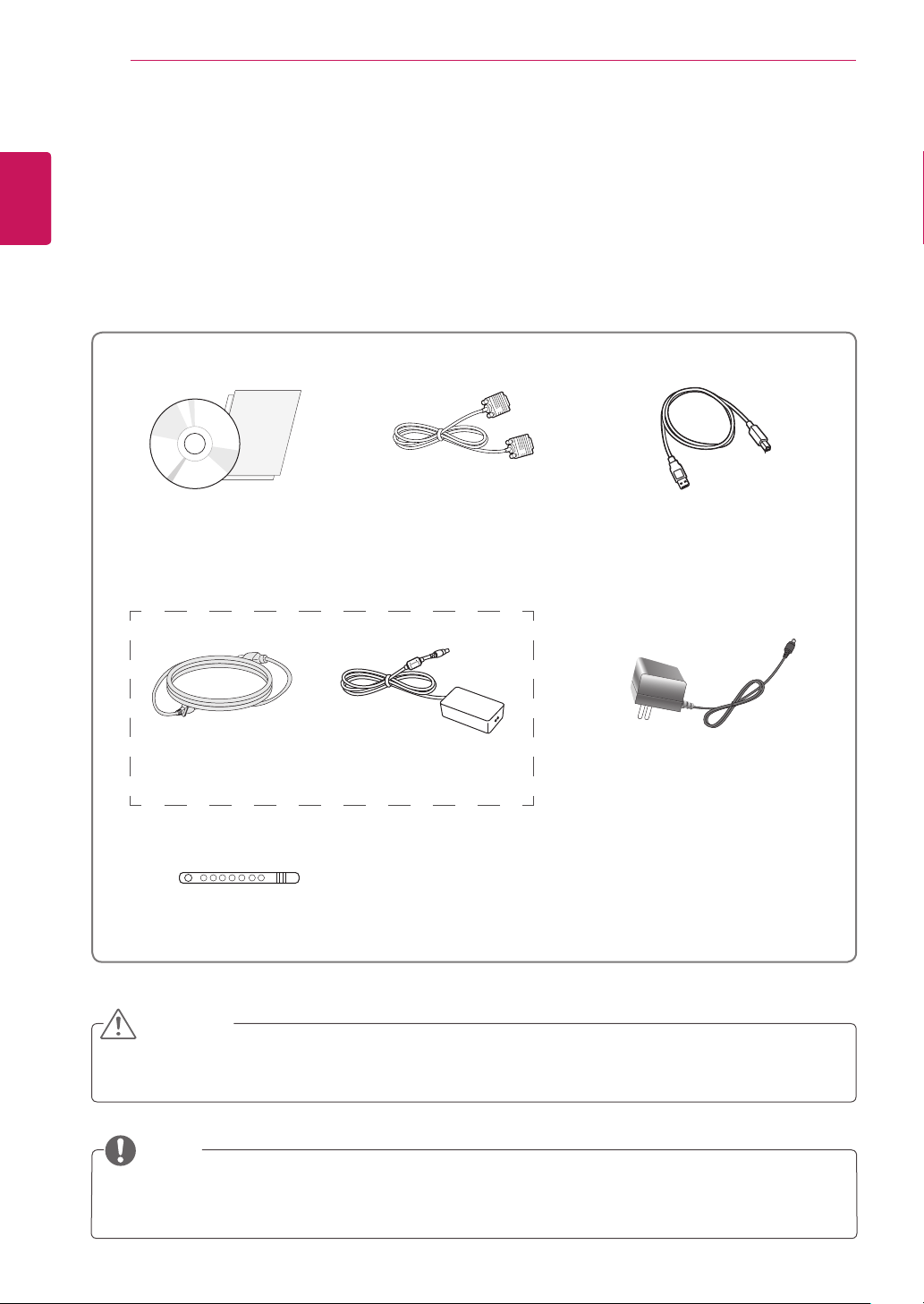
Unpacking
Check your product box for the following items. If there are any missing accessories, contact the local
dealer where you purchased your product. The illustrations in this manual may differ from the actual product
and accessories.
y
Do not use any unapproved accessories to ensure the safety and product life span.
y
Any damages or injuries by using unapproved accessories are not covered by the warranty.
y
The accessories supplied with your product may vary depending on the model.
y
Product specifications or contents in this manual may be changed without prior notice due to upgrade
of product functions.
CAUTION
NOTE
Power Cord
CD(Owner's Manual) /
Card
D-SUB Cable
(This cable is not included in
all countries.)
( Depending on the country )
AC-DC Adapter
AC-DC Adapter
( Depending on the country )
or
A-B Type USB 2.0 Cable
Cable Tie
5
ENG
ENGLISH
ASSEMBLING AND PREPARING
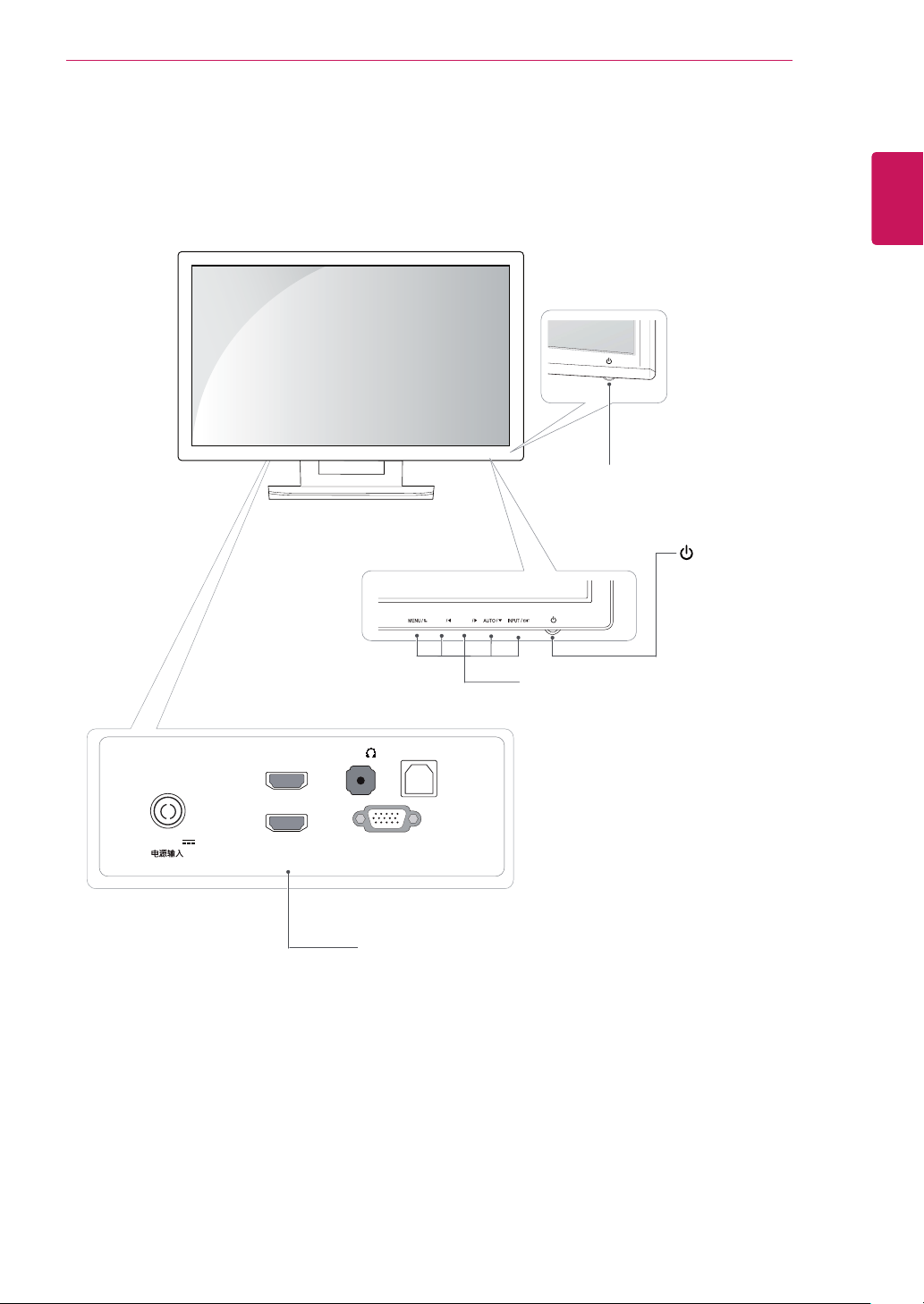
D-SUB IN
HDMI 2
HDMI 1
DC-IN (19 V )
H/P
USB UP
SES MODE
Parts and buttons
Power Indicator
y
Lighting On: Turned on (Red)
y
Lighting Off: Turned off
Connection panel
Button
(Power Button)

6
ENG
ENGLISH
ASSEMBLING AND PREPARING
Setting up the Monitor
Mounting on a table
1
Lift and tilt the Monitor set into its upright
position on a table.
Leave a 10 cm (minimum) space from the wall
for proper ventilation.
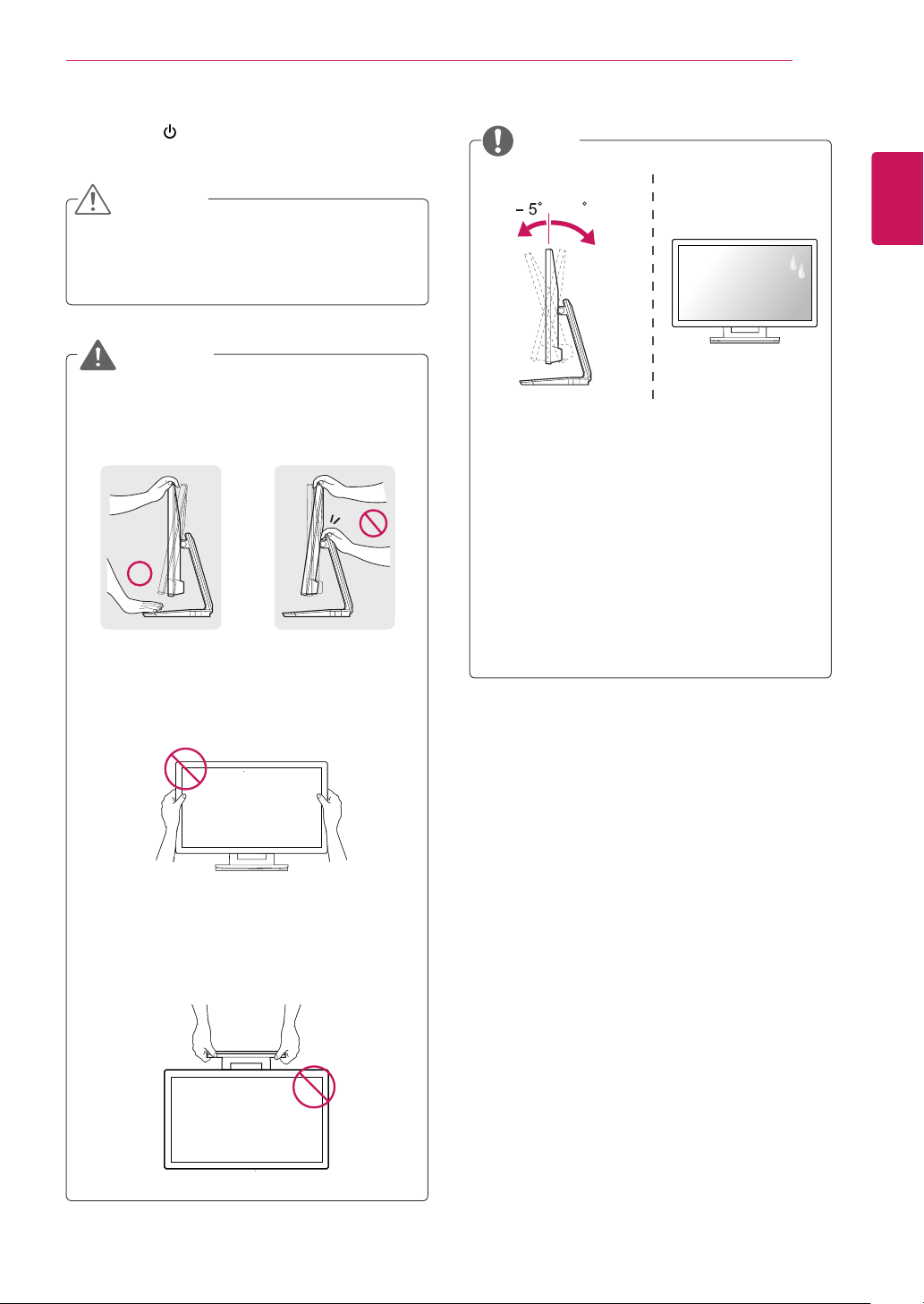
Moving and Lifting the Monitor
When moving or lifting the monitor, follow these
instructions to prevent the monitor from being
scratched or damaged and to ensure safe trans-
portation regardless of its shape or size.
y
As much as possible, avoid touching the
monitor screen. This may result in damage
to the screen or some of the pixels used to
create images.
CAUTION
y
It is advisable to place the monitor in the
original box or packing material before
attempting to move it.
y
Before moving or lifting the monitor, discon-
nect the power cord and all cables.
y
Hold the top and bottom of the monitor frame
firmly. Do not hold the panel itself.
y
When holding the monitor, the screen should
face away from you to prevent it being
scratched.
y
When moving the monitor, avoid any strong
shock or vibrations to the product.
y
When moving the monitor, keep it upright,
never turn the monitor on its side or tilt it
sideways.
2
Connect the AC-DC Adapter and Power Cord
to a wall outlet.
or
10 cm
10 cm
10 cm
10 cm
DC-IN (19 V )
DC-IN (19 V )
7
ENG
ENGLISH
ASSEMBLING AND PREPARING
3
Press the (Power) button on the front panel
to turn the power on.
Unplug the power cord before moving the
Monitor to another location. Otherwise electric
shock may occur.
CAUTION
Do not touch or press the screen when
adjusting the angle of the monitor.
Do not hold this set like below picture.Monitor
screen can detach from stand base and injure
your body.
WARNING
NOTE
To avoid injury to the fingers when adjusting
the screen, do not hold the upper part of the
stand as shown below.
25
25
Front Rear
y
Tilt from +25 to -5 degrees up or down to
adjust the angle of the Monitor set to suit
your view.
y
Avoid using the product in a high
temperature and high humidity area. Moving
the monitor from a environment like this to
an air conditioned area may cause moisture
formation inside the glass. This moisture
will be dissipate over time, which may vary
depending on the operating environment.

8
ENG
ENGLISH
USING THE MONITOR
Using the Kensington security system
The Kensington security system connector is
located at the back of the Monitor set. For more
information of installation and using, refer to the
manual supplied with the Kensington security
system or visit
http://www.kensington.com
.
Connect the Kensington security system cable
between the Monitor set and a table.
The Kensington security system is optional.
You can obtain it from most electronics stores.
NOTE
Tidying cables
Gather and bind the cables with the supplied cable
tie.

9
ENG
ENGLISH
USING THE MONITOR
USING THE MONITOR
Connecting to a PC
Your Monitor supports Plug & Play. When
connected to a PC and turned on, the device will
connect automatically without configuration or
user intervention.
D-SUB connection
Transmits analog video from your PC to the
Monitor set. Connect the PC and the Monitor with
the supplied D-sub 15 pin signal cable as shown in
the following illustrations.
y
This monitor support PC input via HDMI,
but you may experience some compatibility
issues.
NOTE
HDMI connection
Transmits the digital video and audio signals from
your PC or A/V to the Monitor. Connect the PC or
A/V and the Monitor with the HDMI cable as shown
in the following illustrations.
y
Mac adapter
For Apple Macintosh use, a separate plug
adapter is needed to change the 15 pin
high density (3 row) D-SUB VGA connector
on the supplied cable to a 15 pin 2 row
connector.
y
When using a D-Sub signal input cable
connector for Macintosh
NOTE
D-SUB IN
HDMI 2
HDMI 1
H/P
USB UP
D-SUB IN
HDMI 2
HDMI 1
H/P
USB UP
D-SUB IN
HDMI 2
HDMI 1
H/P
USB UP
D-SUB IN
HDMI 2
HDMI 1
H/P
USB UP
D-SUB OUT
HDMI OUT HDMI OUT
D-SUB IN
HDMI 2
HDMI 1
H/P
USB UP
D-SUB IN
HDMI 2
HDMI 1
H/P
USB UP
D-SUB IN
HDMI 2
HDMI 1
H/P
USB UP
D-SUB IN
HDMI 2
HDMI 1
H/P
USB UP
D-SUB OUT
HDMI OUT HDMI OUT
(sold separately)
10
ENG
ENGLISH
USING THE MONITOR
y
"Self Image Setting" Function.
This function provides the user with optimal
display settings.When the user connects
the monitor for the first time, this function
automatically adjusts the display to optimal
settings for individual input signals.(Only
supported in Analog Mode)
y
‘AUTO’ Function.
When you encounter problems such as
blurry screen, blurred letters, screen flicker
or tilted screen while using the device or
after changing screen resolution, press the
AUTO function button to improve resolution.
(Only supported in Analog Mode)
NOTE
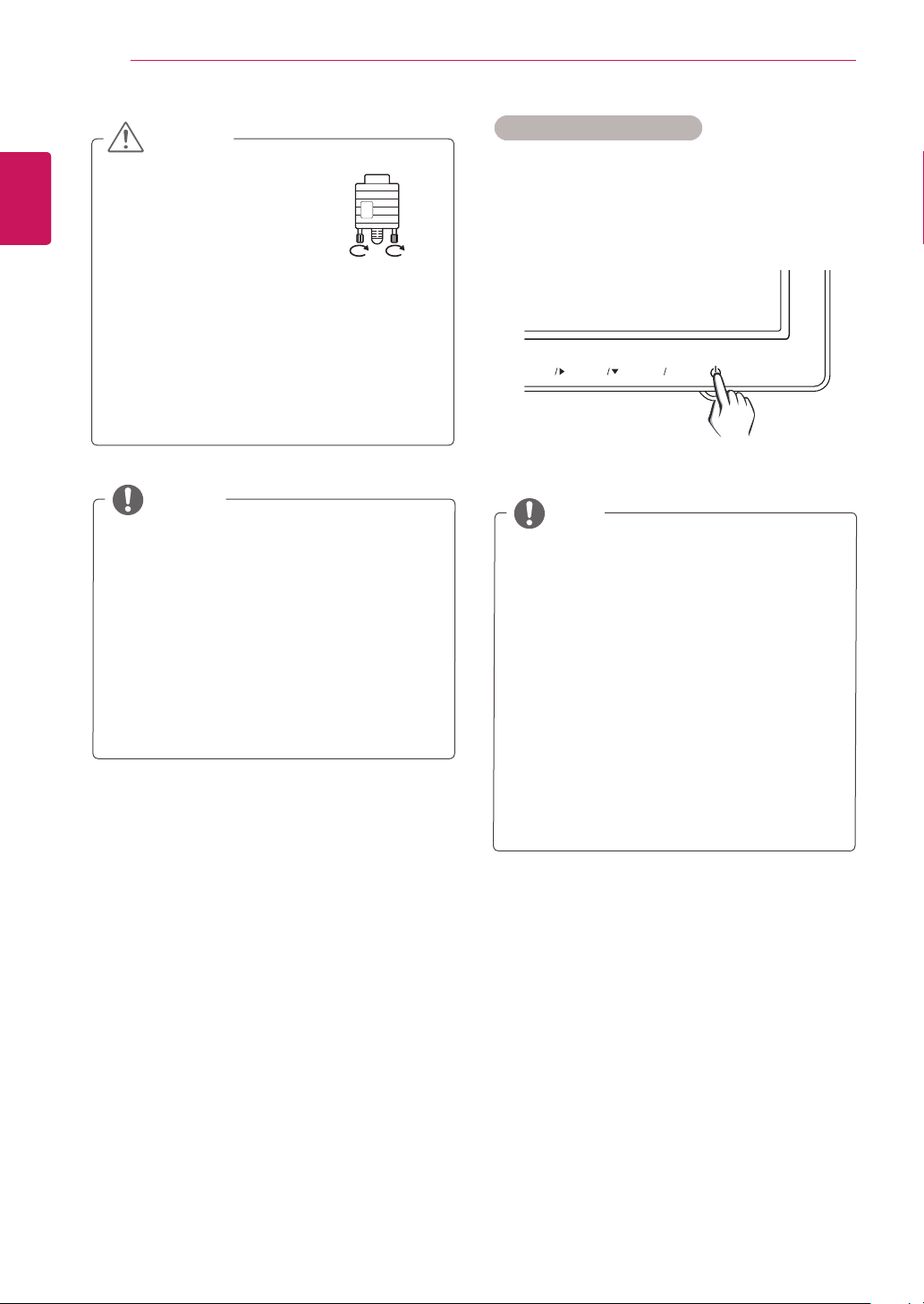
y
Connect the signal
input cable and tighten
it by turning the screws
clockwise.
y
Do not press the screen with your finger for
a long time as this may result in temporary
distortion on the screen.
y
Avoid displaying a fixed image on the
screen for a long period of time to prevent
image burn. Use a screensaver if possible.
CAUTION
Self Image Setting Function
Press the power button to turn on the monitor.
When monitor power is turned on, the "Self Image
Setting" Function is executed automatically. (Only
supported in Analog Mode)
y
When connecting the power cord to the out-
let, use a grounded (3-hole) multi-socket or a
grounded power outlet.
y
The monitor may flicker when turned on in an
area of low temperature. This is normal.
y
Sometimes red, green, or blue spots may ap-
pear on the screen. This is normal.
y
Using a DVI to HDMI cable may cause com-
patibility issues.
NOTE
AUTO INPUT EXITMODE
11
ENG
ENGLISH
USING THE MONITOR
D-SUB IN
HDMI 2
HDMI 1
H/P
USB UP
D-SUB IN
HDMI 2
HDMI 1
H/P
USB UP
D-SUB IN
HDMI 2
HDMI 1
H/P
USB UP
D-SUB IN
HDMI 2
HDMI 1
H/P
USB UP
D-SUB OUT
HDMI OUT HDMI OUT
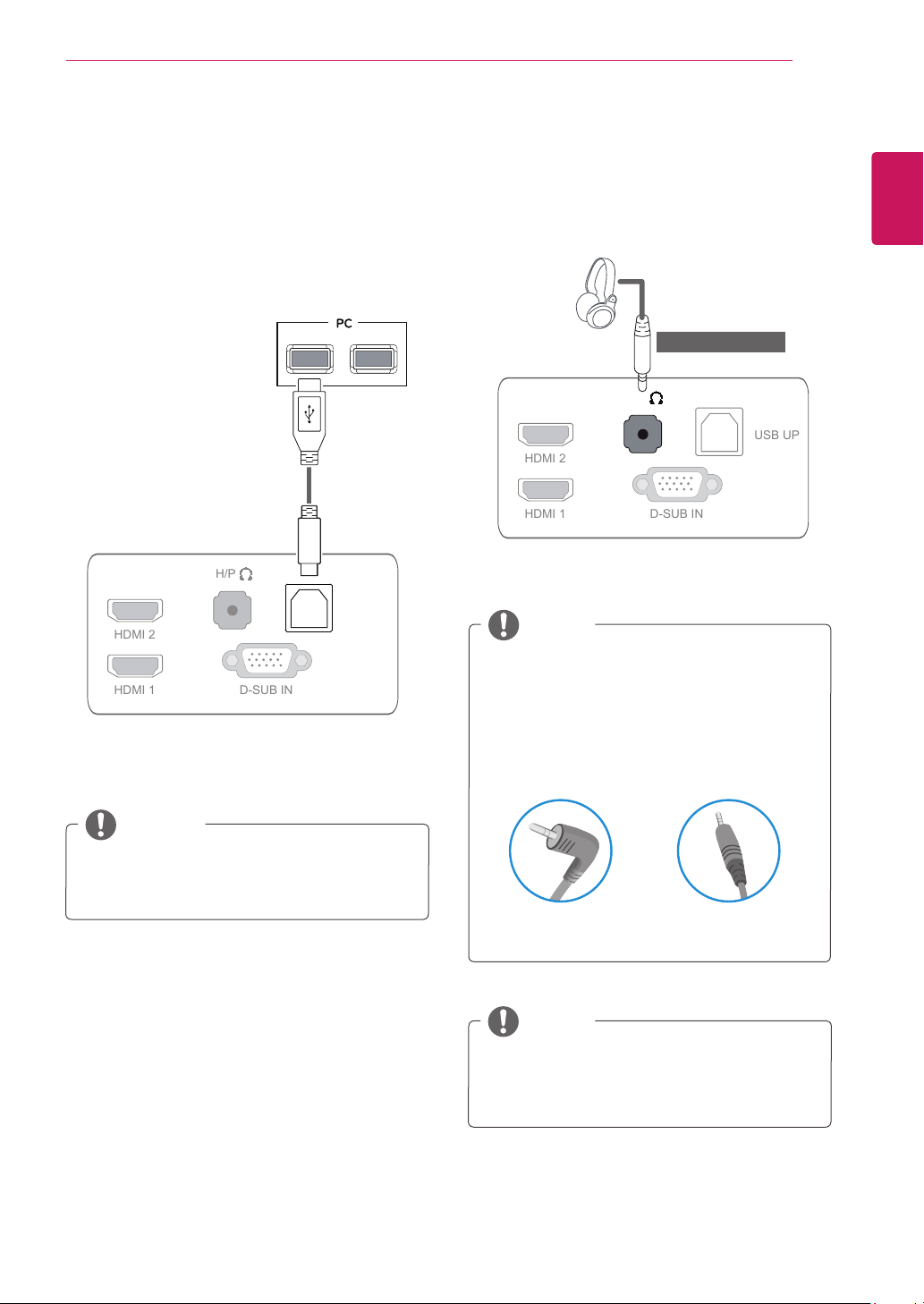
USB cable-PC connection
To use the touch screen, connect the USB port to
the PC.
Use a USB 2.0 cable with A-B type to connect your
PC.
(The USB port on the monitor is only for the touch
screen feature.)
y
Please install the latest Windows service
pack before use.
NOTE
D-SUB IN
HDMI 2
HDMI 1
H/P
USB UP
D-SUB IN
HDMI 2
HDMI 1
H/P
USB UP
D-SUB IN
HDMI 2
HDMI 1
H/P
USB UP
D-SUB IN
HDMI 2
HDMI 1
H/P
USB UP
D-SUB OUT
HDMI OUT HDMI OUT
Headphone port connection
Use the headphone port to connect a peripheral
device to the monitor. Connect as illustrated.
y
Depending on the audio settings of the PC
and external device, headphone and speaker
functions may be limited.
NOTE
y
Peripheral devices are sold separately.
y
The USB port cannot be used to connect a
keyboard, mouse, and other USB devices.
y
For an angle plug earphone, it is difficult
connect it with a peripheral device, so use a
straight type.
NOTE
Angle Type Straight Type
(sold separately)
12
ENG
ENGLISH
CUSTOMIZING SETTINGS
CUSTOMIZING SETTINGS
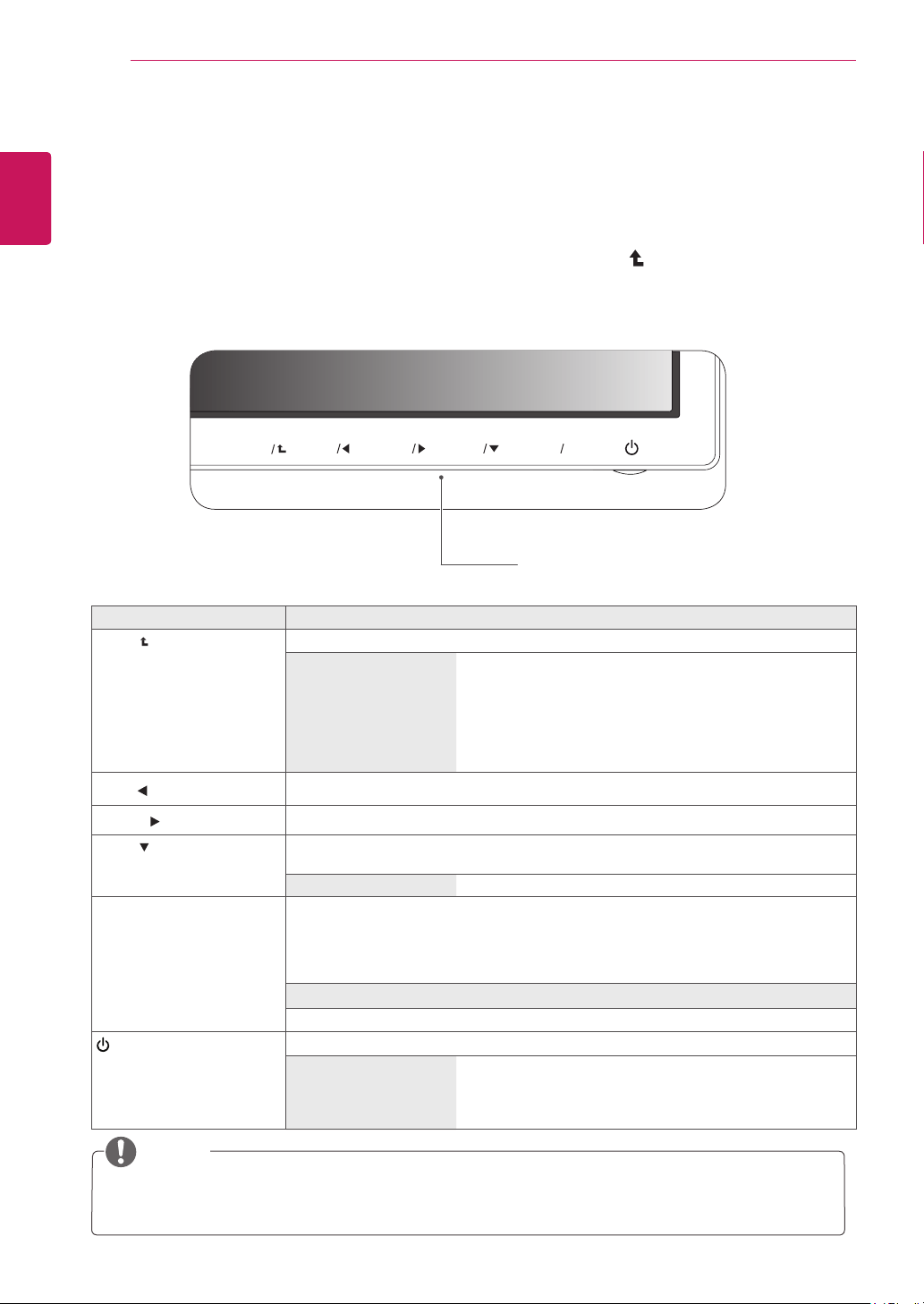
1
Press the desired button on the bottom of the Monitor.
2
Change the value of the menu item by pressing the buttons on the bottom of the Monitor.
To return to the upper menu or set other menu items, use the up arrow ( ) button.
3
Select EXIT to leave the OSD menu.
Monitor set Buttons
MENU SES AUTO INPUT EXITMODE
Button Description
MENU
Accesses the main menus.
OSD LOCKED/
UNLOCKED
This function allows you to lock the current control settings,
so that they cannot be inadvertently changed.
y
Press and hold the Menu button for a few seconds. Then,
you will be prompted to set the OSD Lock.
y
You can unlock the OSD controls at any time by pushing
the MENU button for several seconds. The message "OSD
UNLOCKED" should appear.
SES /
Enables the SUPER ENERGY SAVING function.
MODE /
Goes to the Picture Mode menu.
AUTO
When adjusting your display settings, always press the AUTO button. (Only supported in
Analog Mode)
The best display mode 1920 x 1080
INPUT / EXIT You can choose the input signal.
• When two input signals are connected, you can select the input signal (D-SUB/
HDMI1/HDMI2) you want.
• When only one signal is connected, it is automatically detected. The default setting is
D-SUB.
EXIT
Exit the OSD (On Screen Display).
(Power Button)
Turns the power on or off.
Power Indicator When the monitor is in operating mode, the power indicator
will turn red (on mode).
When the monitor is in power-saving mode, the power indica-
tor will blink red.
NOTE
All of the buttons are touch sensitive and can be operated by simply touching their label with your
finger.
13
ENG
ENGLISH
CUSTOMIZING SETTINGS
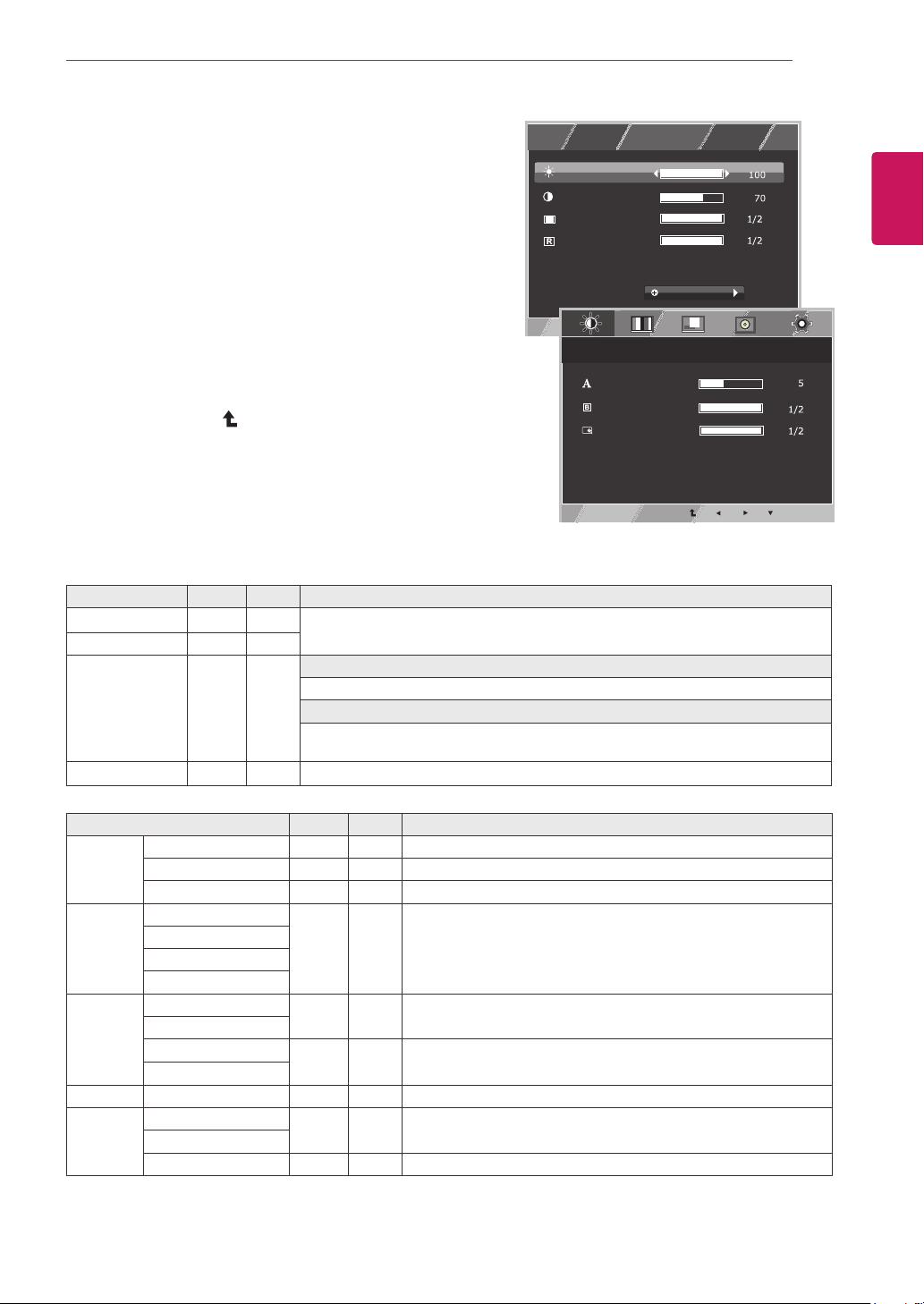
Customizing Settings
Menu Settings
1
Press MENU button on the bottom of the Monitor to
display the MENU OSD.
2
Set the options by pressing the ◄ or ► or ▼
buttons.
3
Select the "NEXT MENU" button to enter the more
option settings.
4
Select EXIT to leave the OSD menu.
To return to the upper menu or set other menu items,
use the up arrow ( ) button.
Each option is explained below.
MENU > NEXT MENU Analog HDMI Description
PICTURE SHARPNESS O O To adjust the clearness of the screen .
BLACK LEVEL x O To set offset level
OVER SCAN x O To improve the clarity and stability of the screen
COLOR GAMMA
O O To customize the color of the screen
COLOR TEMP
SIX COLOR
COLOR RESET
DISPLAY HORIZONTAL
O x To adjust the position of the screen
VERTICAL
CLOCK
O x To improve the clarity and stability of the screen
PHASE
VOLUME x O To adjust the volume
OTHERS LANGUAGE
O O To customize the screen status for a user's operating environment
POWER INDICATOR
RESPONSE TIME O O Sets the response time for the picture.
y
HDMI: HDMI(Digital signal) input.
MENU Analog HDMI Description
BRIGHTNESS
O O
To adjust the brightness, contrast of the screen
CONTRAST O O
WIDE/ORIGINAL
O O
WIDE
Switch to full screen mode according to input image signal.
ORIGINAL
Change the input image signal ratio to original.
* This function works only if input resolution is lower than Monitor set ratio (16:9).
RESET
O O
Restore all factory default settings. Press the
◄
,
►
buttons to reset immediately.
MENU
BRIGHTNESS
NEXT MENU
CONTRAST
WIDE / ORIGINAL
RESET
WIDE
NO
MENU > NEXT MENU > PICTURE
SHARPNESS
BLACK LEVEL
OVER SCAN
HIGH
EXIT
OFF
14
ENG
ENGLISH
CUSTOMIZING SETTINGS
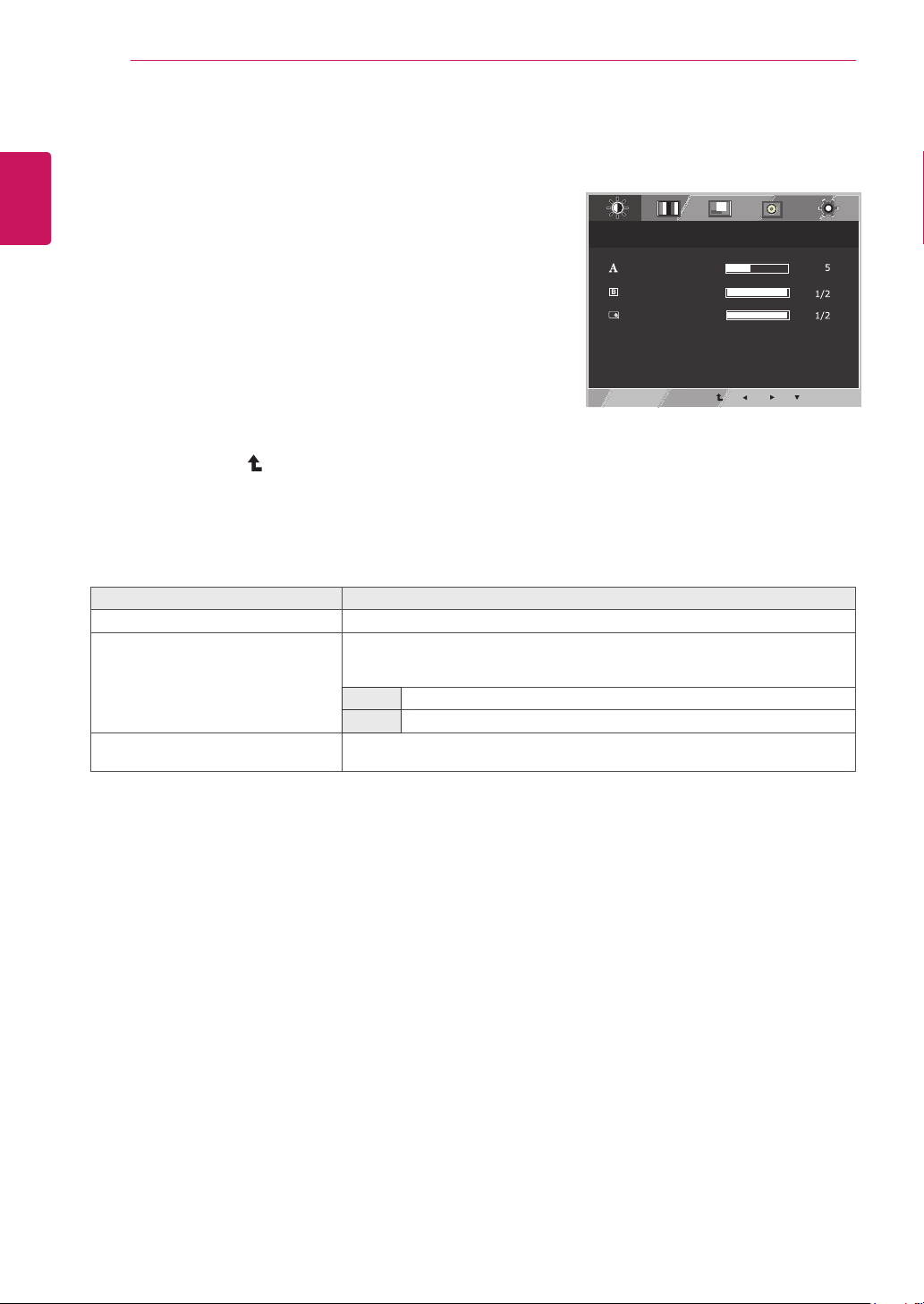
PICTURE
1
Press MENU button on the bottom of the Monitor set
to display the MENU OSD.
2
Select the "NEXT MENU" button to enter the more
option settings.
3
Select PICTURE by pressing the ► button.
4
Enter to PICTURE by pressing the ▼ button.
5
Set the options by pressing the ◄ or ► or ▼
buttons.
6
Select EXIT to leave the OSD menu.
To return to the upper menu or set other menu items,
use the up arrow ( ) button.
Each option is explained below.
MENU > NEXT MENU > PICTURE Description
SHARPNESS Enhances the edges of the images in the video.
BLACK LEVEL This sets the black level offset. (only for HDMI input)
* Offset?As the criteria for video signal, it is the darkest screen the monitor can
show.
HIGH The screen will be bright.
LOW The screen will be dark.
OVER SCAN When using A/V equipment, the edges of the video may contain noise. This
feature removes the edges of the video signal. Only supported on HDMI inputs.
MENU > NEXT MENU > PICTURE
SHARPNESS
BLACK LEVEL
OVER SCAN
HIGH
EXIT
OFF

15
ENG
ENGLISH
CUSTOMIZING SETTINGS
COLOR
1
Press the MENU button on the bottom of the Monitor
set to display the MENU OSD.
2
Select the "NEXT MENU" button to open more option
settings.
3
Select COLOR by pressing the ► button.
4
Open COLOR by pressing the ▼ button.
5
Set the options by pressing the ◄ or ► or ▼
buttons.
6
Select EXIT to leave the OSD menu.
To return to the upper menu or set other menu items,
use the up arrow ( ) button.
Each option is explained below.
MENU > NEXT MENU > COLOR Description
GAMMA Set your own gamma value. : GAMMA 0, GAMMA 1, GAMMA 2 on the monitor,
high gamma values display whitish images and low gamma values display
blackish images.
COLOR TEMP CUSTOM
• RED:Set your own red color levels.
• GREEN: Set your own green color levels.
• BLUE:Set your own blue color levels.
Select the screen color.
WARM: Set the screen to warm color temperature (more red).
MEDIUM: Set the screen to medium color temperature.
COOL: Set the screen to cool color temperature (more blue).
SIX COLOR Sets and stores the hue and saturation for six colors(RED/ GREEN/BLUE/
CYAN/MAGENTA/YELLOW) to satisfy the color requirements of a user.
HUE Adjusts the screen hue.
SATURATION Adjusts the color sharpness on the screen. Lower values make
the color sharpness weaker and colors lighter while higher
values make the color sharpness stronger and colors dark.
COLOR RESET Resets the color settings to the factory default settings for the current input
device.
MENU > NEXT MENU > COLOR
GAMMA
COLOR TEMP
RED
GREEN
BLUE
GAMMA 1
CUSTOM
MENU > NEXT MENU > COLOR
SIX COLOR
HUE
SATURATION
COLOR RESET
RED
EXIT
NO
16
ENG
ENGLISH
CUSTOMIZING SETTINGS
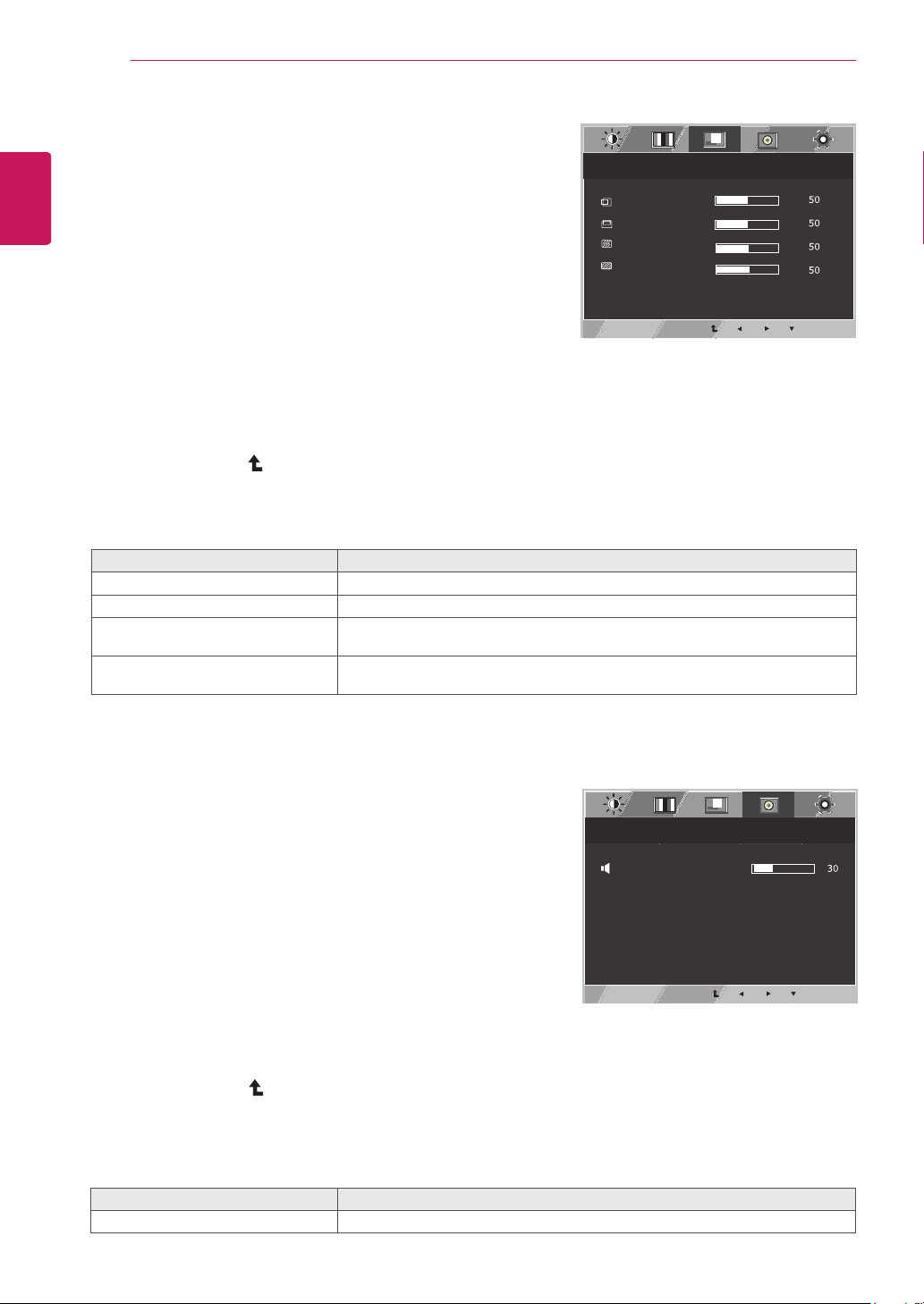
DISPLAY
1
Press MENU button on the bottom of the Monitor set
to display the MENU OSD.
2
Select the "NEXT MENU" button to enter the more
option settings.
3
Select DISPLAY by pressing the ► button.
4
Open DISPLAY by pressing the ▼ button.
5
Set the options by pressing the ◄ or ► or ▼
buttons.
6
Select EXIT to leave the OSD menu.
To return to the upper menu or set other menu items,
use the up arrow ( ) button.
Each option is explained below.
VOLUME
1
Press MENU button on the bottom of the Monitor set
to display the MENU OSD.
2
Select the "NEXT MENU" button to enter the more
option settings.
3
Select VOLUME by pressing the ► button.
4
Enter to VOLUME by pressing the ▼ button.
5
Set the options by pressing the ◄ or ► buttons.
6
Select EXIT to leave the OSD menu.
To return to the upper menu or set other menu items,
use the up arrow ( ) button.
Each option is explained below.
MENU > NEXT MENU > DISPLAY Description
HORIZONTAL To move the screen left and right.
VERTICAL To move the screen up and down.
CLOCK To minimize any vertical bars or stripes visible on the screen background.The
horizontal screen size will also change.
PHASE To adjust the focus of the display. This item allows you to remove any horizontal
noise and clear or sharpen the image of characters.
MENU > NEXT MENU > VOLUME Description
VOLUME To adjust the volume of headphone/earphone.(Only for HDMI input)
MENU > NEXT MENU > DISPLAY
HORIZONTAL
VERTICAL
CLOCK
PHASE
EXIT
MENU > NEXT MENU > VOLUME
VOLUME
EXIT

17
ENG
ENGLISH
CUSTOMIZING SETTINGS
OTHERS
1
Press MENU button on the bottom of the Monitor to
display the MENU OSD.
2
Select the "NEXT MENU" button to enter the more
option settings.
3
Select OTHERS by pressing the ► button.
4
Enter to OTHERS by pressing the ▼ button.
5
Set the options by pressing the ◄ or ► or ▼
buttons.
6
Select EXIT to leave the OSD menu.
To return to the upper menu or set other menu items,
use the up arrow ( ) button.
Each option is explained below.
MENU > NEXT
MENU > OTHERS
Description
LANGUAGE Chooses the language of the OSD.
POWER
INDICATOR
Activates/deactivates the power indicator LED.
ON The power indicator is automatically turned on.
Off The power indicator is turned off.
AUTOMATIC
STANBY
Once the specified standby time passes, the monitor turns off automatically. Pressing any button
or changing the resolution will initialize the standby time.
Off The automatic standby function is turned off.
4H The monitor is automatically turned off after 4 hours.
6H The monitor is automatically turned off after 6 hours.
8H The monitor is automatically turned off after 8 hours.
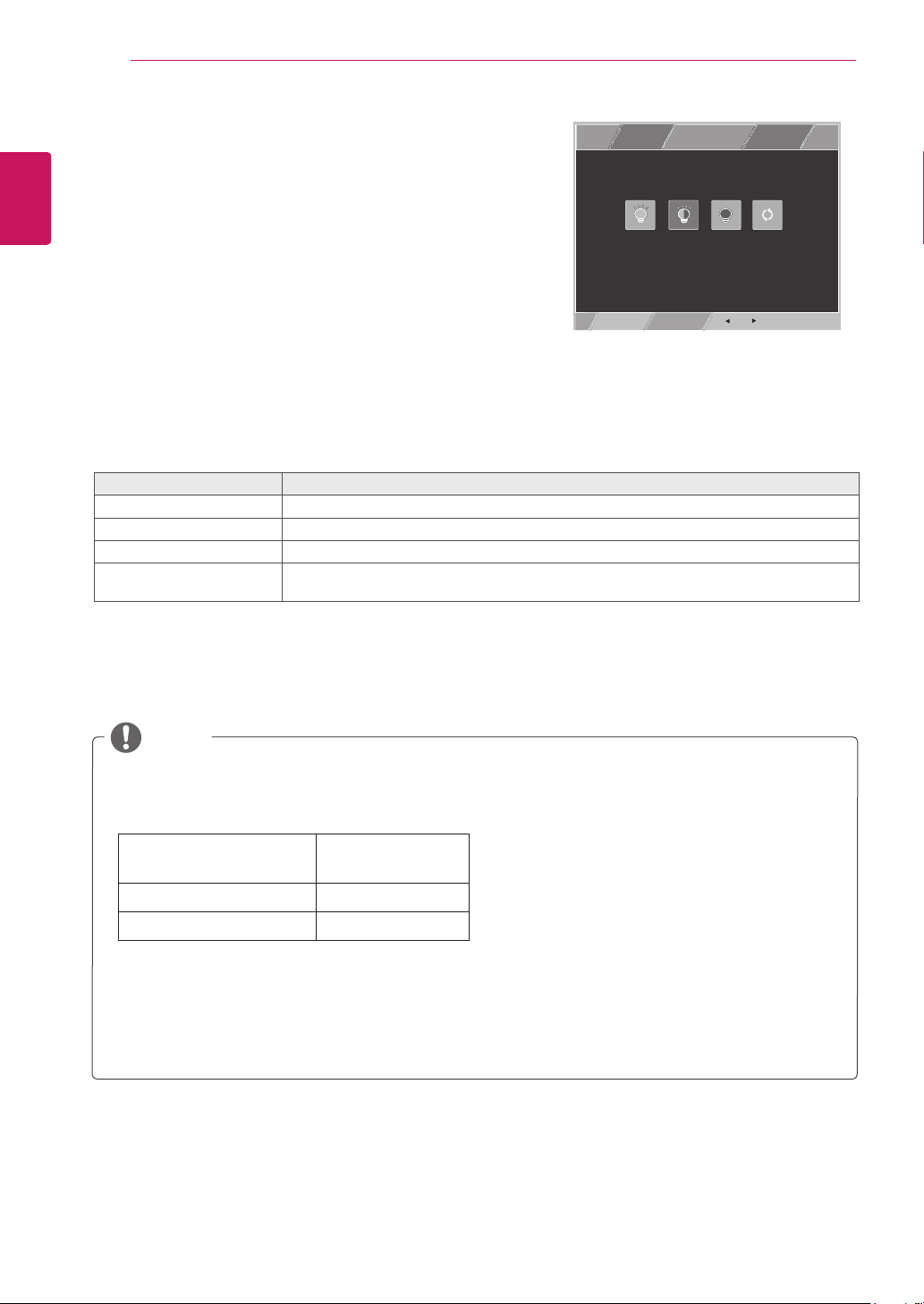
RESPONSE TIME You can set a response time for displayed pictures based on the speed of the screen. For a
normal environment, it is recommended that you use 'NORMAL'. For a fast-moving picture, it is
recommended that you use 'FAST'.
Setting to High may cause image sticking.
Off The response time is turned off.
High
Sets the response time to High.
Middle
Sets the response time to Middle.
Low
Sets the response time to Low.
MENU > NEXT MENU > OTHERS
LANGUAGE
POWER INDICATOR
AUTOMATIC STANBY
RESPONSE TIME
D-SUB 1920 X 1080 60HZ
ENGLISH
ON
OFF
EXIT
FAST
18
ENG
ENGLISH
CUSTOMIZING SETTINGS
SUPER ENERGY SAVING
1
Press SES button on the bottom of the Monitor to display the
SUPER ENERGY SAVING OSD.
2
Set the options by pressing the ◄ or ► buttons.
3
Select EXIT to leave the OSD menu.
Each option is explained below.
y
TOTAL POWER REDUCTION: How much power is saved while using the monitor.
y
TOTAL CO2 REDUCTION: Change the TOTAL POWER REDUCTION to CO2.
y
SAVING DATA(W/h)
584 mm
(23 inch)
SUPER SAVING (High) 6 W/h
SUPER SAVING (Low) 3 W/h
y
Saving Data depends on the Panel. Values will be different from each panel and panel vendor.
y
LG calculated these values by using a “broadcast video signal”
(including broadcast video: IEC 62087)
y
SUPER SAVING refers to how much power can be saved using the SUPER ENERGY SAVING
function.
NOTE
SUPER ENERGY SAVING Description
High
Enables SUPER ENERGY SAVING you can save energy with this energy- high efficient function.
Low
Enables SUPER ENERGY SAVING you can save energy with this energy- low efficient function.
Off
Disables SUPER ENERGY SAVING.
Reset Resets the values of total energy consumption reduction and CO2 emission reduction
estimates.
SUPER ENERGY SAVING
High
Low Off Reset
Power Reduction : 6W
CO2 Reduction : 4g
EXIT

19
ENG
ENGLISH
CUSTOMIZING SETTINGS
Each option is explained below.
Picture Mode Description
PC Mode
Custom Allows the user to adjust each element. The color mode of the main menu can be adjusted.
Text Optimizes the screen for document processing.
Photo Optimizes the screen to view photos.
Cinema Optimizes the screen to improve the visual effects of a video.
Game Optimizes the screen for gameplay.
AV Mode (Only for HDMI input)
Custom Allows the user to adjust each element. The color mode of the main menu can be adjusted.
VIVID 1
Optimizes the screen for vivid visual effects.
VIVID 2
Optimizes the screen for more vivid visual effects.
Standard Optimizes the screen to display normal picture quality.
Cinema Optimizes the screen to improve the visual effects of a video.
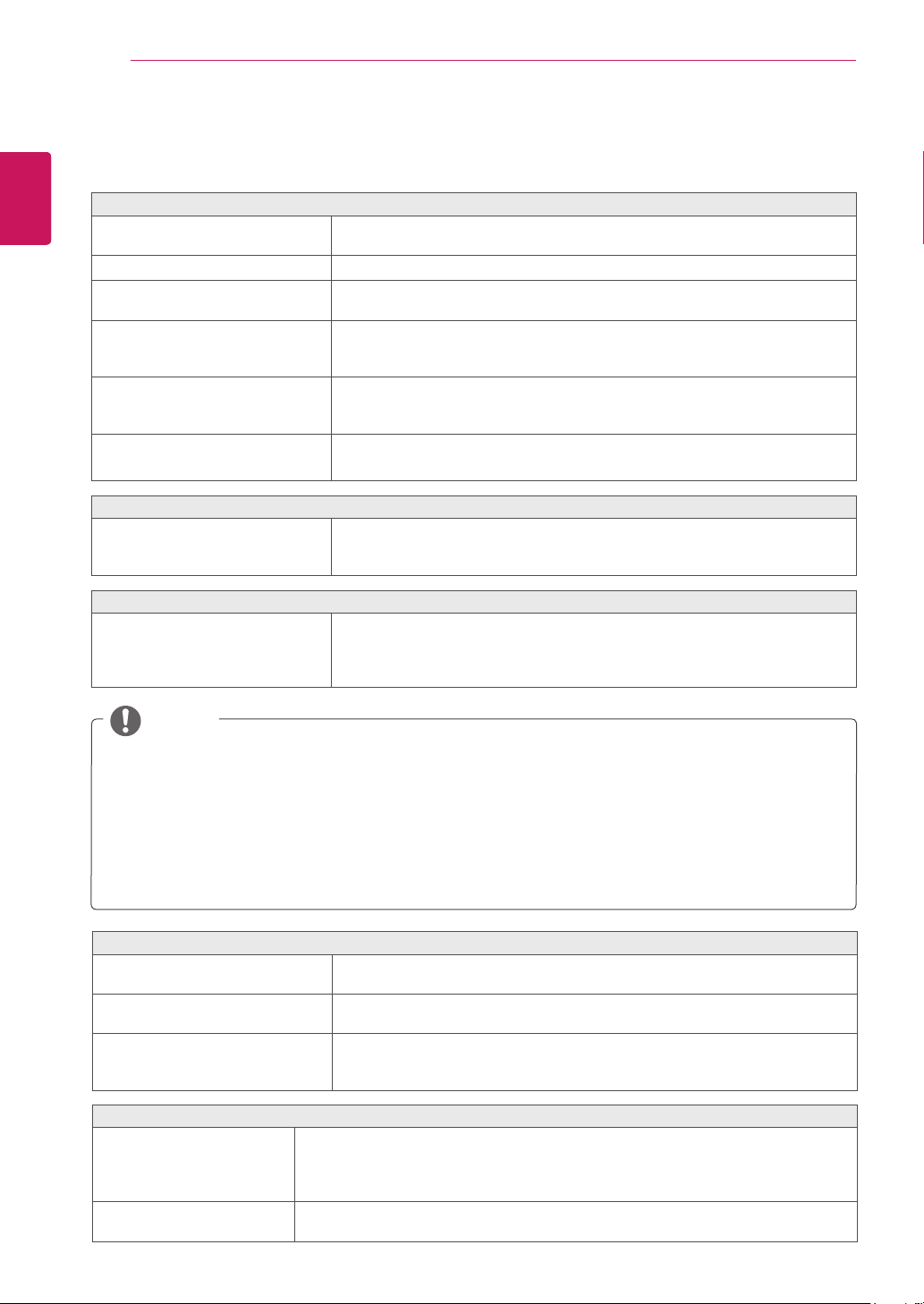
Picture Mode
1
Press MODE button on the bottom of the Monitor set to
display the Picture Mode OSD.
2
Set the options by pressing the ◄ or ►buttons.
3
Select EXIT to leave the OSD menu.
Picture Mode
Custom
Text Photo Cinema
Game
EXIT
20
ENG
ENGLISH
TROUBLESHOOTING
TROUBLESHOOTING
Nothing is displayed on the screen.
Is the monitor's power cord plugged
in?
y
Check if the power cord is correctly plugged in to the power outlet.
Is the power indicator on?
y
Check the power cable connection and press the power button.
Is the power indicator displaying
red?
y
Check that the connected input is enabled (Menu - Input).
Is the power indicator blinking?
y
If the monitor is in power-saving mode, move the mouse or press any key on
the keyboard to switch the display on.
y
Check if the computer is turned on.
Is the "OUT OF RANGE" message
displayed?
y
This occurs when signals transferred from the PC (video card) are out of the
horizontal or vertical frequency range of the monitor. Please see the "Product
Specification" section of this manual to set the appropriate frequency.
Is the "CHECK SIGNAL CONNEC-
TION" message is displayed?
y
This is displayed when the signal cable between the PC and the monitor is
missing or disconnected. Check the cable and reconnect.
Do you see a "OSD LOCKED" message on the screen?
Do you see “OSD LOCKED” when
you push MENU button?
y
You can secure the current control settings, so that they cannot be inadvertently
changed. You can unlock the OSD controls at any time by pushing the MENU
button for several seconds: the message “OSD UNLOCKED” will appear.
The screen retains an image.
Does image sticking occur even
when the monitor is turned off?
y
Displaying a still image for a prolonged time may cause damage to the screen,
resulting in the retention of the image.
y
Use a screen saver to protect the screen when using the monitor for a pro-
longed period of time.
y
Vertical Frequency: In order to display an image, the screen must be refreshed dozens of times per second like a
fluorescent lamp.
The number of times the screen is refreshed per second is called vertical frequency or refresh rate and is repre-
sented by Hz.
y
Horizontal Frequency: The time it takes to display one horizontal line is called the horizontal cycle. The number
of horizontal lines displayed in one second can be calculated by dividing one by the horizontal cycle. This is called
horizontal frequency and is represented by kHz.
NOTE
Touch does not work normally.
Touch does not work at all.
y
Check whether the USB cable is properly connected to the PC.
(No additional USB touch program installation is required.)
y
Check your operating system. The touch function is supported only on Windows 7
and Windows 8.
Multi touch does not work.
y
Windows 7 Starter, Home basic version are not support multi-touch as default option.
Please check the details on the homepage of the Microsoft.
The image on the screen looks strange. (It works only in analog mode.)
Does the screen area appear un-
centered?
Pressing the AUTO button will automatically optimize the screen to the current
display mode.
Do you see vertical lines on the
screen?
Pressing the AUTO button will automatically optimize the screen to the current
display mode.
Do you see horizontal noise lines
or does text appear blurred on the
screen?
Pressing the AUTO button will automatically optimize the screen to the current
display mode.

21
ENG
ENGLISH
TROUBLESHOOTING
y
Check Control Panel ► Display ► Settings and see if the frequency or the resolution were changed. If yes,
readjust the video card to the recommend resolution.
y
If the recommended resolution (optimal resolution) is not selected, letters may be blurred and the screen may be
dimmed, truncated or biased. Make sure to select the recommend resolution.
y
Settings can differ between computer and O/S (Operation System), and resolution mentioned above may not be
supported by every video card. For graphics card related issues or to obtain the newest driver, refer to the maker
of your graphics card.
CAUTION
The display color is abnormal.
Does the display appear discolored
(16 color)?
y
Set the color to 24 bit (true color) or higher. In Windows, go to Control Panel >
Display > Settings > Color Quality.
Does the display color appear un-
stable or in monochrome?
y
Check if the signal cable is connected properly. Reconnect the cable or reinsert
the PC's video card.
Are there spots on the screen?
y
When using the monitor, pixilated spots (red, green, blue, white or black) may
appear on the screen. This is normal for the LCD screen. It is not an error nor
is it related to the monitor's performance.
Do you see an "Unrecognized monitor, Plug&Play (VESA DDC) monitor found" message?
Have you installed the display
driver?
y
Be sure to install the display driver from the display driver CD (or diskette) that
comes with your display. Or, you can also download the driver from our web
site: http://www.lg.com.
y
Make sure to check if the video card supports Plug&Play function.
The screen is flickering.
Did you select the recommended
resolution?
y
If the selected resolution is HDMI 1080i 60/50 Hz, the screen may be flickering.
Change the resolution to the recommended resolution 1080P.
HDMI
The picture cannot be displayed in
full screen in HDMI mode.
y
Did you change the Scaling Options for your video card?
y
The HDMI Scaling Options of the AMD/ATI video card is set to Underscan by
default so the picture cannot be displayed in full screen.
Run Catalyst Control Center and set the Scaling Options to 0% Overscan.
22
ENG
ENGLISH
TROUBLESHOOTING
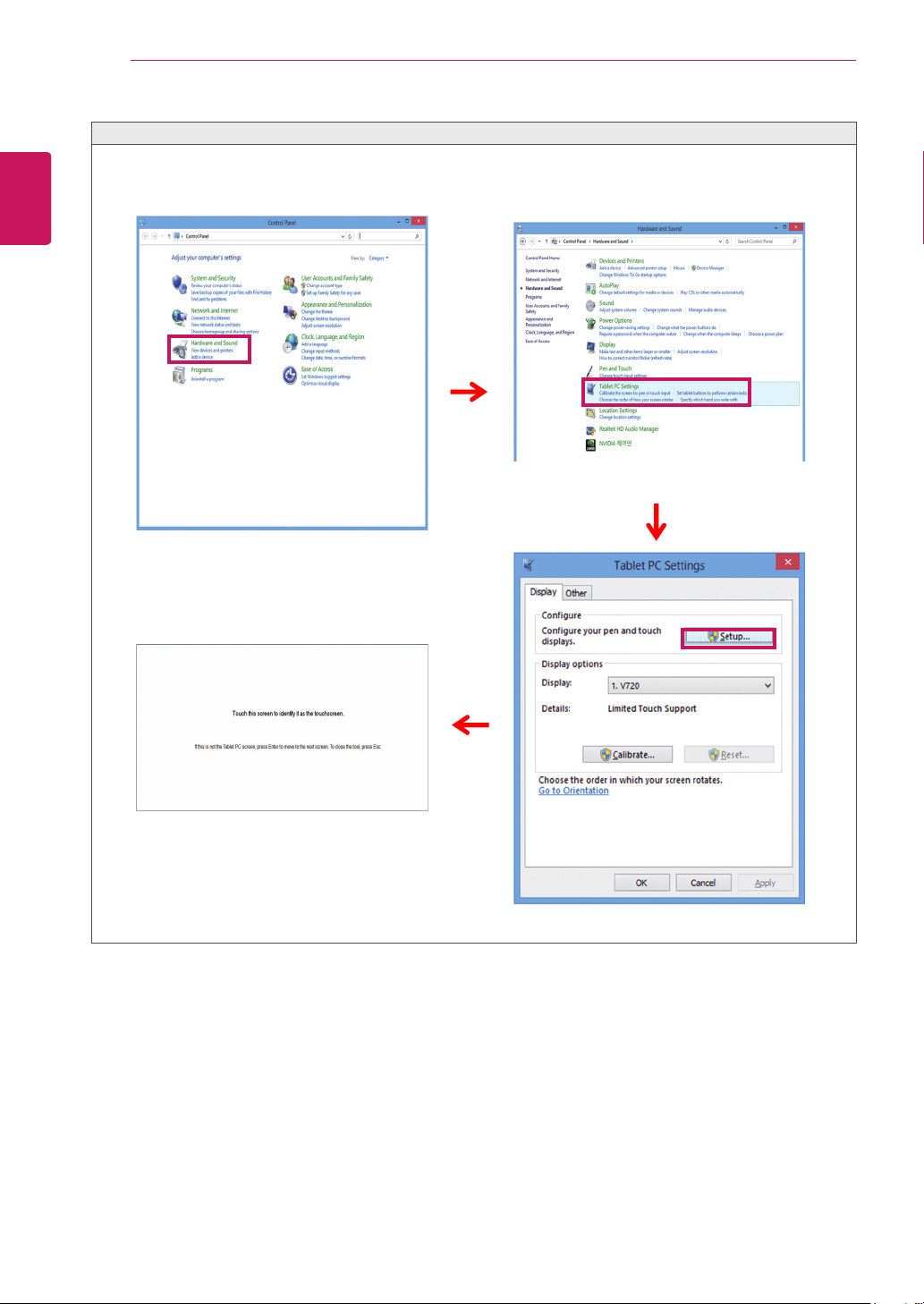
Touch does not respond when the desktop is extended to a second touch monitor.
In Windows 7 and Windows 8, you can configure the second monitor as the touch screen as shown below.
(Control Panel -> Hardware and Sound -> Tablet PC Settings -> Setup -> Setup and click the screen of the second
touch monitor)
<Control Panel -> Hardware and Sound>
<Setup and click the screen of the second
touch monitor>
<Tablet PC Settings>
<Setup>

23
ENG
ENGLISH
SPECIFICATIONS
SPECIFICATIONS
LCD Screen Type 58.42 cm TFT (Thin Film Transistor)
LCD (Liquid Crystal Display) Screen
Diagonal length of the screen: 58.42 cm
Pixel Pitch 0.2652 mm x 0.2652 mm
Resolution Maximum Resolution D-Sub (Analog) : 1920 x 1080 @ 60 Hz
HDMI : 1920 x 1080 @ 60 Hz
Recommended Resolution 1920 x 1080 @ 60 Hz
Video Signal
Horizontal Frequency 30 kHz to 83 kHz
Vertical Frequency 56 Hz to 75 Hz (D-Sub)
56 Hz to 61 Hz (HDMI)
Synchronization Separate Sync. / HDMI
Input Connector 15 pin D-SUB Connector / HDMI Connector
Power Voltage 19 V 1.3 A
Power consumption (Typ.) On mode: 25 W (Typ.)
Power Saving Mode ≤ 0.3 W
Off Mode ≤ 0.3 W
AC/DC adaptor Type LCAP21 (24W Desk-top), manufactured by Lien Chang Electronic
or Type LCAP26-E (24W Wall-mount KR/EU (except UK)), manufactured by Lien
Chang Electronic
Output: 19 V 1.3 A
Dimension/
Weight
Monitor Size (Width x Height x Depth)
554.8 mm x 399.1 mm x 207.8 mm
Weight (Without Packag-
ing)
6.4 kg
Stand Angle
Adjustment
Forwards/Backwards: -5° to 25° (Head)
Environmental
Conditions
Operating Condition Temperature: 10°C to 35°C; Humidity: 10% to 80%
Storing Condition Temperature: -20°C to 60°C; Humidity: 5% to 90%
The specifications are subject to change without notice.
24
ENG
ENGLISH
SPECIFICATIONS
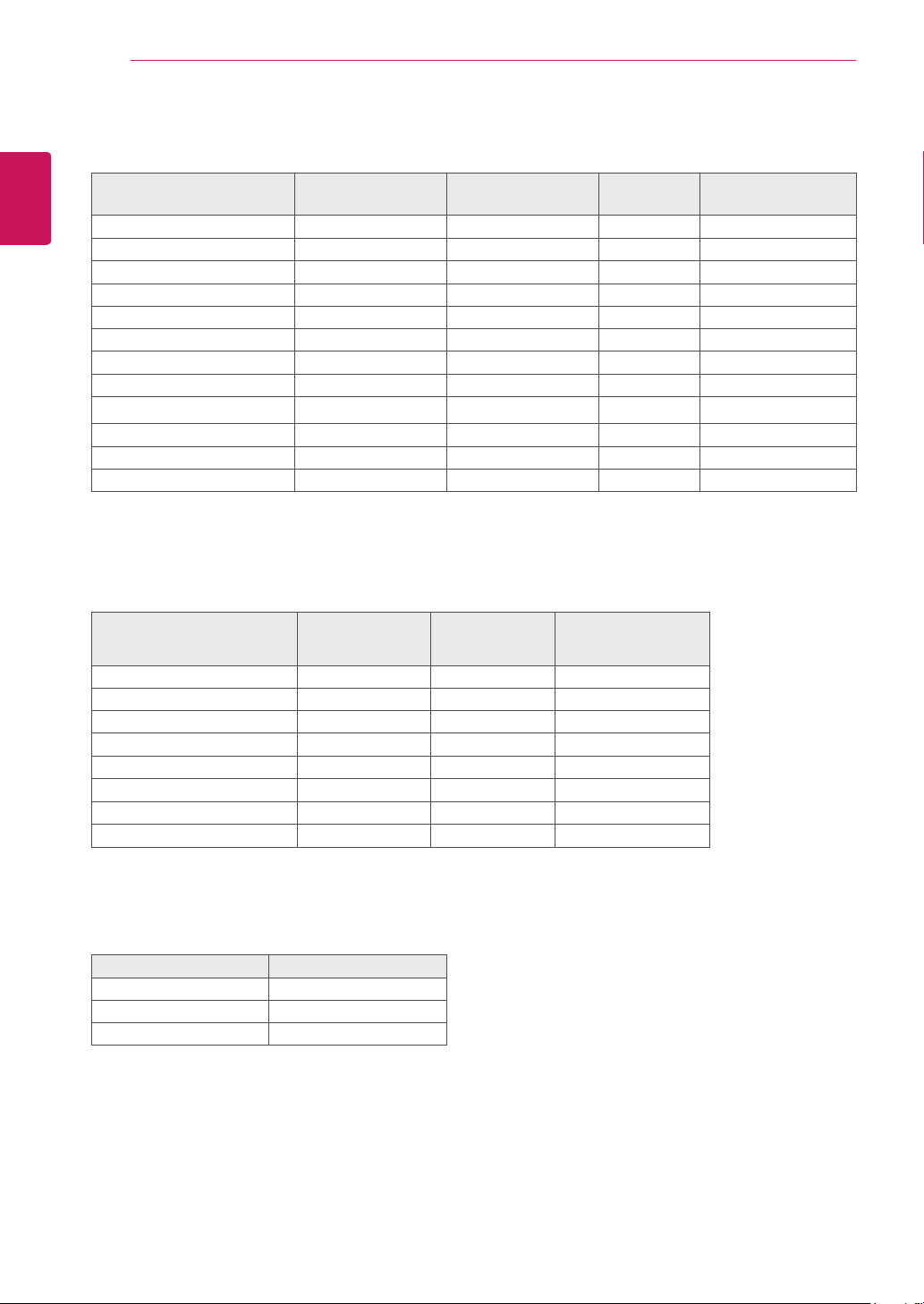
Preset Modes (Resolution)
Display Modes (Resolution)
Horizontal
Frequency(kHz)
Vertical
Frequency(Hz)
Polarity(H/V)
720 x 400 31.468 70 -/+
640 x 480 31.469 60 -/-
640 x 480 37.500 75 -/-
800 x 600 37.879 60 +/+
800 x 600 46.875 75 +/+
1024 x 768 48.363 60 -/-
1024 x 768 60.023 75 +/+
1152 x 864 67.500 75 +/+
1280 x 1024 63.981 60 +/+
1280 x 1024 79.976 75 +/+
1680 x 1050 65.290 60 -/+
1920 x 1080 67.500 60 +/+ Recommend Mode
HDMI TIMING
Display Modes (Resolution)
Horizontal
Frequency(kHz)
Vertical
Frequency(Hz)
HDMI
480P 31.50 60 O
576P 31.25 50 O
720P 37.50 50 O
720P 45.00 60 O
1080i 28.12 50 O
1080i 33.75 60 O
1080P 56.25 50 O
1080P 67.50 60 O (Recommend Mode)
Indicator
Mode LED Color
On Mode Red
Sleep Mode Blinking Red
Off Mode Off
25
ENG
ENGLISH
PROPER POSTURE
PROPER POSTURE
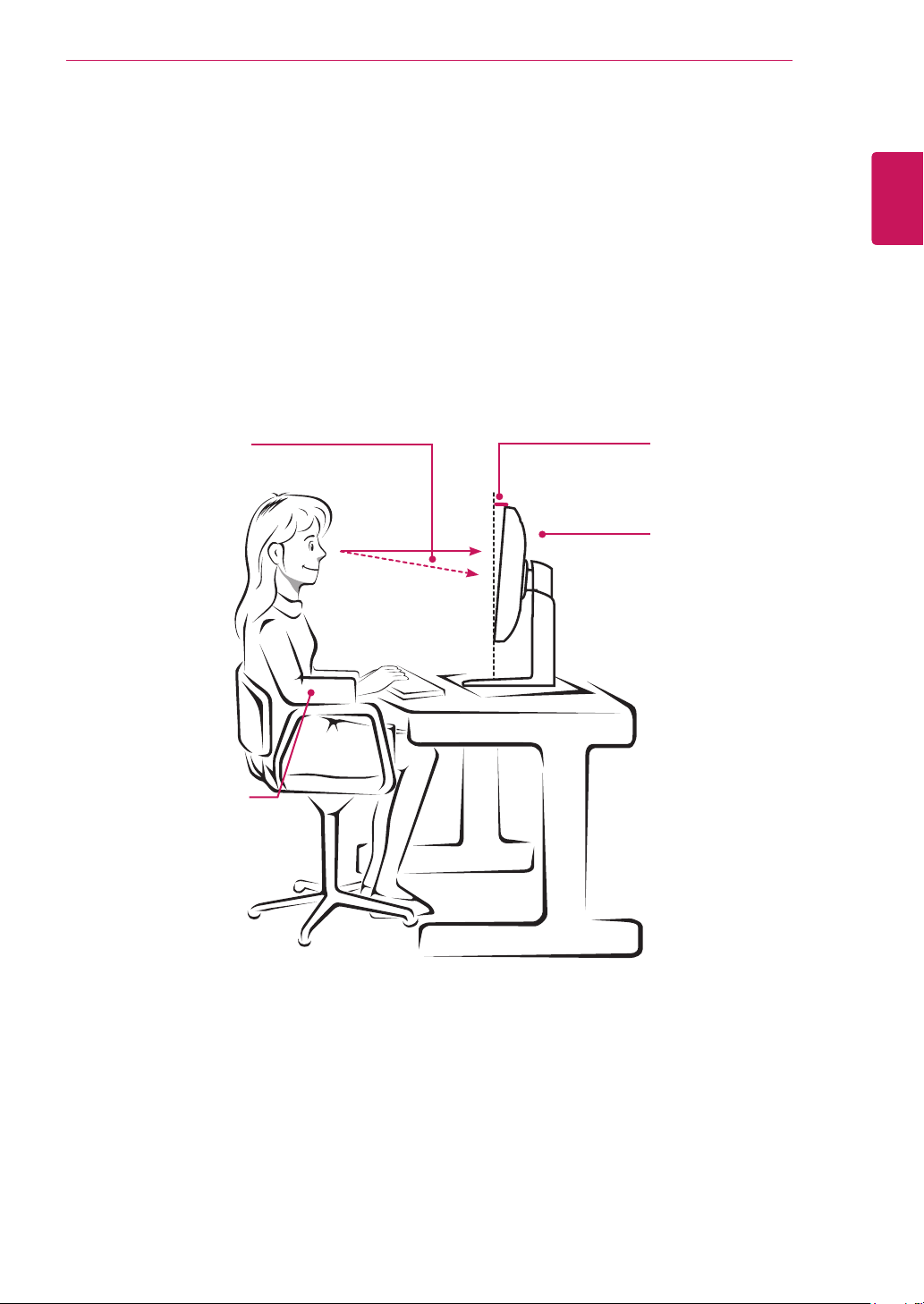
Proper Posture for Using the Monitor
Adjust the screen so that you can comfortably view at a slight downward angle from your natural eye level.
y
Take a break for approximately ten minutes every hour to reduce any fatigue caused by long-time us-
age.
y
The stand of the touch monitor allows the product to be used in the optimum position.
Adjust the stand angle from -5° to 25° to obtain the best view of the screen.
You should be looking
slightly down at the screen.
Place your hands gently
on the keyboard, keep- keep-keep-
ing your arms bent at
the elbows and extend- and extend-and extend-
ed horizontally in front
of you.
Adjust the angle
-5° to 25°
So that there is no
reflection or glare from
the screen.
Make sure to read the Safety Precautions before
using the product.
Keep the Owner’s Manual (CD) in an accessible
place for future reference.
The model and serial number of the SET is
located on the back and one side of the SET.
Record it below should you ever need service.
As an ENERGY STAR Partner LGE
U. S. A.,Inc. has determined that this
product meets the ENERGY STAR
guidelines for energy efficiency.
ENERGY STAR is a set of power-saving
guidelines issued by the U.S.Environmental
Protection Agency(EPA).
MODEL
SERIAL