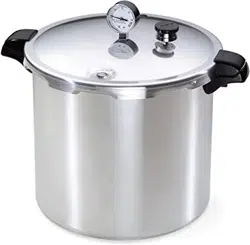

Pressure
Canner and Cooker
®
Instructions and Recipes
Table of Contents
Important Safeguards . . . . . . . . . . . . . . . . . . . . . . . . . . . 1
Getting Acquainted . . . . . . . . . . . . . . . . . . . . . . . . . . . . . 1
Before Using Canner for the First Time . . . . . . . . . . . . 2
How to Use Your Canner . . . . . . . . . . . . . . . . . . . . . . . . 3
Pressure Canning . . . . . . . . . . . . . . . . . . . . . . . . . . . . . . 4
How to Pressure Can Foods . . . . . . . . . . . . . . . . . . . . . . 4
Care and Maintenance . . . . . . . . . . . . . . . . . . . . . . . . . . 6
Canning Fruits and Tomatoes . . . . . . . . . . . . . . . . . . . . 7
Pressure Canning Vegetables . . . . . . . . . . . . . . . . . . . . . 9
Pressure Canning Meat . . . . . . . . . . . . . . . . . . . . . . . . 11
Pressure Canning Poultry . . . . . . . . . . . . . . . . . . . . . . 11
Pressure Canning Fish and Seafood . . . . . . . . . . . . . . 12
Pressure Canning Soups . . . . . . . . . . . . . . . . . . . . . . . . 12
Helpful Hints for Pressure Canning . . . . . . . . . . . . . . 13
How to Can Foods Using Boiling Water Method . . . . 13
Pressure Cooking in Your Pressure Canner . . . . . . . . 14
How to Pressure Cook Foods . . . . . . . . . . . . . . . . . . . . 15
Pressure Cooking Meat . . . . . . . . . . . . . . . . . . . . . . . . . 16
Pressure Cooking Entrees . . . . . . . . . . . . . . . . . . . . . . 18
Pressure Cooking Poultry . . . . . . . . . . . . . . . . . . . . . . . 20
Pressure Cooking Soups . . . . . . . . . . . . . . . . . . . . . . . . 20
Pressure Cooking Desserts . . . . . . . . . . . . . . . . . . . . . . 21
Helpful Hints for Pressure Cooking . . . . . . . . . . . . . . 22
Recipe Index . . . . . . . . . . . . . . . . . . . . . . . . . . . . . . . . . 22
Replacement Parts . . . . . . . . . . . . . . . . . . . . . . . . . . . . 23
Service Information . . . . . . . . . . . . . . . . . . . . . . . . . . . 23
Warranty . . . . . . . . . . . . . . . . . . . . . . . . . . . . . . . . . . . .23
This is a Listed appliance. The following Important Safeguards
are recommended by most portable appliance manufacturers.
IMPORTANT SAFEGUARDS
To reduce the risk of personal injury or property damage, basic safety
precautions should always be followed, including the following:
1. Read all instructions. Improper use may result in bodily injury
or property damage.
2. Always check the vent pipe before use. Hold cover up to light and
look through vent pipe to be certain it is clear.
3. Always check the air vent/cover lock to be sure it moves freely
before use.
4. Do not ll pressure canner over
2
⁄
3
full when using for pressure
cooking. For soup, rice, and dried vegetables which expand dur-
ing cooking, do not ll canner over
1
⁄
2
full. See food preparation
instructions.
5. Do not pressure cook applesauce, cranberries, rhubarb, pearl barley,
cereals, pastas, grains, split peas, or soup mixes containing dried
vegetables. These foods tend to foam, froth, and sputter and may
block the vent pipe, overpressure plug, and air vent/cover lock.
6. This appliance cooks under pressure. Improper use may result in
scalding injury. Make certain pressure canner is properly closed
before operating; cover handles must be directly above the body
handles. See “How To Use Instructions.”
7. Do not place the pressure canner or attempt to pressure cook in a
heated oven.
8. Caution: Do not use pressure canner on an outdoor LP gas
burner over 12,000 BTUs.
9. Extreme caution must be used when moving a pressure canner
containing hot liquids. Do not touch hot surfaces. Use handles or
knobs.
10. Do not open canner until internal pressure has been completely
reduced, air vent/cover lock has dropped, and no steam escapes
when the pressure regulator is removed. See “How To Use Instruc-
tions.”
11. Caution: To ensure safe operation and satisfactory performance,
replace the overpressure plug every time you replace the sealing
ring or sooner if it becomes hard, deformed, cracked, worn, or
pitted. It is recommended that the sealing ring and overpressure
plug be replaced at least every three years.
12. When normal operating pressure is reached, gradually lower the
heat to maintain the pressure. If the pressure regulator is allowed to
rock vigorously excess steam will escape, liquid will be evaporated,
the canner may go dry, and food may scorch.
13. Close supervision is necessary when the pressure canner is used
near children. It is not recommended that children use the pressure
canner.
14. Do not use this pressure canner for other than intended use.
15. Do not use this pressure canner for pressure frying with oil.
SAVE THESE INSTRUCTIONS
THIS PRODUCT IS FOR HOUSEHOLD USE ONLY.
Getting Acquainted
Your canner is a special, large capacity pressure vessel de-
signed for home canning a wide variety of fruits, vegetables,
meats, and poultry. The canner may also be used to fast cook
many of your favorite foods in larger quantities than can be
prepared in a conventional size pressure cooker.
The canner uses pressure to achieve the high tempera-
tures required for safely processing foods while can-
ning. The United States Department of Agriculture,
Washington, D.C., recommends the Pressure Can-
ner as the only safe method for canning low-acid
foods—vegetables, meats, and poultry.
The canner will also cook many foods in one-third to one-
tenth the time required by conventional methods. Pressure
cooking preserves avor and nutrients and tenderizes tougher
cuts of meat.
It is necessary to follow a few special rules in using and caring
for your Pressure Canner. Become familiar with the various
parts as shown in the diagram on page 2 and read the “How
To Use” sections beginning on Pages 3, 4, 13, and 15, before
using for the rst time.
REPLACEMENT PARTS
PRESTO
®
Canner parts are available at most hardware and
appliance stores or see parts information on page 23.
When ordering parts, please specify the seven digit model
number found stamped on the side of the canner body.
1
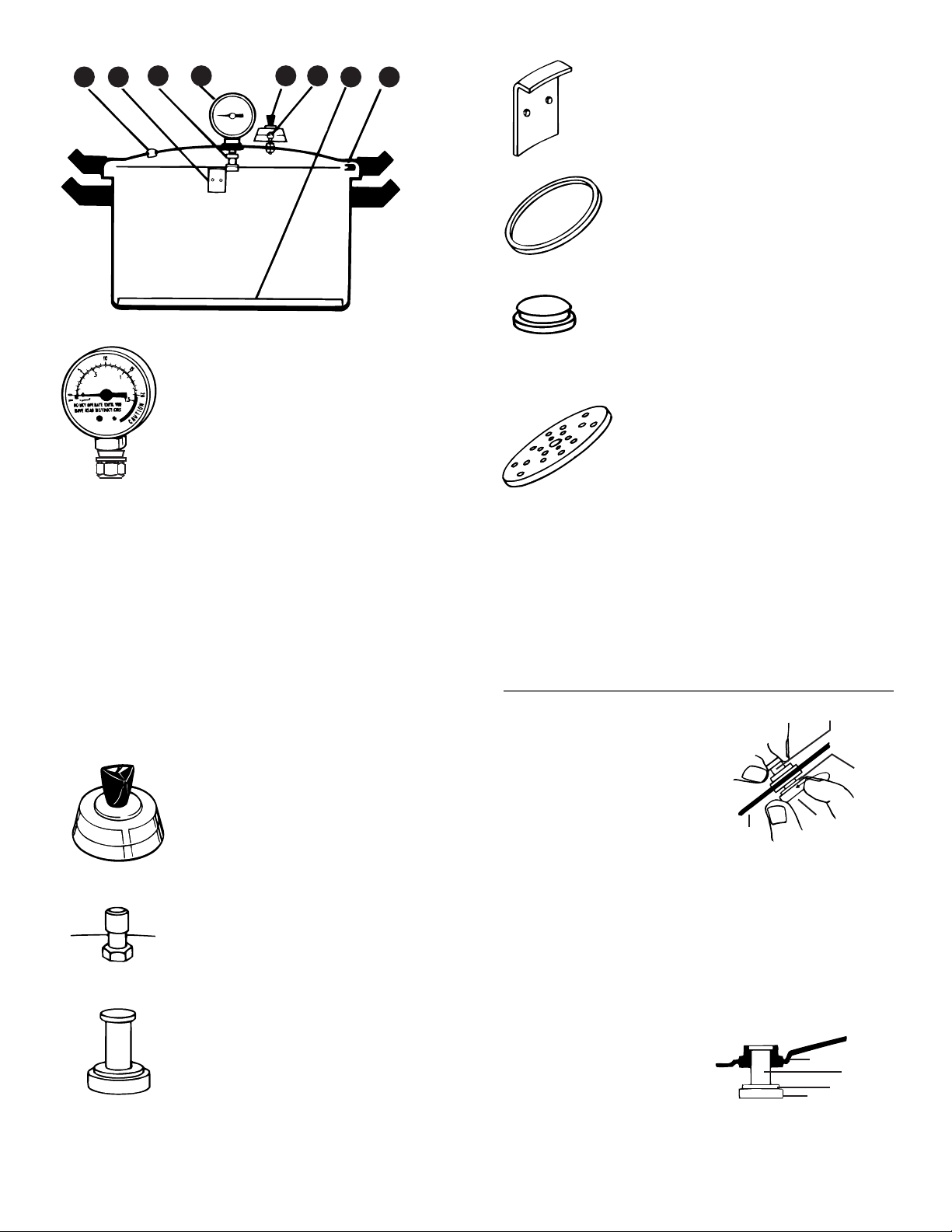
.2. PRESSURE REGULATOR
The pressure regulator is a solid one-
piece unit. Pressure readings on the pres-
sure canner are registered only on the
pressure gauge (see above) and can be
controlled and maintained by adjusting
heat settings.
3. VENT PIPE
The pressure regulator ts over the vent
pipe and allows excess pressure to be
released.
4. AIR VENT/COVER LOCK
The air vent /cover lock automatically
“vents” or exhausts air from the canner
and acts as a visual indication of pressure
in the canner. The small gasket must be
in place for the air vent/cover lock to seal
completely.
Before Using Canner for the
First Time
1. Remove the air vent/cover
lock from the canner cover.
The cup portion of the air
vent/cover lock, on the inside
of the cover, unscrews from
the pin (Fig. A).
2. Remove the sealing ring by
simply pulling it from the
sealing ring groove.
3. Remove the overpressure plug by pushing it out of its
opening from the top of the cover.
4. Wash the cover and body with hot, sudsy water. Do not
submerse the cover in water or let the gauge come in
contact with any liquid. The inside mechanism of the
gauge may be damaged if it is submersed or if water is
allowed to run over it. Scrub the sealing ring groove to
remove the manufacturing oils.
5. Reinsert the air vent/cover
lock making sure the
small gasket is in place
as shown (Fig. B).
Cover
Pin
Small Gasket
Cup
Fig. B
2
7 5
4
1
2 3
8 6
1. PRESSURE DIAL GAUGE
The pressure dial gauge registers pressure
in both pounds (outer scale) and metric
measure (inner scale). The pointer moves
around the dial indicating the pressure
within the unit.
The dial gauge is a delicate instrument
which must be handled with care. Before rst use, it will
be necessary to assemble the dial gauge properly and attach
it to the canner cover (see page 3). The pressure dial gauge
needs to be checked for accuracy prior to each canning season
and if any of the following conditions exist: cover has been
submerged in water or dropped, gauge glass is broken or has
fallen out, parts are rusty, pointer is not in the “0” block, or
if you believe the gauge may not be accurate.The gauge can
usually be checked at your local county extension ofce. If
you are unable to have your dial gauge checked locally, care-
fully remove and package the gauge and send it to the Presto
Consumer Service Department. See Service Information on
page 23. An accurate gauge is necessary to help prevent food
spoilage and possible food poisoning.
5. LOCKING BRACKET
The locking bracket on the inside of the
canner body engages with the air vent/cover
lock to prevent the cover from being opened
when there is pressure in the unit.
6. SEALING RING
The sealing ring ts into the canner cover
and forms a pressure-tight seal between
the cover and body during canning and
cooking.
7. OVERPRESSURE PLUG
The overpressure plug is located in the can-
ner cover. It will automatically pop out and
release steam in case the vent pipe becomes
blocked and/or clogged and pressure cannot
be released normally.
8. CANNING-COOKING RACK
The canning-cooking rack is placed in the
bottom of the canner to hold jars off the
bottom of the unit while canning. When
cooking, the rack is used for steaming
foods. It can also be used to hold foods
such as vegetables out of the cooking liquid
which allows several foods to be cooked at
the same time without an intermingling of
avors. When it is desirable to blend a-
vors, do not use the canning-cooking rack.
The canning-cooking rack must always be
used when canning.
Small
Gasket
Cup
Fig. A
Pin
Cover
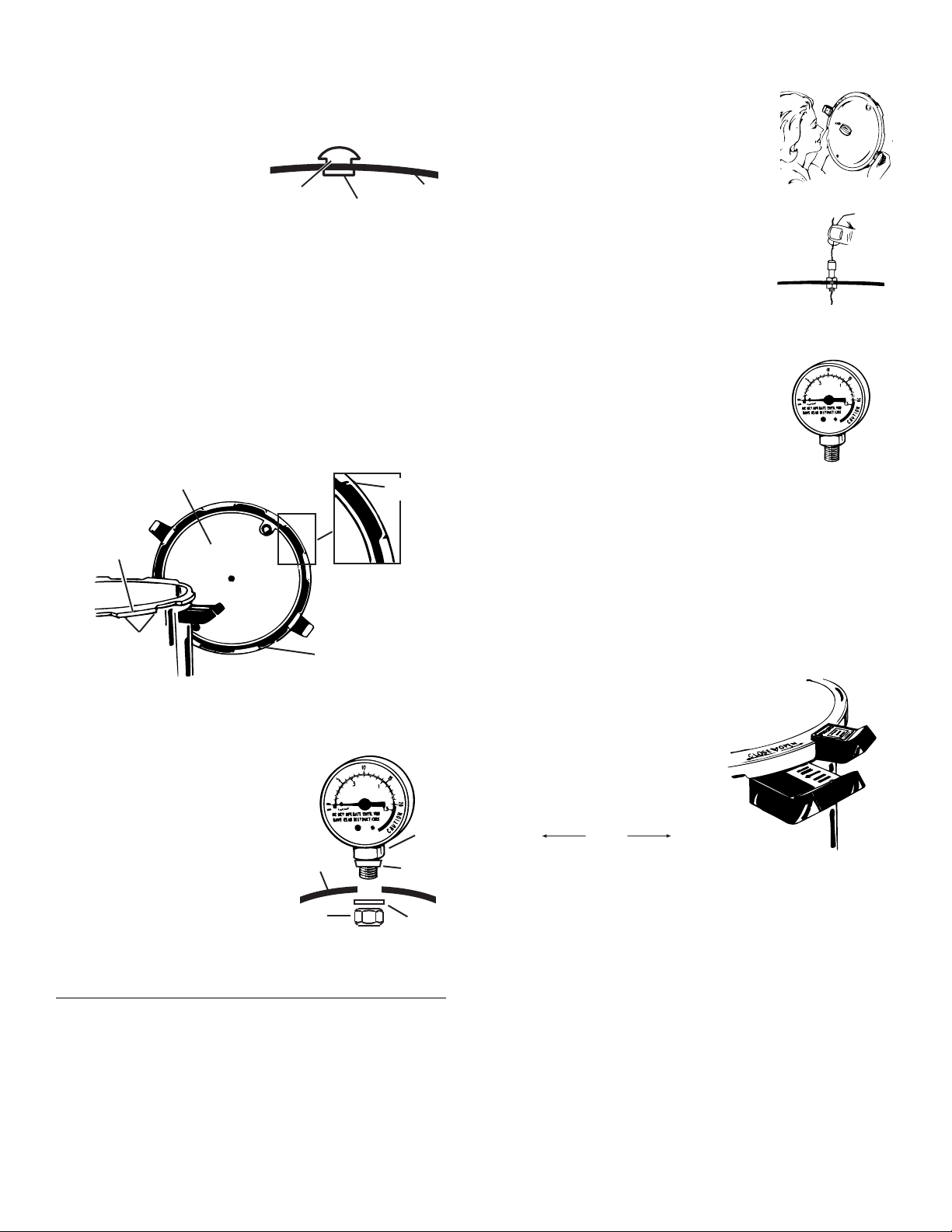
6. Reinsert the overpressure plug by pushing the domed
side of the plug into the opening from the underside
of the cover, until the bottom edge is fully and evenly
seated against the underside of the cover (Fig. C). When
the overpressure plug is
properly installed, the
word (TOP) will be visible
on the overpressure plug
when viewing the outside
of the cover.
7. Replace the sealing ring in the sealing ring groove, mak-
ing certain to t the ring under the stop tab located on the
inside rim of the cover (Fig. D).
8. The sealing ring is prelubricated; therefore, do not apply
cooking oil to it. If necessary, to help make the cover
easier to open and close, a very light coating of cooking oil
may be applied to the underside of the body lugs (Fig. E).
IMPORTANT: Never oil the sealing ring. Cooking oil
will swell and soften the sealing ring, reducing the usable
life and require frequent replacement. The cover should
open and close easily when following the instructions in
the next column (Fig. J).
9. Attach the dial gauge to the canner cover. To do this,
remove the nut and metal washer from the threaded end
of the dial gauge, leaving
the rubber washer in place.
From the top of the cover,
insert threaded end of gauge
through the hole in the center
of the cover, until metal base
rests on cover. While holding
the gauge in place, carefully
turn cover over and place
metal washer, then nut, on
threaded end of gauge and
tighten. (Fig. F).
How to Use Your Canner
IMPORTANT: Read carefully. Do not attempt to use your
Pressure Canner before reading these instructions.
Before using your canner for the rst time, clean accord-
ing to the instructions on page 2.
Fig. F
Metal
Base
Nut
Metal
Washer
Rubber
Washer
Cover
Fig. G
Fig. I
Fig. H
Cover
Handle
Fig. J
Note: Cover is shown in open po-
sition. Rotate clockwise to close.
Body Handle
Be sure the vent pipe is open
before each use by holding
the cover up to the light and
looking through the vent pipe
(Fig. G). If the vent pipe is blocked,
excess pressure cannot be released
through it. Pressure may then build
to unsafe levels. Pressure will con-
tinue to build until the overpressure
plug is forced out of its cover open-
ing. Therefore, clean the vent pipe
with a small brush or pipe cleaner
if it is blocked (Fig. H).
The correct pressure for canning
and cooking is indicated by the
pressure dial gauge (Fig. I). Pres-
sure is indicated on the gauge
which registers the pressure inside
the unit at all times. The pointer
will move across the dial as pres-
sure is developed or reduced within
the canner. The pressure regulator
is designed to rock only at 15
pounds pressure.
Do not strike the rim of the canner body with any cooking
utensil as this will cause nicks which may damage the
rim and allow steam to escape.
Use the canner on a level burner and range only. Use on
a tilted burner or range may interfere with the operation
of the pressure regulator.
Pouring water into a dry overheated canner may crack
the metal.
The canner has been de-
signed so the cover will go
on in only one position and
rotate in only the directions
indicated for closing and
opening. Press down on the
cover handles to compress
the sealing ring and make
the cover easier to close.
The cover has the words
CLOSE V OPEN em-
bossed on the top surface
near a cover handle. Align
the “V” on the cover with the mark on the body handle
for proper cover and body alignment. Turn the cover in
the direction indicated to close until the cover handles
are centered directly above body handles. Do not rotate
cover beyond this point (Fig. J).
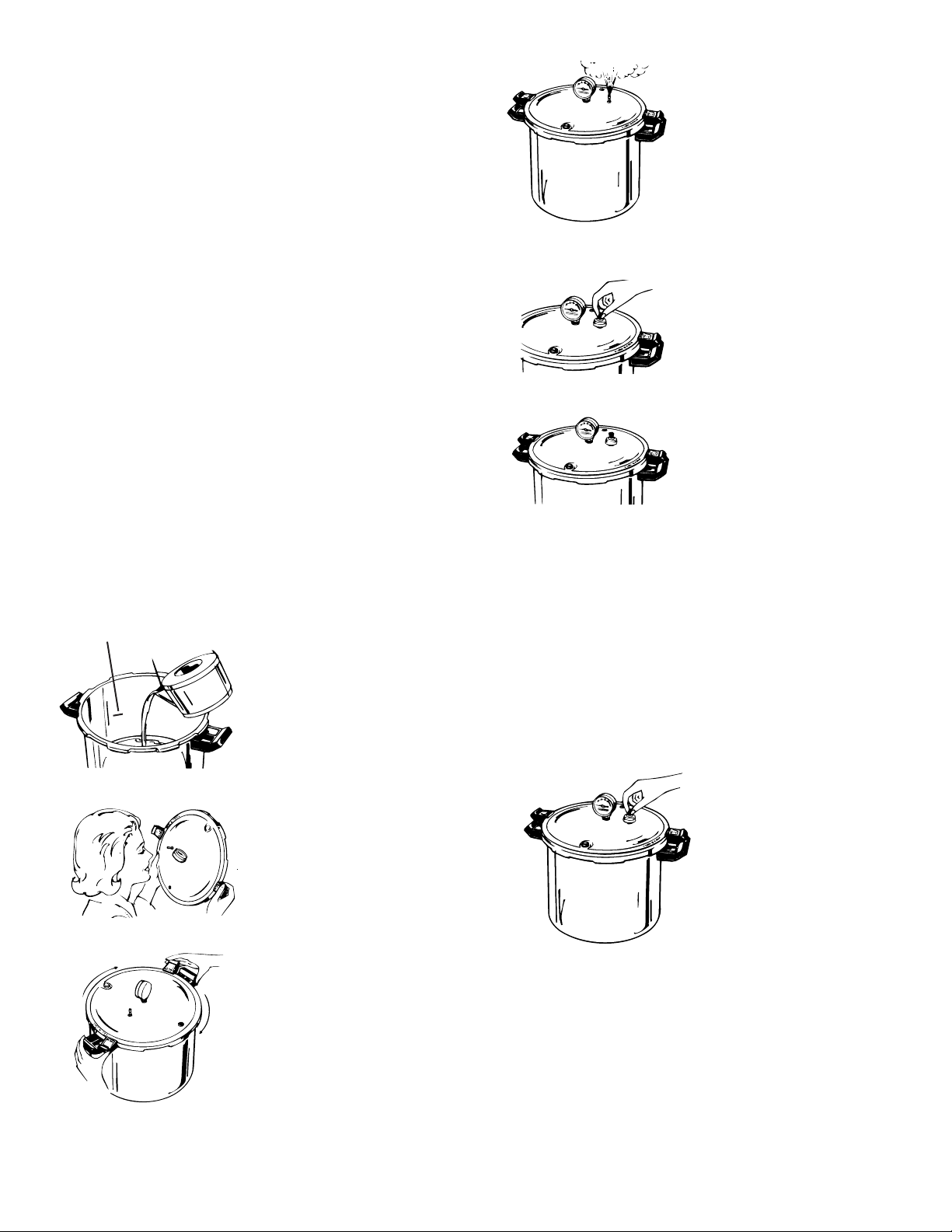
When the cover is rotated to the closed position, the air
vent/cover lock passes under the locking bracket. When
the handles are aligned, one over the other, the pressure
regulator is placed on the vent pipe, and heat is applied,
pressure will begin to build within the canner. At this
point, the air vent/cover lock lifts and locks the unit. The
cover will remain locked as long as there is pressure in
the canner. When pressure is completely reduced, the air
vent/cover lock drops allowing the canner to be opened
(Fig. K, next page).
3
Top
Indented Portion
Overpressure
Plug
Cover
Fig. C
Apply
Cooking
Oil Here
Body Lug
Sealing Ring
in Sealing Ring
Groove
Fig. D
Stop Tab
Cover
Fig. E

spoilage cycle so food can be preserved safely. Molds, yeast,
and enzymes are destroyed at temperatures below 212˚F, the
temperature at which water boils (except in mountainous
regions). Therefore, boiling water processing is sufcient to
destroy those agents.
Bacteria, however are not as easily destroyed. The bacteria,
Clostridium botulinum produces a spore that makes a poison-
ous toxin which causes botulism. This spore is not destroyed
at 212˚F. In addition, the bacteria thrive on low-acids in the
absence of air. For a safe food product, low-acid foods need
to be processed at 240˚ or higher, temperatures only achieved
with a pressure canner.
In pressure canning, some of the water in the pressure canner
is converted to steam, which creates pressure within the can-
ner. As pressure increases, temperature increases, 5 pounds
pressure—228˚F, 10 pounds pressure—240˚F, 15 pounds pres-
sure—250˚F. This pressurized heat destroys the potentially
harmful bacterial spores. As the jars cool, a vacuum is formed,
sealing the food within and preventing any new microorgan-
isms from entering and spoiling the food.
As a safeguard against using canned foods which may be
affected with spoilage that is not readily detected, pour all
low-acid foods (meats and vegetables) into a saucepan and
boil 10 to 15 minutes before tasting or using.
Many times odors that cannot be detected in the cold product
will become evident by these methods. If, after boiling, food
does not smell or look right, discard it without tasting.
MASON JARS: While there are many styles and shapes of
glass jars on the market, only Mason jars are recommended
for home canning. Mason jars are available in
1
⁄
2
pint, pint, and
quart capacities with threads on which a cap may be screwed.
See the chart below for the jar capacity of your canner. Ad-
ditional information may be obtained from the manufacturers
of Mason Jars.
CLOSURES FOR MASON JARS: The two-piece metal cap
consists of a at metal lid held in place with a screw band.
A rubber compound on the underside of the lid forms a seal
during processing. Follow the closure manufacturer’s direc-
tions for using the two-piece cap and for testing for a proper
seal. If the closure has not sealed, completely reprocess or
use the food immediately. Refer to the closure manufacturer’s
directions for additional information.
CANNER JAR CAPACITIES (MAXIMUM CAPACITY)
MODEL NO.
beginning with
1
⁄
2
PINT 1 PINT 1 QUART
0175 24 up to 10 7
0178 24 up to 20 7
Please note: To double deck pint and half pint jars, see page 13.
How to Pressure Can Foods
IMPORTANT: Read carefully. Do not attempt to use your
canner before reading these instructions.
Follow these step-by-step instructions for pressure canning
in your canner. Prepare food according to the directions in
If the cover is not rotated sufciently (cover handles di-
rectly above body handles), the air vent/cover lock will
only raise slightly and steam will continue to ow from
it, preventing pressure from building.
(During canning, it is necessary to exhaust air from the
canner before placing the pressure regulator on the vent
pipe. See page 5, step 7.) The pressure regulator is placed
on the vent pipe as soon as the cover is closed securely
when cooking. During canning or cooking, moisture may
appear near the pressure regulator, overpressure plug and
air vent/cover lock. This is normally due to condensation.
This does not affect operation of the canner.
To reduce pressure at the end of the canning or cooking
period, turn heat off and/or remove the canner from the
burner. Cool according to instructions in recipe. Pressure
is completely reduced when the air vent/cover lock has
dropped and no steam escapes when the pressure regula-
tor is tilted. Do not remove the pressure regulator until
pressure is completely reduced. Always remove the
pressure regulator before opening canner.
If the air vent/cover lock remains in its raised position,
there may still be pressure in the canner. Do not remove
the pressure regulator until the air vent/cover lock drops
and no steam escapes when the pressure regulator is tilted.
The cover should not be forced open. You may tap the
air vent/cover lock lightly with a spoon. If pressure is
present, steam will escape and the air vent/cover lock
will pop back up. Continue to cool the canner until the
air vent/cover lock drops.
HELPFUL HINT: To help yourself understand the op-
eration of the pressure canner and cooker, pour 4 cups of
water into the canner and follow the step-by-step instruc-
tions beginning with step 5 on page 5. For actual usage
of the canner/cooker, follow the complete instructions
beginning at the bottom of next column for pressure
canning and on page 15 for pressure cooking.
Pressure Canning
The United States Department of Agriculture, Washington,
D.C. recommends the Pressure Canner as being the only safe
method for canning low-acid foods—vegetables, meats, and
poultry.
There are invisible microrganisms present all around us.
Fruits, vegetables, and meat contain these microrganisms
naturally, and yet, they are not a problem unless food is left
to sit for extended periods of time, causing food spoilage.
This is nature’s way of telling us when food is no longer t
to eat.
There are four basic agents of food spoilage—enzymes,
mold, yeast, and bacteria. Canning interrupts the natural
4
Fig. K
UNLOCKED LOCKED
Air Vent/Cover Lock
in DOWN Position.
No Pressure in Unit.
Air Vent/Cover
Lock in UP Position.
Pressure in Unit.
specic recipe.
1. The rst step in pressure canning is to assemble the
canning equipment. Be sure your canner is thoroughly
cleaned and working properly. Before each canning sea-
son, check the pressure gauge for accuracy (see page 6,
step 9). Also check the sealing ring, overpressure plug,
and the rubber gasket of the air vent/cover lock. Replace
these parts when they become hard, deformed, cracked,
worn, pitted, or unusually soft (see page 7, step 11).
2. Check Mason jars for nicks, cracks, and sharp edges.
Check bands for dents or rust. Use only jars, lids, and
bands in perfect condition so an airtight seal may be
obtained.
Wash and rinse jars, lids, and bands. Pour hot water into
jars and set aside until needed. Follow closure manufac-
turer’s directions for bands and lids.
3. Select fresh firm food. Sort food according to
size. Clean food thoroughly. Prepare accord-
ing to recipe. Fill hot Mason jars promptly with
food and liquid to recommended level. Allow
1
⁄
2
inch head space for fruits. ALL vegetables and meats
require 1 inch head space due to expansion during pro-
cessing.
Work out air bubbles with a clean nonmetallic spatula.
Wipe sealing edge clean with a damp cloth.
Adjust caps according to closure manufacturer’s direc-
tions.
4. Place three-quarts of
boiling water, canning
rack, and jars in canner.
To prevent water stains
on jars, add 2 tablespoons
white vinegar to water in
canner. Always use can-
ning rack. Jars may break
if set directly on bottom of
canner.
5. Look through the vent pipe
to be certain it is open be-
fore placing cover on
canner. To clean the vent
pipe, draw a pipe cleaner
or small brush through the
opening.
6. Place cover on canner,
aligning the “V” on the
cover with the mark on
the body handle and lock
securely by turning in
the direction indicated to
close (clockwise). Cover
handles must be centered
over body handles. Do
not force beyond this
position.
Three-quart water line
7. Exhaust air from the canner
and jars by adjusting heat to
a relatively high setting to
obtain a free ow of steam
from the vent pipe. Consult
the instruction book which
accompanied your range for
recommended heat setting.
Reduce heat to maintain a
moderate steam flow. Al-
low steam to ow for 7 to
10 minutes when canning.
8. Place pressure regulator on
vent pipe. Set burner at a
relatively high heat setting,
on most range burners, and
heat canner until pressure
dial gauge registers desired
pressure.
9. Processing time begins when
pressure gauge registers the
correct pressure. Adjust heat
to maintain correct pounds
pressure on the pressure
gauge.
10. At end of processing time, turn burner to “OFF” or re-
move canner from heat source. Let pressure drop of its
own accord, do not quick-cool. Pressure is completely
reduced when the air vent/cover lock and overpressure
plug have dropped and no steam escapes when the pres-
sure regulator is tilted. Do not use the pressure dial gauge
as an indicator for when pressure is completely reduced.
Attempting to speed the cooling of the canner by laying
wet cloths on the cover, placing the canner in water, or
setting the canner in a draft or on a cold surface is not
recommended. If the pressure in the canner is reduced
more rapidly than the pressure in the jars, the jars may
break.
11. When pressure has been
completely reduced, re-
move pressure regulator
from vent pipe and let
canner cool for 10 min-
utes. Do not remove the
pressure regulator until
pressure is completely
reduced and the air vent/
cover lock has dropped.
Always remove pressure
regulator before opening
the cover.
5
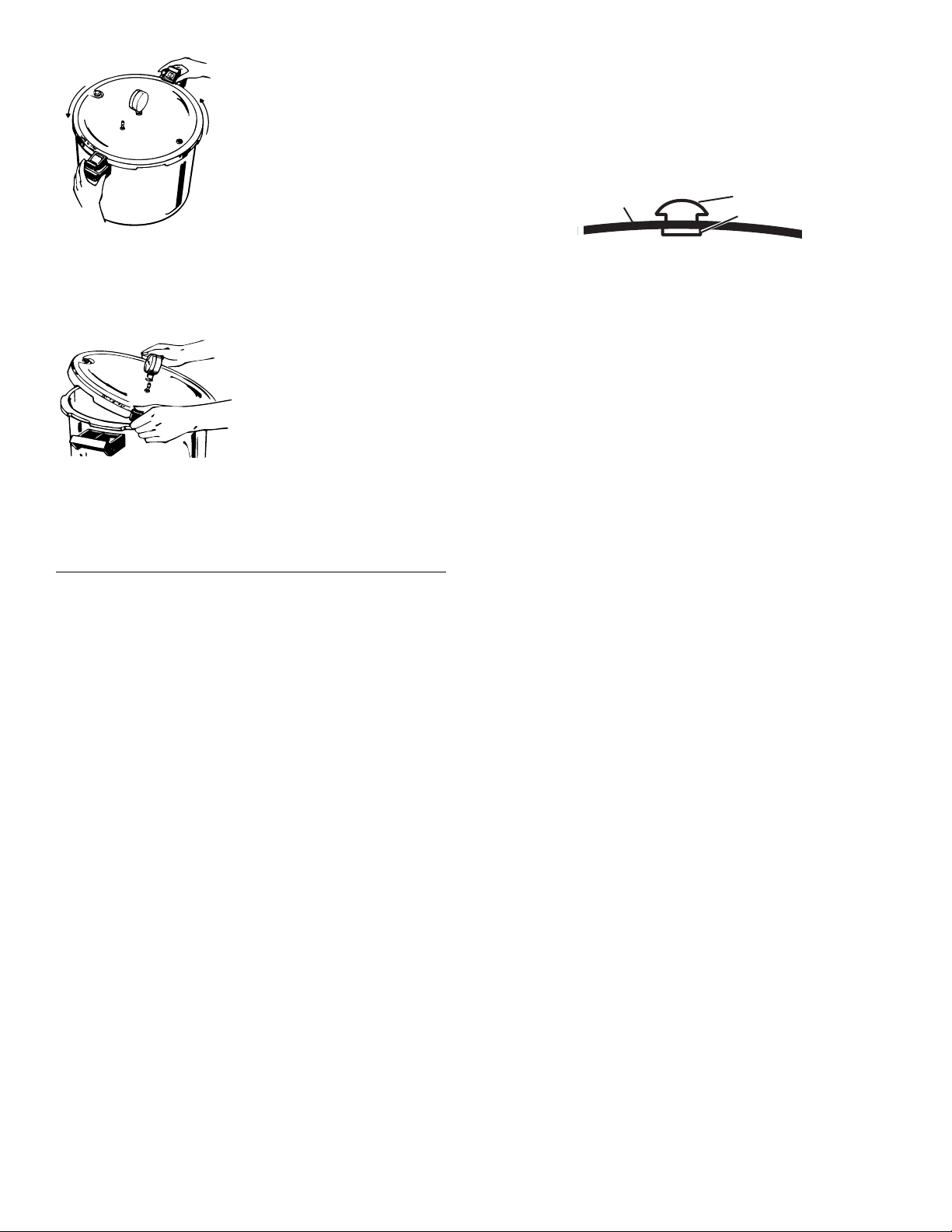
12. To remove cover, turn
counter-clockwise until
cover hits stop. Cover
handles will be beyond
the body handles. If cover
seems to stick or is hard to
turn, do not force it open.
Sticking may indicate
that there is still pressure
inside the canner. If in
doubt about pressure be-
ing completely reduced,
let the canner stand until
cool before removing the
cover.
13. Lift canner cover toward
you to keep steam away
from you when opening.
14. Remove jars from canner.
Set jars apart on board or
cloth away from draft to
cool. When jars are cold,
test seal, remove bands,
wipe jars, label, date, and
store in a cool, dry place.
Care and Maintenance
1. The outside surface may be kept bright and shiny by
cleaning with a good silver polish or simply by washing
with soap and water. Iron and various minerals in water
and foods may darken the inside of the canner but this dis-
coloration will in no way affect food cooked. These stains
may be removed by using a solution of water and cream of
tartar. For each quart of water, use one tablespoon cream
of tartar. Pour enough solution into the canner to cover
the discoloration (do not ll over
2
⁄
3
full), then close cover
securely. Place regulator on vent pipe and heat until 15
pounds pressure is reached. Remove canner from heat;
allow canner to stand two to three hours. Remove regula-
tor, open canner, and empty contents. Scour thoroughly
with a soap impregnated steel wool cleaning pad; wash,
rinse, and dry. Due to the acidic nature of the water sup-
ply in some areas, deterioration of the interior surface
of the canner body may occur. To minimize this effect,
thoroughly scour the inside of the canner body with an
abrasive cleanser at least once a year.
2. Each time the canner is washed, remove the sealing ring
and wash in warm, sudsy water, rinse, dry, and replace
in cover.
3. The air vent/cover lock may be removed for occasional
cleaning or for replacing the small gasket (see page 3).
Wash all parts in warm, sudsy water. Use a soft cloth or
small nylon brush to clean the cover hole. The small gas-
ket must be in place when reassembling the air vent/cover
lock.
4. The overpressure plug can be removed for cleaning by
pushing it out of its opening from the top of the cover.
After cleaning, reinsert the plug by pushing the domed
side of the plug into the opening from the underside of
the cover, until the bottom edge is fully and evenly seated
against the underside of the cover. When the overpressure
plug is properly installed, the word (TOP) will be visible
on the overpressure plug when viewing the outside of the
cover. The indented portion of the overpressure plug is
visible when the underside of the cover is viewed.
If the overpressure plug is ever forced out of its cover
opening due to excess pressure while cooking or canning,
it is important to call the Consumer Services Department
at 1-800-877-0441. Do not attempt to replace the over-
pressure plug.
5. When your Pressure Canner is not in use, invert the cover
on the canner body and store in a dry place. Storing the
canner with the cover locked on may cause unpleasant
odors and may deform the sealing ring.
6. To ensure safe operation and satisfactory perfor-
mance, replace the overpressure plug every time you
replace the sealing ring or sooner if it becomes hard, de-
formed, cracked, worn, or pitted. Replace the sealing ring
and overpressure plug at least every three years. Failure
to follow these instructions could result in bodily injury
or property damage.
7. If the canner body or cover handles become loose, tighten
with a screwdriver.
8. If leakage of moisture or steam develops while using your
canner, check the following possible causes:
The formation of a small amount of moisture under the
pressure regulator is normal when cooking or canning
rst begins. This condensation is a result of the tem-
perature of the pressure regulator being lower than the
rest of the canner. If excess condensation continues, the
vent pipe may be loose and should be tightened with
an adjustable wrench.
Leakage between the cover and body is usually caused
by shrinkage of the sealing ring after prolonged use.
Replace the sealing ring and overpressure plug.
A slight amount of leakage around the air vent/cover
lock is normal when canning or cooking rst begins. If
leakage continues, the cover handles may not be fully
aligned with the body handles and, therefore, the cover
lock cannot engage (see page 4). Clean the air vent/cover
lock occasionally to assure that it operates correctly (see
page 2).
A small amount of steam or moisture may be
visible around the overpressure plug as can-
ning or cooking begins. This will stop when
the overpressure plug seals. If leakage contin-
ues, clean or replace the overpressure plug (see
step 4).
Do not operate your Pressure Canner with continual leak-
age. If the preceding steps do not correct the problem, return
the entire unit to the Presto Factory Service Department (see
page 23).
9. The dial gauge is a delicate instrument which must be
Indented Portion
Overpressure Plug
Cover
Top
6

handled with care. The pressure dial gauge needs to be
checked for accuracy prior to each canning season and
if any of the following conditions exist: cover has been
submerged in water or dropped, gauge glass is broken
or has fallen out, parts are rusty, pointer is not in the “0”
block, or if you believe the gauge may not be accurate.The
gauge can usually be checked at your local county ex-
tension ofce. If you are unable to have your dial gauge
checked locally, carefully remove the gauge and send it
to the Presto Consumer Service Department. See Service
Information on page 23. An accurate gauge is necessary
to help prevent food spoilage and possible food poison-
ing.
10. If the Pressure Canner becomes difcult to open or close
and the sealing ring has expanded, replace the sealing
ring.
11. IMPORTANT: The sealing ring, overpressure plug,
and rubber gasket of the air vent/cover lock may shrink,
become hard, unusually soft, deformed, cracked, worn,
or pitted with normal use. Cooking oil and/or exposure to
high heat, such as a warm burner or oven top, will cause
these parts to deteriorate rapidly. When this happens, re-
place the sealing ring, overpressure plug, and small rubber
gasket of the air vent/cover lock. Replace the sealing ring
and overpressure plug at least every three years.
Before inserting a new sealing ring, clean the sealing ring
groove with a brush. To insure safe operation of your
pressure canner, it is recommended that the overpressure
plug be replaced whenever the sealing ring is replaced.
Any maintenance required for this product, other than nor-
mal household care and cleaning, should be performed by
the Presto Factory Service Department (see page 23).
Canning Fruits and
Tomatoes
Foods high in acidity (fruits and tomatoes) may be processed
using pressure canning or boiling water canning. The pressure
processing method for fruits and tomatoes gives a heat treatment
equivalent to the much longer processing time required with the
boiling water canning method.
Select rm, fully-ripened but not soft fruit or tomatoes. Do not
can overripe foods. Some fruits tend to darken while they are
being prepared. To prevent the darkening, place fruit in an ascor-
bic acid solution (1 teaspoon ascorbic acid to 1 gallon water) or
use ascorbic acid or citric acid mixtures according to package
instructions.
Although fruit has better color, shape, and avor when it is canned
with sugar, it may be canned unsweetened if desired. Sugar is
used for avor. It is not used in a high enough concentration to
act as a preservative.
White sugar is preferable to brown sugar for canning. Light
corn syrup or honey may be used to replace up to one-half the
sugar.
If you wish to use sugar substitutes, follow package instruc-
tions.
The amount of sugar desirable to use in preparing syrups will
depend upon the tartness of the fruit and on family preference.
It should be remembered that fruit, when heated, releases some
of its juices which will dilute the syrup in proportion to the
juiciness of the fruit.
SYRUPS FOR CANNING FRUITS
SUGAR PER YIELD OF
SYRUP QUART OF LIQUID SYRUP
Very Light 1 cup 4
1
⁄
2
cups
Thin 2 cups 5 cups
Medium 3 cups 5
1
⁄
2
cups
Heavy 4
3
⁄
4
cups 6
1
⁄
2
cups
Heat sugar with water or juice until sugar is dissolved. Add fruit and
cook until heated through. Pack fruit into clean Mason jars to within
1
⁄
2
inch of top of jar. Cover with hot liquid leaving
1
⁄
2
inch head
space. The liquid may be syrup, fruit juice, or plain water. For
steps on boiling water canning, refer to page 13.
When pressure canning at altitudes of 2,000 feet or below or
boiling water canning at altitudes of 1,000 feet or below, process
according to specic recipe. When canning at higher altitudes,
process according to the following charts.
Altitude chart for pressure canning fruit and tomato recipes
Altitude Pints and Quarts
2,001 – 4,000 ft. 7 lbs. 7 lbs.
4,001 – 6,000 ft. 8 lbs. 8 lbs.
6,001 – 8,000 ft. 9 lbs. 9 lbs.
Processing time is the same at all altitudes.
Altitude chart for boiling water canning fruit and tomato
recipes
Altitude Pints and Quarts
1,001 – 3,000 ft. increase processing time 5 minutes
3,001 – 6,000 ft. increase processing time 10 minutes
6,001 – 8,000 ft. increase processing time 15 minutes
CANNING RECIPES: FRUITS AND TOMATOES
APPLES
Wash, peel, and cut apples into pieces. Place apples in an ascor-
bic acid solution (1 teaspoon ascorbic acid to 1 gallon water) to
prevent darkening during preparation. Drain well. Boil apples in
a thin syrup or water for 5 minutes. Pack hot apples in clean, hot
Mason jars, leaving
1
⁄
2
inch head space. Cover apples with hot
syrup or water, leaving
1
⁄
2
inch head space. Adjust jar lids.
Pressure canning - process at 6 pounds pressure, pints and quarts
8 minutes. For processing above 2,000 feet altitude, see chart
above for recommended pounds of pressure.
Boiling water canning - process pints and quarts 20 minutes.
For processing above 1,000 feet altitude, see chart above for
recommended time.
APPLESAUCE
Wash, peel, and core apples. If desired, slice apples into ascor-
bic acid solution (1 teaspoon ascorbic acid to 1 gallon water) to
prevent browning. Drain well. Place slices in a pan. Add
1
⁄
2
cup
water. Cook until apples are tender. Press through food mill or
sieve. Sweeten to taste. Reheat and pack hot applesauce in clean,
hot Mason jars, leaving
1
⁄
2
inch head space. Adjust jar lids.
7

10 minutes. For processing above 2,000 feet altitude, see page
7 for recommended pounds of pressure.
Boiling water canning - process pints 20 minutes and quarts
25 minutes. For processing above 1,000 feet altitude, see page
7 for recommended time.
PEARS
Wash pears. Peel, cut in half, and core. Slice pears, if desired.
Place pears in an ascorbic acid solution (1 teaspoon ascorbic acid
to 1 gallon water) to prevent darkening during preparation. Drain
well. Heat pears through in very light, light, or medium syrup
or water (see page 7). Pack hot pears in clean, hot Mason jars,
leaving
1
⁄
2
inch head space. Cover with boiling syrup or water,
leaving
1
⁄
2
inch head space. Adjust jar lids.
Pressure canning - process at 6 pounds pressure, pints and quarts
10 minutes. For processing above 2,000 feet altitude, see page
7 for recommended pounds of pressure.
Boiling water canning - process pints 20 minutes and quarts
25 minutes. For processing above 1,000 feet altitude, see page
7 for recommended time.
PLUMS
Wash rm ripe plums. Remove stems. If plums are to be canned
whole, prick each side with a fork. Freestone varieties may be
cut in halves and pitted. Heat plums to boiling in very light,
light, or medium syrup (see page 7). Boil 2 minutes. Pack hot
plums in clean, hot Mason jars, leaving
1
⁄
2
inch head space.
Cover with boiling syrup or water, leaving
1
⁄
2
inch head space.
Adjust jar lids.
Pressure canning - process at 6 pounds pressure, pints and quarts
10 minutes. For processing above 2,000 feet altitude, see page
7 for recommended pounds of pressure.
Boiling water canning - process pints 20 minutes and quarts
25 minutes. For processing above 1,000 feet altitude, see page
7 for recommended time.
RHUBARB
Wash young, tender rhubarb. Remove ends and cut into
1
⁄
2
inch
pieces. Add
1
⁄
2
cup sugar to each quart of rhubarb. Let stand
until juice appears. Heat rhubarb slowly to boiling. Pack hot
rhubarb in clean, hot Mason jars, leaving
1
⁄
2
inch head space.
Adjust jar lids.
Pressure canning - process at 6 pounds pressure, pints and quarts
8 minutes. For processing above 2,000 feet altitude, see page 7
for recommended pounds of pressure.
Boiling water canning - process pints and quarts 15 minutes.
For processing above 1,000 feet altitude, see page 7 for recom-
mended time.
TOMATOES - WHOLE OR HALVED
(packed raw without added liquid)
Wash medium, smooth, rm, ripe tomatoes. Loosen skins by
dipping tomatoes 1 minute in boiling water, then in cold water.
Peel and remove core. Leave whole or halve. Add 2 tablespoons
of bottled lemon juice or
1
⁄
2
teaspoon of citric acid per quart of
tomatoes. For pints, use 1 tablespoon bottled lemon juice or
1
⁄
4
teaspoon citric acid. Add 1 teaspoon salt to each quart,
1
⁄
2
tea-
spoon to each pint, if desired. Fill jars with raw tomatoes, leaving
1
⁄
2
inch head space. Press tomatoes in the jars until spaces between
them ll with juice. Leave
1
⁄
2
inch head space. Adjust jar lids.
Pressure canning - process at 6 pounds pressure, pints and quarts
40 minutes. For processing above 2,000 feet altitude, see page
7 for recommended pounds of pressure.
Pressure canning - process at 6 pounds pressure, pints 8 minutes
and quarts 10 minutes. For processing above 2,000 feet altitude,
see page 7 for recommended pounds of pressure.
Boiling water canning - process pints 15 minutes and quarts
20 minutes. For processing above 1,000 feet altitude, see page
7 for recommended time.
APRICOTS
Wash well-ripened, rm apricots. If peeled apricots are desired,
dip 1 minute in boiling water, then in cold water, and peel. Cut
apricots in halves and remove pits. Place apricots in an ascorbic
acid solution (1 teaspoon ascorbic acid to 1 gallon water) to
prevent darkening during preparation. Drain well. Heat apricots
through in a very light, light, or medium syrup or water (see page
7). Pack hot apricots in clean, hot Mason jars, leaving
1
⁄
2
inch
head space. Cover with boiling syrup or water, leaving
1
⁄
2
inch
head space. Adjust jar lids.
Pressure canning - process at 6 pounds pressure, pints and quarts
10 minutes. For processing above 2,000 feet altitude, see page
7 for recommended pounds of pressure.
Boiling water canning - process pints 20 minutes and quarts
25 minutes. For processing above 1,000 feet altitude, see page
7 for recommended time.
BERRIES (EXCEPT STRAWBERRIES)
Wash rm berries carefully, removing caps and stems. Heat
berries in boiling water for 30 seconds and drain. Pack hot ber-
ries in clean, hot Mason jars, leaving
1
⁄
2
inch head space. Cover
with boiling syrup or water, leaving
1
⁄
2
inch head space. Adjust
jar lids.
Pressure canning - process at 6 pounds pressure, pints and quarts
8 minutes. For processing above 2,000 feet altitude, see page 7
for recommended pounds of pressure.
Boiling water canning - process pints and quarts 15 minutes.
For processing above 1,000 feet altitude, see page 7 for recom-
mended time.
CHERRIES
Wash cherries and remove stems. Remove pits, if desired. If
canning whole cherries, prick each cherry with a clean needle to
prevent splitting. Heat cherries with
1
⁄
2
cup water to each quart
of cherries. Cover pan and bring to a boil. Pack hot cherries and
cooking liquid in clean, hot Mason jars, leaving
1
⁄
2
inch head
space. Adjust jar lids.
Pressure canning - process at 6 pounds pressure, pints 8 minutes
and quarts 10 minutes. For processing above 2,000 feet altitude,
see page 7 for recommended pounds of pressure.
Boiling water canning - process pints 15 minutes and quarts
20 minutes. For processing above 1,000 feet altitude, see page
7 for recommended time.
PEACHES
Wash fully-ripened but not soft peaches. Loosen skins by dipping
peaches 1 minute in boiling water, then in cold water. Peel. Cut
peaches in half and remove pits. Slice if desired. Place peaches
in an ascorbic acid solution (1 teaspoon ascorbic acid to 1 gallon
water) to prevent darkening during preparation. Drain well. Heat
peaches through in very light, light, or medium syrup or water
(see page 7). Pack hot peaches in clean, hot Mason jars, leaving
1
⁄
2
inch head space. Cover with boiling syrup or water, leaving
1
⁄
2
inch head space. Adjust jar lids.
Pressure canning - process at 6 pounds pressure, pints and quarts
8

Boiling water canning - process pints and quarts 85 minutes.
For processing above 1,000 feet altitude, see page 7 for recom-
mended time.
TOMATO JUICE
Wash ripe, juicy tomatoes. Remove stem ends and cut into pieces.
Simmer tomatoes until softened, stirring often. Strain tomatoes.
Heat juice again to boiling. Pour hot tomato juice into clean, hot
Mason jars, leaving
1
⁄
2
inch head space. Add 2 tablespoons of
bottled lemon juice or
1
⁄
2
teaspoon citric acid to each quart. Add
1 tablespoon of bottled lemon juice or
1
⁄
4
teaspoon citric acid to
each pint. Adjust jar lids.
Pressure canning - process at 6 pounds pressure, pints and quarts
20 minutes. For processing above 2,000 feet altitude, see page
7 for recommended pounds of pressure.
Boiling water canning - process pints 35 minutes and quarts
40 minutes. For processing above 1,000 feet altitude, see page
7 for recommended time.
TOMATO SAUCE
Prepare and press as for making tomato juice (see recipe above).
Simmer in large saucepan until sauce reaches desired consistency.
Boil until volume is reduced by about one-third for thin sauce, or
by one-half for thick sauce. Pour hot sauce in clean, hot Mason
jars, leaving
1
⁄
4
inch head space. Add 2 tablespoons of bottled
lemon juice or
1
⁄
2
teaspoon of citric acid to each quart. Add 1
tablespoon of bottled lemon juice or
1
⁄
4
teaspoon citric acid to
each pint. Adjust jar lids.
Pressure canning - process at 6 pounds pressure, pints and quarts
20 minutes. For processing above 2,000 feet altitude, see page
7 for recommended pounds of pressure.
Boiling water canning - process pints 35 minutes and quarts
40 minutes. For processing above 1,000 feet altitude, see page
7 for recommended time.
Pressure Canning Vegetables
Pressure canning is the only safe method for canning veg-
etables.
Young, tender, fresh vegetables, slightly immature, are better for
canning than those which are overripe. As a rule, vegetables are
best if canned immediately after picking, since avor decreases
upon standing and often unpleasant color changes take place.
Avoid bruising vegetables because spoilage organisms grow more
rapidly on bruised vegetables than on unblemished ones.
Wash and prepare garden fresh vegetables as you would for
cooking.
To raw pack vegetables, simply place the prepared vegetables
into clean Mason jars and cover with boiling water.
To hot pack vegetables, precook in boiling water until heated
through. Pack pre-cooked vegetables into clean, hot Mason jars
and cover with boiling water. Whenever possible, the precook-
ing water should be used as liquid to cover the vegetables after
packing into Mason jars. However, there are a few vegetables,
such as greens and asparagus, which make the cooking water
bitter and undesirable to use.
When packing vegetables, leave 1 inch head space in Mason jars.
Foods may be processed with or without salt. If salt is desired,
use only pure canning salt. Table salt contains a ller which may
cause cloudiness in bottom of jars. Add
1
⁄
2
teaspoon canning salt
to each pint jar, 1 teaspoon to each quart jar, if desired.
Follow step-by-step directions beginning on page 5 for canning
procedure. Process specic vegetables according to the follow-
ing recipes.
When pressure canning at altitudes of 2,000 feet or below, process
according to specic recipe. When canning at higher altitudes,
process according to the following chart.
Altitude chart for canning vegetables
Altitude Pints and Quarts
2,001 – 4,000 ft. 12 lbs. 12 lbs.
4,001 – 6,000 ft. 13 lbs. 13 lbs.
6,001 – 8,000 ft. 14 lbs. 14 lbs.
Processing time is the same at all altitudes.
CANNING RECIPES: VEGETABLES
ASPARAGUS
Wash and drain asparagus. Remove tough ends and scales. Rinse.
Leave asparagus whole or cut into pieces.
Raw Pack - Pack raw asparagus tightly in clean Mason
jars, leaving 1 inch head space.
Hot Pack - Cover asparagus with boiling water and boil
2 or 3 minutes. Pack hot asparagus loosely
in clean, hot Mason jars, leaving 1 inch head
space.
Cover with boiling water, leaving 1 inch head space. Adjust jar
lids.
Process at 11 pounds pressure - Pints 30 minutes and Quarts
40 minutes. For processing above 2,000 feet altitude, see chart
above for recommended pounds of pressure.
SNAP BEANS-GREEN OR YELLOW
Wash young, tender snap beans thoroughly. Remove stem and blos-
som ends or any “strings.” Leave whole or cut into 1 inch pieces.
Raw Pack - Pack raw beans tightly in clean Mason jars
leaving 1 inch head space.
Hot Pack - Cover beans with boiling water and boil 5
minutes. Pack hot beans loosely in clean, hot
Mason jars, leaving 1 inch head space.
Cover with boiling water, leaving 1 inch head space. Adjust jar
lids.
Process at 11 pounds pressure - Pints 20 minutes and Quarts
25 minutes. For processing above 2,000 feet altitude, see chart
above for recommended pounds of pressure.
BEETS
Trim tops of young, tender, sweet beets, leaving 1 inch of
stem. Leave stem and top of root to prevent bleeding and loss
of color. Wash thoroughly. Cover with boiling water and boil
15 to 25 minutes or until skins slip off easily. Remove skins,
stems, and roots. Small beets may be left whole. Cut medium
or large beets into
1
⁄
2
inch cubes or slices; halve or quarter very
large slices. Pack hot beets in clean, hot Mason jars, leaving 1
inch head space. Cover with boiling water, leaving 1 inch head
space. Adjust jar lids.
Process at 11 pounds pressure - Pints 30 minutes and Quarts
35 minutes. For processing above 2,000 feet altitude, see chart
above for recommended pounds of pressure.
9

CARROTS
Wash thoroughly and scrape young, tender carrots. Carrots may
be left whole, sliced, or diced.
Raw Pack - Pack raw carrots tightly in clean Mason jars,
leaving 1 inch head space.
Hot Pack - Cover carrots with boiling water, bring to a
boil and simmer 5 minutes. Pack hot carrots
in clean, hot Mason jars, leaving 1 inch head
space.
Cover with boiling water leaving 1 inch head space. Adjust jar
lids.
Process at 11 pounds pressure - Pints 25 minutes and Quarts 30
minutes. For processing above 2,000 feet altitude, see page 9 for
recommended pounds of pressure.
CORN-WHOLE KERNEL
Husk and remove silk from young, tender, freshly picked corn.
Wash and cut corn from cob at about
3
⁄
4
the depth of the kernel.
Raw Pack - Pack raw corn loosely in clean Mason jars,
leaving 1 inch head space.
Hot Pack - To each quart of corn add 1 cup boiling water
and bring to a boil. Pack hot corn loosely in
clean, hot Mason jars, leaving 1 inch head
space.
Cover with boiling water leaving 1 inch head space. Adjust jar
lids.
Process at 11 pounds pressure - Pints 55 minutes and Quarts 85
minutes. For processing above 2,000 feet altitude, see page 9 for
recommended pounds of pressure.
GREENS
Sort young, tender, freshly picked greens discarding wilted tough
leaves, stems, and roots. Wash greens thoroughly. Do not raw
pack greens. Place approximately 1 pound of greens at a time in
a cheese cloth bag and steam 3 to 5 minutes or until well wilted.
Pack hot greens loosely in clean, hot Mason jars, leaving 1 inch
head space. Cover with boiling water, leaving 1 inch head space.
Adjust jar lids.
Process at 11 pounds pressure - Pints 70 minutes and Quarts 90
minutes. For processing above 2,000 feet altitude, see page 9 for
recommended pounds of pressure.
LIMA BEANS
Shell and wash young, tender beans thoroughly.
Raw Pack - Pack raw lima beans loosely in clean Mason
jars. For small beans, leave 1 inch head space
in pint jars, 1
1
⁄
2
inches head space in quart
jars. For large beans, leave 1 inch head space
in pint jars, 1
1
⁄
4
inches head space in quart
jars.
Hot Pack - Cover beans with boiling water and bring to
a boil. Pack hot beans loosely in clean, hot
Mason jars, leaving 1 inch head space.
Cover with boiling water, leaving 1 inch head space. Adjust jar
lids.
Process at 11 pounds pressure - Pints 40 minutes and Quarts 50
minutes. For processing above 2,000 feet altitude, see page 9 for
recommended pounds of pressure.
MUSHROOMS
Trim stems and discolored parts of mushrooms. Soak mushrooms
in cold water for 10 minutes to remove soil. Wash in clean water.
Leave small mushrooms whole; cut larger ones in halves or quar-
ters. Cover with water in a saucepan and boil 5 minutes. Pack hot
mushrooms in clean, hot Mason jars, leaving 1 inch head space.
For better color, add
1
⁄
8
teaspoon of ascorbic acid powder, or a
500-milligram tablet of vitamin C. Cover with boiling water,
leaving 1 inch head space. Adjust jar lids.
Process at 11 pounds pressure - Half pints and Pints 45 minutes.
For processing above 2,000 feet altitude, see page 9 for recom-
mended pounds of pressure.
OKRA
Wash and trim young, tender okra pods. Remove stem, without cut-
ting into pods if okra is to be canned whole. If desired, slice okra into
1 inch pieces.
Hot Pack - Cover okra with boiling water and boil 2
minutes. Pack hot okra in clean, hot Mason
jars, leaving 1 inch head space.
Cover with boiling water, leaving 1 inch head space. Adjust jar
lids.
Process at 11 pounds pressure - Pints 25 minutes and Quarts 40
minutes. For processing above 2,000 feet altitude, see page 9 for
recommended pounds of pressure.
PEAS-GREEN
Wash and shell young, tender freshly picked green peas.
Rinse.
Raw Pack - Pack raw peas loosely in clean Mason jars,
leaving 1 inch head space. Do not shake or
press down.
Hot Pack - Cover peas with boiling water and bring to
a boil. Boil 2 minutes. Pack hot peas loosely
in clean, hot Mason jars, leaving 1 inch head
space. Do not shake or press down.
Cover with boiling water, leaving 1 inch head space. Adjust jar
lids.
Process at 11 pounds pressure - Pints and Quarts 40 minutes. For
processing above 2,000 feet altitude, see page 9 for recommended
pounds of pressure.
POTATOES-NEW WHOLE
Wash, scrape and rinse new potatoes 1 to 2
1
⁄
2
inches in diam-
eter.
Hot Pack - Cover potatoes with boiling water and boil
10 minutes. Pack hot potatoes in clean, hot
Mason jars, leaving 1 inch head space.
Cover with boiling water, leaving 1 inch head space. Adjust jar
lids.
Process at 11 pounds pressure - Pints 35 minutes and Quarts 40
minutes. For processing above 2,000 feet altitude, see page 9 for
recommended pounds of pressure.
PUMPKIN AND WINTER SQUASH
Wash, remove seeds, cut into 1 inch slices, and peel. Cut esh into
1 inch cubes. Boil 2 minutes in water. Pack hot squash cubes
loosely in clean, hot Mason jars, leaving 1 inch head space. Cover
with boiling water, leaving 1 inch head space. Adjust jar lids.
10

Process at 11 pounds pressure - Pints 55 and Quarts 90 minutes.
For processing above 2,000 feet altitude, see page 9 for recom-
mended pounds of pressure.
SWEET POTATOES
Wash sweet potatoes. Boil or steam just until skins slip off eas-
ily (15 to 20 minutes). Remove skins and cut into pieces. Pack
hot sweet potatoes in clean, hot Mason jars, leaving 1 inch head
space. Cover with boiling water, leaving 1 inch head space.
Adjust jar lids.
Process at 11 pounds pressure - Pints 65 minutes and Quarts 90
minutes. For processing above 2,000 feet altitude, see page 9 for
recommended pounds of pressure.
Pressure Canning Meat
Pressure canning is the only safe method for canning meat.
All meat should be handled carefully to avoid contamination from
the time of slaughtering until the products are canned. Animals
should be correctly slaughtered, canned promptly or kept under
refrigeration until processed. If you slaughter your own meat,
contact your local county agricultural agent for complete infor-
mation on slaughtering, chilling, and aging the meat.
Keep meat as cool as possible during preparation for canning,
handle rapidly and process meat as soon as it is packed. Most
meats need only be wiped with a damp cloth. Use lean meat for
canning; remove most of the fat. Cut off gristle and remove large
bones. Cut into pieces convenient for canning.
Prior to processing, all meat may be boiled, broiled, fried, or
roasted until rare.
Prepare a concentrated broth from the bones and meat trimmings.
This broth is excellent for precooking meat by boiling and for
pouring over meat in Mason jars.
Meat should not be browned with our nor should our be used
in the broth to make gravy for pouring over the packed meat. Pack
hot meat loosely, leaving 1 inch head space in Mason jars.
Meats may be processed with or without salt. If salt is desired,
use only pure canning salt. Table salt contains a ller which may
cause cloudiness in bottom of jar. Use
1
⁄
2
teaspoon salt to each
pint, 1 teaspoon to each quart. More or less salt may be added
to suit individual taste. If you are on a salt free diet, salt may be
omitted.
Follow step-by-step directions beginning on page 5 for canning
procedure. Process meats according to the following recipes.
When pressure canning at altitudes of 2,000 feet or below, process
according to specic recipe. When canning at higher altitudes,
process according to the following charts.
Altitude chart for canning meat, poultry, sh, seafood, and
soup
Altitude Pints and Quarts
2,001 – 4,000 ft. 12 lbs. 12 lbs.
4,001 – 6,000 ft. 13 lbs. 13 lbs.
6,001 – 8,000 ft. 14 lbs. 14 lbs.
Processing time is the same at all altitudes.
CANNING RECIPES: MEAT
CUT-UP MEAT (strips, cubes, or chunks)
Bear, Beef, Pork, Lamb, Veal, and Venison
Remove excess fat. Soak strong-avored wild meats for 1 hour
in brine water containing 1 tablespoon of salt per quart of water.
Rinse. Remove large bones and cut into desired pieces.
Raw Pack - Fill jars with raw meat pieces, leaving 1 inch
head space. DO NOT ADD LIQUID. Adjust
jar lids.
Hot Pack - Precook meat until rare by broiling, boiling
or frying. Pack hot meat loosely in clean, hot
Mason jars, leaving 1 inch head space. Cover
meat with boiling meat juice, water, or tomato
juice (especially with wild game) leaving 1
inch head space. Adjust jar lids.
Process at 11 pounds pressure - Pints 75 minutes and Quarts 90
minutes. For processing above 2,000 feet altitude, see chart in
previous column for recommended pounds of pressure.
GROUND MEAT
Beef, Pork, Lamb, Veal, and Venison
With venison add one part high quality pork fat to three or four parts
venison before grinding. Use freshly made sausage, seasoned with
salt and cayenne pepper (sage may cause a bitter off-avor). Add
1 teaspoon salt to each pound of ground meat if desired. Mix well.
Shape meat into patties or balls or cut cased sausage into 3 to 4 inch
links. Cook until lightly browned. Ground meat may be sauteed
without shaping. Remove excess fat. Fill jars with pieces, leaving
1 inch head space. Cover meat with boiling juice or water, leaving
1 inch head space. Adjust jar lids.
Process at 11 pounds pressure - Pints 75 minutes and Quarts 90
minutes. For processing above 2,000 feet altitude, see chart in
previous column for recommended pounds of pressure.
Pressure Canning Poultry
Pressure canning is the only safe method for canning poul-
try.
Cut poultry into convenient pieces for packing and precook until
medium done or until pieces, when cut, show almost no pink
color at the bone.
Precook by boiling in water or in a concentrated broth for more
avor. Make broth from bones and bony pieces, neck, back, and
wing tips. Pack hot meat in clean, hot Mason jars, leaving 1 inch
head space. Do not pack food tightly.
Poultry may be processed with or without salt. If salt is desired,
use only pure canning salt. Table salt contains a ller which may
cause cloudiness in bottom of jar. Use
1
⁄
2
teaspoon salt to each pint,
1 teaspoon to each quart. If you are on a salt free diet, salt may
be omitted.
Follow step-by-step directions beginning on page 5 for canning
procedure. Process poultry according to the following recipes.
CANNING RECIPES: POULTRY
CUT-UP POULTRY
Cut poultry into serving size pieces. If desired, remove bone.
Boil, steam, or bake poultry slowly to medium done. Poultry is
11

medium done when pink color in center is almost gone. Pack
hot poultry loosely in clean, hot Mason jars, leaving 1
1
⁄
4
inch
head space. Cover poultry with boiling broth or water, leaving
1
1
⁄
4
inch head space. Adjust jar lids.
With Bone Without Bone
Process at
11 pounds Pints 65 minutes 75 minutes
pressure Quarts 75 minutes 90 minutes
For processing above 2,000 feet altitude, see page 11 for recom-
mended pounds of pressure.
RABBIT
Soak dressed rabbits 1 hour in water containing 1 tablespoon of
salt per quart, and then rinse. Remove excess fat. Cut into serv-
ing size pieces. Boil, steam, or bake to medium done. Rabbit is
medium done when pink color in center is almost gone. Pack
hot rabbit loosely in clean, hot Mason jars, leaving 1
1
⁄
4
inch head
space. Cover rabbit with boiling broth or water leaving 1
1
⁄
4
inch
head space. Adjust jar lids.
With Bone Without Bone
Process at
11 pounds Pints 65 minutes 75 minutes
pressure Quarts 75 minutes 90 minutes
For processing above 2,000 feet altitude, see page 11 for recom-
mended pounds of pressure.
Pressure Canning Fish and
Seafood
Pressure canning is the only safe method for canning sh
and seafood.
Only fresh sh should be canned and these should be bled and
thoroughly cleaned of all viscera and membranes when caught,
or as soon as possible. Canning should be restricted to proven
varieties where it is denitely known that a product of good
quality may be obtained.
Follow step-by-step directions beginning on page 5 for canning
procedure. Process sh and seafood according to the following
recipes.
CANNING RECIPES: FISH AND SEAFOOD
FISH-GENERAL METHOD
Blue, Mackerel, Salmon, Steelhead, Trout, and other fatty sh
except tuna. Clean sh thoroughly, let large sh or leave small
pan sh whole. Cut into container length pieces. Pack with skin
side of sh to the outside of the Mason jar, leaving 1 inch head
space. DO NOT ADD LIQUIDS. Adjust jar lids.
Process at 11 pounds pressure - Pints 100 minutes. For process-
ing above 2,000 feet altitude, see page 11 for recommended
pounds of pressure.
CLAMS-WHOLE OR MINCED
Keep clams on ice until ready to can. Scrub shells thoroughly
and rinse, steam 5 minutes, and open. Remove clam meat. Col-
lect and save clam juice. Wash clam meat in salted water using
1 teaspoon of salt for each quart of water. Rinse and cover clam
meat with boiling water containing 2 tablespoons of lemon juice
or
1
⁄
2
teaspoon of citric acid per gallon. Boil 2 minutes and drain.
To make minced clams, grind clams with a meat grinder or food
processor. Fill jars loosely with pieces leaving 1 inch head space
and add hot clam juice and boiling water if needed, leaving 1
inch head space. Adjust jar lids.
Process at 11 pounds pressure - Half pints 60 minutes and Pints
70 minutes. For processing above 2,000 feet altitude, see page
11 for recommended pounds of pressure.
CRAB
Place crabs in ice water 1 to 2 minutes. Separate claws
from body, remove waste portions, and wash thoroughly.
Place bodies and claws in water containing
1
⁄
4
cup lemon
juice and 2 tablespoons of salt per gallon. Simmer 20 min-
utes. Cool in cold water, drain, and remove meat from
shells. Soak meat 2 minutes in cold water containing
2 cups lemon juice or 4 cups of white vinegar and 2 tablespoons
of salt per gallon. Drain and remove excess moisture. Pack
loosely into clean hot Mason jars, leaving 1 inch head space.
For each
1
⁄
2
pint, add
1
⁄
2
teaspoon citric acid or 2 tablespoons
lemon juice and cover with boiling water, leaving 1 inch head
space. Adjust jar lids.
Process at 11 pounds pressure - Half pints 70 minutes and Pints
80 minutes. For processing above 2,000 feet altitude, see page
11 for recommended pounds of pressure.
TUNA
Clean sh thoroughly. Place sh belly side down on a rack, in
the bottom of a large baking pan. Precook sh at 350° for 1 hour.
Refrigerate cooked sh overnight to rm the meat. Remove skin
and backbone. Cut meat in pieces 1 inch shorter than Mason jars
and pack solidly. Fill jars with hot cooking oil or boiling water,
leaving 1 inch head space. Adjust jar lids.
Process at 11 pounds pressure - Half pints and Pints 100 min-
utes. For processing above 2,000 feet altitude, see page 11 for
recommended pounds of pressure.
Pressure Canning Soups
Pressure canning is the only safe method for canning
soups.
Soup or soup stock is quickly and easily canned. Soup should
always be cooked ready for serving, then poured into clean, hot
Mason jars, leaving 1 inch head space. Generally, vegetable soups
are more satisfactory if the stock and vegetable mixture is canned
separately and combined at the time of serving. If desired, add
cooked cereals, rice, noodles, and spaghetti before serving.
Follow step-by-step directions beginning on page 5 for canning
procedure. Process soups according to the following recipes.
CANNING RECIPES: SOUP
BEEF SOUP STOCK
Saw or crack fresh trimmed beef bones to enhance extraction of
avor. Rinse bones and place in a large kettle, cover bones with
water and simmer 3 to 4 hours. Remove bones, cool broth, and
remove meat. Skim off fat, add meat removed from bones to
broth, and reheat to boiling. Fill jars, leaving 1 inch head space.
Adjust jar lids.
Process at 11 pounds pressure - Pints 20 minutes and Quarts 25
minutes. For processing above 2,000 feet altitude, see page 11
for recommended pounds of pressure.
CHICKEN SOUP STOCK
Place large carcass bones in stockpot, add enough water to cover
12

bones. Cover and simmer 30 to 45 minutes or until meat can
be easily removed from bones. Remove meat from bones, cool
broth, and discard excess fat. Return meat to broth and bring to
a boil. Fill jars, leaving 1 inch head space. Adjust jar lids.
Process at 11 pounds pressure - Pints 20 minutes and Quarts 25
minutes. For processing above 2,000 feet altitude, see page 11
for recommended pounds of pressure.
Helpful Hints for Pressure
Canning
Bubbles often appear in the jar after it is removed from can-
ner because food is still boiling in jar. Ordinarily bubbles do
not appear once the product has been allowed to thoroughly
cool.
Jar breakage during processing is caused by: (1) Packing jar
too solidly or overlling; (2) Weakened, cracked jars; (3) Jars
touching bottom of canner; (4) Lids improperly tightened;
(5) Use of jars other than Mason jars.
Liquid lost from jars during processing is caused by: (1)
Packing jars too solidly with food when processing; (2)
Filling jars too full; (3) Too high a temperature or too high
pressure; (4) Variation or sudden lowering of temperature
in the canner. When processing food in glass jars, pres-
sure regulator should not be taken off the vent pipe and
cover should not be removed until air vent /cover lock
has dropped and pressure has been completely reduced;
(5) Failure to adjust jar lids according to manufacturer’s
directions.
The loss of liquid from jars during processing may be unat-
tractive but it will not interfere with the keeping qualities
of the food as long as the jar was processed correctly and is
sealed.
It is better to overprocess food than underprocess as overpro-
cessing will do little harm, but underprocessing may result
in spoilage and unsafe food.
Flat sour, a type of food spoilage, is caused by canning over-
ripe food or allowing precooked foods to stand in jar too
long before processing. It may be prevented by using fresh
products and properly processing, cooling, and storing. Flat
sour shows no indication of spoilage until jar is opened.
Food spoilage or jars not sealing is caused by: (1) Incomplete
sterilization. Failure to follow exact timetables and recipes;
(2) Failure to wipe sealing edge of jar clean before placing
lid on jar; (3) Foods, seeds, or grease lodged between lid and
jar; (4) Jars which are nicked or cracked or have sharp sealing
edges; (5) If Mason jar and two-piece metal lid-band screwed
down too loosely before processing; (6) Turning jars upside
down while jars are cooling and sealing.
Mold can form only in the presence of air. Therefore, jars are
not sealed if mold is present.
The black deposit sometimes found on the underside of a lid
is caused by tannins in the food or hydrogen sulde which is
liberated from the food by the heat of processing. This does
not indicate spoilage.
If a jar does not seal, use the food at once, freeze or repack
using different lids. Reprocess for the full recommended
processing time.
As a safeguard against using canned foods that may be af-
fected with spoilage that is not readily detected, pour all low-
acid foods (all meats and vegetables) into a saucepan and boil
10 to 15 minutes before tasting or using.
Two-piece metal caps seal by the cooling of the contents of
the jar, not through pressure of the screw band on the lid.
Therefore, although the screw band is rmly tight, the jar is
not sealed until cooled. During processing, the exible metal
lid permits air to be exhausted from the jar.
Adjusting two-piece metal caps rmly tight means as tight as
the hand can conveniently screw the band. Do not use undue
exertion or wrenches.
It is not necessary for the liquid on canned meats to congeal.
The liquid will congeal only when there is a large amount of
gelatin from cartilage or connective tissue present.
The loss of color from beets, during canning, is usually due
to the variety of beets used or beets that are too old. If pos-
sible, can young tender very dark red beets which are freshly
gathered. Precook beets with 2 inches of the stem and all of
the root on, as this helps to retain the juices.
Discoloration of peaches and pears on the top of the jar is often
due to enzyme activity or oxidation which means that the heat
of cooking or processing was not applied long enough or the
temperature used was not high enough to render the enzyme
inactive or expel the air from the jar. The remedy is to exhaust
jars thoroughly for 7 to 10 minutes when canning.
Fruit which has been canned without sugar will often turn
brown when exposed to air just as fresh fruit does.
The diameter of Mason jars may vary from one manufacturer
to another. Before lling Mason jars, test load your canner.
It may be necessary to double-deck pint and
1
⁄
2
pint jars to
reach the maximum capacity of your canner as shown in the
chart on page 4. It is recommended that you stagger the jars
by placing one jar on top of two. Jars may touch. The canning
rack which accompanied your Pressure Canner/Cooker must
be placed on the bottom of the canner to prevent jar breakage.
Although it is not necessary to use a rack between layers of
jars, if you wish to do so, a rack can be ordered from the Presto
Consumer Service Department. See page 23 for address.
13
How to Can Foods Using
Boiling Water Method
1. Place cooking/canning rack on bottom of canner. Fill canner
halfway with water.
2. Preheat water to 140°F for raw-packed foods and to 180°F for
hot-packed foods.
3. Remove overpressure plug and pressure regulator from can-
ner cover and set aside.
4. Use jar lifter to place lled jars, with lids and rings fastened
according to manufacturer’s directions, on cooking/canning
rack in canner.
5. Check water level. Add more boiling water, if needed, so
the water level is at least 1 inch above jar tops.
6. Turn heat to its highest setting until water boils vigor-
ously.
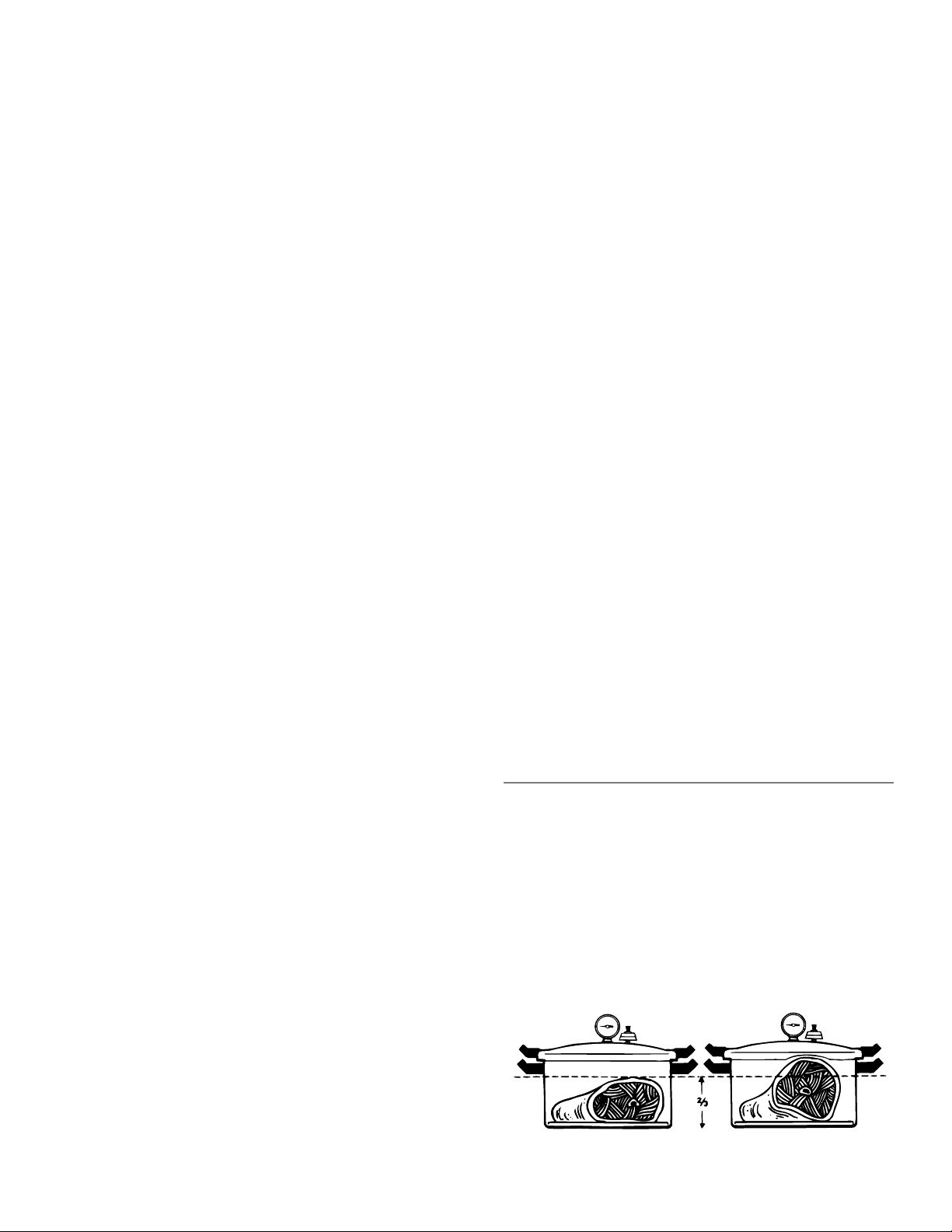
7. Look through the vent pipe on the canner cover to be certain
it is open before placing cover on canner. To clean the vent
pipe, draw a pipe cleaner or small brush through the open-
ing.
8. Place cover on canner, aligning the “V” on the cover with
the mark on the body handle and lock securely by turning
in the direction indicated to close the cover (clockwise).
Cover handles must be centered over body handles. Do
not force beyond this position.
9. Set a timer for the minutes required for processing the food
based on tested canning recipe.
10. Lower the heat setting to maintain a gentle boil throughout
processing.
11. Add more boiling water, if needed, to keep the water level
above the jars.
12. When jars have been boiled for the recommended time, turn
off the heat and remove the canner cover.
13. Using jar lifter, remove jars and place them on a towel,
leaving at least 1-inch spaces between jars during cooling.
14. Allow jars to cool naturally 12 to 24 hours before checking
for a seal. Do not retighten bands.
CANNING RECIPES: BOILING WATER METHOD
The following recipes are safely canned by the boiling water method. Do
not pressure can these recipes because the food quality would be unac-
ceptable.
RASPBERRY JAM
16 medium apples 2 teaspoons cinnamon
(about 4 pounds)
1
⁄
4
teaspoon cloves
4 cups sugar
To prepare pulp: Wash apples; remove stem and blossom ends; do not peel or
core. Cut apples into small pieces. Add 2 cups water; cover; simmer 20 to 25
minutes or until apples are soft. Press through a sieve or food mill. Measure 2
quarts apple pulp.
To prepare butter: Combine apple pulp, sugar, and spices in a large saucepot. Cook
slowly until thick enough to round up on a spoon. As pulp thickens, stir frequently to
prevent sticking. (If too thick, add a small amount of water or apple juice for desired
consistency.) Ladle hot butter into hot jars, leaving
1
⁄
4
-inch headspace. Adjust two-
piece caps. Process 10 minutes using boiling water canning method described on
pages 13-14. Yield: about 5 pints.
BREAD AND BUTTER PICKLES
4 pounds 4- to 6-inch 2 teaspoons turmeric
cucumbers, cut into slices 2 teaspoons celery seed
2 pounds onions, thinly 1 teaspoon ginger
sliced (about 8 small) 1 teaspoon peppercorns
1
⁄
3
cup canning salt 3 cups vinegar, 5%
2 cups sugar acidity
2 tablespoons mustard seed
Combine cucumber and onion slices in a large bowl. Layer vegetables with salt;
cover with ice cubes. Let stand 1
1
⁄
2
hours. Drain; rinse. Combine remaining in-
gredients in a large saucepot; bring to a boil. Add drained cucumbers and onions
and return to a boil. Pack hot pickles and liquid into hot jars, leaving
1
⁄
4
-inch
headspace. Remove air bubbles. Adjust two-piece caps. Process 10 minutes using
boiling water canning method described on pages 13-14. Yield: about 7 pints.
Note: For fresh pack pickled foods, allow 4 to 6 weeks for the product to cure
and develop a satisfactory avor.
2 quarts raspberries 1 tablespoon grated
1 package powdered pectin lemon peel
1
⁄
3
cup water 6 cups sugar
1 tablespoon lemon juice
Combine raspberries, pectin, water, lemon juice, and lemon peel in a large
saucepot. Bring to a boil over high heat, stirring frequently. Add sugar, stirring
until dissolved. Return to a rolling boil. Boil hard 1 minute, stirring constantly.
Remove from heat. Skim foam, if necessary. Ladle hot jam into hot jars, leaving
1
⁄
4
-inch headspace. Adjust two-piece caps. Process 10 minutes using boiling water
canning method described on pages 13-14. Yield: about 5 half-pints.
APPLE BUTTER
DILL PICKLES
8 pounds 4- to 6-inch 1 quart water
cucumbers, cut 3 tablespoons mixed
lengthwise into halves pickling spices
3
⁄
4
cup sugar Green or dry dill
1
⁄
2
cup canning salt (1 head per jar)
1 quart vinegar, 5% acidity
Wash and drain cucumbers. Combine sugar, salt, vinegar, and water in a large
saucepot. Tie spices in a spice bag; add spice bag to vinegar mixture; simmer 15
minutes. Pack cucumbers into hot jars, leaving
1
⁄
4
-inch headspace; put one head
of dill in each jar. Ladle hot liquid over cucumbers, leaving
1
⁄
4
-inch headspace.
Remove air bubbles. Adjust two-piece caps. Process pints and quarts 15 minutes
using boiling water canning method described on pages 13-14. Yield: about 7
pints or 3 quarts.
Note: For fresh pack pickled foods, allow 4 to 6 weeks for the product to cure
and develop a satisfactory avor.
ZESTY SALSA
10 cups chopped, seeded, 1
1
⁄
4
cups cider vinegar
peeled, cored tomatoes 3 cloves garlic, minced
(about 6 pounds) 2 tablespoons cilantro,
5 cups chopped and seeded minced
long green peppers 1 tablespoon salt
(about 2 pounds) 1 teaspoon hot pepper sauce
5 cups chopped onions (optional)
(about 1
1
⁄
2
pounds)
2
1
⁄
2
cups chopped and seeded
hot peppers (about
1 pound)
Combine all ingredients in a large saucepot, adding hot pepper sauce, if desired.
Bring mixture to a boil. Reduce heat and simmer 10 minutes. Ladle hot salsa
into hot jars, leaving
1
⁄
4
-inch headspace. Adjust two-piece caps. Process 15
minutes using boiling water canning method described on pages 13-14. Yield:
about 6 pints.
Note: When cutting or seeding hot peppers, wear rubber gloves to prevent hands
from being burned.
For boiling water canning information for fruits and tomatoes, refer to
page 7.
For additional information and recipes, consult the Ball Blue Book or visit
www.homecanning.com.
Recipes provided by Alltrista Consumer Products Company, marketers of Ball
®
and Kerr
®
home canning products.
Pressure Cooking in Your
Pressure Canner
Follow the step-by-step instructions beginning on page 15 for
cooking in your pressure canner. Prepare food according to direc-
tions in specic recipe.
The canner should never be lled over
2
⁄
3
full. Many foods
tend to expand when cooked. If the canner is lled over
2
⁄
3
full,
it is possible for food to expand enough to plug the vent pipe,
air vent/cover lock, and overpressure plug. If all of these devices
were to become blocked, excess pressure would be unable to
escape and would build up beyond safe control levels. Therefore,
when cooking any food, do not let any portion extend above the
2
⁄
3
full level.
RIGHT
WRONG
14
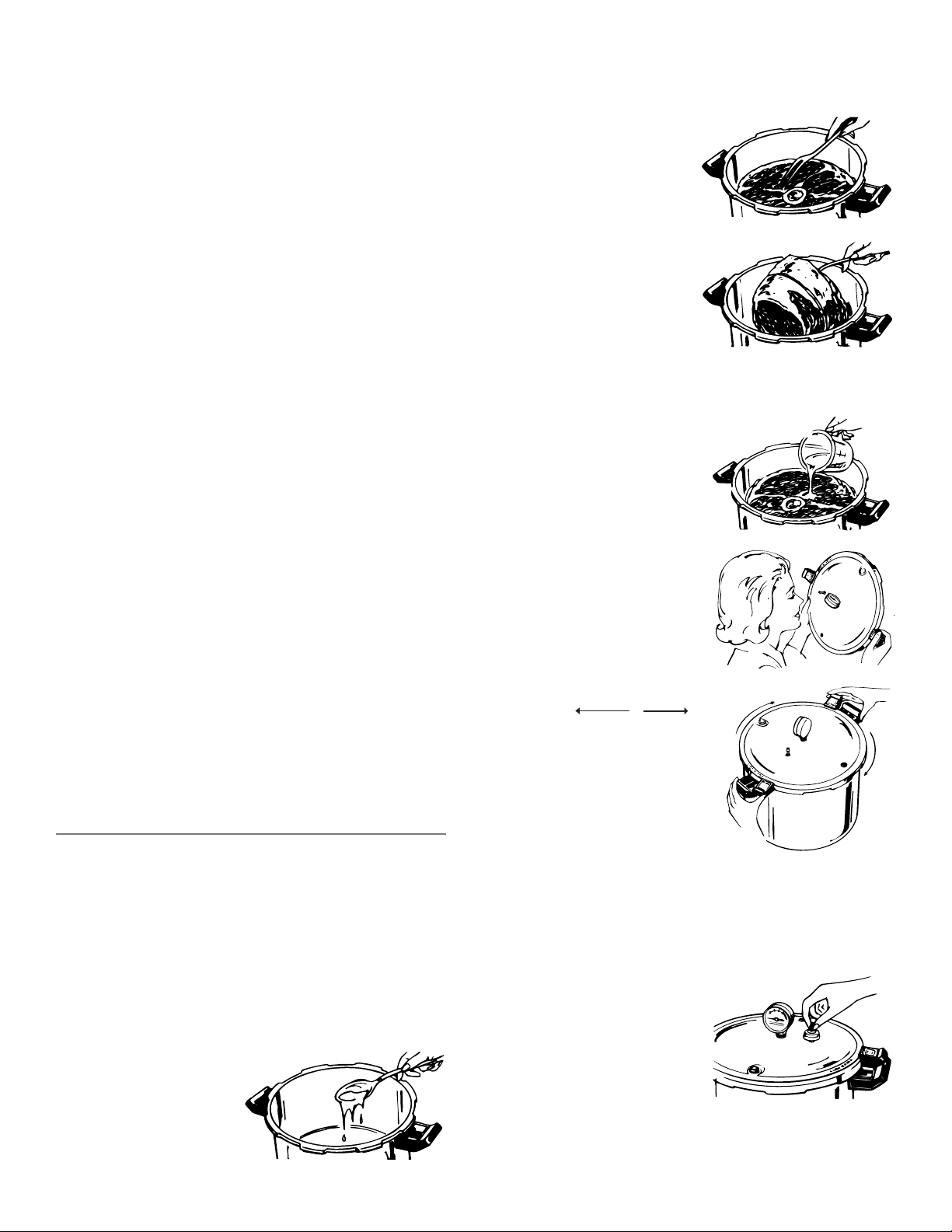
cooking oil into any overheated pan could cause the
oil to are up.
2. Place meat in bottom
of canner and sear until
deep brown and crisp.
Do not ll canner over
2
⁄
3
full. Lower heat if
necessary to prevent
burning.
3. Brown meat thoroughly
on all sides. Season
according to taste.
Remove canner from
heat and allow to cool
slightly.
4. If more than one food is to be prepared at the same time,
remove meat and place canning-cooking rack in bottom
of canner. Then, arrange
meat and other foods on
the rack. Do not ll the
canner over
2
⁄
3
full.
5. Add liquid according to
recipe. (Always use at
least 2 cups of liquid.)
6. Look through the vent pipe
to be certain it is open be-
fore closing the cover. To
clean the vent pipe, draw a
pipe cleaner or small brush
through the opening.
7. Place cover on canner, align-
ing the CLOSE V OPEN on
the cover with the mark on
the body handle and lock
securely by turning in the
direction indicated to close
(clockwise). Cover handles
must be centered directly
over body handles. Do not
force beyond this position.
If the cover is difcult to
lock at this point, it is due to expansion of the canner
from heating. If this occurs, remove cover and allow the
canner to cool slightly. Do not replace canner on burner
until cover is in its fully closed position (cover handles
directly above body handles).
8. Place pressure regula-
tor on vent pipe. If the
pressure regulator is not
correctly positioned, the
canner will not operate
properly.
Rice and dried beans and peas expand during cooking. When
preparing these foods, do not ll the canner over
1
⁄
2
full. Always
pre-soak dried beans and peas overnight in oil, salt, and water
(see page 19). Never pressure cook applesauce, cranberries,
rhubarb, pearl barley, split peas, oatmeal or other cereals,
dried soup mixes, or foods such as noodles, macaroni or
spaghetti. These foods tend to foam, froth, and sputter and may
block the vent pipe.
If the vent pipe becomes clogged, the pressure regulator will
not rock and pressure cannot be released normally. When excess
pressure builds up in the canner, the overpressure plug will be
forced out of its cover opening, releasing the excess pressure.
If the overpressure plug is ever forced out of its cover opening
due to excess pressure while cooking or canning, it is important
to call the Consumer Services Department at 1-800-877-0441.
Do not attempt to replace the overpressure plug.
The canning-cooking rack can be used to hold foods above the
liquid level. This will allow cooking several different foods
at the same time without an intermingling of avors. When
a natural blending of avors is desired, do not use the can-
ning-cooking rack. When cooking two or more foods at the
same time, choose those which require the same length of
cooking time. The length of cooking time for a specic food
varies greatly with the thickness of the food. For example, a
1
⁄
2
-inch thick slice of potato will be done in 3 minutes whereas a
3
⁄
4
-inch thick slice of potato will be done in 5 minutes. For foods
which do not require the same cooking time, the canner may be
quick cooled when there is just enough cooking time left for
the food requiring the shorter cooking time. When the pressure
is completely reduced, the cover may be opened and the food
added. Then, again place the cover on the canner and proceed
with cooking.
Questions?
For answers to any questions regarding recipes or timetables, call
or write: Home Economics Department, National Presto Industries,
Inc., 3925 North Hastings Way, Eau Claire, Wisconsin 54703-
3703, phone 1-800-368-2194 (e-mail: [email protected]).
When writing, please include a phone number and a time when
you can be reached during weekdays if possible. Inquiries will
be answered promptly by letter, telephone, or email.
How to Pressure Cook Foods
IMPORTANT: Read carefully. Do not attempt to use your
canner before reading these instructions.
Follow these step-by-step instructions for pressure cooking in
your canner. For preparing only meats, poultry, or sh, omit
step 4. For preparing only vegetables, soups, or desserts, omit
steps 1-2-3. Do not ll the canner over
2
⁄
3
full. When cooking
a solid mass of food, such as soups, do not ll the canner over
1
⁄
2
full.
1. Preheat canner with cover off. A medium heat setting is
adequate for most range burners. Consult the instruction
book which accom-
panied your range
for recommended
heat settings. Place
cooking oil in canner
according to recipe.
Caution: Pouring
15
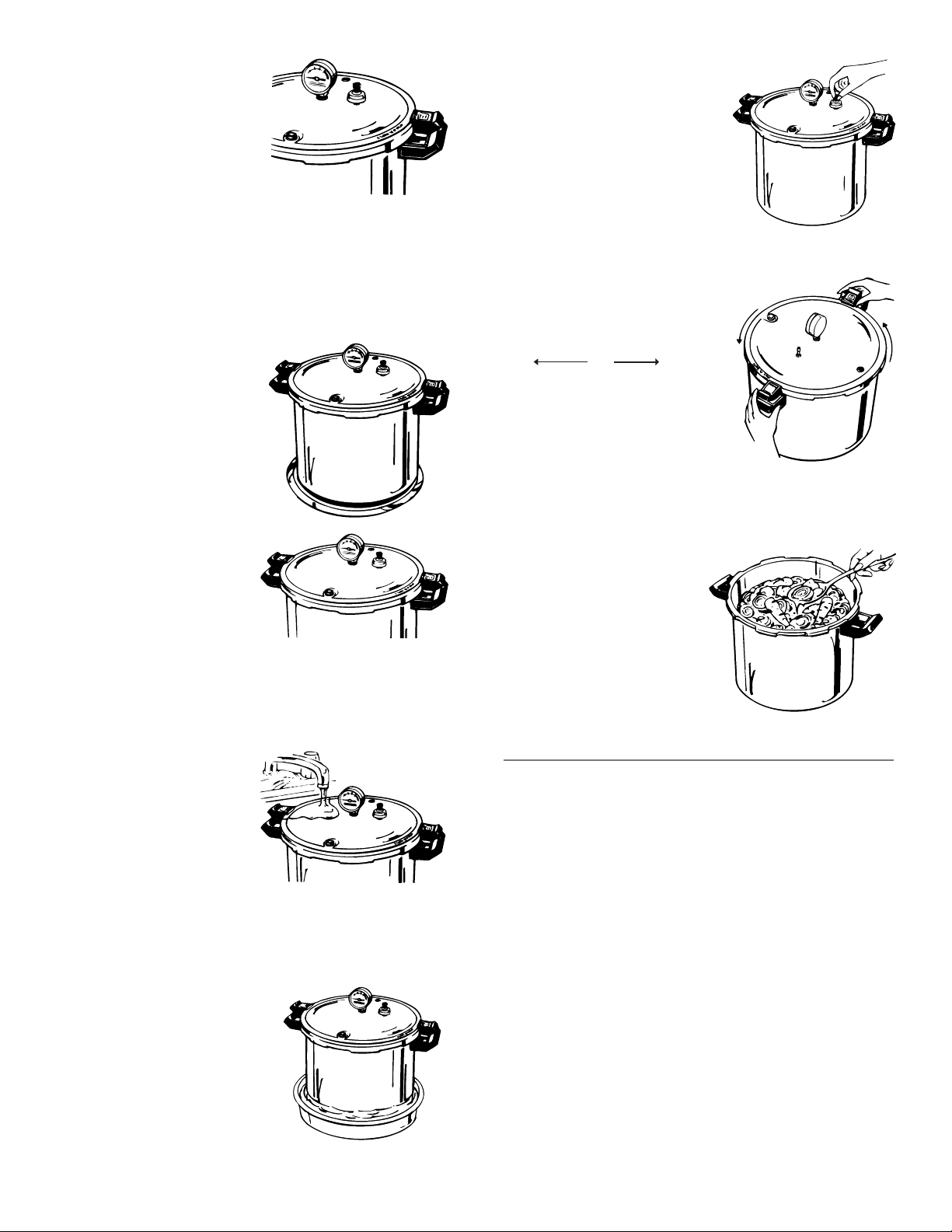
12. After the air vent /cover
lock and overpressure plug
have dropped and no steam
escapes when the regulator
is tilted, remove the pressure
regulator. Do not remove the
pressure regulator until pres-
sure is completely reduced.
Always remove the pressure
regulator before opening the
cover.
13. Remove cover by turning
counter-clockwise until
the m ark o n the b ody
handle aligns with the
CLOSE V OPEN on the
cover. Lift cover toward you
to keep steam away from
you. If the cover is locked
or turns hard after the regu-
lator is removed, there may
still be some pressure in the
canner. The cover should
not be forced off. Cool the canner until the body is cool
enough for the cover to be removed easily.
14. Remove food and serve.
If food is not to be served
immediately, it can be
easily kept warm by
placing aluminum foil
over the top of the can-
ner to retain heat. The
canner cover should
never be used for this
purpose.
Pressure Cooking Meat
Savory, tender meat is easily prepared in the canner. The most
important step is to sear meat to a crispy brown on all sides to
seal in natural juices. To readily brown meat without sticking,
heat canner, add oil, and brown meat well, (see page 15).
Meat recipes are cooked at 15 pounds pressure.
Many factors determine the length of cooking time for meats.
So, it is possible to give only general rules for required cooking
time. Cooking time depends on the amount and distribution of
fat and bone, toughness, size and thickness of cut, grade and cut
of meat, and the manner in which the meat ts into the canner.
Rolled roasts require a longer cooking time per pound than roasts
with bone. Short, chunky roasts take longer to cook than long,
at roasts. Because of the difference in thickness, a small, thick
roast requires a longer cooking time per pound than a heavier,
at roast.
During cooking, if excess liquid is lost, meat may burn. Liquid
may be lost due to: (1) Failure to add sufcient water; (2) Failure
to close cover immediately after adding water; (3) Leakage from
worn sealing ring; (4) Cooking with pressure regulator rocking
violently.
After pressure cooking time is completed, serving size pieces
9. Heat canner until pres-
sure dial gauge registers
15 pounds pressure. A
relatively high heat set-
ting is necessary for most
range burners. Cooking
time begins when pres-
sure gauge registers 15
pounds pressure. Adjust
heat to maintain 15 pounds pressure on the pressure dial
gauge to prevent excess steam from escaping. (If the pres-
sure regulator begins to rock before 15 pounds pressure
is reached on the gauge, lower heat to maintain a slow,
steady rocking motion of the pressure regulator and cook
at this pressure.)
10. Cook for the length of
time specied in recipe.
When cooking time is
completed, turn off gas
burner or remove canner
from electric burner, or
other constant heat unit.
Reduce pressure accord-
ing to recipe.
11A. When recipe states “let
pressure drop of its own
accord,” set the canner
aside to cool. Pressure
is completely reduced
when the air vent/cover
lock and over-pressure
plug have dropped and no steam escapes when the pres-
sure regulator is tilted. Do not use the pressure dial
gauge as an indicator of when pressure is completely
reduced.
11B.
When recipe states
“cool canner at once,”
the canner must be
cooled immediately
under a water faucet
or by pouring water
over it. When the air
vent/cover lock and
overpressure plug have
dropped and no steam escapes when the regula-
tor is tilted, pressure is completely reduced. Do
not use the pressure dial gauge as an indicator
of when pressure is completely reduced.
11C. Or, cool at once by placing
the canner in a pan of cold
water until the air vent/
cover lock and over-pres-
sure plug have dropped
and no steam escapes
when the regulator is tilt-
ed. Do not use the pressure
dial gauge as an indicator
of when pressure is completely reduced.
16

of meat may be quick cooled. However, when cooking a roast
cut of meat, pressure must drop of its own accord to be sure that
pressure is reduced both within the roast and the canner.
After cooking, if more crispness is desired, place meat under a
broiler 1 to 3 minutes. If gravy is desired, stir 2 to 4 tablespoons
of our or cornstarch into
1
⁄
2
cup cold water. Heat liquid in can-
ner and stir in our mixture. Heat to boiling, stir constantly for
1 minute or until thickened. Season with salt and pepper.
COOKING MEAT
The recipes in this section were written for fresh or completely
thawed meats. If you wish to use frozen meats, thaw half an
hour or more, just enough so that the meat will have contact with
the bottom of the canner and sear crispy brown. Then increase
the cooking times given in the recipes. Frozen beef, veal, and
lamb should be cooked 25 minutes per pound—frozen pork, 30
minutes per pound.
DO NOT FILL CANNER OVER TWO-THIRDS FULL!
COOKING RECIPES: MEAT
POT ROAST
9 lbs. beef shoulder or 4 tablespoons cooking oil
rump roast 2 onions, sliced
Salt and pepper 2 cups water
Heat canner, add oil, and brown meat well on all sides. Place cooking rack and
roast in canner. Season roast with salt, pepper, and onion; add water. Close cover
securely. Place pressure regulator on vent pipe and COOK 45 MINUTES at 15
pounds pressure. Let pressure drop of its own accord. 15-18 servings.
ITALIAN POTTED BEEF
9 lbs. rump or chuck roast 1 tablespoon salt
3 tablespoons cooking oil 2 cups sliced mushrooms
3 onions, chopped 3 6-ounce cans tomato paste
2 cups diced celery 2 10
1
⁄
2
-ounce cans beef broth
3 carrots, chopped 1
1
⁄
2
cups red wine
3 bay leaves
Heat canner, add oil, and brown roast on all sides. Add prepared vegetables
and seasonings. Blend tomato paste with broth and wine. Pour over meat.
Close cover securely. Place pressure regulator on vent pipe and COOK
35 MINUTES at 15 pounds pressure. Let pressure drop of its own accord.
Thicken gravy, if desired. 15-18 servings.
BRAISED BEEF
6 slices salt pork 3 cups water
9 lbs. boneless beef, round 1 cup diced turnips
or rump roast 1 cup diced carrots
Salt and pepper 3 onions, chopped
Flour 1 cup chopped celery
Heat canner and brown salt pork. Season roast with salt and pepper; dredge
in our. Brown roast well on all sides. Add water and vegetables. Close cover
securely. Place pressure regulator on vent pipe and COOK 40 MINUTES at 15
pounds pressure. Let pressure drop of its own accord. 15-18 servings.
SWISS STEAK
12 lbs. round steak, 1 inch thick 4 tablespoons cooking oil
cut into serving pieces 2 onions, chopped
1 cup our 1 green pepper, chopped
Salt and pepper 4 cups tomato juice
Season our with salt and pepper; pound our into meat. Heat canner, add oil,
and brown meat on both sides. Add remaining ingredients. Close cover securely.
Place pressure regulator on vent pipe and COOK 15 MINUTES at 15 pounds
pressure. Let pressure drop of its own accord. 24 servings.
SHORT RIBS OF BEEF
10 lbs. beef short ribs, 1 green pepper, chopped
cut into serving pieces 2 cups tomatoes
3 tablespoons cooking oil 2 tablespoons salt
3 onions, chopped 1 teaspoon pepper
1 cup chopped celery 2 cups water
Heat canner, add oil, and brown ribs on all sides. Add remaining ingredients. Close
cover securely. Place pressure regulator on vent pipe and COOK 40 MINUTES
at 15 pounds pressure. Let pressure drop of its own accord. 15-18 servings.
CORNED BEEF
12 lbs. corned beef 3 cloves garlic
4 cups water 3 bay leaves
Cut garlic cloves in small pieces and insert in beef with a sharp knife. Place
meat and water in canner. Add bay leaves. Close cover securely. Place pressure
regulator on vent pipe and COOK 40-50 MINUTES at 15 pounds pressure. Let
pressure drop of its own accord. 20-24 servings.
OXTAIL WITH HERBS
8 lbs. oxtails, cut into 2 teaspoons marjoram
serving pieces 2 teaspoons basil
3 tablespoons cooking oil 2 teaspoons thyme
4 onions, thinly sliced 8 cups tomato juice
Salt and pepper
Heat canner, add oil, and brown oxtails well on all sides. Add onion and sauté.
Add remaining ingredients. Close cover securely. Place pressure regulator on
vent pipe and COOK 40 MINUTES at 15 pounds pressure. Let pressure drop of
its own accord. 15-18 servings.
HAM—BOILED
12 lbs. ham 6 cups water
Place ham and water in canner. Close cover securely. Place pressure regulator
on vent pipe and COOK 70 MINUTES at 15 pounds pressure. Let pressure drop
of its own accord. 20-24 servings.
VIRGINIA HAM
10 lbs. ham 1
1
⁄
2
cups brown sugar
4 cups water Cloves
Place ham on cooking rack in canner. Add water. Close cover securely. Place
pressure regulator on vent pipe and COOK 60 MINUTES at 15 pounds pressure.
Let pressure drop of its own accord. Remove ham. Sprinkle with sugar and dot
with cloves. Brown in a hot oven. 15-18 servings.
HAM SLICES
4 tablespoons cooking oil Cloves, if desired
4 slices ham, 1
1
⁄
2
inches thick 2 cups water
Heat canner, add oil, and sear ham on all sides. Stud ham with cloves, if desired.
Place cooking rack, ham, and water in canner. Close cover securely. Place pres-
sure regulator on vent pipe and COOK 25 MINUTES at 15 pounds pressure. Let
pressure drop of its own accord. 12-15 servings.
PORK ROAST
6 lbs. pork roast 2 onions, sliced
2 tablespoons cooking oil 3 cups water
Salt and pepper
Heat canner, add oil, and brown roast well on all sides. Season with salt, pepper,
and sliced onion; add water. Close cover securely. Place pressure regulator on
vent pipe and COOK 60 MINUTES at 15 pounds pressure. Let pressure drop of
its own accord. 12-15 servings.
LEMON PORK CHOPS
20 pork chops,
1
⁄
2
inch thick 1 tablespoon salt
1
⁄
4
cup cooking oil 1 teaspoon pepper
20 lemon slices 2 cups catsup
4 onions, cut into rings 2 cups water
Heat canner, add oil, and brown pork chops on both sides. Top each
chop with a lemon slice. Add onion, salt, and pepper. Combine cat-
sup and water; pour over chops. Close cover securely. Place pressure
regulator on vent pipe and COOK 10 MINUTES at 15 pounds pres-
sure. Let pressure drop of its own accord. Serve chops with the sauce.
20 servings.
17

BREADED PORK CHOPS
18 pork chops,
3
⁄
4
inch thick
1
⁄
4
cup milk
Salt and pepper
1
⁄
4
cup cooking oil
3 cups corn ake crumbs 2 cups water
4 eggs, beaten
Season pork chops with salt and pepper. Dredge with corn ake crumbs, then dip
in combined egg and milk and again in crumbs. Heat canner, add oil, and brown
pork chops on both sides. Place cooking rack, chops, and water in canner. Close
cover securely. Place pressure regulator on vent pipe and COOK 10 MINUTES
at 15 pounds pressure. Let pressure drop of its own accord. 18 servings.
SPARERIBS WITH BARBECUE SAUCE
10 lbs. spareribs, cut into 2 cups catsup
serving pieces 1 cup vinegar
Salt and pepper 2 tablespoons Worcestershire
Paprika sauce
3 tablespoons cooking oil 1 teaspoon chili powder
4 onions, sliced 1 teaspoon celery seed
Season spareribs with salt, pepper, and paprika. Heat canner, add oil, and brown
ribs on all sides. Add onion. Combine catsup, vinegar, Worcestershire sauce,
chili powder, and celery seed; pour over meat in canner. Close cover securely.
Place pressure regulator on vent pipe and COOK 15 MINUTES at 15 pounds
pressure. Let pressure drop of its own accord. 12-15 servings.
LEG OF LAMB
2 legs of lamb, 5-lbs. each 2 cloves garlic, minced
3 tablespoons cooking oil 3 cups water
Salt and pepper
Heat canner, add oil, and brown lamb. Add salt, pepper, garlic, and water. Close
cover securely. Place pressure regulator on vent pipe and COOK 50 MINUTES
at 15 pounds pressure. Let pressure drop of its own accord. 20-24 servings.
CHINESE PINEAPPLE LAMB
6 lbs. boneless lamb, cut into 3 cups beef stock
1
1
⁄
2
inch cubes 2 16-ounce cans bean sprouts,
1
⁄
4
cup cooking oil drained
2 cups chopped onion 4 20-ounce cans pineapple
4 cups sliced celery chunks, drained
4 3-ounce cans mushrooms 3 tablespoons cornstarch
Salt and pepper
1
⁄
2
cup soy sauce
Heat canner, add oil, and brown meat. Add onion and celery; brown lightly.
Add mushroom liquid, seasoning, and beef stock. Close cover securely. Place
pressure regulator on vent pipe and COOK 10 MINUTES at 15 pounds pres-
sure. Let pressure drop of its own accord. Add bean sprouts, pineapple, and
mushrooms. Blend cornstarch and soy sauce and stir into mixture. Cook until
thickened, stirring carefully. If desired, serve over chow mein noodles or steamed
rice. 20-24 servings.
VEAL ROAST
9 lbs. veal roast 3 tablespoons cooking oil
Salt and pepper 2 bay leaves
Flour 2 cups water
Season meat and dredge with our. Heat canner, add oil, and brown meat well on
all sides. Place cooking rack and roast in canner. Add bay leaves and water. Close
cover securely. Place pressure regulator on vent pipe and COOK 45 MINUTES
at 15 pounds pressure. Let pressure drop of its own accord. 15-18 servings.
GOURMET VEAL STEAK
12 lbs. veal round steak, 2 lemons, thinly sliced
cut into serving pieces 2 chicken bouillon cubes
1
⁄
4
cup cooking oil 1 cup boiling water
2 tablespoons salt 1 cup sherry
1 teaspoon pepper
Heat canner, add oil, and brown meat. Sprinkle with salt and pepper; top with
lemon slices. Add bouillon cubes dissolved in boiling water and wine. Close
cover securely. Place pressure regulator on vent pipe and COOK 10 MINUTES
at 15 pounds pressure. Let pressure drop of its own accord. 24 servings.
BRAISED VEAL
9 lbs. veal roast 2 tablespoons salt
1
⁄
4
cup cooking oil
1
⁄
4
teaspoon thyme
1 onion, minced 2 cups water
Heat canner, add oil, and brown meat well on all sides. Place cooking rack and
roast in canner. Add onion, seasonings, and water. Close cover securely. Place
pressure regulator on vent pipe and COOK 45 MINUTES at 15 pounds pressure.
Let pressure drop of its own accord. 15-18 servings.
TANGY VEAL CHOPS
18 veal chops,
3
⁄
4
inch thick 3 tablespoons lemon juice
3 tablespoons cooking oil 2 onions, chopped
Salt and pepper 2 cups water
2 teaspoons paprika 20 stuffed olives, sliced
1
⁄
2
cup brown sugar
Heat canner, add oil, and brown chops on both sides. Combine seasonings,
brown sugar, lemon juice, onion, and water. Pour over meat. Sprinkle olives over
top. Close cover securely. Place pressure regulator on vent pipe and COOK 15
MINUTES at 15 pounds pressure. Let pressure drop of its own accord. Remove
meat, thicken gravy, if desired. 18 servings.
Pressure Cooking Entrees
Try these suggested entrees. Then experiment with entrees of
your own. Entree recipes are cooked at 15 pounds pressure. Al-
ways remember to select foods that cook in the same length of
time. Favorite recipes may be adjusted to Pressure Cooking by
following the general directions for the particular type of food
being cooked. Decrease the length of cooking time by two-thirds,
since Pressure Cooking requires only one-third as much time
as ordinary methods of cooking. Decrease the amount of liquid
as there is little evaporation from the canner. Add about 2 cups
more liquid than desired in the nished product.
DO NOT FILL CANNER OVER TWO-THIRDS FULL!
COOKING RECIPES: ENTREES
SPAGHETTI MEAT SAUCE
1
⁄
4
cup cooking oil 2 tablespoons salt
6 lbs. ground beef 3 12-ounce cans tomato paste
4 onions, chopped 3 quarts tomato juice
4 cloves garlic, minced
1
⁄
4
cup sugar
2 cups chopped celery
1
⁄
2
teaspoon cayenne pepper
2 green peppers, diced 2 tablespoons oregano
Heat canner, add oil, and brown beef. Add remaining ingredients. Close cover
securely. Place pressure regulator on vent pipe and COOK 10 MINUTES at 15
pounds pressure. Let pressure drop of its own accord. If desired, serve sauce over
spaghetti and sprinkle with Parmesan cheese. 20-24 servings.
BEEF GOULASH
6 lbs. chuck roast, cut into 4 garlic cloves, minced
2 inch cubes 8 onions, chopped
3 tablespoons cooking oil 16 allspice corns
Salt and pepper 2 6-ounce cans tomato paste
1
1
⁄
2
teaspoons paprika 12 potatoes
4 cups water
Heat canner, add oil, and brown meat. Season with salt, pepper, and paprika. Add
water, garlic, onions, allspice corns, and tomato paste. Place potatoes around
meat. Close cover securely. Place pressure regulator on vent pipe and COOK
15 MINUTES at 15 pounds pressure. Let pressure drop of its own accord. 12-
15 servings.
MEAT CABBAGE ROLLS
2 large heads cabbage 3 cups cooked rice
Hot water 3 cups milk
3 lbs. ground beef
1
⁄
3
cup brown sugar
2 tablespoons salt 2 cups water
3
⁄
4
teaspoon pepper
Dip cabbage leaves in hot water. Dry leaves on towel. Combine meat, salt, pep-
per, cooked rice, and milk. Place a tablespoon of meat mixture onto each leaf;
roll leaf around meat and fasten with toothpick. Place cooking rack and cabbage
rolls in canner. Sprinkle with brown sugar and add water. Close cover securely.
Place pressure regulator on vent pipe and COOK 10 MINUTES at 15 pounds
pressure. Let pressure drop of its own accord. 12-15 servings.
18

BEEF STEW
3 tablespoons cooking oil 12 potatoes, halved
4 lbs. beef, cut into 3 cups green beans
1 inch cubes 12 carrots, halved
4 onions, sliced 3 cups tomatoes
Salt and pepper 3 tablespoons our
2 cups water
3
⁄
4
cup water
Heat canner, add oil, and brown meat. Add onion, salt, pepper, water, potatoes,
green beans, carrots, and tomatoes. Close cover securely. Place pressure regulator
on vent pipe and COOK 8 MINUTES at 15 pounds pressure. Let pressure drop of
its own accord. Make a paste of our and
3
⁄
4
cup water and stir into stew to thicken.
15-18 servings.
CHILI CON CARNE
3 tablespoons cooking oil 3 16-ounce cans kidney beans,
6 lbs. ground beef drained and rinsed
4 onions, chopped 2 tablespoons salt
2 green peppers, chopped
1
⁄
2
teaspoon cayenne pepper
2 cloves garlic, minced 2 tablespoons chili powder
1 16-ounce can tomato sauce 1 cup water
3 16-ounce cans tomatoes
Heat canner. Add oil and brown beef, breaking it apart to assure even browning.
Add onions, green pepper, garlic and brown lightly. Add remaining ingredients.
Close cover securely. Place pressure regulator on vent pipe and COOK 15
MINUTES at 15 pounds pressure. Let pressure drop of its own accord. 18-20
servings.
PORK CHOPS WITH VEGETABLES
3 tablespoons cooking oil 2 cups water
15 pork chops,
3
⁄
4
inch thick 15 potatoes
Salt and pepper 15 carrots
Heat canner, add oil, and brown pork chops on both sides. Season with salt and
pepper. Add water, potatoes, and carrots. Close cover securely. Place pressure
regulator on vent pipe and COOK 10 to 12 MINUTES at 15 pounds pressure.
Let pressure drop of its own accord. 15 servings.
SPARERIBS AND SAUERKRAUT
6 lbs. spareribs, cut into 3 quarts sauerkraut
serving pieces 3 tablespoons brown sugar
3 tablespoons cooking oil 2 cups water
Salt and pepper
Heat canner, add oil, and brown ribs on both sides. Season with salt and pepper.
Place sauerkraut over ribs and sprinkle with brown sugar. Add water. Close cover
securely. Place pressure regulator on vent pipe and COOK 15 MINUTES at 15
pounds pressure. Let pressure drop of its own accord. 12 servings.
PORK HOCKS WITH SAUERKRAUT AND POTATOES
9 lbs. pork hocks 2 quarts sauerkraut
4 cups water 2 onions, chopped
2 teaspoons salt 12 potatoes, halved
1
⁄
4
teaspoon pepper
Place hocks, water, salt, and pepper in canner. Close cover securely. Place pres-
sure regulator on vent pipe and COOK 45 MINUTES at 15 pounds pressure. Let
pressure drop of its own accord. Add sauerkraut, onions, and potatoes. Close cover
securely. Place pressure regulator on vent pipe and COOK 10 MINUTES at 15
pounds pressure. Let pressure drop of its own accord. 12-15 servings.
NEW ENGLAND BOILED DINNER
4 lbs. ham shank 12 carrots, halved
4 cups water 1 cabbage, cut in wedges
12 potatoes, halved 1 teaspoon pepper
12 onions, halved
Place ham and water in canner. Close cover securely. Place pressure regulator
on vent pipe and COOK 20 MINUTES at 15 pounds pressure. Let pressure drop
of its own accord. Add vegetables and pepper. Close cover securely. Place pres-
sure regulator on vent pipe and COOK 8 MINUTES at 15 pounds pressure. Let
pressure drop of its own accord. 12 servings.
LAMB STEW
3 tablespoons cooking oil 8 onions, diced
6 lbs. breast of lamb, cut 2 tablespoons Worcestershire
into 1 inch cubes sauce
Salt and pepper 12 carrots, cut in half
3 green peppers, diced 2 cups water
Heat canner, add oil, and brown lamb well on all sides. Season with salt and
pepper. Add green pepper, onion, Worcestershire sauce, carrots, and water. Close
cover securely. Place pressure regulator on vent pipe and COOK 8 MINUTES at
15 pounds pressure. Let pressure drop of its own accord. 12 servings.
BOSTON BAKED BEANS
6 cups dried beans 1 tablespoon salt
3
⁄
4
cup cooking oil 2 teaspoons dry mustard
3 tablespoons salt 1 cup molasses
Water 1 cup catsup
1 lb. salt pork or bacon, diced 4 onions, diced
1
⁄
2
cup brown sugar Water
Soak beans overnight in cooking oil, salt, and enough water to cover completely.
Drain and discard liquid. Heat canner and sear salt pork or bacon. Remove
excess drippings. Add beans, remaining ingredients, and enough water to well
cover beans. Do not ll canner over one-half full. Close cover securely. Place
pressure regulator on vent pipe and COOK 45 MINUTES at 15 pounds pressure.
Let pressure drop of its own accord. 12-15 servings.
CHOP SUEY
3 tablespoons cooking oil
1
⁄
2
cup soy sauce
3 lbs. round steak, cubed 3 cups diced celery
1 lb. lean pork, cubed 3 16-ounce cans Chinese
1 lb. lean veal, cubed vegetables
Salt and pepper 3 16-ounce cans bean sprouts
3 onions, chopped 2 cups water
Heat canner, add oil, and brown meat well. Season with salt and pepper. Add
onions, soy sauce, celery, liquid drained from vegetables, and water. Close cover
securely. Place pressure regulator on vent pipe and COOK 10 MINUTES at 15
pounds pressure. Let pressure drop of its own accord. Add vegetables to meat.
Heat in open canner. Serve with steamed rice, if desired. 12-15 servings.
LIMA BEANS WITH BACON
6 cups dried lima beans 1 lb. bacon, diced
3
⁄
4
cup cooking oil 2 teaspoons salt
3 tablespoons salt Water
Water
Soak beans overnight in cooking oil, salt, and enough water to cover completely.
Drain and discard liquid. Heat canner and brown bacon. Add beans, salt, and
enough water to well cover beans. Do not ll canner over one-half full. Close
cover securely. Place pressure regulator on vent pipe and COOK 25 MINUTES
at 15 pounds pressure. Let pressure drop of its own accord. 12-15 servings.
LIMA BEAN POT
6 cups dried lima beans 1 green pepper, diced
3
⁄
4
cup cooking oil 1 cup chopped celery
3 tablespoons salt 6 cups tomato juice
Water
1
⁄
2
cup brown sugar
2 lbs. pork sausages, cut into 1 tablespoon salt
1
⁄
2
inch pieces 1 tablespoon chili powder
3 onions, chopped
1
⁄
2
teaspoon cayenne pepper
Soak beans overnight in cooking oil, salt, and enough water to cover completely.
Drain and discard liquid. Heat canner and brown sausage. Remove. Pour off all
drippings in excess of two tablespoons. Sauté onions, green pepper, and celery.
Add lima beans and sausage. Add combined tomato juice, brown sugar, salt, chili
powder, and cayenne pepper. Mix well. Do not ll canner over one-half full. Close
cover securely. Place pressure regulator on vent pipe and COOK 25 MINUTES at
15 pounds pressure. Let pressure drop of its own accord. 12-15 servings.
SHRIMP JAMBALAYA
3 tablespoons cooking oil 1 cup water
2 cloves garlic 3 1-lb. cans tomatoes
2 cups chopped onion 3 6-ounce cans sliced
2 lbs. precooked ham, diced mushrooms, with liquid
3 cups uncooked rice 3 lbs. peeled and cleaned
2 tablespoons salt shrimp
1
⁄
2
teaspoon pepper 2 green peppers,
1
⁄
2
teaspoon allspice cut into strips
Pinch each, cayenne, chili
powder, and basil
Heat canner, add oil, and sauté garlic and onion until golden brown. Stir in ham
and rice. Cook until rice is golden. Remove garlic. Add seasonings, water, toma-
toes, and mushrooms with liquid; mix well. Add shrimp and sprinkle green pepper
strips over all. Close cover securely. Place pressure regulator on vent pipe and
COOK 5 MlNUTES at 15 pounds pressure. Let pressure drop of its own accord.
Remove cover and stir. Let stand 5 minutes before serving. 15-18 servings.
19

Pressure Cooking Poultry
Poultry recipes are cooked at 15 pounds pressure. Try the fol-
lowing suggested recipes and enjoy tasty poultry in a variety
of sauces. Or, prepare your own favorite poultry dishes. When
you wish to seal the natural juices into the poultry, sear to a
crispy brown prior to pressure cooking. When it is desirable to
intermingle food avors, during cooking, it is best not to brown
poultry; just cook it in the liquid indicated in the recipe.
DO NOT FILL CANNER OVER TWO-THIRDS FULL!
COOKING RECIPES: POULTRY
BRAISED WHOLE CHICKEN
3 3-lb. chickens Salt and pepper
3 tablespoons cooking oil 2 cups water
Stuff chickens, if desired. Remove neck bone, fold skin down on breast and skewer
in position. Fasten legs and wings close to side of body. Heat canner, add oil, and
brown chickens on all sides. Season with salt and pepper. Place water, cooking rack,
and chickens in canner. Close cover securely. Place pressure regulator on vent pipe
and COOK 10 MINUTES at 15 pounds pressure. Let pressure drop of its own accord.
15-18 servings.
CHICKEN IMPERIAL
9 lbs. chicken, cut into serving 1 cup slivered almonds
pieces 4 4-ounce cans mushrooms
1
⁄
4
cup cooking oil 2 chicken bouillon cubes
2 tablespoons salt 1 cup hot water
1 teaspoon pepper 1 cup white wine
1
⁄
2
cup minced onion
Heat canner, add oil, and brown chicken. Season with salt and pepper. Add onions,
almonds, mushrooms with liquid, bouillon cubes dissolved in hot water, and
wine. Close cover securely. Place pressure regulator on vent pipe and COOK 10
MINUTES at 15 pounds pressure. Let pressure drop of its own accord. Remove
chicken from canner, thicken gravy. If desired, serve chicken on bed of hot rice,
top with gravy and toasted almonds. 15-18 servings.
CHICKEN AND DUMPLINGS
9 lbs. chicken, cut into serving 3 carrots, chopped
pieces 3 onions, chopped
2 tablespoons salt 3 ribs celery, chopped
1 teaspoon pepper 8 cups water
Place all ingredients in canner. Close cover securely. Place pressure regulator
on vent pipe and COOK 5 MINUTES at 15 pounds pressure. Let pressure drop
of its own accord. Prepare dumplings as follows.
Dumplings
2 cups our
2
⁄
3
cup milk
1 teaspoon salt
1
⁄
4
cup cooking oil
1 tablespoon baking powder 1 tablespoon parsley akes
2 eggs
Sift our, salt, and baking powder. Beat eggs; add milk, oil, and parsley. Combine
liquid and dry ingredients. Drop from teaspoon into hot chicken broth. Simmer
without cover for 15 minutes. Thicken broth if desired. 15-18 servings.
CHICKEN MARENGO
9 lbs. chicken, quartered 2 cloves garlic
1 tablespoon coarse black 4 3-ounce cans sliced
pepper mushrooms, drained (or
1 cup our 1 lb. mushrooms, sliced)
2 tablespoons salt 4 16-ounce cans tomatoes
1
⁄
3
cup cooking oil 2 cups dry white wine
Rub chicken with pepper. Dredge in our and season with salt. Heat canner,
add oil and garlic. Brown chicken. Remove garlic. Add mushrooms, tomatoes,
and 1 cup wine. Close cover securely. Place pressure regulator on vent pipe and
COOK 10 MINUTES at 15 pounds pressure. Let pressure drop of its own ac-
cord. Remove chicken from canner. Add remaining wine and simmer. Thicken,
if desired. 15-18 servings.
CORNISH HENS IN WHITE WINE
4 tablespoons cooking oil 1
1
⁄
2
teaspoons instant chicken
8 cornish hens bouillon
2 teaspoons salt 1 teaspoon thyme
1 teaspoon pepper 1 tablespoon chopped parsley
1
1
⁄
2
cups white cooking wine
Heat canner, add oil, and brown hens. Season with salt and pepper. Combine
remaining ingredients and pour over hens. Close cover securely. Place pressure
regulator on vent pipe and COOK 8 MINUTES at 15 pounds pressure. Let pres-
sure drop of its own accord. 8-12 servings.
HUNTER’S TURKEY
9 lbs. turkey, cut into serving 2 bay leaves
pieces 1 teaspoon thyme
Flour, salt and pepper 1 teaspoon marjoram
1
⁄
3
cup cooking oil 1 tablespoon Worcestershire
3 onions, chopped sauce
4 8-ounce cans tomato sauce
Dredge turkey in seasoned our. Heat canner, add oil, and brown turkey. Add
combined onion, tomato sauce, bay leaf, thyme, marjoram, and Worcestershire
sauce. Close cover securely. Place pressure regulator on vent pipe and COOK
10 MINUTES at 15 pounds pressure. Let pressure drop of its own accord. 15-
18 servings.
FLORIDA DUCK
9 lbs. duck, cut into serving 2 cups white cooking wine
pieces 2 tablespoons grated orange
Salt and pepper rind
1 tablespoon cooking oil
Remove as much fat as possible from duck. Season with salt and pepper. Heat can-
ner, add oil, and brown duck. Pour off excess drippings. Combine cooking wine
and orange rind. Pour over duck. Close cover securely. Place pressure regulator
on vent pipe and COOK 12 MINUTES at 15 pounds pressure. Let pressure drop
of its own accord. Remove duck and thicken gravy, if desired. 18 servings.
Pressure Cooking Soups
Make old-fashioned, homemade soups the easy way in your
canner. If you wish to prepare your family’s favorite soup, use
the following recipes as guides. Soup recipes are cooked at 15
pounds pressure.
Do not pressure cook soups containing barley, rice, noodles,
macaroni products, split peas, or soup mixes with dried veg-
etables because they have a tendency to foam, froth, and sputter
and could clog the vent pipe. See page 15.
The canner quickly transfers natural avor and nutrients from the
meat into the broth. Prepare either the Brown Beef Soup Stock
or the Chicken Soup Stock according to the recipe. Remove the
pieces of meat. If desired, cut into small pieces and use in soup
recipes. Strain through several layers of cheese cloth. Once the
stock is prepared, serve it as a consommé or use it to prepare
delicious soups.
FOR SOUP RECIPES DO NOT FILL CANNER
OVER ONE-HALF FULL!
COOKING RECIPES: SOUP
VEGETABLE SOUP
4 lbs. soup meat 4 cups canned or fresh
2 quarts water tomatoes
6 carrots, diced 1 cup diced celery
6 potatoes, diced 4 onions, sliced
2 cups canned lima beans 1 tablespoon salt
Place all ingredients in canner. Close cover securely. Place pressure
regulator on vent pipe and COOK 20 MINUTES at 15 pounds pres-
sure. Let pressure drop of its own accord. 12-15 servings.
20

CHICKEN SOUP STOCK
4 lbs. chicken, cut into serving 1 cup diced carrots
pieces 2 onions, chopped
4 quarts water 1 tablespoon salt
1 cup diced celery
Place all ingredients in canner. Close cover securely. Place pressure regulator on
vent pipe and COOK 10 MINUTES at 15 pounds pressure. Let pressure drop
of its own accord. Strain stock. 12-15 servings.
NAVY BEAN SOUP
4 cups dried navy beans 4 ribs celery, sliced
1
⁄
2
cup vegetable oil
1
⁄
4
cup minced green pepper
2 tablespoons salt 2 cups tomato sauce
Water 2 whole cloves
3 lbs. ham bone or shank Salt and pepper
2 onions, chopped 3 quarts water
4 carrots, sliced
Soak beans overnight in vegetable oil, salt, and water to cover completely. Drain
and discard liquid. Place beans and all remaining ingredients in canner. Close
cover securely. Place pressure regulator on vent pipe and COOK 30 MINUTES
at 15 pounds pressure. Let pressure drop of its own accord. 12-15 servings.
CLAM CHOWDER
1 lb. salt pork, cubed 2 tablespoons salt
6 cups water Pepper
4 onions, minced 4 quarts clams, minced
12 cups diced potatoes 4 quarts hot milk
4 cups corn
1
⁄
2
cup butter
Heat canner and brown salt pork. Add vegetables, water, salt, and pepper. Close
cover securely. Place pressure regulator on vent pipe and COOK 5 MINUTES
at 15 pounds pressure. Let pressure drop of its own accord. Add clams and boil,
without cover, for 2 minutes. (Additional cooking will toughen clams.) Add
milk and butter. 16 servings.
BROWN BEEF SOUP STOCK
3 tablespoons cooking oil 1 cup chopped celery
4 lbs. beef, cubed 1 cup diced turnips
3 quarts water 2 tablespoons parsley akes
1 cup sliced onion 1 bay leaf
1 cup diced carrots 1 tablespoon salt
Heat canner, add oil, and brown beef. Add remaining ingredients. Close cover
securely. Place pressure regulator on vent pipe and COOK 20 MINUTES at
15 pounds pressure. Let pressure drop of its own accord. Strain stock. 12-15
servings.
Pressure Cooking Desserts
Your canner offers a shortened method for preparing steamed
breads and desserts. Actually the cooking time can be counted
in minutes instead of hours. You will nd, too, that your canner
is easier to use than the ordinary steamer because its pressure
regulator acts as a means of measurement to assure constant heat
to produce uniform even-textured products. Consult specic
recipes for cooking pressure.
Best results are obtained when 1 to 1
1
⁄
2
quart molds are used.
Any type of mold is satisfactory (metal, glass, earthenware, tin
food cans). Remember, never ll molds over two-thirds full; this
extra top-space is to allow ample space for rising. If molds used
do not have a cover, aluminum foil or several thicknesses of wax
paper should be tied securely over the top to prevent condensed
moisture from falling into mold. Because the rst part of the
cooking period is steaming time, which permits foods to rise,
at least three quarts water should be poured into the bottom of
canner to allow for evaporation.
Adjust heat to allow a moderate ow of steam from the vent
pipe.
DO NOT FILL CANNER OVER TWO-THIRDS FULL!
COOKING RECIPES: DESSERTS
BROWN BETTY
2 cups dry bread crumbs 9 apples, peeled, cored and
1
⁄
2
cup sugar sliced
1 teaspoon cinnamon
1
⁄
2
cup melted butter
1 lemon, juice and rind 1 quart water
Combine crumbs, sugar, cinnamon, lemon juice, and grated rind. Place
alternate layers of apples and crumb mixture in buttered bowl that may
be set loosely in canner. Pour melted butter over top. Cover firmly with
aluminum foil. Place water, cooking rack, and bowl in canner. Close
cover securely. Place pressure regulator on vent pipe and COOK 20
MINUTES at 15 pounds pressure. Let pressure drop of its own accord.
12 servings.
CUSTARD
6 cups milk 1 teaspoon salt
6 eggs, beaten 1
1
⁄
2
teaspoons vanilla
1 cup sugar 2 cups water
Scald milk and cool slightly. Combine eggs, sugar, and salt. Add milk slowly,
stirring constantly. Add vanilla. Pour into individual custard cups and cover rmly
with aluminum foil. Place water, cooking rack, and custard cups in canner. Close
cover securely. Place pressure regulator on vent pipe and COOK 3 MINUTES at
15 pounds pressure. Cool canner at once. Chill. 12-14 servings.
Chocolate Custard: Scald milk with 3 squares chocolate, grated. Follow vanilla
custard directions.
Coconut Custard: Sprinkle 3 tablespoons coconut over top of each vanilla
custard before cooking.
ENGLISH PLUM PUDDING
1 cup sifted all purpose our
1
⁄
2
cup currants
1 teaspoon baking powder
1
⁄
2
cup chopped nuts
1
⁄
2
teaspoon salt 1 egg
1
⁄
2
teaspoon allspice
1
⁄
2
cup sugar
1
⁄
2
teaspoon cinnamon
1
⁄
2
cup ground suet
1
⁄
2
teaspoon nutmeg
1
⁄
3
cup milk
1
⁄
4
teaspoon ground cloves 3 quarts water
1
⁄
2
cup raisins
Sift our with baking powder, salt, and spices. Add fruits and nuts. Beat egg;
add sugar, suet, and milk. Combine liquid and dry ingredients; mix well. Pour
into buttered 1 quart mold. Cover mold rmly with aluminum foil. Place water,
cooking rack, and mold in canner. Close cover securely. Allow steam to ow
from vent pipe 20 minutes. Place pressure regulator on vent pipe and cook 50
minutes at 10 pounds pressure. Let pressure drop of its own accord.
BREAD PUDDING
4 cups cubed dry bread 1 cup raisins
4 cups hot milk 1 cup chopped nuts
1
⁄
2
teaspoon salt 4 eggs
1 cup brown sugar 1 teaspoon vanilla
1 teaspoon cinnamon 1 quart water
2 tablespoons butter
Combine bread, hot milk, salt, brown sugar, cinnamon, butter, raisins, nuts, eggs,
and vanilla. Turn into a buttered bowl that may be set loosely in canner. Cover
bowl rmly with aluminum foil. Place water, cooking rack, and bowl in canner.
Close cover securely. Place pressure regulator on vent pipe and COOK 20 MIN-
UTES at 15 pounds pressure. Let pressure drop of its own accord. 12 servings.
RICE PUDDING
1 quart milk 4 cups cooked rice
4 eggs, slightly beaten 1 teaspoon vanilla
2
⁄
3
cup sugar 2 cups water
1 teaspoon salt
Scald milk and cool slightly. Combine eggs, sugar, and salt. Add milk slowly,
stirring constantly. Add rice and vanilla. Pour into individual custard cups and
cover rmly with aluminum foil. Place water, cooking rack, and custard cups in
canner. Close cover securely. Place pressure regulator on vent pipe and COOK
3 MINUTES at 15 pounds pressure. Cool canner at once. Stir gently before
chilling. 12-14 servings.
Fruit and Nut Rice Pudding: Substitute brown sugar for white and add 1 cup
raisins or dates and 1 cup walnuts to above recipe.
21

BROWN BREAD
2 cups graham our 1
1
⁄
2
cups light molasses
2 cups corn meal 4 cups milk, sweet or sour
2 cups rye meal 2 cups raisins
2 teaspoons salt 3 quarts water
2 teaspoons soda
Mix all dry ingredients. Add molasses, milk, and raisins. Beat well. Pour into 6
buttered molds (pint size). Cover rmly with aluminum foil. Place water, cooking
rack, and molds in canner. Close cover securely. Allow steam to ow from vent
pipe 20 minutes. Place pressure regulator on vent pipe and COOK 25 MINUTES
at 10 pounds pressure. Let pressure drop of its own accord.
WHITE FRUIT CAKE
1
1
⁄
4
cups canned pineapple
1
⁄
2
cup shredded coconut
tidbits 2 cups chopped walnuts
2
⁄
3
cup chopped citron
1
⁄
2
cup our
2
⁄
3
cup shredded lemon peel 1 cup shortening
1
⁄
2
cup chopped candied 1 cup sugar
cherries 5 eggs
3
⁄
4
cup chopped dates 1
1
⁄
2
cups our
2
⁄
3
cup shredded orange peel 1 teaspoon salt
1 cup chopped dried apricots 1
1
⁄
2
teaspoons baking powder
1
⁄
2
cup chopped gs
1
⁄
4
cup pineapple juice
1
1
⁄
2
cups white raisins 3 quarts water
Drain pineapple, saving juice. Dredge fruits and nuts with
1
⁄
2
cup our. Cream
shortening and sugar. Add eggs, one at a time, beating mixture well after each
addition. Sift our, salt, and baking powder. Add alternately with pineapple juice.
Pour over oured fruit and nuts; mix until well blended. Pour into 5 buttered
molds (pint size). Cover rmly with aluminum foil. Place water, cooking rack,
and molds in canner. Close cover securely. Allow steam to ow from vent pipe
20 minutes. Place pressure regulator on vent pipe and COOK 60 MINUTES at
10 pounds pressure. Let pressure drop of its own accord.
Helpful Hints for Pressure
Cooking
Your favorite recipes may be adjusted for cooking in the
canner by following the general directions in this book for
the particular type of food being cooked. Decrease the length
of cooking time by two thirds, since pressure cooking re-
quires only one-third as much time as ordinary methods of
cooking. Because there is little evaporation from the canner,
the amount of liquid should be decreased. Add about 2 cups
more liquid than desired in the nished product. There must
always be water or some other liquid in the bottom of the
canner to form the necessary steam.
Use the cooking rack when it is desirable to cook foods out
of the cooking liquid.
When the body of your canner is heated, the metal expands.
Therefore, it may be difcult to close cover on heated body.
When this happens, allow canner to cool slightly.
Foods are quickly cooked in the canner. Therefore, to prevent
overcooking it is important to accurately time the cooking
period.
If your cooked food has more liquid than you desire, simmer
to evaporate excess liquid. You may wish to use 1 or 2 table-
spoons less liquid the next time you prepare the recipe.
When pressure cooking at high altitudes, cooking time
should be increased 5% for every 1000 feet above the rst
2000 feet. Following this rule, the time would be increased
as follows:
3000 . . . . . 5% 5000 . . . . 15% 7000 . . . . 25%
4000 . . . . 10% 6000 . . . . 20% 8000 . . . . 30%
If you have questions on recipes or timetables write to: Home
Economics Department, National Presto Industries, Inc., 3925
North Hastings Way, Eau Claire, Wisconsin 54703-3703, phone
1-800-368-2194 (e-mail: contact@GoPresto.com). Inquiries
will be answered promptly by letter, phone, or email.
Recipe Index
PRESSURE CANNING RECIPES
FRUITS AND TOMATOES . . . .7
Apples . . . . . . . . . . . . . . . . . . . .7
Apple Sauce . . . . . . . . . . . . . . .7
Apricots . . . . . . . . . . . . . . . . . .8
Berries . . . . . . . . . . . . . . . . . . .8
Cherries . . . . . . . . . . . . . . . . . .8
Peaches . . . . . . . . . . . . . . . . . .8
Pears . . . . . . . . . . . . . . . . . . . . .8
Plums . . . . . . . . . . . . . . . . . . . .8
Rhubarb . . . . . . . . . . . . . . . . . .8
Tomatoes . . . . . . . . . . . . . . . . .8
JUICE AND SAUCE . . . . . . 9
Tomato Juice . . . . . . . . . . . . . . .9
Tomato Sauce . . . . . . . . . . . . . .9
VEGETABLES . . . . . . . . . . . . . .9
Asparagus . . . . . . . . . . . . . . . . .9
Beans, Snap . . . . . . . . . . . . . . .9
Beets . . . . . . . . . . . . . . . . . . . . .9
Carrots . . . . . . . . . . . . . . . . . .10
Corn, Whole Kernel . . . . . . . .10
Greens . . . . . . . . . . . . . . . . . .10
Lima Beans . . . . . . . . . . . . . . .10
Mushrooms . . . . . . . . . . . . . . .10
VEGETABLES (Cont.)
Okra . . . . . . . . . . . . . . . . . . . .10
Peas, Green . . . . . . . . . . . . . . .10
Potatoes, New Whole . . . . . . .10
Squash . . . . . . . . . . . . . . . . . .10
Sweet Potatoes . . . . . . . . . . . .11
MEAT . . . . . . . . . . . . . . . . . . . .11
Cut-Up . . . . . . . . . . . . . . . . . .11
Ground . . . . . . . . . . . . . . . . . .11
POULTRY . . . . . . . . . . . . . . . . .11
Cut-Up . . . . . . . . . . . . . . . . . .11
Rabbit . . . . . . . . . . . . . . . . . . .12
FISH AND SEAFOOD . . . . . . .12
Clams . . . . . . . . . . . . . . . . . . .12
Crab . . . . . . . . . . . . . . . . . . . .12
Fish (General Method) . . . . . .12
Tuna . . . . . . . . . . . . . . . . . . . .12
SOUPS . . . . . . . . . . . . . . . . . . . .12
Beef Stock . . . . . . . . . . . . . . .12
Chicken Stock . . . . . . . . . . . . .12
BOILING WATER CANNING RECIPES
Apple Butter . . . . . . . . . . . . . . 14
Bread and Butter Pickles . . . . 14
Dill Pickles . . . . . . . . . . . . . . . 14
Raspberry Jam . . . . . . . . . . . . 14
Zesty Salsa . . . . . . . . . . . . . . . 14
22
ENTREE RECIPES (Cont.)
Lamb Stew . . . . . . . . . . . . . . . . 19
Lima Bean Pot . . . . . . . . . . . . . 19
Lima Beans with Bacon . . . . . . 19
Meat Cabbage Rolls . . . . . . . . 18
New England Boiled Dinner . .19
Pork Chops with Vegetables . . 19
Pork Hocks with Sauerkraut
and Potatoes . . . . . . . . . . . . 19
Shrimp Jambalaya . . . . . . . . . .19
Spaghetti Meat Sauce . . . . . . . 18
Spareribs and Sauerkraut . . . . . 19
POULTRY RECIPES . . . . . . . .20
Chicken, Braised Whole . . . . . 20
Chicken and Dumplings . . . . . 20
Chicken Imperial . . . . . . . . . . . 20
Chicken Marengo . . . . . . . . . .20
Cornish Hens in White Wine . . 20
Florida Duck . . . . . . . . . . . . . . 20
Hunter’s Turkey . . . . . . . . . . . . 20
SOUP RECIPES . . . . . . . . . 20-21
Brown Beef Stock . . . . . . . . . . 21
Chicken Stock . . . . . . . . . . . . . 21
Clam Chowder . . . . . . . . . . . . . 21
Navy Bean . . . . . . . . . . . . . . . . 21
Vegetable . . . . . . . . . . . . . . . . .20
DESSERT RECIPES . . . . . 21-22
Bread Pudding . . . . . . . . . . . . . 21
Brown Betty . . . . . . . . . . . . . . . 21
Brown Bread . . . . . . . . . . . . . . 22
Custards . . . . . . . . . . . . . . . . . . 21
English Plum Pudding . . . . . . . 21
Rice Pudding . . . . . . . . . . . . . .21
White Fruit Cake . . . . . . . . . . . 22
MEAT RECIPES . . . . . . . . . . . . 17
Beef Recipes . . . . . . . . . . . . . . 17
Braised Beef . . . . . . . . . . . . . .17
Corned Beef . . . . . . . . . . . . . . . 17
Italian Potted Beef . . . . . . . . . . 17
Oxtail with Herbs . . . . . . . . . . 17
Pot Roast . . . . . . . . . . . . . . . . . 17
Short Ribs . . . . . . . . . . . . . . . . 17
Swiss Steak . . . . . . . . . . . . . . . 17
Ham Recipes . . . . . . . . . . . . . . 17
Boiled Ham . . . . . . . . . . . . . . . 17
Ham Slices . . . . . . . . . . . . . . . . 17
Virginia Ham . . . . . . . . . . . . . . 17
Pork Recipes . . . . . . . . . . . 17-18
Breaded Pork Chops . . . . . . . . 18
Lemon Pork Chops . . . . . . . . . 17
Roast . . . . . . . . . . . . . . . . . . . . 17
Spareribs with
Barbecue Sauce . . . . . . . . . 18
Lamb Recipes . . . . . . . . . . . . . 18
Chinese Pineapple Lamb . . . . . 18
Leg of Lamb . . . . . . . . . . . . . . 18
Veal Recipes . . . . . . . . . . . . . . 18
Braised Veal . . . . . . . . . . . . . . .18
Gourmet Veal Steak . . . . . . . . . 18
Roast Veal . . . . . . . . . . . . . . . . 18
Tangy Veal Chops . . . . . . . . . . 18
ENTREE RECIPES . . . . . . 18-19
Beef Goulash . . . . . . . . . . . . . 18
Beef Stew . . . . . . . . . . . . . . . . . 19
Boston Baked Beans . . . . . . . . 19
Chili Con Carne . . . . . . . . . . . . 19
Chop Suey . . . . . . . . . . . . . . . .19
PRESSURE COOKING RECIPES

Service and Parts
Information
If you have any questions regarding the operation of your
Presto
®
canner or need parts for your canner, call our Con-
sumer Service Department weekdays between 8:00 AM and
4:30 PM (Central Time) at 715-839-2209 or write:
NATIONAL PRESTO INDUSTRIES, INC.
Consumer Service Department
3925 North Hastings Way, Eau Claire, Wisconsin 54703-3703
You may also e-mail inquiries to [email protected]. In-
quiries will be answered promptly by telephone, letter or email.
When writing, please include a phone number and a time when
you can be reached during weekdays if possible.
When ordering replacement parts, please specify the model
number found stamped on the side of the canner body.
Any maintenance required for this canner, other than that de-
scribed in the Care and Maintenance section of this book (pages
6-7), should be performed by our Factory Service Department. Be
sure to indicate date of purchase and a description of the problem
when sending a canner for repair. Send canners for repair to:
CANTON SALES AND STORAGE
Presto Factory Service Department
555 Matthews Drive, Canton, MS 39046-0529
The Presto Factory Service Department is equipped to service all
PRESTO
®
appliances and supply genuine PRESTO
®
parts. Genuine
PRESTO
®
replacement parts are manufactured to the same exact-
ing quality standards as PRESTO
®
canners and are engineered
specically to function properly with its canners. Presto can only
guarantee the quality and performance of genuine PRESTO
®
parts.
“Look-alikes” might not be of the same quality or function in the
same manner. To ensure that you are buying genuine PRESTO
®
replacement parts, look for the PRESTO
®
trademark.
PRESTO
®
canner replacement parts are available at Presto Au-
thorized Service Stations and may also be available at hardware
stores and other retail outlets. Parts may also be ordered on-line
at www.GoPresto.com.
In California, canners in need of service may be delivered to your
nearest Presto Authorized Service Station. California residents
seeking warranty or service information may call 1-800-877-
0441.
PRESTO
®
LIMITED WARRANTY
This quality PRESTO
®
appliance is designed and built to
provide many years of satisfactory performance under
normal household use. Presto pledges to the original owner
that should there be any defects in material or workmanship
during the rst twelve (12) years after purchase, we will
repair or replace it at our option. Our pledge does not ap-
ply to normal wear and tear including scratches, dulling of
the polish, or staining; the repair or replacement of moving
and/or perishable parts such as the sealing ring, dial gauge,
overpressure plug, or air vent cover lock gasket; or for any
damage caused by shipping. To obtain service under the
warranty, return this PRESTO
®
product, shipping prepaid
to the PRESTO
®
Factory Service Department. California
residents may deliver this PRESTO
®
product to their near-
est PRESTO
®
Authorized Service Station. When returning
a product, please include a description of the defect and
indicate the date the appliance was purchased.
We want you to obtain maximum enjoyment from using this
PRESTO
®
appliance and ask that you read and follow the
instructions enclosed. Failure to follow instructions, dam-
age caused by improper replacement parts, abuse or misuse
(including overheating and boiling the unit dry) will void
this pledge. This warranty gives you specic legal rights, and
you may also have other rights which vary from state to state.
This is Presto’s personal pledge to you and is being made in
place of all other express or implied warranties.
NATIONAL PRESTO INDUSTRIES, INC.
Eau Claire, Wisconsin 54703-3703
©2003 by National Presto Industries, Inc. 72453.01
U.S. Patent No. 4,162,741
23