

ii
Notice to Users
© 2000 Sony Electronics Inc. Reproduction in
whole or in part without written permission
is prohibited. All rights reserved. This
manual and the software described herein, in
whole or in part, may not be reproduced,
translated, or reduced to any machine-
readable form without prior written
approval.
SONY ELECTRONICS INC. PROVIDES NO
WARRANTY WITH REGARD TO THIS
MANUAL, THE SOFTWARE, OR OTHER
INFORMATION CONTAINED HEREIN
AND HEREBY EXPRESSLY DISCLAIMS
ANY IMPLIED WARRANTIES OF
MERCHANTABILITY OR FITNESS FOR
ANY PARTICULAR PURPOSE WITH
REGARD TO THIS MANUAL, THE
SOFTWARE, OR SUCH OTHER
INFORMATION. IN NO EVENT SHALL
SONY ELECTRONICS INC. BE LIABLE
FOR ANY INCIDENTAL,
CONSEQUENTIAL, OR SPECIAL
DAMAGES, WHETHER BASED ON TORT,
CONTRACT, OR OTHERWISE, ARISING
OUT OF OR IN CONNECTION WITH THIS
MANUAL, THE SOFTWARE, OR OTHER
INFORMATION CONTAINED HEREIN OR
THE USE THEREOF.
Sony Electronics Inc. reserves the right to
make any modification to this manual or the
information contained herein at any time
without notice. The software described
herein is governed by the terms of a separate
user license agreement.
This product contains software owned by
Sony and licensed by third parties. Use of
such software is subject to the terms and
conditions of license agreements enclosed
with this product. Some of the software may
not be transported or used outside the
United States. Software specifications are
subject to change without notice and may not
necessarily be identical to current retail
versions.
Updates and additions to software may
require an additional charge. Subscriptions to
online service providers may require a fee
and credit card information. Financial
services may require prior arrangements
with participating financial institutions.
Sony, VAIO, the VAIO logo, VAIO Digital
Studio, and i.LINK are trademarks of Sony.
Intel, Pentium, and Celeron are trademarks
of Intel Corporation. Microsoft, Windows,
and the Windows 98 logo are registered
trademarks of Microsoft Corporation.
This product incorporates copyright
protection technology that is protected by
method claims of certain U.S. patents and
other intellectual property rights owned by
Macrovision Corporation and other rights
owners. Use of this copyright protection
technology must be authorized by
Macrovision Corporation, and is intended for
home and other limited viewing uses only
unless otherwise authorized by Macrovision
Corporation. Reverse engineering or
disassembly is prohibited.
All other trademarks are trademarks or
registered trademarks of their respective
owners.
Owner’s Record
The model number and serial number are
located on the back of your VAIO
®
computer.
Record the serial number in the space
provided here. Refer to the model and serial
number when you call your Sony Service
Center.
Model Number: PCV-R556DS/PCV-R558DS
Serial Number:________________________

iii
Safety Information and
Caution
❑
To prevent fire or shock hazard, do
not expose your desktop to rain or
moisture.To avoid electrical shock,
do not open the cabinet. Refer
servicing to qualified personnel
only.
❑
Never install modem or telephone
wiring during a lightning storm.
❑
Never install telephone jacks in wet
locations unless the jack is
specifically designed for wet
locations.
❑
Never touch uninsulated telephone
wire or terminals unless the
telephone line has been
disconnected at the network
interface.
❑
Use caution when installing or
modifying telephone lines.
❑
Avoid using the modem during an
electrical storm.
❑
Do not use the modem or a
telephone to report a gas leak in the
vicinity of the leak.
❑
The socket outlet shall be installed
near the equipment and shall be
easily accessible.
CD-RW Laser Diode Properties
Laser output 1.0mW(Read)
35mW (Write)
Wave Length 777–787nm
DVD Laser Diode Properties
Laser output 40mW(DVD)
0.14mW (CD)
Wave Length 650nm (DVD)
780nm (CD)
!
To change the backup battery,
contact your nearest Sony
Service Center.
!
Caution - The use of optical
instruments with this product
will increase eye hazard. As the
laser beam used in this product is
harmful to the eyes, do not
attempt to disassemble the drive
cabinet. Refer servicing to
qualified personnel only.
!
Danger - Visible and invisible
laser radiation when open. Avoid
direct exposure to beam.
!
For CD-RW: Danger - Invisible
laser radiation when open. Avoid
direct exposure to beam.
!
Caution: For ADSL modem
models, to reduce the risk of fire,
use only No. 26 AWG or larger
telecommunication line cord.

iv
❑
Pour prévenir tout risque d’incendie
ou d’électrocution, garder cet appareil
à l’abri de la pluie et de l’humidité.
❑
Pour prévenir tout risque
d’électrocution, ne pas ouvrir le
châssis de cet appareil et ne confier
son entretien qu’à une personne
qualifiée.
❑
Ne jamais effectuer l’installation de fil
modem ou téléphone durant un orage
électrique.
❑
Ne jamais effectuer l’installation
d’une prise téléphonique dans un
endroit mouillé à moins que la prise
soit conçue à cet effet.
❑
Ne jamais toucher un fil téléphonique
à découvert ou un terminal à moins
que la ligne téléphonique n’ait été
débranché de l’interface réseau.
❑
Soyez très prudent lorsque vous
installez ou modifiez les lignes
téléphoniques.
❑
Évitez d’utiliser le modem durant un
orage électrique.
❑
N'utilisez pas le modem ni le
téléphone pour prévenir d'une fuite
de gaz vous êtes près de la fuite.
❑
L’appareil doit être le plus près
possible d’une prise murale pour en
faciliter l’accès.
For questions regarding your product or for
the Sony Service Center nearest you, call 1-
888-476-6972 in the United States or
1-800-961-7669 in Canada.
Sony Customer Support can be reached at
www.sony.com.pcsupport.
!
Pour changer la pile de rechange,
veuillez contacter votre centre de
service Sony le plus près.
!
Avertissement - L'utilisation
d'instruments optiques avec ce
produit augmente les risques
pour les yeux. Puisque le faisceau
laser utilisé dans ce produit est
dommageable pour les yeux, ne
tentez pas de désassembler le
boîtier. Adressez-vous à un agent
de service qualifié.
!
Danger : Radiation laser visible et
invisible si ouvert. Évitez
l’exposition directe au faisceau.
!
Pour les CD-RW : Danger :
Radiation laser visible et invisible
si ouvert. Évitez l'exposition
directe au faisceau.
!
Attention : Pour ADSL modele
modem, afin de réduire les
risques d'incendie, n'utilisez
qu'un cordon de communication
N0. 26 AWG ou plus gros.
v
Regulatory Information
This equipment has been tested and found
to comply with the limits for a Class B
digital device, pursuant to Part 15 of the
Rules. These limits are designed to
provide reasonable protection against
harmful interference in a residential
installation. This equipment generates,
uses, and can radiate radio frequency
energy and, if not installed and used in
accordance with the instructions, may
cause harmful interference to radio
communications. However, there is no
guarantee that interference will not occur
in a particular installation. If this
equipment does cause harmful
interference to radio or television
reception, which can be determined by
turning the equipment off and on, the user
is encouraged to try to correct the
interference by one or more of the
following measures: :
❑
Reorient or relocate the receiving
antenna.
❑
Increase the separation between the
equipment and the receiver.
❑
Connect the equipment into an
outlet on a circuit different from
that to which the receiver is
connected.
❑
Consult the dealer or an
experienced radio/TV technician
for help.
You are cautioned that any changes or
modifications not expressly approved in
this manual could void your authority to
operate this equipment.
Only peripherals (computer input/output
devices, terminals, printers, etc.) that
comply with FCC Class B limits may be
attached to this computer product.
Operation with noncompliant peripherals
is likely to result in interference to radio
and television reception.
All cables used to connect peripherals
must be shielded and grounded.
Operation with cables, connected to
peripherals, that are not shielded and
grounded, may result in interference to
radio and television reception.
Declaration of Conformity
Trade Name: SONY
Model No.: PCV-R556DS/
PCV-R558DS
Responsible Party: Sony Electronics Inc.
Address: 1 Sony Drive
Park Ridge, NJ 07656
Telephone: 201-930-6970
This phone number is for FCC-related matters
only.
This device complies with Part 15 of FCC Rules.
Operation is subject to the two following
conditions:
(1) This device may not cause harmful
interference, and
(2) this device must accept any interference
received, including interference that may cause
undesired operation.

vi
FCC Part 68
This equipment complies with Part 68 of the
FCC rules. The FCC Ringer Equivalence
Number (REN) for this equipment is 0.7. If
requested, this information must be provided
to the telephone company.
This modem uses the USOC RJ-11 telephone
jack.
The REN is used to determine the quantity of
devices which may be connected to the
telephone line. Excessive RENs on the
telephone line may result in the devices not
ringing in response to an incoming call. In
most, but not all areas, the sum of the RENs
should not exceed five (5.0). To be certain of
the number of devices that may be connected
to the line, as determined by the total RENs,
contact the telephone company to determine
the maximum REN for the calling area.
If the terminal equipment causes harm to the
telephone network, the telephone company
will notify you in advance that temporary
discontinuance of service may be required.
But if advance notice is not practical, the
telephone company will notify the customer
as soon as possible. Also, you will be advised
of your right to file a complaint with the FCC
if you believe it is necessary.
The telephone company may make changes
in its facilities, equipment, operations or
procedures that could affect the operations of
the equipment. If this happens, the telephone
company will provide advance notice in
order for you to make the necessary
modifications in order to maintain
uninterrupted service.
If trouble is experienced with this modem,
for repair or warranty information, please
contact 1-888-4SONY-PC, or write to the
Sony Customer Information Center, 12451
Gateway Blvd., Fort Myers, FL 33913. If the
trouble is causing harm to the telephone
network, the telephone company may
request that you remove the equipment from
the network until the problem is resolved.
Repair of this equipment should be made
only by a Sony Service Center or Sony
authorized agent. For the Sony Service
Center nearest you, call 1-888-4SONYPC (1-
888-476-6972).
This equipment cannot be used on public coin
service provided by the telephone company.
Connection to Party Line Service is subject to
state and possible provincial tariffs. (Contact
the state or provincial utility service
commission, public service commission, or
corporation commission for information.)
Telephone Consumer
Protection Act of 1991
(United States)
The Telephone Consumer Protection Act of
1991 makes it unlawful for any person to use
a computer or other electronic device to send
any message via a telephone facsimile
machine unless such message clearly
contains, in a margin at the top or bottom of
each transmitted page or on the first page of
the transmission, the date and time it is sent
and an identification of the business, other
entity, or individual sending the message,
and the telephone number of the sending
machine or such business, other entity, or
individual.
In order to program this information into
your facsimile, see your fax software
documentation

viii
INDUSTRY CANADA NOTICE
NOTICE: The Industry Canada label
identifies certified equipment. This
certification means that the equipment meets
certain telecommunications network
protective, operational and safety
requirements as prescribed in the
appropriate Terminal Equipment Technical
Requirements document(s). The Department
does not guarantee the equipment will
operate to the userís satisfaction.
Before installing this equipment, users
should ensure that it is permissible to be
connected to the facilities of the local
telecommunications company. The
equipment must also be installed using an
acceptable method of connection.
The customer should be aware that
compliance with the above conditions may
not prevent degradation of service in some
situations.
Repairs to certified equipment should be
coordinated by a representative designated
by the supplier. Equipment malfunctions or
any repairs or alterations made by the user to
this equipment may give the
telecommunications company cause to
request that the user disconnect the
equipment.
Users should ensure for their own protection
that the electrical ground connections of the
power utility, telephone lines and internal
metallic water pipe system, if present, are
connected together. This precaution may be
particularly important in rural areas.
CAUTION: Users should not attempt to
make such connections themselves, but
should contact the appropriate electrical
inspection authority, or electrician, as
appropriate.
NOTICE: The Ringer Equivalence Number
(REN) assigned to each terminal device
provides an indication of the maximum
number of terminals allowed to be connected
to a telephone interface. The termination on
an interface may consist of any combination
of devices subject only to the requirement
that the sum of the Ringer Equivalence
Numbers of all the devices does not exceed 5.
The Ringer Equivalence Number for this
equipment is 0.7.
AVIS DE L’INDUSTRIE
CANADA
AVIS: L’étiquette d’Industrie Canada
identifie le matériel homologué.
Cette étiquette certifie que le matériel est
conforme aux normes de protection,
d’exploitation et de sécurité des réseaux de
télécommunications, comme le prescrivent
les documents concernant les exigences
techniques relatives au matériel terminal. Le
Ministère n’assure toutefois pas que le
matériel fonctionnera à la satisfaction de
l’utilisateur.
Avant d’installer ce matériel, l’utilisateur doit
s’assurer qu’il est permis de le raccorder aux
installations de l’entreprise locale de
télécommunication. Le matériel doit
également être installé en suivant une
méthode acceptée de raccordement.
L’abonné ne doit pas oublier qu’il est possible
que la conformité aux conditions énoncées ci-
dessus n’empêche pas la dégradation du
service dans certaines situations.
Les réparations de matériel homologué
doivent être coordonnées par un
représentant désigné par le fournisseur.
L’entreprise de télécommunications peut
demander à l’utilisateur de débrancher un
appareil à la suite de réparations ou de
modifications effectuées par l’utilisateur ou à
cause de mauvais fonctionnement.
Pour sa propre protection, l’utilisateur doit
s’assurer que tous les fils de mise à la terre de
la source d’énergie électrique, des lignes
téléphoniques et des canalisations d’eau
métalliques, s’il y en a, sont raccordés

ix
ensemble. Cette précaution est
particulièrement importante dans les
régions rurales.
Avertissement: L’utilisateur ne doit pas
tenter de faire ces raccordements lui-
même; il doit avoir recours à un service
d’inspection des installations électriques,
ou à un électricien, selon le cas.
AVIS : L’indice d’équivalence de la
sonnerie (IES) assigné à chaque dispositif
terminal indique le nombre maximal de
terminaux qui peuvent être raccordés à
une interface.
La terminaison d’une interface
téléphonique peut consister en une
combination de quelques dispositifs, à la
seule condition que la somme d’indices
d’équivalence de la sonnerie de tous les
dispositifs n’excède pas 5. L’indice
d’équivalence de la sonnerie de ce matériel
est de 0.7.

xiii
Chapter 5 — Fax/Modem Card
Connectors .................................................................................................69
Chapter 6 — Video Card
Chapter 7 — CMOS Setup Options
Main Screen ...............................................................................................75
Advanced Screen ......................................................................................77
Power Screen..............................................................................................83
Boot Screen ................................................................................................85
Exit Screen..................................................................................................86
Chapter 8 — Miscellaneous Technical Information
About User and Supervisor Passwords ................................................88
Beep Code Error Messages .....................................................................89
PCI Configuration Status and Error Messages ....................................90
DMA Channel Assignments ...................................................................92
System I/O Address Map ......................................................................93
Memory Map ...........................................................................................95
Chapter 9 — Specifications
Processors .................................................................................................97
Chipset ......................................................................................................97
AGP Bus .....................................................................................................97
PCI Bus ......................................................................................................97
Memory Modules (DIMMs) ..................................................................97
DIMM Configurations .............................................................................98
L2 Cache ....................................................................................................98
Graphics ....................................................................................................98
Audio .........................................................................................................98
Communications .....................................................................................99
I/O and Expansion Slots .........................................................................99
Drives and Controllers ..........................................................................100
System BIOS ...........................................................................................100

xiv

1
Chapter 1
Identifying Components
The following sections identify and describe each component that is
visible from the exterior of the VAIO Digital Studio™ Computer. Internal
components are identified in the appropriate section of this manual.

VAIO Digital Studio Reference Manual
2
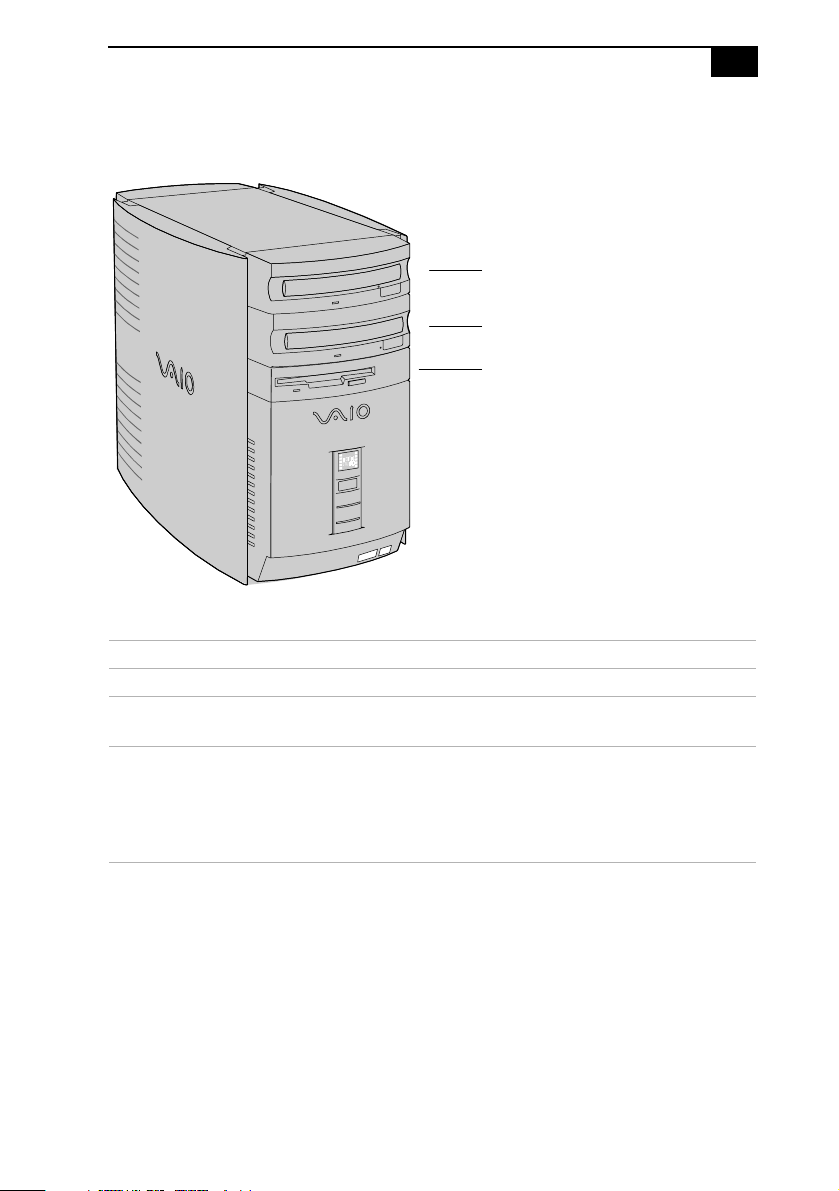
Front View
Front panel
OM04694X.VSD
Identifying Components
3
Drives
Drive Description
Diskette drive 3.5-inch, 1.44 Mbyte.
DVD-ROM drive
*
* Data on a DVD-ROM is read at a variable transfer rate, ranging from 6.6X at the innermost track to 16X at
the outermost track (the data transfer standard 1X rate is 1385 kbytes/s). The average data transfer rate is
11.3X (15,255 kbytes/s). Data on a CD-ROM is read at a variable transfer rate, ranging from 17.2X at the
innermost track to 40X at the outermost track (the data transfer standard 1X rate is 150 kbytes/s). The
average data transfer rate is 28.6X (4293 kbytes/s).
DVD-ROM read: 16X (maximum performance).
CD-ROM read: 40X (maximum performance).
CD-RW drive
†
† CD-RW writing speed may vary, depending on the media. The maximum writing speed is 8X (1X = 150
kbytes/s). The maximum reading speed is 20X.
CD-RW read: 20X (maximum performance).
CD-RW write: 4X (maximum performance).
CD-R read: 32X (maximum performance).
CD-R write: 8X (maximum performance).
CD-ROM read: 32X (maximum performance).
FRNTPNLA.VSD
DVD-ROM
CD-RW
Diskette drive

VAIO Digital Studio Reference Manual
4
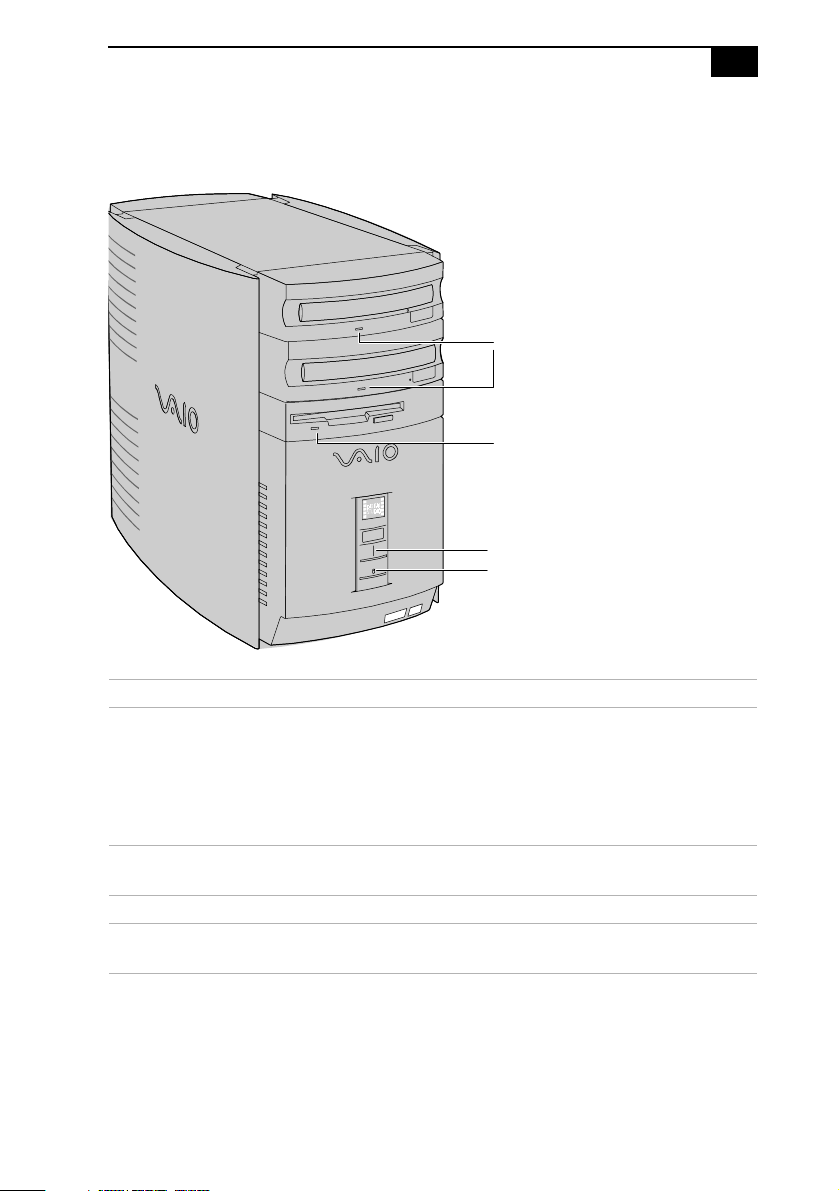
Buttons and Switches
Button or switch Description
Power/Standby switch Turns system power on, off, or into standby mode.
Diskette eject button Ejects a diskette.
Optical disc eject button
Automatically opens and closes the optical drive
tray.
FRNTPNLB.VSD
Optical disc eject
Diskette eject
Power/Standby
Identifying Components
5
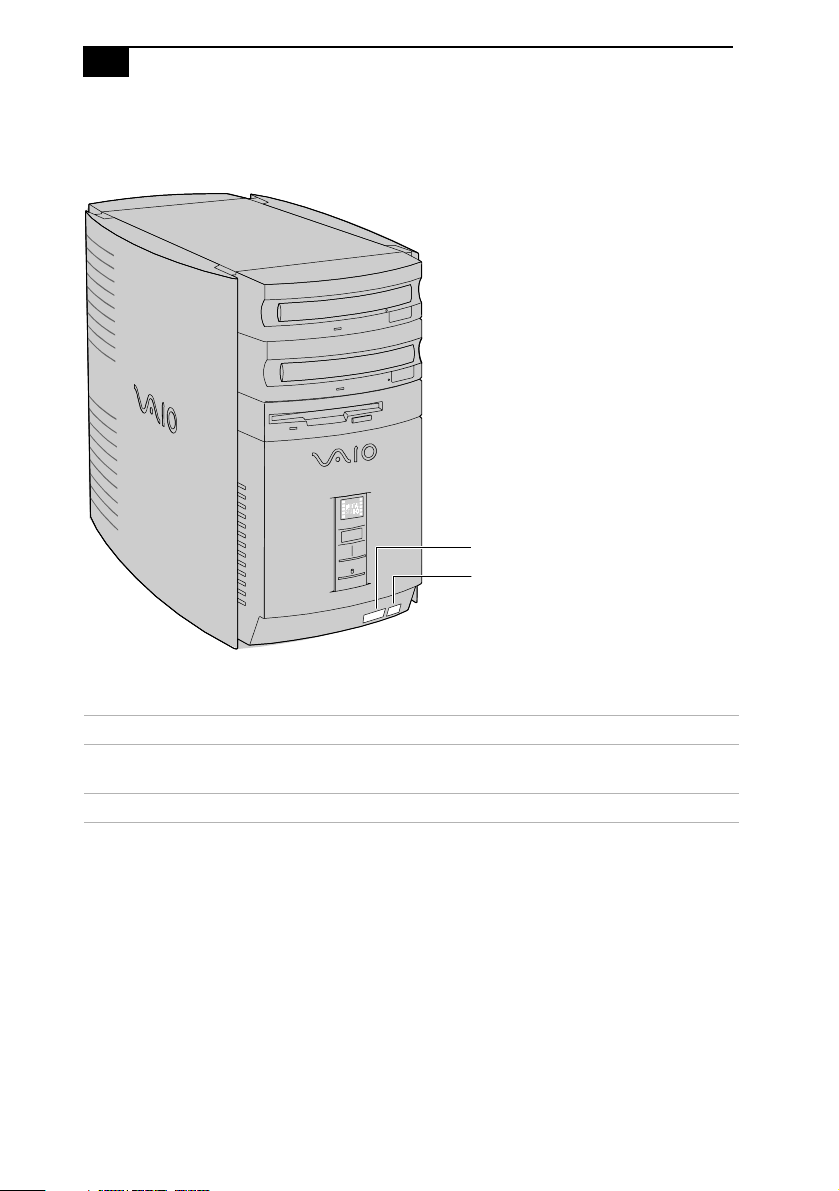
Indicators
Indicator Description
Power/Standby indicator Standby (amber) indicates the computer is
in standby mode.
On (green) indicates the computer is out
of standby mode, ready to use.
Off (no color) indicates the computer is
turned off.
Diskette drive access indicator On (green) indicates diskette drive
activity.
Optical drive access indicator On (orange) indicates CD-ROM activity.
Hard disk drive access indicator On (amber) indicates hard disk drive
activity.
FRNTPNLC.VSD
Optical drive access
Diskette drive access
Power/Standby
Hard disk drive access
VAIO Digital Studio Reference Manual
6
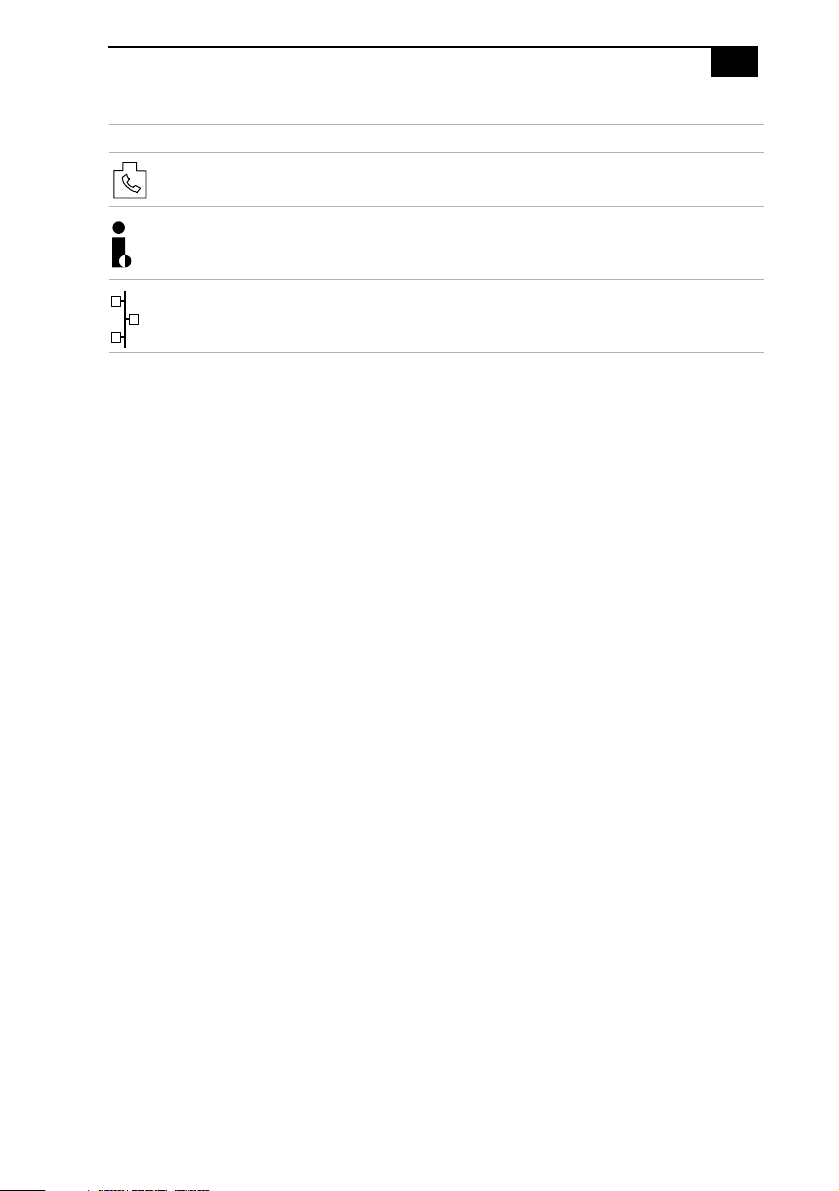
Connectors
Connector Description
i.LINK
®
(IEEE-1394)
*
* To connect to a 6-pin i.LINK device, use the i.LINK connector on the back of the system. A 6-pin i.LINK
connector can supply power from the computer to the device if the device also has a 6-pin i.LINK connector.
A 4-pin i.LINK connector cannot supply power to the device.
Connects to a digital device that has a 4-pin i.LINK
connector.
USB Connects to USB devices.
FRNTPNLD.VSD
USB
i.LINK
Identifying Components
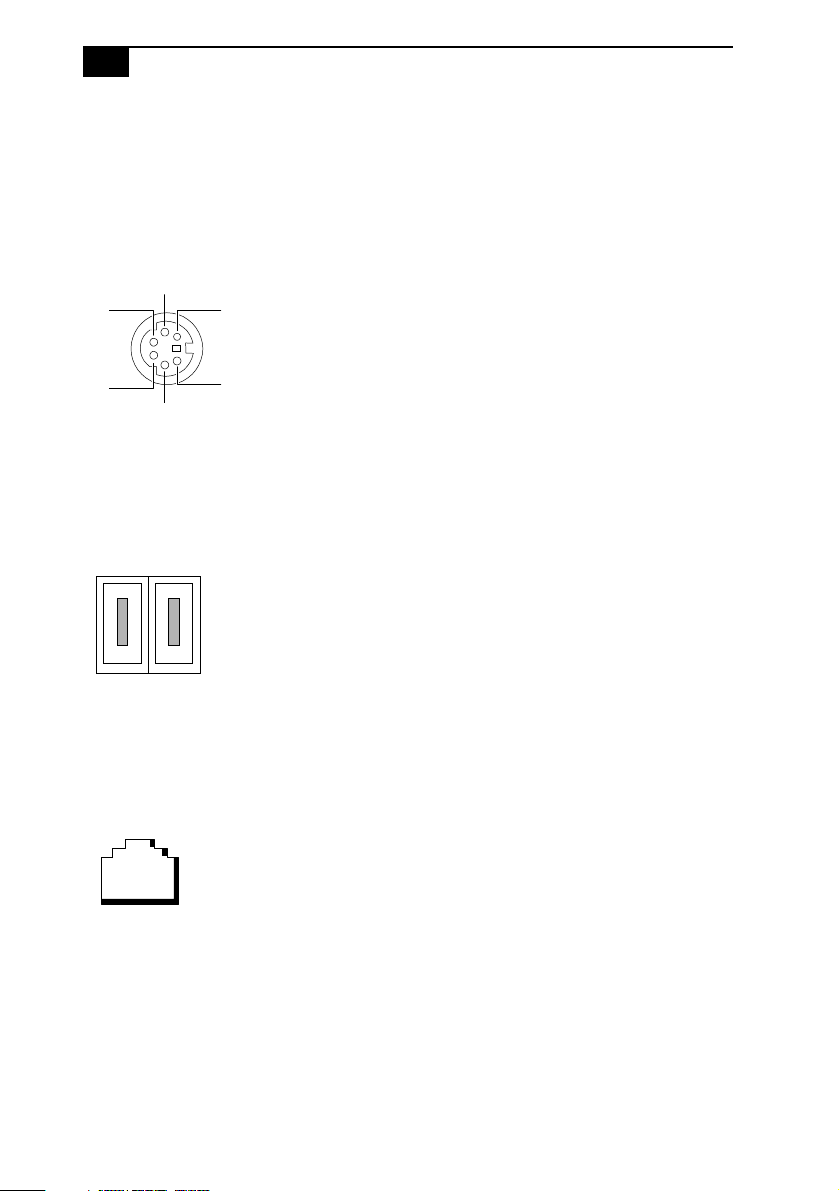
9
Telephone jack (for phone)
i.LINK (IEEE-1394) connector
Ethernet connector
Icon Description
VAIO Digital Studio Reference Manual
10
I/O Connectors
The following section identifies the various I/O connectors.
Keyboard and Mouse
The keyboard and mouse connectors are physically identical and have the
same pinout. They are standard 6-pin PS/2
®
-type female connectors.
USB Ports
The USB ports are standard 4-pin USB connectors. One USB connector is
located at the front, and two at the rear of the system.
Ethernet Connector
The Ethernet connector at the rear of the system is used to connect to a
10Base-T/100Base-TX Ethernet network.
1
6
2
3
4
5
KY0002.VS
KY0003.V
S
Ethernet
KY0100.VSD
On back of system
Identifying Components
11
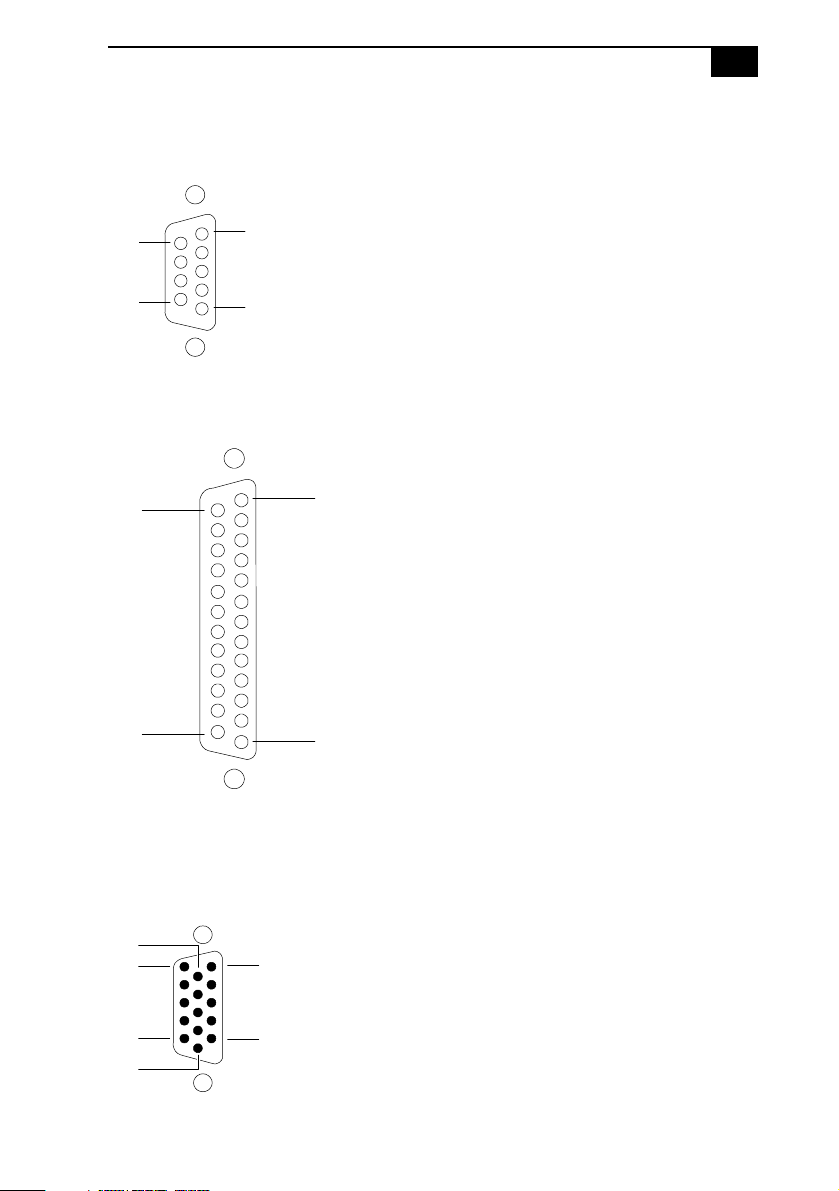
Serial Port
The serial port is a standard 9-pin DB-9 male connector.
Printer/Parallel Port
The printer/parallel port is a standard 25-pin DB-25 female connector.
Monitor
The Monitor connector is a standard 15-pin female high-density VGA-
type connector.
5
1
9
6
KY0057.VSD
13
1
25
14
KY0005.VS
D
5
1
15
11
10
6
KY0004.VS
D

VAIO Digital Studio Reference Manual
16
Accessing the BIOS Setup Utility
You must access the CMOS Setup Utility to make changes to the BIOS
settings (see “CMOS Setup Options” on page 73 for information on BIOS
settings).
1
Reboot the system.
2
Press F2 after the progress bar starts.
3
Use the arrow keys to select an item from the main menu.
4
Press Enter to display the options for the selected item.
5
Use the arrow keys to select an option.
6
Press Page Up or Page Down to modify the setting.
7
Press ESC to return to the main menu.
8
Select SAVE & EXIT SETUP, then press Enter. Follow the on-screen
prompts.
!
Before rebooting the system, save any open files and exit Windows
®
.

21
Chapter 3
Removing, Installing, and
Replacing Components
This chapter describes removing, installing, and replacing major
components for upgrading, reconfiguring, and troubleshooting the
components.
!
Before opening the system unit, save any open files, exit Windows, turn off
the power of the computer and all attached peripherals, and then unplug the
power cord.

VAIO Digital Studio Reference Manual
22
Removing the Cover
You must remove the cover to access the system board, add-in cards,
power supply, battery, memory, and internal drives.
1
From the rear of the unit, press the two tabs on the right side.
2
Remove the frame from the unit by gently pulling it from left to right.
3
Remove the three screws from the metal back plate. The screws are
located at the top center, and the lower left and right corners.
KY0064B.VSD

Removing, Installing, and Replacing Components
23
4
Lift the three-sided outer panel up and over the unit by pulling up on
the large tab that extends from the top rear.
KY0064A.VSD
Removing, Installing, and Replacing Components
25
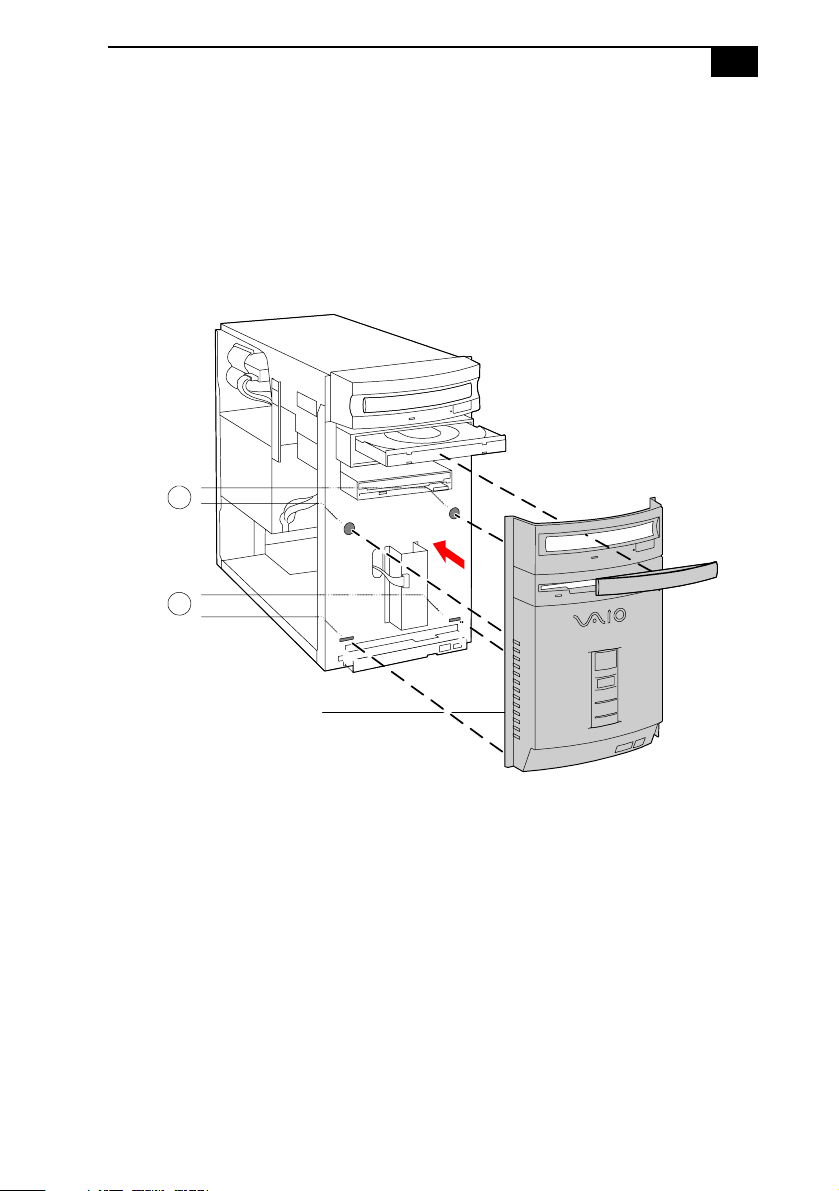
Replacing the Front Panel
1
Insert the two plastic tabs (located on the bottom of the front panel)
into the slots at the bottom of the chassis.
2
Push the bottom of the front panel in until the tabs snap into place.
3
Push the top of the front panel in until it is flush with the chassis .
KY0093.VSD
Front panel
2
1
VAIO Digital Studio Reference Manual
26
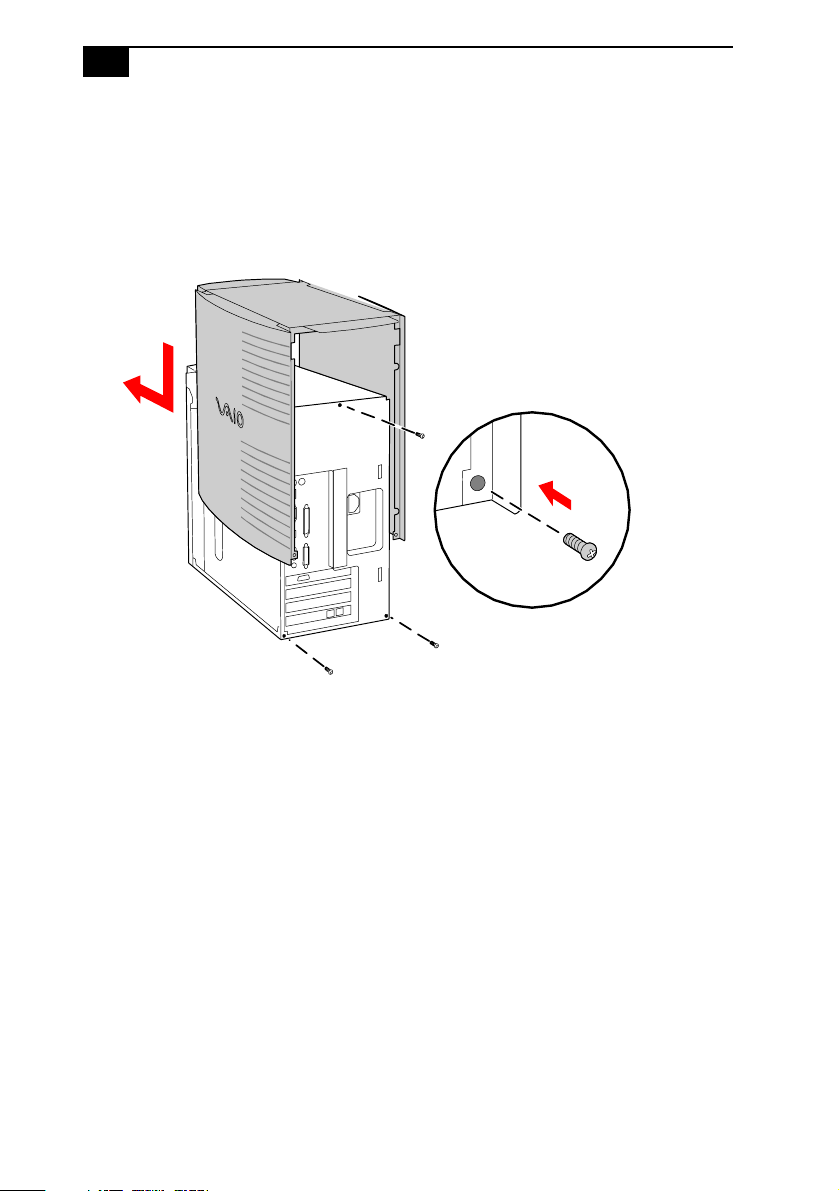
Replacing the Cover
1
Align the three-sided outer panel over the chassis and lower it onto
the unit so that the tabs slip into the lips on the unit.
2
Insert the three screws (removed earlier) to secure the panel.
3
Insert the three small tabs on the frame into the slots on the left side of
the unit.
4
Slip the two larger tabs on the frame into the slots on the right side of
the unit.
KY0067.VSD

VAIO Digital Studio Reference Manual
28
Installing an Add-In Card
1
Remove the cover (see “Removing the Cover” on page 22).
2
Locate an available expansion slot connector.
3
Remove the slot cover adjacent to the selected slot connector (see
“Removing a Slot Cover” on page 39).
4
Insert the add-in card into the PCI slot connector. Use a gentle rocking
motion, pressing down until the card is fully seated.
5
Replace the screw that secures the card.
6
Attach any necessary cables to the card (see the instructions that came
with the add-in card).
7
Replace the cover (see “Replacing the Cover” on page 26).
8
Turn on the computer and follow any instructions that came with the
add-in card.
!
Before opening the system unit, save any open files, exit Windows, turn off
the power of the computer and all attached peripherals, and then unplug the
power cord.
✍
Align the card's bracket so that the bottom of the bracket fits into the slot at the
bottom of the chassis. Assure that the top of the bracket fits snugly against the
chassis lip after the card is fully inserted.
KY0070.VSD

Removing, Installing, and Replacing Components
29
Removing an Add-in Card
1
Remove the cover (see “Removing the Cover” on page 22).
2
Disconnect any cables attached to the add-in card you want to
remove.
3
Remove the screw that secures the add-in card to the chassis.
4
Remove the add-in card from the PCI slot connector and store the
card in an anti-static wrapper for future use.
!
Before opening the system unit, save any open files, exit Windows, turn off
the power of the computer and all attached peripherals, and then unplug the
power cord.
✍
Grasp the card with one hand on each end, and gently pull up as you rock the card
from side to side.
!
Hold the add-in card by its edges and do not touch any components or
connector contacts on the card. Static electricity in your body may
damage sensitive components on the card. As a precaution, touch any
exposed metal part on the metal chassis (preferably the metal part on
the power supply) before handling an add-in card to discharge any static
electricity in your body.
KY0071.VSD
VAIO Digital Studio Reference Manual
32
8
If necessary, remove any add-in cards (see “Removing an Add-in
Card” on page 29) to gain access to the battery. You may also need to
disconnect some cables.
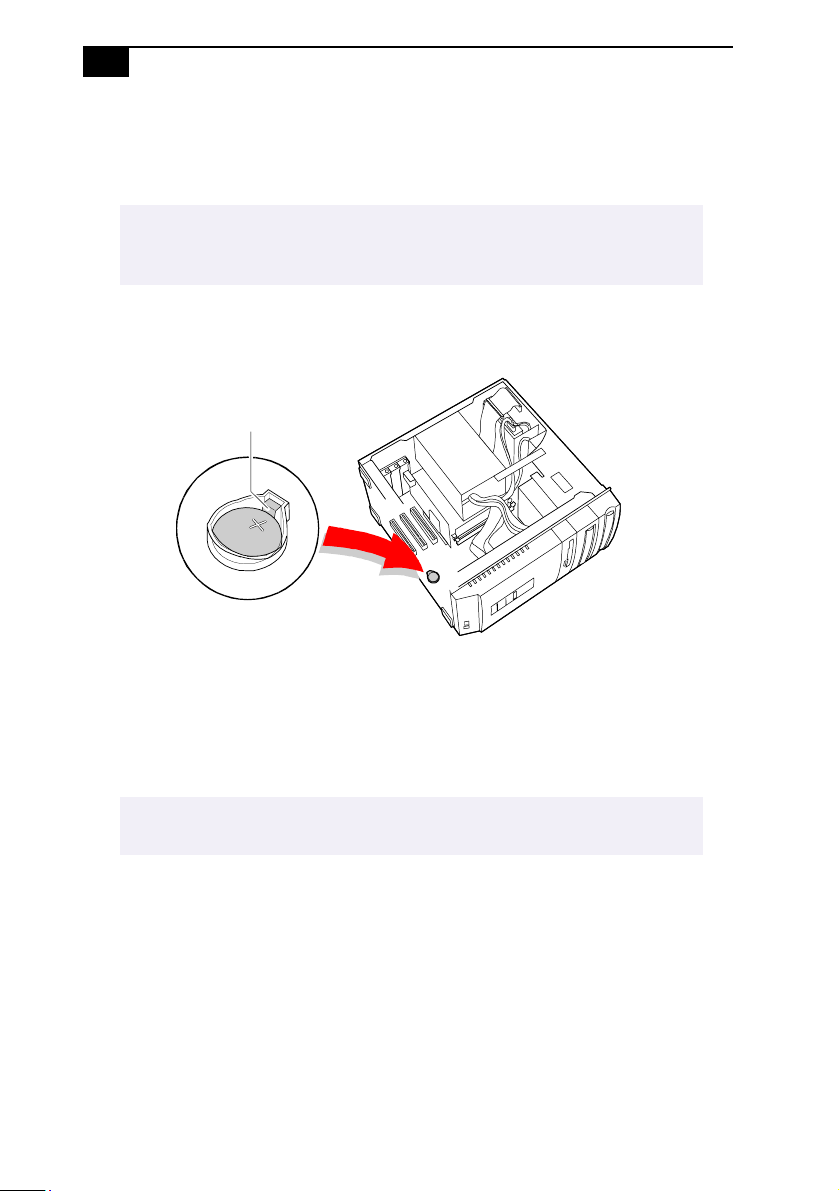
9
Use a small flathead screwdriver or your finger to push out against
the small tab at one end of the battery holder to pop out the battery.
10
Gently lift out the battery and dispose of it according to the
instructions that came with the new battery.
11
Insert the new battery into the battery holder, with the plus (+) side
up.
12
Replace any add-in cards that were removed.
13
Reconnect any cables that were disconnected.
14
Replace the cover (see “Replacing the Cover” on page 26).
15
Reconnect the power cord and turn on the computer.
!
Touch any exposed metal part of chassis to discharge static electricity in
your body before handling an add-in card or other sensitive electronic
component.
✍
The Sony CR2032 battery is recommended. Using a type of battery other than a
CR2032 may present a risk of fire or explosion.
KY0072.VSD
Push in here to
pop out battery

Removing, Installing, and Replacing Components
33
16
If the error message “Error: Check date and time settings.” appears
during the reboot sequence, press F2 during the reboot process to
access the BIOS Setup Utility. If no error message displays, the
computer’s BIOS settings were retained during the battery
replacement and you can skip the remaining steps.
17
Refer to the list you made in step 3 and restore any non-default BIOS
settings (see “CMOS Setup Options” on page 73).
18
Select Exit Saving Changes from the main menu using the right arrow
key.
19
Press Enter, type Y when prompted to discard changes, then press
Enter to exit the BIOS Setup Utility.
The computer’s BIOS settings are now restored.

VAIO Digital Studio Reference Manual
34
Installing System Memory
1
If necessary, remove the memory module you wish to replace (see
“Removing a Memory Module” on page 37).
2
Remove the new memory module(s) from its anti-static package.
Hold the memory module only by its edges to prevent static-
electricity damage.
3
Choose the size of the memory module and configuration as shown
in the following table. Memory modules can vary in size and speed
between sockets. The minimum memory size is 8 MB. The maximum
memory size is 256 MB. The BIOS automatically detects the type, size
and speed of the memory modules.
4
Disconnect the power cord from the computer.
5
Remove the cover (see “Removing the Cover” on page 22).
6
Remove the power supply (see “Removing the Power Supply” on
page 45).
!
Before opening the system unit, save any open files, exit Windows, turn off
the power of the computer and all attached peripherals, and then unplug the
power cord.
Memory module configurations (MB)
*
* The PCV-R556DS/PCV-R558DS ships with 128 MB. SDRAM is
expandable to 256 MB.
DIMM1 DIMM2
0, 8, 16, 32, 64, 128 0, 8, 16, 32, 64, 128
!
Touch any exposed metal part of the chassis to discharge static electricity in
your body before handling a memory module.
✍
Use only 133 MHz FSB-supported memory. Do not mix 66 MHz or 100 MHz memory with
133 MHz memory. Supports SDRAM memory. Does not support EDO memory or buffered
DIMM memory.

VAIO Digital Studio Reference Manual
36
12
Reconnect the power cord and turn on the computer.
Your computer automatically recognizes the extra memory and will
configure itself accordingly when you turn on the computer. No further
action is required.
VAIO Digital Studio Reference Manual
38
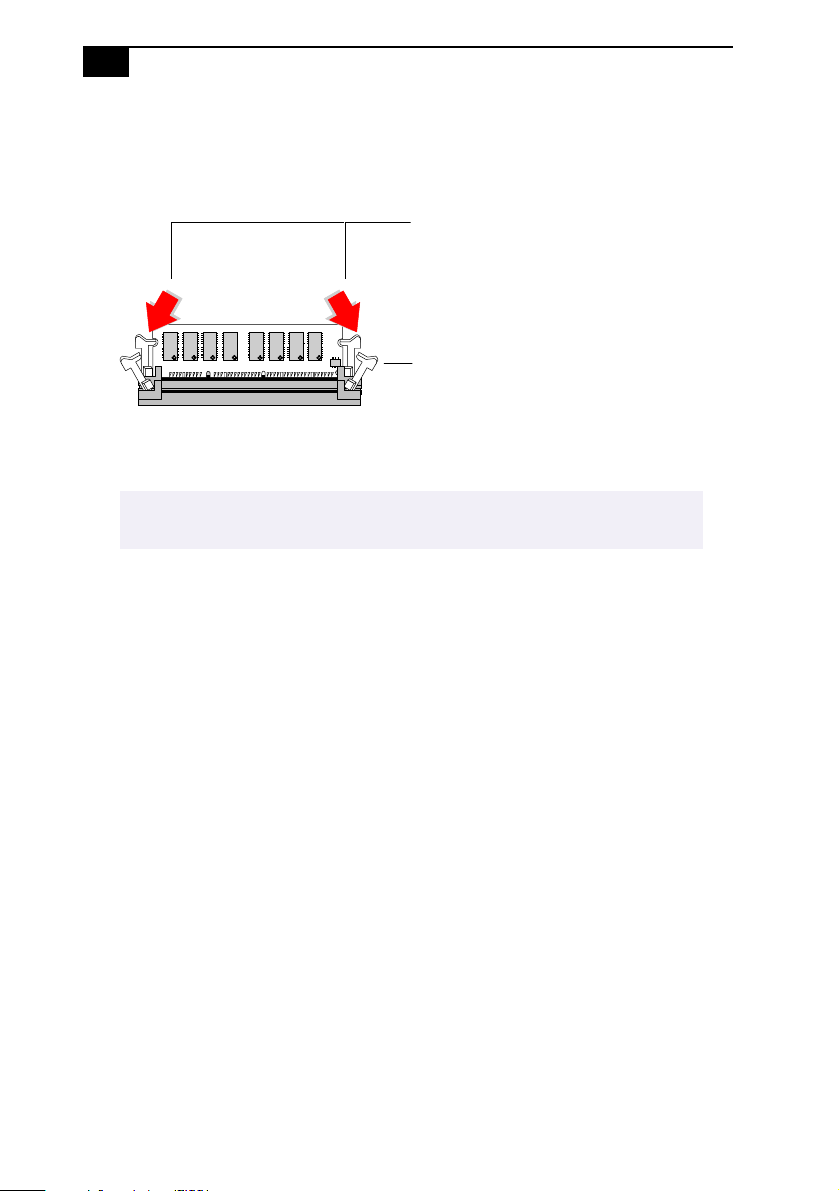
15
Reach around each side of the power supply and push down the
handle on each side of the memory module to eject the module from
its socket.
16
Grasp one edge of the memory module and lift out. Store the module
in a static-free bag.
!
Touch any exposed metal part of the chassis to discharge static
electricity in your body before handling the memory module.
Handles
Push out
KY0
0

VAIO Digital Studio Reference Manual
40
Covering an Open I/O Slot
Slot covers prevent air from escaping through the empty hole. If air
escapes, the components inside the computer cannot be properly cooled.
This may damage some components, especially the main processor
(which generates the most heat).
1
Slide the tip of the slot cover (removed earlier) between the chassis
and system board.
2
Push the slot cover down until it rests firmly on the lip in the chassis.
All add-in card brackets and slot covers rest on this lip.
3
Replace the screw (removed earlier) to secure the I/O slot cover.
KY0076.VSD
Removing, Installing, and Replacing Components
41
Installing a 3½” Internal Hard Disk Drive
Your system comes with an available bay to hold an additional 3½” hard
disk drive. The drive you install must not require front panel access. The
hard disk drive access light blinks when either internal drive is active.
1
Configure the jumpers on the new drive as a primary slave (see your
drive’s documentation for configuration instructions).
2
Disconnect the power cord from the computer.
3
Remove the cover (see “Removing the Cover” on page 22).
4
Remove the four screws (A in next diagram) that secure the drive
holder to the top of the chassis.
!
Before opening the system unit, save any open files, exit Windows, turn off
the power of the computer and all attached peripherals, and then unplug the
power cord.
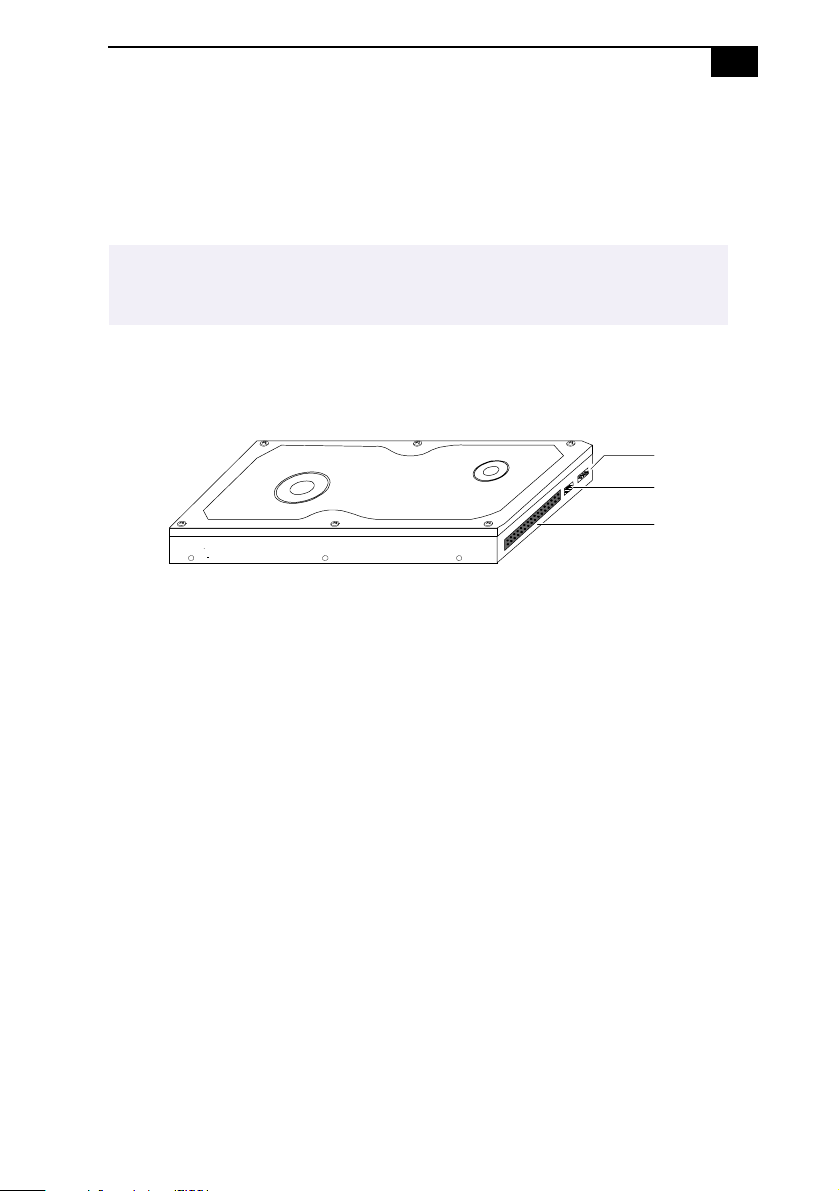
KY0084.VSD
Drive connector
Power connector
Jumpers
Removing, Installing, and Replacing Components
43
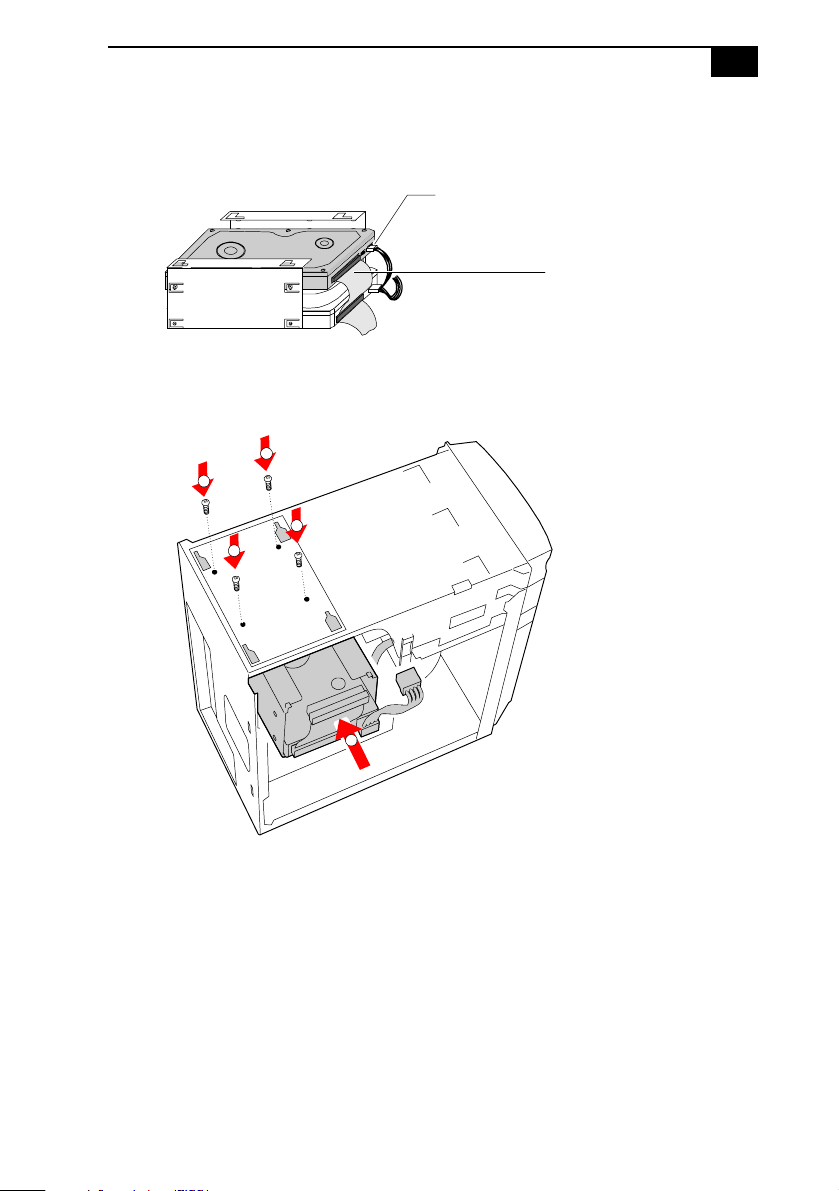
10
Connect the second power connector to the new drive.
11
Make sure the drive connector is connected securely to the
motherboard.
12
Lower the drive holder down and slide it back into the chassis (A in
next diagram). Be sure to align all four slots on the drive holder with
the tabs on top of the chassis.
13
Slide the drive holder back so that the tabs slip into the notches.
14
Replace the four screws (B) that secure the drive holder to the chassis.
15
Replace the cover (see “Replacing the Cover” on page 26).
16
Reconnect the power cord and then turn on your computer.
KY0085.VSD
Second power connector
Second drive connector
KY0086.VSD
B
B
B
B
A

VAIO Digital Studio Reference Manual
44
Your computer automatically recognizes the new drive and configures
itself accordingly when you turn it on. Format and partition the new
drive following the instructions provided with the drive.

Removing, Installing, and Replacing Components
45
Removing the Power Supply
You remove the power supply when you insert a memory module (see
“Installing System Memory” on page 34).
1
Remove the three screws (A in next diagram) from the rear of the
chassis.
2
Remove the screw (B) from the power supply bracket.
KY0096.VSD
B
A
Removing, Installing, and Replacing Components
47
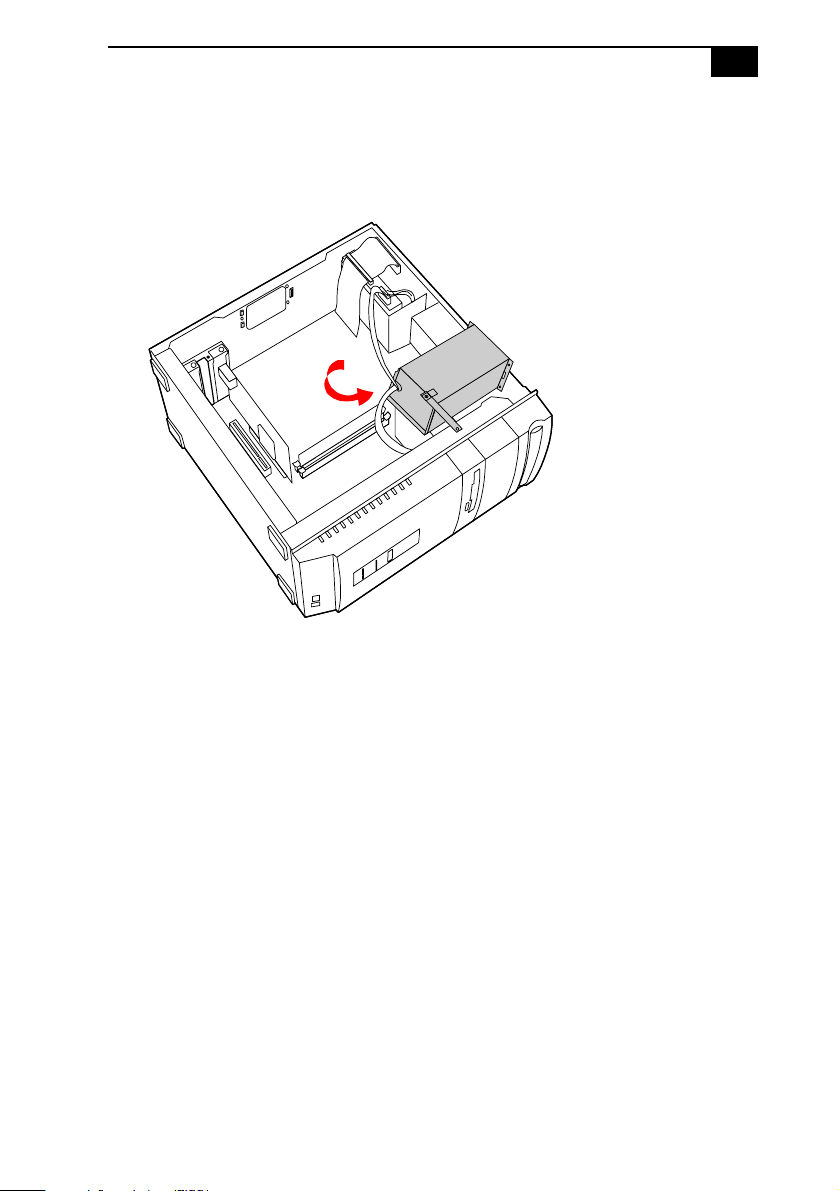
4
Rotate the power supply horizontally by 180 degrees
counterclockwise and rest it on top of the chassis where the CD-
ROM/DVD-ROM drive is located.
KY0098.VSD

49
Chapter 4
System Board
This chapter identifies each component on the system board and provides
a detailed description of each connector, jumper, and switch on the
system board.
Processor Memory
Secondary IDE
Primary IDE
Battery
OM04581.VSD
CPU Fan
Diskette
Front panel header
1394 Header 2
Game
Mic In, Line In, Line Out
COM1, Printer,
i.LINK
USB1, USB2, Ethernet
Power Supply Fan
Keyboard, Mouse
Aux-In
Video
1394 Header 3
Power Supply
AGP
Slot 2 (PCI)
Slot 3 (PCI)
Slot 1 (PCI)
CD-In
USB2 Header
Configuration Jumpers

System Board
51
Diskette Drive Connector
OM04701H.VSD
2
34
Key (pin 5)
1
33

VAIO Digital Studio Reference Manual
54
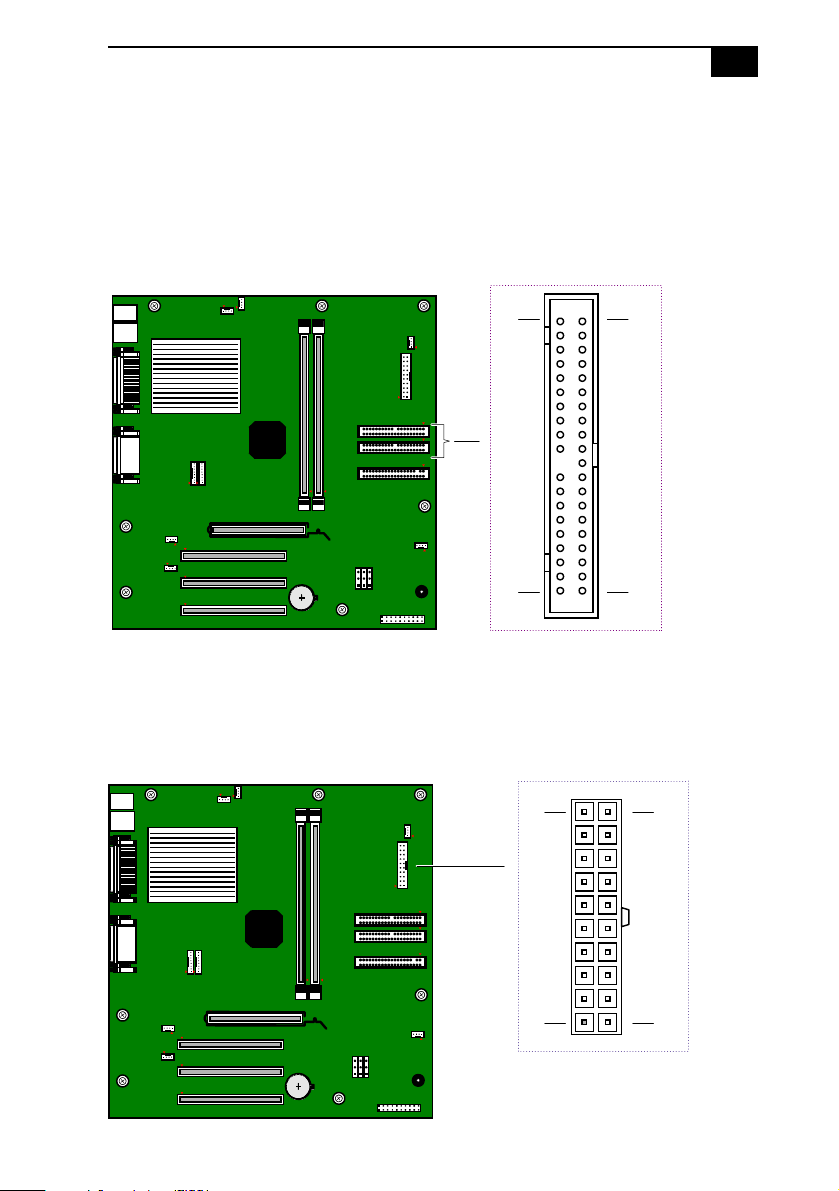
AGP Connector
There is one AGP slot connector that supports a 2x AGP graphics card or
an AGP retention module.
B1 B66
B21 B26
A1 A66
A21 A26
OM04599C.VSD
System Board
55
IDE Connectors
There are two IDE (Integrated Drive Electronics) connectors on the
system board: a Primary IDE and a Secondary IDE connector.
Each IDE connector supports up to two IDE drives using a ribbon cable
with two connectors.
Power Connector
The power supply connector on the system board connects to the power
supply connector labelled P1.
OM04701G.VSD
1
39
2
40
OM04701I.VSD
1
10
11
20

VAIO Digital Studio Reference Manual
58
Ethernet Connector
There is one Ethernet connector at the rear panel, which permits
connection to a 10Base-T/100Base-TX Ethernet network.
5USBVCC2
*
6USBP1#
7USBP1
8Ground
* Uses over-current protector.
Ethernet connector
Pin Signal Name
1Tx+
2Tx-
3Rx+
4N/C
5N/C
6Rx-
7N/C
8N/C
USB1, USB2 connectors (continued)
KY0103.VSD
Ethernet

System Board
59
Serial 1, Printer, and i.LINK Connectors
The Serial, Printer, and i.LINK connectors are mounted in a single bracket
on the system board. The Serial 1 connector is a DB-9 male connector. The
Printer connector is a DB-25 female connector. The i.LINK connector is a
6-pin standard IEEE-1394 connector.
Serial 1 connector
Pin Signal Name
1DCD
2RXD
3TXD
4DTR
5LOGIC GND
6DSR
7RTS
8CTS
9RI
OM04701D.VS
D
SERIAL 1 i.LINK
PRINTER
15
69
13 1
25 14

System Board
61
Fan Connectors
The CPU-FAN and PWR-FAN connectors are 1 x 3-pin straight header
connectors. CPU-FAN controls the cooling fan on the CPU. PWR-FAN
controls the cooling fan in the power supply.
i.LINK connector
Pin Signal Name
1Ground VP (Power)
*
2Ground
3TPB*
4TPB
5TPA*
6Ground TPA
* Uses over-current protector.
CPU-FAN and PWR-FAN connectors
Pin Signal Name
1Ground
2 FAN_CTRL (+12V)
3FAN_SEN
KY0034.VSD
CPU-FAN
31
PWR FAN
3
1

System Board
63
Headphones, Line In, Mic Connectors
The Headphones jack is a stereo mini-jack (3.5 mm) that connects to
headphones. The Line In jack is a stereo mini-jack (3.5 mm) that connects
to a stereo audio source (not an audio source from a video device). The
Mic In jack is a stereo mini-jack (3.5 mm) that connects to a microphone.
Headphones
Line In
Mic
KY0058.VSD
Mic
Line In
Headphones
OM04713.VSD
Audio Right Out
Audio Left Out
OM04713B.VSD
Audio Right In
Audio Left In
L Imbalance
OM04713A.VSD
Electret Bias Voltage
Mic Imbalance
Mic Mono In

System Board
65
CD-IN Connector
The CD-IN connector on the system board is a 1 x 4-pin header connector
that connects to the CD-ROM/DVD-ROM drive’s audio output
connector.
CD-IN connector
Pin Signal Name
1 Left Line In
2Ground
3Ground
4 Right Line In
KY0062.VSD
CD-IN
1
4

VAIO Digital Studio Reference Manual
66
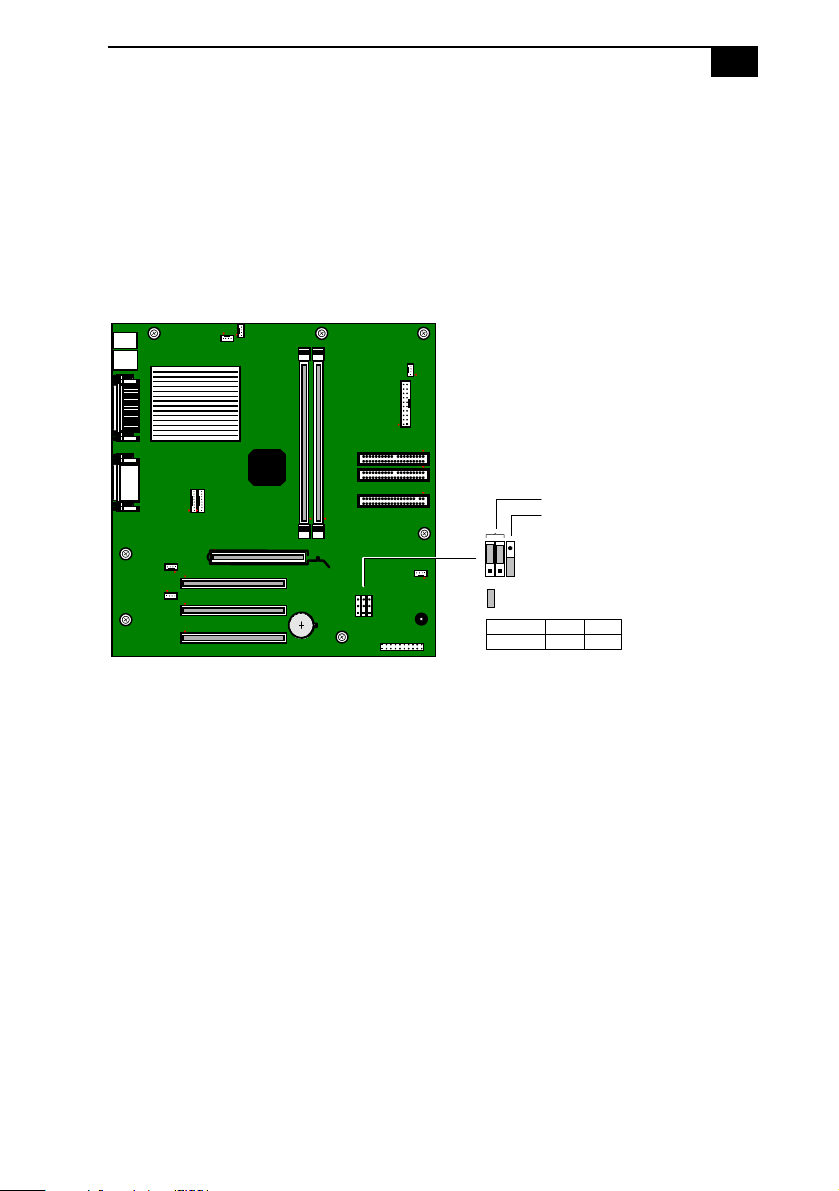
AUX-IN Connector
The AUX-IN connector on the system board is a 1 x 4-pin header
connector that connects to the CD-RW drive’s audio output connector.
AUX-IN connector
Pin Signal Name
1Left Line In
2Ground
3Ground
4 Right Line In
KY0062B.VSD
AUX-IN
1
4
System Board
67
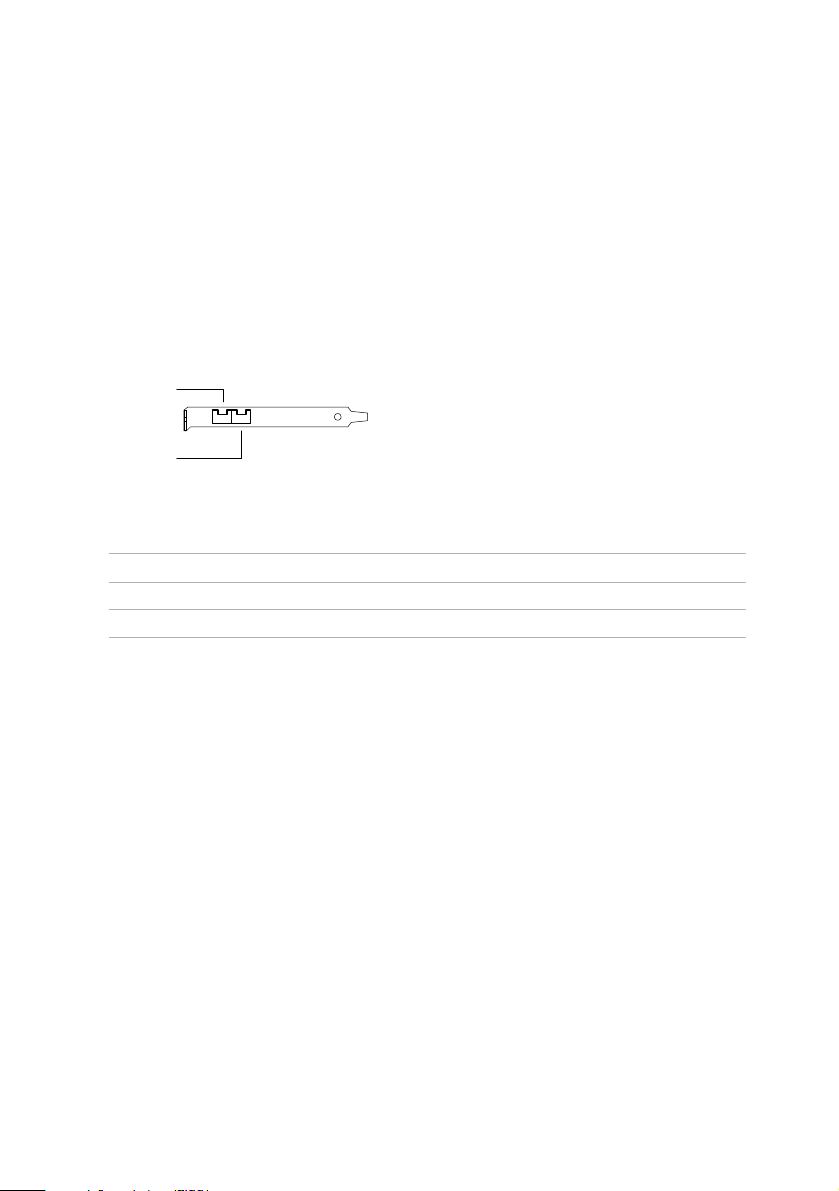
Configuration Jumpers
There is one user-configurable jumper for CMOS Clear. The other two
jumpers are reserved (do not change).
The computer ships with CMOS Clear in the Normal position. Do not
change the position of this jumper unless directed by a technical support
person.
OM04588.VSD
CMOS Clear
Clear
2-3
Normal
1-2
= default jumper
CMOS CLR
1
3
2
Reserved (do not change)

68
69
Chapter 5
Fax/Modem Card
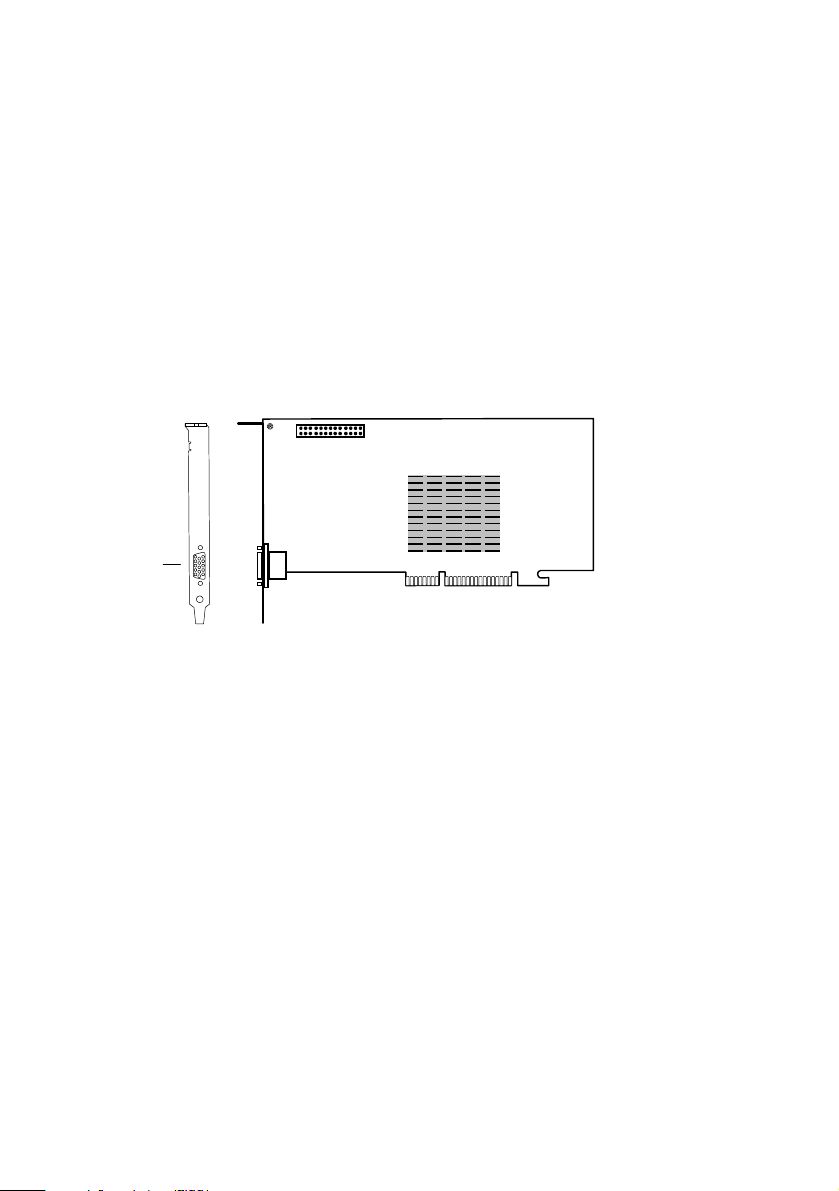
The fax/modem card occupies PCI slot #1. There are two RJ-11 jacks: one
to connect a telephone line, and one to connect a phone.
Connectors
Name Connector Type Description
Telephone RJ-11 Connects to phone
Line RJ-11 Connects to telephone line
KY0038.VSD
Telephone
Line
71
Chapter 6
Video Card
The video card occupies the AGP slot. The video card has a standard
15-pin high-density VGA-style connector on the front bracket, and a
26-pin header connector (not used). The video card has 16 Mbytes of
SDRAM and has a 128-bit wide bus.
KY0104.
V
Monitor

CMOS Setup Options
75
Main Screen
System Time [00:00:00]
System Date [01/01/2000]
Legacy Diskette A [1.44M, 3.5 in.]
2.88M, 3.5 in.
None
360K, 5.25 in.
1.2M, 5.25 in.
720K, 3.5 in.
Legacy Diskette B [None]
360K, 5.25 in.
1.2M, 5.25 in.
720K, 3.5 in.
1.44M, 3.5 in.
2.88M, 3.5 in.
Floppy 3 Mode Support [Disabled]
Drive A
Drive B
Both
Primary Master (see
“IDE Sub-Menus”
on page 76)
Primary Slave (see
“IDE Sub-Menus”
on page 76)
Secondary Master (see
“IDE Sub-Menus”
on page 76)
Secondary Slave (see
“IDE Sub-Menus”
on page 76)
Language [English]
Supervisor Password [Disabled]
User Password [Disabled]
Halt On [All but Keyboard]
All but Disk
All but Disk/Keyboard
All Errors
No Error
Installed Memory 128 MB

VAIO Digital Studio™ Reference Manual
76
IDE Sub-Menus
Type [Auto]
User Type HDD
CD-ROM
LS-120
ZIP-100
MO
Other ATAPI
None
Translation Method
*
[LBA]
Large
Normal
Match Partition Table
Manual
Cylinders
†
[ 1024]
Heads
†
[255]
Sectors
‡
[63]
CHS Capacity
*
8422MB
Maximum LBA Capacity
*
30735MB
Multi-Sector Transfers
*
[Maximum]
Disabled
2 Sectors
4 Sectors
8 Sectors
16 Sectors
32 Sectors
SMART Monitoring
*
[Disabled]
Enabled
PIO Mode
**
[4]
ULTRA DMA Mode
†
[4]
Set Device As
††
[Auto]
Floppy
Hard Disk
* This option appears when Type is set to User Type HDD.
† This option appears when Type is set to Auto or User Type HDD.
‡ This option appears when Type is set to Auto or User Type HDD.
** This option appears when Type is not set to None.
†† This option appears when Type is set to ZIP-100 or MO.
CMOS Setup Options
77
Advanced Screen
CPU Core:Bus Freq. Multiplier [5.5x]
6.0x
6.5x
7.0x
7.5x
8.0x
2.0x
2.5x
3.0x
3.5x
4.0x
4.5x
5.0x
CPU Level 1 Cache [Enabled]
Disabled
CPU Level 2 Cache [Enabled]
Disabled
CPU Level 2 Cache ECC Check [Disabled]
Enabled
BIOS Update [Enabled]
Disabled
PS/2 Mouse Function Control [Auto]
Enabled
USB Legacy Support [Auto]
Disabled
Enabled
OS/2 Onboard Memory > 64M [Disabled]
Enabled
Chip Configuration (see “Chip Configuration Sub-Menu” on page 78)
I/O Device Configuration (see “I/O Device Configuration Sub-Menu” on page 79)
PCI Configuration (see
“PCI Configuration Sub-Menu”
on page 80)
Shadow Configuration (see
“Shadow Configuration Sub-Menu”
on page 82)

CMOS Setup Options
81
PCI/PNP IRQ Resource Exclusion Sub-Menu
IRQ 3 Reserved [No/ICU]
Yes
IRQ 4 Reserved [No/ICU]
Yes
IRQ 5 Reserved [Yes]
No/ICU
IRQ 7 Reserved [No/ICU]
Yes
IRQ 9 Reserved [No/ICU]
Yes
IRQ 10 Reserved [No/ICU]
Yes
IRQ 11 Reserved [No/ICU]
Yes
IRQ 12 Reserved [No/ICU]
Yes
IRQ 14 Reserved [No/ICU]
Yes
IRQ 15 Reserved [No/ICU]
Yes
PCI/PNP DMA Resource Exclusion Sub-Menu
DMA 1 Used By ISA [No/ICU]
Yes
DMA 3 Used By ISA [No/ICU]
Yes
DMA 5 Used By ISA [No/ICU]
Yes
PCI/PNP UMB Resource Exclusion Sub-Menu
ISA/MEM Block BASE [No/ICU]
C800
CC00
D000
D400
D800
DC00

VAIO Digital Studio™ Reference Manual
82
Shadow Configuration Sub-Menu
Video ROM BIOS Shadow [Enabled]
Disabled
C8000-CBFFF Shadow [Disabled]
Enabled
CC000-CFFFF Shadow [Disabled]
Enabled
D0000-D3FFF Shadow [Disabled]
Enabled
D4000-D7FFF Shadow [Disabled]
Enabled
D8000-DBFFF Shadow [Disabled]
Enabled
DC000-DFFFF Shadow [Disabled]
Enabled
CMOS Setup Options
83
Power Screen
Power Management [User Define]
Disabled
Min Saving
Max Saving
Video Off Option [Suspend -> Off]
Always On
Video Method [DPMS OFF]
DPMS Reduce ON
Blank Screen
V/H SYNC+Blank
DPMS Standby
DPMS Suspend
HDD Power Down [Disabled]
1 Min
2 Min
3 Min
4 Min
5 Min
6 Min
7 Min
8 Min
9 Min
10 Min
11 Min
12 Min
13 Min
14 Min
15 Min
ACPI Mode [S3]
S1
Suspend Mode [Disabled]
1
~
2 Min
2
~
3 Min
4
~
5 Min
8
~
9 Min
20 Min
30 Min
40 Min
1 Hour
PWR Button < 4 Secs [Suspend]
Soft Off
Power Up Control (see “Power Up Control Sub-Menu” on page 84)
Hardware Monitor (see “Hardware Monitor Sub-Menu” on page 84)

87
Chapter 8
Miscellaneous Technical
Information
This chapter contains information on the following subjects:
❑
User and Supervisor password
❑
Beep code error messages
❑
PCI configuration status and error messages
❑
DMA channel assignments
❑
IRQ assignments
❑
System I/O address map
❑
Memory map
❑
PCI configuration space map
VAIO Digital Studio Reference Manual
88
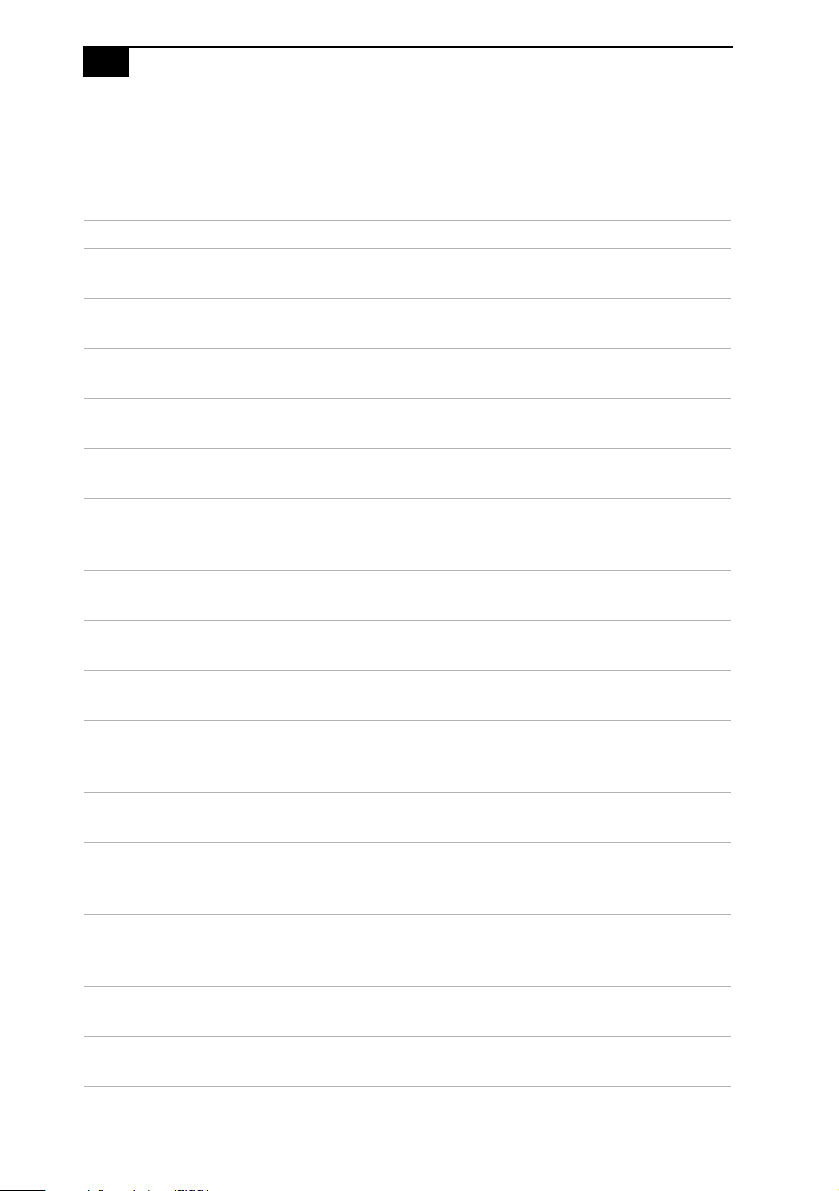
About User and Supervisor Passwords
The system allows you to specify up to two passwords (a User password
and a Supervisor password) in the CMOS Setup Utility. The User
password is required; the Supervisor password is optional.
Access to the CMOS Setup Utility depends on which passwords were
previously set, as indicated next.
If you set these passwords... ...the following passwords are required:
User password only User password is required at bootup.
Supervisor password only No password is required at bootup.
Supervisor password is required by most
setup options.
Both passwords User password is required at bootup.
Supervisor password is required by most
setup options.
VAIO Digital Studio Reference Manual
90
PCI Configuration Status and Error Messages
The following is a list of status and error messages that may appear on
your system from time to time.
Message Meaning
Floppy Disk Controller
Resource Conflict
The diskette controller has requested a
resource that is already in use.
NVRAM Checksum Error,
NVRAM Cleared
The NVRAM data was reinitialized due to
an NVRAM checksum error.
NVRAM Cleared By Jumper The Clear CMOS jumper block has been
changed to the clear position.
NVRAM Data Invalid,
NVRAM Cleared
Invalid entry in the NVRAM.
Parallel Port Resource Conflict The parallel port has requested a resource
that is already in use.
PCI Error Log is Full This message is displayed when more than
15 PCI conflict errors are detected. No
additional PCI errors can be logged.
PCI I/O Port Conflict Two devices requested the same resource,
resulting in a conflict.
PCI IRQ Conflict Two devices requested the same resource,
resulting in a conflict.
PCI Memory Conflict Two devices requested the same resource,
resulting in a conflict.
Primary Boot Device Not
Found
The designated primary boot device (hard
disk drive, diskette drive, CD-ROM drive,
or network drive) could not be found.
Primary IDE Controller
Resource Conflict
The primary IDE controller has requested a
resource that is already in use.
Primary Input Device Not
Found
The designated primary input device
(keyboard, mouse, or other, if input is
redirected) could not be found.
Primary Output Device Not
Found
The designated primary output device
(display, serial port, or other, if input is
redirected) could not be found.
Secondary IDE Controller
Resource Conflict
The secondary IDE controller has requested
a resource that is already in use.
Serial Port 1 Resource Conflict Serial port 1 has requested a resource that is
already in use.
Miscellaneous Technical Information
91
Static Device Resource Conflict A non-Plug and Play ISA card has
requested a resource that is already in use.
System Board Device Resource
Conflict
A non-Plug and-Play ISA card has
requested a resource that is already in use.
Miscellaneous Technical Information
95
Memory Map
Address range Default configuration
00000000 - 0009FFFF System board extension for ACPI BIOS
000A0000 - 000AFFFF NVIDIA Riva TNT2 Pro (Sony-English)
000B0000 - 000BFFFF NVIDIA Riva TNT2 Pro (Sony-English)
000C0000 - 000CA7FF NVIDIA Riva TNT2 Pro (Sony-English)
000CA800 - 000CFFFF Not available
000F0000 - 000FFFFF System board extension for ACPI BIOS
00100000 - 07FFFFFF System board extension for ACPI BIOS
DE000000 - DE003FFF Sony OHCI i.LINK (IEEE-1394) PCI host controller
DE000000 - DFFFFFFF Intel 82801AA PCI bridge
DE000000 - DE8007FF Sony OHCI i.LINK (IEEE-1394) PCI host controller
DF800000 - DF8000FF Lucent WinModem
E0000000 - E0FFFFFF NVIDIA Riva TNT2 Pro (Sony-English)
E0000000 - E1EFFFFF Intel
®
82815 processor to AGP controller
E1000000 - E100FFFF NVIDIA Riva TNT2 Pro (Sony-English)
E1F00000 - E3FFFFFF Intel
®
82815 processor to AGP controller
E2000000 - E3FFFFFF NVIDIA Riva TNT2 Pro (Sony-English)
E4000000 - E7FFFFFF Intel
®
82815 processor to AGP controller
FFB80000 - FFBFFFFF Intel
®
82802 firmware hub device
FFF80000 - FFFFFFFF Intel
®
82802 firmware hub device
✍
I/O addresses that may be used by add-in cards are not listed.

96

97
Chapter 9
Specifications
This chapter describes the technical specifications for the Sony
PCV-R556DS/PCV-R558DS computer.
Processors
Chipset
AGP Bus
PCI Bus
Memory Modules (DIMMs)
PCV-R556DS: 733 MHz Intel Pentium
®
III processor
PCV-R558DS: 866 MHz Intel Pentium
®
III processor
Intel 815 chipset
AGP interface specification, version 2.0
1 AGP slot (open)
PCI Level 2.1, 33 MHz zero wait state
3 PCI slots (2 open)
Installed memory 128 Mbytes PC-133 SDRAM (133 MHz)
Maximum memory 256 Mbytes (128Mbytes in each socket)
Voltage 3.3 V memory only
Pins 168-pins with gold-plated contacts
SDRAM type PC-133, 60 ns, unrestricted CAS latency 3, unbuffered,
Intel 4-clock, 64 bits (non-ECC)

101
Index
A
add-in card
installing
28
removing
29
address map, system
93
AGP slot connector
54
audio specifications
98
AUX-IN connector
66
B
battery - See lithium battery
beep codes
89
BIOS Setup Utility
See CMOS Setup Utility
BIOS setup utility
advanced screen
77
boot screen
85
exit screen
86
main screen
75
options
73
power screen
83
screens
73
BIOS specifications
100
C
card
modem
69, 71
CD-IN connector 65
CD-RW drive
location of
3
performance of discs 3, 100
specifications 100
CMOS - See Also BIOS
CMOS Setup Utility
16
codes, beeps 89
COM1 port - See Serial
communications, specifications
99
computer
lithium ion battery
vii
computer safety information
ii
configuration switch
password clear
67
configuration switches
CPU frequency multiplier
67
configuring
power management
17
system board
19
connectors
4-pin on modem card
69
AUX-IN
66
CD-IN
65
fan
61
game
62
headphones, line in, mic
63
i.LINK
6
,
59
,
64
IDE
55
keyboard
56
line
69
modem card 69
monitor
11
mouse 56
power 55
printer 59
telephone 69
USB 6, 57, 58
cover 26
removing 22
cover, slot 39
covering I/O slot 40
CPU - See processor

VAIO Digital Studio Reference Manual
102
D
DIMM - See memory module
diskette drive
connector
51
display, power management
17
disposal of lithium ion battery
vii
DMA channel assignments
92
drive
CD-RW specifications
100
IDE connectors
55
installing an additional 3½" drive
41
specifications
100
DVD-ROM drive
performance of discs
3
,
100
E
error messages
beep codes
89
PCI configuration
90
expansion slots
14
specifications for
99
expansion slots - See Also slots
F
fan connectors
61
CPU-FAN
61
PWR-FAN
61
fax card - See modem card
fax/modem - See Also
communications
FCC Part 68
vi
front panel
removing
24
replacing 25
front panel header 50
front view 2
buttons and switches 4
connectors 5, 6
drives 3
indicators 5
G
Game connector 62
graphics controller - See graphics
graphics specifications
98
H
header - See front panel header
headphones, line in, mic connectors
63
I
i.LINK connector
6
,
59
i.LINK header connectors
64
I/O address map
93
I/O connectors
game port
12
i.LINK
13
keyboard and mouse
10
mic, line in, headphones
12
monitor
11
NETWORK (D-Link) port
58
printer port
11
serial port 1
11
telephone and line
13
USB ports
10
,
57
I/O slot covering
40
I/O slot specifications
99
icons, description of
8
IDE
connectors
55
specifications
100
IEEE-1394 - See i.LINK
installing
3½" hard disk drive
41
add-in card
28
system memory 34
interference v
J
jumper - See system board
K
keyboard connector 56
L
L2 cache specifications 98
lithium battery, replacing 31
lithium ion battery
disposal
vii
safety precautions
vii

103
M
map - See Also I/O address map and
memory map
memory - See Also system memory
memory module
connector
52
removing
37
specifications
97
messages
error
89
status and error
90
microprocessor - See processor
model numbers
ii
modem - See Also communications
modem card
connectors
69
view of
69
,
71
monitor - See display
monitor connector
11
mouse connector
56
N
NETWORK (D-Link) connector
58
notice to users
ii
P
panel, front
24
,
25
passwords, user and supervisor
88
PCI
slot connectors
53
power connector
55
power management, configuring
17
printer connector 59
processor specifications 97
R
radio interference v
RAM - See Also system memory
rear view
7
I/O connectors 10
icons 8
recording ii
regulatory information v
removing
add-in card
29
cover
22
front panel
24
memory module
37
slot cover
39
replacing
26
cover
26
front panel
25
replacing lithium battery
31
resolution - See graphics
S
safety information
ii
Serial connector
59
serial numbers
ii
serial port - See Serial
slot - See Also I/O slot
slot cover, removing
39
specifications
audio
98
BIOS
100
communications
99
drives and controllers
100
graphics
98
I/O and expansion slots
99
L2 cache
98
memory module
97
processor
97
status and error messages
90
supervisor password
88
system board
AGP slot connector
54
AUX-IN connector 66
CD-IN connector 65
configuration switches
67
configuring 19
diskette drive connector 51
fan connectors 61
front panel header 50
game connector 62
headphones, line in, mic
connectors
63
i.LINK connector 59
i.LINK header connectors 64
IDE connectors 55
keyboard connector
56
memory module connector
52