

en Safety
2
Table of contents
USER MANUAL
1 Safety....................................................................2
2 Preventing material damage ...............................4
3 Environmental protection and saving en-
ergy .......................................................................5
4 Familiarising yourself with your appliance ........6
5 Accessories........................................................10
6 Before using for the first time ...........................11
7 Basic operation ..................................................12
8 Time-setting options..........................................12
9 Meat thermometer ..............................................14
10 Programme.........................................................15
11 Childproof lock...................................................18
12 Rapid heating .....................................................18
13 Sabbath mode ....................................................18
14 Basic settings.....................................................19
15 HomeConnect ...................................................20
16 Cleaning and servicing......................................22
17 Pyrolytic self-cleaning ......................................23
18 Shelf supports....................................................25
19 Appliance door...................................................27
20 Troubleshooting.................................................34
21 Disposal..............................................................35
22 Customer Service...............................................36
23 How it works.......................................................36
24 INSTALLATION INSTRUCTIONS .......................41
24.1 General installation instructions....................
...41
1 Safety
Observe the following safety instructions.
1.1 General information
¡ Read this instruction manual carefully.
¡ Keep the instruction manual and the
product information safe for future refer-
ence or for the next owner.
¡ Do not connect the appliance if it has been
damaged in transit.
1.2 Intended use
This appliance is designed only to be built
into kitchen units. Read the special installation
instructions.
Only a licensed professional may connect ap-
pliances without plugs. Damage caused by in-
correct connection is not covered under the
warranty.
Only use this appliance:
¡ To prepare meals and drinks.
¡ In private households and in enclosed
spaces in a domestic environment.
¡ Up to an altitude of max. 4000m above
sea level.
1.3 Restriction on user group
This appliance may be used by children aged
8 or over and by people who have reduced
physical, sensory or mental abilities or inad-
equate experience and/or knowledge,
provided that they are supervised or have
been instructed on how to use the appliance
safely and have understood the resulting
dangers.
Children must not play with the appliance.
Children must not perform cleaning or user
maintenance unless they are at least 15 years
old and are being supervised.
Keep children under the age of 8 years away
from the appliance and power cable.
1.4 Safe use
Always place accessories in the cooking com-
partment the right way round.
→"Accessories", Page10
WARNING‒Risk of fire!
Combustible objects that are left in the cook-
ing compartment may catch fire.
▶
Never store combustible objects in the
cooking compartment.
▶
If smoke is emitted, the appliance must be
switched off or the plug must be pulled out
and the door must be held closed in order
to stifle any flames.
Loose food remnants, fat and meat juices
may catch fire.
▶
Before using the appliance, remove the
worst of the food residues and remnants
from the cooking compartment, heating ele-
ments and accessories.

Safety en
3
Opening the appliance door creates a
draught. Greaseproof paper may come into
contact with the heating element and catch
fire.
▶
Never place greaseproof paper loosely
over accessories when preheating the ap-
pliance and while cooking.
▶
Always cut greaseproof paper to size and
use a plate or baking tin to hold it down.
WARNING‒Risk of burns!
The appliance and its parts that can be
touched become hot during use.
▶
Caution should be exercised here in order
to avoid touching heating elements.
▶
Young children under 8 years of age must
be kept away from the appliance.
Accessories and cookware get very hot.
▶
Always use oven gloves to remove ac-
cessories or cookware from the cooking
compartment.
When the cooking compartment is hot, any al-
coholic vapours inside may catch fire.
▶
Only use small quantities of drinks with a
high alcohol content in food.
▶
Open the appliance door carefully.
WARNING‒Risk of scalding!
The accessible parts of the appliance become
hot during operation.
▶
Never touch these hot parts.
▶
Keep children at a safe distance.
Hot steam may escape when you open the
appliance door. Steam may not be visible, de-
pending on the temperature.
▶
Open the appliance door carefully.
▶
Keep children at a safe distance.
If there is water in the cooking compartment
when it is hot, this may create hot steam.
▶
Never pour water into the cooking compart-
ment when the cooking compartment is
hot.
WARNING‒Risk of injury!
Scratched glass in the appliance door may
develop into a crack.
▶
Do not use any harsh or abrasive cleaners
or sharp metal scrapers to clean the glass
on the oven door, as they may scratch the
surface.
The hinges on the appliance door move when
the door is opened and closed, which could
trap your fingers.
▶
Keep your hands away from the hinges.
Components inside the appliance door may
have sharp edges.
▶
Wear protective gloves.
WARNING‒Risk of electric shock!
Incorrect repairs are dangerous.
▶
Repairs to the appliance should only be
carried out by trained specialist staff.
▶
Only use genuine spare parts when repair-
ing the appliance.
▶
If the power cord of this appliance is dam-
aged, it must be replaced by trained spe-
cialist staff.
If the insulation of the power cord is dam-
aged, this is dangerous.
▶
Never let the power cord come into contact
with hot appliance parts or heat sources.
▶
Never let the power cord come into contact
with sharp points or edges.
▶
Never kink, crush or modify the power
cord.
An ingress of moisture can cause an electric
shock.
▶
Do not use steam- or high-pressure clean-
ers to clean the appliance.
If the appliance or the power cord is dam-
aged, this is dangerous.
▶
Never operate a damaged appliance.
▶
Never operate an appliance with a cracked
or fractured surface.
▶
Never pull on the power cord to unplug the
appliance. Always unplug the appliance at
the mains.
▶
If the appliance or the power cord is dam-
aged, immediately unplug the power cord
or switch off the fuse in the fuse box.
▶
Call customer services. →Page36
WARNING‒Danger: Magnetism!
Permanent magnets are used in the control
panel or in the controls. These may affect
electronic implants, e.g. heart pacemakers or
insulin pumps.
▶
Wearers of electronic implants must stay at
least 10 cm away from the control panel.
WARNING‒Risk of suffocation!
Children may put packaging material over
their heads or wrap themselves up in it and
suffocate.
▶
Keep packaging material away from chil-
dren.
en Preventing material damage
4
▶
Do not let children play with packaging ma-
terial.
Children may breathe in or swallow small
parts, causing them to suffocate.
▶
Keep small parts away from children.
▶
Do not let children play with small parts.
1.5 Halogen bulb
WARNING‒Risk of burns!
The bulbs in the cooking compartment get
very hot. There is still a risk of burning for
some time after they have been switched off.
▶
Do not touch the glass cover.
▶
Avoid contact with your skin when cleaning.
WARNING‒Risk of electric shock!
When changing the bulb, the bulb socket con-
tacts are live.
▶
Before replacing the bulb, ensure that the
appliance is switched off in order to pre-
vent a potential electric shock.
▶
Also unplug the appliance from the mains
or switch off the circuit breaker in the fuse
box.
1.6 Meat probe
WARNING‒Risk of electric shock!
Using the wrong meat probe could damage
the insulation.
▶
Only use the meat probe for this specific
appliance.
1.7 Cleaning function
WARNING‒Risk of fire!
Loose food remnants, fat and meat juices
may catch fire when the cleaning function is in
progress.
▶
Before you start the cleaning function, al-
ways remove coarse dirt from the cooking
compartment.
▶
Never clean accessories at the same time.
The outside of the appliance gets very hot
when the cleaning function is in progress.
▶
Never hang combustible objects, e.g. tea
towels, on the door handle.
▶
Leave the front of the appliance clear.
▶
Keep children at a safe distance.
If the door seal is damaged, a large amount
of heat is generated around the door.
▶
Do not scrub or remove the seal.
▶
Never operate the appliance if the seal is
damaged or missing.
WARNING‒Risk of serious harm to
health!
The appliance gets very hot when the clean-
ing function is in progress. The non-stick coat-
ing on baking trays and tins is destroyed and
noxious gases are released.
▶
Never clean non-stick baking trays or bak-
ing tins using the cleaning function.
▶
Never clean accessories at the same time.
WARNING‒Risk of harm to health!
The cleaning function heats up the cooking
compartment to a very high temperature so
that food left over from roasting, grilling and
baking will burn off. This process releases va-
pours, which can irritate mucous membranes.
▶
Keep the kitchen well ventilated while the
cleaning function is running.
▶
Do not remain in the room for long periods.
▶
Keep children and pets away.
WARNING‒Risk of burns!
The cooking compartment gets very hot when
the cleaning function is in progress.
▶
Never open the appliance door.
▶
Allow the appliance to cool down.
▶
Keep children at a safe distance.
The outside of the appliance gets very hot
when the cleaning function is in progress.
▶
Never touch the appliance door.
▶
Allow the appliance to cool down.
▶
Keep children at a safe distance.
2 Preventing material damage
2.1 General
ATTENTION!
Objects on the cooking compartment floor at over
50°C will cause heat to build up. The baking and
roasting times will no longer be correct and the enamel
will be damaged.
▶
Do not place any accessories, greaseproof paper or
foil of any kind on the cooking compartment floor.
▶
Only place cookware on the cooking compartment
floor if a temperature above 50°C has been set.
When the cooking compartment is hot, any water in-
side it will create steam. The change in temperature
may cause damage.

Environmental protection and saving energy en
5
▶
Never pour water into the cooking compartment
when it is still hot.
▶
Never place cookware containing water on the
cooking compartment floor.
The prolonged presence of moisture in the cooking
compartment leads to corrosion.
▶
Allow the cooking compartment to dry after use.
▶
Do not keep moist food in the cooking compartment
for a long time with the door closed.
▶
Do not store food in the cooking compartment.
Leaving the appliance to cool down with the door open
will damage the front of neighbouring kitchen units over
time.
▶
Always allow the cooking compartment to cool
down with the door closed after cooking at high
temperatures.
▶
Take care not to trap anything in the appliance
door.
▶
Only leave the cooking compartment to dry with the
door open if a lot of moisture was produced during
operation.
Fruit juice dripping from the baking tray leaves stains
that cannot be removed.
▶
When baking very juicy fruit flans, do not pack too
much on the baking tray.
▶
If possible, use the deeper universal pan.
Using oven cleaner in a hot cooking compartment
damages the enamel.
▶
Never use oven cleaner in the cooking compartment
when it is still warm.
▶
Remove all food remnants from the cooking com-
partment and the appliance door before you next
heat up the appliance.
If the seal is very dirty, the appliance door will no
longer close properly during operation. This may dam-
age the front of adjacent kitchen units.
▶
Keep the seal clean at all times.
▶
Never operate the appliance if the seal is damaged
or missing.
Sitting or placing objects on the appliance door may
damage it.
▶
Do not place or hang objects on the appliance door.
▶
Do not place cookware or accessories on the appli-
ance door.
With certain models, accessories may scratch the door
pane when closing the appliance door.
▶
Always push accessories fully into the cooking com-
partment.
3 Environmental protection and saving energy
Help protect the environment by using your appliance
in a way that conserves resources and by disposing of
reusable materials properly.
3.1 Disposing of packaging
The packaging materials are environmentally compat-
ible and can be recycled.
▶
Sort the individual components by type and dispose
of them separately.
Information about current disposal methods are
available from your specialist dealer or local author-
ity.
3.2 Saving energy
If you follow these instructions, your appliance will use
less power.
Only preheat the appliance if the recipe or the recom-
mended settings tell you to do so.
¡
Not preheating the appliance can reduce the en-
ergy used by up to 20%.
Use dark-coloured, black-coated or enamelled baking
tins.
¡
These types of baking tin absorb the heat particu-
larly well.
Open the appliance door as little as possible during
operation.
¡
This will maintain the temperature in the cooking
compartment and eliminate the need for the appli-
ance to reheat.
When baking multiple dishes, do so in succession or
in parallel.
¡
The cooking compartment is heated after baking
the first dish. This reduces the baking time for the
second cake.
If the cooking time is relatively long, you can switch
the appliance off 10minutes before the cooking time
ends.
¡
There will be enough residual heat to finish cooking
the dish.
Remove any accessories that are not being used from
the cooking compartment.
¡
Accessories that are not being used do not need to
be heated.
Allow frozen food to defrost before cooking.
¡
This will save the energy that would otherwise be
required to defrost it.
en Familiarising yourself with your appliance
6
4 Familiarising yourself with your appliance
4.1 Controls
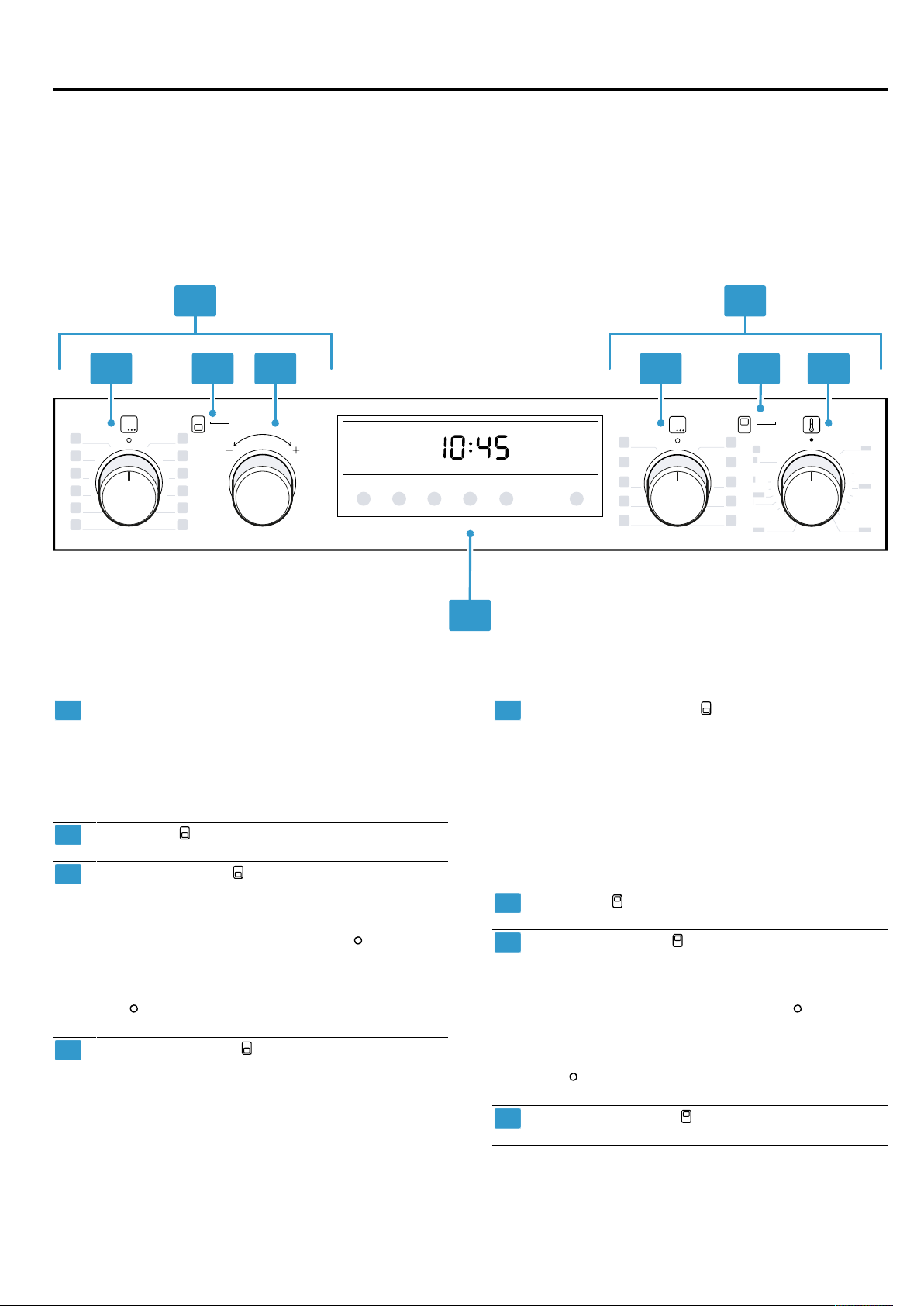
You can use the control panel to configure all functions of your appliance and to obtain information about the operat-
ing status.
Note:On certain models, specific details such as col-
our and shape may differ from those pictured.
3 4
2 6
1
75 8 9
1
Buttons and display
The buttons are touch-sensitive surfaces. To se-
lect a function, simply press lightly on the relev-
ant field.
The display shows symbols for active functions
and the time-setting options.
→"Buttons and display", Page7
2
Main oven
Controls for the main oven
3
Function selector
Use the function selector to set the types of
heating and other functions.
You can turn the function selector clockwise or
anti-clockwise from the zero setting .
Depending on the appliance, the function se-
lector can be pushed in. Press on the function
selector to click it into or out of the zero set-
ting .
→"Types of heating and functions", Page7
4
Heating-up control
→"Heating-up control", Page9
5
Temperature selector
Use the temperature selector to set the temper-
ature for the type of heating and select settings
for other functions.
You can turn the temperature selector clock-
wise and anti-clockwise; it does not have a zero
setting.
Depending on the appliance, the temperature
selector can be pushed in. Press on the tem-
perature selector to click it in or out.
→"Temperature and setting levels", Page9
6
Top oven
Controls for the top oven
7
Function selector
Use the function selector to set the types of
heating and other functions.
You can turn the function selector clockwise or
anti-clockwise from the zero setting .
Depending on the appliance, the function se-
lector can be pushed in. Press on the function
selector to click it into or out of the zero set-
ting .
→"Types of heating and functions", Page7
8
Heating-up control
→"Heating-up control", Page9
Familiarising yourself with your appliance en
7
9
Temperature selector
Use the temperature selector to set the temper-
ature for the type of heating and select settings
for other functions.
You can turn the temperature selector clock-
wise and anti-clockwise.
Depending on the appliance, the temperature
selector can be pushed in. Press on the tem-
perature selector to click it in or out.
→"Temperature and setting levels", Page9
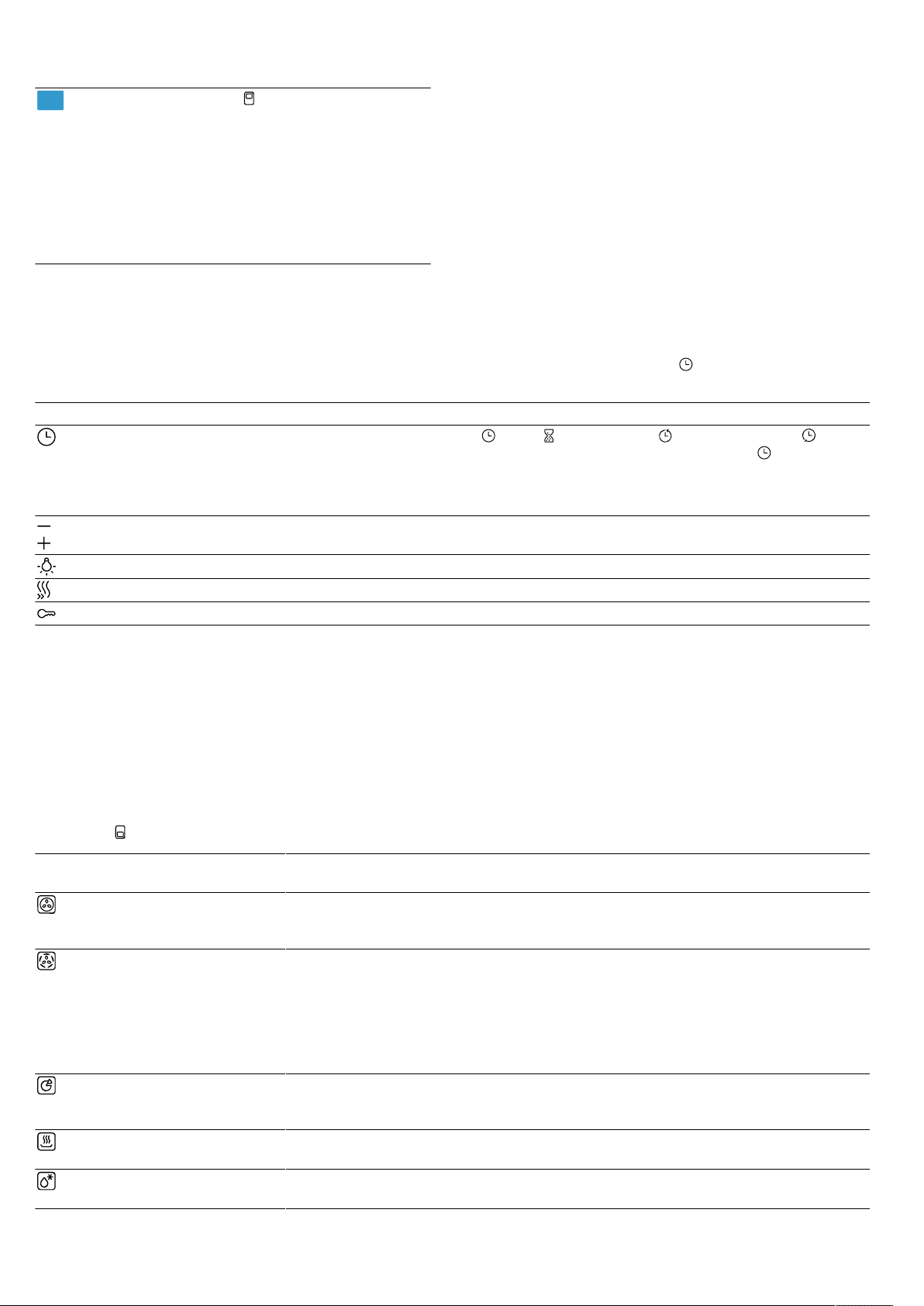
4.2 Buttons and display
You can use the buttons to set various functions for your appliance. The display shows the settings.
If a function is active, the corresponding symbol lights up in the display. The clock symbol only lights up when you
change the time.
Symbol Function Use
Time-setting options Select the time , timer , cooking time and the end time .
To select the individual time-setting options, press the button sev-
eral times.
The red bar above or below the respective symbol indicates the
function to which the setting in the display corresponds.
Minus
Plus
Decrease the setting values.
Increase the setting values.
Oven light Switch the lighting in the cooking compartment on and off.
Rapid heating Preheat the cooking compartment rapidly without accessories.
Childproof lock Activate or deactivate the childproof lock.
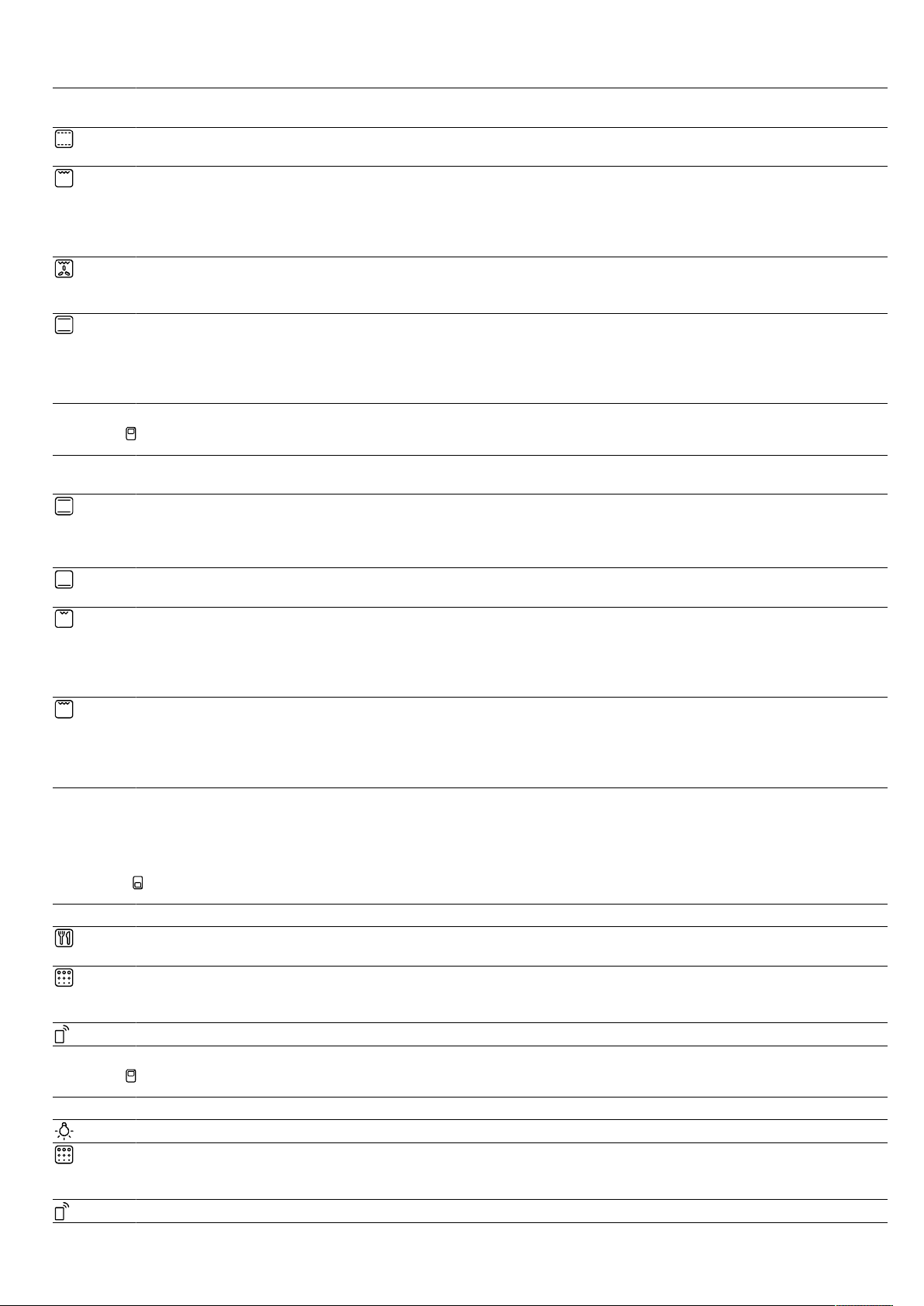
4.3 Types of heating and functions
To ensure that you always use the right type of heating
to cook your food, we have explained the differences
and applications below.
When you select a type of heating, the appliance sug-
gests a suitable temperature or setting. You can use
these values or change them within the specified
range.
Main oven
Symbol Type of heating and
temperature range
What it's used for/how it works
3Dhot air
30-275°C
Bake and roast on one or more levels.
The fan distributes the heat from the ring-shaped heating element in the back
wall evenly around the cooking compartment.
Gentle hot air
125-275°C
Cook selected dishes gently on one level without preheating.
The fan distributes the heat from the ring-shaped heating element in the back
wall evenly around the cooking compartment. The food is cooked in phases us-
ing residual heat.
Always keep the appliance door closed when cooking.
This type of heating is used to determine the energy consumption in air recircu-
lation mode and the energy efficiency class.
Pizza setting
30-275°C
Cook pizza or dishes that require a lot of heat from below.
The bottom heating element and the ring-shaped heating element in the back
wall heat the cooking compartment.
Keeping food warm
60-100°C
Keep cooked food warm.
Defrosting
30-60°C
Gently defrost frozen food.
en Familiarising yourself with your appliance
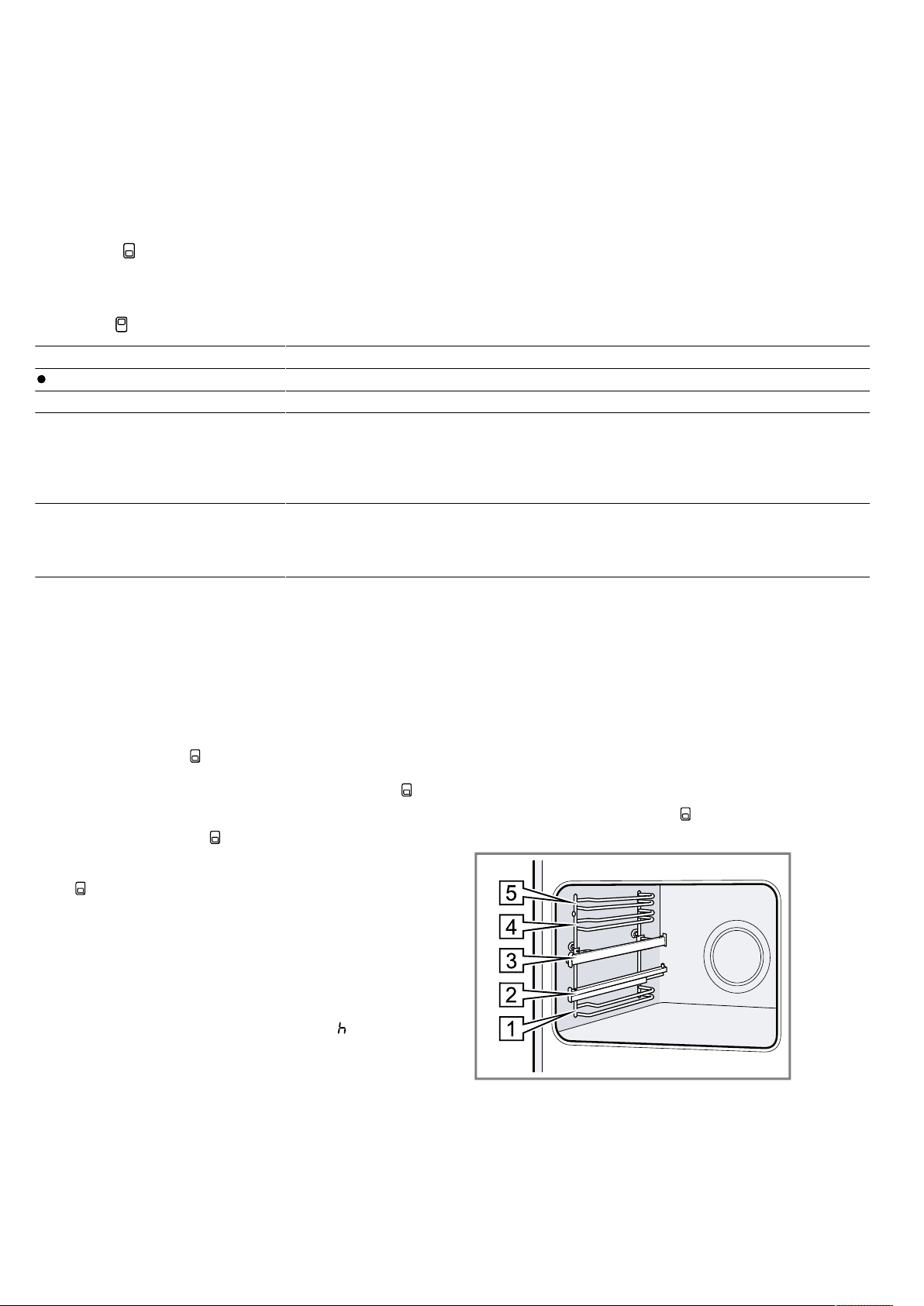
8
Symbol Type of heating and
temperature range
What it's used for/how it works
Slow cooking
70-120°C
Slowly and gently cook seared, tender pieces of meat in uncovered cookware.
The heat is emitted evenly from above and below at a low temperature.
Full-surface grill
Grill settings:
1 = low
2 = medium
3 = high
Grill flat items such as steak and sausages, or make toast. Gratinate food.
The entire area underneath the grill element becomes hot.
Hot air grilling
30-275°C
Roast poultry, whole fish and larger pieces of meat.
The grill element and the fan switch on and off alternately. The fan circulates the
hot air around the food.
Top/bottom heating
30-275°C
Traditionally bake or roast on one level. This type of heating is ideal for cakes
with moist toppings.
The heat is emitted evenly from above and below.
This type of heating is used to measure the energy consumption in the conven-
tional mode.
Top oven
Symbol Type of heating and
temperature range
What it's used for/how it works
Top/bottom heating Bake on one level.
The heat is emitted evenly from above and below.
This type of heating is used to measure the energy consumption in the conven-
tional mode.
Bottom heating Final baking or cooking food in a bain marie.
Heat is emitted from below.
Grill, small area
Grill settings:
1 = low
2 = medium
3 = high
Grill small quantities of steak, sausages or toast. Brown small quantities of food.
The central area underneath the grill element becomes hot.
Full-surface grill
Grill settings:
1 = low
2 = medium
3 = high
Grill flat items such as steak, sausages, or toast. Brown food.
The entire area underneath the grill element becomes hot.
Other functions
Here, you can find an overview of other functions of your appliance.
Main oven
Symbol Function Use
Programme Use programmed setting values for various types of food.
→"Programme", Page15
Pyrolytic self-cleaning Set the cleaning function, which cleans the cooking compartment virtually inde-
pendently.
→"Pyrolytic self-cleaning ", Page23
Remote start
Start and operate the appliance via the Home Connect app. →Page20
Top oven
Symbol Function Use
Oven light Illuminate the cooking compartment without heating.
Pyrolytic self-cleaning Set the cleaning function, which cleans the cooking compartment virtually inde-
pendently.
→"Pyrolytic self-cleaning ", Page23
Remote start
Start and operate the appliance via the Home Connect app. →Page20
Familiarising yourself with your appliance en
9
Note:If you operate your appliance with the
HomeConnect app, even more functions are available
for you. You can find more information about this in the
app.
4.4 Temperature and setting levels
There are different settings for the types of heating and
functions.
Main oven
The settings appear in the display.
The temperature can be set in 1 degree increments up
to 100°C, and in 5 degree increments thereafter.
Note:For grill setting3, the appliance lowers the set-
ting to grill setting1 after approx. 20minutes.
→"Heating-up control", Page9
Top oven
Symbol Function Use
Zero setting The appliance is not heating up.
50–275 Temperature range Set the temperature in the cooking compartment in°C.
1, 2, 3
or
I, II, III
Grill settings Set the grill settings for Full-surface grill and Grill, small area (depending on
the appliance model).
1 = low
2 = medium
3 = high
1, 2, 3
or
I, II, III
Cleaning settings Set the cleaning settings for Pyrolytic self-cleaning.
1 = light
2 = medium
3 = intensive
→"Heating-up control", Page9
Heating-up control
The heating-up indicator for the oven remains lit while
the appliance is heating.
Note:Due to thermal inertia, the temperature displayed
may differ slightly from the actual temperature inside
the cooking compartment.
Heating-up indicator
The line at the bottom of the display also turns red
from left to right as the main cooking compartment
heats up.
Residual heat indicator
If you switch off the appliance, the line on the display
shows the residual heat in the main cooking compart-
ment . The lower the temperature in the cooking com-
partment, the less the line is filled.
Notes
¡ The heat-up indicator will only show the temperature
increasing for types of heating for which a temperat-
ure is set. For grill settings, for example, the heat-up
indicator shows a full line from the beginning.
¡ If the temperature in the cooking compartment is
too high when the appliance is started, appears in
the display for some types of heating. Switch off the
appliance and allow it to cool down. Then restart op-
eration of the appliance.
4.5 Cooking compartment
The functions in the cooking compartment make your
appliance easier to use.
Rails
The rails in the cooking compartment enable you to
place accessories at different heights.
→"Accessories", Page10
The shelf positions are numbered from bottom to top.
You can remove the rails, e. g. for cleaning.
→"Shelf supports", Page25
Main cooking compartment
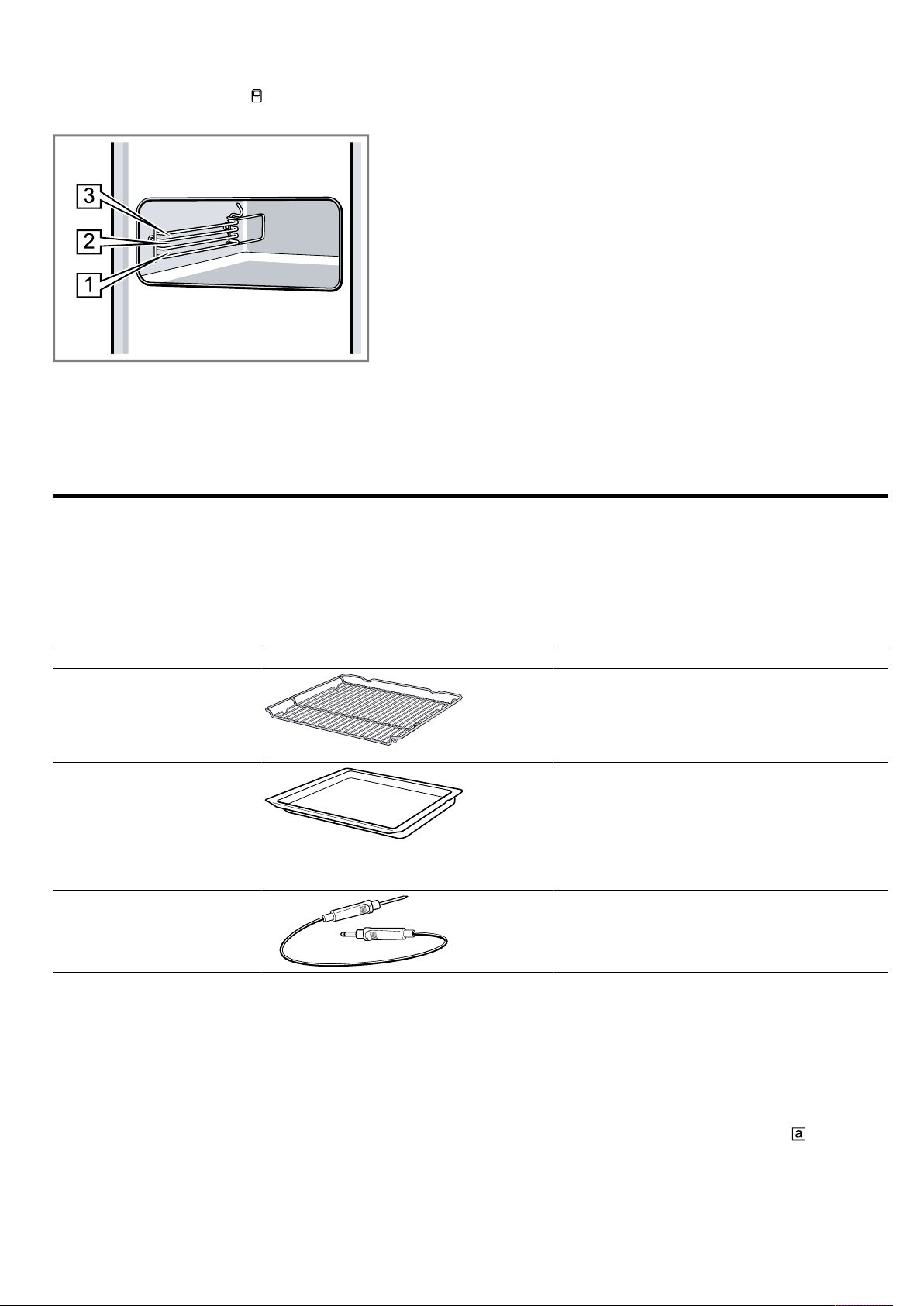
The cooking compartment has five shelf positions.
en Accessories
10
Top cooking compartment
The cooking compartment has three shelf positions.
Lighting
The oven light lights up the cooking compartment.
With most types of heating and functions, the lighting
lights up during operation. The lighting goes off when
operation ends.
You can switch on the lighting without heating the oven
using the Oven light button.
Cooling fan
The cooling fan switches on and off depending on the
appliance's temperature. The hot air escapes above
the door.
ATTENTION!
Do not cover the ventilation slot above the appliance
door. The appliance overheats.
▶
Ensure that the ventilation slots are unobstructed.
To ensure that the appliance cools down more quickly
after operation, the cooling fan continues to run for a
certain period afterwards.
Appliance door
If you open the appliance door during operation, the
appliance stops heating. When you close the appliance
door, the appliance continues to heat again.
5 Accessories
Use original accessories. These have been made espe-
cially for your appliance.
Note:Accessories may become deformed if they get
hot. Deformation has no effect on function. As the ac-
cessory cools down, it will regain its original shape.
The accessories supplied may differ depending on the
appliance model.
Accessories Use
Wire rack ¡ Cake tins
¡ Ovenproof dishes
¡ Cookware
¡ Meat, e.g. roasting joints or steak
¡ Frozen meals
Universal pan ¡ Moist cakes
¡ Baked items
¡ Bread
¡ Large roasts
¡ Frozen meals
¡ Catching dripping liquids, e.g. fat when
grilling food on the wire rack.
Meat thermometer High-precision roasting or cooking.
→"Meat thermometer", Page14
5.1 Locking function
The locking function prevents the accessories from tilt-
ing when they are pulled out.
You can pull out the accessories approximately halfway
without them tipping. The accessories must be inserted
into the cooking compartment correctly for the tilt pro-
tection to work properly.
5.2 Sliding accessories into the cooking
compartment
Always slide accessories into the cooking compartment
correctly. This is the only way to ensure that accessor-
ies can be pulled out approximately halfway without tip-
ping.
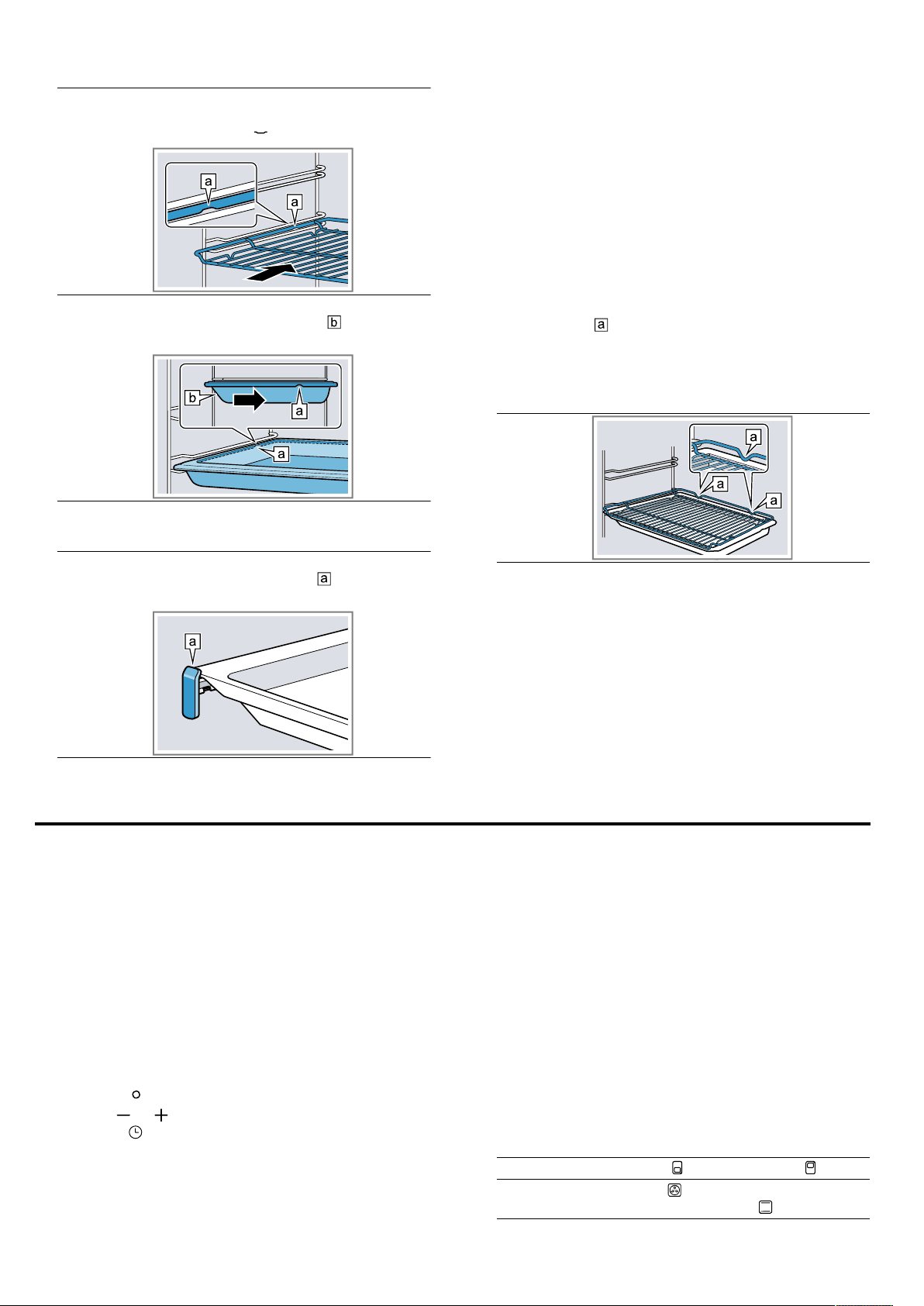
1.
Turn the accessories so that the notch is at the
rear and is facing downwards.
2.
Insert accessories between the two guide rods for
the shelf position.
Before using for the first time en
11
Wire rack Insert the wire rack with the open
side facing the appliance door and
the curved lip facing downwards.
Baking tray
E.g. univer-
sal pan or
baking tray
Slide the tray, e.g. the universal pan,
in with the sloping edge facing the
appliance door.
3.
Place the accessory at the shelf positions with the
pull-out rails and pull out the pull-out rails.
Wire rack
or baking
tray
Position the accessory so that its
edge is behind the lug on the pull-
out rail.
Note:The pull-out rails lock in place when they are
fully pulled out. Gently push the pull-out rails back
into the cooking compartment.
4.
Push the accessory all the way in, making sure that
it does not touch the appliance door.
Note:Take any accessories that you will not be using
out of the cooking compartment while the appliance is
in operation.
Combining accessories
You can combine the wire rack with the universal pan
to catch any liquid that drips down.
1.
Place the wire rack on the universal pan so that
both spacers are on the rear edge of the univer-
sal pan.
2.
Insert the universal pan between the two guide rods
for a shelf position. In so doing, the wire rack is on
top of the upper guide rod.
Wire rack
on univer-
sal pan
5.3 Other accessories
You can purchase other accessories from our after-
sales service, specialist retailers or online.
You will find a comprehensive range of products for
your appliance in our brochures and online:
www.bosch-home.com
Accessories vary from one appliance to another. When
purchasing accessories, always quote the exact
product number (E no.) of your appliance.
You can find out which accessories are available for
your appliance in our online shop or from our after-
sales service.
6 Before using for the first time
Configure the settings for initial start-up. Clean the ap-
pliance and accessories.
6.1 Initial use
You need to make settings for initial use before you
can use your appliance.
Setting the time on the clock
Once the appliance has been connected to the mains
or following a power failure, the time flashes on the dis-
play. The time starts at "12:00". Set the current time.
Requirement:The function selector must be set to the
"Off" position .
1.
Use the or button to set the time.
2.
Press the button.
a The time that is set appears on the display.
Tip:You can go to the basic settings →Page19 to
specify whether or not the time should be shown on
the display.
6.2 Cleaning the appliance before using it
for the first time
Clean the cooking compartment and accessories be-
fore using the appliance to prepare food for the first
time.
1.
Remove any accessories and leftover packaging,
such as polystyrene pellets, from the cooking com-
partment.
2.
Before heating the appliance, wipe the smooth sur-
faces in the cooking compartment with a soft, damp
cloth.
3.
Keep the room ventilated while the appliance is
heating.
4.
Set the type of heating and temperature.
→"Basic operation", Page12
Main oven Top oven
Type of
heating
3Dhot air Top/bottom heat-
ing
en Basic operation
12
Main oven Top oven
Temperat-
ure
Maximum 240°C
Cooking
time
1 hour 1 hour
5.
Switch off the appliance after the specified cooking
time.
6.
Wait until the cooking compartment has cooled
down.
7.
Clean the smooth surfaces with soapy water and a
dish cloth.
8.
Clean the accessories using soapy water and a dish
cloth or soft brush.
7 Basic operation
7.1 Switching on the appliance
▶
Turn the function selector to any position other than
the "Off" position .
a The appliance is switched on.
7.2 Switching off the appliance
▶
Turn the function selector to the "Off" position .
a The appliance is switched off.
7.3 Setting the type of heating and
temperature
1.
Use the function selector to set the type of heating.
2.
Use the temperature selector to set the temperature
or grill setting.
a The appliance starts heating after a few seconds.
3.
When your food is ready, switch off the appliance.
Tips
¡ The most suitable type of heating for your food can
be found in the description of the type of heating.
¡ You can also set a cooking time and end time on
the appliance.
→"Time-setting options", Page12
Changing the type of heating
You can change the type of heating at any time.
▶
Use the function selector to set the required type of
heating.
Changing the temperature
You can change the temperature at any time.
▶
Use the temperature selector to set the required
temperature.
8 Time-setting options
Your appliance has different time-setting options, with
which you can control its operation.
8.1 Overview of the time-setting options
With the button, select the different time-setting op-
tions.
Time-setting
option
Use
Timer The timer can be set independently
of the appliance when it is in opera-
tion. It does not affect the appliance.
Cooking time Main oven : If you set a cooking
time, operation of the appliance
stops automatically once this time
has elapsed.
End time Main oven : For the cooking time,
you can set the time at which opera-
tion ends. The appliance starts up
automatically so that it finishes cook-
ing at the required time.
Time You can set the time.
8.2 Setting the timer
The timer runs independently of the appliance when it
is in operation. The timer can be set when the appli-
ance is switched on or off, up to 23 hours and 59
minutes. The timer has its own audible signal so that
you can tell whether it is the timer or a cooking time
which has elapsed.
1.
Press the button repeatedly until is highlighted
in the display.
2.
Use the or button to set the timer duration.
Button Default value
5minutes
10 minutes
The timer duration can be set in 30-second incre-
ments up to 10 minutes. Above 10 minutes, the
time increments become longer the higher the
value.
a The timer starts and the timer duration begins to
count down after a few seconds.
a An audible signal sounds and the timer duration is
zero in the display when the timer duration has
elapsed.
3.
Once the timer duration has elapsed:
‒ Press any button to switch off the timer.
Changing the timer
You can change the timer duration at any time.
Requirement: is highlighted on the display.
▶
Use the or button to change the timer duration.
a The appliance applies the change after a few
seconds.
Time-setting options en
13
Cancelling the timer
You can cancel the timer duration at any time.
Requirement: is highlighted on the display.
▶
Use the button to reset the timer duration to zero.
a After a few seconds, the appliance applies the
change and goes out.
8.3 Setting the cooking time
You can set a cooking time for operation of up to 23
hours 59 minutes.
Requirements
¡ A type of heating and a temperature or setting are
set for the main oven .
¡ Operation with the meat probe has not been set.
¡ Operation with Sabbath mode has not been set.
1.
Press the button repeatedly until the symbol for
the oven being switched on and the symbol are
highlighted.
2.
Use the or button to set the cooking time.
Button Default value
10 minutes
30minutes
The cooking time can be set in 1-minute increments
up to 1 hour, and then in 5-minute increments.
a The appliance starts heating and the cooking time
counts down after a few seconds.
a If the cooking time has elapsed, an audible signal
sounds and the display shows the cooking time as
zero.
3.
When the cooking time has elapsed:
‒ Press any button to end the audible signal before
it sounds.
‒ To set a cooking time again, press the button.
‒ When your food is ready, switch off the appli-
ance.
Changing the cooking time
You can change the cooking time at any time.
Requirement: is highlighted on the display.
▶
Change the cooking time using the or button.
a The appliance applies the change after a few
seconds.
Cancelling the cooking time
You can cancel the cooking time at any time.
Requirement: is highlighted on the display.
▶
Reset the cooking time to zero using the button.
a After a few seconds, the appliance applies the
change and continues to heat without a cooking
time.
8.4 Setting the end time
You can delay the time at which cooking is due to fin-
ish by up to 23 hours and 59 minutes.
Notes
¡ In order to achieve a good cooking result, do not
delay the end time once the appliance is already in
operation.
¡ Food will spoil if you leave it in the oven cavity too
long.
Requirements
¡ A type of heating and a temperature or setting are
set for the main oven .
¡ A cooking time is set.
¡ Operation with the meat probe has not been set.
¡ Operation with Sabbath mode has not been set.
1.
Press the button repeatedly until the symbol for
the oven being switched on and the symbol are
highlighted.
2.
Press the or button.
a The display shows the calculated end time.
3.
Use the or button to delay the end time.
a After a few seconds, the appliance applies the set-
ting and the display shows the set end time.
a Once the calculated start time has been reached,
the appliance starts heating up and the cooking
time starts counting down.
a Once the time has elapsed, an audible signal
sounds and the display shows the cooking time as
zero.
4.
When the cooking time has elapsed:
‒ Press any button to end the signal prematurely.
‒ To set another cooking time, press the button.
‒ When your food is ready, switch off the appli-
ance.
Changing the end time
In order to achieve a good cooking result, you can only
change the set end time before operation starts and
the cooking time starts counting down.
Requirement: is highlighted on the display.
▶
Use the or button to delay the end time.
a The appliance applies the change after a few
seconds.
Cancelling the end time
You can delete the set end at any time.
Requirement: is highlighted on the display.
▶
Reset the end time to the current time plus the set
cooking time using the button.
a After a few seconds, the appliance applies the
change and starts heating up. The cooking time
counts down.
8.5 Setting the time on the clock
Once the appliance has been connected to the mains
or following a power failure, the time flashes on the dis-
play. The time starts at "12:00". Set the current time.
Requirement:The function selector must be set to the
"Off" position .
1.
Use the or button to set the time.
2.
Press the button.
a The time that is set appears on the display.
Tip:You can go to the basic settings →Page19 to
specify whether or not the time should be shown on
the display.
Changing the time on the clock
You can change the time on the clock at any time.
Requirement:The function selector must be set to the
"Off" position .
1.
Press the button repeatedly until is highlighted
in the display.

en Meat thermometer
14
2.
Use the or button to change the time.
a The appliance applies the change after a few
seconds.
9 Meat thermometer
Cook with precision by inserting the meat probe into
the food and setting a core temperature on the appli-
ance. Once the set core temperature has been
reached in the food, the appliance stops automatically.
The meat probe can be used in the main oven .
The time-setting options for cooking time and end time,
as well as the cleaning function, cannot be used with
the meat probe and the Sabbath setting at the same
time. Example: The cooking time in the top oven can-
not be operated at the same time as the meat probe in
the main oven.
9.1 Suitable types of heating with the meat
thermometer
Only certain types of heating are suitable for use with
the meat thermometer.
Suitable heating functions include:
¡ 3Dhot air
¡ Gentle hot air
¡ Pizza setting
¡ Hot air grilling
¡ Top/bottom heating
Note:If the meat thermometer is being used and you
select an unsuitable type of heating, a signal sounds.
9.2 Inserting the meat thermometer
Use the meat thermometer supplied or order a suitable
meat thermometer from our after-sales service.
WARNING‒Risk of electric shock!
Using the wrong meat probe could damage the insula-
tion.
▶
Only use the meat probe for this specific appliance.
ATTENTION!
Otherwise the meat probe may be damaged.
▶
Do not trap the cable of the meat probe.
▶
To prevent the meat probe from being damaged by
excessive heat, there must be a gap of a few centi-
metres between the grill element and the meat
probe. The meat may expand during the cooking
process.
1.
Insert the meat thermometer at an angle into the
thickest part of the meat.
Ensure that the tip of the meat thermometer is
correctly positioned in the meat:
– The tip must be roughly in the middle of the
food.
– The tip must not be inserted in the fat.
– The tip must not touch any cookware or bones.
2.
Place the food with the meat thermometer into the
cooking compartment.
It is best to place the food in cookware into the
centre of the wire rack.
3.
Plug the meat thermometer into the socket on the
left-hand side of the cooking compartment.
Notes
¡ If you remove the meat thermometer while the food
is cooking, all the settings will be reset.
¡ Do not remove the meat thermometer when turning
the food. Once you have turned the food, check that
the meat thermometer is correctly positioned in the
food.
9.3 Setting the meat thermometer
The meat probe measures the temperature inside the
food between 30 °C and 99 °C.
Requirements
¡ The food with the meat probe is in the cooking com-
partment.
¡ The meat probe is plugged in inside the cooking
compartment.
¡ The time-setting options for cooking time and end
time have not been set.
¡ A cleaning function has not been set.
¡ Operation with Sabbath mode has not been set.
1.
Use the function selector to set a suitable type of
heating.
a lights up in the display and the core temperature
display appears next to the temperature of the cook-
ing compartment.
2.
Use the or button to set the core temperature.
3.
Use the temperature selector to set the temperature
of the cooking compartment.
Set the cooking compartment temperature at least
10°C higher than the core temperature.
Do not set the cooking compartment temperature to
higher than 250°C.
a The appliance starts heating after a few seconds.
a The current core temperature of the food is shown
on the left, while the set core temperature is shown
on the right, e.g. 15°C|75°C. The current core
temperature only appears once it reaches 10°C.
a Once the food reaches the core temperature, an
audible signal sounds and, in the display, the cur-
rent core temperature is equal to the set core tem-
perature, e.g. 75°C|75°C.
4.
WARNING‒Risk of burns!
The cooking compartment, accessories and meat
probe become very hot.
▶
Always use oven gloves to remove hot accessor-
ies and the meat probe from the cooking com-
partment.
When the core temperature is reached:
‒ Switch off the appliance.
‒ Pull the meat probe out of the socket in the
cooking compartment.
‒ Pull the meat probe out of the food remove it
from the cooking compartment.

Programme en
15
10 Programme
The programmes help you to use your appliance to
prepare different dishes by selecting the optimum set-
tings automatically.
10.1 Cookware for programmes
You should therefore use heat-resistant cookware that
is suitable for temperatures up to 300°C.
Glass or glass ceramic cookware is best. The joint
should cover approx. two thirds of the cookware base.
Cookware made from the following material is not
suitable:
¡ Bright, shiny aluminium
¡ Unglazed clay
¡ Plastic or plastic handles
10.2 Programme table
The programme numbers are assigned to specific foods.
No. Food Cookware Weight range
Weight setting
Add liquid Shelf
posi-
tion
Information
01 Pizza, thin base
Frozen, prebaked
Universal pan with
greaseproof paper
0.28–0.4kg
Total weight
No 3 For a second pizza,
follow the instructions
on the packaging
02 Pizza, deep-pan
Frozen, prebaked
Universal pan with
greaseproof paper
0.28–0.6kg
Total weight
No 3 For a second pizza,
follow the instructions
on the packaging
03 Lasagne
Frozen
Original packaging 0.3–1.2kg
Total weight
No 3 -
04 Chips
Frozen
Universal pan with
greaseproof paper
0.2–0.75kg
Total weight
No 3 Spread out on the
universal pan
05 Prebaked bread rolls
Frozen, prebaked
Universal pan with
greaseproof paper
0.1–0.8kg
Total weight
No 3 -
06 Potato gratin Ovenproof dish
without lid
0.5–3.0kg
Total weight
No 2 -
07 Pasta bake
With precooked pasta
Ovenproof dish
without lid
0.4–3.0kg
Total weight
No 2 -
08 Baked potatoes,
whole
Unpeeled, starchy
potatoes
Universal pan 0.3–1.5kg
Total weight
No 3 -
09 Vegetable stew
Vegetarian
Deep roasting dish
with lid
0.5–2.5kg
Total weight
As per recipe 2 Cut vegetables that
take longer to cook
(e.g. carrots) into
smaller pieces than
vegetables that take
less time to cook
(e.g. tomatoes)
10 Meat stew Deep roasting dish
with lid
0.5–3.0kg
Total weight
As per recipe 2 Do not sear the meat
beforehand
11 Goulash
Diced beef or pork,
with vegetables
Deep roasting dish
with lid
0.5–2.5kg
Total weight
As per recipe 2 Place the meat at the
bottom and cover
with vegetables
Do not sear the meat
beforehand
12 Fish, whole
Ready to cook,
seasoned
Roasting dish with
lid
0.3–1.5kg
Weight of fish
Cover the
bottom of the
roasting dish
2 -
13 Chicken, unstuffed
Ready to cook,
seasoned
Roasting dish with
glass lid
0.6–2.5kg
Chicken weight
No 2 Place in the cook-
ware with the breast
facing up

en Programme
16
No. Food Cookware Weight range
Weight setting
Add liquid Shelf
posi-
tion
Information
14 Chicken pieces
Ready to cook,
seasoned
Roasting dish with
lid
0.1–0.8kg
Weight of the
heaviest piece
Cover the
bottom of the
roasting dish
2 -
15 Turkey breast
Whole, seasoned
Roasting dish with
glass lid
0.5–2.5kg
Turkey breast
weight
Cover the
bottom of the
roasting dish,
and add up
to 250g ve-
getables if
you wish
2 -
16 Duck, unstuffed
Ready to cook,
seasoned
Roasting dish
without lid
1.0–2.7kg
Duck weight
No 2 -
17 Goose, unstuffed
Ready to cook,
seasoned
Roasting dish
without lid
2.5–3.5kg
Goose weight
No 2 -
18 Pot-roasted beef
E.g. prime rib,
shoulder, rump or mar-
inated beef roast
Roasting dish with
lid
0.5–2.5kg
Weight of meat
Almost cover
the meat with
liquid
2 Do not sear the meat
beforehand
19 Sirloin, medium
Ready to cook,
seasoned
Roasting dish
without lid
0.5–2.5kg
Weight of meat
No 2 Place in the cook-
ware with the fatty
side up
Do not sear the meat
beforehand
20 Beef olives
Stuffed with vegetables
or meat
Roasting dish with
lid
0.5–2.5kg
Total weight of all
the stuffed beef
olives
Add stock,
water or an-
other liquid
to the dish
until the beef
olives are al-
most covered
2 Do not sear the meat
beforehand
21 Meat loaf, fresh
Minced beef, pork or
lamb
Roasting dish with
lid
0.5–2.5kg
Roast weight
No 2 Do not sear the meat
beforehand
22 Leg of lamb, medium
Boned, seasoned
Roasting dish with
lid
0.5–2.5kg
Weight of meat
Cover the
bottom of the
roasting dish,
and add up
to 250g ve-
getables if
you wish
2 Do not sear the meat
beforehand
23 Leg of lamb, well
done
Boned, seasoned
Roasting dish with
lid
0.5–2.5kg
Weight of meat
Cover the
bottom of the
roasting dish,
and add up
to 250g ve-
getables if
you wish
2 Do not sear the meat
beforehand
24 Joint of veal, marbled
E.g. saddle or topside
Roasting dish with
lid
0.5–3.0kg
Weight of meat
Cover the
bottom of the
roasting dish,
and add up
to 250g ve-
getables if
you wish
2 Do not sear the meat
beforehand

Programme en
17
No. Food Cookware Weight range
Weight setting
Add liquid Shelf
posi-
tion
Information
25 Joint of veal, lean
E.g. tenderloin or eye
Roasting dish with
lid
0.5–2.5kg
Weight of meat
Cover the
bottom of the
roasting dish,
and add up
to 250g ve-
getables if
you wish
2 Do not sear the meat
beforehand
26 Leg of roe venison
Boned, seasoned with
salt
Roasting dish with
lid
0.5–2.0kg
Weight of meat
Cover the
bottom of the
roasting dish,
and add up
to 250g ve-
getables if
you wish
2 -
27 Rabbit, whole
Ready to cook,
seasoned
Roasting dish with
glass lid
1.0–2.5kg
Weight of meat
Cover the
bottom of the
roasting dish,
and add up
to 250g ve-
getables if
you wish
2 -
28 Pork neck joint
Boned, seasoned
Roasting dish with
glass lid
0.5–3.0kg
Weight of meat
Cover the
bottom of the
roasting dish,
and add up
to 250g ve-
getables if
you wish
2 Do not sear the meat
beforehand
29 Joint of pork, with
crackling
E.g. shoulder,
seasoned, and scored
rind
Roasting dish with
glass lid
0.5–3.0kg
Weight of meat
Cover the
bottom of the
roasting dish,
and add up
to 250g ve-
getables if
you wish
2 Place in the cook-
ware fatty side up;
salt the rind well
30 Pork tenderloin steak
Seasoned
Roasting dish with
glass lid
0.5–2.5kg
Weight of meat
Cover the
bottom of the
roasting dish,
and add up
to 250g ve-
getables if
you wish
2 Do not sear the meat
beforehand
10.3 Preparing food for the programme
Use fresh and, ideally, chilled food. Use frozen food
straight from the freezer.
1.
Weigh the food.
The weight of the food is required in order to cor-
rectly set the programme.
2.
Add the food to the cookware.
3.
Place the cookware onto the wire rack.
Always place the cookware into the cooking com-
partment while it is cold.
10.4 Setting a programme
The appliance selects the optimal type of heating, tem-
perature and cooking time. All you need to do is set
the weight.
Notes
¡ You can set the weight only in the intended area.
¡ After the programme starts, you can no longer
change the programme and the weight.
1.
Use the function selector to set Programme .
2.
Use the or button to set the required pro-
gramme.
3.
Use the temperature selector to set the weight of
your food. Always set the next higher weight.
‒ To call up the programme's cooking time, press
the button. The cooking time cannot be
changed.

en Childproof lock
18
‒ For some programmes, the button can be
used to delay the end.
→"Setting the end time", Page13
a After a few seconds, the programme starts and the
cooking time counts down.
a If the programme has ended, an audible signal
sounds and the display shows the cooking time as
zero.
4.
When the programme ends:
‒ Press any button to end the audible signal pre-
maturely.
‒ To set a cooking time for further cooking, press
the button. The appliance continues to heat
using the programme settings.
‒ When your food is ready, switch off the appli-
ance.
11 Childproof lock
You can secure your appliance to prevent children
from accidentally switching it on or changing the set-
tings.
Note:You can go to the basic settings →Page19 to
specify whether you want the option to set the child-
proof lock.
11.1 Activating and deactivating the
childproof lock
Requirement:The function selector must be set to the
"Off" position .
▶
To activate the childproof lock, press and hold the
button until appears in the display.
‒ To deactivate the childproof lock, press and hold
the button until goes out in the display.
12 Rapid heating
To save time, you can shorten the preheating time for
the main oven for set temperatures over 100°C.
You can use rapid heating for the following types of
heating:
¡ 3Dhot air
¡ Top/bottom heating
12.1 Setting rapid heating for the main oven
To ensure an even cooking result, do not place the
food in the cooking compartment until rapid heating
has come to an end.
Note:Do not set a cooking time until rapid heating has
come to an end.
1.
Set a suitable type of heating and a temperature of
at least 100°C.
2.
Press the button.
a appears in the display.
a Rapid heating starts after a few seconds.
a Once rapid heating has ended, an audible signal
sounds and the symbol goes out in the display.
3.
Place the food in the cooking compartment.
13 Sabbath mode
You can use the Sabbath mode to set a cooking time
of over 70hours for the main oven . You can use
Top/bottom heating to keep food warm between
85°C and 140°C during this time without having to
switch the appliance on or off.
13.1 Starting Sabbath mode
Notes
¡ If you open the appliance door during operation, the
appliance does not interrupt the operation.
¡ Once it has started, you can no longer change or in-
terrupt Sabbath mode.
¡ You cannot delay the end time for Sabbath mode.
Requirements
¡ Sabbath mode is activated in the basic settings.
→"Basic settings", Page19
¡ It is not possible to set operation with a cooking time
or end time in the top oven .
¡ It is not possible to set operation with a cleaning
function in the top oven .
1.
Use the function selector for the bottom oven to
set the programmes .
a appears in the display.
2.
Use the temperature selector to set the temperature.
3.
Use the or button to set the time.
a After a few seconds, the appliance starts heating
and the time counts down.
a Once the time has elapsed, the display shows the
time as zero.
4.
Switch off the appliance.
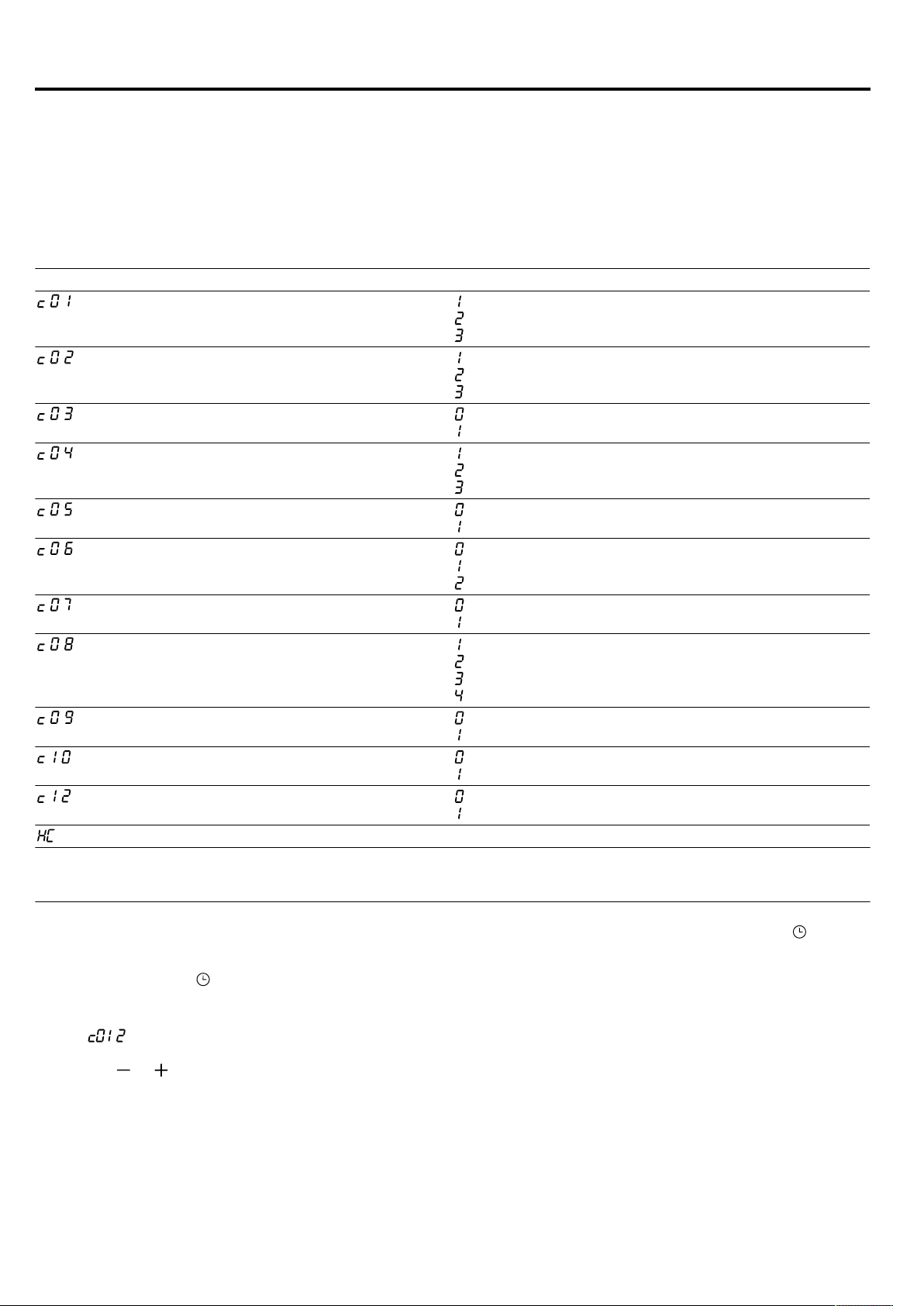
Basic settings en
19
14 Basic settings
You can configure the appliance to meet your needs.
14.1 Overview of the basic settings
Here you can find an overview of the basic settings and factory settings. The basic settings depend on the features
of your appliance.
Display Basic setting Selection
Signal duration upon completion of a time or
timer period
= 10 seconds
= 30 seconds
1
= 2 minutes
Waiting time until a setting is applied = 3 seconds
1
= 6 seconds
= 10 seconds
Button tone when pressing a button = off
= on
1
Brightness of the display illumination = dark
= medium
1
= bright
Time display = hide the time
= display the time
1
Childproof lock can be adjusted = no
= yes
1
= yes, with locked door
Interior lighting during operation = no
= yes
1
Cooling fan run-on time = short
= medium
1
= long
= extra-long
Telescopic shelves retrofitted
2, 3
= no
1
(for rails and 1-level pull-out)
= yes (for 2- and 3-level pull-out)
Sabbath mode available
3
= no
1
= yes
Reset all values to factory settings = no
1
= yes
.. HomeConnect Settings
→"HomeConnect ", Page20
1
Factory setting (may vary according to model)
2
Depending on the appliance specifications
3
Bottom oven
14.2 Changing basic settings
Requirement:The appliance is switched off.
1.
Press and hold the button for approximately
fourseconds.
a The first basic setting appears in the display,
e.g. .
2.
Use the temperature selector to change the setting.
3.
Use the or button to switch to the next basic
setting.
4.
To save the changes, press and hold the button
for approx. fourseconds.
Note:Your changes to the basic settings will be re-
tained even after a power failure.
14.3 Discarding changes to the basic
settings
▶
Turn the function selector.
a All changes are discarded and not saved.
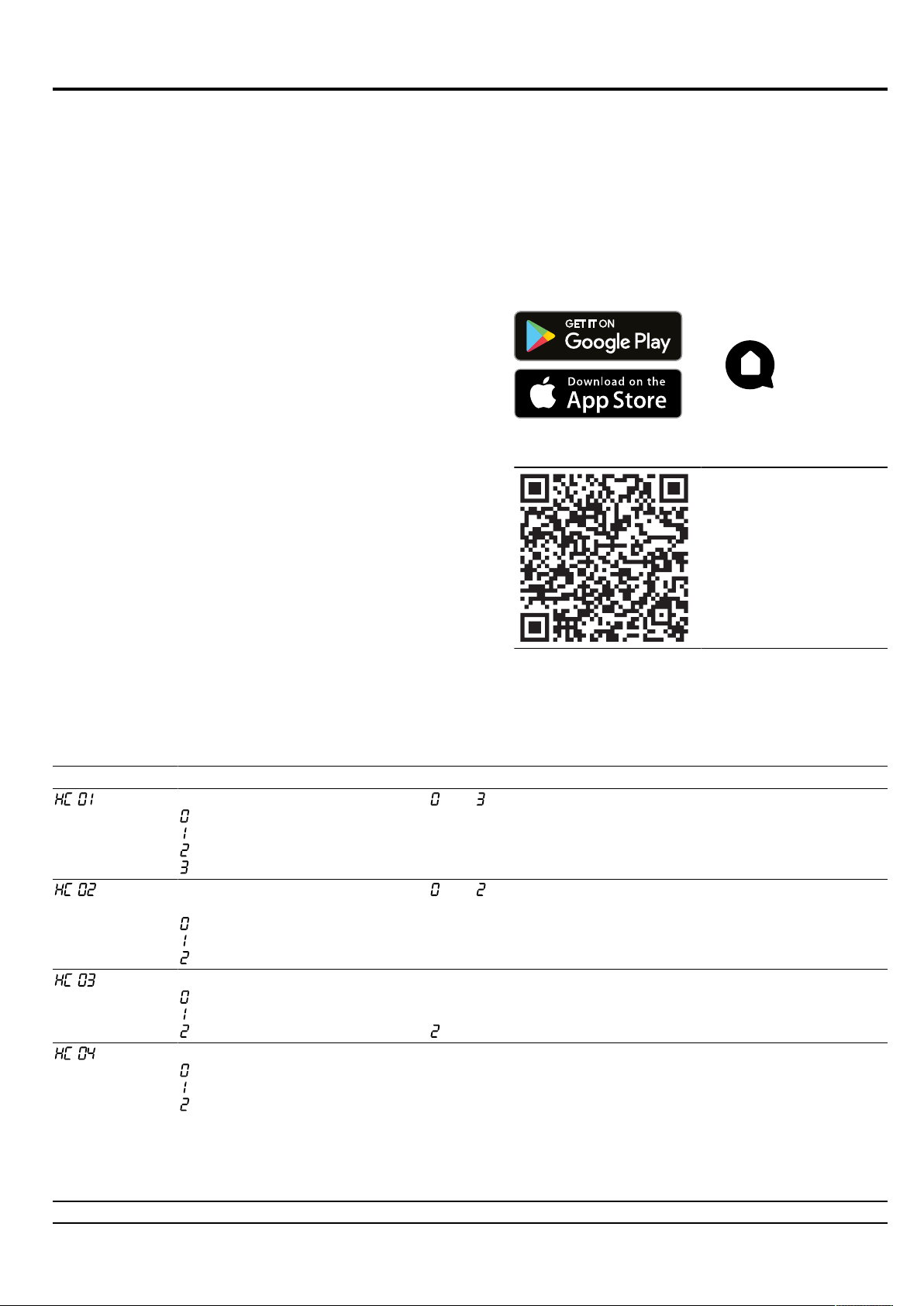
en HomeConnect
20
15 HomeConnect
This appliance is network-capable. Connecting your ap-
pliance to a mobile device lets you control its functions
via the HomeConnect app, adjust its basic settings
and monitor its operating status.
The HomeConnect services are not available in every
country. The availability of the HomeConnect function
depends on the availability of HomeConnect services
in your country. You can find information about this at:
www.home-connect.com.
The HomeConnect app guides you through the entire
login process. Follow the instructions in the HomeCon-
nect app to configure the settings.
Tips
¡ Please consult the documents supplied by
HomeConnect.
¡ Please also follow the instructions in the HomeCon-
nect app.
Notes
¡ Please note the safety precautions in this instruction
manual and make sure that they are also observed
when operating the appliance via the HomeCon-
nect app.
→"Safety", Page2
¡ Operating the appliance on the appliance itself al-
ways takes priority. During this time it is not possible
to operate the appliance using the HomeConnect
app.
¡ In networked standby mode, the appliance requires
a maximum of2W.
15.1 Setting up HomeConnect
Requirements
¡ The appliance is connected to the power supply and
is switched on.
¡ You have a smartphone or tablet with a current ver-
sion of the iOS or Android operating system.
¡ The smartphone and the appliance are within range
of your home network's Wi-Fi signal.
1.
Download the HomeConnect app.
2.
Open the HomeConnect app and scan the follow-
ing QR code.
3.
Follow the instructions in the HomeConnect app.
15.2 HomeConnect Settings
You can adjust the settings and network settings for HomeConnect in the basic settings for your appliance.
Setting Selection or display Explanation
Connection to the network
– Not connected
– Connect automatically
– Connect manually
– Connected
and are displays that you cannot set.
Connection to the HomeConnect
app
– Ready
– Connect
– Connected
and are displays that you cannot set.
Wi-Fi
– Off
– Activate
– On
If Wi-Fi is activated, you can use HomeConnect.
In networked standby mode, the appliance requires a max-
imum of 2W.
is a display that you cannot set.
Remote start
– Deactivated
– Manual
1
– Permanent
When remote start is deactivated, you can only view the oper-
ating status of the appliance in the app.
For manual remote start, you must activate the remote start
each time before you can start the appliance via the app. If
you open the appliance door within 15minutes of activating
remote start or of the operation ending, remote start is deactiv-
ated.
For permanent remote start, you can start and operate the ap-
pliance remotely at any time.
1
Factory setting
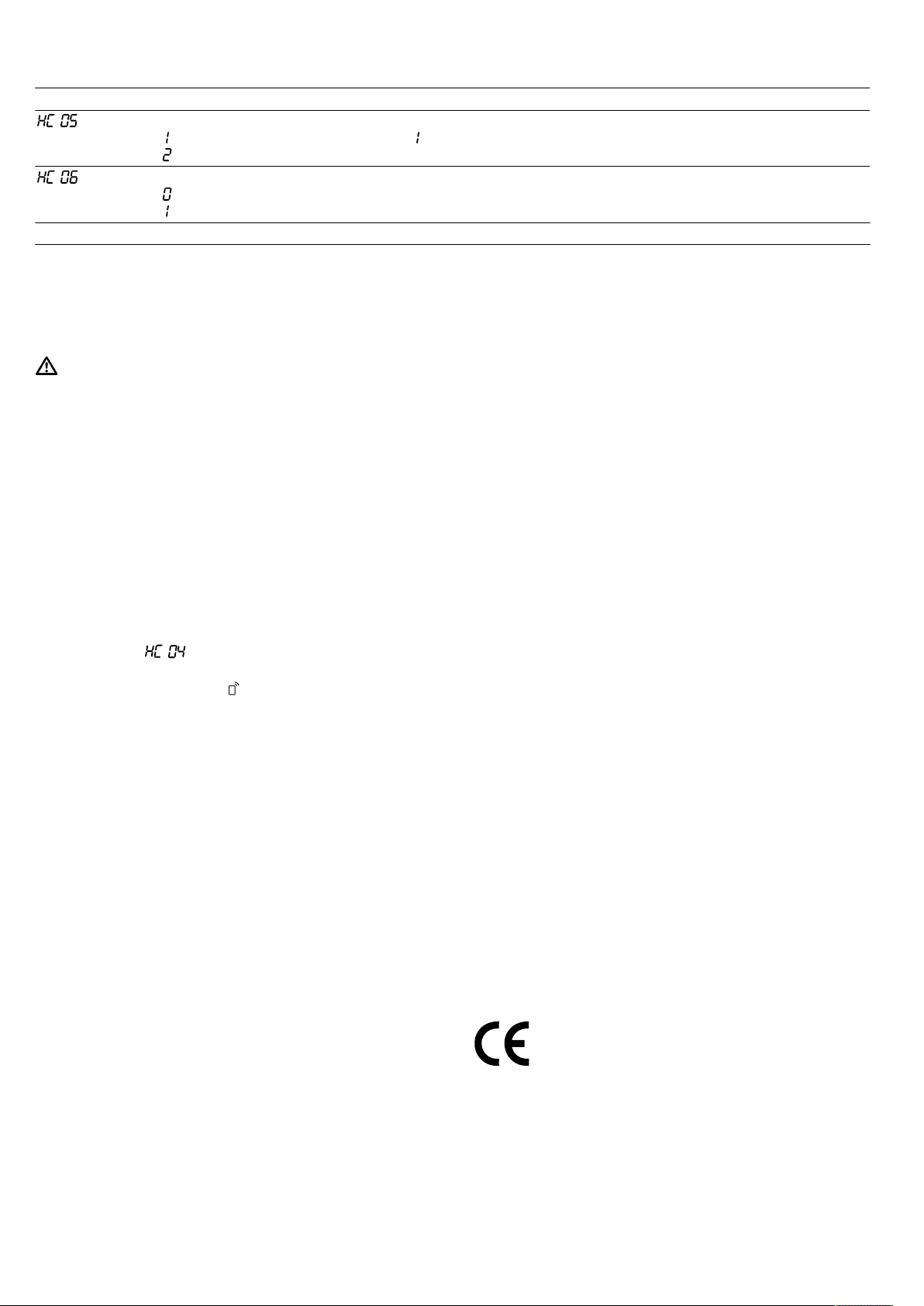
HomeConnect en
21
Setting Selection or display Explanation
Software update
– Update available
– Start update
The setting is only displayed if an update is available.
is a display that you cannot set.
Remote Diagnostics
– Not authorised
1
– Authorised
The setting is only displayed if after-sales service is attempting
to access the appliance.
1
Factory setting
15.3 Operating the appliance with the
HomeConnect app
You can use the HomeConnect app to set and start
the appliance remotely.
WARNING‒Risk of fire!
Combustible objects that are left in the cooking com-
partment may catch fire.
▶
Never store combustible objects in the cooking
compartment.
▶
Never open the appliance door if there is smoke in-
side.
▶
Switch off the appliance and unplug it from the
mains or switch off the circuit breaker in the fuse
box.
Requirements
¡ The appliance is switched on.
¡ The appliance is connected to your home network
and to the HomeConnect app.
¡ In order to be able to set the appliance via the app,
the manual or permanent remote start must be se-
lected in the basic setting.
1.
To activate the remote start, set the function selector
on the required oven to .
2.
Implement a setting in the app and send it to the ap-
pliance.
15.4 Software update
Your appliance's software can be updated using the
software update function, e.g. for the purposes of op-
timisation, troubleshooting or security updates.
To do this, you must be a registered HomeCon-
nectuser, have installed the app on your mobile device
and be connected to the HomeConnectserver.
As soon as a software update is available, you will be
informed via the HomeConnectapp and will be able to
start the software update via the app. Once the update
has been successfully downloaded, you can start in-
stalling it via the HomeConnectapp if you are in your
local area network. The HomeConnectapp will inform
you once installation is successful.
Notes
¡ You can continue to use your appliance as normal
while updates are downloading. Depending on your
personal settings in the app, software updates can
also be set to download automatically.
¡ We recommend that you install security updates as
soon as possible.
15.5 Remote diagnostics
Customer Service can use Remote Diagnostics to ac-
cess your appliance if you contact them, have your ap-
pliance connected to the HomeConnect server and if
Remote Diagnostics is available in the country in which
you are using the appliance.
Tip:For further information and details about the avail-
ability of Remote Diagnostics in your country, please
visit the service/support section of your local website:
www.home-connect.com
15.6 Data protection
Please see the information on data protection.
The first time your appliance is registered on a home
network connected to the Internet, your appliance will
transmit the following types of data to the
HomeConnect server (initial registration):
¡ Unique appliance identification (consisting of appli-
ance codes as well as the MAC address of the Wi-Fi
communication module installed).
¡ Security certificate of the Wi-Fi communication mod-
ule (to ensure a secure data connection).
¡ The current software and hardware version of your
appliance.
¡ Status of any previous reset to factory settings.
This initial registration prepares the HomeConnect
functions for use and is only required when you want to
use the HomeConnect functions for the first time.
Note:Please note that the HomeConnect functions
can only be utilised with the HomeConnect app. In-
formation on data protection can be retrieved in the
HomeConnect app.
15.7 Declaration of Conformity
Robert Bosch Hausgeräte GmbH hereby declares that
the appliance with Home Connect functionality meets
the essential requirements and other relevant provi-
sions of the Directive 2014/53/EU.
A detailed RED Declaration of Conformity can be found
online at www.bosch-home.com among the additional
documents on the product page for your appliance.
2.4GHz band: 100mW max.
5GHz band: 100mW max.
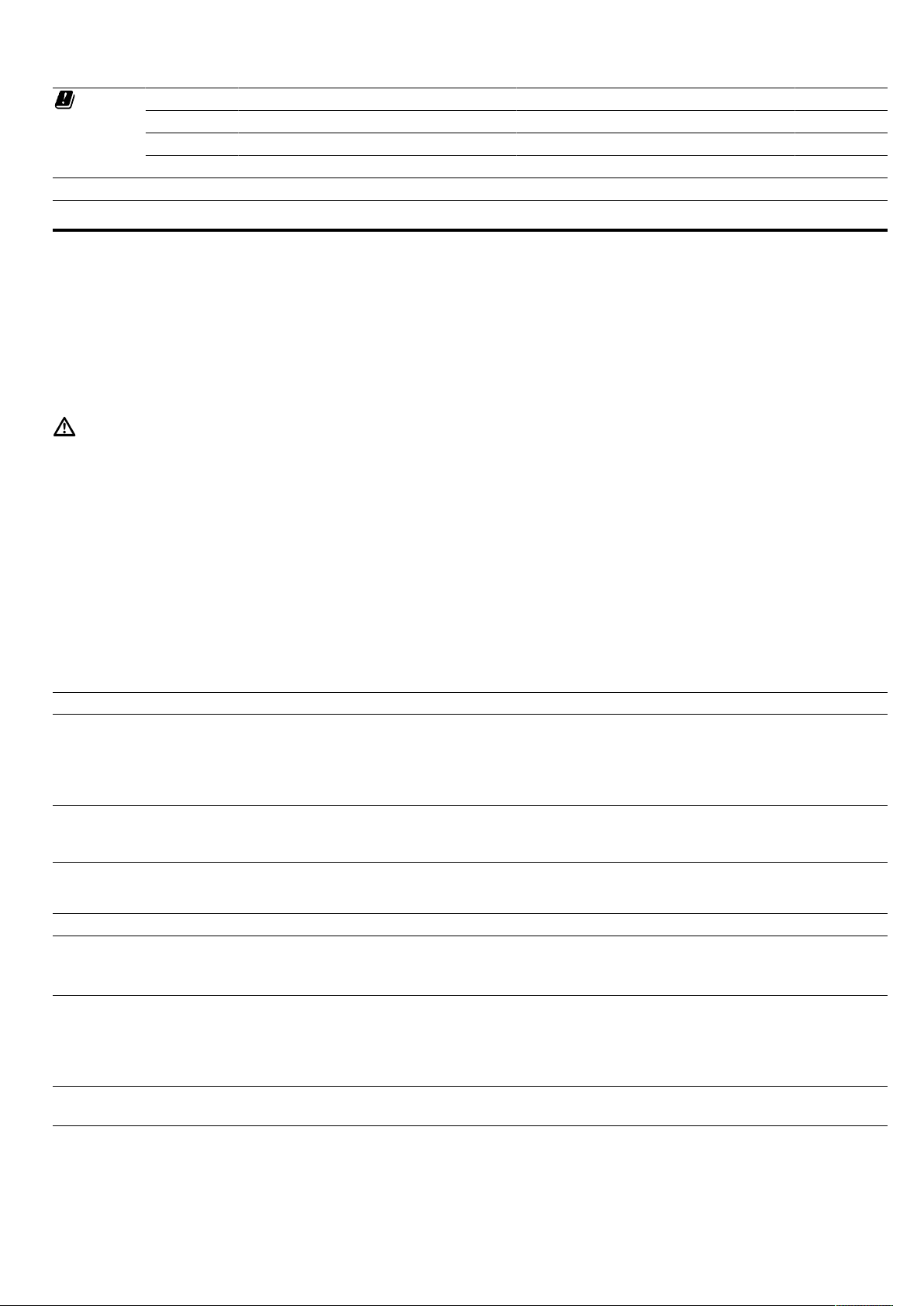
en Cleaning and servicing
22
BE BG CZ DK DE EE IE EL
ES FR HR IT CY LV LT LU
HU MT NL AT PL PT RO SI
SK FI SE UK NO CH TR
5GHz WLAN (Wi-Fi): For indoor use only.
16 Cleaning and servicing
To keep your appliance working efficiently for a long
time, it is important to clean and maintain it carefully.
16.1 Cleaning products
In order to avoid damaging the various oven surfaces
on the appliance, do not use unsuitable cleaning
products.
WARNING‒Risk of electric shock!
An ingress of moisture can cause an electric shock.
▶
Do not use steam- or high-pressure cleaners to
clean the appliance.
ATTENTION!
Unsuitable cleaning products may damage the sur-
faces of the appliance.
▶
Do not use harsh or abrasive cleaning products.
▶
Do not use cleaning products with a high alcohol
content.
▶
Do not use hard scouring pads or cleaning
sponges.
▶
Do not use any special cleaners for cleaning the ap-
pliance while it is hot.
Using oven cleaner in a hot cooking compartment
damages the enamel.
▶
Never use oven cleaner in the cooking compartment
when it is still warm.
▶
Remove all food remnants from the cooking com-
partment and the appliance door before you next
heat up the appliance.
New sponge cloths contain residues from production.
▶
Wash new sponge cloths thoroughly before use.
Suitable cleaning agents
Only use cleaning agents that are suitable for the differ-
ent surfaces on your appliance.
Follow the instructions on cleaning the appliance.
→"Cleaning the appliance", Page23
Appliance front
Surface Suitable cleaning agents Notes
Stainless steel ¡ Hot soapy water
¡ Special stainless steel
cleaning products
suitable for hot sur-
faces
To prevent corrosion, remove any limescale, grease, starch or albu-
min (e.g. egg white) stains on stainless steel fronts immediately.
Apply a thin layer of the stainless steel cleaning product with a soft
cloth.
Plastic or painted
surfaces
E.g. control panel
¡ Hot soapy water Do not use glass cleaner or a glass scraper.
Appliance door
Area Suitable cleaning agents Notes
Door panels ¡ Hot soapy water Do not use a glass scraper or a stainless steel wool.
Tip:Remove the door panels in order to clean them thoroughly.
→"Appliance door", Page27
Door cover ¡ Made of stainless
steel:
Stainless steel cleaner
¡ Made of plastic:
Hot soapy water
Do not use glass cleaner or a glass scraper.
Tip:Remove the door cover for thorough cleaning.
→"Appliance door", Page27
Door handle ¡ Hot soapy water To avoid permanent stains, remove descaling agents from the door
handle immediately.
Pyrolytic self-cleaning en
23
Cooking compartment
Area Suitable cleaning agents Notes
Enamel surfaces ¡ Hot soapy water
¡ Vinegar water
¡ Oven cleaner
Soak any heavily soiled areas and use a brush or steel wool.
Leave the appliance door open to dry the cooking compartment
after cleaning it.
Tip:It is best to use the cleaning function.
→"Pyrolytic self-cleaning ", Page23
Notes
¡ Enamel burns at very high temperatures, causing minor discol-
ouration. The functionality of your appliance is not affected by
this.
¡ The edges of thin trays cannot be completely enamelled and may
be rough. This does not impair corrosion protection.
¡ Food residues will leave a white coating on the enamel surfaces.
The coating does not pose a health risk. The functionality of your
appliance is not affected by this. You can remove residues with
lemon juice.
Glass cover for
the oven light
¡ Hot soapy water Use oven cleaner to remove very heavy soiling.
Rails ¡ Hot soapy water Soak any heavily soiled areas and use a brush or steel wool.
Tip:Remove the shelf supports for cleaning.
→"Shelf supports", Page25
Pull-out system ¡ Hot soapy water Use a brush to remove very heavy soiling.
Clean the pull-out rails while they are pushed in so that you do not
remove the lubricant.
Do not clean in the dishwasher.
Tip:Detach the pull-out system for cleaning.
→"Shelf supports", Page25
AccessorIes ¡ Hot soapy water
¡ Oven cleaner
Soak any heavily soiled areas and use a brush or steel wool.
Enamelled accessories are dishwasher-safe.
Meat probe ¡ Hot soapy water Use a brush to remove very heavy soiling.
Do not clean in the dishwasher.
16.2 Cleaning the appliance
In order to avoid damaging the appliance, you must
clean your appliance only as specified, and with suit-
able cleaning products.
WARNING‒Risk of burns!
The appliance and its parts that can be touched be-
come hot during use.
▶
Caution should be exercised here in order to avoid
touching heating elements.
▶
Young children under 8 years of age must be kept
away from the appliance.
WARNING‒Risk of fire!
Loose food remnants, fat and meat juices may catch
fire.
▶
Before using the appliance, remove the worst of the
food residues and remnants from the cooking com-
partment, heating elements and accessories.
Requirement:Read the information on cleaning
products.
→"Cleaning products", Page22
1.
Clean the appliance using hot soapy water and a
dish cloth.
‒ For some surfaces, you can use alternative
cleaning agents.
→"Suitable cleaning agents", Page22
2.
Dry with a soft cloth.
17 Pyrolytic self-cleaning
The Pyrolytic self-cleaning cleaning function cleans
the cooking compartment almost by itself.
Use the cleaning function to clean the cooking com-
partment every two to three months. If required, you
can use the cleaning function more frequently. The
cleaning function requires approx.2.5–4.8 kilowatt
hours.
en Pyrolytic self-cleaning
24
17.1 Preparing the appliance for the
cleaning function
In order to achieve a good cleaning result, prepare the
appliance carefully.
WARNING‒Risk of fire!
Combustible objects that are left in the cooking com-
partment may catch fire.
▶
Never store combustible objects in the cooking
compartment.
▶
If smoke is emitted, the appliance must be switched
off or the plug must be pulled out and the door
must be held closed in order to stifle any flames.
Loose food remnants, fat and meat juices may catch
fire when the cleaning function is in progress.
▶
Before you start the cleaning function, always re-
move coarse dirt from the cooking compartment.
▶
Never clean accessories at the same time.
The outside of the appliance gets very hot when the
cleaning function is in progress.
▶
Never hang combustible objects, e.g. tea towels, on
the door handle.
▶
Leave the front of the appliance clear.
▶
Keep children at a safe distance.
If the door seal is damaged, a large amount of heat is
generated around the door.
▶
Do not scrub or remove the seal.
▶
Never operate the appliance if the seal is damaged
or missing.
1.
Remove accessories and cookware from the cook-
ing compartment.
2.
Unhook the shelf supports and remove them from
the cooking compartment.
→"Shelf supports", Page25
3.
Remove heavy soiling from the cooking compart-
ment.
4.
Use a detergent solution and a soft cloth to clean
the surfaces at the edges of the cooking compart-
ment around the door seal.
Do not remove or scrub the door seal.
Use oven cleaner to remove stubborn dirt from the
inner door pane.
5.
Remove any objects from the cooking compartment.
The cooking compartment must be empty.
17.2 Setting the cleaning function for the
bottom oven
Ventilate the kitchen while the cleaning function is run-
ning.
WARNING‒Risk of harm to health!
The cleaning function heats up the cooking compart-
ment to a very high temperature so that food left over
from roasting, grilling and baking will burn off. This pro-
cess releases vapours, which can irritate mucous mem-
branes.
▶
Keep the kitchen well ventilated while the cleaning
function is running.
▶
Do not remain in the room for long periods.
▶
Keep children and pets away.
WARNING‒Risk of burns!
The cooking compartment gets very hot when the
cleaning function is in progress.
▶
Never open the appliance door.
▶
Allow the appliance to cool down.
▶
Keep children at a safe distance.
The outside of the appliance gets very hot when the
cleaning function is in progress.
▶
Never touch the appliance door.
▶
Allow the appliance to cool down.
▶
Keep children at a safe distance.
Note:The oven light does not come on during the
cleaning function.
Requirement:Prepare the appliance for the cleaning
function. →Page24
1.
Use the function selector to set Pyrolytic self-
cleaning .
2.
Use the temperature selector to set the cleaning set-
ting.
Cleaning set-
ting
Cleaning
level
Duration in hours
1 Lightly soiled Approx. 1:15
2 Medium Approx. 1:30
3 High Approx. 2:00
Select a higher cleaning setting for very heavy or
older soiling.
The duration cannot be changed.
a The cleaning function starts after a few seconds and
the time counts down.
a For safety reasons, the appliance door locks auto-
matically once a certain temperature is reached in
the cooking compartment. appears in the display.
a Once the cleaning function has ended, an audible
signal sounds and the display shows the duration
as zero.
3.
Switch off the appliance.
Once the appliance has cooled down sufficiently,
the appliance door unlocks and goes out.
4.
Prepare the appliance for use. →Page25
17.3 Setting the cleaning function for the
top oven
Ventilate the kitchen while the cleaning function is run-
ning.
WARNING‒Risk of harm to health!
The cleaning function heats up the cooking compart-
ment to a very high temperature so that food left over
from roasting, grilling and baking will burn off. This pro-
cess releases vapours, which can irritate mucous mem-
branes.
▶
Keep the kitchen well ventilated while the cleaning
function is running.
▶
Do not remain in the room for long periods.
▶
Keep children and pets away.
WARNING‒Risk of burns!
The cooking compartment gets very hot when the
cleaning function is in progress.
▶
Never open the appliance door.
▶
Allow the appliance to cool down.
▶
Keep children at a safe distance.
The outside of the appliance gets very hot when the
cleaning function is in progress.
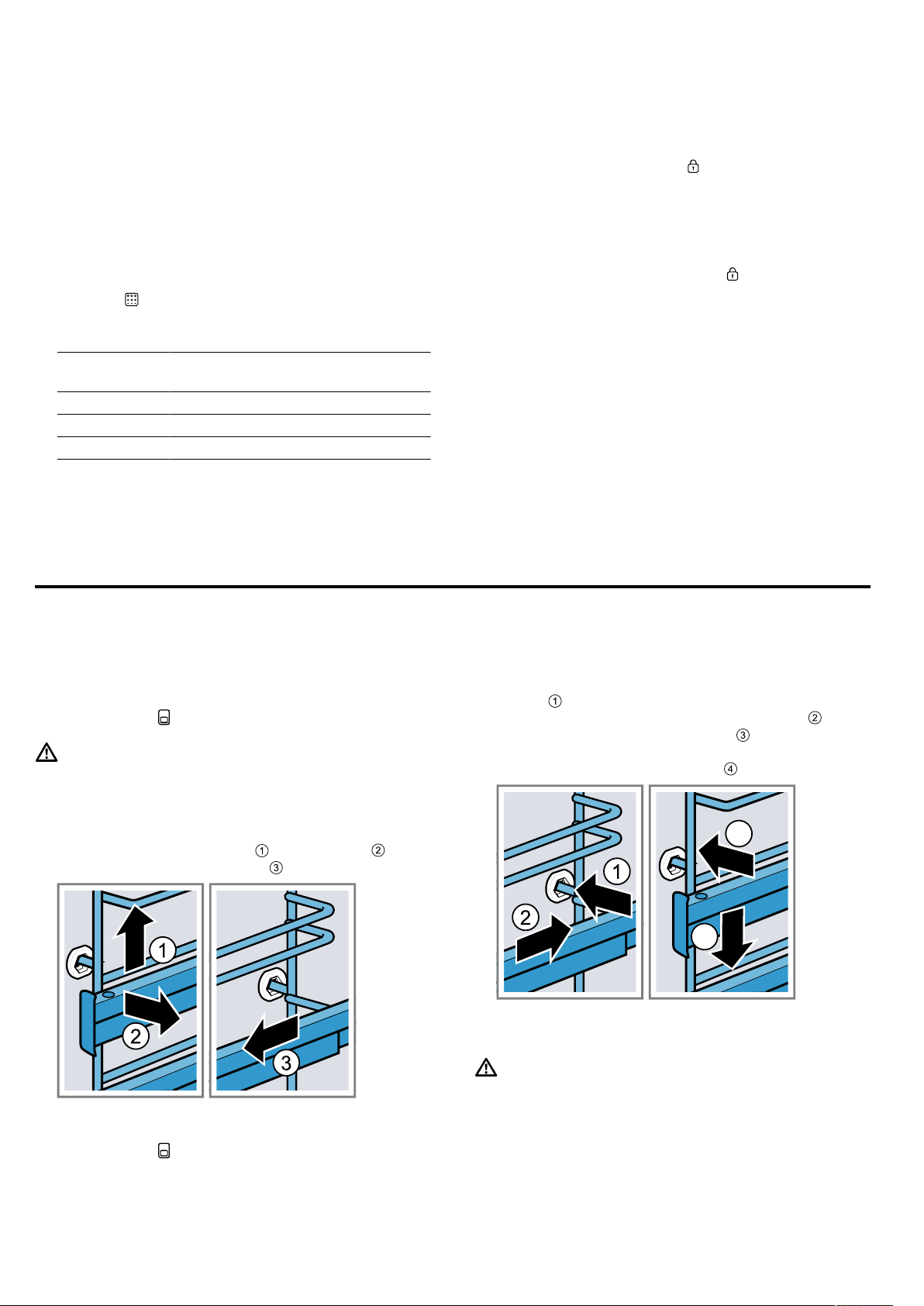
Shelf supports en
25
▶
Never touch the appliance door.
▶
Allow the appliance to cool down.
▶
Keep children at a safe distance.
Note:The oven light does not come on during the
cleaning function.
Requirements
¡ Prepare the appliance for the cleaning function.
→Page24
¡ Switch off the main oven during the cleaning func-
tion.
1.
Use the function selector to set Pyrolytic self-
cleaning .
2.
Use the temperature selector to set the cleaning set-
ting.
Cleaning set-
ting
Cleaning
level
Duration in hours
1 Lightly soiled Approx. 1:15
2 Medium Approx. 1:30
3 High Approx. 2:00
Select a higher cleaning setting for very heavy or
older soiling.
The duration cannot be changed.
a The cleaning function starts after a few seconds and
the time counts down.
a For safety reasons, the appliance door locks auto-
matically once a certain temperature is reached in
the cooking compartment. appears in the display.
a Once the cleaning function has ended, an audible
signal sounds and the display shows the duration
as zero.
3.
Switch off the appliance.
Once the appliance has cooled down sufficiently,
the appliance door unlocks and goes out.
4.
Prepare the appliance for use. →Page25
17.4 Preparing the appliance for use
following the cleaning function
1.
Allow the appliance to cool down.
2.
Wipe off any ash that has been left behind in the
cooking compartment and around the appliance
door with a damp cloth.
3.
Remove white residues with lemon juice.
Note:White residues on the enamel surfaces may
be caused by heavy soiling. These food residues
are harmless. The deposits do not compromise the
functionality of the appliance.
4.
Attach the shelf supports.
→"Shelf supports", Page25
18 Shelf supports
To clean the rails and the cooking compartment, or to
replace the rails, you can remove these.
18.1 Detach the rails in the main cooking
compartment
WARNING‒Risk of burns!
The shelf supports get very hot
▶
Never touch the shelf supports when hot.
▶
Always allow the appliance to cool down.
▶
Keep children at a safe distance.
1.
Lift the rail forwards slightly and detach it .
2.
Pull the whole rail to the front and remove it.
18.2 Attaching the rails in the main cooking
compartment
Notes
¡ The rails only fit on the right or left.
¡ For both pull-out rails, ensure that you can pull them
forwards and out.
1.
First, push the rail into the middle of the rear
socket until the rail rests against the cooking
compartment wall, and then push this back .
2.
Push the rail into the front socket until the rail
also rests against the cooking compartment wall,
and then press this downwards .
3
4
18.3 Removing the pull-out rail
WARNING‒Risk of burns!
The shelf supports get very hot
▶
Never touch the shelf supports when hot.
▶
Always allow the appliance to cool down.
▶
Keep children at a safe distance.
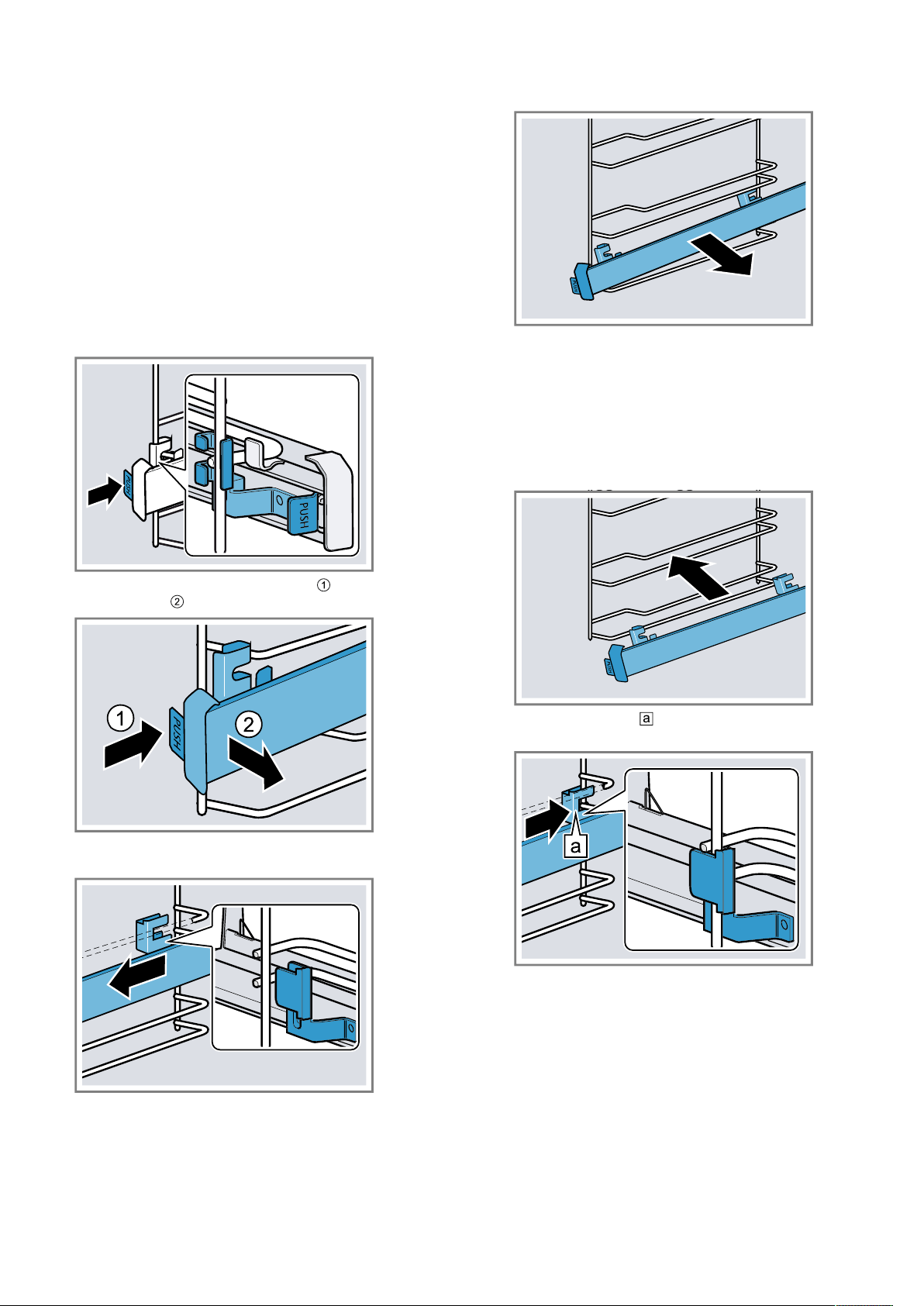
en Shelf supports
26
ATTENTION!
The self-cleaning surfaces in the cooking compartment
may be damaged by detaching and attaching the pull-
out rails.
▶
Detach the rails before detaching or attaching the
pull-out rails.
Notes
¡ Depending on the appliance type, you must change
the basic settings for the telescopic rails for appli-
ances with rails and pull-out rails.
→"Basic settings", Page19
¡ If necessary, you can use pull-out rails on all levels.
1.
Push on the tab marked PUSH behind the rail, and
push the rail to the rear.
2.
Keep the PUSH tab pushed back and swing the
rail outwards .
3.
Pull the rail out towards the front until the retainer at
the back unhooks.
4.
Remove the pull-out rail.
5.
Clean the pull-out rail.
→"Cleaning products", Page22
18.4 Attaching the pull-out rail
Note:The pull-out rails only fit on the right or left. Make
sure when you fit them that you can pull them out to-
wards the front.
1.
Insert the pull-out rail between the two bars.
2.
Push the retainer in between the lower and the
upper bar.
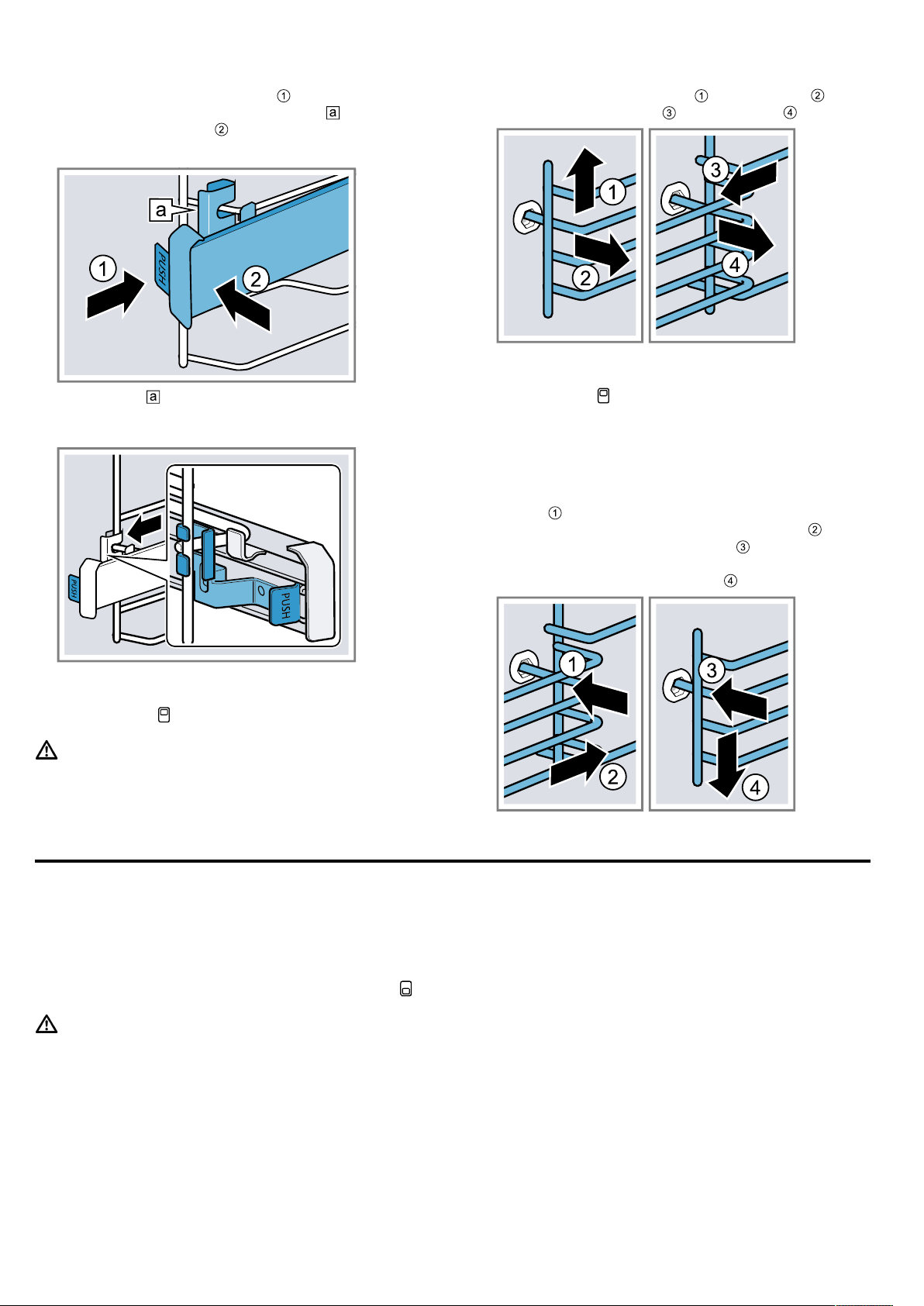
Appliance door en
27
3.
Keep the PUSH tab pushed in and swing the pull-
out rail inwards until the front retainer is located
between the two bars .
‒ Release the PUSH tab.
a The retainer clicks into place.
4.
Pull the pull-out rail out as far as it will go and slide
it back in.
18.5 Detaching the rails in the top cooking
compartment
WARNING‒Risk of burns!
The shelf supports get very hot
▶
Never touch the shelf supports when hot.
▶
Always allow the appliance to cool down.
▶
Keep children at a safe distance.
1.
Lift the rail forwards slightly and detach it .
2.
Pull the rail to the front and remove it .
18.6 Attaching the rails in the top cooking
compartment
Notes
¡ The rails only fit on the right or left.
¡ For both shelf supports, ensure that the hooks that
are attached at the rear are pointing upwards.
1.
First, push the rail into the middle of the rear
socket until the rail rests against the cooking
compartment wall, and then push this back .
2.
Push the rail into the front socket until the rail
also rests against the cooking compartment wall,
and then press this downwards .
19 Appliance door
To ensure that your appliance retains its appearance
and remains fully functioning for a long time, you can
detach the appliance door and clean it.
19.1 Detaching the lower appliance door
WARNING‒Risk of injury!
Components inside the appliance door may have sharp
edges.
▶
Wear protective gloves.
The hinges on the appliance door move when the door
is opened and closed, which could trap your fingers.
▶
Keep your hands away from the hinges.
1.
Open the appliance door fully and push in the direc-
tion of the appliance.
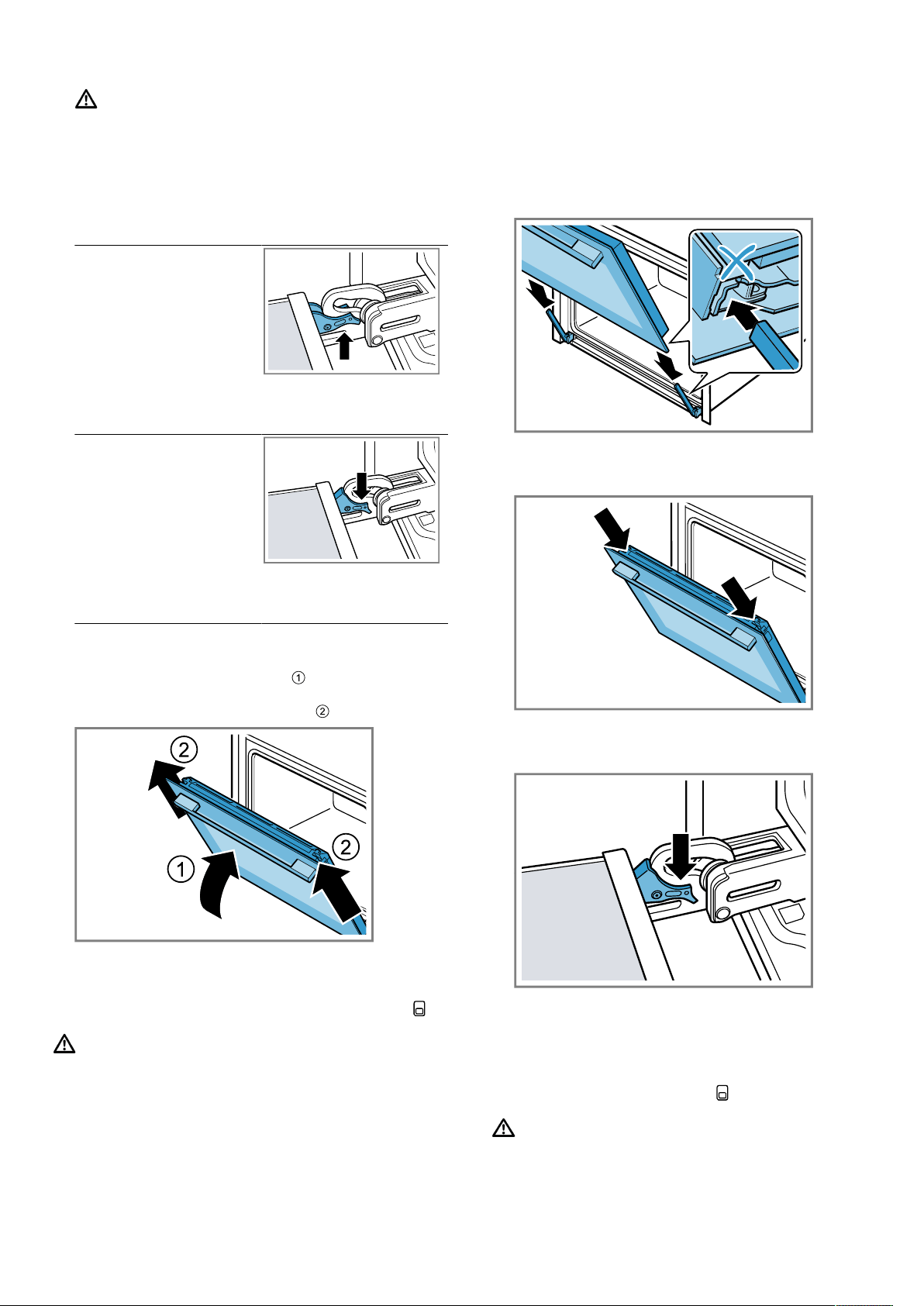
en Appliance door
28
2.
WARNING‒Risk of injury!
When the hinges are not secured, they can snap
shut with great force.
▶
Make sure that the locking levers are always
either fully closed or (when detaching the oven
door) fully open.
Open the locking levers on the left- and right-hand
hinges.
Locking levers opened
The hinge is now se-
cured and cannot snap
shut.
Locking levers closed
The appliance door is
secured and cannot be
detached.
a The locking levers are open. The hinges are now se-
cured and cannot snap shut.
3.
Close the appliance door fully . Grab hold of the
appliance door with both hands (on the left and
right) and pull it upwards and out .
4.
Carefully place the appliance door on a level sur-
face.
19.2 Attaching the lower appliance door
WARNING‒Risk of injury!
The hinges on the appliance door move when the door
is opened and closed, which could trap your fingers.
▶
Keep your hands away from the hinges.
When the hinges are not secured, they can snap shut
with great force.
▶
Make sure that the locking levers are always either
fully closed or (when detaching the oven door) fully
open.
1.
Note:Ensure that the appliance door slides onto the
hinges without any resistance. If you feel any resist-
ance, check whether you are sliding it in at the cor-
rect opening.
Slide the appliance door straight onto the two
hinges. Slide the appliance door on as far as it will
go.
2.
Using both hands, press down on the left and right
of the door cover from above to check whether the
appliance has been pushed in as far as it will go.
3.
Open the appliance door fully.
4.
Close the locking levers on the left- and right-hand
hinges.
a The locking levers are closed. The appliance door is
secured and cannot be detached.
5.
Close the appliance door.
19.3 Removing the door panes from the
lower the appliance door
WARNING‒Risk of injury!
The hinges on the appliance door move when the door
is opened and closed, which could trap your fingers.
▶
Keep your hands away from the hinges.
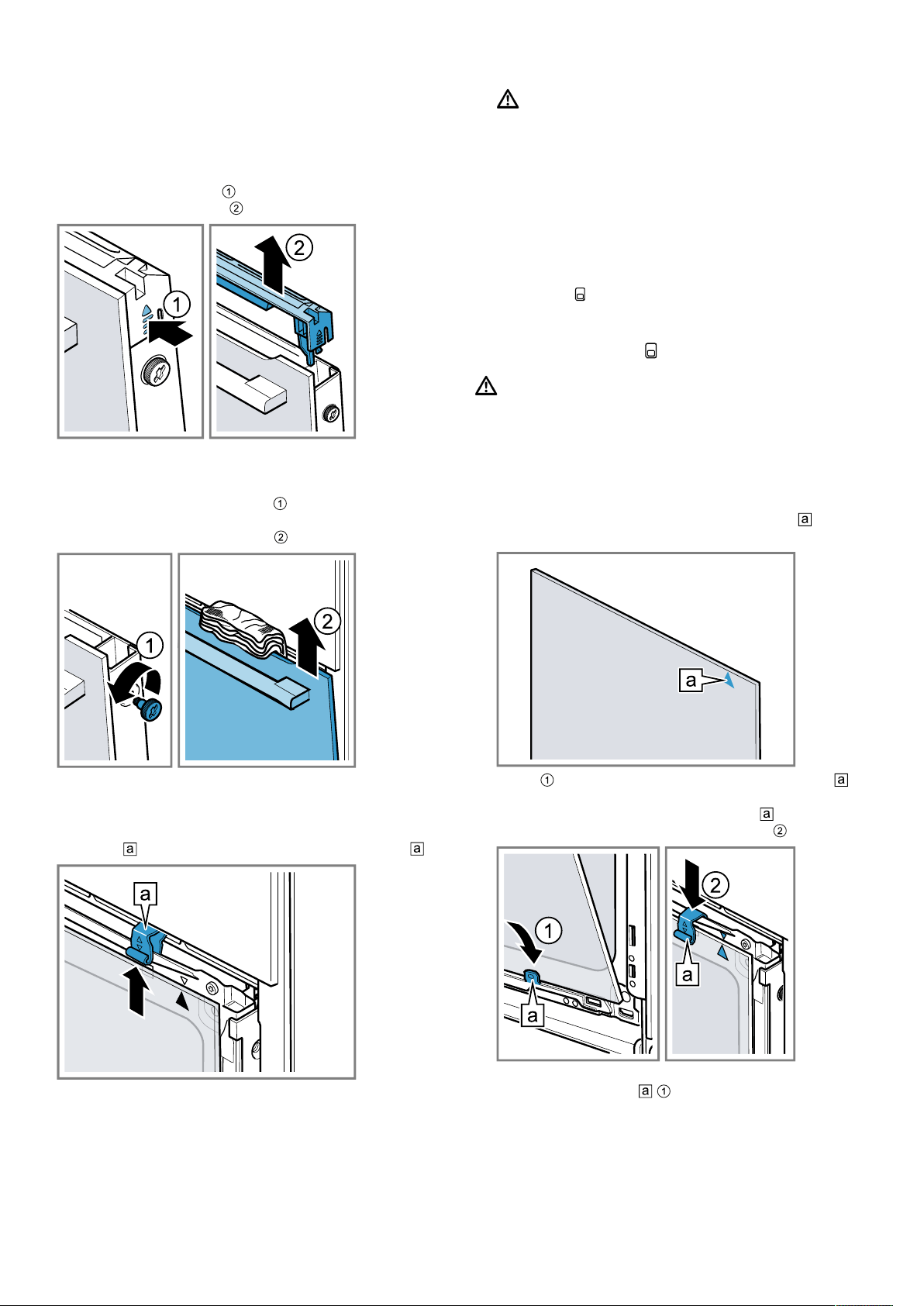
Appliance door en
29
Components inside the appliance door may have sharp
edges.
▶
Wear protective gloves.
1.
Open the appliance door slightly.
2.
Push on the left- and right-hand side of the door
cover from the outside until it is released.
3.
Remove the door cover .
4.
Clean the door cover.
→"Suitable cleaning agents", Page22
5.
Undoing and removing the left- and right-hand
screws on the appliance door
6.
Place a folded-up tea towel in the appliance door.
Pull the front pane up and out .
7.
Set the front pane down on a level surface with the
door handle facing down.
8.
Press the intermediate pane against the appliance
with one hand while pushing the left- and right-hand
retainers upwards. Do not detach the retainers .
9.
Remove the intermediate pane.
10.
WARNING‒Risk of injury!
Scratched glass in the appliance door may develop
into a crack.
▶
Do not use glass scrapers, sharp or abrasive
cleaning aids, or harsh cleaning products.
Clean the removed door panes on both sides with
glass cleaner and a soft cloth.
11.
Clean the appliance door.
→"Suitable cleaning agents", Page22
12.
Dry the door panes and refit them.
→"Installing the door panes for the lower the appli-
ance door ", Page29
19.4 Installing the door panes for the lower
the appliance door
WARNING‒Risk of injury!
The hinges on the appliance door move when the door
is opened and closed, which could trap your fingers.
▶
Keep your hands away from the hinges.
Components inside the appliance door may have sharp
edges.
▶
Wear protective gloves.
1.
Turn the intermediate pane until the arrow is in
the top right.
2.
Insert the intermediate pane into the retainer at
the bottom and push it in firmly at the top.
3.
Push the left- and right-hand retainer downwards
until the intermediate pane is clamped .
4.
Attach the front pane downwards into the left- and
right-hand retainers .
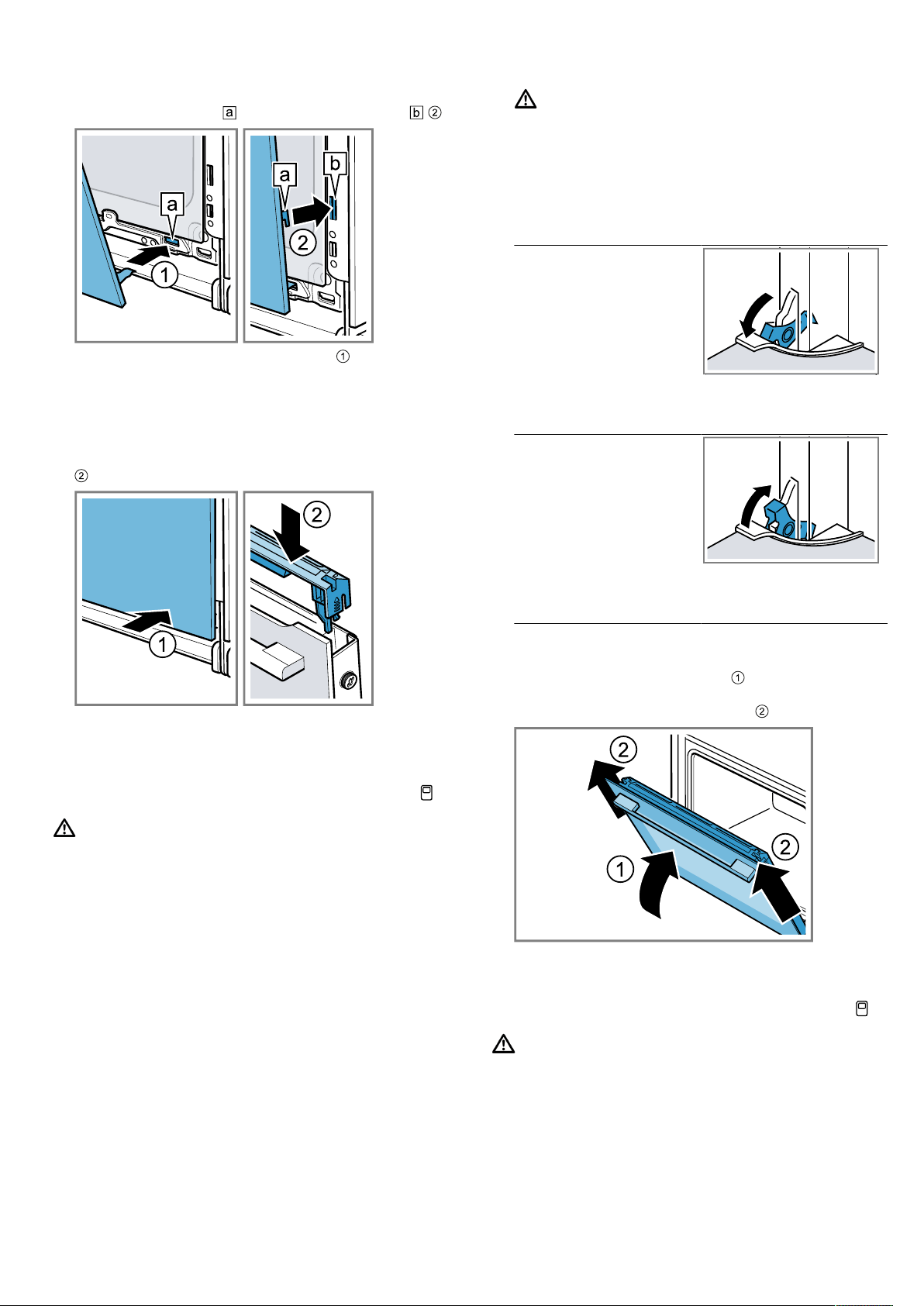
en Appliance door
30
5.
Push the front pane to the appliance until the left-
and right-hand hook is opposite the support .
6.
Push the front pane in at the bottom until you
hear it click into place.
7.
Open the appliance door slightly and remove the
tea towel.
8.
Screw both screws back in on the left and right of
the appliance door.
9.
Put the door cover in position and push down on it
until you hear it click into place.
10.
Close the appliance door.
Note:Do not use the cooking compartment again until
the door panes have been correctly fitted.
19.5 Detaching the upper appliance door
WARNING‒Risk of injury!
The hinges on the appliance door move when the door
is opened and closed, which could trap your fingers.
▶
Keep your hands away from the hinges.
1.
WARNING‒Risk of injury!
When the hinges are not secured, they can snap
shut with great force.
▶
Make sure that the locking levers are always
either fully closed or (when detaching the oven
door) fully open.
Open the locking levers on the left- and right-hand
hinges.
Locking levers opened
The hinge is now se-
cured and cannot snap
shut.
Locking levers closed
The appliance door is
secured and cannot be
detached.
a The locking levers are open. The hinges are now se-
cured and cannot snap shut.
2.
Close the appliance door fully . Grab hold of the
appliance door with both hands (on the left and
right) and pull it upwards and out .
3.
Carefully place the appliance door on a level sur-
face.
19.6 Attaching the upper appliance door
WARNING‒Risk of injury!
The hinges on the appliance door move when the door
is opened and closed, which could trap your fingers.
▶
Keep your hands away from the hinges.
When the hinges are not secured, they can snap shut
with great force.
▶
Make sure that the locking levers are always either
fully closed or (when detaching the oven door) fully
open.
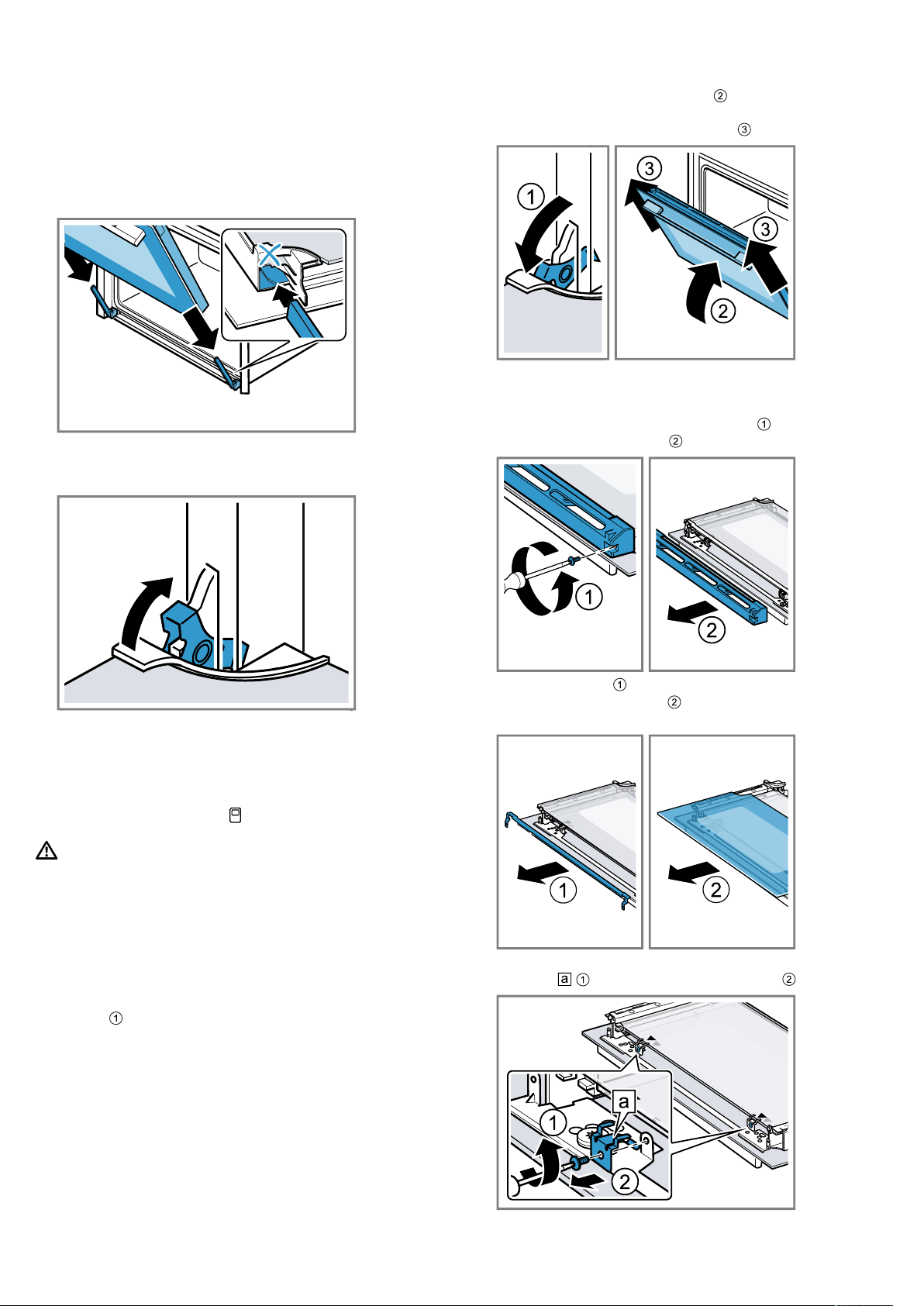
Appliance door en
31
1.
Note:Ensure that the appliance door slides onto the
hinges without any resistance. If you feel any resist-
ance, check whether you are sliding it in at the cor-
rect opening.
Slide the appliance door straight onto the two
hinges. Slide the appliance door on as far as it will
go.
2.
Open the appliance door fully.
3.
Close the locking levers on the left- and right-hand
hinges.
a The locking levers are closed. The appliance door is
secured and cannot be detached.
4.
Close the appliance door.
19.7 Removing the door panes from the
upper appliance door
WARNING‒Risk of injury!
The hinges on the appliance door move when the door
is opened and closed, which could trap your fingers.
▶
Keep your hands away from the hinges.
Components inside the appliance door may have sharp
edges.
▶
Wear protective gloves.
1.
Open the appliance door fully.
2.
Open the locking levers on the left- and right-hand
hinges .
a The locking levers are open. The hinges are now se-
cured and cannot snap shut.
3.
Close the appliance door fully . Grab hold of the
appliance door with both hands (on the left and
right) and pull it upwards and out .
4.
Carefully place the appliance door on a level sur-
face.
5.
Loosen the screws on the left- and right-hand side
of the door cover and remove these .
6.
Remove the door cover .
7.
Remove the rail .
8.
Remove the inner pane and set it down carefully
on a flat surface.
9.
Loosen the screw on the left- and right-hand
spacers and remove both spacers .
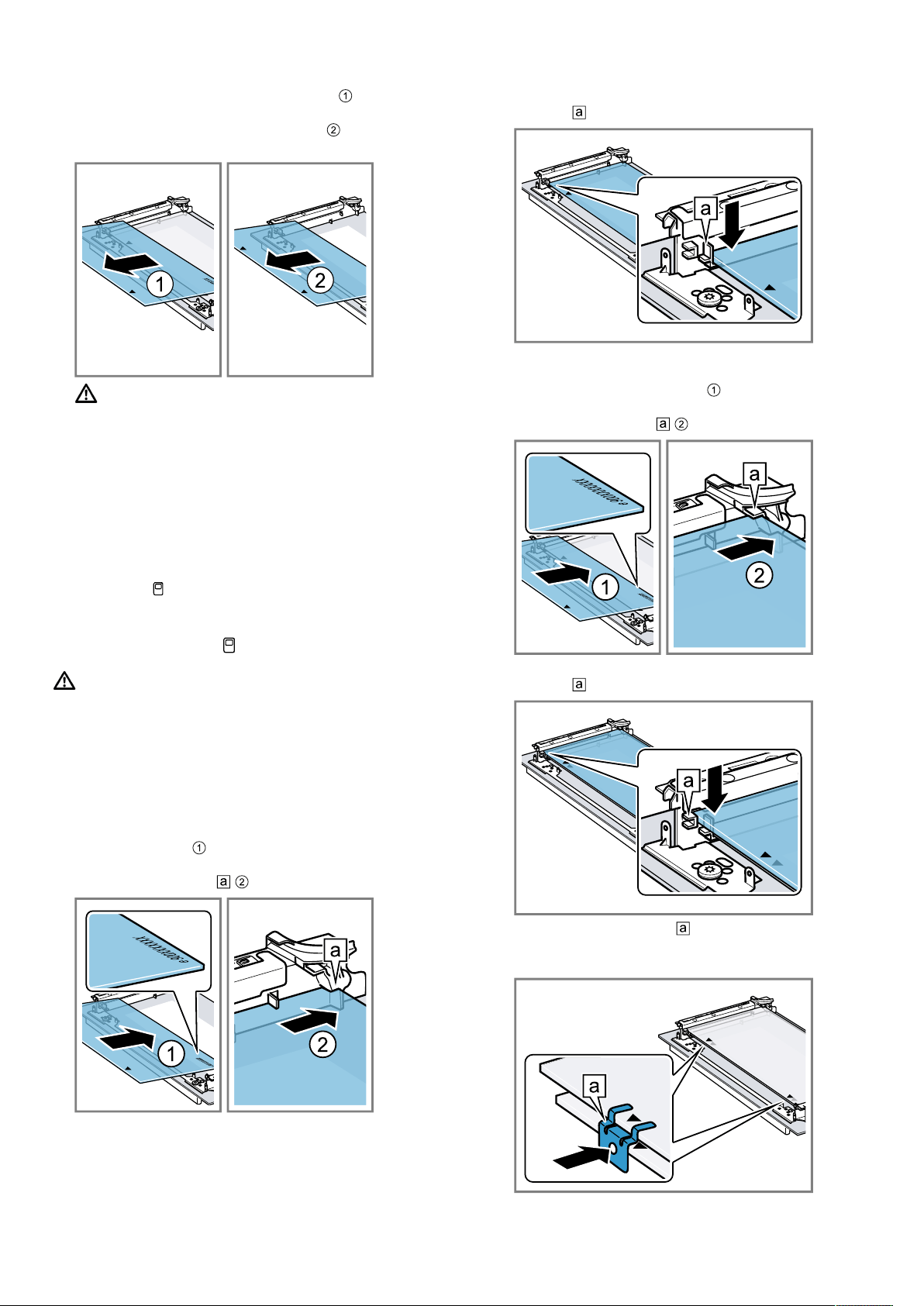
en Appliance door
32
10.
Pull out the upper intermediate pane and set it
down carefully on a flat surface.
11.
Pull out the next intermediate pane and set it
down carefully on a flat surface.
12.
WARNING‒Risk of injury!
Scratched glass in the appliance door may develop
into a crack.
▶
Do not use glass scrapers, sharp or abrasive
cleaning aids, or harsh cleaning products.
Clean the removed door panes on both sides with
glass cleaner and a soft cloth.
13.
Clean the appliance door.
→"Suitable cleaning agents", Page22
14.
Dry the door panes and refit them.
→"Installing the door panes for the upper the appli-
ance door ", Page32
19.8 Installing the door panes for the upper
the appliance door
WARNING‒Risk of injury!
The hinges on the appliance door move when the door
is opened and closed, which could trap your fingers.
▶
Keep your hands away from the hinges.
Components inside the appliance door may have sharp
edges.
▶
Wear protective gloves.
1.
Slide in an intermediate pane. When doing so, en-
sure that the number on the intermediate pane is at
the bottom right .
2.
Slide the intermediate pane until it is in the left- and
right-hand retainers .
3.
Push the intermediate pane upwards until it is in the
retainer .
4.
Slide in a second intermediate pane. When doing
so, ensure that the number on the intermediate
pane is at the bottom right .
5.
Slide the intermediate pane until it is in the left- and
right-hand retainers .
6.
Push the intermediate pane upwards until it is in the
retainer .
7.
Place the two spacers on the left- and right-hand
sides onto the arrow of the upper intermediate glass
pane.
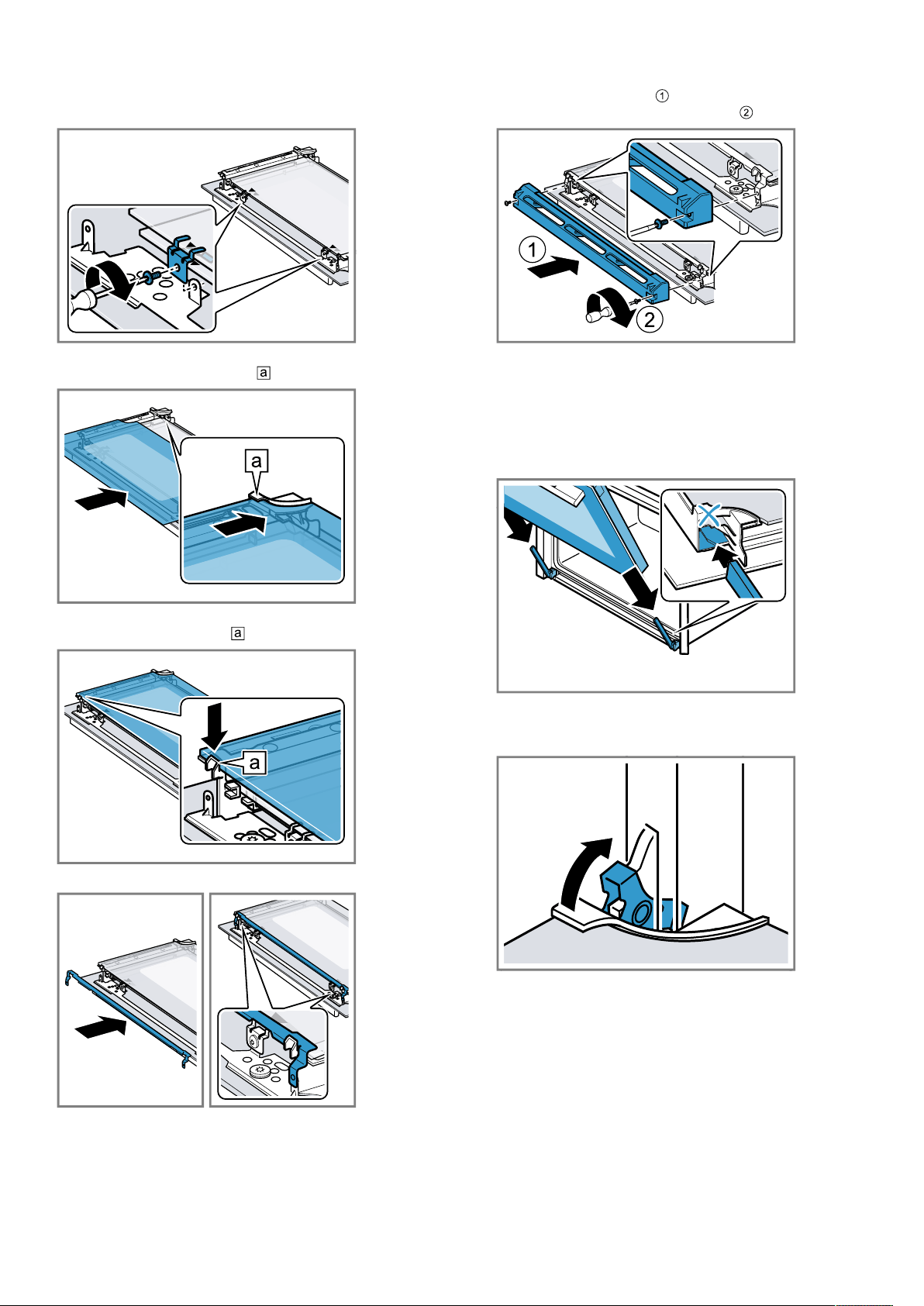
Appliance door en
33
8.
Secure the left- and right-hand spacers with one
screw each.
9.
Slide the inner pane in. In doing so, ensure that the
inner pane is in the retainer .
10.
Push the inner pane upwards until it is in the left-
and right-hand retainers .
11.
Place the rail in the centre of the inner pane.
12.
Attach the door cover and use a screw to secure
it on the left- and right-hand sides .
13.
Note:Ensure that the appliance door slides onto the
hinges without any resistance. If you feel any resist-
ance, check whether you are sliding it in at the cor-
rect opening.
Slide the appliance door straight onto the two
hinges. Slide the appliance door on as far as it will
go.
14.
Open the appliance door fully.
15.
Close the locking levers on the left- and right-hand
hinges.
a The locking levers are closed. The appliance door is
secured and cannot be detached.
16.
Close the appliance door.
Note:Do not use the cooking compartment again until
the door panes have been correctly fitted.
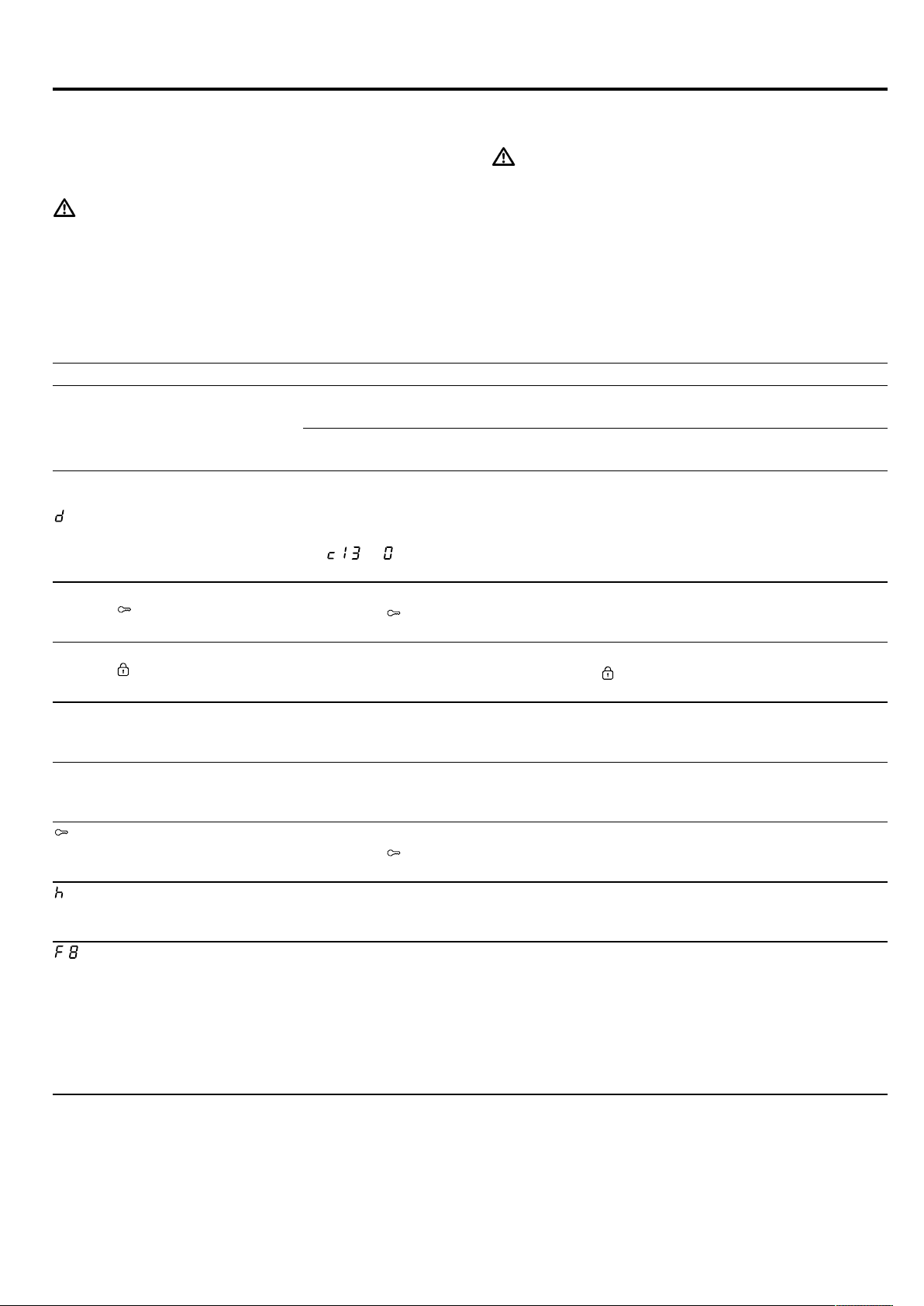
en Troubleshooting
34
20 Troubleshooting
You can rectify minor faults on your appliance yourself.
Read the troubleshooting information before contacting
after-sales service. This will avoid unnecessary costs.
WARNING‒Risk of injury!
Improper repairs are dangerous.
▶
Repairs to the appliance should only be carried out
by trained specialist staff.
▶
If the appliance is defective, call Customer Service.
WARNING‒Risk of electric shock!
Incorrect repairs are dangerous.
▶
Repairs to the appliance should only be carried out
by trained specialist staff.
▶
Only use genuine spare parts when repairing the
appliance.
▶
If the power cord of this appliance is damaged, it
must be replaced by trained specialist staff.
20.1 Malfunctions
Fault Cause and troubleshooting
The appliance is not working. The circuit breaker is faulty.
▶
Check the circuit breaker in the fuse box.
There has been a power cut.
▶
Check whether the lighting in your kitchen or other appliances are working.
Appliance is not heating, the
colon flashes in the display and a
appears.
Demo mode is activated.
1.
Briefly disconnect the appliance from the power supply by switching the cir-
cuit breaker in the fuse box off and back on again.
2.
Deactivate demo mode within fiveminutes by changing the basic setting
to .
→"Basic settings", Page19
The appliance door cannot be
opened; lights up in the dis-
play.
The childproof lock locks the appliance door.
▶
Use the button to deactivate the childproof lock.
→"Childproof lock", Page18
The appliance door cannot be
opened; lights up in the dis-
play.
The cleaning function locks the appliance door.
▶
Allow the appliance to cool down until goes out in the display.
→"Pyrolytic self-cleaning ", Page23
The time flashes in the display. There has been a power cut.
▶
Reset the time.
→"Setting the time on the clock", Page13
The time does not appear in the
display when the appliance is
switched off.
The basic setting has been changed.
▶
Change the basic setting for the time display.
→"Basic settings", Page19
lights up in the display and no
settings can be made on the ap-
pliance.
Childproof lock is activated.
▶
Use the button to deactivate the childproof lock.
→"Childproof lock", Page18
flashes in the display and the
appliance will not start.
The cooking compartment is too hot for the selected operation.
1.
Switch off the appliance and allow it to cool down.
2.
Restart the operation.
appears in the display. The maximum cooking time has been reached. To prevent an unwanted per-
manent operation, the appliance automatically stops heating after several hours
if the settings are unchanged.
▶
Switch off the appliance.
You can configure new settings if required.
Tip:To prevent the appliance from switching off when you do not want it to,
e.g. for an extremely long preparation time, set a cooking time.
→"Time-setting options", Page12
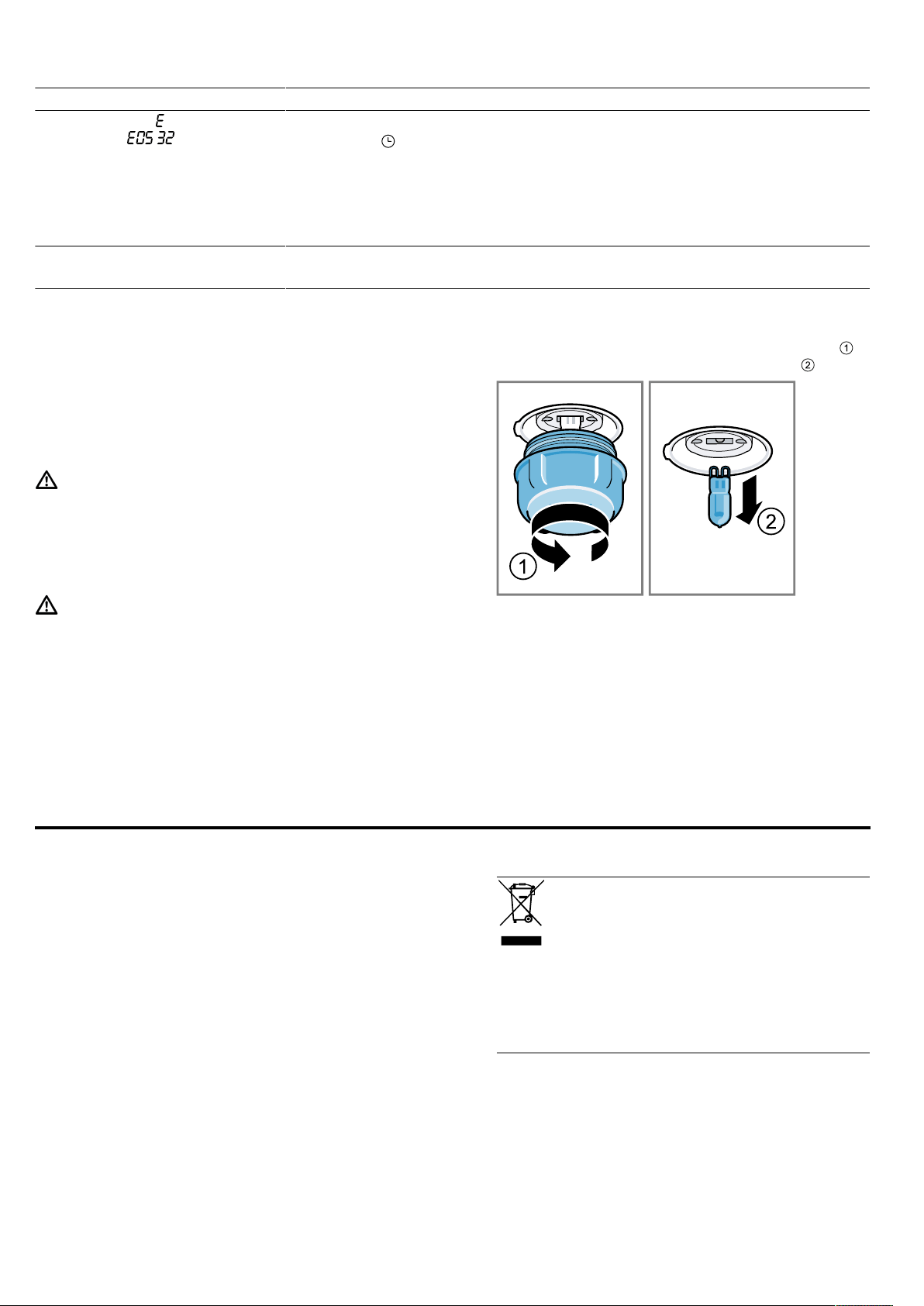
Disposal en
35
Fault Cause and troubleshooting
A message with appears in the
display, e.g. - .
Electronics fault
1.
Press the button.
‒ If required, reset the time.
a If the fault was a one-off, the error message disappears.
2.
If the error message appears again, call the after-sales service. Quote the ex-
act error message and the E no. of your appliance.
→"Customer Service", Page36
HomeConnect is not working cor-
rectly.
Different causes are possible.
▶
Go to www.home-connect.com.
20.2 Replacing the oven light bulb
If the light in the cooking compartment fails, change
the oven light bulb.
Note:Heat-resistant, 25-watt, 230 V halogen bulbs are
available from the after-sales service or specialist retail-
ers. Only use these bulbs. Hold the new halogen bulbs
only with a clean, dry towel. This increases the service
life of the bulb.
WARNING‒Risk of burns!
The appliance gets very hot.
▶
Never touch the inside surfaces of the cooking com-
partment or the heating elements while they are hot.
▶
Always allow the appliance to cool down.
▶
Keep children at a safe distance.
WARNING‒Risk of electric shock!
When changing the bulb, the bulb socket contacts are
live.
▶
Before replacing the bulb, unplug the appliance
from the mains or switch off the circuit breaker in
the fuse box.
Requirements
¡ The appliance is disconnected from the power sup-
ply.
¡ The cooking compartment has cooled down.
¡ You have a new halogen bulb to replace the old one.
1.
Place a tea towel in the cooking compartment to
prevent damage.
2.
Turn the glass cover anti-clockwise to remove it .
3.
Pull out the halogen bulb without turning it .
4.
Insert the new halogen lamp and press it firmly into
the socket.
Make sure the pins are positioned correctly.
5.
Depending on the appliance model, the glass cover
may have a sealing ring. Put the sealing ring in posi-
tion.
6.
Screw the glass cover on.
7.
Take the tea towel out of the cooking compartment.
8.
Connect the appliance to the power supply.
21 Disposal
Find out here how to dispose of old appliances cor-
rectly.
21.1 Disposing of old appliance
Valuable raw materials can be reused by recycling.
1.
Unplug the appliance from the mains.
2.
Cut through the power cord.
3.
Dispose of the appliance in an environmentally
friendly manner.
Information about current disposal methods are
available from your specialist dealer or local author-
ity.
This appliance is labelled in accord-
ance with European Directive
2012/19/EU concerning used elec-
trical and electronic appliances
(waste electrical and electronic equip-
ment - WEEE).
The guideline determines the frame-
work for the return and recycling of
used appliances as applicable
throughout the EU.
en Customer Service
36
22 Customer Service
If you have any queries on use, are unable to rectify
faults on the appliance yourself or if your appliance
needs to be repaired, contact Customer Service.
Function-relevant genuine spare parts according to the
corresponding Ecodesign Order can be obtained from
Customer Service for a period of at least 10 years from
the date on which your appliance was placed on the
market within the European Economic Area.
Note:Under the terms of the manufacturer's warranty
the use of Customer Service is free of charge.
Detailed information on the warranty period and terms
of warranty in your country is available from our after-
sales service, your retailer or on our website.
If you contact Customer Service, you will require the
product number (E-Nr.) and the production number
(FD) of your appliance.
The contact details for Customer Service can be found
in the enclosed Customer Service directory or on our
website.
22.1 Product number (E-Nr.) and production
number (FD)
You can find the product number (E-Nr.) and the pro-
duction number (FD) on the appliance's rating plate.
You will see the rating plate with these numbers if you
open the appliance door.
Make a note of your appliance's details and the Cus-
tomer Service telephone number to find them again
quickly.
23 How it works
Here, you can find the ideal settings for various types
of food as well as the best accessories and cookware.
We have perfectly tailored these recommendations to
your appliance.
23.1 Cooking tips
Observe this information when preparing food.
¡ The temperature and cooking time depend on the
amount of food and the recipe. Settings ranges are
specified for this reason. Try using the lower values
to start with.
¡ The setting values apply to food placed in the cook-
ing compartment while the cooking compartment is
still cold. Do not slide the accessory into the cook-
ing compartment until it has finished preheating.
¡ Remove any accessories that are not being used
from the cooking compartment.
23.2 Notes on baking
When baking, use the shelf positions indicated.
Baking on one level Height
Deep baked goods or tin on wire rack 2
Flat baked goods or goods in a baking
tray
3
Baking on two levels Height
Universal pan
Baking tray
3
1
Baking tins/dishes on the wire rack:
First wire rack
Second wire rack
Height
3
1
Baking on three levels Height
Baking tray
Universal pan
Baking tray
5
3
1
Notes
¡ When baking on several layers, always use hot air.
Baked goods that are placed in the oven at the
same time will not necessarily be ready at the same
time.
¡ Position baking tins/dishes either next to one an-
other or offset on different shelves so that they are
not directly one above the other in the cooking com-
partment.
¡ For best results, we recommend using dark-col-
oured metal bakeware.
23.3 Notes on roasting and grilling
The setting values are based on the assumption that
unstuffed, chilled, ready-to-roast poultry, meat or fish is
placed into a cold cooking compartment.
¡ The larger the poultry, meat or fish, the lower the
cooking temperature and the longer the cooking
time.
¡ Turn the poultry, meat or fish after approx. 1/2 to
2/3 of the time listed.
¡ Add a little liquid to the poultry in the cookware.
Cover the bottom of the cookware with approx.1–
2cm of liquid.
¡ When you turn poultry, ensure that the breast side
or skin side is underneath to begin with.
¡ Cooking time calculation (e.g. 20+35): To calculate
the cooking time, assume 20 minutes per 500g of
meat plus an extra 35minutes. For 1.5kg, the
cooking time is then 95 minutes.
¡ Cooking time range (e.g. 10–15): Your food will be
ready within the specified range of time.
Roasting and grilling on the wire rack
Roasting on the wire rack works particularly well for
large poultry or for multiple pieces at the same time.
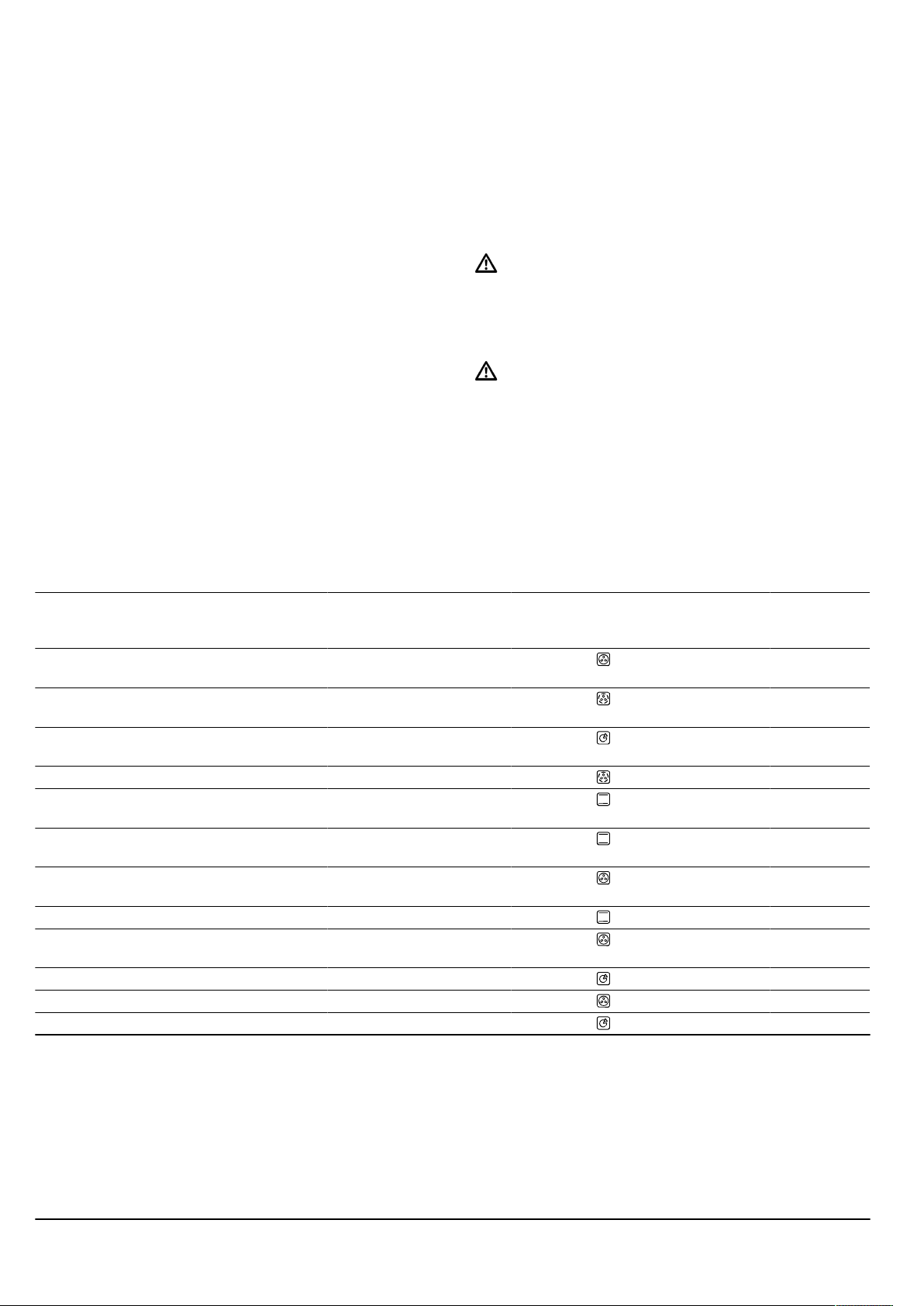
How it works en
37
¡ Depending on the size and type of the food to be
roasted, add up to 1/2litre water to the universal
pan.
You can make a sauce from the juices that are
caught. This also means that less smoke is pro-
duced and the cooking compartment becomes less
dirty.
¡ Keep the appliance door closed when using the
grill.
Never grill with the appliance door open.
¡ Place the food to be grilled on the wire rack. In ad-
dition, slide the universal pan in at least one shelf
position lower, with the slanted edge facing the ap-
pliance door. This means that any dripping fat is
caught.
Roasting in cookware
When preparing food in cookware with a lid, the cook-
ing compartment remains cleaner.
Follow the manufacturer's instructions for your roasting
dishes. Glass cookware is best.
Cookware without lid
¡ Use a deep roasting dish.
¡ Place the cookware onto the wire rack.
¡ If you do not have any suitable cookware, use the
universal pan.
Cookware with lid
¡ Place the cookware onto the wire rack.
¡ Meat, poultry and fish can also become crispy in a
covered roasting dish. Use a roasting dish with a
glass lid. Set a higher temperature.
WARNING‒Risk of injury!
If hot glass cookware is placed on a wet or cold sur-
face, the glass may shatter.
▶
Place hot glass ovenware on a dry mat after cook-
ing.
WARNING‒Risk of scalding!
Very hot steam may escape when the lid is opened
after cooking. Steam may not be visible, depending on
the temperature.
▶
Lift the lid at the rear, so that the hot steam can es-
cape away from you.
▶
Keep children at a safe distance.
23.4 Food selection
Selection for the main oven
Food Accessories/cookware Shelf pos-
ition
Type of
heating
Temperature
in °C/grill set-
ting
Cooking
time in mins
Victoria sponge cake 2 pcs
Ø20cm cake tin
2 150-170
1
15-25
Rich fruit cake Deep 23 cm diameter
tin
2 140-150 180-210
Fruit pie 20 cm diameter plate or
pie tin
2 160-170 60-70
Quiche Quiche tin (dark-coated) 3 180-200 40-55
(White) bread Loaf tin (1 x900g or 2
x450g)
2 190-210
1
25-40
Scones Baking sheet on wire
rack
3 190-200
2
10-15
Biscuits Baking sheet on wire
rack
3 140-160
1
10-20
Small cakes 12-cup tin 3 150
3
25-35
Pavlova Baking sheet on wire
rack
3 100-110
4
150-180
Yorkshire pudding 12-cup tin 3 200-220
5
15-25
Pizza, home-made Baking tray 3 190-210 20-30
Pizza, home-made, thin base Round pizza tray 2 250-270 8-13
1
Preheat the appliance. Do not use the rapid heating function.
2
Preheat the appliance.
3
Preheat the appliance for five minutes. Do not use the rapid heating function.
4
Preheat the appliance to 150°C using HotAir.
5
Preheat the appliance for 20 minutes.
6
Do not turn the food.
7
Slide the universal pan underneath the wire rack.
8
Add the food after approx. one hour.
9
Preheat the appliance for 5 minutes.
10
Preheat the appliance for three minutes.
11
Turn the food occasionally.
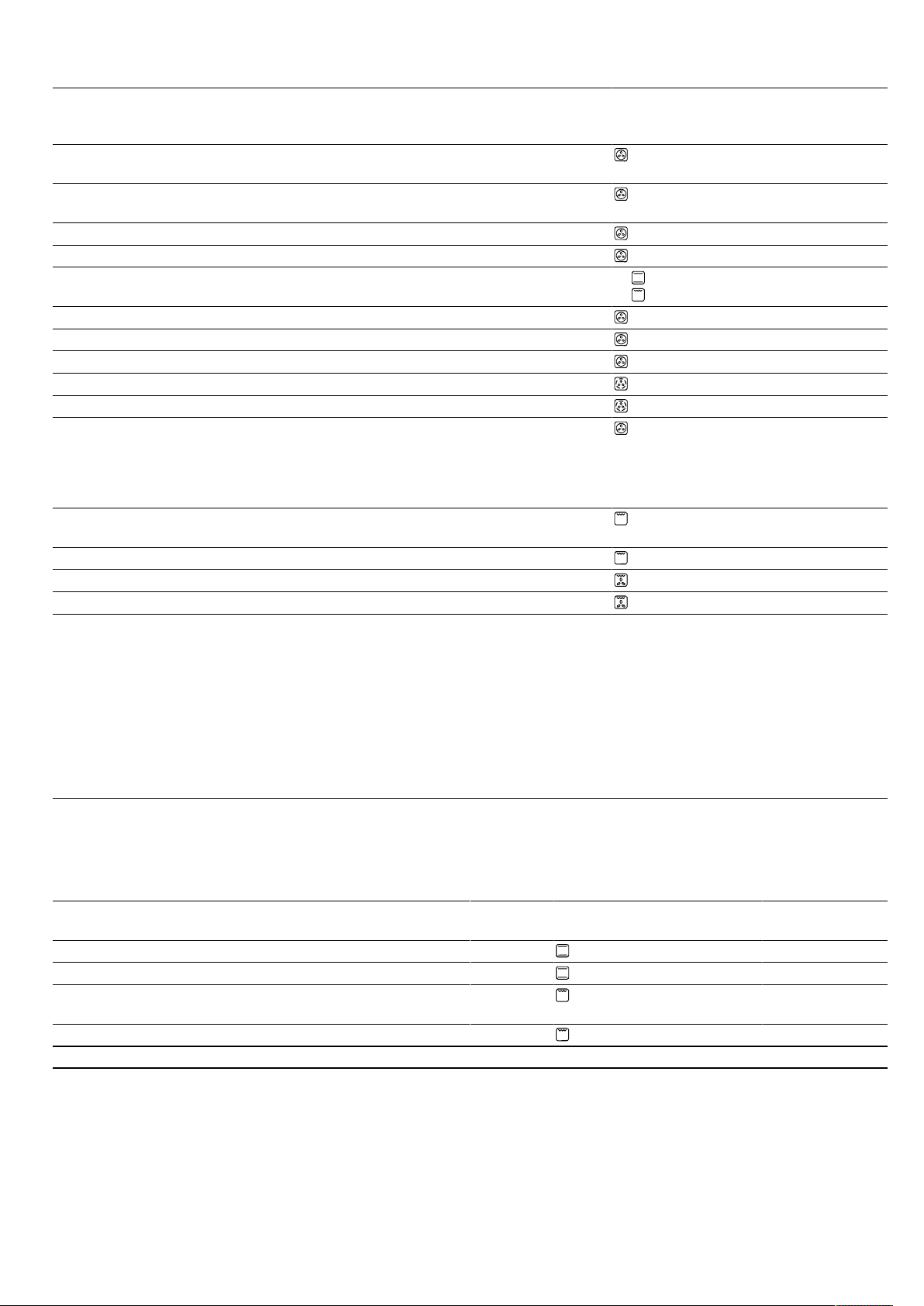
en How it works
38
Food Accessories/cookware Shelf pos-
ition
Type of
heating
Temperature
in °C/grill set-
ting
Cooking
time in mins
Victoria sponge cake, 2 levels 4 pcs
Ø20cm cake tin
3+1 150-160
2
20-30
Biscuits, 2 or 3levels Baking sheet on wire
rack
3+1
5+3+1
140-160
2
15-25
Beef, top side/top rump Cookware without lid 2 170 40+30
Lamb leg (on the bone) Cookware without lid 2 160-170 25+15
Pork belly Cookware without lid 2 1.
2.
1. 170-180
2. 2
1. 30+30
6
2. 3-5
Chicken, whole Wire rack 2 170-180 25+15
7
Turkey, crown Wire rack 2 140-150 20+25
Turkey, whole, 4–8kg Wire rack 1 150-160 12+12
8
Fish, braised, whole 300g, e.g. trout Cookware with lid 2 170-190 25-35
Diced meat (beef, pork, lamb), 500g Cookware with lid 2 140 120-140
Complete meal with chicken Wire rack
+
Wire rack
+
Universal pan
4+1 180, then
200 (York-
shire pud-
ding)
Chicken:
(25+25) +
20 for York-
shire pud-
ding
Bacon rashers Wire rack 3 3
9
1 side 4–5
2 side 3–4
Sausages, thickness 2–4cm Wire rack 3 3
10
10-20
11
Pork, gammon joint Cookware without lid 2 170-180 25+20
6
Chicken, whole Cookware without lid 2 170-180 20+20
7
1
Preheat the appliance. Do not use the rapid heating function.
2
Preheat the appliance.
3
Preheat the appliance for five minutes. Do not use the rapid heating function.
4
Preheat the appliance to 150°C using HotAir.
5
Preheat the appliance for 20 minutes.
6
Do not turn the food.
7
Slide the universal pan underneath the wire rack.
8
Add the food after approx. one hour.
9
Preheat the appliance for 5 minutes.
10
Preheat the appliance for three minutes.
11
Turn the food occasionally.
23.5 Food selection
Selection for the top oven
Food Accessories/cook-
ware
Shelf pos-
ition
Type of
heating
Temperature in
°C
Cooking time in
mins
Scones Baking sheet 1 200-210
1
10-12
Small cakes 12-cup-tin 1 150-160
1
25-35
Lamb chops, height 2-3cm Wire rack 3 3
1
1. side 7-9
2. side 5-8
Pork sausages, thickness 2-4cm Wire rack 3 3 14-18
1
Preheat the appliance.
23.6 Yoghurt
You can use your appliance to make your own yoghurt.
Preparing yoghurt
1.
Remove the accessories and shelf supports from
the cooking compartment.
2.
Pour the previously prepared yoghurt mixture into
small containers, e.g. into cups or small jars.
3.
Cover the containers with foil, e. g. with cling film.
4.
Place the containers on the cooking compartment
floor.
5.
Set the appliance according to the recommended
setting.
How it works en
39
6.
After making the yoghurt, leave it to cool in the refri-
gerator.
Yoghurt
Selection for the main oven
Food Accessories/cookware Shelf position Type of
heating
Temperature in
°C
Cooking
time in
mins
Yoghurt Individual moulds Cooking compartment
floor
40-45 8–9 hrs
23.7 Slow cooking
Slow cooking is a technique for cooking food over a
long period at low temperatures. For this reason, it is
also called "low-temperature cooking".
Slow cooking food
Requirements
¡ Only use fresh, clean and hygienic meat without
bones.
¡ Only start operation when the cooking compartment
has fully cooled down.
1.
Preheat the cooking compartment and cookware for
approx. 15 minutes.
2.
Sear the meat on all sides on the cooking zone at a
very high heat.
3.
Immediately place the meat into the pre-warmed
cookware in the cooking compartment.
4.
Keep the appliance door closed in order to maintain
an even cooking climate.
Slow cooking
Food Accessories/cook-
ware
Shelf pos-
ition
Type of
heating
Searing
time in
mins
Temperature in
°C
Cooking
time in
mins
Duck breast, 300g each Cookware without lid 2 6–8 95
1
60–70
Fillet of pork, whole Cookware without lid 2 4–6 85
1
75–100
Beef topside, 6–7 cm thick,
1.5 kg
Cookware without lid 2 6–8 100
1
160–220
Fillet of beef, 4–6cm thick,
1kg
Cookware without lid 2 6–8 85
1
90–150
Veal medallions, 4cm thick Cookware without lid 2 4 80
1
50–70
Saddle of lamb, boneless,
200g each
Cookware without lid 2 4 85
1
30–70
1
Preheat the appliance.
23.8 Test dishes
These overviews have been produced for test institutes
to facilitate appliance testing in accordance with EN
60350-1.
Baking
Observe this information when baking test dishes.
General information
¡ The settings apply to food that is placed into a cold
cooking compartment.
¡ Observe the notes about preheating in the tables.
These setting values apply without rapid heating.
¡ When baking, use the lower of the listed temperat-
ures to begin with.
Shelf positions
Shelf positions for baking on two levels:
Note:Items that are placed in the oven on baking trays
or in baking tins/dishes at the same time will not ne-
cessarily be ready at the same time.
¡ Universal pan: Level 3
Baking tray: Level 1
¡ Baking tins/dishes on the wire rack
First wire rack: Level 3
Second wire rack: Level 1
Shelf positions for baking on three levels:
¡ Baking tray: Level 5
Universal pan: Level 3
Baking tray: Level 1
Baking with two springform cake tins:
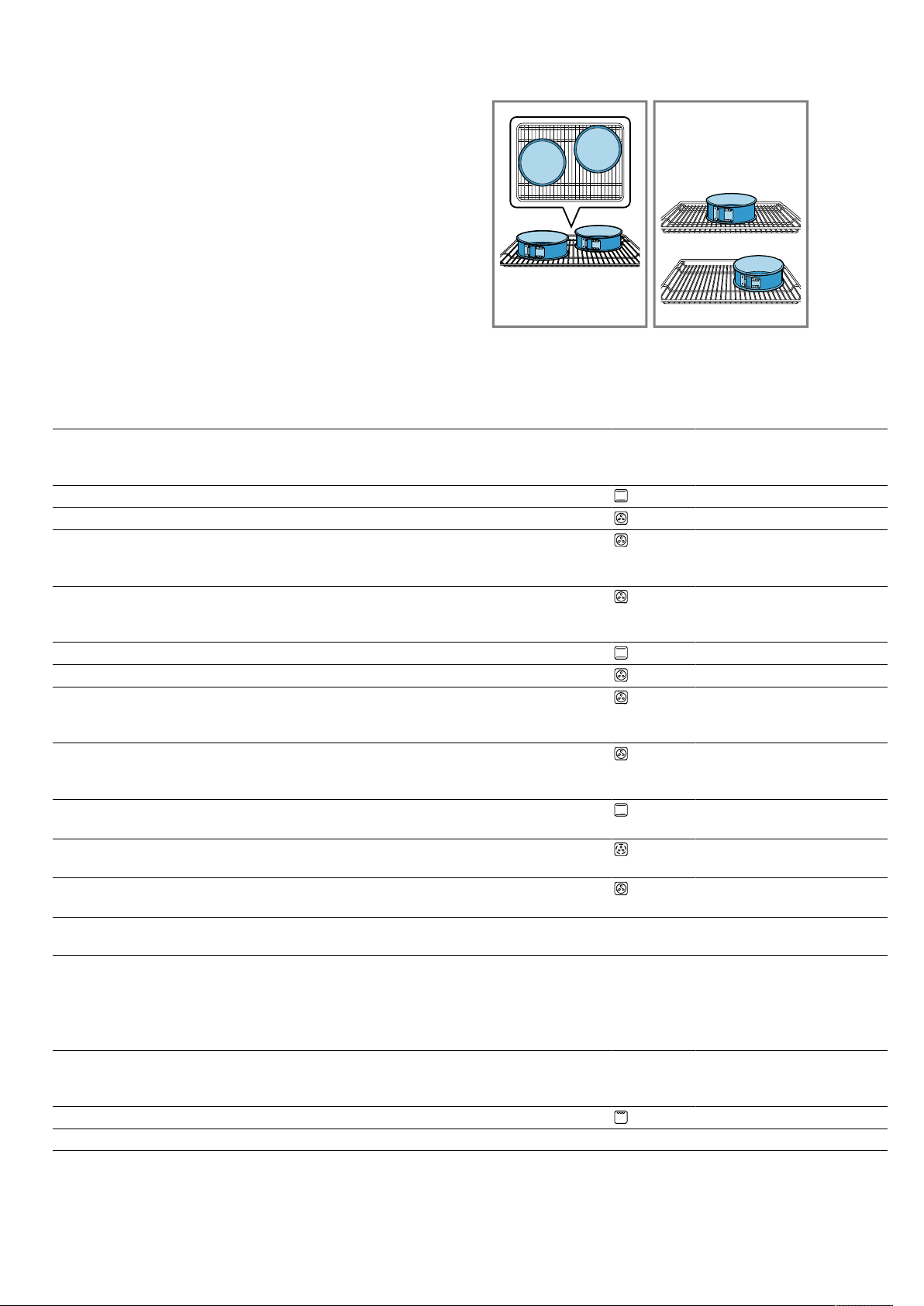
en How it works
40
Position baking tins/dishes either next to one another
or offset on different shelves so that they are not dir-
ectly one above the other in the cooking compartment.
Baking
Selection for the main oven
Food Accessories/cookware Shelf pos-
ition
Type of
heating
Temperature in
°C
Cook-
ing time
in mins
Viennese whirls Baking tray 3 140-150
1
25-35
Viennese whirls Baking tray 3 140-150
1
20-30
Viennese whirls, 2levels Universal pan
+
Baking tray
3 + 1 140-150
1
25-35
Viennese whirls, 3levels Universal pan
+
Baking tray
5 + 3 + 1 130-140
1
35-55
Small cakes Baking tray 3 150
1
25-35
Small cakes Baking tray 3 140
1
25-35
Small cakes, 2levels Universal pan
+
Baking tray
3 + 1 140
1
30-40
Small cakes, 3levels Universal pan
+
Baking tray
5 + 3 + 1 140
1
30-40
Hot water sponge cake Springform cake tin,
diameter 26 cm
2 160-170
2
25-35
Hot water sponge cake Springform cake tin,
diameter 26 cm
2 160-170 30-35
Hot water sponge cake, 2levels Springform cake tin,
diameter 26 cm
3 + 1 150-160
2
35-50
1
Preheat the appliance for five minutes. Do not use the rapid heating function.
2
Preheat the appliance. Do not use the rapid heating function.
Grilling
Selection for the main oven
Food Accessories/cookware Shelf pos-
ition
Type of
heating
Temperature in
°C/grill setting
Cook-
ing time
in mins
Toasting bread Wire rack 5 3
1
5–6
1
Do not preheat the appliance.
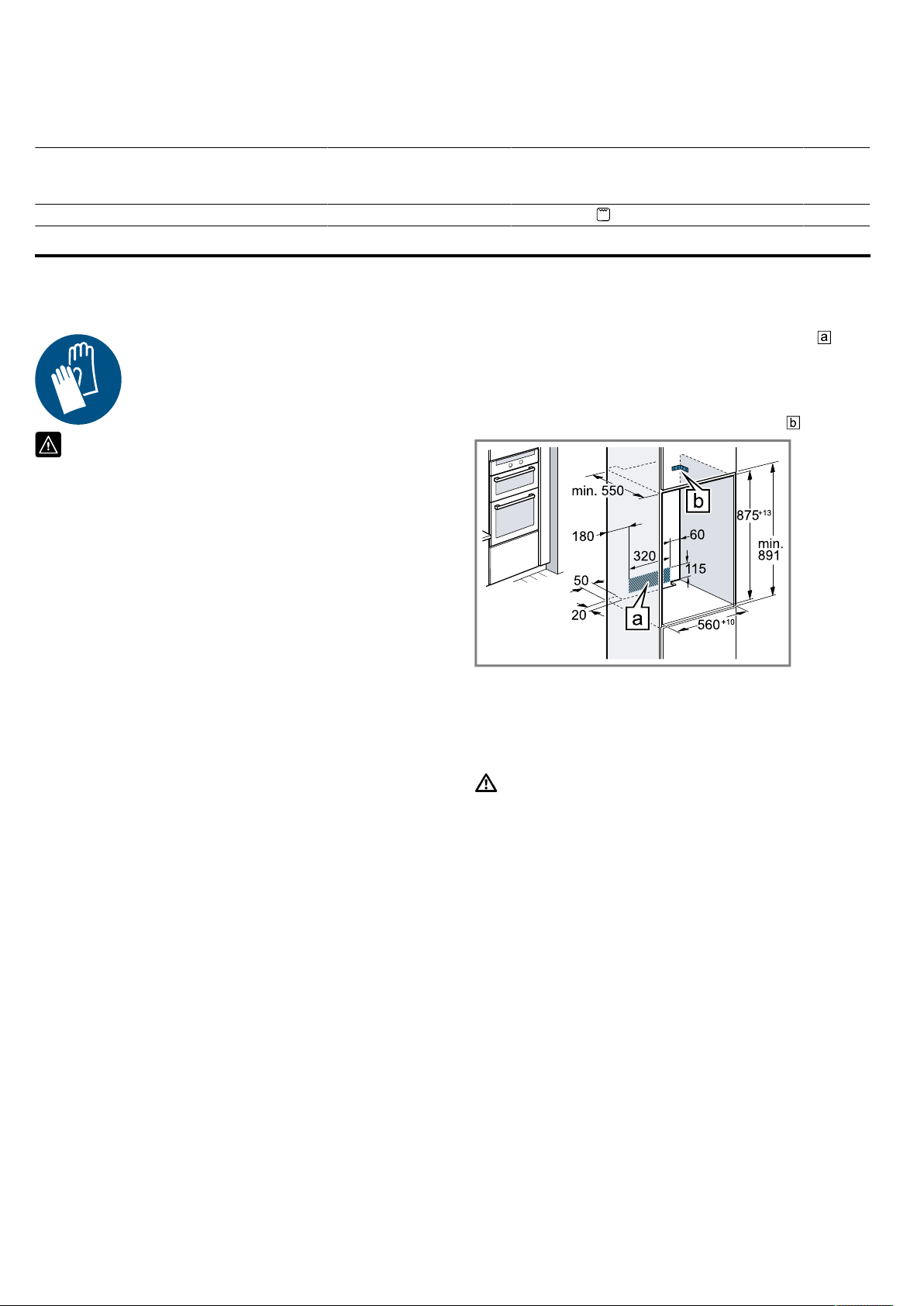
Installation instructions en
41
Grilling
Selection for the top oven
Food Accessories/cookware Shelf pos-
ition
Type of
heating
Temperature in
°C
Cook-
ing time
in mins
Browning toast Wire rack 3 3 4-6
24 Installation instructions
Observe this information when installing the appliance.
24.1 General installation instructions
Follow these instructions before you start with
the installation of the appliance.
¡ The safe operation of this appliance can
only be guaranteed if it has been installed
to a professional standard in accordance
with these installation instructions. The in-
staller shall be liable for damages incurred
as a result of incorrect installation.
¡ Do not use the door handle for the trans-
port or installation.
¡ The appliance must be transported by two
people using the carry handles on the right
and left.
¡ Check the appliance for damage after un-
packing it. Do not connect the appliance if
it has been damaged in transit.
¡ Before starting up the appliance, remove
any packaging material and adhesive film
from the cooking compartment and the
door.
¡ Proceed in accordance with the installation
sheets for installing accessories.
¡ Fitted units must be heat-resistant up to
95°C, and adjacent unit fronts up to
70°C.
¡ Do not install the appliance behind a decor-
ative door or the door of a kitchen unit.
There is a risk of overheating.
¡ Cut-out work on the units should be carried
out before installing the appliance. Remove
any shavings. Otherwise, the correct opera-
tion of electrical components may be ad-
versely affected.
¡ The mains socket for the appliance must
either be located in the hatched area or
outside of the area where the appliance is
installed.
Any unsecured units must be secured to
the wall using a standard bracket .
¡ Wear protective gloves so that you do not
cut yourself. Parts that are accessible dur-
ing installation may have sharp edges.
¡ Dimensions of the figures in mm.
WARNING‒Risk of fire!
It is dangerous to use an extended power
cord and non-approved adapters.
▶
Do not use extension cables or multiple
socket strips.
▶
If the power cord is too short, contact Cus-
tomer Service.
▶
Only use adapters approved by the manu-
facturer.
ATTENTION!
Carrying the appliance by the door handle could break
it. The door handle cannot support the weight of the
appliance.
▶
Do not carry or hold the appliance by the
door handle.
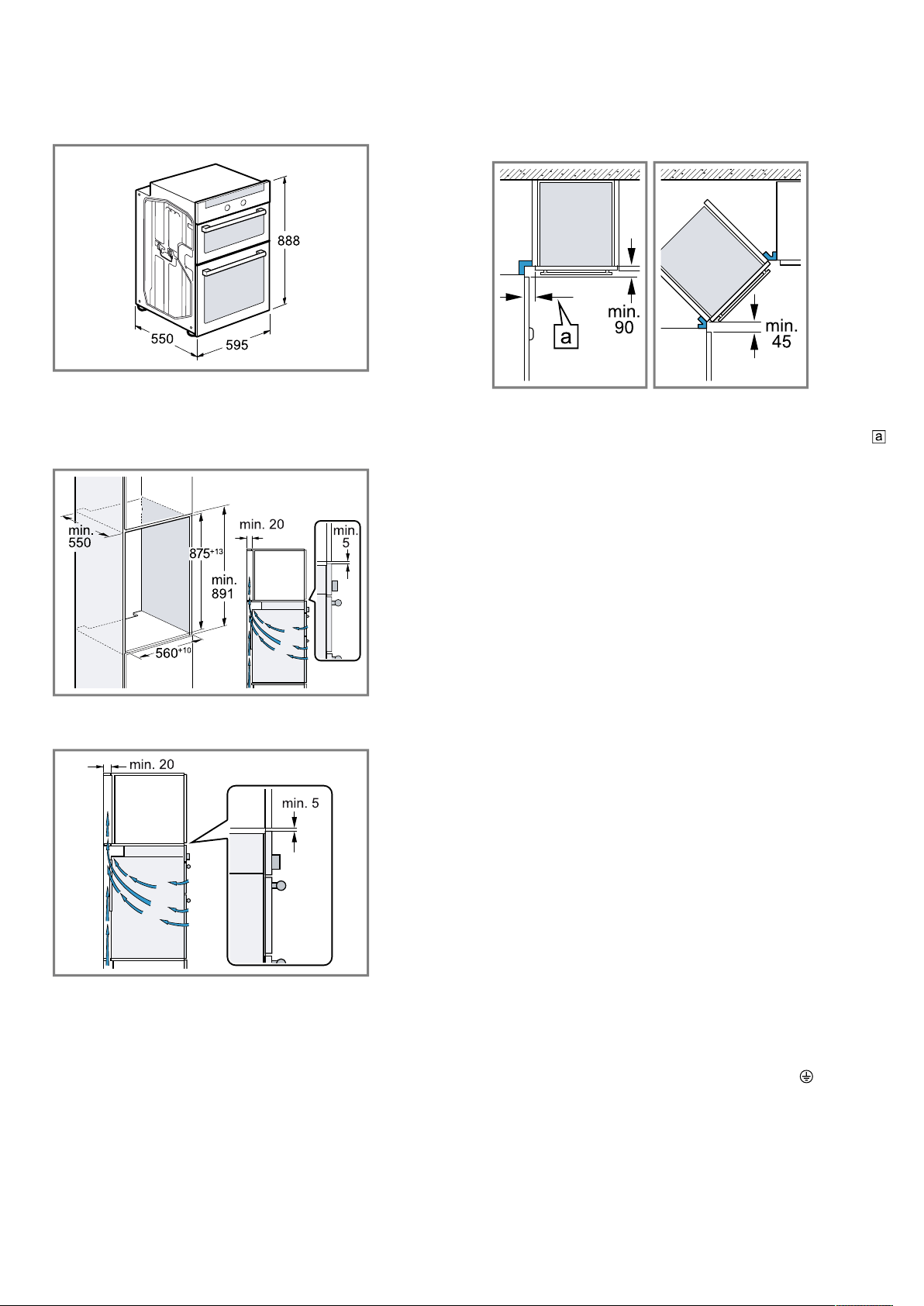
en Installation instructions
42
24.2 Appliance dimensions
You will find the dimensions of the appliance here
24.3 Installation in a tall unit
Observe the installation dimensions and the installation
instructions when installing in a tall unit.
¡ To ventilate the appliance, there must be a gap of
20mm between all intermediate floors and the wall.
¡ If the tall unit has another back panel in addition to
the element back panels, this must be removed.
¡ Only fit the appliance up to a height which allows
accessories to be easily removed.
24.4 Corner installation
Observe the installation dimensions and the installation
instructions when installing in a corner.
¡ To ensure that the appliance door can be opened,
you must take the minimum dimensions into consid-
eration when installing in a corner. The dimension
is dependent on the thickness of the unit front and
the handle.
24.5 Electrical connection
In order to safely connect the appliance to the elec-
trical system, follow these instructions.
¡ The appliance corresponds to protection class I and
must only be operated with a protective earth con-
nection.
¡ The fuse protection must correspond to the power
rating specified on the appliance's rating plate and
to local regulations.
¡ The appliance must be disconnected from the
power supply whenever installation work is being
carried out.
¡ Contact protection must be ensured during the in-
stallation.
Electrically connecting an appliance without a
protective contact plug
Note:Only a licensed professional may connect the ap-
pliance. Damage caused by incorrect connection is not
covered under the warranty.
An all-pole isolating switch must be integrated into the
permanent electrical installation according to the install-
ation regulations.
1.
Identify the phase and neutral conductors in the
socket.
The appliance may be damaged if it is not connec-
ted correctly.
2.
Connect the hob in accordance with the connection
diagram.
See the rating plate for the voltage.
3.
Connect the wires of the mains power cable accord-
ing to the colour coding:
‒ Green/yellow = Protective conductor
‒ Blue = Neutral conductor
‒ Brown = Phase (external conductor)
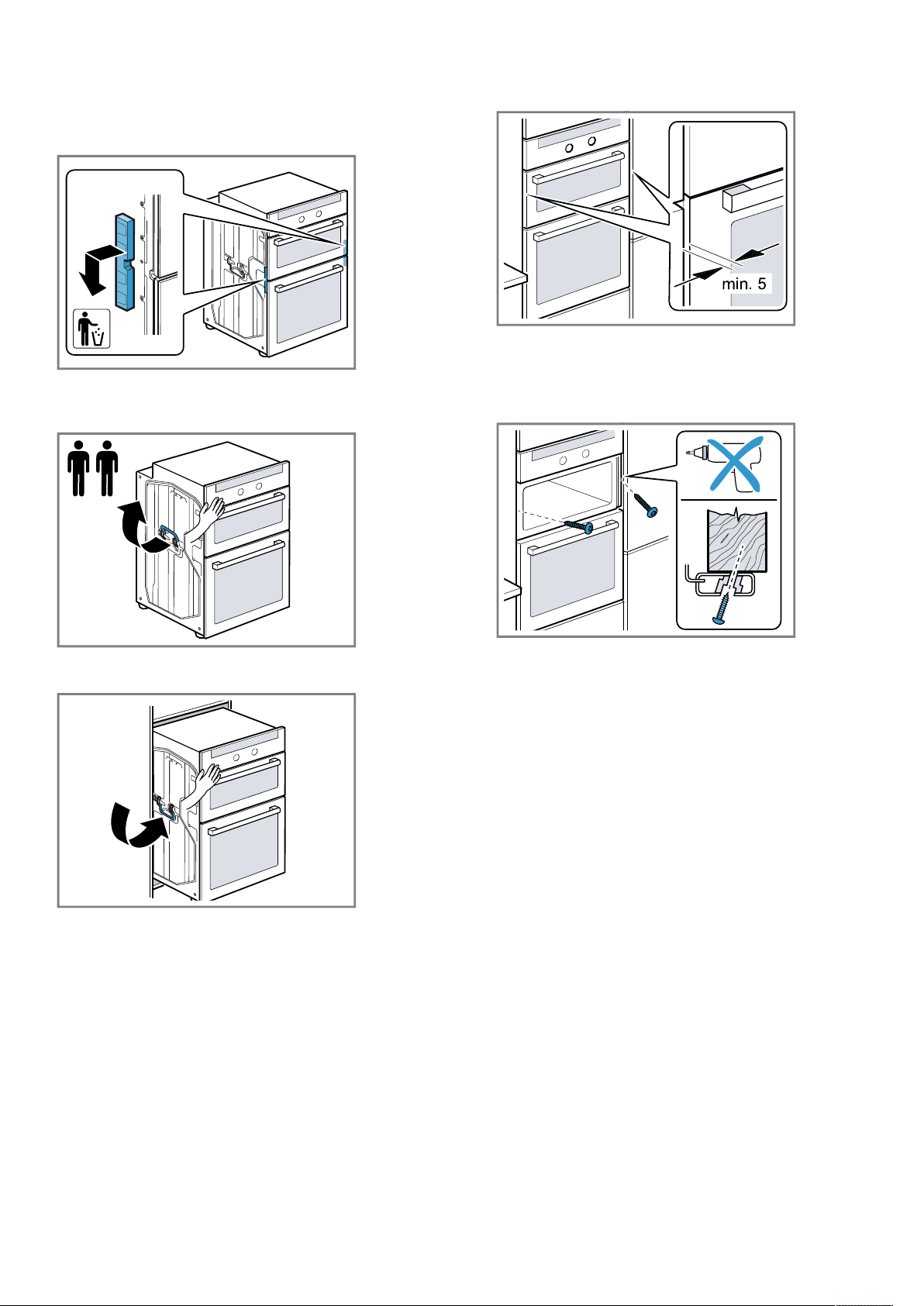
Installation instructions en
43
24.6 Installing the appliance
1.
Remove the transport locks on the right and left and
then dispose of them.
2.
The appliance must be transported by two people
using the carry handles on the right and left, while
securing the front of the appliance with one hand.
3.
Place the appliance in the unit and fold the carry
handles down.
4.
Push the appliance in fully.
Do not kink or trap the connecting cable, or route it
over sharp edges.
5.
Centre the appliance.
There must be an air gap of at least 5mm between
the appliance and adjacent unit fronts.
6.
Use a spirit level to adjust the appliance so that it is
perfectly level.
7.
Screw the appliance into place.
24.7 Removing the appliance
1.
Disconnect the appliance from the power supply.
2.
Undo the fastening screws.
3.
Lift the appliance slightly and pull it out completely.
Thank you for buying a
Bosch Home Appliance!
Register your new device on MyBosch now and profit directly from:
• Expert tips & tricks for your appliance
• Warranty extension options
• Discounts for accessories & spare-parts
• Digital manual and all appliance data at hand
• Easy access to Bosch Home Appliances Service
Free and easy registration – also on mobile phones:
www.bosch-home.com/welcome
Looking for help?
You'll find it here.
Expert advice for your Bosch home appliances, help with problems
or a repair from Bosch experts.
Find out everything about the many ways Bosch can support you:
www.bosch-home.com/service
Contact data of all countries are listed in the attached service directory.
*9001580322*
9001580322 (010121)
en
Robert Bosch Hausgeräte GmbH
Carl-Wery-Straße 34
81739 München
GERMANY
www.bosch-home.com
Valid within Great Britain:
Imported to Great Britain by
BSH Home Appliances Ltd.
Grand Union House
Old Wolverton Road
Wolverton, Milton Keynes
MK12 5PT
United Kingdom