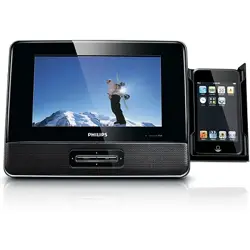
DCM230
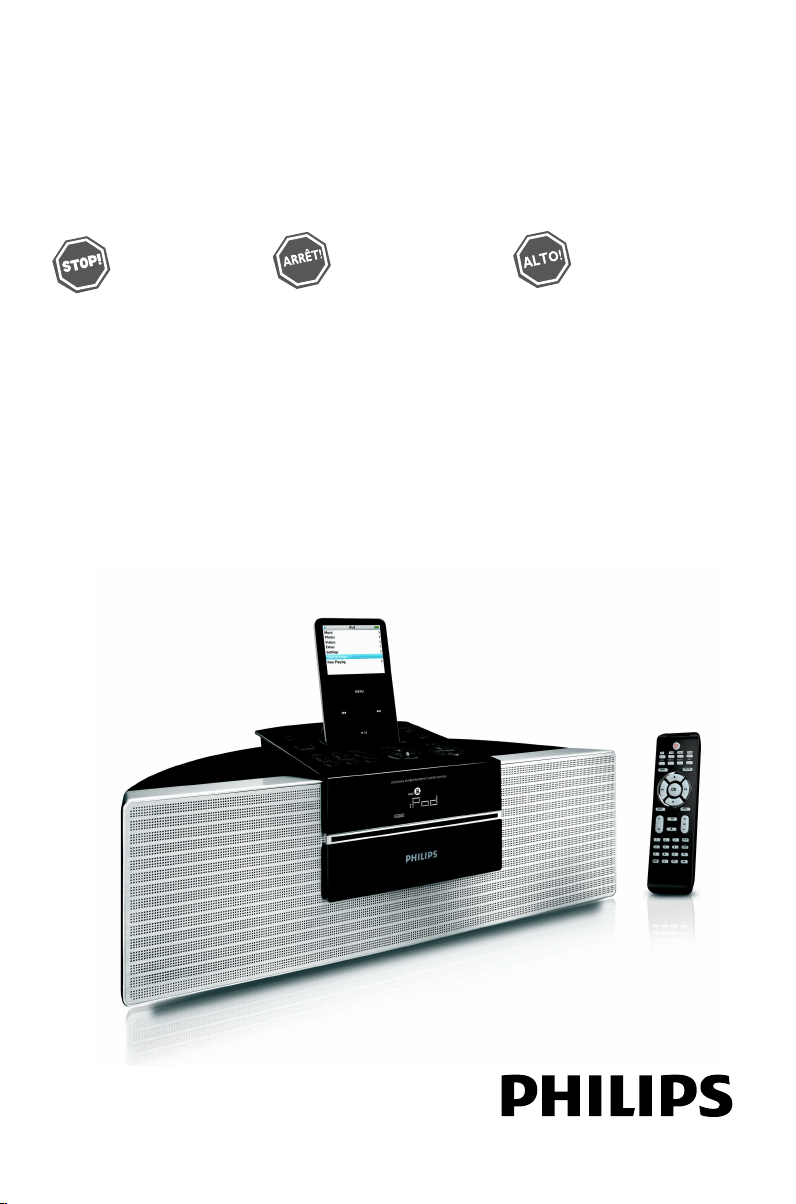
Docking Entertainment System
Thank you for choosing Philips.
Need help fast?
Read your Quick Start Guide and/or
User Manual first for quick tips
that make using your Philips product
more enjoyable.
If you have read your instructions
and still need assistance,
you may access our online help at
www.philips.com/welcome
or call
1-888-PHILIPS (744-5477)
while with your product.
Philips vous remercie de
votre confiance.
Besoin d'une aide
rapide?
Le Guide rapide de début
et Manuel de
l'utilisateur regorgent d'astuces destinées à
simplifier l'utilisation de votre produit Philips.
Toutefois, si vous ne parvenez pas à résoudre
votre probléme, vous pouvez accéder à
notre aide en ligne à l'adresse
www.philips.com/welcome
ou formez le
1-800-661-6162 (Francophone)
1-888-PHILIPS (744-5477) (English speaking)
Veillez à avoir votre produit à
portée de main.
Gracias por escoger Philips
Necesita ayuda
inmediata?
Lea primero la Guía rápida del comienzo
o el Manual del usuario, en donde encontrará
consejos que le ayudarán a disfrutar
plenamente de su producto Philips.
Si después de leerlo aún necesita ayuda,
consulte nuestro servicio de
asistencia en línea en
www.philips.com/welcome
o llame al teléfono
1-888-PHILIPS (744-5477)
y tenga a mano el producto.
(and Model / Serial number)
(et model / serial nombre)
(y número de model / serial)
Register your product and get support at
www.philips.com/welcome
pg001-028_DCM230_37-Eng 2010.3.31, 15:021
2
.
Note : This equipment has been tested and found to comply with the limits for a Class B digital device,
pursuant to part 15 of the FCC Rules. These limits are designed to provide reasonable protection against
harmful interference in a residential installation. This equipment generates, uses, and can radiate radio
frequency energy and, if not installed and used in accordance with the instruction manual, may cause
harmful interference to radio communications. However, there is no guarantee that interference will not
occur in a particular installation. If this equipment does cause harmful interference to radio or television
reception, which can be determined by turning the equipment off and on, the user is encouraged to try to
correct the interference by one or more of the following measures :
– Relocate the receiving antenna.
– Increase the separation between the equipment and receiver
– Connect the equipment into an outlet on a circuit different from that to which the receiver is connected.
– Consult the dealer or an experienced radio/TV technician for help.
IMPORTANT !
modifications not authorized by the manufacturer may void users authority to operate this device.
Nota : Este aparato ha sido probado y cumple con los límites correspondientes a un aparato digital de Clase
B, según la parte 15 de las Normas FCC. Estos límites han sido diseñados para facilitar suficiente protección
frente a interferencias perjudiciales en una instalación residencial. Este aparato genera, utiliza y puede emitir
energía de frecuencias de radio y, si no se instala y utiliza según el manual de instrucciones, puede provocar
interferencias perjudiciales en las comunicaciones de radio. Sin embargo, no existe garantía de que las
interferencias no ocurrirán en una instalación particular. Si este aparato provoca interferencias perjudiciales en
la recepción de radio o television, que se puede identificar encendiendo y apagando el aparato,
recomendamos al usuario que intente solucionar las interferencias siguiendo una o más de las siguientes
medidas:
– Cambie la posición de la antena receptora.
– Aumente la separación entre el aparato y el receptor.
– Conecte el aparato a una toma de un circuito diferente al que está conectado el receptor.
– Consulte con el distribuidor o un técnico de radio/TV con experiencia para que le ayuden.
¡IMPORTANTE!
modificações não autorizadas pelo fabricante, podem causar danos na operação deste aparelho.
Remarque : Cet équipement a été testé et a été certifié conforme aux limites imposées pour un
appareil numérique de Classe B, conformément à la partie 15 des réglements FCC. Ces limites sont
définies aux fins d'assurer une protection raisonnable contre les interférences nuisibles dans une
installation résidentielle. Cet équipement génère, utilise et émet des fréquences radio qui, en cas d'une
mauvaise installation ou d'une utilisation non-conforme aux instructions de ce manuel d'utilisation
peuvent causer des interférences nuisibles aux communications radio. Il n'y a toutefois aucune garantie
que des interférences nuisibles ne se produiront pas dans une installation donnée. Si cet équipement
cause des interférences nuisibles avec votre poste radio ou de télévision, ce que vous pouvez déterminer
en éteignant et en rallumant votre équipement, il est conseillé à l'utilisateur d'essayer de pallier à ces
interférences nuisibles en prenant l'une ou l'autre des mesures suivantes:
– Changez la position de l'antenne de réception.
– Augmentez la séparation entre l'équipement et le récepteur.
– Branchez l'équipement sur une source d'alimentation différente de celle sur laquelle le récepteur est
branché.
– Consultez votre distributeur ou un technicien qualifié en la matière pour assistance.
IMPORTANTE !
las modificaciones no autorizadas por el fabricante pueden anular la autoridad de los usuarios para
utilizar este aparato.
pg001-028_DCM230_37-Eng 2010.3.31, 15:022
3
1
2
6
3
5
0
0
8£*
&
7
4
#
⁄
º
ª
$
TIMER
#
^
3
(
(
@
)
5
£
&
¡
™
≤
9
8
§
∞
!
≥
•
@
¤
%
$
1
iPod
pg001-028_DCM230_37-Eng 2010.3.31, 15:023
4
Canada
English:
This digital apparatus does not exceed
the Class B limits for radio noise
emissions from digital apparatus as set
out in the Radio Interference
Regulations of the Canadian
Department of Communications.
Français:
Cet appareil numérique n'emet pas de
bruits radioélectriques dépassant les
limites applicables aux appareils
numériques de Class B prescrites dans
le Règlement sur le Brouillage
Radioélectrique édicté par le Ministère
des Communications du Canada.
CAUTION
Use of controls or adjustments or
performance of procedures other
than herein may result in hazardous
radiation exposure or other unsafe
operation.
ATTENTION
L’utilisation des commandes ou
réglages ou le non respect des
procédures ci-incluses peuvent se
traduire par une exposition
dangereuse à l’irradiation.
ATENCIÓN
El uso de mando o ajustes o la
ejecucción de métodos que no sean
los aquí descritos puede ocasionar
peligro de exposición a radiación.
Windows Media is a trademark of
Microsoft Corporation.
pg001-028_DCM230_37-Eng 2010.3.31, 15:024

5
English
Français
Español
Index
English ------------------------------------------------ 6
Français -------------------------------------------- 29
Español --------------------------------------------- 52
pg001-028_DCM230_37-Eng 2010.3.31, 15:025
6
English
Contents
General Information
Environmental Information ................................ 9
Supplied accessories ............................................ 9
Safety Information ................................................ 9
Hearing Safety ..................................................... 10
Preparations
Rear connections ........................................ .......11
Connecting a USB device or memory ................. 12
card ..............................................................................12
Connecting other equipment to your ................. 12
system ......................................................................... 12
Before using the remote control .................... 13
Replacing battery (lithium CR2025) into the
remote control ................................................... 13
Controls
Controls on the system and remote control ...
......................................................................... 14~15
Basic Functions
Switching the system on ................................... 16
Switching the system to Eco Power Standby
mode ..................................................................... 16
Power Saving Automatic Standby .................... 16
Adjusting volume and sound ............................ 16
CD/MP3-CD Operation
Loading a disc ...................................................... 17
Basic playback controls ..................................... 17
Playing an MP3/WMA disc ............................... 18
Different play modes: SHUFFLE and REPEAT19
Programming track numbers ........................... 19
Erasing the program .......................................... 19
Radio Reception
Tuning to radio stations .................................... 20
Programming radio stations ............................. 20
Automatic programming ......................................... 20
Manual programming ...............................................20
Tuning to preset radio stations ....................... 20
External Sources
Using a non-USB device.................................... 21
Using a USB mass storage device ................... 21
Clock/Timer
Clock setting ....................................................... 23
Timer setting ....................................................... 23
Activating and deactivating timer .......................... 23
Sleep timer setting ............................................. 24
iPod Dock
Compatible iPod players ................................... 25
Selecting the correct dock adaptor ............... 25
Setup ..................................................................... 25
Playing an iPod portable player ....................... 25
Charging iPod battery using the dock ........... 25
Specifications ........................................... 26
Maintenance.............................................. 26
Tr oubleshooting ............................. 27~28
pg001-028_DCM230_37-Eng 2010.3.31, 15:026
English
7
pg001-028_DCM230_37-Eng 2010.3.31, 15:027

8
English
PHILIPS LIMITED WARRANTY
ONE (1) YEAR
WARRANTY COVERAGE:
PHILIPS warranty obligation is limited to the terms set forth
below.
WHO IS COVERED:
Philips warrants the product to the original purchaser or the per-
son receiving the product as a gift against defects in materials and
workmanship as based on the date of original purchase
(“Warranty Period”) from an Authorized Dealer. The original
sales receipt showing the product name and the purchase date
from an authorized retailer is considered such proof.
WHAT IS COVERED:
The Philips warranty covers new products if a defect in material
or workmanship occurs and a valid claim is received by Philips
within the Warranty Period. At its option, Philips will either (1)
repair the product at no charge, using new or refurbished
replacement parts, or (2) exchange the product with a product
that is new or which has been manufactured from new, or ser-
viceable used parts and is at least functionally equivalent or most
comparable to the original product in Philips current inventory,
or (3) refund the original purchase price of the product.
Philips warrants replacement products or parts provided under
this warranty against defects in materials and workmanship from
the date of the replacement or repair for ninety (90) days or for
the remaining portion of the original product’s warranty,
whichever provides longer coverage for you. When a product or
part is exchanged, any replacement item becomes your property
and the replaced item becomes Philips’ property. When a refund
is given, your product becomes Philips’ property.
Note: Any product sold and identified as refurbished or
renewed carries a ninety (90) day limited warranty.
Replacement product can only be sent if all warranty
requirements are met. Failure to follow all requirements
can result in delay.
WHAT IS NOT COVERED - EXCLUSIONS AND LIMI-
TATIONS:
This Limited Warranty applies only to the new products manu-
factured by or for Philips that can be identified by the trademark,
trade name, or logo affixed to it. This Limited Warranty does not
apply to any non-Philips hardware product or any software, even
if packaged or sold with the product. Non-Philips manufacturers,
suppliers, or publishers may provide a separate warranty for their
own products packaged with the bundled product.
Philips is not liable for any damage to or loss of any programs,
data, or other information stored on any media contained within
the product, or any non-Philips product or part not covered by
this warranty. Recovery or reinstallation of programs, data or
other information is not covered under this Limited Warranty.
This warranty does not apply (a) to damage caused by accident,
abuse, misuse, neglect, misapplication, or non-Philips product, (b)
to damage caused by service performed by anyone other than
Philips or Philips Authorized Service Location, (c) to a product or
a part that has been modified without the written permission of
Philips, or (d) if any Philips serial number has been removed or
defaced, or (e) product, accessories or consumables sold “AS IS”
without warranty of any kind by including refurbished Philips
product sold “AS IS” by some retailers.
This Limited Warranty does not cover:
• Shipping charges to return defective product to Philips.
•Labor charges for installation or setup of the product, adjust-
ment of customer controls on the product, and installation or
repair of antenna/signal source systems outside of the product.
•Product repair and/or part replacement because of improper
installation or maintenance, connections to improper voltage
supply, power line surge, lightning damage, retained images or
screen markings resulting from viewing fixed stationary con-
tent for extended periods, product cosmetic appearance items
due to normal wear and tear, unauthorized repair or other
cause not within the control of Philips.
•Damage or claims for products not being available for use, or
for lost data or lost software.
•Damage from mishandled shipments or transit accidents when
returning product to Philips.
•A product that requires modification or adaptation to enable
it to operate in any country other than the country for which
it was designed, manufactured, approved and/or authorized, or
repair of products damaged by these modifications.
•A product used for commercial or institutional purposes
(including but not limited to rental purposes).
•Product lost in shipment and no signature verification receipt
can be provided.
•Failure to operate per Owner’s Manual.
TO OBTAIN ASSISTANCE IN THE U.S.A., PUERTO
RICO, OR U.S. VIRGIN ISLANDS…
Contact Philips Customer Care Center at:
1-888-PHILIPS (1-888-744-5477)
TO OBTAIN ASSISTANCE IN CANADA…
1-800-661-6162 (French Speaking)
1-888-PHILIPS (1-888-744-5477) - (English or Spanish
Speaking)
REPAIR OR REPLACEMENT AS PROVIDED UNDER THIS
WARRANTY IS THE EXCLUSIVE REMEDY FOR THE CON-
SUMER. PHILIPS SHALL NOT BE LIABLE FOR ANY INCIDEN-
TAL OR CONSEQUENTIAL DAMAGES FOR BREACH OF
ANY EXPRESS OR IMPLIED WARRANTY ON THIS PROD-
UCT. EXCEPT TO THE EXTENT PROHIBITED BY APPLICABLE
LAW, ANY IMPLIED WARRANTY OF MERCHANTABILITY OR
FITNESS FOR A PARTICULAR PURPOSE ON THIS PRODUCT
IS LIMITED IN DURATION TO THE DURATION OF THIS
WARRANTY.
Some states do not allow the exclusions or limitation of inciden-
tal or consequential damages, or allow limitations on how long an
implied warranty lasts, so the above limitations or exclusions may
not apply to you.
This warranty gives you specific legal rights. You may have other rights which vary from state/province to state/province.
3140 035 50201
Philips, P.O. Box 10313 Stamford, CT 06904
pg001-028_DCM230_37-Eng 2010.3.31, 15:028
English
9
Congratulations on your purchase and
welcome to Philips!
To fully benefit from the support that
Philips offers, register your product at
www.philips.com/welcome.
This set complies with the FCC rules,
Part 15 and with 21 CFR 1040.10.
Operation is subject to the following two
conditions:
– This device may not cause harmful
interference, and
– This device must accept any interference
received, including interference that may
cause undesired operation.
Environmental Information
All unnecessary packaging has been omitted. We
have tried to make the packaging easy to
separate into three materials: cardboard (box),
polystyrene foam (buffer) and polyethylene (bags,
protective foam sheet).
Your system consists of materials which can be
recycled and reused if disassembled by a
specialized company. Please observe the local
regulations regarding the disposal of packaging
materials, exhausted batteries and old
equipment.
Supplied accessories
– remote control (with battery)
– FM antenna
– AM antenna
–4 X iPod dock adaptors
–1 X certified AC/DC adapter (Input: 100-
240V ~ 50-60Hz 1.2 A, Output:15V
3A)
Safety Information
● Before operating the system, check that the
operating voltage indicated on the typeplate of
your system is identical with the voltage of your
local power supply. If not, please consult your
dealer.
● Place the system on a flat, hard and stable
surface.
● Where the MAINS plug or an appliance coupler
is used as the disconnet device, the disconnet
device shall remain readily operable.
General Information
● Place the system in a location with adequate
ventilation to prevent internal heat build-up in
your system. Allow at least 10 cm (4 inches)
clearance from the rear and the top of the unit
and 5 cm (2 inches) from each side.
● The ventilation should not be impeded by
covering the ventilation openings with items,
such as newspapers, table-cloths, cur tains, etc.
● Do not expose the system, batteries or discs to
excessive moisture, rain, sand or heat sources
caused by heating equipment or direct sunlight.
● No naked flame sources, such as lighted candles,
should be placed on the apparatus.
● No objects filled with liquids, such as vases, shall
be placed on the apparatus.
● Install this unit near the AC outlet and where the
AC power plug can be reached easily.
● The apparatus shall not be exposed to dripping
or splashing.
● If the system is brought directly from a cold to a
warm location, or is placed in a very damp room,
moisture may condense on the lens of the disc
unit inside the system. Should this occur, the CD
player would not operate normally. Leave the
power on for about one hour with no disc in the
system until normal playback is possible.
● The mechanical parts of the set contain self-
lubricating bearings and must not be oiled or
lubricated.
● Batteries (battery pack or batteries installed)
shall not be exposed to excessive heat such as
sunshine, fire or the like.
● When the system is switched to Standby
mode, it is still consuming some power.
To disconnect the system from the
power supply completely, remove the AC
power plug from the wall socket.
pg001-028_DCM230_37-Eng 2010.3.31, 15:029

10
English
General Information
Hearing Safety
Listen at a moderate volume.
● Using headphones at a high volume can impair
your hearing. This product can produce sounds
in decibel ranges that may cause hearing loss for
a normal person, even for exposure less than a
minute. The higher decibel ranges are offered
for those that may have already experienced
some hearing loss.
● Sound can be deceiving. Over time your hearing
"comfort level" adapts to higher volumes of
sound. So after prolonged listening, what sounds
"normal" can actually be loud and harmful to
your hearing. To guard against this, set your
volume to a safe level before your hearing
adapts and leave it there.
To establish a safe volume level:
● Set your volume control at a low setting.
● Slowly increase the sound until you can hear it
comfortably and clearly, without distortion.
Listen for reasonable periods of time:
● Prolonged exposure to sound, even at normally
"safe" levels, can also cause hearing loss.
● Be sure to use your equipment reasonably and
take appropriate breaks.
Be sure to observe the following
guidelines when using your headphones.
● Listen at reasonable volumes for reasonable
periods of time.
● Be careful not to adjust the volume as your
hearing adapts.
● Do not turn up the volume so high that you
can't hear what's around you.
● You should use caution or temporarily
discontinue use in potentially hazardous
situations.
● Do not use headphones while operating a
motorized vehicle, cycling, skateboarding, etc.; it
may create a traffic hazard and is illegal in many
areas.
Your product is designed and manufactured with
high quality materials and components, which can be
recycled and reused.
Never dispose of your product with other
household waste. Please inform yourself about the
local rules on the separate collection of electrical
and electronic products and batteries. The correct
disposal of these products helps prevent potentially
negative consequences on the environment and
human health.
Your product contains batteries, which cannot be
disposed of with normal household waste. Please
inform yourself about the local rules on separate
collection of batteries. The correct disposal of
batteries helps prevent potentially negative
consequences on the environment and human
health.
Please visit www.recycle.philips.com for additional
information on a recycling center in your area.
Perchlorate Material - special handling may apply. See
www.dtsc.ca.gov/hazardouswaste/perchlorate.
pg001-028_DCM230_37-Eng 2010.3.31, 15:0210
English
11
Preparations
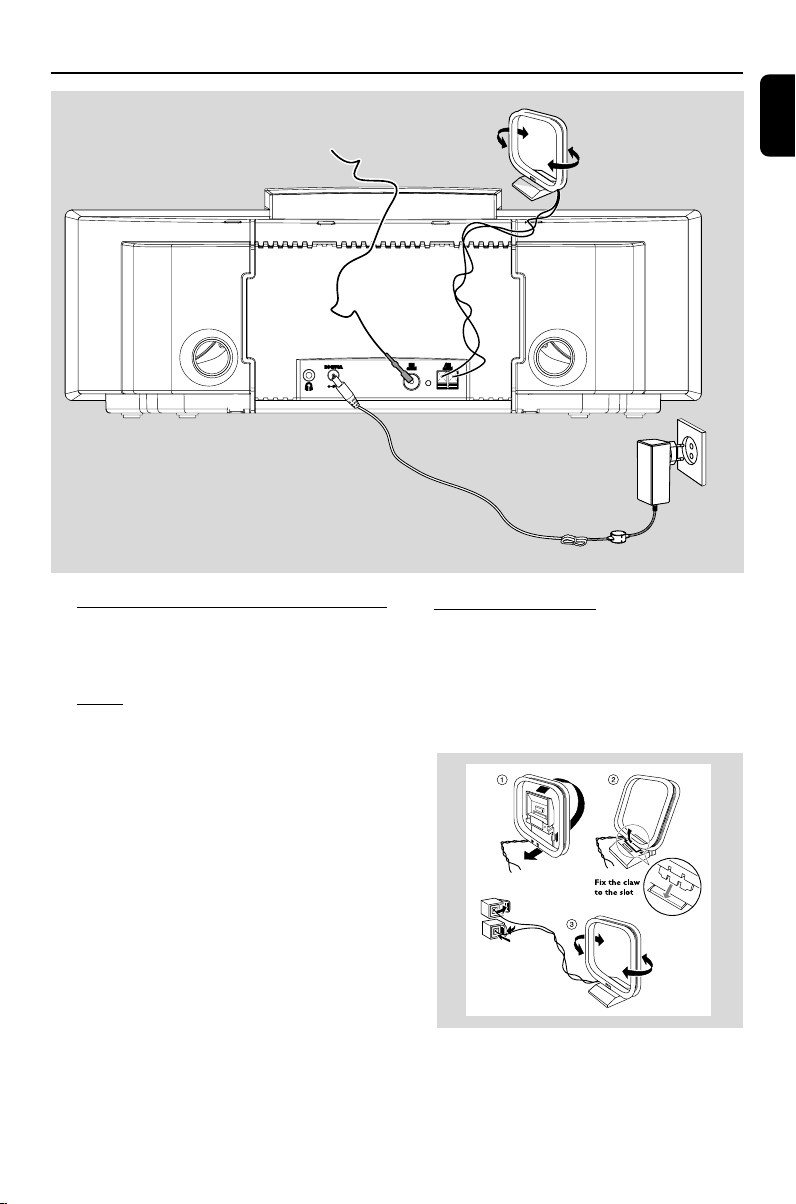
Rear connections
The type plate is located at the rear of the
system.
A Power
● Before connecting the AC power adaptor to the
wall outlet, ensure that all other connections
have been made.
WARNING!
–For optimal performance, use only the
original AC power adaptor.
–Never make or change connections with
the power switched on.
To avoid overheating of the system, a safety
circuit has been built in. Therefore, your
system may switch to Standby mode
automatically under extreme conditions. If
this happens, let the system cool down
before reusing it (not available for all versions).
B Antennas Connection
Connect the supplied AM loop antenna and FM
antenna to the respective terminals. Adjust the
position of the antenna for optimal reception.
AM Antenna
● Position the antenna as far as possible from a TV,
VCR or other radiation source.
AC power adaptor
AM loop
antenna
FM wire antenna
pg001-028_DCM230_37-Eng 2010.3.31, 15:0211

12
English
Preparations
FM Antenna
● For better FM stereo reception, connect an
outdoor FM antenna to the FM AERIAL (FM
ANTENNA) terminal.
C Optional connection
The optional equipment and connecting cords are
not supplied. Refer to the operating instructions
of the connected equipment for details.
Connecting a USB device or memory
card
By connecting a USB mass storage device
(including USB flash memory, USB flash players
or memory cards) to the Hi-Fi system, you can
enjoy the device's stored music through the
powerful speakers of Hi-Fi system.
● Insert the USB device's USB plug into the
socket on the set.
OR
for the devices with USB cables:
1 Insert one plug of the USB cable (not supplied)
to the socket on the set.
2 Insert the other plug of the USB cable to the
USB output terminal of the USB device.
OR
for the memory card:
1 Insert the memory card into a card reader (not
supplied).
2 Use a USB cable (not supplied) to connect the
card reader into the socket on the set.
Connecting other equipment to your
system
● Use a cinch cable to connect AUX to the
analogue audio out terminals of an external
equipment (TV, VCR, Laser Disc player, DVD
player or CD Recorder).
Note:
– If you are connecting equipment with a mono
output (a single audio out terminal), connect it to
the AUX left terminal. Alternatively, you can use a
“single to double” cinch cable (the output sound
still remain mono).
pg001-028_DCM230_37-Eng 2010.3.31, 15:0212
English
13
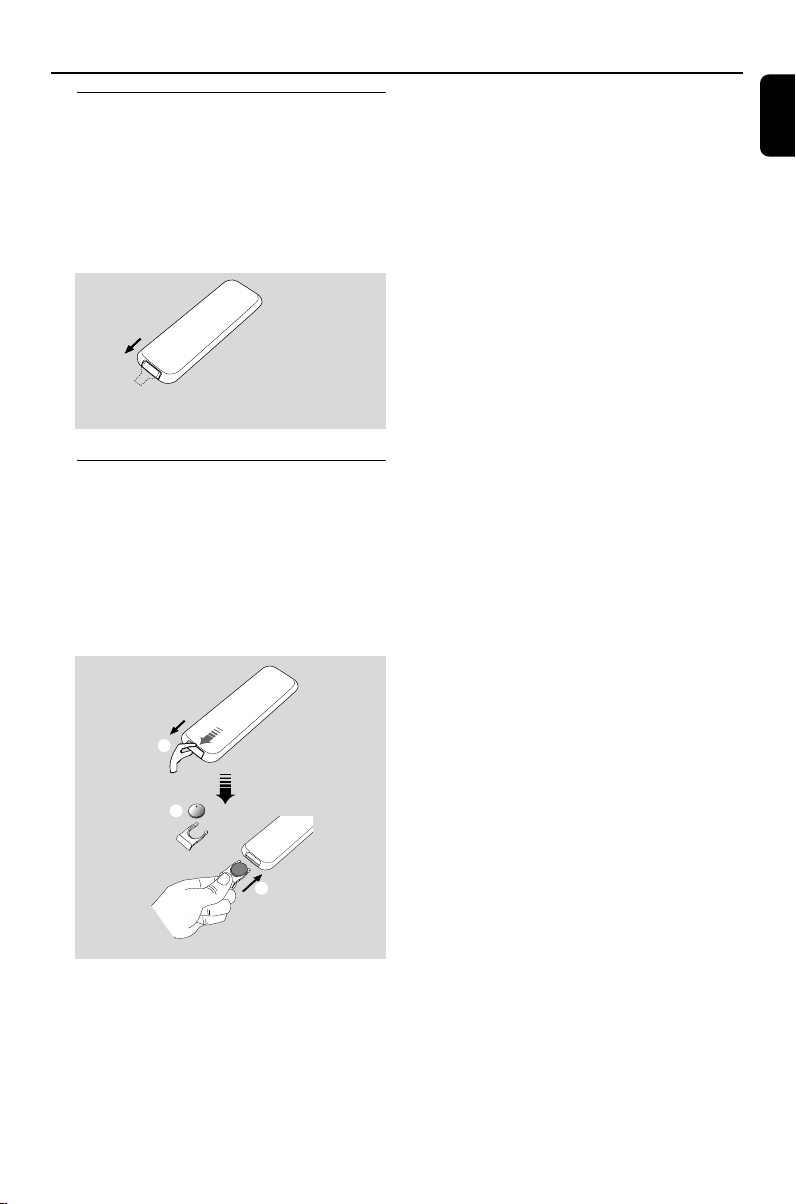
Before using the remote control
1 Pull out the plastic protective sheet.
2 Select the source you wish to control by
pressing one of the source select keys on the
remote control (for example DISC, FM).
3 Then select the desired function (for example
ÉÅ , à , á).
Remove the plastic protective sheet
Replacing battery (lithium
CR2025) into the remote control
1 Press the slot on the battery compartment.
2 Pull out the battery compar tment.
3 Replace a new battery and fully insert the
battery compartment back to the original
position.
1
2
3
CR2025
Preparations
CAUTION!
– Remove battery if it is exhausted or will
not be used for a long time.
– Battery contains chemical substances, so
they should be disposed of properly.
– Perchlorate Material-special handling
may apply. See www.dtsc.ca.gov/
hazardouswaste/perchlorate.
pg001-028_DCM230_37-Eng 2010.3.31, 15:0213

14
English
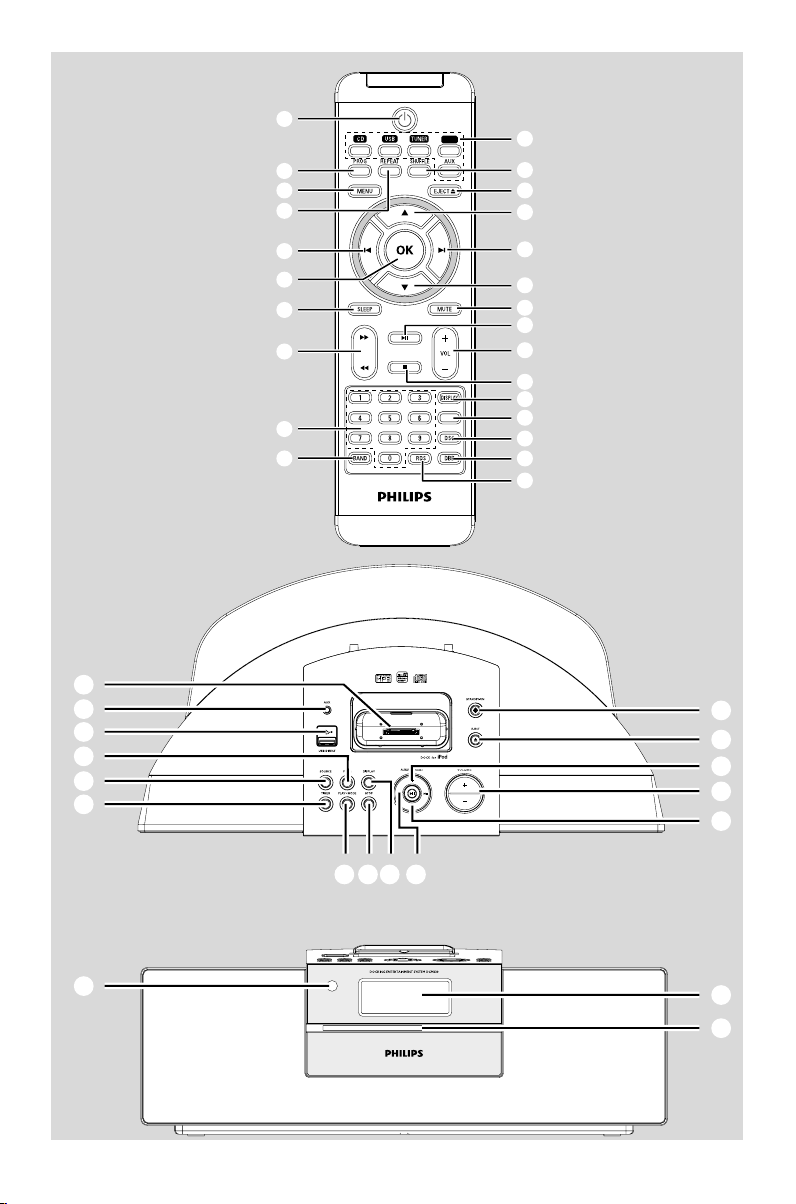
Controls (illustrations on page 3)
Controls on the system and
remote control
1 STANDBY-ON/ECO POWERB
– switches the system on or to Eco Power
standby/normal standby with clock display.
2 Display screen
– shows the status of the system.
3 EJECT 0
– ejects a disc from the disc loader.
4 IR SENSOR
– remote sensor
5 VOLUME -/+ (VOL +/-)
– adjusts the volume level.
6 Disc loader
7 S/T
for CD/MP3-CD/WMA/USB
fast searches back and forward
within a track/disc (press and
hold).
................................. skips to the beginning of a
current/previous/subsequent
track.
8 STOP 9
– stops disc playback or erases a disc program.
9 ÉÅ
– starts or interrupts playback.
0 ALBUM/PRESET +/-
–(for MP3-CD/WMA/USB) skips to the beginning
of a current/previous/subsequent album.
– adjusts the hours and minutes for the clock/timer
function.
– selects a preset radio station.
! 5 /6
for CD/MP3-CD/WMA/USB
fast searches back and forward
within a track/disc (press and
hold).
for TUNER ........ tunes to radio stations (down/
up).
@ ¡ / ™
for CD/MP3-CD/WMA/USB
................................. skips to the beginning of a
current/previous/subsequent
track.
# SOURCE
– selects the respective sound source for CD/USB/
iPod/TUNER (FM/AM)/AUX.
$ PROG
–(for CD/MP3WMA/USB) programs tracks.
–(for TUNER) programs radio stations.
– sets the clock function.
% REPEAT
for CD/MP3/WMA/USB
selects a repeat playback
mode.
^ SHUFFLE
– plays disc/USB tracks randomly.
& TIMER
– sets the timer function.
* PLAY•MODE
– selects various repeat modes or the shuffle play
mode for a disc.
( 3 / 4
–(for MP3-CD/WMA/USB) skips to the beginning
of a current/previous/subsequent album.
) MUTE
– interrupts and resumes sound production.
¡ DSC (Digital Sound Control)
– selects sound characteristics: ROCK/POP/JAZZ/
CLASSIC.
™ DBB (Dynamic Bass Boost)
– enhances the bass.
£ DISPLAY
– selects different disc information display modes
during playback.
≤ RDS (no function on this version)
∞ SLEEP
– selects the sleeper time.
pg001-028_DCM230_37-Eng 2010.3.31, 15:0214
English
15
Controls
§ MENU
– equivalent to the MENU button on your iPod
player.
≥ Numerical Keypad (0~9)
–(for CD/MP3/WMA/USB) selects a track directly.
• BAND
– For tuner (TUNER): press to switch between AM
and FM.
ª iPod dock
– is used to dock your iPod player for playback or
recharging through this system.
º AUX
– is the jack used to connect an auxiliary device.
⁄ USB DIRECT
– jack for the external USB mass storage device.
¤ OK
– confirms a selection (for iPod menu operation
only).
Notes for remote control:
– First select the source you wish to control
by pressing one of the source select keys on
the remote control (for example CD, FM).
– Then select the desired function (for
example
ÉÅ
,
à
,
á
).
pg001-028_DCM230_37-Eng 2010.3.31, 15:0215
16
English
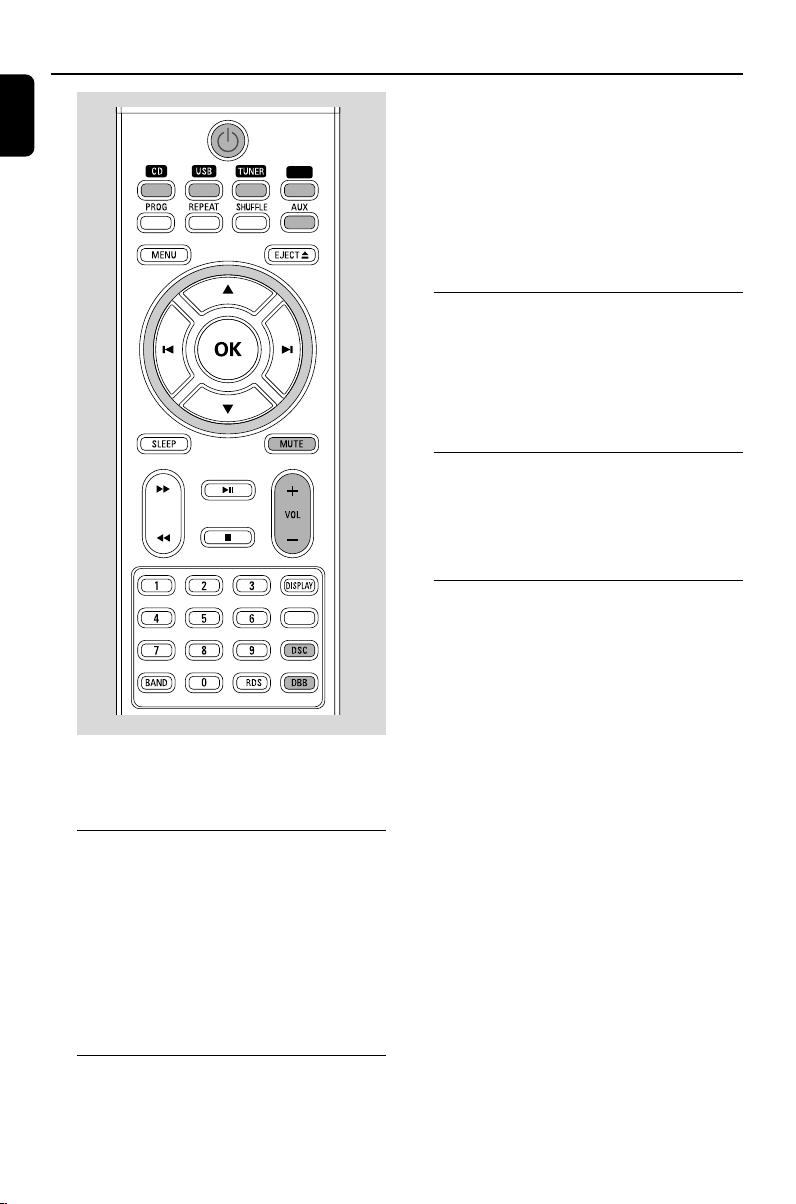
Basic Functions
Important!
Before you operate the system, complete
the preparation procedures.
Switching the system on
● Press STANDBY-ON/ECO POWER B (or
B on the remote).
➜ The system will switch to the last selected
source.
● Press SOURCE on the top of the system or
CD, USB, iPod, TUNER or AUX on the
remote control.
➜ The system will switch to the selected source.
Switching the system to standby
mode
● Press STANDBY-ON/ECO POWER B (or
B on the remote).
➜ The backlight for clock display is dim in
standby.
➜ The volume level (up to a maximum volume
level of 12), interactive sound settings, last
selected mode (ECO Power Standby or normal
standby), source and tuner presets will be
retained in the player's memory.
Switching the system to Eco
Power Standby mode
● Press and hold STANDBY-ON/ECO
POWER B (or B on the remote) for more
than 2 seconds.
➜ The backlight will go blank.
Power Saving Automatic Standby
As a power-saving feature, the system
automatically switches to Eco Power/ Standby 15
minutes after a CD/MP3/WMA/USB playback
has reached the end and no control is operated.
Adjusting volume and sound
1 Press VOLUME +/- (or VOL +/- on the
remote control) to decrease or increase the
volume.
➜ Display shows the volume level VOL and a
number from MIN 01, 02, ...31 MAX.
2 Press DSC repeatedly to select the desired
sound effect: ROCK/POP/JAZZ/CLASSIC.
3 Press DBB to switch bass enhancement on or
off.
➜ If the DBB is activated, DBB ON is shown.
➜ If the DBB is deactivated, DBB OFF is shown.
4 Press MUTE on the remote control to
interrupt sound reproduction instantly.
➜ Playback will continue without sound and --
MUTE-- will flash on the display.
● To activate sound reproduction you can:
– press MUTE again;
– adjust the volume controls;
– change source.
To listen through the headphone
● Connect the headphone plug to the n socket
on the rear of the set.
➜ The speakers will be muted.
TIMER
iPod
pg001-028_DCM230_37-Eng 2010.3.31, 15:0216
English
17
2 Insert a disc into the disc loader..
➜ Make sure the label side is facing up.
➜ Make sure you have removed any other disc
from the slot loader.
3 Press ÉÅ to start playback.
4 At any time, simply press 9 to stop playback.
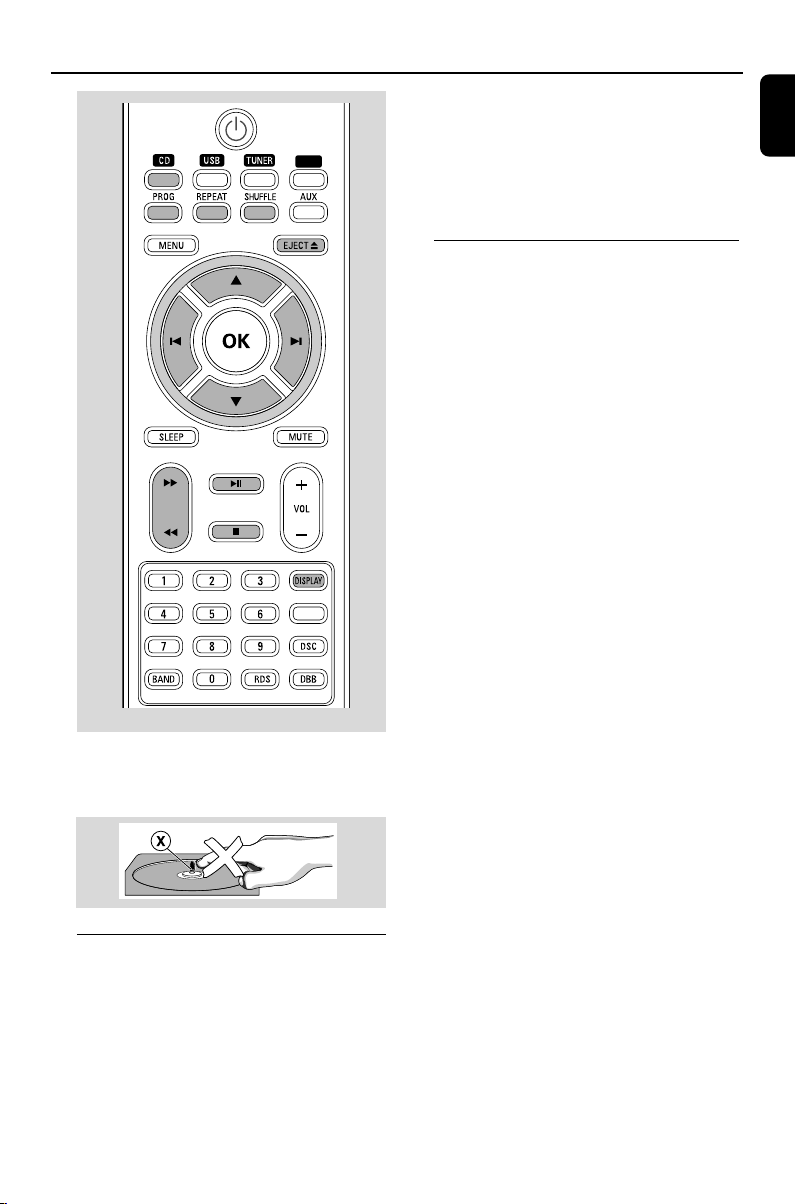
Basic playback controls
To play a disc
● Press ÉÅ to start playback.
➜ The current track number and elapsed
playing time of the track are displayed during
disc playback.
To select a different track
● Press S/T (or ¡ / ™ on the remote
control) once or repeatedly until the desired
track number appears in the display.
● You can also use the Numerical Keypad
(0~9) on the remote to select a track directly.
● If you have selected a track number shortly after
loading a disc or in the PAUSE position, you will
need to press ÉÅ to start playback.
Te xt display during playback
In CD mode
● Press DISPLAY repeatedly to see the
following information.
➜ Track number and elapsed playback time of
current track.
➜ Track number and total elapsed playback
time.
➜ Track number and remaining playback time
of current track.
➜ Track number and total remaining playback
time.
➜ Clock time.
In MP3-CD mode
● Press DISPLAY to display the ID-3
information if available and the clock time.
Important!
The lens of the CD player should never be
touched.
Loading a disc
This CD player plays Audio Discs including CD
Recordables, CD-Rewritables and MP3 CD.
● CD-ROM, CD-I, CDV, VCD, DVD or computer
CDs, however, are not possible.
● DRM-protected WMA disc is not supported.
1 Press SOURCE on the top of the system to
select CD or press CD on the remote.
CD/MP3-CD Operation
TIMER
iPod
pg001-028_DCM230_37-Eng 2010.3.31, 15:0217

18
English
CD/MP3-CD Operation
To find a passage within a track
1 Press and hold S/T (or 5 /6 on the
remote control).
2 When you recognize the passage you want,
release S/T (or 5 /6 on the remote
control).
➜ Normal playback continues.
To stop playback
● Press 9.
To interrupt playback
● Press ÉÅ during playback.
➜ The display freezes and the elapsed playing
time flashes when playback is interrupted.
➜ To resume, press ÉÅ again.
Notes:
CD play will also stop when;
– you eject the disc.
– the disc has reached the end.
– you select another source: TUNER, USB, DOCK
or AUX.
– you select standby.
– the set auto off time expires.
Playing an MP3/WMA disc
1 Load an MP3/WMA disc.
➜ The disc reading time may exceed 10
seconds due to the large number of songs
compiled into one disc.
2 Press ALBUM/PRESET +/- (or 3 / 4 on the
remote control) to select a desired album.
3 Press S/T (or ¡ /™ on the remote
control) to select a desired track.
➜ The album number will change accordingly as
you reach the first track of an album by pressing
S (¡ on the remote) or the last track of an
album by pressing T (™ on the remote).
4 Press ÉÅ to start playback.
Supported MP3 disc formats:
– ISO9660, Joliet
– Maximum title number: 999 (depending on
filename length)
– Maximum album number: 99
– Supported sampling frequencies: 32 kHz,
44.1kHz, 48 kHz
– Supported Bit-rates: 32~256 (kbps), variable
bitrates
pg001-028_DCM230_37-Eng 2010.3.31, 15:0218
English
19
CD/MP3-CD Operation
Different play modes: SHUFFLE
and REPEAT
You can select and change the various play
modes before or during playback. The REPEAT
modes can also be combined with PROGRAM.
1 To select your play mode, press PLAY•MODE
(SHUFFLE or REPEAT on the remote
control) before or during playback until the
display shows the desired function.
➜
appears if the shuffle playback is activated
and disappears if deactivated.
➜ If
appears, it indicates to play the current
track repeatedly.
➜ If
ALL is displayed, it indicates to play all
tracks in the whole disc repeatedly.
➜ For an MP3 CD/WMA, if both and ALB
flash on the display panel, it indicates to play the
current album repeatedly.
2 Press ÉÅ to start playback if in the STOP
position.
➜ If you have selected SHUFFLE, playback starts
automatically.
3 To return to normal playback, press the
PLAY•MODE (SHUFFLE or REPEAT on
the remote control) until or is no
longer displayed.
● You can also press 9 to stop playback and
cancel your play mode.
Note:
– The Repeat and Shuffle functions cannot be
activated simultaneously.
Programming track numbers
Program in the STOP position to select and
store your disc tracks in the desired sequence. If
you like, store any track more than once. Up to
40 tracks can be stored in the memory.
1 Press PROG to enter the programming mode.
➜ A track number flashes.
2 Press S/T (or ¡ / ™ on the remote
control) to select your desired track number.
● For an MP3 CD/WMA, press ALBUM/
PRESET +/- (or ¡ / ™ on the remote control)
to select a desired album number.
3 Press PROG to confirm the track number to be
stored.
➜ PR X displays, in which X denotes the next
program number to be stored.
4 Repeat steps 2-3 to select and store all desired
tracks.
➜ PROGRAM FULL appears if you attempt to
program more than 40 tracks.
5 Press 9 to finish programming.
➜ PROG displays on the screen.
6 To start playback of your disc program, press
ÉÅ directly.
Erasing the program
You can erase the program by:
● pressing 9 once in the STOP mode;
● pressing 9 twice during playback;
➜ PROG disappears.
● ejecting the current disc;
pg001-028_DCM230_37-Eng 2010.3.31, 15:0219
20
English
Radio Reception
Tuning to radio stations
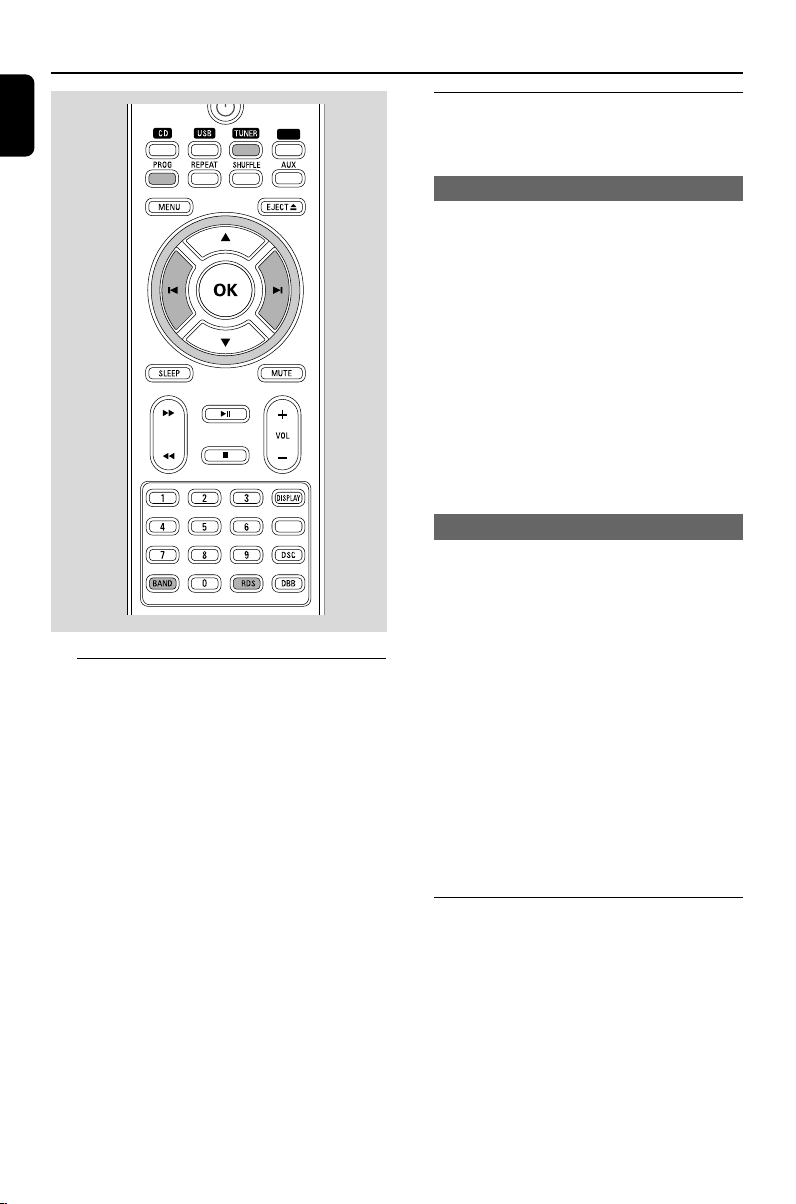
1 Press SOURCE repeatedly (or TUNER on the
remote control) to select the tuner source.
2 Press BAND on the remote control to select
the desired waveband : FM or AM.
3 Hold S/T (or 5 /6 on the remote
control) and then release the button.
➜ The system will start searching for a radio
station with sufficient signal strength.
4 Repeat step 3 if necessary until you find the
desired station.
● To tune to a weak station, press S/T (or
5 /6 on the remote control) briefly and
repeatedly until you have found optimal
reception.
Programming radio stations
You can store up to a total of 20 radio stations
for each band in the memory.
Automatic programming
Automatic programming will start with a chosen
preset number. From this preset number
upwards, former programmed radio stations will
be overridden.
1 Press ALBUM/PRESET +/- (or ¡ / ™ on the
remote control) to select the preset number
where programming should start.
Note:
– If no preset number is selected, default is preset
(1) and all your presets will be overridden.
2 Press PROG for more than two seconds to
activate programming.
➜ All available stations are programmed.
Manual programming
1 Tune to your desired station (refer to “Tuning to
radio stations”).
2 Press PROG to activate programming.
➜ PROG flashes in the display.
3 Press ALBUM/PRESET +/- (or ¡ / ™ on the
remote control) to allocate a number from 1 to
20 to this station.
4 Press PROG again to confirm the setting.
➜ PROG disappears, the preset number and
the frequency of the preset station are shown.
5 Repeat the above four steps to store other
stations.
● You can override a preset station by storing
another frequency in its place.
Tuning to preset radio stations
● Press ALBUM/PRESET +/- (or 3 / 4 on the
remote control) until the desired preset station
is displayed.
TIMER
iPod
pg001-028_DCM230_37-Eng 2010.3.31, 15:0220

English
21
External Sources
Using a non-USB device
1
Connect the audio out terminals of the external
equipment (TV, VCR, Laser Disc player, DVD
player or CD Recorder) to the AUX terminals of
your system.
2 Press SOURCE repeatedly (or AUX on the
remote control) to select external equipment.
Notes:
– All the sound control features (DSC or DBB, for
example) are available for selection.
– Refer to the operating instructions for the
connected equipment for details.
Using a USB mass storage device
By connecting a USB mass storage device to the
Hi-Fi system, you can enjoy the device's stored
music through the powerful speakers of the Hi-Fi
system.
Playing a USB mass storage device
Compatible USB mass storage devices
With the Hi-Fi system, you can use:
– USB flash memory (USB 2.0 or USB1.1)
– USB flash players (USB 2.0 or USB1.1)
– memory cards (requires an additional card
reader to work with this Hi-Fi system)
Notes:
– In some USB flash players (or memory devices),
the stored contents are recorded using copyright
protection technology. Such protected contents will
be unplayable on any other devices (such as this
Hi-Fi system).
– Compatibility of the USB connection on this
product:
a) This product supports most USB Mass storage
devices (MSD) that are compliant to the USB
MSD standards.
i) Most common Mass storage class devices are
flash drives, memory sticks, jump drives and etc.
ii) If you see a "Disc Drive" show up on your
computer after you plugged the mass storage
device into your computer, most likely it is MSD
compliant and it will work with this product.
b) If your Mass storage device required a battery/
power source. Please make sure you have a fresh
battery in it or charge the USB device first and
then plug it into the product again.
– Supported Music type:
a) This device only supports unprotected music
with the following file extension:
.mp3
.wma
b) Music bought from on-line music stores are not
supported because they are secured by Digital
Rights Management protection (DRM).
c) File name extensions that end with the
following are not supported:
.wav; .m4a; .m4p; mp4; .aac and etc.
– No Direct connection can be made from
Computer USB port to the product even you have
either or both mp3 or wma files in your computer.
Supported formats:
– USB or memory file format FAT12, FAT16,
FAT32 (sector size: 512 bytes)
– MP3 bit rate (data rate): 32-320 Kbps and
variable bit rate
– WMA v9 or earlier
– Director y nesting up to a maximum of 8
levels
– Number of albums/ folders: maximum 99
– Number of tracks/titles: maximum 400
– ID3 tag v2.0 or later
– File name in Unicode UTF8 (maximum length:
128 bytes)
The system will not play or support the
following:
– Empty albums: an empty album is an album
that does not contain MP3/WMA files, and
will not be shown in the display.
– Non-suppor ted file formats are skipped. This
means that e.g.: Word documents .doc or
MP3 files with extension .dlf are ignored and
will not be played.
–AAC , WAV, PCM audio files
– DRM protected WMA files
– WMA files in Lossless format
pg001-028_DCM230_37-Eng 2010.3.31, 15:0221
22
English
External Sources
How to transfer music files from PC to a
USB mass storage device
By dragging and dropping music files, you can
easily transfer your favorite music from PC to a
USB mass storage device.
For the flash player, you can also use its music
management software for the music transfer.
However, those WMA files may be
unplayable for compatibility reasons.
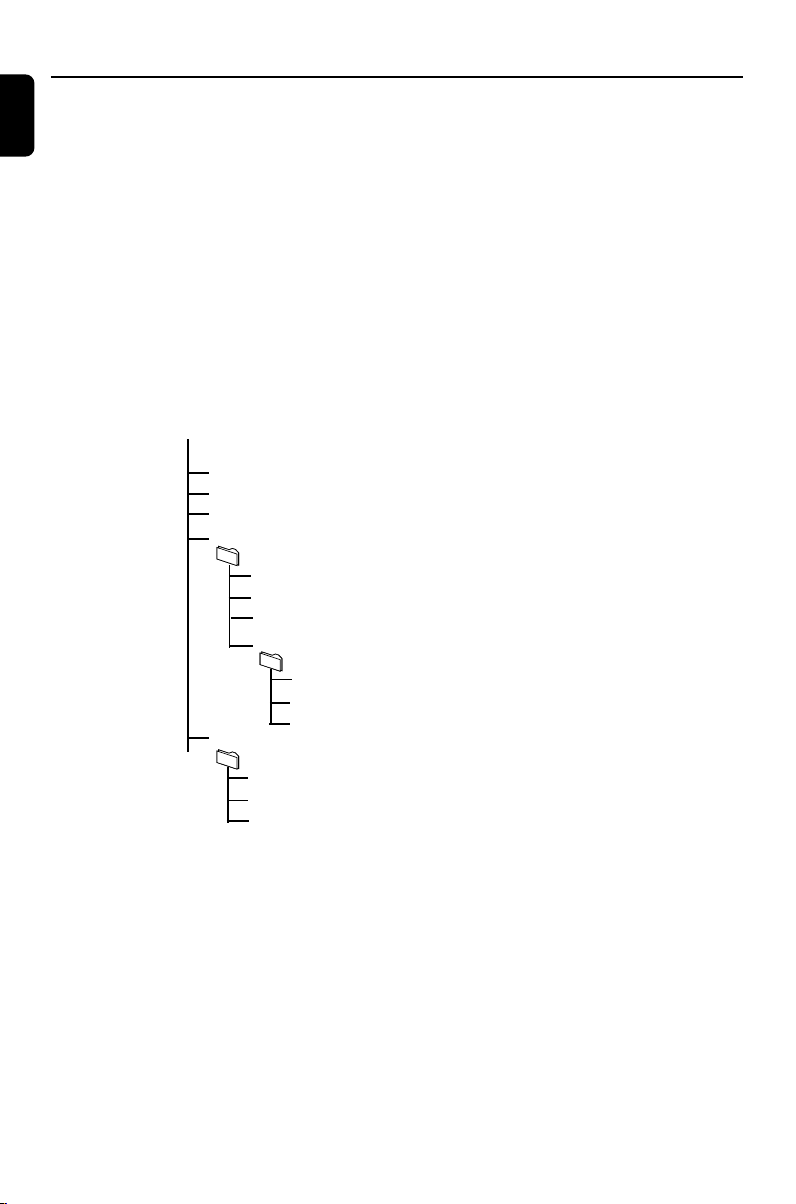
How to organize your MP3/WMA files on
the USB mass storage device
This Hi-Fi system will browse the MP3/WMA
files in the folders/sub-folders/titles order.
Example:
Root
Title 001
Title 002
Title 003
Album 01
Title 001
Title 002
Title 003
Album 02
Title 001
Title 002
Title 003
Album 03
Title 001
Title 002
Title 003
Organize your MP3/WMA files in different
folders or subfolders as required.
Notes:
– If you have not organized MP3/WMA files into
any albums on your disc, an album "01" will be
automatically assigned for all those files.
– Make sure that the file names of MP3 files end
with .mp3. and the file names of WMA files end
with .wma.
–For DRM protected WMA files, use Windows
Media Player 10 (or later) for conversion. Visit
www.microsoft.com for details about Windows
Media Player and WM DRM (Windows Media
Digital Rights Management).
1 Check the USB device has been properly
connected. (See Installation: Connecting an
additional appliance).
2 Press SOURCE (USB on the remote) once or
more to select USB.
– NO FILE appears if no audio file is found in
the USB device.
3 Play the USB's audio files as you do with the
albums/tracks on a CD (See CD/MP3
Operations).
Notes:
–For compatibility reasons, the album/track
information may differ from what it is displayed
through flash players' music management software.
– File names or ID3 tags will be displayed as --- if
they are not in English.
pg001-028_DCM230_37-Eng 2010.3.31, 15:0222
English
23
Clock/Timer
Clock setting
The clock can be set in either 12-hour or
24-hour mode (12HR or 24HR for example).
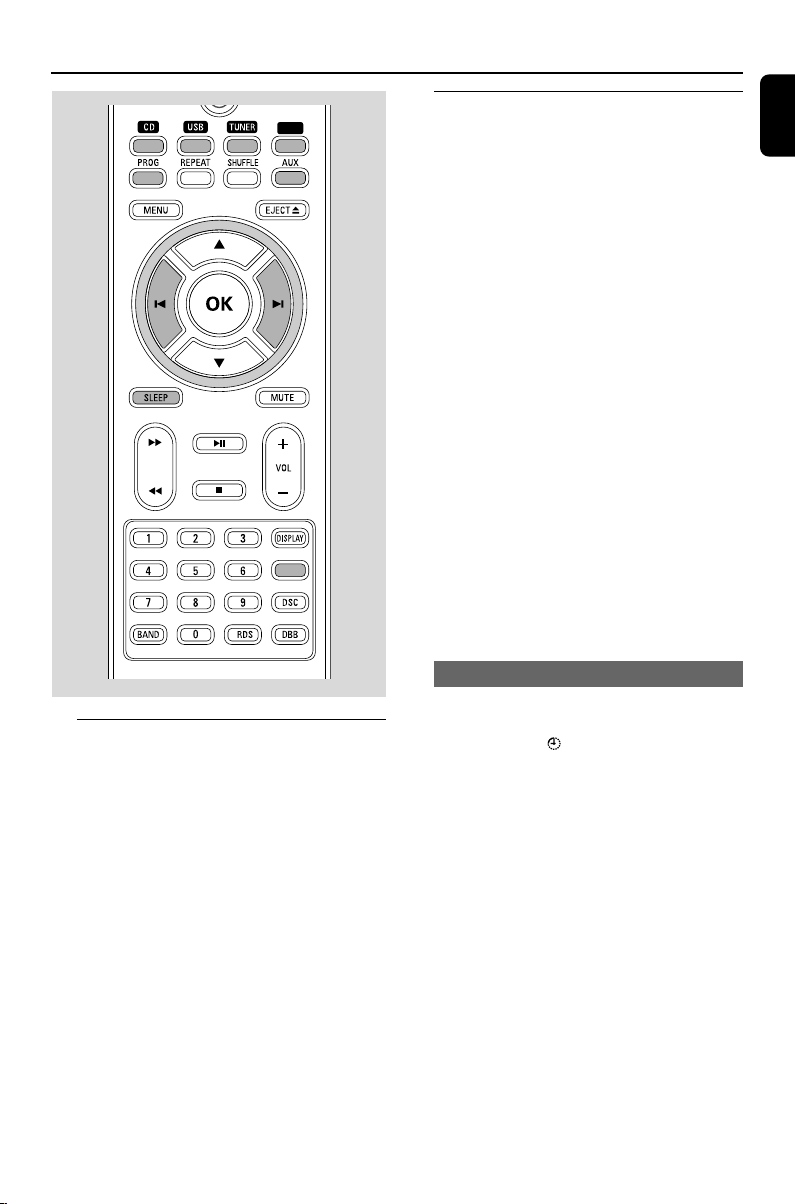
1 In standby mode, press PROG.
➜ SET CLOCK is displayed briefly. Then, 12HR
or 24HR is displayed.
2 Press ALBUM/PRESET +/- (or ¡ / ™ on the
remote control) to select clock mode.
➜ The clock digits for the hours continue to
flash.
3 Press ALBUM/PRESET +/- (or ¡ / ™ on the
remote control) to set the hours.
4 Press PROG again.
➜ The clock digits for the minutes flash.
5 Press ALBUM/PRESET +/- (or ¡ / ™ on the
remote control) to set the minutes.
6 Press PROG to confirm the time.
Timer setting
● The system can be used as an alarm clock,
whereby the CD, TUNER, USB or DOCK is
switched on at a set time (one time operation).
The clock time needs to be set first before the
timer can be used.
● During setting, if no button is pressed within 90
seconds, the system will exit timer setting mode
automatically.
1 Press TIMER for more than two seconds.
2 Press SOURCE repeatedly to select the sound
source.
➜ “SET TIMER” and “SELECT SOURCE” are
displayed.
3 Press TIMER to confirm your desired mode.
➜ The clock digits for the hours flash.
4 Press ALBUM/PRESET +/- (or ¡ / ™ on the
remote control) to set the hours.
5 Press TIMER again.
➜ The clock digits for the minutes flash.
6 Press ALBUM/PRESET +/- (or ¡ / ™ on the
remote control) to set the minutes.
7 Press TIMER to confirm the time.
➜ The timer is now set and activated.
Activating and deactivating timer
● In standby or during playback, press TIMER
once on the remote control.
➜ Display shows if activated, and disappears if
deactivated.
TIMER
iPod
pg001-028_DCM230_37-Eng 2010.3.31, 15:0223

24
English
Sleep timer setting
The sleep timer enables the system to switch off
by itself after a set period of time.
1 Press SLEEP on the remote control repeatedly
to select a preset time.
➜ The selections are as follows (time in
minutes):
OFF ™ 90 ™ 75 ™ 60 ™ 45 ™ 30 ™ 15 ™
OFF ™ 90 …
➜ "SLEEP XX" is displayed. "XX" is the time in
minutes.
➜ is displayed if the sleep time you have
selected is not OFF.
2 When you reach the desired length of time, stop
pressing the SLEEP button.
To deactivate the sleep timer
● Press SLEEP repeatedly until "0FF" is displayed,
or press ECO POWER/STANDBY ON 2.
Clock/Timer
pg001-028_DCM230_37-Eng 2010.3.31, 15:0224
English
25
Compatible iPod players
● Most Apple iPod models with 30-pin dock
connectors as follows: Nano 1st /2nd/3rd
generation, iPod 5th generation (video), iPod
touch and iPod classic.
Selecting the correct dock
adaptor
● 4 iPod dock adaptors of different type, as
indicated at the back of the adaptor, are included
to fit the following iPod:
Nano 1st /2nd/3rd generation, iPod 5th
generation (video), iPod touch and iPod classic.
Setup
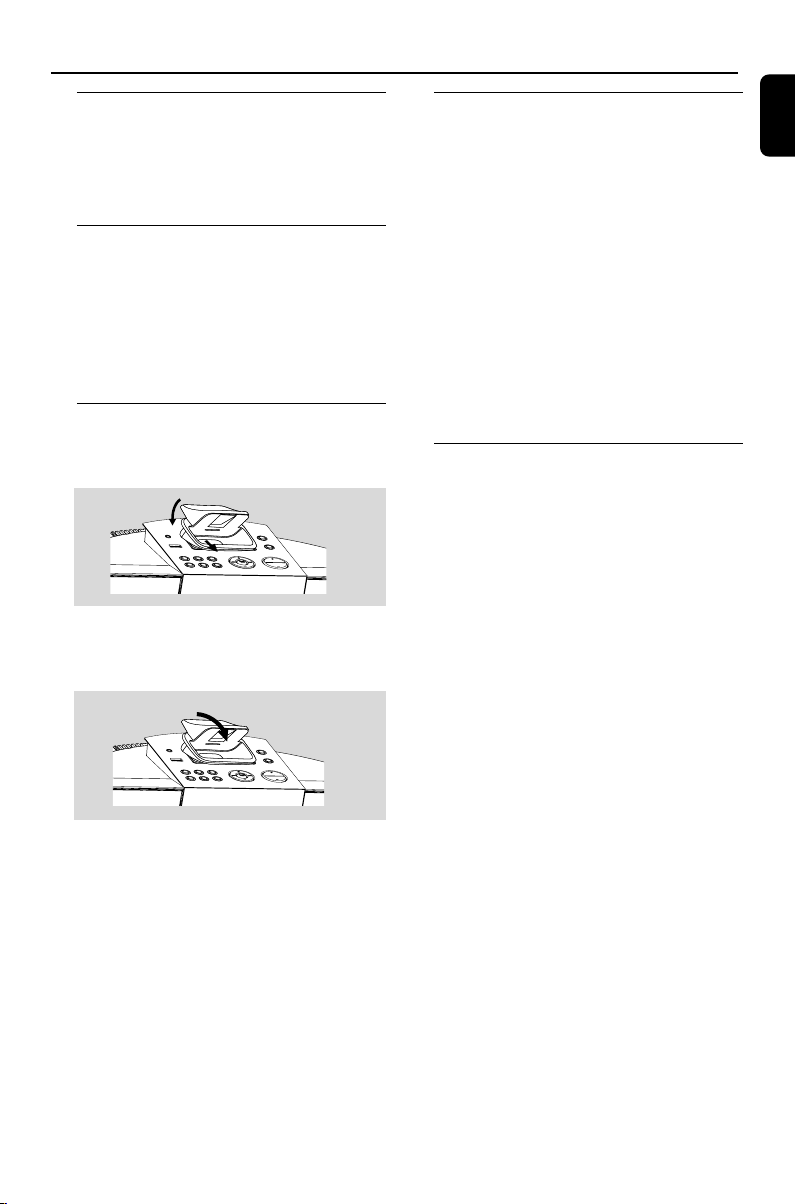
● Insert a dock adaptor corresponding to the
portable player you use.
2
11
● To connect with a different iPod portable player,
pop up the corresponding dock adaptor and
replace with a new one of the matching type.
iPod Dock
Playing an iPod portable player
1 Correctly dock your iPod por table player in the
cradle. Make sure the dock adaptor is
compatible.
● Make sure that you have powered on your iPod
player before selecting DOCK source.
➜ On the display, "iPod" is displayed if iPod is
connected.
2 Press SOURCE on the system repeatedly or
iPod on the remote control to select iPod
source.
3 Playback starts automatically. You can select
available features (such as play/pause, skip track,
fast forward/backward, menu selection) during
playback.
Charging iPod battery using the
dock
● In DOCK mode, directly dock your iPod
portable player on the cradle for charging.
Note:
–For the purpose of SAVING POWER, recharging
of your iPod or USB device is NOT SUPPORTED
when the main set is in the STANDBY MODE.
pg001-028_DCM230_37-Eng 2010.3.31, 15:0225
26
English
Cleaning the Cabinet
● Use a soft cloth slightly moistened with a mild
detergent solution. Do not use a solution
containing alcohol, spirits, ammonia or abrasives.
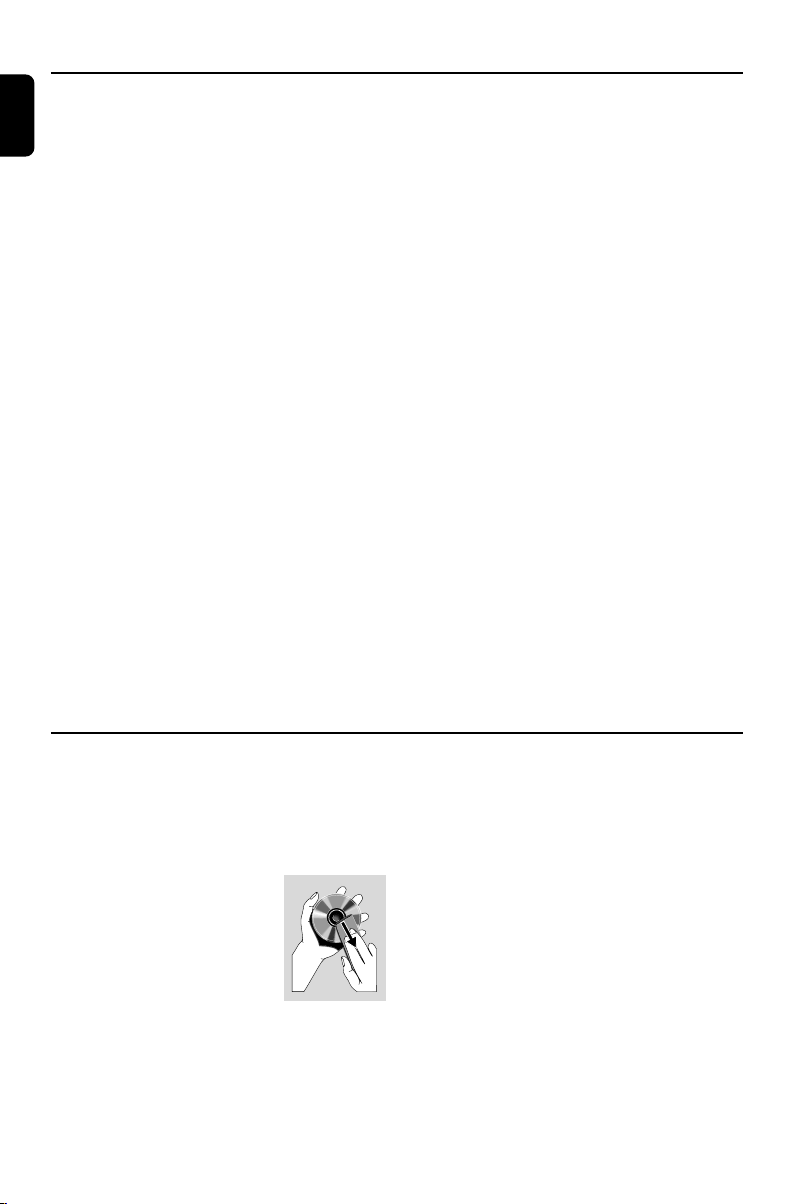
Cleaning Discs
● When a disc becomes dirty,
clean it with a cleaning cloth.
Wipe the disc from the centre
out.
● Do not use solvents such as
benzene, thinner, commercially
available cleaners, or antistatic spray intended for
analogue records.
Cleaning the disc lens
● After prolonged use, dirt or dust may
accumulate at the disc lens. To ensure good
playback quality, clean the disc lens with Philips
CD Lens Cleaner or any commercially available
cleaner. Follow the instructions supplied with
cleaner.
Maintenance
Specifications
AMPLIFIER
Output power ....................................... 2 x 15 W RMS
Signal-to-noise ratio ....................................... ≥ 70 dBA
Frequency response ...... 20 Hz – 20 KHz, ± 3 dB
Input sensitivity AUX ....................... 0.5 V (max. 2 V)
Impedance loudspeakers ......................................... 4 Ω
Impedance headphones ........................................ 32 Ω
Output power headphones ....................... <50 mW
CD PLAYER
Frequency range ................................ 20 Hz – 20 kHz
Signal-to-noise ratio ............................................ 70 dBA
TUNER
FM wave range ................................... 87.5 – 108 MHz
Sensitivity at 75 Ω
– FM ................................................................................ 20dBf
Selectivity ................................................................. ≥ 25 dB
Total harmonic distortion ..................................... ≤ 1%
Frequency response
– FM .............................................................. 63 – 6000 Hz
Signal-to-noise-ratio
– FM ....................................................................... ≥ 50 dBA
USB PLAYER
USB ................................................................... 12Mb/s, V1.1
......................................... support MP3 and WMA files
Number of albums/folders ................. maximum 99
Number of tracks/titles ...................... maximum 400
GENERAL INFORMATION
AC Power ................................. 100 – 240 V, 50/60 Hz
Dimensions (w x h x d) ....................................................
.............................................. 390 x 140.5 x 200.5 (mm)
Weight ....................................................................... 2.33 kg
Standby power consumption ............................ <7 W
Eco power standby ................................................. <1 W
Specifications and external appearance are
subject to change without notice.
pg001-028_DCM230_37-Eng 2010.3.31, 15:0226

English
27
Troubleshooting
WARNING
Under no circumstances should you try to repair the system yourself, as this will invalidate the
warranty. Do not open the system as there is a risk of electric shock.
If a fault occurs, first check the points listed below before taking the system for repair. If you
are unable to remedy a problem by following these hints, consult your dealer or Philips for
help.
“PLEASE INSERT CD/MP3 DISC” is
displayed.
Radio reception is poor.
The system does not react when buttons
are pressed.
Sound cannot be heard or is of poor
quality.
The remote control does not function
properly.
The timer is not working.
The Clock/Timer setting is erased.
✔ Insert a disc.
✔ Check if the disc is inserted upside down.
✔ Wait until the moisture condensation at the lens
has cleared.
✔ Replace or clean the disc, see “Maintenance”.
✔ Use a finalised CD-RW or correct format disc.
✔ If the signal is too weak, adjust the antenna or
connect an external antenna for better
reception.
✔ Increase the distance between the Micro HiFi
System and your TV or VCR.
✔ Remove and reconnect the AC power plug and
switch on the system again.
✔ Adjust the volume.
✔ Disconnect the headphone.
✔ Select the source (CD or TUNER, for example)
before pressing the function button (ÉÅ, 5 /
6).
✔ Reduce the distance between the remote
control and the system.
✔ Insert the battery with its polarities
(+/– signs) aligned as indicated.
✔ Replace the battery.
✔ Point the remote control directly toward
IR sensor on the front of the system.
✔ Set the clock correctly.
✔ Switch on the timer.
✔ Power has been interrupted or the power cord
has been disconnected. Reset the clock/timer.
Problem
Solution
pg001-028_DCM230_37-Eng 2010.3.31, 15:0227

28
English
Troubleshooting
Some files on the USB device are not
displayed.
“DEVICE NOT SUPPORTED” scrolls on the
display.
✔ Check if the number of folders exceeds 99 or
the number of titles exceeds 400.
✔ Remove the USB mass storage device or select
another source.
Problem
Solution
pg001-028_DCM230_37-Eng 2010.3.31, 15:0228
English
Français
Por tuguês
Español
Deutsch
Nederlands
Italiano
Svenska
Dansk
Suomi
Polski
Printed in China DCM230_37_UM_V2.0
CLASS 1
LASER PRODUCT
Philips Consumer Lifestyle
A division of Philips Electronics North America Corporation
P.O. Box 10313
Stamford, CT 06904
Phone: 1-888-PHILIPS (744-5477)
Meet Philips at the Internet
http://www.philips.com/welcome
DCM230
© 2010 Koninklijke Philips Electronics N.V.
All rights reserved.
PageBack_DCM230-37 2010.3.30, 16:40262