BEFORE YOU BEGIN
Read these instructions completely and carefully.
•
IMPORTANT – Save these instructions for local
electrical inspector’s use.
•
IMPORTANT – Observe all governing codes and
ordinances.
•
Install the clothes dryer according to the manufacturer’s
instructions and local codes.
•
Note to Installer – Be sure to leave these instructions
with the Consumer.
•
Note to Consumer – Keep these instructions for future
reference.
•
Clothes dryer installation must be performed by a
qualified installer.
•
This dryer must be exhausted to the outdoors.
•
Before the old dryer is removed from service or
discarded, remove the dryer door.
•
Service information and the wiring diagram are located
in the control console.
•
Do not allow children on or in the appliance. Close
supervision of children is necessary when the appliance
is used near children.
•
Proper installation is the responsibility of the installer.
•
Product failure due to improper installation is not
covered under the Warranty
.
• Install the dryer where the temperature is above 50°F
for satisfactory operation of the dryer control system.
• Removeanddiscardexistingplasticormetalfoilduct
and replace with UL-listed duct.
Questions? Call 800.561.3344 or visit our Web site at: GEAppliances.ca
WARNING
Fire Hazard
- Fire Hazard
WARNING
• Clothes dryer installation must be performed by a
qualified installer.
•
Install the clothes dryer according to these
instructions and local codes.
•
DO NOT install a clothes dryer with flexible plastic
venting materials. If flexible metal (semi-rigid or
foil-type) duct is installed, it must be UL-listed and
installed in accordance with the instructions found
in “Connecting the Dryer to House Vent” later in
this manual. Flexible vent materials are known to
collapse, be easily crushed and trap lint. These
conditions will obstruct dryer airflow and increase
the risk of fire.
•
DO NOT install or store this appliance in any
location where it could be exposed to water or
weather.
•
To reduce the risk of severe injury or death, follow
all installation instructions.
•
Save these instructions. (Installers: Be sure to leave
these instructions with the customer.)
Installation Gas Dryers
Instructions
02
This is the safety alert symbol. This symbol alerts you to potential hazards that can kill you or hurt you and others.
Allsafetymessageswillfollowthesafetyalertsymbolandtheword“DANGER”,“WARNING”,or“CAUTION”.These
words are defined as:
Indicates a hazardous situation which, if not avoided, will result in death or serious injury.
Indicates a hazardous situation which, if not avoided, could result in death or serious injury.
Indicates a hazardous situation which, if not avoided, could result in minor or moderate injury.
DANGER
WARNING
CAUTION
Printed in Mexico
D
E
S
I
G
N
C
E
R
T
I
F
I
E
D
29-5973 03-15 MC
234D1753P008
Installation Instructions
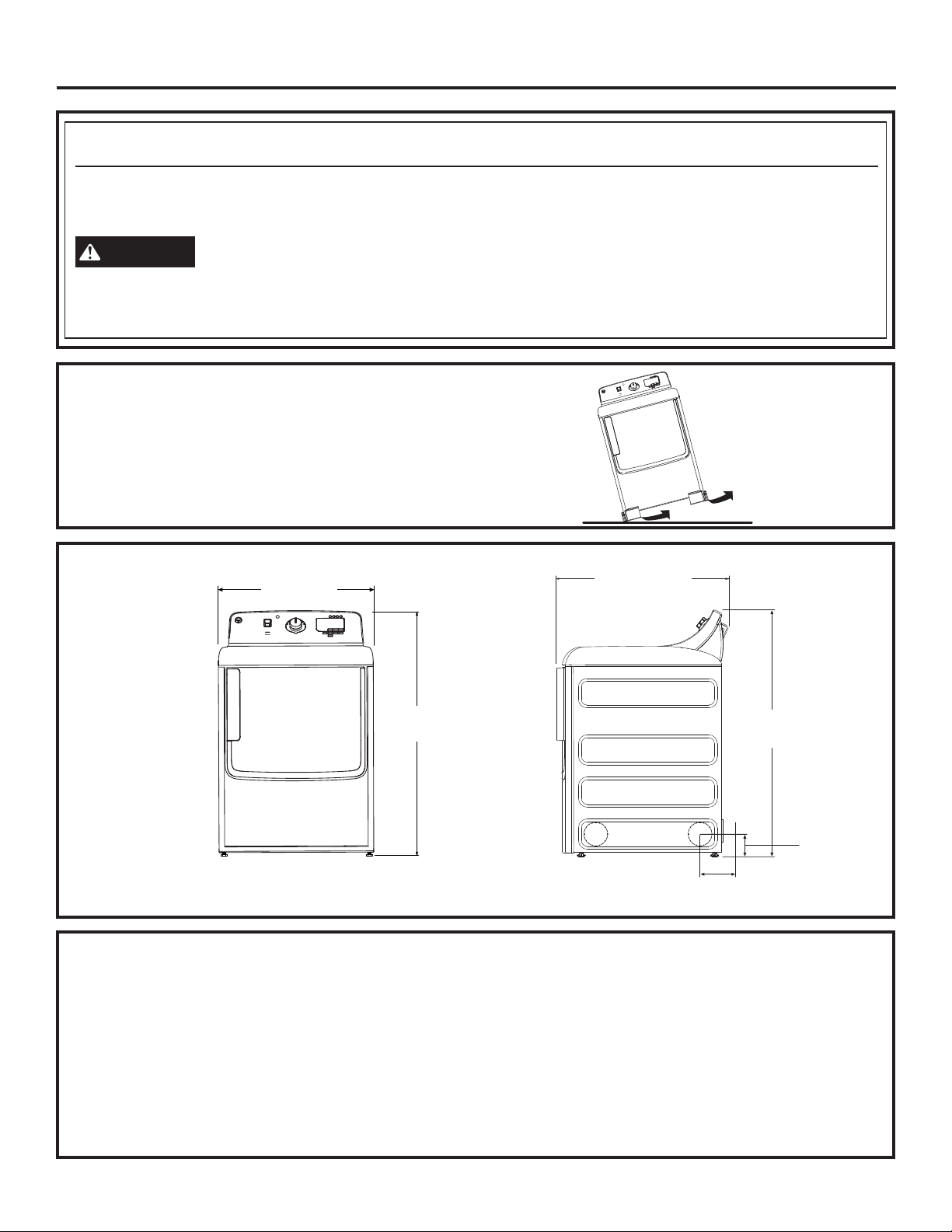
Tilt the dryer sideways and remove the foam
shipping pads by pulling at the sides and breaking
them away from the dryer legs. Be sure to remove all
of the foam pieces around the legs.
Removethebagcontainingtheliterature.
UNPACKING YOUR DRYER
STEAM WATER HOSES:
GE strongly recommends the use of factory specified parts.
These hoses are manufactured and tested to meet GE
specifications.
GE strongly recommends the use of new water supply hoses.
Hoses degrade over time and need to be replaced every 5
years to reduce the risk of hose failures and water damage.
Parts and Accessories
Visit your local authorized GE Parts distributor or order by phone
at 800.661.1616 during normal business hours.
Part Number Accessory
WE25X20060 Complete kit (hoses, Y-adapter
washers) (included)
OR
WE1M847 Long hose and
WE01X22395 Short hose
PM14X10056 Dryer door opening vent brush
(not included)
WX14X10007 LintEater™ dryer rotary tube brush
(not included)
2
ROUGH-IN
DIMENSIONS
State of California Proposition 65 Warnings:
The California Safe Drinking Water and Toxic Enforcement Act requires the governor of California to publish a list of substances
known to the state to cause cancer, birth defects or other reproductive harm and requires businesses to warn of potential exposure
to such substances.
WARNING
This product contains one or more chemicals known to the State of California to cause cancer, birth defects or
other reproductive harm.
Gas appliances can cause low-level exposure to some of these substances, including benzene, carbon monoxide, formaldehyde and
soot, caused primarily by the incomplete combustion of natural gas or LP fuels. Exposure to these substances can be minimized by
properly venting the dryer to the outdoors.
3 1/2”
(8.9 cm)
Side ViewFront View
32” (81.3 cm)
44 1/2”
(113 cm)
28”
(71.1 cm)
44 1/2”
(113 cm)
5 3/4”
(14.6 cm)
Installation Instructions
REQUIREMENTS FOR ALCOVE OR
CLOSET INSTALLATION
MOBILE OR MANUFACTURED HOME
INSTALLATION
3
- Explosion Hazard
WARNING
Keep flammable materials and vapors, such as gasoline,
away from dryer.
Place dryer at least 18” (46 cm) above the floor for a
garage installation.
Failure to do so can result in death, explosion, or fire.
• Installation must conform to the
MANUFACTUREDHOMECONSTRUCTIONAND
SAFETYSTANDARD,TITLE24,PART32–80or
Standard CAN/CSA-Z240 MH, or, when such
standardisnotapplicable,withAMERICAN
NATIONALSTANDARDFORMOBILEHOME,
ANSI/NFPA NO. 501B.
•
The dryer MUST be vented to the outdoors. The
exhaust vent must be securely fastened to a
non-combustible portion of the mobile home.
•
The vent MUST NOT be terminated beneath a
mobile or manufactured home.
•
The vent duct material MUST BE METAL.
•
KIT 14-D346-33 MUST be used to attach the dryer
securely to the structure.
•
The vent MUST NOT be connected to any other
duct, vent or chimney.
•
Do not use sheet metal screws or other
fastening devices which extend into the interior
of the exhaust vent.
•
Provide an opening with a free area of at least
25 square inches for introduction of outside air
into the dryer room.
•
See the sections for electrical connection
information.
•
If the dryer is approved for installation in an
alcove or closet, it will be stated on a label on the
dryer back.
•
The dryer MUST be vented to the outdoors. See
theEXHAUSTINGTHEDRYERsection.
• Minimum clearance between dryer cabinet and
adjacent walls or other surfaces is:
0” either side
3” front
3” rear
• Minimum vertical space from dryer to overhead
shelves, cabinets, ceilings, etc., is 1” on top.
•
Consideration must be given to provide adequate
clearance for installation and service.
•
Closet doors must be louvered or otherwise
ventilated and have at least 60 square inches of
open area. If the closet contains both a washer
and a dryer, doors must contain a minimum of
120 square inches of open area.
NOTE: WHEN THE EXHAUST DUCT IS LOCATED IN
THEREAROFTHEDRYER,THECONFIGURATIONOF
THEDUCTINGMAYREQUIREGREATERTHAN3”OF
REARCLEARANCE.
MINIMUM CLEARANCE OTHER THAN
ALCOVE OR CLOSET INSTALLATION
Minimum clearance to combustible surfaces and
for air opening are: 0” both sides, 1” front and
3” rear. Consideration must be given to provide
adequate clearance for installation and service.
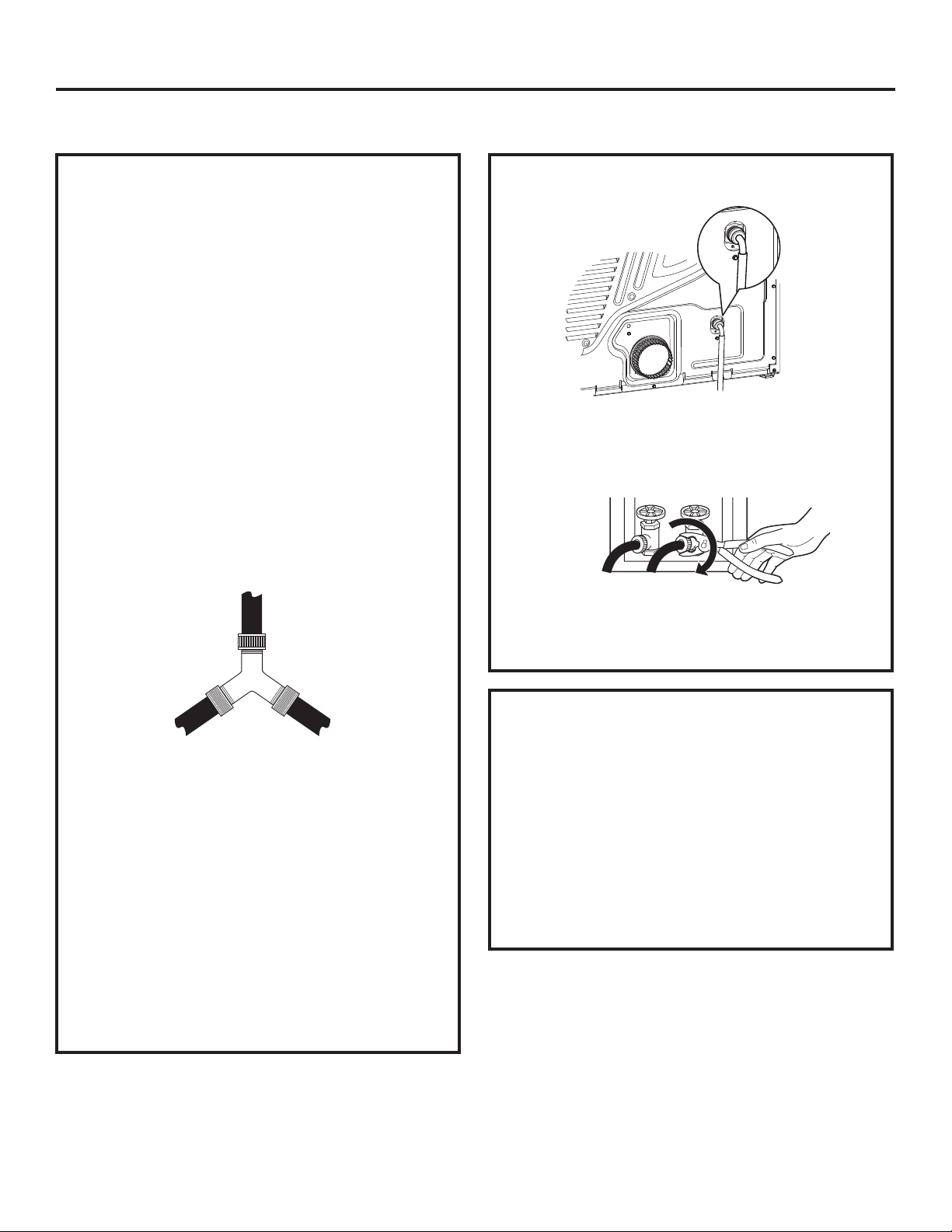
To produce steam, the dryer must connect to
the cold water supply. Since the washer must
also connect to the cold water, a “Y” connector
is inserted to allow both inlet hoses to make that
connection at the same time.
NOTE: Use the new inlet hoses provided; never use
old hoses.
1
.Turn the cold water faucet off. Remove the
washer inlet hose from the washer fill valve
connector (cold).
2
. Ensure the rubber flat washer is in place and
attach one female coupling of the short hose
onto the washer fill valve connector. Tighten by
hand until firmly seated.
3
. Attach one male end of the “Y” connector to the
other female coupling of the short hose. Ensure
the rubber flat washer is in place. Tighten by
hand until firmly seated.
4
. Insert the filter screen in the coupling of the
washer’s inlet hose. If a rubber flat washer is
already in place remove it before installing the
filter screen. Attach this coupling to one male end
of the ‘’Y’’ connector. Tighten by hand until firmly
seated.
5
. Ensure the rubber flat washer is in place and
attach the dryer’s long inlet hose to one male
end of the ‘’Y’’ connector. Tighten by hand until
firmly seated.
6
. Ensure the rubber flat washer is in place and
attach the other end of the dryer’s long inlet
hose to the fill valve connector at the bottom of
the dryer back panel. Tighten by hand until firmly
seated.
4
Installation Instructions
CONNECTING INLET HOSES
CONNECTING INLET HOSES CONNECTING INLET HOSES (cont.)
7. Using pliers, tighten all the couplings with an
additionaltwo–thirdsturn.
NOTE: Do not overtighten. Damage to the couplings
may result.
8.
Turn the water faucet on.
9. Check for leaks around the ‘’Y’’ connector, faucet
and hose couplings.
WATER SUPPLY REQUIREMENTS
Hot and cold water faucets MUST be installed
within 42 in. (107 cm) of your washer’s water
inlet. The faucets MUST be 3/4 in. (1.9 cm) garden
hose-type so inlet hoses can be connected. Water
pressure MUST be between 10 and 120 pounds
per square inch. Your water department can
advise you of your water pressure.
NOTE: A water softener is recommended to reduce
buildup of scale inside the steam generator if the
home water supply is very hard.
WATER
WATER
Installation Instructions
5
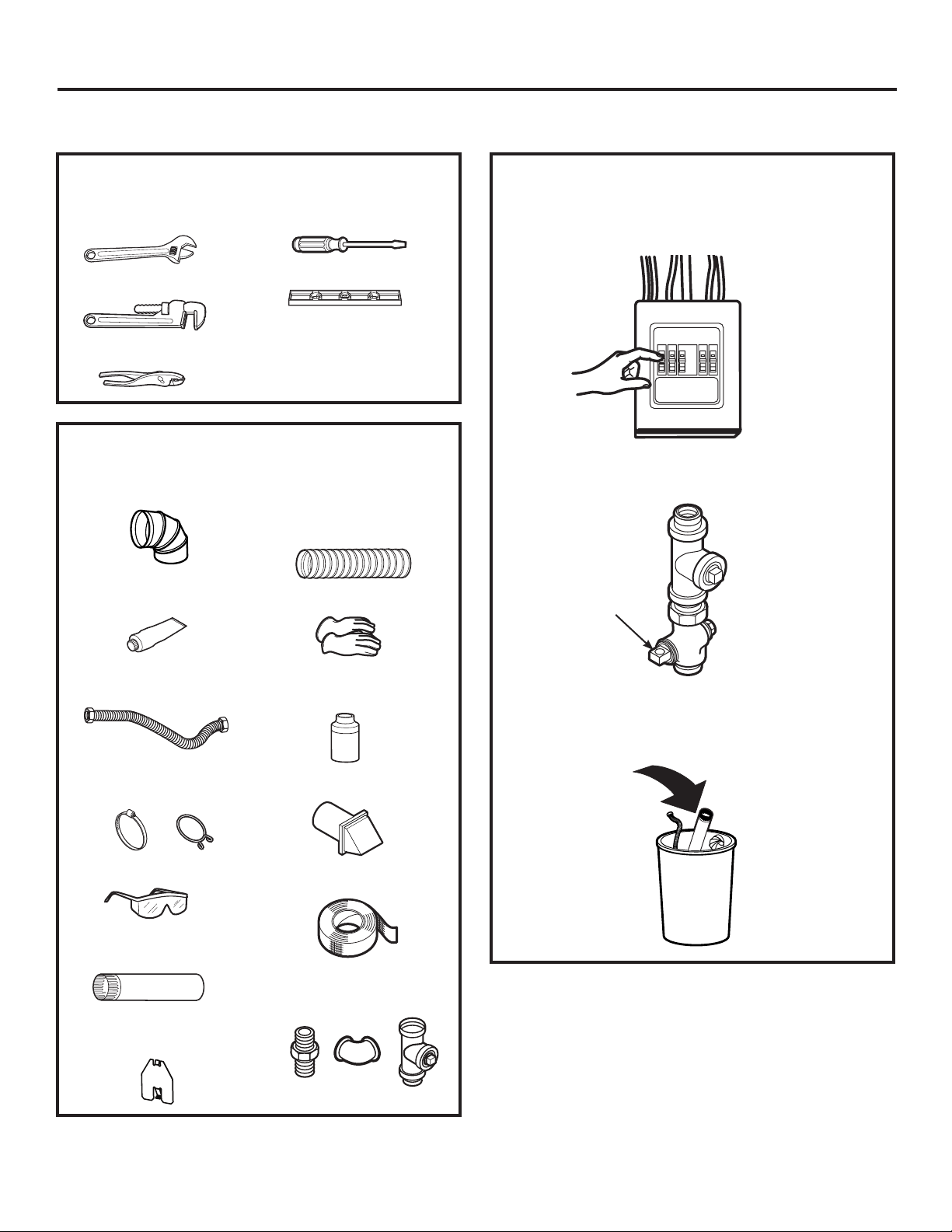
TOOLS YOU WILL NEED
CONNECTING A GAS DRYER
Before beginning the installation, turn off
the circuit breaker(s) or remove the dryer’s circuit
fuse(s) at the electrical box. Be sure the dryer cord
is unplugged from the wall.
Turn the dryer’s gas shut-off valve in the supply
line to the OFF position.
Disconnect and discard old flexible gas connector
and ducting material.
Shut-off
Valve
MATERIALS YOU WILL NEED
r 10” Adjustable
wrenches (2)
r
8” Pipe wrench
r
Flat-blade
screwdriver
r
Level
r
Slip-joint pliers
r 4” dia. metal elbow
r
Pipe compound or
PTFE tape
r
Flexible gas line
connector
r
Duct clamps (2) or
Spring clamps (2)
r
Safety glasses
r
4” dia. metal duct
(recommended)
r
4” Cover Plate (Kit
WE1M454)
r
4” dia., UL-listed
flexible metal duct
(if needed)
r
Gloves
r
Soap solution for
leak detection
r
Exhaust hood
r
Duct tape
r
Gas pipe adapters (2),
elbow and pipe plug
Installation Instructions
6
CONNECTING A GAS DRYER (cont.)
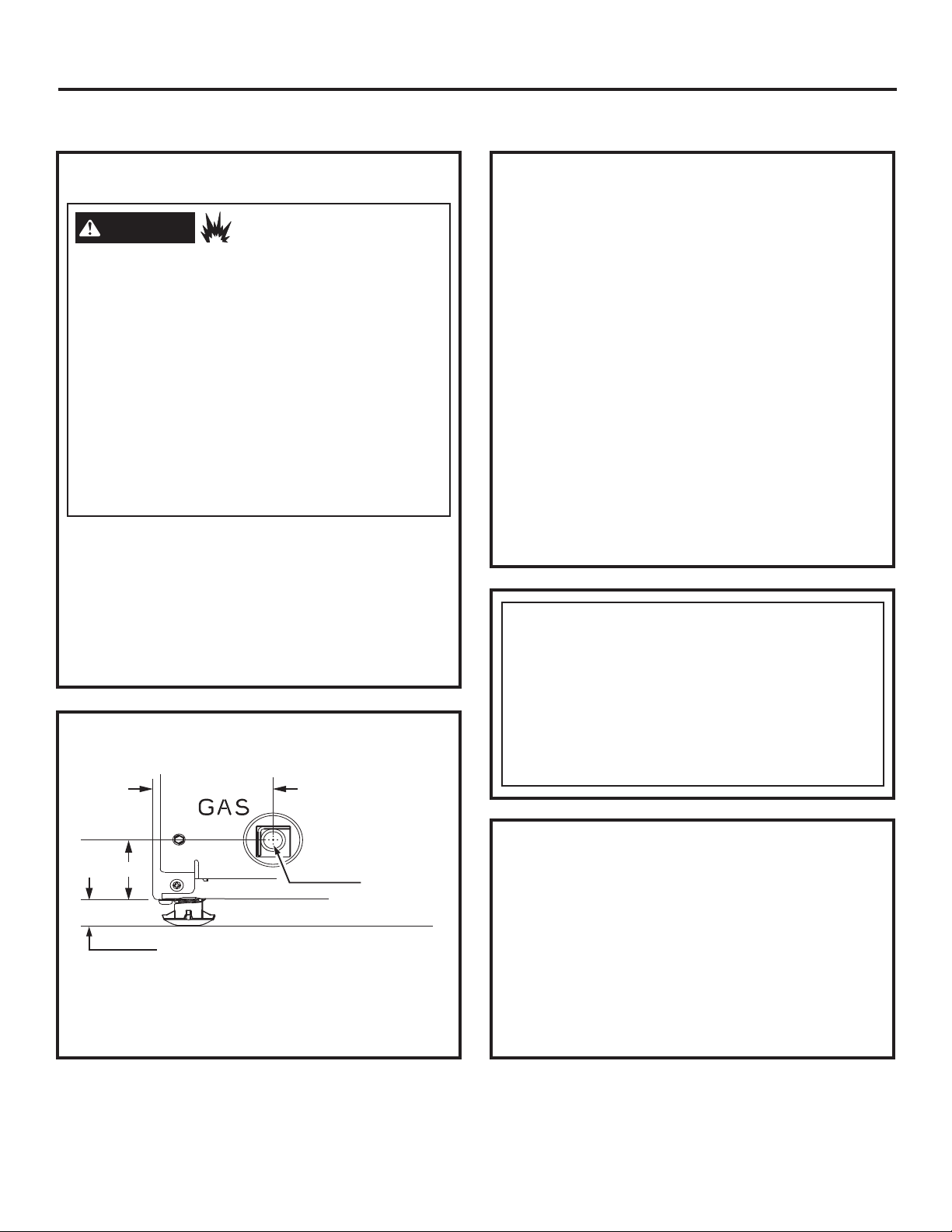
GAS REQUIREMENTS
DRYER GAS SUPPLY CONNECTION
GAS SUPPLY
• A 1/8” National Pipe Taper thread plugged
tapping, accessible for test gauge connection,
must be installed immediately upstream of the
gas supply connection to the dryer. Contact
your local gas utility should you have questions
on the installation of the plugged tapping.
•
Supply line is to be 1/2” rigid pipe and equipped
with an accessible shutoff within 6 feet of, and
in the same room with, the dryer.
•
Use pipe thread compound appropriate for
natural or LP gas or use PTFE tape.
•
Connect flexible metal connector to dryer and
gas supply.
•
The installation must conform with local codes,
or in the absence of local codes, with the
National Fuel Gas Code, ANSI Z223.1/NFPA 54,
or the Natural Gas and Propane Installation
Code, CSA B149.1.
IN THE COMMONWEALTH OF
MASSACHUSETTS
• This product must be installed by a licensed
plumber or gas fitter.
•
When using ball-type gas shut-off valves, they
shall be the T-handle type.
•
A flexible gas connector, when used, must not
exceed 3 feet.
ADJUSTING FOR ELEVATION
• Gas clothes dryers input ratings are based on
sea level operation and need not be adjusted
for operation at or below 2000 ft. elevation. For
operation at elevations above 2000 ft., input
ratings should be reduced at a rate of 4 percent
for each 1000 ft. above sea level.
•
Installation must conform to local codes and
ordinances or, in their absence, the NATIONAL
FUEL GAS CODE, ANSI Z223.
•Youmustusewiththisdryeraflexiblemetal
connector (listed connector ANSI Z21.24/CSA 6.10).
The length of the connect shall not exceed 3 ft.
- Explosion Hazard
WARNING
•Use a new CSA International approved flexible
gas supply line. Never reuse old flexible
connectors.
•Installashut-offvalve.
•Securelytightenallgasconnections.
•IfconnectedtoLPgas,haveaqualifiedperson
make sure gas pressure does not exceed 13”
water column.
•Examplesofaqualifiedpersoninclude:licensed
heating personnel, authorized gas company
personnel, and authorized service personnel.
•Failuretodosocanresultindeath,explosion,
or fire.
NOTE: Add to vertical dimension the
distance between cabinet bottom to floor
3-11/32
3/8 NPT MALE
SUPPLY
THREAD GAS
1-25/32”
•
This gas dryer is equipped with a Valve & Burner
Assembly for use only with natural gas. Using
conversion kit WE25X0217, your local service
organization can convert this dryer for use with
propane(LP)gas.ALLCONVERSIONSMUSTBE
MADEBYPROPERLYTRAINEDANDQUALIFIED
PERSONNELANDINACCORDANCEWITHLOCAL
CODESANDORDINANCEREQUIREMENTS.
Installation Instructions
7
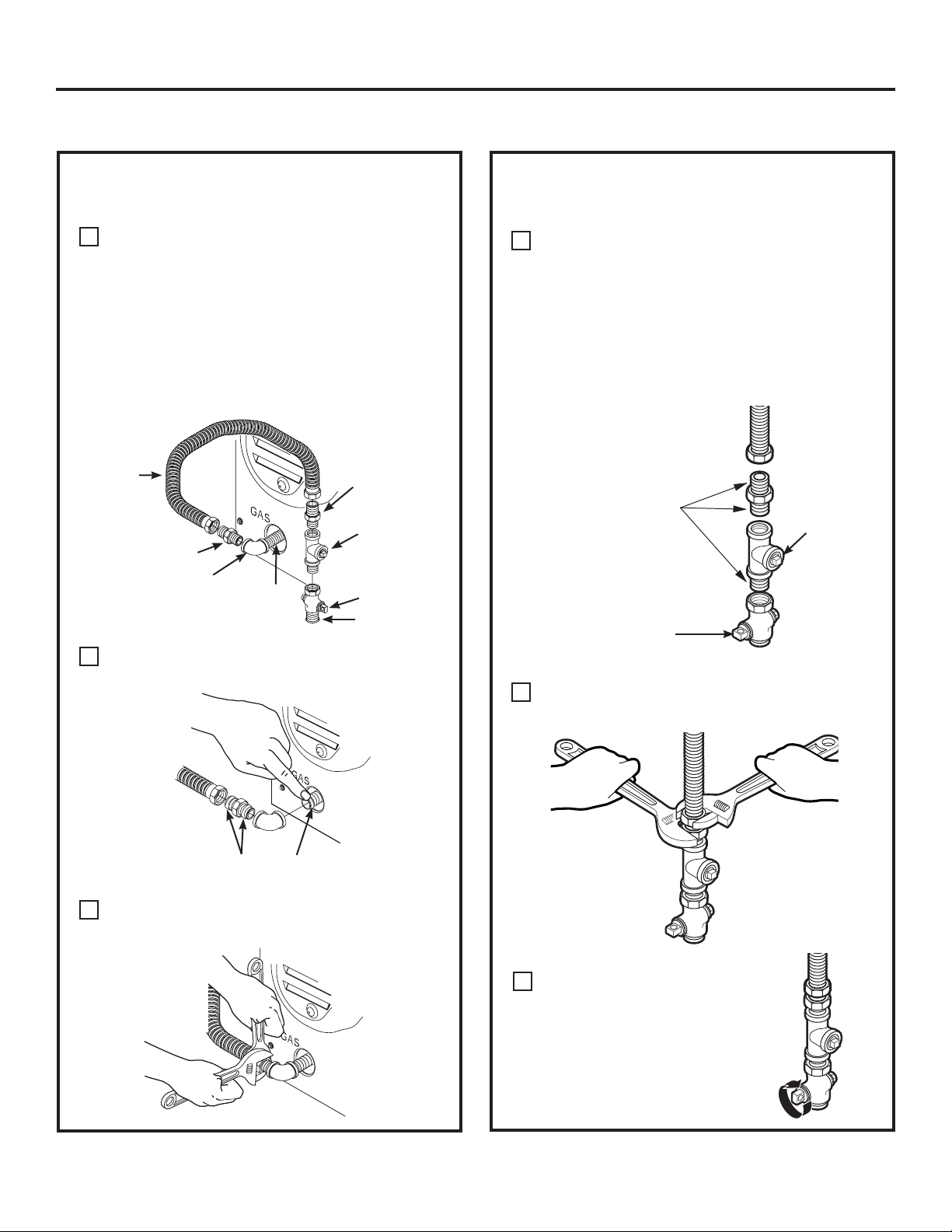
Install a 1/8” NPT plugged tapping to the dryer
gas line shut-off valve for checking gas inlet
pressure.
Install a flare union adapter to the plugged
tapping.
NOTE: Apply pipe compound or PTFE tape
to the threads of the adapter and plugged
tapping.
Attach the flexible metal gas line connector to
the adapter.
B
Tighten the flexible gas line connection, using
two adjustable wrenches.
C
D
Tighten all connections, using two adjustable
wrenches. Do not overtighten.
E
CONNECTING THE DRYER TO THE GAS
SUPPLY (cont.)
Open the gas shut-off valve.
F
Apply pipe compound
or PTFE tape to all
male threads.
Shut-Off
Valve
Plugged
Tapping
CONNECTING THE DRYER TO THE GAS
SUPPLY
Install a female 3/8” NPT elbow at the end of the
dryer gas inlet.
Install a 3/8” flare union adapter to the female
elbow.
IMPORTANT: Use a pipe wrench to securely hold
on to the end of the dryer gas inlet to prevent
twisting the inlet.
NOTE: Apply pipe compound or PTFE tape to the
threads of the adapter and dryer gas inlet.
A
Apply pipe compound to the
adapter and dryer gas inlet.
Elbow
Adapter
Items not supplied
Adapter
1/8” NPT
Pipe Plug for
Checking Gas
Inlet Pressure
Shut-Off Valve
Pipe size at
least 1/2”
3/8” NPT
New Metal
Flexible Gas
Line Connector
Installation Instructions
8
CONNECTING A GAS DRYER (cont.)
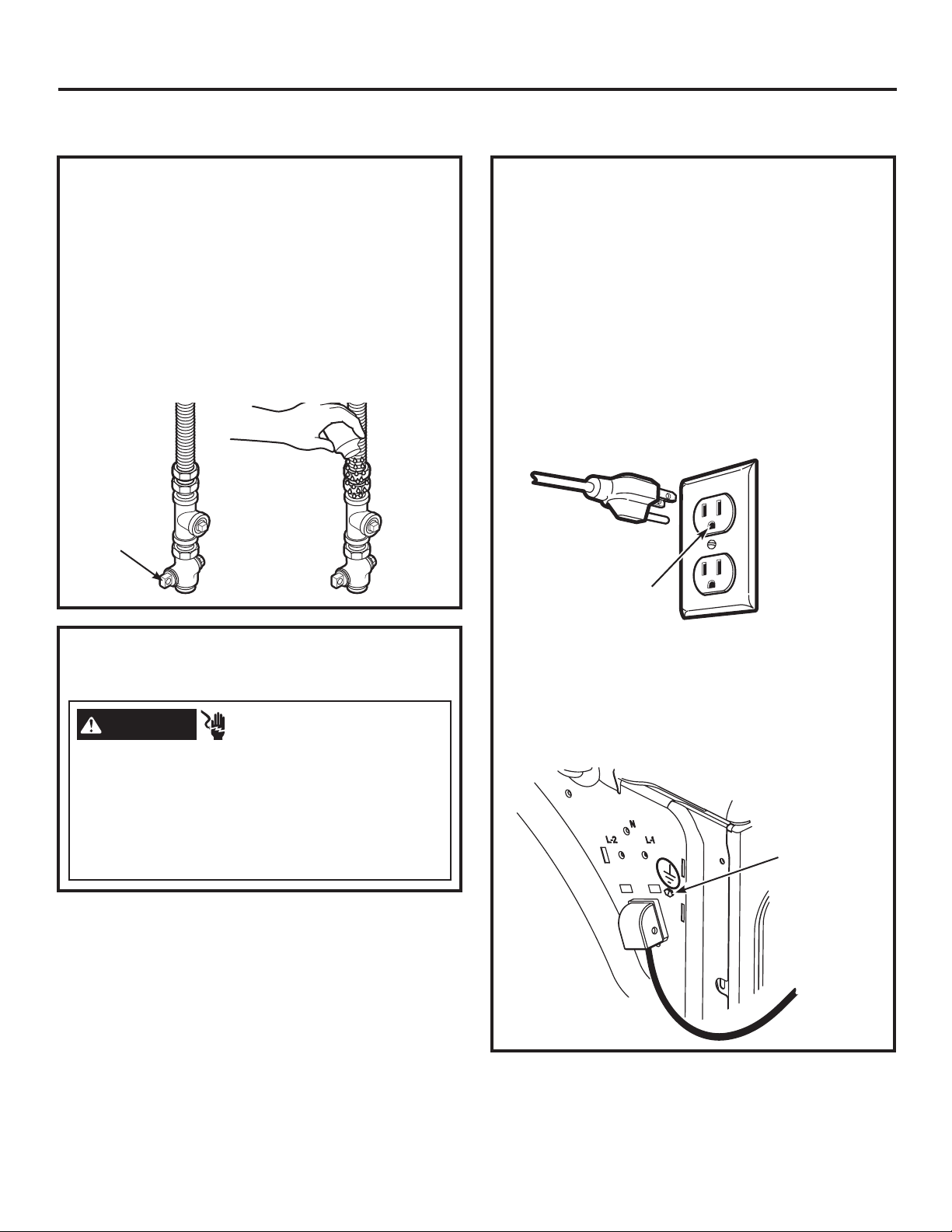
TEST FOR LEAKS
Never use an open flame to test for gas leaks.
Check all connections for leaks with soapy solution
or equivalent.
Apply a soap solution. The leak test solution must
not contain ammonia, which could cause damage
to the brass fittings.
If leaks are found, close the valve, retighten the
joint and repeat the soap test.
Open Gas
Valve
Ensure proper
ground exists
before use.
ELECTRICAL CONNECTION
INFORMATION FOR GAS DRYERS (cont.)
The dryer must be electrically grounded in
accordance with local codes, or in the absence of
local codes, with the National Electrical Code, ANSI/
NFPA 70 or Canadian Electrical Code, CSA C22.1
This appliance must be supplied with 120V, 60Hz,
and be connected to a properly grounded branch
circuit protected by a 15 or 20 amp circuit breaker
or time delay fuse. If electrical supply provided
does not meet these requirements, it is the owner’s
responsibility to have a licensed electrician install a
properly grounded 3-prong outlet.
If local codes permit an external ground wire
(not provided) may be added by attaching to the
green ground screw on the rear of the dryer, and
to a grounded metal cold water pipe or other
established ground.
ELECTRICAL CONNECTION
INFORMATION FOR GAS DRYERS
- Electrical Shock Hazard
WARNING
Plug into a grounded 3 prong outlet.
DO NOT remove ground prong.
DO NOT use an adapter.
DO NOT use an extension cord.
Failure to follow these instructions can result in
death, fire or electrical shock.
Ground
Screw
Installation Instructions
EXHAUSTING THE DRYER
WARNING
Fire Hazard
- Fire Hazard
WARNING
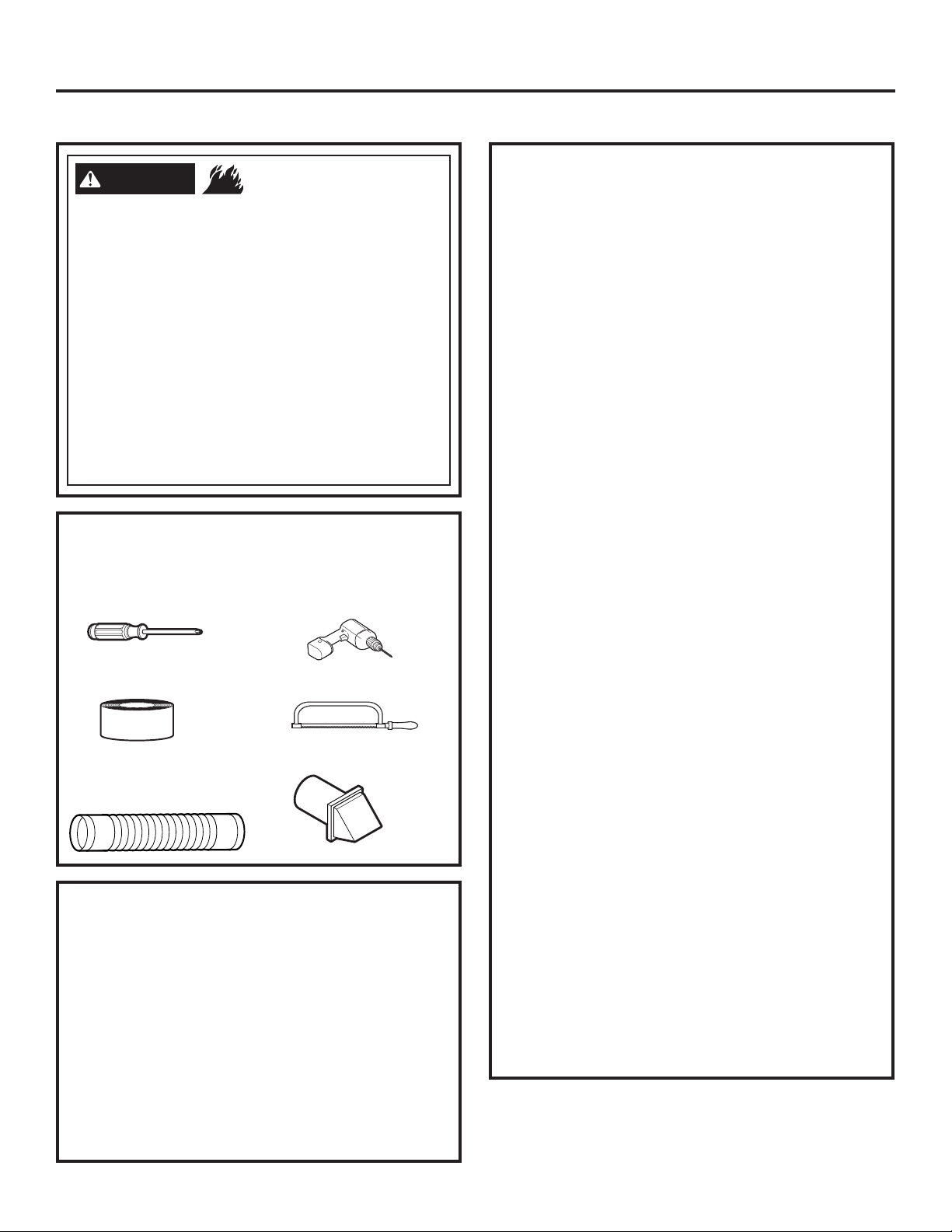
This dryer MUST be vented to the outdoors.
Use only 4” rigid metal ducting for the home
exhaust vent.
Use only 4” rigid metal or UL-LISTED transition duct
to connect the dryer to the home exhaust duct.
DO NOT use a plastic vent.
DO NOT exhaust into a chimney, kitchen exhaust,
gas vent, wall, ceiling, attic, crawl space, or
concealed space of a building.
DO NOT install a screen in or over the exhaust duct.
DO NOT use duct longer than specified in the
exhaust length table.
Failure to follow these instructions can result in
death or fire.
9
CONNECTING THE DRYER TO HOUSE
VENT
RIGID METAL TRANSITION DUCT
•
For best drying performance, a rigid metal transition
duct is recommended.
•
Rigidmetaltransitionductsreducetheriskofcrushing
and kinking.
UL-LISTED FLEXIBLE METAL CLOTHES DRYER
TRANSITION DUCT
•
If rigid metal cannot be used, then UL-LISTED flexible
metalclothesdryertransitionduct(GEparts–
PM08X10085, WX08X10085 or WX08X10077) can be
used.
•
Never install transition duct in walls, ceilings, floors or
other enclosed spaces.
•
Total length of transition duct should not exceed
8’ (2.4 m).
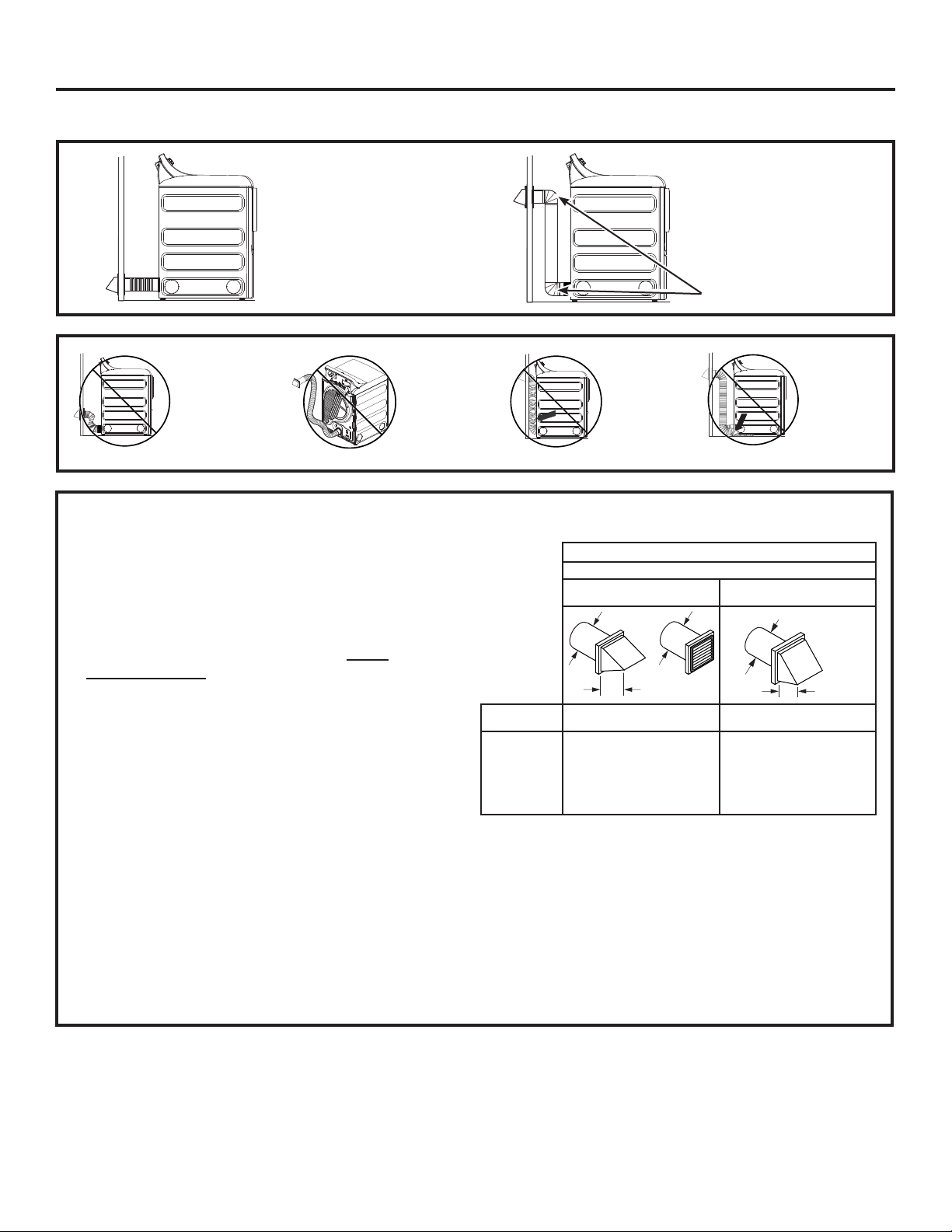
• For many applications, installing elbows at both
the dryer and the wall is highly recommended (see
illustrations at right). Elbows allow the dryer to sit
close to the wall without kinking and/or crushing the
transition duct, maximizing drying performance.
•
Avoid resting the duct on sharp objects.
UL-LISTED FLEXIBLE METAL (FOIL-TYPE) TRANSITION
DUCT
•
In special installations, it may be necessary to connect
the dryer to the home exhaust vent using flexible metal
(foil-type)transitionduct.UL–LISTEDuniversalflexible
dryertransitionduct(GEparts–PM8X73orWX8X73)
may be used ONLY in installations where rigid metal or
flexible metal transition ducting cannot be used AND
where a 4” diameter can be maintained throughout
the entire length of the transition duct.
•
In Canada and the United States, only transition ducts that
comply with “UL 2158A STANDARD FOR CLOTHES DRYER
TRANSITION DUCT” shall be used.
•
Avoid resting the duct on sharp objects.
•
For best drying performance:
1. Slide one end of the duct over the clothes dryer
outlet pipe.
2. Secure the duct with a clamp.
3. With the dryer in its permanent position, extend
the duct to its full length. Allow 2
”
of duct to
overlap the exhaust pipe. Cut off and remove
excess duct. Keep the duct as straight as
possible for maximum airflow.
4. Secure the duct to the exhaust pipe with the
other clamp.
TOOLS AND MATERIALS YOU WILL
NEED TO INSTALL EXHAUST DUCT
PARTS AVAILABLE FROM LOCAL
SERVICE ORGANIZATIONS
•
RigidMetalDuctComponents
WX8X63 4 x 1 Duct
WX8X64 4 x 2 Duct
WX8X51 4 Elbow
WX8X59 4 Aluminum Hood
•
Flexible Metal Duct Components
WX8X58 4 Clamps (2)
WX8X59 4 Aluminum Hood
WX08X10077 6UL-Listed,FlexibleMetal(Semi-Rigid)
Duct, 2 Clamps, 2 Close Elbows
WE1M454 Cover rear exhaust opening
r Phillips-head
screwdriver
r
Duct tape or
duct clamp
r
RigidorUL-listed
flexible metal 4”
(10.2 cm) duct
r
Drill with 1/8” drill bit
(for bottom venting)
r
Hacksaw
r
Vent hood
Installation Instructions
Using exhaust longer than specified length will:
• Increase the drying times and the energy cost.
• Reducethedryerlife.
• Accumulatelint,creatingapotentialfire
hazard.
The correct exhaust installation is YOUR
RESPONSIBILITY.
Problems due to incorrect installation are not
covered by the warranty.
The MAXIMUM ALLOWABLE length of the exhaust
system depends upon the type of duct, number of
turns, the type of exhaust hood (wall cap) and all
conditions noted on the chart.
•
Internal elbows added for side or bottom vent
conversions must be included in the total elbow count.
•
Any elbow greater than 45° should be treated as a
90° elbow.
•
Two 45° elbows will be treated like one 90° elbow.
•
For every additional 90° elbow, reduce the allowable
vent system length by 10 feet.
•
When calculating the total vent system length, you
must add all the straight portions and elbows of the
system (including the transition duct).
EXHAUST LENGTH
10
• DO NOT bend
or collapse
ducting. Use
elbows if turns
are necessary.
•DO NOT use
excessive
exhaust
length. Cut
duct as short
as possible.
•DO NOT
crush duct
against the
wall
.
•DO NOT
set dryer
on duct
.
• DO cut duct as short
as possible and install
straight into wall.
•
DO use elbows when
turns are necessary.
Elbows
4" DIA.
4"
4" DIA.
4" DIA.
2-1/2"
RECOMMENDED MAXIMUM LENGTH
Exhaust Hood Types
Recommended
No. of 90°
Elbows
Rigid
Metal
Rigid
Metal
90 Feet
60 Feet
45 Feet
35 Feet
25 Feet
60 Feet
45 Feet
35 Feet
25 Feet
15 Feet
0
1
2
3
4
Use only for short
run installations
EXHAUST LENGTH
FOR NORMAL VENT MODELS
EXHAUSTING THE DRYER (cont.)
Installation Instructions
BEFORE YOU BEGIN
• Removeanddiscardexistingplasticormetalfoil
duct and replace with UL-listed duct.
•
Removeanylintfromthewallexhaustopening.
Internal
Duct
Opening
Wall
Check that exhaust
hood damper opens
and closes freely.
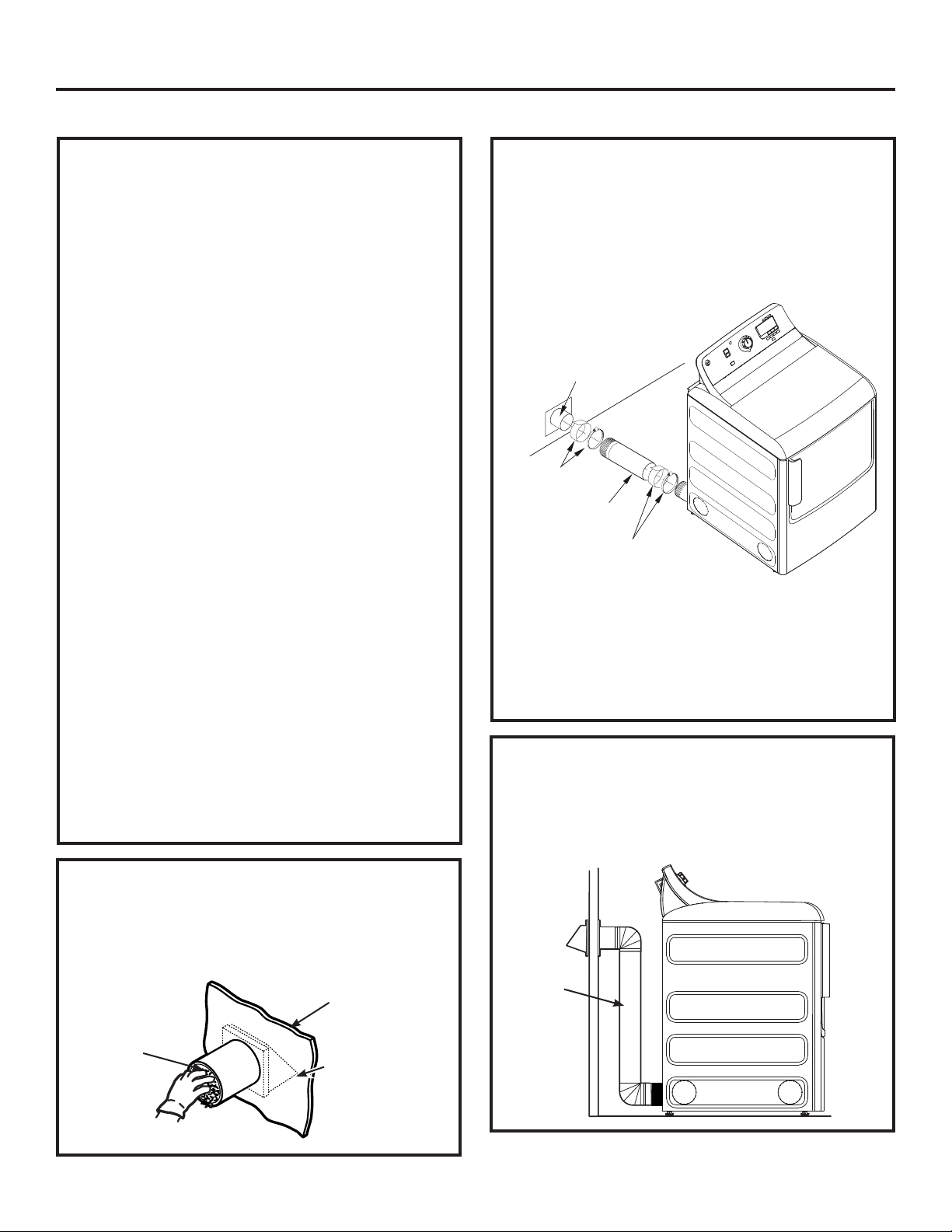
STANDARD REAR EXHAUST
We recommend that you install your dryer before
installing your washer. This will permit direct
access for easier exhaust connection.
Slide the end of the exhaust duct on the back of the
dryer and secure with duct tape or a duct clamp.
NOTE: We strongly recommend using rigid metal
exhaust duct. However, if flexible ducting is used it
must be UL-Listed metal, not plastic.
•
For straight-line installation, connect the dryer
exhaust to the wall, using duct tape or a duct
clamp.
RECOMMENDED CONFIGURATION TO
MINIMIZE EXHAUST BLOCKAGE
Using duct elbows will prevent duct kinking and
collapsing.
Transition
Ducting
11
EXHAUST SYSTEM CHECKLIST
HOOD OR WALL CAP
•
Terminate in a manner to prevent back drafts or entry
of birds or other wildlife.
•
Termination should present minimal resistance to
the exhaust airflow and should require little or no
maintenance to prevent clogging.
•
Wall caps must be installed at least 12” above ground
level or any other obstruction with the opening
pointed down.
SEPARATION OF TURNS
•
For best performance, separate all turns by at least
4 ft. of straight duct, including distance between last
turn and dampened wall cap.
SEALING OF JOINTS
•
All joints should be tight to avoid leaks. The male end
of each section of duct must point away from the
dryer.
•
Duct joints should be made air- and moisture-tight
by wrapping the overlapped joints with duct tape or
aluminum tape.
•
Do not assemble ductwork with any fasteners
that extend into the duct. These fasteners can
accumulate lint, creating a potential fire hazard.
• Horizontal runs should slope down towards the
outdoors 1/4” per foot.
•
Provide an access for inspection and cleaning of
the exhaust system, especially at turns and joints.
Exhaust system shall be inspected and cleaned at
least once a year.
INSULATION
•
Ductwork that runs through an unheated area or is
near air conditioning should be insulated to reduce
condensation and lint buildup.
DUCT TAPE OR
DUCT CLAM
P
DUCT TAPE OR
DUCT CLAM
P
4" METAL DUCT CU
T
TO PROPER LENGTH
EXTERNAL DUCT
OPENING
12
Installation Instructions
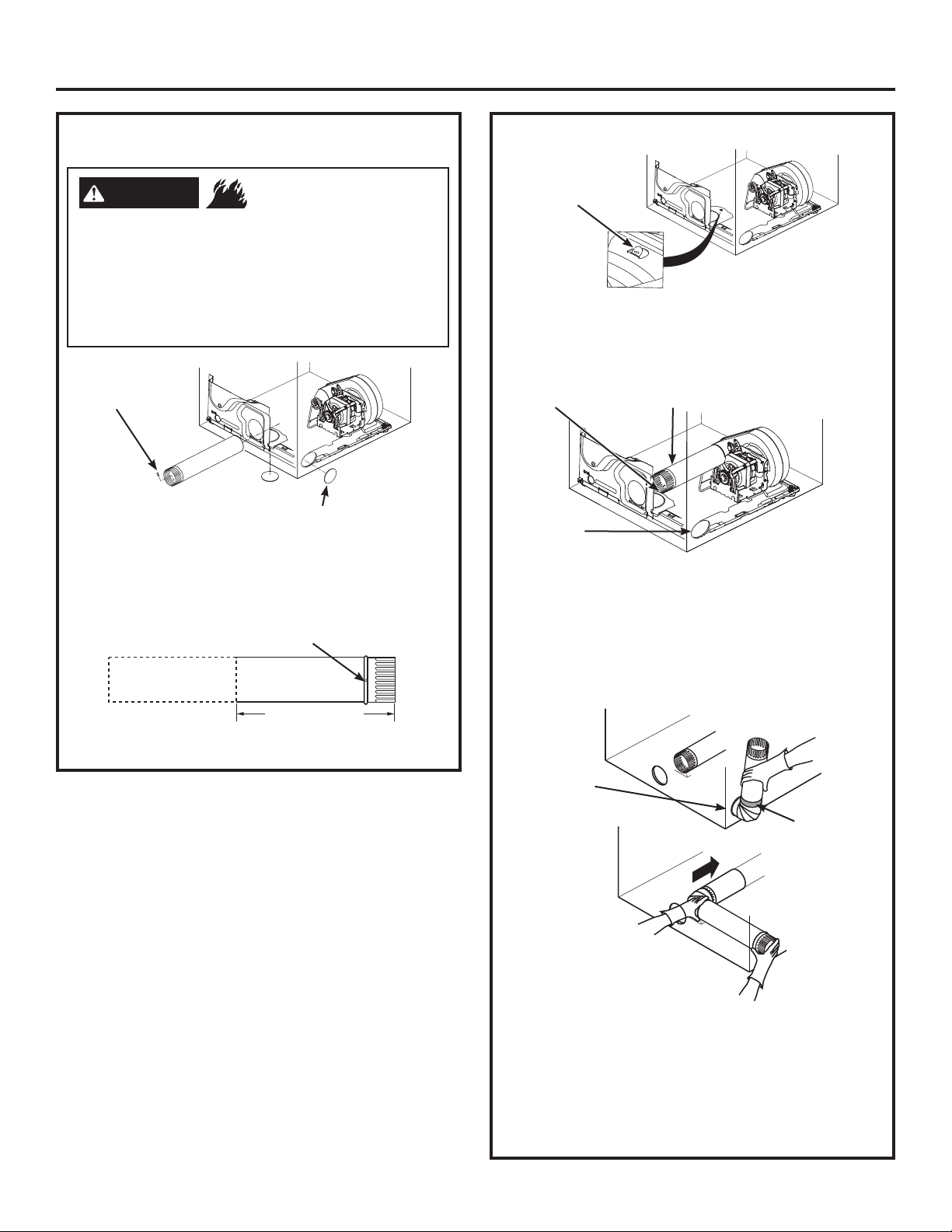
SIDE OR BOTTOM VENTING
Cut the duct as shown and keep portion A.
ADDING A NEW DUCT
Reconnectthecutportion(A)oftheducttothe
blower housing. Make sure that the shortened
duct is aligned with the tab in the base. Use the
screw saved previously to secure the duct in place
through the tab on the appliance base.
ADDING ELBOW AND DUCT FOR EXHAUST TO
LEFT OR RIGHT SIDE OF CABINET
• Preassemble 4” elbow with 4” duct. Wrap duct
tape around joint.
•
Insert duct assembly, elbow first, through the
side opening and connect the elbow to the dryer
internal duct.
Be sure not to pull or damage the electrical wires
inside the dryer when inserting the duct.
Fixing hole
A
14” (35.56cm)
TAB LOCATION
WARNING
Fire Hazard
- Fire Hazard
WARNING
Close the back opening with cover plate (Kit
WE1M454).
Disconnect dryer from electrical supply.
Wear gloves and arm guards.
Failure to do so may result in fire, electrical shock
or lacerations.
Remove
screw
and save
Removedesired
knockout (one only)
Left
Bottom
Through the rear opening, locate the tab in the
middle of the appliance base. Lift the tab to about
45°,
using a flat-blade screwdriver.
Bend tab
up 45°
Exhaust can
be added to
left
Duct
tape
Portion “A”
Left side
exhaust
Fixing
hole
Detach and remove the right, left or bottom
knockoutasdesired.Removethescrewinsidethe
dryer exhaust duct and save. Pull the duct out of
the dryer.
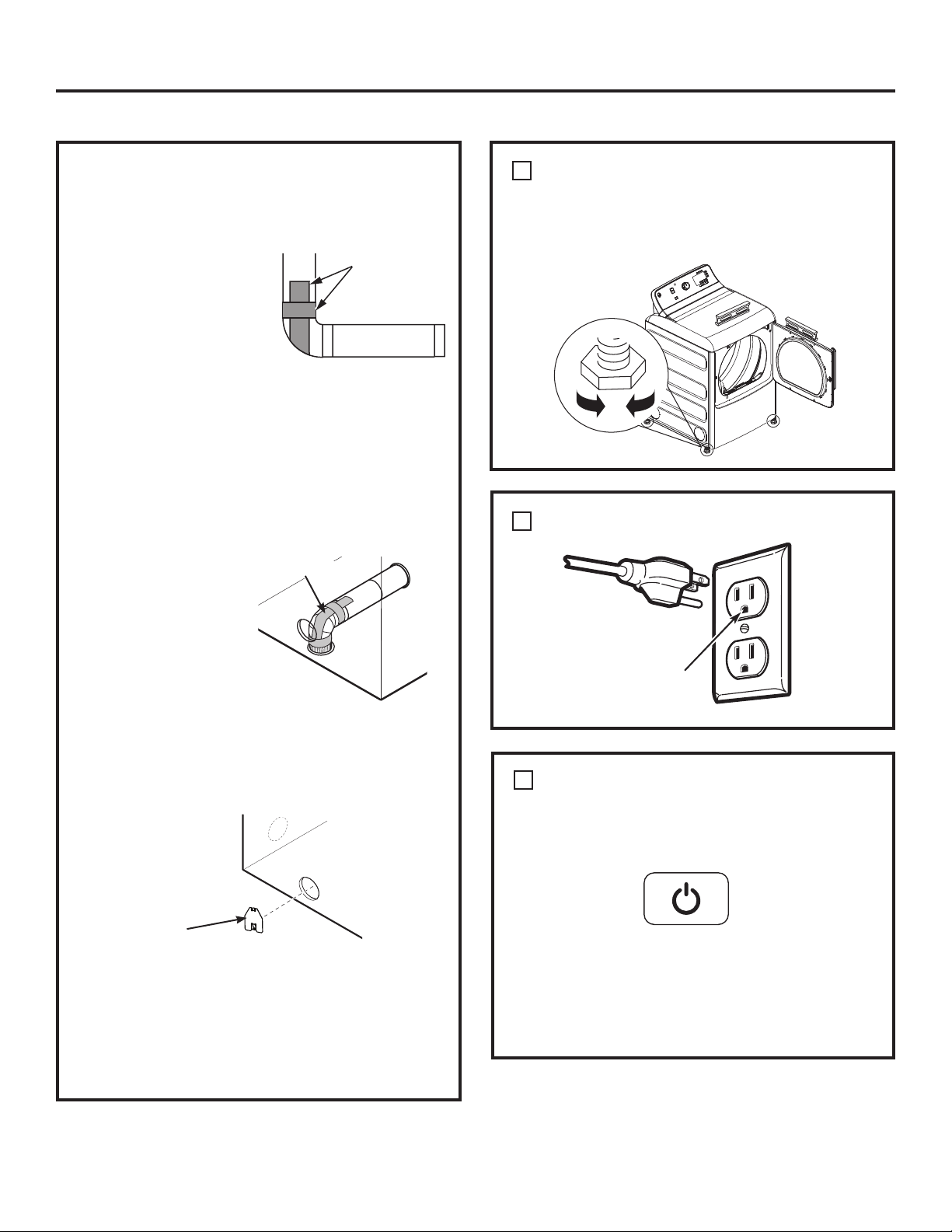
EXHAUSTING THE DRYER (cont.)
NEVER LEAVE THE BACK OPENING WITHOUT THE
PLATE.
(Kit WE1M454.)
Installation Instructions
SIDE OR BOTTOM VENTING (cont.)
Connect standard metal elbows and ducts to
complete the exhaust system. Cover back opening
with a plate (Kit WE1M454) available from your
local service provider. Place dryer in final location.
ADDING COVER PLATE TO REAR OF CABINET
ADDING ELBOW AND DUCT FOR EXHAUST TO
LEFT OR RIGHT SIDE OF CABINET (cont.)
Plate
(Kit WE1M454)
• Apply duct tape as
shown on the joint
between the dryer
internal duct and the
elbow, and also the joint
between the elbow and
the side duct.
Use 4” rigid metal ducting only inside the dryer.
Internal duct joints must be secured with tape,
otherwise they may separate and cause a safety
hazard.
13
DUCT
TAPE
ADDING ELBOW FOR EXHAUST THROUGH
BOTTOM OF CABINET
• Insert the elbow through the rear opening and
connect it to the dryer internal duct.
•
Apply duct tape as
shown on the joint
between the dryer
internal duct and the
elbow, and also the
joint between the
elbow and the bottom
duct.
Internal duct joints must be secured with tape;
otherwise, they may separate and cause a safety
hazard.
Duct tape
FINAL SETUP
LEVEL THE DRYER
Stand the dryer upright near the final location and
adjust the four leveling legs at the corners to ensure
that the dryer is level from side to side and front to
rear.
Lower
Raise
PLUG DRYER IN
1
2
DRYER START-UP
Press the Power button.
Power
NOTE: If the dryer has been exposed to
temperatures below freezing for an extended
period of time, allow it to warm up before pressing
Power. Otherwise, the display will not come on.
The dryer is now ready for use.
3
Ensure proper
ground exists
before use.
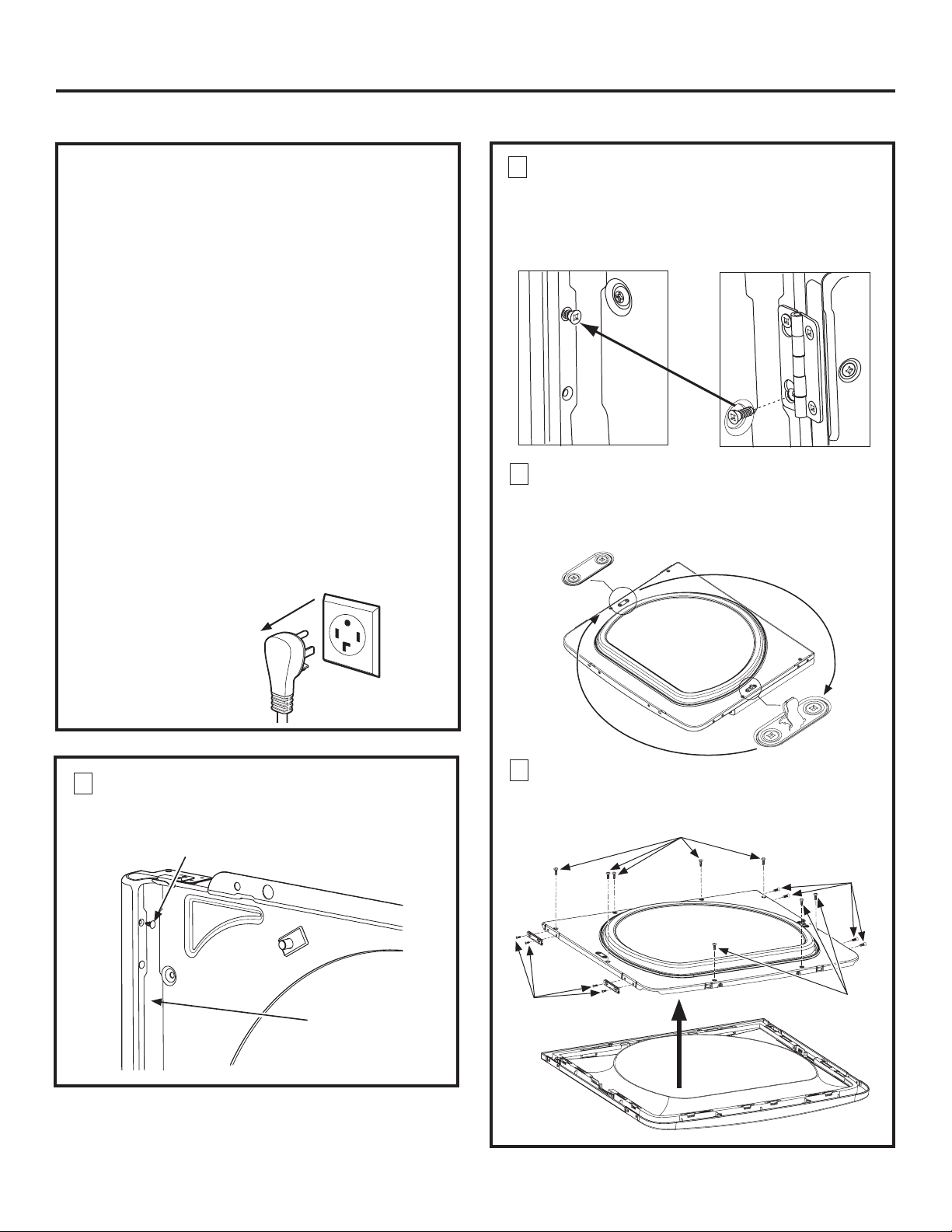
Installation Instructions
14
REVERSING THE DOOR
ABOUT REVERSING THE DOOR
IMPORTANT NOTES:
•Readtheinstructionsallthewaythroughbefore
starting.
•Handle parts carefully to avoid scratching paint.
•Set screws down by their related parts to avoid
using them in the wrong places.
•Provide a non-scratch work surface for the door.
•Normal completion time to reverse the door
swingis30–60minutes.
IMPORTANT:
Once you begin, do not move the cabinet until door
swing reversal is completed. These instructions are
for changing the hinges from the right side to the left
side - if you ever want to switch them back to the
right side, follow these same instructions and reverse
all references to the left and right.
Tools needed:
n Standard #2 Phillips screwdriver
n Tape-tipped putty knife
n Small flat blade screwdriver
Before you start
Unplug the dryer from its
electrical outlet
1
Open the door approximately 170 degrees. With a
putty knife, remove the 4 plastic caps located along
the left side of the front panel and set them aside.
Plastic Cap (4)
Left side of
front panel
3
Loosenthebottom2rightsidehingescrews.Remove
the door and place it on a protective flat surface to
avoidanydamage.Removeboththeblindplateand
the strike plate and install them in opposite positions.
4
Removethe4doorhingescrews,4edgescrews,and
8 inside screws. Lift the inner door upwards using a
flat blade screwdriver.
Blind
plate
Inner door
Strike
plate
Door hinge
screws
Inner door
Outer door
Inside
screws
Inside screws
Edge
screws
2
Removethebottomscrewfromeachhinge(right
side) and partially insert them into the top left side
hinge holes.
NOTE: All 4 front panel hinge screws will now be in
the top hinge holes - 2 on the left and 2 on the right.
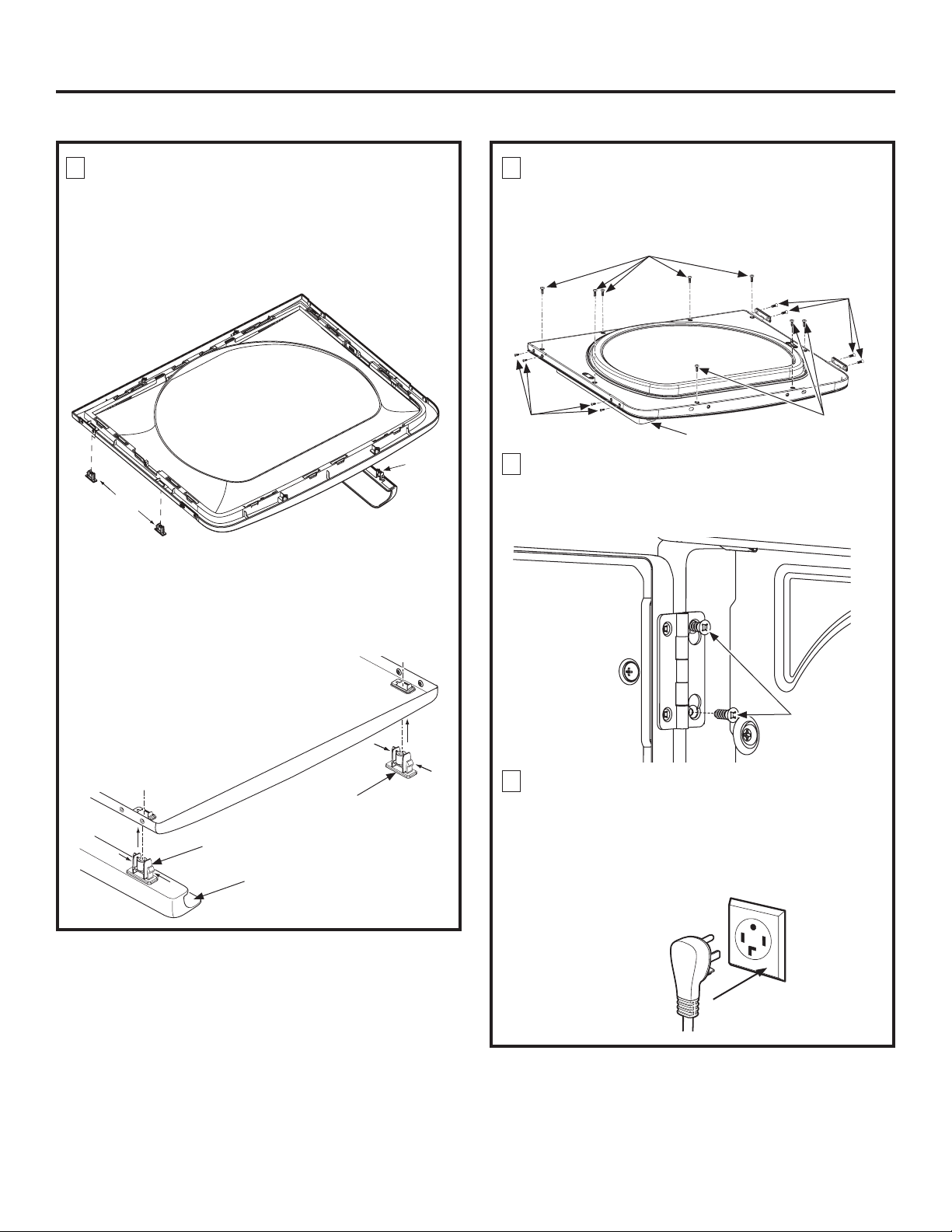
Installation Instructions
15
6
With the cover caps and door handle in place, mount
the inner door back into the outer door with the
screws removed in step 4. Make sure you mount the
hinges on the side opposite the handle.
7
Mount the assembled door on the 2 upper left side
hinge screws installed in step 2. Move the hinge
screws loosened in step 3 into the lower left side
screw holes and firmly tighten all 4 screws.
8
Install the 4 plastic caps removed in step 1 into the 4
right side front panel holes.
NOTE: To return the door to the original setup, follow
these instructions, swapping “left” and “right”.
When you finish
Plug the dryer back into
its electrical outlet.
5
Removeandswapthe2covercapsanddoorhandle
from the outer door:
A. Squeeze the tabs on the inside of the door handle
clips. Push clips through the outer door.
B. Squeeze the tabs on the inside of the cover caps.
Push caps through the outer door.
C. Push the door handle clips into the openings on the
opposite side of the outer door making sure you
flip the handle so it curves to the inside.
D. Push the cover caps into the openings on the outer
door where the handle was removed.
Door handle
Door handle clip
Cover cap
Inside of door
Door
Hang door and
tighten screws
Edge
screws
Door
hinge
screws
Inside screws
Inside screws
Handle
Door handle
Door
handle
clip
Inside of door
Cover caps
