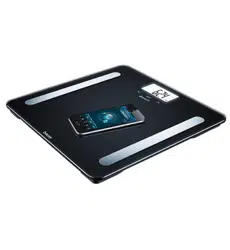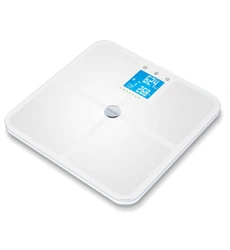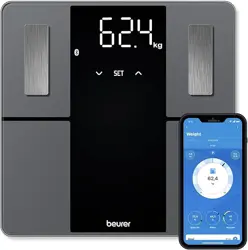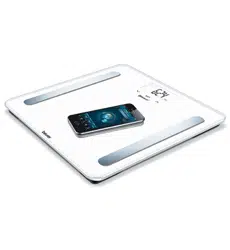
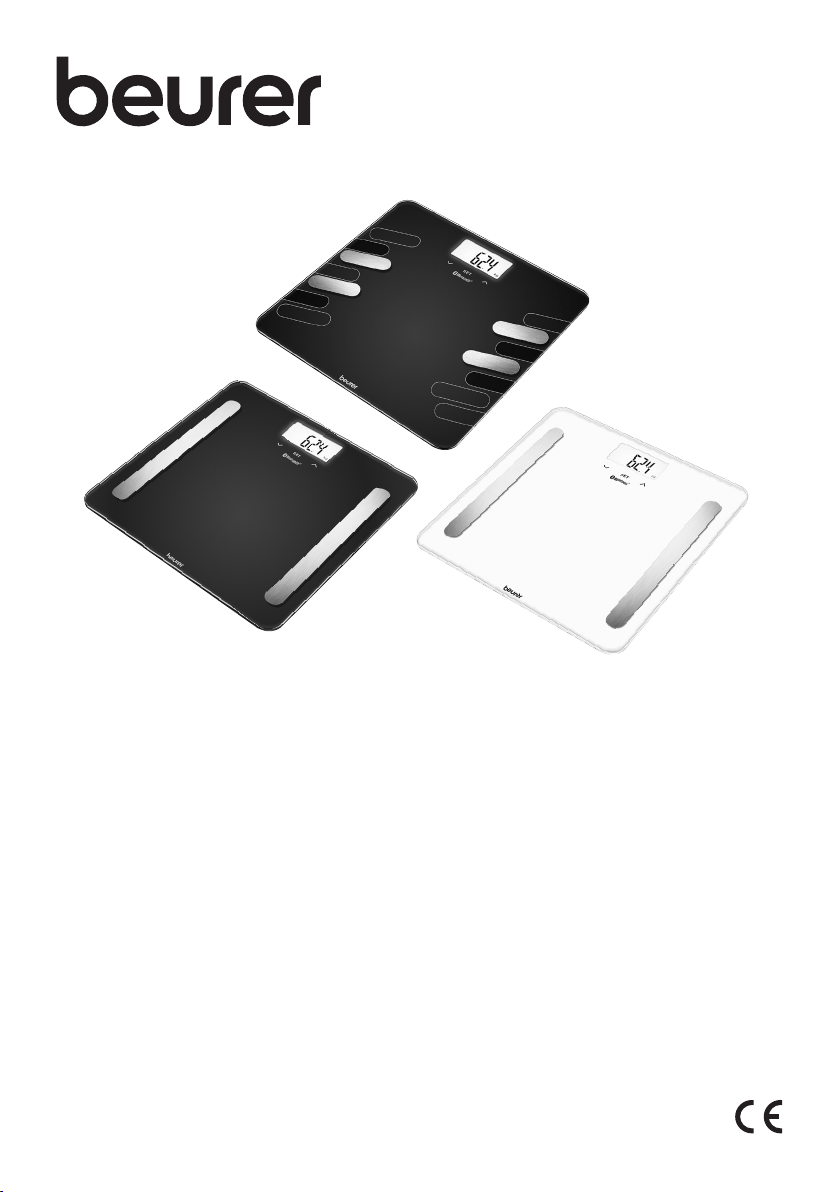
DE Diagnosewaage
Gebrauchsanweisung .......................2
EN Diagnostic bathroom scale
Instructions for use ......................... 13
FR Pèse-personne impédancemètre
Mode d’emploi ................................ 24
ES Báscula de diagnóstico
Instrucciones de uso ....................... 35
IT Bilancia diagnostica
Istruzioni per l’uso ........................... 46
TR Diyagnoz terazisi
Kullanım kılavuzu ............................57
RU Диагностические весы
Инструкция по применению .........67
PL Waga diagnostyczna
Instrukcja obsługi ............................ 78
BF 600 Style
Pure black & white

2
DEUTSCH
Sehr geehrte Kundin, sehr geehrter Kunde,
wir freuen uns, dass Sie sich für ein Produkt unseres Sortimentes entschieden haben. Unser Name steht
für hochwertige und eingehend geprüfte Qualitätsprodukte aus den Bereichen Wärme, Gewicht, Blut-
druck, Körpertemperatur, Puls, Sanfte Therapie, Massage, Beauty, Baby und Luft.
Bitte lesen Sie diese Gebrauchsanweisung aufmerksam durch, bewahren Sie sie für späteren Gebrauch
auf, machen Sie sie anderen Benutzern zugänglich und beachten Sie die Hinweise.
Mit freundlicher Empfehlung
Ihr Beurer-Team
Inhalt
1. Zum Kennenlernen ............................................. 2
2. Zeichenerklärung ................................................ 3
3. Warn- und Sicherheitshinweise ..........................3
4. Information .........................................................4
5. Gerätebeschreibung ........................................... 5
6. Inbetriebnahme mit App .....................................5
7. Inbetriebnahme der Waage ohne App................6
8. Messung durchführen ......................................7
9. Ergebnisse bewerten ........................................ 8
10. Weitere Informationen ....................................10
11. Gerät reinigen und pflegen ............................. 11
12. Entsorgung .....................................................11
13. Was tun bei Problemen? ................................11
14. Garantie/Service ............................................. 12
Lieferumfang
•
Kurzanleitung
•
Diagnosewaage BF 600
•
2 x 1,5 V, Typ AAA-Batterien
•
Diese Gebrauchsanleitung
1. Zum Kennenlernen
Funktionen des Gerätes
Diese digitale Diagnose-Waage dient zum Wiegen und zur Diagnose Ihrer persönlichen Fitness-Daten.
Sie ist für die Eigenanwendung im privaten Bereich bestimmt.
Die Waage verfügt über folgende Diagnose-Funktionen, die von bis zu 8 Personen benutzt werden können:
•
Körpergewicht-Messung und BMI,
•
Ermittlung von Körperfettanteil,
•
Körperwasseranteil,
•
Muskelanteil,
•
Knochenmasse sowie
•
Grund- und Aktivitätsumsatz.
Außerdem verfügt die Waage über folgende weitere Funktionen:
•
Umschalten zwischen Kilogramm „kg“, Pfund „lb“ und Stone „st“,
•
automatische Abschaltfunktion,
•
Batteriewechsel-Anzeige bei schwachen Batterien,
•
Automatische Benutzererkennung,
•
Speicherung der letzten 30 Messungen für 8 Personen, wenn zur App nicht übertragen werden kann,
•
Das Produkt verwendet Bluetooth
®
low energy technology, Frequenzband 2400 - 2483,5 MHz, Sende-
leistung max. -0,93 dBm.
Systemvoraussetzungen
iOS ab Version 10.0, Android™ ab Version 5.0 mit Bluetooth
®
4.0.
Liste der kompatiblen Geräte:
3
2. Zeichenerklärung
Folgende Symbole werden in der Gebrauchsanleitung verwendet:
WARNUNG Warnhinweis auf Verletzungsgefahren oder Gefahren für Ihre Gesundheit.
ACHTUNG Sicherheitshinweis auf mögliche Schäden am Gerät/Zubehör.
Hinweis Hinweis auf wichtige Informationen.
3. Warn- und Sicherheitshinweise
Bitte lesen Sie diese Gebrauchsanleitung aufmerksam durch, bewahren Sie sie für späteren Gebrauch auf,
machen Sie sie auch anderen Anwendern zugänglich und beachten Sie die Hinweise.
WARNUNG
•
Die Waage darf nicht von Personen mit medizinischen Implantaten (z.B. Herz-
schrittmacher) verwendet werden. Andernfalls kann deren Funktion beeinträch-
tigt sein.
•
Nicht während der Schwangerschaft benutzen.
•
Steigen Sie nicht einseitig auf den äußersten Rand der Waage: Kippgefahr!
•
Batterien können bei Verschlucken lebensgefährlich sein. Bewahren Sie Batterien und Waage für
Kleinkinder unerreichbar auf. Wurde eine Batterie verschluckt, nehmen Sie sofort medizinische
Hilfe in Anspruch.
•
Halten Sie Kinder vom Verpackungsmaterial fern (Erstickungsgefahr).
•
Achtung, steigen Sie nicht mit nassen Füßen auf die Waage und betreten Sie die Waage nicht,
wenn die Oberfläche feucht ist – Rutschgefahr!
Hinweise zum Umgang mit Batterien
•
Wenn Flüssigkeit aus einer Batteriezelle mit Haut oder Augen in Kontakt kommt, die betroffene
Stelle mit Wasser auswaschen und ärztliche Hilfe aufsuchen.
• Verschluckungsgefahr! Kleinkinder könnten Batterien verschlucken und daran ersticken.
Daher Batterien für Kleinkinder unerreichbar aufbewahren!
• Auf Polaritätskennzeichen Plus (+) und Minus (-) achten.
• Wenn eine Batterie ausgelaufen ist, Schutzhandschuhe anziehen und das Batteriefach mit einem
trockenen Tuch reinigen.
• Schützen Sie Batterien vor übermäßiger Wärme.
• Explosionsgefahr! Keine Batterien ins Feuer werfen.
• Batterien dürfen nicht geladen oder kurzgeschlossen werden.
• Bei längerer Nichtbenutzung des Geräts die Batterien aus dem Batteriefach nehmen.
• Verwenden Sie nur denselben oder einen gleichwertigen Batterietyp.
• Immer alle Batterien gleichzeitig auswechseln.
• Keine Akkus verwenden!
• Keine Batterien zerlegen, öffnen oder zerkleinern.
Allgemeine Hinweise
•
Das Gerät ist nur zur Eigenanwendung, nicht für den medizinischen oder kommerziellen Gebrauch
vorgesehen.
•
Beachten Sie, dass technisch bedingt Messtoleranzen möglich sind, da es sich um keine geeichte
Waage für den professionellen, medizinischen Gebrauch handelt.
•
Im Falle von unterschiedlichen Messergebnissen (zwischen Waage und App), sind ausschließlich
die an der Waage angezeigten Messwerte zu verwenden.
•
Die Belastbarkeit der Waage beträgt max 180 kg (396 lb, 28 st ). Bei der Gewichtsmessung und bei
der Knochenmassebestimmung werden die Ergebnisse in 100-g-Schritten (0,2 lb) angezeigt.
•
Die Messergebnisse des Körperfett-, Körperwasser- und Muskelanteils werden in 0,1 %-Schritten
angezeigt.
•
Der Kalorienbedarf wird in Schritten von 1 kcal angegeben.
•
Im Auslieferungszustand ist die Waage auf die Einheiten „cm“ und „kg“ eingestellt. Während der
Inbetriebnahme mit der App können Sie die Einstellungen der Einheiten ändern.

4
•
Stellen Sie die Waage auf einen ebenen, festen Boden; ein fester Bodenbelag ist Voraussetzung
für eine korrekte Messung.
•
Schützen Sie das Gerät vor Stößen, Feuchtigkeit, Staub, Chemikalien, starken Temperatur-
schwankungen und zu nahen Wärmequellen (Öfen, Heizkörper).
•
Reparaturen dürfen nur vom Beurer Kundenservice oder autorisierten Händlern durchgeführt wer-
den. Prüfen Sie jedoch vor jeder Reklamation zuerst die Batterien und wechseln Sie diese gege-
benenfalls aus.
•
Wir bestätigen hiermit, dass dieses Produkt der europäischen RED Richtlinie 2014/53/EU ent-
spricht. Die CE-Konformitätserklärung zu diesem Produkt finden Sie unter:
www.beurer.com/web/we-landingpages/de/cedeclarationofconformity.php.
Aufbewahrung und Pflege
Die Genauigkeit der Messwerte und die Lebensdauer des Gerätes hängen vom sorgfältigen Umgang ab:
ACHTUNG
•
Von Zeit zu Zeit sollte das Gerät gereinigt werden. Benutzen Sie keine scharfen Reinigungsmittel
und halten Sie das Gerät niemals unter Wasser.
•
Stellen Sie sicher, dass keine Flüssigkeit auf die Waage gelangt. Tauchen Sie die Waage niemals
in Wasser. Spülen Sie sie niemals unter fließendem Wasser ab.
•
Stellen Sie keine Gegenstände auf die Waage, wenn sie nicht benutzt wird.
•
Schützen Sie das Gerät vor Stößen, Feuchtigkeit, Staub, Chemikalien, starken Temperatur-
schwankungen und zu nahen Wärmequellen (Öfen, Heizkörper).
•
Drücken Sie nicht mit Gewalt oder mit spitzen Gegenständen auf die Taste.
•
Setzen Sie die Waage nicht hohen Temperaturen oder starken elektromagnetischen Feldern (z.B.
Mobiltelefone) aus.
4. Information
Das Messprinzip
Diese Waage arbeitet mit dem Prinzip der B.I.A., der Bioelektrischen-Impedanz-Analyse. Dabei wird inner-
halb von Sekunden durch einen nicht spürbaren, völlig unbedenklichen und ungefährlichen Strom eine
Bestimmung von Körperanteilen ermöglicht.
Mit dieser Messung des elektrischen Widerstandes (Impedanz) und der Einberechnung von Konstanten
bzw. individuellen Werten (Alter, Größe, Geschlecht, Aktivitätsgrad) können der Körperfettanteil und wei-
tere Größen im Körper bestimmt werden. Muskelgewebe und Wasser haben eine gute elektrische Leit-
fähig keit und daher einen geringeren Widerstand. Knochen und Fettgewebe hingegen haben eine geringe
Leitfähigkeit, da die Fettzellen und Knochen durch sehr hohen Widerstand den Strom kaum leiten.
Beachten Sie, dass die von der Diagnosewaage ermittelten Werte nur eine Annäherung an die medizini-
schen, realen Analysewerte des Körpers darstellen. Nur der Facharzt kann mit medizinischen Methoden
(z.B. Computertomografie) eine exakte Ermittlung von Körperfett, Körperwasser, Muskelanteil und
Knochen bau durchführen.
Allgemeine Tipps
•
Wiegen Sie sich möglichst zur selben Tageszeit (am besten morgens), nach dem Toilettengang, nüchtern
und ohne Bekleidung, um vergleichbare Ergebnisse zu erzielen.
•
Wichtig bei der Messung: Die Ermittlung des Körperfettes darf nur barfuß und kann zweckmäßig mit
schwach befeuchteten Fußsohlen vorgenommen werden.
Völlig trockene oder stark verhornte Fußsohlen können zu unbefriedigenden Ergebnissen führen, da
diese eine zu geringe Leitfähigkeit aufweisen.
Hinweis: Es darf kein Hautkontakt zwischen beiden Füßen, Beinen, Waden und Oberschenkeln
bestehen. Andernfalls kann die Messung nicht korrekt ausgeführt werden.
•
Stehen Sie während des Messvorgangs aufrecht und still.
•
Warten Sie einige Stunden nach ungewohnter körperlicher Anstrengung.
•
Warten Sie ca. 15 Minuten nach dem Aufstehen, damit sich das im Körper befindliche Wasser verteilen
kann.
5
•
Wichtig ist, dass nur der langfristige Trend zählt. In der Regel sind kurzfristige Gewichtsabweichungen
innerhalb von wenigen Tagen durch Flüssigkeitsverlust bedingt; Körperwasser spielt jedoch für das
Wohlbefinden eine wichtige Rolle.
Einschränkungen
Bei der Ermittlung des Körperfettes und der weiteren Werte können abweichende und nicht plausible
Ergebnisse auftreten bei:
•
Kindern unter ca. 10 Jahren,
•
Leistungssportlern und Bodybuildern,
•
Personen mit Fieber, in Dialysebehandlung, Ödem-Symptomen oder Osteoporose,
•
Personen, die kardiovaskuläre Medizin einnehmen (Herz und Gefäßsystem betreffend),
•
Personen, die gefäßerweiternde oder gefäßverengende Medikamente einnehmen,
•
Personen mit erheblichen anatomischen Abweichungen an den Beinen bezüglich der Gesamtkörper-
größe (Beinlänge erheblich verkürzt oder verlängert).
5. Gerätebeschreibung
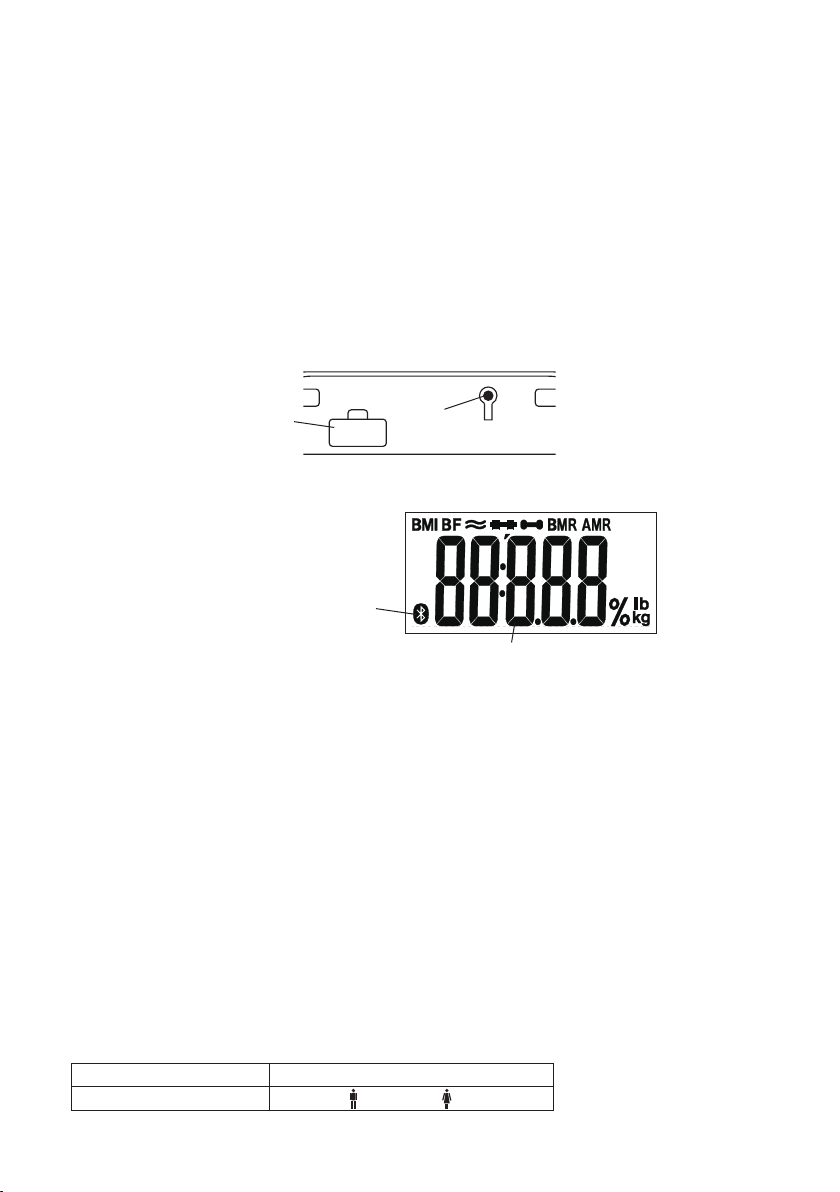
Rückseite
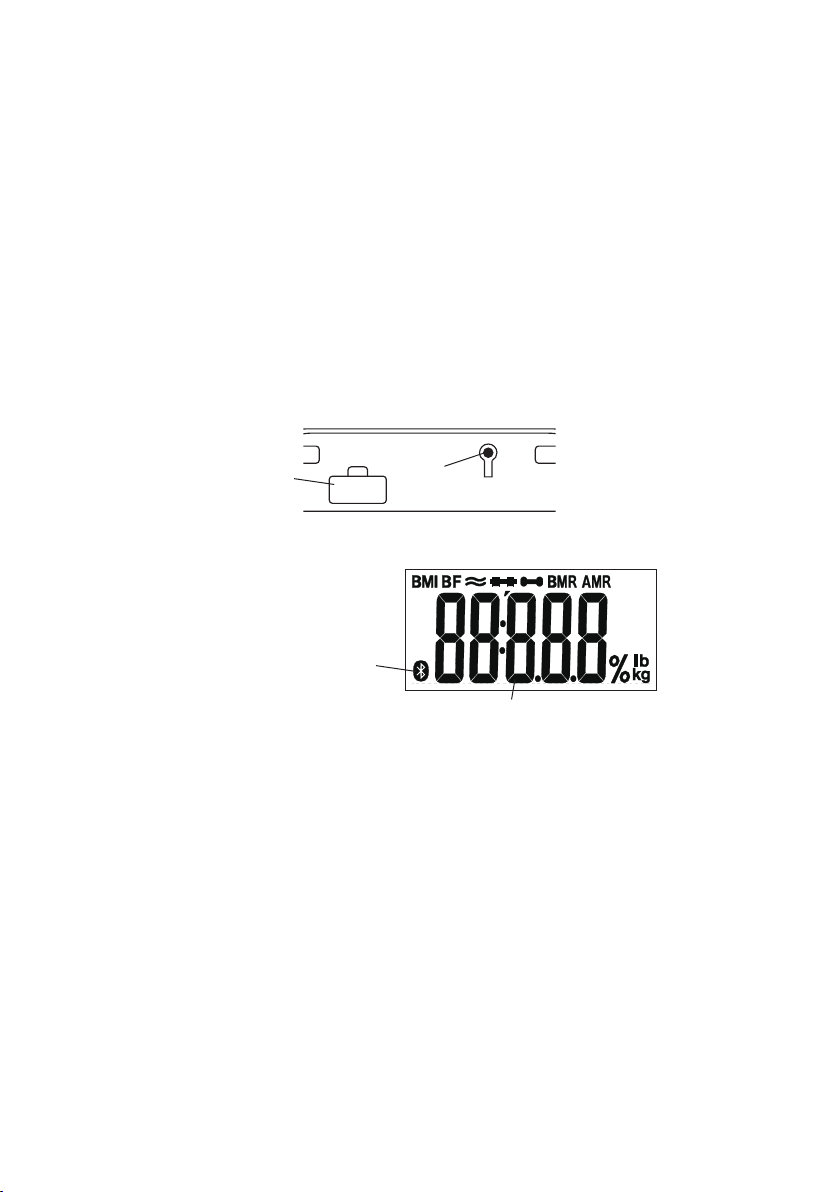
2
1
1. Batteriefach
2. unit / reset-Taste
Display
3
4
3. Bluetooth
®
-Symbol für Verbindung
zwischen Waage und Smartphone
4. Messwerte
6. Inbetriebnahme mit App
Um Ihren Körperfettanteil und weitere Körperwerte ermitteln zu können, müssen Sie die persönlichen
Benutzerdaten auf der Waage einspeichern.
Die Waage verfügt über 8 Benutzerspeicherplätze, in die Sie und beispielsweise die Mitglieder Ihrer Familie
Ihre persönlichen Einstellungen abspeichern können.
Zusätzlich können Benutzer über weitere mobile Endgeräte mit installierter „beurer HealthManager“ App
oder durch Benutzerprofilwechsel in der App (siehe Einstellungen App) in Betrieb genommen werden.
Damit während der Inbetriebnahme eine Bluetooth
®
-Verbindung aktiv gehalten werden kann, bleiben Sie
mit dem Smartphone in der Nähe der Waage.
–
Bluetooth
®
in den Einstellungen des Smartphones aktivieren.
–
Batterien einlegen und Waage auf einen festen Boden stellen (im Waagen-LCD blinkt „App“).
–
Laden Sie die kostenlose „beurer HealthManager“ App im Apple App Store (iOS) oder bei Google
Play (Android™) herunter.
–
App starten und den Anweisungen folgen.
–
BF 600 bezogene Daten eingeben.
Folgende Einstellungen müssen in der App „
beurer HealthManager
“ eingestellt sein bzw. eingegeben werden:
Benutzerdaten Einstellwerte
Geschlecht männlich ( ), weiblich ( )
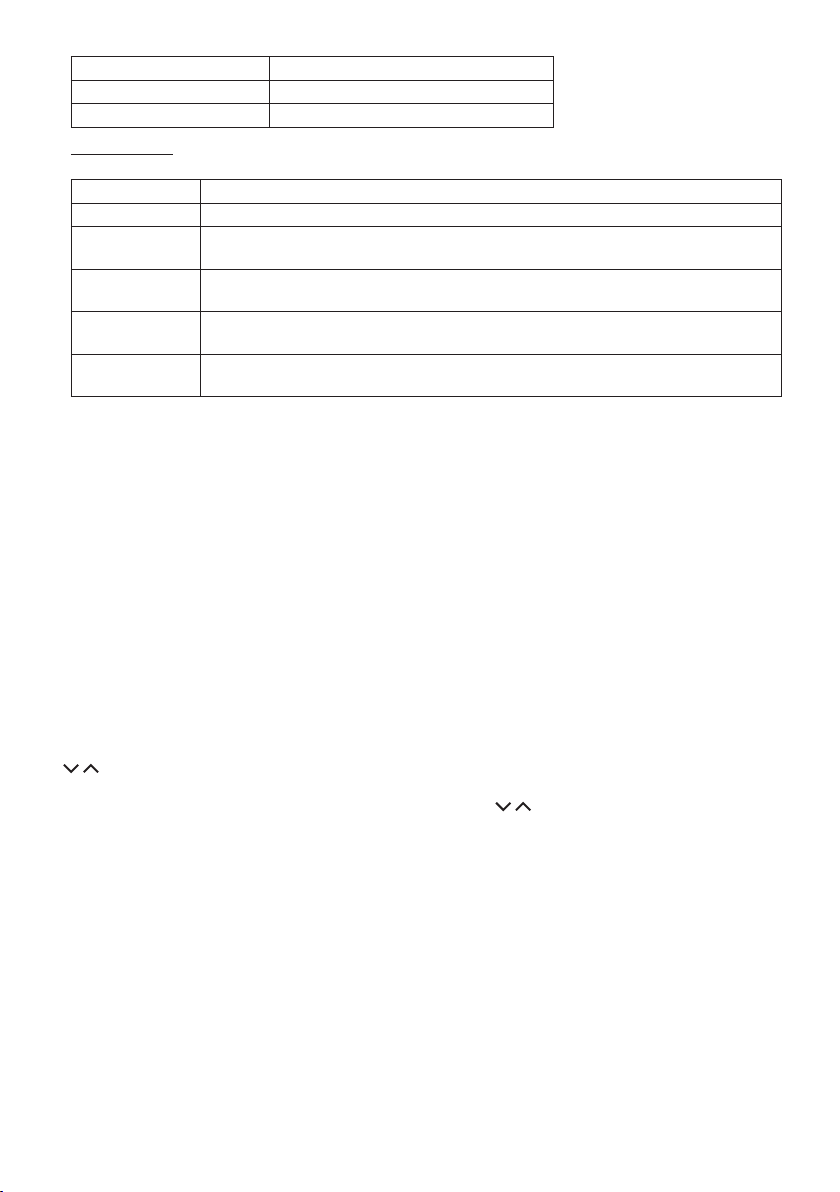
6
Körpergröße 100 bis 220 cm (3‘ 3,5“ bis 7‘ 2,5“)
Alter 10 bis 100 Jahre
Aktivitätsgrad 1 bis 5
Aktivitätsgrade
Bei der Auswahl des Aktivitätsgrades ist die mittel- und langfristige Betrachtung entscheidend.
Aktivitätsgrad Körperliche Aktivität
1 Keine.
2
Geringe: Wenige und leichte körperliche Anstrengungen
(z.B. Spazierengehen, leichte Gartenarbeit, gymnastische Übungen).
3
Mittlere: Körperliche Anstrengungen, mindestens 2 bis 4 mal pro Woche,
jeweils 30 Minuten.
4
Hohe: Körperliche Anstrengungen, mindestens 4 bis 6 mal pro Woche,
jeweils 30 Minuten.
5
Sehr hohe: Intensive körperliche Anstrengungen, intensives Training oder
harte körperliche Arbeit, täglich, jeweils mindestens 1 Stunde.
Die App weist Ihnen den nächsten freien Waagen-Benutzerspeicher zu (P01-P08).
–
Messung durchführen
Für die automatische Personenerkennung muss die erste Messung auf Ihren persönlichen Benutzerda-
ten zugewiesen werden. Die App fordert Sie hierzu auf. Steigen Sie idealerweise barfuß auf die Waage
und achten Sie darauf, dass Sie ruhig und mit gleichmäßiger Gewichtsverteilung mit beiden Füßen auf
den Elektroden stehen.
Fahren Sie nun mit Kapitel 8 „Messung durchführen“ fort.
7. Inbetriebnahme der Waage ohne App
Wir empfehlen die Inbetriebnahme und Durchführung aller Einstellungen per App. Siehe Kapitel 6. „Inbe-
triebnahme mit App“. Diese können jedoch auch am Gerät durchgeführt werden.
Entnehmen Sie die Batterien aus dem Verpackungsschutz und setzen Sie die Batterien gemäß Polung in
die Waage ein. Zeigt die Waage keine Funktion, so entfernen Sie die Batterien komplett und setzen Sie sie
erneut ein.
Stellen Sie die Waage auf einen ebenen festen Boden; ein fester Bodenbelag ist Voraus setzung für eine
korrekte Messung.
Drücken Sie die „SET-Taste“.
Es erfolgt die Einstellung von Jahr/Monat/Tag, sowie Stunde/Minute jeweils durch Drücken der Tasten
„ “ und Bestätigung durch die „SET-Taste“.
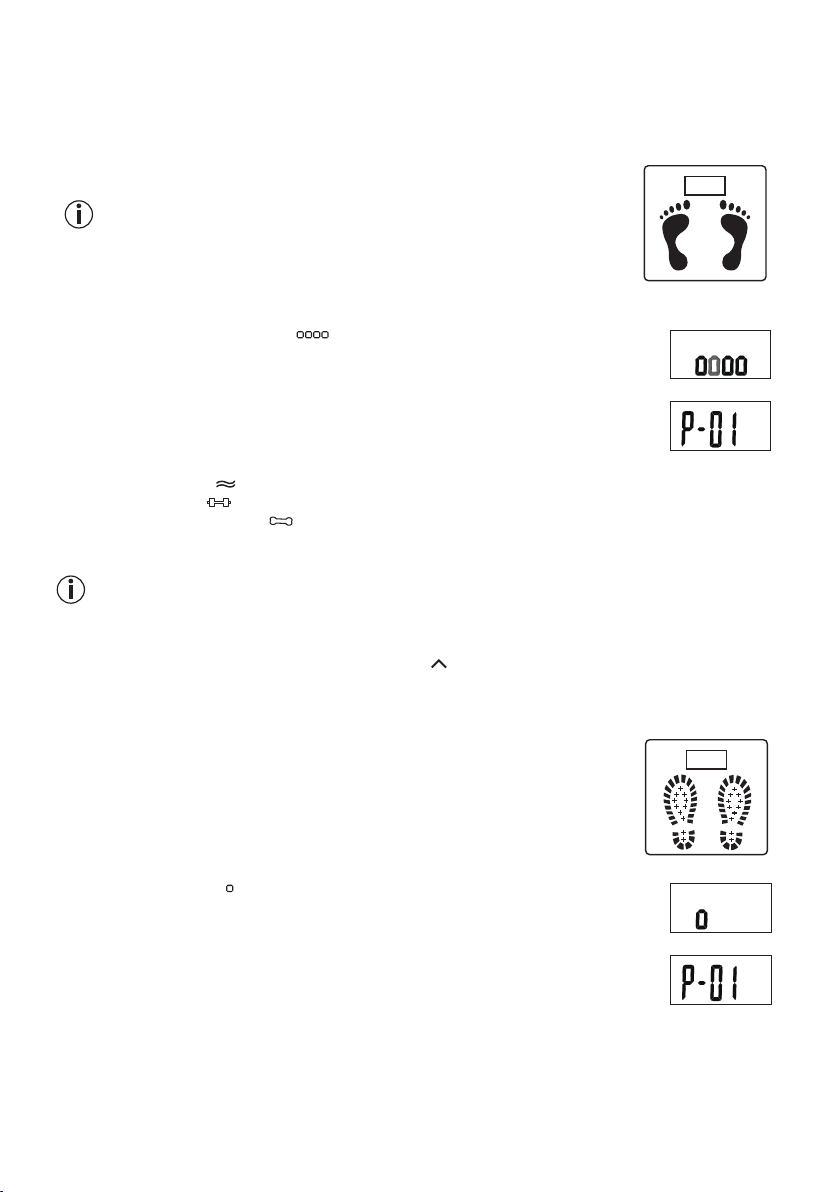
Die Waage zeigt „0.0“. Drücken Sie erneut die „SET-Taste“. Es erscheint „P-01“ bzw. der zuletzt verwen-
dete Waagen-Benutzerspeicher. Wählen Sie mit Hilfe der Pfeile „ “ Ihren Benutzerspeicher aus ( P-01
bis P-08) und drücken Sie die „SET-Taste“. Führen Sie Ihre Einstellungen wie Geschlecht, Körpergröße etc.
durch (siehe Kapitel 6. „Inbetriebnahme mit App (Tabelle)“. Bestätigen Sie dies jeweils durch Drücken der
„SET-Taste“. Am Ende Ihrer Eingaben erscheint eine PIN. Diese wird für die eventuell spätere App Anmel-
dung benötigt. Daraufhin erscheint „0.0“.
Für die automatische Personenerkennung muss die erste Messung auf Ihren persönlichen Benutzerdaten
zugewiesen werden. Steigen Sie idealerweise barfuß auf die Waage und achten Sie darauf, dass Sie ruhig
und mit gleichmäßiger Gewichtsverteilung mit beiden Füßen auf den Elektroden stehen.
7.1 Spätere App Anmeldung
Sollten Sie die Inbetriebnahme der Waage ohne App durchgeführt haben, können Sie Ihren Nutzer wie
folgt auf die App übertragen bzw. anlegen.
–
Laden Sie die kostenlose „beurer HealthManager“ App im Apple App Store (iOS) oder bei Google
Play (Android™) herunter.
–
App starten und den Anweisungen folgen.
7
8. Messung durchführen
Stellen Sie die Waage auf einen ebenen festen Boden; ein fester Bodenbelag ist Voraus setzung für
eine korrekte Messung.
8.1 Diagnose
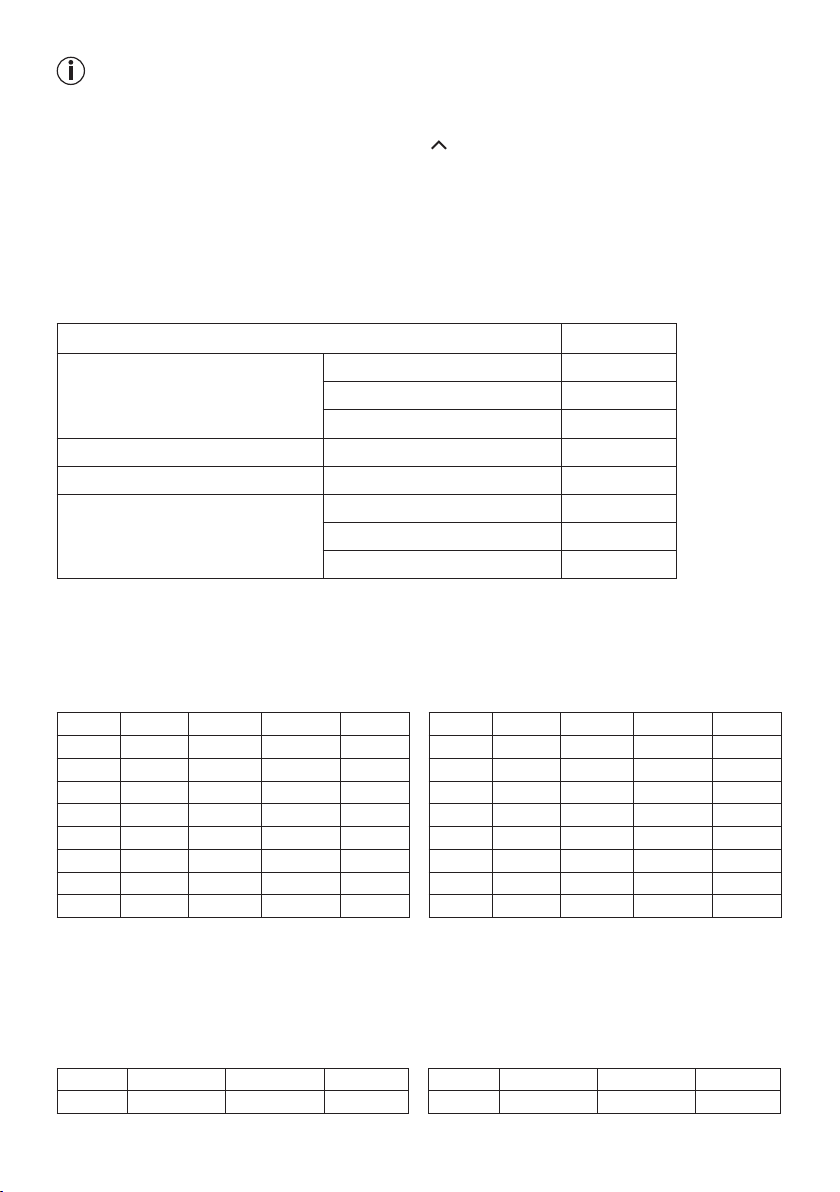
Steigen Sie barfuß auf die Waage und achten Sie darauf, dass Sie ruhig und mit
gleichmäßiger Gewichtsverteilung mit beiden Beinen auf den Elektroden stehen.
Hinweis: Falls eine Messung mit Socken durchgeführt werden sollte, ist
das Messergebnis nicht korrekt.
Die Waage beginnt sofort mit der Messung.
Zuerst wird das Gewicht angezeigt.
Während der BIA-Analyse laufen „ „ durch.
Falls ein Benutzer zugewiesen wurde, wird P-01 - P-08 angezeigt und alle nachfol-
genden Werte werden gespeichert.
1. BMI
2. Körperfett in %
3. Körperwasser in %
4. Muskelanteil in %
5. Knochenmineralanteil in kg
6. Kaloriengrundumsatz in kcal (BMR)
7. Aktivitätsumsatz in kcal (AMR)
Hinweis: Wenn der Benutzer nicht erkannt wird, fehlt die Benutzerzuweisung (z.B. P-01) und es
kann nur das Gewicht angezeigt werden. Es erfolgt keine Speicherung der Messung.
Dies geschieht, sollte Ihr gemessenes Gewicht um +/- 3 kg zur letzten Messung abweichen oder
ein anderer Benutzer +/- 3 kg ähnlich Ihrer Werte sein. Wiederholen Sie in diesem Fall die Messung,
indem Sie die Waage einschalten und die Taste „ “ drücken um Ihren Benutzerspeicher (P01-P08)
auszuwählen. Wiederholen Sie den Messvorgang.
8.2 Gewicht
Stellen Sie sich mit Schuhen auf die Waage und achten Sie darauf, dass Sie
ruhig und mit gleichmäßiger Gewichtsverteilung mit beiden Beinen auf der Waage
stehen. Die Waage beginnt sofort mit der Messung.
Zuerst wird das Gewicht angezeigt.
Im LCD erscheint kurz „ “ . Eine BIA-Analyse ist nicht möglich.
Falls ein Benutzer zugewiesen wurde, wird z.B. „P-01“ angezeigt und das Gewicht
wird gespeichert.
8
Hinweis: Wenn der Benutzer nicht erkannt wird, fehlt die Benutzerzuweisung (z.B. P-01) und es
kann nur das Gewicht angezeigt werden. Es erfolgt keine Speicherung der Messung.
Dies geschieht, sollte Ihr gemessenes Gewicht um +/- 3 kg zur letzten Messung abweichen oder
ein anderer Benutzer +/- 3 kg ähnlich Ihrer Werte sein. Wiederholen Sie in diesem Fall die Messung,
indem Sie die Waage einschalten und die Taste „ “ drücken um Ihren Benutzerspeicher (P01-P08)
auszuwählen. Wiederholen Sie den Messvorgang.
9. Ergebnisse bewerten
Body-Mass-Index (Körpermassenzahl)
Der Body-Mass-Index (BMI) ist eine Zahl, die häufig zur Bewertung des Körpergewichts herangezogen
wird. Die Zahl wird aus den Werten Körpergewicht und Körpergröße berechnet, die Formel hierzu lautet:
Body-Mass-Index = Körpergewicht ÷ Körpergröße
2
. Die Einheit für den BMI lautet demzufolge [kg/m
2
]. Die
Gewichtseinteilung anhand des BMI erfolgt bei Erwachsenen (ab 20 Jahren) mit folgenden Werten:
Kategorie BMI
Untergewicht Starkes Untergewicht <16
Mäßiges Untergewicht 16-16,9
Leichtes Untergewicht 17-18,4
Normalgewicht 18,5-25
Übergewicht Präadipositas 25,1-29,9
Adipositas (Übergewicht) Adipositas Grad I 30-34,9
Adipositas Grad II 35-39,9
Adipositas Grad III ≥40
Quelle: WHO, 1999 (World Health Organization)
Körperfettanteil
Nachfolgende Körperfettwerte in % geben Ihnen eine Richtlinie (für weitere Informationen wenden Sie sich
bitte an Ihren Arzt!).
Mann Frau
Alter wenig normal viel sehr viel Alter wenig normal viel sehr viel
10 –14 <11 % 11–16 %
16,1– 21 %
>21 % 10-14 <16 % 16 – 21 %
21,1– 26 %
>26%
15 –19 <12 % 12 –17 %
17,1– 22 %
>22 % 15-19 <17 % 17– 22 %
22,1– 27 %
>27 %
20 – 29 <13 % 13 –18 %
18,1– 23 %
>23 % 20-29 <18 % 18 – 23 %
23,1– 28 %
>28 %
30 – 39 <14 % 14 –19 %
19,1– 24 %
>24 % 30-39 <19 % 19 – 24 %
24,1– 29 %
>29 %
40 – 49 <15 % 15 – 20 %
20,1– 25 %
>25 %
40-49 <20 % 20 – 25 %
25,1– 30 %
>30 %
50 – 59 <16 % 16 – 21 %
21,1– 26 %
>26 % 50-59 <21 % 21– 26 %
26,1– 31 %
>31 %
60 – 69 <17 % 17– 22 %
22,1– 27 %
>27 % 60-69 <22 % 22 – 27 %
27,1– 32 %
>32 %
70 –100 <18 % 18 – 23 %
23,1– 28 %
>28 % 70-100 <23 % 23 – 28 %
28,1– 33 %
>33 %
Bei Sportlern ist oft ein niedrigerer Wert festzustellen. Je nach betriebener Sportart, Trainingsintensität und
körperlicher Konstitution können Werte erreicht werden, die noch
unterhalb
der angegebenen Richtwerte
liegen. Bitte beachten Sie jedoch, dass bei extrem niedrigen Werten Gesundheitsgefahren bestehen können.
Körperwasseranteil
Der Anteil des Körperwassers in % liegt normalerweise in folgenden Bereichen:
Mann Frau
Alter schlecht gut sehr gut Alter schlecht gut sehr gut
10 –100 <50 % 50 – 65 % >65 % 10 –100 <45 % 45 – 60 % >60 %

9
Körperfett beinhaltet relativ wenig Wasser. Deshalb kann bei Personen mit einem hohen Körperfettanteil
der Körperwasseranteil unter den Richtwerten liegen. Bei Ausdauer-Sportlern hingegen können die Richt-
werte aufgrund geringer Fettanteile und hohem Muskelanteil überschritten werden.
Die Körperwasserermittlung mit dieser Waage ist nicht dazu geeignet, medizinische Rückschlüsse auf z.B.
altersbedingte Wassereinlagerungen zu ziehen. Fragen sie gegebenenfalls Ihren Arzt. Grundsätzlich gilt es,
einen hohen Körperwasseranteil anzustreben.
Muskelanteil
Der Muskelanteil in % liegt normalerweise in folgenden Bereichen:
Mann Frau
Alter wenig normal viel Alter wenig normal viel
10 –14 <44 % 44 – 57 % >57 % 10 –14 <36 % 36 – 43 % >43 %
15 –19 <43 % 43 – 56 % >56 % 15 –19 <35 % 35 – 41 % >41 %
20 – 29 <42 % 42 – 54 % >54 % 20 – 29 <34 % 34 – 39 % >39 %
30 – 39 <41 % 41– 52 % >52 % 30 – 39 <33 % 33 – 38 % >38 %
40 – 49 <40 % 40 – 50 % >50 % 40 – 49 <31 % 31– 36 % >36 %
50 – 59 <39 % 39 – 48 % >48 % 50 – 59 <29 % 29 – 34 % >34 %
60 – 69 <38 % 38 – 47 % >47 % 60 – 69 <28 % 28 – 33 % >33 %
70 –100 <37 % 37 – 46 % >46 % 70 –100 <27 % 27 – 32 % >32 %
Knochenmasse
Wie der Rest unseres Körpers unterliegen die Knochen den natürlichen Wachstums- Verfalls- und Alte-
rungsprozessen. Die Knochenmasse steigt im Laufe der Kindheit sprunghaft an und erreicht im Alter zwi-
schen 30 und 40 ihr Maximum. Im Alter nimmt die Knochenmasse dann allmählich ab. Durch gesunde
Ernährung (insbesondere reich an Calcium und VitaminD) und regelmäßige sportliche Ertüchtigung lässt
sich dieser Prozess verlangsamen. Die Stabilität der Skelettstruktur lässt sich auch durch gezielten Mus-
kelaufbau stärken. Beachten Sie, dass diese Waage den Mineralanteil des Knochens ausweist. Die Beein-
flussung der Knochenmasse ist kaum möglich, doch sie kann aufgrund bestimmter Einflussfaktoren (wie
Gewicht, Größe, Alter, Geschlecht) gewissen Schwankungen unterliegen. Es liegen keine anerkannten
Leitlinien oder Empfehlungen vor.
BMR
Der Grundumsatz (BMR = Basal Metabolic Rate) ist die Energiemenge, die der Körper bei völliger Ruhe zur
Aufrechterhaltung seiner Grundfunktionen benötigt (z.B. wenn man 24 Stunden im Bett liegt). Dieser Wert
ist im wesentlichen vom Gewicht, Körpergröße und dem Alter abhängig.
Er wird bei der Diagnosewaage in der Einheit kcal/Tag angezeigt und anhand der wissenschaftlich aner-
kannten Harris-Benedict-Formel berechnet.
Diese Energiemenge benötigt Ihr Körper auf jeden Fall und muss in Form von Nahrung dem Körper wieder
zugeführt werden. Wenn Sie längerfristig weniger Energie zu sich nehmen, kann sich dies gesundheits-
schädlich auswirken.
AMR
Der Aktivitätsumsatz (AMR = Active Metabolic Rate) ist die Energiemenge, die der Körper im aktiven
Zustand pro Tag verbraucht. Der Energieverbrauch eines Menschen steigt mit zunehmender körperlicher
Aktivität an und wird bei der Diagnosewaage über den eingegebenen Aktivitätsgrad (1– 5) ermittelt.
Um das aktuelle Gewicht zu halten, muss die verbrauchte Energie dem Körper in Form von Essen und
Trinken wieder zugeführt werden.
Wird über einen längeren Zeitraum hinweg weniger Energie zugeführt als verbraucht, holt sich der Körper
die Differenz im wesentlichen aus den angelegten Fett-Speichern, das Gewicht nimmt ab. Wird hingegen
über einen längeren Zeitraum hinweg mehr Energie zugeführt als der berechnete Aktivitätsumsatz (AMR)
kann der Körper den Energieüberschuss nicht verbrennen, der Überschuss wird als Fett im Körper einge-
lagert, das Gewicht nimmt zu.

10
Zeitlicher Zusammenhang der Ergebnisse
Beachten Sie, dass nur der langfristige Trend von Bedeutung ist. Kurzfristige Gewichtsabwei-
chungen innerhalb von wenigen Tagen sind in der Regel durch Flüssigkeitsverlust bedingt.
Die Deutung der Ergebnisse richtet sich nach den Veränderungen des Gesamtgewichts und der prozentualen
Körperfett-, Körperwasser- und Muskelanteile, sowie nach der Zeitdauer mit welcher diese Änderungen erfolgen.
Rasche Veränderungen im Bereich von Tagen sind von mittelfristigen Änderungen (im Bereich von
Wochen) und langfristigen Änderungen (Monaten) zu unterscheiden.
Als Grundregel kann gelten, dass kurzfristige Veränderungen des Gewichts fast ausschließlich Änderun-
gen des Wassergehalts darstellen, während mittel- und langfristige Veränderungen auch den Fett- und
Muskelanteil betreffen können.
•
Wenn kurzfristig das Gewicht sinkt, jedoch der Körperfettanteil steigt oder gleich bleibt, haben Sie ledig-
lich Wasser verloren – z.B. nach einem Training, Saunagang oder einer nur auf schnellen Gewichtsver-
lust beschränkten Diät.
•
Wenn das Gewicht mittelfristig steigt, der Körperfettanteil sinkt oder gleich bleibt, könnten Sie hingegen
wertvolle Muskelmasse aufgebaut haben.
•
Wenn Gewicht und Körperfettanteil gleichzeitig sinken, funktioniert Ihre Diät – Sie verlieren Fettmasse.
•
Idealerweise unterstützen Sie Ihre Diät mit körperlicher Aktivität, Fitness- oder Krafttraining. Damit kön-
nen Sie mittelfristig Ihren Muskelanteil erhöhen.
•
Körperfett, Körperwasser oder Muskelanteile dürfen nicht addiert werden (Muskelgewebe enthält auch
Bestandteile aus Körperwasser).
10. Weitere Informationen
Benutzerzuweisung
Eine Benutzerzuweisung von maximal 8 angelegten Waagenbenutzern ist möglich bei einer reinen
Gewichtsmessung (mit Schuhen) und bei einer Diagnosemessung (barfuß).
Bei einer neuen Messung weist die Waage die Messung dem Benutzer zu, bei dem der letzte gespeicherte
Messwert innerhalb +/- 3kg ist. Siehe Kapitel 8.
Speicherung der zugewiesenen Messwerte auf der Waage und Übertragung zur App
Falls die App nicht offen ist, werden neu zugewiesene Messungen in der Waage gespeichert. Maximal 30
Messungen pro Benutzer können in der Waage gespeichert werden. Die gespeicherten Messwerte werden
automatisch zur App übertragen, wenn Sie die App innerhalb der Bluetoothreichweite öffnen.
Eine automatische Übertragung im ausgeschalteten Zustand der Waage ist möglich.
Waagendaten löschen
Möchten Sie alle Messungen und alte Benutzerdaten auf der Waage komplett löschen, entnehmen Sie für
mindestens 10 Sekunden die Batterien. Drücken Sie danach die unit/rest-Taste und legen Sie gleichzeitig
die Batterien wieder ein. Auf dem Display erscheint für einige Sekunden „ “.
Dies ist notwendig, wenn Sie z.B. falsch angelegte Waagenbenutzer löschen wollen oder Waagenbenut-
zer, die nicht mehr gebraucht werden.
Danach müssen Sie Kapitel 6 erneut durchführen (Benutzerzuordnung).
Batterien wechseln
Ihre Waage ist mit einer Batteriewechselanzeige ausgestattet. Beim Betreiben der Waage mit zu schwa-
chen Batterien erscheint auf dem Anzeigenfeld „Lo“ und die Waage schaltet sich automatisch aus. Die
Batterien müssen in diesem Fall ersetzt werden (2 x 1,5 V AAA). Alle gespeicherten Messungen und Benut-
zer bleiben gespeichert.
Danach erneut die Waage mit der App verbinden. Die Systemzeit wird aktualisiert.
HINWEIS:
•
Verwenden Sie bei jedem Batteriewechsel Batterien gleichen Typs, gleicher Marke und gleicher
Kapazität.
•
Verwenden Sie keine wiederaufladbaren Akkus.
•
Verwenden Sie schwermetallfreie Batterien.
11
11. Gerät reinigen und pflegen
Von Zeit zu Zeit sollte das Gerät gereinigt werden.
Benutzen Sie zur Reinigung ein feuchtes Tuch, auf das Sie bei Bedarf etwas Spülmittel auftragen können.
ACHTUNG
•
Verwenden Sie niemals scharfe Lösungs- und Reinigungsmittel!
•
Tauchen Sie das Gerät keinesfalls unter Wasser!
•
Gerät nicht in der Spülmaschine reinigen!
12. Entsorgung
Die verbrauchten, vollkommen entladenen Batterien müssen Sie über speziell gekennzeichnete Sammel-
behälter, Sondermüllannahmestellen oder über den Elektrohändler entsorgen. Sie sind gesetzlich dazu
verpflichtet, die Batterien zu entsorgen.
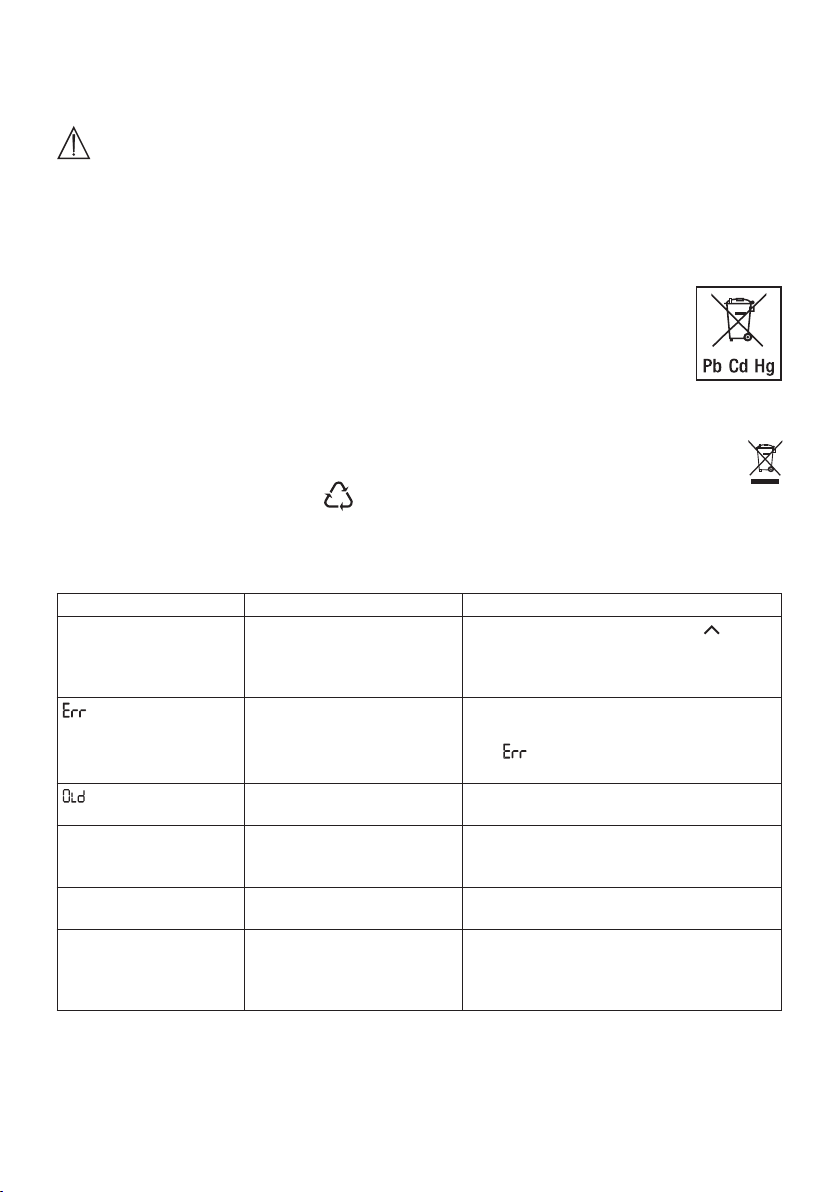
Diese Zeichen finden Sie auf schadstoffhaltigen Batterien:
Pb = Batterie enthält Blei,
Cd = Batterie enthält Cadmium,
Hg = Batterie enthält Quecksilber.
Im Interesse des Umweltschutzes darf das Gerät am Ende seiner Lebensdauer nicht mit dem Hausmüll
entsorgt werden. Die Entsorgung kann über entsprechende Sammelstellen in Ihrem Land erfolgen.
Entsorgen Sie das Gerät gemäß der Elektro- und Elektronik Altgeräte EG-Richtlinie – WEEE (Waste
Electrical and Electronic Equipment). Bei Rückfragen wenden Sie sich an die für die Entsorgung
zuständige kommunale Behörde.
Verpackung umweltgerecht entsorgen.
20
PAP
13. Was tun bei Problemen?
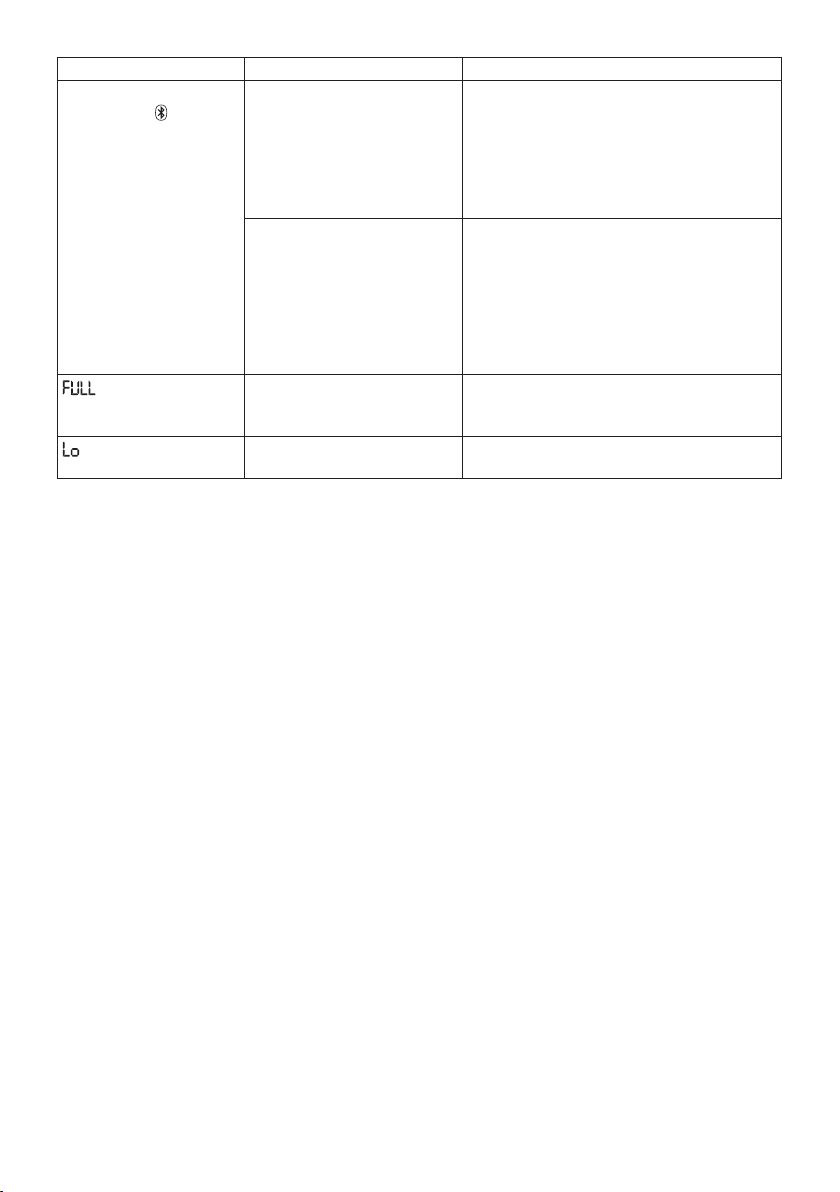
Stellt die Waage bei der Messung einen Fehler fest, wird folgendes angezeigt:
Displayanzeige Ursache Behebung
Nur Gewichtsanzeige
und P01-P08 fehlt
Unbekannte Messung, da
außerhalb Grenze Benutzer-
zuordung oder keine eindeu-
tige Zuordung möglich ist.
Benutzer an der Waage mit Taste „ “
auswählen oder Benutzerzuweisung in der
App wiederholen.
Siehe Kapitel 10 „Weitere Informationen“.
Der Fettanteil liegt außerhalb
des messbaren Bereichs (klei-
ner 4 % oder größer 65 %).
Die Messung bitte barfuß wiederholen oder
feuchten Sie ggf. Ihre Fußsohlen leicht an.
Wird weiterhin angezeigt, befinden Sie
sich außerhalb des messbaren Bereichs.
Die maximale Tragkraft von
180 kg wurde überschritten.
Nur bis 180 kg belasten.
Falsches Gewicht wird
angezeigt.
Kein ebener fester Boden. Stellen Sie die Waage auf einen ebenen
festen Boden.
Kein Teppich.
Falsches Gewicht wird
angezeigt.
Unruhiges Stehen. Stehen Sie möglichst still.
Falsches Gewicht wird
angezeigt.
Waage hat falschen Null-
punkt.
Abwarten bis Waage selbst wieder ausschal-
tet. Waage aktivieren. Eventuell wird „C“
angezeigt. „0.0 kg“
abwarten. Dann Messung
wieder holen.
12
Displayanzeige Ursache Behebung
Keine Bluetooth
®
-
Verbindung ( -Symbol
fehlt).
Gerät außerhalb der Reich-
weite.
Mindestreichweite im freien Feld sind ca.
15 m. Wände und Decken verringern die
Reichweite.
Andere Funkwellen können die Übertragung
stören. Stellen Sie die Waage deshalb nicht in
der Nähe von Geräten wie z.B. WLAN Router,
Mikrowelle, Induktionskochfeld auf.
Keine Verbindung zur App. Schließen Sie die App komplett (auch im
Hintergrund).
Schalten Sie Bluetooth
®
aus und wieder an.
Schalten Sie das Smartphone aus und wie-
der an.
Batterien in der Waage kurz entfernen und
wieder einsetzen.
Siehe FAQ bei www.beurer.com.
Benutzerspeicherplatz ist voll.
Neue Messungen überschrei-
ben die älteren Messungen.
Öffnen Sie die App. Die Daten werden auto-
matisch übermittelt. Dies kann bis zu einer
Minute dauern.
Die Batterien der Waage sind
leer.
Wechseln Sie die Batterien der Waage.
14. Garantie/Service
Wir leisten 5 Jahre Garantie ab Kaufdatum für Material- und Fabrikationsfehler des Produktes. Die Garan-
tie gilt nicht:
• Im Falle von Schäden, die auf unsachgemäßer Bedienung beruhen.
• Für Verschleißteile.
• Bei Eigenverschulden des Kunden.
• Sobald das Gerät durch eine nicht autorisierte Werkstatt geönet wurde.
Die gesetzlichen Gewährleistungen des Kunden bleiben durch die Garantie unberührt. Für Geltendma-
chung eines Garantiefalles innerhalb der Garantiezeit ist durch den Kunden der Nachweis des Kaufes zu
führen. Die Garantie ist innerhalb eines Zeitraumes von 5 Jahren ab Kaufdatum gegenüber der Beurer
GmbH, Ulm (Germany) geltend zu machen.
Bitte wenden Sie sich im Falle von Reklamationen an unseren Service unter folgendem Kontakt:
Service Hotline:
Tel.: +49 (0) 731 / 39 89-144
E-Mail: kd@beurer.de
www.beurer.com
Fordern wir Sie zur Übersendung des defekten Produktes auf, ist das Produkt an folgende Adresse
zu senden:
Beurer GmbH
Servicecenter
Lessingstraße 10 b
89231 Neu-Ulm
Germany
Irrtum und Änderungen vorbehalten

13
ENGLISH
Included in delivery
•
Quick guide
•
BF 600 diagnostic bathroom scale
•
2 x 1.5 V AAA batteries
•
These instructions for use
1. Getting to know your device
Functions of the device
This digital diagnostic scale is intended for weighing and providing a diagnosis of your personal fitness
data.
It is intended for self-testing in the private domain.
The scale is equipped with the following diagnostic functions, which can be used by up to 8 different people:
•
Body weight measurement and BMI,
•
Calculating body fat percentage,
•
Body water content,
•
Muscle percentage,
•
Bone mass and
•
Basal metabolic rate and active metabolic rate.
The scale also includes the following additional features:
•
Switch between kilograms “kg”, pounds “lb” and stones “st”,
•
Automatic switch-off function,
•
Low battery indicator,
•
Automatic user recognition,
•
Storage of the last 30 measurements for 8 users if the data cannot be transferred to the app,
•
The product uses Bluetooth
®
low energy technology, frequency band 2400 - 2483.5 MHz, transmission
power max. -0.93 dBm.
System requirements
iOS from version 10.0, Android™ from version 5.0 with Bluetooth
®
4.0.
List of compatible devices:
Dear customer,
Thank you for choosing one of our products. Our name stands
for high-quality, thoroughly tested products for applications in the areas of heat, weight, blood pressure,
body temperature, pulse, gentle therapy, massage, beauty, baby and air.
Please read these instructions for use carefully and keep them for later use. Be sure to make them acces-
sible to other users and observe the information they contain.
With kind regards,
Your Beurer team
Contents
1. Getting to know your device ............................13
2. Signs and symbols ........................................... 14
3. Warnings and safety notes ............................... 14
4. Information .......................................................15
5. Device description ............................................16
6. Initial use with the app ......................................16
7. Initial use of the scale without the app .............17
8. Take measurement .........................................18
9. Evaluating the results ..................................... 19
10. More information ............................................21
11. Cleaning and maintaining the device .............21
12. Disposal ..........................................................21
13. What if there are problems? ...........................22
14. Warranty/service ............................................. 23
14
2. Signs and symbols
The following symbols appear in these instructions for use:
WARNING Warning instruction indicating a risk of injury or damage to health.
IMPORTANT Safety note indicating possible damage to the unit/accessory.
Note Note on important information.
3. Warnings and safety notes
Please read these instructions for use carefully and keep them for later use, be sure to also make them
accessible to other users and observe the notes they contain.
WARNING
•
The scale may not be used by people with medical implants (e.g. pacemakers),
as this may affect their functionality.
•
Do not use during pregnancy.
•
Never step onto the outer edge of the scale with one foot as this could cause the
scale to tip!
•
Swallowing batteries can be extremely dangerous. Keep the batteries and scale out of the reach
of small children. Should a battery be swallowed, seek medical assistance immediately.
•
Keep packaging material away from children (risk of suffocation).
•
Warning, do not step onto the scale with wet feet or if the surface of the scale is damp – danger of
slipping!
Notes on handling batteries
•
If your skin or eyes come into contact with battery fluid, rinse the affected areas with water and
seek medical assistance.
• Choking hazard! Small children may swallow and choke on batteries. Store the batteries out
of the reach of small children.
• Observe the plus (+) and minus (-) polarity signs.
• If a battery has leaked, put on protective gloves and clean the battery compartment with a dry
cloth.
• Protect batteries from excessive heat.
• Risk of explosion! Do not throw batteries into a fire.
• Do not charge or short-circuit batteries.
• If the device is not to be used for a relatively long period, take the batteries out of the battery
compartment.
• Use identical or equivalent battery types only.
• Always replace all batteries at the same time.
• Do not use rechargeable batteries.
• Do not disassemble, split or crush the batteries.
General notes
•
The device is suitable only for private use, and not for medical or commercial purposes.
•
Please note that measuring tolerances are possible for technical reasons as this scale is not cali-
brated for use in a professional medical context.
•
In cases of differing measurements (between the scale and app), only use the measured values
displayed on the scale.
•
The scale’s maximum capacity is 180 kg (396 lb/28 st). The results for weight and bone mass are
displayed in 100 g increments (0.2 lb).
•
Measurements of body fat, body water and muscle content are displayed in increments of 0.1%.
•
Calorie requirement is indicated in steps of 1 kcal.
•
When supplied to the customer, the scale is set to weigh and measure in “kg” and “cm”. You can
change the unit settings during initial use of the app.
•
Place the scale on an even, hard surface; a hard surface is crucial to accurate measurements.
15
•
Protect the device from knocks, damp, dust, chemicals, marked temperature fluctuations and
nearby sources of heat (ovens, heaters).
•
Repairs must only be carried out by Beurer Customer Services or authorised retailers. Before
making a claim, please check the batteries first and replace them if necessary.
•
We hereby confirm that this product complies with the European RED Directive 2014/53/EU.
The CE Declaration of Conformity for this product can be found under:
www.beurer.com/web/we-landingpages/de/cedeclarationofconformity.php.
Storage and maintenance
The accuracy of the measurements and service life of the device depend on its careful handling:
IMPORTANT
•
The device should be cleaned from time to time. Do not use any abrasive cleaning products and
never submerge the device in water.
•
Make sure that no liquids come into contact with the scale. Never submerge the scale in water.
Never rinse it in running water.
•
Do not place any objects on the scale when not in use.
•
Protect the device from knocks, damp, dust, chemicals, marked temperature fluctuations and
nearby sources of heat (ovens, heaters).
•
Do not press the buttons violently or with pointed objects.
•
Do not expose the scale to high temperatures or strong electromagnetic fields (e.g. mobile tele-
phones).
4. Information
The measurement principle
This scale works on the principle of B.I.A. (bioelectrical impedance analysis). This involves the calculation
of body content within seconds, using a current that is not noticeable, is completely non-hazardous and
does not pose any risk.
When this measurement of the electrical resistance (impedance) is considered alongside constants and/
or individual values (age, height, gender, activity level), the body fat percentage and other variables in
the body can be calculated. Muscle tissue and water conduct electricity well and therefore have a lower
resistance. In contrast, bones and fat tissue have low conductivity as the fat cells and bones are barely
able to conduct the current due to very high levels of resistance.
Please note that the values calculated by the diagnostic scale only represent an approximation of the
actual medical analytical values for the body. Only a specialist doctor can precisely establish the body fat,
body water, muscle percentage and bone structure using medical methods (e.g. computer tomography).
General tips
•
As far as possible, weigh yourself at the same time everyday (ideally in the morning), after having been
to the toilet, on an empty stomach and without clothing, in order to obtain results which can be com-
pared.
•
Important point regarding the measurement: the calculation of body fat may only be made when bare-
foot; the soles of the feet may be lightly dampened where appropriate.
Results may be unsatisfactory if the soles of the feet are completely dry or feature high levels of horny
skin as this results in insufficient conductivity.
Note: There must be no skin contact between your feet, legs, calves or thighs. Otherwise, the
measurement cannot be taken correctly.
•
Stand up straight and still whilst weighing yourself.
•
Wait a few hours after any physical exertion to which your body is unaccustomed.
•
Wait approx. 15 minutes after getting up so that the water stored in the body can disperse.
•
You must remember that only the long-term trend is important. Brief deviations in weight within a few
days are normally caused by loss of fluids; however, body water plays an important role in terms of
well-being.
16
Limitations
When calculating the body fat and the additional values, deviating and implausible results may occur in
the case of:
•
Children under 10 years of age,
•
Performance athletes and body-builders,
•
Persons with a fever, persons undergoing dialysis, persons demonstrating oedema symptoms and per-
sons suffering from osteoporosis,
•
Persons taking cardiovascular medicine (affecting the heart and vascular system),
•
Persons taking vasodilative or vasoconstrictive medication,
•
Persons with significant anatomical deviations in their legs compared with their overall body height (leg
length significantly shorter or longer).
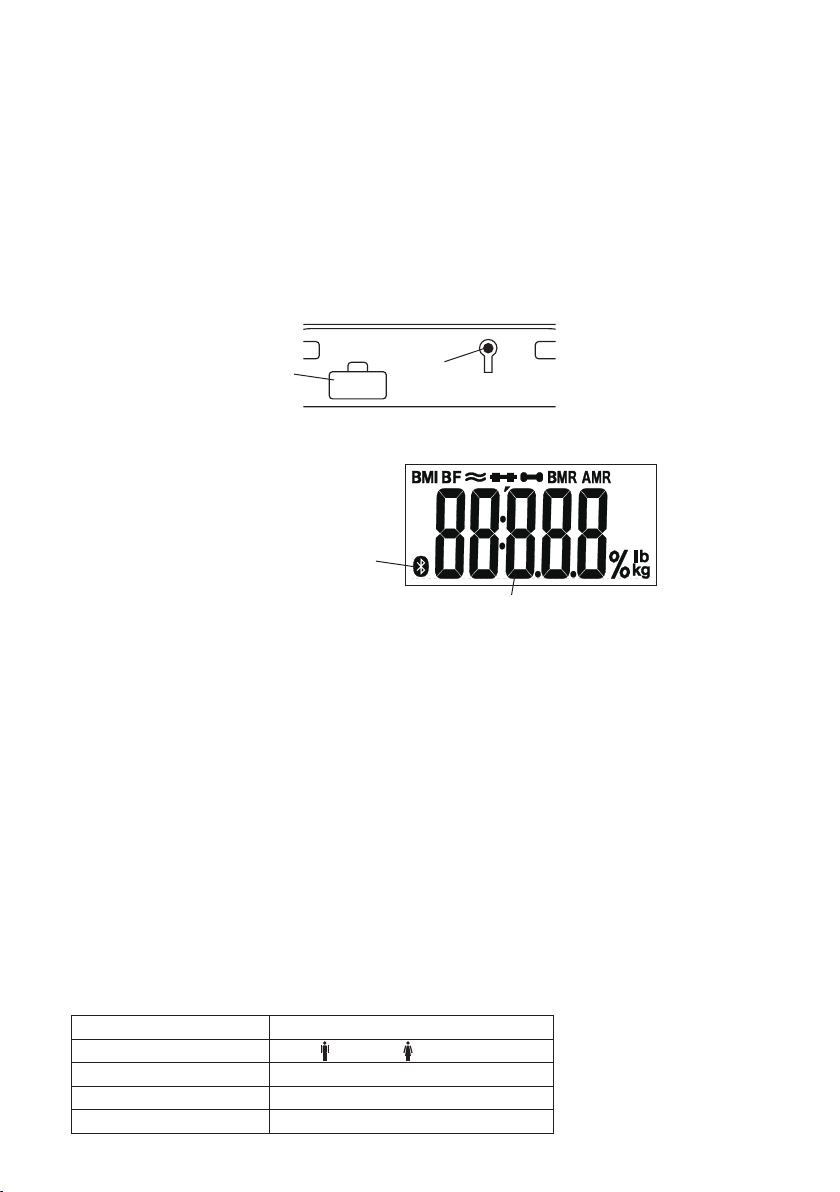
5. Device description
Rear
2
1
1. Battery compartment
2. Unit/reset button
Display
3
4
3. Bluetooth
®
symbol for connection
between scale and smartphone.
4. Measurements
6. Initial use with the app
To calculate your body fat percentage and additional body values, you must save the personal user data
on the scale.
The scale has 8 user memory spaces which allows, for example, you and your family members to save
personal settings.
It is also possible to activate users via other mobile end devices on which the “beurer HealthManager“ app
has been installed or by changing the user profile in the app (see the app settings).
Keep the smartphone close to the scale in order to maintain an active Bluetooth
®
connection during initial
use.
– Activate Bluetooth
®
in your smartphone’s settings.
–
Insert the batteries and place the scale on a solid surface (“App” will flash on the scale’s LCD).
–
Download the free “beurer HealthManager” app from the Apple App Store (iOS) or at Google Play
(Android™).
–
Start the app and follow the instructions.
–
Enter the BF 600 related data.
The following settings must be set or entered in the “
beurer HealthManager
” app:
User data Set values
Gender Male ( ), female ( )
Height 100 to 220 cm (3' 3.5" to 7' 2.5")
Age 10 to 100 years
Activity level 1 to 5

17
A
ctivity levels
T
he medium-term and long-term perspective is decisive when selecting the activity level.
Activity level Physical activity
1 None.
2
Low: little and light physical exertion
(e.g. going for walks, light gardening work, gymnastic exercises).
3
Medium: physical exertion, at least 2 to 4 times a week
for 30 minutes each session.
4
High: physical exertion, at least 4 to 6 times a week
for 30 minutes each session.
5
Very high: intensive physical exertion, intensive training or
hard physical work, daily for at least 1 hour.
The app assigns the next free scale user memory (P-01 – P-08) to you.
–
Taking the measurement
F
or automatic personal recognition, the first measurement must be assigned to your personal user data.
The app will prompt you to do this. Step onto the scale, ideally with bare feet, and ensure that you are
standing still with equal weight distribution and with both feet on the electrodes.
N
ow continue with chapter 8 “Take measurement”.
7. Initial use of the scale without the app
We recommend using the app for the initial use and implementing all settings. See chapter 6 “Initial use
with the app” However, this can also be carried out on the device itself.
Remove the batteries from the protective packaging and insert the batteries into the scale ensuring that
the battery polarity is correct. If the scale does not function, remove the batteries completely and reinsert
them.
Place the scale on an even, hard surface; a hard surface is crucial to accurate measurements.
Press the “SET” button.
Set the year/month/day and hour/minute by pressing the buttons “ ” and confirm these settings by
pressing the “SET” button.
The scale displays “0.0”. Press the “SET” button again. “P-01” or the last used scale user memory will
appear. Select your user memory (P-01 to P-08) with the arrows “ ” and press the “SET” button. Carry
out your settings, such as gender, height etc. (see chapter 6. “Initial use with the app (table)”. Confirm
each setting by pressing the “SET” button. A PIN will be displayed at the end of your settings. This will be
required for logging into the app later. Afterwards “0.0” is displayed.
For automatic personal recognition, the first measurement must be assigned to your personal user data.
Step onto the scale, ideally with bare feet, and ensure that you are standing still with equal weight distribu-
tion and with both feet on the electrodes.
7.1 Logging in to the app at a later time
If you have carried out the initial use of the scale without using the app, you can transfer or create your
user on the app as follows.
–
Download the free “beurer HealthManager” app from the Apple App Store (iOS) or at Google Play
(Android™).
–
Start the app and follow the instructions.
18
8. Take measurement
Place the scale on an even, hard surface; a hard surface is crucial to accurate measurements.
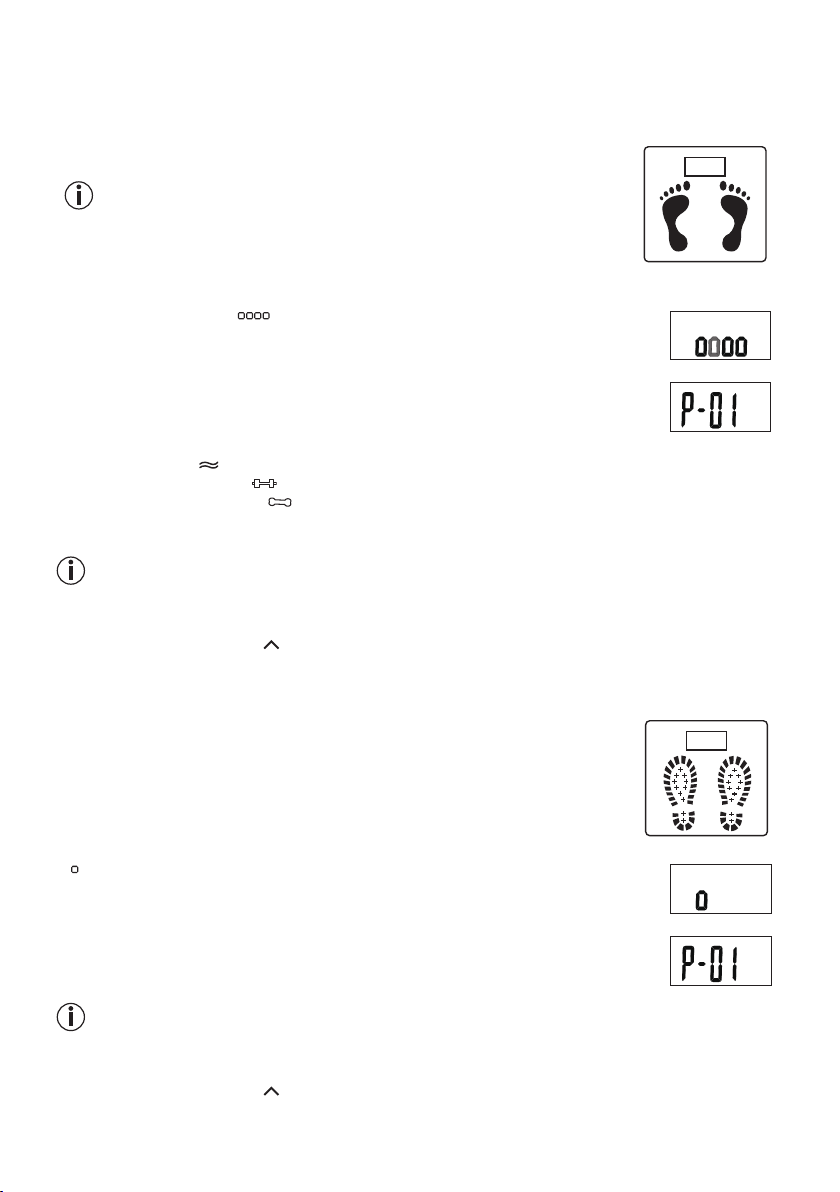
8.1 Diagnostic functions
Step onto the scale with bare feet and ensure that you are standing still with
equal weight distribution and with both legs on the electrodes
Note: The measurement result will be incorrect if the measurement is taken
with socks on.
The scale begins to take measurements straight away.
First, the weight is displayed.
During the BIA analysis, “ ” is displayed.
If a user was assigned, P-01 – P-08 is displayed and all of the following values will be
saved.
1. BMI
2. Body fat in %
3. Body water in %
4. Muscle percentage in %
5. Bone mineral amount in kg
6. Basal metabolic rate in kcal (BMR)
7. Active metabolic rate in kcal (AMR)
Note: If the user is not recognised, then the user assignment (e.g. P-01) is missing and only the
weight can be displayed. The measured values will not be saved.
This happens if your measured weight differs from the previous measurement by ± 3 kg or if another
user has similar values (± 3 kg) to yours. In this case, repeat the measurement by turning on the
scale and pressing the “ ” button to select your user memory (P-01 – P-08). Repeat the measure-
ment.
8.2 Weight
Step onto the scale wearing shoes and ensure that you are standing still with
equal weight distribution and with both legs on the scale. The scale begins to
take measurements straight away.
First, the weight is displayed.
“ ” will briefly be displayed on the LCD. A BIA analysis is not possible.
If a user was assigned, “P-01”, for example, will be displayed and the weight will
be saved.
Note: If the user is not recognised, then the user assignment (e.g. P-01) is missing and only the
weight can be displayed. The measured values will not be saved.
This happens if your measured weight differs from the previous measurement by ± 3 kg or if another
user has similar values (± 3 kg) to yours. In this case, repeat the measurement by turning on the
scale and pressing the “ ” button to select your user memory (P-01 – P-08). Repeat the measure-
ment.
19
9. Evaluating the results
Body mass index
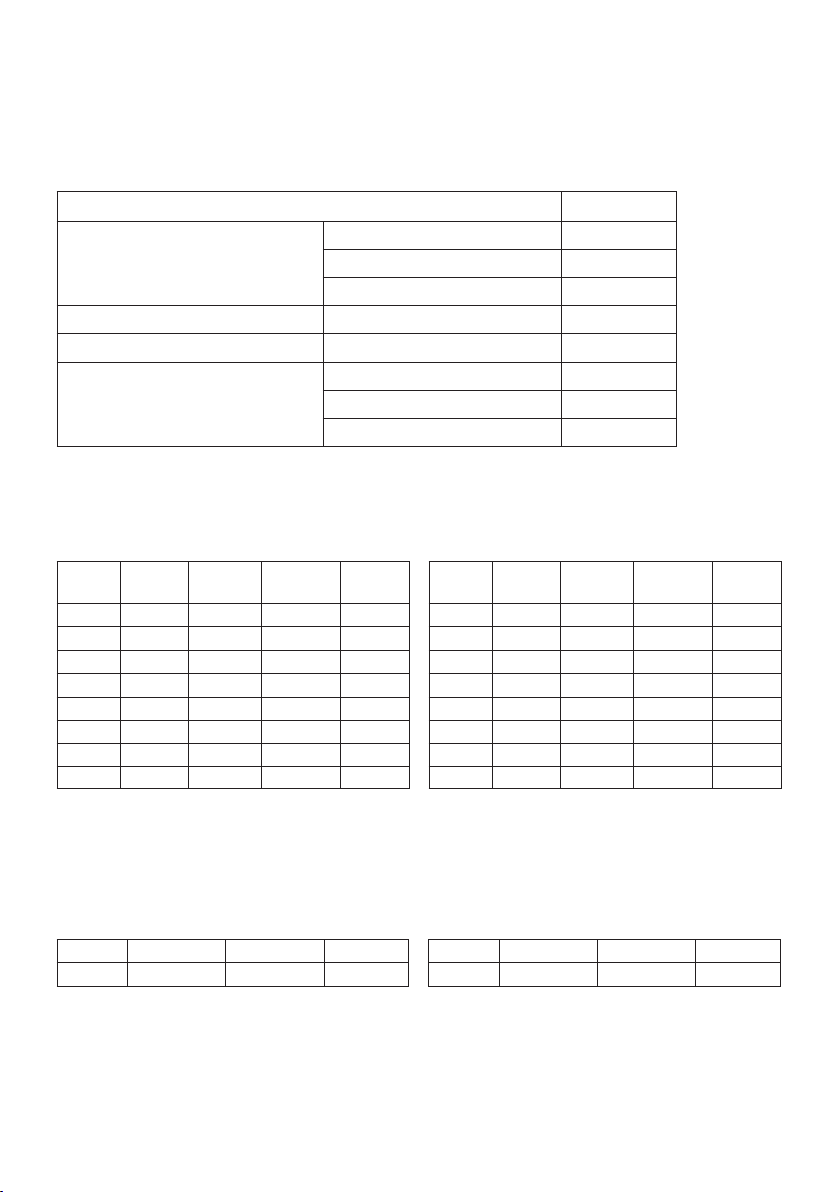
The Body Mass Index (BMI) is a figure that is commonly used to evaluate body weight. The figure is calcu-
lated from body weight and height. The formula is:
Body mass index = body weight ÷ height
2
. The measurement unit for BMI is [kg/m
2
]. According to the BMI,
weight is classified for adults (20 years and over) using the following values:
Category BMI
Underweight Severely underweight <16
Underweight 16-16.9
Slightly underweight 17-18.4
Normal weight 18.5-25
Overweight Overweight 25.1-29.9
Obese (overweight) Class I obesity 30-34.9
Class II obesity 35-39.9
Class III obesity ≥40
Source: WHO, 1999 (World Health Organization)
Body fat percentage
The subsequent body fat percentages serve as a guideline (for further information ask your doctor).
Male Female
Age Low Normal High
Very
high
Age Low Normal High
Very
high
10-14 <11% 11-16%
16.1 – 21%
>21% 10-14 <16 % 16 – 21%
21.1 – 26%
>26%
15-19 <12 % 12-17%
17.1 – 22%
>22% 15-19 <17 % 17 – 22%
22.1 – 27%
>27%
20 – 29 <13% 13-18 %
18.1 – 23%
>23% 20-29 <18 % 18 – 23%
23.1 – 28%
>28%
30 – 39 <14% 14-19 %
19.1 – 24%
>24% 30-39 <19 % 19 – 24%
24.1 – 29%
>29 %
40 – 49 <15% 15 – 20%
20.1 – 25%
>25% 40-49 <20 % 20 – 25%
25.1 – 30%
>30%
50 – 59 <16% 16 – 21%
21.1 – 26%
>26% 50-59 <21 % 21 – 26%
26.1 – 31%
>31%
60 – 69 <17% 17 – 22%
22.1 – 27%
>27% 60-69 <22 % 22 – 27%
27.1 – 32%
>32%
70-100 <18 % 18 – 23%
23.1 – 28%
>28% 70-100 <23 % 23 – 28%
28.1– 33%
>33%
A lower value will often be determined in the case of athletes. Depending on the sporting activities per-
formed, the training intensity and the physical constitution, the results may still be
below
the stated stand-
ard values. Please note, however, that there may be a risk to health in the case of extremely low values.
Body water content
The body water content in % is normally within the following ranges:
Male Female
Age Poor Good Very good Age Poor Good Very good
10-100 <50 % 50 – 65% >65% 10-100 <45 % 45 – 60% >60%
Body fat contains relatively little water, therefore body water content may be below the standard values in
persons with a high body fat percentage. On the other hand, endurance athletes may exceed the standard
values due to having low levels of fat and a high muscle percentage.
The body water calculation performed using this scale is not suitable for drawing medical conclusions,
for example in the case of age-related water retention. Consult your doctor where necessary. A high body
water content is generally desirable.

20
Muscle percentage
The muscle percentage is normally within the following ranges:
Male Female
Age Low Normal High Age Low Normal High
10-14 <44 % 44 – 57% >57% 10-14 <36 % 36 – 43% >43%
15-19 <43 % 43 – 56% >56% 15-19 <35 % 35 – 41% >41%
20 – 29 <42% 42 – 54% >54 % 20 – 29 <34% 34 – 39% >39%
30 – 39 <41% 41 – 52% >52% 30 – 39 <33% 33 – 38% >38%
40 – 49 <40% 40 – 50% >50% 40 – 49 <31% 31– 36% >36%
50 – 59 <39% 39 – 48% >48% 50 – 59 <29% 29 – 34% >34%
60 – 69 <38% 38 – 47% >47% 60 – 69 <28% 28 – 33% >33%
70-100 <37 % 37 – 46% >46% 70-100 <27% 27 – 32% >32%
Bone mass
Like the rest of our body, our bones undergo natural processes of growth, breakdown and ageing. Bone
mass increases rapidly during childhood and reaches its peak between 30 and 40 years. As you age, your
bone mass starts to gradually decline. If you have a healthy diet (particularly calcium and vitamin D) and
regularly exercise, you can slow this process down. You can also strengthen the stability of your skeletal
structure using targeted muscle growth. Please note that this scale does measure minerals of bones. Bone
mass is very difficult to modify but does vary slightly as a result of influencing factors (weight, height, age,
sex). There are no recognised guidelines and recommendations available.
BMR
The basal metabolic rate (BMR) is the amount of energy required by the body at complete rest in order to
maintain its basic functions (e.g. when lying in bed 24 hours a day). This value is primarily dependent on
weight, height and age.
It is displayed on the diagnostic scale in the unit kcal/day and calculated using the scientifically recog-
nised Harris-Benedict equation.
This is the amount of energy that is required by your body under all circumstances and must be re-sup-
plied to the body in the form of food. If your energy intake is below this level in the longer term, this can
result in damage to health.
AMR
The active metabolic rate (AMR) is the amount of energy that the active body consumes each day. An indi-
vidual’s energy requirement increases when the level of physical activity increases; the diagnostic scale
calculates this by means of the activity level (1– 5) that has been entered.
To maintain the current weight, the energy that the body uses must be replaced in the form of food and drink.
If less energy is taken in than is used over a long period of time, the body takes the difference from the fat
stores with resulting weight loss. However, if the amount of energy taken in exceeds the calculated active
metabolic rate (AMR) for a longer period, the body cannot burn off the excess energy. The excess is stored
in the body as fat, leading to weight gain.
Temporal context of the results
Please note that only the long-term trend is important. Brief deviations in weight within a few days
are normally caused by loss of fluids.
The interpretation of the results is based on changes in total body weight, percentage of body fat, body water
and muscle content, as well as on the length of time over which these changes occur.
Rapid changes within the scope of a few days are to be considered separately from medium-term
changes (in the scope of weeks) and long-term changes (months).
It can be said as a basic rule that short-term changes in weight are almost entirely changes in water content,
whereas medium-term and long-term changes may also relate to the fat percentage and the muscle percentage.
•
If your weight drops in the short term but your body fat percentage increases or stays the same, you
have only lost water, for example following a training session, visit to the sauna or a diet aimed only at
fast weight loss.
21
•
On the other hand, if your weight increases in the medium term and your body fat percentage drops or
stays the same, you may have built up valuable muscle mass.
•
If your weight and body fat percentage both fall at the same time, then your diet is working – you are los-
ing fat mass.
•
Ideally, you should support your diet with physical activity, fitness or strength training. This enables you
to increase your muscle percentage in the medium term.
•
Body fat, body water and muscle percentages must not be added (muscle tissue also contains compo-
nents made of body water).
10. More information
User assignment
It is possible to assign up to 8 scale users for a weight-only measurement (with shoes) and for a diagnosis
measurement (bare feet).
For a new measurement, the scale assigns the measurement to the user whose most recently saved
measurement falls within ± 3kg of this. See chapter 8.
Storing the assigned measurements on the scale and transferring them to the app.
If the app is not open, the newly assigned measurements are saved on the scale. A total of 30measure-
ments per user can be saved on the scale. The saved measurements are transferred automatically to the
app if you open the app within the Bluetooth range.
It is possible to automatically transfer data when the scale is switched off.
Deleting scale data
If you would like to completely delete all measurements and old user data on the scale, remove the batter-
ies for at least 10 seconds. Then press the unit/reset button and reinsert the batteries at the same time. “
” will appear on the display for several seconds.
This is necessary if you would like to delete scale users who have been set up incorrectly or are no longer
required, for example.
You must then carry out the actions in chapter 6 again (user assignment).
Changing the batteries
Your scale is equipped with a low battery indicator. If you operate the scale with flat batteries, “Lo” will
appear on the display and the scale will automatically switch off. In this case, the batteries must be
replaced (2 x 1.5 V AAA). All saved measurements and users remain saved.
Connect the scale to the app again. The system time is updated.
NOTE:
•
When changing the batteries, use batteries of the same type, make and capacity.
•
Do not use rechargeable batteries.
•
Use batteries free from heavy metals.
11. Cleaning and maintaining the device
The device should be cleaned from time to time.
This should be done using a damp cloth and, if necessary, a small amount of detergent.
IMPORTANT
•
Never use abrasive solvents or cleaning products!
•
Never submerge the device in water!
•
Do not clean the device in a dishwasher!
12. Disposal
Empty, completely flat batteries must be disposed of through specially designated collection boxes, recy-
cling points or electronics retailers. You are legally required to dispose of the batteries.
The codes below are printed on batteries containing harmful substances:
Pb = Battery contains lead
Cd = Battery contains cadmium
Hg = Battery contains mercury
22
For environmental reasons, do not dispose of the device in the household waste at the end of its service
life. Dispose of the device at a suitable local collection or recycling point.
Dispose of the device in accordance with EC Directive – WEEE (Waste Electrical and Electronic
Equipment). If you have any questions, please contact the local authorities responsible for waste
disposal.
Dispose of packaging in an environmentally friendly manner.
20
PAP
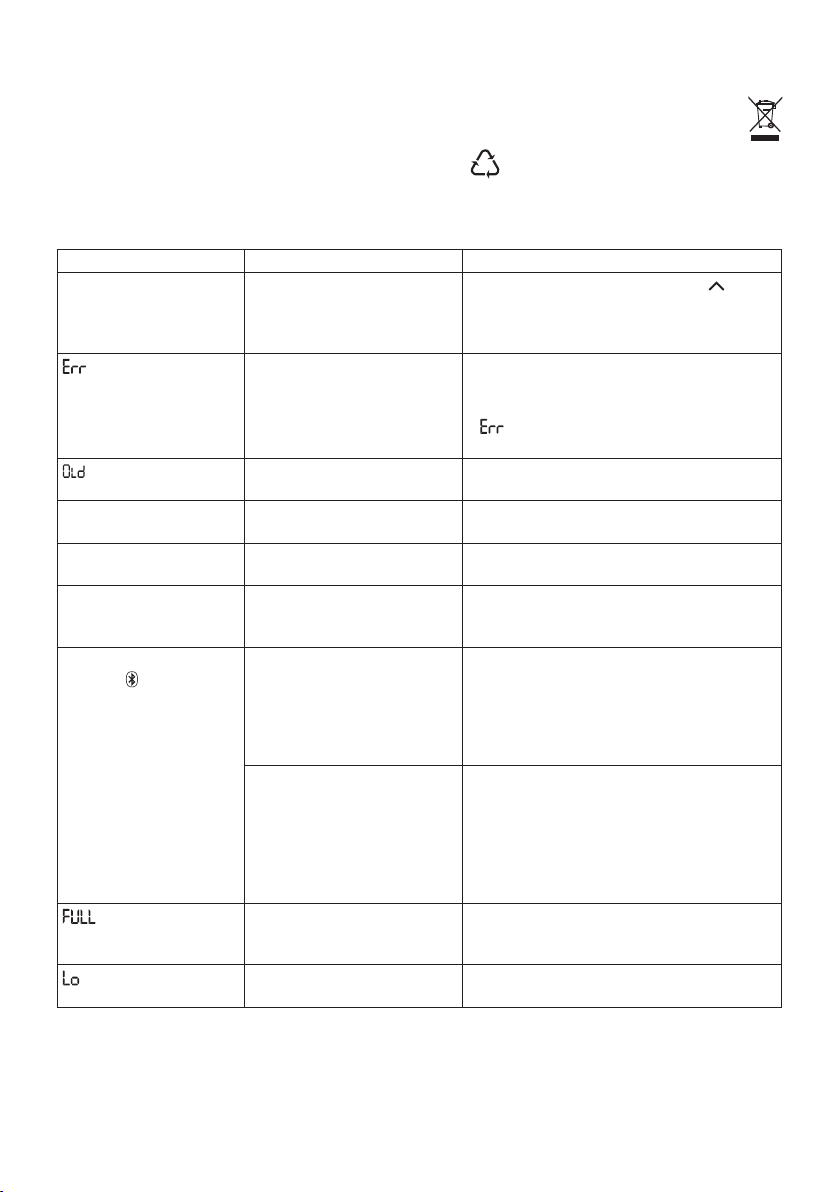
13. What if there are problems?
If the scale encounters an error during measurement, the following is displayed:
Display Cause Solution
Only weight display
and P-01 – P-08 are
missing
Unknown measurement as
it is outside the user assign-
ment limit or a unique assign-
ment is not possible.
Select user on the scale using the “ ” but-
ton or repeat user assignment in the app.
See chapter 10 “Additional information”.
The proportion of fat is out-
side the measurable range
(less than 4 % or greater than
65%).
Please repeat the measurement barefoot, or
with the soles of the feet lightly dampened if
necessary.
If is still displayed, you are outside of the
measurable range.
Maximum weight capacity of
180 kg exceeded.
Loads must be limited to 180 kg.
Incorrect weight is dis-
played.
No flat, stable surface. Place the scale on a flat, stable surface.
No carpet.
Incorrect weight is dis-
played.
Not standing still. Stand as still as possible.
Incorrect weight is dis-
played.
Incorrect zero point of scale.
Wait until the scale switches itself off. Activate
scale. “C” may be displayed. Wait for “0.0 kg”
.
Then repeat the measurement.
No Bluetooth
®
con-
nection ( symbol is
missing).
Device outside the range.
The range in the open is approx. 15 m. Walls
and ceilings reduce the range.
Other radio waves may interfere with the
transmission. Therefore, do not position the
scale near devices such as WIFI routers,
microwaves, induction hobs etc.
No connection to the app. Completely close the app (including in the
background).
Switch Bluetooth
®
off and back on again.
Switch the smartphone off and back on again.
Remove the batteries in the scale for a short
period and reinsert them.
See FAQs at www.beurer.com.
User memory space is full.
New measurements overwrite
the older measurements.
Open the app. The data is transferred auto-
matically. This may take up to one minute.
The batteries in the scale are
empty.
Replace the batteries in the scale.

23
Subject to error and change
14. Warranty/service
In case of a claim under the warranty please contact your local dealer or the local representation which is
mentioned in the list “service international”.
In case of returning the unit please add a copy of your receipt and a short report of the defect.
The following warranty terms shall apply:
1. The warranty period for BEURER products is either 5 years or- if longer- the country specific warranty
period from date of Purchase.
In case of a warranty claim, the date of purchase has to be proven by means of the sales receipt or
invoice.
2. Repairs (complete unit or parts of the unit) do not extend the warranty period.
3. The warranty shall not be valid for damages because of
a. improper treatment, e.g. nonobservance of the user instructions.
b. repairs or tampering by the customer or unauthorised third parties.
c. transport from the manufacturer to the consumer or during transport to the service centre.
d. The warranty shall not be valid for accessories which are subject to normal wear and tear (cuff, bat-
teries etc.).
4. Liability for direct or indirect consequential losses caused by the unit are excluded even if the damage
to the unit is accepted as a warranty claim.

24
FRANÇAIS
Contenu
•
Manuel abrégé
•
Pèse-personne impédancemètre BF 600
•
2piles 1,5V, type AAA
•
Ce mode d’emploi
1. Familiarisation avec l’appareil
Fonctions de l’appareil
Ce pèse-personne impédancemètre numérique sert à la fois à vous peser et à diagnostiquer vos données
personnelles de fitness.
Il est conçu pour être utilisé dans un cercle privé.
Le pèse-personne dispose des fonctions de diagnostic suivantes pouvant être utilisées par un maximum de
8personnes:
•
mesure du poids et de l’IMC,
•
mesure du taux de graisse corporelle,
•
taux d’eau corporelle,
•
taux de masse musculaire,
•
masse osseuse et
•
volume de base et volume d’activité.
Le pèse-personne dispose en outre des fonctionnalités suivantes:
•
conversion entre kilogramme «kg», livre «lb» et stone «st»,
•
fonction d’arrêt automatique,
•
affichage du changement de piles en cas de piles faibles,
•
reconnaissance automatique de l’utilisateur,
•
enregistrement des 30dernières mesures pour 8personnes, si le transfert vers l’application est impossible,
•
Le produit utilise la technologie Bluetooth
®
low energy technology sur la bande de fréquence 2400 -
2483,5 MHz, à une puissance d’émission max. de -0,93dBm.
Conditions du système
iOS à partir de la version 10.0, Android™ à partir de la version 5.0 avec Bluetooth
®
4.0.
Liste des appareils compatibles:
Chère cliente, cher client,
Nous vous remercions d’avoir choisi l’un de nos produits. Notre société est
réputée pour l’excellence de ses produits et les contrôles de qualité auxquels ils sont soumis. Nos pro-
duits couvrent les domaines de la chaleur, du poids, de la pression sanguine, de la température corporelle,
de la thérapie douce, des massages, de la beauté, des soins pour bébé et de l’amélioration de l’air.
Lisez attentivement ce mode d’emploi, conservez-le pour un usage ultérieur, mettez-le à disposition des
autres utilisateurs et suivez les consignes qui y figurent.
Sincères salutations,
Votre équipe Beurer
Sommaire
1. Familiarisation avec l’appareil ..........................24
2. Symboles utilisés ..............................................25
3.
Consignes d’avertissement et de mise en garde
25
4. Information .......................................................26
5. Description de l’appareil ...................................27
6. Mise en service du pèse-personne ..................27
7. Mise en service du pèse-personne avec
l’application ...................................................... 28
8. Mesure ............................................................ 29
9. Évaluation des résultats.................................. 30
10. Plus d’informations .........................................32
11. Nettoyage et entretien de l’appareil ...............33
12. Élimination ...................................................... 33
13. Que faire en cas de problèmes?....................33
14. Garantie/Maintenance .................................... 34
25
2. Symboles utilisés
Voici les symboles utilisés dans le mode d’emploi:
AVERTISSEMENT Ce symbole vous avertit des risques de blessures ou des dangers pour
votre santé.
ATTENTION Ce symbole vous avertit des éventuels dommages au niveau de l’appareil ou d’un
accessoire.
Remarque Ce symbole indique des informations importantes.
3. Consignes d’avertissement et de mise en garde
Lisez attentivement ce mode d’emploi, conservez-le pour un usage ultérieur, mettez-le à disposition des
autres utilisateurs et suivez les consignes qui y figurent.
AVERTISSEMENT
•
Le pèse-personne ne doit pas être utilisé par des personnes portant des
implants médicaux (par ex. stimulateur cardiaque). Sinon, leur fonctionnement
pourrait être altéré.
•
Ne pas utiliser pendant la grossesse.
•
Ne pas se tenir sur le bord extérieur du pèse-personne: Danger de basculement!
•
Les piles sont extrêmement dangereuses si elles sont avalées. Conservez les piles et le pèse-per-
sonne hors de portée des enfants en bas âge. En cas d’ingestion d’une pile, consultez immédiate-
ment un médecin!
•
Conservez l’emballage hors de portée des enfants (risque d’étouffement).
•
Attention, ne montez pas sur le pèse-personne les pieds mouillés et ne posez pas les pieds sur le
plateau de pesée s’il est humide – Risque de glissade!
Remarques relatives aux piles
•
Si du liquide de la cellule de pile entre en contact avec la peau ou les yeux, rincez la zone touchée
avec de l’eau et consultez un médecin.
• Risque d’ingestion! Les enfants en bas âge pourraient avaler des piles et s’étouffer. Veuillez
donc conserver les piles hors de portée des enfants en bas âge!
• Respectez les signes de polarité plus (+) et moins (-).
• Si une pile a coulé, enfilez des gants de protection et nettoyez le compartiment à piles avec un
chiffon sec.
• Protégez les piles d’une chaleur excessive.
• Risque d’explosion! Ne jetez pas les piles dans le feu.
• Les piles ne doivent être ni rechargées ni court-circuitées.
• En cas de non-utilisation prolongée de l’appareil, sortez les piles du compartiment à piles.
• Utilisez uniquement des piles identiques ou équivalentes.
• Remplacez toujours l’ensemble des piles simultanément.
• N’utilisez pas de batterie!
• Ne démontez, n’ouvrez ou ne cassez pas les piles.
Recommandations générales
•
L’appareil est prévu pour un usage strictement personnel et non pour une utilisation à des fins
médicales ou commerciales.
•
Notez que des tolérances de mesure techniques sont possibles, car il ne s’agit pas d’un
pèse-personne calibré destiné à un usage professionnel ou médical.
•
Si les résultats de mesure sont différents (entre le pèse-personne et l’application), utiliser exclusi-
vement les valeurs affichées sur le pèse-personne.
•
La portée maximale du pèse-personne est de 180kg max. (396lb, 28st). Les résultats lors de la
mesure du poids et de l’estimation de la masse osseuse sont affichés par graduations de 100g
(0,2lb).
•
Les résultats de mesure des parts de graisse corporelle, d’eau corporelle et de muscle s’affichent
par graduations de 0,1 %.
26
•
Le besoin calorique est donné par graduations de 1kcal.
•
À la livraison du pèse-personne, le réglage des unités est en «cm» et «kg». Lors de la mise en
service, vous pouvez modifier les réglages des unités à l’aide de l’application.
•
Posez le pèse-personne sur une surface plane et stable; un support stable est une condition pré-
alable à une mesure correcte.
•
Protégez l’appareil contre les coups, l’humidité, la poussière, les produits chimiques, les fortes
variations de température et les sources de chaleur trop proches (four, radiateur).
•
Seul le service client Beurer ou un opérateur autorisé peut procéder à une réparation. Cependant,
avant toute réclamation, veuillez contrôler au préalable l’état des piles et les remplacer le cas
échéant.
•
Nous garantissons par la présente que ce produit est conforme à la directive européenne RED
2014/53/EU. Vous pouvez trouver la déclaration de conformité CE de ce produit à l’adresse sui-
vante:
www.beurer.com/web/we-landingpages/de/cedeclarationofconformity.php.
Rangement et entretien
La précision des valeurs mesurées et la durée de vie de l’appareil dépendent d’un maniement soigné:
ATTENTION
•
De temps à autre, nettoyez l’appareil. N’utilisez pas de produit de nettoyage agressif et ne mettez
jamais l’appareil sous l’eau.
•
Assurez-vous qu’aucun liquide ne pénètre à l’intérieur du pèse-personne. N’immergez jamais le
pèse-personne. Ne les rincez jamais sous l’eau courante.
•
Quand le pèse-personne est inutilisé, aucun objet ne doit être posé sur le plateau.
•
Protégez l’appareil contre les coups, l’humidité, la poussière, les produits chimiques, les fortes
variations de température et les sources de chaleur trop proches (four, radiateur).
•
N’appuyez pas sur les touches violemment ou avec des objets pointus.
•
N’exposez pas votre pèse-personne aux températures élevées ou à de forts champs électroma-
gnétiques (comme ceux par exemple d’un téléphone mobile).
4. Information
Le principe de mesure
Ce pèse-personne fonctionne selon le principe de la B.I.A., l’analyse bioélectrique de l’impédance. À cet
effet, un courant imperceptible, absolument sans risque et sans danger, permet de connaître en quelques
secondes le taux des tissus corporels.
La mesure de la résistance électrique (impédance) ainsi que la prise en compte de constantes ou de don-
nées individuelles (âge, taille, sexe, activité physique) permettent de définir le taux de graisse corporelle et
d’autres paramètres physiques. Le tissu musculaire et l’eau ont une bonne conductibilité électrique et pré-
sentent donc une faible résistance. Par contre, les os et le tissu adipeux ont une faible conductibilité, car
les os et les cellules adipeuses sont très peu conducteurs en raison de leur résistance très élevée.
Notez que les valeurs déterminées par le pèse-personne impédancemètre ne représentent que des
approximations par rapport aux analyses physiques effectives d’ordre médical. Seul un spécialiste équipé
de matériel médical (par exemple un tomodensitomètre) est en mesure de déterminer précisément la
graisse corporelle, l’eau corporelle, la masse musculaire et la masse osseuse.
Conseils généraux
•
Pesez-vous, si possible, à la même heure (de préférence le matin), après être passé aux toilettes, à jeun
et nu(e) afin d’obtenir des résultats comparables.
•
Important lors de la mesure: La détermination de la graisse corporelle doit toujours être faite pieds nus;
si nécessaire, elle peut s’effectuer la plante des pieds légèrement humide.
Il se peut que les mesures effectuées avec les pieds complètement secs ne conduisent pas à des résul-
tats satisfaisants, car leur conductibilité est trop faible.
Remarque: il ne doit pas y avoir de contact cutané entre les pieds, les jambes, les mollets et les
cuisses. Autrement, la mesure ne pourrait pas être correctement effectuée.
•
Tenez-vous droit et ne bougez pas pendant la mesure.
27
•
Attendez quelques heures après un effort physique inhabituel.
•
Après votre lever, attendez 15minutes environ avant de faire la mesure pour que l’eau puisse se répartir
dans le corps.
•
Notez que seule compte la tendance à long terme. Des écarts de poids de courte durée enregistrés en
l’espace de quelques jours ne sont dus qu’à une simple perte de liquides dans la plupart des cas; l’eau
corporelle joue un rôle important dans le bien-être.
Limitations
Il se peut que la détermination de la graisse corporelle et d’autres données présente des écarts et des
résultats non plausibles dans les cas suivants:
•
les enfants de moins de 10ans,
•
les sportifs de haut niveau et les culturistes,
•
les personnes fiévreuses, en dialyse, présentant des symptômes d’œdèmes ou d’ostéoporose,
•
les personnes sous traitement médical cardiovasculaire (cœur et système vasculaire),
•
les personnes prenant des médicaments vasodilatateurs ou vasoconstricteurs,
•
les personnes présentant des écarts anatomiques sérieux des jambes par rapport à leur taille (jambes
nettement courtes ou longues).
5. Description de l’appareil
Face arrière
2
1
1. Compartiment à piles
2. Touche Unit/Reset
Écran
3
4
3. Symbole Bluetooth
®
pour la connexion
entre le pèse-personne et le smart-
phone
4. Valeurs mesurées
6. Mise en service du pèse-personne
Pour déterminer le taux de graisse corporelle et les autres paramètres, vous devez enregistrer les données
individuelles de l’utilisateur sur le pèse-personne.
Le pèse-personne dispose de 8emplacements de sauvegarde utilisateur dans lesquels vous et les
membres de votre famille pouvez, par exemple, enregistrer vos paramètres personnels.
De plus, d’autres utilisateurs peuvent être affectés depuis des terminaux mobiles où l’application «beurer
HealthManager“ est installée, ou par le choix du profil utilisateur dans l’application (voir Paramètres de
l’application).
Durant la mise en service, laissez le smartphone à proximité du pèse-personne pour que la connexion
Bluetooth
®
puisse rester active.
– Activer la fonction Bluetooth
®
dans les paramètres du smartphone.
–
Insérer les piles et placer le pèse-personne sur une surface solide («App» clignote sur l’écran
LDC du pèse-personne).
–
Téléchargez l’application gratuite « beurer HealthManager » sur Apple App Store (iOS) ou sur Goo-
gle Play (Android™).
–
Démarrer l’application et suivre les instructions.
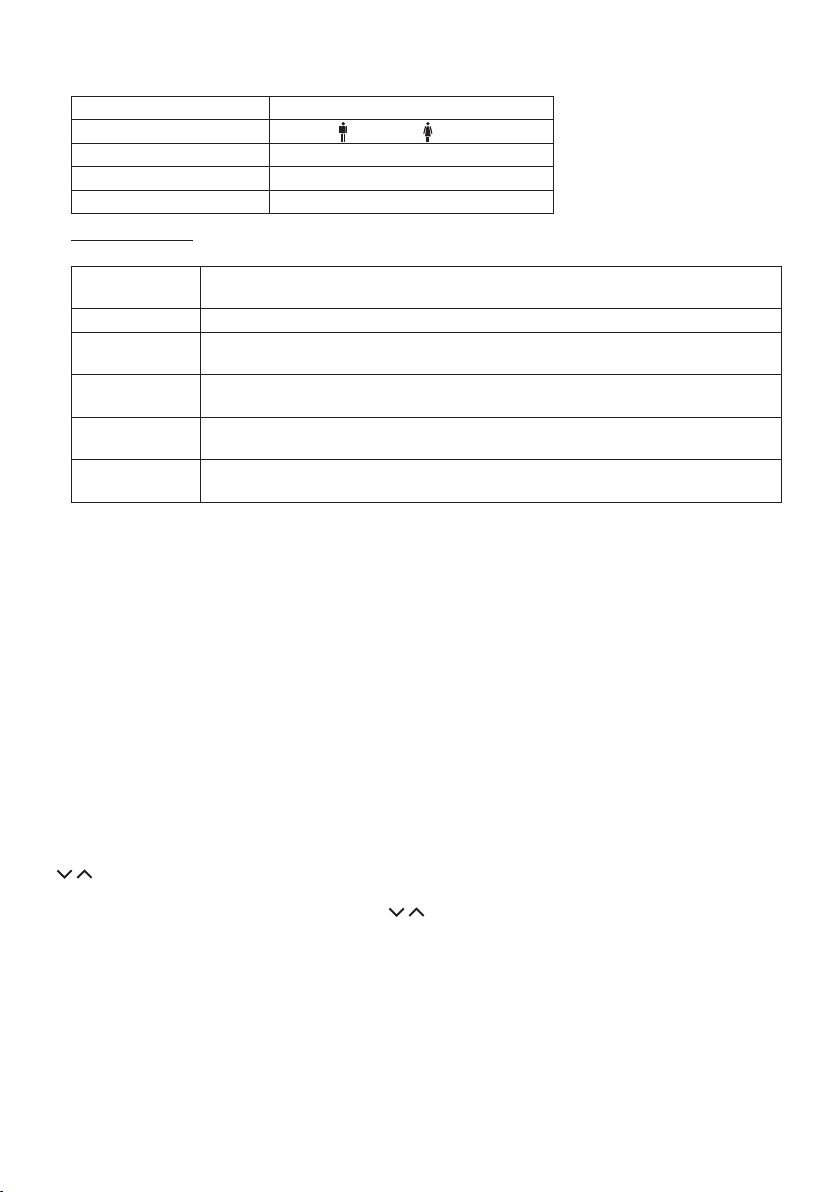
28
–
Saisir les données de BF 600.
Les réglages suivants doivent être effectués ou entrés dans l’application «
beurer HealthManager
»:
Données utilisateur Valeurs de réglage
Sexe homme ( ), femme ( )
Taille 100 à 220cm (3’ 3,5“ à 7’ 2,5“)
Âge 10 à 100ans
Niveau d’activité 1 à 5
N
iveaux d’activité
L
e niveau d’activité sera sélectionné en fonction des perspectives à moyen et à long terme.
Niveau d’ac-
tivité
Activité corporelle
1 Aucune.
2
Faible: peu d’efforts physiques et efforts physiques légers
(par ex.: promenades, jardinage simple, exercices de gymnastique).
3
Moyenne: efforts physiques, 2 à 4fois par semaine,
au moins 30minutes.
4
Élevée: efforts physiques, 4 à 6fois par semaine,
au moins 30minutes.
5
Très élevée: efforts physiques intenses, entraînement intensif ou
travail physique difficile, au moins pendant 1heure.
L’application vous attribue la prochaine mémoire utilisateur libre (P01-P08).
–
Effectuer la mesure
P
our la reconnaissance automatique des personnes, leur première mesure doit être affectée à leurs
données personnelles. Pour cela, suivez les instructions de l’application. Montez sur le pèse-personne,
idéalement pieds nus, et tenez-vous immobile en répartissant bien votre poids, les deux pieds position-
nés sur les électrodes.
P
assez au chapitre 8 «Mesure».
7. Mise en service du pèse-personne avec l’application
Nous recommandons de faire la mise en service et le réglage de tous les paramètres depuis l’application.
Voir le chapitre 6. «Mise en service du pèse-personne». Il est également possible de les effectuer depuis
l’appareil.
Retirez les piles de l’emballage et placez-les dans le pèse-personne en respectant la polarité. Si la balance
n’affiche aucune fonction, retirez complètement les piles et replacez-les à nouveau.
Posez le pèse-personne sur une surface plane et stable; un support stable est une condition préalable à
une mesure correcte.
Appuyez sur la touche SET.
Vous pouvez régler l’année/le mois/le jour ainsi que les heures/les minutes en appuyant sur la touche «
» et en confirmant avec la touche «SET».
Le pèse-personne affiche «0.0». Appuyez à nouveau sur la touche SET. «P-01» ou la dernière mémoire
utilisateur utilisée s’affiche. À l’aide de la flèche « », sélectionnez votre mémoire utilisateur (P-01 à
P-08) puis appuyez sur la touche «SET». Effectuez les réglages tels que le sexe, la taille, etc. (cf. cha-
pitre 6. «Mise en service du pèse-personne (tableau)». Confirmez les réglages en appuyant sur la touche
«SET». À la fin de votre saisie, un code PIN s’affiche. Il sera nécessaire pour toute inscription ultérieure à
l’application. «0.0» s’affiche alors.
Pour la reconnaissance automatique des personnes, leur première mesure doit être affectée à leurs don-
nées d’utilisateur personnelles. Montez sur le pèse-personne, idéalement pieds nus, et tenez-vous immo-
bile en répartissant bien votre poids, les deux pieds positionnés sur les électrodes.
7.1 Inscription ultérieure à l’application
Si vous souhaitez mettre en service le pèse-personne sans l’application, vous pouvez transférer ou créer
un utilisateur sur l’application comme suit:
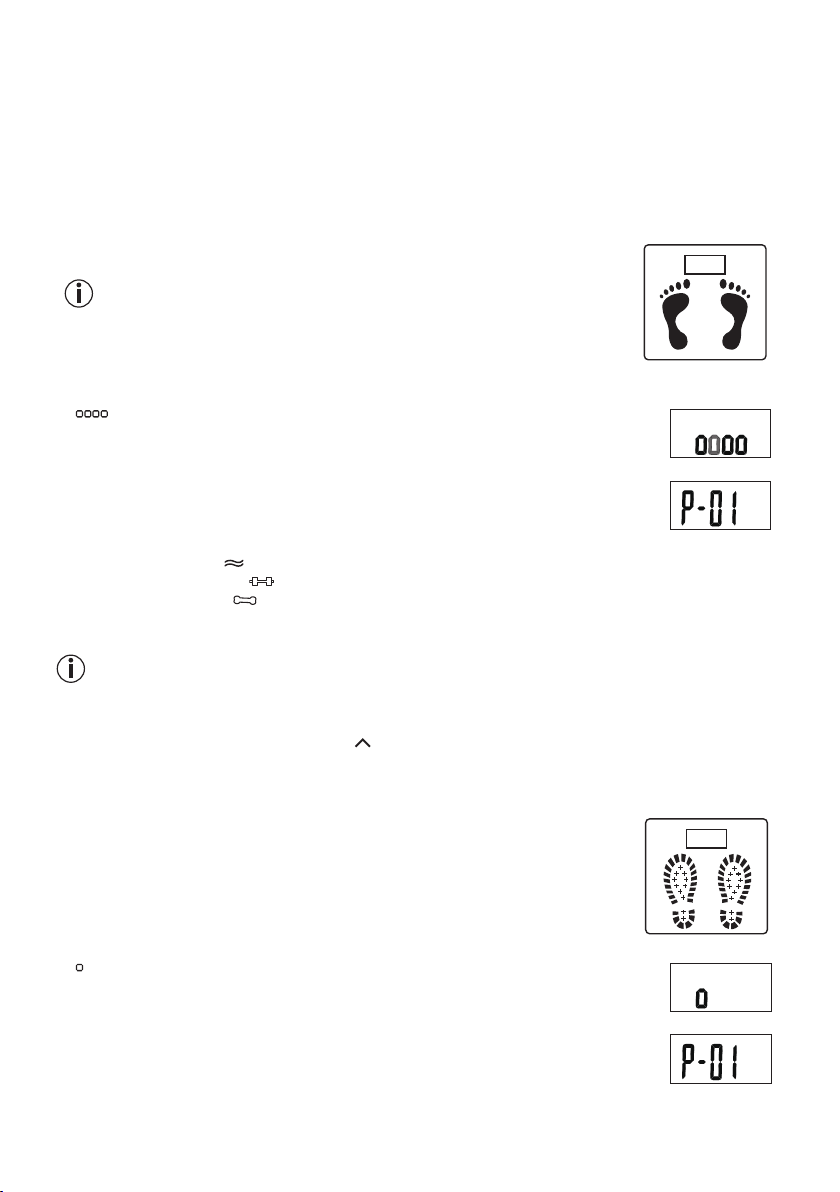
29
–
Téléchargez l’application gratuite « beurer HealthManager » sur Apple App Store (iOS) ou sur Goo-
gle Play (Android™).
–
Démarrer l’application et suivre les instructions.
8. Mesure
Posez le pèse-personne sur une surface plane et stable; un support stable est une condition préa-
lable à une mesure correcte.
8.1 Diagnostic
Montez pieds nus sur le pèse-personne et tenez-vous immobile en répartissant
bien votre poids, les deux pieds positionnés sur les électrodes.
Remarque: Si la mesure est effectuée avec des chaussettes, le résultat ne
sera pas correct.
Le pèse-personne commence tout de suite la mesure.
Le poids est d’abord affiché.
« » s’affiche pendant l’analyse d’impédance bioélectrique (BIA).
Si un utilisateur a été affecté, P-01 - P-08 s’affiche et toutes les valeurs suivantes sont
enregistrées.
1. IMC
2. Graisse corporelle en %
3. Eau corporelle en %
4. Masse musculaire en %
5. Masse osseuse en kg
6. Taux métabolique de base en kcal (BMR)
7. Volume d’activité en kcal (AMR)
Remarque: Si l’utilisateur n’est pas reconnu, aucune affectation n’apparaît (ex. P-01) et seul le
poids s’affiche. La mesure ne sera pas enregistrée.
La mesure peut être effectuée si votre poids varie de ± 3kg max. par rapport à la dernière mesure
ou qu’un autre utilisateur pèse le même poids que vous à ± 3kg. Dans ce cas, réitérez la mesure en
appuyant de nouveau sur la touche « » du pèse-personne afin de sélectionner votre mémoire uti-
lisateur (P01-P08). Répétez la mesure.
8.2 Poids
Montez désormais en chaussures sur le pèse-personne. Tenez-vous immobile
en répartissant votre poids de manière égale sur les deux jambes. Le pèse-per-
sonne commence tout de suite la mesure.
Le poids s’affiche d’abord.
« » s’affiche brièvement sur l’écran. Une analyse d’impédance bioélectrique
(BIA) est impossible.
Si un utilisateur a été affecté, «P-01» s’affiche, par exemple, et le poids est enre-
gistré.
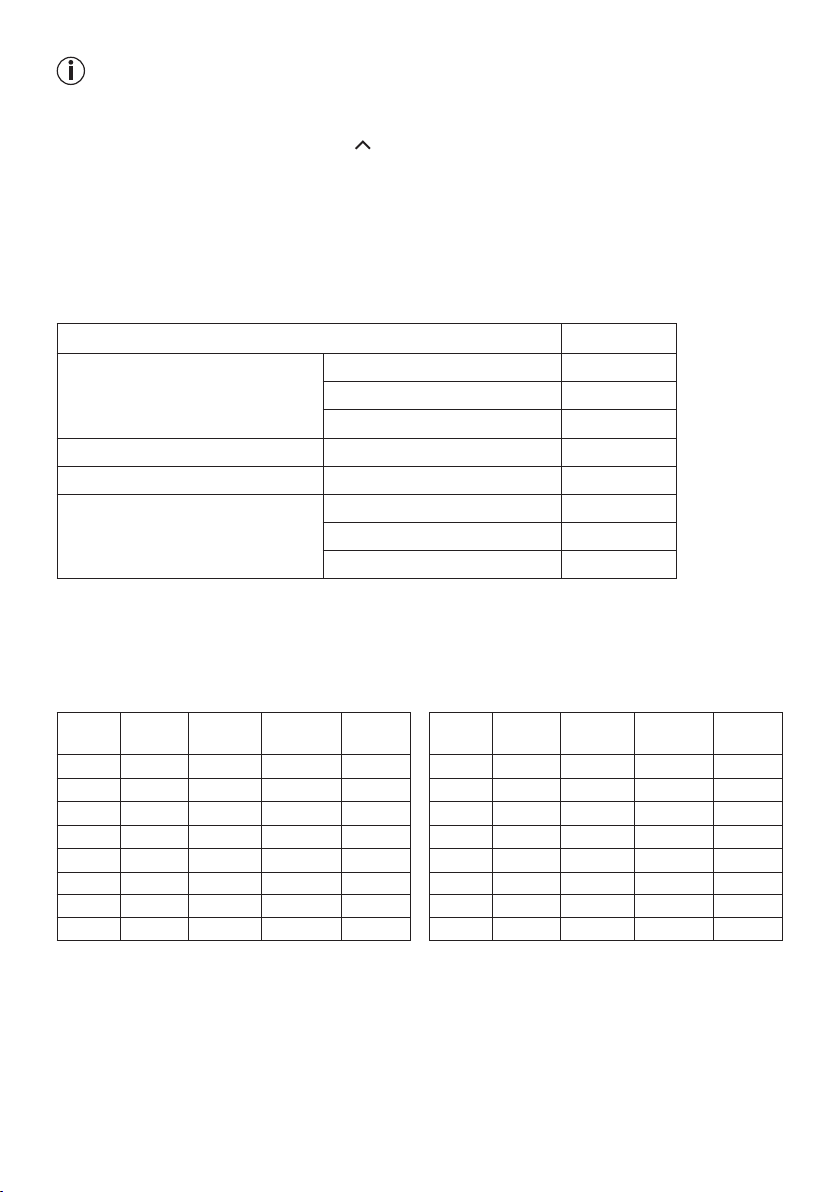
30
Remarque: Si l’utilisateur n’est pas reconnu, aucune affectation n’apparaît (ex. P-01) et seul le
poids s’affiche. La mesure ne sera pas enregistrée.
La mesure peut être effectuée si votre poids varie de ± 3kg max. par rapport à la dernière mesure
ou qu’un autre utilisateur pèse le même poids que vous à ± 3kg. Dans ce cas, réitérez la mesure en
appuyant de nouveau sur la touche « » du pèse-personne afin de sélectionner votre mémoire uti-
lisateur (P01-P08). Répétez la mesure.
9. Évaluation des résultats
Indice de masse corporelle
L’IMC est un chiffre souvent utilisé pour l’évaluation du poids. Il est calculé à partir des valeurs de poids et
de taille. La formule est la suivante:
Indice de masse corporelle = poids ÷ taille
2
. L’unité utilisée pour l’IMC est [kg/m
2
]. Chez les adultes (à par-
tir de 20ans), les poids sont classés à l’aide de l’IMC selon les valeurs suivantes:
Catégorie IMC
Insuffisance pondérale Poids très insuffisant <16
Poids modérément insuffisant 16 – 16,9
Poids légèrement insuffisant 17 – 18,4
Poids normal 18,5 – 25
Surcharge pondérale Préadipose 25,1 – 29,9
Adipose (surpoids) Adipose de degréI 30 – 34,9
Adipose de degréII 35 – 39,9
Adipose de degréIII ≥40
Source: OMS, 1999 (Organisation Mondiale de la Santé)
Taux de graisse corporelle
Les valeurs de graisse corporelle suivantes en % vous donnent une ligne de conduite (pour de plus
amples informations, veuillez consulter votre médecin).
Homme Femme
Âge faible normal élevé
très
élevé
Âge faible normal élevé
très
élevé
10 – 14 <11 % 11 – 16 % 16,1 – 21 % >21 % 10-14 <16 % 16 – 21 % 21,1 – 26 % >26%
15 – 19 <12 % 12 – 17 % 17,1 – 22 % >22 % 15-19 <17 % 17 – 22 % 22,1 – 27 % >27 %
20 – 29 <13 % 13 – 18 % 18,1 – 23 % >23 % 20-29 <18 % 18 – 23 % 23,1 – 28 % >28 %
30 – 39 <14 % 14 – 19 % 19,1 – 24 % >24 % 30-39 <19 % 19 – 24 % 24,1 – 29 % >29 %
40 – 49 <15 % 15 – 20 % 20,1 – 25 % >25 % 40-49 <20 % 20 – 25 % 25,1 – 30 % >30 %
50 – 59 <16 % 16 – 21 % 21,1 – 26 % >26 % 50-59 <21 % 21 – 26 % 26,1 – 31 % >31 %
60 – 69 <17 % 17 – 22 % 22,1 – 27 % >27 % 60-69 <22 % 22 – 27 % 27,1 – 32 % >32 %
70 – 100 <18 % 18 – 23 % 23,1 – 28 % >28 % 70-100 <23 % 23 – 28 % 28,1 – 33 % >33 %
Chez les sportifs, on constate souvent une valeur plus faible. Selon le type de sport pratiqué, l’intensité
de l’entraînement et la constitution physique, il est possible d’atteindre des valeurs
inférieures
à la valeur
de référence. Veuillez cependant noter que des valeurs extrêmement faibles peuvent entraîner des risques
pour la santé.
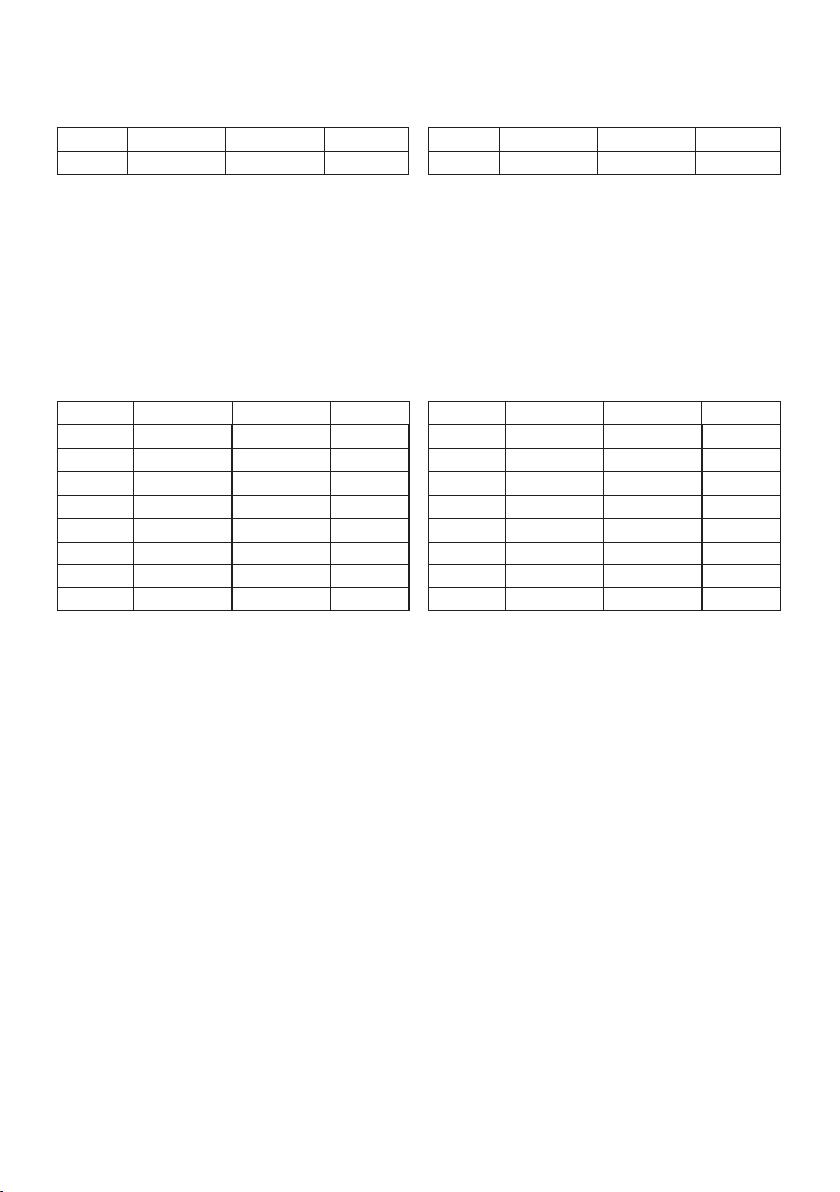
31
Taux d’eau corporelle
Le taux d’eau corporelle en % se situe normalement dans les plages suivantes:
Homme Femme
Âge mauvais bon excellent Âge mauvais bon excellent
10 – 100 <50 % 50 – 65 % >65 % 10 – 100 <45 % 45 – 60 % >60 %
La graisse corporelle contient relativement peu d’eau. C’est pourquoi, chez les personnes ayant un taux
de graisse corporelle élevé, le taux d’eau corporelle peut être inférieur aux valeurs de référence. Pour les
sportifs d’endurance, les valeurs de référence peuvent au contraire être dépassées en raison d’un taux de
graisse faible et d’un taux de masse musculaire élevé.
La détermination du taux d’eau corporelle avec ce pèse-personne ne permet pas de tirer des conclusions
médicales concernant par exemple les rétentions d’eau dues à l’âge. Le cas échéant, demandez conseil à
votre médecin. En principe, il faut chercher à avoir une part d’eau élevée.
Taux de masse musculaire
Le taux de masse musculaire en % se situe normalement dans les plages suivantes:
Homme Femme
Âge faible normal élevé Âge faible normal élevé
10 – 14 <44 % 44 – 57 % >57 % 10 – 14 <36 % 36 – 43 % >43 %
15 – 19 <43 % 43 – 56 % >56 % 15 – 19 <35 % 35 – 41 % >41 %
20 – 29 <42 % 42 – 54 % >54 % 20 – 29 <34 % 34 – 39 % >39 %
30 – 39 <41 % 41 – 52 % >52 % 30 – 39 <33 % 33 – 38 % >38 %
40 – 49 <40 % 40 – 50 % >50 % 40 – 49 <31 % 31 – 36 % >36 %
50 – 59 <39 % 39 – 48 % >48 % 50 – 59 <29 % 29 – 34 % >34 %
60 – 69 <38 % 38 – 47 % >47 % 60 – 69 <28 % 28 – 33 % >33 %
70 – 100 <37 % 37 – 46 % >46 % 70 – 100 <27 % 27 – 32 % >32 %
Masse osseuse
Comme le reste de notre corps, nos os subissent des processus naturels de croissance, de dégradation et
de vieillissement. La masse osseuse augmente rapidement pendant la croissance et atteint son pic entre
30et 40ans. Lorsque vous vieillissez, votre masse osseuse commence à diminuer progressivement. Si
vous avez un régime sain (en particulier du calcium et de la vitamine D) et faites régulièrement de l’exer-
cice, vous pouvez ralentir ce processus. Vous pouvez aussi renforcer la stabilité de votre structure sque-
lettique à l’aide d’une croissance musculaire ciblée. Veuillez noter que ce pèse-personne ne mesure pas
les minéraux dans les os. La masse osseuse est très difficile à modifier, mais varie légèrement en fonction
de différents facteurs (poids, taille, âge, sexe). Aucune directive ou recommandation reconnue n’est dispo-
nible.
BMR
Le volume de base (BMR = Basal Metabolic Rate) représente la quantité d’énergie dont le corps a besoin
au repos complet pour maintenir en activité ses fonctions de base (par exemple lorsque l’on est couché
au lit pendant 24heures). Cette valeur dépend essentiellement du poids, de la taille et de l’âge.
Elle s’affiche sur le pèse-personne impédancemètre dans l’unité kcal/jour et est calculée à l’aide de la for-
mule de Harris-Benedict reconnue scientifiquement.
Votre organisme a définitivement besoin de cette quantité d’énergie qui doit être apportée à l’organisme
via l’alimentation. À long terme, un apport d’énergie moindre peut avoir des effets nocifs sur votre santé.
AMR
Le volume d’activité (AMR = Active Metabolic Rate) représente la quantité d’énergie dont le corps a besoin
quotidiennement lorsqu’il est actif. Les dépenses énergétiques d’une personne s’accroissent avec l’aug-
mentation de l’activité physique et sont indiquées par le pèse-personne impédancemètre selon le niveau
d’activité choisi (1 à 5).

32
Pour maintenir son poids actuel, l’énergie dépensée doit être renouvelée sous forme de nourriture et de
boissons.
Si, sur une longue durée, le corps reçoit moins d’énergie qu’il n’en dépense, le corps compense la dif-
férence en utilisant essentiellement la graisse stockée et le poids diminue. Si au contraire, pendant une
longue période de temps, le corps reçoit une quantité d’énergie supérieure au volume d’activité calculé
(AMR), il ne peut pas brûler l’excédent énergétique, qui est alors stocké sous forme de graisse et le poids
augmente.
Corrélation des résultats dans le temps
Notez que seule compte la tendance à long terme. Des écarts de poids de courte durée enregistrés
en l’espace de quelques jours ne sont dus qu’à une simple perte de liquides dans la plupart des
cas.
L’interprétation des résultats se fait en fonction des modifications du poids global et des taux de graisse et d’eau
corporelles et de masse musculaire ainsi qu’en fonction de la durée selon laquelle ces modifications se pro-
duisent.
Il faut distinguer les modifications rapides (de l’ordre de quelques jours) des modifications à moyen terme
(de l’ordre de quelques semaines) et à long terme (plusieurs mois).
La règle générale peut être la suivante: les modifications de poids à court terme représentent presque
exclusivement des changements de la teneur en eau, alors que les modifications à moyen et à long terme
peuvent aussi concerner le taux de graisse et de masse musculaire.
•
Si votre poids diminue à court terme, alors que le taux de graisse corporelle augmente ou reste stable,
vous n’avez perdu que de l’eau, par exemple suite à un entraînement, une séance de sauna ou un
régime visant uniquement à une perte de poids rapide.
•
Si votre poids augmente à moyen terme, alors que le taux de graisse corporelle diminue ou reste stable,
il se pourrait au contraire que vous ayez augmenté la masse musculaire.
•
Si votre poids et votre taux de graisse corporelle diminuent simultanément, cela signifie que votre
régime fonctionne: vous perdez de la graisse.
•
L’activité physique, les séances de mise en forme ou de musculation seront les compléments parfaits
de votre régime. Ils vous permettent d’augmenter votre taux de masse musculaire à moyen terme.
•
Il ne faut pas additionner la graisse corporelle, le taux d’eau corporelle et la masse musculaire (le tissu
musculaire contient aussi des constituants de l’eau corporelle).
10. Plus d’informations
Affectation des utilisateurs
Il est possible d’affecter maximum 8utilisateurs au pèse-personne pour une mesure du poids simple (avec
chaussures) et une mesure diagnostique (pieds nus).
Lors d’une nouvelle mesure, le pèse-personne affecte celle-ci à l’utilisateur pour lequel la dernière valeur
enregistrée est de ± 3kg. Voir le chapitre8.
Enregistrement des valeurs affectées dans le pèse-personne et transfert sur l’application
Si l’application n’est pas ouverte, les nouvelles mesures affectées sont enregistrées sur le pèse-personne.
Maximum 30mesures par utilisateur peuvent être enregistrées sur le pèse-personne. Quand vous ouvrez
l’application à portée du Bluetooth, les valeurs enregistrées lui sont automatiquement transférées.
Un transfert automatique est possible quand le pèse-personne est éteint.
Supprimer les données du pèse-personne
Si vous souhaitez supprimer toutes les mesures et les anciennes données d’utilisateur du pèse-personne,
retirez les piles pendant au moins 10secondes. Appuyez ensuite sur la touche Unit/Reset et replacez en
même temps les piles. Sur l’écran, « » s’affiche pendant quelques secondes.
Ceci est nécessaire si vous souhaitez par ex. supprimer les utilisateurs mal configurés ou ceux qui n’utili-
seront plus le pèse-personne.
Ensuite, vous devez de nouveau suivre la procédure du chapitre 6 (Affectation des utilisateurs).
Remplacer les piles
Votre pèse-personne comporte un témoin de remplacement des piles. En cas d’utilisation du pèse-per-
sonne avec des piles déchargées, le message «Lo» s’affiche et l’appareil s’éteint automatiquement. Dans
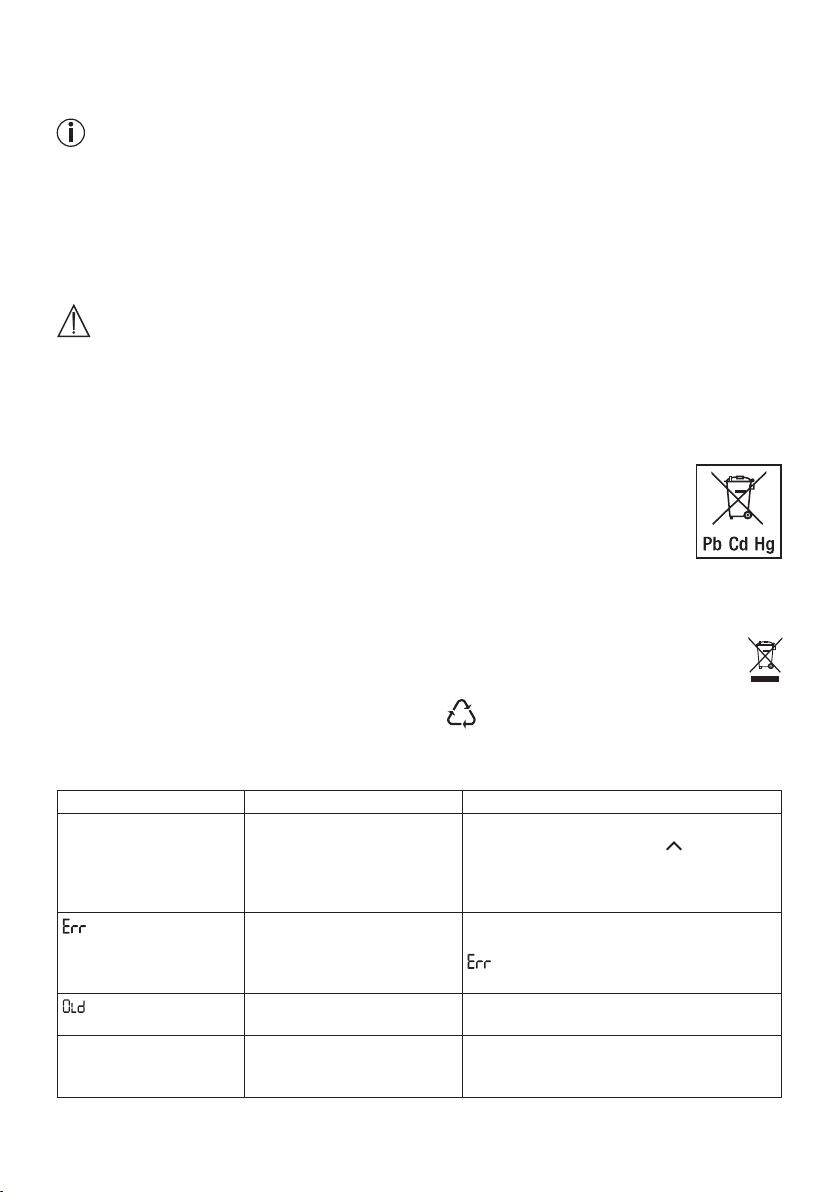
33
ce cas, les piles doivent être remplacées (2piles AAA 1,5V). Toutes les mesures et les utilisateurs enregis-
trés restent en mémoire.
Reconnecter ensuite le pèse-personne à l’application. L’heure système est alors actualisée.
REMARQUE:
•
Lors de chaque changement de piles, utilisez des piles de même type, marque et capacité.
•
N’utilisez pas de batteries rechargeables.
•
Utilisez des piles sans métaux lourds.
11. Nettoyage et entretien de l’appareil
De temps à autre, nettoyez l’appareil.
Pour le nettoyage, utilisez un chiffon humide sur lequel vous pouvez mettre, au besoin, un peu de produit
vaisselle.
ATTENTION
•
N’utilisez pas de solvant ni de détergent agressif!
•
N’immergez jamais l’appareil!
•
Ne lavez pas l’appareil au lave-vaisselle!
12. Élimination
Les piles usagées et complètement déchargées doivent être mises au rebut dans des conteneurs spé-
ciaux ou aux points de collecte réservés à cet usage ou bien déposées chez un revendeur d’appareils
électriques. L’élimination des piles est une obligation légale qui vous incombe.
Ces pictogrammes se trouvent sur les piles à substances nocives:
Pb = pile contenant du plomb,
Cd = pile contenant du cadmium,
Hg = pile contenant du mercure.
Dans l’intérêt de la protection de l’environnement, l’appareil ne doit pas être jeté avec les ordures
ménagères à la fin de sa durée de service. L’élimination doit se faire par le biais des points de collecte
compétents dans votre pays.
Veuillez éliminer l’appareil conformément à la directive européenne – WEEE (Waste Electrical and
Electronic Equipment) relative aux appareils électriques et électroniques usagés. Pour toute ques-
tion, adressez-vous aux collectivités locales responsables de l’élimination et du recyclage de ces
produits.
Éliminez l’emballage dans le respect de l’environnement.
20
PAP
13. Que faire en cas de problèmes?
Si le pèse-personne détecte une erreur au cours d’une mesure, l’écran affiche les messages suivants:
Écran Cause Solution
Le poids s’affiche, mais
P01-P08 manque
Mesure inconnue car elle se
situe hors de la limite d’af-
fectation utilisateur ou bien
aucune affectation unique
n’est possible.
Sélectionner l’utilisateur sur le pèse-per-
sonne à l’aide de la touche « » ou répéter
l’affectation utilisateur dans l’application.
Cf. chapitre 10 «Informations supplémen-
taires».
Le taux de graisse dépasse
les limites de la plage mesu-
rable (inférieur à 4 % ou supé-
rieur à 65 %).
Recommencer la mesure pieds nus ou humi-
difier légèrement la plante des pieds.
s’affiche si vous dépassez les limites de
la plage mesurable.
La capacité de charge maxi-
male de 180 kg est dépassée.
Ne pas dépasser 180kg.
Un poids incorrect s’af-
fiche.
Le sol n’est pas plat et dur. Posez le pèse-personne sur un sol plat et
dur.
Pas sur de la moquette ni sur un tapis.
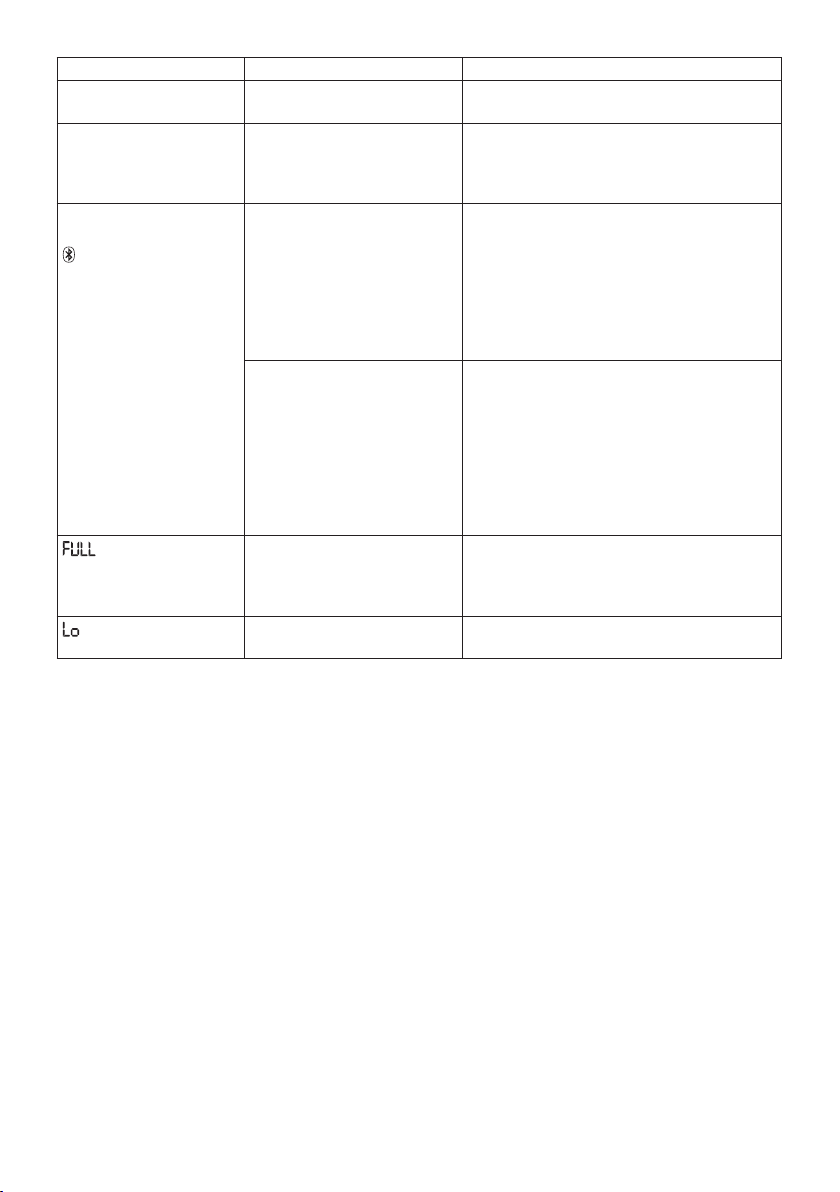
34
Écran Cause Solution
Un poids incorrect s’af-
fiche.
Position non stable. Si possible, ne bougez pas.
Un poids incorrect s’af-
fiche.
La position 0 du pèse-per-
sonne est fausse.
Attendez que le pèse-personne s’éteigne
de nouveau. Activez le pèse-personne. Le
cas échéant, «C» s’affiche.
Attendre que
«0.0kg»
s’affiche. Répéter la mesure.
Aucune connexion
Bluetooth
®
(le symbole
manque).
Appareil hors de portée.
Dans un espace dégagé, la portée est d’envi-
ron 15 m. Les murs et les plafonds diminuent
la portée.
D’autres ondes radio peuvent perturber la
transmission. Par conséquent, ne placez pas
le pèse-personne à proximité d’appareils tels
qu’un routeur sans fil, un micro-ondes, des
plaques de cuisson à induction, etc.
Aucune connexion à l’appli-
cation.
Fermez complètement l’application (en
arrière-plan également).
Éteignez la fonction Bluetooth
®
puis rallu-
mez-la.
Éteignez le smartphone puis rallumez-le.
Retirer brièvement les piles du pèse-per-
sonne et réinsérez-les ensuite.
Vous pouvez consulter la FAQ sur le site
www.beurer.com.
L’emplacement de sauve-
garde utilisateur est plein. Les
nouvelles mesures écrasent
les plus anciennes.
Ouvrez l’application. Les données sont trans-
mises automatiquement. Ceci peut durer
jusqu’à une minute.
Les piles du pèse-personne
sont vides.
Changez les piles du pèse-personne.
14. Garantie/Maintenance
Pour toute demande de garantie, veuillez contacter votre revendeur local ou la succursale locale (cf. la
liste «Service client à l’international»).
Lorsque vous retournez l’appareil, assurez-vous d’y joindre une copie de votre preuve d’achat et une
brève description du défaut.
Les conditions de garantie suivantes s’appliquent:
1. La période de garantie des produits BEURER est de 5ans ou, si elle est plus longue, elle est applicable
dans le pays concerné à compter de la date d’achat.
Pour toute demande de garantie, vous devez prouver la date d’achat par une preuve d’achat ou une
facture.
2. Les réparations (appareil complet ou pièces détachées) ne prolongent pas la période de garantie.
3. La garantie n’est pas valable en cas de dommages dus:
a. à une utilisation inappropriée, par exemple le non-respect des instructions par l’utilisateur;
b. à des réparations ou des modifications réalisées par le client ou par une personne non autorisée;
c. au transport du fabricant chez le client ou pendant le transport jusqu’au service client;
d. pour les accessoires soumis à une usure naturelle (brassard, piles, etc.).
4. Toute responsabilité liée aux dommages consécutifs directs ou indirects causés par l’appareil est
exclue même si un droit de garantie est reconnu en cas de dommage à l’appareil.
Sous réserve d’erreur et de modifications

35
ESPAÑOL
Artículos suministrados
•
Guía rápida
•
Báscula de diagnóstico BF 600
•
2 pilas de 1,5 V, tipo AAA
•
Estas instrucciones de uso
1. Información general
Funciones del aparato
Esta báscula de diagnóstico digital sirve para pesar y realizar el diagnóstico de sus datos de forma física
personales.
Está concebida para el uso particular en el ámbito privado.
La báscula dispone de las siguientes funciones de diagnóstico, que pueden usar un máximo de 8 personas:
•
medición del peso corporal e IMC,
•
determinación del porcentaje de grasa corporal,
•
porcentaje de agua corporal,
•
porcentaje de masa muscular,
•
masa ósea y
•
metabolismo basal y activo.
Además, la báscula dispone de las siguientes funciones:
•
conmutación entre kilogramo “kg”, libra “lb” y stone “st”,
•
función de desconexión automática,
•
indicación de cambio de pila en caso de batería baja,
•
identificación automática de usuarios,
•
almacenamiento de las 30 últimas mediciones para 8 personas, si no es posible la transmisión a la apli-
cación,
•
El producto utiliza Bluetooth
®
low energy technology, banda de frecuencias de 2400 - 2483,5 MHz,
potencia de emisión máx. -0,93 dBm.
Requisitos del sistema
iOS a partir de la versión 10.0, Android™ a partir de la versión 5.0 con Bluetooth
®
4.0.
Lista de los aparatos compatibles:
Estimada clienta, estimado cliente:
Nos alegramos de que haya elegido un producto de nuestra colección. Nuestro nombre es sinónimo de
productos de alta y comprobada calidad en el ámbito de aplicación de calor, peso, presión arterial, tem-
peratura corporal, pulso, tratamiento suave, masaje, belleza, bebés y aire.
Lea detenidamente estas instrucciones de uso, consérvelas para su futura utilización, asegúrese de que
estén accesibles para otros usuarios y respete las indicaciones.
Atentamente,
El equipo de Beurer
Índice
1. Información general ..........................................35
2. Símbolos...........................................................36
3. Indicaciones de advertencia y de seguridad ....36
4. Información.......................................................37
5. Descripción del aparato ................................... 38
6. Puesta en funcionamiento con la aplicación .... 38
7. Puesta en funcionamiento de la báscula sin la
aplicación .........................................................39
8. Realizar la medición .......................................40
9. Evaluación de los resultados .......................... 41
10. Más información .............................................43
11. Limpieza y cuidado del aparato ..................... 43
12. Eliminación .....................................................44
13. Solución de problemas ...................................44
14. Garantía/Asistencia ........................................ 45
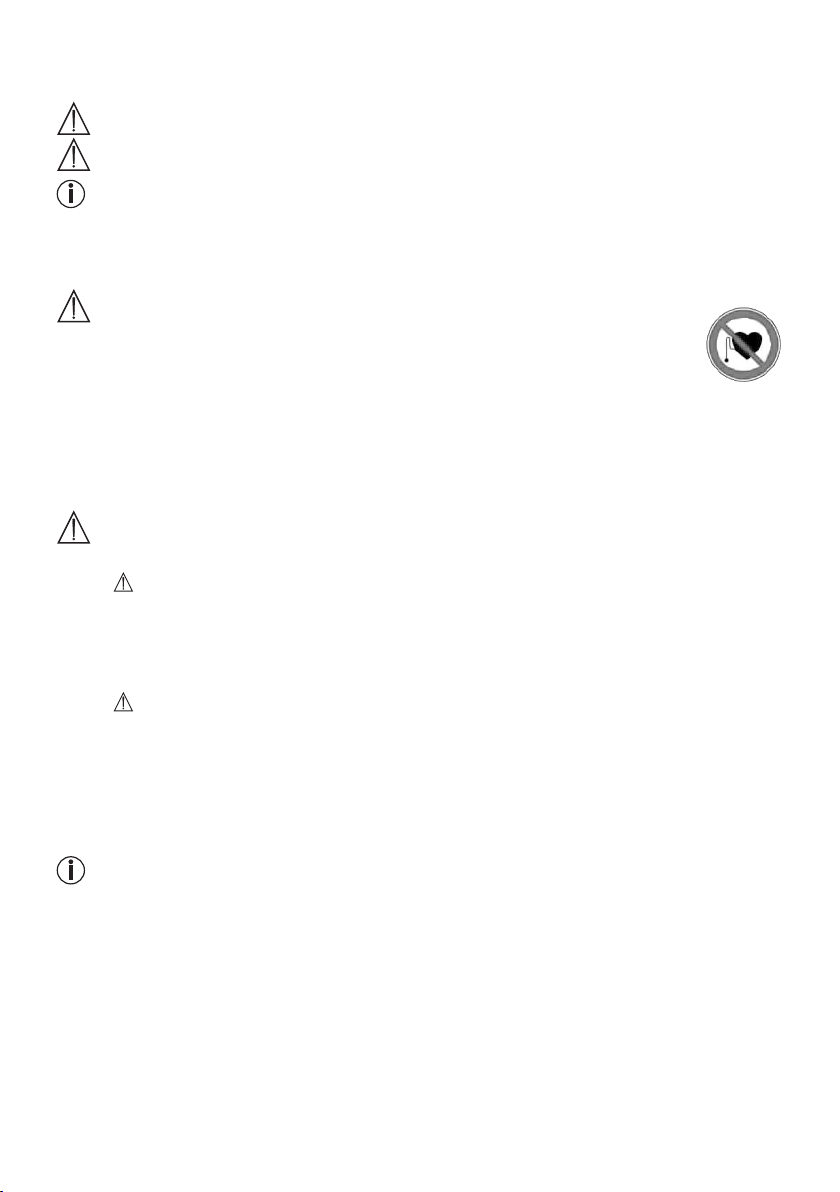
36
2. Símbolos
En las presentes instrucciones de uso se utilizan los siguientes símbolos:
ADVERTENCIA Indicación de advertencia sobre peligro de lesiones o para su salud.
ATENCIÓN Indicación de seguridad sobre posibles daños del aparato o los accesorios.
Indicación Indicación de información importante.
3. Indicaciones de advertencia y de seguridad
Lea detenidamente estas instrucciones de uso, consérvelas para su futura utilización, haga que estén
accesibles para otros usuarios y observe las indicaciones que contienen.
ADVERTENCIA
•
Las personas que lleven implantes médicos (p.ej. marcapasos) no podrán utili-
zar la báscula, ya que estos podrían afectar negativamente a su funcionamiento.
•
No debe utilizarse durante el embarazo.
•
Nunca suba por un solo lado sobre el borde exterior de la báscula: ¡Peligro de vuelco!
•
Las pilas pueden resultar mortales si se ingieren. Las pilas y la báscula deben guar-
darse fuera del alcance de los niños pequeños. En caso de tragarse una pila, acuda de inmediato
al médico.
•
Mantenga a los niños alejados del material de embalaje (peligro de asfixia).
•
Atención, nunca se suba con los pies húmedos a la báscula y no pise la báscula cuando la super-
ficie esté húmeda - ¡Peligro de resbalamiento!
Indicaciones para la manipulación de pilas
•
En caso de que el líquido de una pila entre en contacto con la piel o los ojos, lave la zona afec-
tada con agua y busque asistencia médica.
• ¡Peligro de asfixia! Los niños pequeños podrían tragarse las pilas y asfixiarse. Guarde las
pilas fuera del alcance de los niños.
• Respete los símbolos más (+) y menos (-) que indican la polaridad.
• Si se derrama el líquido de una pila, póngase guantes protectores y limpie el compartimento de
las pilas con un paño seco.
• Proteja las pilas de un calor excesivo.
• ¡Peligro de explosión! No arroje las pilas al fuego.
• Las pilas no se pueden cargar ni cortocircuitar.
• Si no va a utilizar el aparato durante un periodo de tiempo prolongado, retire las pilas del compar-
timento.
• Utilice únicamente el mismo tipo de pila o un tipo equivalente.
• Cambie siempre todas las pilas a la vez.
• No utilice baterías.
• No despiece, abra ni triture las pilas.
Indicaciones generales
•
El aparato está concebido únicamente para el uso propio, no para el uso médico o comercial
•
Tenga en cuenta que es posible que haya tolerancias de medición condicionadas técnicamente,
puesto que no se trata de una báscula calibrada para uso médico profesional.
•
En caso de resultados de medición distintos (entre la báscula y la aplicación), deberán utilizarse
exclusivamente los valores indicados en la báscula.
•
La capacidad de carga de la báscula es de 180 kg (396 lb, 28 st) como máx. Durante la medición
del peso y la determinación de la masa ósea los resultados se muestran en intervalos de 100 g
(0,2lb).
•
Los resultados de medición de la proporción de grasa corporal, agua corporal y masa muscular
se muestran en intervalos de 0,1 %.
•
La necesidad de calorías se indica en intervalos de 1 kcal.
•
En el estado de suministro, en la báscula están ajustadas las unidades “cm” y “kg”. Durante la
puesta en funcionamiento con la aplicación puede modificar los ajustes de las unidades.

37
•
Coloque la báscula en un suelo estable y liso; un revestimiento estable del suelo es un requisito
para una correcta medición.
•
Proteja el aparato de golpes, humedad, polvo, sustancias químicas, fuertes cambios de tempera-
tura y de la cercanía de fuentes de calor (hornos o radiadores)
•
Las reparaciones quedan reservadas exclusivamente al servicio de atención al cliente de Beurer o
a distribuidores autorizados. Antes de realizar cualquier reclamación, compruebe el estado de las
pilas y sustitúyalas si es necesario.
•
Garantizamos que este producto cumple la Directiva europea RED 2014/53/EU. Encontrará la
declaración de conformidad CE de este producto en:
www.beurer.com/web/we-landingpages/de/cedeclarationofconformity.php.
Conservación y cuidado
La precisión de los valores de medición y la vida útil del aparato dependen de su correcta utilización:
ATENCIÓN
•
El aparato debe limpiarse de vez en cuando. No utilice productos de limpieza corrosivos y nunca
sumerja el aparato en agua.
•
Asegúrese de que no cae ningún líquido sobre la báscula. No sumerja nunca la báscula en agua.
No la lave nunca debajo del grifo.
•
No coloque ningún objeto sobre la báscula cuando ésta no se utilice.
•
Proteja el aparato de golpes, humedad, polvo, sustancias químicas, fuertes cambios de tempera-
tura y de la cercanía de fuentes de calor (hornos o radiadores)
•
No pulse la tecla con mucha fuerza ni con objetos afilados.
•
No someta la báscula a altas temperaturas o campos electromagnéticos intensos (p. ej., teléfonos
móviles).
4. Información
El principio de medición
Esta báscula funciona según el principio del análisis de impedancia bioeléctrica. De este modo, es posible
determinar en cuestión de segundos los porcentajes corporales a través de una corriente no perceptible,
inocua y segura.
Con esta medición de la resistencia eléctrica (impedancia) y el cálculo de las constantes o valores indivi-
duales (edad, estatura, sexo, grado de actividad) pueden determinarse los porcentajes corporales y otros
parámetros corporales. El tejido muscular y el agua poseen una buena conductividad eléctrica y, por
tanto, una resistencia menor. Por el contrario, los huesos y los tejidos grasos poseen una menor conduc-
tividad, ya que las células grasas y los huesos apenas conducen la electricidad debido a una resistencia
muy elevada.
Tenga en cuenta que los valores transmitidos por la báscula de diagnóstico solo representan una aproxi-
mación a los valores de los análisis médicos reales del cuerpo. Solo un médico especialista puede esta-
blecer las proporciones exactas de grasa corporal, agua corporal, masa muscular y estructura ósea recu-
rriendo a métodos profesionales (p. ej., mediante tomografía computarizada).
Consejos generales
•
Pésese a ser posible a la misma hora del día (lo ideal es por la mañana) después de ir al baño, en ayu-
nas y sin ropa para lograr resultados comparables.
•
Importante a la hora de medir: el cálculo de la grasa corporal solo puede realizarse estando descalzo y
es útil tener las plantas de los pies ligeramente húmedas.
Unas plantas totalmente secas o queratinizadas pueden producir errores en los resultados, ya que pre-
sentan una conductividad demasiado baja.
Nota: No puede haber contacto de la piel entre los dos pies, las piernas, los gemelos o los muslos.
De lo contrario la medición no se llevará a cabo correctamente.
•
Durante el proceso de medición permanezca quieto y en posición recta.
•
Espere unas horas después de hacer algún esfuerzo físico no habitual.
•
Espere unos 15 minutos después de levantarse, para que pueda distribuirse el agua existente en el
cuerpo.
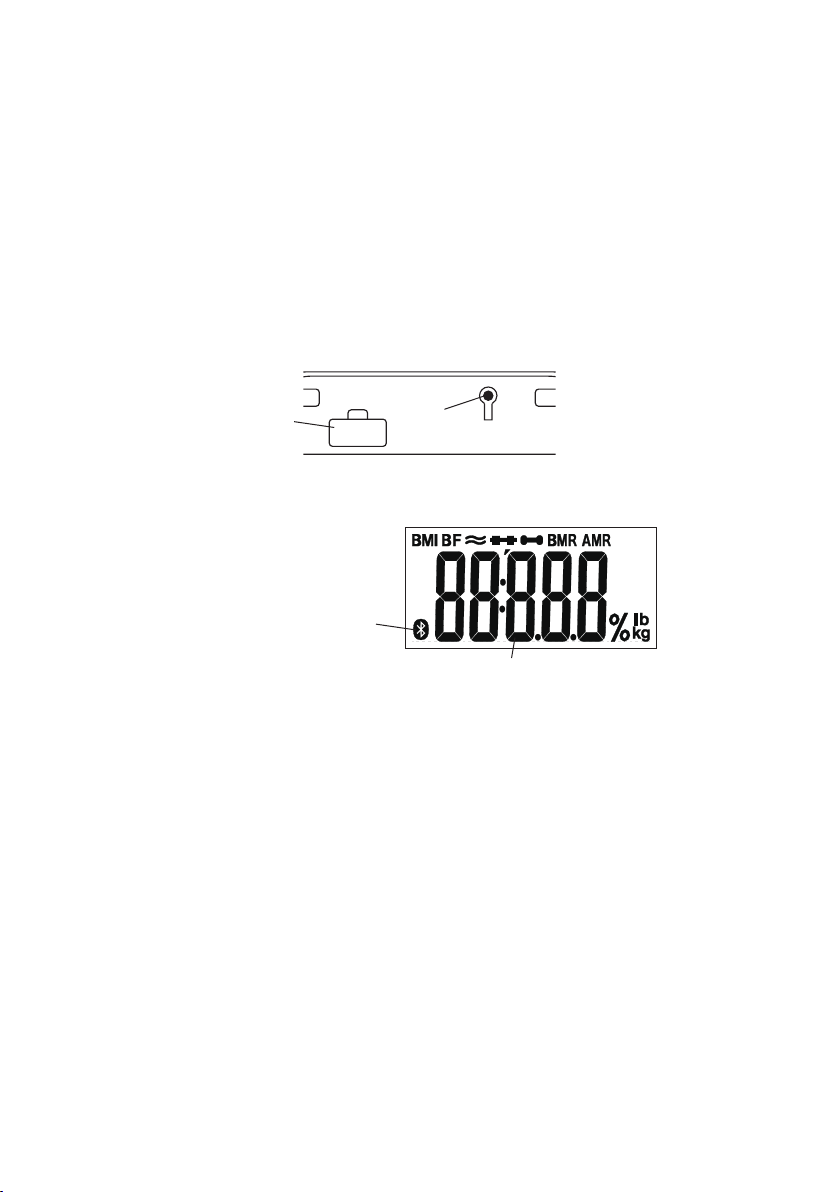
38
•
Es importante que solo considere la tendencia a largo plazo. Por lo general, las diferencias de peso
rápidas en un plazo de pocos días son debidas a la pérdida de líquidos; sin embargo, el agua corporal
desempeña un papel importante en el bienestar.
Restricciones
Al calcular la grasa corporal y el resto de valores, pueden obtenerse valores divergentes y no satisfacto-
rios en el caso de:
•
niños menores de 10 años,
•
deportistas de alto rendimiento y culturistas,
•
personas con fiebre, en tratamiento de diálisis, síntomas de edemas u osteoporosis,
•
personas que toman medicamentos para enfermedades cardiovasculares,
•
personas que toman medicamentos vasodilatadores o vasoconstrictores,
•
personas con desviaciones anatómicas considerables en las piernas con respecto al tamaño corporal
general (piernas considerablemente largas o cortas).
5. Descripción del aparato
Parte trasera
2
1
1. Compartimento de las
pilas
2. Tecla unit/reset
Pantalla
3
4
3. Símbolo Bluetooth
®
para la conexión
entre la báscula y el smartphone
4. Valores de medición
6. Puesta en funcionamiento con la aplicación
Para poder determinar su porcentaje de grasa corporal y otros valores corporales deberá memorizar sus
datos de usuario personales en la báscula.
La báscula dispone de 8 espacios de memoria para usuarios en los que usted y, por ejemplo, los miem-
bros de su familia pueden guardar sus ajustes personales.
Los usuarios también se pueden activar con otros terminales móviles con la aplicación “beurer HealthMa-
nager“ instalada ocambiando el perfil de usuario en la aplicación (consulte los ajustes de la aplicación).
Para que durante la puesta en funcionamiento pueda mantenerse activa una conexión Bluetooth
®
, perma-
nezca con el smartphone cerca de la báscula.
– Active Bluetooth
®
en los ajustes del smartphone.
–
Inserte las pilas y coloque la báscula en un suelo estable (en la pantalla de la báscula parpadeará
“App”).
–
Descárguese la aplicación gratuita “beurer HealthManager” en el Apple App Store (iOS) o en Goo-
gle Play (Android™).
–
Inicie la aplicación y siga las instrucciones.
–
Introduzca los datos relativos a BF 600.
En la aplicación “
beurer HealthManager
” deben estar configurados o especificarse los siguientes ajustes:
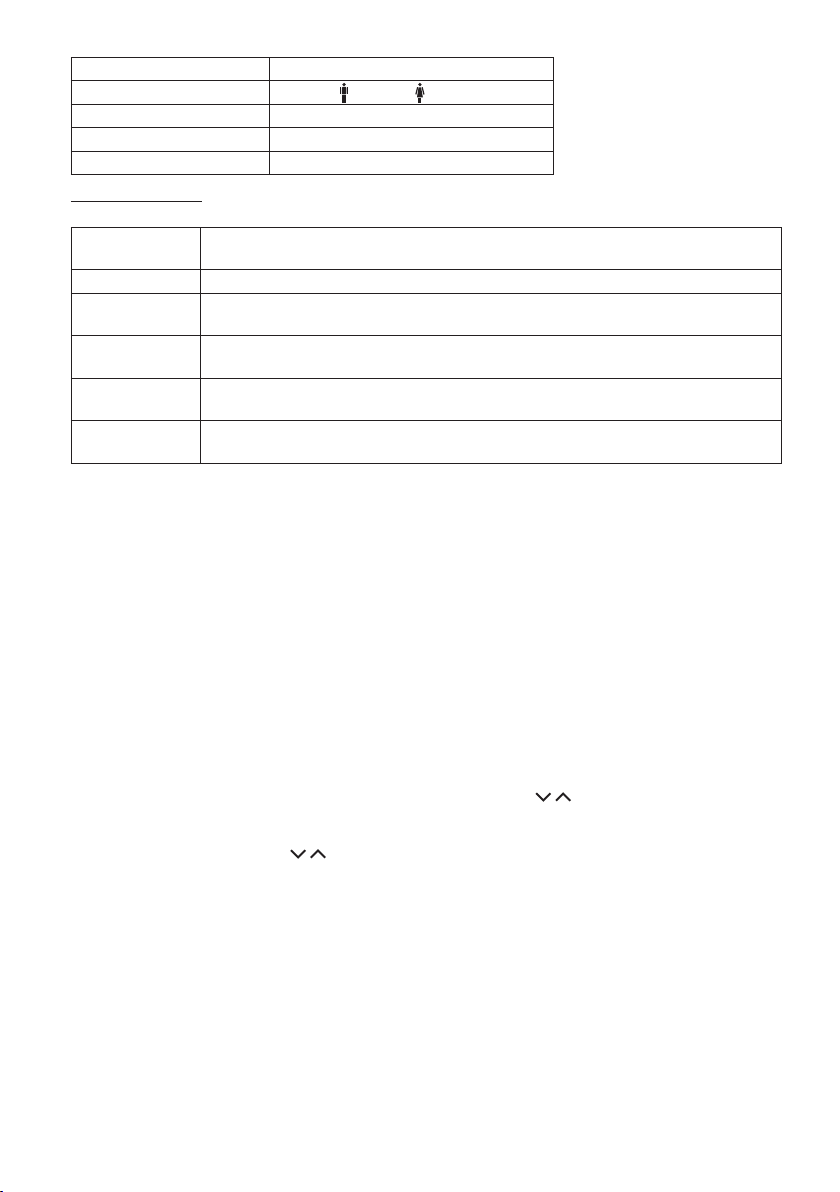
39
Datos de usuario Valores de ajuste
Sexo hombre ( ), mujer ( )
Estatura 100 a 220 cm (3‘ 3,5” a 7‘ 2,5”)
Edad de 10 a 100 años
Grado de actividad de 1 a 5
G
rado de actividad
A
l elegir el grado de actividad es fundamental considerarlo a medio y largo plazo.
Grado de acti-
vidad
Actividad física
1 Ninguna.
2
Baja: poco ejercicio físico y de poca intensidad
(p. ej., paseos, sencillos trabajos en el jardín, ejercicios de gimnasia).
3
Media: ejercicio físico de 2 a 4 veces por semana como mínimo
en sesiones de 30minutos.
4
Alta: ejercicio físico de 4 a 6 veces por semana como mínimo
en sesiones de 30minutos.
5
Muy alta: ejercicios físicos intensivos, entrenamiento intensivo o
trabajo corporal agotador, diariamente, al menos 1 hora cada día.
La aplicación le asigna el siguiente registro de usuario libre (P01-P08).
–
Realice la medición
P
ara la identificación automática de personas debe asignar la primera medición a sus datos personales.
La aplicación le pedirá que lo haga. Súbase descalzo a la báscula y asegúrese de apoyarse cuidadosa-
mente, repartiendo bien el peso entre las dos piernas, y de pisar sobre los electrodos.
C
ontinúe ahora con el capítulo 8 “Realizar la medición”.
7. Puesta en funcionamiento de la báscula sin la aplicación
Recomendamos la puesta en funcionamiento y la realización de todos los ajustes mediante la aplicación.
Ver el capítulo 6. “Puesta en funcionamiento con la aplicación”. Pero también se puede poner en funciona-
miento en el aparato.
Extraiga las pilas de la bolsa protectora e insértelas con la polaridad correcta en la báscula. Si la báscula
no indica ninguna función, retire todas las pilas y vuelva a colocarlas.
Coloque la báscula en un suelo estable y liso; un revestimiento estable del suelo es un requisito para una
correcta medición.
Pulse la “tecla SET”.
El año/mes/día, así como hora/minuto se ajustan pulsando las teclas “ ” y se confirman pulsando la
tecla “SET”.
La báscula indica “0.0”. Vuelva a pulsar la “tecla SET”. Aparece “P-01” o el último registro de usuario utili-
zado. Seleccione con las flechas “ ” su registro de usuario (P-01 a P-08) y pulse la tecla “SET”. Rea-
lice sus ajustes, como sexo, estatura, etc. (ver el capítulo 6. “Puesta en funcionamiento con la aplicación
(tabla)”. Confirme en cada caso pulsando la tecla “SET”. Al final de las entradas aparece un PIN que se
necesitará para el posterior registro en la aplicación. A continuación aparece “0.0”.
Para la identificación automática de personas debe asignar la primera medición a sus datos personales.
Súbase descalzo a la báscula y asegúrese de apoyarse cuidadosamente, repartiendo bien el peso entre
las dos piernas, y de pisar sobre los electrodos.
7.1 Registro posterior en la aplicación
Si ha puesto en funcionamiento la báscula sin la aplicación, podrá transferir su usuario a la aplicación o
crearlo como se indica a continuación.
–
Descárguese la aplicación gratuita “beurer HealthManager” en el Apple App Store (iOS) o en Goo-
gle Play (Android™).
–
Inicie la aplicación y siga las instrucciones.
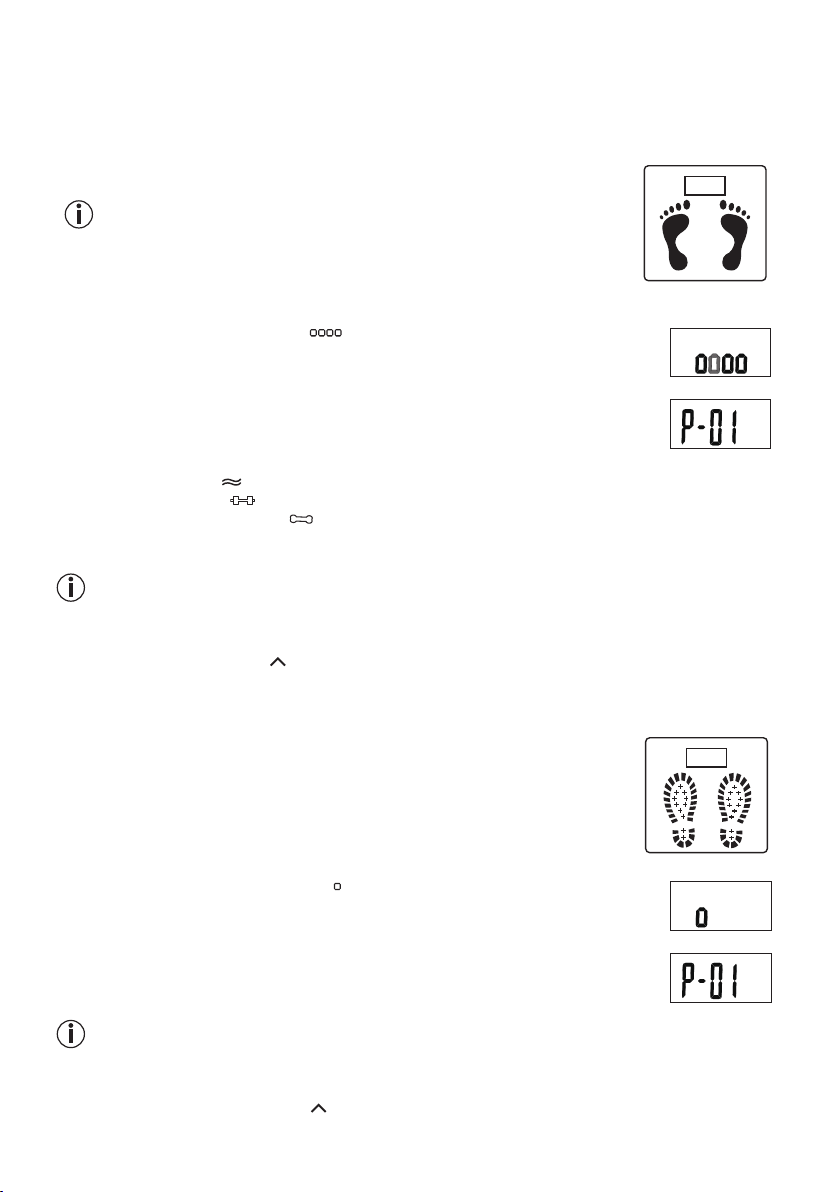
40
8. Realizar la medición
Coloque la báscula en un suelo estable y liso; un revestimiento estable del suelo es un requisito
para una correcta medición.
8.1 Diagnóstico
Súbase descalzo a la báscula y asegúrese de apoyarse cuidadosamente, repar-
tiendo bien el peso entre las dos piernas, y de pisar sobre los electrodos.
Nota: Si realiza la medición con calcetines el resultado no será correcto.
La báscula empieza inmediatamente la medición.
Primero se muestra el peso.
Durante el análisis BIS se visualiza “ ”.
Si se ha asignado un usuario, se visualiza P-01 - P-08 y se guardan todos los valores
posteriores.
1. IMC
2. Grasa corporal en %
3. Agua corporal en %
4. Masa muscular en %
5. Contenido mineral óseo en kg
6. Consumo calórico del metabolismo basal en kcal
7. Consumo calórico del metabolismo activo en kcal
Nota: Si el usuario no se identifica, la asignación de usuario es errónea (p.ej. P-01) y solo se podrá
visualizar el peso. La medición no se guardará.
Si esto sucede, significa que su peso difiere ± 3 kg respecto a la última medición o que otro usuario
tiene valores similares a los suyos en ± 3 kg. Repita en este caso la medición encendiendo la bás-
cula y pulsando la tecla “ ” para seleccionar su registro de usuario (P01-P08). Repita el proceso de
medición.
8.2 Peso
Súbase calzado a la báscula y asegúrese de apoyarse cuidadosamente, repar-
tiendo bien el peso entre las dos piernas. La báscula empieza inmediatamente la
medición.
Primero se muestra el peso.
En la pantalla se visualiza brevemente “ ”. No es posible un análisis BIA.
Si se ha asignado un usuario, se visualiza p.ej. “P-01” y el peso se guarda.
Nota: Si el usuario no se identifica, la asignación de usuario es errónea (p.ej. P-01) y solo se podrá
visualizar el peso. La medición no se guardará.
Si esto sucede, significa que su peso difiere en ± 3 kg respecto a la última medición o que otro
usuario tiene valores similares a los suyos en ± 3 kg. Repita en este caso la medición encendiendo
la báscula y pulsando la tecla “ ” para seleccionar su registro de usuario (P01-P08). Repita el pro-
ceso de medición.
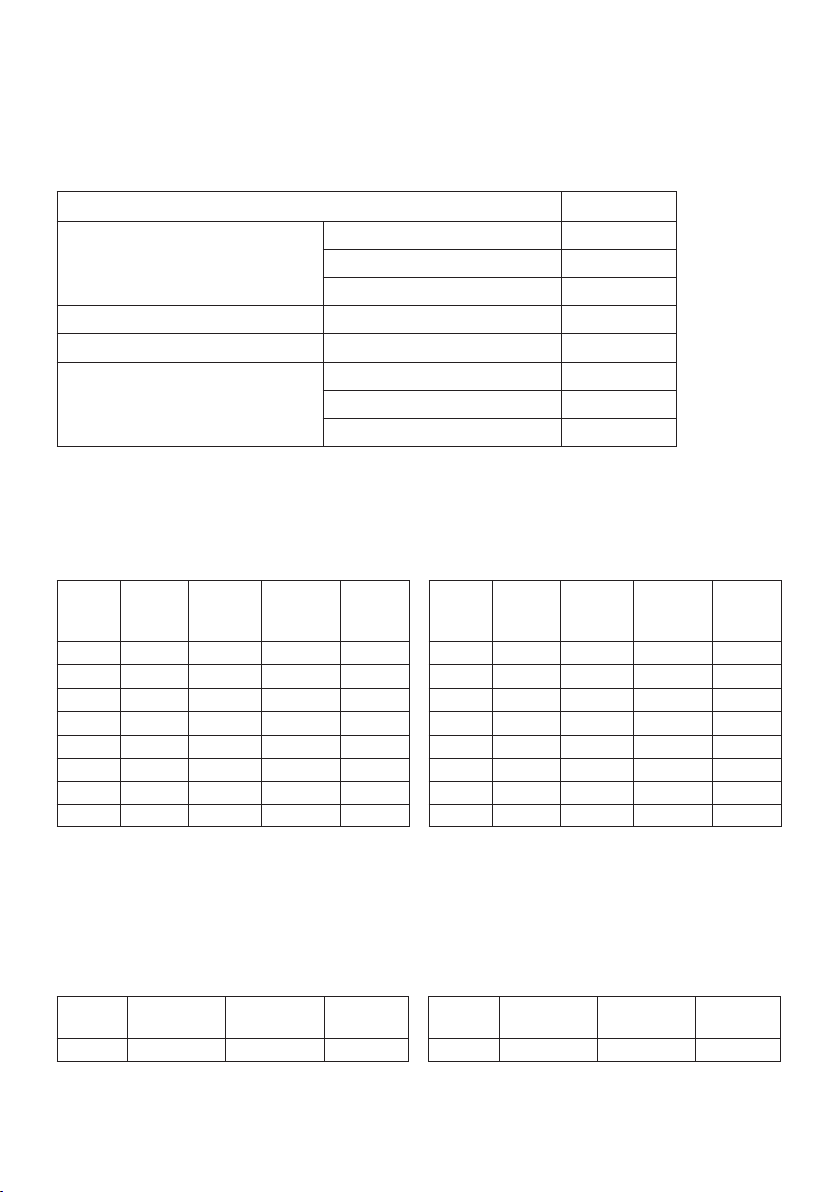
41
9. Evaluación de los resultados
Índice de masa corporal (número de masa corporal)
El índice de masa corporal (IMC) es un número que a menudo se utiliza para evaluar el peso del cuerpo. El
número se calcula a partir de los valores del peso corporal y la estatura, y la fórmula es la siguiente:
Índice de masa corporal = peso del cuerpo ÷ estatura
2
. La unidad del IMC es por lo tanto [kg/m
2
]. La divi-
sión del peso mediante el IMC se realiza en los adultos (a partir de los 20 años) con los siguientes valores:
Categoría IMC
Delgadez Delgadez severa <16
Delgadez moderada 16-16,9
Delgadez aceptable 17-18,4
Peso normal 18,5-25
Sobrepeso Preobesidad 25,1-29,9
Obesidad (sobrepeso) Obesidad tipo I 30-34,9
Obesidad tipo II 35-39,9
Obesidad tipo III ≥40
Fuente: OMS, 1999 (Organización Mundial de la Salud)
Porcentaje de grasa corporal
Los siguientes valores de grasa corporal en % le indican una pauta (para más información consulte a su
médico).
Hombre Mujer
Edad
Nivel
bajo
Nivel
normal
Nivel alto
Nivel
muy
alto
Edad
Nivel
bajo
Nivel
normal
Nivel alto
Nivel
muy
alto
10 –14 <11 % 11–16 %
16,1– 21 %
>21 % 10-14 <16 % 16 – 21 %
21,1– 26 %
>26%
15 -19 <12 % 12 –17 %
17,1– 22 %
>22 % 15-19 <17 % 17– 22 %
22,1– 27 %
>27 %
20 – 29 <13 % 13 -18 %
18,1– 23 %
>23 % 20-29 <18 % 18 – 23 %
23,1– 28 %
>28 %
30 – 39 <14 % 14 -19 %
19,1– 24 %
>24 % 30-39 <19 % 19 – 24 %
24,1– 29 %
>29 %
40 – 49 <15 % 15 – 20 %
20,1– 25 %
>25 % 40-49 <20 % 20 – 25 %
25,1– 30 %
>30 %
50 – 59 <16 % 16 – 21 %
21,1– 26 %
>26 % 50-59 <21 % 21– 26 %
26,1– 31 %
>31 %
60 – 69 <17 % 17– 22 %
22,1– 27 %
>27 % 60-69 <22 % 22 – 27 %
27,1– 32 %
>32 %
70 -100 <18 % 18 – 23 %
23,1– 28 %
>28 % 70-100 <23 % 23 – 28 %
28,1– 33 %
>33 %
Los deportistas suelen presentar valores inferiores. En función de la disciplina que se practique, de la inten-
sidad del entrenamiento y de la constitución física, los valores alcanzados pueden estar por
debajo
de
los valores indicativos. Tenga en cuenta que contar con valores extremadamente bajos puede suponer un
riesgo para la salud.
Porcentaje de agua corporal
La proporción de agua corporal en % suele oscilar entre los siguientes rangos:
Hombre Mujer
Edad Nivel malo Nivel bueno
Nivel muy
bueno
Edad Nivel malo Nivel bueno
Nivel muy
bueno
10 -100 <50 % 50 – 65 % >65 % 10 -100 <45 % 45 – 60 % >60 %
La grasa corporal tiene una proporción de agua relativamente baja. Por ello, las personas con una elevada
proporción de grasa corporal pueden tener una proporción de agua corporal por debajo de los valores
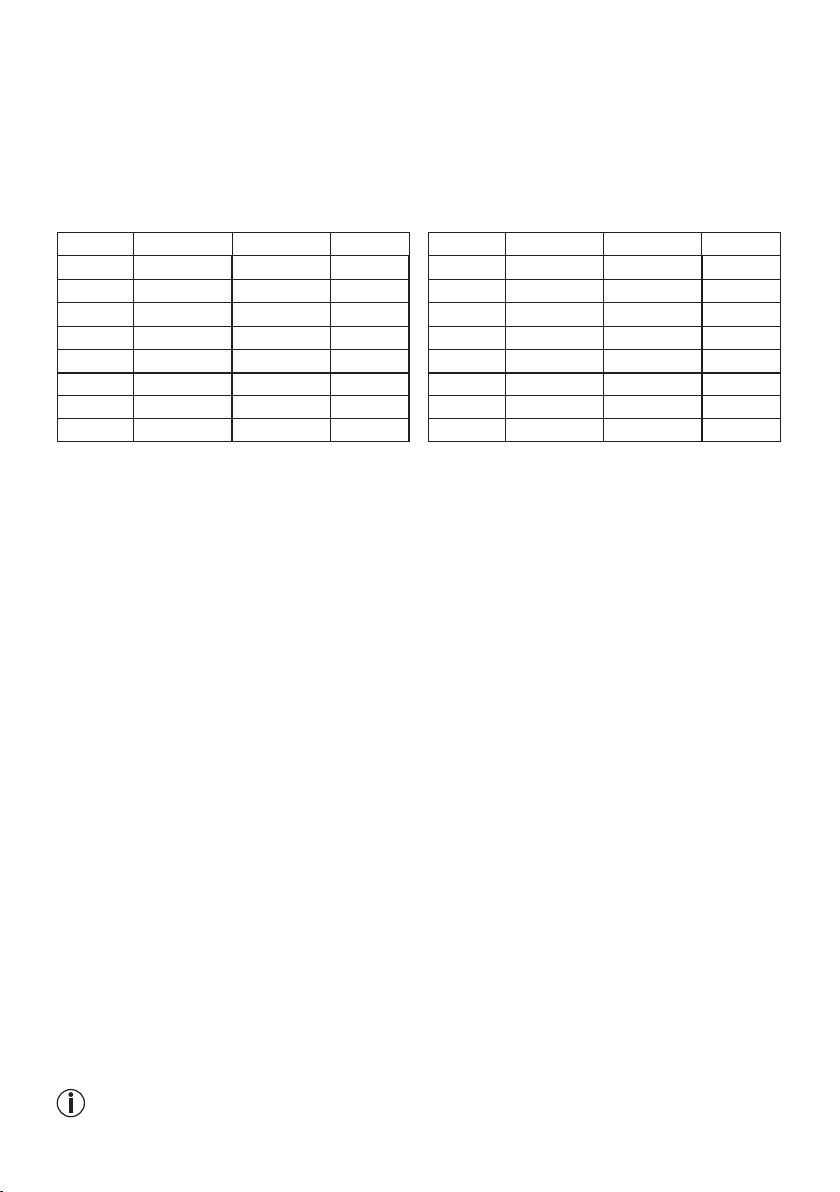
42
indicativos. En cambio, los deportistas de fondo pueden superar los valores indicativos debido a su bajo
porcentaje de grasa y a su elevado porcentaje de masa muscular.
La determinación del agua corporal con esta báscula no está indicada para sacar conclusiones médicas
de, por ejemplo, edemas debidos a la edad. En caso necesario consulte a su médico. En general, es con-
veniente tener un elevado porcentaje de agua corporal.
Masa muscular
La masa muscular en % suele oscilar entre los siguientes rangos:
Hombre Mujer
Edad Nivel bajo Nivel normal Nivel alto Edad Nivel bajo Nivel normal Nivel alto
10 –14 <44 % 44 – 57 % >57 % 10 –14 <36 % 36 – 43 % >43 %
15 -19 <43 % 43 – 56 % >56 % 15 -19 <35 % 35 – 41 % >41 %
20 – 29 <42 % 42 – 54 % >54 % 20 – 29 <34 % 34 – 39 % >39 %
30 – 39 <41 % 41– 52 % >52 % 30 – 39 <33 % 33 – 38 % >38 %
40 – 49 <40 % 40 – 50 % >50 % 40 – 49 <31 % 31– 36 % >36 %
50 – 59 <39 % 39 – 48 % >48 % 50 – 59 <29 % 29 – 34 % >34 %
60 – 69 <38 % 38 – 47 % >47 % 60 – 69 <28 % 28 – 33 % >33 %
70 -100 <37 % 37 – 46 % >46 % 70 -100 <27 % 27 – 32 % >32 %
Masa ósea
Como el resto de nuestro cuerpo, los huesos experimentan procesos naturales de crecimiento, degrada-
ción y envejecimiento. La masa ósea crece rápidamente durante la infancia y alcanza su máximo entre
los 30 y 40 años. A medida que envejecemos, la masa ósea disminuye gradualmente. Si sigue una dieta
sana (particularmente, de calcio y vitamina D) y realiza ejercicio de manera regular, puede ralentizar este
proceso. También puede reforzar la estabilidad de su estructura ósea mediante el crecimiento dirigido de
los músculos. Tenga en cuenta que esta báscula mide los minerales de los huesos. La masa ósea resulta
muy difícil de modificar y varía ligeramente como resultado de factores determinantes (peso, altura, edad
y sexo). No existen directrices reconocidas ni recomendaciones.
BMR
El metabolismo basal (BMR = Basal Metabolic Rate) es la cantidad de energía corporal necesaria para
mantener las funciones básicas cuando el organismo se encuentra en un estado de inactividad total (p.
ej., si se pasan 24horas en cama). Este valor depende fundamentalmente del peso, de la estatura y de la
edad.
En la báscula de diagnóstico, este valor se visualiza en kcal/día y se calcula mediante la ecuación de
Harris-Benedict, reconocida científicamente.
Esta es la cantidad mínima de energía que necesita el cuerpo y que tiene que recibir en forma de ali-
mento. Si recibe menos energía durante mucho tiempo, puede ser perjudicial para la salud.
AMR
El metabolismo activo (AMR = Active Metabolic Rate) es la cantidad de energía diaria que consume el
cuerpo en estado de actividad. El consumo de energía de una persona es mayor conforme aumenta la
actividad física. En la báscula de diagnóstico se determina a través del grado de actividad indicado (1-5).
Para mantener el peso actual se debe ingresar al cuerpo la energía consumida en forma de comida y
bebida.
Si, durante un largo período de tiempo, se ingiere menos energía que la consumida, el cuerpo recupera
esta diferencia de las reservas de grasa, lo que provoca una pérdida de peso. Si, en cambio, durante un
largo periodo de tiempo, se ingiere más energía que el metabolismo activo (AMR) calculado, el cuerpo no
consigue quemar este exceso de energía, que se almacena como grasa en el cuerpo, lo que provoca un
aumento de peso.
Relación temporal de los resultados
Tenga en cuenta que solo es importante la tendencia a largo plazo. Las diferencias de peso rápidas
en un plazo de pocos días suelen deberse a la pérdida de líquidos.

43
La interpretación de los resultados se ajusta a los cambios del peso total y a los del porcentaje de grasa corpo-
ral, agua corporal y masa muscular, así como al tiempo en que ocurren estos cambios.
Deben diferenciarse los cambios bruscos en cuestión de días de los cambios a medio plazo (semanas) y
los cambios a largo plazo (meses).
Como norma general, los cambios a corto plazo en el peso prácticamente solo suponen cambios en el
contenido de agua, mientras que los cambios a medio y largo plazo también pueden afectar a la masa
muscular y al porcentaje de grasa.
•
Si el peso disminuye a corto plazo, pero el porcentaje de grasa aumenta o permanece igual, significa
que solo ha perdido agua (por ejemplo, después de entrenar, de ir a la sauna o de hacer una dieta res-
trictiva para perder peso rápidamente).
•
Cuando el peso aumenta a medio plazo, pero el porcentaje de grasa corporal disminuye o permanece
igual, puede haber generado una valiosa masa muscular.
•
Cuando el peso y la proporción de grasa corporal disminuyen a la vez, es que su dieta está funcionando
y está perdiendo masa adiposa.
•
Lo ideal es que acompañe su dieta de actividad física, entrenamiento o ejercicios de fuerza. De este
modo podrá aumentar su masa muscular a medio plazo.
•
La grasa corporal, el agua o la masa muscular no pueden sumarse (el tejido muscular también incluye
componentes del agua del cuerpo).
10. Más información
Asignación de usuarios
Puede realizarse una asignación de como máximo 8 usuarios configurados en la báscula con una medi-
ción solo del peso (con zapatos) y una medición de diagnóstico (descalzo).
Al realizar una nueva medición, la báscula la asigna al usuario con el último valor de medición almacenado
con un margen de ± 3kg. Ver el capítulo 8.
Almacenamiento de los valores de medición asignados en la báscula y transmisión a la aplicación
Si la aplicación no está abierta, las nuevas mediciones asignadas se almacenan en la báscula. En la bás-
cula se pueden almacenar como máximo 30 mediciones por cada usuario. Los valores almacenados se
envían automáticamente a la aplicación si abre la aplicación en el radio de alcance de Bluetooth.
También es posible la transferencia automática con la báscula apagada.
Borrar datos de la báscula
Si desea borrar por completo de la báscula todas las mediciones y los datos antiguos de usuarios, retire
las pilas durante al menos 10 segundos. Pulse después la tecla unit/reset y vuelva a insetar al mismo
tiempo las pilas. En la pantalla aparece durante unos segundos “ ”.
Esta función sirve para borrar por ejemplo usuarios de la báscula mal configurados o usuarios que ya no
la van a utilizar más.
A continuación es necesario repetir el proceso descrito en el capítulo 6 (asignación de usuarios).
Cambiar las pilas
Su báscula está equipada con un indicador de cambio de pilas. Si se utiliza la báscula con unas pilas
agotadas aparece en la pantalla “Lo” y la báscula se apaga automáticamente. En este caso, deben susti-
tuirse las pilas (2 pilas de 1,5 V AAA). Todas las mediciones y usuarios guardados se conservan.
Después, vuelva a conectar la báscula con la aplicación. La hora del sistema se actualiza.
NOTA:
•
Cada vez que tenga que cambiar las pilas, hágalo por unas del mismo tipo y de la misma marca y
capacidad.
•
No utilice baterías recargables.
•
Utilice pilas sin metales pesados.
11. Limpieza y cuidado del aparato
El aparato debe limpiarse de vez en cuando.
Para la limpieza use un paño húmedo, al que puede echar un poco de líquido lavavajillas en caso necesa-
rio.
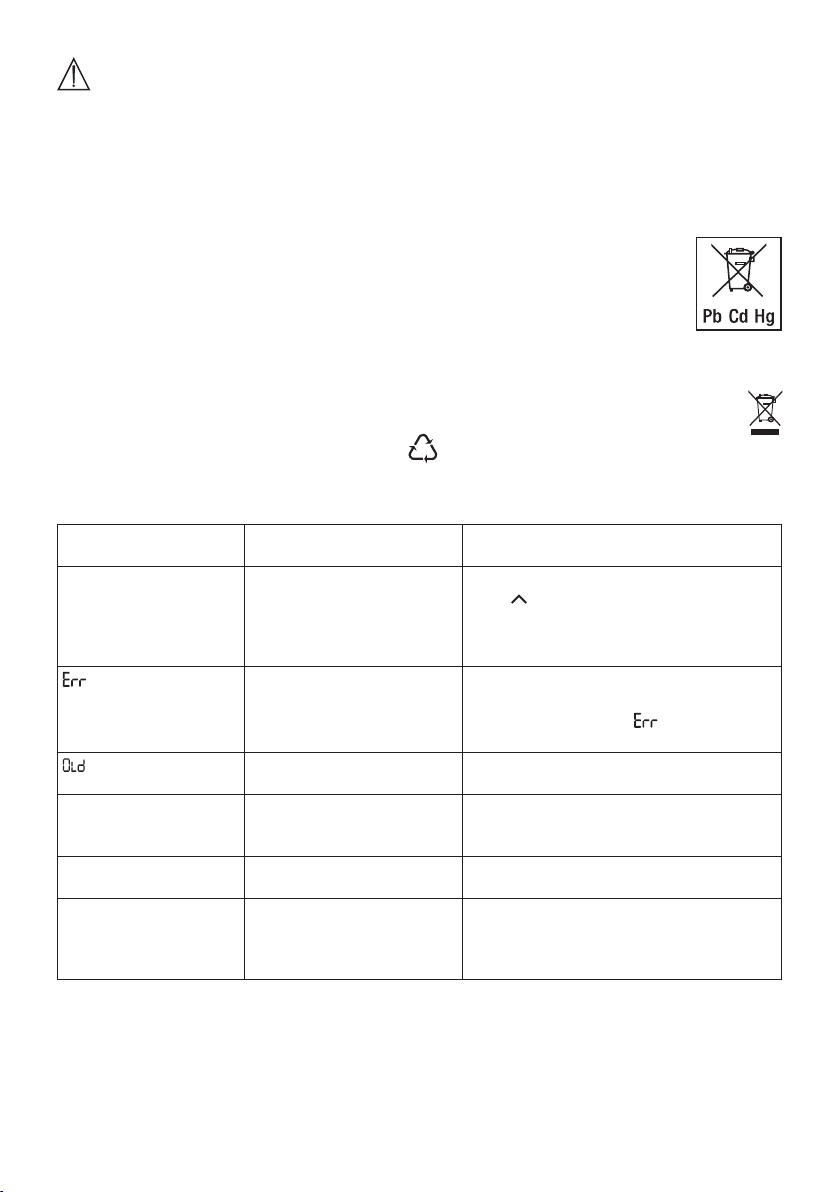
44
ATENCIÓN
•
¡No utilice nunca limpiadores ni disolventes agresivos!
•
¡No sumerja nunca el aparato en agua!
•
No meta el aparato en el lavavajillas.
12. Eliminación
Las pilas usadas, completamente descargadas, deben eliminarse a través de contenedores de recogida
señalados de forma especial, los puntos de recogida de residuos especiales o a través de los distribuido-
res de equipos electrónicos. Los usuarios están obligados por ley a eliminar las pilas
correctamente.
Estos símbolos se encuentran en pilas que contienen sustancias tóxicas:
Pb: la pila contiene plomo.
Cd: la pila contiene cadmio.
Hg: la pila contiene mercurio.
A fin de preservar el medio ambiente, cuando el aparato llegue al fin de su vida útil no lo deseche con la
basura doméstica. Se puede desechar en los puntos de recogida adecuados disponibles en su zona.
Deseche el aparato según la Directiva europea sobre residuos de aparatos eléctricos y electróni-
cos (RAEE). Para más información, póngase en contacto con la autoridad municipal competente en
materia de eliminación de residuos.
Eliminar el embalaje respetando el medioambiente.
20
PAP
13. Solución de problemas
Si la báscula detecta un error al realizar la medición, se mostrará lo siguiente:
Indicación en la pan-
talla
Causa Solución
Solo se visualiza el
peso y falta P01-P08
Medición desconocida, ya
que la asignación de usua-
rios está fuera del límite o no
es posible una asignación
inequívoca.
Seleccionar el usuario en la báscula con la
tecla “ ” o repetir la asignación de usuario
en la aplicación.
Ver el capítulo 10 “Más información”.
El porcentaje de grasa está
fuera del margen de medición
(inferior al 4 % o superior al
65 %).
Por favor, repita la medición descalzo o con
las plantas de los pies ligeramente húmedas.
Si se sigue visualizando , significa que se
encuentra fuera del rango medible.
Se ha superado la capacidad
de carga máxima de 180 kg.
Solo pueden pesarse 180 kg.
Se visualiza un peso
erróneo.
El suelo no es liso ni estable. Coloque la báscula sobre un suelo estable
y liso.
Sin alfombras.
Se visualiza un peso
erróneo.
Detectado movimiento. Quédese quieto.
Se visualiza un peso
erróneo.
El punto cero de la báscula es
incorrecto.
Espere a que la báscula vuelva a apagarse
sola. Active la báscula. Puede que se visua-
lice “C”.
Espere a que se visualice
“0.0 kg”
.
Repita la medición.
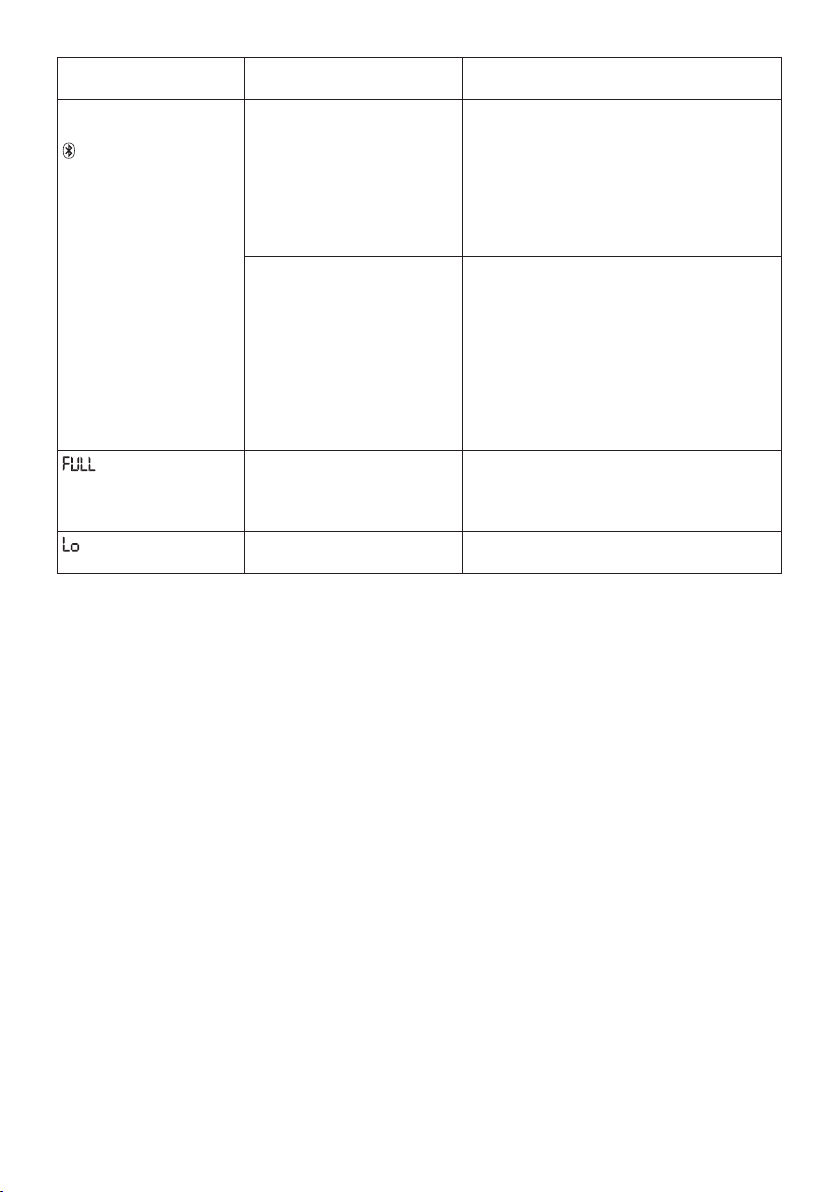
45
Indicación en la pan-
talla
Causa Solución
Sin conexión Blue-
tooth
®
(falta el símbolo
).
El aparato no se encuentra
dentro del radio de alcance.
El radio de alcance mínimo al aire libre es de
aprox.15 m. Las paredes y los techos redu-
cen el radio de alcance.
La presencia de otras ondas radioeléctri-
cas puede interferir en la transmisión. Por
este motivo, no coloque la báscula cerca de
otros equipos, como p. ej., routers WLAN,
microondas o cocinas de inducción.
Sin conexión con la aplica-
ción.
Cierre por completo la aplicación (también
en segundo plano).
Desactive la función Bluetooth
®
y vuelva a
activarla.
Apague el smartphone y vuelva a encen-
derlo.
Retire brevemente las pilas de la báscula y
vuelva a insertarlas.
Encontrará las preguntas frecuentes en
www.beurer.com.
El espacio de memoria de
usuario está agotado. Las
mediciones nuevas sobrescri-
ben las mediciones antiguas.
Abra la aplicación. Los datos se transfieren
automáticamente. Esta operación puede
durar hasta un minuto.
Las pilas de la báscula están
agotadas.
Cambie las pilas de la báscula.
14. Garantía/Asistencia
En caso de reclamaciones en el marco de la garantía diríjase a su distribuidor local o a la delegación local
(ver lista “Service international”).
Cuando nos envíe el aparato, adjunte una copia del recibo de compra y una breve descripción del prob-
lema.
Se aplican las siguientes condiciones de garantía:
1. El periodo de garantía para productos de BEURER es de 5 años o, si es superior, se aplica el periodo
de garantía vigente en el país correspondiente a partir de la fecha de compra.
En caso de una reclamación de la garantía, la fecha de compra deberá demostrarse con el recibo de
compra o una factura.
2. Las reparaciones (todo el aparato o solo algunas piezas) no hacen que se prolongue el periodo de
garantía.
3. La garantía no tiene validez para daños debidos a
a. Uso indebido, p.ej. si no se siguen las instrucciones de uso.
b. Reparaciones o cambios realizados por el cliente o por una persona no autorizada.
c. Transporte del fabricante al cliente o durante el transporte al centro de servicio.
d. La garantía no tiene validez para accesorios sometidos al desgaste habitual (brazalete, pilas, etc.).
4. La responsabilidad por daños derivados directos o indirectos provocados por el aparato también queda
excluida incluso si se reconoce una reclamación de la garantía en caso de daño del aparato.
Salvo errores y modificaciones

46
ITALIANO
Fornitura
•
Guida rapida
•
Bilancia diagnostica BF 600
•
2 batterie AAA da 1,5 V
•
Le presenti istruzioni per l’uso
1. Introduzione
Funzioni dell‘apparecchio
Questa bilancia diagnostica digitale consente di pesare e valutare i dati relativi alla forma fisica dell’utente.
L’apparecchio è destinato all’uso privato.
La bilancia dispone delle seguenti funzioni diagnostiche, utilizzabili da un massimo di 8 persone:
•
Calcolo del peso e IMC,
•
Calcolo della massa grassa,
•
Percentuale di acqua corporea,
•
Percentuale di massa muscolare,
•
Massa ossea nonché
•
Tasso metabolico basale e tasso metabolico di attività.
La bilancia dispone inoltre delle seguenti funzioni:
•
Commutazione tra chilogrammi “kg”, libbre “lb” e Stone “st”,
•
Funzione di spegnimento automatico,
•
Indicazione di sostituzione batterie in caso di batterie scariche,
•
Riconoscimento automatico dell’utente,
•
Memorizzazione delle ultime 30 misurazioni per 8 persone, se non possono essere trasferite alla app,
•
Il prodotto utilizza Bluetooth
®
low energytechnology, banda di frequenza 2400 - 2483,5 MHz, potenza di
trasmissione max. -0,93 dBm.
Requisiti del sistema
iOS dalla versione 10.0, Android™ dalla versione 5.0 con Bluetooth
®
4.0.
Elenco dei dispositivi compatibili:
Gentile cliente,
siamo lieti che Lei abbia scelto un prodotto del nostro assortimento. Il nostro marchio è garanzia
di prodotti di elevata qualità, controllati nei dettagli, relativi ai settori calore, peso, pressione, temperatura
corporea, pulsazioni, terapia dolce, massaggio, Beauty, Baby e aria.
Leggere attentamente le presenti istruzioni per l’uso, conservarle per impieghi futuri, renderle accessibili
ad altri utenti e attenersi alle indicazioni.
Cordiali saluti
Il team Beurer
Contenuto
1. Introduzione ......................................................46
2. Spiegazione dei simboli ....................................47
3. Segnalazioni di rischi e indicazioni di sicurezza 47
4. Informazioni ...................................................... 48
5. Descrizione dell‘apparecchio ...........................49
6. Messa in servizio con app ................................49
7. Messa in servizio della bilancia senza app ....... 50
8. Esecuzione della misurazione ........................ 51
9. Valutazione dei risultati ...................................52
10. Ulteriori informazioni .......................................54
11. Pulizia e cura dell‘apparecchio .......................54
12. Smaltimento ...................................................55
13. Che cosa fare in caso di problemi? ................ 55
14. Garanzia/Assistenza ....................................... 56
47
2. Spiegazione dei simboli
Nelle istruzioni per l’uso vengono utilizzati i seguenti simboli:
AVVERTENZA Avvertimento di pericolo di lesioni o di pericoli per la salute.
ATTENZIONE Indicazione di sicurezza per possibili danni dell’apparecchio/degli accessori.
Nota Nota su importanti informazioni.
3. Segnalazioni di rischi e indicazioni di sicurezza
Leggere attentamente le presenti istruzioni per l’uso, conservarle per impieghi futuri, renderle accessibili
ad altri utenti e attenersi alle indicazioni.
AVVERTENZA
•
La bilancia non può essere utilizzata da persone con impianti medicali (ad es.
pacemaker) per non comprometterne il funzionamento.
•
Non utilizzare durante la gravidanza.
•
Non salire sul bordo esterno della bilancia e solo su un lato: pericolo di ribaltamento!
•
Se ingoiate, le batterie rappresentano un pericolo mortale. Tenere lontane le batterie
e la bilancia dalla portata dei bambini. In caso di ingestione di una batteria, richiedere immediata-
mente assistenza medica.
•
Tenere lontani i bambini dal materiale d’imballaggio (pericolo di soffocamento).
•
Attenzione: non salire sulla bilancia con i piedi bagnati, se la superficie è umida. Pericolo di scivo-
lamento!
Avvertenze sull‘uso delle batterie
•
Se il liquido della batteria viene a contatto con la pelle e con gli occhi, sciacquare le parti interes-
sate con acqua e consultare il medico.
• Pericolo d’ingestione! I bambini possono ingerire le batterie e soffocare. Tenere quindi le bat-
terie lontano dalla portata dei bambini!
• Prestare attenzione alla polarità positiva (+) e negativa (-).
• In caso di fuoriuscita di liquido dalla batteria, indossare guanti protettivi e pulire il vano batterie
con un panno asciutto.
• Proteggere le batterie dal caldo eccessivo.
• Rischio di esplosione! Non gettare le batterie nel fuoco.
• Le batterie non devono essere ricaricate o mandate in cortocircuito.
• Qualora l’apparecchio non dovesse essere utilizzato per un periodo prolungato, rimuovere le bat-
terie dal vano batterie.
• Utilizzare solo tipologie di batterie uguali o equivalenti.
• Sostituire sempre tutte le batterie contemporaneamente.
• Non utilizzare batterie ricaricabili!
• Non smontare, aprire o frantumare le batterie.
Indicazioni generali
•
L’apparecchio è destinato esclusivamente all’uso personale e non è previsto un suo utilizzo
medico o commerciale
•
Tenere presente che sono possibili tolleranze di misurazione poiché non si tratta di una bilancia
calibrata per utilizzo medico professionale.
•
In caso di risultati di misurazione diversi (tra bilancia e app), è necessario utilizzare esclusivamente
i valori visualizzati sulla bilancia.
•
Il carico massimo della bilancia è 180 kg (396 lb, 28 st). Le misurazioni di peso e massa ossea ven-
gono visualizzate in intervalli di 100 g (0,2 lb).
•
I risultati relativi a massa grassa, percentuale di acqua e massa muscolare vengono visualizzati in
intervalli di 0,1%.
•
Il fabbisogno calorico viene indicato in intervalli di 1 kcal.
•
Al momento della consegna la bilancia è impostata sulle unità “cm” e “kg”. Le impostazioni delle
unità possono essere modificate durante la messa in servizio con la app.
48
•
Posizionare la bilancia su un fondo piano e solido; un piano solido è il presupposto per una misu-
razione corretta.
•
Non esporre l’apparecchio a urti, umidità, polvere, prodotti chimici, forti sbalzi di temperatura e
fonti di calore troppo vicine (forni, caloriferi).
•
Le riparazioni possono essere effettuate solo dal Servizio clienti di Beurer o da rivenditori autoriz-
zati. Tuttavia prima di inoltrare eventuali reclami, testare le batterie e se necessario sostituirle.
•
Con la presente confermiamo che il prodotto è conforme alla direttiva europea RED 2014/53/EU.
La Dichiarazione di Conformità relativa al presente prodotto è reperibile su:
www.beurer.com/web/we-landingpages/de/cedeclarationofconformity.php.
Conservazione e cura
La precisione dei valori misurati e la durata dell’apparecchio dipendono da un utilizzo attento e scrupo-
loso:
ATTENZIONE
•
Di tanto in tanto è opportuno pulire l’apparecchio. Non utilizzare detergenti aggressivi e non
immergere mai l’apparecchio in acqua.
•
Accertarsi che non vi sia del liquido sulla bilancia. Non immergere mai la bilancia in acqua. Non
sciacquare mai sotto l’acqua corrente.
•
Non posizionare alcun oggetto sulla bilancia quando non viene utilizzata.
•
Non esporre l’apparecchio a urti, umidità, polvere, prodotti chimici, forti sbalzi di temperatura e
fonti di calore troppo vicine (forni, caloriferi).
•
Non azionare i pulsanti bruscamente o con oggetti appuntiti.
•
Non esporre la bilancia a temperature elevate o a forti campi elettromagnetici (ad esempio vicino
a telefoni cellulari).
4. Informazioni
Principio di misurazione
Questa bilancia utilizza il principio di misurazione B.I.A., l’analisi dell’impedenza bioelettrica. Nel giro di
pochi secondi, una corrente impercettibile, assolutamente innocua e non pericolosa, determina le diverse
percentuali corporee.
Grazie alla misurazione della resistenza elettrica (impedenza) e prendendo in considerazione costanti e/o
valori individuali (età, statura, sesso, livello di attività) è possibile determinare la percentuale di massa
grassa e altre caratteristiche corporee. I tessuti muscolari e l’acqua presentano una buona conducibilità
elettrica e di conseguenza una resistenza più bassa. Le ossa e i tessuti adiposi sono invece caratterizzati
da una scarsa conducibilità in quando le cellule adipose e le ossa presentano un’elevata resistenza che
ostacola la conduzione della corrente.
I valori rilevati dalla bilancia diagnostica si avvicinano solo ai valori reali ottenuti con analisi mediche. Solo
uno specialista è in grado di eseguire il calcolo esatto di massa grassa, percentuale di acqua, massa
muscolare e massa ossea attraverso metodi medici (ad es. la TAC).
Suggerimenti generali
•
Per ottenere risultati confrontabili, è consigliabile pesarsi possibilmente sempre alla stessa ora (preferi-
bilmente al mattino), a digiuno e senza vestiti.
•
Importante durante la misurazione: Il calcolo della massa grassa può essere eseguito solo a piedi nudi
ed eventualmente inumidendo leggermente le piante dei piedi.
Le piante dei piedi completamente asciutte o callose possono produrre risultati insoddisfacenti in
quanto presentano una conducibilità insufficiente.
Nota: I piedi, le gambe, i polpacci e le cosce non devono essere a contatto. In caso contrario non è
possibile garantire la correttezza della misurazione.
•
Restare dritti e fermi durante il processo di pesatura.
•
Attendere alcune ore dopo uno sforzo fisico inusuale.
•
Attendere circa 15 minuti dopo essersi alzati in modo che l’acqua all’interno del corpo possa distribuirsi.
•
Viene considerata solo la tendenza a lungo termine. Generalmente le variazioni di peso a breve termine
nell’arco di pochi giorni dipendono da una perdita di liquidi; tuttavia la percentuale di acqua nel corpo è
un fattore importante per il benessere.
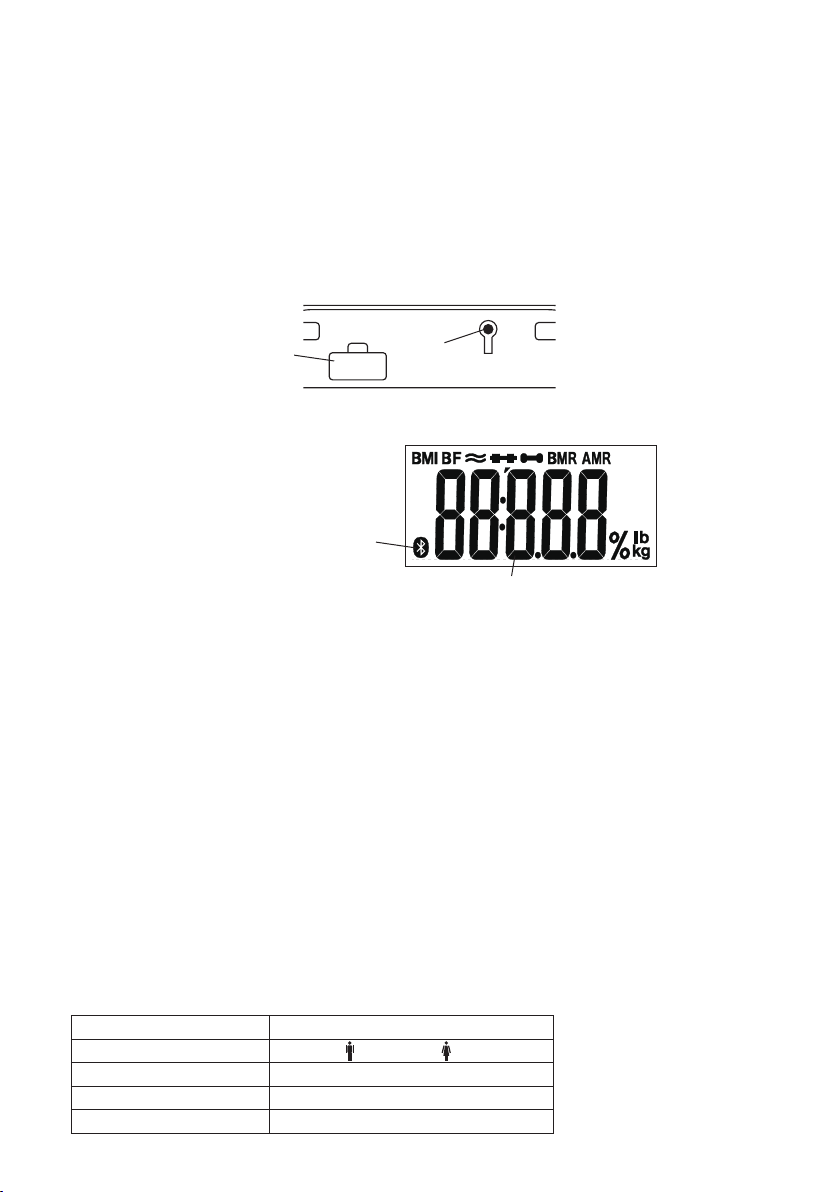
49
Limitazioni
Durante il calcolo della massa grassa e di altri valori possono presentarsi risultati difformi e non plausibili
in:
•
Bambini al di sotto dei 10 anni circa,
•
Soggetti molto allenati e soggetti che praticano bodybuilding,
•
Persone con febbre, in dialisi, che presentano sintomi di edema o affette da osteoporosi,
•
Persone che assumono farmaci cardiovascolari (per il sistema cardiocircolatorio),
•
Persone che assumono vasodilatatori o vasocostrittori,
•
Persone che presentano anomalie anatomiche alle gambe che si ripercuotono sulla statura (gambe
significativamente più lunghe o più corte).
5. Descrizione dell‘apparecchio
Lato posteriore
2
1
1. Vano batterie
2. Pulsante unità/reset
Display
3
4
3. Simbolo Bluetooth
®
per il collega-
mento fra bilancia e smartphone
4. Valori misurati
6. Messa in servizio con app
Per determinare la massa grassa e altri valori, è necessario memorizzare i dati utente personali sulla bilan-
cia.
La bilancia dispone di 8 posizioni di memoria in cui l’utente e i familiari possono memorizzare impostazioni
personali.
Inoltre, gli utenti possono essere attivati tramite altri dispositivi mobili dotati dell’app “beurer HealthMana-
ger“ oppure tramite cambio di profilo nell’app (vedere Impostazioni dell’app).
Per mantenere una connessione Bluetooth
®
attiva durante la messa in servizio, restare con lo smartphone
nelle vicinanze della bilancia.
–
Attivare il Bluetooth
®
nelle impostazioni dello smartphone.
–
Inserire le batterie e posizionare la bilancia su una superficie stabile (sull’LCD della bilancia lam-
peggia “App”).
–
Scaricare l’app gratuita “beurer HealthManager” dall’Apple App Store (iOS) oppure da Google
Play (Android™).
–
Avviare la app e seguire le istruzioni.
–
Inserire i dati relativi a BF 600.
Le seguenti impostazioni devono essere impostate o inserite nella app “
beurer HealthManager
”.
Dati utente Valori di impostazione
Sesso Maschio ( ), femmina ( )
Statura Da 100 a 220 cm (da 3' 3,5" a 7' 2,5")
Età Da 1 a 100 anni
Livello di attività Da 1 a 5

50
L
ivelli di attività
P
er la selezione del livello di attività si distingue fra osservazione a medio e a lungo termine.
Livello di atti-
vità
Attività fisica
1 Nessuna.
2
Ridotta: attività fisica ridotta e leggera
(ad es. passeggiare, lavori di giardinaggio leggeri, esercizi ginnici).
3
Media: attività fisica, almeno 2-4 volte alla settimana,
30 minuti per sessione.
4
Impegnativa: attività fisica, almeno 4-6 volte alla settimana,
30 minuti per sessione.
5
Molto impegnativa: attività fisica intensa, allenamento intensivo o
lavoro fisico pesante, quotidiano, per almeno un'ora.
L’app mostra le successive memorie utente della bilancia libere (P01-P08).
–
Esecuzione della misurazione
P
er il riconoscimento automatico della persona, è necessario assegnare i dati personali a un utente alla
prima misurazione. L’app li richiede. Salire idealmente a piedi nudi sulla bilancia e assicurarsi di poggiare
sugli elettrodi restando fermi e cercando di distribuire il peso in modo uniforme su entrambi i piedi.
P
rocedere ora come da capitolo 8 “Esecuzione della misurazione”.
7. Messa in servizio della bilancia senza app
Si consiglia di eseguire la messa in servizio e tutte le impostazioni tramite app. Vedere il capitolo 6.
“Messa in servizio con app”. Tuttavia, è possibile anche procedere sull’apparecchio.
Rimuovere le batterie dalla loro confezione e inserirle nella bilancia rispettando la polarità. Se la bilancia
non funziona, rimuovere completamente le batterie e sostituirle.
Posizionare la bilancia su un fondo piano e solido; un piano solido è il presupposto per una misurazione
corretta.
Premere il “pulsante SET”.
Per impostare anno/mese/giorno e ore/minuti premere i pulsanti “ ” e confermare con il “pulsante
SET”.
La bilancia mostra “0.0”. Premere di nuovo il “pulsante SET”. Viene visualizzato “P-01” o l’ultima memoria
utente della bilancia utilizzata. Utilizzando le frecce “ ” scegliere la propria memoria utente (da P-01 a
P-08) e premere il “pulsante SET”. Effettuare le impostazioni quali sesso, statura, ecc. (vedere il capitolo 6.
“Messa in servizio con app (tabella)”. Confermare ogni volta premendo il pulsante “SET”. Al termine degli
inserimenti viene visualizzato un PIN. Questo sarà necessario per l’eventuale registrazione nell’app in un
secondo momento. In seguito, compare “0.0”.
Per il riconoscimento automatico della persona, assegnare alla prima misurazione i dati personali dell’u-
tente. Salire idealmente a piedi nudi sulla bilancia e assicurarsi di poggiare sugli elettrodi restando fermi e
cercando di distribuire il peso in modo uniforme su entrambi i piedi.
7.1 Registrazione nell‘app in un secondo momento
Se la bilancia è stata messa in servizio senza app, l’utente può essere trasmesso e impostato nell’app
come segue.
–
Scaricare l’app gratuita “beurer HealthManager” dall’Apple App Store (iOS) oppure da Google
Play (Android™).
–
Avviare la app e seguire le istruzioni.
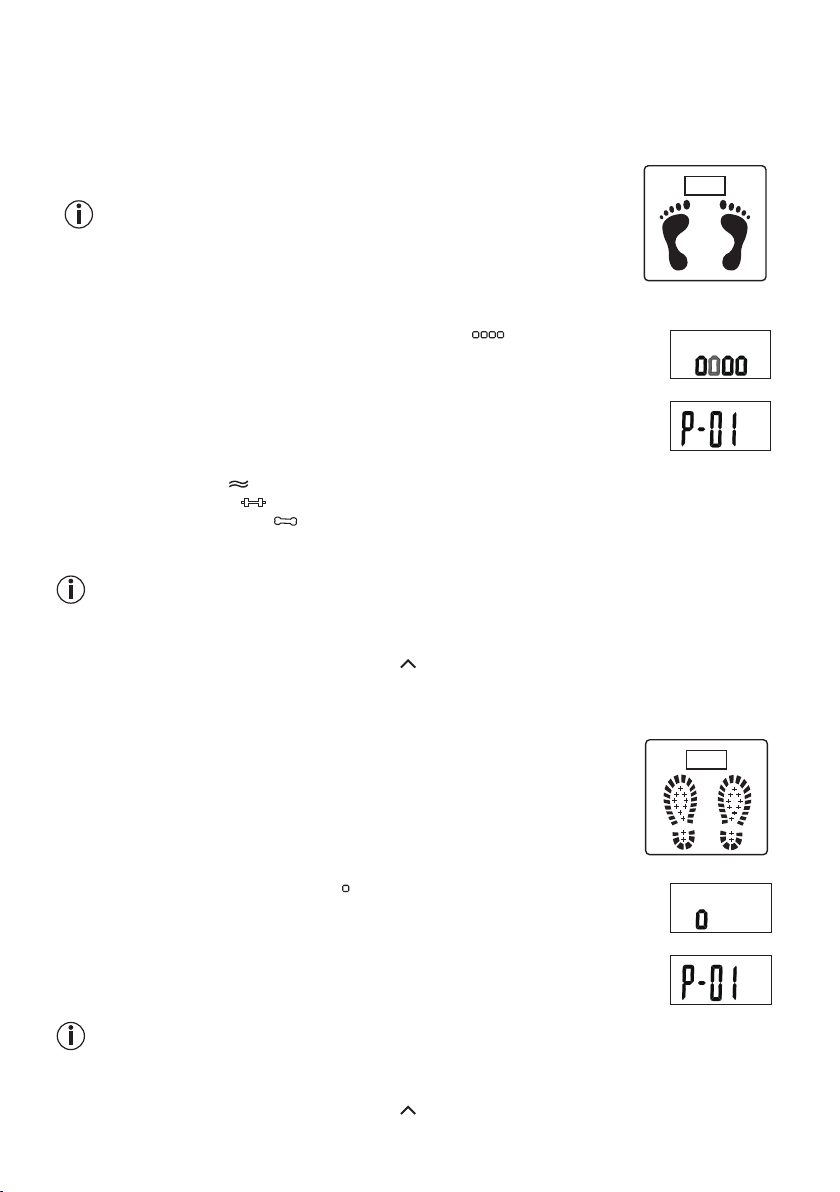
51
8. Esecuzione della misurazione
Posizionare la bilancia su un fondo piano e solido; un piano solido è il presupposto per una misura-
zione corretta.
8.1 Diagnosi
Salire a piedi nudi sulla bilancia e assicurarsi di poggiare sugli elettrodi restando
fermi e cercando di distribuire il peso in modo uniforme su entrambe le gambe.
Nota: Se la misurazione è stata eseguita indossando le calze, il risultato
non è corretto.
La bilancia avvia subito la misurazione.
Inizialmente viene indicato il peso.
Durante l'analisi dell'impedenza bioelettrica (BIA) scorrono " ".
Se è stato assegnato un utente, viene visualizzato P-01 - P-08 e tutti i valori successivi
vengono memorizzati.
1. IMC
2. massa grassa in %
3. percentuale di acqua
4. massa muscolare in %
5. massa minerale ossea in kg
6. tasso metabolico basale in kcal (BMR)
7. tasso metabolico di attività in kcal (AMR)
Nota: Se l’utente non viene riconosciuto, l’assegnazione utente viene a mancare (ad es. P-01) e
viene solo visualizzato il peso. La misurazione non viene memorizzata.
Se questo accade, il peso misurato potrebbe variare ± 3 kg dall’ultima misurazione oppure essere
simile a quello di un altro utente con una differenza di ± 3 kg. In questo caso ripetere la misurazione:
accendere la bilancia e premere il pulsante “ ” per selezionare la propria memoria utente (P01-P08).
Ripetere il processo di misurazione.
8.2 Peso
Salire con le scarpe sulla bilancia e assicurarsi di poggiare sugli elettrodi
restando fermi e cercando di distribuire il peso in modo uniforme su entrambe le
gambe. La bilancia avvia subito la misurazione.
Inizialmente viene indicato il peso.
Sull'LCD viene visualizzato brevemente " ". Non è possibile effettuare un'analisi
dell'impedenza bioelettrica.
Se è stato assegnato un utente, viene visualizzato ad es. "P-01" e viene memoriz-
zato il peso.
Nota: Se l’utente non viene riconosciuto, l’assegnazione utente viene a mancare (ad es. P-01) e
viene solo visualizzato il peso. La misurazione non viene memorizzata.
Se questo accade, il peso misurato potrebbe variare ± 3 kg dall’ultima misurazione oppure essere
simile a quello di un altro utente con una differenza di ± 3 kg. In questo caso ripetere la misurazione:
accendere la bilancia e premere il pulsante “ ” per selezionare la propria memoria utente (P01-P08).
Ripetere il processo di misurazione.
52
9. Valutazione dei risultati
Indice di massa corporea
L’indice di massa corporea è utilizzato frequentemente per la valutazione del peso. L’indice viene calcolato
in base ai valori di peso e statura, la relativa formula è la seguente:
Indice di massa corporea = peso ÷ statura
2
. L’unità dell’IMC è pertanto [kg/m
2
]. Le categorie di peso per
gli adulti (dai 20 anni) in base all’IMC sono le seguenti:
Categoria IMC
Sottopeso Grave sottopeso <16
Sottopeso moderato 16-16,9
Leggero sottopeso 17-18,4
Normopeso 18,5-25
Sovrappeso Sovrappeso 25,1-29,9
Adiposità (sovrappeso) Obesità 30-34,9
Obesità grave 35-39,9
Obesità patologica ≥40
Fonte: OMS, 1999 (Organizzazione mondiale della sanità)
Percentuale di massa grassa
Di seguito sono riportati i valori percentuali di riferimento per la massa grassa (per ulteriori informazioni,
rivolgersi al proprio medico).
Uomo Donna
Età basso normale alto
molto
alto
Età basso normale alto
molto
alto
10-14 <11% 11-16% 16,1-21% >21% 10-14 <16% 16-21% 21,1-26% >26%
15-19 <12% 12-17% 17,1-22% >22% 15-19 <17% 17-22% 22,1-27% >27%
20-29 <13% 13-18% 18,1-23% >23% 20-29 <18% 18-23% 23,1-28% >28%
30-39 <14% 14-19% 19,1-24% >24% 30-39 <19% 19-24% 24,1-29% >29%
40-49 <15% 15-20% 20,1-25% >25% 40-49 <20% 20-25% 25,1-30% >30%
50-59 <16% 16-21% 21,1-26% >26% 50-59 <21% 21-26% 26,1-31% >31%
60-69 <17% 17-22% 22,1-27% >27% 60-69 <22% 22-27% 27,1-32% >32%
70-100 <18% 18-23% 23,1-28% >28% 70-100 <23% 23-28% 28,1-33% >33%
Gli sportivi presentano spesso un valore ridotto. A seconda della disciplina sportiva praticata, dell’intensità
dell’allenamento e della costituzione è possibile raggiungere valori ancora
inferiori
ai valori di riferimento
indicati. In presenza di valori estremamente bassi possono tuttavia sussistere dei rischi per la salute.
Percentuale di acqua corporea
La percentuale di acqua è generalmente compresa nei seguenti range:
Uomo Donna
Età pessima buona ottima Età pessima buona ottima
10-100 <50% 50-65% >65% 10-100 <45% 45-60% >60%
Il grasso corporeo non contiene molta acqua. Di conseguenza le persona con una massa grassa elevata
possono presentare una percentuale di acqua corporea inferiore ai valori di riferimento. In coloro che pra-
ticano sport di resistenza i valori di riferimento possono invece essere superati a causa della massa grassa
ridotta e dell’elevata massa muscolare.
53
Il calcolo dell’acqua corporea con questa bilancia non consente di trarre conclusioni mediche ad es. per
quanto riguarda la ritenzione idrica legata all’età. Consultare eventualmente il proprio medico. In generale
è consigliabile raggiungere un’elevata percentuale di acqua corporea.
Percentuale di massa muscolare
La percentuale di massa muscolare in % è generalmente compresa nei seguenti range:
Uomo Donna
Età basso normale alto Età basso normale alto
10-14 <44% 44-57% >57% 10-14 <36% 36-43% >43%
15-19 <43% 43-56% >56% 15-19 <35% 35-41% >41%
20-29 <42% 42 - 54% >54% 20-29 <34% 34-39% >39%
30-39 <41% 41-52% >52% 30-39 <33% 33 -38% >38%
40-49 <40% 40 - 50% >50% 40-49 <31% 31-36% >36%
50-59 <39% 39 - 48% >48% 50-59 <29% 29 - 34% >34%
60-69 <38% 38 - 47% >47% 60-69 <28% 28 - 33% >33%
70-100 <37% 37- 46% >46% 70-100 <27% 27- 32% >32%
Massa ossea
Come il resto del nostro corpo, anche le nostre ossa sono soggette a un naturale processo di crescita,
deterioramento e invecchiamento. La massa ossea cresce rapidamente durante l’infanzia e raggiunge il
suo punto massimo tra i 30 e i 40 anni. Mentre si invecchia la massa ossea inizia a ridursi gradualmente.
Questo processo può essere rallentato grazie a una dieta sana (particolarmente ricca di calcio e vitamina
D) e a un’attività fisica regolare. È inoltre possibile rafforzare la stabilità della struttura scheletrica con una
crescita muscolare mirata. Tenere presente che questa scala misura i minerali delle ossa. La massa ossea
è molto difficile da modificare ma varia leggermente in base a fattori che la influenzano (peso, altezza, età,
sesso). Non esistono linee guida e raccomandazioni riconosciute.
BMR
L’indice metabolico basale (BMR = Basal Metabolic Rate) è la quantità di energia di cui il corpo neces-
sita a riposo per il mantenimento delle funzioni fisiche di base (ad es. se si rimane a letto per 24 ore). Tale
valore dipende principalmente dal peso, dalla statura e dall’età.
È visualizzato dalla bilancia diagnostica in kcal/giorno e viene calcolato sulla base della formula Harris-Be-
nedict riconosciuta a livello scientifico.
Si tratta della quantità di energia di cui il corpo ha bisogno in ogni caso e deve essere reintegrata sotto
forma di cibo. L’assunzione di una quantità inferiore di energia per un periodo prolungato può causare
danni alla salute.
AMR
Il tasso metabolico di attività (AMR = Active Metabolic Rate) è la quantità di energia di cui il corpo ha biso-
gno ogni giorno quando è in attività. Il consumo energetico di una persona incrementa in base alla mag-
giore attività fisica e viene determinato dalla bilancia diagnostica mediante il livello di attività impostato
(1-5).
Per mantenere il peso attuale, l’energia consumata dal corpo deve essere reintegrata sotto forma di cibo e
di liquidi.
Se per un lungo periodo l’energia consumata supera quella reintegrata, il corpo preleva la differenza dalle
riserve di grassi accantonate e il peso diminuisce. Quando invece per un lungo periodo l’energia reinte-
grata supera il tasso metabolico di attività (AMR) calcolato, il corpo non è in grado di bruciare l’eccesso di
energia che viene accumulato e il peso aumenta.
Relazione temporale dei risultati
Viene considerata solo la tendenza a lungo termine. Generalmente le variazioni di peso a breve ter-
mine nell’arco di pochi giorni dipendono da una perdita di liquidi.
L’interpretazione dei risultati si basa sulle variazioni del peso e delle percentuali di massa grassa, acqua corpo-
rea e massa muscolare, nonché sul tempo di realizzazione delle variazioni.

54
È necessario distinguere fra variazioni repentine nell’arco di pochi giorni e variazioni a medio termine
(nell’arco di settimane) e a lungo termine (mesi).
Come regola generale si può considerare che le variazioni di peso a breve termine sono determinate
esclusivamente da variazioni del contenuto di acqua mentre quelle a medio e lungo termine coinvolgono
anche la massa grassa e quella muscolare.
•
Se il peso si riduce a breve termine mentre la massa grassa aumenta o resta stabile, si tratta solo di una
perdita di liquidi, ad es. dovuta ad allenamento, sauna o a una dieta volta unicamente a una rapida per-
dita di peso.
•
Se il peso aumenta a medio termine mentre la massa grassa diminuisce o resta stabile, può essere
intervenuto un aumento della massa muscolare.
•
Se il peso e la massa grassa diminuiscono contemporaneamente, significa che la dieta funziona e che si
perde peso.
•
La dieta deve essere integrata con attività fisica, allenamento e allenamento di potenziamento. Ciò con-
sente di aumentare la massa muscolare a medio termine.
•
La massa grassa, la percentuale di acqua o la massa muscolare non possono essere sommate (i tessuti
muscolari contengono anche una percentuale di acqua).
10. Ulteriori informazioni
Assegnazione degli utenti
È possibile assegnare un massimo di 8 utenti impostati con misurazione del solo peso (con scarpe) e
misurazione diagnostica (a piedi nudi).
In caso di nuova misurazione, la bilancia la assegna all’utente la cui ultima misurazione memorizzata rien-
tra in un range di ± 3 kg. Vedere il capitolo 8.
Memorizzazione dei valori assegnati sulla bilancia e trasmissione all‘app
Se la app non è attiva, le misurazioni assegnate vengono salvate sulla bilancia. Nella bilancia può essere
salvato un massimo di 30 misurazioni per utente. I valori memorizzati vengono inviati automaticamente alla
app, se quest’ultima è attiva e a portata di Bluetooth.
Il trasferimento automatico è possibile anche se la bilancia è spenta.
Eliminazione dei dati della bilancia
Se si desidera eliminare completamente tutte le misurazioni e i dati vecchi degli utenti, rimuovere le batte-
rie per almeno 10 secondi. Premere quindi il pulsante unità/reset e reinserire contemporaneamente le bat-
terie. Sul display compare “ ” per alcuni secondi.
Ciò è necessario quando ad es. si desidera eliminare utenti impostati in modo errato o non più necessari.
Sarà poi necessario ripetere le operazioni descritte al capitolo 6 (assegnazione utenti).
Sostituzione delle batterie
La bilancia è dotata di un’icona di sostituzione delle batterie. In caso di batterie scariche, sul display com-
pare la scritta “Lo” e la bilancia si spegne automaticamente. In questo caso è necessario sostituire le bat-
terie (2 batterie AAA da 1,5 V). Tutte le misurazioni e gli utenti memorizzati rimangono memorizzati.
Collegare quindi di nuovo la bilancia con l’app. L’ora del sistema viene aggiornata.
NOTA:
•
A ogni sostituzione delle batterie, utilizzare batterie dello stesso tipo, della stessa marca e della
stessa capacità.
•
Non utilizzare batterie ricaricabili.
•
Utilizzare preferibilmente batterie prive di metalli pesanti.
11. Pulizia e cura dell‘apparecchio
Di tanto in tanto è opportuno pulire l’apparecchio.
Per la pulizia utilizzare un panno leggermente inumidito e, se necessario, un po’ di detergente.
ATTENZIONE
•
Non utilizzare mai detergenti o solventi aggressivi!
•
Non immergere mai l’apparecchio in acqua!
•
Non lavare l’apparecchio in lavastoviglie!
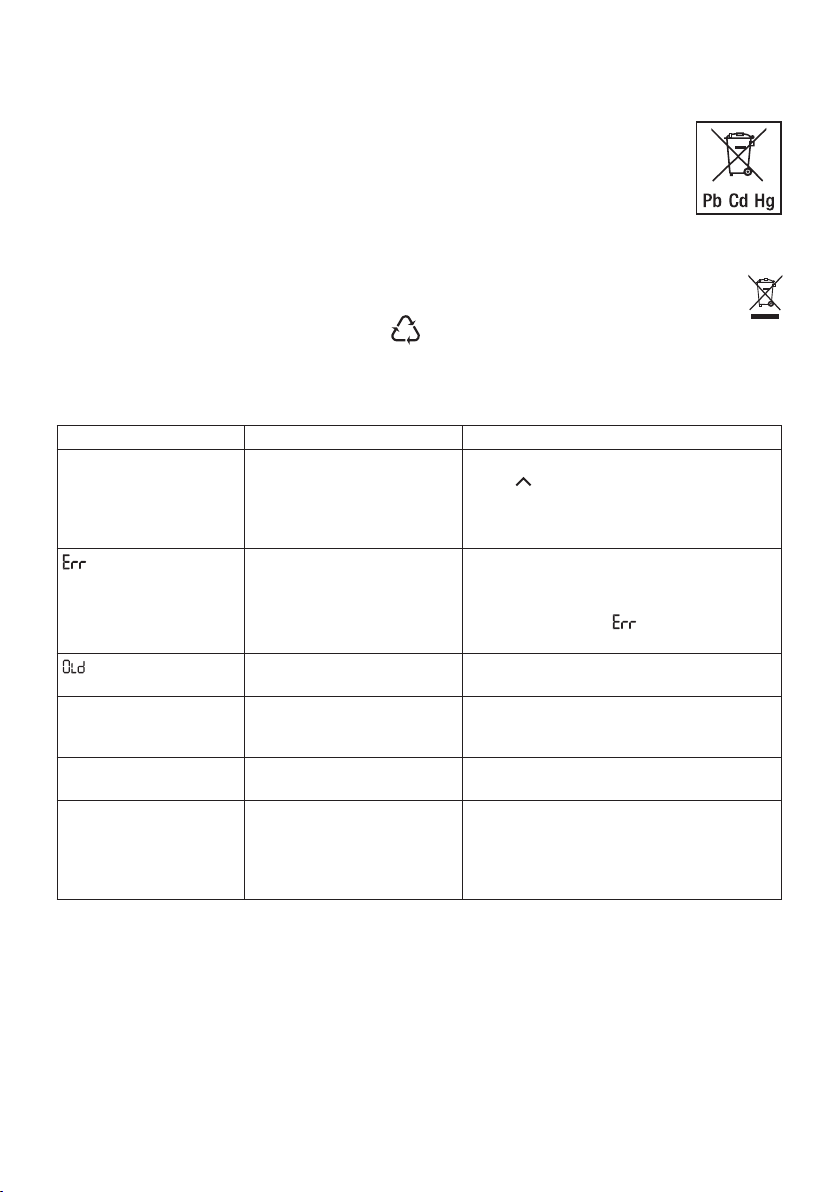
55
12. Smaltimento
Smaltire le batterie esauste e completamente scariche negli appositi punti di raccolta, nei punti di raccolta
per rifiuti tossici o presso i negozi di elettronica. Lo smaltimento delle batterie è un obbligo
di legge.
I simboli riportati di seguito indicano che le batterie contengono sostanze tossiche.
Pb = batteria contenente piombo
Cd = batteria contenente cadmio
Hg = batteria contenente mercurio
Per motivi ecologici, l’apparecchio non deve essere smaltito tra i normali rifiuti quando viene buttato via.
Lo smaltimento va effettuato negli appositi centri di raccolta.
Smaltire l’apparecchio secondo la direttiva europea sui rifiuti di apparecchiature elettriche ed elet-
troniche (RAEE). Per eventuali chiarimenti, rivolgersi alle autorità comunali competenti per lo smalti-
mento.
Smaltire la confezione nel rispetto dell‘ambiente.
20
PAP
13. Che cosa fare in caso di problemi?
Se durante la misurazione la bilancia riscontra un errore, vengono visualizzate le seguenti indicazioni:
Display Causa Soluzione
Viene visualizzato solo
il peso e P01-P08
manca
Misurazione sconosciuta, in
quanto al di fuori del limite di
assegnazione utente oppure
non è possibile un'assegna-
zione chiara.
Selezionare l'utente sulla bilancia con il pul-
sante " " oppure ripetere l'assegnazione
utente nell'app.
Vedere il capitolo 10 "Ulteriori informazioni".
La percentuale di massa
grassa non rientra nel range
misurabile (inferiore al 4% o
superiore al 65%).
Ripetere la misurazione a piedi nudi o even-
tualmente inumidire leggermente le piante
dei piedi.
Se viene visualizzato , il valore è al di fuori
dell’intervallo misurabile.
È stata superata la portata
massima di 180 kg.
Non caricare sulla bilancia pesi superiori a
180 kg.
Viene visualizzato il
peso errato.
Fondo non solido, non piano. Appoggiare la bilancia su un fondo piano e
solido.
Niente tappeto.
Viene visualizzato il
peso errato.
Posizione instabile. Restare fermi il più possibile.
Viene visualizzato il
peso errato.
La bilancia presenta un valore
di base diverso da 0.0.
Attendere che la bilancia si spenga da sola.
Attivare la bilancia. Eventualmente viene
visualizzato "C".
Attendere che venga visua-
lizzato
"0.0 kg"
. Ripetere quindi la misura-
zione.
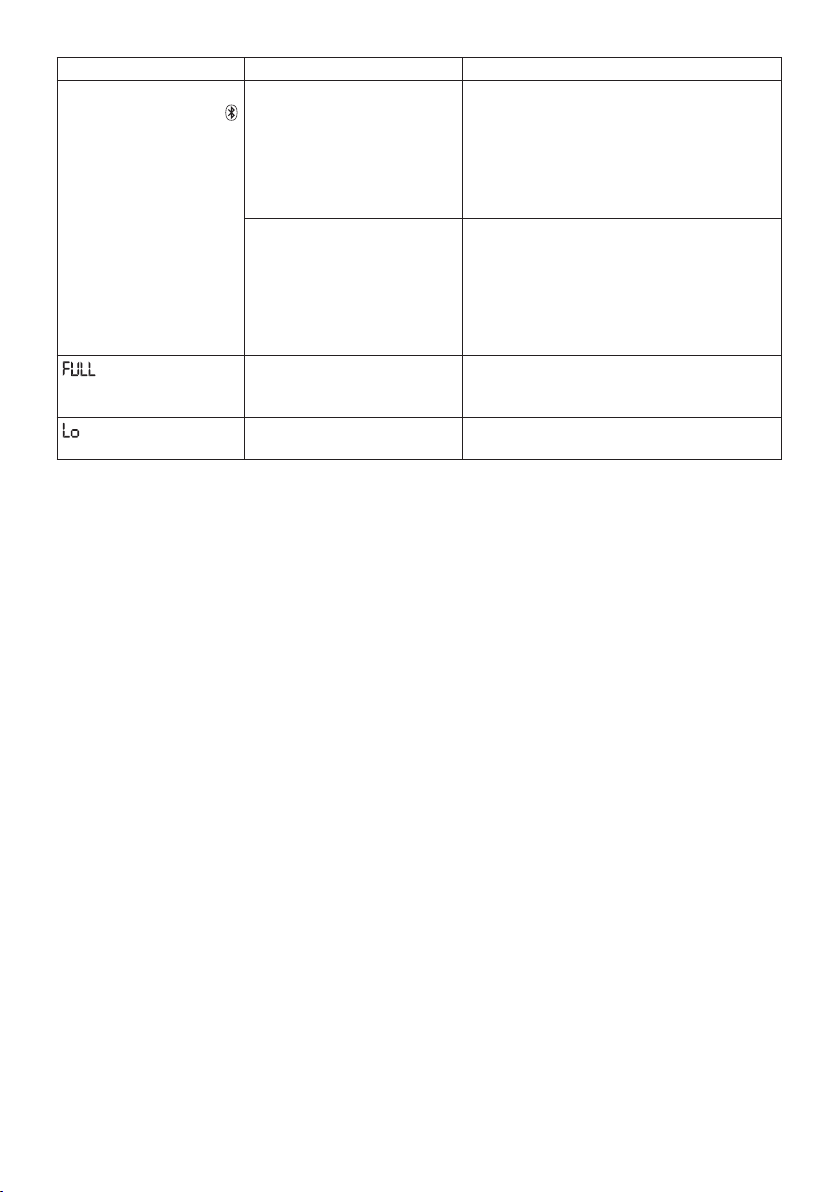
56
Display Causa Soluzione
Nessuna connessione
Bluetooth
®
( il simbolo
non è visualizzato).
Apparecchio fuori portata.
La portata minima in campo libero è di ca.
15 m. Pareti e soffitti riducono la portata.
Altre onde radio possono disturbare la tra-
smissione. Non mettere quindi la bilancia
nelle vicinanze di apparecchi come router
WLAN, microonde o piani di cottura a indu-
zione.
Nessuna connessione con
l'app.
Chiudere l'app completamente (anche in
background).
Disattivare e riattivare il Bluetooth
®
.
Spegnere lo smartphone e riaccenderlo.
Rimuovere brevemente le batterie dalla bilan-
cia e reinserirle.
Vedere le FAQ sul sito www.beurer.com.
La memoria utenti è piena. Le
nuove misurazioni sovrascri-
vono quelle vecchie.
Avviare la app. I dati sono trasmessi auto-
maticamente. Questa operazione può durare
fino a un minuto.
Le batterie della bilancia sono
scariche.
Sostituire le batterie della bilancia.
14. Garanzia/Assistenza
Per rivendicazioni nell’ambito della garanzia, rivolgersi al rivenditore locale o alla sede locale (vedere l’e-
lenco “Service international”).
Allegare al reso dell’apparecchio una copia della prova d’acquisto e una breve descrizione del difetto.
Si applicano le seguenti condizioni di garanzia:
1. La garanzia dei prodotti BEURER dura 5 anni oppure, se più lunga, fa fede la durata di garanzia valida
dalla data di acquisto di ciascun paese.
In caso di rivendicazioni, la data di acquisto deve essere dimostrata tramite una prova d’acquisto o una
fattura.
2. La durata della garanzia non viene prolungata da riparazioni (dell’intero apparecchio o di parti di esso).
3. La garanzia non ha validità per i danni derivanti da
a. Uso improprio, ad es. mancata osservanza delle istruzioni per l’uso.
b. Riparazioni o modifiche effettuate dal cliente o da persone non autorizzate.
c. Trasporto dal produttore al cliente o durante il trasporto al centro di assistenza.
d. La garanzia non è valida per gli accessori soggetti a comune usura (manicotto, batterie, ecc.).
4. La responsabilità per danni diretti o indiretti causati dall’apparecchio è esclusa se viene riconosciuta
una rivendicazione della garanzia per il danno dell’apparecchio.
Con riserva di errori e modifiche

57
TÜRKÇE
Teslimat kapsamı
•
Kısa kullanım kılavuzu
•
Diyagnoz terazisi BF 600
•
2 x 1,5 V, AAA tipi pil
•
Bu kullanım kılavuzu
1. Ürün özellikleri
Cihazın işlevleri
Bu dijital diyagnoz terazisi, tartılmanıza ve kişisel kondisyon verilerinizin tanımlanmasına olanak verir.
Kişisel kullanım için tasarlanmıştır.
Terazide, 8 kişiye kadar kullanılabilen aşağıdaki diyagnoz fonksiyonları bulunur:
•
Vücut ağırlığı ölçümü ve BMI,
•
Vücut yağ oranı tespiti,
•
Vücut suyu oranı,
•
Kas oranı,
•
Kemik kütlesi ve
•
Temel ve etkinlik metabolizma hızı.
Terazi ayrıca aşağıdaki işlevleri sunar:
•
Kilogram “kg”, Pound “lb” ve Stone “st” ölçü birimleri arasında geçiş yapılabilir,
•
Otomatik kapanma işlevi,
•
Pillerin şarjı azaldığında pil değiştirme göstergesi,
•
Otomatik kullanıcı algılaması,
•
Uygulamaya aktarılamıyorsa 8 kişi için son 30 ölçümün kaydedilmesi,
•
Ürün Bluetooth
®
low energy technology; frekans bandı 2400 - 2483,5 MHz, verici gücü maks. -0,93
dBm.
Sistem gereksinimleri
iOS sürüm 10.0 ve üzeri, Android™ sürüm 5.0 ve üzeri ve Bluetooth
®
4.0.
Uyumlu cihazların listesi:
Sayın müşterimiz,
Ürünlerimizden birini seçtiğiniz için teşekkür ederiz. Beurer markası, ısı, ağırlık, kan basıncı, nabız, yumu-
şak terapi, masaj, güzellik, bebek ve hava konularında değerli ve titizce kontrol edilen kaliteli ürünleri temsil
eder.
Lütfen bu kullanım kılavuzunu dikkatle okuyun, ileride gerekebileceği için saklayın, diğer kullanıcıların erişe-
bilmesini sağlayın ve içindeki yönergelere uyun.
Yeni cihazınızı iyi günlerde kullanmanızı dileriz
Beurer Ekibiniz
İçindekiler
1. Ürün özellikleri .................................................. 57
2. İşaretlerin açıklaması ........................................58
3. Uyarılar ve güvenlik yönergeleri ........................58
4. Bilgi ...................................................................59
5. Cihaz açıklaması ...............................................60
6. Uygulama ile kullanım .......................................60
7. Terazinin uygulama olmadan çalıştırılması........61
8. Ölçümün yapılması ......................................... 61
9. Sonuçların değerlendirilmesi ..........................62
10. İlave bilgiler .....................................................64
11. Cihazın temizliği ve bakımı .............................65
12. Bertaraf etme ..................................................65
13. Sorunların giderilmesi ..................................... 65
14. Garanti / Servis ............................................... 66
58
2. İşaretlerin açıklaması
Aşağıdaki semboller kullanım kılavuzunda kullanılmıştır:
UYARI Yaralanma tehlikelerine veya sağlığınızla ilgili tehlikelere yönelik uyarı.
DİKKAT Cihaz ve aksesuarlarında olası hasarlar için güvenlik talimatları
Not Önemli bilgilere yönelik not.
3. Uyarılar ve güvenlik yönergeleri
Lütfen bu kullanım kılavuzunu dikkatle okuyun, ileride kullanmak üzere saklayın, diğer kullanıcıların da eri-
şebilmesini sağlayın ve içindeki yönergelere uyun.
UYARI
•
Terazi, tıbbi implant (örn. kalp atışlarını düzenleyen cihaz) taşıyan kişiler tarafın-
dan kullanılmamalıdır. Aksi takdirde kalp atışlarını düzenleyen cihazların fonksi-
yonu olumsuz etkilenebilir.
•
Hamilelik sırasında kullanmayın.
•
Asla terazinin üzerine en dış kenarından çıkmayın: Devrilme tehlikesi!
•
Piller yutulursa hayati tehlikeye neden olabilir. Pilleri ve teraziyi çocukların ulaşamayacağı yerlerde
saklayın. Pil yutulduysa hemen tıbbi yardım alınmalıdır.
•
Çocukları ambalaj malzemesinden uzak tutun (boğulma tehlikesi).
•
Dikkat, teraziye ayaklarınız ıslakken çıkmayın ve yüzeyi nemliyken terazinin üzerine basmayın –
Kayma tehlikesi!
Pillerin kullanımıyla ilgili yönergeler
•
Pilden sızan sıvı cilt veya gözlerle temas ettiğinde, ilgili yeri suyla yıkayın ve bir doktora başvurun.
• Yutma tehlikesi! Küçük çocuklar pilleri yutabilir ve bunun sonucunda boğulabilir. Bu nedenle
pilleri, küçük çocukların erişemeyeceği yerlerde saklayın!
• Artı (+) ve eksi (-) kutup işaretlerine dikkat edin.
• Bir pil aktığında koruyucu eldiven giyin ve pil bölmesini kuru bir bezle temizleyin.
• Pilleri aşırı ısıya karşı koruyun.
• Patlama tehlikesi! Pilleri ateşe atmayın.
• Piller şarj edilmemeli veya kısa devre yaptırılmamalıdır.
• Cihazı uzun süre kullanmayacağınız durumlarda pilleri pil bölmesinden çıkarın.
• Sadece aynı tip veya eşdeğer tip piller kullanın.
• Her zaman tüm pilleri aynı anda değiştirin.
• Şarj edilebilir pil kullanmayın!
• Pilleri parçalarına ayırmayın, açmayın veya parçalamayın.
Genel açıklamalar
•
Cihaz kişisel kullanım içindir; tıbbi veya ticari kullanıma uygun değildir.
•
Profesyonel, tıbbi kullanım için kalibre edilmemiş bir terazi olduğundan teknik özelliklere bağlı
ölçüm toleransları söz konusu olabileceğini göz önünde bulundurun.
•
Farklı ölçme sonuçları alınması durumunda (terazi ve uygulama arasında), yalnızca terazide göste-
rilen ölçüm değerleri kullanılmalıdır.
•
Terazinin yük kapasitesi maks. 180 kg’dır (396 lb, 28 st). Ağırlık ölçümünde ve kemik kütlesi tespi-
tinde sonuçlar, 100 gramlık artışlarla (0,2 lb) gösterilir.
•
Vücut yağı, vücut suyu ve kas oranı ölçüm sonuçları %0,1’lik adımlarla gösterilir.
•
Kalori ihtiyacı 1 kcal’lik artışlarla gösterilir.
•
Fabrika çıkışında terazi “cm” ve “kg” birimlerine ayarlanmıştır. Uygulama çalıştırılırken birim ayarla-
rını değiştirebilirsiniz.
•
Teraziyi düz ve sert bir zemine yerleştirin; doğru bir ölçümün önkoşulu sert bir zemin kaplamasıdır.
•
Cihazı darbelerden, nemden, tozdan, kimyasallardan, aşırı sıcaklık değişikliklerinden ve çok yakın
ısı kaynaklarından (soba, kalorifer radyatörü) koruyun.
•
Onarım işlemleri yalnızca Beurer müşteri servisi veya yetkili satıcılar tarafından yapılabilir. Ancak,
her şikayet öncesinde öncelikle pilleri kontrol edin ve gerekirse değiştirin.
59
•
Bu ürünün 2014/53/AB sayılı Avrupa RED direktifine uygun olduğunu onaylarız. Bu ürünle ilgili CE
uyumluluk beyanını şu konumda bulabilirsiniz:
www.beurer.com/web/we-landingpages/de/cedeclarationofconformity.php.
Saklama ve bakım
Ölçüm değerlerinin hassasiyeti ve cihazın kullanım ömrü itinalı kullanıma bağlıdır:
DIKKAT
•
Cihaz belirli aralıklarla temizlenmelidir. Agresif temizlik malzemeleri kullanmayın ve cihazı asla
suyun altına tutmayın.
•
Terazinin üzerine sıvı gelmemesini sağlayın. Teraziyi kesinlikle suya daldırmayın. Kesinlikle akan
suyun altında yıkamayın.
•
Kullanılmadığında terazinin üzerine herhangi bir nesne koymayın.
•
Cihazı darbelerden, nemden, tozdan, kimyasallardan, aşırı sıcaklık değişikliklerinden ve çok yakın
ısı kaynaklarından (soba, kalorifer radyatörü) koruyun.
•
Düğmeye aşırı kuvvetli bir şekilde veya sivri nesnelerle basmayın.
•
Teraziyi yüksek sıcaklıklara ve kuvvetli elektromanyetik alanlara maruz bırakmayın (örn. cep tele-
fonları).
4. Bilgi
Ölçüm prensibi
Bu terazi B.I.A., biyoelektrik empedans analizi, prensibiyle çalışır. Bu prensipte hissedilemeyen, tamamen
sakıncasız ve tehlikesiz bir akım sayesinde saniyeler içinde vücut oranlarının tayin edilmesi sağlanır.
Bu elektrik direnci (empedans) ölçümüyle ve sabit ya da bireysel değerlerin (yaş, boy, cinsiyet, etkinlik
derecesi) hesaplanmasıyla vücut yağ oranı ve vücudun diğer özellikleri tayin edilebilir. Kas dokusu ve su iyi
bir elektrik iletkenliğine sahiptir ve bu nedenle daha düşük bir dirence sahiptir. Bunlara karşın kemik ve yağ
dokusu daha düşük iletkenliğe sahiptir, çünkü yağ hücreleri ve kemikler dirençlerinin çok yüksek olması
nedeniyle neredeyse hiç akım iletmez.
Diyagnoz terazisi tarafından saptanan değerlerin yalnızca vücudun gerçek, tıbbi analiz değerlerine yakın
değerleri ifade ettiklerini göz önünde bulundurun. Yalnızca uzman doktorlar tıbbi yöntemlerle (örn. bilgisa-
yar tomografisi) vücut yağını, vücut suyunu, kas oranını ve kemik yapısı tam olarak belirleyebilir.
Genel öneriler
•
Karşılaştırılabilir sonuçlar elde etmek için mümkün olduğunca günün aynı saatlerinde (en iyisi sabahları),
tuvalete çıktıktan sonra, aç karnına ve çıplak olarak tartılın.
•
Ölçüm sırasında önemlidir: Vücut yağ oranının saptanması yalnız yalınayak halde ve tercihen ayak taban-
ları hafifçe nemliyken yapılmalıdır.
Ayak tabanlarının tamamen kuru veya nasırlı olması tatmin edici olmayan sonuçlara neden olabilir, çünkü
bu durumda iletkenliği çok düşüktür.
Bilgi: İki ayak, bacak, baldır ve uyluklar birbirine değmemelidir. Aksi takdirde ölçüm doğru bir şekilde
yapılamaz.
•
Tartılma esnasında dik ve hareketsiz durun.
•
Alışılmadık bedensel efor harcadıktan sonra birkaç saat bekleyin.
•
Uyandıktan sonra, vücudunuzdaki suyun dağılabilmesi için yakl. 15 dakika bekleyin.
•
Yalnız uzun vadeli eğilimin geçerli olması önemlidir. Birkaç gün içindeki kısa süreli ağırlık değişiklikleri
genelde sıvı kaybından kaynaklanır; ancak vücuttaki su rahatlığınız için önemli bir rol oynar.
Kısıtlamalar
Vücut yağ oranının ve diğer değerlerin saptanması sırasında aşağıdaki durumlarda farklı ve tutarsız sonuç-
lar ortaya çıkabilir:
•
yakl. 10 yaşından küçük olan çocuklarda,
•
Profesyonel sporcularda ve vücut geliştirmecilerde,
•
Ateşi olan, diyalize giren, ödem belirtileri veya osteoporoz olan kişilerde,
•
Kardiyovasküler (kalp ve damarlarla ilgili) ilaçlar alan kişilerde,
•
Damarları genişleten veya damarları daraltan ilaçlar alan kişilerde,
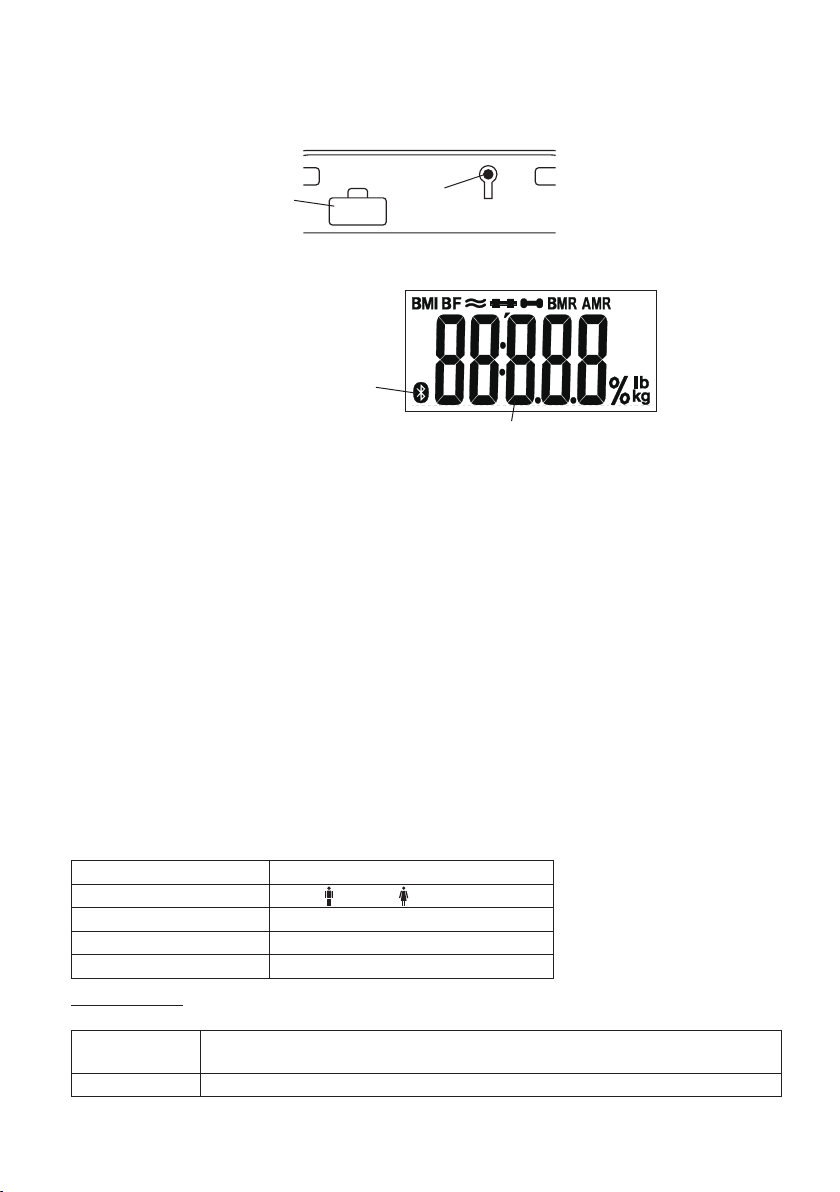
60
•
Bacaklarında vücutlarının tamamına oranla büyük anatomik farklılıklar (bacakları çok kısa veya çok uzun)
olan kişilerde.
5. Cihaz açıklaması
Arka taraf
2
1
1. Pil yuvası
2. unit / reset tuşu
Ekran
3
4
3. Terazi ve akıllı telefon arasındaki bağ-
lantı için Bluetooth
®
sembolü
4. Ölçüm değerleri
6. Uygulama ile kullanım
Vücut yağ oranınızı ve diğer vücut değerlerinizi hesaplamak için kişisel kullanıcı bilgilerinizi teraziye kaydet-
meniz gerekir.
Terazi, kendinizin ve örneğin aile bireylerinizin kişisel ayarlarını kaydedebileceğiniz 8 kullanıcı hafızası yerine
sahiptir.
Ayrıca kullanıcılar, “beurer HealthManager“ uygulamasının kurulu olduğu başka mobil kullanıcı cihazların-
dan veya uygulama içinde kullanıcı profilini değiştirerek (bkz. uygulama ayarları) uygulamaya eklenebilirler.
Kullanım sırasında Bluetooth
®
bağlantısının etkin tutulabilmesi için akıllı telefonu terazinin yanından uzak-
laştırmayın.
–
Akıllı telefon ayarlarında Bluetooth
®
’u etkinleştirin.
–
Pilleri yerine takın ve teraziyi sağlam bir zemin üzerine yerleştirin (terazinin LCD’sinde “App” yanıp
söner).
–
Apple App Store (iOS) veya Google Play’dan (Android™) ücretsiz “beurer HealthManager” uygula-
masını indirin.
–
Uygulamayı başlatın ve talimatları uygulayın.
–
BF 600 ile ilgili verileri girin.
“
beurer HealthManager
” uygulamasında aşağıdaki ayar yapılmalı veya girilmelidir:
Kullanıcı bilgileri Ayar değerleri
Cinsiyet erkek ( ), kadın ( )
Boy 100 ila 220 cm (3‘ 3,5” ila 7‘ 2,5”)
Yaş 10 ila 100 yaş
Etkinlik derecesi 1 ila 5
E
tkinlik derecesi
E
tkinlik derecesini seçerken orta ve uzun vadeli inceleme önem taşır.
Etkinlik dere-
cesi
Bedensel etkinlik
1 Yok.
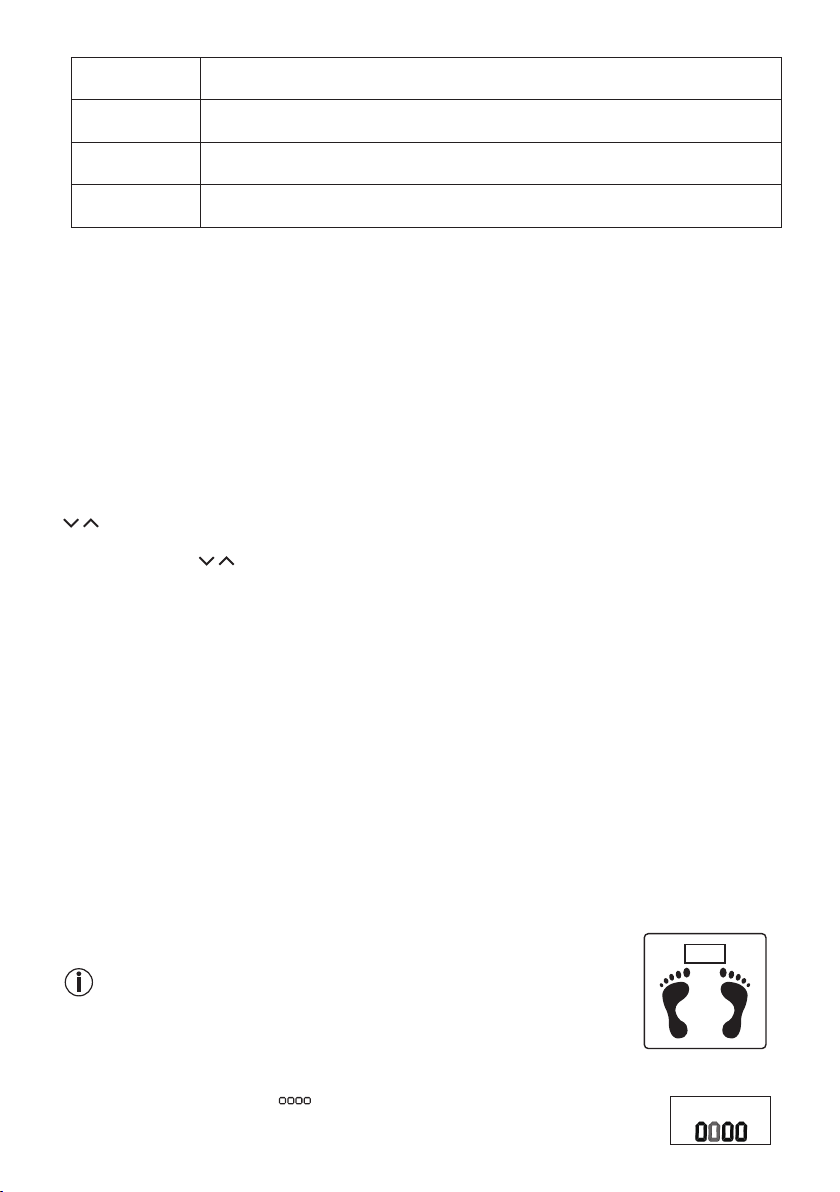
61
2
Az: Az veya hafif bedensel efor
(örn. yürümek, hafif bahçe işleri, jimnastik egzersizleri).
3
Orta: Haftada en az 2 ila 4 kez bedensel efor,
30'ar dakika.
4
Yüksek: Haftada en az 4 ila 6 kez bedensel efor,
30'ar dakika.
5
Çok yüksek: Her gün en az 1 saat yoğun bedensel efor,
yoğun antrenman veya ağır bedensel çalışma.
Uygulama terazinin bir sonraki boş kullanıcı belleğini size tahsis eder (P01-P08).
–
Ölçümün yapılması
O
tomatik kişi algılaması için ilk ölçümün kişisel kullanıcı verilerine atanması gerekir. Uygulama sizden bu
işlemi yapmanızı ister. Terazinin üzerine ideal olarak yalınayak çıkın ve elektrotların üzerinde ağırlığınızı iki
ayağınıza eşit şekilde dağıtarak ve hareketsiz olarak durmaya dikkat edin.
Ş
imdi Bölüm 8 “Ölçümün yapılması” ile devam edin.
7. Terazinin uygulama olmadan çalıştırılması
Terazinin uygulama üzerinden çalıştırılmasını ve tüm ayarların uygulama üzerinden yapılmasını tavsiye ede-
riz. Bkz. Bölüm6. “Uygulama ile kullanım”. Ama bunlar cihaz üzerinden de yapılabilir.
Koruyucu ambalaj içerisindeki pilleri çıkarın ve pilleri kutuplarına dikkat ederek teraziye takın. Terazi çalış-
mıyorsa, pilleri tamamen çıkarın ve yeniden takın.
Teraziyi düz ve sert bir zemine yerleştirin; doğru bir ölçümün önkoşulu sert bir zemin kaplamasıdır.
“SET” düğmesine basın.
“ ” düğmelerine basılarak ve “SET” düğmesiyle onaylanarak yıl/ay/gün ve saat/dakika ayarları yapılır.
Terazide “0.0” görünür. “SET” düğmesine yeniden basın. “P-01” ya da en son kullanılan terazi kullanıcı hafı-
zası görünür. Okları “ ” kullanarak kullanıcı hafızanızı seçin (P-01 - P-08) ve “SET” düğmesine basın.
Cinsiyet, boy vb. gibi ayarlarınızı yapın (bkz. Bölüm 6. “Uygulama ile çalıştırma (Tablo)”. Girişlerinizin her
birini “SET” düğmesine basarak onaylayın. Girişlerinizi tamamladığınızda bir PIN kodu görünür. Bu kod,
daha sonra uygulamada oturum açmak için gereklidir. Ardından “0.0” görünür.
Otomatik kişi algılaması için ilk ölçümün kişisel kullanıcı verilerine atanması gerekir. Terazinin üzerine ideal
olarak yalınayak çıkın ve elektrotların üzerinde ağırlığınızı iki ayağınıza eşit şekilde dağıtarak ve hareketsiz
olarak durmaya dikkat edin.
7.1 Sonradan uygulamada oturum açmak
Terazinizi uygulama olmadan çalıştırdıysanız, kullanıcınızı aşağıdaki gibi uygulamaya aktarabilirsiniz ya da
kullanıcı oluşturabilirsiniz.
–
Apple App Store (iOS) veya Google Play’dan (Android™) ücretsiz “beurer HealthManager” uygula-
masını indirin.
–
Uygulamayı başlatın ve talimatları uygulayın.
8. Ölçümün yapılması
Teraziyi düz ve sert bir zemine yerleştirin; doğru bir ölçümün önkoşulu sert bir zemin kaplamasıdır.
8.1 Diyagnoz
Terazinin üzerine yalınayak çıkın ve elektrotların üzerinde ağırlığınızı iki bacağınıza
eşit şekilde dağıtarak ve hareketsiz olarak durmaya dikkat edin.
Bilgi: Çorap ile ölçüm yaparsanız ölçüm sonucu hatalı olur.
Terazi hemen tartmaya başlar.
Önce ağırlık görüntülenir.
BIA analizi sırasında ekrandan “ ” geçer.
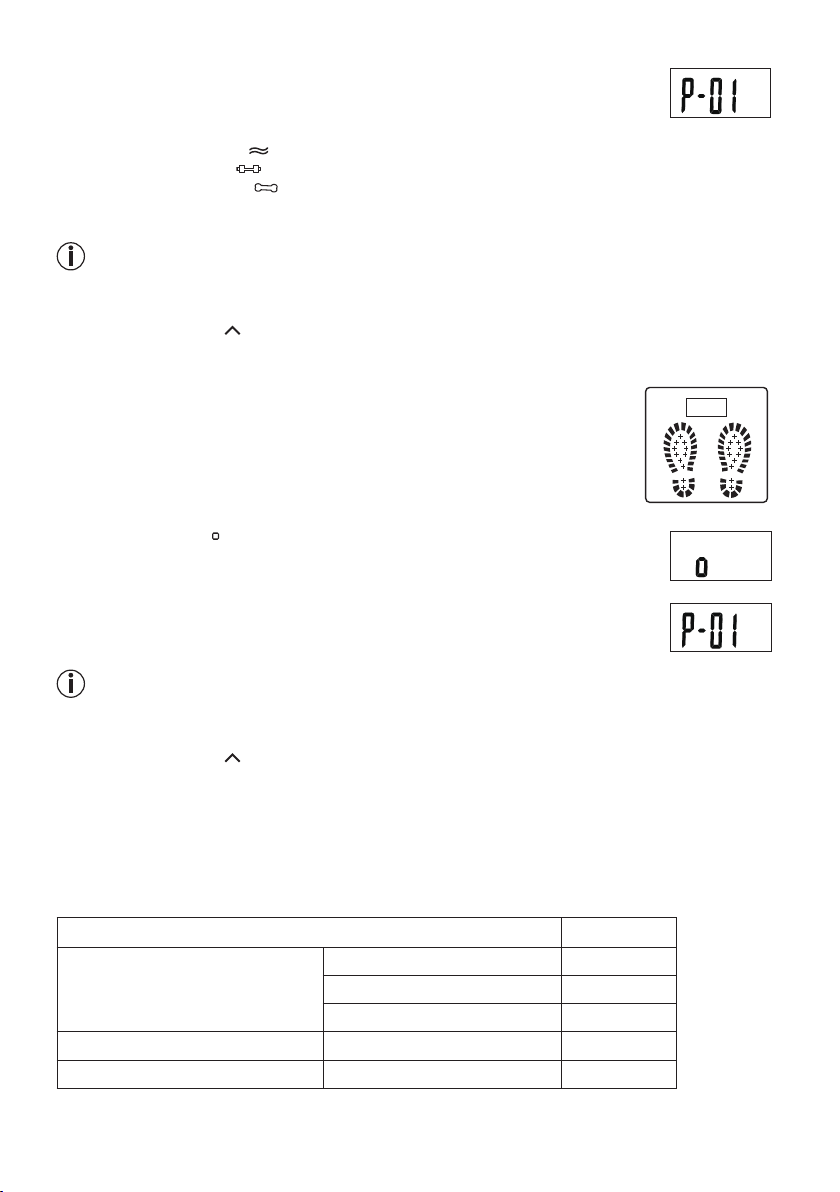
62
Bir kullanıcı ataması yapılmışsa, P-01 - P-08 gösterilir ve takip eden değerlerin hepsi
kaydedilir.
1. BMI
2. % cinsinden vücut yağı
3. % cinsinden vücut suyu
4. % cinsinden kas oranı
5. kg cinsinden kemik oranı
6. kcal cinsinden kalori temel metabolizma hızı (BMR)
7. kcal cinsinden etkinlik metabolizma hızı (AMR)
Bilgi: Kullanıcı tanınmıyorsa, kullanıcı ataması yapılmamıştır (örn. P-01) ve yalnızca ağırlık gösterilir.
Ölçüm kaydedilmez.
Ölçülen ağırlığınız son ölçümden ± 3 kg farklıysa veya başka bir kullanıcı ± 3 kg farkla sizin değerle-
rinize benziyorsa, bu durumla karşılaşabilirsiniz. Bu durumda, teraziyi açıp kullanıcı belleğinizi (P01-
P08) seçmek için “ ” düğmesine basarak ölçümü tekrarlayın. Ölçüm işlemini tekrarlayın.
8.2 Ağırlık
Terazinin üzerine ayakkabılarınızla çıkın ve terazi üzerinde ağırlığınızı iki bacağı-
nıza eşit şekilde dağıtarak ve hareketsiz olarak durmaya dikkat edin. Terazi hemen
tartmaya başlar.
Önce ağırlık görüntülenir.
LCD ekranda kısaca “ ” görülür. BIA analizi mümkün değildir.
Eğer kullanıcı ataması yapılmışsa örn. “P-01” gösterilir ve ağırlık kaydedilir.
Bilgi: Kullanıcı tanınmıyorsa, kullanıcı ataması yapılmamıştır (örn. P-01) ve yalnızca ağırlık gösterilir.
Ölçüm kaydedilmez.
Ölçülen ağırlığınız son ölçümden ± 3 kg farklıysa veya başka bir kullanıcı ± 3 kg farkla sizin değerle-
rinize benziyorsa, bu durumla karşılaşabilirsiniz. Bu durumda, teraziyi açıp kullanıcı belleğinizi (P01-
P08) seçmek için “ ” düğmesine basarak ölçümü tekrarlayın. Ölçüm işlemini tekrarlayın.
9. Sonuçların değerlendirilmesi
Body Mass Index (Vücut kütle endeksi)
Body-Mass-Index (BMI), çoğunlukla vücut ağırlığının değerlendirilmesi için yararlanılan bir sayıdır. Sayı,
vücut ağırlığı ve boy ölçüsü değerlerinden hesaplanır, bununla ilgili formül şöyledir:
Body Mass Index = Vücut ağırlığı ÷ Boyun karesi. Buna göre BMI birimi [kg/m²]’dir. BMI uyarınca ağırlık
dağılımları yetişkinlerde (20 yaşından itibaren) aşağıdaki değerlerdedir:
Kategori BMI
Düşük kilo Çok düşük kilo <16
Orta düşük kilo 16-16,9
Hafif düşük kilo 17-18,4
Normal kilo 18.5-25
Fazla kilo Obezite öncesi 25.1-29,9
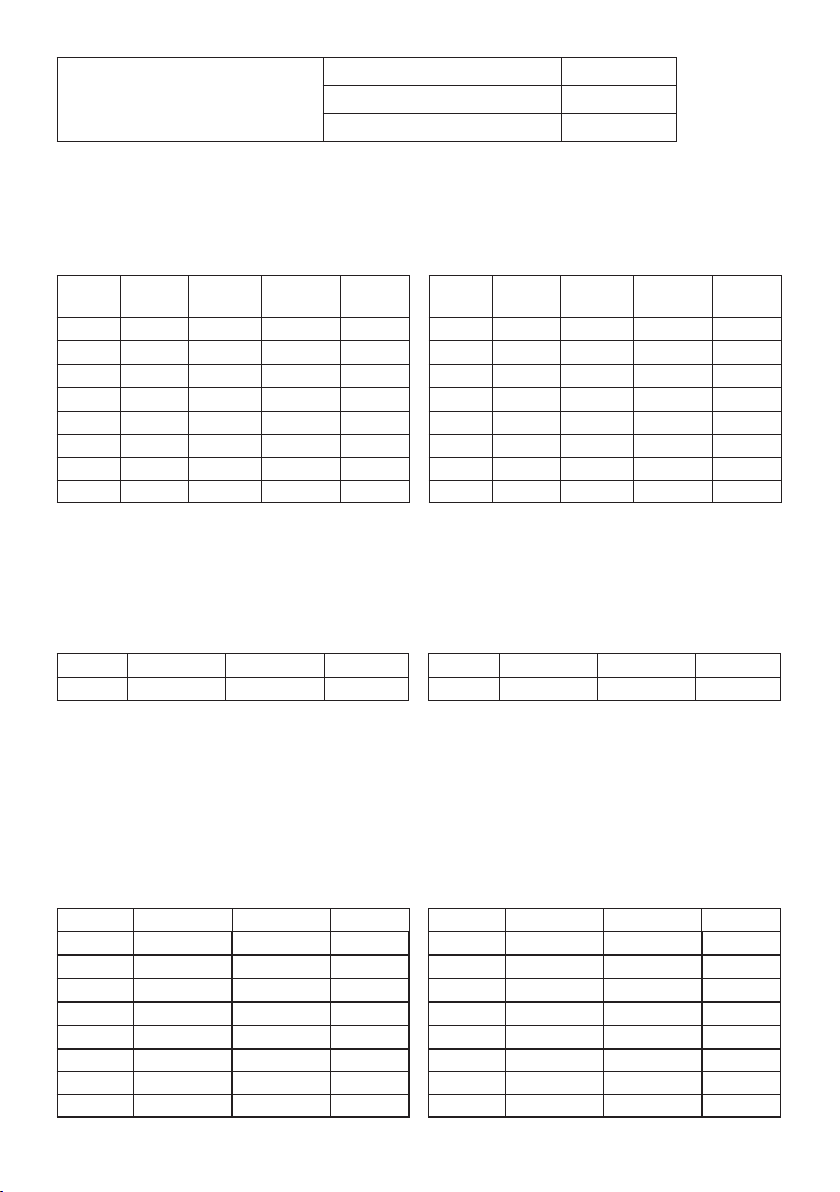
63
Adipositas (Yüksek ağırlık) 1. derece obezite 30-34,9
2. derece obezite 35-39,9
3. derece obezite ≥40
Kaynak: WHO, 1999 (Dünya Sağlık Örgütü)
Vücut yağı oranı
Yüzde olarak belirtilen vücut yağı değerleri, rehber niteliğindedir (daha fazla bilgi için doktorunuza başvu-
run!).
Erkek Kadın
Yaş az normal fazla
çok
fazla
Yaş az normal fazla
çok
fazla
10–14 <%11 %11–16 %16,1–21 >%21 10–14 <%16 %16–21 %21,1–26 >%26
15–19 <%12 %12–17 %17,1–22 >%22 15–19 <%17 %17–22 %22,1–27 >%27
20–29 <%13 %13–18 %18,1–23 >%23 20–29 <%18 %18–23 %23,1–28 >%28
30–39 <%14 %14–19 %19,1–24 >%24 30–39 <%19 %19–24 %24,1–29 >%29
40–49 <%15 %15–20 %20,1–25 >%25 40–49 <%20 %20–25 %25,1–30 >%30
50–59 <%16 %16–21 %21,1–26 >%26 50-59 <%21 %21–26 %26,1–31 >%31
60–69 <%17 %17–22 %22,1–27 >%27 60-69 <%22 %22–27 %27,1–32 >%32
70–100 <%18 %18–23 %23,1–28 >%28 70–100 <%23 %23–28 %28,1–33 >%33
Sporcularda sıklıkla daha düşük bir değer tespit edilir. Yapılan spor türüne göre, antrenman yoğunluğuna ve
bedensel kondisyona göre belirtilen referans değerlerin
altında
kalan değerlere ulaşılabilir. Ancak aşırı düşük
değerlerde sağlıkla ilgili risklerin olabileceğini lütfen unutmayın.
Vücut suyu oranı
Vücut suyu oranı (%) normalde aşağıdaki aralıktadır:
Erkek Kadın
Yaş kötü iyi çok iyi Yaş kötü iyi çok iyi
10 – 100 <%50 %50–65 >%65 10–100 <%45 %45–60 >%60
Vücut yağı görece az su içerir. Bu nedenle vücut yağı oranı yüksek olan kişilerdeki vücut suyu oranı refe-
rans değerlerin altında olabilir. Buna karşın dayanıklılık sporları yapan kişilerde, yağ oranının az ve kas ora-
nının yüksek olması nedeniyle bu referans değerleri aşılabilir.
Bu teraziyle vücut suyu oranının tespit edilmesi, örn. yaştan ileri gelen ödemler hakkında tıbbi bir sonuca
varmak için elverişli değildir. Gereği halinde doktorunuza başvurun. İlke olarak vücut suyu oranının yüksek
olması amaçlanmalıdır.
Kas oranı
Kas oranı (%) normalde aşağıdaki aralıktadır:
Erkek Kadın
Yaş az normal fazla Yaş az normal fazla
10 – 14 <%44 %44–57 >%57 10–14 <%36 %36–43 >%43
15–19 <%43 %43–56 >%56 15–19 <%35 %35–41 >%41
20–29 <%42 %42–54 >%54 20–29 <%34 %34–39 >%39
30–39 <%41 %41–52 >%52 30–39 <%33 %33–38 >%38
40–49 <%40 %40–50 >%50 40–49 <%31 %31–36 >%36
50–59 <%39 %39–48 >%48 50–59 <%29 %29–34 >%34
60–69 <%38 %38–47 >%47 60–69 <%28 %28–33 >%33
70–100 <%37 %37–46 >%46 70–100 <%27 %27–32 >%32
64
Kemik kütlesi
Vücudumuzun her bölümü gibi kemiklerimiz de gelişme, bozulma ve yaşlanma süreçlerinden geçer. Kemik
kütlesi çocukluk çağında hızla artarak 30 ve 40 yaş arasında maksimum düzeye ulaşır. Yaşlandıkça kemik
kütleniz kademeli olarak azalmaya başlar. Sağlıklı beslenerek (özellikle kalsiyum ve D vitamini) ve düzenli
olarak egzersiz yaparak bu süreci yavaşlatabilirsiniz. Ayrıca, planlı kas geliştirme çalışmalarıyla iskelet yapı-
nızı sağlamlaştırabilirsiniz. Lütfen bu terazinin kemik minerallerini ölçtüğünü dikkate alın. Kemik kütlesinin
değişmesi çok zor olsa da, bazı etkileyici faktörler (kilo, boy, yaş, cinsiyet) nedeniyle küçük miktarda deği-
şiklik göstermektedir. Onaylanmış yönergeler ve öneriler bulunmamaktadır.
BMR
Temel metabolizma hızı (BMR = Basal Metabolic Rate) vücudun, tamamen istirahat halindeyken temel
fonksiyonlarını sürdürebilmek için gereksinim duyduğu enerji miktarıdır (örn. 24 saat yatakta yatıldığında).
Bu değer büyük ölçüde ağırlığa, boya ve yaşa bağlıdır.
Diyagnoz terazisinde bu kcal/gün birimiyle gösterilir ve bilimsel olarak kabul görmüş Harris-Benedict For-
mülü’ne göre hesaplanır.
Vücudunuz bu enerji miktarına her halükarda gereksinim duyar ve bunun besin şeklinde yeniden vücuda
alınması zorunludur. Uzun vadede yetersiz enerji alırsanız, sağlığınız bozulabilir.
AMR
Etkinlik metabolizma hızı (AMR = Active Metabolic Rate) vücudun aktif durumda bir günde tükettiği enerji
miktarıdır. İnsanın enerji tüketimi aran bedensel etkinlikle doğru orantılıdır ve diyagnoz terazisinde girilen
etkinlik derecesi (1 – 5) yardımıyla saptanır.
Kilonun korunması için, tüketilen enerjinin yiyecek ve içecek biçiminde yeniden vücuda alınması zorunlu-
dur.
Uzun bir süre boyunca tüketilenden daha az enerji alındığında vücut aradaki farkı esas olarak depoladığı
yağdan karşılar, ağırlık kaybı olur. Buna karşın uzun bir süre boyunca hesaplanan etkinlik metabolizma
hızından (AMR) daha fazla enerji alınırsa vücut bu enerji fazlasını yakamaz ve bu yağ olarak vücutta depo-
lanır, ağırlık artar.
Sonuçların zamanla ilişkisi
Yalnız uzun vadeli eğilimin önem taşıdığını göz önünde bulundurun. Birkaç gün içindeki kısa süreli
ağırlık farklılıkları genelde su kaybından ileri gelir.
Sonuçlar, toplam ağırlıktaki ve vücut yağı, vücut suyu ve kas kütlesi oranlarındaki değişikliklere ve ayrıca bu deği-
şikliklerin olduğu süreye göre yorumlanır.
Birkaç gün içindeki hızlı değişiklikler orta vadeli (birkaç hafta içindeki) değişikliklerden ve uzun vadeli (bir-
kaç ay içindeki) değişikliklerden ayırt edilmelidir.
Temel kural olarak, ağırlıktaki kısa vadeli değişikliklerin neredeyse tamamen su oranındaki değişiklikler
olduğu, buna karşın orta ve uzun vadedeki değişikliklerin yağ ve kas oranlarını ifade ettiği kabul edilebilir.
•
Eğer kısa vadede ağırlık azalıyorsa ama vücut yağı oranı artıyor veya değişmiyorsa, yalnız su kaybetmiş-
sinizdir – örn. antrenmandan veya saunadan sonra ya da yalnızca hızlı kilo kaybıyla sınırlı olan bir diyet
sonrasında.
•
Eğer orta vadede ağırlık artıyorsa, vücut yapı oranı azalıyor veya değişmiyorsa, değerli kas kütlesi geliş-
tirmiş olabilirsiniz.
•
Eğer ağırlık ve vücut yağ oranı aynı zamanda azalıyorsa, diyetiniz işe yarıyor demektir – yağ kütlesi kay-
bediyorsunuz.
•
İdeal koşullarda diyetinizi bedensel etkinlik, fitness veya kuvvet antrenmanıyla desteklersiniz. Bu sayede
orta vadede kas oranınızı artırabilirsiniz.
•
Vücut yağı, vücut suyu veya kas oranı birbiriyle toplanmamalıdır (kas dokusu vücut suyunun bir kısmını
içerir).
10. İlave bilgiler
Kullanıcı atama
Salt ağırlık ölçümünde (ayakkabı ile) ve teşhis ölçümünde (çıplak ayak) azami 8 terazi kullanıcısı için kulla-
nıcı ataması yapılabilir.
Yeni ölçüm yapıldığında, terazi bu ölçümü son kaydedilen ölçüm değerinin ± 3kg aralığında bulunan kulla-
nıcıya atar. Bkz. Bölüm8.
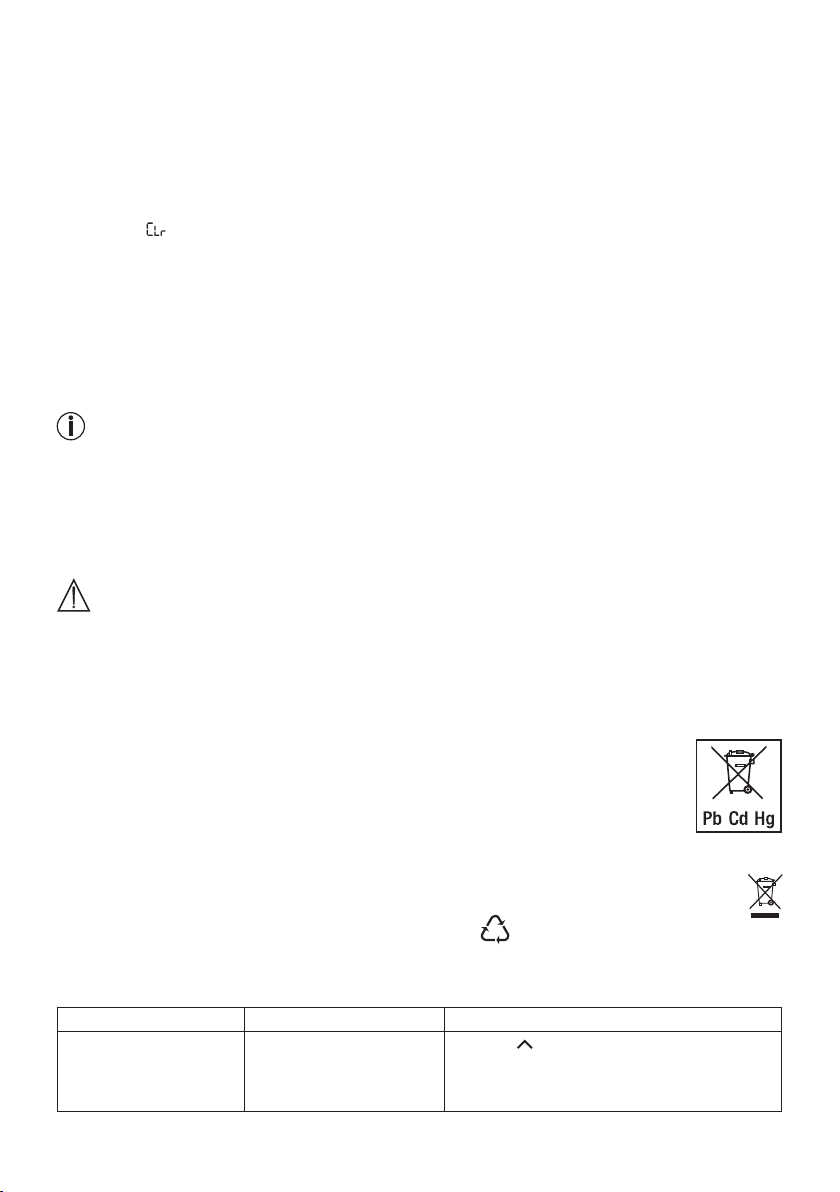
65
Atanan ölçüm değerlerinin teraziye kaydedilmesi ve uygulamaya aktarılması
Uygulama açık değilse yeni atanan ölçümler teraziye kaydedilir. Teraziye her kullanıcı için azami 30 ölçüm
kaydedilebilir. Uygulamayı Bluetooth kapsama alanı dahilinde açarsanız kaydedilen ölçüm değerleri oto-
matik olarak uygulamaya aktarılır.
Terazi kapalı iken otomatik aktarım mümkündür.
Terazi verilerinin silinmesi
Terazideki tüm ölçümleri ve eski kullanıcı verilerini silmek istediğinizde pilleri en az 10 saniye boyunca çıka-
rın. Bunun ardından unit/rest düğmesine basın ve aynı zamanda pilleri yeniden yerleştirin. Ekranda birkaç
saniyeliğine “ ” görünür.
Bu işlev özellikle örn. yanlış oluşturulmuş terazi kullanıcılarını veya artık kullanılmayan terazi kullanıcılarını
silmek istediğinizde oldukça işe yarar.
Ardından 6. bölümü yeniden uygulamalısınız (Kullanıcı ataması).
Pillerin değiştirilmesi
Terazinizde bir pil değiştirme göstergesi bulunur. Piller çok zayıfken terazi çalıştırıldığında, ekranda “Lo”
yazısı görünür ve terazi otomatik olarak kapanır. Bu durumda pillerin değiştirilmesi gerekir (2 x 1,5 V AAA).
Kaydedilen ölçümlerin ve kullanıcıların hepsi kayıtlı kalır.
Bunun ardından teraziyi tekrar uygulamaya bağlayın. Sistem zamanı güncellenir.
NOT:
•
Her pil değişiminde aynı tip, aynı marka ve kapasitede piller kullanın.
•
Şarj edilebilen piller kullanmayın.
•
Ağır metal içermeyen piller kullanın.
11. Cihazın temizliği ve bakımı
Cihaz belirli aralıklarla temizlenmelidir.
Temizlik için, gerektiğinde üzerine biraz sıvı bulaşık deterjanı dökebileceğiniz nemli bir bez kullanın.
DIKKAT
•
Hiçbir zaman aşındırıcı çözücü maddeler veya temizlik maddeleri kullanmayın!
•
Cihazı kesinlikle suya daldırmayın!
•
Cihazı bulaşık makinesinde yıkamayın!
12. Bertaraf etme
Kullanılmış, tamamen boşalmış piller özel işaretli toplama kutularına atılarak, özel atık toplama yerlerine
veya elektrikli cihaz satıcılarına teslim edilerek bertaraf edilmelidir. Pillerin bertaraf edilmesi, yasal olarak
sizin sorumluluğunuzdadır.
Bu işaretler, zararlı madde içeren pillerin üzerinde bulunur:
Pb = Pil kurşun içeriyor,
Cd = Pil kadmiyum içeriyor,
Hg = Pil cıva içeriyor.
Çevreyi korumak için, kullanım ömrü dolan cihazı evsel atıklarla beraber bertaraf etmeyin. Cihaz,
ülkenizdeki uygun atık toplama merkezleri aracılığıyla bertaraf edilmelidir.
Cihazı, elektrikli ve elektronik hurda cihazlarla ilgili AB direktifine (WEEE - Waste Electrical and Elect-
ronic Equipment) uygun şekilde bertaraf edin. Bertaraf etme ile ilgili sorularınızı, ilgili yerel makamlara
iletebilirsiniz.
Ambalaj çevreye zarar vermeyecek şekilde bertaraf edilmelidir
20
PAP
13. Sorunların giderilmesi
Terazi, ölçüm esnasında bir hata tespit ederse şu görüntülenir:
Ekran göstergesi Neden Çözüm
Yalnızca ağırlık gösteri-
liyor ve P01-P08 gös-
terilmiyor
Bilinmeyen ölçüm, kullanıcı
eşleştirme sınırı dışındadır
veya bilinen bir eşleştirme
mümkün değildir.
Terazide “ ” düğmesiyle kullanıcıyı seçin veya
uygulamada kullanıcı ataması işlemini tekrar-
layın.
bkz. Bölüm 10 “İlave bilgiler”.
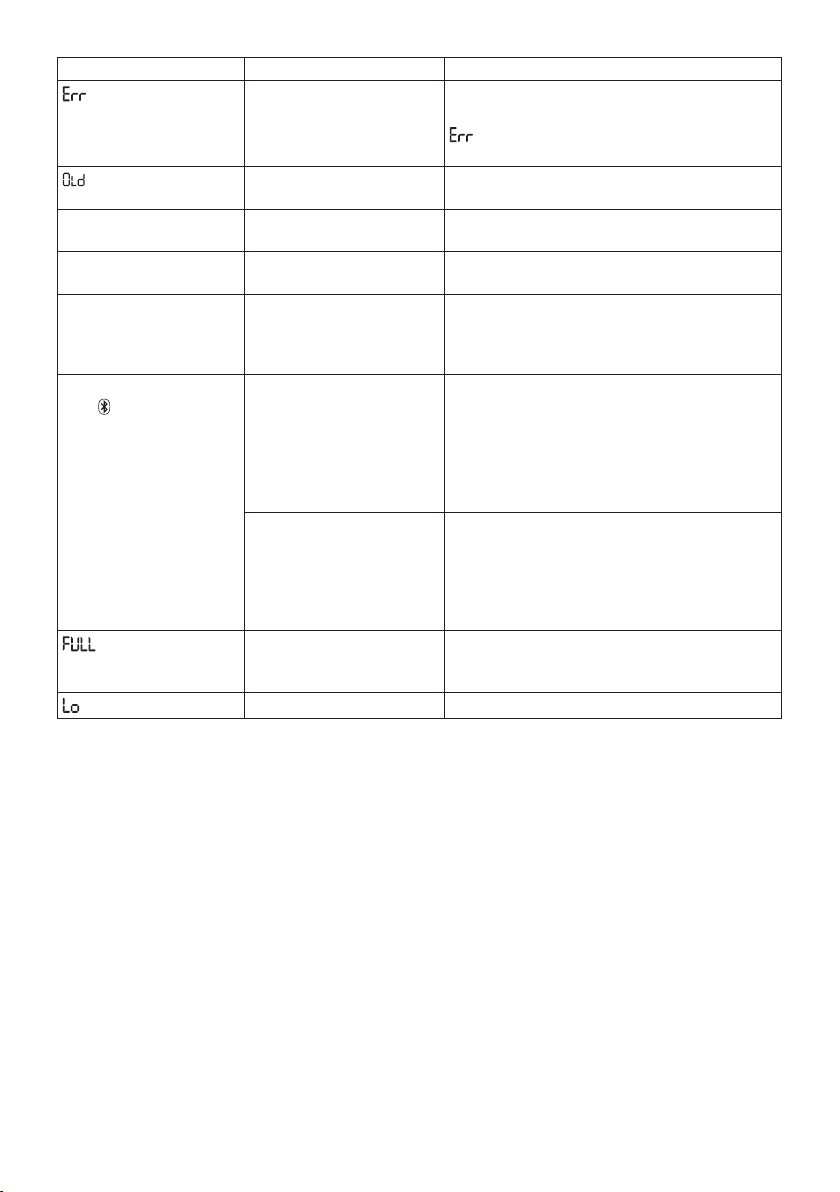
66
Ekran göstergesi Neden Çözüm
Yağ oranı ölçülebilir aralığın
dışındadır (%4’ten küçük
veya %65’ten büyük).
Lütfen ölçümü yalınayak olarak tekrarlayın veya
gerekiyorsa ayak tabanınızı hafifçe nemlendirin.
görünmeye devam ederse, ölçüm aralığının
dışındasınız demektir.
180 kg olan maksimum
taşıma kapasitesi aşıldı.
Sadece 180 kg'a kadar ağırlık uygulayın.
Yanlış ağırlık gösteri-
liyor.
Zemin düz ve sağlam değil. Teraziyi düz ve sabit bir zemine yerleştirin.
Halı olmamalıdır.
Yanlış ağırlık gösteri-
liyor.
Hareketli durma. Mümkün olduğunca hareketsiz durun.
Yanlış ağırlık gösteri-
liyor.
Terazinin sıfır noktası yan-
lıştır.
Terazinin tekrar kendi kendine kapanmasını bek-
leyin. Teraziyi etkinleştirin. Muhtemelen “C” gös-
terilir. “0.0 kg”
gösterilmesini bekleyin. Ölçümü
tekrarlayın.
Bluetooth
®
bağlantısı
yok ( simgesi yok).
Cihaz kapsama alanı
dışında.
Açık alanda asgari kapsama mesafesi yakl. 15
m'dir. Duvarlar ve tavanlar kapsama mesafesini
kısaltır.
Diğer radyo dalgaları aktarımı bozabilir. Bu
nedenle cihazı örn. WLAN Router, mikrodalga,
endüksiyonlu ocak vs. gibi cihazların yakınına
kurmayın.
Uygulamayla bağlı değil. Uygulamayı tamamen kapatın (arka planda da
kapalı olmalıdır).
Bluetooth
®
’u kapatıp yeniden açın.
Akıllı telefonunu kapatıp yeniden açın.
Terazinin pillerini kısa bir süreliğine çıkarıp yeniden
takın. www.beurer.com sitesinde SSS’a bakın.
Kullanıcı hafıza yeri dolu.
Yeni ölçümler eski ölçümle-
rin üzerine yazılır.
Uygulamayı açın. Veriler otomatik olarak aktarı-
lır. Bu işlem bir dakika kadar sürebilir.
Terazinin pilleri boşalmış.
Terazideki pilleri değiştirin.
14. Garanti / Servis
Garanti ile ilgili talepleriniz için bölgenizdeki yetkili satıcınıza veya bölgenizdeki şubeye başvurun (“Ulusla-
rarası servis” listesine bakın).
Cihazı geri gönderirken faturanızın bir kopyasını ve arızanın kısa açıklamasını ekleyin.
Aşağıdaki garanti koşulları geçerlidir:
1. BEURER ürünlerinin garanti süresi 5 yıldır veya – daha uzun ise – ilgili ülkede geçerli olan satın alma tari-
hinden itibaren garanti süresi kabul edilir.
Garanti talebinde satın alma tarihi bir satış fişi veya fatura ile belgelenmelidir.
2. Onarım (cihazın tamamı veya parçaları) garanti süresinin uzamasını sağlamaz.
3. Garanti aşağıdakiler sonucu oluşan hasarlar için geçerli değildir:
a. Usulüne uygun olmayan kullanım, örn. kullanım talimatlarına uyulmaması.
b. Müşteri veya yetkisiz kişiler tarafından yapılan onarımlar.
c. Üreticiden müşteriye nakliye veya servis merkezine nakliye sırasında oluşan hasarlar.
d. Normal yıpranmaya uğrayan aksesuarlar (manşet, piller vb.) için garanti geçerli değildir.
4. Cihaz hasar gördüğünde bir garanti talebi kabul edilmesi durumunda da cihazın neden olduğu doğrudan
veya dolaylı netice kabilinden doğan hasarlar için sorumluluk üstlenilmez.
Hata, yanılma ve değişiklik yapma hakkımız saklıdır

67
РУССКИЙ
Комплект поставки
•
Краткое руководство
•
Диагностические весы BF 600
•
2 батарейки 1,5 В типа AAA
•
Данная инструкция по применению
1. Для ознакомления
Функции прибора
Данные электронные диагностические весы служат для взвешивания идиагностирования Ваших
личных фитнес-характеристик.
Они служат для личного (домашнего) пользования.
Весы обладают следующими диагностическими функциями, которые могут использовать до 8 человек:
•
измерение массы тела иИМТ,
•
определение доли жировой массы,
•
доли тканевой жидкости,
•
доли мышц,
•
массы костей, атакже
з
начений основного обмена веществ иобмена веществ сучетом физической активности.
Кроме того, доступны следующие функции:
•
переключение между единицами измерения: килограмм «kg», фунт «lb» истоун «st»,
•
автоматическое отключение,
•
индикация необходимости замены батареек, если они разрядились
•
автоматическое распознавание пользователя,
•
хранение 30 последних измерений для 8 человек при невозможности переноса данных вприло-
жение,
•
Продукт использует технологию Bluetooth
®
low energy technology, частотный диапазон 2400 -
2483,5 МГц, мощность передатчика макс. -0,93дБм.
Системные требования
iOS, начиная с версии 10.0; Android™, начиная с версии 5.0 с Bluetooth
®
4.0.
Список поддерживаемых устройств:
Уважаемый покупатель!
Благодарим Вас завыбор продукции нашей фирмы. Мы производим тщательно протестированные,
высококачественные изделия для обогрева, измерения массы, кровяного давления, температуры
тела, пульса, для легкой терапии, массажа, косметического ухода, ухода задетьми иочистки воздуха.
Внимательно прочтите данную инструкцию по применению, сохраняйте ее для последующего
использования, храните ее вдоступном для других пользователей месте иследуйте ее указаниям.
Снаилучшими пожеланиями, компания Beurer
Оглавление
1. Для ознакомления .......................................... 67
2. Пояснения ксимволам ................................... 68
3. Предостережения и указания по технике
безопасности ......................................................68
4. Информация....................................................69
5. Описание прибора ..........................................70
6. Ввод вэксплуатацию при помощи
приложения ..................................................... 70
7.
Ввод весов вэксплуатацию без приложения
71
8. Проведение измерения ................................ 72
9. Оценка результатов ...................................... 73
10. Дополнительная информация .....................75
11. Очистка прибора иуход за ним .................. 76
12. Утилизация .................................................... 76
13. Что делать при возникновении проблем? .. 76
14. Гарантия/сервисное обслуживание ............77
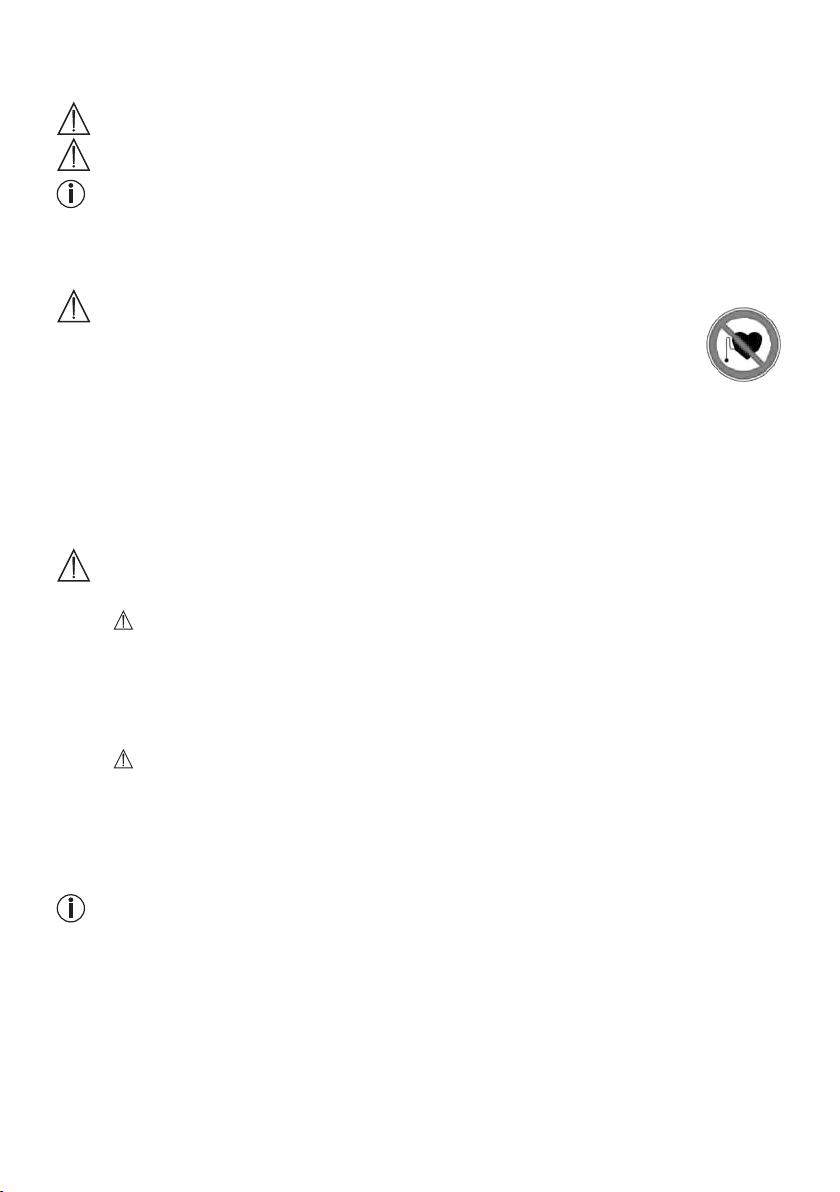
68
2. Пояснения ксимволам
Винструкции по применению используются следующие символы:
ПРЕДОСТЕРЕЖЕНИЕ Предупреждает об опасности травмирования или ущерба для здоровья.
ВНИМАНИЕ Указывает навозможные повреждения прибора/принадлежностей.
Указание Отмечает важную информацию.
3. Предостережения и указания по технике безопасности
Внимательно прочтите данную инструкцию по применению, сохраняйте ее для последующего
использования, храните ее вместе, доступном для других пользователей, иследуйте ее указаниям.
ПРЕДОСТЕРЕЖЕНИЕ
•
Запрещается пользоваться весами лицам сустановленными медицинскими
имплантатами (например, кардиостимулятором). Впротивном случае каче-
ство работы имплантата может ухудшиться.
•
Не использовать во время беременности.
•
Никогда не вставайте на самый край весов содной стороны. Опасность опроки-
дывания!
•
Батарейки содержат вещества, которые могут представлять опасность для жизни при про-
глатывании. Храните батарейки ивесы внедоступном для детей месте. Если кто-либо про-
глотит батарейку, следует немедленно обратиться кврачу.
•
Не давайте упаковочный материал детям (опасность удушения).
•
Внимание! Не вставайте на весы влажными ногами ина влажную поверхность весов —
опасность поскользнуться!
Обращение сбатарейками
•
При попадании жидкости изаккумулятора накожу или вглаза необходимо промыть соот-
ветствующий участок большим количеством воды иобратиться кврачу.
• Опасность проглатывания мелких деталей! Маленькие дети могут проглотить бата-
рейки иподавиться ими. Поэтому батарейки необходимо хранить внедоступном для детей
месте!
• Обращайте внимание на обозначение полярности: плюс (+) иминус (-).
• Если батарейка потекла, очистите отделение для батареек сухой салфеткой, предвари-
тельно надев защитные перчатки.
• Защищайте батарейки от чрезмерного воздействия тепла.
• Опасность взрыва! Не бросайте батарейки вогонь.
• Не заряжайте ине замыкайте батарейки накоротко.
• Если прибор длительное время не используется, извлеките из него батарейки.
• Используйте батарейки только одного типа или равноценных типов.
• Заменяйте все батарейки сразу.
• Неиспользуйте перезаряжаемые аккумуляторы!
• Неразбирайте, неоткрывайте инеразбивайте батарейки.
Общие указания
•
Прибор предназначен исключительно для частного пользования, запрещается использова-
ние вмедицинских или коммерческих целях.
•
Учтите, что по техническим причинам возможны погрешности измерений, так как речь идет
не окалиброванных весах для профессионального использования вмедицинских целях.
•
Вслучае получения разных результатов измерения (на весах ив приложении) следует
использовать только значения, указанные на весах.
•
Максимальная нагрузка для весов составляет 180кг (396фунтов, 28стоунов). При изме-
рении веса ипри определении массы костей результаты отображаются сшагом 100г
(0,2фунта).
•
Результаты измерения доли жировой массы, тканевой жидкости имышечной массы ото-
бражаются сточностью до 0,1 %.
69
•
Расчетный расход энергии отображается сшагом 1ккал.
•
При поставке на весах установлены единицы измерения «см» и«кг». Во время пуска вэкс-
плуатацию спомощью приложения можно менять настройки единиц измерения.
•
Установите весы на ровную твердую поверхность; твердая поверхность является необходи-
мым условием для точного измерения.
•
Прибор следует предохранять от ударов, влажности, пыли, воздействия химикатов, силь-
ных колебаний температуры ине устанавливать их вблизи источников тепла (печей, радиа-
торов отопления).
•
Ремонтные работы должны производиться только сервисной службой компании Beurer или
авторизованными торговыми представителями. Перед предъявлением претензий проверьте
ипри необходимости замените батарейки.
•
Настоящим подтверждаем, что данное изделие соответствует требованиям европейской
директивы RED 2014/53/EU. С декларацией о соответствии директивам ЕС для данного
устройства можно ознакомиться, перейдя по ссылке:
www.beurer.com/web/we-landingpages/de/cedeclarationofconformity.php.
Х
ранение иуход
Точность измерений исрок службы прибора зависят от бережного обращения сним.
ВНИМАНИЕ
•
Время от времени прибор необходимо очищать. Не используйте едкие чистящие средства
ини вкоем случае не погружайте прибор вводу.
•
Убедитесь, что на весы не попадает никакая жидкость. Никогда не погружайте весы вводу.
Не промывайте их под проточной водой.
•
Не ставьте никакие предметы на весы, когда они не используются.
•
Прибор следует предохранять от ударов, влажности, пыли, воздействия химикатов, силь-
ных колебаний температуры ине устанавливать их вблизи источников тепла (печей, радиа-
торов отопления).
•
Не нажимайте кнопку слишком сильно ине используйте для этого острые предметы.
•
Не подвергайте весы воздействию высоких температур или сильных электромагнитных
полей (например, со стороны мобильных телефонов).
4. Информация
Принцип измерения
Данные весы работают по принципу B.I.A. (биоимпедансометрия). Таким способом за считанные
секунды спомощью незаметного, абсолютно безопасного электрического тока возможно опреде-
лить состав тела человека.
Посредством измерения электрического сопротивления (импеданса) сучетом постоянных величин
или индивидуальных параметров (возраст, рост, степень активности) можно определить долю жиро-
вой массы или других веществ ворганизме. Мышечная ткань ивода имеют хорошую электриче-
скую проводимость, поэтому уровень сопротивления здесь невелик. Кости ижировая ткань, наобо-
рот, имеют небольшую электрическую проводимость, так как жировые клетки икости из-за очень
высокого сопротивления практически не проводят ток.
Учитывайте, что значения, определенные диагностическими весами, являются лишь приближен-
ными креальным медицинским значениям, полученным врезультате анализа. Долю жировой
массы, тканевой жидкости, мышечной массы истроение костей может определить только врач,
используя медицинские методы (например, компьютерную томографию).
Общие советы
•
Для получения сопоставимых результатов по возможности взвешивайтесь водно ито же время
суток (лучше всего утром), после того, как сходите втуалет, на голодный желудок ибез одежды.
•
Важно при измерении: Определение доли жировой массы может осуществляться только без
обуви, при этом подошвы стопы должны быть слегка увлажнены.
Абсолютно сухие подошвы ступней или подошвы ступней ссильно ороговевшими участками кожи
имеют слишком низкую проводимость, что может привести кнеудовлетворительным результатам
измерения.
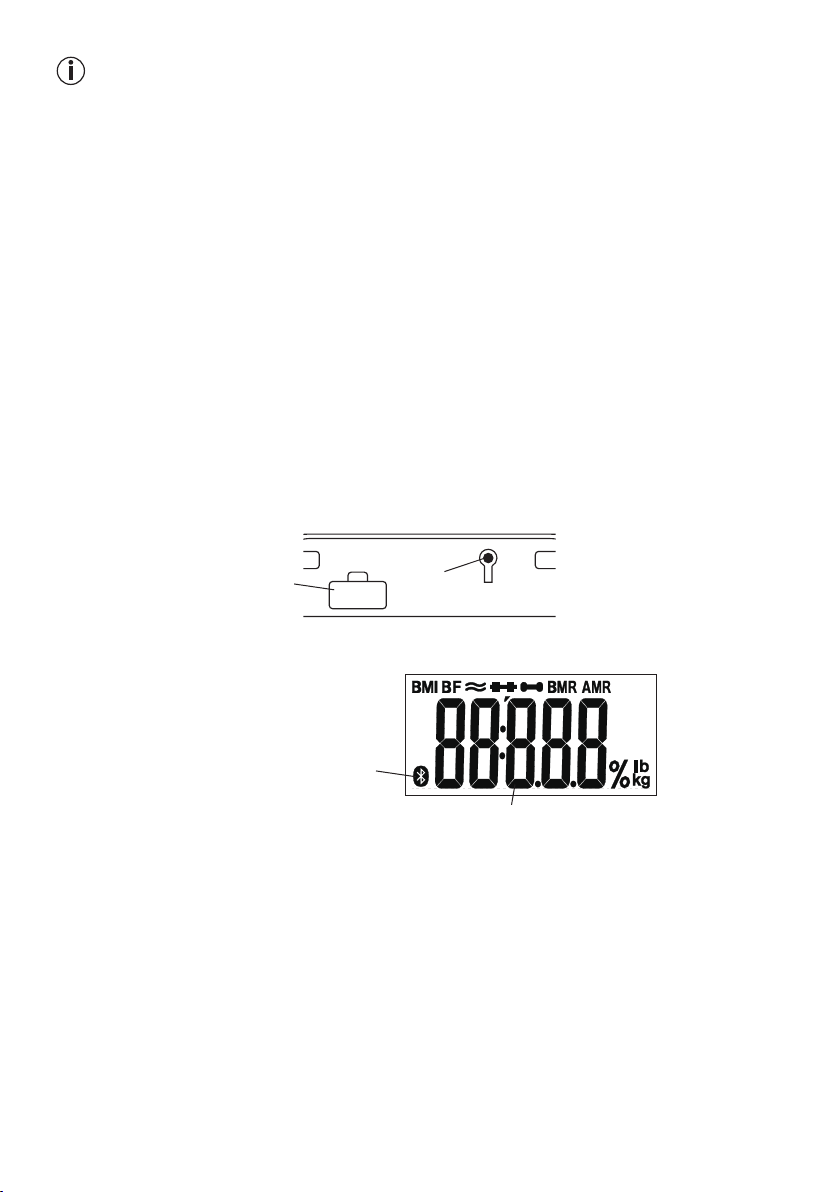
70
Указание Стопы, голени ибедра одной ноги не должны касаться другой ноги. Впротивном
случае измерение не будет точным.
•
Во время взвешивания стойте прямо инеподвижно!
•
После физической нагрузки внепривычно большом объеме воздержитесь от измерений втече-
ние нескольких часов.
•
Встав утром, подождите примерно 15минут, чтобы вода, содержащаяся ворганизме, распреде-
лилась по нему.
•
Важно: значение имеют только тенденции, наблюдаемые втечение продолжительного периода
времени. Как правило, кратковременные отклонения веса втечение нескольких дней обуслов-
лены потерей жидкости; однако тканевая жидкость играет для самочувствия большую роль.
Ограничения
При определении доли жировой массы идругих значений сильные отклонения значений инедосто-
верные результаты могут иметь место уследующих групп людей:
•
дети примерно до 10лет,
•
профессиональные спортсмены икультуристы,
•
лица стемпературой, лица, проходящие лечение диализом, лица ссимптомами отеков или остео-
пороза,
•
лица, принимающие сердечно-сосудистые препараты (сердца икровеносные сосуды),
•
лица, принимающие сосудорасширяющие или сосудосуживающие препараты,
•
лица ссущественным анатомическими отклонениями (длина ног по отношению кросту человека
значительно меньше или значительно больше).
5. Описание прибора
Обратная сторона
2
1
1. Отделение для батареек
2. Кнопка unit/reset
Дисплей
3
4
3. Bluetooth
®
-символ для соединения
весов исмартфона
4. Измеренные значения
6. Ввод вэксплуатацию при помощи приложения
Чтобы определить долю жировой массы ворганизме идругие физические показатели, необходимо
сохранить впамяти весов личные данные пользователя.
Весы оснащены 8 ячейками памяти, вкоторых Вы и, например, члены Вашей семьи сможете хра-
нить личные данные.
Дополнительно пользователи могут подключаться спомощью мобильных устройств сустановлен-
ным приложением «beurer HealthManager“ или путем изменения профиля пользователя впрограмме
(см. настройки приложения).
Для того чтобы во время ввода вэксплуатацию Bluetooth
®
-соединение оставалось активным, дер-
жите смартфон на достаточно близком расстоянии от весов.
– Активируйте функцию Bluetooth
®
внастройках смартфона.
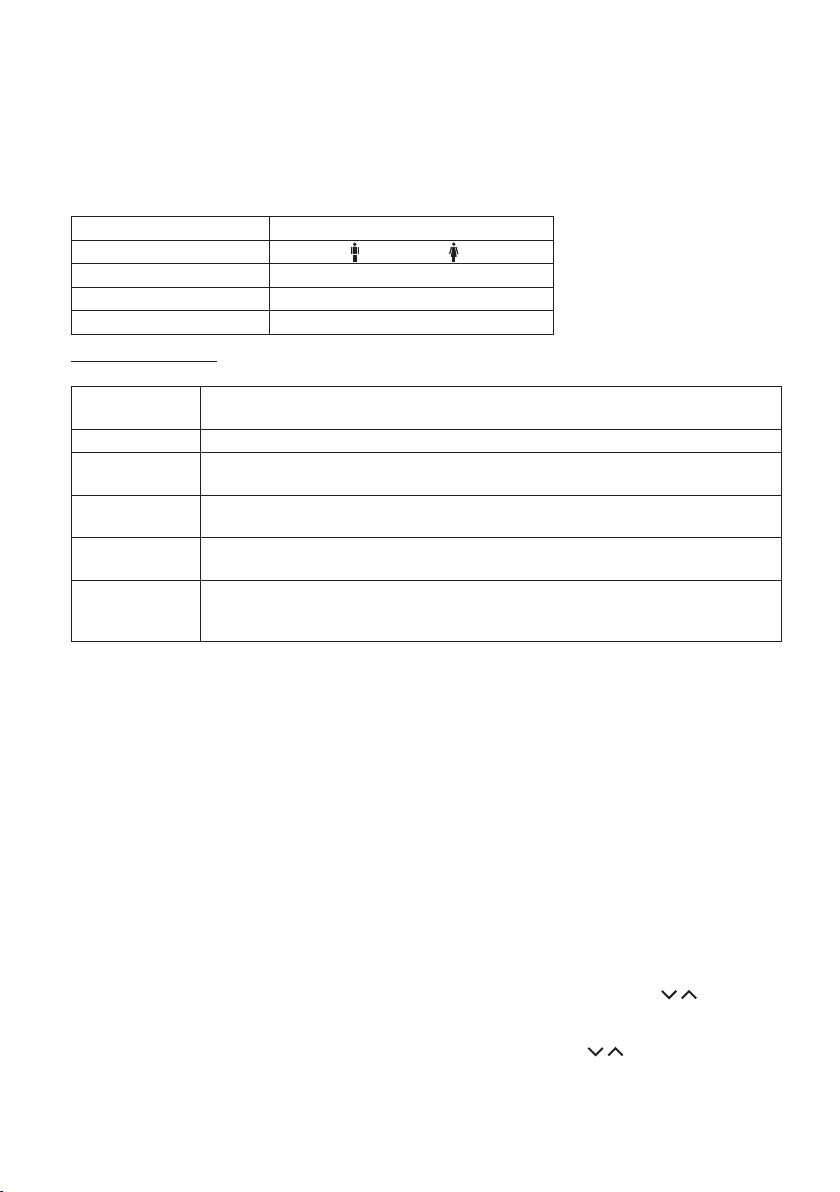
71
–
Вставьте батарейки иустановите весы на твердую поверхность (на ЖК-дисплее весов нач-
нет мигать надпись App).
–
Загрузите бесплатное приложение «beurer HealthManager» в Apple App Store (iOS) или Google
Play (Android™).
–
Запустите приложение иследуйте инструкциям.
–
Введите данные, касающиеся BF 600.
Вприложении «
beurer HealthManager“
должны быть выбраны следующие настройки:
Данные пользователя Значения настроек
Пол мужской ( ), женский ( )
Рост от 100 до 220см (от 3‘3,5“ до 7‘2,5“)
Возраст от 10 до 100лет
Уровень активности от 1 до 5
У
ровень активности
П
ри выборе уровня активности решающим является средне- или долгосрочное наблюдение.
Уровень актив-
ности
Физическая активность
1 Отсутствует.
2
Малая: малые или легкие физические нагрузки
(например, прогулки, простая работа всаду, гимнастические упражнения).
3
Средняя: физические нагрузки не менее 2–4 раз внеделю,
ежедневно по 30минут.
4
Высокая: физические нагрузки не менее 4–6 раз внеделю,
ежедневно по 30минут.
5
Очень высокая: интенсивные физические нагрузки, интенсивные тренировки
или
тяжелый физический труд, ежедневно не менее 1часа.
Приложение присвоит Вам следующую свободную ячейку пользовательской памяти (P01–P08).
–
Выполнение измерения
Д
ля автоматического распознавания пользователя при первом измерении необходимо ввести
свои данные. Следуйте инструкциям вприложении. Встаньте на весы, желательно без обуви,
обратите внимание на то, что необходимо спокойно стоять на электродах, равномерно распреде-
лив вес на обе ноги.
Т
еперь перейдите кразделу 8 «Выполнение измерения».
7. Ввод весов вэксплуатацию без приложения
Мы рекомендуем осуществлять ввод вэксплуатацию инастройку весов через приложение. См.
раздел 6 «Ввод вэксплуатацию при помощи приложения». Настройка весов может также выпол-
няться непосредственно на приборе.
Выньте батарейки из упаковки ивставьте вгнездо на весах, соблюдая полярность. Если весы не
работают, извлеките все батарейки ивставьте их обратно.
Установите весы на ровную твердую поверхность; твердая поверхность является необходимым
условием для точного измерения.
Нажмите кнопку SET.
Настройка года/месяца/дня, атакже часов/минут выполняется спомощью кнопок « » ипод-
тверждается кнопкой SET.
На весах отобразится «0.0». Еще раз нажмите кнопку SET. Отобразится «P-01» или последняя
использованная ячейка пользовательской памяти. При помощи стрелок « » выберите Вашу
ячейку памяти (от P-01 до P-08) и нажмите кнопку SET. Введите необходимые данные, например пол,
рост ит.д. (см.раздел6 «Ввод в эксплуатацию при помощи приложения (таблица)»). Подтвердите
ввод нажатием кнопки SET. После этого отобразится PIN-код. Он необходим для последующей
регистрации в приложении. Затем отобразится «0.0».
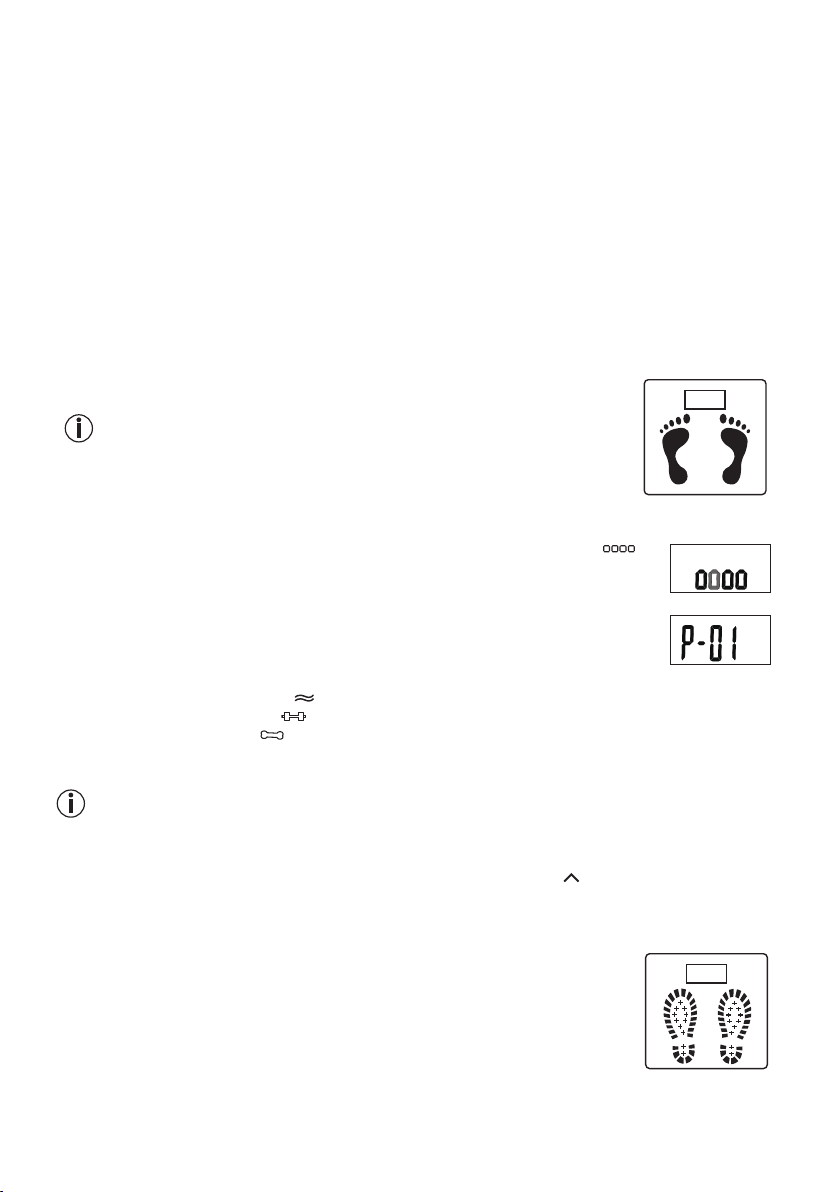
72
Для автоматического распознавания пользователя при первом измерении необходимо ввести свои
данные. Встаньте на весы, желательно без обуви, обратите внимание на то, что необходимо спо-
койно стоять на электродах, равномерно распределив вес на обе ноги.
7.1 Последующая регистрация вприложении
Если ввод весов вэксплуатацию проводился без приложения, то позднее данные можно перенести
вприложение.
–
Загрузите бесплатное приложение «beurer HealthManager» в Apple App Store (iOS) или Google
Play (Android™).
–
Запустите приложение иследуйте инструкциям.
8. Проведение измерения
Установите весы на ровную твердую поверхность; твердая поверхность является необходи-
мым условием для точного измерения.
8.1 Диагностика
Встаньте на весы без обуви, обратите внимание на то, что необходимо спо-
койно стоять на электродах, равномерно распределив вес на обе ноги.
Указание Если Вы проводите измерение массы, стоя на весах
вносках, результаты измерения будут неправильными.
Весы немедленно начинают измерение.
Сначала отображается вес.
Во время анализа биоэлектрического сопротивления (BIA) отображается « ».
Если пользователь присвоен, то отобразится P-01 – P-08, ивсе последующие
значения будут сохранены.
1. Индекс массы тела
2. Доля жировой массы в %
3. Доля тканевой жидкости в %
4. Доля мышечной массы в %
5. Доля костной массы вкг
6. Скорость основного обмена веществ вккал (BMR)
7. Скорость активного обмена веществ вккал (AMR)
Указание Если пользователь не определен, присвоение пользователя невозможно (например,
P-01), поэтому будет показан только вес. Измерение не сохранится.
Это произойдет, если измеренный вес будет отличаться на ± 3 кг от последнего измерения
или удругого пользователя будут похожие значения сразницей ± 3 кг. Вэтом случае необхо-
димо повторить измерение, включить весы инажимать кнопку « » для выбора Вашей ячейки
памяти (P01-P08). Повторите измерение.
8.2 Вес
Встаньте на весы вобуви, обратите внимание на то, что необходимо спо-
койно стоять на весах, равномерно распределив вес на обе ноги. Весы
немедленно начинают измерение.
Сначала отображается вес.
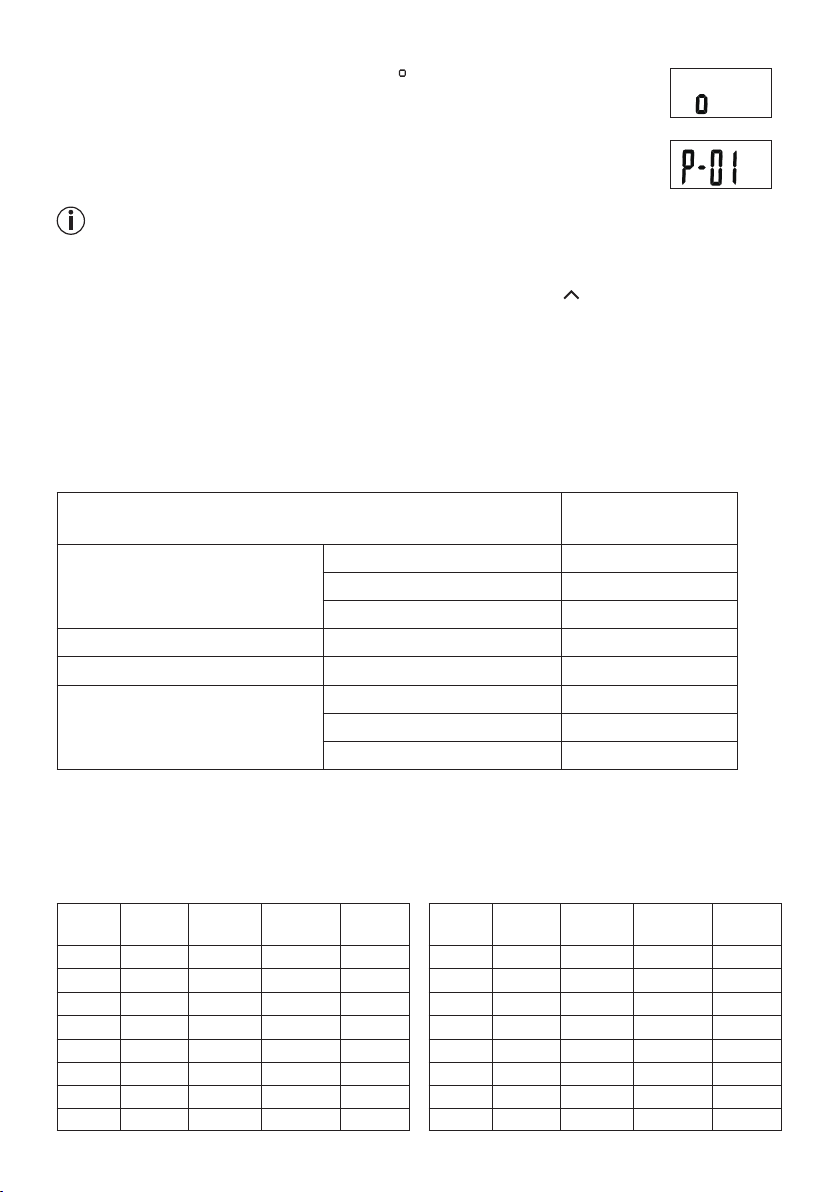
73
На ЖК-дисплее на короткое время появится « ». Анализ биоэлектрического
сопротивления невозможен.
Если пользователь присвоен, то отобразится, например, «P-01», ивес будет
сохранен.
Указание Если пользователь не определен, присвоение пользователя невозможно (например,
P-01), поэтому будет показан только вес. Измерение не сохранится.
Это произойдет, если измеренный вес будет отличаться на ± 3 кг от последнего измерения
или удругого пользователя будут похожие значения сразницей ± 3 кг. Вэтом случае необхо-
димо повторить измерение, включить весы инажимать кнопку « » для выбора Вашей ячейки
памяти (P01-P08). Повторите измерение.
9. Оценка результатов
Индекс массы тела (BMI)
Индекс массы тела (BMI) - это число, которое часто используется при оценке массы тела человека.
Это число рассчитывается, исходя из массы тела человека иего роста, по следующей формуле:
Индекс массы тела = масса тела ÷ рост
2
. Единицей измерения индекса массы тела соответственно
является [кг/м
2
]. Для взрослых людей (20лет истарше) распределение по весу на основании BMI
происходит следующим образом:
Категория Индекс массы
тела
Недостаточная масса тела Острый дефицит массы < 16
Средний дефицит массы 16–16,9
Легкий дефицит массы 17–18,4
Нормальный вес 18,5–25
Избыточный вес Предожирение 25,1–29,9
Ожирение (избыточный вес) Ожирение I-йстепени 30–34,9
Ожирение II-йстепени 35–39,9
Ожирение III-йстепени ≥40
Источник: ВОЗ (World Health Organization), 1999.
Доля жира ворганизме
Ориентиром являются следующие значения доли жира ворганизме (за дополнительной информа-
цией обратитесь квашему врачу!).
Мужчина Женщина
Воз-
раст
мало
нор-
мально
много
очень
много
Воз-
раст
мало
нор-
мально
много
очень
много
10–14 <11 % 11–16 %
16,1–21 %
>21 % 10–14 <16 % 16–21 %
21,1–26 %
>26 %
15–19 <12 % 12–17 %
17,1–22 %
>22 % 15–19 <17 % 17–22 %
22,1–27 %
>27 %
20–29 <13 % 13-18 %
18,1–23 %
>23 % 20–29 <18 % 18–23 %
23,1–28 %
>28 %
30–39 <14 % 14–19 %
19,1–24 %
>24 % 30–39 <19 % 19–24 %
24,1–29 %
>29 %
40–49 <15 % 15–20 %
20,1–25 %
>25 % 40–49 <20 % 20–25 %
25,1–30 %
>30 %
50–59 <16 % 16–21 %
21,1–26 %
>26 % 50–59 <21 % 21–26 %
26,1–31 %
>31 %
60–69 <17 % 17–22 %
22,1–27 %
>27 % 60–69 <22 % 22–27 %
27,1–32 %
>32 %
70–100 <18 % 18–23 %
23,1–28 %
>28 % 70–100 <23 % 23–28 %
28,1–33 %
>33 %
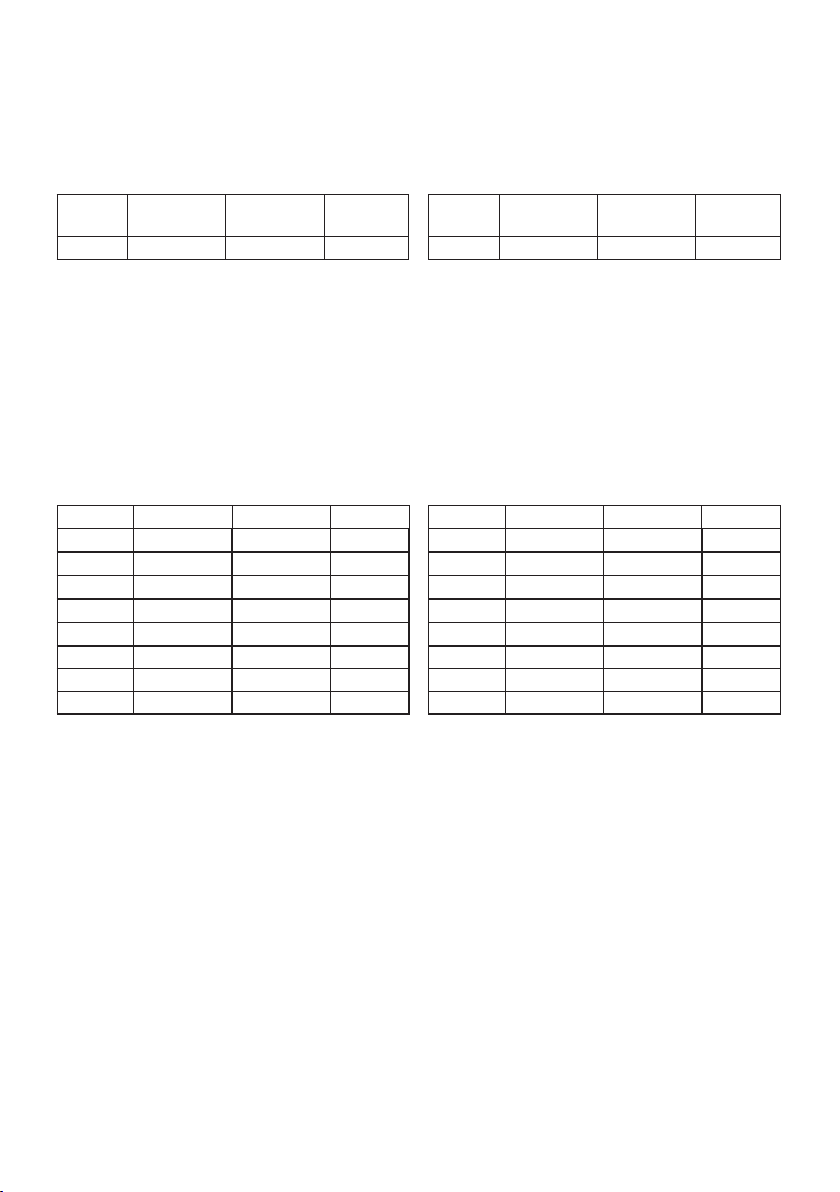
74
Успортсменов значения часто бывают ниже. Взависимости от вида спорта, интенсивности трени-
ровок иконституции тела значения могут быть
ниже
указанных ориентировочных значений. Однако,
учитывайте, что при чрезвычайно низких показателях, возможно, существует угроза для здоровья.
Доля тканевой жидкости
Доля тканевой жидкости в % обычно находится вследующих диапазонах:
Мужчина Женщина
Возраст плохо хорошо
очень
хорошо
Возраст плохо хорошо
очень
хорошо
10–100 <50 % 50–65 % >65 % 10–100 <45 % 45–60 % >60 %
Вжировой массе содержится сравнительно мало воды. Поэтому улюдей сбольшой долей жировой
массы доля тканевой жидкости может быть меньше ориентировочных значений. Улюдей, занима-
ющихся видами спорта, развивающих выносливость, ориентировочные значения, наоборот, могут
быть выше из-за небольшой доли жировой массы ибольшой доли мышечной массы.
На основании определения доли тканевой жидкости на этих весах нельзя делать какие-либо меди-
цинские заключения, например, оскоплении жидкости, связанном свозрастными изменениями.
При необходимости проконсультируйтесь со своим врачом. Впринципе, необходимо стремиться
кбольшой доле тканевой жидкости.
Доля мышечной массы
Доля мышечной массы в % обычно находится вследующих диапазонах:
Мужчина Женщина
Возраст мало нормально много Возраст мало нормально много
10–14 <44 % 44–57 % >57 % 10–14 <36 % 36–43 % >43 %
15–19 <43 % 43–56 % >56 % 15–19 <35 % 35–41 % >41 %
20–29 <42 % 42– 54 % >54 % 20–29 <34 % 34–39 % >39 %
30–39 <41 % 41–52 % >52 % 30–39 <33 % 33–38 % >38 %
40–49 <40 % 40–50 % >50 % 40–49 <31 % 31–36 % >36 %
50–59 <39 % 39–48 % >48 % 50–59 <29 % 29–34 % >34 %
60–69 <38 % 38–47 % >47 % 60–69 <28 % 28–33 % >33 %
70–100 <37 % 37–46 % >46 % 70–100 <27 % 27–32 % >32 %
Костная масса
Как и все остальное в нашем теле, кости подвергаются естественным процессам роста, распада и
старения. В детском возрасте костная масса быстро увеличивается и достигает максимума к 30–40
годам. По мере старения происходит потеря костной массы. Здоровая диета (особенно с высо-
ким содержанием кальция и витамина D) и регулярные занятия спортом позволяют замедлить этот
процесс. Также можно укрепить стабильность структуры скелета с помощью целенаправленного
наращивания мышц. Обратите внимание, что данная шкала измеряет минеральный баланс костной
ткани. Костную массу очень трудно изменить, однако на нее незначительно может повлиять ряд
факторов (вес, рост, возраст, пол). Общепризнанных указаний и рекомендаций не существует.
BMR (уровень основного обмена веществ)
Скорость основного обмена веществ (BMR = Basal Metabolic Rate) — это количество энергии, кото-
рое требуется организму всостоянии полного покоя для поддержания своих основных функций
(например, если круглые сутки лежать впостели). Данное значение взначительной степени зависит
от веса, роста ивозраста.
На диагностических весах оно отображается вединице «ккал/день» ирассчитывается согласно
научно признанной формуле Харриса-Бенедикта.
Этот объем энергии необходим для Вашего организма влюбом случае идолжен поставляться
вформе еды. Если Вы продолжительное время получаете малое количество энергии, это может
негативно отразиться на Вашем здоровье.

75
AMR (обмен веществ сучетом физической активности)
Обмен веществ сучетом физической активности (AMR = Active Metabolic Rate) — это количество
энергии, которое организм ежедневно расходует вактивном состоянии. Расход энергии учеловека
повышается вместе сувеличением его физической активности иопределяется на диагностических
весах согласно заданной степени активности (1—5).
Для сохранения имеющегося веса затраченная энергия должна быть возвращена ворганизм за
счет еды ипитья.
Если втечение продолжительного времени ворганизм возвращается меньше энергии, чем рас-
ходуется, организм начинает возмещать эту разницу за счет накопленных жировых отложений,
врезультате вес снижается. Если, напротив, втечение продолжительного времени энергии посту-
пает больше, чем рассчитанное значение обмена веществ сучетом физической активности (AMR),
излишки энергии ворганизме не сжигаются, они сохраняются вформе жировых отложений, вес
увеличивается.
Взаимосвязь результатов во времени
Учтите, что значение имеют только долговременные тенденции. Кратковременные отклонения
ввесе втечение нескольких дней, как правило, обусловлены потерей жидкости.
Интерпретация результатов должна учитывать изменение общего веса ипроцентной доли жировой
массы, тканевой жидкости имышечной массы, атакже время, за которое произошли изменения.
Следует различать быстрые изменения втечение нескольких дней иизменения, происходящие со
средней (втечение недель) ималой скоростью (втечение месяцев).
Основным правилом здесь является тот факт, что краткосрочные изменения почти всегда связаны
сизменением содержания воды ворганизме, вто время как изменения, происходящие со средней
ималой скоростью, могут касаться изменений доли жировой имышечной масс.
•
Если за короткое время вес снижается, адоля жировой массы увеличивается или сохраняется,
уВас ворганизме произошла исключительно потеря жидкости, например, после тренировки,
посещения сауны или диеты, направленной на быстрое снижение веса.
•
Если вес увеличивается со средней скоростью, доля жировой массы уменьшается или сохраня-
ется на том же уровне, то Вы, возможно, напротив, приобрели ценную мышечную массу.
•
Если вес идоля жировой массы уменьшаются одновременно, то Ваша диета работает — Вы теря-
ете жировую массу.
•
Видеале Вы должны поддерживать действие Вашей диеты при помощи физической активно-
сти, занятий фитнесом или силовыми видами спорта. Таким образом Вы можете увеличить долю
мышечной массы всреднесрочный период.
•
Значения долей жировой массы, тканевой жидкости или мышечной массы не следует складывать
(вмышечной ткани также содержатся компоненты, всоставе которых имеется тканевая жид-
кость).
10. Дополнительная информация
Назначение пользователя
Назначение макс. 8 запрограммированных пользователей весов возможно при простом измерении
массы тела (вобуви) ипри диагностической измерении (без обуви).
При новом измерении весы сохраняют результаты вячейке памяти того пользователя, укоторого
последнее измеренное значение массы тела отличается от результата не больше чем на ±3кг. См.
разд.8
«Сохранение присвоенных значений впамять весов иперенос вприложение»
Если приложение не открыто, новые присвоенные значения сохраняются впамяти весов. На
весах можно хранить до 30 значений для каждого пользователя. Сохраненные измеренные зна-
чения автоматически отправляются вприложение, если Вы откроете его впределах действия
Bluetooth-соединения.
Возможен автоматический перенос данных при выключенных весах.
Удаление данных свесов
Если Вы хотите полностью удалить все пользовательские данные иизмерения из памяти весов,
извлеките батарейки минимум на 10 секунд. Затем нажмите кнопку unit/reset иодновременно
вставьте батарейки. На дисплее на несколько секунд появится « ».
76
Эта функция необходима, если Вы хотите, например, удалить неправильно настроенные или ненуж-
ные данные пользователя.
После этого снова выполните действия, описанные вгл. 6 («Назначение пользователей»).
Замена батареек
Весы показывают, когда необходимо заменить батарейки. При использовании слишком слабой
батарейки на дисплее появляется надпись Lo ивесы автоматически отключаются. Вэтом случае
батарейку следует заменить (2 шт. AAA, 1,5 В). Все сохраненные измерения ипользователи оста-
нутся сохраненными.
После этого выполните повторное соединение сприложением. Время обновится.
УКАЗАНИЕ:
•
При замене батареек используйте батарейки того же типа, той же марки итакой же емко-
сти.
•
Не используйте заряжаемые аккумуляторы.
•
Используйте батарейки, не содержащие тяжелых металлов.
11. Очистка прибора иуход за ним
Время от времени прибор необходимо очищать.
Для очистки используйте влажную салфетку, на которую при необходимости можно нанести
немного моющего средства.
ВНИМАНИЕ
•
Не используйте сильнодействующие растворители ичистящие средства!
•
Не погружайте прибор вводу!
•
Не мойте прибор впосудомоечной машине!
12. Утилизация
Выбрасывайте использованные, полностью разряженные батарейки вспециальные контейнеры,
сдавайте впункты приема спецотходов или вмагазины электрооборудования. Закон обязывает
пользователей обеспечить утилизацию батареек.
Эти знаки предупреждают оналичии вбатарейках токсичных веществ:
Pb = свинец,
Cd = кадмий,
Hg = ртуть.
Винтересах охраны окружающей среды категорически запрещается выбрасывать прибор по
завершении срока его службы вместе сбытовыми отходами. Утилизация должна производиться
через соответствующие пункты сбора вВашей стране.
Прибор следует утилизировать согласно директиве ЕС поотходам электрического иэлектрон-
ного оборудования— WEEE (Waste Electrical and Electronic Equipment). Припоявлении вопро-
сов обращайтесь вместную коммунальную службу, ответственную заутилизацию отходов.
Утилизировать упаковку всоответствии спредписаниями поохране окружающей среды.
20
PAP
13. Что делать при возникновении проблем?
Если при измерении весы регистрируют неисправность, на дисплее отобразится следующее:
Изображение на дис-
плее
Причина Меры поустранению
Отображается только
вес без ячеек памяти
P01–P08
Неизвестное измерение, так
как не выполнены условия
присвоения пользователей
или однозначное присвое-
ние невозможно.
Выберите пользователя на весах спомо-
щью кнопки « » или выполните повтор-
ное присвоение пользователя вприло-
жении.
См. раздел 10 «Дополнительная инфор-
мация».
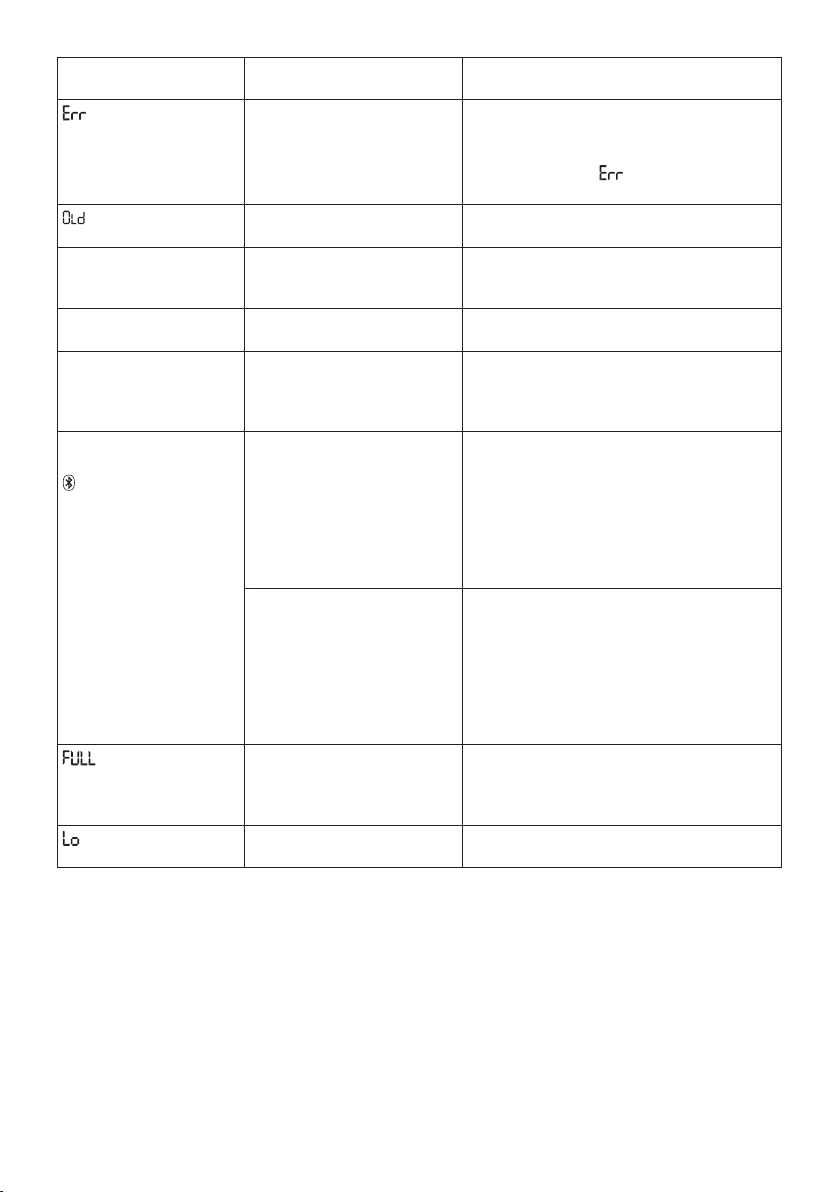
77
Изображение на дис-
плее
Причина Меры поустранению
Доля жировой массы нахо-
дится за пределами изме-
ряемого диапазона (меньше
4 % или больше 65 %).
Пожалуйста, повторите измерение без
обуви или, при необходимости, слегка
смочите подошвы ступней.
Если отобразится , значение находится
за пределами измеряемого диапазона.
Превышен максимальный
вес 180 кг.
При взвешивании не превышайте макси-
мальный вес 180кг.
Отображается непра-
вильный вес.
Неровная или неустойчивая
поверхность.
Поставьте весы на ровную, твердую
поверхность пола.
Не ставьте весы на ковер.
Отображается непра-
вильный вес.
Неустойчивое положение. Стойте неподвижно.
Отображается непра-
вильный вес.
На весах установлена
неверная нулевая точка.
Подождите, пока весы снова автоматиче-
ски выключатся. Включите весы. Может
отобразиться «C».
Дождитесь показателя
«0.0 кг»
. Повторите измерение.
Отсутствует соедине-
ние Bluetooth
®
(символ
отсутствует).
Устройство находится вне
радиуса действия.
Минимальный радиус действия всво-
бодном пространстве — ок. 15 м. Стены
ипотолки ограничивают радиус действия.
Соединению могут мешать также другие
радиосигналы, поэтому не ставьте весы
вблизи таких устройств, как WLAN-марш-
рутизатор, микроволновая печь, индукци-
онная варочная панель.
Отсутствует соединение
сприложением.
Полностью выключите приложение (также
вфоновом режиме).
Выключите иснова включите Bluetooth
®
.
Выключите иснова включите смартфон.
Ненадолго извлеките из весов батарейки
иснова вставьте.
Посмотрите раздел FAQ на сайте www.
beurer.com.
Пользовательская память
заполнена. Новые измере-
ния записываются на место
старых.
Откройте приложение. Данные будут
автоматически перенесены внего. Это
может занять до 1 минуты.
Батарейки ввесах разря-
жены.
Замените батарейки ввесах.
14. Гарантия/сервисное обслуживание
Более подробная информация по гарантии/сервису находится в гарантийном/сервисном талоне,
который входит в комплект поставки.
Возможны ошибки и изменения

78
POLSKI
Zawartość opakowania
•
Skrócona instrukcja obsługi
•
Waga diagnostyczna BF 600
•
2 baterie 1,5 V, AAA
•
Instrukcja obsługi
1. Informacje ogólne
Funkcje urządzenia
Cyfrowa waga diagnostyczna służąca do pomiaru masy ciała oraz diagnozowania innych czynników wpły-
wających na zdrowie ikondycję.
Jest przeznaczona do użytku osobistego.
Waga oferuje następujące funkcje diagnostyczne, zktórych może korzystać nawet 8 osób:
•
pomiar wagi ciała iwskaźnika masy ciała BMI,
•
tkankę tłuszczową,
•
zawartość wody worganizmie,
•
tkankę mięśniową,
•
tkankę kostną, atakże
•
podstawową iczynną przemianę materii.
Ponadto waga posiada następujące dodatkowe funkcje:
•
przełączanie pomiędzy kilogramami „kg”, funtami „lb” akamieniami „st”,
•
automatyczne wyłączanie urządzenia,
•
wskaźnik zużycia baterii przy niskim poziomie naładowania baterii,
•
automatyczne rozpoznawanie użytkownika,
•
zapisanie ostatnich 30 pomiarów dla 8 osób, jeśli nie można ich przenieść na aplikację,
•
Produkt wykorzystuje Bluetooth
®
low energytechnology, pasmo częstotliwości 2400 - 2483,5 MHz,
maks. moc emitowanego sygnału -0,93 dBm.
Wymagania systemowe
iOS od wersji 10.0, Android™ od wersji 5.0 z Bluetooth
®
4.0.
Lista kompatybilnych urządzeń:
Drodzy Klienci,
cieszymy się, że zdecydowali się Państwo na zakup naszego produktu. Firma Beurer oferuje dokładnie
przetestowane, wysokiej jakości produkty przeznaczone do pomiaru wagi, ciśnienia krwi, temperatury
ciała itętna, atakże przyrządy do nawilżania powietrza, łagodnej terapii, masażu iogrzewania oraz urzą-
dzenia służące do pielęgnacji urody iułatwiające opiekę nad dziećmi.
Należy dokładnie przeczytać izachować niniejszą instrukcję obsługi, przechowywać ją wmiejscu dostęp-
nym dla innych użytkowników iprzestrzegać podanych wniej wskazówek.
Zpozdrowieniami
Zespół Beurer
Spis treści
1. Informacje ogólne .............................................78
2. Objaśnienie symboli .........................................79
3. Ostrzeżenia iwskazówki dotyczące
bezpieczeństwa ................................................79
4. Informacje .........................................................80
5. Opis urządzenia ................................................81
6. Uruchomienie zaplikacją .................................81
7. Uruchomienie wagi bez aplikacji ...................... 82
8. Wykonanie pomiaru ........................................83
9. Ocena wyników ..............................................84
10. Dodatkowe informacje ...................................86
11. Czyszczenie idbałość ourządzenie ...............86
12. Utylizacja ........................................................ 87
13. Co należy zrobić wprzypadku problemów? ..87
14. Gwarancja/serwis ........................................... 88
79
2. Objaśnienie symboli
Winstrukcji obsługi zostały użyte następujące symbole:
OSTRZEŻENIE Wskazówka ostrzegająca przed niebezpieczeństwem odniesienia obrażeń lub
zagrożenia zdrowia.
UWAGA Wskazówka bezpieczeństwa odnosząca się do możliwości uszkodzenia urzą-
dzenia/akcesoriów.
Wskazówka Wskazówka zważnymi informacjami.
3. Ostrzeżenia iwskazówki dotyczące bezpieczeństwa
Należy dokładnie przeczytać izachować niniejszą instrukcję obsługi, przechowywać ją wmiejscu dostęp-
nym również dla innych użytkowników iprzestrzegać podanych wniej wskazówek.
OSTRZEŻENIE
•
Zwagi nie mogą korzystać osoby zimplantami medycznymi (np. rozrusznikiem
serca). Wprzeciwnym razie urządzenie może wpływać na ich działanie.
•
Nie używaj podczas ciąży.
•
Nie stawaj zjednej strony na krawędzi wagi: Niebezpieczeństwo przewrócenia!
•
Połknięcie baterii może zagrażać życiu. Baterie iwagę przechowuj wmiejscu niedo-
stępnym dla małych dzieci. Wprzypadku połknięcia baterii natychmiast skontaktuj się zlekarzem.
•
Opakowanie przechowuj wmiejscu niedostępnym dla dzieci (niebezpieczeństwo uduszenia).
•
Uwaga, nie stawaj na wagę mokrymi stopami inie wchodź na wagę, gdy jej powierzchnia jest wil-
gotna – niebezpieczeństwo poślizgnięcia!
Wskazówki dotyczące postępowania zbateriami
•
Jeśli dojdzie do kontaktu elektrolitu ze skórą lub oczami, należy przemyć te obszary wodą iskon-
taktować się zlekarzem.
• Istnieje niebezpieczeństwo połknięcia! Małe dzieci mogłyby połknąć baterie isię nimi udu-
sić. Dlatego baterie należy przechowywać wmiejscach niedostępnych dla dzieci.
• Należy zwrócić uwagę na znak polaryzacji plus (+) iminus (–).
• Jeśli zbaterii wyciekł elektrolit, należy założyć rękawice ochronne iwyczyścić przegrodę na bate-
rie suchą szmatką.
• Baterie należy chronić przed nadmiernym działaniem wysokiej temperatury.
• Zagrożenie wybuchem! Nie wrzucać baterii do ognia.
• Nie wolno ładować ani zwierać baterii.
• Wprzypadku niekorzystania zurządzenia przez dłuższy czas wyjąć baterie zprzegrody.
• Należy używać tylko tego samego lub równoważnego typu baterii.
• Zawsze należy wymieniać jednocześnie wszystkie baterie.
• Nie należy używać akumulatorów!
• Nie wolno rozmontowywać, otwierać ani rozdrabniać baterii.
Wskazówki ogólne
•
Urządzenie jest przeznaczone wyłącznie do użytku domowego, nie może służyć do celów
medycznych ani komercyjnych.
•
Należy pamiętać, że możliwe są uwarunkowane technicznie tolerancje pomiarowe, ponieważ nie
jest to waga cechowana do profesjonalnych zastosowań medycznych.
•
Wprzypadku wystąpienia różnic wwynikach pomiaru (między wagą aaplikacją) należy wykorzy-
stać tylko te wartości, które wyświetlają się na wadze.
•
Maksymalne obciążenie wagi wynosi 180 kg (396 lb, 28 st ). Wyniki pomiaru masy ciała oraz analizy
masy kostnej są wyświetlane zdokładnością do 100 g(0,2 lb).
•
Wyniki pomiaru zawartości tkanki tłuszczowej, wody imasy mięśniowej są wyświetlane zdokład-
nością do 0,1%.
•
Zapotrzebowanie kaloryczne jest podawane zdokładnością do 1 kcal.
•
Ustawionymi fabrycznie jednostkami wagi są „cm” i„kg”. Podczas pierwszego uruchomienia wraz
zaplikacją można zmienić ustawienia jednostek.
80
•
Ustaw wagę na płaskim itwardym podłożu; twarde podłoże jest warunkiem prawidłowego
pomiaru.
•
Chroń urządzenie przed wstrząsami, wilgocią, kurzem, chemikaliami, dużymi wahaniami tempera-
tury izbyt blisko znajdującymi się źródłami ciepła (np. piec, grzejnik).
•
Naprawy mogą być przeprowadzane tylko przez serwis Beurer lub autoryzowanego dystrybutora.
Przed złożeniem reklamacji zawsze sprawdź baterie iw razie potrzeby je wymień.
•
Potwierdzamy niniejszym, że ten produkt jest zgodny z dyrektywą europejską RED 2014/53/EU.
Certyfikat zgodności CE dot. tego produktu można znaleźć na stronie:
www.beurer.com/web/we-landingpages/de/cedeclarationofconformity.php.
Przechowywanie ikonserwacja
Dokładność pomiarów itrwałość urządzenia zależą od prawidłowego obchodzenia się zurządzeniem:
UWAGA
•
Urządzenie iakcesoria należy od czasu do czasu wyczyścić. Nie należy używać silnych środków
czyszczących ani zanurzać urządzenia wwodzie.
•
Upewnij się, że na wadze nie znajduje się płyn. Nigdy nie zanurzać wagi wwodzie. Nigdy nie spłu-
kiwać urządzeń pod bieżącą wodą.
•
Nie stawiaj żadnych przedmiotów na wagę, gdy nie jest ona używana.
•
Chroń urządzenie przed wstrząsami, wilgocią, kurzem, chemikaliami, dużymi wahaniami tempera-
tury izbyt blisko znajdującymi się źródłami ciepła (np. piec, grzejnik).
•
Nie naciskaj przycisków na siłę lub za pomocą ostrych przedmiotów.
•
Nie narażaj wagi na działanie wysokich temperatur lub silnych pól elektromagnetycznych (np. tele-
fonów komórkowych).
4. Informacje
Zasada pomiaru
Waga ta działa zgodnie zzasadą analizy B.I.A., impedancji bioelektrycznej. Przy tym wciągu kilku sekund
możliwy jest pomiar składników masy ciała przez nieodczuwalny icałkowicie nieszkodliwy przepływ prądu.
Za pomocą pomiaru oporu elektrycznego (impedancji) iprzy uwzględnieniu podczas pomiaru stałych lub
indywidualnych wartości (wiek, wzrost, płeć, stopień aktywności) można określić ilość tkanki tłuszczowej
oraz inne wskaźniki ciała. Tkanka mięśniowa iwoda mają dobre przewodnictwo elektryczne, atym samym
mniejszy opór. Natomiast kości itkanka tłuszczowa mają małą przewodność, ponieważ komórki tłusz-
czowe ikości dzięki bardzo wysokiej oporności praktycznie nie przewodzą prądu.
Należy pamiętać, że wartości uzyskane za pomocą wagi diagnostycznej stanowią jedynie przybliżenie
rzeczywistych, analitycznych wartości medycznych ciała. Jedynie lekarz może przeprowadzić dokładny
pomiar tkanki tłuszczowej, wody worganizmie, tkanki mięśniowej istruktury kości, posługując się meto-
dami medycznymi (np. tomografią komputerową).
Ogólne wskazówki
•
Aby zapewnić porównywalne wyniki, należy wmiarę możliwości ważyć się otej samej porze dnia (najle-
piej rano), po wizycie wtoalecie, na czczo ibez ubrania.
•
Ważne informacje podczas pomiaru: Pomiar tkanki tłuszczowej należy wykonywać tylko boso, atakże
celowo przy nieco wilgotnych podeszwach stóp.
Całkowicie suche lub pokryte odciskami podeszwy mogą ujemnie wpływać na wyniki, ponieważ mają
zbyt niską przewodność.
Wskazówka: Stopy, nogi, łydki iuda nie mogą się dotykać. Wprzeciwnym razie wyniki pomiaru
mogą być nieprawidłowe.
•
Wtrakcie pomiaru należy stać wpozycji pionowej ibez ruchu.
•
Należy odczekać kilka godzin po niestandardowym wysiłku fizycznym.
•
Należy poczekać około 15 minut po przebudzeniu, tak aby woda znajdująca się worganizmie została
rozprowadzona.
•
Ważne jest, że pod uwagę brana jest tylko tendencja długoterminowa. Zazwyczaj krótkoterminowe
wahania masy ciała wciągu kilku dni są spowodowane utratą płynów; woda worganizmie ma duży
wpływ na dobre samopoczucie.
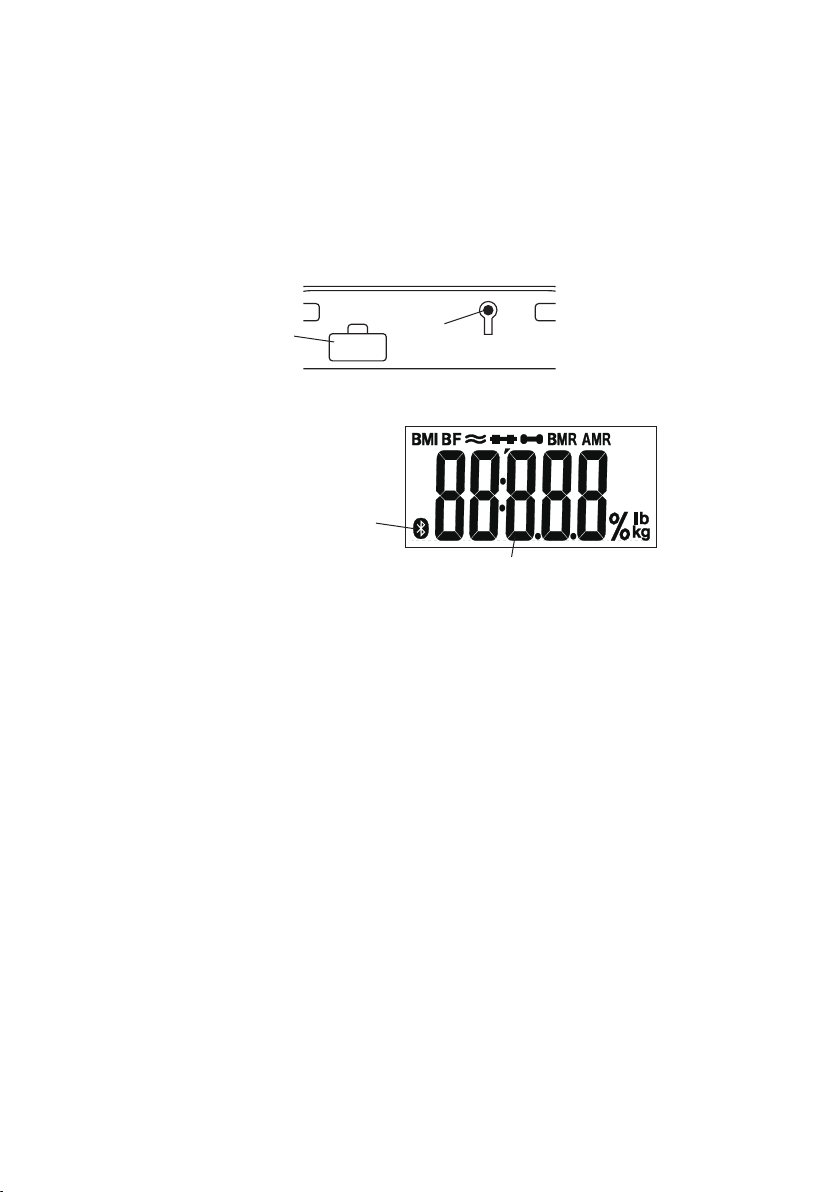
81
Ograniczenia
Przy pomiarze tkanki tłuszczowej iinnych wartości mogą wystąpić odbiegające od rzeczywistych wyniki u:
•
dzieci poniżej 10 lat,
•
sportowców wyczynowych ikulturystów,
•
osób zgorączką, osób dializowanych, zobjawami obrzęku lub osteoporozy,
•
osób zażywających leki sercowo-naczyniowe (na układ sercowo-naczyniowy),
•
osób zażywających leki rozszerzające naczynia krwionośne,
•
osób oznacznych różnicach anatomicznych wdługości nóg wstosunku do całkowitej wielkości ciała
(długość nóg znacznie skrócona lub wydłużona).
5. Opis urządzenia
Spód
2
1
1. Komora baterii
2. Przycisk unit / reset
Wyświetlacz
3
4
3. Symbol Bluetooth
®
oznaczający połą-
czenie wagi ze smartfonem
4. Wartości pomiaru
6. Uruchomienie zaplikacją
Aby zmierzyć ilość tkanki tłuszczowej iinne parametry ciała, należy zapisać dane użytkownika na wadze.
Wpamięci wagi można zapisać dane 8 użytkowników. Miejsca wpamięci można przypisać poszczegól-
nym członkom rodziny wcelu umożliwienia zapisywania indywidualnych ustawień.
Ponadto konta użytkowników można włączać za pomocą innych mobilnych urządzeń końcowych zzain-
stalowaną aplikacją „beurer HealthManager“ lub przez zmianę profilu użytkownika waplikacji (patrz usta-
wienia aplikacji).
Aby podczas uruchomienia połączenie Bluetooth
®
pozostało aktywne, nie należy oddalać się ze smartfo-
nem od wagi.
– Włączyć funkcję Bluetooth
®
wustawieniach smartfonu.
–
Włóż baterie iustaw wagę na twardym podłożu (na wyświetlaczu wagi miga „App”).
–
Pobierz bezpłatną aplikację „beurer HealthManager” ze sklepu Apple App Store (iOS) lub Google
Play (Android™).
–
Uruchom aplikację ipostępuj zgodnie ze wskazówkami.
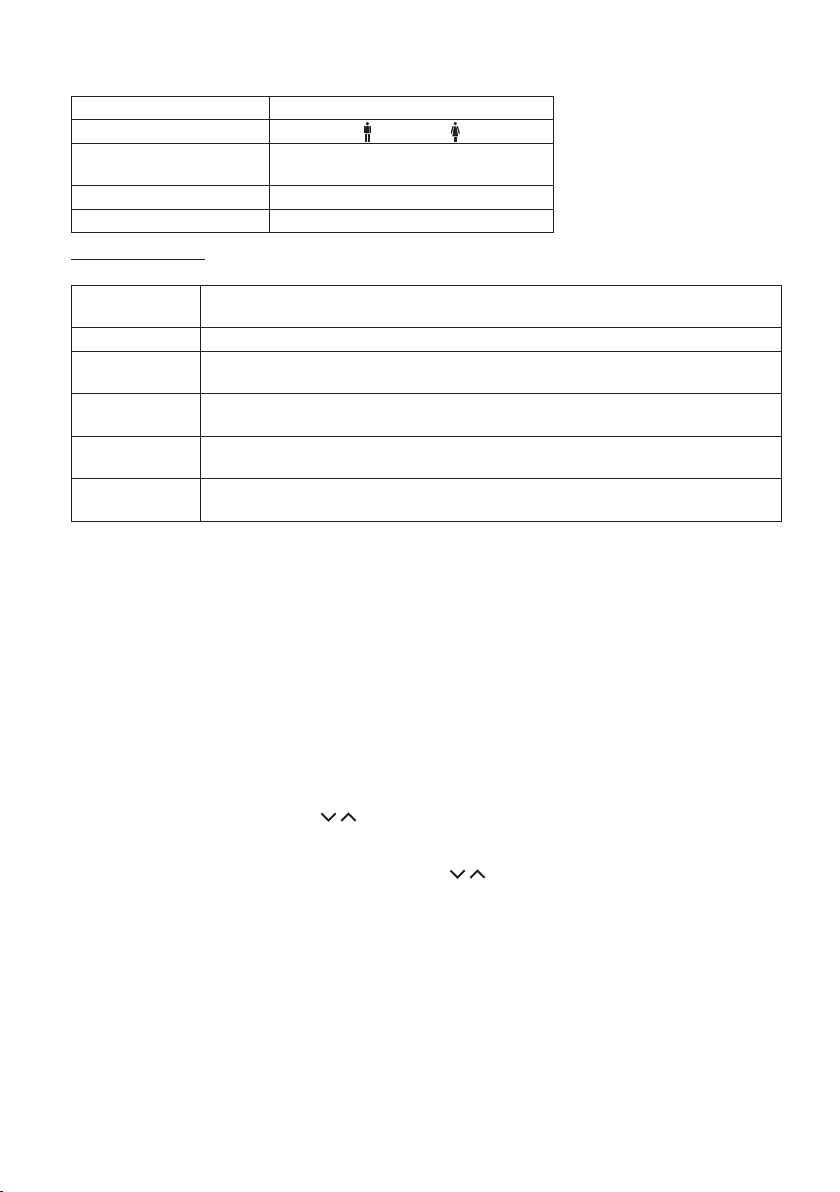
82
–
Wprowadź dane urządzenia BF 600.
Waplikacji „
beurer HealthManager
” należy ustawić lub wprowadzić następujące ustawienia:
Dane użytkownika Wartości nastawcze
Płeć mężczyzna ( ), kobieta ( )
Wzrost
od 100 do 220 cm (od 3’ 3,5” do 7’
2,5”)
Wiek od 10 do 100 lat
Stopień aktywności od 1 do 5
S
topnie aktywności
P
rzy wyborze stopnia aktywności decydujące jest uwzględnienie średniego idługiego okresu.
Stopień aktyw-
ności
Aktywność fizyczna
1 Brak.
2
Mała intensywność: Niewielki ilekki wysiłek fizyczny
(np. spacery, lekkie prace ogrodowe, ćwiczenia gimnastyczne).
3
Średnie: Wysiłek fizyczny co najmniej 2 do 4 razy wtygodniu
po 30 minut.
4
Wysokie: Wysiłek fizyczny co najmniej 4 do 6 razy wtygodniu
po 30 minut.
5
Bardzo wysoka: Intensywny wysiłek fizyczny, intensywny trening lub
ciężka praca fizyczna, codziennie przez co najmniej 1 godzinę.
Aplikacja przypisuje do użytkownika następną wolną pamięć wagi (P01-P08).
–
Wykonanie pomiaru
A
by automatyczne rozpoznawanie osób było możliwe, pierwszy pomiar należy przypisać do osobistych
danych użytkownika. Aplikacja Cię oto poprosi. Stań, najlepiej boso, na wadze ikładąc stopy na elek-
trodach pamiętaj, aby równomiernie rozłożyć ciężar ciała inie poruszać się.
P
ostępuj teraz zgodnie ze wskazówkami zawartymi wrozdziale 8 „Wykonanie pomiaru”.
7. Uruchomienie wagi bez aplikacji
Zalecamy uruchomienie iwykonanie wszystkich ustawień za pomocą aplikacji. Patrz rozdział 6. „Urucho-
mienie zaplikacją”. Można to jednak również wykonać na urządzeniu.
Wyjmij baterie zopakowania iwłóż je do wagi zgodnie zbiegunami. Jeżeli waga nie będzie działać, wycią-
gnij baterie iwłóż je ponownie.
Ustaw wagę na płaskim itwardym podłożu; twarde podłoże jest warunkiem prawidłowego pomiaru.
Naciśnij przycisk SET.
Każdorazowe naciśnięcie przycisków „ ” ipotwierdzenie przyciskiem SET powoduje ustawienie roku/
miesiąca/dnia oraz godziny/minuty.
Na wyświetlaczu wagi pojawi się „0.0”. Ponownie naciśnij przycisk SET. Pojawi się „P-01” lub ostatnio
używana pamięć użytkownika wagi. Za pomocą strzałek „ ” wybierz pamięć użytkownika (od P-01
do P-08) i naciśnij przycisk „SET”. Ustaw np. płeć, wzrost itp. (patrz rozdział 6. „Uruchomienie z aplikacją
(tabela)”. Potwierdź każde ustawienie poprzez naciśnięcie przycisku SET. Na końcu wpisów pojawi się PIN.
Będzie on potrzebny przy ewentualnym późniejszym logowaniu do aplikacji. Następnie pojawi się „0.0”.
Aby automatyczne rozpoznawanie osób było możliwe, pierwszy pomiar należy przypisać do osobistych
danych użytkownika. Stań, najlepiej boso, na wadze ikładąc stopy na elektrodach pamiętaj, aby równo-
miernie rozłożyć ciężar ciała inie poruszać się.
7.1 Późniejsze logowanie do aplikacji
Jeśli waga jest uruchamiana bez aplikacji, dane swojego użytkownika można przenieść do aplikacji lub
utworzyć.
–
Pobierz bezpłatną aplikację„beurer HealthManager” ze sklepu Apple App Store (iOS) lub Google
Play (Android™).
–
Uruchom aplikację ipostępuj zgodnie ze wskazówkami.
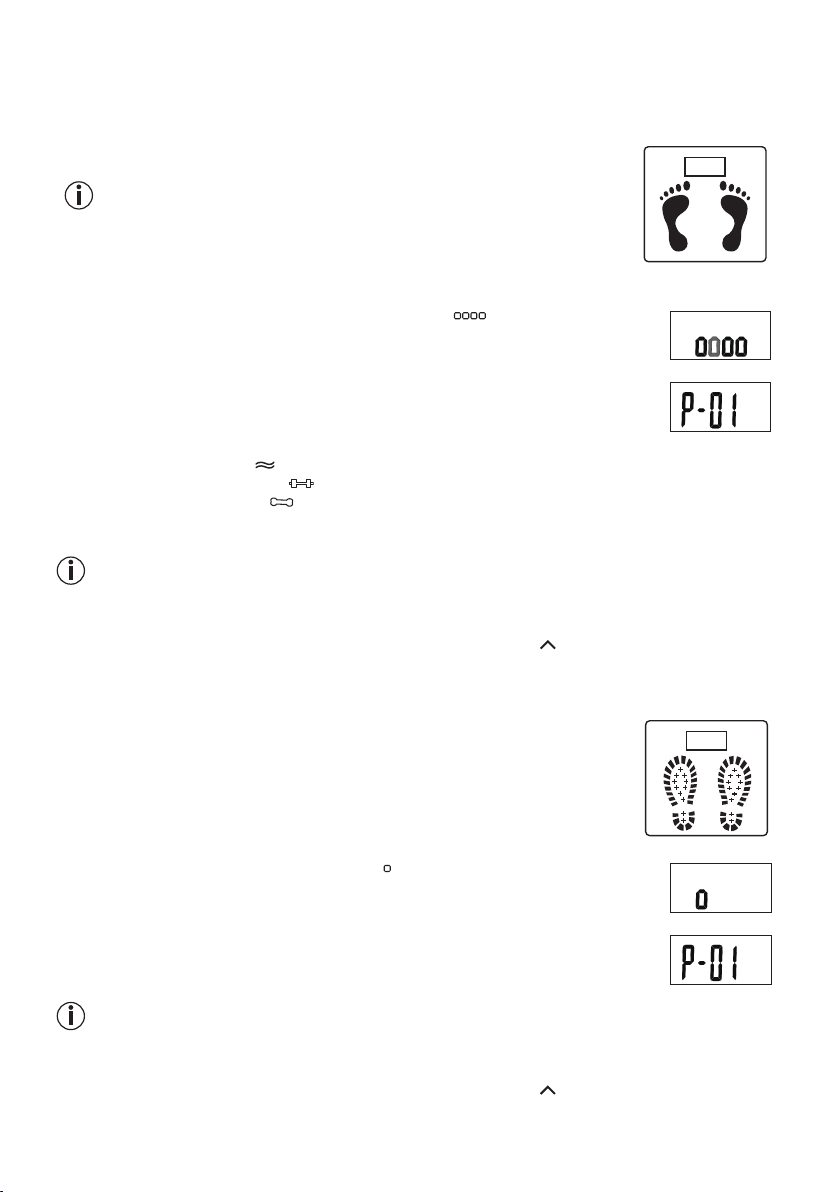
83
8. Wykonanie pomiaru
Ustaw wagę na płaskim itwardym podłożu; twarde podłoże jest warunkiem prawidłowego pomiaru.
8.1 Diagnoza
Stań boso na wadze ikładąc stopy na elektrodach pamiętaj, aby równomiernie
rozłożyć ciężar ciała inie poruszać się.
Wskazówka: Jeśli pomiar jest wykonywany wskarpetkach, wynik pomiaru
nie będzie właściwy.
Waga natychmiast rozpoczyna pomiar.
Najpierw wyświetlana jest masa ciała.
Podczas analizy BIA na wyświetlaczy pojawi się symbol „ ”.
Jeśli użytkownik został przyporządkowany, wyświetlą się numery P-01 - P-08,
awszystkie kolejne wartości zostaną zapisane.
1. Współczynnik BMI
2. Tkanka tłuszczowa w%
3. Woda worganizmie w%
4. Udział tkanki mięśniowej w%
5. Masa mineralna kości wkg
6. Podstawowa przemiana materii wkcal (BMR)
7. Czynna przemiana materii wkcal (AMR)
Wskazówka: Jeśli użytkownik nie zostanie rozpoznany, będzie brakowało jego przyporządkowania
(np. P-01) imożliwe będzie jedynie wyświetlenie masy ciała. Pomiar nie zostanie zapisany.
Wtym przypadku zmierzona masa ciała powinna różnić się od ostatniego pomiaru o± 3 kg lub war-
tości pomiaru masy ciała innego użytkownika powinny być podobne do Twoich ± 3 kg. Wówczas
należy powtórzyć pomiar, włączając wagę inaciskając przycisk „ ”, aby wybrać swoją pamięć
użytkownika (P01-P08). Powtórz pomiar.
8.2 Masa ciała
Stań wbutach na wadze izwróć przy tym uwagę, aby równomiernie rozłożyć cię-
żar ciała inie poruszać się. Waga natychmiast rozpoczyna pomiar.
Najpierw wyświetlana jest masa ciała.
Na wyświetlaczu LCD pojawi się przez chwilę „ ”. Analiza BIA nie jest możliwa.
Jeśli użytkownik został przyporządkowany, wyświetli się np. „P-01” imasa ciała
zostanie zapisana.
Wskazówka: Jeśli użytkownik nie zostanie rozpoznany, będzie brakowało jego przyporządkowania
(np. P-01) imożliwe będzie jedynie wyświetlenie masy ciała. Pomiar nie zostanie zapisany.
Wtym przypadku zmierzona masa ciała powinna różnić się od ostatniego pomiaru o± 3 kg lub war-
tości pomiaru masy ciała innego użytkownika powinny być podobne do Twoich ± 3 kg. Wówczas
należy powtórzyć pomiar, włączając wagę inaciskając przycisk „ ”, aby wybrać swoją pamięć
użytkownika (P01-P08). Powtórz pomiar.
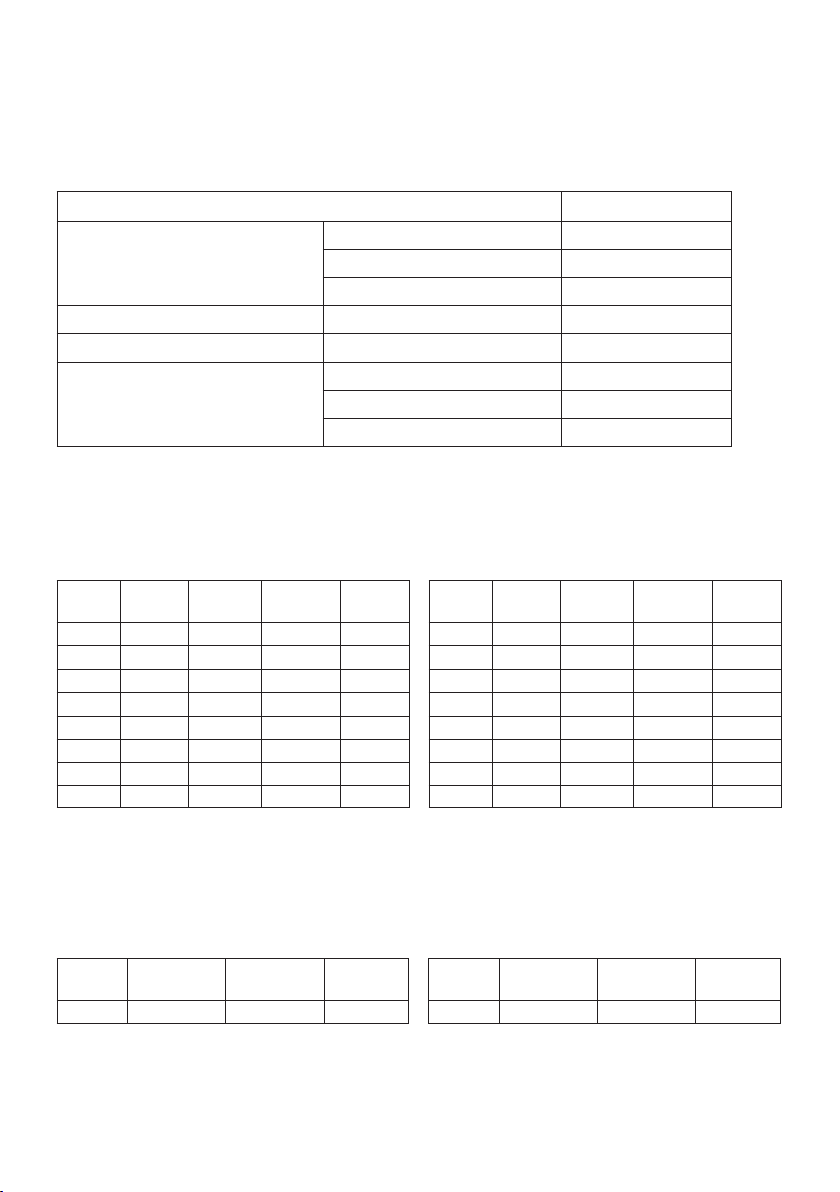
84
9. Ocena wyników
Wskaźnik masy ciała BMI
Wskaźnik masy ciała (BMI) to wartość często wykorzystywana do oceny wagi ciała. Wielkość ta jest obli-
czana na podstawie wagi ciała iwzrostu. Oblicza się ją według następującego wzoru:
Wskaźnik masy ciała = masa ciała ÷ wzrost
2
. Jednostką BMI jest zatem [kg/m
2
]. Klasyfikacja masy ciała na
podstawie BMI wprzypadku osób dorosłych (powyżej 20 lat) odbywa się woparciu oponiższe wartości:
Kategoria Współczynnik BMI
Niedowaga Duża niedowaga <16
Średnia niedowaga 16–16,9
Lekka niedowaga 17–18,4
Masa prawidłowa 18,5–25
Nadwaga Zagrożenie otyłością 25,1–29,9
Otyłość (nadwaga) Istopień otyłości 30–34,9
II stopień otyłości 35–39,9
III stopień otyłości ≥40
Źródło: WHO, 1999 (World Health Organization)
Procentowa zawartość tkanki tłuszczowej
Poniższe procentowe wartości zawartości tkanki tłuszczowej mają charakter orientacyjny (wcelu uzyska-
nia bliższych informacji należy zwrócić się do lekarza!).
Mężczyzna Kobieta
Wiek Mało
Standar-
dowa
Dużo
Bardzo
dużo
Wiek Mało
Standar-
dowa
Dużo
Bardzo
dużo
10–14 <11% 11–16%
16,1–21 %
>21 % 10–14 <16 % 16–21 %
21,1–26 %
>26%
15–19 <12 % 12–17%
17,1–22 %
>22 % 15–19 <17 % 17–22 %
22,1–27 %
>27 %
20–29 <13 % 13–18 %
18,1–23 %
>23 % 20–29 <18 % 18–23 %
23,1–28 %
>28 %
30–39 <14 % 14–19 %
19,1–24 %
>24 % 30–39 <19 % 19–24 %
24,1–29 %
>29 %
40–49 <15 % 15–20 %
20,1–25 %
>25 % 40–49 <20 % 20–25 %
25,1–30 %
>30 %
50–59 <16 % 16–21 %
21,1–26 %
>26 % 50–59 <21 % 21–26 %
26,1–31 %
>31 %
60–69 <17 % 17–22 %
22,1–27 %
>27 % 60–69 <22 % 22–27 %
27,1–32 %
>32 %
70–100 <18 % 18–23 %
23,1–28 %
>28 % 70–100 <23 % 23–28 %
28,1–33 %
>33 %
Usportowców stwierdza się często niższą wartość. Wzależności od rodzaju uprawianego sportu, inten-
sywności ćwiczeń ibudowy ciała można osiągnąć wartości, które są
poniżej
podanych wartości orientacyj-
nych. Należy jednak pamiętać, że przy bardzo niskich wartościach może zaistnieć zagrożenie dla zdrowia.
Procentowa zawartość wody
Ilość wody worganizmie w% standardowo mieści się wnastępujących przedziałach:
Mężczyzna Kobieta
Wiek Źle Dobrze
Bardzo
dobrze
Wiek Źle Dobrze
Bardzo
dobrze
10–100 <50 % 50–65 % >65 % 10-100 <45 % 45–60 % >60 %
Wtkance tłuszczowej znajduje się stosunkowo mało wody. Dlatego też wprzypadku osób zdużą ilością
tkanki tłuszczowej zawartość wody worganizmie może być poniżej wartości orientacyjnych. Usportow-
ców wytrzymałościowych wartości orientacyjne mogą zostać przekroczone ze względu na niski poziom
tłuszczu iwysoki procent tkanki mięśniowej.
85
Na podstawie pomiaru poziomu wody nie można wyciągać wniosków ostanie zdrowia, np. na temat zwią-
zanego zwiekiem zatrzymywania wody worganizmie. Wrazie potrzeby należy skonsultować się zleka-
rzem. Zasadniczo założeniem jest dążenie do wysokiej zawartości wody worganizmie.
Tkanka mięśniowa
Ilość tkanki mięśniowej w% standardowo mieści się wnastępujących przedziałach:
Mężczyzna Kobieta
Wiek Mało
Standar-
dowa
Dużo Wiek Mało
Standar-
dowa
Dużo
10–14 <44 % 44–57 % >57 % 10–14 <36 % 36–43 % >43 %
15–19 <43 % 43–56 % >56 % 15–19 <35 % 35–41 % >41 %
20–29 <42 % 42–54 % >54 % 20–29 <34 % 34–39 % >39 %
30–39 <41 % 41–52 % >52 % 30–39 <33 % 33–38 % >38 %
40–49 <40 % 40–50 % >50 % 40–49 <31 % 31–36 % >36 %
50–59 <39 % 39–48 % >48 % 50–59 <29 % 29–34 % >34 %
60–69 <38 % 38–47 % >47 % 60–69 <28 % 28–33 % >33 %
70–100 <37 % 37–46 % >46 % 70–100 <27 % 27–32 % >32 %
Masa kostna
Podobnie jak reszta naszego ciała, nasze kości przechodzą przez naturalny cykl wzrostu i starzenia. W
dzieciństwie masa kostna szybko przyrasta i osiąga maksimum między 30 a 40 rokiem życia. Wraz z wie-
kiem masa kostna stopniowo maleje. Można spowolnić ten proces dzięki zdrowej diecie (szczególnie pod
względem wapnia i witaminy D) i regularnym ćwiczeniom. Można także zwiększyć stabilność swojego
układu kostnego za pomocą ukierunkowanego rozwoju konkretnych grup mięśni. Należy pamiętać, że
niniejsza waga mierzy zawartość minerałów w kościach. Masa kostna jest trudna w modyfikacji, ale pod-
lega drobnym zmianom pod wpływem różnych czynników (waga, wzrost, wiek, płeć). Nie ma dostępnych
uznawanych wytycznych i zaleceń.
BMR
Podstawowa przemiana materii (BMR = Basal Metabolic Rate) to ilość energii potrzebna organizmowi
wstanie całkowitego spoczynku do utrzymania podstawowych funkcji życiowych (np. wtrakcie 24 godzin-
nego odpoczynku włóżku). Ta wartość zależy głównie od ciężaru, wzrostu iwieku.
Wprzypadku wagi diagnostycznej wskaźnik ten jest wyświetlany wjednostce kcal/dzień iobliczany na
podstawie naukowo uznanego wzoru Harrisa iBenedicta.
Jest to niezbędna ilość energii dla organizmu, którą należy dostarczyć zpożywieniem. Długotrwale dostar-
czanie zbyt małej ilości energii może mieć szkodliwy wpływ na zdrowie.
AMR
Czynna przemiana materii (AMR = Active Metabolic Rate) to ilość energii, jaką organizm zużywa wciągu
dnia wstanie aktywnym. Zużycie energii przez organizm człowieka zwiększa się wraz ze wzrostem aktyw-
ności fizycznej ijest mierzone na wadze diagnostycznej poprzez wprowadzony stopień aktywności (1–5).
Aby utrzymać aktualną masę ciała, należy uzupełniać zużytą energię, dostarczając ją do organizmu
wpostaci jedzenia ipicia.
Jeżeli przez dłuższy czas ilość dostarczanej energii jest mniejsza od zużywanej, organizm pobiera braku-
jącą energię głównie zodłożonej tkanki tłuszczowej. Powoduje to spadek masy ciała. Jeżeli jednak wdłu-
gim okresie czasu organizm przyjmuje większą ilość energii niż wynika to zobliczonej czynnej przemiany
materii (AMR), organizm nie może spalić nadmiaru energii, ajej nadmiar jest przechowywany wpostaci
tkanki tłuszczowej worganizmie, powodując zwiększenie masy ciała.
Tymczasowe powiązanie wyników
Należy pamiętać, że tylko tendencje długoterminowe odgrywają ważną rolę. Krótkoterminowe waha-
nia masy ciała wciągu kilku dni są zazwyczaj uwarunkowane utratą płynów.
Interpretację wyników przeprowadza się woparciu ozmiany całkowitej masy ciała oraz procentową zawartość
tkanki tłuszczowej, mięśniowej iwody, atakże okres, wjakim zmiany te mały miejsce.

86
Należy odróżnić szybkie zmiany (wciągu kilku dni) od zmian średnioterminowych (tygodnie) idługotermi-
nowych (miesiące).
Podstawową zasadą jest to, że krótkoterminowe zmiany wmasie prawie wyłącznie reprezentują zmiany
wzawartości wody, podczas gdy średnio-idługoterminowe zmiany mogą mieć wpływ na zawartość tłusz-
czu imięśni.
•
Jeżeli wkrótkim czasie nastąpi spadek masy ciała, ailość tkanki tłuszczowej wzrasta lub pozostaje na
takim samym poziomie, jest to oznaka tylko ubytku wody – na przykład po treningu, saunie lub po szyb-
kim spadku masy ciała wwyniku restrykcyjnej diety odchudzającej.
•
Jeśli masa ciała zwiększa się wśrednim czasie, ailość tkanki tłuszczowej spada lub pozostaje taka
sama, może to oznaczać wytworzenie cennej masy mięśniowej.
•
Jeśli następuje jednoczesny spadek masy ciała iilości tkanki tłuszczowej, oznacza to, że dieta jest sku-
teczna itracona jest masa tkanki tłuszczowej.
•
Idealnym rozwiązaniem jest wspomaganie skuteczności diety aktywnością fizyczną, treningiem aerobo-
wym isiłowym. Pozwala to wśrednim czasie na zwiększenie masy mięśniowej.
•
Nie można dodawać ilości tkanki tłuszczowej, wody zawartej worganizmie lub tkanki mięśniowej
(tkanka mięśniowa zawiera również składniki pochodzące zwody zawartej worganizmie).
10. Dodatkowe informacje
Przyporządkowanie użytkownika
Przyporządkowanie użytkownika (można przyporządkować maksymalnie 8 użytkowników wagi) jest moż-
liwe zarówno podczas zwykłego pomiaru wagi (wbutach), jak ipomiaru diagnostycznego (boso).
Przy nowym pomiarze waga przypisuje pomiar do użytkownika, którego ostatni pomiar różnił się od obec-
nego najwyżej o± 3 kg. Patrz rozdział8.
Zapisywanie przyporządkowanych wartości pomiaru wpamięci wagi iprzeniesienie danych do apli-
kacji
Jeśli aplikacja nie jest włączona, nowo przyporządkowane pomiary zostaną zapisane wpamięci wagi.
Wpamięci wagi można zapisać maksymalnie 30 pomiarów na użytkownika. Zapisane wartości są automa-
tycznie przenoszone do aplikacji, jeśli urządzenie zaplikacją znajduje się wzasięgu połączenia Bluetooth.
Możliwe jest automatyczne przeniesienie danych wprzypadku wyłączonej wagi.
Usuwanie danych zapisanych wpamięci wagi
Jeśli wszystkie pomiary istare dane użytkownika mają zostać usunięte zpamięci wagi, należy na co naj-
mniej 10 sekund wyjąć baterie. Następnie należy nacisnąć przycisk unit/reset ijednocześnie włożyć bate-
rie. Na wyświetlaczu pojawi się na kilka sekund symbol „ ”.
Jest to konieczne, gdy np. mają zostać usunięte dane źle zapisanego użytkownika lub użytkownika, który
już nie korzysta zwagi.
Następnie należy jeszcze raz przeprowadzić procedurę zrozdziału 6 (przyporządkowanie użytkownika).
Wymiana baterii
Waga jest wyposażona we wskaźnik naładowania baterii. Wprzypadku używania wagi ze zbyt słabą
baterią na wyświetlaczu pojawi się napis „Lo” inastąpi automatyczne wyłączenie wagi. Wtakim wypadku
należy wymienić baterie (2 baterie 1,5 VAAA). Wszystkie zapisane pomiary idane użytkowników pozo-
staną wpamięci.
Potem waga znowu łączy się zaplikacją. Zaktualizowany zostanie czas systemowy.
WSKAZÓWKA:
•
Do wymiany należy używać baterii tego samego typu, marki io identycznej pojemności.
•
Nie używać ładowalnych akumulatorów.
•
Należy stosować baterie niezawierające metali ciężkich.
11. Czyszczenie idbałość ourządzenie
Urządzenie iakcesoria należy od czasu do czasu wyczyścić.
Do czyszczenia należy używać lekko wilgotnej szmatki, na którą można wrazie potrzeby nałożyć odrobinę
środka do czyszczenia.
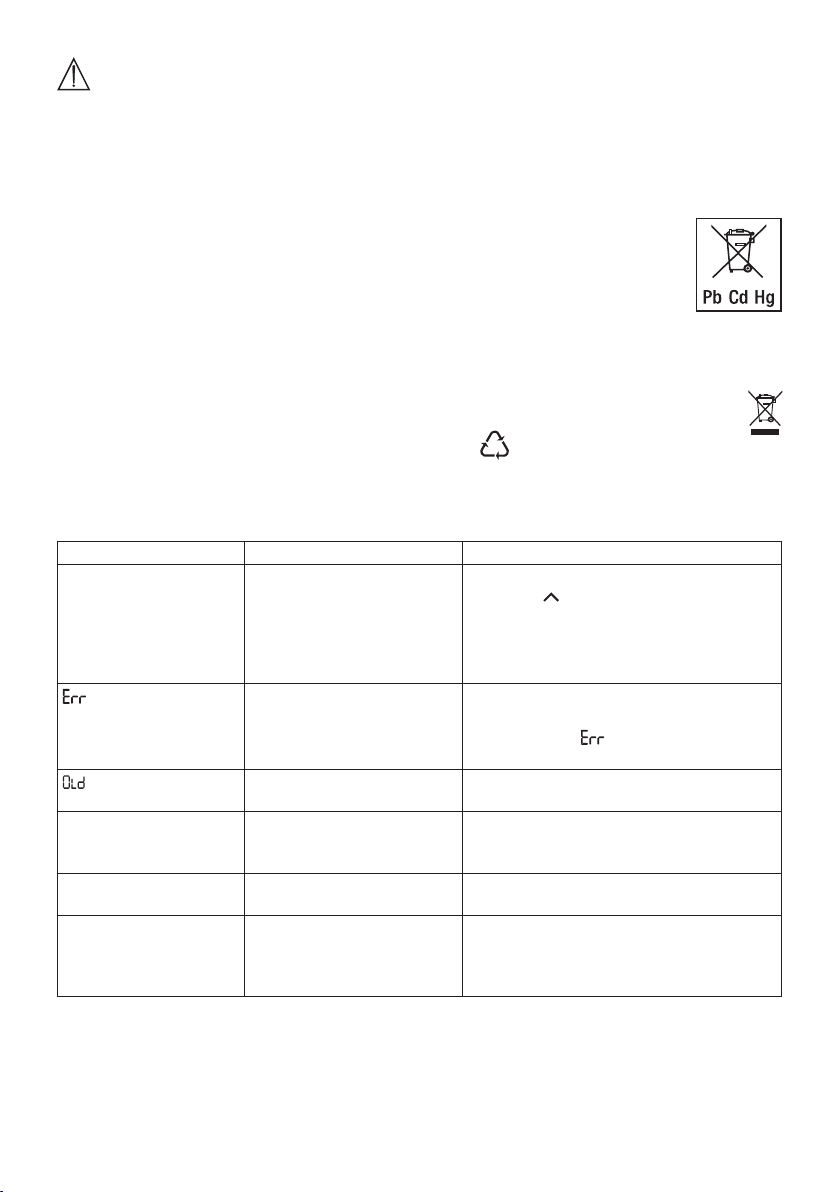
87
UWAGA
•
Nie wolno używać silnych rozpuszczalników ani płynów do czyszczenia!
•
Wżadnym wypadku urządzenia nie należy zanurzać wwodzie!
•
Nie myć urządzenia wzmywarce!
12. Utylizacja
Zużyte, całkowicie rozładowane baterie należy wyrzucać do specjalnie oznakowanych pojemników zbior-
czych, przekazywać do punktów zbiórki odpadów specjalnych lub do sklepu ze sprzętem elektrycznym.
Użytkownik jest zobowiązany do utylizacji baterii zgodnie zprzepisami.
Na bateriach zawierających szkodliwe związki znajdują się następujące oznaczenia:
Pb = bateria zawiera ołów,
Cd = bateria zawiera kadm,
Hg = bateria zawiera rtęć.
Ze względu na ochronę środowiska naturalnego po zakończeniu okresu eksploatacji urządzenia nie należy
wyrzucać wraz ze zwykłymi odpadami domowymi. Utylizację należy zlecić wodpowiednim punkcie zbiórki
wdanym kraju.
Urządzenie należy zutylizować zgodnie zdyrektywą WE ozużytych urządzeniach elektrycznych
ielektronicznych – WEEE (Waste Electrical and Electronic Equipment). Wrazie pytań należy zwrócić
się do odpowiedniej instytucji odpowiedzialnej za utylizację.
Opakowanie zutylizować w sposób przyjazny dla środowiska.
20
PAP
13. Co należy zrobić wprzypadku problemów?
Jeśli podczas pomiaru waga wykryje błąd, na wyświetlaczu pojawia się:
Wyświetlacz Przyczyna Rozwiązanie
Brak jedynie wskaźnika
wagi oraz P01-P08
Nieznany pomiar, ponie-
waż wynik jest poza granicą
przyporządkowaną do użyt-
kownika lub jednoznaczne
przyporządkowanie nie jest
możliwe.
Wybrać użytkownika na wadze za pomocą
przycisku „ ” lub powtórzyć przyporządko-
wanie użytkownika waplikacji.
Zob. rozdział 10 „Dodatkowe informacje”.
Poziom tłuszczu znajduje
się poza zakresem pomiaru
(mniej niż 4 % lub więcej niż
65%).
Pomiar należy powtórzyć boso lub zlekko
zwilżonymi podeszwami stóp.
Jeśli pojawi się „ ” (błąd), oznacza to, że
użytkownik jest poza zakresem pomiaru.
Przekroczono maksymalną
nośność 180 kg.
Dozwolone obciążenie tylko do 180 kg.
Nieprawidłowa masa
ciała na wyświetlaczu.
Waga nie jest ustawiona na
płaskim itwardym podłożu.
Ustaw wagę na twardym istabilnym pod-
łożu.
Nie na dywanie.
Nieprawidłowa masa
ciała na wyświetlaczu.
Użytkownik porusza się. Wmiarę możliwości należy stać spokojnie.
Nieprawidłowa waga na
wyświetlaczu.
Waga ma nieprawidłowy
punkt zerowy.
Poczekaj, aż waga sama się wyłączy. Włącz
wagę. Może pojawić się symbol „C”.
Odcze-
kaj, aż pojawi się symbol
„0.0 kg”
. Następnie
ponów pomiar.
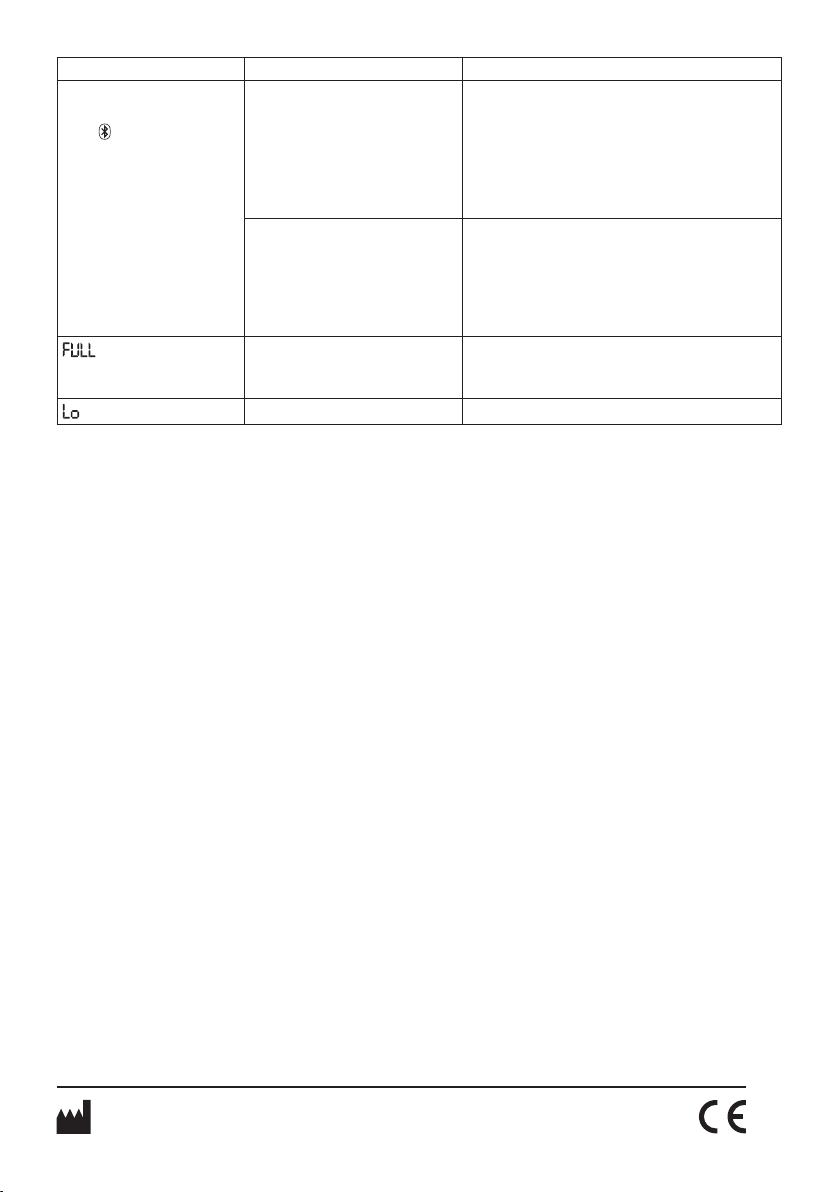
88
Wyświetlacz Przyczyna Rozwiązanie
Brak połączenia
Bluetooth
®
(brak sym-
bolu ).
Urządzenie znajduje się poza
zasięgiem.
Minimalny zasięg na wolnej przestrzeni to
ok.15 m. Ściany isufity zmniejszają ten
zasięg.
Inne fale radiowe mogą zakłócać połączenie.
Dlatego wagi nie należy ustawiać wpobliżu
takich urządzeń, jak routery sieci WLAN,
mikrofalówki, płyty indukcyjne.
Brak połączenia zaplikacją. Zamknij aplikację (również wtle).
Wyłącz iwłącz Bluetooth
®
.
Wyłącz iwłącz smartfon.
Wyjmij na chwilę baterie zwagi iwłóż je
zpowrotem.
Sprawdź FAQ na www.beurer.com.
Pamięć zdanymi użytkownika
jest pełna. Starsze pomiary są
zastępowane nowymi.
Włącz aplikację. Dane zostaną automatycz-
nie przesłane. Trwa to najwyżej minutę.
Baterie wagi są zużyte.
Wymień baterie wwadze.
14. Gwarancja/serwis
W przypadku roszczeń z tytułu gwarancji należy zwrócić się do miejscowego dystrybutora lub partnera
(patrz lista „Service international”).
Przy odsyłce urządzenia należy załączyć kopię dowodu zakupu i krótki opis usterki.
Obowiązują następujące warunki gwarancji:
1. Okres gwarancji na produkty firmy BEURER wynosi 5 lat lub, jeśli jest dłuższy, obowiązuje w danym
kraju od daty zakupu.
W przypadku roszczeń z tytułu gwarancji konieczne jest potwierdzenie daty zakupu przez okazanie
dowodu zakupu lub faktury.
2. Naprawy (całego urządzenia lub jego części) nie przedłużają okresu gwarancyjnego.
3. Gwarancja nie obowiązuje w przypadku uszkodzeń powstałych w następujących okolicznościach:
a. Z powodu niewłaściwego użytkowania, np. nieprzestrzegania instrukcji obsługi.
b. W wyniku napraw lub modyfikacji wykonanych przez klienta lub osoby nieupoważnione.
c. Podczas transportu od producenta do klienta lub podczas transportu do Servicecenter.
d. Ponadto nie obejmuje akcesoriów dostarczonych z urządzeniem, które ulegają regularnemu zużyciu.
4. Odpowiedzialność za szkody bezpośrednio lub pośrednio spowodowane przez urządzenie jest wyklu-
czona także wtedy, gdy w przypadku jego uszkodzenia uznane zostanie roszczenie z tytułu gwarancji.
BF600_2019-02-26_02_IM1_BEU Zastrzega się możliwość zmian lub pomyłki
Beurer GmbH
•
Söflinger Str. 218
•
89077 Ulm (Germany)
•
www.beurer.com
www.beurer-gesundheitsratgeber.com
•
www.beurer-healthguide.com
The Bluetooth
®
word mark and logos are registered trademarks owned by Bluetooth SIG,Inc. and any use of such marks by Beurer GmbH is
under license. Other trademarks and trade names are those of their respective owners.
Apple and the Apple logo are trademarks of Apple Inc., registered in the U.S. and other countries. App Store is a service mark of Apple Inc.,
registered in the U.S. and other countries.
Google Play and the Google Play logo are trademarks of Google LLC.
Android is a trademark of Google LLC.