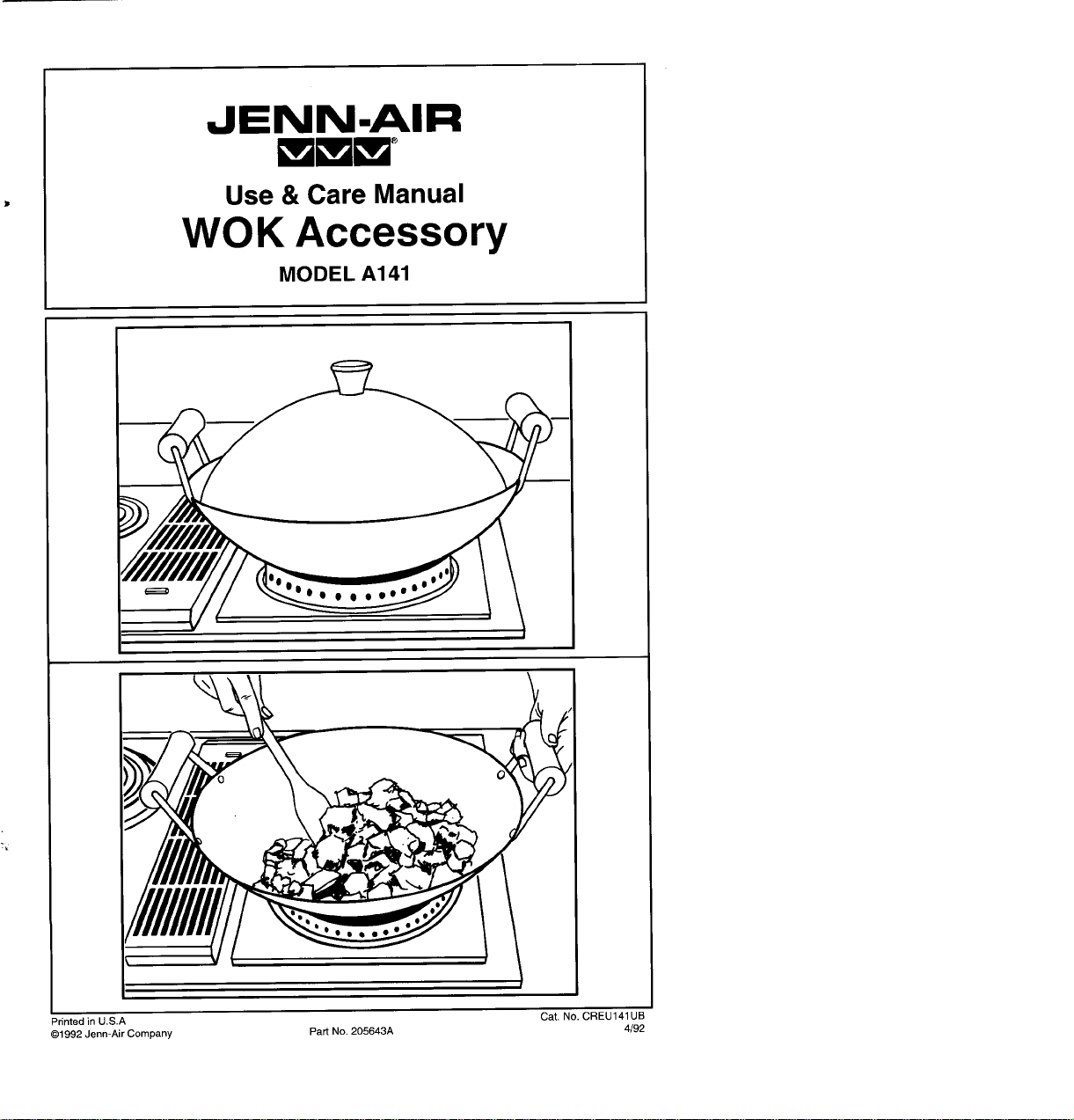
JENN-AIR
mWW°
Use & Care Manual
WOK Accessory
MODEL A141
I
\
/
Printedin U.S.A Cat. No. CREU141UB
@1992Jenn-Air Company Part No, 205643A 4/92
SAFETY
PRECAUTIONS
Read before operating your WOK
All appliances--regardless of the manufacturer--have the potential through
improper or careless use to create safety problems. Therefore the
following safety precautions should be observed:
1. Never use your appliance for warming or heating the room.
2. Wear proper apparel. Loose-fitting or hanging garments should
never be worn while using the appliance.
3. Do not attempt to service, repair or replace any part of the
appliance. All servicing be referred to an authorized Jenn-Air
Service Contractor.
4. Flammable materials should not be stored near surface units.
5. Do not use water on grease fires. Smother fire or flame or use dry
chemical (such as baking soda) or foam type extinguisher.
6. Use only dry potholders. Moist or damp potholders on hot surfaces
may result in burns from steam. Do not let potholder touch hot
heating elements. Do not use a towel or other bulky cloth.
7. Children should not be left alone or unattended in area where any
appliance is in use. They should never be allowed to sit or stand on
any part of the appliance.
8. The wok is to be used with a conventional coil cooktop only. Using
the wok on a glass-ceramic cooktop may result in damage to the
glass-ceramic.
9. The wok isto be used with the wok heating element only and should
not be used on the heating element that comes with a conventional
coil cooktop. Doing so may shorten the life of the heating element
or damage the cooktop cartridge.
10. Remember, the outside of your wok will be HOT. Don't wipe it or
otherwise touch it with your unprotected hand while it is hot.
11. Be extremely cautious if you must move the wok while it contains
hot liquid.
12. Exercise care while stir-frying since the necessary high heat will
cause a lot of popping and steaming when food is added to the wok.
13. WARNING: To avoid risk of fire and injury, do not use for deep fat
frying.
14. On conventional element cooktops make sure that drip pans are in
place. Absence of these pans during cooking may subject wiring
or components underneath to damage.
15. Do not use aluminum foil to line surface unit drip pans or grill basin.
Installation of these liners may result in an electric shock or fire
hazard.
16. Do not soak or immerse removable heating elements in water.
17. CAUTION - Do not store items of interest to children in cabinets
above cooktop-children climbing on the cooktop to reach items
could be seriously injured.
18. Do not operate with damaged cooking element after any product
malfunction until proper repair has been made.
19. Keep all switches "OFF" when unit is not in use.
Additional Safety Precautions To Follow When Using
Other Parts Of Your Cooktop.
1. Glazed cookware - only certain types of glass, glass-ceramic,
ceramic, earthenware, or other glazed cookware are suitable for
cooktop surface without breaking due to the sudden change in
temperature. Use only such cookware as you know has been
approved for this purpose.
2. Cookware handles should be turned inward and not extend over
adjacent surface heating elements to avoid burns, ignition of
flammable materials and spillage due to unintentional contact with
the cookware.
3. Never leave surface units unattended at high heat settings. Boil
over causes smoking and greasy spillovers that may ignite.
About The Jenn-Air WOK
The Jenn-Air wok combines the benefits of a centuries old cooking vessel with
modern day technology.
The word wok means "cooking vessel". Originally created by the Chinese to save
on fuel (its unique shape heats fast and less energy is needed to maintain a high
temperature), the wok has long served as a multi-purpose cooking utensil. The
wok can be used instead of many other pans in your kitchen, such as a saucepan
or saute pan. The wok can also be used for preparing foods in ways other than
just stir-frying for which it is noted. It can be used for poaching, steaming,
braising, stewing, simmering, even parboiling.
The Jenn-Air wok was designed with ease of cleaning, fast heating and versatility
in mind. By removing the large heating element from the conventional coil
cooktop, the wok accessory is easily and quickly assembled for use.
The heating element was designed to cradle the wok providing fast, high heat.
The shape of the element also helps keep the wok from rolling or tipping when
in use. The heating element design eliminates problems, such as heat build-up
which may shorten the life of the heating element, as when traditional woks with
round bottoms and rings are used with conventional coil cooktops.
The wok is made from cold rolled carbon steel which is best for providing even,
steady, and intense heat. The constant even heat makes possible the very short
cooking times so important in Oriental cooking. In the wok, both the flaring sides
and the rounded bottom heat up so the entire surface can be used for cooking.
The wok is covered with a hard non-stick finish. The finish eliminates the amount
of care required of an unfinished carbon steel wok, such as seasoning. The non-
stick finish is easy to clean and will not rust. Foods will heat very quickly from
the first day you cook in the wok, and it is not necessary to age the wok as is
important in unfinished carbon steel woks. Unlike conventional woks, the wok
is cleaned with hot, soapy water.
The wooden handles of the wok eliminate the need for using potholders as when
grasping a hot metal wok handle.
Installing The WOK
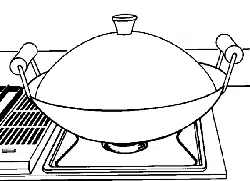
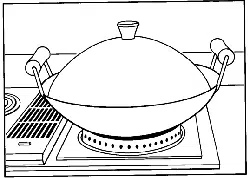
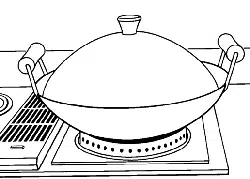
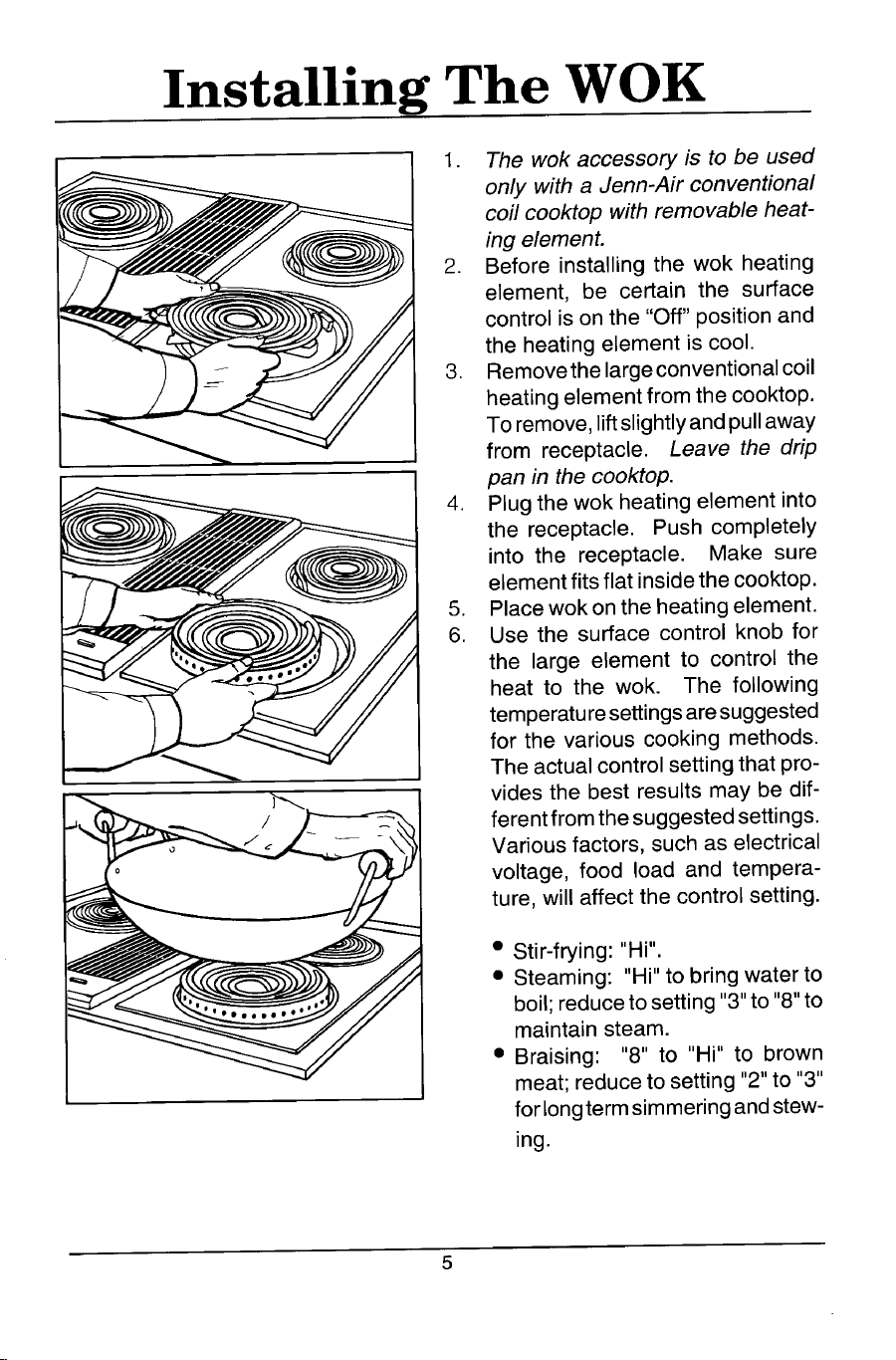
1. The wok accessory is to be used
only with a Jenn-Air conventional
coil cooktop with removable heat-
ing element.
2. Before installing the wok heating
element, be certain the surface
control is on the "Off" position and
the heating element is cool.
3. Remove the large conventional coil
heating element from the cooktop.
To remove, lift slightly and pull away
from receptacle. Leave the drip
pan in the cooktop.
_ 4. Plug the wok heating element into
__ the receptacle. Push completely
into the receptacle. Make sure
element fits flat inside the cooktop.
__ 5. Place wok on the heating element.
6. Use the surface control knob for
the large element to control the
heat to the wok. The following
temperatu resettings are suggested
for the various cooking methods.
The actual control setting that pro-
_ vides the best results may be dif-
/,
ferent from the suggested settings.
/ _ Various factors, such as electrical
voltage, food load and tempera-
ture, will affect the control setting.
• Stir-frying: "Hi".
"_ _, • Steaming: "Hi" to bring water to
_2
boil; reduce to setting "3" to "8" to
maintain steam.
• Braising: "8" to "Hi" to brown
meat; reduce to setting "2" to "3"
for long term simmering and stew-
ing.
5
Caring For The WOK
The nonstick finish, which does not need seasoning, eliminates the special care
necessary with traditional woks. There are a few tips that should be followed in
order to preserve the beauty of the finish.
• Before using the wok the first time, wash the wok in hot, soapy water.
Rinse and dry thoroughly.
• To clean the wok after use, wash with hot, soapy water or let soak until
food particles can be easily removed with a sponge or cloth. A plastic
scrubber, Bon Ami or other nonabrasive cleaners can be used for
difficult to remove residue. Be sure wok is clean; tiny food particles may
adhere to the finish.
• Evaporation of water during steaming leaves mineral deposit in wok
which can be removed with hot soapy water and plastic scrubber. If the
wok's finish is discolored by mineral deposits, the appearance can be
restored by applying a thin coating of vegetable oil to the wok.
• Do not use abrasive cleaners or scrubbers not recommended for use on
nonstick finishes, such as Scotch Brite, since these may damage the
finish.
• Forbuilt-upresidueortackysurface, scrubvery/ight/ywithsoapyS.O.S.
pad. Scrubbing too hard will not only remove the residue, but may also
remove or damage the finish.
• Do not soak wood handles in water.
• Rinse and dry the wok thoroughly.
• The wok heating element can be removed for storage once it has cooled.
It is not necessary to clean the heating element since most soil will burn
off the element. Do not immerse element in water.
• To clean the lid, wash in hot, soapy water. Dry thoroughly. Do not allow
the wooden knob of the lid to soak in water.
• Do not wash the lid or the wok in dishwasher since drying heat can ruin
the wood handles and knob and adversely affect the wok finish.
• To preserve the interior wok finish, use only the bamboo rice paddles
packaged with the wok or other non-metallic cooking utensils when stir-
frying. Do not use metallic spatulas, etc., for they will chip, scratch and
eventually remove the wok finish. Although this will not interfere with the
performance of the wok, it will affect its appearance. The wok also may
rust where the finish is removed exposing the bare steel. If rusting
occurs, oil lightly with vegetable oil.
• When storing the wok, be certain all parts are completely dry.
6
Stir-Frying
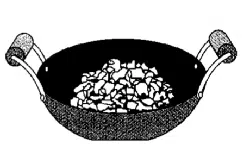
This method of cooking was developed by the Chinese as a practical solution to
the scarcity of fuel. Stir-frying is quick cooking, stirring and tossing of foods in
a small amount of oil over very high heat. Foods are not fried but are actually
flash-cooked or toss-cooked. The quick searing maintains the crispness and
texture of vegetables and sears in the juices of meat. The use of little oil is good
for dieters. Although the cooking method is uniquely Chinese, it is easily
adaptable to many different foods.
To Stir-Fry:
1. Prepare all recipe ingredients first. Line up all the ingredients on the counter
in the order they are to be added to the wok before commencing to cook.
Usually meat is cooked first. Vegetables are cooked next with the most
dense being cooked first.
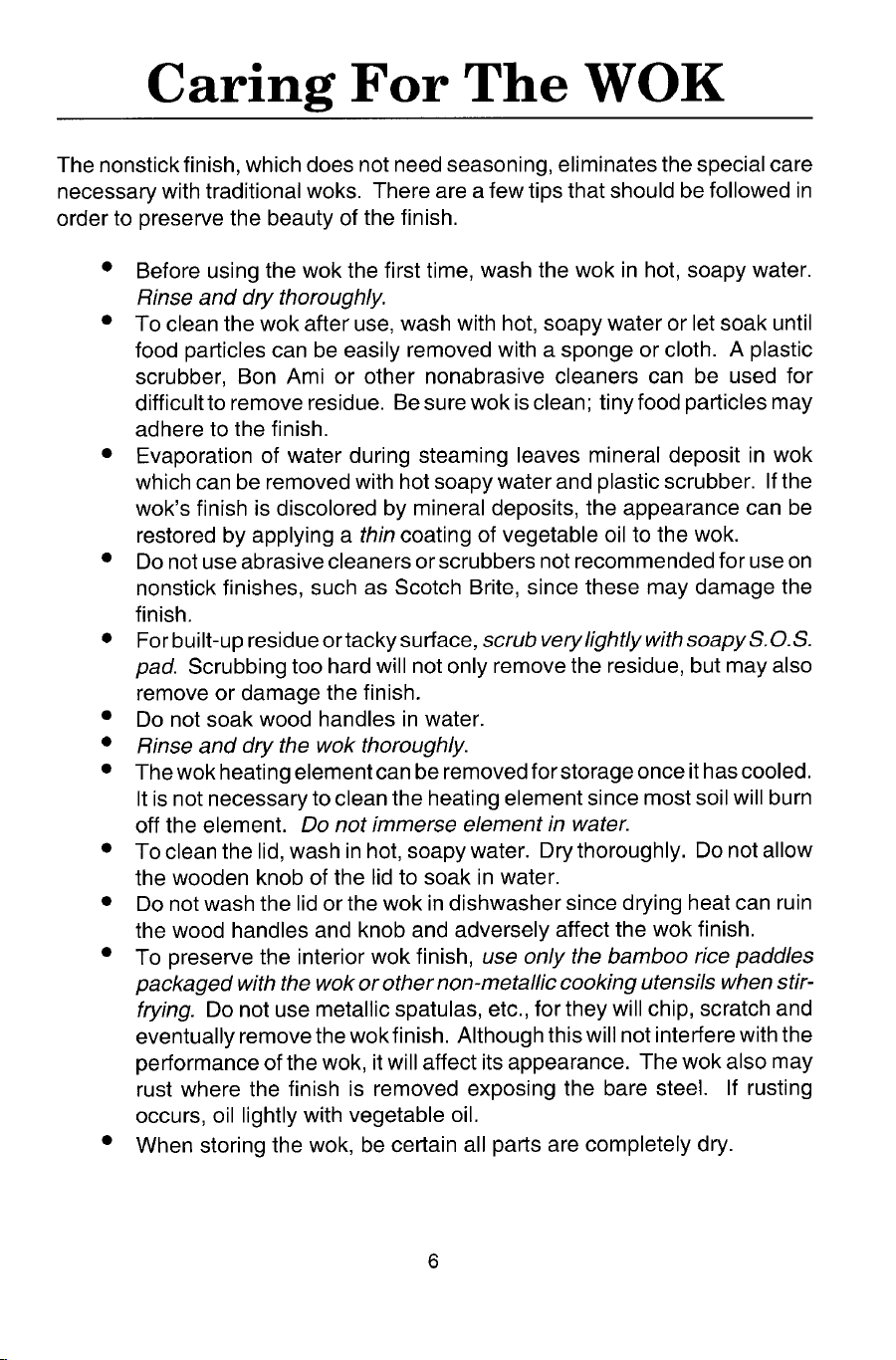
2. Place clean, dry wok on heating element. Ring the wok with a necklace of
oil about half way down the wok. About 1 to 2 tablespoons of oil are needed
for a pound of cut-up vegetables or meat. Turn control to "Hi". Heat the wok
for about 2 minutes. CAUTION: Set a minute timer. Do not heat the wok
for more than two minutes.
3. The oil should be heated until it is hot enough to ripple when the wok is tilted
from side to side. The oil should be hot, but not sizzling or smoking.
CAUTION: Overheating any oil may cause a fire. If oil smokes, reduce
control setting. Do not leave wok unattended while using.
4. If desired, add a hint of flavor to oil by adding thin slices of seasonings such
as fresh garlic or gingerroot. Using the bamboo rice paddles, stir and toss
until the seasoning is browned. Remove seasoning before stir-frying if
desired.
5. Add meat, if used. If more than one pound is being cooked, add in batches.
Do not cook more than one pound of meat or shellfish at a time or it will stew
in its own juices. Stir and toss the meat until all pieces have come in contact
with the hot wok and are lightly browned and almost done. Remove cooked
meat from wok and set aside; add more oil if needed to cook additional
batches.
8
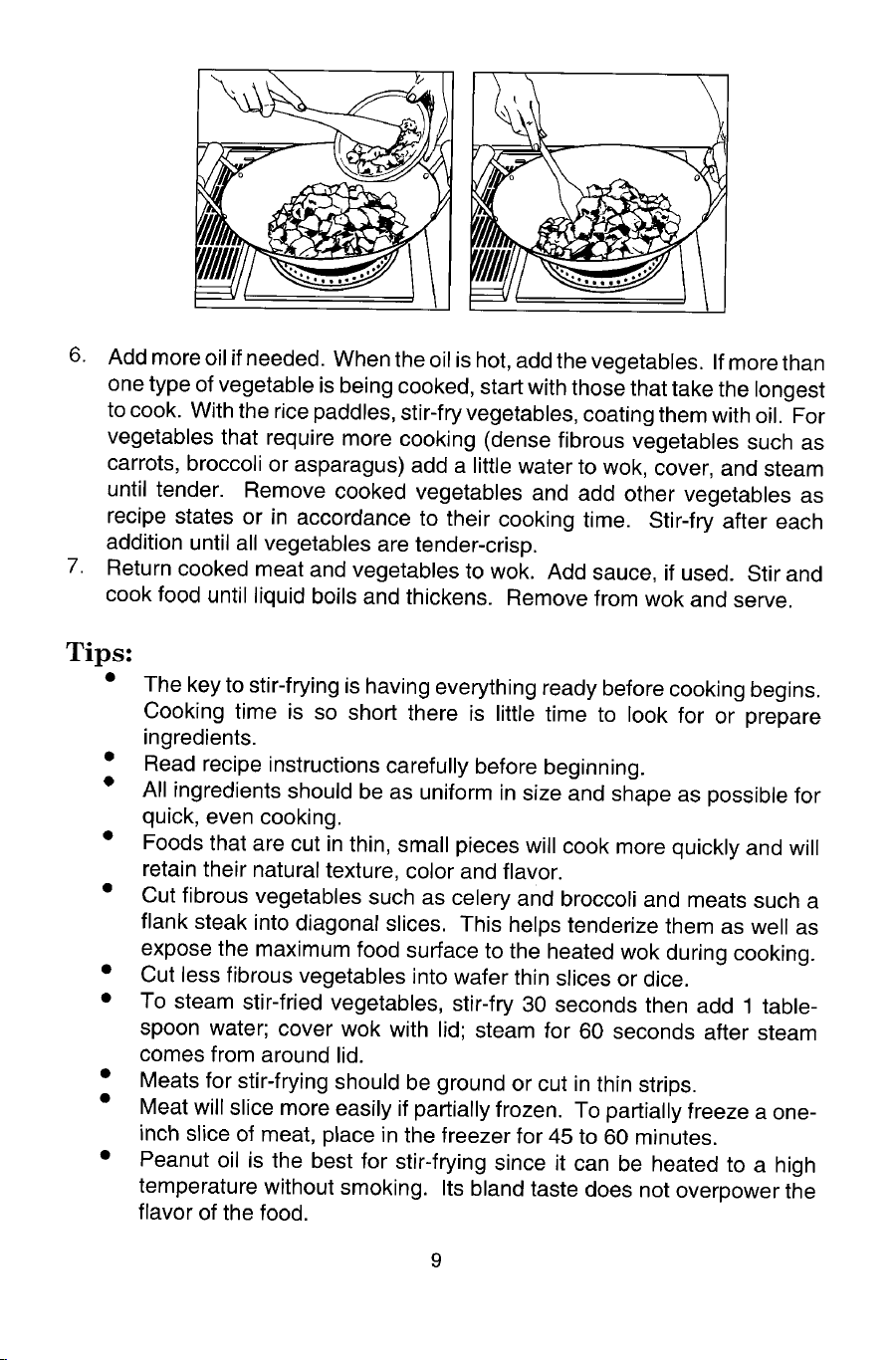
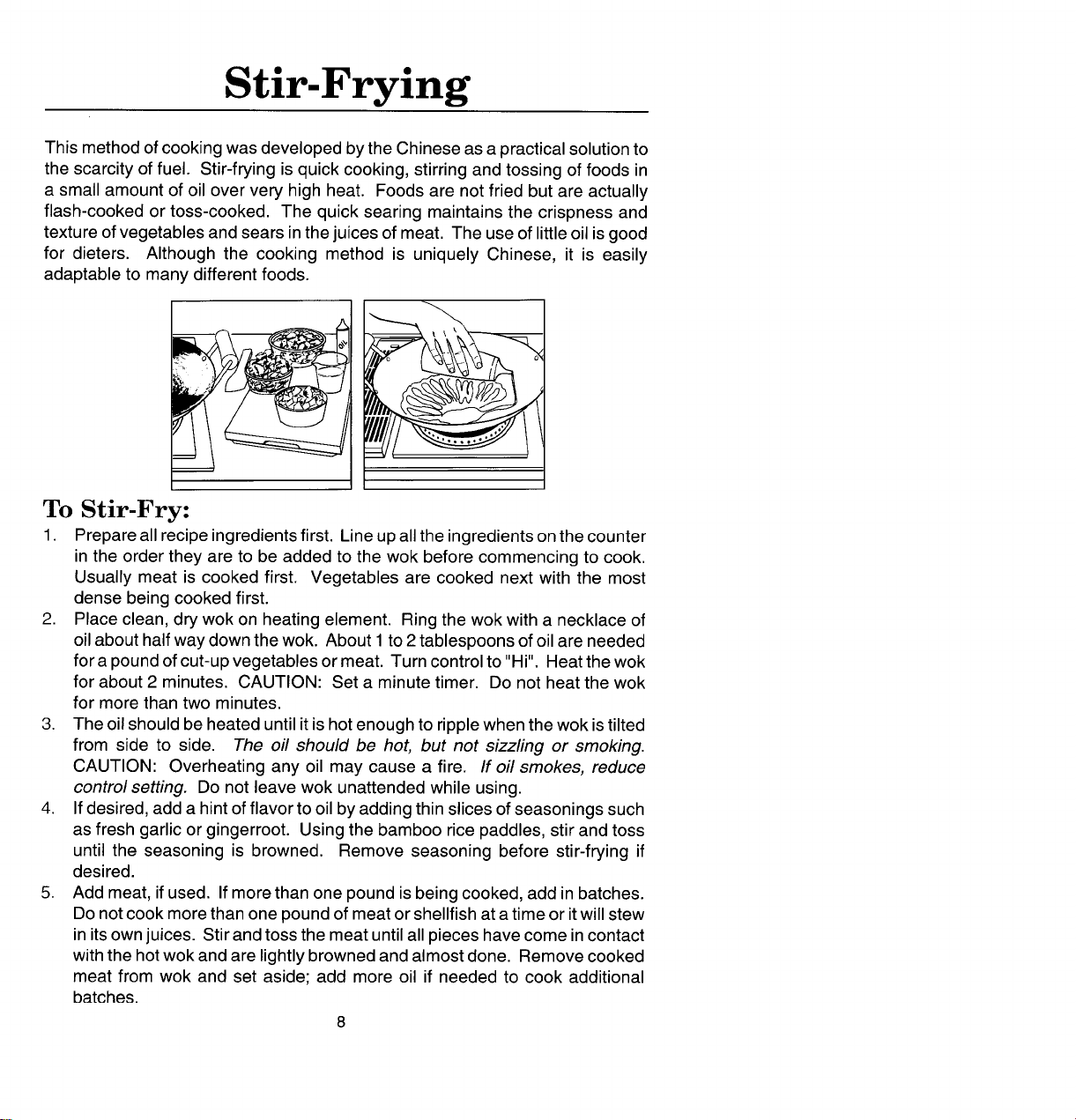
6. Add more oil if needed. When the oil is hot, add the vegetables. If more than
one type of vegetable is being cooked, start with those that take the longest
to cook. With the rice paddles, stir-fry vegetables, coating them with oil. For
vegetables that require more cooking (dense fibrous vegetables such as
carrots, broccoli or asparagus) add a little water to wok, cover, and steam
until tender. Remove cooked vegetables and add other vegetables as
recipe states or in accordance to their cooking time. Stir-fry after each
addition until all vegetables are tender-crisp.
7. Return cooked meat and vegetables to wok. Add sauce, if used. Stir and
cook food until liquid boils and thickens. Remove from wok and serve.
Tips:
• The key to stir-frying is having everything ready before cooking begins.
Cooking time is so short there is little time to look for or prepare
ingredients.
• Read recipe instructions carefully before beginning.
• All ingredients should be as uniform in size and shape as possible for
quick, even cooking.
• Foods that are cut in thin, small pieces will cook more quickly and will
retain their natural texture, color and flavor.
• Cut fibrous vegetables such as celery and broccoli and meats such a
flank steak into diagonal slices. This helps tenderize them as well as
expose the maximum food surface to the heated wok during cooking.
• Cut less fibrous vegetables into wafer thin slices or dice.
• To steam stir-fried vegetables, stir-fry 30 seconds then add 1 table-
spoon water; cover wok with lid; steam for 60 seconds after steam
comes from around lid.
• Meats for stir-frying should be ground or cut in thin strips.
• Meat will slice more easily if partially frozen. To partially freeze a one-
inch slice of meat, place in the freezer for 45 to 60 minutes.
• Peanut oil is the best for stir-frying since it can be heated to a high
temperature without smoking. Its bland taste does not overpower the
flavor of the food.
• Do not substitute solid shortening, butter or margarine for oil.
• If it is necessary to add more oil to the wok (if meat sticks to the pan while
cooking it) let oil flow down the side of the wok so that fresh oil is warmed
by the time it hits the meat.
• A plastic condiment bottle with a spout makes it easy to ring the wok with
oil.
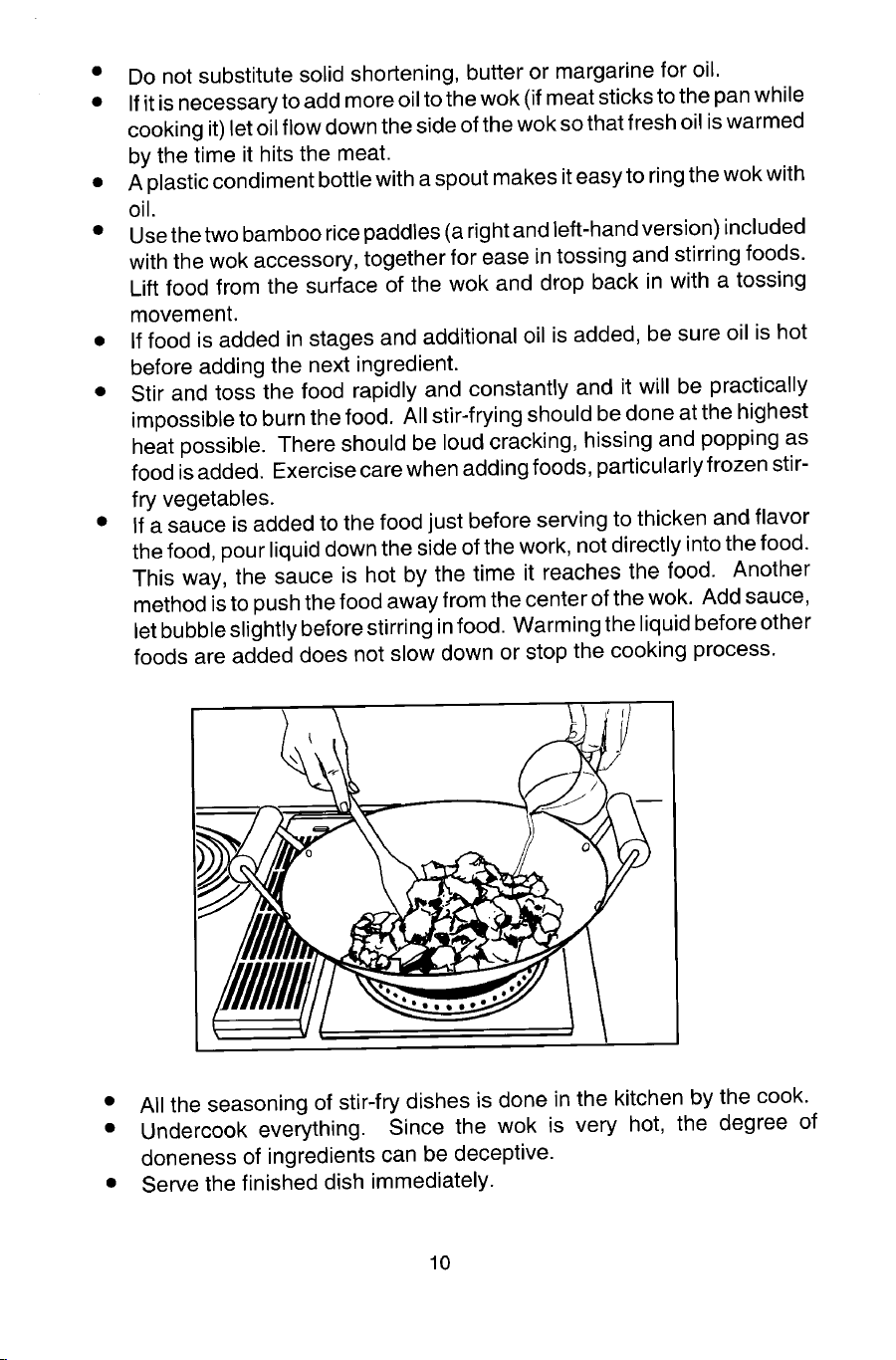
• Use the two bamboo rice paddles (a right and left-hand version) included
with the wok accessory, together for ease in tossing and stirring foods.
Lift food from the surface of the wok and drop back in with a tossing
movement.
• If food is added in stages and additional oil is added, be sure oil is hot
before adding the next ingredient.
• Stir and toss the food rapidly and constantly and it will be practically
impossible to burn the food. All stir-frying should be done at the highest
heat possible. There should be loud cracking, hissing and popping as
food is added. Exercise care when adding foods, particularly frozen stir-
fry vegetables.
• If a sauce is added to the food just before serving to thicken and flavor
the food, pour liquid down the side of the work, not directly into the food.
This way, the sauce is hot by the time it reaches the food. Another
method is to push the food away from the center of the wok. Add sauce,
let bubble slightly before stirring infood. Warming the liquid before other
foods are added does not slow down or stop the cooking process.
ltU
i
• All the seasoning of stir-fry dishes is done in the kitchen by the cook.
• Undercook everything. Since the wok is very hot, the degree of
doneness of ingredients can be deceptive.
• Serve the finished dish immediately.
10
Steaming
The wok's unique ability to retain high heat makes it useful as a steamer. Foods
do not dry out when steamed and they retain their color, flavor, and are juicy.
Flavors of food mingle more completely. For diet conscious cooks, little fat, if
any, is used and vitamin and mineral loss in minimal. A wide variety of foods
including seafood, poultry, vegetables, desserts, and breads can be steamed.
Even leftovers can be reheated. Foods will cook in steam as fast as in simmering
water and with less flavor loss.
To Steam:
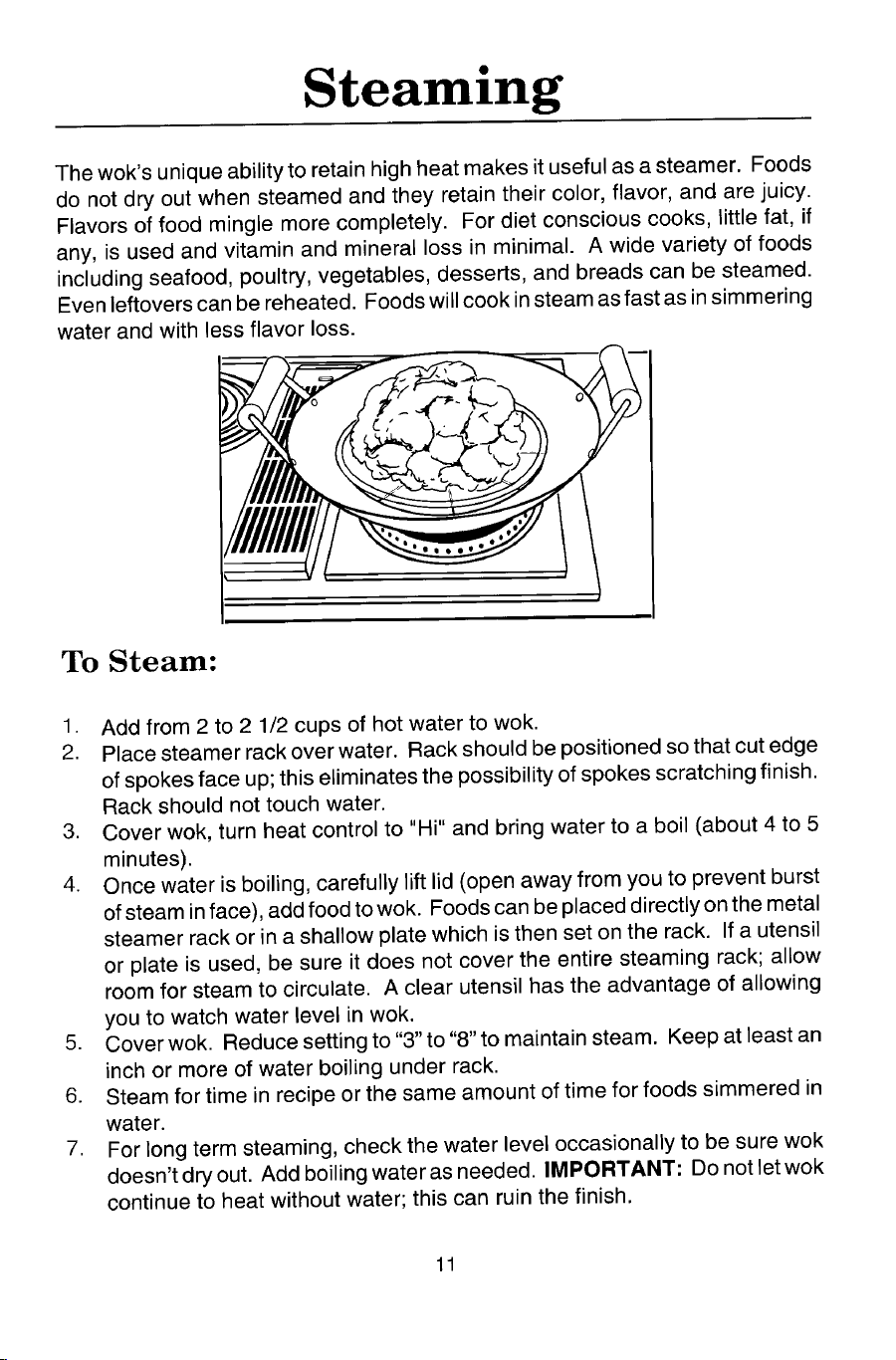
1. Add from 2 to 2 1/2 cups of hot water to wok.
2. Place steamer rack over water. Rack should be positioned so that cut edge
of spokes face up; this eliminates the possibility of spokes scratching finish.
Rack should not touch water.
3. Cover wok, turn heat control to "Hi" and bring water to a boil (about 4 to 5
minutes).
4. Once water is boiling, carefully lift lid (open away from you to prevent burst
of steam in face), add food to wok. Foods can be placed directly on the metal
steamer rack or in a shallow plate which is then set on the rack. If a utensil
or plate is used, be sure it does not cover the entire steaming rack; allow
room for steam to circulate. A clear utensil has the advantage of allowing
you to watch water level in wok.
5. Cover wok. Reduce setting to "3" to "8" to maintain steam. Keep at least an
inch or more of water boiling under rack.
6. Steam for time in recipe or the same amount of time for foods simmered in
water.
7. For long term steaming, check the water level occasionally to be sure wok
doesn't dry out. Add boiling water as needed. IMPORTANT: Do not let wok
continue to heat without water; this can ruin the finish.
11
Tips:
• To flavor food, sprinkle with herbs
and spices or surround food with
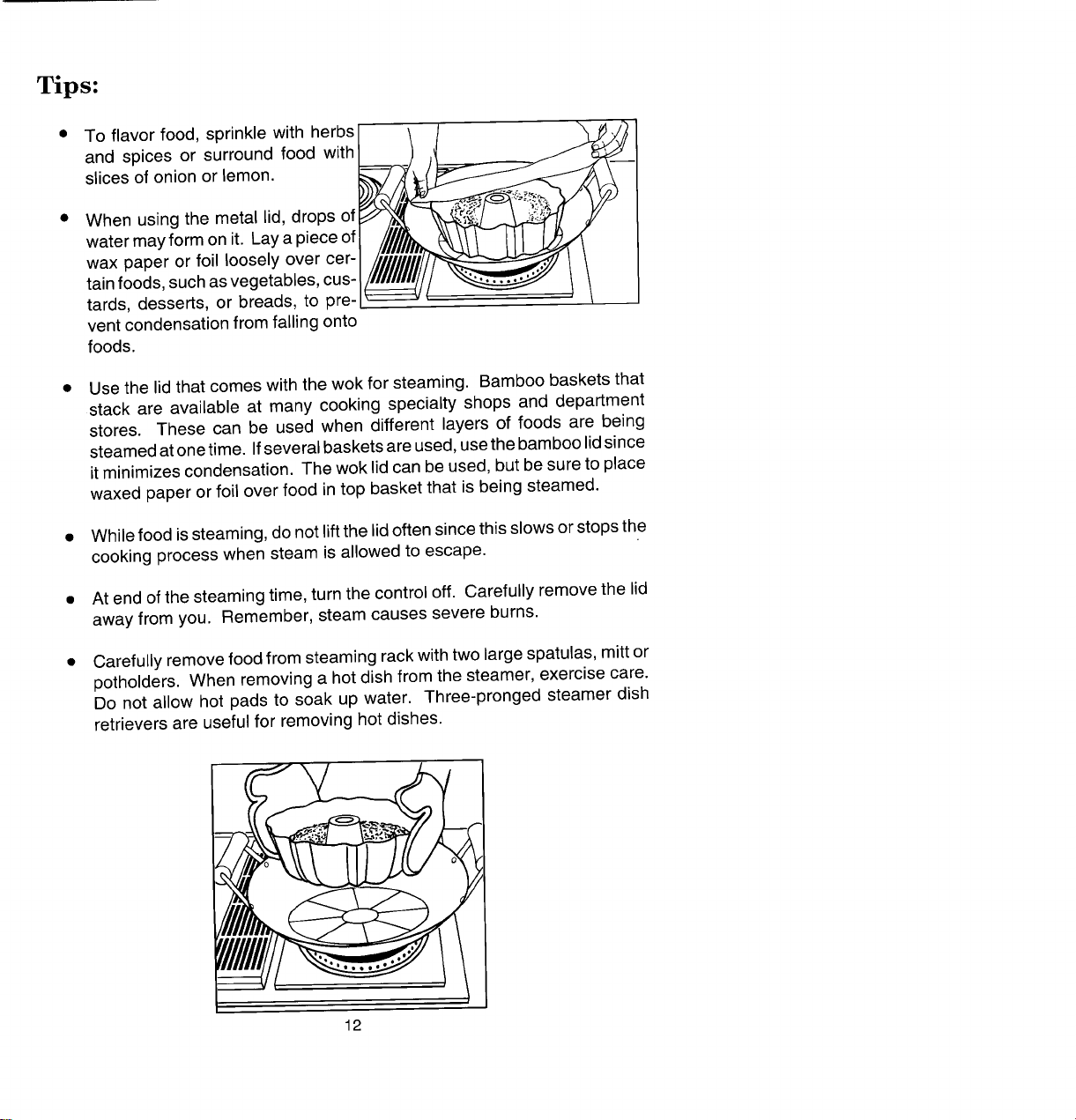
• When using the metal lid, drops of
water may form on it. Lay a piece of
wax paper or foil loosely over cer- /llllllAi_/
tain foods, such as vegetables, cus-
tards, desserts, or breads, to pre-
vent condensation from falling onto
foods.
• Use the lid that comes with the wok for steaming. Bamboo baskets that
stack are available at many cooking specialty shops and department
stores. These can be used when different layers of foods are being
steamed at one time. If several baskets are used, use the bamboo lid since
it minimizes condensation. The wok lid can be used, but be sure to place
waxed paper or foil over food in top basket that is being steamed.
• While food is steaming, do not lift the lid often since this slows or stops the
cooking process when steam is allowed to escape.
• At end of the steaming time, turn the control off. Carefully remove the lid
away from you. Remember, steam causes severe burns.
• Carefully remove food from steaming rack with two large spatulas, mitt or
potholders. When removing a hot dish from the steamer, exercise care.
Do not allow hot pads to soak up water. Three-pronged steamer dish
retrievers are useful for removing hot dishes.
12
Braising/Stewing
The classic red cooking of China, cooking in water with soy sauce, is a form of
braising. This is avery good way to cook less tender cuts of meat, Braised meats
become tender and flavorful with slow cooking and do not shrink as is true of
roasted meats. The wok can also be used for preparing your favorite recipes for
soups and stews.
b_
To braise or stew:
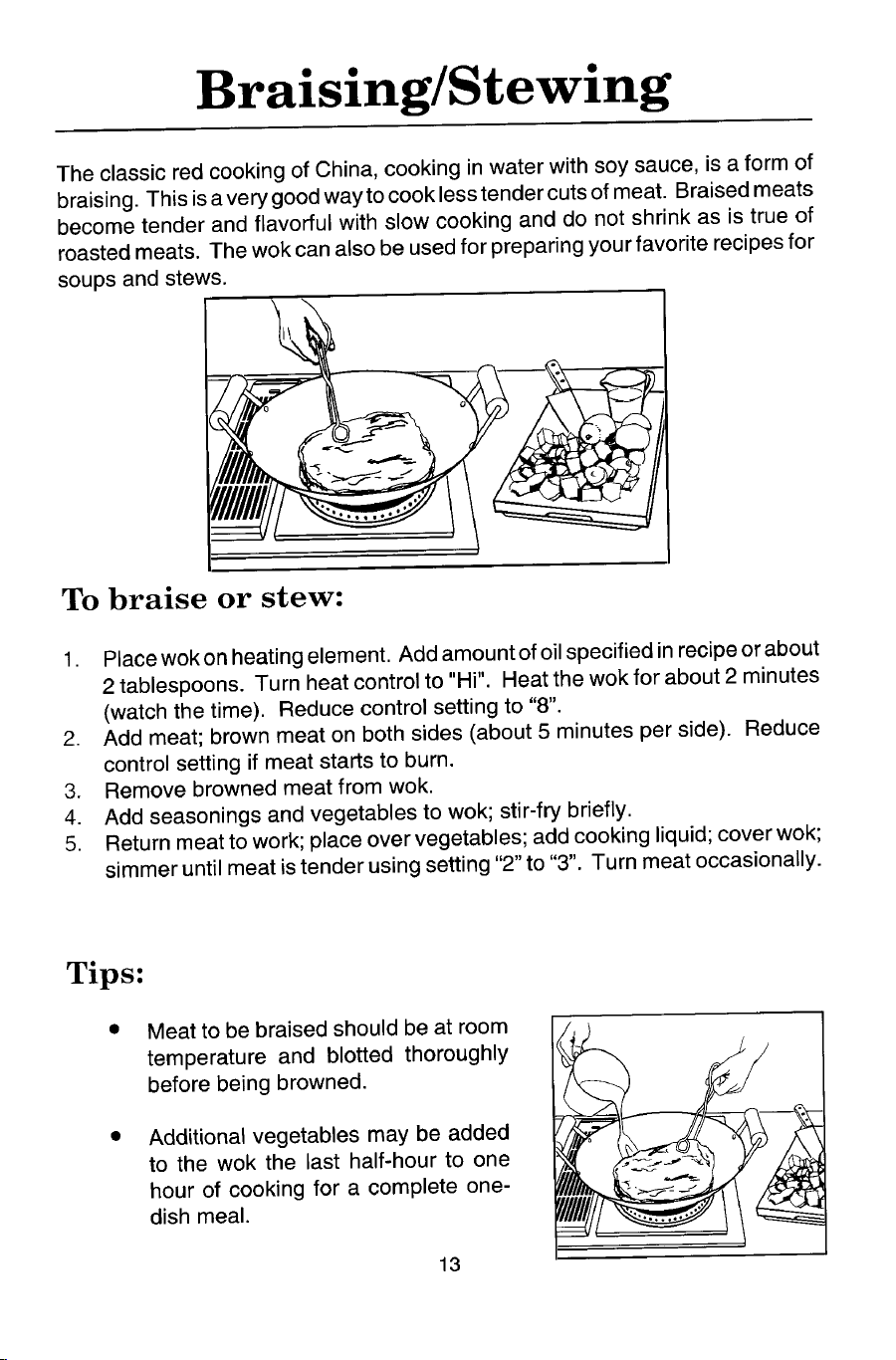
1. Place wok on heating element. Add amount of oil specified in recipe or about
2 tablespoons. Turn heat control to "Hi". Heat the wok for about 2 minutes
(watch the time). Reduce control setting to "8".
2. Add meat; brown meat on both sides (about 5 minutes per side). Reduce
control setting if meat starts to burn.
3. Remove browned meat from wok.
4. Add seasonings and vegetables to wok; stir-fry briefly.
5, Return meat to work; place over vegetables; add cooking liquid; cover wok;
simmer until meat is tender using setting "2"to "3". Turn meat occasionally.
Tips:
• Meat to be braised should be at room /,
temperature and blotted thoroughly
before being browned.
• Additional vegetables may be added
to the wok the last half-hour to one
hour of cooking for a complete one-
dish meal.
13
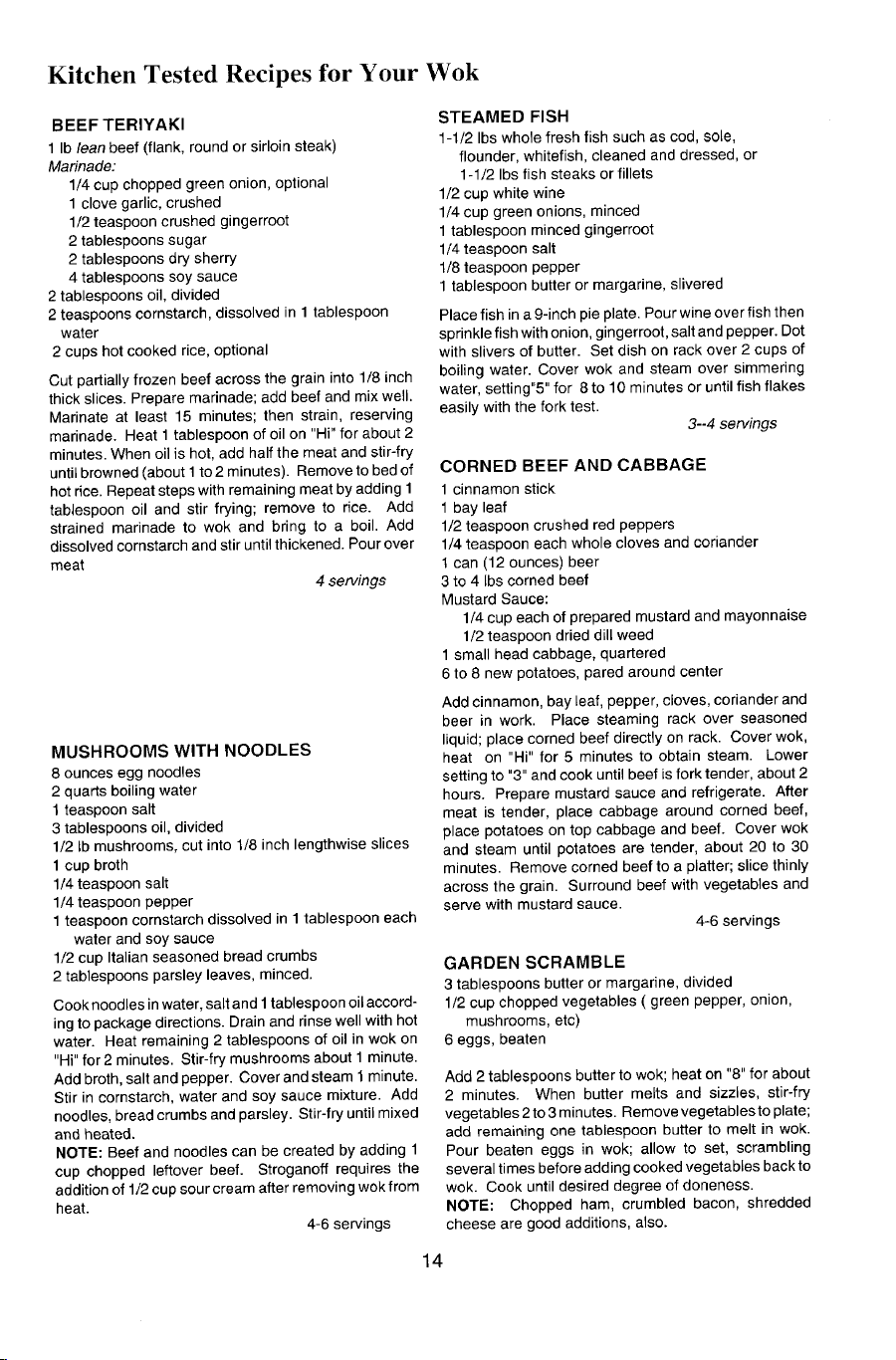
Kitchen Tested Recipes for Your Wok
BEEF TERIYAKI STEAMED FISH
1 Ib leanbeef (flank, roundor sirloin steak) 1-1/2 Ibs whole fresh fish such as cod, sole,
Marinade: flounder, whitefish, cleaned and dressed, or
1/4 cup chopped green onion, optional 1-1/2 Ibsfish steaks or fillets
1 clove garlic, crushed 1/2 cup white wine
1/2 teaspoon crushed gingerroot 1/4 cup green onions, minced
2 tablespoons sugar 1 tablespoon minced gingerroot
2 tablespoons dry sherry 1/4 teaspoon salt
4 tablespoons soysauce 1/8 teaspoon pepper
2 tablespoons oil, divided 1 tablespoon butter or margarine, slivered
2 teaspoons cornstarch, dissolved in 1 tablespoon Placefish in a 9-inch pieplate. Pour wineover fish then
water sprinklefishwithonion, gingerroot, saltand pepper.Dot
2 cups hot cooked rice, optional with slivers of butter. Set dish on rack over 2 cups of
Cut partiallyfrozen beef across the grain into 1/8 inch boiling water. Cover wok and steam over simmering
thick slices. Prepare marinade; add beef and mix well. water, setting"5"for 8 to 10 minutes or until fish flakes
Marinate at least 15 minutes; then strain, reserving easily with the fork test.
marinade. Heat 1 tablespoon of oil on "Hi"for about 2 3--4 servings
minutes. When oil is hot, add halfthe meat and stir-fry
untilbrowned (about1 to2minutes). Removeto bed of CORNED BEEF AND CABBAGE
hot rice. Repeatsteps with remaining meat by adding1 1 cinnamon stick
tablespoon oil and stir frying; remove to rice. Add 1 bay leaf
strained marinade to wok and bring to a boil. Add 1/2 teaspoon crushed red peppers
dissolvedcornstarch and stir until thickened. Pour over 1/4 teaspoon each whole cloves and coriander
meat 1 can (12 ounces) beer
4 servings 3 to 4 Ibscorned beef
Mustard Sauce:
1/4 cup eachof prepared mustardand mayonnaise
1/2 teaspoondried dillweed
1 small head cabbage, quartered
6 to 8 new potatoes, pared around center
Add cinnamon, bay leaf,pepper, cloves, corianderand
beer in work. Place steaming rack over seasoned
MUSHROOMS WITH NOODLES liquid; placecorned beef directly on rack. Cover wok,
heat on "Hi" for 5 minutes to obtain steam. Lower
8 ounces egg noodles setting to "3" andcook until beef isfork tender, about 2
2 quarts boilingwater hours. Prepare mustard sauce and refrigerate. After
1 teaspoon salt meat is tender, place cabbage around corned beef,
3 tablespoons oil,divided place potatoes on top cabbage and beef. Cover wok
1/2 Ibmushrooms, cut into 1/8 inch lengthwise slices and steam until potatoes are tender, about 20 to 30
1 cup broth minutes. Remove corned beef to a platter; slice thinly
1/4 teaspoon salt across the grain. Surround beef with vegetables and
1/4 teaspoon pepper serve with mustard sauce.
1 teaspoon cornstarch dissolved in 1 tablespoon each 4-6 servings
water and soy sauce
1/2 cup Italian seasoned breadcrumbs GARDEN SCRAMBLE
2 tablespoons parsley leaves, minced.
3 tablespoons butter or margarine, divided
Cooknoodlesin water,saltand 1tablespoonoil accord- 1/2 cup chopped vegetables ( green pepper, onion,
ingto package directions.Drain and rinsewell with hot mushrooms, etc)
water. Heat remaining 2 tablespoons of oil in wok on 6 eggs, beaten
"Hi" for2 minutes. Stir-fry mushrooms about 1 minute.
Addbroth, salt and pepper. Cover and steam 1minute. Add 2tablespoons butter to wok; heat on "8" for about
Stir in cornstarch, water and soy sauce mixture. Add 2 minutes. When butter melts and sizzles, stir-fry
noodles,bread crumbsand parsley. Stir-fry until mixed vegetables2to3minutes. Removevegetablestoplate;
and heated, add remaining one tablespoon butter to melt in wok.
NOTE: Beef and noodles can be created by adding 1 Pour beaten eggs in wok; allow to set, scrambling
cup chopped leftover beef. Stroganoff requires the severaltimes before adding cooked vegetablesbackto
additionof 1/2cup sour creamafter removing wokfrom wok. Cook until desired degree of aloneness.
heat. NOTE: Chopped ham, crumbled bacon, shredded
4-6 servings cheese are good additions, also.
14
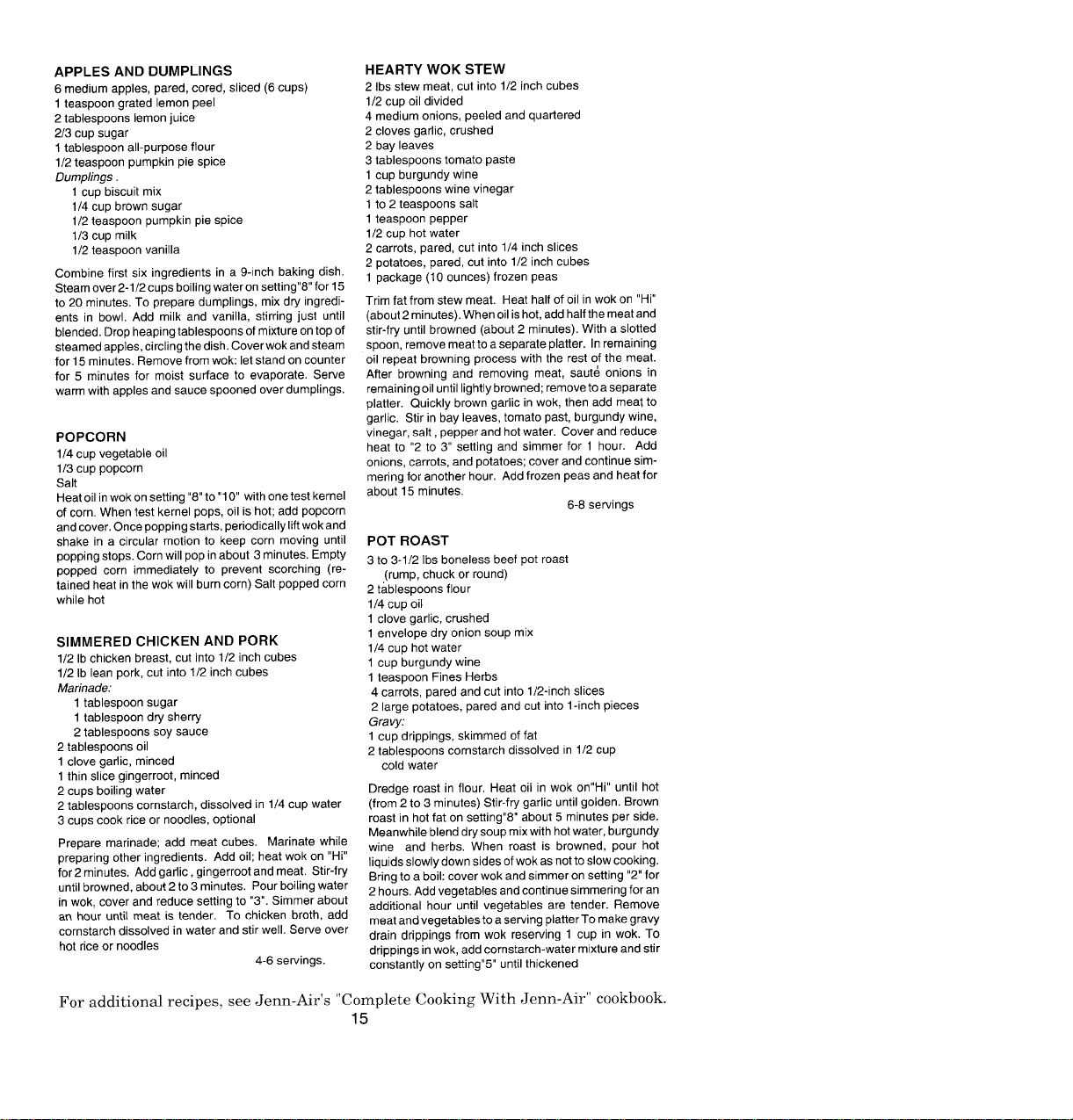
APPLES AND DUMPLINGS HEARTY WOK STEW
6 medium apples, pared, cored,sliced (6 cups) 2 Ibs stewmeat, cut into 1/2 inch cubes
1 teaspoon grated lemonpeel 1/2 cup oil divided
2 tablespoons lemonjuice 4 medium onions, peeled and quartered
2/3 cup sugar 2 cloves garlic, crushed
1 tablespoon all-purpose flour 2 bay leaves
1/2 teaspoon pumpkin pie spice 3 tablespoons tomato paste
Dumplings. 1cup burgundywine
1 cup biscuit mix 2 tablespoons wine vinegar
1/4 cup brown sugar 1 to 2 teaspoons salt
1/2 teaspoon pumpkin pie spice 1 teaspoon pepper
1/3 cup milk 1/2 cup hot water
1/2 teaspoon vanilla 2 carrots, pared, cut into 1/4 inch slices
2 potatoes, pared, cut into 1/2 inch cubes
Combine first six ingredients in a 9-inch baking dish. 1 package (10 ounces) frozen peas
Steamover 2-1/2 cups boilingwateron setting"8" for15
to 20 minutes.To prepare dumplings, mix dry ingredi- Trim fat fromstew meat. Heat half ofoil in wok on "Hi"
ents in bowl. Add milk and vanilla, stirring just until (about2minutes).Whenoilishot, addhalfthemeatand
blended.Dropheaping tablespoonsof mixtureon top of stir-fry until browned (about 2 minutes). With a slotted
steamed apples,circlingthe dish. Cover wokand steam spoon,remove meatto a separate platter. In remaining
for 15 minutes. Removefromwok: let standon counter oil repeat browning process with the rest of the meat.
for 5 minutes for moist surface to evaporate. Serve After browning and removing meat, saut_ onions in
warm with apples and sauce spooned over dumplings, remaining oiluntil lightly browned;removeto a separate
platter. Quickly brown garlic in wok, then add meat to
garlic. Stir in bay leaves,tomato past,burgundy wine,
POPCORN vinegar, salt, pepper and hot water. Cover and reduce
1/4 cup vegetable oil heat to "2 to 3" setting and simmer for 1 hour. Add
1/3 cup popcorn onions,carrots, and potatoes; cover and continue sim-
Salt meringfor another hour. Add frozen peas and heat for
Heat oilin wokon setting"8"to"10" with onetest kernel about 15 minutes.
of corn. When test kernel pops, oil is hot; add popcorn 6-8 servings
andcover.Once poppingstarts,periodicallylift wok and
shake in a circular motion to keep corn moving until POT ROAST
popping stops. Cornwill pop inabout 3 minutes.Empty 3 to 3-1/2 Ibs boneless beef pot roast
popped corn immediately to prevent scorching (re- (rump, chuck or round)
tained heat inthe wok will burn corn) Salt popped corn 2 ta.blespoonsflour
while hot 1/4 cup oil
1 clove garlic, crushed
SIMMERED CHICKEN AND PORK 1 envelope dry onion soup mix
1/4 cup hot water
1/2 Ibchicken breast, cut into 1/2 inch cubes
1 cup burgundy wine
1/2 Iblean pork, cut into 1/2 inch cubes
1 teaspoon FinesHerbs
Marinade: 4 carrots, pared and cut into 1/2-inchslices
1 tablespoon sugar 2 large potatoes, pared and cut into 1-inchpieces
1 tablespoon dry sherry Gravy:
2 tablespoons soy sauce 1 cup drippings, skimmed of fat
2 tablespoons oil 2 tablespoons cornstarch dissolved in 1/2 cup
1 clove garlic, minced cold water
1 thin slice gingerroot, minced
2 cups boiling water Dredge roast in flour. Heat oil in wok on"Hi" until hot
2 tablespoons cornstarch, dissolved in 1/4 cup water (from2 to 3minutes) Stir-fry garlic until golden. Brown
3 cups cook riceor noodles, optional roast in hot fat on setting"8" about 5 minutes per side.
Meanwhileblenddry soupmix with hotwater, burgundy
Prepare marinade; add meat cubes. Marinate while wine and herbs. When roast is browned, pour hot
preparing other ingredients. Add oil; heat wok on "Hi" liquidsslowly down sidesof wok as notto slowcooking.
for 2 minutes. Add garlic, gingerroot and meat. Stir-fry Bringto aboil: cover wok and simmer on setting "2" for
untilbrowned, about 2 to 3 minutes. Pour boilingwater 2 hours.Add vegetablesand continuesimmering foran
in wok, cover and reduce setting to "3". Simmer about additional hour until vegetables are tender. Remove
an hour untit meat is tender. To chicken broth, add meatandvegetablestoaserving platterTomakegravy
cornstarch dissolved in water and stirwell. Serve over drain drippings from wok reserving 1 cup in wok. To
hot rice or noodles drippings inwok, add cornstarch-water mixture and stir
4-6 servings, constantly on setting"5" until thickened
For additional recipes, see Jenn-Air's "Complete Cooking With Jenn-Air" cookbook.
15