EN DISHWASHER
FR LAVE-VAISSELLE
USE & CARE GUIDE
GUIDE D’UTILISATION ET D’ENTRETIEN
117861580 October 2019
2
Important Safety Information
©2019 Electrolux Major Appliances All rights reserved.
NOTE
Registering your product with Electrolux
enhances our ability to serve you.
You can register online at
www.electroluxappliances.com, send
your Product Registration Card in the mail,
or PHOTOREGISTER
SM
using a smart
phone.
See registration card for details.
Please read and save
this guide
Thank you for choosing Electrolux, our
premium brand in home appliances.
This
Use & Care Guide
is part of our
commitment to customer satisfaction and
product quality throughout the service life
of your new appliance.
We view your purchase as the beginning
of a relationship. To ensure our ability to
continue serving you, please use this page
to record important product information.
Table of contents
Important Safety Information .................2
Features ...............................................5
Controls and Settings ...........................7
Operating Instructions ........................11
Care and Cleaning .............................. 19
Troubleshooting .................................. 21
Limited Warranty ................................ 26
NOTE
The instructions appearing in this
Use &
Care
guide are not meant to cover every
possible condition and situation that may
occur. Common sense and caution must
be practiced when installing, operating
and maintaining any appliance.
READ ALL INSTRUCTIONS BEFORE OPERATING THIS DISHWASHER.
SAVE THESE INSTRUCTIONS FOR FUTURE REFERENCE.
For toll free telephone support or online
support in the US and Canada contact:
U.S.
1-877-4ELECTROLUX (1-877-435-3287)
www.electroluxappliances.com
Canada
1-800-265-8352
www.electroluxappliances.ca
WARNING
For your safety the information in this manual must be followed to minimize the risk of
fire or explosion or to prevent property damage, personal injury or loss of life. Do not
store or use gasoline or other flammable vapors and liquids in the vicinity of this or any
other appliance.
Important Safety Information .................2
Features ...............................................5
How your dishwasher cleans .............5
Getting started ..................................5
Energy use ........................................6
DishSense
TM
technology ....................6
Controls and Settings ...........................7
Wash cycle and options ....................7
Cycle selection ..................................7
Making a selection ............................. 7
Option selections ............................... 8
Operation selections .......................... 9
Opening the door during operation ....9
Other features ................................10
Operating Instructions ........................11
Preparing the dishes ........................11
Loading the dishes ..........................11
Adding a dish ..................................15
Dishwasher dispenser and detergents 16
Care and Cleaning .............................. 19
Cleaning ..........................................19
Winterizing ......................................20
Troubleshooting .................................. 21
Normal operating sounds ................21
Normal operating lights ....................21
Removing spots and film .................21
Factors affecting performance .........21
User Instruction Code ...................... 22
Error codes .....................................22
Before calling ...................................23
Limited Warranty ................................ 26
Electrolux serial number
Electrolux model number
Purchase date
Keep a record for quick
reference
Questions?
3
WARNING
WARNING indicates a potentially
hazardous situation which, if not avoided,
could result in death or serious injury.
DANGER
DANGER indicates an imminently
hazardous situation which, if not avoided,
will result in death or serious injury.
Important safety instructions
Important Safety Information
WARNING - RISK OF FIRE
To reduce the risk of fire, electrical shock, or injury to persons when using this dishwasher,
comply with the warnings listed below. Failure to comply with these Important Safety
Information and warnings could result in property damage, serious personal injury, or death.
IMPORTANT
Indicates installation, operation, or
maintenance information which is
important but not hazard-related.
CAUTION
CAUTION indicates a potentially
hazardous situation which, if not avoided,
may result in minor or moderate injury.
For your safety
• Use your dishwasher only as instructed
in this Use and Care Manual.
• This Manual does not cover every
possible condition and situation that
may occur. Use common sense and
caution when installing, operating and
maintaining any appliance.
• NSF certified residential dishwashers
are not intended for licensed food
establishments.
• DISHWASHER MUST BE
ELECTRICALLY GROUNDED. This
appliance must be connected to
a ground metal, permanent wiring
system, or an equipment-grounding
conductor must be run with the circuit
conductors and connected to the
equipment-grounding terminal or lead
on this appliance. Read the Installation
Instructions for details.
• This dishwasher is designed to operate
on regular house current (120V, 60Hz).
Use a circuit equipped with a 15 ampere
fuse or circuit breaker. Use a 20 ampere
fuse if dishwasher is connected with a
food disposer.
• Do not operate dishwasher unless all
enclosure panels are in their proper
place.
• Use only detergents and rinse agents
recommended for use in a dishwasher.
• Store dishwasher detergent and rinse
agents out of the reach of children.
• If the dishwasher drains into a food
disposer, make sure disposer is
completely empty before running
dishwasher.
• Do not wash plastic items unless
marked: “Dishwasher Safe” or
equivalent. Check with manufacturer
for recommendations, if not marked.
Items that are not marked dishwasher
safe may melt and create a potential fire
hazard.
• When loading items to be washed:
– Locate sharp items and knives so that
they are not likely to damage the door
seal or tub.
– Load sharp items and knives with the
handles up to reduce the risk of cut-
type injuries.
• Do not tamper with controls.
Recognize safety symbols, words
and labels
Safety items throughout this manual are
labeled with a DANGER, WARNING, or
CAUTION based on the risk type.
Definitions
This is the safety alert symbol. It is
used to alert you to potential personal
injury hazards. Obey all safety messages
that follow this symbol to avoid possible
injury or death.
4
Important Safety Information
• Use care unloading the dishware
when the SANITIZE option has been
selected. Contents may be hot to the
touch immediately after the end of cycle.
• Under certain conditions, hydrogen
gas may be produced in a hot water
system that has not been used for
2 weeks or more. HYDROGEN GAS
IS EXPLOSIVE. If hot water system
has not been used for such a period,
before using dishwasher, turn on all
hot water faucets and let water flow
from each for several minutes. This will
release any accumulated hydrogen gas.
HYDROGEN GAS IS FLAMMABLE. Do
not smoke or use an open flame during
this time.
• Do not store or use combustible
materials, gasoline or other flammable
vapors and liquids in the vicinity of this
or any other appliance.
• Disconnect electrical power to
dishwasher before servicing.
• Repairs should be done by a qualified
technician.
Child safety
• This appliance is not intended for use by
persons (including children) with reduced
physical, sensory or mental capabilities,
or lack of experience and knowledge,
unless they have been given supervision
or instruction concerning use of the
appliance by a person responsible for
their safety.
• Close supervision of children is necessary
when the appliance is used near children.
As children grow, teach them the proper,
safe use of all appliances.
• DO NOT allow children to play in or on
the dishwasher
• DO NOT allow children to abuse, sit,
stand or play on door or racks of a
dishwasher.
• Destroy the carton, plastic bag and other
packing materials after the appliance
is unpacked. Children might use them
for play. Cartons covered with rugs,
bedspreads or plastic sheets can
become airtight chambers.
• Keep dishwasher products out of
children’s reach. To prevent personal
injury, observe all warnings on product
labels.
• To avoid entrapment and/or suffocation,
remove door or door latch mechanism
from any dishwasher that is discarded or
not in use..
• Failure to comply with these warnings
could result in serious personal injuries.
Risk of child entrapment
Child entrapment and suffocation are
not problems of the past. Junked or
abandoned appliances are still dangerous
– even if they will sit for “just a few days”.
If you are getting rid of your old appliance,
please follow the instructions below to help
prevent accidents.
We strongly encourage responsible
appliance recycling/disposal methods.
Contact your State/Provence Energy
Office, Local Electric and Water Utilities or
Conservation Program Office or visit www.
energystar.gov/recycle for more information
on recycling your old washer or dryer.
Before you throw away your old
appliance:
• Remove doors or door latch.
• Remove the electric power cord
• Secure all hoses and drain pipes to
prevent water from leaking out and
creating a slip hazard.
WARNING
To reduce the risk of fire, electrical shock or
injury when using your dishwasher, follow
the above basic precautions.
5
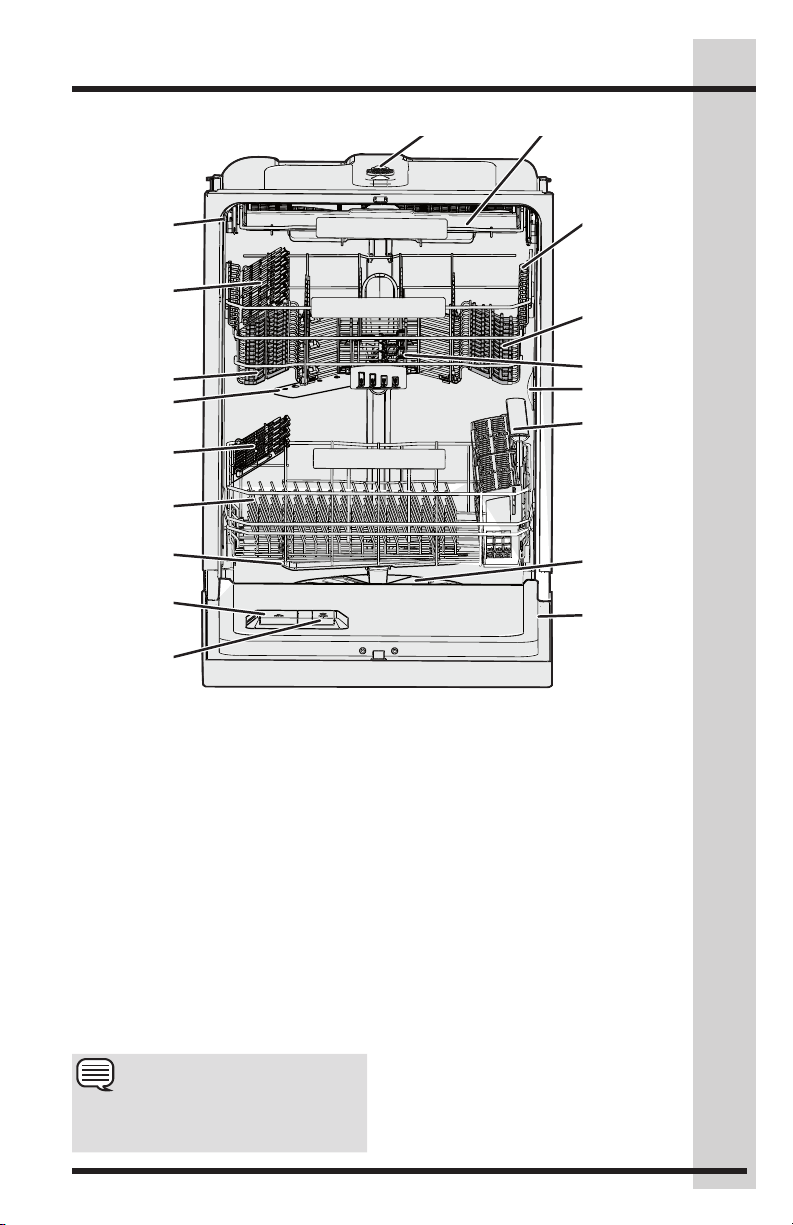
Features
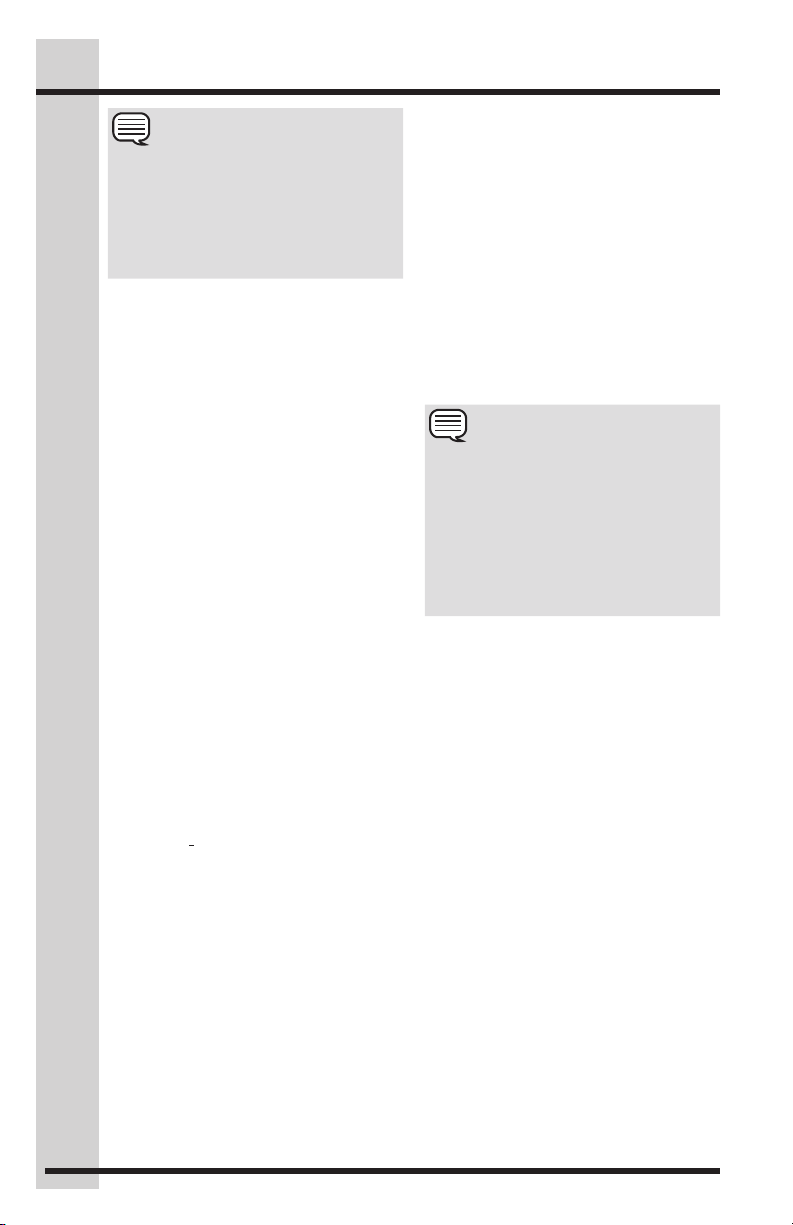
Upper Spray Arm
Adjustable
Rack
Mechanism
Flex Wash
Silverware
Basket
Filters
Serial Label
(located on
right side
of door)
Tub
Gasket
Cup
Shelves
Soft Grip
Rack
Middle
Spray Arm
Bottom
Rack
Stemware
Holder
Lower
Spray Arm
Detergent
Dispenser
Rinse Aid
Dispenser
Cutlery Rack
Upper Rack
Interior Light
How your dishwasher
cleans
Your dishwasher cleans by spraying
a mixture of hot water and detergent
through the spray arms against soiled
surfaces. First, the dishwasher drains for
a few seconds to remove soils dropped
while loading, then fills with water covering
the filter area. Water is then pumped
through the spray arms. Soil particles go
through and across the filter and down
the drain as the water is pumped out. This
series of steps are repeated as needed.
The number of water fills varies with the
cycle being used.
Getting started
To run your dishwasher, follow these basic
steps:
1. Load Dishwasher (see loading
instructions).
2. Add detergent to the dispenser (see
Filling the detergent dispenser).
3. Add Rinse Aid to the dispenser,
if needed (see Using the rinse aid
dispenser).
4. Run hot water faucet nearest
dishwasher until water is hot. Turn
water off.
5. Select desired cycles (see Cycle
selection).
6. Select desired options (see Option
selection).
7. To start, press START pad and close
door immediately.
NOTE
Racks and Features in your dishwasher
model may vary in appearance from
illustrations in this manual.
6
Features
Energy use
The yellow energy guide label that came on
your unit tells how much energy it would
use in one year and how it compares to
others that are available. The energy is
based on the NORMAL cycle response
to tests that apply soils and dishware that
simulate the average use. Eight place
settings of dishware and some serving
pieces are used during the test. The total
energy is based on running the average
number of cycles per year, applying typical
soil levels to the dishware and half the time,
selecting the option of using extra energy
to more fully dry the dishware. Actual
energy and water use will depend upon the
cycle and options you select.
This unit uses an in-line water heating
element that is located under the
tub. There is no exposed heater that
plasticware might come in contact with
or that is accessible to touch. The heat is
taken to the dishware through the heated
water. For this reason, plastic dishware
may be placed where it best fits in either
the top or bottom rack. Temperatures are
uniform throughout the dishwasher.
If the user prefers to save energy and dry
the dishes by hand they select the AIR
DRY option. If you prefer to spend slightly
more energy to get the dishes drier then
turn the AIR DRY option off and select
one of the heated dry options. In response
the wash and rinse temperatures in the
cycle will be increased.
This will help the cleaning and it will also
get the dishwasher hotter. When the final
drain removes all standing water, the extra
heat stored in the dishware will act to
evaporate the remaining water.
Your unit provides a selection of cycles. In
general, the more water used by a cycle
and the hotter the temperatures it reaches
the more energy that it uses. Several
cycles, such as the NORMAL cycle will
change their response based on soil level,
NOTE
For the first cycle after power is applied
(when first installed or after a power
failure) the sensor will not be calibrated
and so cannot determine the soil load.
Therefore, your unit will provide a
response suitable for heavy soils on the
first run after power is restored. Energy
use during this first run may be higher
than would be typical.
Your unit has DishSense
TM
Technology
that is used to understand how heavily
soiled the dish load is so the cycle can be
automatically adjusted to the appropriate
response. This helps to prevent energy
waste. The sensor is calibrated at the
end of each cycle. This will assure that
whatever is loaded will be cleaned.
DishSense
TM
technology
NOTE
If the dishwasher door is opened while
the unit is running, the START/CANCEL
pad must be pressed and the door shut
immediately to return the unit to the
selected cycle and option. This must
happen within 10 minutes for the unit to
continue the cycle.
options selected, and ambient conditions.
The NORMAL cycle is good for all around
use. Other cycles are focused toward
special use like the HEAVY cycle that is
designed for heavily solid cookware.
7
Controls and Settings
Wash cycle and options
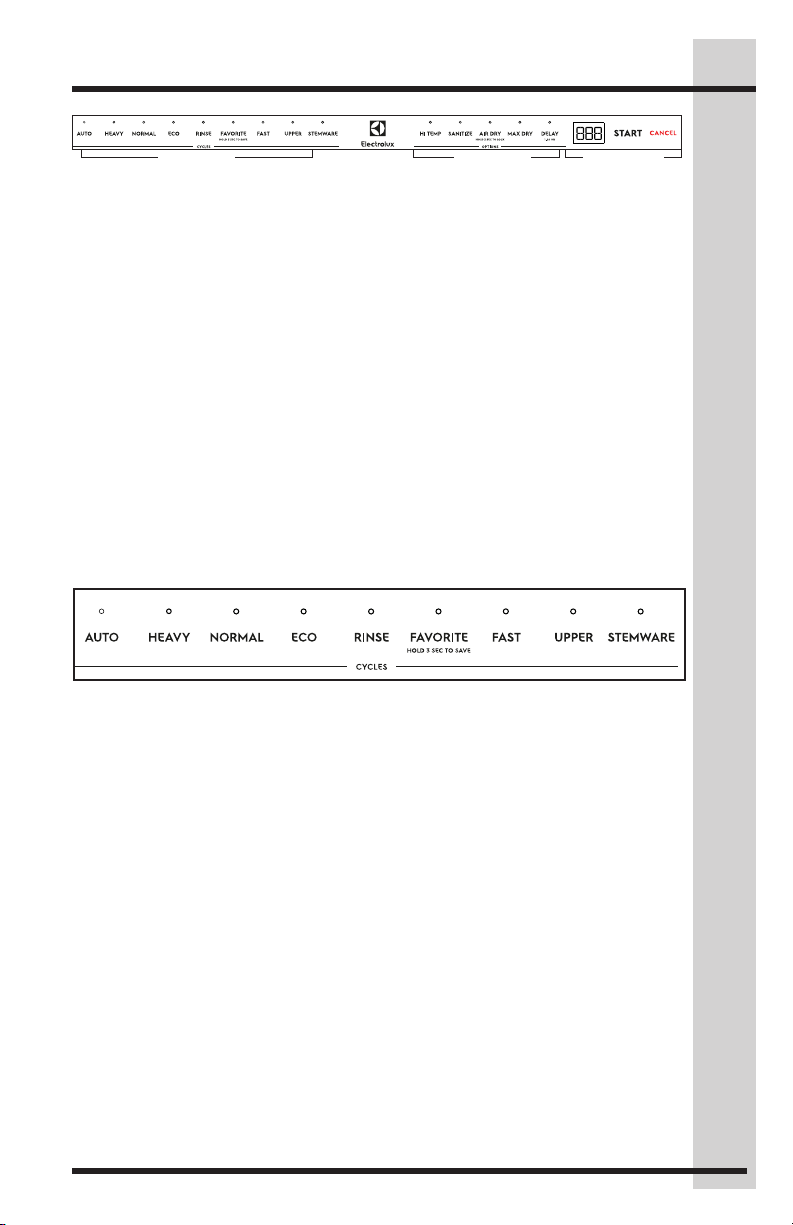
Cycles
Options
Operation
Cycle times are approximate and vary by
options selected. Hot water is necessary
to activate dishwasher detergent and melt
fatty food soils.
An automatic sensor checks the water
temperature for the main wash of each
cycle. When HI TEMP is selected,
the sensor checks for an even higher
temperature. Run hot water in a faucet
nearest the dishwasher until water is hot
before starting.
The Smart Sensor checks the soil level on
your dishes in the AUTO, NORMAL and
ECO cycles. Cycle time and water usage
will vary based on the amount of soil on
the dishes.
Press the START button to turn ON the
unit. Then, press a cycle pad to select
your cycle. The LED light above the
selection will illuminate when selected. The
estimated cycle time will also appear in the
Status Window display.
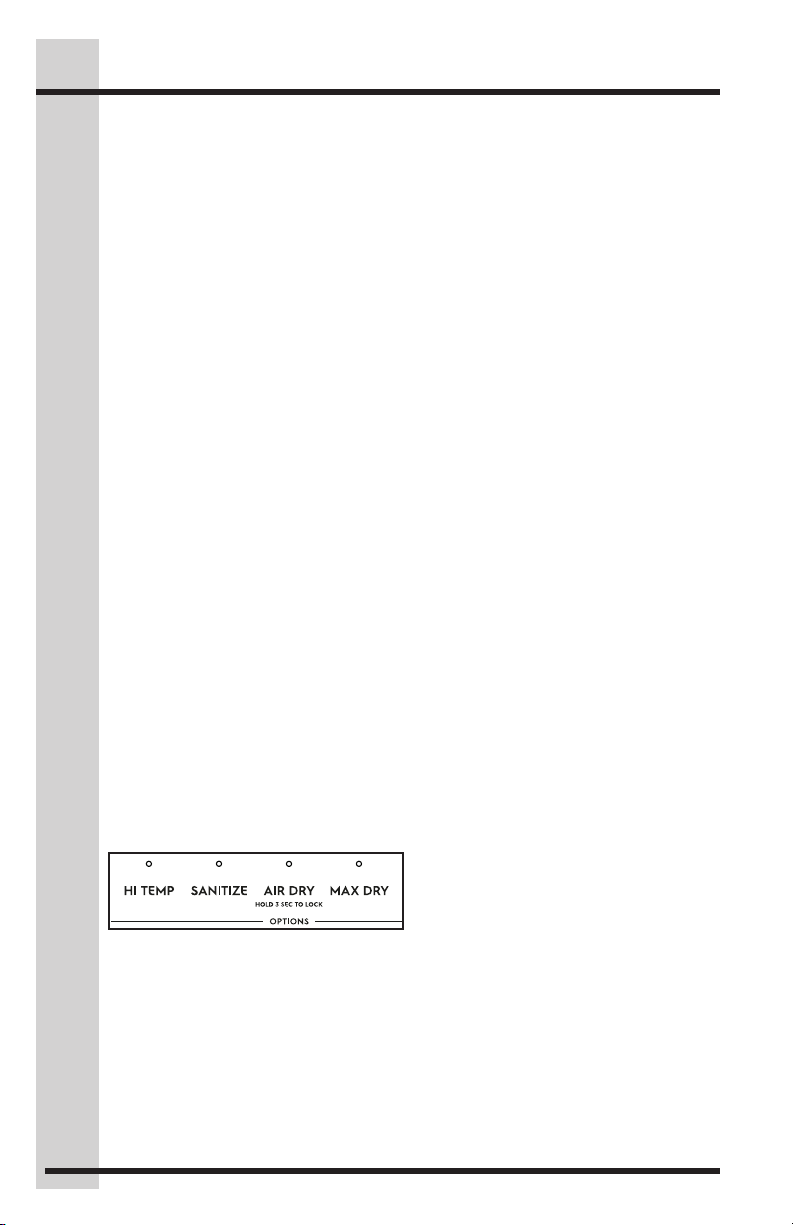
AUTO
The Smart Sensor technology will
determine the type of cycle required to
clean the dishes and will clean more
efficiently every time. When a partial load
of lightly soiled dishes are placed in the
unit, a wash cycle similar to a short wash
will automatically be performed. When
a full load of heavily solid dishes are
placed in the unit, a HEAVY wash cycle
will automatically be performed. Water
usage ranges from approximately 3.0
to 7.4 gallons. Wash time ranges from
approximately 118 to 200 mins.
Cycle selection
Making a selection
To make a selection, press the desired
cycle or option pad on the control panel.
The LED light above the selection will turn
ON when a cycle or option is selected and
will turn OFF when it is deselected.
HEAVY
For pots, pans, casserole dishes and
dinnerware with dried-on or baked-
on soils. Water usage ranges from
approximately 7.1 to 8.1 gallons. Wash
time ranges from approximately 129 to
189 mins.
NORMAL
For regularly soiled dishes and silverware.
Water usage ranges from approximately
3.0 to 7.4 gallons. Wash time ranges from
approximately 118 to 200 mins.
ECO
For lightly soiled and pre-rinsed dishes
and silverware. Water usage ranges from
approximately 4.3 to 7.7 gallons. Wash
time ranges from approximately 86 to 93
mins.
RINSE
For rinsing dishes that will be washed later.
Water usage is approximately 2.2 gallons.
Cycle time is approximately 15 mins.
8
FAVORITE
This cycle allows you to program your
preferred cycle and options into one
button. To program this cycle, select the
cycle and options you desire. Then, press
and hold the FAVORITE pad until the
LED light above the pad turns ON. The
selected cycle and all options are saved
as FAVORITE and will illuminate when
the FAVORITE cycle is selected. Once
programmed, simply press the FAVORITE
pad to select the saved cycle and
options, press START and close the door
immediately to start your cycle.
FAST
For regularly soiled and pre-rinsed
dishes and silverware. Water usage is
approximately 4.5 gallons. Wash time is
approximately 30 mins.
UPPER
For lightly soiled and pre-rinsed dishes
and silverware when you do not have a
full load. Water usage is approximately
3.5 to 4.3 gallons. Wash time ranges from
approximately 52 to 128 mins.
STEMWARE
For regularly soiled China and Crystal.
Water usage is approximately 4.9 gallons.
Wash time ranges from approximately 96
to 116 mins.
Option selections
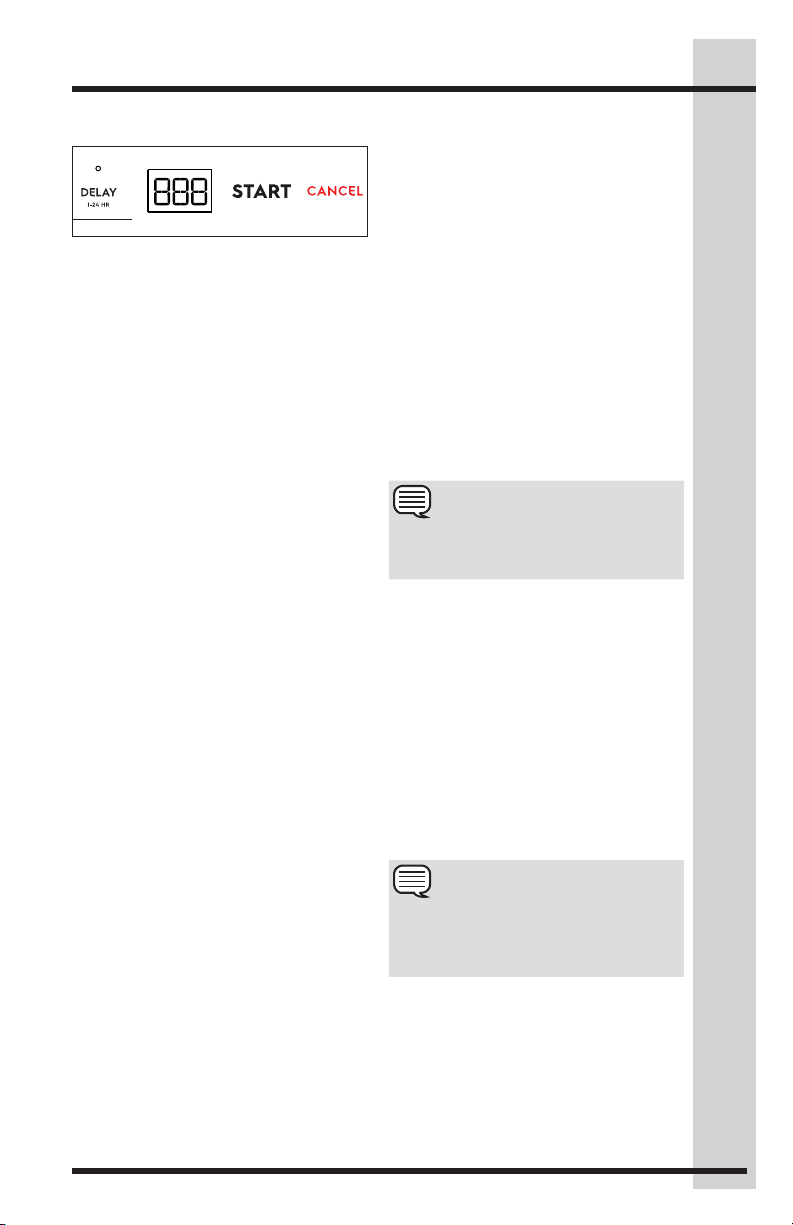
HI TEMP
When HI TEMP option is selected, the
dishwasher heats water in the main wash
to approximately 140° F (60°C).
This increase in water temperature helps
dishwasher detergent remove food, grease
and soil from dishes more effectively and
aids in drying. HI TEMP option can only
be used with AUTO, HEAVY, NORMAL
and UPPER cycles.
Controls and Settings
SANITIZE
To sanitize your dishes and glassware,
select the SANITIZE option. This option
heats the water temperature in the final
rinse to 157°F (69.4°C) and maintains that
temperature for 7 minutes. SANITIZE
is available in AUTO, HEAVY, and
NORMAL cycles. Only these sanitization
cycles have been designed to meet NSF
requirements.
The cycle time will be extended until the
proper water temperature is reached.
Washing action will continue during the
water heating delay. For best results, the
incoming water temperature should be at
least 120°F (49°C).
If the SANITIZE option is selected, the
pad illuminates with a blue light. The
sanitization criteria may not be satisfied
if there is an interruption of the cycle, a
power failure occurs, or if incoming water
temperature is below 120°F (49°C).
The SANITIZE pad will flash at the end
of the cycle if the NSF requirements for
sanitization are not reached.
AIR DRY
If the AIR DRY option is selected, the unit
will not energize the heating element. This
will reduce energy consumption, but will
reduce drying performance. Items in the
dish load may not be dry at the end of the
cycle.
MAX DRY
MAX DRY is available on AUTO, HEAVY,
NORMAL, UPPER and STEMWARE
cycles The cycle time will increase when
MAX DRY option is selected.
9
NOTE
Opening the door during normal
operation will only pause the selected
cycle.
Operation selections
Child Lock Controls
To prevent children from accidently
changing the dishwasher cycle or starting
the dishwasher, lock the dishwasher
controls by pressing AIR DRY and holding
until the code “Loc” displays in the status
window. The controls are locked and no
new selections can be made until the lock
is released. To unlock the controls, press
AIR DRY again and hold until the code
“Loc” is no longer displayed.
DELAY
The DELAY option allows you to
automatically delay starting your
dishwasher from 1-24 hours.
Select your desired cycle and options,
then press the DELAY pad until the
desired delay time displays in the status
display window. The LEDs above the
selected cycle and options will be
illuminated. The status display window
will show the delay time chosen and then
show the message “PRESS START”.
To start the delay countdown, Press
START and close door immediately.
The status window will display the
message “CLOSE” after START has been
pressed. A tone will sound indicating that
countdown has started after the door is
closed. The selected cycle starts when the
countdown is completed.
START
When cycle and options are selected, the
LEDs of the selected cycle and options are
illuminated. The status window displays
the cycle time and then displays the
message “PRESS START”.
To start the cycle, press START and close
the dishwasher door immediately.
The status window displays “CLOSE”
after START has been pressed.
A tone will sound indicating the cycle
has successfully started after the door is
closed.
CANCEL
Both a running cycle and a delay
countdown can be cancelled at any time.
Open the dishwasher door and press
CANCEL. A tone will sound indicating that
the cycle has been successfully canceled.
If desired, a new cycle can now be
selected, by pressing START and closing
the door immediately, the new cycle will
begin.
If you have selected your cycle and
options and decide to cancel, press
CANCEL, the unit will go into a stand-by
mode and all LED lights will turn off.
Controls and Settings
NOTE
If the dishwasher door is kept open for
too long, or the door is closed without
pressing START pad, the running cycle
or delay countdown may be cancelled.
Opening the door during
operation
If you open the door while a cycle is
running or delay is counting down, the
appliance stops.
The LEDs of selected cycle and options
are illuminated. The status window
displays the remaining cycle time or delay
time and then displays “PRESS START”.
To resume, press START pad and close
the dishwasher door immediately. The
status window displays “CLOSE” after the
START pad is pressed. A tone will sound
indicating that the dishwasher continues
from the point of interruption after the door
closing.
10
Controls and Settings
Other features
Status window
Status window display codes are typically
seen during the programming of the
dishwasher. The status window will not
illuminate while the unit is running.
The status window indicates the following
activities:
1HR-24HR
Indicates number of delay start hours for
selected cycle.
PRESS START
Scrolls across the status window indicating
the START pad needs to be pressed.
CLOSE
Scrolls across the status window once the
program has been entered and the START
pad is pressed.
Loc
Child Lock is activated.
MIN
The cycle duration or the remaining time.
L1 - L4
Level of rinse aid dosage.
LOW RINSE
Refill Rinse Aid
CLEAN
End of cycle.
Green and blue light indicator
When the GREEN light illuminates on the
floor this indicates that the wash cycle is
complete.
When the BLUE light illuminates on the
floor this indicates that the wash cycle is
operating.
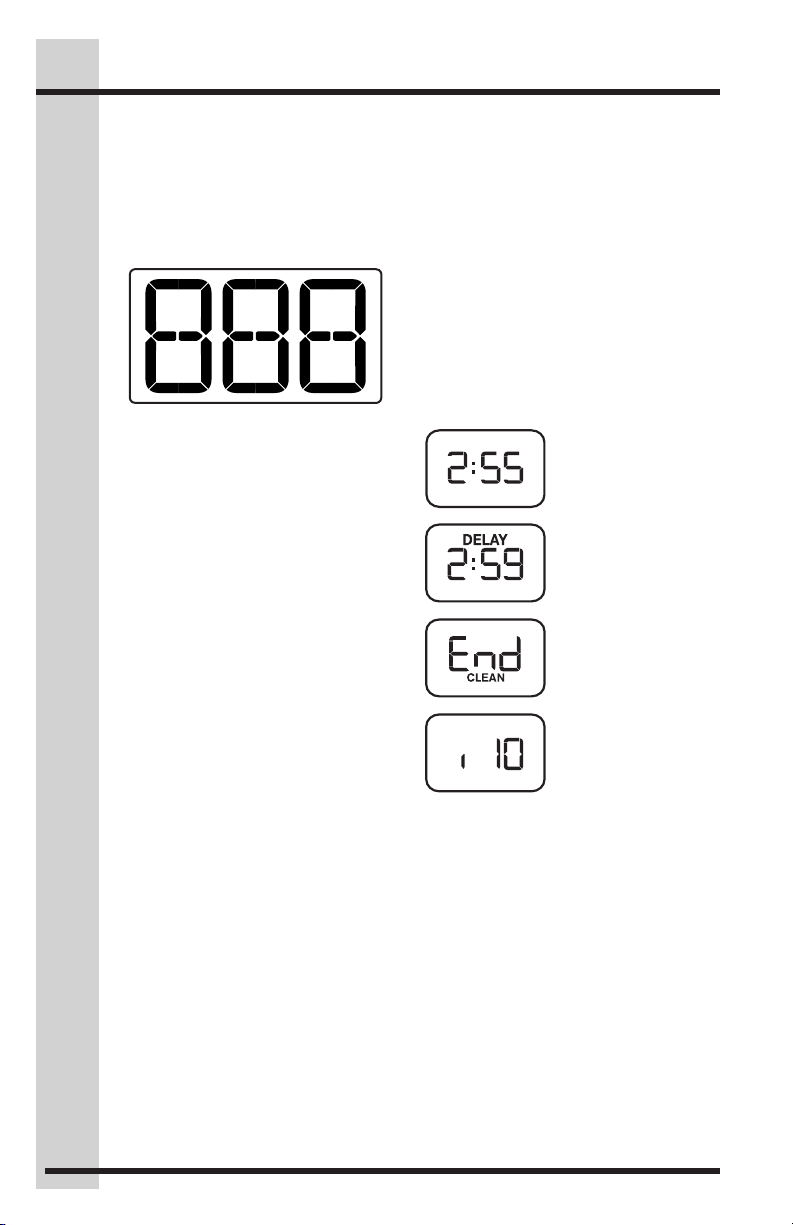
Display on floor
The display on floor indicates the following
activities:
The cycle duration
remaining time.
Remaining time of delay
start
End of cycle
Error codes
11
Operating Instructions
NOTE
Racks and features in your dishwasher
model may vary in appearance from
illustrations in this manual.
Preparing the dishes
Scrape away large pieces of food, bones,
pits, toothpicks, etc. The continuously
filtered wash fluid will remove remaining
food particles. Burned-on foods should
be loosened before loading. Empty liquids
from glasses and cups.
Foods such as mustard, mayonnaise,
vinegar, lemon juice and tomato based
products may cause discoloration of
stainless steel and plastics if allowed to
sit for a long period of time. Unless the
dishwasher is to be operated at once, it is
best to pre-rinse or use the RINSE cycle
to rinse off these food soils.
Load racks so that large items do not
prevent the detergent dispenser from
opening.
Check manufacturer’s recommendations
before washing items in question.
If the dishwasher drains into a Food
Disposer, be sure disposer is completely
empty before starting dishwasher.
Loading the dishes
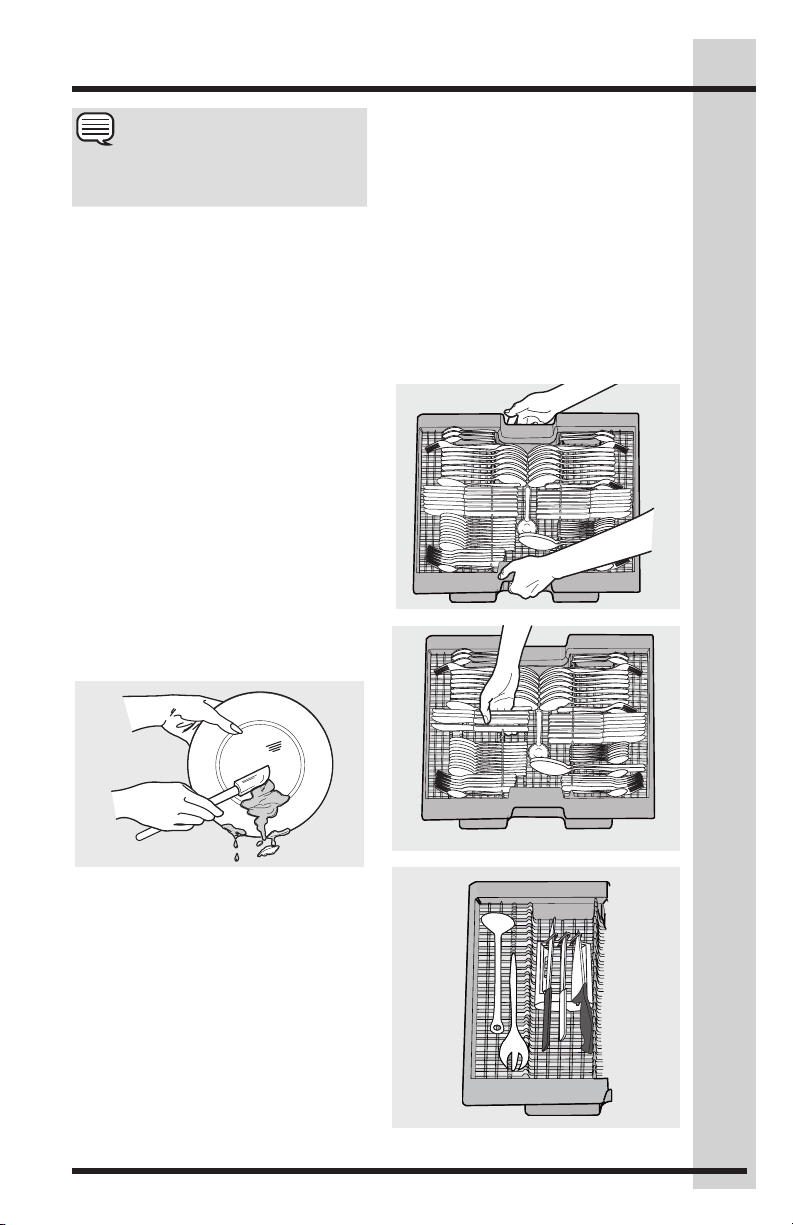
Loading the cutlery rack
Features and appearance of racks and
silverware basket may vary from your
model.
The cutlery rack is designed for flatware
and most cooking or serving utensils.
Heavily soiled utensils or items with baked
on foods should be placed in the upper
rack or silverware basket for best washing
performance. The separators on the
cutlery racks help keep flatware separated
to avoid damage and improve cleaning.
12
Operating Instructions
Loading the upper rack
Features and appearance of racks and
silverware basket may vary from your
model.
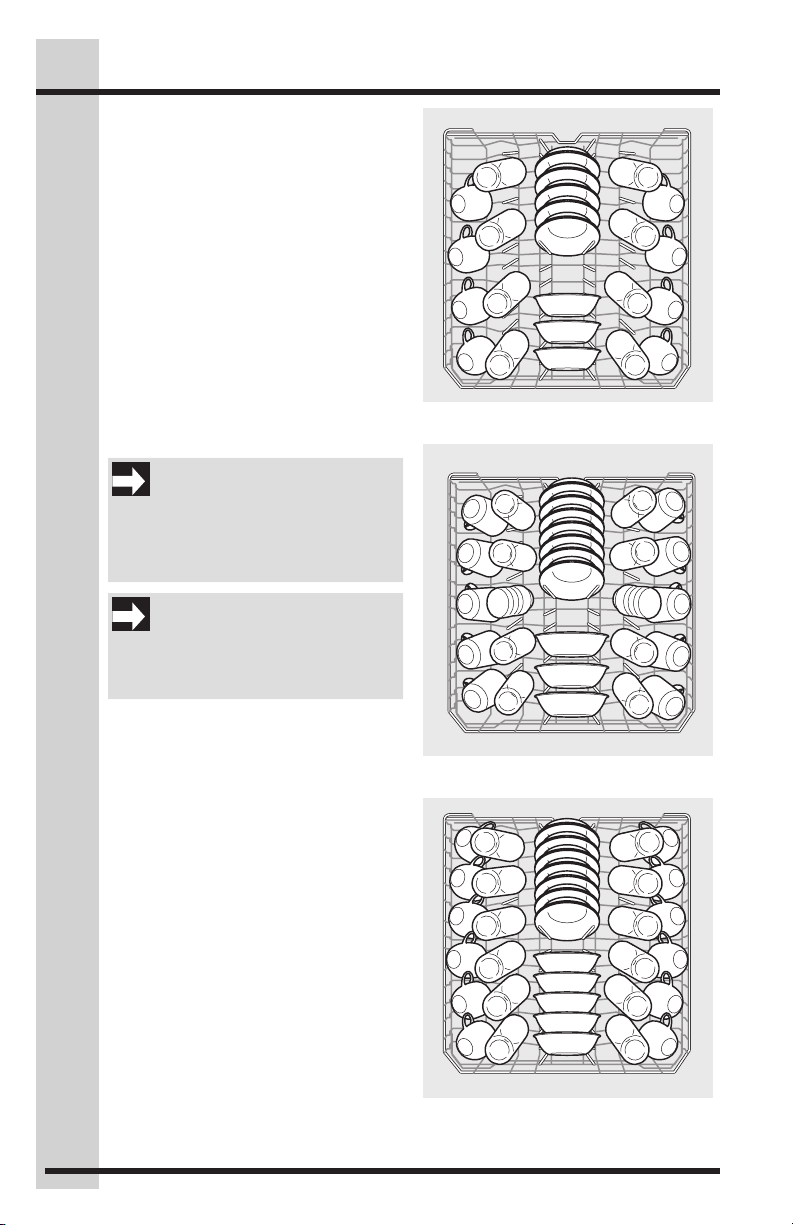
The upper rack is designed for flexibility in
loading a wide variety of items including
cups, glasses, stemware, small plates,
bowls, etc.
• Load glasses and plastic items in upper
rack only.
• Load items with open end facing down
for better cleaning and draining.
• Long-handled knives and utensils can
be placed in upper rack.
Be sure nothing protrudes through the
bottom of the rack to block rotation of the
spray arm.
IMPORTANT
Make sure the loaded items do not
interfere with the rotation of the spray
arm. Check this by rotating the spray
arm by hand.
IMPORTANT
Damage may occur if delicate items
touch each other during dishwasher
operation.
12 place settings standard loading pattern
8 place settings standard loading pattern
10 place settings standard loading pattern

13
Operating Instructions
Flex wash
The Flex Wash system gives you the ability
to wash the inside areas of baby bottles,
narrow glassware and other items. To turn
this feature on turn these clips to have
them pointing upward (B). To turn off just
slide them back down toward the rack (A).
See images below.
Adjusting the upper rack
The top rack height can be easily adjusted
to accommodate loading taller dishes in
either rack. To raise the rack to the upper
position, lift rack until both sides are at the
same height and the rack will secure in
place. Ensure that the rack remains level
from front to back with both sides at the
same height. To lower rack lift the rack
slightly then push down and release.
Fold-down tines for upper rack
The fold-down tines in the top and bottom
racks makes it easy to load those extra
large and hard-to-fit items. The tines may
be left up for normal use or folded down
for more flexible loading.
Cup shelf/stemware holders
The Cupshelf holder can be folded down
to be used to load two levels of cups,
juice glasses, and other short items or fold
down both and use for long items such as
utensils and spatulas. Fold up to load tall
glasses.
A
B
14
Operating Instructions
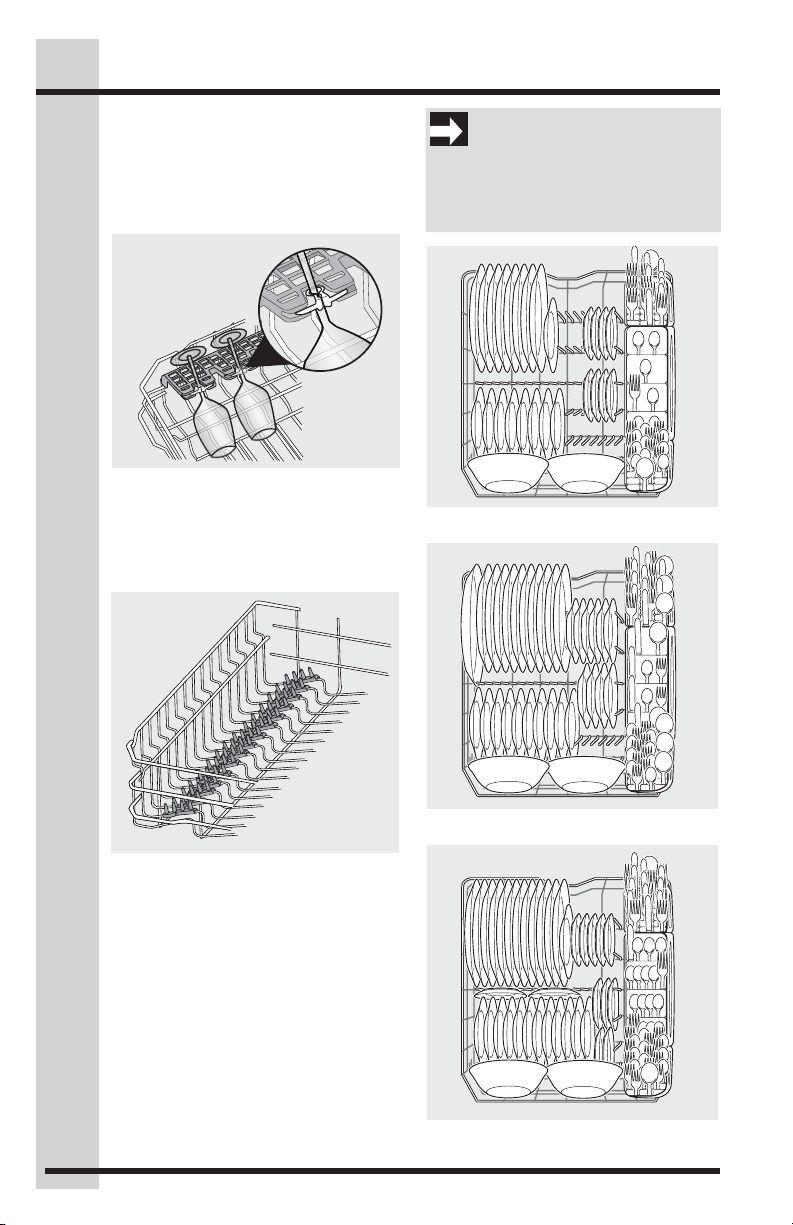
The Stemware holder is used to securely
hold your wine glasses in place for the
best wash. To properly secure you glass
simply press the stem of the glass into the
center of the Cupshelf the plastic pieces
will secure around the stem to hold the
glass in place.
Soft grip rack
The Soft Grip Rack is used to secure in
place glassware and those plastic items
that may move around with the water
from the spray arm.
Loading the bottom rack
Features and appearance of racks and
silverware basket may vary from your model.
The lower rack is best for plates, saucers,
bowls, and cookware. Large items should
be placed along the edge so they do not
block the spray arm rotation.
For best results, place bowls, casseroles,
and sauce pans with soiled surface facing
down or toward the center. Tilt slightly for
better drainage.
Be sure pan handles do not protrude
through the bottom of the rack and block
the spray arm rotation.
IMPORTANT
Make sure the loaded items do not
interfere with the rotation of the spray
arm. Check this by rotating the spray
arm by hand.
8 place settings standard loading pattern
10 place settings standard loading pattern
12 place settings standard loading pattern
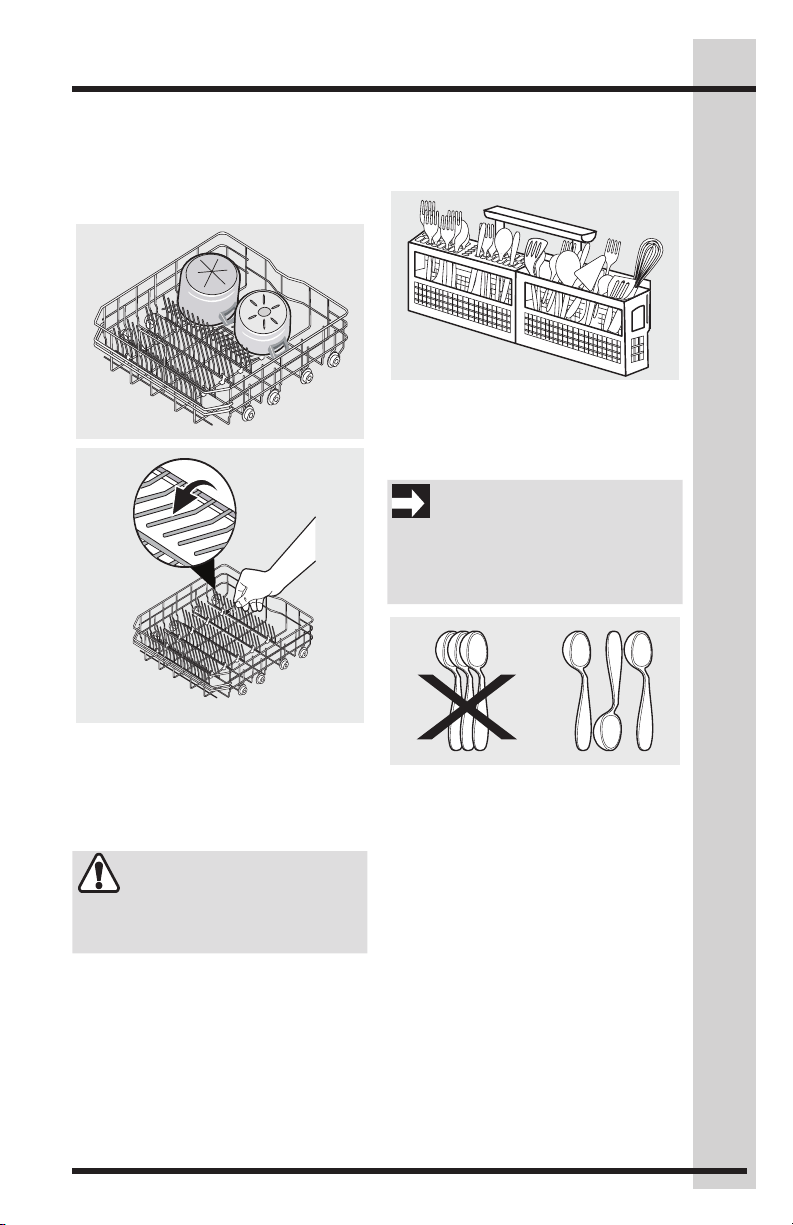
15
Operating Instructions
Fold-down tines lower rack
The fold-down tines in the top and bottom
racks makes it easy to load those extra
large and hard-to-fit items. The tines may
be left up for normal use or folded down
for more flexible loading.
Loading the silverware basket
Features and appearance of racks and
silverware basket may vary from your
model.
WARNING
Load sharp items (knives, skewers, etc.)
pointing down. Failure to do so may
result in injury.
Load the silverware basket while it is in
the bottom rack or take the basket out for
loading on a counter or table.
In some models small items like baby
bottle caps, jar lids, corn cob holders, etc.,
Can be placed in a covered section. Close
the cover to hold small items in place.
Use suggested loading patterns, as
shown, to increase washability of the
silverware.
When covers are up, mix items in each
section of the basket with some pointing
up and some down to avoid nesting.
Water spray cannot reach nested items.
IMPORTANT
Make sure the loaded items do not
interfere with the rotation of the spray
arm. Check this by rotating the spray
arm by hand.
Be sure nothing protrudes through bottom
of basket or rack to block the spray arm.
Do not mix silver and stainless to avoid
damaging the silver finish.
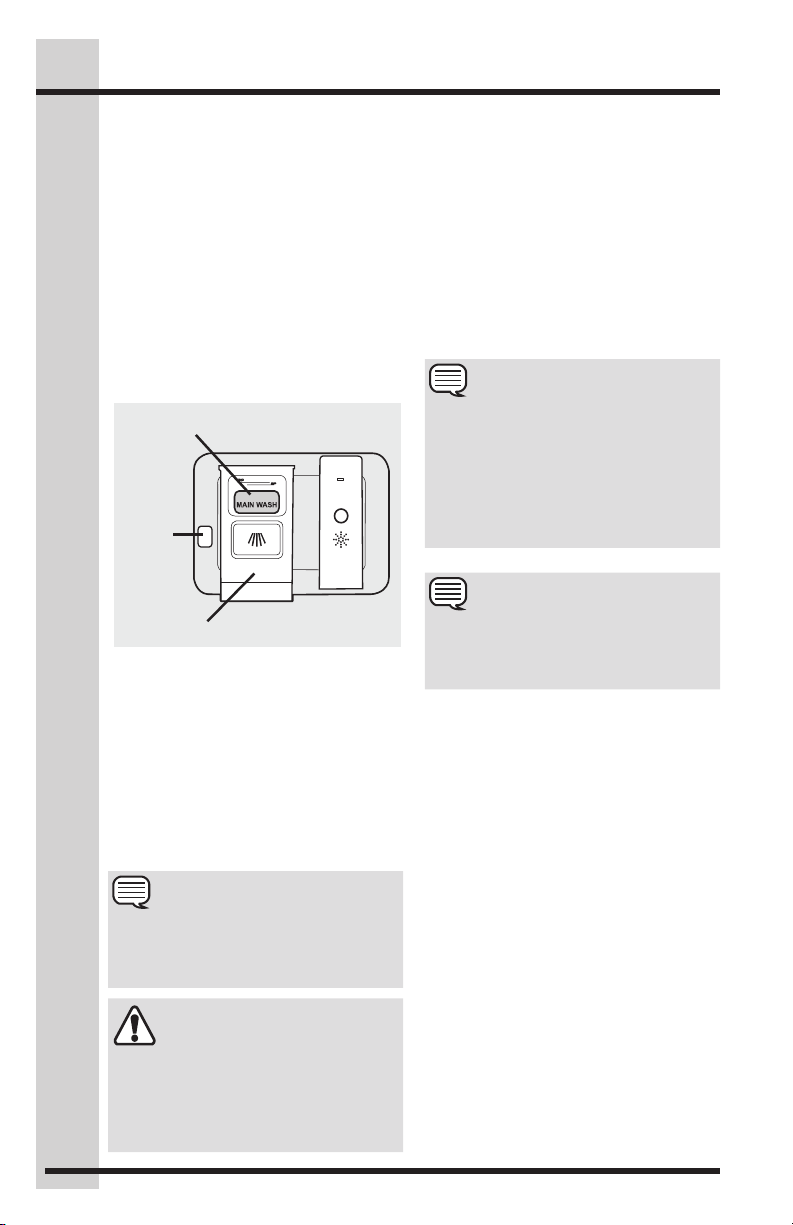
To add or remove items after wash cycle
starts:
Unlatch door and wait a few seconds until
wash action stops before opening.
Add the item. To resume cycle, press
START and immediately close the door
firmly to latch.
Adding a dish
16
Operating Instructions
Dishwasher dispenser
and detergents
Filing the detergent dispenser
The detergent dispenser has one covered
cup. The covered cup opens automatically
to release detergent.
To add detergent:
1. Press the dispenser cover latch to
open the main wash detergent cup.
2. Add the recommended amount of
detergent to the main wash cup.
3. Slide the main wash cover back over
the main wash cup to close.
CAUTION
The use of industrial grade detergent can
damage parts of the dishwasher leading
to damage to the unit and surrounding
property. Use only household grade
automatic dishwasher detergent.
NOTE
Hard water may cause lime deposit
buildup on the interior of the dishwasher.
For cleaning instructions see “Removing
Spots and Film” section.
NOTE
Detergent tablets and All-In-One packs
may not dissolve completely if used
with the FAST cycles. If one of these
products are used, place the tab or pack
directly on the bottom of the tub in a
corner before starting the dishwasher,
rather than placing these products in the
dispenser.
NOTE
To achieve the best results from your dish-
washer, visit www.dishwashingexpert.com
for general tips regarding the performance
and operation of your dishwasher.
How much detergent to use
The amount of detergent to use depends
on the water hardness. Water hardness is
measured in grains per gallon. Using too
little detergent can result in poor cleaning
and hard water filming or spotting. Using
too much detergent in soft water can
cause etching to some glassware which
is surface damage that appears like a film
but cannot be wiped off. Your local water
company, water softener company or
county extension agent can tell you the
water hardness in your area.
Main Wash Cup
Main Wash Cover
Cover
Latch
• Use only fresh automatic dishwashing
detergent. Other detergents may cause
oversudsing.
• When using automatic dishwashing
detergent tabs, place one tab in main
wash cup and close.
• Add detergent just before starting cycle.
• Store detergent in a cool, dry location.
Moist or caked detergent may not
dissolve properly.
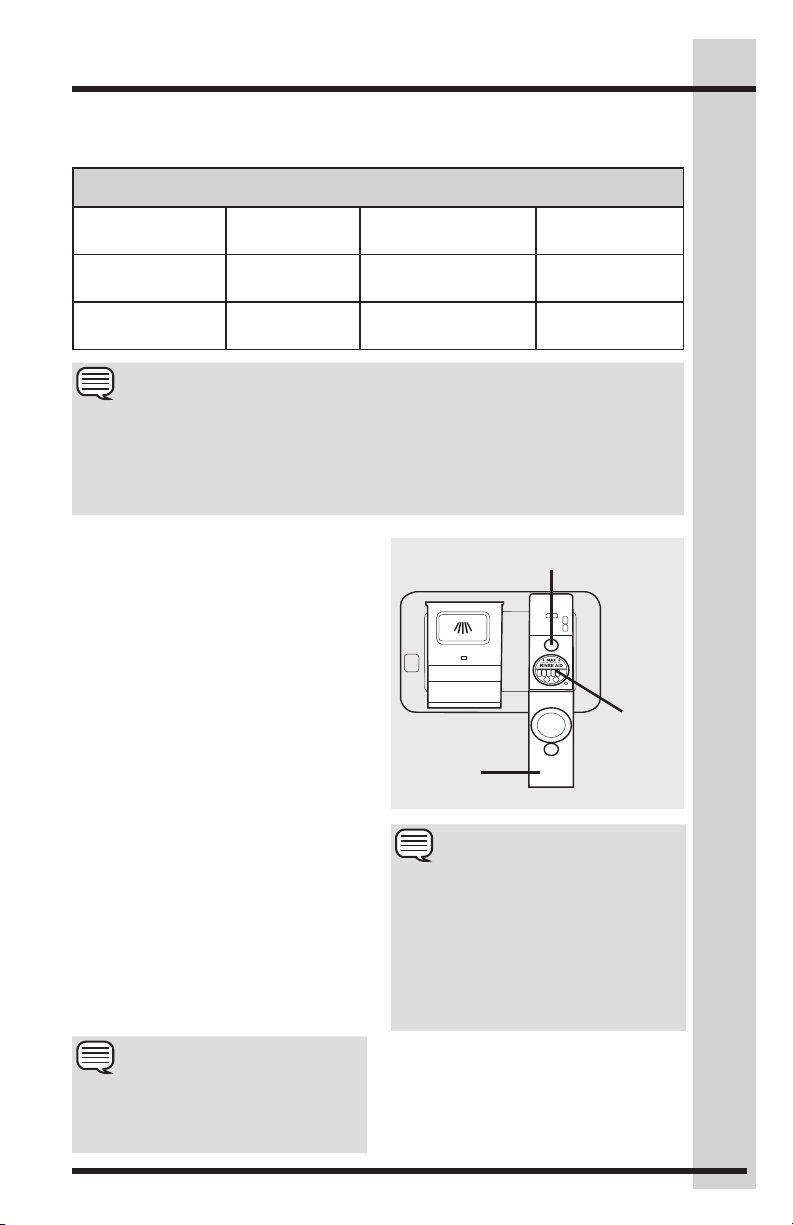
17
Operating Instructions
Dosage of detergent
Place a single detergent tablet or packet into the detergent dispenser compartment.
Detergent usage chart
Water Hardness Soft Water
(0-3 grains)
Medium Hard Water
(4-8 grains)
Hard Water
(9-12 grains)
Amount
(teaspoons)
4 teaspoons 6 teaspoons 8 teaspoons
Dispenser
cup level:
first line second line full
NOTE
For very hard water, detergent alone may not be enough. A water softener is
recommended to improve water quality and dishwashing performance. Try adding more
detergent at the beginning of the main wash portion of the cycle. As a rule, use
1 teaspoon for each grain above 12. Unlatch the door, open slowly add detergent
to the bottom of the tub. Close the door to latch and the dishwasher will continue
through the cycle.
Filling the rinse aid dispenser
Rinse aid greatly improves drying, reduces
water spots, filming, and lubricates wash
arm bearing for proper rotation. With
it water “sheets” off dishes rather than
forming water droplets that cling and leave
spots.
A dispenser, located next to the detergent
cup, automatically releases a measured
amount of rinse aid during the last
rinse. If spotting and poor drying are
problems, increase the amount of rinse aid
dispensed. The indicator will be dark when
full and the status window will show
“LOW RINSE” when it is time to refill.
To add liquid rinse aid:
1. Lift up the rinse aid cover to open.
2. Fill the rinse aid dispenser with liquid
rinse aid until the liquid reaches the
indicated fill level. DO NOT overfill.
3. Press the rinse aid cover down firmly
to close.
4. Wipe up any spills with a damp cloth.
The dispenser holds enough for 11 to 66
washes, depending on setting.
NOTE
Not selecting the AIR DRY option in
combination with rinse aid will enhance
drying performance. The energy required
to use the AIR DRY option saves
pennies per cycle. You may choose to
select the AIR DRY option; however you
will have items in your dish load that will
not be completely dry at the end of the
cycle.
Indicator
Rinse Aid
Compartment
Rinse Aid
Cover
NOTE
When using multi-product detergent
tablets or All-In-One packs with a rinse
aid component, the rinse aid dispenser
should be set at the lowest setting (L1).
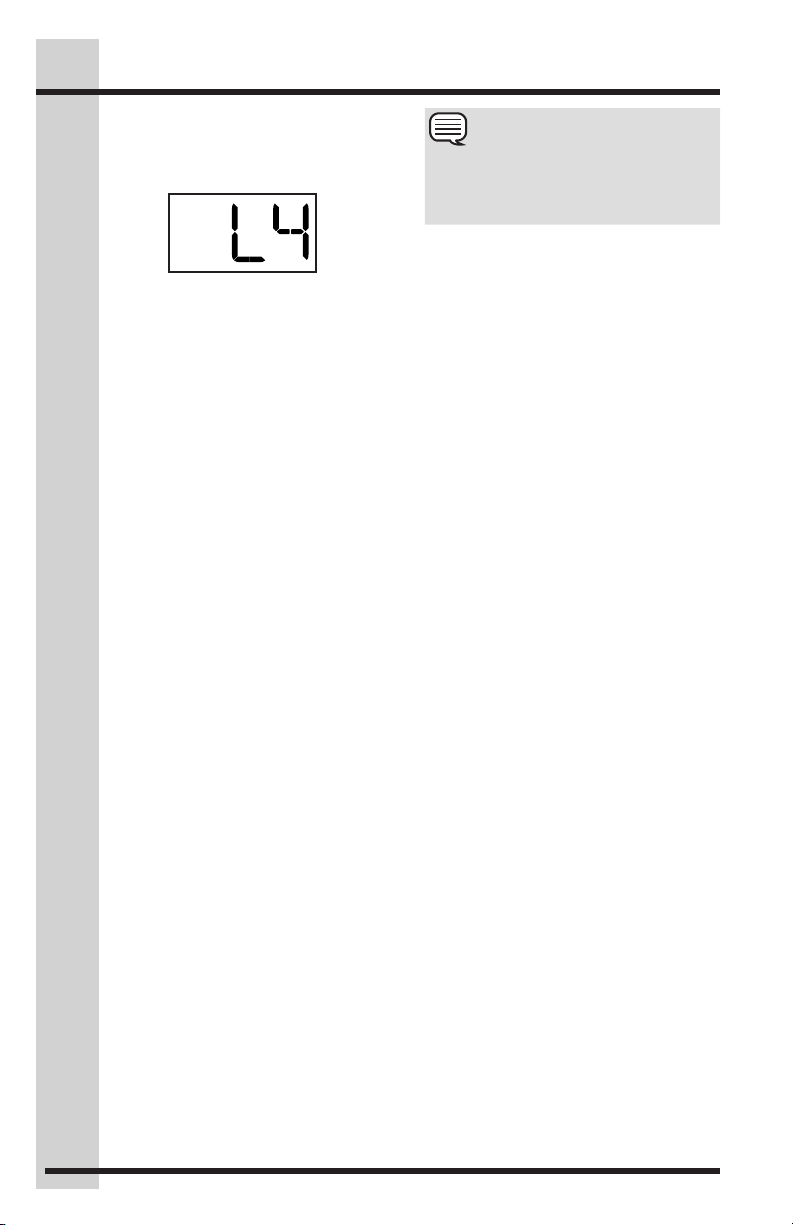
18
Operating Instructions
How to adjust the rinse aid
setting
The rinse aid dosage setting is shown in
the status window.
1. Press and hold RINSE
for 5
seconds until the status window
shows the current rinse aid setting of
L1, L2, L3 or L4.
2. Press the DELAY
pad to toggle
though to the desired level. Once the
rinse aid level reaches L4, the level
will go back to L1 and start the count
over.
3. The selected setting will start blinking
in the status window and a beeping
sound will confirm that the setting is
being saved.
NOTE
Set the rinse aid dispenser to the
lowest setting (L1) when using multi-
product detergents that have a rinse aid
component added to the detergent.
19
Care and Cleaning
Cleaning
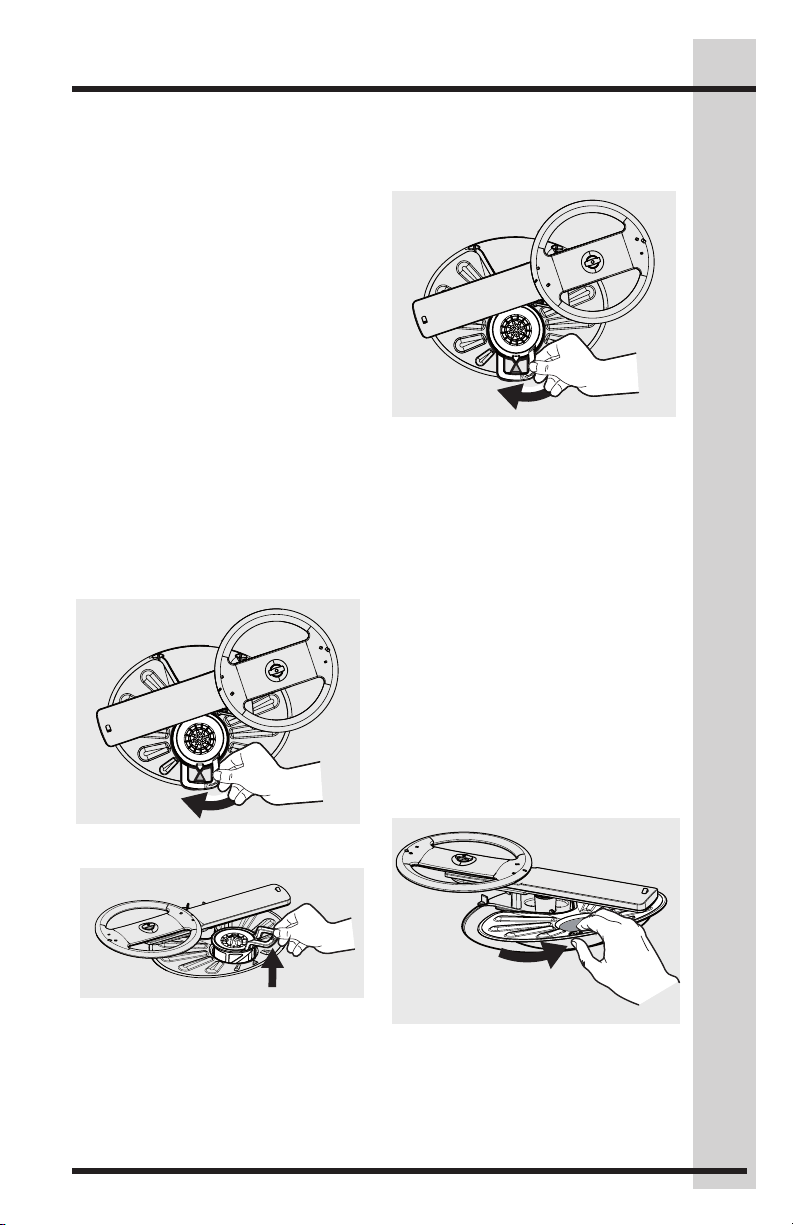
To replace the fine filter, press down and
rotate clockwise until the arrows are
aligned. A mechanical click will indicate
that the filter is firmly in place.
2. Lift it out and empty the contents.
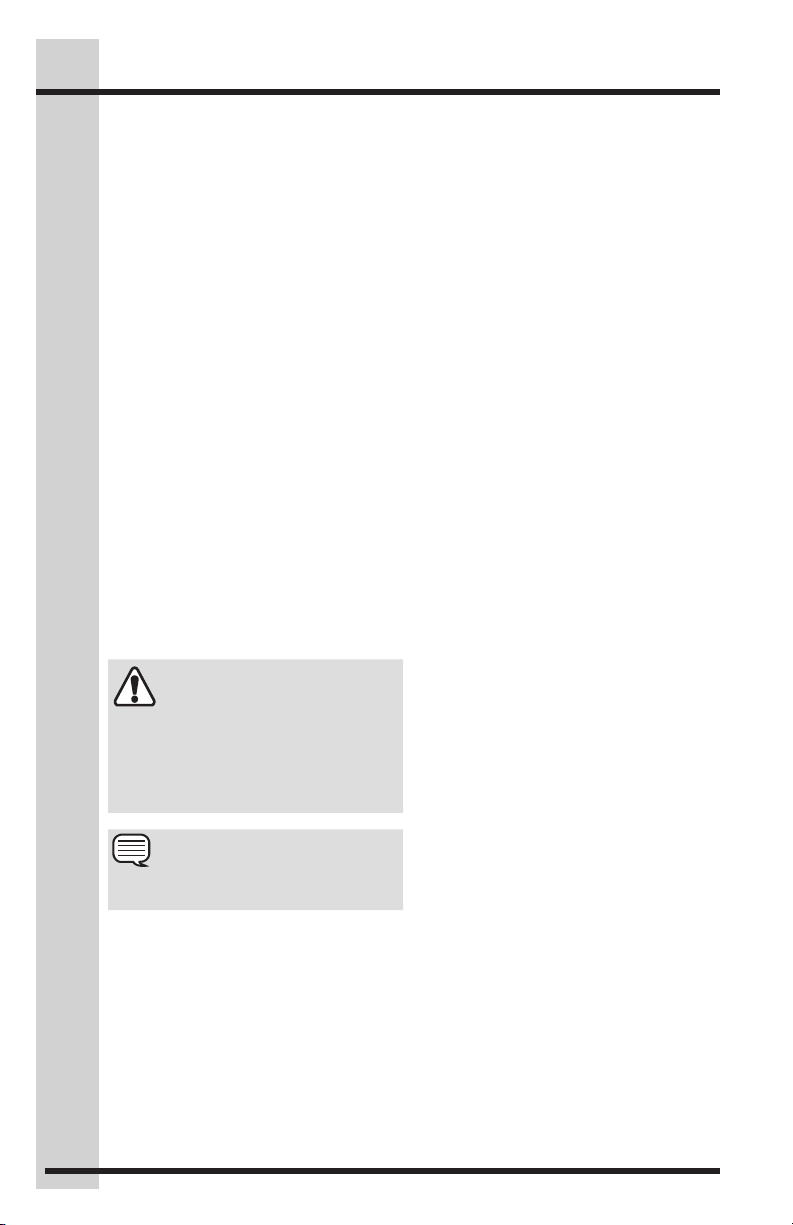
Clean the coarse filter
Take out the Cylinder Fine Filter and
remove the Coarse Filter from the
dishwasher tub bottom. Flush the Coarse
Filter by holding it under running water and
replace.
Clean the cylinder fine filter
The Cylinder Fine Filter is designed to
collect some big items such as broken
glass, bones and pits. The Cylinder Fine
Filter needs to be cleaned to maximize
wash performance.
Remove the Cylinder Fine Filter as shown:
1. Rotate it counterclockwise.
Outside
Occasionally wipe with a mild nonabrasive
detergent and water. Rinse and dry.
Care of drain air gap
If a drain air gap was installed for your
built-in dishwasher, check to make sure
it is clean so the dishwasher will drain
properly. A drain air gap is usually mounted
on the counter top and can be inspected
by removing the cover. This is not part of
your dishwasher and is not covered by
warranty.
3. Clean the filter by rinsing under
running water and replace. It may be
necessary to use a sponge or bottle
brush to remove excess food residue.
20
Care and Cleaning
Winterizing
A dishwasher left in an unheated place
should be protected from freezing. Have a
qualified person do the following.
To Disconnect Service:
1. Turn off electrical power to the
dishwasher at the supply source by
removing fuses or tripping circuit
breaker.
2. Shut off water supply.
3. Place a pan under the inlet valve.
Disconnect water line from the inlet
valve and drain into pan.
4. Disconnect drain line from pump and
drain water into pan.
To Restore Service:
1. Reconnect the water, drain, and
electrical power supply.
2. Turn on water and electrical power
supply
3. Fill detergent cup and run the
dishwasher through a HEAVY wash
cycle.
4. Check connections to make sure they
do not leak.
CAUTION
Freezing temperatures may cause
water lines to rupture. Be sure all supply
lines to and circulating lines within your
dishwasher are protected. Failure to do
so could result in property damage.
NOTE
See Installation Instructions for more
details.
21
Troubleshooting
Normal operating
sounds
Your dishwasher uses energy efficient
motors for the wash and drain portions
of the cycle you select. Each cycle has a
series of water fills and drains for washing
and rinsing dishes. As each cycle begins,
you may or may not hear the drain motor.
You may also hear the splashing of water
as it enters the tub and the spray arms as
they rotate and circulate water. The wash
motor often pulsates throughout the cycle,
which varies water pressure and optimizes
performance.
Normal operating lights
Your dishwasher pad lights when either
the cycle or option desired is selected. All
cycle and option pads have a white back
light when the pads are deselected and
turn blue when selected. In delay selection
and rinse aid setting, the deselected pads
are turned off.
Factors affecting
performance
Water Pressure
The hot water line to dishwasher must
provide water pressure between 20 and
120 psi.
Low water pressure may occur when
laundry or showers are in operation. If
you experience poor wash performance
you may need to wait until water use is
reduced before starting dishwasher.
Water temperature
Hot water is needed for best dishwashing
and drying results. Water entering
dishwasher should be at least 120°F
(49°C) to give satisfactory results.
To check water temperature entering
dishwasher:
• Turn on hot water faucet nearest
dishwasher for several minutes to clear
cool water from pipes.
• Hold a candy or meat thermometer
in the water stream to check the
temperature.
• If temperature is below 120°F (49°C),
have a qualified person raise the hot
water heater thermostat setting.
Removing spots and
film
Hard water can cause lime deposit buildup
on the interior of the dishwasher. Dishes
and glasses may also get spots and film
for a number of reasons. (See Glassware/
Flatware Spotted or Cloudy section). To
remove buildup, and film, clean using the
following instructions:
1. Load clean dishes and glasses in
normal manner. Do not load any metal
utensils or silverware.
2. Do not add detergent.
3. Select the NORMAL cycle. Press
START. Close and latch the door.
4. Allow dishwasher to run until it starts
the second water fill (approximately 10
minutes).
NOTE
Before starting a cycle, run hot water to
clear cool water from pipes.
NOTE
If the dishwasher door is opened while
the unit is running, the START/CANCEL
pad must be pressed and the door shut
immediately to return the unit to the
selected cycle and option. This must
happen within 10 minutes for the unit to
continue the cycle.
5. Unlatch an and open door and pour 2
cups of white vinegar into the bottom
of dishwasher.
6. Press START. Close and latch door
and allow cycle to finish.
22
Troubleshooting
Error codes
ERROR
CODE
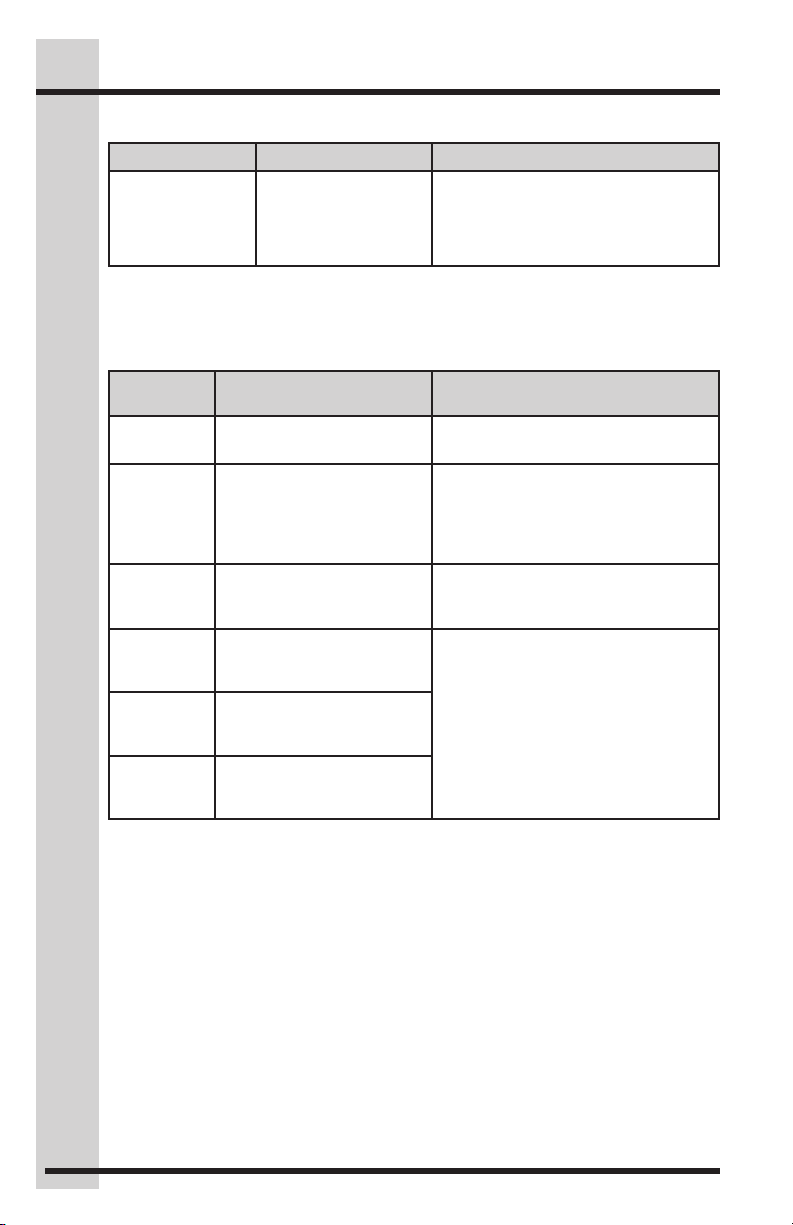
PROBLEM SOLUTION
i10 A low fill has been detected. Look for a pinched water supply line, or
water shutoff is not completely opened.
i20; i40; iF0 Clogged filters or a restricted
drain line has been detected.
Check and clean both filters and
sump area and check for a pinched or
blocked drain hose. If the drain line is
attached to a disposer, check that the
knockout plug has been removed.
i30 A leak or overflow of water
has been detected in the
bottom pan.
Look for loose connections at the
water inlet valve and ensure the unit is
properly leveled.
i50 A problem has been
detected with the drain or
wash motor.
Pressing the cancel button or turning
power off at the breaker for 5 min.
should clear this error code and the
unit can be restarted.
If this does not resolve the
problem, service will need to be
called.
i60 A problem has been
detected with the water
heating system.
iC0 A problem has been
detected with the electronic
control system.
*In all Error code instances, if Pressing the cancel button or turning power off at the
breaker for 5 min. does not resolve the problem, contact the Electrolux Customer Care
Center at 1-877-435-3287.
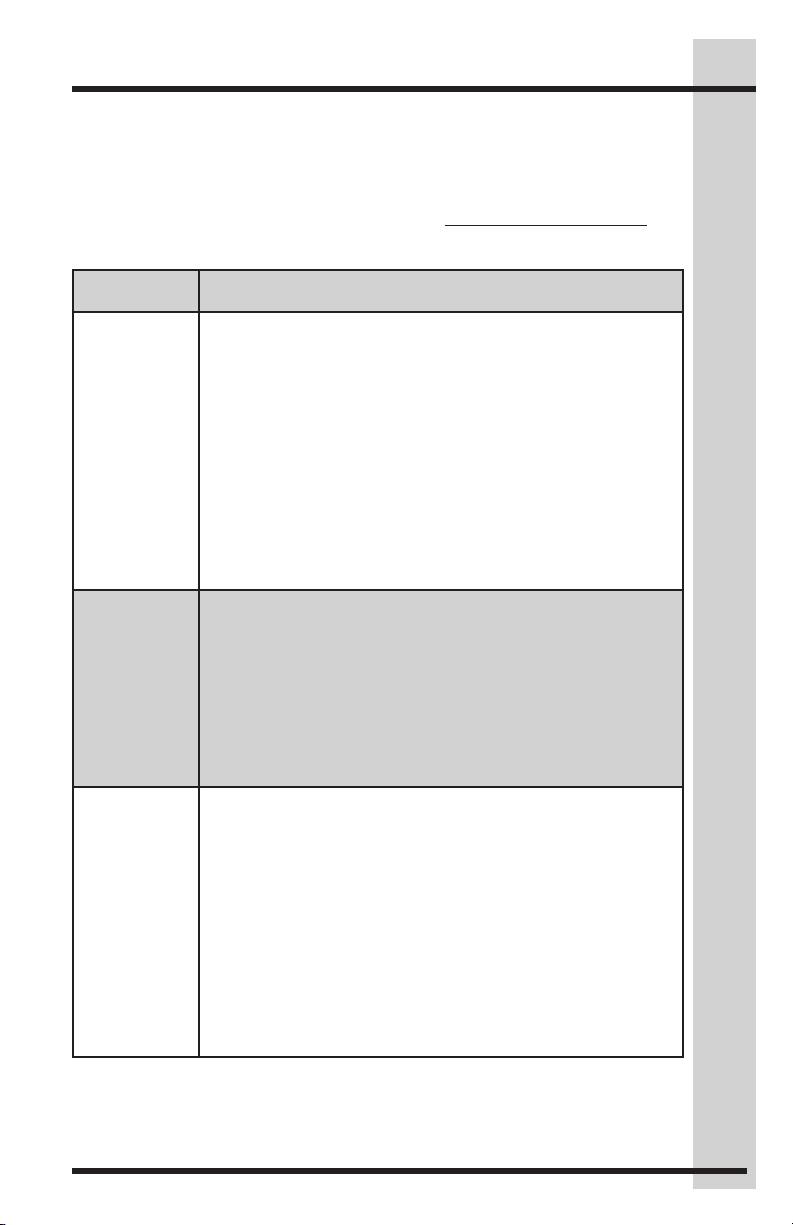
User Instruction Code
USER CODE PROBLEM SOLUTION
CLOSE This indicates the door
has been left open or
not properly latched.
Ensuring the door is properly latched
will clear the display. This does
not indicate a problem with your
dishwasher and service will not need to
be contacted.
23
Troubleshooting
PODS
®
is a registered trademark of Procter & Gamble Company, Cincinnati OH, used under license by Electrolux.
Before calling
Before calling for service, review this list. If may save you both time and expense.
This list includes common experiences that are not the result of defective workmanship
or material in your dishwasher.
To achieve the best results from your dishwasher, visit www.dishwashingexpert.com for
general tips regarding the performance and operation of your dishwasher.
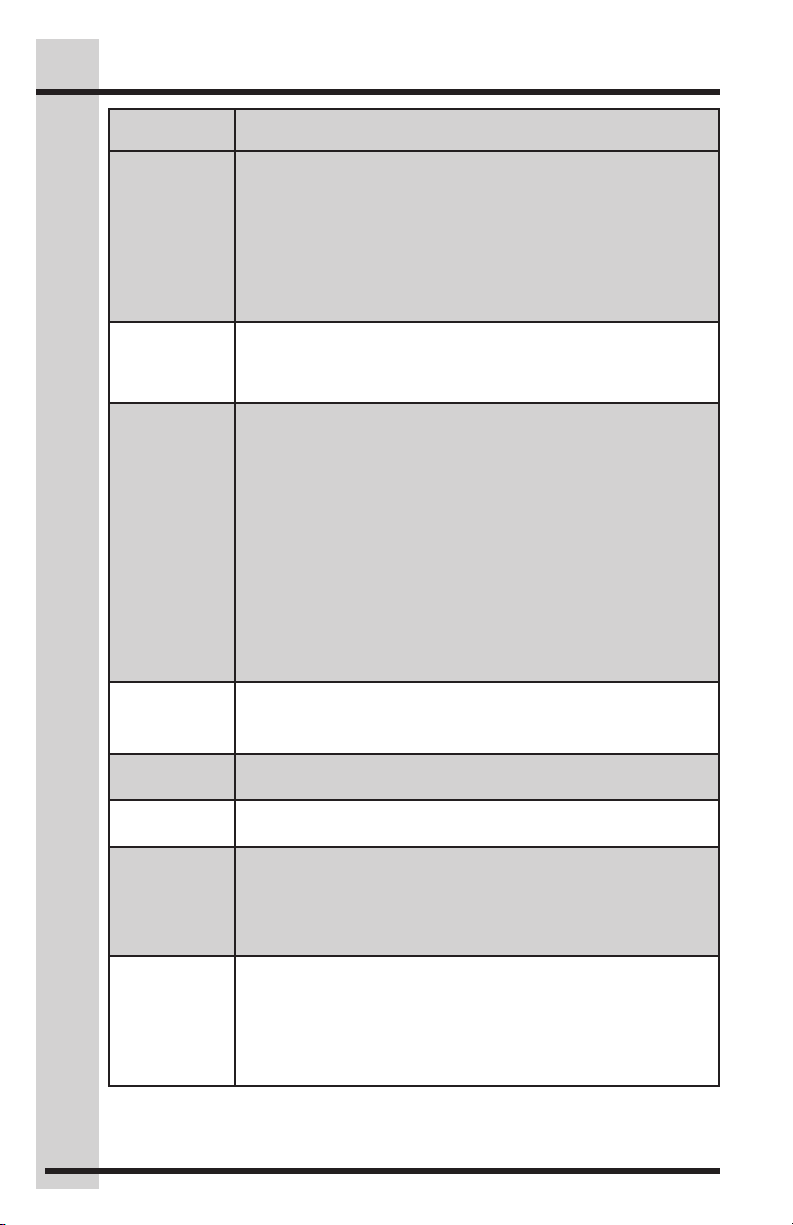
PROBLEM POSSIBLE CAUSES/SOLUTIONS
Food soils left
on dishes
• Choose another cycle for longer washing time.
• Choose the HI TEMP wash option.
• Check rack loading section for proper loading
• Avoid nesting items.
• Home water pressure may be too low-should be 20 to 120
pounds per square inch (psi).
• Check incoming water temperature. It should be about 120°F
(49°C). (See Factors Affecting Performance.)
• Check water hardness. For extremely hard water, it may be
necessary to install a water softener. (See Detergent Chart).
• Use Fresh Detergent.
• Make sure items are not blocking the spray arms, preventing
them from rotating.
Dishes not dry • Select heat dry option.
• Make sure the rinse aid dispenser is filled.
• Increase the discharge setting of rinse aid. (See Rinse Aid).
• Check the incoming water temperature. Be sure it is at least
120°F (49°C).
• Check for proper loading-avoid nesting items.
• Plastic items may need to be towel dried.
• Cups with a concave bottom will collect water. Load them at the
far left of the upper rack so they will be held in a tilted position.
Glassware/
flatware
spotted or
cloudy
• Check water hardness. For extremely hard water, it may be
necessary to install a water softener. (See Detergent Chart).
• Water temperature may be low. Avoid extremely low or high
temperatures. (See Factors Affecting Performance.
• Avoid overloading and improper loading. (See Preparing And
Loading he Dishes).
• Use fresh detergent. Old detergent is ineffective.
• Make sure rinse aid dispenser is filled.
• Check to see that proper amount of detergent is being used
for cycle selected. Also, check phosphate level. (See Detergent
Dispenser.)
• Home water pressure may be too low - it should be 20 to 120
pounds per square inch (psi).
24
Troubleshooting
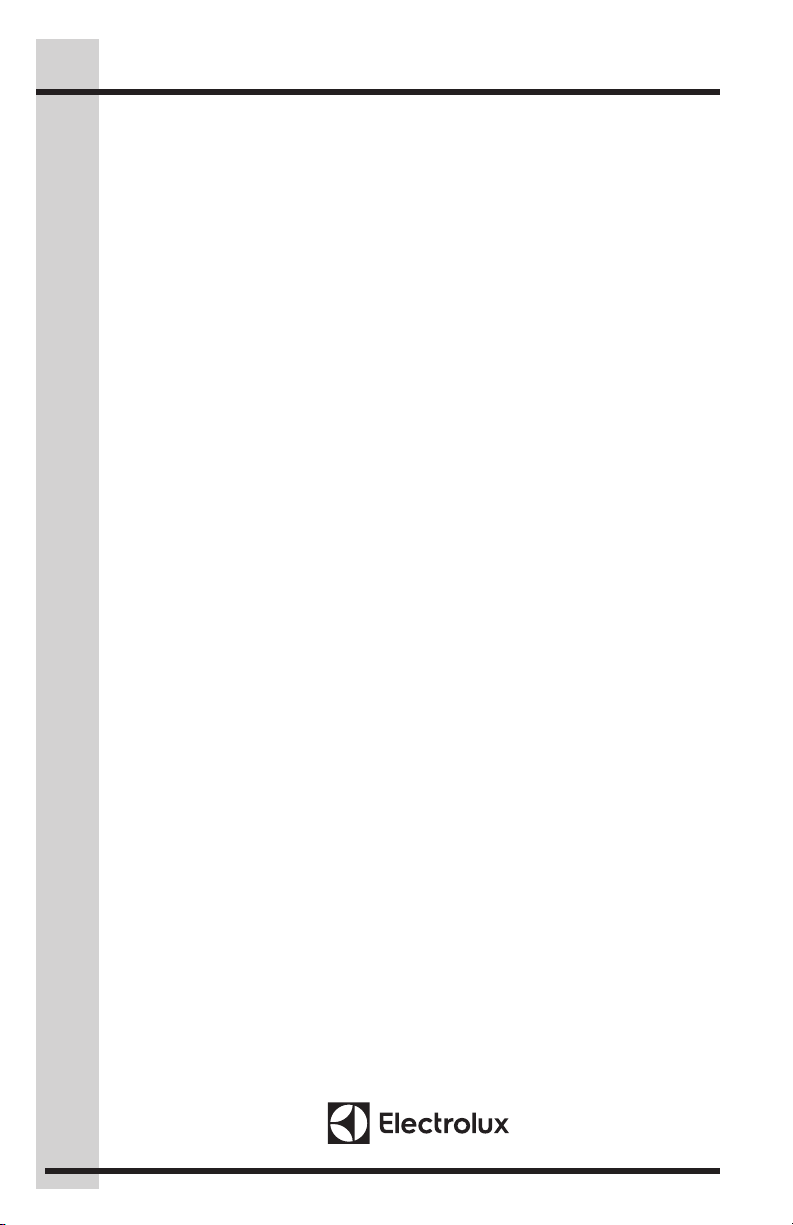
PROBLEM POSSIBLE CAUSES/SOLUTIONS
Dishware
chipped
• Load with care and do not overload. (See Preparing and Loading
Dishes).
• Place delicate items in top rack.
• Place glasses securely against pins and not over pins.
• Load items so they are secure and don’t jar loose when moving
racks in and out. Move racks in and out slowly.
• Make sure tall glasses and stemware will clear top of tub when
rack is pushed in.
Water in
bottom of tub
• Water left in the tub bottom after the cycle is complete is not
normal. If water remains in the bottom of the tub, the dishwasher
may not be draining properly. (See Dishwasher does not drain
properly).
Dishware
stained or
discolored
• Tea and coffee can stain cups. Remove the stains by hand
washing in a solution of 1/2 cup (120 ml) bleach and one quart
(1L) of warm water. Rinse thoroughly.
• Iron deposits in water can cause a yellow or brown film. A special
filter installed in the water supply line will correct this problem.
(See Removing Spots and Film).
• Aluminum utensils can leave gray/black marks when they rub
against other items. Load Properly.
• Certain high acid foods can cause discoloration of stainless steel
and plastics if allowed to sit for a long period. Use the RINSE
cycle or rinse by hand if not operating dishwasher at once.
• Mixing stainless steel and silver utensils in silverware basket can
cause pitting of the stainless steel blades. Avoid mixing stainless
steel and silver.
Cycle takes a
long time
• Is cycle in a water heating delay?
• Has the DELAY option been selected?
• Has the SANITIZE option been selected?
Normal sounds
you will hear
• Normal sounds include water fill, water circulation and motor
sounds.
Dishwasher
leaks
• Use only fresh detergent designed for automatic dishwashers.
Measure detergent carefully. Try a different brand.
Etching • Using too much detergent especially in soft or softened water
causes damage that looks like a film but cannot be removed.
• Adjust the amount of detergent based on the water hardness.
(Check Detergent Chart).
• Lower the water temperature.
Detergent left in
dispenser cup
• Detergent may be old. Discard and use fresh detergent.
• Be sure the dish load doesn’t block spray from entering the
detergent cup.
• Check to see if cycle has been completed.
• Make sure items do not prevent the detergent dispenser from
opening.

25
Troubleshooting
PROBLEM POSSIBLE CAUSES/SOLUTIONS
Vapor at vent • Water vapor escapes from the vent during the drying part of
cycle. This is normal.
• Spilled rinse aid can cause foam and lead to overflowing. Wipe up
any spills with a damp cloth.
• Check to see that dishwasher is level. (See Installation
Instructions).
Dishwasher
won’t run or fill
(error code i10)
• Check to see if circuit breaker is tripped or if a fuse is blown.
• Check that the water supply is turned on and the pressure of the
water supply is not too low. (Contact your local water company).
• Check that the water tap is open and is not clogged.
• Check that the cycle is set correctly. (See Operating Instructions).
• Check that the dishwasher is not set for DELAY.
• Check that the door is closed and latched.
• Check to that the filter in the inlet hose is not clogged and is free
of kinks and bends.
Dishwasher
does not drain
properly (error
code i20)
• If unit is hooked up to a food waste disposer, make sure the
disposer is empty.
• Check to see if the knockout plug has been removed from inside
the food waste disposer inlet.
• Check the sink spigot is not clogged.
• Check to see if drain hose is free of kinks and bends.
• Check to see if the cycle is complete, not in a pause.
Dishwasher has
an odor
• Soiled dishes left in dishwasher too long can create an odor. Use
the RINSE cycle.
• There will be a “new” smell when first installed. This is normal.
• Check to see if unit is draining properly. (See Dishwasher Does
Not Drain Properly).
Stains on tub
interior
• Washing large amounts of dishware with tomato based soil can
cause a pink/orange appearance. This will not affect performance
and will gradually fade over time. Pre-rinsing or using the RINSE
cycle will reduce the chance of staining. Using no heat dry option
will lessen staining.
26
Limited Warranty
USA
1-877-435-3287
Electrolux Home Products, Inc.,
North America
10200 David Taylor Drive
Charlotte, NC 28262
Canada
1-800-265-8352
Electrolux Canada Corp.
5855 Terry Fox Way
Mississauga, Ontario, Canada
L5V 3E4
Your appliance is covered by a one year limited warranty. For one year from your original date of
purchase, Electrolux will repair or replace any parts of this appliance that prove to be defective in
materials or workmanship when such appliance is installed, used, and maintained in accordance with
the provided instructions. The stainless tub and door liner of your appliance are covered by a lifetime
limited warranty. During the lifetime of the appliance, Electrolux will provide a replacement stainless tub
or door liner that fails to contain water due to a defect in materials or workmanship if the appliance is
installed, used, and maintained in accordance with the provided instructions. In addition, the dishwasher
racks and the electronic control module of your appliance are covered by a two through five year limited
warranty. During the 2nd through 5th years from your original date of purchase, Electrolux will provide
a replacement dishwasher rack or electronic control module for your appliance which has proven to
be defective in materials or workmanship when such appliance is installed, used, and maintained in
accordance with the provided instructions.
Exclusions:
This Warranty does not cover the following:
1. Products with original serial numbers that have been removed, altered or cannot be readily
determined.
2. Product that has been transferred from its original owner to another party or removed outside the
USA or Canada.
3. Rust on the interior or exterior of the unit.
4. Products purchased “as-is” are not covered by this warranty.
5. Food loss due to any refrigerator or freezer failures.
6. Products used in commercial setting.
7. Service Calls which do not involve malfunction or defects in materials or workmanship, or for
appliances not in ordinary household use or used other than in accordance with the provided
instructions.
8. Service Calls to correct the installation of your appliance or to instruct you how to use your
appliance.
9. Expenses for making the appliance accessible for servicing, such as removal of trim, cupboards,
shelves, etc., which are not part of the appliance when it is shipped from the factory.
10. Service calls to repair or replace appliance light bulbs, air filters, water filters, other consumables, or
knobs, handles, or other cosmetic parts.
11. Labor or in-home service costs during the additional limited warranty periods beyond the first year
from your original date of purchase.
12. Pickup and delivery costs; your appliance is designed to be repaired in the home.
13. Surcharges including, but not limited to, any after hour, weekend, or holiday service calls, tolls, ferry
trip charges, or mileage expense for service calls to remote areas, including the state of Alaska.
14. Damages to the finish of appliance or home incurred during transportation or installation, including
but not limited to floors, cabinets, walls, etc.
15. Damages caused by: services performed by unauthorized service companies; use of parts other
than genuine Electrolux parts or parts obtained from persons other than authorized service
companies; or external causes such as abuse, misuse, inadequate power supply, accidents, fires, or
acts of God.
DISCLAIMER OF IMPLIED WARRANTIES; LIMITATION OF REMEDIES
CUSTOMER’S SOLE AND EXCLUSIVE REMEDY UNDER THIS LIMITED WARRANTY SHALL BE REPAIR
OR REPLACEMENT AS PROVIDED HEREIN. CLAIMS BASED ON IMPLIED WARRANTIES, INCLUDING
WARRANTIES OF MERCHANTABILITY OR FITNESS FOR A PARTICULAR PURPOSE, ARE LIMITED
TO ONE YEAR OR THE SHORTEST PERIOD ALLOWED BY LAW, BUT NOT LESS THAN ONE YEAR.
ELECTROLUX SHALL NOT BE LIABLE FOR CONSEQUENTIAL OR INCIDENTAL DAMAGES SUCH
AS PROPERTY DAMAGE AND INCIDENTAL EXPENSES RESULTING FROM ANY BREACH OF THIS
WRITTEN LIMITED WARRANTY OR ANY IMPLIED WARRANTY. SOME STATES AND PROVINCES DO
NOT ALLOW THE EXCLUSION OR LIMITATION OF INCIDENTAL OR CONSEQUENTIAL DAMAGES,
OR LIMITATIONS ON THE DURATION OF IMPLIED WARRANTIES, SO THESE LIMITATIONS OR
EXCLUSIONS MAY NOT APPLY TO YOU. THIS WRITTEN WARRANTY GIVES YOU SPECIFIC LEGAL
RIGHTS. YOU MAY ALSO HAVE OTHER RIGHTS THAT VARY FROM STATE TO STATE.
If You Need Service
Keep your receipt, delivery slip, or some other appropriate payment record to establish the warranty
period should service be required. If service is performed, it is in your best interest to obtain and keep all
receipts. Service under this warranty must be obtained by contacting Electrolux at the address or phone
numbers below.
This warranty only applies in the USA, Puerto Rico and Canada. In the USA and Puerto Rico, your
appliance is warranted by Electrolux Major Appliances North America, a division of Electrolux Home
Products, Inc. In Canada, your appliance is warranted by Electrolux Canada Corp. Electrolux authorizes
no person to change or add to any obligations under this warranty. Obligations for service and parts
under this warranty must be performed by Electrolux or an authorized service company. Product features
or specifications as described or illustrated are subject to change without notice.

electrolux.com/shop