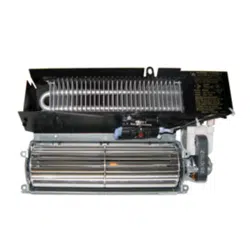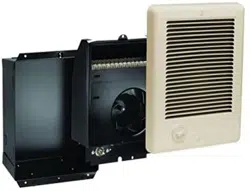
cadetheat.com Tel: 360-693-2505 PO Box 1675 Vancouver, WA 98668-1675
Benets You Can Depend On
SAVE THESE INSTRUCTIONS
Register Heater
Owner’s Guide
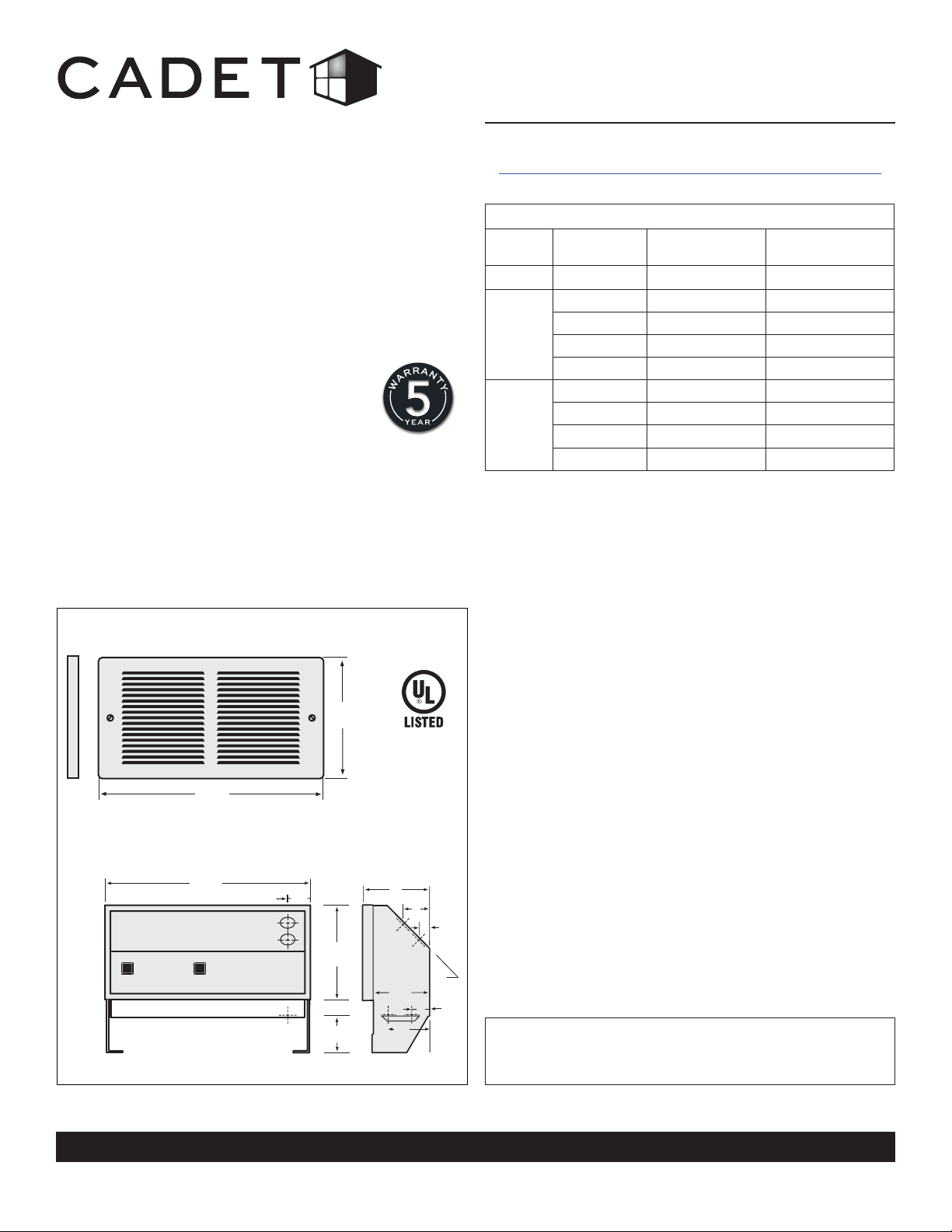
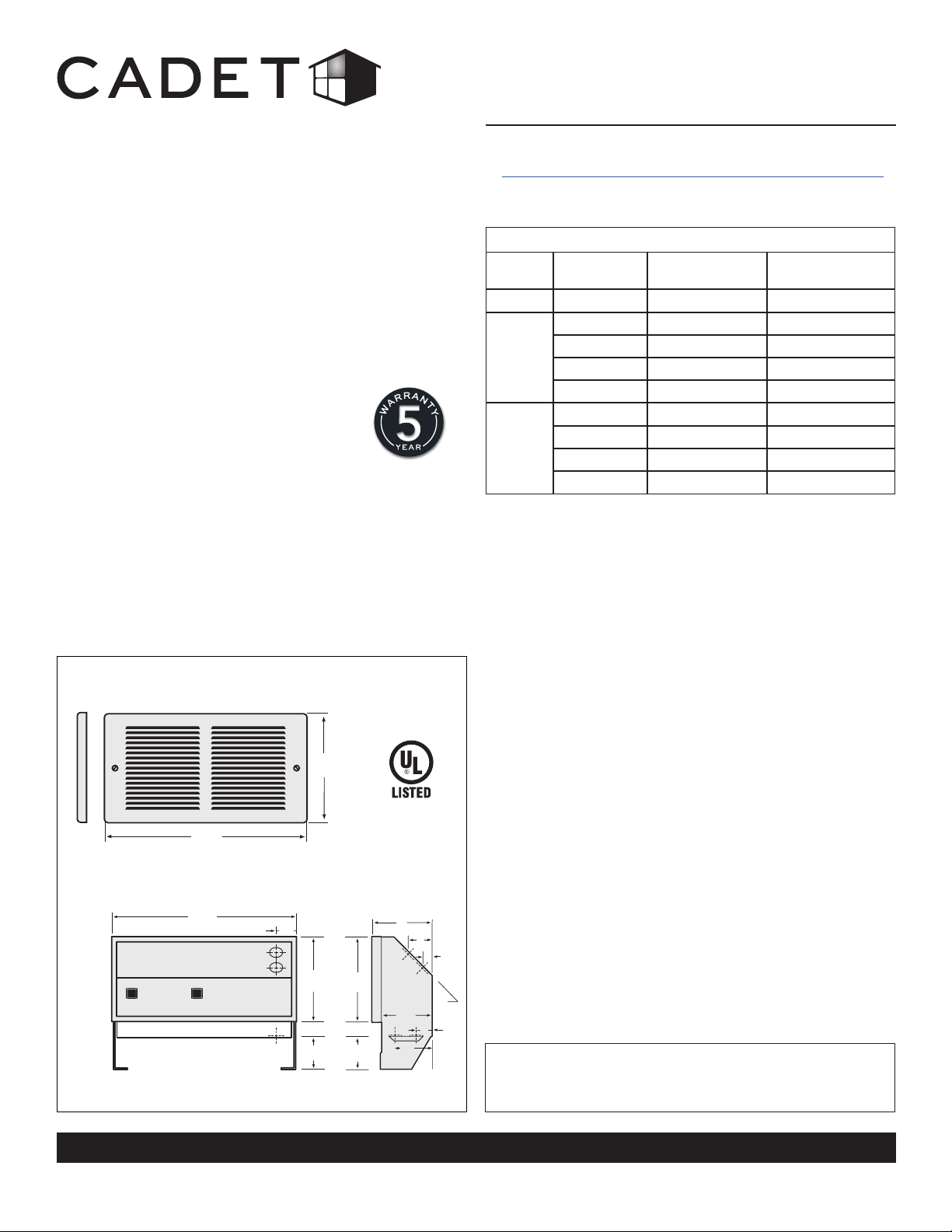
14”
35.56
4”
10.16
1”
2.54
2½”
6.35
7
3
/
8
”
18.73
3
3
/
8
”
8.57
2”
15.08
¾”
1.91
45°
1
3
/
8
”
3.49
5
7
/
8
”
14.92
1”
2.54
2”
5.08
12
5
/
8
”
32.07
Side Grill Front
Wall Can Side
Wall Can Bottom
1”
2.54
Register Models
Line
Voltage
Model w/o
Thermostat
Watts Amps
120
RM151 500/1000/1500 4.17/8.33/12.50
208
RM108 1000 4.81
RM158 1500 7.21
RM168 700/900/1600 3.37/4.33/7.69
RM208 2000 9.62
240
(1)
RM102 1000/750 4.17/3.61
RM162 700/900/1600 2.92/3.75/6.67
RM202 2000/1500 8.33/7.21
RM222 2250/1687 9.37/8.11
• Safe for you and your family
Peace of mind with automatic high temperature
shutoff feature
• Better air circulation and comfort with biggest,
most powerful blower
• Quiet, efcient and sophisticated—designed with
you in mind
1. NO sharp edges
2. Corrosion resistant
3. Installs quickly with one screw
4. Easy to install, compact wall can
5. Sleek appearance blends in naturally
• Your Cadet heater has been thoroughly tested
and is guaranteed with a 5 year extended
warranty
(1)
240 volt models can be used at 208 volts. Wattage equals 75% of 240v rated
wattage.
Note: A wall thermostat or built-in thermostat kit is
required for comfortable warmth and control
TOOLS REQUIRED:
• Phillips Screwdriver
• Straight Screwdriver
• Wire Strippers
• Utility Knife
• (4) 1 1/2“ Wood Screws
• Insulated Wire Connectors
• (1) Strain Relief Connector
http://www. cadetheat.com/products/wall-heaters/register-plus
Page 1

SAVE THESE INSTRUCTIONS
cadetheat.com Tel: 360-693-2505 PO Box 1675 Vancouver, WA 98668-1675
Wiring Diagram
IMPORTANT INSTRUCTIONS
MANUAL RESET
HIGH TEMP CUTOFF
1. Read all instructions before installing or using
this heater.
2. WARNING
Risk of Fire. This heater is hot when in use.
Caution—High Temperature. Risk of Fire. Keep
electrical cords, drapery, furnishings, and other
combustibles at least 3 feet from the front of the
heater and 6 inches above and on both sides.
3. WARNING
Burn Hazard. To avoid burns, do not let bare skin
touch hot surfaces. Extreme caution is necessary
when any heater is used by or near children or
invalids and whenever the heater is left operating
and unattended.
4. WARNING
Risk of Electrical Shock. Do not operate any
heater after it malfunctions. Disconnect power
at service panel and have heater inspected by a
qualied electrician before reusing.
5. WARNING
Do not use outdoors.
6. To disconnect heater, turn controls to off, and
turn off power to heater circuit at main disconnect
panel.
7. WARNING
Risk of Electrical Shock. Do not insert or allow
foreign objects to enter any ventilation or exhaust
opening as this may cause an electric shock or
re, or damage the heater.
8. WARNING
Risk of Fire. To prevent a possible re, do not
block air intakes or exhaust in any manner.
9. WARNING
Fire or explosion may occur. A heater has hot and
arcing or sparking parts inside. Do not use it in
areas where gasoline, paint, or ammable vapors
or liquids are used or stored.
10. Use this heater only as described in this
manual. Any other use not recommended by the
manufacturer may cause re, electrical shock, or
injury to persons.
11. The heater must be properly installed before
it is used.
12. WARNING
Risk of Electrical Shock and Fire. Do not operate
without grill.
13. Save these instructions.
WARNING
When using electrical appliances, basic precautions should always be followed to reduce the risk of re,
electric shock, and injury to persons, including the following:
Page 2
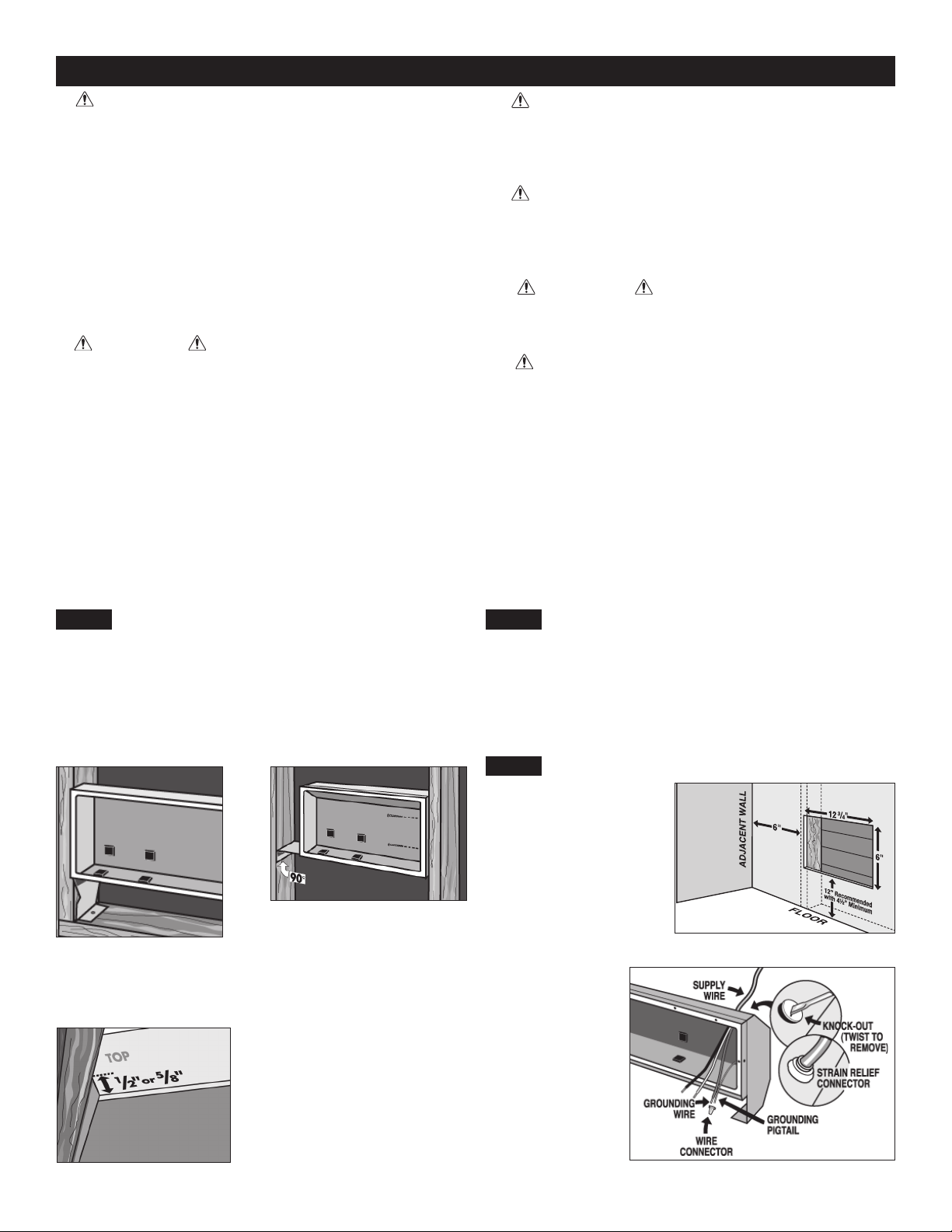
INSTALLATION INSTRUCTIONS
PLACEMENT: For best results install The Register on an inside wall. Headers and bracing are not necessary. NOTE: The wall can must
be installed in the TOP UP (horizontal) position only. Heater is not approved for ceiling mount.
THERMOSTAT: A thermostat is required. A Cadet Elec tronic Thermostat is recommended for ultimate control and comfort.
REQUIRED MINIMUM distance of 6 inches from adjacent surfac-
es and 4-1/2 inches from the oor (See Figure 4). However, Cadet
RECOMMENDS 12 inches from adjacent surfaces and oor for
longer and cleaner performance. Heaters must be spaced at least
3 feet apart.
Secure the wall can to the studs and/or sill plate with screws
through the larger (3/16 inch) holes. (See Figures 1 and 2).
Cut a hole 12¾ inches wide by 6 inches high next to a wall stud.
REQUIRED MINIMUM distance of 6 inches from adjacent surfac-
es and 4-1/2 inches from the oor (See Figure 4). However, Cadet
RECOMMENDS 12 inches from adjacent surfaces and oor for
longer and cleaner performance. Heaters must be spaced at least
3 feet apart.
Figure 3
Figure 5
Figure 4
Figure 2
Figure 1
Metal legs position wall can
at minimum oor clearance
Bend one leg 90 degrees for
higher placement, and secure
to studs
Face of wall can must extend
1/2 inch or 5/8 inch from face
of stud to allow for thickness of
sheetrock. Mount wall can ush
with nished surface.
STEP 2
Route Supply Wires
Route supply wire from
circuit breaker to wall
thermostat, then to wall
can. Remove a knockout
and attach the supply wire
with a strain relief connec-
tor leaving 10 inches wire
lead for later use (See
Figure 5). Connect sup ply
ground wire to ground ing
pigtail in wall can.
1. WARNING
Verify that the electrical supply wires are the same
voltage as the heater.
2. If replacing an existing heater, check the label
of the old heater.
3. All electrical work and materials must comply
with the National Electric Code (NEC), the Occu-
pational Safety and Health Act (OSHA), and all
state and local codes.
4. If you need to install a new circuit or need addi-
tional wiring information, consult a qualied elec-
trician.
5. Use copper conductors only.
6. WARNING
Risk of Electrical Shock. DO NOT install the heat-
er directly above bathtub or sink. DO NOT install
in shower stall area (Manufacturer recommends a
minimum 2 foot clearance).
7. Heater must be installed in a wall can:
Model RM Wall Can RMC
8. WARNING
Risk of Fire. DO NOT install the heater in a oor,
in the ceiling, below a towel bar, behind a door,
or anywhere the air discharge may be blocked in
any manner.
9. WARNING
Fire or Explosion May Occur. A heater has hot
and arcing or sparking parts inside. Do not use it
in areas where gasoline, paint, or ammable va-
pors or liquids are used or stored.
10. WARNING
Risk of Electrical Shock. Connect grounding lead
to grounding pigtail provided. Keep all foreign ob-
jects out of heater.
11. WARNING
Risk of Fire. This heater is hot when in use.
Caution—High Temperature. Risk of Fire. Keep
electrical cords, drapery, furnishings, and other
combustibles at least 3 feet from the front of the
heater and 6 inches above and on both sides.
__________________________
Part One
__________________________
How do I install for new construction?
STEP 1
Mount The Wall Can
How do I install in an existing wall?
STEP 1
Cut A Hole In The Wall
Page 3

INSTALLATION INSTRUCTIONS (continued)
__________________________
Part One
__________________________
__________________________
Part Two
__________________________
If you are installing a Multi-Watt heater, model numbers RM151, RM162, or RM168, begin with STEP 1 below. If you are installing an
RM202, RM208, RM158, or RM108, begin with STEP 2 below.
How do I install for new construction?
STEP 2
Route Supply Wires
How do I install in an existing wall?
STEP 3
Mount Wall Can
Route supply wire from circuit breaker to thermostat to wall can.
Remove a knockout and attach the supply wire with a strain relief
connector leaving 10 inches wire lead for later use. Connect sup-
ply ground wire to grounding pigtail in wall can (See Figure 5).
Proceed to PART TWO.
IMPORTANT: Insert two drywall screws into the small holes
opposite the wall stud into the drywall to rest against backside of
sheetrock (keeping wall can ush to wall).
Proceed to PART TWO.
Figure 6 Figure 7
Insert wall can, legs rst, into opening and rotate into wall. Keep-
ing front of wall can ush with nished surface, secure to wall stud
with screws through larger (3/16 inch) holes. (See Figures 6 and
7).
Element Wire Conguration (Multi-watt models RM151, RM162 and RM168 only)
STEP 1
Cadet’s Multi-Watt RM heater offers a variety of heat output options. You must rst determine the desired wattage and then congure
the heating element wire connections. The heater is shipped from the factory congured for maximum watts: 1600 Watts (240V) and
(208V) for RM162 and RM168, and 1500 Watts (120V) for RM151. If this is the wattage you desire, proceed to STEP 2.
On models RM151, RM162 and RM168, mark wiring diagram on the back of the heater with the wattage used for future reference.
Install Heater Assembly
STEP 2
Set the heater assembly (blower wheel rst) into the left side of the wall can. Fasten at top with screw provided. Unlace heater lead
wires. Connect the supply wires to the heater wires (See Figure 9). Keep all wires away from element connections when wires are
pushed into free space on right of heater.
Install Grill
STEP 3
Secure grill with the screws provided. If you have a built-in thermostat model, slide thermostat knob onto shaft. Turn power on at the
electrical panel board.
Figure 8a RM Wiring Table
Figure 9
MODEL VOLTAGE
IF YOUR DESIRED
WATTAGE IS:
YOUR WIRES WILL BE CONFIGURED LIKE THIS:
Upper Element A Lower Element C
900W-240V 700W-240V
RM162 240V
1600 Yellow Terminal X Blue Terminal Z
900 Yellow Terminal X None (*)
700 None (*) Yellow Terminal X
900W-208V 700W-208V
RM168 208V
1600 Yellow Terminal X Blue Terminal Z
900 Yellow Terminal X None (*)
700 None (*) Yellow Terminal X
1000W-120V 500W-120V
RM151 120V
1500 Yellow Terminal X Blue Terminal Z
1000 Yellow Terminal X None (*)
500 None (*) Yellow Terminal X
*Cut Blue Terminal from Red Wire and wrap up with electrical tape. Yellow
Terminal Y remains connected at B
.
Do Not Touch. Refer to Wiring Diagram on
Page 2 for terminal locations.
Figure 8b
Page 4

OPERATING INSTRUCTIONS
Resetting the Manual Reset Limit Control
Warranty
For more effective and safer operation and to prolong the life of
the heater, read the Owner’s Guide and follow the maintenance
instructions. Failure to properly maintain the heater will void any
warranty and may cause the heater to function improperly. War-
ranties are non transferable and apply to original consumer only.
Warranty terms are set out below.
LIMITED FIVE-YEAR WARRANTY: Cadet will repair or replace
any Register (RM) heater found to be defective within ve years
after the date of purchase.
These warranties do not apply:
1. Damage occurs to the product through improper installation or
incorrect supply voltage;
2. Damage occurs to the product through improper maintenance,
misuse, abuse, accident, or alteration;
3. The product is serviced by anyone other than Cadet;
4. If the date of manufacture of the product cannot be deter-
mined;
5. If the product is damaged during shipping through no fault of
Cadet.
6. CADET’S WARRANTY IS LIMITED TO REPAIR OR RE-
PLACEMENT AS SET OUT HEREIN. CADET SHALL NOT BE
LIABLE FOR DAMAGES SUCH AS PROPERTY DAMAGE OR
FOR CONSEQUENTIAL DAMAGES AND/OR INCIDENTAL EX-
PENSES RESULTING FROM BREACH OF THESE WRITTEN
WARRANTIES OR ANY EXPRESS OR IMPLIED WARRANTY.
7. IN THE EVENT CADET ELECTS TO REPLACE ANY PART
OF YOUR CADET PRODUCT, THE REPLACEMENT PARTS
ARE SUBJECT TO THE SAME WARRANTIES AS THE PROD-
UCT. THE INSTALLATION OF REPLACEMENT PARTS DOES
NOT MODIFY OR EXTEND THE UNDERLYING WARRANTIES.
REPLACEMENT OR REPAIR OF ANY CADET PRODUCT OR
PART DOES NOT CREATE ANY NEW WARRANTIES.
8. These warranties give you specic legal rights, and you may
also have other rights which vary from state to state. Cadet nei-
ther assumes, nor authorizes anyone to assume for it, any other
obligation or liability in connection with its products other than as
set out herein.
If you believe your Cadet product is defective, please contact
Cadet Manufacturing Co. at 360-693-2505, during the warranty
period, for instructions on how to have the repair or replacement
processed. Warranty claims made after the warranty period has
expired will be denied. Products returned without authorization
will be refused.
Parts and Service
Visit cadetheat.com/parts-service for information on where to
obtain parts and service.
Reduce-Reuse-Recycle
This product is made primarily of recyclable materials. You
can reduce your carbon footprint by recycling this product at
the end of its useful life. Contact your local recycling support
center for further recycling instructions.
About the Manual Reset Temperature Limit Control
The heater is protected by a temperature-limiting control. The
manual reset temperature limit control is designed to open
the heater circuit when excessive operating temperatures are
detected. The problem must be assessed and the limit must be
reset to resume operation.
Resetting the Manual Reset Temperature Limit Control
If the manual reset limit control has opened the heater circuit due to excessive operating temperatures, the heater will not work until
the manual reset limit button is pressed. After allowing the unit to cool for at least 10 minutes and resolving the problem causing the
limit to trip (typically the heater is blocked or needs cleaning-see Maintenance Instructions); use a narrow object such as a ball-point
pen to access the manual reset button through the lower-right center section of the heater grill. Press FIRMLY and be sure to listen
and feel for a click, indicating it has been reset.
How to operate your heater
The room temperature is controlled by a line voltage thermostat
located either on the wall or built-in to the heater.
1. Once installation is complete and power has been restored,
turn the thermostat knob fully clockwise.
2. When the room reaches your comfort level, turn the thermo-
stat knob counterclockwise until the heater turns off. The heater
will automatically cycle around this preset temperature.
3. To reduce the room temperature, turn the knob counterclock-
wise. To increase the room temperature, turn the knob clockwise.
WARNING Risk of Electrical Shock and Fire.
The heater must be properly installed before it is
used.
1. Do not operate without grill.
2. Keep electrical cords, drapery, furnishings and
other combustibles at least 3 feet away from the
front of the heater and 6 inches away from the
sides.
3. Do not tamper with the over temperature limit
control.
4. If the heater over temperature limits trip more
than once per day, the heater must be replaced.
5. Clean heater at least every six months.
6. After allowing the heater to cool, turn power off
at circuit breaker panel before removing grill.
7. Use a hair dryer or vacuum on blow cycle to
blow debris through the top element (do not touch
element).
8. Install the grill before turning on power.
WARNING: Any other service not detailed in
this Owner’s Guide should be performed by an
authorized service representative.
Page 5
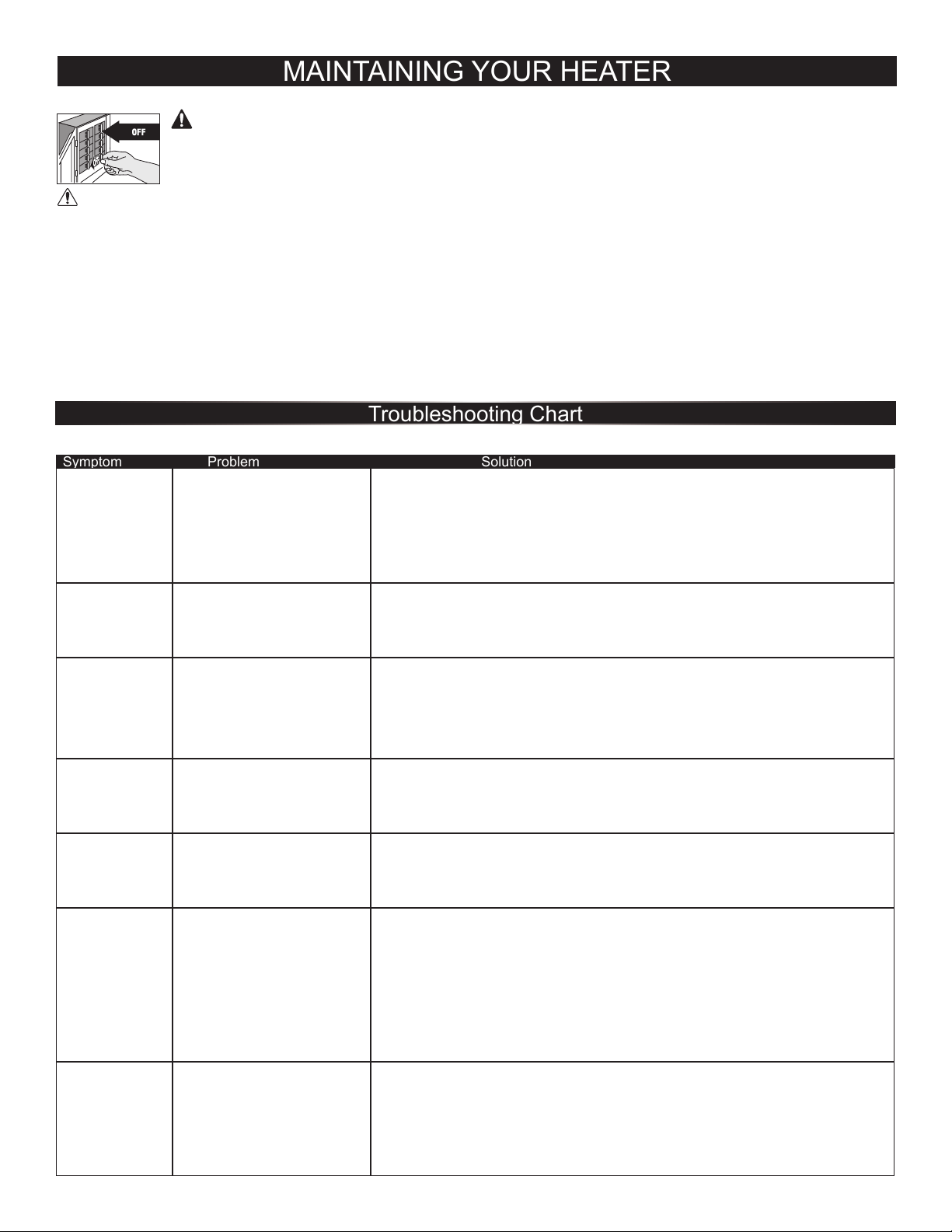
Symptom Problem Solution
MAINTAINING YOUR HEATER
Troubleshooting Chart
WARNING! Before removing grill, turn the electrical power off at the electrical panel
board (circuit breaker or fuse box). Lock or tag the panel board door to prevent someone
from accidentally turning the power on while you are working on the heater. Failure to do
so could result in serious electrical shock, burns, or possible death.
WARNING: Any other service not detailed in this Owner’s Guide should be performed by an
authorized service representative.
Maintenance As Needed, or every six months minimum.
*CONSULT LOCAL ELECTRICAL CODES TO DETERMINE WHAT WORK MUST BE PERFORMED BY QUALIFIED
ELECTRICAL SERVICE PERSONNEL
Breaker trips
immediately upon
energizing heater.
1. Incorrect supply voltage.*
2. Overloaded circuit.*
3. A short circuit exists in the
supply or heater wiring.*
4. Defective circuit breaker.*
1. Verify that supply voltage matches the heater rating.
2. The total amperage of all heaters on a branch circuit must not be more than 80% of
the amperage rating of the circuit breaker and supply wire ratings. Use a lower wattage
heater, or reduce the number of heaters on the circuit.
3. Shorted supply or heater wires may be accompanied by severe sparking. Inspect all
supply and heater wiring insulation for damage. Do not reset the circuit breaker until all
electrical shorts have been repaired.
4. Replace the circuit breaker.
Heater fan
operates,
but does not
discharge warm
air.
1. Insufcient element tempera-
ture.
2. Incorrect supply voltage.*
3. Element has failed.*
1. Allow a few moments for element to reach operating temperature.
2. Verify that supply voltage matches the heater rating.
3. Replace element.
Heater will not
shut off.
1. Heat loss from room is great-
er than heater capacity.*
2. Defective thermostat.
3. Thermostat wired incorrectly
to heater.*
1. Close doors and windows. Provide additional insulation or install a higher-wattage heat-
er or multiple heaters if necessary (if your circuit is rated for more capacity).
2. Adjust thermostat to its lowest setting. If heater continues to run (allow two minutes for
the thermostat to respond), and room temperature is greater than 50 degrees; replace
thermostat.
3. Refer to thermostat documentation and correct wiring.
Heater discharges
smoke or emits a
burnt odor.
1. Dust, lint or other matter has
accumulated inside heater.
2. Poor or loose electrical con-
nections.
1. Clean heater (see “Maintenance” section above for instructions).
2. Turn off power at circuit breaker. Inspect all supply and heater wire connections to
make sure nothing is loose or poorly connected. Secure or reconnect all loose connec-
tions. Do not reset circuit breaker until all connections have been checked and repaired.
Element heats for
a moment without
the fan turning,
then immediately
stops heating.
1. Defective motor or internal
connection.*
2. Fan or motor jammed.
1. Heater or fan motor requires replacement.
2. Remove obstruction, and press heater manual reset button (see “Operating” section for
instructions).
Heater does not
run.
1. Thermostat set too low.
2. Heater has tripped the
manual reset temperature limit
control.
3. Power not on at the circuit
breaker.
4. Broken or poorly connected
wire(s) to heater.
5. Defective thermostat.
1. Adjust thermostat to a higher temperature until heater operates (see Problem #5 if the
problem persists).
2. Press the manual reset button (see “Operating” section for instructions).
3. Turn on the correct circuit breaker in the main panel.
4. Turn off power at circuit breaker. Check supply wire continuity and proper connection to
heater wires.
5. The entire heater, or any of its components may be checked for continuity to determine
the cause of any problem. Repair or replace the heater or thermostat.
Heater continually
trips the manual
reset temperature
limit control.
1. Dust, lint or other matter has
accumulated inside heater.
2. Airow is blocked.
3. Fan or motor is jammed.
4. None of the above.
1. Clean heater (see “Maintenance” section for instructions.)
2. Remove obstruction. Maintain a minimum distance of 6 inches from adjacent surfaces,
4.5 inches from the oor, and 3 feet for furniture or other objects placed directly in front of
the heater.
3. Remove obstruction, and press heater manual reset button (see “Operating” section for
instructions).
4. Replace heater assembly.
1. It is important that you verify power has been turned off and no
power is going to the heater before proceeding. Circuit breakers
are often not marked correctly and turning the wrong breaker off
could mean electricity is owing to the heater, even if the heater
does not appear to be working. If you are uncomfortable working
with electrical appliances, unable to follow these guidelines, or do
not have the necessary equipment, consult a qualied electrician.
2. Once you verify the power has been turned off correctly, pro-
ceed to the next step.
3. Remove screws and take off grill.
4. Wash grill with hot soapy water and dry immediately.
5. While holding blower wheel (to avoid damage or bending), use
a hair dryer or vacuum on blow cycle to blow debris through the
element (do not touch element).
6. Vacuum blower area without touching the element.
7. Do not lubricate motor.
8. Replace grill and secure with screws.
9. Turn thermostat to desired setting.
10. Turn power back on at the electrical panel board.
Page 6
©2014 Cadet Printed in USA Rev 08/14 #730104
cadetheat.com Tel: 360-693-2505 PO Box 1675 Vancouver, WA 98668-1675
Benecios En Las Que Puede Conar
CONSERVE ESTAS INSTRUCCIONES
El Calentador Register
Guía Para el Propietario
2”
5.08
14”
35.56
4”
10.16
1”
2.54
2½”
6.35
1”
2.54
5
7
/
8
”
14.92
7
3
/
8
”
18.73
3
3
/
8
”
8.57
2”
15.08
¾”
1.91
45°
1
3
/
8
”
3.49
5
7
/
8
”
14.92
1”
2.54
2”
5.08
12
5
/
8
”
32.07
Costado Rejilla Frente
Cámara de
pared costado
Cámara de pared inferior
1”
2.54
Modelos Register
Voltaje
Línea
Modelo sin
Termostato
Vatios Amps
120
RM151 500/1000/1500 4.17/8.33/12.50
208
RM108 1000 4.81
RM158 1500 7.21
RM168 700/900/1600 3.37/4.33/7.69
RM208 2000 9.62
240
(1)
RM102 1000/750 4.17/3.61
RM162 700/900/1600 2.92/3.75/6.67
RM202 2000/1500 8.33/7.21
RM222 2250/1687 9.37/8.11
• Seguro para usted y su familia
Tranquilidad gracias a la función de apagado
automático por alta temperatura
• Mejor circulación de aire y comodidad con el
soplador más grande y potente
• Silencioso, eciente y sosticado—diseñado
pensando en usted
1. SIN bordes losos
2. Resistentes a la corrosión
3. Calentador fácil de instalar
con un solo tornillo
4. Cámara de pared compacta fácil de instalar
5. Aspecto elegante que armoniza en forma
natural
• Su calentador Cadet ha sido completamente
probado y cuenta con una garantía extendida de
5 años
(1)
Los modelos de 240 voltios pueden usarse a 208 voltios. El vatiaje es igual al
75% de la potencia nominal de 240 v.
Nota: Se requiere un juego de termostato mural
o incorporado para mayor comodidad y control
del calor
HERRAMIENTAS NECESARIAS:
• Destornillador Phillips
• Destornillador plano
• Pelacables
• Cuchillo multiuso
• (4) tornillos de 1½” para madera
• Conectores de alambre aislados
• (1) conector de alivio de tensión
http://www. cadetheat.com/products/wall-heaters/register-plus
Página 7

cadetheat.com Tel: 360-693-2505 PO Box 1675 Vancouver, WA 98668-1675
CONSERVE ESTAS INSTRUCCIONES
INSTRUCCIONES IMPORTANTES
Diagramas de cableado
ADVERTENCIA
Al utilizar artefactos eléctricos, siempre se deben adoptar precauciones básicas para reducir el riesgo
de incendios, electrocución y lesiones personales, incluyendo lo siguiente:
1. Lea todas las instrucciones antes de instalar o
usar este calentador.
2. ADVERTENCIA
Riesgo de incendio. Este calentador se calienta
mucho cuando está en uso. Precaución – Alta
temperatura. Riesgo de incendio. Mantenga los
cables eléctricos, cortinas, muebles, y demás
materiales combustibles a por lo menos 3 pies por
delante y a 6 pulgadas por encima y por ambos
costados del calentador.
3. ADVERTENCIA
Riesgo de quemaduras. Para evitar quemaduras,
no lo toque con su piel descubierta. Tenga
mucho cuidado cuando algún tipo de calentador
sea usado por o cerca de niños o de personas
inválidas, y cada vez que lo deje funcionando sin
vigilancia.
4. ADVERTENCIA
Riesgo de electrocución. No opere ningún
calentador después de una avería. Desconecte
la alimentación en el panel de servicio y pida a un
técnico electricista calicado que lo revise antes
de volver a usarlo.
5. ADVERTENCIA
No lo use a la intemperie.
6. Para desconectarlo, ponga los controles en
OFF, y apague la alimentación del circuito del
calentador en el panel de desconexión principal.
7. ADVERTENCIA
Riesgo de electrocución. No introduzca ni
permita que ingresen objetos en las aberturas
de la ventilación o escape, ya que ello puede
causar electrocución o incendio, o bien dañar el
calentador.
8. ADVERTENCIA
Riesgo de incendio. Para evitar posibles
incendios, no bloquee las tomas de aire ni el
escape de manera alguna.
9. ADVERTENCIA
Podrían producirse explosiones o incendios.
Todo calentador contiene piezas que se calientan
y pueden producir arcos voltaicos o chispas.
No lo use en áreas donde se utilice o almacene
gasolina, pintura o vapores o líquidos inamables.
10. Use este calentador sólo como se describe en
este manual. Todo otro uso no recomendado por
el fabricante puede causar incendios, descargas
eléctricas o lesiones personales.
11. El calentador debe instalarse correctamente
antes de usarlo.
12. ADVERTENCIA
Riesgo de electrocución e incendio. No lo opere
sin la rejilla.
13. Conserve estas instrucciones.
Página 8
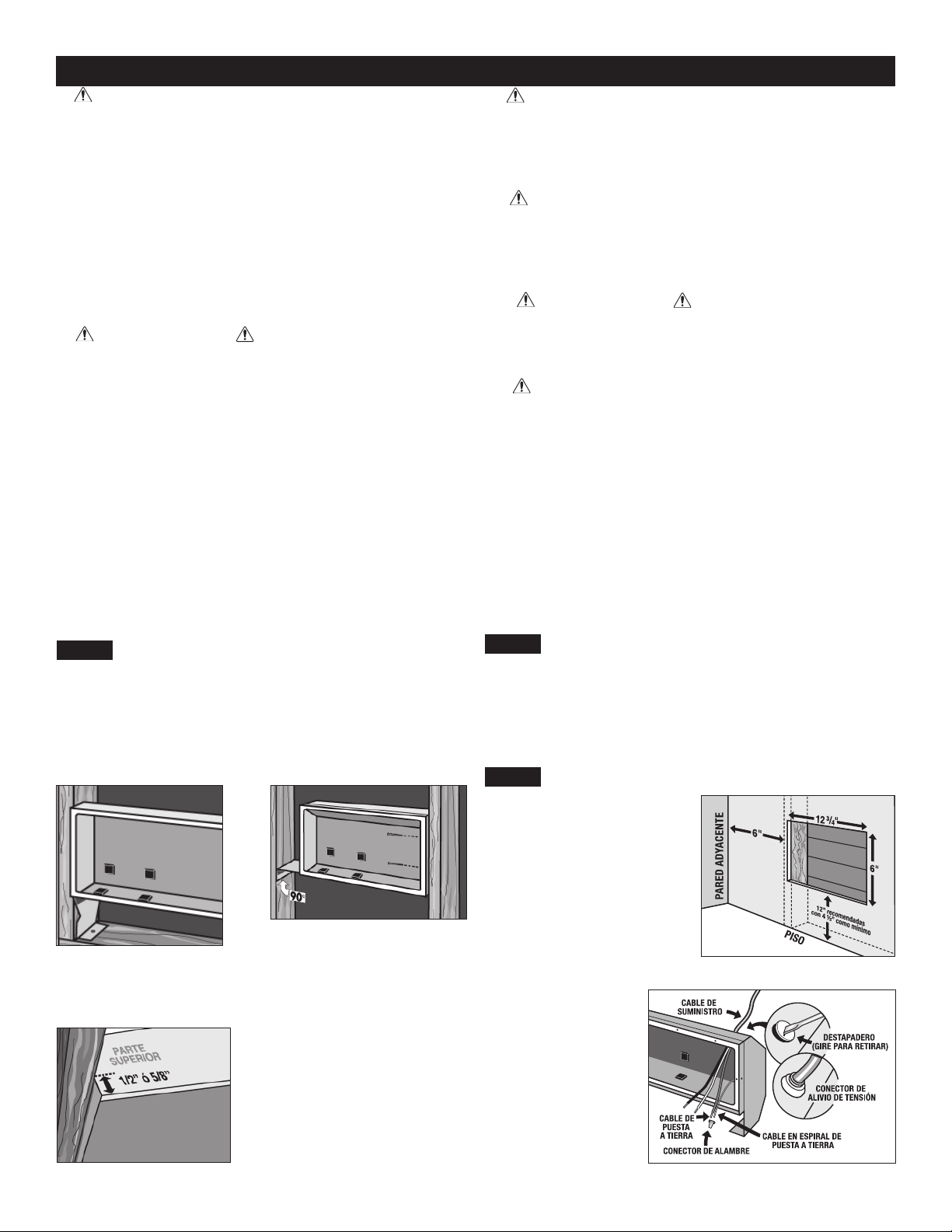
INSTRUCCIONES PARA LA INSTALACIÓN
¿Cómo se instala el calentador en paredes de
construcciones nuevas?
¿Cómo se instala el calentador en una pared existente?
PASO 1
PASO 1
PASO 2
Montaje de la cámara de pared
Corte un oricio en la pared
Instalación de los cables de suministro
UBICACIÓN: Para obtener mejores resultados, instale el calentador Register Plus en una pared interior. No se necesitan brochales ni soportes. NOTA:
La cámara de pared debe instalarse sólo con la parte superior hacia arriba (posición horizontal). No se ha aprobado el uso del calentador para montaje
en cielo raso.
TERMOSTATO: Se requiere un termostato. Se recomienda usar un termostato electrónico Cadet para una comodidad y un control óptimos.
_________________________
Parte Uno
_________________________
La distancia MÍNIMA REQUERIDA es de 6 pulgadas desde las
supercies adyacentes y 4-1/2 pulgadas desde el piso (consulte
la gura 4). Sin embargo, Cadet RECOMIENDA 12 pulgadas des-
de las supercies adyacentes y el piso para lograr un rendimiento
más prolongado y limpio. Si se instalan varios calentadores, deje
al menos tres pies entre ellos. Fije la cámara de pared a los
puntales y/o el larguero mediante tornillos a través de los oricios
más grandes (3 /16 de pulgada). (Consulte las guras 1 y 2).
Corte un oricio de 12¾ pulgadas de ancho por 6 de alto al lado
del puntal de la pared. La distancia MÍNIMA REQUERIDA es de 6
pulgadas desde las supercies adyacentes y 4-1/2 pulgadas des-
de el piso (consulte la gura 4). Sin embargo, Cadet RECOMIEN-
DA 12 pulgadas desde las supercies adyacentes y el piso para
lograr un rendimiento más prolongado y limpio. Si se instalan
varios calentadores, deje al menos tres pies entre ellos.
Figura 3
Figura 5
Figura 4
Figura 2
Figura 1
Las patas metálicas posicio-
nan la cámara de pared de
modo que quede el espacio
mínimo entre ésta y el piso.
Doble una pata en 90 grados
para una instalación a mayor
altura y fíjela a los puntales.
La supercie de la cámara de pared
debe sobresalir entre 1/2 pulgada y 5/8
de pulgada de la supercie del puntal a
n de dejar espacio para la lámina de
yeso. Monte la cámara de pared a ras
con la supercie acabada.
Dirija el cable de suministro
desde el cortacircuito al termo-
stato mural y luego a la cámara
de pared. Quite un destapadero
y je el cable de suministro me-
diante un conector de alivio de
tensión dejando 10 pulgadas de
cable de conexión para utilizarlo
más adelante (consulte la gura
4). Conecte el cable de puesta
a tierra de suministro al cable
en espiral de conexión a tierra
situado en la cámara de pared.
1. ADVERTENCIA
Verique que todos los cables de suministro eléc-
trico sean del mismo voltaje que el calentador.
2. Si va a reemplazar un calentador existente, re-
vise la etiqueta del calentador antiguo.
3. Todo trabajo y materiales eléctricos deben
cumplir con el Código Eléctrico Nacional (“NEC”,
por su sigla en inglés), con la Ley de Seguridad
y Salud Ocupacional (“OSHA”, por su sigla en in-
glés) y con todos los códigos estatales y locales.
4. Si se debe instalar un nuevo circuito o se
necesita información adicional sobre el cableado,
consulte a un electricista calicado.
5. Use conductores de cobre solamente.
6. ADVERTENCIA
Riesgo de electrocución. NO instale el calenta-
dor directamente sobre la tina o lavamanos. NO
lo instale en la zona de la ducha (el fabricante
recomienda un espacio mínimo de 2 pies).
7. El calentador debe instalarse en una cámara
de pared:
Modelo RM Cámara de Pared RMC
8. ADVERTENCIA
Riesgo de incendio. NO instale el calentador en
el piso, en el cielo raso, bajo la barra de la toalla,
detrás de una puerta ni en ningún otro lugar en
el que la descarga de aire se pueda bloquear de
alguna manera.
9. ADVERTENCIA
Podrían producirse explosiones o incendios.
Todo calentador contiene piezas que se calientan
y pueden producir arcos voltaicos o chispas. No
lo use en áreas donde se utilice o almacene gas-
olina, pintura o vapores o líquidos inamables.
10. ADVERTENCIA
Riesgo de electrocución. Conecte el conductor a
tierra al cable espiral de puesta a tierra suminis-
trado. Evite que entren objetos extraños al calen-
tador.
11. ADVERTENCIA
Riesgo de incendio. Este calentador se calienta
mucho cuando está en uso. Precaución – Alta
temperatura. Riesgo de incendio. Mantenga los
cables eléctricos, cortinas, muebles, y demás
materiales combustibles a por lo menos 3 pies por
delante y a 6 pulgadas por encima y por ambos
costados del calentador.
Página 9

INSTRUCCIONES PARA LA INSTALACIÓN (continuación)
Apriete el tornillo
Conductores
del calentador
Cable en espiral
de puesta a tierra
Rueda del soplador
Botón de reglaje manual
Conductores
de suministro
MODELO VOLTAJE
SI EL VATIAJE
QUE DESEA
ES:
LOS ALAMBRES SE DEBEN CONFIGURAR ASÍ:
Elemento superior A Elemento inferior C
900W-240V 700W-240V
RM162 240V
1600 Terminal Amarillo X Terminal Azul Z
900 Terminal Amarillo X Ninguno (*)
700 Ninguno (*) Terminal Amarillo X
900W-208V 700W-208V
RM168 208V
1600 Terminal Amarillo X Terminal Azul Z
900 Terminal Amarillo X Ninguno (*)
700 Ninguno (*) Terminal Amarillo X
1000W-120V 500W-120V
RM151 120V
1500 Terminal Amarillo X Terminal Azul Z
1000 Terminal Amarillo X Ninguno (*)
500 Ninguno (*) Terminal Amarillo X
*Corte el terminal azul del alambre rojo y cúbralo con cinta para uso eléctrico. El
terminal amarillo Y permanece conectado a B
.
No lo toque. En el diagrama de
cableado de la página 8 encontrará las posiciones de los terminales.
_________________________
Parte Uno
_________________________
_________________________
Parte Dos
_________________________
Si va a instalar un calentador de vatiaje múltiple, números de modelo RM151, RM162 , o RM168 comience por el PASO 1 a continu-
ación. Si va a instalar un RM202, RM208, RM158 o RM108, comience por el PASO 2 a continuación.
¿Cómo se instala el calentador en paredes de
construcciones nuevas?
PASO 2
Instalación de los cables de suministro
¿Cómo se instala el calentador en una pared
existente?
PASO 3
Montaje de la cámara de pared
Dirija el cable de suministro desde el cortacircuito al termostato
y a la cámara de pared. Quite un destapadero y coloque el cable
de suministro mediante un conector de alivio de tensión dejando
10 pulgadas de cable de conexión para utilizarlo más adelante.
Conecte el alambre de suministro a tierra al cable espiral de
puesta a tierra situado en la cámara de pared (consulte la gura
5).
Continúe con la PARTE DOS.
IMPORTANTE: Coloque dos tornillos para paredes de yeso en
los oricios pequeños en frente del puntal de la pared de yeso
a n de apoyar el calentador en la parte posterior de la lámina
(manteniendo la cámara al ras con la pared).
Continúe con la PARTE DOS.
Figura 6
Figura 7
Inserte la cámara de pared, con las patas por delante, en la
abertura y gírela para introducirla en la pared.Manteniendo la
parte delantera de la cámara al ras con la supercie acabada, je
la cámara al puntal con 2 tornillos a través de los cuatro oricios
grandes (de 3/16 de pulgada). (Consulte las guras 6 y 7).
Conguración de alambres del elemento (sólo modelos de vatiaje múltiple RM151, RM162 o RM168)
PASO 1
El calentador Cadet RM de vatiaje múltiple ofrece una gran variedad de opciones de generación de calor. Primero debe determinar el
vatiaje deseado y luego congurar las conexiones de alambres del elemento calentador. El calentador viene congurado de fábrica
para 1600 vatios (240 V) o (208 V) en el caso del modelo RM162 y RM168, y 1500 vatios (120 V) en el caso del RM151. Si éste es el
vatiaje que desea, proceda con el PASO 2.
Como referencia futura para los modelos RM151, RM162 y RM168, anote el vatiaje utilizado en el diagrama de cableado situado en la
parte posterior del calentador.
Instale la unidad del calentador
PASO 2
Instale el conjunto del calentador (rueda del soplador primero) en el costado izquierdo de la cámara de pared. Aáncelo en la parte
superior con el tornillo que se proporciona. Desamarre los alambres conductores del calentador. Conecte los alambres de suministro
con los del calentador (consulte la gura 9). Mantenga todos los alambres lejos de las conexiones del elemento al introducirlos en el
espacio libre a la derecha del calentador.
Instale la rejilla
PASO 3
Fije la rejilla con los tornillos suministrados. Si tiene un modelo con termostato incorporado, deslice la perilla del termostato hacia el
eje. Conecte la alimentación en el tablero del panel eléctrico.
Figura 8a Tabla de cableado del modelo RM
Figura 9
Figura 8b
Página 10

OPERACIÓN DEL CALENTADOR
Garantía
Cómo restablecer el control de límite de reglaje manual
Para lograr una operación más ecaz y segura y prolongar la vida útil del
calentador, lea la Guía del propietario y siga las instrucciones de manten-
imiento. Si no le da el mantenimiento adecuado al calentador invalidará
la garantía y puede hacer que el aparato funcione incorrectamente. Las
garantías no son transferibles y rigen sólo para el comprador original. Los
términos de la garantía se indican a continuación.
GARANTÍA LIMITADA DE CINCO AÑOS: Cadet reparará o reemplazará
todo calentador Register (RM) que se determine esté averiado en un
plazo de cinco años a partir de la fecha de compra.
Estas garantías no son pertinentes para:
1. Daños que sufra el producto por instalación o voltaje de suministro
incorrectos;
2. Daños que sufra el producto por mantenimiento incorrecto, uso indebi-
do, abuso, accidente o alteraciones;
3. Servicio que se le haya dado al producto por parte de personas o
entidades ajenas a Cadet.
4. Casos en que no se pueda determinar la fecha de fabricación del
producto;
5. Casos en que el producto resulte dañado durante el embarque por
causas ajenas a Cadet.
6. LA GARANTÍA DE CADET SE LIMITA A LA REPARACIÓN O RE-
EMPLAZO, TAL COMO SE ESTABLECE EN ESTE DOCUMENTO.
CADET NO SE HARÁ RESPONSABLE POR DAÑOS A LA PROPIEDAD
O DAÑOS CONSECUENTES, COMO TAMPOCO POR GASTOS AC-
CIDENTALES DEBIDO AL INCUMPLIMIENTO DE ESTAS GARANTÍAS
ESCRITAS O DE CUALQUIER GARANTÍA EXPRESA O IMPLÍCITA.
7. EN CASO DE QUE CADET DECIDA REEMPLAZAR ALGUNA PIEZA
DEL PRODUCTO CADET, LOS REPUESTOS SE REGIRÁN POR LAS
MISMAS GARANTÍAS DEL PRODUCTO. LA INSTALACIÓN O RE-
EMPLAZO DE LOS REPUESTOS NO MODIFICA NI PROLONGA LAS
GARANTÍAS VIGENTES. EL REEMPLAZO O REPARACIÓN DE TODO
PRODUCTO O PIEZA CADET NO ORIGINA NINGÚN TIPO DE NUEVA
GARANTÍA.
8. Estas garantías le otorgan derechos legales especícos y es posible
que usted tenga otros derechos que varíen de un estado a otro. Cadet
no asume ni autoriza a nadie que lo haga en su nombre, ninguna otra
obligación o responsabilidad en relación con sus productos que no sean
las que se establecen en este documento.
Si durante el período de garantía usted considera que su producto Cadet
presenta defectos, comuníquese con Cadet Manufacturing Co. llaman-
do al 360-693-2505 para obtener instrucciones sobre cómo tramitar la
reparación o el reemplazo del producto. Los reclamos de garantía pre-
sentados después de la nalización del período no serán acogidos. Los
productos que se devuelvan sin autorización serán rechazados.
Repuestos y servicio
En cadetheat.com/parts-service encontrará información sobre dónde
obtener repuestos y servicio.
Reduzca-reutilice-recicle
Este producto está hecho principalmente de materiales reci-
clables. Puede reducir la cantidad de carbono que contribuye
al medio ambiente reciclando este producto al término de su
vida útil. Comuníquese con su centro local de reciclaje para
obtener mayores instrucciones al respecto.
Acerca del control de límite de temperatura de reglaje
manual
El calentador está protegido por un control limitador de tem-
peratura con reglaje manual, el cual está diseñado para abrir el
circuito del calentador cuando se detectan temperaturas de fun-
cionamiento excesivas. El problema debe evaluarse y el límite
debe restablecerse para que el calentador vuelva a funcionar.
Cómo restablecer el control limitador de temperatura de reglaje manual
Si el control limitador de reglaje manual ha abierto el circuito del calentador debido a temperaturas de funcionamiento excesivas, el
calentador no funcionará sino hasta que se oprima el botón de límite de reglaje manual. Después de dejar que la unidad se enfríe
durante unos 10 minutos y resolver el problema que causa que se disyunte el interruptor de límite, utilice un objeto puntiagudo como
un bolígrafo para acceder al botón de reglaje manual a través de la sección central inferior derecha de la rejilla del calentador. Oprima
el botón FIRMEMENTE y asegúrese de escuchar y sentir un chasquido indicando que se ha restablecido.
Cómo hacer funcionar el calentador
La temperatura ambiente es controlada por un termostato de
voltaje de línea situado ya sea en la pared o incorporado en el
calentador.
1. Una vez que se haya realizado la instalación y reestablecido
la energía eléctrica, gire totalmente la perilla del termostato en el
sentido de las manecillas del reloj.
2. Cuando la habitación haya alcanzado un nivel cómodo, gire
la perilla del termostato en sentido contrario a las manecillas
del reloj hasta que el calentador se apague. El calentador se
encenderá y apagará automáticamente según esta temperatura
preestablecida.
3. Para reducir la temperatura del ambiente, gire la perilla en
sentido contrario a las manecillas del reloj. Para aumentar la
temperatura del ambiente, gire la perilla en el sentido de las
manecillas del reloj.
ADVERTENCIA Riesgo de electrocución e
incendio.
El calentador debe instalarse correctamente
antes de usarlo.
1. No lo opere sin la rejilla.
2. Mantenga los cables eléctricos, cortinas, mue-
bles, y demás materiales combustibles a por lo
menos 3 pies por delante y a 6 pulgadas de los
costados del calentador.
3. No manipule el control limitador de sobretem-
peratura.
4. Si los limitadores de sobretemperatura se di-
syuntan más de una vez al día, se debe reempla-
zar el calentador.
5. Limpie el calentador por lo menos cada seis
meses.
6. Después de dejar que el calentador se enfríe,
desconecte la electricidad en el panel de cortacir-
cuitos antes de retirar la rejilla.
7. Use una secadora o aspiradora en el ciclo de
soplado para quitar la suciedad en el elemento
superior (sin tocarlo).
8. Instale la rejilla antes de conectar la energía.
ADVERTENCIA: Toda otra labor no detallada
en esta Guía para el propietario la debe efectuar
un representante de servicio autorizado.
Página 11

MANTENIMIENTO DEL CALENTADOR
Tabla de resolución de problemas
Síntoma Problema Solución
ADVERTENCIA: Toda otra labor no detallada en esta Guía para el propietario la debe efectuar un
representante de servicio autorizado.
Mantenimiento Según sea necesario, o cada seis meses como mínimo.
1. Antes de proceder, es importante que usted verique que se
haya desconectado la alimentación y que el calentador no reciba
energía. Los cortacircuitos no suelen estar correctamente mar-
cados, y apagar el incorrecto podría signicar que sigue uyendo
electricidad al calentador, aun cuando éste parezca no estar
funcionando. Si no se siente cómodo al trabajar con artefactos
eléctricos, no está en condiciones de acatar estas pautas o no
cuenta con los equipos necesarios, solicite los servicios de un
técnico electricista calicado.
2. Una vez que verique que se ha apagado la alimentación
correctamente, prosiga con el paso siguiente.
3. Retire los tornillos y extraiga la rejilla.
4. Lave la rejilla con agua caliente y jabón, y séquela de inmedi-
ato.
5. Mientras sujeta la rueda del soplador (para evitar que se dañe
o tuerza), utilice una secadora o una aspiradora en el ciclo de
soplado para quitar la suciedad en el elemento superior (sin
tocarlo).
6. Aspire el área del ventilador sin tocar los elementos.
7. No lubrique el motor.
8. Vuelva a instalar la rejilla y fíjela con los tornillos.
9. Coloque el termostato en la graduación deseada.
10. Vuelva a conectar la alimentación en el tablero del panel
eléctrico.
*CONSULTE LOS CÓDIGOS ELÉCTRICOS LOCALES PARA DETERMINAR QUÉ TRABAJOS DEBEN SER
REALIZADOS POR PERSONAL DE SERVICIO ELÉCTRICO CALIFICADO.
¡ADVERTENCIA! Desconecte la electricidad en el tablero del panel eléctrico
(caja de cortacircuitos o fusibles) y trabe o coloque un cartel en la puerta del tablero
del panel para evitar que alguien vuelva a conectar la energía mientras se esté
trabajando en el calentador. De lo contrario podrían producirse graves golpes
eléctricos, quemaduras e incluso la muerte.
El interruptor
se disyunta
inmediatamente
al encenderse el
calentador.
1. Voltaje de suministro incorrecto.*
2. Circuito sobrecargado.*
3. Hay un cortocircuito en los cables
de suministro o del calentador.*
4. Cortacircuito defectuoso.*
1. Compruebe que el voltaje de suministro coincida con la calicación del calentador.
2. El amperaje total de todos los calentadores en un circuito de rama no debe sobrepasar el 80%
de la calicación de amperaje del cortacircuito y de las calicaciones de los cables de suministro.
Utilice un calentador de vatiaje inferior o reduzca la cantidad de calentadores en el circuito.
3. Los cables de suministro o del calentador que presentan cortocircuitos pueden ocasionar
chispas peligrosas. Revise el aislamiento de todos los cables de suministro y del calentador
para comprobar que no estén dañados. No reestablezca el cortacircuito sino hasta que se hayan
reparado todos los cortocircuitos eléctricos.
4. Reemplace el cortacircuito.
El ventilador del
calentador funciona
pero no envía aire
caliente.
1. Temperatura insuciente del
elemento.
2. Voltaje de suministro incorrecto.*
3. El elemento ha fallado.*
1. Espere unos momentos para que el elemento alcance la temperatura de funcionamiento.
2. Compruebe que el voltaje de suministro coincida con la calicación del calentador.
3. Reemplace el elemento.
El calentador no se
apaga.
1. La fuga de calor de la habitación
es superior a la capacidad del
calentador.*
2. Termostato defectuoso.
3. Termostato cableado al calentador
de forma incorrecta.*
1. Cierre las puertas y ventanas. Coloque aislamiento adicional o instale un calentador de mayor
vatiaje o múltiples calentadores si fuese necesario (si su circuito es apto para mayor capacidad).
2. Ajuste el termostato a la graduación más baja. Si el calentador continúa funcionando (espere
un par de minutos para que el termostato tenga tiempo de responder al ajuste) y la temperatura
del ambiente es superior a 50 grados, reemplace el termostato.
3. Consulte la documentación del termostato y cableado correcto.
El calentador emite
humo o un olor a
quemado.
1. Se han acumulado polvo, pelusas
u otros materiales dentro del calen-
tador.
2. Conexiones eléctricas decientes
o sueltas.
1. Limpie el calentador (consulte las instrucciones en la sección “Mantenimiento del Calentador”).
2. Desconecte la energía en el cortacircuito. Inspeccione todas las conexiones de alambres
del suministro y del calentador para cerciorarse de que no haya nada suelto ni mal conectado.
Aance o reconecte todas las conexiones sueltas. No restablezca el cortacircuito sino hasta
haber revisado y reparado todas las conexiones.
El elemento calien-
ta por un momento
sin que gire el
ventilador y luego
deja de calentar.
1. Motor o conexión interna defec-
tuosos.*
2. Ventilador o motor trabado.
1. Debe reemplazarse el calentador o el motor del ventilador.
2. Retire la obstrucción y oprima el botón de reglaje manual del calentador (vea las instrucciones
en la sección “Operación del Calentador”).
El calentador no
funciona.
1. El termostato se ha graduado muy
bajo.
2. El calentador ha disyuntado el
control limitador de temperatura de
reglaje manual.
3. La energía no está conectada en
el cortacircuito.
4. El o los cables que van al calenta-
dor están rotos o mal conectados.
5. Termostato defectuoso.
1. Ajuste el termostato a una temperatura más alta hasta que el calentador funcione (vea el
Problema No. 5 si la dicultad persiste).
2. Oprima el botón de reglaje manual (vea las instrucciones en la sección “Operación del Calen-
tador”).
3. Conecte el cortacircuito correcto en el panel principal.
4. Desconecte la energía en el cortacircuito. Revise la continuidad del cable de suministro y la
conexión apropiada a los cables del calentador.
5. Se debe revisar la continuidad de todo el calentador, o bien de sus componentes a n de
determinar la causa de cualquier problema. Repare o reemplace el calentador o termostato.
El calentador
disyunta continu-
amente el control
limitador de tem-
peratura de reglaje
manual.
1. Se han acumulado polvo, pelusas
u otros materiales dentro del calen-
tador.
2. El ujo de aire está bloqueado.
3. El ventilador o el motor está
trabado.
4. Ninguna de las anteriores.
1. Limpie el calentador (vea las instrucciones en la sección “Mantenimiento del Calentador”).
2. Retire la obstrucción. Mantenga una distancia mínima de 6 pulgadas de las supercies
adyacentes, 4.5 pulgadas del piso y 3 pies de los muebles u otros objetos situados directamente
delante del calentador.
3. Retire la obstrucción y oprima el botón de reglaje manual del calentador (vea las instrucciones
en la sección “Operación del Calentador”).
4. Reemplace el conjunto del calentador.
©2014 Cadet Impreso en EE UU Rev 08/14 #730104Página 12