USER
MANUAL
EN User Manual
Steam oven
KSK792220M

CONTENTS
1. SAFETY INFORMATION.............................................................................................3
2. CONDITIONS OF USE................................................................................................4
3. SAFETY INSTRUCTIONS.............................................................................................4
4. PRODUCT DESCRIPTION...........................................................................................7
5. CONTROL PANEL....................................................................................................... 8
6. BEFORE FIRST USE................................................................................................... 10
7. DAILY USE..................................................................................................................11
8. CLOCK FUNCTIONS.................................................................................................23
9. AUTOMATIC PROGRAMMES.................................................................................. 24
10. USING THE ACCESSORIES....................................................................................24
11. ADDITIONAL FUNCTIONS.................................................................................... 27
12. HINTS AND TIPS..................................................................................................... 28
13. CARE AND CLEANING.......................................................................................... 54
14. TROUBLESHOOTING.............................................................................................58
15. INSTALLATION........................................................................................................61
16. ENERGY EFFICIENCY.............................................................................................64
17. WARRANTY .............................................................................................................65
FOR PERFECT RESULTS
Thank you for choosing this AEG product. We have created it to give you
impeccable performance for many years, with innovative technologies that help
make life simpler features you might not find on ordinary appliances. Please
spend a few minutes reading to get the very best from it.
Visit our website for:
Get usage advice, brochures, trouble shooter, service information:
www.aeg.com/webselfservice
Register your product for better service:
www.registeraeg.com
CUSTOMER CARE AND SERVICE
Always use original spare parts.
When contacting our Authorised Service Centre, ensure that you have the
following data available: Model, PNC, Serial Number.
The information can be found on the rating plate.
Warning / Caution-Safety information
General information and tips
Environmental information
Subject to change without notice.
www.aeg.com
2

1. SAFETY INFORMATION
Before the installation and use of the appliance,
carefully read the supplied instructions. The
manufacturer is not responsible for any injuries or
damages that are the result of incorrect installation or
usage. Always keep the instructions in a safe and
accessible location for future reference.
1.1 Children and vulnerable people safety
• This appliance can be used by children aged from 8
years and above and persons with reduced physical,
sensory or mental capabilities or lack of experience
and knowledge if they have been given supervision or
instruction concerning the use of the appliance in a
safe way and understand the hazards involved.
• Do not let children play with the appliance.
• Keep all packaging away from children and dispose of
it appropriately.
• Keep children and pets away from the appliance when
it operates or when it cools down. Accessible parts are
hot.
• If the appliance has a child safety device, this should
be activated.
• Children shall not carry out cleaning and user
maintenance of the appliance without supervision.
• Children aged 3 years and under must be kept away
from this appliance when it is in operation at all times.
1.2
General Safety
• Only a qualified person must install this appliance and
replace the cable.
• WARNING: The appliance and its accessible parts
become hot during use. Care should be taken to
avoid touching heating elements. Children less than 8
years of age shall be kept away unless continuously
supervised.
ENGLISH
3

• Always use oven gloves to remove or put in
accessories or ovenware.
• Before carrying out any maintenance, disconnect the
appliance from the power supply.
• Ensure that the appliance is switched off before
replacing the lamp to avoid the possibility of electric
shock.
• Do not use a steam cleaner to clean the appliance.
• Do not use harsh abrasive cleaners or sharp metal
scrapers to clean the glass door since they can scratch
the surface, which may result in shattering of the glass.
• If the mains power supply cable is damaged, it must
be replaced by the manufacturer, its Authorised
Service Centre or similarly qualified persons to avoid
an electrical hazard.
• To remove the shelf supports first pull the front of the
shelf support and then the rear end away from the
side walls. Install the shelf supports in the opposite
sequence.
• Use only the food sensor (core temperature sensor)
recommended for this appliance.
2.
CONDITIONS OF USE
This appliance is intended to be used in
household and similar applications such
as:
• Farm houses
• By clients in serviced apartments,
holiday apartments and other
residential type environments.
3. SAFETY INSTRUCTIONS
3.1 Installation
WARNING!
Only a qualified person must
install this appliance.
• Remove all the packaging.
• Do not install or use a damaged
appliance.
• Follow the installation instruction
supplied with the appliance.
• Always take care when moving the
appliance as it is heavy. Always use
safety gloves and enclosed footwear.
• Do not pull the appliance by the
handle.
• Keep the minimum distance from the
other appliances and units.
• Make sure that the appliance is
installed below and adjacent safe
structures.
• The sides of the appliance must stay
adjacent to appliances or to units with
the same height.
• The appliance is equipped with an
electric cooling system. It must be
operated with the electric power
supply.
www.aeg.com4

3.2 Electrical connection
WARNING!
Risk of fire and electrical
shock.
• All electrical connections should be
made by a qualified electrician.
• The appliance must be earthed.
• Make sure that the parameters on the
rating plate are compatible with the
electrical ratings of the mains power
supply.
• Always use a correctly installed
shockproof socket.
• Do not use multi-plug adapters and
extension cables.
• Make sure not to cause damage to
the mains plug and to the mains
cable. Should the mains cable need
to be replaced, this must be carried
out by our Authorised Service Centre.
• Do not let mains cables touch or
come near the appliance door,
especially when the door is hot.
• The shock protection of live and
insulated parts must be fastened in
such a way that it cannot be removed
without tools.
• Connect the mains plug to the mains
socket only at the end of the
installation. Make sure that there is
access to the mains plug after the
installation.
• If the mains socket is loose, do not
connect the mains plug.
• Do not pull the mains cable to
disconnect the appliance. Always pull
the mains plug.
• Use only correct isolation devices: line
protecting cut-outs, fuses (screw type
fuses removed from the holder), earth
leakage trips and contactors.
• The electrical installation must have
an isolation device which lets you
disconnect the appliance from the
mains at all poles. The isolation
device must have a contact opening
width of minimum 3 mm.
• This appliance complies with the
E.E.C. Directives.
3.3 Use
WARNING!
Risk of injury, burns and
electrical shock or explosion.
• Do not change the specification of
this appliance.
• Make sure that the ventilation
openings are not blocked.
• Do not let the appliance stay
unattended during operation.
• Deactivate the appliance after each
use.
• Be careful when you open the
appliance door while the appliance is
in operation. Hot air can release.
• Do not operate the appliance with
wet hands or when it has contact with
water.
• Do not apply pressure on the open
door.
• Do not use the appliance as a work
surface or as a storage surface.
• Open the appliance door carefully.
The use of ingredients with alcohol
can cause a mixture of alcohol and air.
• Do not let sparks or open flames to
come in contact with the appliance
when you open the door.
• Do not put flammable products or
items that are wet with flammable
products in, near or on the appliance.
WARNING!
Risk of damage to the
appliance.
• To prevent damage or discoloration
to the enamel:
– do not put ovenware or other
objects in the appliance directly
on the bottom.
– do not put aluminium foil directly
on the bottom of cavity of the
appliance.
– do not put water directly into the
hot appliance.
– do not keep moist dishes and
food in the appliance after you
finish the cooking.
– be careful when you remove or
install the accessories.
• Discoloration of the enamel or
stainless steel has no effect on the
performance of the appliance.
ENGLISH
5
• Use a deep pan for moist cakes. Fruit
juices cause stains that can be
permanent.
• This appliance is for cooking
purposes only. It must not be used for
other purposes, for example room
heating.
• Always cook with the oven door
closed.
• If the appliance is installed behind a
furniture panel (e.g. a door) make sure
the door is never closed when the
appliance is in operation. Heat and
moisture can build up behind a
closed furniture panel and cause
subsequent damage to the appliance,
the housing unit or the floor. Do not
close the furniture panel until the
appliance has cooled down
completely after use.
3.4 Steam Cooking
WARNING!
Risk of burns and damage to
the appliance.
• Released Steam can cause burns:
– Be careful when you open the
appliance door when the function
is activated. Steam can release.
– Open the appliance door with
care after the steam cooking
operation.
3.5 Care and cleaning
WARNING!
Risk of injury, fire, or damage
to the appliance.
• Before maintenance, deactivate the
appliance and disconnect the mains
plug from the mains socket.
• Make sure the appliance is cold.
There is the risk that the glass panels
can break.
• Replace immediately the door glass
panels when they are damaged.
Contact the Authorised Service
Centre.
• Be careful when you remove the door
from the appliance. The door is
heavy!
• Clean regularly the appliance to
prevent the deterioration of the
surface material.
• Clean the appliance with a moist soft
cloth. Only use neutral detergents. Do
not use any abrasive products,
abrasive cleaning pads, solvents or
metal objects.
• If you use an oven spray, follow the
safety instruction on it's packaging.
• Do not clean the catalytic enamel (if
applicable) with any kind of
detergent.
3.6 Internal light
• The type of light bulb or halogen
lamp used for this appliance is only
for household appliances. Do not use
it for house lighting.
WARNING!
Risk of electrical shock.
• Before replacing the lamp, disconnect
the appliance from the power supply.
• Only use lamps with the same
specifications.
3.7 Disposal
WARNING!
Risk of injury or suffocation.
• Disconnect the appliance from the
mains supply.
• Cut off the mains electrical cable
close to the appliance and dispose of
it.
• Remove the door catch to prevent
children or pets from becoming
trapped in the appliance.
3.8 Service
• To repair the appliance contact an
Authorised Service Centre.
• Use original spare parts only.
www.aeg.com
6
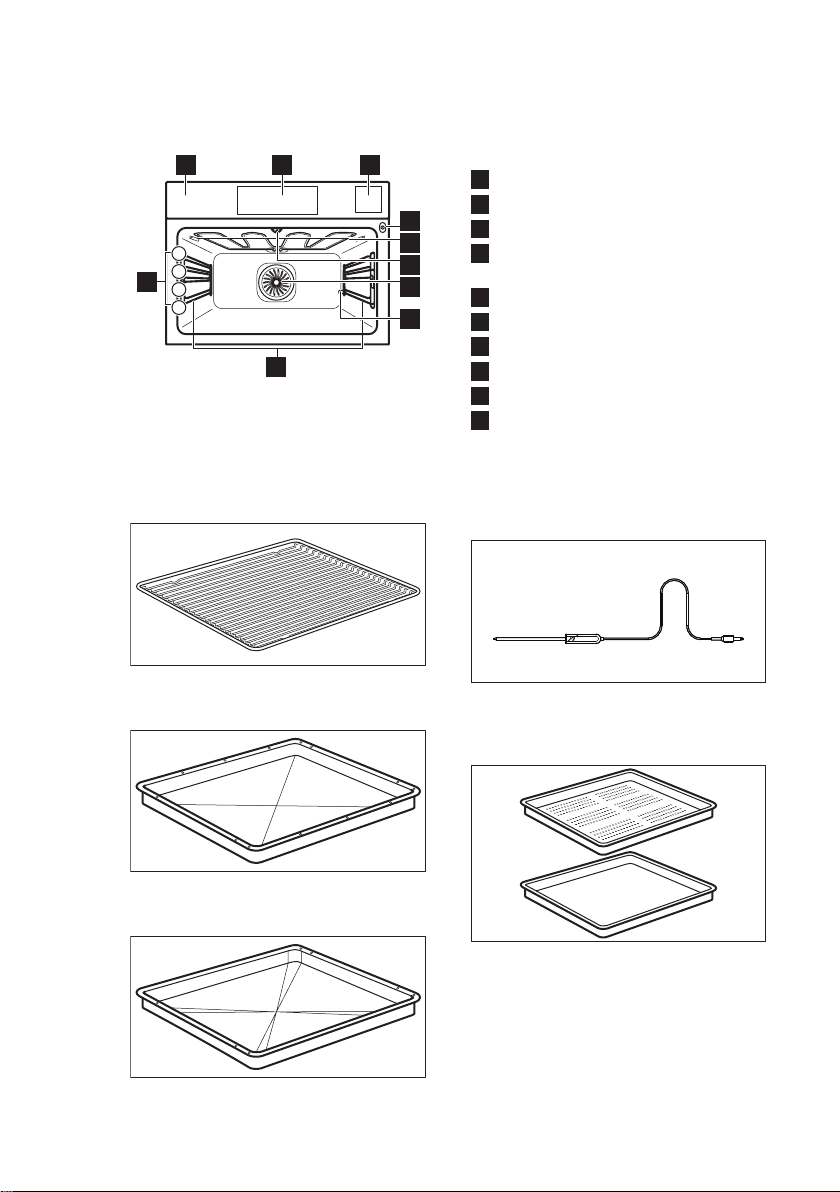
4. PRODUCT DESCRIPTION
4.1 General overview
9
10
1
2
3
4
3
8
7
1 2
5
4
6
1
Control panel
2
Electronic programmer
3
Water drawer
4
Socket for the core temperature
sensor
5
Heating element
6
Lamp
7
Fan
8
Descaling pipe outlet
9
Shelf support, removable
10
Shelf positions
4.2 Accessories
Wire shelf
For cookware, cake tins, roasts.
Baking tray
For cakes and biscuits.
Grill- / Roasting pan
To bake and roast or as a pan to collect
fat.
Food Sensor
To measure the temperature inside the
food.
Steam set
One unperforated and one perforated
food container.
The steam set drains the condensing
water away from the food during steam
cooking. Use it to prepare food that
should not be in the water during the
cooking e.g. vegetables, pieces of fish,
chicken breast. The set is not suitable for
ENGLISH
7
food that needs to soak in the water e.g.
rice, polenta, pasta.
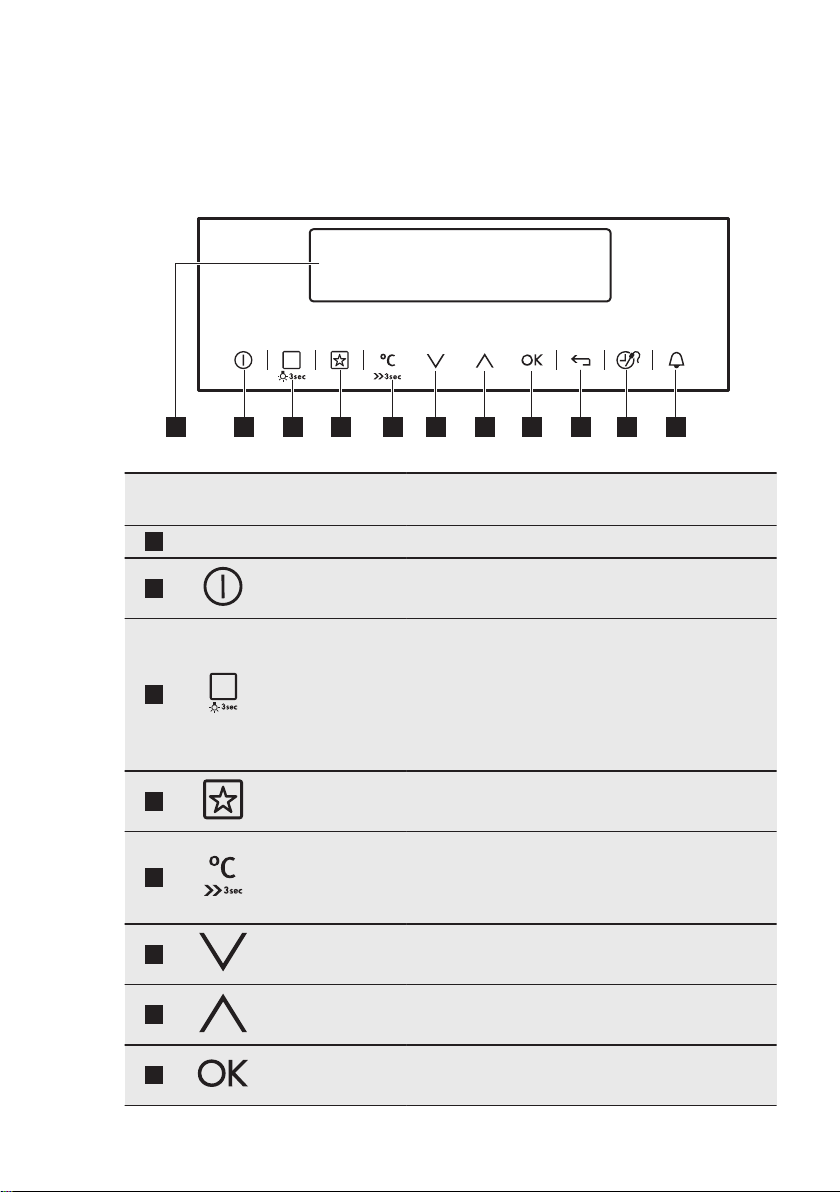
5. CONTROL PANEL
5.1 Electronic programmer
21 3 4 5 8 9 10 1176
Use the sensor fields to operate the appliance.
Sensor
field
Function Comment
1
- Display Shows the current settings of the appliance.
2
ON / OFF To activate and deactivate the appliance.
3
Heating Functions
or VarioGuide
Touch the sensor field once to choose a heating
function or the menu: VarioGuide. Touch the sen-
sor field again to switch between the menus:
Heating Functions, VarioGuide. To activate or de-
activate the light, touch the field for 3 seconds.
You can activate the light also when the appliance
is deactivated.
4
Favourites To save and access your favourite programmes.
5
Temperature se-
lection
To set the temperature or show the current tem-
perature in the appliance. Touch the field for 3
seconds to activate or deactivate the function:
Fast Heat Up.
6
Down key To move down in the menu.
7
Up key To move up in the menu.
8
OK To confirm the selection or setting.
www.aeg.com8
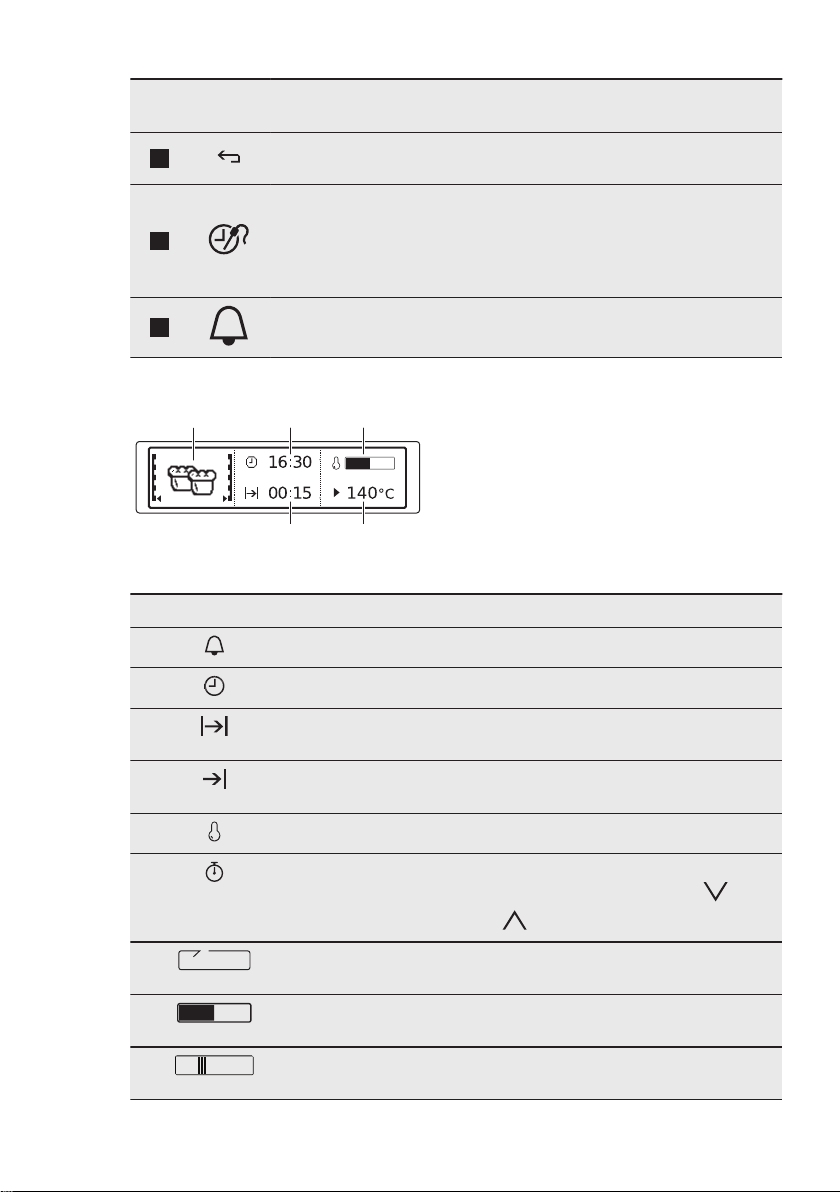
Sensor
field
Function Comment
9
Back key To go back one level in the menu. To show the
main menu, touch the field for 3 seconds.
10
Time and addi-
tional functions
To set different functions. When a heating func-
tion operates, touch the sensor field to set the
timer or the functions: Function Lock, Favourites,
Set + Go. You can also change the settings of the
core temperature sensor.
11
Minute Minder To set the function: Minute Minder.
5.2 Display
A
DE
B C
A. Heating function
B. Time of day
C. Heat-up indicator
D. Temperature
E. Duration time or end time of a
function
Other indicators of the display:
Symbol Function
Minute Minder The function operates.
Time of day The display shows the current time.
Duration The display shows the necessary time
for cooking.
End Time The display shows when the cooking
time is complete.
Temperature The display shows the temperature.
Time Indication The display shows how long the heat-
ing function operates. Press and
at the same time to reset the time.
Calculation The appliance calculates the time for
cooking.
Heat-up Indicator The display shows the temperature in
the appliance.
Fast Heat Up Indicator The function is active. It decreases the
heat up time.
ENGLISH 9
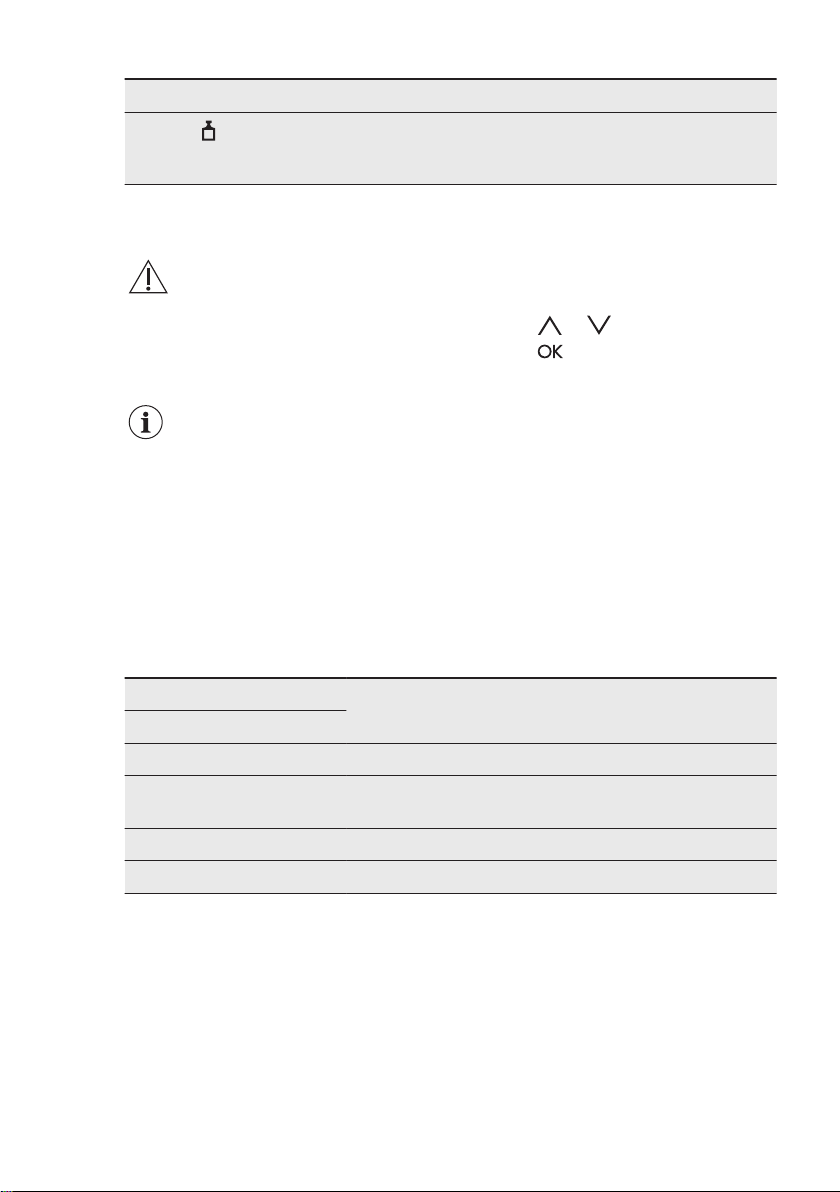
Symbol Function
Weight Automatic The display shows that the automatic
weight system is active or that weight
can be changed.
6. BEFORE FIRST USE
WARNING!
Refer to Safety chapters.
6.1 Initial Cleaning
Remove all accessories and removable
shelf supports from the appliance.
Refer to "Care and
cleaning" chapter.
Clean the appliance and the accessories
before first use.
Put the accessories and the removable
shelf supports back to their initial
position.
6.2 First Connection
When you connect the appliance to the
mains or after the power cut, you have to
set the language, the display contrast,
the display brightness and the time of
the day.
1. Press or to set the value.
2. Press
to confirm.
6.3 Setting the hardness level
for the water
When you connect the appliance to the
mains, you have to set the water
hardness level.
The table below explains the water
hardness range with the corresponding
Calcium deposit (mmol/l) and the quality
of the water.
Water hardness Calcium deposit
(mmol/l)
Calcium deposit
(mg/l)
Water classi-
fication
Class dH
1 0 - 7 0 - 1.3 0 - 50 Soft
2 7 - 14 1.3 - 2.5 50 - 100 Moderately
hard
3 14 - 21 2.5 - 3.8 100 - 150 Hard
4 over 21 over 3.8 over 150 Very hard
When the water hardness exceeds the
values in the table, fill the water drawer
with bottled water.
1. Take the four colour change strip
supplied with the steam set in the
oven.
2. Put all the reaction zones of the strip
into the water for approximately 1
second.
Do not put the strip into the running
water!
3. Shake the strip to remove the excess
of the water.
4. After 1 minute check the hardness of
the water according to the table
below.
The colours of the reaction zones
continue to change after 1 minute.
Do not consider this in the
measurement.
www.aeg.com10
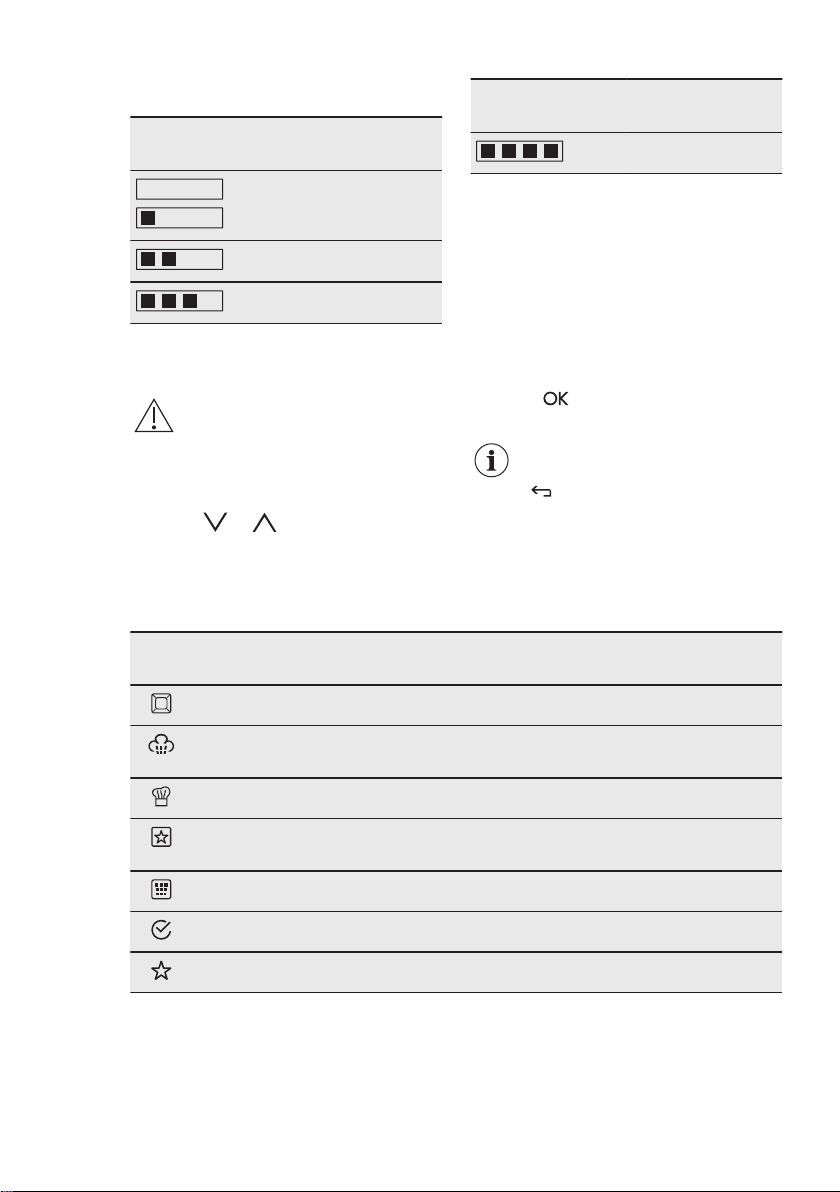
5. Set the hardness of the water in the
menu: Basic Settings.
Test strip Hardness of the
water
1
2
3
Test strip Hardness of the
water
4
The black squares in the table
correspond to red squares on the test
strip.
You can change the hardness level of the
water in the menu: Basic Settings / Water
hardness.
7. DAILY USE
WARNING!
Refer to Safety chapters.
7.1 Navigating the menus
1. Activate the appliance.
2. Press or to select the menu
option.
3. Press to move to the submenu or
accept the setting.
At each point you can go
back to the main menu with
.
7.2 The menus in overview
Main menu
Sym-
bol
Menu item Application
Heating Functions Contains a list of heating functions.
SousVide Cooking Contains a heating function and a list of automat-
ic programmes.
Recipes Contains a list of automatic programmes.
Favourites Contains a list of favourite cooking programmes
created by the user.
Cleaning Contains a list of cleaning programmes.
Basic Settings Used to set the appliance configuration.
Specials Contains a list of additional heating functions.
ENGLISH 11
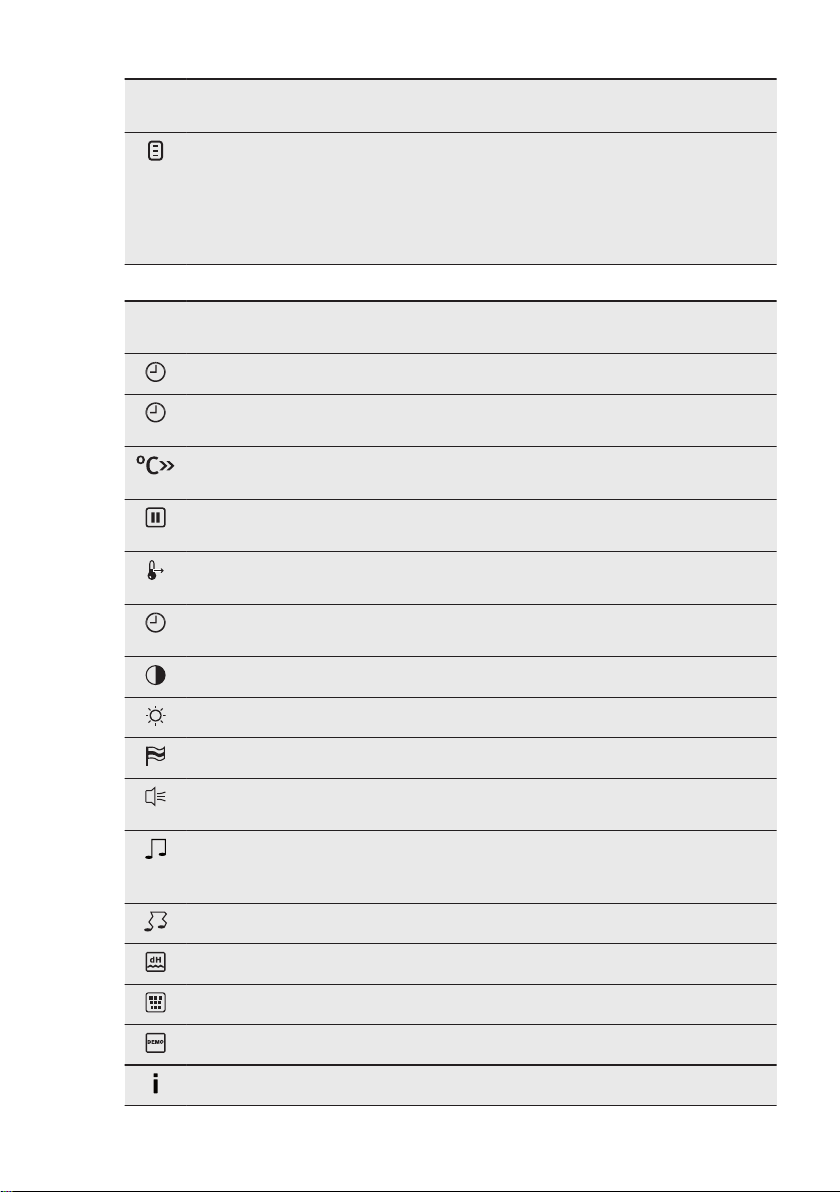
Sym-
bol
Menu item Application
VarioGuide Contains recommended oven settings for a wide
choice of dishes. Select a dish and start the cook-
ing process. The temperature and time are only
guidelines for a better result and can be adjusted.
They depend on the recipes and the quality and
quantity of the used ingredients.
Submenu for: Basic Settings
Sym-
bol
Submenu Description
Set Time of Day Sets the current time on the clock.
Time Indication When ON, the display shows the current time
when you deactivate the appliance.
Fast Heat Up When ON, the function decreases the heat-up
time.
Set + Go To set a function and activate it later with a press
of any symbol on the control panel.
Heat + Hold Keeps the prepared food warm for 30 minutes af-
ter a cooking cycle finished.
Time Extension Activates and deactivates the time extension
function.
Display Contrast Adjusts the display contrast by degrees.
Display Brightness Adjusts the display brightness by degrees.
Set Language Sets the language for the display.
Buzzer Volume Adjusts the volume of press-tones and signals by
degrees.
Key Tones Activates and deactivates the tone of the touch
fields. It is not possible to deactivate the tone of
the ON / OFF touch field.
Alarm/Error Tones Activates and deactivates the alarm tones.
Water hardness To sets the water hardness level (1 - 4).
Cleaning Reminder Reminds you when to clean the appliance.
DEMO mode Activation / deactivation code: 2468
Service Shows the software version and configuration.
www.aeg.com12
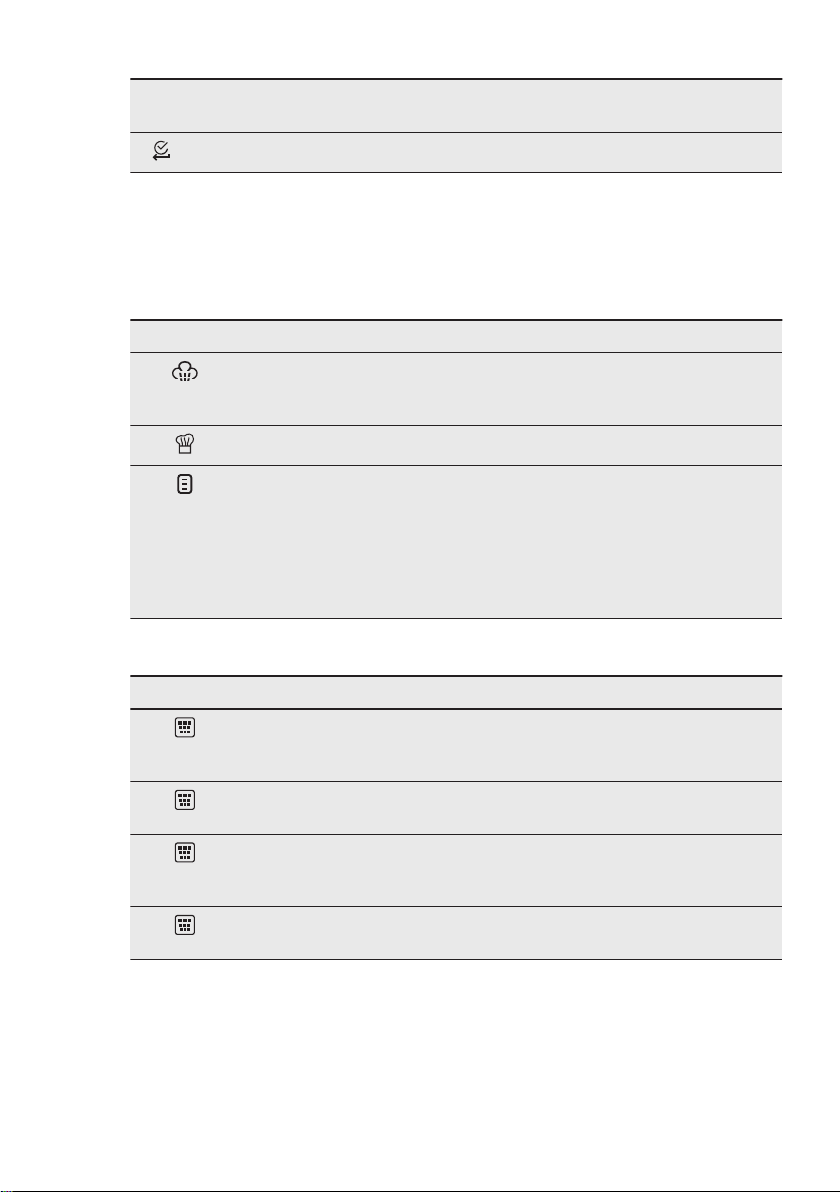
Sym-
bol
Submenu Description
Factory Settings Resets all settings to factory settings.
7.3 Submenu for: SousVide
Cooking
This technique has its start in the Sous-
vide technology, which in French means
"under vacuum". The name refers to a
method of cooking in vacuum sealed
plastic pouches at low temperatures.
Symbol Menu item Description
SousVide Cooking Uses the steam for cooking meat, fish, sea-
food, vegetables and fruits. Set the temper-
ature 50 °C - 95 °C.
SousVide Recipes Contains a list of automatic programmes.
SousVide VarioGuide Contains recommended oven settings for a
wide choice of dishes. Select a dish and
start the cooking process. The temperature
and time are only guidelines for a better re-
sult and can be adjusted. They depend on
the recipes and the quality and quantity of
the used ingredients.
7.4 Submenu for: Cleaning
Symbol Menu item Description
Steam Cleaning Procedure for cleaning the appliance when
it is slightly soiled and not burned several
times.
Descaling Procedure for cleaning the steam genera-
tion circuit from residual limestone.
Rinsing Procedure for rinsing and cleaning the
steam generation circuit after frequent use
of the steam functions.
Steam Cleaning Plus Procedure for cleaning stubborn dirt with
the support of an oven cleaner.
ENGLISH 13
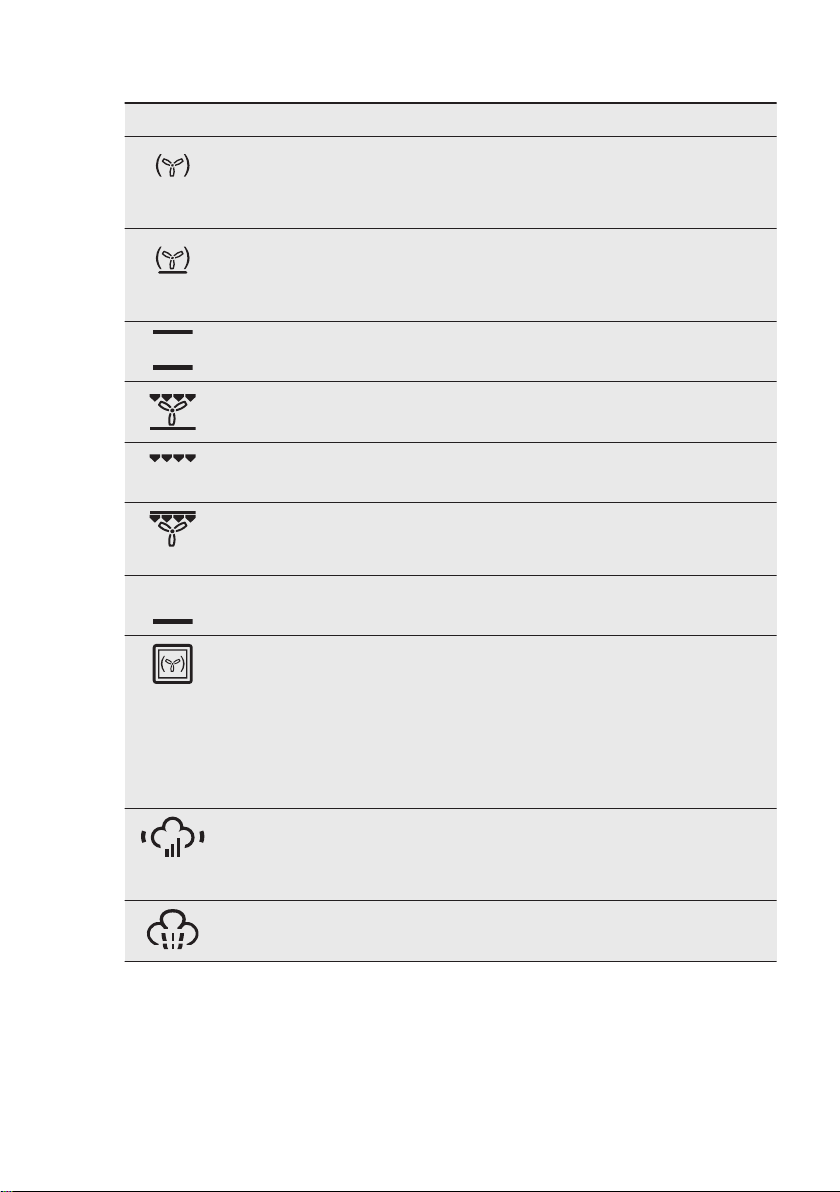
7.5 Heating Functions
Heating function Application
True Fan Cooking To bake on up to two shelf positions at the same
time and to dry food. Set the temperature 20 - 40
°C lower than for the function: Conventional
Cooking.
Pizza Setting To bake food on one shelf position for a more in-
tensive browning and a crispy bottom. Set the
temperature 20 - 40 °C lower than for the func-
tion: Conventional Cooking.
Conventional Cooking To bake and roast food on one shelf position.
Frozen Foods To make convenience food like e.g. french fries,
potato wedges or spring rolls crispy.
Grill To grill flat food and to toast bread.
Turbo Grilling To roast larger meat joints or poultry with bones
on one shelf position. Also to make gratins and to
brown.
Bottom Heat To bake cakes with crispy bottom and to preserve
food.
Moist Fan Baking To bake breads, cakes and cookies. To save ener-
gy during cooking. This function must be used in
accordance with the Moist Fan Baking table in or-
der to achieve the desired cooking result. To get
more information about the recommended set-
tings, refer to the Hints and Tips chapter, Moist
Fan Baking table. This function was used to define
the energy efficiency class acc. to EN 60350-1.
Humidity Cooking You can choose between three manual cooking
functions with different levels of humidity. These
functions combine steam and hot air. They cover
cooking with different levels of steam.
Full Steam For vegetables, fish, potatoes, rice, pasta or spe-
cial side-dishes.
www.aeg.com14
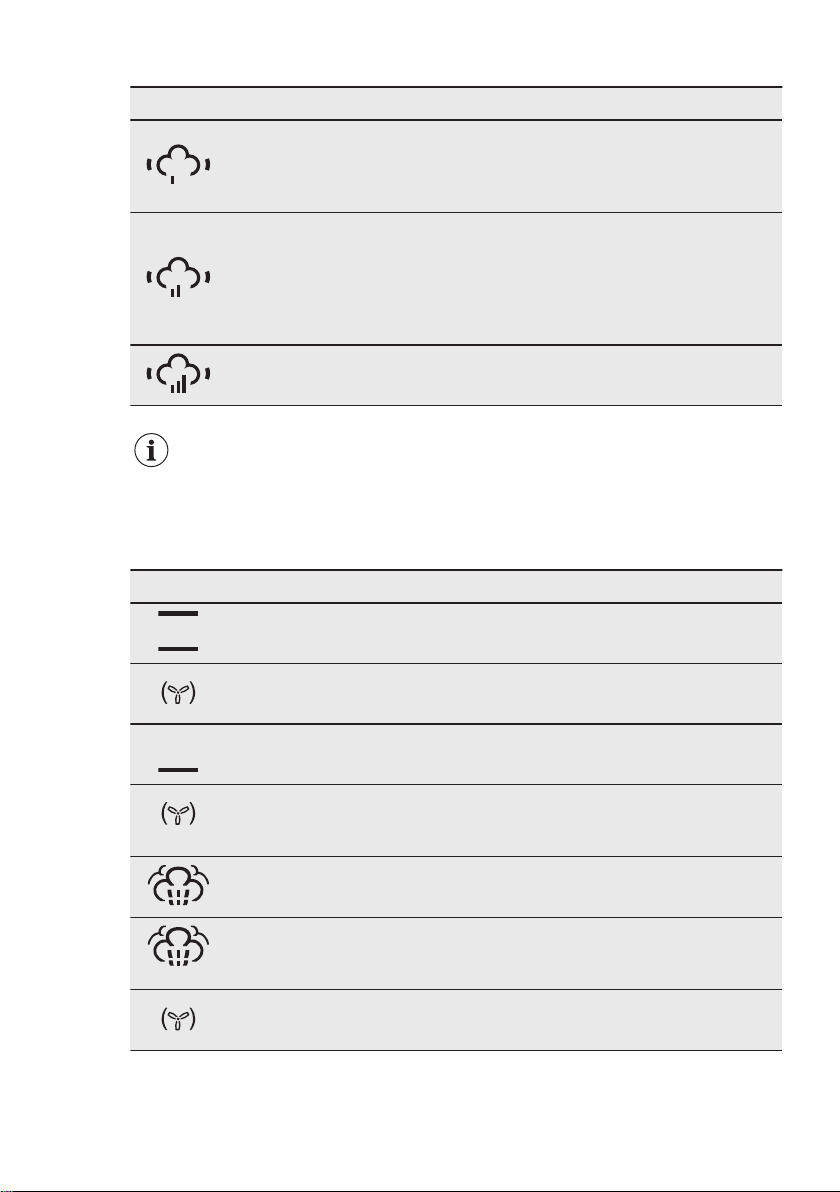
Submenu for: Humidity Cooking
Heating function Application
Humidity Low The function is suitable for meat, poultry, oven
dishes and casseroles. Thanks to the combination
of steam and heat, meat gets a tender and juicy
texture along with a crusty surface.
Humidity Medium The function is suitable for cooking stewed and
braised meat as well as bread and sweet yeast
dough. Due to the combination of steam and
heat the meat gets a juicy and tender texture and
yeast dough bakeries get a crispy and shiny sur-
face.
Humidity High The function is suitable for cooking delicate
dishes like custards, flans, terrines and fish.
The lamp may automatically
deactivate at a temperature
below 60 °C during some
oven functions.
7.6 Specials
Heating function Application
Keep Warm To keep food warm.
Plate Warming To preheat plates for serving.
Preserving To make vegetable preserves such as pickles.
Drying To dry sliced fruit (e.g. apples, plums, peaches)
and vegetables (e.g. tomatoes, zucchini, mush-
rooms).
Yogurt Function Use this function to prepare yoghurt. The lamp in
this function is off.
Dough Proving Steam humidifying action improves and speeds
up the dough proving, prevents surface drying
and keeps the dough elastic.
Slow Cooking To prepare tender, succulent roasts.
ENGLISH 15
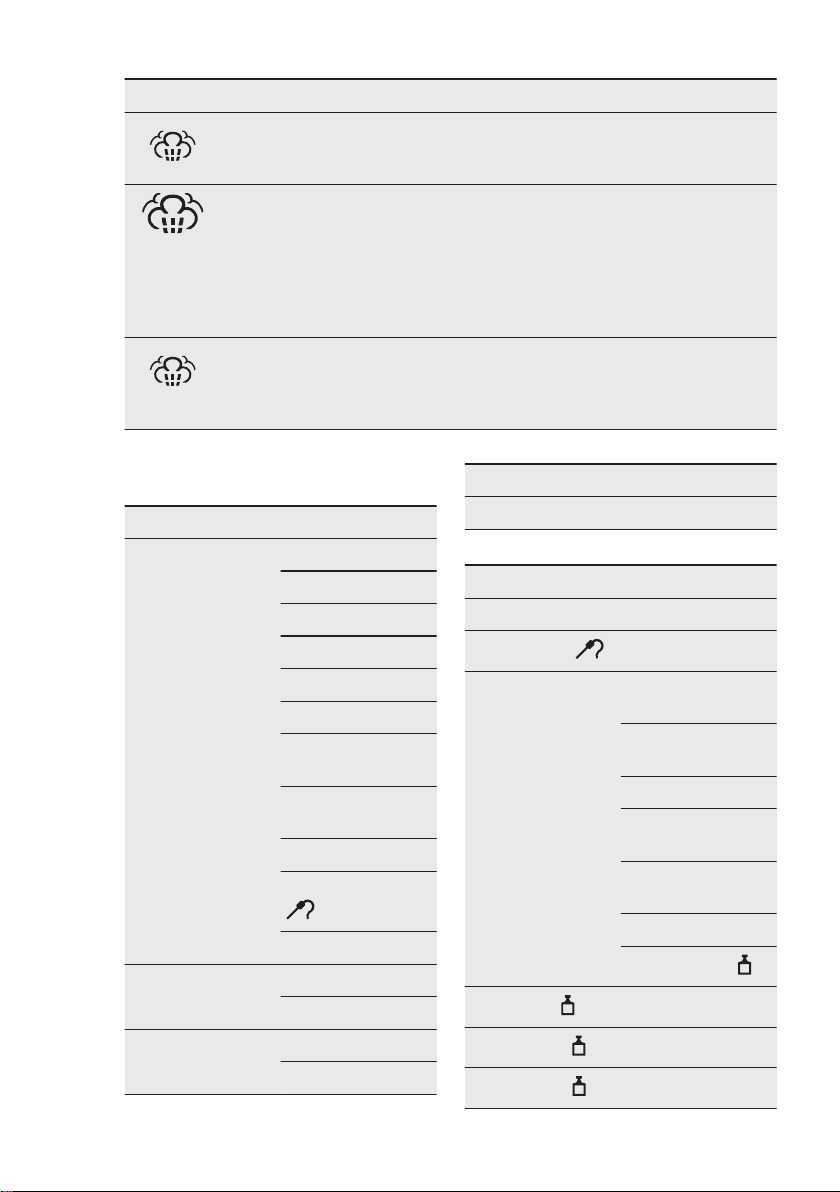
Heating function Application
Bread Baking Use this function to prepare bread and bread rolls
with a very good professional-like result in terms
of crispiness, colour and crust gloss.
Steam Regenerating Food reheating with steam prevents surface dry-
ing. Heat is distributed in a gentle and even way,
which allows to recover taste and aroma of food
as just prepared. This function can be used to re-
heat food directly on a plate. You can reheat
more than one plate at the same time, using dif-
ferent shelf positions.
Defrost This function can be used for defrosting frozen
foods, such as vegetables and fruits. The defrost-
ing time depends on the amount and size of the
frozen food.
7.7 Submenu for: VarioGuide
Food Category: Fish/Seafood
Dish
Fish
Fish, baked
Fish Fingers
Fish fillet, thin
Fish fillet, thick
Fish fillet, frozen
Whole small Fish
Whole Fish,
steamed
Whole small Fish,
grilled
Whole Fish, grilled
Whole Fish, grilled
Trout
Salmon
Salmon fillet
Whole Salmon
Prawns
Prawns, fresh
Prawns, frozen
Dish
Mussels -
Food Category: Poultry
Dish
Boned Poultry -
Boned Poultry
-
Chicken
Chicken Wings,
fresh
Chicken Wings, fro-
zen
Chicken Legs, fresh
Chicken Legs, fro-
zen
Chicken Breast,
poached
Chicken, 2 half
Whole Chicken
Whole Duck
-
Whole Goose
-
Whole Turkey
-
www.aeg.com16
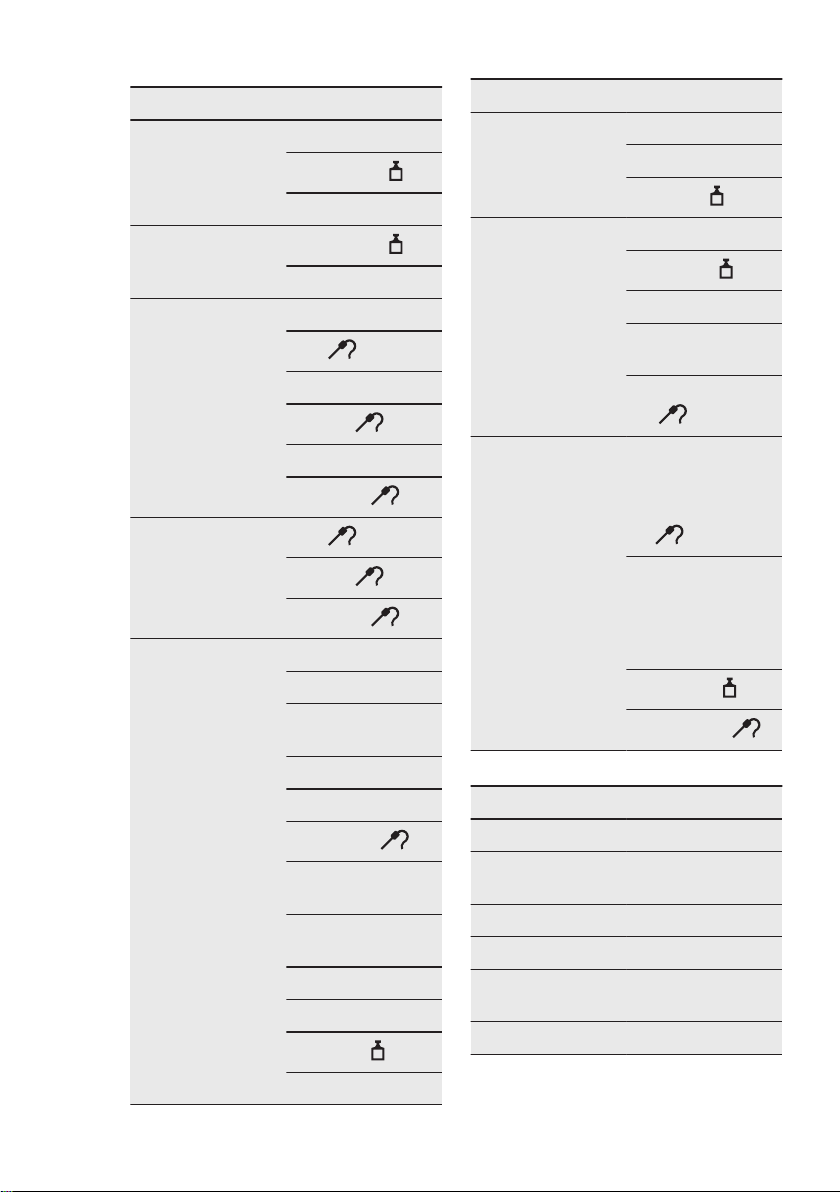
Food Category: Meat
Dish
Beef
Prime Boiled Beef
Braised meat
Meat Loaf
Beef
Braised meat
Meat Loaf
Roast Beef
Rare
Rare
Medium
Medium
Well Done
Well Done
Scandinavian Beef
Rare
Medium
Well Done
Pork
Chipolatas
Spare Ribs
Pork Knuckle, pre-
cooked
Pork Joint
Loin of Pork
Loin of Pork
Loin of Pork,
smoked
Loin of Pork, poach-
ed
Pork Neck
Pork Shoulder
Roast Pork
Cooked Ham
Dish
Veal
Veal Knuckle
Loin of Veal
Roast Veal
Lamb
Leg of Lamb
Roast Lamb
Saddle of Lamb
Lamb Joint, medi-
um
Lamb Joint, medi-
um
Game
Hare
• Leg of Hare
• Saddle of Hare
• Saddle of Hare
Venison
• Haunch of Veni-
son
• Saddle of Veni-
son
Roast Game
Loin of Game
Food Category: Oven Dishes
Dish
Lasagne -
Lasagne/Cannello-
ni, frozen
-
Pasta -
Potato Gratin -
Vegetables au Gra-
tin
-
Sweet Dishes -
ENGLISH 17

Food Category: Pizza/Quiche
Dish
Pizza
Pizza, thin
Pizza, extra topping
Pizza, frozen
Pizza American, fro-
zen
Pizza, chilled
Pizza Snacks, frozen
Baguettes au Gratin -
Tarte Flambée -
Swiss Tarte, savoury -
Quiche Lorraine -
Savory Flan -
Food Category: Cake/Pastry
Dish
Ring Cake -
Apple Cake, cov-
ered
-
Sponge Cake -
Apple Pie -
Cheese Cake, Tin -
Brioche -
Madeira Cake -
Tarte -
Swiss Tarte, sweet -
Almond Cake -
Muffins -
Pastry -
Pastry Stripes -
Cream Puffs -
Puff Pastry -
Eclairs -
Dish
Macaroons -
Short Pastry Biscuits -
Christmas Stollen -
Apple Strudel, fro-
zen
-
Cake on Tray
Sponge Dough
Yeast Dough
Cheese Cake, Tray -
Brownies -
Swiss Roll -
Yeast Cake -
Crumble Cake -
Sugar Cake -
Flan Base
Short Pastry Flan
Base
Sponge Mixture
Flan Base
Fruit Flan
Short Pastry Fruit
Flan
Sponge Mixture
Fruit Flan
Yeast Dough
Food Category: Bread/Rolls
Dish
Rolls
Rolls
Rolls, pre-baked
Rolls, frozen
Ciabatta -
Baguette
Baguette, pre-
baked
Baguette, frozen
www.aeg.com18

Dish
Bread
Bread Crown
White Bread
Yeast Plait
Brown Bread
Rye Bread
Wholegrain Bread
Unleavened Bread
Bread/Rolls, frozen
Food Category: Vegetables
Dish
Broccoli, Florets -
Broccoli, whole -
Cauliflower, Florets -
Cauliflower, whole -
Carrots -
Courgette Slices -
Asparagus, green -
Asparagus, white -
Pepper Stripes -
Spinach, fresh -
Leek Rings -
Green Beans -
Mushroom Slices -
Peeling Tomatoes -
Brussels Sprouts -
Celery, cubed -
Peas -
Eggplant -
Fennel -
Artichokes -
Dish
Beetroot -
Black Salsify -
Cabbage Turnip
Stripes
-
White Haricot
Beans
-
Savoy Cabbage -
Food Category: Custards/Terrines
Dish
Egg Custard -
Flan Caramel -
Terrine -
Eggs
Eggs, soft boiled
Eggs, medium
boiled
Eggs, hard boiled
Eggs, baked
Food Category: Side Dishes
Dish
French Fries, thin -
French Fries, thick -
French Fries, frozen -
Croquettes -
Wedges -
Hash Browns -
Boiled Potatoes,
quartered
-
Boiled Potatoes -
Potatoes in their
jacket
-
Potato Dumplings -
Bread Dumplings -
ENGLISH 19
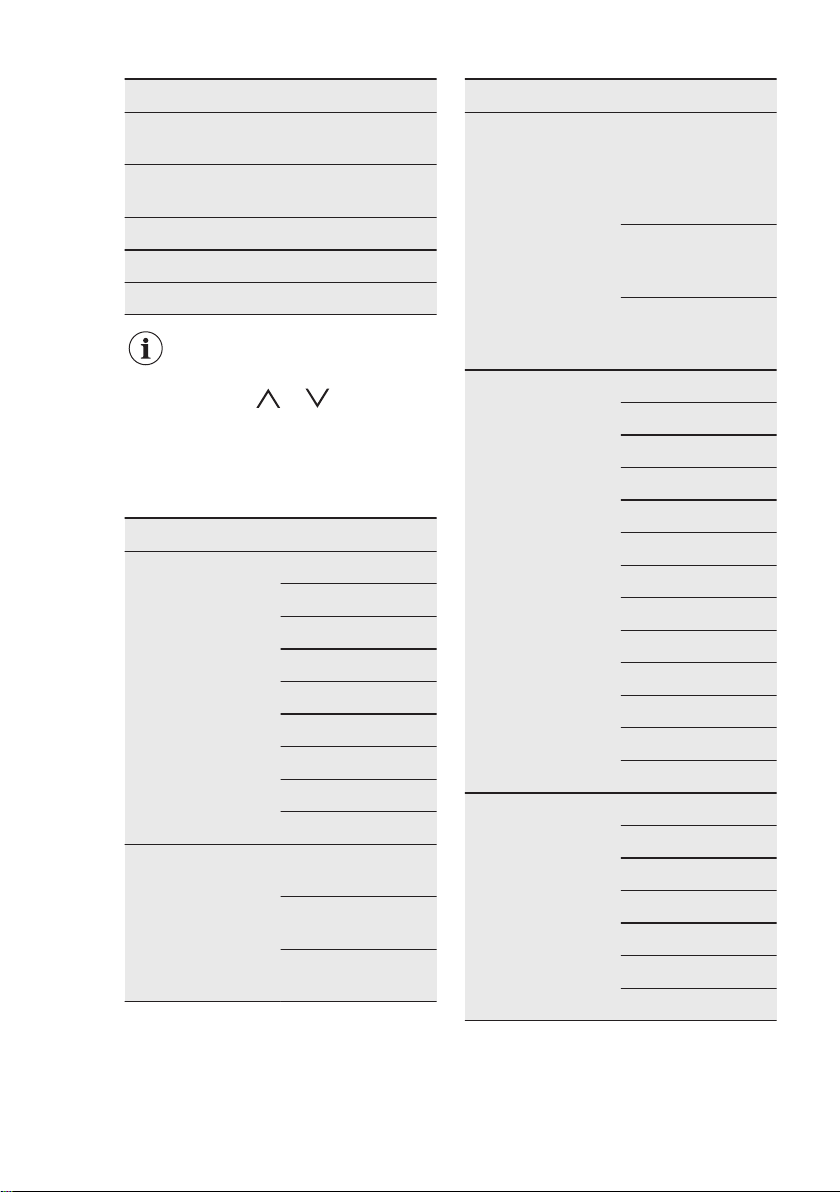
Dish
Yeast Dumplings,
salty
-
Yeast Dumplings,
sweet
-
Rice -
Tagliatelle, fresh -
Polenta -
When it is necessary to
change the weight or the
core temperature of the
dish, use or to set
the new values.
7.8 Submenu for: SousVide
VarioGuide
Food category Dish
Fish/Seafood
Sea bream fillet
Sea Bass fillet
Cod Fish
Trout fillet
Salmon fillet
Scallops
Mussels with shell
Prawns without shell
Octopus
Poultry
Chicken Breast,
boneless
Duck Breast, bone-
less
Turkey Breast,
boneless
Food category Dish
Meat
Beef
• Beef fillet, medi-
um
• Beef fillet, well
done
Lamb
• Lamb, medium
• Lamb, well done
Game
• Wild Boar
• Rabbit, boneless
Vegetables
Carrots
Courgette Slices
Asparagus, green
Asparagus, white
Pepper Stripes
Leek Rings
Celery root
Celery
Eggplant
Fennel
Artichoke Hearts
Potatoes
Pumpkin
Fruits
Apples
Pears
Peaches
Nectarines
Plums
Pineapple
Mangos
7.9 Activating a heating
function
1. Activate the appliance.
www.aeg.com
20
2. Select the menu: Heating Functions.
3. Press to confirm.
4. Select a heating function.
5. Press
to confirm.
6. Set the temperature.
7. Press
to confirm.
In case the default settings
are not changed, the
appliance starts
automatically.
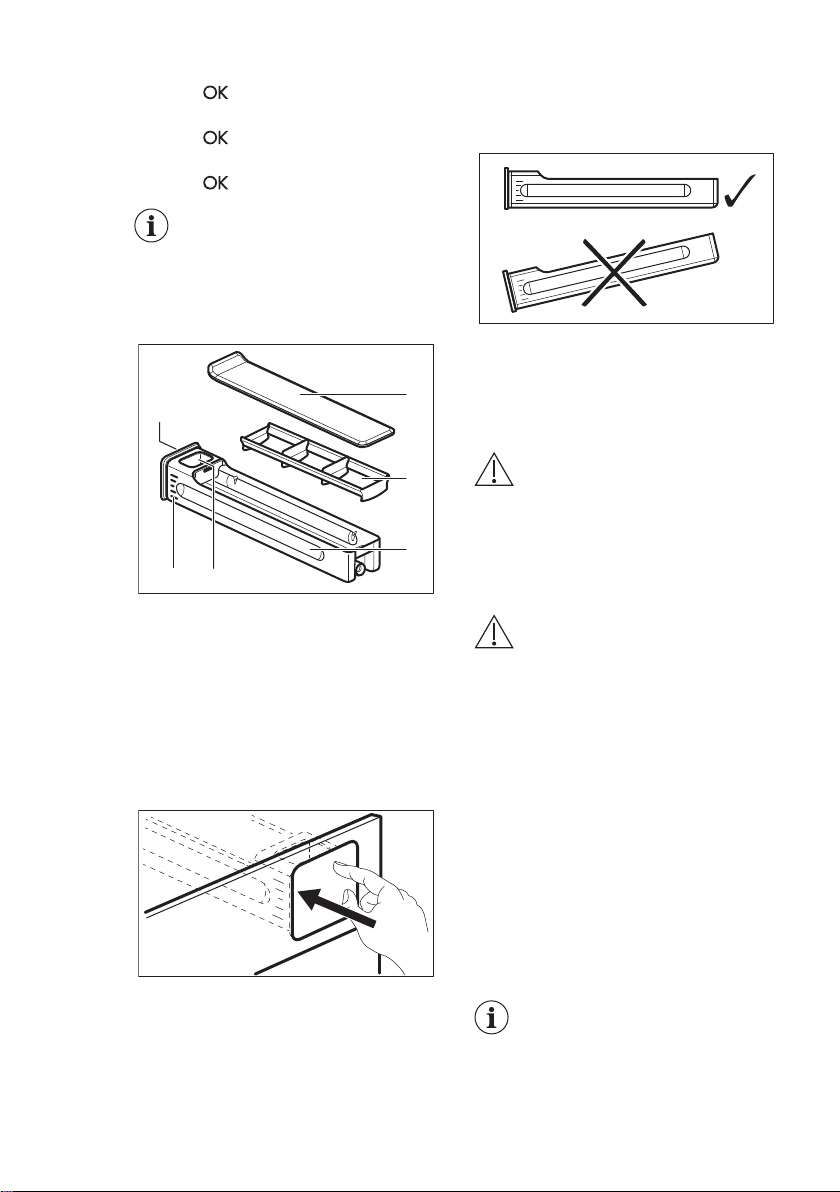
7.10 Water drawer
XAM
A
B
C
F
E
D
A. Lid
B. Wave-breaker
C. Drawer body
D. Water-filling hole
E. Scale
F. Front button
You can remove the water drawer from
the appliance. Push it gently on the front
button. After you push the water drawer,
it will self-extract from the appliance.
MAX
You can fill the water drawer in two ways:
• leave the water drawer inside the
appliance and fill it by means of a
water jar,
• detatch the water drawer from the
appliance and fill it from a water tap.
When you fill the water drawer from the
water tap, carry the drawer in the
horizontal position in order to avoid
water spilling.
MAX
MAX
When you fill the water drawer, insert it in
the same position. Push the front button
until the water drawer is inside the
appliance.
Empty the water drawer after each use.
CAUTION!
Keep the water drawer away
from hot surfaces.
7.11 Steam cooking
The water drawer cover is in the control
panel.
WARNING!
Use only cold tap water. Do
not use filtered
(demineralised) or distilled
water. Do not use other
liquids. Do not put
flammable or alcoholic
liquids into the water
drawer.
1. Press the cover of the water drawer
to open it and extract it from the
appliance.
2. Fill the water drawer with cold water
to the maximum level (around 950
ml).The water supply is sufficient for
approximately 50 minutes.Use the
scale on the water drawer.
3. Push the water drawer to its initial
position.
Wipe the wet water
drawer with a soft cloth
before you insert it in the
appliance.
4. Turn on the appliance.
ENGLISH
21
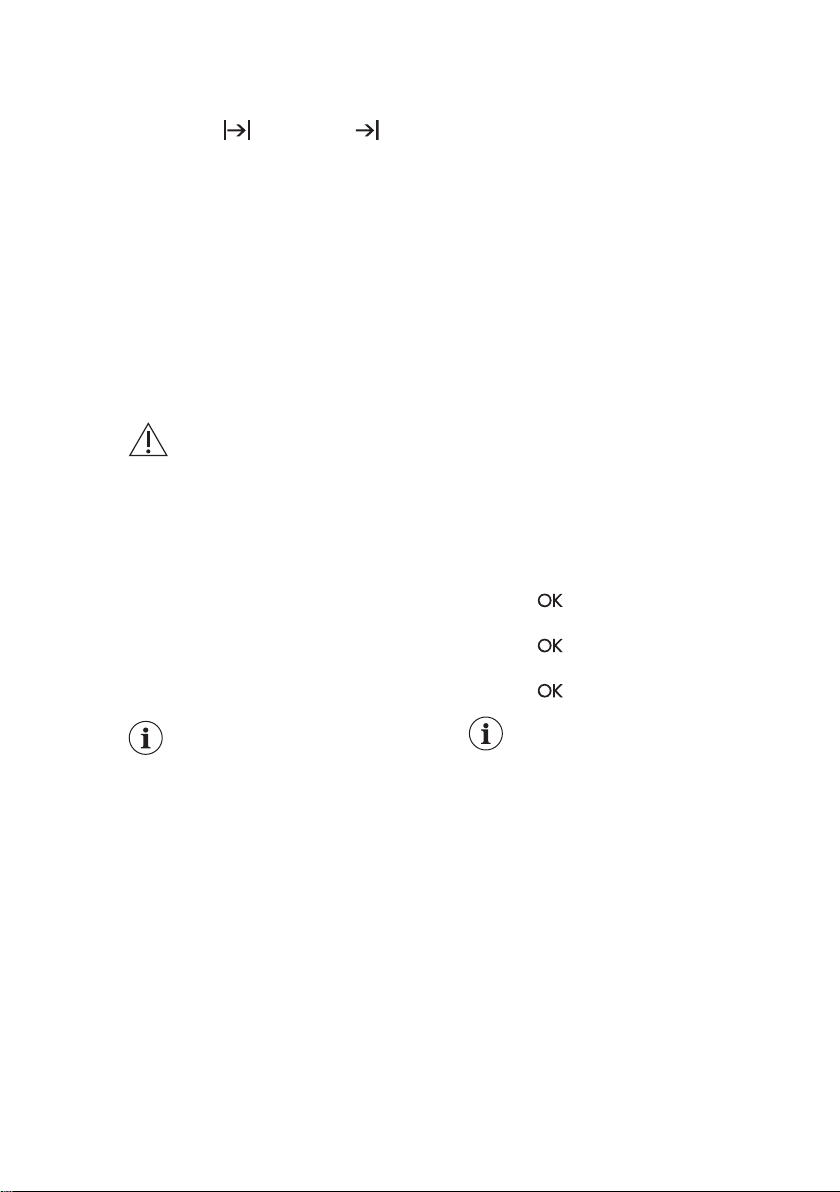
5. Set a steam heating function and the
temperature.
6. If necessary, set the function:
Duration or: End Time .
The steam appears after
approximately 2 minutes. When the
appliance reaches the set
temperature, the signal sounds.
When the water drawer is running
out of water, the signal sounds and
the water drawer needs to be refilled
to continue the steam cooking as
described above.
The signal sounds at the end of the
cooking time.
7. Turn off the appliance.
8. Empty the water drawer after the
steam cooking is completed.
CAUTION!
The appliance is hot.
There is a risk of burns.
Be careful when you
empty the water drawer.
9.
After Steam Cooking steam can
condensate on the bottom of the
cavity. Always dry the bottom of the
cavity when the appliance is cool.
Let the appliance dry fully with the door
open. To speed up the drying you can
close the door and heat up the appliance
with function: True Fan Cooking at
temperature 150°C for approximately 15
minutes.
At the end of a steam
cooking, the cooling fan runs
faster to remove the steam.
7.12 SousVide Cooking
• With no evaporative losses of flavour
volatile and moisture, food keeps its
full aroma.
• Tender texture of meat and fish.
• Food keeps all minerals and vitamins.
• Less spices are necessary as food
keeps its natural flavour.
• Better workflow as it is not necessary
to prepare and serve food at the
same time and place.
• Low cooking temperature minimizes
the risk of overcooking.
• Portioning of the food makes it easy
to hold.
Preparing the food
1. Clean and cut the ingredients.
2. Season the ingredients.
3. Fill the ingredients in suitable
vacuum bags.
4. Vacuum seal the bag to make sure
that you remove as much air as
possible.
5. Cold storage of the bags is
mandatory in case the cooking
procedure is not done immediately.
6. Continue with the function SousVide
Cooking following applicable
cooking table indications for the
considered type of food or the
assisted cooking recipes.
7. Open the pouch and serve.
8. Optionally finish the food with a final
searing or grilling e.g. for meat to
achieve a nice crust and the typical
roast flavour.
Activating a function: SousVide
Cooking
1. Activate the appliance.
2. Select the menu: SousVide Cooking.
3. Press to confirm.
4. Set the function: SousVide Cooking.
5. Press
to confirm.
6. Set the temperature.
7. Press to confirm.
Cooking with this function
causes residual water on the
vacuum bags and in the
cavity. After the cooking
process open the door
carefully to avoid the water
dropping on the furniture.
Use a plate and a towel to
take out the vacuum bags.
Dry out the door, the water
drop collector in the bottom
and the cavity with a soft
cloth or a sponge. Let the
appliance dry fully with the
door open. To speed up the
drying you can heat up the
appliance with hot air at
temperature 150 °C for
approximately 15 minutes.
www.aeg.com
22
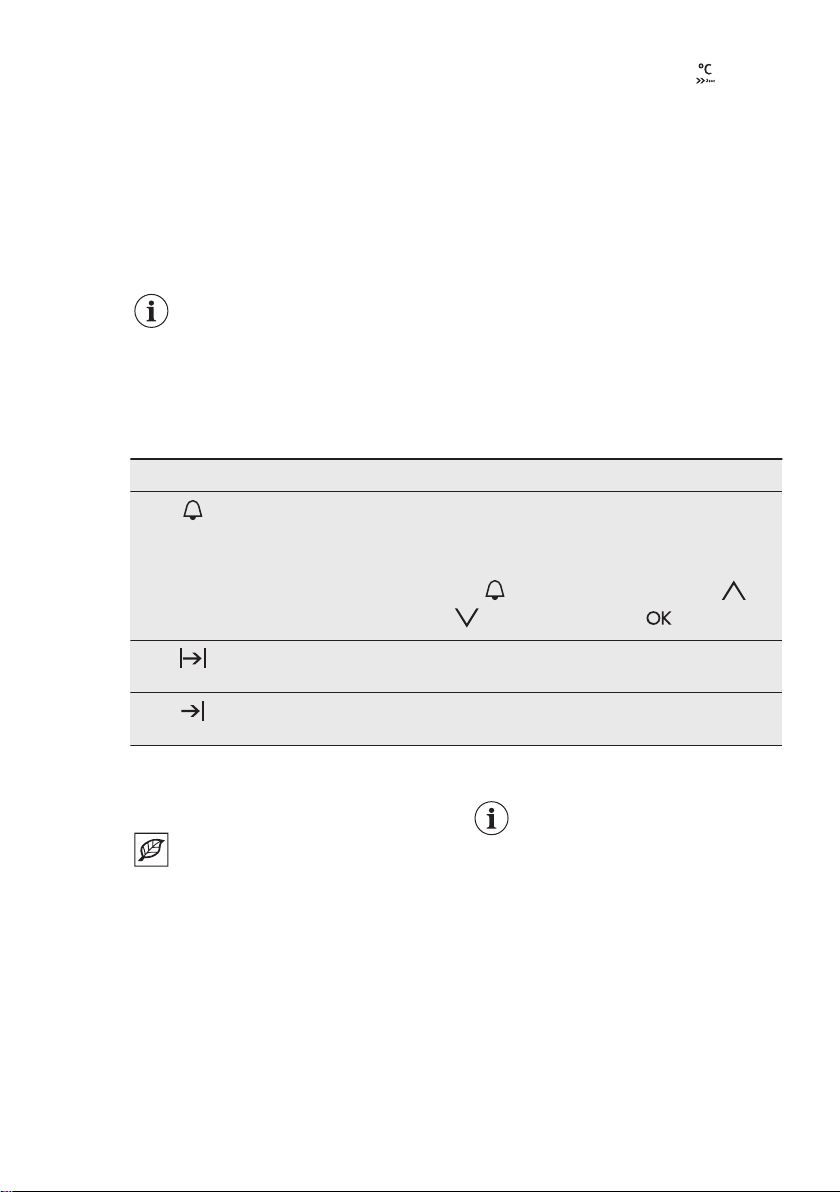
7.13 Heat-up indicator
When you activate a heating function,
the bar on the display comes on. The bar
shows that the temperature increases.
When temperature is reached the buzzer
sounds 3 times and the bar flashes and
then disappears.
7.14 Fast Heat Up Indicator
This function decreases the heat-up time.
Do not put food in the oven
when the Fast heat up
function operates.
To activate the function, hold for 3
seconds. The heat-up indicator
alternates.
7.15 Residual heat
When you turn off the oven, the display
shows the residual heat. You can use the
heat to keep the food warm.
8. CLOCK FUNCTIONS
8.1 Clock functions table
Clock function Application
Minute Minder To set a countdown (max. 2 h 30 min). This
function has no effect on the operation of the
appliance. You can also activate it when the
appliance is deactivated.
Use to activate the function. Press or
to set the minutes and to start.
Duration To set the length of an operation (max. 23 h
59 min).
End Time To set the switch-off time for a heating func-
tion (max. 23 h 59 min).
If you set the time for a clock function,
the time starts to count down after 5
seconds.
If you use the clock
functions: Duration, End
Time, the appliance
deactivates the heating
elements after 90 % of the
set time. The appliance uses
the residual heat to continue
the cooking process until the
time ends (3 - 20 minutes).
8.2 Setting the clock functions
Before you use the
functions: Duration, End
Time, you must set a heating
function and temperature
first. The appliance
deactivates automatically.
You can use the functions:
Duration and End Time at
the same time if you want to
automatically activate and
deactivate the appliance on
a given time later.
The functions: Duration and
End Time do not work when
you use the core
temperature sensor.
ENGLISH
23
1. Set a heating function.
2. Press again and again until the
display shows the necessary clock
function and the related symbol.
3. Press or to set the necessary
time.
4. Press
to confirm.
When the time ends, an acoustic signal
sounds. The appliance deactivates. The
display shows a message.
5. Press any symbol to stop the signal.
8.3 Time Extension
The function: Time Extension makes the
heating function continue after the end
of Duration.
Not applicable to heating
functions with the core
temperature sensor.
1. When the cooking time ends, an
acoustic signal sounds. Press any
symbol.
The display shows the message.
2. Press to activate or to cancel.
3. Set the length of the function.
4. Press
.
9. AUTOMATIC PROGRAMMES
WARNING!
Refer to Safety chapters.
9.1 Recipes online
You can find the recipes for
the automatic programmes
specified for this appliance
on our website. To find the
proper Recipe Book check
the PNC number on the
rating plate on the front
frame of the appliance
cavity.
9.2 Recipes with Recipe
Automatic
This appliance has a set of recipes you
can use. The recipes are fixed and you
cannot change them.
1. Activate the appliance.
2. Select the menu: Recipes. Press
to confirm.
3. Select the category and dish. Press
to confirm.
4. Select a recipe. Press
to confirm.
10. USING THE ACCESSORIES
WARNING!
Refer to Safety chapters.
10.1 Food sensor
The food sensor measures temperature
inside the food. When the food is at the
set temperature, the appliance
deactivates.
There are two temperatures to be set:
• the oven temperature (minimum 120
°C),
• the food core temperature.
CAUTION!
Use only the food sensor
supplied and the original
replacement parts.
Directions for the best results:
• Ingredients should be at room
temperature.
• Food sensor cannot be used for liquid
dishes.
• During cooking the food sensor must
remain in the dish and the plug in the
socket.
• Use recommended food core
temperature settings. Refer to "Hints
and tips" chapter.
www.aeg.com
24
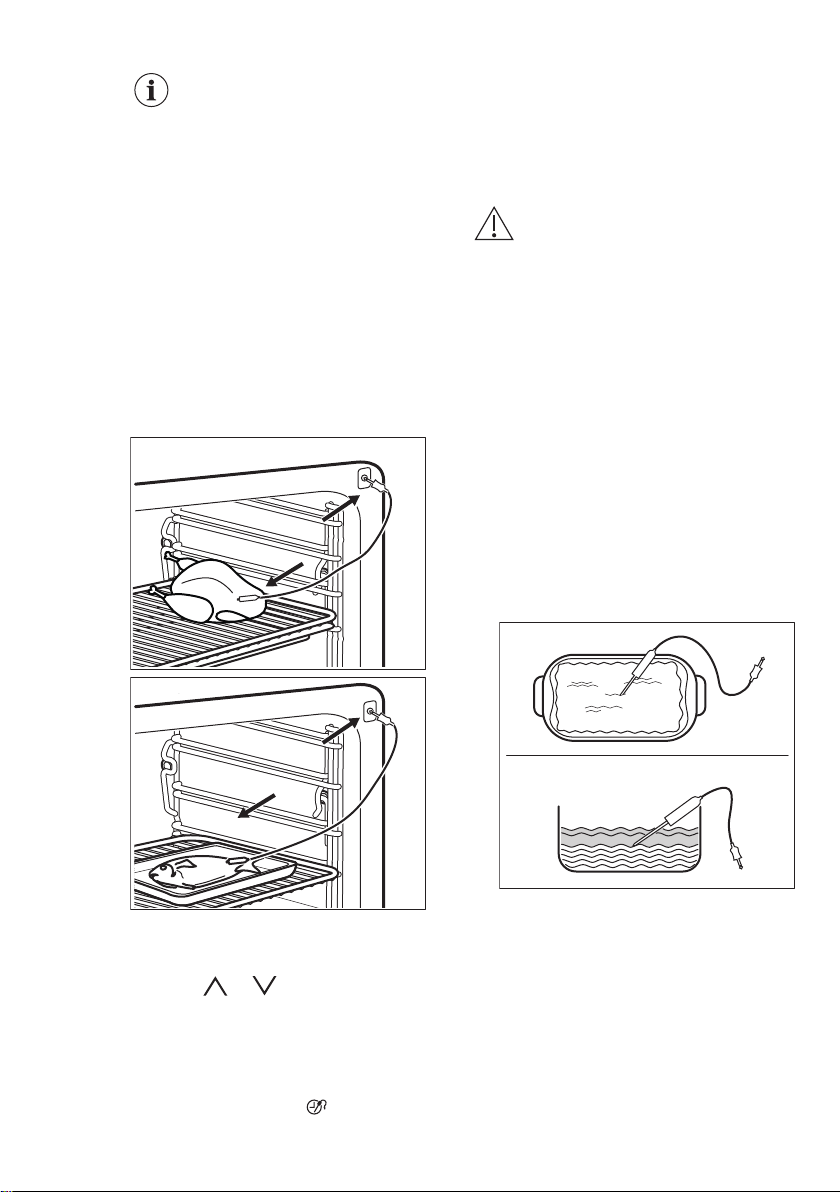
The appliance calculates an
approximate end of cooking
time. It depends on the
quantity of food, the set
oven function and
temperature.
Food categories: meat, poultry
and fish
1. Activate the appliance.
2. Insert the tip of the food sensor into
the centre of meat or fish, in the
thickest part if possible. Make sure
that at least 3/4 of the food sensor is
inside of the dish.
3. Put the plug of the food sensor into
the socket located in the front frame
of the appliance.
The display shows the food sensor
symbol.
4. Press
or in less than 5
seconds to set the food core
temperature.
5. Set a heating function and, if
necessary, the oven temperature.
6. To change the food core
temperature, press .
When the dish reaches the set
temperature, an acoustic signal sounds.
The appliance deactivates automatically.
7. Touch any symbol to stop the signal.
8. Remove the food sensor plug from
the socket and remove the dish from
the appliance.
WARNING!
There is a risk of burns as the
food sensor becomes hot.
Be careful when you unplug
it and remove it from the
food.
Food category: casserole
1. Activate the appliance.
2. Place half of the ingredients in a
baking dish.
3. Insert the tip of the food sensor
exactly in the centre of the casserole.
The food sensor should be stabilized
in one place during baking. Use a
solid ingredient to achieve that. Use
the rim of the baking dish to support
the silicone handle of the food
sensor. The tip of the food sensor
should not touch the bottom of a
baking dish.
4. Cover the food sensor with the
remaining ingredients.
5. Put the plug of the food sensor into
the socket located in the front frame
of the appliance.
ENGLISH
25
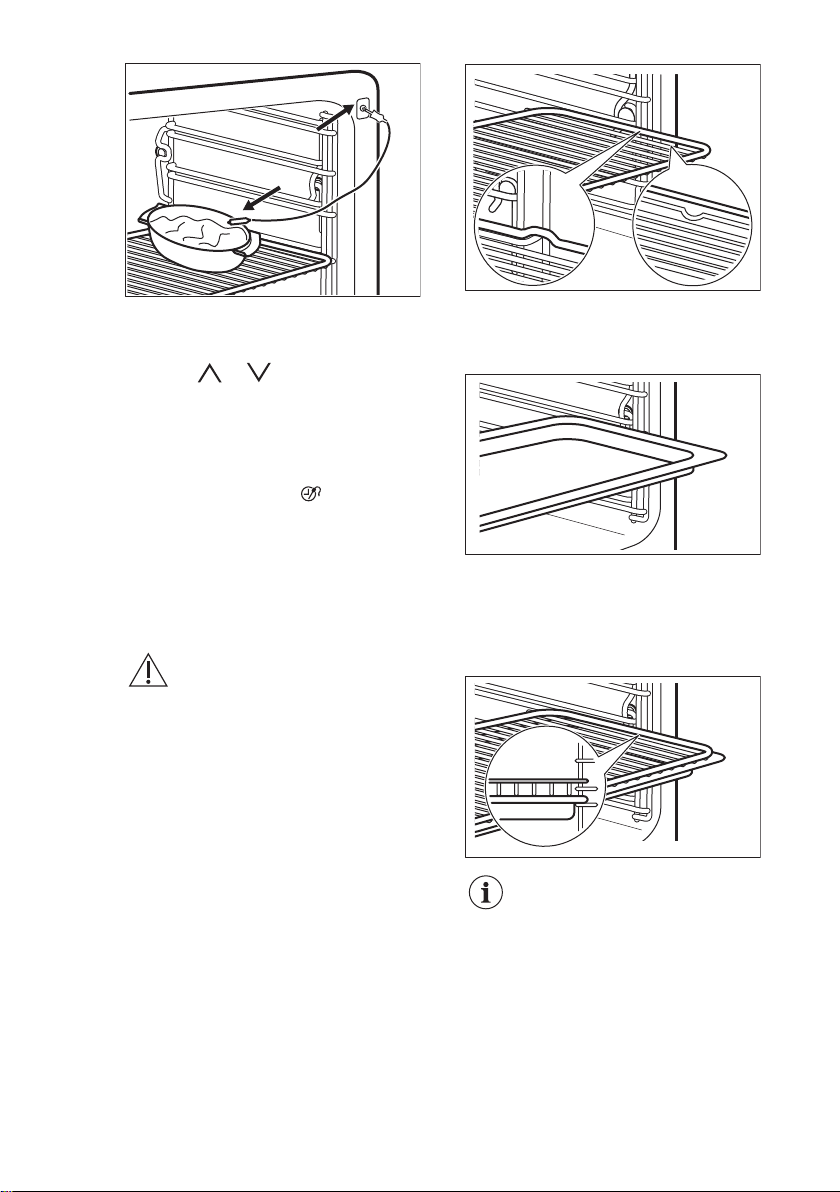
The display shows the food sensor
symbol.
6. Press
or in less than 5
seconds to set the food core
temperature.
7. Set a heating function and, if
necessary, the oven temperature.
8. To change the food core
temperature, press .
When the dish is at the set temperature,
an acoustic signal sounds. The appliance
deactivates automatically.
9. Touch any symbol to stop the signal.
10. Remove the food sensor plug from
the socket and remove the dish from
the appliance.
WARNING!
There is a risk of burns as the
food sensor becomes hot.
Be careful when you unplug
it and remove it from the
food.
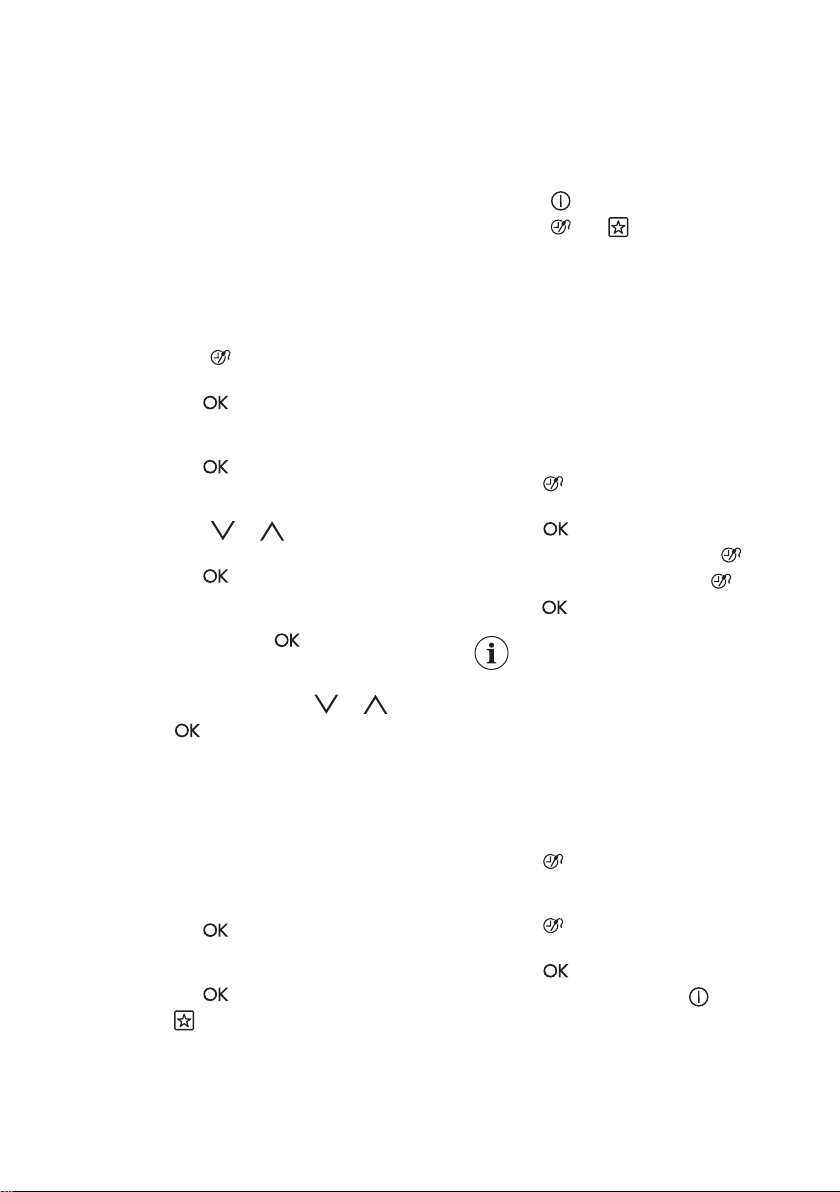
10.2 Inserting the accessories
Wire shelf:
Push the shelf between the guide bars of
the shelf support and make sure that the
feet point down.
Baking tray / Deep pan:
Push the baking tray / deep pan between
the guide bars of the shelf support.
Wire shelf and baking tray / deep pan
together:
Push the baking tray / deep pan between
the guide bars of the shelf support and
the wire shelf on the guide bars above.
Small indentation at the top
increase safety. The
indentations are also anti-tip
devices. The high rim
around the shelf prevents
cookware from slipping of
the shelf.
www.aeg.com26
11. ADDITIONAL FUNCTIONS
11.1 Favourites
You can save your favourite settings,
such as duration, temperature or heating
function. They are available in the menu:
Favourites. You can save 20
programmes.
Saving a programme
1. Activate the appliance.
2. Set a heating function or an
automatic programme.
3. Touch again and again until the
display shows: SAVE.
4. Press
to confirm.
The display shows the first free memory
position.
5. Press to confirm.
6. Enter the name of the programme.
The first letter flashes.
7. Touch
or to change the
letter.
8. Press .
The next letter flashes.
9. Do step 7 again as necessary.
10. Press and hold
to save.
You can overwrite a memory position.
When the display shows the first free
memory position, touch or and
press
to overwrite an existing
programme.
You can change the name of a
programme in the menu: Edit
Programme Name.
Activating the programme
1. Activate the appliance.
2. Select the menu: Favourites.
3. Press to confirm.
4. Select your favourite programme
name.
5. Press
to confirm.
Press to go directly to menu:
Favourites. You can also use it when the
appliance is deactivated.
11.2 Using the Child Lock
When the Child Lock is on, the appliance
cannot be activated accidentally.
1. Touch
to activate the display.
2. Touch
and at the same time
until the display shows a message.
To deactivate the Child Lock function
repeat step 2.
11.3 Function Lock
This function prevents an accidental
change of the heating function. You can
activate it only when the appliance
operates.
1. Activate the appliance.
2. Set a heating function or setting.
3. Press
again and again until the
display shows: Function Lock.
4. Press to confirm.
To deactivate the function, press
. The
display shows a message. Press again
and then
to confirm.
When you deactivate the
appliance, the function also
deactivates.
11.4 Set + Go
The function lets you set a heating
function (or a programme) and use it
later with one press of any symbol.
1. Activate the appliance.
2. Set a heating function.
3. Press again and again until the
display shows: Duration.
4. Set the time.
5. Press again and again until the
display shows: Set + Go.
6. Press
to confirm.
Press any symbol (except for ) to start
the function: Set + Go. The set heating
function starts.
When the heating function ends, an
acoustic signal sounds.
ENGLISH
27
• Function Lock is on when
the heating function
operates.
• The menu: Basic Settings
lets you activate and
deactivate the function:
Set + Go.
11.5 Automatic Switch-off
For safety reasons the appliance turns off
automatically after some time if a heating
function operates and you do not
change any settings.
Temperature (°C) Switch-off time (h)
30 - 115 12.5
120 - 195 8.5
200 - 230 5.5
The Automatic switch-off
does not work with the
functions: Light, Food
Sensor, Duration, End Time.
11.6 Brightness of the display
There are two modes of display
brightness:
• Night brightness - when the appliance
is deactivated, the brightness of the
display is lower between 10 PM and 6
AM.
• Day brightness:
– when the appliance is activated.
– if you touch a symbol during the
night brightness (apart from ON /
OFF), the display goes back to
the day brightness mode for the
next 10 seconds.
– if the appliance is deactivated and
you set the function: Minute
Minder. When the function ends,
the display goes back to the night
brightness.
11.7 Cooling fan
When the oven operates, the cooling fan
turns on automatically to keep the
surfaces of the oven cool. If you turn off
the oven, the cooling fan can continue to
operate until the oven cools down.
12. HINTS AND TIPS
WARNING!
Refer to Safety chapters.
The temperature and baking
times in the tables are
guidelines only. They
depend on the recipes and
the quality and quantity of
the ingredients used.
12.1 Inner side of the door
In some models, on the inner side of
the door you can find:
• the numbers of the shelf positions.
• information about the heating
functions, recommended shelf
positions and temperatures for typical
dishes.
12.2 Advice for special heating
functions of the oven
Keep Warm
Use this function if you want to keep
food warm.
The temperature regulates itself
automatically to 80 °C.
Plate Warming
For warming plates and dishes.
Distribute plates and dishes evenly on
the wire shelf. Move stacks around after
half of the warming time (swap top and
bottom).
The automatic temperature is 70 °C.
Recommended shelf position: 3.
www.aeg.com
28

Dough Proving
You can use this automatic function with
any recipe for yeast dough you like. It
gives you a good atmosphere for rising.
Put the dough into a dish that is big
enough for rising. It is not necessary to
cover it. Insert a wire shelf on the first
shelf position and put the dish in. Close
the door and set the function: Dough
Proving. Set the necessary time.
Defrost
Remove the food packaging and put the
food on a plate. Do not cover the food
with a bowl or a plate, as this can extend
the defrost time. Use the first shelf
position from the bottom.
12.3 SousVide Cooking
This function uses lower cooking
temperatures than normal cooking.
Handle the food with special care for
better food quality.
Recommendations regarding food
safety:
• Use high quality raw materials.
• Always use the raw material that is as
fresh as possible.
• Always keep raw materials in correct
conditions before you cook them.
• Always clean the food before you
cook it.
• For good and safe results, always look
at the values in the cooking tables.
Check the cooking time, temperature
and dimension of the food.
• Food should not be kept at a
temperature below 60 °C for a longer
time to avoid safety problems.
• Use low temperatures only for food
that could be eaten raw and only for a
short time.
• Sous-vide dishes have the best taste
immediately after cooking. If you do
not eat the food immediately after the
cooking, quickly decrease its
temperature. To do that, put the food
in an ice bath and put it in the fridge.
You can keep the food in the fridge
for 2 – 3 days.
• Do not use Sous-vide cooking
function for reheating food leftovers.
• Prevent contact between raw food
and cooked food while you prepare
and cook the food.
• Do not use the same tools for
different things without washing them
carefully.
• For recipes with raw eggs, prevent
egg whites or yolks from contact with
the external part of the egg shells.
Hints and tips regarding food vacuum
packing:
• Necessary equipment for Sous-vide
cooking function are a vacuum sealer
and vacuum bags.
• Recommended vacuum sealer type:
chamber vacuum sealer. Only this
type of vacuum sealer can vacuum
pack liquids.
• Use vacuum bags correct for Sous-
vide cooking function.
• Do not reuse vacuum bags.
• Put the food in one layer of the
vacuum bags to get an even cooking
result.
• For faster and more even cooking of
the food, set the vacuum degree to
the highest possible.
• To guarantee a safe closing of the
vacuum bag, make sure that the area
subject to the seal is clean.
General hints and tips for the function
SousVide Cooking:
• To keep the cooking steam, always
keep the appliance door closed when
you use Sous-vide cooking function.
• Open the door carefully after cooking
because there is steam cumulated in
the appliance.
• You can add oil and spices to the
food in accordance to your taste. Oil
prevents the food from sticking to the
vacuum bag.
• Season the food moderately in the
beginning as there are no evaporative
losses of flavour volatiles.
• To evaporate alcohol from liquids,
heat up and boil the liquids before
vacuum packing.
• You can replace the raw garlic by the
garlic powder.
• You can be replace olive oil by a
neutral kind of oil.
ENGLISH
29

• For faster and more even cooking of
the food, keep the vacuum degree as
high as possible (99.9%).
• Cooking times are recommendations
and can be different in accordance to
your preferences.
• The cooking times in the cooking
tables are for dishes for 4 people. If
the quantity of the food is higher, the
cooking times can be longer.
• If the dimension of the food is
different than the cooking tables
show, the cooking time can change.
• Put the vacuum bags on the grid
without overlapping when using more
bags.
12.4 SousVide Cooking: Meat
• Look at the tables to prevent
undercooking. Do not use meat
portions of a larger thickness than the
tables show.
• The cooking times in the tables are
the minimum necessary times. The
cooking time can be increased in
accordance to personal preferences.
• Use only boneless meat to avoid
damages to the vacuum bags.
• For the poultry fillets to taste better,
fry them on the skin side before and
after vacuum packing.
Beef
Food Thickness of
food
Amount of
food for 4
persons (g)
Temperature
(°C)
Time (min) Shelf posi-
tion
Beef fillet
medium
4 cm 800 60 110 - 120 2
Beef fillet
well done
4 cm 800 65 90 - 100 2
Veal fillet me-
dium
4 cm 800 60 110 - 120 2
Veal fillet well
done
4 cm 800 65 90 - 100 2
Lamb / Game
Food Thickness of
food
Amount of
food for 4
persons (g)
Temperature
(°C)
Time (min) Shelf posi-
tion
Lamb rare 3 cm 600 - 650 60 180 - 190 2
Lamb medi-
um
3 cm 600 - 650 65 105 - 115 2
Boar 3 cm 600 - 650 90 60 - 70 2
Rabbit bone-
less
1.5 cm 600 - 650 70 50 - 60 2
www.aeg.com30

Poultry
Food Thickness of
food
Amount of
food for 4
persons (g)
Temperature
(°C)
Time (min) Shelf posi-
tion
Chicken
breast bone-
less
3 cm 750 70 70 - 80 2
Duck breast
boneless
2 cm 900 60 140 - 160 2
Turkey breast
boneless
2 cm 800 70 75 - 85 2
12.5 SousVide Cooking: Fish
and seafood
• Look at the table to prevent
undercooking. Do not use fish
portions of a larger thickness than the
table show.
• Dry the fish fillets with a paper towel
before you put them in a vacuum bag.
• Add a cup of water in the vacuum bag
when you cook the mussels.
Food Thickness of
food
Amount of
food for 4 per-
sons (g)
Temperature
(°C)
Time
(min)
Shelf
posi-
tion
Sea bream fillet 4 fillets 1 cm 500 70 25 2
Sea bass fillet 4 fillets 1 cm 500 70 25 2
Cod fish 2 fillets 2 cm 650 65 70 - 75 2
Scallops big size 650 60 100 - 110 2
Mussels with
shell
1000 95 20 - 25 2
Prawns without
shell
big size 500 75 25 - 30 2
Octopus 1000 85 100 - 110 2
Trout fillet
1)
2 fillets 1.5 cm 650 65 55 - 65 2
Salmon fillet
1)
3 cm 800 65 100 - 110 2
1)
To prevent protein leak soak the fish in a 10 % salt solution (100 g salt in 1 litre of water) for 30 min and
dry with a paper towel before you put it in a vacuum bag.
12.6 SousVide Cooking:
Vegetables
• Peel the vegetables where necessary.
• Some vegetables can change their
colour when you peel them and cook
in a vacuum packing. For better
results cook the food immediately
after you prepare it.
• To keep the colour of the artichokes,
put them in water with lemon juice,
after you clean and cut them.
ENGLISH 31

Food Thickness of food Amount of
food for 4
persons (g)
Temperature
(°C)
Time
(min)
Shelf
posi-
tion
Asparagus
green
whole 700 - 800 90 40 - 50 2
Asparagus
white
whole 700 - 800 90 50 - 60 2
Courgette slices of 1 cm 700 - 800 90 35 - 40 2
Leek stripes or rings 600 - 700 95 40 - 45 2
Eggplant slices of 1 cm 700 - 800 90 30 - 35 2
Pumpkin pieces with thickness
of 2 cm
700 - 800 90 25 - 30 2
Pepper stripes or quarter 700 - 800 95 35 - 40 2
Celery rings of 1 cm 700 - 800 95 40 - 45 2
Carrots slices of 0.5 cm 700 - 800 95 35 - 45 2
Celery root slices of 1 cm 700 - 800 95 45 - 50 2
Fennel slices of 1 cm 700 - 800 95 35 - 45 2
Potatoes slices of 1 cm 800 - 1000 95 35 - 45 2
Artichoke
hearts
cut in quarter 400 - 600 95 45 - 55 2
12.7 SousVide Cooking: Fruits
and sweets
• Peel the fruits, remove the seeds and
cores where necessary
• To keep the colour of the apples and
pears, put them in water with lemon
juice, after you clean and cut them.
• For better results cook the food
immediately after you prepare it.
Food Thickness of food Amount of
food for 4 per-
sons (g)
Temperature
(°C)
Time
(min)
Shelf
posi-
tion
Peach cut in halves 4 fruits 90 20 - 25 2
Plum cut in halves 600 g 90 10 - 15 2
Mango cut in cubes of about 2
x 2 cm
2 fruits 90 10 - 15 2
Nectarine cut in halves 4 fruits 90 20 - 25 2
Pineapple slices 1 cm 350 g in each
bag
90 20 - 25 2
Apple cut in quarters 4 fruits 95 25 - 30 2
www.aeg.com32

Food Thickness of food Amount of
food for 4 per-
sons (g)
Temperature
(°C)
Time
(min)
Shelf
posi-
tion
Pear cut in halves 4 fruits 90 15 - 30 2
Vanilla
creme
350 g in each bag 700 g 85 20 - 22 2
12.8 Humidity High
WARNING!
Be careful when you open
the oven door when the
function is activated. Steam
can release.
The function is applicable for all types of
food, fresh or frozen. You can use it to
cook, warm, defrost, poach or blanch
vegetables, meat, fish, pasta, rice, sweet
corn, semolina and eggs.
You can prepare a full meal in one
operation. To correctly cook each dish,
use those with cooking times which are
almost the same. Fill the water drawer to
the maximum level. Put the dishes into
the correct cookware and then on the
wire shelves. Adjust the distance
between the cookware to let the steam
circulate.
Sterilisation
• With this function you can sterilise
containers (e.g. baby bottles).
• Put the clean containers in the middle
of the shelf on the first shelf position.
Make sure that the opening is down
at a small angle.
• Fill the drawer with the maximum
quantity of water and set the time to
40 min.
Vegetables
Food Temperature (°C) Time (min) Shelf position
Artichokes 99 50 - 60 1
Auberginen 99 15 - 25 1
Cauliflower,
whole
99 35 - 45 1
Cauliflower, flor-
ets
99 25 - 35 1
Broccoli, whole 99 30 - 40 1
Broccoli, florets
1)
99 13 - 15 1
Mushroom slices 99 15 - 20 1
Peas 99 20 - 30 1
Fennel 99 25 - 35 1
Carrots 99 25 - 35 1
Kohlrabi, strips 99 25 - 35 1
Peppers, strips 99 15 - 20 1
ENGLISH 33

Food Temperature (°C) Time (min) Shelf position
Leeks, rings 99 20 - 30 1
Green beans 99 35 - 45 1
Lamb’s lettuce,
florets
99 20 - 25 1
Brussels sprouts 99 25 - 35 1
Beetroot 99 70 - 90 1
Black salsify 99 35 - 45 1
Celery, cubed 99 20 - 30 1
Asparagus,
green
99 15 - 25 1
Asparagus, white 99 25 - 35 1
Spinach, fresh 99 15 - 20 1
Peeling toma-
toes
99 10 1
White haricot
beans
99 25 - 35 1
Savoy cabbage 99 20 - 25 1
Courgette, slices 99 15 - 25 1
Beans, blanched 99 20 - 25 1
Vegetables,
blanched
99 15 1
Dried beans,
soaked (water /
beans ratio 2:1)
99 55 - 65 1
Snow peas (kai-
ser peppers)
99 20 - 30 1
Cabbage white
or red, stripes
99 40 - 45 1
Pumpkin, cubes 99 15 - 25 1
Sauerkraut 99 60 - 90 1
Sweet potatoes 99 20 - 30 1
Tomatoes 99 15 - 25 1
www.aeg.com34

Food Temperature (°C) Time (min) Shelf position
Sweet corn on
the cob
99 30 - 40 1
1)
Preheat the oven for 5 minutes.
Side dishes / accompaniments
Food Temperature (°C) Time (min) Shelf position
Yeast dumplings 99 25 - 35 1
Potato dumplings 99 35 - 45 1
Unpeeled pota-
toes, medium
99 45 - 55 1
Rice (water / rice
ratio 1:1)
1)
99 35 - 45 1
Boiled potatoes,
quartered
99 35 - 45 1
Bread dumpling 99 35 - 45 1
Tagliatelle, fresh 99 15 - 25 1
Polenta (liquid ra-
tio 3:1)
99 40 - 50 1
Bulgur (water /
bulgur ratio 1:1)
99 25 - 35 1
Couscous (water /
couscous ratio
1:1)
99 15 - 20 1
Spaetzle (german
type of pasta)
99 25 - 30 1
Fragrant rice (wa-
ter / rice ratio 1:1)
99 30 - 35 1
Lentils, red (wa-
ter / lentils ratio
1:1)
99 20 - 30 1
Lentils, brown
and green (wa-
ter / lentils ratio
3:1)
99 55 - 60 1
Rice pudding
(milk / rice ratio
2.5:1)
99 40 - 55 1
ENGLISH 35

Food Temperature (°C) Time (min) Shelf position
Semolina pud-
ding (milk / sem-
olina ratio 3.5:1)
99 20 - 25 1
1)
The ratio of water to rice can change according to the type of rice.
Fruits
Food Temperature (°C) Time (min) Shelf position
Apple slices 99 10 - 15 1
Hot berries 99 10 - 15 1
Fruit compote 99 20 - 25 1
Chocolate melt-
ing
99 10 - 20 1
Fish
Food Temperature (°C) Time (min) Shelf position
Trout, approx.
250 g
85 20 - 30 1
Prawns, fresh 85 20 - 25 1
Prawns, frozen 85 30 - 40 1
Salmon fillets 85 20 - 30 1
Salmon trout, ap-
prox. 1000 g
85 40 - 45 1
Mussels 99 20 - 30 1
Flat fish fillet 80 15 1
Meat
Food Temperature (°C) Time (min) Shelf position
Cooked ham 1000 g 99 55 - 65 1
Chicken breast, poach-
ed
90 25 - 35 1
Chicken, poached,
1000 - 1200 g
99 60 - 70 1
Veal / pork loin with-
out leg, 800 - 1000 g
90 80 - 90 1
Kasseler (smoked loin
of pork), poached
90 70 - 90 1
www.aeg.com36
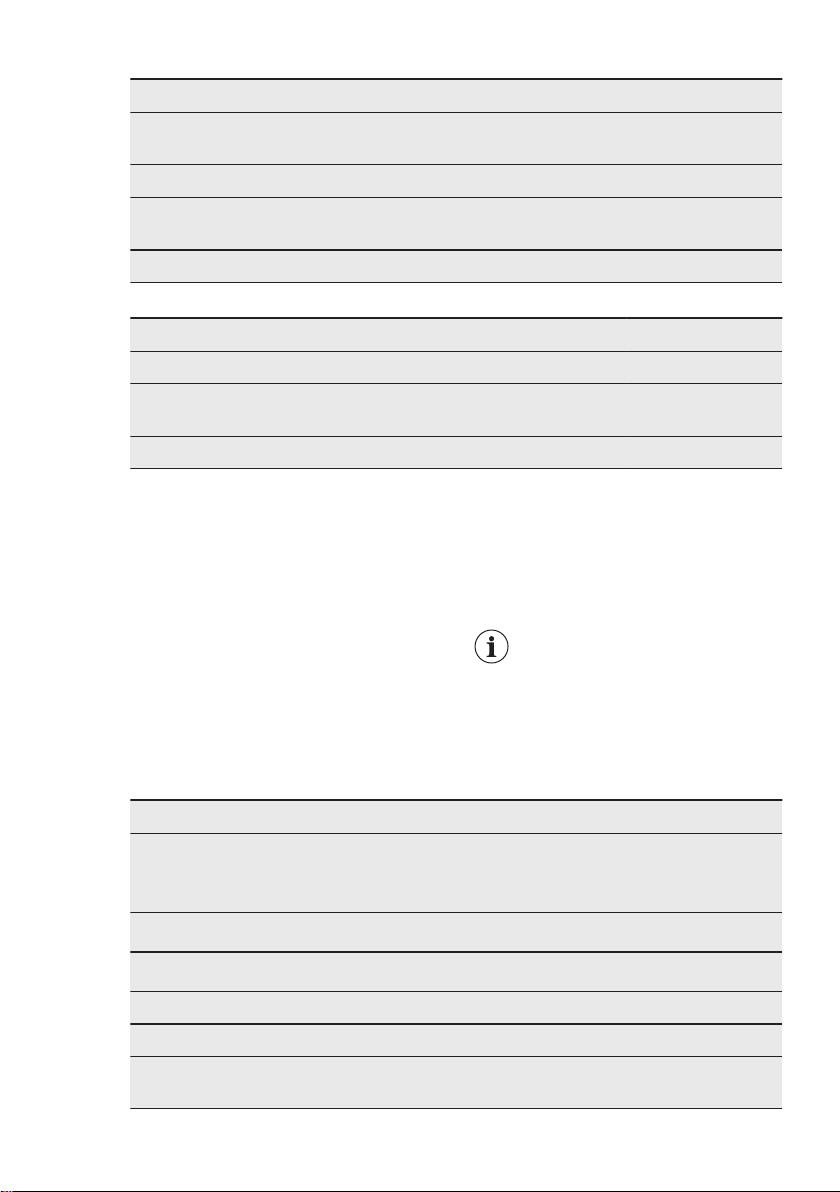
Food Temperature (°C) Time (min) Shelf position
Tafelspitz (prime
boiled beef)
99 110 - 120 1
Chipolatas 80 15 - 20 1
Bavarian veal sausage
(white sausage)
80 20 - 30 1
Vienna sausage 80 20 - 30 1
Eggs
Food Temperature (°C) Time (min) Shelf position
Eggs, hard-boiled 99 18 - 21 1
Eggs, medium-
boiled
99 11 - 12 1
Eggs, soft-boiled 99 10 - 11 1
12.9 True Fan Cooking and
Humidity High in succession
When you combine functions, you can
cook meat, vegetables and
accompaniments one after the other. All
dishes are ready to serve at the same
time.
• To initially roast the food use the
function: True Fan Cooking .
• Put prepared vegetables and
accompaniments in ovenproof dishes.
Put in the oven with the roast.
• Cool down the oven to a temperature
of around 80 °C. To cool down the
appliance quicker open the oven door
to the first position for approximately
15 minutes.
• Start the function: Humidity High.
Cook it all together until ready.
Maximum water amount is
650 ml.
12.10 Humidity Cooking - Humidity High
Food Temperature (°C) Time (min) Shelf position
Custard / flan in
individual
dishes
1)
90 35 - 40 1
Baked eggs
1)
90 - 110 15 - 30 1
Terrine
1)
90 40 - 50 1
Thin fish fillet 85 15 - 20 1
Thick fish fillet 90 25 - 35 1
Small fish up to
350 g
90 20 - 30 1
ENGLISH 37

Food Temperature (°C) Time (min) Shelf position
Whole fish up to
1000 g
90 30 - 40 1
Oven dumplings 120 - 130 40 - 50 1
1)
Continue for a further half an hour with the door closed.
12.11 Humidity Cooking - Humidity Medium
Food Temperature (°C) Time (min) Shelf position
Various types of
bread 500 -
1000g
180 - 190 45 - 60 1
Bread rolls 180 - 200 25 - 35 1
Sweet bread 160 - 170 30 - 45 1
Sweet yeast
dough bakeries
170 - 180 20 - 35 1
Sweet oven
dishes
160 - 180 45 - 60 1
Stewed / braised
meat
140 - 150 100 - 140 1
Spare ribs 140 - 150 75 - 100 1
Roasted fish fillet 170 - 180 25 - 40 1
Roasted fish 170 - 180 35 - 45 1
12.12 Humidity Cooking - Humidity Low
Food Temperature (°C) Time (min) Shelf position
Roast pork, 1000
g
160 - 180 90 - 100 1
Roast beef, 1000
g
180 - 200 60 - 90 1
Roast veal, 1000
g
180 80 - 90 1
Meat loaf, un-
cooked, 500 g
180 30 - 40 1
Smoked loin of
pork, 600 - 1000 g
(soak for 2 hours)
160 - 180 60 - 70 1
Chicken, 1000 g 180 - 210 50 - 60 1
www.aeg.com38

Food Temperature (°C) Time (min) Shelf position
Duck, 1500 - 2000
g
180 70 - 90 1
Goose, 3000 g 170 130 - 170 1
Potato gratin 160 - 170 50 - 60 1
Pasta bake 170 - 190 40 - 50 1
Lasagne 170 - 180 45 - 55 1
Ready-to-bake
rolls
200 15 - 20 1
Ready-to-bake
baguettes, 40 -
50 g
200 15 - 20 1
Ready-to-bake
baguettes, 40 -
50 g, frozen
200 25 - 35 1
12.13 Steam Regenerating
Food Temperature (°C) Time (min) Shelf position
One-plate dishes 110 10 - 15 1
Pasta 110 10 - 15 1
Rice 110 10 - 15 1
Dumplings 110 15 - 25 1
12.14 Yogurt Function
Use this function to prepare yogurt.
Ingredients:
• 1 l milk
• 250 g natural yogurt
Method:
Mix the yogurt with the milk and fill it in
yogurt jars.
In case raw milk is used, heat up the milk
to the boiling point and let it cool down
to 40 °C. Mix the yogurt afterwards with
the milk and fill it in yogurt jars.
Food Temperature (°C) Time (h) Shelf position
Yogurt creamy 42 5 - 6 1
Yogurt semisolid 42 7 - 8 1
12.15 Baking
• Your oven may bake or roast
differently to the appliance you had
before. Adapt your usual settings
such as temperature, cooking time
and shelf position to the values in the
tables.
• Use the lower temperature the first
time.
ENGLISH 39

• If you cannot find the settings for a
special recipe, look for the similar
one.
• You can extend baking times by 10 –
15 minutes if you bake cakes on more
than one shelf position.
• Cakes and pastries at different
heights do not always brown equally
at first. If this occurs, do not change
the temperature setting. The
differences equalize during the
baking procedure.
• Trays in the oven can twist during
baking. When the trays become cold
again, the distortions disappear.
12.16 Tips on baking
Baking results Possible cause Remedy
The bottom of the cake is
not browned sufficiently.
The shelf position is incor-
rect.
Put the cake on a lower
shelf.
The cake sinks and becomes
soggy, lumpy or streaky.
The oven temperature is too
high.
The next time you bake, set
a slightly lower oven temper-
ature.
The cake sinks and becomes
soggy, lumpy or streaky.
The baking time is too short. Set a longer baking time.
You cannot decrease bak-
ing times by setting higher
temperatures.
The cake sinks and becomes
soggy, lumpy or streaky.
There is too much liquid in
the mixture.
Use less liquid. Be careful
with mixing times, especially
if you use a mixing machine.
The cake is too dry. The oven temperature is too
low.
The next time you bake, set
a higher oven temperature.
The cake is too dry. The baking time is too long. The next time you bake, set
a shorter baking time.
The cake browns unevenly. The oven temperature is too
high and the baking time is
too short.
Set a lower oven tempera-
ture and a longer baking
time.
The cake browns unevenly. The mixture is unevenly dis-
tributed.
Spread the mixture evenly
on the baking tray.
The cake is not ready in the
baking time given.
The oven temperature is too
low.
The next time you bake, set
a slightly higher oven tem-
perature.
12.17 Baking on one oven level
Baking in tins
Food Function Tempera-
ture (°C)
Time (min) Shelf posi-
tion
Ring cake or brioche True Fan Cook-
ing
150 - 160 50 - 70 1
www.aeg.com40

Food Function Tempera-
ture (°C)
Time (min) Shelf posi-
tion
Madeira cake / Fruit
cakes
True Fan Cook-
ing
140 - 160 70 - 90 1
Sponge cake / Sponge
cake
True Fan Cook-
ing
140 - 150 35 - 50 1
Sponge cake / Sponge
cake
Conventional
Cooking
160 35 - 50 1
Flan base - short pas-
try
1)
True Fan Cook-
ing
150 - 160 20 - 30 2
Flan base - sponge mix-
ture
True Fan Cook-
ing
150 - 170 20 - 25 2
Apple pie / Apple pie (2
tins Ø 20 cm, diagonally
off set)
True Fan Cook-
ing
160 70 - 90 2
Apple pie / Apple pie (2
tins Ø 20 cm, diagonally
off set)
Conventional
Cooking
180 70 - 90 1
Cheesecake, tray
2)
Conventional
Cooking
160 - 170 70 - 90 2
1)
Preheat the oven.
2)
Use a deep pan.
Cakes / pastries / breads on baking trays
Food Function Tempera-
ture (°C)
Time (min) Shelf posi-
tion
Plaited bread / bread
crown
Conventional
Cooking
170 - 190 30 - 40 1
Christmas stollen
1)
Conventional
Cooking
160 - 180 50 - 70 1
Bread (rye bread)
1)
Conventional
Cooking
1
first 230 20
then 160 - 180 30 - 60
Cream puffs / eclairs
1)
Conventional
Cooking
190 - 210 20 - 35 2
Swiss Roll
1)
Conventional
Cooking
180 - 200 10 - 20 2
ENGLISH 41

Food Function Tempera-
ture (°C)
Time (min) Shelf posi-
tion
Cake with crumble top-
ping (dry)
True Fan Cook-
ing
150 - 160 20 - 40 2
Buttered almond cake /
sugar cakes
1)
Conventional
Cooking
190 - 210 20 - 30 2
Fruit flans (made with
yeast dough / sponge
mixture)
2)
True Fan Cook-
ing
150 - 170 30 - 55 2
Fruit flans (made with
yeast dough / sponge
mixture)
2)
Conventional
Cooking
170 35 - 55 2
Fruit flans made with
short pastry
True Fan Cook-
ing
160 - 170 40 - 80 2
Yeast cakes with deli-
cate toppings (e.g.
quark, cream, custard)
1)
Conventional
Cooking
160 - 180 40 - 80 2
1)
Preheat the oven.
2)
Use a deep pan.
Biscuits
Food Function Tempera-
ture (°C)
Time (min) Shelf posi-
tion
Short pastry biscuits True Fan Cook-
ing
150 - 160 15 - 25 2
Short bread / Short
bread / Pastry Stripes
True Fan Cook-
ing
140 20 - 35 2
Short bread / Short
bread / Pastry Stripes
1)
Conventional
Cooking
160 20 - 30 2
Biscuits made with
sponge mixture
True Fan Cook-
ing
150 - 160 15 - 20 2
Pastries made with egg
white, meringues
True Fan Cook-
ing
80 - 100 120 - 150 2
Macaroons True Fan Cook-
ing
100 - 120 30 - 50 2
Biscuits made with yeast
dough
True Fan Cook-
ing
150 - 160 20 - 40 2
Puff pastries
1)
True Fan Cook-
ing
170 - 180 20 - 30 2
www.aeg.com42

Food Function Tempera-
ture (°C)
Time (min) Shelf posi-
tion
Rolls
1)
True Fan Cook-
ing
160 10 - 25 2
Rolls
1)
Conventional
Cooking
190 - 210 10 - 25 2
Small cakes / Small
cakes
1)
True Fan Cook-
ing
160 20 - 35 2
Small cakes / Small
cakes
1)
Conventional
Cooking
170 20 - 35 2
1)
Preheat the oven.
12.18 Bakes and gratins
Food Function Temperature
(°C)
Time (min) Shelf position
Pasta bake Conventional
Cooking
180 - 200 45 - 60 1
Lasagne Conventional
Cooking
180 - 200 25 - 40 1
Vegetables au
gratin
1)
Turbo Grilling 170 - 190 15 - 35 1
Baguettes top-
ped with melted
cheese
True Fan Cook-
ing
160 - 170 15 - 30 1
Sweet bakes Conventional
Cooking
180 - 200 40 - 60 1
Fish bakes Conventional
Cooking
180 - 200 30 - 60 1
Stuffed vegeta-
bles
True Fan Cook-
ing
160 - 170 30 - 60 1
1)
Preheat the oven.
12.19 Moist Fan Baking
Food Temperature
(°C)
Time (min) Shelf position
Pasta gratin 200 - 220 45 - 60 1
Potato gratin 180 - 200 70 - 85 1
ENGLISH 43

Food Temperature
(°C)
Time (min) Shelf position
Moussaka 180 - 200 75 - 90 1
Lasagne 180 - 200 70 - 90 1
Cannelloni 180 - 200 65 - 80 1
Bread pudding 190 - 200 55 - 70 1
Rice pudding 180 - 200 55 - 70 1
Apple cake, made with
sponge mixture (round cake
tin)
160 - 170 70 - 80 1
White bread 200 - 210 55 - 70 1
12.20 Multilevel baking
Use the function: True Fan Cooking.
Cakes / pastries / breads on baking trays
Food Temperature (°C) Time (min) Shelf posi-
tion
Cream puffs / Eclairs
1)
160 - 180 25 - 45 1 / 4
Dry streusel cake 150 - 160 30 - 45 1 / 4
1)
Preheat the oven.
Cakes / small cakes / breads on baking trays
Food Temperature (°C) Time (min) Shelf posi-
tion
Short pastry biscuits 150 - 160 20 - 40 1 /4
Short bread / Short
bread / Pastry Stripes
140 25 - 45 1 / 4
Biscuits made with
sponge mixture
160 - 170 25 - 40 1 / 4
Pastries made with
egg white, meringues
80 - 100 130 - 170 1 / 4
Macaroons 100 - 120 40 - 80 1 / 4
Biscuits made with
yeast dough
160 - 170 30 - 60 1 / 4
12.21 Slow Cooking
Use this function to prepare lean, tender
pieces of meat and fish. This function is
not applicable to such recipes as pot
roast or fatty roast pork. You can use the
Food Sensor to guarantee that the meat
has the correct core temperature.
www.aeg.com44
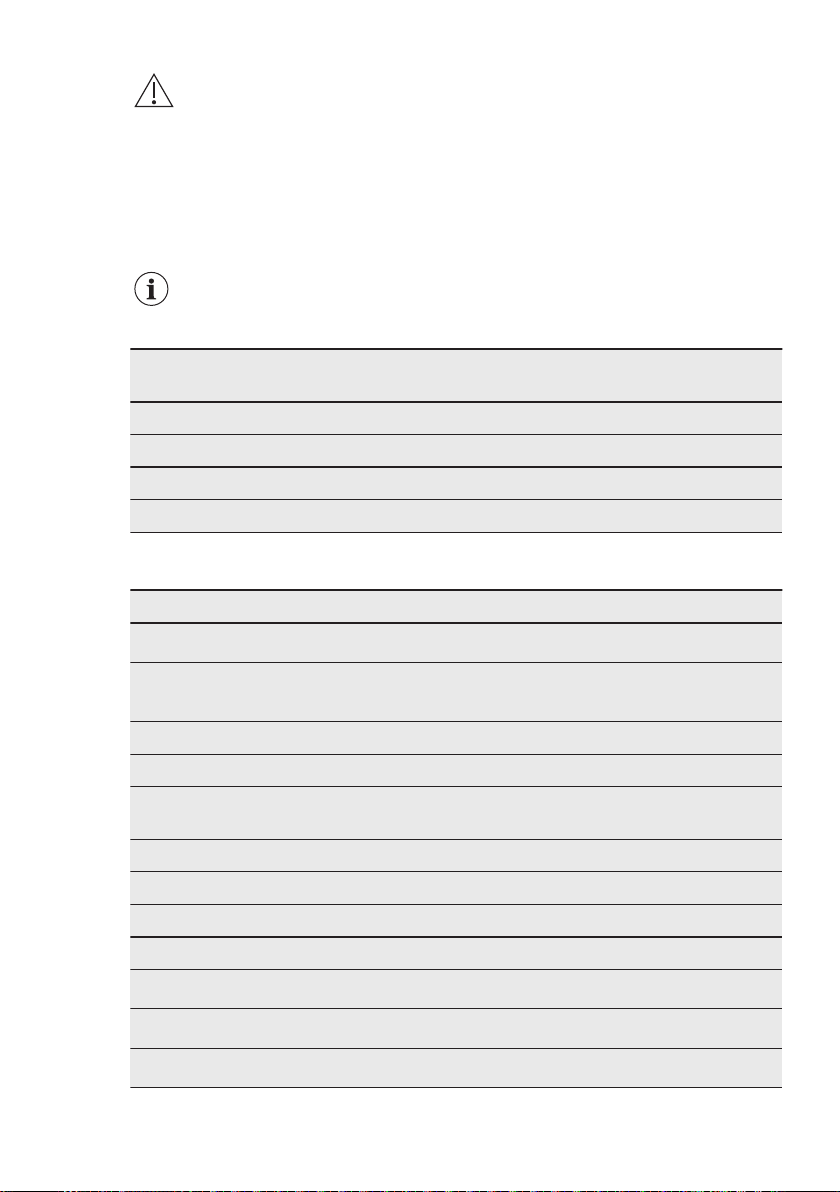
WARNING!
Refer to “Hints and tips”
chapter.
In the first 10 minutes you can set an
oven temperature between 80 °C and
150 °C. The default is 90 °C. After the
temperature is set, the oven continues to
cook at 80 °C. Do not use this function
for poultry.
Always cook without a lid
when you use this function.
1. Sear the meat in a pan on the hob on
a very high setting for 1 - 2 minutes
on each side.
2. Put the meat together with the hot
roasting pan on the wire shelf in the
oven.
3. Put the core temperature sensor into
the meat.
4. Select the function: Slow Cooking
and set the correct end core
temperature.
Food Quantity (kg) Temperature
(°C)
Time (min) Shelf posi-
tion
Roast beef 1 - 1.5 150 120 - 150 1
Fillet of beef 1 - 1.5 150 90 - 110 1
Roast veal 1 - 1.5 150 120 - 150 1
Steak 0.2 - 0.3 120 20 - 40 1
12.22 Pizza Setting
Food Temperature (°C) Time (min) Shelf position
Pizza (thin crust)
1)
210 - 230 15 - 25 2
Pizza (with a lot of
topping)
2)
180 - 200 20 - 30 2
Tarts 180 - 200 40 - 55 1
Spinach flan 160 - 180 45 - 60 1
Quiche Lorraine (Sa-
voury flan)
170 - 190 45 - 55 1
Swiss Flan 170 - 190 45 - 55 1
Cheesecake 140 - 160 60 - 90 1
Apple cake, covered 150 - 170 50 - 60 1
Vegetable pie 160 - 180 50 - 60 1
Unleavened bread
1)
210 - 230 10 - 20 2
Puff pastry flan
1)
160 - 180 45 - 55 2
Flammekuchen
1)
210 - 230 15 - 25 2
ENGLISH 45

Food Temperature (°C) Time (min) Shelf position
Piroggen (Russian
version of calzone)
1)
180 - 200 15 - 25 2
1)
Preheat the oven.
2)
Use a deep pan.
12.23 Roasting
• Use heat-resistant ovenware to roast.
Refer to the instructions of the
ovenware manufacturer.
• You can roast large roasting joints
directly in the deep pan or on the wire
shelf above the deep pan.
• Put some liquid in the deep pan to
prevent the meat juices or fat from
burning on it's surface.
• All types of meat that can be browned
or have crackling can be roasted in
the roasting tin without the lid.
• If necessary, turn the roast after 1/2 to
2/3 of the cooking time.
• To keep meat more succulent:
– roast lean meat in the roasting tin
with the lid or use roasting bag.
– roast meat and fish in pieces
weighting minimum 1 kg.
– baste large roasts and poultry
with their juices several times
during roasting.
12.24 Roasting tables
Beef
Food Function Quantity Tempera-
ture (°C)
Time (min) Shelf posi-
tion
Pot roast Conventional
Cooking
1 - 1.5 kg 230 120 - 150 1
Roast beef
or fillet:
rare
1)
Turbo Grilling per cm of
thickness
190 - 200 5 - 6 per cm of
thickness
1
Roast beef
or fillet: me-
dium
Turbo Grilling per cm of
thickness
180 - 190 6 - 8 per cm of
thickness
1
Roast beef
or fillet: well
done
Turbo Grilling per cm of
thickness
170 - 180 8 - 10 per cm of
thickness
1
1)
Preheat the oven.
Pork
Food Function Quantity Tempera-
ture (°C)
Time (min) Shelf posi-
tion
Shoulder,
neck, ham
joint
Turbo
Grilling
1 - 1.5 kg 150 - 170 90 - 120 1
www.aeg.com46

Food Function Quantity Tempera-
ture (°C)
Time (min) Shelf posi-
tion
Chop, spare
rib
Turbo
Grilling
1 - 1.5 kg 170 - 190 30 - 60 1
Meat loaf Turbo
Grilling
750 g - 1 kg 160 - 170 50 - 60 1
Pork knuckle
(precooked)
Turbo
Grilling
750 g - 1 kg 150 - 170 90 - 120 1
Veal
Food Function Quantity Tempera-
ture (°C)
Time (min) Shelf posi-
tion
Roast veal Turbo
Grilling
1 kg 160 - 180 120 - 150 1
Knuckle of
veal
Turbo
Grilling
1.5 - 2 kg 160 - 180 120 - 150 1
Lamb
Food Function Quantity Tempera-
ture (°C)
Time (min) Shelf posi-
tion
Leg of lamb,
roast lamb
Turbo
Grilling
1 - 1.5 kg 150 - 180 100 - 120 1
Saddle of
lamb
Turbo
Grilling
1 - 1.5 kg 160 - 180 40 - 60 1
Game
Food Function Quantity Tempera-
ture (°C)
Time (min) Shelf posi-
tion
Saddle of
hare, leg of
hare
1)
Turbo
Grilling
up to 1 kg 180 - 200 35 - 55 1
Saddle of ven-
ison
Conven-
tional
Cooking
1.5 - 2 kg 180 - 200 60 - 90 1
Haunch of
venison
Conven-
tional
Cooking
1.5 - 2 kg 180 - 200 60 - 90 1
1)
Preheat the oven.
ENGLISH 47
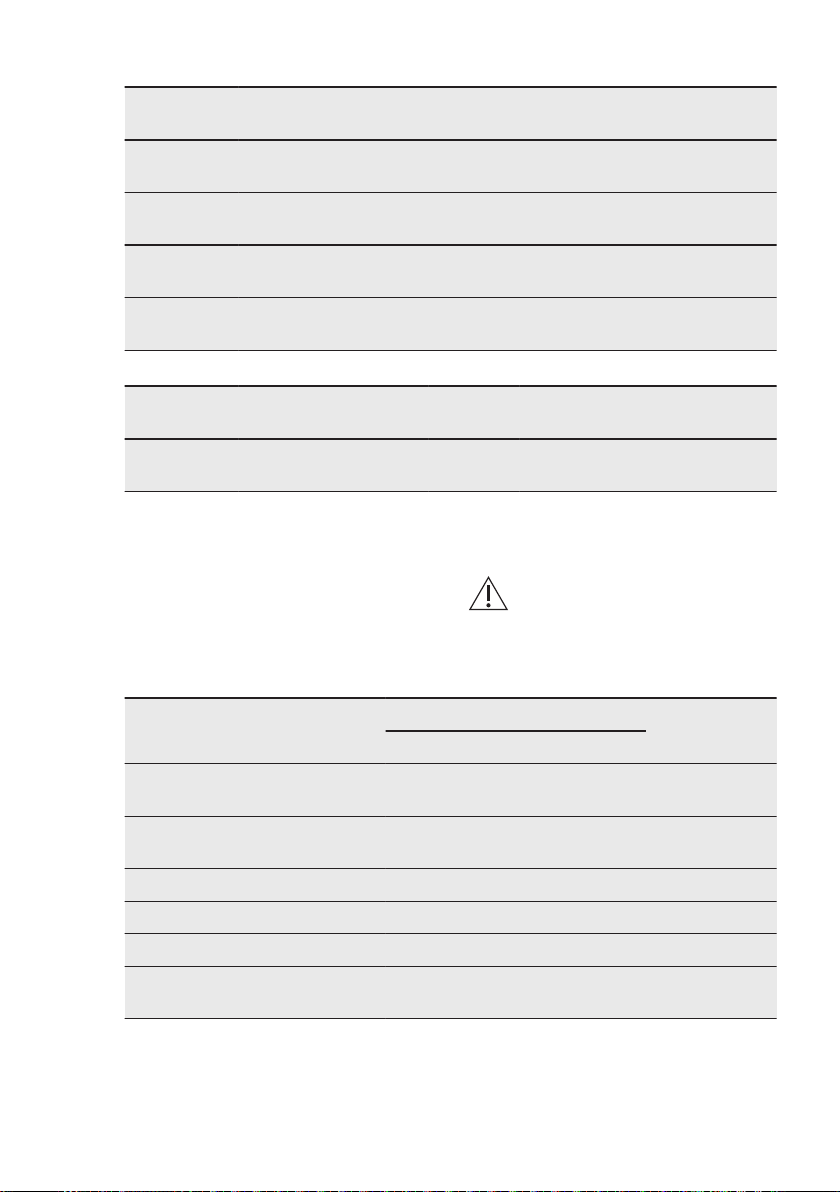
Poultry
Food Function Quantity Tempera-
ture (°C)
Time (min) Shelf posi-
tion
Chicken,
spring chicken
Turbo
Grilling
200 - 250 g
each
200 - 220 30 - 50 1
Chicken half Turbo
Grilling
400 - 500 g
each
190 - 210 40 - 50 1
Poultry pieces Turbo
Grilling
1 - 1.5 kg 190 - 210 50 - 70 1
Duck Turbo
Grilling
1.5 - 2 kg 180 - 200 80 - 100 1
Fish (steamed)
Food Function Quantity Tempera-
ture (°C)
Time (min) Shelf posi-
tion
Whole fish Turbo
Grilling
1 - 1.5 kg 180 - 200 30 - 50 1
12.25 Grill
• Always grill with the maximum
temperature setting.
• Set the shelf into the shelf position as
recommended in the grilling table.
• Always set the pan to collect the fat
into the first shelf position.
• Grill only flat pieces of meat or fish.
• Always preheat the empty oven with
the grill functions for 5 minutes.
CAUTION!
Always grill with the oven
door closed.
Grill
Food Temperature
(°C)
Grilling time (min) Shelf position
1st side 2nd side
Roast beef, me-
dium
210 - 230 30 - 40 30 - 40 1
Filet of beef,
medium
230 20 - 30 20 - 30 1
Back of pork 210 - 230 30 - 40 30 - 40 1
Back of veal 210 - 230 30 - 40 30 - 40 1
Back of lamb 210 - 230 25 - 35 20 - 35 1
Whole Fish, 500
- 1000 g
210 - 230 15 - 30 15 - 30 1
www.aeg.com48

Fast Grilling
Food Grilling time (min) Shelf position
1st side 2nd side
Burgers / Burgers 9 - 13 8 - 10 3
Pork fillet 10 - 12 6 - 10 3
Sausages 10 - 12 6 - 8 3
Fillet steaks, veal
steaks
7 - 10 6 - 8 3
Toast / Toast 1 - 3 1 - 3 3
Toast with topping 6 - 8 - 3
12.26 Frozen Foods
• Remove the food packaging. Put the
food on a plate.
• Do not cover it with a bowl or a plate.
This can extend the defrost time.
Food Temperature (°C) Time (min) Shelf position
Pizza, frozen 200 - 220 15 - 25 2
Pizza American, frozen 190 - 210 20 - 25 2
Pizza, chilled 210 - 230 13 - 25 2
Pizza Snacks, frozen 180 - 200 15 - 30 2
French Fries, thin 190 - 210 15 - 25 2
French Fries, thick 190 - 210 20 - 30 2
Wedges / Croquettes 190 - 210 20 - 40 2
Hash Browns 210 - 230 20 - 30 2
Lasagne / Cannelloni,
fresh
170 - 190 35 - 45 2
Lasagne / Cannelloni,
frozen
160 - 180 40 - 60 2
Oven baked cheese 170 - 190 20 - 30 2
Chicken Wings 180 - 200 40 - 50 2
ENGLISH 49

Frozen ready meals
Food Function Tempera-
ture (°C)
Time (min) Shelf position
Frozen pizza Conventional
Cooking
as per man-
ufacturer's
instructions
as per manufac-
turer's instruc-
tions
2
Chips
1)
(300 -
600 g)
Conventional
Cooking or Turbo
Grilling
200 - 220 as per manufac-
turer's instruc-
tions
2
Baguettes Conventional
Cooking
as per man-
ufacturer's
instructions
as per manufac-
turer's instruc-
tions
2
Fruit cake Conventional
Cooking
as per man-
ufacturer's
instructions
as per manufac-
turer's instruc-
tions
2
1)
Turn chips 2 or 3 times during cooking.
12.27 Preserving
• Use only preserve jars of the same
dimensions available on the market.
• Do not use jars with twist-off and
bayonet type lids or metal tins.
• Use the first shelf from the bottom for
this function.
• Put no more than six one-litre
preserve jars on the baking tray.
• Fill the jars equally and close with a
clamp.
• The jars cannot touch each other.
• Put approximately 1/2 litre of water
into the baking tray to give sufficient
moisture in the oven.
• When the liquid in the jars starts to
simmer (after approximately 35 - 60
minutes with one-litre jars), stop the
oven or decrease the temperature to
100 °C (see the table).
Soft fruit
Food Temperature (°C) Cooking time until
simmering (min)
Continue to cook at
100 °C (min)
Strawberries / Blue-
berries / Raspber-
ries / Ripe gooseber-
ries
160 - 170 35 - 45 -
Stone fruit
Food Temperature (°C) Cooking time until
simmering (min)
Continue to cook at
100 °C (min)
Pears / Quinces /
Plums
160 - 170 35 - 45 10 - 15
www.aeg.com50

Vegetables
Food Temperature (°C) Cooking time until
simmering (min)
Continue to cook at
100 °C (min)
Carrots
1)
160 - 170 50 - 60 5 - 10
Cucumbers 160 - 170 50 - 60 -
Mixed pickles 160 - 170 50 - 60 5 - 10
Kohlrabi / Peas / As-
paragus
160 - 170 50 - 60 15 - 20
1)
Leave standing in the oven after it is deactivated.
12.28 Drying
Food Temperature (°C) Time (h) Shelf position
Beans 60 - 70 6 - 8 2
Peppers 60 - 70 5 - 6 2
Vegetables for soup 60 - 70 5 - 6 2
Mushrooms 50 - 60 6 - 8 2
Herbs 40 - 50 2 - 3 2
Plums 60 - 70 8 - 10 2
Apricots 60 - 70 8 - 10 2
Apple slices 60 - 70 6 - 8 2
Pears 60 - 70 6 - 9 2
12.29 Bread Baking
Preheating is not recommended.
Food Temperature (°C) Time (min) Shelf position
White Bread 190 - 210 40 - 60 1
Baguette 200 - 220 35 - 45 1
Brioche 180 - 200 40 - 60 1
Ciabatta 200 - 220 35 - 45 1
Rye Bread 190 - 210 50 - 70 1
Dark Bread 190 - 210 50 - 70 1
All Grain bread 190 - 210 40 - 60 1
Bread rolls 200 - 220 25 - 35 2
ENGLISH 51

12.30 Food Sensor table
Beef Food core temperature (°C)
Rare Medium Well done
Roast beef 45 60 70
Sirloin 45 60 70
Beef Food core temperature (°C)
Less Medium More
Meat loaf 80 83 86
Pork Food core temperature (°C)
Less Medium More
Ham,
Roast
80 84 88
Chop (saddle),
Smoked pork loin,
Smoked loin poached
75 78 82
Veal Food core temperature (°C)
Less Medium More
Roast veal 75 80 85
Knuckle of veal 85 88 90
Mutton / lamb Food core temperature (°C)
Less Medium More
Leg of mutton 80 85 88
Saddle of mutton 75 80 85
Leg of lamb,
Roast lamb
65 70 75
Game Food core temperature (°C)
Less Medium More
Saddle of hare,
Saddle of venison
65 70 75
Leg of hare,
Whole hare,
Leg of venison
70 75 80
www.aeg.com52

Poultry Food core temperature (°C)
Less Medium More
Chicken (whole / half / breast) 80 83 86
Duck (whole / half),
Turkey (whole / breast)
75 80 85
Duck (breast) 60 65 70
Fish (salmon, trout, zander) Food core temperature (°C)
Less Medium More
Fish (whole / large / steamed),
Fish (whole / large / roasted)
60 64 68
Casseroles - Precooked vegeta-
bles
Food core temperature (°C)
Less Medium More
Zucchini Casserole,
Broccoli Casserole,
Fennel Casserole
85 88 91
Casseroles - Savoury Food core temperature (°C)
Less Medium More
Cannelloni,
Lasagne,
Pasta bake
85 88 91
Casseroles - Sweet Food core temperature (°C)
Less Medium More
White bread casserole with / with-
out fruits,
Rice porridge casserole with /
without fruits,
Sweet noodle casserole
80 85 90
12.31 Information for test institutes
Full Steam
Tests according to IEC 60350-1.
ENGLISH
53

Food Container
(Gastro-
norm)
Quantity
(kg)
Shelf po-
sition
Tempera-
ture (°C)
Time
(min)
Comments
Broccoli
1)
1 x 2/3 per-
forated
0.3 2 99 13-15 Put the bak-
ing tray on
the first shelf
position.
Broccoli
1)
1 x 2/3 per-
forated
max. 2 99 15-18 Put the bak-
ing tray on
the first shelf
position.
Frozen peas 1 x 2/3 per-
forated
2 2 99 Until the
tempera-
ture in
the cold-
est spot
reaches
85 °C.
Put the bak-
ing tray on
the first shelf
position.
1)
Preheat the oven for 5 minutes.
13. CARE AND CLEANING
WARNING!
Refer to Safety chapters.
13.1 Notes on cleaning
• Clean the front of the appliance with a
soft cloth with warm water and a
cleaning agent.
• To clean metal surfaces, use a
dedicated cleaning agent.
• To clean the bottom side in case of
limestone residual, use some drops of
vinegar.
• Clean the appliance interior after
each use. Fat accumulation or other
food remains may result in a fire. The
risk is higher for the grill pan.
• Clean stubborn dirt with a special
oven cleaner.
• Clean all accessories after each use
and let them dry. Use a soft cloth with
warm water and a cleaning agent.
• If you have nonstick accessories, do
not clean them using aggressive
agents, sharp-edged objects or a
dishwasher. It can cause damage to
the nonstick coating.
• Dry the oven when the cavity is wet
after usage.
13.2 Recommended cleaning
products
Do not use abrasive sponges or
aggressive detergents. It can cause
damage to the enamel and the stainless
steel parts.
You can buy our products at
www.aeg.com/shop and at the best
retailer shops.
13.3 Removing the shelf
supports
Before maintenance, make sure that the
appliance is cool. There is a risk of burns.
To clean the appliance, remove the shelf
supports.
1. Pull carefully the supports up and out
of the front catch.
www.aeg.com
54
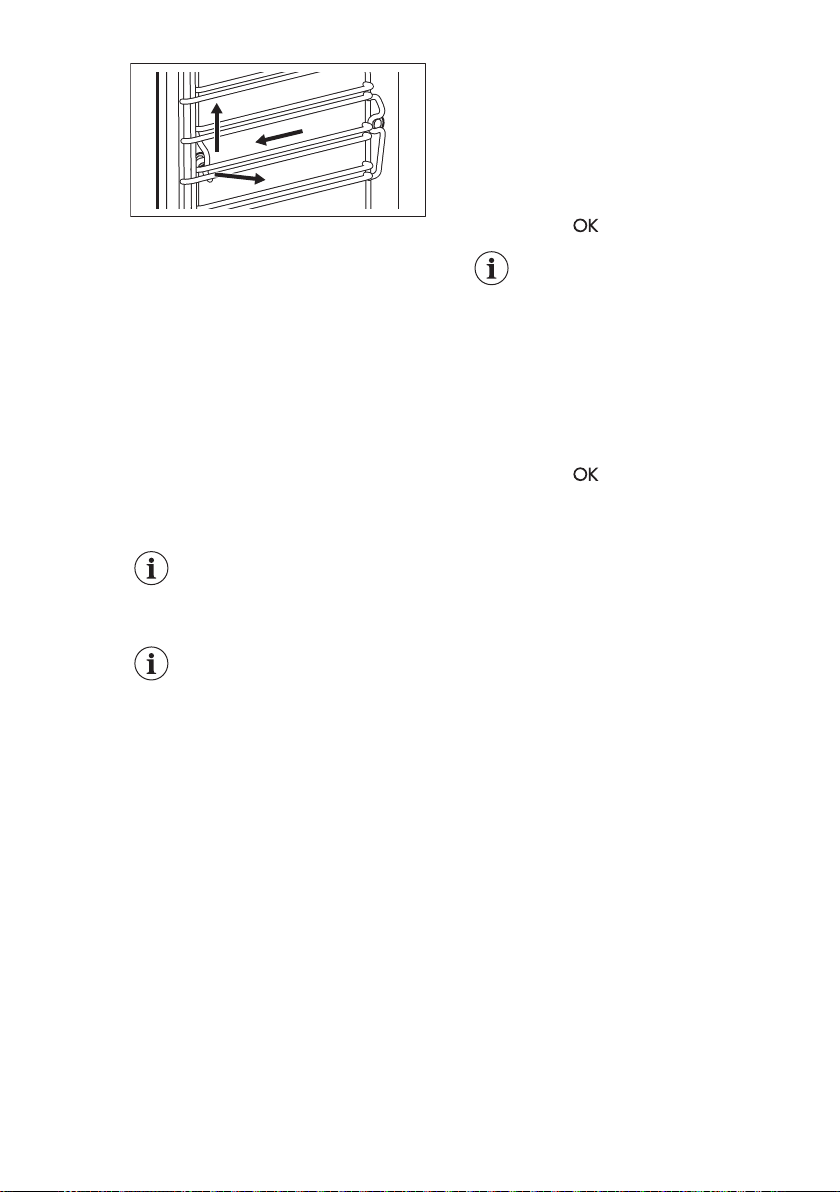
2
3
1
2. Pull the front end of the shelf support
away from the side wall.
3. Pull the supports out of the rear
catch.
Install the shelf supports in the opposite
sequence.
13.4 Steam Cleaning
Remove as much dirt as possible
manually.
Remove the accessories and the shelf
support to clean the side walls.
The steam cleaning functions support
the steam cavity cleaning of the
appliance.
For a better performance
you should start the cleaning
function when the appliance
is cool.
The specified time is related
to the duration of the
function and does not
include the time required for
cleaning of the cavity by the
user.
When the steam cleaning function is
active, the light is off.
1. Fill the water drawer to the maximum
level.
2. Choose the steam cleaning function
in the menu: Cleaning.
Steam Cleaning - the duration of the
function is around 30 minutes.
a) Activate the function.
b) An acoustic signal sounds when
the programme is completed.
c) Touch a sensor field to
deactivate the signal.
Steam Cleaning Plus - the duration
of the function is around 75 minutes.
a) Spray a suitable detergent
uniformly in the oven cavity on
both enamel and steel parts.
Before you start the cleaning
procedure, make sure that the
appliance is cold.
b) Activate the function.
After around 50 minutes an
acoustic signal sounds when the
first part of the programme is
completed.
c) Press
.
This is not the end of
the cleaning
procedure. Follow
the message in the
display to complete
the cleaning.
d) Wipe the internal surface of the
appliance with a non-abrasive
surface care sponge. You can use
warm water or oven detergents
to clean the cavity.
e) Press .
The final part of the procedure
starts. The duration of this stage
is around 25 minutes.
3. Wipe the internal surface of the
appliance with a non-abrasive
sponge. You can use warm water to
clean the cavity.
4. Remove the remaining water from
the water drawer.
After cleaning keep the appliance door
open for approximately 1 hour. Wait until
the appliance is dry. To speed up the
drying you can heat up the appliance
with hot air at temperature 150 °C for
approximately 15 minutes. You can get
maximum effects of the cleaning function
if you manually clean the appliance
immediately after the function ends.
13.5 Cleaning Reminder
When reminder is displayed cleaning is
necessary. Perform the function Steam
Cleaning Plus.
You can enable / disable the function:
Cleaning Reminder in the menu: Basic
Settings.
ENGLISH
55
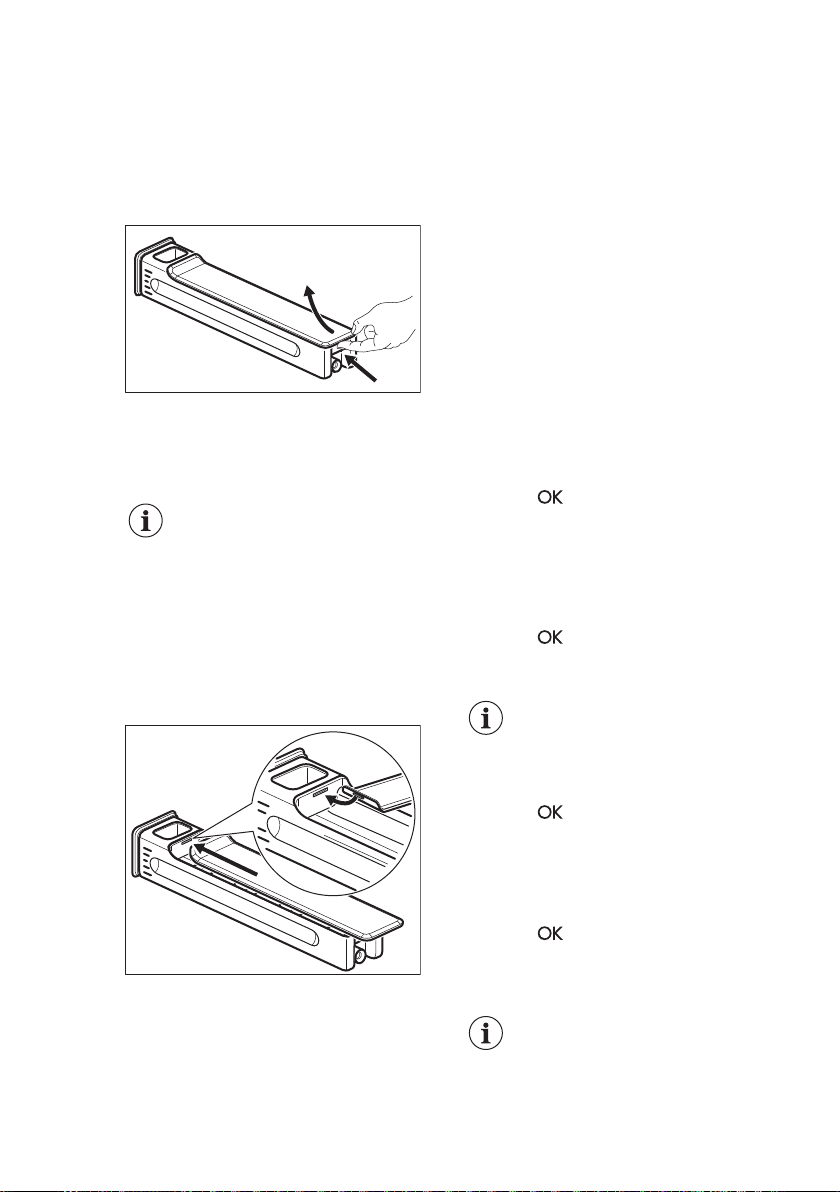
13.6 Cleaning the water
drawer
Remove the water drawer from the
appliance.
1. Remove the lid of the water drawer.
Lift the cover in correspondence with
the protrusion in the rear.
XAM
2. Remove the wave-breaker. Pull it
away from the drawer body until it
snaps out.
3. Wash the water drawer parts with
your hands. Use tap water and soap.
Do not use abrasive
sponges. Do not put
water drawer inside a
dish washer.
After you clean the water drawer parts,
reassemble the water drawer.
1. Snap in the wave-breaker. Push it
into the drawer body.
2. Assemble the lid. First insert the front
snap and then push it against the
drawer body.
XAM
XAM
3. Insert the water drawer inside the
appliance.
4. Push the water drawer towards the
oven until it latches.
13.7 Steam generation system
- Descaling
When the steam generator operates,
limestone accumulates inside it (because
of calcium contents in the water). This
can have a negative effect on the steam
quality, on the performance of the steam
generator and on the food quality. To
prevent limestone accumulation, clean
the steam generation circuit.
Remove all accessories.
Select the function from the menu:
Cleaning. The user interface will guide
you through the procedure.
The duration of the complete procedure
is about 2 hours.
The light in this function is off.
1. Put the grill- / roasting pan on the
first shelf position.
2. Press
.
3. Put 250 ml of the descaling agent in
the water drawer.
4. Fill the remaining part of the water
drawer with water to the maximum
level.
5. Insert the water drawer.
6. Press
.
This activates the first part of the
procedure: Descaling.
The duration of this part is
around 1 hour 40 minutes.
7. After the end of the first part, empty
the grill- / roasting pan and put it on
the first shelf position again.
8. Press
.
9. Fill the water drawer with fresh water.
Make sure there is no remaining
cleaning solution inside the water
drawer.
10. Insert the water drawer.
11. Press .
This activates the second part of the
procedure: Descaling. It will rinse the
steam generation circuit.
The duration of this part is
around 35 minutes.
Remove the grill- / roasting pan after the
end of the procedure.
www.aeg.com
56
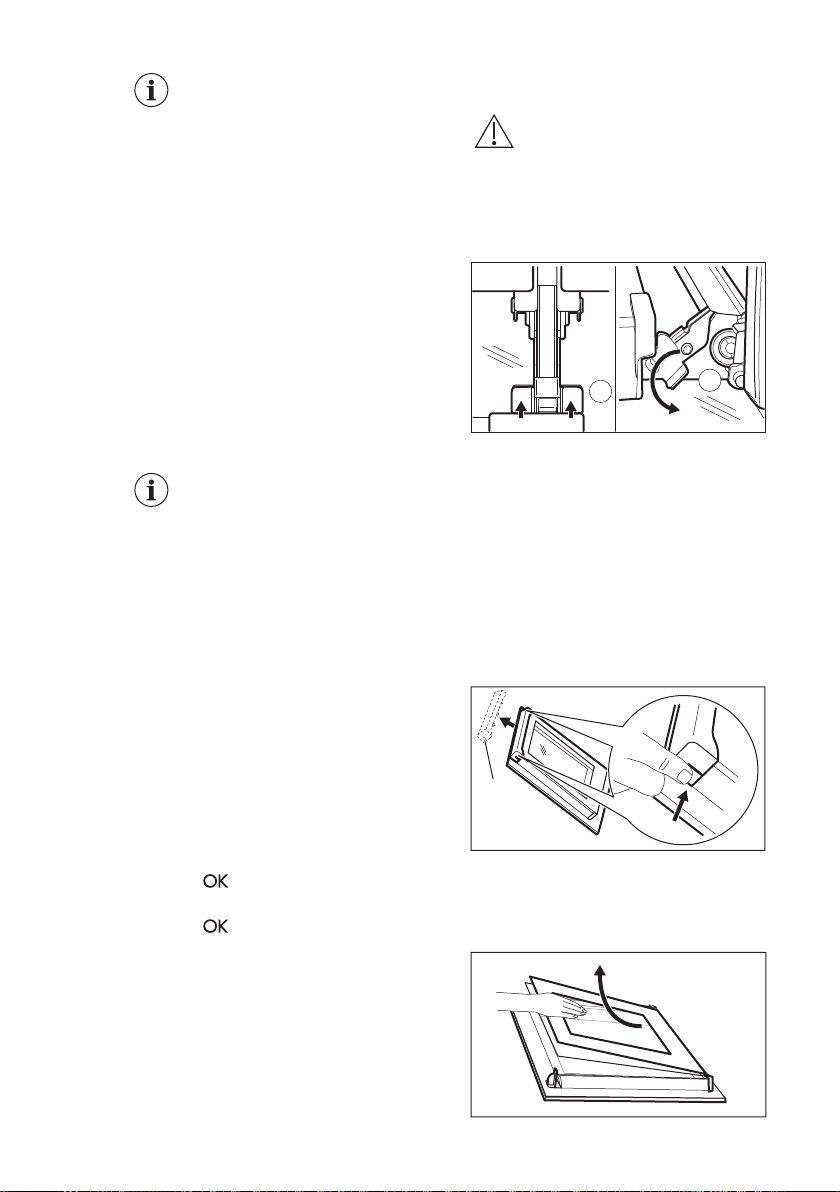
If the function: Descaling is
not performed in the correct
way, the display will show a
message to repeat it.
If the oven is humid or wet, wipe it out
with a dry cloth. Let the oven dry fully
with the door open.
13.8 Descaling reminder
There are two descaling reminders which
remind you to perform the function:
Descaling. These reminders activate
each time you switch off the appliance.
The soft reminder reminds and
recommends you to perform the
descaling cycle.
The hard reminder obligates you to
perform the descaling.
If you do not descale the
appliance when the hard
reminder is on, you cannot
use the steam functions.
You cannot disable the
descaling reminder.
13.9 Steam generation system
- Rinsing
Remove all accessories.
Select the function from the menu:
Cleaning. The user interface will guide
you through the procedure.
The duration of the function is around 30
minutes.
The light in this function is off.
1. Put the baking tray on the first shelf
position.
2. Press .
3. Fill the water drawer with fresh water.
4. Press .
Remove the baking tray after the end of
the procedure.
13.10 Removing and installing
the door
You can remove the door and the
internal glass panels to clean it. The
number of glass panels is different for
different models.
WARNING!
Be careful when you remove
the door from the appliance.
The door is heavy.
1. Open the door fully.
2. Fully press the clamping levers (A) on
the two door hinges.
A
A
3. Close the oven door to the first
opening position (approximately 70°
angle).
4. Hold the door with one hand on each
side and pull it away from the
appliance at an upwards angle.
5. Put the door with the outer side
down on a soft cloth on a stable
surface. This is to prevent scratches.
6. Hold the door trim (B) on the top
edge of the door at the two sides
and push inwards to release the clip
seal.
1
2
B
7. Pull the door trim to the front to
remove it.
8. Hold the door glass panels on their
top edge one by one and pull them
up out of the guide.
ENGLISH
57
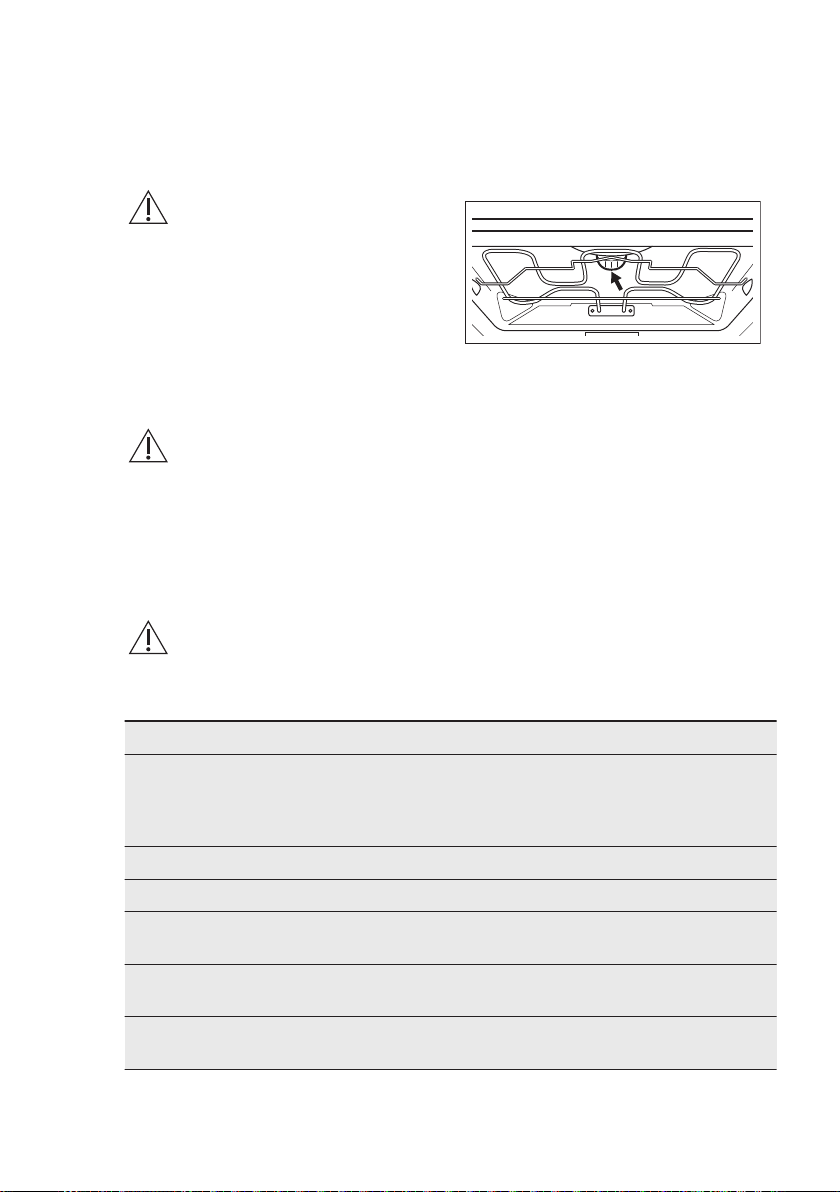
9. Clean the glass panel with water and
soap. Dry the glass panel carefully.
When the cleaning is completed, do the
above steps in the opposite sequence.
Install the smaller panel first, then the
larger and the door.
WARNING!
Make sure that the glasses
are inserted in the correct
position otherwise the
surface of the door may
overheat.
13.11 Replacing the lamp
Put a cloth on the bottom of the interior
of the appliance. It prevents damage to
the lamp glass cover and the cavity.
WARNING!
Danger of electrocution!
Disconnect the fuse before
you replace the lamp.
The lamp and the lamp glass
cover can be hot.
1. Deactivate the appliance.
2. Remove the fuses from the fuse box
or deactivate the circuit breaker.
The top lamp
1. Turn the lamp glass cover
counterclockwise to remove it.
2. Remove the metal ring and clean the
glass cover.
3. Replace the lamp with a suitable 300
°C heat-resistant lamp.
4. Attach the metal ring to the glass
cover.
5. Install the glass cover.
14. TROUBLESHOOTING
WARNING!
Refer to Safety chapters.
14.1 What to do if...
Problem Possible cause Remedy
You cannot activate or oper-
ate the oven.
The oven is not connected
to an electrical supply or it is
connected incorrectly.
Check if the oven is correctly
connected to the electrical
supply (refer to the connec-
tion diagram if available).
The oven does not heat up. The oven is deactivated. Activate the oven.
The oven does not heat up. The clock is not set. Set the clock.
The oven does not heat up. The necessary settings are
not set.
Make sure that the settings
are correct.
The oven does not heat up. The automatic switch-off is
activated.
Refer to "Automatic switch-
off".
The oven does not heat up. The Child Lock is on. Refer to "Using the Child
Lock".
www.aeg.com58

Problem Possible cause Remedy
The oven does not heat up. The door is not closed cor-
rectly.
Fully close the door.
The oven does not heat up. The fuse is blown. Make sure that the fuse is
the cause of the malfunction.
If the fuse is blown again
and again, contact a quali-
fied electrician.
The lamp does not operate. The lamp is defective. Replace the lamp.
The display shows F111. The plug of the core tem-
perature sensor is not cor-
rectly installed into the sock-
et.
Put the plug of the core tem-
perature sensor as far as
possible into the socket.
The display shows an error
code that is not in this table.
There is an electrical fault. • Deactivate the oven with
the house fuse or the
safety switch in the fuse
box and activate it again.
• If the display shows the
error code again, contact
the Customer Care De-
partment.
Steam and condensation
settle on the food and in the
cavity of the oven.
You left the dish in the oven
for too long.
Do not leave the dishes in
the oven for longer than 15 -
20 minutes after the cooking
process ends.
The appliance is activated
and does not heat up. The
fan does not operate. The
display shows "Demo".
The demo mode is activa-
ted.
Refer to "Basic Settings" in
"Daily use" chapter.
The appliance does not re-
tain the water drawer after
you insert it.
You did not assemble the lid
of the water drawer correct-
ly.
Assemble the lid of the wa-
ter drawer correctly.
Water comes out of the wa-
ter drawer after you carry it
or put it inside the appli-
ance.
You did not assemble the lid
of the water drawer correct-
ly.
Assemble the lid of the wa-
ter drawer correctly.
Water comes out of the wa-
ter drawer after you carry it
or put it inside the appli-
ance.
You did not assemble the
wave-breaker correctly.
Assemble the wave-breaker
in the body of the water
drawer correctly.
The appliance does not re-
tain the water drawer after
you push it on the cover.
You did not fully press the
water drawer body.
Insert the water drawer body
in the appliance by pushing
it until it reaches to the end.
ENGLISH 59

Problem Possible cause Remedy
The water drawer is difficult
to clean.
You did not remove the lid
and the wave-breaker.
Refer to "Cleaning the water
drawer".
The descaling procedure is
interrupted before it finishes.
There was a power cut. Repeat the procedure.
The descaling procedure is
interrupted before it finishes.
The function was stopped by
the user.
Repeat the procedure.
There is no water inside the
grill- / roasting pan after the
descaling procedure.
You did not fill the water
drawer to the maximum lev-
el.
Check if the a descaling
agent / water is present in
the water drawer body.
Repeat the procedure.
There is dirty water on the
bottom of the cavity after
the descaling cycle.
The grill- / roasting pan is on
a wrong shelf position.
Remove the residual water
and the descaling agent
from the bottom of the
oven. Put the grill- / roasting
pan on the first shelf posi-
tion.
The cleaning function is in-
terrupted before it finishes.
There was a power cut. Repeat the procedure.
The cleaning function is in-
terrupted before it finishes.
The function was stopped by
the user.
Repeat the procedure.
There is too much water on
the bottom of the cavity af-
ter the end of the cleaning
function.
You sprayed too much de-
tergent in the appliance be-
fore the activation of the
cleaning cycle.
Cover all parts of the cavity
with a thin layer of the deter-
gent. Spray the detergent
evenly.
There is no good perform-
ance of the cleaning proce-
dure.
The initial oven cavity tem-
perature of the steam clean-
ing function was too high.
Repeat the cycle. Run the cy-
cle when the appliance is
cold.
There is no good perform-
ance of the cleaning proce-
dure.
You did not remove the side
grids before the start of the
cleaning procedure. They
can transfer heat to the walls
and decrease the perform-
ance.
Remove the side grids from
the appliance and repeat the
function.
There is no good perform-
ance of the cleaning proce-
dure.
You did not remove the ac-
cessories from the appliance
before the start of the clean-
ing procedure. They can
compromise the steam cycle
and decrease the perform-
ance.
Remove the accessories
from the appliance and re-
peat the function.
www.aeg.com60
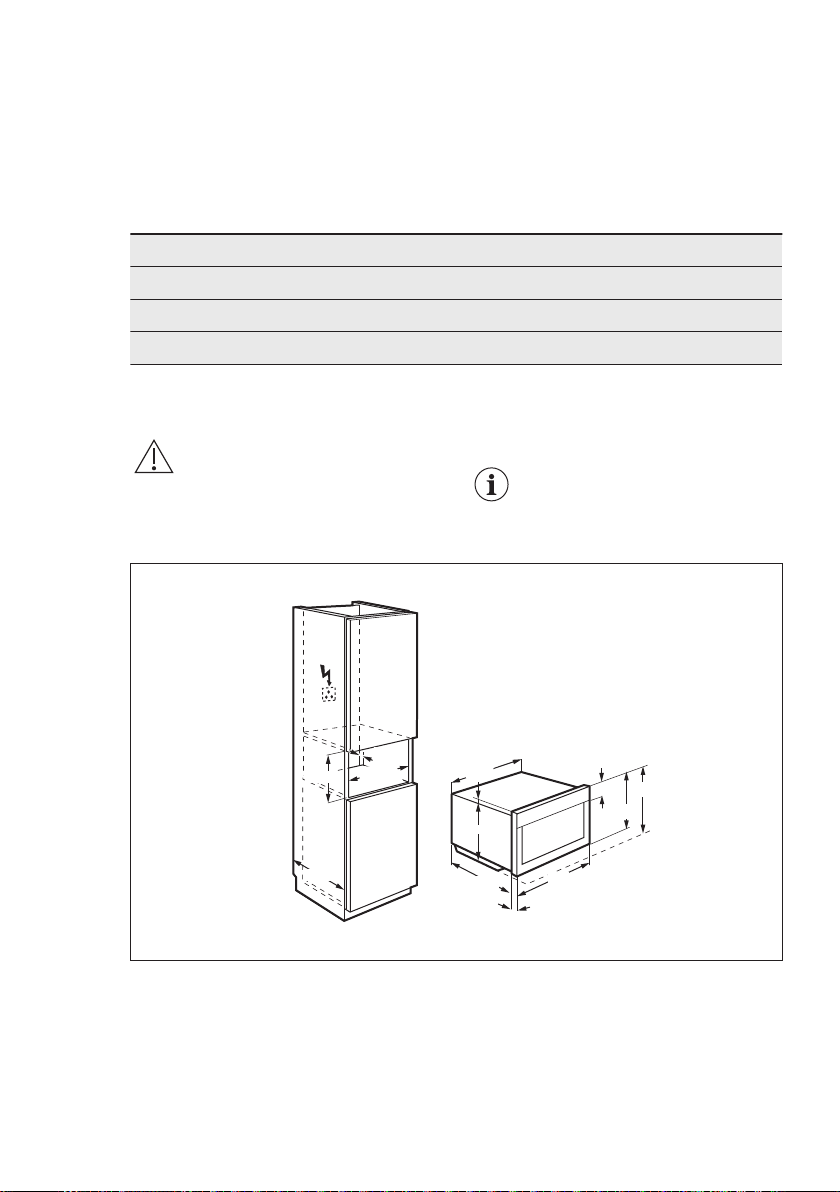
14.2 Service data
If you cannot find a solution to the
problem yourself, contact your dealer or
an Authorised Service Centre.
The necessary data for the service centre
is on the rating plate. The rating plate is
on the front frame of the appliance
cavity. Do not remove the rating plate
from the appliance cavity.
We recommend that you write the data here:
Model (MOD.) .........................................
Product number (PNC) .........................................
Serial number (S.N.) .........................................
15. INSTALLATION
WARNING!
Refer to Safety chapters.
15.1 Building in
The built-in unit must meet
the stability requirements of
DIN 68930.
440mm
548mm
546mm
594mm
455mm
21mm
450mm
min.
550mm
min.
20mm
min.
560mm
15mm
114
mm
450mm
ENGLISH 61
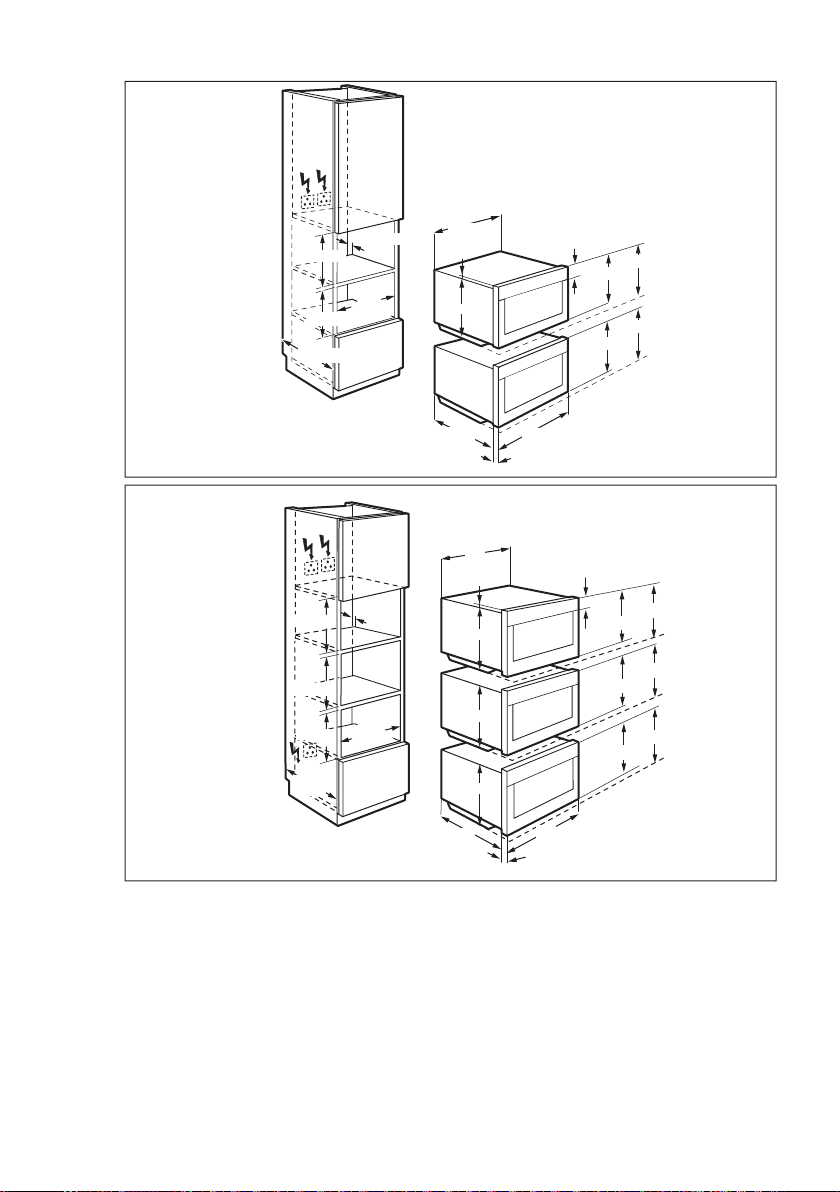
440mm
546mm
594mm
455mm
450mm
455mm
450mm
450mm
548mm
min.
550mm
450mm
min.
560mm
21mm
114
mm
15mm
min. 20mm
440mm
450mm
450mm
450mm
455mm
450mm
450mm
450mm
455mm
455mm
546mm
594mm
548mm
21mm
min.
550mm
min.
560mm
min.
20mm
114
mm
15mm
440 mm
440mm
www.aeg.com62
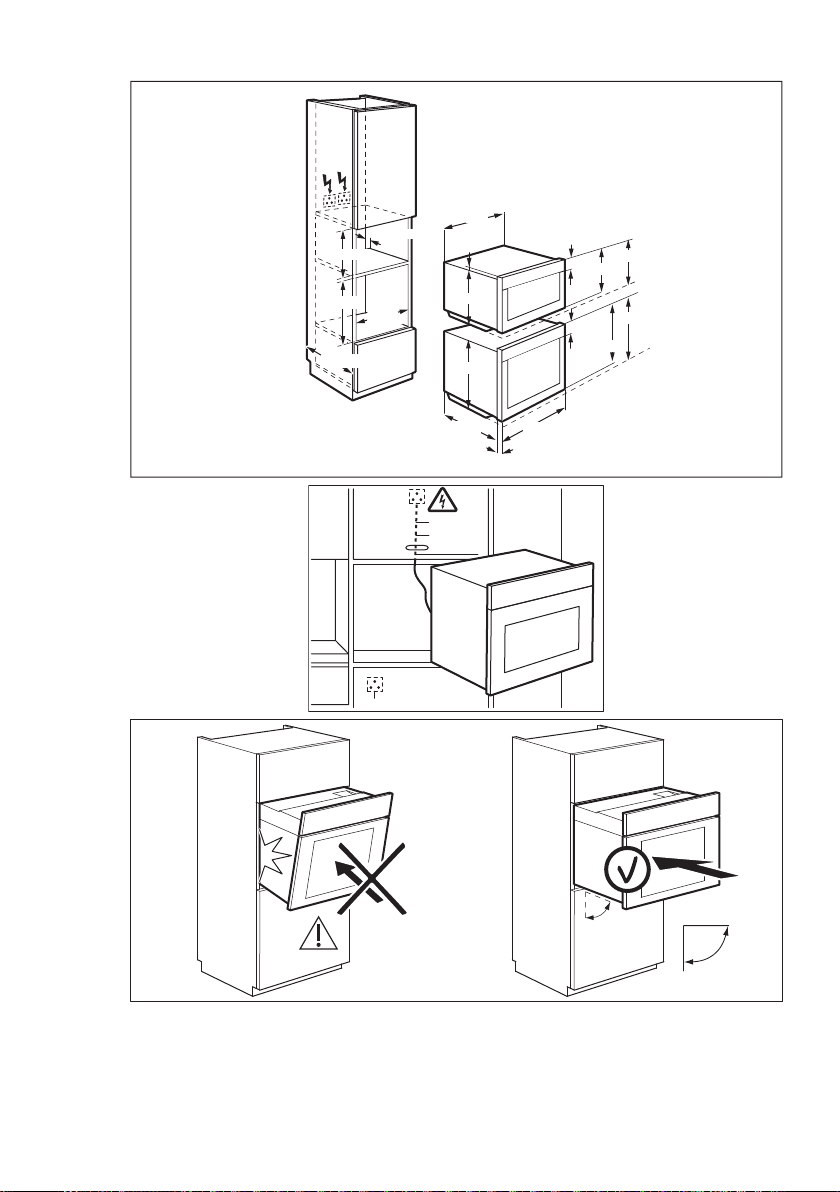
440mm
579mm
546mm
594mm
455mm
450mm
594mm
589mm
450mm
548mm
min.
550mm
590mm
21mm
114
mm
114
mm
15mm
min. 20mm
min.
560mm
alternativ
H05VV-F
H05RR-F
min.1,60 m
90°
ENGLISH 63
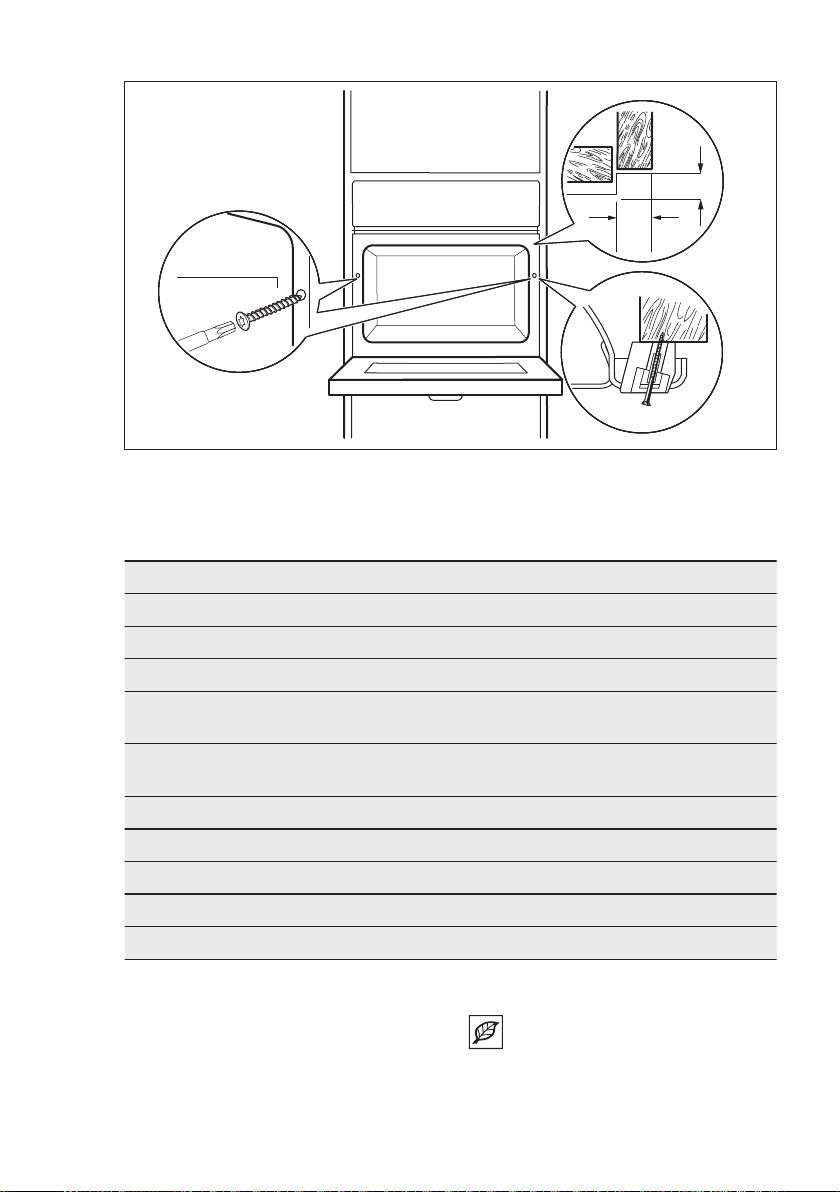
13mm
20
mm
2x3,5x25
16. ENERGY EFFICIENCY
16.1 Product Fiche and information according to EU 65-66/2014
Supplier's name AEG
Model identification KSK792220M
Energy Efficiency Index 80.8
Energy efficiency class A+
Energy consumption with a standard load, conven-
tional mode
0.89 kWh/cycle
Energy consumption with a standard load, fan-forced
mode
0.59 kWh/cycle
Number of cavities 1
Heat source Electricity
Volume 43 l
Type of oven Built-In Oven
Mass 36.6 kg
EN 60350-1 - Household electric cooking
appliances - Part 1: Ranges, ovens, steam
ovens and grills - Methods for measuring
performance.
16.2 Energy saving
The appliance contains
features which help you save
energy during everyday
cooking.
www.aeg.com64

General hints
Make sure that the oven door is closed
properly when the appliance operates
and keep it closed as much as possible
during the cooking.
Use metal dishes to improve energy
saving.
When possible, do not preheat the oven
before you put the food inside.
When the cooking duration is longer
than 30 minutes, reduce the oven
temperature to minimum 3 - 10 minutes
before the end of the cooking time,
depending on the duration of the
cooking. The residual heat inside the
oven will continue to cook.
Use the residual heat to warm up other
dishes.
Cooking with fan
When possible, use the cooking
functions with fan to save energy.
Residual heat
If a programme with the Duration or End
Time selection is activated and the
cooking time is longer than 30 minutes,
the heating elements deactivate
automatically 10% faster in some oven
functions.
The fan and lamp continue to operate.
Keep food warm
Choose the lowest possible temperature
setting to use residual heat and keep a
meal warm. The display shows the
residual heat indicator or temperature.
Cooking with the lamp off
Deactivate the lamp during cooking and
activate only when you need it.
Moist Fan Baking
Function designed to save energy during
cooking. It operates in such a way that
the temperature in the oven cavity may
differ from the temperature indicated on
the display during a cooking cycle and
cooking times may be different from the
cooking times in other programmes.
When you use Moist Fan Baking, the
lamp automatically deactivates after 30
seconds.
You may activate the lamp again but this
action will reduce the expected energy
savings.
ENGLISH 65
This document sets out the terms and conditions of the product warranties for
AEG Appliances. It is an important document. Please keep it with your proof
of purchase documents in a safe place for future reference should there be a
manufacturing defect in your Appliance. This warranty is in addition to other
rights you may have under the Australian Consumer Law.
1. In this warranty:
(a) ‘ACL’ or ‘Australian Consumer Law’ means Schedule 2 to the Competition and
Consumer Act 2010;
(b) ‘Appliance’ means any Electrolux product purchased by you and accompanied
by this document;
(c) ‘ASC’ means Electrolux’s authorised serviced centres;
(d) ‘AEG’ is the brand controlled by Electrolux Home Products Pty Ltd of 163
O’Riordan Street, Mascot NSW 2020, ABN 51 004 762 341 in respect of
Appliances purchased in Australia and Electrolux (NZ) Limited (collectively
“Electrolux”) of 3-5 Niall Burgess Road, Mount Wellington, in respect of
Appliances purchased in New Zealand;
(e) ‘Warranty Period’ means the period specified in clause 3 of this warranty;
(f) ‘you’ means the purchaser of the Appliance not having purchased the
Appliance for re-sale, and ‘your’ has a corresponding meaning.
2. Application: This warranty only applies to new Appliances, purchased and used
in Australia or New Zealand and is in addition to (and does not exclude, restrict, or
modify in any way) other rights and remedies under a law to which the Appliances
or services relate, including any non-excludable statutory guarantees in Australia
and New Zealand.
3. Warranty Period: Subject to these terms and conditions, this warranty continues
for in Australia for a period of 60 months and in New Zealand for a period of 60
months, following the date of original purchase of the Appliance.
4. Repair or replace warranty: During the Warranty Period, Electrolux or its ASC
will, at no extra charge if your Appliance is readily accessible for service, without
special equipment and subject to these terms and conditions, repair or replace
any parts which it considers to be defective. Electrolux may, in its absolute
discretion, choose whether the remedy oered for a valid warranty claim is repair
or replacement. Electrolux or its ASC may use refurbished parts to repair your
Appliance. You agree that any replaced Appliances or parts become the property
of Electrolux.
5. Travel and transportation costs: Subject to clause 7, Electrolux will bear the
reasonable cost of transportation, travel and delivery of the Appliance to and from
Electrolux or its ASC. Travel and transportation will be arranged by Electrolux as
part of any valid warranty claim.
6. Proof of purchase is required before you can make a claim under this warranty.
7. Exclusions: You may not make a claim under this warranty unless the defect claimed
is due to faulty or defective parts or workmanship. This warranty does not cover:
(a) light globes, batteries, filters or similar perishable parts;
(b) parts and Appliances not supplied by Electrolux;
(c) cosmetic damage which does not aect the operation of the Appliance;
(d) damage to the Appliance caused by:
(i) negligence or accident;
(ii) misuse or abuse, including failure to properly maintain or service;
(iii) improper, negligent or faulty servicing or repair works done by
anyone other than an Electrolux authorised repairer or ASC;
(iv) normal wear and tear;
(v) power surges, electrical storm damage or incorrect power supply;
(vi) incomplete or improper installation;
(vii) incorrect, improper or inappropriate operation;
(viii) insect or vermin infestation;
(ix) failure to comply with any additional instructions supplied with
the Appliance;
In addition, Electrolux is not liable under this warranty if:
(a) the Appliance has been, or Electrolux reasonably believes that the Appliance
has been, used for purposes other than those for which the Appliance was
intended, including where the Appliance has
been used for any non-domestic purpose;
(b) the Appliance is modified without authority from Electrolux in writing;
(c) the Appliance’s serial number or warranty seal has been removed
or defaced.
8. How to claim under this warranty: To enquire about claiming under this warranty,
please follow these steps:
(a) carefully check the operating instructions, user manual and the terms of
this warranty;
(b) have the model and serial number of the Appliance available;
(c) have the proof of purchase (e.g. an invoice) available;
(d) telephone the numbers shown below.
9. Australia: For Appliances and services provided by Electrolux in Australia: Electrolux
goods come with guarantees that cannot be excluded under the Australian
Consumer Law. You are entitled to a replacement or refund for a major failure and
for compensation for any other reasonably foreseeable loss or damage. You are also
entitled to have the Appliance repaired or replaced if the Appliance fails to be of
acceptable quality and the failure does not amount to a major failure. ‘Acceptable
quality’ and ‘major failure’ have the same meaning as referred to in the ACL.
10. New Zealand: For Appliances and services provided by Electrolux in New
Zealand, the Appliances come with a guarantee by Electrolux pursuant to the
provisions of the Consumer Guarantees Act, the Sale of Goods Act and the Fair
Trading Act. Where the Appliance was purchased in New Zealand for commercial
purposes the Consumer Guarantee Act does not apply.
11. Confidentiality: You accept that if you make a warranty claim, Electrolux and
its agents including ASC may exchange information in relation to you to enable
Electrolux to meet its obligations under this warranty.
Warranty
FOR SALES IN AUSTRALIA AND NEW ZEALAND
ALL AEG BRANDED APPLIANCES
Important Notice
Before calling for service, please ensure that the steps listed in clause 8 above have been followed.
FOR SERVICE
or to find the address of your nearest
authorised service centre in Australia
PLEASE CALL 1300 363 664
OR EMAIL
For the cost of a local call (Australia only)
SERVICE AUSTRALIA
aeg.com/au
FOR SPARE PARTS
or to find the address of your nearest
spare parts centre in Australia
PLEASE 13 13 50
OR EMAIL
For the cost of a local call (Australia only)
FOR SERVICE
or to find the address of your nearest
authorised service centre in New Zealand
PLEASE CALL 0800 234 234
OR EMAIL [email protected]
(New Zealand only)
SERVICE NEW ZEALAND
aegnewzealand.co.nz
FOR SPARE PARTS
or to find the address of your nearest
spare parts centre in New Zealand
PLEASE 0800 10 66 20
OR EMAIL [email protected]
(New Zealand only)
AEG_Warr_May17

Important Notice
Before calling for service, please ensure that the steps listed in clause 13 above have been
followed.
AEG SERVICE AUSTRALIA
www.aeg.com/au
FOR SERVICE
or to find the address of your nearest state service centre in Australia
PLEASE CALL 1300 363 664
OR EMAIL [email protected]
For the cost of a local call (Australia only)
FOR SPARE PARTS
or to find the address of your nearest state spare parts centre in Australia
PLEASE CALL 13 13 50
OR EMAIL [email protected]
For the cost of a local call (Australia only)
AEG SERVICE NEW ZEALAND
www.aeg.co.nz
FOR SERVICE
or to find the address of your nearest authorised service centre in New Zealand
FREE CALL 0800 10 66 10
OR EMAIL [email protected]
(New Zealand only)
ENGLISH 67
FOR SPARE PARTS
or to find the address of your nearest state spare parts centre in New Zealand
FREE CALL 0800 10 66 20
OR EMAIL [email protected]
(New Zealand only)
18. ENVIRONMENTAL CONCERNS
Recycle materials with the symbol
.
Put the packaging in relevant containers
to recycle it. Help protect the
environment and human health by
recycling waste of electrical and
electronic appliances. Do not dispose of
appliances marked with the symbol
with the household waste. Return the
product to your local recycling facility or
contact your municipal office.
www.aeg.com/au
867343211-A-242017