
1
USER MANUAL


Your HERO6 Black 6
Getting Started 8
Navigating Your GoPro 17
Map of Modes and Settings 22
Capturing Video and Photos 24
Settings for Your Activities 26
QuikCapture 28
Controlling Your GoPro with Your Voice 30
Playing Back Your Content 34
Using Your Camera with an HDTV 37
Connecting to Other Devices 39
Ooading Your Content 41
Video Mode: Capture Modes 45
Video Mode: Settings 47
Video Mode: Advanced Settings 55
Photo Mode: Capture Modes 57
Photo Mode: Settings 59
Photo Mode: Advanced Settings 61
Time Lapse Mode: Capture Modes 63
TABLE OF CONTENTS
Time Lapse Mode: Settings 65
Time Lapse Mode: Advanced Settings 69
Advanced Controls 70
Connecting to an Audio Accessory 80
Customizing Your GoPro 81
Important Messages 85
Resetting Your Camera 86
Mounting 87
Removing the Side Door 5
Maintenance 93
Battery Information 94
Troubleshooting 97
Customer Support 99
Trademarks 99
HEVC Advance Notice 100
Regulatory Information 100
TABLE OF CONTENTS
6 7
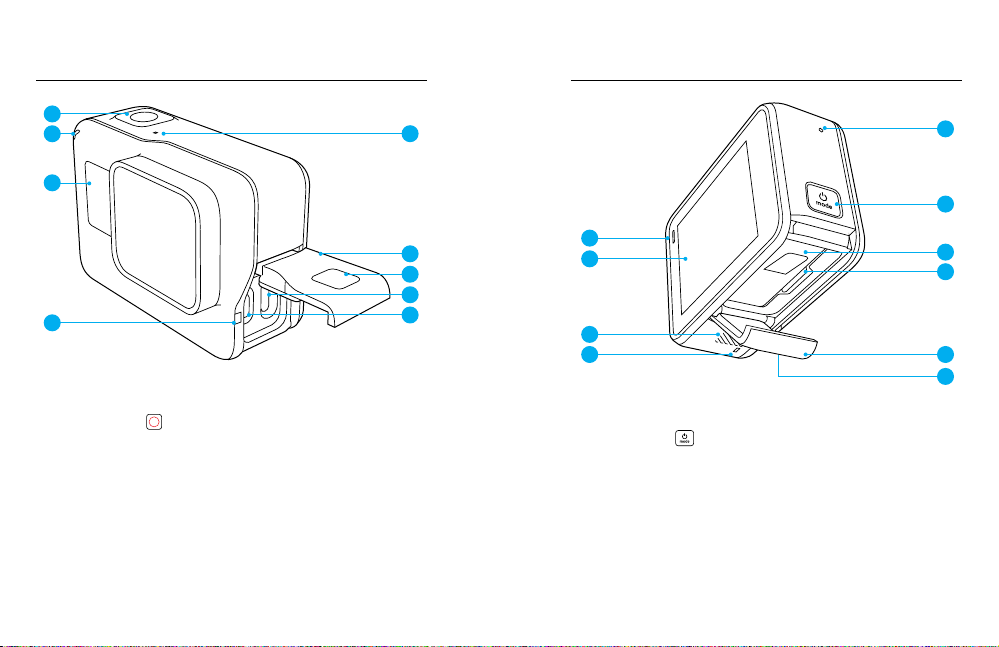
1. Shutter Button [
]
2. Camera Status Light
3. Camera Status Screen
4. Microphone
5. Side Door
6. Latch Release Button
7. USB-C Port
8. Micro HDMI Port
(cable not included)
9. Touch Display
YOUR HERO6 BLACK
10. Speaker
11. Mode Button [
]
12. Battery
13. microSD Card Slot
14. Battery Door
YOUR HERO6 BLACK
8
7
5
6
4
1
2
4
2
9
4
10
3
11
4
14
6
12
13
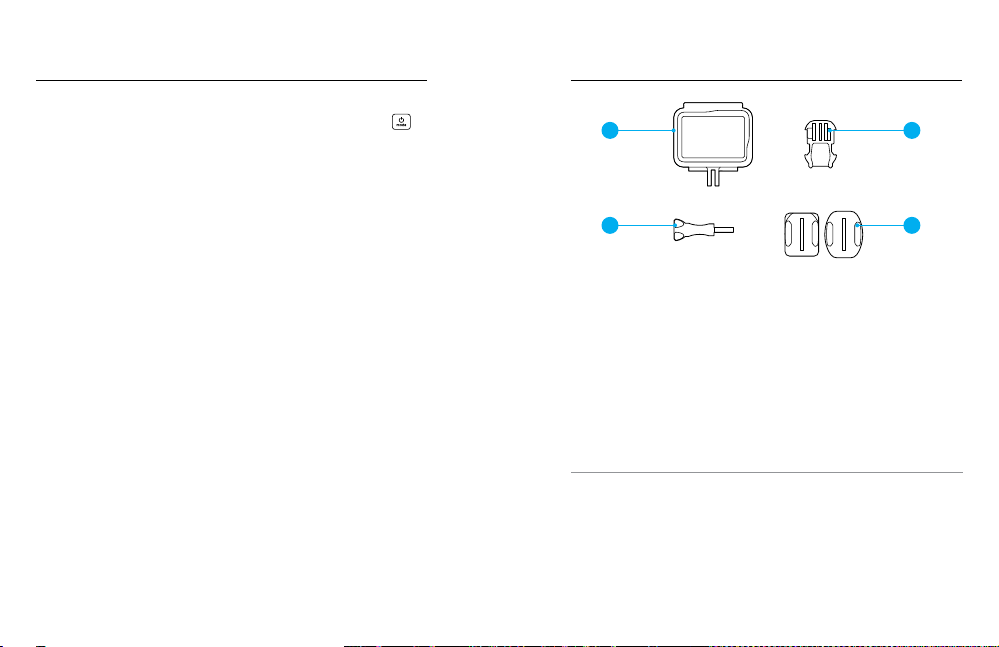
For information about mounting items that are included in the box, see Mounting
(page 87).
8 9
Welcome to your new HERO6 Black! Let’s get started.
MICROSD CARDS
To capture video and photos, you need a microSD card (sold separately).
Use brand name memory cards that meet these requirements:
• microSD, microSDHC, or microSDXC
• Class 10 or UHS-I rating
• Capacity up to 256GB
For a list of the recommended microSD cards, visit
gopro.com/workswithgopro.
If the memory card becomes full during recording, your camera stops
recording and displays FULL on the touch display.
NOTICE: Use care when handling memory cards. Avoid liquids, dust
and debris. As a precaution, power o the camera before inserting or
removing the card. Check the memory card manufacturer’s guidelines
for information about use in acceptable temperature ranges.
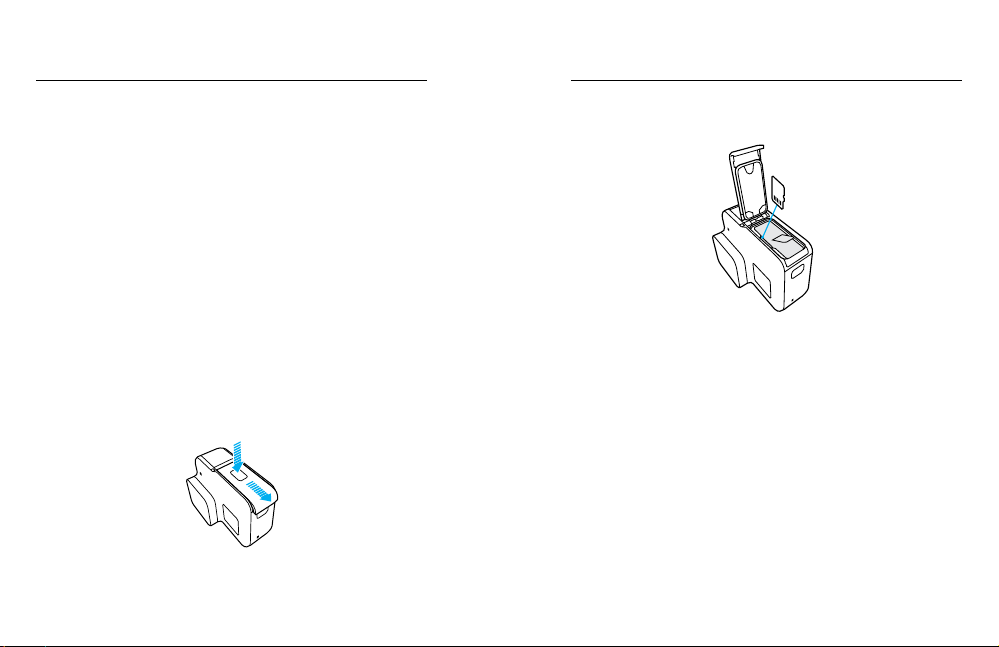
Inserting the microSD Card
1. Hold down the Latch Release button on the battery door, then slide
the door open.
GETTING STARTED
2. Insert a microSD card with the label facing the battery, then close
the door.
Note: To remove the card, press it into the slot with your ngernail and it will
pop out.
Reformatting Your microSD Card
For best performance, always reformat your microSD card before rst
use. To keep the card in good condition, reformat it on a regular basis.
Note: Reformatting erases all of your content, so be sure to ooad your photos and
videos rst.
To reformat your card, swipe down, then tap Preferences > Format
SD Card > Delete.
GETTING STARTED
10 11
CHARGING THE BATTERY
For the best experience with your new camera, fully charge the battery
before rst use.
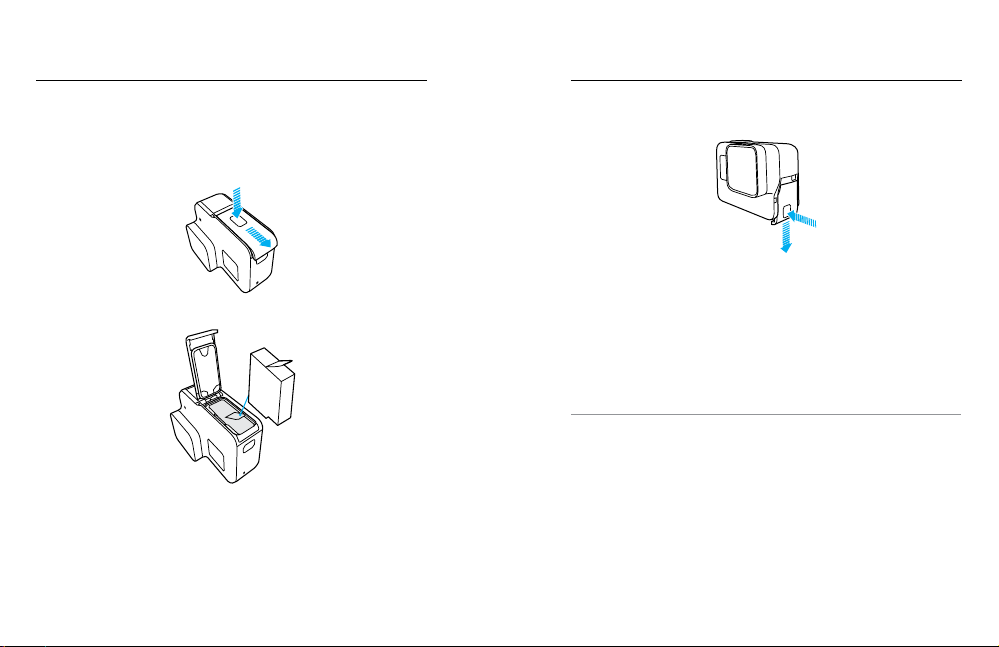
1. Hold down the Latch Release button on the battery door, then slide
the door open.
2. Insert the battery, then close the door.
GETTING STARTED
3. Hold down the Latch Release button on the side door, then slide
the door open.
4. Connect the camera to a computer or other USB charging adapter
using the included USB-C cable. The camera status light turns on
during charging and turns o when charging is complete.
When charging with a computer, be sure that the computer is
connected to a power source. If the camera status light does not
turn on, use a dierent USB port.
The battery charges to 100% in about 2 hours. For more information,
see Battery Information (page 94).
PRO TIP: For fastest charging, use GoPro’s Supercharger (sold
separately) and its included cable. You can also charge your camera
with a USB-compatible wall charger or auto charger.
GETTING STARTED
12 13
GETTING STARTED
UPDATING YOUR CAMERA SOFTWARE
To get the latest features and best performance from your GoPro, make
sure your camera is always using the most current software.
Updating with the GoPro App
When you connect your camera to the GoPro app, you are automatically
notied if an update is available.
1. Download the app from the Apple
©
App Store
©
or Google Play.
™
2. Follow the on-screen instructions in the app to connect your camera.
If an update is available, the app provides instructions for installing it.
Updating with the Quik Desktop App
When you connect your camera to the Quik desktop app, you are
automatically notied if an update is available.
1. Download the Quik desktop app from gopro.com/apps.
2. Connect your camera to your computer with the included USB-C
cable. If an update is available, the app provides instructions for
installing it.
Updating Manually (with an SD Card Reader/Adapter)
1. Visit gopro.com/update.
2. Select your camera, then click the option to update the camera
manually.
3. Follow the on-screen instructions.
PRO TIP: To see your current software version, swipe down from the
main screen, then tap Preferences > About This GoPro.
GETTING STARTED
POWERING ON + OFF
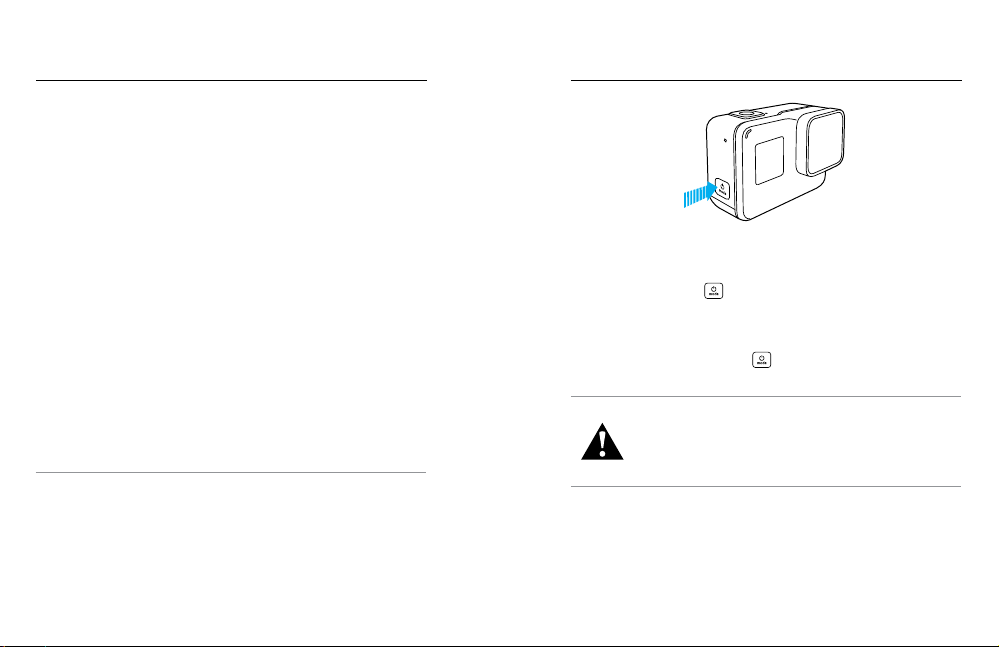
To Power On:
Press the Mode button [
]. The camera beeps several times while the
camera status lights ash. When information appears on the touch display
or the camera status screen, your camera is on.
To Power O:
Press and hold the Mode button [
] for two seconds. The camera
beeps several times while the camera status lights ash.
WARNING: Use caution when using your GoPro as part of
your active lifestyle. Always be aware of your surroundings
to avoid injury to yourself and others.
Abide by all local laws when using your GoPro and related
mounts and accessories, including all privacy laws, which
may restrict recording in certain areas.
14 15
GETTING STARTED
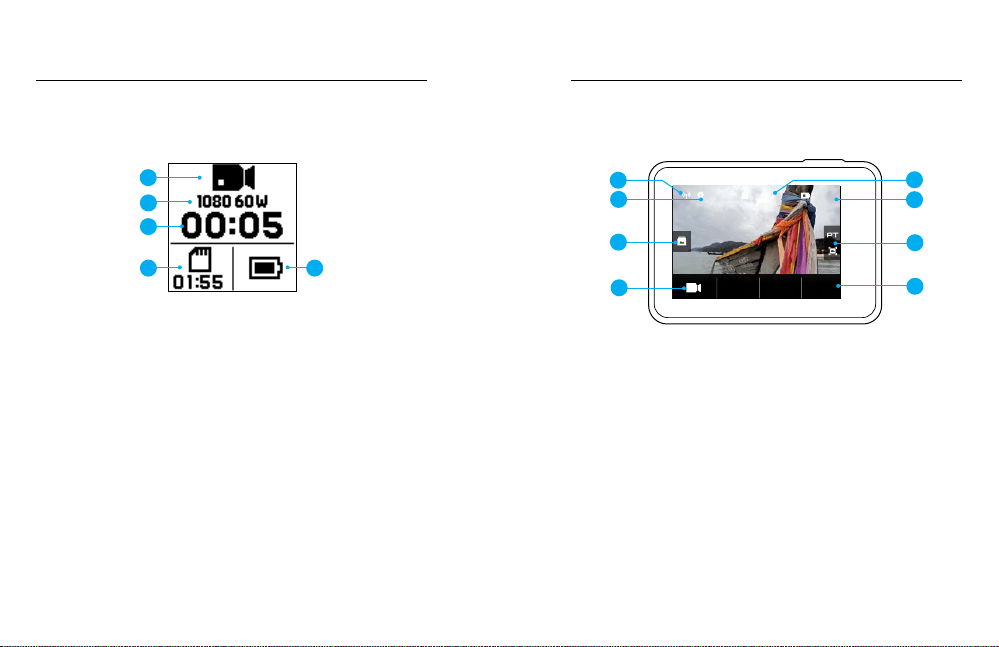
CAMERA STATUS SCREEN
You can see the basics for your current setting on the front screen of
the camera:
1
2
3
4 5
1. Camera Mode
2. Settings
3. Number of Files Captured or Video Duration
4. Remaining microSD Card Storage
5. Battery Status
Note: The icons and settings that appear on the camera status screen vary by mode.
Those shown above are for Video mode.
GETTING STARTED
TOUCH DISPLAY
The touch display’s main screen contains the following information about
modes and settings. The settings that appear vary by mode.
WIDE
FOV
4k 60
FPSRES
100%
100%
00:00
00:00
1
4
5
7
6
3
2
1. Wireless Status
2. GPS Status
3. Media Status
*
4. Camera Mode
5. Time Remaining/Photos Taken
6. Battery Status
7. Advanced Settings (icons)
8. Settings
Note: The touch display does not work under water.
*
Icon is visible only if your memory card contains footage. Swipe right to access your
video and photos.
8
16 17
GETTING STARTED
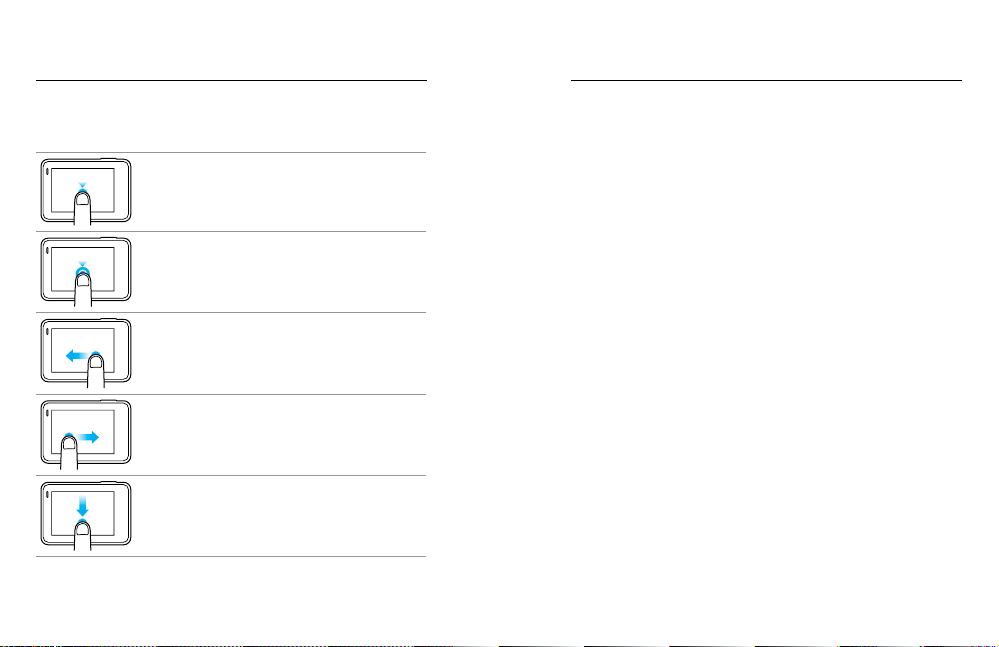
TOUCH DISPLAY GESTURES
Use these gestures to navigate the touch display. When swiping,
swipe from the edge of the screen.
Tap
Selects an item, turns a setting on/o.
Press and Hold
Accesses Exposure Control setting.
Swipe Left
Accesses advanced settings (if available) for
the current mode.
Swipe Right
Displays your media.
Swipe Down
From the main screen, opens the Connections and
Preferences menus. Otherwise, returns to the
main screen.
PRO TIP: You can automatically lock the touch display to prevent
accidental input. For details, see Auto Lock (page 83).
MODES
HERO6 Black contains three camera modes: Video, Photo, and
Time Lapse.
Video
Video mode contains two capture modes: Video and Looping. For
descriptions of each capture mode, see Video Mode: Capture Modes
(page 45).
Photo
Photo mode contains three capture modes: Photo, Burst, and Night.
For descriptions of each capture mode, see Photo Mode: Capture Modes
(page 57).
Time Lapse
Time Lapse mode contains three capture modes: Time Lapse Video,
Time Lapse Photo, and Night Lapse Photo. For descriptions of each
capture mode, see Time Lapse Mode: Capture Modes (page 63).
For a visual map of your GoPro's modes and settings, see Map of Modes
and Settings (page 22).
NAVIGATING YOUR GOPRO
18 19
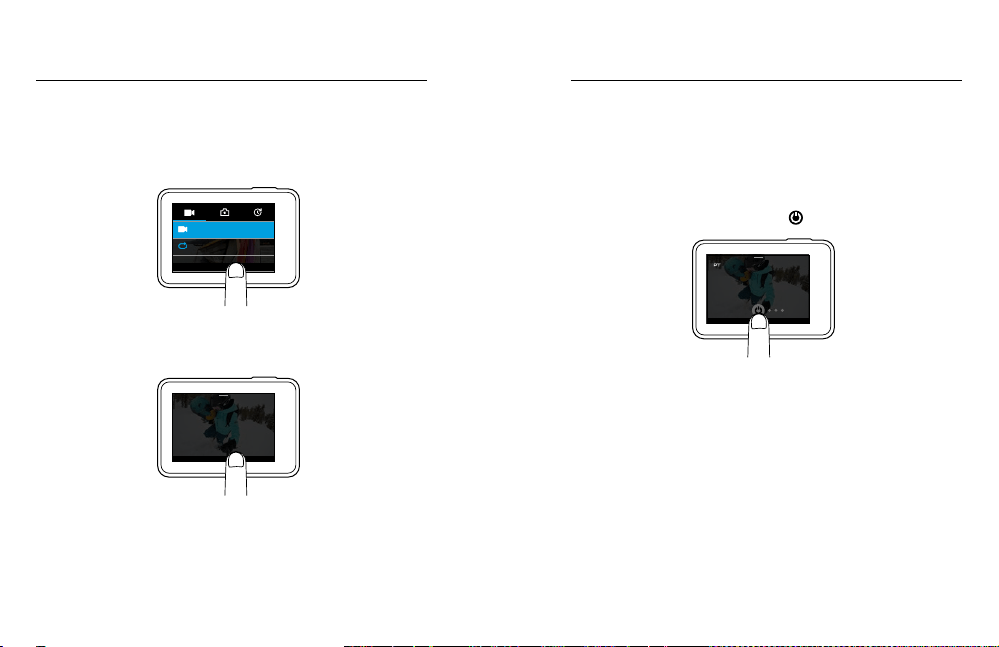
NAVIGATING WITH THE TOUCH DISPLAY
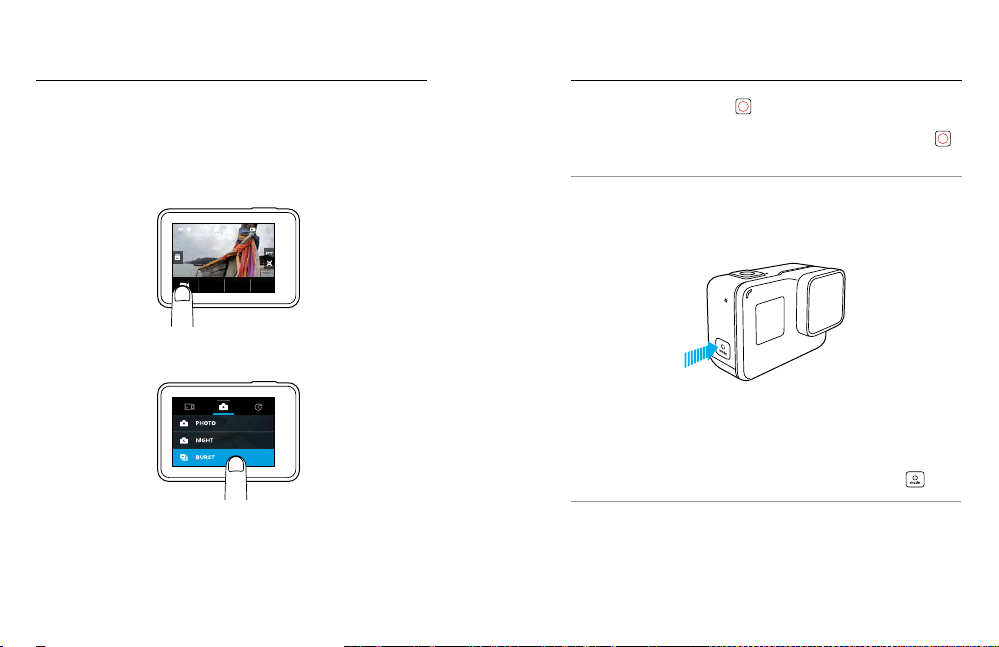
1. From the main screen, tap the icon in the lower left corner.
2. Tap one of the mode icons at the top of the screen (Video, Photo,
or Time Lapse).
3. Tap a capture mode in the list below it.
Looping
Video
4. On the main screen, tap the setting that you want to change.
5. Tap a new option (available options are white). The camera returns
you to the main screen.
4K
2.7K 4:3
4K 4:3
1440 1080
2.7K
720
1080
RESOLUTION
@60 fps
NAVIGATING YOUR GOPRO
If you select a video resolution (RES) that does not support the
frames per second (FPS) setting that is selected, a message appears
that tells you how to select a new FPS setting. A similar message
appears if you select an FPS that is not supported by the selected
resolution.
6. To change an advanced setting, swipe left.
Note: Not all capture modes have advanced settings.
7. To turn on an advanced setting, tap [ ].
PROTUNE
Enables advanced video settings for
greater control.
8. To return to the main screen, swipe down.
NAVIGATING YOUR GOPRO
20 21
CHANGING MODES WITH THE MODE BUTTON
The Mode button lets you quickly cycle through the capture modes that
you set. For example, if you previously selected Video in Video mode,
Night Photo in Photo mode, and Time Lapse Video in Time Lapse mode,
pressing the Mode button cycles through those capture modes. Note that
Burst photo always appears in this cycle.
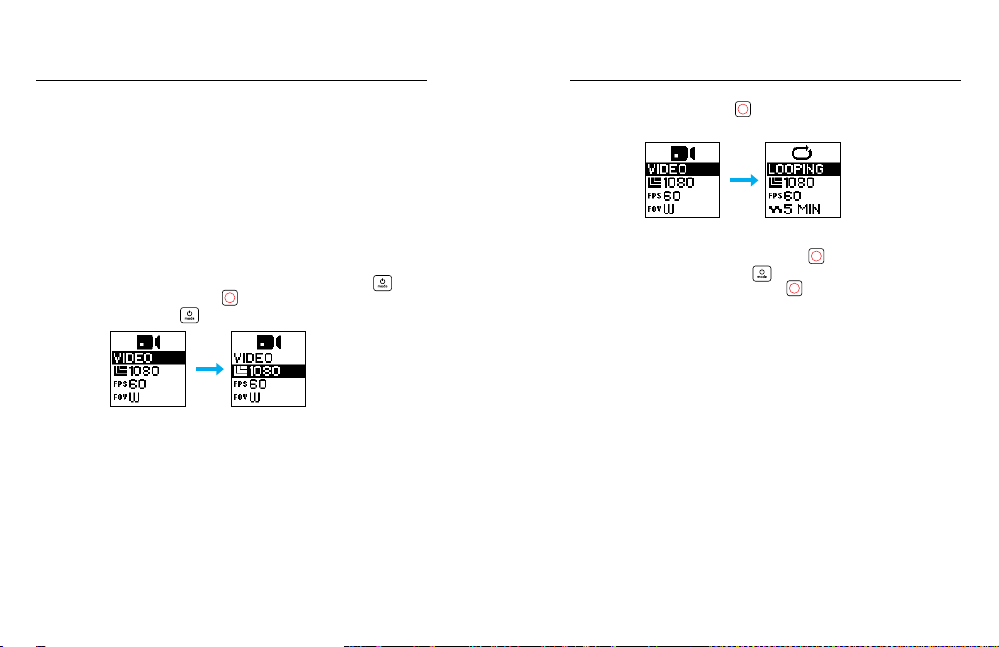
NAVIGATING WITH THE BUTTONS
If you use the camera under water, use the buttons and the camera
status screen to change modes and settings.
Note: The Connections and Preferences menus are not available when navigating with
the buttons.
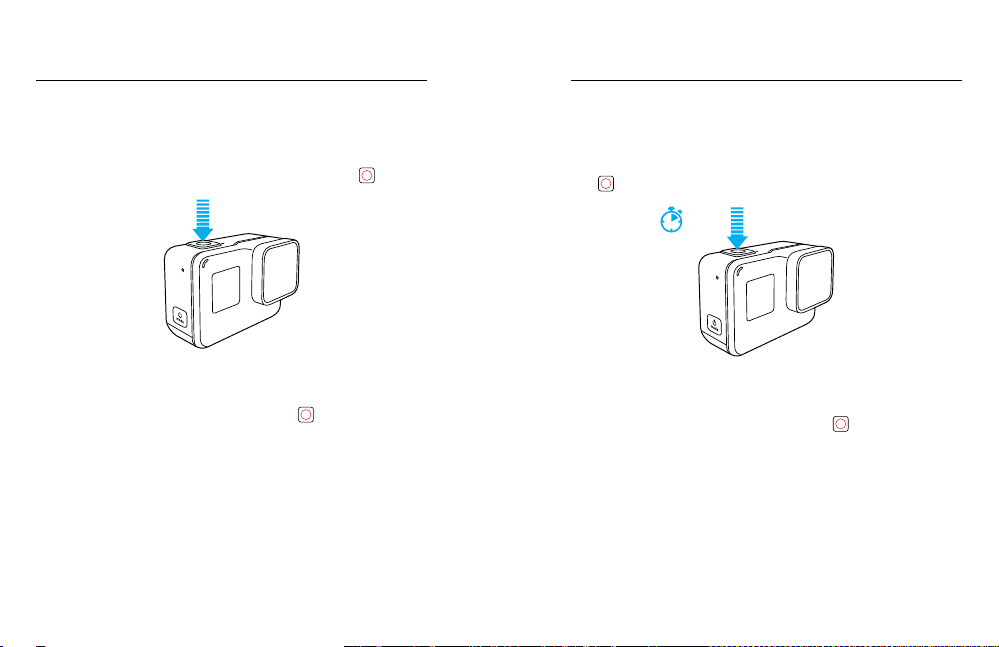
1. With the camera powered on, hold down the Mode button [
]
and press the Shutter button [
].
2. Use the Mode button [
] to scroll through the settings.
NAVIGATING YOUR GOPRO NAVIGATING YOUR GOPRO
3. Press the Shutter button [
] to move through the options within a
setting. To select an option, leave the option highlighted.
4. To exit, select one of these options:
• Press and hold the Shutter button [
].
• Press the Mode button [
] repeatedly until you get to Done,
then press the Shutter button [
] to select it.
22 23
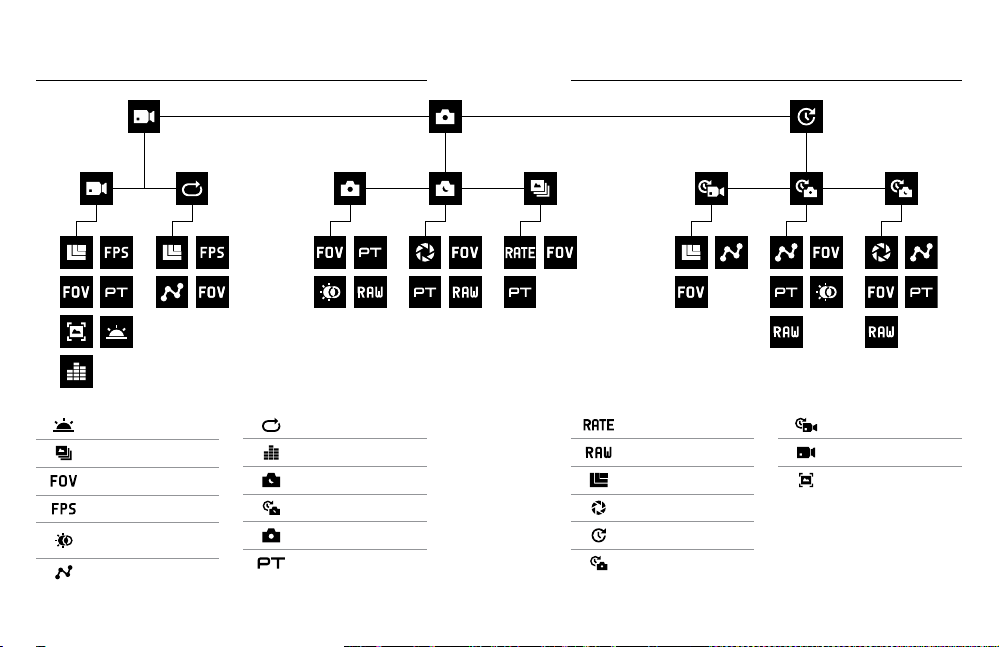
MAP OF MODES AND SETTINGS
Auto Low Light
Burst
FOV
FPS
High Dynamic Range
(HDR)
Interval
Looping
Manual Audio Control
Night Photo
Night Lapse Photo
Photo Mode / Photo
Protune
MAP OF MODES AND SETTINGS
Rate
RAW Format
Resolution (RES)
Shutter
Time Lapse Mode
Time Lapse Photo
Time Lapse Video
Video Mode / Video
Video Stabilization
24 25
CAPTURING VIDEO AND PHOTOS
With this method, you leave the camera powered on and capture, as
needed. You can use the touch display to preview your shots and change
modes and settings before capturing.
1. If needed, select a dierent mode:
a. Tap the icon in the lower left corner of the touch display.
WIDE
FOV
4k 60
FPSRES
100%
100%
00:00
00:00
b. Tap one of the mode icons at the top of the screen.
c. Tap a capture mode in the list below it.
2. If needed, select dierent settings. For details about settings,
see Video Mode: Capture Modes (page 45), Photo Mode: Capture
Modes (page 57), or Time Lapse Mode: Capture Modes (page
63).
CAPTURING VIDEO AND PHOTOS CAPTURING VIDEO AND PHOTOS
3. Press the Shutter button [
]. The camera beeps and the camera
status lights ash while the camera is capturing.
4. To stop capturing video or time lapse, press the Shutter button [
].
The camera beeps and the camera status lights ash quickly.
PRO TIP: You can also capture video and photos using voice commands.
For details, see Controlling Your GoPro with Your Voice (page 30).
ADDING HILIGHT TAGS
You can mark specic moments in your video during recording or playback
with HiLight Tags. HiLight Tags make it easy to nd the best highlights
to share.
While recording or playing back video, press the Mode button [
].
PRO TIP: You can also add HiLight Tags during recording with the
GoPro app, Voice Control, or the Smart Remote.

26 27
SETTINGS FOR YOUR ACTIVITIES
For best results, use the guidelines below when capturing specic
activities.
Activity Video Setting Photo Capture Mode
Automobile • 1080p60, Wide FOV
• 2.7K120, Wide FOV
• 4K60, Wide FOV
Photo or continuous
photo, Wide FOV
Family/travel • 1080p60, Wide FOV
• 4K60, Wide FOV
Photo or continuous
photo, Wide FOV
Cycling,
mountain biking
• 1080p60,
SuperView FOV
• 1440p60, Wide FOV
• 2.7K60 4:3, Wide FOV
Time Lapse Photo
(2-second Interval),
Wide FOV
Hiking • 1440p30, Wide FOV
• 4K30 4:3, Wide FOV
Time Lapse Photo
(5-second Interval),
Wide FOV, or Photo,
Wide FOV
Flying the
Karma Drone
• 1080p60, Linear FOV
• 4K60, Wide FOV
Time Lapse Photo
(2-second Interval),
Wide FOV, or Photo
with RAW Format
setting on and Wide
FOV
Activity Video Setting Photo Capture Mode
Motorcycle,
motocross
• 1080p60,
SuperView FOV
• 2.7K60 4:3, Wide FOV
Time Lapse Photo
(2-second Interval),
Wide FOV
Skiing,
snowboarding
(non-POV
*
)
• 1080p120, Wide FOV
• 1080p240, Wide FOV
• 2.7K120, Wide FOV
• 4K60, Wide FOV
Burst (30/3 Rate),
Wide FOV
Skiing,
snowboarding
(POV
*
)
• 1440p60, Wide FOV
• 2.7K60 4:3, Wide FOV
Time Lapse Photo
(0.5-second Interval),
Wide FOV, or Burst
(30/3 Rate), Wide
FOV
Surng • 1080p240, Wide FOV Time Lapse Photo
(5-second Interval),
Wide FOV
Underwater
activities
• 1080p60, Wide FOV
• 4K60, Wide FOV
Time Lapse Photo
(2-second Interval),
Wide FOV
Water activities • 1080p120, Wide FOV
• 1080p240, Wide FOV
• 2.7K120, Wide FOV
Time Lapse Photo
(5-second Interval),
Wide FOV
*
Point of view (POV) shots are those taken from your point of view. Non-POV shots are
those taken from a dierent perspective (for example, with the camera mounted on a ski
pole or surfboard).
PRO TIP: Get an awesome video of your activity—automatically. For
details, see Creating a QuikStory (page 41).
SETTINGS FOR YOUR ACTIVITIES
28 29
QuikCapture is the easiest way to capture video or time lapse photos
with HERO6 Black. Because the camera is powered on only when it is
capturing, you also conserve battery power.
CAPTURING VIDEO WITH QUIKCAPTURE
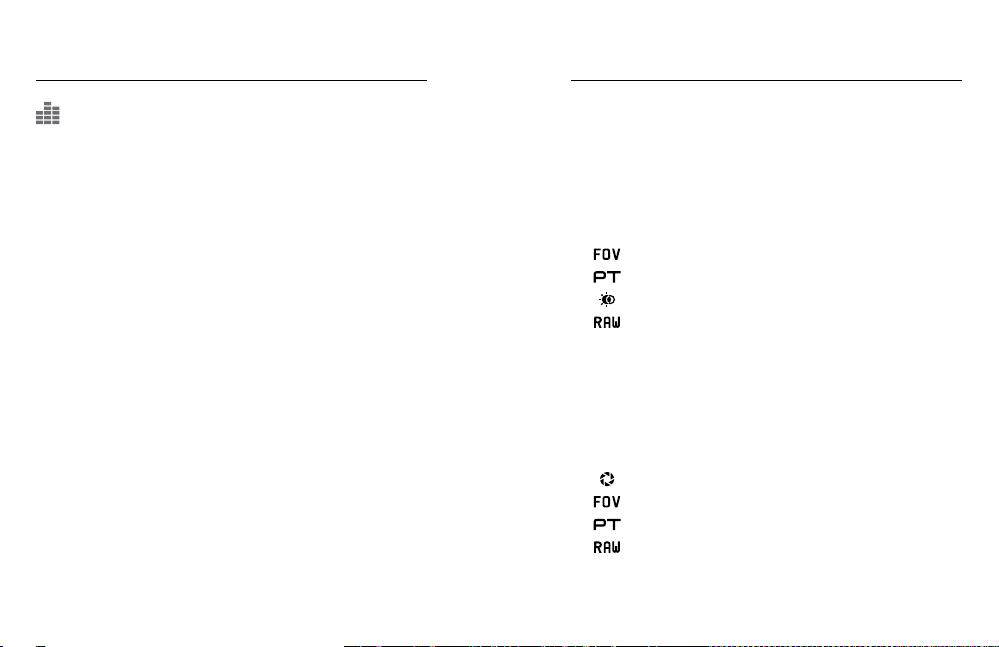
1. With the camera powered o, press the Shutter button [
].
Your camera powers on, beeps several times, and automatically
begins capturing video. The camera status lights blink while the
camera is recording.
2. To stop recording, press the Shutter button [
] again.
The camera stops recording, beeps several times, and automatically
powers o.
To capture other types of video or photos, see Capturing Video and
Photos (page 24).
QUIKCAPTURE
CAPTURING TIME LAPSE PHOTOS WITH QUIKCAPTURE
In addition to showing how a scene changes over time, time lapse photos
are also useful for capturing a series of photos to be sure you get the shot
you want.
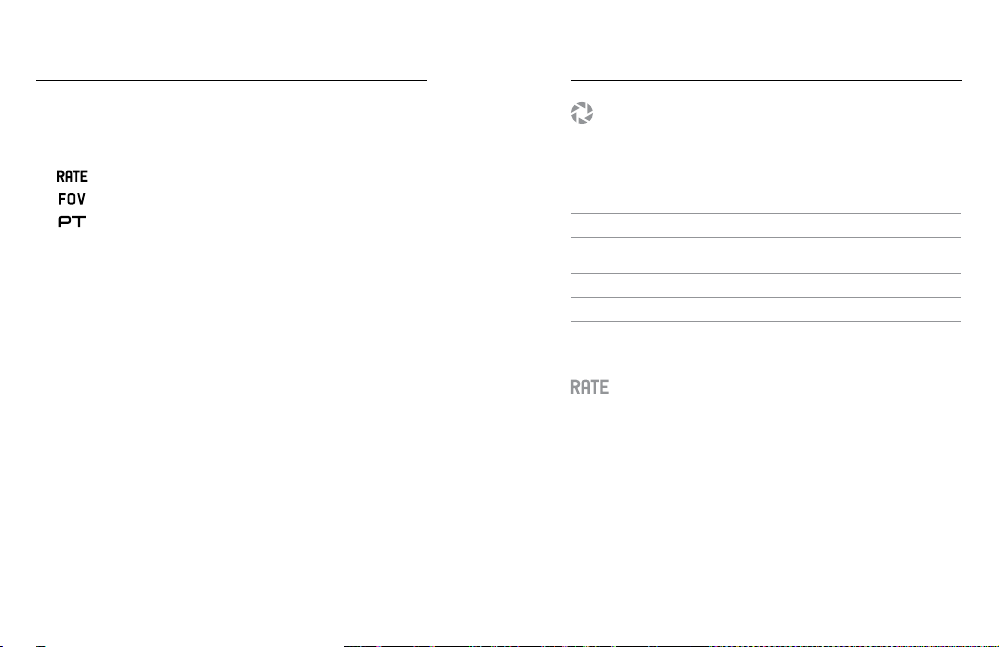
1. With the camera powered o, press and hold the Shutter button
[
] for three seconds until capture begins.
3 sec
Your camera powers on, beeps several times, and automatically
begins capturing time lapse photos. The camera status lights blink
once for each photo captured.
2. To stop capturing, press the Shutter button [
] again.
The camera stops recording, beeps several times, and automatically
powers o to maximize battery life.
To capture other types of video or photos, see Capturing Video and
Photos (page 24).
TURNING QUIKCAPTURE OFF
QuikCapture is on by default, but you can turn it o, if needed.
1. From the main screen, swipe down.
2. Tap Preferences > QuikCapture.
3. Tap O.
QUIKCAPTURE

30 31
You can control your HERO6 Black with your voice using a set of specic
commands (see list below).
Note: Voice Control performance may be impacted by distance, wind, and noisy
conditions. Keep the product clean and clear of debris.
USING VOICE CONTROL
Voice Control works best when you and your GoPro are in close proximity.
1. From the main screen, swipe down.
2. Tap [ ] to turn on Voice Control.
Note: You can also turn Voice Control on or o from the Preferences menu. Tap
Preferences > On Camera Voice Control, then select an option.
3. If this is the rst time you turned on voice control, conrm or change
the voice control language.
4. Say a command from List of Voice Commands (page 31).
5. To turn o Voice Control manually, swipe down on the main screen,
then tap [ ]. Voice Control also turns o when your camera
automatically powers o. For details, see Auto O (page 82).
PRO TIP: To extend the voice control of your camera in windy and noisy
environments, use Remo (Waterproof Voice Activated Remote). For details,
visit gopro.com.
CONTROLLING YOUR GOPRO WITH
YOUR VOICE
LIST OF VOICE COMMANDS
Two types of commands are available with Voice Control:
• Action commands let you immediately capture video or photos.
For example, if you just stopped recording video, you can say the
command to take a photo or begin capturing time lapse—without
having to rst change the mode.
• Mode commands are useful if you want to quickly select a mode and
then use the Shutter button to capture.
Your camera does not need to be in a specic mode to capture video or
photos. You can use the action commands from any mode. Your camera
captures video or photos based on the settings you previously selected.
Action Command Description
GoPro turn on Powers on the camera [see Powering
On Your GoPro with Your Voice (page
33) for details]
GoPro start recording Starts capturing video
GoPro HiLight Adds a HiLight Tag to video
during recording
That was sick Adds a HiLight Tag to video
during recording
GoPro stop recording Stops capturing video
GoPro take a photo Captures a single photo
GoPro shoot burst Captures burst photos
GoPro start time lapse Starts capturing time lapse
CONTROLLING YOUR GOPRO WITH
YOUR VOICE

32 33
Action Command Description
GoPro stop time lapse Stops capturing time lapse
GoPro turn o Powers o the camera
GoPro edit my story Moves video and photos from your
most recent session (based on location
and date) to your phone to create a
QuikStory
™
Note: If the QuikStories feature is turned
on in the GoPro app, video and photos are
automatically moved from your camera
to your phone to create a QuikStory. This
voice command lets you move the content
immediately instead of waiting for the
automatic process.
Mode Command Description
GoPro Video mode Changes the camera mode to Video
(does not capture video)
GoPro Photo mode Changes the camera mode to Photo
mode (does not capture photos)
GoPro Burst mode Changes the camera mode to Burst
mode (does not capture burst photos)
GoPro Time Lapse mode Changes the camera mode to
Time Lapse (does not capture time
lapse photos)
For the most updated list of commands, visit gopro.com/help.
CONTROLLING YOUR GOPRO WITH
YOUR VOICE
PRO TIP: If you are recording video or time lapse, you must stop recording
before issuing a new command.
POWERING ON YOUR GOPRO WITH YOUR VOICE
With this setting, your GoPro responds to voice commands when it is
powered o. This setting is in eect for 8 hours after you power o your
GoPro.
1. From the main screen, swipe down.
2. Tap [
] to turn on Voice Control.
3. Tap Preferences > Wake On Voice (in the Voice Control section).
4. Tap On.
5. Power o the camera using either the voice command or the Mode
button [
].
6. Say a command from List of Voice Commands (page 31).
CHANGING YOUR VOICE CONTROL LANGUAGE
1. From the main screen, swipe down.
2. Tap Preferences > Language (in the Voice Control section).
3. Tap a language.
CONTROLLING YOUR GOPRO WITH
YOUR VOICE

34 35
You can play back your content on a mobile device, a computer, the
camera’s touch display, or a TV.
VIEWING VIDEO AND PHOTOS ON A MOBILE DEVICE
1. Connect your camera to GoPro app. For details, see Connecting to
the GoPro App (page 39).
2. Use the controls on the app to play back your footage on your
smartphone/tablet.
PRO TIP: While playing back your video with the GoPro app, you can mark
the best moments by tapping [ ] to add a HiLight Tag.
VIEWING VIDEO AND PHOTOS ON A COMPUTER
To play back your video and photos on a computer, you must rst
transfer these les to a computer. For details, see Ooading Your
Content (page 41).
You can also play back content by inserting the microSD card directly
into a computer. With this method, playback resolution depends on the
resolution of the computer and its ability to play back that resolution.
When viewing les on a microSD card or in your computer’s le directory,
you can see that videos are saved as both .mp4 and .lrv les. Files with an
.lrv extension cannot be played or shared directly.
PLAYING BACK YOUR CONTENT PLAYING BACK YOUR CONTENT
VIEWING VIDEO AND PHOTOS ON YOUR HERO6 BLACK
1. Swipe right to access your video and photos. If your microSD card
contains a lot of content, it might take a minute for it to load.
2. To display only a certain type of content, select a lter:
• Media - Displays all videos and photos.
• HiLights - Displays content that includes a HiLight Tag.
• Photos - Displays photos, including those that are part of a series
(continuous, burst, time lapse, night lapse).
• Video - Displays videos. Swipe up to scroll through the
thumbnails.
Note: For multi-shot photo series, the thumbnail displays the rst photo in
the series.
3. Tap a video or photo to open it in full-screen view.
Note: For multi-shot photo series, press and hold to open the series.
4. To add a HiLight Tag, tap [ ]. HiLight Tags make it easy to nd
the best video and photos to share.
5. To return to the thumbnails screen, tap [ ].
6. To exit, swipe down.
DELETING VIDEO AND PHOTOS FROM YOUR HERO6 BLACK
1. Swipe right to access your video and photos.
2. Tap [
].
3. Tap the items that you want to delete. To delete everything on the
card, tap [ ].
4. Tap [ ].
5. Tap Delete.

36 37
SAVING A PHOTO FROM A SERIES
You can save an individual photo from a burst, time lapse photo, or night
photo series.
1. Swipe right, then tap the photo series that contains the photo that
you want to save.
2. Press and hold the series to open it.
3. Tap [ ] to move through the series.
4. Tap [ ] to save a photo outside of the series.
VIEWING VIDEO AND PHOTOS ON AN HDTV
For details, see Using Your Camera with an HDTV (page 37).
PLAYING BACK YOUR CONTENT
VIEWING VIDEOS AND PHOTOS ON AN HDTV
You can connect your camera to an HDTV and view your content on the
large screen. This playback requires a micro HDMI cable (sold separately).
Note: HDMI playback depends on the resolution of the device, and is certied up
to 1080p.
1. Power on the camera.
2. Tap Preferences > HDMI Output > Media.
3. Use a micro HDMI cable to connect the HDMI port on the camera to
an H DTV.
4. Select the HDMI input on your TV.
5. Press the Mode button [
]
to move through the controls,
then press the Shutter button [
] to select the control.
For example, to move through each thumbnail, press the Mode
button [
] to move to [ ], then press the Shutter button [
]
repeatedly to move through the les.
6. To open a le in full-screen view, tap [ ].
You can also play back content by inserting the microSD card directly into
a compatible TV. With this method, playback resolution depends on the
resolution of the TV and its ability to play back that resolution.
PRO TIP: When viewing your videos and photos on an HDTV, you can also
navigate using gestures on the touch display.
USING YOUR CAMERA WITH AN HDTV

38 39
CAPTURING VIDEO AND PHOTOS WHILE CONNECTED TO
AN HDTV
This option lets you see the live preview from your camera when it is
connected to an HDTV or monitor.
1. Power on the camera.
2. Tap Preferences > HDMI Output, then select one of these options:
• To display your camera’s live preview with the icons from the touch
display, tap Monitor.
• To display your camera’s live preview on the HDTV without the
icons or overlays that you see during recording on the camera’s
touch display, tap Live.
3. Use a micro HDMI cable to connect the HDMI port on the camera to
an H DTV.
4. Select the HDMI input on your TV.
5. Use the Shutter button [
] on the camera to start and
stop recording.
USING YOUR CAMERA WITH AN HDTV
CONNECTING TO THE GOPRO APP
With the GoPro app, your HERO6 Black footage automatically moves to
your phone and transforms into a QuikStory
™
—an awesome video with
eects and music. You can also use the app to control your GoPro, create
short clips, share your favorites, and more.
Connecting to the GoPro App for the First Time
1. Download the GoPro app to your mobile device from the Apple
©
App
Store
©
or Google Play
™
.
2. Follow the app's on-screen instructions to connect your camera.
Note for iOS: When prompted, be sure to allow notications from the GoPro app
so you know when a QuikStory is ready. For more information, see Creating a
QuikStory (page 41).
Connecting to the GoPro App after the First Time
After connecting to the GoPro app for the rst time, you can connect in
the future through the Connections menu on the camera.
1. If your camera’s wireless is not already turned on, swipe down, then
tap Connections > Wireless Connections.
2. In the GoPro app, follow the on-screen instructions to connect
your camera.
CONNECTING TO THE SMART REMOTE OR REMO
For details about connecting HERO6 Black to the Smart Remote or Remo
(Waterproof Voice Activated Remote), see the user manual for the device
at gopro.com/help.
CONNECTING TO OTHER DEVICES

40 41
CONNECTING TO BLUETOOTH DEVICES
You can connect your GoPro to Bluetooth devices that track statistics
about your activity. That data is then automatically added to your video to
create a more engaging record of your activity.
1. Connect your camera to the GoPro app. For details, see Connecting
to the GoPro App (page 39).
2. In the app, open the camera’s settings, then tap Bluetooth Devices.
3. Follow the on-screen instructions.
SELECTING A DIFFERENT CONNECTION SPEED
By default, your GoPro uses the 5GHz Wi-Fi band to connect to other
devices. This band provides faster transfer speed than the 2.4GHz band.
The transfer speed aects how long it takes for your video and photos to
be copied to your phone to create a QuikStory.
To use the 5GHz band, your phone and region must also work with that
band. Otherwise, you can change the Wi-Fi band on your GoPro to
2.4GHz.
1. Swipe down, then tap Connections > Wi-Fi Band.
2. Tap 2.4GHz.
CONNECTING TO OTHER DEVICES
CREATING A QUIKSTORY
QuikStories automatically copies video and photos from your camera
to your mobile device. Then the GoPro app serves up an edited video,
complete with music and eects—a QuikStory. You can save and edit
your QuikStory, or delete it from your phone.
1. Set up QuikStories:
a. Connect your camera to the GoPro app. For details, see
Connecting to the GoPro App (page 39).
Note for iOS: When prompted, be sure to allow notications from
the GoPro app.
b. Close the app.
2. Capture video and photos on your camera.
3. Open the GoPro app and swipe down from the home screen. Your
camera automatically moves content from your most recent session
to your mobile device. When your QuikStory is ready, you receive a
notication on your phone.
4. Open the QuickStory and preview it.
5. Make additional edits, if needed.
6. Save the QuikStory, then share it with your friends.
OFFLOADING YOUR CONTENT TO A COMPUTER
To play back your video and photos on a computer, you must rst transfer
these les to a computer. Transferring also frees up space on your
microSD card for new content.
1. Be sure that your computer is running the latest version of the
operating system.
2. Download and install the Quik desktop app from gopro.com/apps.
3. Connect the camera to your computer using the included
USB-C cable.
4. Power on the camera and follow the on-screen instructions in Quik.
OFFLOADING YOUR CONTENT

42 43
OFFLOADING YOUR CONTENT
PRO TIP: To transfer les to a computer using a card reader (sold
separately) and your computer’s le explorer, connect the card reader to the
computer, then insert the microSD card. You can then transfer les to your
computer or delete selected les on your card. Note that you must use a
card reader to ooad RAW photos or RAW audio les.
AUTO UPLOADING YOUR CONTENT TO THE CLOUD
With a subscription to GoPro Plus, you can use Auto Upload to upload
your content to the cloud. You can then view, edit, and share it from any
of your devices.
Note: When you upload your content to the cloud, your original les remain on your
camera.
1. Subscribe to GoPro Plus:
a. Download the GoPro app to your mobile device from the Apple
©
App Store
©
or Google Play
™
.
b. Follow the app’s on-screen instructions to connect your camera.
c. If this is the rst time you are connecting to the app, follow the
on-screen instructions to subscribe to GoPro Plus. Otherwise,
tap [ ] next to the image of your camera and follow the
instructions.
2. Connect your camera to a power outlet. When the battery is charged,
Auto Upload begins.
Note: Once you set up Auto Upload, you do not need to connect your camera to
the GoPro app to use this feature.
The les in the cloud are optimized for the web, so might not be full
resolution. To ooad les in their full resolution, connect your camera
to the Quik desktop app and ooad the les to your computer.
PRO TIP: You can also use the Quik desktop app to transfer your les to
your computer. Quik then uploads the les to your GoPro Plus account.
OFFLOADING YOUR CONTENT
MANUALLY UPLOADING YOUR CONTENT TO THE CLOUD
This option lets you upload content to the cloud without waiting for the
camera battery to charge. (Your GoPro must be connected to a power
outlet to use this option.).
1. Subscribe to GoPro Plus. For details, see Auto Uploading Your
Content to the Cloud (page 42).
2. Connect your camera to a power outlet.
3. From the main screen, swipe down.
4. Tap Preferences > Manual Upload.
ACCESSING YOUR CLOUD CONTENT ON YOUR MOBILE DEVICE
1. Open the GoPro app.
2. Tap [
], and then select Cloud. You can view, edit, and share your
content.
PRO TIP: To turn your cloud content into an edited video, open the Quik
app, tap [ ], then select GoPro Plus.
TURNING OFF AUTO UPLOAD
You can temporarily turn o Auto Upload on the camera to prevent
automatic upload to GoPro Plus when you connect your camera to a
power outlet.
1. Swipe down, then tap Connections > Auto Upload > Upload.
2. Tap O.

44 45
Video mode contains two capture modes: Video and Looping. Each
capture mode has its own settings.
VIDEO
This capture mode is for traditional video capture. The default settings are
1080p60 Wide, with Video Stabilization and Auto Low Light both turned
on. For more information, see these topics:
HERO6 Black Video Resolutions (page 51)
Protune (page 74)
Video Stabilization (page 55)
Auto Low Light (page 55)
Manual Audio Control (page 56)
LOOPING VIDEO
Use Looping to you continuously record video, but save only the moments
that you want. For example, if you select a 5-minute interval, only the
previous 5 minutes are saved when you press the Shutter button to
stop recording. If you record for 5 minutes and do not press the Shutter
button to stop recording and save, the camera records a new 5-minute
interval by recording over your previous 5 minutes of footage.
This capture mode is useful when you are recording events that contain
long periods of inactivity that you don’t want to save, such as shing or
recording from a car dashboard.
VIDEO MODE: CAPTURE MODES
CONNECTING TO A DIFFERENT WIRELESS NETWORK
If you want to use a dierent wireless network for Auto Upload, you can
select that network from the camera.
1. Swipe down, then tap Connections > Auto Upload > Networks.
2. Tap the name of a network. The network must not be hidden or
require an end user license agreement (such as the network in a
hotel).
3. If needed, enter the password.
4. Tap [ ] to save the new network.
OFFLOADING YOUR CONTENT

46 47
The default settings for Looping are 1080p60 Wide, with the Interval set
at 5 minutes. Looping is not available in 4K 4:3. For more information, see
these topics:
HERO6 Black Video Resolutions (page 51)
Interval (Video) (page 54)
PRO TIP: Automatically create GoPro-style videos using QuikStories.
For details, see Creating a QuikStory (page 41).
VIDEO MODE: CAPTURE MODES
VIDEO RESOLUTION
Video resolution (RES) refers to the number of horizontal lines in the
video. For example, 1080p means that the video has 1920 horizontal lines,
each with a width of 1080 pixels. Higher numbers of lines and pixels result
in greater detail and clarity. So, a video with resolution of 4K is considered
higher quality than 1080p because it consists of 3840 lines, each with a
width of 2160 pixels.
VIDEO MODE: SETTINGS
4K
2.7K 4:3
2.7K
1440p
1080p
720p
4K 4:3

48 49
Use this table to help you determine the best resolution for your activity.
Be sure to conrm that your phone, computer, or TV can support the
selected setting, especially if you are using higher resolutions and frame
rates.
Video Resolution Best Use
4K
Stunning high-resolution video with 8MP stills
available from video. Recommended for tripod
or xed position shots, automotive activities,
and use with Karma or the Karma Grip.
4K 4:3
Highest resolution and clarity for point-of-
view capture. This taller video frame provides
additional view above and below a traditional
4K 16:9 frame.
2.7K
16:9 resolution video downscales to provide
stunning, cinema-quality results for professional
productions.
2.7K 4:3
Recommended for point-of-view body
mounted/action mounted cameras that require
high resolution and clarity with the ability for
uid slow motion.
1440p
Recommended for body-mounted shots. Aspect
ratio of 4:3 captures a larger vertical viewing
area, compared to 1080p. High frame rates
yield smooth, immersive results for high-action
capture. Great for sharing to social media.
VIDEO MODE: SETTINGS
Video Resolution Best Use
1080p
Great for all shots and for sharing to social
media. High resolution and frame rate yield
stunning results. This resolution is available in all
FOVs and its high FPS options (240 fps and 120
fps) enable slow motion during editing.
720p
Good for handheld shots and when slow motion
is desired.
FRAMES PER SECOND FPS
Frames per second (FPS) refers to the number of video frames that are
captured in each second.
When selecting a resolution and FPS, consider the activity that you want
to capture. Higher resolutions result in greater detail and clarity, but are
generally available at lower fps values. Lower resolutions result in less
detail and clarity, but support higher FPS values, which are important for
capturing motion. Higher FPS values can also be used to create slow-
motion videos.
ASPECT RATIO
GoPro video resolutions use two aspect ratios: either 16:9 or 4:3. Standard
televisions and editing programs use 16:9. Footage shot in 4:3 is 33%
taller, but must be cropped to 16:9 for playback on a TV. (If footage is not
cropped, it appears with black bars on the sides of the image.)
VIDEO MODE: SETTINGS

50 51
FIELD OF VIEW FOV
The eld of view (FOV) refers to how much of the scene can be captured
through the camera lens. For Video mode, SuperView FOV captures the
largest amount of the scene, while Linear FOV captures the least.
The FOV options that appear are based on the selected resolution and
fps.
FOV Best Use
SuperView
SuperView delivers the world’s most immersive
eld of view. Good for body-or gear-mounted
shots. More vertical 4:3 content is automatically
stretched to full-screen 16:9 for stunning
widescreen playback on your computer or TV.
Wide (default)
Large eld of view that is good for action
shots where you want to capture as much as
possible within the frame. This FOV results in a
sheye look, especially around the edge of the
scene. (You can crop that out during editing, if
needed.)
Linear
Mid-range eld of view that removes the sheye
eect found in the Wide FOV. Subjects close
to the edge of the frame might have some
level of distortion, so this option might not be
appropriate for those shots. Good for capturing
aerial footage or any other shot where you want
a more traditional perspective.
In addition to selecting an FOV, you can further zoom in or out on a
subject. For details, see Zoom (page 70).
VIDEO MODE: SETTINGS
HERO6 BLACK VIDEO RESOLUTIONS
Video
Resolution
(RES)
FPS
(NTSC/
PAL)
1
FOV
Screen
Resolution
Aspect
Ratio
4K 60/50 Wide 3840x2160 16:9
4K
30/25
24/24
Wide, SuperView 3840x2160 16:9
4K 4:3
30/25
24/24
Wide 4096x3072 4:3
2.7K 120/100 Wide 2704x1520 16:9
2.7K
60/50
30/25
24/24
Linear, Wide,
SuperView
2704x1520 16:9
2.7K 4:3
60/50
30/25
24/24
Linear, Wide 2704x2028 4:3
1440p
60/50
30/25
24/24
Linear, Wide 1920x1440 4:3
1080p 240/200 Wide 1920x1080 16:9
VIDEO MODE: SETTINGS

52 53
Video
Resolution
(RES)
FPS
(NTSC/
PAL)
FOV
Screen
Resolution
Aspect
Ratio
1080p
120/100
60/50
30/25
24/24
Linear, Wide,
SuperView
1920x1080 16:9
720p 60/50 Linear, Wide 1280x720 16:9
1
NTSC and PAL refer to the video format, which depends on the region that you are in.
For more information, see Video Format (page 37).
For more information about resolution, FPS, or FOV, see these topics:
Video Resolution (page 47)
Frames Per Second (FPS) (page 49)
Field of View (FOV) (page 50)
For suggested settings, see Settings for Your Activities (page 26).
VIDEO MODE: SETTINGS
High Resolutions/High Frame Rates
When capturing video at high resolutions or high frame rates in warm
ambient temperatures, the camera may become warm and use more
power.
In addition, lack of airow around the camera and using the camera
with the GoPro app further increase camera temperature and power
consumption, and decrease camera recording time.
If the camera gets too hot, a message appears on the screen indicating
thatthecamerais shutting down. For details, see Important Messages
(page 85).
When recording in high-performance video modes, capture shorter
video clips when in stationary use, and/or limit your use of features that
increase power consumption, such as the GoPro app. To control your
camera remotely at higher temperatures, use a GoPro remote or Remo
(Waterproof Voice Activated Remote) (both sold separately) instead of
the GoPro app.
VIDEO MODE: SETTINGS

54 55
VIDEO STABILIZATION
This setting adjusts the footage to oset for motion during capture. The
result is smoother footage, especially in activities with relatively small
but fast motion including cycling, motorcycling, and handheld uses. The
options for this setting are On (default) and O. To access this advanced
setting, see Navigating with the Touch Display (page 18).
Video Stabilization is available for all resolutions, except 4K60, 4K 4:3,
2.7K120, 2.7K60 4:3, and 1080p240. For Wide FOV, the image is cropped
5%. This setting is not available for Looping video.
PRO TIP: The more narrow the FOV, the greater the eect of Video
Stabilization.
AUTO LOW LIGHT
Auto Low Light allows you to shoot in low-light environments or when
quickly transitioning in and out of low-light conditions. When possible,
the camera automatically adjusts fps to achieve the optimal exposure
and best results.
The options for this setting are On and O (default). Auto Low Light is
available for frame rates higher than 30 fps, except 240 fps.
When Auto Low Light and Video Stabilization are both on and Auto Low
Light activates, Video Stabilization is temporarily turned o to deliver
optimal image quality in the dark scene.
To access this advanced setting, see Navigating with the Touch Display
(page 18).
VIDEO MODE: ADVANCED SETTINGS
INTERVAL LOOPING VIDEO
The Interval setting applies to Looping and determines the length of each
captured segment.
Available intervals are 5 (default), 20, 60, and 120 minutes. You can also
select Max as the interval. With this option, the camera records until the
memory card is full, then overwrites the content.
PROTUNE
In Video mode, Protune is available only for the Video capture mode. For
details about Protune settings, see Protune (page 74).
VIDEO MODE: SETTINGS
56 57
MANUAL AUDIO CONTROL
By default, this setting is o and your camera automatically switches
between recording in stereo and ltering wind noise to achieve the best
audio balance. When this setting is on, you can manually select which of
these two lters to apply.
For example, you might want to turn on this setting and select Wind Only
if you are recording outdoors on a windy day. You might select Stereo Only
if you are recording in a club or theater where consistent stereo audio is a
priority and wind is not a factor.
To access this advanced setting, see Navigating with the Touch Display
(page 18).
VIDEO MODE: ADVANCED SETTINGS
Photo mode contains three capture modes: Photo, Night, and Burst. All
photos are captured at 12MP. Each capture mode has its own settings.
PHOTO
Photo captures either single or continuous photos. For continuous
photos, hold down the Shutter button. Continuous photos are captured at
a rate of 3 or 30 photos per second, depending on lighting conditions.
The default FOV for Photo is Wide, with all advanced settings turned o.
For more information, see these topics:
Field of View (FOV) (Photos) (page 60)
Protune (page 74)
High Dynamic Range (Photo) (page 61)
RAW Format (page 62)
NIGHT
Night captures photos in dim to dark light. The shutter remains
open longer to let in more light in dark environments, so Night is not
recommended for handheld shots or mounted shots where the camera
might move during exposure.
The default settings for Night are Wide FOV, with the Shutter set to Auto.
For more information, see these topics:
Shutter (Night Photo) (page 59)
Field of View (FOV) (Photos) (page 60)
Protune (page 74)
RAW Format (page 62)
PHOTO MODE: CAPTURE MODES
58 59
BURST
Burst captures up to 30 photos in 1 second, so it is perfect for capturing
fast-moving activities. The default FOV for Burst is Wide, with the Rate
set to 30 photos in 1 second. For more information, see these topics:
Rate (page 59)
Field of View (FOV) (Photos) (page 60)
Protune (page 74)
PHOTO MODE: CAPTURE MODES
SHUTTER NIGHT PHOTO
In Photo mode, Shutter applies only to Night. This setting lets you
determine the amount of time that the shutter is open. The default option
is Auto.
Settings Examples
Auto (up to 30 sec) Sunrise, sunset, dawn, dusk, twilight, night
2 sec, 5 sec, 10 sec,
15 sec
Dawn, dusk, twilight, trac at night, Ferris
wheel, reworks, light painting
20 sec Night sky (with light)
30 sec Night stars, Milky Way (complete darkness)
PRO TIP: To reduce the amount of blur when using Night, mount your
camera on a tripod or other surface that is stable and cannot move.
RATE
This setting applies only to Burst. These rates are available:
• Auto (up to 30 photos in 1 second)
• 30 photos in 1, 2, 3, or 6 seconds
• 10 photos in 1, 2, or 3 seconds
• 5 photos in 1 second
• 3 photos in 1 second
PHOTO MODE: SETTINGS
60 61
FIELD OF VIEW FOV PHOTOS
Your camera includes two FOV options for photos. All photos are captured
at 1 2MP.
FOV Description
Wide
Largest eld of view. Good for action shots to
capture as much as possible within the frame.
This FOV results in a sheye look, especially
around the edge of the scene. (You can crop that
out during editing, if needed.)
Linear
Mid-range eld of view that removes the sheye
eect found in the Wide FOV. Good for capturing
aerial footage or any other shot where you want a
more traditional perspective.
PHOTO MODE: SETTINGS
PROTUNE
In Photo mode, Protune is available for all three capture modes
(Photo, Night, Burst). For details about Protune settings, see Protune
(page 74).
HIGH DYNAMIC RANGE PHOTO
High Dynamic Range (HDR) retains a greater level of detail and color in an
image. This setting is especially useful for scenes that include shadows or
bright areas.
In Photo mode, HDR is available with these exceptions:
• HDR applies only to the Photo capture mode.
• HDR is not available for Continuous photos (that is, when
pressing and holding the Shutter button while in the
Photo capture mode).
• RAW Format and Exposure Control must be turned o.
• If Protune is turned on, HDR is available only if Exposure Value
Compensation is less than zero and Color is set to GoPro Color.
The options for this setting are O (default) and On. To access this
advanced setting, see Navigating with the Touch Display (page 18).
PHOTO MODE: ADVANCED SETTINGS

62 63
PHOTO MODE: ADVANCED SETTINGS
RAW FORMAT
When this setting is turned on, all photos are captured with an
accompanying .jpg image for immediate viewing on your camera or sharing
with the GoPro app. RAW photos are saved as .gpr les, which are based
on the Adobe .dng format. These les can be used in Adobe Camera Raw
(ACR), version 9.7 or later. You can also use Adobe Photoshop Lightroom
CC (2015.7 release or later) and Adobe Photoshop Lightroom 6 (version
6.7 or later).
In Photo mode, RAW Format is available for Photo and Night, with these
exceptions:
• High Dynamic Range must be turned o.
• FOV must be set to Wide.
• Zoom must be o.
• RAW Format is not available when capturing continuous photos (that
is, when pressing and holding the Shutter button while in the Photo
capture mode).
The options for this setting are O (default) and On. To access this
advanced setting, see Navigating with the Touch Display (page 18).
PRO TIP: Photos in .gpr format are captured in the same location and with
the same le name as .jpg les. To access them, insert your microSD card
into a card reader and locate the les with your computer’s le explorer.
Time Lapse mode contains three capture modes: Time Lapse Video,
Time Lapse Photo, and Night Lapse Photo. Each capture mode has its
own settings.
TIME LAPSE VIDEO
Time Lapse Video creates video from frames captured at specic
intervals. This option lets you capture a time lapse event and immediately
view or share it as a video.
The default resolution for Time Lapse Video is 4K, with the default interval
set at 0.5 second. Time Lapse Video is captured without audio. For more
information, see these topics:
Time Lapse Video Resolution (page 65)
Interval (Time Lapse) (page 67)
Field of View (FOV) (Time Lapse) (page 68)
TIME LAPSE PHOTO
Time Lapse Photo captures a series of photos at specied intervals. Use
this mode to capture photos of any activity, then choose the best ones
late r.
The default settings for Time Lapse Photo are Wide FOV with Interval set
at 0.5 second. For more information, see these topics:
Interval (Time Lapse) (page 67)
Field of View (FOV) (Time Lapse) (page 68)
Protune (page 74)
RAW Format (Time Lapse) (page 69)
TIME LAPSE MODE: CAPTURE MODES

64 65
TIME LAPSE MODE: CAPTURE MODES
NIGHT LAPSE PHOTO
Night Lapse Photo captures a series of photos at set intervals when there
is minimal light. The shutter remains open longer to let in more light in
dark environments.
The default settings for Night Lapse Photo are Wide FOV, with
Interval and Shutter both set to Auto. For more information,
see these topics:
Shutter (Time Lapse) (page 66)
Interval (Time Lapse) (page 67)
Field of View (FOV) (Time Lapse) (page 68)
Protune (page 74)
RAW Format (Time Lapse) (page 69)
TIME LAPSE VIDEO RESOLUTION
In Time Lapse mode, resolution and FOV apply only to Time Lapse Video.
Video resolution refers to the number of horizontal lines in the video.
Higher resolutions result in greater detail and clarity. So, a video with
resolution of 2.7K is considered higher quality than 1080p because it
consists of 2704 lines, each with a width of 1520 pixels. (1080p video
contains 1920 horizontal lines, each with a width of 1080 pixels.)
The eld of view (FOV) refers to how much of the scene (measured in
degrees) can be captured through the camera lens. Wide FOV captures
the largest amount of the scene.
Available resolutions for Time Lapse Video are 4K, 2.7K 4:3, and 1080p.
TIME LAPSE MODE: SETTINGS

66 67
INTERVAL TIME LAPSE
The Interval setting determines the amount of time that passes between
each captured frame.
Time Lapse Photo and Time Lapse Video Intervals
Available intervals for Time Lapse Video are 0.5 (default), 1, 2, 5, 10, 30,
and 60 seconds.
Interval Examples
0.5-2 seconds Surng, biking or other sport
2 seconds Busy street corner
5-10 seconds Clouds or outdoor scenes with long durations
10-60 seconds
Lengthy activities, such as construction or
artwork
Night Lapse Photo Interval
Interval determines the rate at which photos are captured. Night Lapse
intervals are Auto, 4, 5, 10, 15, 20, and 30 seconds, and 1, 2, 5, 30, and
60 minutes.
Auto (default) causes the Interval to match the Shutter setting. For
example, if Shutter is set to 10 seconds and Interval is set to Auto, your
camera captures a photo every 10 seconds.
TIME LAPSE MODE: SETTINGS
SHUTTER TIME LAPSE
In Time Lapse mode, this setting applies only to Night Lapse Photo.
Shutter lets you determine the amount of time that the shutter is open.
The default option is Auto.
Use this table to help you select the most appropriate setting for
your activity:
Settings Examples
Auto (up to 2 sec) Sunrise, sunset, dawn, dusk, twilight, night
2 sec, 5 sec, 10 sec,
15 sec
Dawn, dusk, twilight, trac at night, Ferris
wheel, reworks, light painting
20 sec Night sky (with light)
30 sec Night stars, Milky Way (complete darkness)
PRO TIP: To reduce the amount of blur when using Night Lapse Photo,
mount your camera on a tripod or other surface that is stable and
cannot move.
TIME LAPSE MODE: SETTINGS

68 69
Interval Examples
Auto
Great for all exposures (captures as quickly as
possible, depending on the Shutter setting)
4-5 seconds
Evening city scene, street lighting, or scenes
with movement
10-15 seconds
Dim lighting with slow scene changes, like night
clouds with a bright moon
20-30 seconds
Very low light or very slow scene changes, like
stars with minimal ambient or street light
FIELD OF VIEW FOV TIME LAPSE
Your camera includes two FOV options for time lapse.
FOV Description
Wide
Largest eld of view. Good for action shots to
capture as much as possible within the frame.
This FOV results in a sheye look, especially
around the edge of the scene. (You can crop
that out during editing, if needed.)
Linear
Mid-range eld of view that removes the
sheye distortion. Good for capturing aerial
footage or any other shot where you want a
more traditional perspective.
TIME LAPSE MODE: SETTINGS
PROTUNE
In Time Lapse mode, Protune is available for Time Lapse Photo
and Night Lapse Photo. For details about Protune settings, see Protune
(page 74).
RAW FORMAT TIME LAPSE
When this setting is turned on, all photos are captured with an
accompanying .jpg image for immediate viewing on your camera or sharing
with the GoPro app. RAW photos are saved as .gpr les, which are based
on the Adobe .dng format. These les can be used in Adobe Camera Raw
(ACR), version 9.7 or later. You can also use Adobe Photoshop Lightroom
CC (2015.7 release or later) and Adobe Photoshop Lightroom 6 (version
6.7 or later).
In Time Lapse mode, RAW Format is available for Time Lapse Photo and
Night Lapse Photo, with these exceptions:
• High Dynamic Range must be turned o.
• FOV must be set to Wide.
• Zoom must be o.
• For Time Lapse Photo, the Interval must be at least 5 seconds.
• For Night Lapse Photo, the Shutter setting must be at least 5
seconds.
The options for this setting are O (default) and On. To access this
advanced setting, see Navigating with the Touch Display (page 18).
PRO TIP: Photos in .gpr format are captured in the same location and
with the same le name as .jpg les. To access them, insert your microSD
card into a card reader and locate the les with your computer’s le
explorer.
TIME LAPSE MODE: ADVANCED SETTINGS
70 71
ADVANCED CONTROLS
ZOOM
The Zoom setting lets you adjust how close or far away the subject
appears in your video or photo. The default is no zoom.
Adjusting the Zoom Level
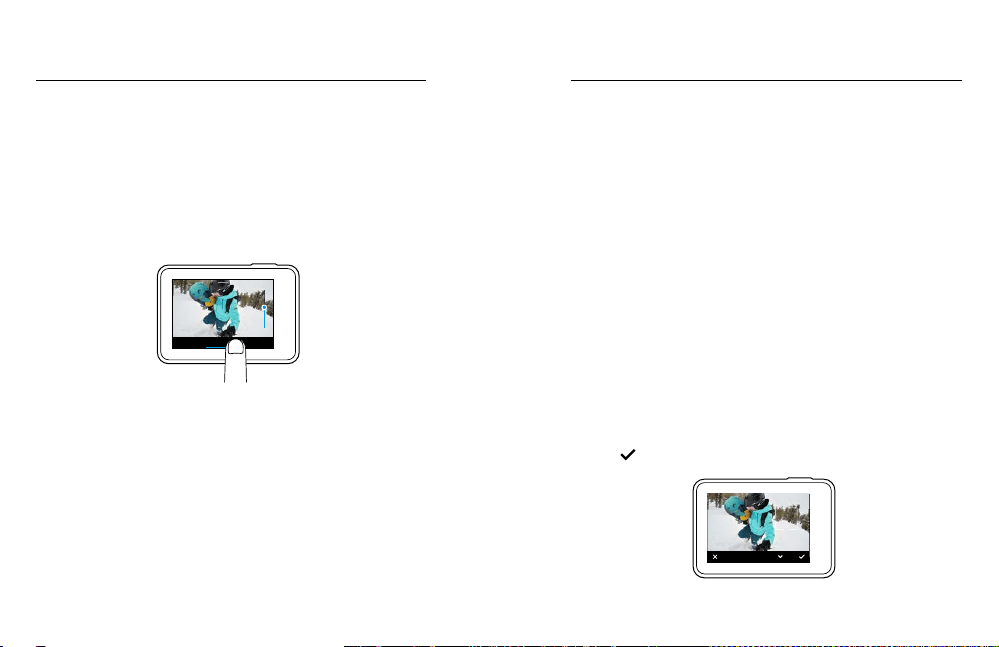
1. Ta p FOV.
2. Move the slider up or down to the zoom level that you want.
3. To exit the setting, tap the screen. The level that you set applies only
to that capture mode and remains until you change capture modes or
power o the camera.
Normal SuperviewWide
This setting is available for all capture modes, with these exceptions:
• Zoom is available for all video resolutions, except 4K, 4K 4:3, 2.7K120,
and 1080p240.
• Zoom is not available when the FOV is set to SuperView.
• For photo capture modes, Zoom is available only when RAW Format
and Exposure Control are turned o.
• You cannot change the Zoom level while you are capturing video.
ADVANCED CONTROLS
EXPOSURE CONTROL
By default, your camera uses the entire image to determine the
appropriate exposure level. However, Exposure Control lets you select an
area that you want the camera to prioritize when determining exposure.
This setting is particularly useful in shots where an important region might
otherwise be over- or underexposed.
When you change this setting, the touch display immediately shows
you the eect on your image. If you change capture modes, the camera
returns to using the entire scene to determine the correct level of
exposure.
Using Exposure Control with Auto Exposure
With this option, the camera always bases exposure on the area of the
touch display that you select, regardless of what is in that area.
Suppose your camera is mounted on your dashboard. You might want to
select the upper part of the touch display so that the exposure is based
on the scene outside of the windshield and not on the dashboard (which
might cause the scene outside to be overexposed).
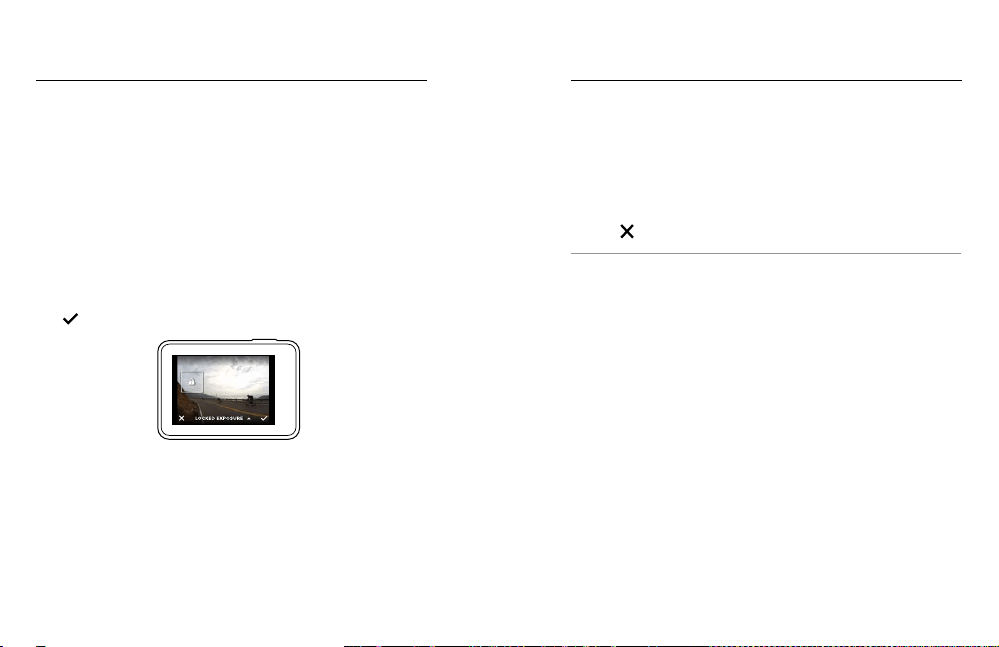
1. Press the touch display until a square outline shrinks to the middle of
the screen.
2. Drag the square to the area that you want to use to set the exposure
level. (You can also tap that area instead of dragging the square.)
3. Tap [
] in the lower right corner.
AUTO EXPOSURE
72 73
ADVANCED CONTROLS
Using Exposure Control with Locked Exposure
With this option, the camera locks the exposure. That exposure level
remains until you cancel it.
For example, suppose you are snowboarding on a sunny day. By manually
setting the exposure level based on your subject's jacket, the images that
you capture throughout the day are based on the jacket. So, they are less
likely to be underexposed compared to the bright snow.
1. Press the touch display until a square outline shrinks to the middle of
the screen.
2. Drag the square to the area that you want to use to set the exposure
level. (You can also tap that area instead of dragging the square.)
3. Tap Auto Exposure to change it to Locked Exposure.
4. Conrm that the exposure looks the way you want it to, and then tap
[
] in the lower right corner to lock the exposure.
Canceling Exposure Control
Exposure Control is automatically canceled when you select a dierent
capture mode or restart the camera. You can also cancel this setting
manually (below). When you cancel the exposure setting that you
previously set, the camera returns to using the entire scene to determine
the correct level of exposure.
1. Press the touch display until a square outline shrinks to the middle of
the screen.
2. Tap [ ] in the lower left corner.
PRO TIP: For advanced exposure settings, see Exposure Value
Compensation (page 78).
ADVANCED CONTROLS

74 75
ADVANCED CONTROLS
PROTUNE
Protune unlocks the camera’s full potential, yielding stunning image
quality and cinema-caliber video and photos optimized for professional
productions. Protune gives content creators more exibility and workow
eciency than ever before.
Protune is compatible with professional color correction tools, the
Quik desktop app, and other video and photo editing software.
Protune enables manual control of color, white balance, shutter speed,
and more for advanced control and customization of your video footage
and photos.
Protune
Protune is available as an advanced setting for all capture modes, except
Looping and Time Lapse Video. To access this advanced setting, see
Navigating with the Touch Display (page 18). The options for this
setting are O (default) and On. When Protune is on, [
] appears on
the camera screens.
Some Protune settings are not available when you use Exposure Control.
Protune is available for all video resolutions.
Changes that you make to Protune settings in one capture mode apply
only to that capture mode. For example, changing the White Balance for
Night photos does not aect White Balance for Burst photos.
Color
Color lets you adjust the color prole of your video or photos. When you
change this setting, the touch display immediately shows you the eect
on your image.
Color Setting Resulting Color Prole
GoPro Color
(defa ult)
Provides GoPro color-corrected prole (same
great color as when Protune is turned o).
Flat
Provides neutral color prole that can be color-
corrected to better match footage captured
with other equipment, oering more exibility
in post-production. Due to its long curve, Flat
captures more details in shadows and highlights.
White Balance
White Balance lets you adjust the color temperature of video and photos
to optimize for cool or warm lighting conditions. When you change this
setting, the touch display immediately shows you the eect on your image.
Options for this setting are Auto (default), 2300K, 2800K, 3200K, 4000K,
4500K, 5500K, 6000K, 6500K, and Native. Lower values result in
warmer tones.
You can also select Native to create a minimally color-corrected le from
the image sensor that allows for more precise adjustments in post-
production.
ADVANCED CONTROLS

76 77
ADVANCED CONTROLS
ISO Minimum
ISO Maximum
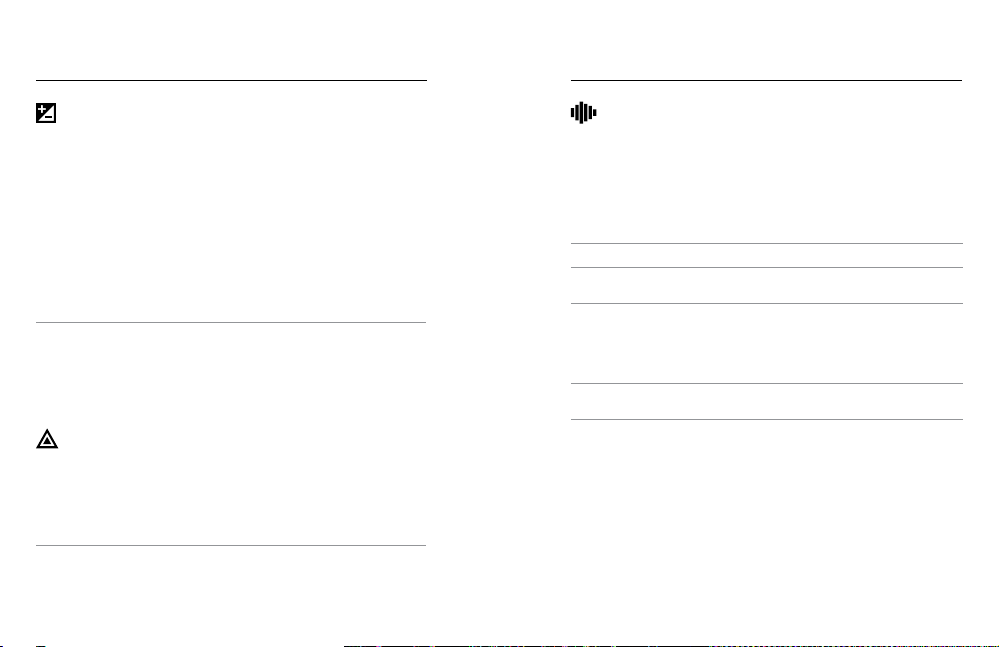
ISO Minimum and ISO Maximum let you set a range for the camera’s
sensitivity to light and image noise. ISO settings create a balance between
brightness and resulting image noise. Image noise refers to the degree of
graininess in the image.
In low light, higher ISO values result in brighter images, but with greater
image noise. Lower values result in darker images with lower image noise.
When you change this setting, the touch display immediately shows you
the eect on your image. The default for ISO Maximum is 1600 for video
and 3200 for photos. The default for ISO Minimum is 100.
For the Video and Photo capture modes, ISO behavior depends on the
Shutter setting (in Protune). The ISO Maximum that you select is used
as the maximum ISO value. The ISO value that is applied might be lower,
depending on the lighting conditions.
PRO TIP: To lock the ISO at a specic value, set ISO Minimum and ISO
Maximum to the same values.
Darker image
Lower image noise
Brighter image
Greater image noise
100 200 400 800 1600 3200 6400
ADVANCED CONTROLS
Shutter
The Shutter setting in Protune applies only to the Video and Photo
capture modes. This setting determines the amount of time that the
shutter is open. When you change this setting, the touch display
immediately shows you the eect on your image. The default setting is
Auto.
For Photo, the options for this setting are Auto, 1/125, 1/250, 1/500,
1/1000, and 1/2000 second.
For Video, the options for this setting depend on the FPS setting, as
noted below.
Settings
Example 1:
1080p30
Example 2:
1080p60
Auto Auto Auto
1/FPS 1/30 sec 1/60 sec
1/(2xFPS) 1/60 sec 1/120 sec
1/(4xFPS) 1/120 sec 1/240 sec
1/(8xFPS) 1/480 se c 1/960 sec
PRO TIP: To reduce the amount of blur in your video and photos when
using the Shutter setting, mount your camera on a tripod or other surface
that is stable and cannot move.
78 79
Exposure Value Compensation (EV Comp)
Exposure Value Compensation aects the brightness of your video or
photo. Adjusting this setting can improve image quality when shooting in
environments with contrasting lighting conditions.
Options for this setting range from -2.0 to +2.0. The default setting is 0.
When you change this setting, the touch display immediately shows you
the eect on your image. Higher values result in brighter images.
For Video, this setting is available only if Shutter is set to Auto.
For information about adjusting exposure based on a certain area of your
scene, see Exposure Control (page 71).
PRO TIP: Exposure Value Compensation adjusts brightness within the
existing ISO setting. If brightness has already reached the ISO setting in
a low-light environment, increasing the Exposure Value Compensation
does not have any eect. To continue increasing the brightness, select a
higher ISO value.
Sharpness
Sharpness controls the quality of details captured in your video footage or
photos. Options for this setting are High (default), Medium, and Low.
When you change this setting, the touch display immediately shows you
the eect on your image.
PRO TIP: If you plan to increase sharpness during editing, select Low for
this setting.
ADVANCED CONTROLS
RAW Audio
This setting applies only to the Video capture mode and creates a separate
.wav le for your video, in addition to the standard .mp4 audio track. You
can select the level of processing to apply to the RAW audio track. This
setting is useful if you want a separate .wav le to share or
use in post-processing.
Option Description
O (defa ult) No separate .wav le is created.
Low
Applies minimal processing. Ideal if you apply
audio processing in post-production.
Med
Applies processing based on the Manual
Audio Control setting (wind and/or stereo). If
Manual Audio Control is turned o, the camera
automatically switches between wind ltering
and stereo audio.
High
Applies full audio processing (automatic gain and
AAC encoding).
PRO TIP: Audio les in .wav format are captured in the same location
and with the same le name as .mp4 les. To access them, insert your
microSD card into a card reader and locate the les with your computer’s
le explorer.
Reset
This option resets all Protune settings to their default values.
ADVANCED CONTROLS

80 81
CONNECTING TO AN AUDIO ACCESSORY
An accessory microphone or other component can provide enhanced
audio for your captured video.
1. Connect the audio accessory to your camera’s USB-C port using
GoPro’s Pro 3.5mm Mic Adapter (sold separately).
2. From the camera’s main screen, swipe down.
3. Tap Preferences > Audio Input.
4. Tap an option:
Option Description
Standard Mic
(defa ult)
Supports non-powered mics
Standard Mic+
Supports non-powered mics and provides
20dB boost
Powered Mic Supports self-powered mics
Powered Mic+
Supports self-powered mics and provides
20dB boost
Line In
Supports line-level output from other audio
equipment (mixing board, guitar preamplier,
karaoke machine, etc.)
Note: If you are not sure which option to select, refer to the information from your
microphone manufacturer.
CUSTOMIZING YOUR GOPRO
From changing the beep volume to turning o the status lights, you can
set up your camera to work the way that you want.
CHANGING PREFERENCES
1. Swipe down, then tap Preferences.
2. Tap a setting, then tap a new option.
3. To exit, swipe down.
DATE AND TIME
The date and time are automatically updated when you connect your
camera to the GoPro app or the Quik desktop app. However, you can
manually change these settings, if needed.
Note: If the battery is removed from the camera for an extended period of time, you
must reset the date and time (automatically or manually).
DATE FORMAT
The date format is automatically based on the camera language that you
select. However, you can manually change this setting, if needed. The
options are DD.MM.YY, MM.DD.YY, and YY.MM.DD.
BEEP VOLUME
Sets the volume of your GoPro's alerts. The options are High (default),
Med, Low, and O.
LED
Sets which status lights blink. The options are All On (default), All O, and
Front O.
PRO TIP: Turn the front status light o if you are capturing in an area
with windows or mirrors that might cause reection in the shot.

82 83
CUSTOMIZING YOUR GOPRO
DEFAULT MODE
Sets the capture mode that your GoPro defaults to when powering up.
The options are Video (default), Time Lapse Video, Looping, Photo, Night,
Burst, Time Lapse Photo, and Night Lapse Photo.
Note: This setting does not aect QuikCapture.
AUTO OFF
Powers o your GoPro after a period of inactivity to save battery life. The
options are 5 minutes, 15 minutes (default), 30 minutes, and Never.
Note: Voice Control is not available when the camera is o unless the Wake On Voice
setting is turned on. When using Voice Control, consider selecting a higher time period
(or Never) for Auto O.
SCREENSAVER
Turns o the touch display after a period of inactivity to save battery life.
The options are 1 minute (default), 2 minutes, 3 minutes, and Never.
To turn on the touch display again, tap anywhere on the screen. When
the touch display turns o, you can still use the camera buttons and
Voice Control.
BRIGHTNESS
Adjusts the brightness level of the touch display. The options are 10% to
10 0% (default).
AUTOROTATION
This setting determines the orientation of your video or photos to help you
prevent upside down footage.
Setting Description
Auto
(Auto Image Rotation) Camera automatically
selects Up or Down, based on the orientation
of the camera when recording begins.
Ensures that your resulting image is always
right-side up.
Up (d efault)
Camera is set to always capture in right-side
up orientation.
Down
Camera is set to always capture in upside
down orientation.
AUTO LOCK
Locks the touch display to prevent accidental input. This setting is o by
default.
• To turn on Auto Lock, swipe down, then tap [
]. To temporarily
unlock the screen, swipe down, then tap the touch display.
• To turn o Auto Lock, swipe down, then tap [ ].
CUSTOMIZING YOUR GOPRO

84 85
GPS
Captures the location where your video and photos were taken. To see
this information, view the video or photos on a compatible desktop or
mobile application. For details, visit gopro.com/help.
LANGUAGE
Sets the language that appears on the camera.
VIDEO FORMAT
Sets the regional frame rates that your camera uses for recording and
playing back video on a TV/HDTV. Selecting the appropriate option for
your region helps prevent icker when capturing video indoors.
Setting Description
NTSC
Select this option to play back your
video on an NTSC TV (most televisions
in North America)
PAL
Select this option to play back your video
on a PAL TV (most televisions outside of
North America)
CUSTOMIZING YOUR GOPRO
TEMPERATURE ICON
The Temperature icon appears on the camera status screen
when the camera becomes too hot and needs to cool
down. Simply let it sit and cool before attempting to use it
again. Your camera was designed to identify conditions of
overheating and shuts down when needed.
FILE REPAIR ICON
If recording stopped abruptly and the video le was not
properly saved, the le might become corrupted. If this
happens, the camera displays the File Repair icon while
it tries to repair the le. When this process is nished,
you receive a message stating whether the repair was
successful or failed. Press any button to continue using the
camera.
MICROSD CARD MESSAGES
NO SD
No card present. The camera requires a
microSD, microSDHC or microSDXC card (sold
separately) to capture videos and photos.
FULL
The card is full. Delete some les or insert a
dierent card.
SD ERR
The camera is unable to read the card
formatting. Reformat the card in the camera.
IMPORTANT MESSAGES
86 87
RESETTING YOUR CAMERA
RESTARTING YOUR GOPRO
If your camera is not responding, press and hold the Mode button [
]
for 8 seconds to shut down the camera and then restart it. All settings
are retained.
RESETTING ALL SETTINGS TO THE DEFAULTS
This option resets all of your camera settings to the defaults, except Date,
Time, camera name and password, Language, and Video Format.
1. From the main screen, swipe down.
2. Tap Preferences > Camera Defaults, and then tap Reset.
RESETTING THE CONNECTIONS
This option clears your connections list and resets the camera’s password.
If you reset the connections, you must reconnect your devices to your
GoPro.
1. From the main screen, swipe down.
2. Tap Connections > Reset Connections, and then tap Reset.
RESTORING FACTORY SETTINGS
Follow the steps below to reset all settings, clear your connections, and
deregister the camera from your GoPro Plus account. This option is useful
if you are reselling your camera and want to reset it to its original state.
Note: This option does not change your camera’s software version.
1. From the main screen, swipe down.
2. Tap Preferences > Factory Reset, and then tap Reset.
Restoring factory settings does not erase all content from your microSD
card. To clear your microSD card, see Reformatting Your microSD Card
(page 9).
THE FRAME
The Frame (for HERO6 Black/HERO5 Black) provides additional
protection for your camera if you drop it, so you might want to keep it in
The Frame during certain activities, even if the camera is not mounted.
HERO6 Black is waterproof to 33’ (10m) with the doors closed—no
additional housing is needed when using the camera in or around water.
NOTICE: The Frame does not provide additional waterproof protection.
PRO TIP: During water activities, use a camera tether for added security
and use a Floaty to keep your camera aoat (both sold separately). For more
information, visit gopro.com.
MOUNTING
1. The Frame
2. Mounting Buckle
3. Thumb Screw
4. Curved + Flat Adhesive Mounts
4
1 2
3
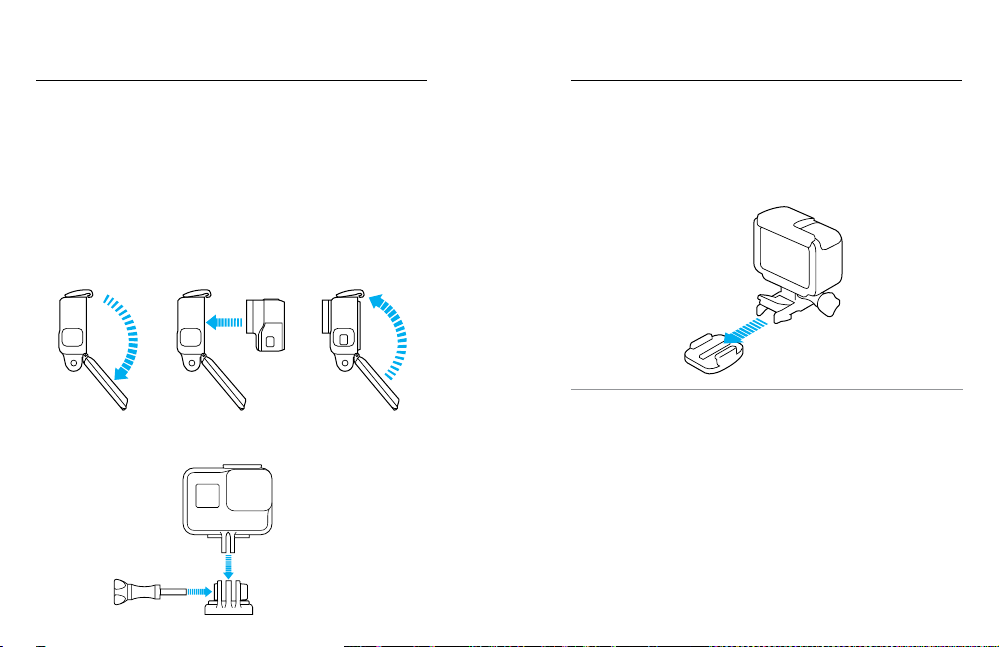
88 89
ATTACHING YOUR CAMERA TO MOUNTS
To attach your camera to a mount, you need The Frame (for HERO6
Black/HERO5 Black) and a mounting buckle and/or thumb screw,
depending on the mount you are using.
1. Secure the camera in The Frame:
a. Open the latch.
b. Slide the camera into the frame. The bottom front of The Frame
has a raised edge. Be sure the front of the camera sits ush
against it.
c. Close the door.
d. Lock the latch.
2. Attach The Frame to the mounting buckle.
MOUNTING
3. Follow the Mounting Guidelines (page 89) to attach an adhesive
mount to a surface.
4. Attach the mounting buckle to the mount:
a. Flip up the mounting buckle plug.
b. Slide the buckle into the mount until it clicks into place.
c. Press down on the plug so that it sits ush with the buckle.
PRO TIP: If you mount your HERO6 Black upside down, the camera
automatically changes the orientation of your image to be right-side up. For
more information, see Auto-Rotation (page 83).
MOUNTING GUIDELINES
Follow these guidelines when attaching adhesive mounts to curved and
at surfaces of helmets, vehicles, and gear:
• Attach the adhesive mounts at least 24 hours before use.
• Adhesive mounts must be mounted only on smooth surfaces. Porous
or textured surfaces do not enable a proper bond. When applying
the mount, rmly press it into place and ensure full contact over the
entire surface.
MOUNTING
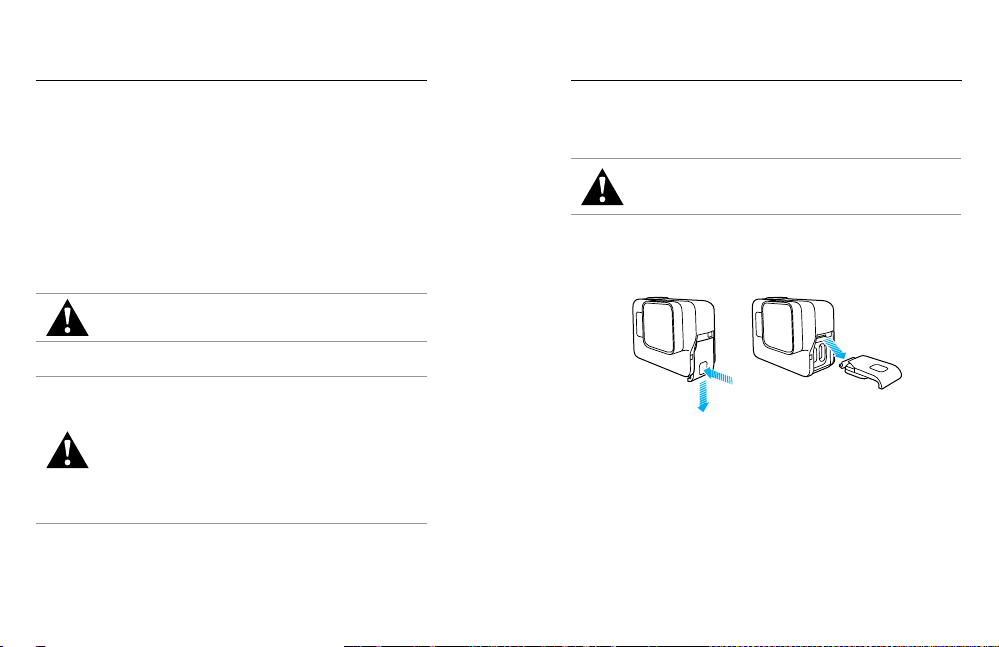
90 91
• Apply adhesive mounts only to clean, dry surfaces. Wax, oil, dirt or
other debris reduce adhesion, which can result in a weak bond and
risk of losing the camera should the connection fail.
• Attach adhesive mounts in room temperature conditions. Adhesives
do not bond properly if applied in cold or damp environments to cold
or damp surfaces.
• Check state and local regulations and laws to ensure that attaching
a camera to equipment (such as hunting equipment) is permitted.
Always comply with regulations that restrict the use of consumer
electronics or cameras.
• During water activities, use a camera tether and Floaty (both sold
separately) for added security to keep your camera aoat.
WARNING: To avoid injury, do not use a tether when mounting
the camera on a helmet. Do not mount the camera directly on
skis or snowboards.
For more information about mounts, visit gopro.com.
WARNING: If using your camera with a GoPro mount or strap
intended for use with a helmet, always select a helmet that
meets the applicable safety standard.
Choose the right helmet for your particular sport or activity
and make sure that it is the right t and size for you. Inspect
your helmet to ensure that it is in good condition, and follow
the helmet manufacturer’s instructions on safe helmet use.
Any helmet that has sustained a major impact should
be replaced. No helmet can protect against injury in
every accident.
MOUNTING
In some situations, such as charging the camera within The Frame,
connecting to audio or HDMI accessories, or connecting to a GoPro
drone, you must remove the side door to access the ports.
WARNING: Remove the side door only when you are using the
camera in a dry, dust-free environment. When the door is open
or removed, the camera is not waterproof. Never operate the
camera with the battery door open.
REMOVING THE SIDE DOOR
1. Hold down the Latch Release button and slide the door open.
2. Pull the door o of the camera.
REMOVING THE SIDE DOOR
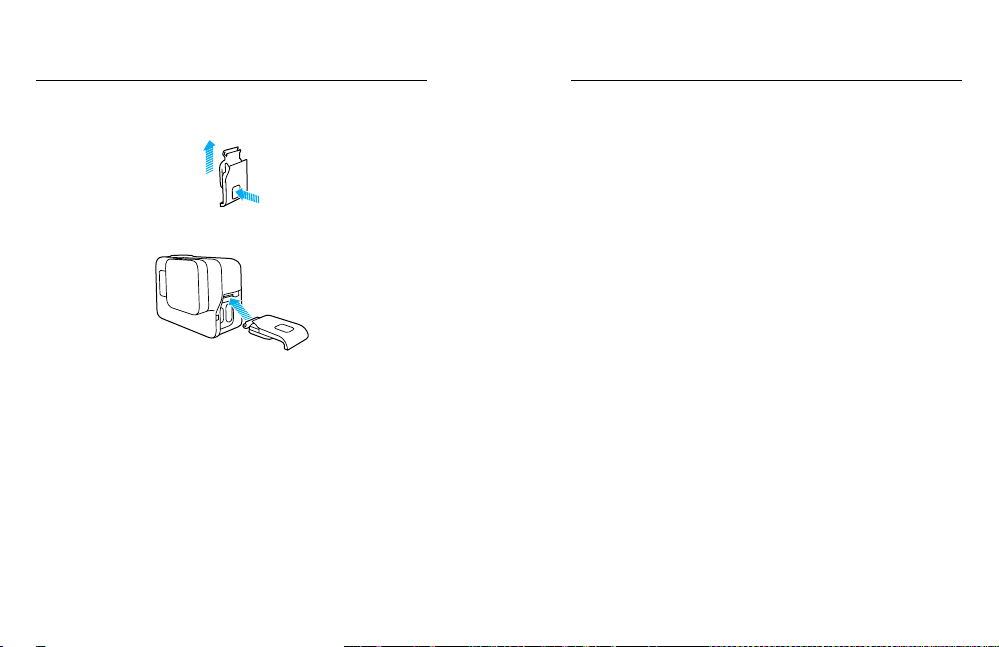
92 93
REMOVING THE SIDE DOOR
REATTACHING THE SIDE DOOR
1. Hold down the Latch Release button and extend the tab on the door.
2. Press the tab onto the small silver bar.
Follow these guidelines to get the best performance from your camera:
• The camera is waterproof to 33’ (10m)—no housing needed. Ensure
that the doors are closed before using the camera in or around water,
dirt, or sand.
• Before closing the doors, be sure the seals are free of debris. If
needed, clean with a cloth.
• Before opening the doors, be sure the camera is free of water or
debris. If needed, rinse the camera with fresh water and dry it with
a cloth.
• If sand or debris hardens around the doors, soak the camera in warm
tap water for 15 minutes and then rinse thoroughly to remove the
debris before opening the doors.
• In wet environments, dry the touch display with a soft cloth so that it
registers your touch.
• For best audio performance, shake the camera or blow on the
mic to remove water and debris from the microphone holes. To
prevent damage to the internal waterproof membranes, do not use
compressed air to blow into the mic holes.
• After every use in salt water, rinse the camera with fresh water, and
dry with a soft cloth.
• To clean the lens or the lens cover, wipe it with a soft, lint-free cloth. If
debris becomes lodged between the lens and the trim ring, ush it out
with water or air. Do not insert foreign objects around the lens.
MAINTENANCE

94 95
BATTERY INFORMATION
MAXIMIZING BATTERY LIFE
A message appears on the touch display if the battery drops below 10%.
If the battery reaches 0% while recording, the camera saves the le and
powers o.
To maximize battery life, follow these guidelines when possible:
• Turn o Wireless Connections
• Turn o GPS
• Capture video at lower frame rates and resolutions
• Turn o Protune
• Use these settings:
• QuikCapture (page 28)
• Screensaver (page 82)
• Auto O (page 82)
• Brightness (page 82)
RECORDING WHILE CHARGING
Using the USB-C cable that came with your camera, you can capture
video and photos while the camera is plugged in to a USB charging
adapter, the GoPro Supercharger, another GoPro charger, or the GoPro
Portable Power Pack. Although the battery does not charge during
recording, you can use one of the above methods to power the camera
and obtain extended recording time. When you stop recording, charging
resumes. (You cannot record while charging the camera through a
computer.)
Note: Because the side door is open, the camera is not waterproof during charging.
BATTERY INFORMATION
WARNING: Using a wall charger other than a GoPro charging
device can damage the GoPro camera battery and could
result in re or leakage. With the exception of the GoPro
Supercharger (sold separately), only use chargers marked:
Output 5V 1A. If you do not know the voltage and current
of your charger, use the included USB cable to charge the
camera from your computer.
BATTERY STORAGE AND HANDLING
The camera contains sensitive components, including the battery. Avoid
exposing your camera to very cold or very hot temperatures. Low or high
temperature conditions may temporarily shorten the battery life or cause
the camera to temporarily stop working properly. Avoid dramatic changes
in temperature or humidity when using the camera, as condensation may
form on or within the camera.
Do not dry the camera or battery with an external heat source such as a
microwave oven or hair dryer. Damage to the camera or battery caused by
contact with liquid inside the camera is not covered under the warranty.
Do not store your battery with metal objects, such as coins, keys or
necklaces. If the battery terminals come in contact with metal objects,
this may cause a re.
Do not make any unauthorized alterations to the camera. Doing so may
compromise safety, regulatory compliance, performance, and may void
the warranty.

96 97
BATTERY INFORMATION
WARNING: Do not drop, disassemble, open, crush, bend,
deform, puncture, shred, microwave, incinerate or paint the
camera or battery. Do not insert foreign objects into the
battery opening on the camera. Do not use the camera or
the battery if it has been damaged—for example, if cracked,
punctured or harmed by water. Disassembling or puncturing
the battery can cause an explosion or re.
BATTERY DISPOSAL
Most rechargeable lithium-ion batteries are classied as non-hazardous
waste and are safe for disposal in the normal municipal waste stream.
Many localities have laws in place requiring battery recycling. Check your
local laws to make sure that you can dispose of rechargeable batteries
in your regular trash. To safely dispose of lithium-ion batteries, protect
terminals from exposure to other metal with packing, masking or electrical
tape so they do not cause a re while being transported.
Lithium-ion batteries, however, do contain recyclable materials and
are accepted for recycling by the Rechargeable Battery Recycling
Corporation’s (RBRC) Battery Recycling Program. We encourage you
to visit Call2Recycle at call2recycle.org or call 1-800-BATTERY in North
America to nd a convenient recycling location.
Never dispose of a battery in a re because it may explode.
WARNING: Only use manufacturer-recommended
replacement batteries for your camera.
TROUBLESHOOTING
I’M NOT SURE WHICH SETTINGS TO USE
See Settings for Your Activities (page 26).
MY GOPRO WON'T POWER ON
Make sure your GoPro is charged. To charge your camera, use the
included USB-C cable and a computer. You can also use GoPro's
Supercharger or USB-compatible Wall Charger or Auto Charger (all
sold separately) or any charging device marked with output 5V 1A.
(Supercharger’s output is
5V 2A.)
MY GOPRO WON'T RESPOND WHEN I PRESS A BUTTON
See Restarting Your GoPro (page 86).
PLAYBACK ON MY COMPUTER IS CHOPPY
Choppy playback is typically not a problem with the le. If your footage
skips, one of these situations is likely the cause:
• Using an incompatible video player. Not all video players support the
H.265/HEVC and H.264 codecs. For best results, download the latest
version of the Quik desktop app for free at gopro.com/apps.
• The computer does not meet the minimum requirements for HD
playback. The higher the resolution and frame rate of your video, the
harder the computer has to work to play it back. Make sure that your
computer meets the minimum requirements for the playback software.
If your computer does not meet the minimum requirements, record
at 1080p60 with Protune o, and make sure that all other programs
on your computer are closed. If that resolution does not improve the
playback, try 720p60.

98 99
TROUBLESHOOTING
I FORGOT MY CAMERA’S USERNAME OR PASSWORD
Swipe down, then tap Connections > Name & Password.
I DON’T KNOW WHAT SOFTWARE VERSION I HAVE
From the main screen, swipe down. Then tap Preferences > About This
GoPro. The Version Number displays the software version that you
are running.
I CAN’T FIND MY CAMERA’S SERIAL NUMBER
The camera’s serial number is listed in several places:
• In Preferences > About This GoPro
• On the inside of the battery bay (remove the battery to see it)
• On your camera’s microSD card (in the version.txt le in the
MSC folder)
For more answers to commonly asked questions, see gopro.com/help.
CUSTOMER SUPPORT
TRADEMARKS
GoPro, HERO, Session, Karma and their respective logos are trademarks
or registered trademarks of GoPro, Inc. in the United States and other
countries. © 2017 GoPro, Inc. All rights reserved. Made in China. Hecho
en China. For patent information, visit gopro.com/patents. GoPro, Inc.,
3000 Clearview Way, San Mateo CA 94402 | GoPro GmbH, Floessergasse
2, 81369 Munich, Germany
GoPro is dedicated to providing the best possible service. To reach GoPro
Customer Support, visit gopro.com/help.

100
REGULATORY INFORMATION
To see the complete list of country certications, refer to the Important
Product + Safety Instructions included with your camera or visit
gopro.com/help.
13023120000 REVA
THIS PRODUCT IS SOLD WITH A LIMITED LICENSE AND IS AUTHORIZED
TO BE USED ONLY IN CONNECTION WITH HEVC CONTENT THAT
MEETS EACH OF THE THREE FOLLOWING QUALIFICATIONS: (1) HEVC
CONTENT ONLY FOR PERSONAL USE; (2) HEVC CONTENT THAT IS
NOT OFFERED FOR SALE; AND (3) HEVC CONTENT THAT IS CREATED
BY THE OWNER OF THE PRODUCT. THIS PRODUCT MAY NOT BE USED
IN CONNECTION WITH HEVC ENCODED CONTENT CREATED BY A
THIRD PARTY, WHICH THE USER HAS ORDERED OR PURCHASED FROM
A THIRD PARTY, UNLESS THE USER IS SEPARATELY GRANTED RIGHTS
TO USE THE PRODUCT WITH SUCH CONTENT BY A LICENSED SELLER
OF THE CONTENT. YOUR USE OF THIS PRODUCT IN CONNECTION
WITH HEVC ENCODED CONTENT IS DEEMED ACCEPTANCE OF THE
LIMITED AUTHORITY TO USE AS NOTED ABOVE