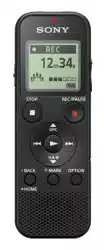

ICD-SX68 GB 3-297-851-71 (2)
2
GB
For the customers in the United
States
The following FCC statement applies only to the
version of this model manufactured for sale in the
USA. Other versions may not comply with FCC
technical regulations.
INFORMATION
This equipment has been tested and found to
comply with the limits for a Class B digital device,
pursuant to Part 15 of the FCC Rules. These limits are
designed to provide reasonable protection against
harmful interference in a residential installation. This
equipment generates, uses and can radiate radio
frequency energy and, if not installed and used in
accordance with the instructions, may cause harmful
interference to radio communications.
However, there is no guarantee that interference will
not occur in a particular installation. If this equipment
does cause harmful interference to radio or television
reception, which can be determined by turning the
equipment o and on, the user is encouraged to try
to correct the interference by one or more of the
following measures:
Reorient or relocate the receiving antenna.
Increase the separation between the equipment
and receiver.
Connect the equipment into an outlet on a
circuit dierent from that to which the receiver
is connected.
Consult the dealer or an experienced radio/TV
technician for help.
You are cautioned that any changes or modications
not expressly approved in this manual could void your
authority to operate this equipment.
If you have any questions about this product, you
may call: Sony Customer Information Services Center
1-800-222-7669 or http://www.sony.com/
Declaration of Conformity
Trade Name : SONY
Model : ICD-SX68
Responsible Party : Sony Electronics Inc.
Address : 16530 Via Esprillo, San Diego,
CA 92127 USA
Telephone Number : 858-942-2230
This device complies with part 15 of the FCC
Rules. Operation is subject to the following two
conditions: (1) This device may not cause harmful
interference, and (2) this device must accept any
interference received, including interference that
may cause undesired operation.
For the State of California, USA only
Perchlorate Material — special handling may apply,
See www.dtsc.ca.gov/hazardouswaste/perchlorate
Perchlorate Material : Lithium battery contains
perchlorate
Notice for users
Program © 1999, 2000, 2001, 2002, 2003, 2004, 2005,
2006, 2007, 2008 Sony Corporation
Documentation ©2008 Sony Corporation
All rights reserved. This manual or the software
described herein, in whole or in part, may not be
reproduced, translated or reduced to any machine
readable form without prior written approval from
Sony Corporation.
IN NO EVENT SHALL SONY CORPORATION BE LIABLE
FOR ANY INCIDENTAL, CONSEQUENTIAL OR SPECIAL
DAMAGES, WHETHER BASED ON TORT, CONTRACT,
OR OTHERWISE, ARISING OUT OF OR IN CONNECTION
WITH THIS MANUAL, THE SOFTWARE OR OTHER
INFORMATION CONTAINED HEREIN OR THE USE
THEREOF.
ICD-SX68 GB 3-297-851-71 (2)
3
GB
Sony Corporation reserves the right to make any
modication to this manual or the information
contained herein at any time without notice.
The software described herein may also be governed
by the terms of a separate user license agreement.
This software is for Windows and cannot be used
for Macintosh.
The supplied connecting cable is for the IC recorder
ICD-SX68. You cannot connect other IC recorders.
Trademarks
Microsoft, Windows, Windows Vista, Outlook,
DirectX are registered trademarks or trademarks of
Microsoft Corporation in the United States and/or
other countries.
Apple and Macintosh are trademarks of Apple Inc.,
registered in the USA and other countries.
Pentium is a registered trademark of Intel
Corporation.
Nuance, the Nuance logo, Dragon
NaturallySpeaking, and RealSpeak are trademarks
and/or registered trademarks of Nuance
Communications, Inc., and/or its a liates in the
United States and/or other countries.
© 2007 Nuance Communications, Inc.
All rights reserved.
MPEG Layer-3 audio coding technology and
patents licensed from Fraunhofer IIS and Thomson.
“Memory Stick” and are trademarks of Sony
Corporation.
“Memory Stick Duo” and
are trademarks of Sony
Corporation.
“Memory Stick PRO Duo” and
are trademarks of Sony
Corporation.
“MagicGate Memory Stick” is the trademark of Sony
Corporation.
“LPEC” and are registered trademarks of Sony
Corporation.
US and foreign patents licensed from Dolby
Laboratories.
Music Identication Technology and associated data
will be supplied from the Gracenote®. Gracenote
MusicID is the industry standard for digital music
identication for both CDs and individual music
les. For details, see the following web site:: www.
gracenote.com
Gracenote® is a registered trademark of the
Gracenote, Inc. The Gracenote logo and logotype, and
“Powered by Gracenote” logo are trademarks of the
Gracenote. For use of the Gracenote services, see the
following web page: www.gracenote.com/corporate
All other trademarks and registered trademarks
are trademarks or registered trademarks of their
respective holders. Furthermore, “ ™ ” and “ ® ” are not™ ” and “ ® ”are not ” and “ ® ” are not® ” are not ” are not
mentioned in each case in this manual.
The “Digital Voice Editor” uses software modules as
shown below:
Microsoft® DirectX®
©2001 Microsoft Corporation. All rights reserved.

ICD-SX68 GB 3-297-851-71 (2)
4
GB
Table of Contents
Checking the contents of the
package ...............................................................7
Index to Parts and Controls .....................8
Getting Started
Step 1: Preparing a Power Source .......13
Installing the batteries .......................13
When replacing/charging the
batteries......................................................15
Step 2: Setting the Clock ...........................17
Step 3: Preparations Required
before Recording ...........................................19
Basic Operations
Recording Messages....................................21
Various Recording Modes
Manual Recording Mode ..........................24
Starting to Record Automattically
in Response to Sound
– the VOR Function ......................................25
Adding a Recording to a Previously
Recorded Message .......................................26
Adding an Overwrite Recording
during Playback ..............................................28
Dividing a Message into Two
during Recording ..........................................29
Recording with an External
Microphone ......................................................30
Recording from Other Equipment......31
Recording sound from a
telephone or a cell phone ..............32
Playback/Erasing
Playing Back Messages ...............................33
Adjusting the playback sound
by amplifying inaudible sound
– the Digital Voice Up function ....36
Adjusting the playback speed
– DPC (the Digital Pitch
Control function) ..................................37
Playing Back a Specied
Section Repeatedly
– A-B Repeat ............................................37
Adding a Bookmark ............................38

ICD-SX68 GB 3-297-851-71 (2)
5
GB
Playing Back a Message at a
Desired Time with an Alarm ...................39
Erasing Messages...........................................42
Erasing Messages one by one ......42
Erasing All Messages
in a Folder ..................................................43
Editing Messages
Dividing a Message into Two .................44
Moving Message to a
Different Folder ...............................................45
Adding Priority Mark(s)
– the Priority Mark Function ...................45
Utilizing the Menu Function
Making Settings for the Menu ...............46
Using the IC Recorder with
Your Computer
Using the Supplied Digital Voice
Editor Software................................................57
What You Can Do Using the
Digital Voice Editor Software .........57
System Requirements ........................58
Installing the Software ......................59
Connecting the IC Recorder
to your Computer ................................62
Referring to the Help Files ...............63
Playing Back MP3 Files Using the
IC Recorder ........................................................64
Using the Digital Voice Editor
Software .....................................................64
Using Windows Explorer ..................65
Construction of folders
and les.......................................................66
Using the IC Recorder as a
USB Mass Storage Device .........................67

ICD-SX68 GB 3-297-851-71 (2)
6
GB
Troubleshooting
Troubleshooting .............................................69
Error Messages (IC recorder) ..........76
System Limitations ..............................79
Addtional Information
Recording with Other Equipment ......80
Using a USB AC Adaptor
(not supplied) ..................................................81
Precautions ........................................................82
Specifications ...................................................83
Index ......................................................................85
ICD-SX68 GB 3-297-851-71 (2)
7
GB
Checking the contents
of the package
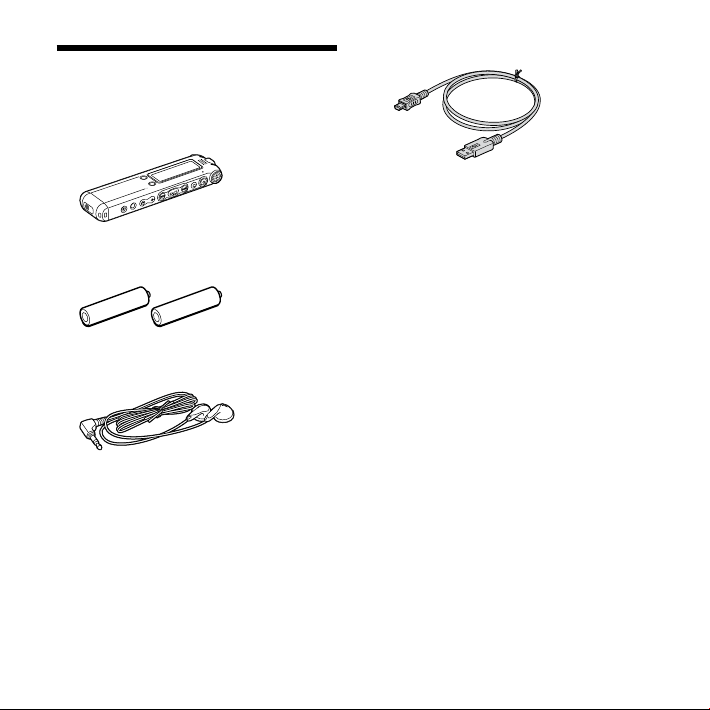
IC Recorder (1)
LR03 (size AAA) alkaline batteries (2)
Stereo headphones (1)
USB connecting cable (1)
Application Software, Digital Voice
Editor (CD-ROM)
Carrying pouch (1)
Operating Instructions
ICD-SX68 GB 3-297-851-71 (2)
8
GB
Index to Parts and
Controls
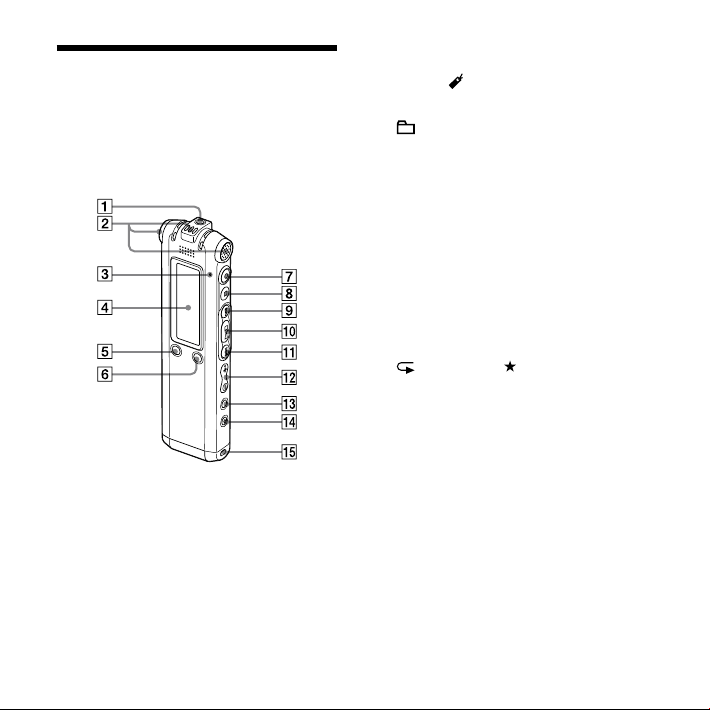
Refer to the pages indicated in
parentheses for details.
Front
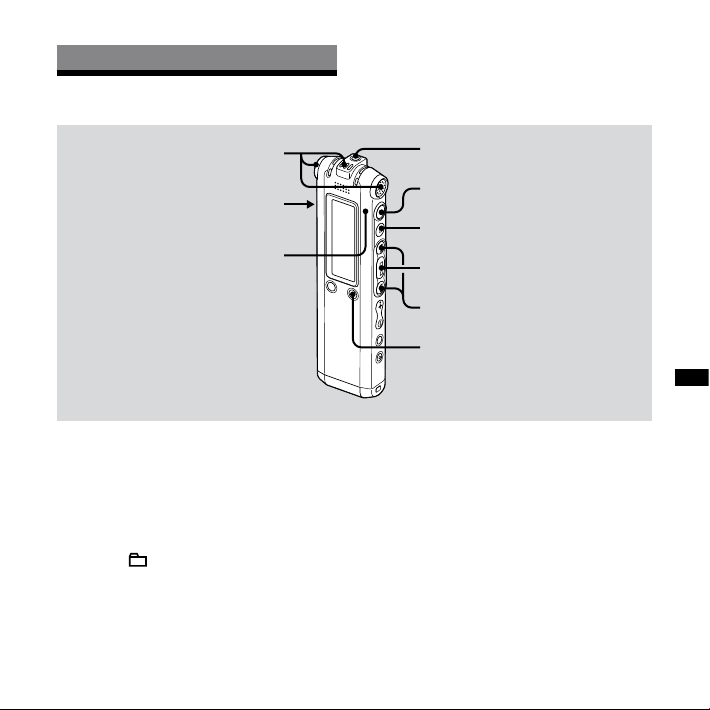
(headphone) jack* (21, 23, 33, 34,
80)
Built-in microphones (stereo/
directional) (21, 24, 25)
Operation indicator (21, 24, 26, 28, 52)
Display window (10, 11)
DIVIDE/ (bookmark) button (30, 33,
38)
(folder)/MENU button
(record/pause) button (21, 24, 25,
26, 29)
(stop) button (18, 22, 25, 27, 29, 33,
40, 42, 45, 46)
(cue/fast forward) button (34)
(play/stop/enter) button
(review/fast backward) button
(34)
VOL (volume) +/– button (23, 33)
(repeat) A-B/ (priority) button
(33, 37, 45)
ERASE button (42)
Opning for a handstrap (A handstrap
is not supplied.)
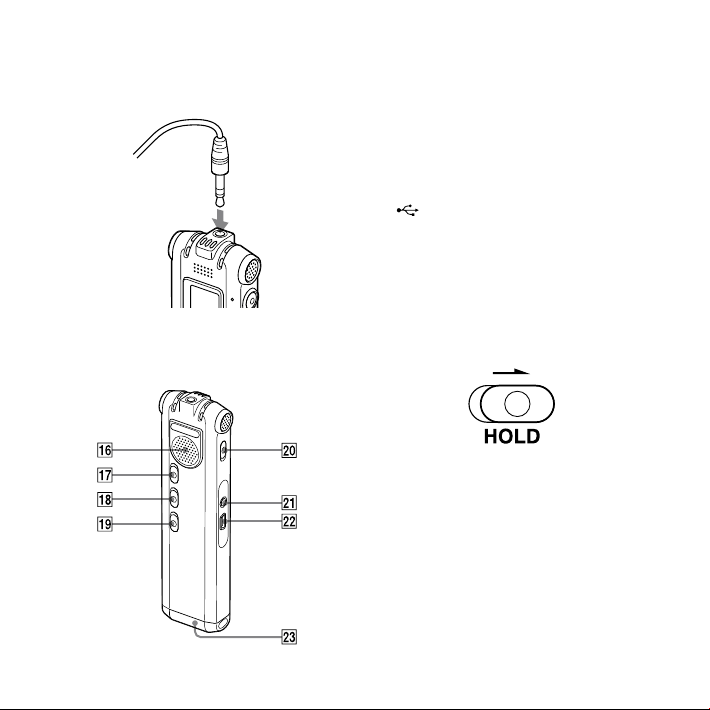
ICD-SX68 GB 3-297-851-71 (2)
9
GB
* Connect stereo ear receiver or stereo
headphones supplied or not supplied to the
(headphone) jack. If unwanted noise is
heard, wipe the headphones plug clean.
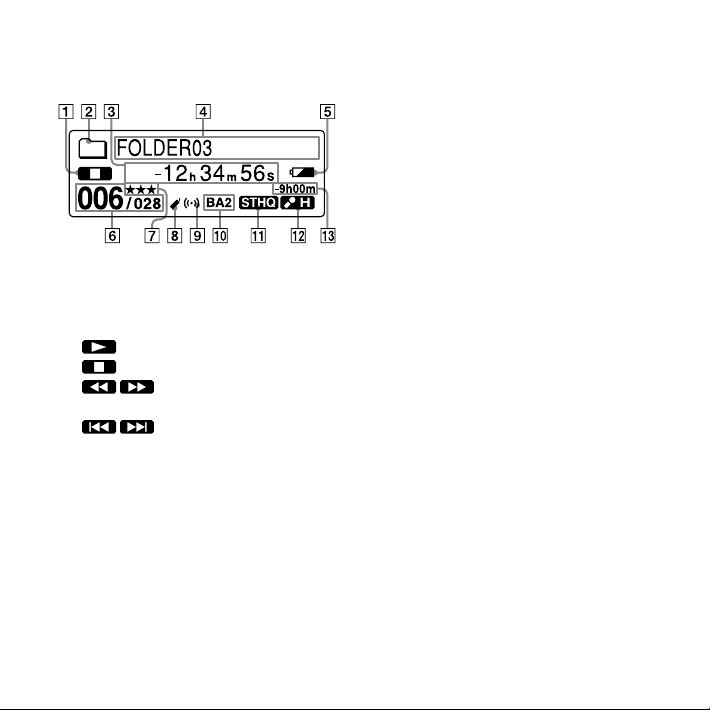
Rear
Speaker
HOLD switch**
V-UP (Digital Voice Up) switch (36, 56)
DPC switch (37, 50)
DIRECTNL (directional) switch (23)
(microphone) jack (30, 31)
(USB) connector (13, 63)
Battery compartment (13)
** Slide the HOLD switch in the direction of
the arrow to lock all the functions of all the
buttons. During stop, “POWER SAVING…”
will be displayed and the display will be
turned off to prevent battery power from
exhausting.
ICD-SX68 GB 3-297-851-71 (2)
10
GB
Remaining battery/Charging
indicator
When dry batteries are used, the
indicator shows the remaining
battery power.
While charging the rechargeable
batteries an animation appears.
Selected message number/Total
number of messages in the folder
Priority marks
Appear(s) when a message is set with
priority mark(s).
Bookmark indicator
Appears when a bookmark is set for
a message.
Alarm indicator
Appears when the alarm is set for a
message.
Sound eect indicator
Displays the EFFECT setting in the
menu.
BA1 : The bass sound is reinforced.
BA2 : The bass sound is further
reinforced.
Display window
Display during playback and stop
Operation mode indicator
Displays the following, depending on
the current operation mode
: playback
: stop
: review/fast backward,
cue/fast forward
: going backward/forward
continuously
Folder indicator
Elasped time/Remaining time
indication/Recording date and time
indication
Folder name/Message name/Artist
name indication
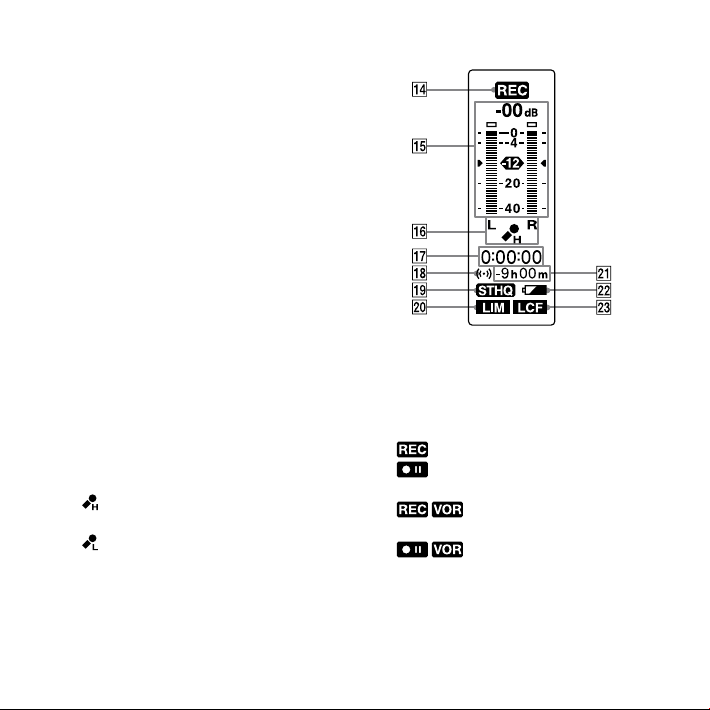
ICD-SX68 GB 3-297-851-71 (2)
11
GB
Recording mode indicator
Displays the recording mode set
using the menu when the IC recorder
is in the stop mode, and displays the
current recording mode when the IC
recorder is in the playback mode.
STHQ : Standard play stereo
recording mode with high quality
sound
ST : Standard play stereo recording
mode
STLP : Long play stereo recording
mode
SP : Standard play monaural
recording mode
LP : Long play monaural recording
mode
MP3 : MP3 mode (during playback
only)
Microphone sensitivity indicator
Displays the current microphone
sensitivity.
(high) : To record at a meeting or
in a quiet/spacious place.
(low) : To record for dictation or in
a noisy place.
MAN (manual) : To record with
microphone sensitivity set manually.
Remaining recording time indication
Display during recording
Operation mode indication
Displays the following, depending
on the current operation of the IC
recorder.
: recording
: recording standby/recording
pause
: recording with the VOR
function
: recording pause with the
VOR function
Recording level meter

ICD-SX68 GB 3-297-851-71 (2)
12
GB
Microphone sensitivity indicator
Displays the current microphone
sensitivity when recording with AGC
(Automatic Gain Control).
(high) : To record at a meeting or
in a quiet/spacious place.
(low) : To record for dictation or in
a noisy place.
Displays the recording level during
manual recording.
Elapsed recording time indication
Alarm indicator
Recording mode indicator
Displays the recording mode (STHQ,
ST, STLP, SP, and LP) set in the menu.
LIM (limiter) indicator
Displays the LIMITER setting in the
menu.
When “REC LEVEL” is set to “AUTO-
AGC,” “---” is displayed.
Remaining recording time indication
Remaining battery/Charging
indicator
LCF (Low Cut Filter) indicator
Displays the LCF setting in the menu.
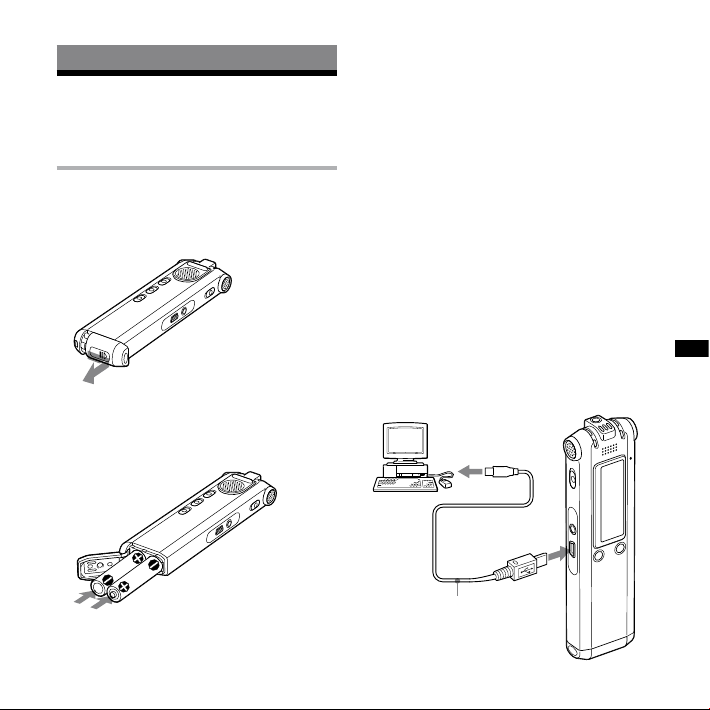
ICD-SX68 GB 3-297-851-71 (2)
13
GB
Getting Started
Getting Started
Step 1: Preparing a
Power Source
Installing the batteries
1 Slide and lift the battery
compartment lid.
2 Insert two LR03 (size AAA) alkaline
batteries with correct polarity, and
close the lid.
Clock setting display appears when you
insert batteries for the rst time, or when
you insert batteries after the IC recorder
has been without batteries for a certain
period of time. Please refer to step 4 in
“Step 2: Setting the Clock” on page 18 to
set the date and time.
Using rechargeable batteries
You can install rechargeable batteries
(not supplied) instead of the supplied
batteries.
If the supplied Digital Voice Editor
software is not installed yet, it is
recommended that you install the
software before connecting the IC
recorder to your computer.
Follow steps 1 and 2, and then charge
the batteries by connecting the USB
connector of the IC recorder to your
computer.
USB cable (supplied)

ICD-SX68 GB 3-297-851-71 (2)
14
GB
While the batteries are charging,
“CONNECTING” and the charging
indicator are displayed in an animation.
When the charging indicator indicates
“ ,” charging is completed. (Charging
time: approx. 4 hours*)
When you use the IC recorder for the
rst time, or after you have not used
the IC recorder for a certain time, it
is recommended that you charge
the batteries repeatedly until “ ” is
displayed.
If the charging indicator is not displayed,
charging has not been done properly.
Proceed from step 1 again.
* This is an approximation for the time it takes
to charge from no remaining battery power
to full battery power at room temperature.
It varies depending on the remaining
power and the condition of the batteries.
It also takes more time if the temperature
of the batteries is low, or if the batteries are
changed while you are transferring data to
the IC recorder.
Tip
You can charge the rechargeable batteries by
connecting the IC recorder to an AC outlet
using a USB AC adaptor (not supplied) (page
81).
Notes
While “ ” or “ ” is being displayed
instead of the remaining battery/charging
indicator, you cannot charge the batteries.
Charge the batteries in an environment with
a temperature of 5 °C – 35 °C (41 ˚F – 95 ˚F).
If “USB CHARGE” in the menu “DETAIL
MENU” is set to “OFF,” you cannot charge
the batteries using your computer. Set “USB
CHARGE” to “ON” (page 56).
Do not use manganese batteries for this IC
recorder.
Clock setting display appears when you
insert batteries for the rst time, or when
you insert batteries after the IC recorder
has been without batteries for a certain
period of time. Please refer to step 4 in
“Step 2: Setting the Clock” on page 18 to
set the date and time.
ICD-SX68 GB 3-297-851-71 (2)
15
GB
Getting Started
When replacing/charging
the batteries
The battery indicator on the display
window shows the battery condition.
Notes
Do not use manganese batteries for this IC
recorder.
When you replace the batteries, insert the
new ones within 3 minutes after you remove
the exhausted ones. Otherwise, the display
may show the clock setting display or
incorrect date and time when you re-insert
the batteries. In this case, set the date and
time again. The recorded messages and
alarm setting, however, will remain.
Do not charge dry batteries.
When you are not going to use the IC
recorder for a long time, remove the
batteries to prevent damage from battery
leakage and corrosion.
Battery remain indication
: Replace the old batteries with new
ones or charge both batteries.
: “LOW BATTERY“ appears and the IC
recorder will stop operation.
Battery life
*1
When using a Sony LR03 (SG) (size
AAA) alkaline battery or Sony NH-AAA
rechargeable batteries
Recording
mode
STHQ
*3
ST
*4
Recording Approx. 13 hr.
30 min.
Approx. 14 hr.
30 min.
Playback
*2
through
speaker
Approx. 16 hr.
30 min.
Approx. 17 hr.
Playback
using ear
receiver
Approx. 22 hr. Approx. 23 hr.
Recording
mode
STLP
*5
SP
*6
Recording Approx. 16 hr.
30 min.
Approx. 17 hr.
Playback
*2
through
speaker
Approx. 17 hr.
30 min.
Approx. 19 hr.
Playback
using ear
receiver
Approx. 24 hr.
30 min.
Approx. 27 hr.
30 min.
(hr : hours/min. : minutes)

ICD-SX68 GB 3-297-851-71 (2)
16
GB
Recording
mode
LP
*7
MP3 (128 Kbps/
44.1 kHz)
Recording Approx. 19 hr. –
Playback
*2
through
speaker
Approx. 19 hr.
30 min.
Approx. 17 hr.
30 min.
Playback
using ear
receiver
Approx. 28 hr.
30 min.
Approx. 24 hr.
(hr : hours/min. : minutes)
*1
The battery life may shorten depending on
how you operate the IC recorder
*2
When playing back through the internal
speaker with the volume level set to VOL12
*3
STHQ : Stereo high quality recording mode
*4
ST : Stereo standard recording mode
*5
STLP : Stereo long play recording mode
*6
SP : Standard play recording mode
*7
LP : Long play recording mode
Note on the “UPDATING
DATABASE…” message
The IC recorder is accessing data while
“UPDATING DATABASE…“ appears in the
display window or the OPR indicator
ashes in orange. While accessing, do not
remove the batteries or USB AC adaptor
(not supplied). Doing so may damage
the data.
Note
If the IC recorder is required to process
excessive amount of data, “UPDATING
DATABASE…” may be displayed for an
extended period of time. This is not a
malfunction of the IC recorder.
Wait until the message disappears before
starting operation.
ICD-SX68 GB 3-297-851-71 (2)
17
GB
Getting Started
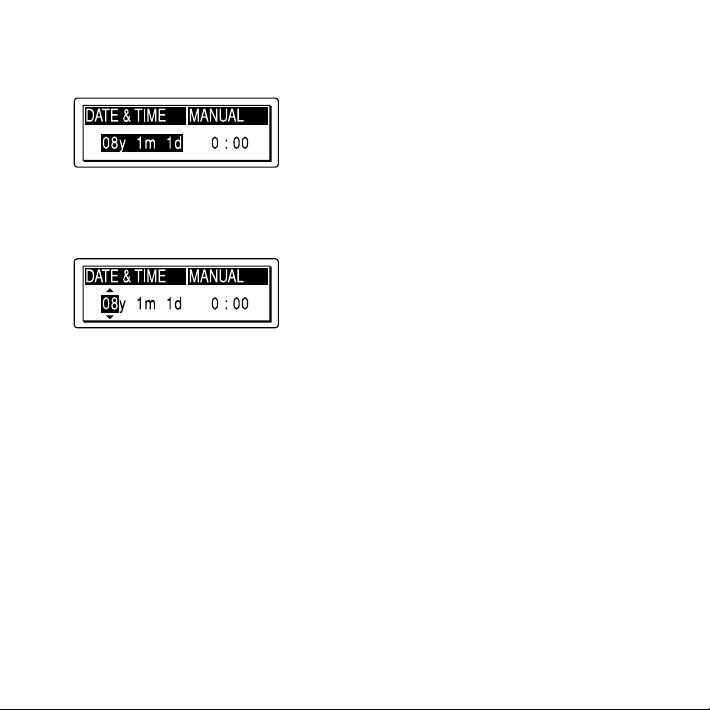
1 Select “DATE & TIME” in the menu.
Press and hold /MENU.
The menu mode will be displayed in
the display window.
Press or to select “DETAIL
MENU” and press .
Press or to select “DATE &
TIME” and press .
2 Press or to select “AUTO”
or “MANUAL” and press .
When you selected “AUTO,” the clock is
automatically adjusted using the clock
in the computer connected to the IC
recorder and on which the supplied
Digital Voice Editor software is started.
When you select “MANUAL,” proceed
to the next steps.
Step 2: Setting the
Clock
/
/MENU
You need to set the clock to use the
alarm function or record the date and
time.
Clock setting display appears when you
insert batteries for the rst time, or when
you insert batteries after the IC recorder
has been without batteries for a certain
period of time. In this case, proceed from
step 4.
ICD-SX68 GB 3-297-851-71 (2)
18
GB
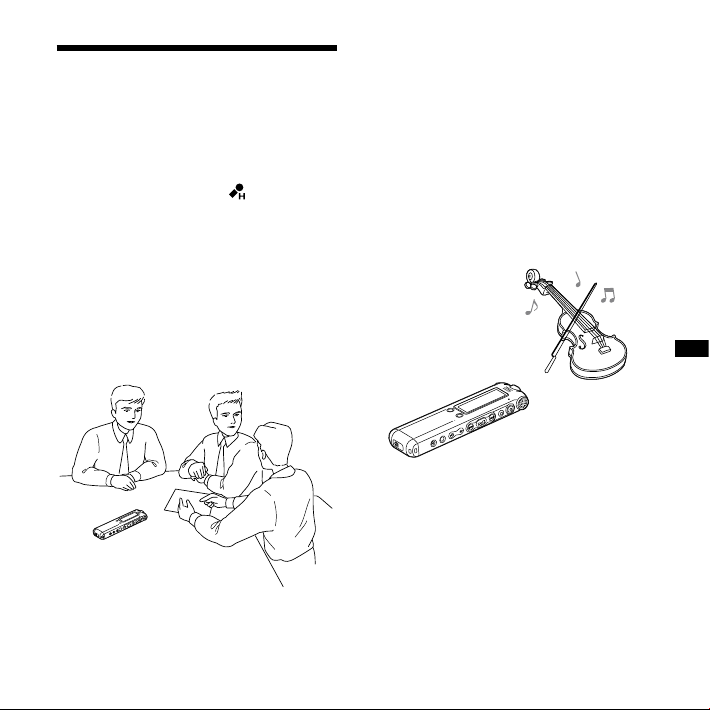
3 Press or to select
“08y1m1d” and press .
4 Press or to set the year,
month, day, hour, and minute in
sequence, and then press .
“EXECUTING….” appears and the clock
is set.
5 Press to return to the normal
display.
Note
If you do not press within one minute
of entering the clock setting data, the clock
setting mode is cancelled and the window
will return to the normal display.
ICD-SX68 GB 3-297-851-71 (2)
19
GB
Getting Started
Step 3: Preparations
Required before
Recording
Recording at a meeting
Set “MIC SENS” to “HIGH ” in the menu
(page 49).
Slide the DIRECTNL switch to “ON” to
record a voice coming from a specic
direction (page 23).
Set “LCF (LOW CUT)” to “ON” in the
menu to prevent noise caused by a
projector, etc. (page 49).
Recording a musical
performance
Set “REC LEVEL” to “MANUAL” in the
menu (page 50) to record more realistic
sound, distinguishing dynamic sound
and soft sound.
Set “LIMITER” to “ON” in the menu (page
54), to prevent distortion when a loud
sound is suddenly input.
ICD-SX68 GB 3-297-851-71 (2)
20
GB
Recording dictation (using the
voice recognition software)
Set “MIC SENS” to “LOW ” in the menu
(page 49).
Slide the DIRECTNL switch to “ON” to
record a voice coming from a specic
direction (page 23).
To transcribe a message recorded on
the IC recorder using voice recognition
software (not supplied), set “REC MODE”
to “STHQ,” “ST,” “STLP,” or “SP” (page 49).
Microphone
Before you can transcribe recorded
messages, you have to create a user file
specifically adapted to the sound of your
recorded speech. This procedure is called
“training.” For details on “training,” refer to the
help files supplied with the voice recognition
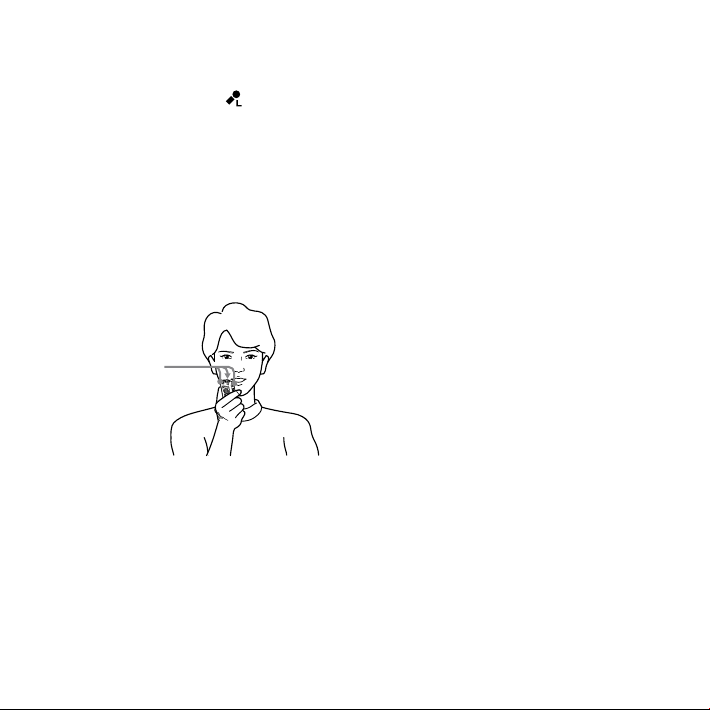
software you are using.
To obtain maximum recognition accuracy,
hold the IC recorder so that the microphone
is about an inch (2 - 3cm) from the corner of
your mouth.
To minimize the sound of your breach in
the recordings, do not hold the microphone
directly in front of your mouth.
To obtain maximum recognition accuracy,
avoid recording in a noisy place.
You cannot transcribe a message recording
the voices of more than one person.
You can transcribe the following messages
recorded using your IC recorder or files saved
on your computer.
Messages recorded in the STHQ, ST, STLP
or SP mode (DVF)
44.1/16/11kHz 16-bit WAV files saved on
the computer
ICD-SX68 GB 3-297-851-71 (2)
21
GB
Basic Operations
Basic Operations
Recording Messages
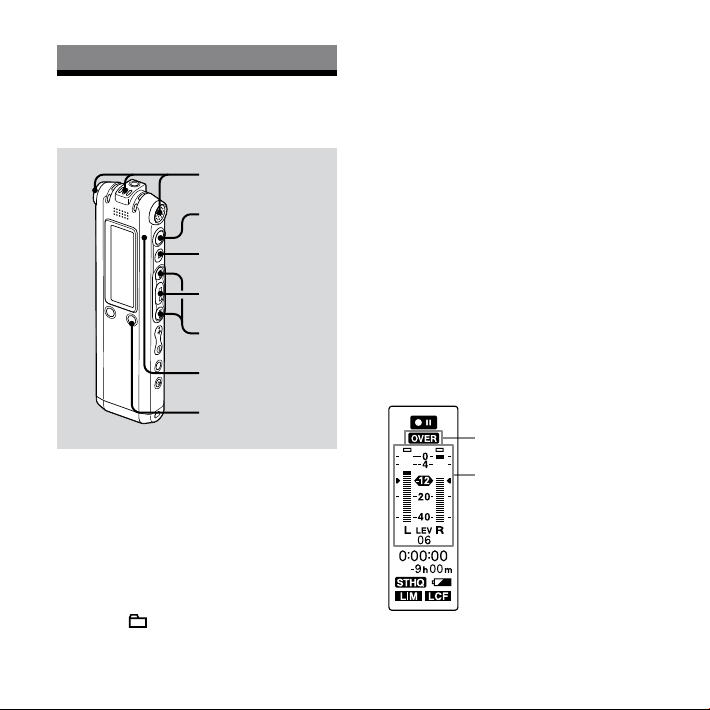
Built-in microphones
DIRECTNL
OPR indicator
(headphone) jack
2
3
1
1
1
This section explains how to record using
the AUTO_AGC* setting, to which the IC
recorder is preset at the factory.
* Auto Gain Control
1 Select a folder.
Press /MENU to display the folder
selection window.
Press or to select the
folder in which you want to record
messages, and then press .
2 Start recording.
Press (record).
The OPR indicator lights in red and
the window changes to the recording
display (page 11).
You do not need to press and hold
(record) while recording. The
new message will be automatically
recorded after the last recorded
message.
Speak into the built-in microphone.

ICD-SX68 GB 3-297-851-71 (2)
22
GB
3 Press (stop) to stop recording.
The IC recorder stops at the beginning
of the current recording.
Tips
When you purchase the IC recorder, there
are 5 folders already available, and you can
record up to 999 messages in each folder.
By using the supplied Digital Voice Editor
software, you can make new folders or
delete unnecessary folders (page 57).
Notes
While the OPR indicator is flashing or is lit
in orange, do not remove the batteries or
the USB AC adaptor. Doing so may damage
the data.
Noise may be recorded if an object, such
as your finger, etc., accidentally rubs or
scratches the IC recorder during recording.
Before making a recording, be sure to check
the battery indicator (page 15).
To avoid replacing batteries during a long
recording session, use the USB AC adaptor
(not supplied).
The maximum recording time and the
number of messages you can make varies,
depending on the conditions of use.
To Do this
pause
recording*
Press (record).
During recording pause,
the OPR indicator ashes
in red and ““ ashes in
the display window.
release pause
and resume
recording
Press (record).
Recording resumes
from that point. (To stop
recording after pausing
recording, press (stop).)
review the
current
recording
instantly**
Press .
Recording stops and
playback starts from the
beginning of the message
just recorded.
review during
recording**
Press and hold
during recording
or recording pause.
Recording stops and you
can search backwards
while listening to fast
playback sound. After you
release , playback
starts from that point.
You can add an overwrite
recording from that point.

ICD-SX68 GB 3-297-851-71 (2)
23
GB
Basic Operations
* One hour after you pause recording,
recording pause is automaticaly released
and the IC recorder enters the stop mode.
** You cannot select this function in the
manual recording mode.
Selecting the recording mode
Select the recording mode in the “REC
MODE” menu.
STHQ : High-quality stereo recording
mode; you can record with stereo
high-quality sound.
ST : Standard play stereo recording
mode; you can record with stereo
sound.
STLP : Long play stereo recording mode;
you can record for a longer time
with stereo sound.
SP : Standard play monaural
recording mode; you can record
with standard quality sound.
LP : Long play monaural recording
mode; you can record for a longer
time with monaural sound.
To record with better sound quality,
select the STHQ or ST mode.
Monitoring the recording
Connect the stereo ear receiver supplied
to the (headphone) jack and monitor
the recording. You can adjust the
monitoring volume by pressing VOL + or
VOL –, but the recording level is xed.
Maximum recording time
The maximum recording time of all the
folders is as follows.
STHQ mode ST mode STLP mode
8 hr. 35 min. 22 hr. 50 min. 44 hr. 00 min.
SP mode LP mode
69 hr. 40 min. 185 hr. 55 min.
(hr : hours/min. : minutes)
Recording a sound centering on a
specic direction
To record a sound centering on a specific
direction, slide the DIRECTNL switch to
the “ON” position. This is convenient when
you want to record a particular sound at a
conference/meeting, etc.
In this case, even when you select the stereo
recording mode (STHQ, ST, or STLP mode), the
sound is recorded in the monaural mode.
When you are using an external microphone,
the DIRECTNL switch does not function.
ICD-SX68 GB 3-297-851-71 (2)
24
GB
Various Recording Modes
Manual Recording
Mode
3, 6
7
1, 2
2, 6
Operation
indicator
1, 2, 4
1, 2
1 Select the manual recording mode
in the menu.
Select “MANUAL” by pressing or
in the “REC LEVEL” menu, and then
press .
2 Select a folder.
Press /MENU to display the folder
selection window.
Press or to select the
folder in which you want to record
messages and then press .
3 Press and hold (record).
The IC recorder enters the record
standby mode. When you speak into
the microphone, the level meter in the
display window moves.
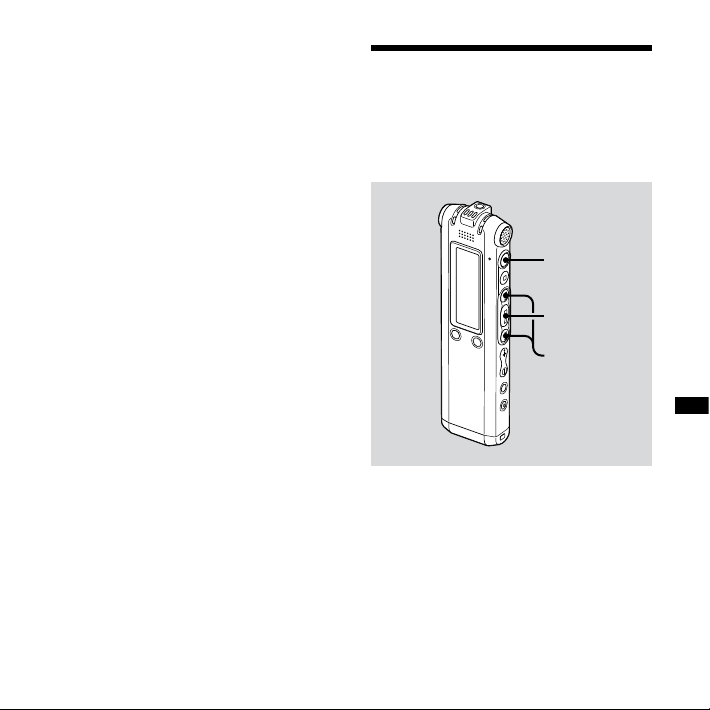
4 Adjust the recording level.
Adjust the maximum level of the
sound source to about –12 dB on the
recording level meter.
If “OVER” is displayed, press or
and adjust the recording level
down so that “OVER” is not displayed,
to prevent sound distortion.
OVER indicator
Level meter
ICD-SX68 GB 3-297-851-71 (2)
25
GB
Various Recording Modes
Press and hold or to change
the sound level continuously. The
sound level is also displayed as a
number below the level meter.
5 Make other settings for recording
such as “LCF (LOW CUT),” “LIMITER,”
etc., in the menu.
6 Start recording.
Press (record).
The OPR indicator lights in red and
“REC” is displayed.
You do not need to press and hold
while recording.
Speak into the built-in microphone.
7 Press (stop) to stop recording.
Starting to Record
Automattically in
Response to Sound
– the VOR Function
2
1
1
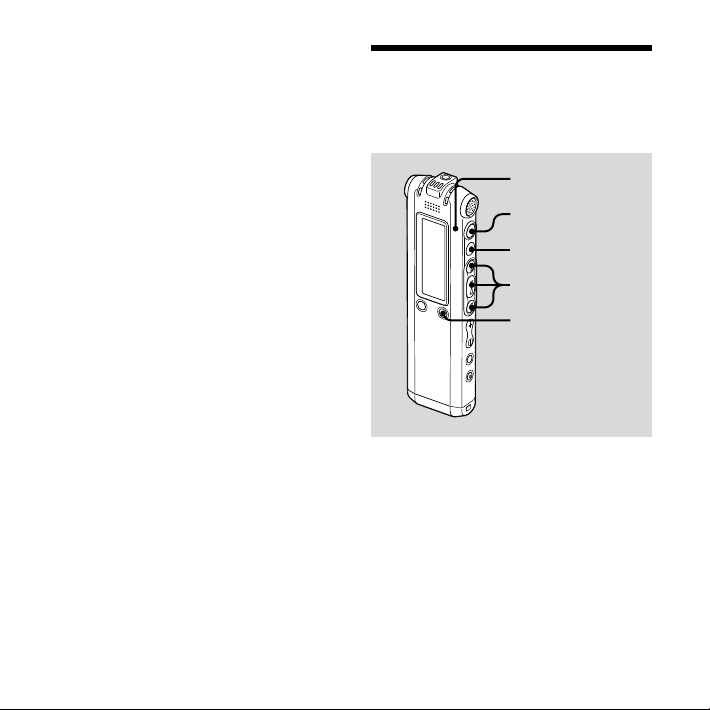
When recording with AUTO AGC, set
the VOR (Voice Operated Recording)
function to “ON” in the menu (page 50).
ICD-SX68 GB 3-297-851-71 (2)
26
GB
1 Press or to set “VOR” to
“ON” in the menu, and then press
.
“VOR” appears in the display window.
2 Press (record).
The recording starts when the IC
recorder detects sound. The recording
pauses when no sound is detected
and “VOR” and “” ash. When the
IC recorder detects sound again, the
recording starts again.
To cancel the VOR function
Set “VOR” to “OFF” in the menu.
Note
The VOR function is affected by the sound
around you. Set “MIC SENS” in the menu
according to the recording conditions. If
recording is not satisfactory after you have
changed the microphone sensitivity, or for an
important recording, set “VOR” to “OFF” in the
menu.
Adding a Recording to
a Previously Recorded
Message
2, 3
4
1
Operation
indicator
1
ICD-SX68 GB 3-297-851-71 (2)
27
GB
Various Recording Modes
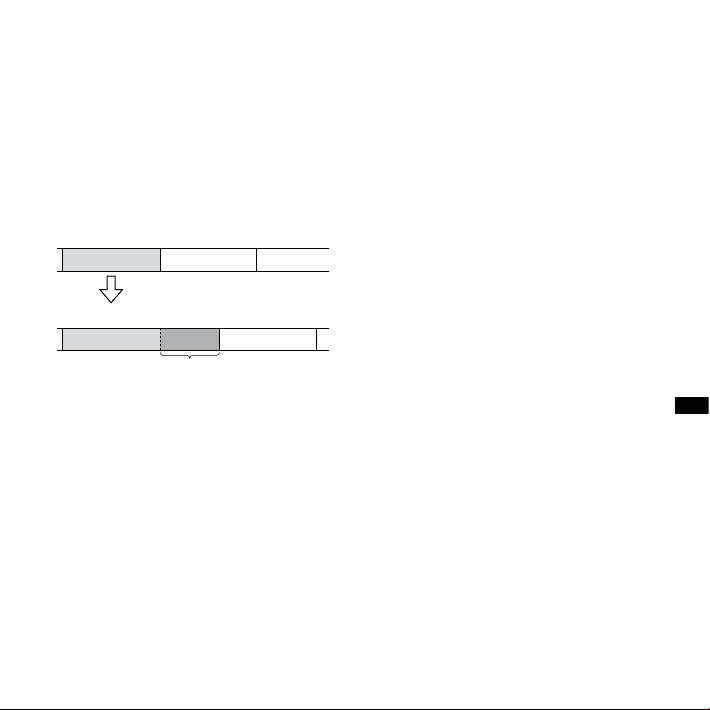
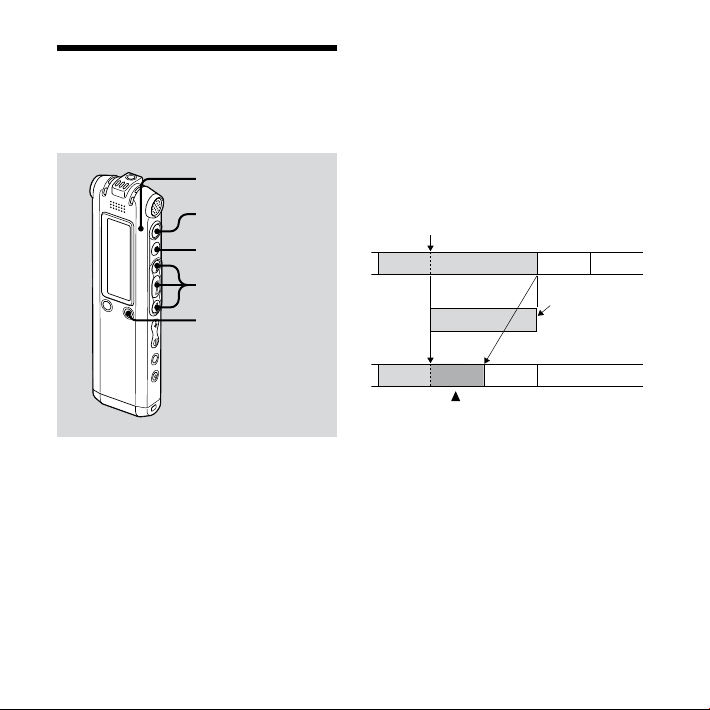
When “ADD/OVER” in the menu is set to
“ADD,” you can add a recording to the
message being played back. The added
recording will be placed after the current
message, and will be counted as a part of
the message.
You cannot add a recording to an MP3
le.
During playback of Message 3
Message 3 Message 4
After adding a recording
Message 3 Message 4
Added recording
1 Press or to set “ADD/OVER”
to “ADD” in the menu, and then
press .
2 During playback, press (record).
“ADD REC? [REC] TO EXECUTE…”
appears.
For details on playback, see page 33.
3 While “ADD REC? [REC] TO
EXECUTE” is displayed, press
(record).
The OPR indicator will turn red. The
new recording will be added at the
end of the current message.
4 Press (stop) to stop recording.
ICD-SX68 GB 3-297-851-71 (2)
28
GB
Adding an Overwrite
Recording during
Playback
2, 3
4
1
Operation
indicator
1
When “ADD/OVER” in the menu is set
to “OVER,” you can add an overwrite
recording after a selected point in a
recorded message. The part of the
message after the selected point is
deleted.
You cannot add a recording to an MP3
le.
Message 2 Message 3 Message 4
The deleted part of
Message 2
Message 2 Message 3 Message 4
Added overwrite recording in Message 2
ICD-SX68 GB 3-297-851-71 (2)
29
GB
Various Recording Modes
1 Press or to set “ADD/OVER”
to “OVER” in the menu, and then
press .
2 During playback, press (record).
“OVERWRITE REC? [REC] TO EXECUTE”
appears.
For details on playback, see page 33.
3 While “OVERWRITE REC? [REC] TO
EXECUTE” is displayed, press
(record).
The OPR indicator will turn red. Then
recording starts.
4 Press (stop) to stop recording.
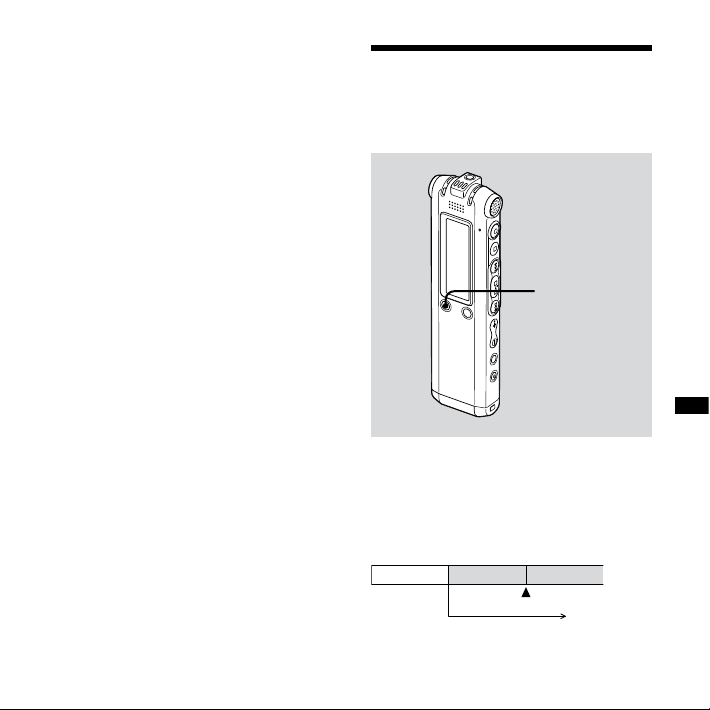
Dividing a Message
into Two during
Recording
1
You can divide a message during
recording so that the message is divided
into two parts and the new message
number is added to the newer part of
the divided message.
Message 1 Message 2 Message 3
A message is divided.
Recording
continues.
ICD-SX68 GB 3-297-851-71 (2)
30
GB
1 Press DIVIDE/ (bookmark) during
recording.
An animation which shows dividing
appears below the level meter.
The new message number is added
at the point you pressed the button.
The message will be divided into two,
while recording continues.
Recording with an
External Microphone
Stereo
microphone
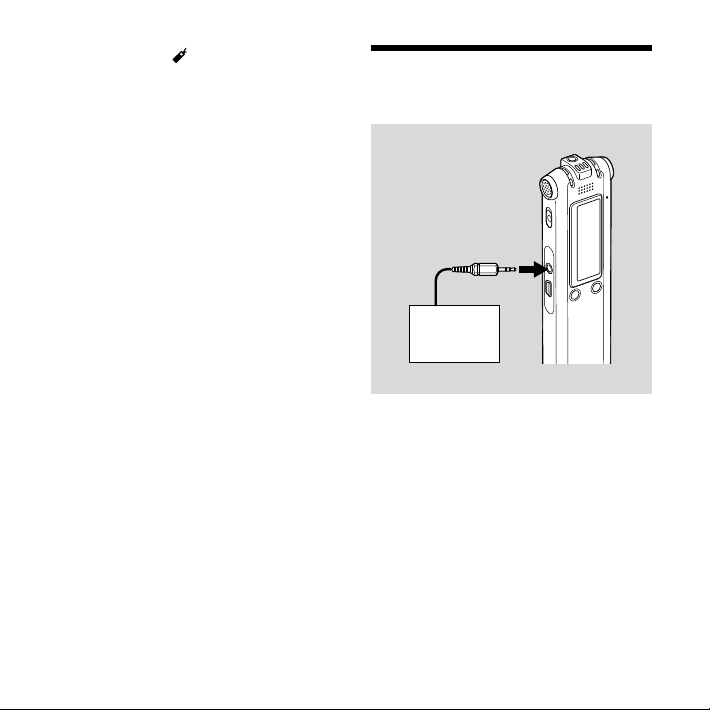
1 Connect an external microphone to
the (microphone) jack when the
IC recorder is in the stop mode.
“SELECT INPUT” appears in the display
window.
ICD-SX68 GB 3-297-851-71 (2)
31
GB
Various Recording Modes
2 Press or to select “MIC IN”
and then press .
3 Speak into the external microphone
and start recording.
The built-in microphone is
automatically cut o.
If the input level is not strong enough,
adjust the microphone sensitivity and/
or recording level on the IC recorder.
When a plug in power type
microphone is connected, power
is automatically supplied to the
microphone from the IC recorder.
When the IC recorder is not in the
stop mode
Select “MIC IN” using the menu by
selecting “DETAIL MENU” - “SELECT INPUT”
- “MIC IN” (page 54).
Recommended microphones
You can use the Sony ECM-CS10 or ECM-CZ10
electret condenser microphone (not supplied).
Recording from Other
Equipment
Audio
equipment,
etc.
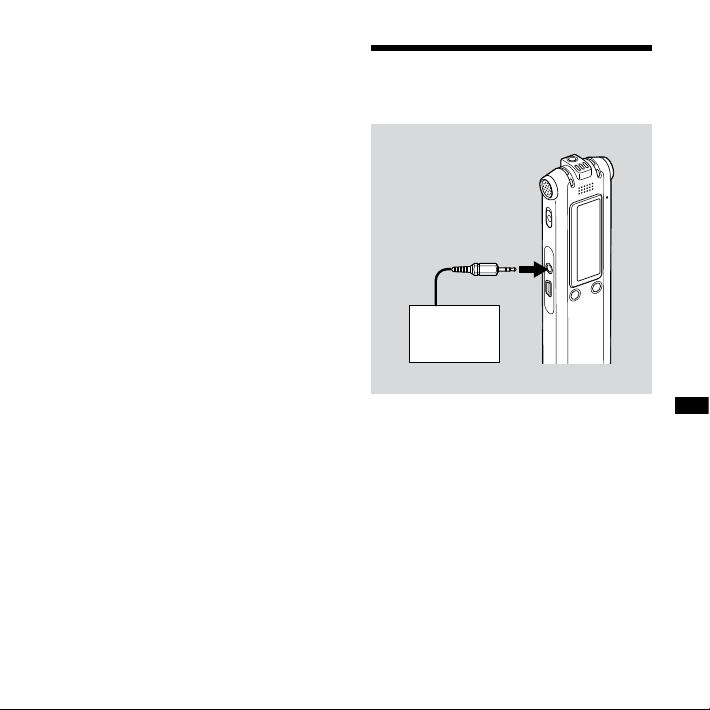
1 Connect other equipment to the IC
recorder when the IC recorder is in
the stop mode.
Connect the audio output connector
(stereo mini-plug) of other equipment
to the (microphone) jack of the IC
recorder using an audio connecting
cable*.
“SELECT INPUT” appears in the display
window.

ICD-SX68 GB 3-297-851-71 (2)
32
GB
2 Press or to select “AUDIO
IN” and then press .
3 Start recording.
The built-in microphone is
automatically cut o and the sound
from the connected equipment is
recorded.
If the input level is not strong enough,
adjust the microphone sensitivity and/
or recording level on the IC recorder.
* Optional audio connecting cables (not
supplied)
To the IC
recorder
To the other
equipment
RK-G139 Stereo
mini-plug
(without resistor)
Mini-plug
(monaural)
(without resistor)
RK-G136 Stereo
mini-plug
(without resistor)
Stereo
mini-plug
(without resistor)
When the IC recorder is not in the
stop mode
Select “AUDIO IN” using the menu by
selecting “DETAIL MENU” - “SELECT INPUT”
- “AUDIO IN” (page 54).
Recording sound from a
telephone or a cell phone
You can use the ECM-TL1 headphone-
type electret condenser microphone
(not supplied) to record sound from a
telephone or a cell phone.
For details on how to make the
connection, see the operating
instructions supplied with the ECM-TL1
microphone.
ICD-SX68 GB 3-297-851-71 (2)
33
GB
Playback/Erasing
Playback/Erasing
Playing Back
Messages
1, 2
5
1, 3
(headphone) jack
A-B/
V-UP
DIVIDE/
1
4
DPC
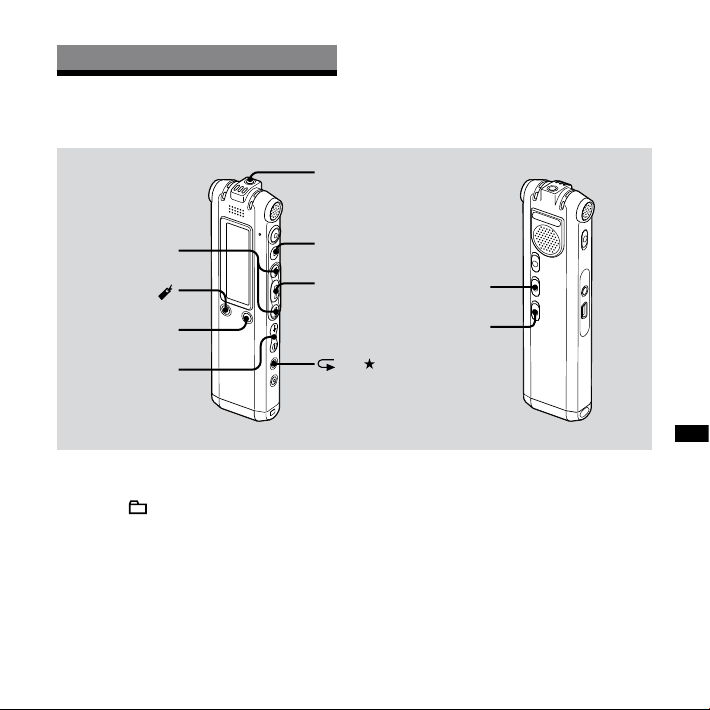
1 Select a folder.
Press /MENU.
Press or to select the folder
and then press .
2 Press or to select the
message number.
3 Press to start playback.
4 Adjust the volume with VOL +/–.
5 Press to stop playback.
After playing back one message, the IC
recorder stops at the beginning of the
next message.

ICD-SX68 GB 3-297-851-71 (2)
34
GB
Listening with better sound
quality
To listen from an ear receiver :
Connect the stereo ear receiver
supplied to the (headphone)
jack. The built-in speaker will be
automatically disconnected.
To listen from an external speaker :
Connect an active or passive speaker
(not supplied) to the (headphone)
jack.
Quickly locating the point you
wish to start playback (Easy
Search)
When “EASY SEARCH” is set to “ON”
(page 51) in the menu, you can quickly
locate the point at which you wish to
start playback by pressing or
repeatedly during playback or playback
pause.
You can go back approx. 3 seconds by
pressing once, or advance approx.
10 seconds by pressing once. This
function is useful for locating a desired
point in a long recording.
Searching forward/backward
during playback (Cue/Review)
To search forward (Cue): Press and
hold during playback and release
it at the point you wish to resume
playback.
To search backward (Review): Press
and hold during playback and
release it at the point you wish to
resume playback.
The IC recorder searches at slow speed
with playback sound. This is useful to
check one word forward or back. Then,
if you press and hold the button, the IC
recorder starts to search at higher speed.
During cue/review, the counter will be
displayed, regardless of the setting of
“DISPLAY” (page 50).

ICD-SX68 GB 3-297-851-71 (2)
35
GB
Playback/Erasing
When messages are played back
to the end of the last message
When you play back or fast play back to the
end of the last message, “MESSAGE END”
lights up for 5 seconds and the operation
indicator lights up in green. (You cannot
hear the playback sound.)
When “MESSAGE END” and the operation
indicator go off, the IC recorder will stop at
the beginning of the last message.
If you press and hold while “MESSAGE
END” is lit, the messages are played back
rapidly, and normal playback will start at the
point you release the button.
If the last message is long and you wish to
start playback at a later part of the message,
press and hold to go to the end of
the message and then press while
“MESSAGE END” is lit to go back to the
desired point.
For messages other than the last one, go to
the beginning of the next message and play
backward to the desired point.
To Do this
stop at the
current position
(Playback Pause
function)
Press (stop) or .
To resume playback from
that point, press
again.
go back to the
beginning of
the current
message*
Press once.**
go back to
previous
messages
Press repeatedly.
(During stop mode, keep
the button pressed to
go back the messages
continuously.)
skip to the next
message*
Press once.**
skip to the
succeeding
messages
Press repeatedly.
(During stop mode,
keep the button pressed
to skip the messages
continuously.)
* If you have set a bookmark on the
message, the IC recorder stops at the
bookmark.
** These operations are for when “EASY
SEARCH” is set to “OFF” (page 51).

ICD-SX68 GB 3-297-851-71 (2)
36
GB
Various playback modes
You can select “1 FILE” playback (one
message/le is played back once),
“FOLDER” playback (all the messages/les
in the selected folder are played back
continuously), “ALL” playback (all the
recorded messages/les are played back
continuously) in the “PLAY MODE” menu
(page 51).
Playing back a message
repeatedly
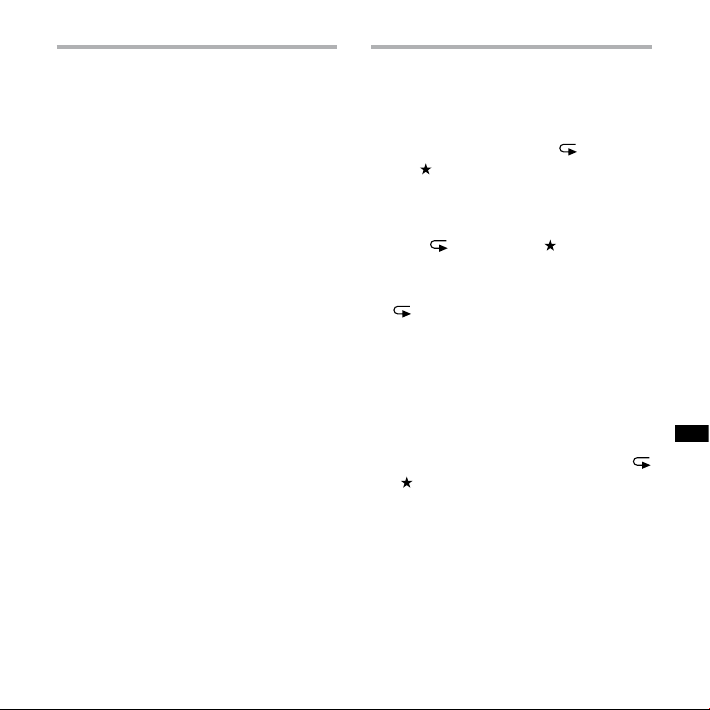
During playback, press and hold
until “ 1” appears. The selected message
will be played back repeatedly.
To resume normal playback, press
again.
Reinforcing the bass sound
Set “EFFECT” to “BASS1” or “BASS2” in the
menu (page 51).
Adjusting the playback
sound by amplifying
inaudible sound – the
Digital Voice Up function
When you slide the V-UP switch to “ON,”
the low-level part of a recorded message
is amplied, allowing you to hear even
small voices more easily.
You can set “MAX” or “MID” for “V-UP
LEVEL” in the menu (page 56).
To resume normal playback
Slide the V-UP switch back to “OFF.”
ICD-SX68 GB 3-297-851-71 (2)
37
GB
Playback/Erasing
Adjusting the playback
speed – DPC (the Digital
Pitch Control function)
When you slide the DPC switch to “ON,”
you can adjust the playback speed
between +200% and –75% of normal
speed in the menu.
The message is played back in natural
tones thanks to the digital processing
function.
1 Slide the DPC switch to “ON.”
2 Adjust the playback speed in the
“DPC” menu (page 50).
To resume normal playback
Slide the DPC switch to “OFF.”
Playing Back a Specied
Section Repeatedly – A-B
Repeat
1 During playback, press (repeat)
A-B/ (priority) briey to specify
the starting point A.
“A-B B?” is displayed.
2 Press (repeat) A-B/ (priority)
briey again to specify the nishing
point B.
“ A-B” is displayed and the specied
section is played back repeatedly.
To resume normal playback
Press .
To change the segment specied
for A-B repeat playback
During the A-B Repeat playback, press
A-B/ (priority) again, and start from step
1, above.

ICD-SX68 GB 3-297-851-71 (2)
38
GB
Adding a Bookmark
You can add a bookmark at a point in
a message and use it during playback.
You can add only one bookmark in each
message.
1 During playback or stop, press
DIVIDE/ (bookmark) for more
than one second.
A bookmark is added and “ ”
(bookmark) ashes three times.
If you add a bookmark to a message
that already has a bookmark, the
previously added bookmark is deleted
and a new bookmark is added at the
newly specied point.
To start playback at the
bookmark
Press or when the IC recorder is
in the stop mode. When “ ” (bookmark)
ashes once, press .
To delete the bookmark
Set “ERASE BKMRK” to “YES” in the menu
(page 53).
Notes
You cannot add a bookmark on MP3 files.
You cannot add a bookmark at the very
beginning or at the very end of the message.

ICD-SX68 GB 3-297-851-71 (2)
39
GB
Playback/Erasing
Playing Back a
Message at a Desired
Time with an Alarm
You can sound an alarm and start
playback of a selected message at a
desired time.
You can have the message played back
on a specied date, once every week, or
at the same time every day.
You can set up to 30 alarms.
Notes
When the clock has not been set or no
messages are recorded, you cannot set the
alarm.
When “ ” is displayed for the folder
indicator, you cannot set the alarm (page 66).
The alarm sounds even if you set “BEEP” to
“OFF” in the menu (page 52).
1 Select the message you want to
play back with an alarm.
2 Enter the alarm setting mode.
Select “ALARM” in the menu and press
.
Press or to select “NEW” and
then press .
3 Set the alarm date and time.
Press or to select “DATE,” a
day of the week, or “DAILY,” and then
press .
When you select “DATE”:
Set the month, day, hour, and minute
in sequence, as described in “Step 2:
Setting the Clock” on page 17, then
press . “EXECUTING…” and then
your settings are displayed.
When you select a day of the week
or “DAILY”:
Press or to set the hour and
then press , press or to
set the minute and then press .
“EXECUTING…” and then your settings
are displayed.
The setting process is nished and “”
(alarm indicator) appears in the display
window.

ICD-SX68 GB 3-297-851-71 (2)
40
GB
When the set date and time
comes
At the set time, the alarm will sound
for about 10 seconds and the selected
message will be played back.
When the playback ends, the IC recorder
will stop automatically at the beginning
of that message.
To listen to the same message
again
Press , and the same will be played
back from the beginning.
To stop the alarm before the
playback starts
Press while the alarm sound is heard.
You can stop the alarm playback even
when the HOLD function is activated.
To change the alarm setting
1 Select “ALARM” – “LIST” in the menu
and then press .
The alarm list is displayed.
2 Press or to select the item
you want to change, and then press
.
3 Press or to select “EDIT,”
and then press .
4 Select “DATE,” a day of the week, or
“DAILY,” and then press .
5 Set the date and time and press
.
“EXECUTING…” and then your settings
are displayed.

ICD-SX68 GB 3-297-851-71 (2)
41
GB
Playback/Erasing
To cancel the alarm setting
Follow steps 1 and 2 of “To change the
alarm setting.” In step 3, select “CANCEL”
and press . “CANCEL ALARM?” is
displayed. Press or to select
“YES,” and press . The alarm will be
cancelled and the alarm indicator will
disappear from the display window.
Notes
You can set only one alarm each one
message.
If the alarm time comes while another
message is being played back with an alarm,
the playback stops and the new message
will be played back.
If the alarm time comes during recording,
the alarm will sound after the recording is
finished. “” will flash when the alarm time
comes.
If more than one alarm time comes during
recording only the first message will be
played back.
When the alarm time comes when the IC
recorder is in the menu mode, the alarm
will sound and the menu mode will be
cancelled.
If you divide a message you set the alarm for,
the alarm setting remains on only the first
part of the divided message.
The alarm setting will not be cancelled when
the alarm playback finishes.
When you have set 30 alarms, you cannot set
a new one. Cancel an alarm first.
If you delete a message on which you
have set an alarm, that alarm will be also
cancelled.
ICD-SX68 GB 3-297-851-71 (2)
42
GB
Erasing Messages
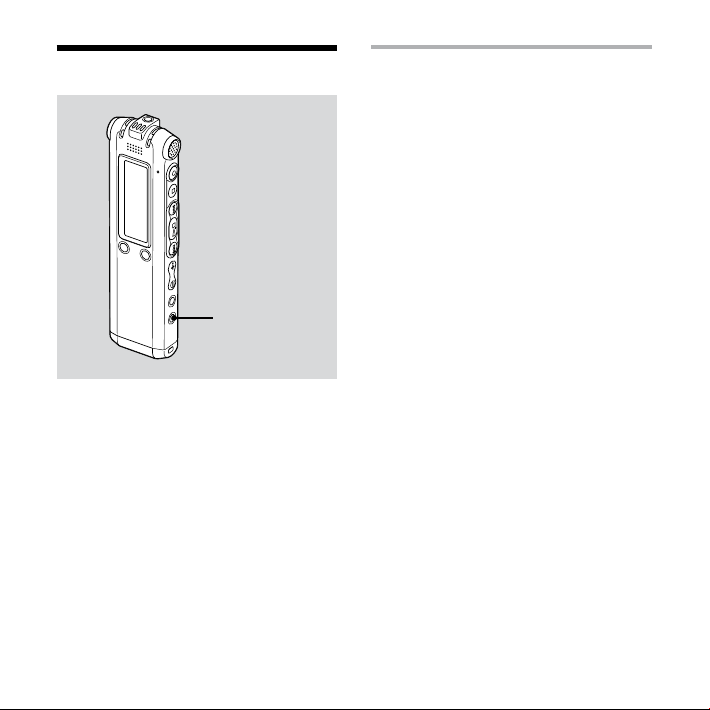
ERASE
You can erase the recorded messages
one by one or all messages in a folder at
a time.
Note
Once a recording has been erased, you cannot
retrieve it.
Erasing Messages one by
one
You can erase unwanted messages,
retaining all other messages.
When a message is erased, the
remaining messages will advance and
be renumbered so that there will be no
space between messages.
1 Press ERASE while playing back the
message you want to erase or press
ERASE for more than one second
while the IC recorder is in the stop
mode.
The message title, message number,
and “ERASE? [ERASE] TO EXECUTE” will
be displayed and the message will be
played back.
2 Press ERASE again while “ERASE?
[ERASE] TO EXECUTE” is displayed.
The message is erased and the
remaining messages will be
renumbered.
To cancel erasing
Press (stop).

ICD-SX68 GB 3-297-851-71 (2)
43
GB
Playback/Erasing
Erasing All Messages in a
Folder
Select “ERASE ALL” in the menu (page 53).
ICD-SX68 GB 3-297-851-71 (2)
44
GB
Editing Messages
Dividing a Message
into Two
You can divide a message during
playback, so that the message is divided
into two parts and a new message
number is added to the newer part
of the divided message. By dividing a
message, you can easily nd the point
you want to play back when you make
a long recording such as at a meeting.
You can divide a message until the
total number of messages in the folder
reaches 999 or until the total number of
messages in the all folders reaches
1012.
Notes
You need a certain amount of space in the
memory to divide a message. For more
information, see “System Limitations” on
page 79.
If you divide a message with priority mark(s),
the priority mark(s) will be added to both
parts of the divided message.
When you divide a message with a title, the
newer part of the message will have the
same title.
You cannot divide a message at the very
beginning or at the very end of the message,
or around bookmarks.
You cannot divide an MP3 file.
Message 1 Message 2 Message 3
A Message is divided.
Message 1 Message 2 Message 3 Message 4
The message numbers are incremeted.
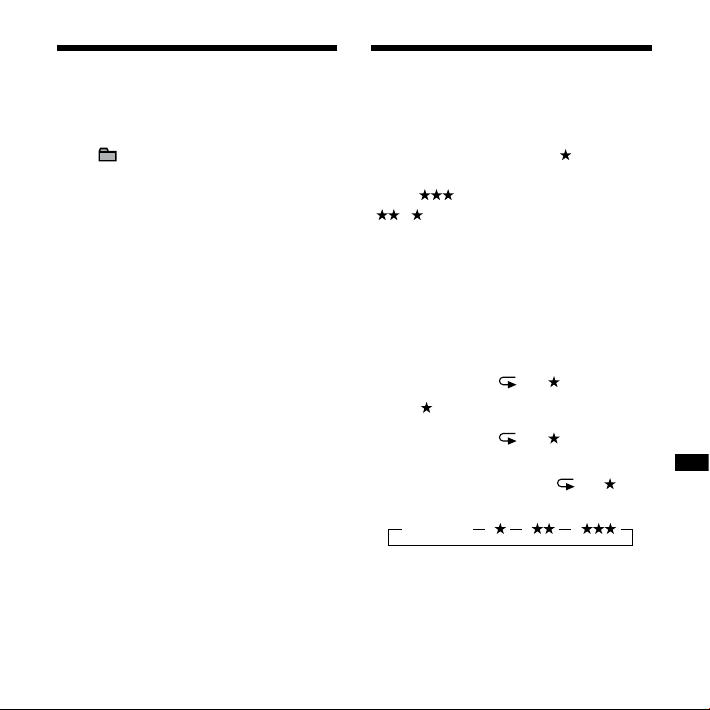
1 During playback, press DIVIDE/
(bookmark).
The message title, message number,
and “DIVIDE? [DIVIDE] TO EXECUTE” are
displayed.
2 Press DIVIDE/ DIVIDE/ (bookmark) again.
The message numbers of the
following messages will be incremeted
by one.
ICD-SX68 GB 3-297-851-71 (2)
45
GB
Editing Messages
Moving Message to a
Dierent Folder
Note
When “ ” is displayed for the folder indicator,
you cannot move a message (page 66).
1 Select the message you want to
move.
2 Select “MOVE” in the menu and
press .
3 Press or to select the
folder that you want to move the
message into, and then press .
“EXECUTING…” is displayed and the
message is moved to the destination
folder.
When you move a message to another
folder, the original message in the
previous folder will be deleted.
To cancel moving the message
Press (stop) before step 3.
Adding Priority
Mark(s) – the Priority
Mark Function
You can add priority marks ( ) to
important messages. There are four
levels, “ ” (the most important),
“ ,” “ ,” and no priority mark. You can
add priority marks both in the stop
mode, and in the playback mode.
You cannot add priority marks to an
MP3 le.
1 Select the message you want to
mark.
2 Press and hold A-B/ (priority).
The “ ” indicator will ash.
3 Press and hold A-B/ (priority)
again to add the priority mark.
Each you press and hold A-B/ , the
priority mark(s) will change as follows:
No mark

ICD-SX68 GB 3-297-851-71 (2)
46
GB
Utilizing the Menu Function
Making Settings for
the Menu
1 Press and hold /MENU for more
than one second to enter the menu
mode.
The menu mode window will be
displayed.
2 Press or to select the menu
item for which you want to make
setting and then press .
3 Press or to select the
setting that you want to set, and
then press .
4 Press to exit the menu mode.
Notes
If you do not press any button for one minute,
the menu mode is automatically cancelled and
the window will return to the normal display.
To return to the previous window
Press /MENU during menu mode.

ICD-SX68 GB 3-297-851-71 (2)
47
GB
Utilizing the Menu Function
Menu settings
Menu items Operation mode
( : the setting can be made/: the setting can be made/
: the setting cannot be made)
Stop
mode
Playback
mode
Recording
mode
Settings
REC MODE LP, SP, STLP, ST, STHQ
MIC SENS LOW, HIGH
LCF (LOW CUT) ON, OFF
REC LEVEL AUTO_AGC, MANUAL
VOR ON, OFF
DISPLAY ELAPSE, REMAIN, REC DATE
DPC n% (n=-75 - +200)
EFFECT BASS1, BASS2, OFF
EASY SEARCH ON, OFF
PLAY MODE 1 FILE, FOLDER, ALL
ADD/OVER ADD, OVER, OFF
BEEP ON OFF
LED ON, OFF
BACKLIGHT 10 SEC, 60 SEC, OFF
ERASE ALL ERASE ALL? YES, NOYES, NO
ERASE BKMRK ERASE BOOKMARK? YES, NOYES, NO
MOVE (Folder to be moved)
ALARM NEW, LIST EDIT, CANCEL

ICD-SX68 GB 3-297-851-71 (2)
48
GB
Menu items Operation mode
( : the setting can be made/: the setting can be made/
: the setting cannot be made)
Stop
mode
Playback
mode
Recording
mode
Settings
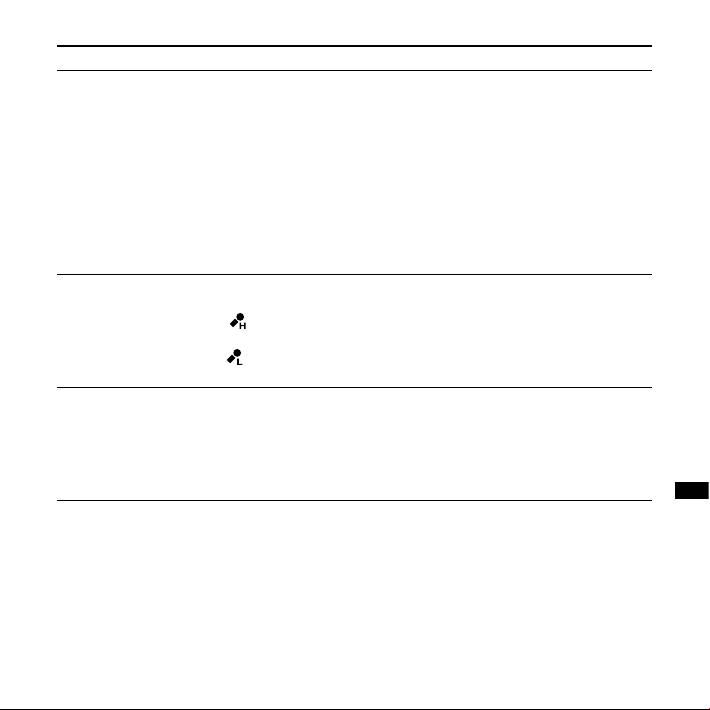
DETAIL MENU
LIMITER ON, OFF
SELECT INPUT MIC IN, AUDIO IN
DATE&TIME MANUAL, AUTO
FORMAT ERASE ALL DATA? YES, NOYES, NO
USB CHARGE ON, OFF
V-UP LEVEL MID, MAX
ICD-SX68 GB 3-297-851-71 (2)
49
GB
Utilizing the Menu Function
Menu items Settings (*: Initial setting)
REC MODE Sets the recording mode.
STHQ*:
You can record with high-quality stereo sound.
ST:
You can record with better sound in stereo.
STLP:
You can record for a longer time in stereo.
SP:
You can record with better sound (monaural sound)
LP:
You can record for a longer time (monaural sound).
MIC SENS Sets the microphone sensitivity. When “REC LEVEL” is set to “AUTO_
AGC,” this setting is effective.
HIGH *:
To record at meeting or in a quiet and/or spacious place.
LOW :
To record dictation, or record in a noisy place.
LCF (LOW CUT) Cuts any frequency lower than 200Hz to reduce the roaring noise
from wind (Low Cut Filter).
OFF*:
The LCF function does not work.
ON:
The LCF function is activated.

ICD-SX68 GB 3-297-851-71 (2)
50
GB
Menu items Settings (*: Initial setting)
REC LEVEL Sets to record using AGC or to record manually.
AUTO_AGC*”:
The recording level is automatically adjusted, and you can record
with distortion-free sound. You can set the microphone sensitivity by
changing the setting of “MIC SENS.”
MANUAL:
You can adjust the recording level manually (page 24).
VOR Sets the VOR (Voice Operated Recording) function. When “REC LEVEL”
is set to “AUTO_AGC,” this setting is effective.
OFF*:
The VOR function does not work.
ON:
The VOR function is activated when (record) is pressed. Recording
starts when the IC recorder detects sound and pauses when no
sound is heard, eliminating recording during soundless periods.
DISPLAY Changes the display mode. (Items shown in the playback/ stop
mode)
ELAPSE*:
Elapsed playback time of one message
REMAIN:
Remaining time of one message
REC DATE:
Recorded date and time
DPC Sets the DPC (Digital Pitch Control) function.
When you set the DPC switch to “ON,” you can adjust the speed of the
playback in a range from +200% to -75%. Set the speed by 10% for +
setting and by 5% for – setting.
–30%*

ICD-SX68 GB 3-297-851-71 (2)
51
GB
Utilizing the Menu Function
Menu items Settings (*: Initial setting)
EFFECT Sets whether to emphasize bass sound during playback.
OFF*:
The EFFECT function does not work.
BASS1:
The bass sound is emphasized.
BASS2:
The bass sound is emphasized even more.
Note
When playing back messages using a speaker, the EFFECT function does not
work.
EASY SEARCH Sets the easy search function.
OFF*:
The easy search function does not work. When you press or
, a message will be moved forward or backward.
ON:
You can go forward for about 10 seconds by pressing and go
back for about 3 seconds by pressing . This function is useful
when attempting to locate desired point in a long recording.
PLAY MODE Sets the playback mode.
FOLDER*:
Messages in one folder are played back continuously.
ALL:
All messages are played back continuously.
1 FILE:
When a message is played back, the IC recorder stops at the
beginning of the next message.

ICD-SX68 GB 3-297-851-71 (2)
52
GB
Menu items Settings (*: Initial setting)
ADD/OVER You can add a recording to a previously recorded message or an
overwrite recording during playback.
OFF*:
You cannot add or overwrite a recording.
ADD:
You can add a recording.
OVER:
You can overwrite a recording.
BEEP Sets whether a beep will be heard or not.
ON*:
A beep will sound to indicate that an operation has been accepted.
OFF:
No beep sound will be heard.
LED Turns the operation indicator on or off during operation.
ON*:
During recording or playback, the operation indicator lights or
ashes.
OFF:
The operation indicator does not light or ash, even during
operation.
Note
When the IC recorder is connected to a computer using the USB cable, the
operation indicator lights or flashes even if “LED” is set to “OFF.”
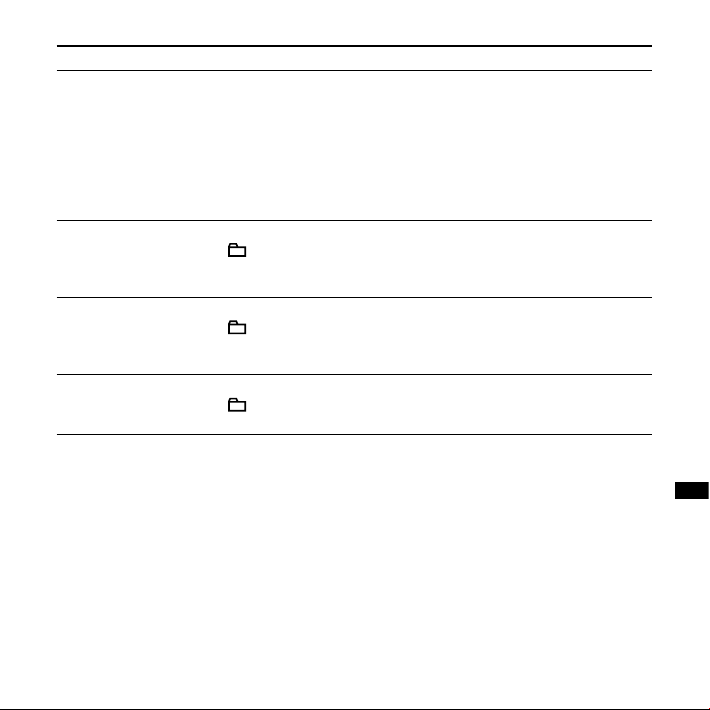
ICD-SX68 GB 3-297-851-71 (2)
53
GB
Utilizing the Menu Function
Menu items Settings (*: Initial setting)
BACKLIGHT Turns the backlight in the display window on or off.
10 SEC*:
The backlight in the display window lights up for 10 seconds.
60 SEC:
The backlight in the display window lights up for 60 seconds.
OFF:
The backlight in the display window does not light, even during
operation.
ERASE ALL All messages in the selected folder will be erased.
Press /MENU to return to the folder window before erasing the
messages and select a folder from which all messages are to be erased,
and then go to the menu window and select “YES.”
ERASE BKMRK The bookmark of the selected message will be cancelled.
Press /MENU to return to the folder window before erasing the
bookmark and select a folder from which the bookmark is to be erased,
and then go to the menu window and select “YES.”
MOVE The selected message will be moved to the selected folder.
Press /MENU to return to the folder window before moving the
message and select a folder from which the message is to be moved.

ICD-SX68 GB 3-297-851-71 (2)
54
GB
Menu items Settings (*: Initial setting)
ALARM Sets the alarm.
NEW*:
Set DATE for playback, SUN (Sunday), MON (Monday), TUE (Tuesday),
WED (Wednesday), THU (Thursday), FRI (Friday), SAT (Saturday), or
DAILY.
LIST :
A list of the message numbers, date, or the days of the week on
which the alarm has already been set will be displayed.
EDIT : You can change the selected date or day of the week.
CANCEL: You can cancel the alarm on the selected date or on a day
of the week.
DETAIL MENU
LIMITER Sets the input level automatically to prevent the sound distortion
that occurs when a sound that is too loud is input.
ON*:
The LIMITER function is activated.
OFF:
The LIMITER function is cancelled.
Note
When “REC LEVEL” is set to “MANUAL,” this setting is effective.
SELECT INPUT
Selects the external input to be recorded that is connected to the
(microphone) jack.
MIC IN*:
Select when you record messages using an external microphone.
AUDIO IN:
Select when you record using other equipment.

ICD-SX68 GB 3-297-851-71 (2)
55
GB
Utilizing the Menu Function
Menu items Settings (*: Initial setting)
DATE & TIME Sets the clock.
AUTO*:
When the IC recorder is connected to a computer that is running
the Digital Voice Editor, the clock will be automatically adjusted
according to that computer.
MANUAL:
You can set the clock by setting year, month, day, hour, and minute
in sequence.
FORMAT Sets the formatting of the drive after “ERASE ALL DATA?” has been
displayed.
NO*:
The drive will not be formatted.
YES:
The drive will be formatted.
Note
Use the IC recorder formatting function to format the memory. If you
format the IC recorder using your computer, the sound may be interrupted
unexpectedly and the recording time may be shortened.

ICD-SX68 GB 3-297-851-71 (2)
56
GB
Menu items Settings (*: Initial setting)
USB CHARGE Sets whether batteries will be charged using a USB connection or
not.
ON*:
The batteries will be charged.
OFF:
The batteries will not be charged.
Note
If you use a USB AC adaptor (not supplied) to connect the IC recorder to the
AC outlet, you can charge batteries regardless this setting.
V-UP LEVEL When the V-UP switch is set to “ON,” set the sound level to be
amplified so that the inaudible low-level part will become more
audible.
MAX*:
You can adjust the “V-UP LEVEL” more eectively.
MID:
You can adjust the “V-UP LEVEL” less nely.

ICD-SX68 GB 3-297-851-71 (2)
57
GB
Using the IC Recorder with Your Computer
Using the IC Recorder with Your
Computer
Using the Supplied
Digital Voice Editor
Software
What You Can Do Using the
Digital Voice Editor Software
The Digital Voice Editor software allows
you to transfer the messages to your
display monitor, to save them on your
computer’s hard disk, and to play back
and edit them.
Transferring the messages recorded on
the IC recorder to your computer
Saving the messages on your
computer’s hard disk.
Viewing, playing, or editing the
messages on your computer.
Transferring messages back to the IC
recorder. You can add an MP3 le as
it is.
Sending a voice e-mail message using
MAPI e-mail software.
Using the transcribing keys to play back
a message and transcribe it using a
word-processor or an editor’s window.
Transcribing your IC recorder message
using Dragon NaturallySpeaking®
speech-recognition software (Only
when Dragon NaturallySpeaking
version 5.0 (or higher) Preferred or
Professional Edition is installed on your
computer).
Using the CD Recording Tool for DVE,
you can play tracks of a CD inserted
into the computer’s CD drive and
save CD tracks onto the PC hard disk
as a le format that the Digital Voice
Editor supports. Saved les can then
be added to an IC recorder using the
Digital Voice Editor.
Use of the CD Recording Tool for DVE is
limited to the personal purposes.

ICD-SX68 GB 3-297-851-71 (2)
58
GB
System Requirements
Operating Systems:
Windows Vista® Home Basic
Windows Vista® Home Premium
Windows Vista® Business
Windows Vista® Ultimate
Windows® XP Home Edition Service Pack
2 or higher
Windows® XP Professional Service Pack 2
or higher
Windows® XP Media Center Edition
Service Pack 2 or higher
Windows® XP Media Center Edition 2004
Service Pack 2 or higher
Windows® XP Media Center Edition 2005
Service Pack 2 or higher
Windows® 2000 Professional Service Pack
4 or higher
Pre-Installed
Note
64bit OS is not supported.
Hardware Environment:
Computer: IBM PC/AT or compatible
CPU : 266 MHz Pentium® II processor
or higher (For Windows Vista®,
800MHz Pentium® III processor or
higher)
RAM: 128MB or more (For Windows
Vista®, 512MB or more)
Hard disk space: 70MB or more
CD-ROM drive (When creating an
audio CD or data CD, a CD-R/RW drive
is needed)
Port: USB port
Sound board: Sound cards
compatible with any of the supported
Microsoft® Windows® operating
systems
Display: High color (16bit) or more
and 800x480 dots or more
Internet access for Voice Mail function
and CD database service
Note
The following systems are not supported:
OS other than the ones indicated above
Personally constructed PCs or operating
systems
Upgraded OS
Multi-boot environment
Multi-monitor environment

ICD-SX68 GB 3-297-851-71 (2)
59
GB
Using the IC Recorder with Your Computer
Note on transcribing a message
When you use Dragon
NaturallySpeaking® speech-recognition
software to transcribe a message,
your computer must also meet the
system requirements that the Dragon
NaturallySpeaking requires.
For latest version and availability of
Dragon NaturallySpeaking in each
region, please refer to the following
page: http://www.nuance.com/
Note on sending a voice e-mail
When you use Microsoft® Outlook
Express 5.0/5.5/6.0 to send a voice e-mail
of a message, your computer must also
meet the system requirements that the
Outlook Express requires.
Installing the Software
Install the Digital Voice Editor software on
your computer’s hard disk.
Notes
When you install the Digital Voice Editor,
you can create all the compatible file types
except for the DVF (TRC) files. (You can play
back the DVF (TRC) files.)
When installing both types of the Digital
Voice Editor, make sure to select overwrite
installation to handle all the compatible
file formats.
Do not connect the IC recorder to the
computer before installing the Software. Or
do not remove or connect the IC recorder
during installing the Software; The IC
recorder may not be recognized or the
Software may not be installed successfully.
Be sure to close all running programs before
installing the Digital Voice Editor software.
When installing or uninstalling the software
in Windows® 2000 Professional, make sure
to log on Windows as the user name of
“Administrator. ”
When installing or uninstalling the software
in Windows Vista® Home Basic/Windows
Vista® Home Premium/Windows Vista®
Business/Windows Vista® Ultimate/Windows®
XP Home Edition Service Pack 2 or higher/
Windows® XP Professional Service Pack 2 or
higher/Windows® XP Media Center Edition/
Service Pack 2 or higher/Windows® XP Media
Center Edition 2004 Service Pack 2 or higher/

ICD-SX68 GB 3-297-851-71 (2)
60
GB
Windows® XP Media Center Edition 2005
Service Pack 2 or higher log on as a user
name with the “Computer administrator”
user account. (To find if the user name has
a “Computer administrator” user account,
open the “User Accounts” from the “Control
Panel” and refer to the section beneath the
user name being displayed.) compatible with
any of the supported operating systems,
log on as a user name with the “Computer
administrator” user account. (To find if the
user name has a “Computer administrator”
user account, open the “User Accounts” from
the “Control Panel” and refer to the section
beneath the user name being displayed.)
When the “Memory Stick Voice Editor
1.0/1.1/1.2/2.0” software has already been
installed, installing the supplied software
will automatically remove the “Memory Stick
Voice Editor” software. (Messages are not
removed.)
After installing, the Microsoft DirectX module
is also installed depending on the operation
system of your computer. This module is not
deleted after uninstalling the software.
After installing the Digital Voice Editor
software, do not install the “Memory Stick
Voice Editor 1.0/1.1/1.2/2.0” software. The
Digital Voice Editor will not work properly.
With the supplied software, you can save or
edit the messages in the “Memory Stick”.
1 Make sure that the IC recorder
is not connected and then turn
on your computer and start up
Windows.
2 Insert the supplied CD-ROM into
the CD-ROM drive.
The [IC Recorder Software Setup]
menu starts up automatically and the
[Welcome to IC Recorder Software
Setup] window appears. If the
[Welcome to IC Recorder Software
Setup] menu does not start up, open
the [DVE] folder in the [Setup] folder
on the CD-ROM, and then double click
[setup.exe].
3 Make sure that you accept the terms
of the license agreement, select
[I accept the terms of the license
agreement], and then click [Next].
The [Software Install] window appears.
4 Select [Digital Voice Editor Ver.
3.1.02], and then click [Install].
Follow the instructions on the screen
to make the settings required for
installation.

ICD-SX68 GB 3-297-851-71 (2)
61
GB
Using the IC Recorder with Your Computer
If you have already installed a
previous version of the Digital Voice
Editor or any version of the “Memory
Stick Voice Editor”
The dialog box used to uninstall a
previous version of the Digital Voice
Editor or any version of the “Memory
Stick Voice Editor” will be displayed.
Follow the instructions on the screen
to uninstall the software. The message
les are not removed.
When the dialog box used to input
the owner name is displayed
Input the owner name.
The owner name is the setting for
privileges and limitations in the Digital
Voice Editor usage.
Notes
You cannot change the owner name
once it is entered. Please write down and
keep it for future reference.
A file recorded from a CD cannot be
handled except on the computer where
the file is recorded. Handling of a file
is limited to the computer bearing the
same owner name input during the
Digital Voice Editor installation. If any
illegal data modification is attempted,
or a file is used for other than the
private purposes, the file may become
unplayable or the Digital Voice Editor may
become inoperable.
When the dialog box used to select
how to save les is displayed
When you save les recorded using
the IC recorder onto the computer
named above, you can select whether
you wish to convert them into the
MP3 format. Select the desired setting.
When the dialog box used to
select an ICD-P series IC recorder is
displayed
Select [Yes] to edit messages recorded
using an ICD-P series IC recorder.
When the dialog box used to select
the language to be used for the help
is displayed
Click the language you want to use for
the help.
5 When the [Ready to Install the
Program] window appears, click
[Install].
The installation starts.
6 When the [InstallShield Wizard
Complete] window appears, select
[Yes, I want to restart my computer
now], and then click [Finish].
The computer will be restarted.
When the computer has been
restarted, installation is completed.

ICD-SX68 GB 3-297-851-71 (2)
62
GB
Uninstalling the software
When you wish to uninstall the software,
follow the steps below.
For Windows 2000 or Windows XP
1 Click [Start] and select [Settings],
[Control Panel] and then [Add or
Remove Programs] or [Add/Remove
Applications].
2 Select [Digital Voice Editor 3] from the
list and click [Remove] or [Change/
Remove].
3 Follow the instructions on the screen.
For Windows Vista
1 Click [Start] – [Control Panel]
– [Programs], and then select and
click [Uninstall a Program] from the
category.
2 Select [Digital Voice Editor 3] from the
list and click [Uninstall].
3 Click [Continue] in the [User Account
control] window.
4 Follow the instructions on the screen.
Note
If you wish to move the software to another
drive or directory after it is installed, you must
uninstall the software first, and then re-install
it. The software does not work properly if you
just move the software files.
Tip
Uninstallation does not remove the message
files
Connecting the IC Recorder
to your Computer
You can transfer the IC recorder data
onto your computer by connecting the
IC recorder to the computer.
Use the USB connecting cable supplied
with the IC recorder to connect the USB
connectors of the IC recorder and your
computer.
The IC recorder is recognized by
the computer as soon as the cable
is connected. You can connect or
disconnect the cable when the IC
recorder and the computer are turned
on or o.
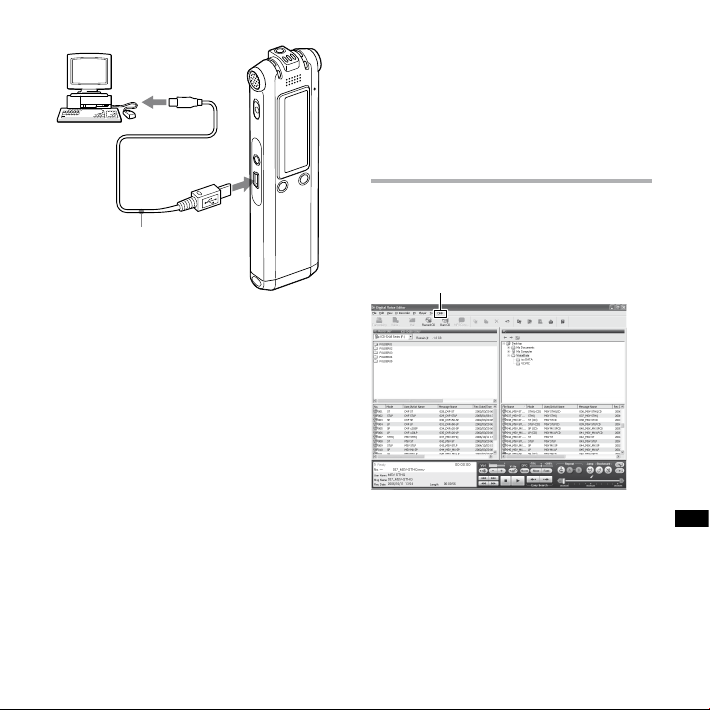
ICD-SX68 GB 3-297-851-71 (2)
63
GB
Using the IC Recorder with Your Computer
USB connecting cable
(supplied)
To USB jack
To USB connector
of your computer
Notes
Be sure to install the Digital Voice Editor
software before connecting the IC recorder
to your computer. Otherwise, a message like
[Found New Hardware Wizard] may appear
when you connect the IC recorder to your
computer. In this case, click [Cancel].
Do not connect more than two USB devices
to your computer. Normal operation will not
be guaranteed.
Use of this IC recorder with a USB hub or a
USB extension cable is not guaranteed.
A malfunction may occur depending on the
USB devices connected at any one time.
Before connecting the IC recorder to the
computer, check that batteries are inserted
in the IC recorder.
When you connect the IC recorder to the
computer, make sure that the IC recorder is
in the stop mode.
It is recommended that you disconnect the
cable from the computer when you do not
use the Digital Voice Editor.
Referring to the Help Files
For details on each operation, refer to the
help les.
Help

ICD-SX68 GB 3-297-851-71 (2)
64
GB
Playing Back MP3
Files Using the IC
Recorder
You can play back MP3 les on your
computer using the IC recorder. There
are two ways how to copy the MP3
les to the IC recorder; using the Digital
Voice Editor software and dragging and
dropping from Windows Explorer.
The maximum playback time (tracks*),
when playing MP3 les using the IC
recorder, is as follows.
48 kbps 128 kbps
23 hr. 5 min.
(346 tracks)
8 hr. 40 min.
(130 tracks)
(hr : hours/min. : minutes)
* In the case where tracks of 4 minutes each
are transferred to the IC recorder.
Using the Digital Voice
Editor Software
1 Connect the IC recorder to your
computer using the supplied USB
cable (page 62).
2 Start the Digital Voice Editor
supplied and copy MP les from
your computer to the IC recorder.
The IC recorder can recognize up to
511 folders. When there is one le in
each folder, you can create up to 340
folders, and when there are 5 folders,
you can copy up to 1012 les in total,
up to 999 les in one folder.
3 Remove the IC recorder from your
computer, and then press /MENU
to select the folder you want.
4 Press or to select a le you
want to play, and then press .
5 Press to stop playback.
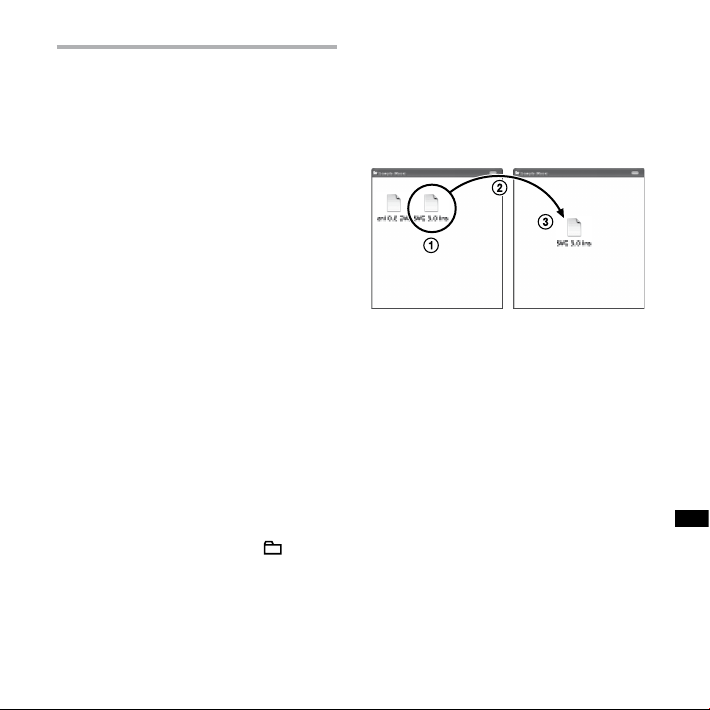
ICD-SX68 GB 3-297-851-71 (2)
65
GB
Using the IC Recorder with Your Computer
Using Windows Explorer
Note
When you copy MP3 files using Windows
Explorer, rather than the Digital Voice Editor
software, you can play back the MP3 files
as usually but you cannot add/overwrite
the recording, divide files (messages), add
bookmarks or add priority marks.
1 Connect the IC recorder to your
computer using the supplied USB
cable (page 62).
Open “My Computer” and make sure
that “IC RECORDER” is recognized
newly on the Windows screen.
2 Drag and drop the folder in
which MP3 les are stored to the
removable disk.
The IC recorder can recognize up to
500 folders. You can copy up to 999
les in one folder and up 5000 les in
total.
3 Remove the IC recorder from your
computer, and then press /MENU
to select the folder you want.
4 Press or to select a le you
want to play, and then press .
5 Press to stop playback.
To copy MP3 les (Drag and drop)
Click and hold,
drag,
and then drop.
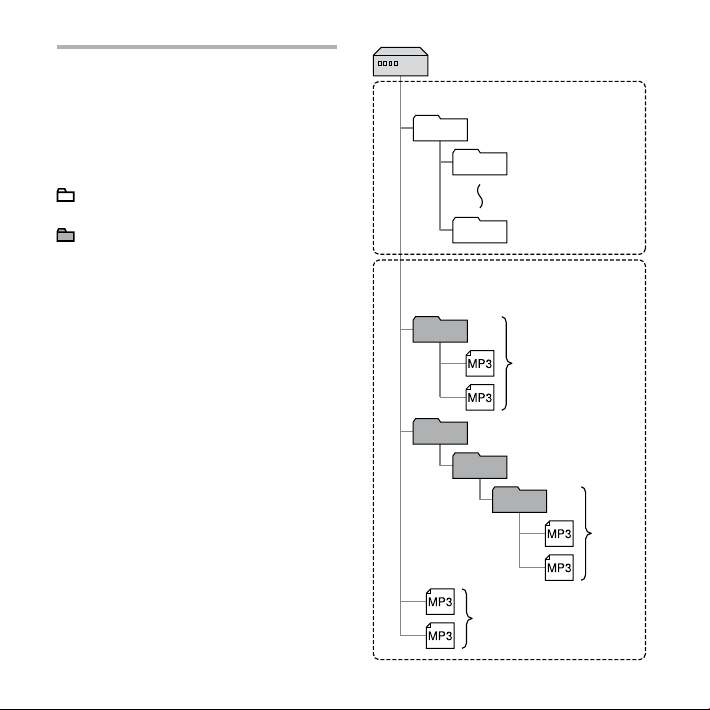
ICD-SX68 GB 3-297-851-71 (2)
66
GB
Construction of folders and
les
The folders and les are displayed on the
computer screen as shown on the right.
The folder indicators in the display
window of the IC recorder are as follows:
: Folders copied using the Digital Voice
Editor software
: Folders copied without the Digital
Voice Editor software
*1
VOICE
FOLDER01
FOLDER05
Folder 1
Folder 2
Folder 3
Folder 4
*2
“IC RECORDER”
Using Digital Voice Editor
Using Windows Explorer
*3

ICD-SX68 GB 3-297-851-71 (2)
67
GB
Using the IC Recorder with Your Computer
*1
The name of the folder in which MP3 files are
stored will be displayed on the IC recorder as
it is, so it is convenient if you put an easy-to-
control name to the folder in advance.
*2
The IC recorder can recognize up to three
levels of folders copied to the IC recorder,
that is, up to Folder 4 shown in the figure.
*3
If you copy MP3 files separately, they are
classified in “NO FOLDER.”
Notes
You cannot copy 511 or more folders (except
VOICE folders) or files to the root directory
that is located immediately below “IC
RECORDER” on the computer. This is due to
Windows system limitations.
If no title name or artist name has been
entered into the ID3 tag information,
“Unknown” will be displayed.
Using the IC Recorder
as a USB Mass Storage
Device
When the IC recorder is connected to
your computer using a USB cable, image
data or text data on the computer, as
well as messages or les recorded using
the IC recorder can be temporarily stored
in the IC recorder.
Your computer must meet the following
operating system requirements and
environment port to use the IC recorder
as a USB mass storage device.
Operating Systems:
Windows Vista® Home Basic
Windows Vista® Home Premium
Windows Vista® Business
Windows Vista® Ultimate/Windows® XP
Home Edition Service Pack 2 or higher
Windows® XP Professional Service Pack 2
or higher
Windows® XP Media Center Edition
Service Pack 2 or higher
Windows® XP Media Center Edition 2004
Service Pack 2 or higher
Windows® XP Media Center Edition 2005
Service Pack 2 or higher
Windows® 2000 Professional Service Pack
4 or higher
Pre-Installed

ICD-SX68 GB 3-297-851-71 (2)
68
GB
Port:
USB port
Note
The following systems are not supported:
64bit OS
OS other than the ones indicated above
Personally constructed PCs or operating
systems
Upgraded OS
Multi-boot environment
Multi-monitor environment

ICD-SX68 GB 3-297-851-71 (2)
69
GB
Troubleshooting
Troubleshooting
Troubleshooting
Before taking the IC recorder for repair, check the following sections. Should any
problem persist after you have made these checks, consult your nearest Sony dealer.
IC Recorder
Symptom Remedy
The IC recorder cannot be
turned o with a display in
the window.
The IC recorder is not equipped with a power on/o switch.
The display always appears in the window. The power
consumption for the display is very small and will not have
any appreciable inuence on the battery life. You can turn o
the display by sliding the HOLD switch in the direction of the
arrow. The display will also be turned o after 10 minutes if you
do not press any button.
The IC recorder does not
operate.
The batteries have been inserted with incorrect polarity (page
13).
The batteries are weak (page 15).
The buttons are locked with the HOLD switch (page 9). (If you
press any button, “HOLD” will ash for 3 seconds.)
No sound comes from the
speaker.
The volume is turned down completely (page 33).
Headphones are plugged in (page 34).
Sound comes from the
speaker even when the
headphones are plugged in.
If you plug in the headphones not securely during playback,
the sound may come from the speaker. Unplug the
headphones and then insert them securely.
The operation indicator
does not light.
“LED” is set to “OFF” (page 52). Display the menu and set “LED”
to “ON”.
“MEMORY FULL” is
displayed and you cannot
start recording.
The memory is full. Erase some of the messages (page 42) or
erase all the messages after you store them on your computer.

ICD-SX68 GB 3-297-851-71 (2)
70
GB
Symptom Remedy
“FILE FULL” is displayed
and you cannot operate
the IC recorder.
999 messages have been recorded in the selected folder or
1012 messages (when there are 5 folders) in total have been
recorded. Therefore you cannot record another message, or
move or divide a message. Erase some of the messages (page
42) or erase all lthe messages after you store them on your
computer.
You cannot add a
recording or an overwrite
recording.
As a factory setting, “ADD/OVER” in the menu is set to “OFF.”
Display the menu and change “ADD/OVER” to “ADD” or “OVER”
(page 52).
The remaining memory capacity is insucient. The overwritten
part will be deleted after the overwriting part nishes
recording. Therefore, you can only overwrite within the
remaining recording time.
You cannot add a recording or an overwrite recording to MP3 les.
Recording is interrupted. The advanced VOR function (page 25) is activated. Set “VOR” to
“OFF” in the menu (page 50).
Noise is heard. An object, such as your nger, etc., accidentally rubbed or
scratched the IC recorder during recording so that noise was
recorded.
The IC recorder was placed near an AC power source, a
uorescent lamp or a mobile phone during recording or
playback.
Plug of the connected microphone was dirty when recording.
Clean the plug.
The (headphones) plug is dirty. Clean the plug.
Recording level is low. “MIC SENS” (microphone sensitivity) is set to “ ”.
Display the menu and set “MIC SENS to “ ” (page 49).
If it is dicult to hear small sound of a recorded message, slide
the V-UP switch to “ON” (pages 36, 56).
Playback sound may become more audible.

ICD-SX68 GB 3-297-851-71 (2)
71
GB
Troubleshooting
Symptom Remedy
Playback speed is too fast
or too slow.
The playback speed is adjusted in DPC. Slide the DPC switch to
“OFF” or display the menu and adjust the speed in DPC again
(pages 37, 50).
“--:--” is displayed. You have not set the clock (page 17).
“--Y--M--D” or ” --:--” is
displayed on the REC
DATE display.
The date of recording will not be displayed if you recorded the
message when the clock was not set.
There are fewer menu
items displayed in the
menu mode.
The menu items displayed are dierent depending on the
operation modes (stop mode, playback mode, and recording
mode) (pages 47, 48).
The remaining time
displayed in the display
window is shorter than
that displayed in the
supplied Digital Voice
Editor software.
The IC recorder requires a certain amount of memory for
system operation. That amount is subtracted from the
remaining time, which is the reason for the dierence.
The battery life is short. The battery life on pages 15 and 16 is based on playback with
the medium volume level (using Sony alkaline batteries LR03
(SG)). The battery life may shorten depending on the operation
of the IC recorder.
There is no battery power
remaining after you have
left the batteries inserted
for long time without
using the IC recorder.
Even if you do not use the IC recorder, the batteries are
consumed slightly. The battery life in this case varies
depending on humidity or other environmental conditions.
Usually, the batteries last two or three months. If you do not
intend to use the IC recorder for an extended period of time, it
is recommended that you remove the batteries.
ICD-SX68 GB 3-297-851-71 (2)
72
GB
Symptom Remedy
The charging indicator is
not displayed.
You are not using rechargeable batteries.
Rechargeable batteries have been inserted with incorrect polarity.
The USB cable is not connected properly.
“USB CHARGE” of “DETAIL MENU” is set to “OFF” in the menu. To
charge the batteries using your computer, set it to “ON.”
The charging indicator
disappears in the middle
of charging.
Rechargeable batteries other than NH-AAA have been inserted.
The rechargeable batteries have deteriorated.
“ ” or “ ” is ashing
instead of the remaining
battery/charging indicator.
The environmental temperature is out of the range for
charging. Charge the batteries in an environment with a
temperature of 5 °C – 35 °C (41 ˚F – 95 ˚F).
The battery life of the
rechargeable batteries is
short.
You are using the rechargeable batteries in an environment
with a temperature of under 5 °C (41 ˚F). Charge the batteries
in an environment with a temperature of 5 °C – 35 °C (41 ˚F
– 95 ˚F).
The IC recorder has not been used for a certain time. Charge
and discharge the rechargeable batteries using the IC recorder
several times.
Replace the old ones with new rechargeable batteries.
The battery indicator is displayed only for a short time, however,
the rechargeable batteries are not charged completely. It takes
about 4 hours to fully charge exhausted batteries.
The changed menu
setting does not function.
If the batteries are removed just after the menu setting is
changed, or the menu setting is changed using “IC Recorder
Setting” of the Digital Voice Editor software with the exhausted
batteries inserted, the menu setting may not function.
The “UPDATING
DATABASE” display does
not disappear.
If the IC recorder is required to process excessive amount of
data, “UPDATING DATABASE” may be displayed for an extended
period of time. This is not a malfunction of the IC recorder. Wait
until the message disappears.

ICD-SX68 GB 3-297-851-71 (2)
73
GB
Troubleshooting
Symptom Remedy
The IC recorder does not
operate correctly.
Take out the batteries and insert them again (page 13).
You cannot connect the IC
recorder to a computer.
Refer to the help les of the Digital Voice Editor3 software.
The IC recorder does not
operate.
You may have formatted the memory of the IC recorder using
the computer. Use the IC recorder formatting function to
format the memory (page 55).
Please note that recorded messages may be erased during service or repair work.
Digital Voice Editor
Refer to the Help les of the Digital Voice Editor software, too.
Symptom Remedy
The Digital Voice Editor
software cannot be
installed.
The free disk or memory space on the computer is too small.
Check the hard disk and memory space.
You are trying to install the software into the operating system
that the Digital Voice Editor software does not support.
In Windows Vista® Home Basic/Windows Vista® Home
Premium/Windows Vista® Business/Windows Vista® Ultimate/
Windows® XP Home Edition Service Pack 2 or higher/
Windows® XP Professional Service Pack 2 or higher/Windows®
XP Media Center Edition/Service Pack 2 or higher/Windows®
XP Media Center Edition 2004 Service Pack 2 or higher/
Windows® XP Media Center Edition 2005 Service Pack 2 or
higher, you log on as a user name belonging to a user account
with limitations. Make sure to log on as a user name with the
“Computer administrator” user account.
In Windows® 2000 Professional, make sure to log on as the user
name of “Administrator. ”

ICD-SX68 GB 3-297-851-71 (2)
74
GB
Symptom Remedy
The IC recorder or
“Memory Stick” cannot be
properly connected.
Check that the installation of the software has been successful.
Also check the connection as follows:
When using an external USB hub, connect the IC recorder directly
to the computer.
Disconnect and then connect the cable with the IC recorder.
Connect the IC recorder to another USB connector.
Your computer may be in the system standby/hibernate mode.
Do not let your computer enter into the system standby/
hibernate mode while being connected to the IC recorder.
The IC recorder does not
operate.
You may format the memory of the IC recorder. Use the IC
recorder formatting function to format the memory.
Messages cannot be
played back./Playback
sound volume is too low.
No sound board is installed.
No speaker is built-in or connected to the computer.
The volume of the sound is turned down.
Turn up the volume on the computer. (Refer to the instruction
manual of the computer.)
The volume of WAV les can be changed and saved using the
“Increase Volume” feature of the Microsoft Sound Recorder.
Saved message les
cannot be played back or
edited.
You cannot play back a message whose le format the Digital
Voice Editor software does not support. Depending on the
le format, you cannot use part of editorial features of the
software.
Counter or slider moves
incorrectly.
There is noise.
This happens when you play back messages that you divided,
combined, overwrote, or added a recording. Save a message in
the hard disk rst, and then add it to the IC recorder. Select the
saving le format that suits the IC recorder you use.
Operation is slow when
there are many messages.
When the total number of messages increases, the operation
becomes slower, regardless of the length of the recording time.

ICD-SX68 GB 3-297-851-71 (2)
75
GB
Troubleshooting
Symptom Remedy
Display does not work
during saving, adding, or
deleting of messages.
It takes a longer time to copy or delete long messages. After
completing operations, the display works normally.
It takes too long to
convert a le format.
The time required for le conversion becomes longer as the le
size is bigger.
The software ‘hangs’ when
the Digital Voice Editor
software starts up.
Do not disconnect the connector of the IC recorder while the
computer is communicating with the IC recorder. Otherwise
the computer operations become unstable or the data inside
the IC recorder may be damaged.
There may be conict between the software and other driver
or application.
Do not install the “Memory Stick Voice Editor” software and
the Digital Voice Editor Ver. 2x software after you installed the
Digital Voice Editor software. The Digital Voice Editor software
may not operate properly.

ICD-SX68 GB 3-297-851-71 (2)
76
GB
Error Messages (IC recorder)
Error message Cause/Remedy
BATTERY LOW You cannot format the memory or erase all the les in a folder
because of insucient battery power. Prepare new batteries to
replace the current ones.
LOW BATTERY Batteries are exhausted. Replace the old batteries with new
ones.
MEMORY FULL The remaining memory capacity of the IC recorder is
insucient. Erase some messages before recording.
FILE FULL When there are already 999 messages in the selected folder or
the total number of the le stored in the IC recorder becomes
maximum, you cannot divide the message. Erase some
messages before dividing a message.
FILE DAMAGED You cannot play or edit messages, because the data of the
selected le is damaged.
FORMAT ERROR The IC recorder cannot be turned on using the computer
because there is no copy of the control le required for
operation. Format the IC recorder using the formatting
function in the menu.
PROCESS ERROR The IC recorder failed in memory access. Remove and then
re-insert the batteries.
Save a backup copy of your data and format the IC recorder
using the menu.

ICD-SX68 GB 3-297-851-71 (2)
77
GB
Troubleshooting
Error message Cause/Remedy
SET DATE&TIME Set the clock; otherwise, you cannot set the alarm.
SET ADD/OVERWRITE “ADD/OVER” in the menu is set to “OFF.” You cannot add a
recording or an overwrite recording.
NO FILE The selected folder does not have any messages. You cannot
add priority marks, bookmarks, set the alarm, etc., because of
this.
ALREADY SET You set the alarm to play back a message at a date and time
previously set on another message. Change the alarm setting.
PAST DATE/TIME You set the alarm when the time has already passed. Check it
and set the appropriate date and time.
NO SETTING If you have not set the alarm, the alarm list will not be
displayed. Make the alarm setting for “NEW.”
If you have not set any bookmark on a message, you cannot
cancel it.
FILE PROTECTED The selected message is protected and is now a “Reading
only” le. You cannot add priority marks or bookmarks, divide
a message, add a recording, or an overwrite recording. Cancel
“Reading only” on your computer to edit the message using
the IC recorder.
UNKNOWN DATA The data does not have a le format which the IC recorder
supports.
ICD-SX68 GB 3-297-851-71 (2)
78
GB
Error message Cause/Remedy
CANNOT OPERATE If the selected le is an MP3 le, you cannot add priority
marks or bookmarks, divide a message, add a recording, or an
overwrite recording.
You cannot move a message, because there is more than one
folder that has les with same name. Change the le names.
AUTO_AGC SETTING ONLY “REC LEVEL” in the menu is set to “MANUAL.” The VOR function
does not work and you cannot set the microphone sensitivity.
MANUAL SETTING ONLY “REC LEVEL” in the menu is set to “AUTO_AGC.” The LIMITER
function does not work.
CHANGE FOLDER If there are no MP3 les in the folder, no folders are
displayed in the display window, therefore, the folder setting
will be changed.
FULL SETTING You can set up to 30 alarms. Cancel unwanted alarms.
SYSTEM ERROR A system error other than the above has occurred. Remove the
batteries and re-insert them.

ICD-SX68 GB 3-297-851-71 (2)
79
GB
Troubleshooting
System Limitations
There are some system limitations of the IC recorder. Troubles as mentioned below are
not malfunctions of the IC recorder.
Symptom Cause/Remedy
You cannot record
messages up to the
maximum recording time.
If you record messages in a mixture of STHQ, ST, STLP, SP and
LP modes, the recordable time varies from the maximum STHQ
mode recording time to the maximum LP mode recording
time.
The sum of the number on the counter (elapsed recording
time) and the remaining recording time may be less than the
IC recorder’s maximum recording time.
You cannot divide a
message.
You cannot divide a message in a folder which has 999
messages.
You cannot divide MP3 les.
You cannot divide at the beginning of a message or at the end
of a message, or around bookmarks.
You cannot display MP3
les in order.
If you have transferred MP3 les using Windows Explorer, those
les may not be copied in order of transfer because of the
limitations of Windows.
When you want to display the les you transferred in order, it is
recommended that you use the supplied “Digital Voice Editor”
software.
You cannot make the A-B
repeat setting.
If messages on which bookmarks have been added using
other IC recorders are copied to this IC recorder, the A-B repeat
setting may not be made. Cancel the bookmarks rst, and then
make the A-B repeat setting.
You cannot enter lower-
case characters.
Depending on the combination of the characters used for
the folder name that was made on Windows Explorer, those
characters may change to all capitals.
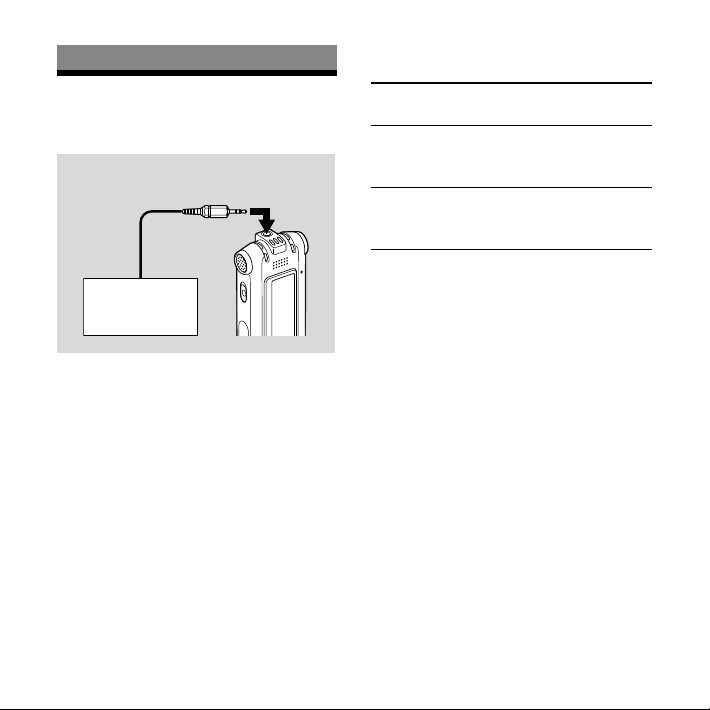
ICD-SX68 GB 3-297-851-71 (2)
80
GB
Addtional Information
Recording with Other
Equipment
To (headphone) jack
To record the sound of the IC recorder
with other equipment, connect the
(headphone) jack of the IC recorder to
the audio input connector (minijack,
stereo) of other equipment using an
audio connecting cable*.
Tape recorder,
etc.
Tape recorder,
etc.
* Optional audio connecting cables (not
supplied)
To the IC
recorder
To the other
equipment
RK-G139 Stereo
mini-plug
(without resistor)
Mini-plug
(monaural)
(without resistor)
RK-G136 Stereo
mini-plug
(without resistor)
Stereo
mini-plug
(without resistor)
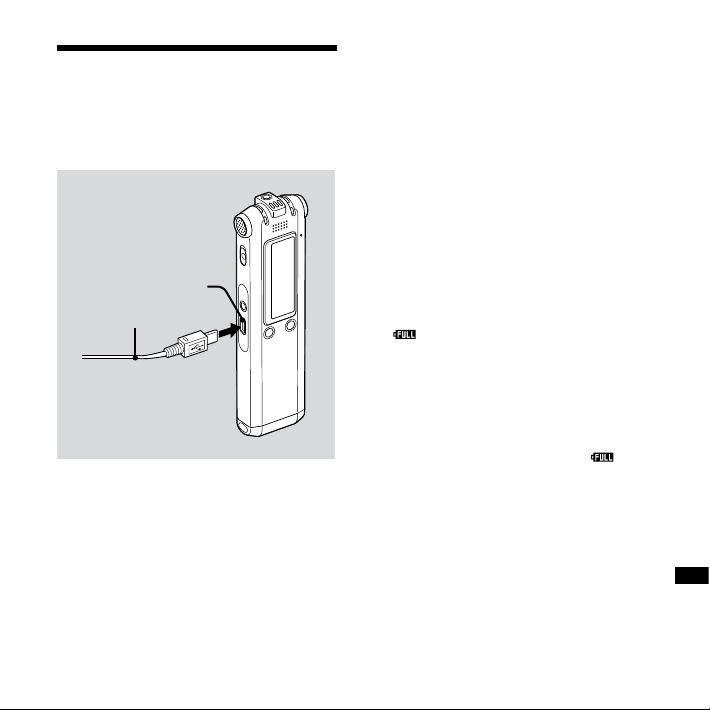
ICD-SX68 GB 3-297-851-71 (2)
81
GB
Additional Information
Using a USB AC
Adaptor (not
supplied)
To USB connector
USB cable (supplied)
You can charge the rechargeable
batteries (not supplied) by connecting
the IC recorder to an AC outlet using a
USB AC adaptor (not supplied).
You can charge the batteries while you
are using the IC recorder, so that it is
useful when you want to record for a
long time.
1 Connect the USB cable supplied
to the USB connector of the IC
recorder.
2 Connect a USB AC adaptor (not
supplied) to the USB cable.
3 Connect the USB AC adaptor to an
AC outlet.
While the batteries are charging,
“CONNECTING” and the charging
indicator are displayed in an
animation.
When the charging indicator indicates
“ ,” charging is completed. (Charging
time: approx. 4 hours*)
When you use the IC recorder for the
rst time, or after you have not used
the IC recorder for a certain time, it
is recommended that you charge
the batteries repeatedly until “ ” is
displayed.
If the charging indicator is not
displayed, charging has not been done
properly. Proceed from step 1 again.

ICD-SX68 GB 3-297-851-71 (2)
82
GB
* This is an approximation for the time
it takes to charge from no remaining
battery power to full battery power at
room temperature. It varies depending on
the remaining power and the condition
of the batteries. It also takes more time if
the temperature of the batteries is low, or
if the batteries are changed while you are
transferring data to the IC recorder.
Notes
While “ ” or “ ” is being displayed
instead of the remaining battery/charging
indicator, you cannot charge the batteries.
Charge the batteries in an environment with
a temperature of 5 °C – 35 °C (41 ˚F – 95 ˚F).
You cannot charge the batteries during
playback through an internal speaker even
when you connect the IC recorder to a wall
outlet using a USB AC adaptor.
While recording (the operation indicator
lights or flashes in red) or accessing data
(the operation indicator flashes in orange
and “UPDATING DATABASE…” is displayed),
do not disconnect the USB AC adaptor
from an AC outlet. Doing so may damage
the data. If the IC recorder is required
to process excessive amount of data,
“UPDATING DATABASE…” may be displayed
for an extended period of time. This is not
a malfunction of the IC recorder. Wait until
the message disappears from the display
window.
Precautions
On power
Operate the unit only on 3.0 V or 2.4 V
DC. Use two LR 03 (size AAA) alkaline
batteries or two NH-AAA rechargeable
batteries.
On safety
Do not operate the unit while driving,
cycling or operating any motorized
vehicle.
On handling
Do not leave the unit in a location
near heat sources, or in a place subject
to direct sunlight, excessive dust or
mechanical shock.
Should any solid object or liquid fall
into the unit, remove the batteries and
have the unit checked by qualied
personnel before operating it any
further.

ICD-SX68 GB 3-297-851-71 (2)
83
GB
Additional Information
On noise
Noise may be heard when the unit
is placed near an AC power source, a
uorescent lamp or a mobile phone
during recording or playback.
Noise may be recorded when an
object, such as your nger, etc., rubs or
scratches the unit during recording.
On maintenance
To clean the exterior, use a soft cloth
slightly moistened in water. Do not use
alcohol, benzine or thinner.
If you have any questions or problems
concerning your unit, please consult your
nearest Sony dealer.
Backup recommendations
To avoid potential risk of data loss
caused by accidental operation or
malfunction of the IC recorder, we
recommend that you save a backup
copy of your recorded messages on a
tape recorder or to a computer, etc.
Specications
Capacity (User available capacity)
512MB (approx. 484MB=507,346,944Byte)
A part of the memory capacity is used as a
management area.
Recording time
See page 23.
Frequency range
STHQ : 80 Hz - 20,000 Hz
ST : 80 Hz - 16,500 Hz
STLP : 80 Hz - 7,000 Hz
SP : 80 Hz - 6,000 Hz
LP : 80 Hz - 3,500 Hz
Bit rates and sampling frequencies for
MP3 les
Bit rate: 32 - 320 kbps, VBR
Sampling frequencies: 16/22.05/24/32/44.1/
48 kHz
Not all encoders are supported.
Speaker
Approx. 16 mm (21/32 in.) dia.
Power output
150 mW

ICD-SX68 GB 3-297-851-71 (2)
84
GB
Input/Output
Microphone jack (minijack, stereo)
input for plug in power, minimum input
level 0.6 mV, 3 kilohms or lower impedance
microphone
Headphone jack (minijack, stereo)
output for 8 - 300 ohms headphones
USB connector
Playback speed control
+200% to –75% (DPC)
Power requirements
Two LR03 (size AAA) alkaline batteries: 3.0 V DC
Two NH-AAA rechargeable batteries: 2.4 V DC
Operating temperature
5˚C - 35˚C (41˚F - 95˚F)
Dimensions (w/h/d) (not incl.
projecting parts and controls)(JEITA)*
30.8 × 119.3 × 14.9 mm (1 1/4 × 4 3/4 × 19/32
in.)
Mass (JEITA)*
70 g (2.5 oz) including two LR03 (size AAA)
alkaline batteries
* Measured value by the standard of JEITA
(Japan Electronics and Information
Technology and Industries Association)
Supplied accessories
See page 7.
Optional accessories
Rechargeable battery NH-AAA-2BE
Battery charger BCG-34HE
Active speaker SRS-T88, SRS-T80
Electret condenser microphone ECM-CS10,
ECM-CZ10, ECM-TL1
Audio connecting cable RK-G136HG,
RK-G139HG
USB AC adaptor AC-U50A/AC-U50AD
Your dealer may not handle some of the
above listed optional accessories. Please
ask the dealer for detailed information.
Design and specications are subject to
change without notice.

ICD-SX68 GB 3-297-851-71 (2)
85
GB
Index
Index
Symbols
(repeat) A-B/ (priority) ....................................8
A
A-B Repeat .....................................................................37
Adding an Overwrite Recording ......................28
Adding a Recording .................................................26
ADD/OVER .....................................................................52
ALARM ..............................................................................54
Alarm .................................................................10, 12, 39
B
BACKLIGHT.....................................................................53
Batteries ......................................................................7, 13
Battery life ......................................................................15
BEEP ...................................................................................52
Bookmark ...............................................................10, 38
Built-in microphones ..................................................8
C
Connecting the IC Recorder to your
Computer .......................................................................62
D
DATE & TIME ..................................................................55
DCP .....................................................................................37
DETAIL MENU ...............................................................54
Digital Voice Editor ...............................................7, 57
Installing ....................................................................59
Digital Voice Up ..........................................................36
DIRECTNL ...................................................................9, 20
DIRECTNL switch................................................19, 23
DISPLAY ............................................................................50
Dividing a Message ..........................................29, 44
DPC ................................................................................9, 50
E
EASY SEARCH ...............................................................51
EFFECT ..............................................................................51
ERASE ALL.......................................................................53
ERASE BKMRK ...............................................................53
Erasing Messages.......................................................42
Error Messages ............................................................76
F
FORMAT ...........................................................................55
H
HOLD ....................................................................................9
I
Index to Parts and Controls ....................................8
Display during playback and stop ............10
Display during recording ................................11
Display window ....................................................10
Front ...............................................................................8
Rear .................................................................................9
L
LCF (LOW CUT) ....................................................19, 49
LCF (Low Cut Filter) ...................................................12

ICD-SX68 GB 3-297-851-71 (2)
86
GB
LED ......................................................................................52
LIM (limiter) ...................................................................12
LIMITER .....................................................................19, 54
LP .................................................................................11, 23
M
Manual Recording Mode ......................................24
Menu .................................................................................46
Microphone sensitivity ...................................11, 12
MIC SENS .........................................................19, 20, 49
Monitoring the recording ....................................23
MOVE .................................................................................53
Moving Message ........................................................45
MP3 ....................................................................................11
P
Playing Back Message .............................................33
Playing Back MP3 .......................................................64
PLAY MODE ...................................................................51
Precautions ....................................................................82
Priority Mark(s) .............................................................45
Priority marks ................................................................10
R
REC LEVEL ...............................................................19, 50
REC MODE ......................................................................49
Recording Messages................................................21
Recording mode ........................................................23
Recording time ...........................................................23
Recording with an External Microphone....30
Recording with Other Equipment ..................80
Record standby mode ............................................24
S
SELECT INPUT...............................................................54
Setting the Clock .......................................................17
SP .................................................................................11, 23
Specications ...............................................................83
ST .................................................................................11, 23
STHQ ..........................................................................11, 23
STLP ............................................................................11, 23
System Limitations ...................................................79
T
Troubleshooting .........................................................69
Digital Voice Editor .............................................73
IC Recorder ..............................................................69
U
USB AC Adaptor ..........................................................81
USB CHARGE .................................................................56
USB Mass Storage Device .....................................67
V
V-UP ......................................................................................9
V-UP LEVEL .....................................................................56
VOL (volume)...................................................8, 23, 33
VOR .............................................................................25, 50

ICD-SX68 GB 3-297-851-71 (2)