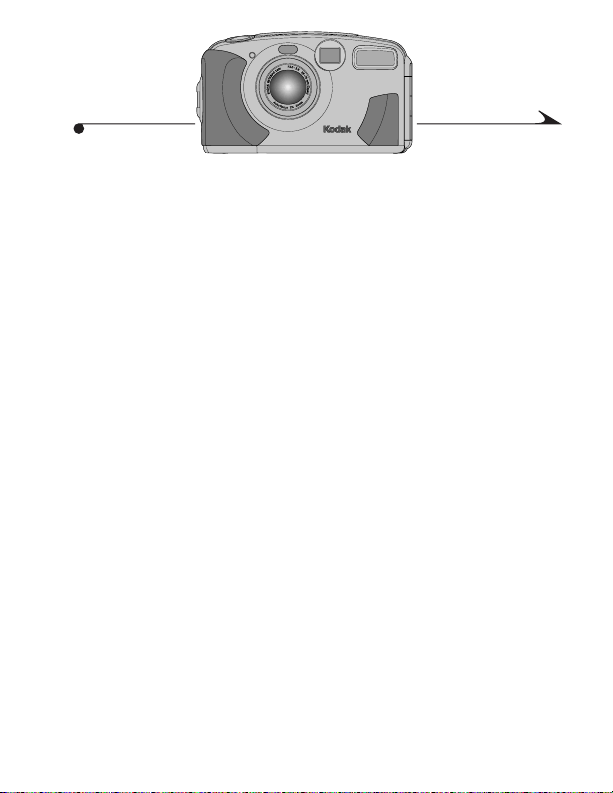
KODAK DC3400 Zoom Digital Camera
Congratulations on your purchase of the KODAK DC3400 Zoom Digital Camera—
the camera that takes pictures digitally, without the use of film. With your new
camera, picture taking and print making have never been easier or faster. The
possibilities are endless. Here are just a few examples of what you can do with
your camera:
Take digital pictures in unbelievable detail, color, and sharpness.
Transfer your pictures to a computer for instant editing, enhancement,
and placement into your document.
E-mail your pictures to friends, family, and business associates anywhere
in the world.
Print high-quality pictures at home using KODAK Inkjet media and the
Kodak Personal Picture Maker.
Take your KODAK Picture Card to a KODAK Picture Maker System and
create photo-quality enlargements with a touch of a button.
Order reprints delivered directly to your home through
print@kodak.com.
Customize your pictures with a graphic using the KODAK DC3400 Border
Transfer Application.

Eastman Kodak Company
343 State Street
Rochester, N.Y. 14650
©Eastman Kodak Company, 2000
Kodak is a trademark of Eastman Kodak Company.
P/N 6B4803

i
Table of Contents
Preparing to Take Pictures . . . . . . . . . . . . . . . . . . . . . . . . . . . .2
Before you Start . . . . . . . . . . . . . . . . . . . . . . . . . . . . . . . .2
General Tips for Better Pictures. . . . . . . . . . . . . . . . . . .2
Loading Batteries . . . . . . . . . . . . . . . . . . . . . . . . . . . . . . .3
Turning the Camera On and Off . . . . . . . . . . . . . . . . . . . .3
Checking Batteries . . . . . . . . . . . . . . . . . . . . . . . . . . . . . .4
Using an AC Adapter . . . . . . . . . . . . . . . . . . . . . . . . . . . .5
Inserting a Camera Memory Card . . . . . . . . . . . . . . . . . .6
Removing a Camera Memory Card. . . . . . . . . . . . . . . . . . 7
Setting the Clock on Your Camera . . . . . . . . . . . . . . . . .8
Adjusting the LCD Brightness. . . . . . . . . . . . . . . . . . . . .9
Previewing a Picture Before it is Taken. . . . . . . . . . . . . . . . . . 12
Pressing the Shutter Button. . . . . . . . . . . . . . . . . . . . . . . . . 14
Zooming in on Your Subject . . . . . . . . . . . . . . . . . . . . . . . . . . 15
Zooming in Even Closer . . . . . . . . . . . . . . . . . . . . . . . . . . . . . . 16
Viewing the Picture Just Taken . . . . . . . . . . . . . . . . . . . . . . . 17
Setting a Quickview for Each Picture . . . . . . . . . . . . . . . . . . 18
Setting the Flash . . . . . . . . . . . . . . . . . . . . . . . . . . . . . . . . . . 19
Photographing Distant Subjects . . . . . . . . . . . . . . . . . . . . . 21
Photographing Close-Ups. . . . . . . . . . . . . . . . . . . . . . . . . . . .22
Putting Yourself in the Picture. . . . . . . . . . . . . . . . . . . . . . . .23
Adding the Date to Your Pictures . . . . . . . . . . . . . . . . . . . . .24

ii
Deleting the Picture Just Taken . . . . . . . . . . . . . . . . . . . . . . 26
Adjusting the Camera Exposure . . . . . . . . . . . . . . . . . . . . . 28
Adding a Border to Your Picture . . . . . . . . . . . . . . . . . . . . . 30
Capturing in Black-and-White, Sepia Tone, or Document . 32
Adjusting the Picture Quality. . . . . . . . . . . . . . . . . . . . . . . . 34
Adjusting the Picture Resolution . . . . . . . . . . . . . . . . . . . . 36
Selecting a White Balance for Indoor Pictures. . . . . . . . . . 38
Choosing a Metering System. . . . . . . . . . . . . . . . . . . . . . . . 40
Selecting the ISO Setting. . . . . . . . . . . . . . . . . . . . . . . . . . . 42
Sharpening and Softening a Picture . . . . . . . . . . . . . . . . . . 44
Locking in an Exposure Setting . . . . . . . . . . . . . . . . . . . . . . 46
Viewing Your Pictures. . . . . . . . . . . . . . . . . . . . . . . . . . . . . . . 50
Magnifying Your Pictures . . . . . . . . . . . . . . . . . . . . . . . . . . . 52
Selecting Pictures for Printing . . . . . . . . . . . . . . . . . . . . . . . 53
Cancelling Pictures for Printing . . . . . . . . . . . . . . . . . . . . . . 55
Protecting Your Pictures . . . . . . . . . . . . . . . . . . . . . . . . . . . . 56
Deleting One or All of Your Pictures. . . . . . . . . . . . . . . . . . . .57
Running a Slide Show on Your Television . . . . . . . . . . . . . . . 59
Viewing Information About a Picture . . . . . . . . . . . . . . . . . . .61
Setting a Response Beep . . . . . . . . . . . . . . . . . . . . . . . . . . . 64

iii
Saving Camera Power. . . . . . . . . . . . . . . . . . . . . . . . . . . . . . . 66
Viewing Camera Information. . . . . . . . . . . . . . . . . . . . . . . . . 68
Selecting a Language for the Camera. . . . . . . . . . . . . . . . . .70
Formatting Your Camera Memory Card. . . . . . . . . . . . . . . . . 71
Adjusting the Video Out Signal . . . . . . . . . . . . . . . . . . . . . . .73
Adjusting the Camera Default Settings. . . . . . . . . . . . . . . .75
Setting a Border Default . . . . . . . . . . . . . . . . . . . . . . . .75
Setting a Flash Default . . . . . . . . . . . . . . . . . . . . . . . . . 77
Setting a White Balance Default. . . . . . . . . . . . . . . . . .78
Setting an Exposure Compensation Default . . . . . . . 80
Setting an Effect Default. . . . . . . . . . . . . . . . . . . . . . . 82
Setting an Auto ISO Default . . . . . . . . . . . . . . . . . . . . 84
Windows-Based System Requirements . . . . . . . . . . . . . . . 88
Macintosh System Requirements. . . . . . . . . . . . . . . . . . . . 88
KODAK Software for Windows-Based Computers. . . . . . . 89
Software Overview. . . . . . . . . . . . . . . . . . . . . . . . . . . . . 90
KODAK Software for Macintosh Computers . . . . . . . . . . . . 91
Software Overview. . . . . . . . . . . . . . . . . . . . . . . . . . . . . .92
Installing the Software. . . . . . . . . . . . . . . . . . . . . . . . . . . . . 93
Using a Serial Cable Connection . . . . . . . . . . . . . . . . . . . . . 96
Connecting to a Windows-Based Computer . . . . . . . 96
Connecting to a Macintosh Computer . . . . . . . . . . . . 98
Using a USB Cable Connection . . . . . . . . . . . . . . . . . . . . . .100

iv
Starting KODAK Software for Windows-Based Computers101
Opening Mounter Software . . . . . . . . . . . . . . . . . . . . . 101
Opening Digital Access Software (TWAIN Acquire) . 101
Opening Camera Controls Software . . . . . . . . . . . . . .102
Opening Border Transfer Software . . . . . . . . . . . . . . .102
Starting KODAK Software for Macintosh Computers . . .103
Opening Picture Transfer Application . . . . . . . . . . . . .103
Opening Digital Access Software (Plug-In Acquire) .103
Opening Border Transfer Software . . . . . . . . . . . . . . .103
Navigating to Your Pictures . . . . . . . . . . . . . . . . . . . . . . . . .104
Connecting with Your Camera. . . . . . . . . . . . . . . . . . . . . . . 108
Communicating with the Computer. . . . . . . . . . . . . . . . . . 108
Adjusting Your Monitor for Better Viewing. . . . . . . . . . . . 108
Getting Better Results from Your Printer . . . . . . . . . . . . 109
Troubleshooting . . . . . . . . . . . . . . . . . . . . . . . . . . . . . . . . . . . 110
Software Help. . . . . . . . . . . . . . . . . . . . . . . . . . . . . . . . . . . . . 119
Online Services . . . . . . . . . . . . . . . . . . . . . . . . . . . . . . . . . . . . 119
Faxed Information . . . . . . . . . . . . . . . . . . . . . . . . . . . . . . . . .120
Customer Support. . . . . . . . . . . . . . . . . . . . . . . . . . . . . . . . .120
Where to Get Help . . . . . . . . . . . . . . . . . . . . . . . . . . . . . . . . . 121
How to Obtain Service. . . . . . . . . . . . . . . . . . . . . . . . . . . . . . 121
Packing Instructions . . . . . . . . . . . . . . . . . . . . . . . . . . . . . . . 122

v
Limited Warranty . . . . . . . . . . . . . . . . . . . . . . . . . . . . . . . . . . 123
Retain the Original Dated Sales Receipt . . . . . . . . . . . . . . 123
Limited Warranty Coverage. . . . . . . . . . . . . . . . . . . . . . . . . . 123
Limitations. . . . . . . . . . . . . . . . . . . . . . . . . . . . . . . . . . . . . . . 124
Your Rights Under State Law. . . . . . . . . . . . . . . . . . . . . . . . 125
Outside the United States . . . . . . . . . . . . . . . . . . . . . . . . . 125
Regulatory Information. . . . . . . . . . . . . . . . . . . . . . . . . . . . . 125
FCC Compliance and Advisory . . . . . . . . . . . . . . . . . . . 125
Canadian DOC Statement . . . . . . . . . . . . . . . . . . . . . . 126
Original Camera Default Settings . . . . . . . . . . . . . . . . . . . .130
Camera Specifications . . . . . . . . . . . . . . . . . . . . . . . . . . . . . 131
General Maintenance and Safety . . . . . . . . . . . . . . . . . . . .133
Using Your Batteries. . . . . . . . . . . . . . . . . . . . . . . . . . . . . . . 135

vi
1
1
1
Getting Started
Refer to the front inside cover for a description of the KODAK DC3400 Zoom
Digital Camera buttons and parts. This chapter covers the following
information.
Preparing to take pictures
Loading the batteries
Turning the camera on and off
Checking the batteries
Using an AC adapter
Handling a memory card
Setting the clock
Adjusting the LCD brightness

2
Preparing to Take Pictures
Before you Start
Before you start taking pictures, you need to install the batteries or connect a
Kodak-specified AC adapter for power, and insert a KODAK Picture Card
(camera memory card) into the camera.
General Tips for Better Pictures
Keep your camera ready.
Get Close.
Keep people busy.
Use a simple background
Place the subject offcenter.
Include foreground in scenics.
Look for good lighting.
Hold your camera steady.
Use your flash.
Visit www.kodak.com and click Taking Better Pictures.
1
3
Loading Batteries
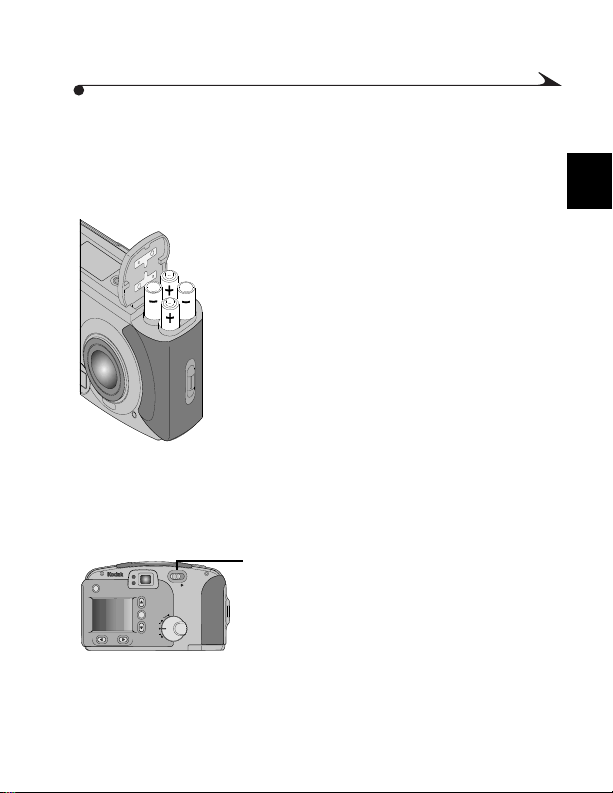
Your camera uses four AA batteries. For your convenience, alkaline batteries
are provided so you can start using your camera immediately.
For information on guidelines for battery usage, see page 135.
Turning the Camera On and Off
Turn the camera on and off using the POWER switch, located on the back of the
camera.
1
Place your thumb on the battery door.
2
Slide the battery door away from the camera.
3
Insert the batteries as indicated on the
battery cover.
4
Close and lock the battery door.
Make sure that no dirt is present when you
close the door.
To turn on the camera, slide the POWER
switch to the right.
The Status Display on top of the camera
turns on.
To turn off the camera, slide the POWER
switch again to the right.
CAMERA
SETUP
CONNECT
REVIEW
CAPTURE
4
Checking Batteries
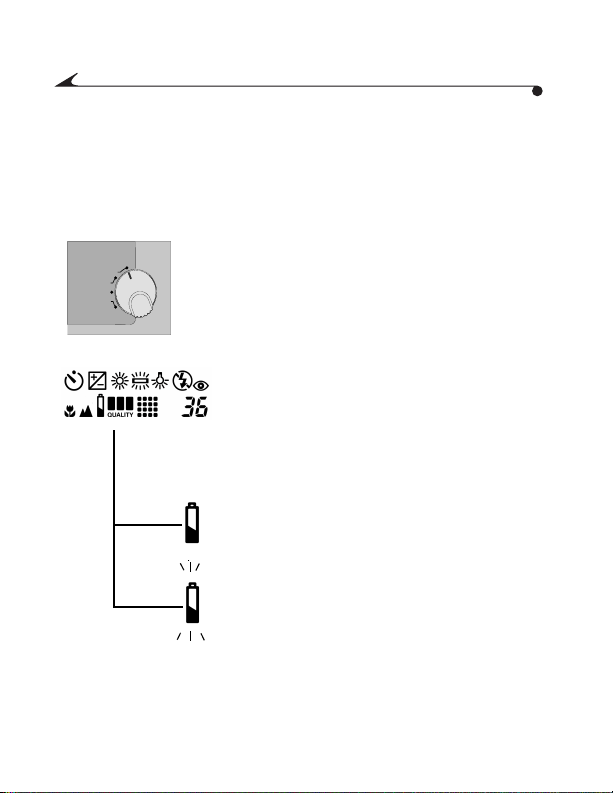
So that you are never caught with dead batteries your camera indicates the
power level of the batteries. A battery status symbol appears, on the Status
Display when you turn on the camera.
For information on guidelines for battery usage, see page 135.
1
Set the Mode dial to Capture, Review, or
Camera Settings.
The battery status symbol is not visible if you
set the camera to Connect.
2
Slide the POWER switch to the right to turn
on the camera.
3
Check the battery status symbol on the Status
Display.
Full (No Icon)—indicates that
batteries are charged and ready to use.
Low—indicates batteries are not fully
charged and will soon need to be
replaced or recharged.
Exhausted (blinking)—indicates
batteries are too weak to power the
camera and need to be replaced.
SETUP
CONNECT
CAMERA
REVIEW
CAPTURE
1
5
Using an AC Adapter
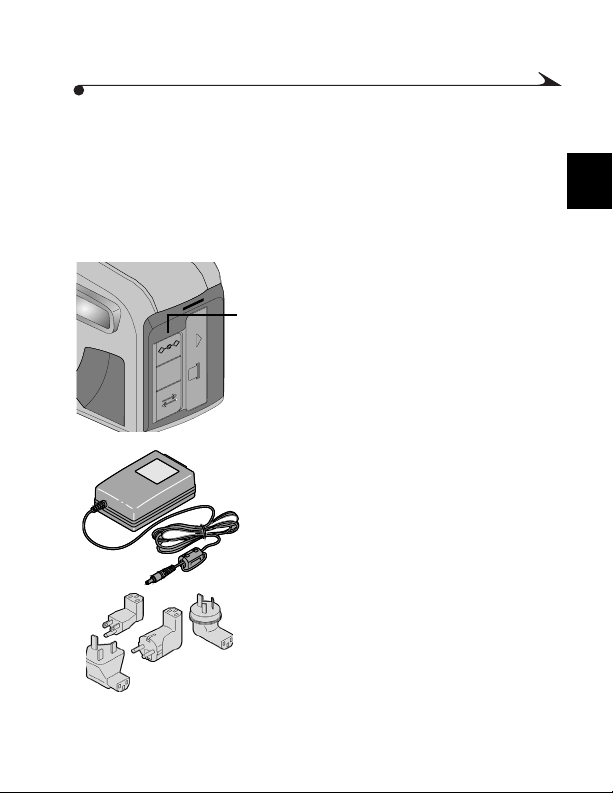
When you are taking pictures indoors or when the camera is connected to a
computer, you may want to use a Kodak-specified AC adapter to help conserve
battery power. It is important to use only a Kodak-specified AC adapter with
your camera. If you do not have a Kodak-specified AC adapter, you can
purchase one as an accessory. For details about available accessories, ask your
dealer of KODAK products.
1
Slide the POWER switch to the right to turn
off the camera.
2
Open the AC adapter port door on the side of
the camera.
3
Plug the appropriate end of the AC adapter
into the port on the camera.
4
Plug the AC adapter into the power outlet.
Depending on where you live, some AC
adapters are supplied with power plugs that
are not attached. If you have that type of
adapter, use the type of plug that matches
your power outlet.
5
Slide the POWER switch to the right to turn
on the camera.
The camera is now powered by the
AC adapter.
CARD
OPEN
OUT
VIDEO
DC IN
6
Inserting a Camera Memory Card
Your camera comes with a KODAK Picture Card (camera memory card), which
is used to store pictures you take with the camera. The camera memory card,
also referred to as a CompactFlash card, is removable and reusable for easy
storage and transfer of your pictures. You can purchase additional KODAK
Picture Cards from dealers of KODAK products.
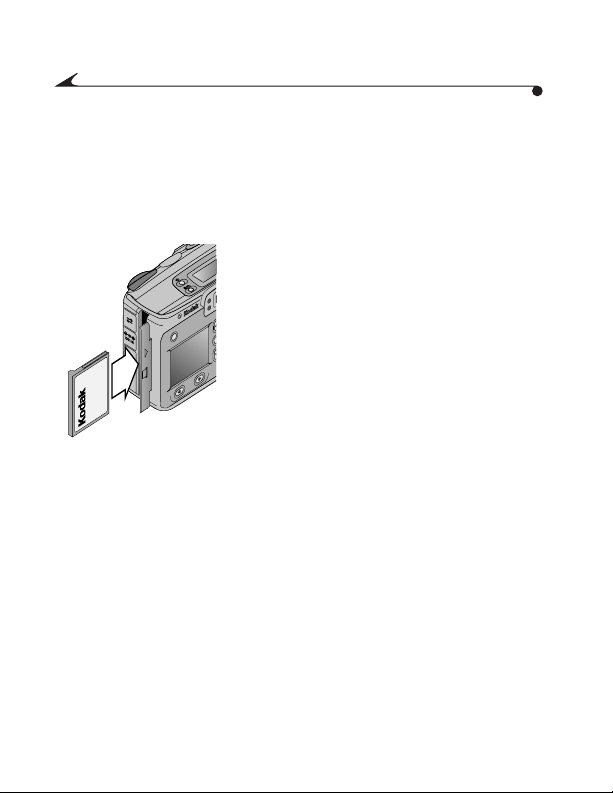
1
Open the camera memory card door on the
side of the camera.
2
Insert the camera memory card into the slot
with the connecting end of the card facing
the camera, and the lip on the card facing
toward the front of the camera.
CAUTION: The camera memory card can
only be inserted one way into the
camera. Forcing the card in the wrong
way may damage your camera.
3
Push the camera memory card all of the way
into the card slot and then close the door.
Make sure that no dirt is present when you
close the door.
CARD
OPEN
1
7
Removing a Camera Memory Card
CAUTION: Do not insert or eject a
camera memory card when the camera
memory card light, located above the
card door, is blinking. This may damage
your pictures or camera. Use only
certified camera memory cards that carry the
CompactFlash logo.
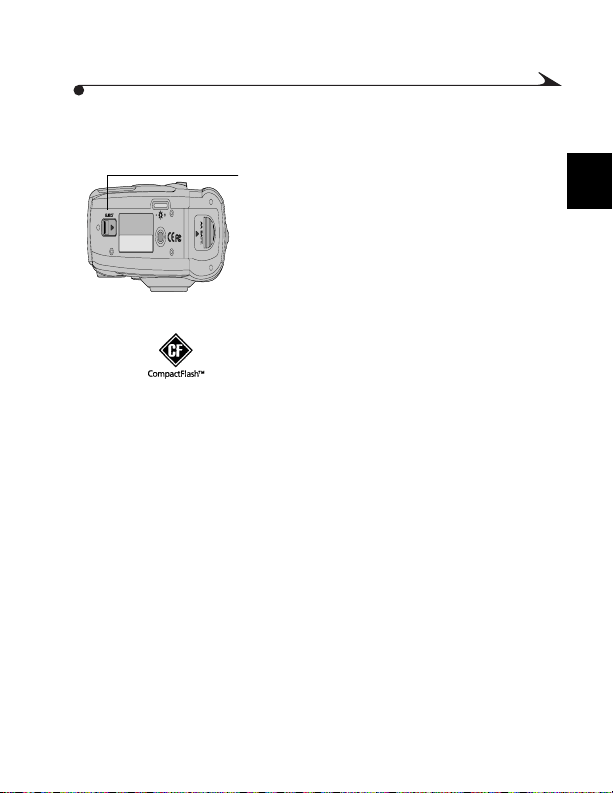
1
Open the door on the side of the camera.
2
Slide the EJECT button in the direction of the
arrow to eject the camera memory card.
You may need to tilt the camera in order for
the card to slide out.
3
Remove the card and close the door.
Make sure that no dirt is present when you
close the door.
8
Setting the Clock on Your Camera
Your camera has a built-in clock that maintains the date and time in a
24-hour format. The camera clock needs to be set if you plan to use the Date
Stamp feature, which imprints the date on your picture. For information on
using the Date Stamp feature, see page 24.
If you remove the batteries from the camera for an extended period of time, or
the batteries become exhausted, you may need to reset the clock.
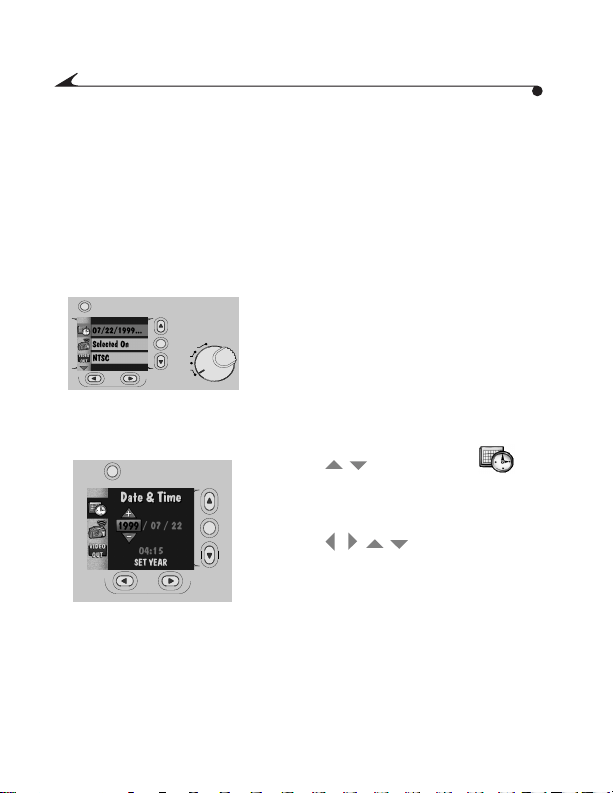
1
Set the Mode dial to Camera Setup.
2
Slide the POWER switch to the right to
turn on the camera.
The main Camera Setup screen appears.
3
Press a
button until the
icon is highlighted.
4
Press the DO-IT button.
The Date/Time screen appears.
5
Press a buttons to adjust
the date and time fields.
6
Press the DO-IT button.
The camera accepts the setting and
returns to main Camera Setup screen.
MENU
REVIEW
CONNECT
SETUP
CAMERA
CAPTURE
/
/
/
1
9
Adjusting the LCD Brightness
You can adjust the brightness of the color LCD to suit your particular needs.
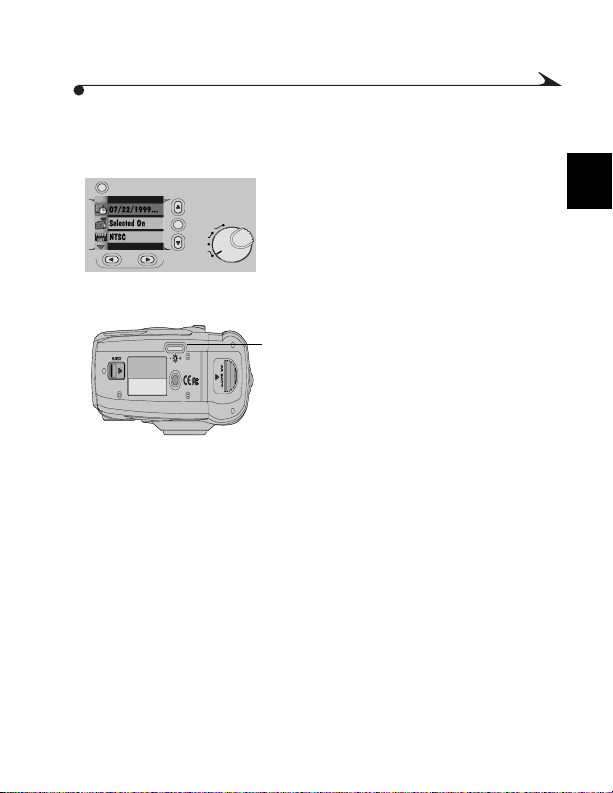
1
Set the Mode dial to Camera Setup.
You can set the Mode dial to any setting
you want as long as there is an image in
the LCD screen to adjust the
brightness level.
2
Slide the POWER switch to the right to
turn on the camera.
The main Camera Setup screen appears.
3
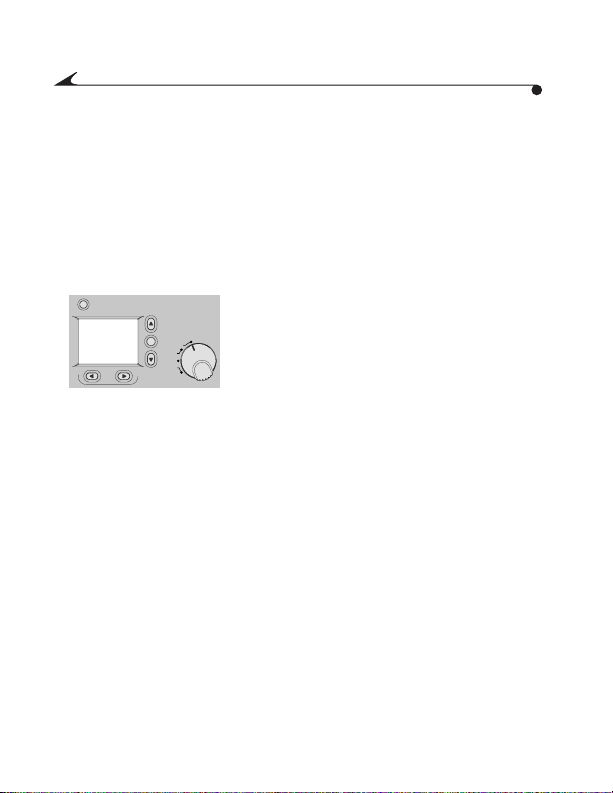
Use the dial on the bottom of the camera
to adjust the brightness of the LCD screen
to the brightness level you want.
MENU
REVIEW
CONNECT
SETUP
CAMERA
CAPTURE

10
2
11
2
Taking Pictures
Your camera makes taking pictures fun. Just set the camera to Capture and you
are on your way to creating great pictures. Everything you need is right at your
fingertips. With the camera you can:
Zoom in on your subject.
Automatically lock the focus on the subject when you press the
SHUTTER button.
View the picture you just took.
Vary the flash settings to give you control over the type of flash needed
for specific conditions.
Adjust the camera to take landscapes (Infinity Focus) and
close-ups, as well as set the Date Stamp feature and Self-Timer, all
available with the touch of a button.
Preview the picture before it is taken.
Delete unwanted pictures right away.
12
Previewing a Picture Before it is Taken
To see what a picture looks like before you take it, preview the image on the
LCD on the back of your camera. The live image that appears is very helpful for
framing your subject, especially when using the Close-Up, Digital Zoom, and
Border features. If you want to take pictures in black and white or sepia tone,
or highlight text, Preview can help you make that decision. With Preview,
batteries are quickly drained, so use a KODAK-specified AC adapter
whenever possible.
1
Set the Mode dial to Capture.
2
Slide the POWER switch to the right to
turn on the camera.
3
Press the DO-IT button.
A live image with the icons of activated
camera features appears on the LCD.
MENU
REVIEW
CONNECT
SETUP
CAMERA
CAPTURE
2
13
The image in the LCD appears in color
unless you have turned on an effect, such
as black and white or sepia tone, in which
case the effect is applied to the displayed
image. See page 32 for details.
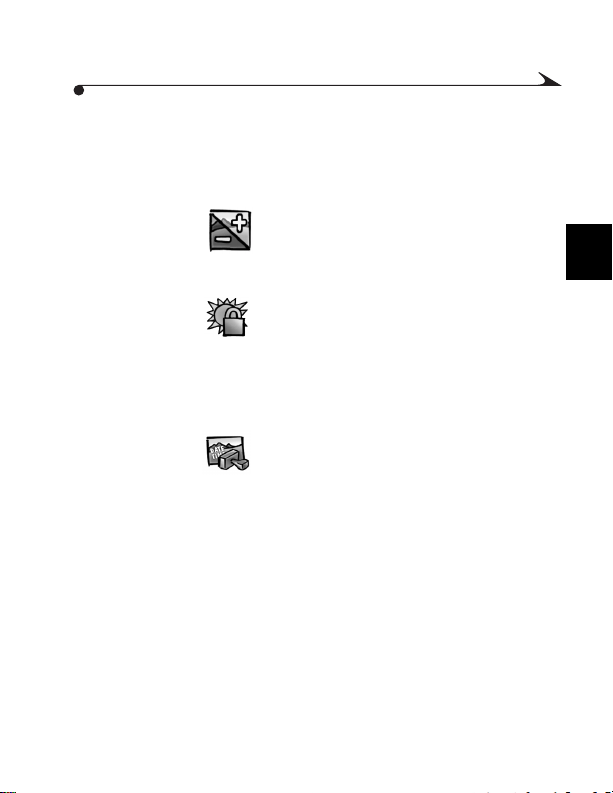
Exposure Compensation—icon
appears in the LCD and Status Display
if you adjusted the camera exposure.
See page 28 for details.
Exposure Lock—icon appears in
the LCD if you locked the exposure.
See page 46 for details.
Borders—selected border appears
over the picture on the LCD. See page
30 for details.
Date Stamp—icon appears in the
LCD if you turned on the date stamp.
See page 24 for details.
4
To turn off Preview, press the
DO-IT button.
14
Pressing the Shutter Button
Taking pictures is a snap with your camera. The SHUTTER button on your
camera locks in the auto focus and takes the picture.
1
Set the Mode dial to Capture.
2
Slide the POWER switch to the right to
turn on the camera.
3
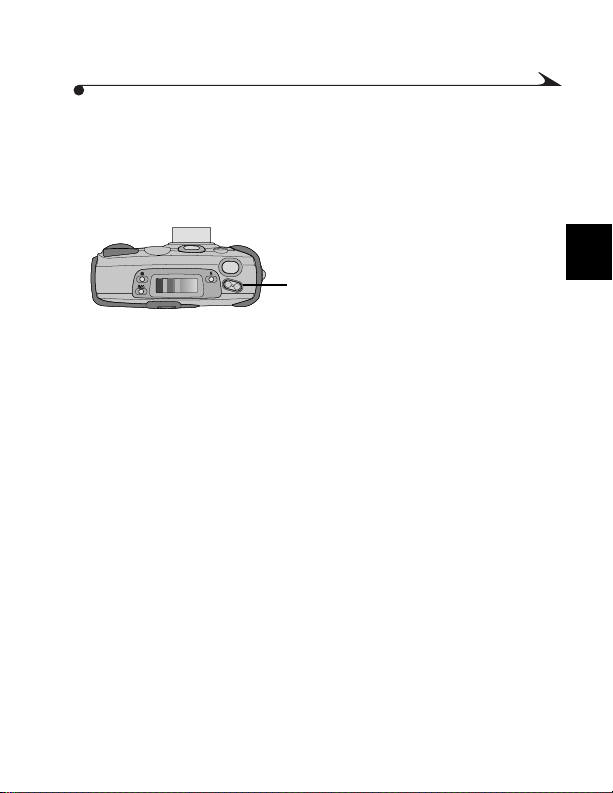
Center the subject using the guide marks
in the viewfinder, or use Preview (page
12) and the LCD to frame your subject.
4
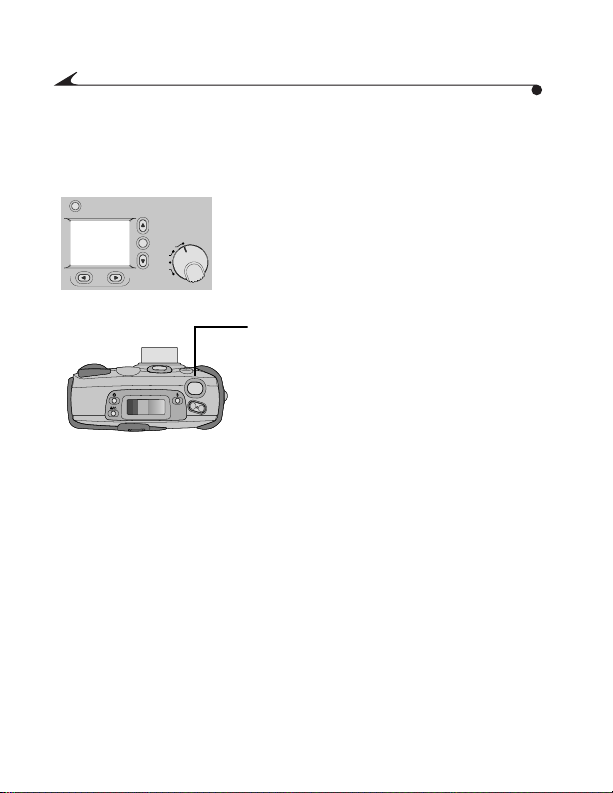
Press the SHUTTER button half-way down
to lock in the camera auto focus.
The camera beeps twice and the green
ready light comes on when the camera
is set to take a picture.
If the green ready light blinks, the auto
focus is not focused on the subject.
Release the SHUTTER button and
recompose your picture. Press the
SHUTTER button half-way down again to
relock the auto focus on the subject.
If the red flash indicator light blinks, the
flash is not fully charged. Wait for the
flash to charge before taking the picture.
5
Press the SHUTTER button completely
down to take the picture.
The camera beeps again to confirm
that a picture was taken and the
camera memory card light blinks as
the picture is stored on the card.
MENU
REVIEW
CONNECT
SETUP
CAMERA
CAPTURE
2
15
Zooming in on Your Subject
With a touch of a button you can zoom from Wide Angle, which gives you more
of the surrounding area in pictures, to TelePhoto, which brings the subject in
closer.
1
Set the Mode dial to Capture.
2
Slide the POWER switch to the right
to turn on the camera.
3
Press the ZOOM control.
When you look through the
viewfinder, the subject appears closer
or farther away as you press the
ZOOM button.
16
Zooming in Even Closer
If you need to get closer to your subject, use the Digital Zoom feature. With
digital zoom, the center of your picture is magnified so your pictures appear
even closer.
1
Press the DO-IT button to turn on
Preview if it is not already activated.
The LCD turns on with a live image.
2
Frame your subject using the LCD.
3
Press the ZOOM button until it is at
the farthest telephoto position.
4
Release and press the ZOOM button in
the same direction again to activate
digital zoom.
The camera beeps as the digital
zoom icon appears on the LCD.
2
17
Viewing the Picture Just Taken
You can view or delete a picture seconds after it is. It is a handy way to check if
your subject was positioned correctly.
1
Set the Mode dial to Capture.
2
Slide the POWER switch to the right to
turn on the camera.
3
Press the SHUTTER button to take a
picture.
4
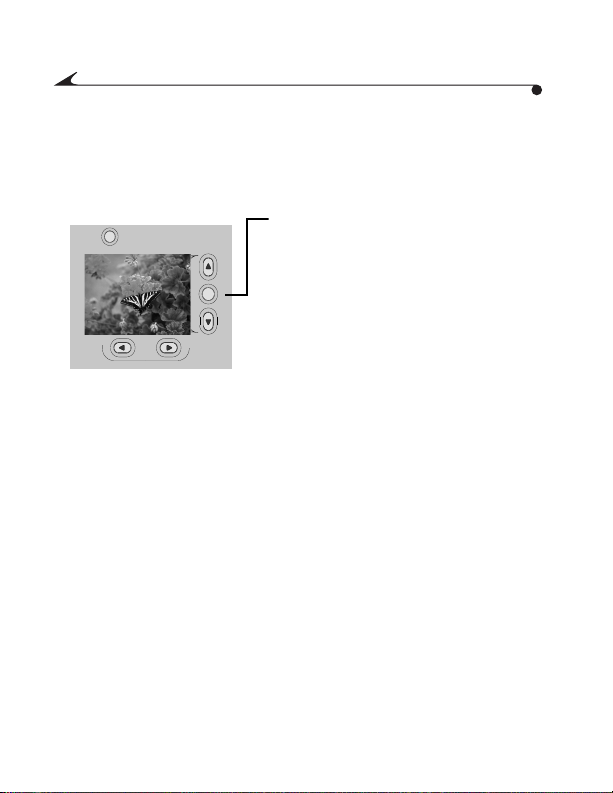
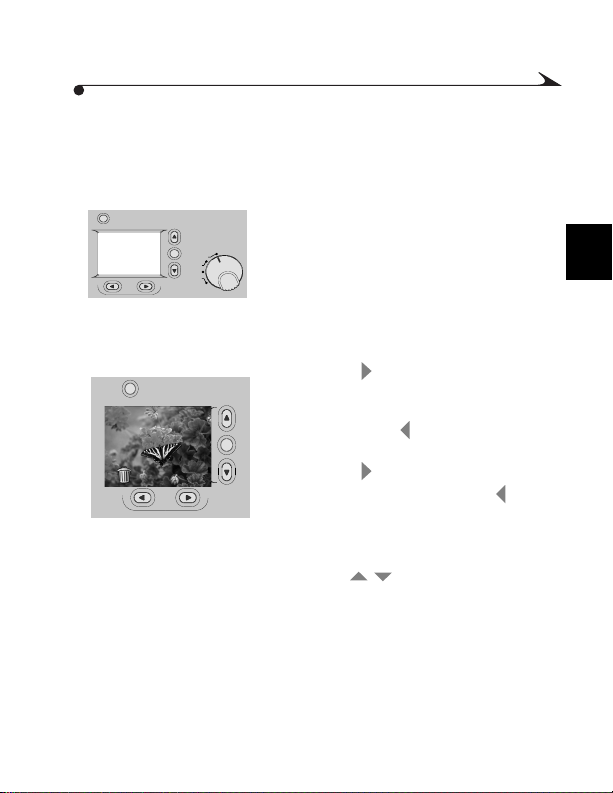
Press the button.
The picture just taken appears in the
LCD for several seconds with the delete
icon above the button.
If you want to view the picture again,
press the button.
5
To delete the picture, press the
button.
The Delete Picture screen appears on
the LCD.
6
Press a button until YES
is highlighted.
7
Press the DO-IT button.
The picture is permanently deleted
from the camera memory card.
MENU
REVIEW
CONNECT
SETUP
CAMERA
CAPTURE
/
18
Setting a Quickview for Each Picture
You can set the camera so a quick view of the picture just taken appears in the
LCD automatically using the Quickview feature.
1
Set the Mode dial to Capture.
2
Slide the POWER switch to the right to
turn on the camera.
3
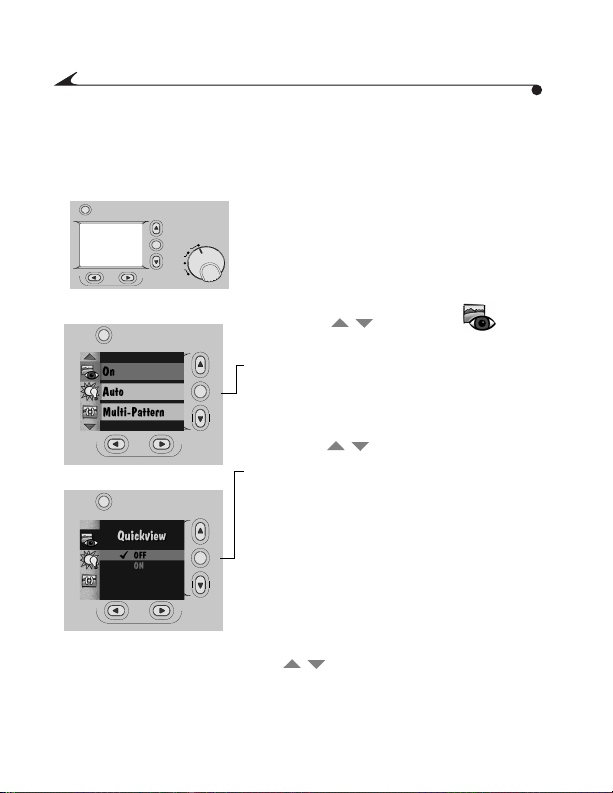
Press the MENU button.
The main Menu screen appears.
4
Press a button until is
highlighted.
5
Press the DO-IT button.
The Quickview screen appears on the
LCD. The current setting is checked
(
9
).
6
Press a button until ON is
highlighted.
7
Press the DO-IT button.
The main Menu screen reappears.
The image appears for several seconds
on the LCD in color unless you have
turned on an effect, such as black and
white or sepia tone, in which case the
effect is applied to the displayed image.
See page 32 for details.
8
To turn off Quickview, press a
button on the Quickview screen
until OFF is highlighted, then press the
DO-IT button.
MENU
REVIEW
CONNECT
SETUP
CAMERA
CAPTURE
/
/
/
2
19
Setting the Flash
When taking pictures at night, indoors, or outdoors in heavy shadows, your
pictures need flash. For everyday picture-taking, use the Auto setting. However,
there are times when changing the flash option can improve your pictures. For
instance, if you are taking pictures of people indoors or at night, you can help
reduce the likelihood of red eye by using the Red-Eye setting. When your
subject is outdoors under heavy shadows, you can eliminate those shadows by
using the Fill flash. In situations where the use of flash is prohibited, as in
museums, you can turn off the flash.
1
Set the Mode dial to Capture.
2
Slide the POWER switch to the right to
turn on the camera.
MENU
REVIEW
CONNECT
SETUP
CAMERA
CAPTURE
20
3
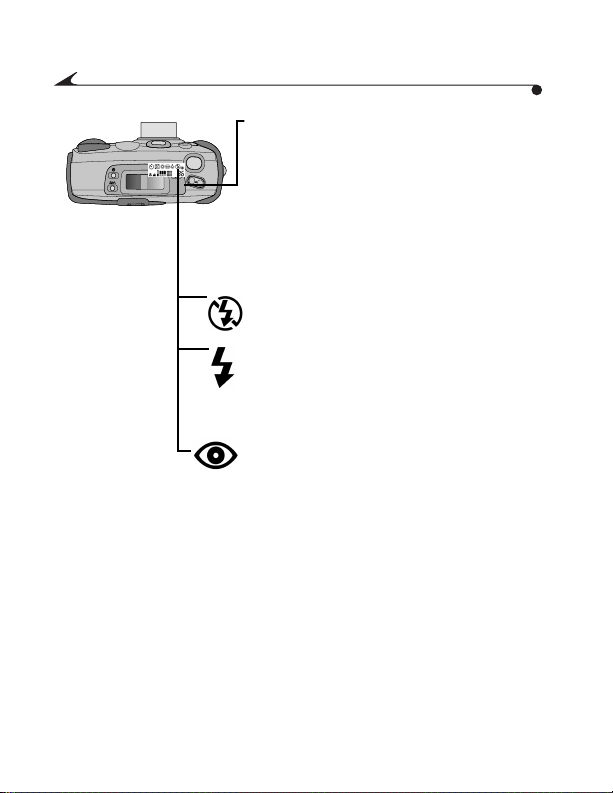
Press the FLASH button to scroll though
the flash options.
The Flash setting icon changes in the
Status Display.
Auto (No Icon)—fires the flash
automatically when needed. The
camera determines when there is not
enough light.
Off—turns off the flash.
Fill—fires the flash every time you
take a picture.
Red-Eye—fires the flash once
before the picture is taken, then fires
again when the picture is taken.
4
To return to the Auto setting, press the
FLASH button, or turn off the camera.
2
21
Photographing Distant Subjects
If you want to create postcard-like pictures of scenic views, such as a sunset or
mountain range, use the Infinity Focus feature. When Infinity Focus is selected,
the camera automatically turns off the flash and auto focus so you get sharp,
clear pictures.
1
Set the Mode dial to Capture.
2
Slide the POWER switch to the right to
turn on the camera.
3
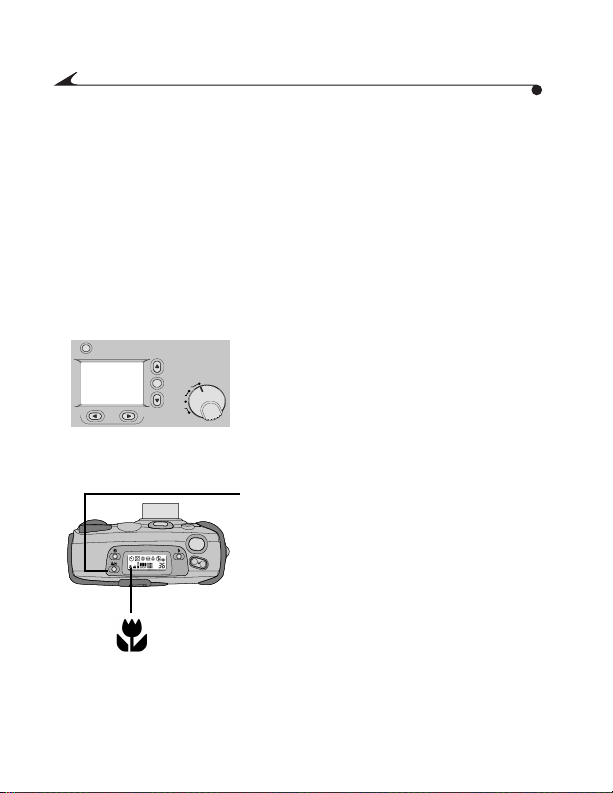
Press the INFINITY FOCUS/CLOSE-UP
button once.
The Infinity Focus icon appears in the
Status Display.
If you press the button twice, the close-
up feature is activated.
4
Frame your subject in the viewfinder and
press the SHUTTER button to take the
picture.
5
To turn off Infinity Focus, press the
INFINITY FOCUS/CLOSE-UP button two
times, or turn off the camera.
MENU
REVIEW
CONNECT
SETUP
CAMERA
CAPTURE
22
Photographing Close-Ups
If you want to take pictures of objects up close, such as flowers or artwork, use
the Close-Up feature. When selected, the camera automatically sets the focus
distance to 0.8 to 1.6 ft (0.25 to 0.5 m) and sets the flash to ensure detail and
clarity. Since the viewfinder on the camera may not accurately frame your
picture in Close-Up, the Preview option is automatically activated. For
information on Preview, see page 12.
When you use the Close-Up feature, the zoom capabilities on the camera
are disabled.
1
Set the Mode dial to Capture.
2
Slide the POWER switch to the right to
turn on the camera.
3
Press the INFINITY FOCUS/CLOSE-UP
button twice.
The Close-Up icon appears in the Status
Display and the LCD Preview feature
shows a live image.
4
Frame your subject using the LCD and
press the SHUTTER button.
5
To turn off Close-Up, press the INFINITY
FOCUS/CLOSE-UP button once, or turn off
the camera.
MENU
REVIEW
CONNECT
SETUP
CAMERA
CAPTURE
2
23
Putting Yourself in the Picture
There might be times when you want everyone, including yourself, to be in the
picture. For these occasions, use the Self-Timer feature to create a 10-second
delay between the time you press the SHUTTER button and the time the picture
is taken.
1
Set the Mode dial to Capture.
2
Slide the POWER switch to the right to
turn on the camera.
3
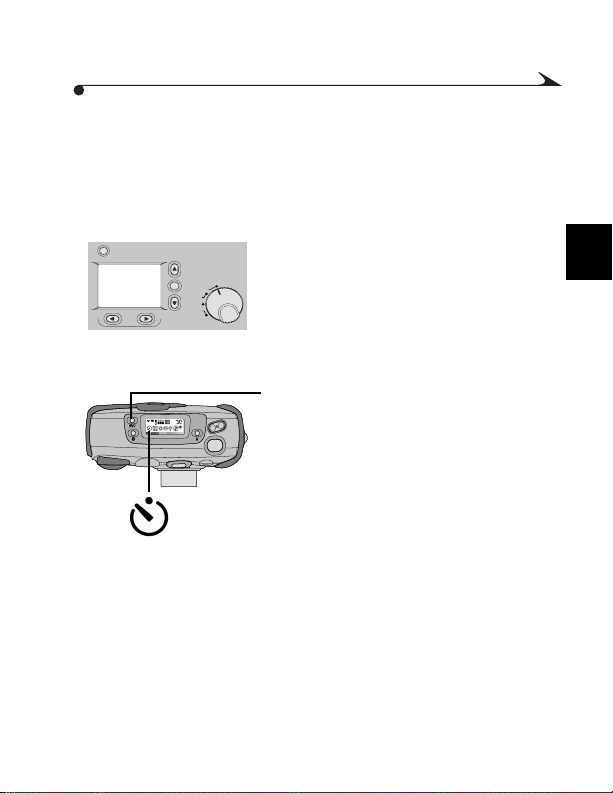
Press the SELF-TIMER button.
The Self-timer icon appears in the
Status Display.
If you want to cancel self-timer before the
picture is taken, press the SELF-TIMER
button again or turn off the camera.
4
Place the camera on a flat, steady surface
or tripod.
5
Frame your subject in the viewfinder and
press the SHUTTER button.
The red Self-Timer light, on the front of
the camera, turns on and stays lit for 8
seconds, then flashes for 2 additional
seconds just before the picture is taken.
The Self-Timer turns off when the picture
is taken.
MENU
REVIEW
CONNECT
SETUP
CAMERA
CAPTURE
24
Adding the Date to Your Pictures
You may want to keep track of when a picture was taken, perhaps to record a
child’s first picture or for an insurance claim. Whatever the reason, your
camera has the ability to record the date and time directly on your picture
using the Date Stamp feature. In order for the feature to imprint the correct
date and time, you need to set the camera clock. See page 8 for details. Once a
picture is taken with the date stamp, the date stamp cannot be removed.
1
Set the Mode dial to Capture.
2
Slide the POWER switch to the right to
turn on the camera.
3
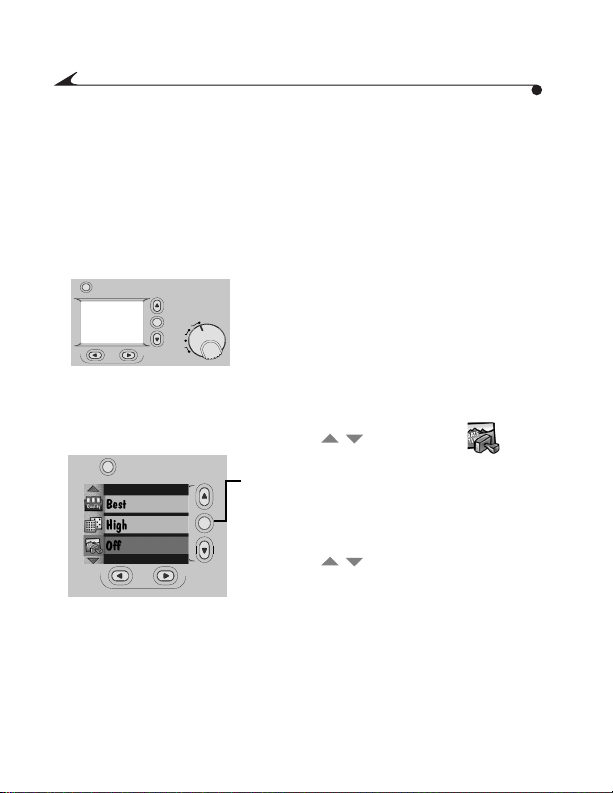
Press the MENU button.
The main Menu screen appears on the
LCD.
4
Press a button until the
icon is highlighted.
5
Press the DO-IT button.
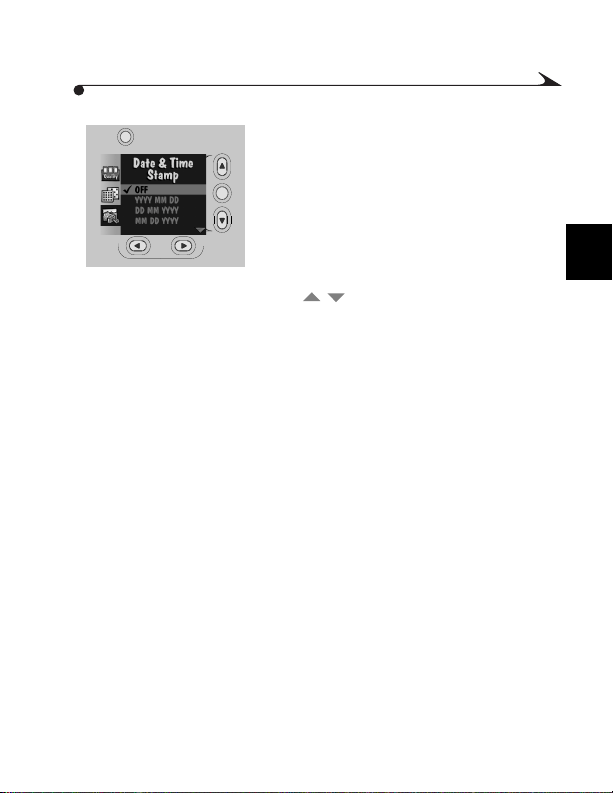
The Date Stamp screen appears on the
LCD. The current setting is checked
(
9
).
6
Press a button until the Date
Stamp option you want is highlighted.
MENU
REVIEW
CONNECT
SETUP
CAMERA
CAPTURE
/
/
2
25
7
Press the DO-IT button.
The main Menu screen reappears.
The next time you take a picture the date
or date and time is recorded in the lower
right-hand corner of the picture. The Date
Stamp icon appears on the LCD screen if
Quickview (page 18) or Preview
(page 12) is turned on.
8
To turn off Date Stamp, press
a button until OFF is highlighted,
then press the DO-IT button.
/

26
Deleting the Picture Just Taken
If you decide that you do not like a picture, you can delete it quickly from the
camera memory card immediately after it is taken if Quickview is turned on.
Once you delete the picture, it is permanently removed from the camera
memory card.
1
Set the Mode dial to Capture.
2
Slide the POWER switch to the right to
turn on the camera.
3
Turn on Quickview (page 18).
4
Frame your subject in the viewfinder and
press the SHUTTER button.
The picture appears on the LCD with the
icon displayed above the
button.
5
Press the button.
The LCD displays the Delete Picture
screen.
6
Press a button until YES
is highlighted.
7
Press the DO-IT button.
The picture is permanently deleted from
the camera memory card.
MENU
REVIEW
CONNECT
SETUP
CAMERA
CAPTURE
/
27
3
3
Customizing Your Pictures
Chapters 1 and 2 explained the basics for taking great digital pictures. In this
chapter, you will learn about some of the custom features available on your
camera. Because your camera is so versatile, you have the ability to set the
camera for almost any picture taking situation you may encounter. With the
camera, you can:
Adjust the exposure for pictures that are too light or too dark.
Frame your pictures with interesting borders supplied on the camera
memory card and software CD.
Capture pictures in color, black and white, sepia tone, or highlight text
in documents.
Adjust the ISO sensitivity for low light photography without flash.
Select specific picture quality and resolution settings to meet your
demanding picture-taking needs.
Set white balancing options, so you get great color reproduction in
your pictures.
Adjust the metering system to control how light affects
your pictures.
Sharpen and soften pictures so editing in software can be
done easier.
Lock the exposure for a consistent look in all your pictures.
28
Adjusting the Camera Exposure
If your pictures seem too dark or too light, adjust the amount of light allowed
into the camera so that your pictures are properly exposed. These adjustments
in lighting are called Exposure Compensation.
1
Set the Mode dial to Capture.
2
Slide the POWER switch to the right to turn
on the camera.
3
Press the Menu button.
The main Menu screen appears on the
LCD.
4
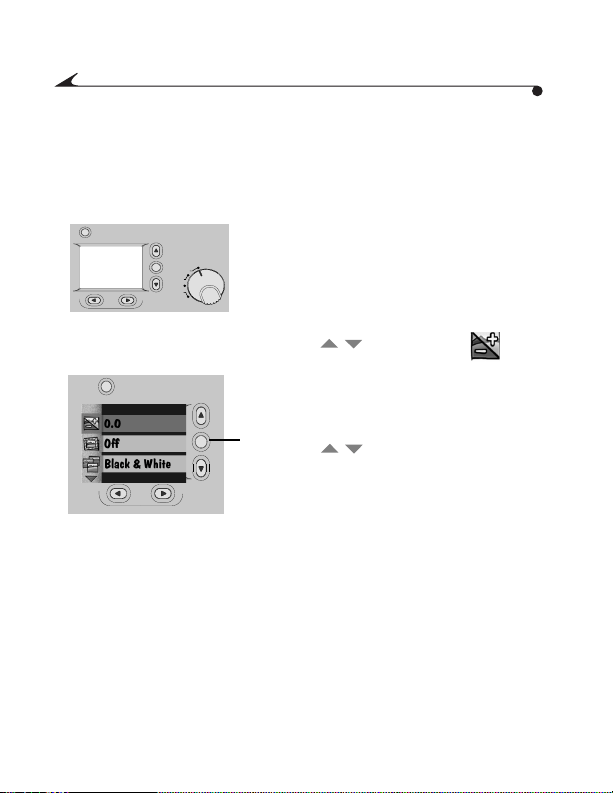
Press a button until the icon
is highlighted.
5
Press the DO-IT button.
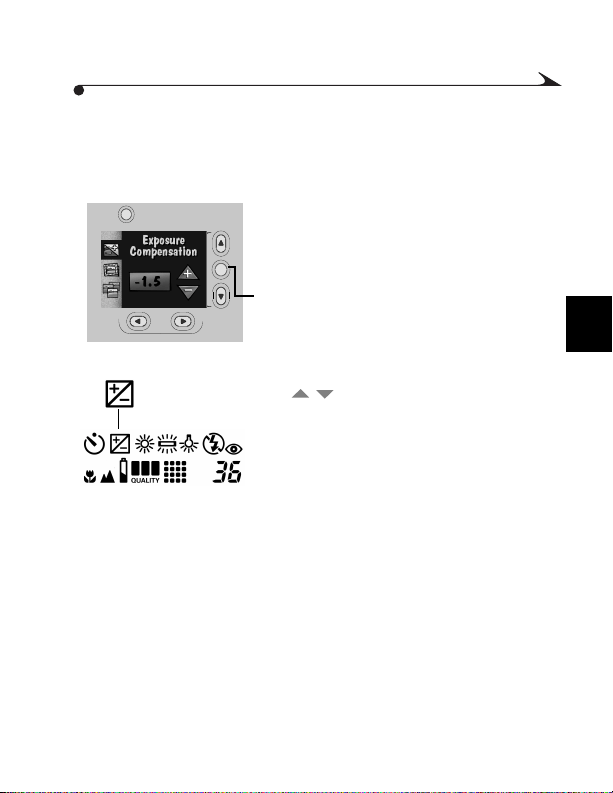
The Exposure Compensation screen
appears on the LCD.
6
Press a button to change the
exposure number.
MENU
REVIEW
CONNECT
SETUP
CAMERA
CAPTURE
/
/
3
29
If your pictures are too dark, increase
(+) the exposure number.
If your pictures are too light, decrease
(-) the exposure number.
You can adjust the exposure numbers in
+2.0 to -2.0 in 0.5 increments. An
increase of 1.0 doubles the amount of light
allowed into the camera. A decrease of 1.0
reduces the amount of light by half.
7
Press the DO-IT button.
The main Menu screen reappears and
the Exposure Compensation icon
appears in the Status Display.
8
To cancel Exposure Compensation, press a
button until 0.0 is highlighted,
then press the DO-IT button, or turn off
the camera, and the setting defaults to 0.0.
It is possible to select an exposure setting as
the default. See page 80 for details.
/
30
Adding a Border to Your Picture
You can add a border or logo (or both) to your picture. When you use the
Border feature, the camera Preview turns on automatically to help you frame
the picture and see if the border selected works well with your subject. If you
like the border, go ahead and take the picture. If you do not like the border,
select a different one. Although borders are not included on the camera
memory card, you can create and add your own borders or logos. For more
information, refer to the KODAK DC3400 Border Transfer Application online
help or the ReadMe file. Once the picture is taken, the border cannot be
removed.
1
Set the Mode dial to Capture.
2
Slide the POWER switch to the right to
turn on the camera.
3
Press the Menu button.
The main Menu screen appears on the
LCD.
4
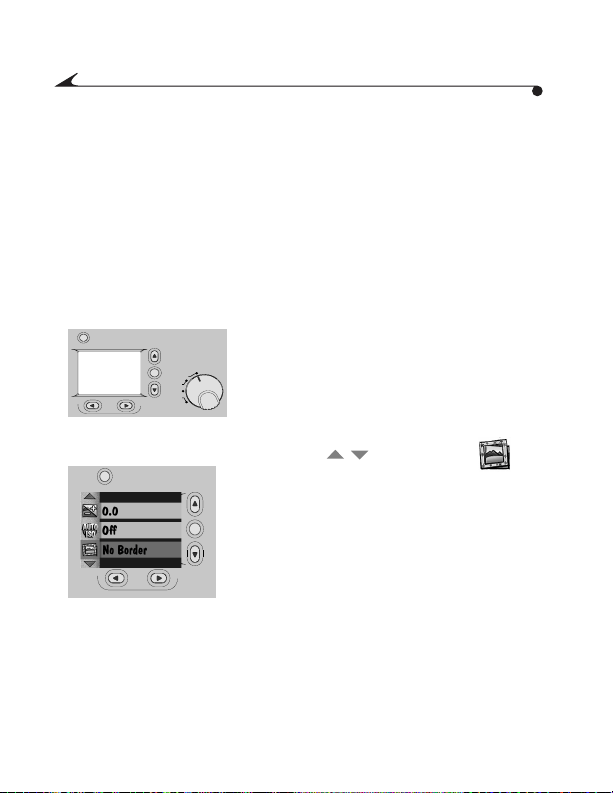
Press a
button until the
icon is highlighted.
5
Press the DO-IT button.
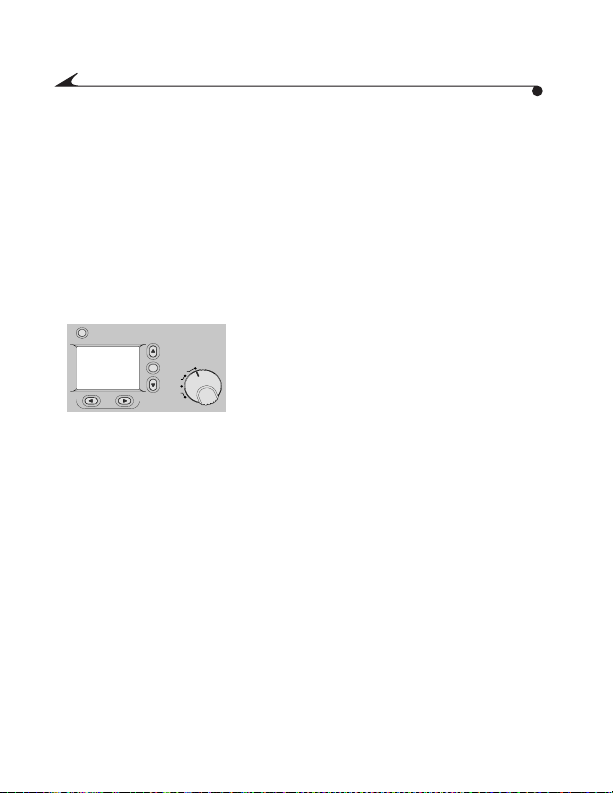
You can select from a list of different
borders to customize your pictures.
MENU
REVIEW
CONNECT
SETUP
CAMERA
CAPTURE
FPO
/
3
31
6
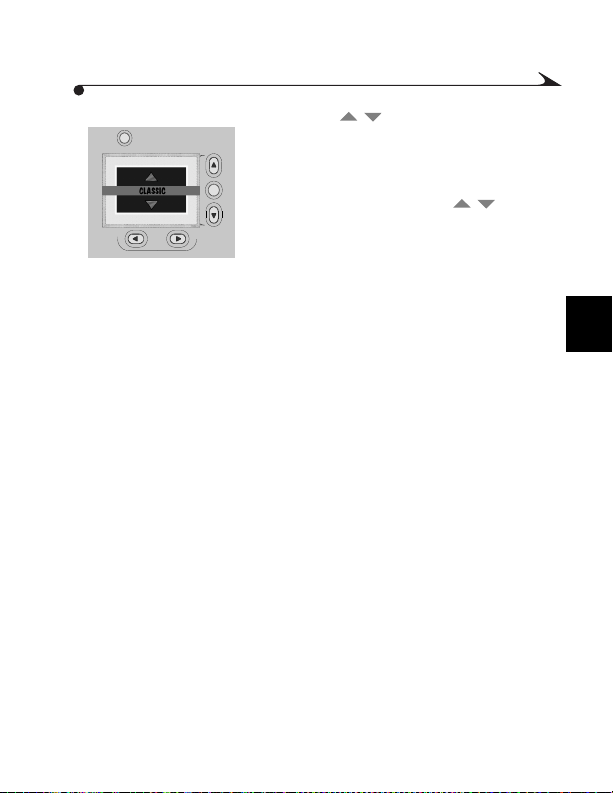
Press a button until the Border
option you want is highlighted.
7
Press the DO-IT button.
The main Menu screen reappears.
8
To cancel Border, press a button
until No Border is highlighted, then press
the DO-IT button.
It is possible to select a specific border as the
default. See page 75 for details.
/
/
32
Capturing in Black-and-White, Sepia Tone,
or Document
With the Effect setting, you can take black-and-white pictures, use sepia tone to
give your picture an antique look, or take pictures of documents so text stands
out. When using the Effects feature, the camera Preview automatically turns on
so that you can see if the effect selected works well with your subject. If you
like the effect, go ahead and take the picture. If you do not like the effect, select
a different one before taking the picture. Once the picture is taken with the
effect, the effect cannot be removed.
1
Set the Mode dial to Capture.
2
Slide the POWER switch to the right to turn
on the camera.
3
Press the Menu button.
The main Menu screen appears on the
LCD.
MENU
REVIEW
CONNECT
SETUP
CAMERA
CAPTURE
3
33
4
Press a button until the
icon is highlighted.
5
Press the DO-IT button.
6
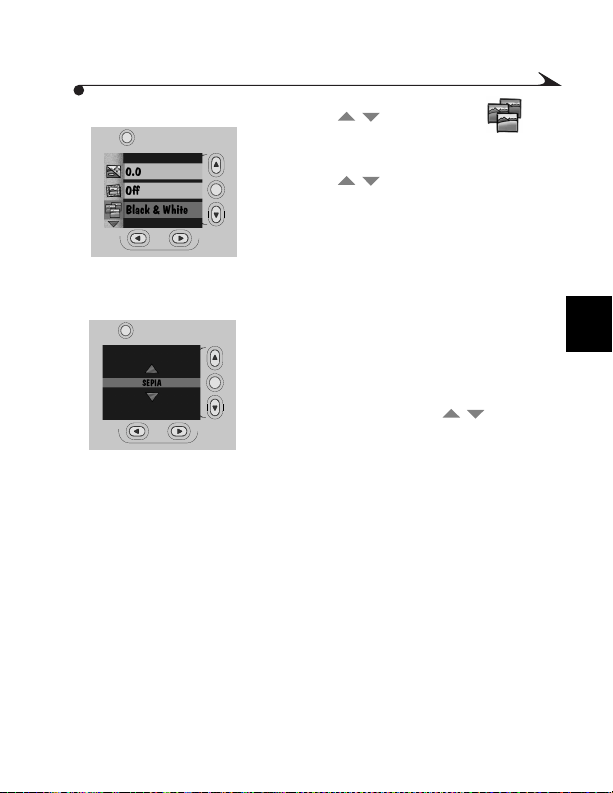
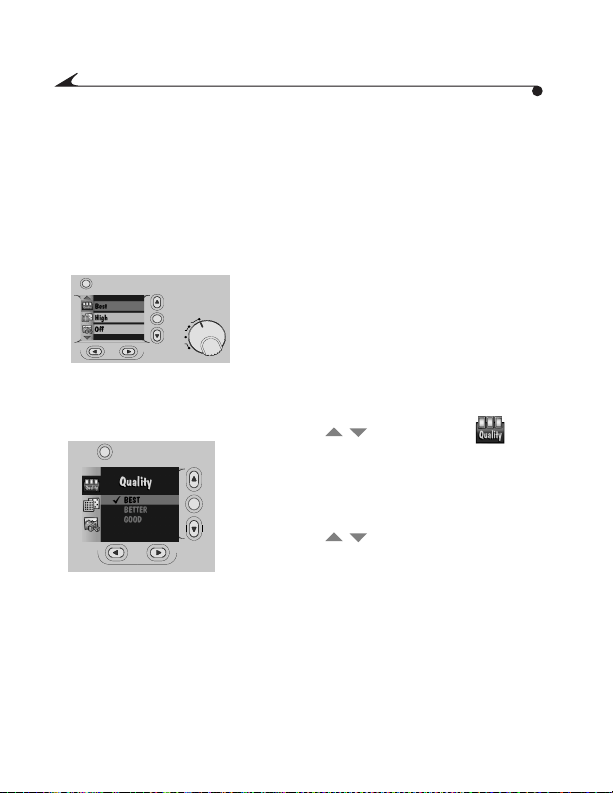
Press a button until the Effect
option you want is highlighted.
Black & White—takes a black-and-
white picture.
Sepia Tone—takes a picture with a
reddish-brown cast.
Document—takes a picture with
added contrast so text stands out.
No Effect—takes a color picture.
7
Press the DO-IT button.
The main Menu screen reappears.
8
To cancel Effect, press a button
until No Effect is highlighted, then press
the DO-IT button, or turn off the camera.
It is possible to select a special effect as the
default. See page 82 for details.
/
/
/
34
Adjusting the Picture Quality
If you intend to make large prints, you can capture more detail in the picture
using the Best setting. However, with this setting more storage room is used on
the camera memory card. For everyday pictures, use the Better setting, which
gives you great pictures and more storage space on the camera memory card.
If you need to store a large number of pictures on the camera memory card or
are going to e-mail or use the pictures online, use the Good setting.
1
Set the Mode dial to Capture.
2
Slide the POWER switch to the right to
turn on the camera.
3
Press the Menu button.
The main Menu screen appears on the
LCD.
4
Press a button until the
icon is highlighted.
5
Press the DO-IT button.
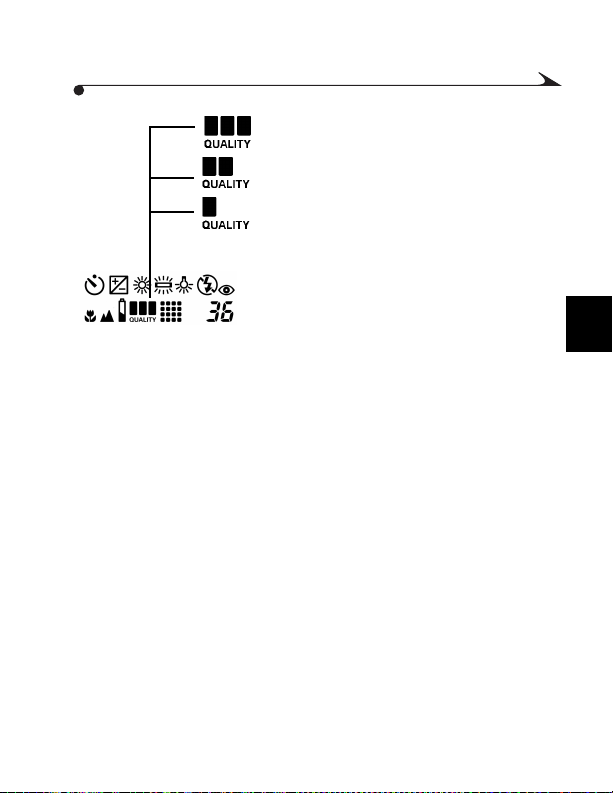
The LCD displays the Quality screen. The
current setting is checked (
9
).
6
Press a button until the Quality
option you want is highlighted.
MENU
REVIEW
CONNECT
SETUP
CAMERA
CAPTURE
/
/
3
35
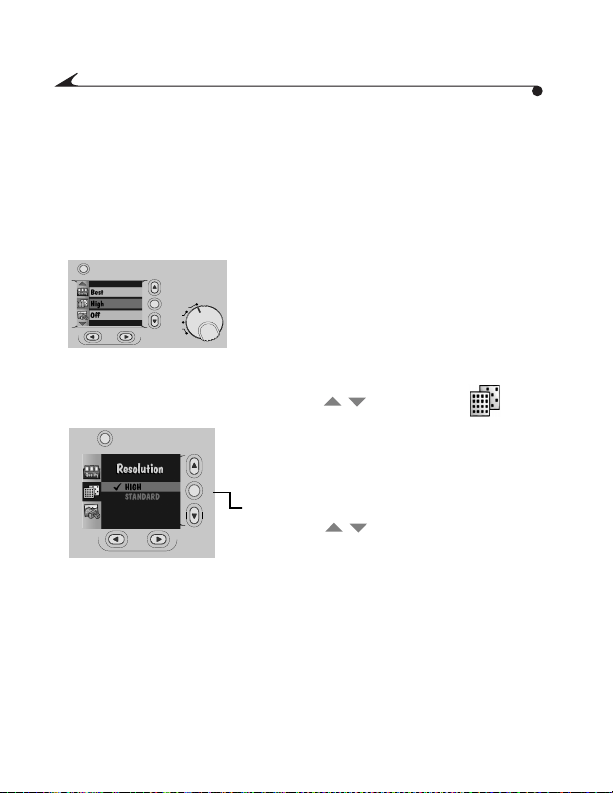
Best—use for printing 8x10
pictures.
Better—use for everyday pictures.
Good—use for online or for e-
mailing pictures.
7
Press the DO-IT button.
The main Menu screen reappears as the
Quality icon for the setting you selected
appears in the Status Display.
You can switch freely between these three
settings when taking pictures.
36
Adjusting the Picture Resolution
If you want to send pictures through e-mail or use them online, use the
Standard resolution setting. With this setting, only the information needed for
viewing on a computer or printing small prints is captured. For pictures that
are going to be printed, use the High resolution setting. With this setting, more
information is captured, but fewer pictures fit on the camera memory card.
1
Set the Mode dial to Capture.
2
Slide the POWER switch to the right to
turn on the camera.
3
Press the Menu button.
The main Menu screen appears on the
LCD.
4
Press a button until the icon
is highlighted.
5
Press the DO-IT button.
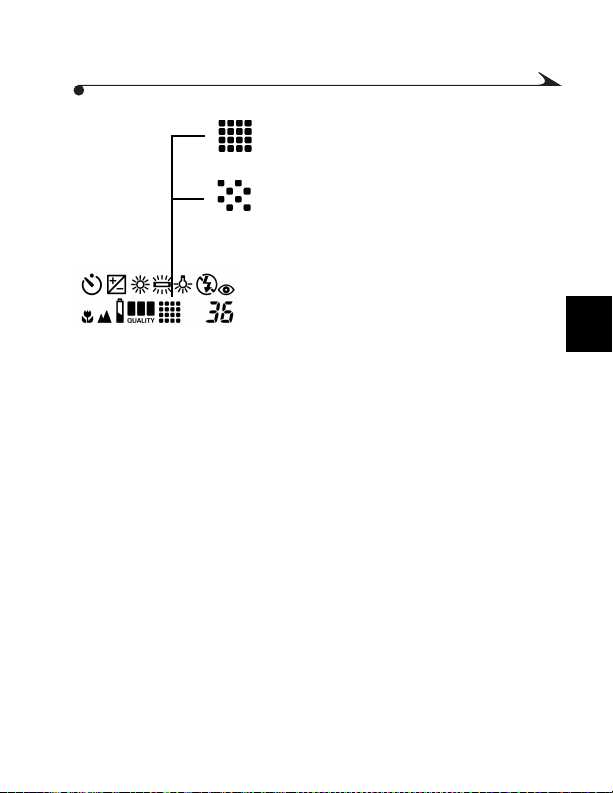
The Resolution screen appears on the
LCD. The current setting is checked
(
9
).
6
Press a button until the
Resolution option you want
is highlighted.
MENU
REVIEW
CONNECT
SETUP
CAMERA
CAPTURE
/
/
3
37
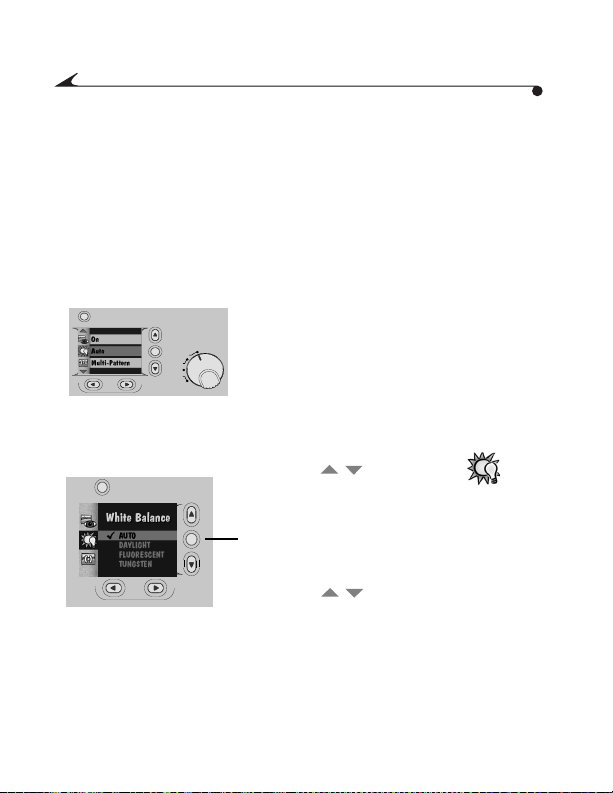
High—use this setting when you are
going to print your pictures. Picture
size is 1760 x 1168 pixels.
Standard—use this setting when you
are going to e-mail or use the
pictures online. Picture size is 896 x
592 pixels.
7
Press the DO-IT button.
The main Menu screen reappears as the
Resolution icon appears in the
Status Display.
You can switch freely between these two
settings when taking pictures.
38
Selecting a White Balance for Indoor
Pictures
If you use your camera indoors where flash is prohibited, your pictures may
take on a green tint if captured under fluorescent tube lighting, or a reddish-
orange tint if captured under tungsten household lighting. You can correct this
problem using the White Balance feature on the camera. Use the Auto setting
for everyday pictures. Use the Daylight, Fluorescent, or Tungsten setting for
taking pictures under these lighting conditions without flash.
1
Set the Mode dial to Capture.
2
Slide the POWER switch to the right to
turn on the camera.
3
Press the Menu button.
The main Menu screen appears on the
LCD.
4
Press a button until the icon
is highlighted.
5
Press the DO-IT button.
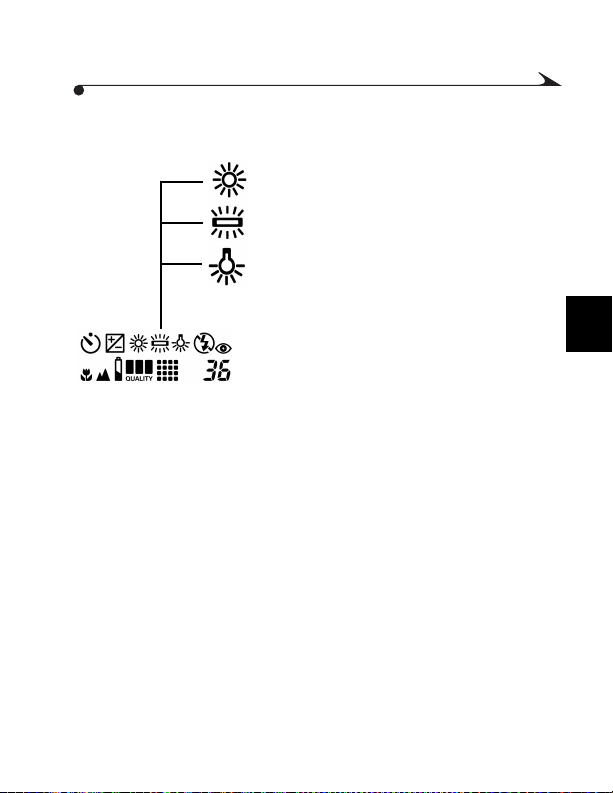
The White Balance screen appears on
the LCD. The current setting is checked
(
9
).
6
Press a button until the White
Balance option you want is highlighted.
MENU
REVIEW
CONNECT
SETUP
CAMERA
CAPTURE
/
/
3
39
Auto (No Icon)—automatically
adjusts the white balance.
Daylight—balances for natural
daylight lighting.
Fluorescent—corrects for the
green cast of fluorescent lighting.
Tungsten—corrects for the orange
cast of tungsten light bulbs.
7
Press the DO-IT button.
The main Menu screen reappears as the
White Balance icon you selected
appears in the Status Display.
Your camera automatically resets to Auto
when the camera is turned off. To change
the defaults, see page 78.
40
Choosing a Metering System
You can control the way light affects your pictures using the metering systems
available on your camera. If you want a nice even exposure throughout the
picture, use the Multi-Pattern setting. This setting is great for everyday pictures.
If you want to emphasize the center of your picture, such as a person’s face,
while at the same time de-emphasizing the background, use the Center-
Weighted setting.
1
Set the Mode dial to Capture.
2
Slide the POWER switch to the right to
turn on the camera.
3
Press the Menu button.
The main Menu screen appears on the
LCD.
MENU
REVIEW
CONNECT
SETUP
CAMERA
CAPTURE
3
41
4
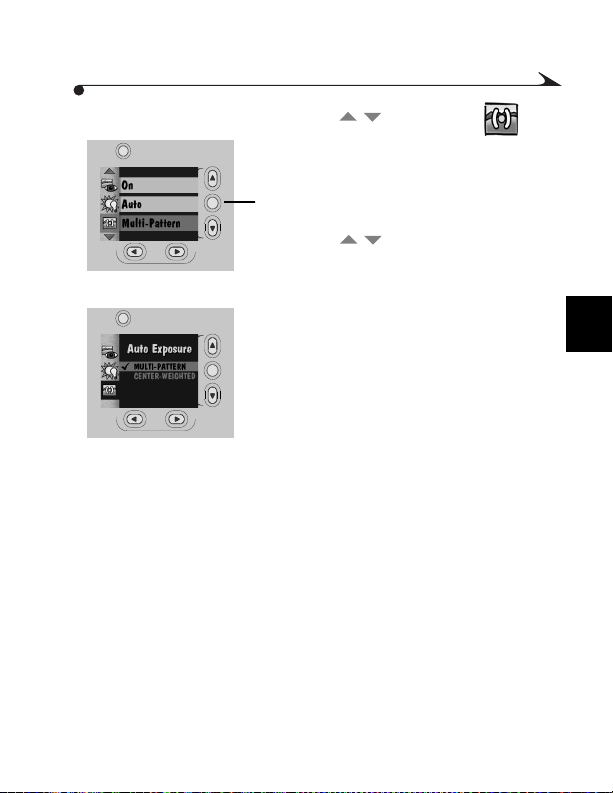
Press a button until the icon
is highlighted.
5
Press the DO-IT button.
The Auto Exposure screen appears on
the LCD. The current setting is checked
(
9
).
6
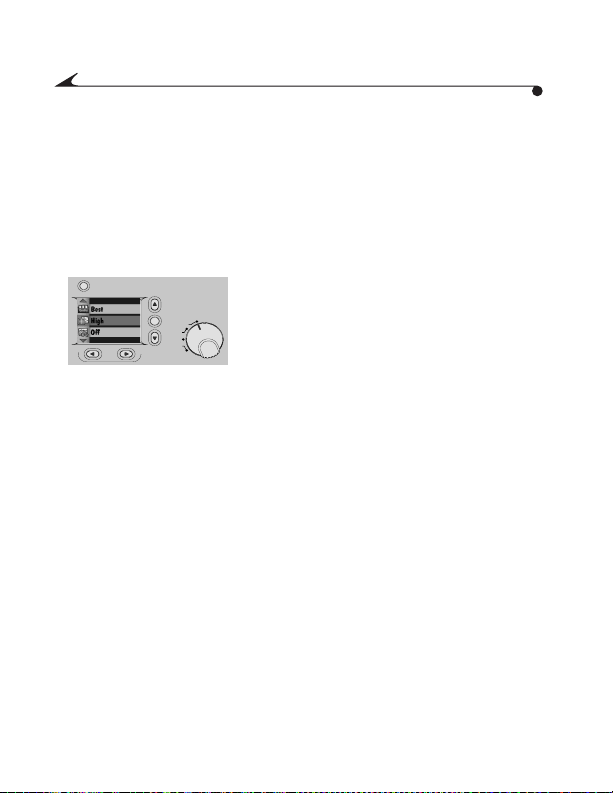
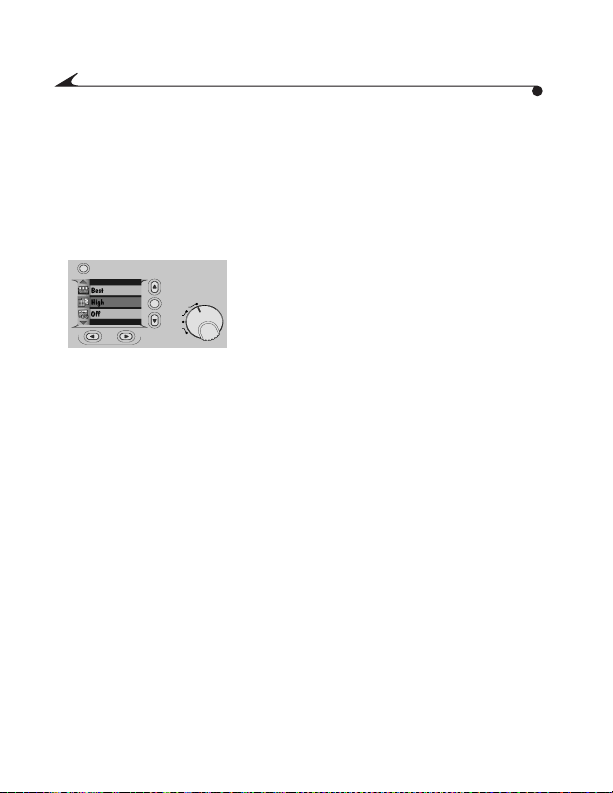
Press a button until the Auto
Exposure option you want is highlighted.
Multi-Pattern—evaluates the
lighting conditions of the entire
picture.
Center-Weighted—evaluates the
lighting conditions of the subject
centered in the viewfinder and sets
the overall exposure setting for the
picture based on the center of
the subject.
7
Press the DO-IT button.
The main Menu screen reappears.
You can switch freely between the two
settings when taking pictures.
/
/
42
Selecting the ISO Setting
If you take pictures in low light without flash, such as in a museum, you can
select the Auto ISO sensitivity on the camera to help prevent blurred pictures
caused by camera movement. With this feature the shutter speed is
automatically increased to make the camera more responsive, while
maintaining proper exposure for the picture.
1
Set the Mode dial to Capture.
2
Slide the POWER switch to the right to
turn on the camera.
3
Press the Menu button.
The main Menu screen appears on the
LCD.
MENU
REVIEW
CONNECT
SETUP
CAMERA
CAPTURE
3
43
4
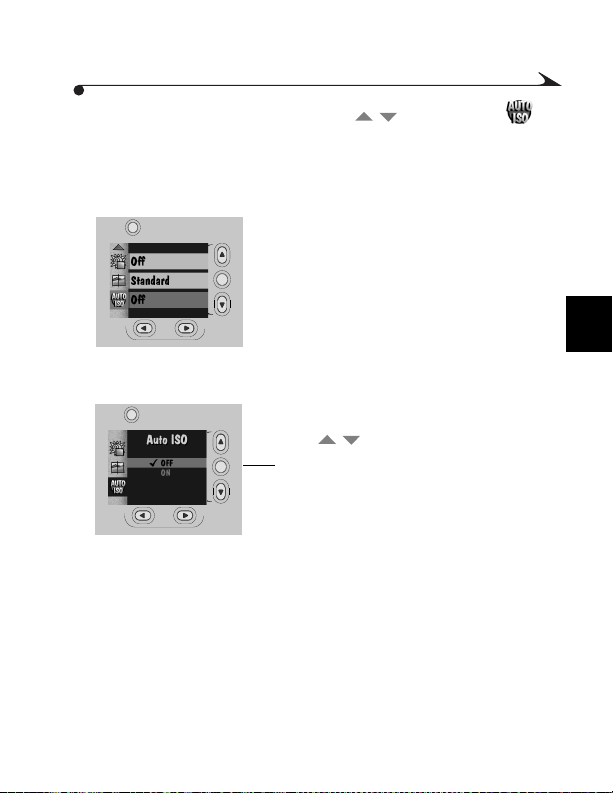
Press a button until the
icon is highlighted.
The Auto ISO screen appears on the
LCD. The current setting is (
9
).
5
Press the DO-IT button.
6
Press a button until the option you want
is highlighted.
OFF—camera selects the optimal
shutter speed for pictures. Ideal for
everyday picture-taking.
ON—camera increases the shutter
speed when flash is turned off.
Ideal for indoor pictures in less
than optimal lighting.
7
Press the DO-IT button.
8
To cancel Auto ISO, press
a button until OFF is
highlighted, then press the DO-IT
button, or turn off the camera.
It is possible to change the ISO default
setting, see page 84.
/
/
44
Sharpening and Softening a Picture
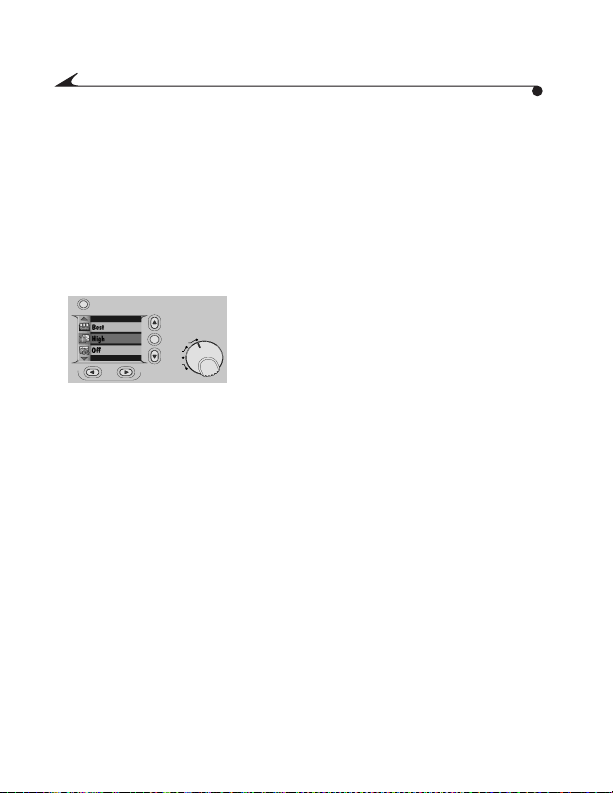
If you plan to edit your pictures using image editing software, the Sharpness
feature can make some editing processes easier. By selecting the Sharp setting,
the edges around the picture are enhanced, making it easier to cut or crop the
image. If you want to blend the image into a background, use the Soft setting to
de-emphasize the edges. For everyday picture-taking, keep the Sharpness
feature set to Standard. The Sharp or Soft settings may increase or decrease the
clarity in pictures.
1
Set the Mode dial to Capture.
2
Slide the POWER switch to the right to
turn on the camera.
3
Press the Menu button.
The main Menu screen appears on the
LCD.
MENU
REVIEW
CONNECT
SETUP
CAMERA
CAPTURE
3
45
4
Press a button until the icon
is highlighted.
5
Press the DO-IT button.
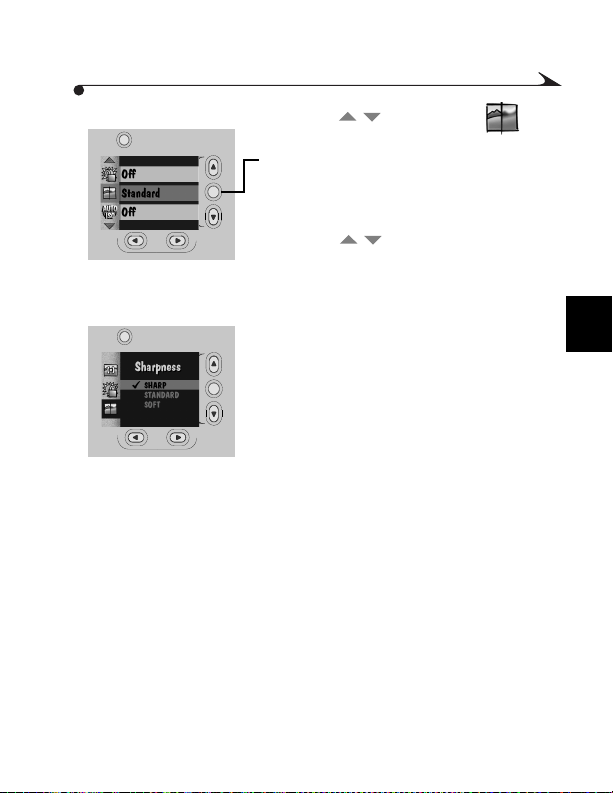
The Sharpness screen appears on the
LCD. The current setting is checked
(
9
).
6
Press a button until the Sharpness
option you want is highlighted.
Sharp—highlights the edges in your
picture, so the edges stand out.
Standard—makes no change to the
edges in your picture.
Soft—blurs the edges in your
picture, so the edges blend in.
7
Press the DO-IT button.
The main Menu screen reappears.
You can switch freely among the three
settings when taking pictures.
/
/
46
Locking in an Exposure Setting
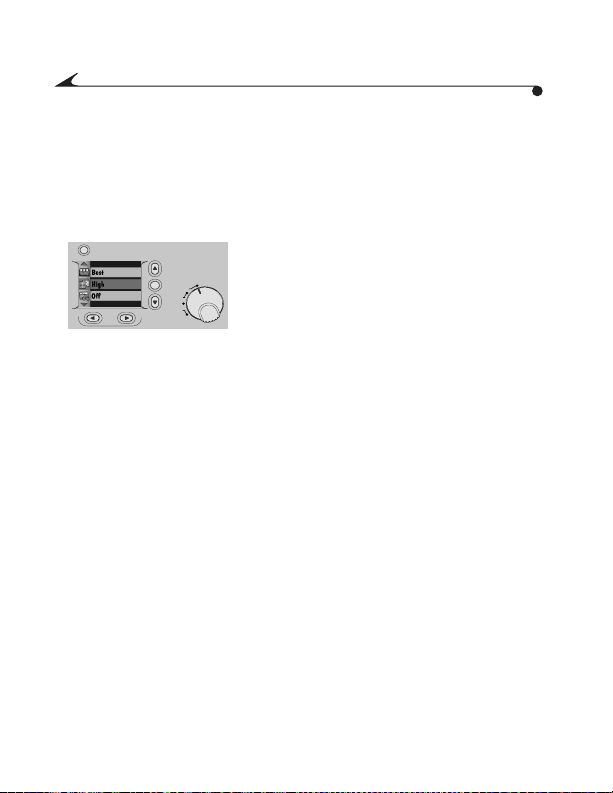
If you take a series of pictures that require a consistent look or a constant
exposure setting, use the Exposure Lock feature. This feature is great for taking
a series of pictures, like a mountain range, and creating a mural with the
prints.
1
Set the Mode dial to Capture.
2
Slide the POWER switch to the right to
turn on the camera.
3
Press the Menu button.
The main Menu screen appears on the
LCD.
MENU
REVIEW
CONNECT
SETUP
CAMERA
CAPTURE
3
47
4
Press a button until the
icon is highlighted.
5
Press the DO-IT button.
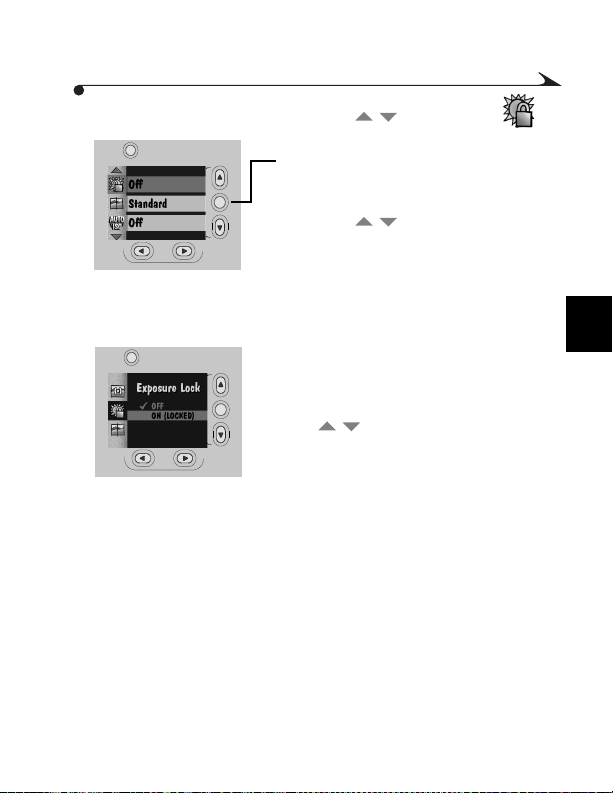
The Exposure Lock screen appears on
the LCD. The current setting is (
9
).
6
Press a button until ON
is highlighted.
7
Press the DO-IT button.
The “Please take a picture to lock
capture settings” screen appears.
8 Center the area you want to lock the
exposure on in the viewfinder.
9 Press the SHUTTER button to lock in the
exposure setting.
10 To cancel Exposure Lock, press
a button until OFF is
highlighted, then press the DO-IT
button, or turn off the camera.
/
/
/

48
49
4
4
Reviewing Your Pictures
After taking pictures with your KODAK DC3400 Digital Camera, you can take a
look at them by setting the camera to Camera Review. You can:
View your pictures and see how custom features, if any, were applied
to the shot.
Magnify the picture to check the detail.
Select specific pictures and quantities to print.
Protect pictures from being deleted from your camera
memory card.
Delete unwanted pictures to free up space on the camera
memory card.
Display and run a slide show on the camera or on a television.
View specific information about the picture.
50
Viewing Your Pictures
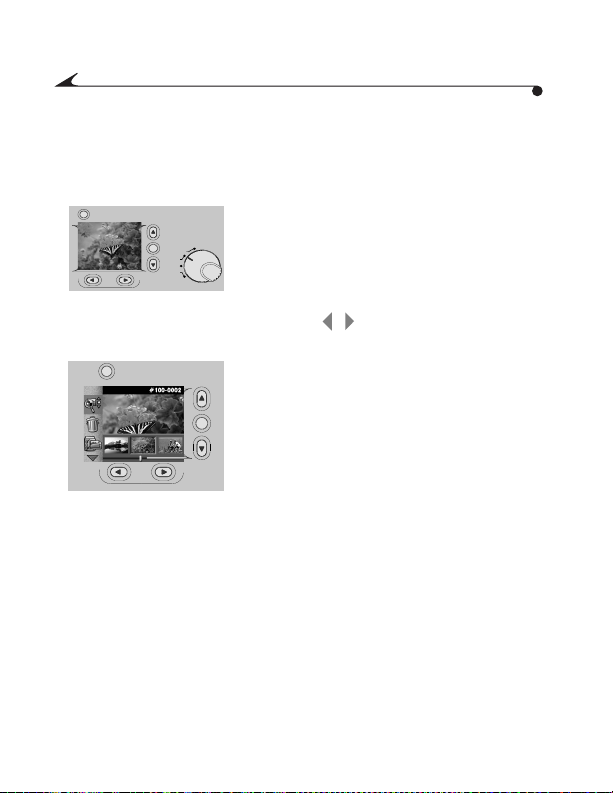
To view each picture in full LCD size, or you can view up to three smaller
thumbnail-size pictures at a one time using the Filmstrip feature.
1 Set the Mode dial to Review.
2 Slide the POWER switch to the right to
turn on the camera.
The LCD displays the last picture taken
with the frame number, and the Print
Order and Protect icons, if activated.
3 Use the buttons to scroll through
and view the pictures on the LCD.
4 Press the Menu button to display the
filmstrip and the main Review screen.
The Review Menu icons, filmstrip, and
memory bar appear over the current
picture.
MENU
REVIEW
CONNECT
SETUP
CAMERA
CAPTURE
/
4
51
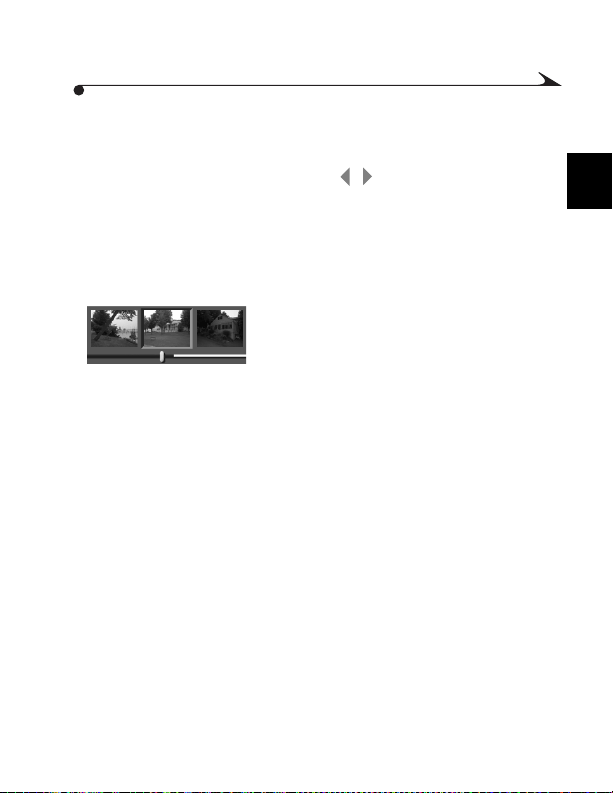
The filmstrip displays up to three pictures
at a time, in the order taken and stored on
the camera memory card.
5 Use the buttons to scroll through the
filmstrip.
The picture on the filmstrip appears in
the LCD as the memory bar and picture
locator needle moves.
The memory bar indicates the amount of
space on the camera memory card. The
dark section represents the portion of the
card that is filled, while the needle locator
shows the position of the picture on the
card.
6 To exit, press the Menu button.
/
52
Magnifying Your Pictures
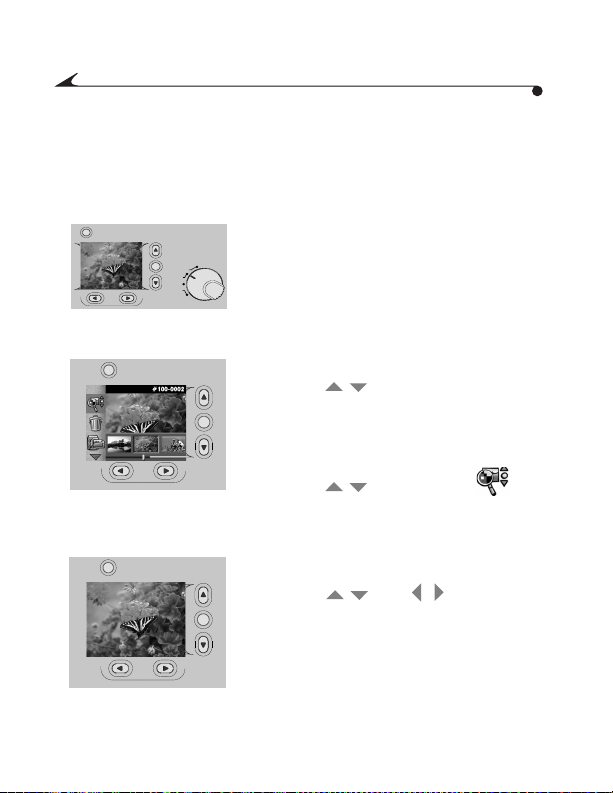
To zoom in on a specific part of a picture displayed on the LCD, use the Magnify
feature. This feature lets you view a section of the current picture at two times
the normal LCD size.
1 Set the Mode dial to Review.
2 Slide the POWER switch to the right to
turn on the camera.
The last picture taken appears on the
LCD.
3 Press the Menu button.
The main Review Menu screen appears.
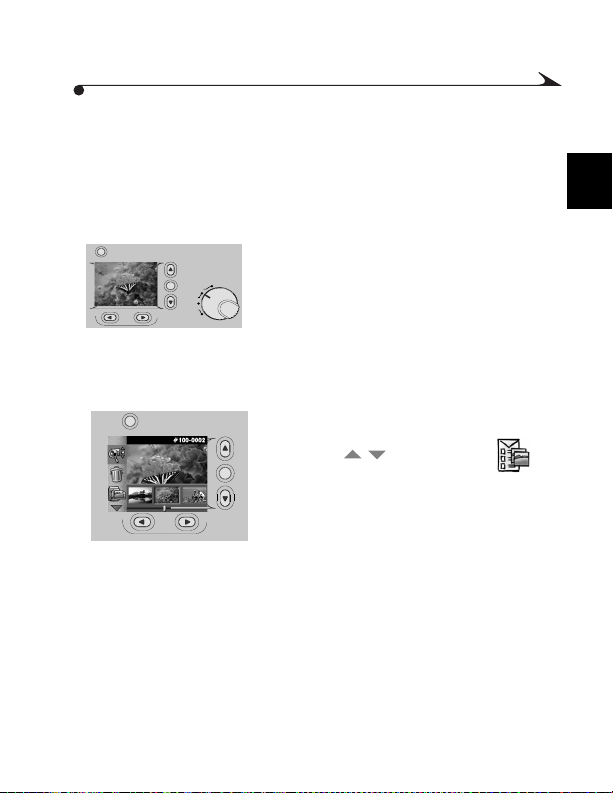
4 Press a
button until the picture
you want to magnify is highlighted on
the filmstrip.
The picture appears in the LCD viewing
area.
5 Press a
button until the
icon is highlighted.
6 Press the DO-IT button.
The LCD displays a magnified view of
the selected picture.
7 Use the
and
buttons to
scroll to different parts of the picture.
8 To exit Magnify, press the DO-IT button.
MENU
REVIEW
CONNECT
SETUP
CAMERA
CAPTURE
/
/
/
/
4
53
Selecting Pictures for Printing
You can scroll through and select certain pictures on the camera memory card
to print, as well as create an index of all of the pictures using the Print Order
feature. This feature is useful because it saves you time when printing pictures
from a KODAK Picture Maker, or Personnel Picture Maker Systems.
1 Set the Mode dial to Review.
2 Slide the POWER switch to the right to
turn on the camera.
The last picture taken appears on the
LCD.
3 Press the Menu button.
The main Review Menu screen appears.
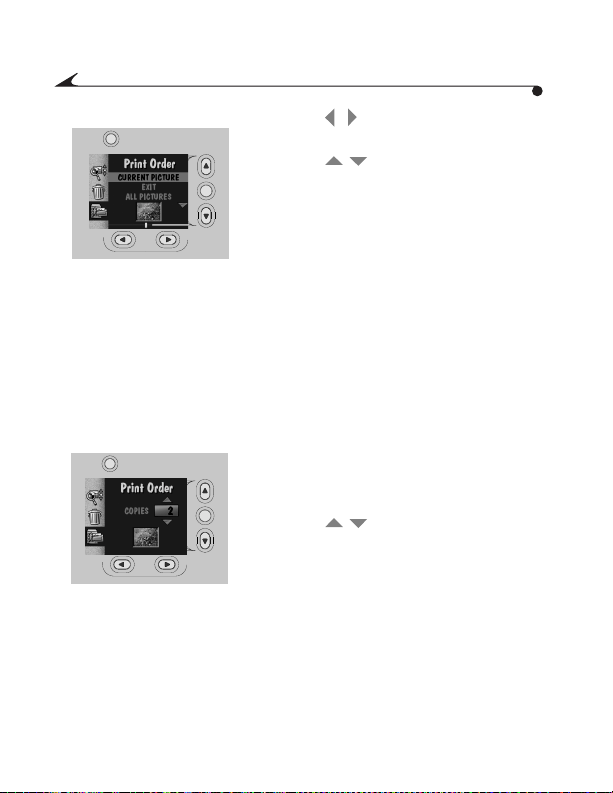
4 Press a
button until the
icon is highlighted.
5 Press the DO-IT button.
The Print Order screen appears.
MENU
REVIEW
CONNECT
SETUP
CAMERA
CAPTURE
/
54
6 Press a
button until the picture you
want is highlighted on the filmstrip.
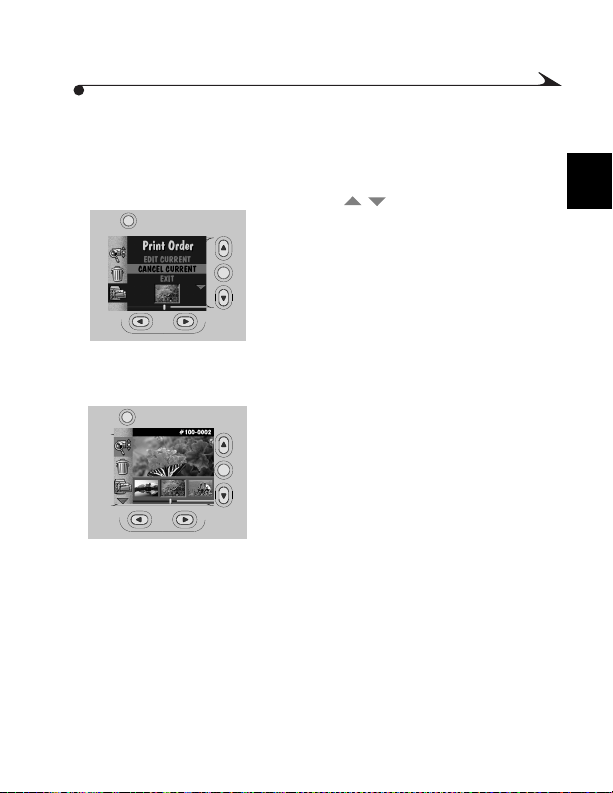
7 Press a
button until the Print
Order option you want is highlighted.
CURRENT PICTURE or EDIT
PICTURE—marks the picture
currently selected on the filmstrip.
EXIT—returns you to the main
Review screen.
ALL PICTURES or EDIT ALL—
marks all of the pictures on the
camera memory card.
INDEX PRINT or EDIT INDEX
PRINT— thumbnails of all the
pictures on the camera memory card
will print.
8 Press the DO-IT button.
The Copies screen appears, unless you
selected the Index Print option, which
returns you to the main Review screen.
9 Press a
button until the desired
number of prints you want appears.
10 Press the DO-IT button.
The print order is accepted and the
Print Order icon appears in the LCD of
each picture marked for printing. The
main Print Order screen reappears.
11 To exit Print Order, highlight EXIT, then
press the DO-IT button.
/
/
/
4
55
Cancelling Pictures for Printing
If you have second thoughts about the pictures you have selected to print, you
can go back and cancel individual pictures or the entire order.
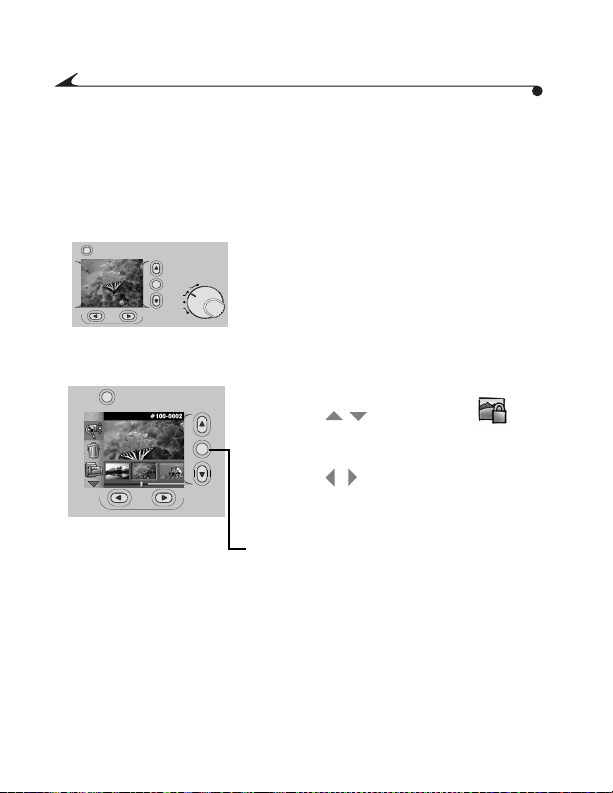
1 Press a
button until the Print
Order option you want is highlighted.
CANCEL CURRENT—cancels the
print order for the selected picture.
EXIT—returns you to the main
Review Menu screen.
CANCEL PRINT ORDER—cancels
all the print orders for the pictures.
CANCEL INDEX PRINT—cancels
the print order for the index print.
2 Press the DO-IT button.
The print order is cancelled and the
Print Order icon is removed. The main
Print Order screen reappears.
3 To exit Print Order, highlight EXIT, then
press the DO-IT button.
/
56
Protecting Your Pictures
Safeguard your pictures from being deleted accidentally from the camera
memory card by using the Protect feature. This feature is very useful if the
camera and camera memory card are used by more than
one person.
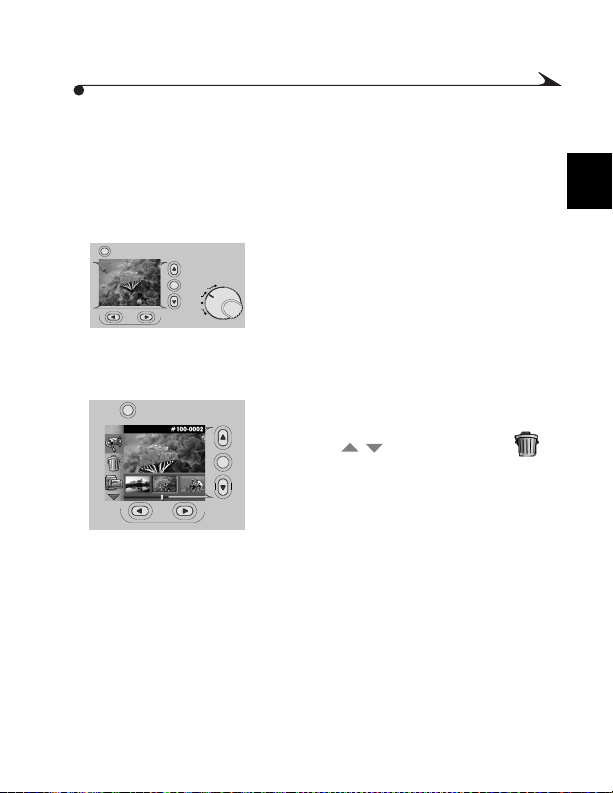
1 Set the Mode dial to Review.
2 Slide the POWER switch to the right to
turn on the camera.
The last picture taken appears on the
LCD.
3 Press the Menu button.
The main Review Menu screen appears.
4 Press a button until the
icon is highlighted.
The Protect screen appears.
5 Press a button until the picture you
want to protect is selected.
6 Press the DO-IT button.
The picture appears on the LCD with the
Protect icon.
7 To cancel a protected picture, select the
picture to be unprotected and press the
DO-IT button.
MENU
REVIEW
CONNECT
SETUP
CAMERA
CAPTURE
/
/
4
57
Deleting One or All of Your Pictures
If you decide that you do not like the pictures stored on the camera memory
card, or you just want to free up space, use the Delete feature to remove one or
all of the pictures on the card. If you have marked pictures as protected, they
cannot be deleted until you turn off the Protect feature. See page 56 for details.
1 Set the Mode dial to Review.
2 Slide the POWER switch to the right to turn
on the camera.
The last picture taken appears on the
LCD.
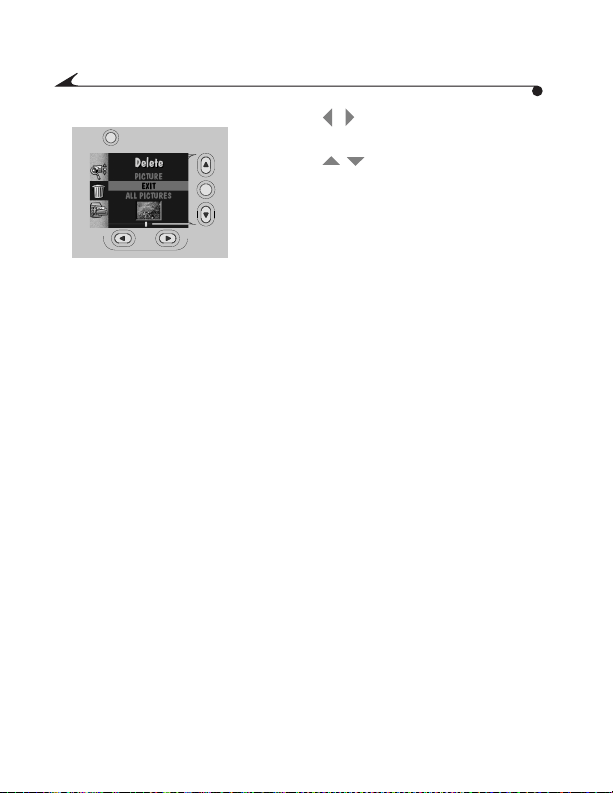
3 Press the Menu button.
The main Review Menu screen appears.
4 Press a button unti7.5l the
icon is highlighted.
5 Press the DO-IT button.
The Delete screen appears.
MENU
REVIEW
CONNECT
SETUP
CAMERA
CAPTURE
/
58
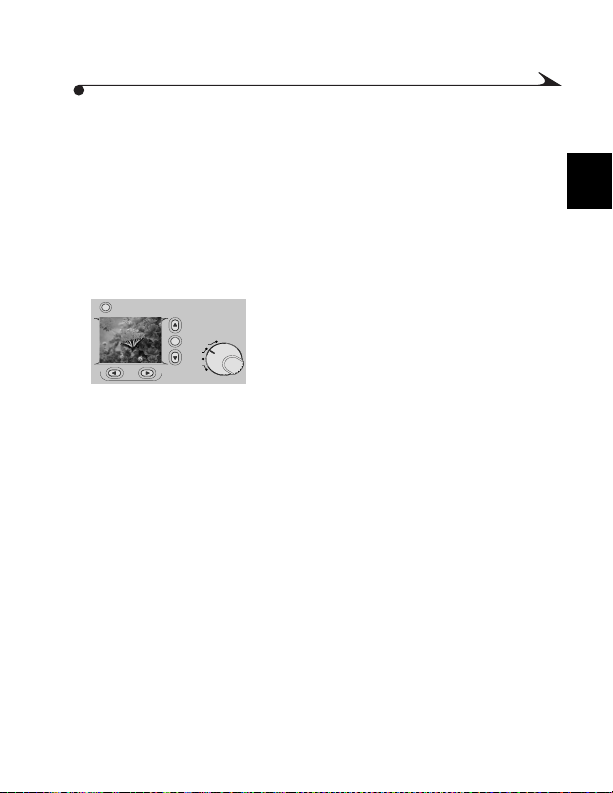
6 Press a button until the picture you
want to delete is selected.
7 Press a button until the Delete
option you want is highlighted.
PICTURE—deletes the selected
picture from the camera memory
card.
EXIT—returns you to the main
Review screen without deleting the
picture(s).
ALL PICTURES—deletes all the
pictures on the camera memory card.
8 Press the DO-IT button.
The pictures are deleted from the
camera memory card.
9 To exit Delete, highlight EXIT, then press
the DO-IT button.
/
/
4
59
Running a Slide Show on Your Television
View your pictures on the camera LCD, or connect your camera to a television
using a video cable and display your pictures to a large audience using the
Slide Show feature. The pictures appear on the television for a period of 1 to
99 seconds, a time you set from the camera. The slide show ends after all the
pictures have been shown; or, if you are using a Kodak-specified AC adapter,
the slide show continues until you stop it. For details about available
accessories, ask your dealer of KODAK products.
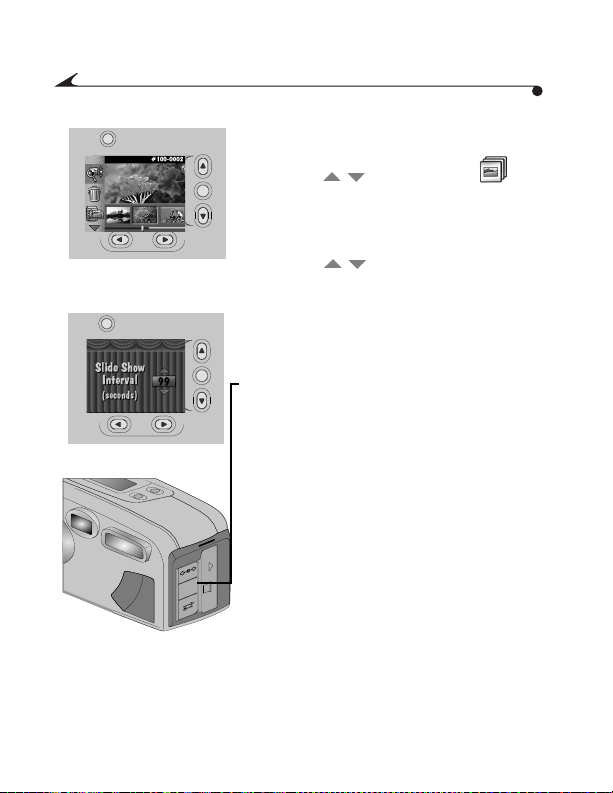
1 Set the Mode dial to Review.
2 Slide the POWER switch to the right to turn
on the camera.
The last picture taken appears on the
LCD.
MENU
REVIEW
CONNECT
SETUP
CAMERA
CAPTURE
60
3 Press the Menu button.
The main Review Menu screen appears.
4 Press a
button until the
icon is highlighted.
5 Press the DO-IT button.
The Slide Show Interval screen appears.
6 Use the
buttons to select the
number of seconds you want the pictures
to appear on the television.
If you want to view a slide show on the
camera LCD, press the DO-IT to start and
stop the slide show.
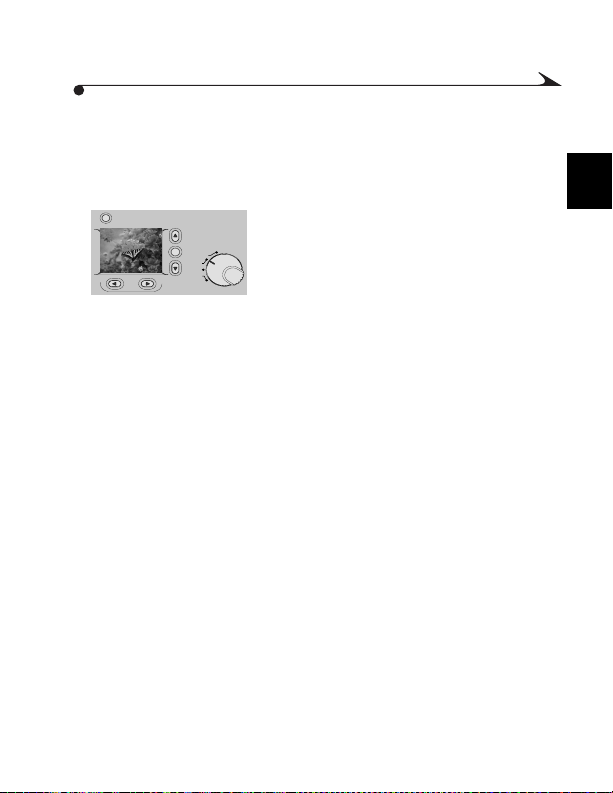
7 Insert the video cable into the video-out
port on the side of your camera, and
connect the other end of the video cable to
the video-in port on the television.
8 Turn on the television.
You may need to adjust the Video Out
setting to NTSC or PAL television signals.
See page 73 for details.
9 Press the DO-IT button to start and stop
the slide show.
CARD
OPEN
OUT
VIDEO
DC IN
/
/
4
61
Viewing Information About a Picture
Look up specific information about a picture using the Picture Information
feature. The information that appears is for viewing and cannot be edited.
1 Set the Mode dial to Review.
2 Slide the POWER switch to the right to
turn on the camera.
The last picture taken appears on the
LCD.
MENU
REVIEW
CONNECT
SETUP
CAMERA
CAPTURE
62
3 Press the Menu button.
The main Review Menu screen appears.
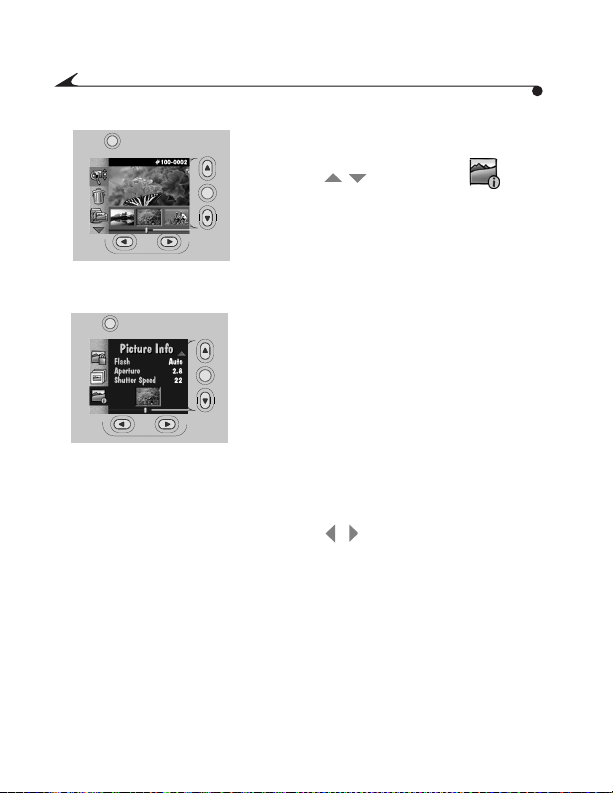
4 Press a button until the icon
is highlighted.
5 Press the DO-IT button.
The Picture Info screen appears with
that picture’s information displayed.
Quality
Resolution
File Name
Directory Name
Capture Date/Time
Flash
Aperture
Shutter Speed
White Balance
Metering
Exposure Compensation
6 Press a button to view information
on other pictures.
7 To exit Picture Information, press the DO-
IT button.
.
/
/
63
5
5
Personalizing Your Camera
Tailor your camera to fit whatever picture-taking needs you have. When you set
the camera to Camera Setup, you can personalize your camera so it performs
the way you want, each time you use it. You can:
Set a camera response beep, so you get feedback from the camera
when you initiate an action.
Select a power-save setting to help conserve batteries.
Access camera information to view a complete history of your
cameras use.
Select the language with which you are most comfortable working.
Format other camera memory cards so they work in your camera.
Select specific default settings, so your camera is always set for the
way you need to use it.
64
Setting a Response Beep
Your camera provides auditory feedback in the form of a beep anytime the
SHUTTER button is pressed, or when the camera cannot perform a selected
function. If you do not want auditory feedback, turn off the beep. This can be
especially useful when taking a spontaneous picture of someone or of wildlife.
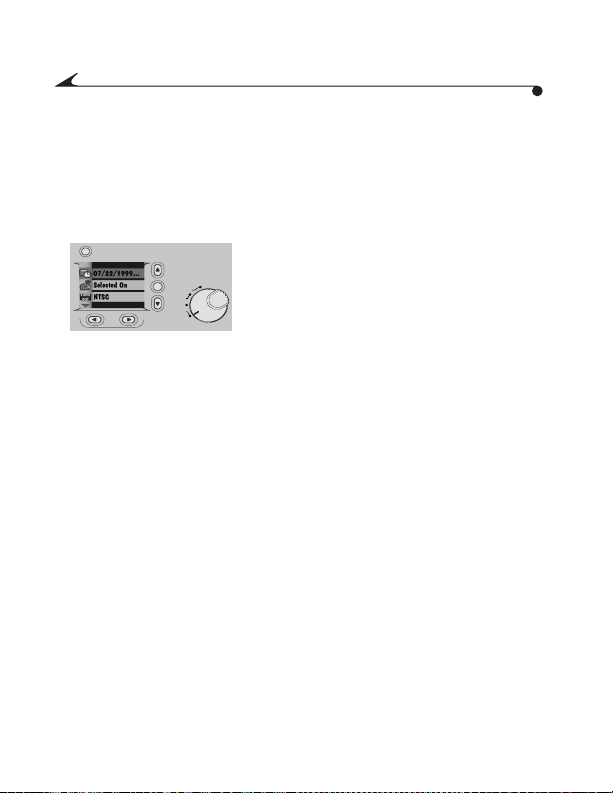
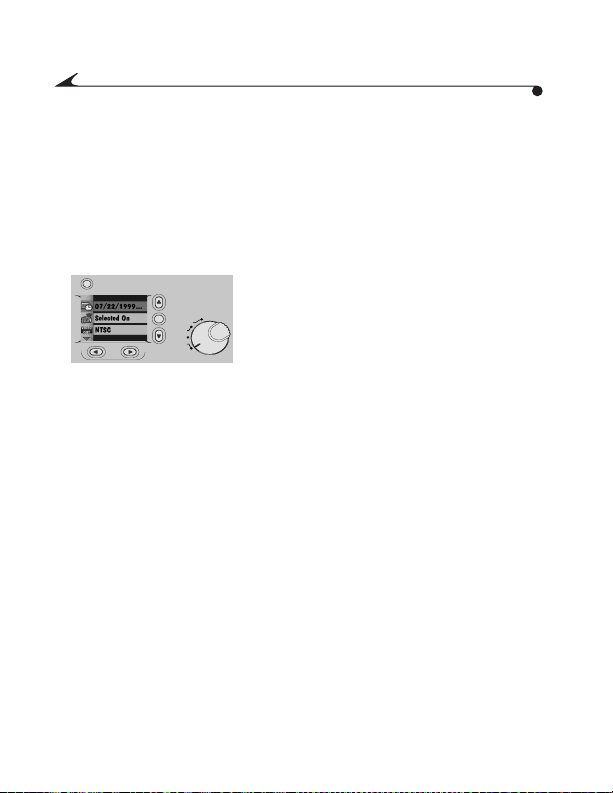
1 Set the Mode dial to Camera Setup.
2 Slide the POWER switch to the right to
turn on the camera.
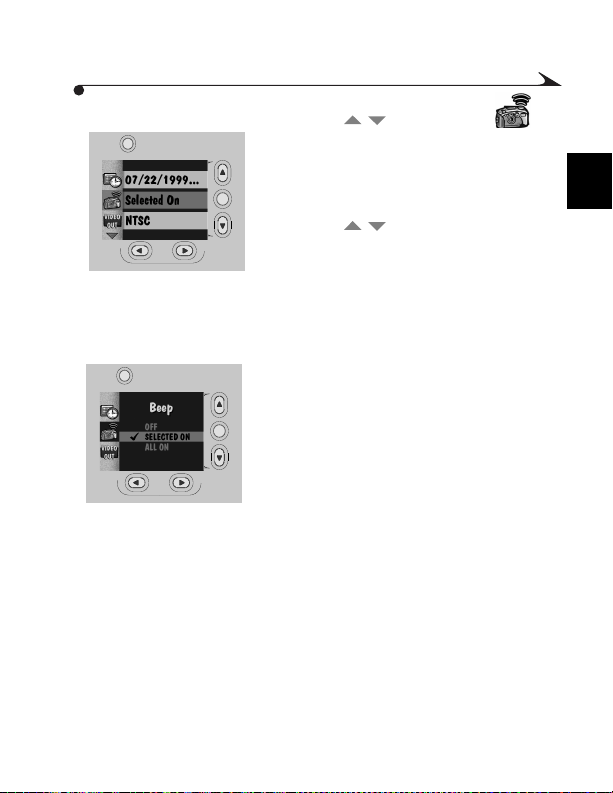
The main Camera Setup screen appears.
MENU
REVIEW
CONNECT
SETUP
CAMERA
CAPTURE
5
65
3 Press a
button until the
icon is highlighted.
4 Press the DO-IT button.
The Beep screen appears. The current
setting is checked (
9
).
5 Press a button until the Beep
option you want is highlighted.
OFF—provides no auditory
feedback.
SELECTED ON—provides auditory
feedback when you press the
SHUTTER button, as well as
any warnings.
ALL ON—provides auditory
feedback anytime a button is pressed.
6 Press the DO-IT button to accept the
changes and return to the main Camera
Setup screen.
/
/
66
Saving Camera Power
The Power Save feature helps extend battery life by shortening the time that the
camera power stays on when not in use. For your convenience, the Power Save
setting is automatically activated. If situations arise where you need the camera
power to stay on for a longer period of inactivity, such as connecting the
camera to a computer, turn off the Power Save feature to have more time to
work before the camera automatically shuts off.
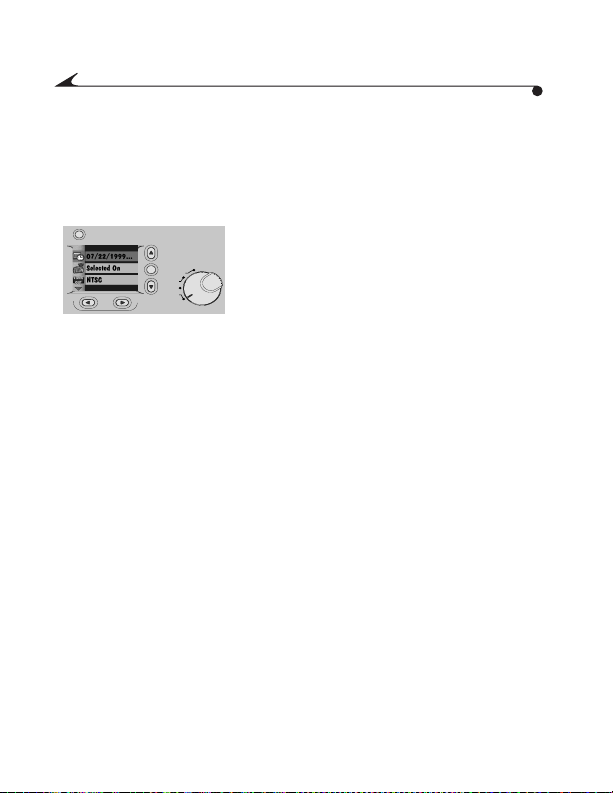
1 Set the Mode dial to Camera Setup.
2 Slide the POWER switch to the right to
turn on the camera.
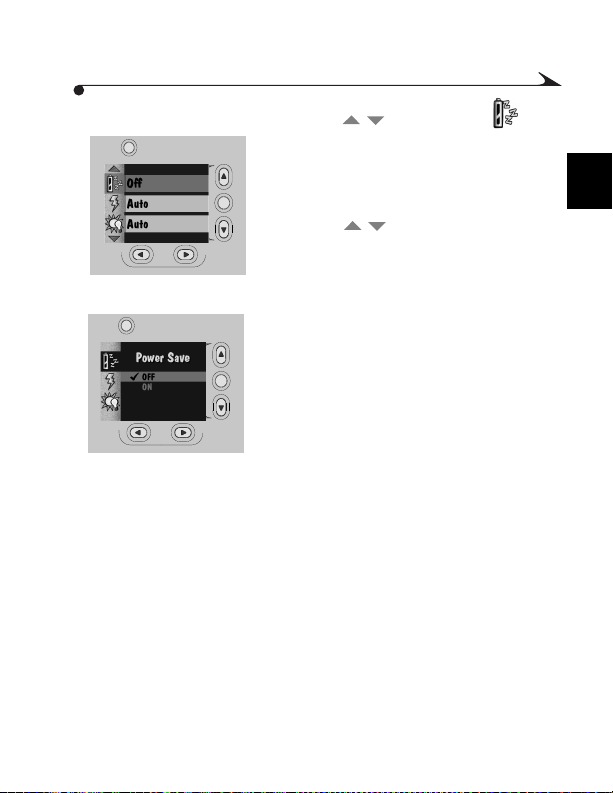
The main Camera Setup screen appears.
MENU
REVIEW
CONNECT
SETUP
CAMERA
CAPTURE
5
67
3 Press a
button until the icon
is highlighted.
4 Press the DO-IT button.
The Power Save screen appears. The
current setting is checked (
9
).
5 Press a button until the Power
Save option you want is highlighted.
6 Press the DO-IT button to accept the
changes and return to the main Camera
Setup screen.
/
/
68
Viewing Camera Information
Have you ever wondered how many pictures you have taken with your camera
or how many times the flash fired? The Camera Information feature keeps a
record for you.
1 Set the Mode dial to Camera Setup.
2 Slide the POWER switch to the right to
turn on the camera.
The main Camera Setup screen appears.
MENU
REVIEW
CONNECT
SETUP
CAMERA
CAPTURE
5
69
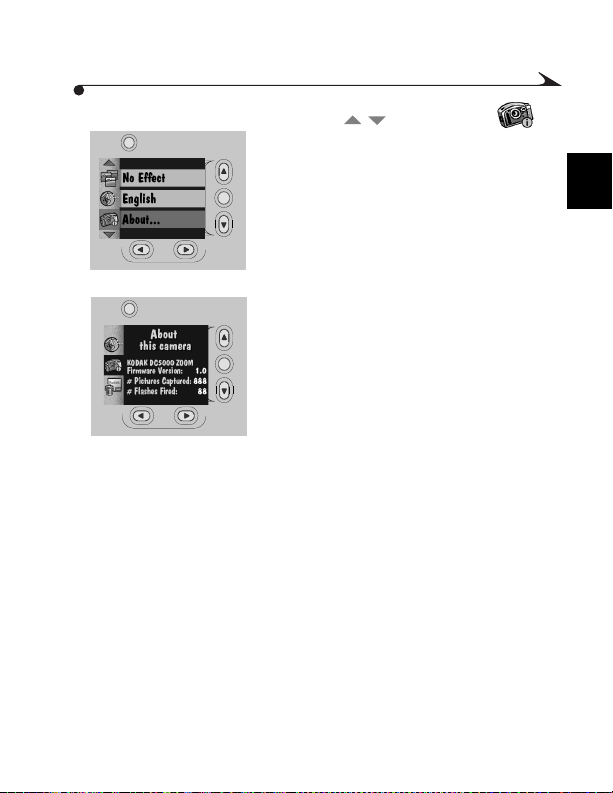
3 Press a
button until the
icon is highlighted.
4 Press the DO-IT button.
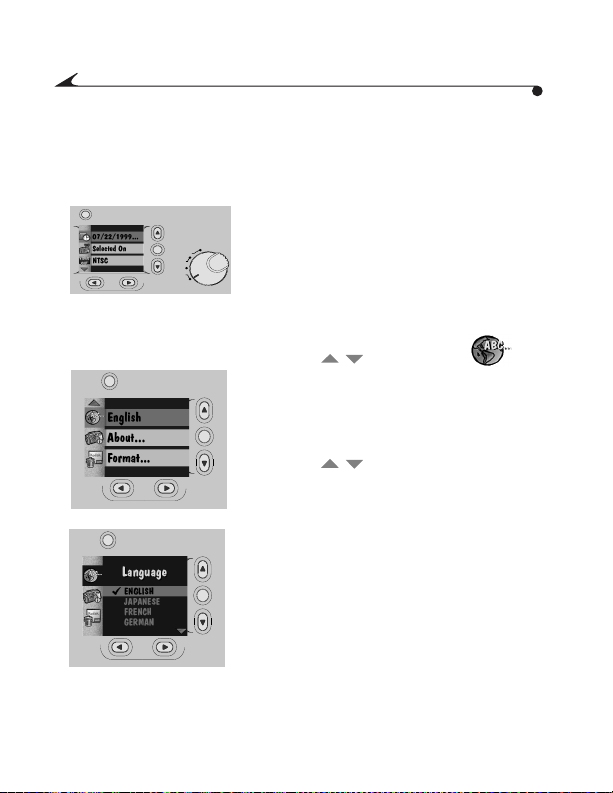
The About screen appears.
The information that appears is
view-only and cannot be changed.
Firmware Version—displays the
latest firmware version.
# Images Captured—displays the
total number of pictures taken.
# Flash Fired—displays the total
number of times the flash fired.
5 Press the DO-IT button to return to the
main Camera Setup screen.
/
70
Selecting a Language for the Camera
Select from many different languages for the camera. Once you select a
language, the text changes to reflect the language selected.
1 Set the Mode dial to Camera Setup.
2 Slide the POWER switch to the right to
turn on the camera.
The main Camera Setup screen appears.
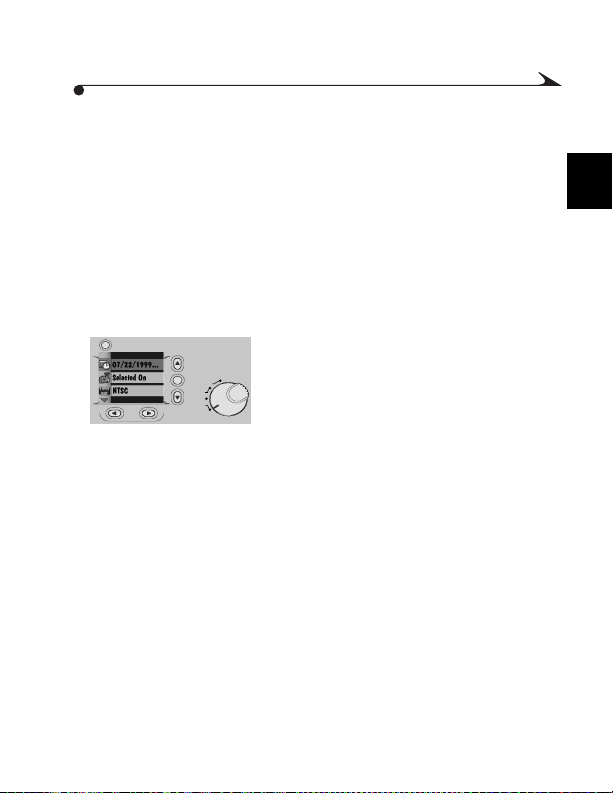
3 Press a button until the
icon is highlighted.
4 Press the DO-IT button.
The Language screen appears. The
current setting is checked (
9
).
5 Press a button until the language
you want is highlighted.
The main Camera Setup screen
reappears.
6 Press the DO-IT button to accept the
changes and return to the main Camera
Setup screen.
MENU
REVIEW
CONNECT
SETUP
CAMERA
CAPTURE
/
/
5
71
Formatting Your Camera Memory Card
If you own camera memory cards (CompactFlash cards) that have been used
in other digital cameras, they may not be properly formatted for use in your
camera, or the data on the card may become corrupted. When these issues
arise, your camera indicates that the camera memory card needs to be
formatted.
When you format a camera memory card, all of the information on the card is
erased. This includes pictures, borders and all other files. You can create and
add borders to the camera memory card. For more information, refer to the
KODAK DC3400 Border Transfer Application online help or the ReadMe file.
1 Set the Mode dial to Camera Setup.
2 Slide the POWER switch to the right to
turn on the camera.
The main Camera Setup screen appears.
MENU
REVIEW
CONNECT
SETUP
CAMERA
CAPTURE
72
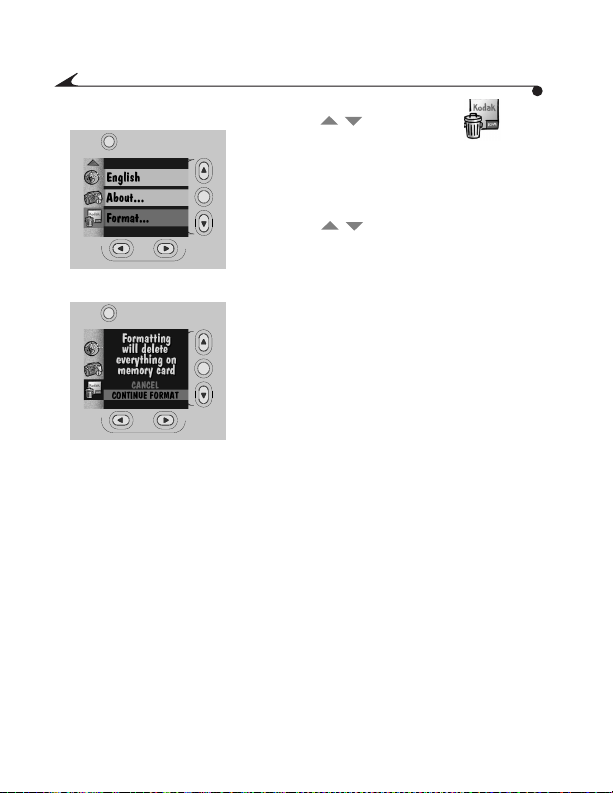
3 Press a button until the icon
is highlighted.
4 Press the DO-IT button.
The Format Memory Card screen
appears.
5 Press a button until CONTINUE
FORMAT is highlighted.
6 Press the DO-IT button to format the
camera memory card and return to the
main Camera Setup screen.
/
/
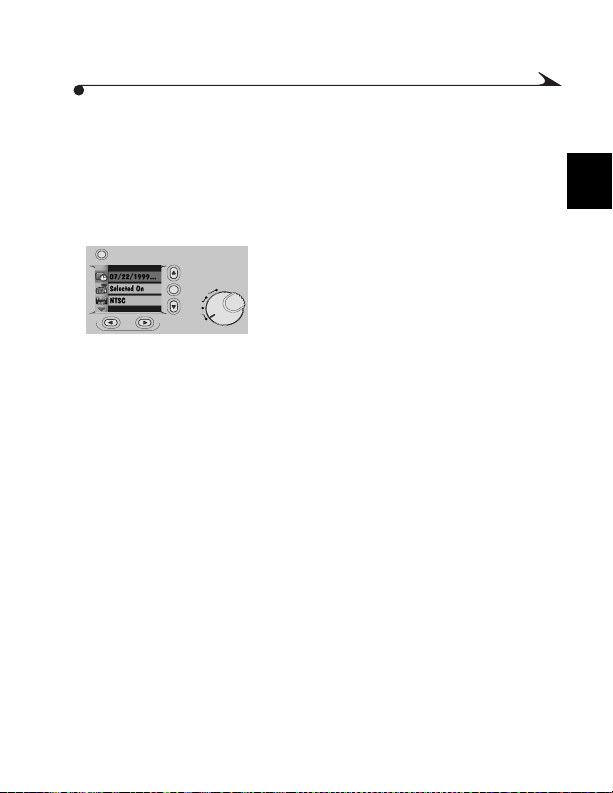
5
73
Adjusting the Video Out Signal
Set your camera so that it is compatible with NTSC or PAL video signals. The
Video Out feature needs to be set correctly if you plan on running a slide show
of the pictures from the camera on a television or video monitor. For
information on setting up a slide show, see page 59.
1 Set the Mode dial to Camera Setup.
2 Slide the POWER switch to the right to
turn on the camera.
The main Camera Setup screen appears.
MENU
REVIEW
CONNECT
SETUP
CAMERA
CAPTURE
74
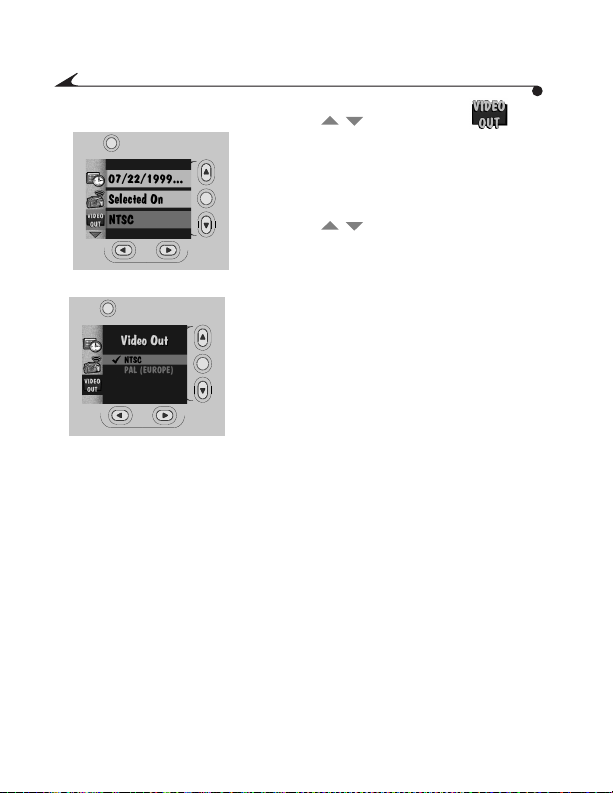
3 Press a button until the
icon is highlighted.
4 Press the DO-IT button.
The Video Out screen appears. The
current setting is checked (
9
).
5 Press a button until the video out
option you want is highlighted.
NTSC—used in most countries
except Europe. The United States
uses NTSC.
PAL—used in European countries.
6 Press the DO-IT button to accept the
change and return to the main Camera
Setup screen.
/
/
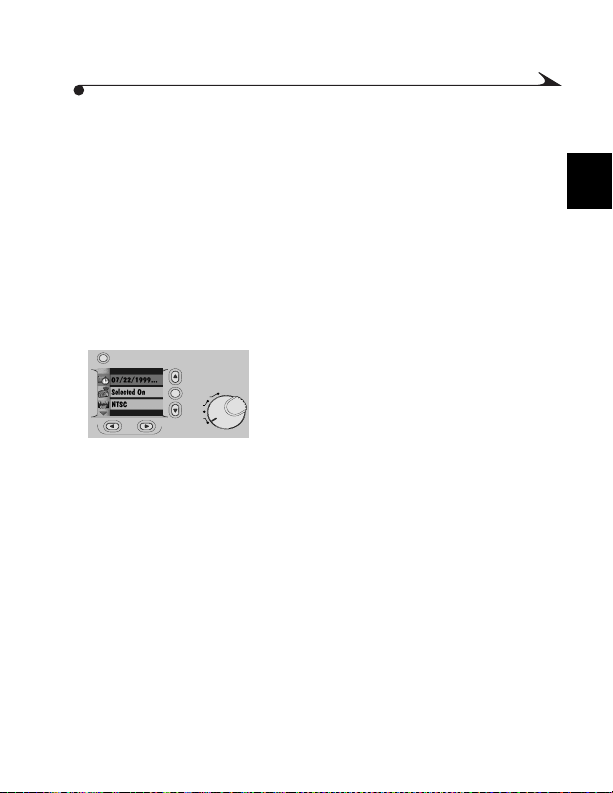
5
75
Adjusting the Camera Default Settings
Customize your camera so specific settings are activated automatically each
time you turn on the camera. Select settings for Flash, White Balance, Exposure
Compensation, Borders, and Effects to suit your particular picture-taking
needs. For default settings, see page 130.
Setting a Border Default
Adjust the camera so your favorite frame or graphic is added to each picture
you take. For more information about the Borders feature, see page 30.
Once the picture is taken, borders cannot be removed.
1 Set the Mode dial to Camera Setup.
2 Slide the POWER switch to the right to
turn on the camera.
The main Camera Setup screen appears.
MENU
REVIEW
CONNECT
SETUP
CAMERA
CAPTURE
76
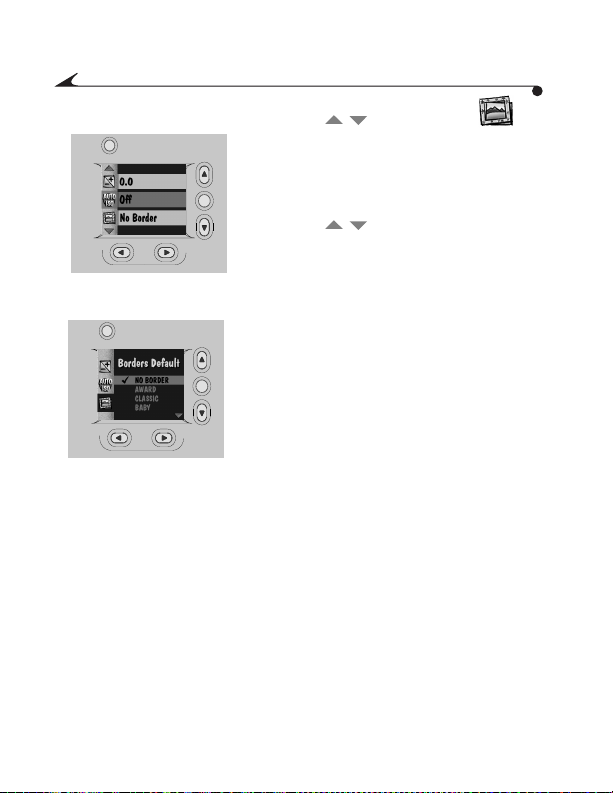
3 Press a
button until the
icon is highlighted.
4 Press the DO-IT button.
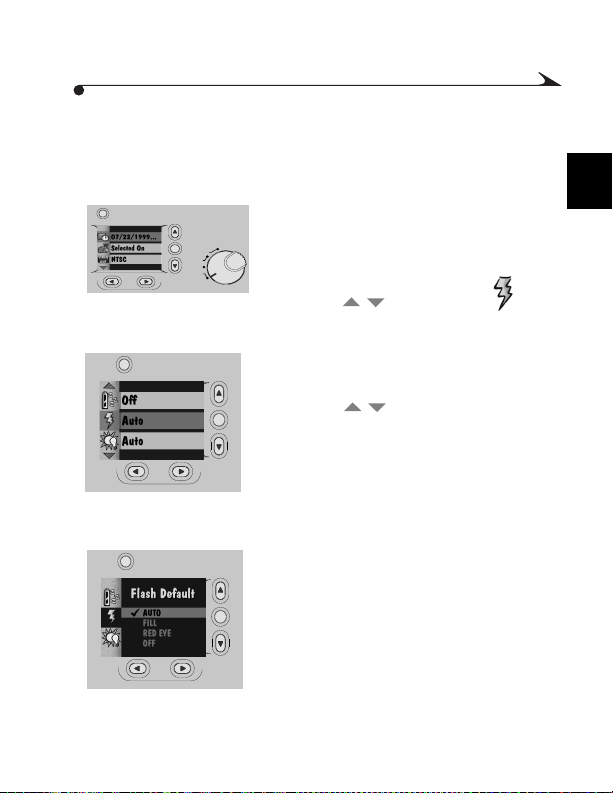
The Borders Default screen appears. The
current setting is checked (
9
).
5 Press a
button until the Border
option you want is highlighted.
No Borders is the main default
setting.
6 Press the DO-IT button to accept the
changes and return to the main Camera
Setup screen.
/
/
5
77
Setting a Flash Default
Adjust your camera so that it is set to a specific flash setting every time you turn
on the camera. For more information about the Flash setting, see page 19.
1 Set the Mode dial to Camera Setup.
2 Slide the POWER switch to the right to
turn on the camera.
The main Camera Setup screen appears.
3 Press a
button until the icon
is highlighted.
4 Press the DO-IT button.
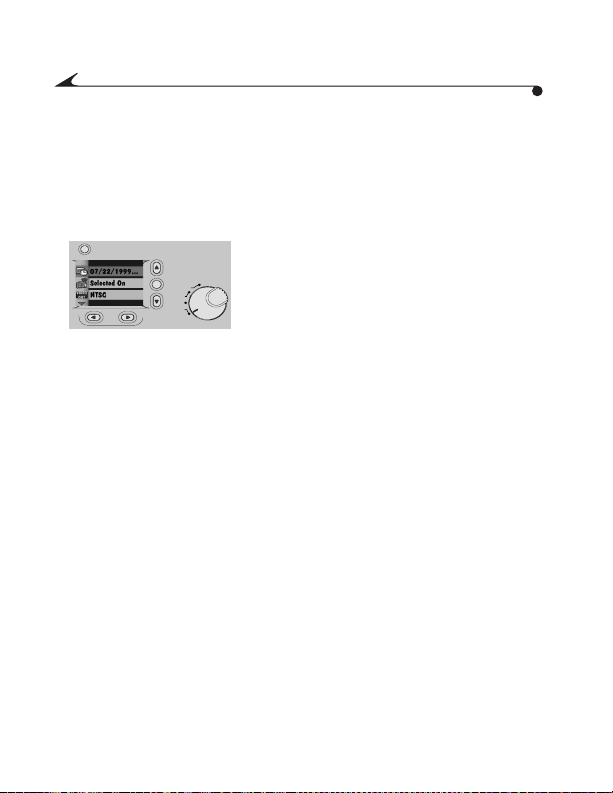
The Flash Default screen appears. The
current setting is checked (
9
).
5 Press a
button until the Flash
option you want is highlighted.
AUTO (Main Default)—flash fires
when needed. Ideal for everyday
picture-taking situations.
FILL—flash fires every time you take
a picture. Ideal for pictures outside
under heavy shade.
RED EYE—flash fires once so the
eyes become accustomed to the flash,
then fires again when the picture is
taken. Ideal for pictures of people.
OFF—flash does not fire.
6 Press the DO-IT button to accept the
changes and return to the main Camera
Setup screen.
MENU
REVIEW
CONNECT
SETUP
CAMERA
CAPTURE
/
/
78
Setting a White Balance Default
If you are always using your camera indoors where flash is prohibited, you can
set the camera so it is balanced for the type of light source that you take
pictures under. For more information about the White Balance feature, see
page 38.
1 Set the Mode dial to Camera Setup.
2 Slide the POWER switch to the right to
turn on the camera.
The main Camera Setup screen appears.
MENU
REVIEW
CONNECT
SETUP
CAMERA
CAPTURE
5
79
3 Press a
button until the
icon is highlighted.
4 Press the DO-IT button.
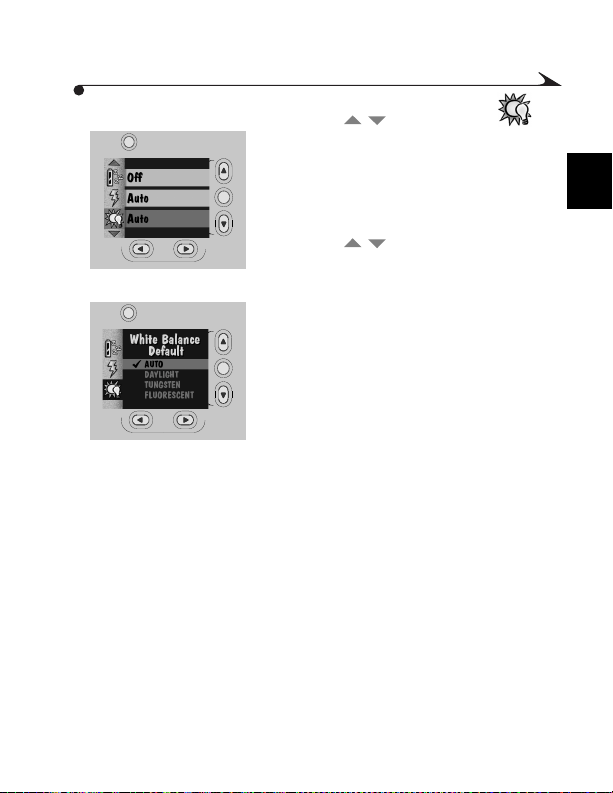
The White Balance Default screen
appears. The current setting is checked
(
9
).
5 Press a
button until the White
Balance option you want is highlighted.
AUTO (Main Default)—adjusts
automatically when flash is used.
Ideal for everyday pictures.
DAYLIGHT—balances for daylight.
Ideal for indoor pictures under
natural lighting.
TUNGSTEN—balances for the red-
orange color of household lighting.
FLUORESCENT—balances for the
green color of fluorescent lighting.
6 Press the DO-IT button to accept the
changes and return to the main Camera
Setup screen.
/
/
80
Setting an Exposure Compensation Default
Adjust the Exposure Compensation setting so that it is used every time you turn
on the camera. For more information about The Exposure Compensation
feature, see page 28.
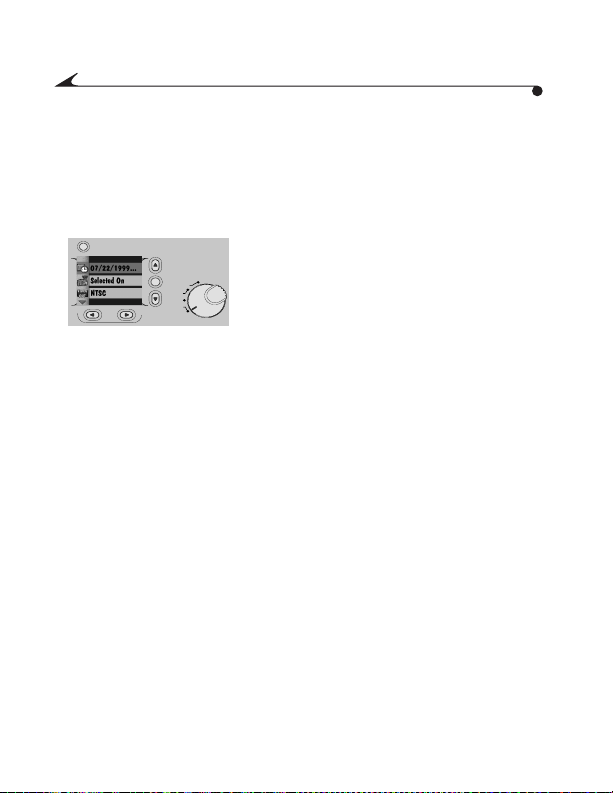
1 Set the Mode dial to Camera Setup.
2 Slide the POWER switch to the right to
turn on the camera.
The main Camera Setup screen appears.
MENU
REVIEW
CONNECT
SETUP
CAMERA
CAPTURE
5
81
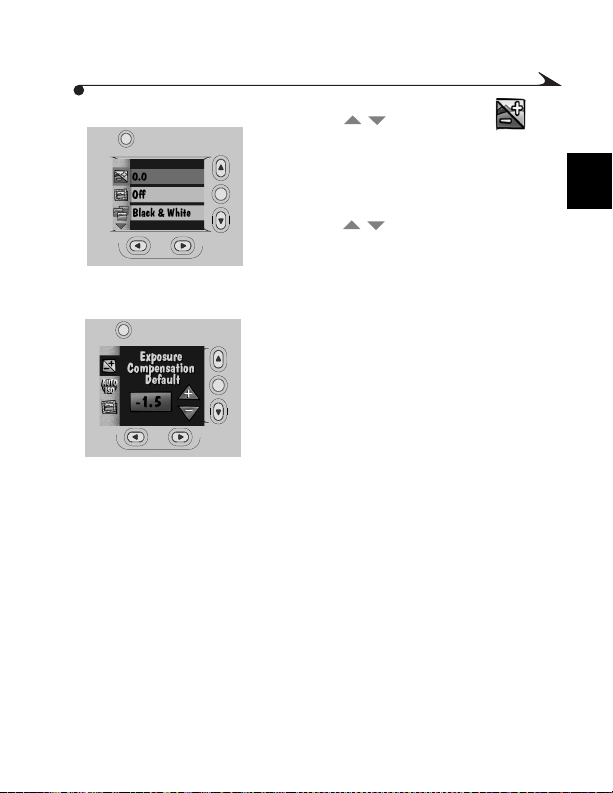
3 Press a
button until the
icon is highlighted.
4 Press the DO-IT button.
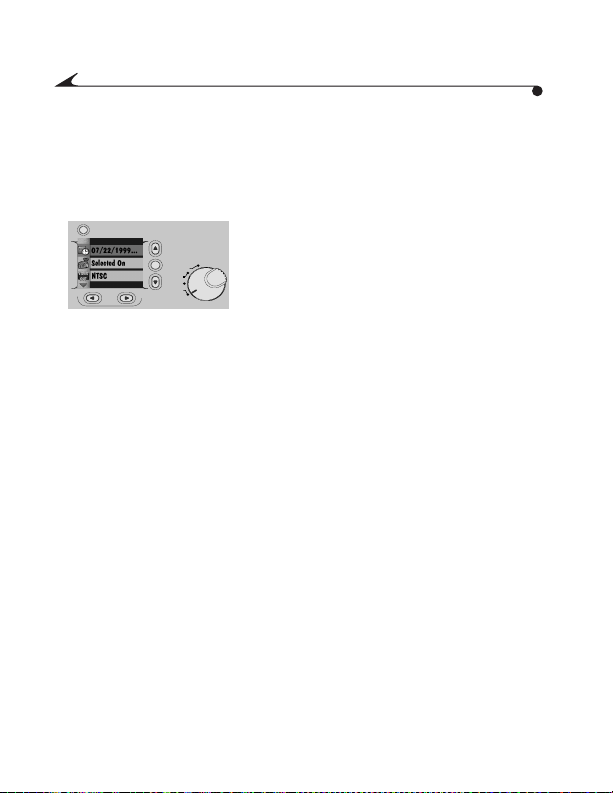
The Exposure Compensation Default
screen appears.
5 Press a
button until the exposure
compensation number you want
is highlighted.
If your pictures are too dark,
increase (+) the exposure number.
If your pictures are too light,
decrease (-) the exposure number.
The main default setting for
Exposure Compensation is 0.0.
6 Press the DO-IT button to accept the
changes and return to the main Camera
Setup screen.
/
/
82
Setting an Effect Default
If you work for a newspaper or in an office environment where you need to
record lecture slides, you can adjust your camera so it takes pictures in black
and white, sepia tone, or to highlight text every time you turn on the camera.
For more information about the Effects feature, see page 32.
1 Set the Mode dial to Camera Setup.
2 Slide the POWER switch to the right to
turn on the camera.
The main Camera Setup screen appears.
MENU
REVIEW
CONNECT
SETUP
CAMERA
CAPTURE
5
83
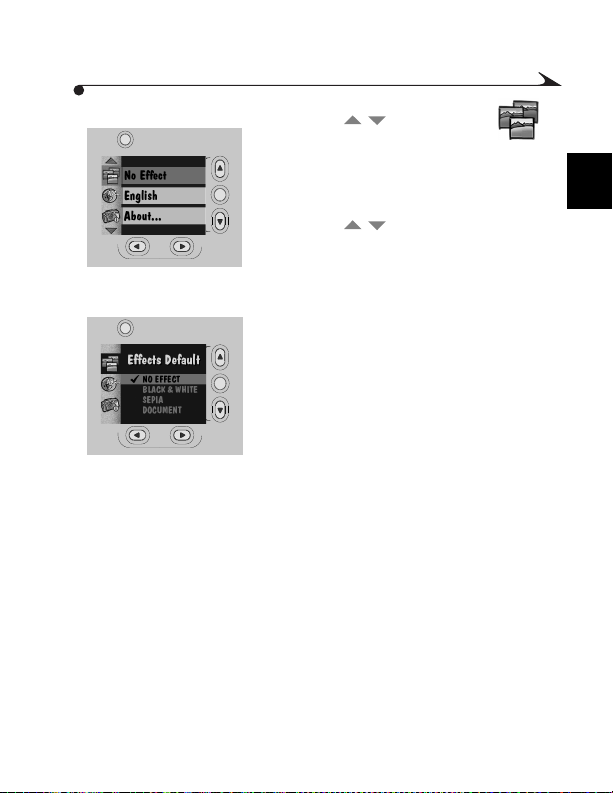
3 Press a
button until the
icon is highlighted.
4 Press the DO-IT button.
The Effects Default screen appears. The
current setting is checked (
9
).
5 Press a
button until the Effects
option you want is highlighted.
No Effect (Main Default)—captures
pictures in full color.
Black & White—captures pictures
in black-and-white. Ideal for taking
pictures for newspapers.
Sepia—captures pictures in a red-
brown tone. Ideal for giving pictures
an antique look.
Document—increases picture
contrast so text stands out.
6 Press the DO-IT button to accept the
changes and return to the main Camera
Setup screen.
/
/
84
Setting an Auto ISO Default
If you always use your camera indoors without flash, you can set the camera so
it uses a faster shutter speed to help avoid blurry pictures from camera
movement. For more information about the Auto ISO feature, see page 42.
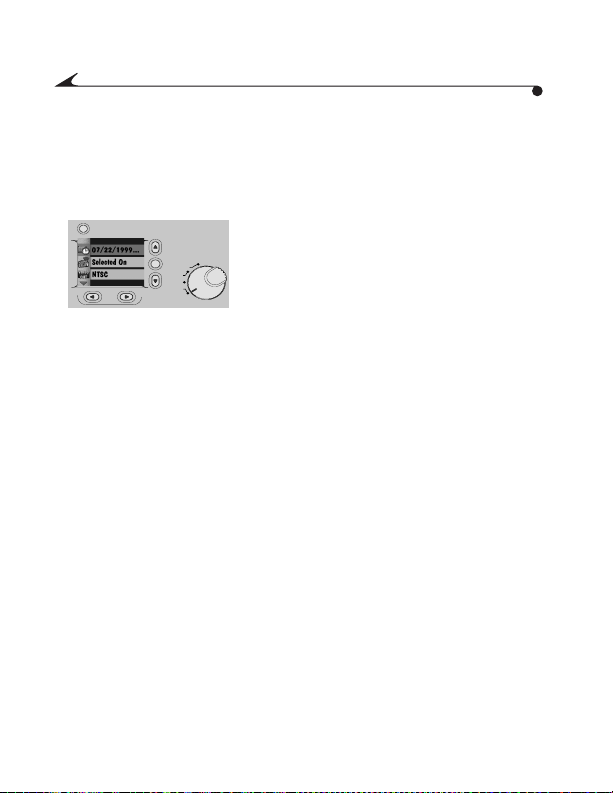
1 Set the Mode dial to Camera Setup.
2 Slide the POWER switch to the right to
turn on the camera.
The main Camera Setup screen appears.
MENU
REVIEW
CONNECT
SETUP
CAMERA
CAPTURE
5
85
3 Press a
button until the
icon is highlighted.
4 Press the DO-IT button.
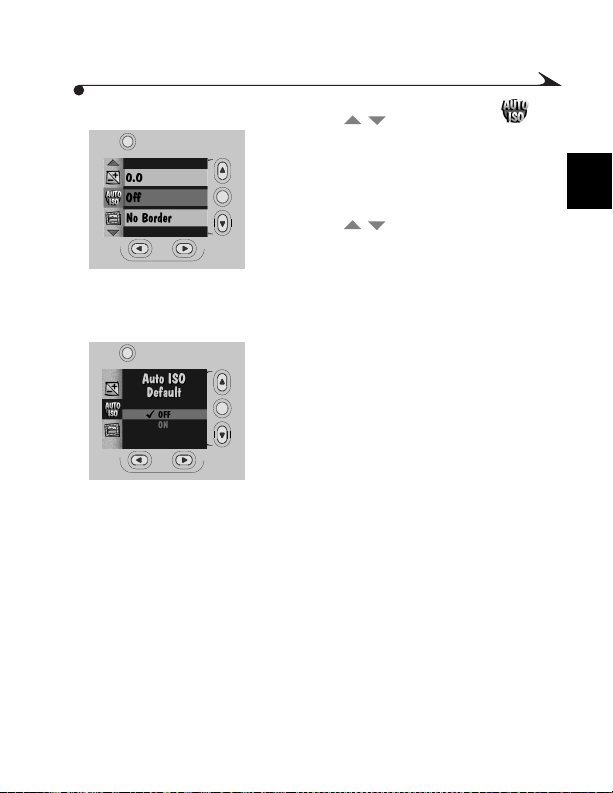
The Auto ISO Default screen appears.
The current setting is checked (
9
).
5 Press a
button until the Auto ISO
option you want is highlighted.
OFF (Main Default)—camera
maintains optimal shutter speed
ranges. Ideal for everyday pictures.
ON—camera increases shutter speed
when flash is off. Ideal for indoor
pictures in less than optimal lighting.
6 Press the DO-IT button to accept the
changes and return to the main Camera
Setup screen.
/
/

86
87
6
6
Installing Your Software
This chapter describes how to install the KODAK software included with your
KODAK DC3400 Digital Camera.
The KODAK DC3400 Camera Software (Installer) included with your camera
contains software for Windows-based personal computers and Macintosh
computers. These applications provide a variety of features that let you access
and use the pictures stored on the camera memory card. Detailed information
on using the software can be found in the online help supplied with each
software application.

88
Windows-Based System Requirements
Windows 95, Windows 98, Windows NT 4.0, or Windows 2000,
operating system.
Pentium 90 MHz microprocessor (minimum) with CD-ROM drive.
Color display monitor with a minimum resolution of 640 x 480 (1024
x 768 preferred) and 8-bit color (16-bit or 24-bit recommended).
16 MB or more of available RAM.
120 MB of hard disk space available.
Available serial port, USB port (Windows 98 and Windows 2000), or
CompactFlash card reader.
Macintosh System Requirements
PowerPC-based Macintosh computer, with CD-ROM drive.
Operating system 7.6.1 or later for serial connection. Operating
system 8.5.1 or later for USB connections.
Color display monitor with a minimum resolution of 640 x 480 (1024
x 768 preferred) and thousands of colors recommended.
32 MB or more of available RAM.
120 MB of hard disk space available.
Available serial port, USB port, or CompactFlash card reader.

6
89
KODAK Software for Windows-Based
Computers
Four KODAK software applications are supplied with the camera for use on a
Windows-based computer. They are:
KODAK DC3400 Camera Mounter Software (Mounter)—
provides an easy way to view pictures from the camera memory card
and copy them to your computer.
KODAK DC3400 Digital Access Software (TWAIN Acquire)—
provides a quick way to view and acquire pictures from the camera
memory card to a TWAIN-compliant host software program, such as
ADOBE Photoshop or ADOBE PhotoDeluxe.
KODAK DC3400 Camera Controls Software (Camera
Controls)—lets you change camera, capture, and communications
settings from a computer as well as take pictures and review them.
KODAK DC3400 Border Transfer Application (Border)—lets
you convert existing Windows BMP files into the border file format
(BDR) and copy the borders to the camera memory card and to the
hard disk.
90
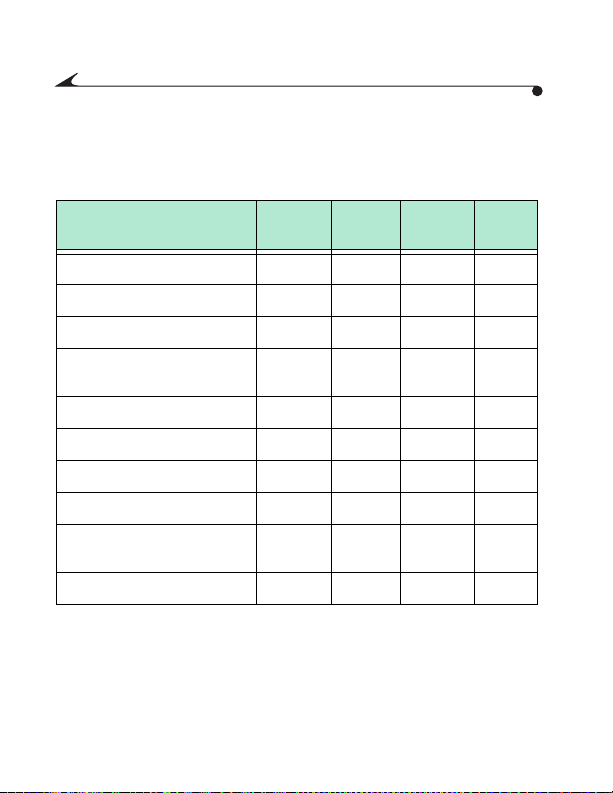
Software Overview
A brief overview of the software is listed below. Detailed information on the
software is available in the online help for each application.
Feature Mounter
TWAIN
Acquire
Camera
Controls
Border
View thumbnail images
Transfer pictures
Display picture information
Open pictures on the hard
drive using other applications
Access Camera Controls
Take a picture
Delete pictures
Format camera memory card
Add borders to camera
memory card
Copy borders to hard disk

6
91
KODAK Software for Macintosh
Computers
Three KODAK software applications are supplied with the camera for use on a
Macintosh computer. They are:
KODAK DC3400 Picture Transfer Application (Picture
Transfer)—provides an easy way to view pictures from the camera
memory card and copy them to your computer.
KODAK DC3400 Digital Access Software (Plug-In Acquire)—
provides a quick way to view and copy pictures from the camera
memory card to any application that supports the ADOBE Photoshop
plug-in module, such as ADOBE Photoshop or ADOBE PhotoDeluxe.
KODAK DC3400 Border Transfer Application (Border)—lets
you convert existing BMP and PICT files into the border file format
(BDR) and copy the borders to the camera memory card and to the
hard disk.
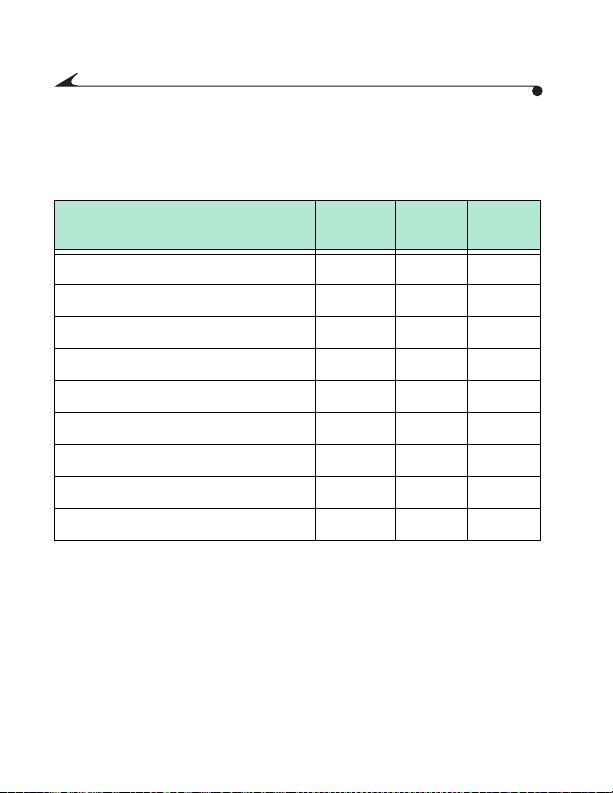
92
Software Overview
A brief overview of the software is listed below. Detailed information on the
software is available in the online help for each application.
Feature
Picture
Transfer
Plug-In
Acquire
Border
View thumbnail images
Transfer pictures
Display picture information
Change camera settings
Take a picture
Change camera Capture settings
Delete pictures
Add borders to camera memory card
Copy borders to hard disk

6
93
Installing the Software
While the Installer is automatically loading your software, take a few minutes to
fill out and send in the camera product registration card. This allows you to
receive information regarding software updates and registers some of the
products included with the camera.
1 Close all other software programs before starting the Installer.
2 Place the Installer CD into the CD-ROM drive.
3 Load the software.
On a Windows-based computer—if Auto Play is enabled, the first
install window automatically appears. If the first install window does not
automatically appear, choose Run from the Start menu. In the Run dialog
box, type the drive letter that contains the CD and type \setup.exe. For
example: d:\setup.exe
On a Macintosh computer— the first install window automatically
appears.
4 Follow the on-screen instructions to install the software.
5 If prompted, restart the computer when the software installation
is complete.
Detailed information on all the KODAK software is included in the online help
for each application.

94
95
7
7
Connecting Your Camera
To transfer pictures taken with your KODAK DC3400 Digital Camera, you first
need to connect the camera to your computer or use a card reader. The
camera can communicate with your computer using one of the following:
RS-232 serial cable connection for Windows-based computers.
Serial cable or adapter plug for Macintosh computers.
Universal Serial Bus (USB) cable connection for Windows 98 and
2000-based personal computers and Macintosh computers.
Card reader. This does not require connecting your camera to your
computer, but is another way to get your pictures from the camera. If
you do not have a card reader, you can purchase one as an accessory.
For details about available accessories, ask a dealer of KODAK
products.
Once the camera is connected to a computer and any required software is
installed, you are ready to transfer pictures from the camera to your computer.
Refer to the online help for information on each software application supplied
with the camera.
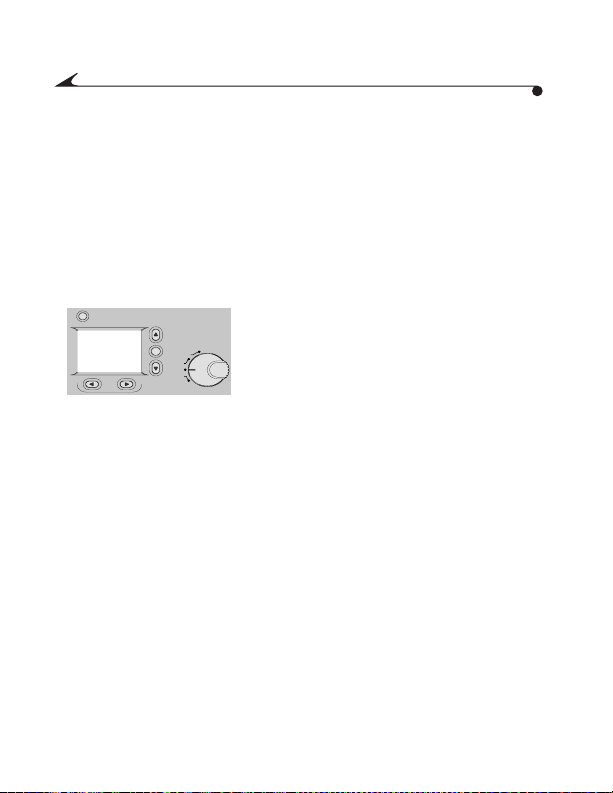
96
Using a Serial Cable Connection
The traditional means of connecting the camera to your computer is by serial
cable. When connecting the camera, it is a good idea to use a KODAK-specified
AC adapter (see page 5) to conserve battery power.
Connecting to a Windows-Based Computer
An RS-232 serial cable is provided so you can connect your camera to a
Windows-based computer.
1 Set the Mode dial to Connect.
2 Plug the appropriate end of the serial
cable into an available 9-pin serial port on
the computer.
MENU
REVIEW
CONNECT
SETUP
CAMERA
CAPTURE
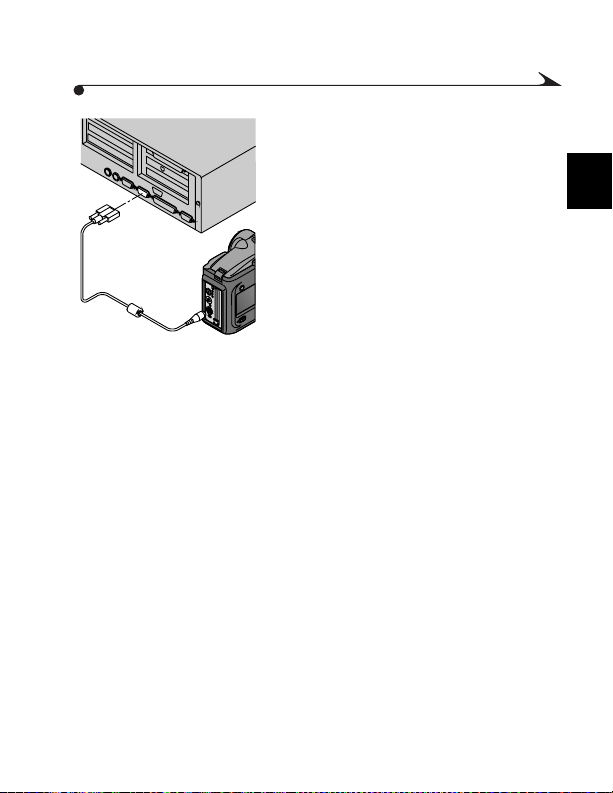
7
97
Serial ports are usually labeled COM1 and
COM2, or A and B. If your computer has a
25-pin port, you need to use a 9-pin
adapter (available at your local computer
store) and attach it to the port before
attaching the serial cable to the computer.
If the ports are not labeled, see your
computer User’s Guide for a diagram that
illustrates all of the external ports.
3 Open the serial/USB port door on the side
of the camera.
4 Plug the other end of the serial cable into
the camera serial port.
5 Slide the POWER switch to the right to turn
on the camera.
If you get a message on your computer
stating that you are not connected, refer to
the Serial.PDF document installed with the
software, or the online help for
troubleshooting information.
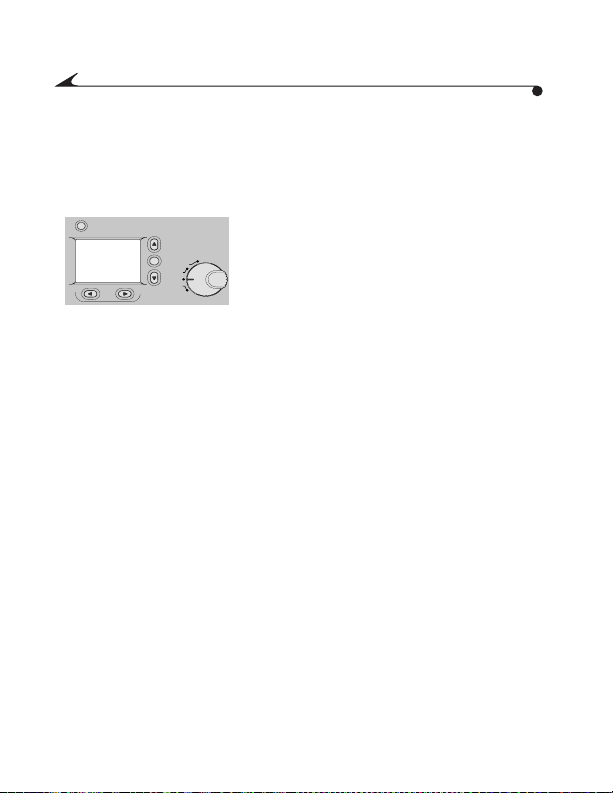
98
Connecting to a Macintosh Computer
Either a serial cable for a Macintosh computer or adapter plug for use with the
RS-232 serial cable is provided so that you can connect your camera through a
serial port on a Macintosh computer.
1 Set the Mode dial to Connect.
2 Connect the serial port adapter plug into
the 9-pin end of the serial cable.
3 Plug the adapter end of the serial cable
into an available serial port on the back of
the computer.
MENU
REVIEW
CONNECT
SETUP
CAMERA
CAPTURE
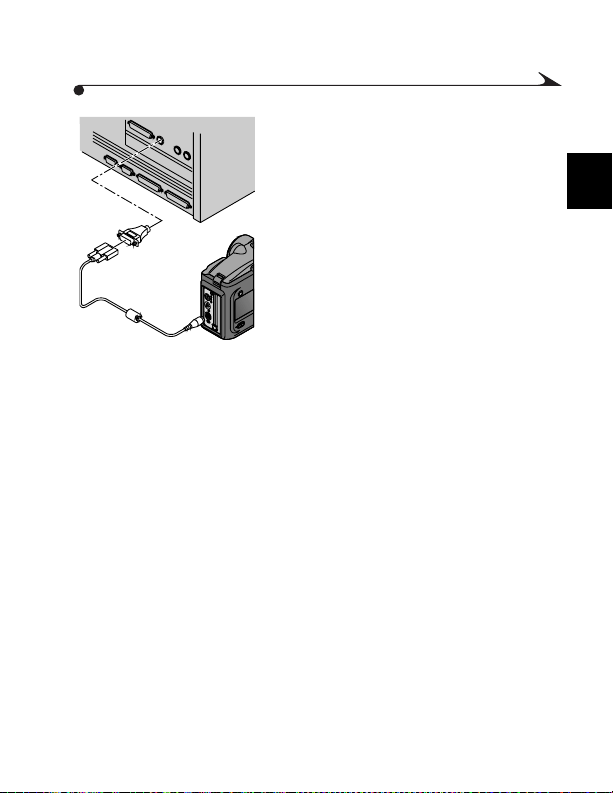
7
99
If your camera came with a serial cable for
a Macintosh computer instead of the serial
adapter plug, connect the end of the serial
cable labelled MAC into the available serial
port on the back of the computer.
Serial ports on Macintosh computers are
usually referred to as modem or
printer ports.
If the ports are not labeled, see your
computer User’s Guide for a diagram that
illustrates all of the external ports.
4 Open the serial/USB port door on the side
of the camera.
5 Plug the other end of the serial cable into
the camera serial port.
6 Slide the POWER switch to the right to turn
on the camera.
If you get a message on your computer
stating that you are not connected, refer to
the Connect.PDF document installed with
the software, or the online help for
troubleshooting information.
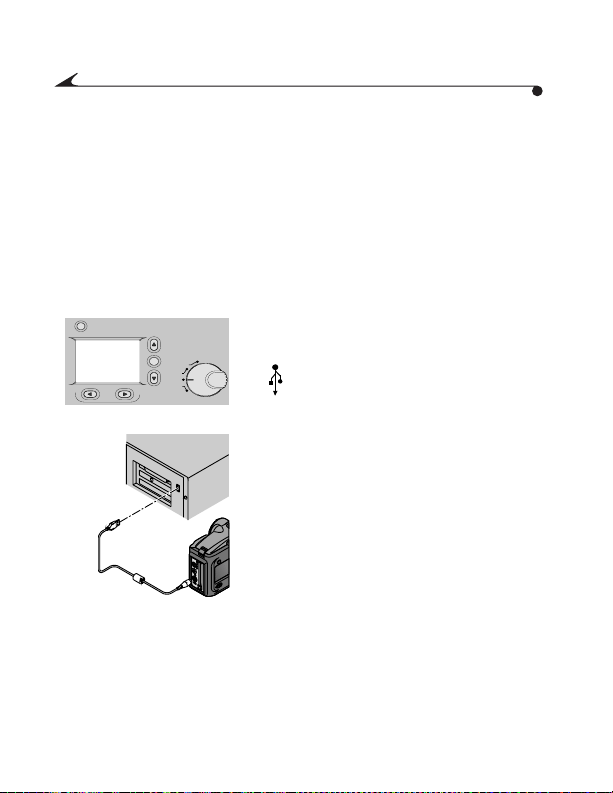
100
Using a USB Cable Connection
If you have a personal computer with a Universal Serial Bus (USB) port, and
are running Windows 98, Windows 2000, or a Macintosh 8.5.1 or higher
computer, you may be able to connect the camera using a USB connection. The
USB interface provides an easy and faster alternative to a serial cable
connection. KODAK only recommends and supports using the camera with the
systems listed in the System Requirements on page 88.
When connecting the camera, it is a good idea to use a KODAK-specified AC
adapter (see page 5) to conserve battery power.
1 Set the Mode dial to Connect.
2 Plug the appropriate end of the USB cable
into the port on the computer with the USB
symbol.
If the port is not labeled, see your
computer User’s Guide for a diagram that
illustrates all of the external ports.
3 Open the serial/USB port door on the side
of the camera.
4 Plug the other end of the USB cable into the
camera serial/USB port.
5 Slide the POWER switch to the right to turn
on the camera.
If you get a message on your computer
stating that you are not connected, refer to
the USB.PDF document installed with the
software, or the online help for
troubleshooting information.
MENU
REVIEW
CONNECT
SETUP
CAMERA
CAPTURE

7
101
Starting KODAK Software for Windows-
Based Computers
With the camera connected to your computer, you are now ready to open and
use the software that you installed in Chapter 6. For detailed information on
using the software, refer to the online help for each application.
Opening Mounter Software
1 Double-click the My Computer icon.
The My Computer window appears.
2 Double-click the Camera icon.
The Camera Memory Card window appears listing individual files.
Opening Digital Access Software (TWAIN
Acquire)
1
Open a TWAIN-compliant application, such as ADOBE Photoshop or
ADOBE PhotoDeluxe.
2
Choose File –> Import TWAIN Source.
3
Select KODAK DC3400 Zoom Acquire.
4
Choose File –> Import TWAIN Acquire.
The main Digital Access window appears.

102
Opening Camera Controls Software
Double-click the Camera Control icon on the desktop to open the main Camera
Controls window.
Opening Border Transfer Software
From the Windows Task bar click Start –> Programs –>
DC3400 –> Border Transfer Application.
The main Border Transfer window appears.

7
103
Starting KODAK Software for Macintosh
Computers
With the camera connected to your computer, you are now ready to open and
use the software that you installed in Chapter 6. For detailed information on
using the software, refer to the online help for each application.
Opening Picture Transfer Application
1
In the KODAK DC3400 Folder, double-click the Picture Transfer
Application folder.
The Picture Transfer icon appears.
2
Double-click the Picture Transfer icon.
The main Picture Transfer window appears.
Opening Digital Access Software (Plug-In
Acquire)
1
Open a Plug-In-compliant application, such as ADOBE Photoshop or
ADOBE PhotoDeluxe.
2
Choose File –> Acquire –> KODAK DC3400 Acquire.
The main Digital Access window appears.
Opening Border Transfer Software
1
In the DC3400 Folder, double-click the Border Transfer Application folder.
2
Double-click the Border Transfer icon.
The main Border Transfer window appears.

104
Navigating to Your Pictures
Pictures are stored on the camera memory card according to a standard
agreed upon by many camera manufacturers. This standard allows you to use
the camera memory card in different cameras.
Most KODAK applications supplied on the Installer CD guides you to your
pictures on the camera memory card; however, if you use the Mounter software
or a card reader to retrieve your pictures or you cannot locate your pictures
using the software provided, the following description of the camera file
structure may be helpful.
Root level folder is named \DCIM. Each time you turn on the camera
or insert a camera memory card, any empty folders within the \DCIM
folder are removed.
Typically, all pictures taken with the camera are stored in the
\DCIM\100K3400 folder.
Pictures are numbered in the order in which they are taken. The first
picture is named DCP_0001.JPG, which is stored in the
\DCIM\100K3400 folder.
When you transfer pictures to the computer, or delete pictures from
the camera memory card, the camera uses consecutive numbers for
subsequent pictures. For example, if the last picture taken was
DCP_0007.JPG, the next picture is DCP_0008.JPG.

7
105
When you insert the camera memory card into another DC3400
camera, the next picture is derived by incrementing either the highest
existing picture number, or the highest picture number previously
taken by that camera.
Once you take picture DCP_9999.JPG in the \DCIM\100K3400 folder,
subsequent pictures will appear in a new folder (\DCIM\101K3400) on the
camera memory card, beginning with picture DCP_0001.JPG.
If you use the camera memory card in a camera other than the DC3400
camera, and that camera manufacturer adheres to this file structure standard,
the \DCIM folder will contain a folder named by that camera. Any pictures
taken with that camera are stored in the folder using the naming conventions
established by the manufacturer. For more information, refer to the
documentation that accompanied that camera.

106
107
8
8
Tips and Troubleshooting
There may be times when questions arise from using your KODAK DC3400
Digital Camera. This chapter can point you in the right direction for finding the
answers quickly, so you can continue using your camera. This chapter provides
the following information:
Connecting with your camera
Communicating with the computer
Adjusting your monitor
Printer tips
Troubleshooting tips

108
Connecting with Your Camera
If you are getting messages on your computer that state you are not connected,
refer to the PDF documents installed with the software, or the online help for
troubleshooting information. If you are connecting to a:
Windows-based Serial connection—refer to Serial.PDF
Windows-based USB connection—refer to USB.PDF
Macintosh computer—refer to Connect.PDF
Communicating with the Computer
If the camera cannot communicate with your computer you may need to adjust
the port and/or speed settings. If you are using a
Windows-based computer, the port and speed setting can be adjusted using the
KODAK DC3400 Camera Controls Software, or the KODAK DC3400 Digital
Access Software (TWAIN Acquire). If you are using a Macintosh computer, the
port and speed settings can be adjusted using the KODAK DC3400 Digital
Access Software (Plug-In Acquire), or the KODAK DC3400 Picture Transfer
Application. Information on using these applications can be found in the online
help for each software application.
Adjusting Your Monitor for Better Viewing
Your monitor display settings may need to be adjusted to view pictures from
the camera. Refer to your computer’s User’s Guide for information on how to
adjust your monitor’s display settings.

8
109
Getting Better Results from Your Printer
You may notice that the colors on your computer screen do not always match
those in your documents or prints. This is because monitors and printers use
different color systems.
You may be able to achieve more predictable results in your printed
documents by:
Improving the quality of your paper. Copier paper may not offer the
same results as coated paper or paper made especially for inkjet
printers.
Adjusting your printer software settings.
Using fresh ink cartridges. Do not use ink cartridges beyond their
life expectancy.
Remember these few tips when it comes time to print your document:
Color printing takes more time. More complex pictures increase the
printing and drying time.
Color printing is more memory intensive than black and white. If your
computer gives you an insufficient memory message, you may need to
close some applications, change some settings, or add additional
memory.
Color prints may not photocopy as clearly as black and white. If you
plan to photocopy documents, you should consider printing the
document in grayscale. This setting is usually changed from the Print
dialog box.
Resizing the picture to a smaller size or printing the picture on glossy
paper may increase the quality of the print.
To improve the quality of your prints, you may want to print your pictures on
KODAK Inkjet Snapshot Paper (Snapshot Paper). Snapshot Paper is made to
work with most inkjet printers to give you clearer, crisper, and more detailed
images on your prints.
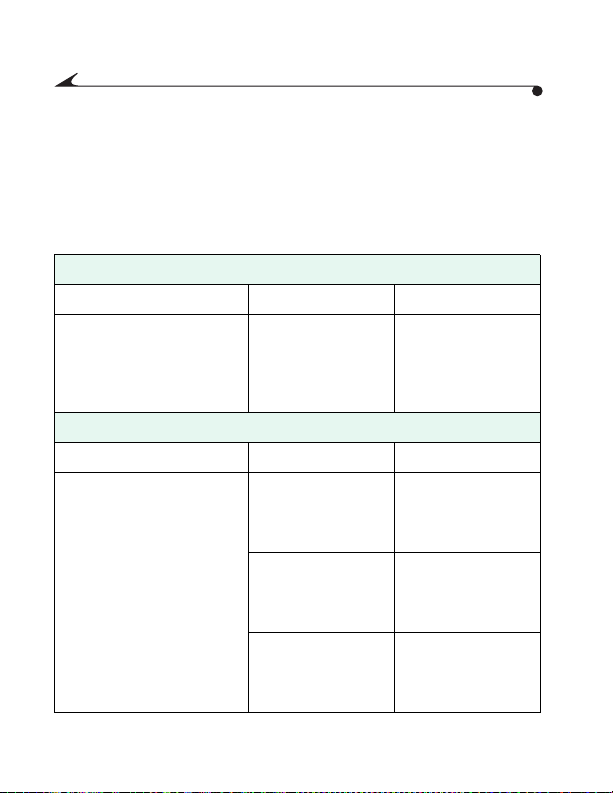
110
Troubleshooting
If you are experiencing difficulties with your camera, check the following table
for possible solutions.
Additional technical information is available in the ReadMe file located in the
KODAK DC3400 folder.
Computer Monitor
Problem Cause Solution
The image on your monitor is
jagged or inappropriately
colored.
Monitor is not set
correctly.
Adjust your monitor
display settings. Refer
to your computer
User’s Guide for
details.
Camera Memory Card
Problem Cause Solution
The camera does not
recognize your camera
memory card.
The camera memory
card may not be
CompactFlash
certified.
Purchase a certified
CompactFlash camera
memory card. See
page 6.
The camera memory
card may be corrupt
or formatted for use
in other cameras.
Reformat the camera
memory card. See
page 71.
Camera memory card
is not inserted in
camera or is inserted
incorrectly.
Insert a camera
memory card. See
page 6.
8
111
Camera Communications
Problem Cause Solution
Computer cannot
communicate with the
camera.
Camera power is off. Turn the camera on.
See page 3.
The Mode dial is not
set to Connect.
Set the Mode dial to
Connect.
Some Advanced
Power Management
utilities on laptops
turn off ports to save
battery life.
See the Power
Management section
of your laptop manual
to disable this feature.
Conflict with another
serial device, such as
a modem or PDA
Refer to the serial
communication or
similar section of
your computer
modem, PDA, and/or
operating system
User’s Guide.
Camera is not
connected to serial or
USB cable, or cable is
not connected to the
computer serial or
USB port.
Connect serial or USB
cable to camera and
computer port. Refer
to the online help, or
see Chapter 7, on
page 95.
Port settings in
software may be set to
the incorrect COM
port.
Change the COM port
settings to Auto-
Search or to a
specific COM port.
See the online help.
112
Camera
Problem Cause Solution
Ready light does not turn on
and the camera does not
work.
Batteries are low or
dead.
Batteries need to be
replaced (see page
3), or recharged (see
page 4), or you can
use an AC adapter.
Camera is not turned
on.
Turn on the camera.
See page 3.
Red ready light comes on and
camera does not take a
picture.
Batteries are low. Batteries need to be
replaced (see page
3), recharged (see
page 4), or you can
use an AC adapter.
Camera memory card
is full.
Transfer pictures to
computer, delete
pictures on card (see
page 57), or insert a
card with memory
(see page 6).
Red ready light is blinking. Flash is not charged. Wait for the flash to
charge.
Green ready light is blinking
and camera takes a picture.
Auto Focus is not
locked.
Release SHUTTER
button and retake
your picture. See
page 14.
Green ready light is blinking
and camera does not take a
picture
Picture being
processed/saved to
memory card.
Wait for the picture to
complete processing.
8
113
Camera
Problem Cause Solution
SHUTTER button does not
work.
Camera is not turned
on.
Turn on the camera.
See page 3.
Mode dial is not set to
Capture.
Set the Mode dial to
Capture.
Ready light is
blinking. Camera is
processing picture.
Wait until Ready light
stops blinking before
attempting to take
another picture.
The Status Display
reads Full. The
camera memory card
is full.
Transfer the pictures
to your computer,
delete pictures on the
card (see page 57),
or insert a card with
available memory
(see page 6).
Camera does not turn on. Batteries are not
properly installed.
Remove and reinstall
the batteries. See
page 3.
Batteries are low or
dead.
Batteries need to be
replaced (see page
3), or recharged (see
page 4). Also, you
could use an AC
adapter.
114
Camera
Problem Cause Solution
Part of the picture is missing. Something was
blocking the lens
when the picture was
taken.
Keep hands, fingers,
or other objects away
from the lens when
taking pictures.
Your eye or the
picture was not
centered correctly in
the viewfinder.
Leave space around
subject when
centering picture in
viewfinder.
Camera Close-Up is
activated without
using Preview.
Activate Preview when
using the Close-Up
feature. See page 22.
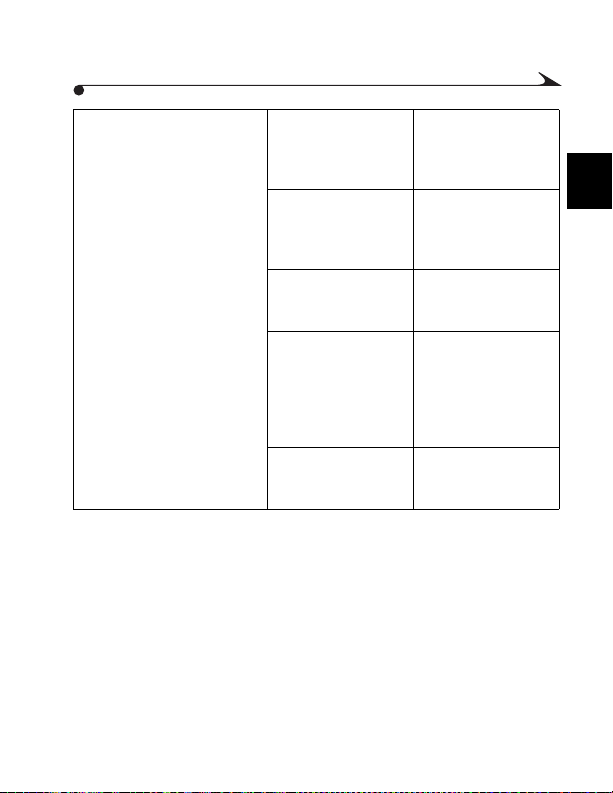
8
115
Picture is too dark. Flash is not on or did
not function.
Turn on the flash. See
page 19. Check the
flash default setting.
See page 77.
The subject is too far
away for the flash to
have an effect.
Move so there is no
more than 9.8 ft
(3.0 m) between the
camera and subject.
The subject is in front
of a bright light.
Change your position
so the light is not
behind the subject.
The Exposure
Compensation is set
incorrectly.
Increase Exposure
Compensation. See
page 28. Check
Exposure
Compensation default
setting. See page 80.
The camera Metering
setting is set to the
Center-Weighted.
Change the Metering
setting to Multi-
Pattern. See page 40.
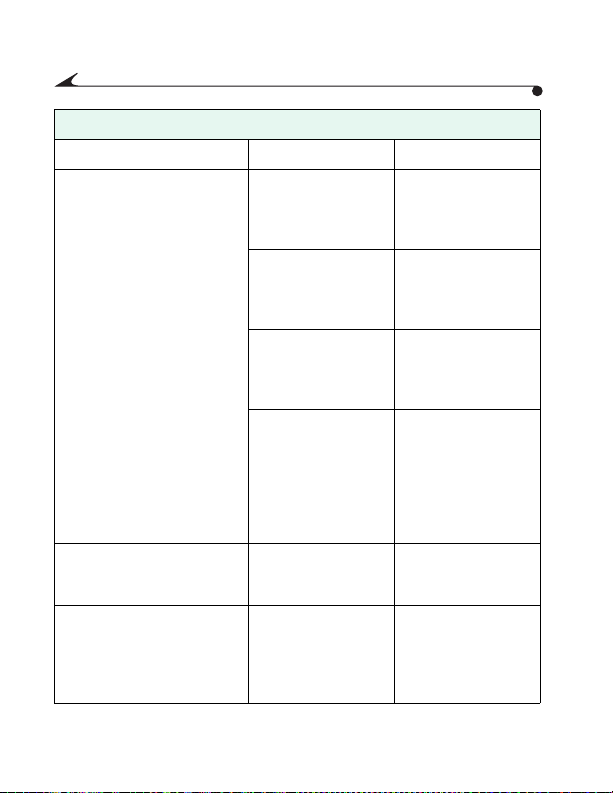
116
Camera
Problem Cause Solution
Picture is too light. The flash is not
needed.
Change to Auto flash.
See page 19. Check
the flash default
setting. See page 77.
The subject is too
close when the flash
was used.
Move so there is at
least 1.6 ft (0.5 m)
between the camera
and the subject.
The light sensor is
covered.
Hold camera so your
hands or other
objects do not cover
light sensor.
The Exposure
Compensation is set
incorrectly.
Decrease the
Exposure
Compensation. See
page 28. Check the
Exposure
Compensation default
setting. See page 80.
Stored pictures are damaged. Camera memory card
removed when Ready
light was blinking.
Be sure Ready light is
not blinking before
removing card.
Picture is black and white,
sepia toned, or has too much
contrast.
The Effects setting is
set incorrectly.
Change the Effects
setting to No Effects.
See page 32. Check
the Effects default
setting. See page 82.
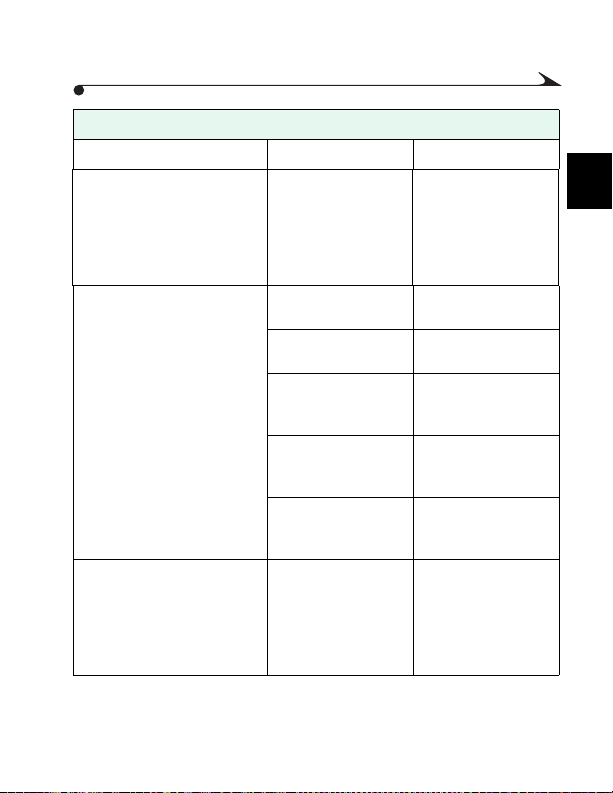
8
117
Camera
Problem Cause Solution
Pictures remaining number
does not decrease after taking
a picture.
The image Resolution
and Quality settings
does not take up
sufficient space to
decrease the picture
remaining number.
The camera is
operating normally.
Continue taking
pictures.
Picture is not clear. The lens is dirty. Clean the lens. See
page 133.
Subject too close
when taking picture.
Stand at least 1.6 ft
(.5m) away.
Subject or the camera
moved while the
picture was taken.
Hold camera steady
until the picture is
taken.
The subject is too far
away for the flash to
be effective.
Move so the subject is
less than 13 ft
(4.0 m) away.
The Sharpness setting
may be set
incorrectly.
Change the Sharpness
setting to Standard.
See page 44.
Picture is tinted green, blue,
or red-orange.
The White Balance
setting is set
incorrectly.
Change the White
Balance setting to
Auto. See page 38.
Check the White
Balance default
setting. See page 78.
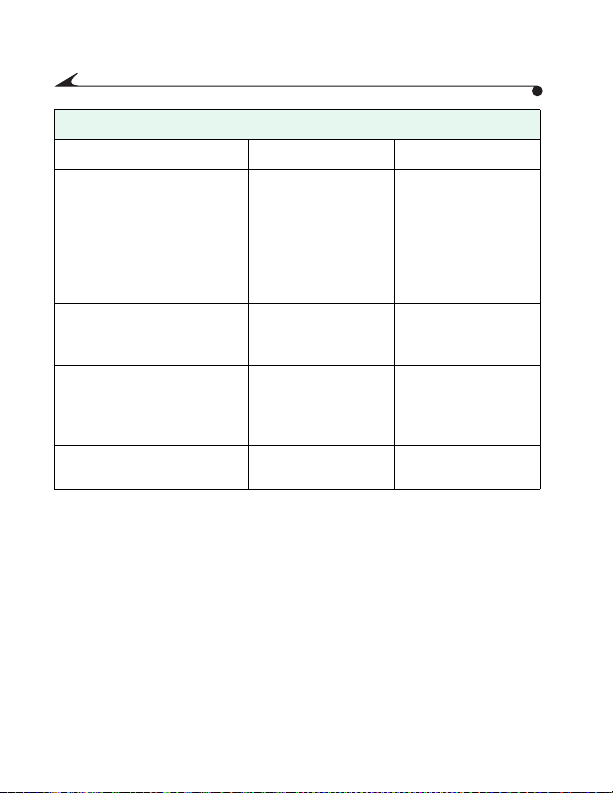
118
LCD Messages
Message Cause Solution
Memory Card is Full. Memory card is full
and cannot hold
additional pictures.
Transfer pictures to
your computer, delete
pictures on the card
(see page 57), or
insert a card with
available memory
(see page 6).
No Card. There is no memory
card inserted in the
camera.
Insert a memory card
into the camera. See
page 6.
Memory Card is Corrupted/
Unreadable.
Memory card is
corrupted.
Insert a new (see
page 6) or reformat
the memory card (see
page 71).
Camera needs service. The camera is
malfunctioning.
Have the camera
serviced.
119
9
9
Where to Get Help
If you need help with your camera, it is available from a number of resources:
Software Help
Help with any KODAK software packaged with your camera can be obtained
from the online help, or by contacting the manufacturer.
Online Services
Contact Kodak via:
Chapter 8 “Tips and
Troubleshooting”
Place of purchase
Software’s manufacturer World Wide Web
Product information by fax Technical support
World Wide Web http://www.kodak.com
(click on Service and Support)
America Online (keyword) KODAK
CompuServe GO KODAK

120
Faxed Information
Kodak offers automated support by fax:
Customer Support
If you have questions concerning the operation of KODAK software or the
camera, you should first check the KODAK Service and Support web site at:
www.kodak.com. Then, if you need to speak directly to a customer support
representative, have the camera serial number ready, and be at your computer
when you call.
U.S. —call toll free, 1-888-375-6325, between the hours of 9:00 a.m.
and 8:00 p.m. (Eastern Standard Time) Monday through Friday.
Canada —call toll free, 1-800-235-6325, between the hours of
9:00a.m. and 8:00 p.m. (Eastern Standard Time) Monday through
Friday.
Europe—call the Kodak Digital Imaging Support Centre international
toll line, 44-131-4586714, between the hours of 09.00 and 17.00
(GMT/CET) Monday through Friday, or visit the web site at
www.kodak.com click on Service and Support.
U.S. and Canada 1-800-295-5531
Europe 44-0-131-458-6962
U.K. 44-0-131-458-6962
121
1
0
10
Service and Limited
Warranty Information
Where to Get Help
If you have any questions about your camera or have difficulty using it, do the
following:
1
Reread the product User’s Guide and check the toubleshooting section.
2
Visit us on the internet at http://www.kodak.com and click on the Link
for Service and Support.
3
Review the On-Line Help in the Kodak Application Software.
If you still have difficulty and need assistance, call the Kodak technical support
number for your geographic area.
How to Obtain Service
Please refer to the Service and Support section of your User’s Guide for the
support hotline designated to your location. Experienced personnel are
available to answer your questions or to provide information on where and
how to return your camera for service.

122
Packing Instructions
1
Include a note with your camera with the following information:
Return Authorization Number
Model number and serial number
Current date
Place of purchase
Description of the problem
Name and address
2
Include proof of the date of purchase such as a copy of the original dated
product sales receipt.
3
Place the camera in a plastic bag to keep out the dirt and packing
materials.
4
If possible, pack the unit in its original packing materials. If the original
packing materials aren’t available, use a sturdy carton that is large enough
for you to surround the camera completely with packing material, such as
crumpled newspaper.
5
Securely fasten the carton with tape. Clearly write the address of the repair
location and your name and address on the top and bottom of the carton.
6
When you ship the carton, it is a good idea to insure the camera for
replacement value.
7
Do not return accessories, such as batteries, AC adapter, Memory Card,
etc., with the product unless specified by the Customer Service
Representative.
1
0
123
Limited Warranty
Kodak warrants the Kodak DC3400 camera (excluding batteries) to be free
from malfunctions and defects in both materials and workmanship for one
year from the date of purchase.
Retain the Original Dated Sales Receipt
Proof of the date of purchase will be required with any request for warranty
repair.
Limited Warranty Coverage
THIS LIMITED WARRANTY WILL BE HONORED ONLY WITHIN THE
GEOGRAPHICAL LOCATION THAT THE KODAK DC3400 CAMERA WAS
PURCHASED.
Kodak will REPAIR or REPLACE, at Kodak’s option, the Kodak DC3400 camera
if it fails to function properly within the warranty period, subject to any
conditions and/or limitations stated herein. Such repair service will include all
labor as well as any necessary adjustments and/or replacement parts. Such
repair or replacement is the sole remedy under this limited warranty.
If replacement parts are used in making repairs, these parts may be
remanufactured, or may contain remanufactured materials. If it is necessary to
replace the entire product, it may be replaced with a remanufactured product.

124
Limitations
Requests for Warranty service will not be accepted without proof of date of
purchase, such as a copy of the original dated Kodak DC3400 camera sales
receipt. (Always keep the original for your records.)
This warranty doesn’t apply to the battery(s) used in this camera. This warranty
does not cover circumstances beyond Kodak’s control, nor problems caused
by failure to follow the operating instructions in the Kodak DC3400 camera
User’s Guide.
THIS WARRANTY DOES NOT APPLY WHEN FAILURE IS DUE TO SHIPPING
DAMAGE, ACCIDENT, ALTERATION, MODIFICATION, UNAUTHORIZED SERVICE,
MISUSE, ABUSE, USE WITH INCOMPATIBLE ACCESSORIES OR ATTACHMENTS,
FAILURE TO FOLLOW KODAK’S OPERATION, MAINTENANCE OR REPACKING
INSTRUCTIONS, OR FAILURE TO USE ITEMS SUPPLIED BY KODAK (SUCH AS
ADAPTERS AND CABLES), OR CLAIMS MADE AFTER THE DURATION OF THIS
WARRANTY.
Kodak makes no other express or implied warranty for this product. In the
event that the exclusion of any implied warranty is ineffective under the law, the
duration of the implied warranty will be one year from the purchase date.
The option of repair or replacement is Kodak’s only obligation. Kodak will not
be responsible for any consequential or incidental damages resulting from the
sale, purchase or use of this product, regardless of the cause. Liability for any
special, consequential or incidental damages (including but not limited to loss
of revenue or profit, downtimes costs, loss of the use of the equipment, cost of
substitute equipment, facilities or services, or claims of your customers for
such damages resulting from the purchase, use or failure of the product),
regardless of cause or for breach of any written or implied warranty is
expressly disclaimed and excluded herefrom.
1
0
125
Your Rights Under State Law
Some states or jurisdictions do not allow exclusion or limitation of incidental
or consequential damages, so the above limitation or exclusion may not apply
to you. Some states or jurisdictions do not allow limitations on how long an
implied warranty lasts, so the above limitation may not apply to you.
This warranty gives you specific rights, and you may have other rights which
vary from state to state or by jurisdiction.
Outside the United States
In countries other than the United States, the terms and conditions of this
warranty may be different. Unless specific Kodak warranty is communicated to
the purchaser in writing by a Kodak company, no warranty or liability exists
beyond any minimum requirements imposed by law, even though defect,
damage, or loss may be by negligence or other act.
Regulatory Information
FCC Compliance and Advisory
This device complies with Part 15 of the FCC Rules. Operation is subject to the
following two conditions: 1) this device may not cause harmful interference,
and 2) this device must accept any interference received, including
interference that may cause undesired operation.
This equipment has been tested and found to comply with the limits for a Class
B digital device, pursuant to Part 15 of the FCC Rules. These limits are designed
to provide reasonable protection against harmful interference in a residential
installation.

126
This equipment generates, uses, and can radiate radio frequency energy and, if
not installed or used in accordance with the instructions, may cause harmful
interference to radio communications. However, there is no guarantee that
interference will not occur in a particular installation.
If this equipment does cause harmful interference to radio or television
reception, which can be determined by turning the equipment off and on, the
user is encouraged to try to correct the interference by one or more of the
following measures: 1) reorient or relocate the receiving antenna; 2) increase
the separation between the equipment and the receiver; 3) connect the
equipment to an outlet on a circuit different from that to which the receiver is
connected; 4) consult the dealer or an experienced radio/TV technician for
additional suggestions.
Any changes or modifications not expressly approved by the party responsible
for compliance could void the user’s authority to operate the equipment.
Where shielded interface cables have been provided with the product or
specified additional components or accessories elsewhere defined to be used
with the installation of the product, they must be used in order to ensure
compliance with FCC regulation.
Canadian DOC Statement
DOC Class B Compliance—This digital apparatus does not exceed the Class
B limits for radio noise emissions from digital apparatus set out in the radio
interference regulations of the Canadian Department of Communications.
Obervation des normes-Class B—Le présent appareil numérique n’émet
pas de bruits radioélectriques dépassant les limites applicables aux appareils
numériques de la Classe B prescrites dans les règlements sur le brouillage
redioélectrique édictés par le Ministère des Communications du Canada.

1
127

128
11
129
11
Appendix
This appendix serves as a resource for specific technical information and care
for your camera, and contains the following information:
Original default settings
Camera Specifications
General maintenance and safety
Battery usage guidelines
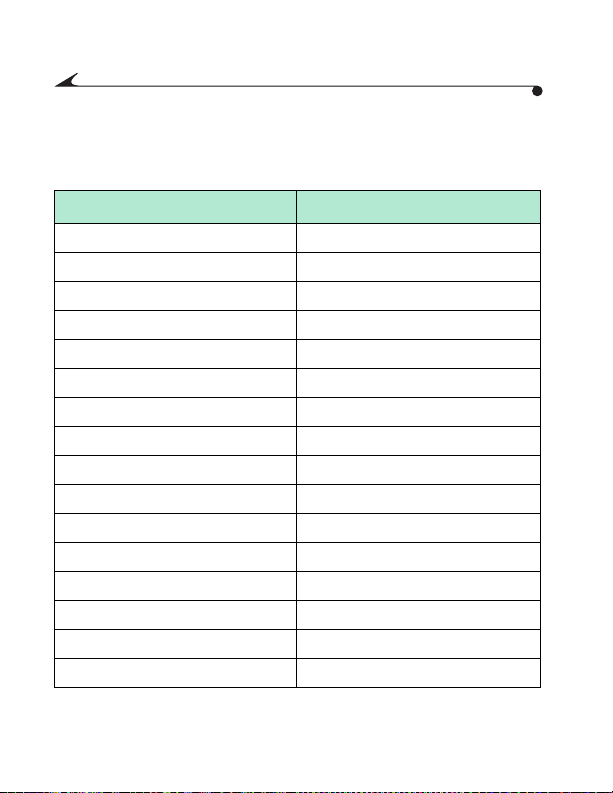
130
Original Camera Default Settings
Your camera is set to these settings when you take the camera out of the box
for the first time.
Feature Setting
Digital Zoom Off
Flash Auto
Infinity Focus/Close-Up Off
Self-Timer Off
Preview Off
Quickview On
Exposure Compensation 0.0
Quality Best
Resolution High
Date Stamp Off
Auto ISO (DC280) Off
White Balance Auto
Metering Multi-Pattern
Exposure Lock Off
Borders Off
Effects Off
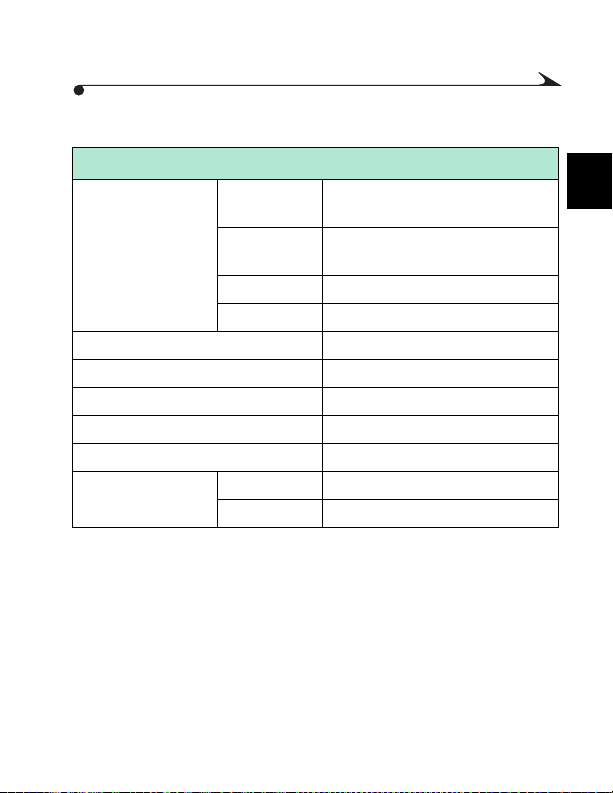
11
131
Camera Specifications
DC3400 Camera
Sensor Resolution CCD 2.1 millions of pixels (total number
of pixels)
Picture
Resolution
2.0 millions of pixels
High 1760 x 1168=2,055,680
Standard 896 x 592=530,432
Color 24-bit, millions of colors
Picture File Format Exif version 2.1 (JPEG base)
Picture Storage CompactFlash card
Viewfinder Real image
ASA/ISO Sensitivity 100
Flash Range Strobe flash to 9.8 ft. (3.0 m)
(Redeye reduction, auto, fill, off)
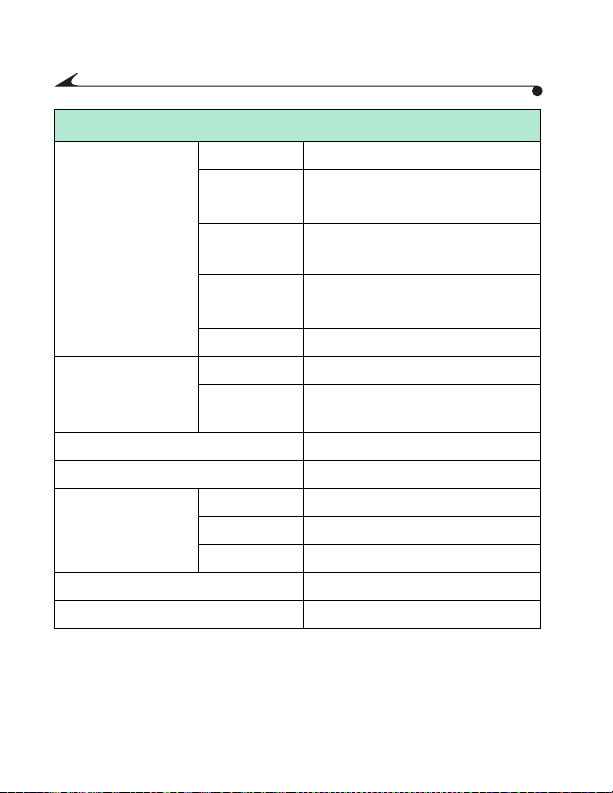
132
Lens Type KODAK EKTANAR Lens
Wide
Tele
f 3.1 - f 8.1
f 3.9 - f 10.3
Zoom 2X Optical zoom
3X Digital zoom
Focal Length 38 to 76 mm
f 8.1 - f 15.3 (35 mm equivalent)
Power Batteries AA-size 1.5-volt alkaline
DC Input KODAK-specified AC adapter,
accessory
Tripod Socket Standard
Video Out NTSC or PAL
Dimensions Width 5.2 in. (133 mm)
Length 2.1 in. (54 mm)
Height 3.0 in. (76 mm)
Weight 12 oz. (332 g) without batteries
Operating Temperature 32 to 104° F (0 to 40° C)
DC3400 Camera

11
133
General Maintenance and Safety
Always follow basic safety precautions, refer to the “Important Safety
Instructions” booklet packed with your camera.
Clean the outside of the camera by wiping with a clean, dry cloth. Never
use harsh or abrasive cleaners or organic solvents on the camera or any of
its parts.
Do not get the camera wet. If water gets inside the camera, it may cause
electrical shock or malfunction. If you suspect water has gotten inside the
camera, stop using it immediately and contact the service center.
Do not allow any chemicals, such as suntan lotion to come into contact
with the painted surface of the camera.
The camera is not waterproof. If the camera has been subjected to
inclement weather or you suspect water has gotten inside the camera, turn
off the camera and remove the batteries and camera memory card
Never disassemble or touch the inside of the camera. This could result in
electrical shock.
If you notice smoke or a strange smell coming from the camera,
immediately turn off the camera, wait a few minutes until the camera
cools, then remove the batteries. Contact your Technical Support Center.
If you use the camera in an airplane, observe the instructions of the airline
company. Radio waves emitted by the camera may effect the airplane
instruments.
Use only a Kodak-specified 7V AC Adapter with your camera. Use of a
different adapter, or one with a different voltage, may cause damage to the
camera and the batteries.

134
Clean the lens and back LCD screen:
Do not use cleaning solutions unless they are designed specifically for
camera lenses. Do not wipe the camera lens or LCD screen with
chemically treated eyeglass lens tissue as it may scratch the lens.
1
Blow gently on the lens or LCD screen to remove dust and dirt.
2
Moisten the lens or LCD screen by breathing lightly on it.
3
Wipe the lens or LCD screen gently with a soft, lint-free cloth or an
untreated lens-cleaning tissue.
Service agreements are available in some countries. Please contact a
dealer of KODAK products for more information.

11
135
Using Your Batteries
Read and follow all warnings and instructions supplied by the battery
manufacturer.
Keep batteries out of the reach of children.
Remove the batteries when the camera is stored for extended periods
of time.
Do not attempt to disassemble, short circuit the battery, or subject it to
high temperature or fire.
Your camera has been designed to operate correctly using a variety of
AA-size batteries currently available. These include 1.5 volt alkaline
batteries, and rechargeable 1.2 volt Nickel Metal Hydride (Ni-MH)
batteries.
Replace all batteries of a set at the same time. Newly purchased
batteries should not be mixed with used ones. Do not mix chargeable
and nonchargeable batteries. Do not mix alkaline, Ni-MH, or Ni-Cd
types of batteries. Do not mix different grades or brands of batteries.
Failure to observe this precaution may result in some batteries in a set
being driven beyond their normal exhaust point and increase their
possibility of leakage.
NOT ALL BATTERIES ARE CREATED EQUAL! Battery life depends
significantly on age, usage conditions, type, brand, and camera.
Digital camera requirements are very demanding on batteries. Not all
batteries perform well under these challenging conditions. In Kodak
lab tests, Nickel Metal Hydride (Ni-MH) rechargeable batteries
delivered the best results in a variety of conditions. Ni-MH batteries
are designed for high-demand devices, like digital cameras, and do
not exhibit the “memory” effects seen with other rechargeable
technologies.

136
If you elect to use alkaline batteries in your camera, you will obtain
better performance from “photo-flash grade” alkaline batteries, such
as KODAK PHOTOLIFE. These types of batteries last more than twice as
long in digital cameras as ordinary alkaline batteries. Alkaline
batteries are not rechargeable, do not attempt to recharge them in the
battery charger.
When using your camera on battery power, limit continuous LCD
Preview or Review to sessions which are shorter than 10 minutes. If
you are using the Preview or Review functions of the camera for
periods greater than 10 minutes, it is recommended that you do so
with the camera powered by the AC adapter.
Battery performance is reduced at temperatures below 32°F (0°C).
Carry spare batteries when using your camera in cold weather, and
keep them warm until you are ready to take pictures. Do not discard
cold batteries that do not work, once warmed, they may be usable.
When disposing of batteries, follow the manufacturer’s instructions
and applicable regulations. Kodak encourages customers to take
advantage of any community battery recycling programs that may exist
in your area. Contact your local waste remover or recycler for details.
In the unlikely event that battery fluid leaks inside the camera, U.S.
customers can contact the Kodak Information Center (KIC) at
1-800-242-2424. Customers outside the U.S. can contact their local
Kodak Customer Service representative.
11
137
In the unlikely event that battery fluid leaks onto your skin, wash
immediately with water and contact your local health provider. For
additional health related information please contact Kodak Health,
Safety and Environment Information at 1-716-722-5151 in the U.S.
Customers outside the U.S. can contact their local Kodak Customer
Service representative.
When removing batteries, allow to cool before touching, since the
batteries may be hot.
Caution Hot Surface

138

139
Index
A
adapter
AC 5
serial 98
adjusting
auditory feedback 64
border default 75
borders 30
camera exposure 28
clock 8
date stamp 24
digital zoom 16
effects 32
exposure compensation 28
exposure default 80
flash 19
flash default 77
frames 30
ISO default 84
language 70
LCD brightness 9
metering 40
monitor 108
power save 66
quality 34
resolution 36
response beep 64
sharpness 44
video out 73
white balance 38
white balance default 78
zoom 16
artificial lighting 39
auditory feedback 64
auto
flash 19
focus 14
ISO, as default 84
B
balance 39
bar, memory 50
batteries
checking 4
guidelines 135
loading 3
tips 135
beep 64
best quality 34
better quality 34
black-and-white

140
as default 82
pictures 32
border
adding to picture 30
as default 75
brightness, LCD 9
buttons
close-up 22
flash 19
infinity focus 21
self-timer 23
shutter 14
T zoom 15
telephoto 15
W zoom 15
wide angle 15
zoom 15
C
camera information 68
camera language 70
camera memory card
formatting 71
inserting and removing 6
logo 6
camera specifications 131
cancelling print order 55
capturing a picture 14
card, camera memory
formatting 71
inserting and removing 6
logo 7
care, camera 133
center-weighted metering 40
checking batteries 4
clock, setting 8
close-up 22
CompactFlash card
formatting 71
inserting and removing 6
logo 6
compliance, FCC 125
connecting
help 108
serial cable, Macintosh 98
serial cable, Windows 96
USB, Macintosh 100
USB, Windows 100
controls, zoom 15
customer support number 120
D
date stamp 24

141
daylight balance 38
default
auto ISO 84
border 75
effect default 82
exposure 80
factory 129
flash 77
white balance 78
deleting
all pictures 57
picture just taken 26
quick picture delete 17
digital zoom 15
directory naming, pictures 61
document, photographing
as default 82
pictures 32
E
effect
default 82
setting 32
exposure
compensation 28
default 80
lock 46
F
factory default 129
FCC compliance 125
feedback, auditory 64
file naming, pictures 61
files, navigating 104
fill flash 19
filmstrip 50
flash
auto 19
default setting 77
fill 19
off 19
red-eye 19
fluorescent balance 38
focus
auto 14
infinity 21
formatting camera memory card
71
frames, adding to picture 30
G
good quality 34
guidelines, batteries 135

142
H
help
camera care 133
communicating with
computer 108
connecting 108
customer support numbers
120
fax 120
online service address 119
software 119
troubleshooting 110
warranty 121
high resolution 36
history, camera 68
I
icon
battery 4
border 30
border default 75
close-up 22
date stamp 24
delete 26, 57
effect default 82
effects 32
exposure compensation 28
exposure default 80
exposure lock 46
flash 19
flash default 77
format memory card 71
infinity focus 21
language 70
magnify 52
metering 40
picture information 61
power save 66
print order 53
protect 56
quality 34
quickview 18
resolution 36
response beep 64
self-timer 23
sharpness 44
slide show 59
video out 73
white balance 38
white balance default 78
index print 53
infinity focus 21
information
camera 68
pictures 61
installing software 93

143
K
KODAK software
help 119
installing 93
Macintosh computers 91
starting 101
Windows 89
L
landscape photography 21
language, camera 70
launching the software 101
LCD brightness 9
loading batteries 3
locking an exposure 46
M
Macintosh system requirements
88
magnifying pictures 52
maintenance 133
memory bar 50
memory card, camera
formatting 71
inserting and removing 6
logo 6
metering
center-weighted 40
multi-pattern 40
monitor, adjusting 108
multi-pattern metering 40
N
navigating to pictures 104
needle locator, pictures 50
NTSC 73
O
opening the software 101
ordering prints 53
P
PAL 73
photography 32
black-and-white 33
close-up 22
distant subjects 21
indoor lighting 38
landscapes 21
of documents 32
sepia tone 32
picture locator needle 50
pictures

144
artificial lighting 39
black-and-white 32
cancelling for print 55
capturing 14
deleting 26
deleting all 57
directory 61
file name 61
information about 61
magnifying 52
marking for print 55
of documents 32
previewing 12
protecting 56
quality 34
resolution 36
review 50
sepia tone 32
sharpening 44
softening 44
taking 14
viewing 17
power save 66
preparing to take pictures 2
previewing pictures 12
print ordering 53
printing
cancel print order 55
index print 53
ordering 53
selecting pictures for 53
tips 109
proof sheet 53
protecting pictures 56
Q
quality 34
quickview 18
R
red-eye reduction 19
regulatory information 125
repair coverage 121
resolution 36
response beep 64
reviewing pictures 50
RS-232 serial cable 96
S
safeguarding pictures 56
safety 133
save power 66
self-timer 23

145
sepia tone
as default 82
pictures 32
serial cable, connecting
help 108
Macintosh 98
Windows-based computer
96
service numbers 120
setting
border 30
border default 75
clock 8
close-up 22
date stamp 24
digital zoom 15
effect default 82
effects 32
exposure compensation 28
exposure default 80
exposure lock 46
flash default 77
frame 30
infinity focus 21
language 70
magnify 52
metering 40
power save 66
preview 12
print order 53
protect 56
quality 34
quickview 18
resolution 36
response beep 64
review 50
self-timer 23
sharpness 44
slide show 59
telephoto 15
video out 73
white balance 38
white balance default 78
sharpening pictures 44
shutter button 14
slide show 59
softening pictures 44
software, KODAK
installing 93
starting 101
Windows 89
software,KODAK
help 119
Macintosh computers 91
sound, response 64
specifications, camera 131

146
stamp, date 24
standard resolution 36
starting software 101
support numbers 120
symbol, USB 100
T
taking
a picture 14
pictures, preparing 2
telephoto, setting
wide angle 15
television, viewing pictures 59
thumbnails, viewing 50
tips
battery guidelines 135
maintenance 133
monitor setting 108
printing 109
safety 133
troubleshooting 110
tungsten balance 38
U
USB symbol 100
USB, connecting
help 108
Macintosh 100
Windows 100
V
video
out 73
out, port 59
viewing
camera information 68
filmstrip 50
picture information 61
pictures on television 59
thumbnails 50
viewing pictures 17
W
warning beep 64
warranty 121
white balance
auto 38
daylight 38
default 78
fluorescent 38
tungsten 38
wide angle 15
Windows system requirements
88


148